
Schiphol Group. Annual Report
|
|
|
- Emma Griffin
- 10 years ago
- Views:
Transcription
1 Schiphol Group Annual Report 2014

2

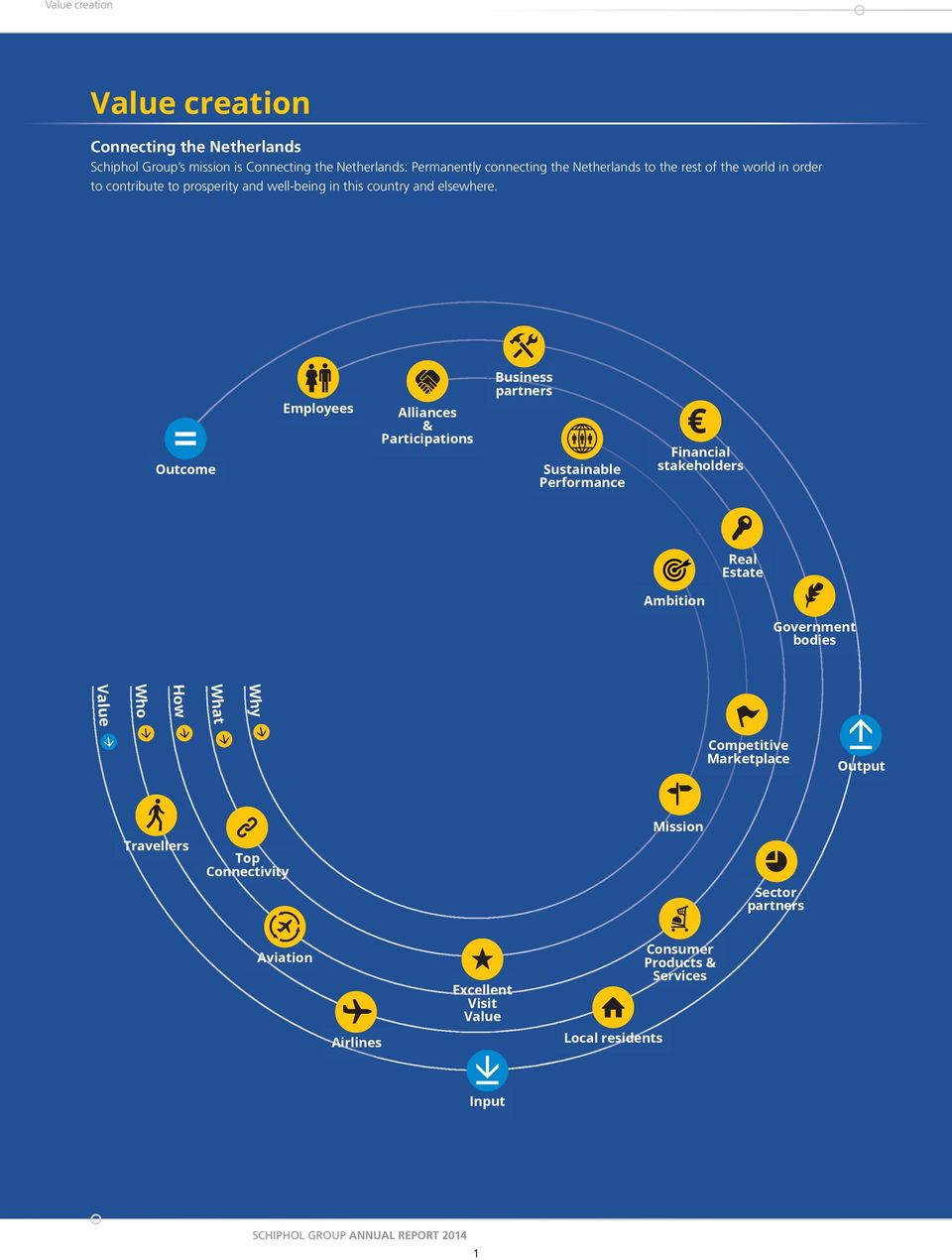
3 Value creation Value creation Connecting the Netherlands Schiphol Group s mission is Connecting the Netherlands: Permanently connecting the Netherlands to the rest of the world in order to contribute to prosperity and well-being in this country and elsewhere. Outcome Employees Alliances & Participations Business partners Sustainable Performance Financial stakeholders Real Estate Ambition Government bodies Value Who How What Why Competitive Marketplace Output Travellers Top Connectivity Mission Sector partners Aviation Airlines Excellent Visit Value Local residents Consumer Products & Services Input 1
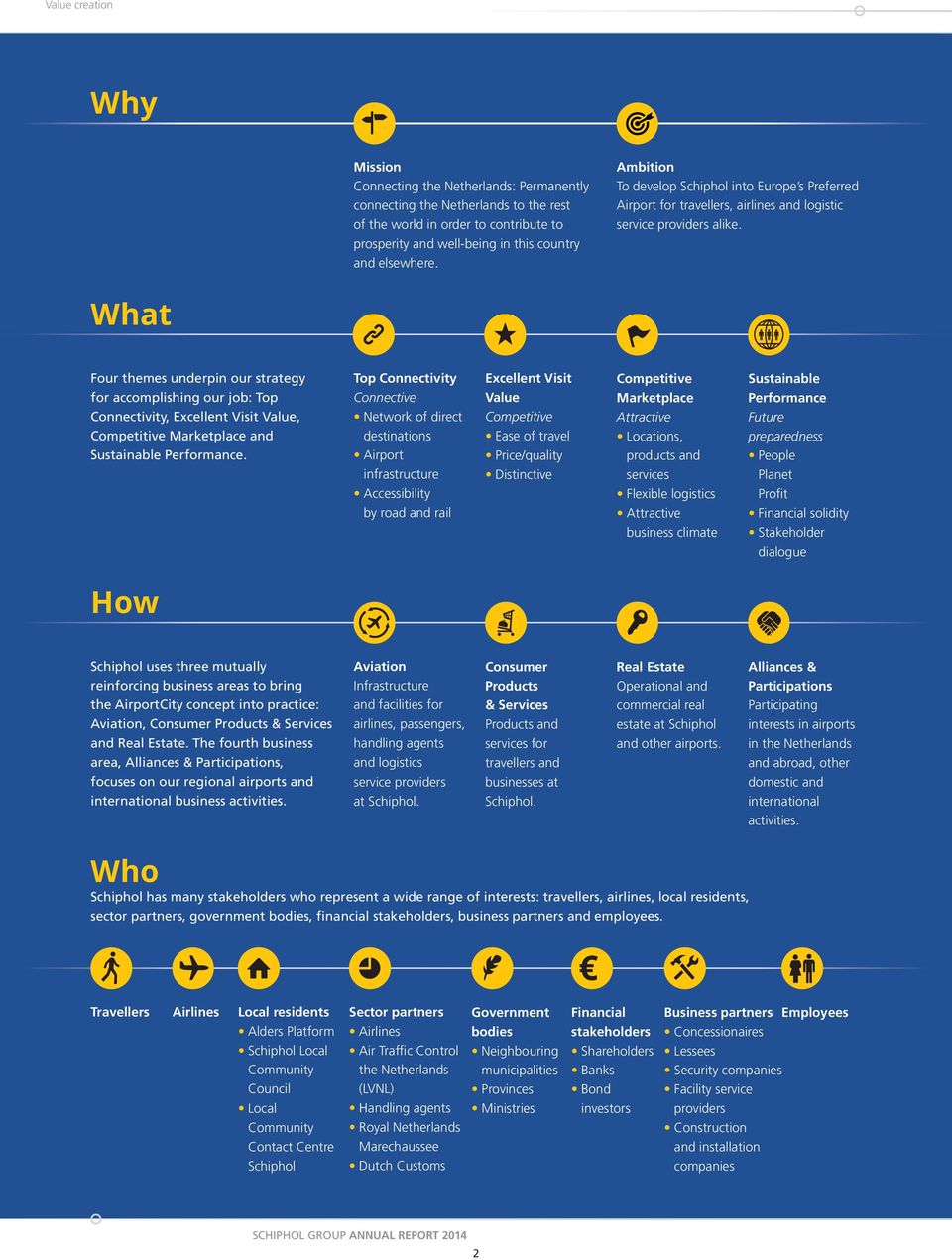
4 Value creation Why Mission Connecting the Netherlands: Permanently connecting the Netherlands to the rest of the world in order to contribute to prosperity and well-being in this country and elsewhere. Ambition To develop Schiphol into Europe s Preferred Airport for travellers, airlines and logistic service providers alike. What Four themes underpin our strategy for accomplishing our job: Top Connectivity, Excellent Visit Value, Competitive Marketplace and Sustainable Performance. Top Connectivity Connective Network of direct destinations Airport infrastructure Accessibility by road and rail Excellent Visit Value Competitive Ease of travel Price/quality Distinctive Competitive Marketplace Attractive Locations, products and services Flexible logistics Attractive business climate Sustainable Performance Future preparedness People Planet Profit Financial solidity Stakeholder dialogue How Schiphol uses three mutually reinforcing business areas to bring the AirportCity concept into practice: Aviation, Consumer Products & Services and Real Estate. The fourth business area, Alliances & Participations, focuses on our regional airports and international business activities. Aviation Infrastructure and facilities for airlines, passengers, handling agents and logistics service providers at Schiphol. Consumer Products & Services Products and services for travellers and businesses at Schiphol. Real Estate Operational and commercial real estate at Schiphol and other airports. Alliances & Participations Participating interests in airports in the Netherlands and abroad, other domestic and international activities. Who Schiphol has many stakeholders who represent a wide range of interests: travellers, airlines, local residents, sector partners, government bodies, financial stakeholders, business partners and employees. Travellers Airlines Local residents Alders Platform Schiphol Local Community Council Local Community Contact Centre Schiphol Sector partners Airlines Air Traffic Control the Netherlands (LVNL) Handling agents Royal Netherlands Marechaussee Dutch Customs Government bodies Neighbouring municipalities Provinces Ministries Financial stakeholders Shareholders Banks Bond investors Business partners Employees Concessionaires Lessees Security companies Facility service providers Construction and installation companies 2
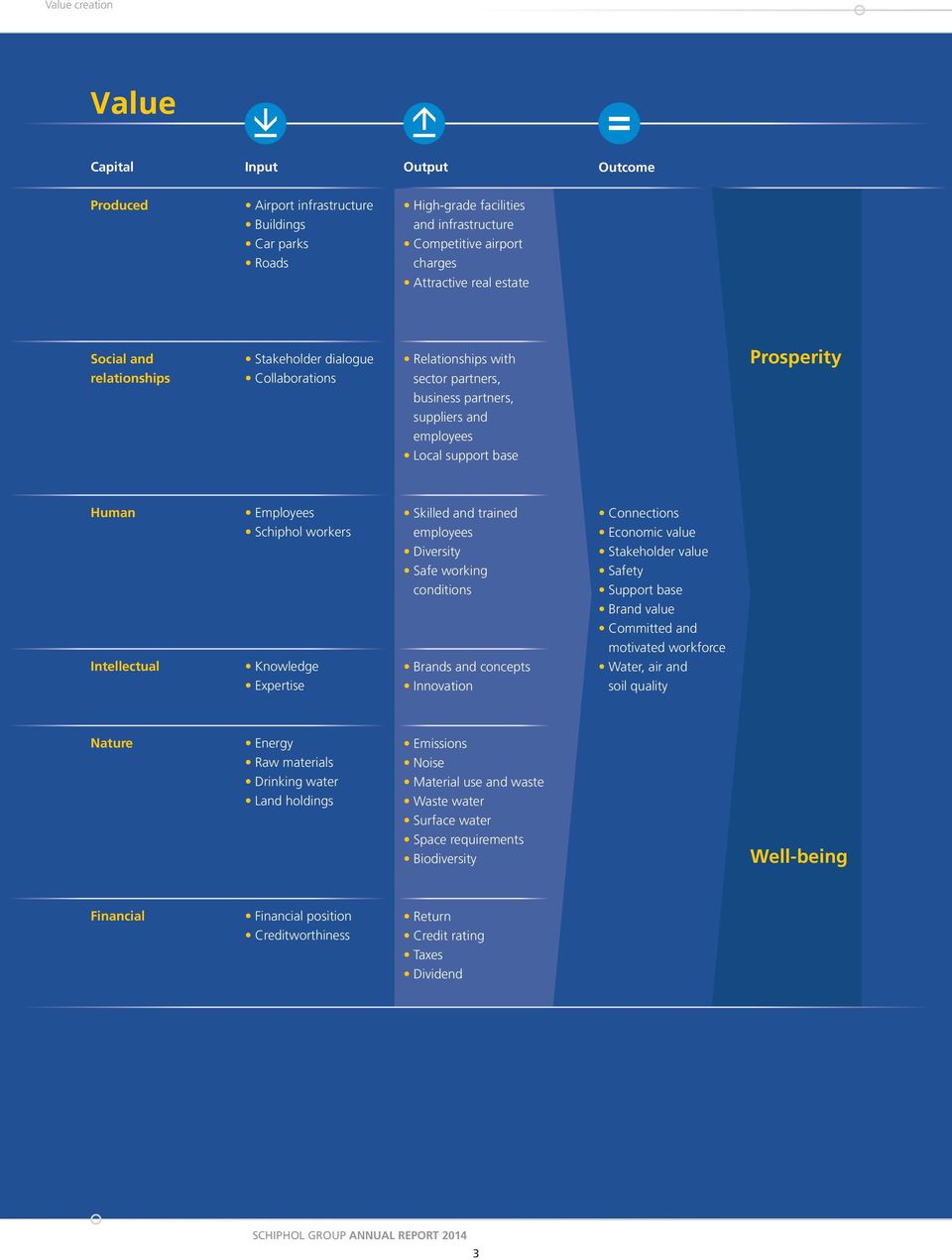
5 Value creation Value Capital Input Output Outcome Produced Airport infrastructure Buildings Car parks Roads High-grade facilities and infrastructure Competitive airport charges Attractive real estate Social and relationships Stakeholder dialogue Collaborations Relationships with sector partners, business partners, suppliers and employees Local support base Prosperity Human Intellectual Employees Schiphol workers Knowledge Expertise Skilled and trained employees Diversity Safe working conditions Brands and concepts Innovation Connections Economic value Stakeholder value Safety Support base Brand value Committed and motivated workforce Water, air and soil quality Nature Energy Raw materials Drinking water Land holdings Emissions Noise Material use and waste Waste water Surface water Space requirements Biodiversity Well-being Financial Financial position Creditworthiness Return Credit rating Taxes Dividend 3
6 4

7 Contents Events in Facts and Figures page 10 Airports in the value chain page 14 Stakeholder dialogues page 23 Strategy page 33 Network of destinations page 40 Employees in figures page 57 About us 7 Profile 8 Facts and Figures 10 Mission 12 Creating value 13 Business model 16 Stakeholders and materiality 22 Strategy 27 Message from the CEO 28 Changing business environment 30 Strategy 33 Our results Management Agenda 37 Our results 38 Financial performance 60 Governance 63 Report of the Supervisory Board 64 Tussenpagina 71 Supervisory Board 72 Management Board 74 Corporate Governance 75 Remuneration 79 Risk management 83 Annual Statements Socio-economic accountability 90 Financial Statements 103 5
8 Events in 2014 Events in 2014 First quarter Third quarter On 24 and 25 March, Amsterdam Airport Schiphol hosted 51 world leaders and their staff attending the Nuclear Security Summit (NSS). Runway 18R-36L was decommissioned for this purpose. This complex event was a resounding operational success. The NSS was followed by large-scale maintenance on Runway 18L-36R. Schiphol received the SKYTRAX award for Best Airport in Western Europe. Worldwide, Schiphol fell from third to fifth position in A new catering cluster was opened at Schiphol Plaza comprising La Place, HEMA and Happy Seafood. Second quarter In April, Schiphol Group and Lelystad Airport presented the Lelystad Airport Business Plan, which outlines the proposed development of Lelystad Airport to support Amsterdam Airport Schiphol in serving non-mainport-related air traffic. Schiphol was granted Airport Carbon Accreditation 3+ for its CO 2 emissions reduction efforts, earning the airport a place among the world's most sustainable airports. Schiphol donated 212,000 euros to UNICEF. Of this amount, 152,000 euros were raised via collection points in the terminal and 60,000 euros through campaigns organised by our own employees. Schiphol's Orange Wave Goodbye app was a commercial success; via large screens, the public waved goodbye to the Dutch football team on their way to the World Cup in Brazil on 5 June. For the 19th time, Schiphol won the Asian Freight & Supply Chain Award (AFSCA) for Best Airport in Europe. On 17 July flight MH17, which had departed from Schiphol, crashed in Ukraine with 283 passengers including 196 Dutch nationals and 15 crew members on board. This disaster had a huge impact on Dutch society. A special commemorative site was created at Schiphol where people could leave expressions of sympathy. On 1 September Ad Rutten, COO since 2005, retired. He was succeeded by Birgit Otto as Chief Operations Officer of Schiphol Group. At the Market Consultation Day for Area A, over 150 prospective partners and suppliers provided input for the construction and call for tenders for a new pier and terminal on the southern side of Schiphol. Start of the Departure Lounge 2 renovation project, which is to create 20% additional retail and food service space. Completion in Fourth quarter Definitive Airport Decree for Eindhoven Airport; the legal framework for further expansion. The new security filter in Departure Hall 1 was taken into operation. This is the first in a series of five new, innovative and user-friendly central security checkpoints. Business Traveller Award: for the 25th time, British business travellers named Schiphol Best Airport in Europe. At Schiphol, 167 (electric) Tesla Model S vehicles were put into use for passenger taxi services by BBF Schipholtaxi and BIOS Group. No other airport in the world uses so many green taxis. The Airport Charges Consultation was finalised in October: the rates are to be decreased by around 7% as of 1 April Schiphol received international praise for its Corporate Responsibility programme, and was presented with the Airports Going Green Award from the Chicago Department of Aviation. Schiphol was Europe's first major hub airport to be granted the EASA certificate. The rules issued by the European Aviation Safety Agency are even stricter than the national or ICAO standards. 6

9 Strategie About us 7

10 Profile Profile Schiphol Group is an enterprise that operates airports in the Netherlands, conducts international activities and participates in airports abroad. Operating Amsterdam Airport Schiphol is the Group's largest activity. Schiphol Group is the owner and operator of Rotterdam The Hague Airport and Lelystad Airport, and holds a majority share in Eindhoven Airport. Of Europe's main hub airports, over the years Amsterdam Airport Schiphol has grown into Europe's Preferred Airport, with direct connections to 319 destinations. In 2014 the number of travellers served by Schiphol grew by 4.6% to almost 55 million, and 1.6 million tonnes of cargo were handled. More than five hundred companies are based at Schiphol, employing around 65,000 people in total. The activities at and around Schiphol are an important driver of the sustainable growth of the Dutch economy. Schiphol Group has four shareholders: the Dutch state (69.8%), the municipality of Amsterdam (20.0%), Aéroports de Paris (8.0%) and the municipality of Rotterdam (2.2%). The company aims to achieve a reasonable return on its equity based on moderate increments in airport charges and a stable dividend distribution trend. We invest in the infrastructure and facilities at our airports on the basis of a sound financial policy aimed at safeguarding our full independence in the financing of these assets, both today and in the future. As a whole, the Group welcomed nearly 61 million passengers at its Dutch airports. The number of travellers served by Rotterdam The Hague Airport and Eindhoven Airport grew by 6.1% and as much as 16% respectively. Schiphol Group collaborates closely with foreign airports which can strengthen its position, including the airports operated by Aéroports de Paris, a company in which we have an 8% cross-participation. In addition, we are involved in Terminal 4 at JFK International Airport in New York, are engaged in a strategic collaboration with Incheon Airport, have an interest in Brisbane Airport and conduct operations at the airports of Hong Kong and Aruba. In all, these international activities account for a significant part of Schiphol Group's results. 8

11 Profile At the airports we collaborate with partners, government organisations and other parties in a variety of networks. We aim to provide efficient, reliable and inspiring facilities for airlines and travellers alike. In terms of operational management we collaborate closely with sector partners, such as the airlines, handling agents, Air Traffic Control the Netherlands (LVNL), Dutch Customs and the Royal Netherlands Marechaussee, government bodies, business partners such as retail and catering companies, and security businesses. Close, long-term and constructive collaboration with all of these parties is key to the permanent success of airport operations. And since it is crucial to generate support for our activities among stakeholders in our environment, we also maintain close contact with local residents. At the end of 2014, Schiphol Group employed 2,104 people, the majority of whom (1,915) worked at the Schiphol location. Schiphol Group Amsterdam Airport Schiphol Regional airports Rotterdam The Hague Airport Eindhoven Airport Lelystad Airport Airports abroad Aéroports de Paris Brisbane Airport JFK (T4) New York 9

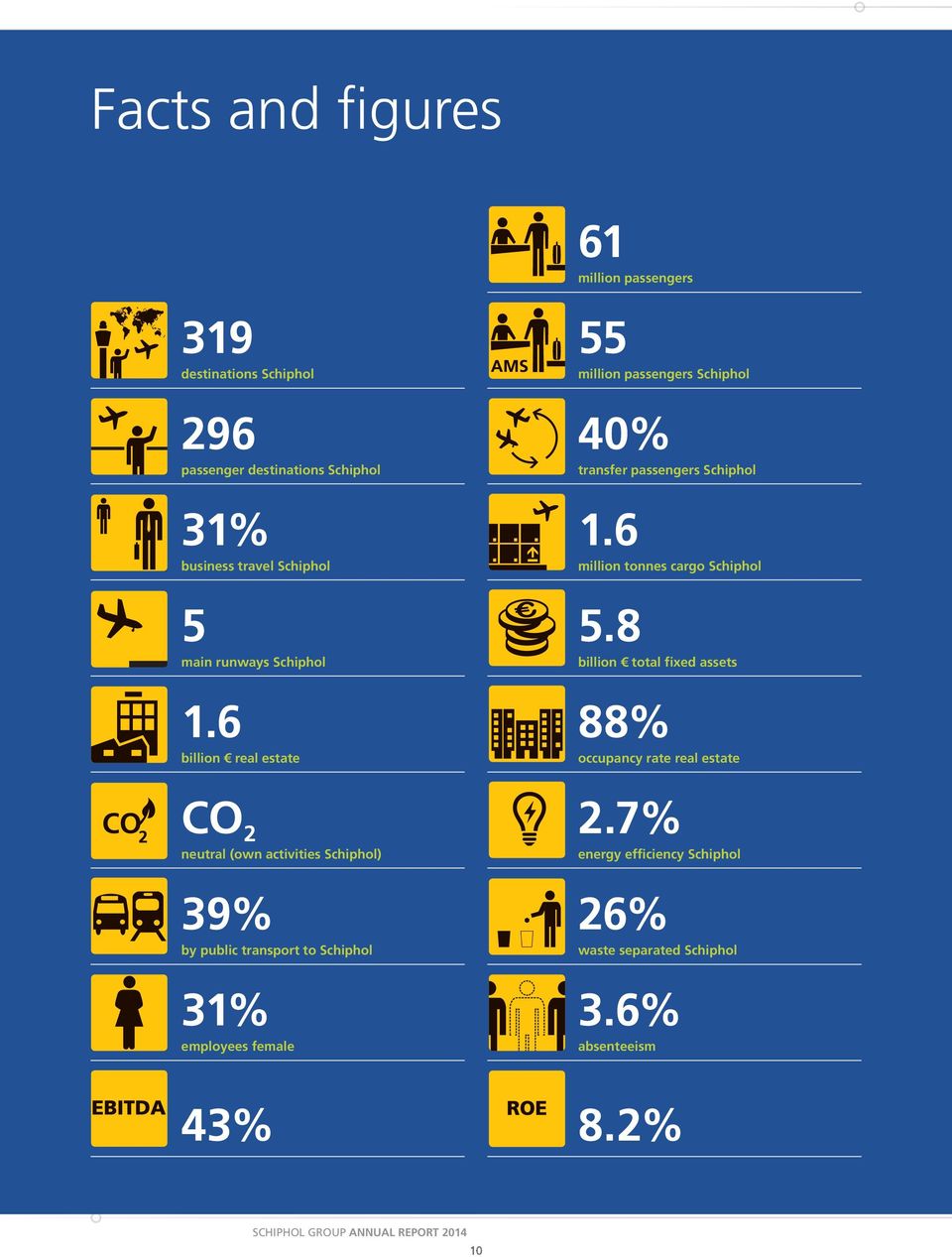
12 Facts and figures 61 million passengers 319 destinations Schiphol 296 passenger destinations Schiphol 31% business travel Schiphol 5 main runways Schiphol 1.6 billion real estate CO 2 neutral (own activities Schiphol) 39% by public transport to Schiphol 31% employees female 55 million passengers Schiphol 40% transfer passengers Schiphol 1.6 million tonnes cargo Schiphol 5.8 billion total fixed assets 88% occupancy rate real estate 2.7% energy efficiency Schiphol 26% waste separated Schiphol 3.6% absenteeism 43% 8.2% 10
13 Key figures EUR million unless stated otherwise % Results Revenue 1,474 1, Result on sale of investment property Fair value gains and losses on investment property Operating expenses (excluding depreciation, amortisation and impairment) EBITDA Depreciation and amortisation Impairments Operating result Financial income and expenditure Share in results of associates and joint ventures Result before tax Corporate income tax Result after tax Net result Total equity 3,453 3, Investments in fixed assets Cash flow from operating activities Proposed dividend Ratios RONA after tax 3 6.6% 6.1% Return on equity (ROE) 4 8.2% 7.0% Leverage % 36.2% FFO/total debt % 26.0% FFO interest coverage ratio Earnings per share 8 1,461 1,222 Dividend per share Business volume (in numbers) Air transport movements 9 484, , Passenger movements (x 1,000) 9 60,591 57, Cargo (x 1,000 tonnes) 9 1,633 1, Workforce in average full-time equivalents 2,039 2, Comparative figures for 2013 have been restated as a result of the introduction of IFRS Operating result plus depreciation, amortisation and impairment 3 Operating result after tax plus share in results of associates and interest income / (Average non-current assets less deferred taxes) 4 Net result (attributable to shareholders) / Average total equity 5 Interest-bearing debt / (Total equity + interest-bearing debt) 6 Funds from operations (cash flow from operating activities before changes in working capital) / interest-bearing debt 7 Funds from operations plus gross interest expense / gross interest expense 8 Based on net result (attributable to shareholders) 9 Schiphol Group: Amsterdam Airport Schiphol, Rotterdam The Hague Airport and Eindhoven Airport 11

14 Mission Mission Schiphol Group's mission is Connecting the Netherlands: permanently connecting the Netherlands to the rest of the world in order to contribute to prosperity and well-being in this country and elsewhere; Connecting to compete and to complete. We conduct our domestic and international operations in a balanced manner, and in doing so reflect our key values: reliability, efficiency, hospitality, inspiration and sustainability. Connecting the Netherlands Schiphol Group is an airport company with an important socioeconomic task. The airports of the group, and Amsterdam Airport Schiphol in particular, create value for society and for the economy, both in the Netherlands and elsewhere. Connecting the Netherlands is meaningful from various different perspectives, as it involves both economic and human aspects. First of all, connections lead to sustainable growth. The more direct connections there are between the Netherlands and major centres all over the world, the easier it is for Dutch companies to do business internationally or to attract high-quality knowledge. Connections augment prosperity. They increase the appeal of Dutch cities as locations for foreign companies and head offices. This is a significant asset in a globalised world where economic activity tends to concentrate in a limited number of metropolitan areas. We refer to this as Connecting to compete. And then there is the human aspect: Connecting to complete. Connections have a human dimension in that they enable people from different countries to meet and create social networks. As such, connections contribute to the well-being of individuals and societies in all parts of the world. The network of connections is the heart of Schiphol. Schiphol's customers include a large number of airlines, and the mainstay of our network of connections for both passengers and cargo is our home carrier KLM. We can only facilitate those connections if we are able to provide the airlines and their passengers with top-class facilities and sufficient capacity. Our connectivity also depends on the accessibility of our airports by public transport and by car, for travellers and for people working there. The same applies to cargo: good connections to the road and rail networks are essential. Schiphol Group believes it has a duty to maintain Amsterdam Airport Schiphol and to further develop it as a Mainport. The regional airports in which Schiphol Group participates Rotterdam The Hague Airport and Eindhoven Airport play a crucial part in this. Connecting their respective regions with the rest of Europe, they provide a major extension to the network of Amsterdam Schiphol Airport, in terms of handling both leisure and business traffic. In the future, Lelystad Airport will provide space to support the further development of Schiphol's Mainport function. Our international participations, too, contribute to strengthening the Mainport. For us, connection means more than merely facilitating OD and transfer passengers. We are developing our airports not only as journey start and end points but also as inspiring locations where people can pass their time, do business and work. We take our environment into account in everything we do. We are very conscious of the impact of aviation activities, for example on the environment and on the available space. We are also aware that the benefits and drawbacks of our airports are not evenly distributed across the surrounding region, and are therefore constantly working with our stakeholders to mitigate the consequences and investing with a view to improving the quality of life in the immediate vicinity of our airports. 12

15 Creating value Creating value Schiphol Group operates the Netherlands' largest airport, Amsterdam Airport Schiphol, and several regional airports. Schiphol Group creates value by connecting the Netherlands and increases prosperity and well-being in this country and elsewhere. Airports in the value chain The passenger and cargo transport processes constitute an airport's value chain. An airport provides infrastructure and facilities for departing, transferring and arriving passengers and cargo, and for the businesses involved in this process. In addition to being a multimodal hub, we are an attractive marketplace for products and services and offer a wide range of location options for businesses. The most important partners in this chain are airlines, handling agents, Air Traffic Control the Netherlands (LVNL), Dutch Customs and the Royal Netherlands Marechaussee, business partners such as retail and catering companies, and security businesses. Airport area Material aspects: significance for the region, operating capacity, accessibility, customer appreciation, safety, CO 2 emissions, air quality, circular economy, supply chain responsibility, financial solidity. The quality and capacity of the total chain have enabled us to create a vast network of destinations, offer a high-quality visitor environment and ensure that all activities conducted here generate considerable economic spin-off for the region, the Netherlands and Schiphol Group. Schiphol Group develops, builds and operates real estate in the airport grounds, and is the owner of the terminal and various other buildings. The company also leases out land under long leases. Schiphol develops a large number of office buildings, warehouses and other buildings such as hotels on behalf of or in collaboration with users/lessees. Schiphol Group shares joint responsibility with government authorities for the spatial planning of the airport grounds. 1. Transport to/from the airport Material aspects: accessibility, CO 2 emissions, air quality. Schiphol Group owns the car parks and controls their use by means of parking charges. Picking up and dropping off passengers involves four vehicle movements; parking only two. Schiphol issues concessions for taxi transport at the airport. In collaboration with NS (Dutch Railways) and ProRail, Schiphol is working to optimise rail transport. Schiphol builds roads and bus lanes at the airport, and is developing a high-quality bus network together with bus operators and government authorities. 2. Terminal Material aspects: operating capacity, customer appreciation, safety, CO 2 emissions, supply chain responsibility, circular economy, employment practices. The terminal is infrastructure owned by Schiphol Group. The airport's own employees work in the terminal as well as those of sector and business partners. The check-in desks and baggage system are Schiphol Group assets. Sector partners (airlines and handling agents) use the airport infrastructure. The safe and efficient screening of passengers and cargo is carried out jointly by the security companies (Schiphol Group suppliers), the Royal Netherlands Marechaussee and Dutch Customs. The departure lounges located after border/security control featuring seating areas, retail and catering outlets are Schiphol Group assets. Schiphol grants concessions for operating retail and catering outlets. Schiphol develops retail and leisure concepts in association with its business partners. 13

16 Creating value Chain Terminal 1 Transport to airport Own facility Full control In collaboration with partners 2 Terminal Airport process 3 Apron and runway 14

17 Creating value 3. Aprons and runways Material aspects: operating capacity, safety, CO 2 emissions, supply chain responsibility, circular economy, air quality. The gates where passengers board an aircraft are Schiphol Group assets. Schiphol Group is responsible for the infrastructure for the embarkation and disembarkation process. Aircraft are owned by the relevant airlines. The airlines are responsible for the safe carriage of passengers, baggage and cargo. The aprons and runways are Schiphol Group assets. Schiphol Group is responsible for the maintenance, availability and safety of the apron and runway infrastructure. Air Traffic Control the Netherlands (LVNL) indicates which take-off or landing runways should be used and the LVNL air traffic control tower maintains contact with pilots. Airline operations (flights) cause noise disturbance to local residents. Read more about the material aspects in stakeholders and materiality. Joint responsibility A large number of parties are involved in the passenger and cargo transport processes. As an airport operator, Schiphol Group is responsible for these processes. This is set out in legislation and in our operating licences. The parties concerned collaborate closely with each other to perform the complex, daily airport operations process. Airports do not always have complete control of the performance results; this is a shared responsibility of multiple parties. A runway incursion can, for instance, occur as a result of an incorrect act by a Schiphol employee or by an airline, LVNL or handling agent employee. The decreasing number of runway incursions is a good example of the joint efforts undertaken by all parties concerned. Schiphol Group has set out this responsibility in its mission: Connecting the Netherlands. In its business model Schiphol Group's mission is reflected in four core activities: Aviation, Consumer Products & Services, Real Estate and Alliances & Participations. For more information, see business model. We have developed a strategy with which to accomplish our mission in the years ahead, taking account of trends and developments, risks and the operating environment. We have linked our objectives to our ambitions in our Strategic Plan. For more information, see strategy. Organisations provide insight into how they add value in a value creation model. The input for the model consists of resources that create value. Based on this input, business activities generate a certain output (e.g. products, services and waste). Business activities combined with the output represent the outcome. The outcome reflects the changes in value arising from business activities in both positive and negative terms. The airport also is the party which is largely held accountable for noise disturbance and CO 2 emissions, whilst noise and emissions are largely attributable to air traffic. Fleet renewal enables the airlines to operate technologically advanced, quieter and cleaner aircraft, in turn reducing the number of complaints from local residents, even though the improvement is not attributable to the airport operator. The same applies to CO 2 emissions, which are largely generated by air traffic. In consultation, KLM and Schiphol Group have decided to accelerate the development of biofuels. ArkeFly has undertaken a similar initiative. Airport The job the airport fulfils in this process is that of the airfield operator. The operating requirements are laid down in the Aviation Act (Wet luchtvaart). The Act states that it is our social responsibility to promote the optimum use of the airport as a high-quality hub for domestic and international air traffic, with due observance of the safety and environmental standards. The airport is responsible for providing the facilities required to ensure the proper handling of air traffic and the associated passenger and cargo transport at the airport. 15

18 Business model Business model Schiphol Group distinguishes four activity clusters: Aviation, Consumer Products & Services, Real Estate, and Alliances & Participations. These activities collectively determine the success of Schiphol Group. Schiphol Group derives its income from a range of sources, including landing fees and passenger charges, concession fees from retail and catering companies, revenue from advertising objects and parking services, property rents and leaseholds and income from associates. parking services at the airport. In addition, the business area markets advertising opportunities at the airport. The Real Estate business area develops and manages real estate at and around the airport. The central task of this business area is to ensure that the airport area offers attractive business locations and a pleasant environment for hotel guests and other visitors. Real Estate provides a large variety of high-quality real estate options in the form of offices, commercial premises and logistics buildings. Schiphol as an AirportCity We have developed Schiphol into an AirportCity: a location offering travellers, airlines and businesses all the services they need, 24 hours a day. As part of its efforts to stand out from its competitors, Schiphol continues to develop a wide range of commercial activities. The fourth business area, Alliances & Participations, focuses on the operation of regional airports and the development of international business activities. Just as Schiphol itself, the regional airports are developed in accordance with the AirportCity concept through investments in real estate and the creation of an attractive range of shops, hotels and restaurants. We also export our AirportCity concept and operational expertise to airports abroad, while using those foreign operations to enhance our own knowledge. We have set up partnerships for the joint development of innovative concepts and solutions, as well as for joint procurement initiatives (where possible). Business areas Schiphol uses three mutually reinforcing business areas to bring the AirportCity concept into practice: Aviation, Consumer Products & Services and Real Estate. Serving travellers, airlines, handling agents and logistic services providers alike, the Aviation business area has a pivotal role at the airport. Aviation supplies and manages the infrastructure that is required to ensure pleasant, reliable and efficient arrival and departure processes for travellers, baggage and cargo. It is responsible for coordinating safety in the terminal, on aprons and roads and in areas and buildings on airside. The Consumer Products & Services business area offers travellers a range of products and services that facilitate a carefree and comfortable travel process. It includes shops, catering facilities and 16

19 Business model Economic regulation The scope available to Schiphol Group for charging costs directly related to its primary airport operations, infrastructure and security is largely determined by economic regulation. We are subject to what is known as dual-till regulation: a system that distinguishes between regulated and non-regulated income flows. The rates for Amsterdam Airport Schiphol's aviation activities are regulated: the returns on these activities are subject to specific ceilings. The return has been capped at the regulated average weighted average cost of capital (WACC) determined annually, on which the ten-year interest rate on government bonds has a considerable impact. This means that Schiphol Group's return on aviation activities depends on the development of the interest rate. The rates, including take-off and landing fees and passenger and security charges that Schiphol receives from the airlines, are periodically determined in accordance with legal provisions in the Aviation Act. The regulated WACC that was used to determine the 2014 airport charges amounted to 4.3%. The regulated WACC used to determine the airport charges for 2015 is significantly lower, namely 2.9%. In 2014 the Aviation business area realised a 3.9% return on net assets (RONA). Non-aviation activities at Schiphol are not regulated. These include all activities in the fields of retail, catering, leases, media, real estate development, parking and our international activities. The operation of our regional airports is not regulated either. Our non-regulated revenue stream substantially contributes to the group's financial results, allowing us to maintain a healthy financial position. Read more about our operational environment and our strategy in the strategy section. 17
20 Business model Aviation Key figures EUR million % Total revenue Operating expenses Depreciation and amortisation EBITDA Operating result Average asset base 2,147 2, EUR million Aviation Security % % Total revenue Operating expenses Depreciation and amortisation EBITDA Operating result Key Performance Indicators Number of scheduled destinations Passengers and cargo Punctuality of arrivals (in %) IR rate for baggage handling (% of baggage delayed) Punctuality of departures (in %) Passenger market share Top 10 European airports (in %) Cargo market share Top 10 European airports (in %)

21 Business model Consumer Products & Services Key figures EUR million % Total revenue Operating expenses Depreciation and amortisation EBITDA Operating result Average asset base EUR million % Concessions Parking Retail sales Rents and leases Advertising and Media Other activities Total revenue Key Performance Indicators Spend per passenger Retail Airside EUR per departing passenger Spend per passenger Catering Airside EUR per departing passenger Parking revenue EUR per departing NL passenger Concession income EUR per departing passenger
22 Business model Real Estate Key figures EUR million % Total revenue Operating expenses Depreciation and amortisation Impairments EBITDA Operating result Average asset base 1,702 1, EUR million % Investment property, buildings Investment property, land Operating property Other Total revenue Key Performance Indicators Direct return on investment property (in %) Occupancy rate (in %) Total return on investment property (incl. indirect return) (in %) Revenue split in 2014 Property portfolio per category EUR million (in %) In % 33% 34% EUR million 4% 17% 32% m 2 Investment property, buildings 70 Offices 213, Investment property, land Operating property ,458 Industrial units Operating property, terminal building 313, ,172 Other 68 Operating property, other 26,254 21% 12% 47% 20
23 Business model Alliances & Participations Key figures EUR million % Total revenue Operating expenses Depreciation and amortisation EBITDA Operating result Share in results of associates including interest and dividend Average asset base EUR million Airports abroad Regional airports Other subsidiaries Total Total revenue Operating result Share in results of associates including interest and dividend Total result Average asset base Key Performance Indicators Eindhoven Airport Passengers x 1, , ,397 Rotterdam The Hague Airport Passengers x 1, , ,590 Brisbane Airport (Australia) Passengers x 1, , ,800 JFK IAT, New York (USA) Passengers x 1, , ,425 21
24 Stakeholders and materiality Stakeholders and materiality Schiphol Group believes it is its job to sustain and further develop Mainport Schiphol's position and that of the regional airports. This is the subject of regular consultations with our stakeholders. In dialogue sectors. It is our intention to involve influential businesses in a number of issues; their specific knowledge and insights will enable us to keep a sharp eye on developments. Moreover we wish to demonstrate that Schiphol Group is more than a financially focused enterprise, feels engaged with the local community and fulfils an important socio-economic role. Schiphol Group has a great many stakeholders who represent a wide range of interests. We regularly engage in dialogue with our stakeholders at various levels and on a wide range of different topics. Several stakeholders also visit the airport. We share information with our stakeholders about daily operations and laws and regulations as well as current issues, such as large-scale investments and renovation projects. Schiphol Group's Management Board is involved in these contacts. Regular contact and dialogue enable us to stay abreast of stakeholder opinions and concerns. We, in turn, inform our stakeholders of what is happening at Schiphol Group. We are facing various challenges and dilemmas relating, for instance, to selectivity (growth versus the quality of the Mainport network), employment (shifts in employment arising from automation, such as automated baggage handling in the baggage basements and the implementation of central security nonschengen), accessibility (regional public transport in the context of international rail links), customers (expansion of operating capacity in relation to airport charges), health (emissions in relation to health and the environment). We prefer to address these challenges in close collaboration with our stakeholders. Schiphol Group acts on issues and recommendations arising from these discussions where possible. Our stakeholders have indicated that they obtain most of the information relating to our strategy and objectives when speaking to us directly. In addition we use other communication channels (including social media, websites and newsletters) to inform them, depending on the topic and target audience. Our annual report attracts comments in particular from shareholders, financiers, policymakers and the regulatory authorities. The annual report provides an account of current projects, important developments and results, information which is also useful for other stakeholders as well as current and prospective employees and suppliers. Materiality In 2013 we launched an initiative to find out whether the topics we report on in our annual report are also of material significance to our stakeholders. We drew up a materiality analysis based on information obtained through dialogues and interviews. In 2014 we subsequently assessed the material aspects with the relevant departments and colleagues who maintain direct contact with our Discussion topics Schiphol Group has emphatically reached out to its stakeholders not only our supply chain partners but also to businesses in other 22
25 Stakeholders and materiality Examples of stakeholder dialogues During two meetings, hosted by our CEO and attended by management board members representing a broad cross-section of the business community, the participants shared views on the strategic challenges facing Schiphol Group. It emerged that several companies felt that the business community should strengthen the relationship with the ministry of Economic Affairs. Various attendees expressed concern about the infrastructure in the Netherlands, pointing out that more infrastructural investments should be made to bolster the country's competitive position. We also noted that the companies wish to be kept abreast of Schiphol's hub strategy and the future role that Lelystad Airport is to play in this regard. For more information, see significance for the region. The parties involved in the Alders Platform and Schiphol discuss the current status of covenants and the new system of environmental standards. The parties also share their opinion on the implementation of noise mitigation measures and runway usage. One discussion topic was the use of four runways during peak periods. At the end of January, the Alders Platform and CROS changed into the newly formed Schiphol Local Community Council (Omgevingsraad Schiphol). For more information, see significance for the region and noise. The plan concerning Noise and the Local Community, indicating Schiphol's intention to strengthen community engagement, was discussed with the neighbouring municipalities. In 2014, to mark the occasion of Ad Rutten's retirement as COO, we organised a symposium on our relationship with the local community. Theo Weterings, mayor of the municipality of Haarlemmermeer, Kees van Ojik, the local residents' representative, Hans Alders and Ad Rutten candidly exchanged views on the impact of the airport on the surrounding residential areas. Evening sessions concerning the development of Lelystad Airport were organised in the environs of Lelystad under the auspices of the Lelystad Alders Platform. For more information, see significance for the region and noise. Over the course of the year we conducted various meetings with the airlines to discuss forecasts, investments and strategic developments. The annual consultation process is the occasion on which we discuss these matters, as well as airport charges, with the airlines. The consultations are not only a formal and legal requirement; we also use this dialogue to coordinate the hub strategy and the timing of investments. We jointly evaluate the consultation process and carry out improvements, examples of which are the introduction of preconsultations (in which information is provided at an early stage) and issuing a letter of intent regarding airport charges. Read more under financial solidity and operating capacity. In 2014 during the run-up to the call for tenders for security services, the trade unions and employers' organisations asked that attention be paid to the time spent standing by security staff while at work. This prompted Schiphol to set standards in the tender documentation for the time security staff spend standing at work, which will improve as soon as the new contract is awarded. Technical installations from the 1970s were still being used on Pier C. At the request of KLM, which uses the pier the most, Schiphol put measures in place to adjust the climate control system and the incidence of light on the pier. Read more under safety and supply chain responsibility. During the Market Consultation Day organised in conjunction with the development of Area A, more than 150 companies from every sector, including airlines, building contractors and knowledge institutes, were able to provide their input on the sustainability and design choices entailed in this major building project. Schiphol also organised a business day to bring small and medium-sized businesses in and around the Lelystad region up to date and give them an opportunity to ask questions. For more information, see operating capacity. stakeholders. For the purpose of this assessment we also made use of media analyses and our own analyses of trends, developments and risks. We additionally looked at the aspects reported on by Aéroports de Paris, Heathrow Airport and Frankfurt Airport. The results are summarised in a materiality matrix schematically showing which aspects are of significance to our stakeholders and to us. The matrix, which has been validated by the Management Board, confirms that we have have established the correct priorities in our business strategy. Scope The subjects in the matrix concern Amsterdam Airport Schiphol, Rotterdam The Hague Airport and Eindhoven Airport alike. In view of the intended development of Lelystad Airport, these topics are anticipated to also play a part at that location. Lelystad Airport falls outside the scope of the matrix, at least until it is put into operation for non-mainport-related commercial passenger traffic. The content of this annual report has been determined on the basis of material aspects as represented in the materiality matrix, which enables us to explain for readers the impact and relevance of the information included. 23
26 Stakeholders and materiality Materiality Matrix Interest of stakeholders + Water Employment practices Interest of Schiphol Group Noise Accessibility CO 2 emissions Supply chain responsibility Circular economy Network of destinations Operating capacity Customer appreciation Significance for the region Safety Financial solidity Air quality ++ In the chain All aspects included in the matrix are relevant to both our airports and other parties in the chain. This annual report includes information on all material aspects over which Schiphol Group has full control, with the exception of the network of destinations, operating capacity, accessibility, noise and safety. Performance reported in these areas also concerns our chain partners. Development Schiphol Group has clustered the following material aspects around five CR themes: significance for the region, accessibility, noise, CO 2 emissions, air quality, circular economy and employment practices (see Corporate Governance - organisation of CR). In 2014 we worked on defining targets more closely aligned with the strategic character of these five themes. These targets will also be effected at and in consultation with the Rotterdam, Eindhoven and Lelystad airports in The 2014 annual report further reports on the indicators used over the past five years to describe our performance. Stakeholders in the spotlight We asked a number of stakeholders who are also technical experts in the aviation sector to share their opinions on how we have handled material aspects of relevance to them. Stakeholder Airlines Passengers Sector partners (Dutch Customs, Royal Netherlands Marechaussee, Air Traffic Control the Netherlands (LVNL), ground handlers) Business partners (construction companies, security businesses, facility service providers, concessionaires, tenants, other suppliers) Financial stakeholders (shareholders, financial backers) Material aspect Network of destinations, operating capacity, customer appreciation, significance for the region, safety, financial solidity, noise, accessibility, CO 2 emissions, supply chain responsibility, air quality, circular economy Network of destinations, operating capacity, customer appreciation, safety, accessibility Network of destinations, operating capacity, safety, noise, supply chain responsibility Network of destinations, operating capacity, significance for the region, safety, financial solidity, supply chain responsibility Operating capacity, significance for the region, financial solidity Employees Significance for the region, safety, financial solidity, noise, accessibility, CO 2 emissions, air quality, employment practices, supply chain responsibility Local residents Significance for the region, safety, financial solidity, noise, accessibility, CO 2 emissions, air quality, circular economy Authorities (ministries, provinces, municipalities) Network of destinations, operating capacity, customer appreciation, significance for the region, safety, financial solidity, noise, accessibility, CO 2 emissions, supply chain responsibility, air quality, circular economy, employment practices, water Network and special interest organisations Network of destinations, operating capacity, customer appreciation, significance for the region, safety, financial solidity, noise, accessibility, CO 2 emissions, supply chain responsibility, air quality, circular economy, employment practices, water Knowledge institutions Safety, noise, accessibility CO 2 emissions, air quality, circular economy, water 24
27 Stakeholders and materiality On 30 April 2014 it was announced that Amsterdam Airport Schiphol was the first hub airport worldwide to be awarded Airport Carbon Accreditation (ACA) 3+. The ACA helps provide insight into airports efforts to reduce CO 2 emissions. Eindhoven Airport has been accredited at the same level. 'It is a testament to the vision of Amsterdam Airport Schiphol that it has achieved certification at the highest level of Airport Carbon Accreditation: neutrality. Although there are 17 other carbon neutral airports out there, Schiphol welcoming 55 million passengers a year can rightfully claim to be the busiest carbon neutral airport in the world. Its work in this regard is ongoing at every level of the airport s operations from its impressive intermodality, its low-emission airside vehicles, its ongoing implementation in A-CDM, its fleet of Tesla zeroemission taxis and much more. I congratulate Amsterdam Airport Schiphol on another excellent year and look forward to sharing in the forthcoming celebrations of its centenary in 2016.' Olivier Jankovec Director General, Airports Council International Europe At Air Traffic Control the Netherlands (LVNL) we of course have a specific responsibility for safety, but in my view the Schiphol Safety Platform is the leading forum for jointly addressing safety at and around the airport. That is why I take part in this platform in my capacity as CEO. The Schiphol Safety Platform is an excellent demonstration of the awareness that aviation safety is a joint responsibility. All parties convene on a regular basis to witness and experience this joint responsibility and, more importantly, to formulate joint policy for the airport (ground and landside), which serves to strengthen cooperation between the aviation companies. While each company's internal safety is good, there are still safety gains to be made in terms of cooperation and consistency within the aviation value chain. A good example of the gains achieved through this collaboration is the reduction in the number of runway incursions at the airport, especially in the light of this airport's complexity. Aviation parties' processes are tied in various visible and invisible ways, but are also interwoven and perpetually dependent on each other. As such, whenever there is a change, everyone needs to ascertain the consequences both for themselves and for others. In recent years it has become clear just how dependent LVNL is on Schiphol's infrastructure, which makes effective collaboration a must. You need to ensure a good cost-benefit analysis that takes account of all parties involved. Quite often, we see that the parties who make an investment are not the ones to profit from it. In a normal competitive business setting, such investments would not be made. But as far as we are concerned, such individual business interests are less important than our shared responsibility. Accordingly, LVNL and Schiphol are rising to the challenge to do this even more effectively in the future, thus further enhancing integral safety. Paul Riemens CEO Air Traffic Control the Netherlands (LVNL) 25
28 Stakeholders and materiality In today's globalising society, good international connectivity is crucial for metropolitan regions. It minimises travel costs for consumers and creates an attractive climate for businesses. Regions with excellent connectivity are more innovative and more productive: Connectivity is key to competitiveness. Schiphol provides the Amsterdam Metropolitan Region with excellent connectivity to the main economic centres of Europe and beyond. Its strong, internationally oriented local market, good landside accessibility, high peak-hour capacity, short transfer times, high service levels and competitive visit costs are all trump cards that the airport can play in the battle for passengers and airlines. Schiphol's connectivity is even far greater than what you would expect on the basis of the local market alone. A key reason for this is the hub operation of KLM and its partners, which combines local and transfer transport on a single flight. That is not to say that competing hub airlines, low-cost carriers and other airlines are not important to international connectivity on the contrary. However, it is the hub carrier that delivers the connectivity advantage. Looking to the future, this is also one of our most critical vulnerabilities. European hub airlines are all under pressure from having to compete with low-cost carriers on the European market. At the same time, we are up against a new generation of hub airlines from the Gulf Region and Turkey that are profiting from the global economy's shift towards Asia and from low cost levels. Though this competition is good for consumers, it also threatens to eat away at connectivity. Guillaume Burghouwt Head of Aviation cluster, SEO Economic Research All aviation partners stand to gain from good partnerships and openness. It is only by working together that we as a sector can respond effectively to the intense global competition between not only airlines, but also airports. Airlines operate under tight margins and we have to respond fast to market supply and demand. We see an airport not as an end but as a means. That is why we look critically at the rationale for airport infrastructure expansions and the associated investments and financial effects on airport charges. In the past few years, this has occasionally brought Schiphol and the airlines head-to-head. We have kept each other focused. Responding to the repeated appeals from BARIN to take account of the position of the airlines as users of Amsterdam Airport Schiphol has helped to improve cooperation. The Schiphol consultation process has now evolved into a dialogue centred on transparency. The airport is demonstrating that it is taking the necessary steps to boost efficiency, control costs and improve the management of its assets. These efforts, together with favourable interest rate trends and passenger volumes that yet again exceeded estimates, have led to a reduction in airport charges by almost 7% as from April This is a constructive result that is genuinely helping to reduce cost levels for airlines, thereby contributing to the competitive strength of the airlines and airport alike. It proves that well-founded investments in a leading airport can and must go hand in hand with highly competitive charges. In the coming years, we have to continue making strides in this direction after all, we can never take Schiphol's position for granted. Frank Allard Chairman, Board of Airline Representatives in the Netherlands (BARIN) 26
29 Strategy Strategie 27
30 Message from the CEO Message from the CEO The year 2014 was an eventful year for Schiphol Group. The event that made the deepest impression was the crash of flight MH17 in Ukraine, on its way from Schiphol to Kuala Lumpur, in which all 298 passengers and crew members were killed. Numerous families and relatives suffered an unbearable loss. A large number of employees at Amsterdam Airport Schiphol were directly or indirectly affected by the consequences of the tragedy, either because they played a role in handling the flight or provided assistance to next-of-kin, or because they tended the impressive sea of flowers placed in front of Departure Hall 3 in tribute to those who had lost their lives. A great deal of good work was carried out under significant emotional stress. I am deeply grateful to everyone for their efforts. made by the airports in the Gulf Region and in Istanbul stand out in particular. But Schiphol's competitors in Western Europe London Heathrow and the airports in Munich and Frankfurt are also making substantial investments in capacity and quality. Competition is clearly increasing. Times are equally challenging for the European network carriers. Our largest business partner, KLM, is facing considerable challenges. Other airlines are also feeling the pressure; low-cost airlines are capturing market share, as are network carriers from the Gulf Region and Turkey. Although the global passenger market is expected to grow by 3-5% annually in the next 15 years, the degree to which Amsterdam Airport Schiphol will be able to benefit from this development remains to be seen. Passenger flows are changing and shifting, and consequently the hubs in Western Europe including Schiphol will become less self-evident options. The year was also marked by positive events, such as the Nuclear Security Summit in March. Preparations for the event were lengthy and intensive, not least on account of the considerable number of public and private parties involved and the significant interests at stake. Operationally everything went smoothly and that certainly merits a compliment to all. How should we respond to these developments? How can we guarantee our success in the long term? The answer is to remain Europe s Preferred Airport. This is the focus of all our activities, each and every day. Take, for example, the large-scale airport renovation programme we commenced in 2013 under the heading 'Schiphol constructs, converts and connects' with the aim of increasing capacity and enhancing quality. In 2015 the first results of our efforts will emerge with the completion of our innovative central security concept, the stylish Departure Lounge 2 and the new Hilton Hotel. The presentation of the Lelystad Airport Business Plan in April 2014 should be viewed in the same vein. The call for tenders has meanwhile been issued. The transfer of flights that are not vital to Even though Schiphol Group recorded growth in revenues and in passenger and cargo volumes in 2014, vigilance is nonetheless called for. The aviation sector is experiencing uncertain times, characterised by persistent geopolitical concerns in the Middle East and Ukraine, as well as in the West stemming from the threat of terrorism. The pace of economic recovery is sluggish, especially in Europe. And if we look at the aviation sector, the rapid inroads being 28
31 Message from the CEO Schiphol's Mainport function to Lelystad Airport serves to free up capacity required for Mainport-related traffic so as to maintain Schiphol's competitiveness. As not everyone agrees on the benefits, necessity and timing of the development of Lelystad Airport, we will continue to engage in dialogue on this issue with all stakeholders concerned. The reduction of airport charges by approximately 7% with effect from 1 April 2015 at the Schiphol location similarly aims to boost the competitive position of both the airlines and the airport. The interests of the Mainport and all our partners who operate within it are central to the investment choices that we make. Schiphol connects the Netherlands. Schiphol's connections facilitate international trade and enhance the appeal of the Netherlands as a business location for foreign companies. Connections augment prosperity; the added value of the Schiphol hub for the Netherlands is in the region of 30 billion euros. Yet connectivity is not merely a matter of euros, economic growth and profit. Connectivity similarly embraces a social component. Schiphol enables people to meet and to create social networks not only from distant corners of the globe but also from close by. Connectivity equally means respecting people, the environment and the local community. Amsterdam Airport Schiphol must remain a hub airport if it is to maintain its connective power. Without a hub function for Schiphol, our domestic market is simply too small to be able to maintain a position of relevance on the global stage. Two aspects are fundamental to achieving and facilitating sustainable growth. First, Mainport Schiphol must distinguish itself from its competitors by offering direct connections to the regions where passenger growth is concentrated. This means that there must be room to grow. Lower growth will inevitably encroach on our unique competitive position and undermine our strength as a driver of employment. Second, Schiphol must remain an attractive choice for both passengers and cargo on the basis of passenger comfort, sufficient operating capacity, a competitive cost level and efficient handling. Taking all of these aspects into consideration, we must ensure that we retain the support of local residents and all other relevant stakeholders. We will continue to engage in dialogue with our neighbours and stand by our agreements. Should those agreements prove unworkable, however, we hope that we can jointly seek realistic alternatives beneficial to all parties, based on flexibility and mutual understanding. environment. Mainport Schiphol is both an economic and social unity. To cement that unity further and ensure that it is future-proof, we have already made substantial investments. Yet we believe that it is crucial to go the extra mile. Taking all the developments into the equation, growth is anything but self-evident. We will more than ever need to fight for our share of the market, and will therefore intensify our efforts in a number of areas. First and foremost, we aim to further enhance the efficiency of operational and other processes. On the one hand, we plan to tighten control of the costs of our own processes. On the other hand, we will also work with our partners to further improve supply chain efficiency. Heightened efficiency will greatly benefit all parties at Schiphol, particularly our home carrier. We expect that this will further increase our competitive strength. Finally, we aim to enhance the accessibility of Schiphol. In 2015, completion of the Schiphol-North High-Quality Public Transport Link (HOV Noord) will mark a step in the right direction. This is a bus junction where passengers can transfer comfortably and quickly onto bus services to Schiphol Plaza, Haarlem, Amsterdam, Amstelveen and Amsterdam-Zuidoost. However, we are also looking further ahead. Our desire to have the North-South metro line extended to Schiphol may be a topic with a long-term perspective, but now is the right time to undertake efforts in that direction. And that is exactly what we plan to do. Schiphol is nearing its centenary. We take pride in this achievement. At the same we feel it is our duty to ensure that Schiphol remains a significant economic and social factor in connecting the Netherlands with the rest of the world for the next 100 years. The aviation industry must continue to prosper in the Netherlands. We will dedicate efforts to the steadfast pursuit of this aim. Jos Nijhuis President & CEO of Schiphol Group The benefits and drawbacks of the airport are not always evenly distributed. Economic growth and employment benefit the whole of the Netherlands whereas only local residents are affected by noise disturbance. Society is attaching greater importance to sustainability and the social contribution made by organisations. As a bulk consumer of fossil fuels, the aviation sector is regarded as a polluter. These aspects are all dilemmas that require effort, transparency and continuous dialogue. Schiphol takes that task seriously. We believe that it is our responsibility to not only create value by generating economic growth and employment, but also to contribute to the well-being of individuals by connecting people and respecting our 29
32 Changing business environment Changing business environment In order to maintain and strengthen our favourable position, we pro-actively anticipate changes in our operating environment, in the aviation sector and across the globe. We must respond promptly taking a forward-looking approach to the opportunities and threats that arise. Turbulent world The forecast influx of travellers can have a favourable effect on the commercial turnover generated by our airports, provided the product range and services offered continue to match the expected level of growth. The range of high-quality real estate offered in the vicinity of airports is a key factor in ensuring the appeal of a metropolitan region. Geopolitical developments can have a considerable impact on airports and hence on our business. The unrest in the Middle East and Ukraine as well as the Ebola virus outbreak in West Africa are examples of events that can impact airline operations and passengers' desire to travel by air. Economic situation Changing passenger flows The economic situation within and beyond Europe's borders affects our business. Although the global economy is recovering, the uncertainty remains, due in part to sluggish growth in the European Union. The aviation sector will also be faced with a change in the supply of passengers and worldwide passenger flows. The passenger market is forecast to grow by 3-5% annually over the next 15 years. As most of the growth will be generated in Asia, the hubs in Western Europe will no longer be the obvious travel choice for these passenger flows. The airports in Asia and the Middle East are set to dominate the Top 25 world airports: thanks to their geographic location in relation to North America, Africa and Australia they have the potential to develop into strong transfer hubs. In collaboration with our partners we will need to work hard to maintain our market share. We can only benefit from the future growth of passenger traffic if we manage to connect Amsterdam Airport Schiphol to the world's primary growth regions, such as the Far East and Latin America, and in a manner that distinguishes us from other hubs. Scenario analyses produced by the CPB Netherlands Bureau for Economic Policy Analysis indicate that Schiphol must prepare for a considerable rise in passenger volumes, in view of the predicted growth of the global economy. Accommodating this expansion is also essential if the growth aspirations of the Randstad conurbation are to be realised. Economic activity is expected to concentrate more strongly in the metropolitan regions in the decades ahead, which means that the quality and connectivity offered by large urban regions will become more important than ever. This is in line with our mission of 'Connecting the Netherlands'. 30
33 Changing business environment Challenging times for network carriers European network carriers are experiencing difficult times. Their business model is costlier than that of rival point-to-point carriers or carriers operating from other regions. Competition from point-topoint airlines is increasing, not just in the leisure but also in the business segment. Gulf Region carriers, such as Emirates, Qatar Airways and Etihad, are recording higher market shares in Europe. The strong growth of network carrier Turkish Airlines has equally affected the European playing field, and Air France-KLM, the parent company of our home carrier KLM, is also facing fiercer competition. The extent to which Air France-KLM is able to keep pace with the competition is crucial to Schiphol, as around 70% of flights out of and into Schiphol are currently operated by KLM or one of its SkyTeam or codeshare partners. Increasing competition To ensure that Amsterdam Airport Schiphol maintains its hub function in Europe, it must moreover keep pace with the increasing competition from other hub airports. It is usually the combination of airport and network that determines the success of a hub in the global aviation sector. In the transfer markets, inroads are being made particularly by Istanbul and the airports in the Middle East. At the same time Schiphol's traditional rivals in Western Europe, such as London Heathrow, Munich and Frankfurt, are also investing substantially in capacity and/or quality. In addition the airports in our own catchment area, such as Brussels and Düsseldorf, are attracting travellers who could also opt to travel via Schiphol. It is vital therefore that Schiphol remains an attractive choice for travellers and that we continue to invest in operating capacity and quality. The airport will need to expand and renew itself to accommodate the growing number of larger aircraft and serve the correspondingly large passenger flows. More cargo Cargo is an important source of income for the Netherlands. As a Mainport Schiphol fulfils a role in the transportation of high-quality, time-critical cargo flows. We expect to see continued growth in cargo volumes in the years ahead. Cargo flows from countries such as China are routed through a number of main European gateways. We have also noted that industrial growth is accelerating, especially in Germany and in Eastern and Southern European countries. If Schiphol is to consolidate and even strengthen its position as a cargo hub, it is essential that the connections to these regions be maintained. Support for growth An airport conducts its activities in the spotlight of public opinion. Despite the positive socio-economic effects, it is becoming more difficult to generate support for airport expansion in metropolitan regions. Consideration must be given to local residents and regional authorities who directly face the consequences of air traffic growth. Moreover, as a bulk user of fossil fuels and raw materials, the sector faces challenges that must be addressed the world over: protecting the environment, combating climate change and using raw materials efficiently. We will need to redouble our efforts to gain support for our activities, including necessary large-scale expansion projects. 31
34 Changing business environment SWOT analysis Strengths Network of destinations Modern and well-equipped hub airport Non-aviation activities Price/quality ratio Innovative strength Conscious weighing of people, planet and profit aspects Local community engagement Accessibility by road Reputation and brand recognition Opportunities Traffic and transport from strongly emerging regions Implementation of selectivity based on Alders Platform agreements Supply chain innovation and sustainability initiatives Direct international train connections to and from the airport International activities Collaboration with airlines and other partners Single European Sky Ongoing digitisation and big data Weaknesses Small domestic market Dependence on the transfer market Peak-driven capacity utilisation Relatively old infrastructure in relation to rival airports Complex system of rules and agreements for using runways and airspace capacity Geographic location in relation to Asia less favourable than that of Istanbul and Dubai airports Dependence on a number of large customers Threats Competition from other airports Geographic shift of transport and trade flows Threat of hubs being by-passed due to the use of new types of aircraft Challenges facing European network carriers Weak European economy Shortage of capacity Intensified security requirements Quality perception under pressure due to largescale renovation projects Online retail and price comparison Less support in metropolitan regions European regulations Air quality concerns Accessibility by rail 32
35 Strategy Strategy Our job is to maintain and further develop Mainport Schiphol's position as a multimodal hub. To do this, Schiphol Group must be successful across the board. Four themes underpin our strategy for meeting this challenge: Top Connectivity, Excellent Visit Value, Competitive Marketplace and Sustainable Performance. It is Schiphol Group's ambition to continue to develop Schiphol into Europe's Preferred Airport for travellers and airlines alike. We are proud that passengers rate Schiphol highly and choose the airport as their preferred point of departure or transfer. Our policy seeks to maintain this leading position in Europe, which requires a clear strategy and close cooperation with our partners and stakeholders. Amsterdam Airport Schiphol's position as a Mainport is crucial to the Netherlands. To strengthen Schiphol's economic function and to meet the noise mitigation agreements, the parties in the Alders Platform agreed to allow Schiphol scope for continued, selective growth. To accommodate such selective growth at Schiphol, Eindhoven Airport and Lelystad Airport are undergoing development as alternative airports for non-mainport-related air traffic. Furthermore Rotterdam The Hague Airport and Eindhoven Airport have their own networks to serve the business and nonbusiness (leisure) markets in their respective regions. Our international activities make a significant contribution to the group's strategy and financial results, and strengthen Schiphol's Mainport function. This is exemplified by our involvement in the development of Terminal 4 at John F. Kennedy International Airport in New York. Our strategic alliance with Aéroports de Paris, the airport operator of airports including Paris Charles de Gaulle (Europe's largest SkyTeam hub), is equally important. At the same time we are gaining beneficial experience of other business models. Our international presence moreover helps raise awareness of the Schiphol brand. Mainport Schiphol A competitive region An attractive region for residents, employees and tourists A competitive airport Attractive & efficient hub airport Strong network KLM/SkyTeam Driver for Mainport Schiphol International business climate The Netherlands as competitive business location 33
36 Strategy Strategic themes For the purpose of implementing our strategy we have identified four strategic themes: Top Connectivity, Excellent Visit Value, Competitive Marketplace and Sustainable Performance. Top Connectivity Maintaining and expanding the network of destinations, in collaboration with our home carrier and other airlines, is our most important duty. Thanks to its network Schiphol ranks among the five major hubs in Europe. The development of Eindhoven Airport and Lelystad Airport supports Schiphol's Mainport function. Good road and rail access is essential for ensuring the connectivity of our airports. Most important risks Our strategic themes involve certain risks. The most important of these risks are set out in this diagram, which illustrates the links between the material aspects for Schiphol Group and our strategic themes and the associated risks. Excellent Visit Value We aim to offer the best quality for an attractive price to airlines, travellers and all other users of our airports. We invest in sufficient high-quality capacity and a highquality range of commercial products. The appreciation shown by our customers for our facilities and services serves as the compass guiding the upgrades we carry out. Risk relations Material aspect Network of destinations Accessibility Strategic theme Risks Changes in demand Competition Political context Competitive Marketplace Our airports are attractive business and visitor locations. If we are to remain a competitive business location, we must provide a competitive marketplace where businesses can share and combine knowledge and skills. We tailor the range of facilities and real estate to demand and aim to continue developing Schiphol into a cargo distribution hub. Operating capacity Customer appreciation Top Connectivity Excellent Visit Value International enterprise Changes in demand Competition Political context Economic regulation Major projects Sustainable Performance Schiphol Group is a financially solid enterprise that conducts its business in a socially responsible manner, consciously weighing people, planet and profit aspects. Our airports can only grow by balancing their interests with those of the local communities. We continue to invest in a good relationship with administrators, local residents, sector partners and the government. Significance for the region Competitive Marketplace Operational risks Changes in demand Competition Political context Developments in the real estate market Safety Political context Noise Operational risks CO 2 emissions Financial risks Circular economy Sustainable Performance Compliance risks Air quality Water Supply chain responsibility Employment practices Financial solidity 34
37 Strategy Targets Targets have been defined for each strategic theme for the period. We have defined these targets in a tactical plan and subsequently provide direction on the basis of KPIs. An important condition is that Schiphol Group complies with solid financial policy criteria to ensure that it maintains its creditworthiness. We furthermore strive to at least meet the return requirement determined by the Dutch state and currently set at 6.7% (return on equity) for Schiphol Group. The Management Agenda for 2015 is directly linked to our strategic objectives and sets out the key focus areas for the current calendar year. The level of variable remuneration for the management of Schiphol Group partly depends on the successful implementation of the management agenda and the associated individual management targets. The Management Agenda for 2015 focuses primarily on capacity, quality, costs and corporate culture. Improving Mainport Schiphol's competitive position and preparations for the development of Area A are high up on the agenda. It is also crucial to ensure that the current large-scale investment projects, including central security in the non-schengen area, are completed on schedule Management Agenda Top Connectivity Excellent Visit Value Competitive Marketplace Sustainable Performance Improve the competitive position of the Mainport, including development of Lelystad Airport and the other regional airports. Continue to implement and develop the Master Plan, including Area A Continue and intensify stakeholder management Complete key investment projects with minimal operational disruption and with specific attention to Corporate Responsibility Ensure that Schiphol Group maintains its solid financial position Continue to develop international activities Achieve the Corporate Responsibility ambitions Increase income from non-aviation activities Complete the organisational transition and achieve further efficiency gains Focus on leadership, culture and compliance 35
38 Our results Strategie 36
39 2014 Management Agenda 2014 Management Agenda In the past year we have worked towards expanding our capacity and improving our competitive position. Due to effective cost control and the growth of passenger volumes, airport charges have been reduced by approximately 7% with effect from The preparations for the development of the new terminal and pier (referred to as 'Area A') are well underway, although a number of issues have yet to be resolved before finalising the design. We are also working hard on upgrading the current terminals, including central security in the non-schengen area and the renovation of Departure Lounge 2. The new central security filters for non- Schengen destinations are expected to be completed as scheduled. Work on a number of constituent projects will continue through the second half of We have made considerable progress in implementing our strategy for both retail and real estate. Furthermore we have generated a higher operating result and Schiphol Group enjoys a solid financial position. In the year ahead, we aim to further enhance the professionalism and efficiency of our organisation Management Agenda Top Connectivity Excellent Visit Value Competitive Marketplace Sustainable Performance Promote the development of the Mainport by continuing to focus on aspects such as competitive airport charges Further implement the Master Plan, including development of Area A Continue our intensive dialogue with stakeholders Complete major investment projects with minimal disruption to operations and with specific attention for Corporate Responsibility Ensure sufficient liquidity and access to financing Consolidate international activities and Schiphol's international position Achieve our Corporate Responsibility objectives Further successfully implement the Retail Vision 2020 and improve the market position of our Real Estate business based on the 'Creating Preferred Locations' strategy Focus on a lean organisation and further efficiency improvements Achieve our compliance objectives Target achieved Target partially achieved Target not achieved 37
40 Our results Our results It is Schiphol Group's job to safeguard the continuity of and develop Mainport Schiphol and the regional airports. In fulfilling this responsibility we have an impact on society. and indirectly to 2,500 people. Eindhoven Airport provides 300 direct jobs and some 1,200 indirect jobs. Our results reflect how we take responsibility and seek to strike the right balance between the positive and negative effects of our activities. We always endeavour to consciously weigh people, planet and profit aspects in our investment decisions, calls for tender and other business activities. The appeal of the Netherlands, with cities like Amsterdam, Rotterdam, Eindhoven and The Hague, has both a direct and indirect impact on our airports. In 2014 the number of incoming tourists rose, according to figures published by the National Bureau for Tourism and Congresses (NBTC). In that year the Netherlands welcomed over 14 million visitors from abroad, a 10% increase relative to Many foreign tourists arrive via Schiphol. The Netherlands draws tourists from almost all European countries as well as from other continents, especially from Asia. Significance for the region On account of its geographic location, excellent infrastructure and education system, the Netherlands is well-positioned to attract international business. The presence of Schiphol international airport and the regional airports enhance the appeal of the Netherlands as a business location. Significance for Amsterdam and the Randstad conurbation The activities at and around Schiphol are an important driver of the Dutch economy and employment. In a 2011 study BCG/McKinsey calculated that the aviation industry contributes around 26 billion euros to Gross Domestic Product (GDP) and directly or indirectly generates 290,000 jobs. In 2014, the Schiphol site alone accommodated some 500 companies that provide jobs for approximately 65,000 people. Our airports, the Amsterdam Metropolitan Region and the Randstad conurbation are inextricably linked and reinforce each other. Schiphol makes a vital contribution to the Amsterdam Metropolitan Region. As a Mainport the airport performs a prominent function for the Netherlands, offering fast, direct road, rail and water transport connections to the rest of Europe. Thanks to the network of connections Schiphol ranks among Europe's major hubs, which is an exceptional accomplishment given the small domestic market in the Netherlands. Our other airports similarly play a pivotal role in the economy. Rotterdam The Hague Airport provides employment to 142 people The regional airports play an essential and increasingly significant connective role in their respective regions in terms of economic Driver of the Dutch economy 38
41 Our results activity, knowledge development and tourism. They also make a vital contribution to the development of Schiphol's Mainport function. The development of Eindhoven Airport and Lelystad Airport is important to the growth of Mainport Schiphol, as they will provide an alternative for non-mainport-related air traffic. Rotterdam The Hague Airport's network of destinations is increasingly meeting the need for transport to and from the southwestern part of the Netherlands. The airport has explicitly positioned itself as the gateway to the cities of Rotterdam and The Hague and their respective regions; the cities and the airport promote the area as being a particularly attractive business location thanks in part to the presence of the airport. Eindhoven Airport is an essential factor in the development of the Eindhoven region, connecting Brainport, the city's high-tech centre, with other, mostly European destinations. The airport enhances the business climate and plays a crucial role in helping the region achieve its ambitions. Schiphol AirportCity Flexibility, multifunctionality, connectivity, experience and value for money represent the values that distinguish Schiphol as a prime location. Featuring work, visitor and leisure facilities, Schiphol itself is a dynamic city. The AirportCity offers businesses and logistics service providers a wide range of locations, office and business premises and lease options, plus a very special advantage: the proximity of an international airport. Despite the difficult conditions on the real estate market we managed to achieve an occupancy rate of 85-90%, which is a good result. Serving as a host to the companies located at the airport and their 65,000 employees, Schiphol seeks to develop communities that contribute to the appeal of the work location. The year 2014 marked the launch of the SPOT Schiphol Community: an online platform which enables businesses and employees to network and helps raise awareness of the facilities at Schiphol. Events were also organised, such as TEDx Schiphol. The redeveloped The Base office building illustrates how we combine facilities for working and for meeting people. This multifunctional building houses a range of functions. Besides offices and restaurant facilities, The Base Business Centre features meeting facilities and small, flexible work spaces. The first companies moved into The Base in 2014, which also offers a 24-hour child day-care centre and a Starbucks coffeehouse. A hairdresser, sports facilities and restaurants are scheduled to open in early First-class hotel facilities are indispensable to attract businesses and cater to the needs of international business travellers. The construction of the new Hilton Hotel at Schiphol is nearing completion. The landmark hotel will offer 433 hotel rooms, 23 conference rooms and a wide range of high-quality facilities. It has its own underground car park and a covered walkway connecting the hotel directly with the WTC and the Schiphol terminal. The hotel is scheduled to open in We offer visitors and travellers alike shopping and leisure opportunities at our airports, and are expanding the range on offer where possible. A new cluster of catering outlets opened at Schiphol Plaza comprising La Place, La Place Express, Happy Seafood and HEMA. Employment at and around airports Schiphol Aviation College (Luchtvaart College Schiphol), a joint venture between KLM, the Amsterdam Regional Training Centre (ROC) and Schiphol Group, combines the strengths of aviationrelated businesses, vocational training and government bodies in the region and enhances the job market at Schiphol. Each year an average of six hundred students pursue study programmes, three hundred students obtain work placements while a thousand employees undergo training and education. At Schiphol, the College promotes intersectoral mobility aimed at facilitating employee job rotation among the companies located at the airport. The College also finds job placements for individuals who have limited chances on the labour market. Rotterdam The Hague Airport is currently running a youth employment project. Following up on the 2013 'Startbaan' training and employment project, in 2014 the airport launched 'Startbaan II' in collaboration with the Rotterdam Police and the municipality of Rotterdam. Further partners, including the Port of Rotterdam, have now joined the organisation, enabling the airport to offer a broader work experience programme. Community engagement Schiphol aims to be an engaged and reliable neighbour. Good relations with the parties in the surrounding area are essential for maintaining support for our activities and future growth. We can only realise our mission together with our partners and the various authorities, and in close consultation with other stakeholders (see also Noise). Schiphol takes part in various structural consultations at the municipal and provincial level. We highly value these consultations. Following the municipal elections in 2014 we hosted a working visit by the newly elected municipal council members from neighbouring municipalities. We also actively participate in SMASH (the Mainport Amsterdam Schiphol Haarlemmermeer Structural Concept), a consultation body which aims to strengthen the metropolitan region and looks at the role the airport can play in this regard. We organise activities to maintain contact with our immediate neighbours. This also offers us an opportunity to highlight the positive aspects of our business. We distributed teaching materials to primary schools in 2014 and, just as in previous years, organised Neighbour Days for local residents. In 2015 Schiphol Group plans to initiate a number of new activities focusing on the relationship with local residents, in line with our vision of fostering closer ties with local residents and increasing the added value Schiphol can bring to them. 39
42 Our results Our regional airports likewise invest in maintaining a good relationship with the local community. In Lelystad, working with the regional Alders Platform, we have intensified consultations with local stakeholders with a view to our plans for a major expansion in the years head. In Eindhoven the regional Alders Platform discusses airport development with key stakeholders. Rotterdam has its own Regional Consultative Committee, which holds regular meetings with the main parties in the local community. Network of destinations Through its airports Schiphol Group facilitates an extensive network of European and intercontinental destinations. The number of destinations and flight frequencies determine the socio-economic value of the network. We aim to maintain and expand this network. The year 2014 saw an upward trend in passenger and cargo volumes as well as in the number of air transport movements at Amsterdam Airport Schiphol, Rotterdam The Hague Airport and Eindhoven Airport. Schiphol achieved higher growth than the Top 3 European airports: London Heathrow, Paris Charles de Gaulle and Frankfurt. Yet the overall trend cannot be perceived as merely positive. Among the Top 10 passenger airports, Schiphol has been overtaken by Istanbul Atatürk Airport, which currently ranks fourth and has an 11.3 % market share. Schiphol is Europe's fifth largest airport and has a 10.9% market share (2013: 10.8%). Beyond the Top 10 airports, Brussels in particular has recorded significant growth. Like other European airports, Brussels Airport has seen an increase in low-cost traffic. Schiphol has managed to maintain its market share in its direct catchment area. Network development The number of direct destinations at Schiphol totalled 319, compared with 323 in By far the majority of destinations, 296, are passenger destinations, with full freighter destinations accounting for the remaining 23. The number of destinations operated by KLM and its codeshare partners rose by three to 206. The geographical diversity of Schiphol's destinations is attributable to the transfer product offered primarily by our home carrier KLM and its partners. Amsterdam Airport Schiphol focuses on Mainportrelated traffic. The entire catchment area is experiencing substantial growth of lowcost traffic. Furthermore the strong development of airlines from the Gulf Region and Istanbul continued, both at Schiphol and at other European airports. Thanks to these airlines, passengers now have more choice in their flights to Asia: they can choose to transfer at Amsterdam Airport Schiphol or an airport in the Gulf Region. No major changes occurred in the geographic composition of the network. KLM added Santiago (Chile) to its network and also began operating services to Bilbao (Spain) and Zagreb (Croatia). Las Vegas and Oakland are no longer direct destinations served by Schiphol. Passenger volume and growth per continent Millions of Schiphol passengers (growth versus 2013) 4.4 (-0.8%) 5.7 (-0.5%) 37.9 (+6.3%) 1.8 (+13.7%) 2.7 (-3.1%) 2.5 (+4.7%) 40
43 Our results The number of destinations operated from Rotterdam The Hague Airport remained unchanged in 2014 at 40. Over a quarter of these destinations are offered year round, and the remainder seasonally. A new destination is Istanbul Atatürk Airport, operated by Turkish Airlines. British Airways commenced five daily services to London City Airport. The number of destinations operated from Eindhoven Airport continued to rise in 2014, from 70 to 76. This is attributable to the growth among low-cost airlines such as Wizz Air, transavia.com and Ryanair. Further increase in passenger volumes In 2014 geopolitical unrest had little impact on traffic flows, and only marginally affected the number of passengers travelling via our airports. The total number of passengers served by our airports in the Netherlands increased by 5.3% to 60.5 million. Amsterdam Airport Schiphol recorded 55 million passengers, an increase of 4.6%. The number of air transport movements rose by 3.0% to 438,300. Average seat capacity increased by 1.3% to 159, and the aircraft passenger load factor also rose (82.2% compared with 81.7% in 2013). 41.9% to 40.5%. The share of passengers served by Schiphol who travelled for business purposes totalled 31%. Air traffic within Europe saw especially marked growth, increasing to 69% of the overall passenger volume. The Gulf Region witnessed strong growth of 13.7%, especially Abu Dhabi (34%) and Dubai (23%). The region now accounts for 3% of our total number of passengers. The number of passengers travelling to and from the United States declined slightly (-0.5%), but still accounts for over 10% of the total number of passengers; New York, Atlanta and Minneapolis remain especially important destinations. The volume of passengers travelling to Asia (-0.8%) and Africa (-3.1%) declined. Passenger numbers served by the regional airports also rose: by 6.1% to over 3.9 million at Rotterdam The Hague Airport and by 16% to over 1.7 million at Eindhoven Airport. Between 20% and 25% of passengers travelling via Eindhoven travelled for business purposes while the remainder travelled either for personal reasons or on holiday. The number of O&D passengers (origin and destination passengers using Schiphol as their airport of departure or arrival) increased markedly by 7% to 32.7 million. The Netherlands as destination saw especially marked growth. Transfer passenger growth, however, trailed, rising by just 1.2% to 22.3 million. As a result, the transfer passenger share of the total passenger volume declined slightly from Cargo volume and growth per continent Cargo Schiphol x 1,000 tonnes (growth versus 2013) (+5.5%) (+14.2%) (+12.6%) (+6.1%) (+4.2%) (-2.0%) 41
44 Our results 2014 Air transport movements at Amsterdam Airport Schiphol 2014 Ranking 2013 Ranking Airline Total Growth relative to 2013) in % 1 (1) KLM 221, % 2 (2) transavia.com 28, % 3 (3) easyjet 25, % 4 (5) Delta Air Lines 10, % 5 (6) British Airways 10, % 6 (4) Air France 9, % 7 (7) Lufthansa 8, % 8 (8) ArkeFly 8, % 9 (9) Flybe 6, % 10 (11) SAS 5, % 11 (13) Vueling 5, % 12 (10) Aer Lingus 4, % 13 - Cityjet 4, (14) Turkish Airlines 3, % 15 (12) Alitalia 3, % 16 (20) Corendon Dutch 3, % Airlines 17 (15) Martinair 2, % 18 (16) Swiss 2, % 19 (17) United Airlines 2, % 20 (19) TAP Portugal 2, % 21 (21) China Southern 2, % 22 (18) Austrian Airlines 2, % 23 (38) HOP! 2, % 24 (27) Emirates 2, % 25 (22) Pegasus 2, % 26 (24) LOT Polish Airlines 2, % 27 (23) Corendon 1, % 28 (30) Aeroflot 1, % 29 (25) Norwegian 1, % 30 (26) Royal Air Maroc 1, % Other airlines 46, % Total 438, % Solid cargo position The current economic recovery has begun to produce results in the cargo segment. The volume of cargo shipped via Schiphol totalled 1.6 million tonnes in 2014, up 6.7%. Full-freighter aircraft (all-cargo aircraft) reflected the highest increase, up by 8.3%. New cargo destinations added in 2014 were Malmö and Monrovia. As a result Schiphol has held on to its third place among the Top 10 European cargo airports, behind Frankfurt and Paris Charles de Gaulle. Our market share totalled 14.6% (2013: 14.6). It should be noted, however, that Air France-KLM is cutting back its full-freighter capacity. In order to maintain our solid position as a distribution and cargo hub, we will continue to innovate the logistics process. One example of this is elink or paperless cargo handling saw the start of foundation work for SmartGate Cargo: an integral, fast customs clearance procedure. This represents one of the very first publicprivate partnerships in the air cargo sector. Operating capacity Schiphol Group invests in operating capacity so as to be able to continue accommodating the forecast growth in passenger numbers. Our primary objective is to ensure high-quality services for all airlines and passengers at all times, while maintaining focus on a competitive cost level. Amsterdam Airport constructs and converts Amsterdam Airport Schiphol is reaching its capacity limits, particularly during peak hours. To support and ensure Schiphol's continued growth, the airport's facilities will undergo extensive renovation, expansion and renewal in the years ahead. To that end we have developed a Master Plan with a modular structure to enable us to expand capacity gradually, thereby enhancing passenger comfort with more spacious terminals and piers, and more streamlined passenger processes. We are currently implementing the first phase of the Master Plan. A number of improvements and upgrades were already implemented in October We opened a new-style security checkpoint in the Schengen section of the terminal (departure filter 1), which is more customer-friendly and efficient. The upgrade has helped streamline passenger flows in the terminal. The modifications to the fork of Pier D have also been finalised. Ten aircraft stands are now available for the larger aircraft types, such as the B and B Central security in the non-schengen area Departure Halls 2 and 3 have gained an additional (mezzanine) floor for the purpose of building central security filters. The new security equipment is due to be installed in the first quarter of In Area EF, Holland Boulevard has meanwhile been extended outward by 16 metres towards the apron. The new GH building, where transfer passengers will undergo screening, has been completed. Construction of the additional floors on Piers E, F and G commenced in All new security filters are scheduled to be operational in June All these activities put pressure on the organisation: carrying on construction work in a terminal amid 24-hour operations is a highly complex matter. It will take until well into 2016 to complete the entire project. Renovation of Departure Lounge 2 In 2014 we initiated the large-scale renovation and renewal of the complete retail and catering area in Departure Lounge 2. This project will be completed in the second half of The end of 2014 saw 42
45 Our results the opening of two new airline lounges (British Airways and Servisair) on the roof of the Panorama Terrace. The renovation projects currently being carried out at Schiphol have an adverse effect mostly of a temporary nature on the passenger experience as well as on passenger spending. With a number of retail and catering outlets being temporarily closed, or less accessible or visible during the renovation work in Departure Lounge 2, here too passenger spending has fallen. The upgraded security filter in the Schengen area will have a negative effect on passenger spending as the new departure filter encroaches on several square metres of retail space in Departure Lounge 1. Preparations for Area A The development of Area A is the next step in implementing the Schiphol Master Plan. Preparations are currently being made for the construction of a new passenger terminal adjacent to the current south baggage basement and Pier B. The terminal is necessary to accommodate the growing number of passengers from both intercontinental and European destinations. The construction of the new Pier A is part of the Area A project. Pier A will be designed to handle medium-sized aircraft (B737s) on the north side, and alternately large and medium-sized aircraft on the south side. The pier thus addresses the expected shortage of aircraft stands and gates in the next few years. Schiphol is developing Area A in anticipation of continued growth, in order to facilitate airlines and travellers with a high-quality product and to continue to fulfil its ambition of remaining Europe's Preferred Airport. Long-term covered parking Our indoor and outdoor car parks are reaching their capacity limits during more and more periods throughout the year. In December 2014 Schiphol signed a contract for the construction of a new multistorey car park at the P3 long-term car park. The new facility, the first covered, long-term car park at the airport, will have five levels to accommodate up to 2,500 cars. The work commenced at the end of 2014 and is scheduled for completion in the second quarter of Parking revenue rose by over 6% in This is attributable to factors such the growth of the number of departing passengers and our new Holiday Valet Parking product (valet parking for five days or more). Amsterdam Airport Schiphol's facilities and infrastructure cater to the needs and specific requirements of network carriers and their passengers, who largely use Schiphol as a transfer airport. We only need a basic infrastructure to handle leisure flights, which we do not consider vital to the Mainport function, and still offer excellent service. This is also set out in the Business Plan for the development of Lelystad Airport published by Schiphol Group in Lelystad Airport aims to offer basic yet attractive facilities to airlines that mainly operate flights to holiday destinations. Although we cannot require airlines to operate flight services from Lelystad Airport, we can make it attractive for them to do so by offering competitive rates and efficient facilities, including ample passenger parking facilities. We are aware that the sector has raised questions about the timeframe for, and feasibility of, developing Lelystad Airport, and are engaged in a continuous dialogue on this issue with the stakeholders concerned. The airport decree constituting the legal framework for the envisaged development of Lelystad Airport is expected to be issued in the first half of Growth of Rotterdam The Hague Airport Similarly, Rotterdam The Hague Airport aims to meet regional demand for new connections to promote economic activity and tourism. An application for an airport decree, which is intended to facilitate phased growth by adding new destinations, is being prepared. An environmental impact assessment, economic feasibility and social cost-benefit analysis are among the documents that will be drawn up for the purpose of the airport decree. Broad support is being sought among regional administrators and local residents, which is expected to result in a shared position in This broad support base is necessary in order to support the application for the airport decree. Airport decree for Eindhoven Airport enters into force The airport decree for Eindhoven Airport entered into force on 1 November This means that Eindhoven Airport has definitively been given the go-ahead for further development to absorb part of the growth of air traffic at Schiphol. Capacity growth will also mean a boost for the regional economy and for the reinforcement of Brainport Eindhoven. The number of air transport movements is permitted to grow to 43,000 annually and passenger volume to 5.5 million. Eindhoven Airport expects to handle 30,000 air transport movements and over four million passengers in The Alders Platform has agreed to review a number of aspects in 2015, during the so-called first phase of growth, including whether sufficient noise mitigation measures have been put in place. The objective is to start the second phase of growth in Development of Lelystad Airport In order to maintain and strengthen Schiphol's economic function, it was agreed to allow Schiphol to grow on a selective basis and to develop Eindhoven Airport and Lelystad Airport as alternative airports for non-mainport-related traffic. 43
46 Our results Accessibility Schiphol works continuously to ensure an extensive, reliable and accessible network of multimodal connections, which are required to feed the Amsterdam Metropolitan Region and Mainport Schiphol. We want to be optimally accessible not only by air but also by road and rail. This is crucial to travellers, businesses, suppliers and employees. There is limited space around Amsterdam Airport Schiphol to expand the road system, parking facilities and public transport in tandem with the growth of the airport. We therefore devote considerable attention to the efficient design of facilities and smooth traffic circulation at the airport. We are working on a dense, high-frequency public transport network as well as on a varied and adequate range of parking options that meet the needs of visitors, passengers and employees. At and around our regional airports, improving public transport connections and quick access roads are the main issues that need to be addressed. Schiphol's accessibility We are aware that access to Schiphol is under pressure. This has an adverse effect on our competitive position. The three other European hubs (London, Frankfurt and Paris) offer fast international rail links. We therefore believe that it is essential to take measures. The North-South metro line should be extended as an additional public transport connection to the Amsterdam metro system. This should free up rail capacity that can be utilised for international rail connections. Alongside the Paris rail connection, Schiphol needs rail links with Berlin and Frankfurt. Trains and metro transport moreover are green options that support our CO 2 emissions reduction target. Improving road and rail access requires a long-term vision. Many of our plans cannot yet be undertaken because the Schiphol railway station is too small and the capacity of the railway tunnel is limited. It is our endeavour to reconcile the interests of all parties concerned in consultation with the national and regional authorities, the Department of Public Works and Water Management (Rijkswaterstaat) and the transport operators, in order to continuously improve the accessibility of the airport. A number of improvements were achieved in By car The Coen Tunnel has been renovated. Tunnel capacity has been expanded and traffic congestion reduced as a result. The re-routing of the A9 motorway commenced; completion is scheduled for This should improve traffic flows at the A4/A9 junction. Public transport The North High-Quality Public Transport Hub (HOV Noord) is nearing completion. This is a new bus station where many bus lines converge. HOV Noord will improve the accessibility of Schiphol from Haarlem and other regions. Travellers will be able to transfer quickly and comfortably at this hub onto fast, high-quality bus services to Schiphol Plaza, Haarlem, Amsterdam, Amstelveen and Amsterdam- Zuidoost. The project a collaboration between Schiphol, the Amsterdam Metropolitan Area, the Province of North-Holland and the municipality of Haarlemmermeer is scheduled for completion in spring In consultation with Schiphol, ProRail and NS (Dutch Railways) put measures in place to reduce the number of disruptions to rail traffic. This involved greater focus on maintenance of the railways around Schiphol and extra efforts to keep the Schiphol tunnel clean, which has decreased the amount of airborne particles and, as a result, the number of false fire alarms. Daily late-night train services from Amsterdam to Schiphol were resumed from December 2014; during the preceding twelve months, on three of the seven nights a week passengers could only use a shuttle bus. The former train services along this route have been restored and passengers no longer need to make an inconvenient transfer. Travellers' choice of transport Travellers appreciate Amsterdam Airport Schiphol's accessibility, which they have ranked second only after Copenhagen Airport in the annual Airport Service Quality survey. This is in line with our target. The survey, which covers 280 airports, measures passenger satisfaction. We monitor the perceived quality of public transport among Amsterdam Airport Schiphol visitors. The score for train services rose most significantly, from 70 to 78. We conduct surveys among passengers in the gate waiting areas throughout the year. One of the questions asked is how passengers travelled to Schiphol. In 2014 the share of passengers who were taken by car and collected upon return fell, whereas the share of passengers who parked their car at Schiphol rose. We are satisfied with this trend as parking involves two transport movements compared with four transport movements for dropping off and picking up passengers at the airport. The share of passengers travelling by public transport stabilised after having fallen for several years. The number of Schiphol tunnel disruptions declined in 2014, which should help restore confidence in the reliability of rail travel. Passengers' choice of transport to and from Schiphol (in %) Public transport Dropped off by car Parked car at airport Taxi Group transport Other
47 Our results Accessibility of regional airports Public transport access to Rotterdam The Hague Airport has improved. RET, the public transport operator for Rotterdam and the surrounding area, has increased the frequency of shuttle bus services between the Meijersplein RandstadRail Station and the airport terminal, which now operate every ten minutes. Signs have now been placed at this station, situated along the rail route between The Hague Central Station and Rotterdam Zuid, which clearly indicate the bus stop for Rotterdam The Hague Airport. The airport can also be reached by bus from Rotterdam Central Station. Eindhoven Airport is working in conjunction with the national and regional authorities to improve accessibility. In 2014 headway was made in implementing plans to improve the airport's connections to the A2 and A58 motorways by The parties are looking to improve public transport to and from the airport in the longer term. The possibility of building a railway station at Eindhoven Airport by 2028 is also being examined. Schiphol Group aims to offer passengers top-class services and comfort at all of its airports. Only if we consistently deliver high quality will we be able achieve our ambition, which is that travellers will continue to choose Amsterdam Airport Schiphol above other European airports as the start of their journey or as a transfer airport. Customer satisfaction at our airports in 2014 Each year we conduct a customer satisfaction survey measuring passenger satisfaction with the arrival and departure process, the accessibility of the airport and the price/quality ratio of the shops and catering outlets beyond passport control. Amsterdam Airport Schiphol The Airport Quality Service (ASQ) benchmark, which compares European airports, shows how travellers rate our service level and facilities. Schiphol ranks fifth among O&D passengers (origin and destination passengers using Schiphol as their airport of departure and arrival); Copenhagen Airport ranks in the top spot. Our goal is to achieve third position. Transfer passengers have ranked us third; in this group Munich occupies the top spot. We are aiming to rank first by The surveys have also revealed that passengers are happy with the shorter waiting times at the new central security checkpoint in Departure Lounge 1. Passengers indicated that they appreciate the improved ambience and the more efficient process compared with the old situation. The new security concept will be implemented in Departure Halls 2 and 3 from summer Accessibility and the availability of baggage trolleys were also rated positively. Passengers were the least satisfied with waiting comfort at the gates. This will improve once central security has been introduced across the entire terminal. This year we also received a lower score for walking distances and the ease of passenger way-finding in the terminal, which can be attributed in part to the renovations at Holland Boulevard and in Departure Lounge 2. Despite the major renovation projects taking place at the airport, on average quality perception has not declined. Measurements show that effective communication has a positive effect on passenger experience. Schiphol will further expand these communication activities, particularly in the vicinity of renovations. At 30, the Net Promoter Score remained virtually unchanged (2013: 29). The ASQ benchmark shows that Schiphol has maintained its high service level for the departure process, scoring 4.03 (2013: 4.03) on a scale of 1 to 5. This also applies to the arrival process. The ASQ benchmark also shows that passengers rate the price/ quality ratio of our retail outlets with a score of 3.09 (3.05 in 2013). The score for the price/quality ratio of catering outlets rose to 2.99 (2.91 in 2013). Schiphol also achieved positive scores from airlines in During the World Routes Conference, the annual forum for international airports and airlines, Schiphol was recognised for its marketing efforts, capturing the Highly Commended Routes Europe Marketing Award and the Highly Commended World Routes Marketing Award in the 50-million-plus passengers category. Rotterdam The Hague Airport The Net Promoter Score for Rotterdam The Hague Airport rose from 29 to 30 in The airport attributes this to activities such as the Certified Smile training programme, a collaboration with Hotelschool The Hague, during which service staff from both the airport and its supply chain partners received training on traveller hospitality. Awards Amsterdam Airport Schiphol and our regional airports have received high scores in external surveys and opinion polls. They were again recognised with various awards in Amsterdam Airport Schiphol SKYTRAX: Best Airport in Western Europe. The airport has ceded its third position and now ranks number 5 in the global ranking. Presented at the World Airport Awards Highly Commended Routes Europe Marketing Award, and Highly Commended World Routes Marketing Award (50- million-plus passengers category). Moodie International: Best Mobile App. Plus an honourable mention as Best Facebook Page and Best Twitter Feed. Cargonews Asia: Best Airport in Europe (for the 19th time). Presented during the Asian Freight & Supply Chain Awards. IATA: Cargo Excellence Award Airport Going Green Award for Schiphol's Corporate Responsibility programme, presented by the Chicago Department of Aviation. Future Travel Experience Award 2014: Best Airport Security Initiative. Blue Insurance Travel Media Awards 2014: Best International Airport. 45
48 Our results Grand Prix Content Marketing: Schiphol TV best video channel. Zoover Awards: Best Airport Rotterdam The Hague Airport Zoover Awards: Best (Regional) Airport 2014 Eindhoven Airport Zoover Awards: Most Popular Airport 2014 Noise Schiphol Group respects the local community and listens to its neighbours. We are engaged in a continuous dialogue with official bodies, such as the Alders Platform and the Schiphol Regional Consultative Committee (Commissie Regionaal Overleg luchthaven Schiphol), which became the Schiphol Community Council (Omgevingsraad Schiphol) on 29 January In 2008, the Alders Platform reached agreements on improving the quality of life in the vicinity of Amsterdam Airport Schiphol, the selective growth of Schiphol and measures to limit noise impact. Improving quality of life Schiphol Group is cooperating with efforts to improve the quality of life in areas that could be negatively impacted by the activities at and around our airports. Schiphol participates in the Schiphol Quality of Life Foundation, alongside the Province of North-Holland and the Dutch government. The foundation funds various projects aimed at improving the quality of life in the Schiphol region. It also offers benefits-in-kind (such as noise insulation) to individual victims of intolerable or unworkable circumstances who fall outside the scope of the existing statutory regulations for compensation. In 2014, the foundation decided to make funds available to resolve distressing cases that had initially failed to receive assistance due to reasons such as expiration of the application period. Efforts are being made to resolve all outstanding cases by 1 April Amongst other projects, the foundation participated in the renovation of the Halfweg station area. The modernised area was completed in November The foundation contributed a total of 2.8 million euros. Projects are also being conducted at Campus Uilenstede in Amstelveen and the Iepenlaan in Uithoorn. For more information, see significance for the region - community engagement. Noise mitigation In 2014 Schiphol continued its efforts to contain noise disturbance as effectively as possible in collaboration with other aviation parties, including KLM, BARIN and Air Traffic Control the Netherlands (LVNL). We acknowledge that noise disturbance will inevitably increase in certain areas as air traffic continues to grow. It was already evident in 2013 that we will easily exceed the 5% noise reduction target agreed upon the during Alders Platform negotiations. At a volume of 510,000 air transport movements, the number of residents experiencing severe noise disturbance in the area directly affected and beyond will decline by 10-12% as compared to a situation without noise reduction measures. Further optimisation of KLM's take-off procedures in 2014 also helped to reduce noise disturbance in parts of the area around Schiphol. We are also seeing positive developments in terms of fleet renewal: airline companies are increasingly using new, quieter aircraft types. For example, KLM's MD11 fleet was phased out over the course of New environmental standards In October 2013 the Alders Platform reached agreement on a new system of environmental standards for Schiphol. The old system, with 35 noise enforcement points, proved to be difficult to explain in practice: when the maximum permissible noise levels were reached at these enforcement points, due to the use of preferred runways that caused less widespread nuisance, air traffic was diverted to other runways where the noise hindrance was greater. The New Environmental Standards and Enforcement System features regulations designed to ensure that all take-offs and landings are to be carried out on runways that minimise the number of residents experiencing severe noise disturbance under the prevailing conditions (mainly weather conditions), while ensuring that the number of runways used does not exceed the absolute minimum needed in view of air traffic volumes. Alders Platform negotiations in 2014 saw further discussions on restricting the simultaneous use of four runways as a part of the new environmental standards. In practice, this regulation already proved an impediment under current traffic volumes, and would impede the further development of Amsterdam Airport Schiphol. A solution was negotiated in the form of an agreement between the Alders Platform partners in January Schiphol will have less room for growth until 2020, with the maximum traffic volume being reduced from 510,000 to 500,000 air transport movements a year. In exchange, Schiphol will be allowed to use its fourth runway more frequently. These agreements will help to achieve the right balance between the development of Schiphol and reliable network operations on the one hand, and the quality of the living environment on the other. The rules under the new system are to be laid down in laws and regulations. Schiphol has initiated an environmental impact assessment which is expected to be completed in 2015, after which the new system can legally take effect. One breach in 2014 Pending the legal enshrinement of the new enforcement system, we will continue to report on the basis of the current system. Under this 'old' system, there are 35 enforcement points for the 24-hour period and 25 enforcement points for the night-time period (23:00 46
49 Our results to 07:00 hours). A statutory, annual maximum noise impact level applies to each of these points. Our goal is to create a situation where no noise levels are exceeded. Measurements conducted on the basis of the current system showed a single breach of the maximum noise level at one enforcement point along Runway This was a direct consequence of consistent application of the new enforcement system, whereas reporting is still conducted on the basis of the current 'old' system. The Alders Platform agreements specify that all runway usage should be coordinated on the basis of the new system. Naturally, we informed the State Secretary for Infrastructure and the Environment and local parties of the breach. Reports from local residents We strive to offer local residents clear information on air traffic developments. The Local Community Contact Centre Schiphol (Bas) provides regular updates on runway maintenance and usage. The Local Community Contact Centre (Bas), which is financed by Air Traffic Control the Netherlands (LVNL) and Amsterdam Airport Schiphol, provides information on air traffic and living in the Schiphol area. Bas visits habitual complainers and other local residents who feel seriously affected and have requested face-toface contact. The Bas website features daily updates on the runways used for take-offs and landings, and reasons for their usage. Visitors to the site can then compare this information with the order of preference specified in the new environmental standards. A report detailing the day's activities and a preview of the rest of the day is published in the early evening. People submitting reports to Bas, and the nature of the reports Number of people submitting reports 7,472 4,624 Number of specific reports 104,307 93,045 Number of period reports 46,424 28,189 Number of general reports 1, Bas figures show that the number of reports from the area around Schiphol rose considerably in The downward trend in the total number of people submitting reports has thus ended, reaching 2006 levels. The total number of period, specific and other reports also deviated from the trend as a result of the increase. This rise in both the number of people submitting reports and the total number of reports can be attributed to various factors. These include the more long-term runway maintenance in comparison with the 2013 operating year. The construction of a new taxiway at Runway also played a role in this regard, rendering the runway partially or fully out of service for lengthy periods of time. Runway 18R-36L was also out of service for an extended period as a result of the NSS nuclear summit and major maintenance work. A special preferential table was also regularly applied due to maintenance work on other runways. The use of runway combinations other than 'preference 1' (use of northern runways) resulted in a greater number of residents experiencing noise disturbance, a greater number of people submitting reports and a greater number of reports. The southern runway combinations were used more often in 2014, due to more frequent winds from southerly to westerly directions. The greatest increase in disturbance was experienced in residential areas to the south of Amsterdam Airport Schiphol. Many of these population clusters saw the number of people submitting reports increase by over 100%. Schiphol Group regrets this increase in the number of reports. This development shows that changes in runway usage due to factors such as taking runways out of service increase the level of disturbance experienced by the surrounding environment. The safe handling of air traffic requires regular runway maintenance saw extensive efforts to inform local stakeholders about runway maintenance in 2015, which is set to be highly intensive. Noise disturbance around Rotterdam The Hague Airport Noise impact in the area around Rotterdam The Hague Airport is measured on the basis of six enforcement points. No breaches occurred during the 2014 operating year. The airport currently operates on the basis of transitional regulations, which serve as a provisional airport decree (based on the Aviation Act). The regulations set out a total of eight enforcement points, where actual noise impact may not exceed the limit value. The airport used approximately 95% of available noise capacity at the most critical enforcement point over the course of the 2014 operating year. Rotterdam The Hague Airport will require a new (and for the first time comprehensive) airport decree on the basis of the Aviation Act in the short term. Amongst other measures, this will require an environmental impact assessment. The procedure will involve an assessment aimed at identifying preferential growth scenarios. At minimum, the selected strategy must comply with applicable noise impact thresholds. Noise disturbance around Eindhoven Airport A different method is used for measuring the noise impact in the area around Eindhoven Airport. Outside a certain area, the maximum noise impact of aircraft during take-off and landing may not exceed 35 Ke. The 6.5 km 2 zone designated for more intensive noise impact was fully utilised in The Alders Platform has agreed to review a number of aspects in 2015, during the so-called first phase of growth, including whether sufficient noise mitigation measures have been put in place. The second development phase, based around a maximum noise zone of 10.3 km 2, is scheduled to commence in The airport decree came into force in
50 Our results Alders Platform agreements on Lelystad Airport An environmental impact assessment on the envisaged development of Lelystad Airport was prepared over the course of The impact of specific flight paths on the airport's surrounding area was investigated. The Alders Platform discussed the various potential scenarios and involved local residents as well. The parties eventually opted for the flight path that will best avoid population clusters and minimises environmental impact. No houses will have to be demolished. However, an area in which no new housing may be developed was designated. The selected flight path has been presented to local residents. Following a positive recommendation from the Alders Platform, the ministry of Infrastructure and the Environment incorporated the scenario into the draft version of its new airport decree. Further information For further information on air traffic developments, visit For further information on the Alders Platform and the Schiphol Local Community Council, visit: and Safety Safety is a key priority underlying both our own operations and those of our partners. We work to ensure the safety of our travellers, visitors and employees and improve workplace safety in cooperation with the airlines, the Royal Netherlands Marechaussee, contractors and other companies. A safe and healthy airport environment and workplace is the shared responsibility of all stakeholders. Each partner is responsible for ensuring the safety of its own processes. As airport operator, Schiphol Group monitors compliance with all relevant regulations. Safe working conditions are the focus of even greater attention during large-scale construction projects such as the current implementation of the Master Plan. Management and employees must lead by example and communicate the importance of health and safety both within and and outside of the organisation. Safety awareness is measured on the basis of the HSE Culture Ladder, which applies a scale from 1 to 5 (whereby 5 represents a highly innovative and safety-concious attitude). Schiphol's target is to attain level 4, which reflects a proactive attitude. The 3.6 score achieved in 2010 increased to 3.8 over the course of Amsterdam Airport Schiphol was the first major European hub airport to obtain the EASA safety certificate in The EASA regulations will come to replace national legislation and ICAO standards and are set to become mandatory at the end of The airports apply a range of definitions. For more information, see: performance indicators. Safety on and around runways Our runway safety policy is mainly aimed at preventing situations in which aircraft or other vehicles enter a runway when this is not permitted or desirable. We make every effort to minimise the likelihood of a runway incursion. If such an event does take place, we do everything we can to minimise the possible consequences. In implementing this policy, we cooperate closely with all the parties within the aviation process, in particular with Air Traffic Control the Netherlands (LVNL). Schiphol In 2014 a total of 17 runway incursions were registered at Amsterdam Airport Schiphol (2013: 23). This figure is below our target maximum of 22. The decrease is attributable to continued focus on the issue, both at Amsterdam Airport Schiphol and within the aviation industry as a whole. Most runway incursions consisted of procedural deviations, such as cases involving uncertainty about the issued radio clearance. Over the course of 2014, a special task force appointed by the Schiphol Safety Platform implemented improvements at several locations prone to repeated runway incursions. The Sierra taxiway on the south side of Runway was taken into operation in November This taxiway connects the Sierra cargo apron with Schiphol-Centre via the end of Runway As a result, fewer aircraft have to cross Runway 06-24, reducing the chance of runway incursions. Rotterdam The Hague Airport A total of five runway incursions were registered at Rotterdam The Hague Airport in 2014 (two in 2013). These incursions concerned minor procedural deviations. In 2014, a decision was made to install Runway Guard Lights on all taxiways leading to the runways used for take-off and landing, in order to reduce the likelihood of runway incursions. Eindhoven Airport The past year saw the number of runway incursions at Eindhoven Airport drop from 22 in 2013 to 8 in The number of runway incursions at Eindhoven Airport concerns both civil and military air traffic. The past year saw an active poster campaign aimed at preventing runway incursions. Air traffic control also proactively alerted all aircraft. Number of runway incursions at Schiphol (per year)
51 Our results Bird strikes Schiphol Bird strikes involving aircraft represent a serious safety risk. A team of bird controllers works around the clock at the Schiphol landing area in order to control this risk. We are taking a wide range of measures to prevent birds from entering the airport grounds. We continued to make progress in this area over the course of Airports benefit from limited biodiversity. For example, we now mow the grass around the runways more frequently (seven to eight times a year) in order to maintain a length that will discourage birds from nesting and breeding. We also check ditches, trees and buildings more intensively for nests. Furthermore, we initiated a trial with a special, less edible type of grass. This grass helps keep the landing area free from hares and other small rodents that serve as a food source for birds of prey. Schiphol also purchased the bird detection system with which we experimented extensively during We are one of the first civil aviation airports around the world to use such a system. The bird detection system will help the Bird Control Department gain insight into the precise risk locations. It also serves as a useful tool in measurements for various experiments, such as our trial with an experimental grass mix. The activities of the Netherlands Control Group for Bird Strikes (NRV) were continued over the course of We completed the development of a bird study aimed at gaining insight into the effects of agriculture and other activities near the airport on bird populations and bird movements. The outcomes will help us more accurately identify potential risks to our flight operations. Grain residues in the agricultural areas around the airport were ploughed under the soil at an accelerated pace in order to reduce the amount of available food. This helped to reduce the number of geese flying over the airport grounds during the summer months. In 2014, the number of bird strikes at Schiphol per 10,000 air transport movements amounted to 5.8 (6.1 in 2013). We are pleased that through our joint efforts we have been able to reduce the number of bird strikes for the fifth consecutive year. Rotterdam The Hague Airport In 2014, the number of bird strikes at Rotterdam The Hague Airport totalled 5.7 for every 10,000 air transport movements (3.0 in 2013). This increase is partly attributable to the large amount of rainfall in August. Furthermore, Rotterdam The Hague Airport was not able Number of bird strikes at Schiphol (per 10,000 air transport movements) to use birds of prey to chase away birds. As a result of a change in European legislation, airports are only allowed to use hawks and peregrine falcons to scare off other birds, whereas Rotterdam The Hague Airport mainly used other species. Despite consultations with the Province of South-Holland, the airport has not yet been able to obtain an exemption. The government also took various measures in an effort to control the bird flu outbreak; as a result, Rotterdam The Hague Airport was temporarily prohibited from using birds of prey. Eindhoven Airport The number of bird strikes rose in 2014 to a total of 6.4 for every 10,000 air transport movements (5.5 in 2013). The number of bird strikes at Eindhoven Airport concerns both civil and military air traffic. Working safely Safe employability means that employees and third parties understand the importance of safe working practices and occupational health and safety. The action points formulated in the Safe and Sustainable Employability Long-Term Plan for have been implemented or initiated. The Schiphol Working Conditions Catalogue now features a section on psychosocial work stress: the result of factors such as bullying, high workloads and discrimination. This is one of the main causes of absenteeism in the Netherlands. We ensure safe and sustainable employability by means of the Occupational Health & Safety Management System, which was updated in As a result of this recent update, the management system which ensures safe and sustainable employability is now structured along the same lines as our other management systems. Key risks in the area of working conditions have been identified; the associated control measures will be anchored in our management system over the course of Safety during construction work The various construction projects at Amsterdam Airport Schiphol and their interaction with airport processes in and around the terminal required additional attention this year, since we want to ensure a safe environment for our passengers. This complex process involves an unprecedented number of construction activities, which have to be integrated into our ongoing operations. The various projects are interlinked and inevitably influence one another, occasionally resulting in unforeseen and undesirable situations. We have set up two prevention teams in order to proactively improve safety at the construction sites and ensure the continuity of our operations and the construction activities. The recommendations formulated by these prevention teams are being actively implemented by a special team. Concrete measures include the establishment of a tactical and operational fire safety team, charged with assessing the risks of the various projects and communicating this information throughout the organisation. This will ensure that the relevant departments are informed about the 49
52 Our results confluence of various construction projects and any potential consequences at an earlier stage, allowing for timely additional measures. In 2014, the airport launched a web page for contractors, outlining the Schiphol-specific requirements for safe construction work. All Schiphol employees directly involved in construction have a VCA certificate (Health, Safety and Environment checklist for Contractors, featuring information specific to Schiphol). The Schiphol Project Office will furthermore structure its organisation in line with the VCO (Client Health, Safety and Environment Checklist). Our contractors are also obliged to obtain VCA certification. Industrial accidents Schiphol Group has established methods for the measurement of safety at work on airside, in the terminal and in connection with contractor activities. The procedure for reporting accidents and unsafe situations, by both internal and external parties, is now embedded in our Occupational Health & Safety Management System. We are currently developing an app that will enable employees to digitally report unsafe situations. Schiphol uses Lost Time Injury Frequency (LTIF) when registering work-related accidents that result in absenteeism. This allows us to effectively compare our performance with that of other companies within or outside the sector. Amsterdam Airport Schiphol experienced a total of eight industrial accidents, five of which involved the fire service. These incidents were not specifically related to the fire service itself. One work-related accident concerned airport operations, while the remaining two did not. In 2014, Schiphol Nederland B.V. (excluding the fire service) achieved an LTIF score of 1.2 (2013: 0), which means that the LTIF target of lower than 3 was achieved. The fire service achieved a 22.7 score, as compared to the target of 40 (2013: 14.2). Approximately 100 incidents involving passengers injured in the terminal were registered over the course of Half of these accidents were related to the use of a staircase, escalator or moving walkway. In three cases, a passenger was injured as a result of construction or maintenance work. We regret every accident and continue to work to prevent accidents. This number of accidents is comparatively low relative to the total number of passengers (55 million). A total of two accidents took place at Rotterdam The Hague Airport over the course of 2014, resulting in nineteen absence days. Emissions Schiphol Group takes responsibility for environmental protection and the effort to stem climate change. We pursue active policies in the area of emission reduction. In addition to focusing on our own business operations, we also stimulate our partners at the airport to take measures in the area of sustainability. According to a June 2013 United Nations report, the global population will have grown to a total of 9.5 billion people by the year Over the next 35 years, the planet will have to accommodate an additional two billion people or more who wish to live, work and travel. This development could have implications for the earth's climate. The Intergovernmental Panel on Climate Change (IPCC, the UN climate panel) report on 2014 confirms that it is 'highly likely' that global warming is being caused by human activities. The global aviation industry is responsible for 3% of all CO 2 emissions, most of which are caused by the combustion of kerosene. In order to maximise the reduction of CO 2 emissions, therefore, the aviation industry will have to focus on limiting the use of fossil fuels. Biofuels Airlines apply various strategies to reduce their CO 2 footprint: operational measures such as the use of lighter materials on board (trolleys and the like), and the use of new aircraft types (more energy-efficient engines built from lighter materials) and biofuels. The use of biofuels offers the greatest potential in terms of reducing CO 2 emissions. In a joint project with KLM and SkyNRG, Schiphol is working with companies to achieve a breakthrough in the use of biokerosine in aviation. In 2014, KLM operated a series of 20 biofuel-powered flights to Aruba and Bonaire the longest biofuelpowered route to be operated with an Airbus until now. KLM developed the initiative in order to demonstrate that biofuels can genuinely reduce the environmental impact inherent to the aviation industry. KLM previously operated intercontinental flights to Rio de Janeiro and New York and European flights to Paris using biofuel partially composed of waste deep-fryer oil. In addition to government subsidies, the initiative also receives financial support from various businesses through KLM's Corporate BioFuel-programme. The participating businesses provide funds as a part of their sustainability policies. This support enables KLM to operate a portion of its total number of flights on specific routes with biofuel-powered aircraft. Schiphol Group also participates in the programme. Schiphol Group and KLM also collaborate in a number of subsidised university studies and pilot projects on the use of biofuels and the potential for their more extensive use in the aviation industry. As a part of the European Single European Sky initiative, efforts are underway to optimise the use and capacity of available airspace. At present, aircraft often opt for longer routes due to diverging 50
53 Our results national interests, thus consuming additional fuel and emitting more CO 2. Schiphol Group supports the accelerated introduction of a Single European Sky. Leading the way in CO 2 emission reduction Schiphol Group reduces its own emissions through the more efficient use and application of sustainable energy and fuels. We have pursued the goal of CO 2 -neutral business operations since Schiphol is the world's first hub airport to obtain the highest status (3+) in the Airport Council International (ACI)'s Airport Carbon Accreditation (ACA) system. We were awarded this status in recognition of our CO 2 reduction programmes and results achieved, and have thus met our target for We aim to maintain this standard in future. Eindhoven Airport was awarded 3+ status in 2013; its CO 2 footprint is not yet available. Rotterdam The Hague Airport is currently not yet ACA-accredited. We thus wholeheartedly support Rotterdam The Hague Airport's efforts to provide insight into the sources of its CO 2 emissions over the 2014 operating year. This will enable the airport to benchmark the results of future initiatives. CO 2 emissions, calculated on the basis of a different method than the one used to determine CO 2 emissions by Amsterdam Airport Schiphol, totalled 2,484 tonnes. The past few years have seen various initiatives aimed at reducing CO 2 emissions, such as the installation of LED lighting in the landing area and on the apron, the re-insulation of the entire terminal building and the installation of solar panels. As in previous years, Amsterdam Airport Schiphol met its target of CO 2 -neutral business operations in 2014, partly by compensating for emissions through certificates. We are striving to further cut back our CO 2 emissions and reduce the compensation percentage. We are also working to influence the behaviour of airport users, partners and employees. The decrease in CO 2 emissions is attributable to several factors: electricity consumption was lower due to the fact that Fixed Electrical Ground Power (FEGP) is classified as a handling process rather than electricity consumption by Schiphol itself, in accordance with applicable calculation methods. This is a change in scope relative to 2013, when FEGP was still included in the calculation. As a result, the figures for 2013 and 2014 are not entirely comparable, reflecting a difference in CO 2 emissions of approximately 2,100 tonnes. We also implemented various energy-saving measures and intensified use of the combined heat and power system in the terminal. CO 2 emissions by Amsterdam Airport Schiphol In tonnes 1 Caused by Scope 1 Natural gas and fuel 15,994 19,309 consumption under the SNBV licence Scope 2 Electricity 79,156 85,639 Scope 3 Indirect emissions of own 6,136 2,746 activities Total CO 2 emissions 101, ,694 1 This relates to emissions during the operating year Energy efficiency As part of our energy efficiency efforts, we strive to handle more aircraft, passengers and cargo using proportionally less energy. In the event of major expansion, energy consumption may increase in absolute terms despite the more efficient use of energy. The realisation of our energy efficiency targets will require a joint effort by various departments. The terminal, parking garages and airside areas now feature LED lighting, yielding both energy and cost savings. As a result of these and other measures, Schiphol Group managed to meet its energy efficiency targets in accordance with our multi-year agreements with the government: approximately 4.2%, compared with our target of 3.9%. This percentage is comprised of an energy efficiency component (2.7%) and a sustainable energy component (approximately 1.5%). Overall energy consumption decreased by approximately 5% over the course of Half of this decrease is attributable to the relatively mild weather, while the other half is due to an absolute drop in our electricity consumption. As of 2015, our target for the energy efficiency component has been raised to 4%. Sustainable energy By 2020 we aim to independently generate 20% of our energy requirements by sustainable means. In 2014 Schiphol successfully completed a tendering procedure for a biomass fermentation plant that is expected to be taken into operation by early We estimate the plant will help us meet 40% (8% of our 20% target) of our sustainable energy target. We commissioned two heat and cold storage (HCS) systems and are currently developing an HCS plan for the entire Schiphol complex. Based on the proportion of sustainable energy in 2013, its proportion in 2014 totalled an estimated 1.5% (2% in 2013). This figure is lower than the 2% target due to the fact that the majority of our sustainable energy is generated by means of heat and cold stored in the soil. The amount of heat and cold stored and subsequently extracted from the soil was lower as a result of the moderate summers and winters. Solar panels in landing area? We regularly receive suggestions to install solar panels in the landing area, which seemingly offers an ideal location. However, the fact that we have not yet installed any solar panels there is due to various considerations. We have discussed the suggestion with stakeholders 51
54 Our results such as Air Traffic Control the Netherlands (LVNL) and airlines over the past few years. This is important in view of the need to ensure that solar panels would not endanger or affect air traffic in any way. A 3,000-m 2 field of solar panels was installed at Schiphol-Northwest in An assessment was conducted in order to determine whether the reflections from these panels would hinder pilots or disrupt airport communication systems. The results showed that this was not the case. Once the testing phase had been concluded, we conducted an assessment of the landing area to find the most suitable installation locations. Safety being the main consideration, aircraft could potentially skid off the runway and end up in a field full of solar panels. Schiphol Group will assess the potential for installing a 2-MegaWatt field of solar panels in the landing area over the course of Air quality We aim to lead the industry when it comes to reducing the amount of NO x, PM x and airborne particles. These efforts are important in view of our commitment to the health of Schiphol staff and our direct environment. Particle emissions are caused by the combustion of fuel in aircraft engines saw efforts to develop a sustainable vision on fuel for transportation at the request of the ministry of Infrastructure and the Environment. The long-term ( ) vision offers insight and guidance in support of efforts to improve the sustainability of mobility and make the transition to more sustainable energy consumption in the transportation sector. The Netherlands aims to promote the transition to electrically powered vehicles in road transportation sectors with great potential for electric driving. Electrically powered transportation will be combined with sustainable biofuels and renewable gas as a transitional option and long-term solution for heavy transport. The aviation sector is striving to ensure greater efficiency through the innovation of aircraft technology, operations and infrastructure, and the further development and application of sustainable biokerosene sourcing, production and distribution. Over one hundred organisations, including Schiphol Group, contributed to the development of this vision, which was presented to the State Secretary for Infrastructure and the Environment in October The Netherlands Organisation for Applied Scientific Research (TNO) published a study on the amount of ultra-fine airborne particles in the air around Schiphol in December According to the researchers, the concentration of ultra-fine airborne particles within a 40-kilometre radius of the airport may have increased as a result of aircraft taking off. Further research into the health effects of these airborne particles is required. According to the World Health Organisation, there is still no effective scientific basis for determining safe ultra-fine airborne particle concentration levels. However, the WHO does recommend minimising exposure to such particles. Schiphol Group will contribute to studies in this area and independently initiate further research where necessary. We are closely monitoring all follow-up studies. In the meantime, we will focus on stimulating clean transport to, from and at Amsterdam Airport Schiphol. Passengers travelling to or from the airport by taxi now have a sustainable option. We conducted a successful tendering procedure in 2014 that was also the focus of much international attention. Concession holders BIOS and BBF Schipholtaxi took a fleet of 167 electrically powered Teslas into service. As a result, Schiphol now boasts the largest fleet of electrically powered taxis of any airport in the world. We also conduct our business operations with a growing percentage of cleaner vehicles. Airside handling agents are using a growing amount of electrically powered equipment. This development necessitates effective harmonisation and planning: the growing number of electrically powered vehicles and equipment will require sufficient charging points and electrical capacity. Our fleet will be supplemented with a total of 35 electrically powered passenger buses, three of which were taken into service during Two aircraft stands were equipped with 400 Hz systems in As a result, 69 permanent aircraft stands can now supply aircraft with Fixed Electrical Ground Power, eliminating the need for kerosene engines or diesel generators. In practice, these systems are not yet being put to optimal use due to their unwieldy weight. This underlines the need to balance all relevant aspects when making investment decisions. In this particular case, we failed to devote sufficient attention to working conditions. Circular economy The scarcity of raw materials is a global issue. We are adjusting our business operations in order to stimulate circular supply chains, the concious use of materials, reuse and waste recycling. As the world's population grows, demand for resources is increasing. In parallel to this development, natural resources are being depleted and the amount of waste is growing. In response, we are seeing a global effort to conserve raw materials through circular product chains. Schiphol Group also acknowledges the importance of this circular economy, although we are still in the early stages of adopting the necessary new mentality. In addition to requiring a new way of thinking, the circular economy must be built around alternative supply chains and business models. These changes call for a longterm vision and perseverance. We are applying a multi-pronged strategy, based around both closed circular supply chains and more sustainable linear chains. Amongst other measures, we are using less harmful materials and focusing on reuse and recycling. Schiphol is aware that the results of our projects cannot always be measured accurately. It is difficult to weigh the benefits of one method (recycling) against another (reuse). Schiphol thus regards the application of both principles as a learning process that will help 52
55 Our results us gain experience. In addition to environmental benefits, cost aspects and the need to adjust operational processes also factor into the equation. For example, more facilities are required for better waste separation, and this takes time. Such facilities are currently not available throughout the airport, and neither is the time needed to create them. In the short term, we aim to stimulate useful initiatives and determine what works and what does not on a trialby-error basis. Circular thinking We will be focusing on usage instead of ownership, creating a structure whereby we coordinate the use of infrastructure and resources at our locations. Our vision for the future is based around a system whereby third parties are responsible for production and waste processing. We are working to develop further innovations in this area in collaboration with permanent partners such as KLM, VolkerWessels and Philips. A prime example would be the 'Light as a service' solution offered by Philips and Turntoo. Under the terms of this arrangement, Schiphol Group will no longer hold ownership of the lighting equipment in the terminal: instead, it purchases light as a service. Suppliers will then assume responsibility for the performance and useful life of the systems. These parties are better equipped to create circular product chains. Use of materials Schiphol is actively seeking out new ways to manufacture objects from biobased materials, such as hemp, elephant grass and flax rather than plastics made from fossil fuels. We supported various projects over the course of 2014 by means of cultivation and trials. Local farmers are processing crops into biobased materials, which are then used to manufacture outdoor furniture and other products. Our suppliers are developing increasingly creative solutions. A prime example would be VanderLande Industries, who manufactured Blueveyor baggage belts from non-toxic, recyclable materials. The belts were also designed to consume 55% less energy. Reuse of goods We are finding evermore creative, new uses for goods and materials that have reached the end of their normal life cycle. For example, we repurposed old passenger bridges and a large quantity of landing area lights in As part of a current trial project, we are recycling these lights and selling them as vintage lamps. Parts of the passenger bridges now serve as a smoking area at the entrance to Schiphol Plaza, and will be used as a location for spotters as of We are also assessing the potential to reuse various other objects. These inspirational examples will reach a broad audience and create greater awareness of our sustainability ambitions. Waste recycling We aim to ensure that 70% of all operational waste (excluding construction and demolition waste, and water containing glycol) at Amsterdam Airport Schiphol is recycled by The percentage of separated waste dropped in 2014: 25.9% (2013: 36.0%). Our target was 30%. This decline is due to the smaller quantity of grass gathered from the landing area. Our mowing policy was adjusted: we now mow more often throughout the year, but leave the grass after mowing. Fore more information, see safety bird strikes. There is room for improvement in terms of the percentage of separated waste; the Dutch national average currently stands at 51%. As regards the recycling of construction and demolition debris, we are performing relatively well in comparison with the three other European hubs: almost all waste in this category is reused, with less than 1% ending up at landfill sites. Rotterdam The Hague Airport completed preparations for the implementation of waste separation in the terminal over the course of The airport is working to create a waste separation system that processes both its own waste and that of all chain partners in the terminal (such as catering outlets, stores, handling agents and security companies) by % of all waste was recycled in Although Eindhoven Airport does separate its waste, no reporting figures are currently available. Recovery of phosphate from waste water Phosphate, a raw material used in the production of food, is becoming increasingly scarce. The Sustainable Airport Cities project sees Amsterdam Airport Schiphol, Evides Industriewater, the Vewin water company association and KWR Watercycle Research Institute work together to extract phosphate from waste water. Schiphol offers a suitable location for a pilot project as the airport's water cycle is comparable to that of a small city. The underlying idea is that the extraction of phosphate from waste water will improve water quality at and around the airport grounds. This will yield a more efficient purification process and reduce the need for auxiliary agents such as chemicals. Amongst other applications, the extracted phosphate is supplied to farmers in the area around Schiphol, who use it as an artificial fertiliser. They can also assess the quality of the extracted phosphate. Researchers then apply the results to further improve the extraction techniques: the more effective the product proves to be for end users, the greater the economic feasibility of the method. Discharge into surface water In 2014, Schiphol used 116,394 litres of potassium formate to prevent ice on runways and taxiways. This is considerably less than in 2013 (1,676,740 litres), due to the absence of any significant cold periods in The potassium formate flows into the surface water (drainage ditches) along with the rainwater through the rainwater drainage system. De-icing agents are biodegradable, but they do Waste separation percentage at Schiphol (per year)
56 Our results extract oxygen from water in the process. Water quality is determined on the basis of oxygen content. Since the use of this substance depends on how cold the winter season is, we have not formulated any solid targets in terms of potassium formate usage. Schiphol prepared the Sanitation Plan 4 at the request of the Rijnland Water Board. This plan contains measures aimed at reducing the use of potassium formate or promoting the use of alternatives. We also sweep and suck up the used potassium formate where possible in order to prevent it from ending up in the surface water. We commissioned two cars fitted with a road-ice measurement system and installed an ice measurement system in the asphalt over the course of As a result, we can now determine whether there is any need to spray. We commissioned more energy-efficient spraying vehicles with a registration system that keeps track of the vehicles' exact routes and the amount of de-icing fluid they spray. We also apply alternative solutions: aprons are de-iced using a small quantity of potassium formate, which is then covered with sand, thereby creating a rough surface if it refreezes. Supply chain responsibility As an airport operator, Schiphol Group plays a coordinating role. We work to increase the sustainability of our own business operations and promote sustainability throughout our purchasing chains. We collaborate with businesses and organisations that are committed to leadership in this area. We work together to improve the sustainability of the airport and appeal of the region through concrete measures and agreements. Schiphol Group's core processes involve close collaboration with our key partners: airlines, ground handlers, the Royal Netherlands Marechaussee, Dutch Customs and Air Traffic Control the Netherlands (LVNL). In view of the fact that we do not purchase directly from these partners, they do not fall within the scope of our sustainable procurement policy. Schiphol procures the majority of its services from construction companies, security companies and facility companies. CR in relation to procurement processes A key requirement is that Schiphol Group's current and potential suppliers consciously exercise Corporate Responsibility. This is an important criterion in our procurement processes, governed by the socio-economic themes to which Schiphol wants to contribute. Schiphol Group's central procurement department is responsible for selecting the suppliers that provide works, goods and services to the various business areas. The Tendering Committee applies criteria in the area of legality and integrity, and places great emphasis on efficiency. CR is also an important consideration in all decisions. Tendering procedures are conducted on the basis of a tender document, enshrining the basic principles, considerations and results to be achieved during the various phases. This document was amended in As a part of the selection phase, candidates are required to explain how they have anchored the aspect of CR in their organisation. As a part of the awarding phase, we ask candidates to explain how their deliverables, service and/or activities will contribute to our key CR objectives. The policy describes the framework and rules for procurement activities in areas such as working conditions. The underlying contracts feature specific agreements. If a supplier fails to meet these agreements, we can opt to unilaterally terminate the contract. One element of the Public Procurement Act is the principle of proportionality. This means that, when it comes to making choices, the requirements and conditions which Schiphol imposes on a supplier in a tendering procedure must be in a reasonable proportion to the nature and scope of the contract to be awarded. CR in relation to tenders and contracts By way of illustration, we will highlight two tendering procedures conducted over the course of 2014: one is largely centred around the aspect of 'people', while the other centres around 'planet'. The first example concerns a tender for security services. Following the introduction of non-schengen central security in the terminal, there is less need for security personnel. A large number of employees will also switch employers as a result of the new tender. We entered into a covenant with the security companies for the guidance of security personnel in this transition process. The covenant also serves as a basis for negotiations with the social partners. This approach offers perspectives for the security personnel involved. The second example concerns the tendering procedure for taxi concessions, which emphasised the need to reduce emissions. Although the aspect of Corporate Responsibility initially played a relatively minor role in the tendering procedure, the diligent efforts of several colleagues eventually yielded the airport a fleet of 167 electrically powered taxis. Schiphol commissions main contractors to carry out airport maintenance. The framework agreements are set to expire in In anticipation of this deadline, we commissioned an external agency to benchmark the contracts and assessed the potential for contract extensions. In the event of an extension, contractors will be required to actively contribute to the reduction of our CO 2 footprint and waste volumes, while helping to improve air quality. In 2014, 77.6% of our total procurement volume was supplied by companies that consciously exercise Corporate Responsibility (target: 77%). In 2013, this figure was 77%. We measure this performance indicator on the basis of data from the group of suppliers that provide 80% of all the products and services that we purchase. As a result, the performance indicator score cannot exceed 80%. Rotterdam The Hague Airport now also incorporates the aspect of sustainability into all negotiations with its suppliers. Amongst other 54
57 Our results results, this prompted the airport's technical contractor to invest in electrically powered vehicles. Corporate Responsibility criteria were also included in the selection phase of the call for tenders for security services at Eindhoven Airport. Responsible market behaviour We work in accordance with the Responsible Market Conduct Committee Code. Amsterdam Airport Schiphol helped initiate this code, to which it is also a signatory. The Code defines professionalism, quality and etiquette in the sector as 'responsible market conduct'. Collaboration among principals, employers, employees and intermediaries is key. The Code of Responsible Market Conduct for the cleaning sector has been broadened to include the security and catering industries. As a committee member, Schiphol plays an active role in broadening the scope of this code and ensuring its further enshrinement. Amongst other aspects, the code defines good commissioning practice: companies must ensure that contractor staff are afforded the same level of care as their own employees. Employment practices The stable economic development of the Mainport is both contingent on and the result of sustainable employment. Schiphol Group needs committed, qualified staff willing to contribute to the success of our company and the realisation of its ambitions. Sustainable employability 2014 saw further implementation of the Multi-Year Plan Safe and Sustainable Employability Sustainable employability encompasses both mobility and vitality and centres on the ability to deliver a competent and motivated performance under healthy conditions, both now and in the future. Our philosophy is that working and learning are inextricably linked. In 2013 we focused in particular on promoting mobility, while in 2014 the focus was on vitality. For example, 375 employees participated in a large-scale vitality programme entitled 'Working in motion' (Werken is bewegen). Participants gave positive reviews in a subsequent survey, and indicated that the programme had had a demonstrable effect on their lifestyle and vitality. The programme will be continued in 2015 for new participants. Our employees are issued a personal budget which can be applied towards individual development and improved vitality. A growing number of employees are making use of this resource. Schiphol continues to stimulate internal mobility. We believe we can increase job satisfaction and productivity by offering employees in evolving or new positions or workplaces the opportunity for personal development. We aim to achieve an annual mobility percentage of 15% and managed to meet this target in 2014 (15.2%). As our active mobility policy enters its second year, employees and managers are engaging in active discussions on the issue of sustainable employability. From diversity to inclusiveness We value our staff for their qualities and individuality. We strive to ensure that all our employees feel at home within the organisation, regardless of their cultural or occupational background, gender, sexual orientation or any physical handicaps. Our diversity policy was previously focused on increasing the number of women in senior positions. The signing of the Talent to the Top Charter enshrines Schiphol's commitment to increasing the number of women in top-level positions from 20% (12 women) in early 2010 to 30% by the end of In 2014, the number of women totalled 21 (28.3%) as compared to 24 women in 2013 (30.8%). Despite the fact that we ultimately failed to achieve the target set out in the Talent to the Top Charter, our efforts did help raise awareness and yielded significant results. As of 2015, we aim to appoint five people with different cultural backgrounds to regular positions on an annual basis. According to the provisions of the Management and Supervision (Public and Private Companies) Act, our Management Board and Supervisory Board should comprise a balanced mix with at least 30% female members. As of 1 September 2014, our Management Board consists of 50% male and 50% female members. One quarter of the current Supervisory Board members are female. We strive to fill future vacancies with female Supervisory Board members in order to meet the required standard and ensure a balanced mix. The Participation Act, which took effect on 1 January 2015, is aimed at stimulating regular employers to hire more people with occupational handicaps. The Social Agreement on Job Creation calls for the creation of 100,000 jobs for people with a disability by Employers launched the 'Inclusive Employers' programme, which should see the creation of 7,500 jobs for people in this group by the end of Schiphol Group regards the creation of jobs for people with disabilities as part of its social responsibility. In addition to joining the programme along with 250 other organisations, we have formulated our own objectives. As of 2015, we will be placing five disabled employees in regular positions and another five in work experience positions on an annual basis. Schiphol Aviation College serves as a crucial interface in this regard, helping Schiphol Group to establish ties with individuals with limited opportunities on the labour market. We offered four employees a work experience position in 2014, one of whom was subsequently placed in a regular position. Schiphol also signed the Youth Covenant in 2014, an initiative aimed at increasing young people's chances on the labour market. Schiphol aims to contribute by offering traineeships, work placements, work experience positions and the opportunity to fulfil regular vacancies. Each year, we will seek to arrange five regular 55
58 Our results appointments, place five young people with a first-time job seeker grant and supervise 150 interns. We will also be training ten young people over the course of the two-year traineeship programme. All participants in the 2012 traineeship have since found employment. We will be launching the next traineeship programme in Engagement Schiphol is a loyal employer which invests in its staff and offers them continuous personal development opportunities. The 2014 Best Employer Survey conducted by Effectory and Intermediair ranked Schiphol Group Best Employer in the transport and logistics sector. We achieved fifth place in the 'Employers with over 1,000 employees' category. Our business partner VanderLande Industries achieved third place in the latter category, and KLM ranked in sixth place. We are proud of this recognition, which is all the more relevant in view of the fact that the survey was conducted amongst our own employees. A quote by one staff member clearly reflects the high level of commitment: 'I like working for Schiphol Group because of Schiphol's special role in society. Schiphol is a unique hotspot, a city in itself. No two days are the same. I feel proud to work for Schiphol every time I see our passengers' happy faces in the terminal. If you're enthusiastic and committed, the sky's really the limit.' We held a new round of dilemma sessions in the autumn. These sessions offer an opportunity to explore specific elements of the Code of Conduct in greater depth. For example, our relationship with external parties (suppliers, sponsors) plays an important role in this regard. In anticipation of the new supplier code set to take effect in 2015 we informed our suppliers about the expectations they will be required to meet. We will also be making a new e- learning tool available in 2015, in an effort to raise and assess awareness of the Code of Conduct amongst our employees and third-party staff. Amongst other guidelines, the Code of Conduct specifies that employees must refrain from undesirable forms of behaviour such as sexual harassment, discrimination and bullying. The Code of Conduct also contains regulations concerning use of the available communication resources and facilities (such as , the Internet, laptop computers or telephones) and social media. In 2014 we continued our focus on performance management. Leadership development remains a key priority. We continued to exchange and second personnel with and to regional and international airports. Regional airports The regional airports are likewise taking an increasingly active approach to investing in employee quality. All operational staff at Rotterdam The Hague Airport took part in a hospitality training programme over the course of Eindhoven Airport invested in creating a more inspirational working environment for its employees. The entire office was restyled in order to create a working environment that allows for optimal flexibility. Integrity Schiphol places great value on the integrity of all its employees. In 2014 we launched a new version of our Code of Conduct, in combination with the Integrity Guideline. All employees were informed by means of an internal campaign. A large number of departments worked to raise awareness on the issue of integrity by means of 'dilemma sessions'; all departments will eventually be required to organise such events. Amongst other issues, the sessions focused on the reporting procedure for integrity breaches. These discussions yielded immediate results: the number of reports increased to a total of 16 over the course of 2014 (compared with 4 in 2013). Disciplinary measures were taken where necessary. One report in particular resulted in further tightening of our Code of Conduct, especially with regard to our dealings with suppliers. 56
59 Our results Employees in figures In 2014, the number of FTEs remained virtually unchanged at 2,039 (2,045 in 2013). Our employees have a one-year contract or a permanent contract. Separate agreements are made with employees who are not covered by the Collective Labour Agreement. The proportion of women overall and the proportion of female managers both remained stable. One third of all Schiphol Nederland B.V. employees work in continuous shifts. Of this group, 20% are women. In 2014, the absenteeism percentage for Schiphol Nederland B.V. rose from 3.1% to 3.4%. The Verbaan standard for Schiphol Nederland B.V. was 3.6%. Absenteeism rates amongst employees at Rotterdam The Hague Airport rose from 2.2% in 2013 to 4.0% in This rise is attributable to several colleagues with prolonged illnesses. Staff turnover in number of employees Per location Schiphol Group Schiphol Rotterdam Eindhoven Lelystad 2,104 1, In service (above) Out of service (below) Total workforce In FTEs and % per location Average employment length Schiphol Group Years per location 5.5% 1.7% 0.7% 92.1% Number Schiphol Group 2,039 Schiphol Group 15.1 Schiphol 1,878 Schiphol ,039 Rotterdam Eindhoven Rotterdam Eindhoven Lelystad 14 Lelystad Gender split In % of employees per location Average age of employees Years per location Number Split Schiphol Group 2,104 69% 31% Schiphol Group 45.5 Schiphol 1,915 69% 31% Schiphol 46.0 Rotterdam % 39% Rotterdam 40.6 Eindhoven 39 51% 49% Eindhoven 40.8 Lelystad 15 87% 13% Lelystad 44.9 Male Female
60 Our results Financial solidity Schiphol Group's financial policy seeks to ensure a solid financial position and good creditworthiness with at least an A rating from two reputable credit rating agencies. This is of key importance to our ability to finance the necessary large-scale investments. Profitability is a vital factor in maintaining a high credit rating. The return generated by Schiphol Group determines to what extent we can create economic value for our shareholders. It equally determines the extent to which financial stakeholders believe that Schiphol Group is equipped to bear investment risks. The dividend, which mainly depends on the amount of net profit, is important to our shareholders. Our financial policy therefore contains a pay-out ratio of 50%. Creditworthiness The long-term credit rating issued by Standard & Poor's in 2014 has remained unchanged at A+ with a stable outlook. The long-term credit rating issued by Moody's has remained unchanged at A1, but the 'negative outlook' has been changed to 'stable outlook'. This relates directly to the change in the outlook on the Dutch state's rating, in March The short-term ratings are P-1 (Standard & Poor s) and A-1 (Moody s). Focus on controlling costs In order to be able to make major investments while at the same time maintaining competitive airport charges for our aviation activities, we continuously focus on cost control. In pursuing its cost control policy, Schiphol Group carefully weighs quality and price. Our primary aim is to ensure that we can always meet the high expectations of travellers and airlines. We are aware however that quality comes at a price. Particularly where new investments are concerned, we place greater focus on the long-term implications of the choices we make. We focus on cost control and endeavour to increase our financial flexibility and resilience. Over 50% of all Aviation costs are directly related to the infrastructure the assets of Amsterdam Airport. In 2013 we initiated the 'Asset Wise'! programme in order to derive the best possible value from and maximise the useful life of our assets, raise Cost efficiency: costs per WLU at Schiphol WLU = 1 passenger or 100 kg of cargo Security Depreciation Other costs Number of WLU WLU (millions) cost awareness across the entire supply chain and focus on Total Cost of Ownership. Schiphol also aims to derive increased added value from existing and new relationships with suppliers through tighter contract management. Where possible, we challenge suppliers to apply the full extent of their knowledge and expertise to enhance service provision and devise intelligent, cost-effective and innovative solutions. One such example is the Market Consultation Day on the development of Area A, held to enable future partners and suppliers to contribute ideas at an early stage about the construction of a new pier and terminal and about the corresponding call for tenders. An internal culture change is also being promoted to place more emphasis on the efficient use of our own assets and to heighten awareness of costs and cost control. This is also echoed in a tighter and more business-like approach to contract management. Cost efficiency, which we express as the cost per Work Load Unit (WLU: one passenger or 100 kilogrammes of cargo), improved in The costs per WLU for Amsterdam Airport Schiphol in 2014 amounted to 10.2 euros, a decrease of over 6% relative to 10.9 euros in Competitive airport charges To sustain our airports' competitive position, it is essential that we apply competitive airport charges. The rates charged by Amsterdam Airport Schiphol for use of the airport are regulated, and determined each year following extensive consultations with the airlines. They are subject to supervision by the Dutch Authority for Consumers and Markets (ACM). This economic regulation is provided for in the Aviation Act. Decision-making concerning infrastructure investments, operating costs and airport charges is based on the principle that the airport's competitive position must be strengthened. The quality of our airports and the added value of the services we provide to airlines, ground handlers and passengers alike take centre stage. The manner in which Schiphol Group has actively focused on competitive airport charges in the past few years has not escaped the aviation sector's notice. The moderate development of airport charges in recent years and the recently announced reduction of airport charges for 2015 has enabled us to distinguish ourselves from almost all other European airports. Schiphol is aware that it is always in direct competition with other airports, especially other hubs. A large number of passengers can also choose to travel via an airport in a neighbouring country. Over the past few years, Schiphol Group's price-quality ratio has compared favourably with that of major European competitors. However, rival airports have expanded in recent years and gained new facilities, enhancing their quality. EUR
61 Our results Each year, the ministry of Infrastructure and the Environment commissions the SEO Economic Research Foundation to perform a benchmark study which looks at both the airport charges and government levies applicable to Schiphol and its key competitors. The results reveal that Schiphol Group has seven more expensive competitors. However, the study has also shown that the gap between Schiphol and the airports of Istanbul and Dubai is considerable. Airport charges The airport charges were increased by 0.4% with effect from 1 April Schiphol's solid growth in terms of passenger volumes and air transport movements, cost control and the low interest rate have allowed us to reduce airport charges by an average of approximately 7% effective 1 April No objections were submitted to the ACM concerning the airport charges applicable from 1 April 2014, nor for the airport charges applicable from 1 April Contribution from international activities Our stakes in Aéroports de Paris S.A., BACH (Brisbane Airport) and other international activities have clearly contributed to our net result for many years. Despite the positive development of our underlying results and strong operational performance of our participations, Schiphol Group's share in results shows considerable fluctuations from year to year. This volatility is largely caused by fluctuations in the fair value of interest rate derivatives and commercial real estate at various participations. Brisbane Airport derivatives resulted in especially significant volatility; this development will be considerably mitigated through the application of hedge accounting by Brisbane Airport Corporation. million (+2.1%). ADP achieved good operating results, which were largely driven by the healthy growth of passenger numbers and the strong performance of retail outlets at the airports in Paris. The market value of ADP's 38% stake in TAV Airports operator of airports such as Istanbul's rapidly expanding Atatürk Airport also increased significantly. These developments jointly contributed to a significant rise in Aéroports de Paris S.A.'s market value. Brisbane Airport saw passenger numbers rise by 1.9% in 2014, with the total number of passengers increasing from 21.8 million to 22.2 million. The international passenger segment grew by 5.5% to a total of almost 5.2 million passengers. Brisbane Airport had a busy year in many respects; 18 international airlines increased their frequencies, while Tigerair opened a base at the airport. A number of international events generated additional growth; the G20 summit in Brisbane in particular accounted for international media attention. Infrastructure was improved in various parts of the airport, and the first phase of construction work on a new parallel runway was completed. Redevelopment of the international terminal also progressed rapidly over the course of The number of passengers using Terminal 4 at New York's JFK Airport showed strong growth in 2014, increasing to a total of 17.1 million (+18%). This terminal, the largest at JFK Airport accommodating 31 international airlines, was expanded to include several new shops and catering facilities over the course of Delta Air Lines commissioned 11 new gates at the start of The number of passengers flying via Aeropuerto Internacional Reina Beatrix in Aruba increased by 10.1% to 2.5 million. The number of air transport movements rose by 4.3%. Aéroports de Paris (ADP) processed a total of 92.7 million passengers in 2014; Paris Charles de Gaulle processed a total of 63.8 million passengers (+2.8%) while Paris Orly processed a total of 28.9 SEO Benchmark study on airport charges and government levies Airport charges, incl. security charges and levies Air Traffic Control (ATC) charges Passenger taxes and other government levies AMS CDG FRA LHR BRU LGW MAD MUC ZRH DXB IST EUR ,000 1,250 1,500 1,750 2,000 2,250 Aeronautical revenue (x EUR million) for 2014 for the Schiphol package calculated on the basis of charges applicable in mid Source: SEO report Benchmark study on airport charges and government levies', December
62 Financial performance Financial performance Schiphol Group achieved sound financial results thanks to the growth in passenger volumes and its cost control efforts. The associated improvement in the returns enables us to continue to invest in the Mainport. Schiphol Group's net result contains a number of exceptional effects, such as a write-down of 21 million euros on land holdings. In addition, by acquiring the remaining 38.85% interest in AREB C.V. in the first half of 2014 Schiphol became the full owner of this real estate fund, which has led to a number of one-off effects. The better than expected development in passenger volumes and lower depreciation charges will, in accordance with the Aviation Act, result in a settlement of around 35 million euros in airport charges with effect from 1 April The total revenue from airport charges generated by Amsterdam Airport Schiphol, Eindhoven Airport and Rotterdam The Hague Airport rose by 5.9% to 864 million euros in This is mainly attributable to the increase in traffic and transport with a minimal (0.4%) rise in the airport charges as of 1 April Total revenue from concessions declined by 0.7% relative to The decline is largely due to the fall in average retail spending per departing passenger in the shops beyond passport control at Amsterdam Airport Schiphol, which decreased from euros in 2013 to euros in 2014 (-8.9%). Spending is under pressure in almost all retail categories as a result of construction work and very busy peak periods. External factors include unfavourable exchange rate effects and increased price sensitivity arising from the wider range of products offered online, as well as (online) price comparison. Total revenue from rents and leases rose by 12.1% to 157 million euros, mainly as a result of the expansion of the interest in AREB C.V. and a rise in the property occupancy rate from 86.3% at year-end 2013 to 88.4% at year-end Total parking revenue rose by 5.4% to 104 million euros on account of improved capacity utilisation. The increase in other revenues relates to the one-off effects of the expansion of the interest in AREB C.V. (30 million euros) as well as the sale of our interest in Arlanda Schiphol Development Company A.B., generating sales proceeds of 5 million euros. Revenue Our revenue increased by 110 million euros (+8.1%) from 1,364 million euros in 2013 to 1,474 million euros in EUR million Airport charges Concessions Rents and leases Retail sales Parking fees Advertising Services and activities on behalf of third parties Other revenues Net revenue % , , Operating expenses Operating expenses rose by 8 million euros (+0.7%) from 1,062 million euros in 2013 to 1,070 million euros in Adjusted for 60
63 Financial performance the one-off effects of the expansion of the interest in AREB C.V., the costs fell by 7 million euros (-0.7%). Share in results of associates EUR million % EUR million % Outsourcing and other external costs Employee benefits Depreciation and amortisation Impairments Other operating expenses Operating expenses 1,070 1, Outsourcing and other external costs rose largely on account of increased security activities and higher maintenance costs, with a one-off effect of 7 million euros related to the expansion of the interest in AREB C.V. Depreciation and amortisation costs declined by 20 million euros due to the extension of the baggage system depreciation periods arising from the asset's presumed longer useful life. The impairment of 4 million euros primarily relates to the writedown of land developments at Schiphol-East (2013: 17 million euros of write-downs on land developments in Rotterdam and at Schiphol East). In addition to a one-off effect of 8 million euros relating to the expansion of the interest in AREB C.V., the other operating costs comprise a write-down of 7 million euros for an onerous contract concerning land holdings, in which Schiphol Group participates with third parties. Brisbane Aéroports de Paris (ADP) Other investments Share in results of associates The share in the results of associates amounted to 27 million euros in 2014 against 61 million euros in The operating results of the Brisbane and ADP associates developed favourably. However, other effects had an adverse impact on the share in the results of associates. Brisbane Airport saw the value of its derivatives fall by 17 million euros compared with With Brisbane having begun to apply hedge accounting since 1 July 2014, the volatility of the net results arising from derivatives is expected to decrease. Furthermore in 2014, a write-down of 16 million euros on an indirect Schiphol Group interest in land holdings was recorded under Other associates. Lastly, the results of AREB C.V. are no longer included in the share in the results of associates on account of its having been fully consolidated. Corporate income tax Corporate income tax amounted to 71 million euros in 2014 compared with 45 million euros in The effective tax burden in 2014 was 20.7%, which is higher than in 2013 (16.4%). Operating result The operating result rose by 98 million euros from 305 million euros in 2013 to 403 million euros in 2014 due to the higher result generated by the Aviation and Real Estate business areas. EUR million % The lower than nominal tax burden in both 2014 and 2013 is attributable in particular to the application of the participation exemption to the dividend received on Brisbane Airport preference shares. Other effects are the exempt result on the sale of the Arlanda interest generating sales proceeds of 5 million euros in 2014, plus non-deductible corporate income tax on impairment losses in Italy. Aviation Consumer Products & Services Real Estate Alliances & Participations Operating result Financial income and expenditure The net financial expense declined by 4 million euros in 2014 to 86 million euros mainly due to lower interest charges following refinancing. Of the tax burden totalling 71 million euros, 69 million euros comprises Dutch corporate income tax and 2 million euros U.S. corporate income tax. Net result The net result for 2014 amounts to 272 million euros (227 million euros for 2013). This figure comprises positive effects from the better than expected development in passenger volumes and lower depreciation charges in In accordance with the Aviation Act, these positive effects will result in a settlement of around 35 million euros in airport charges with effect from 1 April On the other hand, property developments had a negative effect of 29 million euros (compared with a negative effect of 6 million euros in 2013), which includes a write-down of 21 million euros on land holdings. The return on equity (ROE) amounted to 8.2% in 2014 (7.0% in 2013), while RONA after tax amounted to 6.6% (6.1% in 2013). 61
64 Financial performance Investments In 2014 we invested 396 million euros in fixed assets (323 million euros in 2013), which is 22% higher than in The main investments in 2014 were: 168 million euros for central security in the non-schengen area of the terminal; 47 million euros for the new Hilton hotel; 32 million euros for major maintenance; 16 million euros for the new security filter in Departure Hall 1; 14 million euros for ICT; 12 million euros for the Northwest buffer apron; 11 million euros for the Sierra taxiway; 9 million euros for renovating Departure Lounge 2; 9 million euros for redesigning the fork of Pier D; 7 million euros for property redevelopment (The Base). Balance sheet developments Schiphol Group s balance sheet total rose by 2.3% to 5,830 million euros (5,701 million euros in 2013). The expansion of the interest in AREB C.V. brought about an increase in fixed assets of 261 million euros. Furthermore, assets under construction rose by 188 million euros mainly on account of the investments made in central security. Cash and cash equivalents declined, due in part to the repayment of 221 million euros in bank loans. Shareholders' equity increased by 143 million euros to 3,453 million euros, which is mainly attributable to the addition of the 2014 net result of 272 million euros, after payment of the dividend amounting to 135 million euros. Cash flow developments The cash flow from operating activities rose by 46 million euros, from 462 million euros in 2013 to 508 million euros in 2014, mainly on account of an increase in the operating result. The cash flow from investing activities amounted to 410 million euros negative compared with 321 million euros negative in million euros issued by KfW IPEX-Bank. In addition, in the first quarter Schiphol Group issued two private placements under its EMTN programme totalling 80 million euros with a term of two years and six months. Most of the various loans and facilities drawn were used to repay a 370 million euro bond loan in January Schiphol Group can draw on a total sum of 450 million euros in committed bank facilities that have not yet been used. Under the EIB facility Schiphol Group must comply with financial covenants (own funds/total assets of at least 30%). There are various financing arrangements that contain a change of control clause, usually in combination with a rating covenant. Schiphol Group remained comfortably within the agreed covenants in Ratios The most important financing ratios set out in our financing policy are the FFO/total debt and FFO/interest coverage ratio. FFO funds from operations is the cash flow from operating activities adjusted for operating capital. In 2014 FFO rose from 488 million euros to 493 million euros. The increase in FFO mainly related to an increase in the operating result adjusted, among other things, for write-downs, impairments, other property results and movements in the provisions. The FFO/total debt ratio amounted to 26.5% in 2014 (2013: 26.0%). The FFO/interest coverage ratio amounted to 6.4x in 2014, which is an improvement over the 5.8x coverage ratio in 2013 (primarily on account of the improved operating result). In addition to these two ratios, we apply the leverage ratio (ratio of interestbearing debt to total equity plus interest-bearing debt). As at yearend, Schiphol Group s leverage stood at 35.0% (36.2% in 2013). The net cash flow from operating and investing activities the free cash flow amounted to 98 million euros in 2014 compared with 141 million euros in The cash flow from financing activities was 397 million euros negative in 2014 against 96 million euros negative in 2013 due to the repayment of 221 million euros in bank loans, the settlement of 33 million euros in derivatives and the dividend payment. Net cash flow amounted to 299 million euros negative in 2014 (45 million euros positive in 2013). Consequently, the net amount of cash balances declined from 482 million euros at the end of 2013 to 183 million euros at the end of Financing The total amount of outstanding loans and lease liabilities decreased by 17 million euros in 2014, from 1,878 million euros to 1,861 million euros. A loan facility of 200 million euros concluded with the European Investment Bank (EIB) in 2013 was fully utilised in In January million euros was drawn under a facility for 62
65 Governance Strategie 63
66 Report of the Supervisory Board Report of the Supervisory Board A. Supervision The Supervisory Board looks back on 2014 as a year dominated by investment and future capacity, such as the major renovations carried out in the terminal, and preparations for the development of Pier A and terminal (Area A) and the development of Lelystad Airport. In this report, the Supervisory Board explains how it exercised its supervision and supported the Management Board in an advisory role. The report also examines the major issues that attracted the Board s involvement this year. Social commitment and responsibility Schiphol Group's ambition is to remain Europe's Preferred Airport. This is a considerable challenge in an changing market. Competition in large parts of the world is placing severe pressure on airlines, and international airports are developing at a rapid pace. Although the aviation sector is a growth market, most of this growth is occurring outside Europe. This fact, combined with the growth of the so-called Gulf carriers and low-cost carriers and the rising pressure on the traditional network companies, creates an urgency for Schiphol to continue to position itself effectively in the marketplace by retaining its network of destinations, investing in sufficient capacity and in quality, and keeping its rates competitive. Schiphol Group's Master Plan, which provides for the expansion of operational capacity at Mainport Schiphol, including the development of Area A, was a subject of the Supervisory Board's continuous focus in In the Alders Platform in 2008, Schiphol committed to the selective growth of Mainport Schiphol, with a focus on Mainport-related traffic. An important element of future additional capacity will come with the development of Lelystad and Eindhoven Airports as alternatives for non-mainport-related traffic. Market research conducted by external parties has also confirmed market demand and the potential of Lelystad Airport. In 2014, the Supervisory Board approved the business plan presented by Schiphol Group for the phased development of Lelystad Airport, a plan that is keyed to support the selective development of Mainport Schiphol. The investment for the initial phase of the development has also been approved. In 2014, a formal request was submitted to the government for an airport decree for Lelystad based on the business plan and the associated environmental impact assessment (MER). The airport decree is expected to be issued in the first half of The Supervisory Board is pleased with the political support for the development of Lelystad Airport. A definitive airport decree was issued for Eindhoven Airport in October 2014, essentially safeguarding the airport's future growth in accordance with current plans. The Supervisory Board also turned its attention to community management, another important issue, in Together with its sector partners, Schiphol engaged in close consultations within the Alders Platform on various challenges so as to accommodate the actual growth of Amsterdam Airport Schiphol. In January 2015 this resulted in an agreement that will enable Schiphol to expand to 500,000 air transport movements per annum. The Supervisory Board further considered the New Environmental Standards and Annual Report The Supervisory Board is pleased to present the Annual Report, which includes the financial statements for The Annual Report was compiled by the Management Board. KPMG Accountants N.V. have audited the financial statements and issued an unqualified audit opinion. For further details, see Other information under the Financial Statements section of this report. The Audit Committee has discussed the financial statements extensively with the Chief Financial Officer (CFO), her team and the external auditor. The Supervisory Board subsequently discussed the annual report with the Management Board in the presence of the external auditor. These discussions have convinced the Supervisory Board that this annual report meets all relevant regulations and fulfils all governance and transparency requirements, and that it provides a sound basis for our Board s supervisory accountability. The Supervisory Board approves the financial statements and concurs with the Management Board s proposal to distribute a dividend of 138 million euros on the issued share capital. After a withdrawal from the revaluation reserve amounting to 5 million euros and a release from the other statutory reserves of 5 million euros, the remaining portion of 134 million euros will be added to the retained earnings. The financial statements will be put before the General Meeting of Shareholders for adoption on 8 April The Supervisory Board proposes that the Management Board be granted discharge in respect of the management carried out, that the Supervisory Board be granted discharge for the supervision exercised and that the financial statements be adopted. 64
67 Report of the Supervisory Board Enforcement System [Nieuwe Normen- en Handhavingsstelsel, NNHS] with respect to noise disturbance. Schiphol is undertaking a number of major renovation projects involving substantial long-term investments aimed at ensuring that the airport can continue offering satisfactory quality to passengers in the long term while maintaining compliance with the relevant rules and regulations. Undertaking projects of this scale while running a 24/7 operation with all security requirements in full effect is a challenge in and of itself. The development of Non-Schengen Central Security is one of these renovation projects. The aim of this project is not only to get Schiphol ready for new security regulations, but also to enable the airport to perform more efficient security controls and offer passengers higher standards of comfort. Other major renovation projects in 2014 were the renewal of Lounge 2, the new security filter in Departure Hall 1 and the construction of the new Hilton Hotel. In its supervision of the policies pursued and implemented by Schiphol Group, the Supervisory Board paid close attention to cost and quality control and Corporate Responsibility (CR), areas of considerable importance to Schiphol Group. This relates in part to the efficient construction and management of Schiphol's infrastructure, an essential element in business cases for, and in the implementation of, a great many investments and projects. Another core aspect of Schiphol's strategy is Corporate Responsibility one which is expressed through a style of business characterised by respect for people, the environment and the local community. Schiphol Group does this by creating sustainable value for its stakeholders, always with the aim of striking the right balance between people, planet and profit. The Supervisory Board is highly positive about Schiphol's high ambitions in relation to CR, both as regards the strategic agenda and the integration of CR in the plans for the future development of the Mainport. The Supervisory Board is convinced that Schiphol Group will continue to challenge itself by committing to steady progress each year and by making conscious and transparent decisions concerning the strategy underlying the development of Mainport Schiphol. Supervisory Board played a role in preparing the proposals for the new charges. The Supervisory Board concludes that Schiphol Group has carefully considered short-term projects and investments, and investments that are vital for the future development of the Mainport and the reinforcement of its competitive position. The Supervisory Board supports the management in its activities geared towards securing Mainport Schiphol's future. The Supervisory Board highlights a number of specific events in 2014 in further detail below. The Nuclear Security Summit, held in The Hague in April 2014, drew an unprecedented number of heads of government to the Netherlands, presenting Schiphol with a highly challenging security and operational situation. The operation proceeded smoothly, thanks in part to the strong dedication and excellent cooperation on the part of all sector parties involved. On 17 July 2014 Malaysia Airlines flight MH17 crashed in Ukraine, an event that left a deep impression on the entire country. Amsterdam Airport Schiphol staff played a fitting role in providing assistance to next of kin and the general public, including the provision of a location where people could place flowers and other expressions of support. The thoughts of the Supervisory Board go out to the passengers, crew and next of kin. In terms of operations Schiphol achieved good results in 2014, in collaboration with all airlines and sector partners. In 2014, the Supervisory Board was informed on several occasions about the progress of the Asset Wise! programme, which aims to raise cost-consciousness in relation to Schiphol's fixed assets. One important pillar of this programme is the 'total cost of ownership': the consideration of the cost of an asset over its entire useful life when making investment decisions. The Supervisory Board understands that the first results of the programme are already visible in ongoing projects, and stresses the importance of this approach for future major projects at Schiphol, such as the development of Area A. Cost-savings implemented in consultation with the aviation sector a reduction of depreciation and amortisation costs and positive traffic and transport developments led to a substantial reduction in Schiphol's airport charges for 2015, by approximately 7%. The 65
68 Report of the Supervisory Board Other subjects Strategic sessions were held in April and October, during which the Supervisory Board and the Management Board discussed Schiphol Group in a broader context as well as long-term market developments, including those in the retail sector. The sessions also focused on the complexity of the development of Area A and Schiphol Group's international strategy. The October meeting of Supervisory Board was held in Paris, on the invitation of Aéroports de Paris. The members of the Supervisory Board were given a presentation about Paris' Charles de Gaulle airport. The Supervisory Board also discussed Schiphol Group s internal risk management systems, as well as the major risks facing the group. The Supervisory Board is satisfied with the internal risk management system (as described in the Risk Management section of this report). Heightened risks in 2014 included changes in demand, competition, major operational projects, and safety and security. The Supervisory Board concludes that the Management Board has operated within Schiphol's risk appetite. The Supervisory Board had several meetings with the Management Board regarding the relationship with the various Schiphol Group shareholders. Topics addressed included matters relating to return requirements, the remuneration policy and the appointment of new, and reappointment of current, members of the Management Board and Supervisory Board. These meetings also examined the evaluation of the Aviation Act and the policy on airport charges. The government's Holdings Policy issued in 2013, and its consequences for the governance of Schiphol Group, continued to hold the Supervisory Board's attention. Particular attention was paid to the proposed amendment to the articles of association announced by the Minister of Finance, based on the Holdings Policy. Future discussions on this subject by the Supervisory Board will primarily focus on the relevant corporate governance aspects. In February 2014, the Supervisory Board approved the transaction in which Schiphol Group acquired the remaining interest in Airport Real Estate Basisfonds C.V. ('AREB'). As a result, Schiphol now fully controls the real estate portfolio held by this fund, which contains real estate of strategic importance to Schiphol Group located at Amsterdam Airport Schiphol. The financial consequences of this transaction have been recorded in an update of the Tactical Plan approved by the Supervisory Board. The Supervisory Board was also regularly informed of the progress of the investigation instituted by the ACM, which has a bearing on the Shared Vision Committee and the relationship with KLM. The investigation is ongoing. At the nomination of the Supervisory Board, the General Meeting of Shareholders appointed KPMG Accountants N.V. as the new external auditor. The transition to the new auditor proceeded satisfactorily. The Tactical Plan for , which includes the 2015 budget and the corresponding 2015 Funding Plan, was discussed and approved in December Financial reporting Each month, the Supervisory Board received reports from the Management Board that compared actual results with the 2014 budget, expectations for 2014 and the figures for These reports were also discussed during joint meetings of both Boards. Subjects discussed included the development of the company s operating and commercial results and costs, the development of the traffic and transport figures and its impact on the budget, the development of profitability, and the company's funding and cash flow position. In view of the challenging economic conditions, the Supervisory Board has looked closely at the effect that the development in the results, the balance sheet ratios and the financial position have had on the company s creditworthiness. The Supervisory Board observes that the credit ratings of Moody s and of Standard & Poor s were upheld in In 2014, measures to guarantee the financing of the company both now and in the future were determined on the basis of the 2015 Funding Plan. There were no transactions in 2014 involving conflicts of interest on the part of Management Board members, Supervisory Board members, shareholders and/or the external auditor that were of material significance to the company and/or the relevant Management Board members, Supervisory Board members, shareholders and/or external auditor. Central Works Council (COR) The Supervisory Board, the Management Board and the Central Works Council (COR) held discussions a number of times in Members of the Supervisory Board attended one of the five consultative meetings of the management and the COR. By virtue of the COR's increased powers of recommendation, the Supervisory Board also held intensive consultations with the COR on the appointment of a new Supervisory Board member. Various discussions also took place between the COR and the Supervisory Board member/confidential advisor, Mr Cremers, in The members of the Supervisory Board experienced all of these meetings as constructive and informative. 66
69 Report of the Supervisory Board B. Quality Assurance Members At the end of 2014, the Supervisory Board had two female and six male members. The Management Board has two female members and two male members. In the period ahead, the Supervisory Board will continue to work with the Management Board to achieve as much diversity as possible, in all respects, among the seats of both bodies. Schiphol runs a development and leadership programme to ensure that both enough men and women receive the opportunity to develop themselves in preparation for senior management and executive positions. Further personal details on each member of the Supervisory Board can be found in the next section of this Annual Report. In making new appointments, the Supervisory Board aims to safeguard the complementary expertise of its members, particularly in relation to the fields of knowledge that are relevant to Schiphol Group; these are listed in the Supervisory Board Profile (Appendix A to the Supervisory Board Regulations). The overview below indicates the knowledge areas represented by each Supervisory Director. The division of knowledge areas as set out below will factor into the filling of any new vacancies that arise. All the members of the Supervisory Board are independent within the meaning of the Corporate Governance Code, with the exception of Mr Galzy, who is International and Participations Director at Aéroports de Paris SA, and Mr Wijn, who is a member of the ABN Amro Group N.V. Management Board. Mr Galzy is a French national; all other members are Dutch citizens. Division of knowledge areas among the members of the Supervisory Board A. Ruys 1 (Chairman) J. Brouwer 1 F. Cremers 1 L. Galzy Year of birth and nationality 1947, Dutch 1955, Dutch 1952, Dutch 1957, French First appointed in Knowledge areas 1. EU / Globalisation 2. Aviation 3. Real Estate 4. Retail / e-business 5. Finance / Accountancy / Risk Management 6. Corporate Responsibility 7. Marketing / Sales 8. Human Resource Management 9. Politics and Schiphol's Social Climate 10. Corporate Governance / Company Law 11. Expertise on Amsterdam and the Amsterdam region L. Gunning-Schepers H. Hazewinkel M. Scheltema J. Wijn Year of birth and nationality 1951, Dutch 1949, Dutch 1954, Dutch 1969, Dutch First appointed in Knowledge areas 1. EU / Globalisation 2. Aviation 3. Real Estate 4. Retail / e-business 5. Finance / Accountancy / Risk Management 6. Corporate Responsibility 7. Marketing / Sales 8. Human Resource Management 9. Politics and Schiphol's Social Climate 10. Corporate Governance / Company Law 11. Expertise on Amsterdam and the Amsterdam region 1 Messrs Ruys, Cremers and Brouwer will resign as members of the Supervisory Board from mid-april
70 Report of the Supervisory Board Continuous education As part of the continuous education programme for all Supervisory Board members, in 2014 the Management Board organised a presentation on market developments in the aviation sector. The Supervisory Board also sought further advice on developments involving economic regulation, including the effects on airport charges. Evaluation In 2014 the Supervisory Board, assisted by an expert, carried out an internal evaluation. The evaluation was based in part on the results of the internal evaluation conducted in 2013, and the resulting action plan. The self-evaluation will be discussed in the closed section of the Supervisory Board meeting in the first quarter of 2015, in the presence of the external expert. The evaluation has proved useful in allowing the Supervisory Board to optimise its composition and role. The external adviser notes that the Supervisory Board, the cooperation between its members and their cooperation with the members of the Management Board are of a relatively high level. C. Other matters (Re)appointments In 2014, the composition of the Schiphol Management Board underwent the following change: Mr Rutten retired as of 1 September 2014 and Ms Otto was appointed COO by the Supervisory Board as of this date. The Supervisory Board is pleased that the company has been able to find an excellent successor to Mr Rutten in the person of Ms Otten. In this context, the Supervisory Board follows developments surrounding Schiphol Group's management development programme with interest. During the General Meeting of Shareholders held in April 2014, Mr Ruys was appointed for an additional, third one-year term at the nomination of the Supervisory Board, following a positive recommendation by the Central Works Council. Mr Ruys will remain the Chairman of the Supervisory Board until April 2015 and will also remain Chairman of the Selection and Appointments Committee. Mr Galzy was appointed member of the Supervisory Board as of 10 February 2014 at the nomination of Aéroports de Paris. Further, Ms Gunning-Schepers was appointed member of the Supervisory Board as of 1 April Mr Cremers, Mr Brouwer and Mr Ruys will step down as members of the Supervisory Board in April The selection procedures for the three resulting vacancies has already begun, in close consultation with the COR and the shareholders. The Supervisory Board hopes to be able to present its new members in the near term. The changes in Supervisory Board membership have led to changes in the composition of the committees in Please see the overview below for details. A. Ruys (Chairman) H. Hazewinkel (Vice-Chairman) F. Cremers L. Galzy Supervisory Board Audit Committee 1 Remuneration Committee 1 Selection & Appointments Committee 1 Public Affairs & Corporate Responsibility Committee L. Gunning-Schepers M. Scheltema J. Brouwer J. Wijn Supervisory Board Audit Committee Remuneration Committee Selection & Appointments Committee Public Affairs & Corporate Responsibility Committee 1 1 Chairman 68
71 Report of the Supervisory Board Meetings The Supervisory Board met six times in The Management Board attended all meetings of the Supervisory Board. Both prior and subsequent to these meetings, the Supervisory Board held private consultations. Nineteen meetings of the respective subcommittees also took place. For a complete overview of all meetings and the attendance of the relevant members, please see the attached overviews. In addition to these meetings, the Chairman and other members of the Supervisory Board discussed issues with the Management Board on numerous occasions. The members of the Supervisory Board also had contacts on a number of occasions with stakeholders both within and outside Schiphol Group, including the shareholders. The Supervisory Board wishes to warmly thank the Management Board and the employees of Schiphol Group for their dedicated commitment in 2014, both in operations and beyond. Schiphol, 18 February 2014 The Supervisory Board Anthony Ruys (Chairman) Jan Brouwer Frans Cremers Laurent Galzy Louise Gunning-Schepers Herman Hazewinkel Margot Scheltema Joop Wijn Attendance in 2014 Attendance A. Ruys (Chairman) L. Gunning- Schepers F. Cremers L. Galzy Supervisory Board Audit Committee n/a n/a 2 2 Remuneration Committee n/a n/a n/a n/a Selection & Appointments Committee n/a Public Affairs & Corporate Responsibility Committee n/a 2 n/a n/a Total H. Hazewinkel M. Scheltema J. Brouwer J. Wijn Supervisory Board Audit Committee 3 n/a 3 n/a Remuneration Committee n/a Selection & Appointments Committee n/a n/a n/a 7 Public Affairs & Corporate Responsibility Committee n/a Total
72 Report of the Supervisory Board Meetings of the committees of the Supervisory Board Audit Committee The Audit Committee met three times in 2014, which was also the year in which Mr Galzy joined the committee. The Audit Committee spoke at great length with the CFO and the internal and external auditors about the 2013 financial statements, the 2013 annual report, the 2014 interim report, the associated press releases, the Management Letter, the 2013 annual report of the regulated activities (Aviation, Security) and the 2014 internal and external audit plan. In 2014, the Audit Committee devoted specific attention to the activities of the external auditor appointed in that year (KPMG Accountants NV), including the once-only Transition Report. The Audit Committee also discussed the expansion of Schiphol Group's interest in real estate fund AREB and focused specifically on the lifecycle of assets, the equity accounting method and valuations of real estate and land, disputes, participating interests, the new format of the auditor's opinion and the subject of integrity. The regulations of the Audit Committee were also updated. Remuneration Committee The Remuneration Committee met four times in In early 2014, the General Meeting of Shareholders approved the new remuneration policy submitted by the Supervisory Board in During 2014, the Remuneration Committee also focused on the amendments to pension legislation planned to take effect from 2015, on the progress of the Management Board targets for 2014 and on the definition of those targets for Public Affairs & Corporate Responsibility Committee The Public Affairs & Corporate Responsibility Committee met three times in The auditor's verification of the CR reporting in the annual report was discussed, as well as the CR targets that were set for the Management Board in 2013 and In 2014, the committee took an extended look at the developments surrounding the Alders Platform and the capacity restrictions currently affecting Schiphol. The committee further discussed the development of Lelystad Airport and the related political debate, and focused on stakeholder management, including the new environmental standards and enforcement system. In 2014, the Public Affairs & Corporate Responsibility Committee once again paid considerable attention to the CR policy and the implementation of CR in the business planning process. The external auditor's Management Letter was discussed with the Audit Committee and the Supervisory Board in December 2014, with a specific focus on control measures with respect to revenues, information technology and soft controls. In line with previous years, the Audit Committee focused on policy and its implementation with respect to insurance, tax, risk management and pensions. Following the conclusion of all meetings, the Audit Committee also held discussions directly with the external auditor (KPMG Accountants NV). Meetings Number Supervisory Board 6 Audit Committee 3 Remuneration Committee 4 Selection & Appointments Committee 9 Public Affairs & Corporate Responsibility Committee 3 Total 25 Selection and Appointments Committee The Selection and Appointments Committee met nine times over The appointments of Mr Galzy and Ms Gunning-Schepers were discussed extensively in the first months of Ms Gunning- Schepers joined the Committee in 2014 as part of the selection and appointment procedure for three new Supervisory Board members. The selection procedure is implemented with assistance from an external consultant. The Supervisory Board eventually nominated two candidates for appointment during the General Meeting of Shareholders. The committee maintained regular contact with both the Central Works Council and the shareholders in relation to the above (re)appointments. The Selection and Appointments Committee advised the Supervisory Board on the appointment of Ms Otto as COO, resulting in her appointment as of 1 September Lastly, the committee organised the internal Supervisory Board self-evaluation. 70
73 71
74 Supervisory Board Supervisory Board H.J. Hazewinkel RA1 L.J. Gunning-Schepers J.G. Wijn F.J.G.M. Cremers (1949, Dutch nationality) (1951, Dutch nationality) (1969, Dutch nationality) (1952, Dutch nationality) Vice-Chairman First appointed in: 2009 Second term expires in 2017 First appointed in: 2014 First term expires in 2018 First appointed in: 2012 First term expires in 2016 First appointed in: 2006 Second term expires in 2015 Chair of the Executive Board of the University of Amsterdam and Amsterdam University of Applied Sciences Member of the Supervisory Board of Stichting VSB Vermogensbeheer Crown-appointed member of the Executive Board of the Netherlands Social and Economic Council Chair of the Scientific Advisory Board of the Aidsfonds Member of the Supervisory Board of Concertgebouw N.V. Chair of the Board of Governors of the Prins Claus Chair Member of the Management Board of ABN AMRO Bank N.V. Member of the Supervisory Board of Koninklijke Jaarbeurs Utrecht B.V. Member of the Executive Board and Governing Board of the VNO-NCW Confederation of Netherlands Industry and Employers Member of the Supervisory Board of Stadsherstel Amsterdam Former Minister of Economic Affairs Former State Secretary of Finance Former State Secretary of Economic Affairs Former Chairman of the Board of Oranjefonds Vice-Chairman of the Supervisory Board of Royal Imtech N.V. Vice Chairman of the Supervisory Board of N.V. Nederlandse Spoorwegen (until March 2014) Vice-Chairman of the Supervisory Board of SBM Offshore N.V. Member of the Supervisory Board of Koninklijke Vopak N.V. Member of the Supervisory Board of Unibail-Rodamco S.A. Member of the Supervisory Board of Parcom Capital Management B.V. Member of the Capital Markets Committee of the AFM Member of the Stichting Preferente Aandelen Heijmans en Philips Former CFO and Member of the Management Board of VNU N.V. Chairman of the Supervisory Board of TKH Group N.V. Vice-Chairman of the Supervisory Board of Heisterkamp Beheer II B.V. Vice-Chairman of the Supervisory Board of Koninklijke Boskalis Westminster N.V. Chairman of the Supervisory Board of Sociaal Werkvoorzieningschap Centraal Overijssel Soweco N.V. Chairman of the Board of Stichting ING Aandelen Member of the Supervisory Board of HET Symfonie Orkest Member of the Management Board of Stichting Administratiekantoor Slagheek Non-executive partner of Baese Strategy & Finance B.V. Former Chairman of the Management Board of VolkerWessels 1 chartered accountant 72
75 Supervisory Board M.A. Scheltema W.A. Ruys J.G.B. Brouwer L.M. Galzy (1954, Dutch nationality) (1947, Dutch nationality) (1955, Dutch nationality) (1957, French nationality) First appointed in: 2010 Second term expires in 2018 Chairman First appointed in: 2006 Third term expires in 2015 First appointed in: 2011 First term expires in 2015 First appointed in: 2014 First term expires in 2018 Chairman of the Management Board of Plus Supermarkt Holding B.V. Member of the Supervisory Board of Hoogvliet Supermarkten B.V. Member of the Supervisory Board of Rabobank Sneek Zuid-West Friesland Member of the Management Board of STAK Albron B.V. Member of the Management Board of VEDIS Detailhandelsplatform Member of the Supervisory Board of Albron B.V., of DA Retailgroep B.V. and of Kringapotheek B.V. (Alliance Healthcare Nederland) (until 1 April 2014) Member of the Supervisory Board of Optitrade Retailgroep B.V. (until 1 June 2014) Former Chairman of the Management Board of de Boer N.V. and of C1000 N.V. Executive Director (international and participations) Aéroports de Paris Supervisory Board member TAV Airport and TAV Construction Supervisory Board Member ADPM, ADPI, Hub One and SDA Supervisory Board member OMA Member of the Supervisory Board of ASR Nederland N.V. Vice-Chair of the Supervisory Board of Triodos Bank N.V. Member of the Supervisory Board of TNT Express N.V. Non-executive Director of Lonza Group Plc, Basel External Member of the Audit Committee of Stichting Pensioenfonds ABP (until 1 July 2014) (Deputy) Adviser to the Enterprise Section Member of the Supervisory Board of Warmtebedrijf Rotterdam Vice-Chair of the Supervisory Board of the Rijksmuseum Foundation Former CFO of Shell Nederland B.V. Chair of the Pension Funds Code Monitoring Committee Member of the Central Planning Committee Member of the Supervisory Board of Janivo Holding B.V. Chairman of the Supervisory Board of the Aidsfonds / Stop Aids Now foundations Chairman of the Supervisory Board of of the Madurodam Foundation Board member of ICT India (until 1 August 2014) Board member of ICT India (until 1 May 2014) Officer of Stichting Continuïteit Cimpress Former Chairman of the Board of Management of Heineken N.V. 73
76 Management Board Management Board B.I. Otto (1963, Dutch nationality) J.A. Nijhuis RA 1 (1957, Dutch nationality) M.M. de Groof (1957, Dutch nationality) E.A. de Groot (1965, Dutch nationality) Member of the Management Board and COO President and Chief Executive Officer Member of the Management Board and CCO Member of the Management Board and CFO since 1 September 2014 since 1 January 2009 since 01 February 2008 since 1 May 2012 First term expires on 31 August 2018 Second term expires on 31 December 2016 Second term expires on 31 December 2016 First term expires on 30 April 2016 Chair of the Schiphol Security and Public Safety Steering Group Chair of the Schiphol Safety Platform Aviation Member of the Supervisory Board of SNS Reaal N.V. Member of the Supervisory Board of Aon Groep Nederland B.V. Non-executive member of the Board of Directors of Aéroports de Paris S.A. Member of the ACI Europe Board and Executive Committee Non-executive director of Brisbane Airport Corporation PTY Ltd Member of the Dutch National Opera and Ballet Board of Governors Member of the Amsterdam Economic Board Co-Chairman of the Schiphol Security and Public Safety Platform Member of the Executive Board and Governing Board of VNO-NCW Member of the Supervisory Board of the Schiphol Quality of Life Foundation Member of the Supervisory Board of Kids Moving the World Member of the Supervisory Board of Eindhoven Airport N.V. Consumer Products & Services Real Estate Member of the Supervisory Board of Beter Bed Holding N.V. Non-executive member of the Board of Directors of Aéroports de Paris S.A. Alliances & Participations 1 chartered accountant 74
77 Corporate Governance Corporate Governance General N.V. Luchthaven Schiphol (Schiphol Group) is a public limited liability company with a full two-tier board regime. The Dutch government, the Municipality of Amsterdam, Aéroports de Paris and the Municipality of Rotterdam are joint shareholders. The governance structure is based on Book 2 of the Netherlands Civil Code, the Corporate Governance Code, the company s Articles of Association and various internal regulations. Management Board The members of the Management Board of Schiphol Group share responsibility for the management of Schiphol Group and for the general state of affairs both within Schiphol Group and at its group companies. Each member has accepted responsibility for a particular area, as approved by the Supervisory Board. Supervisory Board The Supervisory Board of Schiphol Group consists of at least five and at most eight members and meets at least four times a year. Supervisory Board members are tasked with monitoring the Management Board of Schiphol Group and the general state of affairs. The Supervisory Board also advises the Management Board. Committees of the Supervisory Board The Supervisory Board has four subcommittees: The Audit Committee, whose tasks include monitoring the internal risk management and control systems, the annual and half-year financial reports, and financing. Areas such as taxation, treasury policy, insurance policies and pensions also fall within this committee s portfolio. The Selection and Appointments Committee carries out preparatory activities connected to procedures for the appointment of Supervisory Board and Management Board members, including drawing up selection criteria. The Remuneration Committee is responsible for the remuneration policy and the remuneration of members of the Management Board. It also prepares the Remuneration Report and, together with the Chairman of the Supervisory Board, carries out periodic performance assessments of individual Management Board members and reports its findings to the Supervisory Board. The Public Affairs & Corporate Responsibility Committee has a dual task. On the one hand, it advises the Management Board and Supervisory Board on the communication strategy in the public domain (Public Affairs) while, on the other, it plays an important role in defining the socio-economic aspects of Schiphol Group s business. Each of these committees is subject to a regulatory code, published on under Investor Relations. The committees meet independently and carry out preparatory work in a number of sub-areas for the Supervisory Board as a whole. The committees report on the outcome of their meetings in a Supervisory Board meeting. The Supervisory Board as a whole takes decisions based on these reports. Corporate Governance Code In 2004, Schiphol Group began applying the principles and best practice provisions, wherever possible and/or appropriate, of the Corporate Governance Code. Schiphol Group has implemented these provisions in its Articles of Association and various internal regulations. Since 2012, Schiphol has applied, in full, the Code's provisions regarding remuneration to all Management Board members. The employment contracts with each of the Management Board members contain a 'claw-back' clause (Corporate Governance Code provision II. 2.11) and the possibility for the Supervisory Board to adjust variable remuneration in retrospect in certain cases (Corporate Governance Code provision II. 2.10). An updated version of Schiphol Group's comply or explain overview was approved by the Supervisory Board in In 2014 Mr Galzy joined the Supervisory Board. He is not classified as independent within the meaning of the Corporate Governance Code (provision III.2.1). Mr Wijn currently serves on the Management Board of ABN AMRO Bank, a business relation of Schiphol Group. With the appointment of Mr Wijn and Mr Galzy as Supervisory Board members, Schiphol no longer applies the principle included the Code that no more than one member may be exempted from the independence requirement as defined in the Code. It has been agreed with Mr Wijn that he will not take part in discussions and decisions at ABN AMRO which relate to Schiphol Group and vice versa. Schiphol Group is of the opinion that this sufficiently addresses the non-independence of Mr Wijn. With Mr Galzy, too, it has been agreed that he will not take part in discussions and decisions at Schiphol Group which relate to Aéroports de Paris or be involved in other subjects that could potentially result in a conflict of interests. A detailed explanation of the above points, including a comply or explain overview, has been published on under Investor Relations. The site also provides the internal regulations to which Schiphol Group is subject, including the Regulations governing Inside Information and the Holding of Securities and Securities Transactions, the Whistleblower Scheme and the rules 75
78 Corporate Governance governing the Supervisory Board, its committees and the management. Securities transactions Despite the fact that Schiphol Group shares are not listed on a stock exchange, the company does have a limited set of Regulations governing Inside Information and the Holding of Securities and Securities Transactions. The company has issued bonds under the EMTN Programme. Members of the Management Board and Supervisory Board must refrain from buying and selling these bonds and/or any Aéroports de Paris S.A. shares. Mr Nijhuis and Ms de Groot both hold a board position at Aéroports de Paris S.A. In that capacity, they are under an obligation to hold at least one share in the capital of Aéroports de Paris S.A. The director of Corporate Legal is the central officer referred to in the Regulations governing Inside Information and the Holding of Securities and Securities Transactions. Schiphol, 18 February 2015 The Supervisory Board The Management Board Corporate Governance Structure Audit Committee Selection & Appointments Committee Renumeration Committee Shareholders Supervisory Board External Auditor Internal Auditor Public Affairs & Corporate Responsibility Committee Management Board Aviation business area Consumer Products & Services business area Real Estate business area Alliances & Participations business area Staff Departments + Support Units 76
79 Corporate Governance Organisation of Corporate Responsibility The President and CEO of Schiphol Group is primarily accountable for Corporate Responsibility. The Management Board is responsible for the integrated annual report. The Management Board defines the Corporate Responsibility vision and policy. Its members are assisted by the Public Affairs & Corporate Responsibility Committee of the Supervisory Board. The achievement of CR targets is also one of the elements of the remuneration policy. The COO acts as the airport manager. The main task of the airport manager is to ensure that national and European laws and regulations, in particular those relating to safety, security and the environment, are complied with. The laws and regulations that apply at the airport are often unique. On a number of points, Schiphol itself has implemented additional rules aimed at further improving the monitoring of order and security on the airport grounds. These are the Schiphol Rules. The airport manager exercises primary supervision of compliance with the Schiphol Rules and can, to a limited extent, impose sanctions on people and companies in the event of non-compliance with these rules. The material aspects of significance for the region, accessibility, noise, CO 2 emissions, air quality, circular economy and employment practices are clustered in five socio-economic themes: climatefriendly aviation, sustainable employment, commodity shortages, accessibility and air quality, and noise and the local community. Theme coordinators are linked to the themes to ensure that ambitions that transcend individual business areas are realised. Each quarter, the Management Board discusses the relevant Corporate Responsibility developments, dilemmas and the report on nonfinancial objectives. The objectives, tasks, responsibilities, powers and working agreements relating to environmental risk control are set out in the environmental management system, airside safety management system, terminal safety management system and health and safety management system. The CR Coordinator is responsible for the integration of Corporate Responsibility within Schiphol and is supported by the CR Advisor. Together they ensure that vision and focus are incorporated in the CR policy of Schiphol and that the ambition level is determined. They make sure that Schiphol's activities are aligned with this vision. They stimulate the collaboration with stakeholders, ensure that awareness and implementation are promoted within Schiphol and work on integrating Corporate Responsibility in the thinking and behaviour of Schiphol employees. This is achieved by consciously weighing the interests of people, planet and profit both with regard to the choices for the future and in day-to-day operations. This weighting process is assured as it is a set component of the investment documentation. In tendering procedures, potential suppliers are asked to indicate what contributions they can make to the five themes. Workshops focusing on the five CR themes can also be arranged for projects carried out by the project department. 77
80 Corporate Governance Material aspect Final responsibility Challenges Concrete actions see 1 Significance for the region CEO Maintain Mainport position Significance for the region Continue our intensive dialogue with stakeholders Network of destinations CCO Competition from other airports Network of destinations Operating capacity COO Maintaining operations during Operating capacity renovation Development of Lelystad Airport Accessibility Director of Airport Operations Improve accessibility by road and rail Customer appreciation CCO Maintain and enhance quality perception (despite renovations) Noise Manager Strategic Stakeholder Management Transfer of Alders Platform agreements to Schiphol Local Community Council Safety Director of Safety, Security & Environment Intensified security requirements CO 2 emissions COO Initiatives in the chain promoting innovation and sustainability. Accessibility Customer appreciation Noise Safety Emissions Contribute to (further) development of biofuels Air quality COO Supply chain initiatives through innovation and sustainability Emissions Research / developments in (ultra-)fine particles Circular economy Director of Asset Management Business models must change Circular economy Water Director of Airport Operations Effect of de-icing products on Circular economy surface water quality Chain responsibility Director of Corporate Selection of suppliers Chain responsibility Procurement Employment practices Director of Human Resources Diversity Employment practices Internal development and mobility Financial solidity CFO Maintain good credit ratings Financial solidity 1 This overview is not exhaustive 78
81 Remuneration Remuneration This remuneration report sets out the remuneration policy for the Schiphol Group Management Board and Supervisory Board in On 10 February 2014, the General Meeting of Shareholders adopted a new remuneration policy for the Management Board of Schiphol Group. This policy took effect as of 1 January 2014 and applies to the CFO and the COO who were appointed in 2012 and The terms and conditions of employment agreed in 2008 for the CEO and CCO who were appointed in that year remain in effect unchanged. New remuneration policy CEO 1 Maximum (in EUR) Fixed salary 406,000 Variable remuneration 81,200 Variable remuneration as a percentage 20.0% of the fixed salary Total 487,200 This remuneration report examines the existing agreements with each of the members of the Management Board who do not come under the new remuneration policy that has been in effect since 1 January General remuneration policy for the Management Board The new remuneration policy for members of the Management Board, which has been in effect since 1 January 2014, sets out the framework for remuneration of Schiphol Group Management Board members. The remuneration policy is based on the discussions which the Supervisory Board has held with the shareholders over the past years and is compliant with the '2013 Government Holding Policy' issued by the central government. The new policy involves both a curtailment and a simplification relative to the policy applied before 2014, and seeks to ensure market conformity with due regard for altered views in society at large at a level that will allow us to attract high-quality managers and retain talent for the organisation. The new policy was developed with the effectiveness of the remuneration package in mind, in as much that the policy is geared towards the achievement of both financial and non-financial targets (including socio-economic targets), as adopted each year by the Supervisory Board for the members of the Management Board. The remuneration policy meets the best-practice provisions on remuneration defined in the Corporate Governance Code. 1 Amounts are inclusive of the 1.5% indexation implemented as of 1 April 2014 Employment contracts The General Meeting of Shareholders appoints Schiphol Group directors for a period of four years, in accordance with the Dutch Corporate Governance Code. In principle, directors may be reappointed for (another) four-year period. All Management Board members are employed by N.V Luchthaven Schiphol on the basis of an open-ended employment contract. The table below provides an overview of the term and end date for each Management Board member. Position Term End of term J.A. Nijhuis CEO Second 31 December 2016 E.A. de Groot CFO First 30 April 2016 B.I. Otto COO First 31 August 2018 M.M. de Groof CCO Second 31 January 2016 A.P.J.M. Rutten 1 COO Second 31 August Succeeded by Birgit Otto as of 1 September 2014 The new remuneration policy contains a number of radical changes compared with the directors' remuneration policy applied until The principal changes are a moderation of the total remuneration level and a limited exchange of variable pay for fixed salary. The CEO's remuneration package in the case of a new appointment serves as the basis for the remuneration of other Management Board members, and can be summarised as follows: 79
82 Remuneration Structure of the remuneration package Fixed salary In 2014, the fixed salary of the members of the Management Board was as follows: Position Fixed salary (EUR) J.A. Nijhuis CEO 389,039 E.A. de Groot CFO 343,825 B.I. Otto 1 COO 115,033 M.M. de Groof CCO 303,893 A.P.M.J. Rutten 2 COO 202,220 concerned that bear a relationship with the targets as formulated in the Management Agenda. 3. One or more collective (team) objectives derived from the Management Agenda. The targets set by the Supervisory Board are assessed at the end of the first quarter of the year concerned in light of the latest developments, and adjusted where necessary. The Supervisory Board takes these measures in order to ensure that its budgetary and other objectives remain as challenging and realistic as possible. Based on the principles below, the Supervisory Board considers the achievement of the targets in setting the level of the variable remuneration, assessing the overall performance of the Management Board member concerned in evaluating the personal targets. 1 As of 1 September Until 1 September 2014 Variable remuneration Like the remuneration policy that applied until 2014, the new remuneration policy includes a variable remuneration element, though one which has been drastically curtailed and simplified. While the old remuneration policy provided for both short-term and long-term variable remuneration (known as Short-Term Incentive and Long-Term Incentive, respectively), the new remuneration policy features only one type of variable remuneration (i.e. Short-Term Incentive), which may amount to a maximum of 20% of the fixed salary. Targets contain both a financial component and an individual or joint qualitative component, as set out in the Management Agenda. The latter component, in particular, heavily stresses the optimum fulfilment of the socio-economic role that Schiphol, as the hub airport in the Netherlands, wishes to play. The Management Agenda is drawn up annually by the Supervisory Board and contains targets that may vary from year to year and contribute to: Target STI percentage Quantitative - Financial 0-15% Qualitative - Personal/Team 0-10% Total maximum 20% The Supervisory Board acknowledges the degree to which the financial target has been achieved by granting 0-15% of the Total Fixed Salary, using the figures in the following table as a guide: Achievement percentage STI percentage Less than 80% 0% 80% - 90% 2% 90% - 95% 4% 95% - 100% 8% 100% - 105% 10% 105% - 110% 12% 110% or more 15% The progress and achievement of the long-term strategic objectives of Schiphol Group; Schiphol's socio-economic responsibility in the Netherlands via the related public qualitative targets. The public targets in the new remuneration policy represent 50-75% of all targets as set out in the Management Agenda. More specifically, therefore, the annual variable remuneration available to members of the Management Board depends on the following factors: 1. A financial target consisting of the net result divided by the average return on equity (ROE) in accordance with the annual budget as approved by the Supervisory Board for the year in question. 2. One or more personal qualitative targets derived from the portfolio of the individual member of the Management Board In 2014, the variable remuneration system as described above applied exclusively to Ms De Groot (CFO) and Ms Otto (COO from 1 September 2014, with whom an agreement had been concluded under which she accrued entitlements over 2014 on a pro rata basis). Mr Nijhuis (CEO) and Mr De Groof (COO) have variable remuneration entitlements based on the remuneration policy that applied until Mr Rutten (COO until 1 September 2014) has pro rata entitlements based on the old remuneration policy. The variable remuneration scheme under the old policy featured a different Short-Term Incentive as well as a Long-Term Incentive for variable remuneration. The maximum distribution percentages under the relevant schemes are listed below: 80
83 Remuneration CEO COO/CCO 1 STI percentage Total (including maximum swing) LTI percentage Total (including maximum swing) Ad Rutten pro rata A detailed overview of the variable remuneration entitlements applicable under the old policy can be found in the 2013 Schiphol Annual Report. Claw-back A 'claw-back' clause (Dutch Corporate Governance Code) applies to variable remuneration (under both the old and new remuneration policies). Pension arrangements Schiphol Group's pension provision for all its employees, including Management Board members, is administered by the Algemeen Burgerlijk Pensioenfonds (ABP). The ABP scheme is an average earnings scheme. The premium, which the ABP calculates each year, consists of an employer's share and an employee's share. The pension base used to calculate the premium is made up of fixed pay elements only. In contrast to the regular pension arrangement, the variable portion of the income does not count toward the pension base. Because the CEO and the CCO still come under the old remuneration policy, they are subject to a number of non-standard agreements, i.e.: A paid-up pension. The agreement (concluded individually with the CEO and CCO) that the employment agreement will end no later than on the attainment of the age of 62. As such, it has been arranged that they will receive an annual fixed salary supplement which is to be put towards a life-course savings scheme (at present). In the past, the level of the supplement required an actuarial calculation based on the assumption that the retirement age was 62 and the fact that between the ages of 62 and 65 no pension accrual will take place during active employment with N.V. Luchthaven Schiphol. Effective 1 January 2015, the maximum pensionable income (for tax purposes) has been set at 100,000 euros. Consequently, no pension will be accrued for the portion of the pensionable income that is in excess of 100,000 euros. Schiphol has decided to grant an agedependent allowance to all staff (including the members of the Management Board) affected by this erosion in pension entitlements. The allowance includes a risk insurance policy to compensate for the widow's and orphan's part. Schiphol Group's budget neutrality is central to determining the level of this compensation. Other benefits The secondary benefits comprise appropriate expense allowances, a company car and the use of a telephone. The company has also taken out personal accident insurance and directors' and officers' liability insurance on behalf of the Management Board members. No loans, advances or guarantees were or will be granted to members of the Management Board. A restrictive policy applies with regard to other offices, whose acceptance requires the explicit approval of the Supervisory Board. Management Board Remuneration for 2014 Based on the 2014 financial results relative to the predetermined financial objectives, all members of the Management Board are eligible for a maximum Short-Term Incentive, to the extent it is related to the (quantitative) financial targets. With respect to the (qualitative) personal targets, the Supervisory Board was generally positive about the results achieved. In the opinion of the Supervisory Board, all members of the Management Board achieved 67% to 75% of the agreed qualitative targets. Considerable efforts have been made to increase both the capacity and quality of the Amsterdam Airport Schiphol location and strengthen the company's competitive position. The company also obtained high scores on the CR targets. The Asset Wise! programme has helped to increase cost awareness. Combined with the growth in passenger numbers, this has made it possible to reduce the airport charges - following a modest 0.4% increase as of 1 April by 7% with effect from 1 April There is room for improvement in the fields of project management and contract management. Further points for attention are efforts to promote the ongoing professionalisation and efficiency of the organisation. Good progress is being made in Area A, where, in consultation with the stakeholders, a new terminal and pier are being developed. However, some bottlenecks still have to be resolved. Both retail and real estate have posted good results. Schiphol Group's financial position is solid. 81
84 Remuneration J.A Nijhuis M.M. de Groof / A.P.J.M. Rutten 1 Potential Realised Potential Realised Financial target 20% 20% 15% 15% Personal and overall performance 15% 10% 20% 15% Swing percentage 12.5% 12.5% 10% 10% Total 47.5% 42.5% 45% 40% 1 until 1 September 2014, pro rata E.A. de Groot B.I. Otto 1 Potential Realised Potential Realised Quantitative - Financial 15% 15% 15% 15% Qualitative - Personal / Team 10% 7% 10% 7% Total (max. 20%) 20% 20% 20% 20% 1 as of 1 September 2014, pro rata Because of the different remuneration schemes for the CEO and the CCO, on the one hand, and the CFO and COO, on the other, a schematic overview is provided below of the STI percentages achieved. This overview includes, for each, the weighting of the extent to which he or she attained the (personal) qualitative targets. The Supervisory Board, advised by the Remuneration Committee, has set the swing factor for the long-term remuneration (LTI) for the CEO, the CCO and the former COO over the period at 1.5. The other members of the Management Board are not entitled to LTI. Remuneration of the Supervisory Board for 2014 Information on the remuneration of the Supervisory Board for 2014 can be found on page 162 of this annual report. Schiphol, 18 February 2015 More detailed information on the remuneration of the Management Board for 2014 can be found in the financial statements section of this annual report. Remuneration of the Supervisory Board General The remuneration of the Chairman of the Supervisory Board amounts to 36,500 euros per annum. The ordinary members remuneration is 24,000 euros per annum. All members of the Supervisory Board also receive an annual expense allowance of 1,600 euros. Members of a Supervisory Board committee are entitled to an additional fee. Each member of the Audit Committee receives 6,000 euros per annum, and each member of one of the other committees is entitled to 5,000 euros per annum. 82
85 Risk management Risk management Schiphol's socio-economic role and its enterprising business model mean that it is susceptible to a range of strategic, operational, financial and compliance risks. A uniform policy has been developed to manage these risks. Risk management is an integral part of our business operations. Risk management in 2014 A discussion of the key risks and control measures took place during the Supervisory Board meeting in October Schiphol Group's risk position has deteriorated slightly relative to 2013, mainly as a result of external developments. The most prominent among these negative developments are the uncertain recovery of the European economy, geopolitical developments, the domestic debate on aviation, long-term capacity development at Schiphol and the regional airports, and the growing competition between airports and between airlines; at the airlines, yields and cost structures are under enormous pressure. This negative trend is compensated in part by the higher than expected growth in passenger numbers and the solid financial position of Schiphol Group, as well as by the favourable development in the risk position of the group's key foreign subsidiaries. Key developments Schiphol Group's dependence on information systems continues to increase. In the interest of controlling information security risks, we took various measures in 2014, such as integrating a businessimpact analysis as a standard component of our ICT processes. With this analysis, the business inventories its requirements with respect to the availability, integrity and confidentiality of information, allowing us to strike a better balance between risk exposure and risk response. We have made an update of the cyber security risk inventory for our major ICT systems, and will extend these updates to cover the other systems in We have also taken steps towards setting up an information security management system, the main purpose of which is to identify and control information security risks centrally. This system will be implemented further in appropriate measures being taken in cases where violations were found to have occurred. Schiphol Group's compliance policy has also been formalised and an incident register opened in which compliance-related incidents can be reported to the Risk & Compliance Committee. In 2014, we launched a new platform for reporting operational process risks. Apart from serving as a register of all major risks and control measures, the platform also allows us to link risks and control measures to our strategy, thus creating a comprehensive overview of all process risks at the central level. In 2013, the ACM launched an investigation in response to the 'shared vision' process that Schiphol conducted with KLM and the Dutch government. The investigation is ongoing. The investigation focuses on the question of whether the relationship between Schiphol and KLM has seen any types of conduct that constitute violations of the competition rules. In 2014 we introduced an amended code of conduct together with an Integrity Guideline. All employees were informed of the code and guideline via an internal awareness campaign and individual departments focused on the issue of integrity through dilemma sessions. An e-learning tool will be introduced in 2015 to further improve and test employees' and suppliers' knowledge of the code of conduct. In 2014, the Integrity Committee investigated 16 reports of potential violations of the code of conduct, resulting in 83
86 Risk management Framework for risk management Taking risks is an integral part of business. By carefully weighing up our objectives against the risks we are prepared to take, our aim is to conduct business operations that are both sustainable and socially responsible. This approach will help us attain our strategic objectives. Our policy is based on the following philosophy: Management Board and management are responsible for developing and testing internal risk management and monitoring systems. These systems have been designed to identify significant risks, monitor the achievement of targets and ensure compliance with relevant legislation and regulations; Effective risk management and internal monitoring systems will reduce the likelihood of errors, wrong decisions and surprises due to unforeseen circumstances; Risk management has been integrated into line-management activities, as well as into the planning and control cycle; In order to thrive, an enterprise must take risks. The Management Board is responsible for determining the limits of what is acceptable (referred to as 'risk appetite'). Risk management and internal control Our risk management and internal control system is based on the COSO ERM guideline and the Corporate Governance Code. The system identifies, analyses and monitors strategic, operational, financial and compliance-related risks; Line managers are responsible for the implementation of risk management and report on their activities twice a year to their directors, who in turn report to the Risk & Compliance Committee which comprises the members of the Management Board, the Finance & Control Director, the Sr Internal Audit Manager, Corporate Compliance Officer and Risk Insurance Manager. Furthermore, the Management Board of Schiphol Group meets four times a year to discuss the integral progress and results of the Corporate Responsibility objectives. Risk management is a fixed aspect within our monthly planning and control cycle and is fully integrated in our strategic planning process (every three years with a 5-year horizon) and tactical planning process (annually with a 4-year horizon). The Management Board reports on and accounts for the risk management and internal control system to the Supervisory Board, following discussion in the Supervisory Board s Audit Committee. Risk Appetite The extent to which Schiphol Group is prepared to take risks to achieve its objectives differs according to each objective and risk category. Risk limits are set out in various policy documents, handbooks and company regulations that define the specific limits and tolerances of the various operational activities. Risk Category Risk Appetite Description Strategic moderate Schiphol Group is prepared to take moderate risks to achieve its objectives. In doing so, we aim to strike a balance between our role in society (low risk acceptance) and our commercial targets (higher risk acceptance). Operational very low Schiphol Group focuses primarily on ensuring the continuity of aviation activities, regardless of circumstances. We aim to reduce the risks that threaten this continuity as much as possible. Our risk acceptance in this regard is therefore very low. In the area of safety and security, we do all we can to avoid risks that could put passengers, internal and external employees, visitors or local residents in danger. Financial low We maintain a solid financial position in order to guarantee access to the financial markets. Schiphol is not prepared to take risks that could jeopardise its credit rating of at least 'A' (Standard & Poor's). Compliance zero Schiphol Group strives to comply with all applicable laws and regulations, with a particular focus on security, environmental, competition, tendering and privacy/data security laws. 84
87 Risk management We aim to reduce the likelihood of errors, wrong decisions and surprises due to unforeseen circumstances as much as possible. However, there are no absolute guarantees, and we cannot exclude the possibility of being exposed to risks of which we are currently unaware, or which may not yet be considered important at this time. No risk management or internal control system can provide an absolute safeguard against failure to achieve corporate objectives, nor fully prevent any possible loss, fraud or breach of rules and regulations. To name one example, Schiphol Group is particularly susceptible to adverse weather conditions and other natural phenomena; we simply cannot prevent or influence these. We can, however, ensure that the consequences remain as limited as possible. In light of the above, we believe that the risk management and internal control systems provide a reasonable degree of assurance concerning financial reporting risks, and that the financial reporting does not contain any material misstatements. Sensitivity analysis By making our dependencies transparent, we gain insight into the risks that can be transferred within the chain. This enables Schiphol Group to anticipate chain reactions at an early stage. We do this in various ways, for example by integrating sensitivity analyses for key value drivers in our Tactical Plan for and Strategic Plan for This helps us to determine the impact of key risks. The table below outlines the sensitivity level for Schiphol Group's key value drivers, specifying their most important risk factors. The Management Board declares that, to the best of its knowledge: the financial statements give a true and fair view of the financial assets, liabilities, financial position and profits of Schiphol Group as well as the combined consolidated enterprises; the annual report gives a true and fair view of the situation on the balance sheet date and of developments over the course of the financial year; and The principal risks facing Schiphol Group are described in this annual report. Risks Value Baseline value for 2014 Change Effect Impact on: Assumptions A, B Number of passengers at Schiphol 55 million +/- 1% 11.3 million euros A, B, H Number of flights 438,296 1 day without flights A, B, D Revenue from airport charges A, B Average spending per departing passenger E, H Operating expenses C Net initial yield from offices and industrial buildings, not including land Total turnover Impact on revenues from airport charges and retail and catering sales: based on the assumption of a stable OD/transfer passenger ratio and unchanged passenger spending and costs 3.1 million euros Total turnover Based on average airport charges and passenger spending in the terminal 864 million +/- 1% 8.6 million euros Total turnover euros EUR /- 1% 1.0 million euros Total turnover Unchanged passenger numbers 837 million euros 987 million euros +/- 1% 8.4 million euros Operating result -10% +10% +111 million euros -92 million euros Value of real estate Baseline value is comprised of total operating expenses, not including impairment losses A 10% rise/decline (as at year-end 2014) in the net initial yield from real estate, applied to the value of the current real estate portfolio of 987 million euros 85
88 Risk management Assessment of the most important risks We use a risk matrix to assess and compare our risks, with the risks arranged based on an estimate of the likelihood of the risk arising and an estimate of the impact of the consequences on the achievement of our business objectives. The impact is based not just on the financial consequences but also on the impact on our reputation. We have plotted the ten most important risks, which are described below, in the risk matrix, following implementation of control measures. Classification of Schiphol s risks following the implementation of control measures Risk = Probability x Impact (Impact is both financial impact and impact on reputation) Impact Extremely severe Severe Considerable Minor Probability Very small Small The order of the letters within a box is irrelevant F H G I A D J B Large C E Extremely Large A B C D E F G H I J Fluctuations in demand Competition Developments in the real estate market Economic regulations Political context Large projects International business Aviation operational risk Market risk, liquidity risk and counterparty risk Violation of laws and regulations and breaches of integrity Small Extremely Large 86
89 Risk management Most important risks Strategic risks Increased Unchanged Decreased A > Changes in demand The risk of unexpected changes in demand, in our case especially the number of air transport movements, passenger numbers and cargo volumes, can lead to a shortage or excess of capacity. In such situations profitability will increase or decrease proportionally. There is a direct co-relation between economic developments and the demand for air travel. The ongoing economic downturn poses a significant risk and may lead to a decline in passenger numbers, lower spending per passenger, decreased airline capacity and changing dynamics in the sector. A second key factor influencing demand is developments at the hub carrier, particularly given our mutual dependence. Other developments that may influence demand can emerge from politics, geopolitics, laws and regulations, technology and competition. Calamities, such as pandemics and terrorist activities that engender fear among passengers, can also negatively impact demand for air travel. B > Competition A lack of investment in quality and capacity increases our risk of being unable to maintain a healthy competitive position. Schiphol is facing increasing competition from strong airline/airport alliances in Turkey and the Middle East. The airport's retail activities are under pressure as a result of changing consumer patterns driven by the possibilities offered by multimedia applications, such as omni-channel retailing. C > Developments in the real estate market As market conditions change, occupancy levels in our real estate portfolio may fall, rents may drop and we may see an increase in rental incentives, all resulting in lower profits and values. This risk is increased by the high concentration of aviation-specific real estate and our dependence on a number of large customers. Given the persistently weak economy, we consider it too early to conclude that the market risk relating to our real estate portfolio has fallen, despite the slight upturn observed in the real estate market in Risk management measures Short-term and long-term scenario planning Monitoring of external trends and developments Intensive contact with stakeholders Improved flexibility as a result of outsourcing activities and a modular investment plan Adjustment of commercial offering to stimulate demand for retail, catering services and parking. Risk management measures Timely investments in infrastructure, in close consultation with airlines Competition analyses Client Relationship Management Expansion of retail offering, ranges and facilities and pricing policy adjustment Risk management measures Monitoring of market conditions and current prospects Perform valuations of the real estate portfolio every six months using different surveyors Develop projects solely on the basis of minimum pre-sale requirements Timely renovation and redevelopment to keep the location and portfolio attractive 87
90 Risk management D > Economic regulation Our aviation activities are subject to economic regulation, which means that there is a cap on our investment returns. Regulatory changes may affect Schiphol's ability and/or flexibility to make investments in capacity and quality, which in turn could impact Schiphol s competitive position and service levels. Risk management measures Close contact with the Dutch Authority for Consumers and Markets, which monitors the implementation of aviation charges and terms and conditions at Amsterdam Airport Schiphol Participation in discussions with the government on the subject of regulation Modular investment plans E > Political context Political developments, policy changes and European or national laws and regulations can significantly influence our business. For example, changes to security regulations can give rise to major operational changes and escalating security costs. Another important example is regulation relating to the sale of certain consumer products at the airport. Risk management measures Participation in various consultation bodies Ongoing dialogue with all stakeholders Monitoring and influencing political and other decision-making processes and regulatory developments Given the current political climate and the development of long-term capacity at Schiphol and the regional airports, including Lelystad Airport, uncertainty surrounding long-term capacity has increased. F > Major projects A number of different major Master Plan projects (Non-Schengen Central Security, Departure Lounge 2, new Hilton Hotel) are being carried out simultaneously. This involves substantial project risks, including delays and budget overruns. The original project objectives might then become redundant, resulting in the project no longer adequately meeting our needs or not paying for itself. The rise in construction activity at the airport in 2014 has increased this risk for Schiphol. Risk management measures Specialised project management department External benchmarks for the execution of major projects Standardised methods for executing major projects G > International enterprise International enterprise opens up opportunities and potential benefits, but also brings specific risks that would not arise in a domestic setting. Recent developments, such as the successful completion of large investment projects at Schiphol Group's key foreign subsidiaries, have decreased the international enterprise risk. Risk management measures Limit risks to local subsidiaries Bring in competent local management and expert local advisers Maintain good relationships with local airport authorities Detailed attention to financial instruments and investment valuations 88
91 Risk management Operational risks H > Operational risks in aviation Safety and security Inadequate safety and security measures increase the risk of disruptions to airport operations as well as incidents or accidents that could have serious consequences for passengers, local residents and the employees of companies located at Schiphol. The safety risk has risen as a result of the number of simultaneous largescale construction projects in and around the terminal. Risk management measures Safety management systems including supervision Training and drills Invest in innovations, such as the security scan Random checks to assess the performance of security control Operational security training for staff The Schiphol Security Platform, in which all parties involved participate The heightened levels of geopolitical tension in the world have increased the security risk. Unexpected business interruptions Extreme weather events or natural phenomena, fire, pandemics, aircraft accidents, technical faults or power cuts can all lead to business interruptions. These can significantly impact business processes, results and prognoses. Dependence on third parties As an airport, we are highly dependent on inputs and materials from third parties, such as governments, statutory bodies, the Royal Netherlands Marechaussee, Dutch Customs and partners in the sector such as airlines and ground handlers. Any industrial action, business interruptions or unethical behaviour on the part of these external parties can disrupt our operations, damage our reputation and negatively affect results. Company emergency plans and procedures Emergency measures Well-trained and prepared staff Insurance policies Ensure that covenants and agreements are in place, and maintain good relationships and contact with external parties Screening of external contract parties Proper coordination and contract management Financial risks I > Market risk, liquidity risk, counterparty risk Schiphol Group is exposed to a variety of financial risks, such as currency, price and interest rate risks, liquidity risks and counterparty risks. Maintaining creditworthiness is also of paramount importance: the loss of the A rating can result in reduced access to financing as well as higher financing costs. The higher than expected revenues and related cash flows as a result of the higher than expected growth in passenger numbers mitigate the need for external financing and have decreased the financial risk. Risk management measures Retain guaranteed credit facilities Pursue a proactive refinancing strategy Balanced distribution of loans and repayments Monitor creditworthiness of Schiphol Group (Standard & Poor s A rating) to ensure good access to the capital market. Limit currency, interest-rate and counterparty risks Compliance risks J > Violations of laws and regulations, and integrity violations Failure to comply with applicable laws and regulations, particularly in terms of noise, safety and security, environment, competition, tendering and privacy/information security, can damage our reputation and have negative financial and operational consequences. Schiphol Regulations and procedures A lack of integrity and corporate responsibility can damage our reputation and lead to regulatory violations. Risk management measures Compliance policy Compliance awareness training for staff Compliance and risk management procedures, management systems and reporting structures Sanctions Committee, Integrity Committee Hotline for reporting violations of the code of conduct 89
92 Socio-economic Strategie accountability 90
93 Reporting guidelines Integrated annual reporting is a growing area of focus around the world. The International Integrated Reporting Council has developed a framework for this purpose. Schiphol Group was one of over 100 international participants in a pilot programme, which was completed in Integrated thinking continues to develop within our company, a fact that is clearly visible in the evolution of our annual reporting since Annual reports are drawn up in accordance with the relevant guidelines and best practices, with Global Reporting Initiative (GRI) guideline G4 taking centre stage. The GRI reference table has been included, and shows where in this report information can be found about the indicators that are relevant to our business operations. The GRI sector supplement for airports has also been applied. The Dutch ministry of Finance has determined that annual reports of state shareholdings must at least comply with GRI 3.0 level C as of With a G4, Schiphol not only satisfies this requirement but also meets its own targets in this respect. Furthermore, annual reports of state shareholdings are required to be included in a survey of the Transparency Benchmark study group, a benchmark study that was conducted by EY in 2014 and commissioned by the ministry of Economic Affairs. We have been participating in this study since A total of 409 organisations submitted their 2013 annual reports for the Transparency Benchmark, in which Schiphol Group's report ranked 14th (30th in 2013). As a participant in the UN Global Compact, we have compiled a progress report on the Global Compact's ten principles. This is included in Global Compact Communication on Progress. Scope of the report Our socio-economic role is to maintain a multi-modal hub that connects the Netherlands with the world's most important cities and centres of activity. Four themes underpin our strategy for accomplishing this: Top Connectivity, Excellent Visit Value, Competitive Marketplace and Sustainable Performance. During the year under review there were no changes in policy or objectives compared with the preceding reporting period. The set of performance indicators to be assessed externally is expected to change in the future so as to be further aligned with the material aspects. The results with regard to our financial, operational and social performance are presented in a single annual report. Over 90% of our activities take place at Amsterdam Airport Schiphol. The national and international subsidiaries and associates (airports and other activities) carry out their own initiatives, geared towards their local environment and dovetailing with Schiphol Group s vision. In 2014 we took an important step towards the integration of Corporate Responsibility. For the first time, performance indicators for Rotterdam The Hague Airport and Eindhoven Airport in the fields of safety, environment and social aspects have been included in the annual report, and reviewed externally. Since these airports use their own reporting guidelines and definitions, the majority of performance factors cannot be used for purposes of comparison. The differences are explained in the section on performance indicators. This experience is useful and forces us, as a group and as individual airports, to consider ways to raise Corporate Responsibility to a higher level. In the 2014 annual report, Schiphol Group limits its reporting to the results achieved for the material themes. The section on stakeholders and materiality describes how we arrived at these themes. As described in the section on value creation, the interrelatedness of activities within the aviation sector means the annual report also includes performance details of areas in which Schiphol Group does not exercise full control and the results of sector partners, such as the numbers of transported passengers and spending at concessionaires. In 2014, Schiphol Group obtained full ownership of the AREB Fund by acquiring the shares held by institutional investors in the real estate fund. In 2014, an interest in a retail joint adventure with Arlanda Airport was sold. Acquisitions are recognised in the consolidation of both financial and non-financial data from the date on which the company gains control. Disposals are removed from the company data from the actual date of the disposal. Deconsolidation takes place at the time control is lost through a sale. In 2014, no special economic conditions or developments occurred within the sector or within the value chain that had any significant effect on the policy pursued. In addition to this report, information is also available online at the following websites: schiphol.nl, schiphol.nl/cr and schiphol.nl/ sustainability. External auditor KPMG is Schiphol Group s independent external auditor. The airport requested the auditor to provide limited assurance concerning the reliability of the Corporate Responsibility information in the annual report with regard to Schiphol Group's performance, with the exception of performance in the areas of noise and security, which involve chain partners. The auditor performed the audit in compliance with the Netherlands Institute of Chartered Accountants (NBA) N.V. COS3810N guideline Assurance opdrachten inzake maatschappelijke verslagen' (assurance engagements concerning CR reports). The assurance report is included in this annual report. 91
94 Material aspects Performance indicator Result achieved in ,2 Amsterdam Airport Schiphol Rotterdam The Hague Airport Noise Noise impact (breaches) Eindhoven Airport Safety Runway incursions (number) Safety Bird strikes (number per 10,000 air transport movements) Safety Accidents followed by absence LTIF SNBV: 1.2 LTIF Fire Service: days of absence not registered CO 2 emissions CO 2 emissions from airport activities (tonnes) scope 1: 15,994 scope 2: 79,156 scope 3: 6,136 2,484 not yet available Circular economy Separated regular waste 25.9% 14.1% not yet available Water Oxygen content of surface water 97.2% not applicable not applicable Water Drinking water consumption per passenger (litres) Employment practices Diversity 28.4% 29.4% 25% Employment practices Absenteeism due to illness 3.4% 4.0% 3.3% Supply chain responsibility Purchasing from CR-conscious suppliers 77.6% not applicable not applicable 1 The results in this table have been reviewed by the external auditor. 2 Since the airports use their own reporting guidelines and definitions, the majority of performance factors cannot be used for purposes of comparison. For more information, see performance indicators. 92
95 Performance indicators Notes to performance indicators evaluated by external parties Reporting frequency Amsterdam Airport Schiphol's performance indicators are reported as components of existing periodic management information and are discussed by the Management Board with the relevant senior managers. The performance indicators for Rotterdam The Hague Airport and Eindhoven Airport will be added to performance indicators for Amsterdam Airport Schiphol in Period The information presented here concerns the 2014 calendar year. For Amsterdam Airport Schiphol and Rotterdam The Hague Airport, the operating year is of relevance for three indicators: CO 2 emissions from airport activities, noise impact and drinking water consumption per passenger. The time period applicable to the noise impact indicator is determined by law, whereas the operational year was chosen for the other two for convenience. 1. Noise impact The noise impact in the environment of Amsterdam Airport Schiphol and Rotterdam The Hague Airport is is measured on the basis of enforcement points. Another method is used for measuring the noise impact at Eindhoven Airport. Outside a certain area, the maximum noise impact of aircraft during take-off and landing may not exceed 35 Ke. A noise zone of 6.5 km 2 in which this impact may be exceeded is enforced. For more information on this subject, see noise. 2. Runway incursions Air Traffic Control the Netherlands (LVNL), Amsterdam Airport Schiphol and Rotterdam The Hague Airport each register runway incursions. LVNL plays a leading role in this process. Schiphol Group reports on this performance indicator but relies on LVNL for compiling complete notification and incident reports. Air traffic control at Eindhoven Airport falls under the responsibility of the ministry of Defence and therefore outside the jurisdiction of LVNL. The number of runway incursions at Eindhoven Airport covers both civilian and military traffic. We aim to achieve a downward trend for this performance indicator in the long term. For more information on airside safety, see the section on safety. 3. Bird strikes Bird strikes are incidents in which dead birds or remains thereof are found on an aircraft or on a runway and in which it can reasonably be assumed that the strike occurred within the airport boundaries. Bird strikes include suspected bird strikes reported by Air Traffic Control the Netherlands (LVNL) or the pilot, an incident involving the remains of a bird being found on an aircraft following a report by a pilot or a ground mechanic or an incident involving a report by a pilot or a ground mechanic where it can reasonably be assumed that there was physical contact with the aircraft. The number of bird strikes is expressed per 10,000 air transport movements. Each airport has supplemented the definition above to suit its own requirements. The following altitude restrictions apply for Amsterdam Airport Schiphol: an upper limit of 200 feet for aircraft during landing and an upper limit of 500 feet for aircraft during take-off. Each month, Amsterdam Airport Schiphol compares its registered number of bird strikes with that registered by KLM. The incidents registered by the two parties are discussed every quarter in the Schiphol Bird Strike Committee, which also discusses policy and the various bird dispersal resources and their effectiveness. The average bird strike figure was calculated by dividing the total number of bird strikes reported by KLM and the number of bird strikes reported by Amsterdam Airport Schiphol involving KLM aircraft and occurring within the relevant airspace zone by the number of KLM air transport movements. The resulting average figure is thus calculated on the basis of reports covering approximately 50% of the total number of air transport movements. This approach was applied in view of the fact that the reports provided by home carrier KLM pilots are more reliable than those provided by other airlines. When it comes to the registration of bird strikes, Schiphol largely depends on KLM, which in turn depends on its own pilots. In the case of Rotterdam The Hague Airport, the registration of bird strikes only counts those reported by Rotterdam The Hague Airport, regardless of the airline involved. The registration of bird strikes at Eindhoven Airport covers all air transport movements of both civilian and military traffic. We aim to achieve a downward trend in the long term. For more information on airside safety, see the section on safety. 4. Work-related accidents followed by absence Schiphol Nederland B.V. registers the Lost Time Injury Frequency (LTIF) to determine the number of work-related accidents followed by absence per million hours worked. SNBV distinguishes between fire service staff and all other Schiphol Nederland B.V employees. We will strive to obtain a 0 LTIF rate for Schiphol Nederland B.V. and to achieve a downward trend at the fire service. Rotterdam The Hague Airport measures the number of accidents and the number of resulting absence days. There were two accidents in Eindhoven Airport does not register accidents. Information on safe working practices is included in the section on safety. 5. CO 2 emissions from own activities Amsterdam Airport Schiphol calculates and reports on CO 2 emissions in accordance with the GreenHouseGas protocol. This means that it reports the CO 2 emissions in scope 1, 2 and 3. The emission factors are based on of Stichting Klimaatvriendelijk Aanbesteden & Ondernemen (SKAO). In line with standard 93
96 calculation methods, as of 2014 Fixed Electrical Ground Power (FEGP) will no longer be viewed as electricity consumption by Schiphol but as part of the ground handling processes. The degree days method is used to standardise gas consumption. The CO 2 emissions generated by airport operations at Rotterdam The Hague Airport were calculated for the first time in This CO 2 footprint is not yet available for Eindhoven Airport. Read more about our activities in the section on emissions. 6. Separated regular waste A waste collection company collects waste at various locations at Amsterdam Airport Schiphol and Rotterdam The Hague Airport. The airports are working to raise the recycling rate in respect of their own regular waste. The scope of this performance indicator does not correspond entirely to the environmental permit. This is because some tenants are free to enter into individual contracts with a waste collection company of their choice. As a result, our waste collector does not collect waste at all locations within the scope of the environmental permit. We aim to further increase the percentage of recycled regular waste in the future. At Eindhoven Airport, waste is separated for collection but the percentage of separated regular waste is not calculated. Read more about our activities in the section on circular economy. 7. Oxygen content of surface water Measures to keep aircraft free of ice the process of de-icing and to keep snow and ice off taxiways, take-off and landing runways and aprons have a substantial effect on the quality of the surface water on and around the airport grounds. The de-icing agents used are biodegradable, but they do extract oxygen from water. Water quality is determined on the basis of oxygen content. The Rijnland Water Board monitors the percentage of days on which average oxygen content exceeds 3 mg/l at the three enforcement points. We aim to ensure that all three enforcement points meet the standards at all times by Rotterdam The Hague Airport and Eindhoven Airport do not have systems for measuring the oxygen content of surface waters. Read more about our activities in the section on circular economy. 8. Drinking water consumption per passenger Amsterdam Airport Schiphol supplies drinking water to buildings at Schiphol. This includes all drinking water used at catering outlets, toilets, drinking fountains and the offices above the lounges. We calculate this performance indicator on the basis of the amount of drinking water consumed in the terminal divided by the total number of passengers. The scope of this performance indicator does not correspond entirely with that indicated in the environmental permit. This is due in part to the fact that part of drinking water consumption is invoiced to Schiphol Real Estate, which then passes on these charges in the rent. Rotterdam The Hague Airport divides drinking water consumption, excluding the water consumption by Rotterdam Airport Vastgoed (RAV), tenants of RAV and other companies established on the site, by the number of passengers. Since 2014, Eindhoven Airport has calculated this performance indicator by relating the water consumption at the Luchthavenweg 25 site to the number of passengers. Previously, the calculation also factored in the drinking water consumed outside the terminal building. We aim to achieve a further reduction in this area. Read more about our environmental activities in the sections on emissions and circular economy. 9. Diversity Between 2010 and 2014, Schiphol Nederland B.V. s diversity policy aimed at promoting talented women to positions in the top of the organisation, in accordance with the 'Talent to the Top' charter. Schiphol reports the number of women in top-level positions. Rotterdam The Hague Airport and Eindhoven Airport report the percentage of women in managerial positions. Further information on our employment policy is featured in the section on sustainable employment. 10. Absenteeism due to illness Schiphol Nederland B.V. and Rotterdam The Hague Airport calculate absenteeism due to illness by comparing the number of calendar days lost to illness with the number of available calendar days. Eindhoven Airport uses the net absenteeism rate, which is calculated by adjusting the absenteeism rate for partial reintegration, FTE factor and safety net cases. The staff average is adjusted for the FTE factor. Further information on our employment policy is featured in the section on sustainable employment. 11. Purchasing from CR-conscious suppliers We measure this performance indicator on the basis of data from the group of suppliers that provide 80% of all the products and services that we purchase. As a result, the performance indicator score cannot exceed 80%. CR-conscious suppliers are those that have proven to consciously practice Corporate Responsibility in their operations. Rotterdam The Hague Airport and Eindhoven Airport have no performance indicator for procurement from CR-conscious suppliers. European tenders are prepared together with Schiphol Group's Corporate Procurement department. Other products and services are procured from local suppliers as much as possible. Our policy on suppliers is featured in the section on chain responsibility. 94
97 GRI table GRI - G4 guidelines for sustainability reporting Ref. Description Chapter Information and reference External assurance section Strategy G4-1 Statement from most senior decision-maker of the organisation about the relevance of sustainability to the organisation and its strategy Message from the CEO No G4-2 Key effects, risks and opportunities Changing business environment No Corporate profile G4-3 Name of the organisation Financial Statements Yes G4-4 Primary products, and/or services About us No G4-5 Location of organisation's headquarters Evert van de Beekstraat 202, 1118 CP Schiphol No G4-6 Number of countries where the organisation operates About us No G4-7 Nature of ownership and legal form Corporate Governance No G4-8 Markets served About us No G4-9 Scale of the organisation About us No G4-10 Composition of total workforce Employment practices Type of employment contract not available Yes G4-11 Percentage of employees covered by collective labour agreements 93.2% Yes G4-12 Description of value chain Creating value No G4-13 Significant changes during the reporting period: size, structure, ownership, chain Socio-economic accountability Yes G4-14 Precautionary principle Risk management Also see: CorporateResponsibility1.htm No G4-15 Endorsed, externally developed Corporate Responsibility charters or other initiatives Global Compact, Talent to the Top Charter, Werkgevers gaan inclusief, Multi-Annual Agreement No G4-16 Membership of associations and/or national or international interest organisations Supervisory Board Industry association Airports Council International, Amsterdam Economic Board No Board of Management Stakeholders and materiality No Yes Material aspects G4-17 Entities included in the consolidated financial statements Financial Statements Yes G4-18 Process for defining report content and scope Stakeholders and materiality Socio-economic accountability Yes G4-19 Overview of material aspects to determine report content and scope G4-20 Aspect boundary within the organisation for each material subject Stakeholders and materiality Stakeholders and materiality Yes Yes G4-21 Aspect boundary outside the organisation for each material subject Stakeholders and materiality Creating value Yes No G4-22 Re-statements of information provided in previous reports Socio-economic accountability Changes in the calculation of CO 2 emissions at Amsterdam Airport Schiphol Yes G4-23 Significant changes in scope relative to the previous reporting period Socio-economic accountability In 2014 performance indicators for Rotterdam The Hague Airport and Eindhoven Airport in the fields of safety, environment and social aspects were included and assessed externally for the first time Yes 95
98 Ref. Description Chapter Information and reference External assurance section Stakeholder involvement G4-24 Stakeholder groups engaged by the organisation Stakeholders and materiality Corporate governance Also see: Dialoog.htm Yes No G4-25 Basis for identifying and selecting stakeholders with whom to engage Stakeholders and materiality Yes G4-26 Approach taken to engaging stakeholders Stakeholders and materiality Yes G4-27 Key topics and concerns that have been raised through stakeholder engagement Reporting details Stakeholders and materiality Yes G4-28 Reporting period Socio-economic accountability Yes G4-29 Date of most recent previous report (if any) 03/03/ FinancieleInformatie/Jaarverslagen.htm Yes G4-30 Reporting cycle annual Yes G4-31 Contact point for questions IRServicesContact.htm CorporateResponsibility1/InformatieEnContact.htm Yes G4-32 GRI reference table Socio-economic accountability GRI G4 Core Yes G4-33 Assurance report Socio-economic accountability Corporate Governance Yes No Governance G4-34 Organisational governance structure Report of the Supervisory Board Corporate Governance Supervisory Board Management Board No G4-35 Process for delegating responsibility for economic, environmental and social aspects to the highest governing body and executive management Corporate Governance No G4-36 Manager responsible for economic, environmental and social aspects and whether they report to the highest governing body Corporate Governance G4-38 Composition of highest governing body Supervisory Board Management Board No No G4-39 Task of the Chair of the highest governing body Corporate Governance No G4-47 Frequency of highest governance body's review of economic, environmental and social impacts and risks G4-48 Most senior committee or individual that reviews and approves the sustainability report Corporate Governance Corporate Governance No No G4-51 Remuneration policy for the highest governing body Remuneration No G4-52 Procedure for determining remuneration Remuneration No Ethics and integrity G4-56 Organisational values, principles, standards and codes of conduct Profile Employment practices The CLA features codes of conduct on undesirable behaviour, use of and contact with external parties. In addition, the company applies anti-fraud regulations and a whistleblower scheme. No Yes Material aspects Financial solidity Management approach Stakeholders and materiality Financial performance Corporate Governance Yes No No G4- EC1 Direct economic values Financial Statements yes 96
99 Ref. Description Chapter Information and reference External assurance section G4- EC7 Development and impact of infrastructure investments and services provided primarily for public benefit Financial performance We invested about 400 million euros in A substantial portion of this is invested in improving, maintaining and optimally deploying the airport-related infrastructure. The long-term investments contribute to the quality, accessibility and development of the airport. Additionally, regular substantial investments have been made to improve parking facilities and airport-related real estate such as hotels, offices and cargo buildings. No G4- EC8 Insight into and description of significant indirect economic consequences, including their scale. Financial performance The investments result in a substantial boost to economic activity and an increase in employment at and around the airport, particularly in the areas of construction and installation. The facilities built attract other companies to the airport which project their own economic influence on the surrounding area. The aviation sector offers direct or indirect employment to 290,000 people. Altogether, this represents a total added monetary value of around 26 billion euros (Boston Consulting Group and McKinsey, 2011). No Network of destinations Management approach Stakeholders and materiality Network of destinations Corporate Governance Yes No No AO1 Number of passengers handled over the course of one year, categorised according to international and domestic flights and O&D and transfer passengers, including transitdirect passengers. Network of destinations Amsterdam Airport Schiphol Passengers (incl. transit-direct): 54,978,023 Europe: 37,917,641 Intercontinental: 17,060,382 O&D passengers (total): 32,665,136 O&D Europe: 25,072,542 O&D Intercontinental: 7,592,594 Transfer (total): 22,275,398 Transfer (Europe): 12,830,922 Transfer (Intercontinental): Transit-direct: 37,489 No AO2 Number of air transport movements over the course of one year, categorised into day and night-time flights, and commercial, noncommercial, cargo and military flights Network of destinations Amsterdam Airport Schiphol Total air transport movements: 438,296 Cargo flights (commercial): 16,568 Passenger flights (commercial): 421,728 General aviation (non-commercial): 14,391 Night-time flights (total): 21,757 No AO3 Cargo volume Network of destinations Amsterdam Airport Schiphol: 1,633,194,925 kg No Operating capacity Accessibility Management approach Management approach Stakeholders and materiality Operating capacity Corporate Governance Stakeholders and materiality Accessibility Corporate Governance Yes No No Yes No No G4- EN30 Significant environmental impact of transporting products and other goods and materials used for the organisation's operations, and for transporting members of the workforce Accessibility Emissions No Yes CO 2 emissions Management approach Stakeholders and materiality Emissions Corporate Governance Yes Yes No G4- EN6 Saving energy Emissions Yes G4- EN15 Greenhouse gas emissions - scope 1 Emissions Socio-economic accountability Yes G4- EN16 Greenhouse gas emissions - scope 2 Emissions Socio-economic accountability Yes G4- EN17 Greenhouse gas emissions - scope 3 Emissions Socio-economic accountability Yes 97
100 Ref. Description Chapter Information and reference External assurance section Water Management approach Stakeholders and materiality Circular economy Corporate Governance Yes Yes No G4- EN8 Water consumption per source Socio-economic accountability Drinking water consumption per passenger; other information not material Yes AO4 Rainwater quality Circular economy Rainwater is captured using the rainwater drainage system. If it is contaminated, it is purified before being added to the surface water. Yes Air quality Management approach Stakeholders and materiality Emissions Corporate Governance Yes Yes No AO5 Air quality composition Emissions Air quality is monitored by the government through the National Air Quality Cooperation Programme. Yes Circular economy Management approach Stakeholders and materiality Circular economy Corporate Governance Yes Yes No G4- EN23 Total weight of waste by type Circular economy Socio-economic accountability Percentage of waste separated for processing; other information not material Yes AO6 Amount of de-icing agent used to de-ice aircraft and remove ice from runways and taxiways Circular economy In 2014, Schiphol used 116,394 litres of potassium formate to remove ice from runways and taxiways. Since aircraft are de-iced by handling agents, there is no exact information available on the volumes of glycol used. Yes Supply chain responsibility Management approach Stakeholders and materiality Supply chain responsibility Corporate Governance Yes Yes No G4- EN32 Percentage of new suppliers that were screened using environmental criteria Chain responsibility Yes Employment practices Management approach Stakeholders and materiality Employment practices Corporate Governance Yes Yes No G4- LA1 Number of new employees and staff turnover Employment practices Yes Safety Management approach Stakeholders and materiality Safety Corporate Governance Yes Yes No AO9 Number of animals involved in wildlife strikes per 10,000 air transport movements Safety Socio-economic accountability Bird strikes are material Yes G4- LA6 Lost Time Injury Frequency (LTIF) Employment practices Socio-economic accountability There were no work-related deaths in Yes Noise Management approach Stakeholders and materiality Noise Corporate Governance Yes Yes No AO7 Number of people living in noise-affected areas Noise No definitive figures have yet been published for the 2014 operating year. In the 2014 Usage Forecast, it was anticipated that 183,000 people would experience severe noise disturbance at levels of 48 db(a) Lden or higher. The usage Forecast for 2015 is also available online. Yes 98
101 Ref. Description Chapter Information and reference External assurance section Significance for the region Management approach Stakeholders and materiality Significance for the region Corporate Governance Yes No No G4- SO1 % of activities that affect the local community Significance for the region 100% No G4- SO2 Operational activities with a significant (potentially) negative impact on the local environment Significance for the region Noise The airport surrounds are especially likely to encounter noise disturbance. See also: No Yes AO8 (Estimated) number of people to be voluntarily or involuntarily relocated in connection with the development or expansion of an airport Significance for the region Expansion of the airport in 2014 was limited and did not require any relocations. No Customer appreciation Management approach Stakeholders and materiality Customer appreciation Corporate Governance Yes No No G4- PR5 Customer satisfaction Customer appreciation No 99
102 Global Compact Global Compact principles Included in Human rights 1. Schiphol supports and respects human rights Codes of conduct Procurement regulations Integrity Committee 2. Schiphol is certain that it does not partake in any activity that violates human rights Codes of conduct Procurement regulations Integrity Committee Working conditions 3. Schiphol promotes the freedom of association of employees and their right to collective bargaining. Employees are free to unite in associations. Schiphol makes an annual payment to the trade unions as a contribution and to help cover training costs. Furthermore, employees who are active on behalf of the trade union and/or the Works Council receive a certain amount of free time to conduct these activities. 4. Schiphol eliminates all forms of forced labour The type of work, working conditions and working times are set out in the CLA Procurement regulations 5. Schiphol eliminates child labour Schiphol does not conclude employment agreements with people under the age of 18 Procurement regulations 6. Schiphol eliminates discrimination based on profession Equal remuneration for men and women Code of Conduct on Undesirable Behaviour Integrity Committee Procurement regulations Environment 7. Schiphol focuses on environmental challenges as a precautionary measure Climate-friendly aviation Accessibility and air quality Commodity shortages thegrounds ACI ACA benchmark Climate KIC SIM Innovative Mainport Alliance Knowledge and Development Center (KDC) Procurement regulations 8. Schiphol takes initiatives to enhance responsibility for the environment Climate-friendly aviation Accessibility and air quality Commodity shortages thegrounds ACI ACA benchmark Climate KIC SIM Innovative Mainport Alliance Knowledge and Development Center (KDC) Schiphol Quality of Life Foundation Local Community Contact Centre Schiphol (Bas) Procurement regulations 9. Schiphol promotes the development and introduction of environmentally friendly technologies Climate-friendly aviation Accessibility and air quality Commodity shortages thegrounds ACI ACA benchmark Climate KIC SIM Innovative Mainport Alliance Knowledge and Development Center (KDC) Anticorruption 10. Schiphol combats all forms of corruption, including bribery and extortion Code of conduct Internal Reporting Regulations Purchasing Regulations Integrity Committee 100
103 Assurance report Independent Auditor's Assurance Report To the readers of the Annual Report 2014 of N.V. Luchthaven Schiphol Conclusion We have reviewed the socio-economic reporting in the sections Stakeholders and materiality, pages of Our results and Socioeconomic accountability of the Annual Report 2014 (hereafter: the socio-economic reporting ) of N.V. Luchthaven Schiphol (further Schiphol Group ). Based on our review, nothing has come to our attention to indicate that the socio-economic reporting is not fairly presented, in all material respects, in accordance with the G4 Guidelines of the Global Reporting Initiative. We also report, to the extent we can assess, that the information on socio-economic matters in the rest of the Annual Report 2014 is consistent with the information in the socio-economic reporting. Basis for our conclusion We conducted our review engagement in accordance with the Dutch Standard 3810N: Assurance engagements relating to sustainability reports. Our responsibilities under Standard 3810N and procedures performed have been further specified in the paragraph titled Our responsibility for the review of the socio-economic reporting. We do not provide any assurance on the achievability of the objectives, targets and expectations of Schiphol Group. We are independent of Schiphol Group in accordance with the Verordening inzake de onafhankelijkheid van accountants bij assuranceopdrachten (ViO) and other relevant independence requirements in The Netherlands. Furthermore we have complied with the Verordening gedrags- en beroepsregels accountants (VGBA). We believe that the assurance evidence we have obtained is sufficient and appropriate to provide a basis for our conclusion. Key review matters Key review matters are those matters that, in our professional judgment, were of most significance in our review of the socio-economic reporting. We have communicated the key review matter to Schiphol Group. The key review matter is not a comprehensive reflection of all matters discussed. This review matter was addressed in the context of our review of the socio-economic reporting as a whole and in forming our conclusion thereon, and we do not provide a separate conclusion on this matter. Attention for the completeness of material aspects Risk To ensure that Schiphol Group's stakeholders are able to base their decisions on the information provided, all material aspects must be included in the socio-economic reporting. This was a key point in our review in view of Schiphol Group's transition to the G4 Guidelines of the Global Reporting Initiative, in which materiality takes a central position. Response We have reviewed Schiphol Group's process for determining material topics by conducting interviews and reviewing relevant documentation of Schiphol Group. We also conducted an analysis of possible material topics for Schiphol Group, which included a media search and a peer review. A reconciliation of the results of our analysis with those of Schiphol Group has been discussed with Schiphol Group Responsibilities of the Management Board for the socio-economic reporting The Management Board is responsible for the preparation and fair presentation of the socio-economic reporting in accordance with the G4 Guidelines of the Global Reporting Initiative. It is important to view the socio-economic reporting in the context of these criteria. As part of this, the Management Board is responsible for such internal control as it determines is necessary to enable the preparation of the socio-economic reporting that is free from material misstatement, whether due to fraud or error. The Supervisory Board is responsible for overseeing Schiphol Group s reporting process. 101
104 Our responsibility for the review of the socio-economic reporting Our objective is to plan and perform the review assignment in a manner that allows us to obtain sufficient and appropriate assurance evidence for our conclusion. Procedures performed to obtain a limited level of assurance are aimed at determining the plausibility of information and are less extensive than those for a reasonable level of assurance. The following procedures were performed: conducting a risk analysis, including a media search, in order to deepen our understanding of relevant issues for Schiphol Group in the reporting period; evaluating the suitability of the internal reporting guidelines; evaluating the design and implementation of the systems and processes for collecting and processing the information in the socioeconomic reporting; interviewing relevant staff responsible for the strategy, policies, communication, implementation and reporting in relation to socioeconomic matters; interviewing relevant staff responsible for providing the information for the socio-economic reporting; evaluating internal and external documentation, based on sampling, to determine whether the information in the socio-economic reporting is supported by sufficient evidence; site visits to Amsterdam Airport Schiphol, Eindhoven Airport and Rotterdam-The Hague Airport to evaluate the design and implementation of controls and validation procedures at local level. During the assurance process we discussed the necessary changes in the socio-economic reporting and reviewed the final version of the socio-economic reporting to ensure that it reflects our findings. Amstelveen, 18 February 2015 KPMG Accountants N.V. E. Eeftink RA 102
105 Financial Strategie Statements 103
106 Contents Consolidated financial statements Consolidated statement of income for the year ended 31 December Consolidated statement of comprehensive income for the year ended 31 December Consolidated statement of financial position as at 31 December Consolidated statement of changes in equity 109 Consolidated statement of cash flow for Notes to the consolidated financial statements 111 General information 111 Accounting policies 111 Critical judgements and estimates 120 Segment information 122 Notes to the consolidated statement of income 127 Notes to the statement of financial position 131 Notes to the consolidated cash flow statement 160 Events after the balance sheet date 161 Related Party Disclosures 161 Company financial statements Company income statement for Company balance sheet as at 31 December Notes to the company financial statements 167 Other Information
107 Consolidated statement of income for the year ended 31 December 2014 (in thousands of euros) Note Revenue 1 1,473,917 1,364,055 Sales of property 3, Cost of sales of property -1,918 - Result on sales of property 2 1, Fair value gains and losses on property 3-2,382 3,029 Other income from property -1,199 3,209 Cost of outsourced work and other external costs 4 630, ,634 Employee benefits 5 188, ,509 Depreciation, amortisation and impairment 6 232, ,714 Other operating expenses 7 18,735 7,214 Total operating expenses -1,069,622-1,062,071 Operating profit 403, ,193 Financial income 14,540 12,897 Financial expenses -100, ,844 Financial income and expenses 29-85,591-89,947 Share of results of equity-accounted associates and joint ventures 13 27,360 60,892 Profit before income tax 344, ,138 Income tax 12-71,281-45,354 Profit 273, ,784 Attributable to: Non-controlling interests 1,689 3,292 Shareholders (net result) 271, ,492 Earnings per share (in euros) 1,461 1,222 1 Comparative figures have been restated due to adoption of IFRS
108 Consolidated statement of comprehensive income for the year ended 31 December 2014 (in thousands of euros) Note Result 273, ,784 Foreign operations foreign currency translation differences 21 7,723-18,565 Changes in fair value on hedge transactions 21 17,310 6,596 Share in total result associates after taxes 13-15,990 1,375 Other comprehensive income, net of tax, to be reclassified to profit or loss in subsequent periods: 9,043-10,594 Remeasurements of defined benefit liability 24-3, Other comprehensive income, net of tax, not to be reclassified to profit or loss in subsequent periods: -3, Total comprehensive income 278, ,710 Attributable to: Non-controlling interests 1,689 3,445 Shareholders (net result) 277, ,265 1 Comparative figures have been restated due to adoption of IFRS
109 Consolidated statement of financial position as at 31 December 2014 (in thousands of euros) Note 31 December December January Non-current assets Intangible assets 8 74,199 38,039 37,226 Assets used for operating activities 9 2,498,769 2,449,417 2,478,217 Assets under construction or development , , ,316 Investment property 11 1,200, , ,150 Deferred tax assets , , ,453 Equity-accounted associates and joint ventures , , ,679 Loans to associates 14 60,511-80,192 Other non-current receivables 15 43,705 44,734 69,896 5,411,766 4,928,561 5,012,129 Current assets Loans to associates 14-59,543 - Trade and other receivables , , ,001 Current income tax assets 12 20,749 11,585 - Cash and cash equivalents , , ,353 Assets held for sale 16 17,416-4, , , ,748 5,830,159 5,701,001 5,654,877 1 Comparative figures have been restated due to adoption of IFRS
110 (in thousands of euros) Note 31 December December January Equity and liabilities Issued share capital 19 84,511 84,511 84,511 Share premium , , ,811 Retained profits 20 3,084,111 2,948,497 2,829,370 Other reserves , , ,547 Equity attributable to owners of the Company 3,425,032 3,284,045 3,176,145 Non-controlling interests 22 27,631 25,221 21,998 Total equity 3,452,663 3,309,266 3,198,143 Non-current liabilities Borrowings 23 1,800,360 1,401,206 1,581,109 Employee benefits 24 39,532 35,475 33,668 Other provisions 25 17,484 10,658 13,509 Deferred tax liabilities 12 16,369 14,441 14,085 Other non-current liabilities , , ,579 2,043,887 1,622,436 1,904,950 Current liabilities Borrowings 23 4, , ,329 Current income tax liabilities 12 1, Trade and other payables , , ,455 Liabilities held for sale 16 7, , , ,784 5,830,159 5,701,001 5,654,877 1 Comparative figures have been restated due to adoption of IFRS
111 Consolidated statement of changes in equity (in thousands of euros) Attributable to shareholders Note Issued share capital Share Premium Retained profits Other reserves Noncontrolling interests Total Balance as at 1 January , ,811 2,829, ,547 21,998 3,198,143 Profit after income tax ,492-3, ,784 Other comprehensive income , ,074 Comprehensive income ,492-11,227 3, ,710 Dividend paid , ,587 Balance as at 31 December , ,811 2,948, ,774 25,221 3,309,266 Profit after income tax ,895-1, ,584 Other comprehensive income ,373-5,373 Comprehensive income ,895 5,373 1, ,957 Acquisition of NCI without a change in control Dividend paid , ,560 Balance as at 31 December , ,811 3,084, ,401 27,631 3,452,663 dividend for 2013, paid in 2014 dividend for 2012, paid in 2013 Dividend attributable to shareholders (in euros) 135,349, ,365,000 Average number of shares in issue during the year 186, ,147 Dividend per share (in euros)
112 Consolidated statement of cash flow for 2014 (in thousands of euros) Note Cash flow from operating activities Cash flow from operations , ,458 Income tax paid - 57,827-31,272 Interest paid - 116,552-98,111 Interest received 3,718 4,133 Dividends received 26,889 41,049 Cash flow from operating activities 508, ,257 Cash flow from investing activities Investment in intangible assets 8-12,134-12,604 Investment in property, plant and equipment , ,835 Finance lease investments property, plant and equipment - 2,801 Proceeds from disposals of investment property Proceeds from disposals of property, plant and equipment Acquisition of subsidiary, net of cash acquired 13-18,812 - Sale of subsidiaries 13 5,932 - Share capital contributions to associates 13-1,442-1,161 Repayment on other loans New other loans Cash flow from investing activities - 410, ,430 Free cash flow 98, ,827 Cash flow from financing activities Proceeds from borrowings , ,677 Repayment of borrowings , ,156 Settlement derivative financial instruments - 32,528-62,709 Dividend paid , ,587 Other non-current liabilities paid - - 2,180 Finance lease instalments paid - 1,735-2,893 Cash flow from financing activities - 397,179-95,848 Net cash flow - 299,013 44,979 Opening balance of cash and cash equivalents , ,353 Net cash flow - 299,013 44,979 Exchange and translation differences Closing balance of cash and cash equivalents 183, ,182 Cash and cash equivalents from continuing operations , ,182 Cash and cash equivalents held for sale 16 5, , ,182 1 Comparative figures have been restated due to adoption of IFRS
113 Notes to the consolidated financial statements General information N.V. Luchthaven Schiphol is a public limited liability company (twotier status company) with its registered office in the municipality of Haarlemmermeer at Evert van de Beekstraat 202, 1118 CP, Schiphol, Netherlands. N.V. Luchthaven Schiphol trades under the name of Schiphol Group. Schiphol Group is an airport business with Amsterdam Airport Schiphol as its main airport. It wishes to create sustainable value for its stakeholders, taking account the wide range of their interests. The core values of reliability, efficiency, hospitality, inspiration and sustainability play a central role in how it conducts business. Schiphol Group's mission is Connecting the Netherlands: Amsterdam Airport Schiphol aims to be and remain Europe s Preferred Airport: the airport that is valued for its quality, capacity and extensive network of destinations and that wishes to serve travellers, airlines and handlers as efficiently as possible, with a wellpositioned airport and modern facilities. On 18 February 2015 the Supervisory Board approved the financial statements as prepared by the Management Board. The Management Board will submit the financial statements for adoption to the General Meeting of Shareholders to be held on 8 April New and amended standards that are mandatory with effect from 2014 Schiphol Group has applied the following new or amended standards and interpretations, which have a significant influence on the disclosures or financial information in these financial statements, since 1 January 2014: IFRS 10 Consolidated Financial Statements and amendments to IAS 27 Consolidated and Separate Financial Statements IFRS 11 Joint Arrangements and amendments to IAS 28, Investments in Associates and Joint Ventures IFRS 12 Disclosure of Interests in Other Entities IAS 36 Impairment of Assets Amendments within the framework of the Annual Improvements Project (effective since 1 July 2014). The application of IFRS 10 (change in the definition of control) has not resulted in a change to the consolidation base. As a result of applying IFRS 11 Joint Arrangements, interests in joint ventures are no longer consolidated proportionally. In accordance with IFRS 11, the equity method has been applied for this purpose since The comparative figures have been adjusted accordingly. The effect of the adjustments on the income statement and balance sheet is as follows: This document is a translation of the Dutch original. In the case of any discrepancies between the English and the Dutch text, the latter will prevail. Accounting policies Schiphol Group's accounting policies on consolidation, measurement of assets and liabilities and determination of results are set out below. These policies are in accordance with International Financial Reporting Standards (IFRS), as adopted by the European Commission, and are applied consistently to all the information presented. The applicable statutory provisions on annual reporting included in Part 9, Book 2 of the Netherlands Civil Code have also been complied with. Schiphol Group applies the historical cost convention for measurement, except for land and buildings in the investment property portfolio and derivative financial instruments, which are recognised at fair value. (in thousands of euros) 2013 restated 2013 reported Revenue 1,364,055 1,382,069 Other income from property 3,209 2,726 Total operating expenses -1,062,071-1,064,097 Operating result 305, ,698 Financial income and expenses - 89,947-94,822 Share in results of associates and joint ventures 60,892 50,553 Result before tax 276, ,429 Corporate income tax - 45,354-45,645 Result 230, ,
114 (in thousands of euros) 31 December 2013 restated Effect 31 December 2013 reported Assets Non-current assets 4,928, ,708 5,050,269 Current assets 772,440-4, ,424 Total assets 5,701, ,692 5,827,693 Equity and liabilities Shareholders' equity 3,309,266-3,309,266 Non-current liabilities 1,622, ,077 1,741,513 Current liabilities 769,299-7, ,914 Total equity and liabilities 5,701, ,692 5,827,693 (in thousands of euros) January 1, 2013 restated Effect January 1, 2013 reported Assets Non-current assets 5,012,129-94,119 5,106,248 Current assets 642,748-37, ,594 Total assets 5,654, ,965 5,786,842 Equity and liabilities Equity 3,198,143-3,198,143 Non-current liabilities 1,904, ,026 2,026,976 Current liabilities 551,784-9, ,723 Total equity and liabilities 5,654, ,965 5,786,842 As a result of applying IFRS 12 Disclosure of Interests in Other Entities, Schiphol Group has expanded its disclosures on associates and joint arrangements. New standards and amended standards that are mandatory with effect from 2015 or later Schiphol Group has not voluntarily applied in advance new or amended standards or interpretations that will not be mandatory until the 2015 financial year or later. Schiphol Group is currently examining the consequences of the following new standards and interpretations and amendments to existing standards, the application of which is mandatory as from the 2015 financial year or later, as stated below. The following amendments have not yet been adopted by the European Union: IFRS 9 Financial instruments (effective as of 1 January 2018) IFRS 14 Regulatory deferral accounts (effective as of 1 January 2016) IFRS 15 Revenue from contracts with customers (effective as of 1 January 2017) IAS 27 Amendments: Equity method in separate financial statements (effective as of 1 January 2016) IAS 16 and IAS 41 Amendments: Bearer plants (effective as of 1 January 2016) IFRS 10 and IAS 28 Amendments: Sale or contribution of assets between an investor and its associate or joint venture (effective as of 1 January 2016) IAS 16 and IAS 38 Amendments: Clarification of acceptable methods of depreciation and amortisation (effective as of 1 January 2016) IFRS 10, IFRS 12 and IAS 28 Consolidation exemption for investment companies (effective as of 1 January 2016) IFRS 1 Disclosure initiative (effective as of 1 January 2016) IFRS 11 Amendments: Accounting for acquisitions of interests in joint operations (effective as of 1 January 2016) Amendments within the framework of the Annual Improvements Project (effective since 1 January 2016). Intangible assets Intangible assets include the cost of purchased goodwill, contractrelated assets and software. Goodwill arising on the acquisition of subsidiaries is recognised under intangible assets. Goodwill arising 112
115 on the acquisition of associates and joint ventures is recognised as part of the carrying amount of the associate and joint ventures, using the equity method. The initial carrying amount of goodwill is subsequently reduced by accumulated impairment losses. Goodwill is not amortised. Goodwill is allocated to the cash-generating unit (subsidiary, joint venture or associate) to which it relates. This allocation is explained in greater detail in the note on intangible assets. Contract-related assets concern the interest in JFKIAT acquired upon the acquisition of activities from third parties. These contracts are measured at fair value on the acquisition date less accumulated amortisation and impairment. Contracts are amortised over the remaining contract period. Software includes software licences and internally developed ICT applications. Internally developed software is capitalised at the cost of internal and external hours spent on the development and implementation stages of ICT projects as recorded on the time sheets. Time spent in the proposal and definition stages is not capitalised. Software is amortised on a straight-line basis over its useful life. See section 8. Intangible assets for a more detailed numerical explanation. Assets used for operating activities In accordance with IAS 16 Property, Plant and Equipment, assets used for operating activities include runways, taxiways, aprons, car parks, roads, buildings, installations and other assets. These assets are recognised at historical cost less investment grants received, straight-line depreciation and impairment losses. Subsequent expenditure is added to the carrying amount of these assets if it is probable that Schiphol Group will derive future economic benefits and the amount can be measured reliably. Assets used for operating activities, with the exception of land, are depreciated on a straight-line basis over the useful life of the asset concerned, which depends on its nature and its components. Useful lives and residual values are re-evaluated each year-end. The net result on the disposal of assets used for operating activities is recognised in the income statement as revenue from other activities. Day-to day maintenance expenses are recognised in the income statement and planned major maintenance of a long-term nature is capitalised. See section 9. Assets used for operating activities for a more detailed numerical explanation. Assets under construction or development All capital expenditure, except for that relating to intangible assets, is initially recognised as assets under construction or development, if it is probable that the Group will derive future economic benefits and the amount can be measured reliably. There are three categories of these assets: (a) assets under construction or development for future operating activities; (b) assets under construction or development as future investment property; (c) assets under construction or development by order of third parties. Assets under construction or development for future operating activities (only category a) are measured at historical cost including: borrowing costs during construction of all capital projects, i.e. interest payable to third parties on borrowings attributable to the project; time charged at cost to capital projects by Schiphol Group employees during the construction stage. Assets under construction or development for future operating activities are not depreciated although it may be necessary to recognise impairment losses. The same applies to assets under construction or development as future investment property (category b) until the time that the fair value can be measured reliably. After that, these assets are recognised at fair value through profit or loss under fair value gains and losses on property. When the assets of category a are handed over and ready for use, they are transferred at historical cost to assets used for operating activities, which is also when the straight-line depreciation at the expense of the income statement commences. Assets of category b are transferred on completion to investment property at fair value. See the accounting policies for these items for the way in which investment property is subsequently recognised. Assets under construction or development by order of third parties (category c) are recognised using the percentage-of-completion method. Revenue and costs relating to such assets are recognised in the income statement under sales of property and cost of sales of property respectively, in proportion to the completion stage of the project activities on the reporting date. See section 10. Assets under construction or development for a more detailed numerical explanation. Investment property Investment property is recognised at fair value in accordance with IAS 40 Investment Property, even while it forms part of the assets under construction or development, only if the fair value can be measured reliably at that time. If this is not possible, the property is recognised at historical cost. On completion, the property is transferred at fair value to investment property. Any difference between the fair value and the historical cost is recognised in the income statement under fair value gains and losses on property. 113
116 Property purchased from outside the Group is initially recognised at cost. Expenditure after property has been commissioned is capitalised if it can be measured reliably and it is probable that future economic benefits will flow to Schiphol Group. Other expenditure is recognised immediately in the income statement. Intangible assets Contract-related assets ICT hours charged to application development Software licences 33 years 5 years 5 years All of the properties in the portfolio are appraised at least once a year by independent valuers. To avoid double counting, the fair value of investment property as presented in the balance sheet takes account of the lease incentives included in the balance sheet. Gross rental revenues from operating leases are recognised on a timeproportionate basis over the period of the lease. Rent holidays, discounts on rent and other lease incentives are recognised as an integral part of the gross rental revenues. Service charges relate to the costs of energy, concierges, maintenance and so forth which may be passed on to the tenant under the lease. The portion of the service charges not passed on relates chiefly to property investments which have not been let and is recognised in the income statement. The costs and cost charges are not presented separately in the income statement. Assets used for operating activities Runways and taxiways years Aprons years Paved areas etc.: - Car parks 30 years - Roads 30 years - Tunnels and viaducts 40 years - Drainage systems 40 years Buildings years Installations 5-30 years Other assets 5-20 years See section 6. Depreciation, amortisation and impairment for a more detailed numerical explanation. Land in the investment property portfolio is measured at fair value. Land is appraised based on in-house valuations and by independent external valuers. A different part of the land positions is appraised by independent external valuers each year. The market value of land let on long lease is calculated by discounting the value of the future annual ground rents and the residual value under the contracts concerned (DCF method). Fair value gains and losses on investment property are recognised in the statement of income in the year in which they arise. Gains or losses realised on disposal of assets, i.e. differences between carrying amount and net selling price, are recognised through the income statement. Investment property is not depreciated. See section 11. Investment property for a more detailed numerical explanation. Depreciation and amortisation Intangible assets and assets used for operating activities are amortised and depreciated on a straight-line basis according to the schedule below. Goodwill is not amortised and no depreciation is charged on investment property, assets under construction or land. The section under Critical judgements and estimates contains information about the adjustment to the estimated useful life. Impairments The carrying amounts of non-current assets are tested periodically against their recoverable amounts if there are indications of impairment. Goodwill is tested annually, regardless of such indications. The recoverable amount is the higher of an asset's net realisable value and its value in use. Net realisable value is the estimated selling price in the ordinary course of business less the estimated costs of completion and the estimated costs necessary to make the sale. Value in use is the present value of the estimated future cash flows expected to arise from the continuing use of an asset and from its disposal at the end of its useful life. These tests are performed at cash-generating unit level, with Aviation and Consumer Products & Services treated as a single cash-generating unit. If the recoverable amount is lower than the carrying amount, the difference is recognised as an impairment loss in the statement of income and the carrying amount of the asset is reduced to the recoverable amount. Where applicable, the straight-line depreciation over the remaining useful life of the asset concerned is adjusted accordingly. If circumstances indicate the need to reverse an impairment loss, the carrying amount of the asset is increased to the recoverable amount. Impairment losses on goodwill purchased on the acquisition of subsidiaries and joint ventures are not reversed. See section 6. Depreciation, amortisation and impairment for a more detailed numerical explanation. Subsidiaries, associates and joint arrangements (a) General Where necessary, the accounting policies of subsidiaries, associates and joint arrangements are adjusted to be in line with the Schiphol Group accounting policies. See section 13. Associates and joint ventures for a more detailed numerical explanation. 114
117 (b) Subsidiaries The financial information of N.V. Luchthaven Schiphol and its subsidiaries is fully consolidated. Subsidiaries are those companies in which N.V. Luchthaven Schiphol has control. The group controls an entity when the group is exposed to, or has rights to, variable returns from its involvement with the entity and has the ability to affect those returns through its power over the entity. The other shareholders share in consolidated equity and results is presented in the balance sheet as non-controlling interests (part of equity) and in the income statement as profit after income tax attributable to non-controlling interests. The results of subsidiaries acquired in the course of the year are consolidated from the date on which the company gains control. The financial information relating to subsidiaries disposed of in the course of the year continues to be included in the consolidation up to the date on which control ceases. In the event the company loses control of a subsidiary while retaining a financial interest, all assets and liabilities are deconsolidated and the remaining interest is initially recognised at fair value. The remaining difference is recognised in the income statement. (c) Associates An associate is an entity over which the company has significant influence. Investments in associates are recognised using the equity method, meaning that the investment is initially recognised at cost and subsequently adjusted for the company s post-acquisition share in the change in the associate s net assets. The carrying amount of these investments in associates includes purchased goodwill. The company s share in the results of associates over which it has significant influence is recognised in the statement of income (share in results of associates). The cumulative movement in the net assets of associates is recognised in proportion to Schiphol Group s interest under the heading of investments in associates. The company ceases to recognise its share in the results of an associate in the income statement and its share in the net asset value of that associate immediately if this would lead to the carrying amount of the investment becoming negative and if the company has not entered into any commitments or made payments on behalf of the associate. Investments in associates are recognised as other financial interests from the date on which the company ceases to have significant influence or control. (d) Joint arrangements The financial data of entities that qualify as a joint arrangement are recognised as either joint ventures or joint operations, depending on the statutory and contractual rights and obligations stipulated by each individual investor. All existing contractual agreements qualify as joint ventures. Joint ventures are entities of which Schiphol Group and one or more other investors have joint control, and are measured on the basis of the equity method. (e) Acquisition of subsidiaries, associates and joint arrangements An acquisition of a subsidiary, an associate or a joint arrangement is accounted for according to the purchase method, under which the cost of such an acquisition is the sum of the fair values of the assets and liabilities transferred by the acquirer on the acquisition date, the liabilities incurred by the acquirer to former owners of the acquiree and the equity interests issued by the acquirer. For acquisitions of associates and joint ventures this also includes the related transaction costs. The identifiable assets, liabilities and contingent liabilities acquired are initially measured at their fair value at the acquisition date. The excess of the cost of the acquisition over the company s interest in the net fair value of the acquired assets and liabilities is recognised as goodwill in the consolidated financial statements under intangible assets (in the case of subsidiaries) or as part of the carrying amount in the case of associates and joint ventures. If the net fair value exceeds cost, the difference is recognised immediately in the income statement. Costs relating to an acquisition of a subsidiary are recognised directly in the income statement. (f) Eliminations Transactions between the company and its subsidiaries, associates and joint arrangements are eliminated, in the case of joint arrangements and associates in proportion to the company s interest in those entities, along with any unrealised gains and assets and liabilities arising out of them. Unrealised losses are also eliminated unless there are indications of impairment of the asset concerned. Loans to associates and other loans Loans to associates and other loans recognised under non-current receivables are initially measured at cost, being the fair value of the loans granted less transaction costs, and subsequently measured at amortised cost, with differences between the redemption value and the carrying amount being amortised over the remaining term to maturity using the effective interest method. See section 14. Loans to associates for a more detailed numerical explanation. Non-current receivables In the case of prepaid ground leases, the amount paid to buy out the leasehold is included as a lease asset in the balance sheet and recognised as an expense in the statement of income in equal instalments over the lease term. See section 15. Non-current receivables for a more detailed numerical explanation. Financial instruments, including derivative financial instruments The company classifies financial instruments in the following categories: loans and receivables, fair value through profit or loss and assets held for sale. The company uses derivative financial instruments to hedge the risk of changes in future cash flows connected with periodic interest payments and repayments or funding resulting from movements in market interest rates and exchange rates. In addition, the company uses derivative financial instruments to a limited extent to hedge exchange rate risks incurred 115
118 on received dividends. The instruments used to hedge these risks are interest rate swaps and currency swaps. Derivative financial instruments are initially recognised at fair value on the date when the derivative contract is concluded and then at the fair value at each reporting date. The method for recognition of the result depends on whether hedge accounting is applied and if so, if the hedging relationship is effective. A hedging relationship is effective if the actual effectiveness is within a bandwidth of 80% and 125%. If the hedging relationship is effective, hedge accounting is applied to those derivatives. In such cases the effective portion of fair value changes on derivative financial instruments is recognised in the hedge reserve, which is part of the equity. The non-effective part is recognised in the result. The cumulative amounts recognised in equity are recycled to the result in the same period in which the hedged transaction is recognised in the result. At the inception of a hedge, the hedging relationship is formally documented. The effectiveness of hedging transactions is measured periodically to determine whether the hedge has been effective over the preceding period and whether it is probable that it will be effective over the period ahead. If a hedging instrument expires, is sold, ends, is exercised or ceases to satisfy the hedge accounting criteria, hedge accounting is discontinued immediately. The fair value gains and losses accumulated up to that date continue to be carried in the hedging transactions reserve for as long as the initially hedged transaction is considered to be likely to occur, and are subsequently recognised in the statement of income simultaneously with the realisation of the hedged cash flow. If the initially hedged transaction is no longer deemed likely to occur, the gain or loss is recognised in the hedging reserve via the overall result in the statement of income. See section 29. Management of financial risks and financial instruments for a more detailed numerical explanation. Inventories Inventories are recognised at the lower of cost or net realisable value. The lower net realisable value is determined by an individual assessment of the inventories. Cost includes the purchasing costs of the product. The net realisable value is based on the expected selling price less the selling costs to be incurred. Trade and other receivables Trade and other receivables are initially recognised at fair value and subsequently measured at amortised cost using the effective interest method, less any impairments. In view of the generally short period to maturity, the fair value and amortised costs of these items tend to be virtually identical to the face value. See section 17. Trade and other receivables for a more detailed numerical explanation. Cash and cash equivalents Cash and cash equivalents comprise current account credit balances with banks and deposits. Bank overdrafts are recognised in trade and other payables. Cash and cash equivalents are measured at fair value, which is normally the same as face value. See section 18. Cash and cash equivalents for a more detailed numerical explanation. Assets and liabilities held for sale Fixed assets or assets and liabilities that relate to a component that will be sold are presented separately as 'held for sale' if they are available for immediate sale and the sale is highly likely to occur within the next 12 months. The sale is highly likely if, on the reporting date, management has committed to detailed sales plans, is actively looking for a buyer and has set a reasonable selling price and the sale is highly likely to occur within a year. Asset and liabilities falling into this category are measured at the lower of carrying value and fair value less costs to sell. Fixed assets held for sale are not depreciated. See section 16. Assets and liabilities held for sale for a more detailed numerical explanation. Shareholders' equity (a) Issued share capital The issued share capital is the amount paid up on the shares issued, up to their nominal value. See section 19. Issued share capital for a more detailed numerical explanation. (b) Share premium reserve The share premium reserve is the amount paid up on the shares issued in excess of their nominal value. (c) Retained earnings Retained earnings are the net results (i.e. that part of the result attributable to shareholders) accumulated in previous years minus distributed dividends. See section 20. Retained profits for a more detailed numerical explanation. (d) Other reserves Other reserves comprise the foreign exchange differences reserve, the hedging transactions reserve, the reserve other comprehensive income for associates and the reserve for actuarial gains and losses. The policies on the hedging transactions reserve are disclosed in derivative financial instruments. The policies on the exchange difference reserve are disclosed under (c) in the policy on foreign currency. 116
119 See section 21. Other reserves for a more detailed numerical explanation. Borrowings This item relates to bonds, private placements and amounts owed to credit institutions. Borrowings are initially recognised at fair value less transaction costs, and subsequently measured at amortised cost, with differences between the redemption value and carrying amount being amortised over the remaining term to maturity using the effective interest method. Borrowings expected to be repaid within a year of the reporting date are presented as current liabilities. See section 23. Borrowings for a more detailed numerical explanation. Employee benefits There are four categories of employee benefits: (a) short-term employee benefits; (b) post-employment benefits; (c) other long-term employee benefits; (d) termination benefits. These categories are defined below along with brief descriptions of the Schiphol Group employee benefits falling into them. (a) Short-term employee benefits Short-term employee benefits are benefits payable within a year of the end of the year in which the employee rendered the service. Within Schiphol Group, this category includes wages and salaries (including holiday pay) and fixed and variable allowances, social security contributions, paid sick leave, profit sharing and variable short-term remuneration. The costs of these employee benefits are recognised in the income statement when the service is rendered or the rights to benefits are accrued (e.g. holiday pay). (b) Post-employment benefits These are employee benefits that may be due after completion of employment. They include pensions and other retirement benefits, job-related early retirement benefits, payment of healthcare insurance costs for pensioners and supplementary disability benefits. Schiphol Group s pension plan is administered by the Algemeen Burgerlijk Pensioenfonds (ABP). The pension plan is regarded as a group scheme involving more than one employer that qualifies as a defined-contribution plan because: the members bear the actuarial and investment risks practically in full; the affiliated employers have no supplementary obligation to make additional contributions in the event of a deficit at the ABP, nor are they entitled to any surpluses in addition to paying the premium set by the ABP; each year the premium is set by the ABP board on the basis of its own file date, with due regard for the prescribed parameters and requirements. Accordingly, in measuring the obligations arising from the pension plan, Schiphol Group merely recognises the pension contributions payable as an expense in the income statement. In addition to the group pension plans mentioned above, one subsidiary applies a non-material defined-benefit plan, with actuarial results and remeasurements being recognised directly through other comprehensive income. The other provisions for employee benefits covering job-related early retirement benefit, payment of healthcare insurance costs for pensioners and supplementary disability benefits are calculated according to actuarial principles and accounted for using the method described in 1 3 below. Accordingly, in measuring the obligations arising from the pension plan, Schiphol Group merely recognises the pension contributions payable as an expense in the income statement. In these cases, a net asset or liability is recognised in the balance sheet, comprising: 1. the present value of the defined-benefit obligation at the reporting date, measured using the projected unit credit method, under which the present value of the pension obligations for each member is determined on the basis of the number of active years of service prior to the reporting date, the estimated salary level at the expected date of retirement and the market interest rate; 2. less any past service cost not yet recognised. If, owing to changes in the pension plans, the expected obligations based on future salary levels with respect to prior years of service (past service costs) increase, the amount of the increase is not recognised in full in the period in which the rights are granted; 3. less the fair value at the reporting date of plan assets (if any) out of which the obligations are to be settled directly. (c) Other long-term employee benefits These are employee benefits which do not fall wholly due within a year of the end of the period in which the employees render the related service. At Schiphol Group, this includes long-term variable remuneration for the members of the Management Board and senior executives in charge of corporate staff departments and the business areas, supplementary income for employees in receipt of disability benefits, long-service awards, sustainable employment budget and paid sabbatical leave. The long-term variable remuneration is performance-related remuneration which is conditional on the recipient having satisfied certain performance criteria (economic profit) cumulatively over a period of three years (the reference period) from the time of award of the variable remuneration. Payment is only made if the executive is still employed by the company at the end of that period. If the contract of employment is ended by agreement, the award is made on a pro rata basis. An estimate is made of the variable remuneration 117
120 payable at the end of the three-year period at each year-end. A proportionate part is charged each year to the result for the relevant year during the reference period. The expected costs of income supplements for employees in receipt of disability benefits are recognised in full in the statement of income from the date on which an employee is declared disabled. A provision for paid sabbatical leave entitlements is recognised in the balance sheet, the costs being recognised in the year in which the leave entitlements are granted. The costs are recognised in the year in which the associated sabbatical entitlement was granted. The liabilities with respect to long-service awards and under other long-term employee benefits are measured at present value. (d) Termination benefits These are employee benefits payable as a result of either a decision by Schiphol Group to terminate an employee s employment before the normal retirement date or an employee s decision to accept voluntary redundancy in exchange for such benefits. Benefits under the scheme supplementing the statutory amount of unemployment benefit are an example of a termination benefit. The costs are recognised in full in the income statement as soon as such a decision is made. Benefits are recognised at the present value of the obligation. See section 24. Employee benefits for a more detailed numerical explanation. Other provisions Provisions are made for legally enforceable or constructive obligations existing on the reporting date when it is probable that an outflow of resources embodying economic benefits will be required to settle the obligation and a reliable estimate can be made of the amount of the obligation. Other provisions are included at the present value of the obligation, if the effect of the time value of money is material and can be measured reliably. See section 25. Other provisions for a more detailed numerical explanation. Other non-current liabilities In the case of surrendered ground rents, the amount paid to buy out the leasehold is included as a lease liability in the balance sheet and recognised as income in the income statement in equal instalments over the lease term. This is a deferred liability arising from Schiphol Group being a lessor. See section 26. Other non-current liabilities for a more detailed numerical explanation. Leases (a) Classification Assets where the company or one of its subsidiaries has beneficial ownership under a lease contract are classified as finance leases. The company, or a subsidiary, has beneficial ownership if substantially all the risks and rewards incidental to ownership are transferred to it. Leases where beneficial ownership of the asset remains with third parties are classified as operating leases. Whether a lease is a finance lease or an operating lease depends on the economic reality (substance of the transaction rather than the form of the contract). (b) Schiphol Group as lessee in a finance lease These assets are recognised as either assets used for operating activities or investment property. The borrowings associated with such lease contracts are accounted for as lease liabilities. The related assets and liabilities are initially recognised at the lower of the fair value of the leased assets and the present value of the minimum lease payments at the inception of the lease. The assets are depreciated, using a method consistent with that used for identical assets owned by the company. The depreciation period may be shorter if the lease term is shorter, if it cannot be extended and if ownership will not be obtained. The lease payments are apportioned between the finance charge and the reduction of the outstanding liability so as to present a constant periodic effective rate of interest on the remaining balance. (c) Schiphol Group as lessee in an operating lease Leases where beneficial ownership is held by a third party are only recognised as the lease payments in equal instalments, allowing for lease incentives, as expenses in the income statement. (d) Schiphol Group as lessor in a finance lease Assets leased out on a contract that qualifies as a finance lease are recognised in the balance sheet as a lease receivable at the present value of the minimum lease payments receivable at the inception of the lease. The lease payments receivable are apportioned between the finance income and the reduction of the outstanding receivable so as to present a constant periodic effective rate of interest on the remaining balance. (e) Schiphol Group as lessor in an operating lease Assets leased out on a contract that qualifies as an operating lease are recognised in the balance sheet and measured according to the type of asset. The lease payments receivable under such leases are recognised as income in equal instalments, allowing for lease incentives, in the income statement. Trade and other payables The trade and other payables are initially recognised at fair value and subsequently measured at amortised cost. In view of the generally short period to maturity, the fair value and amortised costs of these items tend to be virtually identical to the face value. See section 27. Trade and other payables for a more detailed numerical explanation. 118
121 Total revenue Many of Schiphol Group s activities generate revenue that qualifies as revenue from the provision of services (airport charges, concession fees, rents and leases and parking charges). This revenue is recognised in proportion to the service supplied at the reporting date, provided that the result can be reliably estimated. Revenue is measured at the fair value of the fees received or to be received. Revenue from retail sales is generated by the sales of goods and is recognised when these transactions take place. Surpluses and deficits eligible for settlement under the Aviation Act are not presented as assets or liabilities, but are settled in future airport charge rates. Total revenue represents the income from the services provided less discounts and tax (VAT and excise duty). Revenue equals total revenue less the revenue from intra-group transactions. See section 1. Revenue for a more detailed numerical explanation. Financial income and expenses Interest income and expense is recognised on a time-proportionate basis that takes into account the effective yield on the loans granted or liabilities. Royalties are recognised on an accrual basis. Dividends are recognised when Schiphol Group s right to receive payment is established. See section 29. Management of financial risks and financial instruments for a more detailed numerical explanation. Income tax Income tax on the result represents income tax payable and recoverable and deferred tax for the reporting period. These are computed on the basis of applicable tax rates and laws. Income taxes include all taxes based on taxable profits and losses including non-deductible taxes payable by subsidiaries, associates or joint ventures. Income taxes are recognised in the income statement unless they relate to items credited or charged directly to equity or total revenue, in which case the tax is charged or credited directly to equity or total revenue. Current tax payable or recoverable in respect of the reporting period is the tax that is expected to be paid on the taxable profit for the reporting period and adjustments to the tax payable for prior periods. Deferred tax assets and liabilities are recognised in respect of temporary differences between the carrying amount of assets and liabilities according to tax rules and the accounting policies used in preparing these financial statements. Deferred tax assets, including those arising from tax loss carryforwards, are recognised if it is probable that there will be sufficient future taxable profits against which tax losses can be set off, allowing the assets to be utilised. Deferred tax liabilities are recognised for taxable temporary differences associated with investments in subsidiaries, associates, joint ventures and contract related intangible assets unless Schiphol Group is able to control the timing of the reversal of the temporary difference and it is probable that the temporary difference will not reverse in the foreseeable future. No deferred tax liabilities are recognised for: 1. temporary differences resulting from transactions that do not qualify as a takeover and do not influence the result for reporting purposes and for tax purposes at the time of the transaction; and 2. the initial recognition of goodwill. The carrying amounts of deferred tax assets and liabilities are calculated at the tax rates expected to be applicable to the period in which an asset is realised or a liability is settled, using the tax rates (and tax laws) that have been enacted or substantively enacted by the reporting date. Deferred tax assets and liabilities are netted if they relate to the same fiscal unity and the company at the head of this fiscal unity has a legally enforceable right to do so. See section 12. Income tax in the financial statements for a more detailed numerical explanation. Foreign currency (a) Functional currency and presentation currency The primary economic environment of Schiphol Group is the Netherlands and so the euro is both its functional currency and presentation currency. Financial information is presented in thousands of euros except where otherwise stated. (b) Transactions, assets and liabilities Transactions (capital expenditure, income and expenses) denominated in foreign currencies are accounted for at the settlement rate of exchange. Monetary assets and liabilities (receivables, payables and cash and cash equivalents) denominated in foreign currencies are translated at the rate prevailing on the reporting date. Exchange differences arising on translation and settlement of these items are recognised in the statement of income in financial income and expenses, with the exception of exchange differences on financial instruments denominated in foreign currencies against which derivative financial instruments are held with the object of hedging exchange risks on future cash flows. Exchange differences on these financial instruments are recognised directly in equity provided the hedge is determined to be highly effective. The ineffective portion is recognised in the income statement under financial income and expenses. (c) Subsidiaries Income and expenses denominated in foreign currencies are translated at the exchange rate on the transaction date, which in practice is usually approximated using an average exchange rate. 119
122 Assets and liabilities are translated at the rate prevailing on the reporting date. Goodwill and changes in fair value arising on the acquisition of investments in associates are treated as assets and liabilities of the entity concerned and are similarly translated at the rate prevailing on the reporting date. Exchange differences arising on the translation of balance sheets and income statements of subsidiaries, joint ventures and associates outside the euro zone are recognised directly in equity under the exchange differences reserve. On disposal of subsidiaries, joint ventures and associates outside the euro zone, the accumulated translation differences initially recognised in the exchange differences reserve are recognised in the income statement as part of the result on disposal. Segment information An operating segment is a clearly identifiable part of a company that engages in business activities with associated revenues, costs and operating results, and about which separate financial information is available that is regularly reviewed by the Management Board in order to assess the performance of the segment and make decisions about the resources to be allocated to it. Schiphol Group identifies fourteen operating segments, which have been combined into nine segments for reporting purposes in view of the size and characteristics of the operating segments. Group overhead costs are allocated to the segments largely on the basis of their relative share in the direct costs of Schiphol Group. See section Segment information for a more detailed numerical explanation. Cash flow statement The cash flow statement is prepared using the indirect method. See section Consolidated statement of cash flow for 2014 and section 30. Cash flow from operations for a more detailed numerical explanation. Company statement of income The option of presenting the company statement of income in abridged form pursuant to Section 402 of Book 2 of the Dutch Civil Code has been exercised. See section Company income statement for 2014 for a more detailed numerical explanation. Critical judgements and estimates The assumptions and estimates made in the financial statements often concern expected future developments. Since the actual developments may deviate from the assumptions used, the actual outcomes may significantly deviate from the current measurements of a number of items in the financial statements. As a result, the assumptions and estimates used may significantly influence Schiphol Group's equity and results. Assumptions and estimates used are tested periodically and adjusted where necessary. To a significant degree, these assumptions and estimates are based on past experience and on Schiphol Group's management's best estimate of specific circumstances which in the management's view apply in the given context. This section discusses the principal areas where the measurement of items is strongly influenced by the assumptions and estimates used. Useful life, residual value and impairment of property, plant and equipment The carrying value of property, plant and equipment is calculated on the basis of estimates of depreciation periods derived from the expected technical and useful life of the asset concerned, and residual values. The expected technical and useful life of the asset concerned and its estimated residual value may change under the influence of technological developments, market circumstances and changes in the use of the asset. These factors may also give rise to the need to recognise an impairment on assets. Determining the useful life of assets The estimated useful life of certain assets, mainly the baggage systems and the components that form part of those systems, was adjusted and extended in This reduced the depreciation expenses in 2014 with 15.2 million euros. Determining the fair value of investment property and land positions The fair value of buildings and land recognised under investment property is appraised each year by independent external valuers and on the basis of internal valuations. A different part of the land positions is appraised by independent external valuers each year. The best evidence of fair value are current prices in an active market for similar investment property. In the absence of such information, Schiphol Group determines the amount within a range of reasonable fair value estimates. Impairment of goodwill and non-current assets Goodwill is not amortised, but an annual impairment test is carried out to identify if there are any changes or events that could lead to an impairment of the goodwill. Other assets are tested in the event of any events or changes that call for an impairment test. Capitalisation and allocation of costs to specific assets All capital expenditures are initially recognised under assets under construction if they can be expected to generate future economic benefits. A distinction is made between operating activities and investment property. Operating activities can be subdivided into the following categories: Runways, taxiways and aprons Paved areas and roads Buildings Installations Other non-current assets Taxes When preparing the financial statements, Schiphol Group makes every effort to assess all relevant tax risks and process up-to-date tax 120
123 position details in the financial statements to the best of its ability. Evolving insights, for example following final tax assessments for prior years, can result in additional tax burdens or benefits, and new tax risks may arise. In the valuation of deferred tax assets, particularly those concerning differences between the values of property, plant and equipment for reporting and tax purposes in the financial statements, assumptions are made regarding the extent to which and the period within which such assets can be realised. This is done on the basis of business plans. In addition, when preparing the financial statements assumptions are made regarding temporary and permanent differences between the values for reporting and tax purposes. The actual situation may deviate from the assumptions used to determine deferred tax positions, due for instance to diverging insights and changes in tax laws and regulations. sheet or income statement depending on the nature of the item. Actual results could differ from previously reported results based on estimates and assumptions. The management programme for these tax risks (also known as the tax control framework ) is part of Schiphol Group s overall risk management programme. This programme serves to identify tax risks and monitor internal control with the aim of mitigating the tax risks. Schiphol Group has also developed and implemented a tax planning framework. Tax risk management is facilitated by the central control department (Corporate Control) and is part of approved Management Board policy. This policy is based on Schiphol Group s aim to be a trustworthy taxpayer through the application of professional tax compliance procedures. Calculation of provisions for employee benefits The provision for post-employment benefits and other long-term employee benefits is determined on the basis of an actuarial calculation that relies on assumptions regarding future trends in, for example, salaries, statistically valid assumptions regarding mortality rates, the probability or resignation and the risk of disability. Given this complex of assumptions combined with the associated discount rate, the assumptions used influence the measurement of the provisions for employee benefits and the results. Claims and litigations Schiphol Group is the subject of various claims and litigations, which are part of its business operations. The Schiphol Group management assesses the claims and litigations instituted against it on the basis of facts and seeks legal advice when required. This involves subjective elements and projected outcomes. However, it is not possible to obtain certainty about the final outcome and any negotiations on claims and litigations. Estimates Further information is presented in the notes on these items. No other critical assumptions on measurement were made in applying the accounting policies except for those disclosed in the notes to the financial statements. Estimates and the related assumptions are based on management s experience and insights and developments in external factors which can be regarded as reasonable. Judgements and estimates are subject to change as facts and insights change and may be different in another reporting period. The differences in outcome are recognised through the balance 121
124 Segment information Schiphol Group has identified fourteen operating segments, which have been combined into nine reporting segments for reporting purposes. The business area Aviation operates at Amsterdam Airport Schiphol and provides services and facilities to airlines, passengers and handling agents. The business area Aviation has been subdivided into two segments: Aviation and Security. Aviation generates most of its revenue from airport charges (charges related to aircraft and passengers) and concession fees (paid by oil companies for the right to provide aircraft refuelling services). The source of revenue for Security consists of airport charges (security-related charges). The Management Board and Corporate Treasury review liabilities and financial income and expenditure at group level rather than segment level. Transactions between the segments are conducted at arm s length. Since Schiphol Group s current activities are concentrated almost entirely in the Netherlands (approximately 99% of consolidated revenue in 2014), there is no geographical segmentation. Around 34% of revenue relates to one external customer and is generated primarily in the Aviation and Security segments. The activities of the business area Consumer Products & Services consist of granting and managing concessions for shops and food service outlets (Concessions segment, generating revenue from concessions and leasing retail locations), operating car parks (Parking segment, generating revenue from parking charges) and shops, marketing advertising opportunities at Amsterdam Airport Schiphol and operating management contracts at airports outside the Netherlands (Other segment, generating revenue from retail sales, leasing advertising space and management fees respectively). The business area Real Estate, which is also a segment, develops, manages, operates and invests in property at and around domestic and foreign airports. The major part of the portfolio, comprising both airport buildings and commercial properties, is located at and around Amsterdam Airport Schiphol. Sources of revenue include income from developing and letting land and buildings. The business area also makes a major contribution to Schiphol Group results with other income from property (sales, fair value gains or losses on property and granting long leases). The business area Alliances & Participations comprises the Domestic Airports, Foreign Airports and Other Subsidiaries segments. Airport charges and parking charges are the main sources of revenue of the regional airports (Rotterdam The Hague, Eindhoven and Lelystad). The airports abroad contribute to the Group result through performance fees and dividends as accounted for in share in results, through the interest paid on loans and through intellectual property fees. This involves stakes in airports such as Aéroports de Paris S.A., Brisbane Airport Corporation Holdings Ltd and JFK IAT LLC (as a contract-related asset). Other subsidiaries include Schiphol Telematics and Utilities. Schiphol Telematics provides telecommunication services at and around the airport. Utilities generates revenue from the transmission of electricity and gas and from the supply of water. Information relating to alliances specifically associated with a particular business area is presented under the segments of that business area. The information relating to other alliances is presented under the reporting segments of the business area Alliances & Participations. 122
125 2014 Aviation (in thousands of euros) Consumer Products & Services Real Estate Alliances & Participations Total Airport charges 807, , ,865 Concessions 13, ,706 1,301 5, ,803 Rent and leases 97 17, ,447 3, ,147 Parking fees - 86,284 4,079 15, ,645 Retail sales - 82,246-3,053 85,299 Other activities 17,364 34,997 39,308 95, ,860 Total revenue 838, , , ,460 1,588,619 Intercompany revenue - 1,163-32,366-25,953-55, ,702 Revenue 837, , , ,240 1,473,917 Fair value gains and losses on investment property ,126-1,256-2,382 Depreciation and amortisation - 163,322-26,563-19,649-18, ,121 Impairment , ,202 Operating result 110, ,479 78,580 32, ,096 Share in results of associates and joint ventures ,109 42,410 32,478 Total assets 2,473, ,398 1,969,140 1,055,270 5,830,159 Total non-current assets (excl. income tax) 2,213, ,419 1,761, ,319 5,213,732 Investments in associates and joint ventures 2, , , ,922 Capital expenditure 292,215 25,928 58,965 18, ,014 1 The share in results of associates and joint ventures includes the share in results of associates and joint ventures presented as such in the profit and loss account and the share of interest income and dividends presented as part of financial income and expenses that is attributable to investments in associates, lease receivables and other financial interests. 123
126 Aviation (in thousands of euros) Consumer Products & Services Real Estate Alliances & Participations Total Airport charges 763, , ,646 Concessions 12, ,931 1,054 4, ,101 Rent and leases 98 19, ,464 3, ,230 Parking fees - 81,899 3,543 13,868 99,310 Retail sales - 85, ,489 Other activities 16,727 30,372 10,902 92, ,375 Total revenue 793, , , ,922 1,470,151 Intercompany revenue ,615-15,665-55, ,096 Revenue 792, , , ,965 1,364,055 Fair value gains and losses on investment property - - 3, ,029 Depreciation and amortisation - 188,800-29,497-17,241-12, ,304 Impairment , ,410 Operating result 54, ,475 39,347 30, ,193 Share in results of associates and joint ventures ,364 56,175 65,867 Total assets 2,503, ,329 1,757,594 1,084,290 5,701,001 Total non-current assets (excl. income tax) 2,076, ,734 1,457, ,014 4,728,422 Investments in associates and joint ventures 3,143 1, , , ,495 Capital expenditure 160,192 54,358 88,581 20, ,439 1 Comparative figures have been restated due to adoption of IFRS 11 2 The share in results of associates and joint ventures includes the share in results of associates and joint ventures presented as such in the profit and loss account and the share of interest income and dividends presented as part of financial income and expenses that is attributable to investments in associates, lease receivables and other financial interests. 124
127 Aviation Aviation Security Total (in thousands of euros) Airport charges 521, , , , , ,763 Concessions 13,622 12, ,622 12,727 Rent and leases Other activities 16,277 15,546 1,087 1,181 17,364 16,727 Total revenue 551, , , , , ,315 Intercompany revenue , Revenue 550, , , , , ,456 Depreciation and amortisation -123, ,963-40,037-36, , ,800 Operating result 105,297 51,880 5,068 2, ,365 54,843 Share in results of associates and joint ventures Total assets 2,156,908 2,246, , ,372 2,473,351 2,503,788 Total non-current assets (excl. income tax) 1,929,930 1,863, , ,481 2,213,073 2,076,808 Investments in associates and joint ventures 2,491 3, ,491 3,143 Capital expenditure 192, , ,157 47, , ,192 Consumer Products & Services Concessions Parking Other Total (in thousands of euros) Concessions 140, ,133 3,888 3, , ,931 Rent and leases 17,392 18, ,874 19,260 Parking fees ,284 81, ,284 81,899 Retail sales ,246 85,489 82,246 85,489 Other activities ,690 2,135 33,002 27,840 34,997 30,372 Total revenue 158, ,419 92,344 88, , , ,951 Intercompany revenue -30,489-31,825-1,199-1, ,366-33,615 Revenue 128, ,594 91,145 87, , , ,336 Depreciation and amortisation -11,645-15,413-10,776-9,638-4,142-4,446-26,563-29,497 Operating result 115, ,401 54,709 51,944 11,533 6, , ,475 Share in results of associates and joint ventures Total assets 136, , , ,449 15,122 19, , ,329 Total non-current assets (excl. income tax) 122, , , ,436 13,531 16, , ,734 Investments in associates and joint ventures , ,167 Capital expenditure 19,946 17,456 3,000 33,429 2,982 3,473 25,928 54,
128 Real Estate (in thousands of euros) Total Concessions 1,301 1,054 Rent and leases 160, ,464 Parking fees 4,079 3,543 Other activities 39,308 10,902 Total revenue 205, ,963 Intercompany revenue -25,953-15,665 Revenue 179, ,298 Fair value gains and losses on investment property -1,126 3,370 Depreciation and amortisation -19,649-17,241 Impairment -4,202-17,410 Operating result 78,580 39,347 Share in results of associates and joint ventures -11,109 9,364 Total assets 1,969,140 1,757,594 Total non-current assets (excl. income tax) 1,761,921 1,457,866 Investments in associates and joint ventures 102, ,615 Capital expenditure 58,965 88,581 Alliances & Participations Foreign Regional Other Total airports airports subsidiaries (in thousands of euros) Airport charges ,031 51, ,031 51,883 Concessions - - 5,174 4, ,174 4,389 Rent and leases - - 3,729 3, ,729 3,408 Parking fees ,282 13, ,282 13,868 Retail sales - - 3, ,053 - Other activities 14,503 9,588 4,238 5,082 76,450 77,704 95,191 92,374 Total revenue 14,503 9,588 87,507 78,630 76,450 77, , ,922 Intercompany revenue , ,821-55,300-55,220-55,957 Revenue 14,433 9,416 86,178 78,145 22,629 22, , ,965 Fair value gains and losses on investment property , , Depreciation and amortisation -5, ,791-5,872-6,344-6,881-18,587-12,766 Operating result 6,482 5,645 15,547 15,227 10,643 9,656 32,672 30,528 Share in results of associates and joint ventures 42,160 56, ,410 56,175 Total assets 881, , , ,561 46,354 82,837 1,055,270 1,084,290 Total non-current assets (excl. income tax) 785, , , ,955 41,599 68, , ,014 Investments in associates and joint ventures 690, , ,263 26, , ,570 Capital expenditure ,928 16,667 6,977 3,636 18,906 20,
129 Notes to the consolidated statement of income 1. Revenue Airport charges The activities of the Aviation business area (at Amsterdam Airport Schiphol) are regulated. This means, among other things, that the annual process of setting the airport charge rates is overseen by the Dutch Authority for Consumers and Markets (ACM) and that the aviation industry should be consulted as part of this process. When setting the aviation charges, the Aviation business area s profitability is also capped at an average weighted cost of capital for regulated assets; both must be determined in compliance with the Aviation Act. Under the Aviation Act, Schiphol Group must settle surpluses and deficits from specified income and expenses with the industry. In principle, a settlement will take place after after the respective financial year and the financial statements of the Aviation and Security reporting segments, in accordance with the Aviation Act and the applicable new airport charge rates. In accordance with the accounting policies, surpluses and deficits eligible for settlement in the airport charge rates are not yet presented as assets and liabilities in the balance sheet. The above procedure does not apply to the airport charges of Rotterdam, Eindhoven and Lelystad airports, which are accounted for in the Domestic Airports reporting segment. There was a shortage for the financial year 2013 of 0.2 million euros for the Aviation segment and a surplus of 0.9 million euros for the Security segment. This (net) surplus of 0.7 million euros will be included into the charges as from 1 April For the financial year 2014 a surplus of 35 million euros is expected. This surplus will be included into the charges in force from 1 April (in thousands of euros) Aircraft-related fees 206, ,017 Passenger-related fees 332, ,635 Security service charges 316, ,567 Aircraft parking fees 7,772 7,427 Total airport charges 863, ,646 years to run (2013: about 23%) and about 18% had more than five years to run (2013: about 12%). Revenue of 13.6 million euros from concessions included in the Aviation segment (12.7 million euros in 2013) and 3.9 million euros in the Parking segment (3.8 million euros in 2013) related to concession contracts for the third-party supply of aviation fuel and the use of drop-off roads by taxi and car rental services respectively. (in thousands of euros) Shops Retail Airside 67,234 70,745 Shops Plaza 6,470 5,813 Oilcompanies 13,326 12,430 Catering 29,311 28,444 Other 19,703 19,572 Intercompany revenue 28,759 30,097 Total concessions 164, ,101 Rents and leases (in thousands of euros) Investment property: buildings, including service charges 88,089 71,620 Investment property: land 25,347 23,964 Operating property, including service costs 43,442 44,359 Intercompany revenue 25,269 12,287 Total rent and leases 182, ,230 Occupancy in the Real Estate segment was 88.4% as at 31 December 2014 (86.3% as at 31 December 2013). Concessions Schiphol Group's Concessions reporting segment, which is part of the Consumer Products & Services business area, has 104 concession contracts (2013: 99) for a range of commercial activities at Amsterdam Airport Schiphol. A concession grants the holder non-exclusive rights to operate and manage a commercial activity in a specific location designated by Schiphol Group. The concession charges are calculated on a percentage scale of the sales generated by the concession holder. A separate contract is entered into with concession holders for the space, for which a fixed rent is payable. The concessions have a duration average of three to five years. At the reporting date, about 70% of the concessions had a remaining term of less than three years (2013: about 65%), about 12% had between three and five Approximately 5% of the leases (measured by income from rents and leases) expire within one year (6% in 2013), 49% between one and five years (46% in 2013) and 46% after more than five years (48% in 2013). Property management fees divided into occupied and unoccuppied buildings can be analysed expenses can be analysed as follows: (in thousands of euros) Occupied buildings 34,718 31,464 Unoccupied buildings 6,377 5,287 Total property management expenses 41,095 36,
130 Within partially leased buildings the property management expenses have been apportioned on the basis of floor area. Parking fees (in thousands of euros) Parking at Amsterdam Airport Schiphol: Short-stay car park 44,061 38,832 Long-stay car park 25,700 24,333 Business parking 18,645 21,378 88,406 84,543 Parking at other locations 15,283 13,868 Intercompany revenue 1, Total parking charges 105,645 99,310 Parking at other locations relates to Rotterdam The Hague, Eindhoven and Lelystad airports and parking fees are included in the Domestic Airports segment. Retail sales Retail sales generated 85.3 million euros in 2014, of which 3.1 million was realised by Rotterdam The Hague Airport. Of this amount, 82.2 million euros (2013: 85.5 million euros) represents revenue from liquor, tobacco and chocolate sales. The related cost of sales of 40.4 million euros (41.2 million euros in 2013) is recognised under operating expenses in Cost of contracted work and other external costs. Other activities The increase in other operating income is attributable to one-off effects of the acquisition of the remaining shares in AREB C.V. and the sale of the interest in Arlanda Schiphol Development Company A.B., which generated 5 million euros in sales proceeds. The acquisition of the remaining shares in AREB C.V. is explained in more detail under 13. Associates and joint ventures. C.V. This sales transaction did not result in a cash inflow, but was recognised as paid-in share premium in the company's equity. The result on sales of property amounts to 1.2 million euros and is mainly realised due to the aforementioned transaction. 3. Fair value gains and losses on property (in thousands of euros) New long leases granted Fair value adjustments land ,069 Fair value adjustments buildings - 3,137-16,511 Total fair value gains and losses - 2,382 3,029 The gains from granting new long leases were connected with the change in measurement of leasehold land from historical cost to fair value upon release. The market value is calculated by discounting the value of the future annual ground rents and the residual value under the contracts concerned (DCF method), using a discount rate based on the interest rate on Dutch government bonds plus a risk premium. An assessment of the fair value of all the properties is assessed each year and adjusted as necessary includin any lease incentives granted. The resulting adjustments to fair value are included in market value adjustments for land and buildings. The assumptions applied in determining the market value are explained in section 11. Investment property. The fair value adjustment to buildings fell by 3.1 million in This is attributable to positive market developments and lower vacancy rates regarding logistics property and offices at A locations and, to negative market developments regarding property in other countries. (in thousands of euros) Advertising 19,065 19,352 Services and activities on behalf of third parties 19,248 17,891 Electricity, gas and water 6,945 7,176 Other operating income 82,228 43,144 Intercompany revenue 59,374 62,812 Total other activities 186, , Result on sales of property The amount of 3.1 million euros recognised in 2014 under sales of property mainly concerns the contribution of land to A4 Zone West 128
131 4. Outsourcing and other external costs (in thousands of euros) Cleaning 31,082 30,428 Security 196, ,302 Maintenance 101,696 95,330 Other subcontracted activities 99,369 91,217 Energy and water 21,885 24,674 Cost of retail sales 40,383 41,211 Contract staff 20,206 21,489 Commercial expenses 25,868 25,065 Insurance 20,409 18,780 Advisory and audit fees 14,695 11,962 Costs related to investments 11,865 6,077 Other expenses (such as general expenses, rents and leasing) 46,483 46,099 Total cost of outsourced work and other external costs 630, ,634 Auditor s fees (in thousands of euros) (in thousands of euros) Short-term employee benefits Salaries 146, ,978 Social charges 14,879 12,782 Internal hours capitalised - 10,194-10,975 Total 150, ,785 Post-retirement benefits Pension charges (defined contribution plans) 22,206 23,261 Pension charges (defined benefit plans) Early retirement benefits 1,036 1,253 Total 23,361 24,660 Other long-term employee benefits Long service bonuses Long term management bonuses 1,196 1,244 Other employee benefits 610 1,698 Total 2,447 3,627 Audit of the financial statements Other audit services Tax advisory Other non-audit services - 25 Total auditor's fee 1,099 1,448 The auditor s fees were for activities carried out at Schiphol Group and the consolidated group companies by the audit firm as meant by Section 1(1) of the Audit Firms Supervision Act and represent the fees charged by the entire network of which the audit firm is part. The fees of KPMG Accountants N.V. were 1.0 million euros (2013: 1.2 million euros for PricewaterhouseCoopers Accountants N.V.) while the activities performed by other members of the KPMG network amounted to 0.1 million euros (2013: 0.2 million euros for PricewaterhouseCoopers Accountants N.V.). The average number of employees at N.V. Luchthaven Schiphol and its subsidiaries on a full-time equivalent basis was 2,039 (2013: 2,058). The internal hours capitalised concern production in the form of time charged in the implementation phases of investment projects. Other staff costs include training costs and travel expenses. The costs of post-employment benefits, other long-term employee benefits and redundancy payments are explained in more detail in note 24. Employee benefits. For an explanation of the remuneration of Supervisory and Management Board members under Section 2:383c of the Dutch Civil Code, reference is made to the section entitled Related Party Disclosures. 5. Employee benefits (in thousands of euros) Short-term employee benefits 150, ,785 Post-retirement benefits 23,361 24,660 Other long-term employee benefits 2,447 3,627 Termination benefits 1,158 4,033 Other staff costs 10,712 11,404 Total employee benefits 188, ,
132 6. Depreciation, amortisation and impairment (in thousands of euros) Intangible assets Contract related assets 5,441 - ICT development 6,462 6,480 Software licences 5,543 4,990 17,446 11,470 Assets used for operating activities Runways, taxiways and aprons 22,555 22,234 Paved areas, roads etc. 12,207 11,569 Plant 42,620 43,685 Installations 100, ,552 Other assets 28,803 33, , ,857 Depreciation and amortisation relating to disposals 3,566 6,977 Impairments 4,202 17,410 Total depreciation and impairments 232, ,714 See section 8. Intangible assets for information on the amortisation of contract-related assets, section Critical judgements and estimates for information on the adjustment to the useful life of non-current assets and the section 11. Investment property for information on impairments. 7. Other operating expenses Other operating expenses in 2014 includes the EUR 7.4 million provision relating to an onerous contract, see section 'A4 Zone West land holdings' under 13. Associates and joint ventures. In addition, this item includes a settlement loss of 7.9 million euros in respect of the settlement of a lease that was not in line with current market standards, reference is made to note 13. Associates and joint ventures and the section entitled 'Acquisition of the remaining interest in AREB C.V.' 130
133 Notes to the statement of financial position 8. Intangible assets (in thousands of euros) Goodwill Contract related assets ICT development Software licences Software under development Total Carrying amount 31 December ,905 13,485 5,987 37,226 Movements in 2013 Additions ,604 12,604 Completions - - 6,967 5,807-12,774 - Amortisation ,480-4, ,470 Reclassification Disposals Total movements in the year Analysis as at 31 December 2013 Cost ,826 37,230 6, ,036 Accumulated amortisation and impairment ,652-23, ,997 Carrying amount ,174 14,199 5,817 38,039 Movements in 2014 Additions ,134 12,134 Completions - - 5,172 4,272-9,444 - Amortisation - - 5,441-6,462-5, ,446 Reclassification - 40, ,505 Disposals Exchange differences - 1, ,198 Reclassification to assets held for sale Total movements in the year - 36,262-1,399-1,393 2,690 36,160 Analysis as at 31 December 2014 Cost ,703 65,889 41,380 8, ,642 Accumulated amortisation and impairment - - 5,441-50,114-28, ,443 Carrying amount 31 December ,262 15,775 12,806 8,507 74,199 The reclassification includes the share in JFK IAT (contract-related assets). The current classification as an intangible fixed asset is more in line with economic reality and with the nature of the interest and the contractual arrangements. Previously this share was presented under associates. ICT application development relates to in-house and external hours charged to ICT projects in the implementation and completion phases. Software licences and software under development relate to third-party packages. Goodwill recognised in intangible assets relates to Schiphol Telematics B.V. At year-end 2014, an impairment test was performed on the carrying amount of this goodwill relating to Schiphol Telematics B.V. The value in use of the cash-generating unit was calculated using information from the Tactical Plan at a discount rate of 5.3%. The test did not indicate any need to recognise an impairment. 131
134 9. Assets used for operating activities (in thousands of euros) Runways, taxiways and aprons Paved areas, roads etc. Buildings Installations Other assets Total Carrying amount 31 december , , , , ,128 2,478,217 Movements in 2013 Completions 11,293 27,346 58,547 90,473 22, ,405 Depreciation - 22,234-11,569-43, ,552-33, ,857 Disposals , ,818 Reclassification ,553 1, ,529 Total movements in the year - 10,941 15,235 11,130-32,475-11,748-28,799 Analysis as at 31 december 2013 Cost 694, ,934 1,353,731 1,932, ,207 5,020,000 Accumulated depreciation and impairment - 347, , ,743-1,151, ,827-2,570,583 Carrying amount 31 december , , , ,884 95,380 2,449,417 Movements in 2014 Completions 35,981 22,102 26,822 75,088 29, ,164 Depreciation - 22,555-12,207-42, ,924-28, ,109 Impairment ,002 Disposals , ,413 Reclassification , , Acquisition AREB C.V ,978 18,325-73,303 Reclassification to assets held for sale ,493-1,591 Total movements in the year 13,209 10,299 38,789-11,129-1,816 49,352 Analysis as at 31 December 2014 Cost 730, ,440 1,435,140 2,022, ,194 5,276,461 Accumulated depreciation and impairment - 369, , ,363-1,252, ,630-2,777,692 Carrying amount 31 December , , , ,755 93,564 2,498,769 During the year, the following projects were completed: Taxirunway Sierra 12,365 2,588-5,205-20,158 Gate Houses Central Security non-schengen ,528 3,569-19,097 Departure Filter ,304 2,285 13,091 17,680 Pier D redevelopment 2,303-2,469 9,320-14,092 Buffer Platform 11,193 1, ,939 Bridges aircraft stands ,388-9,388 Liquids, aerosols and gels ,802-8,802 Major maintenance 2,397 5, ,913 Other 7,723 12,252 6,521 36,519 16,080 79,095 Total completions in the year 35,981 22,102 26,822 75,088 29, ,
135 10. Assets under construction or development (in thousands of euros) Assets under construction for operating activities Assets under construction for investment property Total Carrying amount as at 31 December ,025 89, ,316 Movements in 2013 Capital expenditure 253,490 57, ,835 Construction period borrowing cost capitalised 1, ,134 Completed assets and investment property - 210,405-47, ,978 Impairment ,061-17,410 Reclassification - 1,548 11,530 9,982 Total movements in the year 42,945 4,618 47,563 Carrying amount as at 31 December ,970 93, ,879 Movements in 2014 Capital expenditure 376,723 7, ,880 Construction period borrowing cost capitalised 4, ,071 Completed assets and investment property - 189,164-6, ,693 Impairment - - 3,200-3,200 Disposals - - 1,918-1,918 Reclassification 6,947-6,947 - Total movements in the year 199,254-11, ,140 Carrying amount as at 31 December ,224 82, ,019 Capital expenditures relate to the following projects: Central Security non-schengen 167,990 Construction Hilton hotel 46,592 Major maintenance 32,000 Departure Filter 1 15,829 Buffer Platform 12,260 Taxiway Sierra 11,242 Pier D redevelopment 8,980 Redevelopment Lounge 2 8,960 Passengers bridge replacement 8,707 Continuity and fire safety 5,597 Other 58,566 Total capital expenditures in the year 376,723 The impairment of 3.2 million euros in 2014 relates to an impairment on land positions at Schiphol-East (2013: 11 million euros). The impairment on the Schiphol-East land of 6 million euros was made in 2013 on land pertaining to Rotterdam The Hague Airport. and 2.34% per annum reflecting that ratio. The fair value as at 31 December 2014 of assets under construction for investment property equals the cost of these assets. The capitalisation of borrowing costs during the construction period is calculated by applying a percentage rate determined quarterly according to leverage ratio. In 2014, the rate varied between 2.16% 133
136 11. Investment property (in thousands of euros) Buildings Land Total Carrying amount as at 31 December , , ,150 Movements in 2013 Completions 47, ,573 Fair value gains and losses - 16,511 19,540 3,029 Reclassification - 3, ,894 Total movements in the year 27,433 20,275 47,708 Carrying amount as at 31 December , , ,858 Movements in 2014 Completions 6, ,529 Acquisition AREB C.V. 221, ,602 Fair value gains and losses - 3, ,382 Total movements in the year 225, ,749 Carrying amount as at 31 December , ,062 1,200,607 Further information on the acquisition of the investment property can be found in note 13. Associates and joint ventures and the section entitled 'Acquisition of remaining interest in AREB C.V.'. Buildings includes an amount of 88.4 million euro (31 December 2013: 80.3 million euros) in respect of the fair value of assets (The Base) where the company has the risks and rewards incidental to ownership but not legal title (finance lease). Land includes land leased under long-lease contracts. The calculation of the cash flows (which are a factor in determining the fair value at which investment property is presented in the balance sheet) takes into account the existence of lease incentives. Details of the result on property sales and fair value gains and losses on investment property can be found in notes 2. Result on sales of property and 3. Fair value gains and losses on property. As at 31 December 2014, 100% of the buildings and 15% of land were appraised by independent external valuers. The fair value is based on the market value (costs payable by the buyer, so adjusted for purchase costs, such as transfer tax), that is, the estimated amount for which investment property can be sold on the valuation date between a buyer and a seller willing to do business in an arm's length, objective transaction preceded by proper negotiations in which the parties were well informed and willing to do business. If no current market prices in an active market are available, the valuations are based on a calculation of the net initial yield (NIY) whereby the net market rents are capitalised. The yields used are specific to the type of property, location, state of repair and lease potential of each property, and are determined on the basis of comparable transactions, supplemented by market-specific and object-specific knowledge. Below is an explanation of the valuation method applied in determining the fair value, as well as of the significant unobservable input used for that purpose. All investment property classifies as a level 3 valuation. The Valuers and Accountants Platform (Platform Taxateurs en Accountants (PTA)) compiled 28 recommendations to promote the quality and transparency of appraisals. Our external valuers did not fully comply with these recommendations in Consultations with them will be held on how they propose to comply with these recommendations in Valuation method The valuation method used consists primarily an calculation of the net initial yield (NIY) in which the expected net cash flows are discounted at a risk-adjusted discount rate. The valuation model proceeds from the current value of the cash flows to be generated by the property, taking account of the expected rent increase, the periods of vacancy, the occupancy rate and the letting costs, such as the costs of rent holidays and other costs not borne by the lessee. 134
137 Significant unobservable input The significant assumptions used in the valuationmodel comprises: an average market rent development between -1% and 1%; an average period of vacancy of 12 months; an average rent holiday of 11 months; and a net initial yield between 7.20% and 7.94%. Relationship between significant unobservable input and fair value determination The estimated fair value will increase or decrease to the extent that the expected market rent growth is higher (lower), the periods of vacancy are longer (shorter), the occupancy rate is lower (higher), the rent holidays are shorter (longer) and the NIY is higher (lower). The key assumptions in relation to valuation are: Average effective contract rent per m2 Average market rent per m2 Average NIY Offices % 7.89% Commercial space % 7.35% 135
138 12. Income tax in the financial statements This section contains further details on all the items of the financial statements with regard to income tax. This tax can be divided into income tax recognised in the statement of income, deferred taxes recognised in the statement of financial position, current tax positions in the statement of financial position and income tax recognised in equity. Reconciliation of effective tax rate (in thousands of euros) Profit before tax 344, ,138 Income tax calculated at the nominal rate 86, % 69, % Results of associates - 7, % - 15, % Results of associates in limited partnerships that are not independently liable - 1, % % Participation exemption on Arlanda sale - 1, % % Participation exemption on RPS dividend - 1, % % Different rate for foreign subsidiaries / associates % % Tax losses for which no deferred tax asset has been recorded 2, % 1, % Tax gain previous years - 6, % - 11, % Other % % Income tax expense in profit or loss (effective) 71, % 45, % The effective income tax rate in 2014 of 20.7% was higher than in 2013, when it was 16.4%. Both are lower than the standard income tax rate of 25%. The lower tax burden in both 2014 and 2013 is attributable to the one-off effects of the application of the participation exemption to the dividends received on preference shares (RPS dividend). The total effect of the exemption of the RPS dividends for the years is 14.5 million euros. From 2014, the participation exemption for the RPS dividends is recognised as a permanent difference in the tax position, thus reducing the tax rate by 0.45% this year. Another one-off effect is the tax-exempt result on the sale of the interest in Arlanda Schiphol Development Company A.B., which generated 5.4 million euros in sales proceeds. The increase in the tax rate is due to non-offsettable income tax on impairment losses of 9.1 million euros sustained in 2014 Italian companies. The amount in offsettable losses for which no deferred tax asset is recognised is 21.2 million euros (2013: 12.1 million euros). Income tax in the statement of income (in thousands of euros) Current income tax Income tax current year 74,896 56,217 Tax gain last year RPS case -6,031-8,500 Adjustment for prior years ,244 Total current income tax 68,289 44,473 Deferred income tax Origination and reversal of temporary differences 2, Total deferred income tax 2, Total income tax 71,281 45,
139 Deferred tax in the statement of financial position Schiphol Group has been subject to income tax since 1 January The following differences in valuation for tax and reporting purposes can be distinguished: Assets used for operating activities and assets under construction are valued at cost both for reporting purposes and for tax purposes. The balance sheet for tax purposes equates the cost with the market value as at 1 January 2002, whereas the balance sheet for reporting purposes equates the cost with the (lower) historical cost. For tax purposes, the depreciation of both commercial buildings and operational buildings is limited to the so-called base value. The base value is 50% of the WOZ value (i.e., the value under the Valuation of Immovable Property Act) of operational buildings and 100% of the WOZ value of commercial buildings. Property investments are depreciated for tax purposes (with a residual value of 25%) but not for reporting purposes. Borrowings in foreign currencies are valued at the closing rates on balance sheet date for commercial purposes and at cost at the rate applicable at the time of borrowing for tax purposes. The valuation of employee benefits is different for tax purposes and reporting purposes because of differences in the actuarial assumptions applied. Property investments and derivative financial instruments are measured at fair value for reporting purposes and at cost for tax purposes. The valuation of the contractual interest in JFK IAT is different for tax purposes (measured at cost) and commercial purposes (revalued at the time of expansion). (in thousands of euros) Deferred tax assets (fiscal unity) Assets used for operating activities 134, ,498 Assets under construction or development 70,357 66,052 Derivative financial instruments and borrowings 8,906 10,572 Employee benefits 5,610 3,944 Investment property -21,700-23, , ,139 Deferred tax liabilities (outside fiscal unity) Investments in associates -16,065-14,134 Investment property ,369-14,441 Total deferred tax 181, ,698 Non-current (settlement is not expected) 83,274 83,274 Non-current (expected to be recovered or settled after longer than 1 year) 97, ,678 Current (expected to be recovered or settled within 1 year) 844-3, , ,698 Deferred tax assets and liabilities are recognised in respect of all these differences. Under IAS 12, Income Taxes, a deferred tax asset has to be recognised if it is probable that sufficient taxable profit will be available against which the deductible temporary difference can be utilised. However, it is impossible to estimate the moment when the deferred tax assets relating to certain operating assets (83.3 million euros) will be realised because the difference in the values for reporting and tax purposes will be realised only in the event of a sale (resulting in a lower profit for tax purposes and a lower income tax liability), impairment (resulting in higher costs for tax purposes and a lower income tax liability) or termination of the aviation activities (resulting in higher costs for tax purposes because compensation will only be obtained up to the carrying amount for reporting purposes). Schiphol Group is not authorised to sell the land for operating activities, forecasts of future cash flows do not suggest that impairment losses will be necessary and it is unlikely that the activities will be terminated. Deferred tax assets and liabilities are netted if they relate to the same fiscal unity and the company at the head of this fiscal unity has a legally enforceable right to do so. 137
140 The movements in the deferred tax assets and deferred tax liabilities during the year were as follows: (in thousands of euros) Assets used for operating activities Assets under construction or development Investment property Derivative financial instruments Employee benefits Contract related assets Total Carrying amount as at 31 December ,856 83,707-29,418 36,944 3,056-13, ,368 Movements in 2013 Deferred tax on depreciation for tax purposes - 20, , ,922 Deferred tax recognised in the income statement ,907-1, Deferred tax recognised in equity , ,235 Reclassification - 7,901-17,655 25, Other movements Total movements in the year - 28,358-17,655 5,184-26, ,670 Carrying amount as at 31 December ,498 66,052-24,234 10,572 3,944-14, ,698 Movements in 2014 Deferred tax recognised in the income statement - 1, , ,992 Deferred tax recognised in equity ,728 1, Reclassification - 7,570 4,305 4, ,303 Other movements ,839-1,839 Total movements in the year - 8,637 4,305 2,230-1,666 1,666-1,931-4,033 Carrying amount as at 31 December ,861 70,357-22,004 8,906 5,610-16, ,
141 Income tax recognised in equity The tax effects of the movements in equity, via comprehensive income, are as follows: (in thousands of euros) Before tax Deferred tax Current tax After tax Exchange differences 7, ,723 Changes in fair value on hedge transactions -3,314-1,728 22,352 17,310 Value movements actuarial results and revaluations -4,893 1, ,670 Share of other comprehensive income of associates -15, ,990 Total unrealized , ,352 5,373 Exchange differences -18, ,565 Changes in fair value on hedge transactions 32,991-26,395-6,596 Value movements actuarial results and revaluations Share of other comprehensive income of associates 1, ,375 Total unrealized ,161-26, ,074 Current income tax positions (in thousands of euros) Income tax receivable Fiscal unity 20,683 9,899 Dutch subsidiaries outside the fiscal unity Income tax in foreign jurisdictions - 1,127 Total income tax receivable 20,749 11,585 Income tax liability Income tax in foreign jurisdictions -1,374 - Total income tax liability -1,374 - Total income tax 19,375 11,585 The income tax liability is calculated on the profit for reporting purposes, allowing for permanent differences between the profit as calculated for reporting purposes and for tax purposes. The income tax liability on fair value gains and losses which are not processed immediately in the income tax return is recognised in deferred tax assets and liabilities. Of the income tax receivable recognised in the balance sheet at 31 December 2014 with regard to the fiscal unity, 7.1 million euros relates to 2014, 13.9 million euros relates to 2013 and 0.3 million euros (payable) relates to The 2013 income tax return for the N.V. Luchthaven Schiphol fiscal unity has been discussed with the tax inspector and recognised accordingly in these financial statements. Final tax assessments have been imposed and settled for the tax years prior to The foreign income tax payable relates to local American taxes. Differences between the income tax paid according to the cash flow statement and the income tax recognised in the statement of income concern additions to and withdrawals from deferred tax assets and liabilities, estimation differences between taxable amounts in provisional and final tax assessments and settlements in respect of previous years. 139
142 13. Associates and joint ventures (in thousands of euros) Investments in associates 748, ,141 Investments in joint ventures 48,684 90,354 Totaal 796, ,495 The main associates are: Aéroports de Paris S.A. (ADP) Paris 8% 8% Brisbane Airport Corporation Holdings Ltd. (BACH) Brisbane 18.72% 18.72% Associates (in thousands of euros) Carrying amount 1 January 780, ,682 Movements in the year Share of results 36,424 50,305 Dividends - 18,367-18,145 Sales Capital contributions Total result - 15, Reclassification - 40,505 - Exchange differences 6,678-15,674 Total movements in the year - 31,903 16,459 Carrying amount as at 31 December 748, ,141 Schiphol Group has significant influence over both ADP and BACH, even its indirect interest is smaller than 20%. In Brisbane, this influence takes the form of rights to appoint members of the Board of Directors, rights to block key strategic and financial decisions and cooperative and exchange arrangements. Where ADP is concerned, the parties hold shares in each other, both the CEO and the CFO of Schiphol Group are member of the Board of Directors, ADP has a representative on Schiphol Group's Supervisory Board and a longterm cooperation agreement is in place providing for cooperation in various areas. Below is a breakdown of the assets and liabilities, as well as a reconciliation with the recognition in Schiphol Group's financial statements. The accounting policies applied are based on the Schiphol Group's accounting policies, or figures have been adjusted where necessary. The participation in JFK IAT is presented as an intangible fixed asset, which is more in line with economic reality and with the nature of the participation and the related contractual arrangements. Associates Aéroports de Paris Brisbane Airport 1 (in millions of euros) Income statement Revenues 2,791 2, Interest income and expenses Depreciation, amortization and impairments Result from discontinued operations Income tax Result from continuing operations Other comprehensive income n/a Financial position Fixed assets 7,780 7,814 2,445 2,336 Current assets Cash and cash equivalents 1,266 1, Long-term liabilities 4,843 4,363 2,243 1,891 Current liabilities 969 1, Equity ,980 3, % stake Goodwill Other adjustments Carrying amount as at 31 December Based on the financial statements as of June 30,
143 The carrying amount of the associates at 31 December 2014 includes 244 million euros of goodwill relating to Aéroports de Paris and 34 million euros relating to Brisbane Airports Corporation Ltd. The share in the results of associates in 2014 includes a contribution of 11.0 million euros from BACH (2013: 28.4 million euros). This result was affected primarily by the negative developments of 7.0 million euros in BACH s derivatives portfolio in 2014 (in 2013 this was still a positive contribution of 10 million euros). This was caused by derivative positions relating to the funding of the investment of an additional runway. There are no early settlements or early payment obligations for these derivatives. From 1 July 2014, BACH applies hedge accounting to these derivative positions. ADP s contribution to Schiphol Group s financial result for 2014 was an income of 26.2 million euros (income of 21.7 million euros in 2013). The other adjustments relate primarily to the differences in the accounting policies in respect of property. The fair value of ADP, derived from the market price of the share at 31 December 2014, is 9.9 billion euros (31 December 2013: 8.1 million euros). Schiphol Group s share in this is 792 million euros (31 December 2013: 653 million euros). Schiphol Group is not directly liable for obligations of the associates, with the exception of Tradeport HongKong, where Schiphol Group guarantees obligations assumed up to a maximum of 0.8 million euros. Joint Ventures (in thousands of euros) Carrying amount 1 January 90,354 87,305 Movements in the year Share of results - 9,064 10,587 Dividends - 1,144-11,441 Investments 34 - Sales Capital contributions 1, Revaluation AREB C.V. 30,446 - Acquisition AREB C.V. - 64,802 - Exchange differences Other 1,390 2,931 Total movements in the year - 41,670 3,049 Carrying amount as at 31 December 48,684 90,354 In 2014 Schiphol Group acquired the remaining interest in the joint venture AREB C.V., as explained in more detail in the section below. The interest in the joint venture with Arlanda was sold in 2014 and is therefore no longer presented under joint ventures. At year-end 2014, there are no material joint ventures that are stated separately. The outstanding loans to associates and joint ventures as at 31 December 2014 amount to 72.3 million euros. A complete list of associates and joint ventures has been filed with the Amsterdam Chamber of Commerce. Land positions A4 Zone West C.V. and Badhoevedorp Zuid C.V. Schiphol Group owns a 25% interest in the land development company Schiphol Area Development Company N.V. (SADC), whose object is to develop business locations and supporting infrastructure projects around Amsterdam Airport Schiphol. SADC owns 33.33% interests in GEM A4 Zone West C.V. en in GEM Badhoevedorp Zuid C.V. Apart from this indirect interest of 8.33%, Schiphol Group owns direct interests of 33.33% in both C.V.s. The land positions placed in these C.V.s were written down by 15.8 million euros. This negative result is recognised under Share in results of associates. In addition Schiphol Group has, on account of the same land valuation, included a provision relating to a onerous contract regarding the contribution of land for a prearranged price. These costs of 7.4 million euros are shown under Other operating expenses. The total effect of the write-down on land positions in the consolidated financial statements is 23.2 million euros. Acquisition of the remaining interest in AREB C.V. On 17 March 2014, Schiphol Group acquired the remaining 38.85% shares in AREB C.V., thus increasing its interest to 100%. In this way Schiphol Group obtained decisive control over AREB C.V. This property fund has invested in 17 properties, primarily comprising offices and logistics centres at and around Amsterdam Airport Schiphol. One shareholder exchanged its shares for a profit-sharing loan of 25.6 million euros with a term of six years. Payment on this loan will depend on the development of AREB C.V. s property portfolio. After the acquisition of decisive control, AREB C.V. contributed 22.1 million euros to Schiphol Group's revenue and 11 million euros positive to its net profits. Following the acquisition of the remaining shares, the existing interest in AREB C.V. was first restated at fair value. This resulted in a pre-tax book profit of 30.4 million euros, which was included in the revenue. The acquisition implicitly included the settlement of an existing contractual agreement between AREB C.V. (lessor) and Schiphol (lessee) of the Schiphol Building. This resulted in a settlement loss of 7.9 million euros, an amount determined on the basis of the present value of the current non-market part of the future rents which was included under other operating expenses. The acquisition also resulted in the discontinuation of hedge accounting within this property fund. When hedge accounting was applied, changes in the value of the derivatives concerned were included in the reserve hedging transactions through the other comprehensive income. Following the acquisition, the pre-tax amount of 7.1 million euros thus realised was included as an expense under financial income and expenditure. 141
144 As a result of the acquisition, the following assets and liabilities were acquired: Acquisitions (in thousands of euros) Investment property 73,303 Assets used for operating activities 221,602 Other non-current assets 4,188 Current assets 2,565 Cash and cash equivalents 4,688 Total assets 306,346 Loans and borrowings 178,697 Financial instruments 9,506 Current liabilities 12,170 Total liabilities 200,373 Sum of net identified assets 105,973 Paid in cash 23,500 Loan 25,575 Consideration 49,075 Settlement loss Schiphol Building - 7,904 Total consideration after contract settlement 41,171 Fair value stake 61,15% held before transaction 64,802 Total 105,973 Paid in cash 23,500 Cash and cash equivalents acquired -4,688 Total consideration, net of acquired cash 18,812 No goodwill was created upon the purchase of the remaining interest of 38.85% in AREB C.V. (in millions of euros) Revaluation of current interest 30.4 Settlement loss on Schiphol Building -7.9 Settlement of interest rate swap -7.1 Transfer tax -7.4 Result on acquisition of AREB C.V. 8.0 The fair value of the investment property was determined on the basis of the fair value in leased state, taking account of the ground lease. These valuations were carried out by independent external valuers, in accordance with Schiphol Group's valuation policies. The fair value of the other assets and liabilities was determined on the basis of the market value at which these assets and liabilities were or are being settled with the contracting party concerned, including financial institutions. 7.4 million euros in transfer tax is owed as a result of the transaction. This amount was included in the costs of outsourced work and other external charges. 14. Loans to associates (in thousands of euros) Carrying amount as at 1 January 59,543 80,192 Movements in the year Accrued interest 5,582 5,848 Exchange differences hedging transactions 2,623-14,110 Other exchange differences Dividend received - 7,378-11,462 Total movements in the year ,649 Carrying amount as at 31 December 60,511 59,543 The loans to associates relate exclusively to the Redeemable Preference Shares in Brisbane Airport Corporation Holdings Ltd (BACH) held by Schiphol Group, which carry entitlement to a cumulative dividend. The redemption date for these shares is formally 30 June In view of this the Redeemable Preference Shares of AUD 90.2 million (EUR 60.5 million including accumulated dividend) are classified as a long-term loan to an associate and the dividend on these shares is treated as financial income. In 2013, this loan was presented under current assets. The currency risk relating to the nominal value of this long-term loan and the accrued interest is hedged by annual forward transactions which hedge the Australian dollar position against euros. All hedging transactions are accounted for as cash flow hedges while the exchange differences relating to part of the loan and the accrued interest that is not hedged and the period between the successive annual forward transactions are recognised in the income statement. Other exchange differences are recognised in the reserve for hedging transactions through other comprehensive income. The fair value of the loans to associates at 31 December 2014 is EUR 63.6 million (AUD 94.8 million) and the effective interest rate is 10%. The fair value is estimated by discounting the future contractual cash flows at current market interest rates available to the borrower for similar financial instruments. 142
145 15. Non-current receivables (in thousands of euros) Loans to external parties 1,018 1,152 Derivatives - 1,668 Loans to associates 9,491 10,128 Purchased long leases 3,141 3,231 Lease incentives 29,842 28,282 Prepaid assets Total other non-current receivables 43,705 44,734 (in thousands of euros) Carrying amount as at 1 January 10,128 10,928 Movements in the year Payments Assets and liabilities held for sale Following a strategic review, management decided in the 4 th quarter of 2014 to explore close collaboration with a strategic partner in the area of particular activities. At the moment, discussions are held with interested parties about a partial sale. Management expects to finalise these discussions in the first six months of (in thousands of euros) 2014 Intangible assets 79 Assets used for operating activities 1,591 Inventories 7,616 Cash and cash equivalents 5,590 Trade- and other receivables 2,540 Assets held for sale 17,416 Non-current liabilities 104 Trade- and other payables 7,009 Liabilities held for sale 7,113 Total movements in the year Carrying amount as at 31 December 9,491 10,128 The current portion of the loans to associates, amounting to 2.4 million euros (31 December 2013: 1.7 million euros), is presented under current assets. The loans to associates include a loan of 6.2 million euros to SRE Altaï, a collaborative venture with ADP involving collaboration in the area of property development. The remaining loans to associates were provided to Villa Carmen B.V. and EnergyGrounds B.V. for 5.2 million euros and 0.4 million euros respectively. Purchased long leases are the rent instalments which Schiphol Group paid in advance in respect of land acquired on a long lease. Lease incentives are the cost of benefits which Schiphol Group granted tenants at the start of their lease. These are charged to the income statement over the term of the underlying contracts. The existence of lease incentives is taken into account in establishing the cash flows underlying the determination of the fair value of property. The assets and liabilities held for sale are measured at carrying value, because the fair value less costs to sell is not lower than this carrying value. 17. Trade and other receivables (in thousands of euros) Trade receivables 98,843 99,987 Accrued income 30,315 26,525 Value-added tax 17,017 14,403 Prepayments 11,565 12,569 Inventories 2,279 8,530 Lease incentives 7,670 6,145 Derivatives - 13,017 Receivable from shareholders and associates Other receivables 34,855 37,917 Total trade and other receivables 202, ,130 As in the previous year, other receivables include 19.0 million euros which Schiphol Group paid to Chipshol. Further details on the derivative financial instruments can be found in the section entitled Management of financial risks and financial instruments. 143
146 18. Cash and cash equivalents Cash and cash equivalents were million euros at 31 December 2014 (31 December 2013: million euros) including deposits of 90.4 million euros with original maturities of between one and four months (31 December 2013: million euros). The average interest rate on these deposits as at 31 December 2014 is 0.11% (31 December 2013: 0.34%). Cash and cash equivalents are freely available. 19. Issued share capital The authorised share capital as at 31 December 2014 is 142,960,968 euros divided into 300,000 A shares and 14,892 B shares, with a nominal value of 454 euros each. 171,255 of the A shares and 14,892 of the B shares have been issued. The A and B shares carry the same rights, except for the right to amend the Articles of Association. An amendment to the Articles of Association can only be adopted at a General Meeting of Shareholders at which all the A shares in issue are represented, by a majority of at least four/fifths of all the votes cast. The General Meeting of Shareholders may resolve to withdraw all the B shares in issue by an absolute majority of the votes cast. The shareholders interests are as follows: Shareholder: (number) (in EUR 1.000) (in %) State of the Netherlands 129,880 58, % Municipality of Amsterdam 37,276 16, % Aéroports de Paris 14,892 6, % Municipality of Rotterdam 4,099 1, % Total 186,147 84, % There were no changes in the issued share capital in Retained profits On a resolution proposed by the Management Board and approved by the Supervisory Board, the General Meeting of Shareholders voted to declare a dividend of million euros for This amount was deducted from retained earnings when paid in The dividend for 2012, which amounted to 108,4 million euros, was paid out and deducted from retained earnings in 2013 The net result for 2014 was added to retained earnings, which, at 31 December 2014, therefore included the proposed dividend distribution for 2014, as detailed in the section entitled Proposed profit appropriation. The proposed dividend is 50% of the net result excluding gains and losses on investment property after tax. The pay-out over 2013 of 60% was a one-off increase. 144
147 21. Other reserves (in thousands of euros) Exchange differences reserve Hedge reserve Share in OCI of associates Actuarial gains and losses Total Balance as at 31 December , ,060-1,617-3, ,547 Movements in 2012 Exchange differences - 18, ,565 Exchange differences on hedged borrowings - 36, ,763 Exchange differences on hedged loans to associates , ,110 Fair value movements on derivative financial instruments - 68, ,445 Of which are reported through the profit and loss account - 4, ,449 Deferred tax on fair value movements on derivative financial instruments , ,151 Deferred tax on fair value changes borrowings - - 9, ,244 Settlement of hedge transactions , ,709 Other comprehensive income associates - - 1,375-1,375 Change in accounting policy Total movements in the year - 18,565 6,443 1, ,227 Balance as at 31 December , , , ,774 Movements in 2014 Exchange differences 7, ,723 Exchange differences on hedged borrowings Deferred tax on fair value changes on hedged borrowings Exchange differences on hedged loans to associates - 2, ,623 Fair value movements on derivative financial instruments Deferred tax on fair value movements on derivative financial instruments Recycling of cash flow hedges to profit and loss - 10, ,747 Deferred tax on recycling of cash flow hedges - - 2, ,250 Settlement of hedge transactions , ,950 Tax effect on hedge settlement - 23, ,173 Other comprehensive income associates , ,990 Reclassification 123 5,027-5, Actuarial gains and revaluations ,893-4,893 Tax effect on actuarial results ,223 1,223 Total movements in the year 7,846 22,337-21,140-3,670 5,373 Balance as at 31 December ,605-88,280-21,382-7, ,
148 Exchange differences reserve The exchange differences reserve recognises exchange differences arising on the translation of the net investments in subsidiaries, joint ventures and associates outside the euro zone. Hedging transactions reserve This reserve recognises movements in the fair value of derivative financial instruments used in cash flow hedges, net of deferred tax assets and liabilities. It also includes the differences arising on the translation of loans at closing rates. In both cases, recognition in the hedging transactions reserve requires that the hedge is determined to be highly effective. Further information on the restrictions on the distribution of reserves can be found in note 33. Shareholders' equity in the company balance sheet. The tax effects of the movements in equity, via other comprehensive income, are explained in note 12. Income tax in the financial statements in the financial statements. 22. Non-controlling interests Non-controlling interests at 31 December 2014 represent the shares of third parties in the net assets of the group company Eindhoven Airport N.V. An abridged balance sheet for this company is presented under Subsidiaries. On 11 July 2014, Schiphol Group acquired the remaining 30% interest in Avioport SpA. Schiphol Group now owns 100% of the shares in issue in the share capital of Avioport SpA. The carrying amount of the third-party share at the moment of acquisition was EUR 0.9 million in the negative. The difference between the amount paid and the third-party share was recognised in equity as a direct change in equity. 23. Borrowings Book value Fair value (in thousands of euros) Year redeemable Interest rate EMTN programme 932,559 1,219,983 1,114,729 1,362, %-5.16% Namensschuldverschreibung 24,681 24,643 33,407 29, % Schuldschein 194, , , , %-5.75% European Investment Bank 518, , , , %-3.95% KfW IPEX-bank 99, , % Other loans 35,663 55,593 35,663 59,829 Total borrowings 1,805,317 1,821,352 2,108,861 1,996,445 Nominal Book value Fair value (in thousands of euros) Year redeemable Interest rate Currency XS , , , % EUR XS ,000 49,972 49,957 54,261 55, % EUR XS ,000 14,979 14,966 16,224 16, % EUR XS ,000 29,976 29,969 35,585 34, % EUR XS ,000 49,902 49,882 60,498 58, % EUR XS ,000 84,918 84, ,969 99, % EUR XS ,000 79,979-80, % EUR XS , , , , , % EUR XS ,000, , , , , % JPY XS ,000 39,928 39,921 46,471 40, % EUR XS ,000 29,940 29,931 34,354 29, % EUR EMTN programme 932,559 1,219,983 1,114,729 1,362,
149 The fair value is estimated by discounting the future contractual cash flows at current market interest rates available to the borrower for similar financial instruments. Schiphol Group has a Euro Medium Term Note (EMTN) programme, making it possible at present to raise funds of up to 2.0 billion euros as required, provided the prospectus is updated annually. The prospectus was updated in At year-end 2014, borrowings under the programme totalled million euros (31 December 2013: 1,220.0 million euros). Under the EMTN programme, Schiphol Group could be obliged to redeem the notes prematurely in the event of specific circumstances commonly stipulated for this type of instrument. There was no obligation for this in Two so-called private placements were effected under the EMTN programme for 60 million euros and 20 million euros respectively, both with a term of 2.5 years. In addition to the existing EMTN programme, Schiphol Group has a Euro-Commercial Paper (ECP) programme with a limit of EUR 750 million. On 31 December 2014, no short-term loans were outstanding under this programme. Schiphol Group has drawn a Namensschuldverschreibung (registered bond) that guarantees funding of 25 million euros at a fixed rate of interest (5.07%). Schiphol Group has issued Schuldschein notes (fixed-interest loans with terms of 7 and 10 years) with a nominal value of 194 million euros. In principle, the Schuldschein documentation includes the same covenants as the EMTN programme and provisions on change of control in combination with a downgrade below investment grade on early redemption. Schiphol Group has access to a 300 million euro syndicated and committed facility with a term to October Schiphol Group also has access to a bilateral committed facility of 100 million euros with a term to 1 January 2016 agreed with Bank Nederlandse Gemeenten, and two bilateral uncommitted facilities of EUR 75 million each. None of these facilities have been drawn on. Of the total loans, 137 million euros has been drawn in Japanese yen (JPY 20 billion). In line with the financial risk management policy, a combined cross-currency swap has been contracted on the JPY loan to hedge the exchange rate risks relating to this loan. In principle, the transactions concerned correspond to all relevant characteristics of the respective loans, such as maturity and amount and hedge the positions with respect to the euro and/or fixed interest rates. All hedging transactions are accounted for as cash flow hedges. The current portion of borrowings at 31 December 2014, of 5.0 million euros (31 December 2013: million euros), is recognised under current liabilities. In 2014 Schiphol Group met the agreed convenants included in the various contracts. The average interest rate of the outstanding borrowings in 2014 amounts to 5.2%. Schiphol Group obtained a facility of 350 million euros from the European Investment Bank, which has now been drawn in full (of which 31.5 million euros has since been repaid). Schiphol Group could be obliged to redeem the loan early if (in addition to the usual circumstances) other loans are repaid early or equity declines below 30% of total assets. Additional security will be demanded if the credit rating is BBB or lower (S&P) or Baa2 or lower (Moody s). The loan agreement also contains a change of control clause. In addition to its 350 million euro facility with the European Investment Bank, Schiphol Group entered into a further agreement with the European Investment Bank for a facility of 200 million euros, which was drawn in full in The terms of the loan are similar to those for the 350 million euro European Investment Bank facility. Schiphol Group also entered into an agreement with KfW IPEX-Bank for a facility of 150 million euros. Borrowings under the EMTN programme, the ECP programme, the EIB facility and the KfW facility are not subordinate to other liabilities and are eligible for voluntary early redemption. 147
150 The remaining terms of the borrowings as at 31 December 2014 are as follows: (in thousands of euros) Total <= 1 year > 1 year > 1 year but <= 5 years > 5 years EMTN programme 932,559-3, , , ,887 Namensschuldverschreibung 24, , ,875 Schuldschein 194, , ,501 - European Investment Bank 518,500 9, ,500 36, ,500 KfW IPEX-bank 99, , ,847 Other borrowings 35, ,688 7,154 28,534 Total borrowings 1,805,317 4,957 1,800, ,717 1,267,643 The movements in borrowings during the year were as follows: (in thousands of euros) Borrowings > 1 year Borrowings <= 1 year Total Carrying amount as at 31 December ,581, ,261 1,772,370 Movements in 2013 New borrowings 271, ,677 Transferred to current liabilities - 419, ,295 - Repayments , ,156 Exchange differences - 36, ,763 Other movements 4, ,224 Total movements in the year - 179, ,885 48,982 Carrying amount as at 31 December ,401, ,146 1,821,352 Movements in 2014 New borrowings 379, ,970 Transferred to current liabilities - 9,331 9,331 - Repayments , ,326 Acquired borrowings - 178, ,697 Exchange differences Loans as result of acquisition 25,575-25,575 Other movements 3,395 4,109 7,504 Total movements in the year 399, ,189-16,035 Carrying amount as at 31 December ,800,360 4,957 1,805,317 Further information on the acquired loans can be found in note 13.Associates and joint ventures and the section entitled 'Acquisition of remaining interest in AREB C.V.' 148
151 24. Employee benefits (in thousands of euros) Postemployment benefits Other long-term employee benefits Termination benefits Total Carrying amount as at 31 December 2013 Liability defined contribution 23,211 12,188 3,052 38,451 Fair value of plan assets - 2, ,976 Liability in the balance sheet 20,235 12,188 3,052 35,475 Carrying amount as at 31 December 2014 Liability defined contribution 28,511 12,366 2,856 43,733 Fair value of plan assets - 4, ,201 Liability in the balance sheet 24,310 12,366 2,856 39,532 Post-employment benefits consist of pension plans, job-related early retirement benefits, payment of healthcare insurance costs for pensioners and supplementary disability benefits. Other long-term employee benefits consist of long-service awards, long-term variable pay, paid sabbatical leave and disability benefit supplements. Termination benefits consist of redundancy pay and unemployment benefit supplements. Schiphol Group s pension plan is administered by the Algemeen Burgerlijk Pensioenfonds (ABP). Based on the formal terms of the pension scheme, it qualifies as a defined-contribution plan. Schiphol Group recognises the pension contributions payable to ABP as an expense in the income statement. Further information on this point can be found in the section entitled 'Accounting policies'. The ABP pension regulations do not contain provisions on additional contributions to the fund and/or withdrawals from it in respect of Schiphol Group s share in surpluses or deficits of the pension fund. Consequently, any surpluses and deficits will only result in changes in the amount of the contributions payable by Schiphol Group in the future and these will depend on the actual and expected financial position of the pension fund as reflected in the funding ratio. The total costs for 2014 were 4.7 million euros. The expected contribution payment for 2015 is 21 million euros. ABP s funding ratio was 101.1% as at 31 December The movements in post-employment benefit liabilities during the year were as follows: (in thousands of euros)) Carrying amount as at 31 December 20,235 21,608 Movements Total net benefit expense for the year 1,155 1,399 Benefits paid during the year - 1,653-3,236 Actuarial changes presented in other comprehensive income 4, Payment of contributions Total movements in the year 4,075-1,373 Carrying amount as at 31 December 24,310 20,235 Effective from 2014, the abolition of the life-course savings scheme resulted in the the job-related early retirement scheme being turned into a more flexible scheme allowing for the possibility of working past retirement age. The effects of this on the job-related early retirement scheme are limited. An expense of 0.1 million euros is expected for the defined-benefit pension plans under post-employment benefits for Schiphol Group in The actual expenses under these plans in 2013 amounted to 0.1 million euros, as explained in note 5. Employee benefits on employee benefits. 149
152 Actuarial assumptions and estimates 31 December December 2013 Discount rate 1.50% 3.00% Return on plan assets 1.50% 3.00% Inflation 1.50% 2.00% General salary increase 1.50% 2.00% Life expectancy Individual pay rises, depending on age Forecast table 2062 with adjustment factors geared to the company s average salary level 3.00% (to age 39), 2.00% (to age 49), 1.00% (to age 59), 0.00% (to age 65) Forecast table 2062 with adjustment factors geared to the company s average salary level 4.00% (to age 39), 3.00% (to age 49), 2.00% (to age 59), 2.00% (to age 65) Age difference Men 3 years older than female partners Men 3 years older than female partners Incapacity risk In and outflow of WIA, based on 2006 to UKV 2010, based on inflow 2006 to Termination probability, 4.20% (age 25) to 0.10% (age 60) 4.20% (age 25) to 0.10% (age 60) depending on age Continued service probability (jobrelated early retirement scheme) 100% 100% Sensitivity analysis of assumptions Current Change in discount rate Change in inflation Change in survival rate year longer year shorter Discount rate 1.50% 1.75% 1.25% 1.50% 1.50% 1.50% 1.50% Inflation 1.50% 1.50% 1.50% 1.75% 1.25% 1.50% 1.50% Post-employment benefits 24,310 23,881 24,966 25,063 23,786 24,369 25, Other provisions (in thousands of euros) Carrying amount as at 1 January 10,658 13,509 Movements in the year Withdrawals during the year ,003 Addition for onerous contracts 7,399 - Release to the income statement Total movements in the year 6,826-2,851 Carrying amount as at 31 December 17,484 10,658 The 7.4 million euro provision for loss-giving contracts relates to a loss-giving contract regarding a future obligation to contribute land to a common land bank. Further details can be found in the section entitled 'A4 Zone West land holdings' under 13. Associates and joint ventures. The EUR 0.6 million withdrawal from the provision concerns the remainder of the provision for the 2009 restructuring. Schiphol Group faces liabilities in connection with certain other claims and disputes. The overall provision of 10.0 million euros recognised for these claims and disputes was unchanged in 2014, as in The most significant claims concern the consequences of the ban on the development of the Groenenberg site in place from 19 February 2003 to 28 June Proceedings against Chipshol about the consequences of the imposition and lifting of the ban on development of the Groenenberg site are still ongoing. It is not clear at present when the Amsterdam Court of Appeal will deliver a final judgment. In addition, Chipshol submitted a claim to the ACM in This claim was dismissed by the ACM and subsequently also by the Court of Rotterdam. Chipshol has since registered an appeal with Trade and Industry Appeals Tribunal, which is expected to deliver a final judgment in In 2013, Schiphol Group received notice from American lawyers acting for Chipshol of possible legal proceedings in the United States of America. Schiphol Group sees no grounds for legal proceedings in the United States of America. In view of this, the Management Board is of the opinion that no adjustment is required to the estimate it made of Schiphol Group s 150
153 net liabilities towards Chipshol. The Board does not expect that the remaining amount of the compensation which Schiphol Group will eventually have to pay to Chipshol with regard to the Groenenberg site or other claims will exceed the provision formed for this. 26. Other non-current liabilities (in thousands of euros) Purchased long leases 86,091 87,949 Lease liabilities 52,643 53,963 Derivatives 14,556 - Unrealised profit on contribution in kind Schiphol Logistics Park C.V. 3,395 3,646 Lease incentives 2,787 2,432 Other movements 10,670 12,666 Total other non-current liabilities 170, ,656 Long leases received in advance are rent instalments which Schiphol Group has received in advance on land leased out to third parties on a long lease. This item is recognised through profit or loss over the term of the underlying contracts. Lease liabilities includes the The Base office building lease with ABP, which runs for 40 years with options to cancel after 25 years and 30 years. If the lease is cancelled before the end of the 40-year period, Schiphol Group will be liable to pay a lump sum and penalty interest, with the buildings becoming the property of Schiphol Group. The rent is increased annually in line with the consumer price index. The leasehold of the land on which The Base stands has been granted to ABP for the duration of the lease. Lease incentives are the cost of benefits which Schiphol Group granted tenants at the start of their lease. These are charged to the income statement over the term of the incentives. 27. Trade and other payables (in thousands of euros) Trade payables 110, ,676 Payable in respect of wage tax and social security contributions 5,310 5,624 Payable in respect of pensions Lease liabilities 2,768 3,182 Derivatives 3,377 33,429 Interest payable 36,919 58,281 Accruals 99,180 91,674 Deferred income 46,934 39,573 Purchased long leases 1,804 1,804 Lease incentives 3,163 1,588 Other payables 10,188 10,717 Total trade and other payables 320, ,153 Further details of the derivative financial instruments can be found in the section 29. Management of financial risks and financial instruments. (in thousands of euros) The Base Cars Total Liability < 1 year 1,329 1,439 2,768 Liability 1 year and < 5 year 6,298 4,819 11,117 Liability > 5 year 41,526-41,526 Carrying amount of financial lease liabilities 49,153 6,258 55,411 In 2006, Schiphol Real Estate B.V. contributed land to Schiphol Logistics Park C.V. and in so doing acquired a 38% interest in this company. The difference between the fair value of the site at the time of its contribution of 23.7 million euros and its total historical cost of 11.7 million euros is 12 million euros. In accordance with the accounting policies, 38% of this profit, representing Schiphol Real Estate B.V. s share in Schiphol Logistics Park C.V., or EUR 4.6 million, should be treated as unrealised. Part of this profit was realised when some of the land was sold in
154 28. Contingent assets and liabilities Covenant on local environmental quality in the medium term The arrangements to be made under this covenant concern areaspecific projects (improvement of the quality of the local environment in particular areas) and individual measures (mitigation in individual cases of noise-related distress). Schiphol Group provided 10 million euros for the first tranche in 2006 for the near term to 2010, earmarked for the funding of individual measures in distress cases and area-specific projects. The State and the province of North-Holland also provided 10 million euros each. A second tranche was committed in the Alders recommendations of October 2013 in connection with which Schiphol Group is again making 10 million euros available. It has been agreed that, before this second phase is implemented, the parties will discuss their experiences from the first phase to determine how to enhance the quality of life in the surrounding areas most effectively and the programmes to be deployed. Schiphol Group s contribution in the second tranche will again focus primarily on cases of distress, but contributions to area-specific projects in the most affected nearby areas are not excluded in advance. Details of the way the second tranche will be used will be developed and set out in a new covenant in Water remediation plan To improve the quality of the surface water in the long term, Remediation Plan Part 4 has been drawn up to reduce the harmful effects of liquids used in winter operations (glycol for aircraft deicing and potassium formate for keeping the runways clear of ice and snow). This plan consists of a programme of measures and investment focusing on source-reducing measures and capital expenditure on sweeping and suction equipment to capture run-off from runways and aircraft stands. Remediation Plan Part 4 has been drawn up over recent years in close co-ordination with the Rijnland Water Board, which gave its final approval in June The plan will be phased in over the next few years. The current estimate is that Schiphol Group will invest 2 million euros in a range of assets over the next two years. Airport charges easyjet submitted a complaint to the ACM with respect to the differentiation between fees for transfer and O&D passengers in the 2009 charges, terms and conditions. The ACM rejected easyjet s complaint in April The Court of Rotterdam rejected easyjet s appeal against this. easyjet then appealed to the European Commission, which rejected it on the grounds that the ACM had already ruled on the complaint. In July 2013, easyjet appealed against the European Commission s decision at the European Court of Justice. Although Schiphol is not directly involved in the case, it has been permitted to intervene as an interested party. The European Court of Justice rejected easyjet s appeal in January 2015 because the ACM had already assessed the complaint in question. easyjet still has the option to appeal against the decision of the European Court of Justice. For now, easyjet has indicated that it it will not lodge an appeal. Border Control Reform (No-Q) In mid-2009, Schiphol Group and the Immigration and Naturalisation Service (IND) of the ministry of Security and Justice decided to launch a joint Border Management Reform programme, as part of their ongoing cooperation in the area of safety and security at Amsterdam Airport Schiphol. The aim of the programme is designed to help improve the quality and speed of services (mobility) by creating an effective and efficient border control process (safety) involving the greatest possible use of intelligencedriven action, based on information about passengers and their baggage received in advance, and the application of new automatic border control concepts. Schiphol Group and the ministry have committed one-off financial contributions to the programme of up to 16.5 million euros and 10 million euros respectively (from European funds) for the development and application of a new automatic border control concept currently being investigated and developed in the No-Q project. Schiphol Group reached agreement with the ministry at the end of 2012 for the period from 2012 to 2015 which put all of the initial arrangements into practice. The parties intend to continue the automatic border control project through shared financing after 2015 as well. At the end of 2014, this was formalised by means of an administrative agreement between Schiphol and the government. Contamination by extinguishing water In July 2008, the Rijnland Water Board collected contaminated extinguishing water released during an incident at a KLM hangar in Schiphol Southeast and stored it in reservoirs made available by Schiphol. The Water Board had been granted a permit for this by the province of North-Holland. Although the contaminated extinguishing water was removed and decontaminated in 2009, it was later discovered that the soil and groundwater around the reservoirs had been contaminated. As the owner of the land concerned, Schiphol Group suffered damage as a result. The Water Board removed the sludge from the reservoirs in 2011, as a result of which no further contamination is taking place through that sludge. The Water Board, KLM and Schiphol in 2012 took control measures aimed at preventing the further spread of contamination through groundwater by placing a screen around the contaminated area. Monitoring has shown that the screen is working adequately. An investigation aimed at finding a final solution was launched in The watercourses at Schiphol that were contaminated during this incident will be cleaned up within the framework of the regular dredging programme. The additional costs incurred on top of the regular dredging programme for the transport and processing of the contaminated material will be charged to KLM. Evides, a water decontamination company, is taking measures in consultation with the municipality of Haarlemmermeer to deal with the technical facilities, soil and groundwater that were also contaminated by this incident. Evides has contacted Schiphol Group and KLM to discuss further action to manage the contamination. Consultations with the competent authorities were started at the 152
155 end of 2013 with the aim to check the plan against laws and regulations. To protect the quality of the surface water in the ditch next to the waste water purification plant, the Water Board has instructed Evides, KLM and Schiphol Group to take measures. These measures comprise the decontamination of the water bottom where necessary and the installation of a geohydrological control system on the site. The plans are being implemented at present. Schiphol Area Development Company N.V. (SADC) Schiphol Group participates directly, and indirectly through the collaborative venture Schiphol Area Development Company N.V. (SADC), in land holdings in the vicinity of Amsterdam Airport Schiphol. SADC's objective is to develop business locations and supporting infrastructure projects around the Airport. One of these land holdings concerns the A4 Zone West area. Schiphol Group has the future obligation to contribute EUR 17.6 million as a limited partner's contribution, to be increased by financing and acquisition costs, to fund the contribution of land to GEM A4 Zone West C.V. by the municipality of Haarlemmermeer. Commitments arising from long-term contracts As at 31 December 2014, there were commitments (not included in the balance sheet) for long-term contracts for security, maintenance, cleaning, etc. totalling 1,175 million euros (31 December 2013: 507 million euros). The other liabilities relate to commitments regarding maintenance and cleaning, among other things. This total amount includes commitments for contracted work with respect to security of million euros. The increase in the commitments for contracted work with respect to security relates to the conclusion of new outsourcing contracts maturing in The total liabilities for 2015 amount to million euros. There are also maintenance contracts that do not involve a purchase obligation. As at 31 December 2014, there were capital expenditure obligations for assets under construction or development of 30.4 million euros (31 December 2013: 66.4 million euros). Other contingent assets and liabilities Schiphol Group is committed to contributing 0.5 million euros to the Schiphol Fund. A bank guarantee amounting to 2.3 million euros relating to payment commitments connected with the Storage in Underground Tanks order has been given to the province of North- Holland. Schiphol Group had a liability of 7.9 million euros in connection with the cash collateral with JPMorgan, for the difference between the liability in the balance sheet and the amount paid as collateral. Various other claims against N.V. Luchthaven Schiphol and/or its subsidiaries have been filed, and their are disputes which still have to be settled. All claims and disputes are being contested and the company has taken legal advice on them. However, as it is impossible to predict the outcomes with any certainty it is not yet clear whether any of the cases will result in actual liabilities for the company and/or its group companies. Accordingly, no provisions have been recognised in the balance sheet in respect of these claims and disputes. The company has also brought claims against third parties and has disputes pending in which it is claimant. Since it is not yet clear whether these cases will be resolved in the company s Commitments arising from long-term contracts (in thousands of euros) Total 2014 < 1 year > 1 year and < 5 year > 5 year Obligations relating to: Central security, maintenance and cleaning 1,175, , ,578 59,215 Electricity 5,836 5, Rent- and leasecontracts (operating lease) 5,332 2,321 3,011 - Gas 1,833 1, Total 1,188, , ,589 59,215 (in thousands of euros) Total 2013 < 1 year > 1 year and < 5 year > 5 year Obligations relating to: Central security, maintenance and cleaning 506, , ,100 - Electricity 36,071 7,415 17,635 11,021 Rent- and leasecontracts (operating lease) 13,301 7,466 5,835 - Gas 3,192 3, Total 559, , ,570 11,
156 favour, no related receivables have been recognised in the balance sheet. 29. Management of financial risks and financial instruments Financial income and expenses The table below contains a breakdown of financial income and expenses. Capitalised construction period borrowing costs are interest charges incurred during the construction phase of large investment projects. (in thousands of euros) Interest and other financial income Receivables from associates 4,856 5,848 Exchange differences receivables from associates 2,764 - Other financial results 2,735 - Interest on tax due 2,415 1,811 Cash and cash equivalents 1,412 1,771 Exchange differences on cash and cash equivalents 83 - Exchange differences on other assets and liabilities - 2,795 Other ,540 12,897 Interest and other financial expenses Borrowings -87,116-94,893 Capitalised construction period borrowing costs 5,071 2,134 Derivative financial instruments -10,747-4,448 Lease receivables -4,229-4,463 Exchange differences on other assets and liabilities -3,110 - Exchange differences on loans to associates Exchange differences on cash and cash equivalents Other , ,844 Total financial income and expenses -85,591-89,947 Exchange differences on loans to associates concern the Redeemable Preference Shares of Brisbane Airport Corporation Holdings Ltd held by Schiphol Group. The terms and conditions require repayment of the nominal value to the shareholders within a period of 10 years and therefore the shares are not considered to be part of the net investment in the associate. Consequently, exchange differences should be accounted for in the income statement rather than in the exchange differences reserve. The currency risk relating to this long-term receivable is, however, largely hedged by annual forward transactions which hedge the Australian dollar position against the euro. The hedge transactions are recognised as a cash flow hedge while the associated exchange differences are recognised in the reserve for hedging transactions. The other exchange differences are recognised in the income statement. Financial risk factors Due to the nature of its activities, Schiphol Group faces a variety of risks including market risk, counterparty risk and liquidity risk. The financial risk management programme (which is part of Schiphol Group s overall risk management programme) focuses on the unpredictability of the financial markets and minimising any adverse effects this may have on Schiphol Group s financial results. Schiphol Group uses derivative financial instruments to hedge certain risks. Financial risk management is carried out by the central treasury department (Corporate Treasury) and is part of approved Management Board policy. In addition to drawing up written guidelines for financial risk management, the Management Board determines the policy for specific key areas such as currency risk, interest-rate risk, credit risk, the use of derivative and non-derivative financial instruments, and the investment of temporary liquidity surpluses. The contracts relating to derivative financial instruments are shown in the table on the next page. Market risk Market risk comprises three types of risk: currency risk, price risk and interest-rate risk. (a) Currency risk Currency risk arises if future business transactions, assets and liabilities recognised in the balance sheet and net investments in activities outside the euro zone are expressed in a currency other than Schiphol Group s functional currency (the euro) and so the euro is both its functional currency and presentation currency. Schiphol Group operates internationally and faces currency risks on several currency positions, in particular in Japanese yen (borrowings) and US and Australian dollars (net investments in activities outside the euro zone). Schiphol Group manages the currency risk on borrowings by using forward and swap contracts. The financial risk management policy is that virtually all expected cash flows are hedged. As at 31 December 2014, 7.6% of group financing had been drawn in foreign currency (one loan with a carrying amount of EUR million (JPY 20 billion nominal value)) compared with 7.6% of total borrowings (one loan with a carrying amount of EUR million (JPY 20 billion nominal value) a year earlier. In accordance with the policy, this position is fully hedged by means of currency swaps. Consequently, a movement in the exchange rate will not affect the results relating to these borrowings. The effect on equity is temporary (only for the duration of the hedging transaction) and amounts to 0.3 million euros negative in 2014 (after deferred tax). 154
157 Notional amount Type Counterparty Interest rate Currency (x 1,000) Maturity Fair value in thousands of euros as at 31 December December 2013 Currency swap JPMorgan 3.16% JPY 20,000, ,556 1,668 Rate swap RBS 4.03% EUR 200, ,429 Forward RBS N/A AUD 99, ,017 Forward JPMorgan N/A AUD 93, ,377 - Recognised in the balance sheet under: Non-current assets Current assets Non-current liabilities Current liabilities - 17,933-18,744-1,668-13,017-14, ,377-33,429-17,933-18,744 Schiphol Group has a number of strategic investments in activities outside the euro zone and of these the net investments recognised in the balance sheet under associates and loans to associates are affected by a translation risk. In accordance with the policy, the currency position relating to Schiphol Group s net investments in activities outside the euro zone, totalling EUR million as at 31 December 2014 (173.5 million euros as at 31 December 2013), is not hedged, with the exception of the Redeemable Preference Shares which Schiphol Group owns in Brisbane Airport Corporation Holdings Ltd. The currency risk on this receivable and the accrued dividend, which had a carrying amount of 60.5 million euros as at 31 December 2014 (59.5 million euros as at 31 December 2013), is largely hedged with forward exchange transactions. Consequently, a movement in the exchange rate will have only a minor effect on the results relating to this receivable. Exchange differences on the unhedged position relating to investments in associates are recognised in the exchange difference reserve and do not directly affect the result. The effect on equity in 2014 is 7.6 million euros, which leads to a decrease in the exchange difference reserve from 2.9 million euros as at 31 December 2013 to 10.5 million euros as at 31 December Schiphol Group s risk in respect of the cross-currency swap is mitigated by a cash collateral agreement with JPMorgan, which results in a maximum net position for both parties that depends on the parties credit rating. If the credit rating of either party is reduced, the maximum net position for that party will also decrease. Under the cash collateral agreement, the difference between the market value of the swap and the applicable maximum net position is paid weekly through the bank. As at 31 December 2014, the maximum net position of both parties amounted to 10 million euros (10 million euros as at 31 December 2013) while the market value of the swap was approximately 14.5 million euros negative (1.67 million euros as at 31 December 2013) at Schiphol Group s expense. As at 31 December 2014, Schiphol Group had paid JPMorgan 6.5 million euros through the bank. If the EUR/JPY exchange rate decreases by 10%, Schiphol Group will receive 5 million euros from JPMorgan. If the exchange rate rises by 10%, Schiphol Group must make an additional payment of 30 million euros. The remaining portion of the derivative financial instrument serves to hedge the translation differences on the Redeemable Preference Shares recognised as loans to associates. The interest rates shown against the various currency, interest-rate and cross-currency swaps are the fixed rates at which interest is payable to the counterparty, for which interest at the variable (or fixed) rate that Schiphol Group in turn has to pay on the loans concerned is receivable from the counterparty. (b) Price risk Price risk is the risk of fluctuations in the value of assets and liabilities as a result of changes in market prices. Schiphol Group is affected mainly by the price risk on property investments which it recognises at fair value. This fair value is influenced by supply and demand and movements in interest rates and the rate of inflation. An average increase of 10% in the net initial yield (NIY) on offices and commercial buildings demanded by property investors would reduce the value of those properties by a total of approximately 92 million euros. A decrease of the NIY of 10% will lead to an increase of approximately 111 million euros. Under the accounting policy, in that situation profitability before tax would fall by the same amount. Schiphol Group purchases electricity and gas for its own use by Aviation on long-term contracts. (c) Interest-rate risk Interest-rate risk is divided into a fair value interest-rate risk and a cash flow interest-rate risk. 155
158 Fair value interest-rate risk Fair value interest-rate risk is the risk of fluctuations in the value of a financial instrument as a result of movements in the market interest rate. Schiphol Group has no significant financial assets that attract a cash flow interest-rate risk but is affected by fair value interest-rate risk on its fixed-interest borrowings. If market interest rates fell on average by 0.5%, this would lead to an increase of 66.4 million euros (3.1%) in the fair value of borrowings. An average increase of 0.5% in market interest rates would lead to a fall of 62.8 million euros (3%) in the fair value of borrowings. Schiphol Group s policy is to draw at least 50% of borrowings at fixed interest rates, if necessary by using derivatives. As at 31 December 2014, 96% of borrowings were fixed-interest, excluding subsidiaries and associates (31 December 2013: 100%). Cash flow interest-rate risk The cash flow interest-rate risk is the risk of fluctuations in the future cash flows of a financial instrument as a result of movements in market interest rates. Except for cash and cash equivalents, Schiphol Group has no significant financial assets that attract a cash flow interest-rate risk. If the average interest received on deposits had been 0.5% lower during 2014 (and had therefore been 0%), the interest income relating to deposits would have been 0.5 million euros lower (2013: 1.3 million euros). In addition, Schiphol Group runs a cash flow interest-rate risk in respect of group financing at a variable interest rate. This position is limited by Schiphol Group s policy of not drawing more than 50% of the funds borrowed at a variable interest rate (and at least 50% at a fixed interest rate), if necessary by using derivatives. As at 31 December 2014, the figure for variable-interest borrowings was 4% (31 December 2013: 0%). The cash flow interest-rate risk is managed by using interest-rate swaps, under which a variable interest rate can be changed into a fixed interest rate, and interest rate caps, which limit any increase in interest rates. As part of an interest rate swap, Schiphol Group agrees with a counterparty to effect swaps, at predetermined times, of the difference between a fixed contract rate and a variable interest rate. This difference is calculated on the basis of the agreed underlying principal sum. If the average variable interest rate had been 1% higher during 2014, there would have been no interest expense effect relating to group financing (2013 no effect). Counterparty risk Counterparty risk is the risk that one party to a financial instrument fails to fulfil its obligations, causing the other party to suffer a financial loss. Schiphol Group s counterparties in derivative financial instruments and liquidities transactions are restricted to financial institutions with high creditworthiness (a minimum S&P credit rating of A) and the net position for each counterparty may not exceed million euros. The maximum net position as at 31 December 2014 was 115 million euros (175.5 million euros as at 31 December 2013). The movements in the provision for bad debts and ageing analysis are as follows: (in millions of euros) Carrying amount 1 January Utilised during the year Acquisition Redemption Withdrawal during the year Carrying amount 31 December Ageing analysis Less than 60 days Older than 60 days Older than 360 days Bankruptcies Provision for bad debt Security deposits received Total Trade receivables At 31 December 2014, trade receivables was 98.8 million euros (31 December 2013: 100 million euros), after a provision for doubtful debts of 3.3 million euros (4.1 million euros as at 31 December 2013) and including 2.7 million euros in security deposits received (31 December 2013: 2.1 million euros). The provision covers all receivables owed by debtors that are in bankruptcy or have applied for a moratorium on payments, receivables older than one year and larger receivables younger than one year which are expected to be uncollectible. 3.2 million euros of the trade receivables (which amounted to 105 million euros before deduction of the provision for doubtful debts of EUR 3.3 million and security deposits received of 2.7 million euros) was past due but not provided for. It is expected that these amounts will be received as the debtors concerned have no default history. Parties using services from Schiphol Group are first assessed for creditworthiness. Depending on the outcome of this assessment, they may be required to provide security in the form of a bank guarantee or deposit to limit the credit risk. As at 31 December 2014, Schiphol Group holds 44.7 million euros in bank guarantees and security deposits (31 December 2013: 45.3 million euros). Koninklijke Luchtvaartmaatschappij N.V. (KLM) has an individual balance in excess of 10.0 million euros. 156
159 Liquidity risk Liquidity risk is the risk that Schiphol Group will have difficulty in raising the funding required to honour its commitments in the short term. Careful liquidity risk management means that Schiphol Group maintains sufficient liquid resources and has access to sufficient funding in the form of promised (and preferably committed) credit facilities and the EMTN programme. The financing policy is also aimed at reducing the refinancing risk. See note 23. Borrowings for further information on the margin and facilities. In connection with liquidity risk, Corporate Treasury manages the cash pool through which several of the subsidiaries bank balances are managed and netted for optimum balance management. All the items below are shown at the amounts at which they are recognised in the balance sheet and with a remaining maturity based on the date of redemption or settlement agreed with the counterparty. Schiphol Group s policy is that no more than 25% of liabilities may have a term of less than one year. As at 31 December 2014, this figure was 0.3% (31 December 2012: 20.7%). 157
160 The remaining term of the net liabilities relating to financial instruments and the composition of the expected cash flows are as follows: (in thousands of euros) Total 2014 Contractual cash flows <= 1 year > 1 year > 1 year but <= 5 years > 5 years Borrowings 1,805,317 1,813,163 4,957 1,800, ,717 1,267,643 Finance lease liabilities 55,411 55,411 2,768 52,643 11,118 41,525 Derivative financial instruments 17,933 17,933 3,377 14,556-14,556 Trade payables 110, , , Interest to pay 36,919 36,919 36, Total 2,026,075 2,033, ,516 1,867, ,835 1,323,724 (in thousands of euros) Total 2013 Contractual cash flows <= 1 year > 1 year > 1 year but <= 5 years > 5 years Borrowings 1,821,352 2,022, ,146 1,401, ,527 1,138,679 Finance lease liabilities 57,145 57,145 3,182 53,963 10,702 43,261 Derivative financial instruments 33,429 33,429 33, Trade payables 102, , , Interest to pay 58,281 58,281 58, Total 2,072,883 2,274, ,714 1,455, ,229 1,181,940 Financial instruments can be classified, according to the measurement policy applied, as follows: (in thousands of euros) Level 1 Total 2014 Amortised cost Fair value through equity Fair value through profit and loss Fair value disclosure Borrowings 2 1,776,781 1,776, ,080,325 Borrowings 3 28, ,536 - Finance lease liabilities 2 55,411 55, ,411 Derivative financial instruments 2 17,933-17, Trade payables n/a 110, , ,495 Interest to pay n/a 36, ,919 36,919 Liabilities 2,026,075 1,832,192 17, ,950 2,283,150 Loans to associates 2-60,511-60, ,600 Other loans 2-1,018-1, ,018 Loans to associates 2-9,491-9, ,491 Trade receivables n/a - 98, ,843-98,843 Cash and cash equivalents n/a - 177, , ,663 Assets - 347,526-71, , ,615 Total 1,678,549 1,761,172 17, ,556 1,932,535 1 If a financial instrument is not measured at fair value the level of fair hierarchy, used to the determine the fair value disclosure, is disclosed. 158
161 (in thousands of euros) Level 1 Total 2013 Amortised cost Fair value through equity Fair value through profit and loss Fair value disclosure Borrowings 2 1,821,352 1,821, ,996,445 Finance lease liabilities 2 57,145 57, ,145 Derivative financial instruments 2 33,429-33, Trade payables n/a 102, , ,676 Interest to pay n/a 58, ,281 58,281 Liabilities 2,072,883 1,878,497 33, ,957 2,214,547 Loans to associates 2-59,543-59, ,100 Other loans 2-1,184-1, ,184 Loans to associates 2-10,128-10, ,128 Derivative financial instruments 2-14, , Trade receivables n/a - 99, ,987-99,987 Cash and cash equivalents n/a - 482, , ,182 Assets - 667,709-70,855-14, , ,581 Total 1,405,174 1,807,642 18, ,212 1,560,966 1 If a financial instrument is not measured at fair value the level of fair hierarchy, used to the determine the fair value disclosure, is disclosed. The table above presents the financial instruments measured at fair value by the method used. Measurement is undertaken for each reporting period. Level 1: Unadjusted quoted prices in active markets for identical assets or liabilities; Level 2: Quoted prices for similar assets and liabilities in active markets or information based on or supported by observable market inputs; Level 3: Unobservable inputs used to determine the fair value of an asset or liability. There have been no transfers between Level 1 and Level 2 measurements. Level 2 measurements are determined using various methods and assumptions based on market conditions on the reporting date. The fair value of these financial instruments is determined on the basis of the present value of the projected future cash flows converted into euros at the relevant exchange rates and the market interest rate applicable to Schiphol Group on the reporting date. Nominal value is assumed to approximate the fair value of loans to associates, trade receivables, cash and cash equivalents and trade payables. Capital management Schiphol Group s long-term capital strategy and dividend policy is geared towards improving shareholder value, facilitating sustainable long-term growth and preserving an appropriate financial structure and sound creditworthiness. With its current shareholder base (public-sector shareholders), Schiphol Group only has access to the debt market and has a continued focus on further optimising its capital structure and cost of capital. Schiphol Group uses certain financial ratios, including cash flowbased metrics, to capture the dynamics of capital structure, dividend policy and cash flow generation and monitors its capital structure in line with credit rating agencies and comparable best practices. In this context, key financial ratios employed include: Funds From Operations (FFO) Interest Cover: the FFO plus interest charges divided by the interest charges. Leverage: interest-bearing debt divided by equity plus the interest-bearing debt. Funds From Operations (FFO)/Total Debt: the FFO divided by the total debt. For information purposes, the fair value of financial assets and liabilities is estimated by discounting future contractual cash flows at the market interest rate applicable to Schiphol Group for comparable financial instruments at that time. 159
162 Funds From Operations (in thousands of euros) Operating result 403, ,193 Depreciation and amortisation 228, ,304 Impairment 4,202 17,410 Proceeds from disposals of property, plant and equipment Result from the sale of Joint Venture - 5,395 - Other income, from property 1,199-3,209 Costs related to sales of property - - Other non cash changes other receivables and liabilities ,536 Change in other provisions and employee benefits 6,095-1,543 Income tax paid - 57,827-31,272 Interest paid - 116,552-98,111 Interest received 3,718 4,133 Dividend received 26,889 41, FFO / Total debt 26.5% 26.0% Leverage 35.0% 36.2% The FFO interest coverage ratio is calculated by dividing the FFO plus the interest charges relating to borrowings and lease liabilities, amounting to 91.3 million euros in 2014 (99.4 million euros in 2013), by those interest charges. As a result, the FFO interest coverage ratio for 2014 was 6.4x (compared with 5.8x for 2013). The ratios at 31 December 2014 are consistent with Schiphol Group s policy of maintaining at least a single A- credit rating (S&P). Notes to the consolidated cash flow statement 30. Cash flow from operations (in thousands of euros) Funds From Operations 492, ,210 Funds From Operations is calculated specifically for the purpose of determining the financial ratios and differs from the cash flow from operations calculated in the consolidated cash flow statement in accordance with the reporting policies, in the Consolidated statement of cash flow for FFO funds from operations is the cash flow from operating activities adjusted for operating capital. In 2014 FFO rose from 488 million euros to 493 million euros. The increase in FFO mainly related to an increase in the operating result adjusted, among other things, for write-downs, impairments, other property results and movements in the provisions. (in thousands of euros) Non-current liabilities Borrowings 1,800,360 1,401,206 Lease liabilities 52,643 53,963 Current liabilities Borrowings 4, ,146 Lease liabilities 2,768 3,182 Total debt 1,860,728 1,878,497 For capital management purposes, debt consists of non-current and current liabilities as shown under total debt. For capital management purposes, equity is equal to equity in the consolidated balance sheet. At 31 December 2014, equity was 3,452 million euros (3,309 million euros at 31 December 2013). Result 273, ,784 Corporate income tax expense 71,281 45,354 Share of results of equity-accounted associates and joint ventures - 27,360-60,892 Financial income and expenses 85,591 89, ,512 74,409 Operating result 403, ,193 Adjustments for: Depreciation and amortisation 228, ,304 Impairment 4,202 17,410 Result on sales of property - 1, Result on sales of Joint Ventures - 5,395 - Costs related to sales of property - - Fair value gains and losses on property 2,382-3,029 Other non cash changes other receivables and liabilities ,536 Proceeds from disposals of property, plant and equipment Change in other provisions and employee benefits 6,095-1, , ,218 Operating result after adjustments 636, ,411 Changes in working capital 15,739-25,953 Cash flow from operations 652, ,458 The FFO/total debt ratio and leverage at 31 December were: 160
163 Events after the balance sheet date There are no events after the balance sheet date. Related Party Disclosures Related parties There are a number of subsidiaries and joint ventures in which Schiphol Group holds an interest, which results in either significant influence but no decisive control or exercising joint operational and policy control. Transactions with these parties, some of which are significant, are executed at arm's length conditions and prices no more favourable than if they had been negotiated with independent third parties. Consequently, these subsidiaries and joint ventures are designated as related parties. Schiphol Group maintains a significant banking relationship with ABN AMRO N.V. and relationships with joint ventures, associates and the parties involved in the pension plans. The Group does not have any control over any of these related parties. Senior officers in key positions in the sense of related parties include no other than members of the Management Board and the Supervisory Board. activities that are directly associated with the aviation activities at the airport that are factored into the charges. For this purpose, the operator is required to keep separate accounts for the airport activities, including subaccounts for the costs of security relating to passengers and their baggage and the revenue generated by security charges. For the income and expenses of these activities, the operator has implemented an industry-standard allocation system that is proportionate and comprehensive. The other line of supervision involves the ministry of Infrastructure and the Environment and relates to the operation of Amsterdam Airport Schiphol, for which a licence has been granted pursuant to Section 8.25 of the Aviation Act. The operator reports to the minister on the operation of the airport at least once every three years, with special reference to capital expenditure that is important to the development of the airport. The ability to foster the Mainport status of the airport, to the extent that the operator is able to influence that status, is particularly dependent on the development of the airport infrastructure in the medium and long term. Operation of the airport In its legislative capacity, the government (State of the Netherlands) is responsible for the legislation governing the operation of Amsterdam Airport Schiphol, which is provided for indefinitely in law in Chapter 8, Part 4 of the Aviation Act and other legislation. Sections 8.7 and 8.17 of the Aviation Act impose constraints on the development and use of Amsterdam Airport Schiphol. The Airport Traffic Decree lays down rules for airport use and stipulates limits for noise levels, air pollution and risks to public safety. The Airport Planning Decree defines the airport zone and the restrictions governing the use of the area in and around the airport. The Aviation (Supervision) Regulations define the rules concerning safety on the airport grounds. There are two lines of supervision of the operation of Amsterdam Airport Schiphol. One line of supervision concerns preventing of abuse a position of economic strength by the operator. The body responsible for this supervision is the ACM Office of Transport Regulation. The supervision relates to the charges and conditions fixed by the operator pursuant to Section 8.25d of the Aviation Act to be met by the airport users in the forthcoming year. The charges are regulated on the basis of a mandatory annual consultation of users by the operator concerning the proposed charges and conditions for the forthcoming year. When making its proposal, the operator provides the users with a statement of the level of service to be provided as measured by the indicators stipulated in the Amsterdam Airport Schiphol Operation Decree. The ACM Office of Transport Regulation exercises supervision on the basis of complaints from users on whether the charges have been arrived at in accordance with the statutory requirements. By law, the charges for all airport activities must be transparent. This also applies to the revenue from 161
164 Remuneration of members of the Supervisory Board Remuneration Committees Total 2014 (x EUR 1) Audit Remuneration Selection and Appointments Public Affairs and CR A. Ruys (chairman) 36, ,000-41,500 H.J. Hazewinkel RA 24,000 6,000 5, ,000 J.G.B. Brouwer 24,000 6,000 3,750-1,250 35,000 F.J.G.M. Cremers 24,000 6,000-5,000-35,000 L. Galzy L.J. Gunning-Schepers 18, ,750 3,750 25,500 M.A. Scheltema 24,000-5,000-5,000 34,000 J.G. Wijn 24, ,000 5,000 34,000 Total 174,500 18,000 13,750 18,750 15, ,000 Remuneration Committees Total 2013 (x EUR 1) Audit Remuneration Selection and Appointments Public Affairs and CR A. Ruys (chairman) 36, ,000-41,500 T.A. Maas-de Brouwer 24,000-5,000 5,000 5,000 39,000 J.G.B. Brouwer 24,000 6, ,000 35,000 F.J.G.M. Cremers 24,000 6,000-5,000-35,000 H.J. Hazewinkel RA 24,000 6,000 5, ,000 A. de Romanet de Beaune M.A. Scheltema 24,000-5,000-5,000 34,000 J.G. Wijn 24, ,750 5,000 32,750 Total 180,500 18,000 15,000 18,750 20, ,250 All members of the Supervisory Board also receive an annual expense allowance of 1,600 euros on top of the remuneration for Supervisory Board members referred to above. Galzy and De Romanet de Beaune have stated that they do not wish to receive any remuneration and expense allowance in connection with their membership of the Supervisory Board and its committees. The bonds in Schiphol Group held by Mr Hazewinkel were redeemed in These bonds were held until the end of their term and were not traded in the interim. No shares, share options, loans, advances or guarantees were or will be granted to members of the Supervisory Board. 162
165 Remuneration for Management Board members (x EUR 1) Regular salary Variable remuneration (short term) Variable remuneration (long term) Pension costs Pension costs (supplementary) Other payments Total 2014 J.A. Nijhuis RA 389, , ,404 98,634 33,068 12, ,466 M.M. de Groof 303, , ,666 76,448 36,467 12, ,010 E.A. de Groot 343,825 68,765-59,061-12, ,630 B.I. Otto 1 115,033 23,007-20,624-4, ,940 A.P.J.M. Rutten 2 202,220 80, ,665 50,965-8, ,441 Total 1,354, , , ,732 69,535 51,916 2,764,487 1 from 1 September till 1 September 2014 (x EUR 1) Regular salary Variable remuneration (short-term) Variable remuneration (long-term) Pension costs Pension costs (supplementary) Other payments Total 2013 J.A. Nijhuis RA 384, , , ,317 32,700 10, ,280 M.M. de Groof 300, , ,529 88,591 36,061 10, ,832 E.A. de Groot 1 325,000 67,773 16,083 94,943-10, ,490 A.P.J.M. Rutten 300, , ,529 88,591 97,267 10, ,038 Total 1,310, , , , ,028 42,764 2,886,640 1 As agreed, the remuneration policy for Ms De Groot adopted in 2014 has been implemented. Under the terms of the new policy, she is not entitled to long-term variable remuneration. The entitlements accrued in 2013 were settled in 2014 and adjusted accordingly in the comparative figures in these financial statements. The remuneration of Management Board members is disclosed in accordance with Section 2:383c of the Dutch Civil Code. Periodic remuneration comprises the total of gross salary and holiday pay. Based on the assessment by the Supervisory Board of the extent to which the targets were achieved, the following (short-term) variable remuneration has been charged to the result for 2014 in respect of the variable remuneration scheme (short-term) for The variable remuneration (short-term) for Mr Nijhuis is set at 42.5% of his fixed salary and for Messrs De Groof and Rutten at 40% of their fixed salary. De Groot and Otto are both covered by the new remuneration policy and are granted 20% of their fixed salary. In addition, Management Board members Nijhuis, De Groof and Rutten are also eligible for a variable pay scheme relating to the operating results over a longer period (Long-Term Incentive, hereafter: 'LTI'). The LTI is measured over a reference period of three years and has an on-target payment level of 35% of the fixed salary ) with a swing factor of 1. Due to his retirement, Mr Rutten's final settlement of the LTI 2013 was based on a factor of 1.5. The other payments concern allowances for representation expenses, the employers share of social security contributions and various non-recurring benefits. The crisis levy for 2014 amounts to 224,000 euros in total for the Management Board (2013: 227,000 euros). This concerns a payment not distributed to the members of the Management Board but paid by Schiphol Group. This amount is not included in the total remuneration of the directors. For further details, please read the Management Board Remuneration for 2014 section in the annual report. As regards the LTI, the Supervisory Board's assessment of the development of Economic Profit gives rise to the recognition of an employee benefits provision as of 31 December 2014 covering the full LTI for 2012 (reference period ) with a swing factor of 1.5, two thirds of the LTI 2013 (reference period ) with a swing factor of 1 and one third of the LTI 2014 (reference period 163
166 Subsidiaries Registered in Direct / indirect interest in % Schiphol Nederland B.V. 1 Schiphol Schiphol Australia Pty Ltd Schiphol Schiphol North America Holding Inc. Delaware Eindhoven Airport N.V. Eindhoven N.V. Luchthaven Lelystad 1 Lelystad Luchthaven Lelystad Vastgoed B.V. 1 Lelystad Schiphol USA Inc. New York Rotterdam Airport B.V. 1 Rotterdam Rotterdam Airport Supplies Services B.V. Rotterdam Rotterdam Airport Holding B.V. 1 Rotterdam Rotterdam Airport Vastgoed B.V. 1 Rotterdam Schiphol International B.V. Schiphol Schiphol Real Estate B.V. Schiphol Airport Real Estate Management B.V. 1 Schiphol Airport Property Management B.V. 1 Schiphol Avioport SpA Lonate Pozzolo Schiphol Telematics B.V. 1 Schiphol Schiphol Consumer Services Holding B.V. Schiphol Schiphol Airport Retail B.V. 1 Schiphol Abridged income statement for this company: (in thousands of euros) Revenue 21,694 19,605 Other income, from property - 2,942-1,505 18,752 18,100 Total operating expenses 16,152 14,208 Operating result 2,600 3,892 Financial income and expenses Result befor tax 2,580 4,138 Corporate income tax Result 1,689 3,292 1 Section 403, Book 2, of the Dutch Civil Code is applied to these companies The principal subsidiaries mentioned above are fully consolidated. The full list has been registered with the Chamber of Commerce. Abridged balance sheet for the minority interests in Eindhoven Airport N.V. exclusive of the interests of Schiphol Group. In 2013 this also included the interest in Avioport SpA. (in thousands of euros) Assets Non-current assets 36,368 50,261 Current assets 5,372 5,667 41,740 55,928 Equity and liabilities Total equity 27,631 25,221 Non-current liabilities 10,770 27,050 Current liabilities 3,339 3,657 41,740 55,
167 Company income statement for 2014 (in thousands of euros) Result on ordinary activities after tax 24,122 19,037 Results of subsidiaries 247, ,455 Result attributable to shareholders (net result) 271, ,
168 Company balance sheet as at 31 December 2014 Assets Note 31 December December 2013 (in thousands of euros) Non-current assets Investments in subsidiaries 2,807,211 2,669,507 Investments in associates 617, , ,424,711 3,280,888 Current assets Receivables ,435 Cash and cash equivalents 874 2,644 3,426,418 3,285,967 Equity and liabilities Note 31 December December 2013 (in thousands of euros) Issued share capital 84,511 84,511 Share premium 362, ,811 Retained profits 2,379,826 2,288,101 Other reserves - 106, ,774 Revaluation reserve 417, ,941 Other statutory reserves 14,907 19,963 Net result of the year 222, ,492 Shareholders' equity 33 3,425,032 3,284,045 Employee benefits Current liabilities ,426,418 3,285,
169 Notes to the company financial statements General General The company financial statements have been prepared in accordance with the statutory provisions of Title 9, Book 2 of the Dutch Civil Code, exercising the option in Section 2:362(8) of the Dutch Civil Code to apply the same accounting policies for the company financial statements as have been applied in preparing the consolidated financial statements. The option of presenting the company statement of income in abridged form pursuant to Section 402 of Book 2 of the Dutch Civil Code has been exercised. Accounting policies General The accounting policies for the company financial statements are the same as those for the consolidated financial statements. Where no specific policies are mentioned, see the accounting policies for the consolidated financial statements. Subsidiaries Companies over which Schiphol Group is able to exercise control or which Schiphol Group effectively manages are stated at net asset value determined by measuring the assets, provisions and liabilities and results according to the policies applied in preparing the consolidated financial statements. If the share of losses attributable to Schiphol Group exceeds the carrying amount of a subsidiary, losses over and above that amount are not recognised unless Schiphol Group has given guarantees to the entity concerned or other commitments have been entered into or payments have been made on behalf of that entity. In that case, a provision is made for the consequent liabilities. Results on transactions with subsidiaries are eliminated in proportion to the interest in the entities concerned, except where the results arise on transactions with third parties. Losses are not eliminated if there are indications of impairment of the assets concerned. the profit appropriation, after allowing for corporate income tax. On the sale of investment property, the amount of the revaluation reserve for the property in question is transferred to other reserves. The reserve for intangible assets (Section 2:365(2) of the Dutch Civil Code) is maintained in connection with research and development costs (software) capitalised by companies forming part of Schiphol Group. The reserve for investments in associates (Section 2:389(6) of the Dutch Civil Code) is formed for the share in the positive results of the entities concerned and in fair value gains recognised directly in equity. Amounts are not recognised in respect of entities whose cumulative results are not positive. The reserve is reduced by the amount of dividend distributions, fair value losses recognised directly in equity and any distributions which Schiphol Group would be able to effect without restriction. Equity in the consolidated balance sheet includes an exchange differences reserve, an other financial interests reserve and a hedging transactions reserve. These reserves (recognised collectively in the company financial statements under the heading of Other reserves of Schiphol Group ) are also presented as part of company equity since they similarly restrict the ability to distribute the reserves. Notes to the company balance sheet and income statement Where the notes to the company balance sheet and income statement are not materially different from the notes to the consolidated balance sheet and income statement, they have not been repeated. See the notes to the consolidated balance sheet and income statement for the items concerned. Elements of equity Various statutory reserves are maintained in the company balance sheet and form part of the retained profits in the consolidated balance sheet. These reserves restrict the ability to distribute the equity. They are the reserve for property revaluations and the reserves for intangible assets and for investments in associates. The latter two reserves have been combined under other statutory reserves. The revaluation reserve (Section 2:390(1) of the Dutch Civil Code) is maintained for unrealised fair value gains on individual items of investment property (land and buildings) held by companies forming part of Schiphol Group. Additions to this reserve are made through 167
170 31. Non-current assets (in thousands of euros) Subsidiaries Associates Total Carrying amount as at 31 December ,523, ,719 3,128,888 Movements in 2013 Result for the year 208,455 21, ,112 Dividend - 50,500-16,388-66,888 Translation differences - 18, ,565 Changes in the hedging transactions reserve 6,388-6,388 Other movements Total movements in the year 146,338 5, ,000 Carrying amount as at 31 December ,669, ,381 3,280,888 Movements in 2014 Result for the year 247,773 26, ,039 Dividend - 120,000-14, ,646 Translation differences 6,786-6,786 Other movements 3,144-5,500-2,356 Total movements in the year 137,704 6, ,823 Carrying amount as at 31 December ,807, ,500 3,424,711 Subsidiaries are the wholly-owned subsidiaries by Schiphol Nederland B.V. or Schiphol International B.V. with the exception of Eindhoven Airport N.V. Section 2:403 of the Netherlands Civil Code applies to Schiphol Nederland B.V. Associates are the 8% interest of N.V. Luchthaven Schiphol in Aéroports de Paris S.A. 32. Current assets Cash and cash equivalents are freely available. Receivables, cash and cash equivalent are included at fair value, which is usually face value. (in thousands of euros) Corporate income tax 782 2,369 Other receivables ,
171 33. Shareholders' equity (in thousands of euros) Issued share capital Share premium Retained profits Other reserves Revaluatio n reserve Other statutory reserves Net Result Financial Year Total Balance as at 31 December , ,811 2,177, , ,911 34, ,714 3,176,144 Movements in 2013 Appropriation of result for previous year , ,970-14,719-90,350 - Distribution of dividend , , ,364 Exchange differences , ,565 Changes in fair value on hedging transactions , ,443 Net result , ,492 Other comprehensive income associates , ,375 Change in accounting policy (employee benefits) Total movements in the year ,039-11,227-5,970-14,719 28, ,901 Balance as at 31 December , ,811 2,288, , ,941 19, ,492 3,284,045 Movements in 2014 Appropriation of result for previous year ,657-4,542-5,056-92,143 - Distribution of dividend , ,349 Transaction with minority shareholders Exchange differences , ,723 Changes in fair value on hedging transactions , ,310 Net result , ,895 Other comprehensive income associates , ,990 Actuarial gains and revaluations after taxation , ,670 Total movements in the year ,725 5,373 4,542-5,056 44, ,987 Balance at 31 December , ,811 2,379, , ,483 14, ,895 3,425,032 The other statutory reserves comprise the reserve for intangible assets and the reserve for investments in associates. 35. Current liabilities (in thousands of euros) Employee benefits The liabilities for employee benefits relate to the Management Board of N.V. Luchthaven Schiphol and concern the net liabilities in respect of the long-term variable remuneration. See the notes on employee benefits in the consolidated financial statements for further details. Group Companies Accruals Other liabilities See note 4. Outsourcing and other external costs to the consolidated financial statements for a breakdown of auditor's fees. 169
172 Schiphol, 18 February 2015 For the company financial statements for 2014: Supervisory Board W.A. Ruys, Chairman H.J. Hazewinkel RA, Vice-Chairman J.G.B. Brouwer F.J.G.M. Cremers L. Galzy L.J. Gunning-Schepers Management Board J.A. Nijhuis RA President & Chief Executive Officer M.M. de Groof Chief Commercial Officer E.A. de Groot Chief Financial Officer B.I. Otto Chief Operations Officer M.A. Scheltema J.G. Wijn 170
173 Other Information Proposed profit appropriation Article 25 of the company s Articles of Association contains the following provisions on profit appropriation: 1. Without prejudice to the provisions of Section 2:105 of the Netherlands Civil Code, the profit according to the financial statements prepared by the Management Board shall be added to reserves unless the General Meeting of Shareholders resolves to make profit distributions according to a proposal by the Management Board approved by the Supervisory Board. 2. The General Meeting of Shareholders shall decide the appropriation of the amounts thus reserved according to a proposal by the Management Board approved by the Supervisory Board. Proposed profit appropriation (in thousands of euros) Result attributable to shareholders 271,895 With due observance of Article 25 of the Articles of Association, it is proposed that the result for the year be appropriated as follows: Addition to the revaluation reserve - 4,542 (fair value gains and losses on property recognised in the profit and loss account, after adjustment for fair value losses below cost and after deduction of corporate income tax) Addition to the statutory reserve 5,057 (sum of the results of associates, less dividend distributions, and investments in research and development less amortisation) Dividend distribution - 138,456 (50% of the net result less fair value gains and losses on property after deduction of corporate income tax) - 137,941 Addition to retained profits 133,954 Events after the balance sheet date For details of the events after the balance sheet date, reference is made to the notes to the consolidated financial statements on page
174 Independent auditor's report To the General Meeting of Shareholders of N.V. Luchthaven Schiphol Report on the audit of the financial statements 2014 Our opinion We have audited the financial statements 2014 of N.V. Luchthaven Schiphol, Schiphol, as set out on pages 102 to 170. The financial statements include the consolidated financial statements and the company financial statements. In our opinion: the consolidated financial statements give a true and fair view of the financial position of N.V. Luchthaven Schiphol as at 31 December 2014, and of its result and cash flows for 2014 in accordance with International Financial Reporting Standards as adopted by the European Union (EU-IFRS) and with Part 9 of Book 2 of the Netherlands Civil Code. the company financial statements give a true and fair view of the financial position of N.V. Luchthaven Schiphol as at 31 December 2014, and of its result for 2014 in accordance with Part 9 of Book 2 of the Netherlands Civil Code. The consolidated financial statements comprise the consolidated statement of financial position as at 31 December 2014, the consolidated statements of income, comprehensive income, changes in equity and cash flow for 2014 and the notes, comprising a summary of the significant accounting policies and other explanatory information. The company financial statements comprise the company balance sheet as at 31 December 2014, the company income statement for 2014 and the notes, comprising a summary of the significant accounting policies and other explanatory information. Basis for our opinion We conducted our audit in accordance with Dutch law, including the Dutch Standards on Auditing. Our responsibilities under those standards are further described in the section Our responsibilities for the audit of the financial statements of this report. We are independent of N.V. Luchthaven Schiphol in accordance with the Verordening inzake de onafhankelijkheid van accountants bij assurance-opdrachten (ViO) and other relevant independence regulations in the Netherlands. Furthermore we have complied with the Verordening gedrags- en beroepsregels accountants (VGBA). We believe that the audit evidence we have obtained is sufficient and appropriate to provide a basis for our opinion. Materiality Misstatements may arise from fraud or error and are considered to be material if, individually or in aggregate, they could reasonably be expected to influence the economic decisions of users taken on the basis of these financial statements. Materiality affects the nature, timing and extent of our audit procedures and the evaluation of the effect of identified misstatements on our opinion. Based on our professional judgment, we determined materiality for the financial statements as a whole at EUR 15 million. Materiality is determined with reference to profit before income tax of which it represents 4.3 per cent. We also consider misstatements and/or possible misstatements that in our opinion are material for qualitative reasons. We agreed to report to the Supervisory Board all unadjusted misstatements above EUR 0.8 million, which were identified during the audit, as well as misstatements below that threshold that in our view are relevant on qualitative grounds. We have not reported any unadjusted misstatements. Scope of the group audit N.V. Luchthaven Schiphol is head of a group of entities with activities in the Business Areas Aviation, Real Estate, Consumer Products & Services and Alliances & Participations. Activities in the first three Business Areas mentioned are primarily conducted at Amsterdam Airport Schiphol; the activities in Alliances & Participations include investments in three regional airports in the Netherlands and investments and activities in foreign airports. The financial information of this group is included in the consolidated financial statements of N.V. Luchthaven Schiphol. 172
175 Because we are ultimately responsible for the opinion, we are also responsible for directing, supervising and performing the group audit. In this context we have determined the nature and extent of the audit procedures to be performed for components. Decisive were the size and/or risk profile of the components or activities. On this basis, we selected components for which an audit or review had to be carried out on the complete set of financial information or on specific items therein. The central audit team performed audit procedures with respect to the activities located at Amsterdam Airport Schiphol, including Aviation, Real Estate and Consumer Products & Services. Audit procedures with respect to a number of foreign activities in the Business Area Alliances & Participations were performed by local auditors. We have directed the audit of the investments in and results from the associates Aéroports de Paris and Brisbane Airport by providing audit instructions and visiting local auditors. We have assessed the outcome of their procedures through a combination of file reviews and telephone conferences. The central audit team performed audit procedures with respect to the activities at Terminal 4 of JFK IAT. In addition, we have met with local management and with the local audit team. Our approach described above resulted in a coverage of 98 per cent of revenue and 90 per cent of total assets. For other components of the group we performed analytical review procedures to re-examine our assessment that there are no significant risks of material misstatement to the consolidated financial statements within those components. By performing the procedures mentioned above, together with additional procedures at group level, we have obtained sufficient and appropriate audit evidence to provide an opinion on the consolidated financial statements. Our key audit matters Key audit matters are matters that, in our professional judgment, were of most significance in our audit of the financial statements. We have communicated the key audit matters to the Supervisory Board. The key audit matters are not a comprehensive reflection of all matters discussed. These matters were addressed in the context of our audit of the financial statements as a whole and in forming our opinion thereon, and we do not provide a separate opinion on these matters. Investments in assets under construction - capitalisation and depreciation Risk Assets used for operating activities (assets in use) and Assets under construction for operating activities together comprise 51% of total assets. As part of the Masterplan, Schiphol is investing in operational capacity and quality through large-scale renovations and investments. As disclosed on page 132 of the financial statements, capital expenditure in 2014 capitalised as part of Assets under construction for operating activities amounted to EUR 377 million. In our audit, the distinction between capital expenditure and operating expenses is important. Response We have performed audit procedures aimed at the design, implementation and operating effectiveness of internal controls within the purchase and investment process. For Assets under construction for operating activities we assessed the accuracy of new investments, including the appropriateness of capitalisation, through samples on capital expenditure. We vouched amounts recognised as capital expenditure with registered goods received and invoices received. We audited transfers from assets under construction to assets in use, through specific item testing, amongst others based on delivery protocols or underlying invoices. In addition, we reconciled the estimated useful life of these assets with the accounting policies as disclosed on page 113 of the financial statements. Finally, we audited the reassessment of the estimated useful life of certain assets, as disclosed on page 119 of the financial statements. We ascertained that the impact of such reassessment has been adequately disclosed in the financial statements. Investment property is valued at fair value, supported by valuation reports of independent valuators Risk Investment property comprises 21% of total assets and is measured at fair value. The determination of fair value involves using assumptions and estimates, to which a certain degree of subjectivity is inherent. As disclosed on pages of the financial statements, fair values are supported by valuation reports prepared by independent valuators. Fair values involve estimates of expected future cash flows and risks. 173
176 Response We examined the process of determining fair values and the internal controls included therein. We aimed our audit procedures, amongst others, at the engagements between Schiphol and the valuators, the methods and definitions applied and the internal analyses of the valuation results. We have audited the information provided by Schiphol to the valuators and the final results of the valuation process. We have involved our own valuation specialists to assess the models and assumptions used. Accounting for the acquisition of AREB is complex due to a revaluation of the existing ownership interest and a pre-existing contractual relationship between Schiphol and AREB Risk Early 2014 Schiphol acquired the remaining (38.85%) shares in AREB C.V., resulting in control over AREB. This acquisition is disclosed on pages of the financial statements. This is a complex transaction from an accounting perspective, primarily due to the revaluation to fair value of Schiphol s existing ownership interest in AREB (61.15%) and the accounting for a pre-existing lease contract between Schiphol and AREB which, based on market circumstances in 2014, is no longer considered to be at market rate. Response Based on the contracts in place we have ascertained that Schiphol acquired the remaining shares in, and control over, AREB and that previously joint control existed. We have assessed the revaluation of the existing 61.15% ownership interest based on the agreed purchase price for the remaining shares. The accounting policies on page 114 of the financial statements disclose that the acquisition was accounted for using the acquisition method. We verified the fair value of AREB s assets and liabilities at the acquisition date based on AREB s audited 2013 financial statements, in which investment property was already carried at fair value based on third party valuation reports. We examined the impact of the offmarket element of the pre-existing lease contract between Schiphol and AREB based on a comparison between the contractual lease and the current market lease for similar investment properties. Finally, we determined that the effects of the revaluation of the existing ownership interest and the off-market element of the pre-existing lease contract have been recognised in the statement of income, and that these effects have been adequately disclosed on pages of the financial statements. Responsibilities of the Management Board and the Supervisory Board for the financial statements The Management Board is responsible for the preparation and fair presentation of the financial statements in accordance with EU-IFRS and Part 9 of Book 2 of the Netherlands Civil Code and for the preparation of the Report by the Management Board in accordance with Part 9 of Book 2 of the Netherlands Civil Code. Furthermore, the Management Board is responsible for such internal control as the Management Board determines is necessary to enable the preparation of the financial statements that are free from material misstatement, whether due to errors or fraud. As part of the preparation of the financial statements, the Management Board is responsible for assessing the company s ability to continue as a going concern. Based on the financial reporting frameworks mentioned, the Management Board should prepare the financial statements using the going concern basis of accounting unless the Management Board either intends to liquidate the company or to cease operations, or has no realistic alternative but to do so. The Management Board should disclose events and circumstances that may cast significant doubt on the company s ability to continue as a going concern in the financial statements. The Supervisory Board is responsible for overseeing the company s financial reporting process. Our responsibilities for the audit of the financial statements Our objective is to plan and perform the audit assignment in a manner that allows us to obtain sufficient and appropriate audit evidence for our opinion. Our audit has been performed with a high, but not absolute, level of assurance, which means we may have not detected all errors and fraud. Other aspects of our responsibilities for the audit of the financial statements can be found on the website of Nederlandse Beroepsorganisatie van Accountants : 174
177 Report on other legal and regulatory requirements Report on the Report by the Management Board and the other information Pursuant to legal requirements of Part 9 of Book 2 of the Netherlands Civil Code (concerning our obligation to report about the Report by the Management Board and other information): We have no deficiencies to report as a result of our examination whether the Report by the Management Board, to the extent we can assess, has been prepared in accordance with Part 9 of Book 2 of the Netherlands Civil Code, and whether the information as required by Part 9 of Book 2 of the Netherlands Civil Code has been annexed. We report that the Report by the Management Board, to the extent we can assess, is consistent with the financial statements. Engagement We were appointed as auditor of N.V. Luchthaven Schiphol for the audit of the 2014 financial statements and onwards in the Extraordinary General Meeting of Shareholders on 10 February We have been the external auditor since that date. Amstelveen, 18 February 2015 KPMG Accountants N.V. E. Eeftink RA 175
178 Historical summary (in millions of euros, unless otherwise indicated) Profit and loss account Revenue 1,474 1,364 1,353 1,278 Fair value gains and losses on property Total operating revenue 1,472 1,367 1,329 1,277 Other income, from property Total operating expenses before depreciation, amortisation and impairment EBITDA Depreciation, amortisation and impairment Operating result Financial income and expenses Taxation, share in operating result of associates and minority interests Result on ordinary activities after tax Minority interests Net result Balance sheet Non-current assets 5,412 4,929 5,108 5,106 Current assets Total assets 5,830 5,701 5,789 5,787 Equity 3,453 3,309 3,203 3,175 Provisions Non-current liabilities 1,987 1,576 1,980 1,980 Current liabilities Total equity and liabilities 5,830 5,701 5,789 5,787 Operating cash flow Ratios Operating result as % of revenue Return on average equity in % (ROE) Return on Net Assets in % Return on Average Capital Employed in % FFO/Total debt in % FFO interest coverage ratio Leverage Figures per share Earnings per share 1,461 1,222 1,068 1,045 Operating cash flow per share 2,730 2,446 2,143 2,081 Dividend per share Personnel Average effective full-time equivalent employees 2,039 2,058 2,087 2,
179 ,180 1,154 1,154 1,146 1, ,202 1,114 1,173 1,257 1, ,000 4,798 4, ,681 3, ,506 5,527 5, ,164 3,681 3,109 2,975 2, ,722 2, ,762 2,061 1, , ,506 5,527 5, ,164 3, ,083 1,844 3,077 1,126 1,883 1,756 2,439 1,830 2,114 1, ,328 2,496 2,506 2,459 2,293 2,179 1 Comparative figures before 2012 have not been restated due to adoption of IFRS 11 2 For analysis see the cash flow statement 3 As from 2006: Operating result + result and interest associates / average non-current assets less deferred taxes. 4 As from 2006: Operating result + result and interest associates / average of equity and interest-bearing debt 5 As from 2006: see calculation FFO / Total debt and FFO/ Interest coverage in the note on Financial Risk Management 6 As from 2006: see calculation FFO / Total debt and FFO/ Interest coverage in the note on Financial Risk Management Up to and including 2005: Funds from operating activities adjusted for working capital plus interest income / interest costs 7 As from 2004: Interest-bearing debt / equity plus interest-bearing debt in % 177
180 Glossary ACI Airports Council International international sector association of airports. ACM Dutch Authority for Consumers and Markets; supervises the establishment of aviation charges and conditions at Amsterdam Airport Schiphol. Air transport movements Commercial air transport movements (not carried out by the military, police, etc.). Airport Carbon Accreditation Benchmark for the ACI sector association which helps provide insight into airports efforts to reduce CO 2 emissions. Airport charges Aircraft, passenger and security-related charges. Airport traffic ruling The section of the Dutch Aviation Act (Wet luchtvaart) that governs the use of Amsterdam Airport Schiphol. AirportCity concept An integrated development concept for aviation and non-aviation activities offering businesses and users a full spectrum of services and facilities. The AirportCity concept comprises the activities of three business areas: Aviation, Consumer Products & Services and Real Estate. Airside Area where aircraft take off, land and taxi, and where ground handling activities are carried out on aircraft. Airside retail The shops in the area that is only accessible to air passengers using Amsterdam Airport Schiphol. Alders Platform Consultative body for the aviation sector and regional partners, chaired by former minister and former Queen s Commissioner Hans Alders and concerned with the future of Amsterdam Airport Schiphol. AREB Fund A real estate fund at the Schiphol location wholly owned by Schiphol Real Estate. Aviation Act (Wet luchtvaart) governing the operation of Amsterdam Airport Schiphol Legislation laying down the terms of the operating licence and the sector-specific supervision of charges and conditions for using Amsterdam Airport Schiphol; in force since July Aviation Act (Wet luchtvaart) governing the organisation and use of Amsterdam Airport Schiphol Legislation laying down standards for noise, air quality, odour and safety at Amsterdam Airport Schiphol; in force since February Aviation Policy Document Vision of developments in, and the growth of, aviation in the Netherlands, published by the Dutch government. Bas The Local Community Contact Centre (Bas) is the information and complaints centre to which local residents can address their questions and complaints concerning air traffic at Amsterdam Airport Schiphol. Bas is a joint initiative of Air Traffic Control the Netherlands (LVNL) and Amsterdam Airport Schiphol. Bird strike Bird strikes are incidents in which dead birds or bird remains are found on an aircraft or a runway and in which it can reasonably be assumed that the strike occurred within the airport boundaries. Business area A functional cluster of activities within the Schiphol Group organisation. Catchment area Area from which passengers travel to and from Amsterdam Airport Schiphol by road or rail. Comprehensive testing The comprehensive fire-safety testing, under operating conditions, of fire alarm equipment, air treatment plants, baggage systems, lift control equipment, shutters and evacuation systems in the terminal. Concession income Income from activities for which a concession (i.e., a licence to conduct specific activities) has been granted, usually in the form of a percentage of revenue. Corporate Responsibility (CR) Conducting business with respect for people, the environment and the local community. 178
181 CR-conscious supplier A supplier who is able to produce a recent Corporate Responsibility policy document, an (integrated) Corporate Responsibility Report, an ISO or equivalent specific certificate for a product or product group and an EMAS certificate. CROS The Schiphol Regional Consultative Committee (Commissie Regionaal Overleg luchthaven Schiphol); a discussion platform connecting the aviation sector and the region. EASA European Aviation Safety Agency. Economic profit RONA (after tax) minus the WACC, multiplied by average fixed assets. Enforcement point A calculation point to which a maximum permissible noise load applies as set by the central government. Environmental permit Operating licence enabling the airport to carry out activities under the environmental conditions set out in the permit. Euro Medium Term Note (EMTN) An umbrella programme under which investment-grade entities can issue unsecured certificates of debt ( notes ). FFO FFO funds from operations is the cash flow from operating activities before changes in working capital. Fixed Electrical Ground Power Power supply for on-board aircraft systems on the apron (airside) to replace a GPU. FTE Full-time equivalent; a full-time job. Full-freighter An aircraft that transports cargo only. General Aviation The international designation for private and business flights using aircraft for no more than 20 passengers. Global Compact A United Nations initiative in which the participating companies commit to ten ethical and environmental principles. GRI Global Reporting Initiative worldwide guidelines for Corporate Responsibility reporting. Ground handling The activities required for the arrival and departure of aircraft, passengers and cargo. This includes passenger check-in, loading and unloading baggage and cargo, aircraft cleaning, catering etc. Ground noise Ground noise is low-frequency noise producing vibrations that can cause nuisance. It is perceived differently from regular noise, and is more often felt than heard. Low-frequency noise is produced by aircraft taking off. Home carrier Main network carrier at a hub airport. Hub A central airport where continental and intercontinental flights are available. ICAO International Civil Aviation Organization, an agency of the United Nations. ICAO makes international agreements concerning safety, environmental aspects, efficiency and the continuity of the aviation sector. IFRS International Financial Reporting Standards: a set of internationally formulated and acknowledged accounting principles applied by Schiphol Group. Industrial accident An undesired, sudden work-related event causing almost immediate damage to an employee's health. Absenteeism due to an industrial accident takes effect when the employee does not report for work on the day or shift after the accident. IR rate Irregularity Rate; the percentage of bags that do not arrive at their destination at the same time as the passenger. Ke Unit costs: a measure used to express noise impact. Landside The landside (publicly accessible) area of the airport or airport grounds. Lettable floor area Number of lettable square metres (LFA). Lost Time Injury Frequency (LTIF) A measure of the frequency of work-related accidents that resulted in absenteeism (relative to the number of hours worked). 179
182 Low-cost carrier An airline that typically offers relatively cheap tickets in combination with the option for passengers to pay extra for certain additional services. Mainport A Mainport is a hub of interlinked air, road and rail connections that plays a major role within, and contributes significantly to the development of a region and the national economy. Master Plan Directional plan which, in accordance with our ambition to be Europe s Preferred Airport, lays down the spatial development of the airport infrastructure and translates that development into an investment programme in response to demand for capacity and quality, socio-economic developments and trends in the aviation industry. Material aspect An aspect is material if it reflects the significant economic, social or environmental impact of the organisation or if it substantially influences stakeholder decisions. MTOW Maximum Take-Off Weight of an aircraft upon which take-off and landing charges are based. Night-time procedure Period of the night (from 23:00 to 7:00) during which the use of runways is restricted and incoming aircraft must use silent approaches while departing flights must make use of special night routes. Operating year The period that runs from 1 November to 31 October inclusive. Passenger Service Charge A rate charged to each departing passenger for the use of airport facilities. Regular waste A collective term for all types of waste, except building and demolition waste, waste products and water from de-icing activities. Regular waste includes glass, paper, organic waste and mown grass. ROE Return on Equity; after-tax result (payable to shareholders) divided by average equity capital. RONA Return on Net Assets; operating results divided by the average fixed assets, less deferred-tax assets and receivables on derivatives older than one year. Royal Netherlands Marechaussee The Royal Netherlands Marechaussee is responsible for passport control, border control and protecting civil aviation against attacks and hijacks. It is also responsible for issues such as human trafficking. Runway incursion A runway incursion is an incident on a runway involving an aircraft, vehicle or person not authorised to be there at that time (ICAO). Schengen countries Countries in Europe that have agreed to allow unrestricted crossborder movement of people and goods (named after the town in Luxembourg where this treaty was signed). Schiphol Safety Platform (VpS) Parties in the aviation sector work together in the Schiphol Safety Platform to guarantee and further improve aviation safety at Schiphol. All the parties that play a role in the aviation process at Schiphol are represented in the Schiphol Safety Platform. In its capacity as airport manager, Amsterdam Airport Schiphol chairs the platform and is responsible for programme management. Schiphol worker An employee of one of the businesses operating at Amsterdam Airport Schiphol. Security scan The Security Scan uses millimetre wave technology. The millimetre waves, which are harmless, do not pass through the body; instead, they bounce off the surface of the body and any objects, showing the objects that a person is carrying. Security Service Charge Charge that departing passengers pay in connection with security measures. See Buy Fly The shops where traditional tax-free items such as perfume, cosmetics, beverages and tobacco are sold. SkyTeam Worldwide alliance of airlines grouped around Air France-KLM and Delta Airlines. Slot coordinator Government-appointed person tasked with allocating available slots (licences to take off and land at specific times) in accordance with international regulations. Socio-economic theme Schiphol Group embraces five Corporate Responsibility themes which it implements at the strategic level. They are: noise and the local community, climate-friendly aviation, accessibility and air quality, commodity shortages and sustainable employment. 180
183 Top-level positions in the organisation All positions from scale 14 and above that exercise a certain degree of influence on strategy development, policy and/or decisionmaking in connection with our core activities. Transfer passenger A passenger who changes planes at an airport. Transit direct passenger A passenger who arrives at an airport and continues his or her journey on the same plane. Visit costs The total costs an airline pays for calling at the airport. WACC Weighted Average Cost of Capital as based on the capital asset pricing model (CAPM). Work Load Unit (WLU) A term used to measure production; equal to 1 passenger or 100 kg of cargo. 181
184 Published by Schiphol Group P.O. Box ZG Schiphol, The Netherlands Published on 4 March 2015 Editors Schiphol Group, Schiphol, the Netherlands Bondt Communicatie B.V., Breda, the Netherlands Design and execution C&F Report, Amsterdam, the Netherlands Creation and publication software Tangelo Software B.V., Zeist, the Netherlands Photography Xander Richters and others 182
Our strategy and objectives
 24 / British Airways 2008/09 Annual Report and Accounts Our strategy and objectives In an incredibly tough trading environment we have to focus hard on pulling ourselves through the immediate crisis, while
Airport GHG and Other Environmental Management
 Airport GHG and Other Environmental Management ICAO International Aviation and Environment Seminar and State Action Plan Workshop 28-29 October 2014 Kuala Lumpur, Malaysia Ir Khairiah Salleh MAHB 1 1.
Our strategy and objectives
 British Airways 2009/10 Annual Report and Accounts 27 Our strategy and objectives our business FOCUSED ON OUTSTANDING CUSTOMER SERVICE Meeting the rising expectations of our customers remains central to
Dnata Airport Operations
 Dnata Airport Operations Dnata Airport Operations, the ground handling agent at the Dubai International Airport and employer of more than 6,500 people, has played a significant and leading role in the
How effective information management helps fleet managers reduce operational risk and enhance commercial performance
 How effective information management helps fleet managers reduce operational risk and enhance commercial performance October 2015 www.alcumusgroup.com Managing risk in the transport and logistics sector
Discussion Paper 01: Aviation Demand Forecasting
 Airports Commission Discussion Paper 01: Aviation Demand Forecasting Response from Kent County Council and Medway Council Q1: To what extent do you consider that the DfT forecasts support or challenge
Aalberts Industries realises strong growth in revenue (15%) and earnings per share (24%)
 date 23 February 2012 more information e-mail Jan Aalberts / John Eijgendaal [email protected] phone +31 (0)343 565 080 Press Release Aalberts Industries realises strong growth in revenue (15%) and earnings
AviAlliance The Airport Management Company
 AviAlliance The Airport Management Company Q1/2016 Contents AviAlliance GmbH page 3 Airport portfolio page 4 14 Athens International Airport page 5 Budapest Airport page 7 Düsseldorf Airport page 9 Hamburg
ENVIRONMENT. Aviation. Property. Marine Services. Trading & Industrial. Beverages
 ENVIRONMENT Our ultimate goal, which we first articulated in 2010, is for our operating companies to achieve zero net impact on the environment. We call this goal Net Zero. In, we developed a preliminary
AND International Publishers NV 2015 Results
 Press Release AND International Publishers NV 2015 Results AND's 2015 revenue and profits boosted by investments in digital mapping AND already locks in marked increase of revenue in 2016 in millions of
200 KM CATCHMENT AREA
 THE FACTS MAIN AIRPORT FACTS 52.6 million passengers in 2013 99 airlines serving 323 scheduled destinations (including cargo destinations) 144,000 passengers, 1,123 flights on an average day One-terminal
MASTER PLAN PREPARATION
 Located in the East Valley of the Phoenix Metropolitan Area, Phoenix-Mesa Gateway Airport is a former military airfield that has successfully made the transition to a full service commercial passenger
Air China Limited Announces 2014 Annual Results
 Air China Limited Announces 2014 Annual Results Hong Kong March 26, 2015 Air China Limited ( Air China or the Company, together with its subsidiaries, collectively the Group ) (HKEX: 00753; LSE: AIRC;
Asset Management. Enabling effective estates strategies >
 Asset Management Enabling effective estates strategies Enabling effective estates strategies In these challenging times, we help our clients deliver strategies that contribute to the overall performance
GrandVision reports 2.8 billion Revenue and 449 million EBITDA for 2014
 GrandVision reports 2.8 billion Revenue and 449 million EBITDA for 2014 Schiphol, the Netherlands 18 March 2015. GrandVision N.V. publishes Full Year and Quarter 2014 results. 2014 Highlights Revenue grew
New customer services: Air France mobile innovations
 New customer services: Air France mobile innovations The digital age has completely altered the relationship between customers and companies. Nowadays this relationship is in constant flux. Consequently
Malmi - Helsinki City International Airport. Malmi operators development plan 21.11.2015
 Malmi - Helsinki City International Airport Malmi operators development plan 21.11.2015 Malmi Airport Background Helsinki-Malmi Airport is located 10km from the center of Helsinki and is the only freeschedule
PRUPIM. Interim Sustainability Report 2007
 Executive summary PRUPIM Interim Sustainability Report 2007 Welcome to the Executive Summary of our 2007 Interim Sustainability Report, which provides an overview of PRUPIM s sustainability performance
GATWICK AIRPORT LIMITED RESULTS FOR THE YEAR ENDED 31 MARCH 2015
 GATWICK AIRPORT LIMITED RESULTS FOR THE YEAR ENDED 31 MARCH 2015 OPERATIONAL AND FINANCIAL PERFORMANCE HIGHLIGHTS TRAFFIC GROWTH EBITDA GROWTH PROFIT FOR THE YEAR CAPITAL EXPENDITURE SENIOR NET DEBT *
Financial Review +0.3 % -14 % The Group s adjusted net asset value. The Group s underlying earnings ADJUSTED NAV. HK$39,627m UNDERLYING EARNINGS
 Performance and Outlook Financial Review The financial details outlined in this chapter provide an overview of the Group s consolidated results and financial capital as categorised by the International
EASYJET TRADING STATEMENT FOR THE QUARTER ENDED 31 DECEMBER 2014
 27 January 2015 easyjet Trading Statement Page 1 of 7 A. HIGHLIGHTS: EASYJET TRADING STATEMENT FOR THE QUARTER ENDED 31 DECEMBER 2014 Drive demand, conversion and yields across Europe Seats flown grew
Press release first quarter figures 2010
 Press release first quarter figures 2010 VASTNED RETAIL REALISES DIRECT INVESTMENT RESULT OF 17.1 MILLION IN SPITE OF DIFFICULT LETTING MARKET; VALUE MOVEMENTS IN PROPERTY PORTFOLIO BACK INTO BLACK AFTER
The Asset Management Landscape
 The Asset Management Landscape ISBN 978-0-9871799-1-3 Issued November 2011 www.gfmam.org The Asset Management Landscape www.gfmam.org ISBN 978-0-9871799-1-3 Published November 2011 This version replaces
All available Global Online MBA routes have a set of core modules required to be completed in order to achieve an MBA.
 All available Global Online MBA routes have a set of core modules required to be completed in order to achieve an MBA. Those modules are: Building High Performance Organisations Management and Organisational
Outstanding prospects Welcome to Flughafen Zürich AG
 Outstanding prospects Welcome to Flughafen Zürich AG Contents Contents Editorial 3 Mandate 4 Divisions 5 Employer and employees 7 Travel hub 9 Commercial and services centre 10 Project competency 11 Leadership
Key Facts. Passenger growth at the airport is projected to grow to approximately 3 million passengers per annum by 2030.
 Bournemouth Airport & Business Park 7 7 Bournemouth Airport & Business Park Introduction 7.1 Bournemouth Airport is a key asset for the region, one of the UK s fastest growing regional airports and is
All available Global Online MBA routes have a set of core modules required to be completed in order to achieve an MBA. Those modules are:
 All available Global Online MBA routes have a set of core modules required to be completed in order to achieve an MBA. Those modules are: Management and Organizational Change (P.4) Leading Strategic Decision
The Ministry of Economic Affairs chairs the National Contact Point (NCP). Chairman and board: Advisory members NCP Secretariat:
 National Contact Point, The Netherlands Annual Report 2008 (June 2007- May 2008) Institutional Arrangements The Ministry of Economic Affairs chairs the National Contact Point (NCP). Ministry of Economic
Check against delivery. Hans Dieter Pötsch Speech at the Annual Media Conference and Investor Conference on March 13, 2014.
 Check against delivery Hans Dieter Pötsch Speech at the Annual Media Conference and Investor Conference on March 13, 2014 Part II Good morning, Ladies and Gentlemen, I, too, would like to wish you a very
Audit Results by Transport Sector
 Regulatory Audit Results by Transport Sector As part of the Government s Red Tape Reduction Programme the Infrastructure and Regional Development portfolio (the portfolio) has undertaken an Audit of its
Development of Shanghai Integrated Transport (2010-2015) XIAO Hui and GU Yu
 Development of Shanghai Integrated Transport (2010-2015) XIAO Hui and GU Yu Abstract This article summarises the general situation of Shanghai s integrated transport system and then determines the trends
Mitsubishi Estate Group. New Medium-Term Management Plan (FY2015 FY2017) *
 To whom it may concern: May 9, 2014 Company name: Mitsubishi Estate Co., Ltd. Representative: Hirotaka Sugiyama, President and Chief Executive Officer Securities code: 8802 Contact: Masaki Yamagishi, General
Sustainable Development Strategy
 Sustainable Development Strategy Our vision and strategy: A railway fit for the future 2013 2024 Document Ref: SBPT204 Version 0.71 Executive summary Network Rail exists to generate outstanding value for
Finnair Group Financial year January 1-December 31, 2001
 Finnair Group Financial year January 1-December 31, 2001 State of the airline industry Business travel dropped dramatically Events of September 2001 From beauty contest to fight for survival Production
FROM LANDING TO TAKE-OFF: WE CARE! COMPANY PRESENTATION
 FROM LANDING TO TAKE-OFF: WE CARE! COMPANY PRESENTATION AGENDA 1. This is Swissport 2. Our Service Offerings 3. The Hub Concept 4. Global and Regional Presence 2 1. THIS IS SWISSPORT 3 WHAT WE DO THE COMPANY
Imtech publishes first quarter 2013 results
 PRESS RELEASE, 18 June 2013 Imtech publishes first quarter 2013 results Imtech had a difficult first quarter 2013 Revenue at 1,211 million euro, stable versus Q1 2012 Operational EBITDA of -13.6 million
An airport for Western Sydney. Building Western Sydney s future
 Building Western Sydney s future Western Sydney is already Australia's third largest economy and, in its own right, would be our fourth largest city. The fourth largest city in Australia should have its
Finnair Q3 Result 2012. 26 October 2012
 Finnair Q3 Result 2012 26 October 2012 1 Content Market environment in Q3 Business performance and strategy execution Outlook Financials 2 Finnair Q3 Result, 26 October 2012 Market Environment The global
Aalberts Industries Net profit and earnings per share +15%
 PRESS RELEASE 1 ST HALF YEAR 2015 Aalberts Industries Net profit and earnings per share +15% Langbroek, 13 August 2015 Highlights o Revenue EUR 1,244 million, increase +18% (organic +2%). o Operating profit
CIVITAS IN BATH. Urban Freight Consolidation Colin Rees, Bath & North East Somerset Council Nick Gahan, DHL. Bath, 3 March 2011
 CIVITAS IN BATH Urban Freight Consolidation Colin Rees, Bath & North East Somerset Council Nick Gahan, DHL Bath, 3 March 2011 What are Freight Consolidation Centres? Urban freight consolidation centres
Questions and Answers on the European Commission Communication: The Paris Protocol A blueprint for tackling global climate change beyond 2020
 European Commission - Fact Sheet Questions and Answers on the European Commission Communication: The Paris Protocol A blueprint for tackling global climate change beyond 2020 Brussels, 25 February 2015
WEST YORKSHIRE BUS STRATEGY
 WEST YORKSHIRE BUS STRATEGY Phase 1 Consultation on Vision and Principles Introduction and Purpose There is a statutory requirement for the West Yorkshire Combined Authority (WYCA) to produce a Local Transport
Analyst presentation H1 2015/16
 Analyst presentation H1 2015/16 Half year ended 30 September 2015 18 November 2015 Disclaimer DISCLAIMER THIS PRESENTATION may contain forward looking statements. These statements are based on current
To Our Shareholders A Message from the CEO
 To Our Shareholders A Message from the CEO Overview of Fiscal 2007 Performance Looking at consolidated performance during fiscal 2007, or the year ended March 31, 2007, ORIX achieved an 18% rise in net
O KEY GROUP ANNOUNCES AUDITED FINANCIAL RESULTS FOR 2014
 Press Release 19 March 2015 O KEY GROUP ANNOUNCES AUDITED FINANCIAL RESULTS FOR 2014 O KEY Group S.A (LSE: OKEY), a leading food retailer in Russia, today released audited consolidated financial results
The economic impact of London Luton Airport Oxford Economics
 The economic impact of London Luton Airport Oxford Economics The Economic impact of Luton Luton Airport 2 Contents pg.01 Foreword pg.07 The sub-regional and local economic impact of London Luton Airport
The ALSOK Group is developing services that accurately respond to social needs with the aim of contributing to the safety and security of society.
 The ALSOK Group is developing services that accurately respond to social needs with the aim of contributing to the safety and security of society. SOHGO SECURITY SERVICES CO., LTD. (ALSOK), was established
How are companies currently changing their facilities management delivery model...?
 Interserve and Sheffield Hallam University market research 2012 Page 2 www.commercial.interserve.com How are companies currently changing their facilities management delivery model...? we have a strategy
Aalberts Industries increases earnings per share +10%
 Aalberts Industries increases earnings per share +10% Langbroek, 26 February 2015 Highlights o Revenue EUR 2,201 million, increase +8% (organic +3.1%) o Operating profit (EBITA) +10% to EUR 247 million;
Opportunities for Growth in the UK Events Industry
 Opportunities for Growth in the UK Events Industry Roles & responsibilities A report to the All Party Parliamentary Group For Events Presented jointly by the October 2011 1 Contents 1.0 The UK events industry
Press Release Corporate News Vienna, 18 March 2015
 Press Release Corporate News Vienna, 18 March 2015 IMMOFINANZ with stable operating performance in the first three quarters, Net profit reduced New share buyback program resolved KEY FIGURES (in MEUR)
TERMINAL 2 ANNUAL REPORT 2006/07
 TERMINAL 2 To meet future increases in passenger throughput, in 2006/07 we began the phased opening of a new passenger terminal. A few minutes walk from the existing passenger terminal, Terminal 2 (T2)
A fresh approach to airline catering and above the
 Deutsche Post DHL The Mail & Logistics Group A fresh approach to airline catering and above the wing SPEND DHL Supply Chain Lakeside Industrial Estate Colnbrook Berkshire SL3 0ED United Kingdom Telephone:
Financial sector leadership on natural capital
 Financial sector leadership on natural capital The Natural Capital Declaration A commitment by financial institutions to mainstream natural capital in financial products and in accounting, disclosure and
2015 Results and Prospects
 PRESS RELEASE Paris, 23 March 2016 2015 Results and Prospects Revenues: 2,579.3 million, up 3.2% EBITDA: 342.0 million, an operating margin of 13.3% 2016 Objectives: revenues close to 3 billion and an
Air China Limited Announces 2013 Annual Results
 Air China Limited Announces 2013 Annual Results Hong Kong March 26, 2014 Air China Limited ( Air China or the Company, together with its subsidiaries, collectively the Group ) (HKEX: 00753; LSE: AIRC;
PRESS RELEASE Paris, 20 February 2014
 DIRECTION DE LA COMMUNICATION SERVICE DE PRESSE PRESS RELEASE Paris, 20 February 2014 LE GROUPE LA POSTE 2013 2 ANNUAL RESULTS Consolidated revenue: 22,084 million up 2 % (+1 % at constant structure and
HALF YEAR REPORT AS OF JUNE 30
 2 0 1 4 HALF YEAR REPORT AS OF JUNE 30 T O O U R S H A R E H O L D E R S Dear shareholders, ladies and gentlemen, The Nemetschek Group continued its successful development in the second quarter of 2014
January 2016. Communications Manager: Information for Candidates
 January 2016 Communications Manager: Information for Candidates Thank you for expressing interest in the role of Communications Manager. We have compiled this information pack to tell you more about The
Mitsui Fudosan Group: Long-Term Business Plan. Notice of Release of New Challenge Plan 2016 (Long-Term Business Plan 2007-2016)
 May 9, 2007 Company name: Mitsui Fudosan Co., Ltd. Representative: Hiromichi Iwasa, President and CEO Securities code: 8801, First section of TSE/OSE Mitsui Fudosan Group: Long-Term Business Plan Notice
Sears Holdings Second Quarter 2015 Results Pre-Recorded Conference Call Transcript August 20, 2015
 Sears Holdings Second Quarter 2015 Results Pre-Recorded Conference Call Transcript August 20, 2015 Operator: Good day, ladies and gentlemen, and welcome to the Sears Holdings Corp. Q1 2015 earnings conference
Risks and uncertainties
 Risks and uncertainties Our risk management approach We have a well-established risk management methodology which we use throughout the business to allow us to identify and manage the principal risks that
Awareness-raising questionnaire
 1. Introduction This questionnaire will help you think about your company s efforts towards responsible entrepreneurship by raising questions on the possible ways you could improve your business in a profitable
IMCD reports strong results for 2014
 IMCD reports strong results for 2014 Rotterdam, The Netherlands 11 March 2015 - IMCD N.V. ( IMCD or Company ), a leading international speciality chemicals-focused distributor, today announces the 2014
Changing the Face at the Busiest Airport in the World through Project Management
 Changing the Face at the Busiest Airport in the World through Project Management Refurbishing Heathrow Airport Terminal 1, On Time, On Budget, With No Disruptions to Travelling Public Background: Dated
Filming, Radio and Photography Policy. External version
 External version Content 1. Introduction 2. Aims and objectives 3. Authorisation 4. Prearrangements 5. Arrangements on the day 6. Rules and regulations 7. News and current affairs media broadcasting, reporting
Development of a Concept for the Public Transport Interconnectivity for Savaria International Airport. Report
 Development of a Concept for the Public Transport Interconnectivity for Savaria International Airport Report CENTRAL EUROPE Programme Project CHAMPIONS February 2012 Development of a Concept for the Public
The firm. of the future. Accelerating sustainable progress. Your business technologists. Powering progress
 The firm of the future Accelerating sustainable progress Your business technologists. Powering progress At Atos we strive to create the firm of the future. We believe that bringing together people, technology
Palmaris Services Ltd. Corporate Social Responsibility Statement
 Palmaris Services Ltd Corporate Social Responsibility Statement Introduction We recognise that we must integrate our business values and operations to meet the expectations of our stakeholders. They include
Real Estate in the Real Economy
 Real Estate in the Real Economy Supporting growth, jobs and sustainability Real estate, as a general term, describes the built environment, which plays a vital role in every aspect of the European economy,
Road Safety ROAD SAFETY
 Road Safety 1 ROAD SAFETY Our staff and contractors drive around 1.1 billion kilometres each year: to deliver products to our customers or keep our operations running. That s equivalent to driving about
Interim financial report for the first quarter of 2011
 Interim financial report for the first quarter of 2011 Improved results between years in spite of high fuel prices Total turnover was ISK 16.0 billion, down by 2% between years EBITDA was negative by ISK
Ralph Lauren. Shelby Gray Group #2 BUS 440.02 11:30
 Ralph Lauren Shelby Gray Group #2 BUS 440.02 11:30 0 COMPANY OVERVIEW Polo Ralph Lauren is a company specializing in the production of lifestyle products. Ralph Lauren began forty years ago with simply
Imagine a world class Heathrow London First policy conclusions
 Imagine a world class Heathrow London First policy conclusions November 2008 London First has undertaken work in the last year to address the poor quality of service experienced by business passengers
Specialist skills continue to yield impressive credit performance.
 MEDIA RELEASE 5 May 2015 Transaction Capital generates 22% organic growth in HEPS Specialist skills continue to yield impressive credit performance. Commenting on the results, David Hurwitz, group chief
Net attributable income totaled 64.7million in first-half 2015 compared with 69.0 million in firsthalf
 HALF-YEAR RESULTS 2015 H1 2015: FURTHER STRONG GROWTH FOR COMMUNICATION AND SHIPPING SOLUTIONS Sales up 10.4%, or -1.1% organically 1 CSS activities: organic growth of 16.0% Current operating margin 2
B312 Hospitality and Tourism Management. Module Synopsis
 B312 Hospitality and Tourism Management Module Synopsis According to United Nation World Tourism Organization (UNWTO) report, Tourism Highlights (2008), tourism has been experiencing positive growth over
How To Help Your City And Country With Energy Production
 EUROPE'S ENERGY TRANSITION THE BIG RECOMMENDATIONS TO GUIDE AND INSPIRE EU POLICY-MAKERS 1 INCLUDE CITIES in EU energy policies 5DESIGN and in international climate negotiations SET NEW INVESTMENT PRIORITIES
Charlene Hamrah (Investment Community) (212) 770-7074 Joe Norton (News Media) (212) 770-3144
 Contact: Charlene Hamrah (Investment Community) (212) 770-7074 Joe Norton (News Media) (212) 770-3144 AIG REPORTS FIRST QUARTER 2006 NET INCOME OF $3.20 BILLION NEW YORK, NY, May 10, 2006 American International
Stakeholders Main Issues Main Divisions Means of Communication Pages. Quality Assurance Sales. Public Relations and IR. Public Relations Human Capital
 58 We put great importance on communication with our stakeholders at various areas of our business activities. We are working on developing more effective means of communication, as well as on information
Group sales stable on a currency-neutral basis Results significantly impacted by negative currency effects adidas Group confirms full year guidance
 For immediate release Herzogenaurach, May 6, 2014 First Quarter 2014 Results: Group sales stable on a currency-neutral basis Results significantly impacted by negative currency effects adidas Group confirms
Annual Report 2007 COMMERCIAL FINANCE WWW.INGCOMFIN.PL
 2007 Annual Report 2007 COMMERCIAL FINANCE WWW.INGCOMFIN.PL It is with pleasure that I present to you the Annual Report of 2007 which describes the activity of ING Commercial Finance Polska S.A. Last year
Procurement Outsourcing Services¹
 Procurement Outsourcing Services¹ The following overview of the procurement outsourcing services in Australia is mainly based on the information provided by IBISWorld and consists of additional information
HAMBURGER HAFEN UND LOGISTIK AG
 HAMBURGER HAFEN UND LOGISTIK AG ANALYST CONFERENCE ON 2013 FINANCIAL YEAR RESULTS Hamburg, 27 March 2014 Hamburger Hafen und Logistik AG Agenda Chairman of the Executive Board Annual Financial Statements
mr. M.G.F.M.V. Janssen Secretary to the Managing Board T: +31 20 557 52 30 I: www.kasbank.com
 Date: 27 August 2015 For information: mr. M.G.F.M.V. Janssen Secretary to the Managing Board T: +31 20 557 52 30 I: www.kasbank.com Growth of 20% in net result, excluding non-recurring items, to EUR 8.3
Management s Discussion and Analysis
 Management s Discussion and Analysis 6 Financial Policy Sysmex regards increasing its market capitalization to maximize corporate value an important management objective and pays careful attention to stable
Leases Summary of outreach meetings with investors and analysts on proposed accounting by lessees May September 2013
 Introduction 1. This summary outlines the feedback that the IASB and the FASB (the boards) received at meetings with investors and analysts on the lessee accounting proposals included in the Leases Exposure
Investing in Smart Cities
 Investing in Smart Cities The European Investment Bank (EIB) is the financial arm of the European Union (EU) and is owned by its 28 Member States. Founded in 1958, it operates in the 28 EU Member States
Finnair Q1 result info
 Finnair Q1 result info 7 May 2014 CEO Pekka Vauramo CFO Erno Hildén 1 Updated mission and strategic targets 2 Our Mission Offer the smoothest connections in the northern hemisphere via Helsinki, and the