
Audit Results by Transport Sector
|
|
|
- Aldous Gordon
- 10 years ago
- Views:
Transcription
1 Regulatory Audit Results by Transport Sector As part of the Government s Red Tape Reduction Programme the Infrastructure and Regional Development portfolio (the portfolio) has undertaken an Audit of its regulations. The first stage of the Audit catalogued regulations across the portfolio, including any rule endorsed by government where there is an expectation of compliance. The second stage of the Audit applied a sampling methodology to estimate the cost of regulatory burden, including costs to business and the broader community. The costs of regulation were estimated using the Commonwealth s Regulatory Burden Measurement Framework (RBM). The RBM includes direct costs of compliance, such as administration, reporting and training requirements but excludes some broader economic costs, such as opportunity costs and unavoidable costs such as those related to international requirements. The RBM methodology is determined by the Office of Best Practice Regulation. Further information can be found at: This document provides a summary of the results of the Audit by transport sector in the context of the value of each sub-sector to the Australian economy. Audit Results by Transport Sector Estimated cost of regulation Gross value added of transport subsectors (BITRE 2014) Billions $23.27b $6.53b $9.88b $7.13b 5 0 $403.69m $253.22m $294.31m $5.57m Aviation Maritime Road transport Rail 1 1 Gross Value Added (GVA) measures the value of industry production. It is used to measure the contribution of individual industries to Australia s gross production. 1 Regulatory Audit Results by Transport Sector

2 The sampling strategy used by the Department of Infrastructure and Regional Development (the Department) costed a sample of regulations across each area of the portfolio to provide a breadth of information from which to estimate total regulatory costs for each sector. This method provided a practical basis to assess compliance burden across transport sectors, noting that state and local government regulations were not captured. Audit results did not question whether the scale of regulatory burden was appropriate given the risks involved. Audit results also did not capture the burden of Commonwealth regulation on these industry sectors by other portfolios (e.g. Treasury, Environment, Employment). The Audit provides a baseline for analysing areas of possible reform and progress in cutting red tape. Further information about the Audit process and methodology, coordinated across government by the Department of Prime Minister and Cabinet, can be found on page 5. As a key Commonwealth safety regulator in the areas of aviation, maritime and road transport, continuous improvement is at the core of the portfolio's regulatory vision. In determining the appropriate regulatory frameworks for each sector the portfolio assesses risks and aims to maintain our high safety and security standards whilst removing compliance costs for which there is no commensurate safety or public interest benefit. Further information on the portfolio s efforts to reduce red tape can be found at: Aviation A strong, competitive and safe aviation sector is vital to Australia s continued prosperity. The aviation sector is regulated by the Civil Aviation Safety Authority (CASA) and the Department, including within it the Office of Transport Security, and the Aviation and Airports division. Airservices Australia also has an important role in the aviation sector, including managing air traffic operations and providing aeronautical data. The 2014 Audit of regulations found that, of 335 regulatory frameworks across the portfolio, approximately 101 apply to the aviation sector and of these 71 are managed by CASA. The total cost of regulation across the aviation sector, including costs to business and individuals, is estimated to be approximately $ million. There are over 3,031,248 flights in Australia each year, bringing the average cost of regulatory requirements by aviation regulators to around $ per flight, including airport and airline safety and security requirements. Costs per flight would be lower for smaller aircraft with fewer passengers than for commercial airliners. The range of costs reflects the portfolio s approach of ensuring regulations are fit for purpose and regulatory burden is commensurate to safety and public interest. The estimated gross value added (GVA) of the aviation transport sector is approximately $6.53 billion, excluding broader productivity benefits. The cost of regulation as a proportion of GVA is estimated to be approximately 6.2 per cent. Given the excellent safety record of Australia s aviation sector and the high priority placed on safety and security, the cost of the regulatory frameworks is considered low in contrast to the economic value added by the industry. 2 Regulatory Audit Results by Transport Sector

3 Maritime As an island nation with an export focused economy, Australia is, and always will be, a maritime mover. Currently 99.5% of Australia s international trade, by volume, is transported by ship. Over $400 billion worth of international cargo moved across Australian ports in , and some 4,900 cargo ships made almost 14,000 visits from overseas to Australian ports. The 2014 Audit of regulations found that there are approximately 112 regulatory frameworks that apply to the maritime sector administered by maritime regulators in this portfolio, including 82 that are administered by the Australian Maritime Safety Authority (AMSA). The total cost of regulation across the maritime sector is estimated to be approximately $ million. The GVA of the maritime sector, including services to water transport (e.g. stevedoring, port operators and water transport terminals), was approximately $9.88 billion in , noting this does not capture the broader economic value of the goods transported through Australian ports. Road Transport The Australian Government contributes to developing and implementing national reforms in relation to road or motor vehicle transport and freight policy, road safety, vehicle standards and road infrastructure investment. The work across the portfolio aims to enhance the accessibility, productivity, safety and sustainability of Australia s surface transport services for the movement of people and freight in a globalised national economy. The 2014 Audit of regulations found that there are approximately ten regulatory frameworks administered by the portfolio that relate to road transport. The total cost of the portfolio s road transport regulations is estimated to be approximately $ million, noting that state and territory government are responsible for the bulk of road transport regulations and these have not been calculated as part of the Audit. The value of the road transport industry to the Australian economy is estimated to be approximately $23 billion, noting this excludes the value of road freight services operated by non-transport sector firms (such as Woolworths which is captured in the retail sector), and the broader supply chain benefits of light vehicles. The Department s largest regulatory responsibility in relation to road transport is the Motor Vehicle Standards Act 1989 (the Act). The Act delivers national vehicle standards for new motor vehicles to avoid inconsistency between jurisdictions to implement international frameworks and regulates the first supply of used imported vehicles to the Australian market. The 2014 Audit of regulation estimated that the regulatory costs associated with the Act were in the order of $285 million. The regulatory costs comprise less than 1 per cent of the total value of vehicle imports, which was $28.9 billion in The Australian Design Rules (ADRs) are national standards for vehicle safety, anti-theft and emissions, administered under the Act. The ADRs are generally performance based and cover issues such as occupant protection, structures, lighting, noise, engine exhaust emissions, braking and a range of other items. The Australian Government is reducing unnecessary red tape by ensuring ADRs are harmonised with international vehicle standards, to reduce compliance costs for business, while maintaining high safety standards. The Audit of regulations found that, once harmonisation with international standards is taken into 3 Regulatory Audit Results by Transport Sector

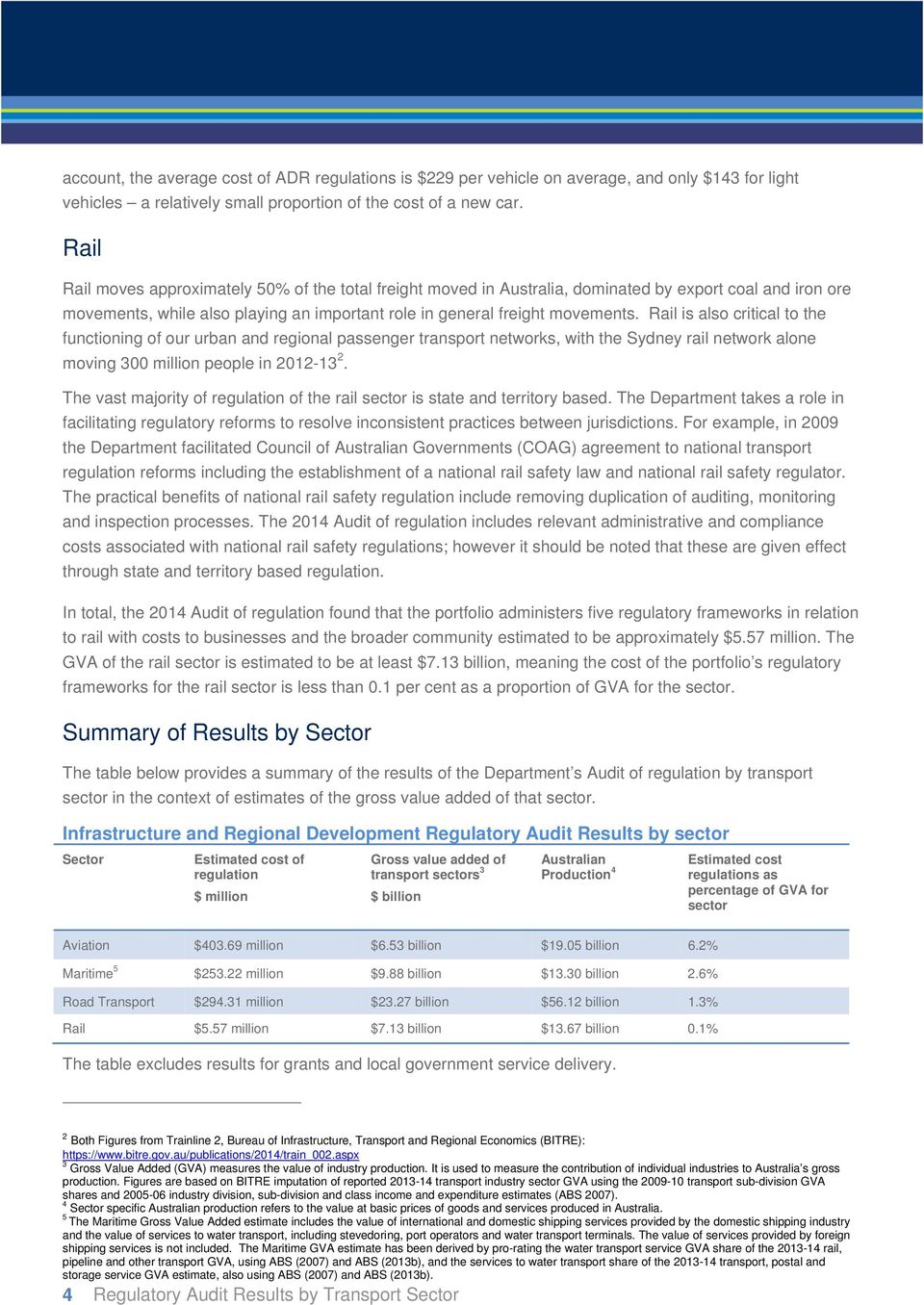
4 account, the average cost of ADR regulations is $229 per vehicle on average, and only $143 for light vehicles a relatively small proportion of the cost of a new car. Rail Rail moves approximately 50% of the total freight moved in Australia, dominated by export coal and iron ore movements, while also playing an important role in general freight movements. Rail is also critical to the functioning of our urban and regional passenger transport networks, with the Sydney rail network alone moving 300 million people in The vast majority of regulation of the rail sector is state and territory based. The Department takes a role in facilitating regulatory reforms to resolve inconsistent practices between jurisdictions. For example, in 2009 the Department facilitated Council of Australian Governments (COAG) agreement to national transport regulation reforms including the establishment of a national rail safety law and national rail safety regulator. The practical benefits of national rail safety regulation include removing duplication of auditing, monitoring and inspection processes. The 2014 Audit of regulation includes relevant administrative and compliance costs associated with national rail safety regulations; however it should be noted that these are given effect through state and territory based regulation. In total, the 2014 Audit of regulation found that the portfolio administers five regulatory frameworks in relation to rail with costs to businesses and the broader community estimated to be approximately $5.57 million. The GVA of the rail sector is estimated to be at least $7.13 billion, meaning the cost of the portfolio s regulatory frameworks for the rail sector is less than 0.1 per cent as a proportion of GVA for the sector. Summary of Results by Sector The table below provides a summary of the results of the Department s Audit of regulation by transport sector in the context of estimates of the gross value added of that sector. Infrastructure and Regional Development Regulatory Audit Results by sector Sector Estimated cost of regulation $ million Gross value added of transport sectors 3 $ billion Australian Production 4 Estimated cost regulations as percentage of GVA for sector Aviation $ million $6.53 billion $19.05 billion 6.2% Maritime 5 $ million $9.88 billion $13.30 billion 2.6% Road Transport $ million $23.27 billion $56.12 billion 1.3% Rail $5.57 million $7.13 billion $13.67 billion 0.1% The table excludes results for grants and local government service delivery. 2 Both Figures from Trainline 2, Bureau of Infrastructure, Transport and Regional Economics (BITRE): 3 Gross Value Added (GVA) measures the value of industry production. It is used to measure the contribution of individual industries to Australia s gross production. Figures are based on BITRE imputation of reported transport industry sector GVA using the transport sub-division GVA shares and industry division, sub-division and class income and expenditure estimates (ABS 2007). 4 Sector specific Australian production refers to the value at basic prices of goods and services produced in Australia. 5 The Maritime Gross Value Added estimate includes the value of international and domestic shipping services provided by the domestic shipping industry and the value of services to water transport, including stevedoring, port operators and water transport terminals. The value of services provided by foreign shipping services is not included. The Maritime GVA estimate has been derived by pro-rating the water transport service GVA share of the rail, pipeline and other transport GVA, using ABS (2007) and ABS (2013b), and the services to water transport share of the transport, postal and storage service GVA estimate, also using ABS (2007) and ABS (2013b). 4 Regulatory Audit Results by Transport Sector
5 Methodology As part of the Government's commitment to reduce regulatory burden each portfolio conducted an audit of existing regulation in 2014, including estimates of the regulatory cost imposed on business, individuals and the community. The audits aim to establish a baseline against which the Government and stakeholders can measure reductions in red tape and to inform consideration of future areas of reform. The audit process was lead by the Department of Prime Minister and Cabinet (PM&C) including through the provision of guidance on the methodology to ensure a consistent approach across portfolios. Stage One of the Audit, completed in mid-2014, catalogued all regulations to determine their number and type. It is important to note that, under the Government s Guide to Regulation 6, regulation includes quasi-regulations, such as standards, advisory notices and administrative processes, reporting requirements and processes such as granting approvals, registration/licencing and accreditation, imposing or collecting fees, and complaints resolution. During Stage One of the Audit the portfolio catalogued existing regulations and developed a comprehensive list of around 335 regulatory frameworks 7. As part of Stage Two of the Audit portfolios quantified the cost of existing regulation on businesses, community organisations and individuals. The Government agreed that a sampling methodology could be used and an estimate of the overall cost of regulation within each portfolio could then be generalised from sample costings. Costs across each portfolio were estimated using the Regulatory Burden Measurement framework (RBM) 8. The RBM aims to provide a quantitative measure for the regulatory burden that businesses, community organisations and individuals may be facing. The table below provides a summary of RBM cost inclusions and exclusions. Included Administrative costs Substantive compliance costs Operational purchases Complying with financial costs Delay costs Compliance Training Qualifications Excluded Indirect costs Opportunity costs Business-as-usual costs Costs of non-compliance Charges directly payable to government Internal Commonwealth regulation Costs of international obligations Cost of certain regulatory impacts related to criminal laws As part of Stage Two of the Audit the portfolio used a sampling strategy to cost regulatory frameworks. The final sample of 32 regulatory frameworks (approximately 10%) cut across key industry sectors, providing a breadth of information from which to estimate the final Audit results. This stratified sampling strategy was identified as the most reasonable option to achieve a whole-of-portfolio figure in the timeframe provided without unnecessarily diverting resources from core functions. 6 The Australian Government Guide to Regulation: 7 The portfolio s frameworks are based on the primary functions undertaken by departmental divisions and agencies within the portfolio.. 8 The RBM methodology is determined by the Office of Best Practice Regulation. Further information can be found at: 5 Regulatory Audit Results by Transport Sector

6 The results of Stage Two of the Audit estimate that the portfolio s total regulatory burden (under the RBM) is in the order of $1 billion. This paper presents aggregated Audit results by transport subsector to assist in analysing estimates of regulatory burden in the context of the industries they regulate. The paper aims to provide a basis for consultation with industry stakeholders and the broader community about the impacts of regulatory burden, including discussion on future areas for reform. References ABS 2013a, Australian System of National Accounts Concepts, Sources and Methods, Australia, 2013, Catalogue no , ABS, Canberra. ABS 2013b, Australian National Accounts: Input-Output Tables , Catalogue no , ABS, Canberra. ABS 2007, Australian Industry, , Catalogue no , ABS, Canberra. 6 Regulatory Audit Results by Transport Sector

Criteria for adopting International Standards and Risk Assessments
 Criteria for adopting International Standards and Risk Assessments February 2016 Criteria for Accepting International Standards and Risk Assessments 1 Table of Contents 1 About the Department... 3 2 The
DEPARTMENT OF INFRASTRUCTURE AND REGIONAL DEVELOPMENT
 Corporate Plan 2015 2016 Corporate Plan 2015 2016 i DEPARTMENT OF INFRASTRUCTURE AND REGIONAL DEVELOPMENT Commonwealth of Australia 2015 ISBN 978-1-925216-54-7 June 2015 / INFRA2410 Ownership of intellectual
The establishment of the NHVR and the development of the NHVL is expected to bring the following benefits:
 DEPARTMENT OF TRANSPORT AND MAIN ROADS REVIEWS OF LEGISLATIVE REQUIREMENTS A legislative requirement is an obligation imposed under any legislative instrument which, for the purposes of this initiative,
Commonwealth Financial Accountability Review (CFAR) Paper Is Less More?
 Commonwealth Financial Accountability Review (CFAR) Paper Is Less More? Thank you for your correspondence on the CFAR paper Is Less More and for the opportunity to comment on the proposals contained therein.
National Surface Transport Security Strategy. September 2013. Transport and Infrastructure Senior Officials Committee. Transport Security Committee
 National Surface Transport Security Strategy September 2013 Transport and Infrastructure Senior Officials Committee Transport Security Committee 1 National Surface Transport Security Strategy (NSTSS) Foreword
Air Traffic Management Services Plan 2012-2017
 Air Traffic Management Services Plan 2012-2017 Airservices Australia 2012 This work is copyright. Apart from any use as permitted under the Copyright Act 1968, no part may be reproduced by any process
Future COAG Regulatory Reform Agenda. Submission of the Accommodation Association of Australia
 Future COAG Regulatory Reform Agenda Submission of the Accommodation Association of Australia CONTENTS Executive Summary...3 Introduction...4 About the Accommodation Association...4 The Accommodation Sector
National Partnership Agreement to Deliver a Seamless National Economy (SNE NP) Report card prepared by the COAG Business Advisory Forum Taskforce
 National Partnership Agreement to Deliver a Seamless National Economy (SNE NP) Report card prepared by the COAG Business Advisory Forum Taskforce - April 2013 - Overview In 2008, COAG agreed to implement
Transport Canada s Departmental Sustainable Development Strategy 2012 2013 Reporting Update
 Transport Canada s Departmental Sustainable Development Strategy 2012 2013 Reporting Update 1 For more information, please visit Transport Canada s website at http://www.tc.gc.ca/eng/policy/acs-sd-dsds-2615.htm
COMMONWEALTH GOVERNMENT RESPONSE TO THE PRODUCTIVITY COMMISSION INQUIRY: THE MARKET FOR RETAIL TENANCY LEASES IN AUSTRALIA
 COMMONWEALTH GOVERNMENT RESPONSE TO THE PRODUCTIVITY COMMISSION INQUIRY: THE MARKET FOR RETAIL TENANCY LEASES IN AUSTRALIA August 2008 SUMMARY 1. The former Treasurer asked the Productivity Commission
Type Certification Procedures Manual 9. Costing Type Certification 9.1 Introduction to Costing
 9.1 Introduction to Costing 9.1 Introduction to Costing 9.1.1 Background Act 97 Section 97 of the Civil Aviation Act 1988 allows prescribed fees to be payable to the Authority in advance of work to be
Some Text Here. Policy Overview. Regulation Impact Statement for Early Childhood Education and Care Quality Reforms. July 2009
 Some Text Here Early Childhood Development Steering Committee Policy Overview Regulation Impact Statement for Early Childhood Education and Care Quality Reforms July 2009 1 Introduction The early years
BUSINESS REGULATION BENCHMARKING: PLANNING, ZONING AND DEVELOPMENT ASSESSMENTS
 42/120 Collins Street GPO Box 1472 Telephone +613 8664 2664 Melbourne 3000 Melbourne 3001 Facsimile +613 8664 2666 www.bca.com.au 31 August 2010 Ms Christine Underwood Business Regulation Benchmarking
NATIONAL STRATEGY FOR FOOD SECURITY IN REMOTE INDIGENOUS COMMUNITIES
 NATIONAL STRATEGY FOR FOOD SECURITY IN REMOTE INDIGENOUS COMMUNITIES Council of Australian Governments A Strategy agreed between: the Commonwealth of Australia and the States and Territories, being: the
FREMANTLE PORTS. A Guide to Our Business
 FREMANTLE PORTS A Guide to Our Business Our Vision, Mission and Values VISION To be valued by our customers and the community for our leadership and excellence. MISSION To facilitate trade in a sustainable
Review of the Energy Savings Scheme. Position Paper
 Review of the Energy Savings Scheme Position Paper October 2015 Contents Executive summary... 3 Energy Savings Scheme Review Report package... 3 Expanding to gas... 3 Target, penalties and duration...
Vocational Education and Training Reform Submission
 Vocational Education and Training Reform Submission Prepared by: Suresh Manickam Date: 23 rd July 2014 Page 1 NECA response to VET reform draft RTO standards As a lead player in the electrical training
Agency Disclosure Statement
 Regulatory Impact Statement Maritime Rule Part 34 (Medical Standards) Agency Disclosure Statement This Regulatory Impact Statement has been prepared by the Ministry of Transport. It provides an analysis
DANGEROUS GOODS TRAINING FOR EMPLOYEES
 Advisory Circular AC 92-01(1) AUGUST 2009 DANGEROUS GOODS TRAINING FOR EMPLOYEES CONTENTS 1. References 1 2. Purpose 1 3. Status of this AC 2 4. Accronyms 2 5. Who is Required to Undertake Dangerous Goods
Foreword. Closing the Gap in Indigenous Health Outcomes. Indigenous Early Childhood Development. Indigenous Economic Participation.
 National Aboriginal and Torres Strait Islander Health Workforce Strategic Framework 2011 2015 Prepared for The Australian Health Ministers Advisory Council by the Aboriginal and Torres Strait Islander
An airport for Western Sydney. Building Western Sydney s future
 Building Western Sydney s future Western Sydney is already Australia's third largest economy and, in its own right, would be our fourth largest city. The fourth largest city in Australia should have its
Planning requirements for heliports and helicopter landing sites
 Practice Note 75 December 2012 Planning requirements for heliports and helicopter landing sites The purpose of this practice note is to: 1. Explain how helicopter activity is regulated by the planning
Australian Work Health and Safety Strategy 2012 2022. Healthy, safe and productive working lives
 Australian Work Health and Safety Strategy 2012 2022 Healthy, safe and productive working lives Creative Commons ISBN 978-0-642-78566-4 [PDF online] ISBN 978-0-642-78565-7 [Print] With the exception of
Australian Charities and Not-for-profits Commission: Regulatory Approach Statement
 Australian Charities and Not-for-profits Commission: Regulatory Approach Statement This statement sets out the regulatory approach of the Australian Charities and Not-for-profits Commission (ACNC). It
Report on the National Quality Framework & Regulatory Burden
 Report on the National Quality Framework & Regulatory Burden 2013 Report on the National Quality Framework and Regulatory Burden Overview The National Quality Framework (NQF) was introduced to improve
STRATEGIC SCIENCE AND RESEARCH PRIORITIES
 STRATEGIC SCIENCE AND RESEARCH PRIORITIES At the inaugural meeting of the Commonwealth Science Council, members strongly supported the need and value of establishing science and research priorities, at
EXPORT AIRWORTHINESS APPROVALS
 Advisory Circular AC 21.17(0) APRIL 1999 EXPORT AIRWORTHINESS APPROVALS CONTENTS 1. References 1 2. Purpose 1 3. Status of this AC 1 4. Classification of products 2 5. General 2 6. Who may apply? 4 7.
National Aviation Policy Green Paper
 National Aviation Policy Green Paper flight path to the future DECEMber 2008 Publication Title: National Aviation Policy Green Paper: Flight Path to the Future Commonwealth of Australia 2008 This work
National Aviation Policy White Paper
 Flight Path to the Future National Aviation Policy White Paper December 2009 National Aviation Policy White Paper: Flight Path to the Future Commonwealth of Australia 2009 This work is copyright. Apart
Scoping study of small business tax compliance costs. A report to the Treasurer
 Scoping study of small business tax compliance costs A report to the Treasurer December 2007 Commonwealth of Australia 2007 ISBN 0 642 74427 0 This work is copyright. Apart from any use as permitted under
NATIONAL ROAD SAFETY ACTION PLAN 2015 2017
 NATIONAL ROAD SAFETY ACTION PLAN 2015 2017 The Action Plan outlined in this document is intended to support the implementation of the National Road Safety Strategy 2011 2020 (NRSS). It addresses key road
CRUISING TO PROSPERITY SUBMISSION TO THE COASTAL TRADING ACT
 CRUISING TO PROSPERITY SUBMISSION TO THE Australia REVIEW JUNE 2014 OF THE COASTAL TRADING ACT Submission to the review of coastal shipping regulation in Membership of the Tourism & Transport Forum The
NATIONAL PARTNERSHIP AGREEMENT ON THE NATIONAL QUALITY AGENDA FOR EARLY CHILDHOOD EDUCATION AND CARE
 NATIONAL PARTNERSHIP AGREEMENT ON THE NATIONAL QUALITY AGENDA FOR EARLY CHILDHOOD EDUCATION AND CARE Council of Australian Governments An agreement between the Commonwealth of Australia and the States
One of the Australian Government s core economic policy objectives is improving Australia s productive capacity.
 Outcome 4: Safer, fairer and more productive workplaces for employers and employees by promoting and supporting the adoption of fair and flexible workplace arrangements and safer working arrangements Outcome
NATIONAL INTEREST ANALYSIS
 Attachment 2 NATIONAL INTEREST ANALYSIS Protocol of 1996 to Amend the Convention on Limitation of Liability for Maritime Claims 1976 (LLMC Protocol) Executive Summary 1. As an island nation dependent on
Accreditation under the Health Practitioner Regulation National Law Act 1 (the National Law)
 Accreditation under the Health Practitioner Regulation National Law Act 1 (the National Law) This paper which has been developed by accreditation authorities, national boards and the Australian Health
Energy White Paper at a glance
 and Science Energy White Paper at a glance WWW. i Energy White Paper at a glance The Australian Government made an election commitment to deliver an Energy White Paper to give industry and consumers certainty
COMMONWEALTH GRANTS COMMISSION
 COMMONWEALTH GRANTS COMMISSION Section 1: Agency overview and resources... 251 1.1 Strategic direction statement... 251 1.2 Agency resource statement... 251 1.3 Budget measures... 252 Section 2: Outcomes
Trends. Infrastructure and Transport to 2030
 Infrastructure and Transport to 2030 Commonwealth of Australia 2014 ISBN: 978-1-922205-65-0 February 2014/INFRA1996 Ownership of intellectual property rights in this publication: Unless otherwise noted,
The environment management services industry
 The environment management services industry Author: Paul J Perkins AM, Adjunct Professor, Australian National University and Chairman of the Barton Group. Citation: Perkins P 2006, The environment management
Council of Australian Governments
 Council of Australian Governments REGULATORY IMPACT ASSESSMENT OF POTENTIAL DUPLICATION OF GOVERNANCE AND REPORTING STANDARDS FOR CHARITIES January 2013 1 P a g e MAKING A SUBMISSION This consultation
DESIGNING AN EMISSIONS STANDARD FOR AUSTRALIA
 55 DESIGNING AN EMISSIONS STANDARD FOR AUSTRALIA 5 The Authority proposes a standard that would apply from 2018 and be designed with a simple set of features to promote environmental effectiveness, policy
How To Improve Training In Australia
 New Arrangements for Training Product Development for Australian Industry ED15-0079 1 Key messages The Government aims to enhance Australia s economic prosperity by ensuring the future and emerging skills
STATEMENT 7: ASSET AND LIABILITY MANAGEMENT
 STATEMENT 7: ASSET AND LIABILITY MANAGEMENT The Australian Government will improve its financial position by accumulating assets and limiting the growth in liabilities. This leaves the Government with
May 2015. The economic impact of the UK Maritime Services Sector: Business Services
 May 2015 The economic impact of the UK Maritime Services Sector: Business Services Contents 1 Executive summary... 2 2 Introduction... 4 2.1 The channels of economic impact... 4 2.2 Report structure...
AUSTRALIAN SECURITY INTELLIGENCE ORGANISATION
 AUSTRALIAN SECURITY INTELLIGENCE ORGANISATION Section 1: Agency overview and resources 1.1 STRATEGIC DIRECTION STATEMENT The mission of the Australian Security Intelligence Organisation (ASIO) is to identify
Queensland. Health Practitioner Regulation (Administrative Arrangements) National Law Act 2008
 Queensland Health Practitioner Regulation (Administrative Arrangements) National Law Act 2008 Act No. 62 of 2008 Queensland Health Practitioner Regulation (Administrative Arrangements) National Law Act
STATEMENT 10: AUSTRALIAN ACCOUNTING STANDARD NO. 31 FINANCIAL STATEMENTS
 STATEMENT 10: AUSTRALIAN ACCOUNTING STANDARD NO. 31 FINANCIAL STATEMENTS This statement provides financial tables prepared on an accrual basis in accordance with applicable Australian Accounting Standards,
was acknowledged by employers, students and the Administrative Appeals tribunal as a training provider of quality.
 About the Author is the owner of Argos Consulting, a private business which provides advice, recommendations and support for organisations and individuals requiring assistance in working with government
Grant Programme Guidelines Community Development Grants Programme
 Grant Programme Guidelines Community Development Grants Programme Community Development Grants Programme Guidelines Contents Process Flowchart... 3 1. Introduction... 4 1.1. Programme Background... 4 1.2.
NATIONAL INSURANCE BROKERS ASSOCIATION OF AUSTRALIA (NIBA) SUBMISSION TO THE ECONOMIC REGULATION AUTHORITY
 NATIONAL INSURANCE BROKERS ASSOCIATION OF AUSTRALIA (NIBA) SUBMISSION TO THE ECONOMIC REGULATION AUTHORITY INQUIRY INTO WESTERN AUSTRALIA S HOME INDEMNITY INSURANCE ARRANGEMENTS ABOUT NIBA 16 August 2012
Position Classification Standard for Traffic Management Series, GS-2130. Table of Contents
 Position Classification Standard for Traffic Management Series, GS-2130 Table of Contents SERIES DEFINITION... 2 EXCLUSIONS... 2 OCCUPATIONAL INFORMATION... 2 TITLES... 5 EVALUATING POSITIONS... 5 GRADE
Technology Strategy April 2014
 Technology Strategy April 2014 Contents Overview 1 Our environment 1 Why change? 2 Our vision for technology what success looks like 3 Our approach 7 Transformation shifts how will we know we have been
EU Directive on Network and Information Security SWD(2013) 31 & SWD(2013) 32. A call for views and evidence
 EU Directive on Network and Information Security SWD(2013) 31 & SWD(2013) 32 A call for views and evidence 22 nd May 2013 Contents Contents... 2 Overview: The EU Directive on Network and Information Security...
2. The law For ease of reference the relevant sections of the Act are quoted in Annexure A.
 DRAFT DRAFT INTERPRETATION NOTE DATE: ACT : VALUE-ADDED TAX ACT NO. 89 OF 1991 SECTIONS : SECTIONS 11(2), (b), (c), (d), (e) AND 12(g) SUBJECT : THE VALUE-ADDED TAX TREATMENT OF SUPPLIES OF TRANSPORT SERVICES
SHIRE OF MANJIMUP POSITION DESCRIPTION MANAGER TECHNICAL SERVICES
 SHIRE OF MANJIMUP POSITION DESCRIPTION MANAGER TECHNICAL SERVICES 1. POSITION TITLE Manager Technical Services 2. SALARY Shire of Manjimup Enterprise Agreement 2008 2011 Level C or B (dependant upon experience
Guide to inquiries into disputes about bulk interconnection services
 Guide to inquiries into disputes about bulk interconnection services Part 3 of the Australian Postal Corporation Regulations 1996 December 2012 Commonwealth of Australia 2012 This work is copyright. Apart
NATIONAL PARTNERSHIP AGREEMENT ON TRANSITIONING RESPONSIBILITIES FOR AGED CARE AND DISABILITY SERVICES
 National Partnership Agreement on Transitioning Responsibilities for Aged Care and Disability Services NATIONAL PARTNERSHIP AGREEMENT ON TRANSITIONING RESPONSIBILITIES FOR AGED CARE AND DISABILITY SERVICES
NATIONAL PARTNERSHIP AGREEMENT ON REMOTE SERVICE DELIVERY
 NATIONAL PARTNERSHIP AGREEMENT ON REMOTE SERVICE DELIVERY Council of Australian Governments An agreement between the Commonwealth of Australia and the States and Territories, being: t t t t t the State
SENIOR EXECUTIVE SERVICE NSW DEPARTMENT OF EDUCATION AND TRAINING POSITION DESCRIPTION. Deputy Director-General TAFE and Community Education
 SENIOR EXECUTIVE SERVICE NSW DEPARTMENT OF EDUCATION AND TRAINING POSITION DESCRIPTION POSITION DETAILS POSITION TITLE: REPORTS TO: LOCATION: Director, TAFE NSW - South Western Sydney Institute Deputy
NATIONAL STRATEGY FOR GLOBAL SUPPLY CHAIN SECURITY
 NATIONAL STRATEGY FOR GLOBAL SUPPLY CHAIN SECURITY JANUARY 2012 Table of Contents Executive Summary 1 Introduction 2 Our Strategic Goals 2 Our Strategic Approach 3 The Path Forward 5 Conclusion 6 Executive
TGA key performance indicators and reporting measures
 TGA key indicators and reporting measures Regulator Performance Framework Version 1.0, May 2015 About the Therapeutic Goods Administration (TGA) The Therapeutic Goods Administration (TGA) is part of the
18/01/2012. This working MIDAD. The. Action by the - AIS/MAP. TF/6 Report Report. 1.1 The. Recovery, paper is based SUMMARY REFERENCES
 International Civil Aviation Organization MIDAD SG*/1-WP/6 18/01/2012 MID Region AIS Database Study Group First Meeting (MIDADD SG*/1) (Cairo, Egypt, 20 22 February 2012) Agenda Item 7: MIDAD Financial
Private Health Insurance Administration Council (PHIAC) Cost Recovery Impact Statement. 16 June 2009 Increase in the Council Administration Levy
 Private Health Insurance Administration Council (PHIAC) 16 June 2009 Increase in the Council Administration Table of Contents 1. OVERVIEW 1.1 Purpose 1.2 Background 1.3 Australian Government Cost Recovery
INTERGOVERNMENTAL AGREEMENT FOR THE NATIONAL DISABILITY INSURANCE SCHEME (NDIS) LAUNCH
 INTERGOVERNMENTAL AGREEMENT FOR THE NATIONAL DISABILITY INSURANCE SCHEME (NDIS) LAUNCH Part 1 Preliminaries 1. The Commonwealth of Australia (the Commonwealth) and States and Territories (the States) are
Comprehensive Spending Review 2007 covering the period 2008-2011
 MEASURING UP HOW GOOD ARE THE GOVERNMENT S DATA SYSTEMS FOR MONITORING PERFORMANCE AGAINST PUBLIC SERVICE AGREEMENTS? JUNE 2010 Comprehensive Spending Review 2007 covering the period 2008-2011 Review of
Bills Digest No. 56 2001 02
 Department of the Parliamentary Library I NFORMATION AND R ESEARCH S ERVICES Bills Digest No. 56 2001 02 Health and Other Services (Compensation) Legislation Amendment Bill 2001 ISSN 1328-8091 Copyright
RESEARCH REPORT 138. bitre. Maritime Containerised and non-containerised trade through Australian ports to 2032 33
 RESEARCH REPORT 138 bitre Maritime Containerised and non-containerised trade through Australian ports to 2032 33 Bureau of Infrastructure, Transport and Regional Economics Containerised and non-containerised
The Australian Charities and Not-for-profits Commission
 The Australian Charities and Not-for-profits Commission Presentation to Centre of Excellence by Jennifer Dobell, Director of Business Services of Australian Charities and Not-for-profits Commission Implementation
NATIONAL PARTNERSHIP AGREEMENT ON UNIVERSAL ACCESS TO EARLY CHILDHOOD EDUCATION
 NATIONAL PARTNERSHIP AGREEMENT ON UNIVERSAL ACCESS TO EARLY CHILDHOOD EDUCATION Council of Australian Governments An agreement between the Commonwealth of Australia and the States and Territories, being:
COMPLIANCE FRAMEWORK AND REPORTING GUIDELINES
 COMPLIANCE FRAMEWORK AND REPORTING GUIDELINES DRAFT FOR CONSULTATION June 2015 38 Cavenagh Street DARWIN NT 0800 Postal Address GPO Box 915 DARWIN NT 0801 Email: [email protected] Website:
Barton Deakin: Commission of Audit Report Health. 7 May 2014
 Barton Deakin: Commission of Audit Report Health 7 May 2014 The Report delivered to the Government by the National Commission of Audit contained several recommendations to reform the Australian health