
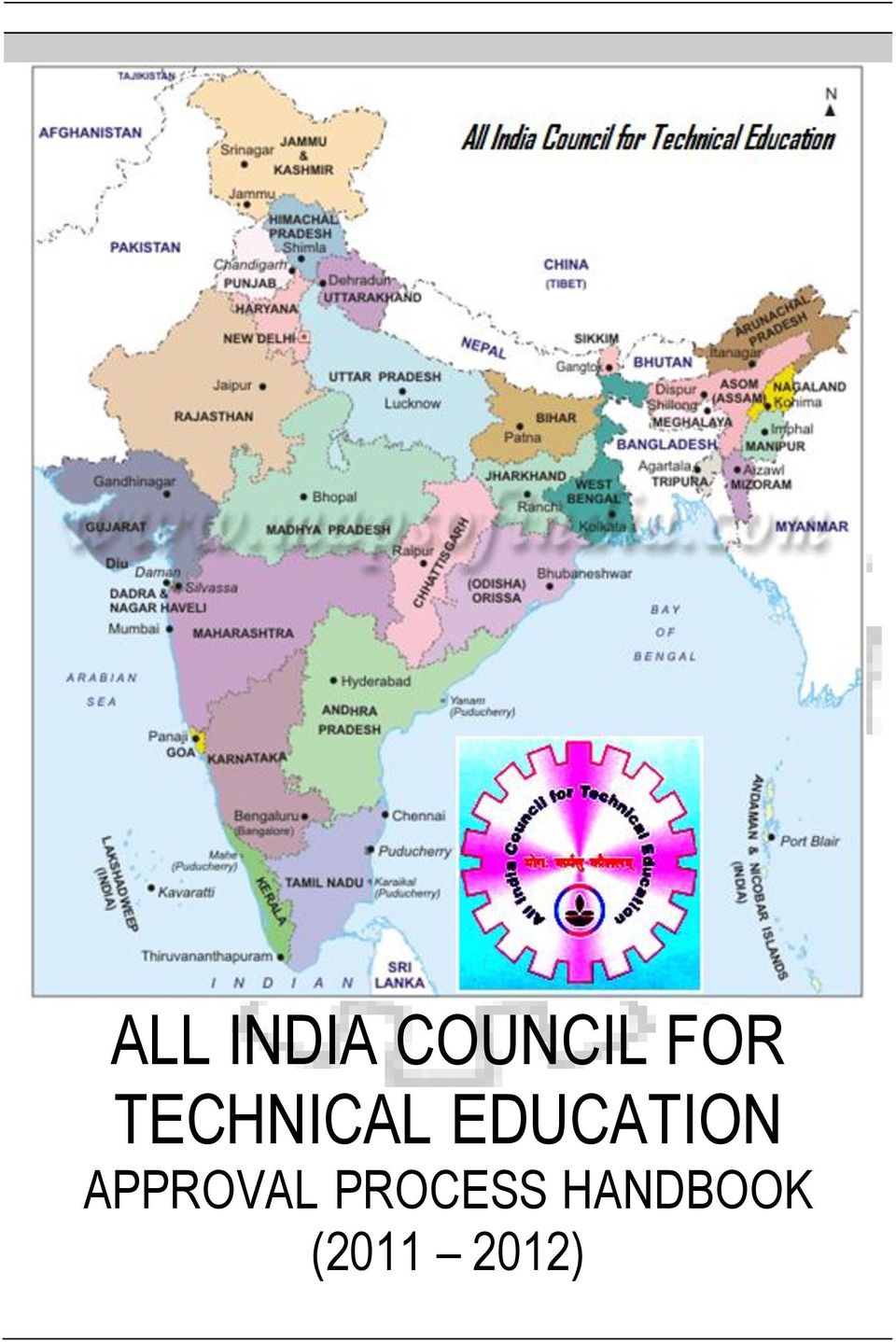
ALL INDIA COUNCIL FOR TECHNICAL EDUCATION APPROVAL PROCESS HANDBOOK ( )
|
|
|
- Beatrice Sanders
- 10 years ago
- Views:
Transcription
1 ALL INDIA COUNCIL FOR TECHNICAL EDUCATION APPROVAL PROCESS HANDBOOK ( )
2 FOREWORD The All India Council for Technical Education (AICTE), set-up in November 1945 as a national level Apex Advisory Body, marches ahead with its mission of developing and promoting quality technical education in the country in a coordinated and integrated manner. The Council is constantly endeavoring to encourage a meaningful association between the technical education system and research and development activities in a concerted effort aimed at nation-building. Technical education at all levels in the country is witnessing a consistent growth pattern marked by the setting up of new Institutions and the improvement of the existing ones in tune with the quality assurance norms set by the National Board of Accreditation (NBA). The Council believes in providing a proper impetus to Institutions in generating competent engineers and scientists and encourages them to think beyond the curriculum while imparting training for the advancement of knowledge. This manual is an attempt to provide comprehensive information on the fair and rational system of administration as well as other necessary information on the processes and Institutions under the aegis of the AICTE. The emphasis on e-governance to ensure transparency, accountability, implementing a tech-savvy approach to enable faster processing and clearly defining the infrastructural norms in Institutions are just a few pointers towards AICTE s efforts at fostering a technical education system which is on par with the best institutions in the world. In keeping with these objectives, AICTE would strive to be a true facilitator in addition to fulfilling the regulatory provisions. All who have meditated on the art of governing mankind have been convinced that the fate of empires depends on the education of youth. Aristotle Dr. S. S. Mantha Chairman, (actg), AICTE Approval Process Hand Book ( ), AICTE Page 1

3 1 Background and Statutory Provision under AICTE Act regarding Planning, Promotion and Regulation of Technical Education 1.1 Background The beginning of formal Technical Education in India can be dated back to the mid 19th century. The major policy initiatives in the pre-independence period included appointment of the Indian Universities Commission in 1902, issue of the Indian Education policy resolution in 1904 and the Governor General s policy statement of 1913 stressing the importance of Technical Education, the establishment of II Sc. in Bangalore, Institution for Sugar, Textile and Leather Technology in Kanpur, N.C.E. in Bengal in 1905 and Industrial schools in several provinces. Significant developments include: Constitution of the Technical Education Committee of the Central Advisory Board of Education (CABE) of 1943; Preparation of the Sergeant Report of 1944; and Formation of the All India Council for Technical Education (AICTE) in 1945 by the Government of India. The AICTE was set up in November 1945 based on the recommendations of CABE to stimulate, coordinate and control the provisions of educational facilities and industrial development of the post war period. At that time, mandate of AICTE basically covered only programs in Engineering and Technology. The growth of industries in the Country, just after independence, also demanded the need for qualified professionals in other fields, such as Business Management, Architecture, Hotel Management, Pharmacy etc. Although the diverse elements of Management such as Commerce, Economics, Finance, Psychology and Industrial Sociology were being taught for a long time, the need for Management Education in a formal way was felt in India only in the fifties. The Government of India decided in 1954 to set up a Board of Management Studies under AICTE to formulate standards and promote Management Education. Other major initiatives taken in Management Education include: setting up of the Administrative Staff College of India at Hyderabad in the late fifties, National Productivity Council and Indian Institution of Management in the early sixties. Architecture was covered under the Architects Act, Subsequently, for better coordination of the Professional Courses, Architecture Education was also placed under the purview of AICTE. Approval Process Hand Book ( ), AICTE Page 2
4 Hotel Management Education had a modest beginning with short programs in Nutrition and Food Science, which started in the late fifties. The National Council of Hotel Management and Catering Technology were set up in 1982, to which all the Institutions of Hotel Management run by the Government are affiliated. Education in other professional fields such as, Pharmacy, Applied Arts & Crafts has also undergone similar developments during the post-independence period. Programs for Technical Education, during the first three Five Year Plans, were devoted to expansion of Technical Education to meet the growing demand for technical personnel at Diploma, Degree and Post-Graduate Levels. From the fourth Five Year Plan onwards, the emphasis was shifted to the improvement of quality and standard of Technical Education. This was done through implementation of the Quality Improvement Program consisting of three major components that provided for M.E. / M. Tech and Ph. D Programs, Establishment of Curriculum Design and Development Cells, and Short Term Training Programs. Meanwhile, expansion of Institutions and intake remained at a low level in the Government, Privateaided and University sectors. The policy shift during eighties towards involvement of Private and Voluntary Organizations in the setting up of Technical and Management Institutions on self-financing basis ushered in an era of unprecedented expansion of the Technical Education System, a trend which has continued during successive Five Year Plans. It was in this context that AICTE was given statutory powers by the AICTE Act of Parliament in 1987, with a view to ensure the proper planning and coordinated development of Technical Education System throughout the Country. Technical Education in this context includes fields of Engineering and Technology, Architecture, Town Planning, Management, Pharmacy and Applied Arts & Crafts. 1.2 Growth of Technical Education The growth of Technical Education before independence in the Country has been very slow. The number of Engineering Colleges and Polytechnics (including Pharmacy and Architecture Institutions) in 1947 was 44 and 43 respectively with an intake capacity of 3200 and 3400 respectively. Due to efforts and initiatives taken during successive Five Year Plans and particularly due to policy changes in the eighties to allow participation of Private and Voluntary Organizations in the setting up of Technical Institutions on self-financing basis, the growth of Technical Education has been phenomenal. Approval Process Hand Book ( ), AICTE Page 3
5 Growth of different Programs in Technical Institutions Year Engineering Management MCA Pharmacy Architecture HMCT Total Added in Year Approval Process Hand Book ( ), AICTE Page 4

6 Growth of Seats in different Programs in Technical Institutions Year Engineering Management MCA Pharmacy Architecture HMCT Total Added in Year The AICTE Act, 1987 The AICTE Act, 1987 was passed by the Parliament, to provide for the establishment of the All India Council for Technical Education (AICTE) with a view to ensure proper planning and coordinated development of the Technical Education System throughout the Country, qualitative improvement of such education in relation to planned quantitative growth and the regulation and proper maintenance of norms and standards in the Technical Education System and for matters connected therewith. Approval Process Hand Book ( ), AICTE Page 5

7 1.4 Important Provisions of the AICTE Act on Approval Process Clause 10(g) Evolve suitable performance appraisal system for Technical Institutions and Universities imparting Technical Education, incorporating Norms and Mechanisms for enforcing accountability Clause 10(i) Lay down norms and standards for course curriculum, physical and instructional facilities, staff patterns, staff qualifications, quality instructions, assessment and examination Clause 10(k) Grant approval for starting new Technical Institutions and for introduction of new Courses or Programs in consultation with the Agencies concerned Clause 10(n) Take all necessary steps to prevent commercialization of Technical Education Clause 10(p) Inspect or cause to inspect any technical Institution Clause 11(1) For the purposes of ascertaining the financial needs of technical Institution or a University or its standards of teaching, examination and research, the Council may cause an inspection of any department or departments of such technical Institution or University to be made in such manner as may be prescribed and by such person or persons as it may direct Clause 11(2) The Council shall communicate to the technical Institution or University the date on which any inspection under sub-section (1) is to be made and the technical Institution or University shall be entitled to be associated with the inspection in such manner as may be prescribed Clause 11(3) The Council shall communicate to the technical Institution or the University, its views in regard to the results of any such inspection and may, after ascertaining the opinion of that technical Institution or University the action to be taken as a result of such inspection Clause 11(4) All communications to a technical Institution or University under this section shall be made to the executive authority thereof and the executive authority of the technical Institution or University shall report to the Council the action, if any, which is proposed to be taken for the purposes of implementing any such recommendation as is referred to in sub-section (3). Approval Process Hand Book ( ), AICTE Page 6

8 1.5 AICTE Profile Vision Be a world class organization leading technological and socioeconomic development of the Country by enhancing the global competitiveness of technical manpower, by ensuring high quality technical education to all sections of the society Mission Objectives Transparent governance and accountability in approach towards society. Planned and coordinated development of Technical Education in the Country by ensuring world-class standards of Institutions through accreditation. Facilitating world-class Technical Education through: 1. Development of high quality Institutions, academic excellence and innovative research and development programs; 2. Networking of Institutions for optimum resource utilization; 3. Dissemination of knowledge; 4. Technology forecasting and global manpower planning; 5. Promotion of industry-institution interaction for developing new products, services, and patents; 6. Inculcating entrepreneurship; 7. Encouraging indigenous technology; 8. Focusing on non-formal education; 9. Providing affordable education to all. 10. Making Indian Technical Education globally acceptable. 11. A vision of a forward-looking organization that has an efficient, flexible and empowered manpower, sensitive to stakeholder s expectations. Promotion of Quality in Technical Education. Planning and Coordinated Development of Technical Education System. Provide regulations and maintenance of Norms and Standards Responsibilities Promotion of Quality in Technical Education. Policy Directions Review of Norms and Standards Assessment of Manpower requirement Liaison with Central Government, State Governments, Universities and other Statutory Bodies Others as provided in the Act Approval Process Hand Book ( ), AICTE Page 7

9 1.5.5 Major Functions Approval of Diploma / Degree / Post Graduation / Post Diploma / Post Graduate Diploma Level programs in Technical Institutions. Approval of variation / increase in intake, additional programs in technical Institutions Quality Assurance through Accreditation. Participation in the process of granting Deemed University status by MHRD. Approval for Foreign Collaborations / Twinning Programs. Promotion of Industry-Institution Interaction. Development of Model Curricula through All India Boards of Studies. Faculty Development Programs in Technical Institutions. Research and Institutional Development through Modernisation and Removal of Obsolescence (MODROBS) / Research Promotion Schemes (RPS) Post Graduate Grants and GATE Scholarship Networking of Technical Institutions. Assessment of National Technical Manpower through National Technical Manpower Information System (NTMIS) Promotion of Autonomy in Technical Institutions. Connecting Technical Institutions through EDUSAT Network-Live transmission of M.E. / M. Tech programs Providing facilities under INDEST Steps for Stopping Commercialization of Technical Education. Approval Process Hand Book ( ), AICTE Page 8

10 INDEX - Approval Process Handbook Sr. No. Chapter Contents Page No 1 Definitions 13 2 I Grant of Approval through a single application form for 15 Setting up new Technical Campus offering one or more Technical Program at Degree, Diploma, Post Graduate Diploma and Post Diploma Level Converting Existing Technical Institutions into a Technical Campus Adding new Technical Program/s at Degree, Diploma, Post Graduate Diploma and Post Diploma Level in existing Technical Institutions 3 II Grant of Approval through Single Application Form for the following. 25 Extension of approval to existing Technical Institution / Technical Campus Increase / reduction in intake in existing courses Adding course/s in existing program Closure of program / course Mandatory provision of supernumerary seats for TFW Introducing / continuing / discontinuing supernumerary seats for PIO Introducing / continuing / discontinuing seats for sons / daughters of NRIs Change of name of the Institute Conversion of Women s Institution into Co-Ed Institution Introducing a Foreign Collaboration with an AICTE approved Indian Institution 4 III Un Approved Institutions 38 5 IV Actions in case of violations of Regulations 39 6 V Collaboration & Partnerships between Indian and Foreign Universities / Institutions in the field of Technical Education, Research and Training 7 VI Norms and Requirements Approval Process Hand Book ( ), AICTE Page 9

11 Appendix 8 1 Duration and Entry Level Qualifications for the Technical Programs 9 2 Approved Nomenclature of Courses Norms for Intake & Number of Courses/Divisions in the Technical Campus 11 4 Norms for Land requirement and Building Space for Technical Institution 12 5 Norms for Books, Journals, Library facilities, Computer, Software, Internet, Printers and Laboratory Equipments for Technical Institution 13 6 Norms for Essential and Desired requirements for Technical Campus (Marked as essential need to be made available at the time of the Expert committee visit) 14 7 Norms for Faculty requirements and Cadre Ratio for Technical campus 15 8 Faculty Cadre and Qualifications Norms for PGDM Program Format of the Mandatory disclosure Format for Detailed Project Report for establishment of a new Technical Institution Prevention and Prohibition of Ragging Structure of various Committees Regional Offices of the Council Abbreviations List of Districts where no AICTE approved Institution exists Documents to be submitted for 152 Setting up new Technical Campus offering one or more Technical Program at Degree and / or Diploma and Post Diploma Level and Converting Existing Technical Institutions into a Technical Campus or adding new Technical Program/s at Degree or Diploma and Post Diploma Level in existing Technical Institutions Documents to be submitted for 157 Extension of approval to existing Technical Institution / Technical Campus Increase / reduction in intake in existing courses Adding course/s in existing program Approval Process Hand Book ( ), AICTE Page 10

12 Closure of program / course Mandatory provision of supernumerary seats for TFW Introducing / continuing / discontinuing supernumerary seats for PIO Introducing / continuing / discontinuing seats for sons/daughters of NRIs Change of name of the Institute Conversion of Women s Institution into Co-Ed Institution Introducing a Foreign Collaboration with an AICTE approved Indian Institution Composition of Board of Governors on AICTE approved Institutions AICTE notification nos. Advt. No. E-Governance / 08 (01) / 2010 Dated 16/11/10, E-Governance / 08 (02) / 2010 Dated 29/18/10, E-Governance / 08 (03) / 2010 Dated 09/10/10 Affidavits 28 1 Format of the affidavit to be submitted by the applicant on a non Judicial Stamp paper of Rs. 100 duly sworn before a First Class Judicial Magistrate 29 2 Format of the affidavit to be submitted by the applicant on a non Judicial Stamp paper of Rs. 100 duly sworn before a First Class Judicial Magistrate along with Deposit of requisite amount 30 3 Format to be submitted by the Collaborating Foreign University / Institution with a partnering AICTE approved Indian institution Certificates 31 1 Certificate of Advocate Certificate of an Architect registered with Council of Architecture 33 3 Certificate of the Bank Manager where the applicant has a Bank Account Formats 34 1 Resolution for establishment of new Technical campus Additional Program additional intake / additional course Resolution for Closure of Courses / Programs / reduction in Intake 37 4 NOC of State Government for Closure of Courses / Programs / reduction in Intake 38 5 NOC of affiliating University / Board for Closure of Courses / Programs / reduction in Intake Approval Process Hand Book ( ), AICTE Page

13 39 6 NOC of State Government for conversion of Girl s Institute to Co-Ed Institute 40 7 NOC of affiliating University / Board for conversion of Girl s Institute to Co-Ed Institute 41 8 NOC of State Government for change of Name of the Institute 42 9 NOC of affiliating University / Board for change of Name of the Institute Approval Process Hand Book ( ), AICTE Page 12
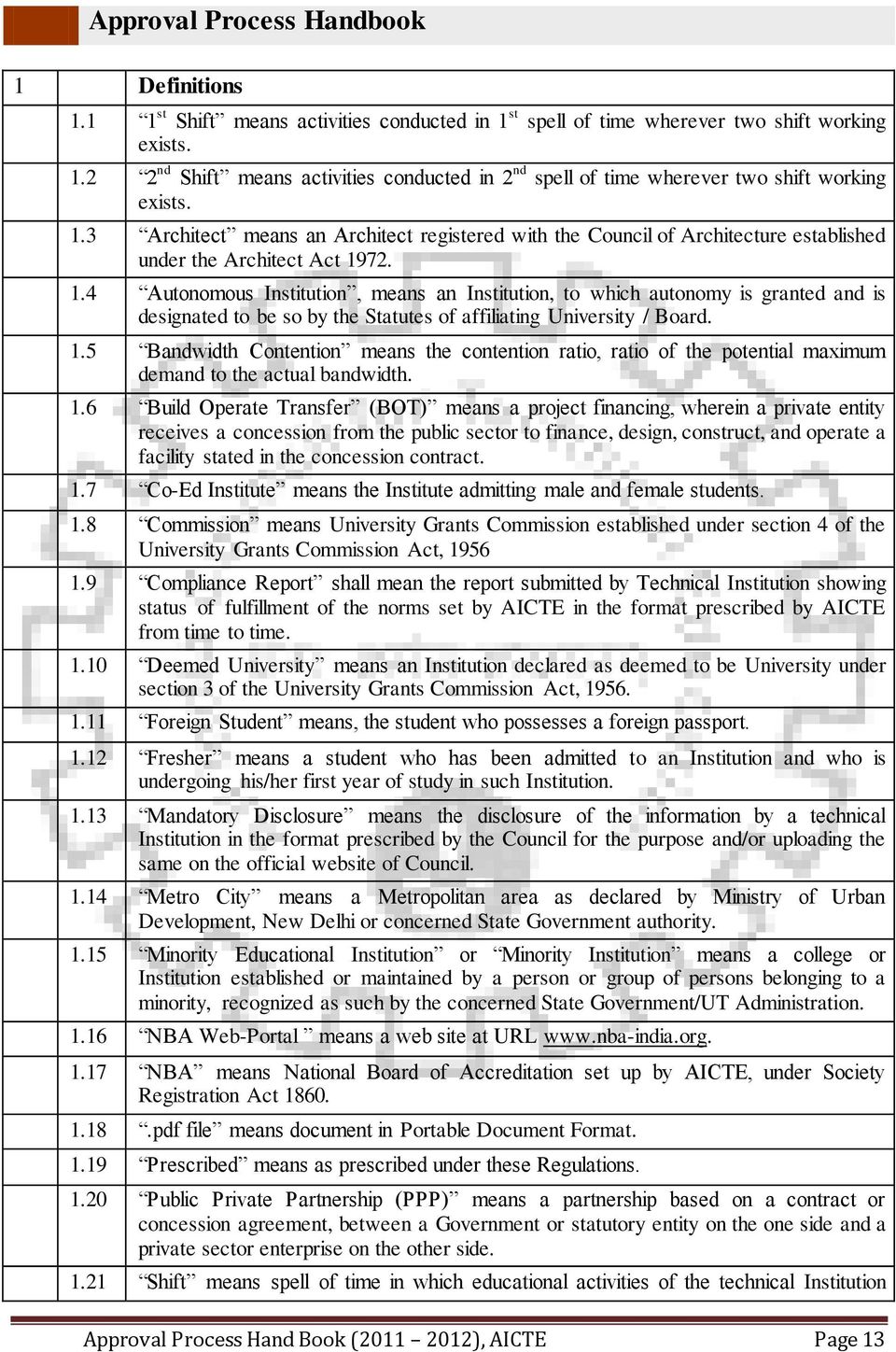
14 Approval Process Handbook 1 Definitions st Shift means activities conducted in 1 st spell of time wherever two shift working exists nd Shift means activities conducted in 2 nd spell of time wherever two shift working exists. 1.3 Architect means an Architect registered with the Council of Architecture established under the Architect Act Autonomous Institution, means an Institution, to which autonomy is granted and is designated to be so by the Statutes of affiliating University / Board. 1.5 Bandwidth Contention means the contention ratio, ratio of the potential maximum demand to the actual bandwidth. 1.6 Build Operate Transfer (BOT) means a project financing, wherein a private entity receives a concession from the public sector to finance, design, construct, and operate a facility stated in the concession contract. 1.7 Co-Ed Institute means the Institute admitting male and female students. 1.8 Commission means University Grants Commission established under section 4 of the University Grants Commission Act, Compliance Report shall mean the report submitted by Technical Institution showing status of fulfillment of the norms set by AICTE in the format prescribed by AICTE from time to time Deemed University means an Institution declared as deemed to be University under section 3 of the University Grants Commission Act, Foreign Student means, the student who possesses a foreign passport Fresher means a student who has been admitted to an Institution and who is undergoing his/her first year of study in such Institution Mandatory Disclosure means the disclosure of the information by a technical Institution in the format prescribed by the Council for the purpose and/or uploading the same on the official website of Council Metro City means a Metropolitan area as declared by Ministry of Urban Development, New Delhi or concerned State Government authority Minority Educational Institution or Minority Institution means a college or Institution established or maintained by a person or group of persons belonging to a minority, recognized as such by the concerned State Government/UT Administration NBA Web-Portal means a web site at URL NBA means National Board of Accreditation set up by AICTE, under Society Registration Act pdf file means document in Portable Document Format Prescribed means as prescribed under these Regulations Public Private Partnership (PPP) means a partnership based on a contract or concession agreement, between a Government or statutory entity on the one side and a private sector enterprise on the other side Shift means spell of time in which educational activities of the technical Institution Approval Process Hand Book ( ), AICTE Page 13
15 are conducted Single Shift working means where, educational activities of the technical Institution are generally conducted between 9 am to 5 pm State Level Fee Committee means a Committee notified by the concerned State Government / UT Administration for regulation of fee to be charged by the technical Institutions 1.24 Technical Campus means a campus which offers education in one or more technical programs approved by the Council and the existing Technical Campus approved by the Council, shall be deemed to be a Technical Campus within the meaning and for the purpose of Approval (GRANT OF APPROVALS FOR TECHNICAL INSTITUTIONS REGULATIONS, 2011) 1.25 Technical campus shall be approved when it is on one continuous plot of land except for those in North Eastern states where it can spread into 3 pieces of land not far from each other by more than 1 Km Two Shift working means where, educational activities of the technical Institution are conducted in two spells of time i.e., 1 st shift, generally, during 7 am to 3 pm and 2 nd shift, generally, during 1 pm to 9 pm University Department means a department established and maintained by the University University shall means a University defined under clause (f) of Section 2 of the University Grants Commission Act, Approval Process Hand Book ( ), AICTE Page 14

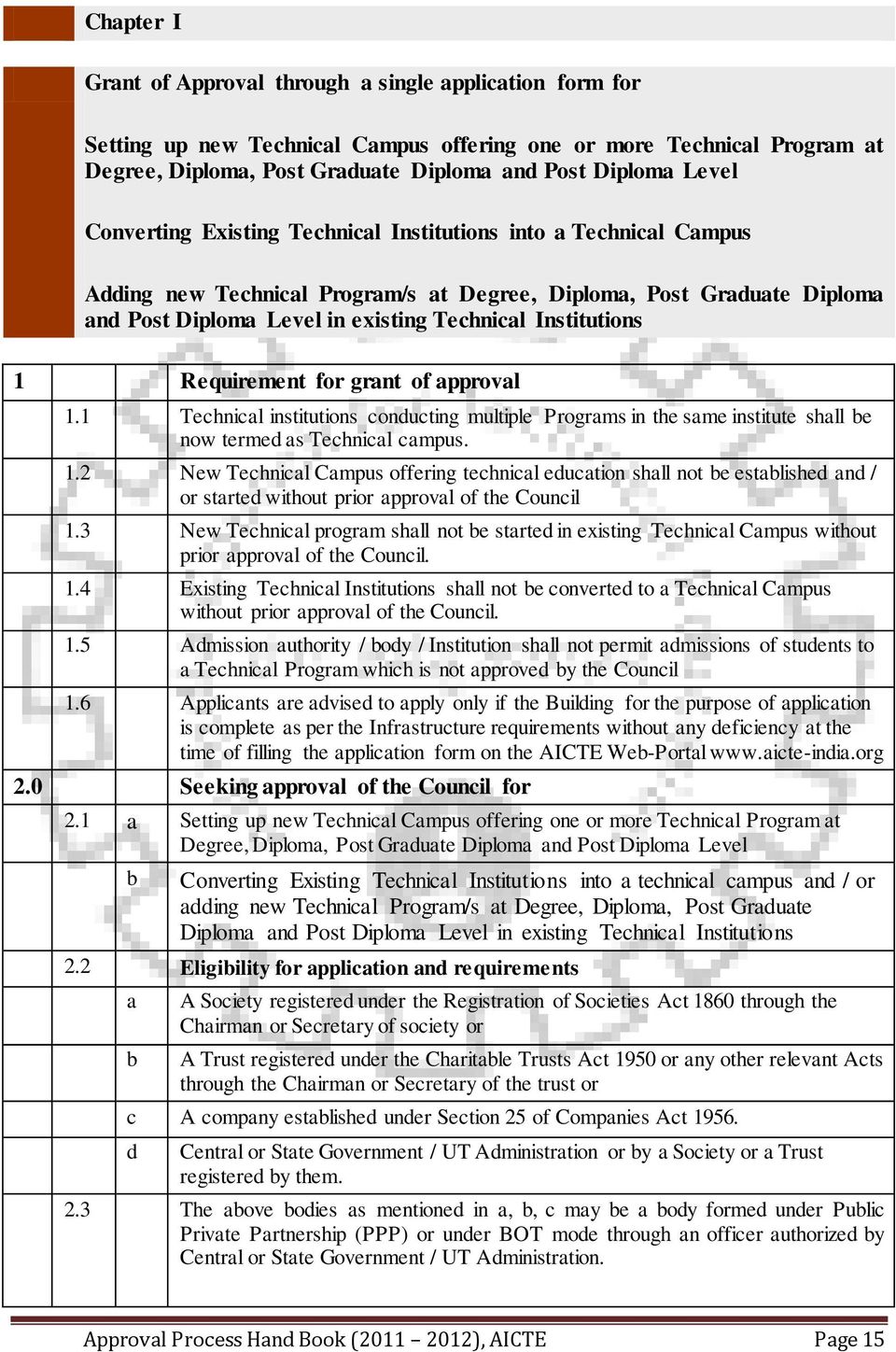
16 Chapter I Grant of Approval through a single application form for Setting up new Technical Campus offering one or more Technical Program at Degree, Diploma, Post Graduate Diploma and Post Diploma Level Converting Existing Technical Institutions into a Technical Campus Adding new Technical Program/s at Degree, Diploma, Post Graduate Diploma and Post Diploma Level in existing Technical Institutions 1 Requirement for grant of approval 1.1 Technical institutions conducting multiple Programs in the same institute shall be now termed as Technical campus. 1.2 New Technical Campus offering technical education shall not be established and / or started without prior approval of the Council 1.3 New Technical program shall not be started in existing Technical Campus without prior approval of the Council. 1.4 Existing Technical Institutions shall not be converted to a Technical Campus without prior approval of the Council. 1.5 Admission authority / body / Institution shall not permit admissions of students to a Technical Program which is not approved by the Council 1.6 Applicants are advised to apply only if the Building for the purpose of application is complete as per the Infrastructure requirements without any deficiency at the time of filling the application form on the AICTE Web-Portal Seeking approval of the Council for 2.1 a Setting up new Technical Campus offering one or more Technical Program at Degree, Diploma, Post Graduate Diploma and Post Diploma Level b Converting Existing Technical Institutions into a technical campus and / or adding new Technical Program/s at Degree, Diploma, Post Graduate Diploma and Post Diploma Level in existing Technical Institutions 2.2 Eligibility for application and requirements a b A Society registered under the Registration of Societies Act 1860 through the Chairman or Secretary of society or A Trust registered under the Charitable Trusts Act 1950 or any other relevant Acts through the Chairman or Secretary of the trust or c A company established under Section 25 of Companies Act d Central or State Government / UT Administration or by a Society or a Trust registered by them. 2.3 The above bodies as mentioned in a, b, c may be a body formed under Public Private Partnership (PPP) or under BOT mode through an officer authorized by Central or State Government / UT Administration. Approval Process Hand Book ( ), AICTE Page 15
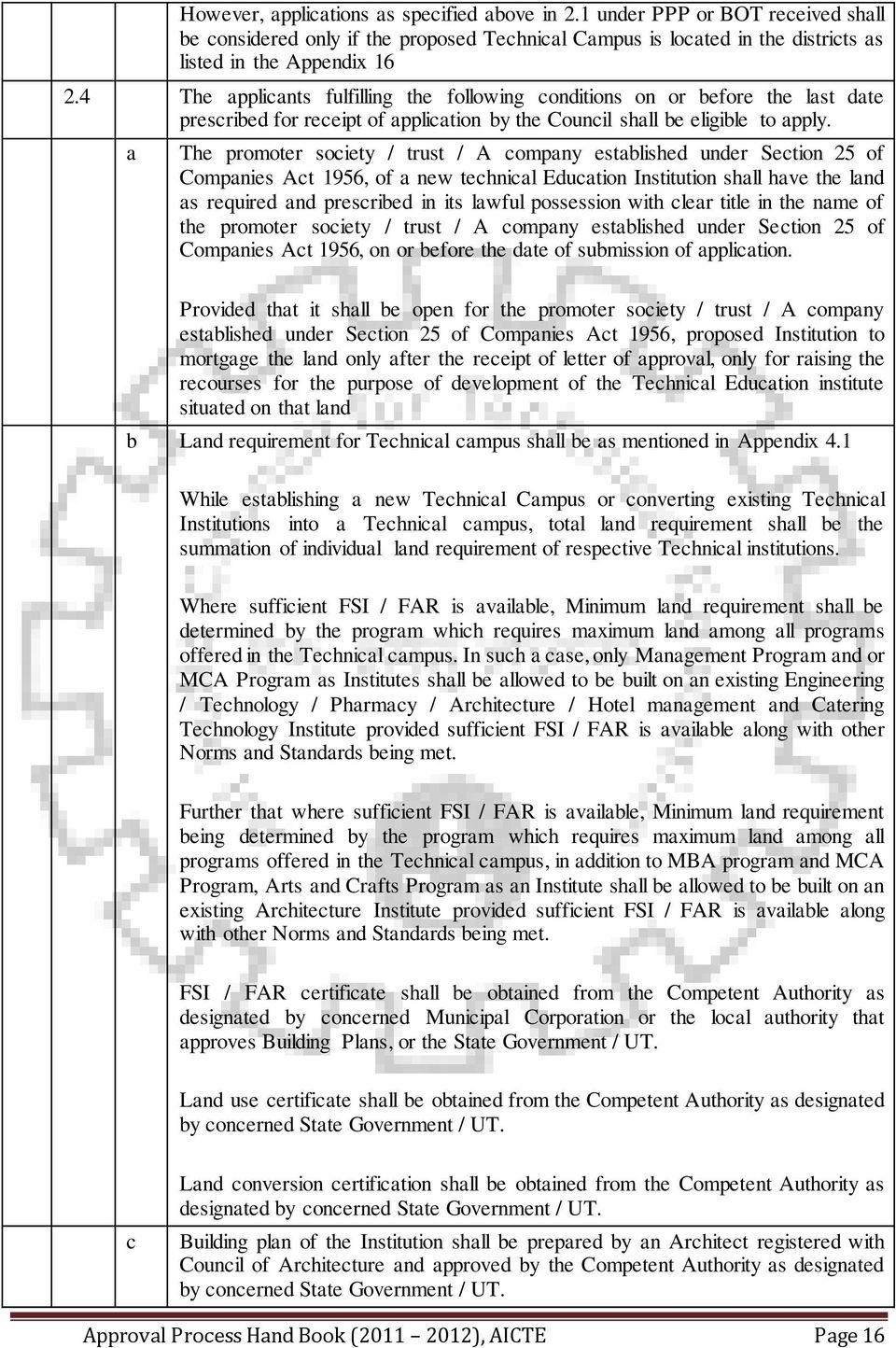
17 However, applications as specified above in 2.1 under PPP or BOT received shall be considered only if the proposed Technical Campus is located in the districts as listed in the Appendix The applicants fulfilling the following conditions on or before the last date prescribed for receipt of application by the Council shall be eligible to apply. a The promoter society / trust / A company established under Section 25 of Companies Act 1956, of a new technical Education Institution shall have the land as required and prescribed in its lawful possession with clear title in the name of the promoter society / trust / A company established under Section 25 of Companies Act 1956, on or before the date of submission of application. Provided that it shall be open for the promoter society / trust / A company established under Section 25 of Companies Act 1956, proposed Institution to mortgage the land only after the receipt of letter of approval, only for raising the recourses for the purpose of development of the Technical Education institute situated on that land b Land requirement for Technical campus shall be as mentioned in Appendix 4.1 While establishing a new Technical Campus or converting existing Technical Institutions into a Technical campus, total land requirement shall be the summation of individual land requirement of respective Technical institutions. Where sufficient FSI / FAR is available, Minimum land requirement shall be determined by the program which requires maximum land among all programs offered in the Technical campus. In such a case, only Management Program and or MCA Program as Institutes shall be allowed to be built on an existing Engineering / Technology / Pharmacy / Architecture / Hotel management and Catering Technology Institute provided sufficient FSI / FAR is available along with other Norms and Standards being met. Further that where sufficient FSI / FAR is available, Minimum land requirement being determined by the program which requires maximum land among all programs offered in the Technical campus, in addition to MBA program and MCA Program, Arts and Crafts Program as an Institute shall be allowed to be built on an existing Architecture Institute provided sufficient FSI / FAR is available along with other Norms and Standards being met. FSI / FAR certificate shall be obtained from the Competent Authority as designated by concerned Municipal Corporation or the local authority that approves Building Plans, or the State Government / UT. Land use certificate shall be obtained from the Competent Authority as designated by concerned State Government / UT. c Land conversion certification shall be obtained from the Competent Authority as designated by concerned State Government / UT. Building plan of the Institution shall be prepared by an Architect registered with Council of Architecture and approved by the Competent Authority as designated by concerned State Government / UT. Approval Process Hand Book ( ), AICTE Page 16
18 d e f Instructional area requirements as stated in Appendix 4 shall be applicable for each School / Faculty. which shall be in the Technical Campus. However, there may be central facilities such as, Central Library with Reading Rooms, Central Computing Centre. Administrative area requirements as stated in Appendix 4 shall be applicable for a Technical Campus. Amenities area requirements as stated in Appendix 4 will be applicable for a Technical Campus Circulation area of 25% of sum of Instructional, Administrative and Amenities area is desired for covering common walkways, staircases, entrance lobby and other similar areas (i) Central Library with Reading Room (ii) See program wise area requirement in Appendix When number of program in the Technical Campus is more than one, minimum area requirement would be 400 sq m. When 1 st shift / single shift intake considering all program-courses is more than 420, minimum area requirement would be 600 sq m. Computer Centre (iii) (iv) (v) See program wise area requirement in Appendix When number of program in the Technical Campus is more than 1, minimum area requirement would be 150 sq m. When 1 st shift / single shift intake considering all program-courses is more than 420, minimum area requirement would be 200 sq m. Administrative area requirements as stated in Appendix 4 will be applicable for Technical Campus. Amenities area requirements as stated in Appendix 4 will be applicable for Technical Campus. Circulation area of 25% of sum of Instructional, Administrative and Amenities area is desired for covering common walk ways, staircases, entrance lobby and other similar area. 2.5 The fund position of the applicant in the form of FDRs and/or Bank accounts in Nationalised Bank or Scheduled Commercial Banks recognised by Reserve Bank of India shall be as under on the date of Scrutiny. Program proposed (Degree, Post Graduate Degree, Diploma and Post Diploma ) a Engineering & Technology 100 b Pharmacy 50 c Hotel Management & Catering Technology d Architecture 50 e Applied Arts & Crafts 50 f MCA 50 g Management 50 Total minimum funds required, Rupees in Lakhs as proof of operational expenses. Approval Process Hand Book ( ), AICTE Page 17 50

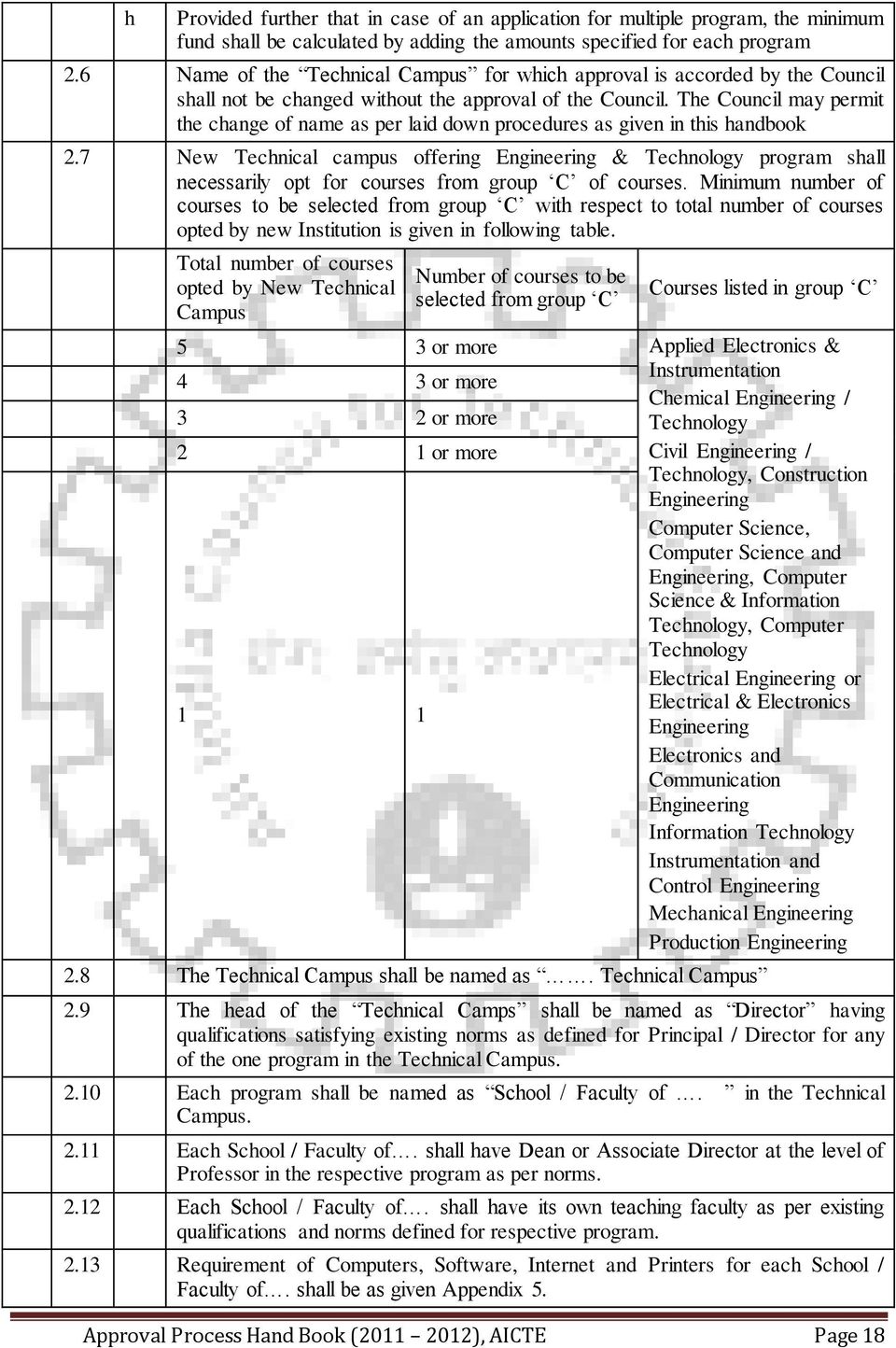
19 h Provided further that in case of an application for multiple program, the minimum fund shall be calculated by adding the amounts specified for each program 2.6 Name of the Technical Campus for which approval is accorded by the Council shall not be changed without the approval of the Council. The Council may permit the change of name as per laid down procedures as given in this handbook 2.7 New Technical campus offering Engineering & Technology program shall necessarily opt for courses from group C of courses. Minimum number of courses to be selected from group C with respect to total number of courses opted by new Institution is given in following table. Total number of courses opted by New Technical Campus Number of courses to be selected from group C Courses listed in group C 5 3 or more Applied Electronics & Instrumentation 4 3 or more Chemical Engineering / 3 2 or more Technology 2 1 or more Civil Engineering / 1 1 Technology, Construction Engineering Computer Science, Computer Science and Engineering, Computer Science & Information Technology, Computer Technology Electrical Engineering or Electrical & Electronics Engineering Electronics and Communication Engineering Information Technology Instrumentation and Control Engineering Mechanical Engineering Production Engineering 2.8 The Technical Campus shall be named as. Technical Campus 2.9 The head of the Technical Camps shall be named as Director having qualifications satisfying existing norms as defined for Principal / Director for any of the one program in the Technical Campus Each program shall be named as School / Faculty of. in the Technical Campus Each School / Faculty of. shall have Dean or Associate Director at the level of Professor in the respective program as per norms Each School / Faculty of. shall have its own teaching faculty as per existing qualifications and norms defined for respective program Requirement of Computers, Software, Internet and Printers for each School / Faculty of. shall be as given Appendix 5. Approval Process Hand Book ( ), AICTE Page 18
20 2.14 Requirement of Laboratory equipments and Experiments for each School / Faculty of. shall be as given in Appendix Requirement of Books, Journals and Library facilities for each School / Faculty of. shall be as given in Appendix Requirement of essential and desired requirements shall be as given in Appendix The Technical campus may have common administrative staff at the main office including Registrar / Chief Administrative Officer, maintenance and security. Technical and other supporting staff shall be appointed at required positions for each program 3 Submission of Application 3.1 a A unique USER ID will be allotted to each new applicant for setting up a new Institution / Technical Campus, for further process on payment of Rs (Five Thousand Only), through the payment gateway on the AICTE Web-Portal Further, if an Existing Institute applying for conversion to a Technical Campus of its existing Programs, or adding a new Program and conversion of the existing along with the new program to a Technical Campus, The Existing Institutions shall use the USER ID s allotted to them previously If any existing Institution has not obtained a USER ID / Password previously or has misplaced / forgotten the same for whatever may be the reason, a unique USER ID shall be allotted to applicants for further process on payment of Rs. 5000/- (Five Thousand Only), through the payment gateway on the AICTE Web- Portal Using this USER ID, the application in the prescribed format shall be uploaded on the AICTE Web-Portal By using this USER ID, the applicant will be able to track the status of the application at various stages of processing the application. The processing fee as stated below shall be paid to the Member Secretary, AICTE, through the AICTE payment gateway on the Portal, failing which, the application shall not be considered. 3.1 b The payment options available are 1. Cheque ICICI Bank Only 2. Corporate Internet banking 3. Pay Order (All banks) If the payment option chosen is 3 (Pay Order), then the Pay order must be drawn payable at the city of deposit of the instrument (ie. outstation instruments are not acceptable). Applications shall be accepted subject to realization of the Pay Order. Approval Process Hand Book ( ), AICTE Page 19
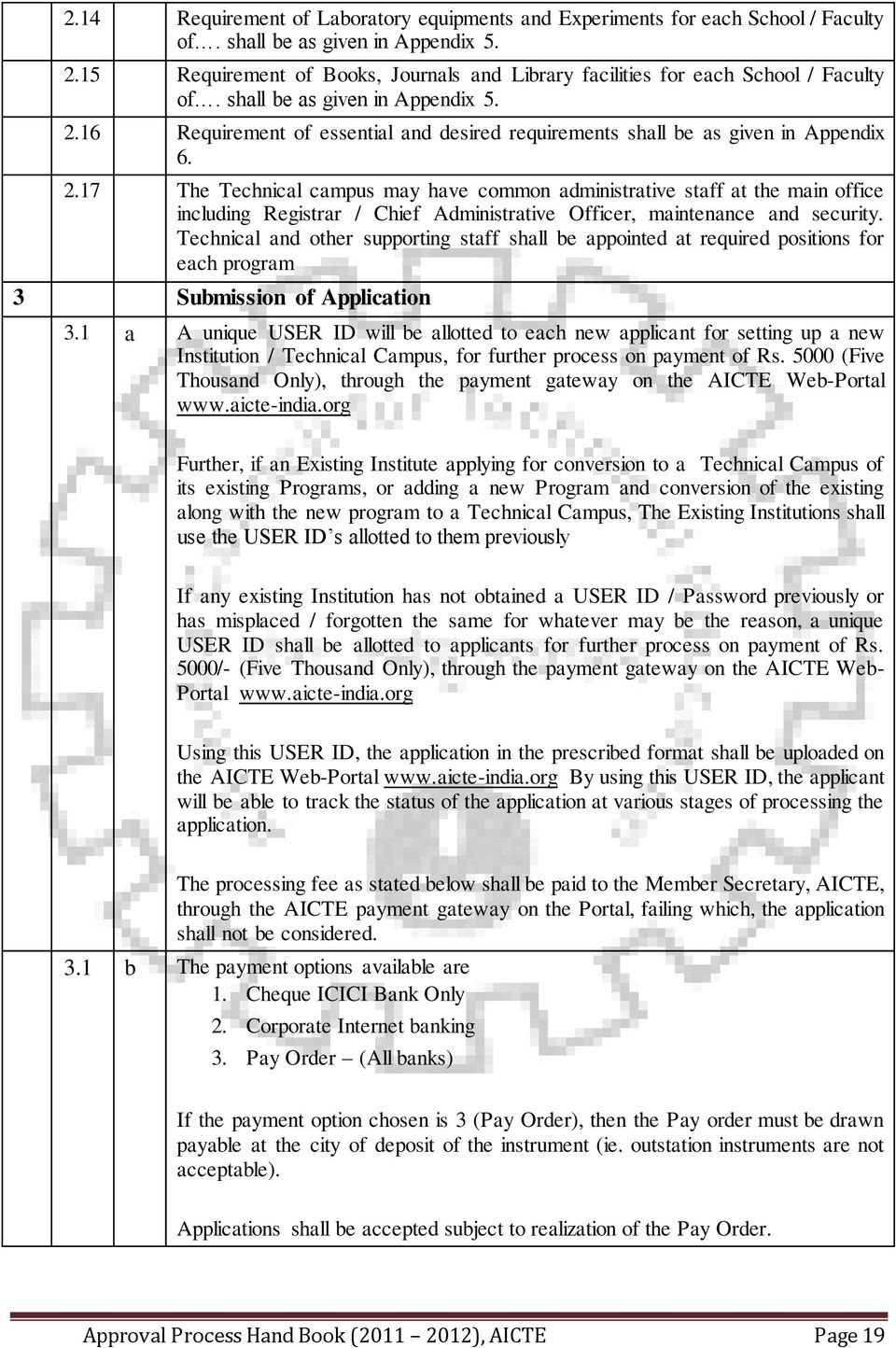
21 3.2 Type of Institution applied for Processing Fees a Minority Institution 5,00,000/- b Institution set up exclusively for women c Institution set up in Hilly Area in North Eastern States 5,00,000/- 5,00,000/- d All other Institutions 7,50,000/- 3.2 Views of State Government and affiliating University 3.3 The State Government / UT and the affiliating University / Board will forward to the concerned Regional Office of the Council, their views on the applications received, with valid reasons or otherwise within a period of 15 days from the date of receipt of applications. 3.4 The views of the State Government / UT and the affiliating University / Board will be taken into account by the Regional Committee while taking the decision whether the application is to be processed further or not. In the absence of receipt of views from the State Government / UT and / or the affiliating University / Board, the Council will proceed for completion of approval process. 4.0 Evaluation of application by Scrutiny Committee 4.1 The applications shall be evaluated by a Scrutiny Committee constituted by the Chairman, Regional Committee by selecting members using automated selection process provided on the AICTE Web-Portal. 4.2 Concerned Regional Officer or an Officer of the Council will assist the committee and place relevant records and documents before the committee and make necessary arrangements for conduct of the meetings, however, he will not be part of the committee 4.3 The Scrutiny Committee will invite all applicants for presentation of their proposals. Applicants are advised to adhere to given Scrutiny schedule and not to remain absent for Scrutiny and/or for reconsideration, as the case may be. If the applicant remains absent for a scrutiny and or for reconsideration, as the case may be, then in no circumstances what so ever, their applications proposal shall be taken up for a scrutiny and or reconsideration in view of constraint of time for the given academic year and such Institutions if they so desire may apply afresh for the next academic session. Such Institutions remaining absent for any reason whatsoever shall not be entitled for any appeal also. 4.4 Based on the recommendations of the Scrutiny Committee, the deficiencies, if any, shall be communicated to the applicant Society / Trust / A company established under Section 25 of Companies Act 1956, through web portal. 4.5 Applicants communicated deficiencies shall be invited once again for reconsideration by the Scrutiny Committee. Such applicants may rectify the deficiencies and may submit compliance by presenting additional documents to the Approval Process Hand Book ( ), AICTE Page 20
22 Regional office of the council, within 7 days from communication of deficiencies Applicants called for reconsideration by the Scrutiny Committee shall present all the documents as mentioned in 4.4 along with additional documents as required for compliance. There shall not be any further reconsideration after presentation for reconsideration before the Scrutiny Committee. 4.6 Only in those cases which are found to be in order in all respects by the Scrutiny Committee, the application will be processed further for issuance of Letter of Approval. The list of such applications will also be posted on the AICTE Web- Portal for information. 4.7 In either case, attested copies of original documents shall be retained by the committee. These shall be scanned & uploaded to the Web-Portal along with the report of the committee. This scanning and uploading will be done by the Regional office of the council 4.8 All applicants recommended for Expert Committee Visit by the Scrutiny Committee, shall be communicated the date of Expert Committee Visit through Web Portal. Other applicants, not recommended by the Scrutiny Committee for Expert Committee Visit shall also be informed by the Council about non-approval of the proposal. 5.0 Evaluation of application by Expert Committee 5.1 An Expert Committee shall visit the proposed premises of the Institution to verify 1. Readiness with respect to Appendix 4, i.e. instructional, administrative and amenities area requirements for Technical Institution 2. Readiness with respect to Appendix 5, i.e. Computer, Software, Internet, Printers, Laboratory Equipments and Books, Journals, Library facilities for Technical Institution 3. Readiness with respect to Appendix 6 i.e. Essential and Desired requirements for Technical Institution 4. Progress related to appointment of Principal / Director and faculty with respect to the norms, standards and conditions prescribed by the Council 5.2 The Expert Committee to verify the Physical and Infrastructural facilities of the applicant Institute, shall be constituted by the Chairman, Regional Committee by selection of members using automated selection process provided on the AICTE Web-Portal 5.3 Concerned Regional Officer or an Officer of the Council will assist the committee and make necessary arrangements for conduct of the Expert Committee Visit, however, will not be part of the committee 5.4 Expert Committee shall have access to the report of the Scrutiny Committee 5.5 Expert Committee shall verify actual availability of equipments, computers, software, internet, printers, book titles, book volumes, National & International Journals and E-Journal. Mere presentation of Purchase Orders / Payment records for subscription etc. without actual availability shall not be considered 5.6 Expert committee shall also verify Video as in Appendix 17, sub clause with respect to actual infrastructure visited Approval Process Hand Book ( ), AICTE Page 21
23 5.7 The applicant will arrange for, Video recording with date and time of the entire proceedings of the Expert Committee visit, which will form part of the Expert Committee report. Internet ready Laptop / desktop, scanner and printer. 5.8 The Expert Committee shall Submit to the RO, 1. Its report in the prescribed Format of the visit. 2. Attested Copies of all documents as at Video recording of Expert Committee visit. 4. Attendance sheet duly signed / digitally authenticated by, the expert Committee members, and representatives of applicant Society/Trust present during the visit 5.9 The scanning and uploading of the documents as at 5.5 and 5.8 will be done by the Regional office of the council. 6.0 Evaluation of application by Regional Committee 6.1 The reports of Scrutiny Committee, Expert Visiting Committee will be made available to the Regional Committee. Regional Committee will consider these reports along with views of concerned State Government / UT and affiliating University / Board, if any, and recommend the application for further processing for issuance of Letter of Approval or otherwise. 6.2 Applicants, whose applications are recommended for further processing for issuance of LOA, shall be informed for submission of a Deposit along with an affidavit Applicants as in Clause 6.2, shall deposit the prescribed amount of Money in AICTE s bank account for an amount as applicable to the category of the Institutions indicated in table 6.3 A, below (Government, Government Aided Institutions and University Departments are exempted). 6.3 A Degree Technical Campus Post Graduate Degree and Post Graduate Diploma Program Minority / Woman / Northern Hilly Area Technical campus Engineering & Technology Others Minority / Woman / Northern Hilly Area Technical campus Rs. In Laks Diploma and Post Diploma Others Minority / Woman / Northern Hilly Area Technical campus Others Pharmacy Architecture / Town Planning Applied Arts & Crafts Approval Process Hand Book ( ), AICTE Page 22
24 Management HMCT MCA The total amount in case of establishment of a Technical Campus shall be calculated by adding the amounts specified for each program applied for. The amount deposited by the Institution shall remain with the Council for at least 10 years which may be extended as per the regulations. The interest accrued on this deposited amount shall be credited to the Council. 6.5 The Principle amount shall be returned to the Society / Trust / A company established under Section 25 of Companies Act 1956, on expiry of the term. However, the term of the deposited amount could be extended for a further period as may be decided on case to case basis and / or forfeited in case of any violation of norms, conditions, and requirements and / or non-performance by the Institution and / or complaints against the Institution. 6.6 Regional Officer concerned, while forwarding the recommendations of the Regional Committee for further process of issuance of LOA or otherwise to AICTE head quarters, for placing before the Executive Committee shall verify that the processes and parameters prescribed under these regulations and approval process hand book are followed by the Scrutiny Committee and the Regional Committee 6.7 The bureau concerned at AICTE head quarters shall also verify that the processes and parameters prescribed under these regulations and approval process hand book are followed by the Scrutiny Committee and the Regional Committee. 7 Grant of approval 7.1 The recommendations of the Regional Committee for further process of issuance of LOA or otherwise shall be placed before the Executive Committee of AICTE. Executive Committee after considering the recommendations of the Regional Committee and on confirmation of deposit of Money, along with the affidavit, shall take a final decision at its meeting on grant of approval or otherwise Further based on the decision of the Executive Committee, Letter of Approval or Letter of Rejection shall be issued by the designated authority of the AICTE. Validity of letter of approval shall be for two academic years from date of issue of letter. 8 Appointment of Principal / Director and teaching staff in newly approved Institution / Program 8.1 New Institutions granted Letter of Approval and the existing Institutions granted approval for introduction of new Program/s, shall comply with appointment of teaching staff and Principal/Director as the case may be, as per policy regarding minimum qualifications pay scale etc, norms prescribed by the Council and other technical supporting staff & administrative staff as per the schedule prescribed in the approval process hand book. Institutions other than minority Institutions shall appoint teaching staff / Principal / Director and other technical supporting staff and administrative staff strictly in accordance with the methods and procedures of the concerned affiliating Approval Process Hand Book ( ), AICTE Page 23
25 University particularly in case of selection procedures and selection committees. The information about these appointments of staff in the prescribed format shall also be uploaded on the Web-Portal of AICTE. In no circumstances unless the appointment of all teaching and other staff is in place, the Institutes shall start the approved Technical Courses. 9 Procedure for submission of appeal and evaluation by the Appellate Committee 9.1 Applicants, whose applications are not recommended for approval by the Executive Committee, may submit an appeal within 7 days from the date of communication about non recommendation of applications. Applicants shall have only one opportunity for appeal. The Appellate Committee shall be constituted by the Chairman, AICTE 9.2 Applicants are advised to adhere to given Appellate Committee schedule and not to remain absent for Appeal. If the applicant remains absent for Appeal, then in no circumstances what so ever, their applications / proposal shall be taken up by the appellate Committee in view of constraint of time for the given academic year and such Institutions if they so desire may apply afresh for the next academic session. Such Institutions remaining absent for any reason whatsoever shall not be entitled for any further appeal. 9.3 An officer of the Council shall place the records before the Appellate Committee. A representative of the Institute shall be invited to place the point of view of the Institute before the Appellate committee for consideration. 9.4 The Appellate Committee at its discretion may recommend an Expert Committee visit for verification of the claims made by the applicant Society / Trust / A company established under Section 25 of Companies Act The report of the Expert Committee shall be placed along with the views of the Advisor Approvals, for consideration by the Council. 9.6 Based on the recommendations of the Appellate Committee, the Council shall take the final decision in the matter. Letter of Approval or rejection letter shall be issued by the Member Secretary, AICTE by the date as mentioned in the schedule. 9.7 The decision of the Council shall be communicated to the applicant in the form of a letter of approval or rejection or in the form of an appropriate communication. In case of rejection of the proposal, it shall be open for the applicant to make a fresh application as stated in Chapter 1 of this handbook 10 Time Schedule for processing of applications AICTE shall notify through a public Notice published in the leading news papers and through uploading on the AICTE Web-Portal regarding cut off dates for various purposes including receipt of applications and processing thereof from time to time. The time schedule mentioned in the Public Notice shall be final and binding. The last date of submission of application form shall mean submission of application on Portal and generation of paying slip not later than the last date as mentioned in the time schedule for this purpose. AICTE shall not however wait for more than 7 days from the last date of the time schedule for realization of the Pay Order. 11 Enclosures to be submitted at various stages in the approval process 11.1 Refer Appendix 17 Approval Process Hand Book ( ), AICTE Page 24
26 Chapter II Grant of Approval through Single Application Form for the following. Extension of approval to existing Technical Institution / Technical Campus Increase / reduction in intake in existing courses Adding course/s in existing program Closure of program / course Mandatory provision of supernumerary seats for TFW Introducing / continuing / discontinuing supernumerary seats for PIO Introducing / continuing / discontinuing seats for sons/daughters of NRIs Change of name of the Institute Conversion of Women s Institution into Co-Ed Institution Introducing a Foreign Collaboration with an AICTE approved Indian Institution 1 Introduction 1.1 Technical Institution / Technical Campus offering technical education shall not continue technical courses or programs beyond the specified period of approval given by the Council. 1.2 Each Institution offering Post Graduate and / or Under Graduate Technical Program at Degree, Diploma, Post Graduate Diploma and Post Diploma Level shall submit an application to the Council, every year, for extension of approval of courses offered by the Institution Provided that, in case/s of accredited course/s, the period of approval for such course/s shall be for the complete period of accreditation unless the period of approval is determined early or curtailed by the Council after issuing appropriate show cause notice in this regard Provided further that approval is granted for the complete period of accreditation, the Institution shall submit application annually for Extension of Approval online at AICTE Web-Portal It may be further noted that though extension of approval is granted, the Council shall monitor for fulfillment of all norms by the Institute and in the event of non fulfillment, the Council shall initiate penal action as per regulations, framed by the Council. 2.0 Submission of application 2.1 The Existing Institutions shall use the USER ID s allotted to them previously. However, if the Institution has not obtained a USER ID / Password previously or has misplaced / forgotten the same for whatever may be the reason, a unique USER ID shall be allotted to applications for further process on payment of Rs. 5000/- (Five Thousand Only), through the payment gateway on the AICTE Web-Portal For the purpose of applying for Grant of Extension of Approval to existing Approval Process Hand Book ( ), AICTE Page 25
27 Technical Institution, the Institution shall submit an application for Extension of Approval on line on the AICTE Web-Portal A print of the complete application as uploaded to the AICTE Web-Portal, printed there on, is to be submitted to the concerned Regional Officer (RO), for upload at Regional Office, along with only those enclosures which were not submitted to RO, against the AICTE notification nos. Advt. No. E-Governance / 08 (01) / 2010 Dated 16/11/10, E-Governance / 08 (02) / 2010 Dated 29/18/10, E-Governance / 08 (03) / 2010 Dated 09/10/10, as at Appendix 18 and the list of documents in Appendix 20 taken together. 2.2 Seek approval of the council for a Extension of approval to existing Technical Institution / Technical Campus b Increase / reduction in intake in existing courses c Adding course/s in existing program d Closure of program / course e Mandatory provision of supernumerary seats for TFW f Introducing / continuing / discontinuing supernumerary seats for PIO g Introducing / continuing / discontinuing seats for sons/daughters of NRIs h Change of name of the Institute i j Conversion of Women s Institution into Co-Ed Institution Introducing a Foreign Collaboration with an AICTE approved Indian Institution 2.3 A unique identification number is allotted to each application for further reference. By using this number the applicant will be able to track the status of the application at various stages of processing the application through the AICTE Web-Portal. The processing fee as stated below, together for all different approvals as applied, shall be paid through the portal in favour of Member Secretary, AICTE, failing which, the application shall not be considered 3.0 Institutions fulfilling norms and standards as mentioned will be entitled to allotment as follows. 3.1 a All Institutions shall be eligible for a maximum of Two Divisions (or two variations within the definition of Division / Program / Shift / level at clause 2.11 of the (Grant of approvals for Technical Institutions, Regulations, 2011). b All Institutions shall be eligible for additional one Division in a Course / Program that is accredited. c No increase shall be given in Program/s running as Division/s in an existing Technical Institute. d No increase shall be given to Institutions where a CBI / CVC / any other investigation agency / Anti Ragging / Punitive action initiated by AICTE for any violation in the norms and standards / enquiries are pending. e Institutions where at least one batch is yet to graduate, shall be eligible for a maximum of one Division / Program / Level (or one variation within the definition of Division at clause 2.11 of the (Grant of approvals for Technical Institutions, Regulations, 2011). f Normally the Order of preference will be the order which is presented in the application form unless the committees in the grant of approval process decide Approval Process Hand Book ( ), AICTE Page 26
28 otherwise. 3.2 Grant of approvals as above except 2 nd shift divisions of all programs are based on self disclosure of required facilities and infrastructure availability as submitted on line on AICTE Web Portal. However an affidavit sworn before First class Judicial Magistrate that the Institute has required facilities and infrastructure as per the provisions of the Approval Process hand Book and in the absence of which the AICTE is liable to invoke the provisions, both civil and / or criminal as per the regulations in place is to be submitted. 3.3 Processing Fees in Rs. Laks for various applications of (Degree, Post Graduate Degree, Post Graduate Diploma, Diploma and Post Diploma Institutions) Type of Institution Extension of approval Extensio n of approval Amount of Late Fee #Increas e in intake / addition al course Introductio n of 2 nd Shift and Conversio n of Women only Institution to Co-Ed Institution Introduct ion or continua tion of PIO seats Introduc tion or continua tion of NRI seats #Reduct ion in intake / Closure of course / program Minority Institution Institution set up in Hilly Area in North Eastern States other than Government / Government aided / Central University / State University Institution set up exclusively for women other than Government / Government aided / Central University / State University All other Institutions except Government / Government aided / Central University / State University Government / Government aided / Central University / State University Nil 2.0 Nil Nil Nil Nil Nil Nil Change of name of Institute 3.4 a Above fees is applicable irrespective of number of divisions / courses applied for Increase / Closure b The payment options available are 1. Cheque ICICI Bank Only 2. Corporate Internet banking 3. Pay Order (All banks) Approval Process Hand Book ( ), AICTE Page 27
29 If the payment option chosen is 3 (Pay Order), then the Pay order must be drawn payable at the city of deposit of the instrument (ie. outstation instruments are not acceptable). Applications shall be accepted subject to realization of the Pay Order. 3.5 Submission of an application for Extension of Approval on Web-Portal on or before the last date as mentioned in the schedule is mandatory 3.6 A print of the complete application as uploaded to the AICTE Web-Portal, printed there on, shall be submitted to Affiliating University / Board and Concerned State Government / UT, along with all enclosures as above, duly attested by a gazetted officer or a first class Judicial Magistrate on or before the date as mentioned in the schedule. Subsequently a stamped receipt from an authorized signatory as proof of submission of these documents is to be collected. 4.0 The approved Technical Institution may expand its activities by adding additional courses / divisions, in the 1 st and / or 2 nd shift in the existing Program for 1. Increasing demand of technically skilled personnel 2. Increase utilization of infrastructure available at the Technical Institutions 3. Facilitate cost effective education to masses through increased utilization of infrastructure available at the Technical Institutions 4. Enabling Faculty to pursue PG Education 5. Enabling students to enroll full time for technical education with staggered timings. 5.0 Application for Introduction of course / division shall be considered in accordance with Intake & Number of Courses / Divisions in the Technical Institution given in Clause 3.1 of Chapter II, of this handbook and on fulfillment of the following requirements 1. Availability of Principal / Director qualified as per AICTE norms in existing Technical Institution % fulfillment in Faculty: Student ratio in existing Technical Institution % fulfillment of built up area and other infrastructure requirement for existing Technical Institution 4. Readiness of built up area and other infrastructure requirement for additional program / course / divisions as applicable 6.0 Separate division in 2 nd year of Engineering / Technology courses for admitting Diploma and B.Sc. Degree holders shall be allowed with following conditions, 1. This division considered as a part of sub clause 3.1 (a) shall be allowed in the courses already available in the Engineering / Technology Institutions. 2. Provision for Foreign Nationals / Persons of Indian Origin (PIO) / Children of Indian Workers in Gulf Countries shall not apply to this division. 3. Lateral entry supernumerary seats for as per (Grant of approvals for Technical Institutions, Regulations, 2011), clause 4.35 shall not apply to Approval Process Hand Book ( ), AICTE Page 28
30 this division. 4. Admission procedure for these seats shall be decided by concerned State Government / UT authorities. 5. Prescribed Faculty: Student ratio shall be applicable to this intake. 7.0 Procedure for Approval of 2 nd Shift Approval for additional Divisions in second shift working shall be considered on with views by State Government / UT and Affiliating University / board and on fulfillment of following conditions % fulfillment of infrastructure requirement for existing Technical Institution 2. Availability of Principal / Director qualified as per AICTE norms in existing Technical Institution % fulfillment in Faculty : Student ratio in existing Technical Institution 4. The total intake of UG & PG program/courses/divisions, in the 2nd shift shall be governed as given in the following table. 7.1 Program 7.2 Engineering / Technology 7.3 Pharmacy, Applied Arts & Craft, HMCT 7.4 Architecture / Town Planning 7.5 MCA, Management 7.6 Engineering / Technology, Pharmacy, Architecture / Town Planning, Applied Arts & Craft, HMCT Minimu m Intake UG 60 (1 Div) Maximum Intake in 2 nd shift ½ the intake of all courses / divisions in the respective program (Single / 1st shift working). If the number is less than size of division, minimum intake shall be restricted to 1 div. UG 60 (1 Div) 2/3 rd intake of all courses / divisions in the UG 60 (1 Div) PG 60 (1 Div) PG 18 (1 Div) respective program (Single / 1st shift working). If the number is less than size of division, minimum intake shall be restricted to 1 div. No. of divisions for PG courses in the 2 nd shift shall be limited to total number of UG divisions at intake level in the single / 1 st shift. In such cases creation of following additional instructional area shall be essential. PG laboratory, 1/course, Research Laboratory, 1/course (see 4.2 of Appendix 4) Approval Process Hand Book ( ), AICTE Page 29
31 8.0 Program Minimu m Intake Maximum Intake in 2 nd shift 8.1 Engineering / Technology, Pharmacy, Applied Arts & Craft, HMCT 8.2 Pharmacy, Applied Arts & Craft, HMCT Dip 60 (1 Div) Dip 60 (1 Div) 1/3 rd the intake of all courses/divisions in the respective Program (Single/ 1st shift working) If the number is less than size of division, minimum intake shall be restricted to 1 div. 8.3 Architecture / Town Planning Dip 60 (1 Div) 9.0 Rules for Allotment Intake in the 2 nd shift shall be strictly in the multiple of intake of division and shall be limited to maximum number as stated above. 2. In 2 nd shift, additional divisions shall be allowed with ceiling of 1 division / course, in the courses which are already available in the Institution. However, with a view to promote PG education, this condition shall not apply to PG courses / divisions in the 2 nd shift nd shift working shall necessarily require exclusive teaching staff as per norms specified in Appendix 7. It shall also have separate technical, administrative and supporting staff at required positions. 4. Additional laboratory equipments needed especially for PG program, shall be procured and made available as per norms. 5. Availability of Dean at the level of Professor in the 2 nd shift to supervise overall functioning of 2 nd shift shall be mandatory. 6. The program in the second shift shall be approved subject to the same being run in the first / general shift Approval Process Hand Book ( ), AICTE Page 30
32 Engineering / Technology Degree (UG and PG) Engineering / Technology Degree - 2 nd Yr Engineering / Technology Diploma and Post Diploma Pharmacy Degree (UG and PG) Pharmacy Diploma and Post Diploma Arch & Town Planning Degree (UG and PG) Arch & Town Planning Diploma and Post Diploma MCA Management Applied Arts & Crafts Degree (UG or PG) Applied Arts & Crafts Diploma and Post Diploma HMCT Degree (UG and PG) HMCT Diploma and Post Diploma 10.0 The Council shall allow programs / courses / divisions in Technical Institutions in the 2 nd shift working as per clause 10.1 subject to fulfillment of conditions as prescribed above. Allowable additional Program / Courses / Divisions in second shift 10.1 Existing Institution Programs (currently running in First / General shift) Engineering / Technology Degree Engineering / Technology Diploma and Post Diploma Pharmacy Degree Pharmacy Diploma and Post Diploma Arch & Town Planning Degree Arch & Town Planning Diploma and Post Diploma MCA Management Applied Arts & Crafts Degree Applied Arts & Crafts Diploma and Post Diploma HMCT Degree HMCT Diploma and Post Diploma 11.0 Tuition Fee Waiver scheme (TFW) 11.1 a Scheme shall be applicable to all approved Technical Institutions offering Bachelor Programs, Diploma and Post Diploma program of Three / Four years duration b Seats up to maximum 5 percent of sanctioned intake per course shall be available for these admissions. These seats shall be supernumerary in nature. c The Competent Authority for admissions shall be the same as for regular admissions. d The scheme shall be mandatory for all Institutions approved by the council. Approval Process Hand Book ( ), AICTE Page 31
33 11.2 Eligibility a Sons and daughters of parents whose annual income is less than Rs lakhs from all sources shall only be eligible for seats under this scheme b The Waiver is limited to the tuition fee as approved by the State Level Fee Committee for self-financing Institutions and by the Government for the Government and Government Aided Institutions. All other Fee except tuition fees will have to be paid by the beneficiary Procedure for Grant of Approval a The Waiver is limited to the tuition fee as approved by the State Level Fee Committee for self-financing Institutions and by the Government for the Government and Government Aided Institutions. All other Fee except tuition fees will have to be paid by the beneficiary b The Competent Authority for admissions shall be the same as for regular admissions and up to five percent of its sanctioned intake per course shall be available for these admissions. These seats shall be supernumerary in nature Admissions Procedure a Under this Scheme, up to five percent of sanctioned intake per course shall be available for these admissions. These seats shall be supernumerary in nature. b The competent authority to effect these admissions is the State Government or its designated Authority. c In the event of non-availability of students in this category the same shall not be given to any other category of applicants. d State Admission authority shall invite applications under this category, make a separate merit list for this category and effect admissions on the basis of the merit list so generated. e The Institutions shall publish in their brochure and web site the details of this scheme. f Competent Authority for admissions shall submit a separate list of the students admitted under this category to the Institute to which they are admitted for compliance. g A letter in this respect shall be issued by the Competent Authority for admissions to each beneficiary student admitted under this scheme and he / she shall not be allowed to change Institution/course under any circumstances h The Institutions shall also display information regarding admitted candidates in their web sites for information to the students and other stakeholders 12 Supernumerary quota for Foreign Nationals / Persons of Indian Origin (PIO) / Children of Indian Workers in Gulf Countries For seeking approval for introduction of Supernumerary quota for Foreign Nationals / Persons of Indian Origin (PIO) / Children of Indian Workers in Gulf Countries, the concerned Institutions shall apply to the council. Approval Process Hand Book ( ), AICTE Page 32
34 12.1 Eligibility Institutions having infrastructural facilities based on AICTE norms and fulfilling following criteria shall be eligible to apply for approval for admitting students in this scheme. The Institutions shall provide suitable hostel / residential accommodation to the Foreign Students / Persons of Indian Origin (PIOs) and Children of Indian workers in Gulf Countries. 1. The teacher student ratio in the respective discipline where Foreign Nationals / Persons of Indian Origin are admitted should not be below 1: The Institution must have a modern library as per norms & standards of AICTE with multimedia facilities. 3. The Institute building should meet built up area norms & standards of AICTE. 4. The Institution and its hostels must have proper approach road, good environment, sufficient water supply and an arrangement for generators in absence of normal supply of electricity. 5. The concerned Institution should not have been put under No Admission or Reduced Intake category by the Council due to poor infrastructural facilities during the past 3 years. 6. The Institution should be functioning at least for a period of 5 years after approval by the Council. 7. The results (success rate) of last two batches of final year students must not be less than 75%, calculated based on number of students appeared in the final examination, vis-à-vis the students passed 12.2 Procedure for Grant of Approval No Institute shall fill in excess of 15 % of intake seats per Course under this scheme. Fifteen percent (15%) Course seats in all the AICTE approved Institutions and University Departments, approved by the Council, offering technical courses leading to Diploma and Post Diploma, Degree and Post-Graduate Degree in Engineering & Technology, Architecture & Town Planning, Pharmacy, Applied Arts, MBA & MCA, Hotel Management & Catering Technology, shall be allowed on supernumerary basis from amongst Foreign Nationals / Persons of Indian Origin (PIOs) / Children of Indian Workers in the Gulf Countries, over and above the approved intake, provided that 1/3 rd of the 15% shall be reserved across different disciplines in the educational Institution, for the Children of Indian Workers in the Gulf Countries. However, any vacant seats out of 1/3 rd category shall be reverted to the quota of 2/3 rd meant for PIO / Foreign Nationals. Provided that this is subject to the availability of adequate Infrastructural facilities in the applicant Institution, to be verified by the Council, based on its Norms and Guidelines. These supernumerary seats shall be exclusively meant for these categories of students in the Diploma and Post Diploma, under-graduate and postgraduate courses with a rider that under no circumstances a seat remains unfilled Approval Process Hand Book ( ), AICTE Page 33
35 shall be allowed to anyone other than a foreign student / PIO. Foreign Nationals / Persons of Indian Origin (PIOs / Children of Indian Workers in the Gulf Countries admitted in AICTE approved Institutions through Indian Council for Cultural Relation (ICCR or as Government of India nominee) shall be included within this ceiling. The Institution shall submit an application for continuation of approval for supernumerary seats as a part of application of extension of approval, every year, giving details of faculty and other facilities in the Institution every year for renewal of the approval for admitting Foreign Students / Persons of Indian Origin (PIO) / Children of Indian Workers in Gulf Countries Fees & Admissions The concerned State Government / UT shall notify the tuition and other fees for candidates to be admitted under Foreign Nations / PIO category. Fees prescribed for NRI quota seats shall not be applicable to these admissions. The children of Indian workers in the Gulf Countries shall be treated at par with resident citizens. Admissions to these seats shall be done on merit basis among applicants of these categories. 13 Admissions for Sons & Daughters of Non Resident Indian(s) 13.1 a For seeking grant of approval for admitting Sons & Daughters of Non Resident Indian(s), Institutes shall apply to the council. b A 5% of seats within sanctioned intake is provided for NRI category Implementation a Competent Authority for admissions shall be the same as for regular admissions b In the event of non-availability of students in NRI category, the seats will be given to general candidates as per general merit. However, general fee shall be applicable to these candidates thus admitted against vacant NRI seats Fee and Admissions a Competent Authority for admissions shall fetch list of Technical Institutions who have sought approval from the council, from AICTE Web-Portal b The Competent Authority for admissions shall display availability of NRI seats, branch wise, in various Institutions, for information of candidates during all stages of admissions so that the students can freely exercise their informed choice. The Institutions may publish in their brochure and web site the number of NRI seats available in course / division c Competent Authority for admissions shall prepare merit list of applicants by inviting applications from eligible NRI students and effect admissions strictly on merit basis d A letter in this respect shall be issued by the Competent Authority for admissions to each beneficiary. Students admitted under this scheme shall not be allowed to change Institution / course under any circumstances e The Institutions shall also display information regarding admitted candidates in their web sites for information to the students and other stakeholders Approval Process Hand Book ( ), AICTE Page 34
36 14.0 Evaluation of application by Scrutiny Committee 14.1 The Applications shall be evaluated by a Scrutiny Committee constituted by the Chairman, Regional Committee by selecting members using automated selection process provided by the AICTE Web-Portal. Concerned Regional Officer or an Officer of the Council will assist the committee and place relevant records and documents before the committee and make necessary arrangements for conduct of the meetings; however, he will not be part of the committee 15.0 Expert committee visit for approval of Supernumerary seats for PIO and 2 nd Shift and Foreign Collaborations / Twinning Programs / Conversion of Women s Institution to Co Ed Institution In case where application is made to introduce supernumerary seats for PIO, and 2 nd Shift and Foreign Collaborations / Twinning Programs / Conversion of Women s Institution to Co Ed Institution an Expert Committee shall visit the Institution to verify the infrastructure and relevant documents as presented in the application form with respect to the norms, standards and conditions prescribed by the Council. The applicant shall be required to make arrangements for video recording of visit and make available internet ready computer, printer and scanner Regional office shall scan and upload copies of documents verified by the committee 16.0 Evaluation of application by Regional Committee 16.1 The reports of Scrutiny Committee, Expert Visiting Committee will be made available to the Regional Committee. Regional Committee will consider these reports along with views of concerned State Government / UT and affiliating University / Board and recommend the application for further processing for issuance of Extension of approval, Letter of Approval or otherwise as the case may be The State Government / UT and the affiliating University / Board will forward to the concerned Regional Office of the Council by the date as mentioned in time schedule, their views with reasons on the applications received for various processes The views of the State Government / UT and the affiliating University / Board will be taken into account by the Regional Committee while taking the decision whether the application is to be processed or not. However in the absence of receipt of views from the State Government / UT and/or the affiliating University / Board by the date as mentioned in the schedule, the Council will proceed for completion of approval Process as per norms and standards Regional Officer concerned, while forwarding the recommendations of the Regional Committee further for further processing to AICTE head quarters, for placing before the Executive Committee shall verify that the processes and parameters prescribed under these regulations and approval process hand book are followed by the Scrutiny Committee and the Regional Committee The bureau concerned at AICTE head quarters shall also verify that the processes and parameters prescribed under these regulations and approval process hand book Approval Process Hand Book ( ), AICTE Page 35
37 are followed by the Scrutiny Committee and the Regional Committee Grant of approval 17.1 The recommendations of the Regional Committee for further processing for issuance of Extension of approval, Letter of Approval or otherwise as the case may be, shall be placed before the Executive Committee of AICTE. Executive Committee after considering the recommendations of the Regional Committee and on confirmation of Deposit of Money / Conversion of FDR to Money deposit for the remaining period as applicable, along with the affidavit, shall take a final decision at its meeting on grant of approval or otherwise 17.2 Further based on the decision of the Executive Committee, Extension of approval, Letter of Approval or otherwise as the case may be, shall be issued by the designated authority of the AICTE The Institutions granted approval for applications received under Chapter II, shall comply with appointment of teaching staff and Principal / Director as the case may be, as per policy regarding minimum qualifications pay scale etc, norms prescribed by the Council and other technical supporting staff & administrative staff as per the schedule prescribed in the approval process hand book Institutions other than minority Institutions shall appoint teaching staff / Principal / Director and other technical supporting staff and administrative staff strictly in accordance with the methods and procedures of the concerned affiliating University particularly in case of selection procedures and selection committees. The information about these appointments of staff in the prescribed format shall also be uploaded on the Web-Portal of AICTE. In no circumstances unless the appointment of all teaching and other staff is in place, the Institutes shall start the approved Technical Courses 18.0 Procedure for submission of appeal and evaluation by the Appellate Committee 18.1 Applicants, whose applications are not recommended for issuance of Extension of approval, Letter of Approval or otherwise as the case may be, by the Executive Committee, may submit an appeal within 7 days from the date of communication about non recommendation of applications,. Applicants shall have only one opportunity for appeal. The Appellate Committee shall be constituted by the Chairman, AICTE 18.2 An officer of the Council shall place the records before the Appellate Committee Based on the recommendations of the Appellate Committee, the Council shall take the final decision in the matter for issuance of Extension of approval, Letter of Approval or otherwise as the case may be and the same shall be issued by the Member Secretary, AICTE by the date as mentioned in the schedule The decision of the Council shall be communicated to the applicant in the form of a letter of approval or rejection or in the form of an appropriate communication. Approval Process Hand Book ( ), AICTE Page 36
38 19.0 Time Schedule for processing of applications 19.1 AICTE shall notify through a public Notice published in the leading news papers and through uploading on the AICTE Web-Portal regarding cut off dates for various purposes including receipt of applications and processing thereof from time to time. The time schedule mentioned in the Public Notice shall be final and binding. The last date of submission of application form shall mean submission of application on Portal and generation of paying slip not later than the last date as mentioned in the time schedule for this purpose. AICTE shall not however wait for more than 7 days from the last date of the time schedule for realization of the Pay Order. 20 Enclosures to be submitted at various stages in the approval process 20.1 Refer Appendix 18 Approval Process Hand Book ( ), AICTE Page 37
39 Chapter III 1.0 Unapproved Institutions 1.1 No Institution shall offer Technical program or course without approval of the Council. Provided further that any Institution offering Technical Program without approval of the Council, shall be termed as unapproved if a It is started without prior approval by the Council b It is working in temporary location / at location not approved by the Council c It is declared as Unapproved by the Council 2.0 The Council shall maintain a list of un approved Institutions based on the information received by the Council and shall also inform the general public about the same from time to time Provided further that any Technical Institution, which has already started without following AICTE approval procedure, wishes to submit an application / proposal shall be considered as new Technical Institution. For such purpose, they shall apply as per the provisions of Chapter I. Its legal date of starting will be from the date of issue of the Letter of Approval. Students, who are admitted prior to approval by the Council, will not have any right for re-admission and will have to fulfill all the requirements for admission as prescribed by the competent admission authority The Institutions conducting courses / Programs in technical education, in temporary location or at location not approved by the Council, shall be liable for action for closure and other appropriate action as per Regulations against defaulting Societies / Trusts / Companies/ associated Individuals as the case may be. 4.0 No course other than those specifically approved by the Council shall run in the same premises sharing the same facilities. 5.0 The Council shall initiate appropriate penal civil and / or criminal action against such defaulting Institutions / Societies / Trusts / Companies / Associated Individuals as the case may be and the following action shall also be taken 5.1 No admission status for approved Program / Courses 5.2 Withdrawal of approval of the Institution Approval Process Hand Book ( ), AICTE Page 38
40 Chapter IV 1.0 Action in case of violation of Regulations 1.1 An Institution running any Program / Course in Technical Education in violation of Regulations, shall be liable to appropriate initiation of Penal Civil action including withdrawal of approval, if any, and / or criminal action by the Council against defaulting Societies / Trusts / Companies / Associated Individuals and / or the Institution, as the case may be. 1.2 Provided that, if any Technical Institution contravenes any of the provisions of concerned regulations, the council after making such inquiry as it may consider appropriate and after giving Technical Institution concerned, an opportunity of being heard, under appropriate regulations, withdraw approval to the concerned Technical Institution / Program / Course. Provide further that in case of such a withdrawal, the operations of the said Technical Institution / Program / Course shall not be started again before completion of two academic years from the date of such a withdrawal. 2.0 Non submission / Incomplete submission of application for extension of approval The Technical Institutions shall submit the application for extension of approval in the prescribed format along with the enclosures to the concerned Regional Office of AICTE each year for extension of approval by the Council, even in cases where the approval to the Program / Course was granted for more than one year. The last date for receipt of such application with or without Late Fee shall be as mentioned in the schedule. Non submission / incomplete submission of application for extension of approval shall invite appropriate penal action against the Institution. The Institution shall be liable to the following punitive action from any one or more of the following by the council. 3.0 Excess admissions 1. Suspension of approval for supernumerary seats 2. No admission status in one / more courses 3. Withdrawal of approval for Program / course 4. Withdrawal of approval of the Institution 3.1 Excess admissions over the sanctioned intake shall not be allowed under any circumstances. In case any excess admission is reported to / noted by the Council, appropriate penal action will be initiated against the Institution. The Institution shall be liable to following punitive action from any one or more of the following by the council. 1. Excess admission fee amounting five times the total fees collected per student shall be levied against each excess admission. 2. Suspension of approval for supernumerary seats. 3. No admission status in one / more courses. 4. Withdrawal of approval for Program / course. 5. Withdrawal of approval of the Institution. Approval Process Hand Book ( ), AICTE Page 39
41 3.2 Amount in respect of Excess admission fee shall be remitted to Member Secretary, AICTE as per instructions issued by the council. 4.0 Non fulfillment of requirement of qualified Principal / Director 4.1 Institutions not having qualified Principal / Director for period, more than 18 months shall be liable to following punitive action by the council. No admission status 5.0 Non fulfillment in Faculty: Student ratio, not adhering to pay scales and/or qualifications prescribed for teaching staff 5.1 Institutions not maintaining prescribed Faculty: Student ratio, not adhering to Pay scales, or qualifications prescribed for teaching staff for more than 18 months, shall be liable to following punitive action by the council from any one or more of the following. 1. Suspension of approval for supernumerary seats, if any. 2. No admission status in respective courses 3. Withdrawal of approval in the respective course 4. Withdrawal of approval of the Institution 6.0 Non fulfillment in Computer, Software, Internet, Printers, Laboratory Equipments, Books, Journals, Library facilities requirements 6.1 Institutions not maintaining prescribed Computer, Software, Internet, Printers, Laboratory Equipments and Books, Journals, Library facilities shall be liable to following punitive action from any one or more of the following by the council. 1. Suspension of approval for supernumerary seats, if any. 2. No admission status in one / more courses 3. Withdrawal of approval for Program / course 4. Withdrawal of approval of the Institution 7.0 Non fulfillment in additional Essential requirements for Technical Institution 7.1 Institutions not maintaining prescribed requirements shall be liable to following punitive action from any one or more of the following by the council. 1. Suspension of approval for supernumerary seats, if any. 2. No admission status in one / more courses 8.0 Non fulfillment in Built up Area 8.1 Institutions not fulfilling prescribed built up area requirements shall be liable to following punitive action from any one or more of the following by the council. 1. Suspension of approval for supernumerary seats, if any. 2. No admission status in one / more courses 3. Withdrawal of approval for Program/course 4. Withdrawal of approval of the Institution Approval Process Hand Book ( ), AICTE Page 40
42 9.0 Refund cases Institutions not following guidelines issued by the Council regarding refund of fees on cancellations of admissions or delaying refunds shall be liable to following punitive action from any one or more of the following by the council. 1 Fine for non compliance of refund of fees levied against each case shall be twice the total fees collected per student. 2 No admission status in one / more courses 3 Withdrawal of approval for Program / Course 4 Suspension of approval for supernumerary seats, if any Amount in respect of Fine for non compliance of refund of fees shall be remitted to Member Secretary, AICTE as per instructions issued by the council. Approval Process Hand Book ( ), AICTE Page 41
43 Chapter V 1.0 Collaboration & Partnerships between Indian and Foreign Universities / Institutions in the field of Technical Education, Research and Training 1.1 Objectives 2.0 Eligibility 1. To facilitate collaboration and partnerships between Indian and Foreign University / Institutions in the field of Technical education, Research and Training 2. To systematize the operation of Foreign Universities / Institutions providing training and other educational services, in India leading to award of Degree, Diploma, Post Graduate Diploma and Post Diploma Level in technical education on their own, under any mode of delivery system such as conventional / formal, non-formal and distance mode. 3. To systematize the operation of Foreign Universities / Institutions providing training and other educational services, in India leading to award of Degree, Diploma, Post Graduate Diploma and Post Diploma in technical education in collaboration with an Indian educational Institution, under any mode of delivery system such as conventional / formal, non-formal and distance mode. 4. To safeguard the interest of students community in India and ensure uniform maintenance of Norms and Standards as prescribed by various Statutory Bodies. 5. To ensure accountability for all such educational activities by Foreign Universities / Institutions in India. 6. To safeguard against entry of non-accredited Universities / Institutions in the Country of origin to impart technical education in India. 7. To safeguard the nation s interest and take punitive measures, whenever necessary, against the erring Institutions, on case-to-case basis. 1. Foreign Universities / Institutions interested in imparting technical education on their own in India leading to award of Diploma and Post Diploma and Degrees including post graduate and doctoral programs. 2. Indian University / Institution which is already in existence and is duly approved by the Council, interested in imparting technical education leading to award of Degree, Diploma, Post Graduate Diploma and Post Diploma including post graduate and doctoral Programs of a Foreign University through collaborative / twining arrangements. 3. Offshore Campus of Indian AICTE approved Institutions offering Indian Degree. 4. Any other educational activity carried out in India, in any manner by the Foreign University / Institutions. Approval Process Hand Book ( ), AICTE Page 42
44 3.0 Conditions for Approval 3.1 No Foreign University / Institution shall establish / operate its educational activity in India leading to award of Degree, Diploma, Post Graduate Diploma and Post Diploma Level and Doctoral level programs without the specific prior permission / approval of the Council. 3.2 Proposal from the Foreign Universities / Institutions shall be considered provided that they themselves establish operation in India or through collaborative arrangements with either an Indian Institution created through Society / Trust / A company established under Section 25 of Companies Act 1956, or the relevant Act in India. Franchising in any form shall not be allowed. 3.3 Accreditation by the authorized agency in parent Country with acceptable grades where grading is available, shall be the pre-requisite condition for any Foreign University / Institution to start its operation for imparting technical education in India. 3.5 The educational Programs to be conducted in India by Foreign Universities/Institutions leading to award of Degree, Diploma, Post Graduate Diploma and Post Diploma Level, shall have the same nomenclature as it exists in their parent Country. There shall not be any distinction in the academic curriculum, mode of delivery, pattern of examination, etc. and such Degree, Diploma, Post Graduate Diploma and Post Diplomas must be fully recognized in their parent Country. 3.6 All such Foreign Universities / Institutions which are registered in India for imparting technical education leading to award of Degree, Diploma, Post Graduate Diploma and Post Diploma shall have recognition at par with equivalent Indian Degrees. 3.7 The proposal from Foreign University seeking equivalence of technical Courses / Programs at Degree, Diploma, Post Graduate Diploma and Post Diploma Level for mutual recognition of qualifications for the purpose of imparting such courses in India under collaborative arrangements or otherwise shall be considered by the Council through its Standing Committee on Equivalence comprising of representatives from UGC, AIU and the Council or such other mechanism as may be decided. In case such equivalence has already been established by AIU or any recognized Government body, the same may be accepted by the Council for the purpose provided the same are not in dispute. 3.8 It shall be the responsibility of the concerned Foreign University / Institution to provide for and ensure that all facilities are available the academic requirements are laid down and announced prior to starting of the Program. 3.9 Any course / Program which jeopardizes the National interest of the Country shall not be allowed to be offered in India It shall be the responsibility of the concerned Foreign University / Institution offering Program in India to get their AICTE approved centres, accredited by NBA soon after two batches have passed out from such centres. The study centres / Institutions of collaborating private educational service providers which impart technical education leading to the award of a Degree, Diploma, Post Graduate Diploma and Post Diploma of a Foreign University shall be considered as a center of the Foreign University / Institution, even though the management may be provided by the Indian educational Institution. Approval Process Hand Book ( ), AICTE Page 43
45 3.11 The Foreign University / Institution shall be bound by the advice of AICTE with regard to admissions, entry qualifications and the conduct of courses / Program in technical education as may be communicated to them from time to time The Council may prescribe any other condition for registration, expedient to do so in the overall interest of the technical education system in the Country 3.13 The Foreign Universities/Institutions already operating in India, without prior approval of the Council in various forms shall have to seek fresh approval from the Council within six months from the date of issuance of this notification or before commencement of ensuing academic session, whichever is earlier and shall be governed by the Regulations and Guidelines of AICTE. 4.0 Foreign University / Institution setting up a campus in India on its own a Eligibility, Procedure for application and the Process of approval b All such proposals shall be dealt with in accordance with provisions contained in Chapter I of the Hand Book. 5.0 Collaborations and Twinning Programs 5.1 The students admitted to the Program should spend at least one semester of the course work of the Program in the Foreign University / Institution in its parent Country 5.2 The students failing to secure VISA should be enrolled in a similar Program being conducted by the Indian partner Institution, affiliated to a formal University recognized by the UGC or Board of Technical Education in the respective States, as applicable. The Intake of such students will be over and above the approved intake of the Program being conducted by the Indian Partner Institution For this purpose the Foreign University / Institution, the Indian partner Institution and the concerned affiliating University or Board of Technical Education in the respective States, shall enter in to a tripartite agreement / MOU for the purpose. The Indian partner Institution shall be affiliated to the University under whose jurisdiction it is located or Board of Technical Education in the respective States in which the Institute is located as applicable. For Courses where University approval is not mandatory, the Foreign University / Institution, the Indian partner Institution shall enter in to a bipartite agreement / MOU for the purpose. For Courses where Board of Technical Education in the respective State, approval is not mandatory, the Foreign University / Institution, the Indian partner Institution shall enter in to a bipartite agreement / MOU for the purpose 5.3 The Degree should be awarded by the Foreign University / Institution only in its parent Country Approval Process Hand Book ( ), AICTE Page 44
46 6.0 Processing Fee: Paid through the AICTE payment gateway available on the Web-Portal The payment options available are 1. Cheque ICICI Bank Only 2. Corporate Internet banking 3. Pay Order (All banks) If the payment option chosen is 3 (Pay Order), then the Pay order must be drawn payable at the city of deposit of the instrument (ie. outstation instruments are not acceptable). Applications shall be accepted subject to realization of the Pay Order. 6.1 Type of Institution Processing Fee in Rs. Laks a Minority Institution 8.00 b Institution set up in Hilly Area in North Eastern States other than Government / Government aided / Central University / State University c Institution set up exclusively for women other than Government / Government aided / Central University / State University d All other Institutions except Government / Government aided / Central University / State University e Government / Government aided / Central University / State University 7.0 Procedure for Approval Applications received under this provision will be processed as per Clause 15, 16, 17, 18, 19, 20 of chapter II 7.2 Additional documents shall be necessary while seeking approval for Foreign collaborations and Twinning Programs Nil No Objection certificate (NOC), from concerned embassy in India with mention of genuineness of educational Institution of the respective country A Tripartite / Bipartite agreement (MOU), as applicable between the Indian AICTE approved Institution, The Collaborating Foreign University / Institution and the Indian affiliating UGC recognized University or Board of Technical Education in the respective State. This is a fall back arrangement to enable the students who fail to get a VISA to travel abroad, to continue and complete their education in a similar program in India. At least one semester of Education in the collaborative program to be conducted in India and the Country in which the Foreign collaborating University / Institution is located. Approval Process Hand Book ( ), AICTE Page 45
47 8.0 Off Shore Indian Campus and award of Indian Degree, Diploma, Post Graduate Diploma and Post Diploma. 8.1 Proposal for Offshore Campus shall be processed in accordance with the process and provisions as contained in Chapter I. Provided that the applicant Institution submits a No Objection Certificate or the specific permission granted by the Foreign Country as well as the No objection certificate granted by the Ministry of foreign affairs, GOI, for the purpose of setting up offshore campus. 8.2 Processing Fees in Rs. Laks for various applications (Degree, Post Graduate Degree, Post Graduate Diploma, Diploma and Post Diploma Institutions) for setting up offshore Campus In addition to the Processing fee and other amounts as payable or to be deposited as per provisions made in Chapter I, the applicant shall deposit additional amount as provided below. Visit Charges shall be paid by the applicant Institution as per demand raised by the Council prior to the visit of the proposed offshore Campus. The applicant institution shall deposit an amount of Rs. 2.0 Cr with the Council for the purpose as provided in clause 6.3 of Chapter I. 9.0 Punitive Measures and Conditions for Withdrawal 9.1 If a Foreign University / Institutions fails to comply with any of the conditions as contained in the above regulations and/or consistently refrains from taking corrective actions contrary to the advice of the Council, the Council may after giving reasonable opportunity to the concerned University / Institution through hearing or after making such inquiry at the Council may consider necessary, withdraw the registration granted to such University/Institution to offer their Degree, Diploma, Post Graduate Diploma and Post Diplomas in India and forbid such Foreign University / Institution to offer their registration granted to such University / Institution to offer their Degrees, Diploma and Post Diploma in India and forbid such Foreign University/Institution to either open Centres or enter into any collaborative arrangement with any University / Institution in India. 9.2 The Council shall also inform the concerned agencies including Ministry of External Affairs, Ministry of Home Affairs, RBI of such decisions and advise these agencies to take any or all of the following measures a Refusal / withdrawal for grant of visa to employees / teachers of the said Foreign University / Institution. b Stop repatriation of funds from India to home Country. c Informing the public about the withdrawal of the Registration of such Foreign University/Institution and the consequence thereof 9.3 In case it comes to the notice of the Council, that a Foreign University is running Diploma and Post Diploma or / and Degree at undergraduate, post-graduate and research level in technical education in India directly or in collaboration with an Indian partner without obtaining certificate of registration, Council shall take immediate steps to action under the Indian Penal Code for Criminal breach of trust, misconduct, fraud and cheating and under other relevant Indian Laws. Approval Process Hand Book ( ), AICTE Page 46
48 9.4 Once the registration of a Foreign University / Institution is withdrawn, the Council shall make attempt in co-ordination with concerned State Government to re-allocate the students enrolled in such Programs to other approved Institutions of the Council. The Foreign University / Institution in such cases, shall have to return the entire fee collected from such students to the Institutions in which such students, are accommodated. Such Foreign Institutions shall not be allowed to open any other Centre / Institution or enter into a collaborative arrangement in India for at least 3 years The Foreign University / Institution shall submit an annual report giving details of the number of students admitted, Programs conducted, total fee collected, amount transferred to parent Country, investment made, number of students awarded Degree, Diploma, Post Diploma and Post graduate Diploma and any such information that the Council may ask for The Council may cause an inspection, whenever necessary, with or without prior notice, to assess the infrastructural and other facilities available and / or to verify the compliance of conditions, norms, standards etc. prescribed by the Council from time to time. Approval Process Hand Book ( ), AICTE Page 47
49 Chapter VI 1.0 Norms & Requirements 1.1 The Duration and Entry Level Qualifications for the Technical Program such as Under Graduate Degree Program, Post Graduate Degree Program, Diploma Programs, Post Diploma Programs and Post Graduate Diploma Programs shall be as provided in the Appendix The list of approved nomenclature of courses at Under Graduate Degree Program, Post Graduate Degree Program, Diploma Programs, Post Diploma Programs and Post Graduate Diploma Programs in Engineering & Technology / Management / Pharmacy / Architecture / Town Planning / Hotel Management & Catering Technology and Applied Arts & Crafts is provided in the Appendix 2. Provided that if any Institution wishes to propose any new Course, prior concurrence, as the case may be, by the Council for the same shall be necessary. For such concurrence, Registrar of such affiliating University / board or Technical Institute, with due endorsement by the Registrar of affiliating University / Board shall submit detailed syllabus content and its nomenclature to the Council. 1.3 The Technical Institutions shall follow Norms for Intake & Number of Courses / Divisions in the Technical Institution at Under Graduate Degree Program, Post Graduate Degree Program, Diploma Programs, Post Diploma Programs and Post Graduate Diploma Programs level as provided in the Appendix The Technical Institutions shall follow Norms for Land and Building Space requirements for Technical Institution as provided in the Appendix The Technical Institutions shall follow Norms for Books, Journals, Library facilities, Computer, Software, Internet, Printers and Laboratory Equipments for Technical Institution as provided in the Appendix The Technical Institutions shall follow Norms for Essential and Desired requirements for Technical Institution as provided in the Appendix The Technical Institutions shall follow Norms for Faculty requirements at under graduate & post graduate level as provided in the Appendix Cadre ratio as given in Appendix 7 shall be ordinarily maintained. 1.9 The Technical Institution shall follow the Norms for Faculty requirements and Qualifications for Technical Institution shall be as provided in the Appendix 7 & Appendix Diploma holders and B.Sc Degree holders shall be eligible for admission to second year Engineering degree courses up to a maximum of 20% of sanctioned intake (30% for Institutions in Andaman, Nicobar, Lakshadweep, Diu and Daman), which will be over and above, supernumerary to the approved intake. Provided that, Students who have completed Diploma course in Architectural Assistantship & Town Planning shall be eligible for admission to second year Architecture degree courses up to a maximum of 20% of sanctioned intake (30% for Institutions in Andaman, Nicobar, Lakshadweep, Diu and Daman), which will be over and above, supernumerary to the approved intake. Approval Process Hand Book ( ), AICTE Page 48
50 Provided further that, students who have completed Diploma course in Pharmacy shall be eligible for admission to second year Pharmacy degree courses up to a maximum of 20% of sanctioned intake, which will be over and above (30% for Institutions in Andaman, Nicobar, Lakshadweep, Diu and Daman), supernumerary to the approved intake. In addition to above vacant seats (S) in a course, S = SI ( SI C F + B), and if S >0, may also be available to Diploma holders and B Sc Degree holders for lateral entry where, S1 = Sanctioned Intake C* = No. of cancellations at the first year level F* = No. of students not eligible for admission to second year as per rules/rules by affiliating University B* = No. of students who belong to earlier batches who have become eligible for admission to second year as per rules / rules by affiliating University *Students admitted against any type of supernumerary seat/s shall not be considered in C, F or B. The concerned State Admission Authority shall decide modalities for these admissions Students who have completed Diploma and Post Diploma course in Architectural Assistantship & Town Planning shall be eligible for admission to the first year Architecture Degree course The concerned State Admission Authority shall decide modalities for these admissions Provided further that Students who have completed Diploma and Post Diploma course in Pharmacy shall be eligible for admission to the first year Pharmacy Degree course. The concerned State Admission Authority shall decide modalities for these admissions Norms for PGDM Programs are as per Appendix Format of the Mandatory disclosure as is mention in Appendix Format for Detailed Project Report for establishment of a new technical institution is at Appendix Prevention and Prohibition of Ragging Appendix Structure of various Committees Appendix Regional Offices of the Council Appendix Abbreviations Appendix List of Districts where no AICTE approved Institution exists Appendix Documents to be submitted for Setting up new Technical Campus etc Appendix Documents to be submitted for Change in intake etc. Appendix 18 Approval Process Hand Book ( ), AICTE Page 49
51 1.23 Composition of Board of Governors Appendix Public Notice - Appendix 20 Approval Process Hand Book ( ), AICTE Page 50
52 Appendix 1 Duration and Entry Level Qualifications for the Technical Programs 1.1 Under Graduate Degree Programs (Full Time) Program Duration Eligibility 1 Engineering & Technology 4 Years Passed 10+2 examination with Physics and Mathematics as compulsory subjects along with one of the Chemistry / Biotechnology / Biology 2 Engineering & Technology Lateral entry to second year Obtained at least 50% marks (45% in case of candidate belonging to reserved category) in the above subjects taken together A Passed Diploma examination from an AICTE approved institution; with at least 50% marks (45% in case of candidates belonging to reserved category) in appropriate branch of Engineering / Technology. B Passed B. Sc Degree from a recognized University as defined by UGC, with at least 50% marks (45% in case of candidates belonging to reserved category) and passed XII standard with mathematics as a subject. C Provided that in case of students belonging to B. Sc. Stream, shall clear the subjects of Engineering Graphics / Engineering Drawing and Engineering Mechanics of the first year engineering program along with the second year subjects. D Provided further that, the students belonging to B. Sc. Stream shall be considered only after filling the supernumerary seats in this category with students belonging to the Diploma stream. E Provided further that students, who have passed Diploma in Engineering & Technology from an AICTE approved institution or B. Sc Degree from a recognized University as defined by UGC, shall also be eligible for admission to the first year Engineering Degree courses subject to vacancies in the first year class in case the vacancies at lateral entry are exhausted. However the admissions shall be based strictly on the eligibility criteria as mentioned in A, B, D, and E above. 3 Pharmacy 4 Years Passed 10+2 examination with Physics and Chemistry as compulsory subjects along with one of the Mathematics / Chemistry / Biotechnology / Biology. Approval Process Hand Book ( ), AICTE Page 51
53 Obtained at least 50% marks (45% in case of candidate belonging to reserved category) in the above subjects taken together 4 Architecture 5 Years Passed 10+2 examination with Physics and Mathematics as compulsory subjects along with one of the Chemistry / Engineering Drawing / Computer Science / Biology Obtained at least 50% (45% in case of candidate belonging to reserved category) marks in the above subjects taken together 5 HMCT 4 Years Should have passed 10+2 examination. 6 Applied Arts & Crafts 7 All Programs other than Engineering and Technology 8 All Programs other than Engineering and Technology Obtained at least 50% (45% in case of candidate belonging to reserved category) at the qualifying Examination 5 Years Should have passed 10+2 examination Lateral entry to second year Entry to First year Obtained at least 50% (45% in case of candidate belonging to reserved category) at the qualifying Examination Passed Diploma examination in a Program from an AICTE approved institution, with at least 50% marks (45% in case of candidates belonging to reserved category) in appropriate Program. Provided further, those students, who have passed Diploma examination in a Program from an AICTE approved institution, shall also be eligible for admission to the first year at an appropriate Program subject to vacancies in the first year class in case the vacancies at lateral entry are exhausted. However the admissions shall be based strictly on the eligibility criteria as mentioned above. 1.1 a The candidates as in 1.1, except 1.1-2, 1.1-7, will, however, be required to qualify at the Entrance Test conducted by the competent Authority Approval Process Hand Book ( ), AICTE Page 52
54 1.2 Post Graduate Degree and Post Graduate Diploma Programs (Full Time) Program Duration Eligibility 1 Management (PGDM, MBA and similar) 2 Management (PGCM) 3 Management (Executive PGDM) 2 Yrs Recognized Bachelor s Degree of minimum 3 Yrs duration More than 1 Yr but less than 2 Yrs Obtained at least 50% (45% in case of candidate belonging to reserved category) at the qualifying Examination Recognized Bachelor s Degree of minimum 3 Yrs duration 15 Months Any recognized Bachelors degree of minimum 3 years duration and a minimum of 5 years relevant managerial / supervisory experience. Obtained at least 50% (45% in case of candidate belonging to reserved category) at the qualifying Examination 4 MCA 3 Yrs Recognized Bachelor s Degree of minimum 3 Yrs duration with Mathematics at 10+2 level. Obtained at least 50% (45% in case of candidate belonging to reserved category) at the qualifying Examination 5 M.E. / M. Tech. 2 Years Bachelors degree or equivalent in the relevant field Obtained at least 50% (45% in case of candidate belonging to reserved category) at the qualifying Examination 6 M. Pharm 2 Years Bachelor in Pharmacy or equivalent degree Obtained at least 50% (45% in case of candidate belonging to reserved category) at the qualifying Examination 7 M. Arch 2 Years Bachelor of Architecture or equivalent degree 8 Hotel Management & Catering Technology 9 Applied Arts & Crafts Obtained at least 50% (45% in case of candidate belonging to reserved category) at the qualifying Examination 2 Years Bachelor of Hotel Management & Catering Technology or equivalent degree Obtained at least 50% (45% in case of candidate belonging to reserved category) at the qualifying Examination 2 Years Bachelor of Fine Arts or equivalent degree Obtained at least 50% (45% in case of candidate belonging to reserved category) at the qualifying Examination 1.2 a The candidates as in 1.2, will, however, be required to qualify at the Entrance Test conducted by the competent Authority Approval Process Hand Book ( ), AICTE Page 53
55 1.3 Diploma Programs (Full Time) Program Duration Eligibility 1 Engineering & Technology 2 Pharmacy 2 Years after XII standard or 3 / 4 Years after X th 3 / 4 Years Passed 10 th std / SSC examination standard where same exists Obtained at least 35% marks at the qualifying examination. Passed 12 th std Obtained at least 50% marks (45% in case of candidate belonging to reserved category) at the qualifying examination or Passed 10 th std / SSC examination Obtained at least 35% marks at the qualifying examination. 3 Architecture 3 / 4 Years Passed 10 th std / SSC examination 4 Hotel Management & Catering Technology 5 Applied Arts & Crafts 3 Years after XII standard or 3 / 4 Years after X th standard where same exists 6 All Programs Lateral entry to 2 nd Obtained at least 35% marks at the qualifying examination. Passed 12 th std Obtained at least 50% marks (45% in case of candidate belonging to reserved category) at the qualifying examination. or Passed 10 th std / SSC examination Obtained at least 35% marks at the qualifying examination. 3 / 4 Years Passed 10 th std / SSC examination year Diploma Obtained at least 35% marks at the qualifying examination. 12 th Science with Vocational / Technical Or X th + (2 years ITI) with appropriate specialisation Students passing 12 th Science with Vocational / Technical subjects or X th + (2 years ITI) with appropriate specialisation in that order shall be eligible for admission to second year Diploma courses of appropriate program, up to a maximum of 20% of sanctioned intake, except Andaman, Nicobar, Lakshadweep, Diu and Daman where it shall be 30%, which will be the supernumerary of the approved intake. Approval Process Hand Book ( ), AICTE Page 54
56 1.4 Post Diploma Programs (Full Time) Program Duration Eligibility 1 Engineering & Technology 1.5 Years / 2 Years 2 Pharmacy 1.5 Years / 2 Years 3 Architecture 1.5 Years / 2 Years 4 Hotel Management & Catering Technology 5 Applied Arts & Crafts 1.5 Years / 2 Years 1.5 Years / 2 Years Passed Diploma examination Obtained at least 50% marks (45% in case of candidate belonging to reserved category) at the qualifying examination. Passed Diploma examination Obtained at least 50% marks (45% in case of candidate belonging to reserved category) at the qualifying examination. Passed Diploma examination Obtained at least 50% marks (45% in case of candidate belonging to reserved category) at the qualifying examination. Passed Diploma examination Obtained at least 50% marks (45% in case of candidate belonging to reserved category) at the qualifying examination. Passed Diploma examination Obtained at least 50% marks (45% in case of candidate belonging to reserved category) at the qualifying examination. Approval Process Hand Book ( ), AICTE Page 55
57 Appendix Approved Nomenclature of Courses 2.1 Approved Nomenclature of Under Graduate (UG) Courses The list covers approved nomenclature for the current academic year. If any Institution / University wish to propose any new course, prior concurrence, by the Council for the same shall be necessary. For such concurrence, Technical Institution, with due endorsement by the Registrar of affiliating University/Board shall submit detailed syllabus content and its nomenclature to the Council. UG_COURSES ADVANCED MANUFACTURING SYSTEMS AERONAUTICAL ENGINEERING AGRICULTURAL ENGINEERING AIRLINE MANAGEMENT APPAREL AND PRODUCTION MANAGEMENT APPLIED ELECTRONICS APPLIED ELECTRONICS AND INSTRUMENTATION ENGINEERING APPLIED ELECTRONICS AND TELECOMMUNICATIONS ENGINEERING ARCHITECHTURE (TOWN PLANNING) ARCHITECTURE ARCHITECTURE (HOUSING) ARCHITECTURE (INTERIOR DESIGN) AUOTOMOBILE ENGINEERING AUOTOMOTIVE TECHNOLOGY AUTOMATION AND ROBOTICS AUTOMATION ENGINEERING AUTOMOBILE ENGINEERING BIOCHEMICAL ENGINEERING BIOMEDICAL ELECTRONICS BIOMEDICAL ENGINEERING BIOMEDICAL INSTRUMENTATION ENGINEERING BIOTECHNOLOGY BIOTECHNOLOGY AND BIOCHEMICAL ENGINEERING BUILDING AND CONSTRUCTION TECHNOLOGY CEMENT AND CERAMIC TECHNOLOGY CERAMIC ENGINEERING AND TECHNOLOGY CHEMCIAL ENGINEERING ROBOTICS CHEMICAL ENGINEERING CHEMICAL TECHNOLOGY Approval Process Hand Book ( ), AICTE Page 56
58 CIVIL ENGINEERING CIVIL TECHNOLOGY COMMUNICATION SYSTEMS COMPUTATIONAL MATHEMATICS COMPUTER AIDED DESIGN COMPUTER AIDED DESIGN AND MANUFACTURE COMPUTER AND COMMUNICATIONS ENGINEERING COMPUTER BASED CONSTRUCTION ENGINEERING COMPUTER ENGINEERING COMPUTER SCIENCE COMPUTER SCIENCE AND ENGINEERING COMPUTER SCIENCE AND INFORMATION TECHNOLOGY COMPUTER SCIENCE AND SYSTEMS ENGINEERING COMPUTER SCIENCE AND TECHNOLOGY COMPUTER SOFTWARE AND HARDWARE ENGINEERING COMPUTER TECHNOLOGY COMPUTING IN COMPUTING COMPUTING IN MULTIMEDIA COMPUTING IN SOFTWARE COMUNICATIONS ENGINEERING CONSTRUCTION ENGINEERING AND MANAGEMENT CONSTRUCTION TECHNOLOGY CONSTRUCTION TECHNOLOGY AND MANAGEMENT CONTROL AND INSTRUMENTATION DIARY TECHNOLOGY DIGITAL COMMUNICATIONS ELECTRICAL AND ELECTRONICS ENGINEERING ELECTRICAL AND INSTRUMENTATION ENGINEERING ELECTRICAL AND POWER ENGINEERING ELECTRICAL ENGINEERING ELECTRICAL INSTRUMENTATION AND CONTROL ENGINEERING ELECTROCHEMICAL ENGINEERING ELECTRONIC SCIENCE AND ENGINEERING ELECTRONICS ELECTRONICS AND COMMUNICATIONS ENGINEERING ELECTRONICS AND COMPUTER ENGINEERING ELECTRONICS AND CONTROL SYSTEMS ELECTRONICS AND ELECTRICAL ENGINEERING ELECTRONICS AND INFORMATION SYSTEMS Approval Process Hand Book ( ), AICTE Page 57
59 ELECTRONICS AND INSTRUMENTATION ENGINEERING ELECTRONICS AND POWER ENGINEERING ELECTRONICS AND TELECOMMUNICATIONS ENGINEERING ELECTRONICS AND TELEMATICS ENGINEERING ELECTRONICS DESIGN AND TECHNOLOGY ELECTRONICS ENGINEERING ELECTRONICS INSTRUMENTATION AND CONTROL ENGINEERING ELECTRONICS TECHNOLOGY ENERGY ENGINEERING ENGINEERING DESIGN ENVIRONMENTAL ENGINEERING ENVIRONMENTAL GEOMATICS ENVIRONMENTAL MANAGEMENT ENVIRONMENTAL SCIENCE AND ENGINEERING ENVIRONMENTAL SCIENCE AND TECHNOLOGY FASHION AND APPAREL DESIGN FASHION AND APPAREL ENGINEERING FASHION TECHNOLOGY FINE ARTS FIRE TECHNOLOGY AND SAFETY FOOD PROCESSING AND PRESERVATION TECHNOLOGY FOOD PROCESSING TECHNOLOGY FOOD TECHNOLOGY FOOTWEAR TECHNOLOGY HABITAT DEVELOPMENT HEALTH SAFETY AND ENVIRONMENT ENGINEERING HIGH VOLTAGE ENGINNERING HOTEL MANAGEMENT HOTEL MANAGEMENT AND CATERING TECHNOLOGY INDUSTRIAL AND PRODUCTION ENGINEERING INDUSTRIAL BIOTECHNOLOGY INDUSTRIAL ENGINEERING INDUSTRIAL ENGINEERING AND MANAGEMENT INDUSTRIAL PRODUCTION ENGINEERING INDUSTRIAL SAFETY ENGINEERING INFORMATICS TECHNOLOGY INFORMATION AND COMMUNICATION TECHNOLOGY INFORMATION SCIENCE AND ENGINEERING INFORMATION SCIENCE AND TECHNOLOGY Approval Process Hand Book ( ), AICTE Page 58
60 INFORMATION TECHNOLOGY INFRASTRUCTURE ENGINEERING INFROMATION ENGINEERING INFROMATION TECHNOLOGY AND ENGINEERING INSDUSTRIAL AND PRODUCTION ENGINEERING INSTRUMENTATION AND CONTROL ENGINEERING INSTRUMENTATION ENGINEERING INSTRUMENTATION TECHNOLOGY INTERIOR DESIGN JUTE AND FIBRE TECHNOLOGY JUTE TECHNOLOGY LEATHER TECHNOLOGY MACHINE DESIGN MAN MADE FIBER TECHNOLOGY MAN-MADE TEXTILE TECHNOLOGY MANUFACTURING ENGINEERING MANUFACTURING ENGINEERING AND TECHNOLOGY MANUFACTURING SCIENCE AND TECHNOLOGY MANUFACTURING TECHNOLOGY MARINE ENGINEERING MARINE TECHNOLOGY MATERIAL SCIENCE AND ENGINEERING MATERIAL SCIENCE AND TECHNOLOGY MECHANICAL AND AUTOMATION ENGINEERING MECHANICAL ENGINEERING MECHANICAL ENGINEERING (SANDWICH) MECHATRONICS MEDICAL ELECTRONICS METALLURGICAL ENGINEERING METALLURGY METALLURGY AND MATERIAL TECHNOLOGY MINING ENGINEERING NANO SCIENCE AND TECHNOLOGY NANO TECHNOLOGY NANO TECHNOLOGY AND ROBOTICS OIL AND PAINT TECHNOLOGY OIL TECHNOLOGY OPTICS AND OPTOELECTRONICS PAINT TECHNOLOGY Approval Process Hand Book ( ), AICTE Page 59
61 PERSONAL INFORMATION SYSTEM PETROCHEMICAL ENGINEERING PETROCHEMICALS AND PETROLEUM REFINERY ENGINEERING PETROLEUM ENGINEERING PETROLEUM TECHNOLOGY PHARMACY PLASTIC AND POLYMER ENGINEERING PLASTICS PLASTICS ENGINEERING PLASTICS TECHNOLOGY POLYMER ENGINEERING POLYMER SCIENCE AND TECHNOLOGY POWER ELECTRONICS POWER ELECTRONICS AND DRIVES POWER ELECTRONICS ENGINEERING POWER ENGINEERING POWER PLANT ENGINEERING POWER SYSTEMS POWER SYSTEMS ENGINEERING PRINTING AND PACKING TECHNOLOGY PRINTING ENGINEERING PRINTING TECHNOLOGY PRODUCTION AND INDUSTRIAL ENGINEERING PRODUCTION DESIGN AND MANUFACTURING PRODUCTION ENGINEERING PRODUCTION ENGINEERING (SANDWICH) PULP TECHNOLOGY QUALITY ASSURANCE RADIO PHYSICS AND ELECTRONICS ENGINEERING RUBBER TECHNOLOGY SILK TECHNOLOGY STRUCTURAL ENGINEERING TELECOMMUNICATION ENGINEERING TEXTILE CHEMISTRY TEXTILE ENGINEERING TEXTILE PLANT ENGINEERING TEXTILE PROCESSING TEXTILE TECHNOLOGY THERMAL ENGINEERING Approval Process Hand Book ( ), AICTE Page 60
62 TOOL ENGINEERING TRANSPORTATION ENGINEERING WATER AND ENVIRONMENTAL TECHNOLOGY WELDING TECHNOLOGY WIRELESS TECHNOLOGY Approval Process Hand Book ( ), AICTE Page 61
63 2.2 Approved Nomenclature of Post Graduate (PG) Courses The list covers approved nomenclature for the current academic year. If any Institution / University wish to propose any new course, prior concurrence, by the Council for the same shall be necessary. For such concurrence, Technical Institution, with due endorsement by the Registrar of affiliating University/Board shall submit detailed syllabus content and its nomenclature to the Council. PG_COURSES (Other than Management) ADVANCED COMPUTER AIDED DESIGN ADVANCED ELECTRONICS ADVANCED ELECTRONICS AND COMMUNICATIONS ENGINEERING ADVANCED MANUFACTURING ADVANCED MANUFACTURING SYSTEMS ADVANCED MATERIALS TECHNOLOGY ADVANCED PRODUCTION SYSTEMS AERODYNAMIC ENGINEERING AERONAUTICAL ENGINEERING AEROSPACE ENGINEERING AGRIBUSINESS MANAGEMENT AIR ARMAMENT APPAREL MANUFACTURING AND TECHNOLOGY APPLIED ELECTRONICS APPLIED ELECTRONICS AND COMMUNICATIONS APPLIED ELECTRONICS AND INSTRUMENTATION ENGINEERING APPLIED INSTRUMENTATION ARCHITECTURE ARCHITECTURE (HOUSING) ARCHITECTURE (LANDSCAPE) AUOTOMOBILE ENGINEERING AUOTOMOTIVE TECHNOLOGY AUTOMATED MANUFACTURING SYSTEMS AUTOMATION AUTOMATION AND CONTROL POWER SYSTEMS AUTOMATION AND ROBOTICS AUTOMATION AND ROBOTICS PRODUCTION AUTOMATION ENGINEERING AUTOMOBILE ENGINEERING AVIONICS ENGINEERING BANKING FINANCE AND ALLIED SERVICES BIOCHEMICAL ENGINEERING AND BIOTECHNOLOGY Approval Process Hand Book ( ), AICTE Page 62
64 BIOINFORMATICS BIOMEDICAL ENGINEERING BIOMEDICAL INSTRUMENTATION BIOMEDICAL SIGNAL PROCESSING AND INSTRUMENTATION BIOMETRICS AND CYBER SECURITY BIOPHARMACEUTICS BIOTECHNOLOGY BIOTECHNOLOGY MANAGEMENT BULK DRUG TECHNOLOGY BUSINESS ADMINISTRATION BUSINESS MANAGEMENT BUSINESS STUDIES CERAMIC ENGINEERING AND TECHNOLOGY CHEMICAL ENGINEERING CHEMICAL PROCESSING IN TEXTILES CHEMICAL REACTION ENGINEERING CHEMICAL TECHNOLOGY CIVIL ENGINEERING CIVIL TECHNOLOGY CLINICAL AND HOSPITAL PHARMACY CLINICAL PHARMACY COMMUNICATION AND CONTROL ENGINEERING COMMUNICATION AND INFORMATION SYSTEMS COMMUNICATION ENGINEERING AND SIGNAL PROCESSING COMMUNICATION STRUCTURAL ENGINEERING COMMUNICATION SYSTEMS COMMUNICATION TECHNOLOGY AND MANAGEMENT COMMUNICATIONS AND SIGNAL PROCESSING COMMUNICATIONS ENGINEERING COMPUTER AIDED ANALYSIS AND DESIGN COMPUTER AIDED DESIGN COMPUTER AIDED DESIGN AND MANUFACTURE COMPUTER AIDED DESIGN MANUFACTURE AND AUTOMATION COMPUTER AIDED MACHINE DESIGN AND ANALYSIS COMPUTER AIDED PROCESS DESIGN COMPUTER AIDED PROCESSING COMPUTER AIDED STRUCTURAL ANALYSIS AND DESIGN COMPUTER AIDED STRUCTURAL DESIGN COMPUTER AIDED STRUCTURAL ENGINEERING Approval Process Hand Book ( ), AICTE Page 63
65 COMPUTER AND COMMUNICATIONS ENGINEERING COMPUTER AND INFORMATION SCIENCE COMPUTER AND INTEGRATED MANUFACTURING COMPUTER APPLICATIONS COMPUTER APPLICATIONS IN INDUSTRIAL DRIVES COMPUTER COGNITION AND TECHNOLOGY COMPUTER ENGINEERING COMPUTER INTEGRATED MANUFACTURING COMPUTER INTEGRATED MANUFACTURING COMPUTER METHODS AND APPLIED INSTRUMENTATION COMPUTER NETWORKING AND ENGINEERING COMPUTER NETWORKS COMPUTER NETWORKS AND INFORMATION SECURITY COMPUTER SCIENCE COMPUTER SCIENCE AND ENGINEERING COMPUTER SCIENCE AND TECHNOLOGY COMPUTER SYSTEMS AND TECHNOLOGY COMPUTER TECHNOLOGY COMPUTER TECHNOLOGY AND APPLICATIONS COMPUTERISED DESIGN OF STRUCTURES CONSTRUCTION AND PROJECT MANAGEMENT CONSTRUCTION ENGINEERING CONSTRUCTION ENGINEERING AND MANAGEMENT CONSTRUCTION MANAGEMENT CONSTRUCTION PROJECT MANAGEMENT CONSTRUCTION TECHNOLOGY CONSTRUCTION TECHNOLOGY AND MANAGEMENT CONTROL AND INSTRUMENTATION CONTROL ENGINEERING CONTROL SYSTEMS CONTROL SYSTEMS ENGINEERING CRYOGENIC ENGINEERING CYBER SECURITY DESIGN AND PRODUCTION DESIGN AND PRODUCTION ENGINEERING DESIGN AND THERMAL ENGINEERING DESIGN ENGINEERING DESIGN FOR MANUFACTURING DESIGN OF MECHANICAL EQUIPMENT Approval Process Hand Book ( ), AICTE Page 64
66 DIGITAL COMMUNICATIONS DIGITAL COMMUNICATIONS AND NETWORKING DIGITAL COMMUNICATIONS ENGINEERING DIGITAL ELECTRONICS DIGITAL ELECTRONICS AND ADVANCED COMMUNICATION DIGITAL ELECTRONICS AND COMMUNICATION SYSTEMS DIGITAL ELECTRONICS AND COMMUNICATIONS ENGINEERING DIGITAL ELECTRONICS AND COMPUTER SYSTEMS DIGITAL ELECTRONICS AND ENGINEERING DIGITAL ENGINEERING DIGITAL IMAGE PROCESSING DIGITAL INSTRUMENTATION DIGITAL SIGNAL PROCESSING DIGITAL SYSTEMS DIGITAL SYSTEMS AND COMMUNICATIONS ENGINEERING DIGITAL SYSTEMS AND COMPUTER ELECTRONICS DIGITAL TECHNIQUES AND INSTRUMENTATION ENGINEERING DISTRIBUTED AND MOBILE COMPUTING DISTRIBUTED SYSTEMS DRUG REGULATORY AFFAIRS EARTHQUAKE ENGINEERING ELECTRICAL AND ELECTRONICS ENGINEERING ELECTRICAL DEVICES AND POWER SYSTEMS ELECTRICAL DRIVES AND CONTROL ELECTRICAL ENERGY SYSTEMS ELECTRICAL ENGINEERING ELECTRICAL MACHINES ELECTRICAL MACHINES AND DRIVES ELECTRICAL POWER ENGINEERING ELECTRICAL POWER SYSTEMS ELECTROCHEMICAL ENGINEERING ELECTRONIC CIRCUITS AND SYSTEM DESIGN ELECTRONICS ELECTRONICS AND COMMUNICATIONS ENGINEERING ELECTRONICS AND INSTRUMENTATION ENGINEERING ELECTRONICS AND TELECOMMUNICATION NETWORKS ELECTRONICS AND TELECOMMUNICATIONS ENGINEERING ELECTRONICS DESIGN AND TECHNOLOGY ELECTRONICS DESIGN TECHNOLOGY Approval Process Hand Book ( ), AICTE Page 65
67 ELECTRONICS ENGINEERING ELECTRONICS PRODUCT DESIGN ELECTRONICS SYSTEMS AND COMMUNICATION ELECTRONICS TECHNOLOGY EMBEDDED AND REAL TIME SYSTEMS EMBEDDED SYSTEMS EMBEDDED SYSTEMS TECHNOLOGY ENERGY ENGINEERING ENERGY ENGINEERING AND MANAGEMENT ENERGY MANAGEMENT ENERGY SCIENCE AND TECHNOLOGY ENERGY SYSTEMS ENERGY SYSTEMS AND MANAGEMENT ENERGY SYSTEMS ENGINEERING ENERGY TECHNOLOGY ENGINEERING DESIGN ENGINEERING EDUCATION ENTERPRENEURSHIP ENVIRONMENT PLANNING ENVIRONMENTAL AND WATER RESOURCE ENGINEERING ENVIRONMENTAL ENGINEERING ENVIRONMENTAL GEOMATICS ENVIRONMENTAL MANAGEMENT ENVIRONMENTAL PLANNING ENVIRONMENTAL SCIENCE AND ENGINEERING ENVIRONMENTAL SCIENCE AND TECHNOLOGY ENVIRONMENTAL TECHNOLOGY E-SECURITY FARM MACHINERY FLUID AND HYDRAULICS ENGINEERING FOOD PROCESSING TECHNOLOGY FOOD TECHNOLOGY FUEL AND COMBUSTION GAS TURBINE TECHNOLOGY GEOINFORMATICS GEOINFORMATICS AND SURVEYING TECHNOLOGY GEOTECHNICAL AND GEOENVIRONMENTAL ENERGY GEOTECHNICAL ENGINEERING GEOTECHNOLOGY Approval Process Hand Book ( ), AICTE Page 66
68 GLOBAL MANAGEMENT GUIDANCE AND NAVIGATION CONTROL HEALTH SCIENCE AND WATER ENGINEERING HEAT POWER AND THERMAL ENGINEERING HEAT POWER ENGINEERING HIGH ENERGY MATERIALS HIGH VOLTAGE AND POWER SYSTEMS ENGINEERING HIGH VOLTAGE ENGINEERING HIGHWAY ENGINEERING HIGHWAY TECHNOLOGY HILL AREA DEVELOPMENT ENGINEERING HOSPITAL AND CLINICAL PHARMACY HOSPITAL AND HEALTH SYSTEM MANAGEMENT HOTEL MANAGEMENT HOTEL MANAGEMENT AND CATERING TECHNOLOGY HUMAN RESOURCE MANAGEMENT HYDRAULICS AND IRRIGATION ENGINEERING HYDRAULICS AND WATER RESOURCES HYDRAULICS ENGINEERING ILLUMINATION ENGINEERING ILLUMINATION TECHNOLOGY IMAGE PROCESSING INDUSTRIAL AUTOMATION AND ROBOTICS INDUSTRIAL DESIGN INDUSTRIAL DRIVES AND CONTROL INDUSTRIAL ELECTRICAL SYSTEMS INDUSTRIAL ELECTRONICS INDUSTRIAL ENGINEERING INDUSTRIAL ENGINEERING AND MANAGEMENT INDUSTRIAL INSTRUMENTATION AND CONTROL INDUSTRIAL METALLURGY INDUSTRIAL PHARMACOGNOSY INDUSTRIAL PHARMACY INDUSTRIAL REFRIGERATION AND CRYOGENICS INDUSTRIAL SAFETY INDUSTRIAL STRUCTURES INDUSTRIAL SYSTEMS ENGINEERING INFORMATION AND COMMUNICATION NETWORKS EGINEERING INFORMATION SCIENCE AND ENGINEERING Approval Process Hand Book ( ), AICTE Page 67
69 INFORMATION SECURITY INFORMATION TECHNOLOGY INFRASTRUCTURE ENGINEERING INFRASTRUCTURE ENGINEERING AND MANAGEMENT INFRASTRUCTURE ENGINEERING AND TECHNOLOGY INFRASTRUCTURE PLANNING INFROMATION SECURITY MANAGEMENT INNOVATIVE PRODUCT DESIGN INSTRUMENTATION AND CONTROL INSTRUMENTATION AND CONTROL ENGINEERING INSTRUMENTATION AND CONTROL SYSTEMS INSTRUMENTATION ENGINEERING INSTRUMENTATION TECHNOLOGY INTEGRATED POWER SYSTEMS INTERNAL COMBUSTION AND AUTOMOBILES INTERNAL COMBUSTION ENGINES IRRIGATION ENGINEERING LASER AND ELECTRO-OPTICS LEAN MANUFACTURING ENGINEERING LEATHER TECHNOLOGY MACHINE DESIGN MACHINE DESIGN AND ANALYSIS MACHINE DESIGN AND ROBOTICS MACHINE ENGINEERING MAINTENANCE ENGINEERING MANUFACTURING AND AUTOMATION MANUFACTURING AND AUTOMATION TECHNOLOGY MANUFACTURING ENGINEERING MANUFACTURING ENGINEERING AND TECHNOLOGY MANUFACTURING PROCESS MANUFACTURING SCIENCE AND AUTOMATION MANUFACTURING SCIENCE AND ENGINEERING MANUFACTURING SYSTEMS AND MANAGEMENT MANUFACTURING SYSTEMS ENGINEERING MANUFACTURING TECHNOLOGY MARINE ENGINEERING MASTERS IN COMPUTER APPLICATIONS MATERIAL ENGINEERING MATERIAL SCIENCE AND TECHNOLOGY Approval Process Hand Book ( ), AICTE Page 68
70 MECHANICAL ENGINEERING MECHANICAL PROCESSING IN TEXTILES MECHATRONICS MEDICAL ELECTRONICS MEDICAL PHARMACEUTICAL CHEMISTRY METALLIFEROUS MINING MICRO ELECTRONICS MICRO ELECTRONICS AND CONTROL SYSTEMS MICRO ELECTRONICS AND VLSI DESIGN MICRO ELECTRONICS ENGINEERING MICROWAVE AND COMMUNICATION ENGINEERING MICROWAVE AND MILLIMETER ENGINEERING MICROWAVE AND RADAR ENGINEERING MICROWAVE AND TELEVISION ENGINEERING MICROWAVE ENGINEERING MOBILE COMMUNICATION AND NETWORK TECHNOLOGY MOBILE PERVASIVE COMPUTING MODELING AND SIMULATION MODERN COMMUNICATION ENGINEERING MULTIMEDIA AND SOFTWARE SYSTEMS NANO SCIENCE AND TECHNOLOGY NANO TECHNOLOGY NETWORK ENGINEERING NETWORK INFRASTRUCTURE MANAGEMENT NETWORKING NETWORKING AND INTENET ENGINEERING NETWORKING AND INTERNET ENGINEERING NEURAL NETWORKS NEW MATERIAL PROCESS AND TECHNOLOGY NUCLEAR ENGINEERING OIL TECHNOLOGY OPERATION RESEARCH IN INDUSTRY AND BUSINESS OPTICAL COMMUNICATIONS OPTICS AND OPTOELECTRONICS OPTOELECTRONICS AND OPTICAL COMMUNICATION ENGINEERING PARALLEL DISTRIBUTED SYSTEMS PERSONNEL MANAGEMENT AND HUMAN RESOURCE DEVELOPMENT PERVASIVE COMPUTING PETROCHEMICAL ENGINEERING Approval Process Hand Book ( ), AICTE Page 69
71 PETROCHEMICALS AND PETROLEUM REFINERY ENGINEERING PETROLEUM ENGINEERING PHAMACOGNOSY PHARMA TECHNOLOGY PHARMACEUTICAL ANALYSIS PHARMACEUTICAL ANALYSIS AND QUALITY ASSURANCE PHARMACEUTICAL ANALYSIS AND QUALITY CONTROL PHARMACEUTICAL AND FINE CHEMICAL TECHNOLOGY PHARMACEUTICAL BIOCHEMISTRY PHARMACEUTICAL BIOTECHNOLOGY PHARMACEUTICAL CHEMISTRY PHARMACEUTICAL MANAGEMENT AND REGULATORY AFFAIRS PHARMACEUTICAL MARKETING PHARMACEUTICAL SCIENCE PHARMACEUTICAL TECHNOLOGY PHARMACEUTICS PHARMACEUTICS PHARMACEUTICS (DRUG REGULATORY AFFIAIRS) PHARMACEUTICS AND FINE CHEMICALS PHARMACEUTICS CHEMISTRY PHARMACOGNOSY PHARMACOGNOSY AND PHYTOCHEMISTRY PHARMACOLOGY PHARMACOLOGY AND TOXICOLOGY PHARMACY PHARMACY (QUALITY ASSURANCE) PHARMACY MANAGEMENT PHARMACY PRACTICE PHARMCEUTICAL CHEMISTRY PHYSICAL METALLURGY PHYTO CHEMISTRY AND PHYTO MEDICINE PLANNING PLANT DESIGN PLASTICS ENGINEERING PLASTICS TECHNOLOGY POLYMER ENGINEERING POLYMER NANOTECHNOLOGY POLYMER SCIENCE AND ENGINEERING POLYMER SCIENCE AND TECHNOLOGY Approval Process Hand Book ( ), AICTE Page 70
72 POLYMER TECHNOLOGY POST GRADUTE IN DEVELOPMENT STUDIES POWER AND INDUSTRIAL DRIVES POWER ELECTRONICS POWER ELECTRONICS AND DRIVES POWER ELECTRONICS AND DRIVES IN ELECTRICAL ENGINEERING POWER ELECTRONICS AND ELECTRICAL DRIVES POWER ELECTRONICS AND POWER SYSTEMS POWER ELECTRONICS AND SYSTEM CONTROL ENGINEERING POWER ELECTRONICS AND SYSTEMS POWER ELECTRONICS ENGINEERING POWER ENGINEERING POWER ENGINEERING AND ENERGY SYSTEMS POWER SYSTEM AND CONTROL POWER SYSTEMS POWER SYSTEMS AND AUTOMATION ENGINEERING POWER SYSTEMS AND DRIVES POWER SYSTEMS AND POWER ELECTRONICS POWER SYSTEMS ENGINEERING PRDOUCT DESIGN MANUFACTURING PRDUCTION ENGINEERING PRE STRESSED CONCRETE PRINTING AND MEDIA ENGINEERING PRINTING TECHNOLOGY PROCESS AND FOOD ENGINEERING PROCESS AND SYSTEMS PROCESS CONTROL PROCESS CONTROL INSTRUMENTATION PROCESS DYMANICS AND CONTROL PROCESS INSTRUMENTATION PROCESS METALLURGY PRODUCT DATA MANAGEMENT PRODUCT DESIGN PRODUCT DESIGN AND COMMERCE PRODUCT DESIGN AND DEVELOPMENT PRODUCT DESIGN AND MANUFACTURING PRODUCTION AND INDUSTRIAL ENGINEERING PRODUCTION DESIGN PRODUCTION DESIGN AND MANUFACTURING Approval Process Hand Book ( ), AICTE Page 71
73 PRODUCTION ENGINEERING PRODUCTION ENGINEERING AND ENGINEERING DESIGN PRODUCTION ENGINEERING AND SYSTEMS TECHNOLOGY PRODUCTION MANAGEMENT PRODUCTION SYSTEMS PRODUCTION TECHNOLOGY AND MANAGEMENT PROPULSION ENGINEERING QUALITY ASSURANCE QUALITY ASSURANCE AND PHARMACEUTICS REGULATION QUALITY ASSURANCE TECHNIQUES QUALITY ENGINEERING AND MANAGEMENT RADIO FREQUENCY AND MICROWAVE ENGINEERING RADIO PHYSICS AND ELECTRONICS ENGINEERING REAL TIME SYSTEMS REMOTE SENSING RENEWABLE ENERGY ENGINEERING RETAIL MANAGEMENT ROBOTICS AND AUTOMATION ROBOTICS AND MECHATRONICS ROCKET PROPULSION SCIENTIFIC COMPUTING SEISMIC DESIGN AND EARTHQUAKE ENGINEERING SERVICES MANAGEMENT SETTLEMENT CONSERVATION SIGNAL PROCESSING SIGNAL PROCESSING AND COMMUNICATION ENGINEERING SOFTWARE ENGINEERING SOFTWARE SYSTEMS SOIL AND WATER ENGINEERING SOIL MECHANICS SOIL MECHANICS AND FOUNDATION ENGINEERING SOIL MECHANICS ENGINEERING STEEL TECHNOLOGY STRUCTURAL AND FOUNDATION ENGINEERING STRUCTURAL DESIGN STRUCTURAL ENGINEERING STRUCTURAL ENGINEERING AND CONSTRUCTION MANAGEMENT STRUCTURAL ENGINEERING NAD CONSTRUCTION SYSTEM SOFTWARE Approval Process Hand Book ( ), AICTE Page 72
74 SYSTEMS AND SIGNAL PROCESSING TECHNOLOGY MANAGEMENT TELECOMMUNICATION ENGINEERING TELEMATICS TEXTILE CHEMISTRY TEXTILE ENGINEERING TEXTILE TECHNOLOGY THEORY AND DESIGN THERMAL AND FLUID ENGINEERING THERMAL ENGINEERING THERMAL POWER ENGINEERING THERMAL SCIENCE THERMAL SCIENCE ENGINEERING THERMAL SYSTEMS AND DESIGN TOOL DESIGN TOOL ENGINEERING TOWN AND COUNTRY PLANNING TRAFFIC AND TRANSPORTATION ENGINEERING TRANSPORTATION ENGINEERING TRANSPORTATION SYSTEM ENGINEERING TRANSPORTION ENGINEERING AND MANAGEMENT TRIBOLOGY AND MAINTENANCE ENGINEERING TURBO MACHINARY URBAN AND REGIONAL PLANNING URBAN DESIGN URBAN PLANNING VISION AND IMAGE ENGINEERING VLSI AND ELECTRONICS AND DIGITAL COMMUNICATION VLSI AND EMBEDDED SYSTEMS VLSI AND EMBEDDED SYSTEMS DESIGN VLSI AND MICROELECTRONICS VLSI DESIGN AND EMBEDDED SYSTEMS VLSI DESIGN AND MICRO ELECTRONICS TECHNOLOGY VLSI DESIGN AND TESTING VLSI SYSTEM DESIGN VLSI SYSTEMS WATER AND ENVIRONMENTAL TECHNOLOGY WATER RESOURCE ENGINEERING WATER RESOURCE MANAGEMENT Approval Process Hand Book ( ), AICTE Page 73
75 WATER RESOURCES AND IRRIGATION ENGINEERING WEAPONS ENGINEERING WEB TECHNOLOGIES WIRED AND WIRELESS COMMUNICATION WIRELESS AND MOBILE COMMUNICATIONS WIRELESS COMMUNICATION TECHNOLOGY WIRELESS COMMUNICATIONS WIRELESS TECHNOLOGY Approval Process Hand Book ( ), AICTE Page 74
76 2.3 Approved Nomenclature of Post Graduate (PG) in Management Courses The list covers approved nomenclature for the current academic year. If any Institution / University wish to propose any new course, prior concurrence, by the Council for the same shall be necessary. For such concurrence, Technical Institution, with due endorsement by the Registrar of affiliating University/Board shall submit detailed syllabus content and its nomenclature to the Council. PG_COURSES in Management MASTERS IN ADMINISTRATIVE MANAGEMENT MASTERS IN BUSINESS ADMINISTRATION MASTERS IN BUSINESS ADMINISTRATION (BUSINESS ECONOMICS) MASTERS IN BUSINESS ADMINISTRATION (ENVIRONMENT) MASTERS IN BUSINESS ADMINISTRATION (EXECUTIVE) MASTERS IN BUSINESS ADMINISTRATION (FINANCE MANAGEMENT) MASTERS IN BUSINESS ADMINISTRATION (FINANCE MARKETING AND HUMAN RESOURCE MANAGEMENT) MASTERS IN BUSINESS ADMINISTRATION (FINANCE MARKETING) MASTERS IN BUSINESS ADMINISTRATION (FINANCE) MASTERS IN BUSINESS ADMINISTRATION (FINANCIAL ADMINISTRATION) MASTERS IN BUSINESS ADMINISTRATION (GENERAL MANAGEMENT) MASTERS IN BUSINESS ADMINISTRATION (HUMAN RESOURCE DEVELOPMENT) MASTERS IN BUSINESS ADMINISTRATION (HUMAN RESOURCE MANAGEMENT) MASTERS IN BUSINESS ADMINISTRATION (INFORMATION TECHNOLOGY) MASTERS IN BUSINESS ADMINISTRATION (INTERNATIONAL BUSINESS) MASTERS IN BUSINESS ADMINISTRATION (MARKETING AND FINANCE) MASTERS IN BUSINESS ADMINISTRATION (MARKETING MANAGEMENT) MASTERS IN BUSINESS ADMINISTRATION (MARKETING) MASTERS IN BUSINESS ADMINISTRATION (TEXTILES) MASTERS IN BUSINESS ADMINISTRATION (TOURISM MANAGEMENT) MASTERS IN BUSINESS MANAGEMENT MASTERS IN BUSINESS SYSTEMS MASTERS IN CORPORATE MANAGEMENT MASTERS IN ENGINEERING AND MANAGEMENT MASTERS IN FINANCIAL AND PERSONNEL MANAGEMENT MASTERS IN FINANCIAL MANAGEMENT MASTERS IN HUMAN RESOURCE DEVELOPMENT AND MANAGEMENT MASTERS IN HUMAN RESOURCE MANAGEMENT MASTERS IN INDUSTRIAL MANAGEMENT MASTERS IN INDUSTRIAL RELATIONS AND PERSONNEL MANAGEMENT MASTERS IN MANAGEMENT STUDIES MASTERS IN MATERIALS MANAGEMENT Approval Process Hand Book ( ), AICTE Page 75
77 MASTERS IN PERSONNEL MANAGEMENT MASTERS IN PUBLIC SERVICE MANAGEMENT MHMCT (FOOD AND BEVERAGE MANAGEMENT) MHMCT (HOSPITALITY AND TOURISM ADMINISTRATION) 2.4 PG Certificate COURSES in Management POST GRADUATE CERTIFICATE IN MANAGEMENT POST GRADUATE CERTIFICATE IN MANAGEMENT (RETAIL MANAGEMENT) POST GRADUATE CIRTIFICATE IN MANAGEMENT POST GRADUATE CIRTIFICATE IN MANAGEMENT (HOME TEXTILE) POST GRADUATE CIRTIFICATE IN MANAGEMENT (TEXTILE) 2.5 PG Diploma COURSES in Management POST GRADUATE DIPLOMA IN BUSINESS ADMINISTRATION POST GRADUATE DIPLOMA IN BUSINESS MANAGEMENT POST GRADUATE DIPLOMA IN MANAGEMENT POST GRADUATE DIPLOMA IN MANAGEMENT (ADVANCED COMMUNICATIONS) POST GRADUATE DIPLOMA IN MANAGEMENT (AGRI BUSINESS AND MANAGEMENT) POST GRADUATE DIPLOMA IN MANAGEMENT (AGRICULTURE BUSINESS) POST GRADUATE DIPLOMA IN MANAGEMENT (APPAREL) POST GRADUATE DIPLOMA IN MANAGEMENT (BANKING AND INSURANCE SERVICE) POST GRADUATE DIPLOMA IN MANAGEMENT (BANKING INSURANCE AND FINANCIAL SERVICE) POST GRADUATE DIPLOMA IN MANAGEMENT (BANKING INSURANCE FINANCE AND ALLIED SERVICES) POST GRADUATE DIPLOMA IN MANAGEMENT (BIOTECHNOLOGY) POST GRADUATE DIPLOMA IN MANAGEMENT (BUSINESS ADMINISTRATION) POST GRADUATE DIPLOMA IN MANAGEMENT (BUSINESS DESIGN AND INNOVATION) POST GRADUATE DIPLOMA IN MANAGEMENT (BUSINESS MANAGEMENT) POST GRADUATE DIPLOMA IN MANAGEMENT (COMMUNICATIONS) POST GRADUATE DIPLOMA IN MANAGEMENT (CONSTRUTION PROJECT MANAGEMENT) POST GRADUATE DIPLOMA IN MANAGEMENT (DEVELOPMENT AND SUSTAINABLE FINANCE) POST GRADUATE DIPLOMA IN MANAGEMENT (E-BUSINESS) POST GRADUATE DIPLOMA IN MANAGEMENT (ENERGY MANAGEMENT) POST GRADUATE DIPLOMA IN MANAGEMENT (ENVIRONMENT MANAGEMENT) POST GRADUATE DIPLOMA IN MANAGEMENT (EXECUTIVE MARKETING) POST GRADUATE DIPLOMA IN MANAGEMENT (EXECUTIVE) POST GRADUATE DIPLOMA IN MANAGEMENT (FINANCE MANAGEMENT) Approval Process Hand Book ( ), AICTE Page 76
78 POST GRADUATE DIPLOMA IN MANAGEMENT (FINANCE) POST GRADUATE DIPLOMA IN MANAGEMENT (FINANCIAL SERVICES) POST GRADUATE DIPLOMA IN MANAGEMENT (GENERAL) POST GRADUATE DIPLOMA IN MANAGEMENT (GLOBAL BUSINESS) POST GRADUATE DIPLOMA IN MANAGEMENT (HEALTHCARE) POST GRADUATE DIPLOMA IN MANAGEMENT (HOSPITAL AND HEALTH MANAGEMENT) POST GRADUATE DIPLOMA IN MANAGEMENT (HOSPITAL MANAGEMENT) POST GRADUATE DIPLOMA IN MANAGEMENT (HUMAN RESOURCE MANAGEMENT) POST GRADUATE DIPLOMA IN MANAGEMENT (HUMAN RESOURCES) POST GRADUATE DIPLOMA IN MANAGEMENT (INFORMATION TECHNOLOGY) POST GRADUATE DIPLOMA IN MANAGEMENT (INTERIOR AND FURNITURE DESIGN MANAGEMENT) POST GRADUATE DIPLOMA IN MANAGEMENT (INTERNATIONAL BUSINESS) POST GRADUATE DIPLOMA IN MANAGEMENT (MARKETING MANAGEMENT) POST GRADUATE DIPLOMA IN MANAGEMENT (MARKETING) POST GRADUATE DIPLOMA IN MANAGEMENT (MICROFINANCE) POST GRADUATE DIPLOMA IN MANAGEMENT (PHARMA AND HEALTHCARE MANAGEMENT) POST GRADUATE DIPLOMA IN MANAGEMENT (PHARMACEUTICAL MANAGEMENT) POST GRADUATE DIPLOMA IN MANAGEMENT (PHARMACEUTICS) POST GRADUATE DIPLOMA IN MANAGEMENT (RETAIL MANAGEMENT) POST GRADUATE DIPLOMA IN MANAGEMENT (RETAIL MARKETING) POST GRADUATE DIPLOMA IN MANAGEMENT (RURAL MANAGEMENT) POST GRADUATE DIPLOMA IN MANAGEMENT (SERVICE MANAGEMENT) POST GRADUATE DIPLOMA IN MANAGEMENT (TELECOM) POST GRADUATE DIPLOMA IN MANAGEMENT (TRANSPORTATION MANAGEMENT) POST GRADUATE DIPOLMA IN MANAGEMENT POST GRADUATE DIPOLMA IN MANAGEMENT (FINANCE CONTROL) POST GRADUATE DIPOLMA IN MANAGEMENT (INVESTMENT WEALTH INSURANCES) Approval Process Hand Book ( ), AICTE Page 77
79 2.6 Approved Nomenclature of Diploma Courses The list covers approved nomenclature for the current academic year. If any Institution / University / Board of Technical Education wish to propose any new course, prior concurrence, by the Council for the same shall be necessary. For such concurrence, Technical Institution, with due endorsement by the Registrar of affiliating University / Board shall submit detailed syllabus content and its nomenclature to the Council. DIPLOMA / POST DIPLOMA COURSES Architecture Assistantship Automobile Engineering Architecture Civil Engineering Computer Engineering. (Ind./Int.) Civil Engineering Chemical Engineering Chemical Engineering Civil Engineering Computer Engineering Computer Technology Computer Engineering Computer Engineering (*) Civil & Rural Engineering Construction Technology Chemical Technology Civil Engineering (Sandwich Pattern) Fashion & clothing Technology Dress Designing & Garment Manufacturing Digital Electronics Diploma in Digital Photography & Digital Graphics. Electrical Engineering Electronics & Communication Engineering (Industry Integrated) Electrical Engineering Electrical Engineering Electronics Engineering (Industry Integrated) Electronics & Tele-Communication Engineering Electronics & Communication Engineering Electronics Electrical Power System Electronics & Communication Engineering Approval Process Hand Book ( ), AICTE Page 78
80 Electronics & Video Engineering Electronics Engineering (*) Electronics Engineering Food Technology Fabrication Technology & Erection Engineering (Sandwich Pattern) post diploma in Fire safety and industrial environmental engineering Fabrication Technology Garment Technology Hotel Management & Catering Technology Instrumentation & control Industrial Electronics Information Technology Industrial Electronics Instrumentation Industrial Electronics (Sandwich Pattern) Knitting Technology Leather Goods & Footwear tech Leather Technology Marine Engineering Mechanical Engineering Mechanical Engineering Man-made Fibre Manufacturing Mechanical Engineering Mechanical Engineering (Sandwich Pattern) Mechanical Engineering (Industry Integrated) Medical Laboratory Technology Machine Tools & Maintenance Engineering Mine Engineering Man-made Textile Technology Mining & mine Surveying Metallurgy Medical Electronics Man-made Textile Chemistry Printing Technology Plant Engineering Production Engineering Pharmacy Packaging Technology Printing Technology Approval Process Hand Book ( ), AICTE Page 79
81 Plastic engineering Production Technology Production Tech (Sandwich Pattern) Rubber Technology Surface Coating Technology Textile Technology Textile Manufactures Travel And Tourism Textile Technology Approval Process Hand Book ( ), AICTE Page 80
82 Appendix 3 Norms for Intake & Number of Courses / Divisions in the Technical Campus 3.1 Diploma / Post Diploma Level Intake Division per Maximum number of UG courses & / or divisions allowed in the new Institution (Single shift working) Division/s Engineering & Technology Pharmacy Architecture & Town Planning Intake Applied Arts & Crafts HMCT a New Technical Campus in Engineering & Technology shall necessarily opt for courses from group C of courses. Minimum number of courses to be selected from group C with respect to total number of courses opted is given in following table. Total number of courses opted by New Technical Campus Number of courses to be selected from group C Courses listed in group C 5 3 or more Applied Electronics & Instrumentation 4 3 or more Chemical Engineering/Technology 3 2 or more Civil Engineering/Technology, Construction Engineering 2 1 or more Computer Science, Computer Science and Engineering, Computer 1 1 Science & Information Technology, Computer Technology Electrical Engineering or Electrical & Electronics Engineering Electronics and Communication Engineering Information Technology Instrumentation and Control Engineering Mechanical Engineering Production Engineering Approval Process Hand Book ( ), AICTE Page 81
83 3.2 Under Graduate Level 3.2 a Intake Division per Maximum number of UG courses & / or divisions allowed in the new Institution (Single shift working) Division/s Engineering & Technology Pharmacy Architecture & Town Planning Intake Applied Arts & Crafts HMCT b New Technical Campus in Engineering & Technology shall necessarily opt for courses from group C of courses. Minimum number of courses to be selected from group C with respect to total number of courses opted is given in following table. Total number of courses opted by New Technical Campus Number of courses to be selected from group C Courses listed in group C 5 3 or more Applied Electronics & Instrumentation 4 3 or more Chemical Engineering / Technology 3 2 or more Civil Engineering / Technology, Construction Engineering 2 1 or more Computer Science, Computer Science and Engineering, Computer 1 1 Science & Information Technology, Computer Technology Electrical Engineering or Electrical & Electronics Engineering Electronics and Communication Engineering Information Technology Instrumentation and Control Engineering Mechanical Engineering Production Engineering Approval Process Hand Book ( ), AICTE Page 82
84 3.3 Post Graduate Degree and Post Graduate Diploma Level Intake Division per Maximum number of PG courses and /or divisions allowed in the New Technical campus (Single shift working) Division/s MCA Management Engineering & Technology Pharmacy Architecture & Town Planning Applied Arts & Crafts HMCT Intake Approval Process Hand Book ( ), AICTE Page 83
85 Appendix 4 Norms for Land requirement and Building Space for Technical Institution 4.1 Land Requirements for Technical Institutions Engineering & Technology Land Area requirement in Acres Other than Rural places (Competent Authority to certify that the place is not located in a rural area) UG Programs Diploma Stand alone Post Graduate Programs Rural Places as defined by Competent Authority UG Programs Diploma Pharmacy Architecture & Town Planning Applied Arts & Crafts HMCT MCA Management Stand alone Post Graduate Programs a Land area shall cover hostel facilities, if any b c Land shall be in one continuous piece. Considering hilly nature of land in North Eastern States, land may be made available in 3 pieces which are not away from each other by more than 1 Km Program Number of students generally allowed per acre land available when FSI = 1 a Engineering & Technology 300 b Pharmacy 250 c Architecture & Town Planning 250 d Applied Arts & Crafts 250 e HMCT 300 f MCA 300 g Management 300 Approval Process Hand Book ( ), AICTE Page 84
86 Number of Divisions UG (Class of 60) PG (Class of 18) Duration of course in Yrs Class Rooms(C) Tutorial Rooms(D) PG Class rooms (H) Laboratory (including additional WS/Labs for category X courses) Research Laboratory Work Shop (for all courses) Additional WS/Labs for Category X courses Computer Centre Drawing Hall Library & Reading Room Seminar Halls 4.2 Built-up Area Requirements 4.2 a The Institution area is divided in, Instructional area (INA, carpet area in sq. m.), Administrative area (ADA, carpet area in sq. m.), Amenities area (AMA, carpet area in sq. m.). b Circulation area (CIA) is equal to 0.25 (INA+ADA+AMA). c Total built up area in sq. m. is equal to (INA+ADA+AMA) + (CIA) Instructional Area (Carpet Area) in sqm Engineering / Technology (Degree Institute) Carpet Area in sqm per room Number of rooms required for new Institution Total Number of rooms (UG) Total Number of rooms (PG) A 4 C=A D=C/ A 4 C=Ax4 D=C/4 10/Course # - F 2 H=Fx2 1/Special isation 1/Spec ialisatio n 1 2/Cour se (Maximu m 4 ) /Cours e 1 Category X of courses: Mechanical, Production, Civil, Electrical, Chemical, Textile, Marine, Aeronautical and allied courses of each. 2 Classrooms, Tutorial rooms and Laboratories required for 2 nd, 3 rd and 4 th year may be added progressively to achieve total number as stated. 3 Additional Library (Reading room) area of 50 sq m / per 60 student (UG+PG) intake beyond UG laboratories if shared for PG courses shall be upgraded to meet requirements of PG curriculum 5 # Progressive requirement, 2 nd year onwards shall be calculated as labs/course 6 # Additional 5 Labs/Course when number of divisions are more than 2/course. 7 Round off fraction in calculation to the next integer. Approval Process Hand Book ( ), AICTE Page 85
87 Number of Divisions (Class of 60) Duration of course in Yrs Class Rooms(C) Tutorial Rooms(D) Laboratory (including additional WS/Labs for category X courses) Work Shop (for all courses) Additional WS/Labs for Category X courses Computer Centre Drawing Hall Library & Reading Room Seminar Halls Engineering / Technology (Diploma and Post Diploma Institute) Carpet Area in sqm per room Number of rooms required for new Institution Total Number of rooms A Y C=A D=C/ A Y C=AxY D=C/4 06/Course # 1 2/Course (Maximum 4 ) Category X of courses: Mechanical, Production, Civil, Electrical, Chemical, Textile, Marine, Aeronautical and allied courses of each. 2 Classrooms, Tutorial rooms and Laboratories required for 2 nd, 3 rd and 4 th year may be added progressively to achieve total number as stated. 3 Additional Library (Reading room) area of 50 sq m / per 60 student (UG+PG) intake beyond # Progressive requirement, 2 nd year onwards shall be calculated as 2+2 labs / course 5 Round off fraction in calculation to the next integer. Approval Process Hand Book ( ), AICTE Page 86
88 Number of Divisions UG (Class of 60) PG (Class of 18) Duration of course in Yrs Class Rooms Tutorial Rooms Laboratory (includes Machine room & Instrumentation room) Research Laboratory Animal House Computer Centre Library & Reading Room Seminar Hall Pharmacy (Degree Institute) Carpet Area in sqm per room Number of rooms required for new Institution Total Number of rooms (UG) Total Number of rooms (PG) A 4 C=A D=C/ A 4 C=Ax4 D=C/ F 2 H=Fx2 1/Specialis ation 1/Specialisat ion Laboratories include Machine room & Instrumentation room 2 Classrooms, Tutorial rooms and Laboratories required for 2 nd, 3 rd and 4 th year may be added progressively (3+3+2) to achieve total number as stated. 3 UG Laboratories if shared for PG courses shall be upgraded to meet requirements of PG curriculum. 4 Round off fraction in calculation to the next integer Approval Process Hand Book ( ), AICTE Page 87
89 Number of Divisions (Class of 60) Duration of course in Yrs Class Rooms(C) Tutorial Rooms(D) Laboratory (includes Machine room & Instrumentation room) Animal House Computer Centre Library & Reading Room Seminar Hall Pharmacy (Diploma / Post Diploma Institute) Carpet Area in sqm per room Number of rooms required for new Institution Total Number of rooms A Y C=A D=C/ A Y C=AxY D=C/ Laboratories include Machine room & Instrumentation room 2 Classrooms, Tutorial rooms and Laboratories required for 2 nd and 3 rd year may be added progressively (3+2) to achieve total number as stated. 3 UG Laboratories if shared for PG courses shall be upgraded to meet requirements of PG curriculum. Approval Process Hand Book ( ), AICTE Page 88
90 Number of Divisions UG (Class of 60) PG (Class of 18) Duration of course in Yrs Class Rooms(C) Tutorial Rooms(D) PG Class rooms (H) Laboratory including Computer Laboratory Research Laboratory Model making & Carpentry Workshop Studio / Material Museum Computer Centre Library & Reading Room Seminar Halls Architecture & Town Planning (Degree Institute) Carpet Area in sqm per room Number of rooms required for new Institution Total Number of rooms (UG) Total Number of rooms (PG) A 5 C=A D=A/ A 5 C=Ax5 D=C/4 5 - F 2 H=Fx2 1/Specialis ation 1/Specia lisation Classrooms, Tutorial rooms and Laboratories required for 2 nd, 3 rd, 4 th and 5 th year may be added progressively ( ) to achieve total number as stated. UG laboratories if shared for PG courses shall be upgraded to meet requirements of PG curriculum. 2 Round off fraction in calculation to the next integer Approval Process Hand Book ( ), AICTE Page 89
91 Number of Divisions (Class of 60) Duration of course in Yrs Class Rooms(C) Tutorial Rooms(D) Laboratory including Computer Laboratory Model making & Carpentry Workshop Studio / Material Museum Computer Centre Library & Reading Room Seminar Halls Architecture & Town Planning (Diploma / Post Diploma Institute) Carpet Area in sqm per room Number of rooms required for new Institution Total Number of rooms A Y C=A D=A/ A Y C=AxY D=C/ Classrooms, Tutorial rooms and Laboratories required for 2 nd, 3 rd, 4 th and 5 th year may be added progressively ( ) to achieve total number as stated. UG laboratories if shared for PG courses shall be upgraded to meet requirements of PG curriculum. 2 Round off fraction in calculation to the next integer Approval Process Hand Book ( ), AICTE Page 90
92 Number of Divisions UG (Class of 60) PG (Class of 18) Duration of course in Yrs Class Rooms(C) Tutorial Rooms(D) PG Class rooms (H) Laboratory including Photography and Computer Laboratory Research Laboratory Work shop Studio / Display Room Computer Centre Library & eading Room Seminar Halls Applied Arts & Crafts (Degree Institute) Carpet Area in sqm per room Number of rooms required for new Institutio n Total Number of rooms (UG) Total Numbe r of rooms (PG) A 5 C=A D=A/ A 5 C=Ax5 D=C/4 3 - F G H=FxG 1/Specialisat ion 1/Specialisa tion Classrooms, Tutorial rooms and Laboratories required for 2 nd, 3 rd, 4 th and 5 th year may be added progressively (1+1+1) to achieve total number as stated. UG laboratories if shared for PG courses, shall be upgraded to meet requirements of PG curriculum 2 Round off fraction in calculation to the next integer Approval Process Hand Book ( ), AICTE Page 91
93 Number of Divisions (Class of 60) Duration of course in Yrs Class Rooms(C) Tutorial Rooms(D) Laboratory including Photography and Computer Laboratory Work shop Studio / Display Room Computer Centre Library & eading Room Seminar Halls Applied Arts & Crafts (Diploma / Post Diploma Institute) Carpet Area in sqm per room Number of rooms required for new Institution Total Number of rooms A Y C=A D=A/ A Y C=AxY D=C/ Classrooms, Tutorial rooms and Laboratories required for 2 nd, 3 rd, 4 th and 5 th year may be added progressively (1+1+1) to achieve total number as stated. UG laboratories if shared for PG courses shall be upgraded to meet requirements of PG curriculum. 2 Round off fraction in calculation to the next integer Approval Process Hand Book ( ), AICTE Page 92
94 Number of Divisions UG (Class of 60) PG (Class of 18) Duration of course in Yrs Class Rooms(C) Tutorial Rooms(D) PG Class rooms (H) Laboratory / Guest Room Kitchen Restaurant Computer Centre Library & Reading Room Seminar Hall Hotel Management & Catering Technology (Degree Institute) Carpet Area in sqm per room Number of rooms required for new Institution Total Number of rooms (UG) Total Number of rooms (PG) A 4 C=A D=C/ A 4 C=Ax4 D=C/ F G H=FxG 1/Specialisation 1/Specialisation 1 Classrooms, Tutorial rooms and Laboratories required for 2 nd, 3 rd and 4 th year may be added progressively (3+2+2) to achieve total number as stated. UG laboratories if shared for PG courses, shall be upgraded to meet requirements of PG curriculum 2 Round off fraction in calculation to the next integer Approval Process Hand Book ( ), AICTE Page 93
95 Number of Divisions UG (Class of 60) PG (Class of 18) Duration of course in Yrs Class Rooms(C) Tutorial Rooms(D) Laboratory / Guest Room Kitchen Restaurant Computer Centre Library & Reading Room Seminar Hall Hotel Management & Catering Technology (Diploma / Post Diploma Institute) Carpet Area in sqm per room Number of rooms required for new Institution Total Number of rooms A Y C=A D=C/ A Y C=AxY D=C/ Classrooms, Tutorial rooms and Laboratories required for 2 nd and 3 rd year may be added progressively (3+3) to achieve total number as stated. UG laboratories if shared for PG courses, shall be upgraded to meet requirements of PG curriculum 2 Round off fraction in calculation to the next integer Approval Process Hand Book ( ), AICTE Page 94
96 Number of Divisions UG (Class of 60) Duration of course in Yrs Class Rooms(C) Tutorial Rooms(D) Computer Centre Library & Reading Room Seminar Halls (E) Management Carpet Area in sqm per room Number of rooms required for new Institution Total Number of rooms A Y C=A D=C/ A Y C=AxY D=C/4 1 1 E=C/4 1 Classrooms, Tutorial rooms and Laboratories required for 2 nd (and 3 rd ) year may be added progressively to achieve total number as stated 2 Round off fraction in calculation to the next integer Approval Process Hand Book ( ), AICTE Page 95
97 Number of Divisions UG (Class of 60) Duration of course in Yrs Class Rooms(C) Tutorial Rooms(D) Computer Laboratories Computer Centre Library & Reading Room Seminar Halls (E) MCA Carpet Area in sqm per room Number of rooms required for new Institution Total Number of rooms A 3 C=A D=C/ A 3 C=Ax3 D=C/ E=C/4 1 Classrooms, Tutorial rooms and Laboratories required for 2 nd, 3 rd year may be added progressively (1+1) to achieve total number as stated 2 Round off fraction in calculation to the next integer Approval Process Hand Book ( ), AICTE Page 96
98 Principal/Director Office Board Room Office all inclusive Department Offices Cabins for Head of Departments Faculty Rooms Central Stores Maintenance Security Housekeeping Pantry for staff Examinations Control Office Placement office Administrative Area (Carpet Area) in sq m Carpet Area in sqm per room Number of rooms required for New Technical Campus Total Number of rooms * 300 $ /Dept 1/Dept First Year Student intake/15 One per teaching faculty (as per norms) in the Institution $ Technical Campus having more than one Program 2 * Technical Campus having one Program Approval Process Hand Book ( ), AICTE Page 97
99 Desired Desired Desired Desired Desired Desired Toilets (Ladies & Gents) Boys Common Room Girls Common Room Cafeteria Stationery Store & Reprography First Aid cum Sick room Principal s quarter Guest House Sports Club / Gymnasium Auditorium / Amphi Theater Boys Hostel Girls Hostel Amenities Area (Carpet Area) in sqm Carpet Area in sqm per room for Technical Campus having more than one Program Carpet Area in sqm per room for Technical Campus having one Program Number of rooms required for New Technical Campus Total Number of rooms 350* Adequate Adequate 150 $ Adequate Adequate * Estimated total area for Technical Campus having more than one Program 2 $ Estimated total area for Technical Campus having one Program Circulation Area in sqm a Circulation area of 25% of sum of Instructional, Administrative and Amenities area is desired covering common walk ways, staircases, entrance lobby Approval Process Hand Book ( ), AICTE Page 98
100 Appendix 5 Norms for Books, Journals, Library facilities, Computer, Software, Internet, Printers and Laboratory Equipments for Technical Institution 5.1 Computers, Software, Internet and Printers Number of PCs to students ratio (Min 20 PCs) Legal System Legal Application Software* LAN & Internet Mail Server & Client Internet Mbps / intake of 240 students with Bandwidth Contention of 1:1 Printers including Color Printer (% of total no of PC s) (Min 1 Mbps) Engineering / Technology Pharmacy Architecture & Town Planning Applied Arts & Crafts HMCT Dip 1:6 UG 1:4 PG 1:2 Dip 1:6 UG 1:6 PG 1:6 Dip 1:6 UG 1:5 PG 1:5 Dip 1:5 UG 1:5 PG 1:5 Dip 1:6 UG 1: All Desired 02 10% All Desired 01 5% All Desired 01 5% All Desired 01 5% All Desired 01 5% Management PG 1: All Desired 02 10% MCA PG 1: All Desired 02 10% 5.1 a Utilization of Open Source Software may be encouraged b c d e f Secured Wi Fi facility is highly recommended Purchase of most recent hardware is desired. Library, Administrative offices and Faculty members be provided with exclusive computing facilities along with LAN and Internet over and above the requirement meant for Adequate number of software licenses is required # Central Xeroxing facility for students is preferred Approval Process Hand Book ( ), AICTE Page 99
101 Half the number as required for UG course in the same programme Half the number as required for UG course in the same programme Half the number as required for UG course in the same programme - 15 % (Max 150) 1 % (Max 10) 25 % (Max 100) Required 1 % (Max 10) 15 % (Max 150) Titles Volumes National Journals International Journals E Journals Reading Room seating Multimedia PCs for Digital Library/ internet Surfing in reading room 5.2 Laboratory Equipments and Experiments 5.2 a The laboratories shall have equipments as appropriate for experiments as stated / suitable for the requirements of the affiliating University / Board s curriculum. It is desired that number of experiment set up be so arranged that maximum four students shall work on one set. 5.3 Books, Journals and Library facilities Programme Total number of Divisions Number % of total students % of total students Engineering / Technology(UG) Pharmacy(UG) Architecture & Town Planning (UG) Applied Arts & Crafts(UG) HMCT MBA / PGDM / MCA (PG) Engineering / Technology/ Pharmacy / Architecture & Town Planning / Applied Arts & Crafts (PG) Diploma in Engineering / Tech / Pharmacy / Architecture & Town Planning Applied Arts & Crafts, HMCT B B B B B B B B 50 per course xB 250 per course - division xB xB xB xB xB xB xB xB xB xB As Required 100 6xB 6xB 6xB 6xB 6xB 12xB 5xB 3xB 6xB 6xB 3xB 3xB 12xB 5xB - Approval Process Hand Book ( ), AICTE Page 100
102 B=Number of divisions at 1 st year (shift 1+2) + Number of 2 nd year direct divisions (shift 1+2) Book titles and volumes required at the time of starting new Institution. Yearly increment. Component for additional division / course. Journals and Books shall also include subjects of Science & Humanities. Digital Library facility with multimedia facility is essential. Reprographic facility in the library is essential. Document scanning facility in the library is essential. Document printing facility in the library is essential. Library books/non books classification as per standard classification methods is essential. Availability of NPTEL facility at the library is essential. Computerized indexing with bar coded / RF tagged book handling is desired. Approval Process Hand Book ( ), AICTE Page 101
103 Appendix 6 Norms for Essential and Desired requirements for Technical Campus (Marked as essential need to be made available at the time of the Expert committee visit) 1. Language Laboratory The Language Laboratory is used for language tutorials. These are attended by students who voluntarily opt for Remedial English classes. Lessons and exercises are recorded on a weekly basis so that the students are exposed to a variety of listening and speaking drills. This especially benefits students who are deficient in English and also aims at confidence-building for interviews and competitive examinations. The Language Laboratory sessions also include word games, quizzes, extemporary speaking, debates, skits etc. These sessions are complemented by online learning sessions which take place in the Multi- Purpose Computer Lab. Essential 2. Potable Water supply and outlets for drinking water at strategic locations Essential 3. Electric Supply Essential 4. Backup Electric Supply As required 5. Sewage Disposal Essential 6. Telephone and FAX Essential 7. First Aid facility Essential 8. Vehicle Parking Essential 9. Institution web site Essential 10. Barrier Free Built Environment for disabled and elderly persons including availability of specially designed toilets for ladies and gents separately. Refer guidelines and space standards for Barrier Free Built Environment for disabled and elderly persons by CPWD, Ministry of Urban Affairs & Employment, India. Essential 11. Safety provisions including fire and other calamities Essential 12. General Insurance provided for assets against fire, burglary and other calamities Essential 13. All weather approach road Essential 14. General Notice Board and Departmental Notice Boards Essential 15. Medical and Counseling Facilities Essential 16. Public announcement system at strategic locations for general announcements/paging and announcements in emergency. 17. Enterprise Resource Planning (ERP) Software for Student-Institution-Parent interaction Desired Desired 18. Transport Desired 19. Post, Banking Facility / ATM Desired 20. CCTV Security System Desired 21. LCD (or similar) projectors in classrooms Desired 22. Group Insurance to be provided for the employees Desired 23. Insurance for students Desired 24. Staff Quarters Desired Approval Process Hand Book ( ), AICTE Page 102
104 Appendix 7 Norms for Faculty requirements and Cadre Ratio for Technical campus 7.1 Faculty Requirements and Cadre Ratio (Diploma / Post Diploma) Engineering / Tech / Pharmacy / Architecture & Town Planning Applied Arts & Crafts, HMCT Faculty : Student ratio Principal / Director Head of the Department Lecturer A B C D Total 1: per Department S / 20 A + B + C 7.1 a S = Sum of number of students as per Approved Student Strength at all years 7.2 Faculty Requirements and Cadre Ratio (UG) Faculty : Principal / Associate Assistant Professor Total Student ratio Director Professor Professor A B C D A+B+C+D Engineering / S S S S 1: Technology 15 xr 15 xr 15 xr 15 S S S S Pharmacy 1: Architecture & Town Planning Applied Arts & Crafts 15 xr S 1: xr S 1: xr S HMCT 1: xr 7.2 a S = Sum of number of students as per Approved Student Strength at all years, R = (1+2+6) 15 xr S 10 xr S 10 xr S 15 xr xr S 10 xr S 10 xr S 15 xr S 10 S 10 S 15 Approval Process Hand Book ( ), AICTE Page 103
105 7.3 Faculty Requirements and Cadre Ratio (PG) *Engineering / Technology Faculty: Student ratio 1:12 - *Pharmacy 1:12 - *Architecture & Town 1:10 - Planning *Applied Arts & Crafts Principal / Associate Assistant Professor Total Director Professor Professor A B C D A+B+C+D S 12 xr S 12 xr 10 xr 1:10 - S 10 xr S *HMCT 1:12 - # 12 xr MBA / S 1: PGDM 15 xr # S MCA 1: a S = Sum of number of students as per Approved Student Strength at all years *R = (1+2), # R = (1+2+6) S 15 xr S 12 xr S 12 xr S 10 xr S 10 xr S 12 xr S 15 xr S 15 xr 2 2 S 12 xr S 12 xr S 10 xr S 10 xr S 12 xr S 15 xr S 15 xr 6 6 S 12 S 12 S 10 S 10 S 12 S 15 S 15 Approval Process Hand Book ( ), AICTE Page 104
106 8.0 Appendix 8: Faculty Cadre and Qualifications 8.1 Diploma Program Engineering / Tech Pharmacy Architecture Town Planning Applied Arts & Crafts Cadre, Qualifications and Experience Please refer to Gazette of India Notification dated 5 th March 2010, Pay Scales, Service Conditions and Qualifications for the teachers and other academic staff in technical Institutions (Diploma) Regulations, Grade Point Equivalent Percentage % % % % % Approval Process Hand Book ( ), AICTE Page 105
107 8.2 Faculty Cadre and Qualifications (Degree & Post Graduate) Program Cadre Qualifications Experience Engineering / Technology MCA Management Pharmacy HMCT Architecture Town Planning Assistant Professor Assistant Professor Assistant Professor Assistant Professor Assistant Professor Assistant Professor Assistant Professor BE / B Tech and ME / M Tech in relevant subject with First Class or equivalent either in BE / B Tech or ME / M Tech BE / B Tech and ME / M Tech in relevant subject with First Class or equivalent either in BE / B Tech or ME / M Tech OR BE / B Tech and MCA with First class or equivalent in either BE / B Tech or MCA OR MCA with first class or equivalent with two years relevant experience. First Class or equivalent in Masters Degree in Business Administration or equivalent and 2 years relevant Experience is desirable. Bachelors and Masters Degree in Pharmacy with First Class or equivalent either in Bachelors or Masters Degree First class at Bachelors (3 year degree or Diploma after 10+2 in HMCT) or equivalent and Masters Degree in Hotel Management and Catering Technology with First Class or equivalent either in Bachelors or Masters Degree OR 8 years relevant experience OR First class at Bachelors 4 year degree or equivalent and Masters Degree in Hotel Management and Catering Technology with First Class or equivalent either in Bachelors or Masters Degree OR 7 years relevant experience Bachelors and Masters Degree in Architecture with First Class or equivalent either in Bachelors or Masters Degree Bachelors and Masters Degree in Town Planning with First Class or equivalent either in Bachelors or Masters Degree. Approval Process Hand Book ( ), AICTE Page 106
108 Applied & Crafts Arts Assistant Professor Bachelors and Masters Degree in appropriate branch of Fine Art (Applied Art, Painting, and Sculpture) or equivalent with First Class or equivalent either in Bachelors or Masters Degree All Program Associate Professor Qualification as above that is for the post of Assistant Professor, as applicable and PhD or equivalent, in appropriate discipline Post PhD publications and guiding PhD student is highly desirable. All Program Professor Qualifications as above that are for the post of Associate Professor, as applicable. Post PhD publications and guiding PhD students is highly desirable Minimum of 5 years experience in teaching and/or research and/or industry of which at least 2 years shall be post PhD is desirable. In case of Architecture, Professional Practice of 5 years as certified by the Council of Architecture shall also be considered valid. minimum of 10 years teaching and/or research and/or industrial experience of which at least 5 years should be at the level of Associate Professor. or minimum of 13 years experience in teaching and/ or Research and/or Industry. In case of research experience, good academic record and books/research paper publications/ipr/patents record shall be required as deemed fit by the expert members in Selection committee. If the experience in industry is considered, the same shall be at managerial level equivalent to Associate Professor with active participation record in devising/designing, planning, executing, analyzing, quality control, innovating, training, technical books/research paper publications/ipr/patents, Approval Process Hand Book ( ), AICTE Page 107
109 All Program Principal / Director Qualifications as above that is for the post of Professor, as applicable Post PhD publications and guiding PhD students is highly desirable etc. as deemed fit by the expert members in Selection committee. In case of Architecture, Professional Practice of 10 years as certified by the Council of Architecture shall also be considered valid. Minimum of 10 years teaching and/or research and/or industrial experience of which at least 5 years should be at the level of Associate Professor or minimum of 13 years experience in teaching and/ or Research and/or Industry. In case of research experience, good academic record and books / research paper publications / IPR / patents record shall be required as deemed fit by the expert members in Selection committee. If the experience in industry is considered, the same shall be at managerial level equivalent to Professor with active participation record in devising / designing, developing, planning, executing, analyzing, quality control, innovating, training, technical books / research paper publications / IPR / patents, etc. as deemed fit by the expert members in Selection committee. Flair for Management and Leadership is essential. In case of Architecture, Professional Practice of 10 years as certified by the Council of Architecture shall also be considered valid. Approval Process Hand Book ( ), AICTE Page 108
110 8.2.1 a Equivalence for PhD is based on publication of 5 International Journal papers, each Journal having a cumulative impact index of not less than 2.0, with incumbent as the main author and all 5 publications being in the authors area of specialization. b c d e PhD shall be from a recognized University For incumbent Assistant Professor, experience at the level of Assistant Professor will be considered equivalent to experience at the level of Associate Professor provided incumbent assistant professor has acquired or acquires PhD degree in relevant discipline. Experience at Diploma Institutions is also considered equivalent to experience in degree level Institutions at appropriate level and as applicable. However, qualifications as above shall be mandatory. If a class/ division is not awarded, minimum of 60% marks in aggregate shall be considered equivalent to first class/ division. If a Grade Point System is adopted the CGPA will be converted into equivalent marks as below Grade Point Equivalent Percentage % % % % % Approval Process Hand Book ( ), AICTE Page 109
111 Appendix 9 Norms for PGDM Program 9.1 a All Post Graduate Diploma in Management (PGDM) shall be of duration not less than 24 Months / 2 Years b All Post Graduate Certificate in Management (PGCM) of duration more than 12 Months / 1 year, and less than 24 Months / 2 years shall be termed Post Graduate Certificate in Management (PGCM) c Executive PGDM shall be of duration of 15 Months / 1 ½ years d Admission to all PGDM Courses and PGCM courses shall be done through common entrance test such as CAT / MAT / Examinations conducted by the respective State Governments for all Institutions other than Minority Institutions. e The Admissions to PGDM, PGDM (Executive) and PGCM shall not start before 1 st April of the Academic Year. f Model Curriculum / Syllabus for PGDM, PGDM (Executive) and PGCM shall be issued by the Council g Admissions to PGDM Programs shall be conducted by the respective State Governments through their competent authority designated for such purpose. h The fees to be charged for the PGDM, PGDM (Executive) and PGCM Programs shall be approved by the State Level Fee Committee of respective State Governments. i j Rules for matters relating to examinations / arbitration on matters of examinations shall be decided by the All India Board of Management, AICTE The academic session shall normally be from June 1 st to May 31 st of the succeeding Year. Approval Process Hand Book ( ), AICTE Page 110
112 Appendix 10 Format for Mandatory Disclosure Mandatory Disclosure updated on 10.1 AICTE File No. Date & Period of last approval 10.2 Name of the Institution Address of the Institution Location map of the Institution City & Pin Code State / UT Longitude & Latitude Phone code number with STD FAX number with STD code Office hours at the Institution Academic hours at the Institution Website Nearest Railway Station(dist Approval Process Hand Book ( ), AICTE Page 111
113 in Km) Nearest Airport (dist in Km) 10.3 Type of Institution Govt / Govt aided / University Dept / Deemed Univ / Private-Self Financed Category (1) of the Institution Non Minority / Minority specify minority : Category (2) of the Institution Co-Ed / Women only 10.4 Name of the organization running the Institution Type of the organization Society / Trust / A company established under Section 25 of Companies Act 1956 / PPP / BOT Address of the organization Registered with Registration date Website of the organization 10.5 Name of the affiliating University / Board Address Website Latest affiliation period 10.6 Name of Principal / Director Exact Designation Approval Process Hand Book ( ), AICTE Page 112
114 Phone code number with STD FAX number with STD code Highest Degree Field of specialization 10.7 Governing Board Members Give details of all members with their educational qualifications and other credentials Frequency of meetings & date of last meeting 10.8 Academic Advisory Body Frequency of meetings & date of last meeting 10.9 Organisational Chart Student feedback mechanism on Institutional Governance/faculty performance Grievance redressal mechanism for faculty, staff and students Name of the Department* Course Level UG / PG 1 st Year of approval by the Council Approval Process Hand Book ( ), AICTE Page 113
115 Year wise Sanctioned Intake CAY CAY -1 CAY -2 Year wise Actual Admissions CAY CAY -1 CAY -2 Cut off marks General quota CAY CAY -1 CAY -2 % Students passed with Distinction CAY CAY -1 CAY -2 % Students passed with First Class CAY CAY -1 CAY -2 Students Placed CAY CAY -1 CAY -2 Average Pay package, Rs./Year CAY CAY -1 CAY -2 Students opted for Higher Studies CAY CAY -1 CAY -2 Accreditation Status of the course Accredited / Provisionally Accredited / eligible yet Not Accredited / Not Doctoral Courses Yes / No Foreign Collaborations, if any Professional Memberships Society Professional activities Consultancy activities Grants fetched Departmental Achievements Distinguished Alumni Approval Process Hand Book ( ), AICTE Page 114
116 10.13 Name of Teaching Staff* Designation Department Photo Date of Joining the Institution Qualifications with Class / Grade UG PG PhD Total Experience in Years Teaching Industry Research Papers Published National International Papers Presented in Conferences National International PhD Guide? Give field & University Field University PhDs / Projects Guided PhDs Projects at Masters level Books Published / IPRs/ Patents Professional Memberships Consultancy Activities Awards Grants fetched Interaction with Professional Institutions Admission quota # Approval Process Hand Book ( ), AICTE Page 115
117 Entrance test / admission criteria Cut off / last candidate admitted CAY CAY -1 CAY -2 Fees in rupees CAY CAY -1 CAY -2 Number of Fee Waivers offered CAY CAY -1 CAY -2 Admission Calendar PIO quota Yes / No Infrastructural information^ Classroom/Tutorial facilities Room Photo Laboratory details Photo Computer Centre facilities Photo Library facilities Photo Auditorium / Seminar Halls / Amphi Photo Cafeteria Photo Indoor Sports facilities Photo Outdoor Sports facilities Photo Gymnasium facilities Photo Facilities for disabled Photo Any other facilities Photo Boys Hostel Photo Approval Process Hand Book ( ), AICTE Page 116
118 Girls Hostel Photo Medical & other Facilities at Hostel Photo Academic Sessions Examination system, Year / Sem Period of declaration of results Counseling / Mentoring Career Counseling Medical facilities Student Insurance Students Activity Body Cultural activities Sports activities Literary activities Magazine / Newsletter Technical activities / TechFest Approval Process Hand Book ( ), AICTE Page 117
119 Industrial Visits / Tours Alumni activities Name of the Information Officer for RTI Designation Phone code number with STD FAX number with STD code a CAY=Current Academic Year b *Repeat this template for each department / staff c #Repeat this template for additional quota, if any d ^Add photographs Approval Process Hand Book ( ), AICTE Page 118
120 Appendix 11 Format for Detailed Project Report (DPR) for establishment of New Technical Institution / Technical Campus 11.1 PREAMBLE a This Chapter is expected to cover the genesis of the proposal with respect to the background of the technical education and industry scenario of the State where the proposed Institution is being located and the credentials of the Consultants, if any, engaged by the promoters for preparation of the DPR 1.1 Introduction 1.2 Background of the Consultants 1.3 Technical Education & Industry Scenario 11.2 THE PROMOTING BODY This Chapter is expected to cover the status of the Promoting Body, its legal standing with respect to registration formalities, nature of the Body viz. Charitable Trust, Family Trust, Co-operative Society, Public Society etc., its activities since its inception with specific emphasis on its Social, Charitable, Educational activities along with a list of major activities undertaken to date, its mission and vision. a b c d e f Introduction to its Genesis including its Registration Status Details of its Promoters including their Background Activities of the Promoting Body including a listing of major educational Promotion activities undertaken by it in the past Mission of the Promoting Body Vision of the Promoting Body 11.3 OBJECTIVES AND SCOPE OF THE PROPOSED INSTITUTION This Chapter is expected to cover the goal of the proposed Institution, Scope and Justification of its establishment in the light of the prevailing technical education and industry scenario in the State, Availability of students for admission, particularly the number of students passing the qualifying examination viz.+2 Science in First Class and the number of seats already available in the particular course (B. E. / B. Pharm / B. Arch. / BHMCT / MBA / MCA etc.) in the State, and the genesis of the proposal with respect to the technical manpower requirement of the State, if available a b c d e f Objectives of the Institution General and Technical Education Scenario of the State Status at Entry Level Status of Technical Level manpower Industrial Scenario of the State Scope of the College vis-à-vis the Industrial Scenario and Educational Facilities already available in the State. Approval Process Hand Book ( ), AICTE Page 119
121 11.4 ACADEMIC PROGRAMS This Chapter is expected to cover the basic Academic Philosophy of the Institution and to list the identified Programs, targets, and various facilities a b c d e f g h i j k Basic Academic Philosophy of the Institution Types of Programs Identified Programs Phase-wise Introduction of Programs & Intake Target Date for Start of Academic Programs Central Computing facility Central library Central Workshop Central Instrumentation Facility Affiliating Body Scholarships 11.5 In case of PGDM Programs, comprehensive details in respect of admission procedure, Program structure, curriculum outline and contents, evaluation system etc. should necessarily be submitted. PGDM Programs shall be regulated as per Appendix SALIENT FEATURES OF ACADEMIC DIVISIONS This Chapter is expected to give phase-wise details of the Academic Programs / Divisions that the Proposed Institution desires to setup in consonance with its Academic Philosophy including the Objectives, Areas of Focus, Detailed Analysis of Requirements of Faculty, Building Space, Equipment, etc. for each Academic Division a b Classification of Academic Divisions i.e. Departments, Centres, Schools, Central Academic Facilities Details of each Academic Department / Centre, like: Academic Objectives Areas of Focus Academic Program Faculty Requirement & Phase-wise Recruitment Requirement of Laboratories, Space and Equipment (cost) Requirement of other Space like Class Rooms, Faculty Rooms, Departmental Office 11.7 QUALITY AND HUMAN RESOURCE DEVELOPMENT This Chapter is expected to cover the Human Resource Developmental aspects of the proposed Institution including the Policies of the Management to promote excellence among Faculty & Staff, Strategies to attract and retain bright faculty and methodologies towards quality management and fostering of academic excellence a b Academic Values Recruitment, Strategies for Attracting and Retention of Faculty Personnel for Excellence, Promotional Avenues, Career Ladder Approval Process Hand Book ( ), AICTE Page 120
122 c d e f Policies for Teaching and Non-teaching Staff Development Permanent and Contract Services for Teaching, Non-teaching and other support Personnel Total Quality Management Overall Teaching and Non-teaching Staff Requirements 11.8 LINKAGES IN TECHNICAL EDUCATION This Chapter is expected to elaborate the external linkages envisaged along with the strategies for promotion of R&D, Partnership with Industry, etc. for the wholesome growth of students as well as for contribution of the Institutions to Society at large a b c d e f Introduction Linkages with Industry Linkages with the Community Linkages with other Technical Institutions in the region Linkages with Institutions of excellence such as the IITs and IISc., Bangalore Linkages Abroad Linkages with R&D Laboratories 11.9 GOVERNANCE, ACADEMIC and ADMINISTRATIVE MANAGEMENT This Chapter is expected to cover the basic Philosophy of Governance and Administrative Management including the structure of its Board of Governors (BOG), the organizational chart for operational management along with responsibilities vested at various levels of Administrative hierarchy. It is expected that a well thought out method of Institutional Governance and Administration will be the key to its growth and success a b c d e Philosophy of Governance Board of Governors Organizational Structure & Chart for day-to-day Operations & Management Role and Responsibilities of Key Senior Positions Methods / Style of Administration / Management CONCEPTUAL MASTER PLAN FOR MAIN CAMPUS DEVELOPMENT This Chapter is expected to cover the details of the Master Plan for Campus Development starting from the selection of site to the proposed land use pattern and the Phase-wise construction of various facilities / utilities to the level of landscaping. Institutional aspects of development is expected to be taken up in consonance with the Master plan keeping in view various aspects of convenience, safety and utility of the facilities a b c d e The Site Proposed Land Use Pattern Design Concept Buildings and Facilities in the Campus External Services Approval Process Hand Book ( ), AICTE Page 121
123 f g Construction Systems and Materials Landscape Proposal REQUIREMENT OF STAFF, SPACE and EQUIPMENT AND THEIR COST This Chapter is expected to make a consolidated estimate of Phase-wise requirements of the staff, building, equipment and their cost, along with strategies for the mobilization of funds required a b c d e f g Introduction Faculty Requirements Non-teaching Staff Requirements Building Requirements: Area and Costs Estimated Cost of Equipment Phase-wise Financial Requirements Strategies for Financial Mobilization ACTION PLAN FOR IMPLEMENTATION This Chapter is expected to cover the Activity Chart from the conceptual stage to final implementation, indicating a time-activity Chart for various activities, its constraints and implementation Strategy including financial out lay a b c d Activity Chart Constraints Financial Outlay Strategy for Implementation EXECUTIVE SUMMARY OF THE DETAILED PROJECT REPORT This Chapter is expected to present a Summary of the DPR as per the following format for ready reference a b c d e f Details about the Promoting Body Name and Address of the Promoting Body Date of Registration / Establishment of the Promoting Body Nature of the Promoting Body: Activities of the Promoting Body since inception Constitution of the Promoting Body Faculty Data Name Academic Qualification Nature of Association with the Promoting Body Experience in Academic Institutions (in Years) Technical Non Technical Promotional Management Organisational Approval Process Hand Book ( ), AICTE Page 122
124 Courses / Intake Proposed (I) Built up area / Investment to be made (Sqmt / Rs.) (II) Investment on Furniture & Accessories (Rs. In Lakhs) (III) Investment on Equipment / Machinery (Rs. In Lakhs) (IV) Projected expenditure on Salary of Staff per annum (Rs. In Lakhs) (V) Investment on Library (Rs. In Lakhs) (VI) Total Project Cost (I to VI) and Preoperative Exp.) (Rs. in Lakhs) Proposed Institution a b c d Details about the Proposed Institution Development Plan for the Proposed Institution Vision of the Promoting Body Mission of the Promoting Body a Give a bar chart indicating mobilization of funds for the proposed project at the time of establishment & for next 10 years at intervals of five years. b c d Give a bar chart indicating the recruitment of faculty (separately for Lecturer, Assistant Professor, Professor) for the proposed project at the time of establishment & for next 10 years at intervals of five years Give a bar chart indicating creation of built up area (separately for Instructional, Administrative and Amenities) for the proposed project at the time of establishment & for next 10 years at intervals of five years. Give a bar chart indicating investment on equipment and machinery for the proposed project at the time of establishment & for next 10 years at intervals of five years Total Project cost (at the time of establishment and next five years) Year Details for mobilization / source of funds (capital & recurring) (At the time of establishment and next five years) (Rs. in Lacs) Year From Applicant Donations Grants from Government Fees Loan Others Approval Process Hand Book ( ), AICTE Page 123
125 11.19 Recruitment of faculty (At the time of establishment and next five years) Recruitment Year Professor Asst. Professor Lecturer Total Recruitment of non-teaching staff (at the time of establishment and next five years) Year Recruitment Total Technical Administrative Proposed structure of governing body Sr. Trust / Society Representative Academic Background Industry Rep. Others Technical Non Technical Proposed structure of governing body Approval Process Hand Book ( ), AICTE Page 124
126 11.23 Industry Linkages (at the time of establishment, and next five years) DECLARATION I / We, on behalf of... hereby confirm that this Detailed Project Report has been prepared for its proposed Technical Institution under the name and style of.. It is hereby confirmed that all the information furnished above is true to the best of my / our knowledge and belief and if any information is found to be false, the proposal may be rejected. Place: Date: (Authorized Signatory of the applicant) Name Designation Seal Approval Process Hand Book ( ), AICTE Page 125
127 Appendix 12 Prevention and prohibition of Ragging 12.1 Objectives In view of the directions of the Honorable Supreme Court in SLP No of 2006 dated and in Civil Appeal number 887 of 2009, dated to prohibit, prevent and eliminate the scourge of ragging including any conduct by any student or students whether by words spoken or written or by an act which has the effect of teasing, treating or handling with rudeness a fresher or any other student, or indulging in rowdy or undisciplined activities by any student or students which causes or is likely to cause annoyance, hardship or psychological harm or to raise fear or apprehension thereof in any fresher or any other student or asking any student to do any act which such student will not in the ordinary course do and which has the effect of causing or generating a sense of shame, or torment or embarrassment so as to adversely affect the physique or psyche of such fresher or any other student, with or without an intent to derive a sadistic pleasure or showing off power, authority or superiority by a student over any fresher or any other student, in all higher education institutions in the country, and thereby, to provide for the healthy development, physically and psychologically, of all students, the All India Council for Technical Education,(AICTE) brings forth these Regulations What Constitutes Ragging Ragging constitutes one or more of any of the following acts: 1. Any conduct by any student or students whether by words spoken or written or by an act which has the effect of teasing, treating or handling with rudeness a fresher or any other student; 2. Indulging in rowdy or undisciplined activities by any student or students which causes or is likely to cause annoyance, hardship, physical or psychological harm or to raise fear or apprehension thereof in any fresher or any other student; 3. Asking any student to do any act which such student will not in the ordinary course do and which has the effect of causing or generating a sense of shame, or torment or embarrassment so as to adversely affect the physique or psyche of such fresher or any other student; 4. Any act by a senior student that prevents, disrupts or disturbs the regular academic activity of any other student or a fresher; 5. Exploiting the services of a fresher or any other student for completing the academic tasks assigned to an individual or a group of students. 6. Any act of financial extortion or forceful expenditure burden put on a fresher or any other student by students; 7. Any act of physical abuse including all variants of it: sexual abuse, homosexual assaults, stripping, forcing obscene and lewd acts, gestures, causing bodily harm or any other danger to health or person; 8. Any act or abuse by spoken words, s, posts, public insults which would also include deriving perverted pleasure, vicarious or sadistic thrill from actively or passively participating in the discomfiture to fresher or any other student; Approval Process Hand Book ( ), AICTE Page 126
128 9. Any act that affects the mental health and self-confidence of a fresher or any other student with or without an intent to derive a sadistic pleasure or showing off power, authority or superiority by a student over any fresher or any other student Measures for prevention of ragging 1. It shall be mandatory for every technical Institution, University, deemed to be University imparting technical education to take following measures for prevention of ragging at such institutions. 2. The advertisement issued for admission by a technical institution, University including Deemed to be University concerned and / or the admission authority / affiliating University / Board / State Govt. / UT / Central Govt. as the case may be, shall clearly mention that ragging is totally banned and anyone found guilty of ragging and/or abetting ragging is liable to be punished. 3. The Prospectus and other admission related documents shall contain directions of the Supreme Court Affiliating University / Board / admission Authority / State Govt. / Central Govt. shall make it mandatory for the institutions under their jurisdiction to compulsorily incorporate such information in their Prospectus. These Regulations shall be printed in the brochure of admission/instruction booklet for candidates. 4. The application form for admission / enrolment shall have a printed affidavit, preferably both in English and Hindi and / or in one of the regional languages. The affidavit should be filled up and signed by the candidate to the effect that he / she is aware of the law regarding prohibition of ragging as well as the punishments, and that he/she, if found guilty of the offence of ragging and / or abetting ragging, is liable to be punished appropriately. 5. The application form shall also contain a printed affidavit, preferably both in English and Hindi and/or in one of the regional languages and the affidavit should be signed by the parent/guardian of the applicant to the effect that he/she is also aware of the law in this regard and agrees to abide by the punishment meted out to his/her ward in case the latter is found guilty of ragging and / or abetting ragging. 6. The application for admission shall be accompanied by a document along with the School Leaving Certificate / Character Certificate which shall include a report on the behavioral patter of the applicant, so that the institution can thereafter keep intense watch upon the student who has a negative entry in this regard. 7. A student seeking admission to the hostel shall have to submit another affidavit along with his/her application for hostel accommodation that he / she is also aware of the law in this regard and agrees to abide by the punishments meted out if he / she is found guilty of ragging and / or abetting ragging. 8. Every technical institution, University including Deemed to be University imparting technical education shall maintain a proper record of the affidavits obtained to ensure its safe up keep thereof, including digital copies of the affidavits and such digital copy should be made available to the Council or to an Agency identified/nominated by the Council. 9. The Council or an Agency identified/nominated for the purpose and affiliating Universities and Directorate of Technical Education of the concerned State Govt. / UT shall maintain an appropriate data base of the affidavits in the digital form obtained from every student at the Approval Process Hand Book ( ), AICTE Page 127
129 time of admission to the technical institutions, Universities including Deemed to be Universities imparting technical education. 10. Each batch of first year students should be divided into small groups and each such group shall be assigned to a member of staff. Such staff member should interact individually with each member of the group on daily basis to ascertain the problems / difficulties, if any faced by the first year students in the Institution and extend necessary help. 11. In case of first year students admitted to a Hostel it shall be the responsibility of the teacher in-charge of the group to co-ordinate with the warden of the Hostel and to make surprise visits to the rooms in the hostel where the members of the group are lodged. First year students should be lodged in a separate hostel block wherever possible and where such facilities are not available, the college/institution shall ensure that seniors access to first year students accommodation is strictly monitored by wardens, Security Guards and Staff. 12. Every institution should engage or seek the assistance of professional counselors at the time of admissions to counsel first year students in order to prepare them for the life ahead, particularly for adjusting to the life in hostels. At the commencement of the academic session the Head of the technical Institution, University including Deemed to be University imparting technical education shall convene and address a meeting of various functionaries/agencies, like Wardens, representatives of students, parents/guardians, faculty, district administration including police, to discuss the measures to be taken to prevent ragging and steps to be taken to identify the offenders and punish them suitably. 13. Every fresher admitted to the technical Institution, University including Deemed to be University imparting technical education shall be given a printed information booklet detailing when and whom he / she has to turn to for help and guidance for various purposes (including Wardens, Head of the institution, members of the anti ragging committee, relevant district and police authorities), addresses and telephone numbers of such persons/authorities, etc. 14. The technical institutions, University including Deemed to be University imparting technical education through the information booklet mentioned above shall explain to the new entrants the arrangements for their induction and orientation which promote efficient and effective means of integrating them fully as students. 15. The information booklet mentioned above shall also tell the first year students about their rights as bona fide students and clearly instructing them that they should desist from doing anything against their will even if ordered by the seniors, and that they have nothing to fear as the institution cares for them and shall not tolerate any atrocities against them. 16. The information booklet mentioned above shall contain a calendar of events and activities laid down by the institution to facilitate and complement familiarization of juniors with the academic environment of the institution. 17. To make the community at large and the students in particular aware of the dehumanizing effect of ragging, and the approach of the institution towards those indulging in ragging, big posters (preferably with different colors for the provisions of law, punishments, etc.) shall be prominently displayed on all Notice Boards of all departments, hostels and other buildings as well as at vulnerable places Some of such posters shall be of permanent nature in certain vulnerable places. Approval Process Hand Book ( ), AICTE Page 128
130 18. The technical Institution, University including Deemed to be University imparting technical education shall request the media to give adequate publicity to the law prohibiting ragging and the negative aspects of ragging and the institutions s resolve to ban ragging and punish those found guilty without fear or favor. 19. The technical Institution, University including Deemed to be University imparting technical education shall identify, properly illuminate and man all vulnerable locations. 20. The technical Institution, University including Deemed to be University imparting technical education shall tighten security in its premises, especially at the vulnerable places. If necessary, intense policing shall be resorted to at such points at odd hours during the early months of the academic session. 21. The technical Institution, University including Deemed to be University imparting technical education shall utilize the vacation period before the start of the new academic year to launch wide publicity campaign against ragging through posters, information booklets, seminars, street plays, etc. 22. The faculties / departments/units of the technical Institution, University including Deemed to be University imparting technical education shall have induction arrangements (including those which anticipate, identify and plan to meet any special needs of any specific section of students) in place well in advance of the beginning of the academic year with a clear sense of the main aims and objectives of the induction process. 23. Mobile Phones and other communication devices may be permitted in residential areas including hostels to provide access to the students particularly first year students, to reach out for help from teachers, parents and Institution authorities Monitoring mechanism in technical institution, University including Deemed to be University imparting technical education 1. Anti-ragging Committee: Every institution University including Deemed to be University imparting technical education shall constitute a Committee to be known as the Anti-ragging Committee to be nominated and headed by the Head of the Institution, and consisting of representatives of civil and police administration, local media, Non Government Organizations involved in youth activities, representatives of faculty members, representatives of parents, representatives of students belonging to the first year students category as well as senior students, non-teaching staff; and shall have a diverse mix of membership in terms of level as well as gender. 2. It shall be the duty of the Anti-Ragging Committee to ensure compliance with the provisions of these Regulations as well as the provisions of any law for the time being in force concerning ragging; and also to monitor and oversee the performance of the Anti-Ragging Squad in prevention of ragging in the institution. 3. Anti-Ragging Squad: Every Institution University including Deemed to be University imparting technical education shall also constitute a smaller body to be known as the Anti- Ragging Squad to be nominated by the Head of the Institution with such representation as may be considered necessary for maintaining vigil, oversight and patrolling functions and shall remain mobile, alert and active at all times. Provided that the Anti-Ragging Squad shall have representation of various members of the campus community and shall have no outside representation. Approval Process Hand Book ( ), AICTE Page 129
131 4. It shall be the duty of the Anti-Ragging Squad to be called upon to make surprise raids on hostels, and other places vulnerable to incidents and having the potential for ragging and shall be empowered to inspect such places. 5. It shall also be the duty of the Anti-Ragging Squad to conduct an on-the-spot enquiry into any incidents of ragging referred to it by the Head of the institution or any member of the faculty or any member of the staff or any student or any parent or guardian or any employee of a service provider or by any other person, as the case may be; and the enquiry report along with recommendations shall be submitted to the Anti-Ragging Committee for action. Provided that the Anti-Ragging Squad shall conduct such enquiry observing a fair and transparent procedure and the principles of natural justice and after giving adequate opportunity to the student or students accused of ragging and other witnesses to place before it the facts, documents and views concerning the incidents of ragging, and considerations such other relevant information as may be required. 6. Mentoring Cell: Every institution shall, at the end of each academic year, in order to promote the objectives of these Regulations, constitute a Mentoring Cell consisting of students volunteering to be Mentors for first year students, in the succeeding academic year; and there shall be as many levels or tiers of Mentors as the number of batches in the institution, at the rate of one Mentor for six first year students and one Mentor of a higher level for six Mentors of the lower level. 7. Monitoring Cell on Ragging: The State Govt. / UT and the affiliating University / Board shall set up a Monitoring Cell on Ragging to coordinate with the institutions to monitor the activities of the Anti-Ragging Committees, Squads, and Mentoring Cells, regarding compliance with the instructions on conducting orientation Programs, counseling sessions, etc., and regarding the incidents of ragging, the problem faced by wardens and other officials, etc. This Cell shall also review the efforts made by such institutions to publicize anti-ragging measures, cross-verify the receipt of affidavits from candidates/students and their parents / guardians every year, and shall be the prime mover for initiating action by the University authorities to suitably amend the Statutes or Ordinances or Bye-laws to facilitate the implementation of anti ragging measures at the level of the institution. 8. The Monitoring Cell shall coordinate with the institutions, universities including deemed to be universities imparting technical education to achieve the objectives of these Regulations; and the Monitoring Cell shall call for reports from the Heads of institutions in regard to the activities of the Anti-Ragging Committees, Anti-Ragging Squads, and the Mentoring Cells at the institutions, and it shall also keep itself abreast of the decisions of the Anti-Ragging Committees etc. 9. The Monitoring Cell shall also review the efforts made by institutions to publicize anti-ragging measures, soliciting of affidavits from parents / guardians and from students, each academic year, to abstain from ragging activities or willingness to be penalized for violation; and shall function as the prime mover for initiating action for amending the Statues or Ordinances or Bye-laws to facilitate the implementation of anti-ragging measures at the level of the institution. Approval Process Hand Book ( ), AICTE Page 130
132 12.5 Action to be taken against the Principal or the Head of the Institution/Faculty Members/Non-Teaching staff of technical institution, Universities including Deemed to be Universities imparting technical education. 1. The Head of the Institution along with other administrative authorities should take adequate measures for prevention of ragging. Any lapse on the part of these authorities shall make them liable for criminal action for negligence of duty. The technical Institution, University including Deemed to be University imparting technical education should incorporate a clause in their letter of appointment that the Director, Faculty and other administrative Heads should ensure all possible steps for prevention of ragging in the premises of the educational institutions, and that they are liable for action, in case of non-compliance. 2. The Principal or Head of the Institution / Department shall obtain an affidavit from every employee of the Institution including teaching/non-teaching staff, contract labor employed in the premises either for running canteen or as watch and ward staff or for cleaning or maintenance of the building, lawns etc. that he/she would report promptly any case of ragging which comes to his/her notice. A provision shall be made in the service rules for issuing certificates of appreciation to such members of the staff who report ragging which will form part of their service records. 3. Departmental enquiries shall be initiated, in addition to penal consequences against such heads of the Institution / Faculty members / non-teaching staff that display an apathetic or insensitive attitude towards complaints of ragging and would not take timely steps in the prevention of ragging and punishing those who rag. 4. The Principal or the Head of the Institution / Faculty Members / Non-Teaching staff, if found negligent in taking necessary measures for ensuring safety of students and preventing the ragging would be declared unfit for holding any post in any technical institution, University including Deemed to be University imparting technical education Actions to be taken against students for indulging and abetting ragging in technical institutions Universities including Deemed to be University imparting technical education 1. The punishment to be meted out to the persons indulged in ragging has to be exemplary and justifiably harsh to act as a deterrent against recurrence of such incidents. 2. Every single incident of ragging a First Information Report (FIR) must be filed without exception by the institutional authorities with the local police authorities. 3. The Anti-Ragging Committee of the institution shall take an appropriate decision, with regard to punishment or otherwise, depending on the facts of each incident of ragging and nature and gravity of the incident of ragging. 4. Depending upon the nature and gravity of the offence as established the possible punishments for those found guilty of ragging at the institution level shall be any one or any combination of the following, Cancellation of admission Suspension from attending classes Withholding / withdrawing scholarship / fellowship and other benefits Debarring from appearing in any test / examination or other evaluation process Approval Process Hand Book ( ), AICTE Page 131
133 Withholding results Debarring from representing the institution in any regional, national or international meet, tournament, youth festival, etc. Suspension / expulsion from the hostel Rustication from the institution for period ranging from 1 to 4 semesters Expulsion from the institution and consequent debarring from admission to any other institution. Collective punishment: when the persons committing or abetting the crime of ragging are not identified, the institution shall resort to collective punishment as a deterrent to ensure community pressure on the potential raggers. An appeal against the order of punishment by the Anti-Ragging Committee shall lie, 1. In case of an order of an institution, affiliated to or constituent part, of the University, to the Vice-Chancellor of the University; 2. In case of an order of a University, to its Chancellor. 3. In case of an institution of national importance created by an Act of Parliament, to the Chairman or Chancellor of the institution, as the case may be. 4. The institutional authorities shall intimate the incidents of ragging occurred in their premises along with actions taken to the Council form time to time Action to be taken against the technical Institution, University including Deemed to be University imparting technical education which fail to take measures for prevention of ragging 1. Role of the concerned technical institutions, Universities including Deemed to be Universities imparting technical education shall be open to scrutiny for the purpose of finding out whether they have taken effective steps for preventing ragging and action taken against provision indulged and/or abetting ragging. The Council shall constitute Committees to inspect technical institutions, Universities including Deemed to be Universities imparting technical education to verify the status of anti ragging measures and to investigate specific instances of ragging and take appropriate action. 2. The technical Institution, University including Deemed to be University imparting technical education should submit an affidavit along with its compliance report submitted to the Council annually with details of measures taken for prevention of ragging in technical institutions. The Compliance Report should also contain the details of the instances of ragging and action taken against students, and others for indulging and abetting ragging. 3. All Letters of Approval issued by the Council such as extension of approval letters, letters issued for additional courses/increase in intake and letters issued for new technical institutions, release of grants, letters of approval issued to Technical Campus, second shift etc. shall contain a specific clause of prevention of ragging. 4. The Council shall, in respect of any institution that fails to take adequate steps to prevent ragging or fails to act in accordance with these Regulations or fails to punish perpetrators or incidents of ragging suitably, take one of more of the following measures, namely; No admission / Withdrawal of approval granted under section 10(k) of AICTE Act. Withholding any grant allocated. Declaring the institution ineligible to be considered for any assistance under any of the general or special assistance programs of the Council. Approval Process Hand Book ( ), AICTE Page 132
134 Informing the general public, including potential candidates for admission, through a notice displayed prominently in the newspapers or other suitable media and posted on the AICTE Web portal, declaring that the institution does not possess the minimum academic standards. Taking such other action within its powers as it may deem fit and impose such other penalties as may be provided in the Act for such duration of time as the institution complies with the provisions of these Regulations. As regards the Universities including Deemed to be Universities imparting technical education the actions proposed to be taken such as stopping release of grants, withdrawal of approval / recognition will be sent to University Grants Commission (UGC), Ministry of Human Resource Development (MHRD), Govt. of India and the concerned State Govt./UT. The UGC, MHRD Govt. of India, and the State Govt. / UT concerned shall initiate immediate action on the recommendations of the Council. Approval Process Hand Book ( ), AICTE Page 133
135 12.8 Duties and Responsibilities of the All India Council for technical Education 1. All India Council for technical Education, or the Central Government or the agency authorized for the purpose shall establish, fund and operate, a toll-free Anti-Ragging Helpline, operational round the clock, which could be accessed by students in distress owing to ragging related incidents. 2. Any distress message received at the Anti-Ragging Helpline shall be simultaneously relayed to the Head of the Institution, the Warden of the Hostels, the Nodal Officer of the affiliating University / Board, if the incident reported has taken place in an institution affiliated to a University, the concerned District authorities and if so required, the District Magistrate, and the Superintendent of Police, and shall also be web enabled so as to be in the public domain simultaneously for the media and citizens to access it. 3. The Head of the institution shall be obliged to act immediately in response to the information received from the Anti-Ragging Helpline as at sub-clause (b) of this clause. 4. The telephone numbers of the Anti-Ragging Helpline and all the important functionaries in every institution Heads of institutions, faculty members, members of the anti-ragging committees and anti- ragging squads, district and sub-divisional authorities and state authorities, Wardens of hostels, and other functionaries or authorities where relevant, shall be widely disseminated for access or to seek help in emergencies. 5. The All India Council for technical Education, the Central Government or the agency authorized for the purpose shall maintain an appropriate data base to be created out of affidavits, affirmed by each student and his / her parents/guardians and stored electronically by the institution; and such database shall also function as a record of ragging complaints received, and the status of the action taken thereon. 6. The All India Council for technical Education, the Central Government or the agency authorized for the purpose shall make available the database to a non government agency to be nominated by the Central Government, to build confidence in the public and also to provide information of non compliance with these Regulations to the Councils and to such bodies as may be authorized by the All India Council for technical Education / Central Government The All India Council for technical Education shall take the following regulatory steps 1. The All India Council for technical Education shall make it mandatory for the institutions to incorporate in their prospectus, the directions of the Central Government or the State Level Monitoring Committee with regard to prohibition and consequences of ragging, and that noncompliance with these Regulations and directions so provided, shall be considered as lowering of academic standards by the institution, therefore making it liable for appropriate action. 2. The All India Council for technical Education shall verify that the institutions strictly comply with the requirement of getting the affidavits from the students and their parents/guardians as envisaged under these Regulations. 3. The All India Council for technical Education shall include a specific condition in the Utilization Certificate, in respect of any financial assistance or grants-in-aid to any institution under any of the general or special schemes of the All India Council for technical education, that the institution has complied with the anti-ragging measures. Approval Process Hand Book ( ), AICTE Page 134
136 4. Any incident of ragging in an institution shall adversely affect its accreditation, ranking or grading by National Board of Accreditation or by any other authorised accreditation agencies while assessing the institution for accreditation, ranking or grading purposes. 5. The All India Council for technical Education shall constitute an Inter-Council Committee, consisting of representatives of the various Councils, the Non-Governmental agency responsible for monitoring the database maintained by the All India Council for technical Education / Central Government and such other bodies in higher education, to coordinate and monitor the anti-ragging measures in institutions across the country and to make recommendations from time to time; and shall meet at least once in six months each year. 6. The All India Council for technical Education shall institute an Anti-Ragging Cell within the Council as an institutional mechanism to provide secretarial support for collection of information and monitoring, and to coordinate with the State Level Monitoring Cells and University Level Committees for effective implementation of anti-ragging measures, and the Cell shall also coordinate with the Non-Governmental agency responsible for monitoring the database maintained by the All India Council for technical Education/central Government. Approval Process Hand Book ( ), AICTE Page 135
137 13.0 Appendix 13: Details regarding structure of various Committees of the Council 13.1 The General Council: Notified under AICTE ACT Composition S.O.1165(E).- In exercise of powers conferred by sub-section (1) and (4) of Section 3 of the All India Council for Technical Education Act, 1987 (52 of 1987), the Central Government hereby appoints the following members to the All India Council for Technical Education for a period of three years from the date of publication in the official Gazette, namely Quorum 1/3 members Chairman, AICTE is the Chairman of the Council Vice-chairman, AICTE is the Vice Chairman of the Council Secretary, Department of Higher Education, Ministry of HRD, Government of India, Shastri Bhawan, New Delhi , Ex officio Member Joint Secretary, Dealing with Technical Education, Department of Higher Education, MHRD, Shastri Bhawan, New Delhi , Ex officio Member The Chairman, Northern Regional Committee of the AICTE, Kanpur, Ex officio Member The Chairman, Southern Regional Committee of the AICTE, Chennai, Ex officio Member The Chairman, Western Regional Committee of the AICTE, Mumbai.-Ex officio Member The Chairman, Eastern Regional Committee of the AICTE, Kolkata, Ex officio Member The Chairman, All India board of Vocational Education of the AICTE, New Delhi, Ex officio Member The Chairman, All India board of Technical Education of the AICTE, New Delhi, Ex officio Member The Chairman, All India Board of Under Graduate Studies in Engineering and Technology of the AICTE, New Delhi. Ex-officio Member The Chairman, All India Board of Post Graduate Education and Research in Engineering and Technology of the AICTE, New Delhi. Ex-officio Member The Chairman, All India Board of Management Studies of the AICTE, New Delhi. Ex-officio Member JS & FA (HRD) to represent the Ministry of Finance, Member The Secretary, Department of Science and Technology, Ministry of Science and Approval Process Hand Book ( ), AICTE Page 136
138 Technology, Government of India, Technology Bhawan, New Delhi, Member The Secretary, Department of Agriculture and Cooperation, Ministry of Agriculture, Member Secretary, Department of Chemicals and Petro-Chemicals, Ministry of Chemicals and Fertilizers. Member Secretary, Ministry of Civil Aviation, Member Secretary, Ministry of Coal, Member Elected Representative of the House of People, Member Elected Representative of the Council of States, Member Secretary, Technical Education, Dadra & Nagar Haveli Administration, Member Secretary, Department of Education, Daman & Diu Administration, Member Secretary, Higher Education Department, Government of NCT of Delhi, Member Secretary, Department of Education, Government of Goa, Member Commissioner and Secretary, Department of Education, Government of Gujarat, Member Secretary, Education, Government of Haryana, Member Secretary, Technical Education, Government of Himachal Pradesh, Member Secretary, Department of Technical Education, Government of Jammu & Kashmir, Member President, National Association of Software & Service Companies (NASSCOM), Chanakyapuri, New Delhi , Member President, Federation of Indian Chambers of Commerce and Industry (FICCI), Tansen Marg, New Delhi , Member President, Associated Chambers of Commerce and Industry (ASSOCHAM), New Delhi, Member President, Confederation of Indian Industry (CII), 23, Institutional Area, Lodhi Road, New Delhi , Member A representative of the Central Advisory Board of Education, Member President, Association of Indian Universities, Kotla Marg, New Delhi, Member Secretary, Indian Society for Technical Education, New Mehrauli Road, New Delhi , Member Approval Process Hand Book ( ), AICTE Page 137
139 Director, Indian Institute of Technology, North Guwahati , Member, (Representative of Council of IIT) President, Pharmacy Council of India, Combined Councils Building, Temple Lane, Kotla Road, Post Box No.7020, New Delhi , Member Vice-President, Council of Architecture, India Habitat Centre, Core 6 A, 1 st Floor, Lodhi Road, New Delhi , Member Director General, National Productivity Council, Utpadakta Bhawan, Lodhi Road, New Delhi , Member President, All India Management Association, 14, Institutional Area, Lodhi Road, New Delhi , Member Chairman, Indian Banks Association, 6 th Floor, World Trade Centre Complex, Cuffe Parade, Mumbai , Member President, Institution of Electronics & Telecommunication Engineers, 2, Institutional Area, Lodhi Road, New Delhi , Member Director, National council for Hotel Management and Catering Technology, Library Avenue, Pusa Complex, New Delhi , Member Dr. Ram Chandra Singh Deo, Former Minster, Government of Chhattisgarh, Member Shri Vishvajit Patang Rao Kadam, Secretary, Bharati Vidyapeeth, Lal Bahadur Shastri Marg, Pune , Member Chairman, University Grants Commission, Bahadurshah Zafar marg, New Delhi , Ex-officio Member Director, Institute of Applied Manpower Research, Plot No. 25, Sector A - 7, Institutional Area, Narela, New Delhi , Ex-officio Member Director General, Indian Council of Agricultural Research, Krishi bhawan, New Delhi , Ex-officio Member The Director General, Council of Scientific and Industrial Reasearch, Anusandhan Bhawan, Rafi Marg, New Delhi, Ex-officio Member Member-Secretary, AICTE, New Delhi , Member Secretary Approval Process Hand Book ( ), AICTE Page 138
140 13.2 The Executive Committee: Notified under AICTE ACT Composition The Chairman, AICTE Quorum 1/3 members The Vice Chairman, AICTE Secretary to the GOI in Ministry of the Central Government dealing with Education (Ex Officio) Two Chairmen of the Regional Committees Three Chairmen of the Board of Studies A member of the Council representing the Ministry of Finance of the Central Government. (Ex Officio) (Four out of eight members of the Council representing the States and Union Territories on rotation) Four Members with expertise and distinction in areas relevant to Technical Education to be nominated by the Chairman of the Council The Chairman, UGC (Ex Officio) The Director, IAMR (Ex Officio) The Director, ICAR (Ex Officio) Member Secretary, AICTE 13.3 Appellate Committee: Composition An educationist / academician of eminence, not below the level of Vice-Chancellor of a University (Retired or in position) or Director (Retired or in position) of IIT / NIT / IIM as Chairman Two expert members not below the level of Associate Professor in the field of Architecture / Civil Engineering or related fields from IITs / IIMs / Government / Government Aided / Institutions of National Importance. Quorum Chairman One Expert member Approval Process Hand Book ( ), AICTE Page 139
141 13.4 Regional Committee: Composition Chairman to be nominated by the Chairman, AICTE Quorum 1/3 members Four Members to be nominated from amongst the Directors / Principals of recognized Technical Institutions, i.e. IIT, NIT, TTTI, Engineering Colleges, Polytechnics in the region Four eminent persons in the field of industry, labor, commerce and Professional representatives from Pharmacy Council of India, Council of Architecture, Confederation of Indian Industries and Professional Societies to be nominated by the Chairman, AICTE One member representing the Board of Apprenticeship Training to the nominated by the Board Three members from amongst Chairman, State Board of Technical Education, Chairman, State Industrial Liaison Board, Secretary in charge of the Department of Technical Education of each State and UT comprised in the region or Director, Technical Education (Ex officio) by rotation in alphabetical order of the State, UT in the region. One Vice Chancellor or his nominee not below the level of Dean / Principal) of the University / Deemed University dealing with Technical Education by rotation in alphabetical order of the State, UT in the region. One officer of Bureau of Technical Education, not below the rank of Deputy Secretary, Department of Education, GOI (Ex officio) One Advisor of the Bureau, Regional Committees, AICTE(Ex officio) Regional Officer of the Regional Office(Ex officio) Member Secretary 13.5 Scrutiny Committee for Scrutiny of applications for New Technical campus as per Chapter I Composition Professor of IIT / IIM / Government / Government Aided Institutions. Two Associate Professors of IIT / IIM / Government / Government Aided Institutions An advocate registered with Bar Council An architect registered with Council of Architecture Quorum One Professor / Associate Professor as Chairman An advocate registered with Bar Council An Officer not below the rank of deputy director of the revenue department of the concerned State Government to be nominated by the concerned State Government / UT or an Architect registered with Council of Architecture. Approval Process Hand Book ( ), AICTE Page 140
142 13.6 Scrutiny Committee for Scrutiny of applications for Introduction of additional Programs in existing Technical campus and processes as per Chapter II Composition Professor of IIT / IIM / Government / Government Aided Institutions. Two Associate Professors of IIT / IIM / Government / Government Aided Institutions An advocate registered with Bar Council An architect registered with Council of Architecture Quorum One Professor as Chairman One Associate Professor An Officer not below the rank of deputy director of the revenue department of the concerned State Government to be nominated by the concerned State Government / UT or an Architect registered with Council of Architecture Expert Committee Composition An academician not below the level of Professor in a field of technical education as Chairman Two Expert members, not below the level of Associate Professor / Assistant Professor to be selected from the panel of Experts approved by the Executive Committee, AICTE. An Officer not below the rank of deputy director of the revenue department of the concerned State Government to be nominated by the concerned State Government / UT or an Architect registered with Council of Architecture to be nominated by the Chairman, Regional Committee or an expert who is well versed with land and revenue matters to be nominated by the Chairman, Regional Committee. Quorum Professor as Chairman One Expert member An Officer not below the rank of deputy director of the revenue department of the concerned State Government to be nominated by the concerned State Government / UT or an Architect registered with Council of Architecture to be nominated by the Chairman, Regional Committee or an expert who is well versed with land and revenue matters to be nominated by the Chairman, Regional Committee. An expert member not below the level of Associate Professor / Reader to be nominated by the concerned State Government / UT Approval Process Hand Book ( ), AICTE Page 141
143 Appendix Regional Offices of the Council 14.1 Region Eastern Northern North- West Central Western South- West Southern South Central Guwahati Camp Office Regional Offices STD Telephone & FAX College of Leather Technology, Campus, Block LB, Sector III, Salt Lake City, Kolkata Government Polytechnic Campus, Adjoining Directorate of Technical Education, Vikas Nagar, Kanpur NWRO, Plot No.1, 5 th Floor, DTE Punjab Building, Sector 36 A, Chandigarh Tagore Hostel 2, Shamla Hills Bhopal Industrial Assurance Building 2 nd Floor, Nariman Road Mumbai Health Centre Building Bangalore University Campus Bangalore Shastri Bhawan 26, Haddows Road, Nungambakkam, Chennai First Floor, J N Technological University (JNTU) Campus, Masab Tank, Hyderabad AICTE Camp Office, Department of Electronics Science, Guwahati University, Gopinath Bordoloi Nagar, Guwahati, , Assam (F) (F) (F) (F) (F) (F) (F) (F) (F) Jurisdiction Andaman & Nicobar, Sikkim, Orissa, Jharkhand, West Bengal Bihar, Uttar Pradesh, Uttarakhand Chandigarh, Haryana, Jammu & Kashmir, Delhi, Punjab, Rajasthan, Himachal Pradesh Madhya Pradesh, Gujarat & Chattisgarh Goa, Maharashtra, Daman & Diu Karnataka, Lakshadweep, Kerala Tamil Nadu, Puducherry Andhra Pradesh Assam, Manipur, Nagaland, Mizoram, Tripura, Meghalaya, Arunachal Pradesh Approval Process Hand Book ( ), AICTE Page 142
144 Appendix Abbreviations AICTE ATM B.E. B.HMCT B.Pharm. B.Sc. B.Tech. BOG CCTV CD COA DELNET DPR EC EDUSAT ERP FAX FDR FT GATE GOI HMCT IIM IISc IIT INDEST LCD M.Sc. M.Tech. MBA Mbps MCA ME MHRD MODROBS All India Council for Technical Education Automated Teller Machine Bachelor of Engineering Bachelor in Hotel Management and Catering Technology Bachelor of Pharmacy Bachelor of Science Bachelor of Technology Board of Governors Close Circuit Tele Vision Compact Disk Council of Architecture Library Network provided by DELNET.NIC.IN Detailed Project Report Executive Committee of AICTE Education Satellite was launched by Indian Space Research Organization (ISRO) Enterprise Resource Planning Facsimile transmission Fixed Deposit Receipt Full Time Graduate Aptitude Test in Engineering Government of India Hotel Management & Catering Technology Indian Institute of Management Indian Institute of Science Indian Institute of Technology Indian National Digital Library in Engineering Sciences & Technology Liquid Crystal Display Masters in Science Masters in Technology Masters in Business Administration Mega bits per second Masters in Computer Application Masters in Engineering Ministry of Human Resource & Development, Government of India Modernization & Removal of Obsolescence Scheme by the Council Approval Process Hand Book ( ), AICTE Page 143
145 NBA NCR NIT NOC NRI PC PF PG PGCM PGDBM PhD PIO PPP PT R&D RF RPGF RPS sqm TDS TELNET UG UGC UT WiFi Yr / Yrs National Board of Accreditation National Capital Region, India National Institute of Technology No Objection Certificate Non Resident Indian Personal Computer Provident Fund Post Graduate course Post Graduate Certificate in Management Post Graduate Diploma in Business Management Doctorate of Philosophy Persons of Indian origin Public Private Partnership Part Time Research & Development Radio Frequency Refundable Performance Guaranty Fund Research Promotion Schemes by the Council Unit of area in square meter Tax Deduction at Source Terminal emulation program for TCP/IP networks such as the Internet. Under Graduate course University Grants Commission Union Territories Wireless Internet Year / Years Approval Process Hand Book ( ), AICTE Page 144
146 Appendix List of Districts where PPP and BOT Models are applicable: (Currently no AICTE approved Institution at either UG or PG level exists) POPULATI ON DENSIT Y STATE DISTRICT AREA OFFICIAL WEBSITE 1 ARUNACHAL PRADESH ANJAW 18,428 3, ARUNACHAL PRADESH CHANGLANG 1,24,994 4, ARUNACHAL PRADESH DIBANG VALLEY 2,57,543 23, ARUNACHAL PRADESH EAST KAMENG 57,065 4, ARUNACHAL PRADESH EAST SIANG 87,430 4, ARUNACHAL PRADESH LOHIT 1,43,478 2, ARUNACHAL PRADESH LOWER SUBANSIRI 97,614 10, ARUNACHAL PRADESH PAPUM PARE 1,67,750 2, nic.in/ 9 ARUNACHAL PRADESH TAWANG 38,924 2, ARUNACHAL PRADESH TIRAP 1,00,227 2, ARUNACHAL PRADESH UPPER SIANG 33,146 6, nic.in/ 12 ARUNACHAL PRADESH UPPER SUBANSIRI 54,995 7, ARUNACHAL PRADESH WEST KAMENG 74,595 7, ARUNACHAL PRADESH WEST SIANG 1,03,575 8, ASSAM BAKSA 8,52,560 2, ASSAM BARPETA 16,42,420 3, ASSAM BONGAIGAON 9,06,315 2, ASSAM CACHAR 14,42,141 3, ASSAM CHIRANG 6,36,130 1, ASSAM DARRANG 15,03,943 3, ASSAM DHEMAJI 5,69,468 3, ASSAM DHUBRI 16,34,589 2, ASSAM DIBRUGARH 11,72,056 3, ASSAM GOALPARA 8,22,306 1, ASSAM GOLAGHAT 9,45,781 3, gov.in/ 26 ASSAM HAILAKANDI 5,42,978 1, ASSAM KARIMGANJ 10,03,678 1, ASSAM KOKRAJHAR 9,30,404 3, ASSAM LAKHIMPUR 8,89,325 2, ASSAM MARIGAON 7,75,874 1, ASSAM NAGAON 23,15,387 3, ASSAM NALBARI 11,38,184 2, Approval Process Hand Book ( ), AICTE Page 145
147 ASSAM NORTH CACHAR HILLS 1,86,189 4, ASSAM SIBSAGAR 10,52,802 2, ASSAM SONITPUR 16,77,874 5, ASSAM TINSUKIA 11,50,146 3, ASSAM UDALGURI 7,56,671 1, BIHAR ARARIA 21,24,831 2, BIHAR ARWAL 5,89,476 4, BIHAR BANKA 16,08,778 3, BIHAR BEGUSARAI 23,42,989 1,917 1,222 BIHAR BHAGALPUR 24,30,331 2, bih. nic.in BIHAR BHOJPUR 22,33,415 2, nic.in BIHAR BUXAR 14,03,462 1, BIHAR EAST CHAMPARAN 39,33,636 3, nic.in BIHAR GOPALGANJ 21,49,343 2,033 1,057 bih.nic.in BIHAR JAMUI 13,97,474 3, BIHAR JEHANABAD 15,11,406 1, BIHAR KAIMUR 12,84,575 3, BIHAR KATIHAR 23,89,533 3, BIHAR KHAGARIA 12,76,677 1, BIHAR KISHANGANJ 12,94,063 1, BIHAR LAKHISARAI 8,01,173 1, BIHAR MADHEPURA 15,24,596 1, bih. nic.in BIHAR MADHUBANI 35,70,651 3,501 1,020 bih.nic.in BIHAR MUNGER 11,35,499 1, BIHAR NAWADA 18,09,425 2, BIHAR ROHTAS 24,48,762 3, BIHAR SAHARSA 15,06,418 1, BIHAR SAMASTIPUR 34,13,413 2,905 1,175 BIHAR SARAN 32,51,474 2,641 1,231 BIHAR SHEIKHPURA 5,25, BIHAR SHEOHAR 5,14, ,161 BIHAR SITAMARHI 26,69,887 2,199 1,214 nic.in BIHAR SIWAN 27,08,840 2,219 1,221 BIHAR SUPAUL 17,45,069 2, BIHAR WEST CHAMPARAN 30,43,044 5, CHHATTISGARH DANTEWADA 7,19,065 17, CHHATTISGARH DHAMTARI 7,03,569 3, CHHATTISGARH JANJGIR-CHAMPA 13,16,140 3, CHHATTISGARH JASHPUR 7,39,780 5, CHHATTISGARH KANKER 6,51,333 6, CHHATTISGARH KAWARDHA 5,84,667 4, CHHATTISGARH KORBA 10,12,121 6, CHHATTISGARH KORIYA 5,85,455 6, Approval Process Hand Book ( ), AICTE Page 146
148 76 CHHATTISGARH MAHASAMUND 8,60,176 4, nic.in/ 77 CHHATTISGARH SURGUJA 19,70,661 15, GUJARAT BANASKANTHA 25,02,843 12, GUJARAT THE DANGS 1,86,712 1, gov.in/ 80 HARYANA MEWAT 9,93,000 1, HIMACHAL PRADESH CHAMBA 4,60,499 6, HIMACHAL PRADESH KINNAUR 83,950 6, HIMACHAL PRADESH LAHAUL AND SPITI 33,224 13, gov.in 84 JAMMU AND KASHMIR ANANTNAG 11,70,013 3, JAMMU AND KASHMIR BADGAM 5,93,768 1, JAMMU AND KASHMIR BANDIPORA 3,06,511 2, gov.in 87 JAMMU AND KASHMIR DODA 6,90,474 11, JAMMU AND KASHMIR GANDERBAL 2,11,899 2, gov.in 89 JAMMU AND KASHMIR KARGIL 1,15,227 14, JAMMU AND KASHMIR KATHUA 5,44,206 2, JAMMU AND KASHMIR KISHTWAR 15,806 7, JAMMU AND KASHMIR KULGAM 13,523 1, JAMMU AND KASHMIR KUPWARA 6,40,013 2, JAMMU AND KASHMIR LEH 1,17,637 45, JAMMU AND KASHMIR POONCH 3,71,561 1, JAMMU AND KASHMIR PULWAMA 6,32,295 1, JAMMU AND KASHMIR RAMBAN 2,15,000 6, JAMMU AND KASHMIR SAMBA 2,86, JAMMU AND KASHMIR SHOPIAN 12, JAMMU AND KASHMIR SRINAGAR 12,38,530 2, JAMMU AND KASHMIR UDHAMPUR 7,38,965 4, JHARKHAND BOKARO 17,75,961 2, JHARKHAND CHATRA 7,90,680 3, JHARKHAND DEOGHAR 11,61,370 2, JHARKHAND DHANBAD 23,94,434 2,075 1, JHARKHAND DUMKA 17,54,571 5, JHARKHAND GIRIDIH 19,01,564 4, JHARKHAND GODDA 10,47,264 2, JHARKHAND GUMLA 13,45,520 9, JHARKHAND HAZARIBAG 22,77,108 6, JHARKHAND LOHARDAGA 3,64,405 1, nic.in/ Approval Process Hand Book ( ), AICTE Page 147
149 112 JHARKHAND PAKUR 7,01,616 1, JHARKHAND PALAMU 20,92,004 8, JHARKHAND RAMGARH , JHARKHAND SAHIBGANJ 9,27,584 1, JHARKHAND SERAIKELA- KHARSAWAN 8,48,850 2, JHARKHAND WEST SINGHBHUM 20,80,265 9, KARNATAKA CHIKKODI 32,820 1, KARNATAKA COORG 4,73,179 4, MADHYA PRADESH ALIRAJPUR 8,88,541 2, MADHYA PRADESH ANUPPUR , MADHYA PRADESH ASHOK NAGAR , MADHYA PRADESH BURHANPUR 17,85,888 2, MADHYA PRADESH CHHINDWARA 18,48,882 11, MADHYA PRADESH DINDORI 5,79,312 7, MADHYA PRADESH GUNA 9,76,596 6, MADHYA PRADESH HARDA 4,74,174 3, MADHYA PRADESH HOSHANGABAD 10,85,011 6, nic.in/ 129 MADHYA PRADESH JHABUA 13,96,677 6, MADHYA PRADESH KATNI 10,63,689 4, MADHYA PRADESH MANDLA 8,93,908 5, MADHYA PRADESH PANNA 8,54,235 7, MADHYA PRADESH RAJGARH 12,53,246 6, MADHYA PRADESH SEONI 11,65,893 8, MADHYA PRADESH SHAHDOL 15,72,748 9, MADHYA PRADESH SHAJAPUR 12,90,230 6, MADHYA PRADESH SHEOPUR 5,59,715 6, MADHYA PRADESH SHIVPURI 14,40,666 10, MADHYA PRADESH SIDHI 18,30,553 10, MADHYA PRADESH SINGRAULI 9,20,169 5, MADHYA PRADESH TIKAMGARH 12,03,160 5, MADHYA PRADESH UMARIA 5,15,851 4, MANIPUR BISHNUPUR 2,05, MANIPUR CHANDEL 1,22,714 3, MANIPUR CHURACHANDPUR 2,28,707 4, nic.in/ 146 MANIPUR SENAPATI 3,79,214 3, Approval Process Hand Book ( ), AICTE Page 148
150 MANIPUR TAMENGLONG 1,11,493 4, MANIPUR THOUBAL 3,66, MANIPUR UKHRUL 1,40,946 4, MEGHALAYA EAST GARO HILLS 2,47,555 2, MEGHALAYA EAST KHASI HILLS 6,60,994 2, MEGHALAYA JAINTIA HILLS 2,95,692 3, MEGHALAYA SOUTH GARO HILLS 99,105 1, gov.in/ MEGHALAYA WEST GARO HILLS 5,15,813 3, MEGHALAYA WEST KHASI HILLS 2,94,115 5, MIZORAM CHAMPHAI 1,01,389 3, MIZORAM KOLASIB 60,977 1, MIZORAM LAWNGTLAI 73,050 2, MIZORAM LUNGLEI 1,37,155 4, MIZORAM MAMIT 62,313 2, MIZORAM SAIHA 60,823 1, MIZORAM SERCHHIP 55,539 1, NAGALAND DIMAPUR 3,08, NAGALAND KOHIMA 3,14,366 3, NAGALAND MOKOKCHUNG 2,27,230 1, NAGALAND MON 2,59,604 1, NAGALAND PHEK 1,48,246 2, NAGALAND TUENSANG 4,14,801 4, NAGALAND WOKHA 1,61,098 1, NAGALAND ZUNHEBOTO 1,54,909 1, ORISSA BALANGIR 13,35,760 6, ORISSA BOUDH (BAUDA) 3,73,038 4, DEBAGARH (DEOGA ORISSA RH) 2,74,095 2, ORISSA JAGATSINGHPUR 10,56,556 1, ORISSA JAJPUR 16,22,868 2, ORISSA KALAHANDI 13,34,372 8, ORISSA KANDHAMAL 6,47,912 6, ORISSA KENDRAPARA 13,01,856 2, nic.in/ KENDUJHAR (KEONJ ORISSA HAR) 15,61,521 8, ORISSA MALKANGIRI 4,80,232 6, ORISSA NABARANGPUR 10,18,171 5, nic.in/ ORISSA NAYAGARH 8,63,934 3, ORISSA NUAPADA 5,30,524 3, SUBARNAPUR (SON ORISSA EPUR) 5,40,659 2, nic.in/ PUDUCHERRY MAHE 36, PUNJAB TARAN TARAN 55, RAJASTHAN BARAN 10,22,568 6, RAJASTHAN BARMER 19,63,758 28, Approval Process Hand Book ( ), AICTE Page 149
151 189 RAJASTHAN CHURU 19,22,908 16, RAJASTHAN DHOLPUR 9,82,815 3, RAJASTHAN HANUMANGARH 15,17,390 12, nic.in/ 192 RAJASTHAN JAISALMER 5,07,999 38, RAJASTHAN JALORE 14,48,486 10, RAJASTHAN KARAULI 12,05,631 5, RAJASTHAN PRATAPGARH RAJASTHAN SAWAI MADHOPUR 11,16,031 4, SIKKIM NORTH SIKKIM 41,023 4, SIKKIM SOUTH SIKKIM 1,31, SIKKIM WEST SIKKIM 1,23,174 1, TRIPURA DHALAI 3,07,417 2, TRIPURA NORTH TRIPURA 5,90,655 2, TRIPURA SOUTH TRIPURA 7,62,565 2, UTTAR PRADESH AMBEDKAR NAGAR 20,25,373 2, UTTAR PRADESH AURAIYA 11,79,496 2, UTTAR PRADESH BAHRAICH 23,84,239 5, UTTAR PRADESH BALLIA 27,52,412 2, UTTAR PRADESH BUDAUN 30,69,245 5, UTTAR PRADESH CHANDAULI 16,39,777 2, UTTAR PRADESH CHITRAKOOT 8,00,592 3, nic.in/ 210 UTTAR PRADESH DEORIA 27,30,376 2,535 1, UTTAR PRADESH FARRUKHABAD 15,77,237 2, UTTAR PRADESH GHAZIPUR 30,49,337 3, UTTAR PRADESH HARDOI 33,97,414 5, UTTAR PRADESH JALAUN 14,55,859 4, UTTAR PRADESH KANNAUJ 13,85,227 1, UTTAR PRADESH KANSHI RAM NAGAR 27,46,290 4, UTTAR PRADESH KUSHINAGAR 28,91,933 2, UTTAR PRADESH LAKHIMPUR-KHERI 32,00,137 7, UTTAR PRADESH LALITPUR 9,77,447 5, UTTAR PRADESH MAHAMAYA NAGAR 13,33,372 1, UTTAR PRADESH MAHOBA 7,08,831 2, UTTAR PRADESH MAINPURI 15,92,875 2, UTTAR PRADESH MAU 18,49,294 1,713 1, UTTAR MIRZAPUR 21,14,852 4, Approval Process Hand Book ( ), AICTE Page 150
152 PRADESH 225 UTTAR PRADESH PILIBHIT 16,43,788 3, UTTAR PRADESH PRATAPGARH 27,27,156 3, UTTAR PRADESH SANT KABIR NAGAR 14,24,500 1, UTTAR SANT RAVIDAS PRADESH NAGAR 13,52, , UTTAR PRADESH SHRAVASTI 11,75,428 1,126 1, UTTAR PRADESH SIDDHARTHNAGAR 20,38,598 2, UTTAR PRADESH SONBHADRA 14,63,468 6, UTTARAKHAND BAGESHWAR 2,49,453 2, UTTARAKHAND CHAMOLI 3,69,198 7, UTTARAKHAND CHAMPAWAT 2,24,461 1, UTTARAKHAND RUDRAPRAYAG 2,27,461 1, UTTARAKHAND TEHRI GARHWAL 6,04,608 4, UTTARAKHAND UTTARKASHI 2,94,179 7, nic.in/ 238 WEST BENGAL COOCH BEHAR 24,78,280 3, WEST BENGAL NORTH 24 PARGANAS 89,30,295 4,095 2, WEST BENGAL PURULIA 25,35,233 6, WEST BENGAL UTTAR DINAJPUR 24,41,824 3, nic.in/ Approval Process Hand Book ( ), AICTE Page 151
153 Appendix Documents to be submitted for Setting up new Technical Campus offering one or more Technical Program at Degree and / or Diploma and Post Diploma Level Converting Existing Technical Institutions into a Technical Campus or adding new Technical Program/s at Degree or Diploma and Post Diploma Level in existing Technical Institutions 17.1 New Institute Applicant shall present following supporting documents in original along with one copy, duly attested by a gazetted officer or a first class Judicial Magistrate and other necessary information to the Scrutiny Committee. Supporting documents other than affidavits shall be made on the applicant s letterheads and duly authenticated by the authorized signatory of applicant or by the head of the Institution Documents to be submitted at the time of scrutiny Committee 1 Building plan of the Institution should have been prepared by an Architect registered with Council of Architecture and approved by the Competent Authority as designated by concerned State Government / UT 2 An affidavit 1, in a format as prescribed on the Web-Portal, on a Non-Judicial Stamp Paper of Rs. 100/-, duly sworn before a First Class Judicial Magistrate 3 Resolution by the applicant orgnisation in a format 1 as prescribed on the Web- Portal 4 Certificate 1 issued by an advocate in a format as prescribed on the Web-Portal 5 Certificate 2 issued by an architect regarding approved building plans 6 Certificate 3 issued by bank manager regarding financial status of applicant 7 A print of the complete application as uploaded to the AICTE Web-Portal, printed there on. 8 Stamped receipt from an authorized signatory of the State Government as proof of submission of these documents. 9 Stamped receipt from an authorized signatory of the affiliating University as proof of submission of these documents Approval Process Hand Book ( ), AICTE Page 152
154 10 Detailed Project Report (DPR) attached as a.pdf file. 11 Registration document of the Society / Trust / A company established under Section 25 of Companies Act 1956 / PPP / BOT indicating its members, objectives and Memorandum of Associations and Rules, duly attested / certified by the concerned Authority 12 Details of Board of Governors of the Institute constituted as per Appendix Provided that in the case of a A company established under Section 25 of Companies Act 1956, the MOA and Rules must contain a provision that the objective of the company is not profit making and any surplus earning shall be used exclusively for the purpose of development of Technical Institute. 14 Provided further that in case of an application made with a proposal of PPP / BOT applicant shall submit a certified copy / duly attested by a gazette officer of the agreement / contract regarding PPP / BOT. The applicant shall also submit a certificate or endorsement from the concerned District Magistrate or the SDM, regarding such a proposal pertaining to PPP / BOT in the said area with the applicant Society / Trust / A company established under Section 25 of Companies Act Resolution by the applicant orgnisation, pertaining to starting the Technical Campus or adding new program and allocation of land / building / funds to proposed activities in the format 1 prescribed on the Web-Portal 16 Documents showing ownership in the name of the applicant in the form of Registered Sale Deed / Irrevocable Gift Deed (Registered) / Irrevocable Government Lease (for a minimum period of 30 years) by the concerned authority of Government or any other documents issued by the concerned competent authority establishing the ownership and possession of the land in the name of the applicant. In case, the land documents are in vernacular language, notarized English translation of the documents shall be produced. 17 Land Use Certificate permitting the land to be used for educational purpose, from the Competent Authority along with Topo sketch / Village Map indicating land Survey Numbers and a copy of road map showing location of the proposed site of the Institution. 18 Land Conversion Certificate permitting the land to be used for educational purpose to establish a college, from the Competent Authority along with Topo sketch / Village Map indicating land Survey Numbers and a copy of road map showing location of the proposed site of the Institution Approval Process Hand Book ( ), AICTE Page 153
155 19 Khasra plan (Master plan) to show that the land is contiguous issued by the Competent Authority. 20 Wherever applicable, FSI / FAR certificate shall have been obtained from the Competent Authority as designated by concerned Municipal Corporation or the local authority that approves Building Plans, or the State Government / UT. 21 Proof of working capital (funds) as stated in clause 2.5, in the form of either Fixed Deposits in the Bank or latest Bank Statement of Accounts maintained by the applicant organization in a Nationalised Bank or Scheduled Commercial Bank recognised by Reserve Bank of India, along with a certificate issued by the Branch Manager of the Bank 22 Audited statement of accounts of the applicant organization for last three years, as may be applicable 23 Site Plan, Building Plan of proposed Technical Campus prepared by a an Architect registered with Council for Architecture (COA) and duly approved by the Competent Plan Sanctioning Authority of the concerned State / UT administration 24 Floor plans, sections and elevations of all proposed/existing buildings exclusively intended for use for the proposed campus at the permanent site with a table clearly mentioning all rooms, with carpet area of each in sq. m., as specified in Instructional, Administrative and Amenities requirements certified by the Architect registered with the Council of Architecture. Safety and hygiene precautions ensured during partial occupation, if any, certified by the Architect registered with the Council of Architecture. 25 Phase-wise plan of construction to achieve total carpet and built up area as required for conduct of all applied / existing courses from the first to final year. This shall be certified by Architect registered with the Council of Architecture. 26 Syllabus copy of affiliating University / Board related to the courses applied for 27 Certificate regarding Minority Status, if applicable at the time of application. Any claim thereafter shall not be entertained 28 Certificate of the competent authority indicating whether the land for the proposed new Institution / Technical Campus falls in the rural area or otherwise. 29 A walk through video with date and time of shooting of all infrastructural facilities created indicating the complete physical infrastructure / facilities and highlighting following a Front & Back side of the entire Institute building/s b Internal portion of the classrooms, tutorial rooms, laboratories, workshop, drawing Approval Process Hand Book ( ), AICTE Page 154
156 hall, computer centre, library, reading room, seminar hall and all other rooms as mentioned in program-wise Instructional area requirements in Appendix 4. c Internal portion of the principal s room, Board room, main office, departmental offices, faculty cabins / seating arrangement and all other rooms as mentioned in Administrative area requirements in Appendix 4. d Internal portion of toilet facilities, boys and girls common rooms, cafeteria and all other rooms as mentioned in Amenities area requirements in Appendix 4. e Circulation area details highlighting entrance lobby, passages, escalators, staircases and other common area 17.2 Documents to be submitted at the time of Expert Committee Applicant shall present following supporting documents in original along with one copy, duly attested by a gazetted officer or a first class Judicial Magistrate and other necessary information to the Visiting Expert Committee 1 Copy of the advertisement in at least one National Daily, for recruitment of Principal / Director and faculty members 2 Stock Register of dead stock items including laboratory equipment, computers, system & application software, printers, office equipments and other dead stock items. 3 Proof of provision of Internet bandwidth in Mbps and contention ratio 4 List giving titles of books and volumes of each purchased for Library 5 Copy of Invoice / Cash Memo for equipments and Library Books 6 Copy of Invoice / Cash Memo for equipments and Library Books 7 List and details of International Journals subscribed 8 List and details of National Journals subscribed 9 Details of E-Journals subscribed 10 Sanction of electrical load by electric supply provider company 11 Details of provision of backup power supply 12 A certificate by an architect giving details of sewage disposal system, barrier free environment and toilets created for physically challenged and all weather approach road. 13 Details and proof of telephone connections available at the proposed Technical Campus 14 Details and proof about medical facility and counseling arrangements 15 Details of reprographic facility available for students Approval Process Hand Book ( ), AICTE Page 155
157 16 Details of all other educational Institutions run by the same society or management or by any other management to which the Chairman of the applicant Society is a member. 17 Video recording with date and time of the entire proceedings of the Expert Committee Visit, which will form part of the Expert Committee report. This will include the video of the visit with date and time of shooting, a walk through video with date and time of shooting of all infrastructural facilities created indicating the complete physical infrastructure / facilities, highlighting Front & Back side of the entire Institute building/s Internal portion of the classrooms, tutorial rooms, laboratories, workshop, drawing hall, computer centre, library, reading room, seminar hall and all other rooms, as mentioned in program-wise Instructional area requirements, Internal portion of the principal s room, Board room, main office, departmental offices, faculty cabins / seating arrangement and all other rooms as mentioned in Administrative area requirements, Internal portion of toilet facilities, boys and girls common rooms, cafeteria and all other rooms as mentioned in Amenities area requirements, circulation area details highlighting entrance lobby, passages, escalators, staircases and other common areas Documents to be submitted after the issuance of LOA 1 New Institutions granted Letter of Approval and the existing Institutions granted approval for introduction of new course/s division/s program/s second shift and change in intake capacity, shall comply with appointment of teaching staff and Principal/Director as the case may be, as per policy regarding minimum qualifications pay scale etc, norms prescribed by the Council and other technical supporting staff & administrative staff as per the schedule prescribed in the approval process hand book. 2 Institutions other than minority Institutions shall appoint teaching staff / Principal / Director and other technical supporting staff and administrative staff strictly in accordance with the methods and procedures of the concerned affiliating University particularly in case of selection procedures and selection committees. 3 The information about these appointments of staff in the prescribed format shall be submitted to the concerned Regional Office. 4 In no circumstances unless the appointment of all teaching and other staff is in place, the Institutes shall start the approved Technical Courses. 5 Faculty and non teaching staff data shall be entered as per the prescribed format. Approval Process Hand Book ( ), AICTE Page 156
158 Appendix Documents to be submitted for Extension of approval to existing Technical Institution / Technical Campus Increase / reduction in intake in existing courses Adding course/s in existing program Closure of program / course Mandatory provision of supernumerary seats for TFW Introducing / continuing / discontinuing supernumerary seats for PIO Introducing / continuing / discontinuing seats for sons/daughters of NRIs Change of name of the Institute Conversion of Women s Institution into Co-Ed Institution Introducing a Foreign Collaboration with an AICTE approved Indian Institution 18.1 Documents to be submitted for issuance of EOA of Existing Institutions The applicant Institution applying for Extension of approval (EOA) shall submit to the Regional Office the List of enclosures as given below duly attested by a gazetted officer or a first class Judicial Magistrate. Supporting documents other than affidavits shall be made on the applicant s letterheads and duly authenticated by the authorized signatory of applicant or by the head of the Institution 1 A print of the complete application as uploaded to the AICTE Web-Portal, printed there on, shall be submitted to Affiliating University / Board and Concerned State Government / UT, along with all enclosures as below, duly attested by a gazetted officer or a first class Judicial Magistrate on or before the date as mentioned in the schedule. 2 Stamped receipt from an authorized signatory of the State Government as proof of submission of these documents. 3 Stamped receipt from an authorized signatory of the affiliating University as proof of submission of these documents. 4 A copy of the Registration Certificate and Trust Deed / Registration Certificate of the Society 5 Memorandum of Association and Rules. 6 Details of Board of Governors of the Institute constituted as per Appendix The registration document establishing that the land on which the concerned technical Institution is located is in legal possession of sponsoring trust / society as the case may be; Approval Process Hand Book ( ), AICTE Page 157
159 8 Land use certificate establishing that Competent Authority has allowed the use of the land on which the concerned Institution is located is for educational purpose and for the purpose of establishment of the Institution concerned. 9 Khasra plan (Master plan) to show that the land is contiguous issued by the Competent Authority. 10 Satellite map, using suitable website, showing geographical location of land with latitude and longitude mentioned on it. 11 Final building and floor plan duly approved by the competent authority. 12 Certificate from an architect registered with Council of architecture regarding total built up area of the building and carpet area of each room. 13 The Letter of Approval, initially given by the AICTE, at the time of establishment of the Institution approved by the AICTE; 14 All subsequent Letter of Extension of Approval and/or letters indicating Variation in Intake. 15 Copy of pay receipt made on the portal through e-payment or otherwise, if any, in respect of Extension of Approval, Variation in Intake etc. for the Academic Year Copy of pay receipt along with the photocopy of Demand Draft submitted prior to on-line application mode in respect of Extension of Approval, Variation in Intake etc. for the Academic Year Copy of pay receipt made on the portal through e-payment or otherwise, if any, in respect of Extension of Approval, Variation in Intake etc. for the Academic Year Show Cause Notice issued by AICTE, if any, since the establishment of the Institute and documents presented before the Hearing Committee. 19 Details of court cases filed against AICTE and order of the Court, if any. 20 An affidavit, in a format, on a Non-Judicial Stamp Paper of Rs. 100/-, duly sworn before a First Class Judicial Magistrate. 21 Copy of all the accreditation letters, if any. 22 Faculty and non teaching staff data shall be entered as per the prescribed format. 23 Appointment letter, joining report, UG, PG and other certificates, passport size photograph, biometric image of right or left thumb in the absence of right thumb of Principal / Director and all faculty members. 24 Details of administrative and support staff appointed with biometric image of right Approval Process Hand Book ( ), AICTE Page 158
160 or left thumb in the absence of right thumb and photographs as done for teaching faculty. 25 Latest salary sheet giving details, such as, scale of pay, gross pay, PF deduction, TDS for all teaching and non teaching staff. 26 Audited statement of accounts of the Institution and applicant Society / Trust / A company established under Section 25 of Companies Act 1956, and existing Technical Institution for last three years, if applicable. 27 Certified income-expenditure statement for the last financial year. 28 Details of operational funds as on date. 29 Details regarding current approved fee structure and the approving body. 30 List giving numbers and details for major Equipment, computers, software, and printers. 31 Last three pages of Accession Register for Library Books. 32 Proof of E-Journal and National & International journal subscription. 33 Information regarding availability of potable water supply with a test report issued by Government authority / Govt. recognized laboratory mentioning suitability of water for drinking purpose. 34 Sanction of electrical load by electric supply provider company 35 Details of provision of backup power supply 36 A certificate by an architect giving details of sewage disposal system, barrier free environment and toilets created for physically challenged and all weather approach road. 37 Details and proof of telephone connections available at the Institute 38 Details and proof about medical facility and counseling arrangements 39 Details of reprographic facility available for students 40 Details of transport facility available for students and staff 41 Student Data shall be entered as per the prescribed format. 42 a Copy of the Receipt of Joint FDR, and copy of the FDR, that the Institute opened at the time of inception of the Institute. b In case the FDR has been enchased on completion of the eight year term, the copy of the FDR release letter issued by AICTE to the Institution. 43 A Video (Compatible with Windows Media Player ) of maximum five minutes duration with date and time of shooting indicating the complete physical infrastructure / facilities and highlighting following: Approval Process Hand Book ( ), AICTE Page 159
161 a Front & Back side of the entire building b Internal portion of the classrooms, tutorial rooms, laboratories, workshop, drawing hall, computer centre, library, reading room, seminar hall and all other rooms as mentioned in program-wise Instructional area requirements in Appendix 4. c Internal portion of the principal s room, Board room, main office, departmental offices, faculty cabins/seating arrangement and all other rooms as mentioned in Administrative area requirements in Appendix 4. d Internal portion of toilet facilities, boys and girls common rooms, cafeteria and all other rooms as mentioned in Amenities area requirements in Appendix 4. e Circulation area details highlighting entrance lobby, passages, escalators, staircases and other common area Additional documents to be submitted for approval of Increase in intake in Existing Programs Additional documents shall be necessary while seeking approval for increase in intake in existing program 1 Resolution by the applicant orgnisation, pertaining to starting additional courses / divisions in existing program and allocation of land / building / funds to proposed activities in the format 2 prescribed on the Web-Portal. 2 Detailed Project Report in the prescribed format 3 Building plans approved by competent authority mentioning additional carpet area fulfillment for additional intake applied. 4 Certificate from an architect registered with Council of architecture regarding additional built up area of the building and carpet area of each room Additional documents to be submitted for closure of Institution / Programs / Courses in Existing Institutions 1 Resolution by the applicant Institution, pertaining to application for reduction in intake or closure of course / program in the format 2 as prescribed on the web portal. 2 No objection certificate from Concerned State Government in the given format. 3 No objection certificate from affiliating University / Board with clear mention about provisions / alternative arrangements made to take care of education of existing students studying in the Institute in the format as prescribed on the web portal. 4 Details of the RPGF / Joint FDR / FD made with AICTE / State Government / University for establishment of the Institution Additional documents to be submitted for approval of introducing Approval Process Hand Book ( ), AICTE Page 160
162 supernumerary seats for PIO in Existing Institutions 1 Resolution by the applicant Institution, pertaining to application for Introducing supernumerary seats for PIO in the format as prescribed on the web portal. 2 Details regarding hostel rector and hostel administration. 3 Certificate from the Controller of Examinations / Registrar that the results of last two batches of final year students must not be less than 75%, calculated as a ratio of number of students appearing in the final examination, to the students passed Additional documents required for seeking approval for seats for sons/daughters of NRIs 1 Resolution by the applicant Institution, pertaining to application for Introducing seats for sons / daughters of NRIs in the format 2 as prescribed on the web portal Additional documents required for seeking approval for change of Name of the Institute. 1 Resolution by Governing Board Members approving change in name, duly signed by the Chairman of the Society / Trust. 2 No objection certificate from Concerned State Government 3 No objection certificate from Affiliating University / Board 18.7 Additional documents required while seeking approval for the conversion of Women s Institute into Co-Ed Institute. 1 A certificate stating that less than 40% admissions for three consecutive years issued by Competent Admission Authority. 2 A certificate stating the actual enrolment of students for the last three consecutive years, issued by the Registrar of the Affiliating University 3 Resolution of the Trust / Society / Board of Governors for the conversion from Women s Institution to Co-Ed Institution. 4 NOC of the State Government 5 NOC of the Affiliating University 6 Money to be deposited as per the Regulations in lieu of return of the existing FDR if any as provided for in Clause 6.3A, 6.4, 6.5 of Chapter I 7 Land related documents to be submitted as per the Regulations. Approval Process Hand Book ( ), AICTE Page 161
163 18.8 Documents to be submitted to the Expert committee members during visit for approval of Supernumerary seats for PIO, 2 nd Shift Programs / courses, Foreign Collaborations / Twinning Programs and Conversion of Women s Institution to Co Ed Institution. 1 A copy of the application submitted to the Council. 2 List giving numbers and details for major Equipment, computers, software, and printers. 3 Last three pages of Accession Register for Library Books. 4 Proof of E-Journal and National & International journal subscription. 5 Examination Results and Statistics of previous two batches. 6 Latest salary sheet giving details, such as, scale of pay, gross pay, PF deduction, TDS for all teaching and non teaching staff and Teaching Staff: Student ratio. 7 AICTE approval letters issued by AICTE for five previous years 8 Information regarding availability of potable water supply with a test report issued by Govt. Authority / Govt. recognized laboratory mentioning suitability of water for drinking purpose. 9 Sanction of electrical load by electric supply provider company 10 Details of provision of backup power supply 11 Details and proof about medical facility and counseling arrangements 12 Its report on the same day of the visit. 13 Video recording of Expert Committee visit as a part of the expert committee visit report. 14 Attendance sheet in the format as prescribed, duly signed / digitally authenticated by, the Expert Committee members representatives of applicant Society / Trust present during the visit and Principal / Director of the Institution who is present during the visit Documents required for seeking approval of Foreign Collaborations / Twinning Programs 1 The Foreign University / Institution shall furnish an authorized signatory letter declaring therein that the Degree / Diploma and Post Diploma awarded to the students in India shall be recognized in the parent Country and shall be treated equivalent to the corresponding Degrees / Diploma and Post Diploma awarded by the University / Institution at home. Approval Process Hand Book ( ), AICTE Page 162
164 2 Letter of the trustee on the fee to be charged and the intake in each course to be offered by a Foreign University / Institution or the Technical Institution approved by the Council having collaboration with Foreign University / Institution, leading to a Degree or Diploma and Post Diploma shall be as prescribed by the Council, giving due hearing to the concerned Foreign University / Institution or the Technical Institution approved by the Council having collaboration with Foreign University / Institution 3 A letter of the trustee and the Foreign University / Institution declaring the detailed guidelines for admission, entry level qualifications, fees of all kinds, the examination and evaluation and that there shall not be major deviations with the prescribed procedures in their parent Country, vis-à-vis India. 4 A Letter of the trustee wherein details of the semesters that are conducted in India and those that are conducted in the foreign country are given. (The students admitted to the Program should spend at least one semester of the course work of the Program in the Foreign University / Institution in its parent Country) 5 MOU between the Foreign University / Institution, the Indian partner Institution and the concerned affiliating University or Board of Technical Education in the respective States clearly mentioning among other provisions that the students failing to get VISA shall be accommodated in a similar program and that the University would register them for the purpose. 6 Letter of affiliation of the Indian partner Institution with the University under whose jurisdiction it is located or Board of Technical Education in the respective States in which the Institute is located as applicable. 7 For Courses where University approval is not mandatory, MOU between the Foreign University / Institution, the Indian partner Institution clearly mentioning among other provisions that the students failing to get VISA shall be accommodated in a similar program and that the University would register them for the purpose. 8 For Courses where Board of Technical Education in the respective State, approval is not mandatory, MOU between the Foreign University / Institution, the Indian partner Institution clearly mentioning among other provisions that the students failing to get VISA shall be accommodated in a similar program and that the Board would register them for the purpose. 9 A letter from the participating Foreign University that the Degree would be awarded by the Foreign University / Institution only in its parent Country Approval Process Hand Book ( ), AICTE Page 163
165 10 No Objection certificate (NOC), from concerned embassy in India with mention of genuineness of foreign educational partnering Institution in the country of origin Documents required for seeking approval for setting up Offshore Campus 1 No Objection Certificate or the specific permission granted by the Foreign Country for an Off shore campus of an Indian institution to be setup 2 No objection certificate granted by the Ministry of foreign affairs, GOI, for the purpose of setting up offshore campus in a Foreign Country Approval Process Hand Book ( ), AICTE Page 164
166 Appendix Composition of Board of Governors on AICTE approved Institutions 19.1 a The Governing Body shall have at least eleven members including the Chairman and the Member-Secretary. The Registered Society / Trust shall nominate six members including the Chairman and the Member-Secretary, and the remaining five members shall be nominated as indicated below b Chairman to be nominated by the Registered Society / Trust. The Chairman of the Governing Body shall preferably be a technical person either entrepreneur of an industrialist or an educationist of repute who is interested in development of technical education and has demonstrated an interest in promotion of quality education. c Two to five Members to be nominated by the Registered Society / Trust d Nominee of the All India Council for Technical Education-Regional Officer (Ex- Officio). e An Industrialist / technologist / educationist from the Region to be nominated by the concerned Regional Committee as nominee of the Council, out of the panel approved by the Chairman of the Council. f Nominee of the Affiliating Body/University/State Board off Technical Education g Nominee of the State Government Director of Technical Education (ex-officio). h An Industrialist / technologist / educationist from the Region nominated by the State Government. i Principal / Director of the concerned technical institution (as nominee of the Society / Trust) Member Secretary. j Two Faculty members to be nominated from amongst the regular staff one at the level of Professor and one at the level of Assistant Professor. k The number of members can be increased equally by adding nominees of the registered Society and by adding an equal number of educationists from the Region keeping in view the interest of the Technical Institution. The total number of members of a Governing Body shall, however, not exceed 21 Approval Process Hand Book ( ), AICTE Page 165
167 Appendix Public Notice All existing technical institutions who have been approved by AICTE, in past, are hereby advised to collect their letters granting Extension of Approval, Variation in Intake, and Second Shift etc. from their concerned Regional Office of AICTE on or before 23 rd November, The above said letters will only be delivered on submission of the following documents in DUPLICATE: 1. A copy of the Registration Certificate and Trust Deed/Registration Certificate of the Society and Memorandum of Association and Rules, as the case may be; 2. The registration document establishing that the land on which the concerned technical institution is located is not illegal and in the name of sponsoring trust/society as the case may be; 3. Possession letter or other document indicating the lawful possession of the land; 4. Change of land use certificate establishing that Competent Authority has allowed the use of the land on which the concerned institution is located for educational purpose or for the purpose of the establishment of the institution concerned. 5. The Letter of Approval, initially given by the AICTE, at the time of establishment of the institution approved by the AICTE; 6. All subsequent Letter of Extension of Approval and/or letters indicating Variation in intake. 7. Copy of pay receipt made on the portal through e-payment or otherwise, if any, in respect of Extension of Approval, Variation in intake etc. for the Academic year Copy of pay receipt along with the photocopy of Demand Draft submitted prior to on-line application mode in respect of Extension of approval, Variation in intake etc. for the Academic year Show Cause Notice issued by AICTE, if any, since the establishment of the Institute and documents presented before the Hearing Committee. 10. Details of court cases filed against AICTE AND ORDER OF THE Court, if any. 11. Copy of the Affidavit duly signed by the Ist class Judicial Magistrate in the format given on the AICTE Website. 12. Copy of all the accreditation letters, if any. 13. Final building and floor plan duly approved by the competent authority. 14. List of Faculty along with Director in the format as on web portal. It may kindly be noted that in the absence of the submission of the above documents, it may be difficult for AICTE to entertain any kind of request from the concerned technical institution. Approval Process Hand Book ( ), AICTE Page 166
168 It is hereby notified that the institutes would be required to present the letter of approval under reference whenever they would seek any kind of approval from AICTE in future, failing which their application may not be entertained. It is hereby further notified that they would lose their claim to collect the above said letter of approval after 23 rd November MEMBER SECRETARY Approval Process Hand Book ( ), AICTE Page 167
169 AFFIDAVIT 1 Format of affidavit to be submitted by the applicant on a non-judicial stamp paper of Rs.100/- duly sworn before a First Class Judicial Magistrate /We, I <name>, Chairman, <name of the Trust/Society>, son of..., aged. years and, resident of., <name>, Secretary, <name of the Trust/Society>, son of..., aged. years and, resident of., <name>, Principal / Director, <name of the Trust/Society>, son of....., aged..... years and, resident of., in connection with our application dated made to AICTE for, (retain items in the list below as applicable) 1. Setting up new Technical Campus offering one or more Technical Program at Degree and / or Diploma and Post Diploma Level 2. Converting Existing Technical Institutions into a Technical Campus or adding new Technical Program/s at Degree or Diploma and Post Diploma Level in existing Technical Institutions 3. Extension of approval to existing Technical Institution / Technical Campus 4. Increase / reduction in intake in existing courses 5. Adding course/s in existing program 6. Closure of program / course 7. Introducing / continuing / discontinuing supernumerary seats for PIO 8. Introducing / continuing / discontinuing seats for sons/daughters of NRIs 9. Change of name of the Institute 10. Conversion of Women s Institution into Co-Ed Institution 11. Collaboration & Partnerships between Indian and Foreign Universities / Institutions in the field of Technical Education, Research and Training Hereby solemnly affirm and declare as under: 1. That I am <designation>, <applicant institution>. 2. That the information given by <name/s> in the application made to AICTE is true and complete. Nothing is false and nothing material has been concealed. 3. That if any of the information is found to be false, incomplete, misleading and / or that the <name/s> fail/s to disclose all the information and / or suppress any information and / or misrepresent the information, I/we shall be liable to be prosecuted by the Council. 4. That the Council shall also be free to take any action including withdrawal of approval and / or any other action as deemed necessary against the <name/s> and Approval Process Hand Book ( ), AICTE Page 168
170 others as the case may be and / or the individuals associated with the Society / trust / A company established under Section 25 of Companies Act 1956, and/or the Institution. 5. That the facts stated in this affidavit are true to my / our knowledge. No part of the same is false and nothing material has been concealed there from. <Reproduce only appropriate section/s related to application from table below> Sr. Document No. Date of Registration Plot No. Address (Village) Dist Area in acres Total area in acres Room No Room type (mention Class room / Lab / Toilet, etc.) Carpet area (in sq m) Completion of Flooring Completion of Walls and painting Completion of Electrification and lighting Money Deposit Amount Name of Bank & address of account holder ISFC code Mode of Payment Money Deposit Amount Name of Bank & address of account holder ISFC code Mode of Payment Money Deposit Amount Name of Bank & address of account holder ISFC code Mode of Payment (Name, Designation and Address of the Executants) (seal) DEPONENT Approval Process Hand Book ( ), AICTE Page 169
171 VERIFICATION I, the above named deponent do hereby verify that the facts stated in the above affidavit are true to my knowledge. No part of the same is false and nothing material has been concealed there from. Verified at <name of the place> on this the <date>. (Name, Designation and Address of the Executants) (seal) DEPONENT Approval Process Hand Book ( ), AICTE Page 170
172 AFFIDAVIT 2 Format of affidavit to be submitted by the applicant on a non-judicial stamp paper of Rs.100/- duly sworn before a First Class Judicial Magistrate along with deposit of requisite amount I/We,<name>, Chairman,<name of the Trust/Society>, / Secretary,<name of the Trust/Society>, son of.., aged, resident of., do hereby solemnly affirm, state and undertake to comply with the following in connection with my / our application <application number> to AICTE for establishment of institution <name and address of proposed Institution>, 1. That in accordance with the norms, procedures and conditions prescribed by the AICTE, an amount of Rs. shall be required to be deposited by the <name of the Trust/Society> in AICTE s account, for a period of 10 years. 2. That the interest accrued on the deposit shall be retained by AICTE. 3. That the AICTE in its discretion may extend the term of the deposit for a further period and / or forfeit the amount for violation of norms, conditions and requirements prescribed by the AICTE and / or non-performance by the institution and / or closure of the institution due to withdrawal of AICTE approval or for any other reason. In an event of forfeiture, the proceeds of the fixed deposit shall be utilized for meeting the expenditure towards refunds to the students and others. 4. That all remaining requirements as mentioned under the regulations and the approval process hand book 2010, applicable <name and address of proposed Institution> will be complied within one month from the date of issuance of the approval letter. 5. That the land measuring. acres, on which <name of the proposed Institution> is located was not mortgaged for any purpose to any institution on the date of filing the application and that status is continuing till date and will continue till the date of issuance of the letter of approval. 6. In the event of non-compliance by the <name of the Trust/Society> and / or <name of the proposed Institution> with regard to guidelines, norms and conditions prescribed, as also in the event of violation of any of the undertaking mentioned herein, the AICTE shall be free to take appropriate action including withdrawal of its approval without consideration of any related issues and that all liabilities arising out of such withdrawal shall solely be that of the (Society / Institute / College). 7. That the facts stated in this affidavit are true to my / our knowledge. No part of the same is false and nothing material has been concealed there from. Name of the authorized person executing the undertaking along with his / her official position) with (SEAL) Approval Process Hand Book ( ), AICTE Page 171
173 VERIFICATION I, the above named deponent do hereby verify that the facts stated in the above affidavit are true to my knowledge. No part of the same is false and nothing material has been concealed there from. Verified at <name of the place> on this the <date>. (Name, Designation and Address of the Executants) (seal) DEPONENT Approval Process Hand Book ( ), AICTE Page 172
174 Affidavit 3 to be submitted by the Collaborating Foreign University / Institution with a partnering AICTE approved Indian institution Format of affidavit to be submitted by Collaborating Foreign University / Institution with a partnering AICTE approved Indian institution the applicant on a non-judicial stamp paper of Rs.100/- duly sworn before a First Class Judicial Magistrate along with deposit of requisite amount I / We,<name>,, son of.., aged, resident of., do hereby solemnly affirm, state and undertake to comply with the following in connection with my / our application <application number> to AICTE for establishment of institution <name and address of proposed Institution>, 1. That I am <designation>, <applicant foreign University / institution>. 2. That the degree / diploma and post diploma awarded to the students in India shall be recognized in the parent country and shall be treated equivalent to the corresponding degrees / diploma and post diploma awarded by the University / Institution in <country of origin of University/foreign Institution>. 3. That the Institute for which application for approval is being made shall offer program and courses approved by the Council. 4. That the Institute for which application for approval is being made shall admit students as per intake approved by the Council. 5. That the Institute for which application for approval is being made shall charge fees as approved by the Council. 6. That the Foreign University / Institution shall declare the detailed guidelines for admission, entry level qualifications, fees of all kinds, the examination and evaluation and that there shall not be major deviations with the prescribed procedures in their parent Country, vis-à-vis India. 7. That the students admitted to the Program shall spend at least one semester of the course work of the Program in the Foreign University / Institution and in its parent Country. 8. That MOU is executed as required which shall provide for those students who fail to get VISA to be accommodated in the local affiliating University / Institution to continue his / her education. VERIFICATION Name of the authorized person Executing the undertaking along with his / her official position) with (SEAL) DEPONENT I, the above named deponent do hereby verify that the facts stated in the above affidavit are true to my knowledge. No part of the same is false and nothing material has been concealed there from. Verified at <name of the place> on this the <date>. (Name, Designation and Address of the Executants) (seal) DEPONENT Approval Process Hand Book ( ), AICTE Page 173
175 CERTIFICATE 1 TO BE PRODUCED ON ADVOCATE S LETTERHEAD The copies of <Trust/Society> registration documents, land documents, land use certificate, land conversion certificate in respect of application submitted by <name & address of the applicant> who is an applicant for establishment of new technical institution / Technical Campus offering technical education programs / converting existing technical institutions into an Technical Campus namely, <name of the Institutions> at <address> were provided to me by <name & address of the applicant> for verification regarding their authenticity and appropriateness. A. Trust/Society Registration Documents: Registration Certificate No. Date of Registration Registered at Registered under act 1. I have verified the above-mentioned Trust/Society registration documents from the office of <Competent Authority>. 2. The above-mentioned Trust/Society registration documents are/are not registered at the office of <Competent Authority>. 3. The above-mentioned Trust/Society Registration Documents are /are not authentic. B. Land Documents: Sr. No. Document No. Survey No. Registration No. and Date Land Area in acres Total Area (in acres) I hereby certify that: 1. I have verified the above-mentioned land documents from the Sub Registrar Office <place> 2. The above-mentioned land documents are/are not registered at Sub Registrar Office <place> 3. The above-mentioned land documents are /are not authentic. 4. The above-mentioned land documents are / are not in the name of applicant. 5. The title of the land pertaining to the above-mentioned land documents is/ is not clear. 6. The applicant is / is not in lawful possession of the land pertaining to the abovementioned land documents. Approval Process Hand Book ( ), AICTE Page 174
176 C. Land Use Certificate: Letter No. Letter dated Issued by Extent of Land I hereby certify that: 1. The competent Authority to issue the Land Use Certificate respect of Land under reference and for the proposed institution mentioned above is.. 2. It has / has not been approved by the competent authority. 3. I verified the above-mentioned land use certificate from the Office of <Competent Authority>. 4. The above-mentioned land use certificate is / is not authentic. 5. It has been / not been issued for the full extent of Land. D. Land Conversion Certificate: Letter No. Letter dated Issued by Extent of Land I hereby certify that: 1. The competent Authority to issue the Land Conversion Certificate respect of Land, under reference and for the proposed institution mentioned above is.. 2. It has / has not been approved by the competent authority. 3. I verified the above-mentioned land conversion certificate from the Office of <Competent Authority>. 4. The above-mentioned land conversion certificate is / is not authentic. 5. It has been / not been issued for the full extent of Land. Signature of the Advocate Name of the Advocate Registration No. Seal / Stamp of the advocate Practicing at.. Date. Place:.. Approval Process Hand Book ( ), AICTE Page 175
177 CERTIFICATE 2 TO BE PRODUCED ON LETTER HEAD OF ARCHITECT REGISTER ED WITH COUNCIL FOR ARCHITECTUR E The copies of approved site plan & building plans in respect of application submitted by <name & address of the applicant> who is an applicant for establishment of new technical institution <name of the Institutions> at <address> were provided to me by <name & address of the applicant> for verification regarding their authenticity and appropriateness. Details of Site Plan & Building Plans Plans approved by Approval Number Date of Approval I hereby certify that: 1. The competent authority for approving the site plan and building plans of an educational institute at the proposed site mentioned above is.. 2. I have verified the above-mentioned site plan & building plans from the office of <Competent Authority>. 3. The above-mentioned site plan & building plans have/have not been approved by the competent authority. 4. The above-mentioned site plan & building plans are /are not authentic. 5. Construction of building admeasuring with the following details has been completed in all respects as per the approved building plan. Sr. Room No Room type (mention Class room / Lab / Toilet, etc. ) Carpet area (in sqm) Completion of Flooring Completion of Walls and painting Completion of Electrification and lighting Signature of the Architect Name of the Architect Registration No Date : Seal Place : Approval Process Hand Book ( ), AICTE Page 176
178 CERTIFICATE 3 TO BE PRODUCED ON THE BANK LETTER HEAD DULY SIGNED BY THE BANK MANAGER OF THE BRANCH WHERE THE APPLICAN T HAS BANK ACCOUN T The copies documents pertaining to the funds position i.e. the bank statement and/or Fixed Deposit Receipts in respect of application submitted by <Name & address of the applicant> who is an applicant for establishment of new technical institution <Name of the Institution> at <address>) were provided to me by <name & address of the applicant>for verification regarding their authenticity and appropriateness. A. Bank Statement Name of the Account Holder Account Number Name & Address of the Bank It is certified that, 1. I verified the above-mentioned bank account from <name & address of bank>. 2. The above-mentioned bank account is in the name of The above-mentioned bank account is /is not authentic. 4. The balance in the above-mentioned bank account as on today, i.e. <dd/mm/yyyy> is Rs... B. Fixed Deposits Sr. No. FDR Number Date of Deposit Date of Maturity Amount Name & Address of Bank Total Amount It is certified that, 1. I have verified the above-mentioned FDRs from our Branch / Bank. 2. The above-mentioned FDRs are / are not in the name of the applicant under reference mentioned above. 3. The above-mentioned FDRs are / are not authentic. Signature of the BANK MANAGER Seal Name of the BANK MANAGER Date Place: Approval Process Hand Book ( ), AICTE Page 177
179 FORMAT 1 OF RESOLUTION Establishment of New Technical campus That the Trust / Society vide its executive meeting held on.at. vide item no.. have resolved that, <name of the trust / society> shall apply to AICTE for approval to start <name of the Institution> to offer technical education in <Program> and shall allocate, land at <complete address with survey numbers, plot numbers> measuring acres, earmarked for the proposed <name of the technical Institution> at <full address> required funds for creation of carpet and built up area in <name of the Institution> at <address>, as required for proposed Technical Campus namely, <name of the Institution>, and shall allocate required funds for procurement of equipments, furniture and other required entities for smooth functioning of the same. (Signature and name of Chairman / Secretary, Trust / Society), (Designation), (Name of the organization) Approval Process Hand Book ( ), AICTE Page 178
180 FORMAT 2 OF RESOLUTION Additional Program additional intake / additional course That the Trust / Society vide its executive meeting held on.at. vide item no.. have resolved that, <name of the trust / society> shall allocate required funds for creation of additional carpet and built up area in <name of the Institution> at <address>, as required for <additional Program> / <additional course> / <additional intake in course> in <name of the Institution>, and shall allocate required funds for procurement of equipments, furniture and other required entities for smooth functioning of the same. (Signature and name of Chairman / Secretary, Trust / Society), (Designation), (Name of the organization) Approval Process Hand Book ( ), AICTE Page 179
181 FORMAT 3 OF RESOLUTION Resolution for Closure of Courses / Programs / Reduction in Intake <retain paragraphs as applicable> That the Trust / Society vide its executive meeting held on.at. vide item no.. have resolved that, <name of the trust / society> shall allocate required funds for creation of additional carpet and built up area in <name of the Institution> at <address>, as required for <additional program> / <additional course> / <additional intake in course> in <name of the Institution>, and shall allocate required funds for procurement of equipments, furniture and other required entities for smooth functioning of the same. <name of the Institution> shall apply for, reduction in intake in <course1>, from <current intake> to <reduced intake>, <course2>, from <current intake> to <reduced intake> Closure of program <Program1>, <Program2>.. Closure of course/s <course1>, <course2>.. <name of the Institution> shall apply for approval for introduction of supernumerary seats for PIO from <academic year>. <name of the Institution> sons/daughters of NRIs shall apply for approval for introduction of seats for <name of the Institution> shall apply for approval for change of name of the Institute (Signature and name of Chairman/Secretary of parent organization), (Designation), (Name of the organization) Approval Process Hand Book ( ), AICTE Page 180
182 FORMAT 4 FOR NO OBJECTION CERTIFICATE FROM STATE GOVT / UT For Closure of Courses / Programs / reduction in Intake The <name of the trust / society> vide its executive meeting held on.at. vide item no.. have resolved to close <name of the Institution> at <address>, <course1 (intake ),..course2 (intake ),..> at <name of the Institution> at <address> Vide application ref. No Date:.made by the Society / Trust Name Address as at.., This is to confirm that the <State Government / UT / Board >.. has no objection for Closure of Courses / Programs / reduction in Intake <name of the Institution> at <address>, <course1 (intake ),..course2 (intake ),..> at <name of the Institution> at <address> The Government / UT authorized Signatory shall add a note here stating, 1. re-arrangement of current students / students who were admitted in these courses in the previous years and who are trailing due to failures, etc. in the following table. Course requested for closure Number of current students Number of students admitted in these courses in the previous years and who are trailing due to failures Details about rearrangements of students 2. Current staff strength, re-arrangements and dues, if any shall be settled as per existing norms and regulations on that behalf. Liabilities if any on this count shall be the sole responsibility of the applicant of the Society / Trust and shall be settled as per the rules and regulations as applicable Secretary, Higher & Technical Education <state / UT> Approval Process Hand Book ( ), AICTE Page 181
183 FORMAT 5 FOR NO OBJECTION CERTIFICATE FROM AFFILIATING UNIVERSITY / BOARD For Closure of Courses / Programs / reduction in Intake The <name of the trust / society> vide its executive meeting held on.at. vide item no.. have resolved to Closure of Courses / Programs / reduction in Intake <name of the Institution> at <address>, <course1 (intake ),..course2 (intake ),..> at <name of the Institution> at <address> Vide application ref. No Date:.made by the Society / Trust Name Address as at.., This is to confirm that the <Affiliating University / Board >.. has no objection for closure of <name of the Institution> at <address>, <course1 (intake ),..course2 (intake ),..> at <name of the Institution> at <address> The University authorities shall add a note here stating, 3. re-arrangement of current students / students who were admitted in these courses in the previous years and who are trailing due to failures, etc. in the following table. Course requested for closure Number of current students Number of students admitted in these courses in the previous years and who are trailing due to failures Details about rearrangements of students 4. Current staff strength, re-arrangements and dues, if any shall be settled as per existing norms and regulations on that behalf. Liabilities if any on this count shall be the sole responsibility of the applicant of the Society / Trust and shall be settled as per the rules and regulations as applicable Registrar <Affiliating University / Board > Approval Process Hand Book ( ), AICTE Page 182
184 FORMAT 6 FOR NO OBJECTION CERTIFICATE FROM STATE GOVERNMENT / UT For Conversion of Women Only Institute to Co-Ed Institute The <name of the trust / society> vide its executive meeting held on.at. vide item no.. have passed a resolution for Conversion of Women Only Institute to Co-Ed Institute <name of the Institution> at <address>, Vide application ref. No Date:.made by the Society / Trust Name Address as at.., This is to confirm that the <State Government / UT >.. has no objection for Conversion of Women Only Institute to Co-Ed Institute <name of the Institution> at <address>, Liabilities if any on this count shall be the sole responsibility of the applicant of the Society / Trust and shall be settled as per the rules and regulations as applicable Authorised Signatory <State Government> Approval Process Hand Book ( ), AICTE Page 183
185 FORMAT 7 FOR NO OBJECTION CERTIFICATE FROM AFFILIATING UNIVERSITY / BOARD For Conversion of Women Only Institute to Co-Ed Institute The <name of the trust / society> vide its executive meeting held on.at. vide item no.. have resolved to Convert existing Women Only Institute to Co-Ed Institute. <name of the Institution> at <address>, Vide application ref. No Date:.made by the Society / Trust Name Address as at.., This is to confirm that the <Affiliating University / Board >.. has no objection for Conversion of Women Only Institute to Co-Ed Institute. Liabilities if any on this count shall be the sole responsibility of the applicant of the Society / Trust and shall be settled as per the rules and regulations as applicable Registrar <Affiliating University / Board > Approval Process Hand Book ( ), AICTE Page 184
186 FORMAT 8 FOR NO OBJECTION CERTIFICATE FROM STATE GOVERNMENT / UT For Change of Name of the Institute The <name of the trust / society> vide its executive meeting held on.at. vide item no.. have resolved to Change of Name of the Institute. <name of the Institution> at <address>, Vide application ref. No Date:.made by the Society / Trust Name Address as at.., This is to confirm that the <State Government>.. has no objection for Change of Name of the Institute. Liabilities if any on this count shall be the sole responsibility of the applicant of the Society / Trust and shall be settled as per the rules and regulations as applicable Authorised Signatory <State Government / UT> Approval Process Hand Book ( ), AICTE Page 185
187 FORMAT 9 FOR NO OBJECTION CERTIFICATE FROM AFFILIATING UNIVERSITY / BOARD For Change of Name of the Institute The <name of the trust / society> vide its executive meeting held on.at... vide item no.. have resolved to Change of Name of the Institute <name of the Institution> at <address>, Vide application ref. No Date:.made by the Society / Trust Name Address as at.., This is to confirm that the <Affiliating University / Board >.. has no objection for Change of Name of the Institute <name of the Institution> at <address>, <course1 (intake ),..course2 (intake ),..> at <name of the Institution> at <address> Liabilities if any on this count shall be the sole responsibility of the applicant of the Society / Trust and shall be settled as per the rules and regulations as applicable Registrar <Affiliating University / Board > Approval Process Hand Book ( ), AICTE Page 186
ALL INDIA COUNCIL FOR TECHNICAL EDUCATION APPROVAL PROCESS HANDBOOK (2012 2013)
 ALL INDIA COUNCIL FOR TECHNICAL EDUCATION APPROVAL PROCESS HANDBOOK (2012 2013) FOREWORD The aim of any country s higher education system is sustainable development and achieving higher growth rates. It
To be published in the Gazette of India Part III, Sector 4 (Extraordinary)
 To be published in the Gazette of India Part III, Sector 4 (Extraordinary) UNIVERSITY GRANTS COMMISSION NEW DELHI 110002 UGC [AFFILIATION OF COLLEGES OFFERING TECHNICAL EDUCATION BY UNIVERSITIES] REGULATIONS,
FOREWORD. Dr. S. S. Mantha. Acting Chairman, AICTE
 FOREWORD The (AICTE), set-up in November 1945 as a national level Apex Advisory Body, is marching ahead with its mission of developing and promoting qualitative technical education in the country in a
ALL INDIA COUNCIL FOR TECHNICAL EDUCATION APPROVAL PROCESS HANDBOOK. Technical Education in Blended Learning Mode (TE-BLM) (2013 2014)
 ALL INDIA COUNCIL FOR TECHNICAL EDUCATION APPROVAL PROCESS HANDBOOK Technical Education in Blended Learning Mode (TE-BLM) (2013 2014) FOREWORD FOREWORD The aim of any country s higher education system
Annexure-I. Procedure for Grant of AICTE Approval for starting
 Annexure-I Procedure for Grant of AICTE Approval for starting Dual Degree course in Management & Integrated courses in Engineering/Tech/Pharmacy/Architecture/HMCT and Management 1.0 Introduction 1.1 Admission
ALL INDIA COUNCIL FOR TECHNICAL EDUCATION APPROVAL PROCESS HANDBOOK (2015 2016)
 ALL INDIA COUNCIL FOR TECHNICAL EDUCATION APPROVAL PROCESS HANDBOOK (2015 2016) FOREWORD The aim of any country s higher education system is sustainable development and achieving higher growth rates. It
THE TAMIL NADU Dr. M.G.R. MEDICAL UNIVERSITY CHENNAI
 THE TAMIL NADU Dr. M.G.R. MEDICAL UNIVERSITY CHENNAI AFFILIATION OF NURSING COLLEGE STATUTES B.Sc.(Nursing) / Post Basic B.Sc.(Nursing) / M.Sc. (Nursing) ASSENT OF THE CHANCELLOR These statutes have received
UNIVERSITY GRANTS COMMISSION NEW DELHI
 UNIVERSITY GRANTS COMMISSION NEW DELHI UGC (ESTABLISHMENT OF AND MAINTENANCE OF STANDARDS IN PRIVATE UNIVERSITIES) REGULATIONS, 2003 Background (i) Setting up of private universities through State Acts
Annexure: I Norms and Requirements
 Annexure: I Norms and Requirements Appendix 3 Norms for Intake & Courses / Divisions in the Technical s 3.3 Post Graduate Degree and Post Graduate Diploma Level Intake per division without foreign collaboration
AICTE Norms for Establishment of New Technical Institutions
 AICTE Norms for Establishment of New Technical Institutions 13.1 AICTE Norms for the Establishment of New Technical Institutions (FOR FIRST YEAR TO START WITH) 13.2 Intake (MBA/MCA and Under-Graduate degree
ALL INDIA COUNCIL FOR TECHNICAL EDUCATION NEW DELHI
 ALL INDIA COUNCIL FOR TECHNICAL EDUCATION NEW DELHI October 11, 2002 Minutes of the 42nd meeting of the Executive Committee held on 11 th October, 2002 at 10.30 AM in the Executive Committee Room of All
2. (A) ADMISSION MODALITY FOR MBA #
 2. (A) ADMISSION MODALITY FOR MBA # 1. Modality for admission to Master of Business Administration (MBA) Courses, under Gujarat Professional Technical Educational Colleges or Institutions (Regulation of
THE MASTER OF TECHNOLOGY COURSE IN ENGINEERING (Full Time / Part Time)
 THE MASTER OF TECHNOLOGY COURSE IN ENGINEERING (Full Time / Part Time) OM 1 OM 1.1 OM 2 OM 2.1 OM 2.2 OM 2.3 OM 2.4 OM. 2.5 TITLE OF THE COURSE The Course shall be called Master of Technology Course, abbreviated
ADMISSION OF FOREIGN/N.R.I. CANDIDATES UNDER SUPERNUMERARY SEATS/ICCR
 ADMISSION OF FOREIGN/N.R.I. CANDIDATES UNDER SUPERNUMERARY SEATS/ICCR SPONSORED APPLICANTS Jamia Millia Islamia offers admission to ICCR sponsored and Foreign/NRI candidates in various programs except
CENTRE FOR INTERNATIONAL AFFAIRS
 Office Reference No. CENTRE FOR INTERNATIONAL AFFAIRS ANNA UNIVERSITY : : CHENNAI - 600 025, INDIA APPLICATION FOR ADMISSION TO RESEARCH PROGRAMMES UNDER FOREIGN NATIONALS CATEGORY Ph.D. M.S. (By Research)
FURTHER EDUCATION IN INDIA
 FURTHER EDUCATION IN INDIA 1. Types of Colleges State governments control their own school systems, with some assistance from the central government. In most states, at the age of 16, students who want
THE UNIVERSITY OF BURDWAN
 THE UNIVERSITY OF BURDWAN ADMISSION NOTICE FOR Ph.D. COURSE WORK PROGRAMME: 2015-16 No. FC/PG (Arts)/Ph.D./ Course Work /2015-16/100 Date: 18.09.2015 Applications in prescribed form, downloadable from
CERTIFICATE PROGRAMS IN LOGISTICS / SUPPLY CHAIN MANAGEMENT PROSPECTUS
 CERTIFICATE PROGRAMS IN LOGISTICS / SUPPLY CHAIN MANAGEMENT PROSPECTUS 1 ABOUT CII INSTITUTE OF LOGISTICS CII Institute of Logistics (CIL) has been established by the Confederation of Indian Industry as
MIER COLLEGE OF EDUCATION (AUTONOMOUS)
 MIER COLLEGE OF EDUCATION (AUTONOMOUS) College with Potential for Excellence Status by the UGC Recognized by the Govt. of J&K & Permanently Affiliated to the University of Jammu ISO 9001:2008 Certified
MODEL GUIDELINES FOR THE ESTABLISHMENT AND INCORPORATION OF PRIVATE UNIVERSITIES FROM SYMBIOSIS
 MODEL GUIDELINES FOR THE ESTABLISHMENT AND INCORPORATION OF PRIVATE UNIVERSITIES A. SPONSORING BODY FROM SYMBIOSIS (1) The proposal for the establishment of Private University shall be submitted by a Sponsoring
NORMS FOR FACULTY RECRUITMENT
 NMS F FACULTY RECRUITMENT General Instructions for all programs : 1) Walk-in interviews are not allowed. 2) GTU will depute more than one V. C. nominee in case of more than 30 candidates in a day. 3) Only
FACULTY NORMS MINIMUM QUALIFICATION AND EXPERIENCE PRESCRIBED FOR TEACHING POST IN TECHNICAL INSTITUTIONS
 17 FACULTY NMS MINIMUM QUALIFICATION AND EXPERIENCE PRESCRIBED F TEACHING POST IN TECHNICAL INSTITUTIONS 17.1 ENGINEERING AND TECHNOLOGY Faculty Cadre Ratio = 1 : 2 : 6 Teacher student ratio = 1 : 15 1.
Central University of Rajasthan Programme of Study and Eligibility Requirements for Foreign nationals seeking admission
 Central University of Rajasthan Programme of Study and Eligibility Requirements for Foreign nationals seeking admission Applications of Foreign Nationals nominated by the Govt. of India under scholarship
INSTITUTE OF HUMAN RESOURCES DEVELOPMENT
 INSTITUTE OF HUMAN RESOURCES DEVELOPMENT (Established by Government of Kerala) Prajoe Towers, Vazhuthacaud, Thiruvananthapuram-695 014, Kerala Telephone : 0471-2322985 Fax : 0471-2322035 Website : www.ihrd.ac.in
ALL INDIA COUNCIL FOR TECHNICAL EDUCATION APPROVAL PROCESS HANDBOOK (Vocational Education and Community College Course(s) and SKP under NVEQF) (2013
 ALL INDIA COUNCIL FOR TECHNICAL EDUCATION APPROVAL PROCESS HANDBOOK (Vocational Education and Community College Course(s) and SKP under NVEQF) (2013 2014) FOREWORD The aim of any country s higher education
B.E./ B.TECH. (PART TIME) PROGRAMMES
 ANNA UNIVERSITY : : CHENNAI - 600 025 REGULATIONS 2013 CREDIT SYSTEM UNIVERSITY DEPARTMENTS B.E./ B.TECH. (PART TIME) PROGRAMMES This Regulation is applicable to the students admitted to all B.E. / B.Tech.
JAWAHARLAL NEHRU TECHNOLOGICAL UNIVERSITY HYDERABAD (Established by Andhra Pradesh Act No.30 of 2008)
 Grams: TECHNOLOGY E Mail: [email protected] Phone: Off: +91 40 23158661 Fax: +91 40 23158665 JAWAHARLAL NEHRU TECHNOLOGICAL UNIVERSITY HYDERABAD (Established by Andhra Pradesh Act No.30 of 2008)
RULES REGARDING SELECTION COMMITTEE, SELECTION PROCEDURE AND ELIGIBILITY CRITERIA / QUALIFICATIONS AND EQUIVALENCE
 APPENDIX A RULES REGARDING SELECTION COMMITTEE, SELECTION PROCEDURE AND ELIGIBILITY CRITERIA / QUALIFICATIONS AND EQUIVALENCE FOR TEACHING POSTS IN THE DISCIPLINES, COMING UNDER THE PURVIEW OF ALL INDIA
***Repealed by Notification No. 11/LC/GN/2007/1406, w.e.f. 02.01.2007
 THE GAZETTE OF INDIA EXTRAORDINARY PART -II - SECTION 3 - SUB SECTION (ii) PUBLISHED BY AUTHORITY SECURITIES AND EXCHANGE BOARD OF INDIA NOTIFICATION Mumbai, the 21st August 2003 SECURITIES AND EXCHANGE
University of Mumbai
 University of Mumbai Five Year Integrated Management Programme BMS-MBA At University of Mumbai s Thane Sub-Campus The applications are invited for Five Year Integrated Programme in Management (BMS- MBA)
NOTIFICATION, S.O. ---------- F.No:37-3/Legal/2010 New Delhi, the January 22, 2010
 ALL INDIA COUNCIL FOR TECHNICAL EDUCATION (PAY SCALES, SERVICE CONDITIONS AND QUALIFICATIONS FOR THE TEACHERS AND OTHER ACADEMIC STAFF IN TECHNICAL INSTITUTIONS(DIPLOMA) REGULATIONS 2010 NOTIFICATION,
CHETANA COLLEGE OF SPECIAL EDUCATION
 Serial No. : APPLICATION FORM AND PROSPECTUS MASTER IN EDUCATION SPECIAL EDUCATION (MENTAL RETARDATION) (One Academic Year P.G. Course) Recognized by : Rehabilitation Council of India, New Delhi and W.
MAHARASHTRA NURSING COUNCIL GUIDELINES FOR CONTINUING NURSING EDUCATION CREDIT POINT.
 MAHARASHTRA NURSING COUNCIL GUIDELINES FOR CONTINUING NURSING EDUCATION CREDIT POINT. Sr. No. SUBJECT PAGE NO. 1. INTRODUCTION AND PREAMBLE 3 2. ACCREDITATION OF ASSOCIATIONS 4 3. DURATION OF CONTINUING
Revised Management Programs Admission Handout - 2016
 Revised Management Programs Admission Handout - 2016 INTRODUCTION 1.1 This booklet gives information about the Admission Procedure and criteria for the following full time MBA - Mumbai & Bengaluru / Hyderabad
Admission Notice For M.A under Faculty of Arts
 1 RABINDRA BHARATI UNIVERSITY 56A, B. T. ROAD, KOLKATA-700050 Admission Notice For M.A under Faculty of Arts Admission Notice: FC/PG/06 /15 July 13, 2015 The University invites online applications for
NOTIFICATION, S.O. ---------- F.No:37-3/Legal/2010 New Delhi, the January 22, 2010
 ALL INDIA COUNCIL FOR TECHNICAL EDUCATION (PAY SCALES, SERVICE CONDITIONS AND QUALIFICATIONS FOR THE TEACHERS AND OTHER ACADEMIC STAFF IN TECHNICAL INSTITUTIONS (DIGREE) REGULATIONS 2010 NOTIFICATION,
DIRECTOR. Copy to : Deans & HODs Associate Deans Chairman centers Registrar AR (Establishment) In charge Institute web site
 Maulana Azad National Institute of Technology (Established by MHRD, Government of India) BHOPAL - 462003 (Madhya Pradesh) F.No.11/10(1)/405 Date: 25.08.2015 CIRCULAR REVISED Applications are invited from
B.Ed. Spl. Ed. (Disability Specialization & Inclusive Education) ODL April 2015
 NORMS & REGULATIONS FOR BACHELOR OF EDUCATION SPECIAL EDUCATION (DISABILITY SPECIALIZATION & INCLUSIVE EDUCATION) THROUGH OPEN AND DISTANCE LEARNING SYSTEM B.Ed. Spl. Ed. (Disability Specialization & Inclusive
Advertisement ADMISSION UNDER QUALITY IMPROVEMENT PROGRAMME POLYTECHNIC SCHEME
 Advertisement NATIONAL INSTITUTE OF TECHNICAL TEACHERS TRAINING AND RESEARCH SECTOR-26, CHANDIGARH-160 019 (Ministry of Human Resource Development, Govt. of India) Advertisement No. NITTTR/AcademicCell/2015/1
THE DEGREE OF BACHELOR OF ENGINEERING / TECHNOLOGY (With effect from 2006-2007)
 THE DEGREE OF BACHELOR OF ENGINEERING / TECHNOLOGY (With effect from 2006-2007) OB 1 TITLE AND DURATION OF THE COURSE OB 1.1 The course shall be called the degree course in Bachelor of Engineering / Technology
The University. The Objectives of the University
 The University The West Bengal University of Animal & Fishery Sciences was established on January 2 nd. 1995 by a Legislative Act (West Bengal University of Animal and Fishery Sciences Act- VI, 1995).
GOVERNMENT OF ANDHRA PRADESH ABSTRACT
 GOVERNMENT OF ANDHRA PRADESH ABSTRACT Training in General Nursing Private Schools of Nursing Policy on regulation of grant of permission to the private Schools of Nursing and other matters connected therewith
Regulations Governing THE DEGREE OF BACHELOR OF ENGINEERING / TECHNOLOGY TITLE AND DURATION OF THE COURSE
 Regulations Governing THE DEGREE OF BACHELOR OF ENGINEERING / TECHNOLOGY OB 1 OB 1.1 OB 1.2 OB 1.3 OB 1.4 OB 2 OB 2.1 OB 2.2 TITLE AND DURATION OF THE COURSE The course shall be called the degree course
FAQs Post Graduate Diploma in Management (Financial Markets) 2014-15 (1 year - Full Time Programme) AICTE Approved
 FAQs Post Graduate Diploma in Management (Financial Markets) 2014-15 (1 year - Full Time Programme) AICTE Approved Q1. I want to know about 1 year, full time, PGDM-Financial Markets Programme. National
GUIDELINES ON RESEARCH PROGRAMMES AT VTU (Based on Regulations (Amended) Governing the Degree of Doctor of Philosophy (Ph.D.
 GUIDELINES ON RESEARCH PROGRAMMES AT VTU (Based on Regulations (Amended) Governing the Degree of Doctor of Philosophy (Ph.D.)-2011) HANDBOOK ON REGISTRATION *DOCTOR OF PHILOSOPHY (Ph.D.) *MASTER OF SCIENCE
Post Graduate Diploma Programme in Sustainable Rural Development
 Post Graduate Diploma Programme in Sustainable Rural Development Distance Education Cell National Institute of Rural Development Ministry of Rural Development, Government of India Rajendranagar, Hyderabd
KERALA AGRICULTURAL UNIVERSITY PROSPECTUS Diploma in Agricultural Sciences 2015
 KERALA AGRICULTURAL UNIVERSITY PROSPECTUS Diploma in Agricultural Sciences 2015 1. Introduction The Diploma course in Agriculture Sciences was offered in the Kerala Agricultural University till 1986 but
POST GRADUATE DIPLOMA IN HEALTHCARE MANAGEMENT (Credit System), (E learning PG DIPLOMA Programme of VTU, Belgaum)
 POST GRADUATE DIPLOMA IN HEALTHCARE MANAGEMENT (Credit System), (E learning PG DIPLOMA Programme of VTU, Belgaum) CB 1.00 CB 1.20 CB 1.30 CB 1.40 CB 1.50 CB 1.60 The Regulations are applicable to PGDHCM
REVISED MANAGEMENT PROGRAMS ADMISSION INFORMATION HANDOUT FOR INTERNATIONAL CANDIDATES (BATCH 2016)
 REVISED MANAGEMENT PROGRAMS ADMISSION INFORMATION HANDOUT FOR INTERNATIONAL CANDIDATES (BATCH 2016) 1. Introduction 1.1 This booklet gives information about the Admission Procedure for following full time
NORMS AND STANDARDS FOR DISTANCE MODE PROGRAMMES IN SPECIAL EDUCATION FOR UNIVERSITIES / INSTITUTIONS / COLLEGES
 NORMS AND STANDARDS FOR DISTANCE MODE PROGRAMMES IN SPECIAL EDUCATION FOR UNIVERSITIES / INSTITUTIONS / COLLEGES 2010 REHABILITATION COUNCIL OF INDIA (MINISTRY OF SOCIAL JUSTICE & EMPOWERMENT, GOVT. OF
CHETANA COLLEGE OF SPECIAL EDUCATION
 CHETANA COLLEGE OF SPECIAL EDUCATION 1. Introduction Jewels International has established Chetana College of Special Education. The main objective of the college is to undertake manpower development and
OSMANIA UNIVERSITY HYDERABAD - 500 007
 OSMANIA UNIVERSITY HYDERABAD - 500 007 No. 192 -MR/H/MBA/2015-2016/Acad.IV-1 Dated: 07-3-2015 To The Secretary/Principals of all the Affiliated Colleges of Osmania University offering MBA Course. Sub:-
Bihar State Power (Holding) Company Limited
 Bihar State Power (Holding) Company Limited (Regd. Office : Vidyut Bhawan, Bailey Road, Patna) EMPLOYMENT NOTICE NO.-02/2016 RECRUITMENT OF ASSISTANT ELECTRICAL ENGINEER / ASSISTANT ENGINEER (CIVIL) /
Government of India Ministry of Tribal Affairs
 Government of India Ministry of Tribal Affairs Guidelines for the Central Sector Scholarship Scheme of National Fellowship and Scholarship for Higher Education of ST Students. 1. Background: 1.1 At present
MBA (MONIRBA) Admission Test 2015
 MBA (MONIRBA) Admission Test 2015 The SCHEDULE for different processes / stages of MBA Admission Test-2015 is as follows: Sl. PROCESS / STAGE DAY / DATES 1 Date of availability of Online Application Form
www.nagpuruniversity.org The candidates fulfilling one of the following conditions shall be
 M.Phil./Ph.D. Degree Regulation-2009) (UGC (Minimum Standards and Procedure for Award of dated 1 st June, 2009 Ph.D. Entrance Test (PET F.1-1/2002/(PS)/Exemp., www.nagpuruniversity.org The candidates fulfilling
ALL INDIA COUNCIL FOR TECHNICAL EDUCATION
 ALL INDIA COUNCIL FOR TECHNICAL EDUCATION 1 ALL INDIA COUNCIL FOR TECHNICAL EDUCATION Performance Appraisal System for Maintenance of Standards of Technical Entities of Universities (declared under various
CSIR-CENTRE FOR CELLULAR AND MOLECULAR BIOLOGY Habsiguda, Hyderabad - 500 007, Telangana, India
 CSIR-CENTRE FOR CELLULAR AND MOLECULAR BIOLOGY Habsiguda, Hyderabad - 500 007, Telangana, India Advertisement No. 7/2015 Date of commencement of online application: 03.11.2015 from 10:00 AM The last date
Bio-Technology / Computer science/ Spatial Information Technology
 1. Categories of Ph.Ds offered 1 The University offers Ph.D (minimum duration is 3 years) programmes in the following categories of disciplines Mathematics / Physical Sciences / English o Ph.D (Full time
HIGHER EDUCATION COMMISSION, ISLAMABAD Accreditation Council for Teachers Education Rules, 2005
 HIGHER EDUCATION COMMISSION, ISLAMABAD Accreditation Council for Teachers Education Rules, 2005 No. Dated In the exercise of powers vested in it, under Section 21 of Higher Education Commission Ordinance,
Insurance Surveyors and Loss Assessors
 Insurance Surveyors and Loss Assessors Contents: 1. About this handbook 2. Insurance Surveyors 3. Frequently Asked Questions 4. Policyholder Servicing TATs 5. If you have a grievance 1. About this book
1 Librarian 1 PB 4: Rs. 37400-67000 + AGP 10000 2 Medical Officer 1 PB 3: Rs. 15600-39100 + GP 5400 + NPA as per rules 3 Executive Engineer
 NATIONAL INSTITUTE OF TECHNOLOGY KARNATAKA, SURATHKAL (Under the Ministry of HRD, Govt. of India) P.O. SRINIVASNAGAR, MANGALOE-575 025 Ph: 0824-2474000-2474023 Fax: 91-824-2474033 Website: http://www.nitk.ac.in
12 LB BLOCK, SALT LAKE CITY, KOLKATA 700098, INDIA
 Ph.D. REGULATIONS 2012 [Adopted under the WB National University of Juridical Sciences Act 1999 and following the guidelines of the University Grants Commission (Minimum Standards and Procedure for award
No: SDAUHER/KLR/ADMN/6089/2015-16 Date: 28.03.2015 PROVISIONAL COUNSELING ANNOUNCEMENT
 SRI DEVARAJ URS ACADEMY OF HIGHER EDUCATION AND RESEARCH Comprising Sri Devaraj Urs Medical College POST BOX NO. 62, TAMAKA, KOLAR - 563 101, KARNATAKA, INDIA. A DEEMED TO BE UNIVERSITY (Declared Under
The Midwives Council of Hong Kong. Handbook for Accreditation of Midwives Education Programs/ Training Institutes for Midwives Registration
 The Midwives Council of Hong Kong Handbook for Accreditation of Midwives Education Programs/ Training Institutes for Midwives Registration January 2012 Revised in November 2013 Contents Page I Preamble
ADMISSION INFORMATION. DUAL DEGREE B.Sc. (Hons.)-M.Sc. in PHYSICS, CHEMISTRY, MATHEMATICS & BIOTECHNOLOGY (3+2= 5 YEARS) AND M.Sc. (ECONOMICS)-2 YEARS
 ADMISSION INFORMATION DUAL DEGREE B.Sc. (Hons.)-M.Sc. in PHYSICS, CHEMISTRY, MATHEMATICS & BIOTECHNOLOGY (3+2= 5 YEARS) AND M.Sc. (ECONOMICS)-2 YEARS 2016-17 A Grade NAAC Accredited State Govt. University
1 BACKGROUND. 1.1 Polytechnic Education An Overview
 CENTRAL FINANCIAL ASSISTANCE TO STATE GOVERNMENTS FOR SETTING UP OF NEW POLYTECHNICS IN UNSERVED & UNDERSERVED DISTRICTS UNDER THE SCHEME OF SUB-MISSION ON POLYTECHNICS UNDER COORDINATED ACTION FOR SKILL
MINIMUM STANDARDS OF ARCHITECTURAL EDUCATION GUIDELINES FOR POST-GRADUATE PROGRAMME 2006
 MINIMUM STANDARDS OF ARCHITECTURAL EDUCATION GUIDELINES FOR POST-GRADUATE PROGRAMME 2006 1. Short title 1.1 These guidelines may be called the Council of Architecture ( Minimum Standards of Architectural
AIRPORTS AUTHORITY OF INDIA
 1 AIRPTS AUTHITY OF INDIA (A Mini Ratna Category 1 Public Sector Enterprise) Advt.No. 2/2012 Airports Authority of India invites applications from the eligible candidates to apply ON- LINE through AAI
ADVANCED DIPLOMA INDUSTRIAL SAFETY (2015-2016) PROSPECTUS
 PROSPECTUS ADVANCED DIPLOMA IN INDUSTRIAL SAFETY (2015-2016) CENTRAL LABOUR INSTITUTE GOVERNMENT OF INDIA MINISTRY OF LABOUR & EMPLOYMENT (DIRECTORATE GENERAL FACTORY ADVICE SERVICE AND LABOUR INSTITUTES)
AIRPORTS AUTHORITY OF INDIA
 1 Advt.No. 2/2015 Airports Authority of India invites applications from willing and eligible candidates to apply ON-LINE through AAI s website www.aai.aero for the following posts (NO APPLICATION THROUGH
S.N.D.T. Women s University 1, Nathibai Thackersey Road Mumbai 400020
 S.N.D.T. Women s University 1, Nathibai Thackersey Road Mumbai 400020 Advertisement No. 03 of 2011 LAST DATE FOR SUBMISSION OF DULY FILLED APPLICATIONS 24 TH NOVEMBER 2011 DETAILS ABOUT THE TEACHING &
Expression of Interest Document for Coaching for IIT - JEE during 2015-16. Free Training Scheme for the Candidates Belonging To Scheduled Tribe
 TAMIL NADU ADI DRAVIDAR HOUSING AND DEVELOPMENTCORPORATION LIMITED (TAHDCO) No.31, 2 nd LANE, CENOTAPH ROAD, TEYNAMPET, CHENNAI 600 018. Expression of Interest Document for Coaching for IIT - JEE during
HUMAN RESOURCES DEPARTMENT. HR-TAD/M2/Rec/2013 12 th September 2013 RECRUITMENT OF CLERKS AND OFFICERS
 BANKING PARTNER Regd. Office: Aluva, Kerala HUMAN RESOURCES DEPARTMENT HR-TAD/M2/Rec/2013 12 th September 2013 RECRUITMENT OF CLERKS AND OFFICERS Federal Bank, a leading Private Sector Bank having pan
FAQs Post Graduate Diploma in Management (Financial Markets) 2013-14 (1 year - Full Time Programme) AICTE Approved
 FAQs Post Graduate Diploma in Management (Financial Markets) 2013-14 (1 year - Full Time Programme) AICTE Approved Q1. I want to know about 1 year, full time, PGDM-Financial Markets Programme. National
Jabalpur Engineering College, Jabalpur (M.P.) - India
 Jabalpur Engineering College, Jabalpur (M.P.) - India (Established in 1947 as Government Engineering College, Jabalpur) (Declared Autonomous by Government of Madhya Pradesh and University Grant Commission,
Procedures for Licensing and Accreditation of Private Higher Education Institutions in the State of Qatar
 Supreme Education Council Higher Education Institute Procedures for Licensing and Accreditation of Private Higher Education Institutions in the State of Qatar Doha April 2011 Procedures for Licensing and
STEPS FOR COMPANY FORMATION
 STEPS FOR COMPANY FORMATION START SELECTION OF THE TYPE OF THE COMPANY APPLY FOR DIRECTORS IDENTIFICATION NUMBER AND DIGITAL SIGNATURES SELECTION OF NAME FOR THE PROPOSED COMPANY AND E-FILING OF FORM 1A.
FACULTY NORMS - PRESCRIBED BY AICTE FOR VARIOUS PROGRAMMES (Engineering & Technology, Architecture, Planning, Pharmacy, MBA & MCA)
 FACULTY NORMS - PRESCRIBED BY AICTE FOR VARIOUS PROGRAMMES (Engineering & Technology, Architecture, Planning, Pharmacy, MBA & MCA) All India Council for Technical Education, New Delhi vide Notification
1.0 DEFINITIONS: 1.3 Semester System - a programme wherein each academic year is apportioned into two semesters.
 ORDINANCE 11 : CONDUCT AND EVALUATION OF EXAMINATIONS FOR PROGRAMMES LEADING TO ALL BACHELOR S / MASTER S DEGREES AND UNDER-GRADUATE/ POST-GRADUATE DIPLOMAS FOLLOWING SEMESTER SYSTEM APPLICABILITY: This
Annexure -I A. Program Cadre Qualification Experience
 Annexure -I A Qualification and Experience and Eligibility criteria for all programs coming under purview of AICTE and as per AICTE Norms given in APPROVAL PROCESS HAND BOOK 2011-12, of AICTE / University
GOVERNMENT OF INDIA MINISTRY OF TOURISM
 1 GOVERNMENT OF INDIA MINISTRY OF TOURISM GUIDELINES FOR RECOGNITION / RENEWAL AS AN APPROVED TRAVEL AGENT [Revised with effect from 4 th December 2009] 1. The aims and objectives of the scheme for recognition
Certificate Equivalency. Guide. From Minstry of Higher Collig - UAE. First Print - 2013
 1 Achieve leadership in higher education and scientific research, and promote the graduation of highly qualified and globally competitive staff through distinctive educational environment. 2 Table of Content
FACULTY NORMS MINIMUM QUALIFICATION AND EXPERIENCE PRESCRIBED FOR TEACHING POST IN TECHNICAL INSTITUTIONS
 FACULTY NMS MINIMUM QUALIFICATION EXPERIENCE PRESCRIBED F TEACHING POST IN TECHNICAL INSTITUTIONS 1. ENGINEERING TECHNOLOGY Faculty Cadre Ratio = 1 : 2 : 6 Teacher student ratio = 1 : 15 SR. No. CADRE
NATIONAL BUILDINGS CONSTRUCTION CORPORATION LIMITED (A GOVERNMENT OF INDIA ENTERPRISE) Advt. No. 04/2016
 NATIONAL BUILDINGS CONSTRUCTION CORPORATION LIMITED (A GOVERNMENT OF INDIA ENTERPRISE) Advt. No. 04/2016 NBCC a Schedule "A Navratana CPSU requires dynamic and result oriented persons on regular basis
MBA ALUMNI - NATIONAL UNIVERSITY OF SINGAPORE CONSTITUTION
 MBA ALUMNI - NATIONAL UNIVERSITY OF SINGAPORE CONSTITUTION ARTICLE 1 - NAME AND OFFICE 1.1 The name of the Society shall be "MBA ALUMNI - NATIONAL UNIVERSITY OF SINGAPORE" and shall hereinafter be referred
West Bengal Health Recruitment Board BENFISH TOWER (1 st & 2 nd Floor) GN 31, Sector-V, Salt Lake, Kolkata 700091 www.wbhrb.
 West Bengal Health Recruitment Board BENFISH TOWER (1 st & 2 nd Floor) GN 31, Sector-V, Salt Lake, Kolkata 700091 www.wbhrb.in Phone 2357 0085 Online applications are invited from Indian Citizen and such
Frequently Asked Questions Based on Examinations and Continuous and Comprehensive Evaluation (CCE) 2013-14
 Frequently Asked Questions Based on Examinations and Continuous and Comprehensive Evaluation (CCE) 2013-14 S. Query No. 1 Has the Board fixed any age criteria to appear in class X examination? 2 What is
Qualification. BE/ B. Tech. (Electrical or. Institute/ University approved by AICTE with 1st Division or equivalent CGPA.
 DETAILED ADVERTISEMENT FOR ENGAGEMENT OF VARIOUS PROFESSIONALS ON FIXED TERM CONTRACT BASIS REC Power Distribution Company Ltd. (RECPDCL) is a wholly owned subsidiary of Rural Electrification Corporation
INDIA HABITAT CENTRE (IHC)
 As on December 2015 Membership INDIA HABITAT CENTRE (IHC) MEMBERSHIP RULES 1 Institutional Members a) All allottees of office spaces in the IHC will be admitted as Institutional Members. b) Each Institutional
DELHI ELECTRICITY REGULATORY COMMISSION
 DELHI ELECTRICITY REGULATORY COMMISSION DELHI ELECTRICITY REGULATORY COMMISSION (RENEWABLE PURCHASE OBLIGATION AND RENEWABLE ENERGY CERTIFICATE FRAMEWORK IMPLEMENTATION) REGULATIONS, 2011 No. Dated:. NOTIFICATION
Mid-western University Act, 2067 (2010)
 Mid-western University Act, 2067 (2010) Date of Authentication and Publication 2067/3/3 B.S. (June 17, 2010 A.D.) Act Number 2 of the Year 2067 (2010) An Act to make provisions relating to the Mid-western
How to register a company (Pvt. Ltd.)
 How to register a company (Pvt. Ltd.) Pre-requisites 1. Have paid-up capital of INR 1,00,000 2. Have minimum of 2 directors/board members and two shareholders 3. Have maximum of 50 members only 4. Cannot
University School of Studies (USS) and Approved Research Centres (ARC).
 1 Page GURU GOBIND SINGH INDRAPRASTHA UNIVERSITY DWARKA CAMPUS, SEC-16-C, NEW DELHI- 110 078 WEBSITE: http://www.ipu.ac.in OFFICE OF THE DIRECTOR (RESEARCH & CONSULTANCY) Ph. # 011-25302123 email Id: [email protected]
ABSTRACT. G.O.(Ms) No.111 DATED: 25.05.2010.
 ABSTRACT Revised Pay Scales, 2010 Government and Government Aided Polytechnic Colleges Revision of Scales of Pay and Allowances etc to the teachers and equivalent cadres in Government and Government Aided
INDUSTRIAL TRAINING DEPARTMENT, HARYANA
 INDUSTRIAL TRAINING DEPARTMENT, HARYANA 30- BAYS BUILDING, SECTOR -17, CHANDIGARH EXPRESSION OF INTEREST TO CONDUCT ONLINE ADMISSION FOR SESSION 2016 IN ALL GOVT. & PVT. ITIs Introduction: The Department
UNIVERSITY GRANTS COMMISSION NEW DELHI ***
 UNIVERSITY GRANTS COMMISSION NEW DELHI *** Post-Graduate Indira Gandhi Scholarship for Single Girl Child for PG academic session 2010-12 The University Grants Commission, based on the initiative of M/HRD,
1. A candidate has to open the website www.ojee.nic.in and click on "New Registration.
 TENTATIVE WEB COUNSELLING PROCEDURE FOR OJEE-2015 ADMISSIONS (The procedure for counseling is given below based on previous OJEE counseling processes. However, there may be slight modifications to the