
Electrohydraulic Valves... A Technical Look
|
|
|
- Alice McGee
- 10 years ago
- Views:
Transcription
1 Electrohydraulic Valves... A Technical Look

2 ELECTROHYDRAULIC VALVE APPLICATIONS Moog Inc. was the founded in 1951 by William C. Moog, inventor of the Electrohydraulic Servovalve. His creation heralded a new era in precision control. It also spurred the growth of Moog to become the world leader in design and manufacture of electrohydraulic control products and systems. During the past decade the company has extended its control expertise into Servo-Proportional Valves, Servo Electronics and Direct Drive Valves. Moog products provide precise control of position, velocity and force so important to the proper operation of a wide variety of industrial machinery. For example: Moog Inc. Servoactuators accurately control the thickness of steel slabs in continuous casting operations. Moog Inc. ServoJet Servo-Proportional Valves control both velocity and pressure in plastic injection molding machines and wall thickness in plastic blow molding machines. Moog Inc. Direct Drive Valves control the thickness of paper on new state of the art paper machines. APPLICATIONS Industrial Basic Metal Processing Blow/Injection Molding Earthquake Simulation Entertainment Equipment Fatigue Testing Flight Simulation Gas, Steam & Hydro Turbines Machine Tools Manufacturing Systems Material Testing Paper Machines Robotics Rubber Processing Saw & Veneer Mill Machines Steel & Aluminum Mill Equipment Mobile/Marine Active Suspension Forestry Machines Mining Machinery Railroads Remote Control Seismic Exploration Ships Submersibles Vibration Reduction ENGINEERING ASSISTANCE The information contained in this catalog presents typical products offered by Moog; our true expertise is helping you solve your motion control problems. Our engineering staff is available to assist you in your efforts to accurately and precisely control position, velocity or force in your specific application. Often times this results in designing a customized design and product, specifically suited to your need. Moog s capabilities in this respect are unmatched in industry. So call us and let us know how we can help you will be glad you did. Due to our policy of continual research and improvement, we reserve the right to change specifications in this catalog without notice. Applications Applications Each of these applications involves precise control of a complex structure, which in most cases is subject to varying loads that can adversely affect performance. Moog products overcome the structural and load variation effects through the principles of feedback. Moog transducers measure the output, which could be position, velocity, pressure or acceleration and send signals to the machine controller.these signals are compared with the desired output.the sensing and correcting on a continuous basis results in optimum system performance. 2

3 ELECTROHYDRAULIC VALVE SELECTION GUIDE Moog offers the broadest line of Electrohydraulic Valves on the market today. Our product line consists of Servovalves (Mechanical and Electric Feedback versions) and Servo- Proportional Valves (Direct Drive and Two Stage ServoJet versions). Servovalves typically utilize a ISO10372 mounting pattern and are nearly always zero lapped or axis cut (no mechanical deadband). Servo-Proportional Valves utilize an ISO4401 mounting pattern and may have a mechanical deadband. Selection of the proper valve involves understanding the performance requirements of your application.the chart below attempts to categorize the more popular Moog valve series by two very important selection criteria flow and dynamic response. Selection D665 D664 D D68X HR D FLOW WITH 1000 psi SERVOVALVE DROP - gpm D D634 G761/D765 STD D765 HR D765 SHR DDV VALVE SERVOVALVE G631 D FREQUENCY OF SERVOVALVE 90 PHASE LAG Hz (SMALL TO MEDIUM SIGNAL RESPONSE) SERVOJET 3

4 HOW TO SELECT A SERVO OR PROPORTIONAL VALVE DETERMINE THE REQUIRED VALVE FLOW RATE AND FREQUENCY RESPONSE a) In order to compensate for unknown forces, size the actuator area to produce a stall force 30% greater than the desired force to the supply pressure available. A = 1.3 FR PS where: A = actuator area (in 2 ) FR = force required to move the load (lb) at maximum velocity, ref. key parameters PS = supply pressure (psi) Refer to the NFPA standard cylinder bore and rod sizes and select the area closest to the result of the above calculations. b)from the maximum required loaded velocity and the actuator area from the above calculation, determine the valve loaded flow and the load pressure drop. where: QL = loaded flow (in 3 /sec) QL = AXL XL = maximum required loaded velocity (in/sec) PL = FR A where: PL = load pressure drop (psi) KEY PARAMETERS FOR SERVO OR PROPORTIONAL VALVE SELECTION Supply Pressure Servovalve and ServoJet Valves are intended to operate with constant supply pressure and require continuous pilot flow to maintain the hydraulic bridge balance.the supply pressure should be set so that the pressure drop across the valve is equal to onethird of the supply pressure.the flow capacity should include the continuous pilot flow to maintain the hydraulic bridge balance. Direct Drive Valve performance is constant no matter what the supply pressure.therefore, they are good in systems with fluctuating supply pressures. Standard Moog Inc. valves will operate at supply pressures from 200 to 3,000 psi. Optional valves for 50 to 5,000 psi operation are available. Refer to individual valve specifications. Type of Fluid Moog Inc. valves operate most effectively with fluids that exhibit a viscosity of 60 to 450 SUS at 100 F. Due to the Servovalve operating range of -40 F to 275 F, care should be taken to assure fluid viscosity does not exceed 6,000 SUS. In addition, fluid cleanliness is of prime importance and should be maintained at ISO DIS 4406 Code 16/13 max, 14/11 recommended. Consult the Moog Inc. Filtration and Valve Series catalogs for recommendations. Fluid compatibility with material used in the construction of valves must be considered. Contact the factory for specific information. c) Compute the no-load flow. QNL = QL PS PS -PL where: QNL= no-load flow (in 2 /sec) d)determine the valve rated flow at 1,000 psi valve drop for Servovalves and 150 psi valve drop for Proportional Valves. Increase by 10% for margin. QNL QR = 1.1 ( ) e)for open-loop control, a valve having a 90 phase lag at 3 Hz or higher, should be adequate. f) For closed loop control of systems utilizing electrical feedback, calculate the load natural frequency using the equations in this brochure under Load Resonant Frequency.The optimum performance will be achieved if the Servovalve 90 phase point exceeds the load resonant frequency by a factor of three or more. g) With a calculated flow rate and frequency response, reference the Valve Selection Table on page 3 for valve selection. Any Servovalve that has equal or higher flow capacity and response will be an acceptable choice. However, it is preferable not to oversize the Servovalve flow capacity as this will needlessly reduce system accuracy. h)consult individual data sheets for complete valve performance parameters. Force Requirements In most applications, a portion of the available supply pressure must be used to overcome some force. Since valve flow ratings are given as a function of pressure drop across the valve, total force requirements must be known in order to determine what portion of the supply pressure is available to be dropped across the valve. Total force is the summation of all individual forces that occur due to the static or dynamic configuration of the system. 10% pad where: FR = FL + FA + FE + FS where: QR = Servovalve rated flow FR = total required force (lb) (gpm) at 1,000 psi drop 3.8 FL or Proportional Valve = force due to load (lb) in 3 FA /sec to gpm conversion rated flow at 150 psi drop = force due to acceleration (lb) FE = force due to external disturbance (lb) FS = force due to seal friction (lb) Force Due to a Load Force due to a load FL can be an aiding or resistive component, depending upon the load s orientation and direction of travel. Consideration has to be taken when computing FL to ensure the proper external friction coefficients and resolved forces are used. WL RESISTIVE LOAD PISTON EXTENDING WL AIDING LOAD PISTON RETRACTING 4

5 Force Due to Acceleration The forces required to overcome inertia become very large in high speed applications and are critical to valve sizing. FA = Ma a = WL Ø FL = mwlcosø (lb) VMAX Ta WL +WP M = g FL Force Due to External Disturbances These forces can be generated by constant or intermittent sources. FE EXTERNAL COMPRESSION OR TENSILE FORCE WL FL = mwl WL = weight of load (lb) m = coefficient of friction where: M = mass (lb - sec 2 /in) a = acceleration (in/sec 2 ) WP = weight of piston (lb) VMAX = maximum velocity (in/sec) Ta = time period for acceleration (sec) WL = weight of load FL Dynamic Response TYPICAL BODE PLOT OF DYNAMIC RESPONSE Hz A valve s dynamic response can be easily determined by measuring the frequency at which the phase lag between the input current and output flow reaches 90 (90 phase lag point).the frequency response will vary with input signal amplitude, supply pressure, and fluid temperature.therefore, comparisons must use consistent data.the recommended peak-to-peak signal amplitude is 80% of the valve rated current. Servovalve and ServoJet response will improve somewhat with higher supply pressure, and generally depreciate at both high and low temperatures. Direct Drive Valve response is independent of supply pressure. Load Resonant Frequency Open loop control consists of a human operator monitoring the parameter (i.e., position or speed) and varying the input of the control valve to obtain the desired result. Closed loop control is capable of fast, more accurate control and requires a high performance control valve. For optimum performance, the valves 90 phase point should exceed the load resonant frequency by a factor of three or more. Load resonance is determined by the overall stiffness (KA), which is the combination of the hydraulic stiffness (KO) and the structural stiffness (KS), given by: Degrees( ) DEFORMATION FORCE FE PRESS KA = KO KS (lb/in) KO + KS CONSTANT INTERMITTENT The load resonant frequency for an equal area cylinder is given by: Force Due to Seal Friction Most valves are used on applications which employ some sort of motion device.these motion devices usually utilize elastomer seals to separate the various pressure chambers.the friction between these seals and the moving parts acts as opposing force. FS = 0.1 FMAX where: FMAX = stall force (lb) Standard practice involves setting seal friction at 10% of the maximum force available, unless absolute values are known. where: 1 KO ƒn ƒn = 2¹ M 4s ßA KO = XT AXm s = V = load resonant frequency (Hz) KO = hydraulic stiffness (lb/in) where: ß = bulk modulus of fluid used (psi) A = working area of double ended piston (in 2 ) XT = total piston stroke (in) where: s = actuator volumetric efficiency = piston stroke used for application (in) Xm V = total volume of fluid between valve control ports and the piston (in 3 ) NOTE:Typical bulk modulus (ß) Å 2.0 x 10 5 psi 5

6 ELECTROHYDRAULIC VALVE PILOT STAGE AND SPOOL ACTUATION TECHNOLOGIES Nozzle Feedback Wire Coils Technology Armature Flapper NOZZLE FLAPPER TORQUE MOTOR DESCRIPTION An electrical command signal (flow rate set point) is applied to the torque motor coils and creates a magnetic force which acts on the ends of the pilot stage armature.this causes a deflection of armature/flapper assembly within the flexure tube. Deflection of the flapper restricts fluid flow through one nozzle which is carried through to one spool end, displacing the spool. [Spool actuation relative to valve operation is detailed on page 17] Movement of the spool opens the supply pressure port (P) to one control port while simultaneously opening the tank port (T) to the other control port.the spool motion also applies a force to the cantilever spring, creating a restoring torque on the armature/flapper assembly. Once the restoring torque becomes equal to the torque from the magnetic forces, the armature/flapper assembly moves back to the neutral position, and the spool is held open in a state of equilibrium until the command signal changes to a new level. In summary, the spool position is proportional to the input current and, with constant pressure drop across the valve, flow to the load is proportional to the spool position. Technology SERVOJET DESCRIPTION Annular Area Nozzle Jet Pipe Receiver The ServoJet pilot stage consists mainly of torque motor, jet pipe and receiver. A current through the coil displaces the jet pipe from its neutral position.this displacement, combined with the special shape of the jet pipe, directs a focused fluid jet towards one side of the receiver. The jet now produces a pressure difference across the ends of the spool.this pressure difference causes a spool displacement which, in turn, results in control port flow.the pilot stage drain is through the annular area around the nozzle to tank. Cable Hole Permanent Magnets Centering Springs LINEAR FORCE MOTOR DESCRIPTION Bearing Coil Armature Plug Moog s Direct Drive Valves use our proprietary linear force motor. A linear force motor is a permanent magnet differential motor.the permanent magnets provide part of the required magnetic force.the linear force motor has a neutral mid-position from which it generates force and stroke in both directions. Force and stroke are proportional to current. High spring stiffness and the resulting centering force, plus external forces (i.e. flow forces, friction forces due to contamination), must be overcome during outstroking. During backstroking to center position, the spring force adds to the motor force and provides additional spool driving force making the valve less contamination sensitive.the linear force motor requires very low current in the spring centered position. 6

7 TYPES OF SERVO SYSTEMS POSITION SERVO SYSTEM A load positioning servo system is comprised of a Servo, ServoJet or Direct Drive Valve, actuator, position feedback transducer, position command generator, and a Servoamplifier. A typical linear position servo system using a double-ended piston is shown to the right (a rotary position servo system can be created by substituting the appropriate rotary components). The valve s two output control ports are connected across the load cylinder. In the Servoamplifier, the command input is compared to the present position output of the position transducer. If a difference between the two exists, it is amplified and fed to the valve as an error signal.the signal shifts the valve spool position, adjusting flow to the actuator until the position output agrees with the command input. POSITION COMMAND GENERATOR sensitivity null + SERVOAMPLIFIER summing and gain error signal position feedback valve driver TYPICAL POSITION SERVO PS SERVOVALVE C1 I CYLINDER + POSITION TRANSDUCER C2 R load VELOCITY SERVO SYSTEM A velocity servo system is comprised of a Servo, ServoJet or Direct Drive Valve, hydraulic motor, tachometer, velocity command generator, and a Servoamplifier whose summing and gain amplifier are configured to also act as an integrating amplifier. A typical rotary servo system is shown to the right (a linear velocity servo system can be created by substituting the appropriate linear components). The valve s two output control ports are connected across the hydraulic motor. In the Servoamplifier, the command input is compared to the present velocity output of the tachometer. If a difference between the two exists, it is integrated over time and subsequently fed to the valve as an error signal.this signal shifts the valve spool position, adjusting flow to the motor until the velocity output agrees with the command input. VELOCITY COMMAND GENERATOR SERVOAMPLIFIER sensitivity command integrating, summing and gain integrated error signal velocity feedback valve driver TYPICAL VELOCITY SERVO P G TACHOMETER SERVOVALVE C1 C2 R HYDRAULIC MOTOR load FORCE SERVO SYSTEM A force servo system can be created with a Servo, ServoJet or Direct Drive Valve, actuator, load cell or pressure transducer, and a Servoamplifier (an Adjustable Metering Orifice may be used to improve system performance). A typical force servo system is shown to the right. The valve s two output control ports are connected across the cylinder. In the Servoamplifier, the command input is compared to the present force output of the load cell. If a difference between the two exists, it is amplified and fed to the valve as an error signal.the signal shifts the valve spool position, adjusting pressure to the actuator until the force output agrees with the command input. FORCE COMMAND GENERATOR sensitivity null + SERVOAMPLIFIER summing and gain error signal force feedback valve driver TYPICAL FORCE SERVO P SERVOVALVE C1 C2 AMO CYLINDER R load LOAD CELL 7

8 GENERAL TERMINOLOGY Per SAE ARP 490 See Moog Technical Bulletin No. 117 for a complete discussion of Closed Loop and Valve terminology and test techniques. ELECTRICAL Input Current The electrical current to the valve which commands control flow, expressed in milliamperes (ma). Rated Current The specified input of either polarity to produce rated flow, expressed in milliamperes (ma). Rated current is specified for a particular coil configuration (differential, series, individual or parallel coils) and does not include null bias current. Coil Impedance The complex ratio of coil voltage to current. Coil impedance will vary with signal frequency, amplitude, and other operating conditions, but can be approximated by the DC coil resistance R, expressed in ohms(½) and the apparent coil inductance L, expressed in henrys (H), measured at a specific signal frequency. Dither An AC signal sometimes superimposed on the valve input to improve system resolution. Dither is expressed by the dither frequency hertz (Hz) and the peak-to-peak dither current, expressed in milliamperes (ma). Terminology Terminology Units: Recommended English and Metric units for expressing valve performance include the following: CATEGORY ENGLISH METRIC CONVERSION FACTORS in 3 /sec (cis) liters/min (lpm) 0.98 lpm/cis Fluid Flow 3.85 cis/gpm gal/min (gpm) 3.78 lpm/gpm Fluid Pressure lb/in 2 (psi) bar bar/psi Dimensions inches (in) millimeters (mm) 25.4 mm/in micrometers (µm) µm/in Weight pounds (lb) kilograms (kg) kg/lb Torque in-lb Newton meters (N-m) N-m/in-lb Temperature degrees Fahrenheit ( F) degrees Celsius ( C) C = 5 /9 ( F 32) 8

9 HYDRAULIC Control Flow QV The flow through the valve control ports to the load expressed in in 3 /sec (cis), gal/min (gpm), or liters/min (lpm). Rated Flow QR Servovalves are typically rated at 1,000 psi drop, while Proportional Valves are rated at 150 psi drop.the flow under no-load condition, QNL, will vary with supply pressure as shown in Figure 1.The relationship can be calculated by: QNL = QR PS ÆP where: QNL = no-load flow PS = supply pressure QR = Servovalve rated flow at 1,000 psi drop, P.V. rated flow at 150 psi drop ÆP = valve drop, typically 1,000 psi for Servovalves and 150 psi for Proportional Valves Valve Pressure Drop ÆPV The sum of the differential pressure across the control orifices of the valve spool, expressed in psi or bar.valve pressure drop will equal the supply pressure, minus the return pressure, minus the load pressure drop, [ÆPV = (PS R) ÆPL]. PERFORMANCE Linearity The maximum deviation from control flow from the best straight line of flow gain, expressed as percent of rated current. Symmetry The degree of equality between the flow gain of one polarity and that of reversed polarity. Measured as the difference in flow gain for each polarity, expressed as percent of the greater. Hysteresis The difference in valve input currents required to produce the same valve output as the valve is slowly cycled between plus and minus rated current FIGURE 1 CHANGE IN RATED FLOW WITH PRESSURE PSID PSID PSID PSID PSID PSID PSID PSID PSID PSID Threshold The increment of input current required to produce a change in valve output.valve threshold is usually measured as the current increment required to change from an increasing output to a decreasing output, expressed as percent of rated current. Lap In a sliding spool valve, the relative axial position relationship between the fixed and moveable flow-metering edges within the null region. Lap is measured as the total separation at zero flow of straight line extensions of nearly straight portions of the flow curve. Pressure Gain The change of load pressure drop with change of input current at zero control flow (control ports blocked), expressed as nominal psi/ma or bar/ma throughout the range of load pressure between ±40% supply pressure. Null The condition where the valve supplies zero control flow at zero load pressure drop Flow Gain The normal relationship of control flow to input current, expressed as cis/ma, gpm/ma, or lpm/ma. No Load Flow The control flow with zero load pressure drop, expressed in cis, gpm, or lpm. Internal Leakage The total internal valve flow from pressure to return with zero control flow (usually measured with control ports blocked), expressed in cis, gpm, or lpm. Leakage flow will vary with input current, generally being a maximum at the zero level of null (called null leakage). Null Bias The input current required to bring the valve to null, excluding the effects of valve hysteresis, expressed as percent of rated current. Null Shift The change in null bias resulting from changes in operating conditions or environment, expressed as percent of rated current. Frequency Response The relationship of no-load control flow to input current when the current is made to vary sinusoidally at constant amplitude over a range of frequencies. Frequency response is expressed by the amplitude ratio in decibels (db) and phase angle in degrees ( ) over a specific frequency range. Load Pressure Drop ÆPL The differential pressure between the control ports (that is, across the load actuator), expressed in lbs/in 2 (psi) or bar. 9

10 HYDRAULIC CHARACTERISTICS Rated Flow: See Figure 1. page 9. Frequency Response: Servo or Proportional Valve frequency response will vary with signal amplitude, supply pressure, and internal valve design parameters.the typical response varies with supply pressure as expressed by the change in frequency of the 90 phase point, as shown in figure 2. Note that Direct Drive Valve response is independent of system pressure. Step Response: Servo or Proportional Valve step response will vary with amplitude, supply pressure and internal valve design parameters. See individual series catalogs for specifications. Full amplitude step responses will normally exhibit a straight line portion which represents flow saturation of the pilot stage.the slope of this straight line portion will vary with the square root of the change in supply pressure Fp Fref FIGURE 2 FREQUENCY RESPONSE CHANGE WITH PRESSURE Fp natural frequency at other pressures = Fref natural frequency at 3,000 psi (210 bar) LINEAR SCALE SUPPLY PRESSURE (PSI) FIGURE 3 CHANGE IN CONTROL FLOW WITH CURRENT AND LOAD PRESSURE CONTROL FLOW % RATED FLOW % 50% 75% % INPUT CURRENT 75% 50% 25% % -100 LOAD PRESSURE DROP % SUPPLY PRESSURE Internal Leakage: There are two sources of internal leakage; first, flow through the hydraulic amplifier (known as tare flow ) which is relatively constant, and second, flow around the spool which varies with its position. Maximum internal leakage occurs at null. See individual Servo and Servo-Proportional Valve catalogs for specifications. Spool Driving Forces: The maximum hydraulic force available to drive the second-stage spool will depend upon the supply pressure, multiplied by the end of the spool. In the case of Direct Drive Valves, spool driving force is created by the linear force motor and does not change with supply pressure. Pressure Gain: A measure of the change in control port pressures as the input current is varied about the zero flow point. Pressure gain is measured against a blocked load under no flow conditions. Normally the pressure gain exceeds 30% of the supply pressure for 1% change in rated current and can be as high as 100%. Null Bias: Input current to the valve required to adjust the output to zero flow. Most Moog Inc. valves have mechanical adjustments which allow the null bias to be externally adjusted. Flow Load Characteristics: Control flow to the load will change with various combinations of load pressure drop and electrical input, as shown in figure 3.These characteristics closely follow the relationship. QL = QNL i PV where: QNL = no-load flow at 1,000 psi drop for Servovalves and 150 drop for P.V. i = actual/rated current (%) PV = (PS PR) PL PS = supply pressure PR = return pressure PL = load pressure drop QL = control flow to the load 10

11 PERFORMANCE CHARACTERISTICS PERFORMANCE CHARACTERISTICS Flow Gain: The no-load flow characteristics of Servo or Proportional Valves can be plotted to show flow gain, symmetry and linearity.typical limits (excluding hysteresis effects) are shown in Figure 4. Linearity: The nonlinearity of control flow to input current will be most severe in the null region due to variations in the spool null cut.with standard production tolerances, valve flow gain about null (within ±5% of rated current input) may range from 50 to 200% of the normal flow gain. Rated Flow Tolerance: ±10% Symmetry: < 10% Hysteresis: typically < 3% for servovalves, <.3% for proportional valves Threshold: typically <.5% for servovalves, <.1% for proportional valves Null Shift: With temperature: 100 F variation (56 C) < ±2% With acceleration: to 10 g < ±2% With supply pressure: 1,000 psi change (70 bar) < ±2% Characteristics FIGURE ±10% LIMITS CONTROL FLOW % RATED % SPECIFIED GAIN 50% SPECIFIED GAIN % % INPUT CURRENT % RATED

12 ELECTRICAL CHARACTERISTICS INTRODUCTION Moog s many electrohydraulic valve designs employ a number of different electrical connections. Mechanical Feedback Valves utilize the simplest electrical connections, while Electrical Feedback Valves can be more complex with different command signals, supply voltages and techniques to monitor actual spool position being employed.all Moog valves can be segmented into the following categories: Valve Style Electrical Connection Command Signal Mechanical Feedback Servovalve 4 pin Current Electrical Feedback Servovalve 6+PE pin Voltage or Current Direct Drive Servo-Proportional Valve 6+PE pin Voltage or Current ServoJet Servo-Proportional Valve 6+PE pin Voltage or Current ServoJet Servo-Proportional Valve 11+PE pin Voltage or Current DDV Pilot Servo-Proportional Valve 6+PE pin Voltage or Current DDV Pilot Servo-Proportional Valve 11+PE pin Voltage or Current MECHANICAL FEEDBACK VALVE ELECTRICAL CHARACTERISTICS Rated Current and Coil Resistance: The specified input of either polarity to produce rated flow, expressed in milliamperes (ma). Rated current is specified for a particular coil configuration (differential, series, individual or parallel coils) and does not include null basis current. Mechanical Feedback Standard Electrical Configuration: Standard electrical connections and electrical polarity for flow out of left control port when viewing valve from pressure side area are: single coil: A+, B-; or C+, D- series coil: tie B to C; A+, D- parallel coils: tie A to C and B to D; [A & C]+, [B & D]- Coil Connections: A four pin electrical connector that mates with a MS3106R14S-2S or equivalent is standard. All four coil leads are available at the connector, allowing external connections for signal, series, or parallel coil operation. Servoamplifier: A Servovalve responds to input current. Therefore, in order to reduce the effects of coil resistance variations, a Servoamplifier with high internal impedance (as obtained with current feedback) should be used. Dither: A small amplitude, high frequency sinusoidal signal may be used to reduce friction and hysteresis effects within the valve, improving system performance. If used, the peak-to-peak amplitude should be less than 10% of rated signal. Since the desired frequency is dependent on the valve style, consult factory for recommended frequency. Coil Impedance: The two coils in each Servovalve are wound for equal turns with a normal production tolerance on coil resistance of ±12%. Copper magnet wire is used, resulting in a coil resistance that will vary significantly with temperature.the effects of coil resistance changes can be essentially eliminated through the use of a current feedback Servoamplifier having high output impedance. Inductance is determined under pressurized operating conditions and varies greatly with signal frequencies above 100 Hz. Intrinsically Safe: Optional intrinsically safe designs are available for most standard valve models.these designs have been granted both entity and loop approval by Factory Mutual (FM), CSA and Cenelec. Please consult factory for the latest CSA information on hazardous location approvals. ELECTRICAL CONNECTIONS Connector MS3106R14S-2S Parallel Series Single A B C D A B C D A B C D Connectors for Valve Opening A and C (+) A (+), D (-) A (+), B (-) P B,A T B and D (-) B and C connected or C (+), D (-) 12

13 ELECTRICAL FEEDBACK VALVE ELECTRICAL CHARACTERISTICS Supply Voltage: An electrical feedback always employs an on-board position transducer and often times has the valve control electronics on-board.thus Electrical Feedback Valves require a supply voltage. Supply voltages for some models are 24 VDC (19 VDC min. and 32 VDC max.), while others require ±15 VDC (±3%). Input Signals: There are two basic options for command signals for Electric Feedback Valves voltage and current. Each valve series may offer different options, so consult individual data sheets for choices. For voltage commands, the spool stroke of the valve is proportional to differential input (VD and VE).The valve is opened 100% (opening P A and B T) by a maximum voltage (VD - VE) command.a voltage command that is in the midpoint of the voltage command range results in the spool being centered. If only one command signal is available, pin D or E is connected to signal ground. For current commands, the spool stroke of the valves is proportional to ID or IE.The valve is opened 100% (opening P A and B T ) by a maximum current (ID - IE). A current command that is in the midpoint of the current command range results in the spool being centered. Measuring Spool Position: Electric Feedback Valves permit the monitoring of actual spool position by measuring the signal from pin F.The output signal can be either current or voltage. Check individual valve series data sheets for specific options. The amplitude of the output signal is proportional to spool position. 6+PE Electrical Configuration: Moog offers up to three configurations of electrical connections for its Electric Feedback Valves. See page 14 for details.they are available on: Direct Drive Servo-Proportional Valves ServoJet Servo-Proportional Valves Electrical Feedback Servovalves 11+PE Electrical Configuration: Moog also offers a 11+PE connector for its D660, D680 and D691 Series Valves. This connector allows additional monitoring of the valve, including dequate supply voltage and position error logic. See page 14 for details. Shielding: All signal lines should be twisted pairs and shielded. Shielding connected radially to z (0 V), power supply side, and connecting to the mating connector housing (EMC) should be used. EMC: All Electrical Feedback Valves, that employ on-board or integrated electronics; meet the requirements of EN 55011/3.91 class B, EN /01.92, and EN /03.95 performance criterion class A. Explosion Proof: Valves are available with explosion proof protection to EN 50018, class EEx d II C-C2H2T5. systems systems 13

14 ELECTRICAL CHARACTERISTICS DIRECT DRIVE SERVO-PROPORTIONAL VALVES 6+PE Electrical Configuration Valve Connector Mating Connector Cabinet Side Function Voltage Command 0 ±10 VDC Current Command 0 ±10 ma Current Command ma A B Supply Supply/Signal Ground +24 VDC (22 to 28 VDC) ^ (0 V) C Not Used D E Input Command Valve Flow Input Inverted Command Valve Flow 0 ±10 VDC Input Resistance = 50 k½ 0 ±10 VDC Input Resistance = 50 k½ 0 ±10 ma Load Resistance = 200 ½ 0 ±10 ma Load Resistance = 200 ½ ma Load Resistance = 200 ½ Not Used F Output Actual Spool Position 100% flow out port +4 ma 100% flow out port +20 ma Load Resistance 300 to 500 ½ with respect to ^ (0V) PE Protective Grounding SERVOJET SERVO-PROPORTIONAL VALVES 6+PE Electrical Configuration Valve Connector Mating Connector Cabinet Side Function Voltage Command Current Command A B Supply 24 VDC (min. 19 VDC, max. 32 VDC) Imax: 300 ma Supply/Signal Ground ^ (0 V) C D E Enabled Not Enabled Input Rated Command (differential) VD-E: 0 ±10 V Re: 10 k½ VC-B > 8.5 VDC VC-B < 6.5 VDC VD-B and VE-B: max.: -15 V max.: +24 V Ie = 1.2 ma at +24 VDC Input Command Referenced to ^ ID-B: 0 ±10 ma (Load Resistance 200 ½) Input Command (Inverted) Ref. to ^ ID-B: 0 ±10 ma F PE Output Actual Value Protective Grounding VF-B: V.At +8 V spool in centered position Ra: ca 15 k½ 14

15 ELECTRICAL FEEDBACK SERVOVALVES 6+PE Electrical Configuration Valve Connector Mating Connector Cabinet Side Function Voltage Command Current Command A B Supply Supply +15 VDC ±3%, ripple < 50 mvpp 15 VDC ±3%, ripple < 50 mvpp C Supply/Signal Ground ^ (0 V) D E Input Command Valve Flow Input Inverted Command Valve Flow 0 ±10 VDC Input Resistance = 10 k½ 0 ±10 VDC Input Resistance = 10 k½ 0 ±10 ma Load Resistance (diff.) = 1 k½ 0 ±10 ma Load Resistance (diff.) = 1 k½ F Output Actual Value Spool Position 0 ±10 VDC Load Resistance = 1 k½ 0 ±10 ma Load Resistance max. = 500 ½ PE Protective Grounding SERVOJET SERVO-PROPORTIONAL VALVES 11+PE Electrical Configuration Valve Connector Mating Connector Cabinet Side Function Voltage Command Current Command 1 2 Supply 24 VDC (min. 19 VDC, max. 32 VDC) Imax: 300 ma Supply/Signal Ground ^ (0 V) 3 Enabled Not Enabled V3-2 > 8.5 VDC V3-2 < 6.5 VDC Ie = 1.2 ma at +24 VDC 4 5 Input Rated Command (differential) V4-5: 0 ±10 V Re: 10 k½ V4-2 and V5-2: max.: -15 V max.: +24 V Input Command Referenced to ^ I4-2: 0 ±10 ma (load resistance 200 ½) Input Command (Inverted) ref. to ^ I5-2: 0 ±10 ma 6 7 Output Actual Value (differential) V6-7: 0 ±10.5 V Ra: ca 20 k½ 8 Enable and Supply Acknowledged V8-2 > 8.5 VDC: ok V8-2 < 6.5 VDC: not ok Output Imax: 20 ma 9 Not Used 10 Not Used 11 Position Error, Logic V11-2 > 8.5 VDC: < 30% V11-2 < 6.5 VDC: > 30% Output Imax: 20 ma PE Protective Grounding 15

16 NOZZLE FLAPPER SERVOVALVE OPERATION TORQUE MOTOR Charged permanent magnets polarize the polepieces. Upper Polepiece DC current in coils causes increased force in diagonally opposite air gaps. N Armature Magnetic charge level sets magnitude of decentering force gradient on armature. Permanent Magnet S Lower Polepiece Coil Torque to Rotate Armature N S N S Permanent Magnet Attractive Force N N S N S S Permanent Magnet Flux Coil Flux HYDRAULIC AMPLIFIER Armature and flapper rigidly joined and supported by thin-wall flexure sleeve. Fluid continuously flows from pressure PS, through both inlet orifices, past nozzles into flapper chamber, through drain orifice to tank T. Rotary motion of armature/flapper throttles flow through one nozzle or the other. This diverts flow to one end of the spool. VALVE SPOOL Spool slides in bushing (sleeve) or directly in body bore. Bushing contains rectangular holes (slots) or annular grooves that connect to supply pressure PS and tank T. At null spool is centered in bushing; spool lobes (lands) just cover PS and T openings. Spool motion to either side of null allows fluid to flow from PS to one control port and from other control port to T. ARMATURE Spool at Null Feedback Spring Spool Bushing P s T T P s FLAPPER INLET ORIFICE FLEXURE SLEEVE A B P S P S T Spool Dispaced to Left P s T T P s Æ A B 16

17 Operation Operation Valve Responding to Change in Electrical Input N N Valve Condition Following Change N N N S S S S S P S P S P S P S P S T T P S P S T T P S A DP L B A Flow to Actuator B OPERATION Electrical current in torque motor coils creates magnetic forces on ends of armature. Armature and flapper assembly rotates about flexure sleeve support. Flapper closes off one nozzle and diverts flow to that end of spool. Spool moves and opens PS to one control port; opens other control port to T. As feedback torque becomes equal to torque from magnetic forces, armature/flapper moves back to centered position. Spool stops at a position where feedback spring torque equals torque due to input current. Therefore, spool position is proportional to input current. With constant pressures, flow to load is proportional to spool position. Spool pushes ball end of feedback spring creating a restoring torque on the armature/flapper. 17

18 SERVOJET SERVO-PROPORTIONAL VALVE OPERATION SERVOJET PILOT STAGE The ServoJet pilot stage consists mainly of torque motor, jet pipe, and receiver. A current through the coil displaces the jet pipe from its neutral position. This displacement, combined with the special shape of the nozzle, directs a focused fluid jet from both receivers towards one receiver. The jet now produces a pressure difference in the control ports. This pressure difference results in a pilot flow, which in turn causes a spool displacement.the pilot stage drain is through the annular area around the nozzle to tank T. OPERATION An electrical command signal (flow rate set point) is applied to the integrated position controller which drives the valve coil. The current through the coil displaces the jet pipe from its neutral position. The displacement of the jet directs the flow to one end of the spool. Spool moves and opens P to one control port, while the other control port is open to tank T. X T A P B T2 Y Annular Area Jet Pipe Nozzle Receiver VALVE SPOOL Spool slides in bushing (sleeve) or directly in body bore. Bushing contains rectangular holes (slots) or annular grooves that connect to supply pressure PS and tank T. At null, spool is centered in bushing; spool lobes (lands) just cover PS and T openings. Spool motion to either side of null allows fluid to flow from PS to one control port, and from other control port to T. The position transducer (LVDT), which is excited via an oscillator, measures the position of the main spool (actual position voltage). The signal for the actual position of the spool is then demodulated and fed back to the controller, where it is compared with the command signal. The controller drives the pilot valve until the error between command signal and spool position feedback signal is zero. Thus, the position of the main spool is proportional to the electrical command signal. 18

19 DIRECT DRIVE SERVO-PROPORTIONAL VALVE OPERATION LINEAR FORCE MOTOR A linear force motor is a permanent magnet differential motor. The motor consists of a coil, pair of high energy rare earth magnets, armature, and centering springs. VALVE SPOOL Spool slides in bushing (sleeve) or directly in body bore. Bushing contains rectangular holes (slots) or annular grooves that connect to supply pressure PS and tank T. Permanent Magnets Centering Springs At null, spool is centered in bushing; spool lobes (lands) just cover PS and T openings. Spool motion to either side of null allows fluid to flow from PS to one control port, and from other control port to T. Coil Armature Without a current being applied to the coil, the magnets and springs hold the armature at equilibrium. P A T B X N S N S S N S N OPERATION An electrical signal corresponding to the desired spool position is applied to the integrated electronics and produces a pulse width modulated (PWM) current in the linear force motor coil. When current is applied to the coil with one polarity, the flux in one of the air gaps surrounding the magnets is increased, cancelling out the flux in the other. This dis-equilibrium allows the armature to move in the direction of the stronger magnetic flux. The current causes the armature to move which then directly activates the spool. The spool moves and opens pressure P to one control port, while the other control port is opened to tank T. The position transducer (LVDT), which is mechanically attached to the spool, measures the position of the spool by creating an electrical signal that is proportional to the spool position. N S S N The demodulated spool position signal is compared with the command signal, and the resulting electrical error drives current to the force motor coil. Direction of Armature The spool moves to its commanded position and the spool position error is reduced to zero. N S S N The resulting spool position is thus proportional to the command signal. The armature is moved in the opposite direction by changing the polarity of the current in the coil. 19

20 PRACTICAL CONSIDERATIONS WHEN LAYING OUT ELECTROHYDRAULIC CONTROL SYSTEMS 1. Power Units Pumps: Constant supply pressure is preferred with minimum variation. Use accumulators with variable displacement pressure compensated pumps. Fixed displacement pump: constant pressure with use of accumulator is an option. If more than one critical system is fed from one pump, isolate each system with check valves and accumulators (avoids cross-talk). Reservoir breather: 3 to 5 micron air filter preferred with capacity appropriate to fluid displacement. Temperature and pressure should be closely controlled if good long term control accuracy is critical. Fluid flowing over a relief valve represents wasted energy. 2. Piping and Fittings Do not use pipe dope. (It contains fine, hard to filter, particulate.) Use TFE tape when necessary. Do not use pipe or pipe fittings. Use only correct tube cutting tools, no hacksaw. Deburr if necessary. Cold bending preferred. Descale after hot bending and welding. Rotating joints can generate contamination. Flexible lines: if unavoidable use teflon, nylon or thermoplastic lined hoses rather than rubber (neoprene) which eventually shed particles. Place flex lines before filter, not after. Use O-ring fittings rather than tapered pipe type. If pipe fittings cannot be avoided, use Teflon tape. 3. Filtration The Moog filtration philosophy is summarized as follows: Use a 10 to 15 micron absolute non-bypass high pressure filter just before the Servo or Proportional Valve. Use a 3 micron low pressure filter in the return line, if possible. Use a 3 to 5 micron low pressure filter in an off-line filtration loop. Recirculate oil in reservoir more than 5 times per hour. This is justified on the bias that: (i) The Servo or Proportional Valve can accept the odd particle up to 25 microns. (ii) It is neither practical nor economical to try to clean the oil with a small, relatively expensive, high pressure element.the cheaper, low pressure element is many times larger and has the potential to filter continually and under more ideal conditions. (Steady flow and lower velocities increase filtration efficiency.) In the case where large changes of oil volume in the reservoir occur, as with a single ended hydraulic cylinder, it is suggested that a 3 micron low pressure element be used as an air breather. Always use dirt alarms/pressure switches to enable changing of elements at correct intervals. Use cheaper low-pressure flushing elements to flush the system on start-up remember that new oil is dirty oil, having picked up contaminant in transit and packaging. The tank volume should be flushed through the filter at least 50 times, changing the element when indicated by the pressure switch (contaminate alarm), or until the system has operated 6 to 8 hours without the need for a flushing element change. 4. Servo and Proportional Valve Characteristics of Major Importance: Frequency response (time constant) Threshold (resolution)/hysteresis 4.1 Placement: Mount as near as possible to the actuator to reduce the entrapped oil volume. Oil is compressible and can often limit servo response. Flexible lines between valve and actuator can be rarely justified. As a rule of thumb they decrease stiffness to one-third of the volume that they contain. Additionally, they produce contamination which must pass through the valve. Use only nylon, teflon or thermoplastic lined hose. 4.2 Sizing: Select the valve size to obtain between 1/4 and 1/3 system pressure (PS) drop across the valve at maximum velocity. If the drop across the valve is too small, then a flow change will not take place until the valve is nearly closed. Remember: to control flow the valve must drop pressure across itself. Too large a valve is a waste, or worse than that, it lowers system resolution. 20

21 5. Actuator (cylinder/motor) Size the area for dynamic and static forces (remembering the 1/4 to 1/3 PS requirement of the Servo or Proportional Valve in the dynamic case). Calculate the resonant frequency and adjust the actuator areas and valve size, if necessary, to optimize accuracy. (Increased area plus increased natural frequency improves accuracy.) Recognize the 2% to 20% breakout friction of different seals and their effect on position resolution. Manifolds should not contain air pockets. If they do, you cannot flush the air out of the manifold, leading to a soft system. Keep the cylinder full area/rod end area ratio ² 2:1 to avoid greatly differing extend and retract velocities. Note: extend velocity retract velocity 5.1 Actuator Connection to Load and Frame: There should be no free play (a practical limit in a position loop would be 3 to 10 times less than the required position accuracy). The mechanical stiffness should normally be 3 to 10 times higher than hydraulic stiffness to avoid degrading performance. Gearing down decreases inertia felt at actuator and hence increases natural frequency (and with it system response and accuracy). However, gearing down could lower stiffness and introduce play/backlash due to the gears. 6. Feedback Transducer Closes the loop and its characteristics are of paramount importance, e.g.: Linearity Threshold (resolution) and hysteresis Drift with temperature or time Frequency response (it must be 3 to10 times faster than the slowest element in the system). 6.1 Transducer Placement: Placing at the actuator output eliminates many control problems (by excluding secondary spring-mass systems and play), but may not provide accuracy at the point required. = full area rod end area 7. Servoamplifier The dynamics of the analog electronics are always better than the Servovalve and spring-mass system.therefore, they can be neglected. Some digital systems, however, lack the level of dynamics that are needed. In order to see if this is a problem, check the following: (i) That the update rate of the PLC is a maximum of 20 times faster than the frequency of the valve. (ii) That the update rate of a digital-to-analog converter, which is required for Electric Feedback Servovalves, is faster than the valve. A rule of thumb is that the converter should be a minimum of 20 times faster, and preferably 100 times faster than the 90 frequency of the valve. (iii) Use of 12 and 16 bit digital-to-analog converters. Anything slower could compromise the valves resolution. (iv) The last stage to the Servovalve is a current output. Use of compensation techniques (Proportional, Integral or Derivative) can be reviewed when selecting the Servoamplifier. (Note that 90% of position loops can be handled by a straight P controller, and the simplicity of set up and troubleshooting a P controller is invaluable). Avoid placing the amplifier close to electric motor controllers or other components that generate high electromagnetic fields consider shielding if necessary. Interconnection to the command signal and feedback transducer should use shielded cables to minimize interference. (Ground only the chassis end to prevent ground loops.) 8. Conclusion To lay out a design for a Servosystem means taking care of minimizing lags in the control chain. (In addition to the usual design requirements of strength, fatigue life, ease of maintenance, ease/cost of manufacture, etc.) Lags may be caused by: 1. Free-play/backlash/stick-slip 2. Free-time constants of components The time constant of the valve can be selected. However, the time constant of the actuator-mass system is dependent upon the control of hydraulic and structural stiffness and the mass of moving parts. 21
22 ROUTINE MAINTENANCE FOR SERVO AND PROPORTIONAL VALVES 1. As a general rule, hydraulic components should not be disturbed while they are operating normally. This rule particularly applies to Servo or Proportional Valves. They should not be removed unless trouble-shooting has shown that they are malfunctioning. If the system must be opened (for example, adding new pipework, hoses, valves or actuators), then the valve should be removed, replaced by a flushing plate and the new system start-up procedure followed. 2. If the valve must be removed, the area around the subplate should be thoroughly cleansed using non lint producing materials before raising the valve from the surface. If the valve function is critical, a spare Servo or Proportional Valve should always be held in stock.the spare should be fitted in place of the removed valve and the shipping plate placed on the removed valve.the valve should be returned to Moog Inc. for service. A newly installed valve may develop a fault soon after fitting if care is not taken with cleanliness. Where no spare valve exists the surface should then be covered by a clean plastic sheet so as to limit the possibility of contaminants entering the system.the valve should be returned to Moog Inc. for service. 3. Some valves are fitted with manual override operators. Most have null adjust screws. No other adjustments are possible in the field, apart from the null adjustment.the style of this adjustment varies with different valves. Consult individual valve series data sheets for details. 4. The torque motor is a precision device. Do not attempt to remove or dismantle. Permanent and expensive damage can result. Likewise, do not try to remove the spool in the main stage. Return the valve to Moog Inc. for service. 5. Moog Inc. will not partially repair a valve. Our policy is to always return the valve to its original specification. In so doing it will always be returned with a 24 month new valve warranty. 7. There are two considerations in filtration for Servo and Proportional Valves. 7.1 Particle Contamination: Larger particles from approximately 40 microns and upwards can lodge in the Servovalves pilot stage filter screen. Particles smaller will generally pass through. This is a last chance filter and is not intended as a system filter. See page 20 for filtration details. 7.2 Silt Contamination: This can, under certain circumstances, lead to seizure of the main spool in the bushing. However, this is rare due to the very high spool positioning forces employed. Silt does affect valve life by eroding the sharp metering edges on the valve spool and bushing. 8. Contamination Control Contamination enters the fluid at many points: 8.1 New oil supplied from refineries contains noticeable residue in the bottom of empty drums. Particles of 100 micron and larger are quite usual in new oil. 8.2 Filling Methods: Contamination can enter via dirty funnels or other unhygienic filling methods. Moog Inc. recommends a transfer pump upstream of the 3 micron low pressure filter. When in doubt, remove the valve, fit a flushing block and flush the system out before refitting the valve. 8.3 Airborne Contaminants: Many factories have very dusty air in the vicinity of the hydraulic power unit. Sometimes the dust is corrosive. In systems with large air flows in and out of the reservoir, Moog Inc. recommends a 3 micron breather filter. 8.4 Airborne contaminants are also collected on the rod end of hydraulic cylinders and are drawn into the cylinder in varying amounts, depending on rod wiper efficiency.these are normally collected in the 3 micron low pressure filter. 8.5 Contaminants from rubber hose, teflon tape, metal silt particles from wearing valves, pumps, etc. all contribute to fluid contamination. 6. Moog Inc. Servo and Proportional Valves are used when precision control is required.the Servovalve is a precision instrument and consistency in performance is not possible with dirty oil. Maintenance Maintenance 22
23 9. How often do I change the fluid? Fluid change frequency depends on whether the filtration quality is high, oil temperature is maintained at reasonable levels, moisture condensation is low, and the oil is not breaking down. Regular observations of oil color in the sight glass are sufficient for monitoring the condition of the fluid. If it remains clear and machine operation is normal, do not change the fluid.there is no firm and fast rule for fluid change. Hydraulic system fluids are not like the oils in engines, as they are not subject to continuous chemical contamination. If the fluid is scheduled to be changed at a time when filters are not showing indication of contamination, then leave the old filter elements in for one or two days before changing them for new elements.where the hydraulic power unit is dedicated to the valve alone, it may be several years before an oil change is necessary.where the valve is fed from a larger power unit which services other functions, a more frequent change will be necessary. 11. Test Equipment. It is difficult to troubleshoot a closed loop system to isolate which components are faulty.the simplest way to check a valve is to use a valve tester. Moog offers valve testers for its valves. Model M is for Mechanical Feedback Valves, while our M Series is for both Electrical Feedback Valves with integrated electronics and Mechanical Feedback Valves. These testers allow the valve to be driven with a controlled command signal, either positive or negative, from an independent source. It allows the Servoactuator to be positioned or moved about its stroke length and to observe proportionality between command and speed. Measurement of the position feedback signal can be carried out at any point along the stroke. 10. Adjusting the Null on a Valve. As stated in section 3, no other field adjustment exists on a valve other than the null adjustment.this is set at the factory and should not normally be disturbed. If a valve is indicating an excessive null drift, it may be indicative of contamination. The null adjustment allows the spool to be centered and thus limit any actuator motion when the valve electrical signal is zero. It is preferable to disconnect the valve connector when carrying out this adjustment.with critical axis cut spools, the null may drift slightly with temperature change and valve age. One to two percent drift is permitted as it will be corrected with the closed loop control in operation. For instructions on how to adjust the null of a valve, see individual valve series data sheets. 23
24 Argentina Australia Austria Brazil China England Finland France Germany India Ireland Italy Japan Korea Luxembourg Norway Russia Singapore Spain Sweden USA Industrial Controls Division Moog Inc., East Aurora, NY Telephone: 716/ Fax: 716/ Toll Free: MOOG CDL6566 Rev D
D634-P Series Direct Drive Proportional Valve with Integrated 24 V Electronics ISO 4401 Size 05
 D634-P Series Direct Drive Proportional Valve with Integrated 24 V Electronics ISO 4401 Size 05 GENERAL SECTION PAGE MOOG SERVO- AND PROPORTIONAL CONTROL VALVES General 2 enefits and Functionality 3 General
Chapter 11 SERVO VALVES. Fluid Power Circuits and Controls, John S.Cundiff, 2001
 Chapter 11 SERVO VALVES Fluid Power Circuits and Controls, John S.Cundiff, 2001 Servo valves were developed to facilitate the adjustment of fluid flow based on the changes in the load motion. 1 Typical
D660 Series Servo-Proportional Control Valves with Integrated Electronics ISO 4401 Size 05 to 10
 D660 Series Servo-Proportional Control Valves with Integrated Electronics ISO 4401 Size 05 to 10 OVERVIEW D660 Section Page MOOG SERVO-PROPORTIONAL CONTROL VALVES Overview 2 3 Technical Data 4 5 Electronics
Proportional and Servo Valve Technology
 The ability to achieve automated stepless control of pressure and flow rate in fluid power systems has undergone major development in the past twenty-five years. Electrohydraulic servo valves were invented
CONNECTOR AMPLIFIER FOR PROPORTIONAL VALVES (4-20 ma Input Version)
 TECHNICAL DATASHEET #TD1102AX CONNECTOR AMPLIFIER FOR PROPORTIONAL VALVES (4-20 ma Input Version) Part Number: Connector Amplifier CAPV-H-4-20MA-x complete with cable CAPV-4C-yM Where: x = current output
Proportional relief valves type AGMZO-TERS, AERS two stage, with integral or remote pressure transducer, ISO 6264 size 10, 20 and 32
 www.atos.com Table F040-1/E Proportional relief valves type AGMZO-TERS, AERS two stage, with integral or remote pressure transducer, ISO 6264 size 10, 20 and 32 AGMZO are two stage poppet type proportional
Unit 24: Applications of Pneumatics and Hydraulics
 Unit 24: Applications of Pneumatics and Hydraulics Unit code: J/601/1496 QCF level: 4 Credit value: 15 OUTCOME 2 TUTORIAL 4 DIRECTIONAL CONTROL VALVES The material needed for outcome 2 is very extensive
COUNTERBALANCE VALVES
 COUNTERBALANCE VALVES Introduction They are modulating valves which allow free flow into the actuator and then block the reverse flow until they feel a pilot pressure inversely proportional to the load
Unit 24: Applications of Pneumatics and Hydraulics
 Unit 24: Applications of Pneumatics and Hydraulics Unit code: J/601/1496 QCF level: 4 Credit value: 15 OUTCOME 2 TUTORIAL 2 HYDRAULIC AND PNEUMATIC CYLINDERS The material needed for outcome 2 is very extensive
DXPE*J 85 320/215 ED. DIRECtIONAL CONtROL VALVE PILOt OPERAtED, WItH OBE AND FEEDBACK. Q max (see performance table) SERIES 30
 85 320/215 ED DXPE*J DIRECtIONAL CONtROL VALVE PILOt OPERAtED, WItH OBE AND FEEDBACK SUBPLAtE MOUNtINg DXPE5J CEtOP P05 DXPE5RJ ISO 4401-05 (CETOP R05) DXPE7J ISO 4401-07 (CETOP 07) DXPE8J ISO 4401-08
MONO BLOCK DIRECTIONAL CONTROL VALVE TS1120TSLB
 MONO BLOCK DIRECTIONAL CONTROL VALVE TS112TSLB TS TS212TSTSJB P T TS312TSDTSTKJ TS112TSJB FEATURES: O RG PORTS to eliminate leakage. POWER BEYOND CAPABILITY to fit your multi valve circuits. BUILT ANTI-DROP
Steering unit. Table of contents. Features RE 11872/05.06. Type LAGL. Frame sizes 500 to 1000 Component series 1X Maximum flow 80 l/min
 Steering unit RE 11872/05.06 /10 Type LAGL Frame sizes 500 to 1000 Component series 1X Maximum flow 80 l/min H7375 Table of contents Contents Page Features 1 Ordering code 2 Function, section 3 Device
Manufacturing Equipment Modeling
 QUESTION 1 For a linear axis actuated by an electric motor complete the following: a. Derive a differential equation for the linear axis velocity assuming viscous friction acts on the DC motor shaft, leadscrew,
Hydraulic Troubleshooting PRESENTED BY
 Hydraulic Troubleshooting PRESENTED BY NORMAN KRONOWITZ Introduction Welcome to the CMA/Flodyne/Hydradyne s Hydraulic Troubleshooting presentation. We will introduce many aspects of troubleshooting hydraulic
Oildyne. 165 Series Hydraulic Power Units. Pressures to 241 bar (3500 psi) Flows to 5.4 lpm (1.4 gpm)
 Oildyne Hydraulic Power Units Pressures to 241 bar (3500 psi) Flows to 5.4 lpm (1.4 gpm) 11 Power Unit Features We are pleased to introduce our new power units. The power units let you put more power where
FIXED DISPLACEMENT HYDRAULIC VANE PUMPS BQ SERIES
 BQ FIXED DISPLACEMENT HYDRAULIC VANE PUMPS BQ SERIES Versatility, power, compactness and low running costs are the main characteristics of B&C vane pumps. All the components subject to wear are contained
Hydraulic Flow Control Valves
 Webtec Products Limited Hydraulic Flow Control Valves Quality Hydraulic Components from the Webtec Range CONTENTS DESCRIPTION PAGE No. ILFC Series Fixed Flow Pressure Compensated Control Valve 1 VFC Series
FIXED DISPLACEMENT HYDRAULIC VANE PUMPS BQ SERIES
 BQ FIXED DISPLACEMENT HYDRAULIC VANE PUMPS BQ SERIES Versatility, power, compactness and low running costs are the main characteristics of B&C vane pumps. All the components subject to wear are contained
FIXED DISPLACEMENT HYDRAULIC VANE PUMPS BQ SERIES
 BQ FIXED DISPLACEMENT HYDRAULIC VANE PUMPS BQ SERIES Versatility, power, compactness and low running costs are the main characteristics of B&C vane pumps. All the components subject to wear are contained
TECHNICAL DATASHEET #TD1404AX PWM CONTROLLED SOLENOID DRIVER
 TECHNICAL DATASHEET #TD1404AX PWM CONTROLLED SOLENOID DRIVER (PWM Input, 1.2A or 2A Output, Metal Box or PCB) PCB Board - P/N: PWMC-PCB-2A, PWMC-PCB-1.2A Packaged Driver (metal box with 1.5 m (5 ft.) cable)
ELECTROMECHANICAL ACTUATION FOR LAUNCH VECHICLES
 ELECTROMECHANICAL ACTUATION FOR LAUNCH VECHICLES Presented By: Mark A. Davis Moog Inc. 37th AIAA/ASME/SAE/ASEE Joint Propulsion Conference Salt Lake City, Utah July 10, 2001 Introduction This paper describes
550658 D. PARAMETER SPECIFICATION Measured Variable: Displacement
 T E M P O S O N I C S L S E R I E S LH 550658 D P r o d u c t S p e c i f i c a t i o n s Temposonics L Series position sensors are available with analog outputs (voltage or current) or digital outputs
Electro-Hydraulic Servo Valve Construction, Models and Use
 Electro-Hydraulic Servo Valve Construction, Models and Use From Merritt, H. E., Hydraulic Control Systems, J. Wiley, 1967. The input to an electro-hydraulic (EH) servovalve is typically a current or a
Introduction to Process Control Actuators
 1 Introduction to Process Control Actuators Actuators are the final elements in a control system. They receive a low power command signal and energy input to amplify the command signal as appropriate to
MONO BLOCK DIRECTIONAL CONTROL VALVE TS
 SHIPPING: 2332 S 25TH STREET (ZIP 6815) MAILING: P.O. BOX #669 OMAHA, NE 6816 PHONE: (42) 344-4434 FAX: (42) 341-5419 HTTP://WWW.BRAND-HYD.COM MONO BLOCK DIRECTIONAL CONTROL VALVE TS TS312TSDTSTKJB TS2
Ferrostat Speed Sensor Series DSF Explosion Proof Versions EEx
 Ferrostat Speed Sensor Series DSF Explosion Proof Versions EEx DSF..10.**.HV Ex ATEX Operating Instructions 374E-64368 Valid from lot nr. 0103 General Function Use in potentially explosive environment
TECHNICAL DATASHEET #TD1000AX DUAL SOLENOID MULTIFUNCTION VALVE DRIVER With Joystick, Potentiometer and Control System Interface P/N: DSDA-SMB Series
 TECHNICAL DATASHEET #TD1000AX DUAL SOLENOID MULTIFUNCTION VALVE DRIVER With Joystick, Potentiometer and Control System Interface P/N: DSDA-SMB Series Description: The Dual Solenoid Multifunction Valve
Hydraulic control unit series 0086-372-01
 Technical Product Information No. 1290 EN Hydraulic control unit series 0086-372-01 Contents Page About this Technical Product Information (TPI) 2 The ORTLINGHAUS numbering system 2 About the product 3
Quiz On Information Learned From Chapter 1
 Quiz On Information Learned From Chapter 1 1. Most hydraulic circuits are designed by: A. mechanical engineers. B. fluid power engineers. C. fluid power distributor salesmen. 2. Atmospheric pressure at
Unit 24: Applications of Pneumatics and Hydraulics
 Unit 24: Applications of Pneumatics and Hydraulics Unit code: J/601/1496 QCF level: 4 Credit value: 15 OUTCOME 2 TUTORIAL 3 HYDRAULIC AND PNEUMATIC MOTORS The material needed for outcome 2 is very extensive
SITEMA PowerStroke. Technical Information TI-P11. 1 Function. 2 Applications. Mould Closing Devices series FSK. Contents
 English translation of German original Technical Information TI-P11 SITEMA PowerStroke Mould Closing Devices series FS drive system for powerful forces on a short stroke hydraulic actuation closing force
Series PVP Variable Volume Piston Pumps
 Series PVP Variable Volume Piston Pumps Catalog HY28-2662-CD/US Revised June, 212 hpm12-1.p65, lw, jk 1 Notes Series PVP hpm12-1.p65, lw, jk 2 Introduction Series PVP Series Sizes 6-14 Phased Out For Reference
Active Vibration Isolation of an Unbalanced Machine Spindle
 UCRL-CONF-206108 Active Vibration Isolation of an Unbalanced Machine Spindle D. J. Hopkins, P. Geraghty August 18, 2004 American Society of Precision Engineering Annual Conference Orlando, FL, United States
Table of Contents. Overview 1. Pump Disassembly 2. Control Disassembly / Reassembly 7. Pump Reassembly 13. Adjustment Procedures DR Control 19
 Table of Contents Overview 1 Pump Disassembly 2 Control Disassembly / Reassembly 7 Pump Reassembly 13 Adjustment Procedures DR Control 19 Adjustment Procedures DRG Control 20 Adjustment Procedures DFR
Harmonic Drive acutator P r e c i s i o n G e a r i n g & M o t i o n C o n t r o l
 D C S e r v o S y s t e m s RH Mini Series Total Motion Control Harmonic Drive acutator P r e c i s i o n G e a r i n g & M o t i o n C o n t r o l Precision Gearing & Motion Control DC SERVO ACTUATORS
Example. Fluid Power. Circuits
 Example Fluid Power Circuits To Enhance Symbol Reading Skills To Work On Circuit Reading Skills With Answers HI LO Pump Circuit 18 A1 B1 17 16 15 13 Set 14 2,000 PSI PG2 Set 500 PSI 12 11 7 8 10 PG1 9
Schematic Symbols Chart (Design Hydraulic and Pneumatic circits)
 Page 1 of 6 (Home) Symbols / Visit us on: Fluid Power, Automation and Motion Control for all Industries About Us Products Services Catalogs Place an Order Training & Information Contact Us Employee Access
Subminiature Load Cell Model 8417
 w Technical Product Information Subminiature Load Cell 1. Introduction... 2 2. Preparing for use... 2 2.1 Unpacking... 2 2.2 Using the instrument for the first time... 2 2.3 Grounding and potential connection...
1115 4G SERIES GOVERNOR. 4-20 ma ANALOGUE DIGITAL SPEED SETTING
 1115 4G SERIES GOVERNOR with 4-20 ma ANALOGUE & DIGITAL SPEED SETTING PO Box 28, 9300AA Roden, The Netherlands Tel: +31 505019888 Fax: +31 505013618 E-mail: [email protected] 1115 4G
Oil and Coolant Circulating Heating System. Model - OCSM
 Oil and Coolant Circulating Heating System Model - OCSM Installation & Operation Manual 216280-000 REV 2 Identifying Your System The HOTSTART heating system is designed to heat fluids for use in marine
Series 6000 Torque measured metal bellow coupling
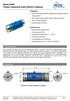 Properties Free of float metal bellow coupling with integrated torque measurement Non-contact measurement system, high robustness High torsional stiffness Limited torque of inertia Performance Measurement
Operating instructions
 Operating instructions Torque transducer type AE with replaceable strain gauge measuring element Model TQ 505 Operating instructions no. 1079 Torque Transducer TQ 505 Page 1 / 16 1. Contents 1. List of
Electric Motors and Drives
 EML 2322L MAE Design and Manufacturing Laboratory Electric Motors and Drives To calculate the peak power and torque produced by an electric motor, you will need to know the following: Motor supply voltage,
HOW THE CONTAMINATION IS MEASURED CONTAMINATION CLASSES ACCORDING TO ISO 4406:1999
 CONTAMINATION CONTROL in hydraulic systems in the hydraulic system is a very wide and complex matter; the following is just a short summary. Our Customer Service is at your disposal for any further information.
How To Use A Flowmeter
 INLINE flowmeter for continuous flow measurement Economic integration in pipe systems without any additional piping 3-wire frequency pulse version to directly interface with PLC s (both PNP and NPN) Connection
MASTER CYLINDER. Section 2. Master Cylinder. Tandem Master Cylinder. Master Cylinder
 MASTER CYLINDER Master Cylinder The master cylinder converts the motion of the brake pedal into hydraulic pressure. It consists of the reservoir tank, which contains the brake fluid; and the piston and
Precision Miniature Load Cell. Models 8431, 8432 with Overload Protection
 w Technical Product Information Precision Miniature Load Cell with Overload Protection 1. Introduction The load cells in the model 8431 and 8432 series are primarily designed for the measurement of force
Industrial Valves. Marketing Catalog. Reliable and continuous performance in the world's most demanding and rigorous applications.
 Industrial Valves Marketing Catalog Reliable and continuous performance in the world's most demanding and rigorous applications. Demanding Applications Call for Eaton Valves to control machine functions,
DSE5J 83 280/112 ED DIRECTIONAL VALVE WITH PROPORTIONAL CONTROL FEEDBACK AND INTEGRATED ELECTRONICS SERIES 10 SUBPLATE MOUNTING ISO 4401-05 (CETOP 05)
 83 280/112 ED DSE5J DIRECTIONAL VALVE WITH PROPORTIONAL CONTROL FEEDBACK AND INTEGRATED ELECTRONICS SERIES 10 SUBPLATE MOUNTING ISO 4401-05 (CETOP 05) p max 320 bar Q max 180 l/min MOUNTING SURFACE OPERATING
E4E PILOT OPERATED DIRECTIONAL CONTROL VALVE WITH ELECTRIC PROPORTIONAL CONTROL SERIES 51
 83 300/100 ED E4E PILOT OPERATED DIRECTIONAL CONTROL VALVE WITH ELECTRIC PROPORTIONAL CONTROL SUBPLATE MOUNTING CETOP P05 p max 250 bar Q max (see specification table) MOUNTING INTERFACE OPERATING PRINCIPLE
Flow divider (flow distributor), type TQ
 Flow divider (flow distributor), type TQ Pressure p max = 0 bar Flow Q CN max = 00 lpm Share ratio = :. General Task Flow dividers type TQ are self-regulating valves, which largely irrespective of the
Electro-Pneumatic Bus Door Control Mechanism
 Electro-Pneumatic Bus Door Control Mechanism Application and Feature 1. Pneumatic Door Mechanism actuates the open/close movements of bus door through two double acting cylinders and two linkages with
ENERGY TRANSFER SYSTEMS AND THEIR DYNAMIC ANALYSIS
 ENERGY TRANSFER SYSTEMS AND THEIR DYNAMIC ANALYSIS Many mechanical energy systems are devoted to transfer of energy between two points: the source or prime mover (input) and the load (output). For chemical
Fluid. Flu. Fluid Fluid. uid Power d Power P. Fluid Power P. Fluid Power. Fluid Power Power. d Power. Directional Cetop Valves DCV 03.
 Catalogue Directional Cetop Valves DCV 03 Power Flu uid Power d Power P wer Power Power Power Power Power d Power Power Power ower Power Power wer Power Power P Power Power Powe d Power Power Power Power
Sensors. Sensors. All Cylinders. Specifications. Features: Features Type REED HALL EFFECT NPN or PNP. Ø8mm - 125mm
 Specifications Features Type REED HALL EFFECT NPN or PNP Applicable Series Configurations Construction Materials Body Mounting Bracket Cable Characteristics Operating Temperature Accuracy All Cylinders
Alternative Linear Motion Systems. Iron Core Linear Motors
 Alternative Linear Motion Systems ME EN 7960 Precision Machine Design Topic 5 ME EN 7960 Precision Machine Design Alternative Linear Motion Systems 5-1 Iron Core Linear Motors Provide actuation forces
OPERATION MANUAL VALVE CHECKER G040-123
 OPERATION MANUAL VALVE CHECKER AUSTRALIA PTY. LTD. L:\DWG_NO\DOCUMENT\MANUALS\Word File\A OPERATION MANUAL CN 20.4.99 VALVE CHECKER 1 of 20 CONTENTS Chapter Title Page 1. Description 3 2. Specification
Piston Accumulators. SK Series. Accumulator Catalog. Piston Types. Description. Sealing Systems. End Cap. O-ring. Sealing System. Piston.
 SK Series Piston Types TYPE 2 pplication: Low-friction design for higher piston speeds, slow movements without stick-slip effect and high number of actuations (millions). ctual cycles achieved will vary
Variable Displacement Pump AA10VSO
 Variable Displacement Pump AA10VSO Series 31, Industrial Model, for Open Circuits Axial piston, swashplate design Brueninghaus Hydromatik Sizes 28...140 Nominal pressure 4000 psi Peak pressure 5100 psi
Series TMM Axial Piston Motor. Technical Information
 Series TMM Axial Piston Motor Technical Information General Description GENERAL DESCRIPTION These motors are designed primarily to be combined with other products in closed circuit systems to transfer
Delta Power Company 4484 Boeing Drive - Rockford, IL 61109
 INDEX Description Page Delta Power Rotary Flow Divider, Positive Displacement (Application Data) 36 P Series, Equal Flow Two Sections 39 P Series, Equal Flow Multi-Sections 40 PM Series, Equal Flow Multi-Sections
UNIT II Robots Drive Systems and End Effectors Part-A Questions
 UNIT II Robots Drive Systems and End Effectors Part-A Questions 1. Define End effector. End effector is a device that is attached to the end of the wrist arm to perform specific task. 2. Give some examples
Differential-Hall-Effect based Sensors Series A5S
 Speed and Frequency Seite 1 von 6 Differential-Hall-Effect based Sensors Series A5S Outstanding Characteristics Speed range covering most demands: from close to zero up to 25,000 pulses/second (response
POSEIDON 2-29, 2-25 & 2-22 POSEIDON 2-29, 2-25 & 2-22 XT
 POSEION 2-29, 2-25 & 2-22 POSEION 2-29, 2-25 & 2-22 XT Repair Manual Index A. Safety precautions 3 B. Technical data 4 C. Structure 5-6. Service / Repair 7-23 E. Tools 24 F. Function 25-26 G. Electric
Pressure Relief and Regulating Valves
 Pressure Relief and Regulating Valves With blocked center directional valves and variable displacement pumps, or open center directional valves and fixed displacement pumps where fast response, low leakage
3-Way heavy duty flow control, with pressure compensated and solenoid controlled priority flow
 1/6 RE 18309-3/06.10 Replaces: RE 18309-3/04.10 3-Way heavy duty flow control, with pressure compensated and solenoid controlled priority flow A-VRFC3C-VEI-VS 0M.43.20.80 - Y - Z Description The flow control
Reaction Torque Sensor
 Force 1 1 N m up to 1 000 1 000 N m Type 9329A 9389A These easy to install piezoelectric reaction torque sensors are particularly suitable for measuring rapidly changing torques at non-rotating shafts.
4 Posiflow Proportional Solenoid Valves
 4 Posiflow Solenoid Brass or Stainless Steel Bodies 1/4" to 1/2" NPT 2/2 Features Flow rates adjustable between 0% and 100% of rating Flow rate can also be regulated by a range of electrical inputs (sensors,
4/4-way servo solenoid directional control valves, directly operated, with electrical position feedback and on-board electronics (OBE)
 4/4-way servo solenoid directional control valves, directly operated, with electrical position feedback and on-board electronics (OBE) Type 4WRPEH 6 Size (NG) 6 Unit series 2X Maximum working pressure
Specifications. Model Flow type Pressure type. Air Maximum operating pressure. 1.0 MPa Ambient and fluid temperature. 3% F.S.
 Electro-Pneumatic Proportional Valve Series /VEP Electro-pneumatic proportional valve: Flow type () Controls the flow rate steplessly according to current. (It is a / port valve that has an electrical
WILROY. Operation. Optional Diaphragm Rupture Detection HYDRAULICALLY ACTUATED DIAPHRAGM PUMP
 WILROY ATEX Approved HYDRAULICALLY ACTUATED DIAPHRAGM PUMP Williams and Milton Roy have combined technologies to design a pump blending the proven mroy hydraulic by-pass diaphragm design with the Williams
Contamination Control - A Hydraulic OEM Perspective. R.W. Park, BE (Hons), MIE Aust., CP Eng Managing Director, Moog Australia Pty Ltd
 R.W. Park, BE (Hons), MIE Aust., CP Eng Managing Director, Moog Australia Pty Ltd Workshop on Total Contamination Control Centre for Machine Condition Monitoring Monash University, August 1997. This paper
330505 Low Frequency Velocity Sensor
 330505 Low Frequency Velocity Sensor Bently Nevada* Asset Condition Monitoring Description The Bently Nevada Low Frequency Velocity Sensor is designed to measure absolute (relative to free space) bearing
DIRECT CURRENT GENERATORS
 DIRECT CURRENT GENERATORS Revision 12:50 14 Nov 05 INTRODUCTION A generator is a machine that converts mechanical energy into electrical energy by using the principle of magnetic induction. This principle
The Do s and Don ts of Pressure Transducers
 The Do s and Don ts of Pressure Transducers ABSTRACT When specifying a pressure transducer for a process measurement, a number of items have to be considered. Some of the more important ones are discussed
Linear modules Lifting units Rotary modules Grip modules Inductive proximity switches Plug connectors
 20000 Linear modules Lifting units Rotary modules Grip modules Inductive proximity switches Plug connectors 23000 22000 21000 20000 09000 08000 07000 06000 05000 04000 03000 02000 01000 823 Notes 824 Technical
3/2- and 2/2-way cartridge valve type BVE
 3/2- and 2/2-way cartridge valve type BVE for any flow direction, zero leakage, all ports pressure resistant Flow Q max = 70 lpm Perm. pressure p max = 400 bar Additional valves with same function: ' Type
Material taken from Fluid Power Circuits and Controls, John S. Cundiff, 2001
 Pressure Control Chapter 3 Material taken from Fluid Power Circuits and Controls, John S. Cundiff, 2001 Introduction Pressure control is a key element in the design of any circuit. Used correctly, it can
Electronic Pressure Switch EDS 300
 Electronic Pressure Switch EDS 300 User manual Page 2 of 16 Content 1. Functions of the EDS 300...3 2. Mounting...3 3. Operating keys on the membrane keypad...4 4. Digital display...4 5. Output function...5
Selecting and Sizing Ball Screw Drives
 Selecting and Sizing Ball Screw Drives Jeff G. Johnson, Product Engineer Thomson Industries, Inc. Wood Dale, IL 540-633-3549 www.thomsonlinear.com [email protected] Fig 1: Ball screw drive is a
Char-Lynn Hydraulic Motor. Repair Information. 10 000 Series. October, 1997
 Char-Lynn Hydraulic Motor October, 1997 Repair Information Geroler Motor Two Speed 001 27 Retainer inside bore of valve plate bearingless motors only 4 15 16 3 6 35 Parts Drawing 25 2 2 1 19 17 36 40 47
Flow Control Valves. Note: Also see R04C3 on page DC1. Denotes New Winner s Circle Product Line. Catalog HY15-3502/US
 Catalog HY15-352/US Contents Control SERIES CAVITY DESCRIPTION FLOW PRESSURE PAGE NO. LPM/GPM BAR/PSI NEED VALVES J2A2... C8-2... Needle Valve, Cartridge Type...45/12... 42/6... 5-6 NVH81... C8-2... Needle
DSD 70 Dual Channel Hall Effect Speed Sensor for Railway Applications, compliant with EN 50155
 DSD 70 Dual Channel Hall Effect Speed Sensor for Railway Applications, compliant with EN 50155 Technical information Version: 07.14 General Function The speed sensors family DSD.70 are suitable for generating
Proportional pressure regulators VPPE
 Proportional pressure regulators VPPE Proportional pressure regulators VPPE Product range overview Function Version Pneumatic connection Proportional pressure regulator Nominal size for pressurisation/
Mounting instructions. Acceleration Transducer B12. B 26.B12.10 en
 Mounting instructions Acceleration Transducer B12 B 26.B12.10 en B12 3 Contents Page Safety instructions.............................................. 4 1 Scope of supply..............................................
SFS81 Series. Servo Finishing Stand PUSHCORP, INC. Dallas, Texas
 SFS81 Series Servo Finishing Stand PUSHCORP, INC. Dallas, Texas May, 2012 NEVER OPERATE THE SFS81 MANUALLY NEVER OPERATE THE SFS81 WITH PERSONEL IN THE WORKCELL DO NOT USE LUBRICATED AIR. This device requires
Automatic Back-Flushing Filter AutoFilt RF9.
 Automatic Back-Flushing Filter AutoFilt RF9. AutoFilt RF9 Clearing the Way. The Challenge: In response to the Tier III standard which will come into effect in 2016, the International Maritime Organization
Michael Montgomery Marketing Product Manager Rosemount Inc. Russ Evans Manager of Engineering and Design Rosemount Inc.
 ASGMT / Averaging Pitot Tube Flow Measurement Michael Montgomery Marketing Product Manager Rosemount Inc. Russ Evans Manager of Engineering and Design Rosemount Inc. Averaging Pitot Tube Meters Introduction
Q&A Session for Advanced Ball Screws 102: Troubleshooting for Design Engineers
 Q&A Session for Advanced Ball Screws 102: Troubleshooting for Design Engineers Topic: Noise Q: Is there a way to predict/calculate noise on a ball screw? A: No, there is no way to calculate the noise of
Backflush filter R8-30W
 Backflush filter R8-30W With internal pressure segment cleaning, rated pressure to 40 bar (580 psi) Connection sizes: DN 200 to DN 500, welded design 1. Features Powerful, fully automatic filtration _
Series PAVC Variable Displacement Piston Pumps zp01. Catalog HY28-2662-CD/US
 Series PAVC Variable Displacement Piston Pumps zp1 Catalog HY28-2662-CD/US 1 Introduction Series PAVC Quick Reference Data Chart Pump Model Displacement CM 3 /REV (IN 3 /REV) Pump Delivery *Approx. Noise
Application Information
 Moog Components Group manufactures a comprehensive line of brush-type and brushless motors, as well as brushless controllers. The purpose of this document is to provide a guide for the selection and application
15/40/80CN Series Coreless Medium Pressure Filters
 //8CN Series Coreless Medium Pressure Filters //8CN Series Applications Compressor Lube Oil Off-line Filter Loops Machine Tools (Automotive Standard) Hydrostatic Drive Charge Pumps Mobile Equipment Pilot
Whale 3. User Manual and Installation Guide. DC Servo drive. Contents. 1. Safety, policy and warranty. 1.1. Safety notes. 1.2. Policy. 1.3. Warranty.
 Whale 3 DC Servo drive User Manual and Installation Guide Contents 1. Safety, policy and warranty. 1.1. Safety notes. 1.2. Policy. 1.3. Warranty. 2. Electric specifications. 2.1.Operation ranges. 3. Connections
APPLIED PNEUMATICS AND HYDRAULICS H TUTORIAL HYDRAULIC AND PNEUMATIC CYLINDERS. This work covers part of outcome 2 of the standard Edexcel module.
 APPLIED PNEUMATICS AND HYDRAULICS H TUTORIAL HYDRAULIC AND PNEUMATIC CYLINDERS This work covers part of outcome 2 of the standard Edexcel module. The material needed for outcome 2 is very extensive so
Assisted lift operated 2/2-way solenoid valves Type EV250B
 MAKING MODERN LIVING POSSIBLE Data sheet Assisted lift operated 2/2-way solenoid valves Type EV250B EV250B with assisted lift can operate from zero and up to 10 bar differential pressure. This 2/2-way
Series DFMT Digital Paddlewheel Flowmeter
 Series DFMT Digital Paddlewheel Flowmeter Bulletin F-DFMT Specifications - Installation Operating Instructions -/8 [00] -/ [8] -/8 [00] A The Series DFMT Digital Paddlewheel Flow Transmitter provides instantaneous
Pneumatic Grippers Parallel and Angular Grippers. Catalog 1900-2/US
 Pneumatic Grippers Parallel and Angular Grippers Catalog 19-2/US Catalog 19-2/US OContents GPR Series Rotary vane driven design GPR GPCR Series P5G-HPM(C) Series P5G-HP Series GPT Series P5G-AP Series
Hydraulic Trouble Shooting
 Hydraulic Trouble Shooting Hydraulic systems can be very simple, such as a hand pump pumping up a small hydraulic jack, or very complex, with several pumps, complex valving, accumulators, and many cylinders
Chapter 7 Hydraulic System Troubleshooting
 Chapter 7 Hydraulic System Troubleshooting General The following troubleshooting information is provided as a general guide to identify, locate and correct problems that may be experienced with the hydraulic