
Symantec Enterprise Vault
|
|
|
- Barbara O’Brien’
- 10 years ago
- Views:
Transcription
1 Symantec Enterprise Vault Setting up File System Archiving (FSA) 11.0
2 Symantec Enterprise Vault: Setting up File System Archiving (FSA) The software described in this book is furnished under a license agreement and may be used only in accordance with the terms of the agreement. Last updated: Legal Notice Copyright 2014 Symantec Corporation. All rights reserved. Symantec, the Symantec Logo, the Checkmark Logo, Enterprise Vault, Compliance Accelerator, and Discovery Accelerator are trademarks or registered trademarks of Symantec Corporation or its affiliates in the U.S. and other countries. Other names may be trademarks of their respective owners. This Symantec product may contain third party software for which Symantec is required to provide attribution to the third party ("Third Party Programs"). Some of the Third Party Programs are available under open source or free software licenses. The License Agreement accompanying the Software does not alter any rights or obligations you may have under those open source or free software licenses. Please see the Third Party Software file accompanying this Symantec product for more information on the Third Party Programs. The product described in this document is distributed under licenses restricting its use, copying, distribution, and decompilation/reverse engineering. No part of this document may be reproduced in any form by any means without prior written authorization of Symantec Corporation and its licensors, if any. THE DOCUMENTATION IS PROVIDED "AS IS" AND ALL EXPRESS OR IMPLIED CONDITIONS, REPRESENTATIONS AND WARRANTIES, INCLUDING ANY IMPLIED WARRANTY OF MERCHANTABILITY, FITNESS FOR A PARTICULAR PURPOSE OR NON-INFRINGEMENT, ARE DISCLAIMED, EXCEPT TO THE EXTENT THAT SUCH DISCLAIMERS ARE HELD TO BE LEGALLY INVALID. SYMANTEC CORPORATION SHALL NOT BE LIABLE FOR INCIDENTAL OR CONSEQUENTIAL DAMAGES IN CONNECTION WITH THE FURNISHING, PERFORMANCE, OR USE OF THIS DOCUMENTATION. THE INFORMATION CONTAINED IN THIS DOCUMENTATION IS SUBJECT TO CHANGE WITHOUT NOTICE. The Licensed Software and Documentation are deemed to be commercial computer software as defined in FAR and subject to restricted rights as defined in FAR Section "Commercial Computer Software - Restricted Rights" and DFARS , et seq. "Commercial Computer Software and Commercial Computer Software Documentation," as applicable, and any successor regulations, whether delivered by Symantec as on premises or hosted services. Any use, modification, reproduction release, performance, display or disclosure of the Licensed Software and Documentation by the U.S. Government shall be solely in accordance with the terms of this Agreement. Symantec Corporation 350 Ellis Street, Mountain View, CA 94043

3

4 Technical Support Contacting Technical Support Symantec Technical Support maintains support centers globally. Technical Support s primary role is to help you resolve specific problems with a Symantec product. The Technical Support group also creates content for our online Knowledge Base. The Technical Support group works collaboratively with the other functional areas within Symantec to answer your questions in a timely fashion. For example, the Technical Support group works with Product Engineering and Symantec Security Response to provide alerting services and virus definition updates. Symantec s support offerings include the following: A range of support options that give you the flexibility to select the right amount of service for any size organization Telephone and/or web-based support that provides rapid response and up-to-the-minute information Upgrade assurance that delivers software upgrades Global support purchased on a regional business hours or 24 hours a day, 7 days a week basis Premium service offerings that include Account Management Services For information about Symantec s support offerings, you can visit our website at the following URL: All support services will be delivered in accordance with your support agreement and the then-current enterprise technical support policy. Customers with a current support agreement may access Technical Support information at the following URL: Before contacting Technical Support, make sure you have satisfied the system requirements that are listed in your product documentation. Also, you should be at the computer on which the problem occurred, in case it is necessary to replicate the problem. When you contact Technical Support, please have the following information available: Product release level Hardware information

5 Available memory, disk space, and NIC information Operating system Version and patch level Network topology Router, gateway, and IP address information Problem description: Error messages and log files Troubleshooting that was performed before contacting Symantec Recent software configuration changes and network changes Licensing and registration Customer service If your Symantec product requires registration or a license key, access our Technical Support web page at the following URL: Customer service information is available at the following URL: Customer Service is available to assist with non-technical questions, such as the following types of issues: Questions regarding product licensing or serialization Product registration updates, such as address or name changes General product information (features, language availability, local dealers) Latest information about product updates and upgrades Information about upgrade assurance and support contracts Information about the Symantec Buying Programs Advice about Symantec's technical support options Nontechnical presales questions Issues that are related to CD-ROMs, DVDs, or manuals

6 Support agreement resources If you want to contact Symantec regarding an existing support agreement, please contact the support agreement administration team for your region as follows: Asia-Pacific and Japan Europe, Middle-East, and Africa North America and Latin America

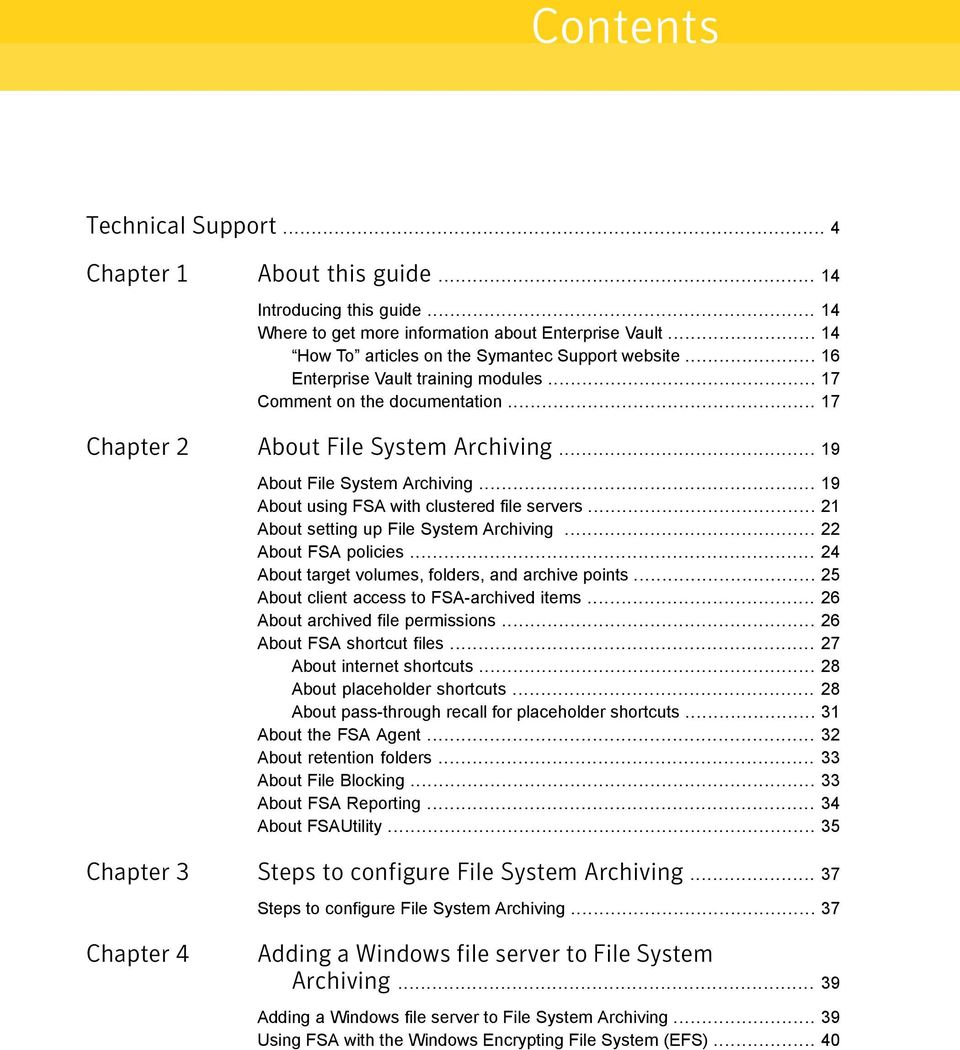
7 Contents Technical Support... 4 Chapter 1 About this guide Introducing this guide Where to get more information about Enterprise Vault How To articles on the Symantec Support website Enterprise Vault training modules Comment on the documentation Chapter 2 About File System Archiving About File System Archiving About using FSA with clustered file servers About setting up File System Archiving About FSA policies About target volumes, folders, and archive points About client access to FSA-archived items About archived file permissions About FSA shortcut files About internet shortcuts About placeholder shortcuts About pass-through recall for placeholder shortcuts About the FSA Agent About retention folders About File Blocking About FSA Reporting About FSAUtility Chapter 3 Steps to configure File System Archiving Steps to configure File System Archiving Chapter 4 Adding a Windows file server to File System Archiving Adding a Windows file server to File System Archiving Using FSA with the Windows Encrypting File System (EFS)... 40
8 Contents 8 About archiving from Windows Server 2012 file servers About the ReFS and CSVFS file systems and FSA About Dynamic Access Control and FSA About archiving Windows Server 2012 deduplicated files with FSA Account requirements for managing FSA with Windows file servers Permissions and privileges required by the Vault Service account on Windows file servers Granting permissions to the Vault Service account if you do not install the FSA Agent Configuring a file server's firewall for FSA Adding a Windows file server as an archiving target Chapter 5 Adding a NetApp filer to File System Archiving Adding a NetApp filer to File System Archiving Setting the permissions for FSA on a NetApp filer Adding a NetApp filer as an archiving target Chapter 6 Chapter 7 Adding a NetApp C-Mode Vserver to File System Archiving Adding a NetApp C-Mode Vserver to File System Archiving Granting the required permission on each Vserver Configuring the FPolicy server details Adding a NetApp C-Mode Vserver as an archiving target Points to note about File System Archiving on NetApp C-Mode file servers Adding an EMC Celerra/VNX device to File System Archiving Adding a Celerra/VNX device to File System Archiving Preparing a Celerra/VNX device for FSA Configuring Celerra/VNX pass-through behavior for placeholder shortcuts The format of the Web Access application URL in the Celerra/VNX fs_dhsm command Configuring the Data Mover HTTP server to use SSL Example commands to prepare a Celerra/VNX device for FSA Adding a Celerra/VNX device as an archiving target Specifying a cache location for retrieved Celerra/VNX files... 67

9 Contents 9 Chapter 8 Configuring FSA with clustered file servers About configuring FSA with clustered file servers Steps to configure FSA with clustered file servers Preparing to set up FSA services in a cluster About authenticating the Administration Console with VCS for an FSA cluster Authenticating the Administration Console when SPAS is used Authenticating the Administration Console when SPAS is not used Adding the virtual file server as an FSA target Configuring or reconfiguring the FSA resource Removing the FSA resource from all cluster groups Troubleshooting the configuration of FSA with clustered file servers 'Failed to collect clustering data' error on starting FSA Cluster Configuration wizard Chapter 9 Installing the FSA Agent About installing the FSA Agent on a Windows file server Installing the FSA Agent using the Install FSA Agent wizard Installing the FSA Agent manually About FSA Agent uninstallation Updating the logon credentials of the FSA Agent services Chapter 10 Defining volume and folder policies About defining FSA volume and folder policies Creating FSA volume policies and folder policies About FSA volume policy and folder policy properties About selecting the shortcut type for an FSA policy About choosing not to display the file size in NetApp placeholder shortcuts About FSA policy archiving rules Tips for creating FSA policy archiving rules About excluding specific Mac and Windows file types from archiving FSA shortcut creation options Notes on FSA shortcut creation About options for archiving files that have explicit permissions, and files under DAC... 94

10 Contents 10 Chapter 11 Chapter 12 Chapter 13 Configuring the deletion of archived files on placeholder deletion About configuring the deletion of archived files on placeholder deletion Configuring the deletion of archived files on placeholder deletion for Windows file servers and NetApp filers Configuring the deletion of files on placeholder deletion for EMC Celerra/VNX devices Configuring target volumes, target folders, and archive points About adding target volumes, target folders, and archive points for FSA About the checks for existing archives for an FSA folder path Adding a target volume for FSA Adding a target folder and archive points for FSA About managing archive points Viewing, editing, or deleting archive points in the Administration Console Archive point properties Archive point properties: General tab Archive point properties: Indexing tab Effects of modifying, moving, or deleting folders Effects of modifying folders with folder policies Effects of modifying folders with archive points About deleting target folders, volumes, and file servers Deleting a target folder from FSA Deleting a target volume from FSA Deleting a target file server from FSA Configuring pass-through recall for placeholder shortcuts About configuring pass-through recall for placeholder shortcuts Configuring pass-through recall for a Windows file server About configuring pass-through recall for a file server cluster Registry values for pass-through recall on Windows file servers Configuring pass-through recall for a NetApp filer

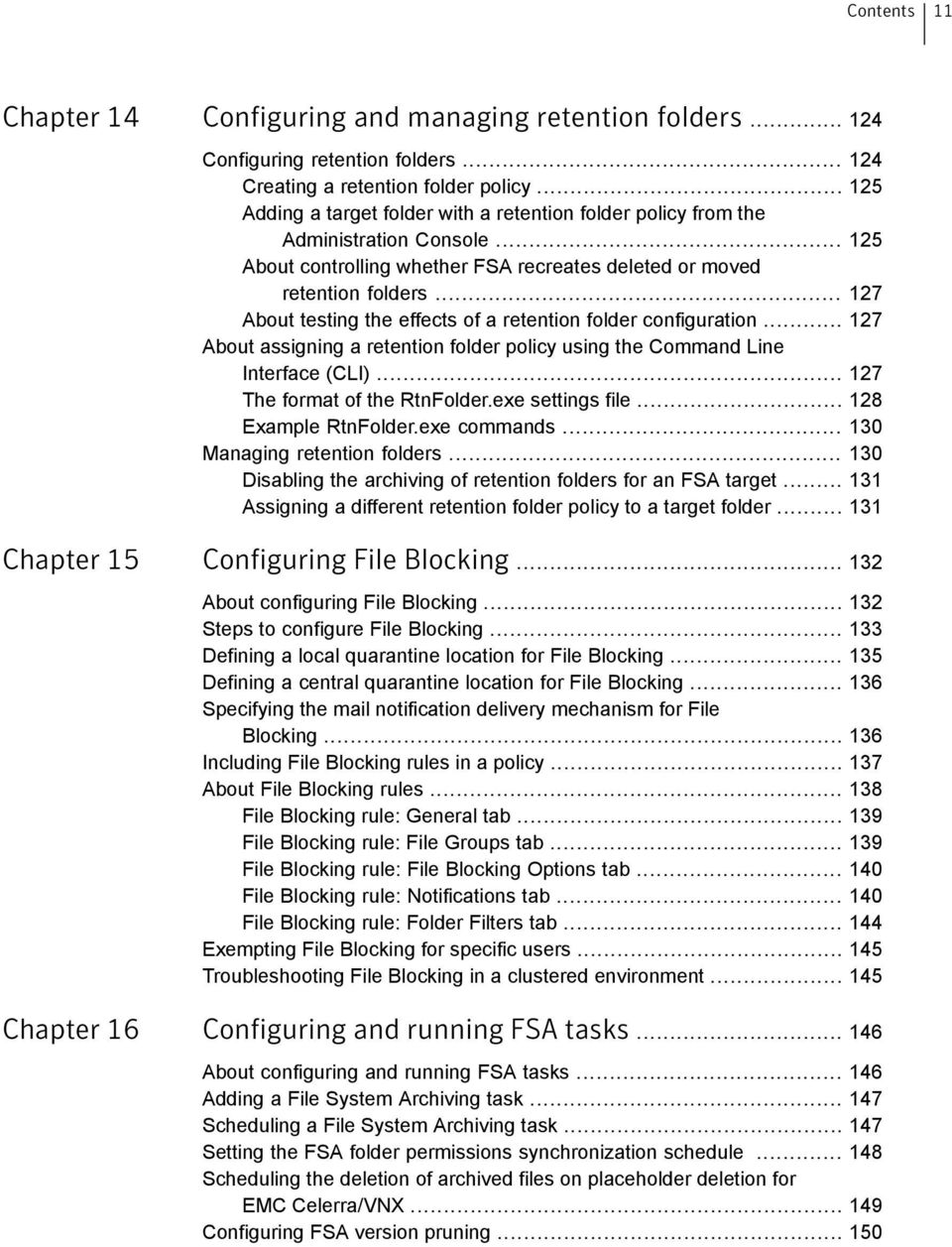
11 Contents 11 Chapter 14 Configuring and managing retention folders Configuring retention folders Creating a retention folder policy Adding a target folder with a retention folder policy from the Administration Console About controlling whether FSA recreates deleted or moved retention folders About testing the effects of a retention folder configuration About assigning a retention folder policy using the Command Line Interface (CLI) The format of the RtnFolder.exe settings file Example RtnFolder.exe commands Managing retention folders Disabling the archiving of retention folders for an FSA target Assigning a different retention folder policy to a target folder Chapter 15 Configuring File Blocking About configuring File Blocking Steps to configure File Blocking Defining a local quarantine location for File Blocking Defining a central quarantine location for File Blocking Specifying the mail notification delivery mechanism for File Blocking Including File Blocking rules in a policy About File Blocking rules File Blocking rule: General tab File Blocking rule: File Groups tab File Blocking rule: File Blocking Options tab File Blocking rule: Notifications tab File Blocking rule: Folder Filters tab Exempting File Blocking for specific users Troubleshooting File Blocking in a clustered environment Chapter 16 Configuring and running FSA tasks About configuring and running FSA tasks Adding a File System Archiving task Scheduling a File System Archiving task Setting the FSA folder permissions synchronization schedule Scheduling the deletion of archived files on placeholder deletion for EMC Celerra/VNX Configuring FSA version pruning
12 Contents 12 Using Run Now to process FSA targets manually Processing an FSA target volume manually Running a File System Archiving task manually About File System Archiving task reports About scheduling storage expiry for FSA Chapter 17 Configuring file system filtering About custom filters for File System Archiving Configuring file system filters About file system filter reports Chapter 18 Managing the file servers About managing the target file servers About backing up the target file servers About virus-checking the target file servers About changing the placeholder recall rate settings Changing the placeholder recall rate settings for a Windows file server Changing the placeholder recall rate settings for a NetApp file server About preventing unwanted file recalls from placeholder shortcuts Using FSA backup mode to prevent file recalls Prohibiting a program from recalling files that FSA has archived Preventing file recalls on EMC Celerra/VNX Preventing file recalls on restore due to File Blocking checks Appendix A Permissions and privileges required for the Vault Service account on Windows file servers About the permissions and privileges required for the Vault Service account on Windows file servers Group membership requirements for the Vault Service account DCOM permissions required by the Vault Service account WMI control permissions required by the Vault Service account Local security user rights required by the Vault Service account Permissions required by the Vault Service account for the FSA Agent FSA Agent service permissions required by the Vault Service account

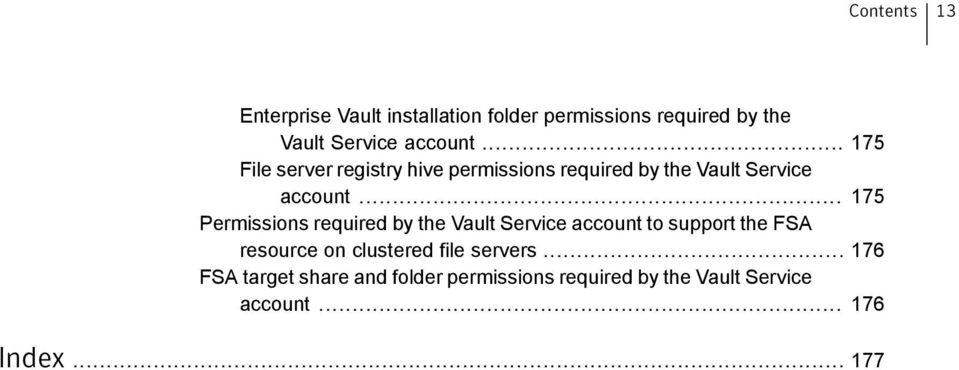
13 Contents 13 Enterprise Vault installation folder permissions required by the Vault Service account File server registry hive permissions required by the Vault Service account Permissions required by the Vault Service account to support the FSA resource on clustered file servers FSA target share and folder permissions required by the Vault Service account Index
14 Chapter 1 About this guide This chapter includes the following topics: Introducing this guide Where to get more information about Enterprise Vault Comment on the documentation Introducing this guide This guide describes how to set up Enterprise Vault so that you can archive files that are held on network file servers. The guide assumes that you know how to administer the following: Microsoft Windows Server Your file server hardware and software Your archive storage hardware and software Where to get more information about Enterprise Vault Table 1-1 lists the documentation that accompanies Enterprise Vault.

15 About this guide Where to get more information about Enterprise Vault 15 Table 1-1 Document Enterprise Vault documentation set Comments Symantec Enterprise Vault Documentation Library Includes all the following documents in Windows Help (.chm) format so that you can search across them all. It also includes links to the guides in Acrobat (.pdf) format. You can access the library in several ways, including the following: On the Windows Start menu, click Start > Programs > Enterprise Vault > Documentation. In Windows Explorer, browse to the Documentation\language subfolder of the Enterprise Vault installation folder, and then open the EV_Help.chm file. On the Help menu in the Administration Console, click Help on Enterprise Vault. Introduction and Planning Deployment Scanner Installing and Configuring Upgrade Instructions Setting up Exchange Server Archiving Setting up Domino Server Archiving Setting up File System Archiving Setting up IMAP Setting up SharePoint Server Archiving Setting up SMTP Archiving Administrator s Guide Provides an overview of Enterprise Vault functionality. Describes how to check the required software and settings before you install Enterprise Vault. Provides detailed information on setting up Enterprise Vault. Describes how to upgrade an existing Enterprise Vault installation to the latest version. Describes how to archive items from Microsoft Exchange user mailboxes, journal mailboxes, and public folders. Describes how to archive items from Domino mail files and journal databases. Describes how to archive the files that are held on network file servers. Describes how to configure IMAP client access to Exchange archives, and to Internet mail archives. Describes how to archive content from Microsoft SharePoint servers. Describes how to archive SMTP messages from other messaging servers. Describes how to perform day-to-day administration procedures.
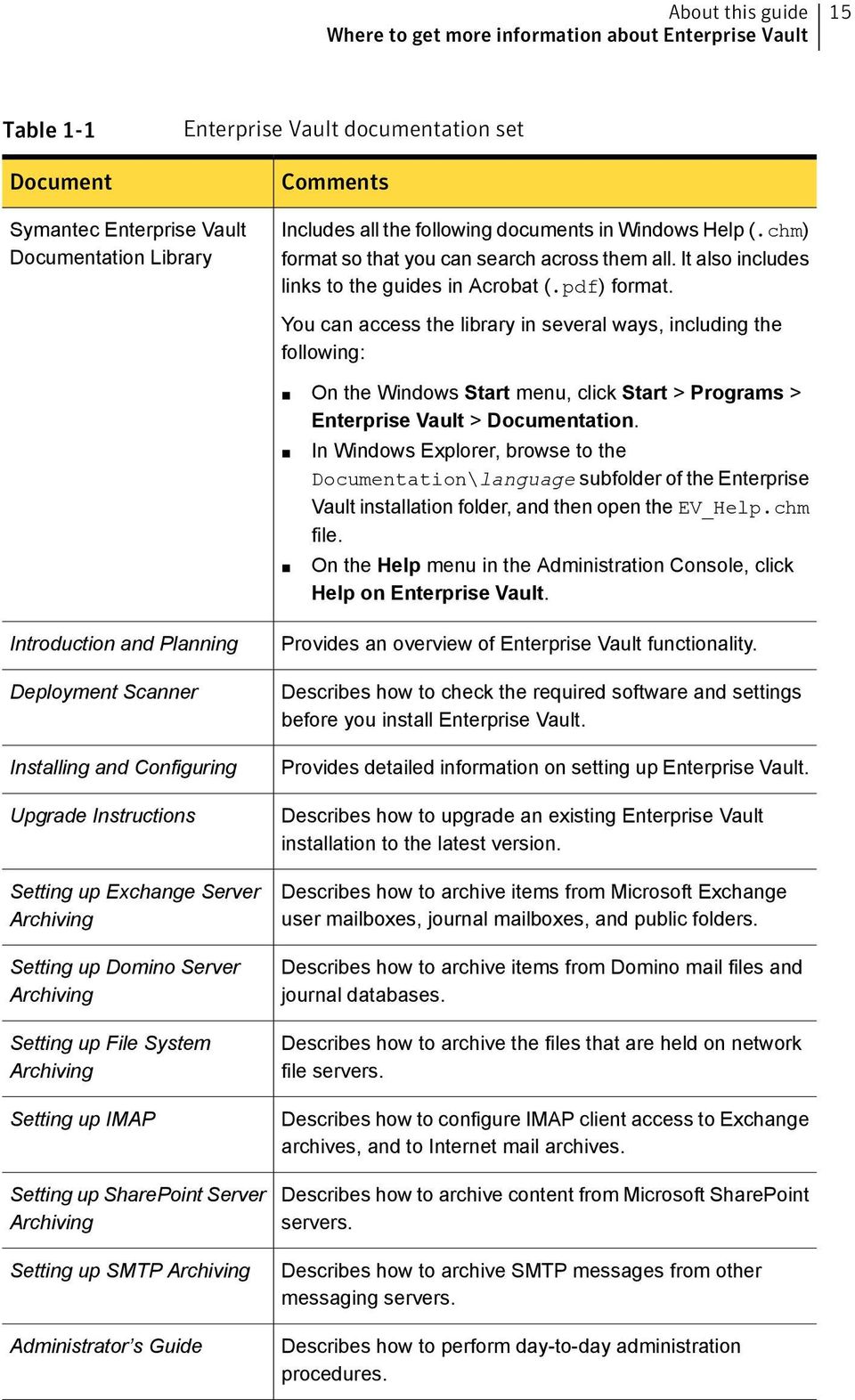
16 About this guide Where to get more information about Enterprise Vault 16 Table 1-1 Document Enterprise Vault documentation set (continued) Comments Backup and Recovery NSF Migration PST Migration Reporting Utilities PowerShell Cmdlets Registry Values Help for Administration Console Help for Enterprise Vault Operations Manager Describes how to implement an effective backup strategy to prevent data loss, and how to provide a means for recovery in the event of a system failure. Describes how to migrate content from Domino and Notes NSF files into Enterprise Vault archives. Describes how to migrate content from Outlook PST files into Enterprise Vault archives. Describes how to implement Enterprise Vault Reporting, which provides reports on the status of Enterprise Vault servers, archives, and archived items. If you configure FSA Reporting, additional reports are available for file servers and their volumes. Describes the Enterprise Vault tools and utilities. Describes how to perform various administrative tasks by running the Enterprise Vault PowerShell cmdlets. A reference document that lists the registry values with which you can modify many aspects of Enterprise Vault behavior. The online Help for the Enterprise Vault Administration Console. The online Help for Enterprise Vault Operations Manager. For the latest information on supported devices and versions of software, see the Enterprise Vault Compatibility Charts book, which is available from this address: How To articles on the Symantec Support website Most of the information in the Enterprise Vault administration guides is also available online as articles on the Symantec Support website. You can access these articles by searching the Internet with any popular search engine, such as Google, or by following the procedure below.
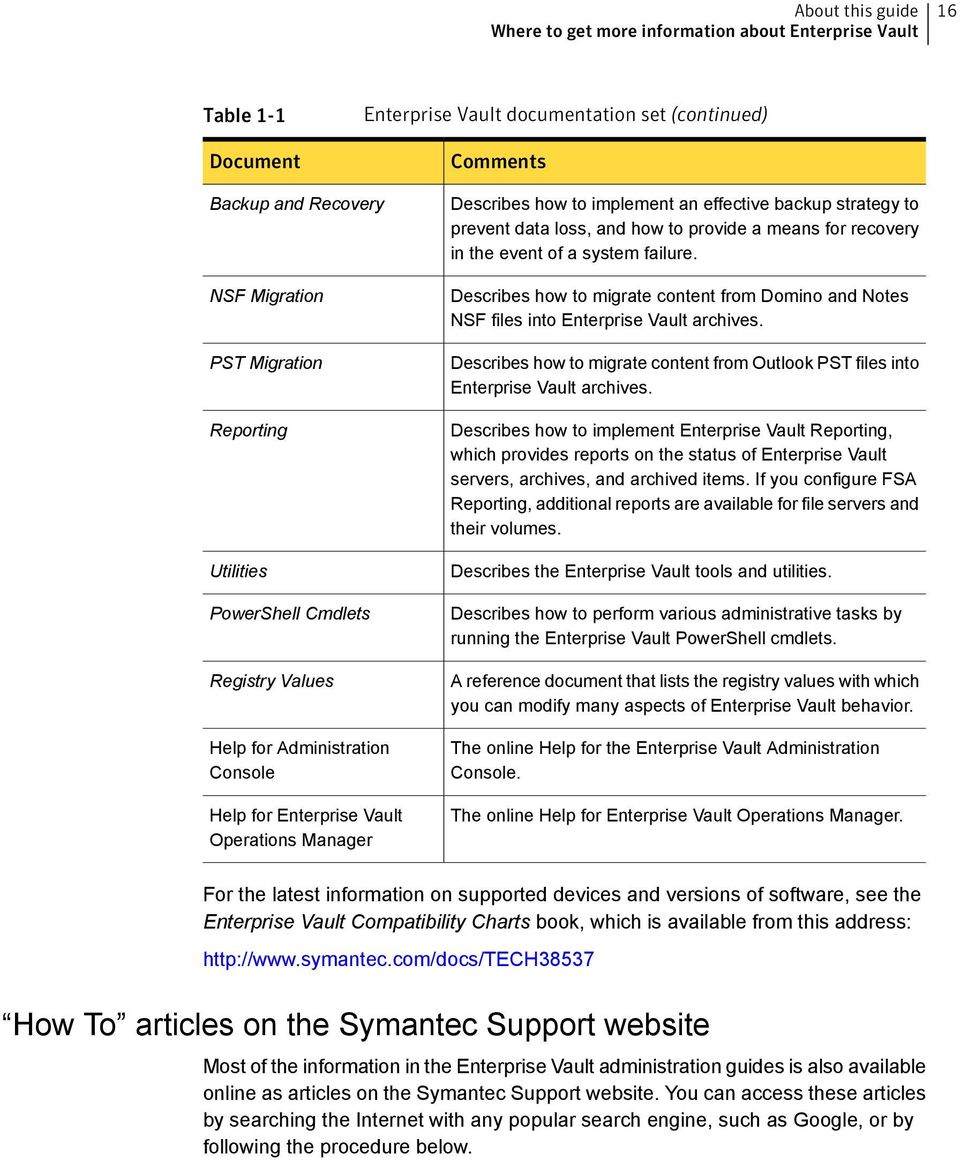
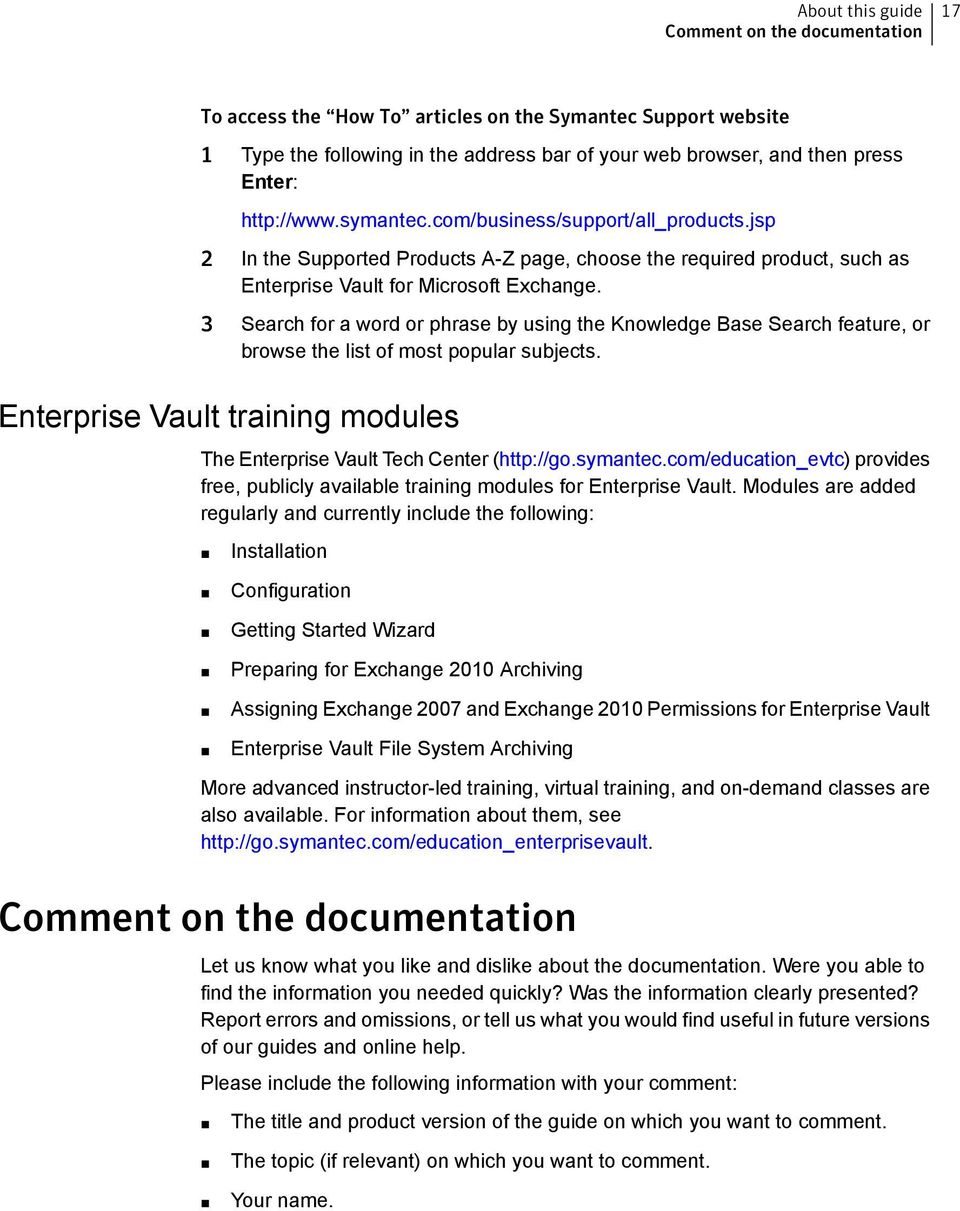
17 About this guide Comment on the documentation 17 To access the How To articles on the Symantec Support website 1 Type the following in the address bar of your web browser, and then press Enter: 2 In the Supported Products A-Z page, choose the required product, such as Enterprise Vault for Microsoft Exchange. 3 Search for a word or phrase by using the Knowledge Base Search feature, or browse the list of most popular subjects. Enterprise Vault training modules The Enterprise Vault Tech Center ( provides free, publicly available training modules for Enterprise Vault. Modules are added regularly and currently include the following: Installation Configuration Getting Started Wizard Preparing for Exchange 2010 Archiving Assigning Exchange 2007 and Exchange 2010 Permissions for Enterprise Vault Enterprise Vault File System Archiving More advanced instructor-led training, virtual training, and on-demand classes are also available. For information about them, see Comment on the documentation Let us know what you like and dislike about the documentation. Were you able to find the information you needed quickly? Was the information clearly presented? Report errors and omissions, or tell us what you would find useful in future versions of our guides and online help. Please include the following information with your comment: The title and product version of the guide on which you want to comment. The topic (if relevant) on which you want to comment. Your name.
18 About this guide Comment on the documentation 18 your comment to Please only use this address to comment on product documentation. We appreciate your feedback.
19 Chapter 2 About File System Archiving This chapter includes the following topics: About File System Archiving About using FSA with clustered file servers About setting up File System Archiving About FSA policies About target volumes, folders, and archive points About client access to FSA-archived items About archived file permissions About FSA shortcut files About the FSA Agent About retention folders About File Blocking About FSA Reporting About FSAUtility About File System Archiving You can set up Enterprise Vault File System Archiving (FSA) to archive files from network shares. Users can then access the archived files through facilities such as Enterprise Vault Search, or by using shortcuts in the original locations. The Enterprise Vault Compatibility Charts document provides a full list of the target platforms, operating systems and protocols that Enterprise Vault supports for FSA.

20 About File System Archiving About File System Archiving 20 The document also lists the supported operating systems for client access of archived items, including opening Internet and Placeholder shortcuts to archived items. The Enterprise Vault Compatibility Charts document is available at the following address on the Symantec Support website: By archiving from the file system, you can gain the following immediate benefits on the volumes that are being archived: It is easy to archive files. You may have files that you want to add to your archive system, perhaps because of legal requirements. You can create an archiving policy to archive them all immediately. Files that are archived are indexed, so they are searchable. Previous versions of archived files are retained. When a user creates a new version of a file that has been archived, that new version will be archived when it is matched by the rules you define. All the earlier archived versions of the file are retained and are searchable. There may be an immediate space usage reduction. The Retention Folder feature enables you to create a hierarchy of folders automatically on file servers, to be managed by Enterprise Vault and archived according to assigned policies. For example, you could create a hierarchy of retention folders in every user s home folder. The File Blocking feature enables you to prevent unwanted files from being saved on monitored server volumes. FSA Reporting provides summary reports on the active data on your file servers, and on the data that has been archived from them. The following video provides a short demonstration of Enterprise Vault File System Archiving: Enterprise Vault File System Archiving Demo. Free training modules for File System Archiving are available from the Enterprise Vault Tech Center at A separate guide contains best practices information for implementing File System Archiving with Enterprise Vault. See the following article on the Symantec Support website: For more information on migrating and consolidating file servers that have content that has been archived with Enterprise Vault, see the following article on the Symantec Support website:

21 About File System Archiving About using FSA with clustered file servers 21 About using FSA with clustered file servers If your Windows file servers are grouped in a cluster, you can make the FSA services that run on them highly available. You must add an FSA resource to the cluster resource group or service group, and configure the FSA resource for high availability. The FSA resource monitors the state of the FSA services on the online node. If a problem occurs with the FSA services on the online node, then the cluster resource group or service group that contains the FSA resource fails over to the next available node. Figure 2-1 shows an example environment in which three file servers are clustered. Figure 2-1 Example FSA cluster configuration Shared disk Three-node cluster of file servers Remote cluster configuration Enterprise Vault administrator Enterprise Vault Administration Console Note that you can make the FSA services highly available only when there is a shared disk resource. See About configuring FSA with clustered file servers on page 68.
22 About File System Archiving About setting up File System Archiving 22 About setting up File System Archiving Very briefly, setting up File System Archiving involves the following tasks: Preparing the file server as necessary, and then adding it as a target file server in the Administration Console. You must install the Enterprise Vault FSA Agent on a Windows file server on which you want to leave placeholder shortcuts, implement File Blocking, or collect data for FSA Reporting. Creating volume policies to define how and what to archive from target volumes. Optionally you can also create folder policies, to override the volume policies for specific target folders. Adding the target volumes to the Administration Console, and assigning the volume policies. Adding target folders, and assigning the parent volume policy or a folder policy. You can define an archive point for each folder that you want to associate with a separate archive. A folder with an archive point forms the top of an archive. Files from the folder and its subfolders are stored in the same archive. Configuring other features as required, such as File Blocking, retention folders, and FSA Reporting. Configuring the File System Archiving tasks to schedule archiving and associated activities, and to determine the mode in which the archiving is to run. Table 2-1 shows the properties of the Enterprise Vault Administration Console containers that you can use to control File System Archiving. Table 2-1 Item Controlling File System Archiving from the Administration Console Properties Target file server (under Targets\File Servers) Whether to archive the file server. Configuration settings for pass-through recall for placeholder shortcuts. Configuration settings for File Blocking. Configuration settings for deletion of archived files on placeholder deletion. Configuration settings for FSA Reporting.
23 About File System Archiving About setting up File System Archiving 23 Table 2-1 Item Controlling File System Archiving from the Administration Console (continued) Properties Target Volume (under Targets\File Servers\<server>) Whether to archive the volume. The File System Archiving task that is to process the volume. The File System Archiving policy to apply when processing the volume. For NTFS volumes, whether to enable pass-through recall for placeholder shortcuts on this volume. A target volume is processed according to the File System Archiving task schedule, but can be processed manually by using the Run Now option. Target Folder (under Targets\File Servers\<server>\<volume>) Whether to archive the folder. Whether to archive the subfolders of the folder. The FSA policy to apply when processing the folder. The location of archive points, which mark a folder that forms the top of an archive. Volume policy (under Policies\File) Each target volume is assigned a volume policy, which defines the following: The File Blocking rules to apply to the volume, if File Blocking is configured. For NTFS volumes, whether to use quotas. The type of shortcut to leave, if the archiving rules specify that a shortcut is to be created. For placeholder shortcuts: Whether to delete archived files on placeholder deletion. Whether to delete placeholders for the items that are deleted from archives. The retention category to use for archived files. The archiving rules to apply. These rules determine which files to archive, and when to create shortcuts. Whether to archive files that have explicit permissions, and files that are under Dynamic Access Control. These files are subject to a change in permissions when archived.
24 About File System Archiving About FSA policies 24 Table 2-1 Item Controlling File System Archiving from the Administration Console (continued) Properties Folder policy (under Policies\File) Folder policies are optional. Use them when you want to override the volume policy for specific folders. A folder policy defines the following: The type of shortcut to leave, if the archiving rules specify that a shortcut is to be created. For placeholder shortcuts: Whether to delete archived files on placeholder deletion. Whether to delete placeholders for the items that are deleted from archives. The retention category to use for archived files. The archiving rules to apply. These rules determine which files to archive, and when to create shortcuts. Whether to archive files that have explicit permissions, and files that are under Dynamic Access Control. These files are subject to a change in permissions when archived. File System Archiving Task Processes target volumes and folders. The task properties define the following: (under Enterprise Vault Servers\<server>\Tasks) Whether to run in report mode or normal mode. Schedule settings, including the option for Run Now. Settings to control generation of normal and pruning reports. Synchronization schedule. Pruning options and schedule. About FSA policies In the Enterprise Vault Administration Console you define FSA policies to control which files are archived by FSA. There are three types of FSA policy: Volume policies apply to entire target volumes, unless overridden by folder policies. Folder policies are applied to specific target folders. These settings override the volume policy settings. To make for easier management, we recommend that you do not apply folder policies to folders that have a short life, such as temporary folders. It is better
25 About File System Archiving About target volumes, folders, and archive points 25 to apply folder policies to folders that will have a long life, such as a user's root folder. Retention folder polices are a special type of FSA policy that enable you to define a hierarchy of folders to create under a target folder. See About retention folders on page 33. Each volume policy and folder policy includes one or more archiving rules. You define these rules to select the files you want Enterprise Vault to archive or delete. You can apply the archiving rules in any order. In combination with the other policy settings such as quota settings, the result is a flexible means to archive precisely what is required. For example, you can create policies that do the following: Start archiving when the volume is 80% full and continue until the volume is 60% full. Archive all files older than 30 days except Hidden and System files. Archive *.zip and *.avi files that are older than three days and larger than 20 MB. Delete *.bak files that have not been accessed in the last week, without archiving them. Archive *.doc files and do not create a shortcut for each file until one month after it was last modified. A number of predefined file groups are available to enable you to quickly add the required file types to a policy. You can edit the settings of the supplied Default FSA Volume Policy and Default FSA Folder Policy, or create new policies as required. File System Archiving can archive all file types. However, some file types such as executable files and.pst files are not suitable candidates for file archiving. The Default Volume Policy and Default Folder Policy include archiving rules that you can use to exclude unsuitable file types from archiving and shortcut creation. See About excluding specific Mac and Windows file types from archiving on page 92. About target volumes, folders, and archive points When you have added a target file server to the Administration Console, you can do the following: Add file server shares as target volumes for FSA to process.
26 About File System Archiving About client access to FSA-archived items 26 Add target folders to each target volume, to control which folders Enterprise Vault can archive from. Create archive points on the target folders and subfolders. Each archive point marks the top of a folder structure that Enterprise Vault archives within a single archive. Enterprise Vault creates an archive for each archive point that it finds. By default the Enterprise Vault File System Archiving task gives the archive the same name as the folder to which the archive point applies. The site defaults are used to supply the other attributes of the archive, including the indexing level. You can override these defaults if you want. Where possible, Enterprise Vault uses Alternate Data Streams (ADS) to indicate archive points. These stream archive points are used on NTFS volumes, on NetApp filers, and on EMC Celerra/VNX devices. If the file system does not support ADS, Enterprise Vault uses hidden XML files to mark archive points. About client access to FSA-archived items Users can access archived items as follows: If FSA creates shortcuts in the item s original location, users can access an archived item by double-clicking its shortcut on the file server. If shortcuts are not created, users can access the archived items by using the Enterprise Vault search facilities. About archived file permissions In the archive no explicit file permissions apply, and no Dynamic Access Control (DAC) permissions apply. The result is that an archived file has the permissions of its parent folder, less any DAC permissions. If Enterprise Vault leaves a placeholder shortcut, the placeholder has all the permissions of the original file. The absence of explicit file permissions and all DAC permissions in the archive has the following consequences: A user who has conventional (non-dac) permission to access a folder can find and access any file in the associated archive folder. However, if the user did not have permission to access the original file, the user cannot access the archived file from its placeholder. A user who has conventional (non-dac) permission to delete items from a folder can delete the archived version of any file from the associated archive folder.
27 About File System Archiving About FSA shortcut files 27 However, if the user did not have permission to delete the original file, the user cannot delete its placeholder. A user who has access to a file through DAC alone cannot access the file in the archive. Note that to allow access to files in the archive, you can set permissions manually on an archive from the Enterprise Vault Administration Console. If you set permissions on an archive they are applied to every folder in the archive. If a file is restored from the archive, the restored file has the original parent folder permissions, less any DAC-related permissions that were applied directly to the file. You can choose whether to archive files that have explicit permissions, and files that are under Dynamic Access Control. See About options for archiving files that have explicit permissions, and files under DAC on page 94. The File System Archiving task automatically synchronizes archive folder permissions with file server folder permissions on a scheduled basis. The automatic synchronization can run once or twice each day. It is possible to turn off the automatic synchronization, in which case you must synchronize manually. Note: On Windows Server 2008 R2 and Windows Server 2012 the method of setting access permissions for a share has changed. The File Sharing dialog that is accessed from the Sharing tab of the folder's properties sets file and folder permissions only. You must also use Advanced Sharing to grant share permissions, which apply when access is made across a network. About FSA shortcut files When a file is archived, Enterprise Vault can optionally leave one of the following types of shortcut in its place: An internet (URL) shortcut. This is a.url text file that contains a hypertext link to the archived file. See About internet shortcuts on page 28. A placeholder. This is a special file that appears exactly as the original file but, when opened, forces Enterprise Vault to fetch the archived file. See About placeholder shortcuts on page 28.
28 About File System Archiving About FSA shortcut files 28 About internet shortcuts When FSA archives a file it can optionally leave an internet (URL) shortcut. An internet shortcut is a.url text file containing a hypertext link to the archived file. FSA can place internet shortcuts on any network share. When a user double-clicks an internet shortcut, the archived file is retrieved and is shown in the appropriate application. If you open an internet shortcut from within an application, the application opens the contents of the shortcut, not the archived file. Internet shortcuts have a suffix of.url. This suffix is appended to the file's existing suffix. For example, the shortcut for a Word document file named document1.docx is named document1.docx.url. The inclusion of the original suffix enables you to determine the original file type that the internet shortcut references. Note: If you choose the Windows Explorer option Hide known file types, Windows still displays the original file type of an internet shortcut. For example, the internet shortcut document1.docx.url appears as document1.docx. Note: If you attempt to recall a file that is larger than 4 GB from an internet shortcut using Internet Explorer 7.0, the file is inaccessible. Enterprise Vault displays a message stating that files larger than 4 GB cannot be opened. This restriction is due to a limitation in Microsoft Internet Explorer. Note that placeholder shortcuts are not affected. To work around this restriction, you can restore the file by using the Copy to File System or Move to File System menu option in facilities such as Enterprise Vault Search or Archive Explorer. About placeholder shortcuts When FSA archives a file it can optionally leave a placeholder shortcut. Placeholder shortcuts behave exactly as the original files. A placeholder shortcut has the same file extension as the file to which it is a shortcut. When a user opens a placeholder shortcut, the original file is retrieved automatically. A placeholder shortcut shows the size of the file that it replaced, although the shortcut itself takes up very little space. Placeholder shortcuts are supported on NTFS devices, NetApp filers, and EMC Celerra/VNX devices. To use placeholders on a Windows file server the FSA Agent must be installed on the file server. See About the FSA Agent on page 32.
29 About File System Archiving About FSA shortcut files 29 For details of the exact requirements for placeholders, see the Enterprise Vault Compatibility Charts. When you define an FSA policy that specifies leaving placeholder shortcuts, you can choose whether to do the following: Delete placeholders for the items that have been deleted from archives. Delete archived files when placeholders are deleted. Table 2-2 describes the behavior of placeholder shortcuts when you open, copy, move, or delete them. Table 2-2 Characteristics of placeholder shortcuts Action on placeholder Open Effect The file is recalled from the archive. Note: If pass-through recall is in effect, Enterprise Vault recalls the file to disk only if the calling application requires a writeable version. See About pass-through recall for placeholder shortcuts on page 31. A file that is recalled to the file server replaces the placeholder shortcut. If the recalled file remains unmodified, then Enterprise Vault converts the file back to a placeholder on the next archiving service run. The only exception is if the archiving policy's shortcut creation rules are based on the last access time. In that case, Enterprise Vault reverts the file only when the shortcut creation rules are met. If the recalled file becomes modified, then Enterprise Vault converts the file back to a placeholder according to the archiving policy's shortcut creation rules.
30 About File System Archiving About FSA shortcut files 30 Table 2-2 Characteristics of placeholder shortcuts (continued) Action on placeholder Copy Effect The source file is restored and then copied. The destination file is a copy of the restored original file. Note: The copy operation does not restore the source file to disk if pass-through recall is in effect. See About pass-through recall for placeholder shortcuts on page 31. Enterprise Vault converts a restored original file back to a placeholder on the next archiving service run. The only exception is if the archiving policy's shortcut creation rules are based on the last access time. In that case, Enterprise Vault reverts the file only when the shortcut creation rules are met. Move If the destination is on the same volume, the placeholder is moved. If the destination is on a different volume, the archived file is restored and then moved to the destination. Delete You can configure Enterprise Vault to delete archived files when their placeholders are deleted, if you want. You must configure some settings for the file server, and apply an archiving policy with the appropriate settings. See About configuring the deletion of archived files on placeholder deletion on page 96. Note the following restrictions and limitations that relate to placeholders: Unwanted placeholder recalls can occur if you use the Windows Explorer preview pane that is provided in recent versions of Windows. When you select a placeholder, Windows recalls the file to display the preview. This restriction is due to a limitation with the previewing of offline files. Enterprise Vault cannot create placeholder shortcuts on NTFS file systems for files with extended attributes, such as the following: Files that were migrated from Novell file systems or from HPFS (OS/2) file systems Files that were previously archived with applications such as EMC DiskXtender Enterprise Vault archives files that have extented attributes, but the placeholder creation fails. This limitation is due to a Microsoft restriction: placeholders use reparse points, which cannot contain extended attributes.
31 About File System Archiving About FSA shortcut files 31 EVEARemovalUtility is a command line utility that removes extended attributes from files, so that Enterprise Vault can create placeholders for them successfully. For more information about EVEARemovalUtility, see the Utilities guide. On NetApp C-Mode filers, recall of large files (larger than 50 MB) may time out. For information about increasing the timeout value on the Vserver, see the NetApp documentation. About pass-through recall for placeholder shortcuts You can configure the pass-through recall of placeholder shortcuts on Windows file servers, and for read-only file systems on NetApp filers that run Data ONTAP 7.3 or later. For EMC Celerra/VNX devices, Enterprise Vault supports the Celerra/VNX pass-through facility. Note: Due to a NetApp restriction, pass-through is not supported for Data ONTAP 8.2 C-Mode. If pass-through recall is configured, then on receipt of a read request for a placeholder Enterprise Vault passes the data directly through to the calling application. Enterprise Vault recalls the file to the file server, subject to permissions, only if the calling application makes a write request: for example if the application requires a writeable file, or if the user attempts to save changes to a file. Note: Some applications such as Excel always recall to disk even when pass-through recall is enabled. Pass-through recall can be useful in the following circumstances: With placeholders on read-only file systems, such as snapshots. A normal placeholder recall to a read-only file system fails because Enterprise Vault cannot write the recalled file to the file system. With Windows file servers when there is limited space on the file server, or when users have strict quotas for space usage. Recalled files normally occupy space on the target file system, and therefore count towards a user's space quota. Pass-through recall uses a disk cache to reduce recall times for large files. For Windows file servers the disk cache is located on the file server. For NetApp filers the disk cache is located on the Enterprise Vault server. For Windows file servers you can enable or disable pass-through recall for each target volume.
32 About File System Archiving About the FSA Agent 32 About the FSA Agent To use placeholder shortcuts, File Blocking, or FSA Reporting with a Windows file server, you must install the FSA Agent on the file server. The FSA Agent consists of the following FSA services: Enterprise Vault File Placeholder service Enterprise Vault File Blocking service Enterprise Vault File Collector service (used by FSA Reporting) Note: Do not install the FSA Agent on Enterprise Vault servers. You can install the FSA Agent on a Windows file server either from the Administration Console, or manually. See About installing the FSA Agent on a Windows file server on page 81. NetApp filers and EMC Celerra/VNX devices do not run the FSA Agent. Table 2-3 describes how Enterprise Vault provides support for placeholders, File Blocking, and FSA Reporting data collection on different types of file server. Table 2-3 How Enterprise Vault provides placeholders, File Blocking, and FSA Reporting data collection File server type Placeholders File Blocking FSA Reporting data collection Windows file server FSA Agent FSA Agent FSA Agent (File Placeholder service) (File Blocking service) (File Collector service) NetApp filer EMC Celerra/VNX device The Enterprise Vault server runs an equivalent process to the File Placeholder service. The Celerra/VNX device uses the Enterprise Vault Web Access application to fetch items from the archive. A Windows server with the FSA Agent installed acts as a File Blocking agent server. Not supported. An FSA Reporting proxy server performs the data collection. For more details, see the Reporting guide.
33 About File System Archiving About retention folders 33 About retention folders About File Blocking The retention folder feature enables you to create single folders or a hierarchy of folders automatically on file servers, to be managed by Enterprise Vault and archived according to assigned policies. For example, you can create a hierarchy of retention folders in every user s home folder. You can specify that the retention folder hierarchy is added to the root of the FSA target folder, or to each subfolder. If a user deletes or moves any folders in the retention folder hierarchy, then by default Enterprise Vault recreates the folders during the next run of the File System Archiving task in Normal mode. If you do not want Enterprise Vault to recreate deleted or moved folders you can set a registry value. Enterprise Vault archives the items that are placed in the retention folders according to the policy that is assigned to each folder. Different folders in a retention folder hierarchy can have different policies assigned. You define the archives to use for the retention folders by specifying where archive points are to be created. The File Blocking feature for Windows file servers and NetApp filers prevents unwanted file types from being saved on monitored server volumes. File Blocking can be performed independently from archiving: a File System Archiving task can also process the volumes, but there is no requirement to do this. You configure File Blocking at the volume level, by applying a volume policy in which you have defined File Blocking rules. The File Blocking rules determine the following: Which files are blocked or allowed. Which folders to monitor, or to ignore. The actions to take when a policy violation occurs. For example, you can allow a file to be created, but send a warning message to the user and log an event in the event log. The File Blocking rules enable you to block files according to: File type. Inappropriate file types can be blocked immediately. Content. Content-checking enables you to trap files that have been renamed to disguise their file types. File Blocking quarantines those files that are blocked as a result of content-checking. Additionally, it is possible to scan the contents of compressed files, such as ZIP files.
34 About File System Archiving About FSA Reporting 34 Note: Files stored within.rar and.cab files cannot be blocked or quarantined. However, you can create rules to block.rar and.cab files. If required, you can edit the properties of the target file server to define a list of users whose files are never blocked. The File Blocking rule enables you to configure a notification to send when the rule is broken. The following notification types are available: Messenger Service messages (NET SEND) Event log entries SNMP traps About FSA Reporting See About configuring File Blocking on page 132. FSA Reporting provides summary analysis reports on the active data on your file servers, and on the data that has been archived from them. FSA Reporting's data analysis reports include information on the following: The number of archived files for each file server, and the space used and saved as a result of archiving. You can also view the 10 largest files in a volume. Active and archived space usage by different file groups, per server and per archive point. Numbers of unaccessed or duplicated files, and the space they are occupying. Used and free space on the drives of each file server. Storage growth trends for the FSA archiving targets on a file server. Trends are shown for both the file server and the vault store. Many of the reports provide either an overall view for all the file servers that are configured for FSA Reporting, or a detailed view for a named file server. In order to access FSA Reporting's reports, the Enterprise Vault Reporting component must be installed and configured on a machine with the required prerequisites, including Microsoft SQL Server Reporting Services. You use the SQL Server Reporting Services Report Manager web application to view the reports. You must also configure FSA Reporting for each target file server for which you want to obtain reports. The Administration Console provides wizards to help you do the following:
35 About File System Archiving About FSAUtility 35 The first time that you enable a target file server target for FSA Reporting, a wizard helps you to set up an FSA Reporting database to hold the FSA Reporting scan data. When you enable another target file server for FSA Reporting, you can assign the file server to an existing FSA Reporting database, or create another database. Multiple FSA Reporting databases can provide scalability if you obtain FSA Reporting data for many file servers. For a Windows file server, install the FSA Agent on the file server if the agent is not already present. For a non-windows file server you must select another server to act as the FSA Reporting proxy server. The FSA Reporting proxy server gathers the FSA Reporting data for one or more non-windows file servers. Any of the following can act as an FSA Reporting proxy server, subject to some additional prerequisites: An Enterprise Vault server in the Enterprise Vault site. A Windows server that is configured as a file server archiving target in the Enterprise Vault site. A Windows server on the network. About FSAUtility For information on configuring and managing FSA Reporting, and on viewing and interpreting the FSA reports, see the Reporting guide. FSAUtility is a command-line utility with which you can do the following: Recreate archive points on the original path. Recreate the placeholders for archived files in their original location. Move placeholders from one location to another location and move the archived files to the corresponding destination archive, which is represented by the archive point on the path. Migrate placeholders from a source path to a destination path without any movement of the archived data. Delete orphaned placeholders for which no corresponding item exists in the archive. Restore all archived files, or archived files of the specified file types, to their original location or a new location.
36 About File System Archiving About FSAUtility 36 Recall the archived files that correspond to placeholders that are present in a folder. The utility works with archive points and placeholders on Windows file servers, NetApp filers, and EMC Celerra/VNX devices. For details of the utility, see the Utilities guide. For more information on migrating and consolidating file servers that have content that has been archived with Enterprise Vault, see the following article on the Symantec Support website:
37 Chapter 3 Steps to configure File System Archiving This chapter includes the following topics: Steps to configure File System Archiving Steps to configure File System Archiving Table 3-1 describes the process to set up one or more file servers for File System Archiving. Note: If you want to configure FSA with clustered file servers, refer to the appropriate instructions. See About configuring FSA with clustered file servers on page 68. Note: If you want to implement File Blocking on the server, read about configuring File Blocking before you proceed. See About configuring File Blocking on page 132. Table 3-1 Step Action Steps to configure File System Archiving Description Step 1 Step 2 Check that your planned system meets the required prerequisites for FSA. Install and configure the Enterprise Vault servers, and perform the initial setup of Enterprise Vault. See the Enterprise Vault Installing and Configuring guide. See the Enterprise Vault Installing and Configuring guide.
38 Steps to configure File System Archiving Steps to configure File System Archiving 38 Table 3-1 Step Action Steps to configure File System Archiving (continued) Description Step 3 Add the file server to FSA. Follow the appropriate step for the file server type: See Adding a Windows file server to File System Archiving on page 39. See Adding a NetApp filer to File System Archiving on page 48. See Adding a NetApp C-Mode Vserver to File System Archiving on page 51. See Adding a Celerra/VNX device to File System Archiving on page 55. Step 4 Step 5 Step 6 Create the required FSA archiving policies. Configure the deletion of archived files on placeholder deletion, if required. Add one or more target volumes for archiving. Then add the required target folders and archive points. See Creating FSA volume policies and folder policies on page 88. See About configuring the deletion of archived files on placeholder deletion on page 96. See About adding target volumes, target folders, and archive points for FSA on page 102. Step 7 Configure additional features, if required. Configure pass-through recall for placeholder shortcuts, if required. See About configuring pass-through recall for placeholder shortcuts on page 117. Set up retention folders, if required. See Configuring retention folders on page 124. Step 8 Configure the File System Archiving tasks that process the target volumes. See About configuring and running FSA tasks on page 146. Set up file system filtering, if required. See Configuring file system filters on page 157. Step 9 Make sure that the file servers are suitably backed up and virus-checked. See About backing up the target file servers on page 162. See About virus-checking the target file servers on page 163.
39 Chapter 4 Adding a Windows file server to File System Archiving This chapter includes the following topics: Adding a Windows file server to File System Archiving Using FSA with the Windows Encrypting File System (EFS) About archiving from Windows Server 2012 file servers Account requirements for managing FSA with Windows file servers Permissions and privileges required by the Vault Service account on Windows file servers Configuring a file server's firewall for FSA Adding a Windows file server as an archiving target Adding a Windows file server to File System Archiving Table 4-1 lists the steps that are required to add a Windows file server to FSA.
40 Adding a Windows file server to File System Archiving Using FSA with the Windows Encrypting File System (EFS) 40 Table 4-1 Steps to add a Windows file server to FSA Step Step 1 Step 2 Action If you use the Windows Encrypting File System (EFS), you must perform some configuration steps. For Windows Server 2012 file servers, be aware of how FSA works with new features in this operating system. Description See Using FSA with the Windows Encrypting File System (EFS) on page 40. See About archiving from Windows Server 2012 file servers on page 41. Step 3 Step 4 Note the requirements for the accounts that you use in Enterprise Vault to configure and manage file servers. Ensure that the Vault Service account has the required permissions and privileges on the file server. See Account requirements for managing FSA with Windows file servers on page 43. See Permissions and privileges required by the Vault Service account on Windows file servers on page 44. Step 5 Step 6 If the file server's firewall is on, configure the firewall for FSA. Add the file server as an FSA archiving target. See Configuring a file server's firewall for FSA on page 45. See Adding a Windows file server as an archiving target on page 46. Using FSA with the Windows Encrypting File System (EFS) FSA is compatible with the Windows Encrypting File System (EFS) on some versions of Windows. For details, see the Enterprise Vault Compatibility Charts at To use FSA with EFS you must perform some configuration steps before you can create an archive point for an encrypted folder or volume. To use FSA the Windows Encrypting File System (EFS) 1 Configure the Vault Service account as an EFS recovery agent for the domain. 2 Enable the file server and the Enterprise Vault server as remote servers for file encryption or decryption. See the following Microsoft Technet article:
41 Adding a Windows file server to File System Archiving About archiving from Windows Server 2012 file servers 41 Set up the remote server delegation as follows: With the file server selected as the remote server, trust it for delegation to the CIFS service and the Protected Storage service on the Enterprise Vault server and the Active Directory (certification authority) server. With the Enterprise Vault server selected as the remote server, trust it for delegation to the CIFS service and the Protected Storage service on the file server and the Active Directory (certification authority) server. About archiving from Windows Server 2012 file servers Read this section if you have Windows Server 2012 file servers that you want to configure as targets for File System Archiving. Some of the new features in Windows Server 2012 have implications that you need to be aware of when you are setting up FSA. About the ReFS and CSVFS file systems and FSA Windows Server 2012 introduces two new file system types: Resilient File System, ReFS Cluster Shared Volume File System, CSVFS Due to the lack of the necessary constructs from Microsoft, ReFS and CSVFS are unsupported for File System Archiving. If you attempt to add a volume or a folder in either format as a target for FSA, the Administration Console blocks the action and displays an explanatory dialog. If an NTFS volume is designated in the CSVFS format, the shares on the volume become inaccessible to Enterprise Vault. Archiving does not succeed and placeholder recalls fail. About Dynamic Access Control and FSA Windows Server 2012 introduces Dynamic Access Control (DAC), which extends the ability to set permissions by using additional access control entries on files and folders. FSA volume policies and folder policies let you choose whether to archive files that are under Dynamic Access Control, as well as files that have explicit permissions. The default policy setting is not to archive these files.
42 Adding a Windows file server to File System Archiving About archiving from Windows Server 2012 file servers 42 Before you choose to archive these files, note that in the archive no DAC permissions apply, and no explicit permissions apply. An archived file has the permissions of its parent folder, less any DAC permissions. See About options for archiving files that have explicit permissions, and files under DAC on page 94. About archiving Windows Server 2012 deduplicated files with FSA Windows Server 2012 includes a new file-level data deduplication mechanism. By default, FSA archives Windows Server 2012 deduplicated files. Options on the Archiving Rules tab and the Shortcuts tab of the Enterprise Vault FSA Volume policies and Folder policies enable you to turn off archiving or shortcut creation for Windows Server 2012 deduplicated files, if you want. If you decide to turn off archiving or shortcut creation for Windows Server 2012 deduplicated files, bear in mind that Windows does not deduplicate files immediately. Enterprise Vault applies the deduplicated file policy settings to a file only if the file is in a deduplicated state when Enterprise Vault assesses it for archiving or for shortcut creation. The order of events can lead to different archiving outcomes. For example, suppose that you set the policy options for Windows Server 2012 deduplicated files as follows: [ Selected ] [ Unselected ] Do not archive Windows Server 2012 deduplicated files Do not create shortcuts for Windows Server 2012 deduplicated files The following scenario may then occur: Enterprise Vault archives a file before Windows has deduplicated it. Since the file is not in a deduplicated state when Enterprise Vault assesses it, the policy setting for archiving Windows Server 2012 deduplicated files is not considered. While the file awaits shortcut creation on the file server, Windows deduplicates it. Enterprise Vault then creates a shortcut for the file, adhering to the policy setting for creating shortcuts for deduplicated files. The same policy settings can have different results if the deduplicated file is modified before Enterprise Vault creates a shortcut for it. Once Windows has deduplicated the file, Enterprise Vault does not rearchive it, because of the policy setting for deduplicated files. Enterprise Vault does not create a shortcut for the modified file, because for shortcut creation Enterprise Vault requires the latest version of the file to be in the archive.
43 Adding a Windows file server to File System Archiving Account requirements for managing FSA with Windows file servers 43 Account requirements for managing FSA with Windows file servers You can configure and manage file servers in Enterprise Vault with the Vault Service account, or an account that belongs to a suitable Enterprise Vault administrator role. The predefined Enterprise Vault roles that permit FSA administration are the File Server Administrator and the Power Administrator. See "Managing administrator security" in the Administrator's Guide. The account must be a member of the local Administrators group on the computer on which you run the Administration Console. For Windows file servers, the account must also meet the following requirements: The account must have Full control on any share that is configured as a target volume, and must have NTFS read permission on the folder that the share maps to If you want to browse in the Administration Console when selecting folders as targets, the account must have Browse permissions on the target folders. Otherwise you must specify the folder path by typing it. The Vault Service account requires some additional permissions and privileges on the file server. See Permissions and privileges required by the Vault Service account on Windows file servers on page 44. Note that to perform the following actions, you must use an account that has additional permissions: To install the FSA Agent you must use an account that is a member of the local Administrators group on the file server. This requirement applies both for installation from the Administration Console and for manual installation of the FSA Agent. To configure or reconfigure the FSA resource for a file server cluster, you must run the FSA Cluster Configuration wizard with account that is a member of the local Administrators group on each node of the file server cluster. The account must also have Full Control permission on the FSA Cluster folder of the Enterprise Vault server. The FSA Cluster folder is a subfolder of the Utilities folder under the Enterprise Vault installation folder. For example: C:\Program Files (x86)\enterprise Vault\Utilities\FSA Cluster
44 Adding a Windows file server to File System Archiving Permissions and privileges required by the Vault Service account on Windows file servers 44 Permissions and privileges required by the Vault Service account on Windows file servers The FSA Agent and other FSA processes run on target Windows file servers under the Vault Service account. To perform the required tasks, the Vault Service account requires certain permissions and privileges on the file server: The Vault Service account can run as a member of the built-in local Print Operators group on the file server, with an additional set of minimal permissions and privileges. Alternatively, the Vault Service account can run as a member of the local Administrators group on the file server. The Administrator rights allow the account to perform the additional tasks of installing the FSA Agent and configuring the resource for a file server cluster. However, granting local Administrator rights to the Vault Service account on a file server may not always be advisable. For example: Your company may forbid the granting of local Administrator rights to computer service accounts. If the file server is a domain controller, you should not make the Vault Service account a local Administrator. An account that is a member of the local Administrators group on a domain controller is promoted to a Domain Administrator. We recommend that you do not make the Vault Service account a Domain Administrator. If the Vault Service account is not a member of the local Administrators group, you must use a suitable account that is a member of that group when you install the FSA Agent, or if you configure the FSA resource for a Windows Server failover cluster. See Account requirements for managing FSA with Windows file servers on page 43. Note the following: When you install the FSA Agent, either from the Administration Console or manually, Enterprise Vault adds the Vault Service account to the Print Operators group on the file server, and configures the additional set of minimal permissions and privileges. If you do not install the FSA Agent on a file server, you must grant the required permissions and privileges to the Vault Service account manually. See Granting permissions to the Vault Service account if you do not install the FSA Agent on page 45.
45 Adding a Windows file server to File System Archiving Configuring a file server's firewall for FSA 45 To support the FSA resource on VCS-clustered file servers, you must make the Vault Service account a member of the local Administrators group on the VCS cluster nodes. An appendix to this guide lists the permissions and privileges that the Vault Service account requires on a Windows file server. See About the permissions and privileges required for the Vault Service account on Windows file servers on page 172. Granting permissions to the Vault Service account if you do not install the FSA Agent If you do not intend to install the FSA Agent on a target Windows file server, you must do one of the following manually: Add the Vault Service account to the local Administrators group on the file server. Add the Vault Service account to the built-in local Print Operators group on the file server, and grant the additional required permissions and privileges. See About the permissions and privileges required for the Vault Service account on Windows file servers on page 172. Configuring a file server's firewall for FSA Read this section if the Windows file server that you want to configure as an FSA target is protected by a firewall. You must perform some configuration steps to allow Enterprise Vault to communicate successfully with the file server through the firewall. Unless you perform the required configuration steps, the following problems will occur: Installation of the FSA Agent from the Administration Console fails. The File System Archiving task fails. You may receive the following messages from DTrace or in the File System Archiving task report: The RPC server is unavailable. (Exception from HRESULT: 0x800706BA) Error making file a placeholder file. Catastrophic failure (Exception from HRESULT: 0x8000FFFF) For information on how to configure a firewall for FSA, see the following technical note on the Symantec Support website:
46 Adding a Windows file server to File System Archiving Adding a Windows file server as an archiving target 46 Adding a Windows file server as an archiving target You can add a Windows file server as an archiving target for Enterprise Vault by using the New File Server wizard. The wizard helps you to install the FSA Agent on the file server, if required. You must install the FSA Agent on a Windows file server if you want to do any of the following on the file server: Replace archived files with placeholder shortcuts Implement File Blocking Use FSA Reporting If you do not install the FSA Agent from the New File Server wizard, you can install it later using the Install FSA Agent wizard. Alternatively, you can install the FSA Agent manually. Note: Do not install the FSA Agent on an Enterprise Vault server. See About installing the FSA Agent on a Windows file server on page 81. Note: If you want to use FSA Reporting with the file server, you can configure FSA Reporting when you add the file server as an archiving target. See "Adding a file server as an archiving target with FSA Reporting data collection enabled" in the Reporting guide. To add a Windows file server as an archiving target 1 If you want to install the FSA Agent during the procedure, run the Administration Console with an account that is a member of the local Administrators group on the file server. 2 In the Administration Console, expand the Enterprise Vault site until the Targets container is visible. 3 Expand the Targets container. 4 Right-click the File Server container and, on the shortcut menu, click New and then File Server. The New File Server wizard starts. 5 Work through the wizard to finish adding the file server. You will need to provide the following information: The fully-qualified DNS name of the file server that you want to add. You can browse to select the server.
47 Adding a Windows file server to File System Archiving Adding a Windows file server as an archiving target 47 If you choose to install the FSA Agent, the password for the Vault Service account. When you have added the file server, you can start adding the volumes that you want File System Archiving to process.
48 Chapter 5 Adding a NetApp filer to File System Archiving This chapter includes the following topics: Adding a NetApp filer to File System Archiving Setting the permissions for FSA on a NetApp filer Adding a NetApp filer as an archiving target Adding a NetApp filer to File System Archiving Table 5-1 lists the steps that are required to add a NetApp filer to FSA. Table 5-1 Steps to add a NetApp filer to FSA Step Step 1 Step 2 Action Set the required permissions on the file server. Add the file server as an FSA archiving target. Description See Setting the permissions for FSA on a NetApp filer on page 48. See Adding a NetApp filer as an archiving target on page 49. Setting the permissions for FSA on a NetApp filer Before configuring a NetApp filer as an archiving target, you must give the Vault Service account administrative permissions on the NetApp filer.
49 Adding a NetApp filer to File System Archiving Adding a NetApp filer as an archiving target 49 Note: If you want to use another account to configure the NetApp filer from Enterprise Vault, repeat the procedure for that account also. To set the permissions for FSA on a NetApp filer 1 Add the Vault Service account as an Administrator on the NetApp filer by following these steps in the order listed: Log on to a Windows server as a user who already has administrative rights on the NetApp filer. On the Windows desktop, right-click My Computer and then, on the shortcut menu, click Manage. In Computer Management, select Connect to another computer from the Action menu and then enter the name of the NetApp filer. 2 Expand Local Users and Groups and click Groups. 3 In the right pane, right-click Administrators and then, on the shortcut menu, click Add to Group. 4 Click Add to add the Vault Service account to the list of group members. Adding a NetApp filer as an archiving target Before you add a NetApp filer as an FSA archiving target, make sure that you have set the required file server permissions. See Setting the permissions for FSA on a NetApp filer on page 48. Note: If you want to use FSA Reporting with the NetApp filer, you can configure FSA Reporting when you add the NetApp filer as an archiving target. See "Adding a file server as an archiving target with FSA Reporting data collection enabled" in the Reporting guide. To add a NetApp filer as an archiving target 1 In the Administration Console, expand the Enterprise Vault site until the Targets container is visible. 2 Expand the Targets container.
50 Adding a NetApp filer to File System Archiving Adding a NetApp filer as an archiving target 50 3 Right-click the File Servers container and, on the shortcut menu, click New and then File Server. The New File Server wizard starts. 4 Work through the wizard. Do not select the option to install the FSA Agent. The wizard prompts you for the fully-qualified DNS name of the NetApp filer. You can browse to select the NetApp filer.
51 Chapter 6 Adding a NetApp C-Mode Vserver to File System Archiving This chapter includes the following topics: Adding a NetApp C-Mode Vserver to File System Archiving Granting the required permission on each Vserver Configuring the FPolicy server details Adding a NetApp C-Mode Vserver as an archiving target Points to note about File System Archiving on NetApp C-Mode file servers Adding a NetApp C-Mode Vserver to File System Archiving Enterprise Vault FSA supports NetApp C-Mode version 8.2 or later. Table 6-1 lists the steps that are required to add a NetApp C-Mode Vserver to FSA. Table 6-1 Steps to add a NetApp C-Mode Vserver to FSA Step Step 1 Step 2 Action Grant the required permission on each Vserver. Configure the FPolicy server details Description See Granting the required permission on each Vserver on page 52. See Configuring the FPolicy server details on page 53.
52 Adding a NetApp C-Mode Vserver to File System Archiving Granting the required permission on each Vserver 52 Table 6-1 Steps to add a NetApp C-Mode Vserver to FSA (continued) Step Step 3 Action Add the NetApp C-Mode Vserver as an FSA archiving target. Description See Adding a NetApp C-Mode Vserver as an archiving target on page 53. To recall large files, you may need to change the NetApp C-Mode Vserver timeout settings. See Points to note about File System Archiving on NetApp C-Mode file servers on page 54. Granting the required permission on each Vserver Before you add a NetApp C-Mode Vserver as an FSA target, you need to grant permission to a domain user to register the FPolicy on the Vserver. Note: There can be only one user account configured per Enterprise Vault site for all the Vservers. If you change the user account details, you must ensure that this user has ONTAPI permissions on all the Vservers. Additionally, the data LIF associated with the Vserver must have both data and management access. Refer to the NetApp documentation for more information. To grant the required permission on the Vserver 1 Log on to the cluster console as a cluster administrator. 2 To grant the required permission, type the following at the command prompt: security login create -vserver vservername -username DomainName\UserName -application ontapi -authmethod domain where: vservername is the name of the Vserver. The value of -username must be specified in the format of DomainName\UserName, where DomainName is the Active directory domain of the user account. Note: The value specified in -username is case-sensitive.
53 Adding a NetApp C-Mode Vserver to File System Archiving Configuring the FPolicy server details 53 Configuring the FPolicy server details To configure the FPolicy server details you need to provide the following information: The credentials of the domain user account that is used to register the FPolicy on the Vserver. This user account is granted ONTAPI access permission on the Vserver. See Granting the required permission on each Vserver on page 52. The port number for Enterprise Vault FPolicy servers. The Vserver's FPolicy engine attempts to establish a connection with the Enterprise Vault FPolicy server using the specified port. To configure the FPolicy user account credentials 1 Expand the Administration Console tree until the Targets container is visible. 2 Expand Targets. 3 Right-click the File Servers container and, on the shortcut menu, click Properties. 4 Click the NetApp C-Mode tab. 5 In the Account text box, enter the user account credentials in the format of DomainName\UserName, where DomainName is the name of the Active directory domain of the user account. Note: The value you enter here is case-sensitive. When you create the login and grant ONTAPI permission for this user on the NetApp C-Mode Vserver, make sure that you use the correct case. 6 Enter the password. 7 In the Port Number text box, enter the FPolicy server port number. Note: The port number should not be greater than Click OK. Adding a NetApp C-Mode Vserver as an archiving target Before you add a NetApp C-Mode Vserver as an FSA archiving target, make sure that you have set the required file server permissions.
54 Adding a NetApp C-Mode Vserver to File System Archiving Points to note about File System Archiving on NetApp C-Mode file servers 54 See Granting the required permission on each Vserver on page 52. To add a NetApp Vserver as an archiving target 1 In the Administration Console, expand the Enterprise Vault site until the Targets container is visible. 2 Expand Targets. 3 Right-click the File Servers container and, on the shortcut menu, click New and then File Server. The New File Server wizard starts. 4 Work through the wizard. Do not select the option to install the FSA Agent. You will need to provide the fully-qualified DNS name of the NetApp C-Mode Vserver. You can browse to select the NetApp C-Mode Vserver. Note: A NetApp restriction prevents archiving from a NetApp C-Mode Vserver if the path to the files exceeds 512 characters. Points to note about File System Archiving on NetApp C-Mode file servers On NetApp C-Mode file servers, recall of large files may time out. To avoid this, set the privilege level to advanced and increase the timeout values on the Vserver. The following table lists the parameters that you need to configure on each Vserver: Parameter -reqs-cancel-timeout -reqs-abort-timeout -max-server-reqs Recommended value 0h 200s You may need to adjust these values to suit your configuration. For information on how to configure these settings, see the NetApp documentation. To use File Blocking or FSA Reporting on NetApp C-Mode Vservers, you must install an Enterprise Vault or later FSA Agent. Pass-through is not supported for Data ONTAP 8.2 C-Mode. A NetApp restriction prevents archiving from a NetApp C-Mode Vserver if the path to the files exceeds 512 characters.
55 Chapter 7 Adding an EMC Celerra/VNX device to File System Archiving This chapter includes the following topics: Adding a Celerra/VNX device to File System Archiving Preparing a Celerra/VNX device for FSA Adding a Celerra/VNX device as an archiving target Specifying a cache location for retrieved Celerra/VNX files Adding a Celerra/VNX device to File System Archiving Table 7-1 lists the steps that are required to add an EMC Celerra or VNX device to File System Archiving. Table 7-1 Steps to add a Celerra/VNX device to FSA Step Step 1 Step 2 Action Prepare the Celerra/VNX device for FSA. Add the device as an FSA archiving target. Description See Preparing a Celerra/VNX device for FSA on page 56. See Adding a Celerra/VNX device as an archiving target on page 65.
56 Adding an EMC Celerra/VNX device to File System Archiving Preparing a Celerra/VNX device for FSA 56 Table 7-1 Steps to add a Celerra/VNX device to FSA (continued) Step Step 3 Action Specify a cache location for the temporary files that Enterprise Vault retrieves from the Celerra/VNX. Description See Specifying a cache location for retrieved Celerra/VNX files on page 67. Preparing a Celerra/VNX device for FSA This section describes how to prepare an EMC Celerra/VNX device for File System Archiving. The procedure includes steps to ensure that the Celerra/VNX device is configured to support alternate data streams (ADS). Enterprise Vault uses ADS to indicate archive points. If you intend to use placeholder shortcuts on the Celerra/VNX, you must also enable the FileMover functionality on the Celerra/VNX and configure an HTTP or HTTPS connection for recall requests. Another section provides example commands for this procedure. See Example commands to prepare a Celerra/VNX device for FSA on page 63. If you want to configure the pass-through behavior on placeholder recall, read about the read_policy_override parameter before you proceed. See Configuring Celerra/VNX pass-through behavior for placeholder shortcuts on page 60. Note: See this technical note on the Symantec Support website for troubleshooting information on the following procedure: Note: An EMC restriction prevents archiving from a Celerra/VNX device if the path to the files exceeds 1024 characters. To prepare an EMC Celerra/VNX device for FSA 1 Log on to the Celerra/VNX Control Station. 2 Ensure that the Celerra/VNX device is configured to support alternate data streams (ADS), which Enterprise Vault uses to indicate archive points. The Celerra/VNX shadow stream parameter controls support for ADS:
57 Adding an EMC Celerra/VNX device to File System Archiving Preparing a Celerra/VNX device for FSA 57 If the shadow stream parameter is set to 1, ADS support is enabled. 1 is the default value. If the shadow stream parameter is set to 0, ADS is disabled. To determine the current value of the shadow stream parameter, enter the following command on the Celerra/VNX Network Server: server_param server_x -facility shadow -info stream where server_x is the name of the Data Mover. The command returns information about the parameter, including its current value. If the current value is not 1, enter the following command on the Celerra/VNX Network Server: server_param server_x -facility shadow -modify stream -value 1 where server_x is the name of the Data Mover. 3 Add a Celerra/VNX account for Enterprise Vault to use for authentication on the Celerra/VNX device, by entering the following command: /nas/sbin/server_user server_x -add -md5 -passwd DataMover_user_name where: server_x is the name of the Data Mover. DataMover_user_name is the name of the account. This user is a Data Mover user, not a domain user. Note the following: Specify the full path for the command, /nas/sbin/server_user. You require root privileges to execute this command. If the system prompts you for a User ID and a Group ID, a suitable number in both cases is 1000, unless you use this value elsewhere. If the system prompts you for a home directory, press Enter to continue, without specifying a directory. When the system prompts you for a password, enter a suitable password for the user account.
58 Adding an EMC Celerra/VNX device to File System Archiving Preparing a Celerra/VNX device for FSA 58 4 Enable the file system for Celerra/VNX FileMover using this command syntax: fs_dhsm -modify fs_name -state enabled where: fs_name is the name of the file system on the Celerra/VNX. Note: If you do not want to use placeholder shortcuts with the Celerra/VNX, you can omit steps 5 to 8. 5 Configure the HTTP server on the Data Mover to accept Celerra/VNX FileMover API connections, by using the following command: server_http server_x -append dhsm -users DataMover_user_name -hosts ip_address_policy_engine where: server_x is the name of the Data Mover. DataMover_user_name is the name of the Data Mover account that you want Enterprise Vault to use for authentication. ip_address_policy_engine is the IP address of the computer that runs the Enterprise Vault FSA task that will process the Celerra/VNX device. The command also tests the connectivity between the Celerra/VNX device and the Enterprise Vault server over HTTP. If you intend to configure FSA Reporting for the Celerra/VNX device, the Data Mover must also accept connections from the computer that acts as the FSA Reporting proxy server. See "Preparing an EMC Celerra/VNX device to work with an FSA Reporting proxy server" in the Reporting guide. 6 Run the following command to make sure that the connection is active: server_http server_x -service DHSM -start where server_x is the name of the Data Mover.
59 Adding an EMC Celerra/VNX device to File System Archiving Preparing a Celerra/VNX device for FSA 59 7 Configure an HTTP or HTTPS connection to use for recall requests, using this command syntax: fs_dhsm -connection fs_name -create -type http https [-read_policy_override setting] -secondary ev_url -user user -password user_password -cgi n [-httpport httpsport port_number] where: fs_name is the name of the Celerra/VNX file system. -type specifies the connection type (http or https). -read_policy_override is an optional parameter to set the pass-through behavior for placeholder shortcuts. See Configuring Celerra/VNX pass-through behavior for placeholder shortcuts on page 60. ev_url is the URL of the Enterprise Vault Web Access application. The Celerra/VNX is case-sensitive, so this URL must use the correct case. You cannot include a port number in the URL. See The format of the Web Access application URL in the Celerra/VNX fs_dhsm command on page 61. user is the Vault Service account that will have access to all the archives from which files are restored. user_password is the password to the Vault Service account. -httpport or -httpsport specifies the HTTP or HTTPS port number. This parameter is required if the Web Access application uses a port other than the default port (port 80 for HTTP, or port 443 for HTTPS). 8 If you require the Celerra/VNX Data Mover HTTP server to use the Secure Sockets Layer (SSL), configure SSL. See Configuring the Data Mover HTTP server to use SSL on page 62. Note: You must use SSL if you enable the following Windows security setting, either in the Windows Local Security Policy or as part of Group Policy: System cryptography: Use FIPS compliant algorithms for encryption, hashing, and signing 9 Add the Vault Service account as a member of the Administrators group of the Celerra/VNX CIFS server: In Windows, start Computer Management.
60 Adding an EMC Celerra/VNX device to File System Archiving Preparing a Celerra/VNX device for FSA 60 In the Computer Management console, select Action > Connect to another computer. Enter the name of the CIFS server. Add the Vault Service account to the Administrators group. Configuring Celerra/VNX pass-through behavior for placeholder shortcuts You can use the EMC Celerra/VNX read policy override with placeholder recalls, if required. The Celerra/VNX -read_policy_override parameter determines how a read request is handled for a file in secondary storage. For example, you can opt to pass a file directly through to the client without recalling it to the Celerra/VNX. The Celerra/VNX Network Server then recalls the file only if a write request is received. For pass-through, the Celerra/VNX uses the same cache on the Enterprise Vault server that you set up for Enterprise Vault to use when retrieving files for the Celerra/VNX. Note: If you configure Celerra/VNX pass-through, do not configure the Enterprise Vault option to delete archived files on placeholder deletion, as this combination can lead to data loss. To configure the Celerra/VNX pass-through behavior, include the -read_policy_override parameter in one of the following commands: The fs_dhsm -connection command to define the HTTP or HTTPS connection that the Celerra/VNX uses for recall requests. This method sets the pass-through behavior for all the placeholders that are created through the connection. The fs_dhsm -modify command to configure a Celerra/VNX file system. This method sets the pass-through behavior for all the placeholders on the file system. The syntax of the -read_policy_override parameter is as follows: -read_policy_override [none full passthrough partial] The effect of the values is as follows: none (the default value). The setting has no effect. full. Recall the whole file to the Celerra/VNX on read request before the data is returned. passthrough. Retrieve the data without recalling the data to the Celerra/VNX. partial. Retrieve only the blocks that are required to satisfy the client read request.
61 Adding an EMC Celerra/VNX device to File System Archiving Preparing a Celerra/VNX device for FSA 61 Note the following: If you do not set a read policy override for either the file system or the connection, the Celerra/VNX uses a value of passthrough by default. The Celerra/VNX uses a value of passthrough if the Celerra/VNX file system is read only. The Celerra/VNX uses a value of passthrough if attempts to recall data produce an error that is due to insufficient space or quotas. For example, the following command syntax configures pass-through for a file system: fs_dhsm -modify fs_name -read_policy_override passthrough where fs_name is the name of the file system on the Celerra/VNX. The format of the Web Access application URL in the Celerra/VNX fs_dhsm command When you configure the Celerra/VNX connection to use for FSA recall requests, one of the required parameters to the fs_dhsm command is: -secondary ev_url where ev_url is the URL of the Enterprise Vault Web Access application. The format of ev_url is as follows: where server_name is the name of the Enterprise Vault server that hosts the Storage service for the Celerra/VNX archiving target, as specified in the ComputerEntryTable of the Directory database. This name is the same as the display name of the Enterprise Vault server in the Administration Console. You can determine the server_name from the Administration Console as follows: In the Administration Console, expand Enterprise Vault Servers under the site container in the left pane. Identify the Enterprise Vault server that hosts the Storage service for the Celerra/VNX archiving target. server_name is the display name of the Enterprise Vault server as shown under the Enterprise Vault Servers node. For example, if the file server name is shown as server1alias.mydomain.com (server1), then server_name is server1alias.mydomain.com.
62 Adding an EMC Celerra/VNX device to File System Archiving Preparing a Celerra/VNX device for FSA 62 The Celerra/VNX is case-sensitive, so make sure that you supply the URL in the correct case. Note: If the Celerra/VNX fails to find a connection with the server name that you specify in the URL, the files are archived but no placeholders are created. The File System Archiving task report's "Shortcut status" column then shows the error "NO_MATCHING_CONNECTION". You cannot include a port number in the URL. For example, if you use a non-default port such as port 8080 for the Web Access application, do not attempt to specify the port as follows: -secondary If you attempt to include a port number, the fs_dhsm -connection command fails with a message similar to the following, and the archiving and recall of files on the Celerra/VNX will fail: Error: The host name in the secondary url evserver.demo.local:8080 is either missing or formatted incorrectly. If the Web Access application uses a port other than the default port (port 80 for HTTP, or port 443 for HTTPS), use the -httpport or -httpsport parameter of the fs_dhsm command to specify the port number. Configuring the Data Mover HTTP server to use SSL If you use placeholder shortcuts on a Celerra/VNX device you can configure the Celerra/VNX Data Mover HTTP server to use the Secure Sockets Layer (SSL), if required. Note: You must use SSL if you enable the following Windows security setting, either in the Windows Local Security Policy or as part of Group Policy: System cryptography: Use FIPS compliant algorithms for encryption, hashing, and signing To configure the Data Mover HTTP server to use SSL 1 Install an SSL certificate on the Celerra/VNX device. Refer to your Celerra/VNX documentation for more information. 2 Run the following command on the Celerra/VNX device: server_http server_x -modify dhsm -ssl required where server_x is the name of the Data Mover.
63 Adding an EMC Celerra/VNX device to File System Archiving Preparing a Celerra/VNX device for FSA 63 3 Run the appropriate command on the Celerra/VNX device as follows: If Windows on the Enterprise Vault server computer is configured to use FIPS-compliant algorithms, you must use basic (plain text) authentication: server_http server_x -modify dhsm -authentication basic Otherwise, you must use digest authentication: server_http server_x -modify dhsm -authentication digest Note: You can work around any errors that relate to SSL certificates by using the IgnoreSSLCertificateError registry value, if required. See IgnoreSSLCertificateError in the Registry Values guide. 4 When you run the New File Server wizard in the Enterprise Vault Administration Console to add the Celerra/VNX device as an archiving target, select the configuration option Celerra device is connected on HTTPS. If the Celerra/VNX device is already configured as a target for FSA, do as follows: In the Enterprise Vault Administration Console, expand the File Servers container under Targets to show the target file servers. Right-click the target Celerra/VNX file server, and click Properties. On the EMC Celerra tab, and select Celerra device is connected on HTTPS. Click OK to save your changes and close the Properties dialog box. Example commands to prepare a Celerra/VNX device for FSA The following example shows some commands to prepare a Celerra/VNX to use placeholder shortcuts. In this example, neither the Web Access application nor the Data Mover HTTP server uses SSL. $ server_param server_2 -facility shadow -modify stream -value 1 $ /nas/bin/server_user server_2 -add -md5 -passwd celerraaccessaccount $ fs_dhsm -modify fsa_fs -state enabled $ server_http server_2 -append dhsm -users celerraaccessaccount -hosts
64 Adding an EMC Celerra/VNX device to File System Archiving Preparing a Celerra/VNX device for FSA 64 $ server_http server_2 -service DHSM -start $ fs_dhsm -connection fsa_fs -create -type http -read_policy_override passthrough -secondary -user [email protected] -password p4ssw0rd -cgi n -httpport 8080 where: The Data Mover server name is server_2. FSA will use the Data Mover account celerraaccessaccount to authenticate on the Celerra/VNX. The Celerra/VNX file system name is fsa_fs. The IP address of the File System Archiving task computer is Pass-though is enabled for the Celerra/VNX device. The URL of the Enterprise Vault Web Access Application is The Vault Service account that will have access to all the archives from which files are restored is [email protected]. The password for the Vault Service account is p4ssw0rd. The Web Access application uses an HTTP connection on the non-default port In the following example, both the Web Access application and the Data Mover HTTP server use SSL. $ server_param server_3 -facility shadow -modify stream -value 1 $ /nas/bin/server_user server_3 -add -md5 -passwd celerraaccessaccount $ fs_dhsm -modify fsa_fs -state enabled $ server_http server_3 -append dhsm -users celerraaccessaccount -hosts $ server_http server_3 -service DHSM -start $ fs_dhsm -connection fsa_fs -create -type https -read_policy_override passthrough -secondary
65 Adding an EMC Celerra/VNX device to File System Archiving Adding a Celerra/VNX device as an archiving target 65 -user [email protected] -password p4ssw0rd -cgi n -httpsport 4334 $ server_http server_3 -modify dhsm -ssl required $ server_http server_3 -modify dhsm -authentication digest where: The Data Mover server name is server_3. FSA will use the Data Mover account celerraaccessaccount to authenticate on the Celerra/VNX. The Celerra/VNX file system name is fsa_fs. The IP address of the File System Archiving task computer is Pass-though is enabled for the Celerra/VNX device. The URL of the Enterprise Vault Web Access application is The Vault Service account that will have access to all the archives from which files are restored is [email protected]. The password for the Vault Service account is p4ssw0rd. The Web Access application uses an HTTPS connection on non-default port You do not use the Windows security setting System cryptography: Use FIPS compliant algorithms for encryption, hashing, and signing. You must also select the configuration option Celerra device is connected on HTTPS for the target file server in the Vault Administration Console. Adding a Celerra/VNX device as an archiving target After you have prepared a Celerra/VNX device for FSA, you can use the Administration Console to add the Celerra/VNX device as an archiving target. Note: If you want to use FSA Reporting with the Celerra/VNX device, you can configure FSA Reporting when you add the device as an archiving target. See Adding a file server as an archiving target with FSA Reporting data collection enabled in the Reporting guide.
66 Adding an EMC Celerra/VNX device to File System Archiving Adding a Celerra/VNX device as an archiving target 66 To add a Celerra/VNX device as an archiving target 1 In the Administration Console, expand the Enterprise Vault site until the Targets container is visible. 2 Expand the Targets container. 3 Right-click the File Servers container and, on the shortcut menu, click New and then File Server. The New File Server wizard starts. 4 Work through the wizard to finish adding the file server: On the first page of the wizard, click Next. On the second page, enter the DNS name of the Celerra/VNX device. Do not select the option to install the FSA Agent. Then click Next. On the third page, choose whether to use placeholder shortcuts. If you are using placeholder shortcuts, enter the details of the account you configured on the Celerra/VNX that has permission to use DHSM, and the Celerra/VNX port number on which the Data Mover services are configured. You must also specify whether the Celerra/VNX device is connected on HTTPS. Select this box if the Celerra/VNX Data Mover HTTP server uses the Secure Sockets Layer (SSL). Note: The Data Mover HTTP server must use SSL if you enable the following Windows security setting, either in the Windows Local Security Policy or as part of Group Policy: System cryptography: Use FIPS compliant algorithms for encryption, hashing, and signing You can change these details later if required, by editing the target file server properties. Click Next to continue. On the summary page, click Next to add the Celerra/VNX device. On the final page, click Close to exit from the wizard. Before you add target volumes for the Celerra/VNX device, ensure that the Enterprise Vault server that archives from the Celerra/VNX has its cache location configured. See Specifying a cache location for retrieved Celerra/VNX files on page 67.
67 Adding an EMC Celerra/VNX device to File System Archiving Specifying a cache location for retrieved Celerra/VNX files 67 Specifying a cache location for retrieved Celerra/VNX files To improve performance, an Enterprise Vault server that retrieves files from an EMC Celerra/VNX device uses a cache location for temporary files. Before you add target volumes for a Celerra/VNX device, ensure that the Enterprise Vault server that archives from the Celerra/VNX has its cache location configured. Note: If you configure pass-through recall for NetApp filers, the Enterprise Vault server also uses this cache location for the files that it retrieves from NetApp filers. To specify a cache location for retrieved Celerra/VNX files 1 In the Administration Console, expand the Enterprise Vault site until the Enterprise Vault Servers container is visible. 2 Expand the Enterprise Vault Servers container. 3 Right-click the server that will archive from the Celerra/VNX and, on the shortcut menu, click Properties. 4 Click the Cache tab. 5 Under Cache Location, enter an existing path on the Enterprise Vault server. The Vault Service account must have read and write access to the location. For more information on configuring the cache, click Help on the Cache tab.
68 Chapter 8 Configuring FSA with clustered file servers This chapter includes the following topics: About configuring FSA with clustered file servers Steps to configure FSA with clustered file servers Preparing to set up FSA services in a cluster About authenticating the Administration Console with VCS for an FSA cluster Adding the virtual file server as an FSA target Configuring or reconfiguring the FSA resource Removing the FSA resource from all cluster groups Troubleshooting the configuration of FSA with clustered file servers About configuring FSA with clustered file servers In an environment where Windows file servers are grouped in a cluster, you can make the FSA services that run on them highly available. See About using FSA with clustered file servers on page 21. FSA supports the following server cluster software: Windows Server Failover Clustering (formerly known as Microsoft Cluster Server, or MSCS) Veritas Cluster Server (VCS)
69 Configuring FSA with clustered file servers Steps to configure FSA with clustered file servers 69 Refer to the Enterprise Vault Compatibility Charts for details of the supported versions of this software, and the supported versions of Windows. The Compatibility Charts document is available on the Symantec Enterprise Support site at this address: The following cluster types are supported: Active/passive cluster. To support high availability, the shared cluster resources are made available on one node of the cluster at a time. If a failure on the active cluster node occurs, the shared resources fail over to the passive node and users may continue to connect to the cluster without interruption. Active/active cluster. To support load balancing and high availability, the cluster resources are split among two or more nodes. Each node in the cluster is the preferred owner of different resources. In the event of a failure of either cluster node, the shared resources on that node fail over to the remaining cluster nodes. Enterprise Vault supports multiple nodes in any combination of active/passive and active/active. We have validated configurations with up to four nodes. You can configure a single-node cluster, if you first set a registry value on the computer that runs the Administration Console and on the clustered file server node. Steps to configure FSA with clustered file servers Table 8-1 describes the process to configure File System Archiving with clustered file servers. Table 8-1 Step Action Steps to configure File System Archiving with clustered file servers Description Step 1 Prepare the cluster for configuring the FSA services. See Preparing to set up FSA services in a cluster on page 70. Step 2 For a VCS cluster, set up the required authentication on the Enterprise Vault server computer on which you run the Enterprise Vault Administration Console. See About authenticating the Administration Console with VCS for an FSA cluster on page 72.
70 Configuring FSA with clustered file servers Preparing to set up FSA services in a cluster 70 Table 8-1 Steps to configure File System Archiving with clustered file servers (continued) Step Step 3 Step 4 Action Add the virtual file server as an archiving target and install the FSA Agent services on each node. Add an FSA resource to the cluster resource groups or service groups and make the resource highly available. Description See Adding the virtual file server as an FSA target on page 75. See Configuring or reconfiguring the FSA resource on page 77. Note: If you have problems when following the process, refer to the troubleshooting information. See Troubleshooting the configuration of FSA with clustered file servers on page 78. Preparing to set up FSA services in a cluster Before you set up FSA services for a file server cluster, perform the following steps: We recommend that you place the Enterprise Vault Administration Console and the target file servers in the same domain. If you place the Administration Console and the target file servers in separate domains, you must set up a domain trust relationship. Check that DNS entries are correct. There should be a reverse lookup entry for each of the following: Each cluster node that is to support the FSA services resource. The virtual file server that is to be added as a target file server for FSA. If you intend to set up a single-node cluster, you must first create the registry value SingleNodeFSA on the computer that runs the Administration Console and on the clustered file server node. Create SingleNodeFSA under the following registry key, and give it a DWORD value of 1:
71 Configuring FSA with clustered file servers Preparing to set up FSA services in a cluster 71 On a 32-bit installation of Windows: HKEY_LOCAL_MACHINE \SOFTWARE \KVS \Enterprise Vault \FSA On a 64-bit installation of Windows: HKEY_LOCAL_MACHINE \SOFTWARE \Wow6432Node \KVS \Enterprise Vault \FSA If you want to set up a single-node cluster, create this registry value before you do either of the following: Install the FSA Agent on the file server, if you perform this task from the Administration Console. Run the FSA Cluster Configuration wizard. For more information on SingleNodeFSA, see its entry in the Registry Values guide. Ensure that the cluster group to which you want to add the FSA resource also has a shared disk resource (sometimes referred to as a physical disk resource or Mount/MountV resource). Only VCS or Windows Server failover cluster groups for which you have configured a shared disk resource are available for selection when you run the FSA Cluster Configuration wizard. The Vault Service account requires some specific permissions if you add the FSA resource to a file server cluster. See Permissions required by the Vault Service account to support the FSA resource on clustered file servers on page 176. For VCS configurations, make sure that the Public network connection is set as the top connection in the Connections list. Perform this procedure on each node in the cluster that is to include FSA services. To ensure that the Public network is the top entry in the Connections list of each node 1 On a node that is to include FSA services, right-click My Network Places, and then click Properties. 2 On the Advanced menu, click Advanced Settings. 3 On the Adapters and Bindings tab, ensure that the Public network is the top entry in the Connections list. 4 Repeat steps 1 to 3 for each node that is to include FSA services.
72 Configuring FSA with clustered file servers About authenticating the Administration Console with VCS for an FSA cluster 72 About authenticating the Administration Console with VCS for an FSA cluster Before you set up the FSA clustering feature on a VCS cluster you must set up the required authentication on the Enterprise Vault server computer that runs the Enterprise Vault Administration Console. Follow the appropriate instructions, depending on whether the cluster uses the Symantec Product Authentication Service (SPAS, formerly known as the Veritas Authentication Service): See Authenticating the Administration Console when SPAS is used on page 72. See Authenticating the Administration Console when SPAS is not used on page 73. Authenticating the Administration Console when SPAS is used If your VCS cluster uses SPAS, set up authentication for the Administration Console by performing the following procedures in the order shown: Install the SPAS client on the Enterprise Vault server computer on which you run the Enterprise Vault Administration Console. Set up a trust between the Administration Console computer and the Veritas Security Service Root Broker for VCS (VCS SS Broker). Set up the trust only once, not for each node. To install the SPAS client on the Administration Console server 1 Obtain the SPAS binaries. These binaries are included in the Symantec_Product_Authentication_Service folder of the VCS media kit. If you cannot locate the SPAS binaries, contact Symantec support. Note: The version of the SPAS binaries that you install on the Enterprise Vault server must be the same as the version that is installed on the VCS cluster nodes. 2 Run the SPAS installer on the Enterprise Vault server computer on which you run the Enterprise Vault Administration Console. Select the Typical installation option, which installs the client feature only. For detailed information on how to set up SPAS, consult Symantec Product Authentication Services QuickStart.
73 Configuring FSA with clustered file servers About authenticating the Administration Console with VCS for an FSA cluster 73 To set up a trust between the Administration Console computer and the VCS SS Broker 1 Open a Command Prompt window on the Enterprise Vault Administration Console computer. 2 Navigate to the bin folder of the SPAS client installation, for example: C:\Program Files (x86)\veritas\security\authentication\bin 3 Enter the following command: vssat setuptrust --broker VCS_Broker_Name: securitylevel high where VCS_Broker_Name is the VCS SS Broker node name. For example: vssat setuptrust --broker VCSNODEONE: securitylevel high Note that you must precede the broker parameter and the securitylevel parameter with double dashes, as shown. The port number must be If the trust is successfully created, the following message appears: setuptrust Setup Trust with Broker: VCS_Broker_Name Authenticating the Administration Console when SPAS is not used If you configured the VCS cluster to use VCS User Privileges instead of SPAS, set up authentication for the Administration Console by performing the following procedures in the order shown. Add the Vault Service account to the VCS cluster Install the SPAS client on the Enterprise Vault server computer on which you run the Enterprise Vault Administration Console.
74 Configuring FSA with clustered file servers About authenticating the Administration Console with VCS for an FSA cluster 74 To add the Vault Service account to the VCS cluster 1 Open a Command Prompt window on any of the VCS cluster nodes, and navigate to the following location: VCS_installation_folder\cluster server\bin 2 Enter the following command to place the cluster in read-write mode: haconf -makerw 3 Enter the following command to add the Vault Service account. hauser -add Vault_Service_account -priv Administrator where Vault_Service_account is the Vault Service account. Enter the account in the format accountname, for example vaultadmin. When hauser prompts you for the account password, enter the Vault Service account password. If the authentication fails, try repeating the command with the account in the format [email protected], for example [email protected]. 4 Enter the following command to verify that the Vault Service account has been added to the VCS user list as an administrator: hauser -display Vault_Service_account The output should be as follows: Vault_Service_account : ClusterAdministrator 5 Save the cluster configuration: haconf -dump -makero To install the SPAS client on the Administration Console server 1 Obtain the SPAS binaries. These binaries are included in the Symantec_Product_Authentication_Service folder of the VCS media kit. If you cannot locate the SPAS binaries, contact Symantec support. Note: The version of the SPAS binaries that you install on the Enterprise Vault server must be the same as the version that is installed on the VCS cluster nodes. 2 Run the SPAS installer on the Enterprise Vault server computer on which you run the Enterprise Vault Administration Console. Select the Typical installation option, which installs the client feature only. For detailed information on how to set up SPAS, consult Symantec Product Authentication Services QuickStart.
75 Configuring FSA with clustered file servers Adding the virtual file server as an FSA target 75 Adding the virtual file server as an FSA target We recommend that you add the virtual file server as a target file server for FSA, rather than adding the individual cluster nodes as targets. To add a virtual file server as an FSA target 1 If you intend to install the FSA Agent in step 6, then if the cluster nodes' firewalls are on, ensure that the firewalls are suitably configured. See Configuring a file server's firewall for FSA on page 45. Alternatively, install the FSA Agent manually on each node in the cluster. You can perform the manual installation of the FSA Agent before or after you add the target file server. See Installing the FSA Agent manually on page Start the Enterprise Vault Administration Console. If you want to install the FSA Agent or to add an FSA Resource to the cluster group during this procedure, you must run the Administration Console with an account that is a member of the local Administrators group on each file server node. If you want to add an FSA Resource you must also use an account that has Full Control permission on the FSA Cluster folder of the Enterprise Vault server. The FSA Cluster folder is a subfolder of the Utilities folder under the Enterprise Vault installation folder. For example: C:\Program Files (x86)\enterprise Vault\Utilities\FSA Cluster 3 In the left pane of the Enterprise Vault Administration Console, expand the Enterprise Vault site until the Targets container is visible. 4 Expand the Targets container. 5 Right-click the File Server container and on the shortcut menu, click New and then File Server. The New File Server wizard starts. 6 Enter the name of the virtual file server. Select the option to install the FSA Agent on the file server, unless you plan to install the FSA Agent manually. If you choose to install the FSA Agent, the wizard prompts you for the Vault Service account password. The wizard then installs the FSA Agent services on each node. After the services are installed, the wizard sets the services' logon credentials to use the Vault Service account, and then starts the services on each node.
76 Configuring FSA with clustered file servers Adding the virtual file server as an FSA target 76 7 To add an FSA resource to the cluster group now, click Configure FSA Cluster to launch the FSA Cluster Configuration wizard. Alternatively you can run the FSA Cluster Configuration wizard later, if you prefer. The FSA Cluster Configuration wizard takes you through the steps to add the FSA resource to the set of resources that comprise a cluster resource group or service group. It also enables you to configure the FSA resource for high availability, if required. If you configure the FSA resource for high availability you can then monitor the FSA services and, if there is a problem with the node on which they are running, automatically move them to a working node in the cluster. See Configuring or reconfiguring the FSA resource on page 77. On the final screen of the FSA Cluster Configuration wizard, click View log to view details of the configuration changes in FSACluster.log. When the FSA Cluster Configuration wizard finishes, it returns you to the New File Server wizard. 8 The final screens of the New File Server wizard vary, depending on whether you have already configured the FSA Reporting database: If you have not configured FSA Reporting, the wizard displays a message that begins "FSA Reporting is not configured". It then skips to the final wizard page. You can configure FSA Reporting when the wizard has finished, if required. See About FSA Reporting on page 34. If you have configured FSA Reporting, the New File Server wizard asks you if you want to enable data collection for FSA Reporting. If you choose to enable data collection the wizard then gives you the option to configure a non-default data collection schedule for the file server. You can perform these tasks later, if you want. For more details, see the help on the wizard pages. 9 When the FSA Agent installation is complete, you can configure the file server's properties and add target volumes as required. Note the following if you configure File Blocking in a clustered environment where multiple cluster groups can come online on the same cluster node. You must ensure that the following settings have the same values for all the virtual servers that can be online concurrently on the same node: The quarantined files location. The list of file blocking exemption files. These settings are on the File Blocking tab of the File Server Properties.
77 Configuring FSA with clustered file servers Configuring or reconfiguring the FSA resource 77 Note that if you configure pass-through recall for a file server cluster, all the cluster nodes must use identical pass-through recall settings. See About configuring pass-through recall for a file server cluster on page 119. Configuring or reconfiguring the FSA resource You can add the FSA resource to the cluster groups or reconfigure the FSA resource settings by running the FSA Cluster Configuration wizard. Note: You must run the FSA Cluster Configuration wizard with an account that is a member of the local Administrators group on each node of the file server cluster. The account must also have Full Control permission on the FSA Cluster folder of the Enterprise Vault server. The FSA Cluster folder is a subfolder of the Utilities folder under the Enterprise Vault installation folder. For example: C:\Program Files (x86)\enterprise Vault\Utilities\FSA Cluster To configure or reconfigure the FSA resource 1 Start the FSA Cluster Configuration wizard in one of the following ways: When you add the virtual file server as a target, click Configure FSA Cluster in the New File Server wizard If you have already added the clustered file server as a target, then in the left pane of the Enterprise Vault Administration Console, right-click the clustered file server target and then click FSA Cluster Configuration. 2 When the welcome page of the FSA Cluster Configuration wizard appears, click Next. 3 Select Add, remove, or reconfigure the FSA resource for groups that have shared disks, and then click Next. 4 Select the cluster groups that are to include the FSA resource. If you check Services HA for a selected group, and there is a problem with the node on which the FSA services are running, then the FSA services and all the other resources in the group automatically failover to a working node in the cluster. In effect, by checking Services HA, you make the failure of the FSA services on one node a sufficient reason to move all the resources to another node.
78 Configuring FSA with clustered file servers Removing the FSA resource from all cluster groups 78 5 Click Next, and then wait for the FSA Cluster Configuration wizard to apply your requested settings to the cluster group. 6 The wizard displays a summary of the changes that it has made to the cluster group. You can click View log to view details of the configuration changes in FSACluster.log. Click Finish to close the wizard. Removing the FSA resource from all cluster groups When you have no further need to make the FSA services highly available, you can remove them from the cluster groups to which you previously added them. Note: You must run the FSA Cluster Configuration wizard with an account that is a member of the local Administrators group on each node of the file server cluster. The account must also have Full Control permission on the FSA Cluster folder of the Enterprise Vault server. The FSA Cluster folder is a subfolder of the Utilities folder under the Enterprise Vault installation folder. For example: C:\Program Files (x86)\enterprise Vault\Utilities\FSA Cluster To remove the FSA resource from all cluster groups 1 In the left pane of the Vault Administration Console, right-click a clustered file server and then click FSA Cluster Configuration. 2 When the welcome page of the FSA Cluster Configuration wizard appears, click Next. 3 Select Remove the FSA resource from all groups, and then click Next. 4 Click Yes to confirm that you want to remove the FSA resource from the cluster groups. 5 Click Finish. Troubleshooting the configuration of FSA with clustered file servers If you experience problems when you configure FSA clusters, try the following troubleshooting steps.
79 Configuring FSA with clustered file servers Troubleshooting the configuration of FSA with clustered file servers 79 To troubleshoot the configuration of FSA with clustered file servers 1 Verify that you have installed and configured the FSA services on each node to which the cluster group can fail over. 2 Ensure that the ClusSvc service (for Windows Server Failover Clustering) or Had service (for Veritas Cluster Server) is configured and running on the file server. 3 Check the log files. The FSA Cluster Configuration wizard stores details of the changes that it has made in the file FSACluster.log, which is located in the \Utilities\FSA Cluster subfolder of the Enterprise Vault program folder (for example, C:\Program Files (x86)\enterprise Vault). The wizard creates additional log files on the individual cluster nodes when you configure a group for FSA services high availability. These log files are named FSA-MSCSType.log or FSA-VCSType.log, depending on whether you are using Windows Server Failover Clustering or Veritas Cluster Server, and they are stored in the FSA Agent installation folder. The LogLevel registry value determines the level of logging. This registry value is located under the following registry key: On a 32-bit installation of Windows: HKEY_LOCAL_MACHINE \SOFTWARE \KVS \Enterprise Vault \FSA On a 64-bit installation of Windows: HKEY_LOCAL_MACHINE \SOFTWARE \Wow6432Node \KVS \Enterprise Vault \FSA LogLevel can have a value in the range 0 through 5, where 0 or 1 records critical messages only, whereas 5 records debug and diagnostic messages. 4 You can run DTrace on the FSA Cluster Configuration wizard on the Enterprise Vault server that hosts the Enterprise Vault Administration Console, run DTrace on FSAClusterWizard. You can also run DTrace on the FSA cluster node on the FSA cluster node where the FSA resource is online, run DTrace on FSAClusterAssist and the Placeholder service. If the DTrace view command does not include FSAClusterWizard or FSAClusterAssist in the list of processes that are available to monitor, register the file with DTrace as follows: Enter the following command from DTrace:
80 Configuring FSA with clustered file servers Troubleshooting the configuration of FSA with clustered file servers 80 set FSAClusterWizard.exe or set FSAClusterAssist.exe Then register the name when DTrace prompts you. For more information on DTrace, see the Utilities manual. 'Failed to collect clustering data' error on starting FSA Cluster Configuration wizard The following error message can appear when you start the FSA Cluster Configuration wizard in the Enterprise Vault Administration Console: "Failed to collect clustering data from file server 'servername'. See the "Installing and Configuring Enterprise Vault" manual for guidance." This message may appear because the Symantec Product Authentication Service is not available in the VCS cluster and the Vault Service account cannot authenticate and log in to the VCS cluster. Note that this error message is not specific to this situation. It may also be displayed for other cluster-related issues. If the Symantec Product Authentication Service is not available, then you need to add the Vault Service account to the VCS user list. See Authenticating the Administration Console when SPAS is not used on page 73.
81 Chapter 9 Installing the FSA Agent This chapter includes the following topics: About installing the FSA Agent on a Windows file server About FSA Agent uninstallation Updating the logon credentials of the FSA Agent services About installing the FSA Agent on a Windows file server If you want to use placeholder shortcuts, File Blocking, or FSA Reporting with a Windows file server, you must install the FSA Agent on the file server. Note the following: Do not install the FSA Agent on Enterprise Vault servers, NetApp filers, or EMC Celerra/VNX devices. You cannot install the FSA Agent on a Windows file server that is running Windows Server 2003 x86 or x64 or Windows Server 2008 x86. For details of the supported versions and required service packs of the Windows operating system, see the Enterprise Vault Compatibility Charts at For a Windows server other than a Server Core installation, the FSA Agent requires the following prerequisites on the file server: Windows Installer 3.1.NET Framework 3.5 SP1 or SP2 For a Windows Server 2008 Server Core installation, the prerequisites are that the following optional Windows features are enabled:
82 Installing the FSA Agent About installing the FSA Agent on a Windows file server 82 ServerCore-WOW64 (installed by default) NetFx2-ServerCore NetFx2-ServerCore-WOW64 For a Windows Server 2012 Server Core installation, the prerequisites are that the following optional Windows features are enabled: ServerCore-WOW64 NetFx3 NetFx3ServerFeatures Note: FSA Agent installation requires an up-to-date VeriSign root certificate on the target computer. Certificate updates usually happen automatically over the Internet. If the certificate is out-of-date, for example because the computer has no Internet connection, the FSA Agent installation fails with a Signature verification failed error in the FSA Agent installation log. For more details and for instructions on how to update the root certificate, see the following technical note on the Symantec Support website: You can install the FSA Agent on the file server from the Administration Console, or manually. Table 9-1 lists the options for installing the FSA Agent. Table 9-1 Method Options for installing the FSA Agent Notes Description Installation from the Administration Console. ("Push install") If the file server's firewall is on, the firewall must be suitably configured to allow access. You must run the Administration Console with an account that is a member of the local Administrators group on the file server. Requires the password of the Vault Service account. See Installing the FSA Agent using the Install FSA Agent wizard on page 83.
83 Installing the FSA Agent About installing the FSA Agent on a Windows file server 83 Table 9-1 Options for installing the FSA Agent (continued) Method Manual installation on the file server. Notes Does not require access through the file server's firewall. The MSI installation kits and other required files are provided on the Enterprise Vault server. You must use an account that is a member of the local Administrators group on the file server. Requires the user name and password of the Vault Service account. Description See Installing the FSA Agent manually on page 84. Note: Before you install any antivirus product on a file server on which you have installed the FSA Agent, we recommend that you stop the File Placeholder Service on the file server. After completing the installation of the antivirus product, you must restart the File Placeholder Service. See About the FSA Agent on page 32. Installing the FSA Agent using the Install FSA Agent wizard The following procedure describes how to install the FSA Agent on a target Windows file server by using the Enterprise Vault Administration Console's Install FSA Agent wizard. Note: If you have not yet added the file server as an archiving target in the Administration Console, you can install the FSA Agent as part of that procedure See Adding a Windows file server as an archiving target on page 46. Note: In an environment where Windows file servers are grouped in a cluster, the FSA Agent must be installed on each cluster node. See Adding the virtual file server as an FSA target on page 75.
84 Installing the FSA Agent About installing the FSA Agent on a Windows file server 84 To install the FSA Agent using the Install FSA Agent wizard 1 If the file server's firewall is on, ensure that the firewall is suitably configured, otherwise the installation will fail. See Configuring a file server's firewall for FSA on page 45. Alternatively, perform a manual installation of the FSA Agent. See Installing the FSA Agent manually on page Run the Administration Console with an account that is a member of the local Administrators group on the file server. 3 In the Administration Console, expand the Enterprise Vault site until the Targets container is visible. 4 Expand the Targets container. 5 Expand the File Servers container. 6 Right-click the server on which you want to install the FSA Agent and, on the shortcut menu, click Install FSA Agent. 7 Work through the wizard. Installing the FSA Agent manually Follow the procedure below to perform a manual installation of the FSA Agent and its prerequisites on a Windows server. The FSA Agent supports AMD64 and Intel EM64T, but it does not currently support Intel Itanium. To install the FSA Agent manually 1 Find the FSA Agent files on the Enterprise Vault server. The files are in the evpush\agent folder under the Enterprise Vault installation folder; for example, C:\Program Files (x86)\enterprise Vault\evpush\Agent. 2 Install the required Microsoft Visual C++ redistributable packages on the file server: vcredist_x86.exe vc2005redist_x86.exe vcredist_x64.exe 3 Copy the Enterprise Vault File System Archiving x64.msi file to the file server. 4 Log on to the file server with an account that is a member of the local Administrators group on the file server.
85 Installing the FSA Agent About FSA Agent uninstallation 85 5 Perform an interactive installation or silent installation of the FSA Agent. With a silent installation, no notification messages appear on the console. To perform an interactive installation, double-click the MSI file, or open a Command Prompt window and enter a command similar to the following: msiexec.exe /i path_to_.msi_file /L*v logfilename The installer prompts you to specify the installation folder and the credentials of the user account that will log on to use this application. You must specify the name and password of the Vault Service account. The installer uses these credentials to configure the FSA services. If you used an msiexec.exe command, any installation messages appear in the specified log file. To perform a silent installation, open a Command Prompt window and enter a command similar to the following: msiexec.exe /i path_to_.msi_file /L*v logfilename [INSTALLDIR=installpath] IS_NET_API_LOGON_USERNAME=Domain\Username IS_NET_API_LOGON_PASSWORD=password /q Any installation messages appear in the log file specified. Note that the logon user name must be the Vault Service account in the format Domain\Username. You can use INSTALLDIR to specify an installation location other than the default path on the system drive, if required. For example, the following command performs a silent installation of the FSA Agent: msiexec.exe /i "C:\TEMP\FSA\Agent\Enterprise Vault File System Archiving x64.msi" /L*v fsainstall.log IS_NET_API_LOGON_USERNAME=DOMAIN1\VSA IS_NET_API_LOGON_PASSWORD=Ev@ult-723 /q 6 When the installation of the FSA Agent is complete, start the following services from the Windows Services MMC snap-in, if they are not already started: Enterprise Vault File Blocking service Enterprise Vault File Collector service Enterprise Vault File Placeholder service About FSA Agent uninstallation You can uninstall the FSA Agent from a Windows file server by using the Add or Remove Programs facility in the Windows Control Panel.
86 Installing the FSA Agent Updating the logon credentials of the FSA Agent services 86 You should not install the FSA Agent on a computer on which Enterprise Vault is also installed. If you do have a computer on which both Enterprise Vault and the FSA Agent are installed, you must uninstall Enterprise Vault before you can uninstall the FSA Agent. In this case you may prefer to disable the FSA Agent instead of uninstalling it. Updating the logon credentials of the FSA Agent services The FSA Agent services use the Vault Service account credentials to log on. If you change the Vault Service account password then for each computer that has the FSA Agent installed you must update the properties of the FSA Agent services to use the new password. For target Windows file servers, use the Update Service Credentials wizard in the Administration Console. Run the wizard on each target Windows file server that has the FSA Agent installed. See To update the logon credentials of the FSA Agent services on target Windows file servers on page 86. For FSA Reporting proxy servers that are not target Windows file servers or Enterprise Vault servers, you must update the logon credentials of the FSA Agent services manually. See To update the logon credentials of the FSA Agent services manually on page 87. Note: Enterprise Vault servers do not run the FSA Agent services. To update the logon credentials of the FSA Agent services on target Windows file servers 1 If the file server's firewall is on, ensure that the firewall is suitably configured, otherwise the update will fail. See Configuring a file server's firewall for FSA on page 45. Alternatively, you can perform a manual update of the services. See To update the logon credentials of the FSA Agent services manually on page In the Administration Console, expand the Enterprise Vault site until the Targets container is visible. 3 Expand the Targets container.
87 Installing the FSA Agent Updating the logon credentials of the FSA Agent services 87 4 Expand the File Servers container. 5 Right-click the server on which you want to update the logon credentials and click Update Service Credentials. 6 Work through the wizard. The wizard prompts you for the Vault Service account password. It then updates the logon credentials of the FSA Agent services, and starts or restarts the services to implement the change. To update the logon credentials of the FSA Agent services manually 1 Open the Windows Services MMC snap-in on the computer. Perform the remaining steps for each installed FSA Agent service: Enterprise Vault File Blocking service Enterprise Vault File Collector service Enterprise Vault File Placeholder service 2 Right-click the service and choose Properties. 3 On the Log On tab, edit Password to specify the new Vault Service account password. 4 Edit Confirm password to confirm the new password. 5 Click OK to exit from the properties. 6 Restart the service for the change to take effect.
88 Chapter 10 Defining volume and folder policies This chapter includes the following topics: About defining FSA volume and folder policies Creating FSA volume policies and folder policies About FSA volume policy and folder policy properties About selecting the shortcut type for an FSA policy About FSA policy archiving rules About options for archiving files that have explicit permissions, and files under DAC About defining FSA volume and folder policies This section describes how to set up volume policies and folder policies for File System Archiving. There is separate documentation on how to create and assign retention folder policies. See Configuring retention folders on page 124. Creating FSA volume policies and folder policies You can create a new policy by using the New Policy wizard, or make a copy of an existing policy to modify as required.
89 Defining volume and folder policies About FSA volume policy and folder policy properties 89 To create an FSA volume policy or folder policy with the New Policy wizard 1 In the Administration Console, expand the Enterprise Vault site until the Policies container is visible. 2 Expand the Policies container. 3 Expand the File container. 4 Right-click Volume or Folder as required and on the shortcut menu, click New and then Policy. 5 Work through the New Policy wizard. See About FSA volume policy and folder policy properties on page 89. To copy an FSA policy to use as a template for a new policy 1 In the Administration Console, expand the Enterprise Vault site until the Policies container is visible. 2 Expand the Policies container. 3 Expand the File container. 4 Select Volume or Folder, as required. 5 Right-click the policy that you want to copy and then, on the shortcut menu, click Copy Policy. 6 Enter a new name and description for the policy. 7 Click OK to save the copy. 8 Double-click the new copy to display its properties. 9 Edit the properties of the copy as required. See About FSA volume policy and folder policy properties on page 89. About FSA volume policy and folder policy properties FSA volume and folder policies define the following: For volume policies only: File Blocking rules to apply to the volume, if required. See About configuring File Blocking on page 132. For volume policies only: whether to enable quotas for the volume, and what quotas to use. The retention category to apply to the files that are archived with the policy. The type of shortcut to leave to an archived file, if the archiving rules specify that a shortcut is created.
90 Defining volume and folder policies About selecting the shortcut type for an FSA policy 90 See About selecting the shortcut type for an FSA policy on page 90. The archiving rules to apply in the policy. You define these rules to select the files to match the rule, Enterprise Vault to archive or delete. The rules are applied in the order in which you list them. See About FSA policy archiving rules on page 91. Whether to archive files that have explicit permissions, and files that are under Dynamic Access Control. See About options for archiving files that have explicit permissions, and files under DAC on page 94. About selecting the shortcut type for an FSA policy The Shortcuts tab of the properties of an FSA volume policy or folder policy specifies the type of shortcut to leave to an archived file, when the archiving rules specify that a shortcut is to be created. You can choose to leave a placeholder shortcut or an internet link. See About FSA shortcut files on page 27. If you choose to leave a placeholder shortcut, you must make sure that the FSA Agent is installed on any Windows file servers to which the policy is applied. If you leave a placeholder shortcut you can choose whether to do the following: Delete placeholders for the items that have been deleted from archives. Delete archived files when placeholders are deleted. See About configuring the deletion of archived files on placeholder deletion on page 96. If you leave placeholder shortcuts, make sure that your system does not recall the archived files inadvertently. See About preventing unwanted file recalls from placeholder shortcuts on page 167. About choosing not to display the file size in NetApp placeholder shortcuts By default, a placeholder shortcut shows the size of the file that it replaced, although the shortcut itself takes up very little space. Enterprise Vault incurs a performance overhead when it determines the original file size for a placeholder on a NetApp filer. This overhead can become significant under some circumstances. To avoid the performance overhead, you can use the registry value SetNetappPHOriginalSize to turn off the file size determination process for NetApp placeholders. NetApp placeholders then show a file size of 0 KB.
91 Defining volume and folder policies About FSA policy archiving rules 91 For more details, see the description of SetNetappPHOriginalSize in the Registry Values manual. About FSA policy archiving rules When you create an FSA volume policy or folder policy you must define the archiving rules to apply, and the order in which to apply them. Each archiving rule specifies the following: The file criteria to match, such as the file type, the time that the file was last modified or last accessed, the file size, and file attributes. See Tips for creating FSA policy archiving rules on page 91. The action to take on the files that match the file criteria. You can choose Archive, Do not archive, Delete, or Archive copy and reset. For more information, see the help in the Administration Console for the rule's General tab. Whether and when to create shortcuts for the matching files. If you choose to create shortcuts you can create them immediately or some time later, according to criteria that you specify. See FSA shortcut creation options on page 92. Tips for creating FSA policy archiving rules Note the following when you create archiving rules in FSA's volume policies and folder policies: An archiving rule is applied to a file when all the criteria match. You may find that some files that you expect to be matched by a rule are not matched because, for example, the attributes are not matched exactly. Do not apply too many rules in a policy. This makes it easier to apply the same policy to multiple volumes or folders. Also, by keeping it simple, you are less likely to get results you do not expect. You can use File Groups to simplify rule creation. A file group enables you to specify several different file types to that are to be treated together for the purposes of file archiving. For example, you could create a file group called "webpages" and within it have the file types *.htm, *.html, and *.gif. Within a File System Archiving policy you could then define a rule that applied to "webpages". File Groups are in the "File Groups" Administration Console container, under the "File" policies container. If appropriate, you can add rules to prevent the archiving of specific files.
92 Defining volume and folder policies About FSA policy archiving rules 92 See About excluding specific Mac and Windows file types from archiving on page 92. The Remove safety copies setting for the vault store may temporarily prevent Enterprise Vault from creating shortcuts. See FSA shortcut creation options on page 92. When you have set up File System Archiving for a volume or folder, perform an archive run in Report Mode and then check the report to make sure that the rules are matching the files you expect. About excluding specific Mac and Windows file types from archiving While FSA can archive any file that it encounters on a file system, some file types may not be good candidates for archiving, such as operating system files, and PST or NSF files. Enterprise Vault includes two predefined file groups called Mac Files and Windows Files, which define a set of Mac file types and Windows file types respectively. If you archive from a file server that includes Mac files or Windows files, you can use these file groups to create rules to prevent these file types from being archived. The Default Volume Policy and Default Folder Policy include two rules called Exclude Mac Files and the Exclude Windows Files. These rules are also available in the New Policy wizard. We recommend that you use these rules to exclude system file types that may not be good candidates for archiving or for being turned into shortcuts. Note that these rules are not enabled by default. Before you use these rules, examine the list of file types in the related file group. The file types have been added as result of feedback from the existing installed base. Edit the list of file types to match your exclusion requirements, if necessary. Note: File Blocking cannot perform content checking for the supplied file types in the Mac Files file group and the Windows Files file group. FSA shortcut creation options The Shortcut Creation tab of an FSA policy archiving rule provides the following shortcut creation options: None. Archive and delete file. Do not create any shortcuts to archived files. Enterprise Vault archives the files that meet the archiving criteria and then deletes the files.
93 Defining volume and folder policies About FSA policy archiving rules 93 Create shortcut immediately. Archive the files that meet the archiving criteria and then create shortcuts to the archived files. Create shortcut later. Archive the files that meet the archiving criteria but do not delete the files. Enterprise Vault leaves the files on the file server until they meet the date criteria you define on this tab. This option enables you to archive the files but to leave the original files in place until they are no longer needed. This means that a user can read or edit the files without them being recalled from the archive. You can select one or more of the following time conditions. If you specify more than one time condition, Enterprise Vault does not create shortcuts until all the conditions are satisfied. Last archive time is. Enterprise Vault creates shortcuts when the specified time has elapsed since the last time the file was archived. This option enables you to ensure that shortcuts are not created for frequently-archived files. Last access time is. Enterprise Vault creates shortcuts when the specified time has elapsed since the last time the file was accessed. This option enables you to ensure that shortcuts are not created for frequently-accessed files. Last modified time is. Enterprise Vault creates shortcuts after the specified time has elapsed since the last time the file was modified. This option enables you to ensure that shortcuts are not created for frequently-modified files. Created time is. Specifies that Enterprise Vault must create shortcuts when the specified time has elapsed since the file was created. Note that Enterprise Vault checks the vault store setting for Remove safety copies before creating shortcuts. If safety copies cannot be removed because of this setting, Enterprise Vault does not create shortcuts. Table 10-1 shows how the vault store's Remove safety copies setting can affect shortcut creation. Table 10-1 Remove Safety Copies Setting Effect of Remove Safety Copies setting on shortcut creation Shortcut Creation Setting None. Archive and delete file Create shortcut immediately Create shortcut later Immediately after archive Delete original file Create shortcut immediately Create shortcut later Never Leave the original file Leave the original file Leave the original file
94 Defining volume and folder policies About options for archiving files that have explicit permissions, and files under DAC 94 Table 10-1 Effect of Remove Safety Copies setting on shortcut creation (continued) Remove Safety Copies Setting Shortcut Creation Setting None. Archive and delete file Create shortcut immediately Create shortcut later After backup Delete original file after backup Create shortcut after backup Create shortcut later, after backup Notes on FSA shortcut creation A File System Archiving task does not create a shortcut for a file that is moved to a different folder after being archived. Enterprise Vault creates shortcuts according to the archiving rules at the time the shortcut is created. If you change the rules after a file is archived and before the shortcut is created, Enterprise Vault uses the new criteria. Be careful not to specify unintentionally a policy archiving rule that means shortcuts are never created. If you use a time selection of 'within the last' on the Time and Size tab and choose 'Create shortcut later' on the Shortcut Creation tab, it is possible that Enterprise Vault never creates the shortcuts. The conflict can occur because the File System Archiving task processes the files that match the settings on 'Time and Size' tab. If the task does not process the file, the shortcut is not created. When you select 'Create shortcut later' the file must match both the following at the time you want the shortcut to be created: The settings on the 'Time and Size' tab The settings on the 'Shortcut Creation' tab About options for archiving files that have explicit permissions, and files under DAC FSA volume policies and folder policies let you specify whether to archive the following: Files that have explicit permissions. That is, files with permissions applied directly to them. Note that when evaluating a file for explicit permissions, Enterprise Vault ignores Dynamic Access Control (DAC) permissions.
95 Defining volume and folder policies About options for archiving files that have explicit permissions, and files under DAC 95 Files that are under DAC. That is, files whose access is controlled completely or partially through a DAC central access policy, user claim, or device claim. The default policy setting is not to archive these files. Before you choose to archive files that have explicit permissions or files that are under Dynamic Access Control, note the following: In the archive no explicit file permissions apply, and no DAC permissions apply. The result is that an archived file has the permissions of its parent folder, less any DAC permissions. If Enterprise Vault leaves a placeholder shortcut, the placeholder has all the permissions of the original file. The absence of explicit file permissions and all DAC permissions in the archive has the following consequences: A user who has conventional (non-dac) permission to access a folder can find and access any file in the associated archive folder. However, if the user did not have permission to access the original file, the user cannot access the archived file from its placeholder. A user who has conventional (non-dac) permission to delete items from a folder can delete the archived version of any file from the associated archive folder. However, if the user did not have permission to delete the original file, the user cannot delete its placeholder. A user who has access to a file through DAC alone cannot access the file in the archive. Note that to allow access to files in the archive, you can set permissions manually on an archive from the Enterprise Vault Administration Console. If you set permissions on an archive they are applied to every folder in the archive. If a file is restored from the archive, the restored file has the original parent folder permissions, less any DAC-related permissions that were applied directly to the file. If a file is recalled from a placeholder, the placeholder's permissions are retained in the recalled file. The recalled file has all the permissions of the original file, unless the permissions of placeholder or the inherited permissions of any of its parent folders were changed.
96 Chapter 11 Configuring the deletion of archived files on placeholder deletion This chapter includes the following topics: About configuring the deletion of archived files on placeholder deletion Configuring the deletion of archived files on placeholder deletion for Windows file servers and NetApp filers Configuring the deletion of files on placeholder deletion for EMC Celerra/VNX devices About configuring the deletion of archived files on placeholder deletion If you choose to leave placeholder shortcuts, you can configure Enterprise Vault to delete archived files when their placeholders are deleted. You must configure some settings for the file server, and apply an archiving policy with the appropriate settings. Note that if you move placeholders to a different location, the archiving policy that applies to the destination location determines whether the archived files are deleted on placeholder deletion. For Windows file servers and NetApp filers, Enterprise Vault maintains a cache of the "Delete archived file when placeholder is deleted" policy settings. This DOD cache holds the policy setting for each local target volume and target folder, including retention folders. For Windows file servers the DOD cache is located on the file
97 Configuring the deletion of archived files on placeholder deletion About configuring the deletion of archived files on placeholder deletion 97 server. For NetApp filers the DOD cache is located on the Enterprise Vault server. The location is not configurable. When a placeholder is deleted on a Windows file server or a NetApp filer, Enterprise Vault does as follows: It identifies the parent target folder that is closest to the folder from which the placeholder was deleted. It obtains from the DOD cache the value of the "Delete archived file when placeholder is deleted" setting that applies to the target folder. It uses the value from the DOD cache to determine whether to delete the archived file. If the DOD cache value specifies deletion, Enterprise Vault immediately deletes the archived file. If Enterprise Vault is unable to identify the parent target folder for a deleted placeholder, it logs an error in the event log. It does not delete the archived file. Note: Enterprise Vault updates the DOD cache every hour by default. A delay of up to an hour may therefore occur before Enterprise Vault's deletion behavior reflects a change to this policy setting. See Configuring the deletion of archived files on placeholder deletion for Windows file servers and NetApp filers on page 98. For EMC Celerra/VNX devices Enterprise Vault uses a different mechanism: To configure archived file deletion with Celerra/VNX you must configure a target volume whose share points to the root of the file system. The Delete archived file when placeholder is deleted policy setting that applies to this root volume determines this policy setting for all of the file system's archived files. The root volume's policy setting overrides any Delete archived file when placeholder is deleted policy setting that you apply to any other target volumes or target folders in the same file system. For Celerra/VNX placeholders, Enterprise Vault does not use a DOD cache. When a Celerra/VNX placeholder is deleted, Enterprise Vault examines the value of the "Delete archived file when placeholder is deleted" setting for the policy that applies to the Celerra/VNX target root volume. You must enable FileMover logging on the Celerra/VNX device. Enterprise Vault uses the Celerra/VNX FileMover log's records of deleted placeholders to determine which archived files to delete. The deletion of the archived Celerra/VNX files does not occur immediately upon placeholder deletion. Deletion from the Celerra/VNX takes place daily according
98 Configuring the deletion of archived files on placeholder deletion Configuring the deletion of archived files on placeholder deletion for Windows file servers and NetApp filers 98 to the schedule that is specified in the properties of the File System Archiving task. See Configuring the deletion of files on placeholder deletion for EMC Celerra/VNX devices on page 99. Configuring the deletion of archived files on placeholder deletion for Windows file servers and NetApp filers Use the following procedure to configure the deletion of archived files when placeholders are deleted, for Windows file servers and NetApp filers. Note that Enterprise Vault does not delete the archived files in the following circumstances: For NTFS volumes on which pass-through recall is enabled. This combination of settings can result in data loss. If the archiving policy applies a retention category with the setting Prevent user deletion of items with this category selected. For NetApp filers that run Data ONTAP 7.3, if the path to the folder that contains the placeholder exceeds 256 characters. This path length limit is due to a NetApp Data ONTAP 7.3 FPolicy restriction. For NetApp filers that run Data ONTAP 8.2 (C-Mode), if the path to the folder that contains the placeholder exceeds 512 characters. This path length limit is due to a NetApp Data ONTAP 8.2 FPolicy restriction.
99 Configuring the deletion of archived files on placeholder deletion Configuring the deletion of files on placeholder deletion for EMC Celerra/VNX devices 99 To configure deletion of archived files on placeholder deletion for Windows file servers and NetApp filers 1 Select the Delete archived file option on the Delete Placeholder tab of the file server's properties. 2 We recommend that you specify a safety folder when you use the Delete archived file option. An archived item is not deleted if its placeholder is deleted from a safety folder. On the Delete Placeholder tab, specify the folders to use as safety folders. A safety folder is useful when a user deletes a file accidentally. You can restore files temporarily from backups to the safety folder so that the user can find the file. The user can delete placeholders from the safety folder without deleting the corresponding archived items. 3 Where required in your file archiving policies, check Delete archived file when placeholder is deleted on the Shortcuts tab. Note: Enterprise Vault does not act on the changes to this setting until it updates the DOD cache. See About configuring the deletion of archived files on placeholder deletion on page 96. Configuring the deletion of files on placeholder deletion for EMC Celerra/VNX devices Use the following procedure to configure the deletion of archived files when placeholders are deleted, for EMC Celerra and VNX devices. Note: Do not configure this option for Celerra/VNX devices if you configure the pass-through setting on the Celerra/VNX device. The combination of these options can result in data loss. Enterprise Vault does not delete the archived files if the archiving policy applies a retention category with the setting Prevent user deletion of items with this category selected.
100 Configuring the deletion of archived files on placeholder deletion Configuring the deletion of files on placeholder deletion for EMC Celerra/VNX devices 100 To configure deletion of archived files on placeholder deletion for EMC Celerra/VNX devices 1 Configure a target volume under the target Celerra/VNX device whose share points to the root of the file system. 2 Apply an archiving policy to the root volume in which the setting Delete archived file when placeholder is deleted is selected on the Shortcuts tab. Note that this root volume policy setting controls the deletion of archived files on placeholder deletion for all of the Celerra/VNX file system: If you configure any additional target volumes that point to specific folders in the same Celerra/VNX file system, Enterprise Vault ignores the policy setting that applies to the folder volume. Enterprise Vault ignores the "Delete archived file when placeholder is deleted" policy setting in any folder policies that apply to target folders. 3 Enable FileMover logging on the Celerra/VNX device. Logging must be enabled for file deletion to work. You can test whether logging is enabled from the EMC Celerra tab in the properties of the Celerra/VNX target volume. Note: Enterprise Vault performs archived file deletion for all of the placeholder deletions that are listed in the log. The file deletion occurs even if the placeholder deletion took place before you applied the "Delete archived file when placeholder is deleted" policy setting. If possible, do not enable FileMover logging before you apply the policy setting. 4 Set the DeleteOnDelete registry value on the Enterprise Vault server whose File System Archiving task processes the root volume. Set the value as follows: Start the Windows registry editor regedit on the Enterprise Vault server. Find the following registry key: HKEY_LOCAL_MACHINE \SOFTWARE \Wow6432Node \KVS \Enterprise Vault \FSA \ArchivedFilesFlags You must create the ArchivedFilesFlags key if it does not exist.
101 Configuring the deletion of archived files on placeholder deletion Configuring the deletion of files on placeholder deletion for EMC Celerra/VNX devices 101 Create a DWORD registry value named DeleteOnDelete under the ArchivedFilesFlags key, if this registry value does not already exist. Give DeleteOnDelete a value of 1. This value means Delete an archived Celerra/VNX file when its placeholder is deleted. Alternatively you can turn off Celerra/VNX archived file deletion on placeholder deletion by setting this value to 0. Save the changes and quit the registry editor. 5 Restart the Enterprise Vault Admin service on the Enterprise Vault server, to activate the registry change. 6 On the properties of the File System Archiving task, configure the daily deletion schedule for the archived files whose placeholders were deleted. See Scheduling the deletion of archived files on placeholder deletion for EMC Celerra/VNX on page 149.
102 Chapter 12 Configuring target volumes, target folders, and archive points This chapter includes the following topics: About adding target volumes, target folders, and archive points for FSA Adding a target volume for FSA Adding a target folder and archive points for FSA About managing archive points Archive point properties Effects of modifying, moving, or deleting folders About deleting target folders, volumes, and file servers About adding target volumes, target folders, and archive points for FSA You must add shares on a target file server as target volumes for FSA to process. When you add a target volume, the New Volume wizard lets you specify the following: The vault store to use for the files that are archived from the volume. The File System Archiving task to use to process the volume. The volume policy to apply when files are archived from the volume.
103 Configuring target volumes, target folders, and archive points About adding target volumes, target folders, and archive points for FSA 103 If FSA Reporting is configured, the wizard also lets you choose whether to enable FSA Reporting for this volume. For information on FSA Reporting, see the Reporting guide. After you add a target volume you must add one or more target folders to control which folders FSA can archive from. When you add a target folder the New Folder wizard lets you do the following: Specify the archiving policy to use for the target folder and its subfolders. Create an archive point for the folder, and for each of its immediate subfolders, if required. Each archive point defines the top of a folder structure that Enterprise Vault archives within a single archive. To create an archive point at the root of a target volume you can specify a backslash ( \ ) as the path to the target folder when you add the target folder. If you want, you can choose to auto-enable the creation of archive points on the immediate subfolders of a target folder. The target folder is then referred to as an auto-enabling folder. When the File System Archiving task runs in normal mode it creates archive points for any new subfolders that are immediately below the auto-enabling folder. Auto-enabling can be useful for example when a target folder contains a subfolder for each user, and you want a separate archive for each user. When you add a subfolder for a new user, the File System Arching task creates an archive point on the subfolder during the next normal archiving run. To ensure that an archive does not fill up too quickly you need to consider the size of the folder structure below each archive point. When an archive point is created, it has no archive ID immediately assigned to it. An archive ID is normally assigned on the first occasion that a File System Archiving task processes the folder. When a File System Archiving task finds an archive point with no archive ID or an invalid archive ID it checks the Directory database to determine whether any archive IDs are already associated with the folder path. If the folder path has no associated archive IDs, Enterprise Vault creates an archive and assigns the archive ID to the archive point. If one or more archives already exist for the folder path, Enterprise Vault assigns the oldest existing archive to the archive point. In the case where multiple archives exist for a folder path, Enterprise Vault reports this fact. See About the checks for existing archives for an FSA folder path on page 104. By default the File System Archiving task gives an archive the same name as the folder to which the archive point applies. The site defaults are used to supply the other attributes of the archive. You can override these defaults if you want.
104 Configuring target volumes, target folders, and archive points Adding a target volume for FSA 104 About the checks for existing archives for an FSA folder path Under some circumstances an FSA folder path can become associated with more than one archive. When a File System Archiving task processes a folder that has an archive point with no archive ID or an invalid archive ID, it checks the Directory database records to determine whether any archive IDs are already associated with the folder path. It then proceeds as follows: If no archive ID is associated with the folder path, Enterprise Vault creates an archive and assigns the archive ID to the archive point. If one archive ID is associated with the folder path, Enterprise Vault assigns that archive ID to the archive point. If more than one archive ID is associated with the folder path, Enterprise Vault does the following: Assigns the archive ID of the oldest existing archive to the archive point. Indicates the existence of multiple archives for the folder path in the File System Archiving task report. The report lists the archive IDs of the multiple archives, and indicates that the oldest archive will be used for archiving. Generates a warning event with event ID in the Enterprise Vault event log. The event lists the archive IDs of the multiple archives for the folder path, and indicates that the oldest archive will be used for archiving. After Enterprise Vault has assigned an archive ID to the archive point, no further warnings are issued about the existence of multiple archives for the folder path. Note: When Enterprise Vault checks for existing archives for a folder path, the check is restricted to the records from vault stores that belong to the Enterprise Vault storage server that hosts the vault store for the target volume. Adding a target volume for FSA When you have added a target file server you must add one or more target volumes for FSA to process. If you add an EMC Celerra/VNX volume, note the following: Before you add a target volume for a Celerra/VNX device, ensure that the Enterprise Vault server that archives from the Celerra/VNX has its cache location configured. See Specifying a cache location for retrieved Celerra/VNX files on page 67.
105 Configuring target volumes, target folders, and archive points Adding a target folder and archive points for FSA 105 If you use the archiving policy setting "Delete archived file when placeholder is deleted", some restrictions and requirements apply. See About configuring the deletion of archived files on placeholder deletion on page 96. An EMC restriction prevents archiving from a Celerra/VNX device if the path to the files exceeds 1024 characters. To add a target volume for FSA 1 If you have not already done so, create at least one File System Archiving task. The New Volume wizard requires a File System Archiving task to assign to the target volume. You can configure or change the assigned File System Archiving task later if required. See Adding a File System Archiving task on page In the Administration Console, expand the Enterprise Vault site until the Targets container is visible. 3 Expand the Targets container. 4 Expand the File Servers container to show the file servers that have been added as targets. 5 Right-click the file server to which you want to add a target volume and then, on the shortcut menu, click New and then Volume. 6 Work through the New Volume wizard to add the target volume. Adding a target folder and archive points for FSA The Administration Console's New Folder wizard lets you set up file archiving from a folder and its subfolders within a target volume. The New Folder wizard lets you do the following: Specify the archiving policy to use for the target folder and its subfolders. Create archive points for the folder and its subfolders as required. Note: You can also use the ArchivePoints command-line tool to create and manage archive points. For information, see ArchivePoints in the Utilities manual. Note: An EMC restriction prevents archiving from a Celerra/VNX device if the path to the files exceeds 1024 characters.
106 Configuring target volumes, target folders, and archive points Adding a target folder and archive points for FSA 106 To add a target folder and archive points for FSA 1 In the Administration Console, expand the Enterprise Vault site until the File Servers container is visible. 2 Expand the File Servers container to show the file servers that have been added as targets. 3 Expand the node for the appropriate file server. 4 Right-click the volume that contains the folder you want to add as a target, and on the shortcut menu click New and then Folder. The New Folder wizard starts. 5 Specify the relative path of the folder that you want to add, or click Browse to select the folder. Note: If the path to the folder contains more than 244 characters, you cannot select the folder by browsing to it. You must type in the path manually. This restriction is due to a limitation in the Windows browse dialog. 6 Specify the archiving policy to use for the folder. You can select from: The volume policy. A folder policy. A retention folder policy. Retention folder policies let you add a predefined folder hierarchy to the target folder. See Configuring retention folders on page 124. Note that if you apply a folder policy and a file is not matched by the rules in the folder policy then, by default, Enterprise Vault tries to find a match in the volume policy rules. If you want to force Enterprise Vault not to apply the volume policy rules, edit the folder properties later in the Administration Console and select Ignore volume rules for this folder. Note: Zero-length files are never archived by File System Archiving. 7 Specify whether to archive from the target folder, and whether to archive from its subfolders. You can defer archiving, if required. You can start or suspend archiving later from the target folder properties. 8 Create archive points as required. You can create any of the following: An archive point for the target folder.
107 Configuring target volumes, target folders, and archive points About managing archive points 107 An archive point for each immediate subfolder of the target folder. A new archive will be created for each existing immediate subfolder. If you have many folders to enable, this option may be easier than running the New Folder wizard many times. An archive point for each immediate subfolder of the target folder, and for new immediate subfolders when they are created. The target folder is referred to as an auto-enabling folder. If you choose this option, make sure that there is no archive point on any of the parent folders, or on the volume. No archive point. This option enables you to use the same archive as for higher-level folders, but to choose a different archiving policy for the target folder. If you choose either of the first two options, you can set the initial properties of the archive points if required. Otherwise, Enterprise Vault uses the default values when it creates the archives. To set the archive point properties click Properties. See Archive point properties on page 109. Note: If you create an auto-enabling folder, you cannot set the initial properties of the archive points. Enterprise Vault uses the default values. About managing archive points You can manage FSA archive points from the Administration Console. See Viewing, editing, or deleting archive points in the Administration Console on page 108. You can also manage archive points by using the ArchivePoints command-line utility. For information on how to use the ArchivePoints utility to create, delete, list, and update archive points, see ArchivePoints in the Utilities guide. You can get a list of archive points by processing a file server or a target volume with a File System Archiving task in Report Mode. The report lists all the archive points on the server or the volume. See About File System Archiving task reports on page 153.
108 Configuring target volumes, target folders, and archive points About managing archive points 108 Note: If you delete a volume from a target file server in the Administration Console, Enterprise Vault does not delete any associated archive points automatically. See Deleting a target volume from FSA on page 114. Viewing, editing, or deleting archive points in the Administration Console You can use the Administration Console to view, edit, or delete archive points on FSA target volumes. To view, edit, or delete archive points in the Administration Console 1 In the Administration Console, expand Targets. 2 Expand File Servers. 3 Expand the file server that hosts the volume you want to manage. 4 Right-click the volume you want to manage and, on the shortcut menu, click Archive Points. 5 Expand the Archive Points listing. Archive points and auto-enabling folders are indicated as follows: Folder with an archive point Auto-enabling folder 6 To edit the properties of an archive point, click the folder that has the archive point and then click Edit. If you change any properties for an archive point, the changed properties are applied to the archive when a File System Archiving task processes the folder that contains the archive point. Note: Be careful if you edit the properties of an archive point. Before you save any changes to the archive point properties, check that all the displayed values on both tabs are the values that you want to apply to the archive. See Archive point properties on page 109.
109 Configuring target volumes, target folders, and archive points Archive point properties To delete an archive point, click the folder that has the archive point and then click Remove. 8 To remove archive points that have been added by an auto-enabling folder, perform the following steps in the order listed: Click the auto-enabling folder to select it and then click Edit. Select Do not create archive points for immediate subfolders. Select Delete existing archive points from immediate subfolders. Click OK. Archive point properties The properties of an FSA archive point determine the properties of the associated File System archive. The properties of an archive point are listed on two tabs: The General tab. See Archive point properties: General tab on page 109. The Indexing tab. See Archive point properties: Indexing tab on page 110. Archive point properties: General tab Table 12-1 describes the settings on the General tab of the archive point properties. Table 12-1 Setting Archive point properties: General tab Description Default value for a new archive point Name The name to use for the archive that is associated with the archive point, with any Prefix if specified. Note: In the New Folder wizard, if you select the option to create an archive point on each immediate subfolder, Enterprise Vault enforces the use of the subfolder name for Name. The name of the folder on which the archive point resides.
110 Configuring target volumes, target folders, and archive points Archive point properties 110 Table 12-1 Archive point properties: General tab (continued) Setting Description Default value for a new archive point Use folder name Whether to use the folder name for Name. This option is not available in the New Folder wizard if you choose the option to create an archive point on each immediate subfolder. Use the folder name (for an archive point on the target folder). Use the subfolder name (for archive points on immediate subfolders of a target folder). Prefix Description Owner Delete expired items from this archive automatically A prefix that Enterprise Vault prepends to Name to make the full archive name. A prefix may be useful when you create a target folder and choose the option to create an archive point for each immediate subfolder. A description for the archive, if required. The description appears in the list of file system archives under Archives > File System in the Administration Console. The archive billing owner. Controls whether Enterprise Vault deletes expired items from the archive automatically. None. None. None. Do not delete expired items automatically. Note: You can also set the name, description, and billing owner for an archive on the General tab of the archive's properties. You can also set the deletion of expired items for an archive on the Advanced tab of the archive's properties. Archive point properties: Indexing tab Table 12-2 describes the settings on the Indexing tab of the archive point properties. If you do not specify values for the archive point when you create a target folder, Enterprise Vault uses the default values on the Indexing tab of the Enterprise Vault site properties.
111 Configuring target volumes, target folders, and archive points Archive point properties 111 Table 12-2 Setting Indexing level Archive point properties: Indexing tab Description Determines whether the content of archived items is indexed and therefore searchable. Brief indexes the metadata of archived items such as the file name and the item date, but not any content. A brief index is smaller than a full index, but users cannot search for any content in the archived items. Brief indexes may occupy approximately 4% of the space of the original data. It is not possible to give an exact size for the index because the size depends on the data that is indexed. Full indexes the metadata and the content of archived items. Users can search for the content of items. Full indexes with a 128 character preview length may occupy approximately 12% of the space of the original data. It is not possible to give an exact size for the index because the size depends on the data that is indexed. Preview length (characters) Create previews of attachments Defer indexing If you choose Full as the indexing level you can control the amount of preview text that Enterprise Vault shows in a search results list. You can set the preview length to 128 or 1000 characters. The size of the index increases when you increase the preview length. If you choose Full as the indexing level you can optionally choose to create previews of attachment content. These previews cannot be viewed in this release of Enterprise Vault. The size of an index increases if you select this option. Select this option if you do not want Enterprise Vault to index files as they are archived. Deferral of indexing can be useful if you want to archive files as quickly as possible. However, because the archived files are not indexed you cannot use an Enterprise Vault search application to search them. Additionally, the HTML preview of items in Enterprise Vault search applications is not available. If indexing is currently deferred for an archive point and you want to start indexing, clear Defer indexing. Enterprise Vault then performs an automatic rebuild of the index when the next item is added to the archive or deleted from the archive. The rebuild indexes all the items in the archive, but it does not create HTML previews of previously archived items. Note: You can also set the Indexing properties except for Defer Indexing on the Indexing tab of the File System archive's properties. To defer indexing or to cancel deferred indexing, you must edit the archive point properties.
112 Configuring target volumes, target folders, and archive points Effects of modifying, moving, or deleting folders 112 Effects of modifying, moving, or deleting folders You need to be aware of the effects of deleting, renaming, moving, or copying folders to which you have assigned folder policies or archive points. See Effects of modifying folders with folder policies on page 112. See Effects of modifying folders with archive points on page 113. Effects of modifying folders with folder policies Table 12-3 describes the effects of deleting, renaming, moving, or copying a folder to which you have assigned a folder policy. Table 12-3 Effects of modifying folders with folder policies When you do this to a folder with a folder policy Delete This is the result Enterprise Vault logs the fact that the folder is missing and then continues to process the volume. The folder still appears in the Administration Console and you need to delete it there. There will be warnings in the File System Archiving report files until you do so. Items previously archived from the folder can be searched for. Rename Move The name is updated in the Administration Console. The folder policy works as before. The archive point that controls the new location dictates the archive that is used. There may a warning in the File System Archiving report file for the first archiving run after the deletion. This warning is not logged on subsequent runs. Whether you get a warning depends on the order in which File System Archiving processes the folders. If File System Archiving processes first the folder from which the folder was moved, a warning is logged because the folder appears to be missing. When File System Archiving processes the destination folder, it finds the moved folder and so does not log the warning again. If File System Archiving processes first the folder into which the folder was moved, no warning is logged. Copy The folder is treated as a new folder, with no folder policy.
113 Configuring target volumes, target folders, and archive points About deleting target folders, volumes, and file servers 113 Effects of modifying folders with archive points Table 12-4 describes the effects of deleting, renaming, moving, or copying a folder that has an archive point. Table 12-4 Effects of modifying folders with archive points When you do this to an archive point folder Delete This is the result If you restore the folder, the archive point is restored. If you create a new folder with the same name at the same location and you add an archive point, the new folder is archived to the deleted folder's archive. If the folder path has more than one archive associated with it, the folder is archived to the oldest existing archive and the File System Archiving task report indicates which archive has been assigned for archiving from the folder path. See About the checks for existing archives for an FSA folder path on page 104. Rename Move The name is updated in the Administration Console, Enterprise Vault Search, and Archive Explorer. Archiving is not affected. If the move is within the same physical volume, the archive point still works as before. If the move is to a different physical volume, the moved folder does not have an archive point. (The File System Archiving task removes the archive point on the next run.) Copy The new folder does not have an archive point. (The File System Archiving task removes the copied archive point on the next run.) About deleting target folders, volumes, and file servers If you no longer wish to archive from target folders, target volumes, or target file servers you can delete them from the Administration Console. See Deleting a target folder from FSA on page 114. See Deleting a target volume from FSA on page 114. See Deleting a target file server from FSA on page 116.
114 Configuring target volumes, target folders, and archive points About deleting target folders, volumes, and file servers 114 Deleting a target folder from FSA You can delete a target folder from the Administration Console if required. You cannot delete a folder that Enterprise Vault is currently processing. Note: If you only want to suspend archiving from a folder temporarily, you can edit the folder's properties, and uncheck the option to archive the folder. To delete a target folder from FSA 1 In the Administration Console, expand the Enterprise Vault site, and then expand the Enterprise Vault Servers container. 2 Expand the container for the Enterprise Vault server whose File System Archiving task processes the associated target volume, and select Tasks. 3 Right-click the File System Archiving task that processes the volume whose target folder you want to delete, and on the shortcut menu click Stop. 4 Expand the Targets container and then the File Servers container. 5 Expand the container for the target file server, and select the target volume that contains the folder. 6 Right-click the folder that you want to delete and on the shortcut menu select Delete. 7 Click Yes to confirm that you want to delete the folder. 8 Restart the File System Archiving task, if required. Deleting a target volume from FSA You can delete a target volume and all of its target folders from Enterprise Vault when you no longer want to archive from the volume. You cannot delete a volume that Enterprise Vault is currently processing. Note: If you only want to suspend archiving from a volume temporarily, you can edit the volume s properties and uncheck the option to archive the volume. Note that if you delete a target volume in the Administration Console, Enterprise Vault does not delete any associated archive points automatically. If you do not delete the archive points and then you re-add the volume for archiving, Enterprise Vault uses the existing archive points, which remain associated with the original vault store. This can result in the following scenario:
115 Configuring target volumes, target folders, and archive points About deleting target folders, volumes, and file servers 115 You configure a volume for archiving, and specify that the volume is to use vault store 1. When Enterprise Vault archives from the volume, it associates the archive points with vault store 1. You then remove the volume from Enterprise Vault, without deleting the archive points. You add the volume for archiving again, but you specify that the volume is to use vault store 2. Enterprise Vault continues to archive any files under the original archive points to vault store 1. If you add a folder under one of the original archive points, the folder is archived to vault store 1, not vault store 2. If required, delete the target volume's archive points before you delete the target volume. See About managing archive points on page 107. To delete a target volume from FSA 1 In the Administration Console, expand the Enterprise Vault site, and then expand the Enterprise Vault Servers container. 2 Expand the container for the Enterprise Vault server whose File System Archiving task processes the target volume, and select Tasks. 3 Right-click the File System Archiving task that processes the volume, and on the shortcut menu click Stop. 4 Expand the Targets container and then the File Servers container. 5 Expand the container for the target file server, and select the target volume that you want to delete. 6 On the shortcut menu select Delete. 7 Enterprise Vault displays a warning that deleting the volume deletes all its target folders. Click Yes to confirm that you want to delete the volume. 8 After Enterprise Vault has deleted the target volume you may need to refresh the container for the file server before Enterprise Vault no longer displays the target volume. If necessary, right-click the container for the file server and select Refresh. 9 Restart the File System Archiving task, if required.
116 Configuring target volumes, target folders, and archive points About deleting target folders, volumes, and file servers 116 Deleting a target file server from FSA You can delete a target file server from Enterprise Vault if you no longer want FSA to process it. Note that deleting a target file server does not delete files or archived files; it merely removes the target file server from the Administration Console. Note that if you want only to suspend archiving from a file server temporarily, you can do either of the following: Edit the target file server's properties, and uncheck the option to archive the file server. Stop the File System Archiving tasks that process the file server. If the tasks process other file servers this action also stops archiving from those file servers. You cannot delete a file server that Enterprise Vault is currently processing. To delete a target file server from FSA 1 In the Administration Console, delete all the target volumes from the target file server. See Deleting a target volume from FSA on page In the File Servers container, right-click the target file server that you want to delete and then, on the shortcut menu, click Delete. 3 Click Yes to confirm that you want to delete the file server.
117 Chapter 13 Configuring pass-through recall for placeholder shortcuts This chapter includes the following topics: About configuring pass-through recall for placeholder shortcuts Configuring pass-through recall for a Windows file server Configuring pass-through recall for a NetApp filer About configuring pass-through recall for placeholder shortcuts This section describes the configuration of pass-through recall of placeholder shortcuts on Windows file servers, and for read-only file systems on NetApp filers that run Data ONTAP 7.3 or later. Note: Due to a NetApp restriction, pass-through is not supported on Data ONTAP 8.2 C-Mode. For EMC Celerra/VNX devices, Enterprise Vault supports the Celerra/VNX pass-through facility. See Configuring Celerra/VNX pass-through behavior for placeholder shortcuts on page 60. Note the following:
118 Configuring pass-through recall for placeholder shortcuts Configuring pass-through recall for a Windows file server 118 Pass-through recall is ignored for read-write file systems on NetApp filers. FSA ignores the volume policy and folder policy setting Delete archived file when placeholder is deleted for NTFS target volumes on which pass-through recall is enabled. Pass-through recall uses a disk cache to help reduce recall times for large files. When you configure pass-through recall you must specify a location for the disk cache: For Windows file servers you must specify a location on the file server. For NetApp filers you must specify a location on the Enterprise Vault server. A set of pass-through recall registry values enables you to specify the following for Windows file servers: The maximum recall rate for pass-through recall. By default, no maximum rate is applied. If you set a maximum rate you can bypass the limit for administrators, if you want. A list of programs that are prohibited from receiving files by pass-through recall. By default, no programs are prohibited. Configuring pass-through recall for a Windows file server Configure pass-through recall for a Windows file server as follows. Note: Some additional instructions apply for clustered file servers. See About configuring pass-through recall for a file server cluster on page 119. To configure pass-through recall for a Windows file server 1 Ensure that the FSA Agent is installed on the file server. See About installing the FSA Agent on a Windows file server on page In the Administration Console, expand the Enterprise Vault site until the Targets container is visible. 3 Expand the Targets container, and then expand the File Servers container 4 Right-click the Windows file server for which you want to configure pass-through recall and then, on the shortcut menu, click Properties. The settings for pass-through recall are on the file server properties General tab.
119 Configuring pass-through recall for placeholder shortcuts Configuring pass-through recall for a Windows file server Select Configure pass-through recall. 6 Enter a location on the file server for the disk cache that Enterprise Vault uses when it recalls files. We recommend that you specify a location on a high-performance disk. The Vault Service account must have write permission on the folder. 7 Select a disk cache size. Typically there is little benefit in increasing the cache size from its default setting. 8 Click OK to save the changes to the file server's properties. 9 Enable pass-through recall for each existing volume on the file server on which you want to use this feature. Select Enable pass-through recall on the General tab of the volume's properties. Note: If you add new volumes for archiving on the file server, Enterprise Vault does not enable them for pass-through recall. You must enable new volumes for pass-through recall manually, if required. Note: Enterprise Vault trims the pass-through recall disk cache automatically when the disk cache becomes full. If you want to trim the cache manually, you must first stop the Enterprise Vault Placeholder service on the Windows file server. Remember to restart the Placeholder service when you have finished deleting files from the cache. You can use registry values to set a pass-through recall rate, or to prohibit programs from receiving files by pass-through recall. See Registry values for pass-through recall on Windows file servers on page 120. About configuring pass-through recall for a file server cluster Note that if you configure pass-through recall for a file server cluster, all the cluster nodes must use identical pass-through recall settings. In the file server properties for the target virtual file server, make sure that the pass-through recall settings are configured as follows: The "Configure pass-through recall" setting is checked. The disk cache location is a local path such as C:\FSACacheFolder. This path must be valid for a local disk on each cluster node.
120 Configuring pass-through recall for placeholder shortcuts Configuring pass-through recall for a Windows file server 120 Note: If the cluster configuration supports only one active node, you may alternatively specify a location on the cluster's shared disk. For example, you can use a shared disk location for an A/P, A/P/P, or A/P/P/P configuration, but not for an A/A/P configuration, where A represents an active node and P represents a passive node. The disk cache size is specified. We recommend that you make the cache size as large as possible. Registry values for pass-through recall on Windows file servers A set of pass-through recall registry values enables you to specify the following for Windows file servers: The maximum pass-through recall rate. Whether the pass-through recall rate is applied on the file server. By default, the maximum rate is not applied. Whether the maximum pass-through recall rate is waived for members of the local Administrators group on the file server. By default, if a limit is applied it is not waived for local administrators. A list of programs that are prohibited from receiving files by pass-through recall. By default, no programs are prohibited. The registry values are located under the following registry key on the file server: On a 32-bit installation of Windows: HKEY_LOCAL_MACHINE \SOFTWARE \KVS \Enterprise Vault \FSA \PlaceholderService \PassThrough On a 64-bit installation of Windows: HKEY_LOCAL_MACHINE \SOFTWARE \Wow6432Node \KVS \Enterprise Vault \FSA \PlaceholderService \PassThrough Table 13-1 describes the registry values.
121 Configuring pass-through recall for placeholder shortcuts Configuring pass-through recall for a Windows file server 121 Table 13-1 Registry values for pass-through recall on Windows file servers Registry value EnableRecallLimitForPassThrough PassThruRecallLimitMaxRecalls PassThruRecallLimitTimeInterval Content DWORD DWORD DWORD Description Determines whether users are subject to the maximum pass-through recall rate that PassThruRecallLimitMaxRecalls and PassThruRecallLimitTimeInterval define. The default is value 0, which means that the maximum pass-through recall rate does not apply to users. Change the value to 1 to impose the rate for users. Defines the maximum number of pass-through recalls that are allowed in the period that PassThruRecallLimitTimeInterval defines. The default is 20. For example, if PassThruRecallLimitMaxRecalls is set to 20 and PasssThruRecallLimitTimeInterval is set to 10, the maximum recall rate is set to 20 recalls in 10 seconds. Specifies the period in seconds for the maximum pass-through recall rate. The default is 10. If the maximum recall rate is reached, Enterprise Vault imposes an additional interval equal to the PassThruRecallLimitTimeInterval before it resets the count. For example, if the maximum recall rate is set at 20 recalls in 10 seconds and a user achieves 20 recalls in 8 seconds, Enterprise Vault imposes a 10-second block on further recalls before it resets the count for the user.
122 Configuring pass-through recall for placeholder shortcuts Configuring pass-through recall for a NetApp filer 122 Table 13-1 Registry values for pass-through recall on Windows file servers (continued) Registry value BypassPassThruRecallLimitsForAdmins ExcludedExes Content DWORD String Description Determines whether members of the local Administrators group on the file server are subject to the maximum pass-through recall rate. This setting applies only if EnableRecallLimitForPassThrough is set to 1. The default is value 0, which means that the rate limit applies to local administrators. Change the value to 1 to waive the rate limit for local administrators. Specifies a list of programs that are prohibited from receiving archived items by pass-through recall. Separate each program in the list with a semicolon. For more information on the registry values for pass-through recall on Windows file servers, see the Registry Values manual. Configuring pass-through recall for a NetApp filer Configure pass-through recall for a NetApp filer as follows. Note: For NetApp filers the pass-through recall feature works only with read-only file systems. Pass-through recall is ignored for read-write file systems. Additionally, due to a NetApp restriction pass-through is not supported for Data ONTAP 8.2 C-Mode. To configure pass-through recall for a NetApp filer 1 In the Administration Console, expand the Enterprise Vault site until the Targets container is visible. 2 Expand the Targets container, and then expand the File Servers container.
123 Configuring pass-through recall for placeholder shortcuts Configuring pass-through recall for a NetApp filer Right-click the NetApp filer for which you want to configure pass-through recall and then, on the shortcut menu, click Properties. The settings for pass-through recall are on the General tab of the file server properties. 4 Select Configure pass-through recall. 5 Click OK to save the changes to the file server's properties. 6 Ensure that a disk cache location is configured on the Enterprise Vault server whose File System Archiving task manages the archiving from the NetApp filer. The cache is used when the files are retrieved from the NetApp filer. See To configure the cache location on the Enterprise Vault server on page 123. To configure the cache location on the Enterprise Vault server 1 In the Administration Console, expand the Enterprise Vault site until the Enterprise Vault Servers container is visible. 2 Expand the Enterprise Vault Servers container. 3 Right-click the Enterprise Vault server whose File System Archiving task manages the archiving from the NetApp filer. Then on the shortcut menu, click Properties. 4 Click the Cache tab. 5 Under Cache Location, enter an existing path on the Enterprise Vault server for the cache. The Vault Service account must have read and write access to the location. For more information on configuring the cache, click Help on the Cache tab. Note: If the Enterprise Vault server archives from an EMC Celerra/VNX device, this cache location is also used for retrieved Celerra/VNX files.
124 Chapter 14 Configuring and managing retention folders This chapter includes the following topics: Configuring retention folders About assigning a retention folder policy using the Command Line Interface (CLI) Managing retention folders Configuring retention folders The retention folder feature enables you to create single folders or a hierarchy of folders automatically on file servers, to be managed by Enterprise Vault and archived according to assigned policies. See About retention folders on page 33. You can configure retention folders using the Administration Console. The configuration steps are as follows: Make sure that you have a suitable folder policy to use as the default folder policy for the retention folders. Create a suitable folder policy if required. See Creating FSA volume policies and folder policies on page 88. Create a retention folder policy to define the hierarchy of folders to be created on the FSA target, and the folder policy to use on each retention folder. See Creating a retention folder policy on page 125. Add the FSA target folder under which you want the retention folders created, assign the retention folder policy, and specify where archive points are to be created.
125 Configuring and managing retention folders Configuring retention folders 125 See Adding a target folder with a retention folder policy from the Administration Console on page 125. By default Enterprise Vault recreates folders in the hierarchy that are deleted or moved. You can turn off this default retention behavior, if you want. See About controlling whether FSA recreates deleted or moved retention folders on page 127. The folder hierarchies are created on the file server on the next Normal mode archiving run. To test the effect of an assigned retention folder policy you can perform an archiving run in Report mode. See About testing the effects of a retention folder configuration on page 127. You can also assign retention folder policies using the command line interface. See About assigning a retention folder policy using the Command Line Interface (CLI) on page 127. Creating a retention folder policy A retention folder policy defines a hierarchy of retention folders to be created on an FSA target, and the folder policy to use for each retention folder. To create a retention folder policy 1 In the Administration Console, expand the site and click Policies > File. 2 Right-click the Retention Folders container and select New and then Policy. The New Policy wizard starts. 3 In the New Policy wizard, create the required folder hierarchy: You can import a folder hierarchy by using the Import option. You can create a folder hierarchy or customize an imported hierarchy using the Add Folder, Rename Folder, and Delete Folder options. 4 Assign a default folder policy to use for the retention folders in the hierarchy. 5 If required, use the Policy option to assign a different policy to specific folders in the hierarchy. Adding a target folder with a retention folder policy from the Administration Console When you have created a suitable FSA retention folder policy you can add the target folder on which to create the retention folders. When you assign the retention folder policy to the target folder you must specify where to create archive points.
126 Configuring and managing retention folders Configuring retention folders 126 Note: You cannot assign a retention folder policy to an existing target folder, unless the target folder already has a retention folder policy assigned. To add a target folder with a retention folder policy from the Administration Console 1 In the Administration Console, expand the site and click Targets > File Servers. 2 Expand the node for the relevant file server. 3 Right-click the volume that contains the folder you want to use as the target for the retention folders, and select New > Folder to start the New Folder wizard. 4 Specify the location of the target folder. 5 On the next page of the wizard select Use Retention Folder policy and choose the Retention Folder policy to apply. 6 On the next page of the wizard select where the Retention Folder policy is to be applied, as follows: To the top-level target folder. To subfolders of the target folder. If you choose this option you can select whether to apply the policy automatically to any new folders that get added to the target folder. 7 On the next page of the wizard select whether and where to create archive points. You can select from the following options: If you chose to apply the retention folder policy on the subfolders of the target folder, you can choose to create a separate archive point on every immediate subfolder of the target folder. Create an archive point on the target folder. The target folder and its subfolders use the same archive. Do not create an archive point. The target folder and it subfolders use the same archive as the parent folder. If the target folder is a root folder then there is no parent folder, so the target folder and its subfolders are not archived. If you choose to create any archive points, you can define the properties of the resultant archive by clicking Properties. See Archive point properties on page Click Finish to complete the wizard. Enterprise Vault creates the retention folders on the file server when the File System Archiving task next runs.
127 Configuring and managing retention folders About assigning a retention folder policy using the Command Line Interface (CLI) 127 About controlling whether FSA recreates deleted or moved retention folders By default, Enterprise Vault recreates deleted or moved folders in the folder hierarchy that the retention folder policy defines. You can change this default behavior if you want, so that Enterprise Vault does not recreate these folders. To change the default behavior, you must create the registry entry ApplyRtnPolicyOnlyOnExistingFolders on the Enterprise Vault server that runs the File System Archiving task. For details, see the description of ApplyRtnPolicyOnlyOnExistingFolders in the Registry Values manual. About testing the effects of a retention folder configuration After you have completed the configuration process for retention folders, Enterprise Vault creates the folder hierarchy on the file server when the File System Archiving task next runs in Normal mode. To see what folders will be created by a retention folder policy, you can run the File System Archiving task in Report mode. See About File System Archiving task reports on page 153. The following retention folder information is included in the File System Archiving task report: Folders that were created on the file server as a result of a retention folder policy, and the policy that is assigned to each folder. Any errors that occur when processing a retention folder target. Any missing retention folder targets. About assigning a retention folder policy using the Command Line Interface (CLI) You can assign retention folder policies to FSA target folders using a command-line interface. The CLI executable is Enterprise Vault\RtnFolder.exe. The command takes the following parameters (include the colon in the parameter name): /Policy:policy_name /Target:UNC_path_of_target /Settings:XML_settings_file_name
128 Configuring and managing retention folders About assigning a retention folder policy using the Command Line Interface (CLI) 128 The XML settings file defines the following: How the policy is to be applied on top-level folders on the target and on subfolders. Archive point options. See The format of the RtnFolder.exe settings file on page 128. You can include wild cards when defining target volumes and final target folders only. The following examples using wild cards are correct: /Target:\\ServerA\C$*\MyFolder\AB* /Target:\\ServerA\C$*\MyFolder\A*B* /Target:\\ServerA\C$*\MyFolder\A*B The following example is not correct, because wild cards can only be included in the volume name and final folder name: /Target:\\ServerA\C$*\MyFol*der\AB* See Example RtnFolder.exe commands on page 130. The format of the RtnFolder.exe settings file An example settings file for RtnFolder.exe is included in the Enterprise Vault installation folder. The example settings file is named RtnFolderSettings.xml. The following example shows the XML format of the settings file. <?xml version="1.0" encoding="utf-8"?> <Policy> <Apply> <ApplyToSubFolders>1</ApplyToSubFolders> <ArchiveThisFolder>1</ArchiveThisFolder> <ArchiveSubFolders>0</ArchiveSubFolders> <AutoUpdate>0</AutoUpdate> </Apply> <ArchivePoint> <OnSubFolders>1</OnSubFolders> <DoNotCreate>0</DoNotCreate> </ArchivePoint> </Policy> The <Apply> element tags define how to apply the policy, as specified in Table 14-1.
129 Configuring and managing retention folders About assigning a retention folder policy using the Command Line Interface (CLI) 129 Table 14-1 Tag <Apply> element tags for the XML settings file Value ApplyToSubFolders 0 Apply the Retention Folder policy to top-level folders only on the FSA target. 1 Apply the Retention Folder policy to subfolders under top-level folders on the FSA target, but not to the top-level folders on the FSA target. ArchiveThisFolder 0 Do not archive the folders that this Retention Folder policy manages. 1 Archive the folders that this Retention Folder Policy manages. ArchiveSubFolders 0 Do not archive any folders in the Retention Folder hierarchy that the Retention Folder policy does not manage. 1 Archive all folders in the Retention Folder hierarchy, even if the Retention Folder policy does not manage them. AutoUpdate 0 Do not apply the Retention Folder policy on new subfolders that are created under top-level folders in the Retention Folder hierarchy. This option is valid only if the tag ApplyToSubFolders is 1. 1 Apply the retention folder policy on any new subfolder that are created under top-level folders in the Retention Folder hierarchy. This option is valid only if the tag ApplyToSubFolders is 1. The <ArchivePoint> element tags define where to create archive points, as specified in Table Table 14-2 Tag OnSubFolders <ArchivePoint> element tags for the XML settings file Description 0 Create an archive point on top-level folders in the Retention Folder hierarchy. This option is valid irrespective of the value of the tag ApplyToSubFolders. 1 Create archive points on the subfolders under top-level folders in the Retention Folder hierarchy. This option is valid only if the tag ApplyToSubFolders is 1.
130 Configuring and managing retention folders Managing retention folders 130 Table 14-2 Tag DoNotCreate <ArchivePoint> element tags for the XML settings file (continued) Description 0 Use OnSubFolders tag value. 1 Do not create an archive point. The administrator takes responsibility for manually creating archive points. Alternatively, if an archive point exists above the top-level folders in the Retention Folder hierarchy, the archive is used for all folders in the Retention Folder hierarchy. Example RtnFolder.exe commands The following example command applies the Retention Folder policy "Finance Retention" to folders on the FSA target \\Server\C$\MyFolder, using settings in the file RtnFolderSettings.xml. This file is in the Enterprise Vault folder. RtnFolder.exe /Policy:"Finance Retention" /Target:"\\ServerA\C$\MyFolder" /Settings: RtnFolderSettings.xml The following example command uses wildcards in defining the target volume and folder. The Retention Folder policy, "Finance Retention", is applied to all folders that match the path, *C*\MyFolder\MyFolder\AB*, on the target server, ServerA. The policy is applied according to the settings in the file, RtnFolderSettings.xml, which is in the Enterprise Vault folder. RtnFolder.exe /Policy:"Finance Retention" /Target:"\\ServerA\*C*\MyFolder\AB*" /Settings: RtnFolderSettings.xml Managing retention folders This section covers the following topics: How to disable the archiving of retention folders. See Disabling the archiving of retention folders for an FSA target on page 131. Change the retention folder policy that is assigned to a target folder. See Assigning a different retention folder policy to a target folder on page 131.
131 Configuring and managing retention folders Managing retention folders 131 Disabling the archiving of retention folders for an FSA target You can disable the archiving of top-level folders or subfolders (or both) in the retention folder hierarchy for an FSA target by unchecking the appropriate Archiving boxes in the FSA target properties. To disable archiving of some or all retention folders on an FSA target 1 In the Administration Console, expand the site and click Targets > File server. 2 Expand the relevant file server and select the volume that contains the target folder. 3 Right-click the target folder whose properties you want to change, and select Properties. 4 On the File Server Properties dialog, select or clear the following settings: Archive top-level folders in Retention Folder hierarchy. Check this to archive top-level folders. Archive subfolders in Retention Folder hierarchy. Check this to archive subfolders. For example, if you select only Archive subfolders in Retention Folder hierarchy, the top-level folders are not archived but all subfolders are archived. 5 Click OK to apply the changes and close the dialog. Assigning a different retention folder policy to a target folder You can assign a different retention folder policy to an FSA target folder that has a retention folder policy already assigned. Note: You can only assign a retention folder policy to an exsiting FSA target folder if the target folder has a retention folder policy already assigned. To assign a different retention folder policy to a target folder 1 In the Administration Console, expand the site and click Targets > File server. 2 Expand the node for the target file server, and select the volume that contains the target folder. 3 Right-click the target folder whose retention folder policy you want to change, and select Properties. 4 On the Retention Folder Properties dialog, click Select Policy. 5 On the Select Policy dialog, select the required retention folder policy.
132 Chapter 15 Configuring File Blocking This chapter includes the following topics: About configuring File Blocking Steps to configure File Blocking Defining a local quarantine location for File Blocking Defining a central quarantine location for File Blocking Specifying the mail notification delivery mechanism for File Blocking Including File Blocking rules in a policy About File Blocking rules Exempting File Blocking for specific users Troubleshooting File Blocking in a clustered environment About configuring File Blocking You can configure File Blocking for the following devices: Windows computers. File Blocking is carried out by a File Blocking service that is installed on the Windows computer as part of the FSA Agent. NetApp filers with Data ONTAP 7.3 or later and Data ONTAP 8.2 (C-Mode). The File Blocking is carried out by a File Blocking service that runs on a Windows file server. When you configure File Blocking for a NetApp filer you must select a target Windows file server to perform the File Blocking. It is possible for a Windows file server to run File Blocking for more than one NetApp filer, but for best performance you are recommended to use a different Windows file server for each NetApp filer.
133 Configuring File Blocking Steps to configure File Blocking 133 Note: To use File Blocking on NetApp C-Mode filers, you must have the Enterprise Vault or later FSA Agent installed. File Blocking quarantines those files that are blocked because of content-checking. As part of configuring File Blocking you must create quarantine locations as follows: You must create a local quarantine location for each file server. For NetApp filers, the local quarantine location must be on the Windows file server that runs the File Blocking service for the NetApp filer. Optionally you can define a central quarantine location. Enterprise Vault then uses the central quarantine unless the central quarantine location is not available. If the central quarantine location is not defined or is not available, Enterprise Vault uses the file server's local quarantine location. Note that if the central quarantine location later becomes available, the files that are in local quarantine locations are not automatically moved to the central quarantine location. If neither a central quarantine location nor the local quarantine location is available, Enterprise Vault logs an error in the event log, and the file is not quarantined. Steps to configure File Blocking Table 15-1 outlines the steps that are required to configure File Blocking for a Windows file server or a NetApp filer. Note: To use File Blocking in a Windows clustered file server environment, you must configure an FSA resource in the cluster group that holds the virtual server resource. See About using FSA with clustered file servers on page 21.
134 Configuring File Blocking Steps to configure File Blocking 134 Table 15-1 Steps to configure File Blocking Step Action Description Step 1 This step applies for NetApp filers only. Ensure that you have a target Windows file server that can run the File Blocking service on behalf of the NetApp filer. The Windows file server must have the FSA Agent installed. A Windows file server can perform File Blocking for more than one NetApp filer, but for best performance you are recommended to use one Windows file server per NetApp filer. If necessary, add the Windows file server as a target in the Vault Administration Console. The Windows file server must have the FSA Agent installed. See Adding a Windows file server to File System Archiving on page 39. Note: An Enterprise Vault server cannot act as a File Blocking agent server for a NetApp filer. Step 2 Add the file server on which you want to perform File Blocking as a target file server in the Administration Console. For a Windows server, the FSA Agent must be installed. For a NetApp filer, when you are prompted for the File Blocking agent server, specify the Windows target file server that you identified in Step 1. Step 3 Step 4 Define a local quarantine location for the file server. Optionally, define a central quarantine location. If a central quarantine location is not configured or not available, the local quarantine locations are used. See Defining a local quarantine location for File Blocking on page 135. See Defining a central quarantine location for File Blocking on page 136. Step 5 Specify how Enterprise Vault is to send mail when a File Blocking rule requires a mail notification. See Specifying the mail notification delivery mechanism for File Blocking on page 136. Step 6 Include File Blocking rules in a volume policy, and apply the policy as required. See Including File Blocking rules in a policy on page 137. Step 7 Optionally, specify for each file server, a list of users whose files are exempt from File Blocking. See Exempting File Blocking for specific users on page 145.
135 Configuring File Blocking Defining a local quarantine location for File Blocking 135 Defining a local quarantine location for File Blocking You must define a local quarantine location on a file server where File Blocking can quarantine files that are blocked because of content-checking. Note: For NetApp filers, the quarantine location must be on the Windows file server that is running the File Blocking service for the NetApp filer. Note the following if you configure File Blocking in a clustered environment where multiple cluster groups can come online on the same cluster node. The quarantine location must have the same value for all the virtual servers that can be online concurrently on the same node. To define a local quarantine location on a file server 1 Decide on a suitable quarantine location on the file server. Note: The Vault Service account must have write access to the location. Note: Do not select a location to which a File Blocking rule will be applied. Note: To avoid the risk of quarantined files filling the system drive, do not place a quarantine location on the system drive. Specify a location that has sufficient free space to hold the quarantined files, and monitor regularly the space that the quarantined files occupy. 2 Expand the Administration Console tree until the Targets container is visible. 3 Expand the Targets container. 4 Expand the File Servers container. 5 Right-click the server on which you want to set the quarantine location and, on the shortcut menu, click Properties. 6 On the File Blocking tab, enter the path to the folder you want to use for quarantine. Click the browse button if you want to select the location from a list. 7 Click OK.
136 Configuring File Blocking Defining a central quarantine location for File Blocking 136 Defining a central quarantine location for File Blocking Optionally, you can define a central quarantine location where File Blocking stores the quarantined files for all file servers. To define a central quarantine location for File Blocking 1 Decide which server will host the central quarantine location and choose a suitable location on that server. Note: The Vault Service account must have write access to the location. Note: Do not select a location to which a File Blocking rule will be applied. Note: To avoid the risk of quarantined files filling a system drive, do not place a quarantine location on a system drive. Specify a location that has sufficient free space to hold the quarantined files, and monitor regularly the space that the quarantined files occupy. 2 Expand the Administration Console tree until the Targets container is visible. 3 Expand Targets. 4 Right-click the File Servers container and, on the shortcut menu, click Properties. 5 On the File Blocking tab, select Enable centralized quarantine and then enter the path to the folder you want to use for the central quarantine. Click the browse button if you want to select the location from a list. 6 Click OK. Specifying the mail notification delivery mechanism for File Blocking You must specify how Enterprise Vault is to send mail when a File Blocking rule requires a mail notification. You can choose to send either SMTP mail or Exchange Server mail. If you choose to send Exchange Server mail then Outlook must be installed on each file server.
137 Configuring File Blocking Including File Blocking rules in a policy 137 Note: If a File Blocking rule triggers a mail notification but Enterprise Vault is unable to send the notification, Enterprise Vault generates an error message in the Enterprise Vault event log. The message indicates the reason for the failure. If repeated failures occur due to insufficient information on the Mail tab of the File Servers container, Enterprise Vault generates an error message once every 24 hours. To specify the mail notification delivery mechanism for File Blocking 1 Expand the Administration Console tree until the Targets container is visible. 2 Expand Targets. 3 Right-click the File Servers container and, on the shortcut menu, click Properties. 4 Click the Mail tab. 5 Select your preferred delivery mechanism: either SMTP mail or Exchange Server mail: 6 Click OK. SMTP mail. Enter the name of the SMTP mail server and the name you want to be used for the sender of the notifications. Exchange Server mail. Enter the name of the Exchange Server and the name of the mailbox that you want to use to send mail. Including File Blocking rules in a policy You can include File Blocking rules when you create a new volume policy, or add File Blocking rules to an existing volume policy. To include File Blocking rules when creating a volume policy 1 In the Administration Console, expand the Enterprise Vault site until the Policies container is visible. 2 Expand the Policies container. 3 Expand the File container. 4 Right-click Volume and then, on the shortcut menu, click New and then Policy. 5 On the first screen of the New Policy wizard, click Next. 6 On the second screen of the wizard enter a name for the new policy and, optionally, a description. Click Next.
138 Configuring File Blocking About File Blocking rules On the third screen of the wizard you create the File Blocking rules that you want to apply in the new policy. Click New. The File Blocking Rule properties appear. 8 Complete the details on each tab to define the File Blocking rule, then click OK. The New Policy wizard shows the new rule that you have created. The rule is selected, so it will be enabled when this policy is applied. If you want to disable the rule, clear the checkbox next to the rule. 9 If you want to create more rules to be applied by this policy, click New. 10 When you have created the required rules, click Next to continue. 11 Work through the remainder of the wizard. You can create and modify the rules later, if required, by editing the properties of the volume policy. To add File Blocking rules to an existing volume policy 1 In the Administration Console, expand the Enterprise Vault site until the Policies container is visible. 2 Expand the Policies container. 3 Expand the File container. 4 Click the Volume container. 5 In the list of policies, right-click the policy you want to modify and, on the shortcut menu, click Properties. 6 Click the File Blocking Rules tab. This tab enables you to create the File Blocking rules that you want to apply in this policy. 7 Click New. The File Blocking Rule properties appear. 8 Complete the details on each tab to define the File Blocking rule, then click OK. 9 The File Blocking Rules tab shows the new rule that you have created. The rule is selected, so it will be enabled when this policy is applied. If you want to disable the rule, clear the checkbox next to the rule. 10 If you want to create more rules to be applied by this policy, click New. About File Blocking rules You can define File Blocking rules when adding a new volume policy, or by editing the properties of an existing volume policy. You can have many rules within a single
139 Configuring File Blocking About File Blocking rules 139 policy. This section describes the settings that you can configure in a File Blocking rule. In summary, a File Blocking rule defines the following: The folders to monitor. The file types to monitor. Whether to scan inside compressed files. File Blocking rule: General tab What action to take when a file is found that breaks a rule. Table 15-2 lists the options on the General tab of File Blocking rule properties. Table 15-2 Setting Name Description File Blocking rule: General tab Description The name of the rule. This must be specified. An optional description of the rule. Default Value None. None. File Blocking rule: File Groups tab Table 15-3 lists the options on the General tab of File Blocking rule properties. Table 15-3 Setting File Blocking rule: File Groups tab Description Default Value File groups A list of the defined file groups. You select the file groups that you want to monitor. You can then block or allow individual file types within those groups. List of groups already defined. No group is selected. Blocked files If necessary, you can define more file groups: in the Administration Console, under Policies, right-click the File Groups container and, on the shortcut menu, click New and then File Group. A list of file types to block. Note that *.TMP files are never blocked because this file type is used temporarily when a file is restored. None.
140 Configuring File Blocking About File Blocking rules 140 Table 15-3 File Blocking rule: File Groups tab (continued) Setting Allowed files Description A list of file types to allow. Default Value None. Note: File Blocking cannot perform content checking for the supplied file types in the Mac Files file group and the Windows Files file group. Note: Files stored within.rar and.cab files cannot be blocked or quarantined. However, you can create rules to block.rar and.cab files. File Blocking rule: File Blocking Options tab Table 15-4 lists the options on the File Blocking Options tab of File Blocking rule properties. Table 15-4 File Blocking rule: File Blocking Options tab Setting File action Check file content Description Whether to block or allow a file that breaks the rule. You could, for example, allow the file to be created but send an appropriate notification to an administrator. Whether to scan inside files to determine their types. This would catch, for example, a.mp3 file that had been renamed to.txt Default Value File is blocked. Content is not checked. Scan inside archive Whether to scan the contents of files within compressed files such as ZIP files. Selecting this option may have some impact on performance. Compressed files are not scanned. Note that files stored within.rar and.cab files cannot be blocked or quarantined. However, you can create rules to block.rar and.cab files. File Blocking rule: Notifications tab Table 15-5 lists the options on the Notifications tab of File Blocking rule properties.
141 Configuring File Blocking About File Blocking rules 141 Table 15-5 Setting Notify using Messenger Service Send Run custom command Log the event "Configure notifications" button File Blocking rule: Notifications tab Description Enables automatic notifications using the Windows Messenger Service. Note: Microsoft does not support the Windows Messenger service from Windows Server 2008 onwards. File Blocking notifications that use the Messenger service have no effect with file servers that run Windows Server 2008 or later. Enables automatic notifications by . Enables you to run a command when a rule is broken. For example you could specify a NET SEND command or a batch file to run. The command runs under the local System account. Enables logging to the Enterprise Vault event log. Enables you to configure the notification. See File Blocking rule: Configure notifications option on page 141. Default Value No notification. No notification. No notification. No notification. File Blocking rule: Configure notifications option Click Configure notifications on the Notifications tab of the File Blocking rule properties to define the delivery and content of the message to send when the rule is broken. The tabs that are available depend on the notification methods you selected.
142 Configuring File Blocking About File Blocking rules 142 Table 15-6 Tab name Message Notification tabs options Description The text of the message that you want to be sent when the rule is broken. You can enter plain text on this tab. Click Advanced to do any of the following: Include variable text such as the path to the file that was blocked, or the name of the user that broke the File Blocking rule. See File Blocking rule: Notification message variables on page 143. Save the message as a template message for future use. Load a previously saved template message. Messenger Enables you to choose to send a Windows Messenger Service notification message to any combination of the following: A specific member of the Administrators group. The user who broke the File Blocking rule. An SNMP trap. This sends the computer name, the file name, the user name, and the message that is defined on the Message tab. Note: Microsoft does not support the Windows Messenger service from Windows Server 2008 onwards. File Blocking notifications that use the Messenger service have no effect with file servers that run Windows Server 2008 or later. Logging Enables you to choose to log File Blocking violations to the following: Enterprise Vault audit database. Enterprise Vault event log. Enables you to specify the mail header information to be used when a mail notification is sent.
143 Configuring File Blocking About File Blocking rules 143 Table 15-6 Tab name Custom Command Notification tabs options (continued) Description This enables you to define commands to be run automatically when a File Blocking rule is broken. Do not specify a command that requires interaction with the desktop. For example, you could specify a batch file to run or a NET SEND command. You can enter multiple commands, one per line. Note that if the computer is running Windows 2008, file blocking custom commands can fail because the Windows task scheduler does not correctly parse quotation marks in a command line. To fix this problem, you must install the following hotfix from Microsoft: Note: Custom commands require the Windows "Task Scheduler" service to be running. File Blocking rule: Notification message variables You can insert variable information into a File Blocking notification message, such as the path to the file that was blocked. The variables are replaced with the details that are current at the time the message is sent. Table 15-7 describes the variables that you can use. Table 15-7 Variable name [USER] Notification variables Description Current user who caused the action. Includes domain information. [USER NO DOMAIN] [USER MAIL ID] [DOMAIN] [FILE SPEC] [FILE NAME] [POLICY NAME] Current user who caused the action without the domain information. ID of the user who caused the action. This ID is taken from Active Directory. Use this variable if the user's logon and names might be different. Domain name. File path and name that caused the action. Name of the file that caused the action. Name of the policy that is applied to the managed resource.
144 Configuring File Blocking About File Blocking rules 144 Table 15-7 Variable name [OBJECT NAME] Notification variables (continued) Description Name of the resource that caused the action. [OWNER NO DOMAIN] [OWNER] [SERVER NAME] [OBJECT NAME SHARE] Name of the owner of the file that caused the action without domain information. Name of the owner of the file that caused the action. Includes domain information. Name of the server where an alarm has been activated. Shared name of the resource. For example, you can enter "H" as in "H:\MyDrive" and the share name is inserted. File Blocking rule: Folder Filters tab The Folder Filters tab enables you to specify which folders you want File Blocking to monitor. The folder selection is used on every volume to which you apply this policy, so you must specify path names in relation to the root of the volume. Note: Do not apply a File Blocking rule to a folder that is used for quarantined files. Table 15-8 lists the options on the Folder filters tab of File Blocking rule properties. Table 15-8 Setting Monitored folders Ignored folders File Blocking rule: Folder filters tab Description The folders that are to be monitored by File Blocking. You can choose to monitor the whole volume or to monitor specific folders and their subfolders. A list of folders that are not to be monitored by File Blocking. If you have chosen to monitor specific folders, this list enables to you to specify exceptions to that list. Default Value No monitored folders. No ignored folders.
145 Configuring File Blocking Exempting File Blocking for specific users 145 Exempting File Blocking for specific users It is possible for you to define, for each file server, a list of users whose files are never blocked. Note that the Vault Service account is never blocked. The account is excluded from all file blocking. Note the following if you configure File Blocking in a clustered environment where multiple cluster groups can come online on the same cluster node. The File Blocking exemptions list must be identical for all the virtual servers that can be online concurrently on the same node. To exempt File Blocking for specific users 1 Expand the Administration Console tree until the Targets container is visible. 2 Expand Targets. 3 Expand File Server. 4 Right-click the server on which you want the user to be exempt from File Blocking and, on the shortcut menu, click Properties. 5 On the File Blocking tab, next to Exemptions, click Add. The Add Windows Users and Groups dialog appears. 6 Select the user you want to add to the exemptions list and click Add. 7 Click OK to close Add Windows Users and Groups. 8 Click OK to close File Server Properties. Troubleshooting File Blocking in a clustered environment If File Blocking does not work on a shared disk, ensure that a volume share is not configured in the Administration Console as a volume target under multiple virtual server targets. It is possible to set this invalid configuration in the Administration Console if multiple cluster groups are online on a common node.
146 Chapter 16 Configuring and running FSA tasks This chapter includes the following topics: About configuring and running FSA tasks Adding a File System Archiving task Scheduling a File System Archiving task Setting the FSA folder permissions synchronization schedule Scheduling the deletion of archived files on placeholder deletion for EMC Celerra/VNX Configuring FSA version pruning Using Run Now to process FSA targets manually About File System Archiving task reports About scheduling storage expiry for FSA About configuring and running FSA tasks To process target file servers, an Enterprise Vault server must have at least one File System Archiving task. Each File System Archiving task processes the target volumes to which it is assigned. If any file servers are unreachable, for example due to a network failure, the task processes the target volumes on the reachable file servers and logs the details of the unreachable file servers in the Enterprise Vault event log and in the File System Archiving task report.
147 Configuring and running FSA tasks Adding a File System Archiving task 147 You can configure the properties of the File System Archiving task to determine when and how the archiving proceeds. The properties of a File System Archiving task include the following: The schedule for running the task. A Run Now option enables you to start the task manually. The schedule for the archive permissions synchronization. For EMC Celerra/VNX, the schedule for the deletion of archived files whose placeholders have been deleted, if you have configured this feature. The file version pruning options and schedule. The settings that control the generation of archiving reports and pruning reports. To implement custom filters for File System Archiving tasks, you need to configure registry settings. See Configuring file system filters on page 157. Adding a File System Archiving task You can add a File System Archiving task to an Enterprise Vault server from the Administration Console. To add a File System Archiving task 1 In the Administration Console, expand the Enterprise Vault site until the Enterprise Vault Servers container is visible. 2 Expand the required server container. 3 Right-click the Tasks container, and select New > File System Archiving Task. 4 The new task wizard starts. Change the default name for the task, if required. 5 The new task is displayed in the right-hand pane. Double-click the task object to display the properties of the task. Scheduling a File System Archiving task A File System Archiving task processes its target file server volumes according to the schedule that you define for the task. You can define an individual schedule for each File System Archiving task, or you can use the default site schedule for all tasks. The default site schedule is defined on the Site Schedule tab of the site properties.
148 Configuring and running FSA tasks Setting the FSA folder permissions synchronization schedule 148 The File System Archiving task checkpoints its progress. If the task is stopped before it has completely processed a volume, then when the task next starts it continues from the point of interruption. To schedule a File System Archiving task 1 In the Administration Console, expand the Enterprise Vault site until the Enterprise Vault Servers container is visible. 2 Expand Enterprise Vault Servers. 3 Expand the Enterprise Vault server that runs the task you want to modify. 4 Click Tasks. 5 Right-click the name of the File System Archiving task you want to modify and, on the shortcut menu, click Properties. 6 Click the Schedule tab. 7 To use a schedule for this task other than the default site schedule, clear Use site setting. 8 Define the schedule that you require and then click OK. 9 Stop and restart the task for the changes to take effect. Setting the FSA folder permissions synchronization schedule A File System Archiving task can synchronize archive folder permissions with file server folder permissions automatically on a scheduled basis. The automatic synchronization can run once or twice each day. If you choose to turn off the automatic synchronization you can synchronize manually. The permissions of folders within an archive are always synchronized with the NTFS permissions of the corresponding file system folder. The permissions of the archive itself are synchronized by default with the corresponding file server share, as follows: If the archive point folder is a share, the archive point folder permissions are mapped to the archive. Otherwise, the target volume share's permissions are mapped to the archive. If required, you can change this default behavior and synchronize the permissions of an archive with the permissions of the archive point folder, regardless of whether the archive point folder is a share. You can do this by setting the SynchroniseFSASharePermissions registry value.
149 Configuring and running FSA tasks Scheduling the deletion of archived files on placeholder deletion for EMC Celerra/VNX 149 See SynchroniseFSASharePermissions in the Registry Values guide. To set the FSA folder permissions synchronization schedule 1 In the Administration Console, expand the Enterprise Vault site until the Enterprise Vault Servers container is visible. 2 Expand Enterprise Vault Servers. 3 Expand the Enterprise Vault server that runs the task you want to view or modify. 4 Click Tasks. 5 Right-click the name of the File System Archiving task you want to view or modify and, on the shortcut menu, click Properties. 6 Click the Synchronization tab. 7 Set the schedule you require and then click OK. Scheduling the deletion of archived files on placeholder deletion for EMC Celerra/VNX The deletion of archived EMC Celerra/VNX files whose placeholders have been deleted does not occur immediately. The deletion takes place once or twice each day, according to the schedule that you define on the properties of the File System Archiving task. To schedule the deletion of archived files on placeholder deletion for EMC Celerra/VNX 1 In the Administration Console, expand the Enterprise Vault site until the Enterprise Vault Servers container is visible. 2 Expand Enterprise Vault Servers. 3 Expand the Enterprise Vault server that runs the File System Archiving task to archive from the Celerra/VNX device. 4 Click Tasks. 5 Right-click the File System Archiving task and, on the shortcut menu, click Properties. 6 Click the Celerra tab. 7 Set the AM and PM deletion times that you require. 8 Click OK.
150 Configuring and running FSA tasks Configuring FSA version pruning 150 Configuring FSA version pruning By using FSA version pruning, you can control the number of versions of files that are stored in Enterprise Vault archives. Each time a file is recalled and modified, subsequent archiving means that another version of the file is stored in the archive. Pruning is the process of deleting the earlier versions of archived files until the required number of versions remains. To configure FSA version pruning 1 In the Administration Console, expand the Enterprise Vault site until the Enterprise Vault Servers container is visible. 2 Expand Enterprise Vault Servers. 3 Expand the Enterprise Vault server that runs the task you want to modify. 4 Click Tasks. 5 Right-click the name of the File System Archiving task you want to modify and, on the shortcut menu, click Properties. 6 Click the Pruning tab. 7 Select Enable pruning. 8 Next to Prune to, select the maximum number of versions of each file you want to retain in the archive. 9 If you also want to prune according to the amount of time that items have been archived, select Enable age-based pruning and specify the maximum age allowed for archived items. Age-based pruning never deletes the final copy of an archived file, regardless of its age. 10 Under Scheduled Pruning, define the schedule that you require and then click OK. Using Run Now to process FSA targets manually This section comprises the following topics: Processing an FSA target volume manually Running a File System Archiving task manually
151 Configuring and running FSA tasks Using Run Now to process FSA targets manually 151 Processing an FSA target volume manually Normally, a File System Archiving task processes its target volumes according to the schedule that you define for the task. If you want to process a particular volume outside of this schedule you can use the Run Now option to process a volume on demand. Note the following: Run Now reports only on files that are beneath archive points. When archiving by quota, the number of files actually archived may not match the number shown in the report. This is because the order in which the files are processed during a report mode run is unlikely to be the same as the order during the normal run. File System Archiving archives only sufficient eligible files to meet the quota settings, so there may be more, or fewer, files actually archived than shown in the report. To process an FSA target volume manually 1 In the Administration Console, expand the Enterprise Vault site until the Targets container is visible. 2 Expand the Targets container. 3 Expand the File Servers container. 4 Expand the target file server whose volume you want to process. 5 Right-click the volume that you want to process and then, on the shortcut menu, click Run Now. 6 In the Run Now dialog box, select the options to specify how you want the task to run: In normal mode: The volume is processed normally; the files that match the archiving criteria are archived. In report mode: Nothing is archived, but Enterprise Vault generates a report that shows you what would be archived if you processed the volume in normal mode. The File System Archiving task creates the reports in the Reports\FSA subfolder of the Enterprise Vault installation folder, for example C:\Program Files (x86)\enterprise Vault. Within Reports\FSA there is a subfolder for the task, with further subfolders to indicate the mode in which the task was run. See About File System Archiving task reports on page 153.
152 Configuring and running FSA tasks Using Run Now to process FSA targets manually 152 The fields within the file are tab-separated, so the contents can easily be read into a spreadsheet program for analysis. 7 Run the task for the creation of shortcuts only: Select this option to restrict the task so that it does not archive, but does create shortcuts. The task creates shortcuts according to the shortcut creation settings in the policy archiving rules. When you select this option the task does not perform archiving. You can choose In report mode to generate a report of shortcuts that would be created if the task ran in normal mode. 8 Click OK. Running a File System Archiving task manually Typically a File System Archiving task processes file server volumes according to the schedule you set up for the task. If you want to run the task outside of this schedule, you can use the Run Now option to run a File System Archiving task on demand. Note the following: If a file server s volumes are archived by different tasks, you need to run each of those tasks in order to archive all the volumes. As an alternative, you can process individual volumes. See Processing an FSA target volume manually on page 151. Run Now reports only on files that are beneath archive points. When archiving by quota, the number of files actually archived may not match the number shown in the report. This is because the order in which the files are processed during a report mode run is unlikely to be the same as the order during the normal run. File System Archiving archives only sufficient eligible files to meet the quota settings, so there may be more, or fewer, files actually archived than shown in the report. To run a File System Archiving task manually 1 In the Administration Console, expand the Enterprise Vault site until the Enterprise Vault Servers container is visible. 2 Expand the Enterprise Vault Servers container. 3 Expand the Enterprise Vault server that hosts the task you want to run. 4 Click the Tasks container. 5 In the list, right-click the File System Archiving task you want to run and, on the shortcut menu, click Run Now.
153 Configuring and running FSA tasks About File System Archiving task reports In the Run Now dialog box, select the mode to use. The options are as follows: In normal mode: The file server is processed normally; the files that match the archiving criteria are archived. In report mode: Nothing is archived, but Enterprise Vault generates a report that shows you what would be archived if you processed the server in normal mode. The report also includes volumes and folders for which archiving has been disabled. The File System Archiving task creates the reports in the Reports\FSA subfolder of the Enterprise Vault installation folder, for example C:\Program Files (x86)\enterprise Vault. Within Reports\FSA there is a subfolder for the task, with further subfolders to indicate the mode in which the task was run. See About File System Archiving task reports on page 153. The fields within the file are tab-separated, so the contents can easily be read into a spreadsheet program for analysis. 7 Run the task for the creation of shortcuts only: Select this option to restrict the task so that it does not archive, but does create shortcuts. The task creates shortcuts according to the shortcut creation settings in the policy archiving rules. When you select this option the task does not perform archiving. You can choose In report mode to generate a report of shortcuts that would be created if the task ran in normal mode. 8 Click OK to start the run. About File System Archiving task reports A File System Archiving task can create reports for the following: Archiving runs File version pruning runs Runs to delete archived Celerra/VNX files whose placeholders have been deleted For archiving runs and file version pruning runs you can use the settings on the Reports tab of the File System Archiving task's properties to control the logging level and the number of reports to keep. The reports are generated in the following places under the Enterprise Vault installation folder: Reports for pruning runs and Celerra/VNX file deletion runs are generated in the Reports subfolder. Reports for archiving runs are generated in the Reports\FSA subfolder.
154 Configuring and running FSA tasks About File System Archiving task reports 154 Within Reports\FSA there is a subfolder for the task, with further subfolders to indicate the mode in which the task was run. Until the task has finished processing all its targets, the task keeps the reports in a folder that is called InProgress. When the task has finished processing, it moves the reports to a subfolder that is underneath the Completed folder. The subfolder name is the date and time that task completed its processing. For example, if task 'ArchiveTask1' is running in normal, scheduled mode, but has not finished processing, the report files could be in the following folder: C:\Program Files (x86)\enterprise Vault\Reports\FSA\ArchiveTask1\ArchiveScheduled\InProgress If task 'ArchiveTask1' completes its processing on 20-Feb-2011 at 12:29.07, the report files are moved to the following folder: C:\Program Files (x86)\enterprise Vault\Reports\FSA\ArchiveTask1\ArchiveScheduled\Completed\ Table 16-1 lists the folder names that are used for the different archiving run modes. Table 16-1 Run mode File System Archiving task archiving run modes and their associated folder names Folder name Normal, Scheduled Normal, Run Now Normal, Run Now, Create shortcuts only Report, Scheduled Report, Run Now Report, Run Now, Create shortcuts only ArchiveScheduled ArchiveRunNow ArchiveRunNowCreateShortcuts ReportScheduled ReportRunNow ReportRunNowCreateShortcuts The report files are named as follows: TaskName_RunMode_RunNumber.txt where: TaskName is the name of the File System Archiving task. RunMode is the mode in which the task was run. RunNumber is the sequence number of the run.
155 Configuring and running FSA tasks About scheduling storage expiry for FSA 155 It may take many runs before the File System Archiving task has completely processed its target volumes. The task creates a report file for each run. The report for the final run has '_FINAL' added to the name to indicate that processing is complete. For example, if 'ArchiveTask1' processes according to its schedule, in normal mode, the file names of successive reports could be as follows: ArchiveTask1_ArchiveScheduled_001.txt ArchiveTask1_ArchiveScheduled_002.txt ArchiveTask1_ArchiveScheduled_003_FINAL.txt When custom filters are configured for File System Archiving, report files include information about the filters and the files that the filters have processed. See About file system filter reports on page 161. When a File System Archiving task processes a folder that has an archive point with no archive ID or an invalid archive ID, Enterprise Vault performs a check for existing archives for the folder path. If the check identifies that multiple archive IDs are associated with the folder path, the task report lists the archive ID of each archive that is associated with the folder path, and indicates which archive will be used for archiving. See About the checks for existing archives for an FSA folder path on page 104. About scheduling storage expiry for FSA When an item's retention period expires, File System Archiving can automatically delete it. File System Archiving does this according to the schedule that you define with the Administration Console, on the Storage Expiry tab of the site Properties dialog box. File System Archiving does not delete archived items when either of the following conditions applies: On the "Storage Expiry" tab of the site Properties dialog box, the schedule is set to "Never" or you have checked "Run in report mode". On the "Advanced" tab of the Archive Properties dialog box, "Delete expired items from this archive automatically" is unchecked.
156 Chapter 17 Configuring file system filtering This chapter includes the following topics: About custom filters for File System Archiving Configuring file system filters About file system filter reports About custom filters for File System Archiving File system filtering can be used for a variety of reasons, for example: To select certain files and process them differently from the rest of the files on the archiving target. Files not selected by a filter are processed according to the Enterprise Vault policy that is assigned to the archiving target. To provide additional statistics on files. To add proprietary information to files as they are archived by Enterprise Vault. A filter defines how the File System Archiving task selects and processes files. Files can be selected by matching one or more attributes, such as file name or file type. Additional properties can be added to the Enterprise Vault index for the file. The action defined for the selected files can be one of the following: Apply the policy that is associated with the volume or folder in which the file is located. Archive the file with or without creating a shortcut. Archive the file and delete the original, without creating a shortcut. Delete the file without archiving it.
157 Configuring file system filtering Configuring file system filters 157 Do not archive the file. A filter can also request the archiving task to shut down. If required, filters can pass the selected file to a third-party application for additional processing. For example, files can be passed to file classification or file decryption applications. The filter can pass additional information to Enterprise Vault for indexing, or alter the way the file is processed based on its classification. Classification information that is added to files is then available to Enterprise Vault search applications, such as Discovery Accelerator. If a file that has already been archived is processed by a filter, the following actions are not applied: Modifying file properties, index properties or retention category. File stream operations. Only the following subset of filter actions can be applied when processing archived files: Create a shortcut. Delete the original file on the file server. Stop the archiving task. You can develop proprietary filters for File System Archiving tasks using the File System Filtering API. Generic custom filters for Exchange Server Archiving and Domino Server Archiving are shipped with Enterprise Vault. These allow you to apply filtering without the need to develop filters using the associated filtering API. Currently, no generic custom filter is provided for File System Archiving. To develop software using Enterprise Vault APIs, your company must be a member of Symantec Technology Enabled Program (STEP). Information about STEP is available at the following address: Configuring file system filters You use registry settings to implement custom filters, and enable filtering for Enterprise Vault File System Archiving tasks. See To configure file system filter registry settings on page 159. To control the behavior of the archiving task in the event of filter errors, you can configure the following entries in the XML configuration file, Enterprise Vault\EVFSAArchivingTask.exe.config: MoveOnFilterFailure. This setting controls the action taken by the archiving task if it cannot load a filter.
158 Configuring file system filtering Configuring file system filters 158 If the setting is not present in the configuration file, then the default value is "0"; the archiving task stops if it cannot load the filter. MaxFilterError. During archiving, the archiving task keeps a count of the number of filtering errors reported. The MaxFilterError setting lets you configure the maximum number of errors permitted before the archiving task stops. If the setting is not present in the configuration file, the default value is 100. See To configure entries in EVFSAArchivingTask.exe.config on page 160. After you upgrade Enterprise Vault, you must update the.net binding redirections in the configuration file to use the newer version of the Enterprise Vault API Runtime. The ReadMeFirst file for the API Runtime describes how to do this.
159 Configuring file system filtering Configuring file system filters 159 To configure file system filter registry settings 1 On the Enterprise Vault server, start Regedit and navigate to the following location in the registry: HKEY_LOCAL_MACHINE \SOFTWARE \Wow6432Node \KVS \Enterprise Vault \External Filtering \File System If either External Filtering or File System keys do not exist, then create them. 2 Create a new string entry for each custom filter under the File System key. Filter names must be an unbroken numbered sequence starting at 1. For the value of a custom filter setting enter a string value that contains the name of the.net assembly, and the fully-qualified filter class name of the new external filter: PathToFilterAssembly!FilterClassName A fully-qualified class name includes the namespace. For example, if the class name is CustomFilter, the namespace is Symantec.EnterpriseVault.FileSystem, and the filter is implemented in Symantec.EnterpriseVault.FileSystemCustomFilter.dll assembly, then the value of the registry setting should be as follows: Symantec.EnterpriseVault.FileSystemCustomFilter.dll! Symantec.EnterpriseVault.FileSystem.CustomFilter Note that the class name is case-sensitive. 3 If you change the registry settings during an archiving run, you need to restart the associated File System Archiving task to implement the changes.
160 Configuring file system filtering Configuring file system filters 160 To configure entries in EVFSAArchivingTask.exe.config 1 Take a back-up copy of the file, Enterprise Vault\EVFSAArchivingTask.exe.config, and then open the file for editing. 2 Add a section called <FSAFilter> to hold the settings. This section must also be declared in the <configsections> element. For example, <configsections> <section name="fsafilter" type="system.configuration.dictionarysectionhandler"/> </configsections> <FSAFilter> </FSAFilter> 3 Add one or both of the entries, MoveOnFilterFailure and MaxFilterError, as required. The entries must be in the form: <add key="name" value = "value"/> Entries can take the following values: MoveOnFilterFailure. "0" (default), or "1". If the setting value is "0", then the archiving task stops if it cannot load a filter. If the setting value is "1", then the archiving task loads the next filter, or continues to archive. MaxFilterError. Integer (default 100). The maximum number of filter errors permitted before the archiving task stops. The following example shows the file with the settings added: <?xml version="1.0" encoding="utf-8"?> <configuration> <configsections> <section name="fsafilter" type="system.configuration.dictionarysectionhandler"/> </configsections> <FSAFilter> <add key="maxfiltererror" value = "150"/> <add key="moveonfilterfailure" value = "1"/> </FSAFilter> <runtime> <generatepublisherevidence enabled="false"/> </runtime> </configuration> The settings in this example file have the following effect:
161 Configuring file system filtering About file system filter reports 161 key="maxfiltererror" value = "150" The archiving task will stop if more than 150 filtering errors are reported. key="moveonfilterfailure" value = "1" If the archiving task cannot load a filter, it will try to load the next filter, or continue to archive. About file system filter reports When external filters are configured for File System Archiving, information is added to the File System Archiving task report file. The report files are located in the Reports\FSA subfolder of the Enterprise Vault installation folder. In the detailed information for each file processed, the Filter Modifications column shows the filter actions that have been performed on the file. This information is shown in the form: [ filter_name - action, action,... ] [ filter_name - action, action,... ]... where filter_name is the name of the external filter, and action identifies the type of action that the filter has performed. action can be one of the following: Applied filtering action The filter has changed the action applied to the file. Modified file properties File attributes have been modified. Modified index properties Index properties have been added or removed. Performed file stream operation A file or alternate data stream has been opened to read or write. Applied retention category The retention category has been changed. Summary information for each external filter is displayed in the report section, External Filter Summary. The information shows the number of files or alternate data streams on which the filter has performed each action. Failure to load a filter is also reported in this section. If files that have already been archived are processed by a filter, only the filtering action can be applied. Therefore only Applied filtering action is reported for these files.
162 Chapter 18 Managing the file servers This chapter includes the following topics: About managing the target file servers About backing up the target file servers About virus-checking the target file servers About changing the placeholder recall rate settings About preventing unwanted file recalls from placeholder shortcuts About managing the target file servers This section provides guidance on the operational administration of the file servers that are targets for FSA. It includes information on backing up, virus checking, placeholder recall rates, and preventing unwanted file recalls. About backing up the target file servers You must back up the file server disks that File System Archiving processes. For Windows file servers the backup software must be capable of backing up the following: Alternate data streams Sparse reparse points, if you use placeholder shortcuts Symantec NetBackup and Symantec Backup Exec are examples of suitable data protection products. Enterprise Vault placeholder shortcuts appear to the operating system as markers for offline files. Most backup programs can be configured to ignore offline files. If
163 Managing the file servers About virus-checking the target file servers 163 you cannot configure your backup program to ignore offline files, every placeholder that the backup program checks may result in the recall of the offline file. To determine whether your backup software is recalling files, you can do one of the following: Use Windows Explorer to list the files that have been backed up. Placeholder shortcuts have their own icon. Check the File System Archiving report file. If files were recalled on the previous backup run, successive reports show that an increasing number of files have been turned into placeholder shortcuts. If you cannot configure your backup program to ignore offline files, you can use an alternative method to prevent file recalls. See About preventing unwanted file recalls from placeholder shortcuts on page 167. A restore operation on a file server may result in the recall of placeholders if the restore program attempts to perform File Blocking checks. To prevent this problem you can prohibit the restore program's user account from performing File Blocking checks. See Preventing file recalls on restore due to File Blocking checks on page 170. About virus-checking the target file servers See the Enterprise Vault Compatibility Charts at for a list of antivirus programs that Symantec has tested for use with Enterprise Vault. Other antivirus programs that have not been tested, but which can be configured to ignore offline files, will probably work with File System Archiving. Note: Before you install any antivirus product on a file server on which you have installed the FSA Agent, we recommend that you stop the File Placeholder Service. After completing the installation of the antivirus product, you must restart the File Placeholder Service. If possible, configure your antivirus program to ignore offline files before you run virus scans on disks with Enterprise Vault placeholder shortcuts. Placeholder shortcuts appear to the operating system as markers for offline files. If you cannot configure your antivirus program to ignore offline files, every placeholder that the antivirus program checks results in the recall of the offline file. If you cannot configure your antivirus program to ignore offline files, you can use an alternative method to prevent file recalls.
164 Managing the file servers About changing the placeholder recall rate settings 164 See About preventing unwanted file recalls from placeholder shortcuts on page 167. About changing the placeholder recall rate settings For Windows and NetApp file servers you can change the maximum rate at which a user or program can perform placeholder recalls. The default maximum is 20 recalls in 10 seconds. This limit helps to prevent applications that do not honor the file system offline attribute from recalling all the files that have been archived from a volume. An application receives an Access Denied status if it attempts to exceed the maximum recall rate. How the status is displayed to the user depends on the application. A separate setting lets you waive the maximum recall rate for members of the file server's local Administrators group, if required. For NetApp file servers, you can also change the number of threads that Enterprise Vault uses for placeholder recalls to each file server. This setting determines the maximum number of simultaneous recalls to the file server. By default Enterprise Vault uses up to 25 threads for placeholder recalls to each NetApp file server. You may want to adjust these settings if users who perform operations with placeholders frequently receive error messages indicating that the files cannot be recalled. Note: Do not increase the maximum recall rate excessively, otherwise applications that fail to honor the file system offline attribute may overload the file server with recalls. See Changing the placeholder recall rate settings for a Windows file server on page 164. See Changing the placeholder recall rate settings for a NetApp file server on page 166. Changing the placeholder recall rate settings for a Windows file server Registry values control the placeholder recall rate for Windows file servers. The registry values are located under the following registry key on the file server:
165 Managing the file servers About changing the placeholder recall rate settings 165 On a 32-bit installation of Windows: HKEY_LOCAL_MACHINE \SOFTWARE \KVS \Enterprise Vault \FSA \PlaceholderService On a 64-bit installation of Windows: HKEY_LOCAL_MACHINE \SOFTWARE \Wow6432Node \KVS \Enterprise Vault \FSA \PlaceholderService Table 18-1 describes the registry values for limiting placeholder recall on Windows file servers. Table 18-1 Registry values for limiting placeholder recall rate on Windows file servers Registry value RecallLimitMaxRecalls RecallLimitTimeInterval Content DWORD DWORD Description Defines the maximum number of placeholder recalls that are allowed in the period that RecallLimitTimeInterval defines. The default value is 20. For example, if RecallLimitMaxRecalls is set to 20 and RecallLimitTimeInterval is set to 10, the maximum placeholder recall rate is 20 recalls in 10 seconds. Specifies the period in seconds for the maximum placeholder recall rate. The default is 10. If the maximum recall rate is reached, Enterprise Vault imposes an additional interval equal to the RecallLimitTimeInterval before it resets the count. For example, if the maximum recall rate is set at 20 recalls in 10 seconds and a user achieves 20 recalls in 8 seconds, Enterprise Vault imposes a 10-second block on further recalls before it resets the count for the user.
166 Managing the file servers About changing the placeholder recall rate settings 166 Table 18-1 Registry values for limiting placeholder recall rate on Windows file servers (continued) Registry value BypassRecallLimitsForAdmins Content DWORD Description Determines whether members of the file server's local Administrators group are subject to the maximum placeholder recall rate. The default is value 0, which means that the recall limit applies to local administrators. Change the value to 1 to waive the recall limit for administrators. For more information on the registry values for placeholder recall on Windows file servers, see the Registry Values manual. Note: A similar set of registry values controls the maximum rate of pass-through recall on Windows file servers. See Registry values for pass-through recall on Windows file servers on page 120. To change the placeholder recall rate settings for a Windows file server 1 Start the Windows registry editor on the file server. 2 Modify the placeholder recall registry values as required. 3 To apply the changes, restart the Enterprise Vault Placeholder service on the file server. Changing the placeholder recall rate settings for a NetApp file server For a NetApp file sever the placeholder recall rate settings are configured on the properties of the target file server in the Vault Administration Console. To change the placeholder recall rate settings for a NetApp file server 1 In the Administration Console, expand the Enterprise Vault site until the Targets container is visible. 2 Expand the Targets container and then the File Servers container. 3 Right-click the NetApp file server whose parameters you want to configure, and on the shortcut menu select Properties. 4 On the file server properties dialog, select the NetApp tab. 5 Configure the placeholder recall settings as follows:
167 Managing the file servers About preventing unwanted file recalls from placeholder shortcuts 167 To process placeholder recalls on the NetApp file server, ensure that Process placeholder recalls is selected. To change the number of available threads for placeholder recalls, change the value for Number of recall threads. To change the maximum placeholder recall rate for each user, change the Limit recalls to a maximum of... values. You can set the number of recalls and the time period in seconds. If the maximum recall rate is reached, Enterprise Vault imposes an additional interval equal to the time period before it resets the count. For example, if the recall limit is 20 recalls in 10 seconds and a user achieves 20 recalls in 8 seconds, Enterprise Vault imposes a 10-second block on further recalls before it resets the count for the user To waive the maximum recall rate for members of the NetApp file server's local Administrators group, select Ignore recall limits for local administrators. 6 Click Apply to apply the configuration changes. About preventing unwanted file recalls from placeholder shortcuts Enterprise Vault placeholder shortcuts appear to the operating system as markers for offline files. You may experience unwanted recalls of files from FSA placeholder shortcuts in some circumstances. For example, if a backup program or an antivirus program does not honor the file system offline attribute it may trigger placeholder recalls. You can prevent unwanted recalls in the following ways: For Windows file servers or NetApp filers, use the supplied EvFsaBackupMode.exe program to exclude the appropriate Active Directory account from triggering placeholder recalls. See Using FSA backup mode to prevent file recalls on page 168. For Windows file servers, include the offending program in the list of programs that are prohibited from recalling archived items. See Prohibiting a program from recalling files that FSA has archived on page 169. For EMC Celerra/VNX devices, use the device's backup options to exclude the appropriate Active Directory account from triggering placeholder recalls. See Preventing file recalls on EMC Celerra/VNX on page 170.
168 Managing the file servers About preventing unwanted file recalls from placeholder shortcuts 168 If a restore operation on a file server performs File Blocking checks which trigger file recalls, you can prohibit the restore program's user account from performing the File Blocking checks. See Preventing file recalls on restore due to File Blocking checks on page 170. Using FSA backup mode to prevent file recalls For Windows file servers and NetApp filers you can use the supplied program EvFsaBackupMode.exe to place the file server into FSA backup mode. When the file server is in FSA backup mode, members of the following security groups are prevented from recalling files from placeholders: The computer local group Enterprise Vault Backup Operators. The domain universal, global, or local group Enterprise Vault Backup Operators. Other users can continue to recall files as normal. For example, you can use this mechanism to exclude the accounts that run backup or antivirus programs from recalling files. Create an Enterprise Vault Backup Operators group in Active Directory and place in this group the required user accounts. You can then use EvFsaBackupMode.exe to place the file server into FSA backup mode. EvFsaBackupMode.exe is in the Enterprise Vault installation folder (for example C:\Program Files (x86)\enterprise Vault). You can run EvFsaBackupMode.exe from the Enterprise Vault installation folder. Alternatively you can copy it to another folder, or copy it to another computer, which does not need to be an Enterprise Vault server. The syntax for EvFsaBackupMode.exe is as follows: EvFsaBackupMode.exe -backup -normal Server [DirectoryComputer] where Server is the name of the file server that is running a Placeholder service. DirectoryComputer is the name of the Enterprise Vault Directory service computer. This is required only when you are backing up a NetApp Filer. In this case, Server is the name of the NetApp Filer. For example: To place a file server that is named MyServer into FSA backup mode, type the following: EvFsaBackupMode.exe -backup MyServer
169 Managing the file servers About preventing unwanted file recalls from placeholder shortcuts 169 To return the same file server to normal mode, type the following: EvFsaBackupMode.exe -normal MyServer To place a NetApp Filer that is named MyFiler into FSA backup mode when the Directory service computer is named MyDirServ, type the following: EvFsaBackupMode.exe -backup MyFiler MyDirServ To return the same NetApp Filer to normal mode, type the following: EvFsaBackupMode.exe -normal MyFiler MyDirServ Prohibiting a program from recalling files that FSA has archived For Windows file servers it is possible to specify a list of programs that are prohibited from recalling items that FSA has archived. This is most likely to be useful if you use an antivirus program or backup program that does not honor the file system offline attribute. The program must be a program that runs on the file server. You specify the list of programs by editing a registry value named ExcludedExes on each computer that is running an Enterprise Vault Placeholder service. This registry value is a string value under the following registry key: On a 32-bit installation of Windows: HKEY_LOCAL_MACHINE \SOFTWARE \KVS \Enterprise Vault \FSA \PlaceholderService On a 64-bit installation of Windows: HKEY_LOCAL_MACHINE \SOFTWARE \Wow6432Node \KVS \Enterprise Vault \FSA \PlaceholderService To specify a list of prohibited programs, edit ExcludedExes to specify the names of the program executable files, separated by semicolons (;). For example, to exclude Windows Explorer, "MyBackupProgram", and a program called "MyAntivirus", you can specify the following: Explorer.exe;MyBackupProgram.exe;MyAntivirus.exe If you change the list of prohibited programs, you must restart the Enterprise Vault Placeholder service on the file server to make the change take effect.
170 Managing the file servers About preventing unwanted file recalls from placeholder shortcuts 170 Note: A second ExcludeExes registry value under the PlaceholderService\PassThrough registry key can be used to prevent programs from receiving pass-through recalls. See Registry values for pass-through recall on Windows file servers on page 120. Preventing file recalls on EMC Celerra/VNX For an EMC Celerra/VNX device, you can use the device's backup options to prohibit Active Directory groups or Active Directory accounts such as a service account from triggering placeholder recalls from the Celerra/VNX file systems. For example, you can exclude the service account for a backup program or antivirus program. To prevent members of a group or an individual account from triggering placeholder recalls through the CIFS interface, add the appropriate group or account to the Celerra/VNX Backup Operators group. Then execute the following command to prevent those accounts from recalling placeholders: fs_dhsm -m fs_name -backup offline where fs_name is the name of the file system on the Celerra/VNX. For more details, consult your EMC Celerra/VNX documentation. Preventing file recalls on restore due to File Blocking checks A restore operation on a file server may result in the recall of archived files from placeholders if the restore program attempts to perform File Blocking checks. To prevent this problem you can prohibit the restore program's user account from performing File Blocking checks. To prevent FSA file recalls on restore due to File Blocking checks 1 Create an Enterprise Vault Backup Operators security group in Active Directory. 2 Add to the Enterprise Vault Backup Operators group the user account under which the restore program runs. 3 Add the Enterprise Vault Backup Operators group to the list of users and groups that are excluded from File Blocking on the file server.
171 Appendix A Permissions and privileges required for the Vault Service account on Windows file servers This appendix includes the following topics: About the permissions and privileges required for the Vault Service account on Windows file servers Group membership requirements for the Vault Service account DCOM permissions required by the Vault Service account WMI control permissions required by the Vault Service account Local security user rights required by the Vault Service account Permissions required by the Vault Service account for the FSA Agent Permissions required by the Vault Service account to support the FSA resource on clustered file servers FSA target share and folder permissions required by the Vault Service account
172 Permissions and privileges required for the Vault Service account on Windows file servers About the permissions and privileges required for the Vault Service account on Windows file servers 172 About the permissions and privileges required for the Vault Service account on Windows file servers If the Vault Service account is not a member of the local Administrators group on an FSA target Windows file server, the account requires a set of minimum permissions and privileges on the file server. The Vault Service account also requires these permissions and privileges on File Blocking agent servers, and on proxy servers for FSA Reporting. See Permissions and privileges required by the Vault Service account on Windows file servers on page 44. This appendix describes the required permissions and privileges. If you install the FSA Agent, the installer configures these permissions and privileges except for the following, which you must set manually: Permissions required for Windows Server Failover Clustering, if you configure the FSA resource. See Permissions required by the Vault Service account to support the FSA resource on clustered file servers on page 176. FSA target share and folder permissions: See FSA target share and folder permissions required by the Vault Service account on page 176. Note: Ensure that your group policy permissions do not override the required local permissions for the Vault Service account. If you change the Vault Service account you must ensure that the new account is granted these permissions and privileges. You can use the EVFSASetRightsAndPermissions utility to help you do this. See EVFSASetRightsAndPermissions in the Utilities guide. Group membership requirements for the Vault Service account If the Vault Service account is not a member of the local Administrators group on a target Windows file server, it must be a member of the built-in local Print Operators group.
173 Permissions and privileges required for the Vault Service account on Windows file servers DCOM permissions required by the Vault Service account 173 If you install the FSA Agent either from the Administration Console or manually, the installation process adds the Vault Service account to the Print Operators group. DCOM permissions required by the Vault Service account For target Windows file servers, the Vault Service account requires DCOM Security remote access permission, plus remote launch and remote activation permissions. You can view and set the required permissions from Administrative Tools > Component Services > Computers > My Computer. On the COM Security tab: Under Access Permissions: The Vault Service account must have Remote Access permission in addition to Local Access permission. Under Launch and Activation Permissions: The Vault Service account must have Remote Launch and Remote Activation permissions in addition to Local Launch and Local Activation permissions. WMI control permissions required by the Vault Service account The Vault Service account requires Remote Enable permissions on the Root\CIMV2 namespace on target Windows file servers. You can view and set the properties of the namespace from Administrative Tools > Computer Management > Services and Applications > WMI Control. On the Security tab, expand the Root node and select CIMV2. For the Vault Service account, Remote Enable permission must be allowed. Local security user rights required by the Vault Service account If the Vault Service account does not have local administrator rights on a target Windows file server, it requires a set of local user rights. Table A-1 lists the required user rights.
174 Permissions and privileges required for the Vault Service account on Windows file servers Local security user rights required by the Vault Service account 174 Table A-1 User rights required by the Vault Service account Privilege Constant/Value SE_DEBUG_NAME / SeDebugPrivilege SE_TAKE_OWNERSHIP_NAME/ SeTakeOwnershipPrivilege SE_BACKUP_NAME/ SeBackupPrivilege SE_RESTORE_NAME/ SeRestorePrivilege Log on as a service /SeServiceLogonRight User right string Debug programs Take ownership of files or other objects Backup files and directories Restore files and directories Log on as a service Notes The Enterprise Vault Placeholder service requires this right to read the process name, for excluding certain processes from recalling files. The Vault Service account requires this privilege to modify file properties when performing file archiving or File Blocking operations, for example to change file attributes or to delete files, when it does not have direct access to a file or folder Required for the archiving of files that the Vault Service account does not have direct access to. The Enterprise Vault Placeholder service requires this right to read the XML and alternate datastream metadata of files on shares. Required for the restoring of files that the Vault Service account does not have direct access to. The Vault Service account requires this right for the FSA Agent services. To view or set the user right strings, open the Local Security Settings Microsoft Management Console (MMC) snap-in and navigate to Security Settings > Local Policies > User Rights Assignment. Windows displays the user right strings in the Policy column. Note: You must make sure that there are no Group policy overrides for these local user rights.
175 Permissions and privileges required for the Vault Service account on Windows file servers Permissions required by the Vault Service account for the FSA Agent 175 Permissions required by the Vault Service account for the FSA Agent This section describes the permissions that the Vault Service account requires on a target Windows file server for the FSA Agent. Note: These permissions are required only if the FSA Agent is installed. FSA Agent service permissions required by the Vault Service account The Vault Service account requires the access permission SERVICE_ALL_ACCESS on the service object security descriptor for each of the FSA Agent services: Enterprise Vault File Placeholder Service Enterprise Vault File Blocking Service Enterprise Vault File Collector Service You can set a service's security descriptor by using a command similar to the following: sc sdset ServiceName ServiceSecurityDescriptor See your Microsoft documentation for details. Enterprise Vault installation folder permissions required by the Vault Service account The Vault Service account requires READ/WRITE access on a target file server's Enterprise Vault installation folder, (for example C:\Program Files (x86)\enterprise Vault). This access is required to enable the FSA Agent services to read, write, and create files under the installation folder. File server registry hive permissions required by the Vault Service account The Vault Service account requires FULL control access on a target file server's Enterprise Vault registry hive, HKLM\Software\KVS. This access is required to enable the FSA Agent services to create, read, and update the information under the hive.
176 Permissions and privileges required for the Vault Service account on Windows file servers Permissions required by the Vault Service account to support the FSA resource on clustered file servers 176 Permissions required by the Vault Service account to support the FSA resource on clustered file servers The Vault Service account requires the following permissions if you add the FSA resource to a file server cluster: For VCS, the Vault Service account must be a member of the local Administrators group on each cluster node. For a Windows Server failover cluster, the Vault Service account requires specific cluster permissions if it is not a member of the local Administrators group on each cluster node. You must set the cluster permissions to grant the Vault Service account Full Control permissions for managing the cluster. The FSA Agent installer does not set these permissions. You must set the permissions manually. FSA target share and folder permissions required by the Vault Service account The Vault Service account requires the following permissions on a Windows file server that is a target for FSA: Full control on any share that is configured as a target volume. NTFS read permission on the folder that the share maps to. Optionally the Vault Service account also requires browse permissions on the target folders, and on any folders in the paths to the target folders. If these optional permissions are not set, you cannot browse in the Administration Console for the target folder, and so you must specify the path by typing it in. You must set these target share and folder permissions manually as required.
177 Index A Administration Console File System Archiving containers 22 ApplyRtnPolicyOnlyOnExistingFolders 127 Archive points 25, adding 105 effects of modifying folders with archive points 113 managing 107 properties 109 Auto-enabling folders 103, 105 C Celerra/VNX device adding to FSA 55 preparing for FSA 56 Clustered file servers 21 adding a virtual file server 75 authenticating the Administration Console with VCS 72 configuring FSA with 69 configuring the FSA resource 77 removing the FSA resource 78 single-node cluster 70 supported cluster types 68 troubleshooting 78, 80 D Delete archived file on placeholder deletion about 96 configuring for Celerra/VNX 99 configuring for Windows and NetApp 98 DOD cache 96 Dynamic Access Control and FSA 41 E EMC Celerra/VNX configuring pass-through recall for FSA 60 configuring the Data Mover HTTP server to use SSL 62 EMC Celerra/VNX (continued) scheduling deletion of archived files on placeholder deletion 149 specifying an FSA cache location 67 EMC Celerra/VNX device adding to FSA 55 preparing for FSA 56 EVEARemovalUtility 31 EvFsaBackupMode.exe 168 ExcludedExes 169 Excluding file types from FSA 92 Explicit permissions and FSA 41 Extended attributes 30 F Failed to collect clustering data error 80 File Blocking about 33 central quarantine 136 configuring exempting users from 145 local quarantine 135 notifications 33 quarantine location 132 rules 139 troubleshooting in a clustered environment 145 File Server Admininistration 162 File servers deleting from FSA 116 processing immediately 152 File System Archiving account requirements 43 adding a target volume 104 adding folder policies 105 adding target folders 105 archive points 25, 103, 107, 109 archived file permissions 26 archiving rules 91 Archiving task reports 153 auto-enabling folders 103 backing up file servers 162
178 Index 178 File System Archiving (continued) clustered file servers 21, configuration steps 37 configuring 22 containers in Administration Console 22 defer indexing for an archive 109 deleting target file servers 116 deleting target folders 114 deleting target volumes 114 Deletion of files on placeholder deletion 96 ExcludedExes registry value 169 excluding files from FSA 92 File Blocking 33, File Blocking rules 139 files under Dynamic Access Control 94 files with explicit permissions 94 FSA Agent 32, 81 FSA backup mode 168 FSAUtility 35 indexing level for archives 25, 109 internet shortcuts 28 managing the file servers 162 migrating and consolidating file servers 20, 36 modifying folders 112 multiple archives for a folder path 104 overview 19 pass-through recall 31, 117 permissions and privileges for the Vault Service account on Windows file servers 44, 172 placeholder shortcuts 28, 90 policies 24, 88, 125 preventing file recalls preventing file recalls on EMC Celerra/VNX 170 preventing file recealls on restore due to File Blocking checks 170 prohibiting a program from recalling files 169 retention folders 33, Run Now option 150 scheduling 147 scheduling permissions synchronization 148 scheduling storage expiry 155 shortcut creation options 92 shortcut files 27 targets 25 targets for archiving 102 version pruning 150 virus-checking file servers 163 with a Windows Encrypting File System (EFS) 40 File System Archiving task adding 147 configuring 146 File system filtering overview 156 registry setting 157 reports 161 Files under Dynamic Access Control 94 Files with explicit permissions 94 Firewall settings 45 Folder policies effects of modifying folders that have folder policies 112 FSA Agent about 32 installing 81 manual installation 84 silent installation 84 uninstalling 85 Update service credentials 86 wizard-based installation 83 FSA Cluster Configuration wizard 75, troubleshooting 78, 80 FSA Reporting about 34 and the FSA Agent 46 FSA resource 176 FSAUtility 35 I Internet (URL) shortcuts 28 M Mac file types excluding from FSA 92 N NetApp filer adding to FSA 48 required permissions 48 P Pass-through recall about 31 configuring 117 configuring for a file server cluster 119 for Celerra/VNX file servers 60 for NetApp filers 122
179 Index 179 Pass-through recall (continued) for Windows file servers 118 registry values for 120 Placeholder shortcuts 28 displaying file sizes 28, 90 limitation for files with extended attributes 30 preventing unwanted recalls 167 recall rate settings 164 recalls with Windows Explorer preview pane 30 Windows file server adding to FSA 39 configuring the firewall for FSA 45 Windows file types excluding from FSA 92 Windows Server 2012 file servers 41 archiving deduplicated files 42 Dynamic Access Control and FSA 41 ReFS and CSVFS file systems with FSA 41 R Retention folders about 33 command line interface 127 configuring 124 controlling the recreation of deleted folders 127 disabling 131 managing 130 policies for 125 testing the effects of 127 RtnFolder.exe 127 settings file 128 RtnFolderSettings.xml 128 Run Now option for FSA 150 S Shortcut creation options in FSA 92 Shortcuts File System Archiving 27 FSA policy settings 90 SingleNodeFSA 70 U Update Service Credentials 86 V Vault Service account permissions and privileges required for FSA 44, 172 permissions required for FSA clusters 176 version pruning of files in FSA 150 Volumes creating a volume policy for FSA 88 processing manually 151 W Windows Encrypting File System 40
Symantec Enterprise Vault. Upgrading to Enterprise Vault 11.0.1
 Symantec Enterprise Vault Upgrading to Enterprise Vault 11.0.1 Symantec Enterprise Vault: Upgrading to Enterprise Vault 11.0.1 The software described in this book is furnished under a license agreement
Symantec Enterprise Vault
 Symantec Enterprise Vault Reporting 10.0 Symantec Enterprise Vault: Reporting The software described in this book is furnished under a license agreement and may be used only in accordance with the terms
Symantec Enterprise Vault
 Symantec Enterprise Vault Setting up SMTP Archiving 11.0 Symantec Enterprise Vault: Setting up SMTP Archiving The software described in this book is furnished under a license agreement and may be used
Symantec Enterprise Vault
 Symantec Enterprise Vault Setting up SMTP Archiving 10.0 Symantec Enterprise Vault: Setting up SMTP Archiving The software described in this book is furnished under a license agreement and may be used
Symantec Mobile Management for Configuration Manager
 Symantec Mobile Management for Configuration Manager Replication Services Installation Guide 7.5 Symantec Mobile Management for Configuration Manager: Replication Services Installation Guide The software
Symantec Enterprise Security Manager Oracle Database Modules Release Notes. Version: 5.4
 Symantec Enterprise Security Manager Oracle Database Modules Release Notes Version: 5.4 Symantec Enterprise Security Manager Oracle Database Modules Release Notes The software described in this book is
Symantec Enterprise Vault
 Symantec Enterprise Vault Setting up Exchange Server Archiving 11.0 Symantec Enterprise Vault: Setting up Exchange Server Archiving The software described in this book is furnished under a license agreement
Symantec Enterprise Vault
 Symantec Enterprise Vault Setting up Exchange Server Archiving 10.0 Symantec Enterprise Vault: Setting up Exchange Server Archiving The software described in this book is furnished under a license agreement
Symantec Mail Security for Microsoft Exchange Management Pack Integration Guide
 Symantec Mail Security for Microsoft Exchange Management Pack Integration Guide Symantec Mail Security for Microsoft Exchange Management Pack Integration Guide The software described in this book is furnished
Veritas Enterprise Vault. Setting up Exchange Server Archiving
 Veritas Enterprise Vault Setting up Exchange Server Archiving 12 Veritas Enterprise Vault: Setting up Exchange Server Archiving Last updated: 2015-12-09. Legal Notice Copyright 2015 Veritas Technologies
Symantec Security Information Manager - Best Practices for Selective Backup and Restore
 Symantec Security Information Manager - Best Practices for Selective Backup and Restore Symantec Security Information Manager - Best practices for selective backup and restore The software described in
Symantec Enterprise Vault
 Symantec Enterprise Vault Setting up IMAP 11.0 Symantec Enterprise Vault: Setting up IMAP The software described in this book is furnished under a license agreement and may be used only in accordance with
Backup Exec Cloud Storage for Nirvanix Installation Guide. Release 2.0
 Backup Exec Cloud Storage for Nirvanix Installation Guide Release 2.0 The software described in this book is furnished under a license agreement and may be used only in accordance with the terms of the
Symantec Endpoint Protection Shared Insight Cache User Guide
 Symantec Endpoint Protection Shared Insight Cache User Guide Symantec Endpoint Protection Shared Insight Cache User Guide The software described in this book is furnished under a license agreement and
Symantec Enterprise Vault
 Symantec Enterprise Vault Setting up SharePoint Server Archiving 10.0 Symantec Enterprise Vault: Setting up SharePoint Server Archiving The software described in this book is furnished under a license
Veritas Operations Manager Package Anomaly Add-on User's Guide 4.1
 Veritas Operations Manager Package Anomaly Add-on User's Guide 4.1 November 2011 Veritas Operations Manager Package Anomaly Add-on User's Guide The software described in this book is furnished under a
Symantec NetBackup for Microsoft SharePoint Server Administrator s Guide
 Symantec NetBackup for Microsoft SharePoint Server Administrator s Guide for Windows Release 7.5 Symantec NetBackup for Microsoft SharePoint Server Administrator s Guide The software described in this
Symantec NetBackup for Microsoft SharePoint Server Administrator s Guide
 Symantec NetBackup for Microsoft SharePoint Server Administrator s Guide for Windows Release 7.6 Symantec NetBackup for Microsoft SharePoint Server Administrator s Guide The software described in this
How To Archive A Mail From A Mailbox On A Server On A Password Protected (Smtp) On A Pc Or Mac (Mailbox) On An Ipa (For A Password Safemail) On Your Pc Or Ipa On A Mac
 Symantec Enterprise Vault Setting up SMTP Archiving 11.0 Symantec Enterprise Vault: Setting up SMTP Archiving The software described in this book is furnished under a license agreement and may be used
Symantec NetBackup for Enterprise Vault Agent Administrator's Guide
 Symantec NetBackup for Enterprise Vault Agent Administrator's Guide for Windows Release 7.6 The software described in this book is furnished under a license agreement and may be used only in accordance
Veritas Cluster Server Getting Started Guide
 Veritas Cluster Server Getting Started Guide Windows Server 2003, Windows Server 2008 5.1 Service Pack 2 21101490 Veritas Cluster Server Getting Started Guide The software described in this book is furnished
Symantec Enterprise Vault Technical Note
 Symantec Enterprise Vault Technical Note Configuring Internal and External WebApp URLs for OWA 2007 SP4 and later Symantec Enterprise Vault: Configuring Internal and External WebApp URLs for OWA The software
Symantec NetBackup Backup, Archive, and Restore Getting Started Guide. Release 7.5
 Symantec NetBackup Backup, Archive, and Restore Getting Started Guide Release 7.5 Symantec NetBackup Backup, Archive, and Restore Getting Started Guide The software described in this book is furnished
Symantec NetBackup Vault Operator's Guide
 Symantec NetBackup Vault Operator's Guide UNIX, Windows, and Linux Release 7.5 Symantec NetBackup Vault Operator's Guide The software described in this book is furnished under a license agreement and may
Symantec ApplicationHA agent for SharePoint Server 2010 Configuration Guide
 Symantec ApplicationHA agent for SharePoint Server 2010 Configuration Guide Windows on Hyper-V 6.1 February 2014 Symantec ApplicationHA agent for SharePoint Server 2010 Configuration Guide The software
Symantec NetBackup OpenStorage Solutions Guide for Disk
 Symantec NetBackup OpenStorage Solutions Guide for Disk UNIX, Windows, Linux Release 7.6 Symantec NetBackup OpenStorage Solutions Guide for Disk The software described in this book is furnished under a
Veritas Operations Manager LDom Capacity Management Add-on User's Guide 4.1
 Veritas Operations Manager LDom Capacity Management Add-on User's Guide 4.1 November 2011 Veritas Operations Manager LDom Capacity Management Add-on User's Guide The software described in this book is
Symantec Backup Exec System Recovery Granular Restore Option User's Guide
 Symantec Backup Exec System Recovery Granular Restore Option User's Guide Symantec Backup Exec System Recovery Granular Restore Option User's Guide The software described in this book is furnished under
Symantec ApplicationHA agent for Microsoft Exchange 2010 Configuration Guide
 Symantec ApplicationHA agent for Microsoft Exchange 2010 Configuration Guide Windows on Hyper-V 6.1 February 2014 Symantec ApplicationHA agent for Microsoft Exchange 2010 Configuration Guide The software
Symantec Backup Exec System Recovery Exchange Retrieve Option User's Guide
 Symantec Backup Exec System Recovery Exchange Retrieve Option User's Guide Symantec Backup Exec System Recovery Exchange Retrieve Option User's Guide The software described in this book is furnished under
Symantec NetBackup for Lotus Notes Administrator's Guide
 Symantec NetBackup for Lotus Notes Administrator's Guide for UNIX, Windows, and Linux Release 7.5 Symantec NetBackup for Lotus Notes Administrator's Guide The software described in this book is furnished
Symantec Client Firewall Policy Migration Guide
 Symantec Client Firewall Policy Migration Guide Symantec Client Firewall Policy Migration Guide The software described in this book is furnished under a license agreement and may be used only in accordance
Email Encryption. Administrator Guide
 Email Encryption Administrator Guide Email Encryption Administrator Guide Documentation version: 1.0 Legal Notice Copyright 2015 Symantec Corporation. All rights reserved. Symantec, the Symantec Logo,
Symantec Enterprise Vault
 Symantec Enterprise Vault Setting up Exchange Server Archiving 9.0 Symantec Enterprise Vault: Setting up Exchange Server Archiving The software described in this book is furnished under a license agreement
Symantec Mobile Management 7.2 MR1Quick-start Guide
 Symantec Mobile Management 7.2 MR1Quick-start Guide Symantec Mobile Management 7.2 MR1 Quick-start Guide The software described in this book is furnished under a license agreement and may be used only
Symantec System Recovery 2013 Management Solution Administrator's Guide
 Symantec System Recovery 2013 Management Solution Administrator's Guide Symantec System Recovery 2013 Management Solution Administrator's Guide The software described in this book is furnished under a
Symantec Protection Engine for Cloud Services 7.0 Release Notes
 Symantec Protection Engine for Cloud Services 7.0 Release Notes Symantec Protection Engine for Cloud Services Release Notes The software described in this book is furnished under a license agreement and
Symantec Virtual Machine Management 7.1 User Guide
 Symantec Virtual Machine Management 7.1 User Guide Symantec Virtual Machine Management 7.1 User Guide The software described in this book is furnished under a license agreement and may be used only in
Symantec Data Center Security: Server Advanced v6.0. Agent Guide
 Symantec Data Center Security: Server Advanced v6.0 Agent Guide Symantec Data Center Security: Server Advanced Agent Guide The software described in this book is furnished under a license agreement and
Symantec Enterprise Security Manager Modules for Sybase Adaptive Server Enterprise Release Notes 3.1.0
 Symantec Enterprise Security Manager Modules for Sybase Adaptive Server Enterprise Release Notes 3.1.0 Release 3.1.0 for Symantec ESM 6.5.x and 9.0.1 Symantec Enterprise Security Manager Modules for Sybase
Symantec Security Information Manager 4.8 Release Notes
 Symantec Security Information Manager 4.8 Release Notes Symantec Security Information Manager 4.8 Release Notes The software described in this book is furnished under a license agreement and may be used
Symantec ApplicationHA agent for Internet Information Services Configuration Guide
 Symantec ApplicationHA agent for Internet Information Services Configuration Guide Windows on Hyper-V 6.1 February 2014 Symantec ApplicationHA agent for Internet Information Services Configuration Guide
Symantec ApplicationHA Agent for Microsoft Internet Information Services (IIS) Configuration Guide
 Symantec ApplicationHA Agent for Microsoft Internet Information Services (IIS) Configuration Guide Windows Server 2003, Windows Server 2008 and 2008 R2 6.0 September 2011 Symantec ApplicationHA Agent for
Altiris Patch Management Solution for Linux 7.1 SP2 from Symantec User Guide
 Altiris Patch Management Solution for Linux 7.1 SP2 from Symantec User Guide Altiris Patch Management Solution for Linux 7.1 SP2 from Symantec User Guide The software described in this book is furnished
Recovering Encrypted Disks Using Windows Preinstallation Environment. Technical Note
 Recovering Encrypted Disks Using Windows Preinstallation Environment Technical Note Preface Documentation version Documentation version: 11.0, Release Date: Legal Notice Copyright Symantec Corporation.
Configuring Symantec AntiVirus for Hitachi High-performance NAS Platform, powered by BlueArc
 Configuring Symantec AntiVirus for Hitachi High-performance NAS Platform, powered by BlueArc Configuring Symantec AntiVirus for Hitachi High-performance NAS Platform, powered by BlueArc The software described
Symantec Enterprise Vault
 Symantec Enterprise Vault Guide for Microsoft Outlook 2003/2007 Users 10.0 Full Outlook Add-In Symantec Enterprise Vault: Guide for Microsoft Outlook 2003/2007 Users The software described in this book
Symantec Patch Management Solution for Windows 7.5 SP1 powered by Altiris User Guide
 Symantec Patch Management Solution for Windows 7.5 SP1 powered by Altiris User Guide Altiris Patch Management Solution for Windows 7.5 SP1 from Symantec User Guide The software described in this book is
Symantec Integrated Enforcer for Microsoft DHCP Servers Getting Started Guide
 Symantec Integrated Enforcer for Microsoft DHCP Servers Getting Started Guide Legal Notice Copyright 2006 Symantec Corporation. All rights reserved. Federal acquisitions: Commercial Software - Government
Symantec Enterprise Vault
 Symantec Enterprise Vault Guide for Microsoft Outlook 2003/2007 Users 10.0 Light Outlook Add-In Symantec Enterprise Vault: Guide for Microsoft Outlook 2003/2007 Users The software described in this book
Altiris IT Analytics Solution 7.1 SP1 from Symantec User Guide
 Altiris IT Analytics Solution 7.1 SP1 from Symantec User Guide Altiris IT Analytics Solution 7.1 from Symantec User Guide The software described in this book is furnished under a license agreement and
Symantec Endpoint Protection Integration Component 7.5 Release Notes
 Symantec Endpoint Protection Integration Component 7.5 Release Notes Symantec Endpoint Protection Integration Component 7.5 Release Notes Legal Notice Copyright 2013 Symantec Corporation. All rights reserved.
Symantec LiveUpdate Administrator. Getting Started Guide
 Symantec LiveUpdate Administrator Getting Started Guide Symantec LiveUpdate Administrator Getting Started Guide The software described in this book is furnished under a license agreement and may be used
Symantec Enterprise Vault
 Symantec Enterprise Vault Guide for Microsoft Outlook 2010/2013 Users 10.0 Full Outlook Add-In Symantec Enterprise Vault: Guide for Microsoft Outlook 2010/2013 Users The software described in this book
Symantec Enterprise Vault
 Symantec Enterprise Vault Guide for Microsoft Outlook 2010/2013 Users 10.0 Light Outlook Add-In Symantec Enterprise Vault: Guide for Microsoft Outlook 2010/2013 Users The software described in this book
Symantec Enterprise Vault
 Symantec Enterprise Vault Guide for Mac OS X Users 10.0 Symantec Enterprise Vault: Guide for Mac OS X Users The software described in this book is furnished under a license agreement and may be used only
Symantec Enterprise Vault
 Symantec Enterprise Vault Guide for Microsoft Outlook 2003/2007 Users 9.0 Symantec Enterprise Vault: Guide for Microsoft Outlook 2003/2007 Users The software described in this book is furnished under a
Symantec NetBackup Desktop and Laptop Option README. Release 6.1 MP7
 TM Symantec NetBackup Desktop and Laptop Option README Release 6.1 MP7 2 The software described in this document is furnished under a license agreement and may be used only in accordance with the terms
Enterprise Vault Installing and Configuring
 Enterprise Vault Installing and Configuring Enterprise Vault 6.0 Legal Notice Copyright 2005 Symantec Corporation. All rights reserved. Symantec, the Symantec Logo, VERITAS, the VERITAS Logo, and Enterprise
Symantec System Recovery 2011 Management Solution Administrator's Guide
 Symantec System Recovery 2011 Management Solution Administrator's Guide Symantec System Recovery 2011 Management Solution Administrator's Guide The software described in this book is furnished under a
Symantec Critical System Protection Agent Event Viewer Guide
 Symantec Critical System Protection Agent Event Viewer Guide Symantec Critical System Protection The software described in this book is furnished under a license agreement and may be used only in accordance
Veritas Storage Foundation and High Availability Solutions HA and Disaster Recovery Solutions Guide for Enterprise Vault
 Veritas Storage Foundation and High Availability Solutions HA and Disaster Recovery Solutions Guide for Enterprise Vault Windows Server 2003 Windows Server 2008 5.1 Service Pack 2 Veritas Storage Foundation
Symantec Enterprise Vault
 Symantec Enterprise Vault Guide for Microsoft Outlook 2010/2013 Users 10.0 Full Outlook Add-In Symantec Enterprise Vault: Guide for Microsoft Outlook 2010/2013 Users The software described in this book
Symantec Event Collector 4.3 for Microsoft Windows Quick Reference
 Symantec Event Collector 4.3 for Microsoft Windows Quick Reference Symantec Event Collector for Microsoft Windows Quick Reference The software described in this book is furnished under a license agreement
Symantec Protection for SharePoint Servers 6.0.4 Implementation Guide
 Symantec Protection for SharePoint Servers 6.0.4 Implementation Guide for Microsoft SharePoint 2003/2007 Symantec Protection for SharePoint Servers Implementation Guide The software described in this book
Altiris Monitor Solution for Servers 7.5 from Symantec User Guide
 Altiris Monitor Solution for Servers 7.5 from Symantec User Guide Altiris Monitor Solution for Servers 7.5 from Symantec User Guide The software described in this book is furnished under a license agreement
Configuring Symantec AntiVirus for NetApp Storage system
 Configuring Symantec AntiVirus for NetApp Storage system Configuring Symantec AntiVirus for NetApp Storage system The software described in this book is furnished under a license agreement and may be used
Symantec Protection Center Enterprise 3.0. Release Notes
 Symantec Protection Center Enterprise 3.0 Release Notes Symantec Protection Center Enterprise 3.0 Release Notes The software described in this book is furnished under a license agreement and may be used
Symantec Enterprise Vault
 Symantec Enterprise Vault Guide for Microsoft Outlook 2010 Users 9.0 Symantec Enterprise Vault: Guide for Microsoft Outlook 2010 Users The software described in this book is furnished under a license agreement
Symantec NetBackup for Microsoft Exchange Server Administrator s Guide
 Symantec NetBackup for Microsoft Exchange Server Administrator s Guide for Windows Release 7.6 Symantec NetBackup for Microsoft Exchange Server Administrator's Guide The software described in this book
Symantec Critical System Protection Configuration Monitoring Edition Release Notes
 Symantec Critical System Protection Configuration Monitoring Edition Release Notes Symantec Critical System Protection Configuration Monitoring Edition Release Notes The software described in this book
Symantec Enterprise Security Manager Modules. Release Notes
 Symantec Enterprise Security Manager Modules for MS SQL Server Databases Release Notes Release 4.1 for Symantec ESM 9.0.x and 10.0 For Windows 2000/2008 and Windows Server 2003 Symantec Enterprise Security
Veritas Operations Manager Release Notes. 3.0 Rolling Patch 1
 Veritas Operations Manager Release Notes 3.0 Rolling Patch 1 Veritas Operations Manager Release Notes The software described in this book is furnished under a license agreement and may be used only in
Altiris Patch Management Solution for Windows 7.1 SP2 from Symantec User Guide
 Altiris Patch Management Solution for Windows 7.1 SP2 from Symantec User Guide Altiris Patch Management Solution for Windows 7.1 SP2 from Symantec User Guide The software described in this book is furnished
Symantec Secure Email Proxy Administration Guide
 Symantec Secure Email Proxy Administration Guide Documentation version: 4.4 (2) Legal Notice Copyright 2014 Symantec Corporation. All rights reserved. Symantec, the Symantec Logo, and the Checkmark Logo
Symantec Critical System Protection 5.2.9 Agent Guide
 Symantec Critical System Protection 5.2.9 Agent Guide Symantec Critical System Protection Agent Guide The software described in this book is furnished under a license agreement and may be used only in
Symantec NetBackup Clustered Master Server Administrator's Guide
 Symantec NetBackup Clustered Master Server Administrator's Guide for Windows, UNIX, and Linux Release 7.5 Symantec NetBackup Clustered Master Server Administrator's Guide The software described in this
Altiris Asset Management Suite 7.1 SP2 from Symantec User Guide
 Altiris Asset Management Suite 7.1 SP2 from Symantec User Guide Altiris Asset Management Suite 7.1 SP2 from Symantec User Guide The software described in this book is furnished under a license agreement
Symantec Storage Foundation and High Availability Solutions Microsoft Clustering Solutions Guide for Microsoft SQL Server
 Symantec Storage Foundation and High Availability Solutions Microsoft Clustering Solutions Guide for Microsoft SQL Server Windows 6.1 February 2014 Symantec Storage Foundation and High Availability Solutions
Symantec Management Platform Installation Guide. Version 7.0
 Symantec Management Platform Installation Guide Version 7.0 Symantec Management Platform Installation Guide The software described in this book is furnished under a license agreement and may be used only
Altiris Asset Management Suite 7.1 from Symantec User Guide
 Altiris Asset Management Suite 7.1 from Symantec User Guide Altiris Asset Management Suite 7.1 from Symantec User Guide The software described in this book is furnished under a license agreement and may
Symantec Enterprise Vault Technical Note
 Symantec Enterprise Vault Technical Note Troubleshooting Enterprise Vault Reporting 11.0 Symantec Enterprise Vault: Troubleshooting Enterprise Vault Reporting The software described in this book is furnished
Veritas Operations Manager Advanced 5.0 HSCL Pack 1 Release Notes
 Veritas Operations Manager Advanced 5.0 HSCL Pack 1 Release Notes November 2012 Veritas Operations Manager Advanced Release Notes The software described in this book is furnished under a license agreement
Symantec ApplicationHA Agent for Microsoft Internet Information Services (IIS) Configuration Guide
 Symantec ApplicationHA Agent for Microsoft Internet Information Services (IIS) Configuration Guide Windows on VMware 6.1 February 2014 Symantec ApplicationHA Agent for Microsoft Internet Information Services
Symantec NetBackup for DB2 Administrator's Guide
 Symantec NetBackup for DB2 Administrator's Guide UNIX, Windows, and Linux Release 7.5 Symantec NetBackup for DB2 Administrator's Guide The software described in this book is furnished under a license agreement
PGP Desktop Version 10.2 for Mac OS X Maintenance Pack Release Notes
 PGP Desktop Version 10.2 for Mac OS X Maintenance Pack Release Notes Thank you for using this Symantec Corporation product. These Release Notes contain important information regarding this release of PGP
PGP CAPS Activation Package
 PGP CAPS Activation Package Administrator's Guide 9.12/10.0 The software described in this book is furnished under a license agreement and may be used only in accordance with the terms of the agreement.
Symantec NetBackup for Microsoft SQL Server Administrator's Guide
 Symantec NetBackup for Microsoft SQL Server Administrator's Guide for Windows Release 7.7.1 Documentation version: 7.7.1 Legal Notice Copyright 2015 Symantec Corporation. All rights reserved. Symantec,
Symantec Discovery Accelerator
 Symantec Discovery Accelerator Installation Guide 10.0 Symantec Discovery Accelerator: Installation Guide The software described in this book is furnished under a license agreement and may be used only
Symantec NetBackup Plug-in for VMware vcenter Guide. Release 7.6
 Symantec NetBackup Plug-in for VMware vcenter Guide Release 7.6 Symantec NetBackup Plug-in for vcenter Guide The software described in this book is furnished under a license agreement and may be used only
Backup Exec 15. Quick Installation Guide
 Backup Exec 15 Quick Installation Guide 21344987 Documentation version: 15 PN: 21344987 Legal Notice Copyright 2015 Symantec Corporation. All rights reserved. Symantec, the Symantec Logo, the Checkmark
Symantec NetBackup for Hyper-V Administrator's Guide. Release 7.6
 Symantec NetBackup for Hyper-V Administrator's Guide Release 7.6 Symantec NetBackup for Hyper-V Guide The software described in this book is furnished under a license agreement and may be used only in
Symantec NetBackup for Hyper-V Administrator's Guide. Release 7.5
 Symantec NetBackup for Hyper-V Administrator's Guide Release 7.5 21220062 Symantec NetBackup for Hyper-V Guide The software described in this book is furnished under a license agreement and may be used
Symantec Event Collector for Kiwi Syslog Daemon version 3.7 Quick Reference
 Symantec Event Collector for Kiwi Syslog Daemon version 3.7 Quick Reference Symantec Event Collector for Kiwi Syslog Daemon Quick Reference The software described in this book is furnished under a license
Symantec NetBackup AdvancedDisk Storage Solutions Guide. Release 7.5
 Symantec NetBackup AdvancedDisk Storage Solutions Guide Release 7.5 21220064 Symantec NetBackup AdvancedDisk Storage Solutions Guide The software described in this book is furnished under a license agreement
Veritas Storage Foundation and High Availability Solutions Getting Started Guide
 Veritas Storage Foundation and High Availability Solutions Getting Started Guide Linux 5.1 Service Pack 1 Platform Release 2 Veritas Storage Foundation and High Availability Solutions Getting Started Guide
Configuring Symantec Protection Engine for Network Attached Storage 7.5 for NetApp Data ONTAP
 Configuring Symantec Protection Engine for Network Attached Storage 7.5 for NetApp Data ONTAP Configuring Symantec Protection Engine for Network Attached Storage 7.5 for NetApp Data ONTAP. The software
Symantec NetBackup Deduplication Guide
 Symantec NetBackup Deduplication Guide UNIX, Windows, Linux Release 7.1 21159706 Symantec NetBackup Deduplication Guide The software described in this book is furnished under a license agreement and may
Symantec Critical System Protection Agent Event Viewer Guide
 Symantec Critical System Protection Agent Event Viewer Guide Symantec Critical System Protection Agent Event Viewer Guide The software described in this book is furnished under a license agreement and