
Energy for the future
|
|
|
- Kristina Oliver
- 10 years ago
- Views:
Transcription
1 Business Review // Chief Executive s Review Energy for the future Sam Laidlaw Chief Executive In 2010 we delivered a strong operational and financial result, reflecting the contribution from the enlarged upstream business in the UK, together with a good downstream performance in both the UK and North America. Our investment programme for 2011 and beyond will enable continued growth for the benefit of all our stakeholders, offering a competitive deal for customers, creating further job opportunities, and delivering superior financial returns for our shareholders. An overview of the energy industry In last year s Annual Report I highlighted the need for Centrica to pursue growth opportunities and lead the drive to the low carbon world. This has been the focus of our activities in Whilst climate change, security of energy supply and the affordability of energy supply are issues that impact all countries, the UK has a number of particular issues. Our past reliance on low cost North Sea gas is being replaced by an increasing dependence on imports. While a few years ago we were selfsufficient, this winter we imported 50% of our gas. In power generation many of the UK s coal fired stations will have to be closed in the next five years to comply with our EU and International Climate Change commitments and our existing nuclear fleet is ageing. Taken together it is estimated that the UK requires some 200 billion of investment in energy infrastructure to meet the challenges of climate change and energy security. This is a huge task and the majority of this investment will be in offshore wind, new nuclear, additional gas fired generation and grid reinforcement to support intermittent wind generation. Investment on this scale will require the policy and regulatory framework to ensure that carbon is correctly priced, that all forms of low carbon generation are rewarded and that energy diversity is encouraged. We welcome the UK Government s intent to address these issues through the proposed reform of the electricity market. To see more online, go to: Decarbonising power generation is, however, only part of the story. Much more can be done to help customers, whether residential or commercial to reduce their CO2 emissions through energy efficiency measures. For Centrica this has been about helping customers, whether in the UK or North America, to use less energy rather than the traditional paradigm of maximising the energy we sell. Homes in the UK are responsible for a quarter of the UK s CO2 emissions, and programmes to assist on insulation, high efficiency boilers, smart meters and microgeneration have the potential to reduce CO2 emissions in this sector by 20% over the next 10 years. When coupled with the fact that the electricity that homes will be using will become lower carbon, the overall saving for households could amount to 35%. This investment in lower carbon generation does however come at a price, on top of rising international commodity costs. Unless we are able to entirely offset this increase with increased consumption savings, higher household bills are inevitable. We need to be honest about this as an industry and as a nation and continue to take steps to protect the most vulnerable in our society. Centrica s business model is now better balanced and is well placed to thrive, with most of our energy being sourced from our own lower carbon sources. The opportunity for us is to help our customers through our growing services businesses to reduce their fuel bills for today and their emissions for tomorrow performance Centrica delivered a strong financial and operational performance in We reported a significant increase in year-on-year earnings in a competitive market and continued to grow our downstream operations, both in the UK and in North America. All of this has been built upon a steady improvement in customer service. Upstream, our operations have been transformed by the Venture acquisition, delivering high levels of gas and oil production, underpinned by exacting standards of reliability and safety. UK wholesale gas prices remained relatively low during the cold weather experienced in the first quarter of the year, but then increased sharply. Gas prices were around 40% higher in the fourth quarter of the year than in the first quarter, contributing to substantially lower margins in our downstream supply business in the second half of the year. We have made good progress in expanding our energy services operation and in business energy we once again delivered strong growth. Upstream in the UK, our gas and oil business delivered strong production performance and benefited from higher wholesale prices in the second half of the year. In UK power generation, the nuclear and wind assets in our portfolio have benefited from higher power prices. However low spark spreads led to weaker returns from our gas fired power stations. 4

2 Directors Report Business Review 4 Directors Report Governance 37 Financial Statements 65 Shareholder Information 151 In gas storage, operational performance during the year was strong. Although market spreads reduced from the second quarter onwards, realisations remained high for the 2010/11 storage year, as much of Rough s capacity had already been sold at higher prices. In North America depressed market prices for both gas and power have led to lower returns from our upstream assets. However, downstream we made encouraging progress, with operational improvements helping us achieve strong returns on capital employed and the acquisition of Clockwork Home Services leaving the business well placed for the future. Strategic progress We have made real and measurable progress against the strategic priorities we set out a year ago, across each of our businesses. We now have a more balanced business, with the flexibility to perform well in a range of commodity price environments. With strong cash flows and diverse investment options, Centrica is well positioned to continue to deliver growth for the long term and lead the transition to a low carbon world. British Gas Smart Metering vans Strategic priority 01 growing British Gas British Gas has had a strong year. We played a key role in helping our customers maintain warm, well lit homes during the exceptionally cold weather at the start and end of the year, meeting around 30% of the country s total gas demand. In residential energy, we led the market by cutting gas prices in February and achieved a significant increase in customer accounts over the course of the year. While the sharp increase in wholesale gas and power prices and non-commodity costs necessitated an increase in our retail tariffs towards the end of the year, we have made a priority of helping our customers manage their energy consumption and we have targeted help directly to our most vulnerable customers, especially the elderly. Energy efficiency measures have helped to reduce underlying average gas consumption by 22% amongst our customers over the past five years and we are actively helping our customers make further savings, with market-leading deals such as our free insulation offer for British Gas customers. We have contributed over 80 million to provide help for our most vulnerable customers. In British Gas Services, we have made considerable progress despite the challenging economic climate. The record levels of boiler repair call-outs during the cold weather incurred additional costs for the business as our engineers worked hard to reach as many of our customers as possible. In total we added 265,000 services customer accounts over the year, with growth in each of our core products, including an increase in central heating service contracts towards the end of the year. We have agreed new working arrangements with our engineers which will improve the flexibility and responsiveness of the service we provide to our customers. We also achieved a significant increase in the number of boiler installations, up over 30% year on year, following the launch of a more competitively priced offering. Early in 2011 British Gas established partnerships with Nectar and Sainsbury s Energy, offering customers the opportunity to earn additional benefits when they take our energy and services products and providing further channels for growth. British Gas Business continues to perform very well, increasing operating profit* by 27% year on year. A key part of its success has been our customer segmented volume-to-value strategy, which focuses on delivering high and differentiated levels of service to retain and acquire high value small enterprise, medium enterprise and multi-site customers. Through the acquisition of Connaught s gas and electricity services business, we are also developing a complete energy solutions service for our business customers. We understand that these are difficult times for many small businesses and we have been taking the lead, through our expert credit solutions team, in providing flexible payment plans and energy efficiency advice to those business customers that need it. It is vital that we position ourselves now in the areas that will underpin the future of British Gas the provision of energy-related services. Here we continue to make good progress. We have adopted a go-early strategy, aimed at revolutionising the energy efficiency of the nation s homes. This means that we are driving ahead with the installation of smart meters and our customers will be able to take advantage of our early phase Green Deal in the first half of 2011, almost two years ahead of its official launch. Customers will receive energy efficiency improvements, such as insulation and efficient heating systems, at no upfront cost, spreading the cost over future energy bills funded by the savings they will make. During 2010, we entered into a commercial agreement with Mears, a leading participant in the social housing sector, and have made a number of small acquisitions to help enhance our capability in new technologies, including microgeneration, specialist insulation and home energy management. Our services business is an area of distinctive competitive advantage. We expect the provision of energy services to play a defining role for the energy company of the future, forming the basis for long-term growth. British Gas engineer * Including share of joint ventures and associates stated before interest and taxation, and before depreciation of fair value uplifts to property, plant and equipment from Strategic Investments and exceptional items and certain re-measurements. Strategic Investments are the acquisition of Venture and the investment in British Energy As above, except joint ventures and associates stated net of interest and taxation p10 For more on British Gas Centrica plc Annual Report and Accounts
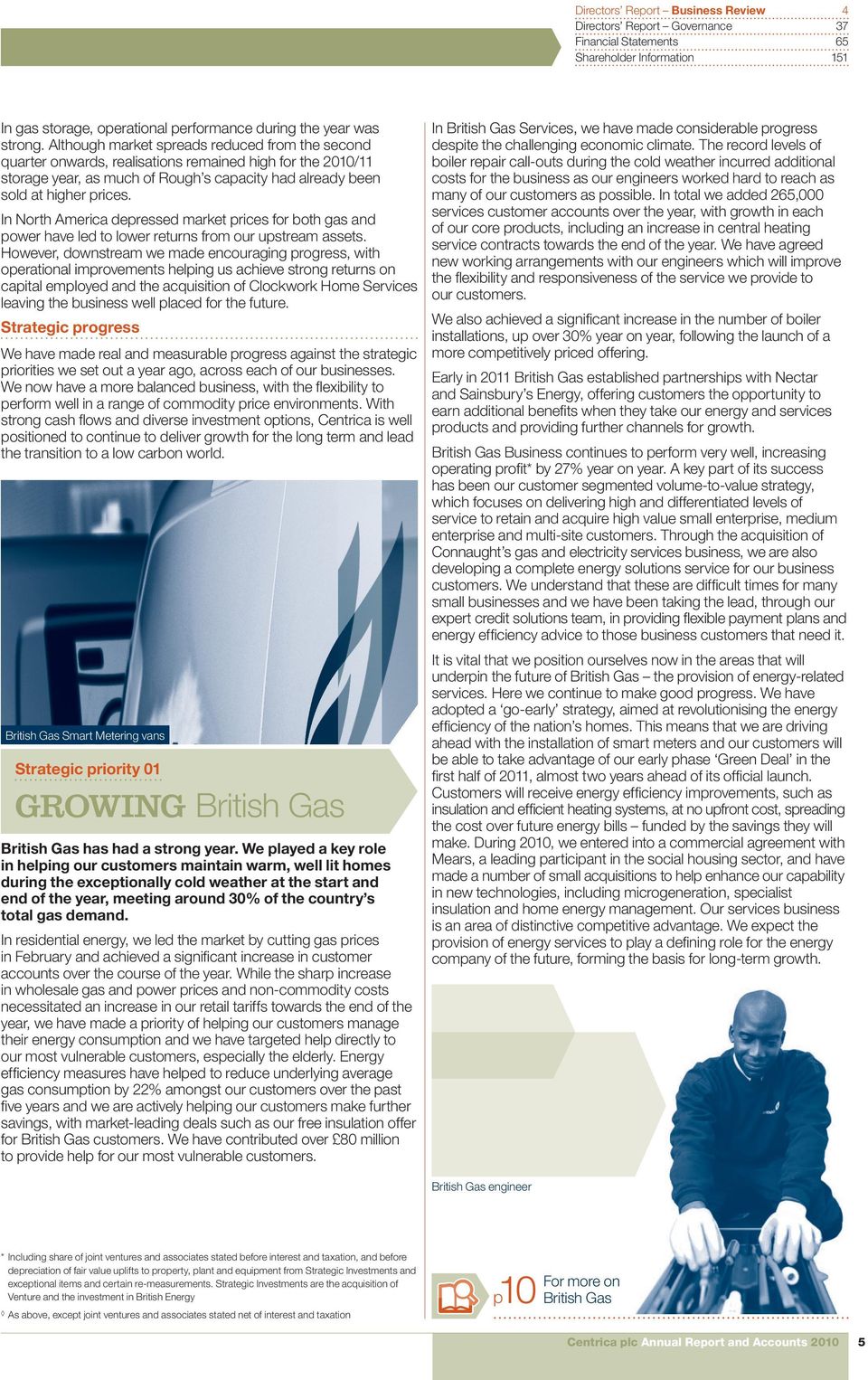
3 Business Review // Chief Executive s Review continued Irish Sea zone in the Crown Estate s Round 3 offshore wind tendering process. Engineer at our Langage gas fired power station in Devon In gas storage, the Rough facility once again delivered excellent operational performance, reflecting continuous investment in the asset since its acquisition. Exceptionally cold weather in the first quarter of the year resulted in record depletion by March. This was followed by a record injection season during the summer months and then unusually high levels of withdrawal in November and December. The spread between winter and summer prices has narrowed, which will significantly affect the profitability of Rough in 2011 and will also alter the economics of our three potential storage development projects if narrow spreads persist. We took the decision not to proceed at the present time with the Caythorpe onshore storage facility. Work continues on the Baird project, with an investment decision expected later in Strategic priority 02 delivering value from our upstream business The operational performance of the Upstream UK business was also strong. Despite lower gas prices at the beginning of the year and the effect of tight market spreads for gas fired generation, operating profit* for the business increased by 47%. This reflected a full year s contribution from the Venture acquisition, strong production volumes from the Morecambe field, a full year s contribution from our 20% stake in British Energy and the addition of Langage to our fleet of gas fired power stations. Strong optimisation performance also helped to improve our returns. We also had considerable success in our gas and oil drilling programme, with 11 out of 15 wells showing positive results. During 2011, at least 11 wells are scheduled to be drilled, which will help maintain Centrica s position as one of the most active drillers in the North Sea. We completed the 247 million acquisition of Suncor s portfolio of Trinidad and Tobago gas blocks, giving us our first producing LNG position, and the 134 million acquisition of Shell s stake in the Statfjord field. These acquisitions, combined with our exploration success and development progress, have resulted in an increase in reported gas and oil reserves of 9% in our Upstream UK business. We are also investing 450 million to develop the York and Ensign gas fields which offer attractive returns. During the year we took 23 LNG cargoes totalling one billion therms into the Isle of Grain, enough to supply around 20% of our UK residential gas demand. We were also pleased to sign a three-year contract with Qatargas in February 2011, which will secure material volumes of LNG for the UK from Qatar. The deal will provide enough gas to meet approximately 10% of UK residential gas demand, equivalent to around 2.5 million UK households. In power generation, nuclear now makes a significant contribution to the results of the division. Although British Energy s performance was adversely affected by an outage at the Sizewell B power station, which lasted for approximately six months, the business contributed over half of our power generation operating profit.* We welcomed the announcement of plant life extensions for Hartlepool and Heysham 1 nuclear power stations by five years to Work continues on the new nuclear build programme with a final investment decision expected in 2012 for Hinkley Point. In offshore wind, all major contracts have now been awarded on the 270MW Lincs joint venture and onshore works have begun, with the wind farm expected to be operational by winter 2012/13. We also welcomed the news that Centrica was awarded exclusive rights to develop up to 4.2GW of wind generation in the 14 p 6 For more on Centrica Energy Frontera power plant, Texas Strategic priority 03 building an integrated North American business In North America we have made encouraging progress. Downstream performance was particularly strong, with underlying profitability* up 35%. Upstream profitability* however, continues to be adversely affected by low wholesale commodity prices. Downstream, we have made significant operational progress. We have improved customer retention and cut the levels of bad debt at our residential energy supply business in Texas. We have also successfully launched a prepayment offering, a good example of our ability to apply our UK experience in the North American market. We continue to enter new markets in the US North East and now have over 100,000 customers in Pennsylvania and Maryland. Business energy supply achieved strong growth, with higher volumes and improved margins through disciplined targeting of our sales activity. We will continue to focus on improving operational efficiency, using our scale to increase sales in the most attractive customer segments. In our services business, where we faced increased competition in the Canadian market and a slow pace of recovery in the US housing market, we improved efficiency and cost control. Following the acquisition of Clockwork in July the integration is proceeding well, making Direct Energy the market leader in the home energy services market and providing a robust platform for growth through its established franchise model. Upstream, the continuing low gas and power price environment has significantly affected our returns, although this provided an opportunity to acquire gas assets in the Wildcat Hills region of Alberta at an attractive price. This gave us an additional 241 billion 19 p For more on our North American operations
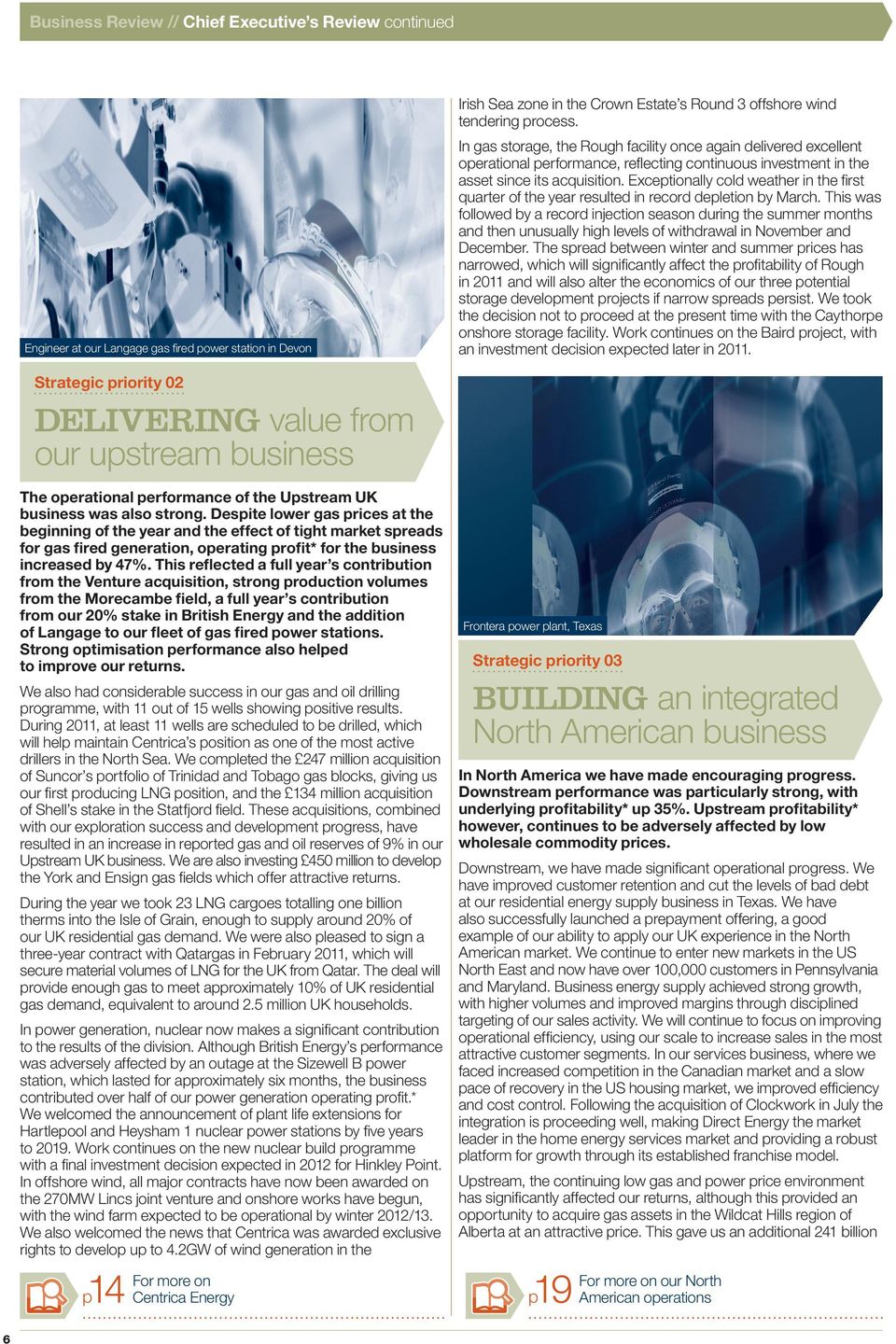
4 Directors Report Business Review Directors Report Governance Financial Statements Shareholder Information cubic feet equivalent (bcfe) of reserves and increased our gas reserves by over 60%. This transaction improves the level of vertical integration in the business, reduces our cost of gas and will allow Direct Energy to meet around 35% of its customers gas demand through its own sources of production. Our power generation business again faced difficult market conditions, with low power prices in Texas affecting the profitability of our gas fired power stations and our wind power purchase agreements. We continue to look for value-adding opportunities to increase our asset cover. However, we retain a tight focus on financial discipline and will only invest where appropriate returns can be achieved Centrica is distinctive in offering continued growth under a balanced business model with the flexibility to perform well in both high and low commodity price environments. The combination of strong cash flows with an attractive range of targeted investment options underpins the future progress of the business, for the benefit both of our customers and shareholders. We have a full programme of investment planned for 2011, maintaining financial discipline and directing our capital to areas where the best returns can be achieved. We plan to invest up to 1.5 billion in organic capital expenditure in 2011 in addition to any acquisitions made during the year. Over two-thirds of the investment is planned for our UK upstream business, including development of the York, Ensign and Rhyl gas fields together Overall, we have continued to successfully build our North with continuing exploration and appraisal activity. In power American business during the year, through organic improvements generation, projects will include further works on the Lincs and acquisitions, and are well positioned to make further progress. offshore wind development and ongoing preparations ahead of the new nuclear investment decision in We also continue to invest in our UK downstream businesses, our North American business, the continuous upgrade of our information systems and in new technologies to create the energy efficient homes and businesses of the future. Sam Laidlaw Chief Executive 24 February 2011 Clockwork offices in Sarasota, Florida Strategic priority 04 driving superior financial returns We have delivered a substantial increase in earnings in 2010, making good progress across each part of the business and we expect to achieve continued growth in Market conditions remain competitive, particularly in UK downstream energy supply, with pressure from rising wholesale prices. However we expect to deliver further improvements in profitability across much of the rest of the Group, building on our progress to date. Bastrop power plant, Texas Throughout the Business Review, reference is made to a number of different profit measures which are shown in the table below: 2010 m 2009 m Explanation Adjusted operating profit*: Downstream UK Upstream UK Storage UK North America Total adjusted operating profit* Impact of fair value uplifts Interest and taxation on joint ventures and associates and other costs Group operating profitω 1, ,390 (118) (78) 1, ,857 (27) (16) The supply of gas, electricity and services for UK residential and business customers The production, generation, optimisation and trading of energy in the UK Gas storage in the UK Downstream and upstream activities in North America The principal operating profit measure used by management and used throughout the Operating Review Depreciation of fair value uplifts to property, plant and equipment of Strategic Investments 2,194 1,814 Group profitω 1,221 1,104 Adjusted earnings 1,297 1,111 Statutory profit 1, Operating profit from continuing operations before exceptional items and certain re-measurements, reconciled to statutory profit in the Group Income Statement Profit from continuing operations before exceptional items and certain re-measurements, reconciled to statutory profit in the Group Income Statement Earnings before depreciation of fair value uplifts to property, plant and equipment from Strategic Investments and exceptional items and certain re-measurements, reconciled to statutory profit in note 11 Profit including discontinued operations, exceptional items and certain re-measurements Term * Including share of joint ventures and associates stated gross of interest and taxation, and before other costs and depreciation of fair value uplifts to property, plant and equipment from Strategic Investments and exceptional items and certain re-measurements As above, except after other costs and joint ventures and associates stated net of interest and taxation Ω Including share of joint ventures and associates stated net of interest and taxation and before exceptional items and certain re-measurements Centrica plc Annual Report and Accounts
5 Business Review // Key Performance Indicators KPIs Measuring the performance and health of our business We monitor our performance by measuring and tracking areas that we see as key to our longer term success. This year we added a new key performance indicator (KPI) which reflects the importance we place on safety. The results across all areas are strong and are a good demonstration of the health of the Company. To see more online, go to: p10 p24 Detailed operational and financial KPIs in the Operating Review start on page 10 Go to the Corporate Responsibility Review for more information on the non-financial KPIs Financial KPIs Adjusted basic earnings per share (EPS) EPS is an industry standard determining corporate profitability for shareholders saw growth in EPS reflecting our strong performance during the year. In 2009 EPS remained unchanged at 21.7 pence, despite a 22% increase in the average number of shares in issue. Target To deliver growth in adjusted EPS over a three-year period. This measure is used as one of the performance conditions in the Long Term Incentive Scheme, outlined on pages 55 and 56. Total shareholder return (TSR) The Board continues to believe that to realise the Company s long-term strategic priorities, TSR is a valuable key performance indicator to assess the Company s performance in the delivery of shareholder value. Centrica has outperformed the FTSE 100 Index by 41% over a five-year period. Target TSR is utilised as a measure of performance over a three-year period in the Long Term Incentive Scheme, outlined on pages 55 and 56. Dividends per share Dividends per share indicate the level of earnings distributed to Centrica shareholders. The 2010 dividend shows an increase of 12% on the 2009 dividend. Target To deliver real growth per annum. Adjusted basic earnings per share (pence) This measure of performance is calculated as profit before other costs and depreciation of fair value uplifts to property, plant and equipment from Strategic Investments and exceptional items and certain re-measurements for the year, attributable to equity shareholders of the parent company, divided by the weighted average number of shares in issue during the year. Source: The measure of adjusted basic EPS is reported in note 14 of the audited Financial Statements. Total shareholder return indices Centrica and FTSE 100 Index for the five years ended 31 December Total shareholder return measures the return to shareholders in terms of the growth of a 100 investment in the Company s shares, assuming that dividends and returns of capital are reinvested. We compare our TSR with those of the other 99 members of the FTSE 100. Source: Alithos Limited, 31 December 2005 = 100. Ordinary dividend (pence) Centrica return index FTSE 100 return index This is the total dividend per share (excluding special dividends) paid in respect of each financial year. Source: The dividend is reported on the Group Income Statement, part of the audited Financial Statements

6 Directors Report Business Review 4 Directors Report Governance 37 Financial Statements 65 Shareholder Information 151 Non-Financial KPIs Lost time injuries Safety is the top priority for Centrica as we believe that all workrelated injuries and process safety incidents can be prevented. We want to develop a culture where all safety risks are tackled with a determination to improve performance, people look out for each other and we share learnings and successes. Initiatives across the Group led to a reduction in our lost time injuries (LTIs) per 100,000 hours by 16.3% in 2010 to This exceeded our target for existing businesses of 0.43 and reflects a continuing downward trend over the last three years. In 2011 we are prioritising road safety to help reduce LTIs further. Target Reduce LTIs to 0.20 per 100,000 hours worked by Carbon intensity Decarbonising power generation is a critical enabler for other sectors of the economy to meet the UK s CO2 targets and our strategy is to invest in lower carbon generation, such as highefficiency gas fired power stations, nuclear energy and offshore wind farms. Centrica is one of the leading offshore wind farm operators. We continued to reduce the carbon intensity of our UK power generation fleet in 2010, achieving 275g CO2/kWh. This reduction is mainly attributable to the increased offtake in nuclear power from our 20% stake in British Energy. Our global carbon intensity was also 275g CO2/kWh in Target Reduce our UK power generation carbon intensity to 270g CO2/kWh by 2012 and aim to bring our global carbon intensity down to that level in the same period; reduce our UK carbon intensity to 260g CO2/kWh by Customer trust To build customer trust, we recognise that we need leading customer service. We track our performance using brand net promoter scores (NPS) for our two customer-facing businesses: British Gas in the UK and Direct Energy in North American markets. British Gas brand NPS increased steadily throughout the year, achieving an annual average score of +5, exceeding our 2010 target of +3. Direct Energy brand NPS rose to +21, up from +9.5 in The increases across all our markets are a result of a much sharper focus on customer satisfaction and better training for employees to recognise and understand customer needs. Target Achieve British Gas brand NPS of +10 in 2012 and Direct Energy brand NPS of +28 in Direct Energy s 2009 data is geographically more inclusive than 2010 data and so is not directly comparable. Employee engagement Engaged employees are essential to the delivery of our business objectives. Measuring engagement and the factors that drive it strengthens our ability to attract, develop and retain talent across the organisation. The scores for engagement Group-wide decreased slightly by two percentage points to 64% from 2009 but, given the scale of changes to the business, this was not unexpected. We remain in the top quartile performance range of an independent benchmark. Target Achieve a score of 67% in 2012 when the next full survey will be completed and remain in the high performance category. Lost time injuries per 100,000 hours worked 2013 target Carbon intensity g CO2/kWh 2012 target g 275g* 371g 379g * 2010 data subject to final verification verified 2009 figure restated Carbon intensity measures the amount of carbon dioxide (CO2) emitted per unit of electricity generated. Our figures are based on average annual emissions from all wholly-owned UK power generation assets and all other power generation assets from which Centrica is entitled to output under site-specific contracts. Source: Based on verified emissions data under the requirements of the EU Emissions Trading Scheme. Net promoter scores British Gas 2012 target Direct Energy 2011 target A lost time injury is defined as an incident arising out of Centrica s operations which leads to an injury where the employee or contractor is not available to work for one day or more, excluding the day that the injury occurred. Source: Internal data collection +28 The brand NPS measures customers responses to the question How likely would you be to recommend us as an energy supplier to a friend, colleague or relative (0-10 scale)? The score is calculated by the percentage of customers defined as promoters (scoring 9-10) minus the percentage defined as detractors (0-6). Source: Internal calculations combining figures for residential and services divisions. Brand net promoter scores are collected through customer feedback forms and telephone interviews conducted by a third-party supplier. Engagement score 2012 target % 64% 66% 57% 53% The Centrica employee survey measures how people, from every team at all levels across the Group, feel about working for us. Questions include: Would you tell others this is a great place to work? Do you ever think about leaving? Does the Company inspire you to do your best every day? Source: The survey is managed by an external supplier, enabling us to benchmark our performance against other companies. Centrica plc Annual Report and Accounts

7 Business Review // British Gas British Gas Leading the way towards a low carbon future Customer service adviser in Cardiff Downstream UK Phil Bentley on growing the business in a low carbon world A low carbon future is a world in which we all use less energy. As Britain s leading energy supplier, we are growing our business by insulating homes, installing energy efficient boilers, fitting solar panels and other microgeneration in the home, and leading the revolution in smart metering. Even though this means selling less energy per household, we know that both our existing customers and our new customers value our advice and the new services we are providing. And, with increased energy efficiency in our homes, energy bills are coming down British Gas customers who adopted such measures are saving an average of 322 per annum. But there s more to do as many homes have taken no action at all which is why British Gas is increasing its investment in such low carbon technologies and services, and why we are confident we can grow British Gas. OUR STRATEGY IN ACTION: growing British Gas delivering value from upstream building our North American business driving superior financial returns 10 British Gas had a strong year, both operationally and financially. In residential energy supply, our focus on customer service, innovation, and a competitive pricing position resulted in a higher number of accounts. In a year of exceptionally cold weather, average gas consumption rose by 11%, more than offsetting the underlying savings in consumption made by customers as a result of energy efficiency improvements. In business energy supply we focus the business on three customer segments small enterprise, medium enterprise and multi-site customers. This has allowed us to deliver high and differentiated levels of customer service and to pursue a volume-to-value strategy which focuses on retaining and acquiring high value customers in each segment. With the Connaught transaction, we also took a material step forward in our ambition to build a larger scale business energy services presence. In residential services, we achieved a further increase in the number of customer account holdings, reflecting our commitment to continually improve the responsiveness and quality of service we provide to our customers. Overall, the number of British Gas accounts increased by 529,000 during 2010, while the number of joint product households, those which take both an energy and a services product from us, increased by 121,000. The number of residential energy accounts on supply increased by 267,000, mainly as a result of a strong competitive pricing position for most of the year following our market leading price reduction early in February. In common with the rest of the industry, we face higher forward market wholesale gas and power prices and rising non-commodity costs, such as network charges and environmental obligations. These increases in costs necessitated a 7% increase in our gas and electricity prices, which took effect in December. In residential services the number of product holdings increased by 265,000 to over 8.7 million, with improved retention rates and continued sales of services products to energy customers. Despite the challenging economic climate, sales of central heating service contracts towards the end of the year were strong. Over six million of our services contracts are now insurance based, meaning we are able to offer most customers a more flexible product range. We also reached agreement with our service and repair engineers regarding new contract terms and conditions, enabling us to offer greater flexibility to meet increased customer demand for evening and weekend appointments and during peak winter periods. During the sustained period of cold weather in December we received record levels of breakdown call-outs, 25% higher than the corresponding period in December Following improved preparation for peak periods of demand our engineers were able to visit up to 35,000 customers a day around double the amount normally visited on a typical winter s day despite facing difficult driving conditions. We prioritised work to reach vulnerable customers first.

8 Directors Report Business Review 4 Directors Report Governance 37 Financial Statements 65 Shareholder Information 151 Downstream UK For the year ended 31 December FY 2010 FY 2009 Δ% H H Δ% Total customer accounts ( 000) 25,740 25, ,740 25, Total customer households ( 000) 12,206 12,226 (0.2) 12,206 12,226 (0.2) Joint product households ( 000) 2,164 2, ,164 2,043 6 Gross revenue ( m) 12,730 12, ,996 5,688 5 Operating cost (excluding bad debt) ( m) 1,358 1, Operating profit ( m)* 1,216 1, (31) * Including share of joint ventures and associates stated gross of interest and taxation, and before other costs and depreciation of fair value uplifts to property, plant and equipment from Strategic Investments and exceptional items and certain re-measurements The number of central heating systems installed was up by more than 30% on the previous year, reflecting higher lead conversion resulting from a more competitively priced product offering, as well as the Government s boiler scrappage scheme. In January 2011 British Gas became the new energy partner in the Nectar loyalty programme offering customers the opportunity to earn additional benefits when they take our energy and services products and in February 2011 we entered into a partnership with Sainsbury s Energy. These partnerships provide us with new channels for account growth. In business energy supply, customer supply points were broadly unchanged since the start of the year at 1.04 million as we continued to focus on increasing the value of our customer base rather than increasing customer numbers. Increased demand forecasting accuracy and tighter hedging have also contributed to an improved level of profitability*, whilst reducing the overall risk in the business model. In business services we significantly enlarged the scale of our activities with the acquisition of the assets of Connaught s gas and electricity business in October. The transaction included more than 20,000 customer contracts, together with a workforce of over 400 engineers. This is a significant step forward in our goal to build a complete energy solutions business for commercial customers. We also acquired JK Environmental Services (UK) Ltd, a company which provides environmental services, sewer cleaning and tankering to the business market, with a particular focus on water and sewerage companies. We have made good progress during the year in those areas that will underpin the future growth of British Gas and we remain committed to leading the industry in energy efficiency and enabling new technologies. During the year we announced an arrangement with Mears, a leading provider of repairs and maintenance services to the social housing sector. British Gas and Mears now jointly bid on repair and maintenance contracts in the social housing sector, with British Gas delivering energy services as well as providing access to CERT, CESP, Feed-in tariff and, later in 2011, Renewable Heat Incentive (RHI) funding. In January 2011 we won the contract to run the Welsh Assembly Government s new Residential energy supply For the year ended 31 December FY 2010 FY 2009 Δ% H H Δ% Customer accounts (period end) Gas ( 000) 9,332 9,378 (0.5) 9,332 9,378 (0.5) Electricity ( 000) 6,646 6, ,646 6, Total ( 000) 15,978 15, ,978 15, Estimated market share (%) Gas (0.4) ppts (0.4) ppts Electricity ppts ppts Average consumption Gas (therms) Electricity (kwh) 3,982 3, ,970 1, Total consumption Gas (mmth) 5,291 4, ,294 1, Electricity (GWh) 26,002 24, ,016 12,106 8 Gross revenue ( m) Gas 5,570 5, ,460 2, Electricity 2,789 2, ,416 1, Total 8,359 7, ,876 3, Transmission and metering costs ( m) Gas 1,231 1,239 (0.6) Electricity Total 1,945 1, Operating profit ( m)* (48) Operating margin (%) ppts (4.5) ppts * Including share of joint ventures and associates stated gross of interest and taxation, and before other costs and depreciation of fair value uplifts to property, plant and equipment from Strategic Investments and exceptional items and certain re-measurements Centrica plc Annual Report and Accounts

9 Business Review // British Gas continued fuel poverty programme. We also retained the Scottish Parliament s flagship fuel poverty scheme the Energy Assistance Programme under which we will provide insulation and energy efficient heating and hot water systems to over 30,000 households across Scotland over the next three years. We continued to build our insulation capability. In April we acquired Hillserve Ltd, an insulation business operating in the North West of England and Wales, while in December we acquired ECL Contracts Ltd, a specialist provider of solid wall insulation solutions and external cladding for both commercial and residential buildings. We now operate nationally from 12 regional areas, employ over 750 people and in total we provided insulation for 237,000 homes during the year. In March we announced our strategy to build momentum for an early roll-out of smart meters in the UK. We shared our smart metering technical standards with the rest of the industry and announced the companies we would be partnering in the initial stage of the roll-out. We have installed over 250,000 smart meters for homes and businesses to date, with a target of installing two million smart meters by the end of 2012, to help meet the Government s target date of 2020 for all UK households to have a smart meter installed. In October we announced that we had acquired an equity stake in AlertMe, a provider of home energy management services. British Gas customers will be able to gain access to AlertMe s innovative product portfolio, helping them to reduce energy consumption. We also continue to enhance our capabilities in new technologies. In October, alongside our partners Thames Water and Scotia Gas Networks, we delivered the UK s first plant to inject renewable gas (biomethane) into the grid, while in November we acquired the assets of Cool Planet Technologies Limited, a heat pump installation company, which should benefit from the introduction of RHI funding. We are one of the largest installers of solar photovoltaic panels in the UK and retain interests in biomass through a stake in Econergy. We are also able to offer our customers Stirling Engine boilers via our partnership with Baxi and retain an interest in fuel cell boilers, for which commercial trials have commenced, through our equity stake in Ceres Power Holdings plc. Operationally we continue to perform well. Health and safety remains critical to the success of British Gas and we have a good safety record, with lost time incidents continuing to fall across British Gas despite the high number of boiler breakdown call-outs during the cold weather. We were once again recognised by the Great Places to Work Institute as one of the UK s 50 Best Workplaces, and our Cardiff call centre was recognised as Call Centre of the Year in the 2010 European Call Centre Awards for the second year in a row. The contact net promoter score (NPS) for our services business remained high, at 52%, while the contact NPS for both British Gas Residential and British Gas Business increased substantially during the year. For the second year running we were placed top of the Morgan Stanley Energy Supply survey for customer service and loyalty, increasing our lead following further improvements. Our online platform continues to improve, and self serve transactions now account for around 40% of all customer contacts, with the number of meter reads submitted, payment transactions and annual services visits booked online all increasing substantially year on year. Gross revenue in the period was slightly up at 12,730 million (2009: 12,565 million), with lower average retail tariffs for both residential and business energy customers being offset by services growth and higher weather related consumption in energy. Operating profit* increased by 20% to 1,216 million (2009: 1,011 million). Residential energy supply operating profit* increased by 24% to 742 million (2009: 598 million) and operating margin increased to 8.9% (2009: 7.6%). Energy efficiency measures continue to deliver underlying reductions in energy consumption, however average gas consumption increased by 11% and average electricity consumption increased by 2%, reflecting the exceptionally cold weather at the beginning and end of the year. As a result of our industry leading price reduction in February, the revenue per therm fell by 5% and revenue per kilowatt hour fell by 2%, although higher customer numbers and higher weather related consumption resulted in an increase in gross revenue to 8,359 million (2009: 7,911 million). Overall, costs increased Residential services For the year ended 31 December FY 2010 FY 2009 Δ% H H Δ% Customer product holdings (period end) Central heating service contracts ( 000) 4,684 4, ,684 4, Kitchen Appliances Care (no. of customers) ( 000) Plumbing and Drains Care ( 000) 1,781 1, ,781 1, Home Electrical Care ( 000) 1,480 1, ,480 1, Other contracts ( 000) Total holdings ( 000) 8,718 8, ,718 8, Domestic central heating installations ( 000) Gross revenue ( m) Central heating service contracts Central heating installations Other Total 1,464 1, Engineering staff employed 9,954 9, ,954 9, Operating profit ( m)* Operating margin (%) (0.7) ppts (0.4) ppts Installations numbers include domestic and local authority installations. Revenue associated with non-contract central heating service work is included in other. * Including share of joint ventures and associates stated gross of interest and taxation, and before other costs and depreciation of fair value uplifts to property, plant and equipment from Strategic Investments and exceptional items and certain re-measurements 12
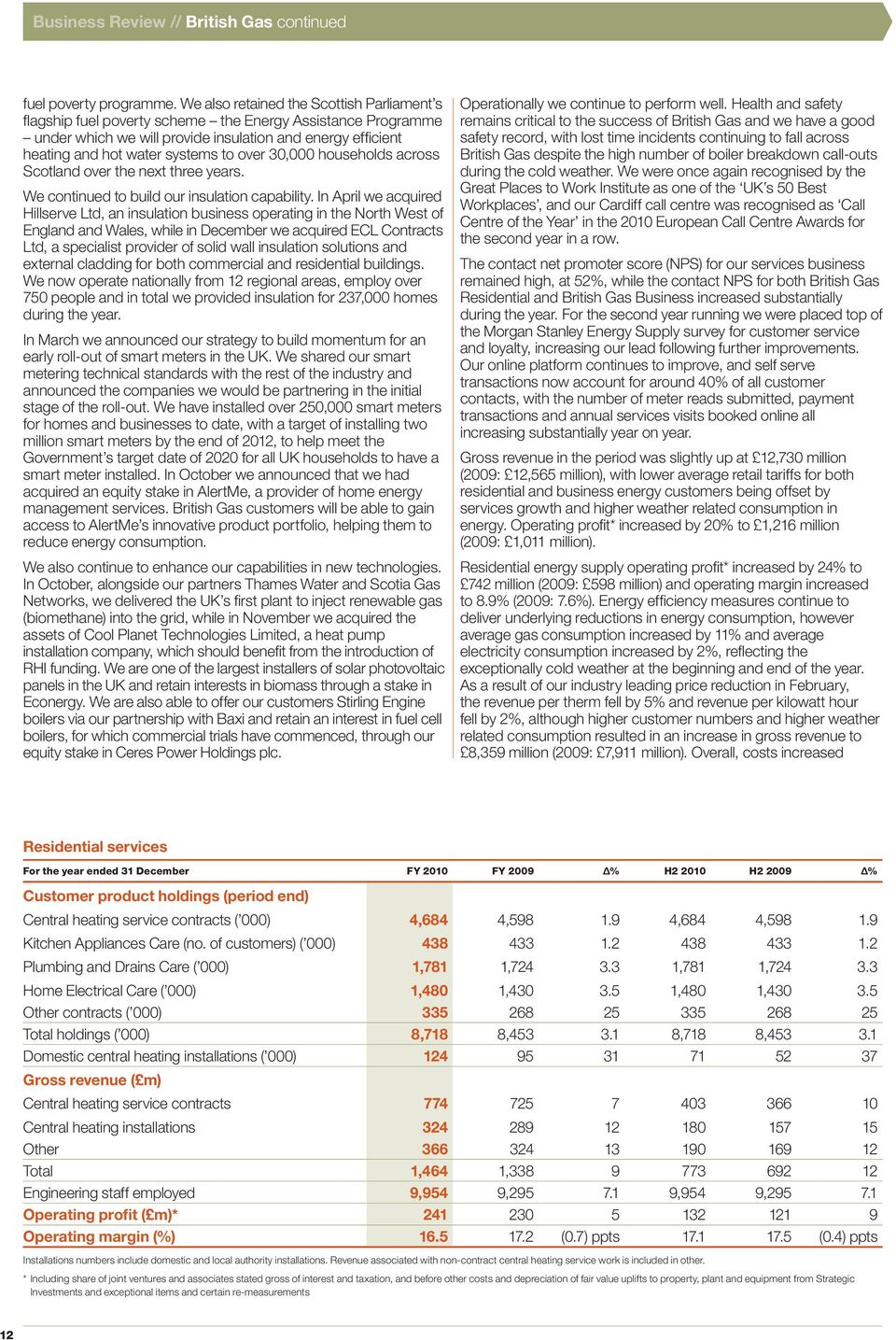
10 Directors Report Business Review 4 Directors Report Governance 37 Financial Statements 65 Shareholder Information 151 by 4% to 7,617 million (2009: 7,313 million), as lower unit commodity costs for gas and electricity were more than offset by higher weather related consumption, a cost of 167 million relating to the closing out of some out-of-the-money contracts for delivery of gas mainly during 2011 and 2012, a 16% increase in electricity transmission and metering costs, higher environmental costs and incremental expenditure on social and community programmes. During 2010 we contributed a total of 80 million to provide help for those most in need. This included an additional 50 reduction off the winter fuel bills of each of our most vulnerable customers the 340,000 customers on the Essentials tariff and a 20 million donation to the British Gas Energy Trust. Our social spend has far exceeded our commitment to Government in each of the past two years. We also announced in September that we would go early on the Government s proposed Green Deal, with a 30 million investment, and also made a 15 million investment to install solar panels for schools. Residential services revenue rose by 9% to 1,464 million (2009: 1,338 million) reflecting the increase in the contract base and the number of boilers installed. Operating profit* increased to 241 million (2009: 230 million), with operating margin remaining strong at 16.5% (2009: 17.2%). We incurred additional costs as a result of the higher number of engineer call-outs due to the cold weather at the beginning and end of the year, partially offset by receipts from a cold weather hedge contract with the residential energy supply business. Business energy supply and services gross revenue fell by 12% to 2,907 million (2009: 3,316 million) as the impact of lower commodity prices flowed through to the end consumer. This also reflects our segmented strategy to move away from high consuming, single-site industrial customers to lower consuming multi-site customers, where our retail skills give us a significant competitive advantage. Operating profit* increased by 27% to 233 million (2009: 183 million) and operating margin increased to 8.0% (2009: 5.5%). This reflects higher weather related gas and electricity volumes and our strategy to retain and acquire high value customers. Overall, operating profit* for business energy supply and services has increased by an average of 25% each year over the past five years. Cost control remains a key focus, allowing us to reinvest in the business to drive growth in key areas including investments to improve customer service, to improve our online capability and in new markets. We also continue to monitor our debt collection rates closely, providing flexible payment plans and advice for customers struggling to pay their bills on time. So despite the challenging macroeconomic environment, we have been able to limit the impact of bad debt on our operations. Visit the British Gas website at: Business energy supply and services For the year ended 31 December FY 2010 FY 2009 Δ% H H Δ% Customer supply points (period end) Gas ( 000) (2.8) (2.8) Electricity ( 000) Total ( 000) 1,044 1,047 (0.3) 1,044 1,047 (0.3) Average consumption Gas (therms) 3,152 3, ,368 1, Electricity (kwh) 29,326 32,275 (9) 14,415 15,947 (10) Total consumption Gas (mmth) 1,250 1,275 (2.0) Electricity (GWh) 19,060 20,512 (7) 9,388 10,245 (8) Gross revenue ( m) Gas 1,062 1,170 (9) Electricity 1,845 2,146 (14) 888 1,057 (16) Total 2,907 3,316 (12) 1,347 1,511 (11) Transmission and metering costs ( m) Gas (7) (9.3) Electricity (9) (12) Total (8) (11) Operating profit ( m)* (28) Operating margin (%) ppts (1.5) ppts * Including share of joint ventures and associates stated gross of interest and taxation, and before other costs and depreciation of fair value uplifts to property, plant and equipment from Strategic Investments and exceptional items and certain re-measurements Centrica plc Annual Report and Accounts

11 Business Review // Centrica Energy Centrica Energy Delivering value from an enlarged upstream business Langage power station Upstream UK Mark Hanafin on the importance of diversity within energy supply Britain faces a number of simultaneous energy challenges: dwindling output from the North Sea, an ageing power generation fleet, and the need to cut our carbon emissions. If Centrica is to ensure a secure and sustainable supply for the future we need to increase the diversity of our lower carbon energy sources. So in the search for clean electricity we are building a 270MW wind farm off the Lincolnshire coast and have rights to develop a further 4.2GW in the Irish Sea. Then in 2012 we will be making a final investment decision on the UK s first new nuclear power station for more than 20 years. The acquisition of gas assets in Trinidad and Tobago and Norway, together with one of the most active drilling programmes in the UK North Sea, means that we are continuing to increase our gas reserves and our ability to supply from our own resources. OUR STRATEGY IN ACTION: growing British Gas delivering value from upstream building our North American business driving superior financial returns 14 Our UK upstream business performed strongly during Upstream gas and oil production volumes were up 43%. Reserves increased by 9% over the year, equivalent to replacing 163% of our production, through acquisitions and a focused drilling programme. The power generation business achieved high reliability from both our gas fired and wind assets. Operating profit* for the Upstream UK business was up 47% to 771 million (2009: 525 million) with the impact of lower realised gas and power prices being offset by higher gas production volumes from Morecambe and a full year s contribution from Venture, together with higher power generation volumes following the acquisition of a 20% equity stake in British Energy. Upstream gas and oil Our gas and oil business had a good year operationally, with strong production performance and considerable drilling success. Our upstream capabilities are much enhanced following the integration of Venture and employee retention has remained high, giving us the depth of expertise required to be a leading operator in the UK, Norway, The Netherlands and Trinidad and Tobago. The business is led from Aberdeen, operating with the pace and flexibility required to take advantage of the available opportunities. During the year we continued to make progress on our gas development projects. The third and fourth development wells at our Chiswick field in the North Sea were successfully drilled and brought on stream, while both the Eris and Ceres gas fields and the non-operated Babbage field produced first gas in We successfully installed the F3-FA platform on the Dutch continental shelf with the field producing first gas in January We approved field development on the York and Ensign gas fields and expect to make a final investment decision on Rhyl in the first quarter of Development of York and Ensign will require an investment of approximately 450 million, over half of which will be in These projects offer attractive returns, and are estimated to bring over 30 million barrels of oil equivalent (mmboe) of reserves into production. Overall during the year our focused exploration and appraisal programme delivered a high level of drilling success, with 11 out of 15 operated and non-operated wells showing positive results. Successful appraisal drilling in the western region of the Cygnus field was completed during the first half of the year. We had discoveries at the Olympus and Fulham prospects in the UK North Sea and the Fogelberg, Maria and David prospects in Norway. However, exploration drilling on the Alcyone, Morpheus, Caerus and Halley Delta prospects were unsuccessful. In total 31mmboe of 2P reserves were added as a result of drilling activity in 2010 and we plan to drill at least 11 wells during 2011.

12 Directors Report Business Review 4 Directors Report Governance 37 Financial Statements 65 Shareholder Information 151 In August we completed the acquisition of Suncor s portfolio of Trinidad and Tobago production, development and exploration assets, announced in February, providing us with access to one of the Atlantic Basin s key LNG export areas. In December we completed the acquisition of Shell s stake in the Statfjord field, announced in September, doubling our interest. These two acquisitions, combined with organic development progress, have resulted in a 9% increase in our European and Trinidad and Tobago reserves, to 434mmboe. After taking account of 53mmboe of production during the year, this equates to a production replacement ratio of 163%. Total gas and liquids production volumes increased by 43%, with gas volumes up 48% at 2,533 million therms (mmth) (2009: 1,708mmth), and oil and condensate volumes up 26% to 11.1mmboe (2009: 8.8mmboe), reflecting the acquisition of Venture in 2009, strong asset performance and higher volumes from Morecambe, which was shut in for parts of The average achieved gas sales price was down 15% at 41.6 pence per therm (p/th) (2009: 48.9p/th) reflecting a benefit in the prior year from forward gas sales entered into when the gas price was materially higher. The average achieved oil and condensate price was 46.8 per barrel of oil equivalent (boe) (2009: 38.1/boe) reflecting an increase in the global oil price. Overall operating profit* for our upstream gas and oil business increased by 31% to 581 million (2009: 444 million) as higher production volumes offset a lower achieved gas price. Production costs increased to 980 million (2009: 734 million), reflecting higher production volumes following the Venture acquisition. Unit production costs fell, reflecting a higher proportion of production from the lower cost Morecambe field. Power generation Low gas prices and healthy UK system margins for most of the year led to relatively low market power prices and spark spreads. Our CCGT fleet reliability remained high at 97% (2009: 97%), however gas fired generation volumes decreased slightly to 22.8 terawatt hours (TWh) (2009: 23.2TWh), despite the commissioning of the Langage gas fired power station. Most of our CCGT portfolio ran peak running patterns and consequently the average load factor fell to 56% (2009: 69%). The average spark spread Upstream UK For the year ended 31 December FY 2010 FY 2009 Δ% H H Δ% Total upstream UK Operating profit ( m)* Upstream gas and oil Gas production sales volumes (mmth) Morecambe 1, Other 1, Total 2,533 1, , Average gas sales price (p/therm) (15) Oil and condensate production volumes (mmboe) (9) Average oil and condensate sales price ( /boe) Production costs ( m) Operating profit ( m)* Estimated net proven and probable reserves of gas (bcf) 2,187 2,018 8 nm nm nm Estimated net proven and probable reserves of liquids (mmboe) nm nm nm Power generation Power generated (GWh) Gas fired 22,786 23,203 (1.8) 10,458 13,552 (23) Renewables (40) (35) British Energy 9,655 1,128 nm 4,695 1,128 nm Total 32,934 25, ,437 15, Achieved clean spark spread ( /MWh) (1) (2.6) Achieved power price (including ROCs) ( /MWh) renewables Achieved power price ( /MWh) British Energy nm nm Operating profit ( m)* (5) Industrial and commercial UK I&C external sales volumes (mmth) 1,070 1,268 (16) (47) UK I&C average sales price (p/therm) Operating profit/(loss) ( m)* (36) (93) nm (82) (4) nm Proprietary energy trading Operating profit/(loss) ( m)* 0 27 nm 2 (7) nm * Including share of joint ventures and associates stated gross of interest and taxation, and before other costs and depreciation of fair value uplifts to property, plant and equipment from Strategic Investments and exceptional items and certain re-measurements nm denotes not material Centrica plc Annual Report and Accounts

13 Business Review // Centrica Energy continued achieved declined slightly to 11.6 per megawatt hour (MWh) (2009: 11.7/MWh). This represents a 62% premium to average market spreads and reflects optimisation and volumes sold at peak prices. The availability of our joint venture wind assets remained high throughout the year; however, unfavourable weather patterns resulted in a lower overall load factor of 29% (2009: 32%). Early in 2010 we completed the joint venture agreement with DONG and Siemens Project Ventures for the development of the Lincs 270MW offshore wind project. All major contracts for this project were awarded during the first half of the year and onshore works are ongoing. We expect the wind farm to be operational by winter 2012/13. We also welcomed the news that Centrica had been successful in the Crown Estate s Round 3 offshore wind tendering process, having been awarded exclusive rights to develop up to 4.2GW in the Irish Sea zone. Round 3 development projects are expected to commence no earlier than In nuclear, our 20% equity share of the output from the British Energy fleet was 9.7TWh in Output was adversely impacted by a number of outages, the most significant being at the Sizewell B power station, which was shut down for approximately six months during the year for inspection and repair of the pressuriser. The average achieved power price in 2010 was 42.9/MWh reflecting the baseload market power price and the extent to which power had been forward sold by British Energy before the acquisition in In December we welcomed the announcement of plant life extensions until 2019 for Hartlepool and Heysham 1 nuclear power stations. Work continues on new nuclear build. Site investigation works have now been completed at Hinkley Point and planning permission for some preparatory works has been received. Key contracts have been put out to tender, including the main civil engineering works. Subject to the necessary approvals and the outcome of the Government s Electricity Market Reform consultation, a final investment decision is expected in 2012 for Hinkley Point. Overall operating profit* for the period was 226 million (2009: 147 million), reflecting the inclusion of a full year of output from British Energy, which contributed over half of the operating profit* of the power generation business. The profitability* of our gas fired fleet was slightly down reflecting low market spark spreads while wind profitability* was also down due to the impact of low wind yields and the sale of 50% of our interests in the Glens of Foudland, Lynn and Inner Dowsing wind assets at the end of Industrial and commercial This segment includes legacy gas sales contracts, LNG activity, our German wholesale business and the Rijnmond 2 gas fired power station tolling agreement. The legacy gas sales contracts achieved an average sales price of 48.4p (2009: 45.8p) reflecting the index-linked pricing mechanisms within the contracts. Sales volumes were lower, at 1,070mmth (2009: 1,268mmth) as the majority of these contracts ended during the second half of As a result, the remaining activities in this segment will be reported in either the upstream gas and oil segment or power generation segment in During 2010 we took 23 LNG cargoes into the Isle of Grain (2009: 15), totalling one billion therms, reflecting favourable prices in the UK compared to other global markets. Overall the industrial and commercial segment delivered an operating loss* of 36 million (2009: operating loss* of 93 million). Proprietary energy trading Our proprietary trading business broke even in 2010 (2009: operating profit* 27 million), reflecting continuing difficult trading conditions. From 2011, proprietary trading profits* will be reported in either the upstream gas and oil or power generation segments. * Including share of joint ventures and associates stated gross of interest and taxation, and before other costs and depreciation of fair value uplifts to property, plant and equipment from Strategic Investments and exceptional items and certain re-measurements To see more online, go to: 16

14 Business Review // Centrica Storage Directors Report Business Review 4 Directors Report Governance 37 Financial Statements 65 Shareholder Information 151 Centrica Storage Exceptional operational performance and reliability Grant Dawson explains the importance of storage In order to be able to guarantee gas supply to our customers when they need it most, we must have gas in storage. Neither Centrica nor the UK can operate on a just-in-time basis. With the UK rapidly becoming more dependent on imported gas, increasing the country s gas storage capacity is essential to ensure security of supply. At present the UK has the ability to store enough gas to cover around 17% of peak demand. This is well below other European countries. And it leaves the UK vulnerable, particularly if imported gas is diverted to other countries during a shortfall which happened during the dispute between Russia and the Ukraine just over a year ago. Our Rough gas storage facility represents 70% of the UK s total storage capacity. It is an incredibly important asset which remains a key part of the Group s integrated energy business. OUR STRATEGY IN ACTION: growing British Gas delivering value from upstream building our North American business driving superior financial returns Rough gas storage facility Storage UK The operational performance of the Rough storage facility was again extremely strong in 2010 with reliability of 98%. This reflects the investment made in the asset since its acquisition in 2002, and came in a year of record levels of injection and withdrawal. The exceptionally cold weather in January and February resulted in a record low Net Reservoir Volume (NRV) in March, followed by injection during the summer months of more than 100 billion cubic feet (bcf). More cold weather late in the year led to 47 days of consecutive withdrawals between the middle of November and the end of December, resulting in the lowest ever NRV at the end of a year. Gross revenue was broadly flat at 267 million (2009: 266 million), as a lower average calendar year standard bundled unit (SBU) price of 42.1p (2009: 44.2p) was offset by strong optimisation performance. The calendar year SBU price reflected the announcement in April that we had sold all SBUs for the 2010/11 storage year at an average selling price of 39.7p (2009/10: 46.8p). With current summer and winter forward spreads narrower than in recent years, this indicates a substantially lower SBU price for 2011/12, which would have a material impact on 2011 profitability*. Total costs remained flat, resulting in a marginal increase in operating profit* to 169 million (2009: 168 million). Our Caythorpe project remains on hold, due to reduced market volatility and higher than anticipated construction costs. We are seeking to compulsorily acquire certain land rights required to implement the project and expect to review the position again towards the end of Work is ongoing on our Baird gas storage project, in which we hold a 70% interest, where we continue to review aspects of the project design and the economics. We also expect to make an investment decision on Baird in 2011 which would result in an operational facility for storage year 2016/17. We continue to evaluate the Bains project, in which we hold an 86.8% interest and aim to make a further decision on this project in Rough, which provides over 70% of UK storage capacity, is an important asset for both Centrica and the UK. The UK has significantly less storage capacity than other European countries, and gas storage can play an important role in ensuring UK security of supply into the future. When Centrica bought Rough the acquisition was the subject of a Competition Commission inquiry which was cleared in August 2003 subject to certain undertakings. Broadly, the original undertakings included conditions that Centrica would keep no more than 15% of Rough s capacity for its own use, and would maintain Centrica Storage legally, financially and physically separate from the rest of the Group to make sure Centrica does not benefit from a competitive advantage in the retail market from owning the UK s primary storage facility. So although Centrica Storage is a wholly-owned Centrica plc Annual Report and Accounts

15 Business Review // Centrica Storage continued The Easington gas reception terminal, owned and managed by Centrica Storage subsidiary of Centrica it is managed at arm s length from Centrica s upstream and downstream energy businesses. In April 2010 we asked the Office of Fair Trading (OFT) to review the undertakings on the basis that since 2002 there have been changes in the gas market, which make the undertakings unnecessary. New LNG import terminals and pipelines have been built and the UK is now a net importer of gas. The request was also based on the fact that new European legislation on storage operators (in the form of the Third Energy Package) will replace the need for many of the requirements of the undertakings. In September 2010, the OFT referred the matter to the Competition Commission having determined that there had been a change of circumstances with regard to both the market conditions and the legal framework. In January 2011, the Competition Commission published its provisional decision. We are disappointed that the Competition Commission does not agree that changes in the gas market since 2002 or the introduction of the EU Third Energy Package remove the need for the undertakings. However the Competition Commission is consulting on a possible increase in the amount of Rough capacity that can be bought by Centrica and the possibility of us being able to offer a more flexible product range to our customers. We await the final decision, due April Storage UK For the year ended 31 December FY 2010 FY 2009 Δ% H H Δ% Average SBU price (in period) (pence) (4.8) (15) Gross revenue ( m) Standard SBUs (5) (15) Optimisation/other (20) Total (16) External revenue ( m) Cost of gas ( m) (21) 6 8 (25) Operating profit ( m)* (24) * Including share of joint ventures and associates stated gross of interest and taxation, and before other costs and depreciation of fair value uplifts to property, plant and equipment from Strategic Investments and exceptional items and certain re-measurements To see more online, go to: 18

16 Business Review // Direct Energy Directors Report Business Review 4 Directors Report Governance 37 Financial Statements 65 Shareholder Information 151 Direct Energy Building a strong business in North America Chris Weston explains the steps being taken to create an integrated business in North America The energy market in North America presents significant opportunities and we are making real progress towards our strategy of building an integrated energy business. Since I took over as Managing Director a year and a half ago we have focused on our people, strengthened the business and made some exciting acquisitions, all of which put us in a position to see continued growth in Downstream, we are the third largest commercial and industrial power supplier, and growing. Our residential energy supply business, the largest in North America, has benefited from concentrating on higher value customers. There are also exciting organic growth opportunities in the US North East as markets open to competition. The acquisition of Clockwork gives us a strong presence across the US and a market leading position in home services with real opportunities for growth. Upstream, shale gas is reducing commodity prices. But low prices provide attractive acquisition opportunities, and we have significantly increased our gas reserves through the purchase of Wildcat Hills. We can now supply 35% of our customers demand for gas from our own production and we continue to look for other upstream acquisition opportunities. OUR STRATEGY IN ACTION: growing British Gas delivering value from upstream building our North American business driving superior financial returns Direct Energy vans in Toronto North America Our North American business, Direct Energy, made good progress in 2010 with strong operational performance resulting in a much improved overall financial result, despite continuing low commodity prices across North America. Through organic improvements and value-adding acquisitions, we have made solid progress towards doubling the contribution of the business. Downstream performance was particularly strong, with underlying downstream profitability* up 35% and double digit returns on capital employed. In residential energy supply bad debt costs were reduced and retention improved in Texas. In business energy supply we significantly strengthened sales productivity, increased our power volumes by 19% and improved operating margin. The acquisition of Clockwork Home Services provides a step change in scale in a cost effective manner for our services business. Upstream the market remains challenging, with low commodity prices reflecting the impact of shale gas and healthy reserve margins in Texas. However, the low price environment did provide us with an opportunity to increase our gas reserves through the acquisition of the Wildcat Hills assets. Direct Energy gross revenue was down 3% to 5,997 million (2009: 6,197 million), reflecting the impact of lower commodity prices flowing through to the downstream energy businesses, partially offset by the increase in business energy supply volumes and the acquisition of Clockwork. Operating profit* increased to 234 million (2009: 153 million), mostly reflecting the one-off write off in 2009 of final debt balances in Texas and other one-off items. Overall underlying profitability* increased by 9%, reflecting a strong underlying downstream performance that more than offset the impact of low commodity prices upstream. The impact of currency movements on the reported results was not significant in North American residential energy supply Our residential energy supply business had a strong year, with a significant increase in underlying profit*, operational improvements and an increase in customer satisfaction levels. Overall operating costs fell, while in Texas we continue to transform the business, with an improved focus on the quality of our customer base, tighter acquisition criteria and the deployment of prepaid products helping to reduce the underlying level of bad debt. Customer numbers fell by 7% during 2010 as we focused on retaining the most valuable customers and tightened our acquisition criteria. During the second half of the year we completed a review of sales channels to better position us for growth in Retention improved in Texas through an increased focus on value based pricing and proactive outbound retention driving churn to its lowest ever level. In the US North East we remain focused on the most valuable segments and as a result we saw attrition of some blocks of low value customers in the first half of the year. The US North East remains a key region for growth in North America and we achieved a number of significant Centrica plc Annual Report and Accounts

17 Business Review // Direct Energy continued milestones in 2010, including reaching 100,000 customers in Pennsylvania and Maryland from a base of just 11,000 at the beginning of the year. In Canada, market conditions remain challenging in Ontario, where the Energy Consumer Protection Act has made customer acquisition and retention more difficult. This will lead to a reduction in our Canadian customer base in Gross revenue was down 5% to 2,502 million (2009: 2,644 million) as a result of lower retail tariffs, lower customer numbers and lower weather related average consumption. Operating profit* in our residential energy supply business was 177 million (2009: 94 million), partially reflecting one-off charges of 61 million in 2009 relating to final debt write off in Texas and other one-off items. North America For the year ended 31 December FY 2010 FY 2009 Δ% H H Δ% Total North America Gross revenue ( m) 5,997 6,197 (3.2) 2,914 2, Operating profit ( m)* Residential energy supply Customer numbers (period end) ( 000) 2,855 3,075 (7) 2,855 3,075 (7) Gross revenue ( m) 2,502 2,644 (5) 1,133 1,190 (4.8) Operating profit ( m)* Operating margin (%) ppts ppts Business energy supply Gas sales (mmth) (8) (6) Electricity sales (GWh) 39,722 33, ,442 17, Gross revenue ( m) 2,682 2, ,363 1, Operating profit ( m)* Operating margin (%) ppts ppts Residential and business services Contract relationships (period end) ( 000) 2,300 2, ,300 2,111 9 On demand jobs ( 000) nm nm Gross revenue ( m) Operating profit ( m)* (17) 7 15 (53) Operating margin (%) (1.3) ppts (4.8) ppts Upstream and wholesale energy Gas production volumes (mmth) Power generated (GWh) 3,851 4,982 (23) 1,661 2,775 (40) Gross revenue ( m) (50) (38) Operating profit ( m)* (46) 7 nm (23) 10 nm Estimated net proven and probable reserves of gas (bcf) nm nm nm Estimated net proven and probable reserves of liquids (mmboe) nm nm nm * Including share of joint ventures and associates stated gross of interest and taxation, and before other costs and depreciation of fair value uplifts to property, plant and equipment from Strategic Investments and exceptional items and certain re-measurements 2010 contract relationships and on demand jobs include customers obtained following the Clockwork acquisition which completed on 14 July 2010 North America with comparator year of 2009 restated to remove effect of foreign exchange movements For the year ended 31 December FY 2010 FY 2009^ Δ% H H2 2009^ Δ% Gross revenue ( m) Residential energy supply 2,502 2,803 (11) 1,133 1,278 (11) Business energy supply 2,682 2, ,363 1,245 9 Residential and business services Upstream and wholesale energy (43) (27) Direct Energy gross revenue ( m) 5,997 6,370 (6) 2,914 2,936 (0.7) Operating profit ( m)* Residential energy supply Business energy supply Residential and business services (25) 7 16 (56) Upstream and wholesale energy (46) 8 nm (23) 11 nm Direct Energy operating profit* ( m) ^ Restated at 2010 weighted average exchange rate nm denotes not material 20

18 Directors Report Business Review 4 Directors Report Governance 37 Financial Statements 65 Shareholder Information 151 As a result the operating margin increased to 7.1% (2009: 3.6%). Underlying profitability* was up 14% reflecting the fall in wholesale commodity prices and operational improvements. Business energy supply Our business energy supply division, the third largest commercial and industrial power supplier in North America, once again grew materially as we made significant progress in improving sales, customer satisfaction and profit*. Electricity volumes increased by 19% reflecting strong sales from the second quarter onwards, following a period in which customers were hesitant to sign new contracts as a result of wholesale commodity price uncertainty. This increase in activity was due to increased sales productivity, entry into new markets and an improved customer experience, and came against a backdrop of continued disciplined acquisition as suppliers priced for credit and capital utilisation. Together with operational efficiencies, lower debt as a proportion of revenue, and the targeting of particular customer segments, this resulted in an improvement in the net margin to 3.3% (2009: 1.4%). The progress made during 2010 in business energy supply leaves us well placed for continued organic growth in this market as we continue to improve operational efficiencies, leverage our scale, and increase volume while focusing on the most attractive customer segments. Gross revenue increased 8% to 2,682 million (2009: 2,491 million), reflecting higher volumes, offset by the lower commodity price environment. Operating profit* more than doubled to 88 million (2009: 34 million), as a result of the higher volumes and the higher margin. Residential and business services The acquisition of Clockwork, completed in July, has materially increased the size of our North American services business, expanding our geographic coverage to 46 US states and all Canadian provinces. As the largest home services company in North America we now serve three million customers heating, cooling, plumbing and electrical needs. Clockwork has both owned and franchise locations and an affinity programme for independent contractors, which will help generate scale synergies through lower procurement costs, while contributing to operating profit*. The acquisition also increases the proportion of households to which Direct Energy can offer both energy and services, and makes Direct Energy the market leader in the home energy services market, providing a robust platform for growth through an established franchise model. The integration of Clockwork is on track and the prospects for the enlarged business are encouraging. In Canada, we achieved a considerable improvement in churn for our water heater customers; however, increasing competitive pressures resulted in a small decline in the number of customers. In the US, the slow recovery in the housing market continues to impact our services business as workload in the new housing construction and light commercial new construction sectors remains low. However, customer satisfaction improved, and profitability* grew in both of these sectors compared to 2009 as we improved efficiency and reduced our cost base. Gross revenue was up 19% to 485 million (2009: 406 million), principally reflecting the acquisition of Clockwork. Operating profit* decreased slightly to 15 million (2009: 18 million), after taking account of integration charges incurred relating to the acquisition of Clockwork and one-off charges relating to the closure of our Appliance Care business, a market we announced we were exiting earlier in the year. Upstream and wholesale energy Continued low gas prices across North America and low spark spreads in Texas significantly impacted the returns of our upstream and wholesale business in Our natural gas production business made a reduced year-on-year profit*, reflecting lower gas prices. However, the low gas price environment gave us the opportunity to increase the scale of our business at an attractive price, through the acquisition of the Wildcat Hills assets from Suncor. The acquisition provided 241 billion cubic feet equivalent of reserves, increasing reserves by 60%. Gas production volumes increased by 9%, including three months of volume from Wildcat Hills which more than offset the impact of deferring development activity due to the low price environment. Our power generation business in Texas continued to experience very difficult market conditions throughout As a result of lower prices, the margin we made from our power plants was insufficient to cover our fixed costs and our wind farm power purchase agreements were loss-making. Power generation volumes were down 23%. The upstream and wholesale energy division made an operating loss* of 46 million (2009: operating profit* of 7 million) as a result of the low commodity price environment, low spark spreads in Texas, and a one-off loss* on the disposal of turbines in the power generation business. As with other upstream producers, our upstream gas assets and wind power purchase agreements have been written down due to low North American gas and Texas power prices. * Including share of joint ventures and associates stated gross of interest and taxation, and before other costs and depreciation of fair value uplifts to property, plant and equipment from Strategic Investments and exceptional items and certain re-measurements To see more online, go to: Centrica plc Annual Report and Accounts

19 Business Review // Group Financial Review Group Financial Review Ensuring financial discipline to support our strategy Nick Luff Group Finance Director OUR STRATEGY IN ACTION: growing British Gas delivering value from upstream building our North American business driving superior financial returns Group revenue from continuing operations was up 2% to 22.4 billion (2009: 22.0 billion). Revenue increased in the Downstream UK segment as higher consumption due to cold weather and an increase in the number of residential accounts more than offset the impact of lower retail energy tariffs. Revenue increased in the Upstream UK segment mainly due to higher gas and oil volumes, partially offset by lower average realised wholesale commodity prices. In North America, revenue fell slightly as lower average customer numbers and unit retail prices more than offset higher residential and business energy consumption. Total adjusted operating profit* was up 29% to 2,390 million (2009: 1,857 million) as profitability* increased in all segments. In Downstream UK, higher customer accounts and consumption and lower total costs more than offset reduced unit prices and a cost of 167 million relating to the closing out of some out-of-themoney contracts for delivery of gas mainly during 2011 and In Upstream UK, the impact of the acquisitions of Venture and British Energy in 2009 more than offset lower achieved selling prices reflecting wholesale market conditions. In North America, continued operational improvements and organic growth downstream more than offset the impact of low commodity prices on the upstream gas and power businesses. Group operating profit Ω from continuing operations was up 21% at 2,194 million (2009: 1,814 million), reflecting the increase in adjusted operating profit*, a full year of depreciation of fair value uplifts following the acquisitions of Venture and British Energy in 2009, higher associate interest and taxation following the British Energy transaction and higher joint venture interest and tax following the refinancing of the wind portfolio in Group profit Ω on a continuing basis was up 11% to 1,221 million (2009: 1,104 million). This reflects the increased Group operating profit Ω offset by increased interest and tax expense. Net interest cost was 265 million (2009: 179 million), including the net cost of early debt repayments of 51 million during the year. The taxation charge was 708 million (2009: 531 million), reflecting the increased pre-tax profit Ω, which includes a larger proportion of more highly taxed upstream and North American profits Ω, partially offset by the release of 62 million of surplus provisions following agreement of our UK tax returns up to The resultant effective tax rate^ for the Group was 37% (2009: 33%). The effective tax rate calculation is shown on the table on page 23. Reflecting all of the above, adjusted earnings increased by 17% to 1,297 million (2009: 1,111 million), while adjusted earnings per share (EPS) increased to 25.2 pence (2009: 21.7 pence). The statutory profit for the year was 1,942 million (2009: 856 million). The reconciling items between Group profit Ω and the statutory profit are related to exceptional items, certain remeasurements and discontinued operations. The significant increase compared with the 2009 statutory profit was principally due to the net gain on certain re-measurements of 891 million (2009: net loss of 179 million), as well as the increase in underlying profitability. The Group reported a statutory basic EPS of 37.6 pence, up from basic EPS of 16.5 pence in In addition to the interim dividend of 3.84 pence per share, we propose a final dividend of pence, giving a total ordinary dividend of 14.3 pence for the year (2009: 12.8 pence), an increase of 12%. Net cash flow from operating activities stood at 2,683 million (2009: 2,647 million). In 2009, operating cash flow included 261 million from discontinued operations compared with 7 million in 2010 so the improvement in operating cash flow reflects higher levels of cash generated from continuing operations. The net cash outflow from investing activities was 1,839 million (2009: 4,520 million), as described in the business combinations and capital expenditure section on page 23. The 2009 comparator included the acquisition of Venture and the investment of 20% in British Energy. There was a net cash outflow from financing activities of 1,677 million (2009: inflow of 304 million). This reflects the fact that there was a net cash outflow from a reduction in debt during the year of 684 million (2009: inflow from an increase in debt of 993 million), mainly reflecting the early debt repayments in the year. The Group s net debt level at 31 December 2010 was 3,312 million (2009: 3,136 million). This increase was due to cash flows described above and revaluation of foreign currency denominated borrowings. During the year net assets increased to 5,819 million from 4,255 million as at 31 December 2009, reflecting the levels of retained profits during the period. Exceptional items Net exceptional charges from continuing operations before tax of 283 million were incurred during the year (2009: 568 million). A further charge of 35 million was recorded to provide against the onerous gas procurement contract in the industrial and commercial segment of Upstream UK. The provision for North American wind power purchase agreements was increased by 67 million following deterioration in North American power prices, to reflect the fair 22

20 Directors Report Business Review 4 Directors Report Governance 37 Financial Statements 65 Shareholder Information 151 value of the obligation to purchase power above its net realisable value. Impairment charges of 96 million relating to UK generation, exploration and production assets in the UK were incurred as a result of low spark spreads and updated reserves data and changes to infrastructure development expectations. Impairment charges of 67 million relating to North American exploration and production assets were incurred as a result of declining commodity prices. Additionally, an exceptional charge of 43 million relating to a major contract renegotiation in Downstream UK was recorded. The Group disposed of its investment in Hummingbird Oil Pte, which was acquired as part of the wider Venture acquisition in This resulted in a profit on disposal of 25 million. Certain re-measurements In our business we enter into a portfolio of forward energy contracts, which include buying substantial quantities of commodity to meet the future needs of our customers. A number of these arrangements are considered to be derivative financial instruments and are required to be fair valued under IAS 39. Fair valuing means that we apply the prevailing forward market prices to these contracts. The Group has shown the fair value adjustments separately as certain re-measurements as they are unrealised and non-cash in nature. The profits Ω arising from the physical purchase and sale of commodities during the year, which reflect the prices in the underlying contracts, are not impacted by these re-measurements. The statutory results include net credits to operating profit relating to these re-measurements of 1,163 million (2009: charges of 71 million) from continuing operations. As gas and power were delivered under these contracts, net out-of-the-money mark-tomarket positions from year end 2009 were unwound generating a net credit to the Income Statement in the period of 1,023 million (2009: 928 million). As forward prices increased in the second half of the year the portfolio of contracts fair valued under IAS 39 reported a net credit on revaluation of 130 million (2009: charge of 1,097 million, following a deterioration in prices). A credit of 24 million (2009: charge of 28 million) reflects positions relating to cross-border capacity and storage contracts. There were also net losses arising on re-measurement of associates energy contracts (net of taxation) of 14 million (2009: 9 million) and net credits on re-measurement on energy contracts of discontinued operations after taxation of 67 million (2009: net charge of 107 million). Business combinations and capital expenditure On 5 August 2010, the Group acquired full control of a business constituting a portfolio of interests in a number of gas assets located off the coast of Trinidad and Tobago for total cash consideration of US$375 million ( 247 million). The portfolio consists of a producing gas field which supplies gas into the Atlantic LNG facility as well as areas of development and exploration. The acquisition increases the gas reserves of the Group and provides access to the Atlantic basin LNG market. The acquisition is included within the Upstream UK Upstream gas and oil segment. On 30 September 2010, the Group acquired full control of a business constituting a portfolio of interests in a number of gas assets located in the Wildcat Hills region of Alberta for total cash consideration of CAN$352 million ( 218 million). The package of natural gas assets consists of 97 producing wells and working interests in three processing facilities. The acquisition increases the natural gas reserves of the Group and provides additional gas to meet supply requirements of the North American retail customers. The acquisition is included within the North America Upstream and wholesale energy segment. On 1 July 2010, the Group acquired the business and net assets of Clockwork Home Services Inc and 100% of the shares of Air Time Canada Inc, together known as Clockwork. The total cash consideration for the acquisition was US$183 million ( 122 million), which includes deferred consideration of US$17 million ( 11 million), payable in Clockwork provides heating, air conditioning, ventilation, plumbing and electrical services in the US and Canada. The acquisition supports the Group s existing home services business in the US and Canada by providing increased geographical coverage, as well as expanding our shared expertise. The Group completed its sale of its Spanish business, Centrica Energía S.L. for total proceeds of 29 million, including a dividend of 17 million which was paid before the business was disposed of. The sale resulted in a 6 million loss on disposal. It also continued with the process to sell its business in The Netherlands, Oxxio B.V. During the year, a number of other smaller acquisitions were completed for total cash consideration of 29 million. Details of capital expenditure are provided in note 6(e). Principal risks and uncertainties The Group s risk management process remains unchanged from 31 December A description of the impact of volatility in wholesale commodity prices and other risks on the Group s financial risk management process is included in note 4. Capital management Details on the Group s capital management are provided in note 5. Accounting policies UK listed companies are required to comply with the European regulation to report consolidated financial statements in conformity with International Financial Reporting Standards (IFRS). The Group s significant accounting policies, including changes of accounting presentation, are explained in note 3. Effective tax rate reconciliation The table below shows a reconciliation of the adjusted effective tax rate: Term 2010 m 2009 m Taxation on profit from continuing operations Tax impact of depreciation on Venture fair value uplift Share of joint ventures / associates taxation 23 7 Adjusted tax charge from continuing operations^ Adjusted operating profit* 2,390 1,857 Share of joint ventures / associates interest (55) (4) Other (5) Net interest expense (265) (179) Adjusted profit from continuing operations before taxation 2,070 1,669 Adjusted effective tax rate^ 37% 33% Nick Luff Group Finance Director 24 February 2011 * Including share of joint ventures and associates stated gross of interest and taxation, and before other costs and depreciation of fair value uplifts to property, plant and equipment from Strategic Investments and exceptional items and certain re-measurements As above, except after other costs and share of joint ventures and associates stated net of interest and taxation Ω Including share of joint ventures and associates stated net of interest and taxation and before exceptional items and certain re-measurements ^ Including tax from share of joint ventures and associates and before depreciation of fair value uplifts to property, plant and equipment from Strategic Investments and exceptional items and certain re-measurements Centrica plc Annual Report and Accounts

21 Business Review // Corporate Responsibility Review Corporate Responsibility Managing our business impact Smart Energy Expert training at Dartford engineering academy An integrated business and CR strategy Mary Francis, Senior Independent Director and Chair of the Corporate Responsibility Committee Centrica s corporate responsibility (CR) ambition is to be the most trusted energy company, leading the move to a low carbon future. We must understand the impact our activities have on society and the environment, and contribute to the long-term health and sustainability of both. We believe that we can do this in a way which creates opportunities and advantages for our business and shareholders. CR is also about the values which underpin our business. Our experience is that a principled approach to doing business wins the trust of our customers, regulators, investors and other stakeholders. It also helps us to attract and retain talented and committed employees. During 2010 we developed a new CR strategy which is aligned with our business goals. It is described in more detail in the following section. Centrica s corporate vision is to be the leading integrated energy company in our chosen markets. In February 2010, we agreed a new CR strategy and programme, which directly supports our vision. The main emphasis of our CR strategy is to identify ways in which Centrica can contribute to reducing the levels of carbon emitted into the environment; a role we are uniquely placed to fulfil through our customer relationships, the skills of our service engineers and our expertise in sourcing energy and generating power. We see significant new market opportunities in helping to deliver a low carbon society and want to ensure that British Gas and Direct Energy are the energy services providers of choice. Building trust in this area will enable us to grow our business whilst delivering environmental and social benefits to society. Our flagship programme focuses on delivering energy for a low carbon world. The strategy has four supporting focus areas: prioritising safety; supplying energy needs; building and maintaining customer trust; and developing our people. These are underpinned by responsible business practices and behaviours which are essential to gaining the trust of our stakeholders. CR strategy To be the most trusted energy company, leading the move to a low carbon future Health and safety Energy for a low carbon world Customer trust People Supplying energy needs Supported by responsible business practices Underpinned by values, business principles and behaviours To see more online, go to: 24
22 Directors Report Business Review 4 Directors Report Governance 37 Financial Statements 65 Shareholder Information 151 CR governance Building a successful and sustainable business requires an organisation to have strong values and clear principles. Strong governance and internal communication are essential. The Board of Directors has oversight of the CR strategy and programme through its Corporate Responsibility Committee, chaired by the Senior Independent Director. The Committee endorses our CR strategy, oversees its implementation and challenges the Group s performance and alertness to external developments. The Executive Committee, chaired by the Chief Executive, has overall responsibility for implementing the CR strategy. Centrica s set of business principles underpins our culture and approach to decision-making. In 2010, we continued to embed the business principles through training and awareness campaigns, which included asking all management to sign a declaration that they understood and adhered to the principles. More than 99% of management have done so, exceeding our 95% target, and the exceptions are being followed up. While we are already in compliance with the US Foreign Corrupt Practices Act, we are also working to ensure that our procedures will meet the standards that will be required under the new UK Bribery Act. Risk management Our business involves us in a wide range of social, environmental and ethical issues. Most of these are familiar longstanding subjects that we are experienced at managing. But there is always the possibility that new issues will become relevant as a result of changes in our operations, the political or social environment or technical knowledge. The Group risk and internal control functions already cover some aspects of CR. Following the CR strategy review, they have been asked to ensure that CR risk management is fully integrated into a regular cycle of review and audit. The principal risks and uncertainties for the Group are described on page 30. We ensure that we have a comprehensive understanding of the material issues affecting our business by undertaking regular stakeholder engagement. Understanding society s expectations of us as a business is important and we believe our approach ensures we are accountable and can listen to and respond accordingly. During the year, CR issues were included within a number of shareholder presentations. We also engaged with a range of opinion formers on current and future CR issues and, in late 2010, agreed the creation of a CR advisory panel with members drawn from key stakeholder groups to provide regular dialogue on CR issues, strategy and performance. British Gas also created a Customer Panel in 2010 to gain a better insight into how customers view us. Energy for a low carbon world Climate change presents significant risks to people and the environment and requires sustained global action and urgent cuts in greenhouse gas (GHG) emissions. Our business has a substantial environmental impact. In 2010, we were responsible for approximately 10.3 million tonnes of carbon dioxide (CO2) emissions from the gas and oil we produced, the electricity we generated and the energy we used in our operations and company vehicles. We are taking steps to reduce both the carbon emissions from the energy and services we provide and the overall environmental impact of our own operations. The biggest positive environmental contribution we can make is by helping our customers to be more energy efficient in their homes and businesses and to use lower carbon energy. Our size means we can drive significant change in energy markets and we are vigorously pursuing the move towards a low carbon economy. We are investing in innovative technologies and developing employees skills so that we are well positioned to sell our customers low carbon and energy efficiency products and services. In a keynote speech, delivered in September 2010, Sam Laidlaw outlined how we are aiming to cut the average carbon footprint of Britain s homes by 35% within 10 years, by using lower carbon energy and improving energy efficiency. In the geographies in which we operate, the strongest public and political focus on carbon reduction, and the main commercial opportunities, are in the UK. We are also positioning ourselves to take advantage of any changes in the political and regulatory climate in North America. Direct Energy is building partnerships with technology providers to develop products such as a home energy management system which controls energy use remotely. Our acquisition of Clockwork is helping us to build our capabilities and expertise in energy services and we plan to share knowledge between our British Gas and Direct Energy businesses. Customer carbon The UK Government sees both domestic and commercial energy efficiency as key to meeting its targets of reducing carbon emissions 34% from 1990 levels by 2020 and 80% by Schemes are in place that include requirements for energy suppliers to achieve improvements in customer energy efficiency. We have used these as a platform for building a business in energy efficiency and going beyond the minimum required under the regulations. British Gas is particularly well positioned to take advantage of these opportunities through our network of 10,000 engineers and six engineering academies across the UK. We have the skills and capacity needed to install energy efficiency measures on a significant scale. In the UK, we continue to deliver against our Carbon Emissions Reduction Target (CERT), providing energy efficiency measures to customers that cover insulation, energy efficient light bulbs, home appliances and energy saving devices. We set ourselves annual targets under the scheme and have consistently exceeded these, providing household energy efficiency products with equivalent lifetime carbon savings of 15.6 million tonnes in 2010, compared to our target of 14.6 million tonnes. British Gas also has targets within the Community Energy Saving Programme (CESP), a Government scheme to provide energy efficiency measures to some of the most deprived communities in the UK, delivering lower bills and carbon savings. In order to meet our CESP obligations British Gas growing energy services business is working in a new partnership with facilities management company Mears. During the year, the UK Government announced plans for a new Green Deal that will enable homeowners to install energy efficiency measures without having to make an upfront investment. Repayments from customers will be made via savings in their energy bill over time, up to 15 years (depending on the measures installed), enabling them to benefit immediately from warmer Centrica plc Annual Report and Accounts
23 Business Review // Corporate Responsibility Review continued Aim What we said we d do in performance 2009 performance What we aim to do next Lead the UK consumer market for low carbon products and services Decarbonise power generation Internal carbon footprint Install two million smart meters by end of 2012 Implement the CERT scheme by providing energy efficiency products with total lifetime carbon savings of 14.6 million tonnes of CO2 Implement the Government s CESP scheme Reduce our UK power generation carbon intensity to 270g CO2/kWh by 2012 and 260g CO2/kWh by 2020 Reduce the carbon footprint of our existing offices, company vehicles and travel by 20% by 2015 (iv) 195,228 installed 62,897 installed Continue to work to install two million by million tonnes 17.5 million tonnes of of CO2 saved CO2 saved 0.45 million tonnes of CO2 saved 275g CO2/kWh in the UK (ii) ; 275g CO2/kWh Group-wide 11.2% reduction from base year n/a 371g CO2/kWh in the UK; 348g CO2/kWh Group-wide 7% reduction from base year Provide energy efficiency products in 2011 with total lifetime carbon savings of 16.3 million tonnes (i) of CO2 Deliver 3.5 million tonnes of CO2 in 2011 Reduce our UK power generation carbon intensity to 270g CO2/kWh by 2012 and aim to bring our global carbon intensity down to that level in the same period; reduce our UK carbon intensity to 260g CO2/kWh by 2020 Meet our 20% reduction target by 2015 homes and energy savings. British Gas welcomed this announcement and has decided to go early on the Green Deal by installing up to 30 million of energy efficiency measures in our customers homes before new legislation comes into force in We intend to share the lessons we learn for the benefit of all. British Gas has launched an insulation business and continued to build our capacity with the acquisitions of heat pump installation company Cool Planet and solid wall insulation company ECL. Our new smart metering business is enabling us to lead in rolling out this technology, installing 195,000 in 2010 and over 258,000 since We will be substantially accelerating this work so that by the end of 2012 we aim to have installed two million smart meters. Smart meters provide energy usage information directly to both the energy supplier and the customer. We plan to help our customers use this information to help them consume less energy, thereby cutting carbon emissions and saving energy. This activity is not just essential to meet the UK s climate change commitment, it also benefits the economy helping residential customers and businesses save money and creating employment. Centrica is creating 3,700 new jobs in energy efficiency, smart meters and renewable microgeneration by the end of These new green jobs contribute to the development of the UK s capabilities in a rapidly growing economic sector. Lower carbon power generation For the UK to achieve its 80% greenhouse gas reduction target by 2050, the power sector needs to be largely decarbonised, with minimal output of emissions within the next three decades. This is achievable through investment in nuclear and wind assets and new, cleaner gas generation that could cut emissions by 20% in a decade. We are working to reduce the carbon intensity the amount of carbon emitted for each kilowatt hour of energy generated of our power generation fleet. In 2010, the average carbon intensity of our UK power generation was 275g CO2/kWh (ii), a significant reduction on 2009 which was 371g CO2/kWh. The reduction was primarily due to the introduction of nuclear power into our portfolio. We have set a target to reduce the average carbon intensity of our UK power generation to 270g CO2/kWh by 2012, and we aim to bring our global carbon intensity down to that level in the same period. Our 2020 target for the average carbon intensity of our UK power generation is 260g CO2/kWh. The Group s overall responsibility is to secure energy for its customers needs. Energy security is enhanced by diversity in the technologies and geographic regions that supply us. Proportion of power generation by source 17% 13% 70% Centrica UK and North America Gas Nuclear Renewables Figures based on output from our own generation and from site-specific offtake contracts, as used to calculate our carbon intensity Reducing our internal carbon impact offices and travel Although the biggest environmental benefit we can have as an energy company is helping customers reduce their carbon emissions and in decarbonising electricity generation, we are also seeking to reduce the overall environmental impact of energy and fuel use in our offices, company cars, operational vehicles and business travel. This also helps to engage our own employees in understanding environmental issues. In 2010 we achieved a 4.3% reduction year-on-year, which equates to an 11.2% reduction against our baseline Total carbon emissions from our office and travel operations were 104,000 tonnes over the year. (i) This figure is an externally agreed target with Ofgem and subject to change, depending on our market share. (ii) 2010 data subject to final verification. (iii) Data includes all parts of the Group with the exception of Direct Energy. (iv) Scope includes all assets existing during baseline year of (v) For details on the net promoter score (NPS) and the Employee Engagement Survey see page 9. (vi) Combination of figures calculated from London Benchmarking Group methodology and cost of voluntary programmes to support vulnerable customers in the UK. Group cash donations during the year amounted to 21.1 million (2009: 4.8 million). In line with Group policy, no donations were made for political purposes. The Group, in the normal course of its business, has paid for its management to attend events at which politicians and other opinion formers have been present, but does not consider these payments to be political donations. 26
24 Directors Report Business Review 4 Directors Report Governance 37 Financial Statements 65 Shareholder Information 151 Prioritising safety In line with the priority we give to health and safety, annual remuneration of the Group s Chief Executive and all Executive Directors has a bonus element related to health and safety performance. The targets cover accurate reporting of data and success in leading the drive to continual improvement. We are building a strong safety culture, embedding safe behaviours, and making sure each of our businesses has the right systems in place to manage and address safety risks. In 2010, we provided the necessary support and training framework for our top 200 managers to help them understand the changes expected and their leadership role in achieving them. We completed gap assessments in all businesses against the Group standard for Health, Safety and Environment management. Initiatives across the Group led to a reduction of 16.3% in our lost time injury rate per 100,000 hours to 0.41, (0.43 including Clockwork on a pro-forma basis), down from 0.49 in We have also started reporting total recordable incidents for the number of injuries, whether or not a lost time injury occurred. Our recordable injury rate was 2.13 per 100,000 hours worked in The majority of these incidents occur among our service and repair workforce, who face particular risks from driving and from working in the unfamiliar environment of customers homes or businesses. In 2010, we began to track road safety incidents systematically and recorded an incident rate of 11.1 (iii) per one million kilometres driven, including eight high severity incidents. We aim to reduce this to 10 (iii) in 2011 through enhanced focus on working practices, training and communications campaigns. There were no fatal incidents among Centrica employees in Tragically, two contractors working on Centrica projects were killed in A subcontractor working for Heerema on Centrica Energy s F3-FA project was killed at their shipyard in The Netherlands, when scaffolding collapsed. A contractor working for Direct Energy was killed in a driving incident while doing pre-drilling survey work in Alberta. We are adopting a new measurement approach in 2011 which will incorporate contractor data for activities that are not directly controlled by Centrica. Following the explosion on the Deepwater Horizon drilling rig in the Gulf of Mexico, we conducted a thorough review of our systems and procedures in our high hazard operations, with a particular focus on third-party operations. While Centrica is not engaged in any deepwater drilling, we have looked hard at the causes of the incident and subsequent investigations in order to understand how we can further strengthen our own operations. As a result, in 2011 we will introduce improved monitoring and in some cases control of safety performance among our contractors and continue to embed a culture where employees feel able to challenge any unsafe practices. Our 20% stake in nuclear power generator British Energy, jointly owned with EDF Energy, involves specific safety challenges at the existing nuclear power stations. While we do not operate any of the nuclear facilities, we have a responsibility as a minority shareholder and as a member of the board of British Energy Group plc to monitor and oversee safety performance. For more detailed information on the health and safety performance of the existing fleet of nuclear power stations, please see EDF Energy s website Lost time injury rate Per 100,000 hours worked Aim What we said we d do in performance 2009 performance What we aim to do next Put safety at the heart of all that we do Lost time injury rate: Reduce lost time injury rate by 12.5% to 0.43 per 100,000 hours worked in 2010 Road safety incident rate: Implement a road safety key performance indicator Total recordable incident rate: Develop target for 2011 after establishing baseline in per 100,000 hours worked 0 fatalities 11.1 (iii) per one million km driven 2.13 per 100,000 hours worked 0.49 per 100,000 hours worked 0 fatalities n/a n/a Reduce lost time injuries to 0.20 per 100,000 hours worked by 2013 Reduce road safety incidents to 10 (iii) per one million km driven Reduce recordable incidents to 1.97 per 100,000 hours worked Building customer trust We depend upon the trust of our customers to enable us to grow as a business and to launch innovative new products. We have identified three areas for gaining customers trust high quality customer service, transparent and competitive pricing and support for our more vulnerable customers. Together with a commitment to listen and respond to our customers, these areas underpin our approach to enhancing trust and building confidence in our business model. Customer service High quality customer service has always been important to our business and our increasing range of energy products and services makes this more important than ever. In previous reports, we have noted that our past performance has not always been of the quality that our customers expect and has tarnished our reputation. We believe that due to a concerted effort this is now firmly behind us, but that it will take time for our reputation to catch up with the customer service we are now delivering. Net promoter scores (NPS), which measure our customers willingness to recommend us, and therefore a key indicator of customer satisfaction, have continued to improve. In the UK, British Gas achieved a brand NPS score of +5, beating our target of +3 and a leading score when compared to the other top five UK energy suppliers. The proportion of complaints to the Ombudsman from British Gas residential customers remains well below market share. This performance reflects our work to fix problems first time wherever we can and to improve customer interaction through better training of our customer facing employees. Our net promoter scores in the UK are heavily influenced by price changes and the associated media coverage. We worked hard in 2010 to provide clearer information about pricing to customers. Centrica plc Annual Report and Accounts
25 Business Review // Corporate Responsibility Review continued Aim What we said we d do in performance 2009 performance What we aim to do next Earn and maintain trust by treating customers fairly and providing the best value in the marketplace Net promoter score (v) : Achieve British Gas brand NPS of +3 in 2010 Improve Direct Energy s brand NPS score Continued focus on targeting the most appropriate support and resources to individual vulnerable customers million households helped million households helped Achieve a British Gas brand NPS of +10 by 2012 Achieve a Direct Energy brand NPS of +28 in 2011 Implement the Government s Warm Home Discount scheme Direct Energy s overall brand NPS has increased to +21, up significantly on last year s score of This is as a result of a much sharper focus on customer satisfaction and better training for employees to recognise and understand customer needs. For example, in Texas, Direct Energy launched a programme to follow up directly with dissatisfied customers. This was an opportunity to resolve their frustrations and also to learn from them and improve future service for other customers. While the definitions of NPS used in our different markets are the same, it is not possible to make a direct comparison between them because different nationalities are more or less likely to make a recommendation. NPS is used to compare our performance to direct competitors in each market and to indicate trends over time. Energy prices The price that consumers pay for energy in general, and gas in particular, is an emotive issue in the UK. We are working hard to communicate more effectively with stakeholders and dispel common myths by creating a greater awareness of the costs contained within an energy bill, and how the energy market works. Customers and UK industry regulator Ofgem continue to express concerns over the perceived disconnect between wholesale and retail energy prices. The link remains complex because current retail energy prices reflect the prices we must pay for future gas contracts, not just today s requirements. Also, the commodity cost is only about half of the customer s bill, with the rest relating to less volatile costs such as transport, distribution, Government environmental contributions and customer service. Illustrative breakdown of a typical dual fuel customer bill 20% 5% 8% 8% 11% 5% 43% Wholesale electricity and gas cost VAT Operational costs Environmental and social costs Other including balancing and meter costs Network costs Net margin Source: Ofgem Report, November 2010 Support for vulnerable customers Although we are a commercial organisation in a competitive market, we accept a responsibility for our vulnerable customers who are at risk of being unable to afford the energy they need to live safely and in reasonable comfort. We define vulnerable customers as those who are unable to safeguard their personal welfare or the personal welfare of other members of the household, for reasons of age, health, disability or severe financial insecurity. The 2010 UK Energy Act introduced a Mandatory Social Price Support Scheme (the Warm Home Discount scheme) which comes into force later in The Warm Home Discount is primarily focused on financial assistance with energy bills. During 2010 British Gas helped 340,000 vulnerable customers save money through Essentials, our social discounted tariff. British Gas will increase its commitment to approximately 105 million by 2014/15, enabling more than double this number of vulnerable customers to receive financial assistance through a rebate on their electricity bill. The introduction of the Warm Home Discount scheme will fundamentally change how we manage fuel poverty in the UK, requiring us to work more closely with the Government and other suppliers. The new scheme will match customers to data held by the Department for Work and Pensions (DWP) in order to identify those eligible for the support. British Gas supports the Government s approach to targeting the support to customers who most need help through data sharing. We were involved in a pilot project over the year with DWP that successfully identified 57,000 customers in receipt of pension credit and enabled us to give them an 80 credit on their energy bill. We support increased assistance to vulnerable households and aim not only to respond to their immediate needs, but also to address the long-term root causes of vulnerability and fuel poverty. In 2010, we spent 80 million supporting vulnerable households. A substantial part of this was for our Essentials programme, which is the single largest support programme for vulnerable customers in the energy market. We will continue to help our more vulnerable customers through financial support and energy efficiency to reduce costs whilst providing warm comfortable homes. Investing in our employees Our business is complex and includes many highly technical functions. To undertake our activities safely and deliver a quality of service that matches and exceeds the expectations of our customers requires a highly skilled, motivated and diligent team. In 2010 we employed 34,969 skilled people who carry these responsibilities. Our retention rate was 89.9% compared with 92% in Retention is slightly down on last year although the improving economy was expected to make more of an impact on our ability to retain employees than it did. Our 2010 annual employee survey, administered by an independent third party, had a high response rate of 81%. Due to specific changes occurring in British Gas Services to deliver greater flexibility to our customers, our British Gas engineers completed a separate survey. However we identified common 28 themes and completed feedback and action planning process in the same way as for the main survey. The overall engagement score from the 2010 survey dropped two points from 66% to 64%. Given the scale of changes to the business experienced in 2010, this was expected. This score can be compared to an independent external benchmark which indicates that organisations with engagement scores above 60% consistently deliver better business results. We will be moving our engagement survey to a two-year cycle to provide sufficient time to respond to the findings and allow action plans to be better implemented and embedded. Our next full survey will take place in We continue to invest in the skills and development of our employees. In 2010, we commenced a strategic review of our capability across the organisation aligned to our long-term
26 Directors Report Business Review 4 Directors Report Governance 37 Financial Statements 65 Shareholder Information 151 strategic priorities. This has provided us with a picture of our future resource and capability needs and enabled us to shape our plans to ensure we have the right people, leadership and capabilities in place at the right time to deliver our business strategy. For example we opened our British Gas Green Skills academy in Tredegar, Wales, an area of high unemployment. The academy aims to provide over 1,300 training days each year, including training for local long-term unemployed people and people employed by local small and medium enterprises. We provide highly regarded opportunities for people entering the job market. In 2010, opportunities for 77 summer placements, 70 graduate recruits and 450 technical apprenticeships were provided across the Group. As part of our performance cycle, employee progress is assessed and discussed with the employee throughout the year and in annual review meetings. Employees each have their own objectives that are aligned to our business strategy. Review meetings provide an opportunity to discuss development, training needs and career planning. Employees receive regular communication and consultation through a wide variety of media. We increasingly use the intranet for training and communications but also invest in face-to-face events such as vision and values seminars. Company business and financial performance is communicated to all employees using online media, printed materials and face-to-face briefings with members of the Executive Committee. We aim to have an inclusive and diverse workplace. We are committed to providing equal opportunities for all people. We will not tolerate discrimination against people with disabilities or any other group in recruitment, promotion, training, working conditions or dismissal, subject to health and safety considerations. If employees become disabled while in our employment we offer appropriate support, retraining, equipment and facilities to enable their employment to continue wherever possible. We encourage greater representation of women and ethnic minorities. For the last eight years, we have undertaken an annual equal pay audit. As in previous years, the 2010 review found that Centrica s performance management and reward practices are not subject to gender bias and confirmed that our approach is aligned to FTSE 100 best practice. Centrica continues to operate a 24/7 Speak Up programme that provides an opportunity for any employee to raise concerns regarding non-compliance with our business principles to an independent third party. In the period October 2009 to September 2010, 16 contacts were handled via the Speak Up programme and in a small number of cases, investigation has highlighted areas where further action has been initiated. We continue to promote awareness of the helpline throughout the year. Our employees are at the heart of our business. During the year, we were pleased to be recognised for a number of employer awards, more details of which can be found at Aim What we said we d do in performance 2009 performance What we aim to do next Foster a skilled, productive, motivated and diverse workforce Employee engagement (v) : Achieve 67% employee engagement in the annual survey Diversity: Promote diversity and equal opportunities Attrition and retention: Retain 89% of our workforce in 2010 Absence: Reduce absence to 7.5 days per full time employee (FTE) 64% 66% Achieve a score of 67% and remain in the high performance category in % female / 30% female / 70.6% male 16% from ethnic minority groups 70% male Promote diversity in leadership roles and recruitment 15.5% from ethnic minority groups 89.9% retention 92% retention Retain 90% of our workforce in days per FTE 7.7 days per FTE Reduce absence to 6.6 days per FTE CR Report on centrica.com Other significant CR issues managed by our businesses and reported in our corporate responsibility report include supply chain risk, environmental management (water, waste, biodiversity) and community engagement and investment. Please see our online CR Report for more information: Aim What we said we d do in performance 2009 performance What we aim to do next Make a positive contribution through the way we operate and by investing in, and engaging with, communities where we work in the UK, North America and other parts of the world Ensure awareness of Group business principles Community contributions (vi) : Invest in communities where we work Employee volunteering: Provide our employees with opportunities for community involvement Business principles: Achieve 95% completion by management of business principles declaration 105 million community contributions 58,531 volunteering hours 77 million community contributions 37,062 volunteering hours Continue to invest in communities where we work Promote volunteering opportunities across the Group 99.1% n/a Achieve 95% completion by management of annual business principles declaration (i) This figure is an externally agreed target with Ofgem and subject to change, depending on our market share. (ii) 2010 data subject to final verification. (iii) Data includes all parts of the Group with the exception of Direct Energy. (iv) Scope includes all assets existing during baseline year of (v) For details on the net promoter score (NPS) and the Employee Engagement Survey see page 9. (vi) Combination of figures calculated from London Benchmarking Group methodology and cost of voluntary programmes to support vulnerable customers in the UK. Group cash donations during the year amounted to 21.1 million (2009: 4.8 million). In line with Group policy, no donations were made for political purposes. The Group, in the normal course of its business, has paid for its management to attend events at which politicians and other opinion formers have been present, but does not consider these payments to be political donations. Centrica plc Annual Report and Accounts
27 Business Review // Principal Risks and Uncertainties Risks and Uncertainties Understanding and managing our risks Nick Luff on the importance of strong risk management in achieving our strategic priorities As we position our business to meet the emerging requirements of a new low carbon world, we face a wide range of risks representing both opportunities and challenges. We have to consider the state of the global economy, the impact of climate change, energy security, the regulatory environment, new technologies, increasingly competitive markets, movements in commodity prices and the need for enormous infrastructure investment. It is vital that we remain well positioned to capture the most value from opportunities in the rapidly changing and complex markets within which we operate, for example through the introduction of new products and services, the pursuit of new investments or the development of new skills. Our processes are designed to ensure that risks are identified and assessed in a timely manner and that we have plans in place to manage them. Understanding risk is vital if we are to deliver superior returns. Frontera power plant in Texas Introduction In the rapidly changing and complex markets within which we operate, it is important that risks are identified and assessed in a timely manner and that the controls designed to manage such risks are operating effectively. Our risk processes are designed to make our day-to-day operations more sustainable and successful by ensuring that line managers have a clear understanding of: the opportunities and risks faced in delivering their business objectives; and the status of the key controls in place to manage these risks. Each business unit has a risk champion who coordinates regular line management assessment and reporting of that business unit s risk profile. These reports are reviewed and challenged by the Group risk team who provide the Group Risk Management Committee, the Centrica Executive and the Audit Committee with regular updates on cross group trends and material changes in our business risk profile. The operational assessments are supplemented by regular contact with the Group strategy team to ensure that our assessments also reflect the latest risks attaching to the delivery of our strategic priorities. Material risks are also subject to review and challenge by expert groups, whilst regular meetings are also held with Internal Audit to ensure that risk reports reflect the latest findings from audit activity. During 2010 we reviewed our processes to ensure that they remained appropriate to provide the necessary insight and challenge. Key improvements included: the introduction of strategic, operational and compliance risk themes to provide a more consistent challenge of risk assessments; and enhanced coverage of the risks attaching to high impact, low probability events. Whilst not intended to be exhaustive, a summary of the Group s key risks is provided on the following pages. Contents External market factors 31 Legal and regulatory environment 31 UK security of supply 31 Energy demand reduction 32 Commodity prices 32 Competitive environment 33 Delivering the future business model 33 Business specific factors 34 Health, safety and environment 34 Outsourcing and offshoring 34 Nuclear 35 Information systems security 35 Our reputation with key stakeholders 36 30
28 Directors Report Business Review 4 Directors Report Governance 37 Financial Statements 65 Shareholder Information 151 External market factors Legal and regulatory environment The Group is subject to regulation and political oversight Description: The UK Government has embarked on an Electricity Market Reform programme which will continue into As part of this review, the Government is looking to provide a floor on carbon price to provide greater certainty for investors. There has been a renewed focus in the winter of 2010 on retail sector competitiveness, as higher wholesale commodity prices feed through to customer bills while the impact of the recession continues to be felt. The regulator launched a review into the market, only shortly after the completion of its earlier probe, which will report its findings in early The regulatory cycle of reviews of network price controls and transmission charging has also continued throughout In the residential and business markets a positive regulatory environment still remains for encouraging products and services such as energy efficiency, microgeneration and smart meters. The UK Government introduced an Energy Bill creating the framework for their flagship energy efficiency programme: the Green Deal. In Europe, the Commission continues to consider stricter regulation of over-the-counter (OTC) derivatives, whilst in North America the Commodity Futures Trading Commission is currently implementing similar legislation following the passing of the Dodd-Frank financial regulatory reform act in July In North America, the prospects for any federal climate legislation have largely disappeared with the changed make-up of Congress following the mid-term elections. Climate change momentum has slowed at the state and provincial level as well. Moves towards market liberalisation continue, with those states and provinces that have already begun to open their markets continuing to do so, but many others remain cautious. The picture varies on a state or provincial level; in some, such as Ontario, the regulatory environment remains uncertain, whereas in others, such as Texas, it remains positive. Impact: A number of policy and regulatory factors will impact on the Group s future investment decisions and the Group s ability to meet its long-term growth aspirations. In the UK, the Electricity Market Reform programme, including a minimum price for carbon, is likely to impact on all our power generation investment decisions. An appropriate enabling environment for energy efficiency, microgeneration and smart metering will impact on the scale and speed at which we are able to grow this element of our residential energy services business. Regulatory interventions in the retail market have the potential to restrict our ability to offer innovative customer propositions. Network and transmission charges continue to be a significant cost for Centrica (second only to commodities) so we need to support the right balance between delivering secure, low carbon energy and maintaining cost efficiency, in the best interests of customers. In North America, trends towards liberalisation will shape which markets we can grow in, and to what extent. And the degree to which regulators positively encourage energy efficiency will impact our energy services propositions. Mitigation: Our activity to manage political and regulatory policy developments is ongoing and we are taking a number of steps to address these risks. Internally, an executive level Policy Group meets monthly to discuss and agree Group-wide positions on each key issue. Externally, we have been continuing to engage with governments, the regulators and parliaments, and our media relations are designed to build knowledge and trust in the business among wider stakeholder audiences. A notable example of this broader contribution to the debate was through the Chief Executive s speech to the Royal Society for the encouragement of Arts, Manufactures and Commerce (RSA) on Transforming the energy sector. This was intended to build a wider, deeper understanding of Centrica s positioning in a low carbon world, to put forward our views for tackling the challenges facing the sector and to demonstrate our commitment to greater energy efficiency by announcing that we would go early on the Green Deal. In the US and Canada, we continue to engage with regulators, government ministers and senior officials through targeted contact programmes. UK security of supply The Group s UK businesses rely on the maintenance of secure and reliable gas supply and transportation infrastructure Description: As UK gas reserves have declined, the UK energy market has become increasingly reliant on gas supplies from Norway and other parts of mainland Europe, together with LNG supplies from other parts of the world. Accordingly, key elements of security of supply are access to these reserves and the reliability of the storage, pipeline and gas processing infrastructure operated by the Group and third parties both in the UK and abroad. Impact: Any break in this supply chain could jeopardise the supply to customers and impact our earnings. We own a variety of gas and power assets in the UK and overseas and our profitability would be adversely impacted if there were to be long-term outages associated with those assets. We depend on third-party supply and cannot guarantee the security of the supply chains. There is a risk of terrorist activity, including threats to the energy sector which may include sabotage of power stations or pipelines, which could in turn affect security of supply or cause a break in supply of gas to our customers. Any failure to supply gas to customers could have a material adverse impact on our business, results of operations and overall financial condition. Mitigation: We continue to invest in a range of options to ensure flexible and reliable supply. These include the potential development of additional storage facilities and securing additional pipeline transportation capacity. We have underpinned investment in LNG importation infrastructure by negotiating contracts with the Isle of Grain terminal. We have also signed a three-year contract with Qatargas, securing gas volumes sufficient to meet approximately 10% of UK residential demand. Centrica plc Annual Report and Accounts
29 Business Review // Principal Risks and Uncertainties continued External market factors continued Energy demand reduction The Group is exposed to falling energy consumption Description: The UK Government sees both domestic and commercial energy efficiency as a key part of meeting its carbon targets. UK energy consumption has been falling since 2005, driven by improved energy efficiency and changing customer behaviour as a result of greater environmental awareness, reaction to price changes and the general economic downturn. Continuing reduction in energy demand will, on a per customer basis, significantly reduce the profitability from British Gas energy business. Reductions are driven by a number of factors, the most significant of which are energy efficiency measures, new boiler installations and behavioural changes. Underlying average gas consumption amongst our customers has reduced by 22% over the past five years. Long-term UK gas demand will ultimately be driven by industry decisions around generation mix and the impact of Government climate change initiatives, as well as general economic activity. The decline in consumption in North America is more gradual than seen in the UK and varies across our chosen markets due to weather and market factors. Impact: Continuing reduction in consumption of gas and electricity by residential and business customers could have a significant impact on the Group s revenues and profits over the next decade. New profit streams may prove to be insufficient to offset the reduction in profits, whilst our ability to recover any reduction in profits may be restricted by government, regulators, public opinion or competitor activity. Mitigation: The Group is closely monitoring its forecasts for gas and electricity demand. The growth in demand for energy efficiency is in turn creating demand for such products as microgeneration, insulation and smart metering. We are well placed to grow in these markets over the next few years and are taking a number of steps to capitalise on these new opportunities. To ensure sufficient capability to deliver energy efficient measures in the UK our 10,000 engineers are working in partnership with local authorities, as well as integrating the delivery of energy efficiency packages. These include the national roll-out of smart meters, and the development of innovative schemes such as pay as you save which allows customers to pay for energy efficiency measures through their bills under long-term payment plans. In North America, we continue to seek acquisition opportunities such as Clockwork completed in July 2010, in order to create a platform for sales of more integrated services offerings. Commodity prices The Group is exposed to unexpected movements in wholesale commodity markets and prices Description: A significant proportion of the Group s profitability depends on our ability to manage our exposure to wholesale commodity prices for gas, oil, coal, carbon and power. The price of gas in the UK is particularly important, as we produce substantially less gas from our own resources than we need to meet retail demand and demand from our fleet of gas fired power stations. The Group must assess the risk of procuring commodities at fixed prices to meet uncertain levels of demand that are subject to seasonal fluctuations. In addition, strategic investment decisions, particularly in respect of upstream assets such as gas fields or power stations, are based on evaluations underpinned by forecasts of longer-term commodity price development. These reflect prevailing market prices and are supplemented by assessments of underlying industry fundamentals. Impact: There is a risk that surplus commodity positions cannot be sold to the wholesale markets profitably and that any commodity shortages cannot be covered at a cost lower than end sales price. In particular, we offer a number of fixed-price products, which are fully hedged at the start of the contract. These products are competitive when prices increase but when prices fall we experience customer losses, and could be exposed to surplus commodity positions. Significant longer-term price increases or decreases may require us to change the price at which we sell to our customers on variable tariffs. Where we do pass increased commodity prices through to our customers or fail to pass on decreased commodity prices, those customers may switch to our competitors, which could have an adverse effect on our business. The Group may also suffer significant loss of value in the event that commodity prices fall significantly from levels prevailing at the time of asset acquisition, leading to lower profits and lower than expected returns. Mitigation: We hedge a proportion of our exposures for a number of years ahead, linked to the underlying profiles of our customers energy requirements. This is achieved through the purchase and development of upstream assets such as gas fields, power stations and wind farms, bilateral agreements for gas and power, purchases of commodities on recognised exchanges and the use of financial instruments such as oil and gas swaps. We regularly review our forecasts of commodity prices and customer demand to provide senior management with a clear perspective on our profit position and pricing requirements. Investment decisions are made within a capital allocation framework designed to ensure that proposals are rigorously evaluated prior to acquisition and that they meet Board approved financial criteria over the life of the project. Recent acquisitions of gas assets in Trinidad and Tobago, Wildcat Hills and the North Sea are examples of how we continue to develop our asset portfolio. p46 For risk management and internal control within Corporate Governance 32
30 Directors Report Business Review 4 Directors Report Governance 37 Financial Statements 65 Shareholder Information 151 External market factors continued Competitive environment The Group operates in competitive retail markets Description: We operate in highly competitive energy supply markets in the UK and North America where customers switch suppliers based on price and service levels. We also operate in the home services market. These competitive markets have consistently delivered lower prices to consumers than their regulated counterparts. The retail energy environment is highly competitive across residential and business energy as well as energy services. In residential energy, the limited scope for differentiation, consequent price competition, high and growing rates of customer switching, and diverse hedging strategies means there is always a risk of substantial customer losses if we lose our competitiveness. Competitive pressures have also increased since many energy and other service providers have entered the services market and are seeking to strengthen their positions. In North America the economic environment is making trading more difficult, particularly in the new home construction business. Impact: As a result of competitor activities the Group could lose market share which could affect profitability and the ability of the Group to meet its growth aspirations. Uncompetitive pricing could lead to customer losses and could have an adverse impact on profitability. Mitigation: To retain our competitive position, we aim to be competitive on price and combine attractive products and propositions with high quality customer service. We continue to review and refine our hedging approaches to ensure that we continue to source energy competitively. In the UK, British Gas has recently launched the Customer Promise to further differentiate Homecare as a premium product, and have now appointed a Customer Board to build on the very successful We re Listening panel. We monitor customer satisfaction and have increased competitor intelligence activity. We are now able to respond to changing circumstances by developing new customer offerings more effectively, whilst maintaining tight operational cost control. Delivering the future business model The Group s future profitability may be affected by the emergence of new markets and competitors supported by new technologies Description: The retail energy business is about to enter the digital age, increasing the value of customer data and making possible a far wider range of virtual interactions with customers. The emergence of new technologies in the form of smart meters and smart grids creates new ways of reaching the customer. In addition, new markets are opening up in relation to the provision of energy related services to homes and businesses in areas such as energy efficiency, microgeneration and energy management/automation. Whilst representing new opportunities these developments also create threats to the future profitability of the Group. The UK Government has announced that every home will have gas and electricity smart meters by Centrica, and other leading energy suppliers, will have the responsibility for the installation and maintenance, at an estimated cost of 38 billion. In North America, the business remains well placed to build on the 2010 acquisition of Clockwork and we aim to achieve a leading position in energy and related services provision. Impact: The future profitability of the Group will be dependent on its success in continuing to play a leading role in the introduction of new technologies and in implementing the necessary operational and organisational changes to meet the requirements of the new markets. Mitigation: Although new smart technologies represent a threat to the current business model, they also represent a substantial opportunity from servicing, appliance and home automation sales and customised tariff pricing. British Gas remains committed to leading the industry in driving energy efficiency and enabling new technologies. In the UK, we have continued to build our capabilities in new technologies both through acquisition of businesses such as AlertMe (a provider of homes services), through the creation of an insulation business, and the installation of smart meters in homes and businesses. To date we have installed over 250,000 smart meters toward our target of installing two million smart meters by Our existing interests in solar, biomass heating and fuel cell boilers support our position in microgeneration, with the opening of the UK s first plant to inject biomethane into the Grid in October We are also working with local authorities and the governments of Scotland and Wales to deliver energy efficiency in the social housing sector. In North America, as we build the integrated business we will look to capitalise on opportunities around new technologies and energy efficiency. Centrica plc Annual Report and Accounts
31 Business Review // Principal Risks and Uncertainties continued Business specific factors Health, safety and environment The Group s operations are subject to extensive environmental, health and safety risks and regulations Description: There are significant health, safety and environment (HS&E) hazards associated with our operations, and our policy is to put safety, health and wellbeing at the heart of all that we do, so as to minimise the associated risks. We are also committed to understanding, managing and reducing the environmental and ecological impacts of our activities through innovation, technology and cultural change. There are four principal health, safety and environment risks: a major incident in the operation of our onshore and offshore gas production, exploration, gas storage and power generation assets (including our share of British Energy); an incident that results in a fatality or major injury to a member of the public; an intolerable number of employee injuries or an employee fatality; and a major incident that results in significant environmental damage. Impact: An incident related to any of the principal risks could result in widespread distress and harm, damage to the environment, significant disruption to operations and damage to our reputation. Actual incidents, precautionary closures of plant or a suspension of activities on HS&E grounds may lead to loss of production or service and impact our profits. The operations of the Group have many inherent hazards, particularly related to the exploration and production of gas, power generation and offshore activities. The public and regulatory focus on offshore activities increased significantly following the high profile Deepwater Horizon incident in 2010; the potential risk to brand and reputation has therefore been heightened. Mitigation: Activities involving such risks are heavily regulated and strict control regimes are in place throughout the Group. The Board is responsible for ensuring that the Group has the appropriate culture and arrangements for meeting its HS&E responsibilities, and the Chief Executive is accountable to the Board for delivery. Our risk management and governance processes meet internationally recognised standards, with monthly reports to the Executive (specifically including process safety), and regular HS&E performance reports by the Chief Executive to the Board. We also target HS&E risk reduction in all our operations through local plans, many of which have been externally recognised. Further details of our 2010 activity are provided on page 27. In addition, we performed a detailed review of our upstream operations in light of the Deepwater Horizon incident. Regarding British Energy, our role as a joint venture partner provides access to all information produced by EDF Energy in support of Board governance and oversight for both the existing operations and new nuclear projects. However, ultimate responsibility for the safe operation of the nuclear plants remains with EDF Energy. Outsourcing and offshoring The Group depends on third parties for certain aspects of its operations Description: We have outsourced several activities, including information technology services, back office and processing functions which support our businesses in the UK and North America. Some of the Group s outsourcing contracts are in offshore locations such as India, South Africa, Poland and Portugal. In addition, a number of our North Sea assets are reliant on third-party infrastructure such as pipelines, operational support and platforms. There is a risk that the Group s outsourcing initiatives do not deliver the projected benefits as a result of: loss of service or inadequate service from the offshore service provider; insufficient skilled resources to manage the relationship; inadequate levels of retained knowledge to drive process improvements; loss of service and risk to the Group s employees as a result of terrorist, and/or social or political events in offshore locations; or ineffective exit strategy, limiting our ability to move to alternative service providers either at the end of a contract or because of a breach situation. Impact: The failure of our outsourcing partners to deliver the appropriate level of service to the Group could have a detrimental impact on our costs, our reputation or our levels of customer service and could consequently have a negative impact on the Group s revenues and profits. Mitigation: New outsourcing and offshoring initiatives are challenged and reviewed by senior management in business performance reviews. We have robust project governance policies for all new and existing outsourcing and offshoring initiatives. We have been recognised as thought leaders in the development of outsourcing/offshoring best practice for the last two years by the National Outsourcing Association, which demonstrates our maturity in this area. We have also developed Group contract management processes and tools designed to ensure robust day-to-day management of outsourced relationships, as well as encouraging the capture of lessons learned and the promotion of best practice transfer. We regularly review country risk and have business contingency plans in place in the event of terrorist or social/political events in offshore locations. In addition, we have also developed a Group approach to managing key supplier risk and, in light of the continuing global economic conditions, have performed a risk-based review of the financial health of our key outsourcing partners. As with any contractual relationship, there are inherent risks to be mitigated, and these are actively managed on a day-to-day basis by business unit management. 34
32 Directors Report Business Review 4 Directors Report Governance 37 Financial Statements 65 Shareholder Information 151 Business specific factors continued Nuclear The Group is exposed to the performance of existing ageing nuclear plant and the risk of developing new nuclear facilities Description: We have a 20% equity interest in British Energy, the operator of eight existing nuclear power stations in the UK. The existing fleet is ageing with the majority of nuclear reactors of the Advanced Gas Reactor (AGR) design. All of the AGR reactors have already been granted life extensions (most recently in December 2010 when it was decided to extend the lives of Hartlepool and Heysham 1 power stations). We are exposed to potential losses of production as a consequence of emergent technical issues, component failure, outage over-runs or other operational considerations. In addition, stations may close earlier than expected due to technical problems. The joint venture with EDF Energy also provides us with the option to participate in EDF Energy s UK new nuclear build (NNB) programme. We currently hold a 20% interest in a joint venture with EDF Energy (NNB Holding Company Limited) to undertake the pre-development activities for a planned nuclear new build programme, with the intention of constructing, operating and decommissioning four European Pressurised Reactors. We have committed to fund the project pre-development costs up to a maximum of 200 million. Centrica will not operate any of the nuclear facilities this remains the responsibility of EDF which is a world leader in nuclear generation. A number of key planning and consenting issues, consultations and environmental impact assessments could either significantly delay or even prevent the construction of new nuclear facilities. Whilst we welcome the recent publication of the Electricity Market Reform, and carbon floor for consultation, there remains a risk that the Electricity Market Reform will not deliver the required support to enable new build. We have the right to opt out or reduce our interest in the newbuild joint venture once consents have been obtained. If we elect to maintain our interest in the joint venture, this would involve substantial financial commitments without any guarantee that the power stations would be completed or become operational. We would only begin to realise returns on these investments when the reactors become operational. The returns would also be dependent on the future price of electricity and commodities. The developers of new nuclear facilities will also be responsible for the cost of decommissioning such facilities and must set aside sufficient funds to cover waste disposal costs incurred by the government. Impact: Operational problems with the existing fleet of British Energy nuclear power stations may result in reduced dividends from the joint venture and imbalance charges for Centrica. In addition, should the business case for new nuclear not support investment, withdrawal from the joint venture would result in the loss of any funds invested to date as well as the write off of any value attributed to new build on our balance sheet. Mitigation: We have a minority interest in Lake Acquisitions Limited and NNB Holding Company Limited and board representation. Although we will enjoy veto rights over certain decisions to be taken by Lake Acquisitions Limited or NNB Holding Company Limited (or their respective affiliates) and the nuclear new build joint venture, EDF Energy will have majority management control of such entities. In 2010, we continued to strengthen our relationships with EDF Energy, but ultimately, if we disagree with its management, we will have limited rights to dispute and seek compensation in relation to such decisions. Information systems security The Group s reputation and operations are critically dependent on the maintenance of robust and secure information systems Description: Effective and secure information systems are essential for the efficient management and accurate billing of our customers, effective power generation and successful energy trading and hedging activities. The confidentiality, integrity and availability of our information systems could be affected by factors that include human error, ineffective design or operation of key controls or through malfunction or deliberate attack. Impact: Any compromise in the confidentiality of customer information could impact our reputation with current and potential customers and could result in legal action against the Group. Outages and interruptions could affect our ability to conduct day-to-day operations and cause us to suffer financial loss. Mitigation: Controls are in place to manage this risk, including network segregation, monitoring, access restrictions on storage systems, regular third-party security reviews and vulnerability assessments of infrastructure and applications. In addition, there is a dedicated Group Information Systems (IS) risk team tasked with monitoring and reviewing adherence across the Group to the IS risk policy. Business continuity plans are in place to help recover from significant outages or interruptions. To improve efficiency, we continue to invest in our systems, supported by strong project management to minimise the associated implementation risk. Centrica plc Annual Report and Accounts
33 Business Review // Principal Risks and Uncertainties continued Business specific factors continued Our reputation with key stakeholders The Group s operations are dependent on the maintenance of its reputation and brands Description: Our brand and reputation are vital assets for the future success and prosperity of our businesses. Recent high profile cases in the media such as the Deepwater Horizon incident show how reputation and brand can be quickly and fundamentally damaged. As a diverse group of businesses we have a number of different stakeholders. Maintaining a positive reputation for the Group is of vital importance to ensure the smooth operation of the existing business and to protect profitability. Customers expect high levels of service and a positive consumer experience from leading brands. As a leading integrated energy company our corporate responsibility strategy aims to show leadership in response to pressing environmental and social challenges. We are also a major contributor to policy debates in the markets in which we operate. It is equally important to actively manage the Group s reputation with our other stakeholders including opinion formers in the Government, the media and trade unions. There has been increased governmental and regulatory focus on our growth agenda and new business models, entering into a period of rising wholesale prices. There has also been an increased media focus after recent UK residential price increases. At British Gas and Direct Energy we are committed to supporting all our customers. We prioritise our vulnerable customers who are unable to safeguard their personal welfare or the personal welfare of other members of their household for reasons of age, disability or severe financial insecurity. Impact: Consistently delivering high service levels is vital to building trust and therefore retaining and increasing the customer base. Failure to do so would damage our brand, lead to customer losses and impact the Group s revenues. Failure to maintain our reputation with key stakeholders could lead to more direct intervention by Government or the regulator in the Group s business or industrial action by our workforce. Mitigation: We have a clearly defined set of business principles, which apply to all of our employees and business partners. These business principles (listed on page 3) set out our commitment to operate professionally, fairly and with integrity wherever we work in the world. A combination of awareness training and targeted controls (including fraud and data protection) is in place to encourage and monitor adherence to our business principles. We also have a programme of relationship management with stakeholders such as Government, Ofgem, Ofcom, the Advertising Standards Authority and relevant North American State and Federal regulators. We also manage the risk of non-compliance on matters which could lead to prosecutions, fines and reputational damage. Reputational management is reviewed more formally on a quarterly basis by the Executive Committee. We monitor customer service throughout our retail operations. Continued focus in this area has resulted in service improvements and fewer customer complaints. We are constantly developing products and services to meet the needs of our customers. British Gas held down its prices over the winter for 340,000 of the most vulnerable households. Our programmes also help vulnerable customers with lower tariffs and advice on efficiency measures, including a home energy audit, free home insulation and free energy saving products. During 2010 we contributed a total of 80 million to provide help for those most in need, including an additional 50 reduction off the winter fuel bills of each of our most vulnerable customers and a 20 million donation to the British Gas Energy Trust (BGET), an independent charitable organisation we set up in 2004 to fight fuel poverty. The BGET makes grants to individuals and families to help them meet arrears in energy and other household bills. Direct Energy is also committed to a range of projects, such as its Neighbor-to-Neighbor programme, providing assistance for customers in financial difficulties in our Texas market, and support for Raising the Roof, Canada s only national charity solely dedicated to finding long-term solutions for homelessness. 36
GB Electricity Market Summary
 GB Electricity Market Summary SECOND QUARTER 2014 APR TO JUN Recorded Levels of UK Generation by Fuel (based upon DECC Energy Trends & FUELHH data): GAS: 10.8GW WIND: 2.6GW AUGUST 2014 COAL: 10.1GW BIOMASS:
EI Data Service useful information: DSI20 UK & EU energy initiatives & legislation factsheet
 EI Data Service useful information: DSI20 UK & EU energy initiatives & legislation factsheet Updated September 2012 Consumer Initiatives I Business Initiatives I UK legislation I EU legislation & initiatives
Check against delivery. Hans Dieter Pötsch Speech at the Annual Media Conference and Investor Conference on March 13, 2014.
 Check against delivery Hans Dieter Pötsch Speech at the Annual Media Conference and Investor Conference on March 13, 2014 Part II Good morning, Ladies and Gentlemen, I, too, would like to wish you a very
How To Read The Unitholders Of The Kukon Island Power Station
 E.ON s UK Consolidated Segmental Report for the year ended 31 December 2012 Introduction In accordance with the Electricity Generation Licence Condition 16 - Financial Information Reporting, and the Electricity
South Hook Gas Company Ltd is a London-based liquefied natural gas (LNG) import company, which owns and manages the regasification
 Energy for growth South Hook Gas Company Ltd is a London-based liquefied natural gas (LNG) import company, which owns and manages the regasification capacity and the gas supply from the South Hook LNG
ICIS Power Index Q1 2015 Global gas oversupply pushes down prices
 Highlights l UK wholesale electricity market prices hit their lowest levels since the IPI has been calculated, because of global gas oversupply. l UK markets are now much more influenced by global gas
SP Energy Networks 2015 2023 Business Plan
 Environmental Discretionary Reward Scheme 1 SP Energy Networks 2015 2023 Business Plan Executive summary SP Distribution Ltd SP Manweb plc July 2013 RIIO ED1 Business Plan 2015 to 2023 2 A Message from
RWE npower Consolidated Segmental Statement for the year ended 31 December 2012. RWE npower Page 1 of 13
 year ended 31 December 2012 RWE npower Page 1 of 13 1. Background to the Consolidated Segmental Statement ( CSS ) On 21 October 2009 the Office of Gas and Electricity Markets (Ofgem) introduced two licence
ELECTRICITY MARKET REFORM (EMR) & THE ENERGY BILL INENCO OVERVIEW
 ELECTRICITY MARKET REFORM (EMR) & THE ENERGY BILL INENCO OVERVIEW February 2014 ELECTRICITY MARKET REFORM (EMR) & THE ENERGY BILL The Energy Bill is the government s flagship energy policy. There have
Foratom event 29 April 2015
 Foratom event 29 April 2015 New nuclear in the UK and Electricity Market Reform Colin Parker Head of European Liaison - EDF Energy 1 April 2015 EDF Energy plc. All rights reserved. EDF Energy A UK energy
RWE npower Simon Stacey Retail Finance Director
 RWE npower Simon Stacey Retail Finance Director THE FINANCIAL CHALLENGES FACING THE ENERGY INDUSTRY RWE npower PAGE 1 THE FINANCIAL CHALLENGES FACING THE ENERGY INDUSTRY Contents RWEnpower Background Information
Response to the Energy White Paper Issues Paper PREPARED BY EMC ENGINEERING FOR THE AUSTRALIAN GOVERNMENT DEPARTMENT OF INDUSTRY
 Response to the Energy White Paper Issues Paper PREPARED BY EMC ENGINEERING FOR THE AUSTRALIAN GOVERNMENT DEPARTMENT OF INDUSTRY i P a g e www.energym adeclean.com CONTENTS
EDF ENERGY S CONSOLIDATED SEGMENTAL STATEMENT YEAR ENDED 31 DECEMBER 2013
 This Consolidated Segmental Statement ( CSS ) satisfies Standard Licence Condition 19A of the Gas and Electricity Supply Licences and Standard Licence Condition 16B of the Electricity Generation Licence.
National Grid Gas plc Annual Report and Accounts 2015/16. Company number 2006000
 National Grid Gas plc Annual Report and Accounts 2015/16 Company number 2006000 National Grid Gas plc Annual Report and Accounts 2015/16 Contents National Grid Gas plc Annual Report and Accounts 2015/16
Fiscal year ending March 2008 3rd Quarter Financial Results (cumulative)
 Fiscal year ending March 2008 3rd Quarter Financial Results (cumulative) January 2008 Osaka Gas Co., Ltd 1 I. Consolidated results for 3rd quarter and full-year forecast Management information is available
ICIS Power Index Q2 2015 UK energy prices hit five-year lows
 Highlights l Wholesale UK gas and electricity market prices are at their lowest quarterly average in five years, according to the ICIS Power Index and the ICIS price for gas to be delivered over the next
Investing in the UK s energy future Sam Laidlaw, CEO Centrica - 2 December 2013
 Investing in the UK s energy future Sam Laidlaw, CEO Centrica - Thank you Andrew and congratulations on the timing of this Spectator Energy Conference. Whether by accident or design you have assembled
WE RE HERE TO CHANGE BUSINESS ENERGY IN AUSTRALIA FOREVER.
 BUSINESS ELECTRICITY CAN BE BETTER. MUCH BETTER. ERM POWER HAS BEEN A QUIET ACHIEVER IN THE ENERGY INDUSTRY FOR MORE THAN 30 YEARS. WE SPECIALISE IN SELLING ELECTRICITY TO BUSINESS CUSTOMERS AND HAVE GROWN
APRIL 2014 ELECTRICITY PRICES AND NETWORK COSTS
 APRIL 2014 ELECTRICITY PRICES AND NETWORK COSTS 1 WHAT MAKES UP THE RETAIL ELECTRICITY BILL? Retail electricity bills are made up of a number of components: Wholesale costs reflecting electricity generation
DISCLOSURE NOTES. How the accounts are presented. Generation
 DISCLOSURE NOTES As a result of changes in SSE s management and reporting structure in 2011/12 and in the interests of improved transparency, SSE s financial statements for the year ending March 2012 were
The UK Offshore Wind Experience
 The UK Offshore Wind Experience Tom Simchak Policy Advisor, Energy British Embassy, Washington EESI Briefing, 28 September 2015 UNCLASSIFIED The United Kingdom is The global market leader in offshore wind:
UK UTILITIES MARKET 10 OPPORTUNITIES YOU NEED TO KNOW
 UK UTILITIES MARKET 10 OPPORTUNITIES YOU NEED TO KNOW MARKET RESEARCH AND ANALYSIS ON THE CRITICAL ISSUES AFFECTING YOUR MARKET WHAT IS IT? Robust Market Research Everything you need to know about the
Shaping Our Energy Future: The Cost of Energy
 1. Introduction The total average UK household energy bill in 2011 has been assessed as between 1,249 and 1,300 [1] [2] [3]. The wholesale cost of gas and electricity is estimated to account for around
COFELY DISTRICT ENERGY DELIVERING LOW CARBON SUSTAINABLE ENERGY SOLUTIONS
 COFELY DISTRICT ENERGY DELIVERING LOW CARBON SUSTAINABLE ENERGY SOLUTIONS UK s largest provider of Direct Energy schemes COFELY District Energy is the UK s largest district energy company serving users
LONG-TERM OUTLOOK FOR GAS TO 2 35
 LONG-TERM OUTLOOK FOR GAS TO 2 35 Eurogas is the association representing the European gas wholesale, retail and distribution sectors. Founded in 1990, its members are some 50 companies and associations
Page 1 of 11. F u t u r e M e l b o u r n e C o m m i t t e e Agenda Item 7.1. Notice of Motion: Cr Wood, Renewable Energy Target 9 September 2014
 Page 1 of 11 F u t u r e M e l b o u r n e C o m m i t t e e Agenda Item 7.1 Notice of Motion: Cr Wood, Renewable Energy Target 9 September 2014 Motion 1. That Council resolves that the Chair of the Environment
Domestic energy consumption in Barnet has reduced but remains higher than the British average:
 HOME ENERGY EFFICIENCY ACT (HECA) RETURN LB BARNET 31ST MARCH 2013 The following report sets out the energy conservation actions being or proposed to be taken by London Borough of Barnet that it considers
Massachusetts Saving Electricity:
 Commonwealth of Massachusetts Massachusetts Saving Electricity: A Summary of the Performance of Electric Efficiency Programs Funded by Ratepayers Between 2003 and 2005 Executive Office of Energy and Environmental
Smart Meters Executive Paper
 Smart Meters Executive Paper Smart infrastructure overview The ever growing global demand for energy, combined with increasing scarcity of resources and the threat of climate change, have prompted governments
Fuel cell microchp: Greener and cheaper energy for all
 Fuel cell microchp: Greener and cheaper energy for all Paddy Thompson General Manager Business Development Ceramic Fuel Cells Ltd. May 2013 1 What does our generation mix look like today? 2 Will the lights
This seeks to define Contracts for Difference (CfDs) and their relevance to energy related development in Copeland.
 Contracts for Difference and Electricity Market Reform LEAD OFFICER: REPORT AUTHOR: John Groves Denice Gallen Summary and Recommendation: This seeks to define Contracts for Difference (CfDs) and their
2014 Residential Electricity Price Trends
 FINAL REPORT 2014 Residential Electricity Price Trends To COAG Energy Council 5 December 2014 Reference: EPR0040 2014 Residential Price Trends Inquiries Australian Energy Market Commission PO Box A2449
1. EXECUTIVE SUMMARY AND KEY RECOMMENDATIONS
 1. EXECUTIVE SUMMARY AND KEY RECOMMENDATIONS EXECUTIVE SUMMARY Energy policy in Greece has the potential to make a significant contribution to the country s economic recovery. Increasing competition and
Report on 2012 Energy Efficiency Utility Program Revenues and Expenditures Pursuant to 30 V.S.A. 209
 Report on 2012 Energy Efficiency Utility Program Revenues and Expenditures Pursuant to 30 V.S.A. 209 by the Vermont Public Service Board April 14, 2014 In accordance with 30 V.S.A. 209, the Public Service
Feed in Tariffs for Microgeneration. Jos Mister Energy Saving Trust
 Feed in Tariffs for Microgeneration Jos Mister Energy Saving Trust Funding and Finance Feed in Tariffs Clean Energy Cashback April 2010 Renewable Heat Incentive April 2011 Business support Enhanced Capital
LHT S ASSET MANAGEMENT STRATEGY 2015-20. It s My Home
 LHT S ASSET MANAGEMENT STRATEGY 2015-20 It s My Home 0 ASSET MANAGEMENT STRATEGY 2015-20 It s My Home Contents Page No 1. WHAT DOES OUR ASSET MANAGEMENT STRATEGY AIM TO DO? 2 2. WHY IS ASSET MANAGEMENT
Wind and solar reducing consumer bills An investigation into the Merit Order Effect
 Switch for Good Wind and solar reducing consumer bills An investigation into the Merit Order Effect Executive summary Concerns over the cost of renewable subsidy schemes have led to significant policy
QUALITY OF SERVICE DISCRETIONARY REWARD SCHEME GAS DISTRIBUTION NETWORK OPERATORS ENTRY FORM
 QUALITY OF SERVICE DISCRETIONARY REWARD SCHEME GAS DISTRIBUTION NETWORK OPERATORS ENTRY FORM Please note that the deadline for receipt of applications is 5pm, 15 May 2009. GDN DETAILS: (please complete)
GREEN EFFICIENT FRIENDLY SUSTAINABLE ENERGY: CERTIFICATED TRAINING
 GREEN EFFICIENT FRIENDLY SUSTAINABLE ENERGY: CERTIFICATED TRAINING Petroc is putting its energy into renewables and sustainable technologies. Are you? Petroc has developed Environmental Technologies CoVE
Interim Report 2002/3
 Interim Report 2002/3 Highlights Financial results Turnover increased by 42% to 111.7m (2001: 78.6m) Profit before tax, goodwill and exceptional item increased by 2% to 15.3m (2001: 15.1m) Earnings per
Tasmanian Transmission Revenue Proposal
 Tasmanian Transmission Revenue Proposal An overview for Tasmanian electricity consumers Regulatory control period 1 July 2014 30 June 2019 Tasmanian Networks Pty Ltd About TasNetworks We are Tasmania s
REPORT TO: AUDIT AND PERFORMANCE REVIEW COMMITTEE ON 19 MARCH 2014 ACTING CORPORATE DIRECTOR (ENVIRONMENTAL SERVICES)
 PAGE: 1 REPORT TO: AUDIT AND PERFORMANCE REVIEW COMMITTEE ON 19 MARCH 2014 SUBJECT: BY: RENEWABLE ENERGY ACTION PLAN ACTING CORPORATE DIRECTOR (ENVIRONMENTAL SERVICES) 1. REASON FOR REPORT 1.1 To inform
Disclaimer: All costs contained within this report are indicative and based on latest market information. 16 th March 2015
 Disclaimer: All costs contained within this report are indicative and based on latest market information 16 th March 2015 FD SUMMARY The make up of the electricity bill is changing, with non-commodity
UK Energy Statistics, Q3 2015
 PRESS NOTICE STATISTICAL PRESS RELEASE Date: 22 December 2015 UK Energy Statistics, Q3 2015 Energy Trends and Energy Prices publications are published today 22 December 2015 by the Department of Energy
Big Yellow Group PLC Basis of Reporting 1st April 2012 31st March 2014 Corporate Social Responsibility
 Big Yellow Group PLC Basis of Reporting 1st April 2012 31st March 2014 Corporate Social Responsibility Deloitte LLP provides independent and limited assurance of selected subject matters in our annual
NERA Analysis of Energy Supplier Margins
 7 December 2009 NERA Analysis of Energy Supplier Margins By Graham Shuttleworth Even though wholesale energy prices have fallen recently, gas and electricity suppliers are earning very little margin on
tap into opportunities to develop your business
 Find out more about the Green Deal, ECO and renewable energy markets and how your business can benefit tap into opportunities to develop your business Background and overview Over recent years, the UK
Our financing of the energy sector
 RBS Sustainability Briefing Our financing of the energy sector rbs.com/sustainable RBS Sustainability Briefing About this document RBS is a UK-based banking and financial services company, headquartered
Long-term Vision and Medium-term Business Plan of the Osaka Gas Group
 Long-term Vision and Medium-term Business Plan of the Osaka Gas Group President Hiroshi Ozaki Field of Dreams 2020 Osaka Gas has formulated a long-term vision for the year 2020 to guide the Group s business
Best Practice Guide BPGCS007
 Best Practice Guide BPGCS007 ENERGY MANAGEMENT Introduction: With rising fuel costs, opening of electricity and gas markets to alternate suppliers and climate change, the requirement to monitor and reduce
EDF Energy customers won't wait to benefit from Government action on energy charges
 From: de Rivaz, Vincent Sent: 02 December 2013 To: Scottish Ministers Subject: EDF Energy response to Government energy costs announcement Dear Minister,, EDF Energy has announced that we expect to be
A clear business model and strategy
 Our business model and strategy introduction Our business model and strategy have remained consistent since inception and have proven valid in both high and low oil price cycles. A clear business model
Energy Future Holdings Reports First Quarter 2013 Results
 News Release FOR IMMEDIATE RELEASE Energy Future Holdings Reports First Quarter 2013 DALLAS May 2, 2013 Energy Future Holdings Corp. (EFH) today reported consolidated financial results for the first quarter
Employee Engagement in EDF Energy Generation
 Employee Engagement in EDF Energy Generation 2 21 Oct 2015 What information do you need to keep you and your colleagues safe when working in unfamiliar surroundings? 3 Title of Presentation 1 January 2014
Energy efficiency and excess winter deaths: Comparing the UK and Sweden
 Westgate House 2a Prebend Street London N1 8PT 020 7359 8000 [email protected] Energy efficiency and excess winter deaths: Comparing the UK and Sweden November 2013 1 Introduction David Cameron pledged in
Statement for the Record
 Statement for the Record Kevin R. Hennessy Director Federal, State and Local Affairs New England Dominion Resources, Inc. Infrastructure Needs for Heat and Power Quadrennial Energy Review Task Force April
Our financing of the energy sector in 2013
 Our financing of the energy sector in 213 rbs.com/sustainable About this document This report is the fourth Our financing of the energy sector briefing that we have produced since 21. The aim remains the
How To Understand The Energy Market In The Britain
 The United Kingdom Key issues Further investment in the UK electricity network infrastructure and generation is needed for delivery of 2020 targets. In particular, greater interconnection is needed. Successive
Key performance indicators and financial highlights
 28 Key performance indicators and financial highlights International Power Annual Report 2008 Key performance indicators and financial highlights We use a range of performance indicators, both financial
Growing the Green Economy
 Growing the Green Economy Labour Green Economy Paper.indd 1 05/02/2016 17:44 Our Plan Establish a green infrastructure fund worth 1bn. We recognise the need to fund immediate action on climate change.
SSE s criteria used for GHG emissions reporting
 SSE s criteria used for reporting 1 Introduction This document details the annual greenhouse gas emissions reporting approach used by SSE Plc to report the tonnes of carbon dioxide equivalent (CO2e) during
WORLD ENERGY INVESTMENT OUTLOOK 2014 FACTSHEET OVERVIEW
 OVERVIEW More than $1.6 trillion was invested in 2013 in energy supply, a figure that has more than doubled in real terms since 2000, and a further $130 billion to improve energy efficiency. Renewables
This document outlines Wales & West Utilities Business Plan for the next regulatory period from 2013-2021.
 This document outlines Wales & West Utilities Business Plan for the next regulatory period from 2013-2021. It has been prepared following extensive consultation with a wide range of stakeholders and reflects
Operational data First quarter Full year 2010 2009 Change 2009
 Press release 5 May 2010 Stronger results in volatile markets Operating and Financial Review Statoil's first quarter 2010 net operating income was NOK 39.6 billion, an 11% increase compared to NOK 35.5
BCSE Briefing: Driving US Economic Growth and Jobs. Chris Perrault, Vice President January 26, 2011
 BCSE Briefing: Driving US Economic Growth and Jobs Chris Perrault, Vice President January 26, 2011 Key Messages Job growth opportunities from energy efficiency and related technologies (smart grid, etc.)
DCC Overview DCC is an international sales, marketing, distribution and business support services group operating across four divisions
 Company Overview DCC Overview DCC is an international sales, marketing, distribution and business support services group operating across four divisions Profit by division * Profit by geography * 14% 4%
Generating your own ENERGY. A planning guide for householders, communities and businesses
 Generating your own ENERGY 1 1 A planning guide for householders, communities and businesses Climate change is happening now Climate change is one of the biggest challenges facing the world and one that
Risks and uncertainties
 Risks and uncertainties Our risk management approach We have a well-established risk management methodology which we use throughout the business to allow us to identify and manage the principal risks that