
ER-Force Team Description Paper for RoboCup 2011
|
|
|
- Ophelia Morris
- 10 years ago
- Views:
Transcription
1 ER-Force Team Description Paper for RoboCup 2011 Florian Bauer, Peter Blank, Michael Bleier, Hannes Dohrn, Michael Eischer, Stefan Friedrich, Adrian Hauck, Jan Kallwies, Patrick Kugler, Dominik Lahmann, Philipp Nordhus, Benjamin Reck, Christian Riess Robotic Activities Erlangen e.v. Pattern Recognition Lab, Department of Computer Science University of Erlangen-Nuremberg Martensstr. 3, Erlangen, Germany Abstract. This paper presents an overview description of ER-Force, the RoboCup Small Size League team from Erlangen, Germany. The current hard- and software design of the robots and the motion control system are described. An insight in the software framework and strategy architecture is provided. Furthermore, upcoming changes and improvements are outlined. Fig. 1. ER-Force robot design from 2010.

2 1 Introduction This paper describes the RoboCup Small Size team ER-Force from the University of Erlangen-Nuremberg. The team was founded in fall 2006 by students from various engineering disciplines, such as computer science, mechatronics and electrical engineering. In 2007 we founded a non-profit association called Robotic Activities Erlangen e.v.. This association is engaged in many robot-related activities including the support of two Robotics groups at local high schools. The team participates at the international competitions of RoboCup since The following sections provide an overview of our current Small Size League team. In Section 2 the hardware and firmware architecture of the robots is described. We discuss the hardware of our 2010 system and outline the new developments and improvements. In Section 3 we examine the software architecture and revisit the techniques used for the filtering of the position data provided by SSL-Vision. Moreover, we give some details on the motion control of our robots. The strategy module and decision algorithms implemented in our system are described in Section 4. 2 Hardware The design of our 2010 robots is shown in Fig. 1. The team consists of six robots that are identical in construction. The chassis consists of laser-milled aluminium plates connected with custom-built milled components. The lower part of the chassis contains the motors with wheels, the kicker unit with capacitor and the dribbler, while the upper part is completely reserved for the electronics and battery. In order to be able to reach the inner part of the robots, e.g. to change the battery, the cover plate is mounted with permanent magnets. The robot design is fully rule compliant and has a maximum diameter of 175 mm and a maximum height of roughly 120 mm. The robot covers less than 20 % of the ball along its z-axis projection at all times. 2.1 Drive To allow an optimal mobility the ER-Force robots use an omni-directional drivesystem. It is similar to other RoboCup Small Size teams, but currently uses only three wheels. The three wheels were custom built to provide optimal grip in the rotation direction and minimal resistance in any other direction. The actual speed of the wheels is monitored using quadrature encoders attached to the motor shafts. This information is used to adjust the motor PWM-signal to achieve the desired wheel speed using a cascaded controller which is running on a microcontroller at a control loop speed of 400 Hz. This year we are upgrading our driving system to four brushless DC motors (Maxon EC 45 flat) with four omni-directional wheels. By switching to brushless DC motors we hope to benefit from two things. The new motors have more power and a higher efficiency than the old brushed motors, which will result in a higher maximum speed.

3 Fig. 2. Drive system. 2.2 Kicker and Dribbler We currently employ a solenoid kicker, which consists of a high voltage capacitor with a capacity of 4900 µf and a solenoid with a resistance of 1.5 Ω. The capacitor is charged by a step-up charging circuit to a voltage of up to 200 V. To activate the kicker a Power MOS-FET is used to drive the high current and voltage load. The current system is capable of shooting the ball at a speed of up to 8 m/s. A chip-kicking device using the same capacitor but a second solenoid was developed in 2009 and is still in use. We are currently redesigning the the kicker mechanics with a larger solenoid to make the mechanism even more robust and to increase the maximum ball speed. The dribbler system in our current robots is placed above the kicking device. It consists of a rubber coated bar driven by a small DC motor (Maxon Amax 19). This bar was designed to exert backspin on the ball and keeping it in position. The current dribbler design proved to be insufficient, as it is almost impossible to receive passes with a stationary mounted dribbler. Therefore, we are constructing a passively damped dribbler bar which slows the ball down when it hits the robot. This should facilitate passing the ball at high speed. 2.3 Microcontrollers and communication The 2010 robot generation is using three microcontrollers. An ARM7 receives commands from the radio module, runs the controller loop, and generates the PWM signal. The encoder signals are evaluated by an ATmega48, which is connected to the ARM7 via an SPI bus. Our solenoid kicker is actuated by a ARM

4 Cortex-M3 microcontroller located on a different board. In order to provide a clean and consistent interface to the different controllers in use, we wrote a library that encapsulates hardware specific features such as PWM-signal generation or bus communication. In our new electronic design we are using solely ARM Cortex-M3 microcontrollers. For communication we use different types of radio transceivers, such as the NRF24L01 (2.4 GHz ISM band) or the RFM12 (434 MHz and 868 MHz ISM band). In our 2010 implementation the communication was only one-way from the computer to the robots. This will be improved in our new design by integrating status packages sent from the robots to the strategy computer. Fig. 3. Main control board. 3 Software Architecture Our current software framework uses only a single application which takes care of receiving the SSL-Vision data, tracking, strategic decisions, path planning, and radio communications. Additionally it features an integrated simulator, a referee input module to quickly test standard situations, and is able to run two strategies simultaneously allowing us to play test games. It uses the Open Dynamics Engine and supports all features our hardware is capable of including dribbler and chip-kick. The application is written in C++ using the Qt Toolkit and runs on GNU/Linux and Mac OS X. 3.1 Tracking For our strategy to work properly we need to have valid positions and velocities for each object. SSL-Vision already provides position information for all the robots on the field an the ball. However, the ball might be occluded by a robot due to the perspective projection of the camera or the object detection can fail

5 because of noise or other processing problems. These problems can be solved by a tracking algorithm, which is able to filter out noise, such as invalid objects, and can track an occluded ball. The robots are tracked by a multiple target tracker which is using robot stacks, which can contain multiple possible position estimates. At first a stack created from the previous iteration is searched for each new robot candidate. If a robot with the same identification as the new candidate is found and is closer than 20 cm, the candidate is added to this stack, otherwise it is added to a newly created stack. Afterwards each stack with more than one robot is reduced to a single robot by averaging the position over all robots on this stack. The speed is approximated from the difference to the last position. If a stack does not contain any robots, e.g. if the robot is currently not visible, the position of the robot is estimated as p i = p i 1 + v i 1 t. Here p i 1 is the position in the previous time-step and v i 1 is the last known speed, which is assumed to be constant. If no robot was assigned to a stack for more than one second, it is no longer tracked as the robot has most likely been removed from the field. Tracking the ball is a more difficult task, as it moves up to 20 cm between two frames and can be occluded by a robot due to the perspective projection of the camera. Since a simple Kalman Filter can not model the non-linear dynamics introduced by ball occlusions, we decided to use a Particle Filter [1] to track the ball. Particle Filters or Sequential Monte Carlo Methods (SMC) are a different approach on tracking. The idea is to get a number of randomly distributed samples and to calculate a weight for each of them. Then the samples are updated, i.e. they are moved according to the system dynamics. The common Particle Filter, also known as Sampling Importance Resampling (SIR), Sequential Monte Carlo Filter, Bootstrap Filter, or Condensation Filter, is a direct implementation of Bayesian Filtering. In detail, we implemented a Sampling Importance Resampling filter which uses a model with different state transition functions depending on the situation. If the ball is visible and not in the neighborhood of a robot, a simple linear state transition model is used. If the ball is close to a robot, modelling the motion is more complex, as the ball may occluded and dribbled or shot by the robot. If it is occluded and the robot is not moving, no measurements are available and the model is entirely probabilistic and influenced only by the noise model. However, if the robot is moving, the ball is assumed to be still near the same robot and the ball position estimate is updated using the motion of the robot. As the robot may shoot the ball, an instant acceleration must also be included into the model. The only assumption that can be made in this case is that the ball can only be shot away from the robot in a single direction. However, the current implementation does not perform any reasoning on which side of a robot the ball is positioned and does not use this information to improve the estimate. But we are still planning to integrate this and other extension into our state transitioning model until the competition.

6 3.2 Strategy The strategy itself is implemented in the scripting language Lua [2]. The script gets all available information such as positions and current referee command and generates appropriate commands for each robot. To allow for easier testing the script is automatically reloaded when the files have changed resulting in an instant behavior change upon saving of the script. 3.3 Motion control To allow smooth motion of the robots the positions generated by the strategy need to be processed by a motion controller. The position controller (see Fig. 4) gets the current position of the robot p measured from the vision system, compares it to the desired position p setpoint and calculates the postion error e position : e position = p setpoint p measured. (1) This is used to calculates a setpoint for the velocity of each robot: v setpoint = v x,setpoint v y,setpoint ω setpoint = K p e position (t)+k i t 0 e position (τ) dτ+k d d dt e position(t). (2) Strategy p setpoint - e position Position controller v soll Robots with state controller p = x y φ p measured Vision Fig. 4. Complete controller structure. Each velocity setpoint is then transmitted to the according robot. The velocity needs to be controlled by the control software running on the microcontrollers of robots. The simplest way to control an omni-directional drive-system is to control each wheel individually with a simple PID controller. Since 2010 our new approach for the motion control is to use a state controller, which takes the rotational speed of all wheels into account. It then controls the velocity of the robot as outlined in Fig. 6. The three state variables are the velocities of the

7 Strategy / Radio module v setpoint - e v State controller u Motors n Wheels v = v x v y ω n v 1 estimated Transformation n = n 2 n 3 Fig. 5. The state controller implemented on the robots. robot in x and y direction and the angular speed. The used coordinate system is shown in Fig. 6. The actual controller implemented in our system is a PI state controller. Currently we cannot measure the velocity of the robot directly but we measure the rotational speed of each wheel and transform it into velocities. The problem with this approach is that the wheels can slip and the velocity is measured wrongly. A new idea to improve the velocity estimate is to use laser motion sensors which are capable to measure the velocity of the robot directly. v y n 1 n 2 v x ω n 3 Fig. 6. Velocities used for motion control. 3.4 Radio communication We are using a two way communication to our robots. During each iteration our strategy module (described in chapter 4) updates the destination positions for the robots. The relative movement speed (in robot-local coordinates) is calculated, and sent via USB to a radio sender module. To simplify the communication

8 we have implemented a small C library which can be used in the C++ strategy application as well as on the radio transceiver itself. It focuses on three aspects: Same source code on strategy computer and robots Small packet sizes to keep latency low Forward compatibility to be able to use robots without reprogramming them after a protocol extension The feedback channel is used to report battery level, light barrier state, and other system information from the robots to the control computer for visualization. 4 Strategy Module The strategy module uses the output from the tracking algorithm to create an abstract representation of the world. Based on the current position of the robots and the ball and the actions taken in the previous frames, the strategy then produces motion and action vectors (dribbling, kicking or chipping) for each robot. 4.1 Overview The artificial intelligence in the RoboCup Small Size team ER-Force runs after the tracking and before the motion control system. Our approach in the 2011 system consists of three main components. First, an observer collects game statistics that are used by other components. Second, roles influence the behavior of a robot. Roles are dynamically assigned, depending on the game situation. The transition between roles depends on the game situation, and is modelled using finite state machines (FSMs). These FSMs feature a cascade of smaller state machines with partially randomized transitions. A special case are referee decisions. Referee decisions change the state immediately to so-called referee states. Such states handle the particular referee situation, for instance to keep the minimum distance to the center spot. Finally, skills model a single, separate action. Skills of different complexity are used to perform particular roles. We describe these components bottom-up, starting with the skills of the robots. 4.2 Skills Skills are implemented as elementary functions of varying complexity. Particular skills can be used within other skills. A skill can be a very straightforward task, such as move to point or grab ball. Skills can also be used to model more complex medium level and high level functions like pass-and-shoot. The implementation of higher level skills can become rather complex. It may use sub-skills, and require additional reasoning. For instance, it may require

9 objective evaluation functions and geometric considerations, similar to the ones described in [3]. To perform these tasks, skills use information from the observer (described below). 4.3 Roles Each role encapsulates a single robot behavior. The execution of a role is typically implemented as a FSM consisting of single skills. Available roles are Goal defenders: robots that directly protect the goal. Field defenders: robots that try to intercept passes. Ball grabber: robot that runs for the ball. Attacker: robot that shoots at the goal (when in ball possession). Assistant: robot that breaks clear, i.e. it aims to get in a position that is not covered by defending opponents. Pass player: robot that plays a pass (when in ball possession). Runner: robot that assists offensive moves, e.g. to receive a passed ball. 4.4 Role Assignment A role distribution constitutes a mapping of roles to robots. For instance, one of the robots obtains the goal keeper role, while three others obtain defending roles. One such distribution is referred to as tactic. A team is assumed to follow either an offensive or defensive tactic. Depending on game statistics from the observer, an offensive or defensive tactic is chosen. A tactic contains a set of roles for the team, e.g. how many robots should stay on defense. Furthermore, it states whether the robot that controls the ball should dribble, play a pass or shoot at the goal. Thus, the current tactic completely describes the immediate next actions of the team. Within a tactic, the roles are greedily distributed among the robots, according to their current positions. The offensive player aims to obtain the ball, and to pass and shoot at the opponents goal. The goal defender aims to cover the own goal. The selection of a tactic is based on the game state. For instance, within an offensive situation a robot might be able to safely play a pass next to the opponent s goal. This tactic is typically preferred over a direct shot on the goal. A tactic can at any time abort itself if it assumes that it can not successfully finish the objective. Subject to recent development was the refinement of roles that involve multiple players. This is most relevant during pass play. The current implementation considers pass play as an outcome of reasonable moves. A more advanced approach is to consider pass play as a part of the solution itself. Thus, we are currently modelling joint roles that involve multiple robots. One example for a joint role is get next to the goal, which implies for instance one ball grabber, two assistants and a planning component in order to raise the success probability to pass to one of the assistants.

10 Fig. 7. Visualization of the reasoning for determining a tactic. One option is to shoot directly. Meanwhile, the second robot changes to the assistant role. If it succeeds in obtaining a better shooting position, the robot at the ball will not shoot himself, but pass. 4.5 Observer Parallel to the role assignment and execution, an observer analyzes the match by gathering game play statistics. These include general referee information, ball specific information and player specific information: Referee information Number of goals per team Number of direct/indirect free kicks per team Number of penalty kicks per team Ball specific information Ball s average position and variance Ball s average speed Player specific information Each player s average position and its variance Average position of all robots of a team Number of shots Number of shots towards a goal Number of successful ball interceptions and ball passes For this purpose, it is necessary to interpret the opponent players behavior. Therefore, the observer recognizes events such as kicking the ball, grabbing the ball, passing the ball or intercepting the ball. For all of these events some conditions are specified to recognize them. For example the following conditions have to be fulfilled for the event kicking the ball (player P) in a time interval [t 1, t]:

11 The ball has been in a specified orbital region around P (the radius is depending on the ball s velocity). The ball s moving direction has been changed significantly. The ball s speed has been increased. 4.6 Enhancements The observer provides statistical information on the game flow. Using this information in medium level functions and high level functions (for defining the robots behavior) leads to remarkable improvements. The analysis of the game refers to both the opponents activity and the overall situation. The role assignment and skills can take these aspects into account for planning tactical moves of the own robots. Besides this, the system is able to react to damages of our own robots, e.g. by swapping the roles of a robot having a broken chip-kick device with another robot. After improving the skills we are currently working on an agent-oriented system in order to make planning more flexible and decentralized. 5 Conclusion The current hardware design we presented in this paper is very similar to the one we used last year at RoboCup 2010, as most components proved to be very reliable. However, we are also planning to improve some parts as the kicker and the drive and we want to test a lot of new concepts like a two-way communication link. Major improvements, however, are present in the software of our system. The strategy software was greatly improved, as we are integrating roles that involve multiple players. This was done to allow better robot interaction. Moreover, we did a lot of work on the role assignment algorithms. By analyzing the robots behavior and collecting statistical game data it is possible to react in a much more precise way to the opponent. We also implemented an improved tracking algorithm for robots and ball positions based on Particle filtering. As we presented a lot of improvements we are eager to test them at RoboCup 2011 in Istanbul. References 1. Arulampalam, M.S., Maskell, S., Gordon, N.: A tutorial on particle filters for online nonlinear/non-gaussian bayesian tracking. IEEE Transactions on Signal Processing 50 (2002) Ierusalimschy, R.: Programming in Lua. Lua.org (2006) 3. James Bruce, Stefan Zickler, M.L., Veloso, M.: CMDragons: Dynamic Passing and Strategy on a Champion Robot Soccer Team. In: 2008 IEEE International Conference on Robotics and Automation. (2008) Brooks, R.A.: How to Build Complete Creatures Rather than Isolated Cognitive Simulators. In VanLehn, K., ed.: Architectures for Intelligence. Lawrence Erlbaum Associates Inc. (1992) Mitchell, T.: Machine Learning. McGraw-Hill (1997)

Force/position control of a robotic system for transcranial magnetic stimulation
 Force/position control of a robotic system for transcranial magnetic stimulation W.N. Wan Zakaria School of Mechanical and System Engineering Newcastle University Abstract To develop a force control scheme
Autonomous Advertising Mobile Robot for Exhibitions, Developed at BMF
 Autonomous Advertising Mobile Robot for Exhibitions, Developed at BMF Kucsera Péter ([email protected]) Abstract In this article an autonomous advertising mobile robot that has been realized in
FRC WPI Robotics Library Overview
 FRC WPI Robotics Library Overview Contents 1.1 Introduction 1.2 RobotDrive 1.3 Sensors 1.4 Actuators 1.5 I/O 1.6 Driver Station 1.7 Compressor 1.8 Camera 1.9 Utilities 1.10 Conclusion Introduction In this
Current Loop Tuning Procedure. Servo Drive Current Loop Tuning Procedure (intended for Analog input PWM output servo drives) General Procedure AN-015
 Servo Drive Current Loop Tuning Procedure (intended for Analog input PWM output servo drives) The standard tuning values used in ADVANCED Motion Controls drives are conservative and work well in over 90%
UNIT 1 INTRODUCTION TO NC MACHINE TOOLS
 UNIT 1 INTRODUCTION TO NC MACHINE TOOLS Structure 1.1 Introduction Objectives 1.2 NC Machines 1.2.1 Types of NC Machine 1.2.2 Controlled Axes 1.2.3 Basic Components of NC Machines 1.2.4 Problems with Conventional
Mobile Robot FastSLAM with Xbox Kinect
 Mobile Robot FastSLAM with Xbox Kinect Design Team Taylor Apgar, Sean Suri, Xiangdong Xi Design Advisor Prof. Greg Kowalski Abstract Mapping is an interesting and difficult problem in robotics. In order
Robotics. Lecture 3: Sensors. See course website http://www.doc.ic.ac.uk/~ajd/robotics/ for up to date information.
 Robotics Lecture 3: Sensors See course website http://www.doc.ic.ac.uk/~ajd/robotics/ for up to date information. Andrew Davison Department of Computing Imperial College London Review: Locomotion Practical
A System for Capturing High Resolution Images
 A System for Capturing High Resolution Images G.Voyatzis, G.Angelopoulos, A.Bors and I.Pitas Department of Informatics University of Thessaloniki BOX 451, 54006 Thessaloniki GREECE e-mail: [email protected]
Robot Sensors. Outline. The Robot Structure. Robots and Sensors. Henrik I Christensen
 Robot Sensors Henrik I Christensen Robotics & Intelligent Machines @ GT Georgia Institute of Technology, Atlanta, GA 30332-0760 [email protected] Henrik I Christensen (RIM@GT) Sensors 1 / 38 Outline 1
How To Control Gimbal
 Tarot 2-Axis Brushless Gimbal for Gopro User Manual V1.0 1. Introduction Tarot T-2D gimbal is designed for the Gopro Hero3, which is widely used in film, television productions, advertising aerial photography,
Intelligent Flexible Automation
 Intelligent Flexible Automation David Peters Chief Executive Officer Universal Robotics February 20-22, 2013 Orlando World Marriott Center Orlando, Florida USA Trends in AI and Computing Power Convergence
Copyright AC Ramskill (AcademyCoach83) October 2007
 Copyright AC Ramskill (AcademyCoach83) October 2007 All Rights reserved no part of this publication maybe reproduced, transmitted or utilized in any form or by any means, electronic, mechanical photocopying
Rules for the IEEE Very Small Competition Version 1.0
 7th LATIN AMERICAN IEEE STUDENT ROBOTICS COMPETITION Joint with JRI 2008 (Brazilian Intelligent Robotic Journey) and SBIA 2008 (19 th Brazilian Symposium on Artificial Intelligence) Rules for the IEEE
MSc in Autonomous Robotics Engineering University of York
 MSc in Autonomous Robotics Engineering University of York Practical Robotics Module 2015 A Mobile Robot Navigation System: Labs 1a, 1b, 2a, 2b. Associated lectures: Lecture 1 and lecture 2, given by Nick
Linear Motion System: Transport and positioning for demanding applications
 Linear Motion System: Transport and positioning for demanding applications 2 The Perfect Concept for a variety of applications The Linear Motion System (LMS) from Rexroth is a unique technical solution
CIM Computer Integrated Manufacturing
 INDEX CIM IN BASIC CONFIGURATION CIM IN ADVANCED CONFIGURATION CIM IN COMPLETE CONFIGURATION DL CIM A DL CIM B DL CIM C DL CIM C DL CIM B DL CIM A Computer Integrated Manufacturing (CIM) is a method of
VEHICLE TRACKING USING ACOUSTIC AND VIDEO SENSORS
 VEHICLE TRACKING USING ACOUSTIC AND VIDEO SENSORS Aswin C Sankaranayanan, Qinfen Zheng, Rama Chellappa University of Maryland College Park, MD - 277 {aswch, qinfen, rama}@cfar.umd.edu Volkan Cevher, James
Using angular speed measurement with Hall effect sensors to observe grinding operation with flexible robot.
 Using angular speed measurement with Hall effect sensors to observe grinding operation with flexible robot. François Girardin 1, Farzad Rafieian 1, Zhaoheng Liu 1, Marc Thomas 1 and Bruce Hazel 2 1 Laboratoire
Autonomous Mobile Robot-I
 Autonomous Mobile Robot-I Sabastian, S.E and Ang, M. H. Jr. Department of Mechanical Engineering National University of Singapore 21 Lower Kent Ridge Road, Singapore 119077 ABSTRACT This report illustrates
Artificial Intelligence
 Artificial Intelligence Robotics RWTH Aachen 1 Term and History Term comes from Karel Capek s play R.U.R. Rossum s universal robots Robots comes from the Czech word for corvee Manipulators first start
A Surveillance Robot with Climbing Capabilities for Home Security
 Available Online at www.ijcsmc.com International Journal of Computer Science and Mobile Computing A Monthly Journal of Computer Science and Information Technology IJCSMC, Vol. 2, Issue. 11, November 2013,
Internet of Things and Cloud Computing
 Internet of Things and Cloud Computing 2014; 2(1): 1-5 Published online May 30, 2014 (http://www.sciencepublishinggroup.com/j/iotcc) doi: 10.11648/j.iotcc.20140201.11 A method to increase the computing
MECE 102 Mechatronics Engineering Orientation
 MECE 102 Mechatronics Engineering Orientation Mechatronic System Components Associate Prof. Dr. of Mechatronics Engineering Çankaya University Compulsory Course in Mechatronics Engineering Credits (2/0/2)
Mathematical Modeling and Dynamic Simulation of a Class of Drive Systems with Permanent Magnet Synchronous Motors
 Applied and Computational Mechanics 3 (2009) 331 338 Mathematical Modeling and Dynamic Simulation of a Class of Drive Systems with Permanent Magnet Synchronous Motors M. Mikhov a, a Faculty of Automatics,
Obstacle Avoidance Design for Humanoid Robot Based on Four Infrared Sensors
 Tamkang Journal of Science and Engineering, Vol. 12, No. 3, pp. 249 258 (2009) 249 Obstacle Avoidance Design for Humanoid Robot Based on Four Infrared Sensors Ching-Chang Wong 1 *, Chi-Tai Cheng 1, Kai-Hsiang
LINEAR MOTOR CONTROL IN ACTIVE SUSPENSION SYSTEMS
 LINEAR MOTOR CONTROL IN ACTIVE SUSPENSION SYSTEMS HONCŮ JAROSLAV, HYNIOVÁ KATEŘINA, STŘÍBRSKÝ ANTONÍN Department of Control Engineering, Faculty of Electrical Engineering, Czech Technical University Karlovo
Microcontrollers, Actuators and Sensors in Mobile Robots
 SISY 2006 4 th Serbian-Hungarian Joint Symposium on Intelligent Systems Microcontrollers, Actuators and Sensors in Mobile Robots István Matijevics Polytechnical Engineering College, Subotica, Serbia [email protected]
Active Vibration Isolation of an Unbalanced Machine Spindle
 UCRL-CONF-206108 Active Vibration Isolation of an Unbalanced Machine Spindle D. J. Hopkins, P. Geraghty August 18, 2004 American Society of Precision Engineering Annual Conference Orlando, FL, United States
Digital Position Control for Analog Servos
 Digital Control for Analog Servos Sven Behnke and Michael Schreiber Humanoid Robots Group, Computer Science Institute University of Freiburg, Georges-Köhler-Allee 52, 79 Freiburg, Germany Email: { behnke
YMCA Basketball Games and Skill Drills for 3 5 Year Olds
 YMCA Basketball Games and s for 3 5 Year Olds Tips ( s) Variations Page 2 Dribbling Game 10 Players will learn that they must be able to dribble to attack the basket (target) to score in basketball. The
Robotics & Automation
 Robotics & Automation Levels: Grades 10-12 Units of Credit: 1.0 CIP Code: 21.0117 Core Code: 38-01-00-00-130 Prerequisite: None Skill Test: 612 COURSE DESCRIPTION Robotics & Automation is a lab-based,
Real-time Visual Tracker by Stream Processing
 Real-time Visual Tracker by Stream Processing Simultaneous and Fast 3D Tracking of Multiple Faces in Video Sequences by Using a Particle Filter Oscar Mateo Lozano & Kuzahiro Otsuka presented by Piotr Rudol
Advantages of Auto-tuning for Servo-motors
 Advantages of for Servo-motors Executive summary The same way that 2 years ago computer science introduced plug and play, where devices would selfadjust to existing system hardware, industrial motion control
Mobile Robotics I: Lab 2 Dead Reckoning: Autonomous Locomotion Using Odometry
 Mobile Robotics I: Lab 2 Dead Reckoning: Autonomous Locomotion Using Odometry CEENBoT Mobile Robotics Platform Laboratory Series CEENBoT v2.21 '324 Platform The Peter Kiewit Institute of Information Science
dspace DSP DS-1104 based State Observer Design for Position Control of DC Servo Motor
 dspace DSP DS-1104 based State Observer Design for Position Control of DC Servo Motor Jaswandi Sawant, Divyesh Ginoya Department of Instrumentation and control, College of Engineering, Pune. ABSTRACT This
FRENIC5000MS5 for Machine Tool Spindle Drives
 FRENIC5MS5 for Machine Tool Spindle Drives Yoshikazu Tanaka Hiroaki Hayashi Hiroshi Takahashi 1. Introduction Fig.1 External view of FRENIC5MS5 In AC spindle drive systems for machine tools, operation
Programming Logic controllers
 Programming Logic controllers Programmable Logic Controller (PLC) is a microprocessor based system that uses programmable memory to store instructions and implement functions such as logic, sequencing,
Digital Systems Based on Principles and Applications of Electrical Engineering/Rizzoni (McGraw Hill
 Digital Systems Based on Principles and Applications of Electrical Engineering/Rizzoni (McGraw Hill Objectives: Analyze the operation of sequential logic circuits. Understand the operation of digital counters.
PID Control. Proportional Integral Derivative (PID) Control. Matrix Multimedia 2011 MX009 - PID Control. by Ben Rowland, April 2011
 PID Control by Ben Rowland, April 2011 Abstract PID control is used extensively in industry to control machinery and maintain working environments etc. The fundamentals of PID control are fairly straightforward
Hand Gestures Remote Controlled Robotic Arm
 Advance in Electronic and Electric Engineering. ISSN 2231-1297, Volume 3, Number 5 (2013), pp. 601-606 Research India Publications http://www.ripublication.com/aeee.htm Hand Gestures Remote Controlled
Simulation of Electric Drives using the Machines Library and the SmartElectricDrives Library
 Simulation of Electric Drives using the Machines Library and the SmartElectricDrives Library J.V. Gragger, H. Giuliani, H. Kapeller, T. Bäuml arsenal research, Vienna 04.09.2006 1 Contents Chapter 1: The
Module 5. Broadcast Communication Networks. Version 2 CSE IIT, Kharagpur
 Module 5 Broadcast Communication Networks Lesson 9 Cellular Telephone Networks Specific Instructional Objectives At the end of this lesson, the student will be able to: Explain the operation of Cellular
How to Turn an AC Induction Motor Into a DC Motor (A Matter of Perspective) Steve Bowling Application Segments Engineer Microchip Technology, Inc.
 1 How to Turn an AC Induction Motor Into a DC Motor (A Matter of Perspective) Steve Bowling Application Segments Engineer Microchip Technology, Inc. The territory of high-performance motor control has
EDUMECH Mechatronic Instructional Systems. Ball on Beam System
 EDUMECH Mechatronic Instructional Systems Ball on Beam System Product of Shandor Motion Systems Written by Robert Hirsch Ph.D. 998-9 All Rights Reserved. 999 Shandor Motion Systems, Ball on Beam Instructional
Logitech Advanced 2.4 GHz Technology
 Logitech Advanced 2.4 GHz Technology Revision 1.1H March 2, 2009 TABLE OF CONTENTS 1 INTRODUCTION... 3 2 SYSTEM OVERVIEW... 4 2.1 NETWORK TOPOLOGY...4 2.2 MAIN FEATURES...4 3 ASSOCIATION MODEL... 5 4 ENCRYPTION...
Considerations When Specifying a DC Power Supply
 Programming Circuit White Paper Considerations When Specifying a DC Power Supply By Bill Martin, Sales/Applications Engineer Every automated test system that tests electronic circuit boards, modules or
Human Detection Robot using PIR Sensors
 Human Detection Robot using PIR Sensors Saravana Kumar K, Priscilla P, Germiya K Jose, Balagopal G Abstract: Human Detection Robot is a robot that can detect the presence of human; it sends the signal
Basler. Line Scan Cameras
 Basler Line Scan Cameras High-quality line scan technology meets a cost-effective GigE interface Real color support in a compact housing size Shading correction compensates for difficult lighting conditions
Outline Servo Control
 Outline Servo Control Servo-Motor Drivers Control Modes orque Capability Servo-control Systems Direct/Indirect Control System Control Algorithm Implementation Controller Design by Emulation Discretization
ROBOTICS 01PEEQW. Basilio Bona DAUIN Politecnico di Torino
 ROBOTICS 01PEEQW Basilio Bona DAUIN Politecnico di Torino Probabilistic Fundamentals in Robotics Robot Motion Probabilistic models of mobile robots Robot motion Kinematics Velocity motion model Odometry
Rapid Prototyping of a Frequency Hopping Ad Hoc Network System
 Rapid Prototyping of a Frequency Hopping Ad Hoc Network System Martin Braun, Nico Otterbach, Jens Elsner, and Friedrich K. Jondral Communications Engineering Lab, Karlsruhe Institute of Technology (KIT),
Topic: Passing and Receiving for Possession
 U12 Lesson Plans Topic: Passing and Receiving for Possession Objective: To improve the players ability to pass, receive, and possess the soccer ball when in the attack Dutch Square: Half of the players
EE 402 RECITATION #13 REPORT
 MIDDLE EAST TECHNICAL UNIVERSITY EE 402 RECITATION #13 REPORT LEAD-LAG COMPENSATOR DESIGN F. Kağan İPEK Utku KIRAN Ç. Berkan Şahin 5/16/2013 Contents INTRODUCTION... 3 MODELLING... 3 OBTAINING PTF of OPEN
Networking Remote-Controlled Moving Image Monitoring System
 Networking Remote-Controlled Moving Image Monitoring System First Prize Networking Remote-Controlled Moving Image Monitoring System Institution: Participants: Instructor: National Chung Hsing University
Euler: A System for Numerical Optimization of Programs
 Euler: A System for Numerical Optimization of Programs Swarat Chaudhuri 1 and Armando Solar-Lezama 2 1 Rice University 2 MIT Abstract. We give a tutorial introduction to Euler, a system for solving difficult
Electronic Speed Variator for a Brushless DC Motor
 Electronic Speed Variator for a Brushless DC Motor Jorge M. Jaimes Ponce, Jesús U. Liceaga C., Irma I. Siller A. and Enrique Arévalo Zamudio Abstract In this paper the development of an electronic speed
17 Laws of Soccer. LAW 5 The Referee The referee enforces the 17 laws.
 17 Laws of Soccer The 17 laws explained below are the basic laws of soccer accepted throughout the world. These laws are usually altered slightly so the game is more fun and beneficial for young players.
Online Tuning of Artificial Neural Networks for Induction Motor Control
 Online Tuning of Artificial Neural Networks for Induction Motor Control A THESIS Submitted by RAMA KRISHNA MAYIRI (M060156EE) In partial fulfillment of the requirements for the award of the Degree of MASTER
Principles of Soccer
 What criteria can we use to tell how well our team is playing? Analysis of soccer always starts out with the same question, Who has the ball? Principle #1: Possession If our team has possession of the
Industrial Robotics. Training Objective
 Training Objective After watching the program and reviewing this printed material, the viewer will learn the basics of industrial robot technology and how robots are used in a variety of manufacturing
Digital Single Axis Controller
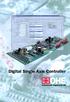 Digital Single Axis Controller The concept of intelligent hydraulic drive a vision? DSAC (Digital Single Axis Controller) Do you need hydraulic servo drive for your machine/system? What would it be like
Tutorial for Programming the LEGO MINDSTORMS NXT
 Tutorial for Programming the LEGO MINDSTORMS NXT Table of contents 1 LEGO MINDSTORMS Overview 2 Hardware 2.1 The NXT Brick 2.2 The Servo Motors 2.3 The Sensors 3 Software 3.1 Starting a Program 3.2 The
Frequently Asked Questions for TFT Remote Controlled Monitors. First Rev 4/6/2005 SGMc Second Rev 5/7/2005 Third Rev 11/15/2005
 Frequently Asked Questions for TFT Remote Controlled Monitors. First Rev 4/6/2005 SGMc Second Rev 5/7/2005 Third Rev 11/15/2005 1. What was the primary spark that started the fire under TFT to make remote
A Robust Multiple Object Tracking for Sport Applications 1) Thomas Mauthner, Horst Bischof
 A Robust Multiple Object Tracking for Sport Applications 1) Thomas Mauthner, Horst Bischof Institute for Computer Graphics and Vision Graz University of Technology, Austria {mauthner,bischof}@icg.tu-graz.ac.at
TwinCAT NC Configuration
 TwinCAT NC Configuration NC Tasks The NC-System (Numeric Control) has 2 tasks 1 is the SVB task and the SAF task. The SVB task is the setpoint generator and generates the velocity and position control
What s Left in E11? Technical Writing E11 Final Report
 Technical Writing What s Left in E11? Technical Writing E11 Final Report 2 Next Week: Competition! Second Last Week: Robotics S&T, Eng&CS Outlooks, Last Week: Final Presentations 3 There are several common
Tracking devices. Important features. 6 Degrees of freedom. Mechanical devices. Types. Virtual Reality Technology and Programming
 Tracking devices Virtual Reality Technology and Programming TNM053: Lecture 4: Tracking and I/O devices Referred to head-tracking many times Needed to get good stereo effect with parallax Essential for
Vibrations can have an adverse effect on the accuracy of the end effector of a
 EGR 315 Design Project - 1 - Executive Summary Vibrations can have an adverse effect on the accuracy of the end effector of a multiple-link robot. The ability of the machine to move to precise points scattered
ISPS2014 Workshop Energy to Smart Grids Presenting results of ENIAC project: E2SG (Energy to Smart Grid)
 ISPS2014 Workshop Energy to Smart Grids Presenting results of ENIAC project: E2SG (Energy to Smart Grid) Bidirectional isolating AC/DC converter for coupling DC grids with the AC mains based on a modular
CNC HARDWARE & TOOLING BASICS
 Computer Aided Manufacturing (CAM) CNC HARDWARE & TOOLING BASICS Assoc. Prof. Dr. Tamer S. Mahmoud 1. Parts of CNC Machine Tools Any CNC machine tool essentially consists of the following parts: Part Program,
AUTOMATED, FULL LOAD MOTOR TESTING AT PRODUCTION SPEEDS
 AUTOMATED, FULL LOAD MOTOR TESTING AT PRODUCTION SPEEDS Abstract: Revolutionary test method coupled with innovative automation yields superior motor performance measurement data without sacrifice of production
DC Motor control Reversing
 January 2013 DC Motor control Reversing and a "Rotor" which is the rotating part. Basically there are three types of DC Motor available: - Brushed Motor - Brushless Motor - Stepper Motor DC motors Electrical
The Design of a Low-Cost and Robust Linkage Position Sensor
 The Design of a Low-Cost and Robust Linkage Position Sensor Project Proposal By: Leann Vernon and Phillip Latka Advisor: Dr. Jose Sanchez December 16th, 2013 Table of Contents Introduction 2 Project Description..
Lab 7: Rotational Motion
 Lab 7: Rotational Motion Equipment: DataStudio, rotary motion sensor mounted on 80 cm rod and heavy duty bench clamp (PASCO ME-9472), string with loop at one end and small white bead at the other end (125
Logitech Advanced 2.4 GHz Technology With Unifying Technology
 Logitech Advanced 2.4 GHz Technology Revision 070709 July 7, 2009 TABLE OF CONTENTS 1 INTRODUCTION: THE MOVE TO WIRELESS PERIPHERALS IN BUSINESS...3 2 SYSTEM OVERVIEW...4 2.1 NETWORK TOPOLOGY...4 2.2 MAIN
Power Electronics. Prof. K. Gopakumar. Centre for Electronics Design and Technology. Indian Institute of Science, Bangalore.
 Power Electronics Prof. K. Gopakumar Centre for Electronics Design and Technology Indian Institute of Science, Bangalore Lecture - 1 Electric Drive Today, we will start with the topic on industrial drive
INTRODUCTION TO SERIAL ARM
 INTRODUCTION TO SERIAL ARM A robot manipulator consists of links connected by joints. The links of the manipulator can be considered to form a kinematic chain. The business end of the kinematic chain of
CNC Machine Control Unit
 NC Hardware a NC Hardware CNC Machine Control Unit Servo Drive Control Hydraulic Servo Drive Hydraulic power supply unit Servo valve Servo amplifiers Hydraulic motor Hydraulic Servo Valve Hydraulic Servo
Path Tracking for a Miniature Robot
 Path Tracking for a Miniature Robot By Martin Lundgren Excerpt from Master s thesis 003 Supervisor: Thomas Hellström Department of Computing Science Umeå University Sweden 1 Path Tracking Path tracking
The Design of DSP controller based DC Servo Motor Control System
 International Conference on Advances in Energy and Environmental Science (ICAEES 2015) The Design of DSP controller based DC Servo Motor Control System Haiyan Hu *, Hong Gu, Chunguang Li, Xiaowei Cai and
Intelligent Submersible Manipulator-Robot, Design, Modeling, Simulation and Motion Optimization for Maritime Robotic Research
 20th International Congress on Modelling and Simulation, Adelaide, Australia, 1 6 December 2013 www.mssanz.org.au/modsim2013 Intelligent Submersible Manipulator-Robot, Design, Modeling, Simulation and
Projectile Motion 1:Horizontally Launched Projectiles
 A cannon shoots a clown directly upward with a speed of 20 m/s. What height will the clown reach? How much time will the clown spend in the air? Projectile Motion 1:Horizontally Launched Projectiles Two
Positioner Versions. Remote feed-back. Local display, Electric / Hydraulic. Remote feed-back Electric / Hydraulic. Embedded Control Positioner
 Quick Stepper 3G ECP Positioner Versions Mechanical feed-back Pneumatic Remote feed-back Local display, Pneumatic Remote feed-back Local display, Electric / Hydraulic Remote feed-back Electric / Hydraulic
Objectives. Capacitors 262 CHAPTER 5 ENERGY
 Objectives Describe a capacitor. Explain how a capacitor stores energy. Define capacitance. Calculate the electrical energy stored in a capacitor. Describe an inductor. Explain how an inductor stores energy.
17 Basic Rules of Soccer
 17 Basic Rules of Soccer Soccer has 17 laws or rules by which the game is played. Most of these laws are easy to understand. The laws are designed to make soccer fun, safe, and fair for all participants.
Course Project Documentation
 Course Project Documentation CS308 Project Android Interface Firebird API TEAM 2: Pararth Shah (09005009) Aditya Ayyar (09005001) Darshan Kapashi (09005004) Siddhesh Chaubal (09005008) Table Of Contents
WIRELESS INSTRUMENTATION TECHNOLOGY
 BS&B WIRELESS, L.L.C. BS&B WIRELESS, L.L.C. WIRELESS INSTRUMENTATION TECHNOLOGY Printed February 2004 BS&B WIRELESS, L.L.C. 7422-B East 46th Place, Tulsa, OK74145 Phone: 918-622-5950 Fax: 918-665-3904
TRIMBLE ATS TOTAL STATION ADVANCED TRACKING SYSTEMS FOR HIGH-PRECISION CONSTRUCTION APPLICATIONS
 TRIMBLE ATS TOTAL STATION ADVANCED TRACKING SYSTEMS FOR HIGH-PRECISION CONSTRUCTION APPLICATIONS BY MARTIN WAGENER APPLICATIONS ENGINEER, TRIMBLE EUROPE OVERVIEW Today s construction industry demands more
Sensor Based Control of Autonomous Wheeled Mobile Robots
 Sensor Based Control of Autonomous Wheeled Mobile Robots Gyula Mester University of Szeged, Department of Informatics e-mail: [email protected] Abstract The paper deals with the wireless sensor-based
Practice Exam Three Solutions
 MASSACHUSETTS INSTITUTE OF TECHNOLOGY Department of Physics Physics 8.01T Fall Term 2004 Practice Exam Three Solutions Problem 1a) (5 points) Collisions and Center of Mass Reference Frame In the lab frame,
Development of Docking System for Mobile Robots Using Cheap Infrared Sensors
 Development of Docking System for Mobile Robots Using Cheap Infrared Sensors K. H. Kim a, H. D. Choi a, S. Yoon a, K. W. Lee a, H. S. Ryu b, C. K. Woo b, and Y. K. Kwak a, * a Department of Mechanical
What Is Regeneration?
 What Is Regeneration? Braking / Regeneration Manual Regeneration Overview Revision 1.0 When the rotor of an induction motor turns slower than the speed set by the applied frequency, the motor is transforming
Introduction to Mobile Robotics Bayes Filter Particle Filter and Monte Carlo Localization
 Introduction to Mobile Robotics Bayes Filter Particle Filter and Monte Carlo Localization Wolfram Burgard, Maren Bennewitz, Diego Tipaldi, Luciano Spinello 1 Motivation Recall: Discrete filter Discretize
E190Q Lecture 5 Autonomous Robot Navigation
 E190Q Lecture 5 Autonomous Robot Navigation Instructor: Chris Clark Semester: Spring 2014 1 Figures courtesy of Siegwart & Nourbakhsh Control Structures Planning Based Control Prior Knowledge Operator
Tracking and Recognition in Sports Videos
 Tracking and Recognition in Sports Videos Mustafa Teke a, Masoud Sattari b a Graduate School of Informatics, Middle East Technical University, Ankara, Turkey [email protected] b Department of Computer