
End-to-End Cloud Elasticity
|
|
|
- Penelope Atkinson
- 10 years ago
- Views:
Transcription
1 End-to-End Cloud Elasticity Whitepaper, July 2011 Maximilian Ahrens Chris Janz Marten Schoenherr Zimory GmbH, Revaler Strasse 100, Warschauer Strasse, Berlin, Germany Ciena Corporation, 307 Leggett Drive, Kanata, Ontario K2K 3C8, Canada Deutsche Telekom Laboratories, Ernst-Reuter-Platz 7, Berlin, Germany

2 Abstract The use by enterprises of infrastructure cloud computing is constrained by the gaps between complex and demanding requirements and the inadequacies of existing solutions. In this paper we present a solution for an end-to-end enterprise-grade cloud infrastructure, comprising a distributed and dynamic compute and data cloud interconnected by a high-performance, dynamic infrastructure network. This combination enables businesses to create a distributed cloud with defined and assured performance characteristics, increasing the applicability and utility of cloud computing principles and services in the heart of the enterprise-grade IT infrastructure. I. Introduction Infrastructure cloud computing substantially has impacted the data center services market in recent years. Many large-scale web applications are enabled by the use of infrastructure cloud services. Early infrastructure cloud market participants like Amazon, with its Amazon Web Services (AWS) portfolio, targeted such consumer web applications. These cloud services have allowed application developers to reach new levels of agility and cost efficiency, as the applications could scale automatically with demand on the user side. Naturally, enterprise IT departments are seeking to improve their agility and cost structures and thus seek to exploit cloud computing technologies and principles for their internal systems. But introducing cloud principles in the enterprise IT environment runs into a number of obstacles, including complex legacy application architectures, particular legal requirements governing various IT operational considerations, and strategic supplier dependency realities. To align with these requirements more complex cloud delivery models have been developed, such as distributed hybrid clouds and community clouds. These models introduce further levels of technical complexity and constraints that restrict the span of service utility from an application or use case perspective, and reduce the net benefit of cloud to the enterprise. In this paper we present a solution that shows how the integration of dynamic networking and dynamic computing can extend the utility and feasibility of cloud to include and encompass enterprise-grade distributed data center environments. This paper is organized as follows. In the next section we discuss in more detail the challenges enterprises face when introducing cloud services into their IT environments. In section III we present the alternative setup scenarios for the solution, and in section IV we explain the solution in detail, describing an example application. We conclude the paper with a consideration of the market outlook for the solution.
3 II. Enterprise Challenges Enterprises are faced with three main challenges when cloud computing services and technologies are being evaluated. First, enterprises have many existing and interconnected applications that come with specific technical requirements. Moving all these into an infrastructure cloud does not necessarily make sense, as any single cloud cannot be set up to support all of the different detailed technologies. Whenever not all applications can be run in a single cloud out of the box, the enterprise has two options: either decouple and localize the applications more, or invest development effort to adjust existing applications for operation in the cloud. Both approaches require a potentially risky development project, negatively impacting the cloud computing business case for the enterprise. A third option would be setting up or using a hybrid cloud, but this requires interconnecting the cloud segments with sufficient performance and quality guarantees. Nonetheless, in many respects this is the most promising option, and it can be realized with the solution stack we present here. Second: the enterprise has legal requirements it must satisfy concerning information management. Often enterprises have global business structures and thus need to adjust to different local legal requirements. Many countries for example require that specific enterprise data needs to be stored and processed within the country. Requirements in terms of backup, data security and accessibility also differ among countries and applications. This factor, too, leads to a distributed application landscape that needs to be powered by a distributed cloud. Third: enterprises are forced to use multi-supplier strategies. Especially larger organizations need to decouple their core systems from a single supplier, to avoid single sources of supply or performance failure and to reduce strategic dependencies. Enterprise applications must operate in a multi-vendor cloud environment. All these requirements create the demand for a distributed and heterogeneous IT infrastructure environment. Combining these requirements with the cloud principles of a homogenous and multi-tenant operating environment, it becomes clear that enterprises will need to consider their situations carefully. In some scenarios a private cloud or even a dedicated environment will be the required solution, whereas in others a fully multi-tenant cloud can be the optimal solution. These different models and the available combinations will be reviewed in detail in the next section.

4 III. Setup Alternatives There are three known, defined variations of cloud setup: Private Cloud, Provider Cloud (also often called Public Cloud) and Hybrid Cloud. These various setups deliver different advantages and disadvantages. In this section the three models will be briefly presented and the pros and cons of each will be considered. Private Cloud A private cloud is a non-shared cloud that is implemented for a single customer. Often this cloud is implemented using capacity from pre-existing virtualized data centers. It normally consists of a compute pool, a storage pool, local network components and a self-service facility. Table 1 Assessment of Private Cloud Model Pro - No security risk - private structure - Update cycles can be defined by the customer - Customization is easily possible Con - No pay-as-you-go pricing model possible - Cloud must be built to cover peak demand capacities Provider Cloud A provider cloud (or public cloud) is a fully shared infrastructure that is shared among higher numbers of customers. These infrastructures include technically the same components as the private cloud, but add network access infrastructures (firewalls or VPN Gateways) and all components must support managed multi-tenancy. This model mostly reverses the pros and cons of the private cloud model. Table 2 Assessment of Public Cloud Model Pro - Pay-as-you-go cost models work best - Platform development is supported by all users thus potentially a faster overall platform advancements Con - Capacity shortage can be induced by other users - Potential security threat due to shared infrastructure - Trust involved - Cloud provider works towards lock-in Hybrid Cloud A hybrid cloud combines a private and a public cloud in a common resource pool. This model tries to combine the advantages of the provider and the private cloud. This carries great advantages effectively summing the pros and negating the cons but the hybrid model introduces significant further complexity and requires additional management control.
5 Table 3 Assessment of Hybrid Cloud Model Pro - Workloads can be placed according to varying requirements in different parts of the hybrid cloud (purely private vs. purely public vs. mixed ) - Peak demand dimensioning of the private cloud infrastructure is not required - No single supplier dependency Con - Additional complexity due to multiple resource pools - Potentially uneven workload distribution between the pools This overview shows that the hybrid cloud model generically suits enterprise needs best provided the specific challenges it poses can be overcome. By adopting it, enterprise cloud customers effectively must come to manage three different types of resource pools: non-cloud, private cloud and public cloud. Of each of these types there can be multiple instances with different characteristics. All this creates additional complexity - and a major success factor for such a distributed cloud environment is to be able to interconnect the pools and distribute workloads across the collective environment as efficiently as possible, with the fewest constraints and restrictions, with minimal performance impacts and encountering no real operational complexities. The solution we present here precisely focuses on the flexible, cost-effective, dynamic and distributed high-performance cloud infrastructure required to support enterprise-grade hybrid cloud services.


6 IV. Solution Details The solution combines a dynamic computing and storage cloud with a dynamic, high-performance network component. These solution components are integrated and their operations orchestrated through APIs that interconnect them. The general architecture is depicted below. In this simplified view, two independent cloud environments are connected to construct a hybrid cloud infrastructure. Whereas the resources in the left-hand side data center are private, the resources in the right-hand side data center are shared resources in a provider cloud. zimory manage zimory connect zimory connect The two main system components are depicted in red and in orange we have reflected a specific vendor implementation from the perspective of named architectural components, but the principles are generic. The cloud computing stack allows the enterprise user to orchestrate workloads across the distributed resource pool and also to trigger scaling actions within the compute and storage clouds. The cloud computing stack also establishes billing metrics for the different cloud segments. For the umbrella cloud administrator the distributed resource pool is driven through a single service console specifically, here, the zimory manage component. The different resource pools are interconnected through (here) a Ciena packet optical and Carrier Ethernet network infrastructure. This network provides high connection performance from latency and virtual circuit quality and availability perspectives, and delivers significant bandwidths to support mobility and related cloud operations. A core packet optical mesh provides a liquid pool of bandwidth that is driven by the cloud computing stack. The interface between the network and the cloud stack is an

7 abstracted, service-oriented API northbound from what amounts to a network hypervisor. This hypervisor leverages control plane-driven network intelligence and also facilitates cost-based negotiation before provisioning and pay-per-use bandwidth billing operations with the cloud computing stack. Users can easily choose (or the cloud stack can choose on their behalf), in combination with a compute or storage workload, what bandwidth and other virtual connection characteristics should be available between the workload and some other application component at a point in time. Overall then, the user can choose end-to-end performance targets and the integrated cloud solution will provision as needed across the entire infrastructure. Example Use Case As an example use case let us consider a computational application with periodically very high compute power demands. The application consists of a data backend, a frontend presentation layer and different number of compute nodes see the figure below. The network bandwidth relative requirements are suggested by the relative weights of the connection lines. The data resides in the enterprise data center as does the presentation layer. In this example there are two different types of computation nodes illustrated, distinguished by various characteristics of the application kernels being run on each. When computing power requirements spike high, the distributed cloud would select e.g., based on security requirements the red nodes to remain within the enterprise s data center while the green compute nodes can be moved to or further instances instantiated within the service provider cloud. In parallel with the movement or creation of those remote compute
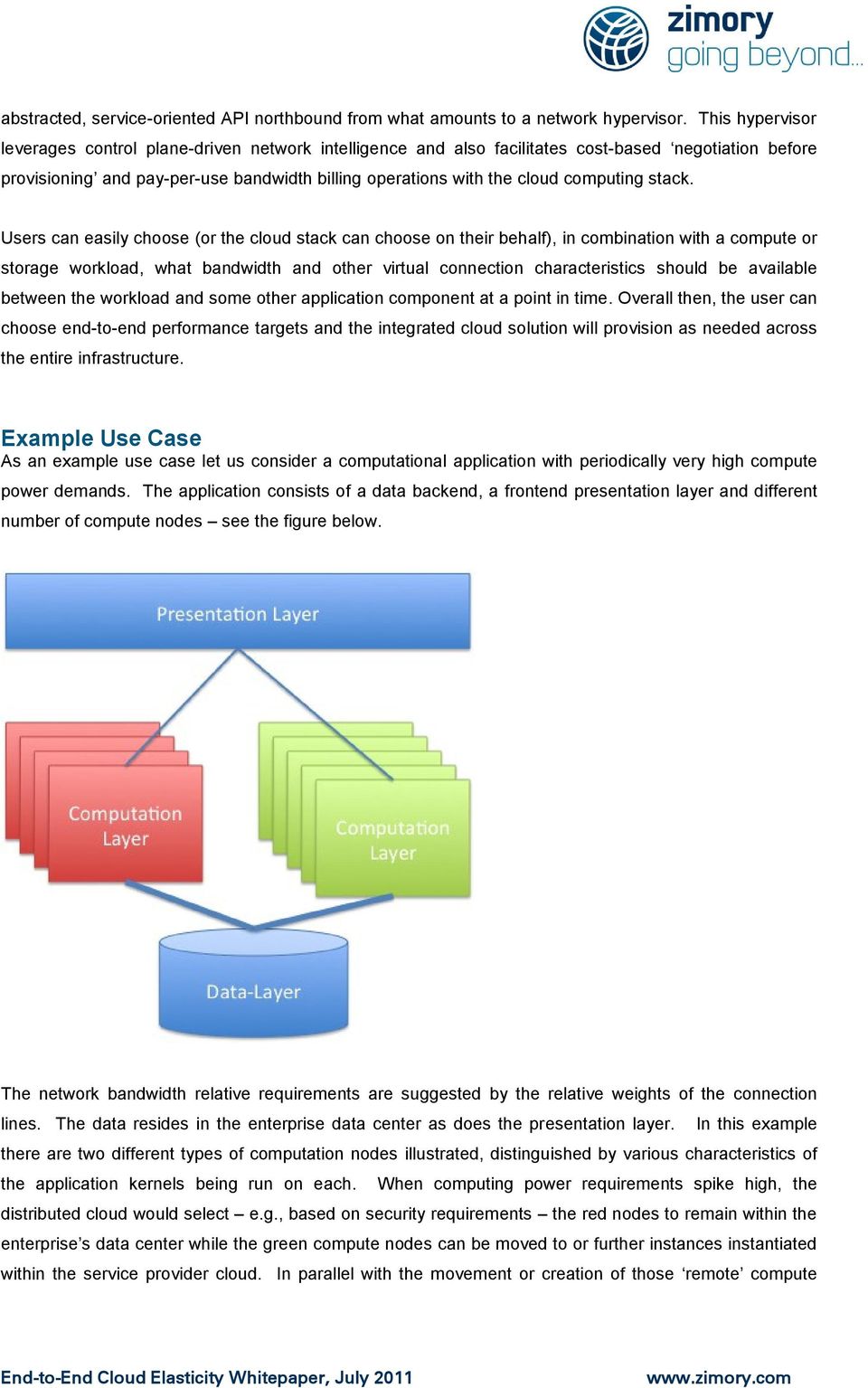
8 nodes, the cloud stack orders new network virtual connections, or increases the size (bandwidth) of existing connections, between the enterprise and service provider data centers to facilitate effective reach back to the datastore as well as to provide high-performance connections, if and as needed, among the compute virtual nodes in the two locations. This simple example shows nicely how the infrastructure can support running the application in the hybrid cloud. The workload distribution mechanisms of the cloud computing stack work hand-in-hand with the dynamic network capabilities of the cloud backbone network. Without dynamic network provisioning, the distributed application would be not consistently and assuredly function at target performance levels, as the network requirements between the computational layer and the data layer could not be met generally and at reasonable total cost points. Without the distributed workload scheduling mechanisms of the cloud computing management stack, the application could not be placed in the different cloud segments simultaneously to satisfy technical/performance, legal and other administrative and other operational constraints and requirements. V. Conclusion and Outlook The hybrid cloud model must be made to work if enterprises are to tap significantly further into the promise and benefits of the infrastructure cloud. As we have seen, the hybrid cloud poses a number of technical challenges. We have shown in this paper how these challenges can be resolved. A cloud computing stack effectively a cloud OS must be able to create and manage the various components of a distributed data center architecture that crosses ownership lines (enterprise vs. service provider) and also crosses geographical lines, with implications on information management practices. A highperformance network inter-connecting the data centers within this distributed cloud infrastructure architecture is equally important: this network lies within the distributed computer itself, and every operational characteristic of that computer: performance, reliability, control of performance, etc., will be tied to and limited by the equivalent characteristics of the network. Tight latency control is essential if performance is to be maintained over significant inter-data center distances. And bandwidth on demand, matched to the on-demand characteristics of the cloud services themselves, is essential in terms of constraining costs while allowing for scalable high performance across a large base of users. We have described here relatively simple scenarios from a network connectivity perspective: time-variable size of inter-connections limited to data center pairs. However, over time, we expect many forces to drive the cloud infrastructure naturally to significantly more meshed multi-data center architectures. For example, load balancing or follow sun/moon operations would shift active workload among provider data centers driving new requirements for transient high bandwidth connections among various data centers. Proximity constraints usefully would be relaxed with high-performance, low latency cloud backbone network implementations, increasing the permutations and combinations of provider data centers involved in specific hybrid cloud service instantiations and requiring scalable network inter-connections. Overall, the future and full promise of the cloud will depend on leveraging the toolkit that we have described here.

IAAS CLOUD EXCHANGE WHITEPAPER
 IAAS CLOUD EXCHANGE WHITEPAPER Whitepaper, July 2013 TABLE OF CONTENTS Abstract... 2 Introduction... 2 Challenges... 2 Decoupled architecture... 3 Support for different consumer business models... 3 Support
SOFTWARE DEFINED NETWORKING
 SOFTWARE DEFINED NETWORKING Bringing Networks to the Cloud Brendan Hayes DIRECTOR, SDN MARKETING AGENDA Market trends and Juniper s SDN strategy Network virtualization evolution Juniper s SDN technology
Software-Defined Networks Powered by VellOS
 WHITE PAPER Software-Defined Networks Powered by VellOS Agile, Flexible Networking for Distributed Applications Vello s SDN enables a low-latency, programmable solution resulting in a faster and more flexible
Cloud Lifecycle Management
 Cloud Lifecycle Managing Cloud Services from Request to Retirement SOLUTION WHITE PAPER Table of Contents EXECUTIVE SUMMARY............................................... 1 CLOUD LIFECYCLE MANAGEMENT........................................
Accelerate Your Enterprise Private Cloud Initiative
 Cisco Cloud Comprehensive, enterprise cloud enablement services help you realize a secure, agile, and highly automated infrastructure-as-a-service (IaaS) environment for cost-effective, rapid IT service
Relational Databases in the Cloud
 Contact Information: February 2011 zimory scale White Paper Relational Databases in the Cloud Target audience CIO/CTOs/Architects with medium to large IT installations looking to reduce IT costs by creating
Horizontal Integration - Unlocking the Cloud Stack. A Technical White Paper by FusionLayer, Inc.
 Horizontal Integration - Unlocking the Cloud Stack A Technical White Paper by FusionLayer, Inc. August 2013 Copyright 2015 FusionLayer, Inc. All rights reserved. No part of this publication may be reproduced,
The Advantages of Cloud Services
 Cloud-Based Services: Assure Performance, Availability, and Security What You Will Learn Services available from the cloud offer cost and efficiency benefits to businesses, but until now many customers
Cisco Unified Data Center
 Solution Overview Cisco Unified Data Center Simplified, Efficient, and Agile Infrastructure for the Data Center What You Will Learn The data center is critical to the way that IT generates and delivers
Enterprise Cloud Solutions
 IT(O) IT Outsourcing Options Enterprise Cloud Solutions CloudAgile Select Partner PDF v2.2 9/11/12 Cloud Computing with Latisys With the Latisys Cloud, your Enterprise can: Achieve unprecedented control,
Virtualization, SDN and NFV
 Virtualization, SDN and NFV HOW DO THEY FIT TOGETHER? Traditional networks lack the flexibility to keep pace with dynamic computing and storage needs of today s data centers. In order to implement changes,
IaaS Cloud Architectures: Virtualized Data Centers to Federated Cloud Infrastructures
 IaaS Cloud Architectures: Virtualized Data Centers to Federated Cloud Infrastructures Dr. Sanjay P. Ahuja, Ph.D. 2010-14 FIS Distinguished Professor of Computer Science School of Computing, UNF Introduction
Cisco Unified Network Services: Overcome Obstacles to Cloud-Ready Deployments
 Cisco Unified Network Services: Overcome Obstacles to Cloud-Ready Deployments What You Will Learn Deploying network services in virtual data centers is extremely challenging. Traditionally, such Layer
Secure Bridge to the Cloud
 Secure Bridge to the Cloud Jaushin Lee, Ph.D. September 2013 1 Table of Contents The promise for enterprise hybrid cloud computing... 3 Reality facing enterprise today... 3 Connecting the dots... 6 Secure
Juniper Networks MetaFabric Architecture
 Juniper Networks MetaFabric Architecture Enabling a Simple, Open, and Smart Data Center 1 Table of Contents Executive Summary... 3 Introduction... 3 Data Center Myths vs. Realities...4 Myth #1: The data
A Cloud WHERE PHYSICAL ARE TOGETHER AT LAST
 A Cloud WHERE PHYSICAL AND VIRTUAL STORAGE ARE TOGETHER AT LAST Not all Cloud solutions are the same so how do you know which one is right for your business now and in the future? NTT Communications ICT
How To Compare The Two Cloud Computing Models
 WHITE PAPER Elastic Cloud Infrastructure: Agile, Efficient and Under Your Control - 1 - INTRODUCTION Most businesses want to spend less time and money building and managing infrastructure to focus resources
The Next Phase of Datacenter Network Resource Management and Automation March 2011
 I D C T E C H N O L O G Y S P O T L I G H T The Next Phase of Datacenter Network Resource Management and Automation March 2011 Adapted from Worldwide Datacenter Network 2010 2015 Forecast and Analysis
CLOUD COMPUTING INTRODUCTION HISTORY
 1 CLOUD COMPUTING INTRODUCTION 1. Cloud computing is the use of computing resources (hardware and software) that are delivered as a service over a network (typically the Internet). The name comes from
WHY SERVICE PROVIDERS NEED A CARRIER PaaS SOLUTION cpaas for Network
 WHY SERVICE PROVIDERS NEED A CARRIER PaaS SOLUTION cpaas for Network Functions Virtualization White Paper Carrier PaaS provides the tools service providers need to transform their current network operational
Photonic Switching Applications in Data Centers & Cloud Computing Networks
 Photonic Switching Applications in Data Centers & Cloud Computing Networks 2011 CALIENT Technologies www.calient.net 1 INTRODUCTION In data centers and networks, video and cloud computing are driving an
Elastic Private Clouds
 White Paper Elastic Private Clouds Agile, Efficient and Under Your Control 1 Introduction Most businesses want to spend less time and money building and managing IT infrastructure to focus resources on
ATA DRIVEN GLOBAL VISION CLOUD PLATFORM STRATEG N POWERFUL RELEVANT PERFORMANCE SOLUTION CLO IRTUAL BIG DATA SOLUTION ROI FLEXIBLE DATA DRIVEN V
 ATA DRIVEN GLOBAL VISION CLOUD PLATFORM STRATEG N POWERFUL RELEVANT PERFORMANCE SOLUTION CLO IRTUAL BIG DATA SOLUTION ROI FLEXIBLE DATA DRIVEN V WHITE PAPER Gear Up for the As-a-Service Era A Path to the
Use Case Brief BUILDING A PRIVATE CLOUD PROVIDING PUBLIC CLOUD FUNCTIONALITY WITHIN THE SAFETY OF YOUR ORGANIZATION
 Use Case Brief BUILDING A PRIVATE CLOUD PROVIDING PUBLIC CLOUD FUNCTIONALITY WITHIN THE SAFETY OF YOUR ORGANIZATION At many enterprises today, end users are demanding a powerful yet easy-to-use Private
CLOUD COMPUTING An Overview
 CLOUD COMPUTING An Overview Abstract Resource sharing in a pure plug and play model that dramatically simplifies infrastructure planning is the promise of cloud computing. The two key advantages of this
How to Choose the Right Virtual Datacenter for Your Needs
 WHITEPAPER How to Choose the Right Virtual Datacenter for Your Needs USING MULTIPLE VIRTUAL DATACENTERS FOR GREATER CLOUD EFFICIENCY CONTENTS Executive Summary Virtual Datacenters: One Size Does Not Fit
Private cloud computing
 White paper Private cloud computing Increase agility and reduce cost Increasing agility and reducing cost with cloud computing Table of contents 2 A time of big IT trends 3 As if IT needed more challenges
Building an AWS-Compatible Hybrid Cloud with OpenStack
 Building an AWS-Compatible Hybrid Cloud with OpenStack AWS is Transforming IT Amazon Web Services (AWS) commands a significant lead in the public cloud services market, with revenue estimated to grow from
Second-Generation Cloud Computing IaaS Services
 Second-Generation Cloud Computing IaaS Services What it means, and why we need it now Prepared for: White Paper 2012 Neovise, LLC. All Rights Reserved. Cloud Computing: Driving IT Forward Cloud computing,
Is Your Network Cloud Ready? Network Enable Your Cloud With MPLS VPNs
 A FROST & SULLIVAN EXECUTIVE SUMMARY Is Your Network Cloud Ready? Network Enable Your Cloud With MPLS VPNs In Collaboration With: View the ondemand version of the ebroadcast: www.frost.com/mpls Frost &
The promise of SDN. EU Future Internet Assembly March 18, 2014. Yanick Pouffary Chief Technologist HP Network Services
 The promise of SDN EU Future Internet Assembly March 18, 2014 Yanick Pouffary Chief Technologist HP Network Services Copyright 2012 Hewlett-Packard Development Company, L.P. The information contained herein
Sistemi Operativi e Reti. Cloud Computing
 1 Sistemi Operativi e Reti Cloud Computing Facoltà di Scienze Matematiche Fisiche e Naturali Corso di Laurea Magistrale in Informatica Osvaldo Gervasi [email protected] 2 Introduction Technologies
Cloud Computing: Elastic, Scalable, On-Demand IT Services for Everyone. Table of Contents. Cloud.com White Paper April 2010. 1 Executive Summary...
 Cloud Computing: Elastic, Scalable, On-Demand IT Services for Everyone Cloud.com White Paper April 2010 Table of Contents 1 Executive Summary... 2 2 Motivation Around Cloud Computing... 2 3 Comparing Cloud
Solution brief. HP CloudSystem. An integrated and open platform to build and manage cloud services
 Solution brief An integrated and open platform to build and manage cloud services The industry s most complete cloud system for enterprises and service providers Approximately every decade, technology
Branches as Nimble as the Cloud: Unleashing Agility with Nuage Networks Virtualized Network Services EXECUTIVE SUMMARY
 Branches as Nimble as the Cloud: Unleashing Agility with Nuage Networks Virtualized Network Services EXECUTIVE SUMMARY The principles of cloud computing are transforming the delivery of information services
WHITE PAPER OCTOBER 2014. Unified Monitoring. A Business Perspective
 WHITE PAPER OCTOBER 2014 Unified Monitoring A Business Perspective 2 WHITE PAPER: UNIFIED MONITORING ca.com Table of Contents Introduction 3 Section 1: Today s Emerging Computing Environments 4 Section
Solution White Paper Build the Right Cloud, Quickly
 Solution White Paper Build the Right Cloud, Quickly BMC Express Cloud Table of Contents 1 THE PROMISE OF CLOUD COMPUTING Getting Started 2 SUCCEEDING WITH CLOUD COMPUTING 3 INTRODUCING BMC EXPRESS CLOUD
Future of Cloud Computing. Irena Bojanova, Ph.D. UMUC, NIST
 Future of Cloud Computing Irena Bojanova, Ph.D. UMUC, NIST No Longer On The Horizon Essential Characteristics On-demand Self-Service Broad Network Access Resource Pooling Rapid Elasticity Measured Service
CoIP (Cloud over IP): The Future of Hybrid Networking
 CoIP (Cloud over IP): The Future of Hybrid Networking An overlay virtual network that connects, protects and shields enterprise applications deployed across cloud ecosystems The Cloud is Now a Critical
6 Cloud strategy formation. 6.1 Towards cloud solutions
 6 Cloud strategy formation 6.1 Towards cloud solutions Based on the comprehensive set of information, collected and analysed during the strategic analysis process, the next step in cloud strategy formation
Lecture 02a Cloud Computing I
 Mobile Cloud Computing Lecture 02a Cloud Computing I 吳 秀 陽 Shiow-yang Wu What is Cloud Computing? Computing with cloud? Mobile Cloud Computing Cloud Computing I 2 Note 1 What is Cloud Computing? Walking
SOLUTION BRIEF Citrix Cloud Solutions Citrix Cloud Solution for On-boarding
 SOLUTION BRIEF Citrix Cloud Solutions Citrix Cloud Solution for On-boarding www.citrix.com Contents Introduction... 3 The On- boarding Problem Defined... 3 Considerations for Application On- boarding...
Economic Benefits of Cisco CloudVerse
 Economic Benefits of Cisco CloudVerse Executive Summary Cloud enables IT to be delivered as a service, when and wherever it is needed, from central, secure, public and private data centers. Enterprises
Planning the Migration of Enterprise Applications to the Cloud
 Planning the Migration of Enterprise Applications to the Cloud A Guide to Your Migration Options: Private and Public Clouds, Application Evaluation Criteria, and Application Migration Best Practices Introduction
Who moved my cloud? Part I: Introduction to Private, Public and Hybrid clouds and smooth migration
 Who moved my cloud? Part I: Introduction to Private, Public and Hybrid clouds and smooth migration Part I of an ebook series of cloud infrastructure and platform fundamentals not to be avoided when preparing
Cloud Roadmap to Success. October, 2014
 Cloud Roadmap to Success October, 2014 Catapult Systems & Level 3 Today s Presenters [email protected] [email protected] What is the Cloud Technology trends: driving cloud adoption
RightScale mycloud with Eucalyptus
 Swiftly Deploy Private and Hybrid Clouds with a Single Pane of Glass View into Cloud Infrastructure Enable Fast, Easy, and Robust Cloud Computing with RightScale and Eucalyptus Overview As organizations
Fujitsu Dynamic Cloud Bridging today and tomorrow
 Fujitsu Dynamic Cloud Bridging today and tomorrow Contents Cloud Computing with Fujitsu 3 Fujitsu Dynamic Cloud: Higher Dynamics for Enterprises 4 Fujitsu Dynamic Cloud: Our Offering 6 High Security Standards
THE SDN TRANSFORMATION A Framework for Sustainable Success
 WHITE PAPER THE SDN TRANSFORMATION A Framework for Sustainable Success The promise of Software Defined Networking (SDN) is gaining more and more attention as traffic growth increases the costs and complexity
Top five lessons learned from enterprise hybrid cloud projects
 Top five lessons learned from enterprise hybrid cloud projects Top performer highlights More than half of top performers give users access to selfservice provisioning across both private and public cloud
5 Key Reasons to Migrate from Cisco ACE to F5 BIG-IP
 5 Key Reasons to Migrate from Cisco ACE to F5 BIG-IP With support for Cisco ACE load balancer ending, organizations need to find an alternative. Contents Introduction 3 Advanced Architecture 3 Ease of
Accenture Cloud Platform Unlocks Agility and Control
 Accenture Cloud Platform Unlocks Agility and Control 2 Accenture Cloud Platform Unlocks Agility and Control The Accenture Cloud Platform is at the heart of today s leading-edge, enterprise cloud solutions.
Storage as a Service: Leverage the benefits of scalability and elasticity with Storage as a Service
 Storage as a Service: Leverage the benefits of scalability and elasticity with Storage as a Service Storage is one of the great opportunities for cloud computing, thanks to the scalability and elasticity
Increased Security, Greater Agility, Lower Costs for AWS DELPHIX FOR AMAZON WEB SERVICES WHITE PAPER
 Increased Security, Greater Agility, Lower Costs for AWS DELPHIX FOR AMAZON WEB SERVICES TABLE OF CONTENTS Introduction... 3 Overview: Delphix Virtual Data Platform... 4 Delphix for AWS... 5 Decrease the
Understanding Virtualization and Cloud in the Enterprise
 Understanding Virtualization and Cloud in the Enterprise James Staten Vice President, Principal Analyst Forrester Research Virtualization is evolving toward cloud but won t be subsumed by it 2 What s different
Cloud computing insights from 110 implementation projects
 IBM Academy of Technology Thought Leadership White Paper October 2010 Cloud computing insights from 110 implementation projects IBM Academy of Technology Survey 2 Cloud computing insights from 110 implementation
Hybrid Cloud Delivery Managing Cloud Services from Request to Retirement SOLUTION WHITE PAPER
 Hybrid Cloud Delivery Managing Cloud Services from Request to Retirement SOLUTION WHITE PAPER Contents Executive Summary................................................ 1 Hybrid Cloud Delivery..............................................
Understanding Object Storage and How to Use It
 SWIFTSTACK WHITEPAPER An IT Expert Guide: Understanding Object Storage and How to Use It November 2014 The explosion of unstructured data is creating a groundswell of interest in object storage, certainly
Testing Software Defined Network (SDN) For Data Center and Cloud VERYX TECHNOLOGIES
 Testing Software Defined Network (SDN) For Data Center and Cloud VERYX TECHNOLOGIES Table of Contents Introduction... 1 SDN - An Overview... 2 SDN: Solution Layers and its Key Requirements to be validated...
Panel: Cloud/SDN/NFV 黃 仁 竑 教 授 國 立 中 正 大 學 資 工 系 2015/12/26
 Panel: Cloud/SDN/NFV 黃 仁 竑 教 授 國 立 中 正 大 學 資 工 系 2015/12/26 1 Outline Cloud data center (CDC) Software Defined Network (SDN) Network Function Virtualization (NFV) Conclusion 2 Cloud Computing Cloud computing
Bringing the Cloud to the Enterprise Branch and WAN: Unleashing Agility with Nuage Networks Virtualized Network Services EXECUTIVE SUMMARY
 Bringing the Cloud to the Enterprise Branch and WAN: Unleashing Agility with Nuage Networks Virtualized Network Services EXECUTIVE SUMMARY The principles of cloud computing are transforming the information
The Software-Defined Data Center is Key to IT-as-a-Service
 The Software-Defined Data Center is Key to IT-as-a-Service August 2013 Prepared by: Zeus Kerravala The Software-Defined Data Center is Key to IT-as-a-Service by Zeus Kerravala August 2013 º º º º º º º
ADDING CLOUD TO THE SERVICE DELIVERY MIX
 ADDING CLOUD TO THE SERVICE DELIVERY MIX Business Drivers and Organizational Considerations By Stanton Jones, ISG, and Kalyan Kumar, HCL www.isg-one.com INTRODUCTION Large global organizations today are
How OpenFlow -Based SDN Transforms Private Cloud. ONF Solution Brief November 27, 2012
 How OpenFlow -Based SDN Transforms Private Cloud ONF Solution Brief November 27, 2012 Table of Contents 2 Executive Summary 2 Trends in the Private Cloud 3 Network Limitations and Requirements 4 OpenFlow-Based
Red Hat CloudForms: Open Clouds Under
 CloudForms Whitepaper Red Hat CloudForms: Open Clouds Under your Control TABLE OF CONTENTS 2 Introduction 2 Open Clouds 3 Under your control 3 What is Cloudforms? 4 Build and Manage Clouds 5 Build and
Proactively Secure Your Cloud Computing Platform
 Proactively Secure Your Cloud Computing Platform Dr. Krutartha Patel Security Engineer 2010 Check Point Software Technologies Ltd. [Restricted] ONLY for designated groups and individuals Agenda 1 Cloud
Taking the Open Path to Hybrid Cloud with Dell Networking and Private Cloud Solutions
 Taking the Open Path to Hybrid Cloud with Dell Networking and Private Cloud Solutions In This Paper Frequently, the network is the stumbling point to cloud adoption SDN offers a more dynamic, virtualized
Boas Betzler. Planet. Globally Distributed IaaS Platform Examples AWS and SoftLayer. November 9, 2015. 20014 IBM Corporation
 Boas Betzler Cloud IBM Distinguished Computing Engineer for a Smarter Planet Globally Distributed IaaS Platform Examples AWS and SoftLayer November 9, 2015 20014 IBM Corporation Building Data Centers The
Economic Benefits of Cisco CloudVerse
 Economic Benefits of Cisco CloudVerse Key Takeaways Executive Summary Cloud architecture enables IT to be delivered as a service and delivered only when it is needed over the network from central, secure
Moving from Legacy Systems to Cloud Computing
 Moving from Legacy Systems to Cloud Computing A Tata Communications White Paper October, 2010 White Paper 2010 Tata Communications Table of Contents 1 Executive Summary... 4 2 Introduction... 5 2.1 Definition
OpenFlow-enabled SDN and Network Functions Virtualization. ONF Solution Brief February 17, 2014
 OpenFlow-enabled SDN and Functions Virtualization ONF Solution Brief February 17, 2014 Table of Contents 2 Executive Summary 3 SDN Overview 4 Introduction to NFV 5 NFV Challenges 6 NFV/SDN Example Use
NFV Management and Orchestration: Enabling Rapid Service Innovation in the Era of Virtualization
 White Paper NFV Management and Orchestration: Enabling Rapid Service Innovation in the Era of Virtualization NFV Orchestration Overview Network Function Virtualization (NFV) technology, in combination
Business Case for NFV/SDN Programmable Networks
 Business Case for NFV/SDN Programmable Networks Executive Summary Traditional network designs are failing to meet service providers business requirements. The designs lead to complex hardware stacks, over-provisioning
REMOVING THE BARRIERS FOR DATA CENTRE AUTOMATION
 REMOVING THE BARRIERS FOR DATA CENTRE AUTOMATION The modern data centre has ever-increasing demands for throughput and performance, and the security infrastructure required to protect and segment the network
TECHNOLOGY GUIDE THREE. Emerging Types of Enterprise Computing
 TECHNOLOGY GUIDE THREE Emerging Types of Enterprise Computing TECHNOLOGY GU IDE OUTLINE TG3.1 Introduction TG3.2 Server Farms TG3.3 Virtualization TG3.4 Grid Computing TG3.5 Utility Computing TG3.6 Cloud
Achieving Business Agility Through An Agile Data Center
 Achieving Business Agility Through An Agile Data Center Overview: Enable the Agile Data Center Business Agility Is Your End Goal In today s world, customers expect or even demand instant gratification
NSN Liquid Core Management for Telco Cloud: Paving the way for reinventing telcos for the cloud
 NSN Liquid Core Management for Telco Cloud: Paving the way for reinventing telcos for the cloud Keynotes Liquid Core Management provides operational support for NSN Liquid Core Network, covering all mobile
U s i n g S D N - and NFV-based Servi c e s to M a x i m iz e C SP Reve n u e s a n d I n c r e ase
 I D C T E C H N O L O G Y S P O T L I G H T U s i n g S D N - and NFV-based Servi c e s to M a x i m iz e C SP Reve n u e s a n d I n c r e ase Operational Efficiency March 2013 Adapted from Will New SDN
OpenFlow -Enabled Hybrid Cloud Services Connect Enterprise and Service Provider Data Centers. ONF Solution Brief November 13, 2012
 OpenFlow -Enabled Hybrid Cloud Services Connect Enterprise and Service Provider Data Centers ONF Solution Brief November 13, 2012 Table of Contents 2 OpenFlow-Enabled Software-Defined Networking 2 Executive
Consumption IT. Michael Shepherd Business Development Manager. Cisco Public Sector May 1 st 2014
 Consumption IT Michael Shepherd Business Development Manager Cisco Public Sector May 1 st 2014 Short Bio Cloud BDM in Public Sector (SLED + FED) Cisco for 14 + years Focused on cloud for 4 + years Awareness,
Cisco Hybrid Cloud Solution: Deploy an E-Business Application with Cisco Intercloud Fabric for Business Reference Architecture
 Reference Architecture Cisco Hybrid Cloud Solution: Deploy an E-Business Application with Cisco Intercloud Fabric for Business Reference Architecture 2015 Cisco and/or its affiliates. All rights reserved.
HiTech. White Paper. Storage-as-a-Service. SAN and NAS Reference Architectures leveraging Private Cloud Storage
 HiTech White Paper -as-a-service SAN and NAS Reference Architectures leveraging Private Cloud About the Author Ankur Srivastava Ankur Srivastava is a Solution Architect working with the Hi Tech Industry
Cisco Prime Network Services Controller. Sonali Kalje Sr. Product Manager Cloud and Virtualization, Cisco Systems
 Cisco Prime Network Services Controller Sonali Kalje Sr. Product Manager Cloud and Virtualization, Cisco Systems Agenda Cloud Networking Challenges Prime Network Services Controller L4-7 Services Solutions