
RemoteScope 2.6 User s Guide
|
|
|
- Noel Curtis
- 10 years ago
- Views:
Transcription
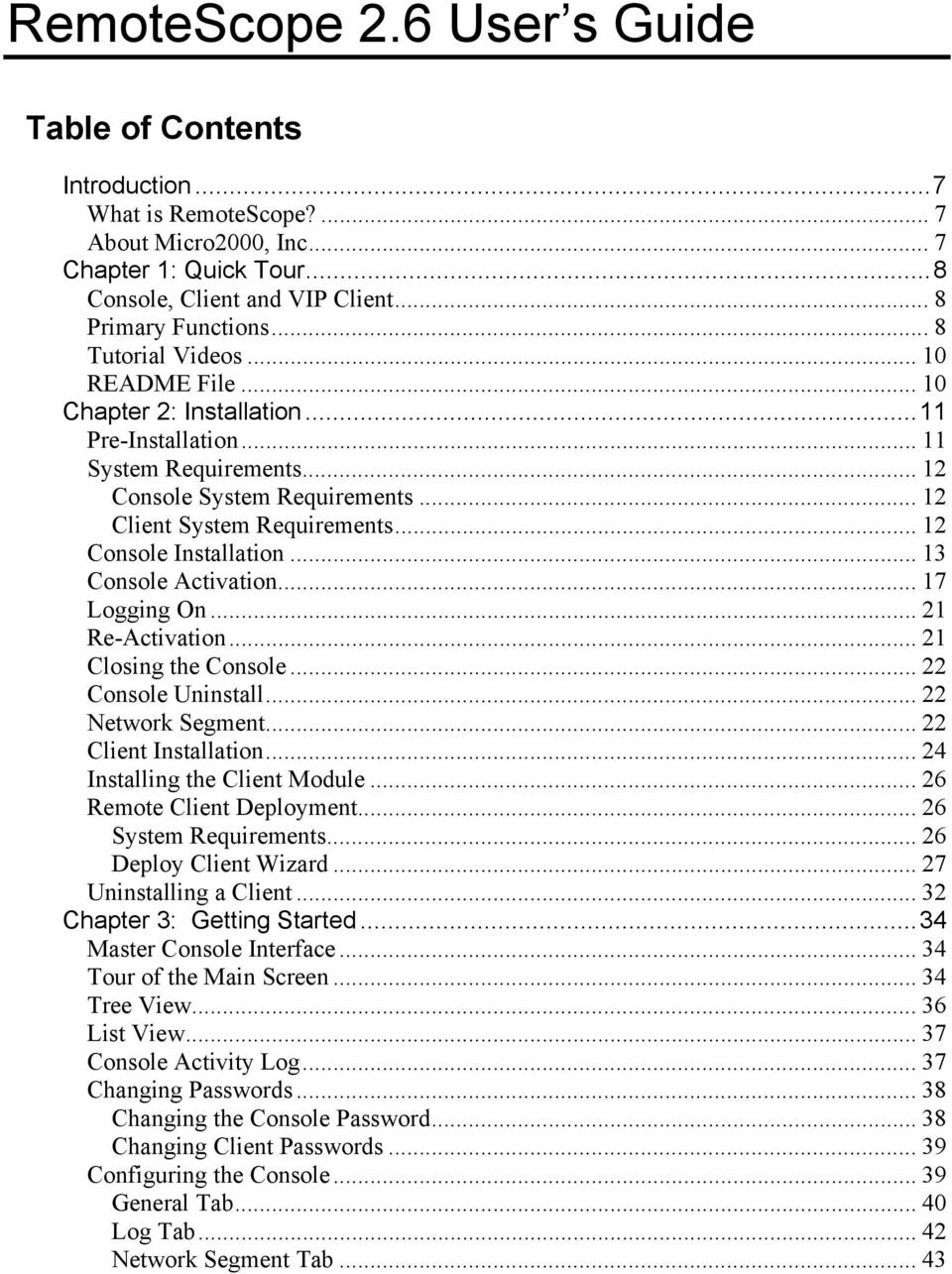
1 RemoteScope 2.6 User s Guide Table of Contents Introduction...7 What is RemoteScope?... 7 About Micro2000, Inc... 7 Chapter 1: Quick Tour...8 Console, Client and VIP Client... 8 Primary Functions... 8 Tutorial Videos README File Chapter 2: Installation...11 Pre-Installation System Requirements Console System Requirements Client System Requirements Console Installation Console Activation Logging On Re-Activation Closing the Console Console Uninstall Network Segment Client Installation Installing the Client Module Remote Client Deployment System Requirements Deploy Client Wizard Uninstalling a Client Chapter 3: Getting Started...34 Master Console Interface Tour of the Main Screen Tree View List View Console Activity Log Changing Passwords Changing the Console Password Changing Client Passwords Configuring the Console General Tab Log Tab Network Segment Tab... 43
2 RemoteScope View Settings Tab Managing Profiles Creating a New Profile Editing an Existing Profile Selecting a Profile Configuring the Client Configuring the VIP Client Detecting and Adding Clients Client Status Chapter 4: Managing Clients and Groups...55 The Client/Group Menu Open New Group New Client Add Member Add to Group Connect All Disconnect All Send Message Conference Room File Transfer Remote Control Remote Configure Wake-On-LAN (WOL) Command Inventory Delete Properties View View Menu Context Menus Chapter 5: Remote Control...74 Using Remote Control Control Modes Selecting Clients VIP Clients Full Screen Remote Ctrl Alt Del Fit to Window Clipboard Transferring Remote Shut-down and Restart Ending the Remote Control Session Chapter 6: Inventory...80 Inventory Groups Viewing Inventory Inventory Tab
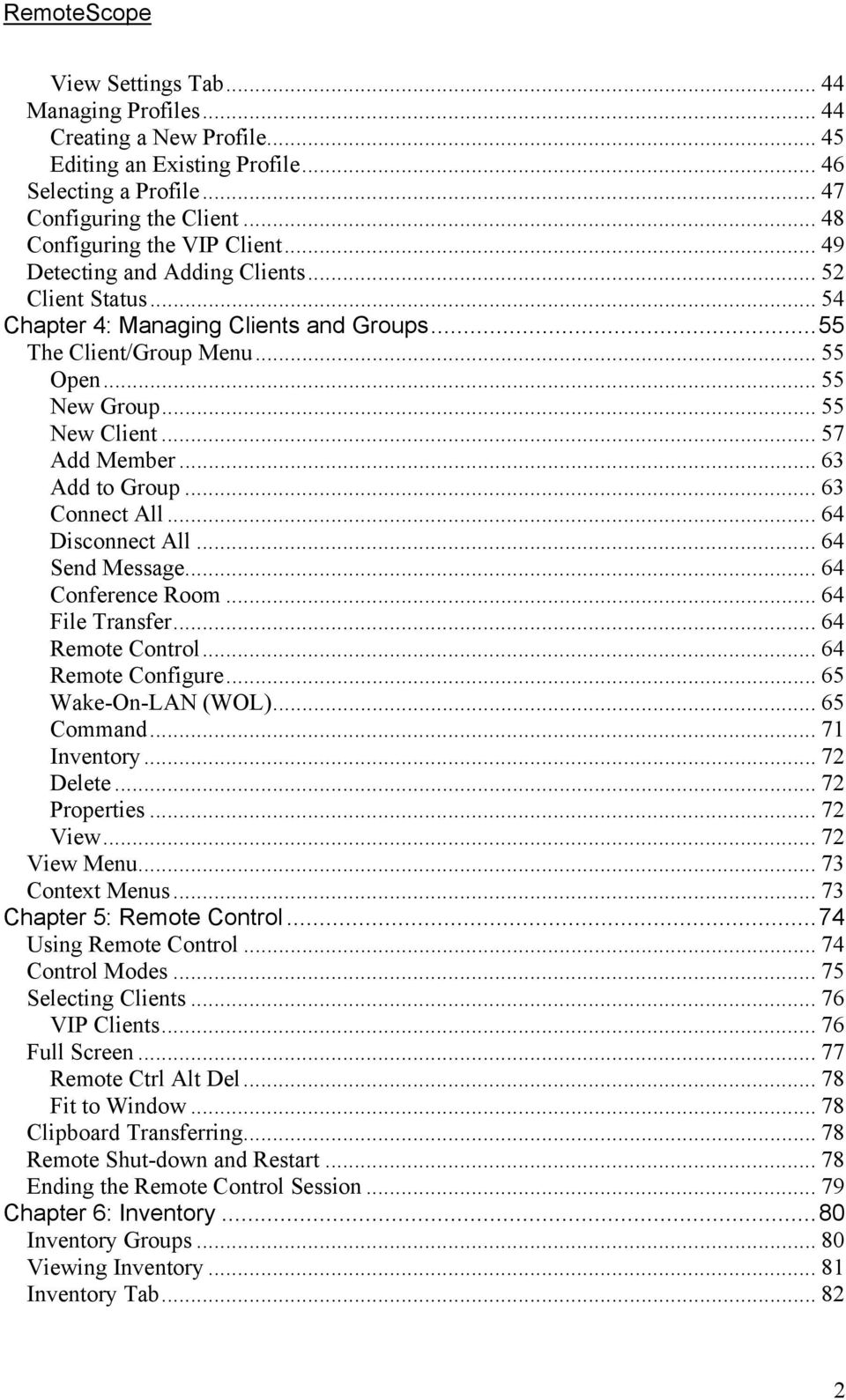
3 User Guide Monitor Policy Tab Adding a Monitor Policy Changing a Monitor Policy Deleting a Monitor Policy Change History Tab Alarm Information Tab Tabbed View of Inventory Statistic Viewing Statistic Hardware Details User Custom Data License Management Database Maintenance Utility Enterprise Assets Manager Exporting data Opening Enterprise Assets Manager Importing data Configuration Changing the Password Inventory Reports View Version information Chapter 7: File and Folder Operations File Transfer File and Folder Actions VIP Clients File Search File Distribution Setting the Path Selecting the File or Folder VIPs in Distribution Chapter 8: Software Distribution Definitions Product Definition Edit Creating a New Product Product Edit Procedure Creating the ISS File Using an MSI File Creating an MSI Distribution Package Importing/Exporting Products Duplicating a Product/Mode Product Distribution Distribution Tasks Distribution Record Scheduled Distribution

4 RemoteScope More Distribution Examples Example One: Distributing Acrobat Reader 6.0 with ISS Example Two: Distributing Office2k with MSI Chapter 9: Task Management Creating a Task System command Command line Script Refresh Inventory Software distribution Task Properties Executing a Task Stop a Task that is running Scheduling Creating a New Schedule Delayed Distribution Schedule Properties Deleting a Schedule or Task Chapter 10: Scripting What is VBScript? VBScript Data Type VBScript Variables RemoteScope Scripting Creating a Script Writing a Script Saving a Script Checking the Syntax of a Script Running a Script Task and Schedule Chapter 11: IM and Conferencing IM (Instant Messaging) Messages from the Client Sending a Message from the Console Disabling Messaging From Client Conferencing Starting a Conference Room The Conference Room Window Using a Conference Room Creating a new room Inviting members Deleting members Switching to and from Closing a conference room Saving a conference record Chapter 12: System Logs Viewing the System Logs
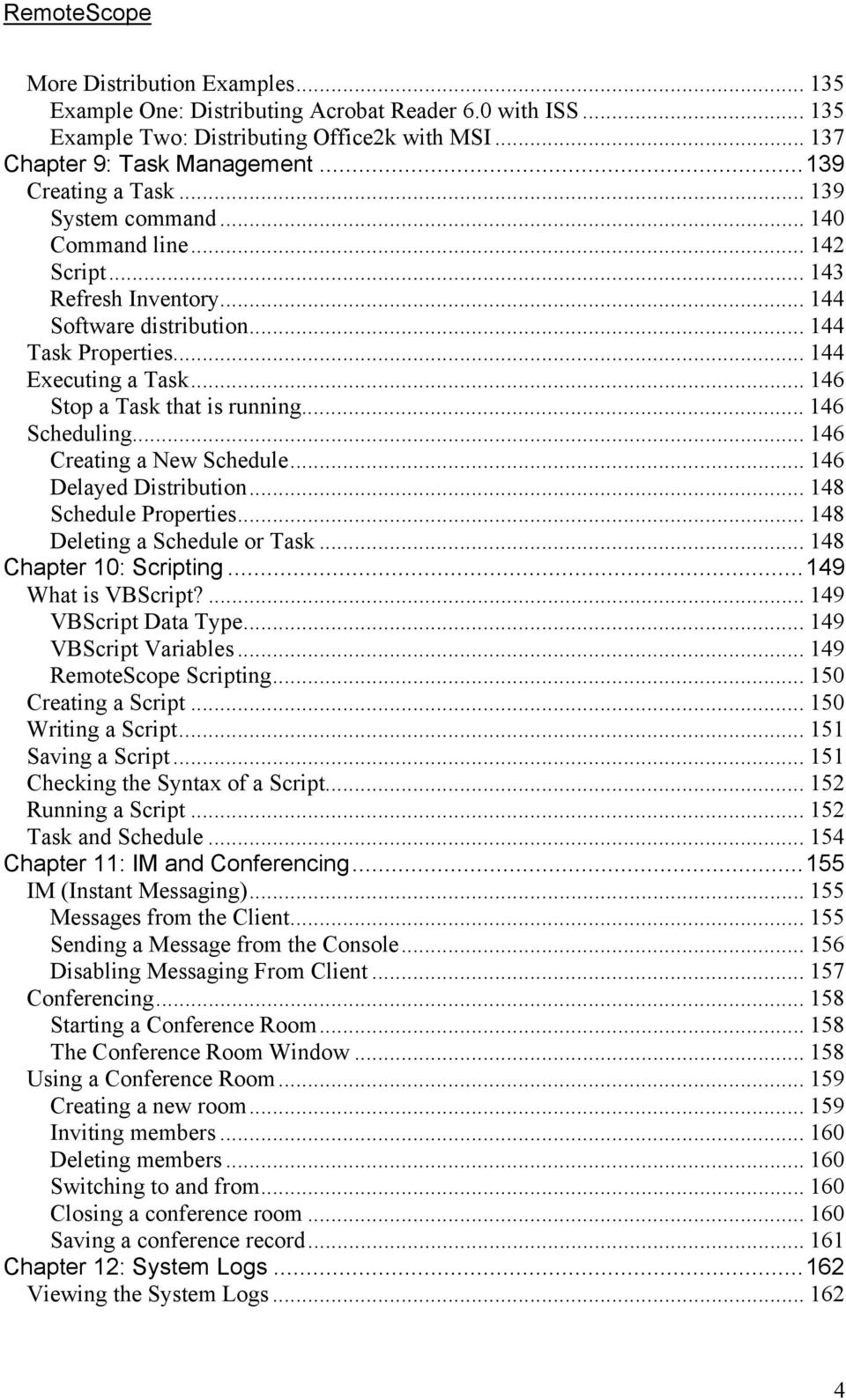
5 User Guide Clearing the System Logs Configuring the System Logs Record Type Operation Client Logs Viewing the Client Log Configuring Client Logs Chapter 13: Reports Report Templates Creating a New Report Accessing and Using Reports Report Preview Window Printing and Exporting Printing a Report Exporting a Report Other Report Actions Chapter 14: File Backup Creating a Backup Edit the Backup Immediate Back-up Scheduled Backup Get Backup Result File Backup Record Chapter 15: Miscellaneous Security Encryption Client Mapping Activation Control User Control Updates Editing NETSEGMENT.CFG Import File, Creating and Editing Chapter 16: Troubleshooting and Error Messages Symptoms and Causes Error Messages and Codes Security Errors Client/Group Errors Configuration Errors Communication Errors Inventory Errors Remote Control Errors Software Distribution Errors Task Management Errors Database Errors Scripting Errors Report Errors

6 RemoteScope Contacting Micro 2000 Support Feedback Appendix A: EULA Software Product License Limited Warranty Appendix B: Glossary Index

7 User Guide Introduction What is RemoteScope? Basically, RemoteScope is a collection of tools that allow the network administrator, sitting at his or her desk, to manage a network of remote PCs and accomplish those tasks that would otherwise require running from one PC to the next. These tasks include the installation of new applications and updates, remote control or monitoring of network workstations, keeping an inventory of software and hardware installed on those systems, and many other functions that will be described in detail throughout the manual. About Micro2000, Inc Formed in September 1990, Micro 2000 Inc was chartered to provide the personal computer industry with professional-quality diagnostic tools, which at that time were available for mainframes but were virtually non-existent for PCs. As the personal computer evolved into the powerful machines of today and became an indispensable fixture in the corporate world, Micro 2000 has maintained its position of industry leadership through award-winning technical support and by staying consistently on the cutting edge throughout the rapid advances in PC technology. Meanwhile, our basic philosophy has not changed at all. Whether it is diagnostics, network administration tools or educational and certification courses, our goal has always been to provide our customers with the best state-of-the-art products of their kind available in the world, and always at an affordable price. 7
8 RemoteScope Chapter 1: Quick Tour Although you may be eager to begin using RemoteScope, we strongly recommend that you read at least this chapter and Chapter 2 (Installation) before installing the software. You may also want to view the first two tutorial videos on the CD that correspond to these two chapters, and the README file which contains up-to-date information on your version. More information on the tutorials and README file can be found later in this chapter. Console, Client and VIP Client The RemoteScope program is organized in two modules, called Console and Client. The Console module is the control point, and will be installed on whichever system(s) the network administrator will use to manage the network. There are also Sub-consoles that can be used to simplify administration of large or dispersed networks Note: The administrator should log on the Console with Admin credential to enable all functions. The Client module is installed on each of the PCs that will be managed from the Console. The Client is a passive module that normally runs in the background and is not accessed by the user on that system except for instant messaging to the Console. It cannot be turned off, uninstalled or tampered with in any way without the administrator s password. Its purpose is to communicate with the Console and to carry out instructions that are issued by the network administrator via the Console module. There is also a version of the Client module called the VIP Client that allows the user at the Client machine to accept or deny a request from the Console to remote-control, browse or distribute files to the Client system. Primary Functions There are six basic tasks that RemoteScope is designed to do. These are remote control, file transfer, software deployment, inventory, messaging/ conferencing, license management and reports. Most of the features described in this manual are for the purpose of supporting one or more of these basic functions. Remote Control From the Console, the administrator can take control of a remote machine. A copy of the remote system s desktop display will appear on the Console s monitor, and keyboard and mouse actions at the Console will be carried out at the remote system just as if the administrator was sitting at that computer. There are also modes that allow shared control or passive monitoring 8
9 User Guide of the remote system. These functions are described more completely in Chapter 5. File Transfer Files can be transferred between the Console and a Client with drag-and-drop simplicity or distributed from the Console to a group of Clients simultaneously. File Transfer and Distribution is covered in Chapter 7. Software Deployment Considered by many to be the greatest laborsaving feature of RemoteScope, the deployment utility allows new applications or updates to be pushed out and installed on selected PCs across the network, all without leaving the Console workstation. Deployment, also referred to as software distribution, can be done in real-time or in many cases scheduled for a later unattended install. All the ins and outs of deployment will be found in Chapter 8. Inventory One of the more difficult tasks in a widespread network is keeping track of what is installed and where. RemoteScope maintains a database of all of the hardware and software installed in each system, along with relevant information about each, such as version and install date. This database is maintained on the Console, which allows instant access even in the case of hard drive crash or other failure on a remote system. Alarms can be set to notify the administrator of specific changes. A complete description of the inventory function appears in Chapter 6. License management This is an extension of the inventory function. Enter the number of licenses owned for any software and the expiration date. The program will compare the values to the installed base and the current date, and flag any overages in color. Reports A flexible reporting function has templates for the most common internal reports, and can export data to a variety of destinations in different formats, all available with point-and-click simplicity. Reports are based on the inventory database in the main Console, and are covered in Chapter 14. Other Supporting the primary functions listed above are a variety of other features such as messaging, conferencing, and security measures. Messaging and conferencing are covered in Chapter 12, while security and a grab-bag of other features appear in Chapter 16. Problems If you have any questions or difficulties with RemoteScope, there is an index in the back of the manual to help in locating specific features and information. On-line Help files can be accessed with the F1 key from any point in the program. In Chapter 17 of the manual you will find a troubleshooting guide and a list of all of the error codes that you may encounter. Information for contacting Micro 2000 support is there as well, including details on a feedback feature that simplifies sending an to our technical support department. 9

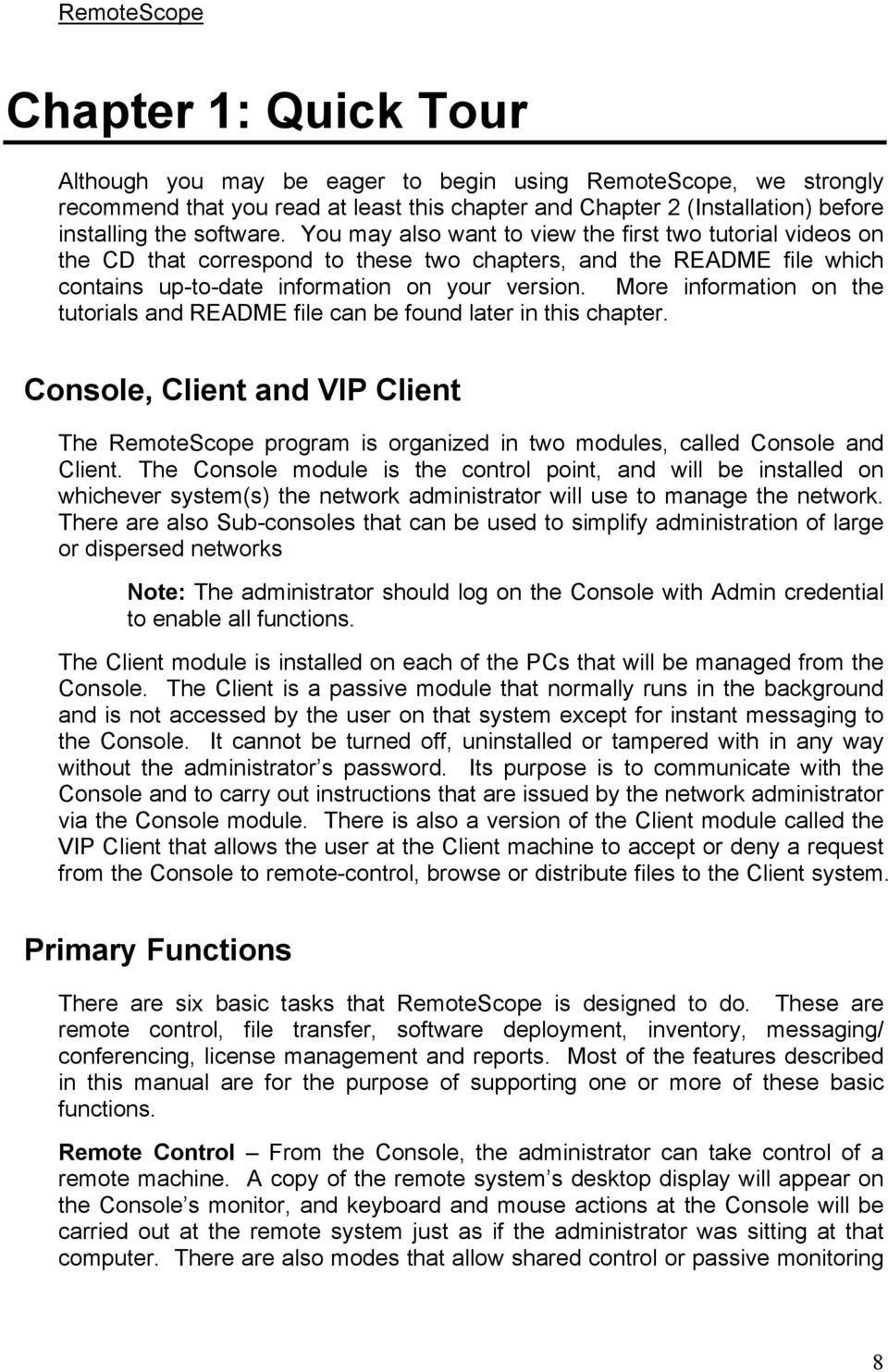
10 RemoteScope We also recommend that you view the tutorial videos on the CD, which cover all of the major functions of RemoteScope and most of the minor ones. Tutorial Videos The RemoteScope CD contains a number of tutorial clips that take the viewer step-by-step through the basic operations of the program. Each of these tutorials covers a specific topic and lasts for only a couple of minutes. Accessing the CD will normally present the RemoteScope Start-up screen shown here. Start-up Screen To view the tutorials, click on the bottom choice, labeled appropriately enough RemoteScope Tutorials. Then click on the tutorial title of your choice. The selected tutorial will run in the browser, so the system used to view the tutorials must have Internet Explorer (4.0 SP1 or later) and speakers. Note: If the access screen does not appear, you can still reach the tutorials by opening the folder on the CD labeled Tutorials and double-clicking on any of the individual lessons. However, in that case the lessons will be listed only by number and not by title. README File While you are in the Start-up screen, click on View Documentation and then on View README File. The README file will give you the latest tips on avoiding problems and getting the best use from RemoteScope. 10
11 User Guide Chapter 2: Installation We recommend reading this chapter through entirely before installing RemoteScope. Be aware that the Master Console must be installed first. Installation and activation of the Master Console must be complete before the Sub-consoles or Client modules can be installed. The Client is not installed from the CD but from a package created during the Master Console installation. Pre-Installation There are several steps to take before starting the installation of RemoteScope that will help to ensure a smooth, trouble-free install. 1. Determine which system will be the Master Console and which if any will be Sub-consoles. 2. Jot down the IP address range of the systems on the LAN that will use the program. It does not matter if the LAN uses static or dynamic IP addressing, as long as the starting and ending IP addresses of the range are known. These values will be needed to configure the Network Segment (described in Chapter 3) the first time the RemoteScope Console is opened. Chapter 3 will also cover accessing Clients outside of the LAN. 3. Make sure that the systems receiving the Console and Sub-console modules have an active Internet connection. A Console must be activated before it can be used. This is a simple procedure if done on-line during the installation. activation is available within the program where you will be ed the activation code. If Internet access is not available, it will be necessary to contact Micro 2000 technical support to activate the program. However, activation is not required if this is a demo CD or Academic version of RemoteScope. 4. Have the PCPK product serial number handy. This is found on the CD case, and will be needed during installation. 5. You will also need to log in at the completion of installation. The default values are: User Name: Remote Password: Scope Be aware that the password is case sensitive. 6. See that the systems meet the minimum hardware and software requirements. These are slightly different for the Console and Client, and are listed on the following page. 11

12 RemoteScope System Requirements Console System Requirements Hardware: Pentium (recommended Pentium 4 or higher) 16MB SVGA card 256MB memory + RAM 40MB available on local hard drive 4X CDROM drive 10/100 Mbps NIC card Software: Windows 98/SE, Windows NT 4 SP6, Windows ME, Windows 2000, Windows XP, Windows 2003 Internet Explorer 5.0 or better WinZip or WinRAR installed Video card capable of 16 bit, 800 by 600 pixels Internet connection Client System Requirements Hardware: Pentium (recommended P3-500), 16 MB SVGA card 128MB (recommended 256 MB or higher) 10 MB available local hard drive 10/100 mbps NIC card Software: Windows 95B, Windows 98/SE, Windows NT SP6, Windows ME, Windows 2000, Windows XP, Windows 2003 Tip: Windows 95 is no longer supported. Internet Explorer 5.0 or better Video card capable of 16 bit, 800 by 600 pixels WinZip or WinRAR installed 12

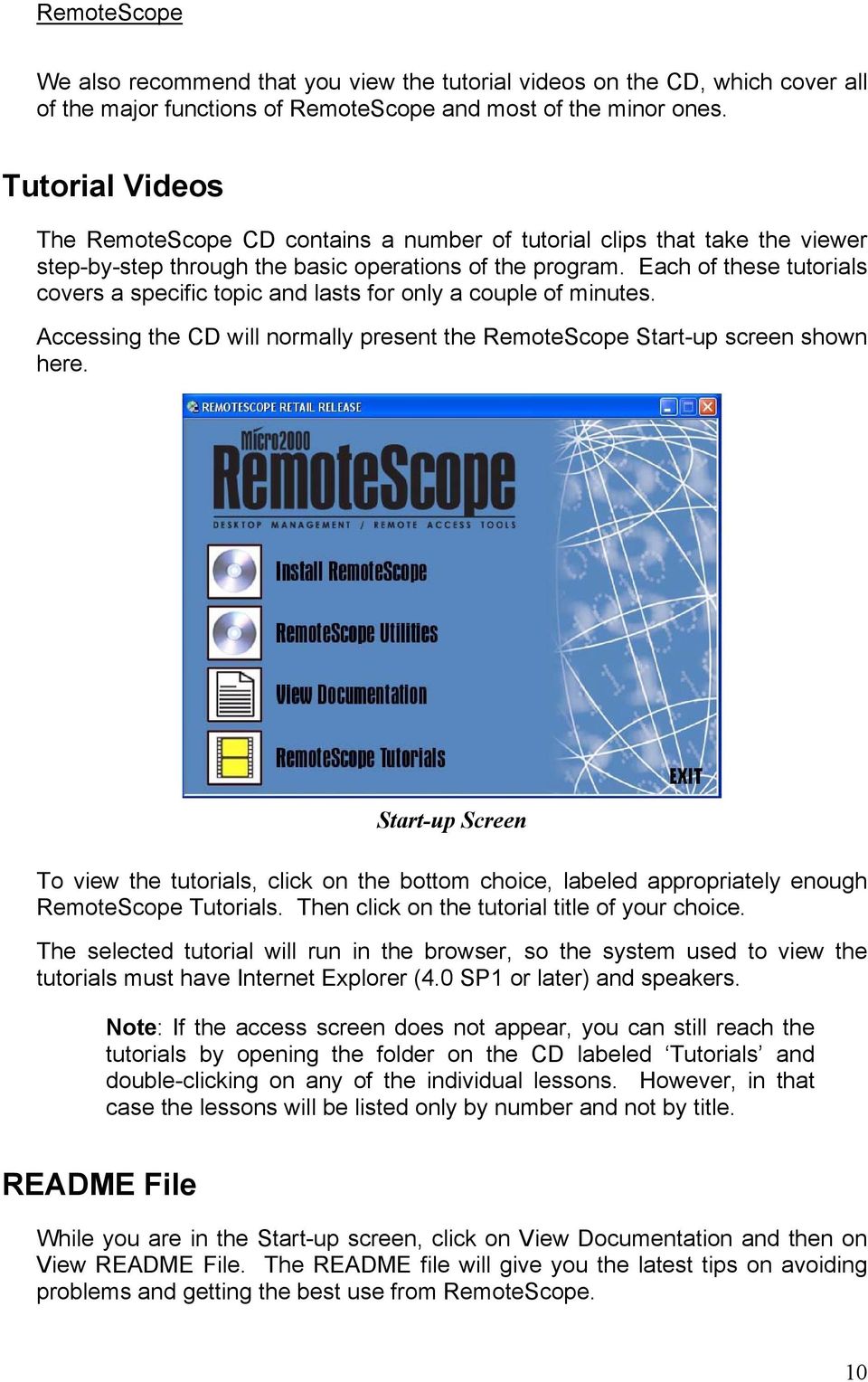
13 User Guide Console Installation 1. Choose the system that is most convenient as the control point for the managing the network. This can be a desktop workstation rather than a server as long as it meets the minimum requirements listed in the previous section. Switching the Master Console to another system after installation will require reactivation of the Console. 2. It is recommended you close all applications on the system selected as the Console. 3. Insert the RemoteScope CD into the CD-ROM drive. If the system has autoplay capability, the RemoteScope start-up window will appear. Start-up Screen 4. Click on the CD icon to the left of Install RemoteScope. Note: If the Start-up screen does not appear, use Windows Explorer to find the setup.exe file on the CD and double-click it, or go to the command line and type run D:\setup.exe, where D is the drive letter for the CD-ROM drive. 13
14 RemoteScope Welcome Screen 5. After the Install Shield Wizard has been prepared you will see the Welcome screen. Click Next. EULA screen 6. Read the End User License Agreement (EULA) and click YES to accept the terms and proceed with the installation. If you do not agree, click NO. RemoteScope will not be installed and you will be directed to exit from the install program. If you wish to study the EULA outside of the installation procedure, a copy of it is available in Appendix A of this manual or in the EULA.TXT file on the CD. 14

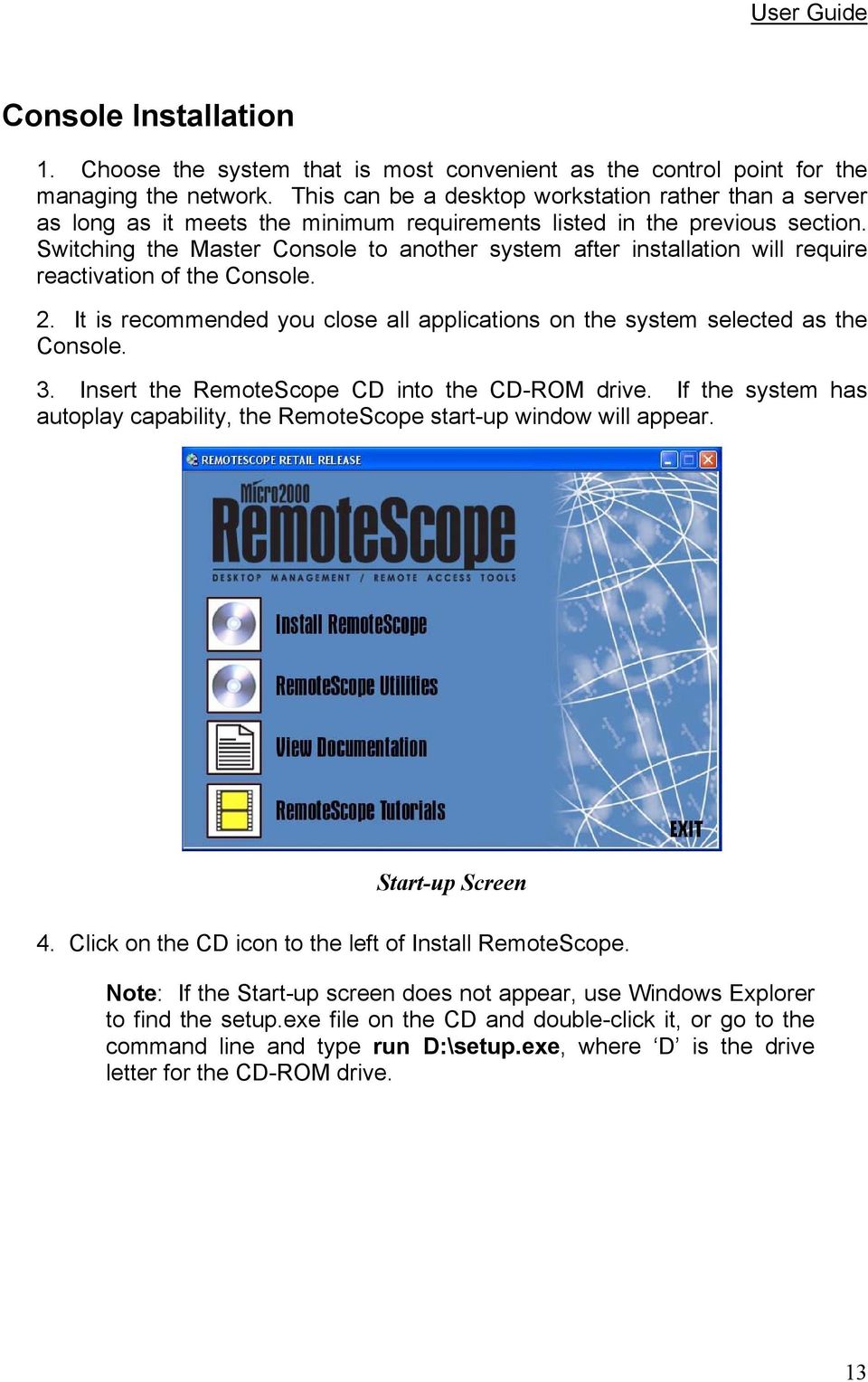
15 User Guide Customer Information screen 7. In the Customer Information screen, type in your User Name, Company Name and the PCPK serial number from the RemoteScope CD case. Click Next. Master-Sub Screen 8. Designate whether this installation is for the Master Console or a Sub- Console. Remember that only one Master Console is allowed in any given network (or subnet, as long as the IP addresses have no overlap with those of any other Master Console). The Demo and Academic versions allow only one Console, so it must be the Master Console. 9. The default destination path for the RemoteScope program files is C:\Program Files\RemoteScope. Normally you will accept the default, but you may also 15
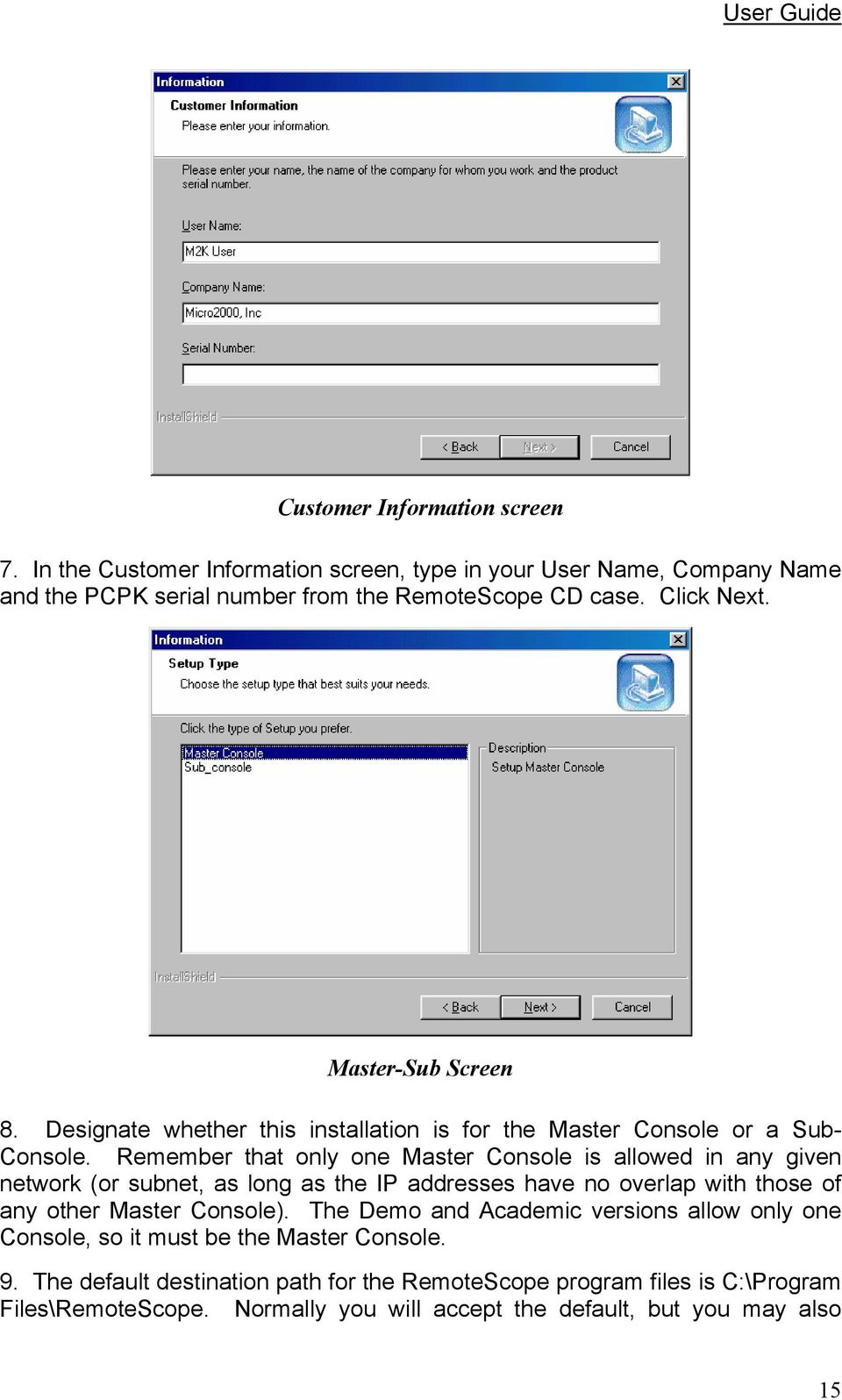
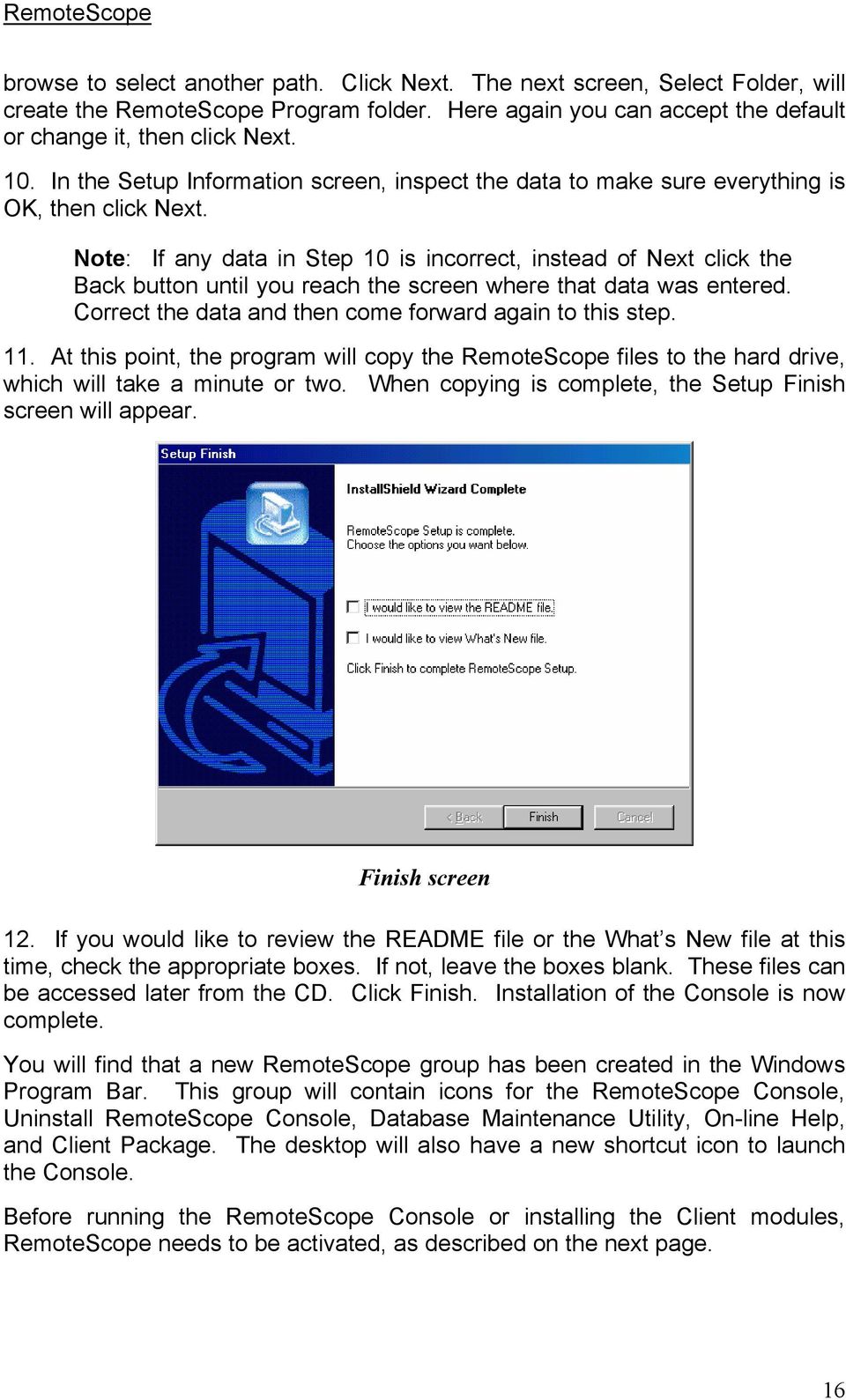
16 RemoteScope browse to select another path. Click Next. The next screen, Select Folder, will create the RemoteScope Program folder. Here again you can accept the default or change it, then click Next. 10. In the Setup Information screen, inspect the data to make sure everything is OK, then click Next. Note: If any data in Step 10 is incorrect, instead of Next click the Back button until you reach the screen where that data was entered. Correct the data and then come forward again to this step. 11. At this point, the program will copy the RemoteScope files to the hard drive, which will take a minute or two. When copying is complete, the Setup Finish screen will appear. Finish screen 12. If you would like to review the README file or the What s New file at this time, check the appropriate boxes. If not, leave the boxes blank. These files can be accessed later from the CD. Click Finish. Installation of the Console is now complete. You will find that a new RemoteScope group has been created in the Windows Program Bar. This group will contain icons for the RemoteScope Console, Uninstall RemoteScope Console, Database Maintenance Utility, On-line Help, and Client Package. The desktop will also have a new shortcut icon to launch the Console. Before running the RemoteScope Console or installing the Client modules, RemoteScope needs to be activated, as described on the next page. 16
17 User Guide Console Activation 1. Once the RemoteScope Master Console or Sub-console has been installed, open the RemoteScope group in the Windows program bar and click on RemoteScope Console. The first time you do this, you should see the RemoteScope Activation Wizard screen. Note: If you have a demo or Academic version of RemoteScope, activation is not required and the Activation Wizard will not appear. Proceed directly to the next section of the manual: Logging On. Activation Wizard 2. Click Next to proceed to the Activation Information screen. 17

18 RemoteScope Activation Information Screen 3. Fill in the Information screen that appears and click Next again to proceed to the Connect screen shown below. Connect Screen 4. If the Console system accesses the Internet through a proxy server, the proxy s parameters must be entered here. If the Console does not use a proxy server, or if the proxy server allows all ports, uncheck the box and proceed to Step 7. 18

19 User Guide 5. Fill in the blanks with the correct information for your proxy server s Type, its IP address, and the proxy port used by the Console system. 6. If the proxy requires authentication, check that box and type in the appropriate user name and password. 7. Make sure the Console system has an active Internet connection. Click on the Connect button. This will connect the Console system to Micro 2000 s Activation Server, which will validate the information from Step 2 and the number of Client modules included in the license, and will activate the Console. If this is the Master Console, it will also validate the number of Client Modules included in the license. While the information is being transferred, this prompt will appear: Tip: If there is a firewall preventing activation, make sure port 3333 is allowed and routed to this Console PC. 8. Go to the next section: Logging On. Note: If the Console system is unable to connect to the activation server or cannot get the activation code for any reason, you can activate the console by . Click Next to proceed to the Activation Code screen and complete steps 9-11 to do this. Activation Code screen 19

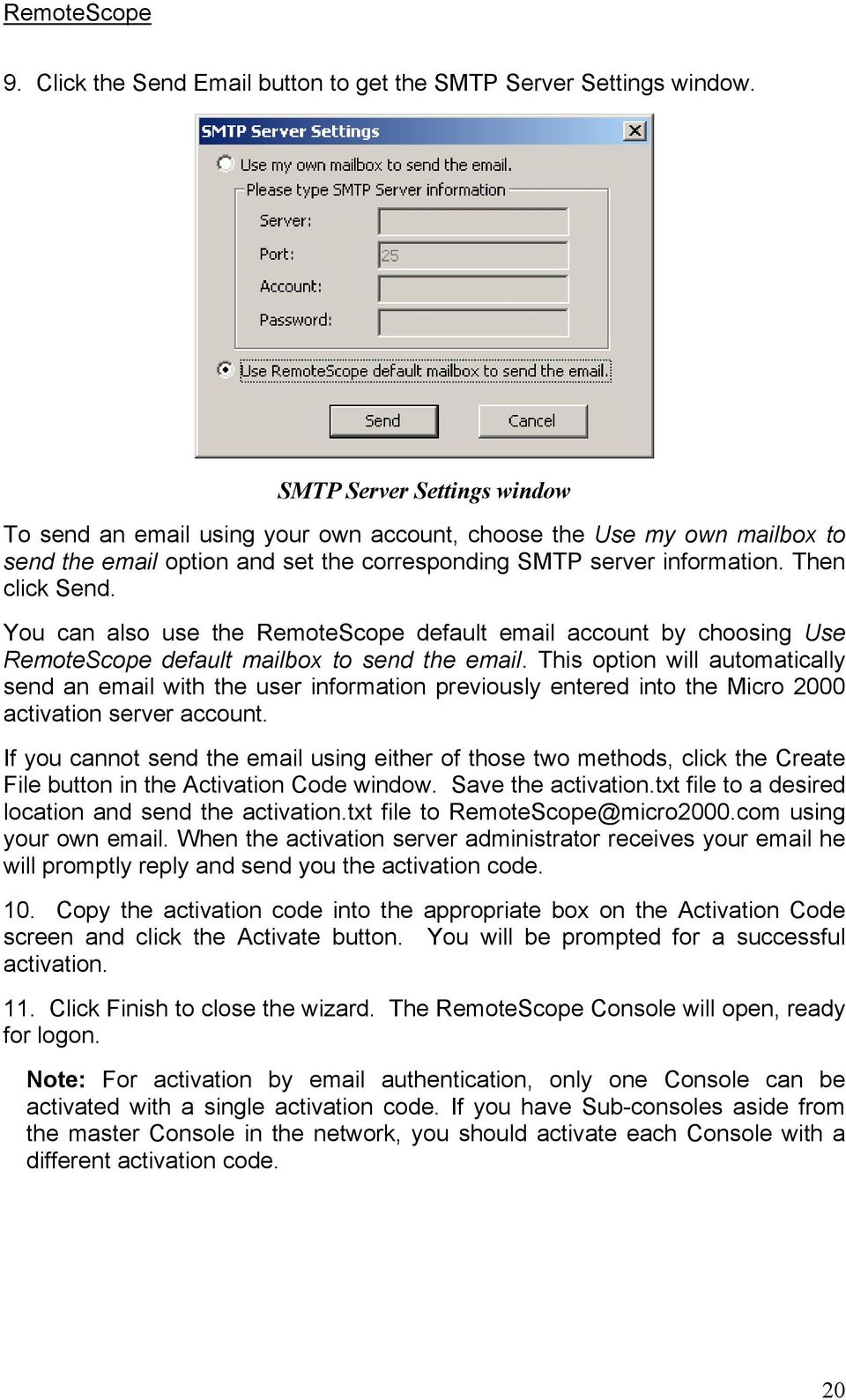
20 RemoteScope 9. Click the Send button to get the SMTP Server Settings window. SMTP Server Settings window To send an using your own account, choose the Use my own mailbox to send the option and set the corresponding SMTP server information. Then click Send. You can also use the RemoteScope default account by choosing Use RemoteScope default mailbox to send the . This option will automatically send an with the user information previously entered into the Micro 2000 activation server account. If you cannot send the using either of those two methods, click the Create File button in the Activation Code window. Save the activation.txt file to a desired location and send the activation.txt file to [email protected] using your own . When the activation server administrator receives your he will promptly reply and send you the activation code. 10. Copy the activation code into the appropriate box on the Activation Code screen and click the Activate button. You will be prompted for a successful activation. 11. Click Finish to close the wizard. The RemoteScope Console will open, ready for logon. Note: For activation by authentication, only one Console can be activated with a single activation code. If you have Sub-consoles aside from the master Console in the network, you should activate each Console with a different activation code. 20
21 User Guide Logging On Once the Console has been activated by the Activation Server, the Log On window will appear. The default User name is Remote and the password is Scope. This first time, you will be logged in automatically, but on subsequent uses you will need to enter these values, with the S capitalized because login is case-sensitive. Each time you log on with these defaults, you will be prompted to change the default values and should do this at the first opportunity, as described in Chapter 3. Logon Re-Activation RemoteScope will automatically reconnect to the Activation Server at 15 days and 45 days after installation to confirm current activation status and check for updates, so it is important for the Console system to have a functioning Internet connection at those times. If for any reason the Console is unable to connect, it will display a prompt and will continue to attempt activation at each logon for three consecutive days. If the Console is unable to connect after 3 days, the Console will not allow logon. Instead, it will open the Activation Wizard and the activation code must be entered as shown in the previous section before continuing to use RemoteScope. It is also possible to re-activate the program at any time (provided activation has not expired) by using the Re-Activate System command on the Console s Tools menu. This method is used to get program updates and to confirm the addition of more Client seats or Sub-consoles. Note: Re-activating or updating RemoteScope will not change the user name and password you have set, unlike re-installing the program which will restore the default values. 21
22 RemoteScope Closing the Console Click the x in the upper right corner of the Console main window to exit. The Console will take a few moments to release its Client connections and close the program, and will display a prompt while this is occurring. You will not be able to restart RemoteScope until this process is complete and the prompt disappears. Console Uninstall The RemoteScope Console can be uninstalled in either of two ways. One is the traditional Add/Remove Programs feature in the Windows Control Panel. For the other method, go to the RemoteScope group of the Windows Program bar and find the last item: Uninstall RemoteScope. This is the recommended method because if any files cannot be removed (for instance, because they are open at the time), the RemoteScope Uninstall window will list them and they can then be removed manually. Network Segment The program contains a feature called a Network Segment that allows the Console to see and interact with only the PCs within a certain range of IP addresses at any given time. There can be many network segments organized into groups called Profiles. The first time you log into a RemoteScope Console, it will ask you to set the Network Segment. Chapter 3 contains more information about network segments and profiles, but at this time it is necessary to create only one profile with a single network segment. For simplicity, this network segment should contain the entire range of addresses that the Console will be concerned with. It can be edited later if needed Click OK and the program will take you to the Network Segment tab of the Console Configuration window. 22
23 User Guide Network Segment tab Click on the button that says Create. This will bring up the Create a Profile window. Create a Profile window Configuring a network segment is just a matter of entering the starting and ending IP addresses of the range. With static IP addressing these would be the highest and lowest IP addresses used by any of the Clients. With dynamic addressing, this network segment will use the same starting and ending addresses as the DHCP server. In the left-hand IP Range box, enter the 4 octets of the starting IP address of this network segment. In the right-hand box, put the ending IP address. Then click the Add button. The new addresses will be transferred to the lower pane. 23
24 RemoteScope Note 1: This first network segment of the Master Console should include the IP addresses of all Clients in its domain. Each Sub- Console might connect to all of these or only a portion of them, and its first network segment would need to include only those Clients to which it will connect. Note 2: Each octet must be between 1 and 255 (253 for the first octet). The ending address of a network segment must have a higher value than the starting address. Note 3: The first octet must be the same for both the starting and ending IP address, and it is strongly recommended that the second octet is the same as well. This will normally be a concern only for WAN connections and the small handful of Class A domains. Since there is only one network segment in this first profile, you are done. Click OK to close the Create a Profile window, and click OK again to close the Configuration window. Client Installation Installing the Client module takes only a double mouse click, and may be the simplest application installation you will ever see. First though, it must be distributed to the Client system. For security reasons, the module must be installed from the system where it will reside. After that, the Console is able to install software on the Client remotely, or take complete remote control of the Client. Deploying the Client At the Master Console, in the RemoteScope group of the Windows programs menu, locate and click on the Client Package. The setupclient window will open, showing two files called setup.exe and vipsetup.exe. These are the Client setup and VIP Client setup programs. More information on VIP Clients can be found in Chapter 3 in the section: Configuring the VIP Client. In most cases, the setup.exe file will be used. 24
25 User Guide Setupclient window There are several options for easily distributing these files to the Client nodes. Option 1 the file to the user at each of the Client systems. Option 2 Transfer the file to a server or shared resource that each of the Clients can access. Option 3 Share the folder at C:\Program Files\RemoteScope\ Console Main\setupclient. Option 4 For Windows NT/2000, XP, and 2003 it is possible to remotely deploy the Clients. That procedure is described in a later section of this chapter, called Deploy Clients Remotely. Option 5 (Not recommended) Transfer the file to a floppy diskette and carry it around to each system. Note: Any one system will have either the Client module or the VIP Client module, but not both. Normally the VIP module is used for top executives. It requires the user to respond with permission before the Console can remote-control, browse or transfer files to the Client system. 25
26 RemoteScope Installing the Client Module 1. Go to the Client system, or have the user do the install for you. 2. Save the setup.exe file from the message, or download it from the server or shared folder to the local C: drive. 3. Double-click setup.exe (or vipsetup.exe). The Client module will be instantly installed. A prompt will appear telling you that the installation was successful. Note: Administrative rights may be required in some cases to successfully install the Client module, for instance on Windows 2000 or other computers using Active Directory services. 4. Click OK. Remote Client Deployment In cases where the Console and all of the Clients use the NT file system rather than a FAT, it is possible to use a RemoteScope wizard to remotely distribute and install the Client modules. In a network where some of the PCs are running Windows 95 or 98, Client modules can be deployed remotely to just the systems running NT, Windows 2000 and XP, and then Clients on the Win9x systems can be installed per the previous section. System Requirements The OS of the Console and all the target machines where client will be deployed and installed must be WinNT, Win2K, or WinXP. The target machines must have IPC$ Sharing enabled. The operator of the Console needs to know the administrator name and password of each target machine. For WinXP machines, the password of the administrator cannot be blank. If the OS of a target machine is WinXP, a) To use the local account of a target machine, network access should be set as follows. Go to My Computer Control Panel Administrative Tools Local Security Policy Local Policies Security Options Network 26
27 User Guide access: Sharing and security model for local account. Select Classic - local users authenticate as themselves from the pull-down list, then click OK. b) Or, you can log on as Domain Administrator. Deploy Client Wizard To start the Deploy Client wizard, highlight Client/Group in the left-hand Tree View (see next chapter), and then either pull down the Tools menu and select Deploy Client Wizard, or right-click in the blank area of List View and select it from the pop-up menu. The Deploy Client Wizard Welcome window will appear. Deploy Client Wizard Welcome window Select Next to proceed to the Select Mode window. 27
28 RemoteScope Deploy Client Wizard - Select Mode window To choose a single machine, select Type the IP address or computer name of the target machine and enter the IP address or computer name of the desired machine. To choose more than one, select All hosts detected in the network segment. Click Next to proceed to the Select Hosts window. Deploy Client Wizard Select Hosts window 28
29 User Guide If you selected Type the IP address or computer name of the target machine in the last step, only one result will be displayed in the Detected Hosts List and the box next to the host name will be checked by default. If you selected All hosts detected in the network segment in the last step, all machines detected in the network segment will be displayed in the Detected Host List. Check the box for each system that will receive a Client module in this deployment. To select all, highlight any one and right-click. Then choose Select All from the resulting pop-up menu. To select most but not all, check the boxes for those you do not wish to include and choose Invert Select from the pop-up menu. The hosts detected can be listed by Host name or by IP address in either ascending or descending order. After making your selections, click Next to see the Configure screen. Note: To deploy the Client program to machines that have already been added to RemoteScope but failed to install the program, highlight them in the List View of the Client/Group Management window. Then, use either a right-click or the Tools menu to select Deploy Clients. You will then see the Configure window. Deploy Client Wizard Configure window All of the potential Clients just selected will be listed here. The default user name for each is Admin, with a blank password. To change any user name or password, click on the appropriate cell to highlight it, and type in the correct value. You can also right-click to pop up the Login Information dialog box and enter the correct values there, then click OK to close the box. 29
30 RemoteScope Note: To change the user names and passwords of all the hosts simultaneously, highlight all hosts in the list, and select "logon info" from the right-clicking menu, and then type the user name and password. Of course, the new user name and passwords of all the hosts should be the same. Login Information window The default for VIP Client is No. To change any host system from a normal to VIP Client, click in the cell to toggle the value to Yes. There is a check box labeled Auto add the host(s) as Client(s). If it is checked, each of the deployed Clients will be automatically added to the Console s Client list. Otherwise, this requires a separate step as described in Chapter 3: Detecting and Adding Clients. Click Next to go on to Deploy Client Wizard - Confirm Information window. Deploy Client Wizard Confirm Information window 30
31 User Guide The gray box will contain information on the selected hosts, including their computer names, user names and IP addresses. Check the information and click Next to continue, or Back to correct it. Deploy Client Wizard Deploying window The Deploying window will display the process of deployment one at a time to each host. The icons on the left side of the box show the status for each. Failed to set up. Being deployed to. Deployment not started yet. Deployment and setup successful. When the deployment process is complete, the program will automatically proceed to the next window, Deploy Client Wizard Finish. 31
32 RemoteScope Deploy Client Wizard Finish window The Finish window displays the results, showing whether the Client module was successfully deployed and installed on each host. If you would like to save the report, click Save as, choose the location and type a name in the pop-up Save as window. The information will be saved as a log file. Click Finish to complete remote client deployment. The Client module will be running on each of the selected hosts. Note: 1. Occasionally a newly deployed Client will respond slower than normal during a remote control session. This is a function of the video drivers used on the Client system. If this occurs, reboot the Client system one time while it is connected to the Console and the problem should disappear. 2. The properties of the deployed clients are set as DHCP by default. Uninstalling a Client To uninstall a Client module, right-click the Client icon in the system tray and select Uninstall. You will first see the Log On screen shown below. Until you change them, the default user name is Remote and the password is Scope, just as with the Console. After logging in, you will be able to uninstall the Client. This can also be done in remote control from the Console system, but only one Client at a time. There is no batch method for uninstalling multiple Clients. 32
33 User Guide Note: A Client module cannot be removed using Add/Remove Programs in the Windows Control Panel. It must be done from the stem tray icon. If the icon has been hidden, it must first be unhidden (as described in Chapter 3) before the Client can be uninstalled. Also, the Client must be connected to a Console at the time so that the user name and password can be verified. 33
34 RemoteScope Chapter 3: Getting Started Now that the RemoteScope Master Console has been installed and activated, and the Client module has been deployed to its new homes around the network, it is time to get familiar with the program. If you have also installed Sub-consoles, there are some differences in function and appearance between the Master and Subs that will be described at appropriate points in the text. Master Console Interface The main Console window is the basic user interface of RemoteScope, and all of the major functions can be accessed here. This is the window that appears whenever you open the program by clicking on RemoteScope Console in the RemoteScope program group, and after you log in, of course. This main Console screen will remain open throughout the session, although it may be minimized or hidden behind other windows that open for specific functions. Tour of the Main Screen The interface will be relatively familiar to anyone who has used Windows-based productivity software. Just under the Title bar at the top is a Menu bar with a series of drop-down menus, and right below that is a toolbar with shortcuts to the more common functions. These menus and tools will be discussed throughout the manual in the context of the functions they represent. Across the very bottom is the Status Bar. When the cursor is rested over any toolbar icon or menu item, a brief description of that item will be displayed in the Status Bar. Display of the Status Bar and Toolbar can be turned on or off from the View Menu. Most of the window is divided into three panes: left, right and bottom. The left pane is called the Tree View. On the right is the List View, and the bottom pane contains the Console Activity Log. 34
35 User Guide Master Console Main Screen Sub-console Main Screen 35
36 RemoteScope As you can see, the Sub-console main screen is almost identical to the Master Console main screen. If you look close you will see that there are fewer selections in the Tree View. The Software Distribution, Scripts, Reports, and Inventory menus are removed from the menu bar. Of course, the title bar also says RemoteScope [Sub-console] rather than RemoteScope [Master Console]. Tree View The Tree View pane provides a hierarchical display of the Clients and Groups and of the major RemoteScope functions. Any folder (branch) in the tree that has subfolders can be expanded or contracted by clicking on the + or icons to the left of the folder. Any of the folders, Clients, Groups or functions can be selected by clicking on its icon in the tree. The selected item will be highlighted. Most of these choices can also be made from the drop-down menus, but the Tree View provides a useful overview of most parts of the program and in some cases, quicker access. The folders available in the tree are: System This is the root folder that contains the rest of the tree. It appears at the top of the list. Client/Group Expanding this branch will show a list of all of the Groups and of individual Clients not associated with Groups. Further expanding one of the Group branches will show the Clients in that particular group. Client/Group selection can also be done from particular items on some of the menus. Clients and Groups are explored in Chapter 4. Tree View Pane Task Management In this folder in the Master Console you can create and schedule a variety of administrative tasks. The folder will not appear in the Sub- Console Tree View. The task and schedule functions are also available on the Task Menu, as discussed in Chapter 9. Script This folder provides access to a list of VB scripts that can be run directly by clicking a script file in the List View. Scripting also applies only to the Master Console, and is covered in Chapter
37 User Guide Inventory This contains shortcuts to hardware and software inventory and the Statistic function, all covered in Chapter 6. The Console Menu and Client/Group Menu provide alternate access to their respective inventories. Because the inventory is maintained at the Master Console only, the Inventory folder will be missing on a Sub-console. Report Here you will find quick access to existing reports and to templates for creating new reports. This feature also appears only on the Master Console, because reports are based on the Master Console s inventory database. More on Reports can be found in Chapter 13. History Record Three types of records of system activity can be accessed through the History folder, including the File Backup Record found in Chapter 14, the Distribution Record, which is part of the Software Distribution feature discussed in Chapter 8, and the three System Logs, covered in Chapter 12. The System Logs are different than the Console Activity Log found in the next section of this chapter. The items in the History folder do not have corresponding menu entries, and can only be accessed through this folder. Note: You may have observed that Remote Control is not one of the functions available from the Tree View. That is because the Client(s) must be selected first before activating Remote Control. The Remote Control function will be covered in Chapter 5. List View This right-hand pane of the window shows information about whatever Client, Group or function has been selected from the menu or from the Tree View. The view will be different for each of those selections, and will be discussed in those appropriate sections of the manual. In many cases, the presentation in the List View pane can be modified by choices in the View Menu. It is also possible to adjust the amount of the window used by the Tree and List views by dragging the bar separating the two panes. Console Activity Log This is the bottom pane of the Console window. It contains a sequential list of actions done by the Console since the beginning of the current session. This includes Start-up and configuration changes as well as all communications between Console and Clients. Each listing will contain the date, time and a description of the action. The bar between the Activity Log and the upper panes can be dragged to display more or less of the log. If there are more entries than can be displayed in the pane, a scroll bar will appear along the right side of the pane. 37
38 RemoteScope Activity Log Pane Changing Passwords The Console Menu is on the far left of the menu bar in the Console Main Screen. Selecting Password from this menu will bring up the Password Manager window, where you can change the User Name and Password for either the Console or the Client nodes. You can also open this window with the password icon on the Toolbar. Password Manager screen Changing the Console Password To change the Console user name and password, click the Console button in the upper left corner of the window. On the right side of the window, type your existing user name and password in the appropriate blanks. In the lower blanks, 38
39 User Guide type in your new user name and password, then re-type the new password to confirm. Click OK to close the window. Changing Client Passwords Each Client system can have its own administrator user name and password. These can be different than the Console admin name and password and different from each other. Click the Clients button, and a list of Clients will appear in the left pane, with a checkbox next to each one. Click in the checkbox to select a Client for a new password. It is possible to change the admin name and password on multiple Clients simultaneously, as long as the old user name and password was the same on each system. Of course, in this case the new user name and password must be the same on each system also. If you right-click in the Client pane, a pop-up menu will appear with two items: Select All and Invert Select. Select All will of course select all Clients in the list. If you want to select most of the Clients but not all, this can be done efficiently by first selecting those Clients you don t want, and then choosing Invert Select from the pop-up menu. Once the Client selection has been made, type in the old admin name and password and then the new in the appropriate boxes. Retype the new password for confirmation, and click OK to close the window. Configuring the Console Selecting Configuration from the Console menu or clicking the Configure icon from the Toolbar will bring up the Configuration window. All of the configuration choices are presented on one of the four tabs of the window. The tabs are: General, Log, Network Segment and View Settings. 39
40 RemoteScope Configuration screen, General tab General Tab This tab contains configuration options for four different functions: Security, Remote Control, Upgrade Timer and Encryption. Security There are two check-boxes for passwords. One allows the password to be blank, which means that anyone can log into the Console without the Admin name and password. By default, it is not checked. A second checkbox allows connection to all Clients that are online and have been previously added to that Console s Client list, automatically whenever the Console program is opened. This feature can be very convenient, but care should be taken in an installation with Sub-consoles because only one Console at a time may be connected to any given Client, and the first Console that connects to a Client prevents all others from doing so until it disconnects. The third item in this pane allows you to set the number of times an incorrect user name or password can be entered before the program locks the logon window. If the logon window locks, it will be necessary to close the Console and re-open it before trying again to log in. Remote Control In the next pane are two pull-down list boxes. One is labeled Default Control Mode. This sets the mode for which the Remote Control feature will first be in whenever a Client is selected for Remote Control. The other sets the Video driver mode to use. 40
41 User Guide High speed network mode is the default and is for LAN users. This mode will provide fast performance during the remote control session. Low speed network mode is for WAN users, especially those who have a dialup connection or other low speed network. Compatible mode is also for LAN users, yet, in this mode, remote control is relatively slower. However, Compatible mode does not involve a driver so it is more stable. Note: The low speed network mode should not be applied on Windows 95 or Windows NT systems. More about this feature can be found in Chapter 5. Under the pull-down lists, there are also two check boxes. The first will cause a prompt to appear on the Client s screen showing it is under remote control. The second will disable the client s wallpaper to accelerate the speed of remote control. Both boxes are checked by default. Upgrade Timer This sets the interval for the Console to automatically reactivate and check for updates. The range is from 1 to 30 days, or 0 to disable it. Encryption There are two check-boxes for encryption. The first one will encrypt the basic communication between the Console and Clients. The second check box is to use encryption for File Transfers. Both boxes are checked by default. 41
42 RemoteScope Log Tab Configuration screen, Log Tab This tab provides for enabling and setting certain parameters for the three System Logs. These are discussed in Chapter
43 User Guide Network Segment Tab Configuration screen, Network Segment Tab The basics of configuring the Network Segment tab and creating a profile was covered in Chapter 2, but that was just one profile with a single network segment that covered the entire IP range accessed by the Console. In a small LAN, this is usually all that is needed for efficient management of the network. Some RemoteScope installations involve thousands of networked PCs. Of course it would not be practical to wade through a list of all of these Clients every time you wished to select one or more Clients for an action. In such a situation it is useful to create many profiles, and each profile may have multiple network segments. Creating and using these more complex profiles is covered in the Managing Profiles section of this chapter. 43
44 RemoteScope View Settings Tab Configuration screen, View Settings Tab This tab allows you to change the default contents and appearance of the List View that displays when Clients/Groups is highlighted in the Tree View. Client List View This upper pane has four check-boxes: Group(s) Only will show just the Group icons. Client(s) Only will display all Clients, but not their Group affiliation. Ungrouped Clients are Clients that are not assigned to any group. All Objects will display Group icons and all Clients, grouped or not. Default Icon The lower pane determines the default appearance of the displayed objects. The choices are: Large Icons, Small Icons, List and Details. This also can be amended during the session, using the View pull-down menu. The selected defaults will change the display as soon as the OK button is clicked. During the session, the display may also be changed at any time from the View pull-down menu or from the View item on the Client/Group pull-down menu, as described in the next chapter, but will revert to the default at each startup. Managing Profiles If multiple profiles are used, only one of them will be active at a time on any particular Console, and the Console will see and interact with only those Clients 44
45 User Guide and Groups whose IP addresses fall within the network segment ranges included in that profile. Some careful thought should be given to the network configuration and how to set up the profiles to maximum advantage. Sometimes but not always, the profiles will correspond to the domains and primary controllers of an NT network. Creating a New Profile To create a completely new profile, select the Configure command on the Console menu, and then the Network Segment tab. From here, the procedure is the same as the first profile created after installation. As before, click the Create button on the Network Segment tab to bring up the Create a Profile window. Create a Profile window Give this profile a name, and enter the Starting and Ending IP addresses of its first network segment. Click Add. If additional network segment ranges will be included in this profile, add the starting and ending address of each of those ranges in the same way. When all ranges have been entered, click OK to return to the Network Segment tab. To add another profile, click the Create button again. Note: If a great many profiles are being added it may be easier to create them by editing the netsegment.cfg file. The procedure for this is listed in Chapter
46 RemoteScope Editing an Existing Profile To change the IP information of an existing profile, display the Network Segment tab. In the list box labeled Available Network Profiles, double-click on the name of the profile you wish to edit, or highlight it and click the Properties button. Either of these will open the Profile Properties window for that profile. Profile Properties window 46
47 User Guide To add a new network segment to this profile, enter the Start and End addresses in the IP Range boxes and click Add. To edit an existing network segment, highlight it in the list box and its Start and End addresses will appear in the IP Range boxes. Make the appropriate corrections in the IP Range boxes. Then click Update. If you want to add a new network segment that is similar to an existing one, highlight the existing range and then make changes in the IP Range boxes. Click on Add instead of Update and the edited IP range will be added as a new segment, leaving the original one unchanged. This is a useful procedure, because any new segment will always have at least two octets in common with the existing segments. When all of the editing changes are complete, click OK to close the window. Here are a few rules to keep in mind: 1. The Master Console and each of the Sub-consoles may all have different profiles, but the Master Console s profiles collectively should cover all of the IP ranges used by any of the Sub-consoles. 2. If a network segment uses dynamic addressing, that segment should use the entire IP range addressed by the DHCP or WINS server for that subnet. A network segment that includes only part of a dynamic address range cannot guarantee to connect to any particular Client in that range. 3. A Client may be included in the network segments of several Consoles, but it may be connected to only one Console at a time. 4. Two Master Consoles can co-exist on the same LAN, but they will each be able to interact with only their own Clients and Sub-consoles. Note: For two Master Consoles that exist on the same LAN, it is recommended that you use a different PCPK for each Console. If both Master Consoles are using the same PCPK and co-exist on the same LAN, this could cause an issue with the activation process. 5. On any Console, there can be as many as 99 network segments in all profiles combined. Selecting a Profile In the main Console window, there is a pull-down list in the upper right-hand corner of the screen labeled Active Network Profile. To select a particular profile to be active, pull down the list and click on the desired profile. A prompt will ask if you are sure. If you are, click Yes. The Console will immediately switch to the selected profile. It will then be necessary to execute the Connect or Connect All command (covered in the next chapter) to connect to the Clients in the new profile. 47
48 RemoteScope Configuring the Client Normally, the only evidence on a Client system that RemoteScope is running on that system will be the icon in the System tray. Right-clicking on this icon will open a short pop-up menu, which lists all of the actions that can be done from the Client end. The items on the menu are: VIP Response Send Message Uninstall View Log Configure About Client Exit The only items on this list that can be accessed by the local user without the Admin name and password are Send Message and About Client. Messaging is covered in Chapter 11, and About Client presents a screen showing the version number and registered owner. The choice of VIP Response will be available only on a VIP Client, and is covered in the following section, Configuring the VIP Client. Selecting any other item on the menu will open the login dialog, which requires the Admin name and password to be entered before proceeding to the selected item. Note: In some cases the Client icon will be hidden, and the Client must be remotely configured as described in Chapter 4. Uninstall As you might expect, this allows the Client module to be uninstalled. View Log The Client has three system logs just like the Console, which are discussed in Chapter 12. This menu item allows the log contents to be viewed from the local system. Configure The Configure window for a normal Client has three panes. 48
49 User Guide Normal Client Configure The topmost pane, labeled System, has checkboxes to disable sending messages and to hide the taskbar icon. If the taskbar icon is hidden, the menu cannot be accessed and no further actions can be done from the Client, including of course sending messages. However, messages can still be received and replied to. The icon can be unhidden by using the Remote Configure feature described in Chapter 4. The next pane, called Communication, has a list for selecting the protocol. At this time the only allowed protocol is TCP/IP. A box to the right shows the Service Port. The default port value of is entered automatically but may be edited if necessary. RemoteScope can use ports between and The lower pane called Log sets the parameters for the three system logs. Again, these will be found in Chapter 12. Exit This will close the current session of the Client on the local system and remove the icon from the System tray. The Client module will restart the next time this computer is booted up. Configuring the VIP Client On a VIP Client, right-clicking the icon will bring up a menu very similar to the one for a normal Client, with the additional item of VIP Response. All of the other menu features are identical, except for a small difference in Configure. VIP Configuration The VIP Configuration window differs from the Configure window of a normal Client because of the absence of the top pane. The Client icon in the taskbar of 49
50 RemoteScope a VIP Client cannot be hidden, and messaging cannot be disabled. VIP Response VIP Configuration window This will first open the VIP Password screen. The VIP password is different than the Admin password. To proceed with this portion of the VIP Client configuration, enter the VIP password and click Logon. VIP password screen The default VIP password is VipVip, It is case sensitive, so please notice the capitalization of both V s. The default password should be changed as soon as possible after installation of the VIP Client. Typically, the VIP password is selected by the VIP user. The password can be changed after entering it, by clicking on Modify rather than Logon, which will add the lower pane to the screen as shown below. 50
51 User Guide Type in the new password in the appropriate blank, and then in the lower blank re-type the new password to confirm. Click the lower Modify button to close the window. The new VIP password will be in effect the next time VIP Response is executed. Setting Responses VIP Response Window The VIP Response window opens after Logon. This window contains a list of all actions that a Console may request to do with this VIP Client, and the VIP user can select how the Client will respond to each action. The choices are Accept, Deny and Prompt. If Prompt is selected, each time a Console requests that action, a prompt will pop up on the Client screen giving the user a choice to accept or deny the request. There are also global choices to Accept or Deny all requests, without being prompted. 51
52 RemoteScope To set the response for any given action, scroll the list box to locate a description of that action on the left-hand side of the box, and then click on the description. Next, double-click on the Response shown to the right of the Action Description. This will open a short menu. Click on Deny, Accept or Prompt. Find the next action you wish to change the response for, and repeat the procedure. When all actions have the appropriate response, click OK to close the window. The selected responses will be effective immediately. The actions for which you can set a response are: Browse file(s)/ folder(s) This allows the Console to browse any file(s) or folder(s) of the VIP Client. The other file transfer options are all based on this one. If Deny is selected, the response settings for the following five actions will be irrelevant. Create a new folder A Console is able to create a new folder on the VIP Client s machine. Move file (s)/ folder (s) File(s) or folder(s) can be moved from one directory to another directory on the VIP Client. Set attributes File attributes, including renaming of files, Read-Only, Hidden, Archive and System, can be set for files of the VIP Client. Copy to this machine File(s) can be copied from the Console to the VIP Client. Copy from this machine File(s) can be copied from the VIP Client to the Console. Start remote control A Console is able to monitor the VIP Client. Other remote control options are all based on this one. If this one is set to Deny, the response settings for the following four actions will be irrelevant. Full control this machine Console is able to take full control of the VIP Client. Share control this machine Console is able to share control of the VIP Client. Shut down this machine Console is able to shut down the VIP Client remotely. Restart this machine Console is able to restart the VIP Client remotely. Detecting and Adding Clients Before the Console can talk to or control a Client, it must first detect the Client and add it to its Client List. Note: Clients can be detected and added automatically when using the Remote Client Deploy wizard. See Chapter 2. 52
53 User Guide For Clients not added automatically, this can be done individually or in batch. With new installations it is usually most convenient to do in batch, and that is the procedure given here (see Chapter 4 for adding Clients singly). Select New Client from the Client/Group menu, and select Manually from the submenu. This will open the New Client window shown below. New Client Window Check the box that says Select From, and then click the Detected Clients button. RemoteScope will scan the network segment and the right-hand box will show a list of all on-line systems that have a Client package installed. To select all Clients on the list, choose Select All from the right-click menu. To add most but not all of the listed Clients, highlight the Clients that are not wanted, and select Invert Select from the right-click menu. At the time Clients are detected they can also be added to Groups, which will be covered in the next chapter. To restrict the display to only Clients not yet added, check the box labeled Available new Clients. The other box, Valid Clients, is used when a network has multiple Master Consoles, so that only those Clients with the same PCPK are detected. 53
54 RemoteScope Client Status When Client/Group is highlighted in Tree View, the List View will show icons of groups and individual Client nodes. The appearance of the icons provides a quick visual indication of the status of those Clients. It is not necessary to memorize these, because the Status column also provides a short description.. A green triangle in the circle means the Client is connected. If the triangle is green but the face is colored, the Client is connected but busy, possibly in a remote control or file transfer session. A red exclamation mark indicates the Client is being controlled by another Console. No circle shows the Client is not connected. A solid yellow circle means the Console is now trying to connect to this Client. A red circle with a slash through it means the Client is invalid. Refer to Chapter 16 for the various reasons that could cause this. A white triangle in a blue circle. The face is green. This one means the Client s version is lower than the Console s and needs to be upgraded. If the Client s version is higher than the Console, a red triangle will appear in a blue circle, and the face will be maroon. In this situation, the Console must be upgraded before it will be able to connect to this Client. A red star in the upper right means this is a VIP Client. A green triangle in the circle means the VIP Client is connected. Refer to Chapter 4 for VIP Clients. This is the icon for a Group. 54
55 User Guide Chapter 4: Managing Clients and Groups RemoteScope Clients can be managed individually and also in Groups. These Groups are unique to RemoteScope and do not need to correspond to the Windows groups or domains already set up on the network. The reason for creating a Group in RemoteScope is to allow a RemoteScope action to be done on multiple PCs simultaneously. A Client can belong to more than one Group, and can also still be managed as an individual Client regardless of its group membership. It can also belong to different groups on each Sub-console. All of the actions that would normally be taken regarding Clients or Groups are conveniently collected on the Client/Group menu on the main Console screen. Several of the items on the menu will apply only to selected Clients or Groups, and will be grayed out unless a Client or Group is selected. Selection can be done using the Tree View and List View panes of the Console main window, as explained in Chapter 3. Those items that can be done to a specific Client or Group will also appear on a context menu (often called a short-cut menu) that is opened by right-clicking on the Client or Group icon in the List View. The Client/Group Menu Open This will open the Group selected in the List View, to show its Client members. If no Group is selected it will be grayed out. You can also open a Group by doubleclicking the Group s icon in the List View. New Group Because this item does not apply to any existing Groups, in order to access it you must highlight the Client/Group icon on the Tree View rather than any of the listings in the List View, or by clicking on the New icon on the toolbar and selecting New Group. When New Group is selected, it opens the Group Properties dialog box shown below. At this time the left-hand pane of Group Members will be empty, and the right-hand pane of Excluded Members will contain all added Clients. 55
56 RemoteScope Group Properties dialog box If you have created multiple profiles, you can select a profile from the list and only the Clients within the range of that profile will be displayed to be added. This prevents the Group from containing Clients from different profiles, which tends to cause confusion because only one profile can be accessed at a time. In the right-hand pane highlight each Client you want to include in this Group, and click the < button to transfer it to the left pane. If you want to include all Clients in the excluded list, click the << button. Once Clients have been transferred, you can move any of the Group Members back to the excluded list by highlighting them and using the > button, or use >> to remove them all. Give the new Group a name and a description (optional), and click OK. Note: Group names, as well as other names throughout RemoteScope, follow the NT naming standard and must be alphanumeric characters. A dash or underscore is permitted, but no other symbols, punctuation or spaces. Also, avoid using the name Local for a Group, because RemoteScope uses that term for the Master Console system. 56
57 User Guide New Client As with New Group, this is only available when the Client/Group icon in the Tree View is highlighted, or from the New icon on the toolbar. It provides a submenu with four options: By Wizard, Manually, Import From, and Export To. By Wizard Choosing By Wizard from the New Client sub-menu will open the New Client Wizard window, which can take you step-by-step through any of three methods for adding one more new Clients to the Console s Client list. These are: Edit Information, Import from a special file, and AutoDetect in the network segment. Edit information New Client Wizard This is the best choice for adding a single Client, when the information for that Client is known. Choose Edit Information and then click Next. This will bring up the screen to Input Client Information. 57
58 RemoteScope Enter the Computer name and IP address for the Client. You can also enter a Display Name for it. This is a name used only by RemoteScope, which can be different than the computer name used by the network. Click Next again to proceed to the Add to Group(s) screen. Highlight the Group or Groups for the Client to join and click Next. Note that you can also add this Client to a Group at a later time. 58
59 User Guide At the Confirm Information screen, double-check the Client data and if it is correct, click Confirm. If not, click Cancel and re-do the New Client procedure. From the New Client (s) report, we can see if the new Client has been added or not. If the wizard failed to add this Client, the specific reason will be shown in the window. Click Finish to complete the New Client process and close the wizard. 59
60 RemoteScope Import from a special file This method can be used when you have previously created a Client list file, either manually as described in Chapter 15 (Import File, Creating and Editing) or by using the Export command from the Client/Group menu, as covered later in this chapter. Select Import from a special file and click Next to open the Select File to Import screen: Select File to Import Press the Browse button on the right to open a file locator window. Because Client List files are text files, the default file type in the locator window is.txt. Navigate to the proper Client list file and click Open. All of the Clients included in the file will be added to the Client list box in the Select File to Import screen, and all selected by default. You may deselect any of the Clients that are not wanted, by clicking in the checkbox. You can also select combinations of Clients using the Ctrl or Shift keys, and alternately select or deselect them with the spacebar. When you have the desired Clients selected, click Next to proceed to the Add to Group screen, Confirm screen and Finish screen. AutoDetect in the network segment This is the most common method of adding Clients using the wizard, particularly when multiple Clients are being added to a newly installed Console. It uses the Detect and List Clients screen shown below. 60
61 User Guide When you click on Detect, it will scan the active network segment and locate every online system that has an installed Client module mapped to the same PCPK as the Console. When the scan is finished these will be listed in the box, all selected by default. Change the selection if needed, as described above in Import from a special file, and click Next. Manually Selecting the item Manually from the New Client sub-menu is the preferred way to add Clients without using the wizard. It can be used to add Clients in batch as discussed in Chapter 3, or they can be added one at a time. 61
62 RemoteScope New Client window The system to be added as a new Client can be selected by entering the IP address and computer name in the correct box. Or, you can browse the network by checking the box that says Select From and choosing either Network or Detected Clients. Choosing Network will cause the right-hand pane to display an expandable network tree from which the Client can be selected. Note that all network systems are shown, not just those with the Client module installed. When a system is highlighted from this list, the computer name and IP address will be entered automatically in the appropriate boxes. Whichever selection method you use, be sure to determine whether the Client s IP address is static or dynamic, and check or uncheck the Dynamic IP box accordingly. You can also enter a Display Name for the Client. This is a name used only by RemoteScope, which can be different than the computer name used by the network. The default port value is entered automatically but may be edited if necessary. RemoteScope can use ports between and Click Add to complete the selection of this system as a new Client, and then click Done to close the window. 62
63 User Guide Note: 1. Punctuations can be included in the display name and computer name. However, if you check the dynamic IP box, be sure the computer name you entered is existed in the network, or RemoteScope may fail to find the computer or add it as a client. 2. When RemoteScope is first installed or when a large number of new Clients are being added, it is more efficient to add them in batch, as described in Chapter 3 under Detecting Clients. Import From/Export To There is another way to add Clients in a batch that is particularly convenient when there are multiple Sub-consoles that will have identical or very similar Client lists. Once the Clients and Groups have been added to the first Console (or Sub-console), a text file containing a list of those Clients and Groups can be created by using the Export feature of the Import From/Export to command on the Export feature on the New Client sub-menu. The name and location of this file are specified when it is created. To add these Clients to a new Sub-console, use the Import feature on that new system, or the Import from a special file choice in the New Client Wizard. Navigate to the proper file and click OK (or Open). All of the Clients and Groups listed in the file will be added to the new system s Client list. A Client/Group text file can also be created manually, using the procedure given in Chapter 11, and can then be imported in exactly the same way. Add Member This and the next menu item do basically the same thing, which is adding a Client to an existing Group. Add Member requires the Group to be selected and open first. It will bring up the Group Properties window shown earlier under New Group, with the difference that the left-hand pane will show the already existing members of that Group. The right-hand pane will display Clients that are not part of the Group. Use the < button to transfer a selected Client to the left pane. Add to Group This one requires the Client to be selected first. From the Select Groups window that appears, highlight the Group or Groups for this Client to join and click Add. 63
64 RemoteScope Select Groups screen Connect All All detected Clients will be immediately connected. This can also be done from the toolbar with the Connect icon. If a Client is already selected, this menu item will read Connect rather than Connect All, and only that Client will be connected. Disconnect All All connected Clients will be immediately disconnected. If a Client is already selected, the menu will read Disconnect and only that Client will be disconnected. This can also be done on the toolbar with the Disconnect icon. Send Message This allows you to send an instant message to selected Clients. The details of Messaging are given in Chapter 11. Conference Room Opens the Conference Room screen, explored in Chapter 12. File Transfer Opens the File Distribution view, covered in Chapter 7. Remote Control A Client must be selected before this command is available, which opens the Remote Control window. See Chapter 5 for Remote Control. 64
65 User Guide Remote Configure This item brings up the Remote Configure dialog box shown. Remote Configure dialog box Other than the pane for selecting Clients, this provides the same configuration options listed in Chapter 3, and allows them to be done remotely from the Console. Notice that multiple Clients can be configured simultaneously, as long as they all take the same configuration options. This dialog box can also be opened with the Remote Configure icon on the toolbar. Note 1: If a Client s taskbar icon has been hidden there is no way to access the program from the Client, and the icon can then only be unhidden from this screen at the Console. Note 2: If you are remotely configuring a VIP Client, the System pane will still appear, but selecting Hide taskbar icon or Disable send message will have no effect. These options are not available for VIP Clients. Note 3: Select All and Invert Select are available from a pop-up menu, by right-clicking in the Client selection pane. Wake-On-LAN (WOL) Remote wake up clients enables you to remotely turn on client machines that are turned off. This is a pre-action to allow other operations to take place on the client machines. 65
66 RemoteScope System Requirement An ATX motherboard with an onboard, 3-pin "WOL" connector. An ATX power supply that meets ATX 2.01 specifications. A network card that can support WOL with its cable to the motherboard properly installed. In the BIOS Power Management, you must enable the LAN WOL option. Wake up Client Wizard To wake up a (disconnected) client, highlight the client in the List View of the Client/Group Management window. Select Command and then Wake up from the submenu by using either the right-click context menu or the Client/Group menu. You can also highlight one or more clients in the List View, or click in the blank area of the List View of the Client/Group Management window, and select Wake on LAN from either the Tools menu or the right-click context menu. The Wake up Client Wizard Welcome window will then appear. Wake up status window 66
67 User Guide Wake up Client Wizard Welcome window Click Next to proceed to the Select Mode window. Wake up Client Wizard Select Mode window If you choose the clients before initiating the Wake up Client Wizard, the option From selected clients will be selected by default in the Select Mode window. To wake up a single client, choose Specify the IP address of the target machine and enter the Multicast IP Address and the Physical Address of the machine. The format for the physical address can be 00-1A-2B-3C-4D-5E, 00:1A:2B:3C:4D:5E, or 00.1A.2B.3C.4D.5E. 67
68 RemoteScope Note: 1. Multicast addresses specify an arbitrary group of IP hosts that have joined the group and want to receive traffic sent to this group. 2. RemoteScope can automatically display the physical addresses of the clients detected in the network segment, however, it may fail to detect some machines. To get the physical address of one of these machines, go to that machine and select Run from Start menu. Then enter cmd for Windows XP/2000/NT or /command for Windows 9x and click OK. Enter ipconfig all in the pop-up DOS window and press the Enter key. You will then see the Physical address. If you want to wake up multiple machines, select All hosts detected in the network segment. Then click Next to get the Select Hosts screen. Wake up Client Wizard Select Hosts screen If From selected clients was chosen in the last window, all clients that were selected in the List View will be displayed in the Detected Hosts List. The box for each client is checked by default. If Specify the IP address of the target machine was chosen in the last window, you will see the host name, IP address and physical address of only that machine and is selected by default in the Select Hosts screen. If All hosts detected in the network segment was chosen in the last window, all hosts detected will be displayed in this window. The results can be listed by host name, by IP address or by physical address in either ascending or descending order. Check the box to select a client. After making your selections, click Next to get to the Configure screen. 68
69 User Guide Wake up Client Wizard Configure window All clients selected in the last window will be displayed here in the Available host(s) list. Click the specific cell to modify it, if necessary. Then click Next to get to the Confirm Information screen. Wake up Client Wizard Confirm Information screen Verify that all desired clients are displayed and ensure that only those are listed in the task list. Then click Next to start the wake up task, or, click Back to change the selection. 69
70 RemoteScope Wake up Client Wizard Processing screen The wake up status will be displayed in the Processing screen and will disappear automatically when complete. You can click Stop to stop the wake up process at any time before the process ends. When RemoteScope finishes waking up all selected clients, the following Finish screen will appear and display the process report. Wake up Client Wizard Finish screen Click Finish to close the wizard and return to the Console main window. 70
71 User Guide Note: Remote wake up is an asynchronous and uncontrollable operation. The Console cannot verify that the clients have been awoken. There are three essential factors of a successful wake-up: 1) the client machine supports wake up on LAN, 2) the user has set the remote wake up function correctly, and 3) the wake-up package can be received by the client machine. Command This provides a Sub-menu with six options: Log off, Reboot, Shut Down, Standby, Wake up and Command Line. The first five options are system commands which allow you to remotely manage the Client workstations, individually or in Groups. Log off Log off the current user account remotely. Reboot Reboot a Client or a group of Clients remotely. Shut down Remotely shut down a Client or a group of Clients. Standby Put a Client or a group of Clients in a standby state. Wake up Wake up (turn on) a client remotely. Highlight the Client or Group in the Console Main window list view. Pull down the Client/Group menu, select Command and the desired sub-menu item. Or, rightclick on the Client or Group icon and select Command. The Executing System Command window will open, showing progress of the selected command. Executing System Command Window These functions can also be done from a remote control session, discussed in more detail in the next chapter. 71
72 RemoteScope Command Line Many common tasks can be called from the command line, such as opening a file or folder, connecting to a shared computer, etc. Anyone familiar with the MS-DOS command line or the Windows Run option can use RemoteScope to perform these tasks remotely on one or more Clients. Choosing Command Line will open the Edit Command Line window. Simply enter the command using the correct MS-DOS syntax. Inventory This menu item provides one way of viewing inventory information. A different one is available from the Tree view. Chapter 6 covers all of the inventory capabilities of the program. This menu item will not be visible on a Sub-console. Delete The selected Group or Client will be removed from the Console s database. The program will ask if you really want to delete the Client or Group, in case you clicked on this item in error. However, a Group can always be recreated, and a deleted Client can be added again as a New Client. The Delete command only removes the listing in the database; it does not uninstall the Client module on the Client system. This menu item is also available from the Delete icon on the toolbar. Properties This will display either the Group Properties or Client Properties window, filled out with the values for the selected Client or Group. The values can be edited from this window. This menu item is also available from the Properties icon on the toolbar. The Properties window for a Client will contain three tabs: a General Tab, File Backup History Tab and Backup Configuration Tab. The General Tab supplies basic information about the Client such as Display name, Computer name, IP address, etc. The File Backup History Tab and Backup Configuration Tab will be discussed in Chapter 14. Some of the properties can be changed on multiple clients and groups simultaneously. Use the Shift or Ctrl keys to make multiple choices in List View before opening the Properties window. Multiple Clients can be changed to Dynamic IP simultaneously. The other properties will be grayed out. With multiple Groups, the profile and description can be changed, and the other boxes will be grayed out. View This command provides a way to change the List View for Clients/Groups. Because some RemoteScope installations involve thousands of networked PCs, it is quite often useful to focus attention on a sub-set of these. The first four choices from the submenu are: 72
73 User Guide Group(s) Only Client(s) Only Ungrouped Clients All Objects These are the same choices set as defaults from the View Settings tab, but the Client/Group menu allows you to change them during the session. There are additional choices for Clients in specific conditions. These are: All Clients Connected Invalid Disconnected To be Upgraded The View command from this menu affects only the Client/Group List View. If something other than Client/Group is highlighted in the Tree View, the View submenu will be grayed out and unavailable. View Menu This refers to the pull-down menu labeled View on the main menu bar, and not to the View command on the Client/Group menu described above. This menu allows you to change the appearance of the items displayed in List View. The choices are Large icons, Small Icons, List and Details. Defaults for these are set from the View Settings tab, but the View menu allows them to be changed during the session. Context Menus Most of the items on the Client/Group menu can also be accessed by rightclicking on a Group or Client icon in the List View. The menu that pops up is technically a Context Menu, but is usually called a pop-up menu and sometimes referred to as a Shortcut menu. This one includes all of the items on the Client/Group menu except New Group, New Client and Add Member. If this is a Sub-console, it will also be missing Inventory from both menus. Although the same context menu appears for either a Client or Group, not all listed items are available in each case. For Clients, the listing for Open will be grayed out. For a Group, Remote Control will be grayed out, along with all of the choices on the sub-menus for Add to Group and Inventory. 73
74 RemoteScope Chapter 5: Remote Control Remote Control is one of the most powerful tools in a network administrator s arsenal. Without leaving his or her office, the administrator can see what is happening on a remote system in the next room or halfway across the country, and take control of that system just as thoroughly as the user sitting in front of it. Changing settings, re-routing print jobs, and a thousand and one other tasks that previously required going to the remote machine, can now be quickly done from the comfort of one s own desk. Note: Occasionally a newly deployed Client will respond slower than normal during a remote control session. This is a function of the video drivers used on the Client system. If this occurs, reboot the Client system one time while it is connected to the Console and the problem should disappear. Using Remote Control When the Remote Control feature is in use, the Remote Control screen will appear in front of the main Console screen. This has its own toolbar and menus, but consists mostly of a large window that contains an image of the remote system s monitor screen. In some cases, the Console may display up to four Client screens simultaneously, as described in the section titled Selecting Clients. During a remote control session, a prompt will be displayed by default on client s screen saying System is under Remote Control, unless this feature has been unchecked on the General tab of the Console s Configuration screen. If the feature is active, this prompt can be moved around the screen, but cannot be closed. 74
75 User Guide Remote Control Screen If Disabe Client s Wallpaper is selected in Console s Configuration window, the wallpaper of the client being monitored will not be displayed. In this way, the remote control will become faster. Control Modes The remote machine will be controlled in one of three modes: Full Control The Console mouse and keyboard can be used on the Client image just as if you were sitting at that remote machine. The keyboard and mouse at the remote system will be locked out. Shared Control In this mode, the mouse and keyboard at either end can control the remote system. Watch Mode The remote system will be controlled by its own mouse and keyboard. The Console will be able to observe but not affect the remote system. It is possible to instantly switch between these modes using the Mode icons on the toolbar. Full Shared Watch Full Control is on the left, Watch Mode on the right, and Shared Control in the middle. 75
76 RemoteScope When the Remote Control screen first opens up, it will be in whichever mode is the default, and the matching icon will appear depressed. The default mode can be changed in the General tab of the Console Configure window. Selecting Clients Before the Remote Control screen can be opened, it is necessary to select one or more Clients to control. To select a single client for Remote Control, highlight the Client in List View and then click on Remote Control from either the Client/Group menu or the right-click context menu. In Watch mode it is possible to monitor up to four Clients at the same time. The Remote Control screen will be divided into fourths to display the Client screens simultaneously. During selection, use the Ctrl key to highlight additional Clients, or drag the cursor over several Clients if they are together in the List View. The selection must be done before clicking on Remote Control, because there is no way to add Clients once you are in the Remote Control screen. You can expand the display of any of the Clients in Watch mode by clicking the Maximize button for that screen. The other Clients will remain in Watch mode but their screens will remain hidden as long as one of the displays remains maximized. VIP Clients If a system selected is a VIP Client, the results will depend on the response configuration set by the user of that machine. As described in Chapter 3, the user can set a response of Accept, Deny or Prompt for any action that the Console can request to take with that VIP Client. For instance, if you are attempting to remotely monitor a VIP Client and the response is set to Accept, the action will proceed just as it would with a normal Client, and the VIP Client s screen will appear in the Remote Control window. If the response is set to Prompt, the Client screen will display the prompt seen here: VIP Client Window 76
77 User Guide No remote control or monitoring will occur until the request is accepted at the Client end. In the meantime, the Console s Remote Control window will stay open but the display area will be grayed out, with text in blue letters that say Waiting for the Client to accept the remote control. If the Console s Remote Control window is closed before a reply, the prompt will disappear from the Client s screen. If the response is set to Deny, or if the user clicks Deny on the prompt, a message like the one below will appear at the Console end. Click OK to clear it and close the Remote Control window. Note: All remote control actions are based on Watch mode. Unless the VIP user allows the Console to monitor the system, all other remote actions, such as shared or full control and remote startup or shutdown, will not be possible. If the response to monitoring is set to Deny, all of these actions will be automatically denied. If monitoring is set to Prompt, each of them will require a prompt to be accepted. Full Screen To have the Client display take up all of the Console screen, select Full Screen from the View menu, or click the Full Screen icon from the toolbar of the Remote Control window. Once the display expands, the menus and toolbar will no longer be visible, so a smaller floating toolbar will appear in front of the Client display. On the left, this toolbar has three buttons to change modes, one to send a Ctrl- Alt-Del to the Client, and another two to restart or shut down the Client remotely. On the right, the first button will cycle through multiple screens in Watch mode, if more than one has been selected. The next button will restore the screen to normal, and the last two, Stop and Close, will return you to the Console main screen. Close will also end the remote control session, while Stop will end the session with just the currently-displayed Client. With multiple Clients in Watch mode, the others would remain in Watch mode. 77
78 RemoteScope Remote Ctrl Alt Del To send a Ctrl Alt Del to a workstation being controlled or watched remotely, select Ctrl Alt Del from the Client menu or click on the Ctrl Alt Del icon either on the main toolbar, or on the floating toolbar if in Full-screen display. The effect of course will depend on the Client s operating system. Tip: The CTRL Alt Del function is disabled on Windows 9x client machines Fit to Window If the monitor resolution of the Client system is at a different setting than the Console, the displayed screen will not exactly fill the space allocated for it in the Remote Control window. Either the Client screen will be too large to be displayed all at one time and require the use of the scroll bars, or it will leave excess space but the image will be smaller and harder to see. To adjust the display to the optimum size, use the Fit to Window icon located in the main toolbar. Fit to Window is also available on the floating toolbar and is on by default when multiple screens are in Watch mode. Clipboard Transferring With clipboard transferring, text, bitmaps and other information can be cut and pasted from the Console to the Client workstation. From outside of RemoteScope, copy the content to the clipboard of the Console system. Then, in the remote control session, select Send Clipboard from the Client menu from the remote control window, and the data would be transferred to the Client workstation s own clipboard, where it can be pasted into the appropriate application. Of course, that application can be opened remotely if needed. To send a copy of the Console s screen image, use the <Print Screen> key to copy the screenshot to the Console s clipboard. After sending it, it can be pasted into many graphics programs. To send a screenshot of just the active window, use <Alt><Print Screen> to capture it. Remote Shut-down and Restart In Full or Shared Control mode it is of course possible to take any action through the remote PC s screen display that can be done while sitting in front of that system. This includes restarting the system through its own shut-down menu. However, this will result in closing the remote control session and putting the 78
79 User Guide operator back in the main Console screen. Normally when restarting a machine, the intention is to remain in remote control of it and to log back in. An alternative method of restarting the remote system is to select the Restart command from the Client menu of the Remote Control window s Client menu, or use the Restart icon on the main toolbar (or on the floating toolbar, if in fullscreen display). This will leave the remote control session intact and will automatically reconnect the remote Client when it restarts. Because Client starts up before the login script, it is then possible to log in remotely. To do a complete shutdown rather than a restart, use the Shut-down icon or the Shutdown command from the menu. This will shut down and power off a system with an ATX power supply. If the power supply is the older AT version, the Shutdown command will close all programs and prepare the system for power-off, but it will still be necessary to manually flip the power switch. With either Shut-down or Restart, a 30-second warning prompt will be sent to the Client system, allowing the user there to save any work in progress. No reply to this prompt is needed. Ending the Remote Control Session Although the Remote Control screen occupies the entire application display space on the Windows desktop, the main Console screen is still open behind it and can be viewed by minimizing the Remote Control screen, or you can toggle between the two using their task-bar icons. To completely close the Remote Control screen and end the remote control session, click on the X in the upper right corner of the window or select Close from the Client menu. 79
80 RemoteScope Chapter 6: Inventory Many network administrators find that one of RemoteScope s most convenient features is the inventory of all the installed hardware and software kept for each machine. This information is kept in a database on the Master Console system, rather than maintaining it on the Clients and sending it to the Console at each viewing as is done by some other management tools. There are two main advantages to the RemoteScope approach. First, it cuts down on network traffic and leaves more available bandwidth for other uses. Second, if the Client has any kind of failure that interferes with its ability to communicate with the Console, the inventory data will still be available, perhaps just when you need it most in order to deal with the failure. In RemoteScope, the inventory data for every Client (and for the Master Console itself) is available instantly, and of course can be updated anytime at the discretion of the administrator. It can also be backed up by using the Backup Database command on the Tools menu. Inventory Groups RemoteScope inventory data is maintained in four groups. Hardware inventory contains the information on the basic motherboard hardware such as RAM and CPU, as well as on each of the ports, drives, adapter cards, video and misc. peripherals in the system. It also tracks resources such as IRQs, DMAs, I/O ports and memory allocations for each device. The plugging in and unplugging of USB devices, including USB storage devices, can also be detected to help businesses secure the secrets of the enterprise. Software inventory lists all of the applications installed on a system. Additional information about each program depends on what data is available from the registry and the DMI (Desktop Management Interface) entries, and may include the version, build number, vendor, serial # and install date. DMI is a standard interface but the actual information in it is at the discretion of the manufacturer. Operating System This is listed separately from the other software, and can include the version, build number, vendor, serial number, install date, Windows directory and System directory where the OS is located. Since we are talking about one version or another of the Windows OS, most or all of this information will usually be filled in. Custom Data The user can add database fields for individual Clients, and enter values for these fields, which will then be part of the inventory database. 80
81 User Guide Note: 1. The inventory database is maintained at the Master Console only. On Sub-consoles, all items on the menus or in Tree View that apply to inventory will be missing. 2. The program cannot get detailed inventory information on NT systems. Because NT OS does not support plug and play device, even if the video card is unplugged, NT system still recognizes as it exists and it works improperly. Therefore, Alarm does not work well on NT systems. Viewing Inventory There are three distinct ways of accessing the information in the inventory database. The Statistic view provides comparisons of specific items between multiple Clients, whereas the Tabbed View shows a collection of information about a single Client. Both of these will be discussed later in the chapter. The most comprehensive inventory management for both Console and Clients is available in the List View. List View To access the inventory in List View, go into the left-hand Tree View pane and expand the Inventory group by clicking on the + sign next to Inventory. Then select View Inventory. This will change the List View pane to its Inventory format. Inventory List screen 81
82 RemoteScope There are four tabs in the List View pane. These are Inventory, Monitor Policy, Change History, and Alarm Information. The Inventory tab provides access to the inventory data of the Console and Client systems, and the other three monitor changes to the database. Inventory Tab At the top of the List View pane under the heading Select an Object is a pulldown menu listing all of the Clients, plus a choice called Local that selects the Console. Highlight the machine whose inventory you wish to view. Next, in the View box select one of the three groups: Operating System, Software or Hardware. The selected group of inventory data for that machine will be instantly displayed. If you want to update the inventory database for that machine, click on the Refresh button on the right-hand side. The update can take anywhere from a few seconds up to a minute, depending on network conditions and the amount of information to collect (be aware that the inventory for any Client will be empty until that Client s inventory is refreshed for the first time). It is possible to update all of the Clients simultaneously by checking the box that says Update/Refresh All Clients before clicking the Refresh button. You can update the Console inventory by selecting Local from the pull-down list before clicking Refresh, but this is generally unnecessary because the Console inventory is automatically updated every time the Console program is opened. Monitor Policy Tab The monitor function tracks changes to a Client s inventory information, for instance installation or removal of hardware or software, and other important values such as the amount of hard drive free space. It also has the capability for Alarms to notify the network administrator whenever selected events occur. On the Monitor Policy tab you can specify sets of parameters, called policies, for which items are monitored and for how the administrator is notified. Adding a Monitor Policy To create a new Monitor Policy, you must first have the View Inventory s Monitor Policy tab showing. The List View will consist of a box listing all existing policies. Right click in any blank area of this box and select New from the pop-up menu, to bring up the Monitor Policy screen shown on the next page. 82
83 User Guide Monitor Policy screen For a New Monitor Policy: 1. Type a policy name. 2. Select an execution mode. There are three modes available. Pause means this policy is not in use at the moment. It can be restored by selecting one of the other two modes. Once Client starts up will execute the policy each time the Client program restarts. Normally this would be each time the Client system is booted. Interval (min) will have the policy execute repeatedly. The interval between executions can be set anywhere from 10 to 60 minutes, in 10- minute increments, in the pull-down list, for example, 10 minutes, so the policy will be executed once every 10 minutes. Tip: Large Networks The program will rest for approximately 40 seconds after every 255 IP addresses. If you have a large network, this is helpful to keep in mind when estimating time of completion. 3. Select one or more clients to be monitored, using the checkboxes in the Selected Client(s) list. 83
84 RemoteScope 4. Configure the Alarm Modes. There are three alarm modes: Prompt, Message and . Prompt will open an alarm prompt on the Master Console screen as seen below. This mode is either enabled or not, but no configuration is required. Alarm Prompt screen Message will send a message to the designated Client, but is only available for Windows 2000 and XP Clients, not Windows 9x. Enter in the computer name or IP address of the chosen system. Do not use the RemoteScope display name. Note: The Message notification is based on Microsoft s Message Service, which is enabled by default but must remain enabled for the feature to work. will send an alarm to the designated address. To configure the alarm mode, first type in the recipient s address, then click the Settings button to access the SMTP Server Settings window. 84
85 User Guide SMTP Server Settings window Type in the name of the sender s SMTP server. If the account requires an Account Name and Password, check the box and type these values also. Then click OK. Note: Usually the sender will be the network administrator with access to the Console, but in fact any account on the SMTP server can be used to deliver the alarm. 5. Set the Alarm Parameters. This is the table in the lower right section of the Monitor Policy screen (see previous page). The left column of this table lists each of the parameters that can be monitored, including the operating system, other installed software, and the various hardware devices. The other three columns allow you to enable or disable an alarm for each parameter in each of the three modes. The default is Yes for all parameters for enabled alarm modes. To disable the alarm for a single parameter, locate the cell that corresponds to the particular parameter and alarm mode, and doubleclick in that cell. Then select No from the pull-down list. To change an entire column to No, uncheck the box for the corresponding alarm mode. 6. Just above the Alarm Parameter table, you can configure the alarm for hard drive free space. Type in the value in megabytes that will trigger the Free Space alarm. The Free Space alarm cannot be unchecked, but a value of zero will effectively disable it 7. Once the parameters are set, click OK to save the monitor policy. The Monitor Policy window will close, and the Monitor Policy tab will now list the new monitor policy. On the schedule set by the Execution Mode, RemoteScope will now update the inventory for all Clients included in the policy, and will send out alarm notices for all changes to the enabled parameters. 85
86 RemoteScope Changing a Monitor Policy In the Monitor Policy tab, locate the policy you wish to modify. Double-click it, or right-click and select Modify from the pop-up menu. Either method will open the Monitor Policy screen, filled in with the values for the selected policy. Execution Mode, Selected Clients, Alarm Mode and Alarm Parameters can all be edited. In the Selected Client(s) list box, an icon next to each Client will show its status relevant to the displayed policy, as shown here: This is the local machine. The Client is included in the policy. The client is not included in the policy. The Client is selected for this policy, but has not received the policy command yet. To see more details about the execution of the policy on a particular Client, click on that Client in the Selected Client(s) list box. The Current Policy text box in the lower left corner of the screen will give you a detailed break-down of the policy parameters on that Client. Deleting a Monitor Policy If you want to delete a policy, locate it in the Monitor Policy tab. Right-click and select Delete from the pop-up menu. There is also a command on that menu labeled Clear All, which will delete every monitor policy. Change History Tab This tab provides access to a record of all inventory changes. Along the top of the tab are pull-down lists to focus the display to a particular Client, to the OS, software or hardware, and to a specific date. All recorded inventory changes that meet the selections will be shown in the list view box, whether or not an alarm had been set for that change. The information will be displayed in four columns. From left to right, these are: Date, Client, CurInfo (the current inventory entry), and PreInfo (the previous inventory entry). This information cannot be edited, but entries can be deleted when no longer needed. 86
87 User Guide Change History window Deleting a Change Record To remove a change record, highlight the entry and select Delete from the rightclick context menu. Click OK in the confirmation prompt. If you delete the record, any related alarm information will also be removed. To remove more than one record at a time, use the Ctrl key to highlight each record being deleted. Then, right-click and proceed as above. To remove all of the Change records, right-click any record and select Clear All from the pop-up menu. Viewing a Change Record To see the details of a Change record, double-click the entry for that record. This will bring up the Details of H/S Change of Client Name screen, shown below. Click OK to return to Change History list pane. 87
88 RemoteScope Details of H/S Change screen Alarm Information Tab The Alarm Information interface is very similar to the Change History interface, but it lists only those changes that actually triggered an alarm. Alarm Information window There are three additional columns of information that do not appear in Change History. These list the three alarm modes (prompt, message and ), showing which modes were active. 88
89 User Guide As with Change History, you can view the details of any entry in the Alarm History list by double-clicking that entry to open the Details of H/S Change screen. Tabbed View of Inventory All of the inventory information covered so far in this chapter is accessed in List View by first selecting View Inventory in Tree View. Another way to access the inventory database is to first select a client. Again, this is done by highlighting Client/Group in the Tree View, opening Groups if necessary, and then highlighting the icon in List View for the desired Client. When the Client has been selected, choose Inventory from either the Client/Group menu or the right-click context menu, and then select View from the submenu. This will bring up the Tabbed Inventory window (you can also select Refresh, for yet another way to refresh the inventory for a single Client). Note: If no individual Client is selected or if multiple Clients are selected, the Inventory submenu will be grayed out. To see Tabbed Inventory for the Console, select Inventory from the Console menu. Tabbed Inventory The Tabbed View presents different information than the List View, more in some cases and less in others. There are six tabs altogether. The six tabs of information are: 89
90 RemoteScope General Here we find the operating system, Client display name, RemoteScope registration number, CPU type and speed, and RAM quantity. Devices A list of all the installed hardware devices corresponds to the Name column of the hardware inventory in List View. Drives Each of the hard drives installed in the system is listed on this tab. After selecting a drive from the pull-down list, you can see its file type (FAT, NTFS etc.), serial number, total capacity and the amount of free space available. Resource This tab contains four buttons in a row along the bottom of the window, for IRQ, I/O port, DMA and Memory allocation. Whichever resource is selected, the display will show its use by each of the inventoried hardware devices. Software A list of all installed applications corresponds to the Name column of the software inventory in list view. Custom A list of all the properties and the corresponding values set by users. Custom fields are set in Statistic View, and discussed later in this chapter. As you may have observed, the General, Drives and Resource tabs provide information that is not available in List View, while the Device and Software tabs each present a concise list with no additional detail. Statistic Although inventory information on an individual machine is definitely useful, there are times when it is more valuable to search the network for particular hardware or software, or compare the inventory information of one Client with another. For these occasions, the appropriate tool is the Statistic view of inventory. To access the Statistic view, expand Inventory in the Tree View and click on Statistic. This changes the List View pane to the Statistic format. 90
91 User Guide Statistic Window Selection The first step is to select the systems to include in the Statistic search. The box labeled Select Objects will contain a list that includes all Clients and the Console (listed as Local). Put a check in the box for each system you want to include. To select them all, choose Select All from the right-click menu. If you want to select most but not all, it is usually easier to check the systems you do NOT want to include and then select Invert Select from the right-click menu. The next step is to decide which of the four Inventory groups you want to work with, because you can only do one at a time. Operating System If you click the radio button labeled Operating System, the drop-down list will show every type of operating system found in the group of selected Clients. You can select one (and only one) type of operating system, or you can pick <all> from the list and every OS will be included. Software The Software Statistic drop-down list will show all of the installed applications by name. Hardware The list shows all of the installed hardware for the selected machines. As with the other inventory groups, you can select a particular type or you can select All. User custom data All selected Client systems will be listed in the first column. The other columns are for the user-defined properties. The property name will 91
92 RemoteScope be at the top of the column. Below will be the value of that property assigned for the corresponding Client system. Viewing Statistic Once the parameters are set up for the group of statistics that will be collected, click on the button labeled Statistic. A pop-up will tell you how many items have been collected, and the results will appear in the box across the bottom of the List View Statistic pane. Along the top of this box are labels for each column of information. The left-hand column is labeled Nodes and it shows the display name of each system that met the requirements of the survey. The other columns will change depending on whether software, hardware or custom information is being collected. To view custom data, it is not necessary to click the Statistic button. As soon as User Custom data is selected, the display will immediately list all selected Clients, including those Clients with no custom data fields. Hardware Details When the selected statistic category is Hardware, it will enable a button labeled Details. This option allows additional filtering of the search results, based on any of several criteria. Clicking on the Detail button will bring up the Statistic filtering window, with three boxes for entering search parameters. The left-hand box is a pull-down list which offers these choices for filtering: Memory Size, CPU Frequency, Hard disk space Total size, Hard disk space Free Size, and Printer Number. The middle pull-down box sets the range, by choosing from these symbols: = Equal to <> Not equal to > Greater than 92
93 User Guide < Less than > = Greater than or equal to < = Less than or equal to In the right-hand box, enter a value for the parameter set in the other two boxes. The number entered will represent megabytes, megahertz or units, whichever is appropriate to the selected parameters. Click OK to run the search, which will be limited to selected Clients that meet the filter settings. For example, if we choose Free Space, <, and put 100 in the last box, the search will list all Clients from our selection that have less than 100 megabytes of free space remaining. User Custom Data For information that is not automatically collected into the inventory database, custom inventory fields can be created. A custom field consists of a property name and a value. The same property name can be used for as many systems as desired, but each property for each system is created as a separate entry. Creating a Custom Data Field. In Statistic View, from the list in Select Objects check the Client receiving the custom value, and then click the radio button for User Custom Data. The selected Client will appear in the display box. Right-click on that Client s name and select New from the pop-up menu. The New Property window will appear. Type a name for the property. This name is what will appear in the column heading for custom data searches. In the Value box, enter whatever number or text description that applies to this particular Client for that property. You can then give a value to this property for other Clients in the same way. Note: 1. The property name must be spelled exactly the same for all Clients, because each spelling variation will be considered a new property and will appear in a different column. 93
94 RemoteScope 2. Use customer data should follow the Transact-SQL identifier naming standard, and the property name should not be any of the following words. Transact_SQL Keywords add close disk from all clustered distinct goto alter commit double grant and compute drop group any confirm dummy having arith_overflow constraint dump holdlock as continue else identity asc controlrow end idnentity_insert at convert endtran if authorization count errlvl in avg create errorexit index begin current escape insert between cursor except intersect break data_pgs exec into browse database execute is bulk dbcc exists isolation by deallocate exit key cascade declare fetch kill char_convert default fillfactor level check delete for like checkpoint desc foreign lineno load perm roollback to 94
95 User Guide max permanent rowcnt tran min plan rwocount transaction mirror precision rows trigger mirrorexit prepare rule truncate national primary save tsequal noholdlock print schema union nonclustered privileges select unique not proc set update null procedure setuser used_pgs numeric_truncation processexit shared user of public shutdown user_option off raiserror some using offsets read statistics values on readtext stripe varying once reconfigure sum view only references syb_identity waitfor open replace syb_restree where option reserved_pgs table while or return temp with order revoke temporary work over role textsize writetext Deleting or Renaming a Custom Data Field To delete a custom data field, right-click the column heading for the field and select Delete from the pop-up menu. This will delete that property for all Clients. 95
96 RemoteScope It is also possible to rename the property from the same pop-up menu. Select Rename from the menu to bring up the Rename Property window, which looks identical to the New Property window shown above except that the name and value are filled in and the Value box is grayed out. Type in a new name and click OK to close the window. This will rename that property for all Clients. Changing a Custom Data Value For a single Client, the value of the property can be changed, but not deleted. However, if the value is changed to a blank, it is effectively deleted for that Client. To change a property value for a Client, right-click the Client entry in the space corresponding to that property for that Client. Care must be taken in positioning the cursor, since the data fields are not divided with visible lines. From the pop-up menu, select Edit. The Edit Property Value window appears. In this one, the name is grayed out. Change the Value as desired and click OK to close the window. Custom Data in Tabbed View Edit Property Value window Rather than going to Inventory in Tree View, go to the Client/Group and select a Client in List View. Right-click and select Inventory, View to see the Tabbed View of Inventory. Pull the Custom tab to the front. If the Client has any custom fields, the property names will be listed along with that Client s values for the properties. Right-click a property and select Rename, Delete or Edit to carry out any of those actions for the property. Delete and Rename will affect the property for all Clients. Edit will change the property value for just the Client being viewed. To create a new property, right-click any listed property or right-click in a blank area of the list box, and select New. This will bring up the New property window where you can name the property, and give it a value for that Client only. To open the Tabbed View of the Console, select Inventory from the Console menu in the main menu bar. 96
97 User Guide License Management One of the challenges for a network administrator is to ensure that the number of installed copies of an application or operating system does not exceed the number of licensed seats. With RemoteScope, this can be done very simply and quickly and it is possible to see at a glance any software products that are out of compliance. The program does not know initially how many seats are authorized for any given product or the expiration date of the license, so this value must be entered by the administrator. To begin, select License Management from the Tree View, and then right-click in a blank space in List View. Choose New from the pop-up menu. This will open the Configure License dialog box. Configure License From the pull-down list, select the software you wish to manage. The list will include all programs that appear in the Console s inventory database. Next, enter the number of seats and the expiration date, then click OK. The Configure License box will close, and the data on that software will appear in the License Management window shown on the next page, giving the name, expiration date and status of seats used vs. the license. If the number of installed seats exceeds the license, the record for that software will appear in red, making it easy to spot. If the expiration date has passed the record will be in green. If the number of installed seats exceeds the license and the expiration date has passed, the record will be in purple. Software that is in compliance will be listed in green black. The data for any software can be edited by highlighting its entry, right-clicking and choosing Modify from the pop-up menu. The pop-up menu also has an option to sort the listings. The sort choices are: By Name, By License, By Seats, By Seats Left, By Expiration Date. Any of these can be used in Ascending or Descending order. 97
98 RemoteScope License Management Window Additional software products are entered just like the first one, by clicking in a blank area of the list and selecting New from the pop-up menu. The list can be instantly viewed at any time by clicking on License Management in Tree View. Database Maintenance Utility The Database Maintenance Wizard will lead you step-by-step through the process of backing up the RemoteScope database, and other important data, and/or restoring it from the back-up file. The database contains all of the inventory and licensing information, Client names and IP addresses, all configuration and setup choices that have been made, and other valuable data. Other data that can be included in the backup is: Activation configuration, Distributed product packages, Network profiles, Scripts, System configuration, and System logs. It is recommended to make a backup of the database whenever significant changes have been made to the Console configuration or to the Client systems. To create (or restore) a backup copy of the database, go to the RemoteScope group of the Windows Program bar and double-click the item named Database Maintenance Utility. This will open the Database Maintenance Wizard window as below. 98
99 User Guide Database Maintenance Wizard Welcome window Click Next to proceed to the Select Function window. Database Maintenance Wizard - Select Function window Select Backup RemoteScope database or Restore the database from backup file and click Next to open the Select backup file window. 99
100 RemoteScope Database Maintenance Wizard - Select backup file window Enter or browse to the path for the backup file location. The database file can reside on the Console s hard drive, a mapped drive, or on removable media. After the path is entered, click Next to get to the Configuration window. The file will be stored to (or recovered from) the specified location. Database Maintenance Wizard - Configuration window 100
101 User Guide There are seven options available. You can select one or more options for backup. Application Data Backs up the information for clients/ groups, tasks, software/ hardware inventory, reports, file backup records, and software distribution records etc. Note: The backup file generated from an old version of the Database Maintenance Utility only includes the Console database information. If you choose to restore from an old backup file, only the Application Data box will be checked in the Configure window. Distributed Product Packages Backs up the configuration of the software distribution package and distribution mode. Scripts Backs up the preset RemoteScope script samples and scripts customized by the user. Network Profiles Backs up the network segment configuration for Remote Scope. System Configuration Backs up the basic configuration for RemoteScope. System Logs Backs up the RemoteScope system logs. Activation Configuration Backs up the user information form and activation proxy configuration for the RemoteScope activation utility. Select the check box to display the description of the corresponding option in the bottom gray box. Click Next to proceed to the Finish window of the wizard. Database Maintenance Wizard - Finish window 101
102 RemoteScope Click Start and the backup and recovery will take place immediately. Enterprise Assets Manager The Enterprise Assets Manager (EAM) is a separate utility used to manage databases of multiple Consoles from a single location. A database is exported from each Console, then imported into the Enterprise Assets Manager. There, the information from each Console can be viewed in detail, including its Clients, inventory, history record etc., and reports can be generated as needed. This can save a great deal of running around in an installation with many Consoles and Sub-consoles. Exporting data In order to import data into EAM, it must be exported first from a Console. In the main screen of the Console you wish to export, select Export data from the Tools menu. A Save As dialog box will pop up. Type a file name, select the location, and click Save. That Console s database will be saved as an.xml file at the selected location. Opening Enterprise Assets Manager To open the EAM program, use the Enterprise Assets Manager listing in the RemoteScope program group. Log on window The logon window will appear first. As with the RemoteScope Console and Clients, the default user name is remote, and the password is Scope. Be sure the S is capitalized, because this password is also case-sensitive. Each time you log on with these defaults, you will be prompted to change the default values and should do this at the first opportunity, as we will describe later. Type the user name and password, and click OK. The Enterprise Assets Manager window will appear. 102
103 User Guide Enterprise Assets Manager window As you can see, this interface is very similar to Console main window, with Tree View on the left, List View on the right, and Activity Log in the bottom pane. However, the menus on the menu bar and icons on the toolbar are different. Importing data This is done from within Enterprise Assets Manager. Select Import Console Data from the System menu in the main window, or click the Import data icon on the toolbar. The Open file window will appear. Locate and highlight the xml file exported from the Console, and click the Open button. The Open file window will be replaced by the Add Console window. Add Console window 103
104 RemoteScope The Name box will display the computer name of the Console that exported the file. You can change this if you wish to use a different name for reference in the EAM. Click OK. After the database file is imported, you will be prompted that the import was successful. Click OK to see the data in Enterprise Assets Manager main window. Note 1: If you try to import the same file again, a prompt will ask you whether to continue. If Yes, the file will be imported again, and the file already in EAM will be replaced. Note 2: You may have exported a database from the same Console at different times, so there may be several files for the same Console. If you try to import a file for the same Console which was exported earlier than the one in the Enterprise Assets Manager, a prompt will ask you whether to continue. If Yes, the data in the file will replace the data in Enterprise Assets Manager. Database information in the Enterprise Assets Manager will be displayed exactly as in the Console itself, but it cannot be edited in EAM, except for License seats. For example, you can view the inventory, if any, but cannot set a monitor policy to monitor the changes. However, you can delete the Console or change its name. To delete or rename, highlight Client/Console in the Tree View, and select the Console in the List View. Next, select Delete or Rename from the System menu or the right-click pop-up menu. If you choose to delete the Console, you will be prompted to confirm the deleting command. Click Yes and the Console s icon and its database will be deleted immediately. If you change the name of the Console, its database will remain unchanged. Configuration Select Configure from the System menu in the main window, or click on the configure icon on the toolbar to see the Configuration window. 104
105 User Guide Configuration window - General The General tab is displayed by default. The check box allows the password to be blank, and you can set the number of times an incorrect user name or password can be entered before the program locks the logon window. Configuration window - Log The log tab provides for enabling and setting certain parameters for the three System Logs. These are discussed in Chapter
106 RemoteScope Configuration window View Settings The View Settings tab is similar to the Console s, described on View Settings Tab (In Configure Console of Chapter 3). Click OK on each tab to save the settings. Changing the Password Select Password from the System menu, or click on Change Password icon on the toolbar, to change the password and user name. Password Manager window Type the current user name and password values, then the new ones. Re-enter the new password and click OK to save the new values. 106
107 User Guide Inventory To view Inventory, Statistic, or License Management, click the + sign before Inventory, and select the corresponding item in the expanded list under Inventory or from Inventory menu. View Inventory There are two pull-down lists on the left side of List View. Select the Console first, then choose from the list of Clients associated with that Console. Statistic The Select Objects list box will show all Consoles whose databases have been imported, along with the Clients and Groups for each Console. If a Console s box is checked, all Clients and Groups from that Console will be included in the search. If individual Clients or Groups are checked, the search will include just those systems. It is possible for a search to combine individual Clients and Groups with those from other Consoles. License Management This will display a combined list from the databases of all Consoles in the EAM. For any software that is being tracked at the Console level, the combined number of seats in use by all Consoles will be displayed. The number of licenses assigned at each Console is not imported, but a license value can be entered if desired. This allows license tracking across the enterprise regardless of how they are distributed among the Consoles. Reports The selection of templates and reports in EAM are the same as those available from the Master Consoles. These are covered in Chapter 13. View In addition to the Configuration window, the icon formats can be changed by selecting the item from the View menu or the pull-down list of the View icon on the toolbar. You can choose to hide or display status bar and toolbar from the View menu as well. Version information To see version information for the EAM, select About from the Help menu, or click on the Help icon on the toolbar. 107
108 RemoteScope Chapter 7: File and Folder Operations RemoteScope simplifies the handling of files around a network in many ways. In addition to copying files between the Console and Clients, someone at the Console can do many of the common actions to a Client s files as easily as they would be able to do when sitting at the Client machine. The program distinguishes three modes of handling files and uses different routines and interfaces for each. These modes are: File Transfer For operations involving only one Client at a time. File Distribution For actions involving several Clients at the same time. Software Distribution Used to install applications and updates, whether to one Client or many. Software distribution will be covered in the next chapter. File Transfer To open the File Transfer screen, select a connected Client (only one) in List View and then choose File Transfer from either the Client/Group menu or the right-click context menu. The screen has its own menus and toolbar. It will occupy the entire desktop and hide the main Console screen, but you can switch between them using their icons in the Task Bar, and each will remain open. 108
109 User Guide File Transfer Screen For ease of navigation, the File transfer screen presents an expandable directory tree in the left-hand Tree View and the right-hand List View shows the contents of whatever is selected in the Tree. The Console is shown in the upper half and the Client in the lower half, making it very easy to locate folders and files in either system. There are also some tools to help in locating particular files: Filter First, files can be filtered by using the File Filter pull-down list on the right-hand side of the toolbar. The default is *.*, which of course shows all files and folders. By selecting one of the other choices from the list you can limit the display to files with a suffix of.exe,.txt or.doc, or you can type in your own filter. For the filtering to take effect you must refresh the display using the Refresh icon to the right of the Filter list. Sort You can also use the Sort By feature, accessed from either the View menu or the Sort icon by Name by Type by Size by Modify Date. The sort choices are: 109
110 RemoteScope Any of these can be used in Ascending or Descending order. Back If you have drilled too far down one of the directory branches, use the Back icon to move up, one level at a time. View The display in the List view can be changed for that session by selecting Show from the View menu or by clicking on the View icon at the far right end of the toolbar. The choices are: Large Icons Small Icons List Detail The default view is Large Icons, and will revert to that each time the program is opened. The File Transfer default view is not changed by the View Settings tab, which sets the default for only the Client/Group List View. File and Folder Actions Within the File Transfer screen there are five basic actions that can be done with files or folders: Copy, Rename, Delete, View Attributes and Create (new folder only). In each case the Client machine must be already selected. Copy To copy an object (file or folder) from the Console to the selected Client: Highlight the source object in the Console s List View. Choose Copy from the File menu. Or, right-clicking on the object will bring up a context menu, which also contains the Copy command. There is also the standard shortcut icon for Copy on the toolbar. In the Client s List View, open the destination folder that will receive the copy. Choose Paste from the File menu or use the Paste icon on the toolbar. Or In the Client s List View, open the destination folder. Highlight the source object in the Console s List View. Drag the object from the Console to the Client s List View. By reversing the roles of Console and Client, either of these procedures can be used to copy from the Client to the Console. You can also drag-and-drop directly to or from the Tree View. Additional files can be highlighted using the Shift or Ctrl keys to copy multiple files simultaneously. To select all files in the open folder, highlight and right-click 110
111 User Guide any one of them and then choose Select All from the Context menu. These techniques also can be used on the Delete and Rename commands. Delete To delete an object, highlight it in List View. Then hit the Delete key, or choose Delete from either the File menu or Context menu, or use the Delete icon on the toolbar. A prompt will ask if you really want to delete it. The same procedure can be used for Client or Console objects. Rename To give a new name to an object, highlight it and select Rename from the File or Context menus, and then type in the new name. If the object is a file rather than a folder, be sure to include the correct extension or the file may be unavailable to the appropriate applications. Note: If an object is Read Only, it cannot be Deleted or Renamed. View Attributes After highlighting an object, select Properties from the File or Context menu, or click on the Properties icon on the toolbar. The General tab of the File Properties window will appear, showing not only the attributes, but also the size of the file and the date/time it was created. The attributes can also be changed here, but the changes will not take effect until the system is rebooted. File Properties, General Tab Create To create a new folder on the Client system: Highlight the parent folder in the Tree View. Select New Directory from the File menu, or click on the New Directory icon on the toolbar. 111
112 RemoteScope In the New Folder window, type the name of the folder. Click OK. New Folder window Note: You can also use this method to create new folders for the Console, but the New Folder window will not appear. The new folder will automatically be named New Folder, and you must use the Rename command to give it another name. VIP Clients With a VIP Client, permission will be needed to proceed with any file or folder actions. If the VIP Client s response is set to Prompt for the requested action, a message box like the one shown on the next page will appear at the middle of the window informing you that the program is waiting for the Client s response. The other file actions are all based on Browse. If the VIP Client s response is set to deny browsing, all file and folder actions will be denied. If the browse response is set for Prompt, all file actions will be prompted. If the browse response is set to always accept, then the request for any other file action will depend on the response setting for that particular action. 112
113 User Guide File Transfer Request to VIP Client The prompt like the one shown below will appear on the Client system. VIP Client Prompt If the user clicks to Deny the request, or if the response configuration is set to automatically deny a request for that action, the message box shown below will inform the Console user. 113
114 RemoteScope File Search Search file by system or group of clients, within the File Transfer option. Giving the Console machine the ability to search for a file may be by extension or wild character search. This would be helpful to search for unauthorized files on the system like MP3, JPG, etc. You can specify several search criteria to speed up your search. You can search for files by name and type. Click on the icon to open up the File Search window. File Search window The upper Console portion of the File Search screen is functionally the same as it was in File Transfer, but the lower Client portion is completely different. It is consisted of the left-hand pane and the right-hand pane. The left-hand pane is where you specify several search criteria. The right-hand pane contains the search results, with columns for files or folders name, exact path, type, size and modification date. In the left-hand pane, you can see a list of connected Clients, with none were selected. Click in the checkbox to the left of the Client s name and click on the Add button right below the Client list, all paths of this Client will be added into the 114
115 User Guide box in the lower left of the window, where you can modify, delete the drive or folder you want to search. To clear all of the search paths and begin a new search path, click Clear All. To specifically select the drive or folder you want to search, right-click on the Client and select Browse from the context menu. This will open the Browse Network Folder window. Browse Network Folder window You can choose from a variety of search providers, including drives and folders. Click in the checkbox to the left of the drive or folder s name and click Add. The path will now be displayed in the path list box in the lower left of the window. If additional drive or folder is needed, locate and select it. Click Done to return to the File Search window. Type the name of the file or folder you want to find in the Search named box. If you know only part of the name, you can use wildcards to locate all files or folders that include that part in the name. For example, *Console.* will find masterconsole.doc, subconsole.doc, and subconsole.txt. If you get too many results, try the Filter tool to locate the particular files. You can also use other tools like Sort, Back, and View. File Distribution As we saw at the beginning of this chapter, if a single Client is selected when choosing File Transfer, the File Transfer screen will open. However if no Client is 115
116 RemoteScope selected, or if multiple Clients are selected, choosing File Transfer will open the File Distribute screen. You can also switch to this screen from the File Transfer screen by using the Distribution icon the View menu. on the left end of the toolbar, or by selecting Distribute from To switch from the File Distribute screen back to the File Transfer window, use the Transfer icon menu. at the far left of the toolbar or select Transfer from the View File Distribute Screen The upper Console portion of the File Distribute screen is functionally the same as it was in File Transfer, but the lower Client portion is completely different. It contains a list of selected Clients (or all Clients if none were selected) with columns for Clients Display name, Distribution Path, IP Address, Description and Current Status. The Display Name, IP Address and Description (if any) are taken from the Client configuration database. The Current Status column is useful with VIP Clients, and will show if the request was accepted, denied, or waiting for a Prompt response from the Client. Non-VIP Clients will be listed as Normal. 116
117 User Guide Setting the Path 1. Highlight a Client in the list 2. Select Distribution Path from the Client menu or Context menu. The Select Folder window will open, showing a directory tree for that Client. 3. Choose the destination folder from the Client tree. 4. Click OK. The column for Distribution Path will now contain the path for the destination folder. Repeat this for the other Clients that will receive this same distribution. The default path is C:\TEMP\. To return Client(s) to this default, highlight the Client(s) and select Reset Path from the menu. Selecting the File or Folder Unlike File Transfer, File Distribution is a one-way street. A source file on the Console can be distributed to multiple Clients, but it is not possible to distribute a file from a Client. In the List View, highlight the Console file to be distributed. Use the Ctrl or Shift keys to select multiple files. Right-click and select Distribute from the Context menu. The File Distribution window will appear. Note: The File Distribute screen and the File Distribution window have names similar enough to cause confusion. The File Distribute screen occupies the entire desktop and is used to control all aspects of file distribution. It stays open until it is deliberately closed and can be used for a series of distribution actions. The File Distribution window is a smaller window that pops up in front of the File Distribution screen, and remains open for a specific distribution action. It must be closed to start another distribution or to exit the File Distribute screen. File Distribution window, Tasks Tab 117
118 RemoteScope When selecting files, the Select command on the Context menu allows you to select All, Files or Directories. Choosing Files will select all of the files that are in the open folder but will exclude sub-folders and their contents. Directories will select just the sub-folders and their contents, and All will select all objects in the open folder. Click Start to begin the distribution. When the distribution is complete, the Tasks tab will be filled in showing each distribution action, the result (either successful or not), and the date and time the task was completed. Each Client is considered one task, no matter how many files were distributed to it. The Error tab will show any selected Clients that did not receive the distribution. Error codes are listed in Chapter 16. If all distribution tasks were successful, the Error tab will be blank. Note: In the File Distribute screen, the Rename, Delete, Copy and Paste commands are active but can only be used within the Console directory structure and will have no effect on the Clients. VIPs in Distribution If a file is distributed to a list of Clients that includes VIP Clients, each VIP Client with a response setting of Prompt will see the VIP Client Prompt message shown below. Each VIP Client will have one minute to accept the request. Those that deny the request or do not respond will be bypassed and distribution will continue to the remaining Clients. The VIP Clients that missed the distribution for any reason will be listed on the Error tab. 118
119 User Guide Chapter 8: Software Distribution Although Software Distribution sounds similar to File Distribution, it is actually a much more powerful and flexible feature. It not only distributes but also installs applications, updates and other software, either in real time or on a preset schedule. Although File Distribution may be done from either the Master or Sub-consoles, the Software Distribution utility is only available at the Master Console. Definitions To avoid confusion it is important to understand two similar-sounding but different terms that are used in describing the software distribution routine. A Distribution Product includes all of the product source files for the actual software that will be deployed, their location on the Console system, and a mode of installation such as Typical or Custom. A Distribution Package means all of the parameters involved in the distribution task. This includes the product but also includes the destination and scheduling information. The product comes first and is included in the package. There are a couple of other terms it is useful to know. InstallShield is a widespread standard for software installation that is incorporated in many software products and is compatible with all versions of Windows. RemoteScope allows an unattended remote install for products using InstallShield. This requires a special file called the InstallShield Silent Response file, with an extension of.iss. The name of the file is setup.iss. Microsoft products use the Windows Installer rather than InstallShield, but they have a similar provision for unattended installation. It is called MSI, for MicroSoft Installer. Tip: Network Software Deployment Using Kit- Path To deploy software to client machines running: Windows 9x - The system must be turned on and logged into. If the system is not turned on or a user has not been logged in, this procedure will fail. Windows XP - You need to change the Local Security Policy settings. Go to Start > Settings > then Control Panel. Go to Administrative Tools and select Local Security Policy Expand the Local Policies folder and select Security Options In the list that populates to the right, scroll down to Network Access: Sharing and security model for local accounts and double click. In the resulting dialog box, use the pull down menu to select Classic mode. Windows 2003 This version of Windows defaults to the Classic setting. You will not need to change the default. Windows 2000 This version does not use this policy. This is inherent to the Microsoft operating system and cannot be changed. 119
120 RemoteScope Product Definition Edit Before beginning, the product s installation files should be extracted to a convenient folder on the Console system. Once that is done, pull down the Software Distribution menu in the main Console window, and select Product Definition Edit. This will bring up the Product Edit screen. The screen has its own menus and toolbar. It will occupy the entire desktop and hide the main Console screen, but you can switch between them using their icons in the Task Bar, and each will remain open. Product Edit Screen For ease of navigation, the Product Edit screen presents an expandable directory tree in the left-hand Tree View and the right-hand List View shows the parameters of whatever product is selected in the Tree, making it very easy to locate existing products and modes. The Tree View contains a list of all the products that have been created or distributed. The first time this feature is used, the list will of course be blank. 120
121 User Guide Creating a New Product A new product must be created before it can be distributed. A product will be an application, a patch, a service pack or something of that sort. A product that installs with InstallShield Version 6 or earlier will need an ISS file. This can be created ahead of time as described later in this chapter, or it can be generated on the fly while creating the product. In the Product Edit screen, pull down Product menu and select New Product Definition, or click on the icon on the Tool bar. This will bring up the New Product Definition window. New Product Definition Window Type in a name for this product. The name must consist of letters and numbers only, with no spaces or punctuation except a dash or underscore. Click OK to see the right-hand List View display the properties options for the product you created earlier. The product name should also appear in the left-hand box. 121
122 RemoteScope Product Edit Procedure Product Edit Screen - Product Window 1. Modify the name of the product if desired. Again, the name must be alphanumeric characters only. 2. For Installation Types, choose whether the installation will be by InstallShield, by Windows Installer, or another type. 3. The source files for the product can be distributed in two ways: from the Kit Path and from the Installation File List. The Installation File List method will transfer the listed files to each Client. The Kit Path tells the Clients where to locate the files as a network resource, usually in a single folder on the Console or on a server, and then the Clients each download the files. Kit Path is usually faster, but it requires that all Clients are mapped to the resource in the same way. It is also not available with InstallShield. Steps 4 7 are for installation by file list and Steps 8 12 are for installation by kit path. 4. Click on the Add File button under the Installation File List box. This will open the Add Files / Folders window seen below. 5. In the left-hand box, navigate to the folder where you previously extracted the product s installation files, and double-click it. The files should now appear in the right-hand box. 122
123 User Guide Add Files/Folders Window Note: Double clicking a folder in the right-hand pane will open the folder and display the sub-folders and/or files under it. 6. Select each of the required files individually, or click Select All. Then click the Add button. If more files are needed from other folders, navigate to them and select in the same way. When all needed files and folders have been added, click the Close button and return to the Product Edit Screen. 7. In the Product Edit Screen, check that the Files/Folders box has the files you need, and only those files. If additional files are not needed for the installation of this product, highlight them and click Delete. Then skip to Step To distribute by kit path, check the Kit Path 1 box. 9. Click the Max access drop-down button and select the maximum number of clients who can access the source simultaneously from the drop-down list. You can choose the appropriate number according to your network situation. Having too many clients access the same resource simultaneously will lead to a low transference speed. 10. Next, click Browse and locate the folder containing the installation files or enter the path of the installation source. 11. Enter the login ID and password to access the kit path. 12. Repeat Steps 8 11 to set parameters for other kit paths, if necessary. You can set up to 3 kit paths for the same software installation source so 123
124 RemoteScope that more clients can download the installation file at the same time, thereby speeding up the distribution process. 13. In the bottom portion of the screen, you can also put in a description, but that is optional. 14. Save all the changes done to the product by clicking Product menu and selecting Save, or clicking on the icon. 15. Pull down the Product Menu and select New Distribution Mode, or click on the icon on the Tool bar, or from the context menu. This will open the New Distribution Mode window. New Distribution Mode Window 16. Type in the Mode name (alphanumeric only). You can use Minimal, Maximum, Typical or Custom to correspond to InstallShield, or you can give it a unique name. A unique name for each packet is recommended. 17. Click OK. The Product Edit window will now change to its Mode Edit function. 124
125 User Guide Product Edit Screen Mode Edit function 18. Check that the mode name is correct and then choose the installation source files from either from file list or from kit path. Setting a specified type of installation source in the Product Edit Screen Product Window allows it to be used for distribution and Enables it in the Installation Source Files box. Otherwise, it is Disabled and cannot be used for distribution. 19. In the box marked Command Line, type in the name of the installation file used by the product. This will usually be setup.exe, install.exe or something similar. If the installation file is not an executable file, like an msi file, click the check box for As a shell command so that the system will find a suitable application for opening the file. Note: If you choose to distribute by command line, when the clients execute the distribution there will be no designated path. 20. Type in the path to the MSI or ISS file or Browse to locate it and proceed to Step If you are using ISS rather than MSI and the ISS file is not yet created, click on the Generate from Installation button to generate it now. This will open up the Generate ISS File window. 125
126 RemoteScope Generate ISS File Window 22. Type in the setup.exe in the lower portion of the window, or browse to locate it. Usually, it is the same file as the one typed in the Command Line box, if the product is of InstallShield type. 23. Click on the Begin to Install button. This will take you step by step through an installation on the Console, but in addition to installing the application it will create a setup.iss file. Note: The Console must use the same OS as the Clients where the product will be installed. If it does not, the ISS file must be created manually as described in the following section. 24. You will be reminded to save this file in a convenient location. You will be automatically led back to the Product Edit Screen and see that the setup.iss file has already been listed in the box that says MSI/ISS File. 25. Under the ISS File, there is an OS Supported pane. The boxes you check should include the OS types for all clients. If the OS of any client is not one of the selected OS, distribution to that client may fail. Click the Advanced button to get the OS Supported Detail window. 126
127 User Guide OS Supported Details window A more detailed configuration can be set in this window. Click OK to save the settings and return to the Product Edit screen Mode Edit function. Note: You can set the specific Service Pack number for each OS. The value of 0 indicates no service pack limit. 26. Next is the Conditions pane where you can set certain conditions for the clients to receive the distribution. You can choose the drive to store the installation package, the minimal free space of the drive and the minimal memory size. The latter two are in MB. If the Installation drive is not specified, the minimum free space box will be grayed out. The conditions should be set according to the actual size of the installation package and by the amount of memory to be used while the program is running. If any one of the configurations for the clients does not meet the set parameters, the distribution to the specific clients may fail. 27. As an option, a description of the mode can be entered in the lower portion of the window. 28. Save all the changes done to the mode. Note: You can also create other Modes for the same product and they will all appear under the same product and may be selected from there instead of creating a new one. However, since each mode links to a specific ISS file, you need to be sure that the selected mode is appropriate for the way in which you expect the product to be installed. 127
128 RemoteScope 29. If everything is in order, the product is now completed. Close the Product Edit screen and return to the main Console screen. Creating the ISS File When installing a product that uses InstallShield or the Windows Installer, there are several points during the installation that require user input. In order to do an unattended or silent install, it is necessary to record these inputs so that they can be injected into the installation process at the appropriate times. For InstallShield, this is done with the setup.iss file. To create a setup.iss file you need to go through a mock installation of the product. This is done from the command line using a switch of R. For example, suppose you have a new application called Newproduct, and you have put all of the source files in a folder called Packet. Click on Run from the Start menu and then type in: C:\Packet\Newproduct\setup.exe R This will take you step by step through the installation, but in addition to installing the application it will create a setup.iss file that records each keystroke you make. Be sure to make the same choices that will apply when the application is installed on the Client(s). This will require an operating system similar to the one on the recipient Clients, so it may be necessary to create the ISS file on a system other than the Console, and transfer it to the Console after completion. You should also be familiar with the licensing agreement and any file paths ahead of time, to avoid scrolling or browsing during the install. And as with any installation, first close any running applications. When the process is complete, you need to locate the setup.iss file, which will normally be found in C:\WINDOWS or C:\WINNT. Make a note of the file s location, or you can move it to a more convenient location, for instance the Packets\Newproduct folder you created earlier. It is a good idea to rename it to something that indicates the software being installed. Also, if your product installation files were on a CD, you might want to move them now to a convenient location on the Console s hard drive so they will be available for later distribution even if the CD is removed. Note: InstallShield Version 7.0 supports the Windows Installer engine and will generate two types of installation packages - InstallScript MSI Project and Basic MSI project. InstallScript MSI Project is compatible with the parameters of previous versions, including R, but Basic MSI Project is not. Therefore, the ISS file can be created in the above way if the installation package is InstallScript MSI Project. If the installation package is Basic MSI Project, it cannot be created in the above way. 128
129 User Guide Another option for creating an ISS file can be done within the Console by clicking the Generate ISS button. This can also be found in the ISS File box in the Product Edit Mode Edit window. In the Generate ISS File from the Installation window, browse to or type in the executable file for installation (i.e. setup.exe). Click the 'Begin to Install' button to proceed to installation. During the installation, an ISS file will be created. After the installation, please verify that the installation is successful to validate the accuracy of the ISS file. Then save the ISS file to a desired destination path. Note: The Generate from Installation button is available only when you choose to install using InstallShield and the From File List is enabled. Please refer to the example distributing Distributing Acrobat Reader 6.0 attached to this chapter. Using an MSI File Where the ISS file is a simple macro that requires a new one to be made for each installation with variations in the keystrokes, the MSI is a much more flexible and powerful installation tool. A product s MSI file is actually a database with all of the information and instructions needed to install the product in a variety of situations. It is used in conjunction with the Windows installation program called msiexec.exe. This program is officially called the Client Installation Program Service, and will oversee all tasks regarding installation, such as copying files to the hard disk, editing the registry, creating a desktop shortcut, and if needed display a prompt so that users can type installation-required information. Even if unexpected errors occur in the middle of installation, you can still safely restore to the previous status. Because of its capabilities, MSI is the preferred installation tool for all current Microsoft products and for many other installers used with Windows installations. These include: AdminStudio Application Integration Suite InstallShield Professional Windows Installer Edition InstallShield Express InstallShield Developer Novadigm's Radia Packager for EDM PictureTaker Tip: Installing on a Network If you have systems on the network running Windows 9x or NT, you may need to install the latest version of Windows installer, depending upon the service pack running on that system. You can download the latest version from the following URL. Please refer to Microsoft Article ID: for the latest downloadable version. 129
130 RemoteScope Radia RapidInstall Walls WinInstall LE (Included in Win2k) WinInstall Wise for Windows Installer Creating an MSI Distribution Package This exercise goes step by step through creating a package for distributing MSN Messenger to your Client systems. 1. Create an installation folder with a convenient name and location. For this exercise, we will call the folder Messenger. 2. On your Windows installation disc (or on the C drive), locate a file called msiexec.exe and copy this file to the Messenger folder. 3. Download MSN Messenger from the Microsoft website. Extract the installation files into the Messenger folder, using WinZIP or equivalent. There should now be a total of 4 files in the Messenger folder: msiexec.exe bootstrap.exe msnmsgs.msi install.msiw (not needed if Client machines are up to date) 4. In the RemoteScope Console, select Product Definition Edit from the Software Distribution menu. This will open the Product Edit window shown on Creating a New Product (page 94). If this is the first product created, the screen will be mostly blank as shown there. 5. Click on the New Product Definition icon. In the New Product Definition window, enter a name for this product. MSNMessenger would be an appropriate name (no spaces or punctuation). Click OK to return to the Product Edit window, which now contains the name of the product. 6. For the installation type, choose By Windows Installer. 7. Click the Add File button, then locate and select the Messenger folder. Note that by browsing for the file instead of typing in the path, we are also selecting Installation File List for our access method rather than Kit Path. Click Close. 8. Check to see that the files listed above (and only those files) have been added to the Product Edit window. From the Product menu, choose Save. 9. Also from the Product menu, select New Distribution Mode and type in a mode name. We used Messenger. Click OK. 10. Click the button for Installation File List, and then check the appropriate box for the Clients OS. 11. In the Command Line box, type in msiexec.exe/i msnmsgs.msi /qn. Then check the As a shell command box next to the Command Line box. This command line will create a silent install that runs completely in the background. It is also possible to use the default command line of 130
131 User Guide setup.exe, but the installation will then be visible and could be cancelled by the user. 12. Save again (from the Product menu) and close the Product Edit window. The MSNMessenger product is now created and will show up in the Products list when you set up the distribution task as described later in this chapter. Importing/Exporting Products There is another way to create new products in a batch that is particularly convenient when RemoteScope Console is reinstalled or upgraded. Once the products with modes have been established, a PMD file containing a list of those products can be created by using the Export feature on the Product menu or from the context menu, or by clicking on the icon on the Toolbar in the Product Edit Screen. This will open up the Exporting Products window shown below. Exporting Products Window Select the desired products and click on the button labeled Export. Specify the name and location of this file when it is created. The exported file can also be regarded as a backup file for the software products. 131
132 RemoteScope Since the process to create a new product is complicated, it is timesaving to use the Import feature on a new or upgraded system. In the Product Edit Screen, pull down the Product Menu and select Import, or click on the icon on the Tool bar, or from the context menu. Navigate to the proper file and click OK (or Open). All of the products and modes listed in the file will be added to the new system s product list. Duplicating a Product/Mode If you want to create a new product or mode that is similar to an existing one, highlight the existing one, click on the icon or select Duplicate from the Product Menu or context menu, type in a different name and click OK. Then make changes in the properties boxes and save all of the editing changes. Product Distribution Distribution will take place in the RemoteScope main window rather than in the Product Edit Screen. Pull down the Software Distribution Menu and select Distribute, or click on the Software Distribution icon. Software Distribution window In the Software Distribution window that appears, select the Client(s) to receive this distribution by clicking in the checkbox to the left of the Client s name. Multiple Clients can be selected with the Shift or Ctrl keys. The Select All command on the Context menu allows you to select all Clients. 132
133 User Guide On the right part of the window, pull down the list for Select Product, and select from the desired product from the list. The Select Mode list will then display the mode for that product. If the product has more than one mode, select the appropriate one. If you want to save the distribution as a task for later execution, click the Save as Task button. Type in a name for the task in the pop-up window and click OK. If the task will be scheduled and you want to go directly to the Scheduler, click the button labeled Save as Schedule. Scheduling is discussed in this chapter. You can also deploy the product immediately, whether it was saved as a task or not, by clicking the Distribute button. The Software Distributing window will open, and keep you apprised of the distribution s progress. The Cancel button can be used to abort the distribution at any time prior to completion. Software Distributing Window Distribution Tasks If you want to distribute the package on a schedule or save the parameters for later execution, it must have been saved as a task. To access the tasks that have been created, go to Tree View of the RemoteScope main window, expand Task Management and highlight Task. The List View will display the existing tasks by name, with details like Type, Objects and Description (all tasks will be 133
134 RemoteScope listed, not just those for software distribution). Find the one for the distribution you want, right click on it and select Execute from the context menu. This will open up the Software Distributing window (shown on the previous page) and the distribution will take place as described above. For more information on creating and using tasks, please refer to Chapter 9. Distribution Record Under History Record in the Tree View, click on Distribution Record to see a list of software distribution tasks that have taken place. In addition to the product name, the List View will show when each job was started and finished, and how many Clients received the distribution. To see the details of a particular distribution, highlight it and select Properties from the context menu, or click on the Properties icon. The Distribution Record can be deleted but it cannot be edited, because it is a record of something that has already occurred. Distribution Record 134
135 User Guide Scheduled Distribution Once distribution tasks are created, an alternative method of executing these tasks is by scheduler. Please refer to Chapter 9 for details on how to create a schedule for software distribution. More Distribution Examples Example One: Distributing Acrobat Reader 6.0 with ISS 1. In the Product Definition Edit screen, pull down Product menu and select New Product Definition, or click on the icon on the Tool bar or from the context menu. This will bring up the New Product Definition window. 2. Type in the name Reader. Click OK to see the right-hand List View display the properties options for the product you created earlier. The product name Reader should also appear in the left-hand box. 3. For Installation Types, select By InstallShield. 4. The source files for the product can be accessed from two ways: from the kit path and from the Installation File List. The kit path helps you locate the networked resources, usually put in one folder, where Clients to be distributed can access and gather source files for the product. While all of the files under the Installation File List will be transferred to the Clients to be distributed. Since transferring to Clients might take more time, accessing the networked resources from the Clients end is preferred here. To distribute by Installation File List, complete Steps 7-12 instead of Steps To distribute the product from the kit path, check the Kit Path 1 box and enter the maximum number of clients allowed to access the resource simultaneously in the Maximum access box, then click Browse. This will open up the Browse for Folder window. All mapped drives, including network drives, can be accessed from this window. 6. Locate the folder and highlight it. Then enter the Login ID and Password to access the source. To set other kit paths of the same installation source, check the Kit Path 2 3 and repeat Steps 5 6. You can set up to 3 paths. Then proceed to Step Check the box for Installation file list and select all of the source files for the product from the box below. Then go to Step If the source files don t appear here, click on Add File. This will open up the Add Files/Folders window. Also, all mapped drives, including network drives, can be accessed from this window. 9. Locate the files and highlight them in the right-hand box. This task will be much simpler if you have previously put all of the needed files in their own folder. 10. Click on Add. If additional files or folders are needed, locate and highlight those as well, and click Add again. 135
136 RemoteScope 11. When all needed files and folders have been added, click the Close button and return to the Product Edit Screen. 12. In the Product Edit Screen, check that the Files/Folders box has the files you need, and only those files. If there are additional files not needed for the installation of this product, highlight them and click Delete. 13. In the bottom portion of the screen, you can also put in a description, but that is optional. 14. Save all the changes done to the product by clicking Product menu and selecting Save, or clicking on the icon. 15. Pull down the Product Menu and select New Distribution Mode, or click on the icon on the Tool bar, or from the context menu. This will open the New Distribution Mode window. 16. Type Mode name as Reader. Click OK to see the right-hand List View display the properties options for the mode you created earlier. The mode name Reader should also appear in the left-hand box. 17. Select the same way Installation Source Files to be distributed as the choice made in the product. 18. In the box marked Command Line, type in setup.exe /R, with a space between the letter e and /. 19. In the box labeled MSI/ISS File, input the ISS file path or locate Setup.iss via Browse. 20. Check all boxes for which operating system is to be expected on the recipient Client. Then set the Conditions such as installation drive and minimal memory size for the clients. 21. In the bottom portion of the screen, enter a description of the mode if desired. And save all the changes done to the mode. 22. If everything is in order, the product is now completed. Close the Product Edit screen and return to the Console main window. 23. Pull down the Software Distribution Menu and select Distribute, or click on the Software Distribution icon. 24. This will open the Software Distribution window. Pick a few Clients. 25. Select the desired product and the appropriate mode and click Distribute to begin distribution. 26. After the distribution, you can view its record by expanding the History Record Folder and highlighting Distribution Record. Note: The Acrobat Reader 6.0 installation program is obtained by decompressing the Acrobat Reader 6.0 via WinZip. And the ISS file used above is created by typing Setup.exe/R in the command line mode and running the installation. 136
137 User Guide Example Two: Distributing Office2k with MSI 1. In the Product Definition Edit screen, pull down Product menu and select New Product Definition, or click on the icon on the Tool bar or from the context menu. This will bring up the New Product Definition window. 2. Type in a name Office2k. Click OK to see the right-hand List View display the properties options for the product you created earlier. The product name Office2k should also appear in the left-hand box. 3. Under Installation Types, select By Windows Installer. 4. The source files for the product can be accessed from two ways: from the kit path and from the Installation File List. The kit path helps you locate the networked resources, usually put in one folder, where Clients to be distributed can access and gather source files for the product. While all of the files under the Installation File List will be transferred to the Clients to be distributed. Since transferring to Clients might take more time, accessing the networked resources from the Clients end is preferred here. To distribute by Installation File List, complete Steps 7-12 instead of Steps If you choose to distribute the product from the kit path, check the Kit Path 1 box and enter the maximum number of clients allowed to access the resource simultaneously in the Maximum access box. Then click Browse. This will open the Browse for Folder window. All mapped drives, including network drives, can be accessed from this window. 6. Locate the folder and highlight it. Then enter the Login ID and Password to access the source. To set other kit paths of the same installation source, check the Kit Path 2 3 and repeat Steps 5 6. You can set up to 3 paths. Then proceed to Step Check the box for Installation file list and select all of the source files for the product from the box below. Then go to Step If the source files don t appear here, click on Add File. This will open up the Add Files/Folders window. Also, all mapped drives, including network drives, can be accessed from this window. 9. Locate the files and highlight them in the right-hand box. This task will be much simpler if you have previously put all of the needed files in their own folder. 10. Click on Add. If additional files or folders are needed, locate and highlight those as well, and click Add again. 11. When all needed files and folders have been added, click the Close button and return to the Product Edit Screen. 12. In the Product Edit Screen, check that the Files/Folders box has the files you need, and only those files. If there are additional files not needed for the installation of this product, highlight them and click Delete. 13. In the bottom portion of the screen, you can also put in a description, but that is optional. 14. Save all the changes done to the product by clicking Product menu and selecting Save, or clicking on the icon. 137
138 RemoteScope 15. Pull down the Product Menu and select New Distribution Mode, or click on the icon on the Tool bar, or from the context menu. This will open the New Distribution Mode window. 16. Type Mode name as Office2k. Click OK to see the right-hand List View display the properties options for the mode you created earlier. The mode name Office2k should also appear in the left-hand box, right under the product completed earlier. 17. Select the same way Installation Source Files to be distributed as the choice made in the product. 18. In the box marked Command Line, type in setup.exe. Then check the box for As a shell command. 19. In the box labeled MSI/ISS File, input the MSI file path or locate it via Browse. Here we select the data1.msi enclosed with Office2k. 20. Check all boxes for which operating system is to be expected on the recipient Client. Then set the Conditions such as installation drive and minimal memory size for the clients. 21. In the bottom portion of the screen, enter a description of the mode if desired. And save all the changes done to the mode. 22. If everything is in order, the product is now completed. Close the Product Edit screen and return to the Console main window. 23. Pull down the Software Distribution Menu and select Distribute, or click on the Software Distribution icon. 24. This will open the Software Distribution window. Pick a few Clients. 25. Select the desired product and the appropriate mode and click Distribute to begin distribution. 26. After the distribution, you can view its record by expanding the History Record Folder and highlighting Distribution Record. 138
139 User Guide Chapter 9: Task Management RemoteScope includes a powerful task manager and scheduler which can be used for many repetitive tasks whether real-time or scheduled, but is a particularly effective timesaver for those tasks that can be run scheduled and unattended. Tasks can be scheduled in a variety of options, including once, daily, weekly or monthly. To do an action as a task, whether scheduled or immediate, it must first be created. Creating a Task In the Console main window, go to the left-hand Tree View pane and expand the Task Management group by clicking on the + sign next to Task Management. Then select Task. This will change the List View pane to display a list of available tasks. The first time you enter it, the list will of course be blank. Select New Task from the Task menu, or click on the New icon on the toolbar and select New Task, or right-click a blank area of the List view pane and select New task from the pop-up context menu. The New Task Wizard Welcome window will open, which will take you step-by-step through setting up a new task. New Task Wizard Welcome window Click Next to bring up the Select Task Type window. You can choose from 5 types of tasks. 139
140 RemoteScope System command New Task Wizard Select Task Type window This enables the Console to remotely execute several system commands on the Client workstation: log off, reboot, shut down, standby and wake up. Select System Command and click Next to open the Select Command type screen: New Task Wizard Select Command Type screen Select one of the five options and click Next. 140
141 User Guide New Task Wizard Select Clients screen At the Select Clients screen, in the left-hand pane highlight each Client to receive the distribution, and click the > button to transfer it to the right pane. If you want to include all Clients, click the >> button. Once Clients have been transferred, you can move any of them back to the left-hand list by highlighting them and using the < button, or use << to remove them all. Click Next to proceed to the Finish screen. New Task Wizard Finish screen Type a name for the task and select one the three ways you want to save it: Only save this task will save the task parameters and you can execute it later at times of your choosing. Save and immediately execute will carry out the task in real time and also save it to be used later. 141
142 RemoteScope Save as a schedule feature will allow you to save the newly created task and configure a schedule for it. To open up the Schedule window shown below, click on the button labeled Edit on the right side of the Finish window. Please refer to the Schedule section later in this chapter for details on how to set a schedule. After closing the schedule window you will return to the wizard s Finish screen. Note: You can also save the task first and then later set a schedule to execute it. Click Finish to complete the new task process and close the wizard. Command line This feature allows you to set up any command-line instructions and have the RemoteScope program execute them on remote Clients, in real-time or on a schedule of your choosing. Select Command Line from the Task Type screen to open the Input command line screen: 142
143 User Guide Input Command Line Type in a command line and click Next to proceed to the Select Client screen and the Finish screen. Note: The command line must be an absolute path and filename, for example C:\abc\abc.exe, unless it executes a program that resides in the Windows System folder, such as notepad.exe. Script Set up a task for the Console to run a VB script, either locally or on a Client machine. Select Script as the type and click Next to open the Select Script screen. Scripts and their uses are discussed in Chapter
144 RemoteScope Refresh Inventory This feature allows inventory information to be updated as an automated scheduled task. Create tasks for software inventory, hardware inventory or operating system inventory, to one Client, multiple Clients or Groups of Clients. Select Refresh Inventory and click Next to continue to the Select Client screen and Finish screen. Software distribution If you have previously created a software distribution product a task can be assigned to distribute it, as described in Chapter 8. Choose Software distribution and click Next again to proceed to the Select Product screen. Select the desired product and the lower box will correspondingly display the mode matched to the product. If there is more than one mode, locate the appropriate one and click Next to proceed to the Select Client screen and the Finish screen. Task Properties Created tasks can be modified. You can modify the product, the object, the command selection and the specifics of a particular task. Selecting Task in the Tree View will display all created tasks in List View. To see the particulars of a specific task, right-click on it and select Properties from the context menu. This will bring up the Task Properties window. 144
145 User Guide Task Properties Window The Task Properties window displays all of the values associated with the particular task. Any of these can be edited from this window as needed. Click on the Advanced button at the bottom portion of the window to configure the advanced settings for the task. Task Advanced Properties window From the Task Advanced Properties window you can even select a different product and mode. Click OK to return to the Task Properties window. When editing is complete, click OK again to close the Task Properties window. 145
146 RemoteScope Executing a Task Before starting a task, ensure that the Client or a group the task is going to run on are connected. Select Execute from the Task drop down menu, or from the context menu. This will open a window that will keep you apprised of which task item is executing, and its progress. The appearance of the window will change depending on the task. Stop a Task that is running You can stop a task from running and restart it at a later point, which is particularly useful when one or more Clients are occupied with another function. The Task window will display either a Stop button or a Cancel button. You can also click X to close the window. Any of these will halt the task, but you will be asked to confirm before the task actually shuts down. To restart a stopped task, click Execute from the Task menu or the context menu. Scheduling Schedules that have been set are activated each time you start RemoteScope, and run in an unattended mode. You can schedule a task to run daily, weekly or monthly, or as a one-time event. You can change a schedule for a task at any time, and customize how a task runs at a scheduled time. Expand the Task Management folder in the Tree View and select Schedule to have List View display all of the available schedules. Creating a New Schedule Schedules can be set for any task, including saved distribution tasks and tasks that are created from the Task Wizard or from VB scripts. To create a new schedule: 1. Expand Task Management in Tree View and click on Schedule. 2. Click the New icon and select Schedule. You can also right-click on Schedule and select New from the pop-up menu. 3. The Schedule window will appear, shown on the next page. Give the schedule an alphanumeric name (no blanks or punctuation). 146
147 User Guide Schedule Window 4. Right below the name is a drop-down list of the available tasks. Pick the desired task, and its name will appear in the Task name box. 5. Set the time for distribution to begin. 6. The middle portion of the window is divided into two parts. The left-hand pane offers Schedule Type and you can choose from Once, Daily, Weekly and Monthly to repeat the distribution. With distribution, the choice is usually Once. 7. The right-hand pane will change according to the Schedule Type, and will show either Select Date or a weekly or monthly calendar. 8. If the Schedule choice is Once, enter the date for the event to occur under Select Date. For Weekly or Monthly, check a box in the calendar. 9. If the Type is Daily, Weekly or Monthly, put in a Start Date and End Date under Duration. 10. By default, Enable Schedule is checked. Uncheck it to prevent execution but still save the schedule information for later use. 11. Enter a description if desired. 12. Click OK. The distribution will start at the specified date and time. 147
148 RemoteScope Delayed Distribution A check box in the scheduling window allows RemoteScope to continue trying to execute the task if it is unable to do so at the scheduled time, for instance if either the Console or Client is offline at the appointed time or if there is another distribution task already in progress. Distribution Record The distribution record for a scheduled distribution is viewed exactly as the one for an immediate distribution, described in Chapter 8. Schedule Properties Selecting Schedule in the Tree View will display all created schedules in List View. To see the particulars of a specific schedule, right-click on it and select Properties from the context menu. The Schedule Properties window looks just like the New Schedule window, with all of the values filled in. Any of these can be edited as needed. Deleting a Schedule or Task For tasks or schedules that are no longer needed, you can delete them entirely. This is done by highlighting the schedule and using the Del key, the Delete command from the Task menu, or the Delete icon on the toolbar. The product or task information associated with that schedule is not removed from the database, but that can also be deleted when tasks are displayed in List View. 148
149 User Guide Chapter 10: Scripting The RemoteScope Scripting feature allows you to take advantage of the powerful Visual Basic scripting language, and support is also provided for Windows Script. You can create a script from the Console to be run locally or on a Client machine, either immediately or in a scheduled mode. Scripting enables the Console to call up and run utility programs like Scandisk, Defrag, or any other resident program on the Client. As a typical example, the network administrator will schedule an anti-virus program or a utility like Defrag to run on all Client systems at night, when it will not interfere with the users. What is VBScript? Visual Basic Scripting Edition is a member of the Visual Basic family of programming languages, based on objects. It has similar syntax structure to the Visual Basic language and can be applied to a wide variety of environments. If you already know Visual Basic or Visual Basic for Applications (VBA), VBScript will seem very familiar and will be easy to learn and use. A complete course in VBScript is beyond the scope of this manual, but you will find the basic constants, functions, control statements and procedures used in VB Scripting. There are also many free resources on the Internet for additional information, as well as the Microsoft MSDN Library. Microsoft MSDN Help: VBScript Data Type VBScript has only one data type called a Variant. A Variant is a special kind of data type that can contain different kinds of information, depending on how it's used. Because Variant is the only data type in VBScript, it's also the data type returned by all functions in VBScript. VBScript Variables Like any data in VBScript, variables are always the one fundamental data type, Variant. You declare variables explicitly in your script using the Dim statement. For example: Dim DegreesFahrenheit 149
150 RemoteScope You declare multiple variables by separating each variable name with a comma. For example: Dim Top, Bottom, Left, Right Variable names follow the standard rules for naming anything in VBScript. A variable name: Must begin with an alphabetic character. Cannot contain an embedded period. Must not exceed 255 characters. Must be unique in the scope in which it is declared. RemoteScope Scripting RemoteScope contains a scripting engine based on Visual Basic Scripting Edition (VBScript). With it, you can create scripts defining a series of steps to perform RemoteScope actions automatically. Creating a Script It is simple to create a script, which can be edited later. In Tree View of the RemoteScope main window, highlight Script. List View shows the names of each script already created, and the description, if any. To create a script, select New Script from the Script menu, or click on the New icon on the toolbar and select New Script, or right-click in a blank area of the List view pane and choose New Script from the context menu. Any of these will open the Script Editor screen. The screen title will be Unnamed to start with. It is divided into three parts: menu bar, the tree view and the list view. After you have written some script instructions in the list view, you can save the script and give it a name. 150
151 User Guide Script Editor Screen Writing a Script In the Script Editor Screen, the Tree View lists RemoteScope objects which can be manipulated by scripts. Expand each object by clicking the + to the left of it, to see all of its relevant scripting functions. Double-click a function to add it to the script. A line will be added in the Editor box, containing the object and function. For instance, clicking the CheckUpgrade function under RSConsole will add the line RSConsole.CheckUpgrade, indicating that the script will have the Console check for an upgrade. Then double-click the next function needed in the script. The list view will show all functions, in the order selected. A User s Guide and on-line help are available for each function, providing the description and usage of the function. To access them, right-click on the function, or click the Help icon in the Tool bar. Also, a list of the functions for each object will be found in Appendix A under RemoteScope Script References. Saving a Script After you have developed the script, select Save from the File drop down menu of the Script Editor screen, or close the screen and you will be prompted to save 151
152 RemoteScope the files. The syntax of the script will be automatically checked and you must resolve any Runtime errors reported before the script is allowed to be saved. If no errors found, you will be prompted to specify a destination for the script, then the Script Properties window will open. Script Properties window Specify a name for the new script. A description is optional. A box in the lower section of the window is labeled File Name, and gives the complete path for the script file. Click OK. The script name will now appear in the script List View in the Console main window. Checking the Syntax of a Script In the Script Editor screen, select Check Syntax from the File menu to check the syntax of a script. This will enable the script interpreter to find any errors that would prevent the script from running as it looks through the whole text of the script. Reported errors must be resolved first before the script can be saved or run. Running a Script In the Script List View, highlight a script and select Run from the Script drop down menu, or from the context menu. 152
153 User Guide The syntax of the script will be checked first before running, in the same way you execute the Check Syntax command manually. Then the Run Script window will appear. Run Script window Select the Client(s) to receive the scripts by clicking in the checkbox to the left of the Client s name. Multiple Clients can be selected with the Shift or Ctrl keys. The Select All command on the Context menu allows you to select all Clients. To select most but not all Clients on the list, first select the Clients that are NOT wanted and then select Invert Select from the context menu. You can also select Local to have the script run on the Console. Click OK to start the execution. The script will run on the selected Client(s) and the Running Script window will keep you apprised of the script s progress. The Stop button can be used to abort the execution at any time prior to completion. 153
154 RemoteScope Running Script window Note: If it is a remote script, it will be transferred to the Client prior to being run on the Client. Task and Schedule Scripts can be developed as tasks, which can be executed immediately or scheduled to run. For example, if the network administrator wants to run an anti virus program at night, he can make it a task first and save it as a schedule. At night the script task will run in an unattended mode. Please see Chapter 9 for the step-by-step process. 154
155 User Guide Chapter 11: IM and Conferencing IM (Instant Messaging) Messaging is the only feature in RemoteScope that works in both directions. A message can be sent from the Console to one or more Clients, and the user at a Client system can also send a message to the Console. Sending or replying to a message is the only RemoteScope action that can be done at the Client without the administrator user name and password. However, the administrator can configure the Client so that it cannot originate messages, or so it can receive messages but not reply to them. Messages from the Client To send a message from a Client system, right-click the RemoteScope icon in the system tray and select Send Message from the pop-up menu. The Sending Message dialog box will appear. Client s Sending Message dialog box 155
156 RemoteScope Type your message in the large text pane. You can also set either Normal or Important priority for the message, using the pull-down list in the upper right. The default is Normal. Then click Send. The message will be sent to whichever Master Console or Sub-console the Client is currently connected to. At that Console, the Received Message box will pop up in front of whatever is displayed on the monitor, and will stay in front of the display until either the Reply or Close button is clicked. Received Message at Console Clicking on Close will eliminate the message box. Clicking on Reply will open the Console s Send Message dialog box, described below. Sending a Message from the Console A message can be initiated from the main Console screen by clicking on the Message icon on the toolbar, by selecting Send Message from the Client/Group menu, or by pressing Ctrl+M. Also, if Clients are displayed in List View, you can right-click on any Client or Group icon and select Send Message from the pop-up menu. Any of these actions will open the Console s Sending Message dialog box. 156
157 User Guide Console s Sending Message dialog box The right-hand side of the dialog box is similar to the Client message box, with the addition of a checkbox that enables the Client to reply to the message. The box is checked by default. The left-hand side provides for selecting the Clients that will receive the message. When the message is sent, it will pop up on the display of each recipient and will stay there until the message is either closed or replied to. Disabling Messaging From Client In the Client Configure and Remote Configure windows, there is a check box to disable messaging. If the box is checked, the Send Message item on the Client s pop-up menu will be grayed out and the Client will not be able to originate a message. There is also a checkbox to hide the Client icon. If this box is checked there will be no way to access the pop-up menu anyway and sending messages will be disabled by default. In either case, the Client will still be able to receive messages from the Master Console and Sub-consoles, and will be able to reply to those messages unless the Enable Clients to reply box is unchecked. 157
158 RemoteScope Conferencing The conferencing function takes messaging to the next level, with a virtual Conference Room where all Clients can join in and be part of a chat forum that the Console has created and administers. A scrolling text window will present all messages to you and any number of the connected Clients simultaneously. This feature can be used for training forums, for quick meetings that do not require the participants to leave their desks, and many other purposes. Up to 64 conferences can be created at the Console and can be open simultaneously. Starting a Conference Room If there is at least one connected Client, you can start a conference room by clicking on the icon or by selecting Meeting Room from the Client s right-click menu, to bring up the Conference Room Window. The Conference Room Window This window is the basic interface of conference room, with its own menus and toolbar. It will occupy the entire desktop and hide the main Console screen, but you can switch between them using their icons in the Task Bar, and each will remain open. Unlike remote control screen and file transfer screen, it will also be displayed on the Client systems. It remains on the desktops of all conference members during the conference session, but can be minimized. Conference Room Window 158
159 User Guide The Title bar will always say Conference - Console. Just under the Tool bar there is a line showing relevant information about the current conference room such as Name, Topic and Start Time. Most of the window is occupied by three panes. The left upper pane contains all members included in the current conference, while the lower left pane contains all connected Clients and groups available. The large pane on the right lists the progress of a conference session. It contains all messages sent by the members, which can be viewed in a scrolling text window. At the bottom of the window is a one-line pane where you type your messages and send them out by hitting Enter or by clicking the Send button at the far right. In the lower left corner is a button that allows you to change the font color, and in the upper right corner are two buttons which allow you to change the font style of the characters and the background color of the conference. Using a Conference Room Following are the various options available with the conferencing feature. Creating a new room Pull down the Conference and select Create, or click on the will bring up the Conference Information dialog box. button. Either Enter a name for the conference and a topic to be discussed in the session. The name and topic must consist of letters and numbers only, with no spaces or punctuation except a dash or underscore. If nothing is entered, it will by default be Conference Name and Conference Topic. Note: A conference room can only be created at the Console, but any connected Client can be invited to join different conference rooms. 159
160 RemoteScope Inviting members To add a single Client or Group at the beginning of a conference session or when it is in progress, double click on the Client or Group icon in the lower left. A prompt will ask if you are sure. You can also highlight one or more Clients or Groups and select Invite from the Conference menu or click on the button on the Tool bar. Choose Invite All from the Conference menu or click on the button to add all connected Clients listed in the lower left pane of the screen. Note: It is possible to select the Conference participants by first highlighting them in List View before opening the Conference, but in this case only the selected Clients will be included and you will not be able to add others during the Conference. Deleting members To delete Clients from a conference session, double click on the Client, or highlight it and select Delete from the Conference menu, or click on the button on the Tool bar. Deleted Clients will be listed again in the lower left and can be invited back into the conference session later. Switching to and from Along the bottom of the window are tabs for each of the open conferences. Switch between the available conference rooms by clicking on the tabs. Closing a conference room Click on the tab of the conference room you wish to close to make it active, pull down the Conference menu of the Conference Room window and select Close, or click on the button on the Tool bar. Before the screen is closed down, you will be prompted to save the conference contents. The Client members can exit a conference room at any time during the session, without having to ask for the Console s approval. They also are prompted to save the conference record at their workstation before closing the window. To close all conference rooms, click the X in the upper right corner of the Conference Room screen. This will close the whole conference session. Note: Only the Console can close a conference. When the conference is closed, the Clients conference windows will display a line that says The conference was terminated in red text. 160
161 User Guide Saving a conference record To store the conference content for future reference, click the Conference menu of the Conference Room window and select Save, or you can copy the contents and paste them into another file. Also when a Conference window is closed on either the Console or a Client, there will be a prompt asking if you want to save a record of the conference. 161
162 RemoteScope Chapter 12: System Logs There are two types of information available about RemoteScope operations. Logs provide a sequential record of events, and Reports contain data extracted from the databases maintained by the program. Reports are discussed in the next chapter. Chapter 3 showed the Console Activity log, which is always present in the bottom pane of the main Console screen. This is a record of all events that have occurred during the current session, since the Console was last opened. The System Logs keep a record of previous sessions, up to a size limit that you set. The information is organized into three types: Errors, Operations, and Other. Viewing the System Logs To see the log contents, click on Log in the Tree View. The List View will change to the Log Display. Log Display There are three check boxes next to Log Type, labeled Error Log, Operation Log and Other. You can include one, two or all three categories in the view. 162
163 User Guide The display will include all log items of the type(s) you have checked that fall within a specified date range. Use the pull-down boxes at the top of List View to set the starting and ending dates of the log display. Whenever you have changed the viewing parameters, click View to update the display. If the display is blank, check to see that the date range covers a period when the Console was active. It will also be blank if there are no entries for the type you selected; for instance if you have checked only Error Log but no errors have been reported. The Log View can be validated by checking Operation Log, because there should always be entries for this log whenever the Console is active. Clearing the System Logs To delete all contents of one or more logs, check the appropriate boxes and then click on Clear. A prompt will ask if you really want to clear these logs, and a reply of Yes will delete the contents. Note: This is a permanent deletion and the data cannot be recovered. The cleared log(s) will remain empty for the duration of the current session. When the Console program is closed and reopened, the current session will have become the previous session, and its Activity Log contents will then be added to the System Logs. Configuring the System Logs Select Configure from the Console menu, and then select the Logs tab from the Configuration window. 163
164 RemoteScope Log Tab, Console Configuration Window Record Type On the left side are check boxes for each of the three record types. By default all three are checked, but you can uncheck any of them if you do not want the program to save that type of information. Even if a box is unchecked, the data for the current session will still be collected and displayed in the Activity Log, but not in the System Log. Operation On the right side is a choice of whether the log file should be backed up or deleted when it reaches a specified size. Enter a value, in megabytes, for the maximum log file size. If Back-up is selected, the program will automatically create a back-up log file, move the contents of the current System Logs into the back-up file, and start over with an empty System Log file. If Delete is selected, when the System Log file reaches the maximum size the oldest 20 % of the entries will be automatically deleted. This is a permanent deletion and the data cannot be retrieved. 164
165 User Guide Client Logs Each Client system also maintains a System Log, with the same three record types. These logs are maintained on the Client system. Viewing the Client Log The System Log on a Client system can be viewed either at the Client or from the Console in a Remote Control session. In either case, right-click on the RemoteScope Client icon in the system tray and select View Log from the menu. A User Name and password will be required for access, which may or may not be the same values required for Console access. The display will be identical to the List View that displays Console log data, except that it will take the entire screen. Configuring Client Logs At the Client machine, right-click the RemoteScope Client icon in the system tray and select Configure. Enter the User name and password for that Client to get access to the Configure dialog box. The configuration parameters for the logs are the same as those for the Console. Note: If the Client icon is hidden, the logs cannot be viewed, or configured locally, until the icon is unhidden. This is done from the Console, using the Remote Configure feature. Remote Configure Dialog Box 165
166 RemoteScope Remote Configure To configure the logs of one or more Clients remotely, select Remote Configure from the Client/Group menu in the main Console screen. When the Remote Configure dialog box appears, select the Clients to configure in the left-hand box, set the log parameters in the lower right, and click OK. 166
167 User Guide Chapter 13: Reports As you will see in this chapter, RemoteScope has extensive and very flexible reporting capabilities. Not only does it have templates for the most common internal reports, it has the ability to export data to a variety of destinations in almost 40 different formats. All of this reporting power is available with pointand-click simplicity. Because all Inventory data is maintained at the Master Console, the reporting function is not available at the Sub-consoles. Report Templates RemoteScope provides twenty preset report templates, which are system templates and cannot be deleted. These templates are: CompleteClientInfo A report made with this template will list information for all Clients in the database. There are four categories of information available, which are: Hardware, Software, OS and Client Info. You can include any or all categories in the report by checking the appropriate boxes. The first three categories will show the information from the corresponding inventories. Client Info will list for each Client: the machine name, IP address, port, MAC address of the network card, workgroup and admin ID. ListByClient Shows the IP address, machine and Display name for all Clients. SingleClientInfo Offers the same options as the CompleteClientInfo report, but for a single system at a time, which is selected from a pull-down list. GroupClientInfo A report generated from this template will list information for all clients in the selected group. There are four categories of information available: Hardware, Software, OS and Client Info. Check one or all of the boxes to include the appropriate categories. Client Info will list the machine name, IP address, port, MAC address of the network card, workgroup and admin ID for each Client. ListByGroup Shows the basic information for all clients in the selected group such as IP address, Computer name, Display Name, etc. ListByHW A pull-down list contains all of the types of hardware devices that have been detected and added to the inventory. One (and only one) type of device is selected from the list. The report will list every Client containing that type of device, along with the pertinent information from the database. In addition to the device types, the pull-down list also has resources such as IRQ and DMA. If a resource is selected the report will list each use of that resource on each machine. 167
168 RemoteScope ListBySoftware A pull-down list contains all of the software types that have been detected and added to the inventory, except for operating systems, which have their own inventory. One (and only one) type of software is selected for the report, which will list all Clients containing that software along with the inventory information about it. ListByOS This functions exactly like the ListBySoftware template, except that it is for operating systems instead of applications. ListHWByGroup There are two pull-down lists. One contains all of the types of hardware devices that have been detected and added to the inventory. The other contains all groups in the network. Select only one type of device and one group. The report will list every client in the group that contains that type of device along with any pertinent information from the database. ListSWByGroup There are two pull-down lists. One contains all of the software types that have been detected and added to the inventory, except for the operating systems, which have their own inventory. The other contains all groups in the network. Select only one type of software and one group for the report. It will list all clients in the group containing that software along with the inventory information about it. ListOSByGroup There are two pull-down lists. One contains all of the operating systems that have been detected and added to the inventory. The other contains all groups in the network. Select only one type of OS and one group. The report will list every client in the group that installs that type of OS. LicenseSW Lists the license information for a software product, including software name, the total license numbers allowed and how many seats are left. The previous twelve templates organize information into a file using Crystal Reports proprietary format. From there it can be exported into a wide variety of formats as described in a following section. The next eight templates are different in that they organize the data directly into an Excel spreadsheet. The templates also differ in appearance, as shown in the example for the hardware report. Each item checked will provide one column of the spreadsheet (all items are checked by default), and each Client system will be listed in its own row of the spreadsheet, plus one row for the local Master Console. These report templates are: ExcelListByHW Lists various hardware features for each system, organized into an Excel spreadsheet. The items appearing in the report are those checked in the Stat. Content pane. A name is needed for the report, but the description is optional. 168
169 User Guide ExcelListByNetwork The items available to list for each Client in the Network report are the node name, the IP address, workgroup (Windows group, not RemoteScope), MAC address, NIC model, machine name, Admin ID (either administrator for the Console or Remote for Clients), and the port number. ExcelListByOS For the operating system on each machine, it can list the OS name, version, serial number, Windows directory, system directory, build number, vendor and install date. How much of this information actually shows up in the report depends on which boxes you leave checked and on what data is available from the DMI and registry. ExcelListByUserData This report can list all the User Custom Data fields. ExcelListHWByGroup Lists various hardware features for each system in the selected group organized into an Excel spreadsheet. The items appearing in the report are those checked in the Stat. Content pane. A name is needed for the report, but the description is optional. ExcelListNetworkByGroup The items available to list for each Client in the selected group for this report are the node name, the IP address, workgroup (Windows group, not RemoteScope), MAC address, NIC model, machine name, Admin ID (either administrator for the Console or Remote for Clients), and the port number. This report is in Excel format. ExcelListOSByGroup For the operating system on each machine in the selected group, you can list the OS name, version, serial number, Windows directory, system directory, build number, vendor and install date. How much of this information actually shows up in the report depends upon which boxes you 169
170 RemoteScope leave checked and what data is available from the DMI and registry. It is also displayed in an Excel spreadsheet. ExcelListUserDataByGroup The data that appears in this report depends upon which boxes are checked in the Stat. Content pane where all customized items will be listed. The report shows the corresponding information of all clients in the selected group in an Excel spreadsheet. Creating a New Report To produce a report based on any of the existing templates: In Tree View, expand the Report folder and click on Template. The List View will show a list of all available templates. Click on the template needed for this report. From the Report Menu, choose New Report. You can also access this by rightclicking the template icon or through the New icon on the toolbar. However you get to it, New Report will open up a New Report dialog box for the appropriate template. Each of these is slightly different. Shown here is the dialog box for SingleClientInfo. New Reports Screen Type in a name for the report, using alphanumeric characters only (dash and underscore allowed but no spaces or punctuation). 170
171 User Guide Choose the other parameters from the check boxes and pull-down lists. Enter a description (optional). Click OK. The report will be instantly created and added to RemoteScope s list of reports. Accessing and Using Reports To access the newly created report (or any other report), click on Report in Tree View. List View will show all of the existing reports. To view the report, highlight it in List View and select Preview from the Report menu or the right-click context menu. This will open up the Preview window. Report Preview Window The Preview Window displaying the report is divided into two panes. The larger right-hand pane contains the actual report data, only a small part of which can be viewed at a time. Report Preview Window There are several ways to bring the rest of the data into the Viewing pane. Preview Pane The left-hand pane of the Preview window contains a list of all of the systems included in the report. Clicking on one system in the list will move 171
172 RemoteScope the display to the page containing the data for that system. The Preview Pane can be toggled on and off with the icon. Paging A page locator is found in the top center portion of the Preview window. Clicking on the 3or 4symbols will move the display to the previous or next page, and 3or 4 take you to the first or last page, respectively. Scroll Bars The vertical and horizontal scroll bars let you move around within the page currently being displayed. Using the toggle icon will close the Preview pane and widen the Report View pane, eliminating the need for the horizontal scroll bar. Find Using the Find icon within the report. will allow you to search for a particular text string View Last, you can change the magnification of the display using the Zoom drop-down list, so that more or less of the display will appear in the Viewing pane. The magnification range goes from 25% to 400%, with the default at 100%. Printing and Exporting Printing a Report To print a report from the Preview Window, click on the Print button at the bottom of the window, or on the Print icon on the toolbar. If you are in the Main window rather than the Preview Window, click on Reports in Tree View and then from the list in List View, right-click on the report you wish to print and select Print from the menu. You can also select print from the Report menu, or use the keyboard shortcut Ctrl+P. Any of the above will bring up the familiar Windows Print Setup dialog box. 172
173 User Guide Print Setup Dialog Box Be sure the No Printer box in the upper left corner is unchecked. Exporting a Report To export report data while in the Preview Window, click on the Export Report icon in the toolbar or the Export button at the bottom of the window. If you are in the Main window rather than the Preview Window, click on Reports in Tree View and then from the list in List View, right-click on the report you wish to export and select Export As from the menu. You can also select Export As from the Report menu. For the reports using the Crystal Reports format, any of the above will bring up the Export dialog box. 173
174 RemoteScope The Format drop-down list contains approximately 40 choices, including: Adobe Acrobat (PDF) Character-separated values Comma-separated values (CSV) Crystal Reports (RPT) Data Interchange Format (DIF) Microsoft Excel HTML 3.2 HTML 4.0 (DHTML) Lotus ODBC Paginated Text Record style (columns of values) Report Definition Rich Text Format Tab-separated text Tab-separated values Text Word Format Word for Windows document XML The Destination drop-down list offers these choices: Application Disk file Microsoft Exchange folder Lotus Domino Lotus cc:mail (VIM) Microsoft Mail (MAPI). Pick one from each list and click OK. The choices from this point will depend on the format and destination selected, and may include opening the appropriate application. If you are exporting a report made with one of the four Excel templates, it is already formatted and your only choices will be to select a location and name for the file. Note: The non-excel reports in RemoteScope report are based on Crystal Reports, which does not support sub-reports exported to some formats. This may be an issue with CompleteClientInfo and SingleClientInfo, which do contain sub-reports. Reports generated from these two templates cannot be exported successfully to any of the following formats: Character-separated values, Commaseparated values (CSV), Crystal Reports (RPT), Crystal Reports
175 User Guide (RPT), DIF, Lotus 1-2-3, Record Style, Tab-separated text or Tabseparated values. Other Report Actions Deleting To delete a report, highlight it in List View and press the Del key, click on the icon, or select delete from the menu. Using the Shift or Ctrl keys it is possible to select multiple reports for simultaneous deletion. Editing a report To change the name or contents of a report, highlight the report in List View and select Properties from the menu or click on the Properties icon. The New Report dialog box will appear, filled out with the values that were specified when that report was created. Change the name or parameters as desired and click OK. The report will be instantly recreated to reflect your changes. Note: The original contents of the report will be lost. 175
176 RemoteScope Chapter 14: File Backup Periodic backups of Client files are a necessity in most network operations. RemoteScope s File Backup feature allows the Console to manage an automatic scheduled backup of selected Clients files, and/or a backup of the Clients registries. The backup can be done to any mapped network hard drive or removable media, and can be compressed by any of several compression utilities. Creating a Backup RemoteScope supports a backup of files or Registry of individual Clients or a Group of Clients. To set up the backup function, there must be at least one connected Client. Highlight a connected Client and select Backup Wizard from the File Backup drop down menu in the RemoteScope main window. This is also available in the context menu. The Welcome window of File Backup wizard will open. File Backup Wizard 1. Click Next to proceed to the Select Clients window. 176
177 User Guide 2. Click in the checkbox to the left of the Client s name. Multiple Clients can be selected as long as the backup files and path are identical for each. 3. You can browse by highlighting the Client first and clicking on the Browse button in the lower pane, or by right-clicking on the Client and selecting Browse from the context menu. This will open up the Select File(s) or Folder(s) window. All mapped drives can be accessed from this window. 177
178 RemoteScope 4. Locate the files and click in the checkbox to the left of the folder s name in the left-hand box of the window, and all of the files and folders under this folder will be checked as shown in the right-hand box of the window. This task will be much simpler if you have previously put all of the needed files in their own folder. 5. If additional files or folders are needed, locate and select those as well. When all required files and folders have been selected, click the OK button. 6. In the Get Target Folder window, check that the folder appears under the Client name. If there is any folder not necessary for backup, right click on it and select Delete. 7. Click Next to open up the Save Method window. 178
179 User Guide 8. Type in the path to your back-up destination or click Browse to locate it. It can be any mapped network hard drive or removable media. 9. Select an option for file compression. The choices are RSZip, WinZip or WinRAR, Note: RSZip is RemoteScope s proprietary embedded compression utility. A backup file compressed by RSZip can be decompressed by either WinZip or WinRAR. The WinZip and WinRAR options require the corresponding compression software to be installed on the Client system. If not, RSZip should be selected. 10. A checkbox labeled Save all versions of backup data will cause the latest backup to be added to the earlier ones. If not checked, the new backup will over-write the previous one, conserving disk space. 11. The checkbox to Enable auto transfer backup result must be checked to transfer the backup file. If not checked, the file will stay on the Client system. 12. The third checkbox organizes the backup files into subfolders that match the Console s Group structure. For Clients that belong to multiple Groups, you will be prompted to select a Group for that Client s backup file. If this box is not checked, all backup files will be put in a single folder. The files can be distinguished by the syntax of the file name, in the format yyyymmddcomputername.zip. There is also a log file for each backup file, with the same name and an extension of.rlt. 13. Click Next and the Backup Schedule window will open. 14. If the schedule listed is correct, check the Auto-start box, or leave it unchecked if you plan to start the backup manually at a later time. If the schedule is blank or not correct, click Change to open the scheduler, described in a later section. 179
180 RemoteScope 15. Once you have completed all of the information, click Finish to close the File Backup wizard. The Update backup config window will open. 16. You must update the backup configuration first before the backup can be executed. Click on the Start button to the right of the window. When it is completed, close this window. 17. If the backup plan was scheduled to be started immediately in Step 13, the backup task will start to run. After a few seconds you can retrieve the backup file by selecting Refresh Backup Result from the File Backup menu. This will be discussed further in the following section. Edit the Backup To edit the backup, you can go through all of the steps of the backup wizard again and change what was previously set, or you can right-click on the Client and select Properties. In the Client Property window that appears, select the Backup Configuration Tab where you can edit what you want to backup, the compression method, the path where you want your backup to be stored and the maintenance schedule by clicking on the Modify button on the right side of the window. In the lower pane, there are three icons showing which state the maintenance plan is in. The green icon shows the maintenance plan is activated, while the black icon shows it is paused and the red icon shows it is stopped. If paused, the backup plan can be resumed by clicking on the green icon. Clicking on the red icon though will stop the plan completely. Once stopped, it cannot be resumed and must be re-created. 180
181 User Guide Client Properties Window Immediate Back-up Once you have completed the information in the Backup wizard, a backup plan is ready to execute. To do this, select Maintenance Plan from the File Backup menu. It provides a sub-menu with four options: Start, Pause, Stop and Update Configuration. Start Starts the backup plan immediately. Pause Suspends the process of backing up files or folders temporarily. Stop Stops the process of backing up files or folders. Update Configuration Gets the updated information of a schedule configuration that was edited previously. 181
182 RemoteScope Scheduled Backup This is an independent scheduled operation, with a different procedure than the other schedules described in the Task Management chapter. In the File Backup Wizard s Backup Schedule window (shown a few pages earlier), click on the Change button on the right side of the window. In the Schedule Settings window that appears, you can configure a schedule for the back-up. At the scheduled time, the selected Client(s) will automatically execute the specified back-up, even if they are not connected to the Console at that time. As with task scheduling, there are buttons for Once, Daily, Weekly and Monthly. If you select Once, the middle section of the window lets you set the specific date and time for the operation, as shown above. Select Daily and the window will look like this: 182
183 User Guide The backup will perform every day. Specify the time and a starting and ending date for this backup plan. For weekly, you will pick the day(s) of the week. As with daily, the schedule includes a time of day and the start/end dates. With a monthly schedule, you can select specific days for the backup to be done each month. Specify the time and the period and click OK to return to the Backup Schedule window. 183
184 RemoteScope Get Backup Result The backup file can be saved on one of the Console s drives (local or mapped) or on the Client. If saved on the Client, you might want to have a replication on the Console. To do this, select Get Backup Result from the File Backup menu. This will start immediately and it will take anywhere from a few seconds up to a minute, depending on the network conditions and the size of the backup file to collect. File Backup Record Under History Record in the Tree View, click on File Backup Record to see a list of file backup plans that have taken place. In addition to the name of the Client that was backed up, the List View will show on which date and at what time the job was started, the size of the backup file, the path to the compressed file, and a report file (rlt file) containing a list of what files and folders were compressed. To see the details of a particular backup, highlight it and select Properties from the context menu, or click on the Properties icon. The backup record can be deleted but it cannot be edited, because it is a record of something that has already occurred. File Backup Record Another way to see the backup record is from the Client Properties window. Select File Backup History Tab, click on the Get latest backup result button near the bottom of the window, then the window will be filled out with information 184
185 User Guide about backup history (also a record) and a report containing what has been backed up. The report has the same content as displayed in the backup record window. Client Properties Window 185
186 RemoteScope Chapter 15: Miscellaneous This chapter will cover the topics of Security and Upgrades. While these are important features of RemoteScope, they are also relatively simple to describe and do not require their own individual chapters. There are also short descriptions on editing the netsegment.cfg file and Client import file. Security When a Client node is outside of the Console s LAN, it will sometimes be necessary to open a port in the firewall or router to allow communication between the Client and Console. Other than that, the only part of RemoteScope security that requires administrative intervention is password management. Again, it is vital to change the default user names and passwords on the Console and on every Client at the first opportunity after installation. It is optional but recommended to change the passwords periodically after that. The rest of this discussion of security parameters in RemoteScope is for information only, on the premise that the network administrator should be aware of the security status of all aspects of network operations. Encryption RemoteScope uses the 128-bit AES encryption standard. By default, both file transfers and basic communication between Console and Clients are encrypted. You can change the encryption configuration on the General Tab of Configuration window, after selecting Configure from the Console menu of the main window. Client Mapping When the RemoteScope Master Console is installed, it creates a unique Client installation package that is mapped to the PCPK (product serial number) of that particular Console. Any Client installed from the package will also be mapped to that Console, and can only be accessed by that Master Console or by Subconsoles with the same PCPK. Even if another system with a RemoteScope Console should gain unauthorized access to the network, it will not be recognized by the Clients and will not be able to monitor or control them or to install its own Client package. Activation Control When a Master Console or Sub-console is first installed, it must be activated by the Micro 2000 Activation Server. The Activation Server maps that installation to 186
187 User Guide the particular Console PC and to the entered user information. The Console is re-activated automatically 15 days and 45 days after installation, and also on demand from the Tools menu. This activation procedure is done primarily for anti-piracy and license control, but it also provides enhanced security for the user. If the installation CD (or even the Console s hard drive) is stolen for use at another location, this act will be detected at reinstallation. User Control All of the power of RemoteScope is concentrated for the network administrator at the Console. At the Client end, without the administrator user name and password the user can only send a message, and cannot close, uninstall or alter the Client program in any way. Updates Patches and updates are posted on the activation server. When the Console connects to it for reactivation, the program will compare its status to see if there are additional patches or updates to install. If so, the Console will display a prompt that allows the updates to be downloaded and installed with a single mouse click. There is also an item on the Tools menu called Get New Version, which will check for a later version and download it if needed. Once the update has been downloaded and executed, the Console module will be up-to-date. However, if the download includes changes to the Client modules, a prompt will inform you that a Client is not at the same revision level, the next time the Console attempts to connect to that Client. In this case an additional step is required. You must select the Upgrade Clients command on the Tools menu of the main Console window to update all of the Client modules. VIP Clients will also be upgraded, regardless of their Response settings. It is also possible that a Client was updated from the Master Console and is now at a later revision than a Sub-console that tries to connect to it. The Sub-console must be updated to the same revision as the Client before communication can take place. The Sub-consoles are updated individually, using the same procedure as for updating the Master Console. If RemoteScope is being upgraded to a more advanced version or additional Client seats, these must first be ordered from your Micro2000 customer representative. The new licensing information will then be posted on the Activation Server and will take effect when the Console is re-activated. 187
188 RemoteScope Editing NETSEGMENT.CFG The parameters of all of a Console s network segment profiles are maintained on that Console in a file at: Program Files\RemoteScope\Console Main\netsegment.cfg. Profiles can be changed, and new profiles created, by editing this file manually rather than bringing up the Network Segment tab from Console Configuration. This is most likely to be useful when creating many profiles with similar parameters, by copying the parameters from one profile and pasting it repeatedly into the file. This procedure is recommended only for experienced network administrators, and the format must be followed precisely. Below is a display of an existing file with two profiles called example1 and example2. Notice that example2 has two IP ranges. On the left are actual file contents in bold, with comments to the right. Example of netsegment.cfg: [MAIN] Total=2 Current=0 [Setup01] Name=example1 Ranges=1 Heading. Do not edit. Number of profiles. If you add some, change this to match. Currently active profile. Do not edit. The first line of this profile, showing its place in sequence. The name of this profile. The number of ranges in profile example1. Nodes=65536 Number of nodes per range. This is usually Range01= ~ Start and End address of Range01. [Setup02] Name=example2 The first line of the second profile. The maximum is [Setup99]. The name of the second profile. Ranges=2 The number of ranges in profile example2. Up to 99 ranges are allowed for all profiles combined. Nodes=65536 Number of nodes per range Range01= ~ Range02= ~ Start and End of first range. Start and End of second range. 188
189 User Guide Import File, Creating and Editing Although it is much easier to create an Import file by exporting an existing Client list from an established Console as described in Chapter 4, there are times when no existing Client list is appropriate and an Import file must be edited or created from scratch. This can be done with Windows Notepad or any text editor that can create a standard.txt file, but care must be taken with the formatting because any invalid characters in the file will cause the file not to import. If an Import file contains invalid characters, the first time you attempt to import it a report will be generated in the same folder as the Import file. For an Import file named example.txt, the report file would be called exampleimperr.txt. Below are the contents of an Import file containing three Clients in two groups. Following that is an explanation of the first two lines of the file. Example: [RemoteScope] TONYB~ ~SALES~ c5.8f.06 MIKEJ~ ~SALES~ ACCOUNTS1~ ~ACCNT~00.20.ed.6e Explanation: [RemoteScope] File Heading. Do not alter this line. TONYB System Name. This must be included. ~ Field Separator. There are four fields per Client, and three separators IP Address for this Client SALES The name of the Group this Client is in c5.8f.06 The MAC address for this Client system. The IP Address, Group and MAC Address entries are optional, but the field separators must still be included, with or without spaces between them. If all three entries were omitted, the line for the first Client above could look like this: TONYB~ ~ ~ 189
190 RemoteScope Chapter 16: Troubleshooting and Error Messages This chapter contains three sections. First is a list of symptoms or conditions that may be encountered, along with suggestions for handling them. The second section has lists of error codes, organized by the functions in which they occur. Last is information about technical support. Symptoms and Causes Symptom: Cannot Start the Console Program. Cause: A RemoteScope Client is already running on the local machine. Some versions of RemoteScope allow both a Console and Client to reside on the same system, but only one or the other module can be open at any given time. Handle: Close the Client module before opening the Console. Both of these actions will require the administrator s user name and password. Symptom: Cannot Edit Client Properties Cause 1: The value being entered is already in use by another Client. Each Client in a network segment must have a unique IP address, Display name and computer name. Handle: Leave the original values in place, or select new values that are unique. Cause 2: The value being entered is invalid. Display names and computer names must be alphanumeric characters. They can include dashes and underscores but not spaces or punctuation. IP addresses must conform to the rules given in Chapter 2. Port values must be between and Handle: Leave the original values in place, or change the new values to fit the rules. Symptom: Cannot connect to a Client. Cause 1: The Client is offline or not connected to the network. See if the Client node can be contacted using Network Neighborhood. Handle: Log the Client into the network and try again. Cause 2: Client configuration is incorrect. Handle: In the Client properties window, make sure that the computer name, IP address and port are the correct values. 190
191 User Guide Cause 3: The Client is mapped to a different Console. Handle: Delete the Client module and install one from the desired Console. Symptom: At the Client, cannot configure (send message, view log or uninstall). Cause: The Console program is not open, or the network connection is faulty. The Client must be connected to the Console to do any of the above actions. Handle: Make sure the Console program is running and shows the Client as connected. Symptom: Packet not created. Cause 1: The packet name has invalid characters, or the same packet name already exists. Handle: Rename the packet. The name must be unique, composed of alphanumeric characters and must not contain spaces or punctuation other than a dash or underscore. Cause 2: The mode or ISS file is missing. If the product uses InstallShield, the packet must include a mode and ISS file. Handle: Recreate the packet with a correct mode and ISS file. Symptom: Package fails to install to any Clients. Cause 1: The packet is incomplete. It must include all of the files needed for product installation, including a setup.exe or equivalent. Handle: Recreate the packet, making sure to include all of the necessary files, and a mode and ISS file if the product uses InstallShield. Cause 2: ISS file is incorrect. It must be created with the exact steps that will be needed for installation on the Client system. Handle: Recreate the ISS file, and then recreate the packet. Cause 3: Incorrect Schedule. Common errors are incorrect year or setting a date/time that is already past. Handle: Check the schedule and edit as needed. Symptom: Package installs to some Clients but not others. Cause 1: Client(s) not connected. The program is closed, the Client system is offline or there is a faulty network connection. Handle: Make sure the Client is running and connected to the Client when the package is deployed. Cause 2: Client(s) not selected. One or more Clients may have been unchecked when the distribution was set up. Handle: Re-deploy the package to those Clients that missed it the first time. 191
192 RemoteScope Cause 3: The missed Clients have a different operating system. Because the installation steps are different, the ISS file contained incorrect keystrokes. Handle: Use a different distribution package, with an ISS file created under a matching same operating system. Symptom: File fails to transfer. Cause 1: The Client is not connected. Handle: Make sure the Client is running and connected to the Console before re-transferring the file. Cause 2: Client was not selected. This one is more likely during distribution to multiple Clients. Handle: Make sure the Client is checked during selection before resending the file. Symptom: Message not sent from Console. Cause 1: The text has exceeded the maximum word count allowed. Handle: Send a more concise message. Cause 2: Client is not connected. This could be a network problem, the Client module is not running, or the system is offline. Handle: Make sure the Client is running and connected to the Console. Symptom: Cannot open (create, edit) a report. Cause: One of the DLL files or template files is missing or corrupted. Handle: Reinstall the four DLL files and five Template files from the installation CD. In the folder C:\Program Files\RemoteScope\Console Main, DLLs go in the Shared subfolder and templates go in the Template subfolder. Error Messages and Codes Security Errors Error Code Error Message The user name does not exist and/or the password is incorrect. Please try again. You have entered a user name that does not exist. Obtain the correct user name from the Administrator and log on again. 192
193 User Guide The user name does not exist and/or the password is incorrect. Please try again. RemoteScope has an access password enabled. You have entered the password incorrectly. Try entering the password again. Client/Group Errors Error Code Error Message Cannot find Client [CLIENT NAME]. Check if this Client exists. There is no machine corresponding to the entered parameters, it does not have a Client module installed, or the system is not logged into the network A Client with the same computer name already exists. You tried to add a new Client when a Client with that computer name already exists. Type a different computer name for the new Client, or edit the computer name for the existing Client You must type a display name. You tried to enter a display name that is empty or consists of only spaces. Include at least one character in the display name and try again You must type a computer name. You tried to enter a computer name that is empty or consists of only spaces. Include at least one character in the computer name and try again The IP address is invalid. The IP address must comply with the IP Definition Rules The port number is invalid. The port number should be between 10000~ There already exists the Client [CLIENT NAME]. You tried to add a new Client when a Client with that computer name, display name or IP address already exists A Client with the same IP address already exists. You tried to add a new Client when a Client with that IP address already exists. Type a different IP address for the new Client, or edit the IP address for the existing Client This Client could not be added. You don t have enough license numbers. Contact Micro 2000 for additional licenses. 193
194 RemoteScope A Client with the same display name already exists. You tried to add a new Client when a Client with that display name already exists. Type a different display name for the new Client, or edit the display name for the existing Client The computer name is invalid. It must be made of [a-z, A-Z, 0-9, -, _]. Enter a new computer name that does not contain any of the invalid characters The display name is invalid. It must be made of [a-z, A-Z, 0-9, -, _]. Enter a new display name that does not contain any of the invalid characters This Client couldn t be refreshed now. Please try again later. This Client cannot be validated. Make sure the Client has been added to the Client list of the current Console, and that the machine is turned on and logged into the network Client is disconnected. Ensure Client is connected before you do the refresh Cannot find Group [GROUP NAME]. Check if this Group exists. Verify that this is an existing group A Group with the same name already exists. You tried to add a new Group when a Group with that name already exists. Create a unique name for the new Group You must type a Group name. You tried to enter a group name that is empty or consists of only spaces. Include at least one character in the group name and try again The Group name is invalid. It must be made of [a-z, A-Z, 0-9, -, _]. Enter a new group name that does not contain any of the invalid characters An error has occurred to Group member information. Try again. If you fail again, restart the program This Client is already a member of the Group. You tried to add a Client to a Group when the Client already belongs. Cancel this operation. Configuration Errors Error Code Error Message 194
195 User Guide Cannot load configuration. An error occurred when creating a default config file. System will terminate. System Error. Restart the Console program Cannot load configuration. An error occurred when reading the config file. System will terminate. Restart the Console program Changes to configuration could not be saved. Restart the Console program You must set the Network Segment. The Network Segment must be set before you can access the Console Main Window The first three field values of the former IP and the latter one must be the same. Type the correct field values and try again The last field value of the latter IP must be bigger than the one of the former IP. Type the correct field values and try again The first field value of the IP is invalid. Please specify it within 1 and 223. Type the correct field values and try again. Communication Errors Error Code Error Message Data could not be sent to Client. System Error. Make sure the Client is running and connected, and try again. Inventory Errors Error Code Error Message Operating system information could not be found. Network connection interrupts at the Client. Check the network connections. Try refreshing again. 195
196 RemoteScope Software information could not be found. Network connection interrupts at the Client. Check the network connections. Try refreshing again Hardware information could not be found. Network connection interrupts at the Client. Check the network connections. Try refreshing again Local inventory could not be refreshed. Make sure the Client is connected, and try refreshing again The inventory refresh process has been started already. Refreshing inventory has started. Stop the refreshing or start to refresh inventory after it is completed. Driver is not installed. Microsoft Excel Driver should be installed. Remote Control Errors Error Code Error Message Remote control could not start because thread cannot be started. Try restarting the remote control session again. If necessary, close and re-open Console. Cannot start the remote control session because Client Client Name has disconnected. After selecting a connected Client you are unable to begin controlling it remotely. Check at the Client to see if the client.exe program fails to respond. Check the network connections. Connection with Client Name broke down. Remote control to it will terminate. The remote control session was interrupted suddenly. See if the Client has exited from the client.exe program or if the Client fails to respond to the client.exe program. Check the network connections. Software Distribution Errors Error Code Error Message 196
197 User Guide The distribution product name is invalid. It must be made of [a-z, A-Z, 0-9, -, _]. Enter a new product name that does not contain any of the invalid characters The distribution product name already exists. You tried to create a new product when a product with that name already exists. Type a different name for the new product, or edit the name for the existing product The distribution mode is invalid. See Database Error. Try restarting the program The distribution mode name already exists. You tried to create a new mode when a mode with that name already exists. Type a different name for the new mode The distribution record is invalid. See Database Error. Try restarting the program The distribution schedule is invalid. See Database Error. Try restarting the program The distribution schedule name already exists. You tried to create a new schedule when a schedule with that name already exists. Type a different name for the new schedule, or edit the name of the existing schedule The distribution schedule name is invalid. It must be made of [a-z, A-Z, 0-9, -, _]. Enter a new schedule name that does not contain any of the invalid characters Cannot distribute software because the Clients might be disconnected, busy or invalid. Ensure the Client is connected before you do software distribution. If the Client is involved in another RemoteScope session, wait until it ends the other session. The Client cannot be validated. Make sure the Client was added to the Client list for the current Console The specified product/mode does not exist. The necessary product and distribution mode for this task have been deleted. Press F5 to refresh the Task List View. If the task still exits, reboot the Console The software distribution process has been started already. Another software program is being distributed now. Stop the distribution that is running or start another distribution after this one is completed. 197
198 RemoteScope The kit path for the product is invalid. The kit path where to access the shared source files for the software product is blank or invalid. Edit the related product definition and specify the appropriate kit path The command line of the mode is invalid. The command line of the product distribution mode is blank or invalid. Edit the related product definition and specify the appropriate command line. Task Management Errors Error Code Error Message The specified task does not exist. The task selected has been deleted. Press F5 to refresh the Task List View. If the task still exits, reboot the Console The task is invalid. Invalid task. System error. Delete the task and create it again There is a task executing already. A task is being executed. Stop the task that is running or start another task until the task is completed The task cannot be executed because the selected Clients for the task may either be invalid, or disconnected, or of higher version, or of lower version. None of the Clients is available. Ensure that the Client selected for the task is connected and available Failed to execute the task. System error. Retry or restart the Console. Database Errors Error Code Error Message Cannot gain access to database. 198
199 User Guide Solutions: 1. Check if RS_Main.mdb exists. 2. Open the Control Panel, select ODBC Data Source and then choose System DSN Tab Page. Check if RS_Main is added to the data source. If not, select Add in the window. In the Create New Data Source Window choose Driver Microsoft Access (*.mdb) and click OK. The ODBC Microsoft Access Setup Window will appear. Type RS_Main for the Data Source Name, and click Select in the Database box and select RS_Main file under the RemoteScope\Console main folder Database operation failure. Please refer to Because of an invalid path, database could not be opened. See Solutions 1 and 2 of Error Code above. Scripting Errors Error Code Error Message The specified script does not exist. The script selected for the task has been deleted. Press F5 to refresh the Task List View. If the task still exits, reboot the Console Failed to get the script content, check if the script file is invalid. The script file has been cracked. Or it does not exist. Delete this script and create a new one again. Report Errors Error Code Error Message The report template is invalid. See Database Error. Try restarting the program The report template is system template. You cannot delete a system template The report name is invalid. It must be made of [a-z, A-Z, 0-9, -, _]. Enter a new report name that does not contain any of the invalid characters. 199
200 RemoteScope You must select stat. contents. Select one or more contents for statistic, including Client Information, Hardware Information, Software Information and Operating System Information The report is invalid. See Database Error. Try restarting the program The report name already exists. You tried to create a new report when a report with that name already exists. Type a different name for the new report, or edit the name for the existing report The report could not be previewed. When previewing a report, there might be a problem with creating the components. The filenames of the five report template files under the subdirectory Templates in the Console Main folder are incorrect. Copy the five correct report template files from the subdirectory Template on the Installation CD The report could not be exported. When exporting a report to other formats, there might be a problem with the component operation due to improper installation of some relevant export files. 1. Check if the file under Windows\Crystal\ and the file under the corresponding directory on the installation CD are the same. 2. Check if there is an ExportModeller.DLL file under subdirectory Shared in the Console Main folder. 3. Check if the DLL file under Windows\System\ (system 32 for NT only) is correctly copied from the Installation CD. 4. If exporting a report to a special destination such as Microsoft Exchange folder, Lotus or Microsoft Mail (MAPI), the relevant parameters and configuration would need to be set up. Find the Administrator to set up the parameters. 5. If the above files are not correctly copied, please go to the corresponding directory in the Installation CD and copy the correct one. 200
201 User Guide The report could not be printed. Check if the file under Windows\Crystal\ and the file under the corresponding directory on the installation CD are the same. Check if there is an ExportModeller.DLL file under subdirectory Shared in the Installation Directory. Check if the DLL file under Windows\System\ (System 32 for NT only) is correctly copied from the Installation CD. If exporting a report to a special destination such as Microsoft Exchange folder, Lotus or Microsoft Mail (MAPI), the relevant parameters and configuration would need to be set up. Find the Administrator to set up the parameters. If the above files are not correctly copied, please go to the corresponding directory in the Installation CD and copy the correct ones. Contacting Micro 2000 Support If you have any technical questions that are not answered in this chapter or in the RemoteScope Help, Micro 2000 offers additional support and services ranging from self-help tools to direct assistance with a Micro 2000 Product Support Services engineer. The support options are: 1. Online Support Please visit for the latest FAQs and up-to-date technical information about RemoteScope and other Micro 2000 products. 2. No-charge Support This is available to all new customers during the product demo period and for 30 days after purchase. 3. Priority Annual Support A technical support contract is the preferred choice for most customers. Renewed annually, the fee varies with the size of the installation. Contact your Micro 2000 customer representative for more information. 201
202 RemoteScope Contact Information: Micro 2000 Inc E. Broadway, 3 rd Floor Glendale, CA , USA (818) Feedback On the Help menu, a command called Send Feedback will open an message to Micro 2000 s Technical Support manager. The text file included with the message contains information identifying the particular RemoteScope installation. This feedback form may be used for product suggestions, tech support problems or any other communication you wish to send. Feedback Message Note: This feature only supports sent from Microsoft Outlook Express, Microsoft Outlook and Hotmail. If you are not using one of these three, or 202
203 User Guide your option has not been configured correctly, your feedback may not send. Outlook Express is recommended as the best choice. To choose the correctly configured program, launch Internet Explorer and select Internet Options from Tools menu. Click the Programs Tab in the Internet Options window and select one of the three options mentioned above from the drop-down list in the Internet Programs pane. 203
204 RemoteScope Appendix A: EULA (End User License Agreement) Be sure to carefully read and understand all of the rights and restrictions described in the End-User License Agreement (EULA). During installation you will be asked to review and either accept or not accept the terms of the EULA. This product will not set up on your computer until you accept the terms of the EULA. NOTE: If the SOFTWARE PRODUCT is accompanied by a hard-copy printed version of the EULA, that version will supersede and take precedence over the terms of any on-screen EULA found within the SOFTWARE PRODUCT. END-USER LICENSE AGREEMENT FOR REMOTESCOPE SOFTWARE IMPORTANT READ CAREFULLY: This Micro 2000 End-User License Agreement ( EULA ) is a legal agreement between you (either an individual or a single entity) and Micro 2000 Inc. for this software product, which includes computer software and may include associated media, printed materials, and online or electronic documentation ( SOFTWARE PRODUCT ). The SOFTWARE PRODUCT also includes any updates and supplements to the original SOFTWARE PRODUCT provided to you by Micro Any software provided along with the SOFTWARE PRODUCT that is associated with a separate end-user license agreement is licensed to you under the terms of that license agreement. By installing, copying, downloading, accessing or otherwise using the SOFTWARE PRODUCT, you agree to be bound by the terms of this EULA. If you do not agree to the terms of this EULA, do not install or use the SOFTWARE PRODUCT; you may, however, return it to your place of purchase within thirty (30) days for a full refund if SOFTWARE PRODUCT was unopened. SOFTWARE PRODUCT LICENSE Copyright laws and international copyright treaties, as well as other intellectual property laws and treaties protect the SOFTWARE PRODUCT. The SOFTWARE PRODUCT is licensed, not sold. 1. GRANT OF LICENSE. This EULA grants you the following rights: Applications Software. You may install, use, access, display, run, or otherwise interact with ( RUN ) one copy of the SOFTWARE PRODUCT, or any prior version for the same operating system, on a single computer, COMPUTER ). Storage/Network Use. If not prevented by copy protection technology, you may also store or install a copy of the SOFTWARE PRODUCT on a storage device, 204
205 User Guide such as a network server, used only to RUN the SOFTWARE PRODUCT on your other COMPUTERS over an internal network; however, you must acquire and dedicate a license for each separate COMPUTER on which the SOFTWARE PRODUCT is RUN from the storage device. A license for the SOFTWARE PRODUCT may not be shared or used concurrently on different COMPUTERS. License Pack. If this package is a Micro 2000 License Pack, you may RUN additional copies of the computer software portion of the SOFTWARE PRODUCT up to the number of copies specified above as Licensed Copies. Reservation of Rights. Micro 2000 Inc reserves all rights not expressly granted. 2. DESCRIPTION OF OTHER RIGHTS AND LIMITATIONS. Termination. Without prejudice to any other rights, Micro 2000 may terminate this EULA if you fail to comply with the terms and conditions of this EULA. This includes abuse, misuse, and tampering of the SOFTWARE PRODUCT. In such event, you must return all copies of the SOFTWARE PRODUCT and all of its component parts. 3. UPGRADES. If the SOFTWARE PRODUCT is labeled as an upgrade, you must be properly licensed to use a product identified by Micro 2000 as being eligible for the upgrade in order to use the SOFTWARE PRODUCT. A SOFTWARE PRODUCT labeled as an upgrade replaces and/or supplements (and may disable) the product that formed the basis for your eligibility for the upgrade. You may use the resulting upgraded product only in accordance with the terms of this EULA. If the SOFTWARE PRODUCT is an upgrade of a component of a package of software programs that you licensed as a single product, the SOFTWARE PRODUCT may be used only as part of that single product package and may not be separated for use on more than one COMPUTER. 4. COPYRIGHT. All title and copyrights in and to the SOFTWARE PRODUCT including but not limited to any images, photographs, animations, video, audio, music, text, and applets incorporated into the SOFTWARE PRODUCT, the accompanying printed materials, and any copies of the SOFTWARE PRODUCT are owned by Micro All title and intellectual property rights in and to the content which may be accessed through use of the SOFTWARE PRODUCT is the property of the respective content owner and may be protected by applicable copyright or other intellectual property laws and treaties. This EULA grants you no rights to use such content. If this SOFTWARE PRODUCT contains documentation which is provided only in electronic form, you may print one copy of such electronic documentation. You may not copy the printed materials accompanying the SOFTWARE PRODUCT. 205
206 RemoteScope 5. DUAL-MEDIA SOFTWARE. You may receive the SOFTWARE PRODUCT in more than one medium. Regardless of the type or size of medium you receive, you may use only one medium that is appropriate for your single COMPUTER. You may not RUN the other medium on another COMPUTER. You may not loan, rent, lease, or otherwise transfer the other medium to another user. 6. COPY PROTECTION. The SOFTWARE PRODUCT may require the original media for use of the SOFTWARE PRODUCT on the COMPUTER and/or employ copy protection technology to prevent the unauthorized copying or use of the SOFTWARE PRODUCT. It is illegal to make unauthorized copies of the SOFTWARE PRODUCT or circumvent any copy protection technology employed in the SOFTWARE PRODUCT. In this event, Micro 2000 Inc. reserves the right to immediately, without notice, terminate the Software Product s ability to function. 7. U.S. GOVERNMENT RESTRICTED RIGHTS. All SOFTWARE PRODUCT provided to the U.S. Government pursuant to solicitations issued on or after December 1, 1995 is provided with the commercial rights and restrictions described elsewhere herein. All SOFTWARE PRODUCT provided to the U.S. Government pursuant to solicitations issued prior to December 1, 1995 is provided with RESTRICTED RIGHTS as provided for in FAR, 48 CFR (JUNE 1987) or FAR, 48 CFR (OCT 1988), as applicable. 8. EXPORT RESTRICTIONS. You agree that you will not export or re-export the SOFTWARE PRODUCT, any part thereof, or any process or service that is the direct product of the SOFTWARE PRODUCT (the foregoing collectively referred to as the Restricted Components ), to any country, person or entity subject to U.S. export restrictions. You specifically agree not to export or re-export any of the Restricted Components (i) to any country to which the U.S. has embargoed or restricted the export of goods or services, which currently include, but are not necessarily limited to Cuba, Iran, Iraq, Libya, North Korea, Sudan and Syria, or to any national of any such country, wherever located, who intends to transmit or transport the Restricted Components back to such country; (ii) to any person or entity who you know or have reason to know will utilize the Restricted Components in the design, development or production of nuclear, chemical or biological weapons; or (iii) to any person or entity who has been prohibited from participating in U.S. export transactions by any federal agency of the U.S. government. You warrant and represent that neither the BXA nor any other U.S. federal agency has suspended, revoked or denied your export privileges. 206
207 User Guide MISCELLANEOUS. If you acquired this SOFTWARE PRODUCT in the United States, this EULA is governed by the laws of the State of California. If this SOFTWARE PRODUCT was acquired outside the United States, then local law may apply. Should you have any questions concerning this EULA, or if you desire to contact Micro 2000 for any reason, please write: Micro 2000, 1100 East Broadway Third Floor, Glendale, CA LIMITED WARRANTY LIMITED WARRANTY FOR SOFTWARE PRODUCTS ACQUIRED IN THE US. Micro 2000 warrants that (a) the SOFTWARE PRODUCT will perform substantially in accordance with the accompanying written materials for a period of thirty (30) days from the date of receipt, and (b) any Support Services purchased from Micro 2000 Inc. shall be substantially as described in applicable written materials provided to you by Micro 2000, and Micro 2000 support engineers will make commercially reasonable efforts to solve any problem issues. Some states and jurisdictions do not allow limitations on duration of an implied warranty, so the above limitation may not apply to you. To the extent allowed by applicable law, implied warranties on the SOFTWARE PRODUCT, if any, are limited to thirty (30) days. CUSTOMER REMEDIES Micro 2000 s and its suppliers entire liability and your exclusive remedy shall be, at Micro 2000 s option, either (a) return of the price paid, if any, or (b) repair or replacement of the SOFTWARE PRODUCT that does not meet Micro 2000 s Limited Warranty and which is returned to Micro 2000 with a copy of your receipt. This Limited Warranty is void if failure of the SOFTWARE PRODUCT has resulted from accident, abuse, or misapplication. Any replacement SOFTWARE PRODUCT will be warranted for the original warranty period of thirty (30) days. Outside the United States, neither these remedies nor any product support services offered by Micro 2000 are available without proof of purchase from an authorized international source. NO OTHER WARRANTIES. TO THE MAXIMUM EXTENT PERMITTED BY APPLICABLE LAW, MICRO 2000 AND ITS SUPPLIERS DISCLAIM ALL OTHER WARRANTIES AND CONDITIONS, EITHER EXPRESS OR IMPLIED, INCLUDING, BUT NOT LIMITED TO, IMPLIED WARRANTIES OF MERCHANTABILITY, FITNESS FOR A PARTICULAR PURPOSE, TITLE, AND NON-INFRINGEMENT, WITH REGARD TO THE SOFTWARE PRODUCT, AND THE PROVISION OF OR FAILURE TO PROVIDE SUPPORT SERVICES. THIS LIMITED WARRANTY GIVES YOU SPECIFIC LEGAL RIGHTS. YOU MAY 207
208 RemoteScope HAVE OTHERS, WHICH VARY FROM STATE/JURISDICTION TO STATE/JURISDICTION. LIMITATION OF LIABILITY TO THE MAXIMUM EXTENT PERMITTED BY APPLICABLE LAW, IN NO EVENT SHALL MICRO 2000 OR ITS SUPPLIERS BE LIABLE FOR ANY SPECIAL, INCIDENTAL, INDIRECT, OR CONSEQUENTIAL DAMAGES WHATSOEVER (INCLUDING, WITHOUT LIMITATION, DAMAGES FOR LOSS OF BUSINESS PROFITS, BUSINESS INTERRUPTION, LOSS OF BUSINESS INFORMATION, OR ANY OTHER PECUNIARY LOSS) ARISING OUT OF THE USE OF OR INABILITY TO USE THE SOFTWARE PRODUCT OR THE PROVISION OF OR FAILURE TO PROVIDE SUPPORT SERVICES, EVEN IF MICRO 2000 HAS BEEN ADVISED OF THE POSSIBILITY OF SUCH DAMAGES. IN ANY CASE, MICRO 2000 S ENTIRE LIABILITY UNDER ANY PROVISION OF THIS EULA SHALL BE LIMITED TO THE GREATER OF THE AMOUNT ACTUALLY PAID BY YOU FOR THE SOFTWARE PRODUCT OR U.S. $5.00; PROVIDED, HOWEVER, IF YOU HAVE ENTERED INTO A MICRO 2000 SUPPORT SERVICES AGREEMENT, MICRO 2000 S ENTIRE LIABILITY REGARDING SUPPORT SERVICES SHALL BE GOVERNED BY THE TERMS OF THAT AGREEMENT. BECAUSE SOME STATES AND JURISDICTIONS DO NOT ALLOW THE EXCLUSION OR LIMITATION OF LIABILITY, THE ABOVE LIMITATION MAY NOT APPLY TO YOU. 208
209 User Guide Appendix B: Glossary Activation: The process of validating the Console and Client seat license information. Activity log: A sequential list of events occurring during a Console session, displayed in the lower pane of the main Console window. Administration Installation Point: The location specified for Windows Installer to collect installation files and create the MSI file. Alphanumeric: Consisting of letters and/or numbers, but not other symbols or punctuation marks. Alarm: A notification that some event has occurred on a Client system, such as a change in installed software or hard drive free space dropping below a threshold. Attribute: Property of an object, particularly a file or folder. Change History: A log of changes to the inventory database, whether alarmed or not. Client: The workstation that is to be controlled by Console. Client List: A list maintained by the Console of all Clients that have been added. These will be shown in the List View whenever Client/Group is highlighted in the Tree View. Client module: The small software program that resides on the Client machine to communicate with the Console. Client package: The setup software for installing RemoteScope on the Client. It is found in the RemoteScope program group of the Console system s desktop. Client Properties: Basic information about Clients, such as Display Name, Computer Name, port and IP Address, etc, stored at the Console. Clipboard Transferring: A way of transferring by cutting and pasting from the Console to the Client workstation. Color depth: The number of bits used for each pixel in a monitor display. The more bits used, the greater the variety of colors that can be displayed. Command: An instruction to a computer program that, when issued by the user, causes an action to be carried out. CompleteClientInfo: The template for a report of inventory and configuration information on all Clients in the database. Compression: A method of compacting data for storage or transfer. 209
210 RemoteScope Computer Name: A name used on Microsoft networks to identify a particular workstation on the network. Conference: A network virtual meeting where the Console and Clients have discussion or an exchange of views. Configure: To set the basic parameters of a Client or Console, such as security. Console: The primary RemoteScope program from which Clients are controlled. Also, the workstation on which it is installed. The term can refer to both the Master Console and any Sub-consoles. Context menu: A menu for a specific object, that pops up when right-clicking on the object s name or icon. Also called a short-cut menu. Control Modes: The three methods of using the remote control feature, consisting of Share Control Mode, Watch Control Mode and Full Control Mode. CurInfo: A column in Change History giving the new inventory value. Custom data field: An inventory entry made by the user. It consists of a property (title), and a value assigned to each Client. Deployment: The distribution of files or installation of software across a network. DES: Digital Encryption Standard. A method for encrypting data, using a 56-bit key. Distribution: Copying a file or software package to multiple Client systems. Encryption: Encoding data to protect it from being intercepted by unauthorized persons. RemoteScope encrypts all data transmissions, all password and user name information, and some application files. Enterprise Assets Manager (EAM): A stand-alone utility to manage the database files of multiple Consoles. EULA: End User License Agreement. The obnoxiously long document containing the terms and conditions of what a user can do with purchased software. ExcelListByHW: A template for a report of hardware information in Excel format. ExcelListByNetwork: A template for a report of network information in Excel format. ExcelListByOS: A template for a report of operating system information in Excel format. ExcelListByUserData: A template for a report of User Custom Data. Excluded Clients: Clients that are not members of this Group. 210
211 User Guide Execution Mode: The method in which an alarm is delivered to the administrator. Exporting: 1. Outputting report information in another format, to be used in a different application. RemoteScope provides nearly 40 formats and variations for exporting report information. 2. Putting a Console s Client list into a text file for use by other Consoles. File Back-up: An immediate or scheduled back-up files of important client data files configurable by the Console. File Distribution: To copy a file(s) from the Console to multiple Clients simultaneously. File Search: Search file by system or group of clients, within the File Transfer option. File Transfer: To move or copy a file(s) from the Console to a Client, from a Client to the Console, or within the Console or the Client. Filter: A method of isolating a selection of items from a longer list. Fit to screen: A choice in watching a Client screen remotely. No matter how large an image is, it will be made to fit the Console Remote Control window. Floating toolbar: A small toolbar that appears in front of the Remote Control window when Full Screen is selected and hides the main toolbar. The floating toolbar contains a few essential commands, to return to normal view, exit Remote Control, etc. Full Control: One of the three remote control modes. Only the user of the Console will be able to enter keystrokes and mouse movements for the Client machine. The user at the Client has no keyboard or mouse control. Full Screen: A Remote Control viewing mode that allows the Client display to use the entire Console screen. Group: A collection of RemoteScope Clients assembled into a unit for common access. Actions can be taken with all clients in a group simultaneously instead of one at a time. Group List: A List of Groups displayed in the List View when opening the Group Folder in the Tree View. Group Properties: Basic information about a group, such as Name, Description and Group members, that is stored at the Console. Help files: An indexed collection of information on all aspects of RemoteScope. They can be accessed at any time from the Help menu or by pressing the F1 key. 211
212 RemoteScope Icon: A picture or symbol that represents a task, command or object. Users can select the object or action by clicking on its icon. Import: Creating a Client list by bringing in a previously prepared text file. Inventory: A list of the installed hardware, applications and operating system for a particular system, maintained in a database at the Console. IP Address: Internet Protocol Address. It is a number used in the TCP/IP protocol to identify each workstation. ISS file: A file created for a silent or unattended install using InstallShield. It contains a record of all the keystrokes required to complete the installation. ISS stands for InstallShield Silent Response. Kit Path: A way to access the networked source files for the software product you are going to distribute to the Clients. LAN: Local Area Network. A system that links together a group of workstations and other devices. License: Official or legal permission to do or own a specified thing. ListByClient: The template for a report showing IP addresses, computer name and display name of selected Clients. ListByHW: The template for a report of hardware inventory information. ListByOS: The template for a report of inventory information on the operating systems. ListBySoftware: The template for a report of software inventory information. List View: The right-hand pane of the main Console window that displays the contents of the Folder currently selected in the Tree View. Log: See System Log or Activity Log. Mapping: A process of matching a Client to a specific Console system, so that it cannot be controlled by another Console system with unauthorized access. Master Console: The primary control point in a RemoteScope installation. There can be only one Master Console in any network segment, and all others must be Sub-consoles. Micro 2000 Inc.: A company in California that produces computer-related software, diagnostic tools and training products. Monitor Policy: The settings for the alarm parameters for inventory changes. MSI file: A file created by Windows Installer for a silent (unattended) installation. It contains a record of all the keystrokes required to complete the installation. MSI stands for MicroSoft Installer. 212
213 User Guide Multicast addresses: They specify an arbitrary group of IP hosts that have joined the group and want to receive traffic sent to this group. Network Segment: The range of IP addresses in which the Console will operate. Also, the configuration tab where this information is entered. Octet: One of the four number groups in an IP address. Although it is three decimal digits, it is derived from an eight-digit binary number, hence the term octet. Package: All of the parameters needed for an installation task. It includes a packet, a list of destinations and a schedule. Packet: The collection of files and information needed to install a software program. Pane: A major separate area of a window or dialog box, usually used for display rather than data entry. Path: The access route to a file or folder, showing the drive and all of the folders and subfolders in sequence. PCPK: The product code or serial number that uniquely identifies a particular installation of RemoteScope. PreInfo: A column in Change History showing the previous inventory value. Preview window: An on-screen display of a completed report. It offers search and navigation tools useful for longer reports. Port: An address in memory used to transfer data into and out of a system. TCP/IP needs a port number to be able to provide the communication connection. RemoteScope allows configuring the Port number between 10000~ Product: A program, patch, update or other piece of software to be installed by RemoteScope. Profile: A particular network segment configuration allowing a Console to see and interact with only those Clients within the profiles IP address ranges. Properties: Any attributes or variable values of an object. Re-activation: The periodic process of reconfirming a Console s license information. README file: A file on the RemoteScope CD containing the latest information and tips on installation and use. Remote Control: To control a Client workstation from a Console workstation. RemoteScope: A full-featured desktop management software program. 213
214 RemoteScope Report: An organized collection of data, prepared for viewing or printing. Resource: Something allocated to a system component. These include IRQs, DMAs and Port addresses. Runtime Error: A software error that occurs while a script is being run, as detected by checking the syntax of the script. Schedule: To program RemoteScope to perform a task at a specified time and date. ScreenCam: The software from Lotus used to display the tutorial videos. Scripting: Scripting enables the Console to run program or scripts like Scandisk, Defrag, or any other resident program on the Client. This program locally available in the Client PC will be called to run accordingly, initiated by the Console. Send Feedback command: An option on the Tools menu to send an to Micro 2000 technical support. It includes a file of identifying data, and whatever comments the sender wishes to add. Session: The period of time that a process or program is active. Each time it is opened or started marks a new session, which lasts until it is closed or halted. Settings: Parameters of a system or operation that can be selected by the user. Share Control: One of the three methods of remote control. Both the Console and the Client workstation will display the Client s screen. Users at both the Console and the Client will be able to enter keystrokes and mouse movements for the Client. Shortcut menu: A menu for a specific object, that pops up when right-clicking on the object s name or icon. Also called a context menu. SingleClientInfo: The template for a report of inventory and configuration information for a specific Client. Software Distribution: A process run from the Console that remotely installs software to the specified Client(s). Statistic: A view of inventory information that looks at several systems rather than one at a time. Sub-console: Any Console in addition to the Master Console. A Sub-console has most of the features of the Master Console but is lacking the Inventory and Software Distribution functions. In any network segment there can be only one Master Console but any number of Sub-consoles (subject to licensing, of course), but a Client may be connected to only one Console (Master or Sub) at any time. 214
215 User Guide System log: A sequential list of events that occurred in previous RemoteScope sessions. There are three logs, called Errors, Operations and Other. Tab View: One of the ways to look at inventory information. It shows somewhat different information than the List View, and is selected from the context menu for a particular Client. Task: An RemoteScope function to be performed; a stand-alone application to be run. TCP/IP: Transport Control Protocol/Internet Protocol. RemoteScope is communicating over TCP/IP. All workstations are required to have TCP/IP installed in order to run RemoteScope. Template: A pattern used for creating a document. RemoteScope has six preset Templates for different types of reports. Tree View: The left-hand pane of the main Console window. It provides a hierarchal structure for creating, displaying and organizing objects such as Clients and Groups. Tutorial Videos: A collection of video clips on the RemoteScope CD that give a visual presentation of the more common tasks. Highly recommended for new users. User Custom Data: Inventory database information entered by the user. Entries consist of a property (title), and a value for each Client. VBScript: Visual Basic Scripting Edition, a member of Visual Basic family of programming language, is based on objects. VIP Client: A version of RemoteScope Client that allows the user to decide which remote control or file operations can be done on his computer. Watch: One of the three methods of remote control. Both the Console and the Client workstation will display the Client s screen. Only the user at the Client will be able to enter keystrokes and mouse movements for the Console system. Windows Installer: Microsoft s choice for installing applications on a Windows system. 215
216 RemoteScope Index Academic version, 20 activation at installation, 20 by or phone, 23 control, 186 demo or academic version, 20 timer, 45 Activity Log, 41 Add files/folders, 133, 135 add to Group, 67 admin name, 43 alarm information tab, 88 modes, 83 parameters, 84 attributes, viewing, 110 autodetect in network segment, 64 backup database, 98 editing, 179 files, automated, 174 scheduled, 180 system logs, 163 Change History, 86 changing user name and password, 42 Client adding, 56 configuring, 51 connect all, 68 delete, 71 deploy remotely, 30 detecting, 56 distributing, 29 installation, 28 mapping to Console, 185 new, 61 password, 42 port, 52 properties, 71 remote configure, 69 status icons, 57 system logs, 164 system requirements, 13 uninstall, 36, 51 VIP, 8, 28 Client/Group error codes, 192 folder, Tree View, 39 menu, 59 clipboard transfer, 77 command line, 70 Command sub-menu, 70 communication error codes, 193 conferencing, 157 create a room, 157 switching, 160 configuration error codes, 193 configuring Client, 51 remotely, 69 Console General tab, 44 Log tab, 45 Network Segment tab, 46 View Settings tab, 47 Enterprise Asset Manager, 104 system logs, 163 VIP Client, 53 Connect All command, 68 Console activity log, 41 closing, 25 installation, 14 interface, 37 system requirements, 13 uninstall, 25 context menus, 72 creating a task, 136 custom data, 93 database backup, 98 error codes, 198, 199 exporting, 101 Database Maintenance Utility,
217 RemoteScope default remote control mode, 45, 75 user name, password, 12 View settings, 47 VIP password, 53 delete Client or Group, 71 demo version, 20 deploy Client module, 28 remotely, 30 destinations, report exporting, 173 details, hardware inventory, 92 Disconnect All command, 68 distribution icon, 115 mode, 134, 135 record, 132 drag-and-drop file transfer, 109 dynamic addressing, 27, 50 EAM, 101 editing netsegment.cfg, 187 activation, 23 encryption, 45, 185 End address, network segment, 50 End User License Agreement (EULA), 16, 204 ending remote control session, 78 Enterprise Assets Manager, 101 error messages and codes Client/Group, 192 communication, 193 configuration, 193 database, 198, 199 inventory, 195 remote control, 196 reports, 199 security, 192 software distribution, 196 expiration date, licenses, 96 export restrictions, 207 exporting database, 101 reports, 172 feedback, 203 file actions, 109 attributes, viewing, 110 backup feature, 174 distribution, 114 filter, 108 transfer, 107 firewalls, routers, 185 Fit to Screen, 77 floating toolbar, 77 formats, report exporting, 172 Full Control mode, 74 Full Screen, 76 functions, basic, 8 General tab, 44 Get New Version command, 186 glossary, 209 Group add to, 62, 67 delete, 71 managing, 59 new, 59 properties, 71 hardware inventory, 79 details search, 92 hiding Taskbar icon, 52 immediate distribution, 130 Import file, create and edit, 188 Import/Export, Client list, 67, 129 importing database, 101 installation Client, 28 Console, 14 Sub-console, 18 InstallShield, 119 instant messaging, 154 interface, Console, 37 inventory, 79 backup database, 98 error codes, 195 folder, Tree View, 40 List View, 80 Statistic View, 91 Tabbed View, 89 update/refresh, 81 IP address range, 27, 50 ISS file, 126 license, software, 205 Limited Warranty, 207 2
218 User Guide List View, 40 Log tab, 45 logging on, 24 login, default, 12 logs, system, 161 main Console window, 37 mapping Clients to Console, 185 Master-Sub screen, 18 menu bar, 37 Client/Group, 59 context/shortcut, 72 View, 72 messaging, 154 disabling, 157 Micro 2000 Inc. about, 7 contact information, 202 mimimum system requirements, 13 mode alarm, 83 file and folder handling, 107 remote control, 74 software distribution, 123, 134, 135 monitor policy, 81 changing, 85 MSI file, 127 name, admin/user, 43 naming convention, 60 NETSEGMENT.CFG, 187 Network Segment, 25, 46 editing, 187 octets, 27 New Client wizard, 61 New icon, 59 operating system inventory, 79 package, definition, 119 packet creating new, 120 definition, 119 password changing, 42 default, 12 icon, 42 security, 44 VIP, 53 path, file distribution, 116 policy, monitor, 81 pop-up menus, 72 ports, Client, 52, 67 pre-installation steps, 12 Preview Window, reports, 169 Print icon, 171 printing reports, 171 problems, 9 product definition, 119 save as a task, 130 selecting or new, 122 profile creating, 27 editing, 49 first, 26 new, 48 selecting, 50 Prompt, VIP response, 55 properties Client/Group, 71 Group, 59 icon, 71 schedule, 143, 147 Re-Activate System command, 24 README file, 11 record type, system logs, 163 record, software distribution, 132 remote Client deployment, 30 Remote Configure, 69 remote control, 73 Ctrl Alt Del, 77 default mode, 75 ending session, 78 error codes, 196 Fit to Screen, 76 Full Screen, 76 modes, 74 Shut-down, restart, 78 VIP Clients, 75 window, 74 reports, 9, 166 accessing and using, 169 creating new, 168 editing and deleting, 173 3
219 RemoteScope error codes, 199 export destinations, 173 folder, Tree View, 40 formats, 172 preview window, 169 printing and exporting, 171 templates, 166 resource information, inventory, 79 response, VIP, 54 restart, remote, 78 restore database, 99 root folder, 39 schedule new, distribution, 145 properties, 143, 147 task, 145 screen image transfer, 77 script creating, 149 running, 152 saving, 151 scripting, 148 variables, 148 security, 185 encryption, 45 error codes, 192 password, 44 Send Feedback command, 203 server, activation, 24 settings, default View, 47 setup.exe file, Console, 14 setup.iss file, 126 Shared Control mode, 74 shortcut menu, 72 shut-down, remote, 78 software distribution, 119 add files/folders, 133, 135 creating the setup.iss file, 126 delayed, 147 error codes, 196 icon, 130, 134, 135 immediate, 130 mode, 123, 134, 135 new packet, 120 record, 132 scheduled, 145 select product, 122 window, 131 software inventory, 79 sort, file selection, 108 Start address, network segment, 50 start-up screen, 14 static IP addressing, 27 Statistic view, inventory, 91 Status bar, 37 status icons, Client, 57 Sub-console installation, 18 main screen, 39 profile rules, 50 support, technical, 202 symptoms and causes, 189 System Command, task mgmt, 137 System folder, Tree View, 39 system logs, 149, 157, 161 backup, 163 clearing, 162 Client, 164 configuring, 163 record types, 163 viewing, 161 system requirements, minimum, 13 tabbed view, inventory, 89 task management, 136 taskbar icon, hiding, 52 TCP/IP, 52 technical support, 202 templates, report, 166 timer, re-activation, 45 Title bar, 37 toolbar, floating, 77 transfer modes, files and folders, 107 Transfer icon, 115 Tree View, 39 troubleshooting, 189 tutorial videos, 10 uninstall Client, 36, 51 Console, 25 updates, 186 4
220 User Guide user custom data, 94 changing a value, 95 User Name changing, 42 default, 12 videos, tutorial, 10 view file attributes, 110 View icon, 109 View menu, 72 View Settings tab, 47 View, Client/Group menu, 71 VIP configuration, 53 password, 53 response, 54 VIP Client, 8, 28 file distribution, 118 file operations, 111 installation, 29 remote control, 75 status icon, 58 transfer status, 115 Visual Basic Scripting Edition, 148 Warranty, 207 Watch mode, 74 wizard database maintenance, 98 New Client, 61 remote Client deployment, 31 xml database file, 102 5
221 Filename: RS 2.6 Manual Directory: C:\Documents and Settings\rb1\My Documents\Manuals\RemoteScope Template: C:\Documents and Settings\rb1\Application Data\Microsoft\Templates\Normal.dot Title: Chapter 1: Quick Tour Subject: Author: Doug Owen Keywords: Comments: Creation Date: 1/27/ :21:00 AM Change Number: 69 Last Saved On: 2/1/2005 2:06:00 PM Last Saved By: Renea Blanck Total Editing Time: 218 Minutes Last Printed On: 2/1/2005 2:06:00 PM As of Last Complete Printing Number of Pages: 220 Number of Words: 47,090 (approx.) Number of Characters: 268,415 (approx.)
Getting Started with Vision 6
 Getting Started with Vision 6 Version 6.9 Notice Copyright 1981-2009 Netop Business Solutions A/S. All Rights Reserved. Portions used under license from third parties. Please send any comments to: Netop
MGC WebCommander Web Server Manager
 MGC WebCommander Web Server Manager Installation and Configuration Guide Version 8.0 Copyright 2006 Polycom, Inc. All Rights Reserved Catalog No. DOC2138B Version 8.0 Proprietary and Confidential The information
User Guide. Version 3.2. Copyright 2002-2009 Snow Software AB. All rights reserved.
 Version 3.2 User Guide Copyright 2002-2009 Snow Software AB. All rights reserved. This manual and computer program is protected by copyright law and international treaties. Unauthorized reproduction or
GUARD1 PLUS SE Administrator's Manual
 GUARD1 PLUS SE Administrator's Manual Version 4.4 30700 Bainbridge Road Solon, Ohio 44139 Phone 216-595-0890 Fax 216-595-0991 [email protected] www.guard1.com i 2010 TimeKeeping Systems, Inc. GUARD1 PLUS
Pearl Echo Installation Checklist
 Pearl Echo Installation Checklist Use this checklist to enter critical installation and setup information that will be required to install Pearl Echo in your network. For detailed deployment instructions
Virtual CD v10. Network Management Server Manual. H+H Software GmbH
 Virtual CD v10 Network Management Server Manual H+H Software GmbH Table of Contents Table of Contents Introduction 1 Legal Notices... 2 What Virtual CD NMS can do for you... 3 New Features in Virtual
VERITAS Backup Exec 9.1 for Windows Servers Quick Installation Guide
 VERITAS Backup Exec 9.1 for Windows Servers Quick Installation Guide N109548 Disclaimer The information contained in this publication is subject to change without notice. VERITAS Software Corporation makes
Diamond II v2.3 Service Pack 4 Installation Manual
 Diamond II v2.3 Service Pack 4 Installation Manual P/N 460987001B ISS 26APR11 Copyright Disclaimer Trademarks and patents Intended use Software license agreement FCC compliance Certification and compliance
InventoryControl for use with QuoteWerks Quick Start Guide
 InventoryControl for use with QuoteWerks Quick Start Guide Copyright 2013 Wasp Barcode Technologies 1400 10 th St. Plano, TX 75074 All Rights Reserved STATEMENTS IN THIS DOCUMENT REGARDING THIRD PARTY
STATISTICA VERSION 9 STATISTICA ENTERPRISE INSTALLATION INSTRUCTIONS FOR USE WITH TERMINAL SERVER
 Notes: STATISTICA VERSION 9 STATISTICA ENTERPRISE INSTALLATION INSTRUCTIONS FOR USE WITH TERMINAL SERVER 1. These instructions focus on installation on Windows Terminal Server (WTS), but are applicable
Allworx OfficeSafe Operations Guide Release 6.0
 Allworx OfficeSafe Operations Guide Release 6.0 No part of this publication may be reproduced, stored in a retrieval system, or transmitted, in any form or by any means, electronic, mechanical, photocopy,
Partner. Sage Pastel. Accounting. Installation Guide
 Sage Pastel Accounting Partner Installation Guide Sage Pastel: +27 11 304 3000 Sage Pastel Intl: +27 11 304 3400 www.pastel.co.za www.sagepastel.com [email protected] [email protected] Sage Pastel Accounting
Setting up VPN and Remote Desktop for Home Use
 Setting up VPN and Remote Desktop for Home Use Contents I. Prepare Your Work Computer... 1 II. Prepare Your Home Computer... 2 III. Run the VPN Client... 3-4 IV. Remote Connect to Your Work Computer...
Table of Contents. CHAPTER 1 About This Guide... 9. CHAPTER 2 Introduction... 11. CHAPTER 3 Database Backup and Restoration... 15
 Table of Contents CHAPTER 1 About This Guide......................... 9 The Installation Guides....................................... 10 CHAPTER 2 Introduction............................ 11 Required
StrikeRisk v6.0 IEC/EN 62305-2 Risk Management Software Getting Started
 StrikeRisk v6.0 IEC/EN 62305-2 Risk Management Software Getting Started Contents StrikeRisk v6.0 Introduction 1/1 1 Installing StrikeRisk System requirements Installing StrikeRisk Installation troubleshooting
BillQuick Agent 2010 Getting Started Guide
 Time Billing and Project Management Software Built With Your Industry Knowledge BillQuick Agent 2010 Getting Started Guide BQE Software, Inc. 2601 Airport Drive Suite 380 Torrance CA 90505 Support: (310)
Core Protection for Virtual Machines 1
 Core Protection for Virtual Machines 1 Comprehensive Threat Protection for Virtual Environments. Installation Guide e Endpoint Security Trend Micro Incorporated reserves the right to make changes to this
NDA-30141 ISSUE 1 STOCK # 200893. CallCenterWorX-Enterprise IMX MAT Quick Reference Guide MAY, 2000. NEC America, Inc.
 NDA-30141 ISSUE 1 STOCK # 200893 CallCenterWorX-Enterprise IMX MAT Quick Reference Guide MAY, 2000 NEC America, Inc. LIABILITY DISCLAIMER NEC America, Inc. reserves the right to change the specifications,
Personal Call Manager User Guide. BCM Business Communications Manager
 Personal Call Manager User Guide BCM Business Communications Manager Document Status: Standard Document Version: 04.01 Document Number: NN40010-104 Date: August 2008 Copyright Nortel Networks 2005 2008
Trend ScanMail. for Microsoft Exchange. Quick Start Guide
 Trend ScanMail for Microsoft Exchange Quick Start Guide Trend ScanMail for Microsoft Exchange ScanMail for Exchange This Quick Start Guide provides a step-by-step guide to installing ScanMail for Exchange,
Network Scanner Tool R3.1. User s Guide Version 3.0.04
 Network Scanner Tool R3.1 User s Guide Version 3.0.04 Copyright 2000-2004 by Sharp Corporation. All rights reserved. Reproduction, adaptation or translation without prior written permission is prohibited,
WhatsUp Gold v16.3 Installation and Configuration Guide
 WhatsUp Gold v16.3 Installation and Configuration Guide Contents Installing and Configuring WhatsUp Gold using WhatsUp Setup Installation Overview... 1 Overview... 1 Security considerations... 2 Standard
ILTA HANDS ON Securing Windows 7
 Securing Windows 7 8/23/2011 Table of Contents About this lab... 3 About the Laboratory Environment... 4 Lab 1: Restricting Users... 5 Exercise 1. Verify the default rights of users... 5 Exercise 2. Adding
Setting up VPN and Remote Desktop for Home Use
 Setting up VPN and Remote Desktop for Home Use Contents I. Prepare Your Work Computer... 1 II. Prepare Your Home Computer... 2 III. Run the VPN Client... 3 IV. Remote Connect to Your Work Computer... 4
National Fire Incident Reporting System (NFIRS 5.0) NFIRS Data Entry/Validation Tool Users Guide
 National Fire Incident Reporting System (NFIRS 5.0) NFIRS Data Entry/Validation Tool Users Guide NFIRS 5.0 Software Version 5.6 1/7/2009 Department of Homeland Security Federal Emergency Management Agency
FAS Asset Accounting FAS CIP Accounting FAS Asset Inventory SQL Server Installation & Administration Guide Version 2011.1
 FAS Asset Accounting FAS CIP Accounting FAS Asset Inventory SQL Server Installation & Administration Guide Version 2011.1 2011 Sage Software, Inc. All rights reserved. Published by Sage 2325 Dulles Corner
How to Configure Terminal Services for Pro-Watch in Remote Administration Mode (Windows 2000)
 How to Configure Terminal Services for Pro-Watch in Remote Administration Mode (Windows 2000) This instruction guide describes how to configure Terminal Services in Windows 2000 Server for Remote Administration
Migrating TimeForce To A New Server
 Rev. 4/28/14 Migrating TimeForce To A New Server Table of Contents 1. Installation Prerequisites... 2 Required... 2 Recommended... 3 2. Update to a Migration Compatible Version... 3 Determine the Database
NSi Mobile Installation Guide. Version 6.2
 NSi Mobile Installation Guide Version 6.2 Revision History Version Date 1.0 October 2, 2012 2.0 September 18, 2013 2 CONTENTS TABLE OF CONTENTS PREFACE... 5 Purpose of this Document... 5 Version Compatibility...
Installation Instruction STATISTICA Enterprise Server
 Installation Instruction STATISTICA Enterprise Server Notes: ❶ The installation of STATISTICA Enterprise Server entails two parts: a) a server installation, and b) workstation installations on each of
MAS 90. Installation and System Administrator's Guide 4WIN1010-02/04
 MAS 90 Installation and System Administrator's Guide 4WIN1010-02/04 Copyright 1998-2004 Best Software, Inc. All rights reserved. Rev 02 Contents Chapter 1 Introduction 1 How to Use This Manual 1 Graphic
Setup and Configuration Guide for Pathways Mobile Estimating
 Setup and Configuration Guide for Pathways Mobile Estimating Setup and Configuration Guide for Pathways Mobile Estimating Copyright 2008 by CCC Information Services Inc. All rights reserved. No part of
National Fire Incident Reporting System (NFIRS 5.0) NFIRS Data Entry/Validation Tool Users Guide
 National Fire Incident Reporting System (NFIRS 5.0) NFIRS Data Entry/Validation Tool Users Guide NFIRS 5.0 Software Version 5.3 Prepared for: Directorate of Preparedness and Response (FEMA) Prepared by:
Welcome to the QuickStart Guide
 QuickStart Guide Welcome to the QuickStart Guide This QuickStart Guide provides the information you need to install and start using Express Software Manager. For more comprehensive help on using Express
Topaz Installation Sheet
 Topaz Installation Sheet P/N 460924001E ISS 08FEB12 Content Introduction... 3 Recommended minimum requirements... 3 Setup for Internet Explorer:... 4 Topaz installation... 10 Technical support... 14 Copyright
TimeValue Software Due Date Tracking and Task Management Software
 User s Guide TM TimeValue Software Due Date Tracking and Task Management Software File In Time Software User s Guide Copyright TimeValue Software, Inc. (a California Corporation) 1992-2010. All rights
STATISTICA VERSION 10 STATISTICA ENTERPRISE SERVER INSTALLATION INSTRUCTIONS
 Notes: STATISTICA VERSION 10 STATISTICA ENTERPRISE SERVER INSTALLATION INSTRUCTIONS 1. The installation of the STATISTICA Enterprise Server entails two parts: a) a server installation, and b) workstation
Quadro Configuration Console User's Guide. Table of Contents. Table of Contents
 Epygi Technologies Table of Contents Table of Contents About This User s Guide... 3 Introducing the Quadro Configuration Console... 4 Technical Specification... 6 Requirements... 6 System Requirements...
WhatsUp Gold v16.1 Installation and Configuration Guide
 WhatsUp Gold v16.1 Installation and Configuration Guide Contents Installing and Configuring Ipswitch WhatsUp Gold v16.1 using WhatsUp Setup Installing WhatsUp Gold using WhatsUp Setup... 1 Security guidelines
FileMaker Server 7. Administrator s Guide. For Windows and Mac OS
 FileMaker Server 7 Administrator s Guide For Windows and Mac OS 1994-2004, FileMaker, Inc. All Rights Reserved. FileMaker, Inc. 5201 Patrick Henry Drive Santa Clara, California 95054 FileMaker is a trademark
Server & Workstation Installation of Client Profiles for Windows (WAN Edition)
 C ase Manag e m e n t by C l i e n t P rofiles Server & Workstation Installation of Client Profiles for Windows (WAN Edition) T E C H N O L O G Y F O R T H E B U S I N E S S O F L A W Important Note on
WhatsUp Gold v16.2 Installation and Configuration Guide
 WhatsUp Gold v16.2 Installation and Configuration Guide Contents Installing and Configuring Ipswitch WhatsUp Gold v16.2 using WhatsUp Setup Installing WhatsUp Gold using WhatsUp Setup... 1 Security guidelines
Enterprise Remote Control 5.6 Manual
 Enterprise Remote Control 5.6 Manual Solutions for Network Administrators Copyright 2015, IntelliAdmin, LLC Revision 3/26/2015 http://www.intelliadmin.com Page 1 Table of Contents What is Enterprise Remote
026-1010 Rev 7 06-OCT-2011. Site Manager Installation Guide
 026-1010 Rev 7 06-OCT-2011 Site Manager Installation Guide Retail Solutions 3240 Town Point Drive NW, Suite 100 Kennesaw, GA 30144, USA Phone: 770-425-2724 Fax: 770-425-9319 Table of Contents 1 SERVER
4cast Client Specification and Installation
 4cast Client Specification and Installation Version 2015.00 10 November 2014 Innovative Solutions for Education Management www.drakelane.co.uk System requirements The client requires Administrative rights
INSTALL AND CONFIGURATION GUIDE. Atlas 5.1 for Microsoft Dynamics AX
 INSTALL AND CONFIGURATION GUIDE Atlas 5.1 for Microsoft Dynamics AX COPYRIGHT NOTICE Copyright 2012, Globe Software Pty Ltd, All rights reserved. Trademarks Dynamics AX, IntelliMorph, and X++ have been
Installation Notes for Outpost Network Security (ONS) version 3.2
 Outpost Network Security Installation Notes version 3.2 Page 1 Installation Notes for Outpost Network Security (ONS) version 3.2 Contents Installation Notes for Outpost Network Security (ONS) version 3.2...
VERITAS Backup Exec TM 10.0 for Windows Servers
 VERITAS Backup Exec TM 10.0 for Windows Servers Quick Installation Guide N134418 July 2004 Disclaimer The information contained in this publication is subject to change without notice. VERITAS Software
How To Use Senior Systems Cloud Services
 Senior Systems Cloud Services In this guide... Senior Systems Cloud Services 1 Cloud Services User Guide 2 Working In Your Cloud Environment 3 Cloud Profile Management Tool 6 How To Save Files 8 How To
FileMaker Server 8. Administrator s Guide
 FileMaker Server 8 Administrator s Guide 1994-2005 FileMaker, Inc. All Rights Reserved. FileMaker, Inc. 5201 Patrick Henry Drive Santa Clara, California 95054 FileMaker is a trademark of FileMaker, Inc.,
QIAsymphony Management Console User Manual
 April 2012 QIAsymphony Management Console User Manual For use with software version 4.0 Sample & Assay Technologies Trademarks QIAGEN, QIAsymphony, Rotor-Gene (QIAGEN Group). InstallShield (Informer Technologies,
Trend Micro Incorporated reserves the right to make changes to this document and to the products described herein without notice.
 Trend Micro Incorporated reserves the right to make changes to this document and to the products described herein without notice. Before installing and using the software, please review the readme files,
Installation Instruction STATISTICA Enterprise Small Business
 Installation Instruction STATISTICA Enterprise Small Business Notes: ❶ The installation of STATISTICA Enterprise Small Business entails two parts: a) a server installation, and b) workstation installations
Server & Workstation Installation of Client Profiles for Windows
 C ase Manag e m e n t by C l i e n t P rofiles Server & Workstation Installation of Client Profiles for Windows T E C H N O L O G Y F O R T H E B U S I N E S S O F L A W General Notes to Prepare for Installing
Exclaimer Mail Archiver User Manual
 User Manual www.exclaimer.com Contents GETTING STARTED... 8 Mail Archiver Overview... 9 Exchange Journaling... 9 Archive Stores... 9 Archiving Policies... 10 Search... 10 Managing Archived Messages...
Password Memory 6 User s Guide
 C O D E : A E R O T E C H N O L O G I E S Password Memory 6 User s Guide 2007-2015 by code:aero technologies Phone: +1 (321) 285.7447 E-mail: [email protected] Table of Contents Password Memory 6... 1
Magaya Software Installation Guide
 Magaya Software Installation Guide MAGAYA SOFTWARE INSTALLATION GUIDE INTRODUCTION Introduction This installation guide explains the system requirements for installing any Magaya software, the steps to
Colligo Email Manager 6.0. Offline Mode - User Guide
 6.0 Offline Mode - User Guide Contents Colligo Email Manager 1 Key Features 1 Benefits 1 Installing and Activating Colligo Email Manager 2 Checking for Updates 3 Updating Your License Key 3 Managing SharePoint
TANDBERG MANAGEMENT SUITE 10.0
 TANDBERG MANAGEMENT SUITE 10.0 Installation Manual Getting Started D12786 Rev.16 This document is not to be reproduced in whole or in part without permission in writing from: Contents INTRODUCTION 3 REQUIREMENTS
Legal Notes. Regarding Trademarks. 2012 KYOCERA Document Solutions Inc.
 Legal Notes Unauthorized reproduction of all or part of this guide is prohibited. The information in this guide is subject to change without notice. We cannot be held liable for any problems arising from
Desktop Surveillance Help
 Desktop Surveillance Help Table of Contents About... 9 What s New... 10 System Requirements... 11 Updating from Desktop Surveillance 2.6 to Desktop Surveillance 3.2... 13 Program Structure... 14 Getting
Remote Control 5.4 Setup Guide
 Remote Control 5.4 Setup Guide A remote control solution designed for Network Administrators Copyright 2014, IntelliAdmin, LLC Revision 5/15/2014 http://www.intelliadmin.com Page 1 Table of Contents Quick
Bosch ReadykeyPRO Unlimited Installation Guide, product version 6.5. This guide is item number DOC-110-2-029, revision 2.029, May 2012.
 Bosch ReadykeyPRO Unlimited Installation Guide, product version 6.5. This guide is item number DOC-110-2-029, revision 2.029, May 2012. Copyright 1995-2012 Lenel Systems International, Inc. Information
Avalanche Remote Control User Guide. Version 4.1.3
 Avalanche Remote Control User Guide Version 4.1.3 ii Copyright 2012 by Wavelink Corporation. All rights reserved. Wavelink Corporation 10808 South River Front Parkway, Suite 200 South Jordan, Utah 84095
Changing Your Cameleon Server IP
 1.1 Overview Technical Note Cameleon requires that you have a static IP address defined for the server PC the Cameleon server application runs on. Even if the server PC has a static IP address, you may
Introduction 1-1 Installing FAS 500 Asset Accounting the First Time 2-1 Installing FAS 500 Asset Accounting: Upgrading from a Prior Version 3-1
 Contents 1. Introduction 1-1 Supported Operating Environments................ 1-1 System Requirements............................. 1-2 Security Requirements........................ 1-3 Installing Server
User Manual. Onsight Management Suite Version 5.1. Another Innovation by Librestream
 User Manual Onsight Management Suite Version 5.1 Another Innovation by Librestream Doc #: 400075-06 May 2012 Information in this document is subject to change without notice. Reproduction in any manner
STATISTICA VERSION 12 STATISTICA ENTERPRISE SMALL BUSINESS INSTALLATION INSTRUCTIONS
 STATISTICA VERSION 12 STATISTICA ENTERPRISE SMALL BUSINESS INSTALLATION INSTRUCTIONS Notes 1. The installation of STATISTICA Enterprise Small Business entails two parts: a) a server installation, and b)
Upgrading LytecMD from 9.3.1 to 9.4 on Windows Server 2008. Best Practices. Revision Date: 7/29/2010 PLEASE READ:
 Upgrading LytecMD from 9.3.1 to 9.4 on Windows Server 2008 Best Practices Revision Date: 7/29/2010 PLEASE READ: This installation guide will guide you through the upgrade of LytecMD 9.3.1 to 9.4. If you
MGC WebCommander Web Server Manager
 MGC WebCommander Web Server Manager Installation and Configuration Guide Version 9.0 Copyright 2007 Polycom, Inc. All Rights Reserved Catalog No. DOC2138C Version 9.0 Proprietary and Confidential The information
Troubleshooting Sprint Mobile Broadband USB Modem by Novatel Wireless TM (Ovation TM U727)
 Troubleshooting Sprint Mobile Broadband USB Modem by Novatel Wireless TM (Ovation TM U727) If you are unable to resolve your issue using the Troubleshooting steps below, please contact Sprint Customer
2X ApplicationServer & LoadBalancer Manual
 2X ApplicationServer & LoadBalancer Manual 2X ApplicationServer & LoadBalancer Contents 1 URL: www.2x.com E-mail: [email protected] Information in this document is subject to change without notice. Companies,
DESLock+ Basic Setup Guide Version 1.20, rev: June 9th 2014
 DESLock+ Basic Setup Guide Version 1.20, rev: June 9th 2014 Contents Overview... 2 System requirements:... 2 Before installing... 3 Download and installation... 3 Configure DESLock+ Enterprise Server...
Avalanche Site Edition
 Avalanche Site Edition Version 4.8 avse ug 48 20090325 Revised 03/20/2009 ii Copyright 2008 by Wavelink Corporation All rights reserved. Wavelink Corporation 6985 South Union Park Avenue, Suite 335 Midvale,
AXIS Camera Station Quick Installation Guide
 AXIS Camera Station Quick Installation Guide Copyright Axis Communications AB April 2005 Rev. 3.5 Part Number 23997 1 Table of Contents Regulatory Information.................................. 3 AXIS Camera
Quick Start Guide 0514US
 Quick Start Guide Copyright Wasp Barcode Technologies 2014 No part of this publication may be reproduced or transmitted in any form or by any means without the written permission of Wasp Barcode Technologies.
FrontDesk Installation And Configuration
 Chapter 2 FrontDesk Installation And Configuration FrontDesk v4.1.25 FrontDesk Software Install Online Software Activation Installing State Related Databases Setting up a Workstation Internet Transfer
Setting Up a Unisphere Management Station for the VNX Series P/N 300-011-796 Revision A01 January 5, 2010
 Setting Up a Unisphere Management Station for the VNX Series P/N 300-011-796 Revision A01 January 5, 2010 This document describes the different types of Unisphere management stations and tells how to install
Initial Installation and Configuration
 Windows Terminal Server with EbixONE Windows 2000 and Windows 2003 Server Initial Installation and Configuration IMPORTANT: The use of this document is intended to be a quick reference for a certified
GE Healthcare Life Sciences UNICORN 5.31. Administration and Technical Manual
 GE Healthcare Life Sciences UNICORN 5.31 Administration and Technical Manual Table of Contents Table of Contents 1 Network setup... 1.1 Network terms and concepts... 1.2 Network environment... 1.3 UNICORN
Software Operations Manual
 Software Operations Manual Version 5.0 BinMaster 7201 North 98th Street Lincoln, NE 68507 Phone: 402-434-9102 / Fax: 402-434-9133 [email protected] - www.binmaster.com System Requirements PC with 1GHz
Moxa Device Manager 2.0 User s Guide
 First Edition, March 2009 www.moxa.com/product 2009 Moxa Inc. All rights reserved. Reproduction without permission is prohibited. Moxa Device Manager 2.0 User Guide The software described in this manual
All Rights Reserved. Copyright 2006
 All Rights Reserved Copyright 2006 The use, disclosure, modification, transfer, or transmittal of this work for any purpose, in any form, or by any means, without the written permission of the copyright
Juris and Juris Suite 2.5 Service Pack 2. Installation Guide
 Juris and Juris Suite 2.5 Service Pack 2 Installation Guide Table of Contents Introduction... 2 Planning and Preparation... 2 System Requirements... 2 Server Required Pre-Install Items... 2 Servers Running
Using MioNet. 2006 Senvid Inc. User Manual Version 1.07
 Using MioNet Copyright 2006 by Senvid, Inc. All rights reserved. 2445 Faber Place, Suite 200, Palo Alto, CA 94303 Voice: (650) 354-3613 Fax: (650) 354-8890 1 COPYRIGHT NOTICE No part of this publication
Sage Intelligence Financial Reporting for Sage ERP X3 Version 6.5 Installation Guide
 Sage Intelligence Financial Reporting for Sage ERP X3 Version 6.5 Installation Guide Table of Contents TABLE OF CONTENTS... 3 1.0 INTRODUCTION... 1 1.1 HOW TO USE THIS GUIDE... 1 1.2 TOPIC SUMMARY...
File and Printer Sharing with Microsoft Windows
 Operating System File and Printer Sharing with Microsoft Windows Microsoft Corporation Published: November 2003 Abstract File and printer sharing in Microsoft Windows allows you to share the contents of
Installation Instructions Release Version 15.0 January 30 th, 2011
 Release Version 15.0 January 30 th, 2011 ARGUS Software: ARGUS Valuation - DCF The contents of this document are considered proprietary by ARGUS Software, the information enclosed and any portion thereof
UNICORN 7.0. Administration and Technical Manual
 UNICORN 7.0 Administration and Technical Manual Page intentionally left blank Table of Contents Table of Contents 1 Introduction... 1.1 Administrator functions overview... 1.2 Network terms and concepts...
Centran Version 4 Getting Started Guide KABA MAS. Table Of Contents
 Page 1 Centran Version 4 Getting Started Guide KABA MAS Kaba Mas Welcome Kaba Mas, part of the world-wide Kaba group, is the world's leading manufacturer and supplier of high security, electronic safe
EaseUS Todo Backup user guide. EaseUS Todo Backup. Central Management Console. User guide - 1 -
 EaseUS Todo Backup Central Management Console User guide - 1 - Table of Contents Welcome... - 3 - Overview... - 3 - How to use this manual... - 3 - Getting started... - 4 - Hardware requirements... - 4
Troubleshooting AVAYA Meeting Exchange
 Troubleshooting AVAYA Meeting Exchange Is my browser supported? Avaya Web Conferencing supports the following browser clients for joining conferences (with the described limitations). The supported browsers
for Windows 7 Laplink Software, Inc. Quick Start Guide h t t p : / / w w w. l a p l i n k. c o m / h e l p MN-LLG-EN-15 (REV.
 1 for Windows 7 Laplink Software, Inc. Customer Service/Technical Support: Web: http://www.laplink.com/help E-mail: [email protected] Laplink Software, Inc. 14335 NE 24th Street, Suite 201 Bellevue,
CONNECT-TO-CHOP USER GUIDE
 CONNECT-TO-CHOP USER GUIDE VERSION V8 Table of Contents 1 Overview... 3 2 Requirements... 3 2.1 Security... 3 2.2 Computer... 3 2.3 Application... 3 2.3.1 Web Browser... 3 2.3.2 Prerequisites... 3 3 Logon...
SmartSync Monitor Help
 1.0 (Build 15) 2 Table of Contents Foreword 0 Part I Welcome to SmartSync Monitor 3 Part II Getting Started 4 1 Copyright... 4 2 System... requirements and installation 4 3 Uninstalling... 5 6 Part III
3 Setting up Databases on a Microsoft SQL 7.0 Server
 3 Setting up Databases on a Microsoft SQL 7.0 Server Overview of the Installation Process To set up GoldMine properly, you must follow a sequence of steps to install GoldMine s program files, and the other
Installation Guide for Pulse on Windows Server 2012
 MadCap Software Installation Guide for Pulse on Windows Server 2012 Pulse Copyright 2014 MadCap Software. All rights reserved. Information in this document is subject to change without notice. The software
Portions of this product were created using LEADTOOLS 1991-2009 LEAD Technologies, Inc. ALL RIGHTS RESERVED.
 Installation Guide Lenel OnGuard 2009 Installation Guide, product version 6.3. This guide is item number DOC-110, revision 1.038, May 2009 Copyright 1992-2009 Lenel Systems International, Inc. Information
Installation Instruction STATISTICA. Concurrent Network License with Borrowing Domain Based Registration
 Installation Instruction STATISTICA Concurrent Network License with Borrowing Domain Based Registration Notes: ❶ The installation of the Concurrent network version entails two parts: a) a server installation,
PROMISE ARRAY MANAGEMENT (PAM) for
 PROMISE ARRAY MANAGEMENT (PAM) for FastTrak SX4030, SX4060 and S150 SX4-M User Manual Version 1.1 PAM for FastTrak SX4030, SX4060 and S150 SX4-M User Manual Copyright 2004 Promise Technology, Inc. All