
DRUG ADDICTION Identification and Initial Motivation
|
|
|
- Wilfrid Harrison
- 10 years ago
- Views:
Transcription
1 DRUG ADDICTION Identification and Initial Motivation A Field Guide for Service Providers and Trainers Concepts Issues Practical Tools and Resources DR. SHANTHI RANGANATHAN Honorary Secretary RUKMANI JAYARAMAN Honorary Consultant V. THIRUMAGAL Director Quality Assurance and Patient Care DR. ANITA RAO Director Medical Services T. T. RANGANATHAN CLINICAL RESEARCH FOUNDATION IV MAIN ROAD, INDIRA NAGAR, CHENNAI , India 1

2 CONTENTS page 1 DRUGS short- and Long-Term Effects 1 and Withdrawal Symptoms 2 INDICATORS OF ADDICTION Signs and Symptoms 30 3 MEDICAL AND PSYCHIATRIC 47 COMPLICATIONS 4 ADDICTION IN VARIOUS SETTINGS 60 5 MOTIVATION AND INTERVENTION STRATEGIES 68 6 COUNSELLING FOR MOTIVATION 74 7 RECOGNISING THE ADDICT 82 The Role of the Family 2

3 INTRODUCTION This field guide has been designed to train and prepare those working in the area of drug addiction, as part of the Community Wide Drug Demand Reduction in India project of the Ministry of Social Justice and Empowerment and the United Nations International Drug Control Programme, Regional office for South Asia. It brings together the expertise and resources of professionals with more than twenty years of experience in the arena of drug addiction prevention, treatment and research in India, and is intended for counselors, service providers and trainers. It is hoped that this guide will build capacity by helping to develop well equipped, competent and effective professionals. Notes on Using this Guide Working in the field of addiction is a challenging task. As service providers and trainers, you are expected to expand your knowledge base, sharpen your clinical skills and work with enthusiasm and sensitivity. This guide will provide you with the resources to meet the challenge. For the sake of clarity and convenience, certain standardizations have been maintained through the guide. The client has been assumed to be male, and the counselor female. The client s significant family member has also been assumed to be female usually wife / mother. However, this is not meant to imply that all drug abusers are men and all counselors are women. This guide has seven chapters, each of which is made of three parts: - Information section where facts are presented in a clear and concise manner - Skill sharpening tools where problems and doubts that are likely o arise are discussed and clarified. - Internalizing tools that cover case studies and questions to help service providers internalize the concepts discussed in the chapter. An attempts has been made to provide information necessary for the task of effective counseling as simply and briefly as possible. Where appropriate, 3

4 questionnaires / forms have been provided for the counselors to complete or use in their work, and photocopies of these can enable multiple use. A feedback form has been provided at the end of the guide for your comments. Please write to us at the address provided we value your opinion. 4

5 CHAPTER 1 DRUGS Short- and Long-term effects and withdrawal symptoms Information section Skill sharpening tools Internalizing tools 5
6 1 DRUGS SHORT- AND LONG-TERM EFFECTS AND WITHDRAWAL SYMPTOMS A pharmaceutical preparation or a naturally occurring substance used primarily to bring about a change in an existing process or state (physiological, psychological or biochemical) can be called a drug. In simpler terms, any chemical that alters the physical or mental functioning of an individual is a drug. A drug may or may not have medical uses; its use may or may not be legal. The use of a drug to cure an illness, prevent a disease or improve the health is termed `drug use.. But when a drug is taken for reasons other than medical, in an amount, strength, frequency or manner that causes damage to the physical or mental functioning of an individual, it becomes drug abuse. Any type of drug can be abused; drugs with medical uses can also be abused. Illegal drugs like brown sugar and ganja have no medical use at all. To use them, is to abuse them. It is drug abuse from the very beginning. Drug abuse leads to drug addiction with the development of tolerance and dependence. Tolerance refers to a condition where the user needs more and more of the drug to experience the same effect. Smaller quantities, which were sufficient earlier, are no longer effective and the user is forced to increase the amount of drug intake. Slowly, drug dependence develops. Some drugs produce only psychological dependence while others produce both physical and psychological dependence. Psychological dependence is a state characterized by emotional and mental preoccupation with the effects of the drug and a persistent craving for it. As psychological dependence develops, the user gets mentally hooked on to the drug. When physical dependence develops, the user s body becomes totally dependent on the drug. With prolonged use, the body becomes so used to functioning under the influence of the drug, that it is able to function normally only if the drug is present. 6

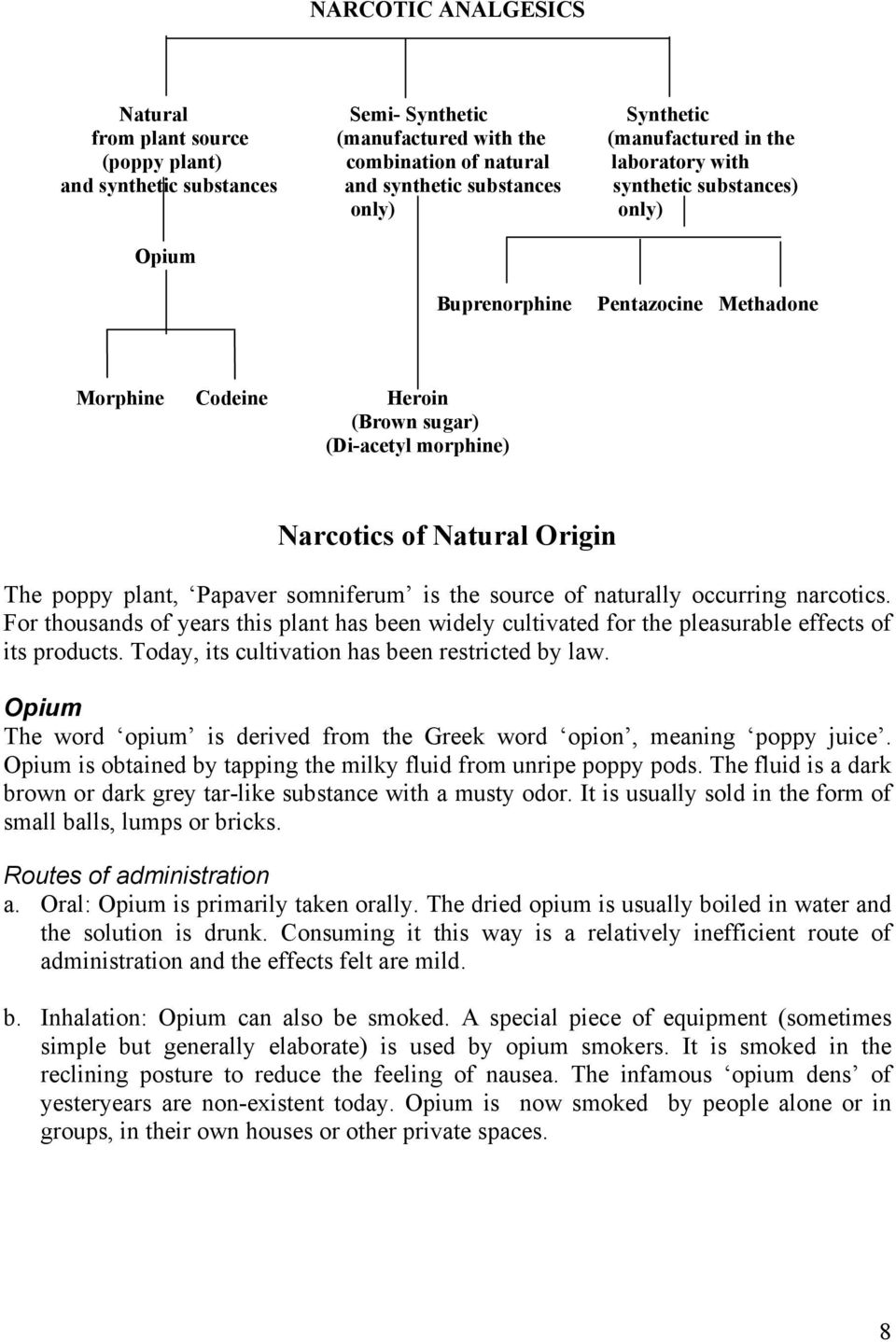
7 After the user becomes dependent, if the intake of drugs is abruptly stopped, withdrawal symptoms occur. In a sense, the body becomes confused and protests against the absence of the drug. The withdrawal symptoms may range from mild discomfort to convulsions, depending on the type of drug abused. The intensity of withdrawal symptoms depends on the physical condition of the user, the type of drug abused, the amount of drug intake and the duration of abuse. Symptoms of drug withdrawal are usually the opposite of the effects produced by the presence of the drug in the body. For example, brown sugar intake causes constipation, while one of its withdrawal symptoms is diarrhea. Such problems make it difficult for the user to give up drugs. He wants to avoid unpleasant withdrawal symptoms; and to avoid them he must keep on abusing the drug. The user is thus forced to continue drug abuse even if (or when) he knows that the drug is hurting him. CLASSIFICATION OF ADDICTIVE DRUGS Substances that are abused can be studied under seven major categories: 1. Narcotic analgesics 2. Cannabis 3. Depressants 4. Hallucinogens 5. Stimulants 6. Volatile solvents 7. Other drugs of abuse. Note: For a long time cannabis was classified as a hallucinogen. But since a few effects such as flashbacks do not occur with cannabis a separate category was created. NARCOTIC ANALGESICS In Greek the prefix narco means to deaden or benumb. Analgesic means pain killing or pain-relieving. In medical terms, narcotic refers to opium and opium derivatives as well as to synthetic substitutes that produce opium-like effects. All narcotic analgesics share the common property of numbing and thus relieving pain. They are painkillers with high addictive potential. Certain narcotic analgesics are clinically employed for other actions such as suppression of cough and control of diarrhea. Drugs belonging to this category can be studied under three broad categories: narcotics of natural origin, semi-synthetic narcotics and synthetic narcotics. Drugs belonging to the first two categories are referred to as opiates while synthetic narcotics are known as opioids. 7

8 NARCOTIC ANALGESICS Natural Semi- Synthetic Synthetic from plant source (manufactured with the (manufactured in the (poppy plant) combination of natural laboratory with and synthetic substances and synthetic substances synthetic substances) only) only) Opium Buprenorphine Pentazocine Methadone Morphine Codeine Heroin (Brown sugar) (Di-acetyl morphine) Narcotics of Natural Origin The poppy plant, Papaver somniferum is the source of naturally occurring narcotics. For thousands of years this plant has been widely cultivated for the pleasurable effects of its products. Today, its cultivation has been restricted by law. Opium The word opium is derived from the Greek word opion, meaning poppy juice. Opium is obtained by tapping the milky fluid from unripe poppy pods. The fluid is a dark brown or dark grey tar-like substance with a musty odor. It is usually sold in the form of small balls, lumps or bricks. Routes of administration a. Oral: Opium is primarily taken orally. The dried opium is usually boiled in water and the solution is drunk. Consuming it this way is a relatively inefficient route of administration and the effects felt are mild. b. Inhalation: Opium can also be smoked. A special piece of equipment (sometimes simple but generally elaborate) is used by opium smokers. It is smoked in the reclining posture to reduce the feeling of nausea. The infamous opium dens of yesteryears are non-existent today. Opium is now smoked by people alone or in groups, in their own houses or other private spaces. 8
9 Morphine Morphine is the principal alkaloid (organic compound) that is extracted from opium. About 10-15% of the substance extracted from opium is morphine. Morphine is one of the most effective drugs for relief of pain. It is still used medically. Routes of administration Injected - Subcutaneously (under the skin), intramuscularly (into muscle) or intravenously (into veins). Most morphine addicts use the intravenous route. Codeine Codeine is another alkaloid found in opium, though in a smaller percentage than morphine (one to two percent). Codeine is medically used as a cough-suppressant. Cough syrups containing Codeine are now being abused in many parts of India. Route of administration Oral: Medical preparations of codeine are usually made in combination with other chemicals and are available in the form of tablets and syrups. Semi-Synthetic Narcotics Heroin/Brown Sugar Heroin is a semi-synthetic derivative of the drug morphine. Pure heroin is a white crystalline powder and is referred to as white sugar by abusers. When the quality of heroin is poor, its color is no longer white, but brown; this inferior quality is called brown sugar. Routes of administration Injected: The drug is mixed with distilled water and lime or vitamin C tablets. The solution is then heated and filtered, using cotton to remove the sediments. Later, it is injected intravenously. The subcutaneous route is rarely used. Among intravenous users, an immediate high (rush), described as akin to an orgasm, is reported. Inhalation: Smoked with tobacco in cigarettes. Chased: The drug is sprinkled on a silver foil or placed in a bent spoon and heated from beneath with a matchstick or a candle. The thick fumes which rise are taken in through the mouth with a rolled piece of paper. In general, brown sugar is not taken orally. Narcotic analgesics, being alkaline in nature, are not absorbed in the acidic medium of the stomach. It is estimated that about 90% of the effect is lost when taken orally. Synthetic Narcotics 9

10 Synthetic narcotics are produced only in the laboratory. Buprenorphine and pentazocine are the most widely abused synthetic narcotic drugs. Buprenorphine and Pentazocine Both are synthetic narcotic analgesics which are used as painkillers in a wide variety of medical conditions. Buprenorphine (Tidigesic) was initially used to treat the withdrawal symptoms of heroin addiction, as well as in the treatment of cancer. Later, it became a drug of abuse. Routes of administration a. Oral: Administered orally in the form of tablets. b. Injected: Subcutaneously, intramuscularly or intravenously. Addicts almost always inject the drug intravenously. Absorption and distribution Metabolism Narcotic analgesics are not absorbed evenly by all the parts of the body. They concentrate in the tissues especially in the kidneys, liver, skeletal muscle, lungs and spleen. All the chemicals in the blood do not enter the brain. The tissues surrounding the brain act as a protective mechanism (called the blood brain barrier or BBB) that selectively filters the chemicals entering the brain. So, only small amounts of narcotic analgesics cross the BBB but the central nervous system is so sensitive that even minute amounts are sufficient to cause a pharmacological effect. In pregnant women, small quantities of the drug cross the placental barrier and fetal dependency can develop. Excretion Excretion of narcotic analgesics is largely through urine. A small amount passes through the lungs and bile. Short-Term Effects of Narcotic Analgesics When injected, the effects of narcotic analgesics are immediate and pronounced. With other routes of administration, the effects are felt only gradually. The main effects include - a short-lived state of euphoria during which feelings of hunger and pain are not felt - mental clouding, impairment of intellectual processes - drowsiness, sedation, apathy, decreased physical activity. A few other adverse reactions may also appear 10
11 - vomiting in novice users - dysphoria (a feeling of unpleasantness) - inability to concentrate - itchy skin - constipation - constriction of pupils (with the exception of synthetic narcotics). After the initial effect wears off, there is increased sensitivity to pain. Severe overdose of heroin results in very slow, shallow, irregular breathing, marked decrease in blood pressure, cyanosis (body becomes cold and bluish) and coma. In extreme cases, death can occur due to respiratory arrest or cardio-vascular complications. System Effects Central Nervous System - Pin point (constricted) pupils, droopy eye-lids, reduced sharpness of vision - Decrease in REM sleep (rapid eye movement the rapid, jerky movements of the eye which occur during certain stages of the sleep cycle when dreams occur). In the REM stage of the sleep cycle is most beneficial to the body as the body is most relaxed at that time.) Respiratory System Respiratory depression due to the effect on the respiratory center in the brain. The rate of respiration is reduced and breathing is slow and shallow. Cardio-vascular System - Decrease in the heart rate (Bradycardia) - Dilation of peripheral blood vessels, which shows up as flushing - Hypotension or low blood pressure. Gastro-Intestinal tract - Constipation and poor appetite. Kidneys Mild decrease in urine formation. Long-Term Effects Mood instability, reduced libido, constipation, constriction of pupils (which affects night vision) and certain types of respiratory impairments can develop. In female drug abusers, menstrual irregularity usually occurs. 11

12 In addition, the following complications can develop: - Serum hepatitis/hiv/aids caused by use of infected needles - Fetal addiction can develop. 80% of babies born to addicted mothers develop withdrawal symptoms such as hyperactivity, irritability, tremors, regurgitation, poor feeding and diarrhea. Convulsions may also occur. These children usually have low birth weights. Tolerance and Dependence Increasingly higher doses are required to produce satisfactory analgesic (pain relieving), sedative and euphoric effects. Tolerance also develops to its respiratory-depressant and nausea inducing effects. However, tolerance does not develop to the pupillary constricting or constipating effects. As tolerance develops with chronic use, the user gradually increases the dosage to achieve the desired effect. A dosage plateau is reached where no amount of the drug is sufficient to produce the intensity of effects desired. The user, however, continues the use of the drug to delay withdrawal symptoms. Severe physical and psychological dependence develops. Abrupt cessation of drug use leads to withdrawal symptoms. Withdrawal Symptoms With the deprivation of narcotic analgesics, the first withdrawal symptoms are usually experienced shortly before the time of the next scheduled dose. The initial symptoms resemble those of fairly severe bout of influenza. Symptoms such as watery discharge from eyes and nose, yawning and perspiration appear about 8 to 12 hours after the last dose. Restlessness, irritability, loss of appetite, goose flesh, tremors, and dilation of pupils also occur. Thereafter the addict may fall into a restless sleep. Withdrawal symptoms intensify and reach their peak between 48 and 72 hours after the last dose. Nausea and vomiting occur. Stomach cramps and diarrhea are common. Heart rate and blood pressure are elevated. Chills alternating with flushing and excessive sweating are also characteristic symptoms. Excruciating pain in the bones and muscles of the back and extremities occur, as do muscle spasms and kicking movements. At this time the individual may develop suicidal tendencies. Narcotic withdrawal is usually not life threatening, although a marked electrolyte imbalance caused by excessive vomiting and diarrhea must be watched for. Delirium occurs in drug withdrawal only in the case of severe infection anywhere in the body. 12

13 CANNABIS Cannabis drugs are made from the Indian hemp plant Cannabis sativa. This plant has been cultivated for centuries in many parts of the world for the tough fiber of its stem and for the plant s psychoactive properties. When its mind-altering properties came to light, the cultivation of cannabis was banned. Its therapeutic potential and possible medicinal properties are being studied. As of now, cannabis drugs do not have any medical use. More than 60 constituents, known as cannabinoids, occur naturally in, and only in, the cannabis plant. The chief psychoactive substance among them is delta-9-tetrahydrocannabinol, commonly referred to as THC. The main drugs under this category include the following. Ganja/Marijuana Ganja is prepared from the dried leaves and flowering tops of the plant. Ganja is commonly referred to as grass, pot or stuff. It may range in color from grayish-green to greenish-brown and in texture from a dry, leafy material to a finely divided tea-like substance. Route of administration Ganja is usually smoked in the form of hand-rolled cigarettes ( joints or reefers ) or pipes specially made for this purpose. It is mixed with tobacco and smoked. The proportion of ganja and tobacco is altered according to the need and desire of the user. Hashish/Charas The cannabis plant has separate male and female forms. The female plant secretes a sticky resin which has a high THC concentration. The resinous secretion of the cannabis plant, which is collected and dried, is known as Hashish/Charas. Hashish ranges in color from light brown to almost black, and the THC content in hashish ranges from 5 to 15%. Route of administration Hashish is smoked like ganja and sometimes baked with food and eaten. Hashish Oil Hashish oil is produced by a process of repeated extraction of the resin of the cannabis plant to get a high concentration of THC. It is highly potent with a THC concentration ranging from 20% to 60%. Hashish oil is a dark viscous liquid. Route of administration It is usually dripped on cigarettes and smoked. 13

14 Bhang This is the least potent of all cannabis drugs. Bhang contains the dried parts of the plants leaves and stem. Bhang is a brown leafy material with dried twigs mixed in it. Route of administration Bhang is usually brewed with tea or milk and drunk. Metabolism Absorption and distribution When cannabis drugs are smoked, less than 50% of the THC is absorbed and enters the blood circulation. The effects are felt within minutes. The effects peak after minutes and cease after 2-4 hours. When taken orally the effects are felt after 1 hour, the peak is reached only after 5-6 hours, and the effect lasts for about 10 hrs. Users prefer to smoke the drug, because it is about three times more potent as compared to the effects from the oral route of administration. Excretion The THC in the blood is metabolized by the liver into water soluble compounds so that it can be excreted. Some of the metabolites (products of the metabolism) are also psycho active. Certain organs like the brain, spleen and other fat tissues absorb THC and store it. Gradually, the THC is released back into the blood stream to be metabolized by the liver. That is why, THC metabolites can be present in the urine from one week up to a month after the last intake of cannabis. Short-Term Effects of Cannabis The exact effects that cannabis drugs produce cannot be accurately predicted. The prior experience and expectation of the user, the potency of the drug etc., are important factors that produce the psychoactive effect. The main effects include: - mild euphoria followed by a dreamy state of relaxation - lowering of inhibitions, spontaneous laughter - increased auditory and visual acuity (e.g. sound seems louder and clearer, vision seems brighter and sharper) - sense of smell, touch and taste are often enhanced - altered sense of time perception or time constant effect (time seems to pass more slowly) - impaired short-term memory, reduced attention span, poor concentration and disturbed thought patterns - impaired ability to perform complex motor tasks 14

15 - splitting of consciousness the user experiences the high, while at the same time becomes an objective observer of his own intoxication. He may have paranoid thoughts, and yet simultaneously laugh at them. Some users experience a bad trip which includes adverse reactions like mild paranoia, fear, anxiety, or even panic. Nausea, vomiting and dizziness may occur. Synesthesia (melding of two sensory modalities) can occur with high doses. The user may feel that he can hear colors or see music. In addition to these effects on the central nervous system, the following effects are also noticed System Effects Respiratory System Irritation of the mucosal membranes lining the respiratory system Broncho dilation the net work of minute tubes through which air enters the lungs dilate. Cardio-Vascular System Tachycardia (increased heart beat) is very prominent. Due to dilation of blood vessels in the conjunctiva, reddening of the eyes can be noticed. There is also fall in blood pressure. Gastro-Intestinal system Increased appetite for sweets. Long-Term Effects - Pronounced psychological dependence is particularly high among users with emotional problems. - Amotivational syndrome: The user may lose all interest in his work, family etc. He may become so apathetic that he is not interested in any goal oriented activity. - Psychosis: Typical, acute psychotic episodes characterized by confusion, delusion, hallucinations, disorientation and paranoid symptoms may occur. - Frequent long-term cannabis use may produce bronchitis, asthma, sinusitis, or chronic redness of the eyes because of its irritant effect. - Sterility: There is evidence to indicate that prolonged use can reduce the sperm count and decrease sperm motility. - Children born to a mother who smoked cannabis during pregnancy may have low birth weight or might be mentally retarded. 15
16 - Ongoing studies have revealed some evidence that cannabis use reduces immunity by impairing a component of the white blood cell defense system. It is also speculated that smoke from cannabis increases the risk of cancer. Tolerance and Dependence Frequent and regular users of high doses develop tolerance to the drug. To maintain intensity of effects, users increase their daily dose. Original sensitivity can be restored with abstinence for several days. Physical dependence on cannabis develops only in high dose users. Strong psychological dependence develops with the regular user. The user acquires a persistent craving for the drug which thus begins to play a central role in his life. Even if cannabis is temporarily unavailable, anxiety or feelings of panic may ensue. Withdrawal Symptoms Abrupt cessation of cannabis use leads to withdrawal symptoms sleep disturbances (sometimes with recurrent nightmares), loss of appetite, irritability, nervousness, anxiety, sweating and stomach upset. Sometimes chills, increased body temperature and tremors develop. Depression and other psychotic symptoms may become prominent. Withdrawal symptoms usually last for less than a week. DEPRESSANTS Depressants are drugs which depress or slow down the functions of the central nervous system. The drugs which come under this category include 1. Sedative-hypnotics 2. Alcohol Sedative-Hypnotics Sedative-hypnotics are depressant drugs whose primary effects are calming, sedating or inducing sleep. Barbiturates like Methaqualone (common name: Mandrax), Secobarbital and Amylobarbital (Vesparax), and Benzodiazepines like Diazepam (Valium, Calmpose) and Lorazepam (Ativan) are the commonly abused drugs. Routes of administration Sedative-hypnotics are administered orally in the form of tablets or capsules. They can also be injected subcutaneously, intravenously or intramuscularly. Alcohol 16
17 Alcohol is a clear, thin liquid, with a harsh burning taste. It is the product of fermentation and distillation. Ethyl alcohol (C 2 H 5 OH) is the intoxicating substance present in alcoholic beverages like beer, whisky, rum, brandy, wine, etc. It supplies empty calories calories without any nutritive value whatsoever. While enough energy is available for functioning, the nutrients necessary for tissue repair and building up the body are not available. Route of administration Taken orally. Metabolism Absorption and distribution Unlike other food, alcohol does not need digestion. It is rapidly absorbed into the blood stream from the stomach and small intestine. From here, it is carried to almost all the organs including the brain. The absorption rate depends on various factors like the type and concentration of alcohol in the beverage and presence of food. The body weight, previous experience with drinking and the emotional state prior to drinking can influence the effect. Excretion In the liver, alcohol undergoes the process of oxidation whereby it is changed into carbon dioxide and water and energy is released. The waste products are excreted through the urine and a small amount of alcohol is excreted unchanged through the lungs. Short term effects Intake of 1-2 drinks (1 drink = 30 ml. of whisky / brandy) depresses the higher centres in the brain. Inhibition are thus lowered. The user feels more relaxed and seems to be able to talk more freely. As more alcohol is consumed, fine motor coordination is affected, reaction time increases and judgement becomes poor. This is what makes driving under the influence of alcohol a dangerous activity. As the alcohol content in the blood continues to increase more and more centres in the brain are affected. Gradually, blurred or double vision, slurred speech and staggering gait develop. If he continues to drink, he loses consciousness. Central Nervous System Changes System Effects of Alcohol Abuse 17

18 Wernicke-Korsakoff syndrome (characterized by disorientation, peripheral nerve damage, loss of muscular coordination and involuntary, horizontal rapid eye movements), confabulation (contriving stories to fill in gaps in memory) - Alcohol dementia (disturbances in thought and memory) Other Effects - Gastro-intestinal problems include gastritis, peptic ulcer and cancer. - Fatty liver, hepatitis and cirrhosis. There is also an increased likelihood of liver cancer. - Pancreatic effects include pancreatitis, diabetes. - Muscle weakness and wasting are commonly seen. - Cardio-vascular effects of alcohol include damage to the heart muscles. - Blood cells (both red and white) and platelets are affected. - Kidney problems include diuresis and gout. - Sexual dysfunction both in males and females. Short-Term Effects of Depressants Sedative-hypnotics produce effects that are similar to those of alcohol. The main effects include: - relief from anxiety and tension - euphoria (usually with barbiturates) - lowering of inhibitions - sedation, sleep with larger doses - poor motor coordination (especially for fine motor tasks) - impaired concentration and judgment - slurred speech and blurred vision Nausea and abdominal pain may develop. The user may become hostile. Large doses can cause irregular breathing, weak pulse. Coma and death due to over dose can occur and occurs with a combination of sedative hypnotics and alcohol. Long-Term Effects of Depressants Long-term use can produce depression, chronic fatigue, respiratory impairments, impaired sexual function, decreased attention span, poor memory and judgment. Chronic sleep problems may develop. Reduced REM sleep due to drug use makes the quality of sleep so poor that the user does not feel rested on waking up. Tolerance and Dependence 18

19 Tolerance does not develop uniformly for all effects induced by these drugs. With barbiturates, tolerance to the sleep-inducing effect develops very rapidly, often within a week or two of regular use. In the case of benzodiazepines, chronic use leads to tolerance of the effects of relieving anxiety and tension. Cross-tolerance to other drugs of the depressant class also develops (i.e. if a user who has developed tolerance to one of these drugs ingests another in a dosage which would otherwise be sufficient to produce a certain effect, the desired effect will not be felt). Physical and psychological dependence develop. Craving, anxiety or even panic is common if the user is temporarily unable to obtain supply of the drug. Withdrawal Symptoms Withdrawal symptoms like anxiety, insomnia, weakness and nausea are usually noticed. With very high and chronic use, agitation, high body temperature, delirium, hallucinations and convulsions develop. HALLUCINOGENS Hallucinogens are drugs that dramatically affect perception, emotions and mental processes. Since they distort the perception of objective reality and produce hallucinations, they are known as hallucinogens, and are also referred to as psychedelic (mind-altering) drugs. Hallucinogens include a wide variety of substances ranging from wholly synthetic products to naturally occurring substances. Hallucinogenic drugs are very rarely available in India, making it the least abused class of drugs. The most common hallucinogenic drugs are listed below. LSD (Lysergic acid diethylamide) LSD is a semi-synthetic drug and the most powerful hallucinogen. It is produced from lysergic acid, a substance derived from the ergot fungus which grows on rye, or from lysergic acid amide, a chemical found in morning glory seeds. LSD s only legal use is as a research tool to study the mechanism of mental illness. It has no medical use. The drug is a white, odorless, crystalline material, which is soluble in water. Route of administration LSD is easily absorbed orally and is usually taken in the form of tablets. In the case of LSD blotting papers, they are dissolved in water and are absorbed. A piece of this paper is torn off, placed under the tongue and sucked. PCP (Phencyclidine) 19

20 PCP is a synthetic drug produced only in clandestine laboratories. It is commonly called angel-dust. In its pure form PCP is a white crystalline powder that readily dissolves in water. Routes of administration It is snorted, smoked, eaten and rarely taken intravenously. Mescaline Mescaline is derived from a type of cactus and is also produced synthetically. Mescaline appears as a white or colored powder. Route of administration The oral route of administration is most common. Psilocybin Psilocybin is chiefly derived from the psilocybe mushroom. The drug can be synthetically produced with great difficulty. Crude mushroom preparations containing psilocybin are usually sold as dried mushrooms. Routes of administration This drug is well absorbed orally. The mushrooms itself may be eaten, or dried, powdered and smoked. Short-Term Effects of Hallucinogens The physical effects produced and perceptual effects created differ from one drug to another. The main effects include: - Alterations of mood usually euphoric but sometimes severely depressive. - Distortion of the sense of direction, distance and time (e.g. passage of a few minutes may seem like hours). - Intensification of the sense of vision. Color and texture of items become more vivid and perception of details increases. - Psuedo hallucinations; pseudo because the user knows that the experience is not true, e.g. seeing a myriad of colors or bizarre images. - Synesthesia (melding of two sensory modalities). User may feel he can see music, hear colors, etc. - Feelings of depersonalization, loss of body image and loss of sense of reality (the user may feel that his body is shrinking or becoming weightless). - Sense of the past, present and future may be jumbled. Concentration becomes difficult and attention fluctuates rapidly. - Vague ideas and extreme preoccupation with philosophical issues are common. The great truths and insights the user believes that he has discovered are unintelligible or nonsensical to those not under the influence of LSD. 20

21 Hallucinogens are, however, unpredictable; the effects could be different each time a hallucinogen is used. Acute panic reactions can also be produced, resulting in a bad trip. Acute anxiety, restlessness and sleeplessness are common until the effect of the drug wears off. Self-destructive behavior due to rash decisions and accidents due to impaired judgment are common. Long-Term Effects - Flashbacks or spontaneous recurrences of an LSD experience can occur without warning for up to a year after LSD use. The exact mechanism of this effect is not known. The user may experience effects such as intensification of color, apparent movement of a fixed object or other hallucinations even after abstinence for a few months. - Amotivational syndrome: The user becomes very apathetic, is very passive and shows no interest in life. - LSD-precipitated psychosis: Acute panic reactions can occur, and may lead the user into a state of drug-induced psychosis. It may resemble paranoid schizophrenia in many respects, with hallucinations (mainly visual), delusional thinking and bizarre behavior. The psychotic episode normally lasts for several hours but in some cases the psychosis may last for years. Tolerance and Dependence Tolerance develops very quickly and disappears rapidly after use is discontinued. Due to rapid development of tolerance, most users discontinue use of the drug at least for a while, to regain original sensitivity and effects. Psychological dependence does develop, though the user does not become physically dependent. Particular withdrawal symptoms are not reported. STIMULANTS Stimulants are drugs which excite or speed up the central nervous system. The two most prevalent stimulants are nicotine, found in tobacco products, and caffeine, the active ingredient in coffee and tea. These however will not be discussed here. The more potent stimulant drugs will be the focus of attention. They include amphetamines and cocaine. Amphetamines Amphetamines are synthetic drugs produced entirely within the laboratory and they do not occur naturally. They are used in other countries to treat narcolepsy (an 21
22 uncontrollable tendency to sleep) and sometimes in weight control programs. Ecstacy is an amphetamine-based drug currently being abused in developed countries Amphetamines were abused in India in the late 1970s by - students: to ward off sleep, enabling them to study through the night, prior to the examination, and - athletes: to mask feelings of fatigue and increase their endurance. Route of administration Oral: Amphetamines are absorbed orally and are taken in the form of tablets or capsules. Cocaine Cocaine, a potent stimulant of natural origin, is extracted from the leaves of the coca plant (Erythroxylon coca). It is a odorless, white crystalline powder, with a bitter numbing taste. Cocaine was formerly used in eye, nose and throat surgery because of its ability to anaesthetize tissues and simultaneously constrict blood vessels and limit bleeding. It is no longer used medically. Crack This is made from cocaine and is widely abused in developed countries like the USA. Since Cocaine / Crack is extremely expensive and abused by relatively few people in India. Routes of administration a. Oral: The leaves of the coca plant are sometimes chewed, and cocaine, the chief psycho-motor chemical present, is absorbed through the mucous membranes of the mouth. Very rarely, cocaine is injected for a heightened effect. b. Snorted: It is usually snorted, or taken in through the nasal passages (like snuff). Short-Term Effects of Stimulants Amphetamines and cocaine have different mechanisms of action, but the overall impact is the same and their effects parallel each other. The main effects include: - a heightened feeling of well-being, euphoria - a sense of super-abundant energy, increased self-confidence - increased speech and motor activity - suppression of appetite (which is why it is used in diet pills) 22
23 - an increased wakefulness that masks feelings of fatigue (the reason why amphetamines are abused by students during examinations) Dilation of pupils, dryness of mouth, reduced gastrointestinal activity and urinary retention are other effects, as are increased respiration, heart rate and blood pressure. Anxiety and panic may set in. Temporary impotence may develop. In rare cases, sudden death may occur. With large doses, very rapid heartbeat, hypertension, headache, profuse sweating, severe agitation and tremors may occur. Very high doses cause rapid, irregular and shallow respiration, convulsions and coma. Long-Term Effects Chronic sleep problems, poor appetite, high blood pressure, rapid and irregular heartbeat, impotence, mood swings, anxiety and tension states are the long-term effects of stimulant abuse. Acts of violence, homicide and suicide rates among stimulant abusers are high. Chronic use may produce amphetamine psychosis ; paranoid ideations, hallucinations and purposeless stereotyped behavior may develop. A full-blown amphetamine psychotic state closely resembles paranoid schizophrenia. Snorting of cocaine may result in perforation of the nasal septum. Tolerance and dependence Stimulants produce both physical and psychological dependence. As the intensity of the pleasurable effects is high, strong psychological dependence also develops. Tolerance does develop to a certain extent. Withdrawal Symptoms Withdrawal symptoms do occur; though the clinical picture does not include major grossly observable physiological disruptions. Extreme fatigue, prolonged but disturbed sleep, voracious appetite, irritability and moderate to severe depression are the commonly reported withdrawal symptoms. VOLATILE SOLVENTS Drugs in this category are volatile hydrocarbons and petroleum derivatives like petrol, paints, nail polish remover, ether, glue, benzene, varnish thinner and lighter fluid. This form of substance abuse is primarily found among street children who are less than 18 years of age. Abuse of volatile solvents has been on the increase in the recent past. 23
24 Route of Administration Inhalation by sniffing. Short-Term Effects Behavioral effects include euphoria, clouded thinking, slurred speech and staggering gait. Hallucinations occur in about 50% of the abusers. The effects are about the same as for sedative-hypnotics and many youngsters who abuse these substances end up dependent on alcohol or other sedative type drugs. Sudden death can occur due to sniffing these drugs. Long-Term Effects Long-term effects include psychosis and permanent brain damage. Tachycardia (increased heart beat) with possible ventricular fibrillation can occur. Damage to the liver, kidneys and heart is also possible. OTHER DRUGS OF ABUSE There are a few other drugs of abuse that do not belong to any of the above categories. Abuse of the following drugs has been reported in India. a. Muscle relaxants like carisoprodol (e.g. carisoma compound). The drug is available in the form of tablets and is abused for its depressant effects. b. CNS analgesics like dextropropoxyphene (e.g. proxyvon) and dextropropoxyphene in combination with dicyclomine (e.g. spasmoproxyvon). Tablets and ampoules are available. The drug is taken orally or intravenously. The pain relieving effects are very pronounced. These drugs are usually prescribed to relieve pain following accident trauma or surgery. When their use is not carefully monitored by the supervising physician addiction can develop. c. Antihistamines like chlorpheneramine maleate (e.g. avil). d. Anti-emetics like promethazine (e.g. phenargan). Both these categories (c & d) of drugs are usually abused in combination with narcotic drugs like heroin or buprenorphine to enhance the effects. e. Anti-depressant drugs like amineptine (e.g. survector) that are used to elevate mood state and treat depression are sometimes abused for their sedation effects. 24
25 Prescriptions for these drugs need to be issued very carefully. The dosage needs to be reduced and withdrawn as and when the patient recovers. It is necessary to watch out for signs of tolerance. In case of tolerance, most physicians prefer to shift the patient to other categories of medication that do not produce the sought after effects. 25
26 SKILL SHARPENING TOOLS COMMON DOUBTS CLARIFIED 1. In addition to physical and mental health problems, what are the other hazards associated with drug abuse? Safety hazards Drugs of abuse reduce physical coordination, distort senses and affect judgment. These effects expose an individual to accidents, especially when he drives a vehicle or operates machinery. Overdose This can and does happen, unintentionally resulting in accidents or death. Street drug hazards Illegal drugs are often adulterated, exposing the user who is unaware of the drugs properties and potency to unknown hazards. Legal hazards A person in illegal possession of drugs can be fined or imprisoned or both. A criminal record stays with the accused for life. 2. What are gateway drugs and why are they thus named? Alcohol and tobacco are called gateway drugs. Since all addicts start with these drugs and then proceed to abuse of other drugs, these are called gateway drugs. 3. What is cold turkey? Cold turkey is the term used by drug abusers to refer to the withdrawal symptoms of brown sugar. The patient feels hot and cold in turn and also has goose flesh (hair standing on end). Moreover, watering of the eyes and the nose gives the impression that he has a cold. That is why the term cold turkey came to be used. 4. Can smoking marijuana affect the lungs? Marijuana contains approximately four times the tar content of cigarettes. Therefore it can contribute to lung cancer and other lung diseases. 5. Why does the ganja user like to eat sweets? Ganja interferes with the body s sugar balance and triggers a craving for sweets. 6. What are designer drugs? 26
27 Some synthetic drugs are produced in the laboratory using unique drug combinations, giving rise to different, sometimes unforeseen, reactions. These drugs are very expensive and are used mostly in developed countries. 7. What are ethyl and methyl alcohol? Ethanol or ethyl alcohol is the chemical present in alcoholic beverages. Illicit arrack sometimes contains methyl alcohol. Methyl alcohol is poisonous and its consumption can lead to blindness and has been known to cause death. 8. Does alcohol affect all individuals in the same way? What are the factors that influence the effect that alcohol has on people? The factors that determine the effect include the following: a. Body weight the effect of alcohol is more intense in the person who weighs less than in an individual who weighs more. b. The amount of ethyl alcohol present in the beverage distilled spirits like whisky and brandy have a higher percentage of ethyl alcohol (45-60%) compared to wine (12-16%) and beer (6-8%). c. The effect is felt more quickly when the alcoholic beverage is mixed with soda than water. The carbon-dioxide molecules present in soda increase the rate of absorption of alcohol into the blood stream. d. The speed of drinking the liver detoxifies about 1 drink (30ml of distilled spirit) in one hour. So, if the intake is spaced out and alcohol consume slowly the effect is less intense. If, instead, a person gulps his drinks and consumes a larger quantity within a shorter period of time, the effect is more pronounced. e. Presence of food in the stomach when alcohol gets mixed with food the absorption of alcohol into the blood is slowed down and the effect accordingly lessened. When a person drinks on an empty stomach, alcohol gets into the blood stream much faster, and the effect is thus felt quickly and in a more intense way. f. The mood of the individual before drinking if a person is tense the effect is less than when he is in a more relaxed frame of mind. The individual's expectation of the effect of the alcohol and the social environment in which he drinks also play a part. 9. Alcohol tends to pep up a person because it is a stimulant. Is it true? 27
28 No. Alcohol is only a depressant. Alcohol's first action is to depress that part of the brain which controls inhibitions. Since the person becomes less inhibited, he immediately feels more relaxed. But his brain is being depressed or slowed down and not stimulated. Consumption of large quantities results in impairment of thought, judgment and coordination. 10. What should one do to make an intoxicated person sober? Popular methods like drinking black coffee or having a cold shower will not help. Nothing can speed up the sobering process because the liver oxidizes alcohol only at a steady rate (one drink per hour). All that one has to do is to rest and wait for the liver to burn up the alcohol which has been consumed. 11. What is delirium tremens? It is the severest form of alcohol withdrawal. Rapid heart rate, sweating, high blood pressure and confusion develop. Hallucinations, delusions and agitated behaviour are common. Fever is also present. Seizures may precede the onset of delirium. Physical illness predisposes this syndrome a person in good health rarely develops delirium tremens during alcohol withdrawal. 28
29 INTERNALISING TOOLS QUIZ 1) Name the plant source of heroin. 2) What kind of addictive drug is present in cough syrups that are abused? 3) To which category of drugs does buprenorphine belong? 4) The addictive potential of heroin is low true or false? 5) What is the psychoactive chemical present in ganja? 6) What are the kinds of drugs that come under the category of cannabis? 7) Smoking ganja is safe as it comes from a plant true or false? 8) When is the effect of ganja stronger when eaten or smoked? 9) To which category of drugs does LSD belong? 10) Beer drinkers never become alcoholics True or False? 11) What kind of drugs can cause synesthesia? 12) If a drug abuser is eating a lot of sweets what kind of drug could he have taken? 13) Which category of drugs can cause itchy skin? 14) What is mainlining? 15) Which is the most commonly abused drug in India? 16) What is the percentage of alcohol usually present in beer? 17) What is the name of the chemical present in alcoholic beverages? 18) Which drug can cause sudden death due to sniffing? 19) Of which drug is constipation the well-known side effect? 20) What is the connection between a drug's short-term effects and withdrawal symptoms? 29
30 21) A person can drive safely immediately after drinking three pegs of whisky true or false? 22) Can pain-killers become drugs of abuse? 23) If a person regularly takes vitamins and liver supplements, his liver will not be affected even if he drinks alcohol heavily true or false? 24) Brown sugar reduces one's appetite true or false? 1) Poppy plant 2) Codeine 3) Narcotic analgesics 4) False ANSWERS 5) THC delta-9 - tetra-hydrocannabinol 6) Ganja/Marijuana Hashish/Charas Hashish oil Bhang 7) False 8) When it is smoked. 9) Hallucinogens 10) False. As long as a person consumes a beverage that contains ethyl alcohol, he can become an alcoholic. Beer is not an exception. 11) Cannabis in high doses and hallucinogenic drugs 12) Cannabis 13) Narcotic analgesics 14) Injecting into the vein 30
31 15) Alcohol 16) 6-8% 17) Ethyl alcohol 18) Volatile solvents 19) Narcotic analgesics 20) The withdrawal symptoms are the opposite of the short-term effects. 21) False 22) Yes 23) False. The liver will be affected. 24) True 31
32 2 INDICATORS OF ADDICTION SIGNS AND SYMPTOMS Addiction is viewed from many angles by different people. Some presume that the drug abuser s inability to restrict their alcohol and drug use indicates weak will power. Some others take a moralistic and view it as a sinful activity. Others contend that since the addict has no drive and enthusiasm for his future, he willingly permits addiction to mess up his life. As addiction hurts others around him and he seems unmindful of this, many are sure that his self centered behaviour is to be blamed. The professional of course, recognises addiction as a disease that can affect many aspects of a person s life. The disease concept of addiction was propagated by the World Health Organisation and the American Psychiatric Association in the year Following this, treatment efforts were initiated worldwide. It is necessary for professionals to have a clear understanding of the process of addiction its signs, symptoms and progression so that they are able to accept him as a sick person who needs help. This understanding in turn will enable the professionals to effectively motivate the addict and his family to take help. MAIN CHARACTERISTICS A Primary Disease Addiction per se is a disease that needs to be treated and should not be seen as the effect or symptom of some other problem. The drug abuser may be unemployed, unmarried and complain of being physically weak and depressed. Finding him a job, getting him married or treating his medical condition alone will not automatically help him overcome addiction. Addiction is a major issue that has to be treated to help him stabilize. Addiction is directly or indirectly the cause behind many of the problems that the drug abuser faces. While help to deal with these problems is necessary, they can be sorted out only if addiction is handled. A Progressive and Terminal Disease Slowly over a period of time, the disease progresses from bad to worse. A sudden change in life events or some crisis may help him stay abstinent for a short period of time, but the course is towards progressive deterioration. 32
33 The fact that in India, thousands die every day due to addiction related problems often goes unrecognized. The cardiac or liver ailment, the accident or suicide is declared as the cause. We fail to see that addiction is the real agent behind these deaths. A Treatable Disease The disease of addiction can be treated. Appropriate medical and psychological treatment will help the user to stay abstinent and also improve the quality of his life by making it more meaningful. A Potentially Relapsable Condition It is not possible for an addict to limit or control his drug use. Even if he stays drug and alcohol free for many years, he will not be able to use it even in small quantities or on an occasional basis. At any point in his life, if he tries alcohol / drugs, he will eventually revert to the excessive and destructive pattern of drug abuse. The only feasible way is to give up the use of alcohol and drugs totally and live a life of abstinence. STAGES OF ADDICTION As in other diseases, the general progression of addiction can be traced. The symptoms which are mild in the early stages intensify as the disease progresses, though differences in terms of a few symptoms being more prominent and even absence of some may be noted between individuals. The general course of the disease is described below: Increased Tolerance EARLY STAGE As the tolerance to the drug increases, more and more of the drug is required to produce the desired effects. Initially, the drug abuser does not view this symptom seriously and simply increases the quantity of intake. As he functions fairly adequately in spite of the increased use, neither he nor others around him view it as a matter of concern. Blackout This symptom appears only with alcohol and other depressant drugs. The user is unable to recollect events that took place while he was under the influence of alcohol or other 33
34 such drugs. For example, under the influence, he would have functioned apparently normally, but the next day he may not remember whom he met, the conversations he had, how he drove back home or whether he had dinner or not. This inability to remember things makes the user feel confused while family members see it as lying. Pre-Occupation With Drugs Drugs become the central point in his life so much so that his thoughts and activities revolve around it. In the midst of important work or even an exam, he finds himself thinking about how, when and where he can get his next supply of drugs. Avoiding References to Drugs He resists any efforts to discuss his drug use. Information about drug addiction in the mass media or even general statements during a conversation make him uncomfortable as he recognizes at this point of time that something is going wrong. Even casual references to drug / alcohol use can trigger his guilt related to abuse and he reacts with irritation and anger. He moves away from non drug using friends or stays isolated to avoid direct or indirect references to his drug abuse. The family members recognize that any discussion about drugs create a scene and they become very wary about even expressing their concern. Loss of control MIDDLE STAGE He finds that he is now unable to reduce the quantity of drug intake. Due to the tolerance and dependence that he has developed, even if he tries, he is unable to stop with a small amount. While previously he restricted his drug use to certain times of the day or to particular situations, he finds that this is no longer possible. For instance, while previously he was able to restrict his use of drugs till his work was completed, now he finds himself using it even during working hours. Quite often, he tries to limit usage, but fails. The loss of control over drugs is complete and he no longer has a choice about whether he is going to take the drugs or not he simply has to. Withdrawal symptoms set in even if he delays a single dose and he is forced to continue - not out of choice but out of compulsion. Changes in thought pattern The changes in his personality lead to progressive deterioration in his lifestyle. There is a deep sense of insecurity and low self worth that he tries to deal with in many ways. 34
35 He may vainly try to present a larger than life image of himself. He becomes grandiose, boasts about his achievements or tries to impress others by spending extravagantly on gifts and parties. He tends to underestimate his problem and is over confident about his ability to handle it. Many become sullen and withdrawn. Justifying drug use He tends to deny the problems related to his drug use. He may dismiss the issue lightly saying that everybody uses drugs or that drug use is actually helping him perform better. He does not see himself as being responsible for his addiction. Instead, blames people and situations around him. He may accuse his family of being too restrictive or lacking in affection or blame the stress related to his studies or work. Due to his denial, family members are unable to deal with it in a forthright manner. Aggressiveness and other mood changes Angry outbursts in the form of abusive language or even violence can set in. The desperation to buy drugs can trigger off physical violence. Alcoholics are frequently violent under the influence of alcohol. Attempts at abstinence The progression of the disease may lead to one or more crises in his life. In response to the crisis like an overdose incident, a serious medical problem, loss of job or a police arrest, he may attempt to give up drugs. Once the intensity of the crisis wears off, he tells himself that he can try drugs again. Sometimes, he changes the drug he uses. The narcotic drug abuser may try other pain killers or alcohol. This strategy too does not work. At this point in time, he does not want to go back to excessive use, but only intends to use it on and off. Yet, soon after he gives drugs a try whatever kind - he is back to obsessive use. 35
36 CHRONIC STAGE Continuous Use Drug use becomes continuous, the need for a chemical high is very strong and everything else fades into insignificance. The user may try cheaper drugs or a combination of drugs to experience that high. He no longer experiences any euphoria He needs drugs simply to avoid the pain of withdrawal. With the alcoholic, binges may set in; he may drink continuously for a few days, stop because he is unable to continue, only to start all over again after a while. Ethical Breakdown Rules are broken, values forgotten and life goals given up. The drug-related damage alienates the user completely from others. His association is limited to drug abusers and peddlers, and he lives only for the next fix (the next intake). The family is by now bewildered and often gives up altogether. The addict may leave home and be on the streets. Physical and Mental Deterioration Indefinable fear, hallucinations, paranoia and suicidal thoughts may set in, adding to the complexity of the problem. It is clear that the disease is progressive with symptoms and problems becoming more intense as it moves on. As with other diseases, the possibility of recovery is greater if intervention is initiated in the early stages. Being familiar with the stages helps the counselor elicit a complete history based on which one can make the client and his family understand the intensity of the problem and the need to give up drugs. 36
37 SKILLS SHARPENING TOOLS INTERNATIONAL CLASSIFICATION OF DISEASES 10 TH (ICD-10) EDITION ICD-10, is the 10 th edition of the International Classification of Diseases developed by the World Health Organisation in the year ICD-10 is used widely in Europe and Great Britain. The diagnosis of addiction as per the ICD-10 guidelines is listed below: Harmful use Clear evidence that the use of a substance or substances was responsible for causing actual psychological or physical harm to the user. Dependence Syndrome A definite diagnosis of dependence should usually be made only if three or more of the following have been experienced or exhibited at some time during the previous year. a) A strong desire or sense of compulsion to take the substance b) Difficulties in controlling substance taking behavior in terms of its onset, termination, or levels of use c) A physiological withdrawal state when substance use has ceased or been reduced, as evident by the characteristic withdrawal related substance with the intention of relieving or avoiding withdrawal symptoms d) Evidence of tolerance, such that increased doses of the psychoactive substance are required in order to achieve effects originally produced by lower doses e) Progressive neglect of alternative pleasures or interests because of psychoactive substance use, increased amount of time necessary to obtain or take the substance or to recover from its effects f) Persisting with substance use despite clear evidence of overtly harmful consequences, e.g. physical health, mood, cognitive functioning; efforts should be made to determine that the user was aware of the nature and extent of the harm 37
38 DIAGNOSTIC AND STATISTICAL MANUAL OF MENTAL DISORDERS (FOURTH EDITION) (DSM-IV) DSM-IV is the Diagnostic and Statistical Manual of mental disorders developed by the American Psychiatric Association in the year Specific diagnostic criteria for each mental disorder are listed to facilitate correct diagnosis, assist research studies and apply appropriate treatment procedures. The section on psycho active substance abuse disorders list the criteria for diagnosis of addiction. This is presented below: Criteria for Substance Dependence A maladaptive pattern of substance use, leading to clinically significant impairment or distress, as manifested by three (or more) of the following, occurring at any time in the same 12 month period: 1. Tolerance, as defined by either of the following: a. a need for markedly increased amounts of the substance to achieve intoxication or desired effect b. markedly diminished effect with continued use of the same amount of the substance. 2. Withdrawal, as manifested by either of the following: a. the characteristic withdrawal syndrome for the substance b. the same (or a closely related) substance is taken to relieve or avoid withdrawal symptoms. 3. The substance is often taken in larger amounts or over a longer period than was intended. 4. There is a persistent desire or unsuccessful efforts to cut down or control substance use. 5. A great deal of time is spent in activities necessary to obtain the substance (e.g. visiting multiple doctors or driving long distances) use the substance (e.g. chainsmoking), or recover from its effects. 6. Important social, occupational, or recreational activities are given up because of substance use. 38
39 7. The substance use is continued despite knowledge of having a persistent or recurrent physical or psychological problem that is likely to have been caused or exacerbated by the substance (e.g. current cocaine use despite recognition of cocaine-induced depression, or continued drinking despite recognition that an ulcer was made worse by alcohol consumption). 39
40 SKILLS SHARPENING TOOLS TOOL 2 THREE STAGES OF ADDICTION: A QUICK LOOK Stage 1 Experimental and social use Frequency of use Occasional, perhaps a few times monthly. Usually on weekends when at parties or with friends. Sources - Friends / peers, primarily. Reasons for use - to satisfy curiosity - to acquiesce to peer pressure - to obtain social acceptance - to defy parental limits - to take a risk or seek a thrill - to appear grown up - to relieve boredom - to experience pleasurable feelings - to be sociable Effects At this stage the person will experience euphoria and return to a normal state after use. A small amount may cause intoxication. Feelings sought include fun, excitement, thrill, belonging and control. Behavioral indicators - little noticeable change - some may lie about use or whereabouts - some may experience moderate hangovers; occasionally, there is evidence of use, such as a beer bottle or marijuana joint. 40
41 Stage 2 Abuse Frequency of use Regular, may use several times per week. May begin using during the day. May be using alone rather than with friends. Sources Friends; begins buying enough to be prepared. May sell drugs to keep a supply for personal use. May begin stealing to have money to buy drugs / alcohol. Reasons for use - to manipulate emotions; to experience the pleasure the substances produce; to cope with stress and uncomfortable feelings such as pain, guilt, anxiety, and sadness; and to overcome feelings of inadequacy - persons who progress to this stage of drug / alcohol involvement often experience depression or other uncomfortable feelings when not using. Substances are used to stay high or at least maintain normal feelings. Effects - euphoria is the desired feeling; may return to a normal state following use or may experience pain, depression and general discomfort. Intoxication begins to occur regularly, however. - feelings sought include - pleasure - relief from negative feelings, such as boredom and anxiety; and - stress reduction - may begin to feel guilty, experience fear and shame - may have suicidal ideas / attempts. May try to control use, but attempts are unsuccessful. More of the substance is needed to produce the same effect. Behavioral indicators - school or work performance and attendance may decline - mood swings - changes in personality - lying and stealing - change in friendships drug using friends - decrease in extra-curricular activities - begins adopting drug culture appearance (clothing, grooming, hairstyle) - conflict with family members - behavior may be more rebellious - all interest is focused on procuring and using drugs / alcohol 41
42 Frequency of use daily use, continuous Sources Stage 3 Dependency / Addiction - will use any means necessary to obtain and secure needed drugs / alcohol - will take serious risks - may engage in criminal behavior Reasons for use - drugs / alcohol are needed to avoid pain and depression - many wish to escape the realities of daily living - use is out of control Effects - person's normal state is pain or discomfort - drugs / alcohol help them feel normal; when the effects wear off, they feel pain again - they are unlikely to experience euphoria at this stage - they may experience suicidal thoughts or attempts - they often experience guilt, shame, and remorse - they may experience repeated blackouts - they may experience changing emotions, such as depression, aggression, irritation and apathy. Behavioral indicators - physical deterioration includes weight loss, health problems - may experience memory loss, flashbacks, paranoia, volatile mood swings and other mental problems - likely to drop out or be expelled from school or lose job - may be absent from home much of the time - possible overdoses - lack of concern about being caught again focused only on procuring and using drugs / alcohol. 42
43 *Reference Crowe A.H., Reeves R. Treatment for alcohol and other drug abuse Opportunities for coordination. Technical assistance publication series 11 U.S. Department of Health and Human Services, Center for Substance Abuse Treatment Rockville, USA
44 INTERNALISING TOOLS SHORT ALCOHOL DEPENDENCE DATA (SADD) QUESTIONNAIRE SADD (The Short Alcohol Dependence Data questionnaire) was developed by Raistrick, Dunbar and Davidson in The items listed measures cognitive and behavioural events there are also items measuring physiological dependence. It grades the severity of alcohol dependence on a continuum taking various symptoms into account, defines severity as mild, moderate and severe. The test is used widely by researchers as well as by treatment centers to plan effective interventions. Please ask the patient each and every question and record the response never, sometimes, often or nearly always. Scoring: Stage of addiction: Never - 0 point Absence of Alcohol dependence - 0 Sometimes - 1 point Low level - (1-9) Often - 2 points Medium level - (10-19) Nearly always - 3 points High level - (20-45) Never Sometimes Often Nearly always (0) (1) (2) (3) I II III IV V VI Do you find difficulty getting the thought of drink out of your mind? Is getting drunk more important than your next meal? Do you plan your day so that you know you'll be able to get a drink? Do you start drinking in the morning and continue drinking in the afternoon and evening as well? Do you drink for the effect of alcohol without caring what kind of drink you have? Do you drink as much as you 44
45 want without considering what you've got to do the next day? VII VIII Given that many problems might be caused by alcohol, do you still drink too much? Do you find yourself unable to stop drinking once you start? 45
46 Never Sometimes Often Nearly always (0) (1) (2) (3) IX X XI XII XIII XIV XV Do you try to control your drinking by deliberately giving it up completely for days or weeks at a time? The morning after a heavy drinking session, do you need your first alcoholic drink to get you going? The morning after a heavy drinking session, do you wake up with a definite shakiness in your hands? After a heavy drinking session do you vomit (throw up)? The morning after a heavy drinking session, do you go out of your way to avoid people? After a heavy drinking session do you see frightening things that you later realize were not real? Do you go drinking and the next day find that you have forgotten what happened the night before? Reference: Raistrick, D., Dunbar, G. and Davidson, R. - Development of a questionnaire to measure alcohol dependence - British Journal of Addiction, 78, pp.89-95,
47 DRUG USE QUESTIONNAIRE (DAST) INTERNALISING TOOLS Introduction to DAST The Drug Abuse Screening Test (DAST) is a brief, easy to administer test that provides a quantitative index of problems related to drug abuse. The DAST assesses a variety of consequences associated with drug abuse including medical and social problems. Instructions 1. The following questions concern information about your possible involvement with intoxicants not including alcoholic beverages during the past 12 months. Carefully read each statement and decide if your answer is `Yes' or `No'. Then, circle the appropriate response beside the question. 2. In the statements `drug abuse' refers to (a) the use of prescribed or over the counter drugs in excess of the directions and (b) any non-medical use of drugs. The various classes of drugs may include: cannabis (e.g. charas, bhang), solvents, tranquilizers (e.g. valium), barbiturates, cocaine, stimulants, (e.g. speed), hallucinogens (e.g. LSD) or narcotics (e.g. heroin, opium). 3. Please answer every question. If you have difficulty with a statement, then choose the response that is mostly right. If you have difficulty with a question or have any problems, please ask the questionnaire administrator. Definitions Drug: Drugs are substances, administered to alter the function of living system, may occur naturally or may be synthesized. Intoxicant: Substance that produce altered state of being drunk, high or excitement. This state usually interpreted as being due to alcohol but may be caused by numerous other drugs. Intoxicating medicine: Any medicine used for the treatment or prevention of disease that produces intoxication. 47
48 These questions refer to the past 12 months 1. Have you used intoxicants? Yes No 2. Have you abused intoxicating medicines? Yes No 3. Do you abuse more than one drug / intoxicant at a time? Yes No 4. Can you get through the week without using drugs / intoxicants? 5. Are you always able to stop using drugs / intoxicants when you want to? 6. Have you had `temporary loss of memory' or `memories of past drug / intoxicant experience as a result of current drug / intoxicant use? 7. Do you ever feel bad or guilty about your drug / intoxicant use? 8. Does your spouse (or parents) ever complain about your involvement with intoxicants? 9. Has drug / intoxicant use created problems between you and your spouse or your parents? 10. Have your lost friends because of your use of drugs / intoxicants? 11. Have you neglected your family because of your use of drugs / intoxicants? Yes Yes Yes Yes Yes Yes Yes Yes No No No no No No No No 12. Have you been in trouble at work because of intoxicants use? Yes No 13. Have you lost a job because of drug / intoxicants use? Yes No 14. Have you gotten into fights when under the influence of intoxicants? 15. Have you engaged in illegal activities in order to obtain intoxicants? Yes Yes No No 16. Have you been arrested for possession of illegal drugs? Yes No 48
49 17. Have you ever experienced withdrawal symptoms (felt sick) when you stopped taking drugs / intoxicants? 18. Have you had medical problems as a result of your intoxicant use (e.g. memory loss, hepatitis, convulsions, etc.)? Yes Yes No No 19. Have you gone to any one for help for a drug problem? Yes No 20. Have you been involved in a treatment program specifically related to intoxicants use? Yes No DAST SUMMARY Reference : No problem reported 0 Low level 1-5 Moderate level 6-10 Substantial level Severe level Skinner, H.A. The Drug Abuse Screening Test Addictive Behaviour 7: (1982). 49
50 INTERNALISING TOOLS CASE STUDY Twenty-one year old Ramu is a school drop out (at Standard X), from a lower middle class family. He is the first born of five children. His father is a supervisor in a private lorry company and his mother is a housewife. All his siblings are continuing with their education and doing well. Ramu had a comfortable, happy and normal childhood. He started smoking cigarettes when he was in Standard VIII. His study habits were irregular and his grades, compared to his siblings, were poor. When he failed the Standard X exam, his parents were upset but not surprised. As he could not continue his education until the next year, he had a lot of free time which he spent with a new set of friends. He was once offered ganja. He was hesitant but his friends cajoled him and he tried a few puffs and liked the experience. Following this, he started smoking ganja whenever his friends did. He was smoking about one joint a day. He decided to spend a week in his native village, an experience he had always enjoyed. But after just a day, he wanted to return to the city. A few months later he started using about three joints daily, and sometimes drank alcohol. He preferred ganja as it had no smell. His irregular food habits and red eyes began to worry his mother. But whenever she talked about it, he quickly left the house. She pressurized him to study but he assured her that he was thorough with the syllabus. He took his 10 th Standard exams but failed again. When he learnt of this Ramu s father became very angry and shouted at him. Ramu left the house and came back after a few hours fully drunk. He claimed that his parents always treated him badly and preferred the other children. In order to improve things, his father got him a job just to make him feel good. Ramu liked his job initially but still spent the evenings with his friends. He wanted to try brown sugar. He started chasing it and within a fortnight he was using it regularly. Ramu slowly shifted to injecting brown sugar. He tried hard to skip at least the morning dose so that he could attend work. But it was difficult and he had to absent himself often. He was found to be dull and drowsy at the workplace and eventually lost his job. There was a nasty scene at home. Ramu became violent, broke some windows and beat his brother. 50
51 Thereafter, people at home were wary of him and did not question his activities. His mother repeatedly tried to keep him at home. He would stay for a while but would eventually become restless and go out. He was unemployed and started borrowing and stealing from home to buy drugs. He started using tidigesic injections and other tablets whenever he could not get brown sugar. His physical condition deteriorated. He was often missing from home for many days. His mother repeatedly pleaded with him to give up drugs. When she heard of the treatment center for addiction, she took him there under pressure. What are the symptoms of addiction you notice in Ramu? 51
52 MEDICAL AND PSYCHIATRIC COMPLICATIONS CAUSED BY ADDICTION Alcohol / drug abuse causes general physical deterioration in addition to affecting at least a few organs in particular. Mental health status is also affected. Safety risks are also another issue for concern. Moreover, drug abusers generally eat poorly, have irregular sleep patterns and do not seek timely medical help which only further worsen the situation. The damage caused depends on the type of drug abused and the duration of abuse. The following factors also influence the severity of the problems that follow drug abuse. a) Age: The damage is higher among adolescents as well those who are above 50 years of age. As adolescence is a period in which the body is still in the process of growing up drug use can cause a lot of damage. Among the older age group, the body is already in the process of slowing down and the degeneration of the aging process is further hastened by drug abuse. b) Nutrition status and living conditions: Poor quality and inadequate quantity of food, unhygienic living conditions and poor access to health care which are generally seen among the economically weaker sections compound the problems caused by drug abuse. c) Health condition prior to abuse: The damage is less among individuals whose physical condition is good when compared to individuals whose health was poor even before the onset of addiction. d) Genetic loading factor : A family history of a specific medical or psychiatric problem makes the individual more susceptible to the same problems compared to another drug abuser who is not genetically prone to the disorder. Medical and psychiatric complications can be studied under four major heads. a. Problems due to intoxication b. Problems due to withdrawal c. Psychiatric disorders associated with substance abuse d. Systemic disorders associated with substance abuse 52
53 PROBLEMS DUE TO INTOXICATION Intoxication is a transient condition resulting from recent use of a psychoactive substance at a sufficiently high dosage level. Impaired attention, judgment and interference with personal functioning can cause any of the following problems. 1. Trauma or Other Physical Injury a. Mood changes caused by drugs reduce inhibitions as well as incite negative feelings leading to violence. Street brawls and gang-fights are often initiated and carried out under the influence of drugs and alcohol. b. Driving vehicles or operating machinery under the influence of alcohol / drug cause accidents and injury. Poor judgment, delayed reaction, poor coordination and a disregard for safety guidelines due to intoxication are the cause of about 50% of road accidents and a large number of industrial accidents. c. Poor judgment and poor coordination can cause physical injury or even death. Even everyday activities like crossing the railway tracks or climbing stairs can end in an accident. He may participate in high risk behaviour like climbing high places or handle fire recklessly under the notion that nothing can happen to him. 2. Perceptual Distortions Perceptual distortions can also result in accidents. He may step off a fast moving bus under the mistaken impression that it is moving slowly. He may step off the sunshade and fall as his sense of judgment related to space is also affected. 3. Acute Intoxication Reaction When he is under the influence of a high dose of the drug, he may react in an unusual manner. The reaction depends on the type of drug abused, the mood state prior to drug intake as well as his own personality style. Narcotic analgesics can cause apathy, sedation, and psycho motor retardation. He may remain unmoved and not respond even to a crisis like a fire. Cannabis can cause agitation, suspiciousness, hallucinations and feelings of depersonalization. He may feel that his body parts are changing in shape, suspect that his neighbours made it so and attempt to attack them. He may become very fearful, panic and try to hide himself. 53
54 Given time, the acute intoxication wears off. If he is agitated, he needs to be watched carefully as he may harm himself or others. Forcing him to eat or drink when he is in the stage of intoxication is risky. As his swallowing reflexes are poor, food particles can go down the wind pipe. The presence of food particles in the lungs can set off a severe lung infection. He may also get choked, and in rare cases this could lead to his death. 4. Coma and Overdose Deaths Users steadily increase the drug intake as tolerance grows. While tolerance develops to effects like euphoria, the increased drug intake may be dangerously high and may lead to respiratory depression, coma and death. 54
55 The purity of illegal drugs like heroin can only be guessed at. A user may use the same quantity of drug as usual but may unknowingly take an overdose if the quality is superior to what he has been using so far. IV (intravenous) narcotic abusers are highly prone to overdose deaths of this kind. A combination of alcohol and sleeping pills is particularly dangerous. While alcohol is readily absorbed and the effect is felt immediately, sleeping pills take longer to act. The user may continue to drink alcohol under the impression that he is not high enough. Later, when the sleeping pills begin to take effect on the brain, the resulting overdose can cause death. PROBLEMS DUE TO WITHDRAWAL Physical withdrawal symptoms of varying intensity occur as part of withdrawal differing according to the drug abused. Withdrawal symptoms for each class of drugs have been discussed in detail in the first chapter. It is now understood that the intensity of withdrawal symptoms has been blown out of proportion and in reality they are not as painful and uncomfortable as was previously understood. Offering psychological support and symptomatic treatment is seem as being most effective. It must of course be remembered that the patient's age and physical condition need to be taken into consideration. Details of his medical history and physical examination by a medical professional can help one estimate the intensity of withdrawal symptoms that may set in. Appropriate intervention can be carried out to limit the intensity of problems and ensure that the process is gone through in a safe and comfortable manner. Delirium tremens, the most severe form of withdrawal can be accompanied by medical emergencies and should be handled carefully. PSYCHIATRIC DISORDERS ASSOCIATED WITH SUBSTANCE ABUSE Psychoactive substances can induce psychotic disorders during or immediately after use. Cannabis in particular can trigger off psychiatric problems. There have been instances where even one or two doses of cannabis has resulted in a psychiatric break down. With regular use of drugs or alcohol, both neurotic as well as psychotic disorders can set in. Mild anxiety, panic attacks and depression are quite common. Psychosis with one or more of the following symptoms may also develop a) Psychomotor disturbances: The patient may be restless and agitated or may stay immobile. b) Disorientation: The user may not be able to identify people, the place where he is or the date, day or time. 55
56 c) Hallucinations. Auditory hallucinations are the most common type. He may hear voices talking to him or discussing him. Visual hallucinations in which he may report seeing people or objects not present can also occur. Tactile (touch) or olfactory (smell) hallucinations though rare may occur. d. Ideas of reference: He may report that others are talking about him and making remarks about his behaviour. He may state that he is being discussed in newspaper reports, books and television programs. He asserts that veiled, hidden messages about him are being sent, which may not be obvious to an outsider but very clear to him. f. Persecutory delusions: He is sure that some people around him are trying to harm him. He may believe that they are trying to interfere with his work, mar his reputation or even kill him. f. Abnormal emotional response may also set in. His reactions may be very magnified with no relationship to what is happening in reality. A mild reprimand from a fellow patient may make him terrified and intense fear can develop. Even when there are numerous problems, he may be exuberantly happy and ecstatic as if everything is just as it should be. Drug induced psychotic states are usually of short duration. Most symptoms subside by the first month of abstinence. With continued medical help, the symptoms usually disappear fully within six months. 56
57 SYSTEMIC DISORDERS ASSOCIATED WITH SUBSTANCE ABUSE 1. Dermatological Complications a. When the same vein is used to inject the drug, repeated injections leave marks on the vein. The discoloration along the vein leaves dark lines called needle tracks b. Tattooing and scaring: IV drug abusers sometimes heat the needle on fire to clean it this may leave behind some carbon deposits. When injecting, the carbon particles get deposited just under the skin causing these marks. c. Use of infected needles can cause infection at the injection site. When pus forms at these sites, abscesses develop. Medical attention is needed as it can lead to other complications. d. Cellulitis: Use of infected needles can cause infection at the skin layers. The infection spreads to the nearby areas too, appears as a red inflamed patch and can be painful. e. Pruritis and dermatitis: Narcotic analgesics can cause itchy skin and scratching that lead to infection. Infection due to un sterile needles, poor personal hygiene or allergy reactions due to the drug or the adulterants can also cause dermatitis. 2. Cardio-Vascular Complications a. Infection in the heart: Among IV drug abusers use of unclean needles can lead to infection of the heart and valves (endocarditis ) or cause inflammation of heart muscles (myocarditis). Both the conditions can lead to permanent damage to the heart if the infection is very severe or if it is not treated adequately. b. Blocking circulation: Repeated injections at the same site can cause blood clots or air bubbles (embolus) that can block the blood supply in the veins. Reduced blood supply interferes with the functioning of that part of the body. The embolus can lodge itself in any part of the body including the heart and cause complications c. Ventricular fibrillation: The intensity of drug effect on the heart can cause fibrillation wherein the heart beats very rapidly even while the pumping action of the heart is very poor. This may lead to hemorrhage and sudden death. 57
58 3. Pulmonary Complications a. Embolus formation: There are numerous tiny blood vessels in the lungs. When air bubbles or blood clots (embolus) enter these blood vessels they can block air supply and a few cells may die affecting the functioning of the lungs. Later, these cells may be replaced by fibrous tissues that further reduces the respiratory capacity of the lungs. The reduced oxygen supply affects the functioning of the cells all over the body and the heart in particular. b. Pulmonary oedema: Due to the direct impact of drugs or the damage that follows fluid may collect in the lungs causing breathlessness. If left unattended the condition can become fatal. c. Aspiration pneumonia : Due to drug effects, the reflexes may be poor and the food particles may enter the wrong way while eating, causing pneumonia. d. Pharyngitis, bronchitis, pneumonia and tuberculosis are common infective respiratory diseases among drug abusers. Reduced immunity, poor medical care, poor nutritional status and poor hygiene increase the risk of these infections. 4. Hepatic Complications a. Hepatitis : Hepatitis B, C & D are blood borne infections that can be transmitted due to sharing of needles. Nausea, vomiting and other typical signs of jaundice are seen. Intake of alcohol in excessive quantities can cause inflammation of liver cells leading to alcoholic hepatitis. The liver plays a very important role in the breakdown of alcohol. When alcohol consumption is excessive, the work load of the liver is high causing inflammation of liver cells leading to alcoholic hepatitis. b. Fatty Liver: Fat metabolism is an important activity of the liver. When the liver is forced to deal with a large quantity of alcohol, it is unable to complete the fat metabolism process. The fat particles remain embedded amongst the liver cells causing fatty liver. Both alcoholic hepatitis and fatty liver are easily treated if the abuser stays off alcohol completely. But, if alcohol abuse continues it can lead to alcoholic cirrhosis. c. With continued excessive intake of alcohol, alcoholic cirrhosis can develop. Healthy liver cells are replaced by scar tissues and the liver slowly loses its ability to work, causing jaundice, accumulation of fluid in the abdomen, feet, wasting of muscles etc. The damage caused is permanent and cannot be reversed. 58
59 Among IV drug abusers, infections that pass through unclean needles can kill liver cells leading to post necrotic cirrhosis. (nausea, vomiting and signs of jaundice) 5. Complications in the Reproductive System a. Drugs and alcohol cause lowering of inhibitions which can arouse interest in sexual activity though sexual performance may be affected. Under the influence of drugs, risk taking behaviour is high and he may participate in unprotected or high risk sexual activity. For both these reasons, incidence of sexually transmitted diseases is higher among drug abusers. Moreover, drug abusers may enter into prostitution to procure money to buy drugs which again increases the risk of infection. b. Drug abuse can reduce sex drive and cause impotence. It can also reduce the sex hormone levels, sperm count and the fertility level. Sexual performance can also be affected due to problems related to ejaculation. c. Reduced ovulation and menstrual abnormality are seen among female drug abusers. d. Children born to mothers who abuse drugs and alcohol during their pregnancy usually have low birth weight and other problems in the physical and mental development. Newborns can also go into withdrawals soon after birth. 6. Neuromuscular Complications i) Non-infectious neurological problems: a) Cerebrovascular accidents: The embolus (due to air bubbles or thrombosed veins) can reach the brain and cause damage. Depending upon the place where this emboli settles in, the neurological effects will be mild or severe. b) Chronic organic brain dysfunction (dementia): Repeated impact of drugs/alcohol on the brain cells can cause permanent brain damage. The abuser's cognitive function is reduced and new learning becomes difficult. c) Wernicke-Korsakoff's syndrome: Excessive alcohol intake and associated thiamine (vitamin B1) deficiency causes degeneration of the brain cells. Tremors, poor balance and coordination, involuntary movement of eyeballs and loss of memory occur. d) Neuritis: Tremors, tingling, numbness and pain in extremities develop due to the damage caused to the nerve fibers. 59
60 ii) Problems due to infections: a) Bacterial meningitis: The covering layers of the brain can be infected by use of unsterile needles. b) Abscesses can develop due to infected needle use and cause pus formation and degeneration of brain cells. c) Hepatic coma: Alcohol / drug abuse can cause dysfunction of liver. Due to this, substances which are not metabolised completely by the liver are released into the blood stream causing an increase in the toxic level of the blood. The increased level of toxins (poison) in the blood can cause hepatic coma and affect all the other systems in the body including the brain. The condition can lead to death. 7. Haematopoietic Complications a. As drug abuse affects the functioning of the liver, it can lead to reduced count of platelets in the blood. As platelets are necessary for blood clotting, in the event of an injury the drug abuser may bleed excessively as the clotting process is delayed. b. Bone marrow depression: The count of both white and red blood corpuscles may reduce causing problems. Reduction in white blood corpuscles reduces the level of immunity and a low red blood corpuscles count leads to anemia. c. Poor nutritional status can cause folic acid deficiency which leads to anemia especially among alcoholics. d. Bacteremia: Infections due to unsterile needles can spread anywhere in the blood and lymphatic system and can cause lymph node enlargements. 8. Endocrine System Disorders a) Ganja, opiates and alcohol abuse lowers the testosterone levels in the body, causing sexual dysfunction. b) Incidence of diabetes milletus increases among alcoholics. 9. Renal Functioning Disorders Nephropathy: Infection of the cells in the kidney can set in and damage the organ permanently. 10. Gastro-Intestinal Disorders 60
61 a. Gastritis (inflammation of the lining of the stomach) and peptic ulcers can develop due to poor food habits as well as due to the effect of the drugs abused. b. Acute and chronic pancreatitis can develop in the alcoholic due to damage to the pancreas. c. The incidence of cancer all along the gastro intestinal tract from the mouth to the anus is higher among alcoholics. Cancer of liver, stomach and pancreas is particularly high. 11. Other Complications a) Sharing of needles can lead to spread of HIV, serum hepatitis, malaria and tetanus. b) As most drug and alcohol abusers also abuse tobacco products, the risk of cancer is high. c) Gout-like syndrome due to increase in uric acid level is common among alcoholics. It is clear that drugs and alcohol affect the physical and psychological functioning of the abuser. The damage can be mild or severe depending upon several factors. Being familiar with these problems helps the counselor play a supportive role in recovery. It is important that counselors provide hope and encouragement and remain optimistic about the client s recovery from these problems. 61
62 SKILLS SHARPENING TOOLS MORE FACTS 1. Why is driving a vehicle under the influence of drugs or alcohol dangerous? Driving is a complex task that requires concentration, alertness and motor coordination. Narcotics, cannabis, alcohol and other depressants affect the functioning of the brain. They reduce alertness, increase the time taken to react and also interfere with judgment. The sense of timing is poor and under the influence of drugs a person often takes a lot of risks like speeding and overtaking. These increase the risk of accidents and he can cause physical injury or death not only to himself but also to others. 2. How can sharing of needles cause tetanus or malaria? In malaria, the infection is carried in the blood. When a needle is shared without sterilizing it, even the small amount of blood present in it, can carry and transmit the infection. Unclean needles that carry dirt can cause tetanus. 3. Can delirium tremens become life threatening? Yes. Close medical supervision is necessary as the patient may die due to various complications. 4. Is the Wernicke-Korsakoff syndrome treatable? If the condition is identified early and thiamine (vitamin B1) is administered, good recovery is possible. But if treatment is delayed, the brain can become permanently damaged and this condition cannot be reversed. The patient will not be able to recollect or remember and will continue to confabulate to fill the gaps in his memory. 5. Apart from infection or inflammation of the skin, what other dermatological problems can drugs cause? Ulcers can form on the skin, which if left untreated, can eat away the flesh and even destroy the bones. 6. How does the embolus caused by air bubbles or thrombi affect the body? Generally, the body tries to reduce the size of the embolus and absorb it. But this takes time. Unfortunately, the embolus can travel to other parts of the body and gets deposited in the crucial pathways of the blood and blocks the blood flow. When blood supply is shut off, the oxygen supply is also closed down and the cells in that part of the body can die. Depending on where the embolus is situated, the damage can be mild or severe. 62
63 7. What is hepatitis? Is it treatable? Infection in the liver is called hepatitis. With a low fat diet, rest and medication, the condition can be treated. But if the person continues to abuse drugs or alcohol, the liver which is already weak due to infection, breaks down further. Over a period of time, the impact can destroy the liver cells permanently and cause cirrhosis. 8. Alcohol and some other drugs increase the sexual urge. How can they affect sexual functioning? Drugs and alcohol reduce the inhibition and the user may show more interest in sex. But, due to the direct effect of drugs on the functioning of the body, the sexual performance becomes poor. The idea that consumption of alcohol or drugs will improve sexual performance is not true. 9. The ability to comprehend and remember is affected due to drug abuse. Is recovery possible? It is true that drugs affect cognitive functions and can interfere with new learning. Initially, when the person gives up the use of drugs, his attention span is short and frustration tolerance is also low. But, with abstinence, and consistent efforts to improve his performance, significant recovery is possible. 10. What can help the drug abuser recover quickly from drug related health problems? Abstinence from alcohol and other drugs is an essential prerequisite for good physical and mental health. If he continues to take the drug, nothing can be done to improve his health condition. With abstinence, healthy food habits and regular exercise, in due course of time, he will be able to recover. 63
64 INTERNALISING TOOLS TOOL 1 This is an activity to ensure that the facts related to drugs and drug abuse are understood. Prepare two sets of cards. Red cards will contain the information listed on the left and the blue cards will contain the details listed on the right. Mix all the cards and ask trainees to match the cards appropriately - one red card with one blue card. In the table below, the information has been listed correctly so that the left box corresponds to that on the right. Red cards Blue cards 1. Organ that helps metabolize drugs 2. Organs that help excrete drugs 3. Viral infection of the liver 4. Dead liver cells are replaced by scar tissues 5. Level of sex hormones reduce 6. When a pregnant woman uses alcohol or drugs it can cause 7. Withdrawal from alcohol and other depressants can cause 8. Overdose deaths can occur due to 9. Abscess is caused by 10. Ganja use can cause 11. Infection of the heart valves 12. Hepatitis B and C are common among 13. Inhaling solvents and amphetamines liver kidneys and lungs hepatitis cirrhosis due to cannabis and alcohol abuse physical and mental retardation of the unborn foetus. seizures narcotic analgesic and depressant drugs use of unsterile needles psychiatric problems endocarditis intravenous drug abusers can cause sudden death 64
65 14. Wernicke Korasakoff syndrome 15. Ganja reduces WBC count leading to 16. Cellulitis 17. Chronic constipation caused by 18. Embolus 19. Reduced platelet count 20. Disorientation 21. Hallucinations 22. Symptoms of neuritis brain damage associated with alcoholism. Reduced immunity skin problem caused by IV drug abuse narcotic analgesics blocking of the blood supply in the vessels due to either a clot or air bubbles. hinders blood clotting inability to recognize people and place one is in seeing, hearing or feeling things which are not real. tremors, tingling, numbness of hands and feet 65
66 4 ADDICTION IN VARIOUS SETTINGS People with alcohol / drug problems are varied and will be encountered in a variety of settings with a variety of settings with a diversity of problems / symptoms. Identifying an alcoholic or a drug dependent person is not always easy. It is not possible for treatment agencies to handle this widespread problem all alone without the support of others. Social workers, psychologists, doctors, nurses, teachers and employers can play a key role in identifying and motivating the addicted individuals to take help. Following are a few indicators that will help in identify people addicted to drugs. The following are a few indicators that can help identify people addicted to drugs: DIRECT INDICATORS Appearing doped / intoxicated Involvement in drug-related offences Smell of alcohol Observation of hand tremors, etc. Report of use by wife, employer, friend The abuser him/herself declares he has a problem We have to remain alert to hidden indicators as well. HIDDEN INDICATORS IDENTIFICATION IN THE WORKPLACE Deterioration in job performance is one of the first indicators of an addiction problem. This can be checked and confirmed through the person s repeated Absenteeism Poor quality and quantity of work output Involvement in accidents Frequent demand for loans Poor interpersonal relationships at work. 66
67 IDENTIFICATION IN THE HOSPITAL SETTING The addicted individual usually comes to the physician or health worker with medical problems like Gastritis Neuritis Liver disorders Abscesses Drug withdrawal symptoms (see chapter 1) Sleep problems Psychiatric symptoms In some cases they may be admitted as accident victims. In all these cases, they seek help not for addiction, but only for their medical problems.. Though they seek help, there will be poor compliance with treatment, resulting in repeated unproductive visits. IDENTIFICATION THROUGH SPOUSE S BEHAVIOR Addiction leaves its impact not merely on the abuser, but on each and every member of the family. It affects the spouse husband or wife with the same intensity with which it affects the abuser. The spouse may feel ashamed and could also feel desperate. The following symptoms in the spouse can be indicators of the abuser s addiction. Withdrawn and depressed Suicide attempts Poor care of self Bruises (due to domestic violence) Lifestyle not in keeping with income level IDENTIFICATION THROUGH CHILD S PROBLEMS Children are also victimized by a parent s addiction. Constant exposure to a dysfunctional environment can and usually does lead to emotional problems, and these present themselves in varied forms like Academic performance doesn t match IQ level Lack of concentration Poor interpersonal relationships Behavior problems such as hyperactivity, rebelliousness and aggression Suicidal tendencies 67
68 HOW ONE CAN HELP Collect facts Help the client talk about his drug abuse types of drug used, duration, pattern of use and damage or problems related to it. As the client continues to talk he will be able to look at his problem more openly and recognize the impact of addiction. Involve family members Family members often provide details much more clearly and in a more complete manner than the drug abuser. They also view the situation much more objectively and present a realistic picture of the problem. Moreover, the very presence of family members helps keep the denial of the drug abuser at a lower level. Family members are also able to influence him to take help and motivate him to change. Focus on drinking / drug use and related damage The goal of a motivation session is to assess the problem and motivate him to take help. Effort is made to focus on drug abuse and related problems only. Other issues like the need to strengthen family ties or continue education can be taken up later. This is done to prioritize issues, not because other issues are unimportant. By talking about too many issues in the motivation session, one can lose the focus and get lost in a host of other issues which will only dilute the impact of the session. Identify symptoms of addiction During the interview, effort is made to identify specific symptoms of addiction and help the client see the progression of his disease. Increased tolerance, loss of control, withdrawal symptoms, increasing severity of his problems and his inability to stay drug free in spite of his efforts are all issues that must be identified. Instead of simply making the diagnosis of addiction and recommending treatment, the client needs to be helped to see the symptoms and process involved to help him accept his condition with greater ease. Present disease concept The drug abuser and his family members often think that with a little more effort in terms of strong willpower, strict supervision, change of residence etc. one can overcome addiction. The disease concept needs to be presented to help them see how he resorts to drug use in spite of himself. The need for treatment and the ways in which treatment can benefit him need to be clarified. 68
69 Instill hope and confidence: By the time the drug abuser asks for help, he is generally a broken man in body and spirit with a future that looks very bleak. His family members are also frustrated and are very doubtful about his recovery. The counselor needs to convey a sense of optimism and stress that recovery is possible. Instead of guaranteeing recovery, the counselor needs to stress that with whole hearted involvement, commitment, family support and continued follow-up efforts, change is possible. Enlist the help of a self help group member such as AA / NA: Introducing the drug abuser to a recovering self help group member can work wonders, as he is a proof that recovery is possible. Moreover, as the recovering person has been through the pain of addiction, the drug abuser is able to empathize with him readily. As AA / NA groups can be a great source of support and encouragement in recovery, this source should be used as much as possible. Refer for appropriate help: Depending upon the severity of the problem, the drug abuser is referred for specialized addiction treatment. If addiction has not yet developed, only a few out-patient counseling sessions may be required to help him stay drug free. If the severity of addiction is very high and previous treatment efforts have not been successful a long-term treatment program of 3 6 months may be needed. The counselor needs to follow up even after referral so that one can be sure that the client has entered into treatment. 69
70 WHILE REFERRING Identify resources (Addiction treatment center would be ideal) In its absence, locate a center offering medical or out-patient counseling help and make use of your skills to fill the gaps Provide clear directions with appropriate details about treatment centers Provide help immediately without delay 70
71 STAGES OF CHANGE READINESS AND TREATMENT EAGERNESS SCALE (SOCRATES) INTERNALISING TOOLS The questionnaire given on the next page will help the counsellor assess the motivation level of the client/patient. SOCRATES Scoring Form Transfer the client's answers from questionnaire (see note below) Recognition Ambivalence Taking Steps Total: Re... Am:... Ts:... Range: SOCRATES Profile Sheet SOCRATES Profile Sheet Instructions- From the SOCRATES scoring form transfer the total scale scores into the empty boxes at the bottom of the profile sheet. Then for each scale, circle the same value above it to determine the docile range. DOCILE SCORES Recognition Ambivalence Taking Steps 90 (Very High) (High) (Medium) (Low) (Very Low) RAW SCORES 71
72 (from Scoring Form) Re= Am= Ts= Instructions for the client : Please read the following statements carefully. Each one describes a way that you might (or might not) feel about your drug use. For each statement, circle one number from 1 to 5, to indicate how much you agree or disagree with it right now. Please circle one and only one number for every statement. No! Strongly Disagree No Disagree Undecided Or Unsure Yes Agree Yes Strongly Agree 1. I really want to make changes in my use of drugs Sometimes I wonder if I am an addict. 3. If I don't change my drug use soon, my problems are going to get worse. 4. I have already started making some changes in my use of drugs. 5. I was using drugs too much at one time, but I've managed to change that. 6. Sometimes I wonder if my drug use is hurting other people. 7. I have a drug problem I'm not just thinking about changing my drug use, I'm already doing something about it. 9. I have already changed my drug use, and I am looking for ways to keep from slipping back to my old pattern. 10. I have serious problems with drugs. 11. Sometimes I wonder if I am in control of my drug use. 12. My drug use is causing a lot of harm
73 No! Strongly Disagree No! Disagree Undecided or Unsure Yes Agree Yes Strongly Agree 13. I am actively doing things now to cut down or stop my use of drugs. 14. I want help to keep from going back to the drug problems that I had before. 15. I know that I have a drug problem. 16. There are times when I wonder if I use drugs too much. 1. I am a drug addict I am working hard to change my drug use. 3. I have made some changes in my drug use, and I want some help to keep from going back to the way I used before
74 Guidelines for Interpretation of SOCRATES Using the SOCRATES Profile Sheet, circle the client's raw score within each of the three scale columns. This provides information as to whether the client's scores are low, average, or high relating to people already seeking treatment for drug problems. The following are provided as general guidelines for interpretation of scores, but it is wise in an individual case to also examine individual item responses for additional information. RECOGNITION HIGH scorers directly acknowledge that they are having problems related to their drug use tending to express a desire for change and to perceive that harm will continue if they do not change. LOW scorers deny that drug is causing them serious problems, reject diagnostic lables such as "problem drinker" and "addict" and do not express a desire for change. AMBIVALENCE HIGH scorers say that they sometimes wonder if they are in control of their drug use, are abusing drugs too much, are hurting other people, and / or are addicts. Thus a high score reflects ambivalence or uncertainty. A high score here reflects some openness to reflection, as might be particularly expected in the contemplation stage of change. LOW scorers say that they do not wonder whether they abuse drugs, are in control, are hurting others or are addicts. Note that a person may score low on ambivalence either because he "knows" his drug abuse is causing problems (high Recognition), or because he "knows" that he does not have a problem with drugs (low Recognition). Thus a low Ambivalence score should be interpreted in relation to the Recognition score. TAKING STEPS HIGH scorers report that they are already doing things to make a positive change in their drug use and may have experienced some success in this regard. Change is under way, and they may want help to persist or to prevent backsliding. A high score on this scale has been found to be predictive of successful change. LOW scorers report that they are not currently doing things to change their drug use and have not made such changes recently. ACKNOWLEDGEMENT: Professor Nick Heather Consultant Clinical Psychologist Newcastle City Health NHS Trust 74
75 Northern Regional Drug and Alcohol Service Newcastle upon Tyne United Kingdom 75
76 MOTIVATION AND INTERVENTION STRATEGIES Addiction is the only disease where the victim does not fully realize the enormity of his problem. The stigma associated with drug use, the guilt and shame resulting from inappropriate use and the lack of awareness about the part drugs play in the problems they face all these lead to a denial of the problem of addiction. In an attempt to protect the dignity of the family, in most cases family members also deny the existence of any serious problem. So motivation becomes one of the key issues in the treatment of chemically dependent persons. MOTIVATION COUNSELING Motivation counseling is a specific technique to help people recognize and do something about their present or potential problems. It is particularly useful with people who are reluctant to change and ambivalent about changing. It is intended to resolve such ambivalence and to get a person moving along the path to change. FAMILY INTERVENTION The first person to call for help is generally the parent or spouse the person closest to the abuser, usually the one who is more worried, afraid and angry than others. At this juncture, the family member's crucial fear will be How do I bring him to the treatment center? To help the family intervene, the counselor has to provide information about addiction. The family member needs to understand that addiction is a disease and that it requires treatment. She has to be shown how the `enabling behavior of the family has led to the continuation of the problem. `Enabling' is a therapeutic term which denotes a destructive form of helping. Any act that helps the addict to continue with his drug taking without suffering the consequences of his inappropriate use of drugs is considered `enabling behavior'. The `enabler' is a person who may be impelled by his own anxiety and guilt to rescue the addict from his problems. This role is taken on by family members, friends, supervisors and colleagues in office. Some examples of enabling behavior are paying back the debts incurred by the addict justifying his use of drugs `He takes drugs because of problems at the workplace'. calling the manager and giving false excuses for his absence. She has to see the role she has unknowingly played in maintaining his drug use. 76
77 Making Use of a Crisis She has to be guided to motivate the patient to accept help. What is it that she can do? Addicted individuals generally come for treatment only when they are left to face some crisis all by themselves loss of job, marital dissolution or legal threat. At this point, most of them are open to help, mainly to tide over the crisis. She has to look out for some such crisis and make use of it. For instance, the addict may suffer severe pain in the stomach, or may receive a letter of warning from the office. The family can use this crisis to make him see the problem and accept help. Involving Others To make the intervention more effective, as the next step, other members in the family for whom the person has regard and respect can be involved. Their involvement in the process will increase the motivation of the individual. It is important to include the addict s children in this extended group. Most often they are the ones who witness the fights, face the anguish and end up bearing the family s pain. Friends, relatives, employers, doctors and others may also be included. A list of specific, non-judgmental facts relating to the abuse of drugs should be presented to the patient when he is drug-free, particularly immediately after a crisis, in a caring manner by these family members and others. The following chart indicates the points that need to be raised and the manner in which this should be done. There may be addicted individuals who do not respond to any of the motivational procedures listed above. For them, emotional acceptance of the fact of addiction will take a very long time. Instead of rejecting the patient or confronting him with logic and argument, the significant others involved in the process of intervention should reassure the user that they are always there to help and support him if he decides to go in for treatment. PROFESSIONAL INTERVENTION Generally, after such interventions by family / friends, the patient comes asking for help. The counselor s most important task during the first interview is to establish a positive relationship. The counselor s understanding, non-condemning, non-judgmental attitude, and acceptance of the patient will, in turn, help the latter to accept himself. Once the person feels accepted, it will be relatively easy for him to discuss problems freely, the mere mention of which would have irritated him earlier. 77
78 Alleviating Fears In many cases, the patient would already have tried (though unsuccessfully), to stay away from drugs. He would have experienced problems associated with withdrawal. He will now be experiencing severe stress, arising out of acute fear fear of withdrawal, fear about the kind of treatment he is going to be given, fear about others coming to know of the problem, etc. This addicted individual may already have taken treatment in various centers, and failed to recover. Therefore, acceptance of treatment will be minimal. How am I going to face the physical problems associated with withdrawal? What kind of treatment are they going to give me? An operation? How am I going to face my old friends and neighbors? A B C D Non-Judgmental attitude reflecting care and concern Specific details Plan of action Consequences Avoid looking down on the person or making moral judgments. The person reporting the data should also be encouraged to indicate how it makes him/her feel such as embarrassment, fear, unhappiness, etc. E.g., Alcohol is destroying your health. When we see your health deteriorating, it is upsetting for all of us. The addict should be made to realize that there are people who do care for him and are concerned about what is happening to him. Firsthand knowledge of incidents and behavior as narrated by significant people should be reported. The change in the person s character, behavior, personality as seen by concerned persons can be presented. Avoid gossip or secondhand information. Mohan also told me you are taking drugs all the time. Instead, stick to factual reporting of behavior and incidents. Avoid generalizations such as You have always given me problems since your childhood. Advise the family and others to decide beforehand on the type of help they want the patient to get. If the addict does not accept this, an alternative course of action should be ready. What alternatives does the person face if he rejects all forms of help? Some of the consequences could be highlighted loss of job, mounting debts, marital separation etc. Conditions that cannot or will not be carried out should not be mentioned. 78
79 It is important that these inner barriers which prevent the patient from admitting his/her need for help are recognized and discussed with empathy. Open discussion of the successful recovery of patients who have been treated and feedback from those undergoing treatment may foster additional optimism in a patient who has had a history of prior treatment failures, or who is doubtful about the successful outcome of treatment. Focusing on Immediate Problems Initially, the patient will focus attention on his immediate problems the like loss of a job, separation from spouse, etc. At this juncture, it is not at all advisable to try to make him understand that addiction is the real problem. The most important thing is to show supportive understanding and give him reassurances that his problems will be looked into. When the professional wants to focus the patient s attention on addiction, she can discuss obvious physical problems like tremors, loss of appetite, and noticeable weakness. She should concentrate only on those physical problems that are easily visible. Motivation can be increased by using concrete medical records of the patient, where available; diagnostic tools like blood reports, CT scans, and X-rays with proper explanations from a medical professional will create an awareness in the patient about the physical damage caused by his chemical dependence. Identifying Motivable Areas Most people addicted to drugs have a motivable area, which can be used to motivate the client to take help. For instance, the patient may have very warm feelings towards his parents, employer or child. For some clients concern about their health are respect they enjoy in the community may be the motivable area. For each client issue of motivation differs. These sensitive areas have to be identified and discussion can focus on how addiction affected this areas and how abstinence can make a lot of difference. This can be done through attentive, non-judgmental listening listening to the patient s verbal and non-verbal communication. I have come for treatment mainly because my mother is very upset and worried about my ill health! I want to give up drinking because I find that my drinking upsets my daughter. I will go to any extent to keep her happy. These motivable areas can be located by encouraging the patient to talk about his feelings the relationships he respects and wants to strengthen. 79
80 Assessing Motivation The motivation of a patient can be assessed on the basis of the following factors: Acceptance of his problem with drugs Understanding of damage caused by addiction Realizing the need to take active part in the treatment Compliance with terms laid down by the treatment center Past history of abstinence Internal locus of control (a desire to get better for one s own sake). However, the patient s motivation has to be strengthened and reinforced, which in turn will lead to a commitment to recover. This can be done during treatment through - Individual counseling - Group therapy and - Attendance at AA / NA meetings. UNWILLING PATIENTS - HELP FOR THEIR FAMILIES We have so far discussed techniques for enhancing the motivation of those patients who have already come to the treatment center. On the other hand, there may be a group of addicted persons who will be unwilling to accept help. In such cases, a family member, usually the spouse, or the parent may come to the treatment center asking for help. What sort of help can they be provided? - Encourage them to attend AA meetings - Provide them with reading materials on addiction - Help them to attend family therapy sessions - Help them become aware of their enabling behavior and make plans to change. In short, the initial task of motivation is to help the patient accept treatment and the goal of intervention it is to bring him to treatment. Further, motivation has to be strengthened at every stage of treatment, with the aim of working towards sustaining the gains achieved. 80
81 INTERNALISING TOOLS ROLE PLAY Role play is an activity in which one person plays the role of some one else and acts in the way he believes that person would act. It is effective in evaluating one s own understanding of the problem. Instructions for role play: Divide the trainees into two groups. Each group member is assigned a particular role as in the caselet. The trainee should attempt to focus on the addiction problem and motivate the patient to take treatment and help the family to understand the problem in its proper perspective. - Request volunteers to come forward to play the roles. - Role profile to be given to the volunteers without others knowledge. - Trainees to be encouraged to record their observations. - At the end of role play, they can present their comments along with their doubts. Caselet 1 Praveen is an 18-year-old college dropout from a middle class family. His father is a religious person who is extremely ashamed of his son s drug use. The father feels that if Praveen decides, he can give up drugs and that treatment is not important. His mother is under the impression that it is his friends who spoil him and feels that if Praveen gains admission to a good college everything will be fine. In her view, just keeping Praveen away from his friends for a month will make him okay again. Praveen insists that it is the withdrawal symptoms that make him take drugs. He only wants detoxification for five days and no psychological therapy. Caselet 2 Ashok is 30 years old, married, with a one-year-old son. He was referred by his employer after being suspended for frequent absenteeism. Ashok is angry that his boss had made a big issue out of nothing. While agreeing that there is some problem, he says that it is not a major issue. According to him, his boss and his nagging wife are the main problems. His wife narrates all the problems the loans, his poor physical condition, the fights at home and with tears in her eyes, requests the counselor to treat him. 81
82 6 COUNSELLING FOR MOTIVATION What is Motivation? Motivation is creating the desire to change one s own dysfunctional behavior and motive is the energizing condition that directs the individual to achieve that goal. Motivating the addict to accept help thus forms the first phase of treatment. We can understand motivation as consisting of five stages pre-contemplation, contemplation, preparation, action and maintenance (Prochaska and Diclemente, 1984). PRE-CONTEMPLATION STAGE 1 The client is not yet considering change or is unwilling or unable to change. Strategies for the Clinician/Counselor - Establish rapport and build trust - Raise doubts or concerns in the client s mind about substance use by exploring the nature of events that brought the client to treatment or the results of previous treatments eliciting the client s perception of the problem offering factual information about the risks of substance use providing feedback about assessment findings helping significant others (relatives, friends, employer) intervene examining discrepancies between the client s and others perception of problem behavior - Express concern and keep the door open, ensuring support anytime it is solicited CONTEMPLATION STAGE 2 The client acknowledges the problem, considers the possibility of change but is ambivalent and uncertain. Strategies - Help the client realize the need for change by eliciting and weighing the pros and cons of substance use and change examining the client s personal values in relation to change emphasizing the client's responsibility for change 82
83 - Elicit self-motivational statements of commitment from the client - Elicit ideas regarding the client's expectations from treatment - Summarize self-motivational statements PREPARATION STAGE 3 The client is committed to and planning to make a change in the near future but is still considering what to do. Strategies - Clarify the client s own goals and strategies for change - Offer a list of options for change or treatment - If willing, offer expertise and advice - Negotiate a change or treatment plan in detail - Help the client enlist family and others support - Explore treatment expectancies and the client s role - Elicit from client what has worked in the past either for him or for others he knows - Assist the client in dealing with potential barriers related to entering treatment finances, leave etc. - Have the client openly express to family and significant others his plans to change ACTION - STAGE 4 The client is actively taking steps to change but has not yet reached a stable state. Strategies - Reinforce the importance of remaining in treatment - Support a realistic view of change through small steps - Acknowledge difficulties experienced by the client in early stages of change - Help the client identify high-risk situations and develop appropriate coping strategies to overcome them - Assist the client in finding new reinforcers (new non-drug taking friends, improved relationship with family members) of positive change MAINTENANCE STAGE 5 The client has achieved initial goals such as abstinence and is now working to sustain gains. Strategies 83
84 - Help the client identify alternative methods of enjoyment (games, gardening, rearing pets) - Support lifestyle changes - Affirm the client s resolve and his efforts - Help the client practice and use new coping strategies to avoid a return to use - Maintain supportive contact (self-help programs and contact with clinician) - Review long-term goals with the client KEY COMPONENTS OF MOTIVATIONAL COUNSELING The key components of motivational counseling are a non-paternalistic, nonjudgmental attitude on the part of the counselor, an orientation that accepts patients as they are, and techniques that encourage and reinforce patient s self-responsibility. The five basic principles of motivational counseling are as follows: Express Empathy In providing counseling for a patient in recovery from addiction, the counselor needs to express empathy in order to convey acceptance of the patient s current situation. Acceptance does not mean agreement with, or approval of, the patient's behavior. Rather, it is the respectful desire to understand the patient s frame of reference. It acknowledges that changing behavior is difficult and involves feelings of ambivalence. Respectful listening and reflection of feelings are two key communication skills for this task. For example, the counselor might say the following: So, it seems like you think you should stop using drugs at some point, but you're afraid that quitting would be too hard. Identify Discrepancy This is accomplished by identifying and amplifying incongruities between the patient s present behavior and his stated personal goals. Using skillful questioning to help the patient clarify goals and explore consequences, the counselor can often get the patient to present his own reasons for needing to change. This approach can be much more effective than subjecting the patient to another lecture, because it allows the patient to think about his behavior without feeling pressured and coerced. The following remarks could accomplish this goal: I know that you are interested in giving up drugs. That is why you have come to the treatment center. Your unwillingness to get admitted as I perceive it, is due to withdrawal symptoms you may experience in giving up drugs. Would you like to 84
85 know the treatment which would be given to bring down withdrawal symptoms? Avoid Arguments Arguing with a patient tends to evoke resistance. As a result, both the counselor and the patient are likely to come away feeling dissatisfied and more entrenched in their own positions. While motivational counseling is confrontational in its goals, it is not confrontational in its style. Resistance by the patient is a signal to the counselor to change strategies: I can see that you're just not ready to try quitting right now. I would ask that you give some thought to what we have talked about, and let me know if and when you're ready. I'd like to help. Move Along with Resistance The counselor can also move along with resistance by using the momentum of the patient s resistance to shift his perspective. Turning a question or problem over to the patient is an excellent way to do this. This approach encourages the patient to use his own resources to solve the problem. For example, the counselor might use the following statements: Taking drugs is the main way that you cope with stress, and you're worried about giving it up. That's understandable. Let us explore other methods to deal with your stress. Support Self-Efficacy This is the only possible path to change. The concept of self-efficacy can be difficult, because it requires a shift in perception that often seems at odds with professional ethics and values. Most counselors understand that they cannot force patients to change their behavior. However, they feel inadequate or frustrated when they are unable to persuade patients to do what is best for them. The counselors are encouraged to respect the patient s right to make decisions about his own behavior. At the same time, counselors are encouraged to define for themselves what they need to do in order to feel as if they have fulfilled their professional responsibilities. This letting go of the responsibility for change often frees the counselor to listen more empathetically and to assume a less authoritarian position. Using this approach, the counselor can make statements such as the following: You're not ready to make any plans to quit right now, but I m glad we ve had a chance to talk about it. You've shown good judgment in making an appointment to see a counselor. We both know these things take time. 85
86 Thus motivational counseling employs techniques that encourage and reinforce the patient s self-responsibility. Reference Miller. W.R. Enhancing motivation for change in substance abuse treatment Treatment Improvement Protocol (TIP) Series 35 U.S. Department of Health and Human Services, USA,
87 MOTIVATIONAL STATEMENTS SKILLS SHARPENING TOOLS Evoking self-motivational statements: Here are some sample questions to evoke self-motivational statements Problem recognition - What is it that has happened which makes you think you have a problem? - What difficulties have you had in the past because of your drug use? - In what ways do you think you or your family members have been affected by your drug use? - What are the problems that affect you? - Because of your use of drugs, were you at any point of time not able to do what you wanted to do? Concern - Are you worried about your drug use? - What causes concern to your family members? - What you think will happen if you don't make changes? Intention to change - The fact that you are here indicates that at least part of you thinks it's time to do something. - What are the reasons you see for making a change? - What are the benefits you anticipate if you make a change? Recognizing of Self-Motivational Statements Here are some statements that indicate the patient is beginning to be self-motivated: - I guess this has been affecting me more than I realized. - Sometimes when I have been using, I just cannot think or concentrate. - One thing is, my health has deteriorated. - I feel terrible about how my drinking has hurt my daughter. - I don t know what to do, but I definitely have to do something. - Tell me what I should do if I take treatment. - I think I could become clean if I decided to. - If I really put my mind to something, I can do it. - I have done it before, I can do it now. Reference - Miller. W.R. Enhancing motivation for change in substance abuse treatment - Treatment Improvement Protocol (TIP) Series 35 US Department of Health and Human Services, USA.,
88 INTERNALISING TOOLS Caselets Stage I Pre-contemplation not yet considering change or is unwilling to change Prakash was brought for treatment under pressure by his family members. He had met with a scooter accident the previous day under the influence of drugs and suffered minor injuries. The friend who brought him home was concerned as it was the second accident in two months. Prakash blamed the auto rickshaw driver for the accident. What strategy would you use to motivate Prakash? Stage II Contemplation acknowledges the problem, considers the possibility of change but is ambivalent Kumar came with his mother for admission to a treatment center. He wanted to give up alcohol but was ambivalent regarding the decision. While interacting with the counselor he mentioned that he wanted to give up for the sake of his mother. He was concerned about situations like attending sales conference where alcohol will be served and he was expected to keep company with his colleagues. He said: Everybody in the sales side drinks and most drink more than I do. After working so hard all day, only alcohol helps me relax. He also mentioned a few embarrassing incidents which occurred at home and at work after heavy drinking sprees. But he was sure that if his friends don t force him, he would be able to abstain from alcohol easily. Kumar wanted to take a week off from work, get detoxified and join back. What strategies would you use to motivate Kumar and deal with his ambivalent attitude? Stage III Preparation committed to and planning to make a change Mohan has been abusing brown sugar for the past three years. His friend took treatment in a center and was staying sober. Hence, Mohan decided to join a treatment program. While talking to the counselor Mohan repeatedly mentioned that he wanted to quit drugs. He said, Once I give up drugs I can easily get a job. Or my parents will provide me money to start a business. I have to give up drugs. That is all I have to do. Mohan had many questions to ask whether the withdrawal would be made painless with medication; if he would be 100% fit after taking treatment etc. Mohan was willing to bring his mother and wanted to be treated without his father s knowledge as the latter would be critical of him. What strategies would you use to prepare Mohan to make changes in his life? 88
89 Stage IV Action actively taking steps to change but has not yet reached a stable state Ravi was admitted for treatment in a rehabilitation center. After four days he was physically comfortable. He was feeling great that he had given up drugs for the first time. When his brothers came to visit him at the center, he repeatedly said that he would never touch drugs again. He said that he has made up his mind and even if he were discharged immediately, he would stay clean. Even if my friend gives me ten thousand rupees I will not take drugs. He even went to the point of saying On discharge, I will visit my friends and make them come for treatment. I will be with them, cajole them and make them give up drugs like me. His family members were very happy about his change of mind. What strategies would you use to help Ravi be realistic about the changes he is expecting to make? Stage V Maintenance has achieved initial goals such as abstinence and is now working to sustain gains James had completed his treatment two months ago. His drug-using friends no longer called him and he was happy that he was clean. Evening hours were a little boring. He spent his evenings watching television. He was attending work regularly. He continued to have a strained relationship with his father and any comment from his father provoked him. James was clear that he should stay away from drugs. He had many issues to deal with poor interpersonal relationships, no friends and no recreation. What are the issues to be dealt to sustaining Jams s motivations? 89
90 7 RECOGNIZING THE ADDICT THE ROLE OF THE FAMILY Addiction is a chronic relapsing disease caused by multiple factors. If a person an alcohol or drug problem, someone must have the courage to address it. Even if the problem cannot be resolved right away, family members must know that something is wrong. CHANGES NOTICED BY THE FAMILY Change in Physical Appearance A dull, vacant look and puffiness in the eyes (Ganja can cause redness of the eyes. Heroin and depressant drug abusers have droopy, half-sleepy eyes.) Loss of weight, looking tired, run-down or sickly Unsteady movements, slurred and unclear speech Behavioral Changes Is withdrawn and does not interact with others as he used to, or spends lot of time alone Is secretive about his phone calls, visits and belongings Inexplicable mood shifts seems happy at times and irritable at other times Eats and sleeps too much or too little and erratically with no discernable pattern Other Changes Lethargic, with little interest in activities that interested him previously Has little or no concern for his personal appearance or health Poor attendance at school/college/workplace Decline in work/academic performance Presence of syringes or silver foils or the drug itself Increased demands for money A combination of these signs seen repeatedly over a period of time can point to drug addiction. 90
91 FAMILY'S INITIAL REACTION When the family members notice certain changes in the abuser, they may initially be apprehensive and confused. They may be ambivalent about whether or not to intervene. Some may be afraid of the person, others may be angry. They may wonder, But the problem is so obvious. Why doesn t he see it? That is a question that has stumped millions of family members over the years. The answer is that one of the actual symptoms of chemical dependency is a mental process called denial. The person is unable to see that his or her substance abuse is a problem even while evidence is piling up around him. The family members next concern will be If this person really loved us, wouldn t he stop? The fact is, unfortunately, love has nothing to do with it. Drugs that cause addiction change the way one s brains work by disrupting the mechanisms through which nerve cells transmit, receive, and process information. After repeated drug use, the affected circuits need more of the drug to stimulate them. The person now craves the very thing that is ruining his life. Then comes the family s positive response So what can I do? They have to talk to the person, formally or informally, in what is called an intervention. Addiction is treatable and there are trained professionals who can help the family members decide how to proceed. If a parent finds that their son is taking drugs, how should s/he intervene and what should s/he do? Intervention is the most powerful and successful method for helping people accept help. A family intervention can be done with love and respect in a non-confrontational, nonjudgmental manner. A family intervention is often the answer, the only answer. The parents should Talk harshly You have always been giving me trouble; you never allow me to live in peace. 91
92 Instead they should couch their comments in concern. Tell the child that he is cheating All the while we believed that you were studying. Your mother and I have been working very hard so that you will have good education. But you have cheated us thoroughly. Indulge in self-pity Why should this happen only to me? Why should I suffer so much, at this age, when most people are relaxed and contended? Blame themselves My sister warned me not to allow you to stay in the hostel. But I did not listen to her advice. It is all my fault... only my fault. Argue while the addict is under the influence Avoid arguments with the addict when he says he has no problem with drugs. When a parent endlessly argues and try to prove otherwise the addict will counter argue. Even if his point of view is not agreeable, listen to him with concern and understanding. Promise While motivating the addict, the parents should not promise him something in return if he accepts help to give up drugs. If you give up drugs, I will get you a job. The family should be realistic that the addict s immediate problem is to give up drugs and for this he needs help. The parents SHOULD Be understanding I am not blaming or condemning you; I understand you have a problem and that you need help. They must be supportive and hopeful about change Treat him with dignity It is important that the addict should not be labeled as addict or dope-head. Calling him by names such as useless, stubborn, defiant or unchangeable will only make the situation worse. Accept him as a person with dignity and worth; this will help in motivation. 92
93 Be firm and supportive This has affected your studies and health drastically. This cannot be continued. You have to take treatment. All of us are here to help you in every possible way. Be patient If the addict refuses to take help, the first time the parents talk to him, they should not try to force him to take treatment. The parents must be patient and understand that it takes time for him to ask for and accept help. 93
94 How can we protect our children? GUIDELINES FOR THE FAMILY SKILLS SHARPENING TOOLS Evaluate your own use of tobacco, alcohol, and drugs. If you have a drink or two or light up a cigarette every time you get tense, remember you are conveying to your child inappropriate methods to cope with life and its stresses. Teach your child to cope with frustration and stress. When your child is upset, help him or her to learn ways to feel better like talking about it, taking a walk, or relaxation techniques. Make time for each child and let them know you care. Help them in their studies, share their happy moments and be with them when they are troubled and need your support. Let children know you love them. Everyone enjoys a gentle pat or a warm smile or a word of appreciation. If you're angry with your child, distinguish between the behavior you disapprove of and his or her essential worth. Expose your children to activities like sports, art, music, reading, or drama, so that they develop other interests. Introducing children to a variety of activities gives them wholesome things to turn to when they have time on their hands. When kids are bored, they are more likely to experiment. Foster strong family bonds to help counter powerful peer influences. Make your child feel your participation in her activities. Go to school functions with your child whenever you can. Establish or renew family traditions such as celebrating festivals, visiting places of worship, visiting relatives or eating together. If kids have a sense of belonging within their own families, they will be less likely to seek it elsewhere. Get to know your children's friends. Open communication keeps you in touch with who your children are close to. Know where your children are spending time. Ask them to inform you about where they are and to get home on time. Rules and consequences, limits and freedom teach children to be responsible. Let your kids know they can talk to you about anything, without harsh judgment or lectures. And be on the lookout for teachable moments, like when your child raises the subject of alcohol and tobacco (during farewell parties, `culturals in colleges and schools). Set clear expectations for behavior. Many youngsters who choose not to drink do so mainly because their parents will be upset and they do not want to hurt them. 94
95 Teach your child to be assertive whenever appropriate. Encourage your kids to make informed decisions, so that when faced with offers of drugs or alcohol, they can assert themselves and resist pressure. 95
96 Feedback Form This field guide has been developed to assist counselors in the area of drug use. Your experience of suing the guide can help us improve and refine it further. We would be very grateful for your comments and suggestions. Please complete this form and mail to National Center for Drug Abuse Prevention National Institute of Social Defence Ground Floor, West block Wing 7 Rama Krishna Puram New Delhi Please feel free to add any additional comments you d like to share with us. 1. Does the guide contain comprehensive information you found useful in the field? If not, why? 2. Is the format and language to your liking? If not, why? 3. Is there any area the guide has overlooked, or not discussed in sufficient detail? 4. Is the technical data provided in the guide easy to use in your work? 5. How do you rate the guide as a reference handbook? 6. Would you like the guide to carry support tools such as charts, posters etc.? 7. Are there other areas of counseling and treatment on which you require further information (field guides)? 96
97 Additional comments and suggestions : Name :.. Organization :. Address :
98 REGIONAL RESOURCE TRAINING CENTRES S.No Contact person Telephone Fax E.mail 1 Dr.(MS) Joyce Angami [email protected] Director Kripa Foundation Near Cathelic Public Centre D-Block, Kohima Nagalamd 2 Dr.Jayanta Kumar Director Galaxy Club Singfarmer Mathak Chhongthem Imphal [email protected] 3 Dr.Lalunthara Chief Executive Officer Mizoram Social Defence and Rehabilitation Board (MSRD ) Chaltiand, Aizawal, Mizoram 4 Dr.Rajesh Kumar Executive Director The Society for Promotion of Youth and Masses (SPYM) Vasant Kunj New Delhi 5 Dr.(Ms)Shanthi Ranganathan Secretary T T Ranganathan Clinical Research Foundation IV Main Road, Indira Nagar Chennai Tamil Nadu 6 Dr.Anil Awachat Director Muktangan Mitra Mohanwada Yearawada, Puna 7 Mr.C.G.Chandra Secretary Vivekananda Educational Society 25/1-A, DH Road Arcadia Kolkata 8 Rev.Vijayan Pavamani Chairman The Calcutta Samaritans 48, Ripon Street [email protected] [email protected] [email protected] [email protected] [email protected] 98
99 Kolkata 99
100 DRUG ADDICTION IDENTIFICATION AND INITIAL MOTIVATION This field guide has been designed to train and prepare those working in the area of drug addiction. It brings together the expertise and resources of professionals with more than twenty years of experience in drug addiction prevention, treatment and research in India, and is intended for counselors, service providers and trainers. It is hoped that this guide will build capacity by helping to develop well-equipped, competent and effective professionals. The Community Wide Drug Demand Reduction in India project of the Ministry of Social Justice and Empowerment and the United Nations International Drug Control Programme, Regional Office for South Asia was initiated in The National Centre for Drug Abuse Prevention and eight Regional Resource and Training centers set under the project focus their efforts on a large increase in skilled personnel and the training of trainers. A series of field guides is being developed towards this end. Drug Addiction : Identification and Initial Motivation is designed to help counselors identify and assess the extent of substance abuse. It contains comprehensive information on the signs and symptoms by which abuse of specific drugs heroin, cannabis, alcohol and others can be determined. This covers medical and psychiatric complications stemming from abuse, as well as behavioral patterns at home and in the workplace that serve as clues to the underlying problem. Drug addiction also providers guidance in providing initial motivation counseling - encouraging drug users to seek treatment and helping their families recognize and come to terms with the fact of addiction. *********************** Ministry of Social Justice and Empowerment Shastri Bhawan, New Delhi Tel : Fax : United Nations International Drug Control Programme Regional Office for South Asia EP 16/17, Chandragupta Marg, Chanakyapuri, New Delhi Tel: , 71, 72, 73 Fax : e.mail: [email protected] National Centre for Drug Abuse Prevention National Institute of Social Defence Ground Floor, West Block 1, Wing 7, Rama Krishna Puram, New Delhi Tel : Fax : e.mail: [email protected] 100
DRUGS OF ABUSE CLASSIFICATION AND EFFECTS
 Drug and Drug use DRUGS OF ABUSE CLASSIFICATION AND EFFECTS A pharmaceutical preparation or a naturally occurring substance used primarily to bring about a change in the existing process or state (physiological,
Like cocaine, heroin is a drug that is illegal in some areas of the world. Heroin is highly addictive.
 Heroin Introduction Heroin is a powerful drug that affects the brain. People who use it can form a strong addiction. Addiction is when a drug user can t stop taking a drug, even when he or she wants to.
INFORMATION SECTION. DRUGS Short- and Long-Term Effects and Withdrawal Symptoms
 DRUGS Short- and Long-Term Effects and Withdrawal Symptoms A pharmaceutical preparation or a naturally occurring substance used primarily to bring about a change in an existing process or state (physiological,
Drug and Alcohol Abuse Training revised: October 2015
 Drug and Alcohol Abuse Training revised: October 2015 FMCSA is considering going to a seven panel and possibly ten panel. Hair testing may also be acceptable. What is a Drug? A substance which
SUBSTANCE ABUSE. Key Concepts. Types of Drugs
 SUBSTANCE ABUSE You have to choose who you want to be in life. This happens by making lots of decisions every day. Using substances is a choice. This is a big choice, because substances have a very real
Tobacco/Marijuana. Tobacco. Short-term effects of smoking
 Tobacco/Marijuana Tobacco Nicotine, one of the more than 4,000 chemicals found in the smoke from tobacco products such as cigarettes, cigars, and pipes, is the primary component in tobacco that acts on
BLOOD ALCOHOL CONCENTRATION
 BLOOD ALCOHOL CONCENTRATION Blood Alcohol Concentration (BAC) is the amount of alcohol in the bloodstream. It is measured in percentages. For instance, having a BAC of 0.10 percent means that a person
CHARLES & SUE S SCHOOL OF HAIR DESIGN DRUG AND ALCOHOL POLICY DRUG AND ALCOHOL POLICY; SUBSTANCE ABUSE RESOURCES:
 CHARLES & SUE S SCHOOL OF HAIR DESIGN DRUG AND ALCOHOL POLICY DRUG AND ALCOHOL POLICY; SUBSTANCE ABUSE RESOURCES: At Charles & Sue s School of Hair Design, the illicit use of drugs and/or alcohol by staff
Drug Abuse and Addiction
 Drug Abuse and Addiction Introduction A drug is a chemical substance that can change how your body and mind work. People may abuse drugs to get high or change how they feel. Addiction is when a drug user
X. Capsules; pills; Stimulants; increased energy powder; rock alertness; extreme anxiety; temporary mental illness
 Cadet Name: Date: 1. (U4C3L1:Q1) Study the table and indicate the type of drugs that are described in rows X, Y and Z. Drug Forms of the Drug Uses and Effects X. Capsules; pills; Stimulants; increased
DRUG AND ALCOHOL ABUSE POLICY
 DRUG AND ALCOHOL ABUSE POLICY It is the policy of the College of Biblical Studies that the unlawful use, manufacture, sale, attempted sale, distribution, transfer, purchase, attempted purchase, cultivation,
Drug addiction. These factors increase the likelihood of your having an addiction to a legal or an illegal drug:
 Drug addiction You may be hooked emotionally and psychologically. You may have a physical dependence, too. If you're addicted to a drug whether it's legal or illegal you have intense cravings for it. You
Overall Learning Objectives
 Overall Learning Objectives Understand the difference between use, misuse and abuse of substances/drugs; Differentiate between commonly abused legal and illegal substances/drugs; Become aware of common
Methamphetamine. Like heroin, meth is a drug that is illegal in some areas of the world. Meth is a highly addictive drug.
 Methamphetamine Introduction Methamphetamine is a very addictive stimulant drug. People who use it can form a strong addiction. Addiction is when a drug user can t stop taking a drug, even when he or she
Heroin. How Is Heroin Abused? How Does Heroin Affect the Brain? What Other Adverse Effects Does Heroin Have on Health?
 Heroin Heroin is an opiate drug that is synthesized from morphine, a naturally occurring substance extracted from the seed pod of the Asian opium poppy plant. Heroin usually appears as a white or brown
Heroin. How is Heroin Abused? What Other Adverse Effects Does Heroin Have on Health? How Does Heroin Affect the Brain?
 Heroin Heroin is a synthetic opiate drug that is highly addictive. It is made from morphine, a naturally occurring substance extracted from the seed pod of the Asian opium poppy plant. Heroin usually appears
Heroin. How Is Heroin Abused? How Does Heroin Affect the Brain? What Other Adverse Effects Does Heroin Have on Health?
 Heroin Heroin is an opiate drug that is synthesized from morphine, a naturally occurring substance extracted from the seed pod of the Asian opium poppy plant. Heroin usually appears as a white or brown
DRUG USE. 1300 136 588 ndss.com.au AND TYPE 1 DIABETES
 DRUG USE AND TYPE 1 DIABETES 1300 136 588 ndss.com.au The National Diabetes Services Scheme (NDSS) is an initiative of the Australian Government administered by Diabetes Australia. Contents Topic Page
The University of Toledo - Main Campus Policy
 The University of Toledo - Main Campus Policy IV-12 3360-30-12 Alcohol and Substance Abuse. (A) Alcohol and drug abuse policy statement The University of Toledo is committed to promoting and maintaining
Cocaine. Like heroin, cocaine is a drug that is illegal in some areas of the world. Cocaine is a commonly abused drug.
 Cocaine Introduction Cocaine is a powerful drug that stimulates the brain. People who use it can form a strong addiction. Addiction is when a drug user can t stop taking a drug, even when he or she wants
Drug Free Schools and Communities Act
 Drug Free Schools and Communities Act In compliance with the Drug Free Schools and Communities Act and its implementing regulations (34 CFR Part 86), the following information is being provided to all
DANGERS OF. f HEROIN. ALERT s alert
 AKA > Smack, H, hammer, skag, horse, dope, rocks... WHAT IS HEROIN? Heroin comes from the opium poppy. 1 Heroin is sold as white granules, pieces of rock or powder with a bitter taste and no smell. It
Benzodiazepines. And Sleeping Pills. Psychological Medicine
 Benzodiazepines And Sleeping Pills Psychological Medicine Introduction Benzodiazepines are a type of medication prescribed by doctors for its therapeutic actions in various conditions such as stress and
Stimulants Notes. What is heroin?
 What is heroin? Heroin is an opiate/depressant drug processed from morphine, a naturally occurring substance in the Asian poppy plant. Morphine has been used as a narcotic for thousands of years. According
DRUGS AND ALCOHOL. Intent
 DRUGS AND ALCOHOL Intent With the health, safety and welfare of our students of paramount importance, Health and Drug Education Programs have been designed to assist students make responsible and informed
Objectives. Drug Metabolism. Drug Dynamics. Lecture 11
 Lecture 11 Drugs and Alcohol HEAL 101: Health and Lifestyle Kevin Petti, Ph.D. Department of Natural Sciences, Health, Exercise Science and Nutrition San Diego Miramar College Drug Dynamics! Drugs work
California Healing Arts College
 California Healing Arts College Drug & Alcohol Abuse Prevention Policy Under the Drug- Free Schools and Communities Act Amendment of 1989, California Healing Arts College is required to annually distribute
How To Write A Drug And Alcohol And Drug Free Campus Policy
 DRUG AND ALCOHOL GUIDELINES Information on Biennial Review The Drug Free Schools and Campuses Regulations (34 CFR, Part 86) of the Drug-Free Schools and Communities Act (DFSCA) require an institution of
fast facts on cannabis
 fast facts on cannabis 1 what is cannabis? Cannabis is an illegal drug derived from the plant cannabis sativa. The main active ingredient in cannabis is called delta-9 tetrahydo-cannabinol, commonly known
Share the important information in this Medication Guide with members of your household.
 MEDICATION GUIDE BUPRENORPHINE (BUE-pre-NOR-feen) Sublingual Tablets, CIII IMPORTANT: Keep buprenorphine sublingual tablets in a secure place away from children. Accidental use by a child is a medical
ARTICLE #1 PLEASE RETURN AT THE END OF THE HOUR
 ARTICLE #1 PLEASE RETURN AT THE END OF THE HOUR Alcoholism By Mayo Clinic staff Original Article: http://www.mayoclinic.com/health/alcoholism/ds00340 Definition Alcoholism is a chronic and often progressive
CHAPTER 4 DRUGS. Although it has already been discussed in Chapter 1, the relevant portion of the DUI statute relating to drugs is as follows:
 CHAPTER 4 DRUGS 4.1 GENERALLY 4.2 DUI 4.2.1 DEFENSE NOT AVAILABLE 4.3 DRIVING WITH A MEASURABLE AMOUNT 4.3.1 PENALTIES 4.3.2 DEFENSES 4.3.3 LESSER INCLUDED OFFENSE 4.4 DRUG RECOGNITION EXAM PROCEDURES
How To Understand The Effects Of Drugs On The Brain
 DRUGS AND THE BRAIN Most of the psychological and behavioural effects of psychoactive drugs is due the interaction they have with the nerve cells in the CNS (which includes the brain and peripheral nervous
Cannabis. let facts guide your decisions
 Cannabis let facts guide your decisions In this document we will describe what cannabis and synthetic cannabinoids are, their intoxication effects, how they affect us in the short and long term as well
Drug and Alcohol Abuse Prevention Program
 Drug and Alcohol Abuse Prevention Program D. A. Dorsey Educational Center is committed to providing a safe and healthy learning environment for all our faculty, staff, and students. Our institution recognizes
SMU Drug Free Schools and Campuses Information for New Employees
 SMU Drug Free Schools and Campuses Information for New Employees UNIVERSITY POLICIES: Student Code of Conduct Human Resources - Controlled Substance Abuse in the Workplace Employee Assistance RISKS ASSOCIATED
What Alcohol Does to the Body. Chapter 25 Lesson 2
 What Alcohol Does to the Body Chapter 25 Lesson 2 Short-Term Effects of Drinking The short-term term effects of alcohol on the body depend on several factors including: amount of alcohol consumed, gender,
OTC Abuse. Dr. Eman Said Abd-Elkhalek Lecturer of Pharmacology & Toxicology Faculty of Pharmacy Mansoura University
 OTC Abuse Dr. Eman Said Abd-Elkhalek Lecturer of Pharmacology & Toxicology Faculty of Pharmacy Mansoura University Opiates Abuse Opioids are a group of natural, partially synthetic, or synthetic drugs
CONSEQUENCES AND SANCTIONS FOR POLICY VIOLATIONS
 OREGON INSTITUTE OF TECHNOLOGY Controlled Substance Policy OIT is committed to maintaining a workplace and educational environment free from unlawful manufacture, possession, distribution, and/or use of
Ch 7 Altered States of Consciousness
 Ch 7 Altered States of Consciousness Consciousness a state of awareness Altered State of Consciousness involves a change in mental processes in which one is not completely aware Sleep is a state of altered
POLICIES PROCEDURES AND SANCTIONS FOR ALCOHOL AND OTHER DRUGS
 WESTCHESTER COLLEGE OF NURSING AND ALLIED HEALTH 8939 S. Sepulveda Boulevard, Suite 302 Los Angeles, CA 90045 POLICIES PROCEDURES AND SANCTIONS FOR ALCOHOL AND OTHER DRUGS Introduction WESTCHESTER COLLEGE
DRUG AND ALCOHOL POLICIES
 DRUG AND ALCOHOL POLICIES DRUG-FREE WORKPLACE AND CAMPUS The use of illegal drugs and the abuse of alcohol on the campuses of Argosy University or in facilities controlled by Argosy University are prohibited
New York State Office of Alcoholism & Substance Abuse Services Addiction Services for Prevention, Treatment, Recovery
 New York State Office of Alcoholism & Substance Abuse Services Addiction Services for Prevention, Treatment, Recovery USING THE 48 HOUR OBSERVATION BED USING THE 48 HOUR OBSERVATION BED Detoxification
Drug and Alcohol Abuse Prevention Program
 Drug and Alcohol Abuse Prevention Program of Bethany Global University Bethany Global University (BGU) has adopted the following policy in compliance with the Drug Free Workplace Act of 1988 and the subsequent
Alcohol and drug abuse
 Alcohol and drug abuse This chapter explores how alcohol abuse affects our families, relationships, and communities, as well as the health risks associated with drug and alcohol abuse. 1. Alcohol abuse
Drug and Alcohol Policy
 Drug and Alcohol Policy Policy Purpose The Council is committed to providing a safe and productive work environment and to promoting the health, safety and well being of its employees. The Drug and Alcohol
Alcohol Addiction. Introduction. Overview and Facts. Symptoms
 Alcohol Addiction Alcohol Addiction Introduction Alcohol is a drug. It is classed as a depressant, meaning that it slows down vital functions -resulting in slurred speech, unsteady movement, disturbed
The Impact of Alcohol
 Alcohol and Tobacco Smoking cigarettes and drinking alcohol are behaviors that often begin in adolescence. Although tobacco companies are prohibited from advertising, promoting, or marketing their products
ALCOHOLISM, ALCOHOL DEPENDENCE AND THE EFFECTS ON YOUR HEALTH.
 ALCOHOLISM, ALCOHOL DEPENDENCE AND THE EFFECTS ON YOUR HEALTH. Alcoholism also known as alcohol dependence is a disabling ADDICTIVE DISORDER. It is characterized by compulsive and uncontrolled consumption
Amphetamines Addiction
 Introduction Amphetamines, which are classified as stimulants, work by using the dopamine reward system of the brain. When these drugs are used, the user s central nervous system is simulated which causes
How To Treat A Drug Addiction
 1 About drugs Drugs are substances that change a person s physical or mental state. The vast majority of drugs are used to treat medical conditions, both physical and mental. Some, however, are used outside
Talk to a Councelor Today. (877) 605-3107 TABLE OF CONTENT 2 HOW TO TREAT HEROIN ADDICTION
 TABLE OF CONTENT 4 5 7 8 9 11 12 13 2 HOW TO TREAT HEROIN ADDICTION Almost 1 million Americans (about 966,000 people) struggle with heroin dependency, according to statistics from the National Institute
What you need for Your to know Safety about longterm. opioid pain care. What you need to know about long-term opioid
 What you need to know about longterm opioid pain care. What you need to know about long-term opioid and the Safety of Others pain care. TAKING What you OPIOIDS need to know about long-term RESPONSIBLY
How To Deal With Drugs At Kmendree University
 McKendree University Drug and Alcohol Policy Standards of Conduct In order for McKendree University to be in compliance with Drug-Free Schools and Communities Act and Education Department General Administrative
Module 6 Alcoholism, Drug Abuse and Corruption
 Module 6 Alcoholism, Drug Abuse and Corruption Lecture 36 Drug Abuse: Concept, Extent and Nature Concept Any substance (usually chemical) which influences our bodies or emotions when consumed may be called
What Is a Withdrawal Syndrome?
 Chapter 8 What Is a Withdrawal Syndrome? T Well, I ve been 7 days without Vicodin after taking 10-18 pills per day for about 2 years. It was not fun. Sweats, bad stomach problems, depression, pain, and
Alcohol. Do You Know... What is it? Where does alcohol come from?
 Do You Know... See also Do You Know... Alcohol, Other Drugs and Driving Alcohol What is it? Alcohol is a depressant drug. That means it slows down the parts of your brain that affect your thinking and
10 questions to consider. before you smoke your next joint.
 10 questions to consider before you smoke your next joint. 1 2 You ve probably heard conflicting opinions about marijuana and its risks. The statistics and health information included here are not opinions.
And, despite the numbers, for many people, the Facts About Drugs are not clear.
 According to the National Survey on Drug Use and Health (NSDUH), an estimated 20 million Americans aged 12 or older used an illegal drug in the past 30 days. This estimate represents 8% percent of the
DRUG AND ALCOHOL GUIDELINES. Information on MLI s Biennial Review of Its Drug/Alcohol Policies
 METROPOLITAN LEARNING INSTITUTE Licensed by the New York State Education Department Non Profit Educational Organization Innovative Approach Is Our Way to Success www.gettraining.org Main Campus: Extension:
www.unodc.org/drugs www.facebook.com/worlddrugcampaign Get the facts ABOUT DRUGS
 www.unodc.org/drugs www.facebook.com/worlddrugcampaign Get the facts ABOUT DRUGS Photos: Ioulia Kondratovitch 3 Introduction What are drugs? Technically speaking, they are chemical substances that affect
Drug Abuse Pre-reading Activity
 Drug Abuse Pre-reading Activity Discussion Questions Discuss the following statements. Do you think they are true or false? There is not a drug problem in the UAE. Tobacco is more addictive than heroin.
The ICD-10 Classification of Mental and Behavioural Disorders: Diagnostic criteria for research
 The ICD-10 Classification of Mental and Behavioural Disorders: Diagnostic criteria for research World Health Organization F10-F19 Mental and behavioural disorders due to psychoactive substance use F10.-
SACI ALCOHOL AND DRUG ABUSE POLICY
 SACI ALCOHOL AND DRUG ABUSE POLICY Alcohol and Drugs The information in this section of the web site on drug and alcohol use is provided in response to the Drug-Free Schools and Communities Act Amendments
SUPERVISOR'S MANUAL FOR DRUG & ALCOHOL TESTING
 SUPERVISOR'S MANUAL FOR DRUG & ALCOHOL TESTING Gulf South Resources, Inc 410 E. Laurel Foley, AL 36535 251-943-4717 For supervisors, the omnibus act involves special attention. It is the supervisors responsibility
MEDICATION GUIDE SUBOXONE (Sub-OX-own) (buprenorphine and naloxone) Sublingual Film for sublingual or buccal administration (CIII)
 MEDICATION GUIDE SUBOXONE (Sub-OX-own) (buprenorphine and naloxone) Sublingual Film for sublingual or buccal administration (CIII) IMPORTANT: Keep SUBOXONE in a secure place away from children. Accidental
CONTROLLED SUBSTANCE CONTRACT
 CONTROLLED SUBSTANCE CONTRACT The purpose of this contract is to protect my access to controlled substances and to protect our ability to prescribe for you. The long-term use of substances such as opiates
Facts About Alcohol. Addiction Prevention & Treatment Services
 Facts About Alcohol Addiction Prevention & Treatment Services Table of Contents Facts about alcohol: What is harmful involvement with alcohol?... 2 What is alcohol dependence?... 3 What Is BAC?... 4 What
Drug and Alcohol Abuse Prevention Information
 Drug and Alcohol Abuse Prevention Information In accordance with the Drug-Free Schools and Communities Act Amendments of 1989, Grace School of Theology provides the following information to provide a campus
Loved ones or co-workers may notice a number of signs of heroin use, which are visible during and after heroin consumption:
 Introduction Heroin is a highly addictive, illegal drug. It is used by millions of addicts around the world who are unable to overcome the urge to continue taking this drug every day of their lives knowing
HEROIN AND RELATED OPIATES
 HEROIN AND RELATED OPIATES DAVID J. NUTT Psychopharmacology Unit, Bristol University Heroin is a derivative of morphine and both belong to a large family of drugs called the opiates, that were originally
States of Consciousness Notes
 States of Consciousness Notes There s been a lot in the news lately about the new Peace Palace they re building in West L.A., for people to come and meditate and not just Hollywood people! Consciousness
Policies and Procedures VI-4, p.1 Reviewed/Revised January 2014 SUBSTANCE ABUSE PREVENTION
 Policies and Procedures VI-4, p.1 1. GENERAL Unless a standard of conduct is specifically limited to a particular group, the standards apply to all faculty and staff. This policy is not intended to affect
Medications to help you quit smoking
 Medications to help you quit smoking How can medication help me quit smoking? Using medications can increase your chances of quitting smoking 2 to 3 times more than quitting without using medications.
SUBSTANCE USE DISORDER SOCIAL DETOXIFICATION SERVICES [ASAM LEVEL III.2-D]
![SUBSTANCE USE DISORDER SOCIAL DETOXIFICATION SERVICES [ASAM LEVEL III.2-D]](/thumbs/27/9667060.jpg "SUBSTANCE USE DISORDER SOCIAL DETOXIFICATION SERVICES [ASAM LEVEL III.2-D]") SUBSTANCE USE DISORDER SOCIAL DETOXIFICATION SERVICES [ASAM LEVEL III.2-D] I. Definitions: Detoxification is the process of interrupting the momentum of compulsive drug and/or alcohol use in an individual
SUBSTANCE USE DISORDER SOCIAL DETOXIFICATION SERVICES [ASAM LEVEL III.2-D] I. Definitions: Detoxification is the process of interrupting the momentum of compulsive drug and/or alcohol use in an individual
BASIC INFORMATION ABOUT ALCOHOL & CONTROLLED SUBSTANCES
 BASIC INFORMATION ABOUT ALCOHOL & CONTROLLED SUBSTANCES ALCOHOL Section 382.601(b)(11) FMCSR mandates that all employees be provided with training material discussing the effects of alcohol and controlled
SANTA FE COLLEGE DRUG AND ALCOHOL ABUSE PREVENTION PROGRAM
 SANTA FE COLLEGE DRUG AND ALCOHOL ABUSE PREVENTION PROGRAM In compliance with Federal law, 20 USC 1011i and 34 CFR 86.100(a), Santa Fe College has adopted and implemented a drug and alcohol abuse prevention
Information About Benzodiazepines
 Information About Benzodiazepines What are benzodiazepines? Benzodiazepines are psycho tropic drugs - drugs that affect the mind and are mood altering. They are commonly known as minor tranquillisers and
Student Policy - Alcohol and Illegal Drugs
 Student Policy - Alcohol and Illegal Drugs Policy: Students at Bismarck State College are required to abide by all federal, state and local laws regarding the possession, sale, use and consumption of alcoholic
WHAT SHOULD WE KNOW ABOUT MARIJUANA
 WHAT SHOULD WE KNOW ABOUT MARIJUANA Marijuana is the most commonly used illicit drug in the U.S. The use of marijuana can produce adverse physical, mental, emotional, and behavioral effects. What is marijuana?
This booklet provides information for people who use heroin The National Drug and Alcohol Research Centre (NDARC) has conducted many interviews with
 This booklet provides information for people who use heroin The National Drug and Alcohol Research Centre (NDARC) has conducted many interviews with heroin users, many of whom have requested more information
ADDICTIONS. BEHAVIOURAL Internet Shopping Work Sex Gambling Food. SUBSTANCE - RELATED Alcohol Drugs Medicine Tobacco
 ADDICTIONS BEHAVIOURAL Internet Shopping Work Sex Gambling Food SUBSTANCE - RELATED Alcohol Drugs Medicine Tobacco Addiction is a chronic, relapsing disease affecting the brains's reward, motivation and
Iowa Governor s Office of Drug Control Policy
 Iowa Governor s Office of Drug Control Policy medicines or take them in a manner not prescribed, we increase the risk of negative effects. It is estimated that over 35 million Americans are ages 65 and
Liver Disease & Hepatitis Program Providers: Brian McMahon, MD, Steve Livingston, MD, Lisa Townshend, ANP. Primary Care Provider:
 Liver Disease & Hepatitis Program Providers: Brian McMahon, MD, Steve Livingston, MD, Lisa Townshend, ANP Primary Care Provider: If you are considering hepatitis C treatment, please read this treatment
OVERVIEW WHAT IS POLyDRUG USE? Different examples of polydrug use
 Petrol, paint and other Polydrug inhalants use 237 11 Polydrug use Overview What is polydrug use? Reasons for polydrug use What are the harms of polydrug use? How to assess a person who uses several drugs
A prisoners guide to buprenorphine
 A prisoners guide to buprenorphine 2 The Opium poppy In the land of far, far away the opium poppy grows. The seed pods of this poppy are scratched until they drip with a sticky resin called opium. Raw
It makes your heart beat faster and your blood pressure goes up. Smoking marijuana reduces the amount of oxygen in your body. This means every part
 It makes your heart beat faster and your blood pressure goes up. Smoking marijuana reduces the amount of oxygen in your body. This means every part of your body has to work harder just to do its job. Smoking
Teen Misuse and Abuse of Alcohol and Prescription Drugs. Information for Parents
 Teen Misuse and Abuse of Alcohol and Prescription Drugs Information for Parents Terminology Misuse: Using a drug in a way in which it was not intended Example: Using a higher dose of medication than was
It is important that you tell your family and the people closest to you of this increased sensitivity to opioids and the risk of overdose.
 MEDICATION GUIDE VIVITROL (viv-i-trol) (naltrexone for extended-release injectable suspension) Read this Medication Guide before you start receiving VIVITROL injections and each time you receive an injection.
How To Get Healthy
 Dietary Fiber and Alcohol Nana Gletsu Miller, PhD Fall 2-13 Dietary Fiber It is the complex carbohydrate in plants that can not be broken down by human digestive enzymes Sources Grains Fruits and Vegetables
BENZODIAZEPINES. Benzodiazepines may be habit-forming (causing mental or physical dependence), especially when taken for a long time or in high doses.
 Some commonly used brand names are: BENZODIAZEPINES Ativan (lorazepam), Dalmane (flurazepam), Diastat or Valium (diazepam),, Doral (quazepam), Halcion (triazolam), Klonopin (clonazepam), Librium (chlordiazepoxide),
Substance Use Disorder Overview. Presented By Ecole J. Barrow-Brooks M.Ed & Darlene D. Owens MBA, LBSW, CADC, ADS
 Substance Use Disorder Overview Presented By Ecole J. Barrow-Brooks M.Ed & Darlene D. Owens MBA, LBSW, CADC, ADS 1 National Issue There continues to be a large treatment gap in the U.S. In 2013, an estimated
NEURO-OPHTHALMIC QUESTIONNAIRE NAME: AGE: DATE OF EXAM: CHART #: (Office Use Only)
 PAGE 1 NEURO-OPHTHALMIC QUESTIONNAIRE NAME: AGE: DATE OF EXAM: CHART #: (Office Use Only) 1. What is the main problem that you are having? (If additional space is required, please use the back of this
34 th Judicial District Substance Abuse Study Guide
 34 th Judicial District Substance Abuse Study Guide What is Drug Addiction? 2 It is characterized by intense and, at times, uncontrollable drug craving, along with compulsive drug seeking and use that
Dependence and Addiction. Marek C. Chawarski, Ph.D. Yale University David Metzger, Ph.D. University of Pennsylvania
 Dependence and Addiction Marek C. Chawarski, Ph.D. Yale University David Metzger, Ph.D. University of Pennsylvania Overview Heroin and other opiates The disease of heroin addiction or dependence Effective