
Update. The Investment Balancing Act
|
|
|
- Earl Thornton
- 10 years ago
- Views:
Transcription
1 I / 2014 Update Allianz Global Investors Magazine for Institutional Clients The Investment Balancing Act The right combination of opportunity and risk has never been more important. But how do you find the best balance? OUTLOOK Will Deflation Follow Disinflation? Inflation Outlook for the Next Two Years STRATEGY Best Styles: Harvesting Risk Premium in Equity Investing FIXED INCOME Emerging Markets Debt

2 06 OUTLOOK Will Deflation Follow Disinflation? Inflation outlook for the next two years. 16 STRATEGY Best Styles: Harvesting Risk Premium in Equity Investing 24 FIXED INCOME Emerging Markets Debt SPOTLIGHTS News from the world of Allianz Global Investors 04 INTERVIEW Should private market investments be included in any institutional portfolio? 34

3 Update I/2014 EDITORIAL The Investment Balancing Act Dear Reader, A few weeks ago, the 5 th Allianz Global Investors Investment Forum took place in Hong Kong. During this event, investment experts discussed the investment outlook over the intermediate and long term, as well as the dominant themes on the capital markets. In this issue of Update Magazine, we address the most important issues that were considered there. For some time now, the public has been intensively debating whether Europe is threatened by deflation. Are we headed for a Japan experience? In that country there is now talk of two lost decades. Our chief economist, Stefan Hofrichter, argues that falling prices in some crisis-stricken European countries are part of the painful adjustment process. But he views the danger of a deflationary downward spiral for the Eurozone as being very low. This in turn means that the challenge for investors with a long-term outlook continues to be primarily how to obtain adequate returns in an up to now only slightly inflationary environment. To this end, equity exposure continues to be indispensable, in the opinion of Allianz Global Investors. Klaus Teloeken, our CIO Systematic Equity, outlines the proven Best Styles approach. This method provides a very successful allocation between various investment styles and has, in the past, been able to systematically achieve greater returns compared to equity benchmarks in various regions, coupled with an extremely low tracking error. Investments in emerging markets likewise continue to be a component of every well-diversified portfolio. Following a long period of essentially undiscriminating interest in emerging markets, the mood has recently changed as a result of price setbacks. Is the golden age of emerging market investments already over? Greg Saichin, our CIO for emerging market bonds, disagrees. It has always been smart to make discriminating investments in emerging markets. In this issue, he explains his team s investment process. This issue of Update Magazine is rounded off with an interview on the role of illiquid assets in institutional portfolios. Wolfgang Mader, Head of Asset Allocation Strategies at AllianzGI Global Solutions/risklab, and Olga Braun-Cangl, Senior Consultant at AllianzGI Global Solutions/Manager Research & Selection, respond to questions on private equity, privately placed loans and infrastructure investments as suitable portfolio diversifications for institutional investors. Here at Allianz Global Investors, we are convinced that the days of risk-free returns on the markets are over for the time being. This means that investors do not have any alternative to taking more risks in their capital investments in order to achieve their return goals. The greatest risk in capital investment today is not taking any risk. Active portfolio management and dynamic risk management are therefore more important than ever. I wish you an enjoyable and informative read. Sincerely, Michael Schütze Head of Corporates Deutschland

4 Spotlights News from the world of Allianz Global Investors Volume 6, Issue 2 Allianz Global Investors Insights February 2014 OPINION 4th Allianz Global Investors Investment Forum Our first Investment Forum took place in San Francisco in Since then, this Forum has gone on to become a highlight of the AllianzGI world. It serves as a source of inspiration, and as an opportunity to check whether our medium- to long-term investment outlook and themes are on the right track. Under the motto Taking smart risk to achieve active return, our investment experts met once again at our fourth Investment Forum this year in Hong Kong to take a look back at the past year, and discuss the investment outlook for OUTLOOK Allianz Global Investors Insights Based on a macroeconomic outlook, Andreas Utermann, Global CIO of Allianz Global Investors, shows which asset classes offer the best opportunities for active returns in an environment of continued low interest rates and inflation. Our research offers a particularly interesting look at the US oil market. Thanks to increasing oil production, the US is forecast to replace Saudi Arabia and Russia as the world s largest oil producer in What consequences could this development have for the US economy? An outlook on the US equities market and the Asian bond market rounds off the current issue of Allianz Global Investors Insights. READ MORE AT 4

5 Update I/2014 PRESS RELEASE Infrastructure Investment Allianz Global Investors will make a 175m investment in a major Scottish road project on behalf of its clients. AllianzGI has committed to acquire listed Project Bonds issued by Scot Roads Partnership Finance Limited, which will be used alongside a term loan from the European Investment Bank (EIB) and shareholder funding to finance the design, construction, operation and maintenance of roads forming part of the M8, M73, M74 Motorway Improvements Project in central Scotland. Commenting on the transaction, Adrian Jones from AllianzGI s infrastructure debt team, said: AllianzGI is delighted to be the first investment manager to make such an investment possible for a UK pension fund client. UK pension trustee, Stanhope Pension Trust Ltd is one of an increasing number of third party investors, alongside Allianz group entities, electing to invest via the AllianzGI infrastructure debt platform to gain access to this asset class. We expect the experience gained in achieving this milestone to stimulate the participation of more institutional investors in UK infrastructure to the benefit of both long term investors and the broader UK economy. We are particularly pleased to demonstrate that our funding solution is compatible with lending by the European Investment Bank, a major public sector funder of UK infrastructure, and that the deferred funding structure is capable of achieving an A- credit rating for the underlying investment. KNOWLEDGE Studies New studies are now available, fresh from the Global Capital Markets & Thematic Research workshop. The publication Strategic Asset Allocation in Times of Financial Repression takes a closer look at the key element that determines a portfolio s return: strategic asset allocation. Dr Wolfgang Mader and Dr Christian Schmitt from AllianzGI Global Solutions/risklab show readers the right way to achieve appropriate strategic investment planning in today s climate of financial repression. In the publication Cross-border Defined Contribution Plans in Europe, Wolfgang Deschka from AllianzGI Global Solutions presents a market overview of different ways of designing pension plans in various European countries. In the study Dynamic Risk Parity A smart way to manage risks, Dr Timo Teuber explains how risks can be evenly distributed in a portfolio. READ MORE AT 5

6 6 Outlook

7 Update I/2014 Will Deflation Follow Disinflation? Inflation Outlook for the Next Two Years In Europe and the United States, inflation rates have been dropping for about two years. At present, the average rate of inflation in the Eurozone is less than 1%, below 2% in the United States, and around 2% in the UK. In a few countries in the periphery of the Eurozone (Greece, Cyprus), prices have even fallen recently in comparison with the previous year. Only in Japan are inflation rates rising. AUTHOR: STEFAN HOFRICHTER The question that plagues investors is: will the trend of falling inflation rates in Europe and the US continue or will it even move over into deflation? In a few months or quarters will we see falling prices not only in a few countries of the Eurozone, but rather across Europe and possibly also in North America? This would have massive ramifications for investment decisions. Falling prices mean inadequate leeway for pass-through of price increases for enterprises, and thus pressure on margins and profits. In times of falling prices, the performance of stocks is negative, as the example of Japan has demonstrated. In addition, the high levels of corporate, household and government debt would increase in real terms, and debt problems would again intensify. In order to be able to assess the outlook for inflation, one must first understand why inflation rates in the industrialized nations have recently been falling. In our opinion, there are three important reasons for this. The three drivers behind the price trend Firstly, we find the western industrialized countries in an economic environment in which companies, private households and governments are trying to reduce their high levels of debt. This is a long, drawn-out process that is typically characterized by economic growth lasting several years and consequently also by moderate inflation. Specifically in the Eurozone, we are still at 7
8 OUTLOOK The greater the pressure on the currencies in the emerging markets becomes, the greater the feedback effects for the industrialized countries, both for aggregate demand and for inflation rates characterized by falling import prices. the beginning of this development, but in the US and the UK also, the deleveraging phase has not yet come to an end. We are continuing to expect trend growth in the western industrialized countries in the coming years which, however, will probably be lower compared with before the crisis. This argues initially for a continuing subdued price environment. The second reason for the continuing disinflation trend is closely tied to that outlined above. Employees in the western industrialized countries currently only have weak negotiating power. As a matter of fact, inflation contrary to widespread belief often runs ahead of rather than trailing wage rises. In other words: rising inflation would be possible even in the presence of moderate wage rises, but inflation can rise in the long run only if wage hikes eventually follow, and rising demand is generated through rising incomes, reinforcing the original inflationary impetus. However, in the current environment this is difficult to imagine. Quite the contrary, in fact. The current low growth in wages in the industrialized countries at present is still reinforcing the disinflationary trend. Thirdly, prices for internationally traded goods are currently under pressure. This applies above all to goods that are exported from emerging markets, and to raw materials. This development in itself is nothing out of the ordinary, and has been observed several times over past years. But against the background of recent upheavals in the emerging markets, and Japan s extremely expansive monetary policy, the risk of continued pressure on import prices in industrialized countries in the coming months should not be minimized. Monetary policy in Japan is resulting in a deterioration of the macro environment, in particular for the Asian emerging markets. This growth-inhibiting effect also means weaker demand for raw materials, producing an indirect effect on commodity-exporting countries, particularly in Latin America. 8

9 Update I/2014 Falling prices mean inadequate leeway for pass-through of price increases for enterprises, and thus pressure on margins and profits. 9

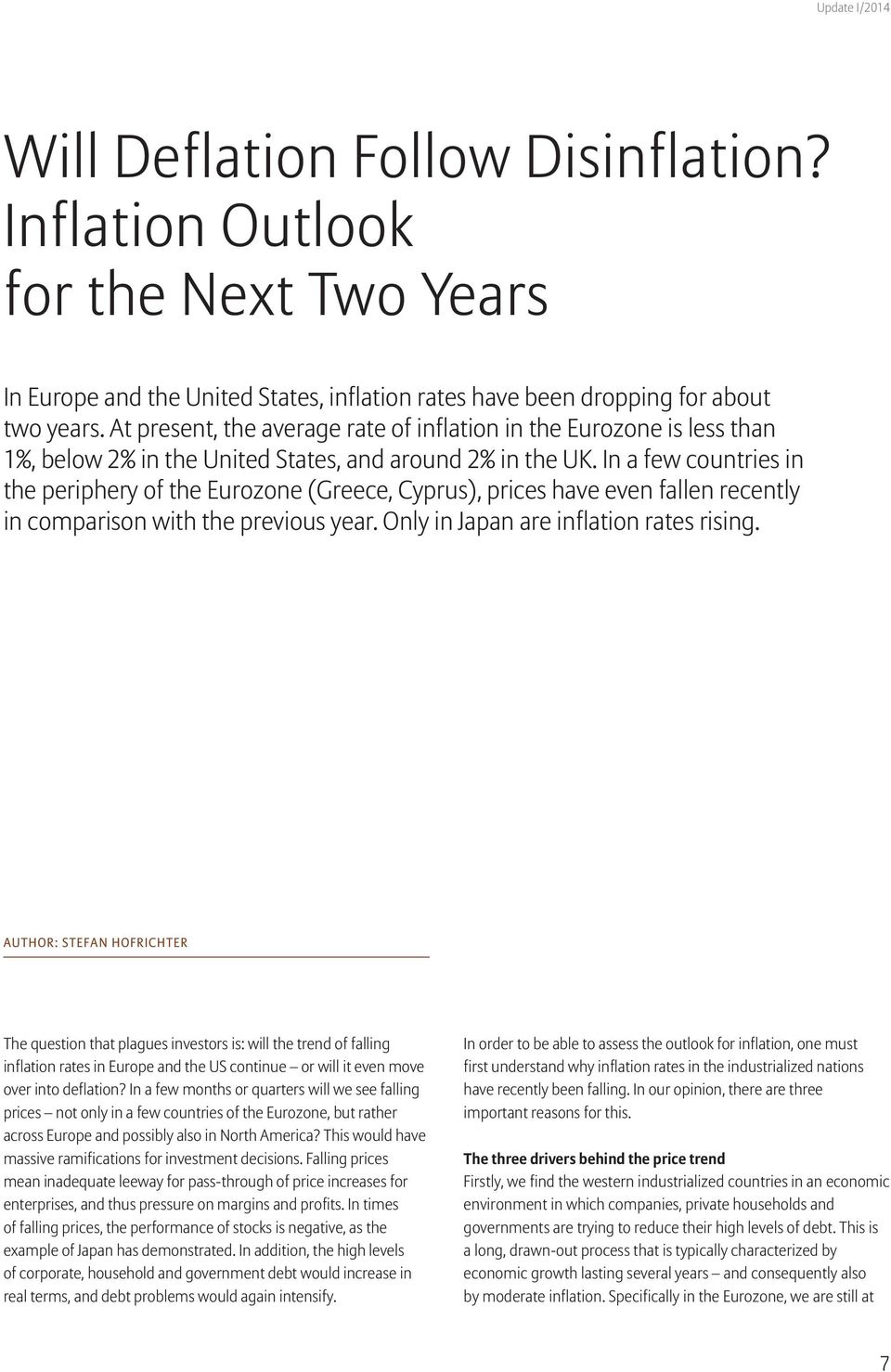
10 OUTLOOK 01 THE CASE AGAINST DEFLATION: ECONOMIC RECOVERY AND STABLE INFLATION EXPECTATIONS EMU Survey of Professional Forecasters: inflation in 2 years and 5 years 2.1% 2.0% 1.9% 1.8% 1.7% 1.6% 1.5% EMU SPF: CPI inflation next 5 years EMU SPF: CPI inflation next 2 years USA: Survey of Professional Forecasters inflation in 10 years, Michigan Survey: inflation in 5 years 4.5% 4.0% 3.5% 3.0% 2.5% 2.0% SPF: CPI (Consumer Price Index) inflation next 10 years U. MICHIGAN: CPI (Consumer Price Index) inflation next 5 years Source : Datastream, Allianz GI Economics & Strategy, data as of January

11 Update I/2014 At Allianz Global Investors we are assuming that during 2014, and at the latest in 2015, inflation rates will not only stabilize, but will show a moderate rise. The greater the pressure on the currencies in the emerging markets becomes, the greater the feedback effects for the industrialized countries, both for aggregate demand and for inflation rates characterized by falling import prices. The forces described above will presumably also result in falling inflation rates in the western industrialized countries in the coming months. But at Allianz Global Investors we are assuming that during 2014, and at the latest in 2015, inflation rates will not only stabilize, but will show a moderate rise. In our opinion, there are several factors arguing for this which will act against the disinflationary forces, and prevent a slide into Japan-style deflation. One key argument is the cyclical recovery in the industrialized countries. While we are assuming only a low rate of growth during this year for Europe, which at best will be in line with trend growth (approx. 1.25% in the Eurozone), this represents a definite improvement in comparison with the preceding year, when the region was still in recession. For the US we expect significantly higher growth than in the preceding year, since the braking effects of a restrictive fiscal policy will be significantly lower this year. As in the past, stronger economic development should lead to a rise in inflation rates since, in macroeconomic terms, the difference between supply and demand is narrowing. (Chart 1) Stable long-term inflation expectations of around 2% also argue against the risk of deflation. This is crucial. If the opposite were the case, if companies and households were to defer expenditure into the future, economic growth would drop with negative effects on prices. Without a doubt, however, current inflation expectations are no cause for complacency, since trend changes in inflation rates usually come unexpectedly, and inflation expectations adjust only after a delay. This means fiscal policy is of special importance, since it can help stabilize inflation expectations through appropriate measures, such as large-scale purchases of bonds. (Chart 2) 11

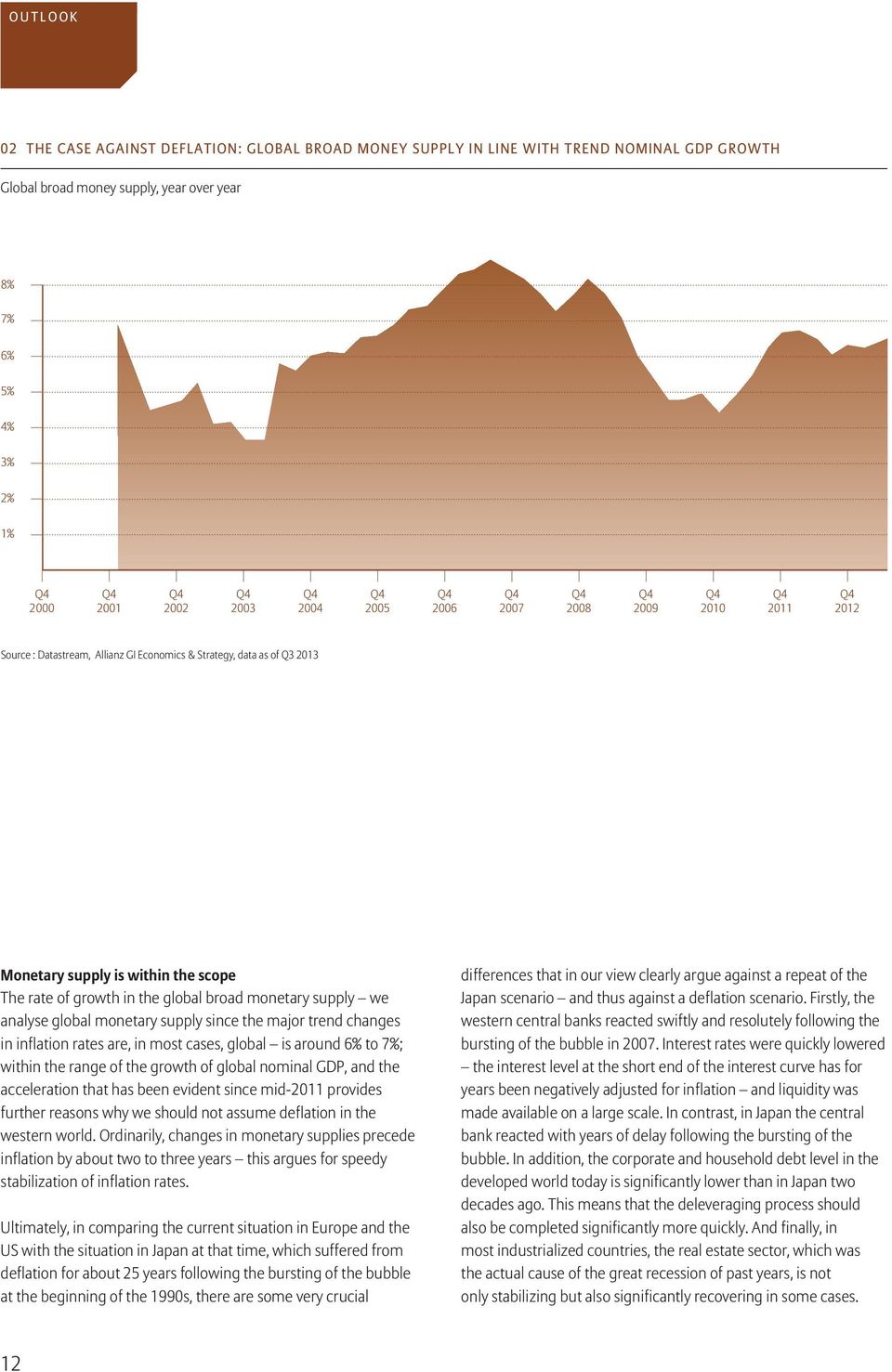
12 OUTLOOK 02 THE CASE AGAINST DEFLATION: GLOBAL BROAD MONEY SUPPLY IN LINE WITH TREND NOMINAL GDP GROWTH Global broad money supply, year over year 8% 7% 6% 5% 4% 3% 2% 1% Q Q Q Q Q Q Q Q Q Q Q Q Q Source : Datastream, Allianz GI Economics & Strategy, data as of Q Monetary supply is within the scope The rate of growth in the global broad monetary supply we analyse global monetary supply since the major trend changes in inflation rates are, in most cases, global is around 6% to 7%; within the range of the growth of global nominal GDP, and the acceleration that has been evident since mid-2011 provides further reasons why we should not assume deflation in the western world. Ordinarily, changes in monetary supplies precede inflation by about two to three years this argues for speedy stabilization of inflation rates. Ultimately, in comparing the current situation in Europe and the US with the situation in Japan at that time, which suffered from deflation for about 25 years following the bursting of the bubble at the beginning of the 1990s, there are some very crucial differences that in our view clearly argue against a repeat of the Japan scenario and thus against a deflation scenario. Firstly, the western central banks reacted swiftly and resolutely following the bursting of the bubble in Interest rates were quickly lowered the interest level at the short end of the interest curve has for years been negatively adjusted for inflation and liquidity was made available on a large scale. In contrast, in Japan the central bank reacted with years of delay following the bursting of the bubble. In addition, the corporate and household debt level in the developed world today is significantly lower than in Japan two decades ago. This means that the deleveraging process should also be completed significantly more quickly. And finally, in most industrialized countries, the real estate sector, which was the actual cause of the great recession of past years, is not only stabilizing but also significantly recovering in some cases. 12
13 Update I/2014 Ordinarily, changes in monetary supplies precede inflation by about two to three years this argues for speedy stabilization of inflation rates. 13

14 OUTLOOK 03 THE CASE AGAINST DEFLATION: DEVELOPED MARKETS TODAY ARE NOT LIKE JAPAN TWO DECADES AGO Quick response by central banks negative real yields Real returns for 2 years term 3% 2% Japan 1% 0% 1% 2% Germany 3% USA Recovery in house prices good for banks (2008/1992 = 100) Indexed Japan House prices, indexed 2006 = Japan: land prices Germany Euro area UK Spain: House prices per square metre Ireland: House prices: new houses USA Private sector leverage much lower in US and Europe 220% 200% Japan 180% USA EMU 160% 140% Source : Datastream, Allianz GI Economics & Strategy, data as of January 2014 Legend: US and European series starting in 09/2008. Japanese series starting in 09/1992 (year of first recession post burst of bubble), pushed forward by 16 years 14

15 Update I/2014 Taking all the arguments into consideration, we come to the conclusion that while it is possible that the disinflation trend may extend into the next few months, inflation rates should stabilize in both the United States and Europe over the coming quarters. This is an important support for the recovery of the banking sector, since the need for write-offs in loan portfolios is reduced. In contrast, in Japan real estate prices fell over a period of around 20 years, and thus crippled lending. (Chart 3) Taking all the arguments into consideration, we come to the conclusion that while it is possible that the disinflation trend may extend into the next few months, inflation rates should stabilize in both the United States and Europe over the coming quarters. We are explicitly assuming that both the US and Europe will be able to avoid a deflationary scenario such as the one in Japan. In the long term (that is over the next three to five years) a crucial factor will be whether the western central banks again normalize their monetary policy, or whether they as we expect remain expansive for too long. This means: we will not soon be saying goodbye to the low interest environment, but the risk profile for bonds will continue to be asymmetric in view of the inflation outlook. Stefan Hofrichter As Head of the AllianzGl Global Economics & Strategy team since 2011, Stefan s research covers global economics as well as global and European asset allocation. Stefan joined the firm in 1996 as an equity portfolio manager, and assumed his current role as an economist and strategist in Between 2004 and 2010 he additionally had responsibility for various retail and institutional mandates, including global and European classic balanced funds, global multi-asset absolute return and multi-manager alpha-porting funds. Stefan became a member of the firm s Global Policy Council in 2004, and is a member of the Pan-European Tactical Multi Asset Investment Committee, which was established in He chaired the German Asset Allocation Committee between 2010 and Stefan holds a Diplom degree in economics from the University of Konstanz (1995) and in business administration from the University of Applied Sciences of the Deutsche Bundesbank, Hachenburg (1991). Stefan became a CFA Charterholder in

16 Strategy Best Styles: Harvesting Risk Premium in Equity Investing Harvesting risk premiums is a common investment strategy in fixed income or foreign exchange investing. In equity investing it is still rather new, but well-rewarded. 16

17 Update I/

18 STRATEGY AUTHOR: DR KLAUS TELOEKEN For institutional investors, harvesting risk premiums is a common investment strategy. In asset classes like fixed income or currencies, it is straightforward for investors to think of investing in terms of harvesting risk premiums like the term premium or the credit premium in fixed income, or the carry premium in FX (foreign exchange) trading. Fixed income investors extend the duration of portfolios to capture the term premium in fixed income, or add to corporates and high yields to earn the credit premium. FX investors exploit the FX carry premium by going long in highyielding currencies, and shorting low-yielding currencies. In all these examples, investors take extra risks (duration risk, credit risk, currency risk) and expect to be compensated for this extra risk by means of an extra return the risk premium. Implicitly, the performance of equity managers is to a large extent explained by their exposures to a few equity risk premiums anyway and this is true irrespective of whether the manager is aware of this investment style exposure or not. (Chart 1) As the performance decomposition based on Mercer s GIMD database shows, there can be no doubt that investment style risk premiums are the true drivers of active equity returns. Index providers have reacted, and have recently launched a whole series of indices that target these risk premiums under a variety of different labels like smart beta indices, alternative beta indices or risk premium indices. As we are proponents of the idea of harvesting risk premiums, we think these indices are a good start. For equity investors, however, thinking in terms of equity risk premiums is still rather new. But risk premiums also exist here. Examples include the value premium, the small cap premium or the momentum premium. Value stocks, e.g. stocks with a low price/book-ratio, are usually more risky, as value stocks are typically less profitable, more leveraged and more cyclical than other stocks. The existence of all these risk premiums is well documented in the academic literature. For instance, Basu (1977) 1 discovered that stock with a low Price/Earnings ratio led stocks with a higher Price/ Earnings ratio on the NYSE. Banz (1981) 2 described the size effect small cap stocks outperform large cap names. Titman (1993) 3 found the momentum anomaly stocks that led the market over the last six to twelve months have a tendency to continue to lead markets. The existence of these risk premiums is documented for all major investment regions, and over extended time spans. And, based on our experience, there are not too many patterns in investing that are as persistent as these risk premiums. Therefore, it does make sense to explicitly build a portfolio around the idea of harvesting these equity risk premiums. UNDERSTAND. ACT. Harvesting risk premiums is a proven successful investment strategy across asset classes This concept is also well-rewarded in equity markets Index providers have started to offer a variety of risk premium strategies under labels like smart beta, alternative beta or risk premium indices These smart beta indices are an easy-to-grasp index methodology, but in our view they fail to efficiently earn the risk premiums of investment styles in a stable way AllianzGI Best Styles is a distinctive active equity management approach to harvest investment style risk premiums in a stable way across time Best Styles implements a diversified mix of long-term investment style winners, manages risk factors within investment styles, and also uses bottom-up alpha sources The Best Styles products have outperformed in 13 out of 15 years since inception, largely independent from the economic or the market cycle. 1 Basu, S. (1977) Investment Performance of Common Stocks in Relation to their Price- Earnings Ratios, Journal of Finance 2 Rolf W. Banz (1981), The Relationship Between Market Value and Return of Common Stocks, Journal of Financial Economics 3 Jegadeesh, N. and Titman (1993), Returns to Buying Winners and Selling Losers: Implications for Stock Market Efficiency, Journal of Finance But we think investors can do better when it comes to harvesting individual risk premiums than just buying individual smart beta indices. Typical smart beta indices are not designed to harvest the equity risk premiums in the most efficient way for a client portfolio, but are more designed as an easy-to-grasp index methodology. 18
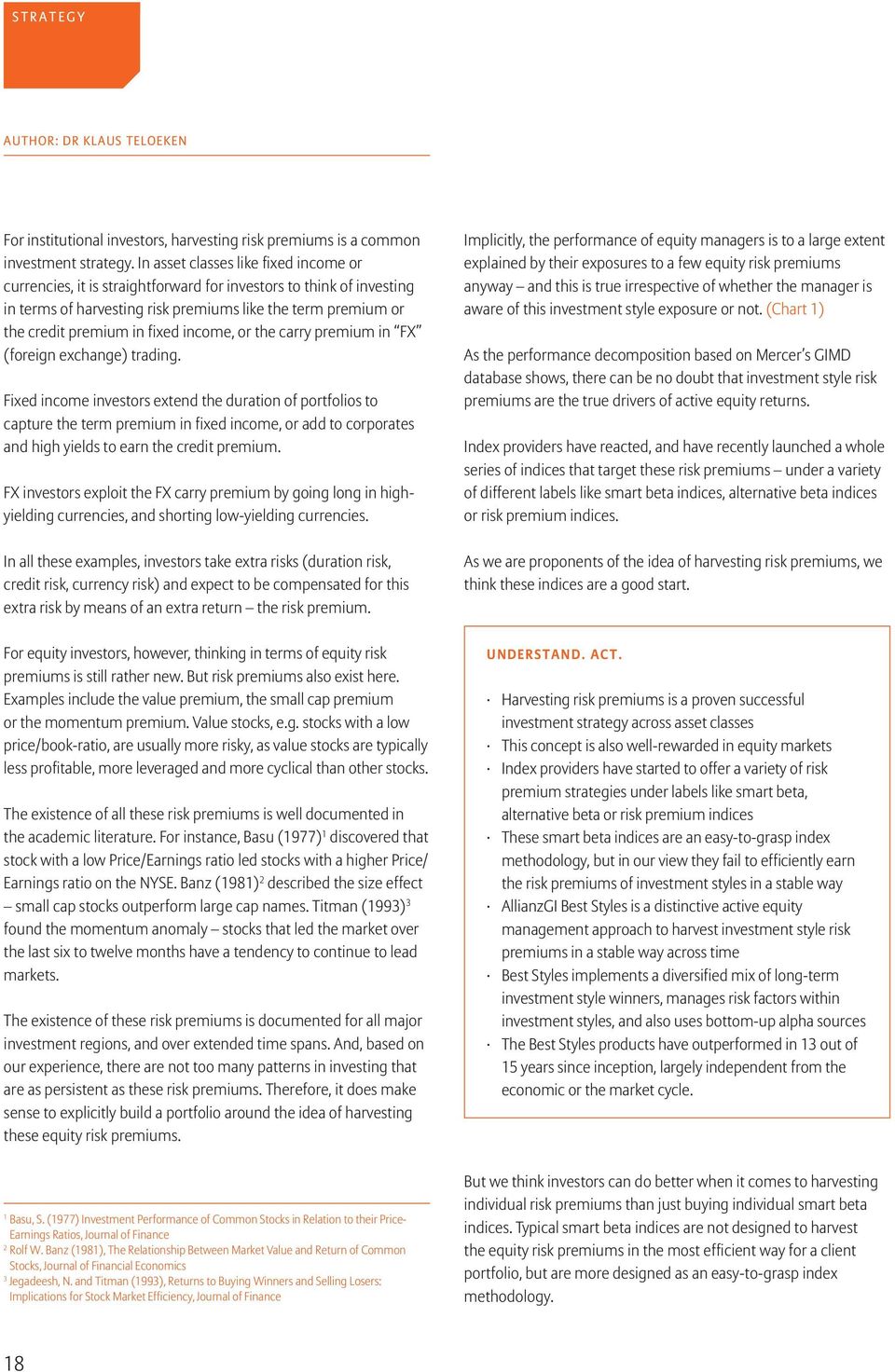
19 Update I/ WHERE DOES OUTPERFORMANCE COME FROM? EMPIRICAL EVIDENCE Active return decomposition of global equity managers ( ) RESIDUAL 2.5% 2.0% VALUE Active Returns MOMENTUM 1.5% 1.0% REVISIONS 0.5% GROWTH / SIZE / QUALITY RISK 0% Source: AllianzGI, 31 July 2013 For example, simple value indices like the Research Affiliates Fundamental Indices (RAFI) or the MSCI value weighted indices are biased towards companies in financial disarray, but the value premium can be earned more efficiently by avoiding these companies. Minimum volatility indices like the MSCI minimum volatility index, while targeting the low volatility premium, leave the exposure to other risk premiums like value or momentum largely unmanaged, which can result in adverse exposures to these risk factors. These examples demonstrate that, while smart beta investing is a good starting point, investors can do better in terms of capturing individual risk premiums like value or low volatility. And investors can also do better in terms of capturing multiple risk premiums than just buying a multiple of smart beta indices. The reason is that just buying a multiple of smart beta indices often leads to insufficient diversification. However, diversification across multiple risk premiums is warranted. Many risk factors like value or momentum have been very successful over the longer term, but have also experienced significant short-term drawdowns. For example, the value investor had to endure a sharp decline in the run-up to the TMT bubble, or as the financial crisis unfolded in Similarly, the momentum investor suffered from a painful setback after the burst of the TMT bubble, or during the market recovery in A diversified blend of the value and momentum investment styles has earned the risk premiums attached to these investment styles in a much more stable way than each of the individual investment styles. (Chart 2) 19

20 STRATEGY 02 INVESTMENT STYLE DIVERSIFICATION IS KEY TO STABLE OUTPERFORMANCE Relative performance of investment styles for a global universe 120% 100% Diversified Style Mix Value 80% 60% 40% 20% Momentum Source: AllianzGI, February 2014 Historic simulation Dec 1989 Dec 2012: quarterly rebalancing, performance after (estimated) transaction costs. Assumptions of the backtest: since no comparable fund existed in the period under consideration, assumptions were made in order to illustrate past performance as realistically as possible.the model portfolios use a similar breadth of investment opportunities as existing global funds. The performance figures are before taxes and after transactions costs of 50bps, dividends are reinvested. The model portfolio comprises approx. 300 stocks, all overweights in the portfolio are of equal size, underweights relative to the benchmark are restricted to 1%. No constraints are in place with respect to sector or country deviations from the benchmark. The strategy is rebalanced semi-annually, on average 50% half turn portfolio changes p.a. The relative performance of the strategy is shown relative to a global investment universe that represents the liquid investment opportunities over time. The performance of this investment universe may differ from the performance of a benchmark like the MSCI World index. Unless otherwise noted, performance results and valuation presented are in US Dollars. Diversification is key The chart underpins the fact that harvesting risk premiums diversification across multiple risk factors has been key to stable outperformance. But investors can do better in terms of diversification across multiple risk factors than just buying a multiple of smart beta indices. Typical smart beta indices have varying exposures to risk factors to the targeted risk factors, and also to non-targeted risk factors where exposures are unmanaged. This makes correlations between smart beta indices rather unstable, and hence renders an efficient diversification impossible. For example, the correlation between the MSCI risk premium indices for value and momentum shifts over time. Most of the time, like today, the correlation of relative returns is negative, hence there is a substantial diversification advantage from blending value with momentum. However, in prolonged cyclical value rallies like the one from 2003 to 2007, value and momentum typically go hand in hand, and hence there is no diversification advantage left from blending value with momentum. But diversification was badly needed at the end of the value rally in 2008, as both value and momentum stocks tanked as the global economy grinded to a halt after the Lehman collapse. However, for investors in these two MSCI risk premium indices there was nothing that could be done to restore diversification; investors just had to accept the loss of diversification. Smart beta indices like the MSCI risk premium indices are simply not designed with a view to a diversified combination with other smart beta indices, but are designed as stand-alone products. A portfolio manager in an integrated portfolio solution, though, can provide the proper diversification across multiple risk premiums by structuring the individual risk premium portfolios with a view towards the subsequent diversification across multiple risk premiums. To do so, the portfolio manager should manage the composition of the individual risk premium portfolios in a way that allows stable mutual correlations, and hence effective diversification. For example, if the correlations between value and momentum are becoming too high the portfolio manager will: put more weight on those value stocks that are not also momentum stocks put more weight on those valuation criteria that will have a lower correlation with momentum factors to effectively restore diversification between value and momentum. 20

21 Just buying a multiple of smart beta indices often leads to insufficient diversification. 21
22 STRATEGY 03 INVESTMENT PROCESS BEST STYLES Investment Style Research to earn the smart beta risk premiums of investment styles Best Styles Approach Allianz Global Investors Global Company Research to generate stock selection alpha within investment styles Source: AllianzGI, February BEST STYLES VS. MSCI SMART BETA INDICES Relative Performance of Best Styles Global vs MSCI Risk Premium ETFs Indices after Trading Costs Performance MSCI World 175 % 140% 175 % 150 % 120% 125 % Relative performance vs MSCI World 100 % 100% 75 % MSCI WORLD 50 % Dec Dec Dec Dec Dec Dec Dec Dec Dec Dec Dec % World quality World small cap World value weighted World growth World minimum volatility World momentum World high dividend MSCI quality mix Best Styles Source: AllianzGI, MSCI. This is for guidance only and not indicative of future allocation. The performance of Best Styles is represented by the composite SYSTEMATIC EQUITY GLOBAL BEST STYLES DEVELOPED COMP The other indices are MSCI World Risk Premium Indices, except the Momentum index where a MSCI World version is not available, and the relative performance of the MSCI AC World is shown instead. We applied transactions costs to the indices to proxy the performance of ETFs mimicking these indices. 22
23 Update I/2014 The AllianzGI Best Styles strategy is an active equity management approach built around the idea of harvesting smart betas or investment style risk premiums in a disciplined, systematic approach. In addition to this, an integrated portfolio solution not only achieves the proper diversification across multiple risk premiums, but also allows the successful mitigation of exposures to unwanted risk factors like macro-economic or interest rate sensitivities that stand in the way of harvesting the risk premiums in a stable way, i.e., largely independent from the economic or market environment. Smart beta investing, harvesting equity risk premiums and the Best Styles investment approach The AllianzGI Best Styles strategy is an active equity management approach built around the idea of harvesting smart betas or investment style risk premiums in a disciplined, systematic approach. Dr Klaus Teloeken is the Co-CIO of the Systematic Equity team. He joined Allianz Global Investors in 1996 as a quantitative analyst, and in 2001 he assumed the role of Head of Systematic Equity. He oversees more than EUR 17 billion of assets under management, and is responsible for the development and management of systematic investment strategies for equities. In this role Klaus has developed the team s Best Styles and High Dividend product line. He is also responsible for the management of the Best Styles Global and High Dividend Global product. Klaus studied mathematics and computer science in Dortmund, Germany. In the investment segment Best Styles, Dr Teloeken is supported by his colleague and Co-CIO Dr Benedikt Henne. The Best Styles approach, in a first layer, seeks to capture the risk premiums attached to investment styles like value and momentum. In a second layer, Best Styles also seeks to generate additional alpha within the investment style framework based on the AllianzGI bottom-up company research. (Chart 3) These two layers are combined with a diligent portfolio construction that implements a diversified investment style mix. In doing so, the Best Styles approach, in addition to harvesting investment style risk premiums, also provides the proper diversification across risk premiums. The individual MSCI Risk Premiums indices ETFs showed a rather unsteady performance over time and during the Great Financial Crisis while the Best Styles Global portfolios navigated quite steadily through the market turbulences of the last 10 years. (Chart 4) Dr Benedikt Henne works as Chief Investment Officer (CIO) Systematic Equity at Allianz Global Investors. He joined the company in 1998, and is responsible for the development and management of systematic equity products. In 2001 he was appointed Head of the Systematic Equity Team at Frankfurt. Dr Henne read mathematics in Paris and Bonn. He obtained a maîtrise from the Université Pierre et Marie Curie, Paris, and a mathematics degree and doctorate from the University of Bonn. He has held a CFA charter since
24 Fixed Income Emerging Markets Debt Especially in times of financial repression, bonds from emerging markets are a fundamental element of an investment strategy aimed at generating real returns. AUTHORS: GREG SAICHIN, BEATRIX ANTON-GRÖNEMEYER & THOMAS KNIGGE 24
25 Understand Where and how strategic and tactical value accrues in the Emerging Markets Fixed Income spectrum throughout the global and country cycles. Act Apply high conviction active strategies to capture that value in a manner consistent with our clients asset allocation goals. Whilst we all recognise that financial repression is here to stay for many years, the never-ending search for yield runs into trouble, as there is little value left in developed countries investment grade and high yield asset classes. With the emerging world contributing 42% of actual global output or 50% on a PPP basis and rising steadily over coming years, EMD is simply too big to ignore. Furthermore, EMD has evolved as an asset class over the last ten years, having achieved an average investment grade status in With tapering making waves across capital markets, for the first time in years EM bonds are looking attractive again compared to other fixed income classes. Today at 140 basis points advantage over similar USD IG assets, EMD Sovereign assets are paying an increased premium for rebalancing their economies through the US rates normalisation phase, beyond the pricing of those risks. In other words, this asset class seems attractive not only from a relative value, but also from an absolute value perspective of 25
26 FIXED INCOME Active management is therefore an essential prerequisite for the success of investments in this changing heterogeneous environment. currently a 6% rate of return on government bonds (EMBIG 1, as at ). But rules are changing EMD is no longer just a relative value play; understanding idiosyncratic risk is key for performance over the next decade. While it s true that US rate normalisation is exposing EM countries with weak fundamentals or deficient policy mix, liquidity in fixed income markets has changed fundamentally, impacting EMD assets at a time of raised systemic risks. Rates may still rise further as EM Central Banks attempt to retain and attract flows back to their countries, and stabilise their Balance-of-Payments and depreciating currency. In other words, there is positive fundamental value in EM rates and currencies in the short term; however, both rates and EM FX may still be under technical pressure from outflows. Active management is therefore an essential prerequisite for the success of investments in this changing heterogeneous environment. Emerging Markets Fixed Income at AllianzGI Investments in emerging countries require a deep understanding of global and local entwinements and dependences. Our aim was, therefore, to use the best resources for the management of emerging markets bonds to meet the current demands of this asset class. Some 50 years of collective experience in EMD was the starting point for building a world class global team headed by Greg Siachin, who has followed the ups and downs of the emerging markets cycles of the past 30 years as a fund manager. The goal was to involve best competencies to manage EMD assets. Today our experienced team follows a strategic and tactical approach, and adds the benefits from regional perspectives. A global-local organisation located in New York (Latin American markets), London (CEEMEA 2 markets) and Hong Kong (Asian markets) for 24/7 coverage allows for optimised understanding and exploration of risk, flows, and market intelligence close to the action. 1 EMBIG = Emerging Markets Bonds Index Global 2 CEEMEA = Central Eastern Europe, Middle East and Africa 26
27 Update I/ INVESTMENT PROCESS 1. Country selection 2. Strategy selection 3. Conviction portfolio construction TOP-DOWN ANALYSIS Sovereign solvency analysis Economy metrics Major drivers: Global cycle, China, commodities SOVEREIGN/QUASI- SOVEREIGN SELECTION CORPORATE SELECTION RISK BUDGETING PROCESS Strategic allocation Tactical allocation SCORE CARD SPREAD CONVERGENCE RELATIVE VALUE FX-RATES MOMENTUM SELECTION PROACTIVE LIQUIDITY MANAGEMENT STRUCTURAL RISK MANAGEMENT OVERLAY PORTFOLIO BOTTOM-UP APPROACH Policy mix / legal framework Market technicals Corporate governance Source: AllianzGI, Q
28 FIXED INCOME 02 COUNTRY SELECTION Sovereign solvency analysis Economy metrics TOP-DOWN Current account Foreign currency reserves Balance of payments Funding requirements Inflation Interest-rate cycle Industrial production Commodities dependence Manufacturing dependence Country Assessment: Overweight/Underweight Political trends Central bank proactivity Electoral calendar Policy consistency and continuity Legislative initiatives Debt profile Fiscal position Public-sector borrowing Expected bond issuance FX vulnerability Foreign ownership BOTTOM-UP Politics, policy mix, rule of law, corporate governance Market technicals Source: AllianzGI, Q
29 Update I/2014 Our investment process combines a quantitative approach with a fundamental approach to signal desirable country riskadjusted return for each country that is in the chosen benchmark. Our unique matrix approach allows us to combine traditional index tilt management style with specialist-driven alpha basket management, reliably delivering risk-adjusted returns through the implementation of high conviction active strategies in the full EMD spectrum. Investment process Our investment process combines a quantitative approach with a fundamental approach to signal desirable country risk-adjusted return for each country that is in the chosen benchmark. The quantitative approach provides a static and dynamic assessment of macro indicators in every EM country, adjusted by a vulnerability module to model sudden economic shocks, and a bond valuation module to determine sovereign attractiveness for investment. The fundamental approach analyses macro data in light of the country s policy mix, legal framework, political risk, corporate governance, business climate, and market technicals. Numbers are stress-tested for major drivers such as global cycle expectations, commodity price expectations, China, and other potential systemic factors. The management team forms a view, based on the conclusions of both processes, and defines strategic allocations at Sovereign and Quasi-Sovereign levels set against the Core in each managed strategy. These allocations have a long-term view, lasting usually 18 months. These strategic allocations consume risk budgets defined by use of tracking error as they may be below, at, or above country benchmark weights. The use of tactical allocations can add or subtract weight to/from sovereign/quasi-sovereign strategic allocations. These are typically used to take advantage of relative value opportunities ahead of specific events Central Bank meetings, sovereign new issues, or new laws going through congress/parliaments but that do not change the long-term strategic allocation weights. As such, these temporary allocations should be removed once the specific event dissipates. 29
30 FIXED INCOME In the new financial reality of diminished liquidity, redeploying allocations is more complex and time-consuming. As these core positions consume risk budget for each strategy, there will be a residual budget reserved for the PLUS portion of the overall strategy. PLUS management is largely defined by five defined alpha baskets: 1) Corporate income strategies usually utilised as short duration, roll down and carry 2) Credit arbitrage spread convergence/divergence by arbitraging the risk reversal on median spreads between sovereign and quasi-sovereign entities purely on technical grounds 3) Relative value as paired trades between sovereign/corporate, sovereign/sovereign, credit steepening/flattening along sovereign and quasi-sovereign curves 4) EM rates and FX pure arbitrage to extract value from sovereign local curves in steepening/flattening trades, and maximise returns from volatility trades associated to EM FX 5) Momentum selection focuses on capturing the primary market new issue premium offered by existing issuers, or new issuers that are good proxies of existing issuers in the market. While portfolio managers are in overall control of the strategy through deploying risk budget to Core and PLUS ideas, PLUS management is performed by dedicated investment professionals. This means that PLUS baskets are not necessarily customised to each fund. It is only the intensity of the capital deployed to each PLUS basket that impacts the final risk profile of the fund. UNDERSTAND. ACT. In a low interest rate environment, emerging markets bonds offer long-term earnings potential. Through the turmoil of recent months, the relative attractiveness of this asset class has improved. But the selection of individual investments is crucial. Therefore, conviction-based active strategies should be implemented to tap the potential in line with the investment objectives of investors. Completing our investment process is our systemic and discrete hedging overlay, which we apply in a customised way to each 30
31 Update I/
32 FIXED INCOME 32
33 Update I/2014 Greg Saichin is Head of Global Emerging Market Debt at Allianz Global Investors. Global Emerging Market Debt is a new area of specialization that enhances the bond fund management capabilities of Allianz Global Investors, which up until now comprised strong regional expertise in Europe, the USA and Asia. Previously, Greg was Head of Emerging Markets & Leveraged Finance Fixed Income Funds at Pioneer Investments in Dublin and London. He holds a Bachelor s degree in business administration, and an MBA from Wharton School, University of Pennsylvania. one of our strategies. In the new financial reality of diminished liquidity, redeploying allocations is more complex and timeconsuming. Time sensitivity in the face of systemic or idiosyncratic events demands the skilful use of these tools. They enable the management team to shave off a targeted quota in basis points of risk from the overall strategy (index hedging) or specific countries (country CDS, FX or rates). Our product range With USD term structures steepening in both sovereign and corporate names, AllianzGI has moved rapidly to address clients demand for income-generating strategies from the EMD spectrum, by adding a short duration flexible strategy to its product range. For institutional clients concerned with eroding solvency, or constrained from a regulatory perspective, we have also created a Defensive EM global bond strategy that specifically excludes low-rated countries (below B-). By doing this we reduce the risk profile of the overall strategy, as we eliminate the countries that concentrate the highest idiosyncratic risks and default probabilities. Beatrix Anton-Grönemeyer is Head of the Product Specialists Team for Fixed Income in Europe at Allianz Global Investors. Beatrix started her career in Finance at Dresdner Bank, where she provided investment advisory services focusing on German equities and bonds for international institutional investors. Before joining Allianz Global Investors in 2002, Beatrix occupied various managerial posts, where her responsibilities included business development, marketing and sales, and sales coordination. Beatrix is a qualified lawyer, and she initially worked as a lawyer after obtaining her degree in jurisprudence from Saarland University in Saarbrücken. Our product range also aims for depth and breadth to cover clients needs in EMD. They include Core PLUS strategies in both USD and LC, and Flexible full spectrum EMD strategies managed against passive benchmarks and absolute return targets. Conclusion Emerging markets bond investments offer attractive potential for returns. In this ever-changing market there is a whole range of excellent investment opportunities not just government bonds, but also corporate and high-yield bonds, as well as FX. Active allocation and agility, based on conviction and a deep understanding of the market, are key to unlocking alpha. Thomas Knigge is a Fixed Income Product Specialist. Thomas started his career managing balanced portfolio mandates at Dresdner Bank. He then moved to dresdnerbank investment management (dbi), where he initially focused on managing balanced fund portfolios for clients, before specializing in bond mandates. Thomas studied business mathematics at Hamburg University, and is a Certified European Financial Analyst. 33
34 Interview Should private market investments be included in any institutional portfolio? 34
35 Update I/2014 Editor-in-chief Marty-Jörn Klein talks to Dr Wolfgang Mader, Head of Asset Allocation Strategies at AllianzGI Global Solutions/risklab, and Olga Braun-Cangl, Senior Consultant at AllianzGI Global Solutions/Manager Research & Selection Private market investments are increasingly being considered as part of an institutional investor s strategic asset allocation (SAA). What is meant by the term, and what are the arguments in favour of such investment decisions? Dr Wolfgang Mader: Financial repression has created a capital market environment that is forcing institutional investors to increasingly rely on illiquid investments privately placed securities instead of listed ones. Only then can they continue to earn attractive and stable returns. In addition to the pure yield potential, however, illiquid investments are also favoured due to the low correlation to other asset classes, and for an attractive cash flow profile that very closely matches future payment flows. ABOUT THE EXPERT Dr Wolfgang Mader is Head of Asset Allocation Strategies at risklab GmbH. Before joining risklab, Dr Mader was a consultant for insurance and investment advisory companies. He also worked as a researcher and lecturer at the Department of Banking and Finance at Augsburg University. He completed his degree in Business Administration at Augsburg University in 2000, and went on to gain a PhD with his thesis on Hedge Funds Alternative Investment Strategies and Portfolio Models from the Department of Economics, also at Augsburg University, in Olga Braun-Cangl: Classic illiquids include property investments, while recently investments in private markets have increasingly been finding their way into institutional portfolios. We talk of private markets to distinguish these investments from the public markets for the traditional listed asset classes. The generic term encompasses all forms of investment that can be implemented on private markets, including private equity, private debt and private infrastructure investments. Olga Braun-Cangl has been advising institutional clients on alternative investments since A certified hedge fund adviser (ebs/bai), she has gained experience in the areas of portfolio management and hedge fund research with Allianz Global Investors, Berenberg Bank and HypoVereinsbank. She earned her degree in capital market research and financing at the University of Munich (LMU). 35
36 INTERVIEW What is the distinction between them? Olga Braun-Cangl: Private equity investments involve equity investors who finance a stake in a venture in order to earn returns, but also possibly to pursue strategic aims. Private debt encompasses monies lent by institutional investors generally outside the banking sector in a private placement. Investments in private debt take the form of mezzanine instruments i.e. a hybrid of debt and equity capital, and/or loans. Private infrastructure investments are channelled into the economic and social infrastructure of individual countries. An economic infrastructure encompasses the transportation, utilities and communications sectors, and water supply. Social infrastructure includes such elements as hospitals, schools and comparable facilities. A distinction is made between infrastructure debt and infrastructure equity, depending on whether investors provide loan capital or take an equity position. All of the aforementioned private market sectors are long-term in nature, and characterized by being very illiquid, with large amounts of capital generally involved. In a private equity investment, the investor is primarily accepting a company-specific risk. Leverage and counterparty risk must also be emphasized. On the other hand, in a private debt investment, contract design risk and collateral security come to the fore. Finally, in a private infrastructure investment, regulatory risk plays a crucial role. In addition, technological, resource availability and political risks have a significant impact. There are also clear differences in the disbursement profile: private debt and private infrastructure investments (in the socalled brownfield or operational phase) benefit the most from consistent returns. In contrast, private equity and private infrastructure investments strive to obtain returns from an increase in value and resale opportunities in the design (or greenfield) phase. These risk and disbursement profiles are directly reflected in the yield potential: private equity and private infrastructure promise greater return potential in the design phase, whereas private debt and private infrastructure yield more in the operational phase. Tying up large amounts of capital in a very illiquid investment does not appear to be a great combination at first glance. What sort of transparency levels do private markets offer? Olga Braun-Cangl: The transparency of private markets is quite significantly different compared to publicly accessible markets. Information about transactions is more detailed than for publicly accessible investments, but is only available to a limited group of investors. This is directly reflected in the pricing process. Private markets are just that private. One further difference is the greater possibility to exert influence. Stakeholders usually hold majority rights to a company or infrastructure investment project, and are frequently involved in the operational side of the business. This constitutes a considerable advantage over traditional asset classes, especially with regard to investments that are SRI/ESG oriented. 36
37 Update I/2014 Financial repression has created a capital market environment that is forcing institutional investors to increasingly rely on illiquid investments privately placed securities instead of listed ones. Can the value added by exposure to private markets as part of an SAA be quantified? Dr Wolfgang Mader: When assessing the value added by including these asset classes, it is important to realistically consider the relevant risk factors. Together with portfolio managers, investors need to identify the sources of risk and return, and to extrapolate them appropriately into the future. Value added can then be quantified in terms of both return and risk. At a stable level of risk exposure, and depending on the permissible quota of private markets allocations, they can substantially increase the expected returns at portfolio level. Our Allianz Global Investors Portfolio Health Check is an advisory tool that visualizes this very well. Private market allocations can, however, also reduce risk. In the case of investment concepts geared toward debt with liabilitydriven investments (LDI), allocations to private debt instruments can secure long-term cash flows, for example, and thus significantly reduce the liability risks. What are the key success factors? Olga Braun-Cangl: Successful investment in private markets is dependent, in my opinion, on the interaction between the following characteristics that the investment manager should have: market access and superior skill at identifying and acquiring investment alternatives so-called sourcing capabilities, expertise in the specific sector, and years of experience in corporate financing, industry-specific knowledge, an excellent network of specialists with industry experience, the ability to reconcile the interests of the investor and the investment manager, 37
38 INTERVIEW Constructing a private market portfolio depends primarily on three factors: the individual return target, the client s willingness to accept risks, and the size of the investment. thorough knowledge and understanding of the general regulatory framework, and changes to the same, and the power to purchase and negotiate. Should private market investments therefore be included in any institutional portfolio? Dr Wolfgang Mader: Basically, yes, in light of the need to diversify risk. Allocating funds to different asset classes or by risk factors reduces the portfolio risks, and thus stabilizes overall earnings. The central liquidity requirements must, however, always be considered. Explicitly, a cap must be defined for these nonexchange-traded investments, so as not to be forced to sell off investments with very wide bid/ask spreads in stress phases, where these assets become even more illiquid. In addition, minimum volume requirements must be taken into account during implementation, to ensure that the benefits gained from these asset classes are cost-efficient. Virtually all portfolios with a long-term horizon already include some form of illiquid or private market investment. investment. Ideally, a private market portfolio would be implemented as a made-to-measure mandate by setting up a special fund for a sole institutional investor. The benefit of such a solution is that it can be optimally tailored to individual client requirements. As such, the required payment profile of the private market segment can be perfectly reproduced. Such individual client solutions can be implemented from a minimum investment of about EUR 50 million onwards. Lesser allocations to private markets could also be implemented by investing in closed-end private equity funds. Dr Mader, Ms Braun-Cangl, many thanks for talking to us. How does one go about implementing the desired private market portfolio? Olga Braun-Cangl: Constructing a private market portfolio depends primarily on three factors: the individual return target, the client s willingness to accept risks, and the size of the Marty-Jörn Klein, Editor in Chief of Update, spoke to Dr Wolfgang Mader and Olga Braun-Cangl. 38
39 Update I/2014 Update is now online Our Digital Home The online edition of Update now offers you an additional alternative to the printed magazine. The site features a collection of all articles and stories from our quarterly publication, which is now available throughout Europe in four languages (German, English, French and Italian). Our online version has been optimised for a wide range of devices and browsers, and is currently available in English and German. A clear structure according to topics and issue plus an up-to-date search function by keywords, authors and the most-liked and most-viewed pieces make it a breeze to find what you re looking for quickly. You can also download entire issues or individual articles in PDF format in any of the four languages with a single click. READ MORE AT Imprint Update I / 2014 The magazine for institutional investors from Allianz Global Investors Publisher: Allianz Global Investors Europe GmbH Bockenheimer Landstr Frankfurt Editor in Chief: Marty-Jörn Klein Project Manager: Caroline Wagner, Lina Masri (deputy) Editorial Team: Peter Berg, Bianca Gerlach, Marty-Jörn Klein, Hans-Joachim Kollmannsperger, Lina Masri, Hans-Joerg Naumer, Klaus Papenbrock, Oliver Schütz, Christian Subbe, Caroline Wagner Contact the Editorial Team: [email protected] Design: 3st kommunikation GmbH Layout: Brückner & Neuner GmbH Printing: Brückner & Neuner GmbH Photographs: Allianz Global Investors, getty images, shutterstock Stand: March 2014 Investing involves risk. The value of an investment and the income from it may fall as well as rise and investors may not get back the full amount invested. The volatility of fund unit prices may be increased or even strongly increased. Past performance is not a reliable indicator of future results. If the currency in which the past performance is displayed differs from the currency of the country in which the investor resides, then the investor should be aware that due to the exchange rate fluctuations the performance shown may be higher or lower if converted into the investor s local currency. This is for information only and not to be construed as a solicitation or an invitation to make an offer, to conclude a contract, or to buy or sell any securities. The products or securities described herein may not be available for sale in all jurisdictions or to certain categories of investors. This is for distribution only as permitted by applicable law and in particular not available to residents and/or nationals of the USA. The investment opportunities described herein do not take into account the specific investment objectives, financial situation, knowledge, experience or particular needs of any particular person and are not guaranteed. The views and opinions expressed herein, which are subject to change without notice, are those of the issuer and/or its affiliated companies at the time of publication. The data used is derived from various sources, and assumed to be correct and reliable, but it has not been independently verified; its accuracy or completeness is not guaranteed and no liability is assumed for any direct or consequential losses arising from its use, unless caused by gross negligence or willful misconduct. The conditions of any underlying offer or contract that may have been, or will be, made or concluded, shall prevail. Contact the issuer electronically or via mail at the address indicated below for a free copy of the sales prospectus, the incorporation documents, the latest annual and semi-annual financial reports and the key investor information document in English. Please read these documents which are solely binding carefully before investing. This is a marketing communication. Issued by Allianz Global Investors Europe GmbH, an investment company with limited liability, incorporated in Germany, with its registered office at Bockenheimer Landstrasse 42 44, D Frankfurt/ Main, authorized by Bundesanstalt für Finanzdienstleistungsaufsicht ( The duplication, publication, or transmission of the contents, irrespective of the form, is not permitted. 39
40 UNDERSTAND. ACT. The share of global economic output accounted for by emerging markets already comes to 42% Greg Saichin CIO Global Emerging Market Debt Emerging Market Debt Especially in times of financial repression, bonds from emerging markets are a fundamental element of an investment strategy aimed at generating real returns. Here at Allianz Global Investors we adopt an intelligent approach to taking risks, and manage them to achieve solid investment results. This is made possible by our special investment process for emerging market bonds. All this makes actively taking risks in emerging markets a smart choice. Find out more about emerging market debt and other topics at Investieren birgt Risiken. Der Wert einer Anlage und die Erträge daraus können sowohl sinken als auch ansteigen und Investoren erhalten den investierten Betrag möglicherweise nicht in voller Höhe zurück. Die hierin enthaltenen Einschätzungen und Meinungen sind die des Herausgebers und / oder verbundener Unternehmen zum Zeitpunkt der Veröffentlichung und können sich ohne Mitteilung hierüber ändern. Die verwendeten Daten stammen aus unterschiedlichen Quellen und wurden als korrekt und verlässlich betrachtet, jedoch nicht unabhängig überprüft; ihre Vollständigkeit und Richtigkeit sind nicht garantiert und es wird keine Haftung für direkte oder indirekte Schäden aus deren Verwendung übernommen, soweit nicht durch grobe Fahrlässigkeit oder vorsätzliches Fehlverhalten verursacht. Hierbei handelt es sich um eine Marketingmit teilung. Herausgegeben von Allianz Global Investors Europe GmbH, einer Kapitalverwaltungsgesellschaft mit beschränkter Haftung, gegründet in Deutschland mit eingetragenem Sitz in Bockenheimer Landstraße 42 44, Frankfurt/Main, zugelassen von der Bundesanstalt für Finanzdienstleistungsaufsicht ( Die Vervielfältigung, Veröffentlichung sowie die Weitergabe des Inhalts in jedweder Form sind nicht gestattet.
Best Styles: Harvesting Risk Premium in Equity Investing
 Strategy Best Styles: Harvesting Risk Premium in Equity Investing Harvesting risk premiums is a common investment strategy in fixed income or foreign exchange investing. In equity investing it is still
Changes to the OklahomaDream 529 Plan
 Supplement dated December 31, 2015 to Oklahoma Dream Advisor Sold 529 Program Plan Disclosure Statement for Investors Using a Financial Advisor (Classes A and C) Dated November 3, 2014 This Supplement
Bonds. Advanced Fixed Income: designed to profit from market inefficiencies under risk constraints
 Bonds Advanced Fixed Income: designed to profit from market inefficiencies under risk constraints 24 UPDATE III/2015 BONDS AUTHORS: MAXENCE MORMÈDE & YANN NETO The historically low-yield environment challenges
Dynamic Diversified Growth Fund
 Dynamic Diversified Growth Fund with BlackRock Investment Management (UK) Limited Customer Brochure BlackRock is a truly global firm that manages assets for clients in Europe, North and South America,
NPH Fixed Income Research Update. Bob Downing, CFA. NPH Senior Investment & Due Diligence Analyst
 White Paper: NPH Fixed Income Research Update Authored By: Bob Downing, CFA NPH Senior Investment & Due Diligence Analyst National Planning Holdings, Inc. Due Diligence Department National Planning Holdings,
Emerging markets: The multi-asset approach
 Asset management research June 212 Emerging markets: The multi-asset approach 1 Outcome-oriented solutions. Delivered. UBS Global Asset Management s 3-year track record in multi-asset funds is one of the
Investment Strategy for Pensions Actuaries A Multi Asset Class Approach
 Investment Strategy for Pensions Actuaries A Multi Asset Class Approach 16 January 2007 Representing Schroders: Neil Walton Head of Strategic Solutions Tel: 020 7658 2486 Email: [email protected]
Investment insight. Fixed income the what, when, where, why and how TABLE 1: DIFFERENT TYPES OF FIXED INCOME SECURITIES. What is fixed income?
 Fixed income investments make up a large proportion of the investment universe and can form a significant part of a diversified portfolio but investors are often much less familiar with how fixed income
Project LINK Meeting New York, 20-22 October 2010. Country Report: Australia
 Project LINK Meeting New York, - October 1 Country Report: Australia Prepared by Peter Brain: National Institute of Economic and Industry Research, and Duncan Ironmonger: Department of Economics, University
Diversified Alternatives Index
 The Morningstar October 2014 SM Diversified Alternatives Index For Financial Professional Use Only 1 5 Learn More [email protected] +1 12 84-75 Contents Executive Summary The Morningstar Diversified
Absolute return: The search for positive returns in changing markets
 Absolute return: The search for positive returns in changing markets Tuesday, 7 June 2011 Portfolio Manager for Global Fixed Income and Absolute Return Funds www.dbadvisors.com Topics for discussion What
Investment Strategies for Pension Funds. Christopher Nichols Investment Director, Multi Asset Investing Standard Life Investments (UK)
 Investment Strategies for Pension Funds Christopher Nichols Investment Director, Multi Asset Investing Standard Life Investments (UK) Pensions need consistency but markets deliver chaos Discrete Yearly
The Credit Analysis Process: From In-Depth Company Research to Selecting the Right Instrument
 Featured Solution May 2015 Your Global Investment Authority The Credit Analysis Process: From In-Depth Company Research to Selecting the Right Instrument In today s low yield environment, an active investment
High Yield Bonds A Primer
 High Yield Bonds A Primer With our extensive history in the Canadian credit market dating back to the Income Trust period, our portfolio managers believe that there is considerable merit in including select
2015Q1 INVESTMENT OUTLOOK
 TTG WEALTH MANAGEMENT 2015Q1 INVESTMENT OUTLOOK TABLE OF CONTENTS Contents 2015Q1 Core Asset Allocation Summary 1 2015Q1 Satellite Asset Allocation Summary 2 2014 Year-End Review 3 Investment Outlook for
2013 GSAM Insurance Survey & Industry Investment Trends
 Global Insurance Asset Management AASCIF Annual Workshop Fall 23 23 GSAM Insurance Survey & Industry Investment Trends Michael Siegel, PhD Global Head of GSAM Insurance Asset Management September 3, 23
Fixed Income Liquidity in a Rising Rate Environment
 Fixed Income Liquidity in a Rising Rate Environment 2 Executive Summary Ò Fixed income market liquidity has declined, causing greater concern about prospective liquidity in a potential broad market sell-off
Real Estate as a Strategic Asset Class. Less is More: Private Equity Investments` Benefits. How to Invest in Real Estate?
 Real Estate as a Strategic Asset Class The Benefits of Illiquid Investments Real estate, a key asset class in a portfolio, can offer stable income returns, partial protection against inflation, and good
Defensive equity. A defensive strategy to Canadian equity investing
 Defensive equity A defensive strategy to Canadian equity investing Adam Hornung, MBA, CFA, Institutional Investment Strategist EXECUTIVE SUMMARY: Over the last several years, academic studies have shown
Active Management in Fixed Income: Conviction is Key
 Active Management in Fixed Income: Conviction is Key Active Management Central banks seem likely to remain accommodative and keep monetary policy rates lower for a while to come. Consequently, real policy
SSgA CAPITAL INSIGHTS
 SSgA CAPITAL INSIGHTS viewpoints Part of State Street s Vision thought leadership series A Stratified Sampling Approach to Generating Fixed Income Beta PHOTO by Mathias Marta Senior Investment Manager,
mawer INSIGHT INFLATION: The Influence of Inflation on Equity Returns IN THIS ISSUE
 mawer INSIGHT Volume 34 May 2011 INFLATION: The Influence of Inflation on Equity Returns IN THIS ISSUE The Basics Is Inflation Bad for Equity Returns? Developed Market Stock Returns vs. Inflation Rates
MLC MasterKey Unit Trust Product Disclosure Statement (PDS)
 MLC MasterKey Unit Trust Product Disclosure Statement (PDS) Preparation date 1 July 2014 Issued by MLC Investments Limited (MLC) ABN 30 002 641 661 AFSL 230705 This information is general and doesn t take
SHORT DURATION BONDS
 SHORT DURATION BONDS Our Short Duration Bond Fund range RL Short Duration Gilt Fund RL Short Duration Global Index Linked Bond Fund RL Short Duration Credit Fund RL Duration Hedged Credit Fund RL Short
Today s bond market is riskier and more volatile than in several generations. As
 Fixed Income Approach 2014 Volume 1 Executive Summary Today s bond market is riskier and more volatile than in several generations. As interest rates rise so does the anxiety of fixed income investors
The Merits of Absolute Return Quantitative Investment Strategies
 The Merits of Absolute Return Quantitative Investment Strategies Cambridge University Finance Seminar, Lent Term, 2005 Dimitris Melas, Global Head of Quantitative Research HSBC Asset Management (Europe)
Insurance Dedicated Funds: Variable Insurance Trusts
 At a Glance September 2015 Insurance Dedicated Funds: Variable Insurance Trusts Our goal at GSAM is to meet the financial goals of investors worldwide, now and in the future, with innovative investment
Impact of QE on Fixed Income
 Impact of QE on Fixed Income David Greene, Client Portfolio Manager Pioneer Investments Unconstrained Approaches Potential returns mean investors have to be more opportunistic 5 0 Expected return based
CALVERT UNCONSTRAINED BOND FUND A More Expansive Approach to Fixed-Income Investing
 CALVERT UNCONSTRAINED BOND FUND A More Expansive Approach to Fixed-Income Investing A Challenging Environment for Investors MOVING BEYOND TRADITIONAL FIXED-INCOME INVESTING ALONE For many advisors and
Seeking a More Efficient Fixed Income Portfolio with Asia Bonds
 Seeking a More Efficient Fixed Income Portfolio with Asia s Seeking a More Efficient Fixed Income Portfolio with Asia s Drawing upon different drivers for performance, Asia fixed income may improve risk-return
Global bond investing
 Global bond investing Todd Schlanger, CFA Investment Strategy Group Vanguard Asset Management, Limited This document is directed at professional investors and should not be distributed to, or relied upon
MLC Investment Management. Constructing Fixed Income Portfolios in a Low Interest Rate Environment. August 2010
 Constructing Fixed Income Portfolios in a Low Interest Rate Environment August 2010 Stuart Piper Portfolio Manager MLC Investment Management For Adviser Use Only 1 Important Information: This Information
Managing Risk/Reward in Fixed Income
 INSIGHTS Managing Risk/Reward in Fixed Income Using Global Currency-Hedged Indices as Benchmarks In the pursuit of alpha, is it better to use a global hedged or unhedged index as a benchmark for measuring
Brown Advisory Strategic Bond Fund Class/Ticker: Institutional Shares / (Not Available for Sale)
 Summary Prospectus October 30, 2015 Brown Advisory Strategic Bond Fund Class/Ticker: Institutional Shares / (Not Available for Sale) Before you invest, you may want to review the Fund s Prospectus, which
Financial Repression: A Driving Force for Mergers and Acquisitions?
 Strategy / Investment Financial Repression: A Driving Force for Mergers and Acquisitions? International capital markets have seen a growing number of corporate mergers and acquisitions (M&A) over the past
Are Unconstrained Bond Funds a Substitute for Core Bonds?
 TOPICS OF INTEREST Are Unconstrained Bond Funds a Substitute for Core Bonds? By Peter Wilamoski, Ph.D. Director of Economic Research Philip Schmitt, CIMA Senior Research Associate AUGUST 2014 The problem
Franklin Asia Credit Fund
 Franklin Templeton Investment Funds Franklin Asia Credit Fund Fixed Income Fund Profile Fund Details Inception Date 17 November 2014 Investment Style Benchmark(s) Fixed Income JP Morgan Asia Credit Index
INVESTMENT POLICY April 2013
 Policy approved at 22 April 2013 meeting of the Board of Governors (Minute 133:4:13) INVESTMENT POLICY April 2013 Contents SECTION 1. OVERVIEW SECTION 2. INVESTMENT PHILOSOPHY- MAXIMISING RETURN SECTION
POPULAR BOND INDEXES MAY CONTAIN SIGNIFICANT EXPOSURE TO NON-U.S. ISSUERS. Non-U.S. Exposure in the Most Popular Corporate Bond Indexes
 WisdomTree ETFs STRATEGIC CORPORATE BOND FUND CRDT In the current market environment, investors have increasingly targeted corporate bonds 1 as one approach to enhance income in their portfolios. Through
Investment Portfolio Management and Effective Asset Allocation for Institutional and Private Banking Clients
 Investment Portfolio Management and Effective Asset Allocation for Institutional and Private Banking Clients www.mce-ama.com/2396 Senior Managers Days 4 www.mce-ama.com 1 WHY attend this programme? This
Interest Rates and Inflation: How They Might Affect Managed Futures
 Faced with the prospect of potential declines in both bonds and equities, an allocation to managed futures may serve as an appealing diversifier to traditional strategies. HIGHLIGHTS Managed Futures have
For professional investors and advisers only. Schroders. QEP Investment Team. A Strategic Approach to. Investing
 For professional investors and advisers only Schroders QEP Investment Team A Strategic Approach to Investing The QEP Investment Team has been managing global equities for more than 14 years and has a proven
BASKET A collection of securities. The underlying securities within an ETF are often collectively referred to as a basket
 Glossary: The ETF Portfolio Challenge Glossary is designed to help familiarize our participants with concepts and terminology closely associated with Exchange- Traded Products. For more educational offerings,
Moody s Analytics Solutions for the Asset Manager
 ASSET MANAGER Moody s Analytics Solutions for the Asset Manager Moody s Analytics Solutions for the Asset Manager COVERING YOUR ENTIRE WORKFLOW Moody s is the leader in analyzing and monitoring credit
STEWARD FUNDS MANAGING WEALTH, PROTECTING VALUES SOCIALLY RESPONSIBLE SCREENED FUNDS. PROSPECTUS August 28, 2015
 STEWARD FUNDS MANAGING WEALTH, PROTECTING VALUES SOCIALLY RESPONSIBLE SCREENED FUNDS Steward Large Cap Enhanced Index Fund Individual Class SEEKX Institutional Class SEECX Steward Small-Mid Cap Enhanced
Diversify your global asset allocation approach by focusing on income and income growth.
 Diversify your global asset allocation approach by focusing on income and income growth. Institutional investors have embraced global asset allocation (GAA) strategies as a way to pursue returns with low
Good Practice Checklist
 Investment Governance Good Practice Checklist Governance Structure 1. Existence of critical decision-making bodies e.g. Board of Directors, Investment Committee, In-House Investment Team, External Investment
Index Solutions A Matter of Weight
 Index Solutions A Matter of Weight Newsletter No. 11 Our current newsletter is about weight, or more precisely the weighting of equities in an index. Non-market capitalization weighted indices are at present
Non-Government-Guaranteed Bonds in the Petroleum Fund - NBIM
 Page 1 of 7 Non-Government-Guaranteed Bonds in the Petroleum Fund From 2002, the Government Petroleum Fund will be investing a large portion of the portfolio in non-government bonds. The benchmark index
Investing in Emerging Markets It Is Not What It Used To Be
 Investing in Emerging Markets It Is Not What It Used To Be Brian J. Gibson, CFA Senior Vice President, Public Equities Alberta Investment Management Corporation Background and History Over the decades,
EP Asia Small Companies Fund EP Latin America Fund EP China Fund Each a series of Investment Managers Series Trust
 EP Asia Small Companies Fund EP Latin America Fund EP China Fund Each a series of Investment Managers Series Trust Supplement dated June 30, 2015, to the Summary Prospectus dated March 5, 2015, and the
Consolidated Quarterly Report of Baader Bank AG as at 31.03.2015
 Consolidated Quarterly Report of Baader Bank AG as at 31.03.2015 OVERVIEW OF KEY FIGURES RESULTS OF OPERATIONS Q1 2015 Q1 2014 Change in % Net interest income EUR thousand -95 869 >-100.0 Current income
AON MASTER TRUST. Introduction to investments. aonmastertrust.com.au
 AON MASTER TRUST Introduction to investments aonmastertrust.com.au CONTENTS Risk versus return... 3 Asset classes... 4 Defensive and growth asset classes... 5 Asset class performance... 6 Managing risk...
Staying alive: Bond strategies for a normalising world
 Staying alive: Bond strategies for a normalising world Dr Peter Westaway Chief Economist, Europe Vanguard Asset Management November 2013 This document is directed at investment professionals and should
PowerShares Smart Beta Income Portfolio 2016-1 PowerShares Smart Beta Growth & Income Portfolio 2016-1 PowerShares Smart Beta Growth Portfolio 2016-1
 PowerShares Smart Beta Income Portfolio 2016-1 PowerShares Smart Beta Growth & Income Portfolio 2016-1 PowerShares Smart Beta Growth Portfolio 2016-1 The unit investment trusts named above (the Portfolios
Equity and Fixed Income Funds The London & Capital Managed Series of UCITS IV Funds
 Equity and Fixed Income Funds The London & Capital Managed Series of UCITS IV Funds 1 Equity and Fixed Income Funds London & Capital Equity and Fixed Income Funds London & Capital 2 We are an independently-owned
ETF Portfolio Solutions Core Diversified ETF Model December quarter 2013
 ETF Portfolio Solutions ETF Model December quarter 2013 PORTFOLIO SOLUTIONS Portfolio Objective The broad investment objective of the ETF Model is to offer financial advisers an ETF-based investment portfolio
ABF PAN ASIA BOND INDEX FUND An ETF listed on the Stock Exchange of Hong Kong
 Important Risk Disclosure for PAIF: ABF Pan Asia Bond Index Fund ( PAIF ) is an exchange traded bond fund which seeks to provide investment returns that corresponds closely to the total return of the Markit
What Level of Incentive Fees Are Hedge Fund Investors Actually Paying?
 What Level of Incentive Fees Are Hedge Fund Investors Actually Paying? Abstract Long-only investors remove the effects of beta when analyzing performance. Why shouldn t long/short equity hedge fund investors
Navigating through flexible bond funds
 WHITE PAPER February 2015 For professional investors Navigating through flexible bond funds Risk management as a key focus point Kommer van Trigt Winfried G. Hallerbach Navigating through flexible bond
Pictet Asset Management
 Pictet Asset Management The Group Pictet was founded in Geneva in 1805 and is today one of the largest private banks in Europe and a leading independent asset and wealth manager. Pictet is wholly owned
Schwab Target Funds. Go paperless today. Simplify your financial life by viewing these documents online. Sign up at schwab.
 Annual report dated October 31, 2015, enclosed. Schwab Target Funds Schwab Target 2010 Fund Schwab Target 2015 Fund Schwab Target 2020 Fund Schwab Target 2025 Fund Schwab Target 2030 Fund Schwab Target
Recent Developments in Economic Activity, Prices, and Monetary Policy
 June 23, 2016 Bank of Japan Recent Developments in Economic Activity, Prices, and Monetary Policy Speech at a Meeting with Business Leaders in Ishikawa Takahide Kiuchi Member of the Policy Board (English
AMP Capital Investment Funds
 AMP Capital Investment Funds Investment Statement Dated: 18 September 2015 Issued by AMP Investment Management (N.Z.) Limited Important information (The information in this section is required under the
Seven-year asset class forecast returns, 2015 update
 Schroders Seven-year asset class forecast returns, 2015 update Craig Botham Emerging Markets Economist Introduction Our seven-year returns forecast builds on the same methodology which has been applied
Elite LJ Active Portfolio Fund
 Elite LJ Active Portfolio Fund Short Report for the year ended 30 April 2015 Investment Objective and Policy The objective of the Fund is to achieve a total positive return in all market conditions, over
Successful value investing: the long term approach
 Successful value investing: the long term approach Neil Walton, Head of Global Strategic Solutions, Schroders Do you have the patience to be a value investor? The long-term outperformance of a value investment
Investment Insight Diversified Factor Premia Edward Qian PhD, CFA, Bryan Belton, CFA, and Kun Yang PhD, CFA PanAgora Asset Management August 2013
 Investment Insight Diversified Factor Premia Edward Qian PhD, CFA, Bryan Belton, CFA, and Kun Yang PhD, CFA PanAgora Asset Management August 2013 Modern Portfolio Theory suggests that an investor s return
Economic & Market Outlook
 Monthly Portfolio Commentary December 31, 2015 Economic & Market Outlook Stocks rebounded in 2015 s fourth quarter, but provided little reward for the year as a whole. The S&P 500 Index recovered from
Insurance Market Outlook
 Munich Re Economic Research May 2014 Premium growth is again slowly gathering momentum After a rather restrained 2013 (according to partly preliminary data), we expect growth in global primary insurance
Monetary policy in Russia: Recent challenges and changes
 Monetary policy in Russia: Recent challenges and changes Central Bank of the Russian Federation (Bank of Russia) Abstract Increasing trade and financial flows between the world s countries has been a double-edged
CIO Flash Revisions to our 2016 global outlook Jan 25, 2016
 CIO Flash Revisions to our global outlook Jan 25, +++ CIO FLASH +++ CIO FLASH +++ CIO FLASH +++ CIO FLASH +++ CIO FLASH +++ CIO FLASH +++ CIO FLASH +++ CIO FLASH +++ CIO FLASH The global macro picture:
TRANSAMERICA SERIES TRUST Transamerica Vanguard ETF Portfolio Conservative VP. Supplement to the Currently Effective Prospectus and Summary Prospectus
 TRANSAMERICA SERIES TRUST Transamerica Vanguard ETF Portfolio Conservative VP Supplement to the Currently Effective Prospectus and Summary Prospectus * * * The following replaces in their entirety the
SmartRetirement Mutual Fund Commentary
 SmartRetirement Mutual Fund Commentary J.P.Morgan Asset Management 3 rd Quarter 2014 Performance Highlights SmartRetirement s Performance Objectives The JPMorgan SmartRetirement Mutual Funds are designed
How a thoughtful FX strategy can give Fund Managers a competitive edge
 How a thoughtful FX strategy can give Fund Managers a competitive edge Executive summary Each alternative investment fund takes a different approach to its investment strategy, but the ultimate goals are
SACRS Fall Conference 2013
 SACRS Fall Conference 2013 Bank Loans November 14, 2013 Allan Martin, Partner What Are Floating Rate Bank Loans? Senior secured floating rate debt: Current Typical Terms: Spread: LIBOR + 5.00%-6.00% LIBOR
PROJECTION OF THE FISCAL BALANCE AND PUBLIC DEBT (2012 2027) - SUMMARY
 PROJECTION OF THE FISCAL BALANCE AND PUBLIC DEBT (2012 2027) - SUMMARY PUBLIC FINANCE REVIEW February 2013 SUMMARY Key messages The purpose of our analysis is to highlight the risks that fiscal policy
Absolute return investments in rising interest rate environments
 2014 Absolute return investments in rising interest rate environments Todd White, Head of Alternative Investments Joe Mallen, Senior Business Analyst In a balanced portfolio, fixed-income investments have
for Analysing Listed Private Equity Companies
 8 Steps for Analysing Listed Private Equity Companies Important Notice This document is for information only and does not constitute a recommendation or solicitation to subscribe or purchase any products.
FOR PROFESSIONAL INVESTORS ONLY
 GENER ATING Our Income Fund range RL Corporate Bond Fund RL Global High Yield Bond Fund RL Sterling Extra Yield Bond Fund RL UK Equity Income Fund FOR PROFESSIONAL INVESTORS ONLY, 1NOT SUITABLE FOR RETAIL
FREE MARKET U.S. EQUITY FUND FREE MARKET INTERNATIONAL EQUITY FUND FREE MARKET FIXED INCOME FUND of THE RBB FUND, INC. PROSPECTUS.
 FREE MARKET U.S. EQUITY FUND FREE MARKET INTERNATIONAL EQUITY FUND FREE MARKET FIXED INCOME FUND of THE RBB FUND, INC. PROSPECTUS December 31, 2014 Investment Adviser: MATSON MONEY, INC. 5955 Deerfield
Wealth Solutions Bond Fund Menu
 Wealth Solutions Bond Menu Choosing the right funds 3 The importance of diversification 3 Investing for income or growth 3 Investing with Friends Life 4 distribution funds 7 Charges and fund risks 8 risk
FUNDS TM. G10 Currencies: White Paper. A Monetary Policy Analysis FUNDS. The Authority on Currencies
 FUNDS White Paper The Authority on Currencies Merk Investments LLC Research MAY 2012 G10 Currencies: A Monetary Policy Analysis Merk Monetary Score favors currencies of, and Canada; disfavors currencies
TREASURY MANAGEMENT UPDATE QUARTER 4 2014/15
 Committee and Date Cabinet 10 June 2015 12.30 pm Item 9 Public TREASURY MANAGEMENT UPDATE QUARTER 4 2014/15 Responsible Officer James Walton e-mail: [email protected] Tel: (01743) 255011 1.
2016 Summary Prospectus
 March 1, 2016 Global X Permanent ETF NYSE Arca, Inc: PERM 2016 Summary Prospectus Before you invest, you may want to review the Fund's prospectus, which contains more information about the Fund and its
The Pinnacle Funds. Simplified Prospectus. December 11, 2009 Class A and Class F units and Class I units where noted. Money Market Fund.
 The Pinnacle Funds Simplified Prospectus December 11, 2009 Class A and Class F units and Class I units where noted Money Market Fund Pinnacle Short Term Income Fund Bond Funds Pinnacle Income Fund Pinnacle
Investment Menu Retail Managed Accounts
 Investment Menu Retail Managed Accounts IMPORTANT INFORMATION This Investment Menu is issued by Linear Asset Management Ltd (ABN 11 119 757 596, AFSL 304542) ( Responsible Entity we, our or us ), the responsible
EATON VANCE HEXAVEST GLOBAL EQUITY FUND Supplement to Summary Prospectus dated December 1, 2015
 EATON VANCE HEXAVEST GLOBAL EQUITY FUND Supplement to Summary Prospectus dated December 1, 2015 1. The following replaces Fees and Expenses of the Fund : Fees and Expenses of the Fund This table describes
PIONEER ADVISORY: Pioneer Absolute Return Credit Fund Name Change
 May 2013 PIONEER ADVISORY: Pioneer Absolute Return Credit Fund Name Change Effective June 17, 2013, the Fund s name will change to Pioneer Dynamic Credit Fund. It should be noted that the Fund s portfolio