
June ii General Education Courses ISES
|
|
|
- Violet Casey
- 10 years ago
- Views:
Transcription
1 Contents Alternate Dispute Resolution (GNED 1103)... 6 Animated Film, History of (GNED 1209)... 6 Appreciating Artistic Performance (GNED 1210)... 7 Art and Aesthetics (GNED 1202)... 7 Art, History of (GNED 1206)... 7 Astronomy: Exploring the Night Sky! (GNED 1509)... 8 B... 8 Beauty: In the Eye of the Beholder (GNED 1440)... 8 Big History: Story of the Universe (GNED 1520) (Mike Evans)... 8 Black Holes to Toasters: How Stuff Works (1519) (Alexandra Penn)... 9 Black Studies, Introduction to (GNED 1429)... 9 Bodies of Art: Anthropological Perspective on Tattoos (1464) (Lori Russell)... 9 Brand Experience, The (GNED 1417) Business Law (GNED 1425) C Canadian Law (GNED1308) Canada and the World (GNED 1430) Canada, Searching for a Home in... (GNED 1217) Canadian Business Fundamentals (GNED 1421) Canadian Government (GNED 1304) Canadian History Post-Confederation (1311) Canadian History Pre-Confederation (1310) Canadian Media-History (1312) Canadian Identity History (1313) Cancer Causes, Prevention, and Technologies (GNED 1514) Children s Literature (GNED 1214) Critical Thinking The Science of Arguments (GNED 1123) Conflict and Dispute Resolution (GNED 1118) Consumer Behaviour (GNED 1410) i General Education Courses ISES

2 Cultural Diversity in Canada (GNED 1426) Cultural Studies - Film (GNED 1208) Current Affairs (GNED 1413) D Deviance (GNED 1435) Digital Learner, The (GNED 1508) E Environmental Protection and Global Wellness (GNED 1501) Ethics and the Justice System (GNED 1303) Ethics, Technology & Forensic Computing (GNED 1504) Ethics in Your Daily Life (GNED 1122) Exploring the Paranormal and Pseudoscience (GNED 1512) F Fashion through the Decades (GNED 1443) Fear (GNED 1137) Food for Thought (GNED 1441) Fundamentals of Knowledge Management (GNED 1109) G Games, History of (GNED 1418) Gardens, History of (GNED 1434) Genocide, War Crimes and Justice in the 20 th Century (1463) (Richard Wiggers) Global Class (1462)... Global Warming (1513) Graphic Novels (GNED 1211) Greening Your Life: Becoming an Environmental Citizen (1521) (Shannon Webb) H Happily Ever After (1223) (Ruth Rodgers) Hero s Journey: Frodo, Luke and Harry (GNED 1213) Hip Hop: History, Culture and Society (GNED 1438) History of Lacrosse (GNED 1467) Human-Animal Bond, The (GNED 1113) Humanities Destination (1457)... Error! Bookmark not defined. ii General Education Courses ISES

3 Humanity s Destiny (GNED 1448) Human Relations (GNED 1108) Human Resources Essentials (GNED 1420) I Ice Hockey, History of (GNED 1439) Ideas, Adventures in (GNED 1416) Intelligence (1131) International Study Tour (1219) Introduction to Marketing (1424) IT & Society (1505) L Law and Ethics (GNED 1402) Leadership and Motivation (GNED 1101) LGBTQ Studies, Introduction to (GNED 1455) Literary Adaptations: From Text to Screen (GNED 1212) Literature (GNED 1201) Living Fit and Well (GNED 1114) M Macro Economics (GNED 1458)... Making Monsters (GNED 1222) (Bryan Jordan) Management & Leadership Skills (GNED 1104) Marketing and Consumer Behaviour (GNED 1423) Media Law and Ethics (GNED 1422) Media, History of (GNED 1207) Micro Economics (GNED 1134)... Error! Bookmark not defined. Modern Philosophy (GNED 1128) Modern Warfare: Not a Game (GNED 1507) Money Matters (GNED 1119) Morality and Society (GNED 1445) N Natural Disasters (GNED 1506) O iii General Education Courses ISES

4 Organized Crime (GNED 1466) P Philosophy: Life s Big Questions (GNED 1116) Political Science (GNED 1302) Politics and Public Administration (GNED 1305) Pop Culture and the Media (GNED 1404) Pop Culture, Film & Society (GNED 1419) Popular Music, History of (GNED 1204) Power Generation in Canada (GNED 1502) Power of Photography, The (GNED 1447) Principles of Justice (GNED 1306) Psychology as a Behavioural Science (GNED 1106) Psychology as an Applied Science (GNED 1117) Psychology of Humour (1115) Psychology, Introduction to (GNED 1102) Psychology and the Law (GNED 1409) Q Quality Assurance & Control (GNED 1405) R Recreation & Leisure (GNED 1133) Rock & Roll: The Beat Goes On (1975-Present) (GNED 1203) Rock & Roll, Socially and Politically: The Early Years, The Impact of (GNED 1205) S Science-Fiction Movies: Everything I Needed to Learn About Life, I Learned from (GNED 1218) 46 Science, Issues & Ethics in (GNED 1503) Self and Social Interaction (GNED 1127) Short History of the World (GNED 1403) Skilled Workers: A Place in Society (GNED 1414) Social Media and Society (GNED 1411) Social Spaces and Gathering Places (1450) Sociology and Canadian Society (GNED 1408) Sociology, Health and Illness (GNED 1406) iv General Education Courses ISES

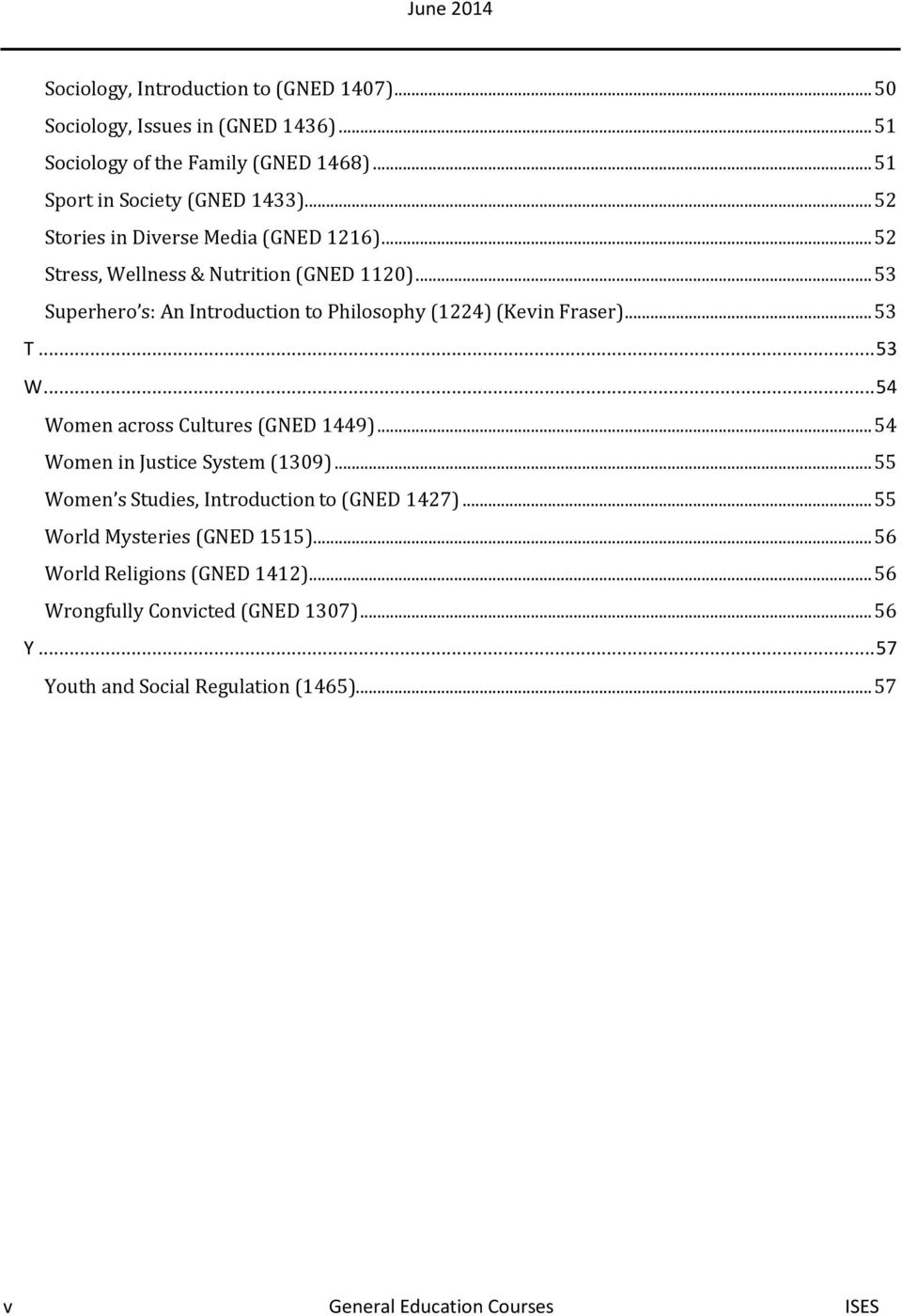
5 Sociology, Introduction to (GNED 1407) Sociology, Issues in (GNED 1436) Sociology of the Family (GNED 1468) Sport in Society (GNED 1433) Stories in Diverse Media (GNED 1216) Stress, Wellness & Nutrition (GNED 1120) Superhero s: An Introduction to Philosophy (1224) (Kevin Fraser) T W Women across Cultures (GNED 1449) Women in Justice System (1309) Women s Studies, Introduction to (GNED 1427) World Mysteries (GNED 1515) World Religions (GNED 1412) Wrongfully Convicted (GNED 1307) Y Youth and Social Regulation (1465) v General Education Courses ISES
6 A Aging, The Study of (GNED 1126) We are all growing older. Is there a limit to how long people can live? Can people influence their lifespan? This course will utilize a multi-disciplinary perspective to explore theories of aging, the physical and cognitive changes that occur during the aging process, the role of disease and other factors in aging, as well as methods used to study the aging process. The course will provide an understanding of factors that influence the aging process, issues facing gerontologists, and concerning end of life. PN11 DENT Alternate Dispute Resolution (GNED 1103) This course is designed to create an understanding of the nature of conflict. The origin of conflict, the escalation of conflict and the consequences of conflict will be examined. The course will as well look at the major dispute resolution systems and concepts in our society. Finally the course will create in students a personal understanding of how conflict may be addressed and resolved peacefully through personal awareness and making informed choices about how to approach conflict. POFD LCAD CTA OFLG Animated Film, History of (GNED 1209) Each class will focus on a particular decade in the chronology of development; a continuation of the decade-bydecade journey of animation cinema, technique, and content. Careful attention will be given to the pioneers and significant practitioners who have been pivotal in the development and growth of animation. Examples from countries across the world will be screened, discussed, compared and analyzed. Above all, the course will be a celebration of the marvel of the animated film, an artform that has changed so much, yet relies on the same principles that were applied before recorded time. 6 General Education Courses ISES

7 Appreciating Artistic Performance (GNED 1210) Students in this course will examine what is involved in the presentation of physical artistic performance. Various ranges of human movement and emotion, motivations and intent, and the impacts of production elements will be experienced, described and discussed. The course will conclude with students putting together summative pieces in the form of evaluations of theatrical and cinematic productions. Students will be evaluated using a combination of inclass written and experiential assignments, as well as cinematic evaluations and (depending on scheduling) an evaluation of a live theatrical production. Art and Aesthetics (GNED 1202) Art has a profound effect on our quality of life. What is considered art? Can everything that evokes an ooh or ah response from us be considered art? While examining various art forms such as architecture, painting, photography, music, cinema, script, and sculpture, students will be introduced to a broad spectrum of thought and competing perspectives on beauty and artistic expression. You may not consider it art, but it can still evoke feelings of astonishment and admiration. Assignments are interdisciplinary and interactive allowing students to use various skills to present their ideas. Art, History of (GNED 1206) This online course introduces visual literacy and art history with a focus on Modern Art of the 20th century. Students learn how to look at, talk about, and find meaning in a variety of art forms. We also discuss the historical context in which famous artists were working and how this influenced their art. There is an emphasis on sharing ideas through online discussion and debate. The wide range of interdisciplinary assignments allow for a variety of interesting and thought-provoking projects. 7 General Education Courses ISES

8 Astronomy: Exploring the Night Sky! (GNED 1509) Students in this course will examine celestial objects and phenomena that originate outside the atmosphere of Earth. Celestial objects such as our moon, sun, planets, stars, nebulae, meteoroids, asteroids, comets and galaxies will be explored. Students will use scientific inquiry to develop an understanding of how matter and energy influences our universe. Students will also uncover the mysteries behind how a telescope works, the Earth s seasons, and the evolution of stars. Students will be evaluated through research, small group discussions, and hands on activities. B Beauty: In the Eye of the Beholder (GNED 1440) Beauty is subjective and can be defined and influenced by a variety of different social and cultural factors. This course will explore beauty ideals across different cultures and time spans. How these changing beauty ideals influence the development of human relationships will also be examined. Big History: Story of the Universe (GNED 1520) (Mike Evans) Under development General Education Courses ISES

9 Black Holes to Toasters: How Stuff Works (1519) (Alexandra Penn) Students in this course will be introduced to the science behind how different stuff works, such as the role infrared radiation plays when using a toaster and how black holes are formed. Student inquiry and curiosity will guide the topics and scientific concepts covered in the course. Through research and discussion, students will use the scientific method to explore concepts and make connections between how a variety of stuff works. This course will explore topics such as energy, matter, density and gravity. Students will illustrate their understanding of the various topics through discussions, quizzes, case studies, research, and small group discussions. Rationale: This course encourages students to ask questions about the world they live in. Students interests will guide the direction of this course. Using the scientific method, students will be encouraged to ask questions and seek answers about our understanding of how the universe works. Developing and fostering a natural curiosity about our world will help students develop their critical thinking and problem solving skills. Black Studies, Introduction to (GNED 1429) This course is a survey of the Black Studies discipline including its social and academic origins, goals and development. Emphasis is placed on providing students with an understanding of the fundamental areas of study within the field and of the interdisciplinary approach to studying the African experience in North America and the world. Bodies of Art: Anthropological Perspective on Tattoos (1464) (Lori Russell) Under development General Education Courses ISES

10 Brand Experience, The (GNED 1417) This course illustrates how brands, by customizing the space in which you experience them, relate to your personality and influence your purchase decisions. Students examine spaces such as retail stores, malls, entertainment venues, architecture, exhibits, events and cyberspace in order to create their own projects relevant to the brand experience. Business Law (GNED 1425) This course is intended to provide a general background and overall understanding of those areas of law related to business. Business students will learn the importance of individual contribution both in creating good corporate citizenship and in enhancing their civic duties as Canadians. Students will link the Canadian legal system to the broader study of the historical development of law. The course will further assist business students in learning Canada s constitutional separation of powers as well as the Charter of Rights and Freedoms, the common law and the court system and procedure. Business students will gain the ability to identify potential legal problems including those based in contract and tort as well as human rights, health and safety, employment standards and the privacy of information within a business environment for which proper legal advice should be sought. 10 General Education Courses ISES

11 C Canadian Law (GNED1308) This course is designed to introduce the student to the historical context and operation of our legal system, to the institutions within the system, to the roles of persons within those institutions and to the process of thought which applies to current Canadian legal issues. Students in this course should gain a general understanding of how laws are defined, created, implemented and interpreted to give meaning and solutions to modern social problems. Students will apply the function of law in a practical manner through case scenarios and/or case analyses. Students will be assessed on the concepts introduced in the course through various assignments, a case study and tests. CTA LCAD OFLG POFD PSI EMCC GASF GAST Canada and the World (GNED 1430) The course will examine the connections and interactions between Canada and the rest of the globe from a historical perspective. Beginning with a look at our evolution to independence and the influence of Britain and America on our society, we will explore how Canada formed its current identity. Students will examine how Canada exerts itself around the world, from peacekeeping to climate change, oil exports and our relationship with the developing world. Canada, Searching for a Home in... (GNED 1217) Many Canadians are in search of a sense of home, whether they are recent immigrants, have been in Canada for many generations, or are part of First Nations society. Contemporary writers often consider what it means to be in between worlds: old and new, past and present, traditional and modern. Through a study of recent Canadian literature, students will investigate this process of loss and discovery as they critically examine the meaning of home. 11 General Education Courses ISES

12 Canadian Business Fundamentals (GNED 1421) Students will be introduced to business fundamentals and will explore the different aspects and issues that entrepreneurs and corporate leaders face on an ongoing basis. Students will reflect on both the opportunities and challenges found in today s business world; economic, business management and operations, marketing and financial. Through case studies and research students will examine these aspects and apply them accordingly. Canadian Government (GNED 1304) This introduction to Canadian Government provides a factual overview of all three levels of government in Canada. Although historical and institutional principles must be addressed, attention will be given to the broader economic, political and social contexts within which the government operates. Guest speakers from municipal, provincial and federal governments will provide a practical insight into government operations. CTA EMCC LCAD OFLG POFD PSI GASF GAST Canadian History Post-Confederation (1311) Canadian History Pre-Confederation (1310) To be developed 12 General Education Courses ISES
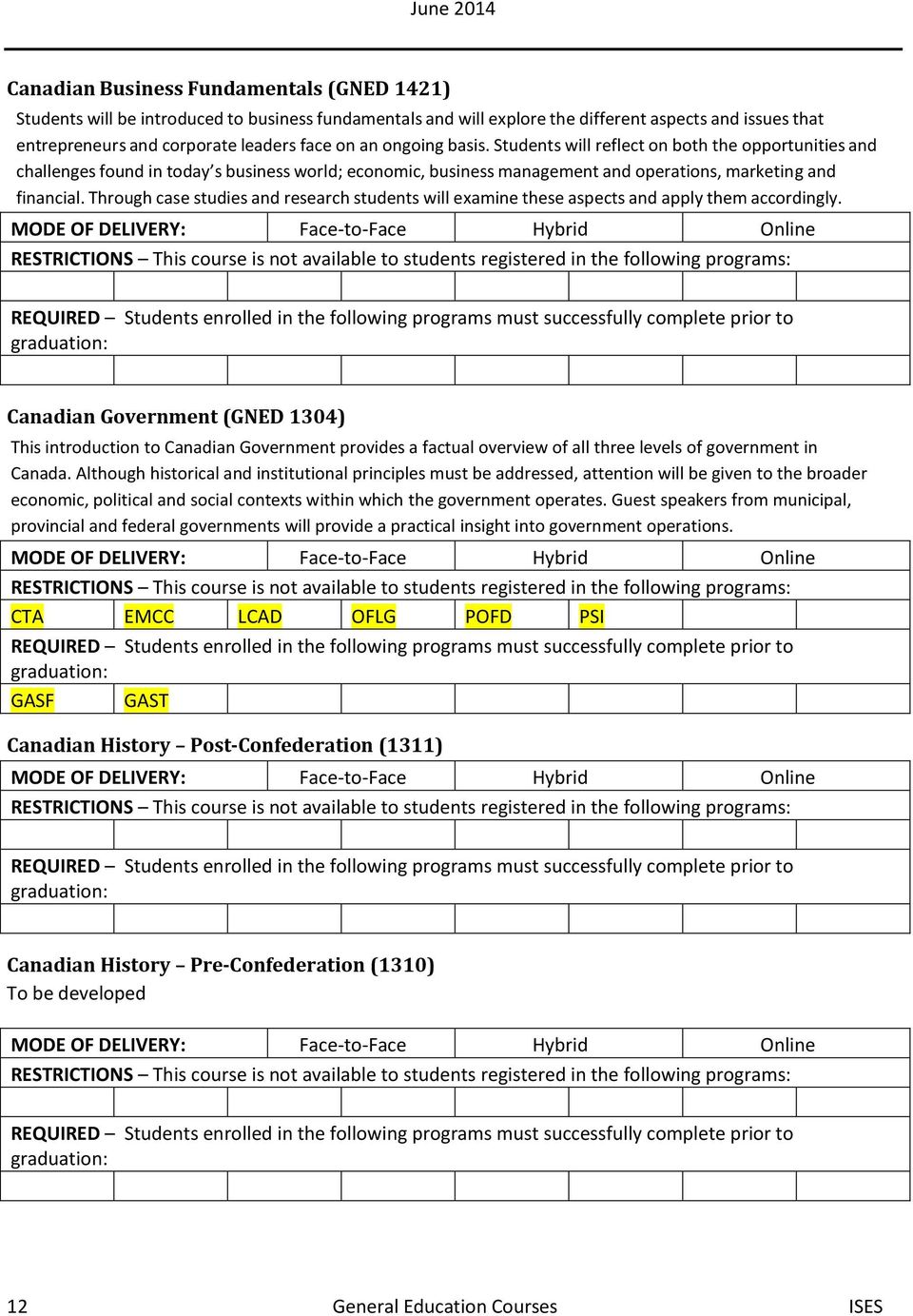
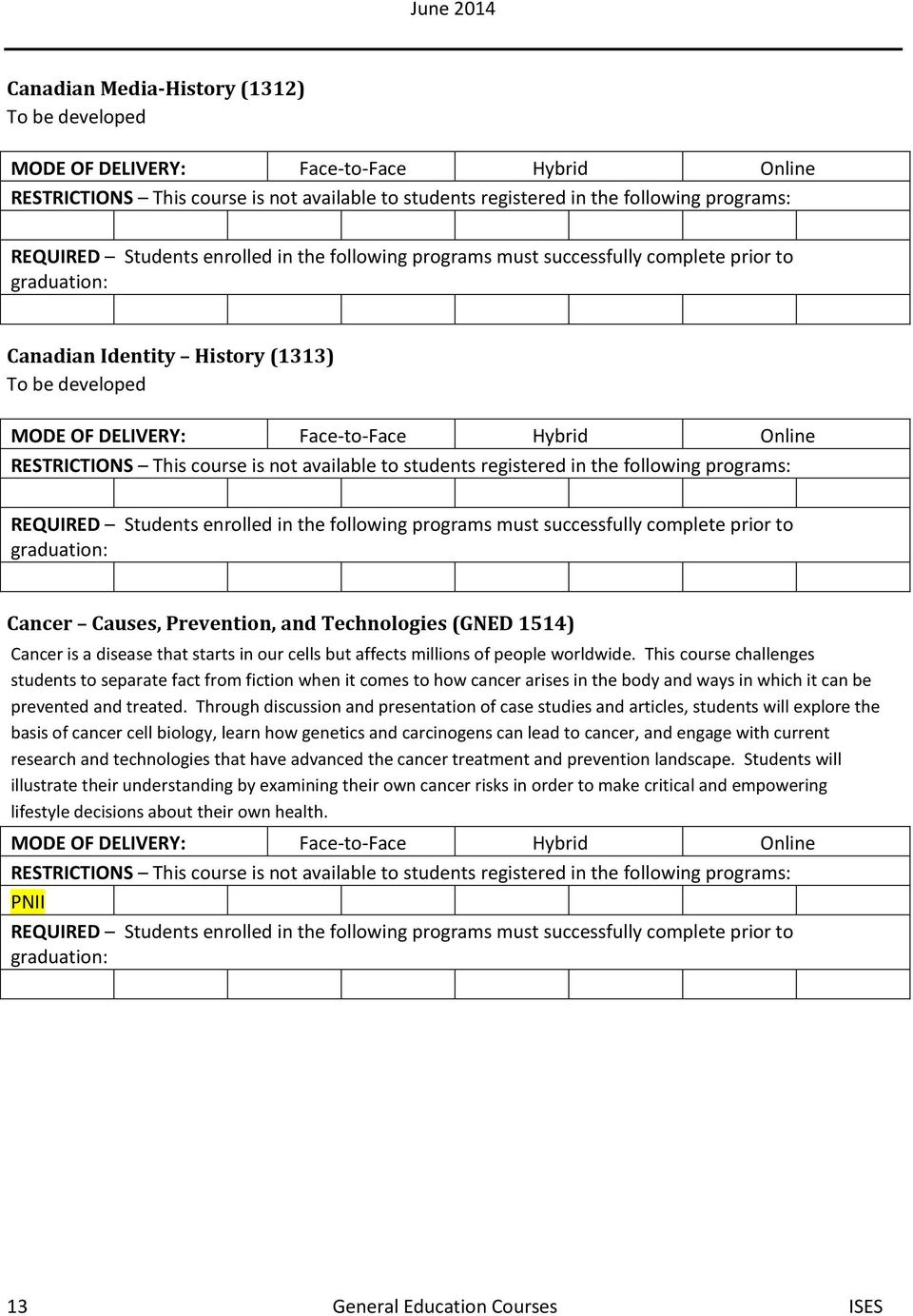
13 Canadian Media-History (1312) To be developed Canadian Identity History (1313) To be developed Cancer Causes, Prevention, and Technologies (GNED 1514) Cancer is a disease that starts in our cells but affects millions of people worldwide. This course challenges students to separate fact from fiction when it comes to how cancer arises in the body and ways in which it can be prevented and treated. Through discussion and presentation of case studies and articles, students will explore the basis of cancer cell biology, learn how genetics and carcinogens can lead to cancer, and engage with current research and technologies that have advanced the cancer treatment and prevention landscape. Students will illustrate their understanding by examining their own cancer risks in order to make critical and empowering lifestyle decisions about their own health. PNII 13 General Education Courses ISES
14 Children s Literature (GNED 1214) Do you remember your favorite bedtime story when you were a kid? Did you curl up and read a special book that made you feel safe or unique or powerful? Did a certain book when you were 7 or 8 years old make you feel like you belonged and were understood? Students will develop an in depth knowledge of the trends in Children s Literature and how children respond to them. Students will examine a global perspective on storytelling for children within different cultures. This course will give students a multi-faceted view of the stories that creates magic in the lives of children. Students will experience tests, journal writing, opinion processing and, oral presentations using written and verbal skills to analyze and evaluate course content. ECE Civic Life (GNED 1301) This course will provide students with an understanding of the structure and function of various levels of government including the municipal, provincial and federal level in Canada. Through the examination of the politics, policies, public administration, and machinery of the various levels of government students will gain an appreciation of the impact of these institutions on their daily lives. FIT POFD PSI CTA Classical Mythology (1221) Of all the traditions handed down by the Greeks and Romans, their mythology has been one of the most far-reaching and longest-lasting. It has inspired artists, writers, philosophers, composers and filmmakers from countless peoples over countless generations. The aim of this course is to help students acquire a familiarity with the principal classical myths, and the ways those myths are represented in Greek and Roman literature and art. A familiarity with this material will significantly enrich one s appreciation of art, literature and music, as well as provide fascinating insights into past and present western cultures. Rationale: Greek and Roman myths tell us much about how classical societies viewed and understood their world. In addition, they provide insights into the cultures that serve as the basis of much of Western Civilization. By gaining an appreciation of the Classical world-view, we can provide insight into modern perceptions of society, science, and religion. 14 General Education Courses ISES

15 Classical Philosophy (GNED 1129) Classical philosophy has had profound influences on the way we think reason and exchange ideas, how we develop new ideas and refine old ones, and how we discover the world around us and conceive of our place in it. Students in this course will engage in discussions of logic, ethics, theories of knowledge and reality, and theories of well-being and the good. They will come to appreciate the basis of much of Western thought, to understand how these issues continue to offer intellectual challenges for contemporary thinkers, and to develop strong analytical skills honed from having to critically evaluate their own beliefs in light of the arguments offered by classical philosophy. Students will be evaluated using a combination of tests, short assignments, in-class assignments and essays. GASA Critical Thinking The Science of Arguments (GNED 1123) The course investigates what an argument actually is and what makes good arguments credible. Students will develop the ability to identify strengths and flaws in arguments as well as develop their own persuasive arguments. Critical Thinking allows students to develop and apply a range of logical thinking and reasoning skills by studying the science and rules of arguments. Students will be able to apply these skills across a range of contexts. Critical thinking techniques will also help develop the areas of communication, problem solving, analysis and evaluation which can then be applied in all other programmes of study. Students will learn by applying the concepts of arguing to a range of subject matter from advertisements to scientific and legal arguments including examples from their own areas of study. 15 General Education Courses ISES

16 Conflict and Dispute Resolution (GNED 1118) Planning on working with people or taking on a leadership role in your job or simply want to live more peacefully? Students in the Conflict & Dispute Resolution course will understand the roots of conflict and how conflicts often escalate into disputes within personal and professional relationships. Students will be introduced to principles and models of dispute resolution including litigation, negotiation, mediation, arbitration, and restorative justice. Students will be evaluated on completion of online activities, tests, and critical reflections. This course is highly recommended for students who plan on entering professions that primarily work with people and/or students who aspire to work in a leadership/management position. POFD LCAD OFLG CTA Consumer Behaviour (GNED 1410) This course studies the process the consumer goes through in making purchase decisions. Strategies that enable marketers and the media to affect this process and the mechanisms they use to do so are analyzed and discussed. The course will assist students in becoming more effective marketers and sales professionals by helping them understand the processes and influences that drive the purchase behaviour in consumers. Contemporary Social Problems (GNED 1401) Students will analyze current social issues that challenge the values, beliefs and morals of contemporary society as well as their own. The topics range from smoking to euthanasia and from the impersonal to the personal. 16 General Education Courses ISES

17 Cultural Diversity in Canada (GNED 1426) Canadians differ greatly. We live in different regions and come from many ethnic backgrounds. Some of us are rich, others poor and most of us somewhere in the middle. We differ according to gender roles and sexual orientation. Some Canadians face physical and mental challenges that others do not. The goal of this course is to develop knowledge and appreciation of this diversity and to promote a fuller understanding of what it means to be Canadian. POFD PSI EMCC Cultural Studies - Film (GNED 1208) This course is a study of theoretical perspectives and debates in cinema and culture. Students focus on the cultural impact of cinema and how it impacts the audience, industry and reflective works. Students will be evaluated on their ability to research, analyze and present theories related to these topics. Current Affairs (GNED 1413) Current Affairs is about the world in which we live and the events that shape and influence our lives. Students will be introduced to important events that have happened during their lifetime, and whose repercussions will shape the world that they live in. Along the way, students will learn about the geography, politics, and history of some of the most active regions of the world. They will learn how to think critically, understand multiple sides of an issue, and come to logical conclusions about current events. 17 General Education Courses ISES

18 D Deviance (GNED 1435) Deviance is the study of actions and behaviours that violate social and legal rules and expectations. In this course we will explore and analyze a variety of theories to explain deviance and how deviant behaviour is classified. As a community of learners we will investigate interpersonal violence, self-destructive deviance, diverse lifestyles, substance use and abuse, and inequality in deviance. Through this investigation students will gain greater insight into diverse forms of deviance including family and school violence, suicide, mental disorders, alcoholism, serial murders, and sexual deviance. Digital Learner, The (GNED 1508) Students in this course will have opportunities to engage in digital learning while identifying the relationship between learning and digital technologies. Students will explore the significance of theoretical constructs of learning and how they apply to available tools. This course will provide individuals with an understanding of the theories behind digital learning as well as provide them with an opportunity to discuss the strengths and limitations of this field. Students will explore principles of learning and apply these to the digital world. The course will also focus on specific learning tools that can be used in educational practices. Dreams and Dreaming (GNED 1124) Examining the history, meaning and use of dreams in various cultures. Exploring modern approaches to the study of dream material, relation of dreams to: age, gender, social and cultural groups using content analysis, correlation of dream content to health. 18 General Education Courses ISES

19 E Environmental Protection and Global Wellness (GNED 1501) Learn more about the prominent environmental issues of our time. This course will focus on timely issues in the environmental field that present varying degrees of risk to the health of humans, ecosystems and our planet. It will be a look beyond the media headlines at the policies, politics and basic science of our most interesting environmental challenges. Topics will include climate change, arctic ecosystems, water conservation and water quality, endocrine disrupting substances (gender benders), renewable energy, resource depletion, the dilemma of pesticide use and natural toxins. The course will begin with a brief look at the responsibilities of the federal, provincial and municipal governments as they relate to environmental matters. Then, each issue will be considered in the Canadian and global context. Ethics in the Arts (GNED 1215) It has been said that the most difficult decisions in life are the ethical ones: those misty situations between what is clearly right and what is clearly wrong. Ethics can be defined as, It s not what you do when people are watching but what you do when they re not. Students in this course will examine ethical behavior as it applies throughout the various arts fields: live and recorded performance (theatre, music, dance, cinema), graphic arts (gallery and commercial art), and the communications media (radio, television, print, electronic/internet). Through a combination of theory and real-life case studies, students will apply a rational-thinking model to examine their position on these situations in life and in their future careers. 19 General Education Courses ISES

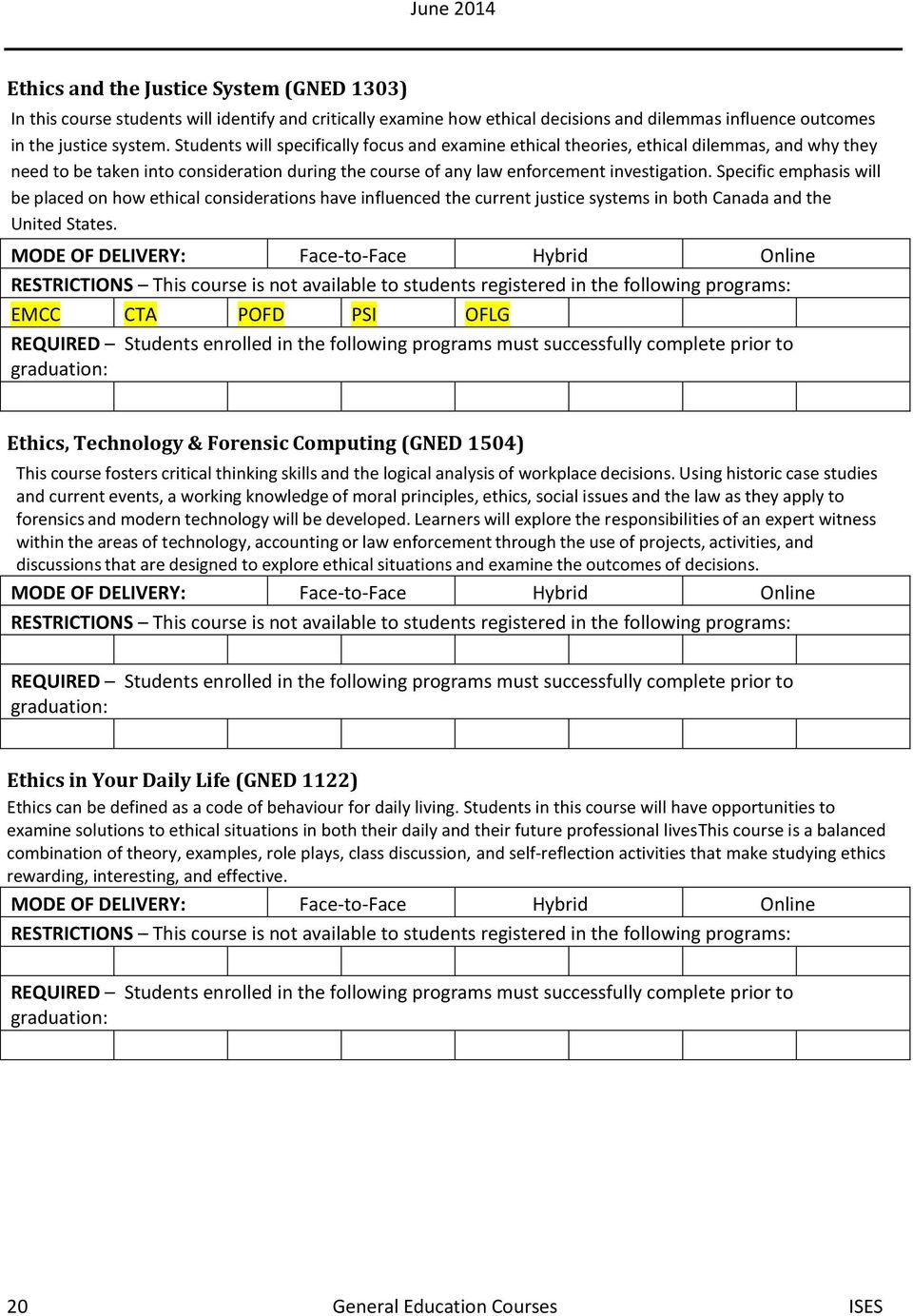
20 Ethics and the Justice System (GNED 1303) In this course students will identify and critically examine how ethical decisions and dilemmas influence outcomes in the justice system. Students will specifically focus and examine ethical theories, ethical dilemmas, and why they need to be taken into consideration during the course of any law enforcement investigation. Specific emphasis will be placed on how ethical considerations have influenced the current justice systems in both Canada and the United States. EMCC CTA POFD PSI OFLG Ethics, Technology & Forensic Computing (GNED 1504) This course fosters critical thinking skills and the logical analysis of workplace decisions. Using historic case studies and current events, a working knowledge of moral principles, ethics, social issues and the law as they apply to forensics and modern technology will be developed. Learners will explore the responsibilities of an expert witness within the areas of technology, accounting or law enforcement through the use of projects, activities, and discussions that are designed to explore ethical situations and examine the outcomes of decisions. Ethics in Your Daily Life (GNED 1122) Ethics can be defined as a code of behaviour for daily living. Students in this course will have opportunities to examine solutions to ethical situations in both their daily and their future professional livesthis course is a balanced combination of theory, examples, role plays, class discussion, and self-reflection activities that make studying ethics rewarding, interesting, and effective. 20 General Education Courses ISES
21 Exploring the Paranormal and Pseudoscience (GNED 1512) Students will learn to separate fact from fiction within topics such as astrology, ESP, telepathy, telekinesis, psychic use in criminal investigation, past-life regression, haunted houses, near-death experiences, fortune tellers, prophets (including Nostradamus and the Mayan calendar), superstitions, witchcraft, medical pseudosciences, and UFOlogy. What do you believe? Students will be evaluated using a combination of quizzes, assignments, and discussion and wiki contributions. F Fashion through the Decades (GNED 1443) Fashion is one of the most popular methods of expression. Fashion trends have varied greatly within society over time, and are influenced by occupation, age, culture, politics, socio-economic status, pop-culture, celebrities and music. From tightly-corseted torsos to mod fashion, loose-fitting hippie clothes to combat boots and body piercings, this course will examine men s and women s fashion trends through the decades, beginning with the 1900 s. By completing assignments and participation in a field trip, students will gain an understanding of how certain individuals, culture and politics have influenced various fashion trends over the decades. Fear (GNED 1137) Fear has robbed people of their true potential, and while we were made to soar like eagles many of us will end up scratching like chickens. This course aims to take a critical look at external factors in the media, society, and personal interactions that have contributed to this debilitating phenomenon known as fear. We will expose messages that we have received and look at how they have influenced the decisions we currently make. Students will evaluate external messages that have prohibiting them from achieving their true potential. Through online discussions, video analysis, article reviews, and self-reflective exercises, students will identify how fear is constructed. 21 General Education Courses ISES
22 Food for Thought (GNED 1441) Students in this course will focus on expanding knowledge of our continually changing food systems. There will be a focus on food as fundamental to the human experience, and will introduce students to the shifting interpretations, perspectives, challenges, and governance issues, and future visions that shape the study of food and food issues in Canada and around the world. By studying modern issues and developments surrounding our food systems, students will cultivate a new appreciation for where their fo od supply comes from, how it is brought to their plates, and how to make more conscious food choices that will benefit both themselves and the environment. Students in this course will be evaluated using a variety of methods including tests, assignments, and online discussions. DENT Fundamentals of Knowledge Management (GNED 1109) This course introduces students to businesses as Open Systems with Inputs, Processes and Outputs. Key to this concept is the knowledge of all stakeholders inside and outside of the organizational boundary of the business and their roles as well as the critical importance of knowledge management within the organization as a tool for effective management decision making. This course also covers a look at career paths and trends in the Information and Communications Technology (ICT) field. G Games, History of (GNED 1418) In this general education course, students are introduced to the historical evolution and impact of video games. This class explores the origins and evolution of games, as well as the key historical figures that have been so influential to this industry. It also explores the impact video games have had on society as they become more firmly entrenched in our lives and our culture. 22 General Education Courses ISES
23 Gardens, History of (GNED 1434) What is a garden? A garden can serve a wide variety of purposes, from supplying food through reflecting cultural values. This course examines the history of gardens, from the earliest Paradise gardens up to the eclectic variety of contemporary public and private gardens. The influence of culture, psychology, science, and business on garden styles and practices are explored through an examination of the great gardens of the past and present. Historic and currently prominent Canadian gardens and arboretums are emphasized. Gender and Sexuality (GNED 1125) This course will examine the social constructs of gender and sexuality in contemporary society. Students will explore concepts of gender socialization, social and cultural norms, identity politics, social deviance and sexual shaming. Through an interactive blend of lectures, discussions and debates, students will broaden and challenge their understanding of the role(s) of both gender and sexuality in media, politics, religion and popular culture. This course also seeks to analyze the shifting landscape of gender and sexual politics and its relevance in this particularly important, controversial time in human history. CYWK Genocide: Past and Present (GNED 1442) The destruction of specific cultural, ethnic and religious groups is not a new phenomenon. It has existed throughout recorded history; however, genocide is a relatively modern term, and is most often associated with the Holocaust. During this course, students will utilize collaborative and individual, active exploration of the topic. Using primary sources and selected readings and videos, students will explore major events in the history of genocide from 149 BC to present day. Students will come to understand how such events occur and how they continue to exist in the modern world, while increasing their awareness of the various global issues surrounding genocide. Students will be assessed through in-class and online discussions, a topic report, a group presentation and a final test. 23 General Education Courses ISES
24 Genocide, War Crimes and Justice in the 20 th Century (1463) (Richard Wiggers) Under development 2014 Global Warming (1513) This course will examine the current debate surrounding one of this generation s most pressing environmental issues global warming. Contextualized through contrasting view points, the course will begin by investigating the causes of both natural and human-influenced climate change, from historical temperature trends to our modern fossil fuel driven society. Through local and global case studies, students will then explore the potential short-term and long-term consequences of global warming to vulnerable species, ecosystems, agriculture, and human societies in both developing and developed nations. The course will conclude by analyzing the advantages and disadvantages of the possible solutions proposed by global warming believers and sceptics, including alternative and renewable energy strategies, national and international treaties, technological innovation, and lifestyle changes. Graphic Novels (GNED 1211) Haven't read a comic book in years or ever? Did you used to read Archie or Marvel comics? Have you made the transition to graphic novels? Students in this course will look at the history of pictorial literature, the shift from comic books to graphic novels, the cultural significance of its acceptance into mainstream North American society, and the stereotypes in and about this literature. We will explore the different facets and genres of the allencompassing term graphic novel as it has opened and created an environment where socially significant topics can be discussed. Students will be assessed using a variety of in-class and online assignments. 24 General Education Courses ISES
25 Greening Your Life: Becoming an Environmental Citizen (1521) (Shannon Webb) This course introduces students to basic, non-scientific environmental lifestyle changes that can help them improve their own lives and the environment around them. Students will learn about ways they can alter their lifestyle to lessen their impact on the Earth and live more harmoniously with the natural world. Students will learn through a variety of activities including written/video lectures, online readings, reflective exercises and interactive web-based activities. As an online course students will be expected to have access to a computer and the Internet and will be expected to complete some online research. H Happily Ever After (1223) (Ruth Rodgers) Most women alive today in western culture have grown up surrounded by a variety of movies focused on the princess myth. From Snow White (Disney, 1937) to Neytiri (Avatar, Cameron, 2009), these princesses continue to shape the worldview and identity of generations of young women. What messages do they send? This course will examine the influence of these cinema role models and explore how they have communicated cultural norms and expectations down through the decades. The course is suitable for all women and all those who live with, love, or parent, girls and young women. It will draw upon a variety of text and multimedia resources, and require the completion of several short quizzes, one major research project, and an open-book timed capstone assignment. Health Care in Canada (1431) To be developed 2014 DENT PNII 25 General Education Courses ISES
26 Hero s Journey: Frodo, Luke and Harry (GNED 1213) This course will examine the timeless and enduring theme of the hero s journey as expressed in The Lord of the Rings, Star Wars, and Harry Potter series. What is it about this narrative that continues to draw our imagination? What are its roots in ancient mythology and legend? What is the impact of the visualization capabilities of film on our experience of these stories? These questions will be examined through an exploration of legend, literature, and film. Familiarity with the stories of these three narratives (through books and/or movies) will be assumed the course will not require the student to read all the books. However, students will compare one of The Lord of the Rings or one of the Harry Potter books to the film version in relation to one aspect of the works under study. Hip Hop: History, Culture and Society (GNED 1438) Hip hop has become one of the most popular and influential forms of music currently listened to today. This course will examine hip hop s early roots in African history and its migration to American soil. From there, the course will chart the evolution of modern hip hop from its birth place in the Bronx up until the present day where it is now a global phenomenon. Along the way, the course will examine hip hop music and culture, and its complex relationship with power, business, class, gender, race and society. Students will also get a better grounding in the four foundational elements of hip hop: MCing, DJing, Graffiti and B-boying. The course will wrap up with an examination of the culture s current challenges and its future opportunities. History of Lacrosse (GNED 1467) Students will study the recorded history and oral tradition of the game of lacrosse. We will begin the journey at the beginning of the Creation Stories of the Haudenosaunee where the Creator s Game played a role in the future of mankind and how we would live on Turtle Island on Mother Earth. The game has been played by the First Nation s people for a millennium.we will gain an understanding of the spiritual side of the game as it was played for the entertainment of the Creator and the ritual that went in to each competition. It is these spiritual and cultural connotations that are unmatched by any other team sport and make it unique in the world of sport. We will focus on the great change from medicine game to Canada s National Summer Game. Lacrosse was the name given to the stick-ball game by the Jesuits and that has been its non-native name since the 1600 s. 26 General Education Courses ISES
27 .It is now enjoyed and participated in year-round competition by hundreds of thousands of Canadians. It has also become the fastest growing sport in North America, according to a recent Sports Illustrated article, where millions participate in all levels of competition as well. There are two professional leagues and it is well on its way to Olympic inclusion. Students will be evaluated by on-line discussion, researched written reflection, a group presentation and a summative paper. History of Music (GNED 1204) The history of Rock and Roll is synonymous with the history of popular music. Popular music has a number of elements: it appeals to a large percentage of the population; it is familiar and widely heard; and it is profitable. Leading up to the early 1950s, American music experienced the merging of a variety of musical styles that blurred racial, economic, geographic, cultural and class boundaries. According to historian Michael Campbell, the marketplace dictated the rules, for better or worse. The music became known as Rock and Roll and would reflect, and even shape, mainstream culture, politics and economics in America and abroad. Through readings, lectures, the use of historical audio and video recordings, discussions, and group work, students will examine the thematic growth of popular music, paying attention to music industry structure, technological innovations, and social and political impetus. 27 General Education Courses ISES
28 History of Western Civilization (GNED 1437) This course is designed to afford students of the opportunity to examine a series of events in Western History from the 16th Century to the present which helped shape the world in which we live. Both European and American history will be examined with an eye to helping us understand the complexities of modern western civilization. The emphasis throughout the course will focus on attempting to understand not only the events themselves, but more importantly, the impact on the course of western history both past and present. Critical thinking will be encouraged at every step of the way in this examination. History is not about memorizing facts, but rather centres on the understanding of the events under examination. Hockey: The First Century (GNED 1439) Students will study the evolution of ice hockey through topics such as the early years of ice hockey, the National Hockey League (NHL), international hockey, women s hockey, amateur hockey, hockey immortality and the office business of hockey. Students will be evaluated by in-class and on-line discussion, a researched written reflection, a photo assignment, a group presentation, and a summative paper. Human-Animal Bond, The (GNED 1113) The Human-Animal Bond is the dynamic relationship between people and animals. Each influences the psychological and physiological state of the other. By increasing our knowledge about this bond and by assessing how animals enrich our lives, we can improve the quality of life for both humans and animals. Wild, zoo, farm, and companion animals are an integral component of our culture and socioeconomic environment. Animal welfare, or the humane care of animals, is a societal responsibility. This course will explore the ethical and social relationship between humans and other animal species. Discussion topics will include A History of Animal Companions, Indigenous Spirit Totems, How Animals and Humans Heal Each Other, Animal Assisted Activities and Therapies, and Animal Welfare and Industry. The knowledge and experience gained from this course will be of great benefit to anyone entering professional fields such as veterinary technology, physical therapy assistants, counselling & social work. 28 General Education Courses ISES
29 Humanity s Destiny (GNED 1448) We all think about the future. Many of us have dreams for ourselves and our children. In an age when much can change in one lifetime, we may wonder: Where are we going? In this course, students look ahead within the context of the 21 st century and beyond, exploring challenges, dilemmas, and opportunities. Using projection technologies and drawing on examples from human history, contemporary futurists, and their own lives, students give concrete thought to their future and how their actions might affect future generations. Evaluations consist of contemporary and creative assignments that include a personal life plan, a written reflection on the enduring drivers of human progress, a dynamic summative project in a medium of their choice in which students imagine the world of the near future, as well as discussions, blogs, and live-answer quizzes. This course is also part of Durham College s global class. Human Diseases - Human Behaviour (GNED 1112) This course is designed to increase student understanding of basic principles that underlie ill health. Through practical examples, students will be introduced to important concepts and key research findings concerning specific chronic diseases and disabilities characterized with unique behaviour disorders. For each condition studied, a review of a healthy biological system will be followed by how the system is modified when experiencing an ailment. Human Relations (GNED 1108) In this introductory level course, students learn to apply knowledge of interpersonal relations and group dynamics to one-on-one and group situations. Emphasis will be placed on understanding, developing and improving effective interpersonal skills. EMCC OFLG POFD PSI 29 General Education Courses ISES
30 Human Resources Essentials (GNED 1420) This course is designed to expose students to the basic role and function of Human Resource Management within a business environment. The course will address current human resource challenges facing office management professionals. The following topics will provide students with an introductory level comprehension of human resource functions: strategy, equity and diversity, job analysis, employee involvement, recruitment and selection, training and development, appraisal, compensation, incentives, benefits, safety and health. I Ice Hockey, History of (GNED 1439) The purpose of this course is to study the historical evolution of ice hockey. This course will explore various aspects and origins of ice hockey such as the early years of ice hockey, the National Hockey League (NHL), international hockey, women s hockey, amateur hockey, hockey immortality and the off-ice business of hockey. This course will also aim to strengthen the learner s document use, reading, writing, oral communication, computer, thinking, and teamwork skills. Ideas, Adventures in (GNED 1416) This course will explore how ideas change the world: how they inspire, influence, and empower the individual to make a difference. Students will build on their existing understanding of trends in technology, music, movies, fashion, art, marketing, and leadership; in the form of projects, they will map adventures in ideas from the past, the present and into the future, identify variables which influence success, invent their own ideas, estimate their impact, and extrapolate how their own ideas can make a difference in their careers, their lives and the lives of others. 30 General Education Courses ISES
31 Intelligence (1131) Under development 2014 International Study Tour (1219) Underdevelopment Introduction to LGBTQ Studies (GNED 1444) This course offers an interdisciplinary introduction to the social, cultural, and political histories of lesbian, gay, bisexual, transgender and queer peoples in the Western world. It is intended that students will, on one hand, explore and come to appreciate the dynamics between sexual and gender minorities and the gender conformant and heterosexual majority and, on the other hand, investigate and come to understand how sexual identities are socially constructed and how sexual identities in turn intersect with other categories of identity such as race, gender, class, and ethnicity. The methods of evaluation for this course include: weekly in-class discussion, written reactions, quizzes, written analysis of a primary text and a final summative piece. 31 General Education Courses ISES
32 IT & Society (1505) This course presents a balanced look at the social implications of the use of computer technology. Students study a collection of articles, written by journalists, computer scientists, lawyers, economists, and academics, that examines both the benefits and the risks of Information Technology on society. One article by Neil Postman states, every technology has a philosophy which is given expression in how the technology makes people use their minds. Another article by Sherry Turkle states, computational objects do not simply do things for us, they do things to us as people The various articles address many themes including the economy, the work place, social participation, law, politics, education, the military, risk avoidance, international perspectives, the frontiers of computing, and the balance of risk and reward as these themes relate to computer technology and its influence on society. The course requires the students to do research, write a report, and produce multimedia resources on various topics, such as, virtual reality dating, online communities like Facebook or Second Life, video on demand sites like YouTube, file sharing using technologies like LimeWire or BitTorrents, Internet fame, etc. The course requires students to utilize collaboration tools, spreadsheets, and online surveys. L Law and Ethics (GNED 1402) This course will introduce students to the fundamental legal principles applicable to businesses in Canada. Students will gain an understanding of the Canadian Legal System, Dispute Resolution, Contract Law, Business Torts, Property Law, Employment Law, Intellectual Property Law, as well as the key distinctions between Civil and Criminal Law. Students will examine the legal theory in a practical manner through case scenarios. CTA EMCC LCAD OFLG POFD PPC PCI 32 General Education Courses ISES
33 Leadership and Motivation (GNED 1101) This course focuses on the role of the leader as a change agent ; that is one who facilitates movement in a desired direction. In this sense the effective leader is one who can cast vision, and have people embrace it in such a way that they are highly motivated to change their behaviour in order to see the vision achieved. The course will examine successful leadership principles, developing personal leadership skills, team-work and relationship building, as well as meaningful goal-setting. LGBTQ Studies, Introduction to (GNED 1455) Students will explore the social, cultural, and political history of lesbians, gay men and other sexual and gender minorities in the Western world with a focus on North American society. Students will confront moments of discrimination against sexual and gender minorities and learn to appreciate the ways in which past peoples have sought to regulate sexuality. Students will also explore how sexual and gender minorities have politically mobilized themselves to advocate for civil rights and how diverse lesbian and gay subcultures have developed and changed over time. Although in Canada, marriage rights have been extended to same-sex couples, the issue remains divisive; other Western liberal democracies continue to debate the question and therefore it s pertinent to give students the tools to properly contextualize this and other matters facing today s LGBTQ communities. Some theory will also be introduced so that students can better understand how identities and sexualities are socially constructed. 33 General Education Courses ISES
34 Literary Adaptations: From Text to Screen (GNED 1212) Have you ever read and loved a book only to watch in horror as the film/television adaptation destroys it? Have you watched a movie adaptation without having read the book and were compelled to read the original? This course will focus on different genres of literature and the screen adaptations that were inspired by them. Students will look into the role of the adaptations in either improving or misrepresenting the original literature. We will travel through a variety of genres (fairy tales to fiction) and choose one book and its screen adaptation from each. Students will be evaluated using a variety of in-class and online assignments. Literature (GNED 1201) This introductory English literature course is designed to help students develop or enhance their appreciation of literature. The course examines a variety of short stories with varied themes covering the last two centuries and considers the common elements of short and long fiction. Stories examined are authored by a wide range of international writers. In addition to participating in and leading discussions, students will have the opportunity to enhance their research, critical thinking, writing, and oral presentation skills. GASA Living Fit and Well (GNED 1114) Students in this course will learn that fitness and wellness play significant roles in determining one s quality of life and the vitality with which it is lived. Students will gain an understanding of the importance of physical activity and become increasingly aware that each person is responsible for their own fitness, wellness and overall health. Students will learn the foundational principles of exercise and increase awareness regarding the impact of health and wellness in daily life. Students will also implement various life skills, strategies and behaviours related to holistic wellness and vitality. Students will be assessed through a combination of fitness appraisals, independent personal physical activity, creation of a personal fitness program, implementation of a lifestyle change endeavor, in class tests, and ongoing journaling. Academic programs teach how to make a living. The Living Fit & Well course teaches how to live well! FIT OTPA EMCC POFD PPC PSI 34 General Education Courses ISES
35 M Making Monsters (GNED 1222) (Bryan Jordan) A society is defined by what it fears. From the inhuman shapes taken on by Jews in Nazi propaganda to the radio broadcasts likening Tutsis to cockroaches in Rwanda, governments throughout history have turned minorities into monsters in order to excuse terrible actions. This course aims to explore how and why monsters are created in societies. We begin by examining the mythology of several societies around the world to explore what their monsters say about what the societies they come from. Building on this, we will examine what it means to be a monster through fiction using movies and horror novels. The course will then focus on what it means to call a human a monster by examining examples from history where people were considered monsters. In addition, this course will use video games, role-play, and primary sources to understand how good people can be convinced to do bad things and become monsters themselves. Through discussion and reflection, students will learn the critical thinking skills to evaluate the messages they receive from government and media. Students will also develop a greater empathy with their fellow humans to resist the bigotry and violence associated with dehumanizing other human beings. Management & Leadership Skills (GNED 1104) This overview course is designed to provide participants with a beginning level understanding of management and leadership styles, and an opportunity to develop personal management skills. In today s changing economic and political climate, the role of a manager/supervisor is extremely demanding and complex. In addition to managing the many practical aspects of a business operation, he/she must provide leadership by motivating, empowering, and supporting staff. Topics include types of organizations, ethics, diversity, innovation, problem solving and team building skills. PPC 35 General Education Courses ISES
36 Marketing and Consumer Behaviour (GNED 1423) This course is designed to provide advertising students with an understanding of marketing principles and practices. In addition the course will examine consumer behaviour, i.e. why individuals acquire and consume goods and services. FIT Media Law and Ethics (GNED 1422) This course will explore two subject matters media law and media ethics. An introduction to Canadian law and legal procedure in areas likely to be encountered by the working media. Topics include a basic overview of our legal system's history and functioning, the key role played by our Charter of Rights and Freedoms, contempt of court, confidentiality of sources, defamation, copyright, privacy, access to information, police powers of search, seizure, and arrest, and court orders like injunctions and subpoenas. Students will analyze the major ethical issues facing journalists, including the public s right to know vs. an individual s right to privacy, free press vs. fair trial, community standards, becoming involved in the news, conflict of interest. Media, History of (GNED 1207) What is media? The earliest forms of communication were scribbles & various line drawings. Eventually by the 19 th century inventors sought to capture motion through science and film was born. Lectures will streamline the evolution of this incredible development from old to new. This subject will examine communication for a variety of purposes and lectures will be supported by class discussions and debates. 36 General Education Courses ISES
37 Modern Philosophy (GNED 1128) Students in this course will be placed amidst one of the great intellectual battles in history: the Rationalists vs. The Empiricists. This battle, couched in modern philosophy which is typically thought of as spanning from the 17th to 19th centuries, has spawned philosophical icons such as René Descartes, John Locke and David Hume. These philosophers dealt with concepts such as the existence of God and the nature of religion, freedom and free will, the nature of reality, and the scope and limits of human understanding. Students will develop a critical understanding of these issues, will hone their analytic skills by learning to uncover and question their own assumptions about these timeless themes, and will perhaps help to resolve some of these classic debates. Students will be evaluated through a combination of short assignments, in-class debates, tests, and essays. GASA Modern Warfare: Not a Game (GNED 1507) The development of technology that unites the globe also brings new and easier ways for crime and terrorism to wreak havoc on society. Students taking this course will develop an awareness of conflicts presently taking place, and how they affect politics, industry and life in general. This course explores the nature of these changes through online discussions, in-class debates, and with students researching and presenting a particular conflict in the last years. 37 General Education Courses ISES
38 Money Matters (GNED 1119) Should the government bailout car companies with your tax dollars? Why do we import beef from Argentina when we have lots here? Why does the Ontario government have such a large deficit and what is a deficit, anyway? Do you feel lost when presented with complicated financial news stories or discussion about the world economy? In this course, students will learn how having an effective personal financial plan has consequences which can impact all of the above; how understanding economic principles and developing sound financial knowledge, both personal and societal provide a significant role in comprehending global financial economy. Students in this course will be evaluated using quizzes, assignments, and online activities. Morality and Society (GNED 1445) Ethics is one of the main subdivisions of the discipline of philosophy. Ethics is action-oriented, and strives to answer the question What ought I to do? Students will undertake an examination of the major ethical theories, followed by an exploration of some of the most controversial moral issues facing Canada and the global community. Topics will include abortion, euthanasia, cloning, animal rights, global inequality, environmental issues, and more. Students will learn how to develop a personal moral outlook, evaluate the ethical positions of others, and analyze real-world ethical issues through the application of a ethical theories. Students will be evaluated using a combination of tests, written assignments, and debates. N Natural Disasters (GNED 1506) In this course students will be introduced to several major natural disasters, including earthquakes, tsunamis, volcanoes, tornadoes, hurricanes, ice storms, floods and avalanches. Students will research, prepare and demonstrate and understanding of why and how these natural disasters occur, and how the average person is affected. They will illustrate their understanding of the topic through essays and projects. 38 General Education Courses ISES
39 O Oral History: Telling Stories (GNED 1111) This project-based course will severe as a practical introduction to methods and techniques of gathering and documenting oral narratives. Students will learn to interview people in order to record, organize and present information relevant to specific historical, social, or other areas of research interest. In consultation with their professor students will produce a final oral history project such as video, digital [e.g., web page], report, or creative representation with an added written component [e.g., script with a written report], etc. Organized Crime (GNED 1466) This course will provide students with an understanding of organized crime, its structure and practices. Organizations including motorcycle gangs, Italian and Russian mafia and street gangs will all be examined and the businesses in which they run. Students will look at the development and history of organized crime as well as the government and law enforcement responses. Through a variety of readings, assignments and in-depth discussion; students will gain an understanding of theories used to explain the phenomenon of organized crime and will learn to think critically about some of the largely debated areas of organized crime. P Paramedic Leadership (GNED 1107) This course will focus on the nature of leadership and teamwork. Throughout the semester, students will review the different challenges one faces when working in teams and groups, developing strategies to manage them appropriately. Students will develop an awareness of how to act as both an effective leader and good follower. PPC 39 General Education Courses ISES
40 Philosophy: Life s Big Questions (GNED 1116) Students will gain an appreciation of classic philosophical problems, learn critical thinking and argument analysis skills, and develop new perspectives on life s big questions. This course is taught in a broad theoretical manner. Plagues, Poverty and People (GNED 1511) We live in an interconnected world amid killer germs, epidemics, and pandemics. Over the course of human history, these infectious diseases and pathogens have evolved across continents and peoples, and to this day, continues to influence the makeup of our human population and future generations to come. This course explores the origins and impact of plagues on human societies, past and present, from various social, cultural, and biological perspectives. Topics to be covered include both historical, e.g., the Black Death, Cholera, & Tuberculosis, and contemporary examples such as HIV/AIDS, Malaria, and the evolution of Antibiotic-Resistant Bacteria. To conclude the course, students will explore the current Diabetes / Obesity epidemic as well as Mental Health and Addiction disorders in contemporary Canadian society. Political Science (GNED 1302) This course provides an introduction to the democratic system of governing people in Canada. It includes a description of the organization of the three levels of government: federal, provincial and municipal. The interaction of each government level, democratic electoral systems and legislative processes are also discussed. The course includes the responsibilities of each level of government, the daily problems and issues facing Canadian citizens and the impact on law enforcement by public opinion, the media and special interest groups. CTA POFD PSI GASF GAST 40 General Education Courses ISES
41 Politics and Public Administration (GNED 1305) Police officers function daily in an environment of laws and administration, and they must react to the changing political and administrative practices and cultures of all three levels of government. This course provides students with a background in the development of modern management including public administration theory. Further students learn the workings of Canada s political institutions, including lawmaking and the creation of current legislation. CTA POFD PSI Pop Culture and the Media (GNED 1404) In this course, students will answer the question Why? by using cultural analysis to connect what s popular to what s going on in our society. By taking a closer look at the movies and television shows they watch, the clothes they wear and the music they listen to, students will endeavour to understand the role of popular culture in maintaining and reproducing the kind of society we live in. What messages are intended by the producers of mass media and what messages are received by the consumers? Popular culture will be investigated from a sociological perspective with an emphasis on North America with Canadian content as available. Pop Culture, Film & Society (GNED 1419) Have you ever wondered why one film captures audience attention over another? Why was that film special? What social factors contribute to its success? These questions and many more will be investigated in the analysis of how pop culture, film and society are intertwined and interrelated. 41 General Education Courses ISES
42 Popular Music, History of (GNED 1204) The history of Rock and Roll is synonymous with the history of popular music. Popular music has a number of elements: it appeals to a large percentage of the population; it is familiar and widely heard; and it is profitable. Leading up to the early 1950 s, American music experienced the merging of a variety of musical styles that blurred racial, economic, geographic, cultural and class boundaries. According to historian Michael Campbell, the marketplace dictated the rules, for better or worse. The music became known as Rock and Roll and would reflect, and even shape, mainstream culture, politics and economics in America and abroad. Through readings, lectures, the use of historical audio and video recordings, discussions and group work. Students will examine the thematic growth of popular music, paying attention to music industry structure, technological innovations and social and political impetus. Power Generation in Canada (GNED 1502) The participant will explore the current mix of power generation practices in Canada, the evolution of new technologies, and our choices for the future. In this course the student will explore the various technologies, with respect to the costs and risks involved pollution and supply issues, short and long-term impact, and supply and status issues. Topics will include hydrocarbon fuels, water power methods, various nuclear options, wind, solar, wave and tidal, geothermal and biomass. Also included will be a look at the problems of energy storage and conservation. The course will explore these choices that our government must make for future directions of energy management within the context of environmental and health issues, political and economic drivers, and global realities and responsibilities. 42 General Education Courses ISES
43 Power of Photography, The (GNED 1447) Anyone can take a picture! Photography, both still and video will continue to play a vital role in the world. Everyone has access to a digital recording device, be it Smartphone, Tablet or Camera). This course will examine the influence and effect that still photography and video have in society and also introduces students to the fundamentals and creative aspects of the art form. The course will provide a foundation of knowledge of how the power of the photographic image has and continues to be felt and inter-woven throughout society. An emphasis will be placed on discussion and debate regarding contemporary issues, morals and ethics of the digital imaging practices involved in producing images that can be used for persuasion, education, and propaganda. Students will also be instructed in the basic essential skills necessary to create good visual images that will enhance their ability to obtain success in many fields of employment. Principles of Justice (GNED 1306) This course will introduce students to question and consider the fundamental principles of justice in Canada. Students will gain an understanding of the Canadian Legal System, Dispute Resolution, Contract Law, Business Torts, Property Law, Employment Law, Intellectual Property Law, as well as the key distinctions between Civil and Criminal Law. Students will examine legal and ethical thinking in a practical manner through case scenarios. LCAD CTA POFD PSI Psychology as a Behavioural Science (GNED 1106) In this introductory level course, students learn basic psychological concepts including research methods, sensation, perception, states of consciousness, learning, memory, theories of personality, health and stress and psychological disorders. EMCC LCAD POFD PSI CTA GASA GASF GAST 43 General Education Courses ISES
44 Psychology as an Applied Science (GNED 1117) Psychology is the study of human behavior. This course is designed to increase student understanding of the basic principles that underlie behaviour. Through practical examples, students will be introduced to important psychological concepts and key research findings. The course examines such processes as: biology and behaviour, lifespan development and aging, cognition and language, personality, and abnormal behavior and treatment. EMCC LCAD POFD PSI CTA GASA GASF GAST Psychology of Humour (1115) Humour (and laughter by extension) has a number of important psychological functions. This class will explore topics such as: how we experience humour in the brain; why we laugh; how humour affects our bodies; how humour is used in our interactions with others; how a sense of humour develops and changes during the lifespan; the benefits of humour for mental and psychological health; humour s effects on memory; and humour s presence in language. Evaluations will consist of tests, an article summary, in-class activities and a research presentation. Psychology, Introduction to (GNED 1102) Psychology is the study of human behaviour. This course is designed to increase student understanding of the basic principles that underlie behaviour. Through practical examples, students will be introduced to important psychological concepts and key research findings. The course examines such processes as: biology and behaviour, sensation and perception, learning and memory, emotion and motivation, consciousness, and social psychology. POFD PSI EMCC CTA 44 General Education Courses ISES
45 Psychology and the Law (GNED 1409) This course introduces students to the basic vocabulary and principles of psychology and the law. It also investigates the major theories and research related to the scientific issues faced by psychologists and legal professionals. Students will be encouraged to develop an understanding of the principles that underlie human behaviour in a legal and/or criminal justice environment. In addition, students will gain some insight into how and why psychology and the law co-exist and the contributions both make in the study of human behaviour. A continuous attempt will be made to illustrate the theory with practical examples which are meaningful to students. The course examines the scientific process of research, forensic psychology, logistics of the legal system, psychology of crime and the psychology of victims. LCAD Q Quality Assurance & Control (GNED 1405) This is a one semester course covering various aspects of, and differences between, quality control and quality assurance. Focussing on the fact that quality has become a priority for many companies and many are certified to some type of quality standard. A brief history of the development of quality concepts will be covered; various quality standards will be studied along with quality measurable, problem solving techniques and continuous improvement. R Recreation & Leisure (GNED 1133) FIT 45 General Education Courses ISES
46 Rock & Roll: The Beat Goes On (1975-Present) (GNED 1203) Rock and Roll the Beat Goes On will examine how the simplistic rhythms used by today s rock artists and the powerful lyrics have impacted the social, cultural, financial and political climate of today s society. Although Rock and Roll continues to evolve with each generation, the time period we will concentrate on is from the mid 1970 s through post 9/11 and the mid 2000 s. The advent of new technology available to mass media may prove to make this the most profitable era in music history. Rock & Roll, Socially and Politically: The Early Years, The Impact of (GNED 1205) The Impact of Rock and Roll will examine the effect rock and roll music has had on us as individuals and how it has impacted the social, political and historical climate of today s society. Although Rock and Roll continues to evolve with each generation, the time period we will concentrate on is from the 1950 s through to the early 1970 s. The greatest verity of rock and roll styles ever produced was arguably during this time period, many of which are still going strong today. S Science-Fiction Movies: Everything I Needed to Learn About Life, I Learned from (GNED 1218) This course proposes an examination of the messages, methodologies and effect of Science Fiction films on popular consciousness over the past 50 years Big picture ideas will be examined through critical analysis of keynote films. Themes include personal growth and morality, political corruption, upheaval and decay, responses to technology, 46 General Education Courses ISES
47 Science, Issues & Ethics in (GNED 1503) This course examines the nature of science and some of the technologies that have been developed using the scientific process. Every new technology affects society in some way usually bringing hope as well as potential problems for the future. By studying technologies from an historical perspective to the present and into the future, students will be challenged to identify and analyze controversial issues associated with these developments. Topics include technologies relating to information and communication, biology and health (e.g. organ transplants, reproductive interventions, biotechnology and genetic engineering) and energy. Through discussions, research and presentations, students will acquire a basic understanding of ethics, critical thinking and decision-making as they relate to developments in science and technology. GASK GASZ Self and Social Interaction (GNED 1127) Examining who you are and how you interact investigating discourse and conversation, the sociology of symbolic words, emotions and the shaping of identity and subjective life in everyday contexts. Short History of the World (GNED 1403) Become a more global citizen by exploring the world as one planet through the broad patterns of our shared human history. Our past can reveal much about our present and future. Discover how the modern world was shaped, how globalization is taking hold, and what wisdom this can bring to your life and career choices. This is our story the human story. It is forward looking and thoroughly modern, an exciting and inspiring big-picture course that includes a student-designed website, dynamic communications-driven assignments, and an engaging talk show feature that brings the world to the classroom. 47 General Education Courses ISES
48 Skilled Workers: A Place in Society (GNED 1414) This course intends to give technology students an overview of the history and progress of skilled workers in our society. This subject is explored primarily through selections of the western world s great literature and modern media. Literature s most gifted artists have portrayed skilled workers differently depending on their society s prevailing perception. The literature based opinion of skilled workers has evolved from William Shakespeare s derogatory dismissal of the rude mechanicals in A Midsummer Night s Dream to D.H. Lawrence s sympathetic vision of coal miners in Odour of Chrysanthemums. Modern writers and media artists, sometimes skilled workers themselves, describe skilled workers as valuable respected members of society; whereas, William Blake, an engraver and brilliant poet, writing two-hundred years earlier was ostracized by his fellow artists due to his membership in the skilled workers class. Exploring society s perceptual evolution, eventual acceptance and current dependence on the skilled worker will impress upon the students the value of professionalism and educational diligence within their chosen skill. Social Innovation & Research (GNED 1428) This course has been designed to assist students in further developing their abilities to effectively evaluate information and hone their problem solving skills for the purposes of research, from a social innovation perspective. Students will gain a greater understanding of the impact of information on social interactions and decision making and will learn how information is used to spark innovation. Students will also explore the prevalence of misinformation and bias as is exits in the mainstream media and advertising. Students will also become aware of the essentials of social science research, gaining practice in how to locate and evaluate research, and make quality determinations based on an analysis of presented information. 48 General Education Courses ISES
49 Social Media and Society (GNED 1411) In a few short years, social media has profoundly changed the global communication landscape. With the advent of social media tools such Facebook, YouTube, Wikipedia, and Twitter, more and more people are connecting and collaborating online, and creating and distributing content in ways we have never seen before. This course will provide a summary of the major developments in social media and will examine how social media is changing media, business, government, the economy, development, and education in fundamental ways. Students will be introduced to a variety of social media environments and will gain hands-on experience with many of the leading social media applications. This course requires active participation of students and a willingness to immerse in social media practices. Social Spaces and Gathering Places (1450) Why do people pay hundreds of dollars to watch a sports game live when they can watch it on TV for free? Why go out for coffee when you can make it at home for a fraction of the cost? What is it about meeting in social spaces that serves our human interests? Where and why do people habitually gather together? We will consider these questions and more in this field trip-based course as we visit various social spaces and gathering places throughout the Greater Toronto Area. In lieu of a required course text, students will be expected to budget approximately $75 for field trip-related fees. This course is a delivered in a hybrid-delivery model and requires both online work and active participation in class. 49 General Education Courses ISES
50 Sociology and Canadian Society (GNED 1408) Sociology is the study of people and how they interact with each other and various social groups. This course deals with the study of people s lives, their relationships to society as a whole and how people are affected by the society in which they live. The concepts, theories and methods of the discipline will be introduced and discussed with particular emphasis on the dynamics of Canadian society and Canadian social problems. SSWK EMCC Sociology, Health and Illness (GNED 1406) Sociology of Health and Illness examines the social nature of the experience of health and illness. The focus of this course is an examination of contemporary issues and the social construction of health and illness relevant to the delivery of Canadian health care. Students are provided an opportunity to examine and explore social determinants of health and access to health care with attention to aspects of diversity such as gender, class, and culture. PNII Sociology, Introduction to (GNED 1407) Sociology is the study of people and how they interact with each other and various social groups. This course deals with the study of people's lives, their relationship to society as a whole, and how people are affected by the society in which they live. The concepts, theories and methods of the discipline will be introduced and discussed with particular emphasis on the dynamics of Canadian society and Canadian social problems. EMCC GASA GASF GAST 50 General Education Courses ISES
51 Sociology, Issues in (GNED 1436) The basic premise of sociology is that human existence is social existence. It is a diverse field, and Issues in Sociology will provide students with an understanding of sociology s unique perspectives, key concepts, and modes of exploring the social world. As well, Issues in Sociology will explore topics such as the interaction of people with each other and with various social groups, the environment and social change, gender issues, and health care and medicine. Concepts that will be explored include poverty, homelessness, issues affecting First Nations in Canada, population control, the environment and the impact of social media. EMCC GASA GASF GAST Sociology of the Family (GNED 1468) Studying family is very exciting because we all have personal experiences and opinions about family matters! Sociological research often challenges our opinions, perspectives and common sense explanations. This course is an introduction to the sociological analysis of families and marriages within the larger context of society. We will start by defining family and looking at the historical and current trends. We will also examine the role of gender on families and marriages and then discuss the concepts of friendship, affection, love, intimacy, work, sex and fertility. As a community of learners, we will discuss how people choose a partner and consider the adversities which many families experience, including violence and divorce. Throughout the course we will challenge our own biases and think critically about the concepts of family and marriage! CYWK SSWK DSWK 51 General Education Courses ISES
52 Sport History (GNED 1432) The purpose of this course is to study the history of sport, recreation, and leisure on Canada. By learning more about the sports and games played in Canada students learn more about what it is to be Canadian. History tell us about ourselves, our values, character, how we came to be what we are. This course takes a look at the gradual evolution of sport in Canada through individuals, events and other significant accomplishments. Other topics and themes will put the facts in the context of social history. Sport in Society (GNED 1433) Sport in Society provides students the opportunity to research and to discuss relevant societal issues within the context of sport. As future professionals in the sport industry, it is essential for students to recognize the diversity and uniqueness of given populations and to address these various populations needs. Topics include an introduction to sociological theories, philosophy and ethics and dialogue on sportsmanship, gender, race and ethnicity, youth in sport, media and sport, the future of sport, and current issues. Stories in Diverse Media (GNED 1216) This course will familiarize students with a selection of stories that traverse not only several types of art forms but also different historical and cultural moments. Why are some stories retold and others not? How does the medium in which something is expressed affect one s perception of a particular story? Investigating Greek myth, novels, plays, film, graphic novels, and television shows, the course explores several questions implied by the translation from one medium to another. 52 General Education Courses ISES
53 Stress, Wellness & Nutrition (GNED 1120) Stress can play a huge factor in our professional lives. Learning how to deal with it is vital to our long-term health. While stress alone doesn t cause disease, it triggers molecular changes throughout the body that make us more susceptible to many illnesses. In this course, students will gain an understanding of the importance of how to deal with both positive and negative stress in their lives. By using wellness perspectives, each student will gain more insight into how he or she can control both internal and external stressors. FIT PNII OTPA EMCC PPC POFD PSI Superhero s: An Introduction to Philosophy (1224) (Kevin Fraser) T The Invisible Disability (GNED 1446) Under development General Education Courses ISES
54 The Quest for Happiness (GNED 1132) Used to be Positive Psychology It could be said that one of the main goals in life is to be happy, but what exactly is happiness? Which life factors are related to happiness and which are not? Can we measure happiness? Most importantly, can we experience more happiness in our own lives? This course is designed to increase student understanding of happiness and personal well-being, as well as to promote the development of greater personal happiness. By the end of this course, students will not only be more informed about happiness, but hopefully transformed by happiness. Topics to be covered include health and wellness, optimism, mindfulness, gratitude, altruism, love and relationships, work, family, talents, and creativity. This course is presented through a combination of lectures, class exercises, class discussions, and selfexploration activities. Assignments will include online discussion postings, classroom activities, individual and group assignments, culminating in a final summative project. W Women across Cultures (GNED 1449) In this course students will look at the experiences of women globally, especially in developing countries. Topics that students will explore include status and power of women, their role in the home and the workplace, sexuality and reproduction, and issues (such as violence and female circumcision) and practices unique to certain countries. Exploring the aspects of women s lives globally is done by the consistent reference to the overall context of gender relations generally; thus the issues affecting women are examined in relation to the experience of their male counterparts. In addition, students will be encouraged to make comparisons between women s lives and situations in North America and the women s lives being explored in a global context. Students will be assessed using a combination of discussion board postings, assignments, tests, and projects. 54 General Education Courses ISES
55 Women in Justice System (1309) Most of the theoretical and empirical work discussed in criminology lectures, seminars, and textbooks is genderblind. In other words, women, girls, and their crime experiences are ignored or trivialized. The main objective of this course is to respond to this selective inattention by providing students with an in-depth interdisciplinary overview of key issues surrounding Canadian women s involvement in crime and the criminal justice system s response to their offenses. Students taking this course will become acquainted with topics such as the following: (a) popular myths and moral panics about female crime in Canada, (b) the nature, extent, distribution, and key sources of crimes committed by Canadian women and girls, (c) theories of female crime, (d) the Canadian criminal justice system s response to women and girls in conflict with the law, (e) girls and women as victims of crime in Canada, and (f) women working in the Canadian criminal justice system. Students will be evaluated using a combination of assignments, projects, (dicussion and debate) participation and tests. Women s Studies, Introduction to (GNED 1427) This course will provide students with an introduction to the study of women, feminism and the theories of oppression and privilege that exist in our society, particularly with respect to gender, sexuality, race, class and sexual orientation. Topics will include the history of the women s movement in North America, gender socialization, sexuality and intimacy, body image, and health and reproduction with an emphasis on the social institutions of the family, health care, the legal system, work and the economy, and the media. 55 General Education Courses ISES
56 World Mysteries (GNED 1515) Students will learn to separate fact from fiction within topics such as Stonehenge, the Taos hum, the Shroud of Turin, the ancient pyramids, the crystal skulls, the Mayan Ruins, the legend of Atlantis, the Bermuda Triangle, crop circles, the colony of Roanoke, and Easter Island. Select real-life unsolved criminal mysteries will also be examined including Jack the Ripper, Jimmy Hoffa, and the assassination of JFK. Although mystery topics are predetermined, students will also contribute to the selection. Students will be evaluated using a combination of quizzes, assignments, and discussion and wiki contributions. World Religions (GNED 1412) Why is the concept of religion a source of comfort for some and a source of conflict for others? Why do humans have religion? How did the concept of religion begin? How and why did religions develop and diversify? What are the current trends in religions of the world today? What does the future hold for humans and the concept of religion? How does having no religion fit into this discussion? Wrongfully Convicted (GNED 1307) Can you imagine being convicted and serving time in prison for a crime you did not commit? Students in this introductory course will use a variety of wrongfully convicted case scenarios to obtain a basic level understanding of the Canadian criminal justice system. Students will examine the roles and functions of each component of the system - police, courts, and corrections in relation to the system as a whole. They will analyze the overall effectiveness and efficiency of the system and will apply the function of law in a practical manner through case scenarios and/or case analyses. Students will also explore related contemporary issues, including public/private relationships in the law enforcement context, public involvement in criminal justice processes, restorative justice, and programs designed to reduce crime and rehabilitate offenders. Students will be evaluated using a combination of mind maps, in process (discussion and debate) participation, work sheets and related quizzes, a court assignment and a case study. POFD PSI 56 General Education Courses ISES
57 Y Youth and Social Regulation (1465) This course will explore how the bodies, minds, behaviors and social worlds of youth are regulated in society. This will include the regulation of youth through formal systems such as the criminal justice system (as both victims and offenders) and informal systems (subcultures and social spaces). Conversely, this course will also explore how youth themselves have played a role in shaping and regulating society, through social movements and activism. Students will be challenged to get active, by mobilizing for change within their communities toward a cause of their choice (mobilizing in person or through social media, and reporting back to the class). Through this course, students will gain an understanding of social and cultural themes in the regulation of youth, and will develop an awareness of how social regulation has helped shape their place in contemporary culture and society. POFD PSI 57 General Education Courses ISES
Courses in Communication (COMM)
 Courses in Communication (COMM) 101. (SPCH 1311) Introduction to Communication. (3-0). Credit 3. Survey of communication topics, research, and contexts of communicative practice; overview of communication
Associate of Arts Degree in General Studies
 1 Associate of Arts Degree in General Studies PROGRAM OUTCOMES AND COURSE DESCRIPTIONS PROGRAM OUTCOMES Oral and Written Communication - o Write and present research-based information in a clear and concise
Kansas Board of Regents Precollege Curriculum Courses Approved for University Admissions
 Kansas Board of Regents Precollege Curriculum Courses Approved for University Admissions Original Publication April 6, 2011 Revision Dates June 13, 2011 May 23, 2012 Kansas Board of Regents Precollege
Guidelines for Integrative Core Curriculum Themes and Perspectives Designations
 Guidelines for Integrative Core Curriculum Themes and Perspectives Designations The purpose of this document is to provide guidelines for faculty wishing to have new or existing courses carry Themes and
Course Book. Data for ELCC School Registration 2016/17
 Course Book Data for ELCC School Registration 2016/17 December 6 2015 1 Appleby College, Balmoral Hall, The Bishop Strachan School, Elmwood School, Havergal College, Hillfield Strathallan College, Northmount
Course Book. Data for ELCC School Registration 2015/16
 Course Book Data for ELCC School Registration 2015/16 Dec 1, 2014 1 Appleby College, Balmoral Hall, The Bishop Strachan School, Elmwood School, Havergal College, Hawthorne School, Hillfield Strathallan
COMMUNICATION. COMMRC 0005 INTERVIEWING AND INFORMATION GATHERING 3 cr. COMMRC 0310 RHETORICAL PROCESS 3 cr.
 COMMUNICATION COMMRC 0005 INTERVIEWING AND INFORMATION GATHERING 3 cr. Students are introduced to the fundamental principles of interviewing, including the interpersonal communication process, the structure
Community, Family and Child Studies Diploma Program
 School of Health and Human Services Community, Family and Child Studies Diploma Program 2011 Page 1 of 21 Program Philosophy We believe we have a collective responsibility to create a just society. We
COMM - Communication (COMM)
 Texas A&M University 1 COMM - Communication (COMM) COMM 101 Introduction to Communication (SPCH 1311) Introduction to Communication. Survey of communication topics, research, and contexts of communicative
Standards for Certification in Early Childhood Education [26.110-26.270]
![Standards for Certification in Early Childhood Education [26.110-26.270]](/thumbs/24/3436110.jpg "Standards for Certification in Early Childhood Education [26.110-26.270]") I.B. SPECIFIC TEACHING FIELDS Standards for Certification in Early Childhood Education [26.110-26.270] STANDARD 1 Curriculum The competent early childhood teacher understands and demonstrates the central
I.B. SPECIFIC TEACHING FIELDS Standards for Certification in Early Childhood Education [26.110-26.270] STANDARD 1 Curriculum The competent early childhood teacher understands and demonstrates the central
700.B0. Dawson College. Liberal Arts
 5 700.B0 Dawson College Liberal Arts Dawson College P R O G RA M i n fo r m at I O N Liberal Arts is an Honours pre-university program based on the belief in disciplined learning. The curriculum is composed
How To Take A Minor
 Make a Major difference to your degree. Flexible Learning at Southampton 2 Studying a Minor subject allows you to broaden your educational experience Make a Major difference to your degree by choosing
Child and Youth Care Worker
 PROGRAM OBJECTIVES The Child and Youth Care Worker Program is designed to teach students the necessary practical skills and theory to work with adolescents, children and families with challenging needs
THE UNIVERSITY OF HONG KONG FACULTY OF SOCIAL SCIENCES
 THE UNVERSTY OF HONG KONG FACULTY OF SOCAL SCENCES Courses offered to Exchange/Visiting Students in the 2010-2011 Academic Year For course details, please refer to the Departmental Link Department of Geography
Program of Study: Bachelor of Science in Health Care Administration
 Program of Study: Bachelor of Science in Administration Program Description The Bachelor of Science in Administration (BSHA) is an undergraduate professional degree designed to prepare students for entry-level
Sky Academy Skills Studios Livingston: Curriculum Matrix
 Sky Academy Skills Studios Livingston: Matrix Sky Academy Skills Studios Topics: summary of topics and curriculum areas 1 Animal Rights = Health and and Science 2 Celebrity Culture = Health and and Social
Communication Classes
 Communication Classes 100. Introduction to Communication and Rhetoric. (3h) Introduction to the theories, research, and analysis of verbal and nonverbal processes by which human beings share meanings and
Religious education. Programme of study (non-statutory) for key stage 3. (This is an extract from The National Curriculum 2007)
 Religious education Programme of study (non-statutory) for key stage 3 and attainment targets (This is an extract from The National Curriculum 2007) Crown copyright 2007 Qualifications and Curriculum Authority
Proposed Minor in Media Studies. Department of Communication. University of Utah
 Proposed Minor in Media Studies Department of Communication University of Utah The minor in Media Studies is designed to serve students who have interests and/or needs to develop enhanced knowledge related
Apparel Design and Merchandising (bulletin.sfsu.edu/colleges/health-social-sciences/consumer-family-studies-dietetics): Bachelor s Degree
 1 Academic Programs A (p. 1) B (p. 1) C (p. 2) D (p. 3) E (p. 3) F (p. 4) G (p. 4) H (p. 5) I (p. 5) J (p. 5) K (p. 5) L (p. 5) M (p. 6) N (p. 6) O (p. 6) P (p. 6) R (p. 7) S (p. 7) T (p. 8) U (p. 8) V
General Education Requirements
 University of Missouri - Kansas City 1 General Education Requirements UMKC General Education Core UMKC General Education Core Website (http://www.umkc.edu/core) General Education Learning Outcomes http://www.umkc.edu/core/about/outcomes.cfm
Indexes to Search for Journal Articles
 Indexes to Search for Journal Articles General Academic Search Premier Notes: Covers topics in many disciplines, full-text database designed specifically for academic institutions. Social Sciences and
2014-15 College-wide Goal Assessment Plans (SoA&S Assessment Coordinator September 24, 2015)
 2014-15 College-wide Goal Assessment Plans (SoA&S Assessment Coordinator September 24, 2015) College-wide Goal 1: Intellectual Engagement PG1 Students will demonstrate the ability to think critically and
General Education Courses
 General Education Courses Offered All bachelor degree programs require fifteen (15) credit hours of general education courses. Bachelor Degree students are required to take Safety and Health in the Workplace,
UPS 411.201 GENERAL EDUCATION: GOALS FOR STUDENT LEARNING
 University Policy Statement California State University, Fullerton GENERAL EDUCATION: GOALS FOR STUDENT LEARNING The Goals of General Education General education is central to a university education, and
Curriculum & Courses. I. General Foundations (all courses required) II. Content Area Foundations (select one course from 4 out of 5 areas)
 Curriculum & Courses The department of psychology offers a major and a minor in psychology. Both of these are designed to expose students to the various branches of psychology (e.g. developmental, social,
Tennessee Board of Regents. Proposal for the Establishment of a Lower Division General Education Core
 Tennessee Board of Regents Proposal for the Establishment of a Lower Division General Education Core Created by: The Ad Hoc Committee charged to Establish a Lower Division General Education Core Curriculum
Behavioral Sciences INDIVIDUAL PROGRAM INFORMATION 2015 2016. 866.Macomb1 (866.622.6621) www.macomb.edu
 Behavioral Sciences INDIVIDUAL PROGRAM INFORMATION 2015 2016 866.Macomb1 (866.622.6621) www.macomb.edu Behavioral Sciences CREDENTIAL TITLE PROGRAM OPTIONS CREDIT HOURS REQUIRED Certificate Behavioral
The MiraCosta Community College District s programs are consistent with the college s mission, vision, and core values.
 ADMINISTRATIVE PROCEDURE 4025: Philosophy and Criteria for Associate Degrees and General Education The MiraCosta Community College District s programs are consistent with the college s mission, vision,
Is the General Education program purpose congruent with the overall mission of the institution?
 Where do we start? MODELS OF GENERAL EDUCATION The best General Education Program is not based simply on choosing specific goals or finding the perfect model. The best program is one that is aligned with
College of Arts & Sciences Goals
 College of Arts & Sciences Goals 1.) Demonstrated ability to engage in critical thinking appropriate to the discipline. 2.) Demonstrated ability to use the information literacy skills, including research
Council on Social Work Education. Curriculum Policy Statement for Baccalaureate Degree Programs in Social Work Education
 Council on Social Work Education Curriculum Policy Statement for Baccalaureate Degree Programs in Social Work Education B1.0 SCOPE AND INTENT OF THE CURRICULUM POLICY STATEMENT B1.1 This document sets
FA 101: Introduction to Film. FA 257: Literature into Film
 Humanities Department Telephone (541) 383-7520 FA 101: Introduction to Film Outcome 1: Will be able to identify and explain the different languages of filmmaking, including cinematography, editing, mise-en-scene
Undergraduate Psychology Major Learning Goals and Outcomes i
 Undergraduate Psychology Major Learning Goals and Outcomes i Goal 1: Knowledge Base of Psychology Demonstrate familiarity with the major concepts, theoretical perspectives, empirical findings, and historical
COMMUNICATION STUDIES
 COMMUNICATION STUDIES Department Office: MUSIC 104 Phone (323) 343-4200 Fax (323) 343-6467 The Department of Communication Studies offers undergraduate programs leading to Bachelor of Arts degrees in TV,
NATIONAL STANDARDS Lesson 1: Healthy Me!
 NATIONAL STANDARDS ers HEALTH EDUCATION STANDARDS (GRADES 3-5) Source: National Health Education Standards, Achieving Excellence, Second Edition (2007), Joint Committee on National Health Education Standards
Master of Arts, Counseling Psychology Course Descriptions
 Master of Arts, Counseling Psychology Course Descriptions Advanced Theories of Counseling & Intervention (3 credits) This course addresses the theoretical approaches used in counseling, therapy and intervention.
Liberal Arts with an Emphasis in Arts and Humanities Associate in Arts Degree
 Liberal Arts with an Emphasis in Arts and Humanities Associate in Arts Degree The A.A. in Liberal Arts with an emphasis in Arts and Humanities provides students with a broad perspective on culture and
Criminal Justice - Law Enforcement
 Criminal Justice - Law Enforcement Dr. Charles Adair, Acting Chair Criminal Justice Department [email protected] 631-420-2692 School of Arts & Sciences Associate in Science Degree The goal of this
Quality for All and All for Quality
 Quality for All and All for Quality The motto above, Quality for All and All for Quality, was designed to represent all we stand for and value. It is the essence of our mission statement which itself encompasses
Oklahoma 2015-2016 Supplemental Online Course Informa on* Contact your local school district to enroll. Course Title Discipline Grade Levels
 101 Ways to Write a Short Story Language Arts 07,08,09,10,11,12 10th-Grade English Language Arts 10 11th-Grade English Language Arts 11 12th-Grade English Language Arts 12 1960s America Social Studies
COURSE TITLE COURSE DESCRIPTION
 COURSE TITLE COURSE DESCRIPTION CA-00X COMMUNICATION EXIT INTERVIEW All graduating students are required to meet with their department chairperson/program director to finalize requirements for degree completion.
Religious education. Programme of study (non-statutory) for key stage 4. (This is an extract from The National Curriculum 2007)
 Religious education Programme of study (non-statutory) for key stage 4 and years 12 and 13 (This is an extract from The National Curriculum 2007) Crown copyright 2007 Qualifications and Curriculum Authority
Bachelor of Arts Degree Completion Program in Psychology
 Bachelor of Arts Degree Completion Program in B.A. Degree Completion Program in Program Prerequisites: PSY 101 General and a minimum G.P.A. of 2.5. major program: 36 credits Description: is the scientific
Digital Photography and Imaging
 Digital Photography and Imaging Section B.93 12/16/2015 Ontario College Diploma (2 Years - 4 Semesters ) (1093) 705.759.6700 : 1.800.461.2260 : www.saultcollege.ca : Sault Ste. Marie, ON, Canada PROGRAM
Leeds Beckett University Graduation 2015
 Leeds Beckett University Graduation 2015 Faculty of Health & Social Sciences Monday 20 July 2015, 11am School of Social, Psychological & Communication Sciences Certificate International Relations & Global
College of Arts and Sciences
 2014-2015 Creighton University Catalog 1 College of Arts and Sciences Goals of a Liberal Education Creighton University s College of Arts and Sciences offers a liberal education whose primary goal is encouraging
Sociology SOCIOLOGY. 2015-16 Sacramento City College Catalog. Degree: A.A. Sociology AA-T Sociology for Transfer
 SOC Degree: A.A. AA-T for Transfer Division of Behavioral and Social Science Dr. Carl-Petter Sjovold, Interim Dean Rodda North 226 916-558-2401 Associate in Arts Degree The major is designed to prepare
G u i d e l i n e s f o r K12 Global C l i m a t e Change Education
 G u i d e l i n e s f o r K12 Global C l i m a t e Change Education Adapted by: by the National Wildlife Federation from the Environmental Education Guidelines for Excellence of the North American Association
A-H 106 RENAISSANCE THROUGH MODERN ART. (3) Historical development of Western art and architecture from the fourteenth century through the present.
 101 INTRODUCTION TO VISUAL STUDIES. (3) The course introduces students to the concepts and techniques of visual literacy. It explores a full spectrum of man-made visual forms encountered by contemporary
Bachelor of Arts Degree Completion Program in Psychology 2014-2016
 Bachelor of Arts Degree Completion Program in 2014-2016 B.A. Degree Completion Program in Program Prerequisites: PSY 101 General and a minimum G.P.A. of 2.5. major program: 36 credits Description: is the
Curriculum Handbook. 7. General Education Requirements
 Curriculum Handbook 7. General Education Requirements Overview This section outlines the standards for courses proposed to meet General Education Requirements for: Napa Valley College General Education
Second International Conference on Health Promotion, Adelaide, South Australia, 5-9 April 1998
 Second International Conference on Health Promotion, Adelaide, South Australia, 5-9 April 1998 Adelaide Recommendations on Healthy Public Policy (WHO/HPR/HEP/95.2) The adoption of the Declaration of Alma-Ata
Honours Political Science, Law and Politics Specialization
 Department of Political Science Honours Political Science, Law and Politics Specialization This program offers a specialized concentration of learning within the four-year Honours Political Science degree.
MN TRANSFER CURRICULUM
 MN TRANSFER CURRICULUM The Minnesota Transfer Curriculum (MnTC) is the format in which general education is accomplished within the public two- and four-year colleges and universities in Minnesota. The
The Wisconsin Comprehensive School Counseling Model Student Content Standards. Student Content Standards
 The Wisconsin Comprehensive School Counseling Model Student Content Standards The Wisconsin Comprehensive School Counseling Model builds the content of developmental school counseling programs around nine
Program of Study: Bachelor of Science in Counseling with an Emphasis in Addiction, Chemical Dependency, and Substance Abuse
 Program of Study: Bachelor of Science in with an Emphasis in Addiction, Dependency, and Substance Abuse Program Description The Bachelor of Science in with an Emphasis in Addiction, Dependency, and Substance
Community and Leadership Development
 # 100 INTRODUCTION TO COMMUNITY AND LEADERSHIP DEVELOPMENT. (1) The course explores how communities of place and interest influence our lives and how these different types of communities are related to
2015-2016 Academic Catalog
 2015-2016 Academic Catalog Communication Studies Associate Professors: Parry (Chair) Assistant Professors: Knight, Lyons, Hammer, Sullivan Visiting Assistant Professors: Famiglietti The BA in Communication
A-H 106 RENAISSANCE THROUGH MODERN ART. (3) Historical development of Western art and architecture from the fourteenth century through the present.
 # 101 INTRODUCTION TO VISUAL STUDIES. (3) The course introduces students to the concepts and techniques of visual literacy. It explores a full spectrum of man-made visual forms encountered by contemporary
Nursing 8 Courses (27 Credits)
 Houston Baptist University s RN to BSN Program allows you to efficiently complete your bachelor s degree, most often in one to two years. A typical student will take approximately 16 courses in total,
Appendix A: Assessment Plans
 Appendix A: Assessment s * Assessment for all programs is ongoing, but will not be reported until at least 5 students have graduated with minor. dates are blank for now, but will be changed once programs
Community and Leadership Development
 100 INTRODUCTION TO COMMUNITY AND LEADERSHIP DEVELOPMENT. (1) The course explores how communities of place and interest influence our lives and how these different types of communities are related to the
Creative Platforms: Online Writing, Branding and Social Media (Level 4)
 Creative Platforms: Online Writing, Branding and Social Media (Level 4) Students on this course will explore and experiment with a range of Creative Platforms Online Writing, Branding and Social Media.
How To Get A Degree In History
 Barstow Community College Catalog Addendum 2014-2015 Associates in Arts in Art History for Transfer Degree The Associate in Arts in Art History for Transfer (AA-T) prepares students for transfer to four-year
Acceptable Complementary Studies Electives 2015/2016 Fall & Winter Terms
 Acceptable Complementary Studies Electives 2015/2016 Fall & Winter Terms Please read this note carefully before reviewing the list: Many of these courses require upper year standing and course prerequisites,
Bachelor of Arts Degree Completion Program in Psychology
 Bachelor of Arts Degree Completion Program in 2015-2017 B.A. Degree Completion Program in Program Prerequisites: Associate s degree and a minimum G.P.A. of 2.5. 42 residency credits are required for an
Art Art History From photos on our cellphones to billboards towering over highways, from fine art hanging in museums to videos streaming online, we
 & Art Art History From photos on our cellphones to billboards towering over highways, from fine art hanging in museums to videos streaming online, we live in an intensely visual world. Studying art and
AUSTRALIAN INSTITUTE OF MUSIC (AIM) UNIT DESCRIPTIONS: BACHELOR OF ENTERTAINMENT MGMT STAGE 1: FOUNDATION STAGE (TRIMESTER 1)
 STAGE 1: FOUNDATION STAGE (TRIMESTER 1) Introduction to Arts and Entertainment Management (M1AE1) Provides a broad overview of the arts and entertainment industry. Industry trends are examined such as
Metropolitan State University of Denver Master of Social Work Program Field Evaluation
 Metropolitan State University of Denver Master of Social Work Program Evaluation Date: Agency/Program Task Supervisor Faculty Liaison Total Hours Completed To Date for this semester: s will not receive
Digital Film Production
 Digital Film Production Section B.92 2/13/2016 Ontario College Diploma (2 Years - 4 Semesters ) (1097) 705.759.6700 : 1.800.461.2260 : www.saultcollege.ca : Sault Ste. Marie, ON, Canada PROGRAM OVERVIEW
Course Descriptions for the Business Management Program
 Course Descriptions for the Business Management Program Upon completion of two quarters, students will earn a Professional Certificate in Business Management with a specialization in a chosen area: HR,
ONE PrOgrams. Contact. First Year Learning Options. U of T St. George, Faculty of Arts & Science U of T Mississauga U of T Scarborough
 Contact U of T St. George, U of T Mississauga U of T Scarborough innis one www.utoronto.ca/innis new one www.newcollege.utoronto.ca smc one http://stmikes.utoronto.ca trinity one www.trinity.utoronto.ca
Acceptable Complementary Studies Electives 2016/2017 Fall & Winter Terms
 Acceptable Complementary Studies Electives 2016/2017 Fall & Winter Terms Please read this note carefully before reviewing the list: Many of these courses require upper year standing and course prerequisites,
Afro-American Studies Afro-American Studies B.A. Afro-American Studies M.A.
 Interdepartmental Degree Programs Program African Studies African Studies African Studies M.A. u/idps/africanstudies/ Afro-American Studies www.bunchecenter.ucla.e du/ The African Studies minor is designed
And. ENGL 101: College English I must take the Professional Purposes Pa
 HKU SPACE COMMUNITY COLLEGE WICHITA STATE UNIVERSITY ASSOCIATE DEGREE PROGRAM 83 11000: General English I No credit - Remedial 83 11200A: General English II No credit - Remedial 83 11200B: Foundations
UTAH STATE UNIVERSITY. Professional School Guidance Counselor Education Program Mapping
 UTAH STATE UNIVERSITY Professional School Guidance Counselor Education Program Mapping Course Key: PSY 6130 Evidence-Based Practice: School Intervention PSY 6240 Comprehensive School Counseling Programs
THE DEPARTMENT OF SOCIAL AND BEHAVIORAL SCIENCES SOCIOLOGY PROGRAM HANDBOOK
 THE DEPARTMENT OF SOCIAL AND BEHAVIORAL SCIENCES SOCIOLOGY PROGRAM HANDBOOK MAY 2015 Sociology The program requires a minimum of 120 semester hours for a Bachelor of Arts Degree in Sociology. This includes
Bachelor's Degree in General Studies (BGS)
 Bachelor's Degree in General Studies (BGS) Executive Summary The Colleges of Letters, Arts and Science (CLAS) Bachelor's Degree in General Studies (BGS) is an alternative to the University of Arizona's
PROJECTED COURSE OFFERINGS FOR THE SUMMER OF 2016
 (as of December 18, 2015) PROJECTED COURSE OFFERINGS FOR THE SUMMER OF 2016 The Office of Summer Session provides this list of summer 2016 projected Arts and Sciences course offerings to assist you in
COMMUNICATION COMMUNITIES CULTURES COMPARISONS CONNECTIONS. STANDARDS FOR FOREIGN LANGUAGE LEARNING Preparing for the 21st Century
 COMMUNICATION COMMUNITIES CULTURES COMPARISONS CONNECTIONS STANDARDS FOR FOREIGN LANGUAGE LEARNING Preparing for the 21st Century Language and communication are at the heart of the human experience. The
POLITICAL SCIENCE POLITICAL SCIENCE (POSCI)
 190 P O L I T I C A L S C I E N C E POLITICAL SCIENCE (POSCI) Politics rules over everything you do as a human being and gives you an understanding that enables you to have more control over your own life.
Introduction and Background
 NJCC General Education Guiding Principles for Affirming Gen Ed Course Status (Previous versions: February 21, 2008, March 10, 2008, May 1, 2008, May 16, 2008, May 30, 2008, August 19, 2008, December 8,
MONTE VISTA CHRISTIAN SCHOOL SOSC 3422, Sociology Course Syllabus
 MONTE VISTA CHRISTIAN SCHOOL SOSC 3422, Sociology Course Syllabus Course Description : An elective social science course designed to challenge and prepare for the rigors of collegiate sociological study.
Requirements and descriptions outlined in catalog
 Course Descriptions: General Education Requirements Requirements and descriptions outlined in catalog 50 credit hours Public Health Program-Core Classes (53 credit hours) Courses already developed and
LLB (Hons) Law with Criminology Module Information
 LLB (Hons) Law with Criminology Module Information Year 1 Law of Contract and Problem Solving This module develops students knowledge and understanding of the law of contract. You will study the underlying
Social Service Worker
 Social Service Worker Section B.33 10/27/2015 Ontario College Diploma (2 Years - 4 Semesters ) (1203) 705.759.6700 : 1.800.461.2260 : www.saultcollege.ca : Sault Ste. Marie, ON, Canada PROGRAM OVERVIEW
Subject Benchmark Statement Fine Arts
 Subject Benchmark Statement Fine Arts I CONTENT Page No Foreword III 1 Introduction 1 1.1 Subject Benchmark Statement Scope and Purposed 1 1.2 Level of Teaching 1 1.3 Nature and Scope of Fine Arts Studies
How To Learn Sociology
 Nick Scharrer North High Room 209 Phone# 803-7667 Office Hours: Monday-Friday, 7:00-4:00PM (or by appointment) [email protected] [email protected] SOCIOLOGY-Course Syllabus Course Description:
Categories of Study: Curriculum Goals and Requirements
 Philosophy and Requirements Educational Goals The purpose of the UT Martin undergraduate educational experience is to prepare all students for the opportunities and challenges of a dynamic world. The combination
THE DEPARTMENT OF SOCIAL AND BEHAVIORAL SCIENCES POLITICAL SCIENCE PROGRAM HANDBOOK
 THE DEPARTMENT OF SOCIAL AND BEHAVIORAL SCIENCES POLITICAL SCIENCE PROGRAM HANDBOOK MAY 2015 Political Science Objectives 1. To study the structure and functions of government. 2. To understand political
MAJOR EXPLORATION ACTIVITIES
 MAJOR EXPLORATION ACTIVITIES The activities in these pages can help you to increase knowledge/awareness about yourself. These are activities that you can use, as you see fit, to assist you with your exploration