
Forensic Science. Course Designed by Professor James T. Spencer, Ph.D.
|
|
|
- Kristina Richard
- 10 years ago
- Views:
Transcription
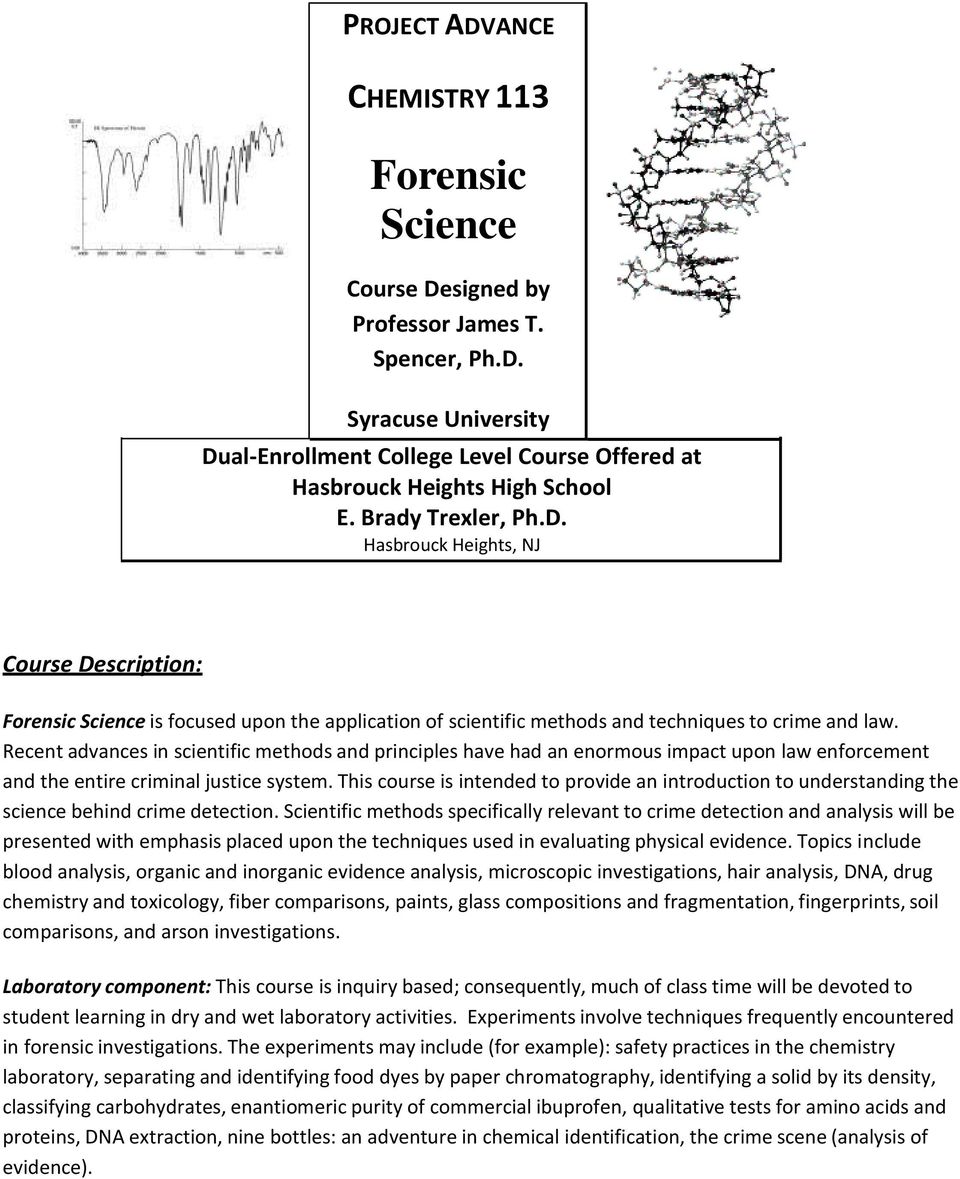
1 PROJECT ADVANCE CHEMISTRY 113 Forensic Science Course Designed by Professor James T. Spencer, Ph.D. Syracuse University Dual Enrollment College Level Course Offered at Hasbrouck Heights High School E. Brady Trexler, Ph.D. Hasbrouck Heights, NJ Course Description: Forensic Science is focused upon the application of scientific methods and techniques to crime and law. Recent advances in scientific methods and principles have had an enormous impact upon law enforcement and the entire criminal justice system. This course is intended to provide an introduction to understanding the science behind crime detection. Scientific methods specifically relevant to crime detection and analysis will be presented with emphasis placed upon the techniques used in evaluating physical evidence. Topics include blood analysis, organic and inorganic evidence analysis, microscopic investigations, hair analysis, DNA, drug chemistry and toxicology, fiber comparisons, paints, glass compositions and fragmentation, fingerprints, soil comparisons, and arson investigations. Laboratory component: This course is inquiry based; consequently, much of class time will be devoted to student learning in dry and wet laboratory activities. Experiments involve techniques frequently encountered in forensic investigations. The experiments may include (for example): safety practices in the chemistry laboratory, separating and identifying food dyes by paper chromatography, identifying a solid by its density, classifying carbohydrates, enantiomeric purity of commercial ibuprofen, qualitative tests for amino acids and proteins, DNA extraction, nine bottles: an adventure in chemical identification, the crime scene (analysis of evidence).
2 NJCCCS: Content Topics / Course Outline: Introduction: Definition and scope of forensic science, history and development of forensic science, the organization of a crime laboratory, services of the crime laboratory, the functions of the forensic scientist, other forensic science services. The Crime Scene: Processing the crime scene, legal considerations at the crime scene. Physical Evidence: Common types of physical evidence, the significance of physical evidence. Physical Properties: The metric (SI) system, physical properties of glass and soil, comparing glass fragments, glass fractures, collection and preservation of glass evidence, forensic characterization of soil, collection and preservation of evidence. Organic Analysis: Elements and compounds, selecting an analytical technique, chromatography, spectrophotometry, mass spectrometry. Inorganic Analysis: Evidence in the assassination of President Kennedy, the emission spectrum of elements, atomic absorption spectrophotometry, the origin of emission and absorption spectra, neutron activation analysis, X ray diffraction. The Microscope: The compound microscope, the comparison microscope, the stereoscopic microscope, the polarizing microscope, the microspectrophotometer, the scanning electron microscope (SEM). Hairs, Fibers and Paint: Morphology of hair, identification and comparison of hair, collection of hair evidence, types of fibers, identification and comparison of man made fibers, collection of fiber evidence, forensic examination of paint, collection and preservation of paint evidence. Drugs and Medicinal Chemistry: Drug dependence, narcotic drugs, hallucinogens, depressants, stimulants, anabolic steroids, drug control laws, drug identification, collection and preservation of drug evidence. Forensic Toxicology: Toxicology of alcohol, the role of the toxicologist, techniques used in toxicology, the significance of toxicological findings, the drug recognition expert. Forensic Aspects of Arson and Explosion Investigations: The chemistry of fire, searching the fire scene, collection and preservation of arson evidence, analysis of flammable residues, types of explosives, collection and analysis of explosives. Forensic Serology: The nature of blood, forensic characterization of bloodstains, stain pattern of blood, principles of heredity, forensic characterization of semen, collection of rape evidence. DNA Evidence: What is DNA? DNA at work, replication of DNA, recombinant DNA: cutting and splicing DNA, DNA typing, mitochondrial DNA, the combined DNA index system, the collection and preservation of biological evidence for DNA analysis. Fingerprints: History of fingerprinting, fundamental principles of fingerprints, classification of fingerprints, automated fingerprint identification systems, methods of detecting fingerprints, preservation of developed prints, digital imaging for fingerprint enhancement. Firearms, Tool Marks and Other Impressions: Bullet comparisons, cartridge cases, automated firearm search systems, gunpowder residues, primer residues on the hands, serial number restoration, collection and preservation of firearm evidence, tool marks, other impressions. Document and Voice Examination: Handwriting comparisons, collection of handwriting exemplars, typewriting comparisons, photocopies, printer and Fax examination, alterations, erasures and obliterations, other document problems, voice examination. Forensic Science on the Internet: What is the Internet? Where to go on the Internet, exploring forensic science of the World Wide Web, websites you may wish to explore.
3 Materials: TEXT: The required textbook for this course will be (beginning summer 2012) Introduction to Forensic Science: The science of Criminalistics by James T. Spencer published by Cengage. The laboratory materials will be determined and assigned by the instructor 21st Century Skills: Critical Thinking and problem solving Communication and collaboration Creativity and Innovation Access, evaluate, and synthesize information Flexibility and Adaptability Initiative and Self Direction Social and Cross Cultural Skills Productivity and Accountability Leadership and Responsibility Essential Questions: What is the nature of forensic evidence and how is it admitted to trial? How are crime scenes investigated? What is the scientific method and how has its use transformed criminal investigations? What are the tools/techniques used by forensic scientists? What is DNA and how is it analyzed for use in legal matters? How are blood samples and blood stain patters analyzed and used in legal matters? How are anatomical features such as hair and fingerprints used in legal matters? How are autopsies and forensic radiology/imaging used in legal matters? What are the ecological factors the analytical techniques that can provide information for forensic investigations? What kinds of chemical tests are used in forensic investigations? What are the spectroscopic techniques used by forensic scientists and what evidence do they provide? What substances are toxic, how do they inflict damage, and how are bodies tested for their presence? How are fires started and what analytical techniques uncover their origin? How are the physical properties of minerals, soil, glass and paint applicable to forensic investigations? What are the characteristics of projectiles and high velocity weapons (bullets, shells, and guns) that can be used to aid in building a legal case? How are documents, photographs, videos and voice recordings analyzed in forensic investigations? What are the applications of engineering (structure or device failure) and computers (software and cybersecurity) to criminal investigations? What psychological and sociological techniques are applied to forensic analysis?

4 Enduring Understandings: The admission of expert opinions and forensic science as evidence has varied over the history of criminal trials. Crime scenes hold a wealth of information but they must be analyzed in a meticulous and systematic manner. Proper application of the scientific method and careful experiments provide the strongest evidence. Fingerprint, DNA and blood evidence are the strongest factors in determining the identities of individuals at a crime scene. Anatomical and medical evidence can determine the cause of death. Ecological evidence, such as maggot development, can determine the post mortem interval. Gas chromatography coupled with mass spectrometry provides unequivocal evidence for the chemical composition of items found at a crime scene. Analysis of suspect or victim bodily fluids or breath can determine the presence and concentration of toxic substances and their contribution to inebriation or death. Chemical analysis of fire and explosive residues provide important evidence for forensic investigations. Physical properties of minerals, glass, soil and paint are important for determination of events at a crime scene. Firearms and projectiles have almost unique identifying characteristics that are used to determine their use at a crime scene. Suspects can be identified by analysis of photos, documents, video and voice recordings. Mechanical, civil, structural and software engineering disciplines are used by forensic scientists. Psychological and sociological analysis of suspects, victims, and their families and friends offer clues to motive and mental states. Textbook Table of Contents: I. Introduction Chapter 1: Introduction to Forensic Science: Introduction, Historic Development, and Legal Roles of Forensic Science Chapter 2: Crime Scene Investigations Chapter 3: Science, Pseudoscience and the Law II. Biological Evidence Chapter 4: Methods for Examining Biological Evidence Chapter 5: Biochemical Forensic Analysis I: DNA Chapter 6: Biochemical Forensic Analysis II: Serology Chapter 7: Anatomical Evidence: The Outside Story Chapter 8: Forensic Medicine: The Inside Story Chapter 9: Forensic Anthropology Chapter 10: Forensic Ecology Chapter 12: Forensic Spectroscopy Chapter 13: Forensic Toxicology Chapter 14: Forensic Arson and Explosives IV. Physical Properties in Evidence Chapter 15: Physical Properties: Mineralogical, Soil, Glass, and Paint Analysis Chapter 16: Firearms, Ballistics, and Impression Evidence Chapter 17: Forensic Document Analysis, Photographic and Video Analysis, and Voice Identification and Linguistics Chapter 18: Engineering and Computer Forensics V. Behavioral Forensic Evidence Chapter 19: Behavioral Social Sciences: Psychology and Sociology III. Chemical Evidence Chapter 11: Overview of Chemical Evidence

5 Course Structure: There are ~145 class meetings spread over the ~33 weeks before June. Since the majority of this class is seniors, the final exam will be held in class after Memorial Day at the end of May. The practice of scientific inquiry through experimentation in labs and class activities is a core component of the Anatom y and Physiology curriculum. Approximately 40-50% of class time will be devoted to hands-on labs. Approximately 40-50% of class time will be devoted to lectures. The remaining ~10% allows for assessments of the students progress through quizzes and exams. Lab component There are numerous in class activities that allow for experimentation, data collection, and critical analysis of the results. Pre lab assignments will prepare you for the in class activities. Lecture component Students are assigned reading for each lecture. A teacher generated list of concepts and vocabulary guides their reading. Lectures are Powerpoint based, drawing from internet and publisher materials; however, some material is best served by chalkboard lectures. Assessments o Lab write-ups are reports of the labs purpose, methods, data collected, analyses and conclusions. Some lab activities and experiments span multiple days. Therefore, the reports are due at the beginning of class on the day after the experiments are finished. o Daily Quizzes test the students grasp of the concepts at various stages in a unit. Quizzes may be given to assess understanding of prelab concepts or previous lectures. They are collected at random for marking, but when not collected, answers are given and students correct the quizzes themselves. o Unit Tests are more comprehensive assessments that cover one or two chapters. They require higher level thinking than the quizzes, utilizing higher objectives from Bloom s Taxonomy such as Apply and Evaluate. They are constructed using multiple choice and open ended questions. Student Evaluation: Assessments At least 8 per marking period Assignment Percent of Grade Homework (Reading, prelabs, etc) 10% Labs Write-ups 15% Daily Quizzes 20% Unit Tests 45% In Class Participation 10%

Willmar Public Schools Curriculum Map
 Subject Area Science Senior High Course Name Forensics Date June 2010 Timeline Content Standards Addressed Skills/Benchmarks Essential Questions Assessments 1-2 Introduction History and Development of
Georgia Perimeter College Common Course Outline
 Georgia Perimeter College Common Course Outline Course Abbreviation & Number: FRSC 2100 Course Title: Credit Hours: 3 Prerequisites: Co-requisites: Introduction to Forensic Science Exit or exemption from
MASTER COURSE OUTLINE
 A. BIOL 1050 Introduction to Forensic Science B. COURSE DESCRIPTION: MASTER COURSE OUTLINE This introductory course will apply the principles and theories of biology, chemistry, etc. to the study of forensic
Forensic Science : Course Syllabus Forensic Science : Secrets of the Dead
 Forensic Science : Course Syllabus Forensic Science : Secrets of the Dead COURSE DESCRIPTION: Fingerprints. Blood spatter. DNA analysis. The world of law enforcement is increasingly making use of the techniques
Forensic Science. The student will demonstrate the ability to explain the history and philosophy of forensic science.
 Forensic Science UNIT I: Introduction to Forensic Science and Human Body The student will demonstrate the ability to explain the history and philosophy of forensic science. a. Define forensic science or
CURRICULUM GUIDE. When this Forensics course has been completed successfully, students should be able to:
 CURRICULUM GUIDE NAME OF COURSE: FORENSICS COURSE NUMBER: SCI 40 WRITTEN / REVISED: SEPTEMBER, 2011 LEVEL OF COURSE: REPLACMENT NUMBER OF CREDITS: SIX (6) PREREQUISITES: BIOLOGY GRADE LEVELS OFFERED TO:
PASSAIC COUNTY TECHNICAL INSTITUTE WAYNE, NEW JERSEY FORENSIC SCIENCE I CURRICULUM JULY 2010
 PASSAIC COUNTY TECHNICAL INSTITUTE WAYNE, NEW JERSEY FORENSIC SCIENCE I CURRICULUM JULY 2010 1 FORENSIC SCIENCE I Course Description: Forensic Science is offered as a two-year course to students in grades
How To Understand Forensic Science
 Forensic Science Lesson 1: CSI Basics What is Forensic Science? Forensic Science is the application of science to law. Locard s Exchange Principle states that with contact between two items there will
Forensic Science Course Syllabus (CHE100)
 Forensic Science Course Syllabus (CHE100) Contact Information Instructor: Dr Lynn Fowler Office/phone: 214T / 562-4348 Office hours: as posted or by appointment E-mail: [email protected] Course description
Spring 2009. Forensic Science. Professor James T. Spencer Syracuse University. Revised 1/14/08
 CHEMISTRY 113 Spring 2009 Forensic Science Professor James T. Spencer Syracuse University Revised 1/14/08 COURSE DESCRIPTION AND PREREQUISITE SKILLS: Chemistry 113, Forensic Science, is focused upon the
Forensic Science II: Course Syllabus Forensic Science II: More Secrets of the Dead
 Forensic Science II: Course Syllabus Forensic Science II: More Secrets of the Dead COURSE DESCRIPTION: Although the crime scene represents the first step in solving crimes through forensic science, the
EXPERIENCED PROFESSIONAL CERTIFICATE IN Forensic Science
 Certificate Description This certificate provides professionals the opportunity to enhance specialized skills in Forensic Science. Arson Investigation CRJS 350 This course will explore criminal and scientific
FORENSIC SCIENTIST MICHIGAN CIVIL SERVICE COMMISSION JOB SPECIFICATION
 MICHIGAN CIVIL SERVICE COMMISSION JOB SPECIFICATION FORENSIC SCIENTIST JOB DESCRIPTION Employees in this job complete and oversee a variety of tests, analyses, identification, and classification of mechanical
Introduction to Forensic Science. So what is Forensic Science? Major Contributors. Chapter 1: Intro to FS
 Introduction to Forensic Science Chapter 1: Intro to FS So what is? In its broadest definition, forensic science is the application of science to criminal and civil laws. We will put emphasize on the applications
How To Become A Forensic Scientist
 A c a r e e r i n By Hall Dillon Blood spatters, spent shell casings, and forged signatures are the nuts and bolts of forensic science. Studying the messy details of crime, forensic scientists help identify
COMMUNITY UNIT SCHOOL DISTRICT 200. Course Description
 Forensic Science High School Elective Course Description Forensic Science is a one semester high school level course that satisfies a CUSD200 graduation requirement in the area of science. Successful completion
Introduction to Crime Scene Dynamics
 Chapter 1 Introduction to Crime Scene Dynamics OVERVIEW The development of the field of forensics has been a process steeped in science and research. On the other hand, the practice of crime scene investigation
Forensic Science Curriculum
 Forensic Science Curriculum The Georgia Performance Standards are designed to provide students with the knowledge and skills for proficiency in science. The Project 2061 s Benchmarks for Science Literacy
Master of Science in Forensics
 Master of Science in Forensics The Master of Science in Forensics provides students with an intensive and holistic criminalistics experience through a combination of didactic and practical educational
(A) demonstrate safe practices during laboratory and field investigations
 (1) The student, for at least 40% of instructional time, conducts laboratory and field investigations using safe, environmentally appropriate, and ethical practices. (A) demonstrate safe practices during
Dudesville: A crime scene under the microscope. QUT Extreme Science
 Dudesville: A crime scene under the microscope QUT Extreme Science Glossary QUT Extreme Science DNA Chromatography Forensic Science Locard s Principle (Deoxyribonucleic acid) an extremely long macromolecule
BAA Course: Forensic Science 11
 BAA Course: Forensic Science 11 District Name: Cowichan Valley District Number: 79 Developed by: Alanna Skene Date Developed: October 20, 2006 Schools Names: Principal s Name: Cowichan Secondary, Frances
Forensic Science/ Crime Scene Investigation
 Forensic Science/ Crime Scene Investigation You know what a Crime Scene Investigator looks like on television. Now, get to know the real career. Forensic Science plays a vital role in the criminal justice
Visible Proofs: Forensic Views of the Body. Erika Mills [email protected]
 Visible Proofs: Forensic Views of the Body Erika Mills [email protected] Objectives To increase familiarity with current forensic science techniques and their historical precursors To put past and modern
Forensic Science. Students will define and distinguish forensic science and criminalistics.
 St. Forensic Science Content Skills Assessment Big Ideas Core Tasks Students will apply the major concepts in biology, chemistry, and physics as the basis for solving crimes Students will recognize and
MADISON PUBLIC SCHOOLS FORENSIC SCIENCE
 MADISON PUBLIC SCHOOLS FORENSIC SCIENCE Authored by: Sue Monkemeier Reviewed by: Mr. Lee S. Nittel Director of Curriculum and Instruction Mr. Tom Paterson K12 Supervisor of Science and Technology Approval
FORENSIC SCIENTIST MICHIGAN CIVIL SERVICE COMMISSION JOB SPECIFICATION
 MICHIGAN CIVIL SERVICE COMMISSION JOB SPECIFICATION FORENSIC SCIENTIST JOB DESCRIPTION Employees in this job complete and oversee a variety of tests, analyses, identification, and classification of mechanical
AN INTRODUCTION TO THE SAPS FORENSICS LABORATORY PRESENTED BY: LT.COL. J. KOCK
 AN INTRODUCTION TO THE SAPS FORENSICS LABORATORY PRESENTED BY: LT.COL. J. KOCK STRUCTURE OF THE DIVISION FORENSIC SERVICES SOUTH AFRICAN POLICE SERVICE Lt. General JK Phahlane CR LCRC CSM EXPLOSIVES IPU
The College of Forensic Sciences at NAUSS: The pioneer of Forensics in the Arab world
 12 Arab Journal of Forensic Sciences and Forensic Medicine 2014; Volume 1 Issue (0), 12-16 Naif Arab University for Security Sciences Arab Journal of Forensic Sciences and Forensic Medicine www.nauss.edu.sa
Forensic Science Studies 35-3
 LOCALLY DEVELOPED COURSE OUTLINE Forensic Science Studies 35-3 Submitted By: Rocky View School Division No. 41 Submitted On: Aug. 20, 2014 Rocky View School Division No. 41 All Rights Reserved Page 1 of
Board/Authority Authorised Course Framework Template
 Board/Authority Authorised Course Framework Template School District/Independent School Authority Name School District/Independent School Authority Number Developed by Rocky Mountain 06 RMDL Ed Main /
*UNT Chemistry Building. *Dr. Teresa Golden is the Director of our Forensic Science Program at UNT
 BACHELOR OF SCIENCE WITH FORENSIC SCIENCE CERTIFICATION *UNT Chemistry Building The University of North Texas Forensic Science Program received its accreditation from the American Academy of Forensic Sciences
TRAVELING FORENSIC EDUCATION PROGRAM 2012-2013
 TRAVELING FORENSIC EDUCATION PROGRAM 2012-2013 INDEX -Program Overview Page 3 -Forensics Lab Total Experience Page 4 -Crime to Courtroom Workshop Page 4 -Impressions Workshop Page 5 -Blood & DNA Workshop
Law, Public Safety, Corrections and Security Career Cluster Forensic Science and Criminal Investigations Course Number: 43.45200
 Law, Public Safety, Corrections and Security Career Cluster Forensic Science and Criminal Investigations Course Number: 43.45200 Course Description: Forensic Science and Criminal Investigations is a course
Forensic Science TEKS/LINKS Student Objectives One Credit
 First Six Weeks Intro/Observation FS 4(A) The student will distinguish between forensic science and criminalistics in law, public safety, corrections, and security. FS 5(D) The student will apply knowledge
Hi h School Standard: 1
 Forensic Science Content Standards and Objectives Forensic Science is an advanced level course that is an elective designed to provide students with hands-on experience in various aspects of a criminal
FORENSIC SCIENCE INSTITUTE COURSE DESCRIPTIONS 2015-2016
 FORENSIC SCIENCE INSTITUTE COURSE DESCRIPTIONS 2015-2016 FRSC 2503 Introduction to Forensic Science Introduction to Forensic Science is a survey course designed to acquaint the student with a comprehensive
Forensic Science. Distance Learning Presentation For King Drew Magnet High School of Medicine and Science March 14, 2007
 Forensic Science Distance Learning Presentation For King Drew Magnet High School of Medicine and Science March 14, 2007 Dorothy Harris Forensic Course Developer Science Teacher and Department Chairman
BAA Course Approval submission: Introduction to Forensic Science 1:
 BAA Course Approval submission: Introduction to Forensic Science 1: School District/Independent School Authority Name Chilliwack School District/Independent School Authority Number SD 33 Developed by E-Dynamics\FVDES\G.Porro
CAREER: FORENSIC SCIENCE TECHNICIAN 1
 CAREER: FORENSIC SCIENCE TECHNICIAN 1 Career: Forensic Science Technician Mary C. Cartwright Middlesex Community College CRJ 111-52 Heloisa DaCunha November 29, 2012 CAREER: FORENSIC SCIENCE TECHNICIAN
SAULT COLLEGE SAULT STE. MARIE, ONTARIO COURSE OUTLINE
 SAULT COLLEGE SAULT STE. MARIE, ONTARIO COURSE OUTLINE COURSE TITLE: Introduction to Applied Forensic Science CODE NO. : NRL 210 SEMESTER: 2 PROGRAM: AUTHOR: Natural Resources/Environmental Law Inspection
Evidence Technician s School
 Evidence Technician s School Program Overview The Evidence Technician s School is designed to provide your Evidence Technician or Crime Scene Investigator with a sound foundation of the basic principles
CRIME SCENE FORENSICS
 CRIME SCENE FORENSICS Description Crime Scene Forensics, which is a laboratory-based course, will promote and cultivate the development of student s scientific inquiry and scientific method skills, which
ILLINOIS DEPARTMENT OF CENTRAL MANAGEMENT SERVICES CLASS SPECIFICATION FORENSIC SCIENTIST SERIES
 ILLINOIS DEPARTMENT OF CENTRAL MANAGEMENT SERVICES CLASS SPECIFICATION FORENSIC SCIENTIST SERIES CLASS TITLE POSITION CODE EFFECTIVE FORENSIC SCIENTIST TRAINEE 15897 5/1/10 FORENSIC SCIENTIST I 15891 5/1/10
How To Understand The Basics Of Forensic Science
 Forensic Science for the Criminal Justice World The Pennsylvania Innocence Project is proud to partner with the Center for Forensic Science Research and Education to present the first comprehensive academy
Forensic. Sciences. Forensic Sciences. Specialties. Programs. Career Pathways
 Forensic Sciences Specialties Programs Prof. R. E. Gaensslen Director of Graduate Studies Forensic Science University of Illinois - Chicago Career Pathways Forensic Sciences 1 The Hype... the TV version
Forensic Science Diploma
 Forensic Science Diploma Career Prospect There is a business and admin element to every employment sector, including energy, engineering, charities, finance, manufacturing, tourism, health, entertainment,
FORENSIC SERVICES DEPARTMENT
 FORENSIC SERVICES DEPARTMENT GENERAL INFORMATION ON FORENSIC SCIENCE Forensic Drive Macleod 3085 Victoria Australia Telephone: (61 3) 9450 3444 Facsimile: (61 3) 9459 0477 Introduction The Forensic Services
How do we build and refine models that describe and explain the natural and designed world?
 Strand: A. Understand Scientific Explanations : Students understand core concepts and principles of science and use measurement and observation tools to assist in categorizing, representing, and interpreting
Forensic Science. Three Certificate Programs in. Certificates in: Death Investigation Forensic Toxicology. Forensic Science
 Three Certificate Programs in Forensic Science Giving you investigative skills to broaden the scope of your job opportunities Certificates in: Death Investigation Forensic Toxicology Forensic Science Sponsored
Wallingford Public Schools - HIGH SCHOOL COURSE OUTLINE
 Wallingford Public Schools - HIGH SCHOOL COURSE OUTLINE Course Title: Forensic Science Course Number: Department: Science Grade(s): 11-12 Level(s): General Credit: 1/2 Course Description This course focuses
What Can I Do With a Degree in ForSci?
 What Can I Do With a Degree in ForSci? 1 Forensic Science Career Fields Forensic Science Tech Career Forensic science techs work in crime labs to analyze the evidence collected from crime scenes. They
RUTHERFORD HIGH SCHOOL Rutherford, New Jersey COURSE OUTLINE FORENSIC SCIENCE
 RUTHERFORD HIGH SCHOOL Rutherford, New Jersey COURSE OUTLINE FORENSIC SCIENCE I. INTRODUCTION Forensic Science focuses on the analysis of evidence collection, the decomposition process, crime scenes, skeletal
This curriculum is part of the Educational Program of Studies of the Rahway Public Schools. ACKNOWLEDGMENTS
 CURRICULUM FOR FORENSIC SCIENCE CYCLE GRADE 7 This curriculum is part of the Educational Program of Studies of the Rahway Public Schools. ACKNOWLEDGMENTS Kevin Robinson, Program Supervisor of STEM The
Forensic Test 1 Review: Mathieu Orfila (1738 1853) Father of Modern Toxicology 1814 wrote first treatise. (formal scientific work) Alphonse Bertillon
 Forensic Test 1 Review: Mathieu Orfila (1738 1853) Father of Modern Toxicology 1814 wrote first treatise. (formal scientific work) Alphonse Bertillon (1853 1914) Father of Criminal Investigation first
CMJ 105 - INTRODUCTION TO FORENSIC SCIENCE Fall Syllabus 2015. 4:30 5:30 p.m.
 CMJ 105 - INTRODUCTION TO FORENSIC SCIENCE Fall Syllabus 2015 INSTRUCTOR INFORMATION Associate Professor David Striegel Guerrieri Hall, Room 202D Office Phone: 410-572-8755 Office Hours: Monday Tuesday
AJ- 132 Forensic Crime Scene Investigation Course Syllabus Fall 2015 (Revised 8/8/15) This syllabus is our contract. Please read it in its entirety.
 AJ- 132 Forensic Crime Scene Investigation Course Syllabus Fall 2015 (Revised 8/8/15) This syllabus is our contract. Please read it in its entirety. You will be required to pass a quiz on the syllabus
Course Contents. MS Forensic Chemistry
 Course Contents MS Forensic Chemistry Year 1 Semester - I Course Code Course Title Credit Hours FCHEM-7105 Introduction to Forensic Science 3 FCHEM-7106 Crime Scene Investigation 3 FCHEM-7107 Chemistry
COURSE TITLE COURSE DESCRIPTION
 COURSE TITLE COURSE DESCRIPTION CH-00X CHEMISTRY EXIT INTERVIEW All graduating students are required to meet with their department chairperson/program director to finalize requirements for degree completion.
FORENSIC SCIENCE COURSE DESCRIPTION
 FORENSIC SCIENCE COURSE DESCRIPTION This course is an overview of how science is applied to solving crimes. Topics include history of forensic sciences, collecting of evidence, analyzing results and hands-on
Garfield Public Schools Forensic Science Curriculum Forensics
 Garfield Public Schools Forensic Science Curriculum Forensics Revision Committee: Mr. Patrick McCrone Final Revision Date: August 31, 2011 Garfield Board of Education Dr. Kenneth Conte- President Mr. Tony
Forensic Science: Crime Scene Basics. T. Trimpe 2006 http://sciencespot.net
 Forensic Science: Crime Scene Basics T. Trimpe 2006 http://sciencespot.net Crime Scene Vocabulary CRIME SCENE: Any physical location in which a crime has occurred or is suspected of having occurred. PRIMARY
MONROE TOWNSHIP PUBLIC SCHOOLS WILLIAMSTOWN, NEW JERSEY. Forensics
 MONROE TOWNSHIP PUBLIC SCHOOLS WILLIAMSTOWN, NEW JERSEY Williamstown High School Forensics Written by: Lori Long Revised July 2013 Stanley Krzyminski, Director of Curriculum and Instruction Cynthia Johnson,
Rules and Procedures. Rule 312 August 23, 2001. Rule 312 - CRIME LABORATORY - EVIDENCE AND CRIME SCENES
 Rules and Procedures Rule 312 August 23, 2001 Rule 312 - CRIME LABORATORY - EVIDENCE AND CRIME SCENES Rule 312, Crime Laboratory - Evidence and Crime Scenes, is hereby re-issued to establish Police Department
Hoover City Schools Secondary Curriculum Science, 2006-07
 Course Information: Hoover City Schools Secondary Curriculum Science, 2006-0 Course Title: Forensic Science Grade Level: 2 Course Description: Making science relevant and pertinent to the interests and
Community College of Philadelphia Department of Biology Forensic Biology - 104 2014 Syllabus
 Community College of Philadelphia Department of Biology Forensic Biology - 104 2014 Syllabus Course Reference Number (CRN): 17546 Course: BIOL 104 Section: 001 Credits: 4 Schedule: Class M 1:00pm 2:30pm
Careers for Biologists in the FORENSIC SCIENCES
 Careers for Biologists in the FORENSIC SCIENCES Sarah Seashols, PhD Department of Forensic Science Virginia Commonwealth University www.has.vcu.edu/forensics What is Forensic Science? ME SCENE DO NOT CROSS
ANNEXURE IV RASHTRASANT TUKADOJI MAHARAJ NAGPUR UNIVERSITY, NAGPUR P.G. DIPLOMA IN FORENSIC SCIENCE AND RELATED LAW
 ANNEXURE IV RASHTRASANT TUKADOJI MAHARAJ NAGPUR UNIVERSITY, NAGPUR P.G. DIPLOMA IN FORENSIC SCIENCE AND RELATED LAW SCHEME OF EXAMINATION AND SYLLABUS 1 RASHTRASANT TUKADOJI MAHARAJ NAGPUR UNIVERSITY,
Forensic science ( 科 學 鑑 證 ):
 Reference for slides 3 20: Forensic Science ( 科 學 鑑 證 ) Criminalistics An Introduction to Forensic Sciences, 7th ed. By Richard Saferstein Prentice Hall, NJ, c2001. IJS Training (Phase 3) Dr. Kendrew K.
Criminal Justice II, August 2013, Page 1 of 5
 Indiana Department of Education Academic Course Framework CRIMINAL JUSTICE II Criminal Justice II introduces students to concepts and practices in controlling traffic as well as forensic investigation
The American Academy of Forensic Sciences
 The American Academy of Forensic Sciences 2012 Forensic Science Educational Conferences For Middle- and High School Science Teachers The American Academy of Forensic Sciences is pleased to present the
In 2009, the nation s 411 publicly funded crime
 U.S. Department of Justice Office of Justice Programs Bureau of Justice Statistics Census of Publicly Funded Forensic Crime Laboratories, Matthew R. Durose, BJS Statistician Kelly A. Walsh, Research Associate,
SUN PRAIRIE AREA SCHOOL DISTRICT COURSE POWER STANDARDS. Curriculum Area: Science Course Length: Semester
 SUN PRAIRIE AREA SCHOOL DISTRICT COURSE POWER STANDARDS Course Title: Forensic Science Curriculum Area: Science Course Length: Semester Credit Status: ½ Physical Science Credit Date submitted: 7/09 Expected
The Nature of Evidence
 The Nature of Evidence Chapter 3 Mrs. Svedstrup What is Evidence? Legal definition: That which tends to support something or show that something is the case Relevance of evidence- admissibility of evidence
Texts: Saferstein, Richard, Criminalistics; 8th ed. Prentice Hall. Print. Siegel, Jay A. Forensic Science The Basics. CRC, 2006. Print.
 Science 8/10/10 Topic/Unit: Forensic Science / Introduction to Forensic Science Curricular Goals/ Learning Outcomes: Students will be able to define forensic science, provide knowledge of the major contributors
Should you wish to contact me: o Barry Fisher o (213) 989-5002 o [email protected]
 Physical Evidence: From the crime scene to the courtroom Should you wish to contact me: o Barry Fisher o (213) 989-5002 o [email protected] What is physical evidence? o Something legally submitted
Teacher s Guide - Feature Showcase. Forensic Science. Grades: 6-8 Content Area: Science
 Teacher s Guide - Feature Showcase Forensic Science Grades: 6-8 Content Area: Science Standards Alignment: McRel Level III; Nature of Science 13 National Standards: NS.5-8.6 Personal and Social Perspectives
In legal proceedings, a case is only as strong as its evidence.
 Careers in forensics: Analysis, evidence, and law POLICE LINE - DO NOT CROSS POLICE LINE - DO NOT CROSS POLICE Elka Maria Torpey Elka Maria Torpey is an economist in the Office of Occupational Statistics
LEN 221: Principles of Criminal Investigation Syllabus 3 lecture hours / 3 credits CATALOG DESCRIPTION
 1 LEN 221: Principles of Criminal Investigation Syllabus 3 lecture hours / 3 credits CATALOG DESCRIPTION Prerequisite: Undergraduate level RDG 099 Minimum Grade of P or Undergraduate level RDG 055 Minimum
Criminal Investigation and Forensics
 PROGRAM CONCENTRATION: CAREER PATHWAY: COURSE TITLE: Public Safety Law and Justice Criminal Investigation and Forensics Prerequisites: Introduction to Law and Justice Law, Community Response and Policing
How To Understand Forensics
 FORENSIC SCIENCE ELECTIVE CORE The Forensic Science Elective Core focuses on the analysis of evidence collection, the decomposition process, crime scenes, skeletal remains, toxicology, and document validity.
The CSI Forensic Science Program
 The CSI Forensic Science Program at Michigan State University A week-long day camp or residential program for students with a strong interest in forensic science. Level I: June 15 20 for students currently
Tentative: Subject to Change CHEM 205Lxg Chemical Forensics: the Science, and its Impact. Course Overview:
 Tentative: Subject to Change CHEM 205Lxg Chemical Forensics: the Science, and its Impact Course Overview: Chemical forensics can be used to investigate crimes, as well as used to study works of art and
The Netherlands Forensic Institute. Strengthening the rule of law together
 The Netherlands Forensic Institute Strengthening the rule of law together The Netherlands Forensic Institute The Netherlands Forensic Institute (NFI) is one of the world s leading forensic laboratories.
How To Be A Forensic Investigator
 CLASS SPECIFICATION Class Code: 2226 Date Est: 10/1989 Last Rev: 04/2014 Last Title Chg: 04/2014 FLSA: Non-exempt Probation: 12 Months FORENSIC INVESTIGATOR II DEFINITION Under general supervision, performs
AS FORENSIC SCIENCE ACADEMY
 TE AS FORENSIC SCIENCE ACADEMY TM "BETTER SCIENCE LEADS TO BETTER JUSTICE FOR ALL" I strongly feel the courses offered through the Texas Forensic Science Academy certificate program are a true benefit
Goal to recognize, document and collect evidence at a crime scene
 Crime Scene Investigation and Evidence Collection Lecture Credits: Anthony (Bud) Bertino Goal to recognize, document and collect evidence at a crime scene Sherlock Holmes» Sir Arthur Conan Doyle in the
Grading Scale: As stated in the Student Handbook, letter grades are determined based on the following scale:
 Instructor: Dr. Sara Fenske Course: Forensic Science Course Philosophy: This course is an introduction to Forensic Science,which emphasizes the process of science and includes topics in physics, chemistry
TE AS FORENSIC SCIENCE ACADEMY TM
 TE AS FORENSIC SCIENCE ACADEMY TM "BETTER SCIENCE LEADS TO BETTER JUSTICE FOR ALL" I strongly feel the courses offered through the Texas Forensic Science Academy certificate program are a true benefit
CHEMISTRY. Real. Amazing. Program Goals and Learning Outcomes. Preparation for Graduate School. Requirements for the Chemistry Major (71-72 credits)
 CHEMISTRY UW-PARKSIDE 2015-17 CATALOG Greenquist 344 262-595-2326 College: Natural and Health Sciences Degree and Programs Offered: Bachelor of Science Major - Chemistry Minor - Chemistry Certificate -
Chemistry 241 Crime Scene Reconstruction & Pattern Analysis Professor
 Chemistry 241 Crime Scene Reconstruction & Pattern Analysis Professor: Overview: Brian J. Gestring, M.S. Assistant Professor Chemistry & Physical Sciences Office Miller 10 (Office Hours: Monday, Tuesday,
Forensic Science The Basics
 Forensic Science The Basics Introduction to Forensic Science Chapter 1 Forensic science has engrained into society Television, books and movies reflect this Evidence analyzed includes DNA, drugs, witness
Introduction to Forensic Science and the Law. FBI Building Washington, DC
 FBI Building Washington, DC 1 Objectives You will understand: How crime labs in the United States are organized and what services they provide. The growth and development of forensic science through history.
Laboratory Examinations, Methods and Procedures. All MN BCA Forensic Science Service (MN BCA FSS) Personnel and Customers
 Page 1 of 6 Pages Version: B Issue Date: 02/04/2014 Subject: To: Purpose: Laboratory Examinations, Methods and Procedures All (MN BCA FSS) Personnel and Customers To provide a list of examinations, methods
NATIONAL FORENSIC ACADEMY
 The National Forensic Academy's goal is to prepare crime scene investigators to recognize key elements of a crime scene and to improve the process of evidence recovery and submission. The ten-week intensive