
Nº4/08. european architectural history network
|
|
|
- Monica Tate
- 10 years ago
- Views:
Transcription
1 Nº4/08 european architectural history network
2 colophon eahn Newsletter Nº4/08 Nº4/08 colophon The eahn Newsletter is a publication of the European Architectural History Network European Architectural History Network. All rights reserved. No part of this publication may be reproduced or transmitted in any form or by any means, electronic or mechanical, including photocopy, recording, or an information storage and retrieval system, without permission in writing from the eahn. issn eahn newsletter Nº4/08
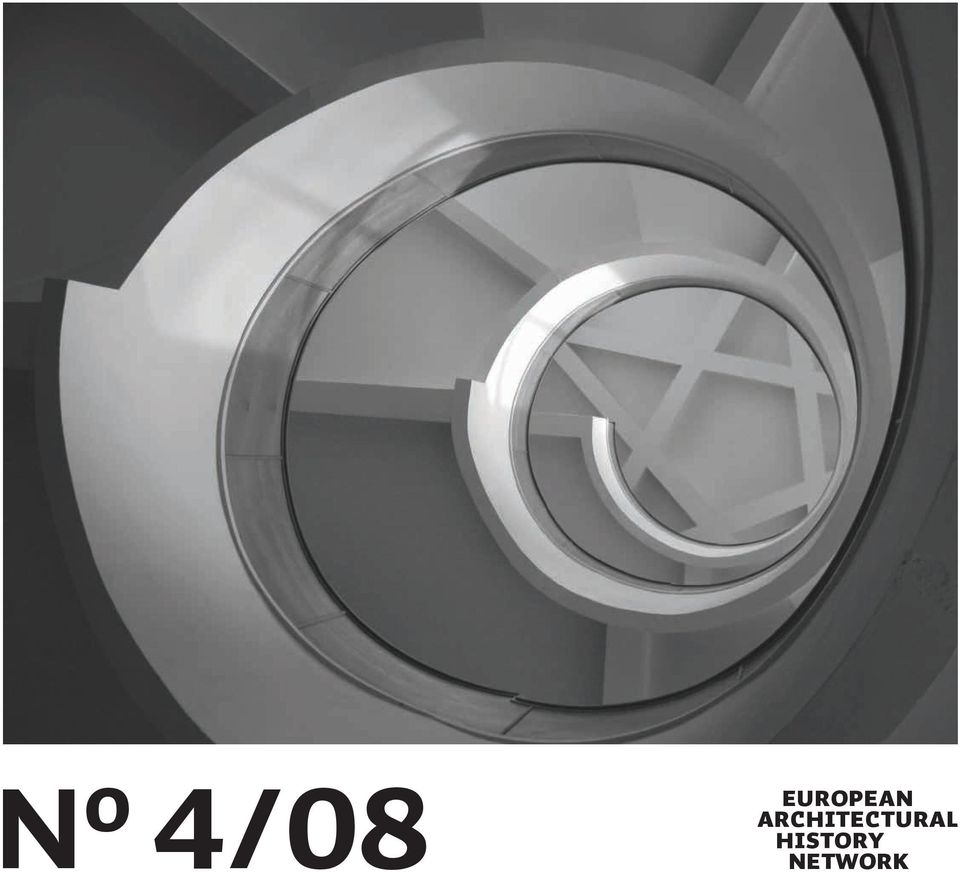
3 front cover Ivan P. Antonov, Veniamin D. Sokolov and Arsenii M. Tumbasov, main staircase in the Workers Club of the Campus of the Chekists (Gorodok Chekistov), Ekaterinburg, Part of the dwelling complex ( ) of the Secret Police Officers Compound Photograph: Ivan Nevzgodin correspondence Comments are welcome. eahn c/o MIT, tu Delft Faculty of Architecture p.o. Box ga Delft The Netherlands [ ] [url] president Christine Mengin vice-president Rob Dettingmeijer committee members Barbara Arciszewska Andrew Ballantyne Jan Kenneth Birksted Maristella Casciato Jorge Correia Martin Ernerth Reto Geiser Simone Hain Hilde Heynen Susan Klaiber Bernd Kulawik Rui Lobo Jan Molema Dietrich Neumann Ivan Nevzgodin Alona Nitzan-Shiftan Carmen Popescu Nancy Stieber Karin Theunissen Alice Thomine-Berrada Belgin Turan Özkaya 3 eahn newsletter Nº4/08
![office@gmail.com [email] www.eahn.](/docs-images/41/1301467/images/page_3.jpg "org [url] president Christine Mengin vice-president Rob Dettingmeijer committee members Barbara Arciszewska Andrew Ballantyne Jan Kenneth Birksted Maristella Casciato Jorge Correia Martin Ernerth")
4 contents 1 President s Message Christine Mengin and Rob Dettingmeijer 2 News SAHGB-EAHN Annual Symposium: British Architecture Seen from Abroad, London, May 2009 Fourth Annual Business Meeting, Ankara, February 2009 EAHN at the 10th International DOCOMOMO Conference 2008 EAHN Thematic Groups: Eastern European and Balkan Architecture Errata No. 3/08 On the Calendar 3 Explorations Alvar Aalto Foundation and Alvar Aalto Museum, Helsinki Mia Hipeli 4 Virtual Tour Ekaterinburg Astrid Volpert and Ludmila Tokmeninova 5 Bookshelf and White Cube Book Reviews Gülru Necipoğlu and Sibel Bozdoğan, eds., History and Ideology: Architectural Heritage of the Lands of Rum, reviewed by Maximilian Hartmuth Vincent B. Canizaro, ed., Architectural Regionalism: Collected Writings on Place, Identity, Modernity, and Tradition, reviewed by Eric Storm Exhibition Reviews New York, Newly Discovered Drawings after Vitruvius, reviewed by Katherine Isard Vicenza, Palladio 500 anni, reviewed by Vittorio Pizzigoni 6 Ongoing and Upcoming 4 eahn newsletter Nº4/08

5 contents eahn Newsletter Nº4/08 Alvar Aalto, the Alvar Aalto Museum, Jyväskylä, Photograph: Maija Holma, 2006 / Alvar Aalto Museum 5 eahn newsletter Nº4/08

6 president s message It is hard to believe this is already the fifth time we are writing a message about our network. We have actually succeeded in presenting the eahn Newsletter to you four times a year as we intended! This was only made possible by the amazing enthusiasm of many volunteers. Our special thanks go to Susan Klaiber, Nancy Stieber, and Reto Geiser, who produce the miracle each time. They overcome all the difficulties in getting people to write, in transforming their contributions to readable texts, in getting the pictures right, and in composing it all into such a beautiful whole that we never can resist the temptation to print it out. No, we have not forgotten Isabel van der Zande, who is our only paid collaborator and the rock of our organization. Without her help the network would not function at all. But it does. The number of people who have joined has almost tripled since the first newsletter appeared, now approaching 600 in total, and more than a hundred have been and are still contributing actively to the various activities of the network. Special thanks are also due to MIT and Jan Molema who generously made possible the transfer of the eahn secretariat from inha in Paris to the Architecture Department at the Technical University Delft. It is amazing how the department overcame the devastating fire that ruined their illustrious building by Van den Broek & Bakema. After moving twice since the fire, our secretariat has finally found its niche for the coming years in the old main building of the university that was on the brink of being transformed into apartments but now reunites most of the students and staff of the School of Architecture and Urban Planning, the Faculty Bouwkunde. At the Biennale in Venice, the Dutch Minister of Education, Arts and Sciences, Ronald Plasterk, announced his support for Bouwkunde, launching the procedure for a competition for a new building. During the preview days of the Biennale, the fire that destroyed Bouwkunde became the starting point for discussions about the designs for faculties of architecture presented in Gerrit Rietveld s 1953 Dutch Pavilion. In well-attended meetings the two meanings of the word faculty were discussed in depth. It was amazing how vital the belief in architecture and architects still is in the Netherlands. At a minimum of three other venues during the Biennale, members of the board of the eahn were involved and who knows how many members of the network. This 6 eahn newsletter Nº4/08

7 president s message Mengin and Dettingmeijer may be seen as a demonstration that, although as a rule of thumb we try to confine architectural history to works produced by architects of earlier decades and centuries, many of us also participate in debates about the future scope of architecture. But that does not mean there is only place for optimism. Particularly in the discussions in the Dutch Pavilion but also at the other venues it was surprising to realize how little the past plays a role in the present and anticipated future of architecture. When the past plays a role it is often in the form of personal recollections or even personal mythologies. History as a science or even as a way of communicating the constructions of identities was virtually absent, although James Ackerman was awarded a Golden Lion for his lifework as an architectural historian. We congratulate him on this award and we hope that he will agree with our effort to make architectural history a more visible part of the world of and beyond architecture. Christine Mengin President Rob Dettingmeijer Vice President 7 eahn newsletter Nº4/08
8 news SAHGB-EAHN Annual Symposium: British Architecture Seen from Abroad London, 16 May 2009 The European Architectural History Network will join the Society of Architectural Historians of Great Britain in organizing the SAHGB s 2009 annual symposium, this time with the theme British Architecture Seen from Abroad. The symposium aims to broaden our understanding of British architecture in the wider world. The papers presented will illuminate aspects of British architecture from non-british points of view. They might include accounts of British architecture by foreigners travelling in Britain, gleaned from letters or journals, or reactions to British architects travelling abroad, whether as Grand Tourists, or carrying out work overseas. The organizers also intend to present accounts of British architecture by non-british scholars for the light they shed on what it seems important to say about British architecture, in the tradition of writers such as Hermann Muthesius and Henry-Russell Hitchcock. Such approaches might be historiographic or reflect the work of scholars from various parts of the world who are currently researching British topics. There are important postcolonial perspectives to be opened up, and explorations of the assimilation of celebrated British architects into the world of globalized commodity fetishism. The call for papers was circulated through the eahn listserv in early October and had a deadline of 1 December A preliminary program of the papers selected will be published on the sahgb and eahn websites in early January; the program will be summarized in the March issue of the eahn Newsletter. The symposium is being organized by Andrew Ballantyne, Newcastle University, UK, and Dirk van den Heuvel, TU Delft, the Netherlands. It will be held at the Art Workers Guild, London. Please visit and for more information. 8 eahn newsletter Nº4/08
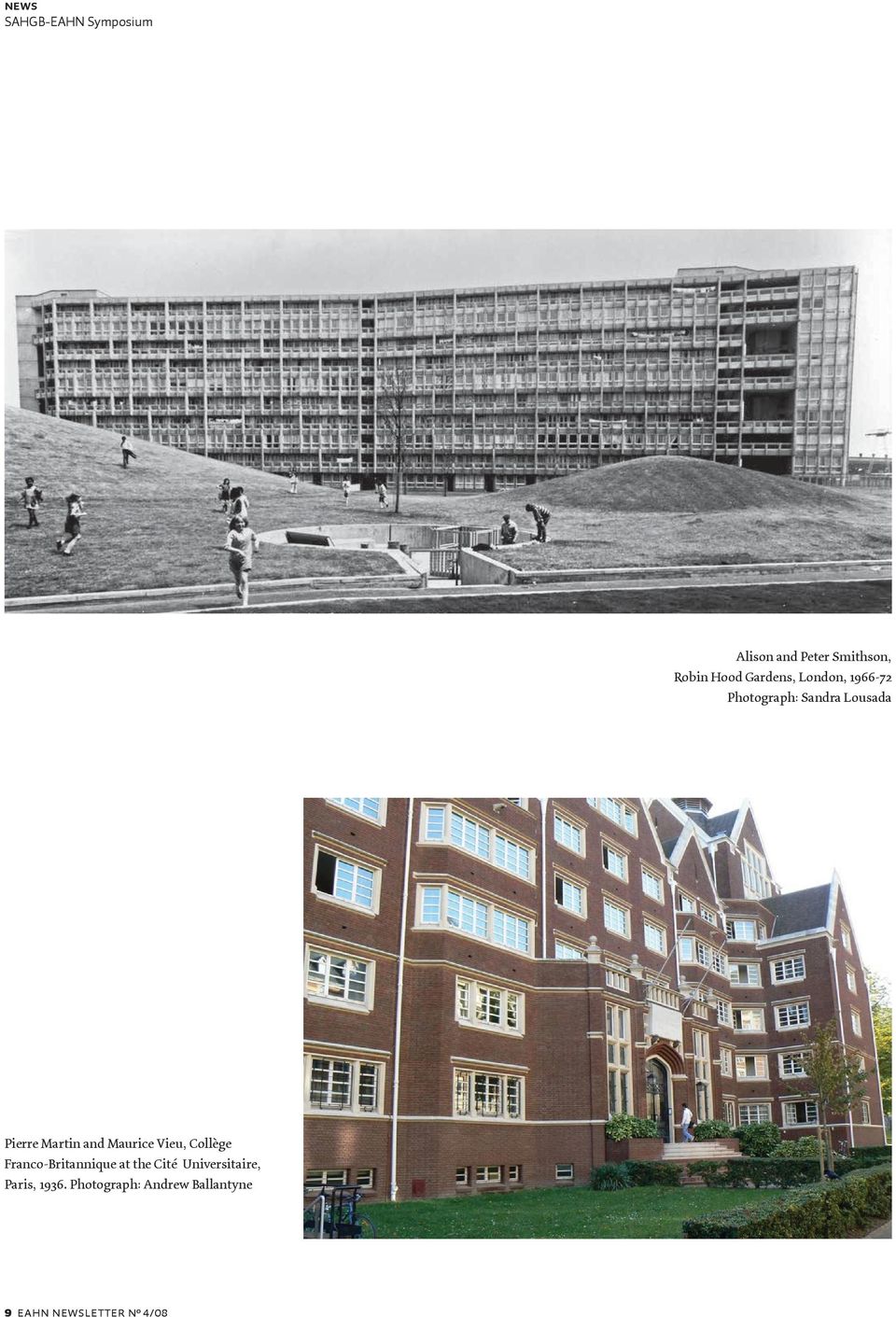
9 news SAHGB-EAHN Symposium Alison and Peter Smithson, Robin Hood Gardens, London, Photograph: Sandra Lousada Pierre Martin and Maurice Vieu, Collège Franco-Britannique at the Cité Universitaire, Paris, Photograph: Andrew Ballantyne 9 eahn newsletter Nº4/08
10 news Annual Business Meeting EAHN Fourth Annual Business Meeting Ankara, February 2009 The fourth annual business meeting of the eahn committee will take place in Ankara from February 2009, hosted by committee member Belgin Turan Özkaya and the Architectural History Program of the Middle East Technical University (METU). According to the provisional program for the weekend, the advisory committee for the 2010 eahn conference in Portugal will meet early in the day on 13 February. The general meeting will then begin at 15:30 that afternoon with presentations on the state of architectural history in Turkey. The second day will be chiefly devoted to the eahn business meeting from 9:30 15:30, with subcommittee meetings following the business meeting. On Sunday morning the group will tour Ankara, and the weekend will close with another meeting of the advisory committee for the Guimarães conference on Sunday afternoon. General members are cordially invited to attend the meeting: please contact Isabel van der Zande at as soon as possible, but no later than 15 January, if you would like to attend. Comments and suggestions from the general membership for inclusion in the agenda may be sent to Isabel by the end of January. EAHN at the 10th International DOCOMOMO Conference 2008 During the 10th International DOCOMOMO Conference held at the historic Van Nelle Ontwerpfabriek in Rotterdam, the eahn hosted a meeting on Thursday 18 September to introduce the organization to potential new members. Some forty people attended the meeting at which committee members Rob Dettingmeijer, Hilde Heynen, Maristella Casciato, and Nancy Stieber spoke about the various activities of the eahn. In the weeks that followed, eahn membership rose markedly, reaching the current level of almost 600 members. Nancy Stieber 10 eahn newsletter Nº4/08

11 news EAHN at DOCOMOMO The Faculty of Architecture building at the Middle East Technical University in Ankara, soon after its opening in Photograph: Faculty of Architecture Archives, METU J.A. Brinkmann, L.C. van der Vlugt, M. Stam, J.G. Wiebenga, Van Nelle Fabriek, Rotterdam, , Photograph: EAHN 11 eahn newsletter Nº4/08

12 news Thematic Groups EAHN Thematic Groups: Eastern European and Balkan Architecture The idea of thematic groups within the European Architectural History Network was formulated already in January 2006 at the EAHN s first annual business meeting in Berlin. These groups aim to address specific topics of international interest within the broad scope of the network as a whole. This finer organizational articulation can reflect a variety of criteria, such as architectural typology, historic epochs, or geographical frameworks. To date, three thematic groups exist within the EAHN: Judicial Architecture, Colonial Architecture, and Eastern European and Balkan Architecture. The latter is introduced here as the first in an occasional series reporting on these groups and their activities. Members interested in joining the thematic groups may contact the EAHN secretariat for further information: [email protected]. The thematic group on eastern European and Balkan architecture was the first to be established within the eahn. Several dozen scholars have attended its events, with over thirty actively involved in group projects; the group has no chronological limitations, although it features a clear emphasis on the nineteenth and twentieth centuries. Although geography represented an important factor in creating the group, it was, however, not the most significant one: in this case, geographical framing constituted a manner of addressing a region which is rarely if ever treated by the general discourse of architectural history. Hence, besides connecting scholars from eastern Europe and the Balkans, or those working on the region, the group aims also to contribute to a shift in current historiography. This approach means to provide a platform for its participants both in terms of a tribune making a place for a voice which has been scarcely audible in the general discourse of the discipline and of enhancing visibility for the work of the scholars studying the area. The two labels defining the group eastern Europe and Balkans are strong indicators of its historiographic positioning: while the first reminds one of the political division which ruled our world until recently (and which perhaps lingers in cultural discourses), the second recalls the recurrent effects of geopolitics. This historiographic emphasis is nuanced and enriched by other significant criteria, such as architectural themes and typologies specific to the region. These varied concerns provide a clear focus for the group, without imposing rigid constraints on it. 12 eahn newsletter Nº4/08
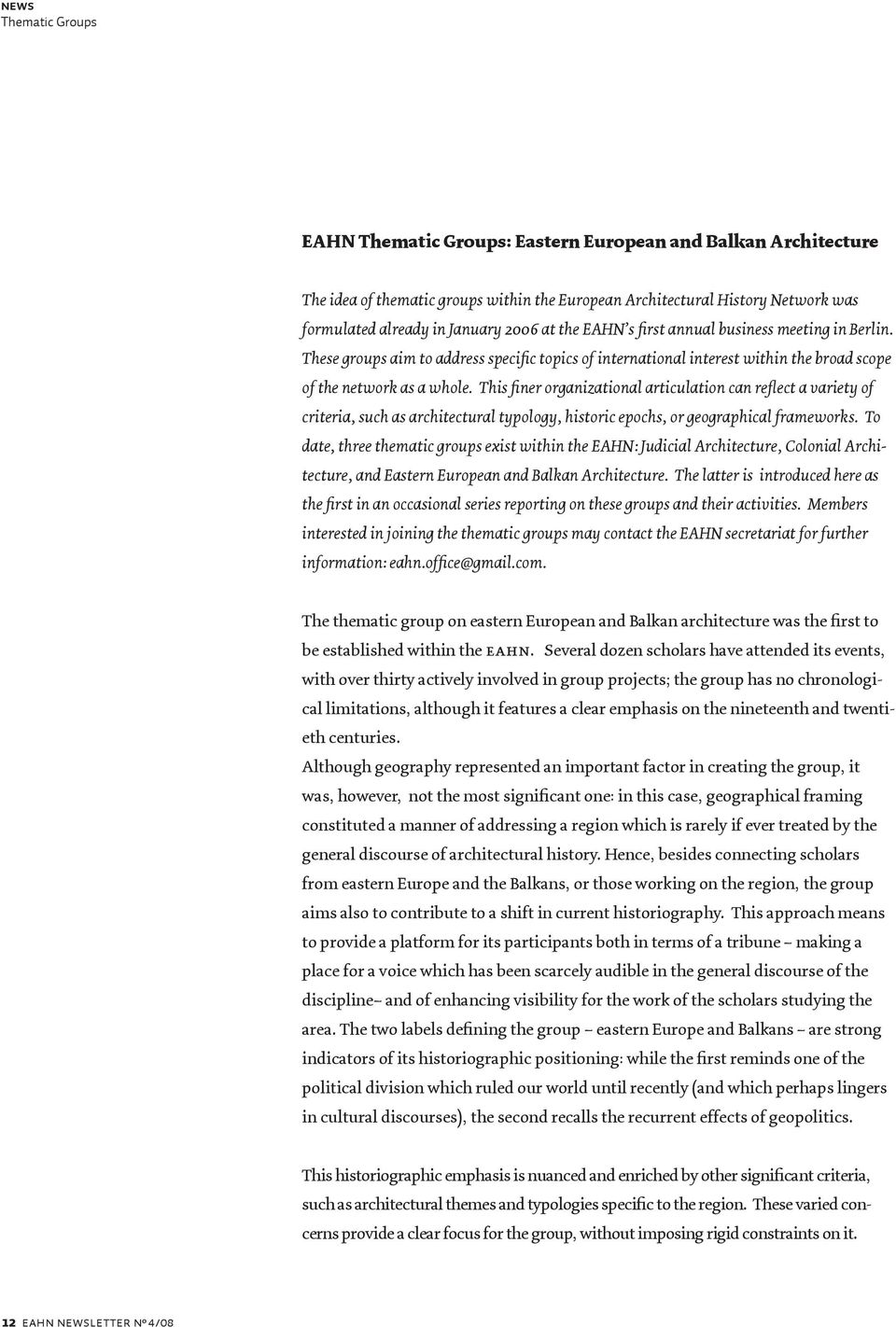
13 news Eastern European Architecture Poster for the first roundtable of the Eastern European and Balkan Architecture Thematic Group in Bucharest, June 2006 Photograph: Carmen Popescu 13 eahn newsletter Nº4/08
14 news Thematic Groups On the contrary, the group seeks to open the dialogue, in order to (re)introduce eastern European and Balkan topics to a larger audience. The transnational approach is further strengthened by interdisciplinarity: all the events developed until now have gathered not only art and architectural historians, but also historians, anthropologists, and scholars from other related disciplines. The group debuted with the roundtable A Disenchanted Brave New World. Looking Today at the Architecture of the Former Communist Bloc at the National University of Architecture in Bucharest, on 2 June Taking advantage of the travelling exhibition Two German Architectures , co-curated by Hartmut Frank and Simone Hain (on view at the National Museum of Contemporary Art in Bucharest, May-June 2006), the event examined the problematic fortune of the architecture of the former Soviet bloc in the post-socialist perspective, in terms of both theoretical studies and preservation issues. The Romanian scholars and their guest, Simone Hain, debated these topics and also discussed the possibility of developing collective projects such as a study of architecture for the masses during the Cold War which could unite the countries from both former blocs as they question major architectural, social and political issues of the postwar period. Another roundtable, organized at the Institut National d Histoire de l Art (inha) in Paris, May 2007, analyzed aspects of the historiography of eastern European art and architectural history. Entitled The Other Europe, Changing Visions in Art History, the roundtable aimed to explore the place occupied by eastern European * For the details of this rountable, visit: recherche=autre%20europe and: pdfinterior art and architecture in both the writing and teaching of art history.* The debates stimulated the preparation of a special issue of the journal Ligeia (forthcoming in 2009). Parallel to the networking involved in and generated by these two meetings, a more focused configuration was developed, devoted specifically to the study of the Balkan region. This group responds to a real need of scholars from inside and outside the geographical area to share their knowledge on Balkan topics, disregarding language barriers (a serious issue for scholars hoping to gain a global view of the region), and also to develop common research strategies and prepare common projects. If the Balkans already constitute a defined field of studies for historians and cultural historians, there is no such approach yet for art and architectural history. 14 eahn newsletter Nº4/08

15 news Eastern European Architecture A view of the exhibition Two German Architectures at its Brussels venue (Musées Royaux d Art et d Histoire / Musée du Cinquantenaire, January Februrary 2007), where it was shown on the occasion of the German EU Presidency. The visitors are participants in the European parliament inter-group Urban Logement. Photograph: Courtesy of the Bauministerium des Landes Niedersachsen / Simone Hain Participants at the conference and workshop of the Eastern European and Balkan Architecture Thematic Group in Bucharest, May Photograph: Carmen Popescu 15 eahn newsletter Nº4/08
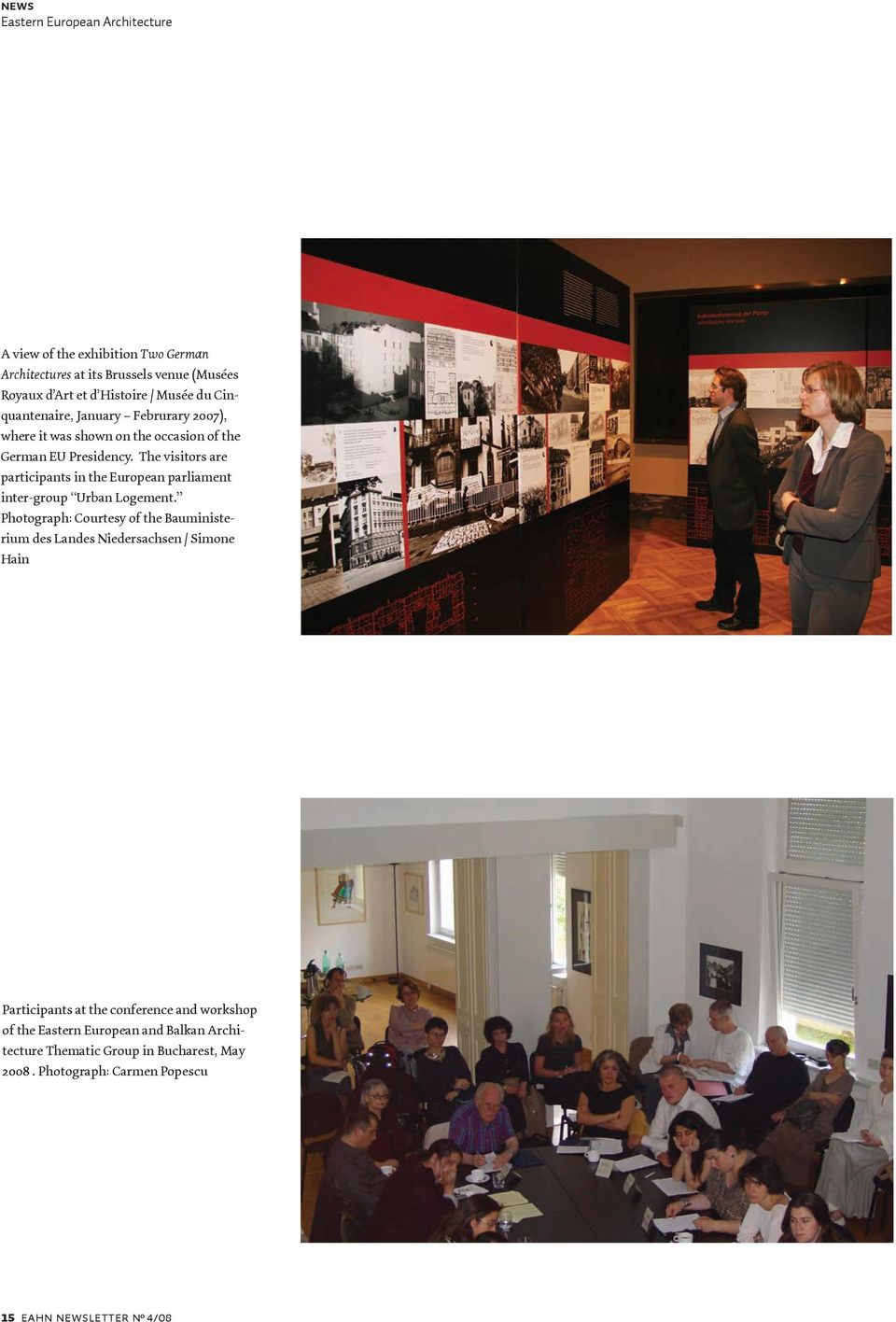
16 news Errata Moreover, the group aims to connect its research with current Western scholarship by studying transfers and circulation of forms and ideas between the major artistic centers in western Europe and those in the Balkans. In May 2008, New Europe College - Institute for Advanced Study in Bucharest hosted a conference and a workshop, Building Modernity in the Balkan Peninsula. The event, related to the program Europa ( intended to demonstrate the relevance of Balkan topics in constructing a coherent discourse on architectural history in general, but also to create a platform for interested scholars. While the conference presented the state of the research, the workshop debated core issues for creating a platform, such as thematic and chronological frames, methodology, transdisciplinarity, but also financial policies. As a result, a Balkan working group was founded, formed of scholars from most of the countries in the peninsula and from different Western countries. Gathering more than thirty members, most of them architectural historians, the group is currently preparing a common program and working on several projects, such as the Balkan city and its models in western and central Europe. Carmen Popescu Errata No. 3/08 Regrettably, mistaken captions accompanied two photographs in the Virtual Tour of Romanian painted churches in the last issue of the eahn Newsletter. The correct captions should read as follows: Page 35, lower photo: Monastery church of Saint Nicholas, Probota, 1532, exonarthex Photograph: Hildegard Sahler Page 45: Monastery church of Saint Nicholas, Probota, 1532 Photograph: Rob Dettingmeijer We apologize to the author, Vlad Bedros, and to our readers for any confusion resulting from these errors. 16 eahn newsletter Nº4/08

17 news Calendar On the Calendar eahn First International Meeting, June 2010, Guimarães, Deadline for Session and Roundtable Proposals: 19 December 2008 eahn Fourth Annual Business Meeting, Ankara: February 2009 sahgb-eahn Annual Symposium: British Architecture Seen from Abroad, London, 16 May eahn newsletter Nº4/08

18 explorations Tiilimäki Helsinki Finland Tel.: [email protected] Alvar Aalto Foundation / Alvar Aalto Museum Alvar Aalto Säätiö / Alvar Aalto-museo alvar aalto founcation The Alvar Aalto Foundation was established in Its activities are based on the architecture and lifework of Alvar Aalto ( ). Under the rules of the Foundation, it may also be active in the wider field of architecture as a whole, especially if such activity has points of contact with the goals of Alvar Aalto. The Alvar Aalto Foundation is an umbrella organization under which operate the Alvar Aalto Museum in Jyväskylä, in Central Finland, as well as the Alvar Aalto Academy and the Architectural Heritage Department, a section of the Alvar Aalto Museum, in Helsinki. The Foundation is the custodian of Alvar Aalto s architectural drawings and writings and controls the copyright to them. The Foundation owns the Aalto House ( ) and the Studio Aalto ( ) in Helsinki. It is also the custodian of the Alvar Aalto Museum in Jyväskylä ( ), and since 1994 also of Aalto s summer house, the Muuratsalo Experimental House ( ), alvar aalto museum The Alvar Aalto Museum, a special museum of architecture, was founded in 1966 and is housed in a building designed by Aalto. The museum, which functions as an Aalto information center, organizes exhibitions in Finland and abroad, and produces publications connected with the architect. It offers a wide-ranging permanent exhibition of Aalto s work which opened at the beginning of 1998, the centenary of his birth. One of the museum s most important tasks is the preservation of Alvar Aalto s buildings. It maintains a nationwide register of protected buildings and provides expert assistance on matters concerning the architect s buildings, working in close cooperation with the National Board of Antiquities. The Architectural Heritage Department of the museum operates from the Alvar Aalto Studio in Munkkiniemi, Helsinki. Its goal is to monitor and safeguard the buildings designed by Aalto. The Alvar Aalto Foundation issues statements about pending repair and restoration projects and these statements are drawn up by the Architectural Heritage Department. 18 eahn newsletter Nº4/08

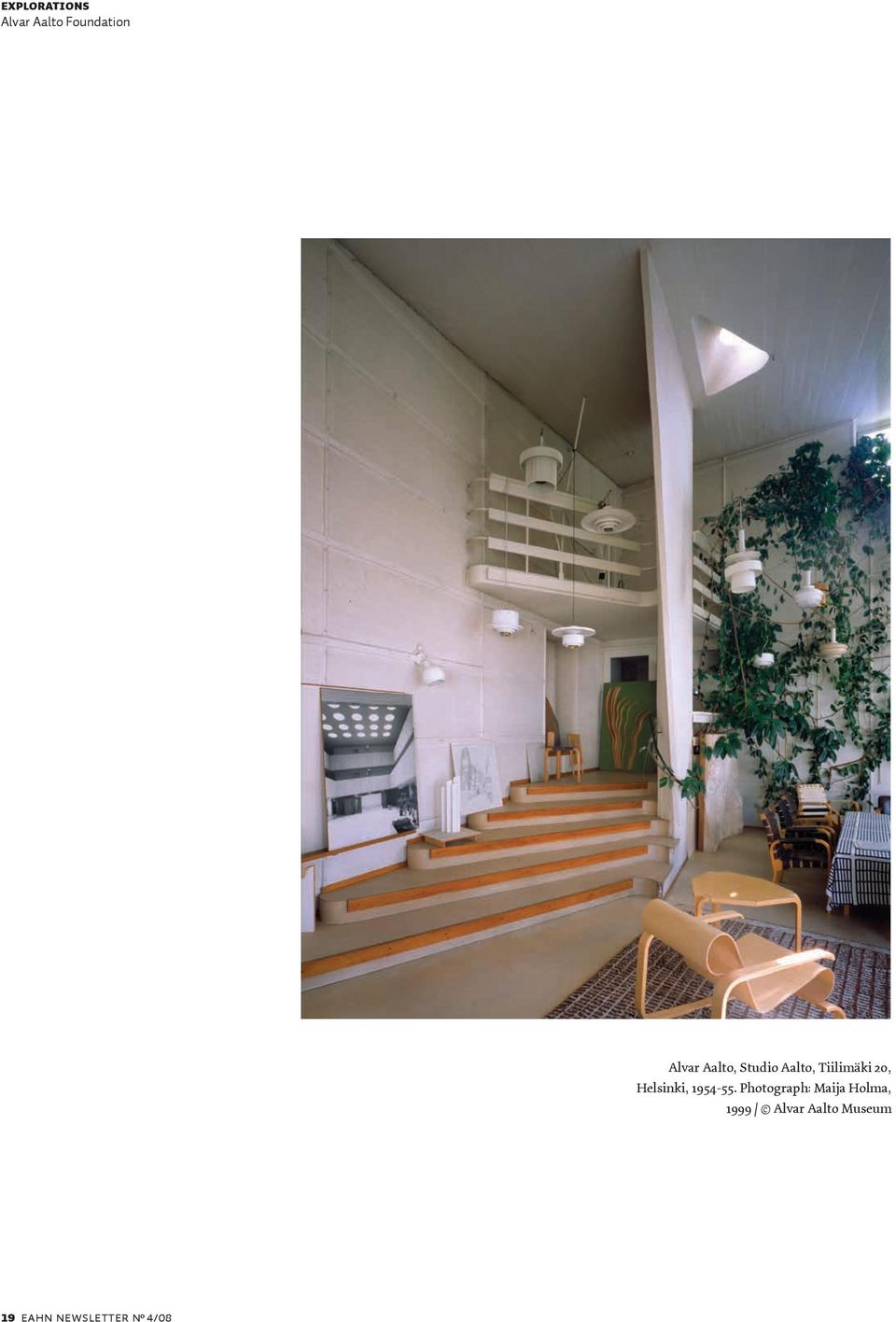
19 Explorations Alvar Aalto Foundation Alvar Aalto, Studio Aalto, Tiilimäki 20, Helsinki, Photograph: Maija Holma, 1999 / Alvar Aalto Museum 19 eahn newsletter Nº4/08
20 Explorations Alvar Aalto Museum Alvar Aalto, the Aalto House, Riihitie 20, Helsinki, Photograph: Maija Holma, 1999 / Alvar Aalto Museum The principal activity of the Architectural Heritage Department is providing expertise and advice to architects, technical designers and owners planning the restoration and renovation of Aalto s buildings and to agencies carrying out maintenance work. Drawing up historical studies, room inventories, and photographic records of Aalto buildings has also become an important part of the Architectural Heritage Department s activities. These assist in getting a feel for the buildings and an idea of their architectural values, and they help those planning repairs and maintenance. Taking part in the contemporary debates about the restoration of modern architecture and in professional training are other aspects of the museum s work. 20 eahn newsletter Nº4/08

21 Explorations Alvar Aalto Foundation The collection of record photographs steadily increases with inventories and repair projects, as does the collection of building materials which includes historic sample materials from the period when Aalto s office was still in existence. The library and the collections are available to researchers. archives The Drawings Archive in Jyväskylä contains approximately 120,000 original drawings and documents connected with Aalto s designs, dating back to Only a portion of this extensive collection, mainly consisting of drawings from before 1958, has been archived chronologically and is available to researchers. These drawings have been reproduced and the design process can be followed from the earliest sketches to the final details using these copies in A4 format; the originals may be consulted only under special circumstances because of the fragility of the material. Today the drawings are also archived digitally. The Letters Archive in Helsinki contains correspondence, statements, minutes, agreements, articles, lectures, and similar material. It is estimated that there are over 20,000 actual letters, but the total quantity of the material is difficult to assess at this stage because organizational work is still in progress. The Photographic Archive (in Jyväskylä) comprises architectural and design photographs, portraits and photographs of drawings. The archive includes not only photographs by famous professional photographers and amateurs, but also photographs taken by Aino and Alvar Aalto themselves. The archive also includes the document collection, which comprises correspondence, statements, contracts, articles, presentations and documents pertaining to individual projects such as building and painting specifications, or minutes of design conferences and site meetings. library The libraries in Helsinki and in Jyväskylä are particularly devoted to literature dealing with the life of Alvar Aalto, the books from the library in his office, historical studies and inventories of Aalto buildings, and architectural and design magazines from Finland and abroad. The library also aims to acquire research papers on Aalto, both Finnish and foreign, and other literature dealing with modern architecture. The library is non-circulating and its holdings may be consulted by appointment. 21 eahn newsletter Nº4/08
22 Explorations Alvar Aalto Museum Alvar Aalto, Experimental House, Muuratsalo, Jyväskylä, Photograph: Maija Vatanen, 2001 / Alvar Aalto Museum An additional aim is to assemble as extensive a collection as possible of theses and dissertations associated with Alvar Aalto; efforts will also be made to collect information about works in progress. To this end, the Architectural Heritage Department cooperates with other research institutes, collections and individual scholars. museum education Architecture and design education is one of the missions of the Alvar Aalto Museum. It offers education at many levels from nursery schools through architecture students to senior citizen programs. Projects vary from lectures and tailor-made workshops to Internet exhibitions, resources for teaching, and summer courses. 22 eahn newsletter Nº4/08
23 Explorations Alvar Aalto Foundation *Contact: alvar aalto academy Founded in 1999 as part of the Alvar Aalto Foundation, the Alvar Aalto Academy is an international discussion forum in the field of environmental culture, particularly contemporary architecture, and a promoter of further education in architecture. The architect Esa Laaksonen was appointed its first director. The Academy is financed mainly by a grant from the Ministry of Education and the city of Jyväskylä. The Academy has a five-member Board of Directors. Under its auspices, the Academy organizes the triennial Alvar Aalto Symposium and the Alvar Aalto Design Seminar in Jyväskylä. In addition, the Academy has organized conferences on architectural research in 2002, 2005 and The Alvar Aalto Academy also publishes the magazine ptah which has been completely transformed inside and out. What began as an information sheet for the Aalto centenary year 1998 has now grown into a new kind of periodical concentrating on the theory of architecture, design and art, and publishing academic essays and peer review articles entirely in English. The Alvar Aalto Foundation and Alvar Aalto Academy together publish a broadly-conceived, long-range series of monographs on Aalto s architecture. To date, the following volumes have been published: the Aalto House (2003), Sunila factory and housing area (2004), University of Technology Otaniemi (2008) and Maison Louis Carré (2008). The completed series will encompass a total of twenty-eight volumes. Finally, the Finnish Committee for the Restoration of Viipuri Library has offices in the Studio Aalto in Helsinki.* The restoration strategy aims to stabilize the building and prevent further deterioration, to renew basic technical facilities, and to restore the original architecture. Even if the building has been located on the Russian side of the border since 1945, the Finnish Committee is responsible for planning and design, as well as documenting and reporting on the restoration process. The Committee is also managing and directing the work together with the Central Municipal Alvar Aalto Library of the City of Vyborg. The project s main accomplishment in 2008 was to renovate the lecture hall and replace the undulating panelling of the lecture hall ceiling. Mia Hipeli Chief Curator Alvar Aalto Museum, Helsinki 23 eahn newsletter Nº4/08
24 virtual tour Ekaterinburg *Designed by the architect E. Baumgarten, built in the cast iron factories of Kasli and Kyshtym in the southern Ural region, and recipient of the Grand Prix Crystal Globe and the Large Gold Medal of the Parisian World Exhibition in Ekaterinburg (from : Sverdlovsk) is often known as the third city of Russia. Even though, in addition to the two metropolises in the European part of the country, there are also a handful of other cities with populations of over a million, among them nearby Perm and Cheliabinsk, Ekaterinburg deserves this status based on both its historical and contemporary importance. If Moscow is the center of political power and administration, and St. Petersburg the capital of culture and the arts, then Ekaterinburg is the industrial heart of the country: a city where machines and metals have determined the rhythm and fortunes of lives for three hundred years. This Ural city, named after Catherine I, the wife of Peter the Great, was founded in 1723 by enterpreneurs, mining specialists, the military and builders. It was established on the banks of the reservoir formed by damming up the river Isset. Among the earliest buildings were a machine factory, a mint (1726) and a grindery (1765). Some of the early settlement has been preserved to the present day between the dike and the stone bridge, notably three city gates by K. G. Turskii, the headquarters of the mining company by M. P. Malakhov (today the architectural museum, currently closed for reconstruction), and a hall for the lumber yard and mill by E. A. Sartorius. For the 250th anniversary of the city s foundation in this historic zone on both sides of the river was transformed into a museum and heritage complex, History Square. In appearance Ekaterinburg is a truly European city, despite its geographic location in Asia. This is not only due to the strong presence of twentieth-century constructivist and functionalist architecture in the urban fabric, but also to a continuous tradition of European architects working in the city, beginning with the German architects sent by Peter the Great in the eighteenth century. The first major architect to shape the city, however, was the Russian master Mikhail Malakhov ( ), who had been trained at the Academy in St. Petersburg and established the architectural style of Ural classicism. Malakhov designed approximately sixty buildings in Ekaterinburg, some quite capricious, which still lend variety to the city today. He also conceived the general plan for the city (1829), which guided its urban development to the beginning of the twentieth century. Visitors to the city today often have difficulty orienting themselves. Although the literature on the city and its history has become richer in recent years, most publications are available only in Russian. There is no tourist office, no public sightseeing program, and the treasures of the Ekaterinburg Museum of Fine Art including classic avantgarde painting, Ural gems and jewelery craftsmanship, and the Kasli cast iron pavilion* fail to entice visitors inside due to an absence of signs and posters. Nonetheless, anyone who spends a few days in the town is 24 eahn newsletter Nº4/08
25 virtual tour Ekaterinburg Western part of the Rastorguev-Kharitonov house, Ekaterinburg, as seen from Liebknecht Street with the gates of the main entrance; columned facades by M.P Malakhov, 1830s Photograph: Nikolaj Botschenin 25 eahn newsletter Nº4/08
26 virtual tour Ekaterinburg astonished at how much culture, and indeed architecture, there is to explore here, if only one knows what to look for and where to find it. In this essay, we would like to focus attention on seven monuments or districts of different periods and origins which represent the many-layered architectural history of the urban ensemble. historic country house The Voznesenskii (Ascension) Hill, with its picturesque view of the city center, is the highest point in Ekaterinburg. On its northern slope, the classicistic Rastorguev-Kharitonov country house rises like stair steps (first construction phase ; 44 Liebknecht Street). The residential complex with stalls, parade gates, and a fortified service court was built in the first third of the nineteenth century for the factory owner L. I. Rastorguev. In the late 1820s his successor, the city director and Merchant of the First Guild L. I. Kharitonov, had the adjacent marshland transformed into a park with pavilion, pond, and arbor, open to the public since At the same time he commissioned the renovation and extension of the main building s two wings and the service building. In addition, a unifying series of columned façades was applied along the front of the complex toward the main street. Mikhail Malakhov was responsible for this phase of construction, while the architects of the earlier building campaigns remain unknown. The complex covering approximately one hectare served for years as a venue for official receptions; the tsars Alexander I and II were housed here during visits to the city. In 1924 the complex was nationalized, and it became a Pioneer palace in Today the main building is still chiefly used for recreational programs for children and youths. villa quarter Today s Rosa Luxemburg Street, the extension of Liebknecht Street one and a half kilometers beyond the Rastorguev-Kharitonov house, is a district of villas and country houses. These belonged to merchants, doctors, artists, and enterpreneurs, and virtually all were built in the nineteenth century, with a few exceptions dating to the first decade of the twentieth century. The villas, planned by various architects among them Yulii Diutel (Nos. 8, 10, 26, 63), M. L. Reutov (Nos. 3 and 7) and E. A. Sartorius (No. 36) reflect a number of styles, such as classicistic, eclectic or Art Nouveau. After the October Revolution private property was confiscated by the state and most of the houses received new tenants who generally maintained neither the buildings nor the surrounding gardens. The resultant neglect and decay ultimately led to demolition of the properties. A few houses, however, could be saved since they were used by artists and academic organizations. In the so-called Dom Shelesnova, a brick building by Yulii Diutel from St. Petersburg ( , project office Alexander Turchevich), the Ural Academy of Sciences has its offices. The asymmetric residence, with rich interior decorations, is 26 eahn newsletter Nº4/08
27 virtual tour Ekaterinburg Yulii Diutel and Alexander Turchevich, Dom Shelesnova, Ekaterinburg, , detail of the house in the Luksemburg Street. Photograph: Nikolaj Botschenin 27 eahn newsletter Nº4/08
28 virtual tour Ekaterinburg located on the southern edge of the property; the one-story side wing connects a high wall with a monumental arch and two side portals, all in brick. While the building itself, unparalleled in Russia, is currently undergoing restoration, the historic garden with its fountain remains overgrown and neglected, as new, disruptive utilitarian buildings rise nearby. dynamo sports complex In connection with socialist industrialization in the 1920s the construction of housing and community buildings intensified in both the city center and the periphery. On a small peninsula jutting out into the city pond rose the five-story Dom fizkultury (House of Physical Culture, architect Veniamin Sokolov, 1929) with its observation deck, near the stadium and the other outdoor facilities of the Dynamo sports complex. Its form recalls an ocean liner, and its colorful façade treatment in white with blue window bands underscores its constructivist origins. Sokolov came from Leningrad to the Ural metropolis in 1926, where he was active in planning and design projects of various architectural studios (see below). From he directed the architectural workshop of the City Soviet. Even after eighty years, the Sports Ship still offers recreational activities on several floors, and is frequented by many city residents. Its orientation on the pond with the view to the dike marks one of the main historic axes of the city. water tower and factory town Nine kilometers north of the city center, the machine factory Uralmash, the Factory of Factories, was built during the first Five Year Plan. After it began production, the socialist workers town (Sotsgorod) of the same name grew up around it, today housing a population of 260,000. The factory and the town were both designed by young specialists in the planning office of the Uralgipromes Trust, almost all of whom belonged to the Association of Contemporary Architects (OSA) which promoted constructivist-functionalist forms. Joseph Robachevskii was responsible for the factory and technical buildings, while Petr Oranskii designed the general plan and housing; both had received their training in Leningrad. Their designs were precise and innovative: a central square ties together the main ensemble of six buildings which surround it the entrance to the factory, the factory administration building, the laboratory, and technical school on the one side, and a hotel and housing blocks on the other side. The three main streets of the town radiate from the square into the settlement. Except for the hotel, which already incorporates neoclassical features, all of the buildings on this Square of the First Five Year Plan bear the stamp of constructivism. The factory administration building ( ) is a joint project by Oranskii and the Dessau Bauhaus architect Béla Scheffler. He worked from in Sverdlovsk and also shaped other buildings of the 28 eahn newsletter Nº4/08
29 virtual tour Ekaterinburg Veniamin Sokolov, Dom fizkultury (House of Physical Culture), Ekaterinburg, 1929, part of the Dynamo sports complex. Photograph: Nikolaj Botschenin M.V. Reisher, water tower in the Uralmash settlement, Ekaterinburg, 1929; a listed monument of the Russian Federation since the 1970s. Photograph: Nikolaj Botschenin 29 eahn newsletter Nº4/08
30 virtual tour Ekaterinburg Sotsgorod: three housing blocks, a club the House of Trade on the Boulevard of Culture, as well as the first middle school and the Avantgard Stadium. Among the first and most clearly formed buildings in the town is the constructivist water tower by Moisei Reisher (1929), trained in Tomsk, and the only local architect originally from the Ural region. His white tower became the perhaps best known monument of industrial modernism in Russia on the basis of its functionally and aesthetically convincing form and its technical innovations. The cylindrical container of the tower is held by five reinforced concrete piers: four of them are free-standing supports, and one forms the walls of the stairway. Since it was shut down in the 1960s, this monument stands useless and unsecured next to a gas station. hotel isset Ekaterinburg today counts approximately 140 constructivist buildings. Only a third of these are listed monuments, among them the two hotels in the city center: the Isset and the Great Ural. The eleven-storied Isset (69 Lenin Prospect; , architects I. Antonov, V. Sokolov, A. Tumbasov) stands at the head of a large residential neighborhood in the city center, which is named Campus of the Chekists after its founders and first residents, officers of the secret police. It is linked with a club which today houses a large portion of the collection of the natural history museum, and in which a dynamically swung spiral staircase leads to the top of the building. Looking up through the stairwell, one sees a star rendered in minimal lines on the ceiling. hotel great ural Construction of Bolshoi Ural (the Great Ural, the name of the administrative district at the time which also included Perm and Cheliabinsk) began in 1929 on a sloped lot (1 Krasnoarmeiskaia [Red Army] Street, architects J. Smirnov, V. Sakharov). This hotel forms the southern border of the Square of the Parisian Commune, newly designed in the 1960s, and dominates much of the neighborhood. Its plan reflects the shape of the letter L, the eastern and western sections have varying heights. Along the sides of the main façade are large windows and corner balconies. The asymmetrical façade has terraces at the first story, the balustrades of which were embellished with vases and figures (steel workers, bakers, soldiers) in in the Soviet neoclassical style during a renovation campaign directed by Moisei Reisher, the architect of the Uralmash water tower. The evolution of Reisher s work from that icon of Russian modernism to this neoclassical renovation is one of the curiosities of Soviet architectural history. 30 eahn newsletter Nº4/08
31 virtual tour Ekaterinburg I. Antonov, V. Sokolov, A. Tumbasov, Hotel Isset, Ekaterinburg, ; the horseshoeshaped building has been a listed monument of the Russian Federation since the 1970s. Photograph: Nikolaj Botschenin J. Smirnov, V. Sakharov, Hotel Great Ural, Ekaterinburg, 1929; renovation in the 1940s by M.V. Reisher. Photograph: Nikolaj Botschenin 31 eahn newsletter Nº4/08
32 virtual tour Ekaterinburg city hall and city council building The City Hall and City Council Building concludes this brief tour of Ekaterinburg (24a Lenin Avenue). The city hall, designed by G. Golubev and M. Reisher and constructed from , is the principal building on the south side of the city s central square, named after the Revolution of Architecturally, the five-story building with clock tower and spire represents the transitional phase from a constructivist plan to Soviet neoclassical forms and ornament, such as monumental figural sculpture punctuating the roof line. Via an inner courtyard, the city hall is connected with an adjacent department store built in post-sovjet period Until the 1970s the city pursued organic urban expansions or rebuildings respecting the extant urban fabric. And if one ignores the politically motivated demolition of churches and the removal of Soviet-era buildings which had radically changed the face of the city during the socialist industrialization at the height of Stalin s rule for many years things remained the same as ever in Ekaterinburg. The last General Plan, however, mandated that all one- and two-story buildings should disappear by the year 2000, reflecting modernization and the new mass infrastructure necessary for the growing population. This meant that not only old Russian wooden architecture was torn down (only a few examples remain today, such as the Selivanov s House by J. Diutel, 1896, at 24 Tolmachev Street), but also bourgeois stone buildings of the nineteenth century, primarily villas. Today, architects build strange futuristic towers and boxes, office buildings and huge shopping centers out of much glass and plastic, with no urbanistic vision; they also build new churches, even where none ever existed before. Some of these new buildings infringe upon the over five hundred listed monuments of the city and block the once-heralded urban axes. Ekaterinburg, which was closed to foreign visitors for fifty years in the last century, is seeking a new identity in its current phase of revitalization: whether it opts for a national orientation or returns to its European roots remains a fascinating question. Astrid Volpert Berlin [email protected] Ludmila Tokmeninova Ural State Academy of Architecture and Arts, Ekaterinburg [email protected] Many thanks to Ivan Nevzgodin for his generous assistance with the preparation of this essay. Translation: Susan Klaiber 32 eahn newsletter Nº4/08
33 virtual tour Ekaterinburg G.A. Golubev and M.V. Reisher, City Hall and City Council Building, Ekaterinburg, Photograph: Nikolaj Botschenin Ekaterinburg as viewed from the eastern point of the dam across the city pond, with Lenin monument and the skyline of new apartment houses. Photograph: A. Volpert, eahn newsletter Nº4/08
34 virtual tour Ekaterinburg bibliography Bandrovskaya, A.P. and N.A.Vilesova. Architectory Ekaterinburga i Sverdlovskoj oblasti. Ekaterinburg: Tatlin, (On Reisher, Scheffler and Sokolov see pp , , ) Bukin, V.P., and A.A. Piskunov. Sverdlovsk: Perspectives of Development to the Year Sverdlovsk: Mid-Urals Publishing, Formosov, A.A. Uralez Malachov. ( The Urals Malakhov. ) Voprocy istorii Nr. 4-5 (1991). Maslakov, V.V. and Ural Branch of Russian State Academy of Sciences, Institute of History and Archaeology. Ekaterinburg Encyclopaedia. Ekaterinburg: Akademkniga, Pare, Richard, and Jean-Louis Cohen. The Lost Vanguard: Russian Modernist Architecture New York: Monacelli Press, 2007 (Russian version: Ekaterinburg: Tatlin 2008; both include a few pages on monuments in Ekaterinburg.) Pavlovsky, B.V. The Kasli Cast Iron Pavilion. Sverdlovsk: Middle-Urals Publishing House, Pichugina, O.K. and G.S. Kholodova. Ekaterinburg Museum of the Fine Arts. Ekaterinburg: The Urals University Press, Rosina, E. and Grigori Koslov. Jekaterinburg Allgemeines, Geschichte und Kultur. in Politik und Kultur in der russischen Provinz, edited by G. Luchterhandt, S. Ryshenkow, A. Kusmin, Bremen: edition temmen, Starikov, A.A., V.E. Zvagelskaya, L.I. Tokmeninova, and E.V. Cerniak. Ekaterinburg: Istoria v architecture (Ekaterinburg: History of Architecture). Ekaterinburg: Sokrat, 1998, Tokmeninova, L.I. Ekaterinburg Sverdlovsk: architekturnaja lichoradka gg. ( Ekaterinburg-Sverdlovsk: Architectural fever in the 1920s and 1930s. ) Nauka Urala. Mart. Nr. 10 (1992): 6. Tokmeninova, Ludmila. Sverdlovsk: A City Unique in its Heritage of Constructivist Architecture, in Conference Proceedings: Second International Conference of Docomomo, September 16-19, edited by K.-H. Burmeister and W. de Jonge, Eindhoven: DOCOMOMO Organizing Group, Tokmeninova, Ludmila. Other Modernisms. docomomo 36 (2007): Tokmeninova, Ludmila, and Astrid Volpert. BAUHAUS na Urale, Documents from the Conference Bauhaus im Ural.Von Solikamsk bis Orsk. Ekaterinburg: Webster, Verilov, A. V usadbe Shelesnova. ( In the Shelesnov Villa. ) Respublika, 1 october Volodin, P. Sverdlovsk. Moscow: Izd-vo Akademii arkhitektury SSSR, Volpert, Astrid. Ein unbekannter Bauhausarchitekt im Ural. Zum 100. Geburtstag von Béla Scheffler. Ekaterinburg: Filantrop, Volpert, Astrid. Territoria avangarda: Béla Scheffler: Bauhaus Uralmasch. The New Word of Art (St. Petersburg) Nr. 1 (2008): Zvagelskaya, V.E., et al. Svod pamjatnikov istorii i kultury Sverdlovskoj oblasti (Guide to Monuments of History and Culture from the Sverdlovsk District). Vol. 1, Ekaterinburg. Ekaterinburg: Sokrat, eahn newsletter Nº4/08
35 virtual tour Ekaterinburg links for architecture and culture in ekaterinburg Governmental Agencies: City of Ekaterinburg, cultural information: Ministry of Culture of Sverdlovsk region: Research Institutions and Museum: Ural State Academy of Architecture and Arts: Russian Academy of Sciences Ural Branch, Institute of History and Archaeology (website available in English): Belinski Scientific Library of Sverdlovsk region: Museum of Local Topography in the Sverdlovsk region: Online Encyclopedia on Ural Region: Alexejev, V.V., Institute of History and Archaeology, Uralskaja istoričeskaja Encyklopädia, Ekaterinburg: Akademkniga 2000; also for online consultation: encyclopaedia,o,2073,0.html Das Bauhaus im Ural, Project at the Bauhaus-Universität Weimar: eahn newsletter Nº4/08
36 Bookshelf and White Cube Book review Gülru Necipoğlu and Sibel Bozdoğan, editors History and Ideology: Architectural Heritage of the Lands of Rum (Muqarnas 24) Leiden, Boston: Brill, 2007, 310 pp., 161 illus., 56 ISBN Volume 24 of the renowned Harvard-based journal Muqarnas, an annual on the visual culture of the Islamic world, is a special issue dedicated to the proceedings of the conference History and Ideology: Architectural Heritage of the Lands of Rum held in Cambridge, Massachusetts in May Published little more than a year after the event, editors and authors seemingly did not want to lose time in addressing problems close to their hearts. And an important contribution to the field of Ottoman architectural history it is indeed, being no less than a direct critique of past and present scholarship in that discipline. We find fourteen papers by talented scholars whose backgrounds are fairly similar. It is not surprising, therefore, that the critiques are also quite uniform (and only at times openly polemical), whereby the core articles (see below) of Muqarnas 24 read almost like chapters of a single book. They are not really a contribution to art history in the traditional sense, but rather a reconstruction of episodes in twentieth-century intellectual history that cannot be ignored by any student of Ottoman architecture. The authors must be commended for not sparing criticism and, more importantly, for concentrating it where it can still serve constructively. Rather than a work of chance, Muqarnas 24 is an orchestrated effort. A key paper, setting the mood, is editor Gülru Necipoğlu s piece on the Ottomans best-known architect, Mimar Sinan, programmatically titled Creation of a National Genius. Once styled the Turkish Michelangelo, fierce battles came to be fought over the ethnic origins of the master who came to personify the essence of the Ottoman style. Official history eventually settled for an insistence on his having been a Christian Turk as something still more acceptable than Greek or Armenian. An exhumation of his skull eventually proved his membership in the brachycephalic Turkish race. The story then disseminated in a 1950s historical novel by no less than Atatürk s adopted daughter was that Sinan, upon visiting 36 eahn newsletter Nº4/08
37 bookshelf and white cube Book Reviews Seljuk-period monuments in Anatolia with his grandfather (presumably a Christian Turk as well), was advised by the latter to accept Islam and serve the Turkish race by creating civilized works of architecture (p. 167). Atatürk himself had similarly realized the utility of Sinan in the crafting of national pride (and, to begin with, a nation). While his desire to have the famed Süleymaniye complex transformed into a commemorative theme park for Sinan (Sinan sitesi) never materialized, the idea of a statue of Sinan in the new capital Ankara did: it was modelled on the physiognomy of a stone mason from Sinan s native village in Central Anatolia, who claimed to be a direct descendent of the master. Invited to the inauguration ceremony, the public could corroborate that the physical likeness was indeed met. Needless to say, we have little or no trustworthy evidence for Sinan s appearance. The episode is thus all the more significant in reflecting the young Republic s altered approach to representations of the body on one hand, and of the necessity of visualizing history as cultural (or national ) capital on the other. However entertaining some of the episodes revisited in the course of the historio- 37 eahn newsletter Nº4/08
38 bookshelf and white cube Book Reviews graphical reviews may be, the writings of the late Ottoman and early Republican period (roughly the first half of the twentieth century), an age of nation-building, are indeed analyzed with some scholarly distance; they are a product of their time. More recent authors, however, are more openly criticized for not questioning concepts they had in part inherited from the nationalist scholarly tradition, or even developing them further. The tendency for formalism in Turkish architectural historical scholarship is identified not only as the dominant method (here asserted as a legacy of the Vienna School in Turkey, really Josef Strzygowski and his students) but also a strategy to circumvent thorny questions. Building plans so acquired paramount epistemic importance in a tradition that came to be concerned primarily with morphological continuities and transformations assessed in a comparative framework (Pancaroğlu, pp. 68, 81). This tradition had remained largely out of touch with new empirical and theoretical developments in neighboring disciplines (including Ottoman history), and the utility (or necessity) of primary sources has been generously ignored, promoting a frozen vision of architecture largely divorced from historical context (ibid., p. 67). This is specifically addressed in several papers as informed by the nationalist substructure of the scholarly tradition. A tripartite sequence of Turkish-Islamic architecture in Anatolia, relegating Ottoman as merely a period identifier in a wider Turkish- Islamic history succeeding the Seljuk and Beylik periods, was naturalized as a teleological, uninterrupted sequence. This tripartite sequence of Turkish-Islamic architecture had, Necipoğlu (p. 174) charges, deliberately masked discontinuities, ruptures, and external connections. *Stephen Vernoit, ed., Discovering Islamic Arts, Collectors and Collections, (London and New York:Taurus / St. Martin s Press, 2000). But Muqarnas 24 beyond its primary theme of Ottoman architectural historiography can also be read as a supplement, perhaps even as a reaction, to an earlier volume on much the same topic, yet with a wider regional focus: the multi-author volume Discovering Islamic Art: Scholars, Collectors and Collections, * This book, in many ways a first, similarly sought to address the history of a discipline - if such we can call Islamic art history (see the discussion in the preface) - by exploring it through the work and sensibilities of the persons who shaped it. What it largely repeated was the generous omission of the artistic output of the Ottomans routine to the discipline and its scholars on one hand (here referred to as the medieval bias ), and the omission of German scholarship on the other; it was the reductive framework of Said s Orientalism applied to art history. 38 eahn newsletter Nº4/08
39 bookshelf and white cube Book Reviews Muqarnas 24 now most accurately fills that gap. If carefully read, it is bound (and hoped) to inform future studies with a more critical approach to the subject matter. Then it could indeed mark a turning point. To ensure the intended impact, however, editors and authors may not be able to avoid a translation into Turkish perhaps slimmed down by the exclusion of the pieces by Rizvi, Flood, and Watenpaugh, which stand a bit apart from the other papers. Maximilian Hartmuth Sabancı Üniversitesi, Istanbul [email protected] 39 eahn newsletter Nº4/08
40 bookshelf and white cube Book Reviews Book review Vincent B. Canizaro, editor Architectural Regionalism: Collected Writings on Place, Identity, Modernity, and Tradition New York: Princeton Architectural Press, 2007, 464 pp., 80 b/w illus., $39.95 ISBN-13: , ISBN-10: After about 1900 architects all over Europe tried to overcome the outdated conventions of historicism and the arbitrariness of Art Nouveau by developing new regionalist styles that were organically rooted in the local environment. Vernacular architecture provided the inspiration for English cottages, neo-normand villas, Heimat architecture, the estilo montañés and the Zakopane style. The resulting houses were to be up-to-date, comfortable and preferably built by applying local materials and artisanal traditions; at the same time they were to embody the Zeitgeist and the Volksgeist. Contrary to most avant-garde movements, however, regionalism with its stress on tradition, continuity and rootedness did not produce manifestos that loudly proclaimed a new beginning or a complete break with the past and existing practices. Nonetheless, at the beginning of the twentieth century, regionalism became a highly influential and innovative international architectural trend. Architectural Regionalism in some ways is the belated manifesto of a style without manifestos, although the book almost completely ignores Europe. This book, hence, is in the first place an anthology of texts with which the editor Vincent B. Canizaro tries to place Kenneth Frampton s famous critical regionalism in a historical context. Frampton s fierce criticism of the homogenizing effects of technology and the emptiness of postmodern architecture and his subsequent plea for an architecture that takes regional differences into account without being nostalgic caused much commotion and debate in the 1980s. Nevertheless, the editor selected only one short text by Frampton, as he is more concerned with presenting architectural regionalism as a broad phenomenon of which critical regionalism is only one strand. The book, which also contains a short introduction in which the editor explains the importance of the topic, republishes forty-four articles or fragments of books of which only three deal with non-american (in fact: Third World) topics. 40 eahn newsletter Nº4/08
41 bookshelf and white cube Book Reviews 41 eahn newsletter Nº4/08
42 bookshelf and white cube Book Reviews Various types of regionalist architecture are treated in the articles assembled in this volume, each of which is preceded by a one-page introduction by Canizaro. Several authors analyze the Mission style, the Pueblo Revival and other regionalist styles from the beginning of the twentieth century, whereas others, among whom Lewis Mumford, treat regional planning and regional modernism. Postwar currents, such as bioregionalism and critical regionalism also receive due attention. Some of the authors also clearly state what they mean by regionalism. Thus, the Kentucky farmer and writer Wendell Berry describes regionalism in general as local life aware of itself, whereas the professor of architecture Eleftherios Pavlides defines regionalism in architecture as the architect s response to the existing vernacular architecture of a region. The editor has selected essays of both propagandists and opponents of regionalism, thus allowing the reader to study the general outline of the various debates on the topic, most of which until recently have sunk into oblivion. Although some authors mention Henry Hobson Richardson and the English Arts & Crafts movement as possible precursors they are not given specific attention in this volume. Moreover, the earliest text is from 1921 and only five articles date back to the 1930s. The impression thus could be that regionalism is essentially a recent phenomenon, and this is clearly not the case. Although the sources of regionalism and the golden age of architectural regionalism do not receive due attention in this collection of essays, the book is a welcome contribution to current debates between both architects and architectural historians as it shows that regional or vernacular influences on architecture had an important impact on architectural developments during the entire twentieth century and stimulated much discussion. A further advantage is that it establishes regionalism as a clearly distinguishable architectural trend, and maybe even the most important challenge to modernism. Regionalist architecture is already an accepted label in both France and Spain, but in other European countries a wide variety of labels is still used to indicate the same neo-vernacular trend. Especially in 42 eahn newsletter Nº4/08
43 bookshelf and white cube Book Reviews German-speaking countries many different terms are used to indicate essentially the same phenomenon, such as Heimatschutzarchitektur, Heimatstil, Reformarchitektur or National Romanticism. Hopefully, Canizaro s very useful American manifesto of twentieth-century architectural regionalism can establish regionalism as the best general term for neo-vernacular architecture all over the world. Eric Storm Universiteit Leiden [email protected] 43 eahn newsletter Nº4/08
44 bookshelf and white cube Exhibition Reviews exhibition review Drawings and Prints: Selections from the Permanent Collection Curator: Carmen Bambach Metropolitan Museum of Art, New York 14 July to 19 October 2008 Newly Discovered Drawings After Vitruvius As the only major text about architecture from Classical Antiquity to survive, the importance of Vitruvius for the understanding of ancient building in the Renaissance cannot be overestimated. Eight Italian Renaissance drawings after Vitruvius s De architectura libri decem (Ten Books of Architecture), recently purchased by the Metropolitan Museum of Art, were recently on view as part of the regular gallery rotation in the Robert Wood Johnson Galleries. The curator dates the drawings to the 1530s or 1540s and attributes them, for the first time, to a member of the Sangallo family of architects, suggesting perhaps Bastiano Aristotle da Sangallo ( ). Four printed Renaissance editions of Vitruvius (Fra Giocondo, 1511; Durantino, 1524; Cesariano, 1521; Barbaro, 1556) from the Metropolitan s collection of early architectural books complemented the drawings and included interesting contemporary annotations. In the early sixteenth century, Rome provided fertile ground for nascent archaeological interests. Architects and philologists called for an overhaul of the corruptions that plagued existing translations of Vitruvius, and argued that the text needed to be checked against the actual ruins of antiquity. De architectura combines a discussion of materials, construction, building types and aesthetic components interspersed with historical narratives. Of the eight drawings on display, three reconstruct examples of ancient temples in perspective elevation, and in one instance, plan. Two show city views of Alexandria and Athens. Two describe mili- 44 eahn newsletter Nº4/08
45 bookshelf and white cube Exhibition Reviews Attributed to a member of the Sangallo family, Temple Types: Pseudodipteral, ca , pen and dark brown ink (Vitruvius, book 3, chap. 2, no. 6). Photograph: Courtesy of The Metropolitan Museum of Art ( ) 45 eahn newsletter Nº4/08
46 bookshelf and white cube Exhibition Reviews tary and fortification concerns, while one rather enigmatic illustration may relate to Vitruvius s discussion of the effect of the wind on the foundation of cities. The drawings, accompanied by a partial Italian translation of Vitruvius s text, may suggest a project to publish a new edition in volgare that never materialized. The illustrations, however, do not exhibit the kind of precision in architectural reconstruction one might expect from a study based in archaeological research. Attempts at perspective are awkward, especially in the case of the temple elevations. The relationship between text and image is at times difficult to interpret. The illustration for the pseudodipteral temple has six columns, but in the accompanying Vitruvian text, eight are prescribed. The temple also has no stylobate; columns appear as if growing directly out of the earth, like artificial tree trunks. The buildings are reconstructed from the text but presented as ruins, perhaps in an effort to convey an air of material authenticity to hypothetical reenactments. But to judge the drawings by the standards of modern archaeological correctness is to overlook how an artist, when forced to imagine the magnificence of classical antiquity from fragmentary evidence, makes the past come alive. The illustration for the Battle of Larignium, which in the text is brief and unspecific, is a complete reenactment of an ancient battle using Vitruvius s testudo war machines, but with a reconstruction of a medieval larch-wood tower. Both Athens and Alexandria are set with Roman monuments, as if these stand in as signs for antiquity and give the topography an unmistakable local reference. The plan for the prehistoric hut on the Areopagus resembles a Roman tomb modeled out of mud and the drawing of city walls shows structural innovations related to issues in modern warfare unfathomable in Vitruvius s time. Here, antiquity becomes indistinguishable from the contemporary world of the sixteenth century, reminding the viewer that ancient architecture was often marshaled in the service of magnifying the present, rather than understood as an entity distinct in time and form. The exact attribution of the drawings is problematic. Paleographic evidence suggests a Florentine artist, but the attribution to Aristotle da Sangallo is based on a 46 eahn newsletter Nº4/08
47 bookshelf and white cube Exhibition Reviews Attributed to a member of the Sangallo family, On Timber, the Battle of Larignium, ca , pen and dark brown ink (Vitruvius, book 2, chap. 9, nos. 15, 16) Photograph: Courtesy of The Metropolitan Museum of Art ( ) 47 eahn newsletter Nº4/08
48 bookshelf and white cube Exhibition Reviews perceived visual relationship between the Metropolitan s drawings and those after Vitruvius in the Corsini Incunabulum dated to the 1530s and 1540s (Rome, Biblioteca Accademia Lincei e Corsiniana, MS Corsini 50.F.1). However, the drawings in the Corsini Incunabulum are not by Aristotle but are rather autograph annotations by Giovanni Battista da Sangallo ( Il Gobbo, ), brother of Antonio the Younger. In addition, the drawings in the Corsini Incunabulum are far more developed in terms of skill in architectural representation and accuracy in archaeological reconstruction. The Metropolitan s drawings present a lively, if improbable, illustration of the Vitruvian text, standing at the intersection of traditional antiquarian studies and newer archaeological interests emerging in the early decades of the sixteenth century. The acquisition is an important addition to the Metropolitan s splendid collection of Renaissance architectural books and sketchbooks. The exhibition gives us the opportunity to reconsider the legacy of Vitruvius s De architectura in architectural thinking as merely prescriptive. Drawings such as these highlight the creativity the text engendered during the heady years of the early sixteenth century in Rome. Katherine Isard [Columbia University] 48 eahn newsletter Nº4/08
49 Attributed to a member of the Sangallo family, The Aeropagus in Athens with Cave Houses, ca , pen and dark brown ink (Vitruvius, book 2, chap. 1, no. 5). Photograph: Courtesy of The Metropolitan Museum of Art ( ) 49 eahn newsletter Nº4/08
50 bookshelf and white cube Exhibition Reviews exhibition review Palladio 500 anni Curators: Howard Burns, Guido Beltramini Centro Internazionale di Studi di Architettura Andrea Palladio (CISA), Vicenza 20 September 2008 to 6 January 2009 Palladio 500 anni is a travelling exhibition that celebrates the five hundredth anniversary of Andrea Palladio s birth. The first stop is in Palazzo Barbaran da Porto, the historical location of the Centro Internazionale di Studi di Architettura Andrea Palladio (CISA) in Vicenza, from where it will travel to the Royal Academy of Arts in London (31 January to 13 April 2009). Curated by Howard Burns, president of the scientific committee of the CISA, and Guido Beltramini, director of the CISA, with the collaboration of Charles Hind, associate director and H.J. Heinz Curator of Drawings of the Royal Institute of British Archiects (RIBA), and Mary Anne Stevens, director of academic affairs of the Royal Academy, the exhibition surveys the entire life and work of Palladio. The curators chose to focus their attention chiefly on Palladio the architect rather than to explore the deeper historical context of the period as in the recent exhibition Andrea Palladio e la villa veneta, held at the CISA in The exhibition features over two hundred works paintings, books, manuscripts, maps, bronze statuettes, coins, and architectural models in order to present Palladio s oeuvre and its background. The substantial amount of autograph drawings is particularly remarkable: fifty-four sheets lent from the RIBA, twelve from the Musei Civici di Vicenza, and eight from other collections in Oxford, Chatsworth, Vicenza and Venice, for a total of seventy-four sheets. The last time one could admire such a quantity of Palladio s drawings was twenty-seven years ago, at the Palladio exhibition held in Washington in 1981 and curated by Douglas Lewis. Palladio 500 anni is set out in ten rooms in the piano nobile of the Palazzo Barbaran da Porto, with each room dedicated to a different subject: Palladio s youth as a stonecutter in Padua and Vicenza; his study of the new architecture of the Renais- 50 eahn newsletter Nº4/08
51 bookshelf and white cube Exhibition Reviews Andrea Palladio, drawing for the Teatro Olimpico proscenium, (RIBA, vol. XIII, 4 and 5). Photograph: Royal Institute of British Architects, London Andrea Palladio, Teatro Olimpico, Vicenza, , view of proscenium Photograph: Pino Guidolotti / CISA A. Palladio 51 eahn newsletter Nº4/08
52 bookshelf and white cube Exhibition Reviews sance; his drawings of ancient Roman ruins; his first projects as an architect; his villas; and his projects for Venice. Following this critical path, the visitor enters Palladio s workshop where his methods of design are revealed. The last room is dedicated to Palladio s legacy, from Inigo Jones to Thomas Jefferson. A great number of models aid in making Palladio s projects immediately comprehensible, even to a vast general public. Some big wooden models, originally built for the CISA s 1972 exhibition curated by Renato Cevese, give a good general idea of the buildings composition. Among these there are, for example, the models of Villa Emo and the Redentore, and the model of the unrealized project for Villa Trissino at Meledo. But there are also many new models of different dimensions created specifically for this exhibition, in order to draw the visitor deeper into Palladio s architectural process. A large model of San Giorgio Maggiore, for instance, helps one understand the original colors of its interior; several models of the Basilica in Vicenza show the complicated design sequence for this seemingly endless construction project; a section model of the Villa Poiana clarifies the sequence of its interior spaces; and finally, the numerous small models interspersed throughout the show near corresponding drawings assist the viewer in reading and understanding the drawings. The paintings and manuscripts exhibited are well integrated into the narration, further clarifying the context of Palladio s work. The catalogue of the exhibition, written mainly by the curators, reflects their intention to provide a broad synthesis of Palladio s work, and it is divided into three main sections. The first section traces the architect s artistic development by reviewing his projects and buildings; the second explores Palladio s architectural theory and his intellectual production; and the third briefly outlines his profound impact on later generations. In general, the interpretation of Palladio s career presented here synthesizes the studies of the last forty years. The main themes regard Palladio s invention of a kind of grammar of architectural composition, his innovative functional solutions, and his quest for beauty through the imitation of ancient buildings. The most important new discoveries and interpretations which emerged during the preparation of the exhibition concern the project for the Rialto Bridge, a drawing for low budget housing in Venice, and a design for some gardens. Further- 52 eahn newsletter Nº4/08
53 bookshelf and white cube Exhibition Reviews View of Basilica model in the Palladio 500 anni exhibition installation. Photograph: Pino Guidolotti / CISA A. Palladio 53 eahn newsletter Nº4/08
54 bookshelf and white cube Exhibition Reviews more, the catalogue presents a partially new interpretation of Palladio s writings, from the guide to Rome, to the Quattro Libri, to an unfinished edition of Polybius s Histories. Last but not least, exceptionally high quality photographs make the catalogue a valuable resource for scholars. Many other new specialized studies on the architect are included in the related publication of the acts of the week-long Palladio symposium organized by the CISA in May The installation, designed by the architectural office of Aldo Cibic, does not rise to the quality of the material on display, but a well-organized website explains the exhibition organization and also permits a virtual visit of the show ( Vittorio Pizzigoni Politecnico di Milano Publications related to the exhibition: Howard Burns, Guido Beltramini, eds., Palladio, Venice: Marsilio, 2008, 428 pp., many color illus., 54 ( 40 at the exhibition), ISBN Franco Barbieri, Donata Battilotti, Guido Beltramini, Arnaldo Bruschi, Howard Burns, Francesco Paolo Fiore, Christoph Luitpold Frommel, et al., eds., Palladio Il simposio del cinquecentenario, Venice: Marsilio, 2008., 422 pp., ill., 40, ISBN eahn newsletter Nº4/08
55 bookshelf and white cube Exhibition Reviews Canaletto, Capriccio palladiano Photograph: Galleria Nazionale, Parma View of Palladio 500 anni exhibition installation Photograph: Pino Guidolotti / CISA A. Palladio 55 eahn newsletter Nº4/08
56 ongoing and upcoming: conferences and symposia 56 eahn newsletter Nº4/08
57 ongoing and upcoming Conference Announcements GERMANY Cottbus Third International Congress on Construction History May 2009 The organizing committee will take up the very constructive stimuli and ideas for the future development of the international community of construction history, which were discussed at the end of the Cambridge Conference. Several German colleagues have already announced their assistance. The congress will include a 3-4 day conference program, and 1-2 days of various guided tours to monuments of construction history in the region as well as in Berlin, Potsdam, Dresden and Leipzig. A post conference program will be offered including two guided tours to Poland to visit the famous Dirschau Bridge near Gdansk and Max Berg s Jahrhunderthalle in Wrocław. Organization: The Berlin-Brandenburg Construction History Group, Brandenburgische Technische Universität Cottbus (BTU). Chair of Construction History and Structural Preservation, Prof. Dr.-Ing. Werner Lorenz. Faculty 2 - Architecture, Civil Engineering and Urban Planning. Institut für Bauund Kunstgeschichte. Konrad Wachsmann-Allee 8, Cottbus, Germany. Contact: 0049-(0) , fax 0049-(0) , [email protected] or schwarzk@ tu-cottbus.de. INDIA New Delhi February 2009 The maan-7 conference will be located at the famous India International Centre and in close proximity to the early 20th-century heart of New Delhi, one of the most endangered urban heritages of the modern world. The fate of Lutyens New Delhi as it is widely known, in memory of the garden city s chief architect and author of its final plan, Edwin Lutyens is symptomatic of the beleaguered future of other such modern cities, where the heritage precinct circumscribes a prized parcel of land, preserving the image of the modern city, but at odds with the density and social character of the contemporary. The fascinating aspect of the modern city and its tenuous existence within the contemporary metropolis is that it not only represents the spatial imagination and technology of the recent past, but is also a receptacle for polarities of privacy and publicity, of native and foreign, of order and chaos and status and hierarchy, that are now being replaced by the simulacra of post-industrial society. What binds the whole is infrastructure, the single parameter for judging whether the modern should be relegated to the urban trash heap or allowed to exist as a symbol of luxury or economy. Conference sessions will be organized around the following themes: 1. The knowing modern cities of Asia 2. Regulating the modern architectural precinct 3. Participatory processes in revitalization 4. The educational imperative: training for conservation Organized by maan: modern Asian Architecture Network Venue: India International Centre, New Delhi For updates please visit Contact: [email protected] maan7: Asian Cities Legacies of Modernity 57 eahn newsletter Nº4/08
58 ongoing and upcoming Conference Announcements ITALY Milan The city and the networks, Fourth AISU Congress La città e le reti, IV Congresso AISU February 2009 The topic of this congress of the AISU (Associazione Italiana di Storia Urbana, Italian Association for Urban History) will be the city and the networks, both real and virtual: water and mobility networks, environmental and energy networks, knowledge and exchange networks, water networks, reception and solidarity networks. Considering realized, planned or only desired systems, the study of urban networks needs a comprehensive view able to set in a wide context regarding historical and territorial aspects. The result of this approach will be the final setting of every single case, correctly drawn and analyzed, as a part of a more complex system: the goal will be more to define some interrelations than to study the single episodes, even if these are interesting and significant. The aim of a network consists in a continuous interaction between all the consisting knots and segments. A fundamental importance is the relation between the single fragments and the totality; another aspect of interest will be, in particular cases, the connection with a possible referring model. In its potential huge extension, the topic needs to be restricted to a possible time and space limit. Also in this case, the topic chosen for the Fourth Congress is defined at the border between different specialized aspects: in this way it will be analyzed and compared with different methodological and chronological approaches. In the topic development will be involved different subjects and branches of learning: it will be the occasion to promote an exchange at the base for a wide reflection, main aspect of the multidisciplinarity of our association. The topic of the networks will be articulated and organized in eight different sessions: 1. Mobility networks. 2. Water Networks. 3. Environmental Networks. 4. Energy Networks 5. Exchange Networks. 6. Knowledge Networks. 7. Reception Networks. 8. Solidarity Networks Al centro dei nostri interessi questa volta saranno la città e le reti, da intendersi sia in senso materiale sia in senso immateriale: reti idriche e della mobilità, reti ambientali ed energetiche, reti della conoscenza e dello scambio, reti idriche, reti dell accoglienza e della solidarietà. Che si tratti di sistemi realizzati, di sistemi progettati o semplicemente auspicati, lo studio delle reti urbane impone uno sguardo d insieme che sappia collocare il singolo caso in un ampio contesto storico e territoriale. Ad interessare non sarà tanto la vicenda di un caso specifico, analizzato e descritto, ma piuttosto il suo essere parte di un sistema complesso: si tratta perciò di definire delle interrelazioni, più che di approfondire uno o più episodi, per quanto significativi. Per essere tale, la rete necessita infatti di un interazione continua tra i segmenti o i punti che la costituiscono. Fondamentali appaiono perciò le coerenze tra il frammento e l insieme; decisiva è poi, in altre circostanze, la relazione con un possibile modello di riferimento. Nella sua potenziale vastità, il tema implica un restringimento ad una possibile unità di tempo e di spazio. Anche in questo caso, l argomento scelto per il IV Congresso si colloca alla frontiera tra diversi ambiti specialistici: come tale, il tema permette interessanti confronti di tipo metodologico e cronologico. Nell articolazione del tema rientrano differenti discipline e campi di studio: una volta di più si intende favorire un interscambio che garantisca una riflessione di ampio respiro e valorizzi il carattere multi-disciplinare della nostra associazione. Il tema delle reti è tradotto in otto sessioni e precisamente: 1. Le reti della mobilità 2. Le reti idriche. 3. Le reti ambientali. 58 eahn newsletter Nº4/08
59 ongoing and upcoming Conference Announcements 4. Le reti dell energia. 5. Le reti dello scambio. 6. Le reti della conoscenza. 7. Le reti dell accoglienza 8. Le reti della solidarietà Organizing institution: AISU ( The complete program may be linked, with information about inscription, fees and accommodations at Politecnico di Milano (19 Feb.), Bicocca University (20 Feb.), Bocconi University (21 Feb.) Roma Metaphors for a pontificate. Julius II ( ) Metafore di un pontificato. Giulio II ( ) operanti a Roma; manoscritti utilizzati in tipografia; costo del libro manoscritto e a stampa; c) lo studio della realtà socio-economica romana attraverso l esame dei protocolli notarili dal pontificato di Martino V ( ) a quello di Sisto IV ( ); d) lo studio dei rapporti politici, culturali, socio-economici tra Spagna e Roma all epoca dei re Cattolici; e) lo studio dei pontificati di Martino V, Sisto IV e Alessandro VI; f ) lo studio del Trecento romano attraverso l analisi dei rapporti tra Francesco Petrarca e Roma; g) l Accademia romana e Pomponio Leto. Il prossimo convegno internazionale di studi sarà interamente dedicato al pontificato di Giulio II e si svolgerà a Savona (novembre, data da determinare) e a Roma. Organizer: Roma nel Rinascimento via della Reginella 1/a, Roma tel/fax , rr @fastwebnet.it December 2008 Roma nel Rinascimento is an institution founded in 1984 by Massimo Miglio and dedicated to the multidisciplinary study of Roman culture and society from the late Middle Ages to the Renaissance, focusing on the census of manuscripts; on printing; on the study of notaries archives; on the relationship between Spain and Rome; on popes Martin V, Sixtus IV and Alexander VI; on the relationship between Petrarch and Rome; on Pomponius Letus. The next international conference will be entirely dedicated to the pontificate of Julius II. Roma nel Rinascimento, fondata su iniziativa di Massimo Miglio, è nata nel 1984 e promuove un attività di studio e di ricerca sulla cultura e la società romana dal tardo Medioevo al Rinascimento. Come linee di ricerca sono state sinora privilegiate: a) il censimento di materiali prevalentemente inediti (manoscritti, epigrafi e documenti) prodotti a Roma; b) lo studio della stampa romana del Quattrocento e del primo Cinquecento: tipografi Rome Architecture, diplomacy and national identity: Sir Basil Spence and midcentury modernism 3-5 December 2008 The exhibition Back to the Future: Sir Basil Spence , organised by the National Galleries of Scotland and the Royal Commission on the Ancient and Historical Monuments of Scotland to mark the centenary of Spence s birth, has stimulated fresh interest in the work of this once most celebrated of British twentieth-century architects. The individualism and exuberance of Spence s mature work has arguably more in common with the approach of American architects such as Paul Rudolph and Edward Durrell Stone than with the architecture typical of post-war Britain. 59 eahn newsletter Nº4/08
60 ongoing and upcoming Conference Announcements The conference will survey the architecture of Sir Basil Spence in this wider context, focusing on the modes of design developed in the mid-twentieth century for national representational buildings of all kinds, from embassy and parliament buildings to exhibition pavilions at international exhibitions. Historians who have worked on this period and on these topics will discuss Spence s work including his British Pavilion at Expo 67 in Montreal, his concept for the Beehive (the extension to Parliament House in Wellington, New Zealand), and his British Embassy in Rome - in relation to other architects approaches to the problem of creating monumental public buildings to represent the nation abroad in the modern age. The conference is supported by the Paul Mellon Centre for Studies in British Art and the Arts and Humanities Research Council. Organizers: Louise Campbell of the University of Warwick, in conjunction with the Paul Mellon Centre and the British School at Rome Venue: The British School at Rome via Gramsci 61, Rome For booking and information contact: Dr. Susan Russell, Assistant Director, Tel or [email protected] or Geraldine Wellington at [email protected] Termoli Concrete February 2009 First International Congress The Building Techniques. Technological Development of Concrete: Tradition, News, Prospects The congress is divided into the following sessions: TECHNOLOGY: History of science and building technology in engineering and civil construction; Details; Connections and interactions with different materials; Mix-design; Innovative special conglomerates; Fire resistance; Construction. BUILDING PROCESS: Scheduled maintenance; Construction site techniques. THE STRUCTURE: Development of calculation methods and theories; Seismic behavior; Construction details in seismic areas. MATERIALS AND RECOVERY: Technology and applied chemistry; Diagnosis; Intervention techniques for conservation; Intervention examples. MATERIALS AND TECHNIQUES IN ARCHAEOL- OGY: Evidence of use of conglomerate in history; The materials and techniques for restoration in archaeology; Intervention examples. Organizers: Faculty of Engineering of the University of Molise, Termoli (Italy), Faculty of Architecture of the University of the Republic of Uruguay, and the Institute Torroja Madrid. Venue: Faculty of Engineering of the University of Molise in Termoli. For further information please contact the Organizational Secretariat: Ing. Mario Cristiano - Arqta. Alejandra Nuñez - Arqto. Dennis Tadich [email protected] Venice Make History 6. When is sculpture Fare Storia 6. Quando è scultura December 2008 Sixth edition of the international conference organised by the School for Advanced Studies in Venice Foundation (SSAV) and the School of Doctorate Studies of Iuav University of Venice. Sesta edizione del convegno internazionale 60 eahn newsletter Nº4/08
61 ongoing and upcoming Conference Announcements organizzato dalla Fondazione Scuola Studi Avanzati in Venezia e dalla Scuola di Dottorato dell Università Iuav di Venezia. Venue: IUAV, Palazzo Badoer, San Polo 2648, tel , fax ; SPAIN Madrid Fourth Biennial on Restoration: 25 Years of Monumental Restoration ( ) IV Bienal de Restauración: Veinticinco años de restauración monumental ( ) January 2009 The Fourth Edition of the Bienal will reflect on heritage conservation and restoration between 1975 and La IV Bienal abordará una reflexión crítica sobre la conservación del patrimonio y la restauración monumental de un trascendente periodo de nuestro pasado entre los años 1975 y Geçmişten Geleceğe Su Yapılarında Taş Sempozyumu December 2008 The event aims to discuss the use of stone in architecture especially concentrating on how to protect hydraulic structures. Bu etkinlik, su ile ilgili yapıların korunarak kullanılmasını ve gelecek nesillere aktarılmasını sağlamak, taşın çağdaş mimaride kullanılması ve bu konudaki örneklerin tartışılması, amaçlarını taşıyor. Organizer: Turkish Association of Architects, Antalya Branch. For further information, visit: Bursa Local Manifestations of Modernism in Architecture in Turkey Türkiye Mimarlığında Modernizmin Yerel Açılımları IV December 2008 Organizer: Academia del Partal, Fundación Caja Madrid, Plaza San Martín, (Madrid) T: , [email protected] TURKEY Antalya Symposium on the Use of stone in Hydraulic Structures The event aims to bring together and discuss previously undocumented examples of modern architecture in Turkey from early twentieth century to the 1970s. Toplantıya, erken 20. yüzyıldan yaklaşık 1970 lerin başına kadar devam eden süreçte üretilmiş olan modern mimarlık örneklerini görsel ve yazılı belgelerle tanıtan veya yorumlayan poster sunuşlarının katılımı bekleniyor. Bu etkinliğin, 20. yüzyıl Türkiye mimarlığının bugüne kadar belgelenememiş olan örneklerine, özellikle de Ankara, İstanbul ve İzmir gibi büyük kentler dışındaki üretime dikkat çekmesi ve oluşacak 61 eahn newsletter Nº4/08
62 ongoing and upcoming Conference Announcements yeni bakış açılarıyla dönem mimarlığının yeniden yorumlanacağı bir tartışma ortamı yaratması amaçlanıyor. Organizers: Docomomo_Turkey and Uludag University. For further information, please contact: UNITED KINGDOM London SAHGB-EAHN Annual Symposium: British Architecture Seen From Abroad 16 May 2009 The symposium aims to broaden our understanding of British architecture in the wider world. The papers presented will illuminate aspects of British architecture from non-british points of view. They might include accounts of British architecture by foreigners travelling in Britain, gleaned from letters or journals, or reactions to British architects travelling abroad, whether as Grand Tourists, or carrying out work overseas. The organizers also intend to present accounts of British architecture by non-british scholars for the light they shed on what it seems important to say about British architecture, in the tradition of writers such as Hermann Muthesius and Henry-Russell Hitchcock. Such approaches might be historiographic or reflect the work of scholars from various parts of the world who are currently researching British topics. There are important postcolonial perspectives to be opened up, and explorations of the assimilation of celebrated British architects into the world of globalized commodity fetishism. Organizers: Society of Architectural Historians of Great Britain and the European Architectural History Network; Andrew Ballantyne (Newcastle University) and Dirk van den Heuvel (TU Delft). Venue: Art Workers Guild, 6 Queen Square, London, WC1N 3AR. For further details, visit: and Oxford INTERROGATING TRADITION: Epistemologies, Fundamentalisms, Regeneration, and Practices December 2008 Tradition has become a keyword in modern global practices, its meanings inextricably bound with the issues it seeks to explain. Therefore, its interrogation is essential in understanding the social and political contexts in which it is mobilized. Examining the intersecting discourses of tradition and the politics of its organization moreover become critical in identifying how socio-political identities and differences are pursued. Tradition thus can be seen to bind the dialectic of the cultural imaginary and the material reality of the built environment. Within this context, the historical realities and the political economies that have marked the development of local traditions and their attendant discourses are relevant considerations. We use the term interrogate to refer to the epistemic exercise of understanding, framing, and questioning the rationalities of traditions, their constructions of authoritative knowledges, and the contingent practices and politics through which spaces and subjectivities are constituted in the 21st century. The conference seeks to underscore the co-constitutive linkages between the epistemologies and the practices of tradition. To that end, interrogating tradition is a re-engagement with how tradition is also mobilized and deployed in the making of space and its sustenance. As in past IASTE conferences, scholars and practitioners from architecture, 62 eahn newsletter Nº4/08
63 ongoing and upcoming Conference Announcements architectural history, art history, anthropology, archaeology, folklore, geography, history, planning, sociology, urban studies, and related disciplines will participate in the conference. Organizers: Nezar AlSayyad, Conference Director, University of California, Berkeley; Marcel Vellinga, Conference Local Director, Oxford Brookes University; Sylvia Nam, IASTE Coordinator, University of California, Berkeley; Karen Hughes, Local Conference Coordinator & Administrator, Oxford Brookes University; Vicky Garcia, CEDR Conference Administrator, University of California, Berkeley; Mark Gillem, Conference Advisor, University of Oregon. Oxford Brookes University edu/research/iaste For further inquiries, please Sylvia Nam at 63 eahn newsletter Nº4/08
64 lectures and lecture series 64 eahn newsletter Nº4/08
65 ongoing and upcoming Lectures and Lecture Series GERMANY Kaiserslautern Architecture Positions Architektur-Positionen 10 December 2008, 18:00; 14 January 2009, 18:00; 4 February 2009, 17:00 Munich Israel: Visions and Conflicts in Architecture and Urban Planning after 1948 Israel: Visionen und Konflikte in Architektur und Städtebau nach 1948 An architect from Switzerland, an architectural historian from Paris, and an art historian from Stuttgart are featured in the lecture series of the architecture program at the TU Kaiserslautern this winter semester. Common to all the speakers is a particular relationship to the history of architecture, out of which they have developed their individual approaches to their work. The general public is cordially invited to attend. Ein Architekt aus der Schweiz, eine Architekturhistorikerin aus Paris und eine Kunsthistorikerin aus Stuttgart bestreiten das Vortragsprogramm des Studienganges Architektur an der TU Kaiserslautern in diesem Wintersemester. Allen gemeinsam ist ein besonderes Verhältnis zur Architekturgeschichte, aus der sie ihre jeweiligen Arbeitsansätze entwickelt haben. Die Öffentlichkeit ist herzlich eingeladen. Thursday, 8 January 2009, 18:00 The architectural historian Anna Minta (University of Bern), author of the standard work Israel bauen (Building Israel), reports on developments in architecture and urban planning in Israel from the foundation of the Israeli state until the present. Her lecture will cover topics such as concepts for settlement, building the Knesset, and the construction of the Holocaust memorial Yad Vashem. Die Architekturhistorikerin Anna Minta (Institut für Kunstgeschichte, Universität Bern), Autorin des Standardwerks Israel bauen, berichtet über die architektonische und städtebauliche Entwicklung in Israel von der Staatsgründung bis heute, von den Siedlungskonzepten, dem Bau der Knesset bis zur Errichtung der Holocaust Gedenkstätte Yad Vashem. Speakers: Mario Campi (December), Christine Mengin (January), Susanne Grötz (February) Organizer: Lehrgebiet Geschichte und Theorie der Architektur, Prof. Dr. Matthias Schirren Tel: 0631/ [email protected] Venue: Hörsaal 106, Gebäude 1 der TU Kaiserslautern, Pfaffenbergstraße 95, Kaiserslautern For further information, please contact: Dr. Andreas Schätzke or Sara Brück M.A., TU Kaiserslautern, Tel: 0631/ , [email protected]; [email protected] Speaker: Anna Minta, Ernst von Siemens-Auditorium in der Pinakothek der Moderne, Barer Str. 40, München, Tel , architekturmuseum.de/index.php ITALY Rome Torre di Satriano 12 December 2008, 16:00 Systems of architectural decoration in the northern Lucanian region between the late archaic and early 65 eahn newsletter Nº4/08
66 ongoing and upcoming Lectures and Lecture Series Hellenistic periods: case study of Torre di Satriano. I sistemi di decorazione architettonica nell area nord-lucana fra età tardo-arcaica e prima età ellenistica. Il caso di Torre di Satriano. Speakers: Mario Piano (11-13 December); Vitale Zanchettin (19 December); Antoine Picon (16 January); Silvia Ginzburg (30 January); Pier Luigi Porzio and Ilaria Delsere (6 February). Speaker: Dott. Vincenzo Capozzoli Organized by the Deutsches Archäologisches Institut, Rome. Venue: Villino Amelung, Via Andrea Cesalpino 1 B, Rome. For further information: Tel ; Fax , [email protected] Università di Roma Tre Faculty of Architecture, hall Ponzio via della Madonna dei Monti, 40, Rome host.uniroma3.it/master/storiarch/didattica. htm#conferenze Rome Public lectures of the European Master in History of Architecture Conferenze pubbliche del Master Europeo in Storia dell Architettura 11 December, 14:00; 12 December, 9:00; 13 December, 9:00; 19 December 16:30; 16 January, 16:30; 30 January, 16:30; 6 February, 16:30 These are the last lectures/seminars in a series begun in September, organized by the European Master in History of Architecture (University of Roma Tre) and held by international scholars on their recent research. Speakers topics are: Venetian building techniques (Piano); Michelangelo and the Vatican basilica (Zanchettin); digital architecture (Picon); Vasari s Vite (Ginzburg); and color in SS. Luca e Martina (Porzio / Delsere). They are open to the public. Si tratta delle ultime conferenze/seminari di una serie iniziata in settembre, organizzata dal Master Europeo in Storia dell Architettura (Università di Roma Tre) e tenute da studiosi internazionali sulle proprie ricerche recenti. Sono aperte al pubblico. 66 eahn newsletter Nº4/08
67 ongoing and upcoming Lectures and Lecture Series 67 eahn newsletter Nº4/08
68 calls for papers 68 eahn newsletter Nº4/08
69 ongoing and upcoming Calls for Papers PORTUGAL Guimarães EAHN First International Meeting June 2010 Call for session proposals deadline: 19 December Proposals in English of no more than 400 words including a session or roundtable title should summarize the subject and the premise. Please include name, professional affiliation (if applicable), address, telephone and fax numbers, address, and a current CV. Proposals and short CVs should be submitted by , including the text in both the body of the and in the attachment. Please see the full call for session proposals in the June 2008 issue of the EAHN Newsletter (No. 2/08) or at Organizers: European Architectural History Network and Universidade do Minho General chair: Prof. Jorge Correia, Universidade do Minho, Guimarães, Submit proposals to: [email protected], For more information, visit: SWITZERLAND Einsiedeln Tenth International Baroque Summer Course. Baroque / Light, Color Zehnter Internationaler Barocksommerkurs. Barock / Licht, Farbe 28 June 2 July 2009 CFP deadline: 10 December 2008 The course is open to both junior and senior scholars who wish to address the topic with short papers (20 minutes) and through mutual conversation. The course has an interdisciplinary orientation: art historians and architects are welcome, as are physicists, mathematicians, light designers, and interested participants from other disciplines. An introduction to the topic by Werner Oechslin may be consulted on the Foundation s website: Conditions: The Foundation assumes the hotel costs for course participants, as well as several group dinners and the excursion. Travel costs cannot be reimbursed. Please send applications with brief abstracts by to Philipp Xaver Enea Tscholl: [email protected]. The due date is 10 December Die Veranstaltung steht jüngeren und älteren Wissenschaftlern offen, die sich dem Thema durch Kurzreferate - 20 Minuten - und durch das gemeinsame Gespräch annähern. Der Kurs ist interdisziplinär ausgerichtet, Kunsthistoriker und Architekten sind ebenso willkommen wie Physiker, Mathematiker, Lichtdesigner und Interessierte anderer Fachrichtungen. Eine Einführung ins Thema von Werner Oechslin finden Sie im Internet: Bedingungen: Die Stiftung übernimmt die Kosten für die Hotelunterkunft, mehrere gemeinsame Abendessen und die Exkursion. Reisespesen könnten nicht erstattet werden. Wir bitten um Bewerbungen mit kurzem Exposé bis zum per E- mail an Philipp Xaver Enea Tscholl: tscholl@ gta.arch.ethz.ch Organizing institution: Stiftung Bibliothek Werner Oechslin, Luegeten 11, 8840 Einsiedeln Tel: , Fax: [email protected] 69 eahn newsletter Nº4/08
70 ongoing and upcoming Calls for Papers WORLDWIDE Nexus Network Journal: Perspective Deadline for proposals (ca. 300 words) is 1 January Please send proposals to Maarten Delbeke ([email protected]) and Minou Schraven ([email protected]). CFP deadline: 31 December 2008 The Nexus Network Journal for architecture and mathematics has issued a call for papers for a special issue of the journal to be dedicated to perspective studies. The goal is to bring together original investigations of particular thematic approaches to perspective related to architecture, and of different places and times to help us to understand better the universality of this science. Guest editor for this issue is Tomás Garcia-Salgado. Full details and a.pdf of the CFP are available at: The Nexus Network Journal (founded 1999) is published three times a year in print and online by Birkhauser Publishers, Basel Worldwide Foundation, Dedication and Consecration Rituals in Early Modern Culture CFP deadline: 1 January 2009 The editors of Volume 25 in the series Intersections, published by Brill (Leiden), invite contributions for a new volume devoted to Foundation, Dedication and Consecration Rituals in Early Modern Culture. Contributions are sought that deal with any aspect, application or representation of dedication rituals in global Early Modern culture. The call for papers can be consulted at research/artandagency/cfp-intersections25.jsp. 70 eahn newsletter Nº4/08
71 ongoing and upcoming Calls for Papers 71 eahn newsletter Nº4/08
72 exhibitions 72 eahn newsletter Nº4/08
73 not only the leading architect of memorials in the former multi-ethnic state of Yugoslavia, but also an unconventional urbanologist, essayist and writer who built to be able to write, and wrote so that he could build.the leitmotif of his surrealist youth flowed primarily into the alternative Village School for the Philosophy of Architecture (Dorfschule für Philosophie der Architektur) a unique teaching experiment in the spirit of the 1968 movement. He was forced to leave his birthplace Belgrade with his wife Ksenija, an English specialist, due to a conflict with the Milošević regime. Today he lives and works in Vienna. Between 1951 and 1987 Bogdanović completed over twenty memorials all over Yugoslavia to the victims of fascism and to commemorate people who resisted fascism. Free from ideological emblems and clearly detached from the taste guidelines of the socialist state, these archaic looking architectural ensembles invite visitors to stay and contemplate. How they are to be read and their symbolic significance are not prescribed but left up to the individual, who helps to define a shared anthropological memory. Bogdanović s poetic and pathos free treatment of sites of destruction are manifested, above all, in the Jasenovac flowers, which stand on the site of what was once a concentration camp. Bogdan Bogdanović, 1922 in Belgrad geboren, ist nicht nur der führende Denkmalarchitekt des ehemaligen Vielvölkerstaates Jugoslawien, sondern auch ein unkonventioneller Urbanologe, Essayist und Schriftsteller, der baute, um schreiben zu können und schrieb, um bauen zu können. Die Leitgedanken seiner surrealistischen Jugend ließ er vor allem in die alternative Dorfschule für Philosophie der Architektur einfließen ein singuläres Unterongoing and upcoming Exhibitions AUSTRIA Vienna The Making of Architecture Architektur beginnt im Kopf 16 October January 2009 The exhibition Architektur beginnt im Kopf. The Making of Architecture visits 20 internationally active architecture offices in Paris, Hong Kong, Vienna or Los Angeles to provide authentic glimpses of what the offices look like and the tools and sources of inspiration that are used to develop design strategies. The individual working processes for making architecture are put in a context of the collective knowledge of tools in the architect s profession - a radical shift between the pencil and computational design. Die Ausstellung Architektur beginnt im Kopf. The Making of Architecture besucht in Paris, Hong Kong, Wien oder Los Angeles 20 internationale Architekturbüros und gibt authentische Einblicke, wie die Ateliers aussehen und mit welchen Werkzeugen und Inspirationsquellen Entwurfsstrategien entwickelt werden. Diese individuellen Arbeitsprozesse des Architekturmachens werden in Beziehung gesetzt zum kollektiven Werkzeugwissen der Architekturprofession, das sich zwischen Bleistift und Computational Design massiv verändert. Curator: Elke Krasny, Architekturzentrum Wien Museumsquartier, Museumsplatz 1, A-1070 Wien Vienna Bogdan Bogdanović. Commemoration and Utopias in Tito s Yugoslavia Bogdan Bogdanović. Memoria und Utopie im Tito-Jugoslawien 5 March - 2 June 2009 Bogdan Bogdanović, born in Belgrade in 1922, is 73 eahn newsletter Nº4/08
74 ongoing and upcoming Exhibitions richtsexperiment im Geiste der 68er Bewegung. Von 1982 bis 1986 war er Bürgermeister von Belgrad. Aufgrund eines Konfliktes mit dem Milošević- Regime musste er seine Geburtstadt Belgrad mit seiner Frau Ksenija, einer Anglistin, verlassen. Heute lebt und arbeitet er in Wien. Zwischen 1951 und 1988 realisierte Bogdanović jugoslawienweit über zwanzig Gedenkstätten für Opfer des Faschismus und für antifaschistische Kämpfer. Frei von ideologischen Insignien und deutlich abgegrenzt von den Geschmacksvorgaben des sozialistischen Staates, laden diese archaisch anmutenden architektonischen Ensembles zum kontemplativen Verweilen ein. Lesarten und Symboldeutungen werden nicht vorgeschrieben, sondern dem Einzelnen überlassen, der auf diese Weise eine gemeinsame anthropologische Erinnerung mitdefiniert. Bogdanovićs poetischer und pathosloser Umgang mit Stätten der Zerstörung fand Niederschlag vor allem in der berühmten Blume von Jasenovac, die an der Stelle eines ehemaligen Konzentrationslagers steht. A catalogue of the same title, Bogdan Bogdanović. Commemoration and Utopias in Tito s Yugoslavia, is being published to accompany the exhibition. Architekturzentrum Wien, Museumsplatz 1 A-1070 Vienna Vienna Mind expanders. Performative Bodies - Utopian Architecture around `68 Mind expanders. Performative Körper - Utopische Architektur um `68 25 July August 2009 During the Fokus series based on the permanent collection, the MUMOK will show works considering the theme of art and space. Since the beginning of modernity, the connection between art and space, as well as the expansion of the artwork as a kind of staging of space has been a determining theme of art history. The borders between the work, space and the viewer have continually been called into question and then determined anew, as an equally expanded notion of art is established and newly defined. The exhibition seeks to explore the relationship between art and space in four different thematic blocks (Space and History / Space and Art / Space, Color and Light / Space, the Public and the Private), showing works by Claes Oldenburg, Ilya Kabakov, James Durell, Guillaume Bijl, Brigitte Kowanz, Bruce Nauman, Marjetiva Potrc, Jessica Stockholder and Dan Graham. Die Sammlungsausstellung Fokus 4 beleuchtet die Zusammenhänge zwischen den gesellschaftlichen Veränderungen und den künstlerischen Umbrüchen der 60er und 70er Jahre in den Bereichen performativer, raum- und architekturbezogener Kunst. Die Absage an einen gesellschaftspolitischen Konservatismus mit traditionellen geschlechtsund klassenspezifischen Rollenbildern spiegelt sich in künstlerischen Aufbrüchen und Utopien, die überkommene Gattungsgrenzen auflösen und visionäre Neuordnungen vornehmen. Dabei wird der menschliche Körper zum zentralen Medium und Motiv für performative und raumbezogene Kunstformen, die das Verhältnis zwischen Individuum und Umwelt kritisch hinterfragen bzw. visionär zu bestimmen versuchen. Im Umfeld und Gefolge der Wiener Gruppe und des Wiener Aktionismus formierte sich eine junge Kunst- und Architekturszene, deren Protagonisten mit Blick auf die Neuerungen in Gesellschaft, Wissenschaft und Technik experimentelle und alternative Lebens- und Gestaltungsformen vertraten. Die Ausstellung zeigt sowohl die damaligen Berührungspunkte zwischen Kunst und Architektur in Österreich als auch deren Bedeutung im internationalen Umfeld. Zu sehen sind 74 eahn newsletter Nº4/08
75 ongoing and upcoming Exhibitions Arbeiten u.a. von der Wiener Gruppe, des Wiener Aktionismus, Maria Lassnig, Arnulf Rainer, Bruno Gironcoli, Walter Pichler, Bruce Naumann, Stephen Kaltenbach, Gordon Matta Clark, Dan Graham, Valie Export, Peter Weibel, Hans Hollein, missing link, coop himmelb(l)au, zünd-up, Hausrucker & Co. und Archigramm. die Beispielen der zeitgleichen europäischen Kunstströmungen gegenübergestellt werden. Curator: Elisabeth Schmuttermeier MAK - Österreichisches Museum für angewandte Kunst / Gegenwartskunst Stubenring 5 A-1010 Wien Curators: Edelbert Köb, Rainer Fuchs Mumok Museum Moderner Kunst Stiftung Ludwig Wien, MuseumsQuartier, Museumsplatz 1 A-1070 Vienna mind-expanders/ Vienna FLORALS IN FLUX: Abstract, Stylized, Naturalistic IM WANDEL. Der florale Aspekt: abstract, stilisiert, naturalistisch 21 May April 2009 Around 1900, floral motifs spread conspicuously throughout the work of Viennese architects and decorators. Not even the Wiener Werkstätte and the graduates of the Vienna Academy of Applied Arts resisted the trend of investigating the folk arts of the Austrian crown lands and their ornaments, which began in However, they developed an individual, unmistakable style, which is contrasted with movements in European art that appeared at the same time. Um 1900 erfasst die florale Motivik auch das Werk von Wiener Architekten und Raumkünstlern. Der ab 1907 beginnenden Auseinandersetzung mit der Volkskunst der österreichischen Kronländer und deren Ornamentik widersetzen sich selbst die Wiener Werkstätte und die Absolventen der Wiener Kunstgewerbeschule nicht. Sie finden jedoch zu einer eigenen, unverwechselbaren Formensprache, BELGIUM Brussels Belgium 58 Belgique 58 / België February -21 December 2008 Through drawings, photos, models, posters and furniture, the exhibition shows an overview of the main architectural and decorative forms that were introduced in Belgium with Expo 58, the Brussels World s Fair that took place in Op gebied van architectuur, is de 58-stijl gekarakteriseerd door het verwerpen van vooroorlogse symmetrieën en het gebruik van schuine en kromme lijnen, glazen wanden, gladde en gekleurde materialen als geëmailleerd Eternit. Grote overspanningen en hyperbolische schelpen doen hun intrede. Aan de hand van tekeningen, foto s, maquettes, affiches en meubilair brengt de tentoonstelling een overzicht van de belangrijke architecturale en decoratieve vormen van deze 58-stijl (met als voorbeeld de Spirou-stijl, die refereert naar de architectuur in de stripreeks van Franquin) door ze te plaatsen in het midden van de actualiteit uit die tijd. Curator: Archives d Architecture Moderne (AAM) Catalogue: Maurice Culot, Anne-Marie Pirlot, eds., Belgique 58, Published by AAM, ISBN: , Architecture Museum La Loge, Kluisstraat 86, B-1050 Elsene, [email protected] ( 75 eahn newsletter Nº4/08
76 ongoing and upcoming Exhibitions GERMANY Kaiserslautern Balnea: Architectural History of the Bath Balnea: Architekturgeschichte des Bades Opening 4 February 2009 Through photographs, texts and many high-quality architectural models, the exhibition presents the history of the architecture of bathing in Europe from the early modern period through the 20th century. The show is the contribution of the department of History and Theory of Architecture of the TU Kaiserslautern to the celebration of the one hundredth anniversary of the public outdoor swimming pool Waschmühlenfreibad, Kaiserslautern, in Die Ausstellung präsentiert anhand von Fotografien, Texten und vor allem einer Vielzahl hochkarätiger Architekturmodelle die Geschichte der Bäderarchitektur in Europa von der Frühen Neuzeit bis in das 20. Jahrhundert und ist der Beitrag des Studienganges zum hundertjährigen Jubiläum des Kaiserslauterer Waschmühlenfreibads im Jahr Curator: Susanne Groetz Theodor-Zink-Museum, Steinstraße 48, Kaiserslautern, Telefon: , Telefax: , Munich Munio Weinraub and Amos Gitai: Architecture and Film in Israel Munio Weinraub und Amos Gitai - Architektur und Film in Israel 6 November February 2009 The exhibition about the Bauhaus-trained architect Munio Weinraub ( ) and his son, the internationally renowned director Amos Gitai (born 1950) introduces a protagonist of Neues Bauen in Israel and a critical filmmaker and chronicler of the country. It is thus also a mirror of the varied history as well as the political and social developments and problems of Palastine and Israel. Munio Weinraub was one of the most important architects involved in creating the Israeli state; he designed residential buildings, kibbuzim and schools, and presented the first project for the Yad Vashem memorial site already in His son, also trained as an architect, prominently features buildings in many of his films. His international breakthrough came in 1978 with the documentary House, in which expulsion and new occupation as well as loss and the meaning of native place are explored through focusing on a building in west Jerusalem. In A House in Jerusalem and News from Home Amos Gitai pursued the history of the house over 26 more years, thereby illustrating the changing and tragic situation between Israelis and Palestinians. The exhibition presents architectural drawings, models, and films; the supporting programs further examine the complex theme. Die Ausstellung über den am Bauhaus ausgebildeten Architekten Munio Weinraub ( ) und seinen Sohn, den international renommierten Regisseur Amos Gitai (geb. 1950), stellt einen Protagonisten des Neuen Bauens in Israel und einen kritischen Filmemacher und Chronisten des Landes vor. Sie ist damit auch ein Spiegel der wechselvollen Geschichte sowie der politisch-sozialen Entwicklungen und Probleme Palästinas und Israels. Munio Weinraub war einer der wichtigsten Architekten beim Aufbau des Staates Israel, er entwarf Wohnanlagen, Kibbuzim und Schulen und lieferte bereits 76 eahn newsletter Nº4/08
77 ongoing and upcoming Exhibitions 1942 das erste Projekt für die Gedenkstätte Yad Vashem. In vielen Filmen des als Architekt ausgebildeten Sohnes stehen Bauten im Zentrum der Handlung gelang ihm mit dem Dokumentarfilm House, in dem an Hand eines Gebäudes in Westjerusalem Vertreibung und Neubesetzung sowie Verlust und Bedeutung von Heimat dargestellt werden, der internationale Durchbruch. In A House in Jerusalem und News from Home verfolgte Amos Gitai die Geschichte des Hauses über 26 Jahre weiter und schildert damit die wechselvolle und leidvolle Situation zwischen Israelis und Palästinensern. In über 40 Dokumentar- und Spielfilmen hat Gitai die menschlichen und politischen Probleme insbesondere im Nahen Osten erfaßt und kritisch reflektierend präsentiert. In der Ausstellung werden sowohl Architekturzeichnungen und Modelle als auch Filme gezeigt, Begleitprogramme erweitern und vertiefen das komplexe Thema. Architekturmuseum der TU München Pinakothek der Moderne, Barer Straße München, Tel Munich Multiple City: City Concepts Multiple City Stadtkonzepte December March 2009 The exhibition Multiple City displays current global urbanistic developments as reflected in major urban concepts of the past one hundred years. Through the comparison and intertwining of historic and contemporary urbanistic principles, the complex and multi-layered developments in urban planning will be explained and visualized. The themes include historic garden cities of the early 20th century, the city landscape concepts of the early postwar period, and today s urban landscapes; from the new towns of the 1960s to the current newly founded cities in China and the United Arab Emirates; from the principle of a mobile city through the city for automobiles all the way to Telepolis of the digital age and the Pleasure City of the global consumer landscape and strategies of branding, which conceive an entire city as a trademark. In sixteen themes, urban planning is presented as a fascinating discourse, in which we are all involved. Original plans and models document historic city concepts through international examples. These are juxtaposed with the contemporary changes in urban spaces presented in documentary photographs. Tours: 11 February 2009 at 15:00; 11 December 2008 and 15 January 2009 at 18:30; 20 December 2008 and 21 February 2009 at 16:00; 14 December 2008 and 1 March 2009 at 11:00. Die Ausstellung Multiple City zeigt aktuelle weltweite urbanistische Entwicklungen im Spiegel zentraler Stadtkonzepte der letzten 100 Jahre. In der Gegenüberstellung und Verflechtung historischer und gegenwärtiger städtebaulicher Leitideen werden die komplexen und vielschichtigen Entwicklungen im Städtebau anschaulich und einsichtig gemacht. Der Bogen spannt sich von der historischen Gartenstadt am Anfang des 20. Jahrhunderts über die Stadtlandschaftskonzepte der frühen Nachkriegszeit zu den heutigen Urban Landscapes, von den New Towns der 1960er Jahre zu den aktuellen Stadtneugründungen in China und in den Vereinigten Arabischen Emiraten, von der Leitidee einer mobilen Stadt über die autogerechte Stadt bis zur Telepolis des digitalen Zeitalters und von der Pleasure City der globalen Konsumlandschaft zur Strategie des Brandings, die eine gesamte Stadt als Markenzeichen begreift. Urbane Strukturen sind ständigen Transformationen unterworfen, neue Phänomene treten auf, die zugleich Produkt tradierter Strategien sein können. Die Phänomene sind heterogen, es gibt weder die 77 eahn newsletter Nº4/08
78 ongoing and upcoming Exhibitions eine Erscheinungsform noch die eine Strategie im Umgang mit der Stadt von heute: MULTIPLE CITY. An Hand von sechzehn Themen wird Städtebau als spannender Diskurs, in den wir alle eingebunden sind, erlebbar. Originalpläne und Modelle dokumentieren an internationalen Beispielen die historischen Stadtkonzepte. Ihnen werden die aktuellen Veränderungen urbaner Räume in einer Fotodokumentation systematisch gegenübergestellt. Stadtplaner, Architekten, Künstler und Wissenschaftler setzen sich in Ausstellung, Publikation, Diskussionsrunden und einer Filmreihe in Kooperation mit dem Filmmuseum München mit der heutigen Stadt in ihrer multiplen Erscheinungsform auseinander. Die Ausstellung ist eine Gemeinschaftsproduktion des Architekturmuseums und des Lehrstuhls für Städtebau und Regionalplanung der TU München Führungen: Mi , 15.00; Do und , ; Sa und , 16.00; So und , Architekturmuseum der TU München Pinakothek der Moderne, Barer Straße München, Tel Weil am Rhein George Nelson. Architect, Writer, Designer, Teacher George Nelson. Architekt, Autor, Designer, Lehrer 13 September March 2009 In 2008, the American designer George Nelson ( ) would have been 100 years old. In recognition of this centennial anniversary, the Vitra Design Museum is planning the first comprehensive retrospective on his work. Trained as an architect with a degree from Yale, Nelson was one of the defining figures of American design in the latter half of the 20th century. He created classics of modern furniture and interior design like the Coconut Chair (1956), the Marshmallow Sofa (1956), the Ball Clock (1947), the Bubble Lamps (starting in 1952) and the Action Office (1964). Nelson was not only a successful designer but also an acclaimed writer and editor, lecturer, exhibition designer and passionate photographer. In his many essays on design, he was one of the most prominent voices among his peers in reflecting on the working conditions, duties and objectives of his profession at a time when the field and its image were still in the formative years. Nelson s conception of design as a system, his approach that went beyond mere styling and always took into consideration the greater nexus of interrelated interests and concerns as well as his achievements in the teaching of design give his oeuvre particular relevance and appeal in today s context wäre der amerikanische Designer George Nelson ( ) 100 Jahre alt geworden. Aus diesem Anlass plant das Vitra Design Museum die erste umfassende Retrospektive auf sein Werk. Nelson, ein studierter Architekt mit Abschluss in Yale, war eine der prägenden Figuren des amerikanischen Designs der zweiten Hälfte des 20. Jahrhunderts. In seinem Büro entstanden Klassiker des modernen Möbel- und Interior Designs: der Coconut Chair (1956), das Marshmallow Sofa (1956), die Ball Clock (1947), die Bubble Lamps (ab 1952) und das Action Office (1964). Nelson war jedoch nicht nur ein erfolgreicher Designer, sondern auch ein viel beachteter Autor und Publizist, Dozent, Ausstellungsmacher und passionierter Fotograf. In seinen zahlreichen Essays über Design reflektierte er wie wohl kaum ein anderer Gestalter die Arbeitsbedingungen, Aufgaben und Ziele seines sich in der Mitte des 20. Jahrhunderts noch formierenden Berufsbildes. Nelsons Auffassung von Design als System, sein Ansatz über die bloße Formgebung hinauszugehen und stets in größeren Zusammenhängen zu denken, wie auch seine Leistungen im 78 eahn newsletter Nº4/08
79 ongoing and upcoming Exhibitions Bereich der Designvermittlung, lassen sein Werk gerade heute wieder hoch aktuell und interessant erscheinen. Vitra Design Museum, Charles-Eames-Str. 1 D Weil am Rhein, [email protected], ITALY Bard Signs in stone. Towers, castles, mansions and residences. Drawings and observations by Francesco Corni Segni di pietra. Torri, castelli, manieri e residenze. Disegni e osservazioni di Francesco Corni 11 October February 2009 The exhibition is dedicated to the exceptional illustrations of the fortifications of Val d Aosta region, from 1000 to 1800, executed by Francesco Corni. The author is a graphic master: his drawings in ink on tracing paper present very effectively the architectural structures, permitting a better understanding through a very detailed reconstruction. The itinerary, in the cave and the prison of the fort, shows about one hundred drawings. In the first section, the evolution of the fortifications of Val d Aosta region are reconstructed, from a means of defence to a noble residence. In the second section, Italian and European models that have inspired local builders, are illustrated. At the end the visitor can admire two models of the Fort of Bard: the first showing the castle before Napoleon destroyed it in 1800; and the second showing the current complex, after its rebuilding between 1830 and 1838 by the military engineer Francesco Antonio Olivero for the Savoy. La mostra è dedicata alle eccezionali illustrazioni delle strutture fortificate valdostane, a partire dall anno Mille sino al 1800, realizzate da Francesco Corni. L autore è un maestro dell arte grafica: i suoi disegni realizzati a china su carta da lucido, ricompongono con grande efficacia stilistica l imponenza di strutture architettoniche, permettendone una migliore conoscenza attraverso una minuziosa ricostruzione dei dettagli. L itinerario, che si snoda tra gli spazi espositivi delle Cantine e delle Prigioni del Forte, presenta al pubblico un centinaio di disegni. Nella prima sezione si ripercorre l evoluzione storico-architettonica della fortificazione valdostana, da strumento di difesa a residenza signorile. Nella seconda sezione la mostra prosegue con tavole che mettono a confronto modelli italiani ed europei a cui si sono ispirati i costruttori valdostani o viceversa. Alla fine della mostra il visitatore potrà anche ammirare due plastici che raffigurano il Forte di Bard: il primo, presenta la fortezza come apparve a Napoleone che la rase al suolo al termine della seconda Campagna d Italia del Il secondo plastico raffigura il Forte nelle forme attuali dopo la ricostruzione voluta dai Savoia tra il 1830 e il 1838, ad opera dell ingegnere militare Francesco Antonio Olivero. Fort of Bard [email protected]; Bergamo Pio Manzù. When the world was modern Pio Manzù. Quando il mondo era moderno 1 October February 2009 The exhibition will follow the career of Pio Manzù, the internationally renowned designer, at the same time as the solo exhibition is held dedicated to 79 eahn newsletter Nº4/08
80 ongoing and upcoming Exhibitions his father, the sculptor Giacomo Manzù. The Pio Manzù archive, currently held at GAMeC, permits a full examination of Manzù s creative work to be made, which, in its short duration, spanned design, photography and graphics. The exhibition will be arranged thematically in the four rooms on the second floor at GAMeC, and relate his work to that of other international designers and artists. The first room will display Manzù s early work while he was studying at Ulm, and will exhibit his designs, notes, sketches and theories in relation to his work for lecturers and professors Max Bill and Tomas Maldonado, colleagues Giovanni Anceschi and Mavigner, and artists and designers Getulio Alviani, Enzo Mari, Gruppo T and Gruppo N. The second and third rooms will be devoted to the central focus of Manzù s work the car designs that brought him international prizes and honors. Drawings, designs, photographs and models will be displayed relating to the Fiat 127 and tractors, and the projects for Autonova vehicles, taxis and buses, many of which were produced and met with commercial success. All his vehicles were pioneers in one way or another, and the invention of the enclosed cockpit for a tractor which had until then always left the driver open to the elements immediately reduced driver deaths by 30% by protecting him if the tractor overturned. The fourth room will host original objects, prototypes, designs and designer products of household items that have become classics in our homes. La mostra segue le tappe della carriera di Pio MAnzù, in contemporanea alla mostra dedicata al padre, il grande scultore Giacomo. L archivio di Pio Manzù, attualmente depositato alla GAMeC, consente di tracciare per la prima volta un percorso completo della sua opera - che, nella pur breve esperienza a causa della prematura scomparsa, ha spaziato dal design, alla fotografia, alla grafica editoriale - articolato nelle quattro sale del secondo piano della galleria, toccando differenti tematiche e mettendo il suo lavoro in relazione con quello di altri designer ed artisti internazionali. Gli anni degli esordi e della sua formazione alla scuola di Ulm sono oggetto della prima sala in cui si accostano suoi progetti, appunti, schizzi, teorie al lavoro dei docenti e direttori come Max Bill, Tomas Maldonado, ma anche con quello di colleghi come Giovanni Anceschi, Mavigner e artisti e designers italiani Getulio Alviani, Enzo Mari, Gruppo T e Gruppo N. La seconda e terza sala indagano la fase del lavoro di Pio Manzù dedicata al Car design, che gli valse riconoscimenti e premi internazionali: disegni, progetti, foto, modellini relativi alla 127 Fiat e ai Trattori, e i progetti mai prodotti per Autonova, Taxi, Autobus. Molti di questi sono stati realizzati con grande successo sia sul piano della pura ricerca sia del mercato: basti pensare che queste macchine non solo sono pioniere di quelle attuali ma, ad esempio, l invenzione della scocca superiore per il trattore ridusse del 30% le morti nel lavoro agricolo causate dal ribaltamento dei mezzi. Questi progetti di Manzù sono messi a confronto con quelli di importanti designer come Pininfarina, Bonetto, Zanuso, Bellini, Piano. Agli oggetti è dedicata la sala di chiusura: originali d epoca - molti di essi ancora oggi campeggiano nelle nostre case e sono considerati ormai dei classici Curators: Giacinto Di Pietrantonio, Beppe Finessi and Enrico Fagone, Catalogue: Electa GAMeC, Via S. Tommaso, 53, Bergamo, tel , fax ; Caldagno Homage to Palladio. 18 architectural exhibitions in the Basilica Palladiana of Vicenza Omaggio a Palladio. 18 allestimenti per la Basilica Palladiana 4 October January eahn newsletter Nº4/08
81 ongoing and upcoming Exhibitions Over 20 years of temporary architectural exhibitions in the Basilica Palladiana of Vicenza are on show. Projects by Mario Botta, Renzo Piano, Gino Valle, Gianugo Polesello, Tadao Ando, Gabetti & Isola, Frank O.Gehry, Sverre Fehn, Oswald Mathias Ungers, Alvaro Siza, Franco Purini, Toyo Ito, Steven Holl, Francesco Venezia, Alberto Campo Baeza, Kazuyo Sejima & Ryue Nishizawa SANAA, Eduardo Souto de Moura. Sono esposti oltre 20 anni di allestimenti per la Basilica Palladiana di Vicenza. Progetti di Mario Botta, Renzo Piano, Gino Valle, Gianugo Polesello, Tadao Ando, Gabetti & Isola, Frank O.Gehry, Sverre Fehn, Oswald Mathias Ungers, Alvaro Siza, Franco Purini, Toyo Ito, Steven Holl, Francesco Venezia, Alberto Campo Baeza, Kazuyo Sejima e Ryue Nishizawa SANAA, Eduardo Souto de Moura. Curator: Abacoarchitettura, Villa Caldogno via Zanella, 3, Caldogna (VI) Naples Herculaneum. Three centuries of discovery Ercolano. Tre secoli di scoperte 16 October March 2009 If Herculaneum was declared a World Heritage Site by the Unesco in 1997, it is because its amazing finds offer evidence of Roman life and society with such an abundance of details and a well-preserved freshness that make it unique in the world. In this exhibition, almost all the large-scale sculptures from the city are on display together for the first time, works that were discovered in different phases of the excavations (from 1738) and so preserved in different places. The exhibition itinerary presents over 150 artworks. It starts in vivid light, with enlightening figures of gods, heroes and emperors. One continues with the light diminishing in the sections devoted to the illustrious families from Herculaneum, that with private money contributed to the renewing of the city, and to the numerous sculptures from the Villa of the Papyri, that testify the role that had Greek culture on Roman élite of the late republican period. A suffused light illuminates the portraits of common people, while darkness envelops the skeletons of people in flight, one of the most extraordinary discoveries of last decades. The last section, devoted to the textiles from Herculaneum, presents 180 finds. Se Ercolano è stata dichiarata dall Unesco nel 1997 Patrimonio dell Umanità è perché con i suoi stupefacenti resti offre una testimonianza della vita e della società romana con tanta abbondanza di particolari e con l immediatezza della conservazione da potersi ritenere unica al mondo. In questa mostra sono per la prima volta ricongiunte quasi tutte le opere della grande statuaria restituite dalla città, appartenenti a stagioni diverse della storia degli scavi (dal 1738) e che ne hanno determinato il diverso destino quanto a luogo di conservazione. Il percorso della mostra comprende oltre 150 opere. L esposizione ha inizio con la viva luce, che illumina le figure di dei, eroi e delle dinastie imperiali. Si prosegue con una luce in graduale attenuazione nelle successive sezioni, dedicate rispettivamente alle illustri famiglie ercolanesi che con atti di munificenza privata contribuirono al rinnovamento edilizio della città e alle numerose sculture della Villa dei Papiri, testimonianza del ruolo svolto dalla cultura greca presso le classi dominanti della tarda repubblica romana. Una luce più soffusa si diffonde sui ritratti della gente comune, mentre le tenebre avvolgono gli scheletri dei fuggiaschi, una delle più straordinarie scoperte archeologiche degli ultimi decenni. L ultima sezione, dedicata ai tessuti da Ercolano, è costituita da 180 reperti tessili. 81 eahn newsletter Nº4/08
82 ongoing and upcoming Exhibitions Museo Archeologico Nazionale di Napoli piazza Museo, 19, Naples Tel ; Padua Clement XIII Rezzonico. A Venetian pope in mid eighteenth-century Rome Clemente XIII Rezzonico. Un papa veneto nella Roma di metà Settecento 12 December March 2009 Carlo Rezzonico was bishop of Padua between 1743 and 1758, and was involved in the building or restoration of several churches, and in the rebuilding of the Main Seminar, together with the engineer Giovanni Poleni and the architect Giorgio Massari, author of the redesign of the Rezzonico palace in Venice. On 6 July 1758 he was elected pope: in the exhibition are illustrated the feasts held in Padua, Venice and Rome, where ephemeral architecture was erected and of which there is graphic evidence. Thanks also to cardinal Alessandro Albani, he was able to absorb the culture of eighteenth-century Rome, crossroads of European artists and literates, collectors and antiquarians attracted by the classical world that was emerging from the archaeological excavations. These are the years of the creation of the Museo Profano, embryo of the Vatican Museums, of the enlarging of the Capitoline Museum, also thanks to the gifts by the pope, and of Winckelmann, Prefect to Roman Antiquities from A special relationship existed between Clemens XIII and the architect and engraver Giovanni Battista Piranesi, and a selection of Piranesi s engravings will illustrate the renewal of antiquarian taste in Rome in the 1760s, in which Rezzonico s patronage was so important. Carlo Rezzonico fu vescovo di Padova tra il 1743 e il 1758, impegnandosi nella consacrazione di chiese edificate o rinnovate in quegli anni e preoccupandosi della ridefinizione architettonica del Seminario Maggiore, con l ingegnere Giovanni Poleni e l architetto Giorgio Massari, cui i Rezzonico avevano affidato la ristrutturazione del loro palazzo a Venezia. Il 6 luglio 1758 fu eletto papa: nel percorso espositivo verranno illustrati i festeggiamenti che si svolsero a Padova, Venezia e Roma con la messa in opera di apparati effimeri, di cui esistono ancora interessanti documentazioni grafiche. Sul piano culturale, grazie anche al cardinale Alessandro Albani, egli seppe fare sue le istanze della Roma settecentesca, crocevia di artisti e letterati, collezionisti e antiquari provenienti da tutta Europa attratti dal mondo classico che riemergeva dagli scavi archeologici. Sono gli anni della creazione del Museo Profano, primo embrione dei Musei Vaticani, della crescita del Museo Capitolino grazie anche alle generose donazioni del papa, gli anni di Winckelmann, Prefetto delle Antichità di Roma dal Un rapporto privilegiato legava Clemente XIII all architetto e incisore Giovanni Battista Piranesi e una selezione di stampe piranesiane racconterà il rinnovamento del gusto antiquario nella Roma degli anni sessanta del Settecento, nel quale tanta parte ebbe il mecenatismo dei Rezzonico. Catalogue by Silvana Editoriale Palazzo Vescovile, Museo Diocesano, piazza Duomo, 12, Padua tel , fax [email protected], Pisa Sovereigns in Europe s garden. Pisa and the Lorena Sovrani nel giardino d Europa. Pisa e i Lorena 82 eahn newsletter Nº4/08
83 ongoing and upcoming Exhibitions 19 September 14 December 2008 The exhibition recreates the political and cultural climate of the city under the Lorena s government ( ). Pisa, where the court used to spend the winter, enjoyed a period of renewed splendour when Pietro Leopoldo designated it as the second city of the reign. The life and the taste of the court, the vast reformation held by an enlightened sovereign such as Pietro Leopoldo, the circulation of great cultural themes, the relationship with the institutions and a modern territorial politics, are the topics taken into account. Paintings, sculptures, drawings, engravings, furniture, from public and private, foreign and Italian collections, are on show. Also maps and documents from the National Archive of Prague are presented. Very interesting are the works related to the Franco-Tuscan expedition in Egypt by Ippolito Rossellini and Jean-François Champollion. A special section is devoted to the several reforming interventions regarding many sectors: agriculture, commerce, manufacture, finance, banks, land reclaim, deregulation. The grandducal interventions in the territory of Pisa are also illustrated, such as Bagni di San Giuliano, Larderello, Volterra, Valdera and the big marsh reclamation of Bientina. La mostra ricostruisce il clima politico e culturale della città sotto il governo lorenese ( ). Pisa, dove la corte trascorreva tanta parte del periodo invernale, visse un periodo di rinnovato splendore con la consacrazione da parte di Pietro Leopoldo come seconda città del regno. La vita e il gusto della corte, la vasta opera riformatrice di un sovrano illuminato come Pietro Leopoldo, la circolazione dei grandi motivi culturali, i rapporti con le istituzioni e la moderna politica del territorio sono i temi affrontati. In mostra dipinti, sculture, disegni, stampe, arredi, provenienti da collezioni pubbliche e private italiane ed estere. Oggetto dell esposizione anche straordinario materiale cartografico e documentario proveniente dall Archivio di Stato di Praga. Di grande interesse le opere legate alla spedizione franco-toscana in Egitto di Ippolito Rosellini e Jean-François Champollion. Una speciale sezione sarà dedicata alle numerose opere di riforma in settori diversi: agricoltura, commercio, manifatture, ambienti finanziari, istituzioni creditizie, bonifiche, antivincolismo. Sono documentati anche gli interventi granducali in importanti realtà del territorio pisano come i Bagni di San Giuliano, Larderello, Volterra, la Valdera e le grandi opere di bonifica intraprese nel padule di Bientina. Curators: Romano Paolo Coppini, Alessandro Tosi Catalogue edited by Romano Paolo Coppini and Alessandro Tosi, Pacini Editore publisher Museo Nazionale di Palazzo Reale, lungarno Pacinotti 46; hours , tel , ; ticket 6 euros (reduced 3 euros); Rome Bruno Munari 9 October February 2009 The exhibition results from an in-depth study and a project refined over many years. It includes some of the artist s most notable works, like his shop window displays from the 40s and 50s, the artistic contributions he made to architectural projects between the 50s and 60s, his graphic design projects and work done in collaboration with some of Italy s most significant cultural contributors in the period following WWII such as Einaudi, La Rinascente, Olivetti and Danese. In highlighting Munari s very particular method of working on a project, the factor that acts as the real common denominator in all his various activities, this exhibition also sheds light on some of the less explored aspects of his work, including his relationship with the world of architecture and his practically uninterrupted collaboration with many of Italy s design, communications and art magazines. 83 eahn newsletter Nº4/08
84 ongoing and upcoming Exhibitions The exhibition sequence is organized in a thematic rather than a chronological or typological manner, which means that it creates a relationship between different disciplines that would normally not be connected to each other at all, although from Munari s point of view, they simply represented different moments of activities pertaining to a single project. This particular exhibition is just one of several events scheduled to take place in Rome between the end of September 2008 and early February 2009 as part of the celebrations to mark the 10th anniversary of this Milanese artist s death. Other dates to remember include Not touching is forbidden. Children in touch with Bruno Munari hosted by Rome s Children s Museum (27 September February 2009) and the exhibition / work shop combo entitled Bruno Munari, Conjurer at the Villa Borghese s Casina di Raffaello (3 October January 2009). La mostra nasce da un approfondito lavoro di ricerca e da un progetto affinato nel corso degli anni. Accanto alle opere più note - come i progetti di allestimenti degli anni Quaranta e Cinquanta, gli interventi artistici in opere di architettura tra i Cinquanta e Sessanta, i progetti di grafica, la collaborazione con alcune delle realtà più significative per la cultura italiana del dopoguerra (Einaudi, La Rinascente, Olivetti e Danese) - ed evidenziando il particolarissimo metodo progettuale, vero denominatore comune della sua multiforme attività, l esposizione sottolinea anche alcuni aspetti meno indagati dell opera di Munari, tra cui il rapporto con il mondo dell architettura e la sua collaborazione praticamente ininterrotta con molte delle riviste italiane dedicate al progetto, alla comunicazione e all arte. Il percorso espositivo, organizzato per aree tematiche non cronologiche o tipologiche, mette in relazione settori disciplinari normalmente distanti, ma che per Munari rappresentano solo momenti diversi di un unica attività progettuale. La mostra si inserisce nel circuito delle attività che la città di Roma ospita da fine settembre 2008 a fine febbraio 2009 per celebrare la figura dell artista milanese. Altri appuntamenti sono Vietato non toccare. Bambini a contatto con Bruno Munari ad Explora - Il Museo dei bambini di Roma (27 settembre febbraio 2009) e la mostra-laboratorio Bruno Munari prestigiatore alla Casina di Raffaello di Villa Borghese (3 ottobre gennaio 2009). Curators: Beppe Finessi and Marco Meneguzzo Exibition project: Marco Ferreri; Graphics: Italo Lupi, Catalogue: Silvana editoriale Museo Ara Pacis, Lungotevere in Augusta Rome, Rome The Etruscans. The ancient metropolises of Latium Etruschi. Le antiche metropoli del Lazio 21 October January 2009 The exhibition describes the excellence of the Etruscan civilization in Latium by means of the extraordinary development of its main urban centers: Veio, Cerveteri, Vulci, Tarquinia, the towns that from common roots gradually became differentiated from one another, not only in their artistic output, but also in their cultural and cult orientation, lifestyle, and trading practices. The second part of the exhibition is devoted to the ties between these ancient metropolises and Rome, highlighting the strong influence that the Etruscan civilization had on the Roman world in terms of religious practices and symbols of power. On show, besides archaeological finds and sculptures, there are the reconstructions in scale 1:1 of a part of the Temple of Apollo in Veio, an entire tomb from the necropolis of Cerveteri, and of the Temple of Adonis in Gravisca. Vulci will be represented by monumental sculpture in local stone and works from the nearby Ischia di Castro, in the form of mythical beasts, 84 eahn newsletter Nº4/08
85 ongoing and upcoming Exhibitions usually placed at the tomb entrances. Some of the most important finds from the extraordinary paintings of Tarquinia s necropolis are also exhibited. La mostra racconta e descrive l eccellenza della civiltà etrusca del Lazio attraverso lo straordinario sviluppo dei suoi principali centri urbani: Veio, Cerveteri, Vulci, Tarquinia, città che a partire dai più antichi e comuni caratteri, si andarono via via differenziando, non solo rispetto alla produzione artistica, ma anche, più in generale, rispetto agli orientamenti culturali e di culto, agli stili di vita, alle prassi commerciali. Ai rapporti tra queste antiche metropoli e Roma è dedicata la seconda parte della mostra, che mette in luce la forte influenza esercitata dalla civiltà etrusca sul mondo romano quanto a pratiche religiose e simbologie del potere, illustrando continuità ma anche differenze tra le due culture. In mostra, oltre ad reperti e sculture, la ricostruzione di una parte del Tempio di Apollo di Veio, quella di un intero sepolcro, a grandezza naturale, della necropoli di Cerveteri, e quella a scala reale del sacello di Adone di Gravisca. Vulci è rappresentata dalla scultura monumentale in pietra locale e dalle opere del vicino centro di Ischia di Castro che, spesso raffiguranti animali mitici, erano collocate all ingresso delle tombe. Sono esposti anche alcuni dei reperti più significativi della produzione pittorica della necropoli di Tarquinia. Curators: Mario Torelli, Anna Maria Moretti Palazzo delle Esposizioni, via Nazionale, 194, Rome Rome Julius Caesar. The man, the exploits, the myth Giulio Cesare. L uomo, le imprese, il mito 23 October May 2009 A show expressly dedicated to the image of the first absolute protagonist of ancient Rome has been elaborated. The exhibition unifies, for the first time, archaeological documents of great importance and beauty, coming from the most prestigious Italian and foreign museums, with expressly made reconstructive plastic models, to represent Rome as Caesar must have lived it. Left as an entrustment to figurative art is the use of documentary evidence of the myth, Caesar, and Caesarism from the Middle Ages to the Renaissance, and onwards to Neoclassicism and beyond, up to the very early decades of the 20th century, when motion pictures, through vintage movies, scenery costumes and movie sets, related the most recent of Ceasar s myths. La prima mostra mai realizzata in Italia e nel mondo attorno alla figura del protagonista assoluto dell antica Roma, Giulio Cesare (ca a.c.). La mostra riunisce per la prima volta documenti archeologici di grande importanza e bellezza (sculture, mosaici, affreschi, gioielli, gemme, monete), provenienti dai maggiori musei italiani e stranieri (tra cui i Musei Vaticani, il Museo del Louvre, i Musei Capitolini, il British Museum, il Museo Archeologico di Napoli, lo Staatliche Museum zu Berlin, il Kunsthistorishes Museum di Vienna), insieme plastici appositamente realizzati, a ricostruire la Roma di Cesare. All arte figurativa (circa cento dipinti tra cui Guido Reni, Roubens, Tiepolo, Hayez, Rixens) è affidata la documentazione del mito di Cesare e del cesarismo dall età medievale al Rinascimento, da qui al Neoclassicismo e oltre; fino ai primissimi decenni del Novecento, quando il cinema, attraverso filmati d epoca, costumi di scena e scenografie, racconta il mito più recente di Cesare. Curators: Giovanni Gentile, Paolo Liverani, Enzo Sallustro, Giovanni Villa, Catalogue by Silvana Editoriale, Chiostro del Bramante, via della Pace, Rome Tel ; 85 eahn newsletter Nº4/08
86 ongoing and upcoming Exhibitions San Benedetto Matilda s Abbey. Art and History in a great monastry of Benedictine Europe ( ) L abbazia di Matilde. Arte e storia in un grande monastero dell Europa benedettina ( ) 31 August January 2009 Celebrating the millennium of the foundation of the Polirone Abbey, this exhibition casts light on the most significant cultural, artistic and economical events in the history of this monastery, founded in 1007 by Tedaldo, grandfather of Matilda of Canossa. The great countess decided to be buried in this abbey and, more particularly, in St. Mary s chapel. Among the artworks and the documents on show, there are also archive maps revealing the monks work to keep control of the Po River. The last section of the exhibition is focused around other European abbeys belonging to Matilda: Vallombrosa, Frassinoro, Marola, Orval, St. Pierremont. This exhibition has been set in a 500 square meters area within the historical Main Refectory of the ancient Benedictine Abbey of Polirone (15th century), dominated by Correggio s fresco and Bonsignori s Last Supper. In the occasion of the exhibition, guided tours will be organized to visit the basilica designed by Giulio Romano (1540) and the restored monastic complex, which has maintained its sixteenth-century setting (the three cloisters, the Sala del Capitolo, the Scriptorium, and the botanical garden). Evento culminante del Millenario della fondazione del monastero di S. Benedetto Polirone, la mostra ripercorre i momenti salienti della vicenda storica, culturale, artistica ed economica dell abbazia fondata nel 1007 da Tedaldo, nonno di Matilde di Canossa, e da lei beneficato e scelto per la sua ultima dimora, nella cappella di Santa Maria, ornata da uno straordinario mosaico pavimentale del Tra le opere d arte e i documenti esposti anche le mappe d archivio che illustrano il lavoro dei monaci per il controllo del Po, e l ambiente circostante (compreso il catasto Teresiano in originale) provenienti da archivi italiani e stranieri, sino alle testimonianze sulla soppressione. Non mancano, infine, splendidi esempi delle altre abbazie legate a Matilde in Europa: Nonantola, Frassinoro, Marola, Vallombrosa, Orval, St. Pierremont. La mostra è allestita in uno spazio di oltre 500 mq. nello storico Refettorio Grande dell antica Abbazia Benedettina Di Polirone (sec. XV), dominato dall affresco attribuito al Correggio e dall Ultima cena del Monsignori. Alla mostra sono collegate visite guidate alla basilica di Giulio Romano (1540) e al complesso monastico restaurato (i tre chiostri, la sala del capitolo, lo scriptorium, la biblioteca, l orto botanico). Curator: Paolo Golinelli, Catalogue: Patron Editore Related book: Matilde di Canossa, il papato, impero. Storia, arte cultura alle origini del romanico, edited by Renata Salvarani, Liana Castelfranchi, Milano: Silvana Editoriale, 2008, Polirone Abbey, Main Refectory, piazza Matilde di Canossa Tel ; comitato.gestione@ millenariopolironiano.it; Turin Prehistory to the Future. Highlights from the collection Bischofberger Dalla preistoria al futuro. Capolavori della collezione Bishofberger 86 eahn newsletter Nº4/08
87 ongoing and upcoming Exhibitions 28 October March 2009 The Pinacoteca Giovanni e Marella Agnelli presents a unique cross-section of the private collection of Bruno and Christina Bishofberger from Zurich Bruno Bishonberger is one of the world s most renowned art dealers as well as an art historian. The 164 items chosen for the exhibition are drawn from a variety of different fields that the Bishofbergers have collected for more than forty years including contemporary art, design, photography, archaeology and folk art. The exhibition includes works by artists to whom Bruno and Christina Bishofberger have been dealer, collector, confidant, counselor and friend: Miquel Barcelò, Jean-Michel Basquiat, Mike Bidio, Francesco Clemente, Damien Hirs, David Salle, Julian Schnabel and Andy Warhol. Design is represented by masterpieces by Alvar Aalto, Le Corbusier, Friedrich Kiesler, Adolf Loos, Gio Ponti, Jean Prouvè, Gerrit Rietveld among others. Ettore Sottsass, who is the architect of the Bishofberger home above Lake Zurich is also included, as well as glass by Maurice Marinot, silverware by Henning Koppel and ceramics by Lucio Fontana. Photogaphy as a form of applied art is represented by the fashion and advertising work of Richard Avendon, Robert Mappelthorpe, Irving Penn and Man Ray among others. La Pinacoteca Giovanni e Marella Agnelli presenta la collezione privata di Bruno e Christina Bishofberger di Zurigo. Bruno Bishofberger è tra I galleristi più noti al mondo, oltre a essere uno storico dell arte. Le 164 opere scelte per la mostra svelano la varietà di differenti generi che i Bishofberger hanno raccolto durante più di quarant anni di attività: arte contemporanea, design, fotografia, archeologia e arte popolare. La mostra include opere di artisti di cui Bruno e Christina Bishofberger sono stati galleristi, collezionisti, confidenti, consiglieri e amici: Miquel Barcelò, Jean-Michel Basquiat, Mike Bidio, Francesco Clemente, Damien Hirs, David Salle, Julian Schnabel e Andy Warhol. La sezione dedicata al Design propone gli oggetti e I progetti di Alvar Aalto, Le Corbusier, friedrich Kiesler, Adolf Loos, Gio Ponti, Jean Prouvè, Gerrit Rietveld tra gli altri, di Ettore Sottsass, che è stato l architetto della loro casa sul lago di Zurigo; completano il panorama bicchieri di Maurice Marinot, argenteria di Henning Koppel e ceramiche di Lucio Fontana. La raccolta di fotografie è rappresentata dagli scatti di moda e pubblicità di Richard Avendon, Robert Mappelthorpe, Irving Penn and Man Ray tra gli altri. Capolavori dell architettura e del design del Movimento Moderno come paesaggio per l arte, come parte di una collezione, come qualcosa di vivo, secondo la politica culturale della Fondazione Agnelli per l Arte. Curator: Magnus Bishofberger, Exhibition project: Marco Palmieri, Catalogue: Electa Pinacoteca Giovanni e Marella Agnelli, via Nizza 230, Torino, Turin Enzo Mari, Artist and Designer Enzo Mari, artista e designer 10 October January 2009 The Civic Gallery of Modern Art (GAM) in Turin dedicates, during the year as World Design Capital, an extensive exhibition to the work of Enzo Mari, a leading figure in the field of Italian and international design, active since the 1950s. The exhibition will give a comprehensive overview of his work, when he stood out as a leading exponent of programmed and kinetic art. One characteristic of his work is the constant research of new forms and meanings of products, sometime going against the current of traditional trends in industrial design. Defined as a critical conscience of design, Mari s work escapes any definition or pigeon-holing. The author of significant pieces that have made an important 87 eahn newsletter Nº4/08
88 ongoing and upcoming Exhibitions contribution to the history of design, the fourtime winner of the Compasso d Oro, he became a protagonist of debate on the profession through texts, irreverent works, and his own designs. Mari has always dedicated particular attention to the less known mechanisms of the market and production, like craftsmanship, reborn in a different form in even the most sophisticated mode of industrial production. Mari is almost unique case of constructive criticism in the design system. LA GAM di Torino dedica, nell anno in cui la città è capitale mondiale del design, una grande mostra a Enzo Mari, figura di spicco nel panorama del design italiano e internazionale, attivo fin dagli anni cinquanta. La mostra ne presenta il lavoro a partire dagli esordi, quando si distingueva quale esponente di punta dell arte programmata e cinetica. Caratteristica della sua opera è la continua ricercadi nuove forme e significati del prodotto, anche in contrapposizioni con gli schemi tradizionali del disegno industriale. Defito coscienza crtica del deign, l autore sfugge da ogni definizione del proprio lavoro. Autore di pezzi che hanno contribuito in modo significativo alla storia del design, 4 volte vincitore del premio Compasso d Oro, si è reso protagonista del dibattito sulla professione con testi, opere dissacranti e interventi in prima persona. Mari dedica d sempre particolare attenzione ai meccanismi meno conosciuti del mercato e della produzione, come l artigianato, che rinasce in forma diversa dai modi di produzione industriale, anche quella più sofisticata. Mari rappresenta un caso pressochè unico di critica costruttiva all interno del sistenma del design. Curators: Enzo Mari, Pierluigi Castagnoli GAM, Galleria Civica d Arte Moderna e Contemporanea, via Magenta 31, Vicenza Palladio: 500 Years Palladio: 500 anni 20 September January 2009 Andrea Palladio was born in Padua on St Andrew s Day, 30 November, To celebrate this quincentenary, the Centro Internazionale di Studi di Architettura Andrea Palladio, Vicenza and the Royal Academy of Arts, London, with the Royal Institute of British Architects (RIBA), are mounting a major exhibition. It will open in Vicenza, (palazzo Barbaran da Porto, 20 September January 2009), it will then move to London (Royal Academy of Arts, 31 January - 13 April 2009). This exhibition will seek to use both traditional and innovative media through which to present the full range of the work of this exceptional architect and his legacy. It will place Palladio within his contemporary historical context and will explore aspects of Palladio s work which have not been adequately presented before. It will include an extensive selection of original drawings, as well as relevant paintings, medals and coins, architectural fragments, sculpture and books and manuscripts. This material will be complemented be large-scale architectural models, video and interactive computer animation. The exhibition will present to the public a rounded, engaging and essentially new synthesis of what is known about Palladio s life, architecture and influence. The exhibition will be structured so as to present these three aspects of the architect: 1) The life of an architect; 2) Making a new architecture; 3) An eternal contemporary. Scopo della mostra è esplorare aspetti dell opera di Palladio che finora non sono stati adeguatamente presentati. L evento-mostra intende raccontare al grande pubblico il Palladio uomo e architetto, attraverso una visione a 360 gradi, coinvolgente ed essenzialmente nuova, di quanto si conosce sulla sua vita, la sua architettura e la sua eredità. L obiettivo è catturare l attenzione e stimolare l immaginazione dei ragazzi: non soltanto grazie alla qualità e varietà delle opere originali esposte (dipinti, disegni, medaglie, frammenti architettonici originali, sculture), ma anche grazie all impiego 88 eahn newsletter Nº4/08
89 ongoing and upcoming Exhibitions di modelli, e plastici realizzati appositamente, video e animazioni interattive create al computer. La mostra sarà strutturata in modo da illustrare questi tre aspetti: 1) Vita di un architetto; 2) La creazione di una nuova architettura; 3) Un eterno contemporaneo. Curators: Guido Beltramini and Howard Burns Catalogue: H. Burns, G. Beltramini, eds., Palladio, Venice: Marsilio, 2008, ISBN Centro Internazionale di Studi di Architettura Andrea Palladio, Palazzo Barbaran da Porto Contra Porti 11, Vicenza Tel.: +39 (0) Triest Middle Ages in Trieste. Institutions, art and society in the 14th century Medioevo a Trieste. Istituzioni, arte, società nel July January 2009 San Giusto castle, together with the Basilica of the same name, dominates the city of Trieste; in the last years it has been restored almost entirely for the central part. Here, the exhibition will explain how Trieste was in the Middle Ages, focusing on the 14th century, a century that decidedly marked the destiny of this city. Two main events that characterized Trieste s history until the 20th century occurred then: the creation of San Giusto cathedral in its current form and the dedication to the Duke of Austria in The artistic production received Venetian and Lombard influences. Inside the castle, images of the city and plans, artworks, jewels, weapons and objects, epigraphies and coins are interwoven with a rich collection of written documents. Throughout the different sections one can discover the appearance of the urban landscape, the distribution of the villages in the countryside, the profile of an agricultural economy based on wine production. A medieval itinerary will guide the visitor through the medieval parts of Trieste by means of special signs placed throughout the city. Il castello di San Giusto con l omonima Basilica domina la città di Trieste; in questi anni esso è stato oggetto di un radicale intervento di restauro che può ritenersi quasi completato per la parte centrale. La mostra consentirà di capire com era Trieste in epoca medioevale, con particolare attenzione al Trecento, secolo che segnò in modo decisivo i destini di questa città. Due dei principali eventi, che hanno caratterizzato la vicenda storica triestina fino alla contemporaneità, si situarono proprio nel XIV secolo: la creazione della cattedrale di San Giusto, così come oggi noi la vediamo e la cosiddetta dedizione ai Duchi d Austria nel La produzione artistica si aprì agli influssi di Venezia e della Lombardia. Nel castello le immagini della città e le planimetrie, le opere d arte, le oreficerie, le armi e le suppellettili, le epigrafi e le monete si integreranno con una ricca raccolta di documenti scritti. Attraverso le diverse sezioni si potrà conoscere la fisionomia del paesaggio urbano, la dislocazione degli insediamenti nel contado, il profilo di un economia agricola intensamente orientata verso la risorsa vinicola. Un itinerario medievale guiderà il visitatore nei luoghi topici del Medioevo triestino per tramite di un apposita segnaletica nella città. Curators: Paolo Cammarosano, Adriano Dugulin, Bianca Cuderi, Catalogue by Silvana Editoriale Castello di San Giusto, Trieste tel , triestecultura/new/medioevoatrieste/intro.asp NORWAY Oslo 89 eahn newsletter Nº4/08
90 ongoing and upcoming Exhibitions Museums in the 21st Century: Concepts, Projects, Buildings Museer i det 21. århundre, ideer, prosjekter, bygninger 10 October January 2009 The exhibition presents the most important trends in museum architecture, illustrated by twenty-seven of the world s leading museum building projects realized since the turn of the century, thereby documenting the increasing international exchange. The projects represents four continents: Asia, Australia, Europe and USA from the period The travelling exhibition was organized by Art Centre Basel. vision is a sort of an elaborated travel diary studying Niemeyer s projects in all the continents where he left marks by exploring the constructive and plastic possibilities of the concrete. Comemorando o centenário da vida de Oscar Niemeyer, o arquitecto brasileiro Leonardo Finotti expõe fotos captadas ao longo do ano de 2007 sobre a obra do homenageado. Trata-se de um olhar elaborado, uma espécie de diário de viagem através das obras de Niemeyer em todos os continentes onde foi deixando marcas da exploração das possibilidades construtivas e plásticas do cimento armado. Curators: Cultural Centre of Lagos; EDP Foundation Centro Cultural de Lagos, Rua Lançarote de Freitas Lagos, Tel ; [email protected] Curators: Suzanne Greub and Thierry Greub. In Oslo: Eva Madshus, Catalog/related book: Suzanne Greub and Thierry Greub (ed.): Museums in the 21st century : concepts, projects, buildings, Munich The National Museum of Art, Architecture and Design, PORTUGAL Lagos 100 photos, 100 projects, 100 years, Oscar Niemeyer by Leonardo Finotti 100 fotos, 100 obras, 100 anos, Oscar Niemeyer por Leonardo Finotti 27 September - 30 December 2008 Commemorating Oscar Niemeyer s centenary, the Brazilian architect Leonardo Finotti exhibits photos of Niemeyer s work taken throughout Finotti s Porto Arménio Losa, Cassiano Barbosa Our Office, Arménio Losa, Cassiano Barbosa «O Nosso Escritório, » 28 October - 6 December 2008 Based on Manuel Mendes research project, the exhibition integrates the commemorations of the centenary of Arménio Losa s birth, one of the most singular figures in the Portuguese architectural panorama of the 20th century. In the 1940s and 1950s, Arménio Losa was the leading northern architect resisting the imposition of an artificial nationalistic style by the Estado Novo dictatorial regime. In professional terms, and with Cassiano Barbosa, with whom he projected some of the most significant modern architecture of Porto, Losa believed in the progress of rationality and technology, supporting 90 eahn newsletter Nº4/08
91 The exhibition is dedicated to the 125th anniversary of the birth of the famous St. Petersburg architect, artist and pedagogue - Andrey Ol. Visitors experiongoing and upcoming Exhibitions the rational thesis of the CIAMs. It is intended, with this exhibition, to show to the public a selection of Arménio Losa s personal and professional archives, now belonging to the Centre of Documentation of the Faculty of Architecture of the University of Porto. Tendo como base o projecto de investigação de Manuel Mendes, a exposição integra as comemorações do centenário de nascimento Arménio Losa, uma das mais destacadas figuras no panorama arquitectónico português do século XX. Nos anos 40 e 50 Arménio Losa é o arquitecto que no Norte encabeça a resistência à imposição pelo regime de um pretenso estilo arquitectónico nacionalista. Em termos profissionais, e com Cassiano Barbosa com quem projecta algumas das obras mais significativas da cidade do Porto, acreditou no progresso da racionalidade e da tecnologia, defendendo as teses racionalistas dos CIAM. Pretende-se, com a exposição, mostrar ao público uma selecção do importante espólio de Arménio Losa, agora pertencente ao Centro de Documentação da Faculdade de Arquitectura da Universidade do Porto. Curators: Filipa Guerreiro and Tiago Correia with Manuel Mendes, Museu dos Transportes e Comunicações, Edifício da Alfândega, ua Nova da Alfândega Porto, Tel ; [email protected], Dates: Until 31 December 2009 The exhibition presents decoration of the temples on the territory of the Novodevichiy cloister (decorative details, frescoes, etc.), early forms of iconostasis, and works of artistic studios on the territory of the cloister. В экспозиции показано монументальное убранство храмов (детали архитектурного декора, фрески, мозаика); ранние формы иконостасов монастырских церквей и храмовых приделов; вклады из драгоценных материалов (иконы в окладах, церковная утварь), как один из основных принципов складывания ризниц русских монастырей; работы художественных мастерских Новодевичьего монастыря (шитье облачений, покровы, пелены, рукописи, иконы), как часть русской монастырской, художественной культуры. Экспозиция развернута на двух этажах и в семи залах палат. Многие экспонаты выставляются впервые. Curator Руководитель проекта экспозиции и издания - Т.Г. Игумнова Авторы - М.М. Шведова, И.Г. Борисенко Художник - Н.И. Языкова Catalog/related book Новодевичий монастырь, Ирининские палаты, < Russia Moscow The cloister bright and marvelously decorated. For the 480th anniversary of the Novodevichiy cloister foundation Обитель пресветлая и дивно украшенная. К 480-летию основания Новодевичьего монастыря. St. Petersburg Andrey Andreeivich Ol ( ), the Architect Архитектор Андрей Андреевич Оль ( ) 22 May January eahn newsletter Nº4/08
92 ongoing and upcoming Exhibitions ence a retrospective view of his art. The exhibition shows about 100 sheets of Ol s architectural graphics from , his watercolor paintings, archival material from the State Museum of History of St. Petersburg and graphic views of Leningrad, Pavlovsk, Petergof and other cities. Выставка приурочена к 125-летию со дня рождения известного петербургского архитектора, художника, педагога - Андрея Андреевича Оля. На ней представлено около 100 листов авторской архитектурной графики х годов, акварели и рисунки мастера, архивные документы из фондов Государственного музея истории Санкт-Петербурга. Дополняют экспозицию художественные работы Оля: графические виды Ленинграда, Павловска, Царского села, Гатчины, Токсово и разрушенного во время войны Петергофа. Рядом с ними демонстрируются выполненные мастером декорации к пьесе Б. Шоу «Скандалисты» и эскизы предметов декоративно-прикладного искусства: чайного сервиза «Евгений Онегин», чернильных приборов. Arkhangelsk region Solovetsky Monastery Solovky underground & archaeological Соловки подземные археологические 19 December December 2008 The exhibition is installed on the ground floor of the Novoratsky building in the Solovetsky monastery. It is the first exhibition in the series of events dedicated to the reconstruction of the monastery s history on the basis of archaeological findings in the subterranean part of the complex. The exposition informs about the technology used during the completed archeological dig. Visitors enjoy a closer look at the archaeological methods and results of excavations such as the ruined parts of wooden monastery cells, 17th-century foundations of stone cells built in the first part of the 17th century, etc. Экспозиция расположена на 1 этаже Новобратского корпуса. Это первая из серии запланированных к открытию в годы музейных экспозиций, посвященных реконструкции средневековой истории комплекса Соловецкого монастыря на основе археологических изысканий. Она воплощает в себе новый подход к изучению русских монастырей как особого рода поселений. Здесь представлена технология проведения раскопок, осуществленных в подземной части памятников архитектуры. Знакомясь с экспозицией и ее электронной информационной системой, посетитель музея получит возможность увидеть методы исследования и их результаты: - руинированные остатки деревянных келий XVI века; - фундаменты и основания стен каменных келий первой половины XVII века - следы разборки каменных келий XVII века; - свидетельства крупной реконструкции и перепланировки, осуществленной в 1804 году; - результаты строительства в 1823 г. Новобратского корпуса. SLOVENIA Ljubljana Secession heritage as seen by pupils and students Razstava secesijska dediščina v očeh učencev in dijakov 92 eahn newsletter Nº4/08
93 ongoing and upcoming Exhibitions 18 November - 8 December 2008 In the context of the project May Study Days of Secession Architecture: Investigation of architectural heritage which aims to popularize secession architectural and urban heritage among young people, pupils and students have been invited to take part to recognize the value and the meaning of secession heritage. The exhibition will show their art (drawings, paintings, sculptures, models and photos) and research work (essays) produced during the project. More information can be found at si/dogodki_delavnice.asp. V okviru projekta Majski študijski dnevi secesijske arhitekture: Raziskovanje arhitekturne dediščine, ki želi popularizirati secesijsko arhitekturno in urbanistično dediščino med mladimi, so bili z namenom ozaveščanja o vrednotah in pomenu secesijske dediščine v lokalnem okolju k sodelovanju povabljeni učenci in dijaki. Na razstavi bodo prikazana likovna dela (risbe, slike, kipi, modeli in fotografije) in raziskovalne naloge (eseji), ki bodo nastali v času trajanja projekta. Več o projektu na spletni strani asp. Curators: Natalija Milovanović, Marija Režek Kambič, Biba Tominc, Architecture Museum of Ljubljana, Grad Fužine, Pot na Fužine 2; aml.si/fr/current-events/current-events.html Ljubljana The Slovenian impressionists and their time Slovenski impresionisti in njihov čas April February 2009 Grand exhibition of more than 300 important works of Slovenian impressionistic painters and their contemporaries, works of sculptors, photographs and architects. Work is exhibited in the gallery halls and around the capital city. The aim of the exhibition is to show the development of the Slovenian early Modern Movement in different artistic areas. The works of impressionist painters, namely four key painters of the time Ivan Grohar, Rihard Jakopič, Matija Jama and Matej Sternen, are presented through their contemporaries and comparative materials within a broader social context as well as within other areas of art, particular emphasis is given to architectural and urban design creations of the time. The central element of the exhibition are the works of art (painting, works on paper, statues), which were created for secular - and not ecclesiastic - sphere, additionally there are explanatory documentary materials, photographs, non-artistic items, architectural models and textual explanations. The works of Slovenian artists are compared with the works of the artist from other countries. Velika razstava več kot 300 pomembnih del slovenskih impresionističnih slikarjev, njihovih sopotnikov s preloma 19. v 20. stoletje, del kiparjev, fotografov in arhitektov, ki bodo na ogled tako v prostorih Narodnega doma kot po prestolnici. Namen razstave je pokazati razvoj slovenske zgodnje moderne na različnih področjih ustvarjanja. Stvaritve impresionističnih slikarjev, posebno osrednjih štirih umetnikov Ivana Grohrja, Riharda Jakopiča, Matija Jame in Mateja Sternena, bodo predstavljene skozi njihove sopotnike in primerjalno gradivo v širšem družbenem kontekstu, ter v okviru drugih zvrsti umetnosti. Poseben razdelek bo namenjen arhitekturnim in urbanističnim stvaritvam v tem obdobju. Osrednji element razstave so umetnine (slike, dela na papir, kipi), ki so nastale za posvetno - ne cerkveno - sfero, pojasnjevalni pa še dokumentarno gradivo, fotografije, neumetnostni predmeti, arhitekturne makete in tekstualne razlage. Dela slovenskih umetnikov so primerjana z deli umetnikov iz drugih držav. 93 eahn newsletter Nº4/08
94 ongoing and upcoming Exhibitions Curator: Barbara Jaki Exhibition catalogue: Slovenski impresionisti in njihov čas / The Slovenian impressionists and their time Ljubljana: Narodna galerija. National Gallery of Slovenia, Prešernova 24 Ljubljana, Se trata de una exposición sobre la obra del estudio de arquitectura OAB encabezado por Carlos Ferrater. Curator: Borja Ferrater (OAB), Exhibition Room of the Fundación Arquitectura COAM, Piamonte 23, Madrid SPAIN Barcelona Antoni Gaudí s First Church: The Return of a Masterpiece New permanent exhibition opening 22 November 2008 Reconstruction of Gaudí s unfinished church in the Colonia Güell. The exhibition includes 1:25 models, model studies, photographs, drawings and digital 3-D reconstructions. Curator: Rainer Graefe, Museu Diocesà, Avda. de la Catedral 4, Barcelona, Tel: , Fax: Madrid The theoretical foundation of a practical procedure. From geometry to space through construction Fondo teórico de un proceder práctico. Transcurrir de la geometría al espacio mediante la construcción 9 October - 31 December 2008 This exhibition will present the work of the OAB architectural firm headed by Carlos Ferrater. SWITZERLAND Basel Balkanology. New Architecture and Urban Phenomena in South Eastern Europe Balkanology. Neue Architektur und urbane Phänomene in Südosteuropa 10 October January 2009 In the western Balkans, the dissolution of the Socialist Federal Republic of Yugoslavia and the collapse of socialism have been accompanied by an extensive informal building activity that gives rise to a new type of urbanisation. The distinctive forms of architectural and urban development are characterised by trans-local influences and are borne by large parts of society. Balkanology shows the way architects and urban planners have dealt with this new phenomenon, as well as revealing examples of outstanding new architecture that addresses both modernity and the international but also the modern architecture of the Socialist Federal Republic of Yugoslavia. Im westlichen Balkan hat mit dem Zerfall der Sozialistischen Föderativen Republik Jugoslawien und der Auflösung der sozialistischen Wirtschaftssysteme eine raumgreifende informelle Bautätigkeit eingesetzt, die eine neuartige Form der Urbanisierung darstellt. Die entstandenen architektonischen und städtebaulichen Strukturen sind geprägt durch translokale Einflüsse und werden von grossen Teilen der Gesellschaft getragen. Die Ausstellung 94 eahn newsletter Nº4/08
95 ongoing and upcoming Exhibitions zeigt die Auseinandersetzung von Architekten und Urbanisten mit diesem neuen Phänomen, aber auch Beispiele herausragender Architektur, die sich mit Modernität und Internationalität ebenso wie mit der architekturgeschichtlich bedeutenden modernen Architektur der Sozialistischen Föderativen Republik Jugoslawien auseinandersetzt. Schweizerisches Architekturmuseum Steinenberg 7, 4001 Basel Einsiedeln Andrea Palladio ( ) / Palladianism Andrea Palladio ( ) / Palladianismus 8 November December 2009 On the occasion of the 500th anniversary of the birth of Andrea Palladio, the Werner Oechslin Library Foundation presents an exhibition on Palladio s work, his historic context, and his reception throughout five centuries. Open Wednesdays from 14:00 to 16:00. Aus Anlass des 500. Geburtstags des Architekten Andrea Palladio zeigt die Stiftung Bibliothek Werner Oechslin eine Ausstellung zum Werk Palladios, seinem Umfeld und der Rezeption. Geöffnet: Mittwoch Uhr. Curator: Werner Oechslin, Stiftung Bibliothek Werner Oechslin, Luegeten 11, 8840 Einsiedeln Tel: , Fax: [email protected] Kriens Las Vegas Studio. Images from the Archives of Robert Venturi and Denise Scott Brown Las Vegas Studio. Bilder aus dem Archiv von Robert Venturi und Denise Scott Brown 22 November February 2009 At the end of the 1960s and in the beginning of the 1970s, the architects Robert Venturi and Denise Scott Brown discovered Las Vegas as paradigm of the commercial city. The exhibition shows the images of their approach and for the first time presents photographs and films out of the archives of the architects. Ende der 1960er Jahre und Anfang der 1970er Jahre haben Robert Venturi und Denise Scott Brown in einer Feldforschung Las Vegas als Beispiel der kommerziellen Stadt entdeckt. Die Ausstellung zeigt die Bilder dieser Annäherung und präsentiert erstmals Fotografien und Filme aus dem Archiv der Architekten. Curators: Hilar Stadler and Martino Stierli Catalogue: Las Vegas Studio. Images from the Archives of Robert Venturi and Denise Scott Brown. Ed. by Hilar Stadler and Martino Stierli, with texts by Stanislaus von Moos and Martino Stierli and an interview by Hans Ulrich Obrist with Peter Fischli and Rem Koolhaas, Zurich: Scheidegger & Spiess Verlag, ISBN , ca. CHF 69.- Museum im Bellpark, Luzernerstrasse 21, 6011 Kriens, Zurich Le Corbusier s Cabanon 1952/2006. The interior 1:1 Le Corbusier s Cabanon 1952/2006. Der Innenraum 1:1 95 eahn newsletter Nº4/08
96 ongoing and upcoming Exhibitions 6 November 3 December 2008 ETH Zurich, HIL D 30 Wolfgang-Pauli-Strasse 15, 8093 Zürich Zurich Jean Tschumi. Architecture Grand Scale Jean Tschumi. Architecture échelle grande 10 December January 2009 The exhibition Jean Tschumi, Architecture Grand Scale permits to rediscover the strong density in an oeuvre which has fallen into oblivion since the death of this architect in Born in Geneva in 1904, Jean Tschumi studied at the Technicum in Bienne and at the Ecole des Beaux-Arts in Paris. In the middle of World War II, he founded graduate studies of architecture and urbanism in Lausanne. He build both in France and Switzerland. The rediscovery of Jean Tschumi is possible thanks to the exposition of 220 designs out of the Archives de la construction moderne at the Ecole Polytechnique Fédérale de Lausanne (EPFL). L exposition Jean Tschumi, architecture échelle grandeur permet de redécouvrir dans son ampleur et son actualité la forte densité d une oeuvre devenue lointaine depuis la mort de l architecte en Né à Genève en 1904, Jean Tschumi accomplit de solides études au Technicum de Bienne et à l Ecole des Beaux-Arts de Paris. En pleine deuxième guerre mondiale, il fonde à Lausanne l enseignement supérieur de l architecture et de l urbanisme. Il construit en France et en Suisse. Ses oeuvres sous la lumière sont les laboratoires Sandoz à Orléans, les immeubles de la Mutuelle Vaudoise et d André Frères, l aula de l EPUL à Lausanne, le silo de Renens, le siège central de Nestlé à Vevey, le palais de l OMS à Genève. Nombreux sont les projets restés dans l ombre. La redécouverte de Jean Tschumi est possible grâce à l exposition de 220 dessins extraits du fonds documentaire déposé aux Archives de la construction moderne - EPFL. Le sigle Acm reflète exactement le contenu d une exposition qui montrera autant les purs chefs-d oeuvre de virtuosité graphique que l étude des systèmes techniques. Tschumi est un homme de chantier autant qu un enseignant. L exposition explore plusieurs thèmes architecturaux. L échelle grandeur, soit l étude de l assemblage des matériaux à la dimension du produit fini, se développe d abord dans le mobilier. Fils d ébéniste, l architecte décorateur Jean Tschumi est à l origine un ensemblier qui dessine chaises, fauteuils, tables, luminaires, tapis. D un autre côté, il se forme à l Institut d urbanisme de l Université de Paris et devient architecte urbaniste. Il réfléchit à l équipement technique de la métropole et participe à l étude du projet Paris souterrain. Son enseignement à Lausanne porte sur l architecture en tant que moteur du projet d urbanisme. Les réalisations se fondent sur une longue étude d ensemble et de détail. Lorsqu il construit un immeuble de laboratoires ou de bureaux, Jean Tschumi développe son projet à travers un jeu systématique et pointilleux de variantes. Le résultat ne le satisfait qu à demi : «Il n y a pas de bonne solution, il y en a une qui est meilleure.» Qu il s agisse des travaux pour Sandoz ou pour Nestlé, l architecte reste en étroit contact avec les maîtres d ouvrage à qui il soumet les variantes du projet. La corporate identity du client s exprime en toute élégance. Dans sa totalité l édifice se voudrait oeuvre d art. La marquise d aluminium et la sculpture audacieuse de l escalier montrent que Jean Tschumi trouve dans la technique une source d inspiration. Curator : Jacques Gubler ETH Zurich, Hauptgebäude, Rämistrasse 101,8092 Zürich, 96 eahn newsletter Nº4/08
97 ongoing and upcoming Exhibitions Zurich Moving West. From the School of Applied Arts to the Zurich University of the Arts 29 September February 2009 On 1 August the School of Art and Design Zurich (HGKZ) and the School of Music and Theater Zurich (HMT) merged to become one of the largest art universities in Europe: Zürcher Hochschule der Künste (ZHdK) / Zurich University of the Arts. This historic moment is on the one hand the impetus to trace the history of the Kunstgewerbeschule / School of Applied Arts founded in 1878 and on the other to highlight the perspectives of the new art university. The development of the university has gone hand in hand with a constant move to the west: from the east wing of the Landesmuseum (from 1895) to Ausstellungsstrasse (from 1933) and in the near future to the Toni-Areal in Zurich s Westend. The exhibition concentrates on ideas, personalities and key study areas which always also reflect social trends. The innovative power of products, concepts and processes can be experienced just as much as present and future success stories. The exhibits range from a richly ornamented beer tankard from the 19th century to early industrial products and photographs to space installations, film works and interactive media. Among others, works can be seen by Augusto Giacometti, Willy Guhl, Otto Morach, Elsi Giauque and Josef Müller-Brockmann as well as Oliviero Toscani, Fredi M. Murer, Jul Keyser, Ralph Schraivogel, Cat Toung Nguyen, Electrosmog and Yves Netzhammer. Exhibition posters round off the exhibition showing the interaction in terms of content and creative work between the school and museum from the beginning up until the present. Die Hochschule für Gestaltung und Kunst Zürich und die Hochschule Musik und Theater Zürich haben sich am 1. August zu einer der grössten Kunsthochschulen Europas zusammengeschlossen: der Zürcher Hochschule der Künste (ZHdK). Dieser historische Moment gibt Anlass, um in einer Ausstellung einerseits die Geschichte der 1878 gegründeten Kunstgewerbeschule nachzuzeichnen und andererseits die Perspektiven der neuen Kunsthochschule aufzuzeigen. Die Entwicklung der Institution geht einher mit einer stetigen Standortverschiebung nach Westen: vom Ostflügel des Landesmuseums (ab 1895) zur Ausstellungsstrasse (ab 1933) und in naher Zukunft ins Toni-Areal im Zürcher Westend. Die Ausstellung zeigt konzentriert Ideen, Persönlichkeiten und Ausbildungsschwerpunkte, die immer auch gesellschaftliche Strömungen widerspiegeln. Die Innovationskraft von Produkten, Konzepten und Prozessen wird ebenso erfahrbar wie gegenwärtige und zukünftige Erfolgsgeschichten. Die Exponate reichen vom reich verzierten Bierkrug aus dem 19. Jh. über frühe Industrieprodukte und Fotografien bis hin zu Rauminstallationen, Filmarbeiten und interaktiven Medien. Zu sehen sind u.a. Arbeiten von Augusto Giacometti, Willy Guhl, Otto Morach, Elsi Giauque oder Josef Müller-Brockmann ebenso wie von Oliviero Toscani, Fredi M. Murer, Jul Keyser, Ralph Schraivogel, Cat Toung Nguyen, Elektrosmog oder Yves Netzhammer. Abrundend veranschaulichen Ausstellungsplakate die inhaltliche und gestalterische Wechselwirkung zwischen Schule und Museum vom Anfang bis zur Gegenwart. Related book: ZHdK. A Future for the Arts. Ed. by Hans-Peter Schwarz, ISBN , CHF Museum für Gestaltung, Zürich Ausstellungsstrasse Zürich 97 eahn newsletter Nº4/08
98 ongoing and upcoming Exhibitions UNITED KINGDOM Liverpool Le Corbusier - The Art of Architecture 2 October January 2009 The exhibition shows Le Corbusier s wide-ranging oeuvre which covers a period of sixty years - from his early works in his Swiss hometown of La Chauxde-Fonds, proceeding to the white, cubic buildings of the 1920s, and culminating in the late works for which the buildings for the Indian city of Chandigarh are prominent examples. The core of the exhibition is made up of numerous artifacts on loan from the Fondation Le Corbusier and more than 70 objects from the architect s personal collection. After closing in Liverpool, the exhibition will be shown in London at the Barbican Art Gallery from 19 February 24 May Curators: Stanislaus von Moos, Arthur Rüegg, Mateo Kries Related book: Alexander von Vegesack, et al.: Le Corbusier - The Art of Architecture. Weil am Rhein: Vitra Design Museum, The Crypt, Metropolitan Cathedral, Brownlow Hill Liverpool, United Kingdom, L3 5TQ Tel: , Website: London Andrea Palladio: His Life and Legacy 31 January 13 April 2009 Andrea Palladio was born in Padua on St Andrew s Day, 30 November, To celebrate this quincentenary, the Centro Internazionale di Studi di Architettura Andrea Palladio, Vicenza and the Royal Academy of Arts, London, with the Royal Institute of British Architects (RIBA), are mounting a major exhibition. This exhibition will seek to use both traditional and innovative media through which to present the full range of the work of this exceptional architect and his legacy. It will place Palladio within his contemporary historical context and will explore aspects of Palladio s work which have not been adequately presented before. It will include an extensive selection of original drawings, as well as relevant paintings, medals and coins, architectural fragments, sculpture and books and manuscripts. This material will be complemented be largescale architectural models, video and interactive computer animation. The exhibition will present to the public a rounded, engaging and essentially new synthesis of what is known about Palladio s life, architecture and influence. The exhibition will be structured so as to present these three aspects of the architect: 1) The life of an architect; 2) Making a new architecture; 3) An eternal contemporary. Curators: Guido Beltramini and Howard Burns Catalogue: An English edition of the catalogue will be available in conjunction with the exhibition Royal Academy of Arts, Burlington House Piccadilly, London W1J 0BD Tel.: ; Recorded information: /1, London Design Cities 5 September January 2009 Design Cities tells the story of contemporary design through the focus of seven key cities, in each case looking at their most creative moments. Whilst focusing on how specific periods have contributed to the evolution of design, the exhibition also 98 eahn newsletter Nº4/08
99 ongoing and upcoming Exhibitions investigates the ways in which design has shaped contemporary culture. Beginning in London at the time of the Great Exhibition in 1851, and moving to the Vienna of Adolf Loos in 1908, to the Bauhaus in Dessau in 1928, to the Paris of Le Corbusier in1936. In the post-war period, the exhibition moves to the Los Angeles of Charles and Ray Eames in 1949, then to Milan in 1957 and Tokyo s creative flowering in1987. Finally, returning to present day London which is once again the world s leading centre for design, the base for Ron Arad and Ross Lovegrove, Jasper Morrison and many other leading contemporary designers. The exhibition will feature a full range of objects from textiles and fashion to industrial pieces, furniture and prints. It will include design classics such as chairs by Charles and Ray Eames, as well as work by a spectrum of designers that together will evoke an impacting impression of their era. Key exhibits will include work by William Morris, Christopher Dresser, Adolf Loos, Marcel Breuer, Le Corbusier, Eileen Gray, Achille Castiglioni, Issey Miyake and Ron Arad. Design Cities will investigate the tangible link between design and the city and will celebrate the key achievements of this relationship. Curator: Deyan Sudjic, Catalogue: Deyan Sudjic, Design Cities Eight Moments that Changed the World, London: Design Museum, Design Museum, 28 Shad Thames, London SE1 2 YD, Tel: , era. Over 300 exhibits are on display from a Sputnik and an Apollo Mission space suit to films by Stanley Kubrick, paintings by Robert Rauschenberg and Gerhard Richter, fashion by Paco Rabanne, designs by Charles and Ray Eames and Dieter Rams, architecture by Le Corbusier, Richard Buckminster Fuller and Archigram, and vehicles including a Messerschmidt microcar. The period after the Second World War was one of anxiety and tension but also one of great optimism and unprecedented technological development. The exhibition examines how design was shaped by the Cold War period against the backdrop of the battle between communism and capitalism, the advances of the space race, and the international competition to be modern. Concentrating on the years from 1945 to 1970, the exhibition displays objects from around the world including the USA, the Soviet Union, Czechoslovakia, Poland, Italy, France, East and West Germany, Cuba and the UK. Curators: Jane Pavitt with David Crowley, Related book: An accompanying book of the same title has been produced by V&A Publishing. V&A: The Victoria and Albert Museum, Cromwell Road, London SW7 2RL +44 (0) , London Cold War Modern: Design September January 2009 The V&A s autumn exhibition, Cold War Modern: Design , is the first to examine contemporary design, architecture, film and popular culture on both sides of the Iron Curtain during the Cold War 99 eahn newsletter Nº4/08
100 study tours 100 eahn newsletter Nº4/08
101 ongoing and upcoming Study Tours INDIA Architectural Study Tour of India 26 December January 2009 This trip, organized for architects, will explore the domestic architecture of the people of the Thar desert, the Rajahstan s palaces and monumental fortresses. Travellers shall visit Chandigarh the city designed by Le Corbusier as well as Ahmadabad, where architects like Louis Khan, Le Corbusier or Valkrishna Dossi left their marks. And in Agra, we shall visit the Taj Mahal, the national emblem that comes close to aesthetic perfection. Viaje para arquitectos que explorará la arquitectura doméstica de los pueblos del desierto del Thar, los palacios y fortalezas monumentales del Rajesthan, se visitará Chandigarh, la ciudad proyectada por Le Corbusier, y Ahmadabad, la ciudad donde arquitectos como Louis Khan, Le Corbusier o Valkrishna Dossi han dejado su huella y en Agra se visitará el Taj Mahal, el emblema de la India que roza la perfección estética. Organizers: Tarannà Club de Viatges y Colegio Oficial de Arquitectos de Cataluña. Contact: Tarannà Club de Viatges. Vallespir 174, Barcelona, T: Those who have viewed the Palladio exhibition in Vicenza at palazzo Barbaran da Porto may visit the Villa Pojana at no cost with the following procedure. Beginning in mid-november, the villa may be visited by appointment Wednesdays through Sundays. Please send your written request to the fax number or in an to segreteria@ cisapalladio.org (Mondays through Thursdays). In occasione del grande evento del 2008 Palladio 500 anni, la Regione Veneto offre una grande opportunità al pubblico che visitererà la mostra di palazzo Barbaran da Porto. Fino al 6 gennaio 2009 è possibile visitare Villa Pojana a Pojana Maggiore (VI) gratuitamente, ecco come. Dal 18 novembre 2008 la villa sarà visitabile solo su appuntamento nelle giornate di mercoledì, giovedi, venerdi, sabato e domenica, inviando una conferma scritta al numero di fax o una all indirizzo [email protected] da lunedì a giovedì. Organizers: Centro Internazionale di Studi di Architettura Andrea Palladio and Regione Veneto, Villa Pojana, Via Castello, 21, Pojana Maggiore (VI) Nusco, Taurasi, Teora, Calitri Irpinia s Architecture: Itinerant Encounters ITALY Pojana Maggiore (VI) Tours of Villa Pojana Wednesdays through Sundays until 6 January On the occasion of the 500th anniversary of Palladio s birth in 2008, the Veneto region will offer an opportunity for tours of Palladio s Villa Pojana. 13 December, 25 January, 7, 21 February The encounters are focused on architecture and sustainability. They are every two weeks and are intended to form and inform, as well as stimulate the knowledge of Irpinia s territory, putting together external experts, professionals, firms and public administrations. Every meeting is composed of a lecture, the presentation of a case study on site, the communication of a sponsor and of a local administration. They start with the visit to the 101 eahn newsletter Nº4/08
102 ongoing and upcoming Study Tours monument and end with traditional music and a buffet with local products. The encounters are free and directed to architects, engineers and surveyors. Program: 13 December: Reinterpreting the making architecture/craftsmanship/art, Museo Diocesano of Nusco; 24 January: Architecture-Archaeology the evolution of building techniques, Taurasi s castle; 7 February: Irpinia s Natural Parks, Teora; 21 February: Architecture and Communication Architettura di Pietra blog, Calitri. Architettura in Irpinia. Incontri itineranti Gli incontri ruotano intorno ai temi dell architettura e dello sviluppo sostenibile. Hanno cadenza quindicinale e, oltre a formare ed informare, vogliono favorire la conoscenza del territorio irpino mettendo in relazione esperti esterni con professionisti, aziende e amministrazioni locali. Ogni incontro prevede una conferenza specialistica e la presentazione di un caso studio effettuata in loco, la comunicazione di uno sponsor, la testimonianza di un amministrazione locale. Si aprirà con la visita guidata al monumento ospite e si chiuderà con un evento serale, musicale-artisticodocumentario legato al territorio; anche i buffet di degustazione promuoveranno i prodotti enogastronomici locali. Gli incontri, gratuiti, sono diretti ad architetti, ingegneri e geometri. Programma: 13 dicembre Reinterpretando il Fare architettura / artigianato / arte, Museo Diocesano di Nusco; 24 gennaio Archeologia-Architettura - evoluzione delle tecniche costruttive, Castello di Taurasi; 7 febbraio Parchi Naturalistici in Irpinia, Teora; 21 febbraio Architettura e Comunicazione Blog Architettura di Pietra, Calitri. Organizer: ACCANTO & p. tel , fax ; info@ accanto.it; PORTUGAL Lisbon Guided Tour to the Archaeological Nucleus of Carreeiros Street Visita Guiada ao Núcleo Arqueológico da Rua dos Correeiros 3 December 2008 The visit to this archaeological nucleus allows one to observe the successive constructions in Lisbon s downtown since the 5th century B.C.: phenician presence, Romanization, Arabian occupation, the discoverers Lisbon (16th c.) and pombaline Lisbon rebuilt after the 1755 earthquake. A visita a este núcleo arqueológico permite observar as construções sucessivas na baixa de Lisboa desde o séc. V a.c., que incluem a presença fenícia, a ocupação romana e, posteriormente, árabe, assim como vestígios da Lisboa quinhentista e aspectos particulares da cidade pombalina, reconstruída depois do terramoto de Organizers: Millenium BCP Foundation Núcleo Arqueológico da Rua dos Correeiros, nº 9 r/c, Lisboa Tel ; [email protected] Lisbon Guided Tour of the Archaeological Museum of Carmo and Church of the Third Order of Carmo Visita Guiada ao Museu Arqueológico do Carmo e Igreja da Ordem Terceira do Carmo 16 December eahn newsletter Nº4/08
103 ongoing and upcoming Study Tours The Church of Carmo integrates the complex of the Convent of Carmo which belonged to the order of the bare-footed Carmelitas. It was founded by the constable Nuno Álvares Pereira in 1389, and later partially destroyed by the 1755 earthquake. Today, it serves simultaneously as headquarters for the Portuguese archaeologists association and as an archaeological museum (Archaeological Museum of Carmo). The museum congregates a diverse set of gothic and neo-gothic architectural ruins, tombs and object collections, gathered by the Royal Association of the Portuguese Civilian Architects and Archaeologists, established in A Igreja do Carmo integra o complexo do Convento do Carmo que pertencia à ordem das carmelitas descalças. Este foi mandado edificar por D. Nuno Álvares Pereira em 1389, vindo a ficar parcialmente destruído com o terramoto de Hoje, serve simultaneamente como sede da associação dos arqueólogos portugueses e como espaço museológico (Museu Arqueológico do Carmo). O museu reúne um conjunto diversificado de ruínas góticas e neo-góticas, túmulos e colecções de objectos, reunidas pela Real Associação dos Architectos Civis e Archeólogos Portugueses, fundada em Organizers: Associação dos Arqueólogos Portugueses, Museu Arqueológico do Carmo Largo do Carmo, Lisboa Tel ; AAP 103 eahn newsletter Nº4/08
104 miscellaneous 104 eahn newsletter Nº4/08
105 ongoing and upcoming Miscellaneous France Paris Catzarts Database The Ecole nationale superieure des beaux-arts, Paris, announces the launching online of Catzarts, the database of its famous collections: ca. 70,000 records (describing over 100,000 items), 45,000 of them illustrated: The artworks most appealing to architectural historians include: two conspicuous series of the Prix de Rome (Pinard, Daniel Kahane, 1967) and the Envois de Rome d architecture (Charles Percier, Cordonnier, 1956), the series from other competitions, such as the Concours Jauvain d Attainville (406 items), the competition of construction in wood (220 items), and in iron (197 items), the Prix Godebeuf (243 items) or the Prix de reconnaissance des architectes américains (77 items). Architectural archives, both written and graphic, from a number of illustrious architects, form the second part of the architecture collections: Abel Blouet, Debret, Hittorff, Duban, Charles Garnier; other parts have been built up from from the printed and graphic collections which were gathered by some architectdonors: Joseph Lesoufaché, François Jaÿ, Alfred Armant, Charles Garnier. The database has been given the name of Cat zarts, in reference to the annual Quat zarts ball ( ), a merry meeting of the students carousing through the Parisian streets. No longer an mere on-site tool, the database is now available through the web site of the ecole: CatzArts, the database of the works of art, has its counterpart in books, Catzarts-livres, the catalogue of the printed books from the art and architecture library of the Service des collections: opacwebaloes/ Organizering institution: Ecole nationale superieure des beaux-arts Contacts: [email protected]; anne-solange. [email protected] Juliette Jestaz, conservatrice des livres imprimés et manuscrits Ecole nationale supérieure des beaux-arts, service des collections, 14, rue Bonaparte Paris cedex 06 FRANCE, [email protected]; Tel. : (33) , Fax : (33) GERMANY Berlin Historic Photographs of Prussian Palaces and Gardens Online Historische Fotografien der ehemaligen preußischen Königsschlössern, Gärten und Sammlungen Online The digital collection of photographs from the historical collection of Prussian castles and gardens is now online at The development of the collection of historical photographs of Prussian castles and gardens through digitalization and inventory closes the final extensive gap in the photographical documentation of art works and architectural monuments in the region of Berlin- Brandenburg. The ca. 20,000 photographs from the historical collection are to be digitalised and will thus be made systematically accessible to scientific research and to an interested public via an image database. The collection is significant for its documentation of the structural and architectural state of buildings and gardens before and after the two World Wars, as well as of situations before and after extensive restoration campaigns. Even photographs of Prussian castles and their inventory that 105 eahn newsletter Nº4/08
106 ongoing and upcoming Miscellaneous have been lost are thoroughly documented in the collection; photos of objects from the collections of the foundation that have been lost since World War II also constitute a part of the database. In some cases these photographs are the only remaining sources of reference for these works of art, which makes them indispensable for provenance and loss research. Die Stiftung Preußische Schlösser und Gärten Berlin-Brandenburg (SPSG) lädt Sie ein, die neue Website der Fotothek zu besuchen.die historischen Fotografien der Sammlung der historischen Glasplattennegative der Fotothek der Stiftung stehen nun auch online zur Verfügung. Die Sammlung der etwa Gelatinetrockenplatten beinhaltet einzigartige Innen- und Außenaufnahmen der ehemaligen preußischen Königsschlössern, Gärten und Sammlungen, die bis 1945 in ganz Deutschland unter der Verwaltung der Staatlichen Schlösser und Gärten standen. So vereinigt die Sammlung zum Beispiel Fotografien der Königsschlösser in Berlin und Potsdam, der Schlossanlagen in Weilburg an der Lahn, Homburg von der Höhe, der Burg Stolzenfels, der Schlösser in Königsberg und Breslau. Der größte Teil dieser bedeutenden Schlossanlagen wurde im Zweiten Weltkrieg stark beschädigt oder ganz zerstört. Diese historischen Fotografien sind oft die letzten Zeugnisse dieser Kunstdenkmale deutscher Kulturgeschichte. Diese bedeutende historische Negativsammlung konnte durch das Projekt zur Digitalisierung und Erschließung der Sammlung der historischen Originalaufnahmen von , das großzügig von der Deutschen Forschungsgemeinschaft gefördert und durch das Bundesamt für Bevölkerungsschutz und Katastrophenhilfe unterstützt wird, online veröffentlicht werden. Organizer: Stiftung Preußische Schlösser und Gärten Berlin-Brandenburg (SPSG), Contact: Sabine Göttsche M.A. ([email protected]) or Dr. Bettina Giersberg ([email protected]). GREECE Athens Un-built: 2008 International Architecture Research Events Α-Κτιστο: 2008 Διεθνή Γεγονότα Αρχιτεκτονικής Έρευνας 1 March - 31 December 2008 The Athens Byzantine and Christian Museum in collaboration with SARCHA (School of ARCHitecture for All) announce the launching of the 2008 international architecture research events. The program will run for the whole year in the form of small-scale exhibitions, lectures, panel discussions, workshops, seminars and other events that will investigate the theme of the un-built in a multidisciplinary context. Architects, artists, historians, archaeologists, theorists (political and social theorists included), etc., will address the theme in a variety of ways in the various categories of events listed above. Το Βυζαντινό και Χριστιανικό Μουσείο Αθηνών σε συνεργασία με τη SARCHA /Αρχιτεκτονικοί Αγωγοί εγκαινιάζει τη διοργάνωση ετήσιου προγράμματος συνεχούς ροής το οποίο θα περιλαμβάνει εκθέσεις μικρής κλίμακας, διαλέξεις, συζητήσεις, σεμινάρια, εργαστήρια και άλλες διεθνείς εκδηλώσεις σχετικές με την αρχιτεκτονική. Οι παρουσιάσεις οργανώνονται στο πλαίσιο συγκεκριμένων θεματικών που θα επανακαθορίζονται σε ετήσια βάση, ώστε να συμβάλουν στην διερεύνηση επίκαιρων ζητημάτων που αποτελούν αντικείμενο αρχιτεκτονικής έρευνας αλλά απευθύνονται στο ευρύ κοινό. Το ετήσιο θέμα για το 2008 αφορά στο Ά-κτιστο. Αρχιτέκτονες, καλλιτέχνες, ιστορικοί, αρχαιολόγοι, θεωρητικοί (των περιοχών της πολιτικής και κοινωνικής θεωρίας συμπεριλαμβανομένων) και άλλες ειδικότητες επιστημόνων καλούνται να 106 eahn newsletter Nº4/08
107 ongoing and upcoming Miscellaneous υποβάλουν προτάσεις σε οποιαδήποτε κατηγορία γεγονότων με στόχο τη διαθεματική προσέγγιση του Ά-κτιστου. Organizers: Athens Byzantine and Christian Museum / SARCHA (School of ARCHitecture for All) Byzantine and Christian Museum 22 Vasilissis Sofias Avenue GR , Athens, Greece. www. byzantinemuseum.gr/unbuilt/unbuilt.htm ITALY Florence Casa Vasari in Florence Casa Vasari a Firenze Opening 27 October 2008 An Online Exhibition by the Photo Library of the Kunsthistorisches Institut in Florenz, khi.fi.it. The online exhibition is devoted to the Florentine residence of Giorgio Vasari ( ), the Father of modern writing on the history of art. With a total of fifty-seven photographs, the online exhibition makes the Casa Vasari, which is not easily accessible even today, accessible to a wider audience; after the Casa Zuccari, this is the second Florentine artist s residence to which the photo library of the Kunsthistorisches Institut in Florenz has devoted a photo campaign. The online exhibition takes visitors on a virtual tour of the sala grande in the Casa Vasari. The photos from the campaign can also be viewed in the digital photo library at fotothek.org. Una mostra online della Fototeca del Kunsthistorisches Institut in Florenz, La mostra è dedicata alla dimora fiorentina di Giorgio Vasari ( ), il padre della storiografia artistica. La mostra online apre a un vasto pubblico, in 57 fotografie, le porte di Casa Vasari, fino ad oggi altrimenti difficilmente accessibile. Casa Vasari è, dopo Casa Zuccari, la seconda casa d artista a Firenze a cui la Fototeca del Kunsthistorisches Institut dedica una campagna fotografica e una esposizione virtuale. La mostra online propone una visita virtuale della Sala Grande di Casa Vasari. Le fotografie della campagna sono consultabili anche nella Fototeca digitale: Organizer: Kunsthistorisches Institut in Florenz, Fototeca, Direzione: Costanza Caraffa Campagna fotografica: Marco Rabatti Coordinazione: Almut Goldhahn Jesi Study Center on the Architecture of Eclecticism Centro Studi sull Architettura dell Eclettismo After eleven editions of the conferences focusing on the Architecture of Eclecticism, by the appointment of the city of Jesi, the Angelo Colocci Foundation and under the scientific supervision of Luciano Patetta, the group which worked during these years on topics of nineteenth and twentieth century eclectic architecture now takes on the task of organizing the critical material included in the convention acts and the knowledge of individual scholars in a Study Center to promote national and international studies in a network context and to collect essays, information and people around the idea of Eclecticism, considering its links with the arts, economy, and city planning among others. Dopo undici edizioni dei convegno sull architettura dell Eclettismo, promossi dalla città di Jesi, la Fondazione Angelo Colocci e con la supervisione scientifica di Luciano Patetta, il gruppo che in questi anni ha lavorato intonno ai temi dell architettura del XIX e XX secolo si è incaricato di organizzare la 107 eahn newsletter Nº4/08
108 ongoing and upcoming Miscellaneous massa critica compresa negli atti dei passati convegni e le conoscenze dei singoli in un Centro Sudi per la promozione di studi nazionali e internazionali, in un aprospettiva di rete e di raccogliere saggi, dati e persone intorno all idea di Eclettismo, ai suoi collegamenti con le arti, il mercato e il disegno della città tra le alter cose. Organizing institution: Angelo Colocci Foundation, Jesi (AN) For more information, visit: eahn newsletter Nº4/08
109 ongoing and upcoming Miscellaneous 109 eahn newsletter Nº4/08
110 credits editorial committee correspondents Advisory Editor Nancy Stieber Austria Georg Geml Editor Susan Klaiber Andreas Zeese Book Review Editors Jan Kenneth Birksted Belgium Inge Bertels Rob Dettingmeijer Centrum Vlaamse Architec- Exhibition Review Editor Francesco Benelli tuurarchieven (CVAa) Correspondents Editor Alice Thomine-Berrada Cyprus Panayiota Pyla Travel Editor Carmen Popescu Denmark Kasper Lægring Nielsen Book Review Coordinator Rixt Hoekstra Estonia Mihkel Karu Design Concept Reto Geiser France Karen Bowie Layout Nancy Arkema Georgia Nestan Tatarashvili Isabel van der Zande Germany Klaus Tragbar Greece Olga Touloumi Ireland Ellen Rowley Israel Marina Epstein-Pliouchtch Tzafrir Fainholtz Dorit Fershtman Italy Elena Dellapiana Giulia Ceriani Sebregondi Officina di Storia dell Architettura (OSA): (Micaela Antonucci, Beatrice Bettazzi, Elisabetta Procida, Paola Ruotolo) 56 eahn newsletter Nº4/08
111 credits eahn Newsletter Nº4/08 Lithuania Macedonia Netherlands Norway Poland Portugal Romania Russia Serbia Slovakia Slovenia Spain Sweden Switzerland Turkey United Kingdom Marija Dremaite Kokan Grchev Marie-Thérèse van Thoor Bente Aass Solbakken Agata Morka Maria Helena Barreiros Ana Lopes Ruxanda Beldiman Ivan Nevzgodin Dmitry Oboukhov Renata Jadresin-Milic Aleksandar Kadijevic Viera Dlhanova Matej Nikšič Natalija Milovanović Mar Loren Daniel Pinzón Jennifer Mack Martino Stierli Elvan Altan Ergut Anthony Gerbino Zeynep Kezer special thanks to Stewart Abbott Michal Apfelberg Alona Nitzan-Shiftan Adi Pessach sponsoring institutions Institut National d Histoire de l Art (INHA), Paris MIT, Technische Universiteit Delft STAG Stichting Analyse van Gebouwen, Delft
Two-Year Post-Professional Degree (Path A) MASTERS OF ARCHITECTURAL DESIGN & URBANISM (MADU) With a Concentration in Classical Architecture
 Two-Year Post-Professional Degree (Path A) MASTERS OF ARCHITECTURAL DESIGN & URBANISM (MADU) With a Concentration in Classical Architecture ARCH 61011 Introduction to Architectural Representation 0 TOTAL
Bagrati Cathedral and Gelati Monastery State of Conservation Report
 Bagrati Cathedral and Gelati Monastery State of Conservation Report National Agency for Cultural Heritage Preservation of Georgia January 2014 This Report on the State of Conservation of the the Bagrati
Towards 2020 The British Museum s Strategy
 Towards 2020 The British Museum s Strategy 1 1. Principles and Purpose The British Museum is an Enlightenment ideal. Its Trustees are responsible for making it, in each generation, a continuing reality.
College of Design. Architecture
 101 DRAWING I: OBSERVATIONAL FREEHAND DRAWING. (2) Focuses on the rigors of observational drawing. Structure, space, contour, line, and color are explored through study of the human body, still life, landscape,
SULUKULE. Urban Renewal or Ethnic Relocation? Rroma Foundation July 2008
 SULUKULE Urban Renewal or Ethnic Relocation? Rroma Foundation July 2008-1 - I. BACKGROUND The Sulukule neighbourhood in Istanbul lies right next to and within the old Byzantine Theodosian land walls. It
For Historically Designated Homes & Buildings
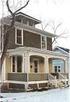 Ninth Street Historic Park Acknowledgements This project was paid for in part by a State Historical Fund grant from the Colorado Historical Society. The contents contained herein do not necessarily reflect
EGERAAT. heart of Budapest, new National Gallery and Ludwig Museum ERICK VAN. designed by. galvanizing the city: one building, two museums and more
 ERICK VAN EGERAAT heart of Budapest, new National Gallery and Ludwig Museum galvanizing the city: one building, two museums and more June 2015 museum of fine arts műcsarnok (kunsthalle) house of terror
A-H 106 RENAISSANCE THROUGH MODERN ART. (3) Historical development of Western art and architecture from the fourteenth century through the present.
 101 INTRODUCTION TO VISUAL STUDIES. (3) The course introduces students to the concepts and techniques of visual literacy. It explores a full spectrum of man-made visual forms encountered by contemporary
What is Art History? Art History at Creighton Course of Study Learning Assessment Plan Internships and Study Abroad
 What is Art History? Art History is a specialized branch of historical inquiry that concerns itself with the study of material culture, specifically painting, sculpture, architecture, urbanism, and the
Figure 10.1 Totally collapsed mosque at Kavakl district of Gölcük
 10 DAMAGE TO DOMES, MINARETS AND HISTORICAL STRUCTURES Most of historical structures existing in the earthquake-affected area are in Istanbul. Istanbul is situated on two continents; Asia and Europe. Istanbul
Position Classification Flysheet for Exhibit Specialist Series, GS-1010. Table of Contents
 Position Classification Flysheet for Exhibit Specialist Series, GS-1010 Table of Contents SERIES DEFINITION... 2 EXCLUSIONS... 2 OCCUPATIONAL INFORMATION... 3 TITLES... 5 GRADING OF POSITIONS... 5 U.S.
3. HERITAGE GRANT APPROVAL 192 MOORHOUSE AVENUE, CHRISTCHURCH
 3. HERITAGE GRANT APPROVAL 192 MOORHOUSE AVENUE, CHRISTCHURCH General Manager responsible: General Manager, Strategy and Planning Group, DDI: 941-8281 Officer responsible: Author: PURPOSE OF REPORT Programme
Trinomial NRHP Status Code 3CS Other Listings Review Code Reviewer Date Page 1 of 6 *Resource Name or #: (Assigned by recorder) 1101 Sutter Street
 HRI # PRIMARY RECORD Trinomial NRHP Status Code 3CS Other Listings Review Code Reviewer Date Page 1 of 6 *Resource Name or #: (Assigned by recorder) 1101 Sutter Street P1. Historic name of building (if
RENOVATION AND RESTORATION OF OLD BUILDINGS IN SRI LANKA
 234 Abstract RENOVATION AND RESTORATION OF OLD BUILDINGS IN SRI LANKA Eng. Nandana Abeysuriya B.Sc. Eng (Hons), M.Eng.,C.Eng.,FIE(SL), Int PE(SL) 1A, Ananda Road, Melder Place, Nugegoda, Sri Lanka. Tel/Fax:
ALVAR AALTO. Sofia Boschetti Giorgia Zini Liceo Artistico A. Venturi 5H Architettura e Ambiente
 ALVAR AALTO Sofia Boschetti Giorgia Zini Liceo Artistico A. Venturi 5H Architettura e Ambiente Alvar Aalto was born in Finland in 1898. His father was a topographer and his mother was a postman. Alvar
ART IN NEW YORK: a resource guide Mid-Manhattan Library Art Collection (third floor)
 ART IN NEW YORK: a resource guide Mid-Manhattan Library Art Collection (third floor) This list highlights resources in the visual art fields in New York City and New York State. Most of the book titles
WHAT IS THE ITRU GROUP?
 WHAT IS THE ITRU GROUP? The Turkish Higher Education System has developed significantly in the last few decades in terms of both quality and quantity. Today 180 public and private Turkish universities
HUB Neighborhood. The Story of the Market Street Hub Neighborhood. The Market Street
 The Story of the Market Street Hub Neighborhood In the early years of the 20th century, San Francisco was still a small city, and most of the population lived close to downtown, with Market St. as the
Community Assessment: Comparing Mission Statements
 Community Assessment: Comparing Mission Statements When seeking to establish a new architecture center, a simple but informative early planning exercise is to round up the mission statements of all the
BROWNSVILLE STRUCTURES STUDY. July 2012. Prepared by. LDA ARCHITECTS 33 Terminal Way, Suite 317 Pittsburgh, Pennsylvania 15219 1208
 BROWNSVILLE STRUCTURES STUDY July 2012 Prepared by LDA ARCHITECTS 33 Terminal Way, Suite 317 Pittsburgh, Pennsylvania 15219 1208 TABLE OF CONTENTS I. SUMMARY OF BUILDING ANALYSIS.. 1 II. INDIVIDUAL BUILDING
Glossop Design & Place Making Strategy
 Supplementary Planning Document to the High Peak Local Plan June 2011 Design Brief for the Town Hall Complex GILLESPIES I GERALD EVE Reproduced from the Ordnance Survey map with the permission of Ordnance
Guide book. 5 th Business Forum of Baltic and Eastern Markets. Lidzbark Warmiński. 4 October 2013
 5 th Business Forum of Baltic and Eastern Markets Guide book Lidzbark Warmiński 4 October 2013 Table of contents 1. About the event... 3 2. Schedule... 4 3. About the Organizer... 5 4. Economic potential
ATLANTA, April 19, 2004 Swan House, a Neoclassical style home-turned-historic house
 News Release FOR IMMEDIATE RELEASE Contact: Ken Higa Lord, Aeck & Sargent 404-253-6732 [email protected] or Ann Kohut Kohut Communications Consulting 770-913-9747 [email protected] Swan House
REQUEST FOR PROPOSAL Historic Structure Report for the Charnley-Persky House, a National Historic Landmark. The Society of Architectural Historians
 REQUEST FOR PROPOSAL Historic Structure Report for the Charnley-Persky House, a National Historic Landmark 1365 N. Astor Street Chicago, Illinois 60610 Issued July 31, 2015 All inquiries concerning this
DEPARTMENT OF ART HISTORY Fall 2010 SUPPLEMENT
 DEPARTMENT OF ART HISTORY Fall 2010 SUPPLEMENT The Art History Department welcomes students of all disciplines. Our courses provide students with the skills needed to analyze the visual arts on their own,
MEMORANDUM FOR MEMBERS OF THE ANTIQUITIES ADVISORY BOARD
 For information on 20 February 2013 BOARD PAPER AAB/3/2013-14 MEMORANDUM FOR MEMBERS OF THE ANTIQUITIES ADVISORY BOARD CONCEPT DESIGN FOR INTERPRETATION OF THE FORMER MOUNTAIN LODGE AND IMPROVEMENT TO
Prof. Ataman DEMİR. Interior Architecture Department. [email protected]
 Prof. Ataman DEMİR Interior Architecture Department [email protected] Prof. Ataman Demir was born in İzmir-Karşıyaka in 1938 and completed his primary and secondary education there. He started
Kansas Board of Regents Precollege Curriculum Courses Approved for University Admissions
 Kansas Board of Regents Precollege Curriculum Courses Approved for University Admissions Original Publication April 6, 2011 Revision Dates June 13, 2011 May 23, 2012 Kansas Board of Regents Precollege
Museum Grants for African American History and Culture
 Museum Grants for African American History and Culture Sample Application MH-00-15-0038-15 Funding Level: $5,000-$25,000 National Center for the Study of Civil Rights and African American Culture Alabama
Prof. Dr. İsmet Vildan ALPTEKİN Department of Landscape Architecture [email protected]
 Prof. Dr. İsmet Vildan ALPTEKİN Department of Landscape Architecture [email protected] Prof. Dr. Ismet Vildan Alptekin, completed his undergraduate and graduate studies in Ankara University
Geneva CUSD 304 Content-Area Curriculum Frameworks Grades 6-12 Social Studies
 Geneva CUSD 304 Content-Area Curriculum Frameworks Grades 6-12 Social Studies Mission Statement It is our belief that Social Studies education is ultimately to prepare students to assume the responsibilities
Welcome to our exhibition
 Welcome to our exhibition Welcome to this public exhibition for Cherry Park, Westfield, Stratford. This exhibition has been organised to update residents on Cherry Park, the next phase of development in
2015 SPONSORSHIP OPPORTUNITIES. 11th ANNUAL DESIGNPHILADELPHIA FESTIVAL. The 11th Annual DesignPhiladelphia Festival 1 CITY. 9 DAYS. 130+ EVENTS.
 2015 SPONSORSHIP OPPORTUNITIES 11th ANNUAL DESIGNPHILADELPHIA FESTIVAL 1 CITY. 9 DAYS. 130+ EVENTS. PANEL DISCUSSIONS WORKSHOPS EXHIBITIONS TOURS TALKS RECEPTIONS OPEN STUDIOS DEMONSTRATIONS ARCHITECTURE
Virginia Commonwealth University School of the Arts GRADUATE PROGRAMS
 Virginia Commonwealth University School of the Arts GRADUATE PROGRAMS ART EDUCATION ART HISTORY CRAFT/MATERIAL STUDIES GRAPHIC DESIGN INTERIOR DESIGN KINETIC IMAGING MUSIC PAINTING + PRINTMAKING PHOTOGRAPHY
Marketing & Audience Development Manager
 Marketing & Audience Development Manager Job Description & Person Specification Full Time Fixed Term Contract (3 Years) - Newmarket Salary: 25,000-28,000 per annum (depending on experience) Responsible
A-H 106 RENAISSANCE THROUGH MODERN ART. (3) Historical development of Western art and architecture from the fourteenth century through the present.
 # 101 INTRODUCTION TO VISUAL STUDIES. (3) The course introduces students to the concepts and techniques of visual literacy. It explores a full spectrum of man-made visual forms encountered by contemporary
UNIVERSITY OF NAMIBIA
 UNIVERSITY OF NAMIBIA SCHOLARLY COMMUNICATIONS POLICY FOR THE UNIVERSITY OF NAMIBIA Custodian /Responsible Executive Responsible Division Status Recommended by Pro Vice-Chancellor: Academic Affairs and
The Roche Court Educational Trust Upcoming Events and Opportunities for Schools and Teachers
 The Roche Court Educational Trust Upcoming Events and Opportunities for Schools and Teachers Nathan Coley We Must Cultivate Our Garden the artist Please note that booking is essential for all our events,
University of Texas Medical School Building HABS No. TX-292 914-916 Strand Galveston H^B3 Galveston County IBx Texas <g<+_ ^^
 m University of Texas Medical School Building HABS No. TX-292 914-916 Strand Galveston H^B3 Galveston County IBx Texas
Newburyport and a New Urban Renewal
 Newburyport and a New Urban Renewal Kind of By PAUL J. MCGINLEY EXECUTIVE DIRECTOR, NEWBURYPORT REDEVELOPMENT AUTHORITY NEW kind of urban renewal proj- more than 25 feet high in any other part ect is taking
City of San Bernardino Historical and Pioneer Society P.O. Box 875, San Bernardino, CA 92402
 City of San Bernardino Historical and Pioneer Society P.O. Box 875, San Bernardino, CA 92402 LIBRARY NEWS JULY 2012 By Richard D. Thompson, Librarian For the July newsletter, we have another article by
Political Philosophy. Program duration: 2 years, full-time Language of instruction: English, Russian Application deadline: August 16, 2014
 Master s program Political Philosophy Program duration: 2 years, full-time Language of instruction: English, Russian Application deadline: August 16, 2014 Program start: September, 2014 Internships: semester
DESIGNING A RESTORATION PROGRAM FOR THE BOMA A HISTORIC BUILDING IN BAGAMOYO, TANZANIA.
 Tanzania: Juliery Kagya Mtobesya DESIGNING A RESTORATION PROGRAM FOR THE BOMA A HISTORIC BUILDING IN BAGAMOYO, TANZANIA. 1.0 INTRODUCTION During the period of 1850-1910 Bagamoyo was marked with trade in
September 2005. Sponsored by: John H. Chafee Blackstone River Valley National Heritage Corridor Commission Woonsocket, RI
 Sponsored by: John H. Chafee Blackstone River Valley National Heritage Corridor Commission Woonsocket, RI Worcester Historical Museum Worcester, MA September 2005 mawald/ld/0909700/graphics/covers/september05cover
Urban Renewal: Social Aspects in Planning. Summary
 Urban Renewal: Social Aspects in Planning Summary Urban renewal in Israel today is being promoted by parliamentary legislation and by a number of different strategies initiated by the Ministry of Construction
Continuous Strategic Planning
 Strategic Planning Update for Cal State East Bay Linda C. Dalton, Vice President for Planning, Enrollment Management, and Student Affairs DRAFT February 2, 2012 Cal State East Bay established seven strategic
In s p i r i n g Ge n e r a t i o n s
 In s p i r i n g Ge n e r a t i o n s Through Knowledge and Discovery executive summary: Strategic Plan Fiscal Years 2010 2015 Introduction In the future, one touch of a screen is all you will need to
DENSITY AND PUBLIC SPACE AT BISHOP STREET
 DENSITY AND PUBLIC SPACE AT BISHOP STREET Niehoff Urban Studio Senior Planning Capstone Spring 2015 Justin M. Lightfield U N I V E R S I T Y O F C I N C I N N A T I Table of Contents Overview... 3 Design
History. Programme of study for key stage 3 and attainment target (This is an extract from The National Curriculum 2007)
 History Programme of study for key stage 3 and attainment target (This is an extract from The National Curriculum 2007) Crown copyright 2007 Qualifications and Curriculum Authority 2007 Curriculum aims
ILA Strategic Plan 2012 2017
 ILA Strategic Plan 2012 2017 If you practice, study, or teach leadership; If you seek a community of people who share your passion for leadership; We invite you to be a vital part of the continued growth
International Festival of Tourism The place of opportunities
 International Festival of Tourism The place of opportunities Nomination: Hospitality School Awards - 2015 Category: Best Educational Innovation Since 2010 year Introduction Antalya Academy of Tourism is
Defining our Image for the Next 50 Years Communications and Reputation at UC Santa Cruz
 Background Defining our Image for the Next 50 Years Communications and Reputation at UC Santa Cruz Every university has a story to tell about itself, but the difference between a good story and a great
HISTORIC BUILDING RESTORATION MUSEUM BUILDINGS & TOWERS TOURIST VILLAGES ANTIQUE BUILDINGS
 HISTORIC BUILDING RESTORATION MUSEUM BUILDINGS & TOWERS TOURIST VILLAGES ANTIQUE BUILDINGS Building restoration St Paul's Cathedral, London, clad for refurbishment - in this case, cleaning the external
CHARTER of ADA University
 CHARTER of ADA University 1. General provisions 1.1. ADA University (hereinafter referred to as University) was established under the decree dated January 13th, 2014 by the President of the Republic of
Cleveland Institute of Art Creativity Matters
 Cleveland Institute of Art Creativity Matters Our Cores + Connections matter What sets the Cleveland Institute of Art apart from other colleges of art and design? In a nutshell, our Cores + Connections
Study Plan. Bachelor s in. Faculty of Foreign Languages University of Jordan
 Study Plan Bachelor s in Spanish and English Faculty of Foreign Languages University of Jordan 2009/2010 Department of European Languages Faculty of Foreign Languages University of Jordan Degree: B.A.
Museum, Archives and Local Studies Centre. What s on
 Museum, Archives and Local Studies Centre What s on 2015 A craft and activity club suitable for under 7s. Tickets 3 when you attend 5 clubs, you get the 6 th free! No booking required. New Year Wassail
SUMMER PROGRAM EXPERIMENT IN ARCHITECTURE IIT ARCHITECTURE CHICAGO
 SUMMER PROGRAM EXPERIMENT IN ARCHITECTURE IIT ARCHITECTURE CHICAGO EXPERIMENT IN ARCHITECTURE If you are finishing your sophomore or junior year of high school, and looking to the future, you may be interested
THE NEW FORMAT OF BUSINESS
 THE NEW FORMAT OF BUSINESS Office Complex & Retail San Gally Park Ligovskiy Prospekt 60 62. St. Petersburg. Russia Disclaimer Neither this brochure nor any of then details contained herein constitute part
CITY OF MIAMI FIRE TRAINING TOWER 3700 NW 7 TH AVENUE
 CITY OF MIAMI FIRE TRAINING TOWER 3700 NW 7 TH AVENUE Designation Report City of Miami REPORT OF THE CITY OF MIAMI PRESERVATION OFFICER TO THE HISTORIC AND ENVIRONMENTAL PRESERVATION BOARD ON THE POTENTIAL
JOURNEY TO JUSTICE: CREATING CHANGE THROUGH PARTNERSHIPS
 Crowne Plaza French Quarter New Orleans, LA, USA May 11-14, 2016 JOURNEY TO JUSTICE: CREATING CHANGE THROUGH PARTNERSHIPS CCPH 14th International Conference Call for Proposals Community-Campus Partnerships
School of Visual Arts. Strategic Plan, 2008-2013
 School of Visual Arts Strategic Plan, 2008-2013 (text below in red indicates the SoVA plan within the context of relevant portions of the College of Arts and Architecture s strategic plan, Vision for the
Black Studies Center
 Black Studies Center List of Encyclopedias, Dictionaries, and Multi-Volumes 1. A Book of the Beginnings (Vols.1-2) 932.01 M416 2. A Hard Road to Glory (Vols.1-3) 796.0899 A812 Vol.1-3 Volume 1: A History
CREATIVE North Carolina 2014 Fact Sheet: Creativity At Work www.ncarts.org/creative_economy
 CREATIVE North Carolina 2014 Fact Sheet: Creativity At Work www.ncarts.org/creative_economy Creative North Carolina includes Nonprofit arts, humanities and cultural organizations Audiences and cultural
Cultural Heritage Management, Master Degree French University in Egypt, Programme Course Contents
 Cultural Management, Master Degree French University in Egypt, Programme Course Contents Semester 1 216 30 Introduction to Cultural heritage Hours Credits Course [Module] Contents 18 2,5 Ses1& 2, Definitions
Official Guide. to Graduate Study in History. The University of Texas at Austin
 Official Guide to Graduate Study in History at The University of Texas at Austin ADMINISTRATION AND GOVERNANCE The Graduate Adviser has primary responsibility for administering the graduate program. She
Ancient Greek Arts and Architecture
 Ancient Greek Arts and Architecture Ancient Greek Architecture The earliest buildings built in Greece in the New Stone Age are small houses or huts with wooden walls around them for protection. Later bigger
Art History. Graduation Requirements. Program Requirements Art History B.A. Honours (20.0 credits) Art History B.A. Combined Honours (20.
 Art History Graduation Requirements In addition to the requirements listed below, students must satisfy: 1. the University regulations (see the Academic Regulations of the University in this Calendar),
Garden design and restoration - rebuilding hystorical places Yvoire France
 Volume 17(3), 118-122, 2013 JOURNAL of Horticulture, Forestry and Biotechnology www.journal-hfb.usab-tm.ro Garden design and restoration - rebuilding hystorical places Yvoire France Szekely G. 1 * 1 Banat
ORANGE COUNTY MUSEUM OF ART ANNOUNCES PLANS TO MOVE TO SEGERSTROM CENTER FOR THE ARTS
 FOR IMMEDIATE RELEASE June 6, 2008 Media Contact: Chivan Wang Communications Department (949) 750-1122 ext 205 ORANGE COUNTY MUSEUM OF ART ANNOUNCES PLANS TO MOVE TO SEGERSTROM CENTER FOR THE ARTS ORANGE
SCHOOL OF URBAN AFFAIRS & PUBLIC POLICY CRITERIA AND PROCEDURES FOR PROMOTION AND TENURE
 SCHOOL OF URBAN AFFAIRS & PUBLIC POLICY CRITERIA AND PROCEDURES FOR PROMOTION AND TENURE The School of Urban Affairs and Public Policy is an interdisciplinary graduate and professional school, designated
Rhode Island School of Design Strategic Plan Summary for 2012 2017. critical making. making critical
 Rhode Island School of Design Strategic Plan Summary for 2012 2017 critical making making critical executive summary This strategic plan serves as a guide for Rhode Island School of Design (RISD) over
St. Vincent s Academy Tour of Homes & Tea
 St. Vincent s Academy Tour of Homes & Tea 207 East Liberty Street Savannah, GA 31401 June 25, 2015 Dear Friend of St. Vincent s: We are inviting you to take a leadership role in an important historic restoration
A Journey Through Fashion Design in London
 A Journey Through Fashion Design in London www.ecetravel.com [email protected] +44 (0)20 8295 8620 DESIGN IN LONDON 13 DAYS This two week fashion design camp programme will take you on an amazing
john jay college of criminal justice
 AIA NEW YORK CHAPTER 2013 DESIGN AWARDS ARCHITECTURE john jay college of criminal justice NEW YORK, NEW YORK FULL PROJECT NARRATIVE John Jay College of Criminal Justice s new building provides all the
The Society of Architectural Historians Guidelines for the Promotion and Tenure of Architectural Historians
 The Society of Architectural Historians Guidelines for the Promotion and Tenure of Architectural Historians NOTE: The language for this document was adapted from the College Art Association s Standards
Chief Communications Officer Position and Candidate Specification
 Chief Communications Officer Position and Candidate Specification The University of Virginia seeks nominations and applications for a visionary leader to fill the newly created position of Chief Communications
EUROPLAT European Network for Psychology Learning & Teaching
 EUROPLAT European Network for Psychology Learning & Teaching Progress Report Public Part 155981-LLP-1-2009-UK-ERASMUS-ENWA Project information Project acronym: Project title: Project number: Sub-programme
A Career Guide for Art History Majors
 Art History concerns itself with human history through the study of painting, sculpture, architecture and the graphic and decorative arts. Art History considers these arts as creative processes as expressions
Naif Arab University for Security Sciences (NAUSS): Pursuing excellence in security science education and research
 Arab Journal of Forensic Sciences and Forensic Medicine 2014; Volume 1 Issue (0), 5-11 5 Naif Arab University for Security Sciences Arab Journal of Forensic Sciences and Forensic Medicine www.nauss.edu.sa
Projects. Cultural centre in Jinan. Europaconcorsi Beta. Grand Theatre. JINAN, China. Publications Jinan Cultural Centre
 Language: Italiano English Europaconcorsi Beta Projects JINAN, China Cultural centre in Jinan Grand Theatre PAUL ANDREU ARCHITECTE PARIS, RICHEZ_ASSOCIÉS ARCHITECTURE, BIAD Publications Jinan Cultural
PARIS AGENDA OR 12 RECOMMENDATIONS FOR MEDIA EDUCATION
 PARIS AGENDA OR 12 RECOMMENDATIONS FOR MEDIA EDUCATION 25 years after the adoption of the Grünwald Declaration that paved the way for media education at the international level, experts, education policy-makers,
Wold Cup Teams 2014 KNHB October 2013 World Cup TX training & hospitality facilities Hockey Club Naarden [email protected]
 Wold Cup Teams 2014 KNHB October 2013 World Cup TX training & hospitality facilities Hockey Club Naarden [email protected] Facts and Figures Venue: Region Amsterdam Address: Beethovenlaan 71 1411HR Naarden
Mahaska Health Partnership Oskaloosa, Iowa Art Consultant TJ Moberg and Moberg Art Consultation Architect RDG Project completed Fall 2013
 Mahaska Health Partnership Oskaloosa, Iowa Art Consultant TJ Moberg and Moberg Art Consultation Architect RDG Project completed Fall 2013 Moberg Gallery art consultant, TJ Moberg worked with the architectural
Master of Fine Arts (MFA) in Communications Design
 Program Summary Design plays a central and formative role in shaping communities, technology and business. Never have designers been expected to cultivate such a diverse set of skills and knowledge. MFA
Guide to school authorization: Diploma Programme
 Diploma Programme Guide to school authorization: Diploma Programme Diploma Programme Guide to school authorization: Diploma Programme Published October 2010 Updated February 2015 International Baccalaureate
Managing cultural expectations: The Glasgow School of Art and the legacy of Charles Rennie Mackintosh
 Managing cultural expectations: The Glasgow School of Art and the legacy of Charles Rennie Mackintosh PETER TROWLES Abstract Professor Christopher Frayling, Rector of the Royal College of Art has remarked
Industrial Suburban District Regulations City of St. Petersburg City Code Chapter 16, Land Development Regulations
 16.20.110 - Industrial Suburban District ( IS ) Figure REFERENCE Typical Buildings in the IS District Figure REFERENCE Site Plan of a typical development in the IS District Sections: 16.20.110.1 Composition
 UPC International Relations Plan 2003-2006 Servei de Comunicació Institucional de la UPC, 2003 (7077) Contents Introduction Teaching Subsection 1: The European Higher Education Area Subsection 2: The internationalisation