
ABOVE THE CIRCUMSTANCES
|
|
|
- Garey Nash
- 10 years ago
- Views:
Transcription
1 ABOVE THE CIRCUMSTANCES ANNUAL REPORT 2014
2 For many years, Alfa-Bank has been one of the leading financial organizations of Russia. However, we do not rest on our laurels. We constantly move forward, developing and improving our business, seeking the opinion not only of the experts but also of those who use the Bank services every day. This is one of the most important competitive advantages providing an additional safety margin in any situation that is highly appreciated by our clients. ALFA-BANK 2014 Mikhail Fridman Member of the Board of Directors of Alfa-Bank countries 5 branches and offices 804 employees corporate clients retail clients 11,4 mln profit, USD million* 33 equity, USD million* loan portfolio, USD million* total assets, USD million* * For the purposes of this report, the term «Alfa-Bank» is used to describe ABH Financial Limited and its subsidiaries.

3 ALFA-BANK S AWARDS IN Alfa-Bank won the award in the category «Best deal of Eurobonds primary distribution» This deserved award was given to the representatives of Alfa-Bank during the gala dinner of the Russian bond congress, which was held on the 5 of December 2014 in St. Petersburg Alfa-Bank named most client-oriented bank Alfa-Bank became a winner of the Banks Nomination of the annual Client-Oriented Business Leader Award and the Most Client-Oriented Bank nomination Alfa-Bank won the award in the field of support of small and medium-sized businesses named «Osnova Rosta» The Alfa-Bank s Customer Club Project won the top award of the all-russia business in the field of support of small and mediumsized businesses named «Osnova Rosta». Alfa-Bank won the Event-Trigger Project of the Year Nomination Alfa-Mobile mobile banking service again ranks best The Markswebb Rank & Report agency ranked the Alfa-Mobile first in the Mobile Banking Rank 2014 as the most effective online retail banking service for tablets. Alfa-Business Online leads in small business online banking system Alfa-Business Online became a leader among the most effective online banking systems for small business. The Markswebb Rank & Report Business agency ranked Alfa-Business Online second in the Business Internet Banking Rank Alfa-Bank Processing Center named one of world best by service quality The Alfa-Bank Processing Center was again recognized as a world major in terms of services provided in The Bank won four nominations of the Visa Award Alfa-Bank is best again Alfa-Bank won three nominations of the 2nd Annual Innovation and Finance Award named «Bankovskaya Sfera» given by Bankovskaya Sfera journal. The bank won the Most Innovative Bank Nomination as a financial institution using the best available technologies Deloitte ranked Alfa-Bank among the top three online banks of Russia According to the Deloitte consulting company survey, Alfa-Bank became a leader in terms of online applications available on the Russian market. Alfa-Bank was named the best private bank by Euromoney According to Private Banking and Wealth Management Survey-2014 research conducted by the European financial magazine Euromoney, Alfa Bank was named the best private bank in Russia.

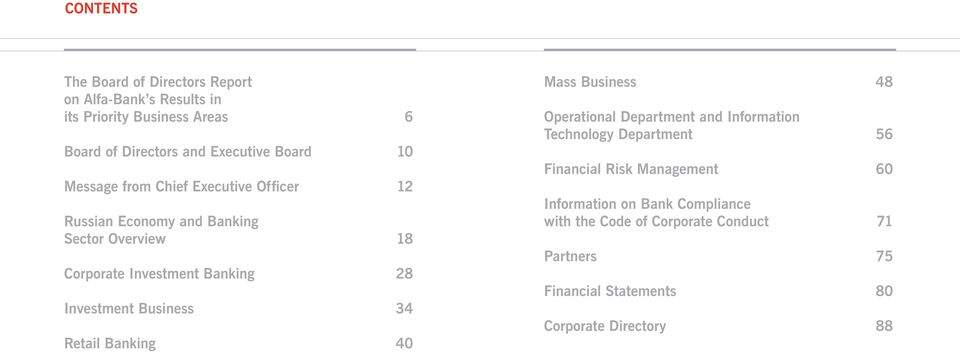
4 CONTENTS The Board of Directors Report on Alfa-Bank s Results in its Priority Business Areas 6 Board of Directors and Executive Board 10 Message from Chief Executive Officer 12 Russian Economy and Banking Sector Overview 18 Corporate Investment Banking 28 Investment Business 34 Retail Banking 40 Mass Business 48 Operational Department and Information Technology Department 56 Financial Risk Management 60 Information on Bank Compliance with the Code of Corporate Conduct 71 Partners 75 Financial Statements 80 Corporate Directory 88
5 Mikhail Fridman Member of the Board of Directors Alexey Marey Chief Executive Officer, Member of the Board of Directors, Member of the Executive Board Petr Smida Chairman of the Board of Directors THE BOARD OF DIRECTORS REPORT ON ALFA-BANK S RESULTS IN ITS PRIORITY BUSINESS AREAS There is Alfa-Bank s 2014 Annual Report before you. We are glad to note that Alfa-Bank achieved considerable success in this current tough period for Russia. This is the result of permanent and methodical efforts both of the management, and each employee. The results of the year became new confirmation of the fact that strategic approach to activity planning and right priorities of development are the base of successful development in any economic conditions. It means that four basic principles of the Bank s Strategy for remain unchanged: client focus, attention to modern technologies, high efficiency of activity, and reliable risk management. Today they are urgent as never before. Alfa-Bank, the largest private bank in Russia, is one of the leading financial organizations in our country and is a serious competitor to state-owned banks. During the period of increased volatility on financial markets, Alfa-Bank was trusted by the international investors and representatives of governmental regulation authorities. Millions of individuals, representatives of large-, medium-, and small-size business entrusted their funds to Alfa-Bank. We are proud of this confidence and sure that we will justify it again and again. Under the circumstances in 2014 not business profitability but reliability of the financial model chosen by every organization came to the fore. For many years, Alfa-Bank has been paying special attention to risk management, raising it to even higher levels. Therefore, the quality of the loan portfolio of the Bank considerably exceeds that of mid-market, the share of overdue loans remains the lowest, and provisioning rate is growing steadily. Not least important is the increase of risk-free business share in the total income structure, namely growth of fee and transaction revenues within the structure of operational profit of the Bank. The development of this direction was successful in 2014 and the work will continue next year. The Retail Bank retained third place by total amount of current accounts; only state-owned banks are ahead. The amount of total term deposits increased one and a half times. It means that clients are still sure that Alfa-Bank will not only save but also multiple their funds. Performance of A-Club was honored special recognition by the results of 2014 Alfa-Bank was recognized as the best bank for affluent clients. Experts also noted the success of Alfa-Bank in using the most advanced technologies in the banking sector. It should be remembered, that by raising technological aspect of our performance we not only improve the efficiency of the business but also make the finance world simpler and more convenient, thus creating additional options for our clients. By achieving success in its main activity, Alfa-Bank honours the responsibility associated with its status of one of the leading financial organizations of Russia. Social responsibility is an important part of its policy, and charity projects and culture initiatives always find support both of the management and employees in sites where every year more and more volunteers participate. Help to severely ill children within support of the Life Line Fund, cooperation with the World Wildlife Fund (WWF), implementation of programs for training talented youth, arrangement of tours of foreign stars and popular Russian performers these are but few of the projects implemented with the assistance or financing of Alfa-Bank. For many years Alfa-Bank has been one of the leading financial organizations of Russia. However, we do not rest on our laurels. We constantly move forward, develop and improve our business, seeking the opinion not only of the experts but also of those who use the Bank services every day. This is one of the most important competitive advantages providing an additional safety margin in any situation that is highly appreciated by our clients. Trusting their financial welfare to Alfa-Bank, they confirm that we choose the right way, implementing our desire to remain the best bank for everyday life and a reliable financial partner for Russian and foreign investors. It is worth mentioning that all business directions were a considerable success last year. Among the achievements of the Corporative-Investment Bank are the significant increase of the number of clients of mid-size corporate business, the growth of net fee and commission income and, surely, recognition of leading positions of Alfa-Bank on the Russian market of syndicated lending. The 'Mass business' unit that demonstrated great results of the year deserves special attention: more and more representatives of small-size business choose our Bank. Mikhail Fridman Member of the Board of Directors Alexey Marey Chief Executive Officer, Member of the Board of Directors, Member of the Executive Board Petr Smida Chairman of the Board of Directors

6 Murmansk Kaliningrad St. Petersburg Severodvinsk Arkhangelsk Tver Vologda Yaroslavl Kaluga Ivanovo Syktyvkar Vladimir Tula Ryazan Nizhny Novgorod Kursk Belgorod Lipetsk Tambov Penza Cheboksary Glazov Serov Voronezh Kazan Izhevsk Nizhny Tagil Ulyanovsk Togliatti Saratov Almetyevsk Engels Ekaterinburg Rostov-on-Don Samara Pervouralsk Volzhsky Ufa Kamensk-Uralsky Novorossiysk Volgograd Krasnodar Buzuluk Sterlitamak Chelyabinsk Tuapse Sochi Stavropol Orenburg Magnitogorsk Kurgan Tyumen Megion Raduzhny Nizhnevartovsk Surgut Novy Urengoy Yakutsk Novotroitsk Orsk Astrakhan Omsk Novosibirsk Barnaul Tomsk Yurga Kemerovo Berdsk Novokuznetsk Zheleznogorsk Krasnoyarsk Biysk Abakan Usolye-Sibirskoe Angarsk Irkutsk Komsomolsk-on-Amur Khabarovsk Yuzhno-Sakhalinsk Alfa-Bank Entities Abakan Almetyevsk Angarsk Arkhangelsk Astrakhan Achinsk Balakovo Balashikha Barnaul Belgorod Berdsk Berezniki Biisk Bryansk Buzuluk Vladivostok Vladimir Volgograd Volgodonsk Volzhsky Vologda Voronezh Glazov Gukovo Dzerzhinsk Yekaterinburg Zheleznogorsk Chrysostom Ivanovo Izhevsk Izluchinsk Yoshkar-Ola Irkutsk Kazan Kaliningrad Kaluga Kamensk-Uralsky Kemerovo Kirov Komsomolskon-Amur Korolev Krasnogorsk Krasnodar Krasnoyarsk Kurgan Kursk Linevo Lipetsk Lyubertsy Magnitogorsk Megion Miass Moscow Murmansk Mytishchi Naberezhnye Chelny Nakhodka Nizhnevartovsk Nizhny Novgorod Nizhny Tagil Novokuznetsk Novorossiysk Novosibirsk Novotroitsk Novocherkassk Noviy Urengoy Odintsovo Odintsovo, d. Barvikha Omsk Orel Orenburg Orsk Penza Pervouralsk Perm Petrozavodsk Podolsk Prokopevsk Pskov Pyatigorsk Raduzhny Reutov Rostov-on-Don Ryazan Samara Saint Petersburg Saransk Saratov Severodvinsk Serov Smolensk Sorochinsk Sosnoviy Bor Sochi Stavropol Stary Oskol Sterlitamak Surgut Syzran Syktyvkar Taganrog Tambov Tver Tolyatti Tomsk Tuapse Tula Tyumen Ulan-Ude Ulyanovsk Usolye-Sibirskoye Vladivostok Ufa Khabarovsk Khimki Cheboksary Chelyabinsk Engels Yuzhno-Sakhalinsk Yurga Yakutsk Yaroslavl Yasniy Nakhodka Alfa-Bank subsidiaries and partners: geographic coverage Alfa Capital Markets: UK, London Alforma Capital Markets, Inc.: USA, New York Amsterdam Trade Bank N.V.: Netherlands, Amsterdam Alfa Capital Holdings (Cyprus) Ltd: Cyprus, Nicosia Alfa-Bank Kazakhstan: Almaty, Astana, Aktau, Karaganda, Ust-Kamenogorsk, Uralsk

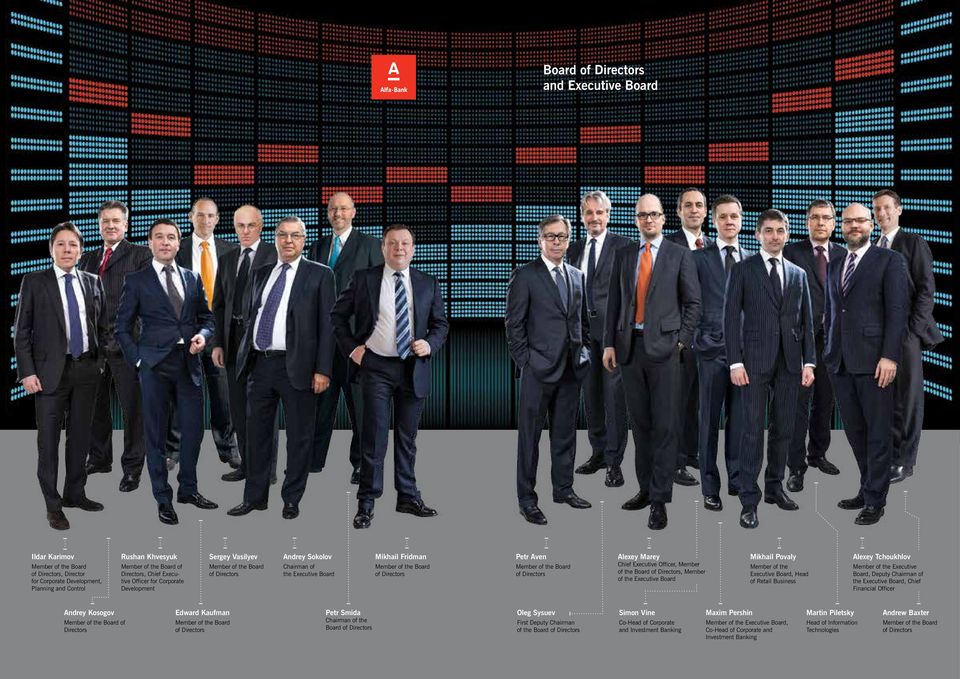
7 Board of Directors and Executive Board Ildar Karimov Member of the Board of Directors, Director for Corporate Development, Planning and Control Rushan Khvesyuk Member of the Board of Directors, Chief Executive Officer for Corporate Development Sergey Vasilyev Member of the Board of Directors Andrey Sokolov Chairman of the Executive Board Mikhail Fridman Member of the Board of Directors Petr Aven Member of the Board of Directors Alexey Marey Chief Executive Officer, Member of the Board of Directors, Member of the Executive Board Mikhail Povaly Member of the Executive Board, Head of Retail Business Alexey Tchoukhlov Member of the Executive Board, Deputy Chairman of the Executive Board, Chief Financial Officer Andrey Kosogov Member of the Board of Directors Edward Kaufman Member of the Board of Directors Petr Smida Chairman of the Board of Directors Oleg Sysuev First Deputy Chairman of the Board of Directors Simon Vine Co-Head of Corporate and Investment Banking Maxim Pershin Member of the Executive Board, Co-Head of Corporate and Investment Banking Martin Piletsky Head of Information Technologies Andrew Baxter Member of the Board of Directors
8 Alexey Marey Chief Executive Officer, Member of the Board of Directors, Member of the Executive Board The priorities of our Bank remain unchanged: these are client-oriented attitude, high technological level, high-quality risk management, and operational efficiency. These are the main principles that became the basis for development of Alfa-Bank and enable it to move annually forward towards its main goal: to be the best bank for everyday life, and to be selected as a reliable financial partner both for current accounting operations, and for saving and multiplication of capital. MESSAGE FROM CHIEF EXECUTIVE OFFICER The last year was complicated for many companies in 2013, it was difficult to imagine the level of changes that awaited the Russian economy. However, despite the complexity and variability of the economic situation in the country, Alfa-Bank has successfully overcome the hardships so inherent to operation of banking companies in 2014, showing positive results in the main business directions. A successful end to the year proved viability of the main strategic priorities and initiatives that were noted in the Bank s Strategy back in Today, despite volatility of the markets and radical changes of the risk portfolio both of the retail and corporate clients, the priorities of our Bank remain unchanged: these are client focus, high technological level, high-quality risk management, and operational efficiency. These are the main principles that became the basis for development of Alfa-Bank and enabled it to move annually forward to the main goal: to be the best bank for everyday life, to be selected as a reliable financial partner both for current accounting operations, and for saving and multiplication of capital. The basic principles of the Bank Strategy were formulated two years ago and provided the foundation for development over the next five years until the end of 2016 have confirmed their importance in times of extraordinary changes of macro-economic factors. Due to right development policy the Bank demonstrated good financial results by the end of the hard year of So, even in the current climate of economic instability, the Alfa Banking Group managed to retain business profitability: the operation profit before provisions reduced by 16.4% to USD 2,591 mln compared to 2013; in RUR equivalent the profit increased by 0.8%. The share of net fee and commission income within the structure of the Bank s operation profit before provisioning increased by the end of 2014 to 31.8% compared to that as of the end of 2013.The amount of net fee and commission income grew by 5.8% and reached USD 825 mln, while the growth in RUR equivalent was about 27.5%. The Bank takes a conservative approach to risk management, especially in present situation. Last year provision charge for loan impairment doubled in comparison with the end of 2014 to provide margin of safety in future. Provision charge for loan impairment up to USD 1,228 mln compared to USD 565 mln in The share of overdue loans (90+ days) of the Bank was one of the lowest in the banking sector and made 2.7% by the end of 2014, whereas provision coverage of overdue loans (90+ days) exceeds 200%. In 2014 Alfa-Bank gave particular attention to liquidity management. By the end of 2014 a considerable amount of cash and cash equivalents were accumulated; the total amount was USD 4,999 mln; while the not used limit of CBRF s funds amounted USD 3,242 mln by the end of It is worth to note that last year Alfa Banking Group demonstrated high operation efficiency. Cost to income ratio was 45.8% (the similar ratio of Alfa-Bank on the non-consolidated basis reached record-low 38.8%), and the operation expenses were reduced by 12.4% to USD 1,186 mln by the end of 2014 compared to USD 1,354 mln by the end of In 2014 Alfa-Bank continued to increase the share of risk-free transaction income in total operating income. The Bank also continued to increase the market share by amount of corporate payments today it occupies the more prominent place within the total circulatory system of payments in Russia; by the year end the market share was 3.86%. Despite volatility of the financial market, last year we witnessed considerable afflux of the clients, mainly in the corporate sector. The year was marked by increasing number of new clients in middle-size corporate business, where the growth amounted to more than 50%. Mass business also gained impressive results where the growth of client numbers was 62%. Despite reduction in lending growth, there also was an afflux of clients in retail business and, what's more, the share of the clients that used to treat us as a 'home' bank increased again; and this is one of the priorities of Alfa-Bank in retail banking. The highly professional behaviour of our team, and a speed and quality of decisions again confirmed that Alfa-Bank has remained the biggest private bank in the country. It is also worth mentioning that the Bank once again demonstrated its important competitive advantage particularly important within the fast-changing economic conditions, namely flexibility and speed of reaction in any situation, even the toughest ones. Attention should be paid to the fact that in 2014 the Bank confirmed its status of a reliable partner 12 Alfa-Bank Alfa-Bank 13

9 MESSAGE FROM CHIEF EXECUTIVE OFFICER MESSAGE FROM CHIEF EXECUTIVE OFFICER for a wide range of international investors. For example, when in June 2014 the capital markets were closed for a number of Russian issuers, ABH Financial Limited, a holding company of Alfa-Bank, issued Eurobonds in the amount of EUR 350 mln with 3 years maturity. Alfa Banking Group was the first issuer on the Eurobonds market among the borrowing entities since February In November 2014, a successful issue of the subordinated Eurobonds was performed in the amount of USD 250 mln with maturity in 10 years and 3 months and an interest rate of 9.5% p.a.; a call-option in 5 years and 3 months. This was the first transaction in the market on placement of subordinated Eurobonds, and also the longest one among Russian issuers since summer These transactions prove that, despite concerns about country risks, Alfa- Bank continues to enjoy the support of investors due to the high credit quality, its competent risk management, clear and coherent strategy, and transparent ownership structure, including the Bank's role on the Russian banking market. The Eurobond issuance by ABH Financial Limited was noticed by professionals: it was considered to be the best issuance for initial public offering of the Eurobonds in 2014 by the results of a survey held on the web-site of Cbonds informational agency. The Bank is not only trusted by foreign investors but is also an important partner for the Russian regulatory authorities. Alfa-Bank was announced as rehabilitator of Baltiyskiy Bank one of the biggest financial organizations of the north-west of Russia. As a result of rehabilitation, the client base of Alfa Banking Group increased by 2.6 mln customers. Also worthy of note is that the rehabilitation of the Baltiyskiy Bank allowed Alfa-Bank to radically enforce its presence in all business segments in the north-west region, that extremely important for it. Currently the business integration of Baltiyskiy Bank is in full correspondence with the plans, and its clients obtained evident advantages from the rehabilitation for their deposits are covered with guarantees of the biggest private and one of the main system-forming banks of the country, a bank which boasts the highest financial ratings among all the non-governmental financial organizations of Russia and the CIS countries. Further evidence of the enviable position of Alfa-Bank among the financial organizations is its authorization to participate in the Program of support of the investment projects implemented in Russian Federation based on project financing. The goal of this program, approved by RF Government in October 2014, is stimulation of investments in infrastructure construction, machine engineering, and high-tech industry. Within this Program Alfa-Bank will finance projects of the real sector of major branches of the economy. It is important to note that Alfa-Bank is the only private bank among the four selected for participation in the Program, and this once again confirms its status as a leading private bank of the country, its high level of stability and reliability, as well as government trust. Talking about the results of certain directions of the Bank s business in 2014, one can responsibly state that despite unstable economic conditions this year was successful for each such direction trend.there were considerable changes in the corporate business as a whole. The market situation and financial positions of certain companies have changed, and average quality of the credit portfolio deteriorated. Due to significant amount of provisions, the constant efforts to maintain the high quality of loan portfolio, and extensive experience of managing credit risks Alfa-Bank has not only been stable on the corporative banking services market but also has retained quality of loan portfolio at the higher level than average on the market. Special success was achieved in the «Medium-size corporate business segment». This line of corporate banking has been actively developed in 2014, and no macro-economic factors could hinder achieving the set goals. The number of the Bank s client-companies in this segment grew by more than a half from 4,703 to 7,244. The results of 'Mass business' segment were no less impressive. The number of active clients increased by 62%. Today we have 112,600 small-size business companies working with us. The level of net fee and commission income in this segment grew by 94% compared to 2013; the net profit increased by 177%. As for retail business, the positions of the Bank here are also strong: the number of clients individuals exceeded 11 mln; the market share by demand deposits reached 7.5%, which allowed Alfa-Bank to occupy the third place by this index among Russian banks. The Bank continued consolidation of its positions on the important market of credit cards and occupied third place by the amount of portfolio, as that of the consumer lending. Last year the Bank implemented symbolic projects in retail business, as noted by both clients and professional community. Firstly, the «Twins» card should be noted an innovative bank product issued together with Visa and the first of its kind. This card, combining two full-scale Visa cards debit and credit ones made Alfa-Bank the winner in the «Bank product» category at the Third Annual Award for Innovations and Achievements in Banking industry 'Banking Sphere' arranged by the 'Banking Review' magazine. This is not the only prize won by Alfa-Bank for its role as a high-tech financial organization with a focus on development and use of various state-of-art technologies in its business. According to the results of 2014, the Bank became the winner in three categories of the same award. For the second year in a row, the Bank was named the «Most innovative bank». A separate award was given to Martin Piletsky, Head of Information Technologies of Alfa-Bank. He was recognised in the 'IT Chief' category as the manager with the best results in arranging the work of the IT-division of the Bank and the one who implemented a radically new approach or technology for IT-division activity. By the results of the 'Bank of the Year' award held by the 'Banki.ru' informational portal, Alfa-Bank became the winner of the «Online-application. Credit card» category. In addition, it was recognized by the 'Banki.ru' portal as one of the best banks at solving the issues of its clients: the Bank provided the biggest number of official replies to customers comments and questions posted on the portal in This, again, confirmed the fact that the Bank s client service always reacted promptly to clients' requests, including requests made via the Internet. The professional community recognized the activity of Alfa-Bank with clients of the 'affluent' segment: it was recognized as the best bank for affluent clients by the Frank Research Group which comprises sixteen Russian organizations offering services to this category of clients. Concluding the review of the Bank's activity over the last year and its priorities for the future, its 14 Alfa-Bank Alfa-Bank 15

10 MESSAGE FROM CHIEF EXECUTIVE OFFICER ABOVE THE CIRCUMSTANCES special attention to risk management should also be noted. In the current economic situation, this issue becomes the most pressing for all financial organizations, and Alfa-Bank has been involved in improving its risk-culture for many years already. Last year, another important step was made in this direction: the Operational Risk Steering Committee was established, which enabled an improvement in risk management. The next stage was the acceptance and implementation of an approach where risk management is not only the responsibility of the appropriate division of the Bank, but the responsibility of every manager. In 2015 the risk management system will continue to be integrated in a chain of actions of all the employees from the Bank management to those making daily decisions at sites. I would like to specially thank all those employees who are working in the Bank every day maintaining the high level of service that Alfa-Bank is famous for, the client-oriented leaders who other financial organizations try to follow, and those who contribute to maintaining the unique status of our Bank the largest private bank in Russia. Alfa-Bank appreciates its employees and provides them with a plethora of opportunities for professional and personal development. These efforts were acknowledged in 2014, when Alfa Bank was named the winner of the «Captains of Russian Business» National Business Award in the «The best employer» category. We are aware that the success of Alfa-Bank was made possible by its employees. Finally, it should be mentioned that in all financial climates, Alfa-Bank remains a socially responsible organization and pays particular attention not only to its employees, but also to cultural initiatives, providing help to children and vulnerable citizens, and nurturing talented youth. In 2015, we plan further implementation of our Strategy with respect to the changes of Our managers are capable of efficient business management in any situation, including uncertain ones, and our employees have proven themselves to be capable of maintaining client service at the high level that Alfa-Bank has become famous for. As in 2014, over the next year, the focus will remain on risk management, quality of the credit portfolio and strengthening of the transaction business with the aim of increasing the products share resulting in fee and commision income total of the Bank. For Alfa-Bank one of the leading banking organizations of Russia 2015 will become a year of new opportunities. One of the evident trends of the next year will be further reduction of players on the bank market: the clients will deviate from weaker financial organizations to more powerful, and one of them is, of course, Alfa-Bank the most reliable of the most convenient and the most convenient of the most reliable. This idea was confirmed by the results of 2014 when the number of our clients increased again. Even in attracting new clients, Alfa-Bank will continue to appreciate those who have already chosen it as their main bank. Our goal remains the same to make the world of finance simpler and more convenient. Therefore, we will strive to improve our client service, develop the state-ofthe-art technologies and consider our clients' opinion about our performance. It is for these clients that our Alfa-Bank the best bank for everyday life and the first private bank in Russia opens its doors every day. Alfa-Bank, the largest private bank in Russia, is one of the leading financial organizations in this country and is a serious competitor of the banks with state participation. During the period of increased volatility of the financial markets, our bank was trusted by the international investors and the representatives of the governmental regulation authorities, and the funds of millions of individuals, representatives of large-, medium-, and small-size businesses were entrusted to Alfa-Bank. 16 Alfa-Bank

11 PETR AVEN Member of the Board of Directors The efforts of the Central Bank to reduce the inflation rate must be supported by a structural transformation of the economy. RUSSIAN ECONOMY AND BANKING SECTOR OVERVIEW Russia is a Special Case for World Markets The general situation last year on the global financial markets can be associated with a significant increase in uncertainty. First of all, we are talking about the actions of central banks of developed economies. These had been coordinated until 2014, but since then their objectives have been diverging significantly. Since the beginning of the year, the US Federal Reserve System oriented markets in order to halt the monetary easing policy, the third round of which it successfully completed in October last year, and then began to prepare markets for increasing interest rates. At the same time, the ECB was more concerned with the risk of stagnation of its economy and deflationary tendencies, as a result of which it had to run its own program of quantitative easing. The Bank of Japan is keeping to a fairly soft policy as well. Its impact on the world markets is, however, more limited. The instability of commodity prices, unpredictable monetary policies of developed countries, and a sharp jump in exchange rate volatility have become a challenge for emerging markets. While many of these countries tried to stabilize the situation in the beginning of 2014 by raising their interest rates, the second half of the year showed that it was impossible to hinder the outflow of capital without causing significant damage to economic growth. As a result, almost all the currencies of the emerging markets weakened in 2014, while the indices of their stock markets were declining. All of the above can certainly be applied to the situation on the Russian market as well, but the situation in Russia was further aggravated by the sanctions regime. The sanctions imposed on Russian banks and companies can be divided into three groups: sectoral sanctions that have cut Fig. 1. EUR/USD rate and oil prices dynamics (in $/bbl) 150 $/bbl Urals, $/bbl $/euro 1,7 Divergent actions of the central banks could not but lead to the growing instability of world currencies, including the most basic ones. Last year saw the strengthening of US dollar. In spring 2015, its rate reached a new level of USD to Euro the highest rate since In early 2015, the Central Bank of Switzerland surprised the markets by its decision to suddenly abandon the peg of the franc to the euro, which led to a sharp strengthening of the franc on the world markets. This decision caused a chain reaction, placing pressure on the currencies associated with the euro by triggering a series of decreases in interest rates. Ironically, financial markets were not alone in facing the dramatic changes. Such changes also took place in the oil industry. In 2014, the new technologies used by the USA helped them to increase their oil production more than any other country and retain the top position in the world according to this indicator. Such sweeping structural changes could not but affect the commodity markets. These resulted in a sharp fall of oil prices in summer Against the background of the OPEC's non-interference, they finished last year with $ 50/bbl, the lowest price since nov. 07 may 08 nov. 08 may 09 nov. 09 may 10 nov. 10 Euro rate /$ (RHS) may 11 nov. 11 may 12 nov. 12 Sources: Bloomberg and Alfa-Bank may 13 nov. 13 may 14 nov. 14 1,6 1,5 1,4 1,3 1,2 1, Alfa-Bank Alfa-Bank 19

12 RUSSIAN ECONOMY AND BANKING SECTOR OVERVIEW RUSSIAN ECONOMY AND BANKING SECTOR OVERVIEW Fig. 2. The exchange rate indices of major currencies of developing countries and Russia to the US dollar, 2011 = 100 Fig. 3. Dynamics of real salaries and retail trade in % y/y 120 India 15% Real salaries, % y/y 110 Turkey Brazil Retail trade, % y/y 100 South Africa Russia 10% % % Sources: Rosstat and Alfa-Bank Sources: Bloomberg and Alfa-Bank jan. 11 may 11 sep. 11 jan. 12 may 12 sep. 12 jan. 13 may 13 sep. 13 jan. 14 may 14 sep. 14 jan. 15-5% 1 Q Q Q Q Q Q Q Q Q Q Q Q Q Q Q Q Q Q Q Q. 14 off access to US and European debt markets to structures affected; the SDN list involving a ban on foreign currency payments in favour of or on behalf of the listed companies/banks; and soft sanctions, i.e. sanctions which are not declared officially, but reflect changes in doing business with Russian issuers primarily, these are the changes in control procedures for technical processing of transactions. Even those borrowers who have not been included in the sanctions list have been affected by the growth of the premium for the Russian risk. Thus, against the background of a general decline in attractiveness of emerging markets, Russia has suffered further as a result of its unique status. Economic Indicators Surprises 2014 Despite the difficult foreign economic context, the economic indicators of 2014 were relatively good for Russia. In 2009, Russia's economy shrank by 7.8% y/y, but in 2014 it continued to demonstrate a slight growth by 0.6% y/y. This is primarily due to panic purchases triggered by ruble devaluation and growing inflation. Although the growth rate of real salaries had been slowing down over the entire year and was negative by the end of the year, the consumption continued to grow by 2-3% y/y. The sharp rise in consumption in December 2014 due to the collapse of the currency exchange rate was especially revealing. the first half to 86 billion dollars by the end of the year. This has supported the construction sector. The growth in housing construction in 2014 amounted to 17% y/y, and in some months of the year it reached 30-40% y/y. Fig. 4. Dynamics of total budget spending and defence spending in % y/y 50% 40% 30% 20% 10% Sources: Ministry of Finance and Alfa-Bank 40% 22% 25% 26% 27% 14% 7% 20% 20% 18% Defence spending, % y/y Total budget spending, % y/y 16% 18% Secondly, an important feature of 2014 compared to 2009 was the relatively insignificant propensity to dollarization and the growing tendency to purchase real estate. The share of foreign currency deposits in the total volume of retail borrowings increased from 17% in late 2013 to 26% by the end of 2014, while the actual amount of foreign currency deposits dropped from billion dollars in 0% 8% 4% 4% 5% Alfa-Bank Alfa-Bank 21

13 RUSSIAN ECONOMY AND BANKING SECTOR OVERVIEW RUSSIAN ECONOMY AND BANKING SECTOR OVERVIEW Fig. 5. Net outflow of capital accumulated over 12 months in USD bln Fig. 6. Dynamics of Russia's GDP in % y/y ,4 10 7,3 8,2 8,5 7,2 6,4 5,1 6,4 4,8 5,2 Sources: Rosstat and Alfa-Bank 4,5 4,3 3,4 1,3 0, $ bln Sources: CBR and Alfa-Bank jan. 10 mar. 10 may 10 jul. 10 sep. 10 nov. 10 jan. 11 mar. 11 may 11 jul. 11 sep nov. 11 jan. 12 mar. 12 may 12 jul. 12 sep. 12 nov. 12 jan. 13 mar. 13 may 13 jul. 13 sep. 13 nov. 13 jan. 14 mar. 14 may jul. 14 sep. 14 nov , , Thirdly, we should also mention the role of budget support. Budget spending in 2014 increased by 11% y/y, however it was originally expected to grow by 4%. Much of the growth in expenditure fell on national defense this was responsible for about a quarter of the growth of budget spending. Finally, it should be noted that the preservation of economic growth in 2014 can also be credited to the monetary authorities. The new approach by the Central Bank to the exchange rate management in order to move to the free floating ruble has prevented a liquidity crisis in the banking sector and made it possible for businesses to partially replace foreign loans by internal borrowing. This is why, after many Russian companies were faced with the inability to refinance their loans in 2009, the majority of Russian banks have successfully increased their corporate loan portfolios in Changes in monetary policy were generally the main feature of At the beginning year, the Central Bank moved to the active use of interest rates in order to strengthen the credit and deposit channels and stabilize inflation through the exchange channel. If the level of the key rate was 5.5% at the beginning of 2014, it had increased to 17% by the end of the year. At the same time, there was a decrease in the regulator's presence on the foreign exchange market. After spending almost $ 90 billion of reserves to support the exchange rate, the Central Bank moved to a floating exchange rate policy at the beginning of November This decision was fully justified by the changes in Russian foreign trade environment, i.e. a sharp drop in oil prices and the lack of sense in maintaining a steady course under these conditions. Nevertheless, it is clear that the transition to the floating exchange rate in terms of sanctions was quite painful for the economy. In particular, the overall context of uncertainty reinforced by the change in the monetary policy has led to a sharp acceleration of capital outflows. If the capital outflow amounted to USD 62 bln by the end of 2013, it had risen to USD 154 bln according to the results of 2014, i.e. it has exceeded the previous record of USD 134 bln in At the same time, the outflow was connected to the need to make payments on the foreign debt only to a small extent. By the end of 2014, the foreign debt had been reduced by a total of USD 132 bln from USD 729 bln at the beginning of the year to USD 597 bln at the end of Only USD 33 bln was allocated to the repayment of the foreign debt of Russian banks and companies, while the remaining decrease was due to the effect of revaluation of the ruble part of the foreign debt. Thus, much of the capital outflow reflected a crisis of confidence. The fundamental cause of this crisis of confidence is certainly associated with the concern that the economy cannot escape the trap of low growth, which it fell victim to several years ago. Growth rates are still under the influence of structural constraints insufficient level of investment capital and labour shortages. It is for this reason that, despite the low growth, unemployment in Russia is still close to historic lows. It was only 5.3% in While such a situation gives rise to consumer optimism, it is obvious that it is also a problem for producers. It is increasing production costs and encouraging companies to increase foreign currency deposits, instead of increasing the volume of investments in the real sector. Inflation Targeting and Banking Sector Challenges The ability of the economy to escape the trap of low growth is directly related to the ability of the Central Bank to succeed in targeting inflation. Unfortunately, at the end of 2014, inflation accelerated from 6.5% in 2013 to 11.4% and had reached 16-17% by spring 2015 due to the influence of two factors devaluation of the currency exchange rate and restrictions on food imports from the European Union and other countries that are supporting sanctions against 22 Alfa-Bank Alfa-Bank 23

14 RUSSIAN ECONOMY AND BANKING SECTOR OVERVIEW RUSSIAN ECONOMY AND BANKING SECTOR OVERVIEW Russia. According to the Ministry of Economic Development, the combined effect of these two factors is about 6 percentage points, and their impact is a one-off, which means that the pace of price growth will begin to slow in the second half of 2015, and inflation could be % by the end of However, this acceleration in inflation was an additional blow to the reputation of the Central Bank, as the gap between the long-term inflation target, which is set at 4% by 2017, and the current inflation rate has expanded and is posing a threat to inflation expectations. As evidenced by many theoretical studies, the inflation expectations are not only sensitive to the inflation rate of the previous periods, but also to the factors that may affect the dynamics of inflation in the future. In particular, a number of studies noted a relationship between inflation expectations and the situation in the banking sector. The need to save banks and support the banking sector in various periods in different countries became a challenge for the monetary policy and lead to acceleration of inflation. Obviously, this is an important challenge for Russia in The Russian banking sector has been subjected to cleaning since mid-2013, as a result of which the number of withdrawn licenses has increased significantly. However the total number of banks is still high and shows that there is the potential for further bankruptcies in the sector. On the other hand, maintaining the positions of even the largest Russian banks will become more challenging in The fall in financial markets associated with the imposition of sanctions, fall in oil prices, and decrease in the sovereign rating of Russia has resulted in losses in the securities portfolio of the Russian banking sector. The increased key rate of the Central Bank has augmented the cost of liabilities and will put pressure on margins in the banking sector throughout Finally, the closure of access to external markets, sharp weakening of the ruble, and reduction in consumer activity in several segments create prerequisites for the growth of non-performing loans to enterprises, which have either not considered or have not been exposed to the afore-mentioned risks. It is obvious that the combination of these risks Fig. 8. Number of banks in the Russian Federation dec. 11 feb. 12 apr. 12 jun. 12 aug. 12 oct. 12 dec. 12 feb. 13 apr. 13 jun. 13 aug. 13 oct. 13 dec. 13 feb. 14 Sources: CBR and Alfa-Bank means that the capital of the banking sector is under pressure. As a result, the state will have to provide it with financial support in one form or another. This factor will have an absolute effect on inflation expectations and on the context of the monetary policy of the Central Bank. However, there is no alternative to inflation targeting, due to the fact that it is the only context of economic policy that can ensure restoration of investment growth and removal of structural restrictions for economic growth. Given the risks of increased inflation expectations, it is crucial that the Central Bank take a hard line. Transition to inflation targeting in all countries was made apr. 14 jun. 14 aug. 14 oct. 14 dec. 14 Fig. 7. Level of non-performing loans in % of loan portfolio Fig. 9. The Central Bank and Ministry of Finance, state funding (in % of bank assets) 7% 6% 5% 4% 3% 2% 1% 0% Sources: CBR and Alfa-Bank 6,2% 5,7% 4,8% 4,5% 4,2% 4,7% 2,5% 1,5% bln RUB dec. 08 mar. 09 jun. 09 sep. 09 dec. 09 mar. 10 jun. 10 Ministry of Finance deposits in banks Banks debt to CBR State funding, % of assets (RHS) sep. 10 dec. 10 mar. 11 jun. 11 sep. 11 dec. 11 mar. 12 jun. 12 sep. 12 dec. 12 Sources: CBR and Alfa-Bank mar. 13 jun. 13 sep. 13 dec. 13 mar. 14 % bank assets jun. 14 sep. 14 dec Alfa-Bank Alfa-Bank 25

15 RUSSIAN ECONOMY AND BANKING SECTOR OVERVIEW ABOVE THE CIRCUMSTANCES Fig. 10. World experience of transition to inflation targeting episodes of inflation slowdown and economic growth 5,0 Economic growth slowdown Sources: IMF and Alfa-Bank 4,5 4,0 3,5 3,0 2,5 2,0 Canada Switzerland Australia Poland Mexico ,5 1,0 0,5 0 USA New Zealand Czech Republic Inflation slowdown at the cost of slowing economic activity, which was a prerequisite for the structural transformation of the economy. This slowdown reflects restoration of the credit and deposit channel, i.e. it is reflected in credit growth slowdown and recovery of the deposit base. Both these processes are all the more necessary under circumstances where the ruble funds of the Central Bank and the Ministry of Finance were financing about 12% of the assets of the banking sector by the end of 2014, and any further increase is unacceptable. However, the tight monetary policy should be accompanied by a policy of structural changes developed for the real economy. Recently, many proposals have been announced, including an amnesty of capitals and moratorium on tax rates for small businesses over the next three years. The purpose of these measures should be to identify points of growth of the Russian economy on which it can rely in the long-term. Their implementation is a prerequisite for structural transformation and the return of the rate of inflation to an acceptable level, which will create the required conditions for investment growth. Otherwise, the acceleration of inflation will drive the economy into the trap of stagnation and low efficiency, which is unacceptable given the global challenges and technological changes occurring throughout the world. The priorities of our Bank remain unchanged: these are client-oriented attitude, high technological level, high-quality risk management, and operational efficiency. These are the main principles that became the basis for development of Alfa-Bank and enable it to move annually forward towards its main goal: to be the best bank for everyday life, and to be selected as a reliable financial partner both for current accounting operations, and for saving and multiplication of capital. 26 Alfa-Bank

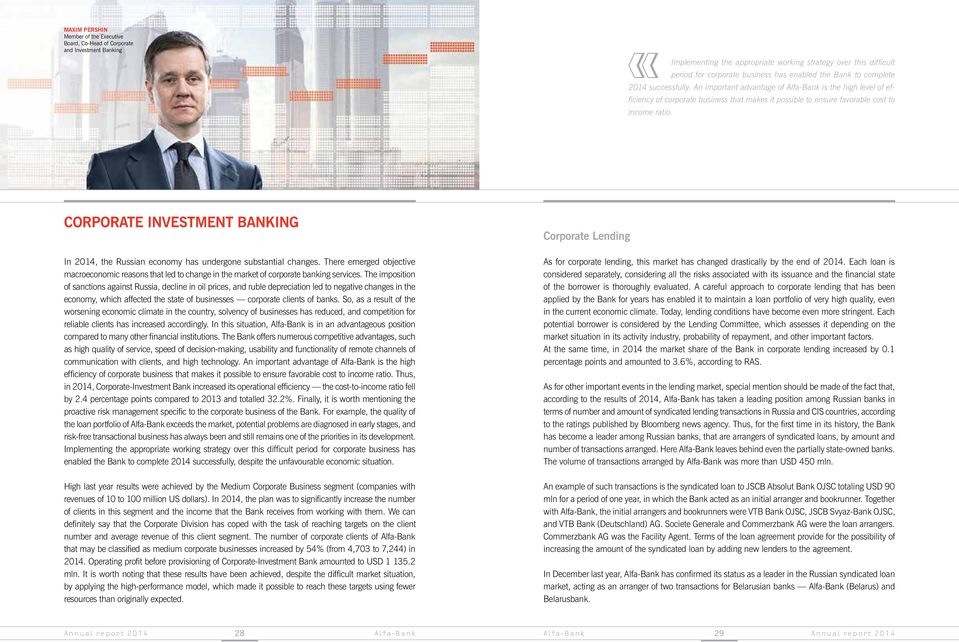
16 MAXIM PERSHIN Member of the Executive Board, Co-Head of Corporate and Investment Banking Implementing the appropriate working strategy over this difficult period for corporate business has enabled the Bank to complete 2014 successfully. An important advantage of Alfa-Bank is the high level of efficiency of corporate business that makes it possible to ensure favorable cost to income ratio. CORPORATE INVESTMENT BANKING In 2014, the Russian economy has undergone substantial changes. There emerged objective macroeconomic reasons that led to change in the market of corporate banking services. The imposition of sanctions against Russia, decline in oil prices, and ruble depreciation led to negative changes in the economy, which affected the state of businesses corporate clients of banks. So, as a result of the worsening economic climate in the country, solvency of businesses has reduced, and competition for reliable clients has increased accordingly. In this situation, Alfa-Bank is in an advantageous position compared to many other financial institutions. The Bank offers numerous competitive advantages, such as high quality of service, speed of decision-making, usability and functionality of remote channels of communication with clients, and high technology. An important advantage of Alfa-Bank is the high efficiency of corporate business that makes it possible to ensure favorable cost to income ratio. Thus, in 2014, Corporate-Investment Bank increased its operational efficiency the cost-to-income ratio fell by 2.4 percentage points compared to 2013 and totalled 32.2%. Finally, it is worth mentioning the proactive risk management specific to the corporate business of the Bank. For example, the quality of the loan portfolio of Alfa-Bank exceeds the market, potential problems are diagnosed in early stages, and risk-free transactional business has always been and still remains one of the priorities in its development. Implementing the appropriate working strategy over this difficult period for corporate business has enabled the Bank to complete 2014 successfully, despite the unfavourable economic situation. High last year results were achieved by the Medium Corporate Business segment (companies with revenues of 10 to 100 million US dollars). In 2014, the plan was to significantly increase the number of clients in this segment and the income that the Bank receives from working with them. We can definitely say that the Corporate Division has coped with the task of reaching targets on the client number and average revenue of this client segment. The number of corporate clients of Alfa-Bank that may be classified as medium corporate businesses increased by 54% (from 4,703 to 7,244) in Operating profit before provisioning of Corporate-Investment Bank amounted to USD mln. It is worth noting that these results have been achieved, despite the difficult market situation, by applying the high-performance model, which made it possible to reach these targets using fewer resources than originally expected. Corporate Lending As for corporate lending, this market has changed drastically by the end of Each loan is considered separately, considering all the risks associated with its issuance and the financial state of the borrower is thoroughly evaluated. A careful approach to corporate lending that has been applied by the Bank for years has enabled it to maintain a loan portfolio of very high quality, even in the current economic climate. Today, lending conditions have become even more stringent. Each potential borrower is considered by the Lending Committee, which assesses it depending on the market situation in its activity industry, probability of repayment, and other important factors. At the same time, in 2014 the market share of the Bank in corporate lending increased by 0.1 percentage points and amounted to 3.6%, according to RAS. As for other important events in the lending market, special mention should be made of the fact that, according to the results of 2014, Alfa-Bank has taken a leading position among Russian banks in terms of number and amount of syndicated lending transactions in Russia and CIS countries, according to the ratings published by Bloomberg news agency. Thus, for the first time in its history, the Bank has become a leader among Russian banks, that are arrangers of syndicated loans, by amount and number of transactions arranged. Here Alfa-Bank leaves behind even the partially state-owned banks. The volume of transactions arranged by Alfa-Bank was more than USD 450 mln. An example of such transactions is the syndicated loan to JSCB Absolut Bank OJSC totaling USD 90 mln for a period of one year, in which the Bank acted as an initial arranger and bookrunner. Together with Alfa-Bank, the initial arrangers and bookrunners were VTB Bank OJSC, JSCB Svyaz-Bank OJSC, and VTB Bank (Deutschland) AG. Societe Generale and Commerzbank AG were the loan arrangers. Commerzbank AG was the Facility Agent. Terms of the loan agreement provide for the possibility of increasing the amount of the syndicated loan by adding new lenders to the agreement. In December last year, Alfa-Bank has confirmed its status as a leader in the Russian syndicated loan market, acting as an arranger of two transactions for Belarusian banks Alfa-Bank (Belarus) and Belarusbank. 28 Alfa-Bank Alfa-Bank 29
17 CORPORATE INVESTMENT BANKING CORPORATE INVESTMENT BANKING In the first transaction, Alfa-Bank (Russia) acted as arranger, book runner, and agent. Alfa-Bank (Belarus) was granted a syndicated loan of USD 19 mln for a period of six months with the possibility of extension for the same period. As a result of the second transaction, Joint Stock Savings Bank «Belarusbank» OJSC as the largest bank in Belarus has raised another syndicated loan of EUR 80 mln. Alfa-Bank (Russia) has become an arranger of the loan together with Russian banks Joint-Stock Commercial Bank «Novikombank» CJSC and Promsvyazbank OJSC. A distinctive feature of the transaction was participation of five new banks that have never previously taken part in syndicates of Belarusbank. It should also be noted that the syndicate was participated by 11 lenders, which is a record number for the Belarusian debt market. Another significant deal in this segment was made by Alfa-Bank and the Development Bank of the Republic of Belarus OJSC. Alfa-Bank provided EUR 20 mln under a syndicated loan agreement for trade finance. The total amount of the transaction was EUR 130 mln.the funds will be used to finance export-import operations of DBRB. In particular, it is expected that one of the first contracts for these operations will be the purchase of two new Embraer aircrafts for Belavia Airline OJSC. Financing the Development Bank of the Republic of Belarus in the framework of the syndicated loan is the largest transaction by the volume of attracted funds in the sovereign history of Belarusian banking system. This confirms the status of the Development Bank as one of the most reliable borrowers among Belarusian financial institutions. Additional landmark transactions have also taken place in Thus, Alrosa company has joined the number of clients of Alfa-Bank. The Bank has provided ALROSA JSC with a revolving loan line with a debt ceiling of USD 920 mln. The loan line is valid until The maturity of tranches is up to 36 months. The first tranche was issued in the amount of USD 720 mln for a period of 3 years. The purpose of the loan line is to finance current activities of ALROSA JSC, including production of goods for export and implementing of contractual trading obligations, repayment of the borrower's obligations to its creditors, acquisition and repayment by the borrower of equity securities, and investment financing. In April 2014, Alfa-Bank provided a three-year loan of USD 1 bn to VimpelCom Amsterdam B.V. holding company under a security by VimpelCom Holdings B.V. The loan was issued in two tranches of USD 500 mln each. The funds raised significantly improved the liquidity profile and financial flexibility of VimpelCom Group and became another step towards centralization of funding sources. A loan line in the amount of RUB 370 mln was opened to the leader of the textile market in Russia the Ivanovo enterprise «TDL Textile». TDL Textile, a successful and promising company, is the leading enterprise in the textile industry in Russia. It was interested in cooperation with a major, serious, and reliable financial partner with extensive experience in real sector lending and a wide range of financial products for businesses including factoring and investment vehicles, and support for export-import operations. That is why the choice was made in favor of Alfa-Bank. Joint Stock Company «Atomic Energy Power Corporation» OJSC received loans totalling RUB 25 bln for 1.5 to 3 years. Atomstroyexport CJSC was provided a bank guarantee in the amount of USD 19.4 mln for a period of 1.5 years and a loan in the amount of RUB 3.4 bln. The aggregate amount of loans in foreign currency to Techsnabexport JSC in 2014 was USD mln. In June 2014, a subsidiary of Alfa-Bank has provided Russian Copper Company CJSC with a threeyear advance payment against future product exports worth USD 100 mln. The funds were used to repay the existing indebtedness of RCC to creditors. It was a complex transaction due to the high urgency of its implementation and non-standard structure of both the transaction and documentation. Executives of Russian Copper Company CJSC highly appreciated the expertise of the Alfa-Bank team. Transactional Business Development of a risk-free business has been one of the priorities of the Corporate-Investment Bank for years. In 2014, according to management accounts, net fee and commission income of the Bank's settlement business grew by 54% in rubles (by 26% in US dollars) compared to Net profit of transactional business rose by 16% in rubles (slight decrease of about 5% in US dollars), while the number of active clients increased by 43% (from 3,957 to 5,649 CPR/companies). Alfa-Bank has always been and still is a financial organization that listens to its clients and develops specific products and solutions that solve the challenges they face. For example, last year, the Bank prepared and implemented a solution for the creation of an Integral Settlement Center for Taxi Moscow JSC, whereby the client was able to manage a consolidated pool of 600 accounts of individual entrepreneurs. The project was implemented in conjunction with the Retail Business Block, and each of the individual entrepreneurs was given a salary card. The project was successfully implemented by applying an integrated approach to the task, which enabled the rapid development of this unique solution. As a result, Taxi Moscow became a salary client of the Bank. Industry Experience One of Alfa-Bank's competitive advantages is its experience in working with a wide range of industries, in turn generating a high level of industry competencies. Last year, the Bank s priority industries, including telecommunications, mining, and processing of precious stones and metals, chemicals and petrochemicals, as well as the oil industry, have shown steady growth. The sectorial priorities for next year include companies involved in export operations (oil and gas, coal mining, nonferrous metallurgy, diamond mining, forestry, nuclear, chemical, and petrochemical industry) and clients working on import substitution. Special attention will be paid to industries providing priority human needs, such as the food and pharmaceutical industries, and agribusiness complex. As before, we are going to actively develop our cooperation with the telecommunication industry, and with companies serving export flows. Among the major transactions with companies of priority sectors, we would like to mention Alfa-Bank s cooperation with generating companies. Last year, the Bank provided a loan to Nazarovo GRES OJSC of Siberian Generating Company (SGC) to the amount of 8 billion rubles for 5 years. The purpose of borrowing is to refinance previous loans for projects of PSC (the Power Supply Contract) of SGC, 30 Alfa-Bank Alfa-Bank 31

18 CORPORATE INVESTMENT BANKING CORPORATE INVESTMENT BANKING including the project on modernization of power unit No. 7 of Nazarovo GRES. Reconstruction of unit No. 7 of Nazarovo GRES is part of a large-scale investment program of Siberian Generating Company, the total value of which exceeds RUB 86 bln. The project will not only solve the problem of the electricity deficit projected in the Krasnoyarsk region, but will also increase the supply of electricity in the integrated power system of Siberia, taking into account the location of Nazarovo GRES at the intersection of main electricity grids. Alfa-Bank is considering co-operation with energy companies as one of the strategic lines of business. Interesting projects have been implemented in priority sectors at the regional level as well. For example, we have completed a transaction with the Nizhny Novgorod company NIZHFARM OJSC, have successfully cooperated with the Chelyabinsk company MAKFA, and have financed projects of the Far Eastern companies related to consolidation of the fishing industry. Technological Leadership The most important competitive advantage of Alfa-Bank is its ongoing development and implementation of the most modern technologies. Its technology leadership guarantees safety of banking transactions and reliability of the services that it offers its clients, including efficiency in development of customized solutions for its partners. Last year, Alfa-Bank developed an innovative transactional solution for corporate clients, known as Alfa-Finance. Alfa-Finance is a platform which allows the client to optimize the internal processes of the company when dealing with supply chains at any stage. Its development is further proof that the Bank goes beyond the needs of its clients and creates special products and services that help clients to complete tasks efficiently and effectively. In 2014, salary clients of Alfa-Bank were provided with the option of managing their salary projects with a fundamentally new WEB-free service Alfa-Salary Online (ASON). Developing a new remote support system for our clients, we rely on four basic principles accessibility, reliability, security, and ease of use. The new system meets all the modern requirements, guarantees security of transactions, and allows the user to manage the salary project with just a few clicks. With this new service, the entire process of opening an account and issuing a salary card for an employee has become much faster and easier. to develop and implement the corporate card program under identical conditions in all the regions in which the client is active. Joining Visa Multinational Premium Solution enables Alfa-Bank to provide its corporate clients with a new level of unique service. Of course, the fact that Visa chose the Bank to be the exclusive program partner in Russia also confirms the high quality of its services. The increased technical component of the Bank's services and products is an important component of serious efforts to continually improve client experiences. We believe that cooperation with any bank should be, first and foremost, convenient for the companies it serves, and we are constantly improving the way we work with our clients, based on both our own initiative and the feedback we receive. Last year, we opened the first new-format office for corporate banking in Moscow «Prospekt Mira» Business Center. Here, we have fully implemented a new customer service concept developed exclusively by Alfa-Bank. The main purpose of the changes is to separate the client traffic from other segments. Corporate clients are now served in separate offices instead of at an operations desk. The office offers its visitors all kinds of modern banking services, including specially equipped workstations, free Wi-Fi, tablets, and printers with the ability to print from any device. The office has several meeting rooms, including rooms equipped with video-conferencing facilities which are not only available to the Bank's employees, but also to its clients. The office of such format was the result of serious research, including an analysis of our clients' experiences. In the future, most of the Bank's offices for corporate clients will switch to this new service model. Business Efficiency When the profits of banking institutions are no longer actively growing, ways to increase their efficiency and reduce associated costs are of particular importance. The corporate business of Alfa-Bank is characterized by high efficiency particular attention is paid to the ratio of operating profit to the investment required for its obtaining, the number of personnel, and the standardization of the result that is expected of each employee of the block. To date, we are actively working on optimizing the operations service model for legal entities. We are confident that it will yield real results. Advanced technology often becomes an important argument when selecting partners for joint projects. For example, last year, Alfa-Bank was chosen to be the only partner of Visa to participate in the program Visa Multinational Premium Solutions. The program is intended for multinational corporations and makes it possible to ensure transparency of audit and to optimize the costs of corporate payment cards of employees. Visa Multinational Premium Solutions consolidate 14 leading commercial banks in more than 60 countries. The corporations are guaranteed common standards of international corporate cards across-the-board, integrated solution for data transfer and registration, global coverage, and local service. For multinational corporations whose head offices are located in Russia, Alfa-Bank will support the implementation of international programs for the issue of corporate cards as an exclusive partner, representing the issuing banks in various countries around the world and providing the opportunity 32 Alfa-Bank Alfa-Bank 33
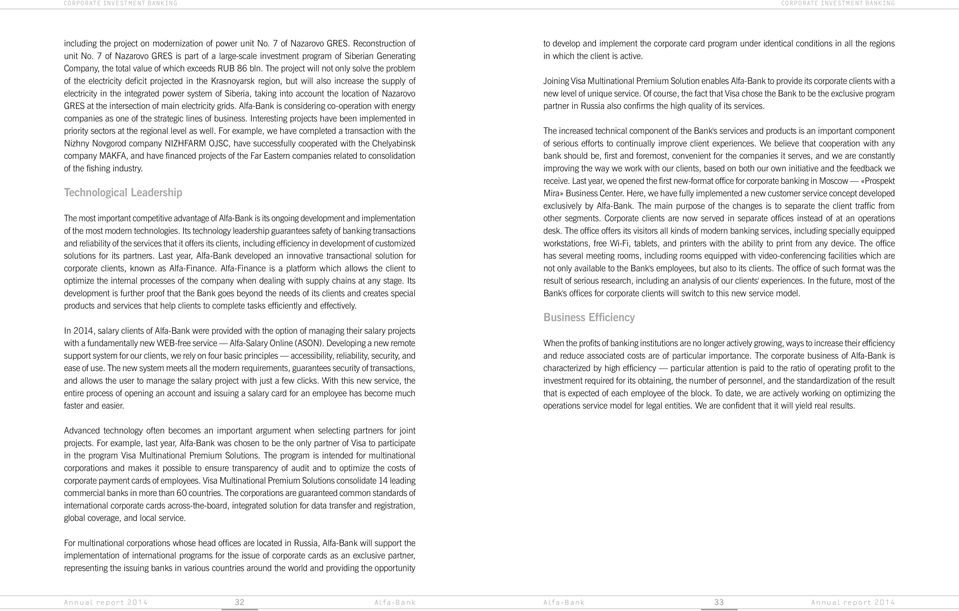
19 SIMON VINE Co-Head of Corporate and Investment Banking Despite the difficult market situation, the Investment block has made significant progress in its activity and has yielded additional income. The Bank's team has coped with numerous negative influences and has maintained the Bank's market position, effectively managing the current portfolio and controlling the risks incurred. INVESTMENT BUSINESS 2014 was not an easy year for the investment business. Despite the difficult market situation, the Investment block has made significant progress in its activity and has yielded additional income. The Bank's team has coped with numerous negative influences and has maintained the Bank's market position, effectively managing the current portfolio and controlling the risks incurred. By the end of the year, as already noted, the Bank had taken the leading position in the Russian syndicated lending market. Moreover, it made the first transactions with credit derivatives from its own balance sheet and created an HTM portfolio to invest in bonds reaching a value of USD 1.1 bn, as well as its own stock option book. Our priority over the past year was clearly our work with corporate finance. The Bank has stepped up the work with regions and established a transparent relationship with the regional managers, which resulted in the Bank s first three regional mandates by the end of the year. Another important direction taken by the development strategy of the investment block was the search for foreign partners in the field of corporate finance. Due to various factors, Western banks began to reduce their activities in the Russian Federation. Publicly owned banks and large private banks are mainly focused on major projects, while Alfa-Bank pays special attention to medium-sized businesses. Today, we have an opportunity to become a leader in this segment. For example, the Western partners, who do not work directly on the Russian market, can bring Western clients to Russia or help Russian clients to search for investment in the West. Therefore, the ties and informal relationships that the Bank has with companies in Germany, Turkey, and Israel have become even more important. Currently, we are searching for partners in additional countries, including Austria, France, and England. Successful work in the corporate finance segment is a direct result of active cooperation between the corporate and investment blocks. Another important event of the year was the creation of the held-to-maturity (HTM) portfolio run jointly by corporate and investment blocks. To date, the portfolio is worth almost USD 1 bn. This was made possible due to the combined expertise of the corporate and investment businesses. Market of Debt Instruments Last year became a client focused year for Alfa-Bank on the debt instrument market. We not only managed to maintain our leading position on the financing market, we also helped clients in difficult situations. In the fourth quarter of last year, many of them were forced to decide to close the portfolio. However, we created solutions that allowed them to retain it even in this tense climate and avoid losses. We believe that this is a perfect example of true partnership with our clients. Transactions in International Capital Markets In June 2014, Alfa-Bank issued Eurobonds of ABH Financial Limited, the holding company of Alfa- Bank, in the amount of EUR 350 mln over 3 years, becoming the first issuer on the Eurobond market among Russian borrowers in February Due to this issue the Bank was named the winner in the category «The Best Primary Eurobond Issue 2014,» following a survey conducted by the online news agency Cbonds. The Cbonds Awards competition is held since Winners of the various categories are determined by surveys of registered users conducted via the website of the organizer of the contest the independent news agency Cbonds.ru which has been monitoring current events and climate of financial markets since 2000, providing relevant and accurate information to executives and managers of banks, investment and management companies, and representatives of the government. In total this year, Alfa-Bank has issued Eurobonds twice in June, it issued three-year bonds worth EUR 350 mln with a yield of 5.5% per annum, and in November it successfully issued a subordinated eurobond in the amount of USD 250 mln with an interest rate of 9.5% per annum, 10 years and 3 months maturity and a call option after 5 years and 3 months. The deal has become the longest among Russian issuers since summer It is also the first subordinated deal on the market since summer This deal confirms that, despite concerns about country risks, the Bank continues to enjoy the support of investors due to the high credit quality of the Bank, its competent risk management, it s clear and coherent strategy, and the transparent ownership structure, including the Bank's role in the Russian banking market. 34 Alfa-Bank Alfa-Bank 35
20 CORPORATE INVESTMENT BANKING CORPORATE INVESTMENT BANKING Structured Products and Derivatives Last year, the Investment block made transactions with credit derivatives (total return swaps) unprecedented on the Russian market, which allowed the Bank in provide financing for major Russian corporate clients in the amount of more than USD 400 mln. In May 2014, employees of the Investment Bank granted a three-year loan of USD 30 mln to Foreston Holdings Limited, owned by a number of executives of Integra Group, which was spent on redeeming shares of Integra Group. As a result of the transaction, circulation of the company's GDR on the London Stock Exchange was discontinued in May 28, Felix Lyubashevsky, President of Integra Group Management Company, has appreciated the efficiency and professionalism shown by the team of Alfa-Bank in working on the transaction. In June 2014, a subsidiary of Alfa-Bank provided Russian Copper Company CJSC with a three-year advance payment against future product exports worth USD 100 mln. The funds were used to repay RCC s existing debt to creditors. It was a complex transaction due to the high urgency of its implementation and non-standard structure of both the transaction and the documentation. Executives of Russian Copper Company CJSC highly appreciated the expertise of the Alfa-Bank team in dealing with this situation. In addition, in 2014, the Investment Bank continued to increase its portfolio of hybrid deposits. By the end of 2014, the Bank had attracted hybrid deposits worth more than USD 214 mln. In 2014, the Bank entered into a series of cross-currency and interest rate swaps related to loans worth USD 465 mln. These transactions allowed the Bank's corporate clients to eliminate currency and interest rate risks, and substantially reduce costs associated with the loan servicing. Working with derivatives, as well as with structured products or in bond management, the Bank's staff did their best to help their clients, creating new solutions and employing an individual approach to each situation. Alfa Direct and Forex Transactions As for e-commerce on the Moscow Stock Exchange, the main event of the year was the introduction of a new version of the information and trading system, Alfa-Direct. Referred to as Alfa-Direct 4.0, it is by far the best in Russia in terms of speed and reliability. It also boasts a number of distinctive functional features, such as easy work with graphs, a wide range of trade orders, and a built-in module for creating, testing, and optimizing trading robots. Work on the currency market was also very successful. According to the annual rating by Euromoney FX Survey, Alfa-Bank ranked 36th in the world in Forex transactions last year, climbing one line up from the previous year s rating. At the same time, Alfa-Bank is significantly ahead of its Russian competitors. The Bank is one of the leaders on the foreign exchange market in Eastern Europe, with the volume of transactions reaching USD 10 bln a day. In a similar ranking of countries located in Central and Eastern Europe (including CIS countries), Alfa-Bank has entered the top 10, finishing eighth this year and significantly ahead of Russian competitors, including publicly owned banks. It is worth mentioning that, in April 2014, the Moscow Interbank Currency Association awarded Alfa-Bank the title of the best bank on the foreign exchange market at the end of 2013 (The Best Forex Desk 2013), for the second year in a row. One of the factors contributing to the success of the Department of Foreign Exchange Operations is the enhanced interaction between the various departments of the Investment Bank. Due to exchange of products between the departments, their range expanded, and clients were able to purchase products from any one has shown that the Investment block, both as a whole, and considering each of its departments separately, will rise to the next level in providing complex and popular services to each client of the Corporate-Investment Bank. One-off transactions, i.e. non-standard transactions which are carried out under specific circumstances, are yet another area providing new opportunities. These transactions require an individual approach to each project and to each client. These situations often create an opportunity for the Bank to obtain additional profit. Thinking outside the box, exploiting the possibilities offered by the market today, and revealing the potential of each project these are all key to success in times of financial instability. Russian Banking Sector Test of Strength In December last year, Alfa-Bank hosted the IX Media Conference, «Russian Banking Sector Test of Strength». The conference was attended by journalists from more than 130 federal and regional media outlets. This traditional annual conference for journalists and experts of the banking industry is in its ninth year. The main purpose of the event is to provide a forum for open discussion of current trends, pressing issues, and prospects for development of the Russian banking sector. In 2014, the speakers at the conference included Alexey Marey, Chief Executive Officer of Alfa-Bank, Alexander Shokhin, President of the Russian Union of Industrialists and Entrepreneurs, Alexey Moiseev, Deputy Finance Minister, Yuriy Isayev, CEO of GC «Deposit Insurance Agency», Anatoly Aksakov, Deputy of the State Duma of the Russian Federation and President of the Association of Regional Banks of Russia, Garegin Tosunyan, President of the Association of Russian Banks, and Yevgeny Yasin, Scientific Supervisor of NRU «Higher School of Economics». At the conference, representatives of the largest financial institutions, public authorities and regional and national media outlets discussed both the current climate and the future of the industry in direct dialogue. The conference participants were given insight into the domestic financial and economic climates and the current state of the banking sector, and were given the opportunity to ask questions of the expert community, including economists and bankers of the highest level. Alfa-Profi Last year, Alfa-Bank launched an educational project, «Alfa-Profi» a program for the development of professional competencies of managers of companies which are payroll clients of the Bank. As part of the program, we hold workshops, webinars, and conferences on current topics in the field of management, finance, and accounting. These can be attended by executives in person or by 36 Alfa-Bank Alfa-Bank 37

21 CORPORATE INVESTMENT BANKING ABOVE THE CIRCUMSTANCES correspondence. The project partners are leading experts, practitioners, consultants, and teachers. It is supported by trade publications and the reference system for CEOs and CFOs, chief accountants, and other company executives. Objectives and Priorities for 2015 Profit after provisions will be the focus of the Corporate-Investment Bank in This index is to be the most tightly controlled in the course of the year ahead. Despite the difficult situation in the corporate lending sector, we expect to minimize the associated losses and develop business with reliable clients. One of the priorities for the coming year is maintaining the high quality of the loan portfolio. Alfa-Bank will do its utmost to maintain one of the best portfolios on the corporate lending market. With regard to the investment business, we expect the Bank to strengthen its platform in all areas in 2015 and move to a new level of recognition among clients, which will allow the Bank to move to an even higher position in the cumulative ranking of the investment banking services in Russia. Our task is to create an entirely new image of Alfa-Bank as both an investment boutique and a commercial bank providing investment services. Corporate finance, the use of technological leadership in promotion of investment products, and the search for unique situations and taking those opportunities will remain the priority areas of the investment business. Particular attention will be paid to transactional business and an increase in fee and commission income. Due to high technology, Alfa-Bank occupies the leading position in this segment, which yields consistently risk-free profits. We will be actively developing cooperation with midsize corporate business. In 2015, we are going to significantly increase the number of client companies in this segment with a focus on settlement services, instead of sales of loan products. Alfa-Bank is the only one of the largest Russian banks that has not been affected by the sanctions imposed in 2014, which enables it to work efficiently with clients in the foreign trade field. This is an important line of business, which provides the Bank with additional revenue opportunities. Of course, for the Corporate-Investment Bank, 2015 will not only be a year of challenges, but also a year of new opportunities provided by the market itself. This may include individual transactions related to restructuring of loans of debtor companies, resale of assets of any companies and other projects which will bring the Bank additional income. Alfa-Bank has always been able to recognize opportunities where others might not see them. Its aforementioned competitive advantages, in combination with the competent management and clever policy of risk-free business segments, is the guarantee that the Bank's corporate business will continue to grow and develop, as it has done before. The Bank is not only trusted by foreign investors but is also an important partner for the Russian regulatory authorities. It was Alfa- Bank that was granted the rehabilitation of the Baltiyskiy Bank one of the biggest financial organizations of the north-west of Russia. As a result of the rehabilitation, the client base of Alfa Banking Group increased by 2.6 mln people. 38 Alfa-Bank
22 MIKHAIL POVALY Head of Retail Business, Member of the Executive Board Alfa-Bank has a special place among banking institutions in Russia. For many years, it has considered the high standard of customer experiences to be its most important competitive advantage, and strives to ensure that the Bank's services are easy and convenient to use. The results of 2014 showed that these efforts are yielding the desired outcome, as the Retail Bank has demonstrated that it can meet the goals that are set, even in periods of financial instability. RETAIL BANKING In 2014, the retail banking business in Russia underwent significant changes. By the end of the year, many financial institutions were faced with serious difficulties, such as deterioration of individual borrowers and reduced solvency of the population due to both an increase in the unemployment rate and devaluation of the ruble. Another negative factor was the constantly growing loan load on the population to date, more than 70% of potential clients are burdened with more than one loan, and the number of clients with three or more loans nearly doubled from the previous year. A logical consequence of this situation is the increased competition on the banking market. Therefore, high-quality service and the constant attracting of new clients are particularly important to retail banks. Alfa-Bank has a special place among banking institutions in Russia. For many years, it has considered the high standard of customer experiences to be its most important competitive advantage, and strives to ensure that the Bank's services are easy and convenient to use. The results of 2014 showed that these efforts are yielding the desired results, as the Retail Bank has demonstrated that it can meet the goals that are set, even in periods of financial instability. The total number of individual clients of Alfa-Bank has increased by 8% to more than 11,4 mln people compared to The Bank was rated third on the market in terms of credit card portfolio, moving up from the eighth position in less than three years. As a result, Alfa-Bank has again become the third bank in Russia in terms of retail demand accounts, behind only government-owned banks, and its market share in this segment is 7.5%. Finally, it occupies the third place in terms of the market share in consumer lending (15%). The volume of term deposits increased by 24.1% (excl. FX effect) to USD 7,2 bln at the end of 2014, considerably advancing the market. The stable growth of retail deposits demonstrates our clients trust in us, and helps us to maintain our leading position on the market. According to IFRS, Alfa Banking Group s retail loan portfolio constituted USD 4.6 bln, falling by 25.9% due to ruble depreciation in At the same time, excluding FX effect, the retail loan portfolio increased by 26.7% compared to the previous year. An important factor determining the success of any financial institution in unstable economic environment is its reliability. Alfa-Bank has a history of doing business in Russia of more than twenty years. It has been among the leaders on the banking market for a significant period. It therefore has additional opportunities to increase its number of clients through both client selfinvolvement and the rehabilitation of bankrupt banks. For example, in 2014, the rehabilitation of Baltiyskiy Bank, a major financial institution with strong positions in the northwest of Russia, was entrusted to Alfa-Bank. This enabled Alfa-Bank to strengthen its position in the region and gain more clients with no extra costs for marketing. Another competitive advantage of the Bank is its constant development. New products and services, which are sometimes even world firsts, are brought to the market every year. Twin Card In 2014, Alfa-Bank and Visa created an innovative product which is unparalleled on the international stage the Twin Card. It combines two fully functional Visa cards debit and credit in one. It is a single card which can be used for all transactions. The Twin Card is both a Visa Gold credit card issued to your credit card account, and a Visa Classic debit card issued to your current account, combined on a single physical medium. Alfa-Bank clients do not have to carry extra cards in their wallets anymore all they need to do is to just flip the Twin Card. Both sides have a unique magnetic stripe, a unique number, and a CVV2 code for e-commerce. The presence of two chips with different PIN codes reduces the likelihood of erroneous use. The Bank's client may choose any service package that is connected to the debit side. All the special offers, discounts, and promotions available for holders of Visa Classic will remain available for the new card. Using a Visa Gold credit card, its holder can take advantage of the Loyalty Program for Visa Premium Card Holders, which offers more than 500 discounts and exclusive offers at trade and service enterprises both in Russia and abroad. 40 Alfa-Bank Alfa-Bank 41
23 RETAIL BANKING RETAIL BANKING Individual Salary Cards Alfa-Bank was the first bank in Russia to issue and service individual payroll cards free of charge for clients who don t possess payroll projects. Now, an employee of any organization can request the issue of a fully operational embossed salary card free of charge, regardless of whether a contract is signed between Alfa-Bank and the employer to service a payroll project. On receipt of such a card, the Bank's client has access to the full range of services of the Corporate Package, including the free issue and maintenance of up to three additional cards of the same category added to the salary account, free connection to the Internet bank «Alfa-Click», free opening and maintenance of saving accounts, the issue of cards with additional benefits at corporate rates, and the option to obtain a loan in cash and a credit card. Moreover, individual payroll clients may take part in the promotions designed for payroll clients and win prizes. Alfa-Bank also provides the opportunity to raise the individual salary card to a higher category after a certain number of operations have been completed or after a certain account balance is reached. An Alfa-Bank individual salary card is not only a revolutionary offer on the Russian market of payroll projects, but also a unique opportunity for those who want to explore the role of the Bank's payroll clients and experience themselves the associated benefits. «Anywayanyday Visa Alfa-Bank» Co-branded Credit Card In April 2014, Alfa-Bank together with the biggest international online travel agency «Anywayanyday» and Visa began to issue special co-branded cards «Anywayanyday Visa Alfa-Bank». Clients holding the new credit card connected to the bonus program of anywayanyday.com enjoy a wide range of travel benefits. «Anywayanyday -Visa -Alfa-Bank» is available in three forms: Classic, Gold, and Platinum. For every purchase paid with this card, its holder is awarded points on their bonus account at anywayanyday.com from 0.5% to 1.0%, depending on the card type. In addition, the holder receives the higher bonus for purchases at anywayanyday.com. When the money spent with this card reaches a certain amount, the card gives either a one-off or year-round discount from 3% to 7% on airline tickets and hotels booked on anywayanyday.com. Each client receives from 450 to 750 welcome points with the first purchase and 600 points as a gift on every birthday. «Anywayanyday Visa -Alfa-Bank» is the perfect gift for clients who travel extensively, because not only are they guaranteed reliable banking services, but they can also save money on their trips. Visa Alfa-Miles In November 2014, Alfa-Bank and the international payment system Visa introduced another card for bank clients who travel frequently Alfa-Miles. With the Visa Alfa-Miles card, the user has the opportunity to earn miles and exchange them for a whole range of tourist services on the website The advantage of Visa Alfa-Miles is that the miles can be used to book tickets for flights on more than 380 airlines, and, unlike other bonus programs, taxes and fees for the bonus tickets can also be paid with the miles accumulated on the card account. In addition to using miles to pay for air travel, the card holder can pay for accommodation in more than 200,000 hotels worldwide, as well as rent cars and book tickets for the Aeroexpress, the train service operating between Moscow airports and the centre of the city. Along with the Visa Alfa-Miles card, clients enjoy additional bonuses such as free cash withdrawals at ATMs abroad with a debit card, free travel insurance to cover medical costs, discounts from our partners, and free membership to the Priority Pass, which provides access to 700 business lounges at airports all over the world. Alfa-Miles is thus not only an opportunity to earn miles for purchases, but also a veritable travel kit, providing convenient banking and travel services for globe-trotters. Operational Efficiency and Attraction of Clients For years, an important aspect of Alfa-Bank's strategy is the improved performance of each of its business lines. In a difficult financial climate, the efficiency and productivity of each of the Bank s employees is of particular importance. The Bank s activities in recent years are designed to increase the competitiveness of Alfa-Bank. In 2014, this work was continued in the framework of the Retail Bank. Special attention was paid to the personal performance of each employee, especially those engaged in sales of products and services. The second focus was a reduction in operating expenses of the Retail Bank. This was made possible primarily by enhancing the technological component of internal processes, such as the review of loan applications, online applications for the Bank's services, and so on. Significant results were achieved in reducing operating expenses for the existing network of branches. We have managed to reach an agreement with almost all lessors regarding reduction of rent, while some branches, where there was a decline in client traffic, shifted to single-shift operation. Thus, it was possible to reduce operating costs, while maintaining the Bank's distribution network. The cost reduction in the consumer lending sector was due to the exit from non-profit networks, the decision to discontinue partnerships with companies which did not yield sufficient income and revised terms of cooperation where necessary. Another priority during difficult periods is to continue to attract reliable clients. The Retail Bank was working on this in 2014 and will continue to do so in the future. Client acquisition was carried out in accordance with the segment strategy with a focus on the «senior» segments, such as Affluent and Mass Affluent, i.e. those sectors of the population that have been least affected by the deteriorating economic situation in the country and enjoy more financial stability. One more important task is to reduce the client churn. We have begun work in this area and we are going to intensify efforts in To achieve these objectives, we will continue to improve the quality of client service, develop services demanded by the «senior» client segments, such as services offered by VIP-managers and financial advisors for wealthy people. With regard to the range of banking products, they will also be adapted to the clients actual needs. Undoubtedly, the emphasis will be placed on saving 42 Alfa-Bank Alfa-Bank 43
24 RETAIL BANKING RETAIL BANKING accounts, as in the current financial situation, many are prioritizing saving and increasing their funds. A cash-back card is another interesting product, set to be released in This card will return part of the funds spent. And, of course, value-added products joint products with our partners will still be relevant. Remote Service Channels Alfa-Bank values its clients' time. We are always working hard to make as transactions possible remotely to save our clients going into the office. This is also advantageous to the Bank, as it reduces the load on its offices and operating costs. The functionality of the Alfa-Click Internet bank and mobile bank Alfa-Mobile is expanding annually was no exception. Clients now can open current and saving accounts in various currencies via the Internet bank. Several accounts in seven currencies can be opened simultaneously: Russian ruble, US dollar and Euro are available for the classic package of services and saving accounts; Swiss franc and pound sterling for premium packages; and Canadian dollar and Japanese yen for A-Club clients. New accounts are opened instantly and immediately become available for use. Today, the Internet bank's functionality allows you to make most of the necessary transactions obtain information on the accounts, receive statements of cash flow, make an internal or external transfer, pay for utilities, mobile and fixed phone bills, repay a loan, open and top up a deposit, pay for goods and services of online stores, create templates for frequent transactions and more. From July 1, 2014, Alfa-Bank clients users of Alfa-Click Internet bank were able to make non-cash tax payments to the budget of the Russian Federation online. Mobile bank users enjoy new possibilities also. The new version of the mobile banking application, Alfa-Mobile, enables the client to open current and savings accounts. In addition, it now offers a detailed description of the location of Alfa-Bank ATMs, which will help the client to find such a device in a large shopping mall or at an airport. Since October 2014, Alfa-Bank's loan clients can take advantage of a special mobile application «My Loans», which makes it possible to obtain complete information on a loan or credit card for example, to find out the amount and date of the next payment, control cash flow in an account, or check the outstanding balance. The application will also send a reminder when the next payment is due. Alfa-Bank follows the latest trends in user behaviour and the needs of its clients. For example, given the popularity of social networks, the Bank has enabled its clients to receive notifications of all their card transactions via their Facebook accounts. To use the new service, you just have to specify your social network account in the Alfa-Click settings. Expansion of the Bank's Retail Network Along with the development of remote service channels, Alfa-Bank is actively expanding its network of physical presence by opening new offices. The Bank opened 49 new branches serving individuals in 2014, increasing its network by more than 16%. Ten branches were opened in Moscow and one in Reutov, Moscow Region. Also, new offices have been opened in Novokuznetsk, Barnaul, Kemerovo, Komsomolsk-on-Amur, Prokopyevsk, Vladivostok, St. Petersburg, Krasnodar, Achinsk, Novosibirsk, Volgograd, Yekaterinburg, Tver, Izhevsk, Magnitogorsk, Samara, Tyumen, Ufa, Kaluga, Krasnoyarsk, Yakutsk, Kazan, Zlatoust, Yoshkar-Ola, Syzran, Saransk, and Gukovo. The first bank offices were opened in Tver, Kaluga, Komsomolsk-on-Amur, Prokopyevsk, Achinsk, Zlatoust, Yoshkar-Ola, Syzran, Saransk, and Gukovo. More than 350 offices for individuals are now operating throughout Russia, 81 of which are in Moscow and 269 of which are located in the regions. All kinds of modern financial services are at our clients' disposal at any branch. For example, a client can get a loan or a credit card, open a deposit or savings account, make or receive a transfer, and use proposals for investment of available funds. Our experts will help each client by providing comprehensive information on all banking products and services. All the offices of the Bank offer a 24-hour self-service area, where at least three ATMs with cash-in and cash-out function operate. All new branches are opened in accordance with the new concept of customer service and design and are equipped with the most modern requirements for functionality. The office space is zoned in such a way that it is easy to navigate. In addition, clients may (on their own or with the help of our staff) test self-service channels using modern gadgets to obtain expert advice. The quick-service zones boast built-in printers and scanners, which greatly facilitates the process of obtaining a number of instant services. This saves clients' time, because they do not have to stand in a line in order to make simple requests of a consultant. Cash-room areas allow clients to make transactions with large sums of cash in private. VIP-clients receive services in separate areas. The Electronic Cashier technology used in the offices saves clients time for example, when depositing or withdrawing cash, to the client can ask the processing operator, without going to the cash office. Another convenient feature for our clients is access to free wireless Internet (Wi-Fi). We are constantly increasing the number of branches and ATMs. This makes banking services more accessible for every client, no matter where they are, and reduces the time required to carry out simple transactions. This is why we are regularly contracting with other banks to create partner networks. Alfa-Bank has significantly expanded its ATM network up to 3,767 self-service devices, including 2,177 for depositing cash. To date, the total combined ATM network with banks such as PSB, MDM Bank, Rosbank and UBRD, Russian Agricultural Bank, Credit Bank of Moscow, and Baltiyskiy Bank includes almost 20,000 devices in more than 2,600 Russian settlements. Clients are able to deposit cash and repay loans free of charge via more than 7,800 devices. 44 Alfa-Bank Alfa-Bank 45
25 RETAIL BANKING RETAIL BANKING A-Club Over the past year, we have continued to actively develop the A-Club. A-Club is a luxury financial service system. Club members can take advantage of an optimal set of banking, investment, and insurance solutions, as well the 24-hour banking service provided by a personal account manager. Despite the crisis, the demand for this format of service remained extremely high in The Bank opened new branches of the A-Club in Krasnodar. In 2015, new branches will also appear in Vladivostok, Rostov, and Nizhniy Novgorod. Work with Personnel As before, it is very important for the Retail Bank to work with its staff, as not only their professional knowledge but also their level of satisfaction has a direct impact on the client experience. In 2014, we continued the incentives and employee development programs such as «Our Champions» and «Best of the Best», as well as competitions and forums for the exchange of best practices between departments in various cities. It is clear that efforts to motivate employees are a success. Employees of our Bank, many of whom are members of the Y-generation, consider that the crisis opens up new possibilities, opportunities to prove themselves, show good results in their work, make fresh proposals, and achieve more. This is very important because the success of the Bank is dependent on the individual approach of every employee. Alfa-Bank traditionally pays much attention to getting feedback from clients and providing a rapid response. Today you can access the Bank via any existing channel, including the call-centre, Alfa-Bank's website, social networks, and Banki.ru. In 2015, we are going to introduce a system that allows clients to assess the quality of the service immediately after contact a manager. After leaving the branch or after contacting a manager, the client will receive an SMS with request to assess the quality of service and to indicate whether his or her problem has been resolved. It is an instant and independent assessment of the level of service that will help to accumulate information about the work of every employee who communicates directly with clients, and respond to enquiries related to the service quality. Forecasts and Plans for 2015 trend. We have started tightening scoring models, reduced the maximum loan term to three years, introduced more stringent requirements for borrowers, and launched a special service that reminds clients of the coming payment day and thus eliminates the risk of default. We will continue giving loans to individuals. However, this will be done in such way so that risk is minimized. Among the remote service channels, we will focus on further development of the mobile bank «Alfa-Mobile» a service which renders the Bank available, wherever the client is. Our goal is to almost double the penetration of the product in Last year, 7.5% of the client base used Alfa-Mobile. This year, we are aiming to increase this number to 13%. Further synergies between Retail Bank, Corporate and Investment Bank and Mass Business Block will be of great importance in Cooperation between the blocks and encouraging a holistic approach with a general view on a client make it possible to achieve the best results, as the head of any company that is a corporate client of Alfa-Bank can and should also be client of the Retail Bank. For this purpose, he should perceive the Bank as a whole as an institution that provides a full range of banking services for businesses and individuals, and most importantly, as a financial partner and adviser, not only on work issues, but also on personal matters. And, of course, we will continue working on improving the experience of our clients. This is Alfa-Bank s strong advantage, as these efforts have always been and still are carried out in all the business areas for many years. In 2014, our efforts have been recognized by not only our clients, but also by professionals. The Retail Bank ranked first among the private banks in Russia according to NPS an index that indicates how many clients are willing to recommend Alfa-Bank to their friends and acquaintances. In addition, Alfa-Bank won the annual award «Leader of Client-Focused Business» in the nomination «Bank», and also won the title of «The Most Client-Oriented Bank». The goal of our Bank is to remain the main bank for its clients, and positive client experience certainly helps us to achieve this goal. We pay great attention to ensuring that clients enjoy using our services, that all the processes are transparent and convenient, and that assistance from our experts is pleasant and helpful. Recognition of Alfa-Bank as a leader of the client-oriented business shows that our efforts produce serious results and the steady increase in the number of active clients confirms that we have chosen the right development strategy, which we will continue to employ in the future. In 2015, the Russian economy will continue to evolve. We can expect consolidation of banks and reduction of their number. While it may be a problem for small financial institutions, it gives strong banks like Alfa-Bank additional potential for growth, for example through acquisition of client base of banks that ceased to exist. Special emphasis will be placed on sales of non-credit products, including those that have been previously neglected this will reduce the level of risk taken by the Retail Bank. We are going to focus on brokerage and insurance products and thus gain additional clients in risk-free segments. As for lending, in 2015 we will take additional measures to reduce the risks associated with this 46 Alfa-Bank Alfa-Bank 47
26 DENIS OSIN Head of the Mass Corporate Business High results achieved over the past year have been made possible only by the Block's team work and the efforts of each manager. Not only our clients trust us, but also companies, which were not used to be our clients, are willing to come to the Bank to test our services. MASS BUSINESS The past year was hard for many banking companies. In this difficult time, Mass Business block faced challenges related not only to maintaining of current client base, but also to its active growth and development. We can proudly say that we've not just achieved the target performance indices, but also exceeded the plan for the growth of active clients by almost 30%. By the end of 2014, Mass Business Block had 112,600 active clients, which was 62% higher than at the end of It shows that not only our clients trust us but also companies which did not used to be clients are willing to come to the Bank to test our services. According to the results of 2014, we have also achieved other targets. In 2014, commission income increased by 94.4% compared to 2013 and totalled USD mln. Average monthly balances on demand accounts were USD mln, which is 25.1% higher than in previous year. As for the Block's net profit, it has increased by 177.2% and amounted to USD 76.3 mln with the target performance reaching USD 43.5 mln, which means that the plan has been outperformed by 75.3%. High results achieved over the past year have become possible only by the Block's team work and the efforts of each manager. In 2014, the number of Block s employees increased by 30% while maintaining a high level of productivity. From their very first day at work, each manager receives special attention. This is not only in the way of training, professional development, and continual improvement of their skills, but also efforts that are made to ensure their quick and easy adaptation to the team. Respect for colleagues, facilitating management style, corporate loyalty to the Bank, the Block, and their work contribute to increasing the performance of each employee and Mass Business Block as a whole, and determine the financial results for the year. It is worth noting that the high performance of the Block is important for the Bank as a whole. In view of the current market situation, not all the Bank's divisions had an opportunity to develop rapidly over the past year. Thus, achievements of Mass Business Block, which yield stable risk-free income, are of particular importance. As for the market share in this segment, in 2014, it increased to 2.6%. It was a sure step forward on the path to a 5% market share, scheduled for With regard to general trends in mass business development in 2014, it is worth noting that during this period, there was no significant deterioration in the financial state of small companies. Generally speaking, even the events that took place on the foreign exchange market in December did not affect development of small businesses. The most significant changes have occurred in planning future projects clients began to feel less confident and postponed their decision to start new businesses and, accordingly, open new bank accounts in the first quarter of Today we see a reduction in the balances of clients demand accounts, which means that the market has started to experience some negative changes. Small businesses are the first to feel the change in the customer consumption model, that is, when customers begin to limit themselves in purchasing goods or services. However, even in the face of the market contraction, Alfa-Bank has retained significant advantages over other financial institutions which provide services to small businesses and, therefore, it will be able to further increase the client base of Mass Business Block. An important competitive advantage of the Bank in this area is its special attitude to its clients small companies and individual entrepreneurs. In difficult financial situations, these companies require additional support, relating not only to banking services, but also to increasing business efficiency and assistance in reducing costs and increasing profits. If we talk about specific financial solutions that have been offered to clients, over the past year, we have created an additional lending product refinancing. Today, some clients have begun to feel less confident and rely on us for loan restructuring or revision of existing loans terms. This new product is in response to our clients' requests. It helps them to address the existing financial problems and continue to grow and develop their business. However, this is not the sole effort that has been made to help our clients over the past year, it is not the most important. From the very beginning, Mass Business Block has been working in such a way so that clients are not just buying the Bank's financial services, but they also receive real support in developing their businesses. That is why, in addition to cash management services, brokerage products, and other services that are included in the standard package of any bank, we are constantly creating additional tools and developing solutions that help small businesses feel more confident, even in times of crisis. 48 Alfa-Bank Alfa-Bank 49
27 MASS BUSINESS MASS BUSINESS In 2015, the mass business market may experience some changes. The number of companies in this sector may be reduced, and those that survive will face new problems and new challenges. Alfa-Bank is ready to help its clients in this challenging environment. Moreover, in December 2014, we sent a letter to our clients, which included recommendations on how to improve their efficiency in the current economic climate. Our advice included ways to reduce costs, improve the quality of service in a highly competitive business environment, and other important recommendations which Alfa-Bank can make based on its extensive experience, being the first private bank in Russia. We will continue such mailouts, telling our clients about the practices and giving them examples of ways to do business properly during a crisis. Our mission is to help small businesses to operate successfully in our country. We converse sincerely with our clients, and they trust us. With regard to the line of banking products that we are offering to companies, here we meet market needs too. Our line is personalized everyone can find here what suits their needs the best. Thus, there are special packages for beginners in business, developing companies, and those that already are firmly integrated in their markets. Over the years of its operation, the Bank has also developed additional non-financial services for small companies to help them in their routine work. For example, clients can maintain accounting records of their companies in the same window with the Internet bank «Alfa Business Online», which is integrated with the accounting systems «Contour» and «My Business». A unique service, «Alfa Concierge», makes it possible to use secretary services for a fixed fee and receive information and advice on legal and financial issues 24 hours a day, seven days a week. Small businesses and individual entrepreneurs which take the «Partner» loan or open an account with the Bank receive bonus discount certificates for placing content ads in the search engine «Yandex» and getting free initial advice at one of the leading law firms in the city. In 2014, we introduced new useful non-financial services for mass business clients. The purpose of these services is to make operation of a young business more convenient, simple, and effective. Thus, Alfa-Bank, together with the online accounting service «My Business», has launched a free service to prepare documents for business registration. One of the obstacles faced by entrepreneurs starting a new business is the bureaucratic complexity. The new service allows budding entrepreneurs to prepare a complete set of documents for registration of the individual entrepreneur or LLC in just 15 minutes and free of charge, and quickly open a settlement account with Alfa Bank, and thus reduce the time it usually takes to deal with formalities. They are able to pay more attention to their business development. The Client Club project is another way we support small companies. This is a loyalty program for companies and entrepreneurs with current accounts with Alfa Bank. In each city, the Bank has found partners in key B2B sectors, which provide discounts on their products and services to all clients of the Bank. Thus, entrepreneurs and small businesses can save tens of thousands rubles ordering the necessary goods and services from the Bank's partners, while the Club partners, in turn, receive additional advertising of their services, as their proposals are posted on the website of Alfa-Bank. It is also worth noting that the Client Club is not only a discount program, but also a platform for communication between entrepreneurs, to share best practices, participate in education seminars, and publicise special events intended to help small businesses to operate more efficiently and achieve success. Over the past year, the Client Club was actively developed. It has been joined by new partners in all cities where it operates. In addition, the number of transactions between member companies of the Club increased significantly. The Client Club has a special function in a crisis period. It provides an opportunity to save on things needed for your business, to use the necessary services at a reasonable price, and to expand the market for your products and services. As for additional informational events for members of the Club, in 2014 we held 10 conferences in major cities of Russia. In each city, the event was attended by 250 to 400 existing and potential clients of the Bank. They learned about the services offered by Alfa-Bank to small companies and received an overview of the current economic situation from analysts of the Bank and the leading Russian experts. Companies received advice on promoting their campaigns, marketing products and services for small businesses. At the meeting, companies had the opportunity to offer their products and services to each other and reach preliminary agreements on further cooperation. Such meetings are very important for both the Bank and small companies in the regions of its presence. While companies receive useful information which facilitates their success, Alfa-Bank develops its image as the Bank supporting small businesses and providing them with the full range of banking services. The Bank cooperates with regional agencies which support the development of small and medium-sized businesses. Thus, with the participation of Alfa-Bank, the forum «Young Millionaires of Siberia» took place in Novosibirsk, «Business Climate in Russia» in Ulyanovsk, and «Association of Young Entrepreneurs of Russia» in Ryazan. Alfa-Bank's contribution in holding such meetings and creating a favourable business climate has been highly appreciated by regional authorities and forum participants. Further development of relations with municipal autonomous institutions and city councils to support and develop small and medium enterprises is a priority for the Bank. This will make it possible to provide targeted support to small businesses in a particular city or region. Another interesting event which took place last year, organised by the Bank for its clients owners of small companies and individual entrepreneurs was the «Compare Yourself» project. The purpose of the project was to help clients to improve their businesses. It provides a set of best practices of a specific sector of the market that any company can apply in their work. The project is of great importance for the Bank itself, because it yields more information about the clients businesses. This means that we will be able to create for them the most useful financial and non-financial solutions. In 2015, Client Club meetings, seminars for small businesses, and other similar events will be held with the same intensity, and we will make them even more informative and interesting for market players. 50 Alfa-Bank Alfa-Bank 51
28 MASS BUSINESS MASS BUSINESS The efforts by Alfa-Bank to support small businesses and entrepreneurship in Russia have been appreciated not only by the Bank's clients, but also by experts. In July last year, Alfa-Bank's project «Client Club» received the highest award in the national competition of business support projects «Basis of Growth», which is held annually with the support of the Ministry of Economic Development of Russia and the Russian Union of Industrialists and Entrepreneurs. Alfa-Bank was the winner in the category «Event Project of the Year». Alfa-Bank pays great attention to the development of the most advanced technologies for the banking business. The more opportunities that are available to clients remotely, without the help of the Bank s employees, the easier it is for the client to work with the Bank. This is especially important for small businesses with small staff and limited number of financial problems. The online bank's functionality for business is expanding every year. It expands the list of transactions that can be performed using a mobile bank and now there is the option to use the new Alfa-Cash credit card. Last year, a new-generation bank card Alfa-Cash Ultra was released for legal entities and individual entrepreneurs. The Alfa-Cash Ultra card not only allows depositing and withdrawal of cash to/from the company' account, but also enables payment for goods and services in retail outlets and online stores. These transactions can be carried out at ATMs of Alfa-Bank and ATMs of its partner banks. Thus, the Alfa-Cash Ultra service network increased to 3,000 devices to deposit cash and up to 15,000 devices to withdraw it. When implementing the project, Alfa-Bank took care to improve the card's safety. Alfa-Cash Ultra is equipped with a chip that reduces the risk of compromising cards. Safety of online payments is provided by the 3D-Secure technology. Cash withdrawal takes place without reservation. Payment for goods and services and transfer of the proceeds to the account is made instantly. Now it is more convenient to use the card, and the number of operations that can be performed without help of the Bank s employees has increased. The Internet bank «Alfa Business Online» makes it possible to manage a company's account from any computer, even from mobile devices using the application «Alfa Business Mobile» for a smartphone and (since 2014) for a tablet. The internet bank operates around the clock and has a modern data protection system. Information about funds flow to and from the accounts is available in a real time mode. To date, more than 94,000 entrepreneurs and small businesses are using the system. The Alfa Business Online Internet banking system, created by Alfa-Bank in the past year, has been recognized by experts and users as one of the most effective online banking systems and rated the second in the Business Internet Banking Rank 2014 by the agency Markswebb Rank & Report. This study examined the needs of businesses in remote banking services and analysed the functionality and quality of the interfaces of 20 Russian Internet banks for small businesses and entrepreneurs. In the study, experts of Markswebb Rank & Report examined each of the systems according to 150 criteria, including an assessment of the Bank by the users themselves. This very positive evaluation by one of the leading IT research agencies confirms the correctness of the chosen strategy of the Bank, which provides entrepreneurs and small companies with the most comfortable, functional, and user-friendly tools. However, special attention was paid last year to the mobile version of the banking service Alfa Business Mobile. First, we added a feature to enable a payment to be made using a template, followed by a feature to create payment orders on mobile devices. It is very important for small companies, because now an entrepreneur can make any payment out of the office when they have no computer at hand. Another feature that was added last year was the signature of payment orders. Now, a director can sign the payment sent not only from a computer, but with a tablet or smartphone. This gives managers more freedom and saves time, which is precious for everyone, including entrepreneurs. Active expansion of the client base in 2014 was accompanied by regional expansion as well. We started operation in new cities in Kaluga and Tver, for example. Moreover, we opened 30 additional sites for corporate banking. We're also going to expand the Block's presence in regions in Today, new sites are often opened independent of Retail Bank, in areas where there is potential for business development and where it is possible to get return on the site within two years. Last year, such offices were opened in Moscow, Kazan, and Perm, and we are going to open ten more new branches in In times of crisis, it is of particular importance to increase business efficiency, and, of course, this is true for Mass Business Block too. Over the past years, we have managed to significantly improve sales of our services by connecting the new channels of customer service, such as agency channel and the channel of account managers. For example, 30% of the total attraction today accounts for the offices of new format, which means that clients who want to start a business do come to offices. When attracting new clients in this way, recommendations by current clients are of great importance, which means that our work to improve our clients experience has not gone unnoticed. Another important channel to attract clients is the agency channel. We work with partners that bring clients to the Bank for example, accounting firms that serve entrepreneurs, companies, loggers, and other similar organizations. To date, approximately 20% of clients come to the Bank through this very channel. Additional sales often occur due to the high quality of account managers' work this is the case both for additional businesses of current clients and for new customers who choose Alfa-Bank based on the recommendation of colleagues or friends. In 2014, we faced another important task to increase number of products used by companies to two per client. We have achieved this target, ending the year with a score of 2.4 products per client. This work will continue, as it enables the Bank to increase its profits at the expense of the current client base, and clients can receive additional service and additional features that make doing business easier and more convenient. Alfa-Bank's website is also gradually becoming an important channel for attracting clients. Today, you can apply to open an account and call for a manager via the website. We see that, through developing the online channel, we are becoming even closer to our clients, who are spending more time on the Internet. 52 Alfa-Bank Alfa-Bank 53
29 MASS BUSINESS ABOVE THE CIRCUMSTANCES Another important point which must be mentioned in the current climate is risk management. To date, only 13% of the total profit of the Block is a result of loan products, and 87% is yielded by risk-free products, such as cash and settlement services. This means, we do not risk capital or borrowed funds when providing services to our clients. During difficult financial periods, a risk-free business model is the most important source of income for any banking organization. Of course, in this regard, there is a danger that public or other private banks will become active in this segment and strive to increase their market shares, for example, by means of price dumping. However, we are able to counter such a model, because from the very beginning of our involvement in mass business market, we have shown that working with us is convenient and profitable. Alfa-Bank is probably the only bank in this market which helps its clients to grow their business while offering them really high-quality banking products and high-level service. We want to make proposals which conform to clients' needs and to receive immediate evaluation of our employees work by those who are using our services. Therefore, clients' feedback is of special importance. Today, every visitor to a branch can assess the quality of service and level of competence and knowledge of the serving officer. From the moment the Block was created, we have been actively using service quality assessment tools, such as the «secret shopper» method. And, of course, we very much appreciate the feedback that we receive from the call centre. We can see that clients appreciate the Bank's efforts to improve the client experience. For example, in 2014 the level of client satisfaction increased from 20% to 33%, and we are responsible for this high appreciation of our work. In 2015, we have set ourselves new challenges to improve the quality of service we want our employees to be more professional, our products to be even more innovative and in-demand, and Alfa-Bank itself to be increasingly recognized as a bank operating on the small business market. Alfa-Bank appreciates its employees and provides them with a plethora of opportunities for professional and personal development. These efforts were acknowledged in 2014, when Alfa Bank was named the winner of the 'Captains of Russian Business' National Business Award in the 'The best employer' category. We are aware that the success of Alfa-Bank was made possible by its employees. Finally, it should be mentioned that in all financial climates, the Bank remains a socially responsible organization and pays particular attention not only to its employees, but also to cultural initiatives, providing help to children and vulnerable citizens, and nurturing talented youth. 54 Alfa-Bank
30 MARIA SHEVCHENKO Chief Operation Officer MARTIN PILETSKY Head of Information Technologies Department Last year showed that serious work on building processes and structures to ensure reliable operation of banking services in any situation, which we have been doing for a long time, was a success. Despite the unusual economic climate, which marked the end of the year, and the general deterioration of the economic situation in Russia, Alfa-Bank fulfills its obligations to its clients, continuing to improve quality of service, the technology component of its services, and the internal efficiency of its own activities. OPERATIONAL DEPARTMENT AND INFORMATION TECHNOLOGY DEPARTMENT In 2014, operating models of banking organizations in Russia endured a real test of strength. The Operating Block of Alfa-Bank has passed this test with flying colours. Last year showed that serious work on building processes and structures to ensure reliable operation of banking services in any situation, which we have been doing for a long time, was a success. Despite the unusual economic climate, which marked the end of the year, and the general deterioration of the economic situation in Russia, Alfa-Bank fulfills its obligations to its clients, continuing to improve quality of service, the technology component of its services, and the internal efficiency of its own activities. All the objectives set before the Operating Block in 2014 have been met, and in some cases the outcomes exceeded targets. An important achievement was maintenance of target overdue debt collection level from individuals at a level above 94%. This is a good result in the current economic environment. Last year, some clients had financial problems, while others had problems with repayment of foreign currency loans. This led to a growing number of clients who were not able to repay their debt on time. Special measures were developed to improve recovery. At the same time, the Bank held special events, at which the employees involved in the recovery presented the policy in relation to problem loans and clients of the Bank. This policy aims to help customers cope with the situation and pay off their debts. Also, certain categories of clients were given an opportunity to refinance their debts. These measures enabled a balance to be reached between the level of customer satisfaction and the minimization of risks associated with the non-repayment of overdue debts on time. In December last year, there was a sharp increase in exchange rates of main currencies and the fall of the ruble. This day was a test for the entire banking business in Russia, as it was then that clients began to actively withdraw money and convert rubles into foreign currency. Despite the fact that on that day the volume of withdrawn rubles increased in cash center twice, and currency volume increased five times, Alfa-Bank coped with the increased load and did not stop giving funds to its clients, unlike some other financial institutions. We believe this was a major achievement of the whole team, which has managed to maintain an appropriate level of service, even in such an emergency. The level of ATMs' availability to clients remained at a high level. Today, we are working to ensure that the Bank is able to meet its obligations to clients in any circumstances, adjusting plans for crisis management of the key processes. With regard to Operating Block team, it should be noted that in 2014, we took important measures to strengthen corporate culture, explaining the Operating Block and the Bank s strategy as a whole to our staff. Special attention was paid to raising the level of staff knowledge and checking their level of competence 87% of employees passed an internal testing last year and showed a high level of knowledge. An important point was the increase in stability of the team activities aimed at improving employees skills are particularly efficient in an environment where the outflow of talent is minimal. Continuing the work started in 2013, last year we did much to increase the client focus of the block. Thus, we have developed client-focused quality indicators, which allowed us to build on the priorities of those who trust us to manage their finances in the evaluation of our work. For example, the speed of opening an account is important for salary projects, while the speed of making a transaction passport is important for exchange control. We have identified priorities for different client segments and various transactions, and then quality indicators were developed for each unit. For the Operating Block, we have selected about 100 parameters that are monitored on a weekly basis. We are constantly working to improve current results for many of them. The Block has made significant progress in improving the project and the operating maturity of the Bank. On the one hand, we have developed action plans which make it possible to improve the client experience, which directly affects customer loyalty. On the other hand, thanks to the work done, we expect a significant improvement in the Bank's efficiency measured by savings in tens of millions of dollars. To achieve maximum results, Alfa-Bank not only develops its own work model, but also shares the best practices with international companies, including other financial organizations. With regard to the regional development of our business, the Bank now has two major operating centers in Ulyanovsk and Barnaul. Despite the fact that the Barnaul center was opened just in 56 Alfa-Bank Alfa-Bank 57
31 OPERATIONAL DEPARTMENT AND INFORMATION TECHNOLOGY DEPARTMENT OPERATIONAL DEPARTMENT AND INFORMATION TECHNOLOGY DEPARTMENT the beginning of last year, the number of its employees has reached 1,000 people, and by the end of 2015 it is expected to reach full operating capacity. An important task for 2015 is to ensure a unified high quality of customer service in all regions of Bank s presence. Thus, some time ago, we created the Directorate for Corporate Service and Operations, responsible for ensuring maintenance of high client service standard nationwide. In January 2015, a similar unit was created to ensure quality of service to retail clients as well. Last year we made an audit of twelve banking processes, following which we developed projects aimed at both improving client experience and reducing costs of their implementation. Process teams and process owners were formed to track the results and key performance indicators from the perspective of the end customer. We also developed methodological materials, trained employees to the understand the Bank s culture, and created measurement showcases to monitor key performance indicators of the processes in realtime. In 2015, we are going to conduct training sessions for all the Bank s employees. As for the project culture, in this segment much attention was paid to the evaluation of projects in terms of their efficiency and profit they could yield. As a result of this evaluation, we formed a portfolio of projects for 2015, completed testing of project managers, defined the concept of a «project lifecycle», and introduced the function of a portfolio manager. The portfolio manager's task is to help the business line manager in management of a project portfolio in their area and ensure timely implementation of the projects, within the set budget and business objectives. At international banks, risk management has been one of the top three priorities for several years. Alfa- Bank also systematically develops its risk culture. Thus, to further improve risk management efficiency, the Bank created Operational Risk Management Committee. Last year, we identified three operational risks for each unit of the Operating Block and developed a plan to minimize them. We had implemented about 96% of the plan by the end of the year. As there has been no culture of operational risks assessment and therefore no ready techniques existed in Russia until now, the Bank has developed new approaches to risk assessment, which can be applied to the Russian banking system. The pilot projects carried out in the Operating Block will be distributed this year for the entire Bank. The second area in which to minimize risks was the development of anti-crisis measures and updates of anti-crisis plans, taking into account the events that took place in late The ability to respond rapidly to regulatory changes in the legislation is still of great value. First of all, it includes bringing all the banking processes in line with the changing requirements of regulatory authorities. Finally, we are constantly improving the procedures for collecting overdue debts. Thus, last year we implemented a project which used speech technology and a speech synthesis system for this client segment. Today, when a client makes a call to the Bank, he/she does not have to enter data via the phone keypad the system recognizes exactly what he/she says, and gives him/her an answer about the balance of the debt on the account, based on voice information. In a difficult financial environment, it is very important to reduce the costs of the running banking operations. In 2014, the efficiency of the Operating Block's staff performance increased by 14%, including through the automation of some processes. An important event was the introduction of an HR management system WFM. The system enables us to predict the load for mass units and to flexibly draft schedules of employees' working hours, depending on the work load. Another important event regarding the use of modern technology aimed at increasing the efficiency of the unit was the creation of an automated system for the processing and distribution of currency control documents and the integration of this system with the client-bank. For mass business clients, we developed a new process for opening accounts. As a result, the percentage of accounts that are open to small business clients increased from 25% to 40% within 24 hours. In 2015, our goal is to increase this figure to 100%, as the speed of opening an account is particularly important for this client segment. There were further efforts made which aimed to improve the Bank's efficiency some ATMs in Moscow were switched to a «recycling» mode. In this mode, money received from one client can be used to give cash to others. This helped to reduce both the number of cash collections and the load on the cash center. To date, approximately 40% of cash from ATMs in Moscow is issued through the recycling module. In 2015, we will continue working on improving the Block's efficiency, because in a situation where you have fewer opportunities to increase revenues, it is particularly important to reduce costs. Our task is to determine the cost of each operation carried out by the Bank, and to find ways to reduce these costs. We are actively working to reduce the cost of our products and services. In 2014, great attention was paid to the development of a knowledge management system. Thus, we updated the corporate portal Alfa World a single communication platform for all employees of the Bank. In particular, we introduced a new search algorithm that allows any employee to quickly find the information that he or she needs to work. We will continue developing the system over the coming year. Our task is to preserve the knowledge and share best practices within the Bank through this platform. Another priority of our work is to increase the efficiency of debt collection. Despite the market situation, we are going to maintain the level of debt recovery at the level reached in For this purpose, we have developed a special strategy that will enable Alfa-Bank to retain its position as the most efficient bank in this segment promises new challenges for all banking organizations in the country. Under these circumstances, it is especially important that our team responds quickly to external circumstances and be able to make strategic decisions. This is why some of the priorities of our work over the coming year will be to further strengthen the team, professional development, retention of the Bank's expert team, and expansion of competence in the field to maximize rapid response to current events. Last year showed that Alfa-Bank is ready to deal with any situation or circumstance. We can say with certainty that the Operating Block team will be even stronger in 2015 and that this will enable us to continue to achieve high results in all business areas. 58 Alfa-Bank Alfa-Bank 59
32 FINANCIAL RISK MANAGEMENT Alfa-Bank considers financial risk management to be a high priority. The main purpose of Alfa- Bank's risk management is to achieve the optimal level of risk-and-return ratio of its operations. In 2014, the Bank continued to focus on improving risk management as a key element of the development strategy of the Bank during the slowdown of the Russian economy. Over the year, we have been revaluating the internal and external risk factors in terms of both existing portfolio of Alfa-Bank and possible future transactions. Today, all the product lines are subject to the established risk management practice taking into account the financial risks (including credit, market, currency, interest rate, and liquidity risks) and operational risks. Financial risk management involves determining risk limits and controls to ensure that risk of potential losses does not go beyond these limits. Operational risk management is to ensure proper functioning of the internal processes and procedures to minimize the exposure of Alfa-Bank to other internal and external risk factors. The Bank's risk management strategy has several main components risk management, risk identification, risk assessment, monitoring and control. Risk Management Organizational Structure The Board of Directors of Alfa-Bank is responsible for the overall organization of the risk management system, for the management of key risks, and for reviewing policies and procedures for risk management, including approval of high-risk major transactions. The Audit Committee of the Board of Directors is responsible for evaluating the efficiency of the existing procedures in the field of risk management and internal control. The Committee for Personnel and Remuneration of the Board of Directors is responsible for the preliminary review, analysis, and preparation of proposals to the Board of Directors regarding remuneration and recruitment of management. The Strategic Risk Committee (SRC) is a senior committee involved in risk management. It establishes and regulates risk management systems and identifies possible risks associated with various types of transactions and carries responsibilities not shared by other Bank committees. It also approves the Bank's statistical models of probability of defaults (PD models) and validation reports of PD models. Management Board of the Bank determines the bank s risk management policy and is responsible for monitoring and implementing risk mitigation measures, based on the optimal ratio of the Bank's objectives, level of return on capital required by shareholders, and risk appetite. The Risk Management Directorate is responsible for functioning of the risk management system and overall risk management, ensuring application of common principles and methods for identifying, assessing, managing, and communicating information to executives. The Risk Management Directorate includes the following units: Credit Risk Management Unit, Retail Risk Management Unit, Basel Committee Standards Compliance Unit, Market Risk Management Department, Operational Risk Management Department, and Limit and Position Control Department. The Directorate of Corporate Recovery of Arrears and the Committee for Bad Debts control bad debts and are completely independent of the Risk Management Directorate. The Committee for Bad Debts considers proposals related to problem debts, including recovery strategies, and offers solutions for the corporate recovery of arrears and proposed to the Senior Credit Committee. The Directorate of Corporate Recovery of Arrears is a part of Chairman of the Board Block and stands for implementing the adopted strategy. The Committee for Bad Debts, reports to the Senior Credit Committee. Management of arrears in retail sector, related to the development of decision-making rules is implemented by the Direction of the Retail Risks. The Directorate of Operation and the Servicing of Retail Customers of the Block «Operational» and the Department of Debt Collection of Regional Operating Centers are responsible for the adoption of measures aimed at restoring debt servicing, collection of overdue loans and identification of transactions which should be considered as uncollectible arrears. In such cases, an external collection agency may be involved under terms of an agency agreement. 60 Alfa-Bank Alfa-Bank 61
33 FINANCIAL RISK MANAGEMENT FINANCIAL RISK MANAGEMENT Risk Identification As part of its organizational structure, Alfa-Bank identifies both external and internal risk factors, and manages them. Particular attention is paid to preparation of risk reports that are used to identify a full range of risk factors and serve as a basis for determining the necessary procedures to reduce them. A brief overview of the key risks is regularly submitted to the Management Board and the Board of Directors of Alfa-Bank. Assessment and Mitigation of Risks, Monitoring, Control, and Reporting Assessment and mitigation of Alfa-Bank s risks and procedures for monitoring, control, and reporting on risks vary according to the risk type. Methodology for management of certain risks is updated by Risk Management Directorate and Treasury. Compliance with standards of Alfa-Bank is ensured by periodic audits by the Internal Audit Department. The results of these audits are discussed with the heads of units to which they relate and then submitted to the Audit Committee and senior management of Alfa-Bank. In 2014, the Bank's risk management system was focused on the development of internal rating models of credit risk assessment in accordance with standards of Basel Committee on Banking Supervision, adapted by the Bank of Russia (hereafter the Basel II standards), and the improvement of internal methodology and processes of risk management to maintain and enhance its position in the banking market. Credit Risk Alfa-Bank assumes credit risk the risk of losses due to non-performance, delayed, or incomplete performance of the debtor's obligations to the bank under a contract. The Bank divides credit the risk management system into management of retail and non-retail credit risks. Non-Retail Credit Risk: General Management Principles Non-retail credit risk is managed by the Credit Risk Management Unit and non-retail Lending Committees (the Senior Credit Committee and Minor Credit Committee) the highest level of authority which belongs to the Senior Credit Committee. Credit risks are structured depending on the product, borrower, industry segment, and so on. Each has its own limit associated with risk amount. The limits are constantly monitored and regularly reviewed. Limits on the non-retail credit risk include limits on concentrations of credit risks to the Bank's capital (credit risk concentration limit on a borrower/group of related borrowers, credit risk concentration limits on shareholders and insiders, and limit on the aggregate amount of major credit risks), concentration limits on credit risks in a loan portfolio (by the borrower rating, by level of security depending on the rating, by industries, etc.), credit limits on specific borrowers or a group of related borrowers, limits on transactions with counterparty banks, and administrative limits.the Bank defines its position with regard to credit risks using the approved Credit Policy and gives the Committees the authority to take risks and endorse transactions. The Credit Policy is subject to regular review. Credit Committees of Alfa-Bank are responsible for the approval of the credit risk size. Each Lending Committee operates on the basis of special regulations approved by the Board of Directors. Decisions are made by the Senior Credit Committee or Minor Credit Committee, depending on the size of the credit risk. Under certain conditions, the transactions approved by the Senior Credit Committee are also subject to approval by Management Board or Board of Directors. Non-Retail Credit Risk. Credit Process and Risk Assessment In corporate lending, all the transactions are subject to a standardized underwriting procedure, depending on the borrower's segment. In order to assess the credit quality of the borrower, decide on lending, and set limits on the borrower, the Bank makes an assessment of default probability and issues a rating obtained using internal models, including those developed in accordance with the Basel II standards. The Basel II standards are implemented across all the significant processes of corporate lending: (a) development of internal methodologies for assessment of creditworthiness and security management and pricing; (b) development of approaches to segmentation; (c) integration of internal rating models in the process of major lending decision-making; (d) credit monitoring and monitoring of the internal models; (e) determination of a default; (f) bad debt management. Non-Retail Credit Risk. Monitoring Credit risk size is subject to continuous monitoring. The Corporate Credit Directorate identifies potentially problematic transactions and can assign the status «questionable» to a transaction, using a unique set of criteria, including procedures of escalation at a higher level based on status of problem. Information on any significant changes in a clients risk position caused by deterioration in creditworthiness is reported and reviewed by the Credit Committee. In order to manage credit risks, the Bank has broken the non-retail loan portfolio into the following pools: Current loans, including technical overdue loans and less than 14 days overdue loans. «Monitoring List», including loans that have shown early signs of future deterioration in credit quality. Problem loans, including loans with signs of impairment and more than 14 days overdue loans. They are managed by the Committee for Bad Debts. Defaulted loans overdue more than 90 days or showing other signs of default, regardless of rating. 62 Alfa-Bank Alfa-Bank 63
34 FINANCIAL RISK MANAGEMENT FINANCIAL RISK MANAGEMENT Analyses of client sales, margins, and loan portfolio dynamics are made on a monthly/quarterly basis, depending on credit quality of clients and risk size. Portfolio concentration limits are checked on a weekly basis, and communicated to the Senior Lending Committee. The Committee is also informed of situations in which limit use is close to maximum. The Senior Lending Committee ensures that the impact of new transactions on portfolio concentration is in line with Alfa-Bank s risk appetite and portfolio limit structure. Alfa-Bank focuses on non-performing and bad loans, and provides relevant information to the SLC on weekly basis. The Bad Debt Steering Committee controls bad loans, including the analysis of the possibility of their repayment, repossession of collateral, court proceedings where debt collection is concerned, restructuring terms, and requests to provide collateral for loans. Non-Retail Credit Risk. Control The purpose of measures to control credit risk is to ensure strict adherence to the policy and procedures adopted by Alfa-Bank. Control mechanisms include the following: (a) definition of basic principles of credit policy governing detailed policy at the departmental level, (b) regular reporting on the status of respective portfolios to Lending Committees, (c) regular reviews of the policy principles, (d) development of lending principles providing a particular approach to decision-making focused on credit risk management, (e) use of statistical decision-making techniques, and (f) control by Internal Audit Department of the existing credit process to evaluate efficiency and make changes, if necessary. Non-Retail Credit Risk. Credit Risk Mitigation Alfa-Bank uses a wide range of techniques to mitigate credit risk through management of the factors driving the loss of certain operations, such as the loss on default and exposure to default, as well as the management of aggregate risk factors associated with the portfolio as a whole. At the level of each transaction, the Bank assesses the borrower's ability to service the existing debt level. To reduce the risk, the Bank accepts various types of collaterals as loan securities from legal entities, individuals and banks. The existing procedures for quality control of the loan portfolio are aimed at active credit risk management and provide early detection and immediate response to transactions showing signs of deterioration. The response can include steps such as a reduction in the credit risk, obtaining additional collateral or restructuring. Credit risk premium is calculated, taking into account the probability of default of the client, which is included in the risk assessment and in the pricing process. Risk premium provides fair compensation for value of credit risk. Retail Credit Risk. General Management Principles Retail credit risk is managed through the Retail Risk Management Unit, Retail Lending Committee, and Senior Credit Committee for Mass Business Block clients. Retail Risk Management Unit in the Risk Management Directorate is responsible for credit risk of products such as credit cards, cash loans, targeted personal loans, auto loans, mortgage loans, and products offered by mass business enterprises (which include individual entrepreneurs (IE) and legal entities governed by the laws of the Russian Federation, the annual revenue of which (according to official statements) is not more than RUB 360 mln). Retail Lending Policy and Lending Policy of Mass Business Block establish the principles of retail risk management, identification, assessment, monitoring, and control, including portfolio management and allocation of responsibility for retail risk management. Retail Lending Committee approves credit policies concerning retail business, parameters of retail loan products, and pricing terms (interest rates, fees, and penalties) and approves the process of granting loans and the main risk control procedures for retail businesses. Retail Credit Risk. Credit Process and Risk Assessment In retail lending, the decision-making process is built on the principles of standardization and the automation of the procedures used, which include both manual verification of information about the applicant, and automated risk assessment processes. The automated risk assessment is also carried out using statistical models (scoring) built on the basis of existing loan portfolio analysis and characteristics of borrowers. Scoring assessment uses profile details, history of relations with the Bank, and information from external sources (such as the Bureau of Credit Histories). To assess credit risk, the Bank uses internal PD and EAD/LGD models developed based on internal ratings and other types of scoring models (for example, a model determining the probability of fraud by the borrower). Retail Credit Risk. Monitoring Retail Risk Management Unit of Risk Management Directorate monitors retail portfolios on a regular basis. Such monitoring includes tracking the following: Approvals/rejections for products / customer segments; Overdue payments (both long-term and accidental ones); Indicators of migration (transition of overdue balances between various groups of overdue payments); Conversion of promised payments into actual payments to track the penalty efficiency; Loss rates for past periods based on products and terms of issue; Special pilot programs; Write-offs for each of the product portfolios; Compensation for each of the product portfolios; Stability of risk assessment procedures; Results by products when using such assessments; and Efficiency of segmentation procedures. As part of this monitoring, the Bank pays special attention to the risk-adjusted margin in order to optimize the profitability of retail portfolios. 64 Alfa-Bank Alfa-Bank 65
35 FINANCIAL RISK MANAGEMENT FINANCIAL RISK MANAGEMENT Retail lending procedures are periodically upgraded when economic conditions change, according to validation recommendations. The calibration results may change the «cut-off» criteria, credit limits, debt ratios, verification standards, and minimum requirements for the approval of borrowers. Retail Credit Risk. Credit Risk Mitigation In order to improve the collection of retail loans and control of non-payment, the Retail Risk Management Unit of the Risk Management Directorate employs statistical models for assessing debt recovery at various stages of the collection procedure. Market Risk Alfa-Bank assumes market risks, that is, risk of change in the Bank's position as a result of changes in market indicators, such as cost of equity securities, stock indices, currencies, accounting prices for precious metals, and interest rates. Market risk is managed by the Market Risk Management Department, Treasury, and Asset and Liability Management Committee (ALMC). Market Risk in Investing Activities (Trading Book) Exposure to market risk of the Bank s investment activities is controlled by limits on positions and limits on statistical metrics that are set for both the total position of the investment business in shares, fixed-income instruments, foreign currencies, and derivatives (considered as separate «trading items») and control of individual sub-portfolios. The market risk limits are set by ALMC. In order to assess the market risk in the trading book, the Bank uses the following metrics: value of risk-weighted assets, one-day 99% VaR, and the degree of open position in securities. The Bank determines the VaR metric using the A% confidence level and the period of t days as a value expressed in monetary units, which it will not exceed with the given A% probability, and with the decrease in the value over the next t days, assuming a «normal» market. It is important to note that use of VaR limits does not prevent losses outside these limits in the event of more significant market movements that are the least likely to happen. The limits based on statistical measures of risk are monitored daily by Market Risk Management Department in the context of individual trading portfolios. The cumulative risk for investment business positions is monitored by the Risk Management Directorate on a weekly basis. Bank Book Market Risk Exposure of banking transactions of legal entities and individuals to bank book market risks is managed via a system of limits controlled by the Treasury. Currency Risk Alfa-Bank s Treasury is responsible for centralized management of the Bank book s (strategy positions) currency risk. The Risk Management Directorate is responsible for managing foreign exchange risk of trading position. ALMC sets separate limits on an open strategic currency position controlled by the Treasury, and the trading currency position controlled by Risk Management Directorate. Alfa-Bank uses derivatives to manage the current and expected degree of risk associated with an open currency position. The Bank prepares daily reports on the open currency position in accordance with the regulations of the Bank of Russia in order to limit the level of currency risk. The Bank includes currency position in the calculation of limits on the position value and on the VaR value. Interest Rate Risk Alfa-Bank is exposed to interest rate risk due to differences in borrowing and lending terms with fixed rates and schedules of changes in floating interest rates. The Bank's interest rate risk is managed by Treasury within the limits set by ALMC in Russian rubles, US dollars and euros separately, including the total degree of Alfa-Bank s risk. To manage interest rate positions in various currencies, the Treasury uses currency forwards and interest rate swaps. The following two families of metrics are employed as interest rate risk metrics. Metric of the bank's cost sensitivity to a change in interest rates (Present Value (PV) metrics): PV1% change in the present value of interest-bearing assets and liabilities of the Bank as a result of a parallel shift of the interest rate curve by 1% per annum. stpv (14;99) change in the present value of interest-bearing assets and liabilities of the Bank, calculated by the stochastic method with a confidence interval of 99% and time horizon of 14 days. PV (1%,fix) change in the present value of interest-bearing assets and liabilities of the Bank with the following stress scenario: Curves of base rates (Libor and Mosprime) remain unchanged; curves of transfer pricing rates and borrowing and lending rates are moving upward by 1% per annum in parallel, including the overnight maturity rates. Metrics of sensitivity of expected net interest income of the bank on the 1 year horizon to changes in interest rates (Earnings at Risk (EaR) metrics): EAR1% sensitivity of income and expenses to an increase in interest rates by 1% per annum on the 1 year time horizon. stear sensitivity of income and expenses to interest rate changes on the 1 year time horizon calculated by stochastic method with a confidence interval of 95%. 66 Alfa-Bank Alfa-Bank 67
36 FINANCIAL RISK MANAGEMENT FINANCIAL RISK MANAGEMENT EAR(1%,fix) sensitivity of income and expenses on the 1 year time horizon under the following stress scenario: Curves of base rates (Libor and Mosprime) remain unchanged; curves of transfer pricing rates and borrowing and lending rates are moving upward by 1% per annum in parallel, including the overnight maturity rates. These metrics have been set by ALMC and are calculated once a week, disaggregated by currencies. Limits are set for the following metrics EAR1%, PV1%, and stear. The rest of the metrics are currently indicative. Liquidity Risk The liquidity risk is defined as the risk of failure of the bank to meet its obligations in full. Alfa-Bank is obliged to meet the daily requests for payment of cash received from overnight deposits, on current accounts, maturing deposits, loan drawdowns, margins, and other requests regarding financial instruments. Alfa-Bank does not maintain the level of cash to meet all of these needs at the same time, as experience shows that the minimum level of cash reinvestment at maturity can be predicted with a high level of accuracy. The liquidity risk is managed by the Treasury and ALMC. Alfa-Bank strives to maintain a stable funding base primarily comprising amounts payable on deposits of legal entities and individuals, issued debt securities and those payable to other banks, including adequate diversified portfolios of liquid assets, in order to be able to respond to unforeseen requests to provide liquidity quickly and easily. The liquidity management of Alfa-Bank involves maintaining a record level of liquid assets necessary to settle obligations as they arise; maintenance of access to a range of funding sources; maintenance of funding plans in emergency situations, and liquidity ratio monitoring based on mandatory requirements. Alfa-Bank calculates liquidity ratios on a daily basis in accordance with the requirements of the CBR. These include the following ratios: Instant liquidity ratio (H2), which is calculated as the ratio of liquid assets to demand liabilities on the one-day horizon; Current liquidity ratio (H3), calculated as the ratio of liquid assets to liabilities, the maturity of which occurs within 30 calendar days; Long-term liquidity ratio (H4), which is calculated as the ratio of assets, the maturity of which should not be less than one year, to regulatory capital and liabilities, the maturity of which should not be less than one year. Important indicators of liquidity risk also include M2 (ratio of highly liquid assets to customer funding); M2L (ratio of liquid assets and available amount of borrowing under Regulation of the Bank of Russia No. 312-P of November 12, 2007 «On Procedure for Lending by the Bank of Russia to Credit Institutions Secured by Assets and Guarantees» to clients' funds), and stress liquidity (the time horizon, during which the stress liquidity scenario of the Bank has no liquidity shortage). Alfa-Bank calculates the short-term liquidity value (STLV) in accordance with the Basel III standards adapted by the Bank of Russia. Treasury prepares a liquidity profile of financial assets and liabilities, and creates an adequate portfolio of short-term liquid assets, consisting largely of short-term liquid trading securities, deposits with banks (including central banks), and other interbank credit instruments in order to ensure maintenance of sufficient liquidity. Liquidity is monitored daily. Liquidity stress testing is also regularly carried out under a variety of scenarios involving both normal and more severe market conditions. Treasury makes a model of expected liquidity on a daily basis. The Bank tracks different scenarios, including or excluding the expected new lending. To make a liquidity forecast, information about delayed payments is regularly updated. Operational Risk The operational risk is defined by Alfa-Bank as the risk of direct or indirect loss/profit from inadequate or erroneous internal processes of banking operations and transactions, actions of staff, IT systems, and external events. When managing an operational risk, Alfa-Bank follows the instructions of the Bank of Russia, and is guided by recommendations of the Basel Committee. Alfa-Bank organized Steering Committee for Operational Risks (SCOR) to address issues of operational risks and make decisions concerning these issues. Alfa-Bank uses the following tools for operational risk management: Process analysis Collection of data on operational risk events Self-assessment of operational risks by departments of the Bank (risk and control self-assessment RCSA) Scenario analysis System of key risk indicators Assessment and mitigation of operational risks of new processes and products Operational risk insurance The Bank's heads of units are responsible for operational risks associated with their units functionality. The Operational Risk Management Department of the Risk Management Directorate analyses and assesses performance of the operational risk management system at the Bank's offices, organizes implementation of operational risk management at the Bank in general, oversees the operational risk management system, provides professional assistance to unit employees at various stages of operational risk management (identification, assessment, mitigation, control, and monitoring), provides methodological support to the unit, and provides staff training covering operational risks. 68 Alfa-Bank Alfa-Bank 69
37 FINANCIAL RISK MANAGEMENT The decision to accept the risks and implement measures to mitigate them are taken by SCOR and the Management Board. SCOR develops the Operational Risk Management Policy and determines measures, procedures, and technology to detect, identify, assess, control, prevent, and mitigate operational risks. With the authority granted by the Management Board of the Bank, SCOR accepts operational risks within the risk appetite determined for calendar year. Stress Testing Stress testing is an important element in decision-making regarding possible adjustments of the business and strategy so as not to exceed the level of probable losses in the most adverse of situations according to the acceptable level of loss within the risk appetite. Alfa-Bank carries out quarterly stress tests within the Internal Capital Adequacy Assessment Procedures (ICAAP, Components 2 of Basel II) and develops stress-testing methodology as part of the Internal Rating Based Approach for the calculation of the credit risk (IRBA, Components 1 of Basel II). The ICAAP stress testing and scenario analysis are based on extreme scenarios for one or more macroeconomic factors (oil price, ruble's exchange rate, etc.). The outcome of this analysis provides insight into the influence of macroeconomic system factors dynamics on the Bank s business units and assists in the development of an action plan to restore financial stability. ALFA-BANK S COMPLIANCE WITH THE CODE OF CORPORATE CONDUCT The Corporate Conduct Code recommended for use by the Federal Commission for Securities Market of Russia No. 421/r «Recommendations for Use of the Corporate Conduct Code» of April 04, 2002 has actually repealed following the publication of the Letter of the Bank of Russia No /2463 of April 10, 2014, which recommended the Corporate Governance Code. The Bank complies with the recommendations of the Corporate Governance Code. In accordance with the standards of corporate governance and in order to improve the system in late 2013, the Extraordinary General Meeting of Shareholders approved the Corporate Governance Code of the Bank (Minutes No of February 12, 2013) developed in accordance with the provisions of the applicable laws of the Russian Federation, regulations of the Bank of Russia, and Corporate Governance Code recommended by the Letter of the Bank of Russia No /2463 of April 10, The Bank's Corporate Governance Code is an internal regulatory instrument that defines the basic principles, rules, and standards of corporate governance, by which the Bank is guided in its activities, including those governing the following areas: Protection of rights and legitimate interests of shareholders, organization of the Board of Directors and executive bodies, implementation of strategic management, coordination of risk management and internal control, prevention and settlement of conflicts of interest, disclosure of information, and procedure for taking significant corporate actions. Under the Code, the Bank is guided in its activities according to the following general principles of corporate governance: Compliance with laws, other regulations, the Articles of Association, and internal instruments of the Bank; Enforcement and protection of the rights of the Bank's shareholders; Equal (subject to the requirements of regulations) treatment of the Bank's shareholders; Accountability of the Board of Directors to the Bank's shareholders; Strategic management of the Bank by the Board of Directors; Effective control by the Board of Directors of the activities of the Bank's executive bodies; 70 Alfa-Bank Alfa-Bank 71
38 ALFA-BANK S COMPLIANCE WITH THE CODE OF CORPORATE CONDUCT ALFA-BANK S COMPLIANCE WITH THE CODE OF CORPORATE CONDUCT Provide scope for executive bodies to carry out effective management of the current activities of the Bank reasonably, in good faith, and solely for the benefit of the Bank, including accountability of executive bodies to the Board of Directors and shareholders of the Bank; Ensuring establishment and effective functioning of a system for risk management and internal control; Ensuring timely disclosure of full and accurate information about the Bank; Openness and transparency of the major corporate actions, subject to enforcement and protection the Bank's shareholders rights. Under the applicable laws, the Bank's Articles of Association, and Provisions on Management Bodies of the Bank, the Bank has established a corporate governance system and distributed powers and authority between its governing bodies General Meeting of Shareholders, Board of Directors of the Bank, Management Board, and Chairman of the Management Board. The Bank's governing bodies operate and exercise their powers strictly within their authority limits set out in these documents. Activities of the Bank s Board of Directors are organized and carried out in strict compliance with applicable law, the Bank's Articles of Association, Regulation on the Board of Directors, and Regulations on the Committees of the Board of Directors. The latter documents regulate the authorities of the Board of Directors, requirements for members of the Board of Directors, and requirements for the Board to exercise its authority. The Board of Directors approves the Bank's strategy and considers information on the status of its implementation. In 2014, the Bank launched the Bank's Strategy for 2014 to 2016, approved at the meeting of the Board of Directors on January 23, 2014 (Minutes No of ). In November 2014, due to changes in economic environment, the Bank prepared the Bank's Strategy for 2015 to 2017, approved at the meeting of the Board of Directors on November 17, 2014 (Minutes No of ). The Board of Directors of the Bank, acting in accordance with the Bank's Articles of Association and Regulation on the Board of Directors, is responsible for the organization of the banking risk management and the establishment and operation of effective internal controls, and approves transactions that pose a risk to capital. The Management Board acting under the Bank's Articles of Association and Regulation on the Management Board of the Bank is responsible for compliance with resolutions of the Board of Directors of the Bank and Bank's risk management and profit maximization policy, as well as for approval of regulations and procedures of committees and other collegial bodies of the Bank. The Bank's Management Board is responsible for the monitoring and implementation of risk mitigation measures and for ensuring compliance with the established risk parameters. Risk Management Directorate acting under the Regulation on Risk Management Directorate is responsible for the risk management system, ensuring that general principles governing risk management, risk identification, their mitigation, and the manner in which the superior collegial bodies should be informed are adhered to. The Risk Management Directorate monitors and evaluates the level of banking risks, proposing measures to control and minimize the risks, and evaluates the implementation of such measures within the authority of the Directorate units. For this purpose, the Directorate develops Banking Risk Management Policies. Senior officers of the Directorate are members of the relevant committees and other collegial bodies. Credit, market, and liquidity risks, at both portfolio and transaction levels, are managed and controlled by a system of Credit Committees and the Committee on Asset and Liability Management. The Bank's Board of Directors approved the Procedure for Preventing Conflicts of Interest and it defines the measures intended to prevent conflicts of interest associated with the Bank's activities. In order to prevent conflicts of interest on a regular basis, at the Annual General Meeting of Shareholders, the Bank's shareholders approve transactions in which there is interest, that is, which may be affected by the Bank in the future in the normal course of business, with the help of regular partners of the Bank, the management bodies of which also include members of the Bank's governing bodies. In order to prevent conflicts of interest, the Bank also developed and approved the Regulation on Terms and Procedure for Related-Party Transactions by employees of Alfa-Bank JSC and/or their affiliates (Appendix No. 1 to Decree of the Bank No of December 03, 2010). In accordance with the applicable laws, information on the Bank s ultimate owners (beneficiaries) and affiliates is available to members of the Board of Directors and to the general public. It is disclosed on the Bank's website, regularly updated, and is always available. The Board of Directors has all the information necessary for compliance with the requirements stipulated in Articles of the Federal Law «On Joint Stock Companies», related to major transactions and interested party deals. The Code of Ethics of Alfa-Bank was approved by the Board of Directors and disclosed via the Bank's website for the general public. The Bank employees and members of the Bank's governing bodies have been made aware of the Code. As part of the implementation of the Code, the Compliance Directorate monitors the Bank's compliance with its requirements. The Bank discloses its activities in accordance with the applicable laws of the Russian Federation based on the principles of reliability, regularity, timeliness of its provision, and balance between transparency of the Bank and observance of its legitimate interests. For the purpose of proper, timely, and full implementation of the Bank's obligation to disclose information, the Bank has approved the following documents: Order «ALFA-BANK JSC Disclosure Procedure» No. 261 of March 16, 2012; 72 Alfa-Bank Alfa-Bank 73
39 ALFA-BANK S COMPLIANCE WITH THE CODE OF CORPORATE CONDUCT «Rules of Interaction of Units in Disclosure of Information when Issuing and Circulating Bonds of ALFA-BANK JSC» (as amended and supplemented) (approved by Order of the Bank No. 813 of July 17, 2012); «List of Insider Information of ALFA-BANK JSC» (approved by Order of the Bank No of October 31, 2014); «Procedure for Interaction of Units when Disclosing Information Relating to Insider Information of ALFA-BANK JSC» (as amended and supplemented) (approved by Order of the Bank No of December 14, 2011). In order to monitor the Bank's internal control, the Board of Directors approved the following instruments: Regulation on Internal Control Department of ALFA-BANK JSC (approved by the Board of Directors, Minutes No of September 30, 2014). Internal Control Policy of ALFA-BANK JSC (Approved by the Board of Directors, Minutes No of September 30, 2014). Regulation on Internal Audit Directorate of ALFA-BANK JSC (approved by the Board of Directors, Minutes No of September 30, 2014). The Board of Directors regularly monitors the Bank's internal controls through review and approval of Performance Reports of the Internal Control Department and Internal Audit Directorate, including their work plans. In 2014, the Bank assessed the Bank's corporate governance, recommended by Letter of the Bank of Russia No. 11-T «On the List of Issues for Credit Institutions to Assess the Corporate Governance» of February 07, 2007, in accordance with the approach outlined in Letter from the Bank of Russia No. 119-T «On Modern Approaches to Corporate Governance in Credit Institutions» of September 13, 2005 and No. 14-T «On Recommendations of the Basel Banking Supervision Committee on «Principles to Improve Corporate Governance» of February 06, 2012 (the report on the assessment of the Bank's corporate governance was approved by the Board Directors, Minutes No of September 30, 2014). The Bank will continue to improve corporate governance system, taking into account changes in laws of the Russian Federation, emergence of new standards of corporate governance in Russian and international practice, as well as interests of shareholders, banks, and other interested parties. PARTNERS AlfaStrakhovanie Group AlfaStrakhovanie Group includes AlfaStrakhovanie PLC, AlfaStrakhovanie-Life LLC, AlfaStrakhovanie- OMS LLC, Medicine AlfaStrakhovanie LLC. AlfaStrakhovanie Group is a part of the financial and industrial Alfa-Group Consortium, which includes Alfa-Bank, Alfa Capital, Alfa Capital Partners, A1, Rosvodokanal, X5 RetailGroupN.V. The consolidated authorized capital of AlfaStrakhovanie Group amounts to RUB 8.5 bln. Under its license the company provides more than 100 insurance products. The regional network of AlfaStrakhovanie Group includes more than 400 regional departments all over Russia. AlfaStrakhovanie Group is accredited by the largest banks: Sberbank of Russia, VTB, VTB 24, Gazprombank, Alfa-Bank, Russian Agricultural Bank, Raiffeisen Bank, MDM Bank, Unicredit and others. For 2014 the premiums of the AlfaStrakhovanie Group counted RUB 149,3 bln, the market share reached 6,3% and the premiums excluding obligatory medical rose up to RUB 58,4 bln and the market share up to 5,9%. Main principles AlfaStrakhovanie Group has the reputation of a stable and reliable company. High reliability of insurance operations is further supported by reinsurance programs provided by world s largest companies: Munich Re, Swiss Re, Hannover Re, SCOR, GenRe and also by Partner Re and Lloyd s of London Corporation, work through the international brokers Willis Limited, Marsh, AON Benfield etc. 74 Alfa-Bank Alfa-Bank 75
40 PARTNERS PARTNERS AlfaStrakhovanie Group is one of the five leading companies on the Russian insurance market according to the Russian rating agency Expert RA. This agency assigned to the Group the highest level A++ of reliability rating in The Group has also been rated by Rating of Fitch and has the AA- level of reliability on the national scale and BB level on the international scale with the stable outlooks. The basis of the Group the improvement of service and the development of new insurance products, meet the individual needs of a particular customer. In 2014, the company was the first company in Russia launched online sales of classic hull for owners of new vehicles, as well as Russia's first online insurance product for businesses «AlfaOfis», which allows tenants to insure civil liability to third parties, opened the sales of the product category «smart insurance» a service for the insurance telematics and two products in the field of international health insurance to cover a wide range of diseases, including oncology, cardiovascular disease, transplantology. Clients More than 20,4 millions of private clients and more than 440 thousand of companies are using services of AlfaStrakhovanie Group. Among all the corporate clients and partners of AlfaStrakhovanie Group are Aeroflot, Alfa-Bank, Magnitogorsk Iron and Steel Works, RusHydro, VimpelCom, Yokohama, Sberbank of Russia, Domodedovo, etc. Recognition The Company s top management achieved leading positions in the annual authoritative rating «TOP-1000 Russian managers», a joint project of Association of Managers and Kommersant publishing house. In the final list of the rating AlfaStrakhovanie s applicants are presented in six functional areas. AlfaStrakhovanie received a bronze award festival The Globes Awards for the «Doomsday insurance», implemented Deluxe Interactive. AlfaStrakhovanie became a laureate of the contest «Press-Service of the Year», «AlfaNEWS» the corporate newspaper became the winner of the VI All-Russian contest «Press-service of the year 2013» in the «Best Corporate media» nomination. AlfaStrakhovanie was included in the Russia s Top 100 Ideal Employers 2014 published the leading international company in the field of branding HR-Universum. In the final list of the rating AlfaStrakhovanie took up positions in the categories «Business», «Engineering / Science» and «IT». AlfaStrakhovanie became the sole representative of the insurance industry in the list of ideal Russian employers. AlfaStrakhovanie Group won a professional E-Travel Navigator award in the «Online Insurance» nomination. Ilya Kabachnik, Aviation Insurance Deputy CEO AlfaStrakhovanie, was elected as the vice-president of the International Union of Aerospace Insurers (IUAI). He became the first Russian elected to the leadership of the Union. Insurance program production assets SIBUR group developed and implemented «Sibur Holding», AlfaStrakhovanie, SOGAZ, Willis CIS Insurance Broker LLC, won the main prize in the nomination «The best system of insurance protection» award «Best risk management in Russia and the CIS 2014». AlfaStrakhovanie won the award «RuStrahovka Awards», awarded in the field of promotion of insurance services on the Internet, in the category «Insurance Company with the widest range of products presented on the site». Expert RA recognized AlfaStrakhovanie as a market leader in financial risk insurance. Alfa-Capital Management Company Asset Management 'ALFA-CAPITAL' (AM ALFA-CAPITAL) is one of the largest asset management companies on the Russian market operating since The main business trends of AM ALFA- CAPITAL include individual trust management of assets of private and corporative clients, asset management of mutual funds, institutional clients, assets of non-state pension foundations, insurance companies, self-regulated organizations, international foundations, endowment foundations, and pension assets. According to the EXPERT RA rating agency, AM ALFA-CAPITAL is in the Top-10 of the asset management companies by aggregate amounts; it ranks first on the market according to volume of trust managed assets of individuals and second according to managed endowment funds. ALFA-CAPITAL is in the Top 4 according to the NAV (net assets value) of MFs (mutual fund) and IMFs (interval mutual fund). Retail business In 2014, AM ALFA-CAPITAL started the optimization process of its retail product line. Being one of the branch initiators to introduce legislation which combined mutual funds, AM ALFA-CAPITAL became one of the first asset management companies on the market to launch a procedure to combine duplicated mutual funds under its management in During 2014, four open mutual funds have been combined into two, which considerably simplified portfolio management and facilitated selection of funds for the company s clients. Also, within the optimization process of MFs, a number of funds were given more laconic titles appropriate for their portfolio composition, which positively influenced dynamics of investment attraction. AM ALFA-CAPITAL was the winner of Annual Award of National Securities Market Participants «Stock Market Elite» in the «The best asset management for retail investors» category. 76 Alfa-Bank Alfa-Bank 77
41 PARTNERS PARTNERS According to the results of 2014, five mutual funds of shares managed by AM ALFA-CAPITAL were the best in their branch category: Open Mutual Fund (OMF) «Alfa-Capital Liquid Shares», OMF of mixed investments «Alfa-Capital Balanced», IMF of shares «Alfa-Capital Prospect», OIMF «Alfa-Capital Index of MICEX», OMF of shares «Alfa-Capital Trade». Also in 2014, the investment strategy of AM ALFA-CAPITAL «Alfa-Profit» was awarded the Investor Awards 2014 in the «High quality of investment product» category. «Alfa-Profit» was recognized as one of the best investment products on the market. Individual Investment Accounts A new investment tool for asset management companies and brokerage houses providing state tax rebate to a value of 13% has become available for private investors (since January 1, 2015). AM ALFA-CAPITAL was one of the initiators and discussed the operation mechanism and structure of the IIA during its development by regulator and the Moscow Stock Exchange during fall 2014, and was the leading speaker from the private sector at the National Securities Market Participants' and the MSE conference «Individual Investment Account Innovation for Retail Investors» that was held in Moscow on November 11, with the participation of representatives of the state authorities, private companies, and various media. AM ALFA-CAPITAL is actively proposing IIAs to its clients. To date, more than 500 accounts have been opened within the company. In February, the company launched a large-scale campaign to attract clients to IIA strategies. Trust management for individuals For three years in a row, AM ALFA-CAPITAL has been a leader in the segment of individual trust asset management («Expert RA»). The number of company s affluent clients reached almost 7,000 people. In 2014 AM ALFA-CAPITAL was named «Company of the year in trust management of private capital» according to the results of the «Financial Elite of Russia» Award. Marketing Activities and PR In 2014, AM ALFA-CAPITAL updated and marketed a retail line of mutual funds and prepared a platform for the introduction of IIA on the market on January 1, 2015 and a promo campaign to promote the IIA strategies. Online sales of the «Alfa-Profit» product were launched via the AM ALFA-CAPITAL web-site. The company became the best in the «Client Service» category by the results of the «Financial Elite of Russian Award». The number of subscribers to the company s corporate web-site on Facebook exceeded 13,000. According to the results of 2014, AM ALFA- CAPITAL remains the most frequently cited asset managing company on the market with the annual index of 6,000 articles for the year of The annual press lunch for leading journalists was held in February It was attended by more than 30 representatives of business media. In April, an interview with Mrs. Irina Krivosheeva, CEO, AM ALFA-CAPITAL, was published in the «Kommersant» newspaper related to business strategy and market development. Market Acknowledgement A reliable and respected company possessing a diversified portfolio of profitable businesses: mutual investment funds, endowment foundations, individual trust management of individuals' assets (includes international foundations) and corporate clients, as well as institutional clients (includes funds of the RF Pension Foundation, non-state pension foundations, insurance companies, and self-regulated organizations); A team of highly-skilled Russian and foreign professionals with extensive experience in both Russian and foreign markets including developing markets; The product line of AM ALFA-CAPITAL joins nineteen mutual investment funds (including the funds of shares, those investing in share and debt tools, indexation, branch, specialized funds, and those of real estate); AM ALFA-CAPITAL manages the assets of eleven non-state pension foundations, two insurance companies, and seven endowment foundations; The assets managed by AM ALFA-CAPITAL are RUB bln as of December 31, 2014; AM ALFA-CAPITAL was awarded the ААА rating (maximum level of reliability) by the National Rating Agency, and the А++ rating (extremely high/the highest reliability and service quality) by the 'Expert RA' Russian Rating Agency; The top managers of AM ALFA-CAPITAL, including Mrs. Irina Krivosheeva, CEO, occupied the top ranks in the «TOP 1000 most professional managers of Russia», a list determined by the «Kommersant» Publishing House and the Managers' Association of Russia in Also, in 2014, AM ALFA-CAPITAL was acknowledged to be the «Market leader of individual trust management by the aggregate assets and clients» (more than 6,000 clients with invested capital from USD 1 mln (as of December 31, 2014)) according to the «Expert RA» rating. Also, in 2014, AM ALFA-CAPITAL was acknowledged the «Company of the year in trust management of private capital» according to the results of the «Financial Elite of Russia 2014» Award and «The best asset management for retail investors» according to the results of the «Financial Market Elite» Award. 78 Alfa-Bank Alfa-Bank 79
42 FINANCIAL STATEMENTS Independent Auditor s Report To the Shareholders and Board of Directors of ABH Financial Limited: The accompanying summary consolidated financial statements, which comprise the summary consolidated statement of financial position as at 31 December 2014, the summary consolidated statements of profit or loss and other comprehensive income, changes in equity and cash flows for the year then ended are derived from the audited consolidated financial statements of ABH Financial Limited and subsidiaries (the Group) for the year ended 31 December We expressed an unmodified audit opinion on those consolidated financial statements in our report dated 16 April Those consolidated financial statements and the summary consolidated financial statements do not reflect the effects of events that occurred subsequent to the date of our report on those consolidated financial statements. The summary consolidated financial statements do not contain all the disclosures required by International Financial Reporting Standards («IFRS»). Reading the summary consolidated financial statements, therefore, is not a substitute for reading the audited consolidated financial statements of the Group prepared in accordance with IFRS. Management s Responsibility for the Summary Financial Statements Management of the Group is responsible for the preparation of a summary of the audited consolidated financial statements on the basis described in Note «Basis for preparation». Auditor s responsibility Our responsibility is to express an opinion on the summary consolidated financial statements based on our procedures, which were conducted in accordance with International Standard on Auditing (ISA) 810 «Engagements to Report on Summary Financial Statements». Opinion In our opinion, the summary consolidated financial statements derived from the audited consolidated financial statements of the Group for the year ended 31 December 2014 are consistent, in all material respects, with those consolidated financial statements, on the basis described in Note «Basis for preparation». 24 April 2015 Moscow, Russian Federation ABH FINANCIAL LIMITED CONSOLIDATED STATEMENT OF FINANCIAL POSITION In millions of US Dollars 31 December ASSETS Cash and cash equivalents Mandatory cash balances with central banks Trading securities Repurchase receivables relating to trading securities Due from other banks December 2015 Loans and advances to customers Investments Repurchase receivables relating to investments Other financial assets Other assets Premises and equipment TOTAL ASSETS LIABILITIES Due to other banks Customer accounts Debt securities issued Syndicated and other debt Subordinated debt Other financial liabilities Other liabilities Deferred tax liability TOTAL LIABILITIES Alfa-Bank Alfa-Bank 81
43 FINANCIAL STATEMENTS FINANCIAL STATEMENTS EQUITY Share capital Fair value reserve for investments available for sale (55) - Revaluation reserve for premises Cumulative translation reserve (868) (442) Retained earnings Net assets attributable to the Company's owners Non-controlling interests 13 - TOTAL EQUITY TOTAL LIABILITIES AND EQUITY Gains less losses arising from foreign currencies and precious metals (238) 14 Gains less losses arising from investments (27) 62 Gain less losses arising from acquisition of own debts 6 (4) Gain on bargain purchase Other provisions (165) (34) Other operating income Operating expenses (1 186) (1 354) Profit before tax Income tax expense 21 (247) Profit for the year Other comprehensive income/(loss): ABH FINANCIAL LIMITED SUMMARY CONSOLIDATED STATEMENT OF PROFIT OR LOSS AND OTHER COMPREHENSIVE INCOME In millions of US Dollars Interest income Interest expense (1 916) (1 801) Expenses directly attributable to leasing and deposit insurance (48) (43) Net margin Provision for loan impairment (1 228) (565) Net margin after provision for loan impairment Fee and commission income Fee and commission expense (262) (243) Items that may be reclassified subsequently to profit or loss: Available for sale investments: Fair value gains less losses (94) (17) Reclassification adjustments for (gains)/losses included in profit or loss 24 (55) Effect of translation of the financial statements of foreign operations (2 073) (234) Net change in hedge of net investment in foreign operations Income tax recorded directly in other comprehensive income (396) 4 Items that will not be reclassified to profit or loss: Revaluation of premises Income tax recorded directly in other comprehensive income (8) (6) Other comprehensive loss for the year (448) (83) Total comprehensive (loss)/income for the year (415 ) 817 Profit for the year attributable to the Company's owners Gains less losses arising from trading securities (294) (32) Gains less losses arising from interest based derivatives 8 15 Total comprehensive (loss)/income for the year attributable to the Company's owners (415) Alfa-Bank Alfa-Bank 83
44 FINANCIAL STATEMENTS FINANCIAL STATEMENTS ABH FINANCIAL LIMITED SUMMARY CONSOLIDATED STATEMENT OF CHANGES IN EQUITY ABH FINANCIAL LIMITED SUMMARY CONSOLIDATED STATEMENT OF CASH FLOWS In millions of US Dollars Share capital Attributable to the Company s owners Fair value reserve for investments available for sale Revaluation reserve for premises Balance as at 1 January 2013 Cumulative translation reserve (403) Profit for the year Other comprehensive loss - (68) 24 (39) - (83) - (83) Total comprehensive income for the year - (68) 24 (39) Realised revaluation reserve - - (6) Dividends declared (150) (150) - (150) Acquisition of noncontrolling interest (1) (1) Retained earnings Total Non-controlling interests Total equity In millions of US Dollars Cash flows from operating activities Interest received Interest paid, other than on debt securities issued, syndicated and other debt and subordinated debt (1 320) (1 175) Expense directly attributable to the lending operations (48) (43) Fees and commissions received Fees and commissions paid (262) (240) Net loss received from trading securities 133 (27) Net loss received from trading in foreign currencies (115) (57) Net income received from interest rate derivatives 38 8 Other operating income received Staff costs paid (724) (801) Other operating expenses paid (389) (461) Income tax paid (355) (237) Balance as at 31 December (442) Cash flows from operating activities before changes in operating assets and liabilities Profit for the year Other comprehensive loss - (55) 33 (426) - (448) - (448) Total comprehensive loss for the year - (55) 33 (426) 33 (415) - (415) Realised revaluation reserve - - (3) Dividends declared (120) (120) - (120) Business combination Changes in operating assets and liabilities Net change in mandatory cash balances with central banks (85 ) 61 Net change in trading securities and repurchase receivables (534) Net change in due from other banks (541) (509) Net change in loans and advances to customers (5 282) (3 858) Net change in other assets and receivables (286) (240) Balance as at 31 December (55) 73 (868) Net change in due to other banks Net change in customer accounts Net change in other liabilities and payables Net cash from operating activities Alfa-Bank Alfa-Bank 85
45 FINANCIAL STATEMENTS FINANCIAL STATEMENTS ABH Financial Limited Cash flows from investing activities Acquisition of investments available for sale (1 614) (504) Proceeds from disposal and redemption of investments available for sale Acquisition of investments at fair value through profit and loss - (14) Disposal of investments at fair value through profit and loss Acquisition of investments held to maturity (1 221) (50) Proceeds from redemption of investments held to maturity Acquisition of premises, equipment and intangible assets (154) (257) Proceeds from disposal of premises, equipment and intangible assets Dividend income received 4 35 Net cash from/(used in) investing activities (1 398) 560 Note to the Summary Consolidated Financial Statements Basis for preparation These summary consolidated financial statements of ABH Financial Limited and its subsidiaries (the Group ) have been prepared by extraction, without any modification, of the consolidated statements of financial position, profit or loss and other comprehensive income, changes in equity and cash flows from the consolidated financial statements of the Group prepared in accordance with International Financial Reporting Standards. The consolidated financial statements, from which the summary consolidated financial statements have been derived, are available from ABH Financial Limited upon request at 5, Themistokli Dervi, Elenion Building, 2nd floor, CY-1066, Nicosia, Cyprus. Cash flows from financing activities Proceeds from syndicated and other debt Repayment of syndicated and other debt (346) (116) Interest paid on syndicated and other debt (13) (13) Proceeds from debt securities issued Repayment of debt securities issued (2 281) (2 505) Interest paid on debt securities in issue (422) (427) Proceeds from subordinated debt Repayment of subordinated debt (48) (38) Interest paid on subordinated debt (145) (159) Dividends paid (99) - Net cash from financing activities (853 ) 309 Net increase in cash and cash equivalents Cash and cash equivalents at the beginning of the year Effect of exchange rate changes on cash and cash equivalents (963) (173) Cash and cash equivalents at the end of the year Alfa-Bank Alfa-Bank 87
46 CORPORATE DIRECTORY CBRF General Banking License No.1326 dated 15 January 2015 Head Office Investor Relations and Corporate Structures Media and Public Relations Amsterdam Trade Bank N.V. 27, Kalanchevskaya St., Director Moscow Deputy Chief Financial Officer Leonid Ignat Chairman of Executive Board Phone: Svetlana Demyashkevich Pavel Gorbatsevich Phone: Telex: ALFARU Phone: Fax: Herengracht S.W.I.F.T.: ALFA RU MM [email protected] [email protected] 1017 BS Amsterdam [email protected] P.O. Box RC Amsterdam International and Trade Finance Alfa-Bank Ukraine The Netherlands Chief Executive Officer Tel. +31 (0) Corporate and Investment Banking Executive Officer Rushan Khvesyuk Fax +31 (0) Dmitry Minaev [email protected] Co-Head of Corporate 4/6, Desyatinnaya St., and Investment Banking Phone: Kiev Simon Vine Fax: Ukraine Phone: [email protected] Phone: Alforma Capital Markets Inc. Fax: Fax: Research [email protected] President Co-Head of Corporate David Denson and Investment Banking Director Maxim Pershin Andrei Nikitin Alfa Capital Markets (UK) 1270 Avenue of the Americas, Suite 1805, New York Phone: Phone: Chief Executive Officer NY Fax: + 7 (495) Fax: Simon Roache United States [email protected] [email protected] Salisbury House Tel.: London Wall Fax: Retail Business and Consumer Finance Equities London EC2M 5QQ [email protected] Managing Directior United Kingdom Head of Retail Business Michael Pijiolis and Consumer Finance Tel. +44 (0) Mikhail Povaly Phone: Fax + 44 (0) Fax: [email protected] Phone: [email protected] Fax: [email protected]
How To Grow A Bank
 1991 2011 Years of Leadership Альфа-Банк. Годовой отчет 2011 Annual REPORT 2011 Over the past 20 years, Alfa-Bank has witnessed the active growth of Russia s economy, the world financial crisis, and the
UNCOVER RUSSIA: LOGISTICS AND E-COMMERCE MARKET Tatiana Lyubimova, Managing Director DHL Global Mail
 UNCOVER RUSSIA: LOGISTICS AND E-COMMERCE MARKET Tatiana Lyubimova, Managing Director DHL Global Mail Global E-commerce Summit - Barcelona 3 rd June, 2013 AGENDA Uncover Russia: Market Overview Uncover
publishing house Time proved reputation!
 Time proved reputation! BUSINESS WORLD group of companies consisting of self-standing commercial structures united by the common strategy of development and common corporative values continues the course
www.pwc.com PwC Financial sector Salary Survey PayWell 2016
 www.pwc.com Financial sector Salary Survey PayWell 2016 General description and basic methodological principles 2 Why? Long-term experience in conducting surveys (since 1999) The largest Russian and International
UniCredit Leasing. Right partner for expanding your business. Sales Department
 UniCredit Leasing Right partner for expanding your business Sales Department Moscow, 31 December, 2015 Table of contents 1. UNICREDIT LEASING AT A GLANCE Leading market player Solid leasing expertise Consistent
Natalia Orlova, Chief Economist December 2004 [email protected] +7 095 795 36 77
 New Environment for Refinancing in Russia Natalia Orlova, Chief Economist December 2004 [email protected] +7 095 795 36 77 Excessive sterilization depressed liquidity Banking crisis stemmed from a decline
The Macroeconomic Situation and Monetary Policy in Russia. Ladies and Gentlemen,
 The Money and Banking Conference Monetary Policy under Uncertainty Dr. Sergey Ignatiev Chairman of the Bank of Russia (The 4 th of June 2007, Central Bank of Argentina, Buenos Aires) The Macroeconomic
Specifics of national debt management and its consequences for the Ukrainian economy
 Anatoliy Yepifanov (Ukraine), Vyacheslav Plastun (Ukraine) Specifics of national debt management and its consequences for the Ukrainian economy Abstract This article is about the specifics of the national
SBERBANK GROUP S IFRS RESULTS. March 2015
 SBERBANK GROUP S IFRS RESULTS 2014 March 2015 SUMMARY OF PERFORMANCE FOR 2014 STATEMENT OF PROFIT OR LOSS Net profit reached RUB 290.3bn (or RUB 13.45 per ordinary share), compared to RUB 362.0bn (or RUB
CESEE DELEVERAGING AND CREDIT MONITOR 1
 CESEE DELEVERAGING AND CREDIT MONITOR 1 November 4, 214 Key Developments in BIS Banks External Positions and Domestic Credit In 214:Q2, BIS reporting banks reduced their external positions to CESEE countries
Sberbank Group s IFRS Results for 6 Months 2013. August 2013
 Sberbank Group s IFRS Results for 6 Months 2013 August 2013 Summary of 6 Months 2013 performance: Income Statement Net profit reached RUB 174.5 bn (or RUB 7.95 per ordinary share), a 0.5% decrease on RUB
ABSOLUT BANK. Presentation for clients. June, 2010. page 1
 ABSOLUT BANK Presentation for clients June, 2010 page 1 Shareholders KВС Group: 95% of shares International bank assurance group Established in 1998 Over 12 million customers Present in 35 countries 60
THE COUNTRY STRATEGY OF THE INTERNATIONAL INVESTMENT BANK for the Russian Federation
 THE COUNTRY STRATEGY OF THE INTERNATIONAL INVESTMENT BANK for the Russian Federation (Main provisions) This country strategy for 2013-2015 has been drawn up as an elaboration of the Development Strategy
Restructuring of Sistema s Portfolio in the Current Market Conditions
 Restructuring of Sistema s Portfolio in the Current Market Conditions Leonid Melamed President, Chief Executive Officer Alexey Buyanov Senior Vice President, Head of Finance and Investment Anton Abugov
Loan Capital Formation Strategy of Companies I.D. Anikina*
 Abstract Loan Capital Formation Strategy of Companies I.D. Anikina* Defines of principles, goals, objectives, stages and factors of loan capital companies. Analyzed the main methods of forming loan capital
KBC s entry into Russia. KBC acquires majority stake in Absolut Bank
 KBC s entry into Russia KBC acquires majority stake in Absolut Bank 18 April 2007 Table of contents 1. The Transaction 2. The Russian banking environment 3. Absolut bank profile and strategy 2 Majority
Project LINK Meeting New York, 20-22 October 2010. Country Report: Australia
 Project LINK Meeting New York, - October 1 Country Report: Australia Prepared by Peter Brain: National Institute of Economic and Industry Research, and Duncan Ironmonger: Department of Economics, University
2007 Annual Report MDM Bank Annual Report 2007
 Annual Report 2007 Annual Report 2007 Contents 3 8 9 11 14 20 22 26 36 45 48 60 62 63 64 68 70 71 77 186 187 189 190 Chairman and CEO Statement MDM Bank Mission, Vision and Values MDM Bank in Figures Legal
Chart 9.1 Non-performing loans ratio and structure of non-performing loans (right) 25% 80 06/08 03/11 03/09 12/07 12/08 06/09 09/09 12/09 09/08 06/11
 Financial Stability Report 21 H1 9. MONITORING BANKING SECTOR RISKS 9.1 CREDIT RISK (88) Loan portfolio quality improved and banks were more active in writingoff the loss loans from their balance sheets.
Chapter 17. Preview. Introduction. Fixed Exchange Rates and Foreign Exchange Intervention
 Chapter 17 Fixed Exchange Rates and Foreign Exchange Intervention Slides prepared by Thomas Bishop Copyright 2009 Pearson Addison-Wesley. All rights reserved. Preview Balance sheets of central banks Intervention
Recent Developments and Outlook for the Mexican Economy Credit Suisse, 2016 Macro Conference April 19, 2016
 Credit Suisse, Macro Conference April 19, Outline 1 Inflation and Monetary Policy 2 Recent Developments and Outlook for the Mexican Economy 3 Final Remarks 2 In line with its constitutional mandate, the
Insurance Market Outlook
 Munich Re Economic Research May 2014 Premium growth is again slowly gathering momentum After a rather restrained 2013 (according to partly preliminary data), we expect growth in global primary insurance
Banco Santander Chile: Solid results in 2Q14. Sound outlook for 2015
 0 Banco Santander : Solid results in 2Q14. Sound outlook for 2015 August 2014 Important information 1 Banco Santander caution that this presentation contains forward looking statements within the meaning
IT Solutions & Services Provider at Large Emerging Economies and Fast Growing Markets
 IT Solutions & Services Provider at Large Emerging Economies and Fast Growing Markets Softline mission Softline helps and provides: /Clients/ the chance to gain new competitive edges by using state-of-the-art
INFORMATION FOR SHAREHOLDERS. Ordinary shares
 INFORMATION FOR SHAREHOLDERS Ordinary shares The Group s share capital is divided into 5,993,227,24 shares with a nominal value of RUB 1 each. NLMK s shares are traded on the MICEX and RTS trading platforms
Main Economic & Financial Indicators Russian Federation
 Main Economic & Financial Indicators Russian Federation 02 NOVEMBER 201 NAOKO ISHIHARA ECONOMIST ECONOMIC RESEARCH OFFICE (LONDON) T +44-(0)20-777-2179 E [email protected] Overview The Bank of
Corporate Finance. Corporate Finance and Investment Banking. and Investment Banking. USD million equivalent
 Corporate Finance and Investment Banking Corporate Finance and Investment Banking Corporate Finance and Investment Banking Raiffeisenbank s Corporate Finance and Investment Banking division provides Russian
We also assign a D- bank financial strength rating (BFSR) to the bank. The rationale for this rating mirrors that for the BCA.
 Moody s Investors Service Ltd CREDIT OPINION MORTGAGE AND LAND BANK OF LATVIA Summary Rating Rationale In accordance with Moody s rating methodology for government-related issuers (GRIs), we assign A2/Prime-1
Volume 10: January September 2014
 BIST TRENDS REPORT by TUYID TURKISH INVESTOR RELATIONS SOCIETY & MKK CENTRAL REGISTRY AGENCY Volume 10: January September 2014 October 13, 2014 1 / 17 October 13, 2014 Dear Readers, We proudly present
Monetary Policy of the Bank of Russia
 Monetary Policy of the Bank of Russia Ksenia Yudaeva, Ph.D., First Deputy Governor Geneva, February 25 2 Inflation Targeting in Russia: Motivation & Challenges Motivation: Unanchored inflation Expectations
Commerzbank: Strategy successful net profit of over 1 billion euros and dividend
 IR release 12 February 2016 Commerzbank: Strategy successful net profit of over 1 billion euros and dividend Operating profit in 2015 more than doubled to EUR 1,909 m (2014: EUR 689 m) Operating profit
Measuring performance Update to Insurance Key Performance Indicators
 Measuring performance Update to Insurance Key Performance Indicators John Hele Member of Executive Board and CFO of ING Group Madrid 19 September 2008 www.ing.com Agenda Performance Indicators: Background
MACROECONOMIC OVERVIEW
 MACROECONOMIC OVERVIEW MAY 20 Koç Holding CONTENTS Global Economy... 3 Global Financial Markets... 3 Global Economic Growth Forecasts... 3 Turkey Macroeconomic Indicators... Economic Growth... Industrial
Sberbank of Russia and its subsidiaries Interim Condensed Consolidated Financial Statements and Report on Review. 30 June 2015
 Sberbank of Russia and its subsidiaries Interim Condensed Consolidated Financial Statements and Report on Review Interim Condensed Consolidated Financial Statements and Report on Review CONTENTS Report
Annual Report of Sberbank of Russia
 Approved by the Annual General Meeting of Shareholders of Sberbank of Russia Minutes No. 28 dated June 03, 2015 Annual Report of Sberbank of Russia for the year 2014 Approval by the Supervisory Board of
How To Be Cheerful About 2012
 2012: Deeper into crisis or the long road to recovery? Bart Van Craeynest Hoofdeconoom Petercam [email protected] 1 2012: crises looking for answers Global slowdown No 2008-0909 rerun Crises
Monetary Policy and Mortgage Interest rates
 Monetary Policy and Mortgage Interest rates July 2014 Key Points: Monetary policy, which operates through changes in the official cash rate (OCR), is the main lever of macroeconomic management in Australia
GUIDELINES for the Single State Monetary Policy in 2016 and for 2017 and 2018. Moscow
 GUIDELINES for the Single State Monetary Policy in 2016 and for 2017 and 2018 Moscow Approved by the Bank of Russia Board of Directors on 10 November 2015 THE CENTRAL BANK OF THE RUSSIAN FEDERATION, 2015
Otkritie Financial Corporation Bank Presentation
 Otkritie Financial Corporation Bank Presentation December 2014 There is always a place Life is open for discoveries for discoveries in our life otkritiefc.ru Disclaimer The information contained in this
World Without Barriers. VTB Group. Adding Value. Annual Report
 1 World Without Barriers. VTB Group Adding Value Annual Report 1 World Without Barriers. VTB Group 2 Contents 3 Mission and values 4 Statement of the Chairman of the Supervisory Council 6 Statement of
Taking stock of China s external debt: low indebtedness, but rapid growth is a concern
 1991 1993 1995 1997 1999 21 23 25 27 29 211 213 1991 1992 1993 1994 1995 1996 1997 1998 1999 2 21 22 23 24 25 26 27 28 29 21 211 212 213 ECONOMIC ANALYSIS Taking stock of China s external debt: low indebtedness,
Monetary policy rules and their application in Russia. Economics Education and Research Consortium Working Paper Series ISSN 1561-2422.
 Economics Education and Research Consortium Working Paper Series ISSN 1561-2422 No 04/09 Monetary policy rules and their application in Russia Anna Vdovichenko Victoria Voronina This project (02-230) was
Monetary policy in Russia: Recent challenges and changes
 Monetary policy in Russia: Recent challenges and changes Central Bank of the Russian Federation (Bank of Russia) Abstract Increasing trade and financial flows between the world s countries has been a double-edged
IN THIS REVIEW, WE HAVE ARRANGED OUR BUSINESSES AROUND OUR TWO DISTINCT CUSTOMER
 Review of TD s businesses REVIEW OF TD S BUSINESSES PROFILES OF TD S BUSINESSES TODAY IN THIS REVIEW, WE HAVE ARRANGED OUR BUSINESSES AROUND OUR TWO DISTINCT CUSTOMER BASES RETAIL AND WHOLESALE TO SHOW
CESEE DELEVERAGING AND CREDIT MONITOR 1
 DELEVERAGING AND CREDIT MONITOR 1 February 1, 1 BIS reporting banks continued to scale back their funding to Central, Eastern and South Eastern Europe () in Q3 13, at broadly the same pace as in Q 13,
China Merchants Bank Co., Ltd. 2013 Annual Results Announcement
 China Merchants Bank Co., Ltd. 2013 Annual Results Announcement Forward-Looking Statement Disclaimer This presentation and subsequent discussions may contain forward-looking statements that involve risks
Greek banks and corporate funding costs
 NATIONAL BANK OF GREECE Greek banks and corporate funding costs January 214 Paul Mylonas CRO & Chief Economist National Bank of Greece NBG: ECONOMIC ANALYSIS DEPARTMENT Economic Analysis Department Roadmap
Bank of Ghana Monetary Policy Report. Financial Stability Report
 BANK OF GHANA E S T. 1 9 5 7 Bank of Ghana Monetary Policy Report Financial Stability Report Volume 5: No.1/2013 February 2013 5.0 Introduction Conditions in global financial markets have improved significantly
Forecasting Chinese Economy for the Years 2013-2014
 Forecasting Chinese Economy for the Years 2013-2014 Xuesong Li Professor of Economics Deputy Director of Institute of Quantitative & Technical Economics Chinese Academy of Social Sciences Email: [email protected]
Further Developments of Hong Kong s Offshore RMB Market: Opportunities and Challenges
 Further Developments of Hong Kong s Offshore RMB Market: Opportunities and Challenges Zhang Ying, Senior Economist In recent years, as the internationalization of the RMB has been steadily carrying out,
How to invest and set up business in Russia
 How to invest and set up business in Russia Presented by June 16, 2015 Speakers and Agenda Alexandra Kostina (RUFIL CONSULTING) Marketing manager Current business and investment climate in Russia Sergey
ROAD FREIGHT ROAD FREIGHT FULL TRUCK SERVICES. www.goeast.eu GROUPAGE CONSOLIDATION ROAD FREIGHT CONTACT EAST LOGISTICS PROFESSIONALS
 ROAD FREIGHT FULL TRUCK SERVICES FTL transport: FTL Standard FTL Reloaded, with additional services FTL Time Guaranteed express solution Customs clearance: Export in all EU countries Import in all main
MECHEL REPORTS THE 1Q 2015 FINANCIAL RESULTS
 MECHEL REPORTS THE 1Q 2015 FINANCIAL RESULTS amounted to $1.1 billion Consolidated EBITDA(a) * amounted to $211 million Net loss attributable to shareholders of Mechel OAO amounted to $273 million Moscow,
Sberbank of Russia. Interim Condensed Consolidated Financial Statements and Review Report
 Sberbank of Russia Interim Condensed Consolidated Financial Statements and Review Report Interim Condensed Consolidated Financial Statements and Review Report CONTENTS Review Report... 3 Interim Condensed
Caucasus and Central Asia: Oil Price Decline and Regional Spillovers Darken the Outlook
 Caucasus and Central Asia: Oil Price Decline and Regional Spillovers Darken the Outlook Economic activity in the Caucasus and Central Asia (CCA) will continue to decelerate in 215 mainly as a consequence
Q3 2014 IFRS Results. November 2014
 Q3 4 IFRS Results November 4 Important Notice By attending the meeting where the presentation is made, or by reading the presentation slides, you agree to the following limitations and notifications and
Regulation of Foreign Currency Mortgage Loans. - the case of transition countries in Central and Eastern Europe
 Regulation of Foreign Currency Mortgage Loans - the case of transition countries in Central and Eastern Europe 4 th World Bank conference on Housing Finance in Emerging Markets Washington, D.C., May 26-27,
Consolidated Financial Results for the First Two Quarters of the Fiscal Year Ending March 31, 2016 (Japan GAAP)
 Consolidated Financial Results for the First Two Quarters of the Fiscal Year Ending March 31, 2016 (Japan GAAP) Name of Listed Company: Yokogawa Electric Corporation (the Company herein) Stock Exchanges
FACTORS AFFECTING THE LOAN SUPPLY OF BANKS
 FACTORS AFFECTING THE LOAN SUPPLY OF BANKS Funding resources The liabilities of banks operating in Estonia mainly consist of non-financial sector deposits, which totalled almost 11 billion euros as at
WGZ BANK copes with fallout from sovereign debt crisis
 Press release WGZ BANK copes with fallout from sovereign debt crisis WGZ BANK's 2011 operating profit is second highest in its history Negative impact of European sovereign debt crisis is completely absorbed
Volume 11: January December 2014
 BIST TRENDS REPORT By TUYID TURKISH INVESTOR RELATIONS SOCIETY & MKK CENTRAL REGISTRY AGENCY Volume 11: January December 2014 January 15, 2015 1 / 21 January 28, 2015 Dear Readers, We proudly present Volume
New Monetary Policy Challenges
 New Monetary Policy Challenges 63 Journal of Central Banking Theory and Practice, 2013, 1, pp. 63-67 Received: 5 December 2012; accepted: 4 January 2013 UDC: 336.74 Alexey V. Ulyukaev * New Monetary Policy
Financial Information
 Financial Information Solid results with in all key financial metrics of 23.6 bn, up 0.4% like-for like Adjusted EBITA margin up 0.3 pt on organic basis Net profit up +4% to 1.9 bn Record Free Cash Flow
MORE UPSIDE FOR THE AUSTRALIAN DOLLAR
 Dec. 23 Jan. 2 ECONOMY AND STRATEGY 51.879.2529 Clément Gignac Strategist and Chief Economist Stéfane Marion Assistant Chief Economist Paul-André Pinsonnault Senior Fixed Income Economist Marc Pinsonneault
Lazard EMERGING MARKETS EQUITY
 FEATURING Lazard EMERGING MARKETS EQUITY Currently, emerging-markets equities (as measured by the MSCI Emerging Markets Index) have generated higher financial productivity and carry an almost 20 percent
Earnings attributed to equity shareholders after tax were K9.1 billion (2005: K6.1 billion), a rise of 49% and Return on Shareholders funds of 39%.
 MANAGING DIRECTOR S REVIEW OVERVIEW Zambia enjoyed a robust economic growth of 5.8% in 2006 (2005: 5.2%) mainly driven by positive growth in mining, construction and transport sectors. Other positive developments
Mexico: The challenges of capital inflows. Manuel Sánchez, Deputy Governor
 Manuel Sánchez, Deputy Governor Adam Smith Seminar, Schloss Spiez, Switzerland, June 26, 2013 Contents 1 Taxonomy of capital inflows 2 Risks and the prevention of problems 3 Economic outlook 2 Like other
The history of the Bank of Russia s exchange rate policy
 The history of the Bank of Russia s exchange rate policy Central Bank of the Russian Federation Abstract During the post-soviet period of 1992 98, the monetary policy of the Bank of Russia was essentially
BENEFITS & COMPENSATION INTERNATIONAL TOTAL REMUNERATION AND PENSION INVESTMENT
 BENEFITS & COMPENSATION INTERNATIONAL TOTAL REMUNERATION AND PENSION INVESTMENT Compensation and Benefit Trends in the Russian Federation Karina Khudenko Karina Khudenko is a Partner with the Human Resource
Adjusting to a Changing Economic World. Good afternoon, ladies and gentlemen. It s a pleasure to be with you here in Montréal today.
 Remarks by David Dodge Governor of the Bank of Canada to the Board of Trade of Metropolitan Montreal Montréal, Quebec 11 February 2004 Adjusting to a Changing Economic World Good afternoon, ladies and
The spillover effects of unconventional monetary policy measures in major developed countries on developing countries
 The spillover effects of unconventional monetary policy measures in major developed countries on developing countries Tatiana Fic National Institute of Economic and Social Research Objective The objective
B2B TOURISM PROMOTION
 + B2B TOURISM PROMOTION IN RUSSIA, KAZAKHSTAN, BELARUS, UKRAINE 23 500 daily visits 37 000 tourism professionals in social networks 82 500 e-mail subscribers 27 000 registered users with profiles 1500
TCS Group Holding PLC Announces 1Q 2015 IFRS Results
 TCS Group Holding PLC Announces 1Q 2015 IFRS Results Moscow, Russia 8 June 2015. TCS Group Holding PLC (TCS LI) (the Group ), Russia's leading provider of online retail financial services, including Tinkoff
The IMF believes that Latvia will be able to pay back the loan
 The IMF believes that Latvia will be able to pay back the loan The International Monetary Fund (IMF) has not started any particular talks with Latvia about the repayment of the international loan, which
Ferronordic Machines. Company Presentation. December 2011 OFFICIAL DEALER OF VOLVO CONSTRUCTION EQUIPMENT
 Ferronordic Machines Company Presentation December 2011 OFFICIAL DEALER OF VOLVO CONSTRUCTION EQUIPMENT INTRODUCTION Ferronordic Machines Exclusive dealer of Volvo Construction Equipment in Russia since
OJSC "OTP Bank" Presentation for investors. 9 September 2011
 OJSC "OTP Bank" Presentation for investors 9 September 2011 Team Overview Alexey Korovin, Chairman of the Management Board and President Sandor Pataki, Director of Sandor Pataki, Director of Investor Relations
The Impact of Gold Trading
 The Impact of Gold Trading By: Dan Edward, Market Analyst: FOREXYARD Date: December 2010 In this Issue: I. Introduction A brief history of gold trading II. What affects commodity prices? III. The Global
Management s Discussion and Analysis
 Management s Discussion and Analysis 6 Financial Policy Sysmex regards increasing its market capitalization to maximize corporate value an important management objective and pays careful attention to stable
Explaining Russia s New Normal
 Explaining Russia s New Normal Chris Weafer of Macro-Advisory This Op- Ed appeared on BNE.eu on September 11 2015 One of the slogans now regularly deployed to describe Russia s current economic condition
Monetary Policy Outlook in a Negative Rates Environment Mr. Javier Guzmán Calafell, Deputy Governor, Banco de México J.P. Morgan Investor Seminar
 Mr. Javier Guzmán Calafell, Deputy Governor, Banco de México J.P. Morgan Investor Seminar Washington, DC, 15 April 2016 Outline 1 External Conditions 2 Macroeconomic Policy in Mexico 3 Evolution and Outlook
X. INTERNATIONAL ECONOMIC DEVELOPMENT 1/
 1/ X. INTERNATIONAL ECONOMIC DEVELOPMENT 1/ 10.1 Overview of World Economy Latest indicators are increasingly suggesting that the significant contraction in economic activity has come to an end, notably
The global economy Banco de Portugal Lisbon, 24 September 2013 Mr. Pier Carlo Padoan OECD Deputy Secretary-General and Chief Economist
 The global economy Banco de Portugal Lisbon, 24 September 213 Mr. Pier Carlo Padoan OECD Deputy Secretary-General and Chief Economist Summary of presentation Global economy slowly exiting recession but
Q1 / 2015: INTERIM REPORT WITHIN THE FIRST HALF-YEAR OF 2015. Berentzen-Gruppe Aktiengesellschaft Haselünne / Germany
 Q1 / 2015: INTERIM REPORT WITHIN THE FIRST HALF-YEAR OF 2015 Berentzen-Gruppe Aktiengesellschaft Haselünne / Germany Securities Identification Number 520 163 International Securities Identification Numbers
of OJSC Magnit minutes w/ of May 28, 2012
 Preliminarily ratified by the resolution of the Board of OJSC Magnit of April 20, 2012, minutes of April 20, 2012 Ratified by the resolution of the annual general shareholders' meeting of OJSC Magnit minutes
KKC main lines of business
 KKC main lines of business KKC Group of Companies KKC Group of Companies Founded: 1991 HQ: Moscow, Russia Number of employees: 240 Turnover: US $50,000,000 (2011) Subsidiaries: Saint-Petersburg, Sochi,
The Westpac Group third quarter 2011 sound core earnings growth
 Media Release 16 August 2011 The Westpac Group third quarter 2011 sound core earnings growth Third quarter 2011 highlights (compared to results for the average of 1Q and 2Q 2011) 1 Cash earnings of approximately
Mario Draghi: Europe and the euro a family affair
 Mario Draghi: Europe and the euro a family affair Keynote speech by Mr Mario Draghi, President of the European Central Bank, at the conference Europe and the euro a family affair, organised by the Bundesverband
Global Investment Trends Survey May 2015. A study into global investment trends and saver intentions in 2015
 May 2015 A study into global investment trends and saver intentions in 2015 Global highlights Schroders at a glance Schroders at a glance At Schroders, asset management is our only business and our goals
Development of Factoring Market in Russia
 European Research Studies, Volume XVIII, Issue 3, 2015 pp. 51-62 Development of Factoring Market in Russia Olesya Stroeva 1, Natalya Sukhorukova, Aleksandr Tsvyrko, Tatyana Ivashchenko Abstract: The article