
Applying Cradle-to-Cradle Principles to the Product Development Process
|
|
|
- Shauna Manning
- 10 years ago
- Views:
Transcription
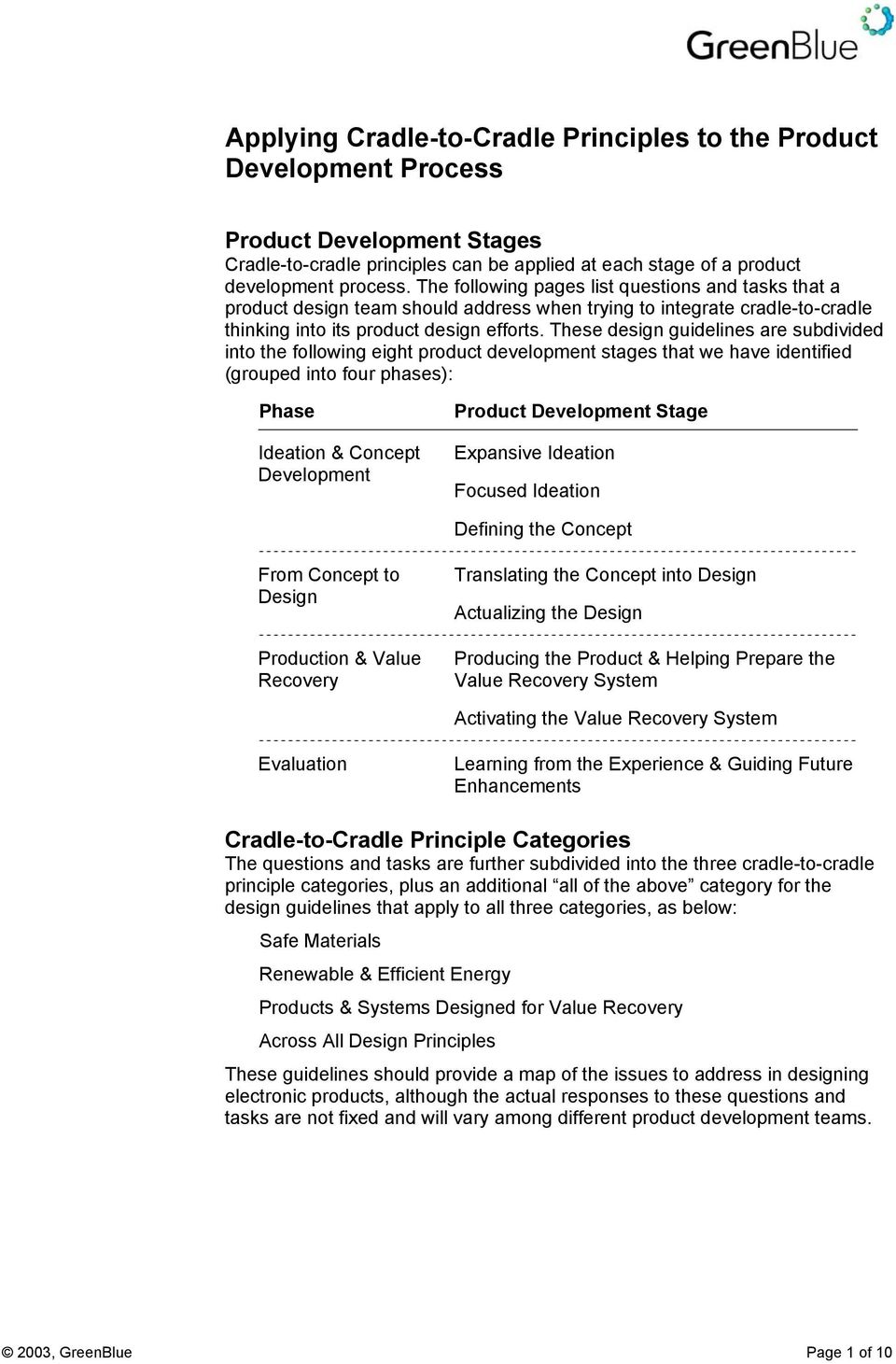
1 Applying Cradle-to-Cradle Principles to the Product Development Process Product Development Stages Cradle-to-cradle principles can be applied at each stage of a product development process. The following pages list questions and tasks that a product design team should address when trying to integrate cradle-to-cradle thinking into its product design efforts. These design guidelines are subdivided into the following eight product development stages that we have identified (grouped into four phases): Phase Ideation & Concept Development Product Development Stage Expansive Ideation Focused Ideation Defining the Concept From Concept to Design Production & Value Recovery Translating the Concept into Design Actualizing the Design Producing the Product & Helping Prepare the Value Recovery System Activating the Value Recovery System Evaluation Learning from the Experience & Guiding Future Enhancements Cradle-to-Cradle Principle Categories The questions and tasks are further subdivided into the three cradle-to-cradle principle categories, plus an additional all of the above category for the design guidelines that apply to all three categories, as below: Safe Materials Renewable & Efficient Energy Products & Systems Designed for Value Recovery Across All Design Principles These guidelines should provide a map of the issues to address in designing electronic products, although the actual responses to these questions and tasks are not fixed and will vary among different product development teams. 2003, GreenBlue Page 1 of 10
2 Questions & Tasks to Address I. Ideation & Concept Development A. Expansive Ideation What does the concept of "safe materials" mean? How are safe materials potentially valuable for our product system? How can we use renewable energy for product life cycle stages (e.g., raw material collection; manufacturing; distribution; use; recovery; reuse/recycling)? How can we efficiently utilize power in product operation and our manufacturing processes? What are the potential benefits of designing products and their materials to be recycled perpetually? What is the difference between cradle-to-grave and cradle-to-cradle thinking? How does design relate to biological and technical metabolisms? What does the concept of "materials as assets" mean for a product and value recovery system? How could we establish our own product recovery system or help establish a collective one for various manufacturers? Across All Design Principles What could changing the design of our product and related processes mean for worker safety, public health and environmental health? B. Focused Ideation Will we select materials for characteristics beyond performance, price and aesthetics? What criteria do others use to select "safe materials" or to ensure that problematic materials flow safely? What is our company's process for selecting safe materials (i.e., do we emphasize an approach that is "preventive" or one that responds to emerging problems)? What, in general, are the human and environmental health issues of the materials that the industry uses in products and processes? How will impending or future regulations affect our approach? What are the benefits of designing "beyond regulations"? How do our competitors view the material selection process? Will innovation within these areas provide our company with new business opportunities or enhance our competitiveness? If so, how do we begin? 2003, GreenBlue Page 2 of 10

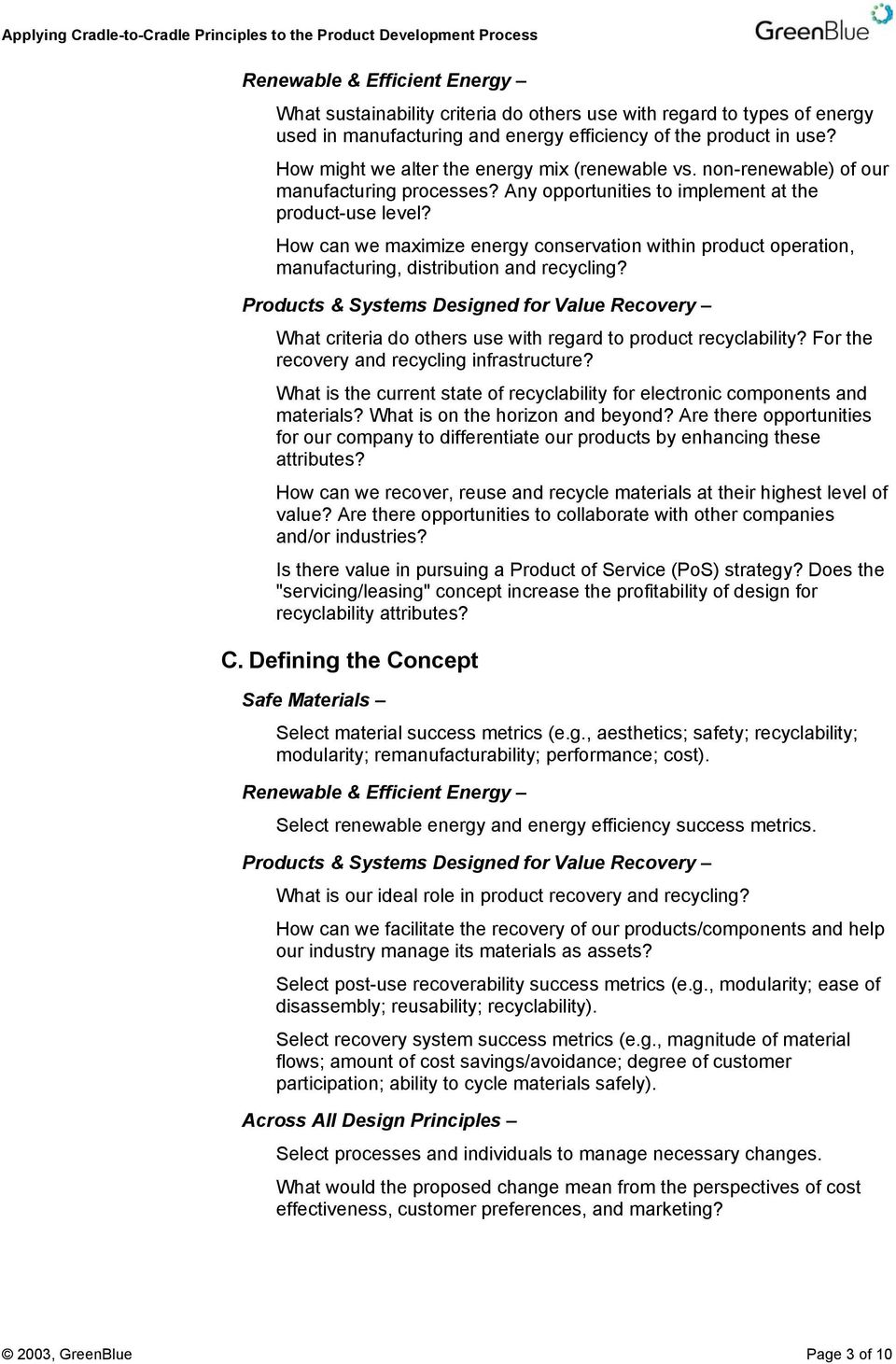
3 What sustainability criteria do others use with regard to types of energy used in manufacturing and energy efficiency of the product in use? How might we alter the energy mix (renewable vs. non-renewable) of our manufacturing processes? Any opportunities to implement at the product-use level? How can we maximize energy conservation within product operation, manufacturing, distribution and recycling? What criteria do others use with regard to product recyclability? For the recovery and recycling infrastructure? What is the current state of recyclability for electronic components and materials? What is on the horizon and beyond? Are there opportunities for our company to differentiate our products by enhancing these attributes? How can we recover, reuse and recycle materials at their highest level of value? Are there opportunities to collaborate with other companies and/or industries? Is there value in pursuing a Product of Service (PoS) strategy? Does the "servicing/leasing" concept increase the profitability of design for recyclability attributes? C. Defining the Concept Select material success metrics (e.g., aesthetics; safety; recyclability; modularity; remanufacturability; performance; cost). Select renewable energy and energy efficiency success metrics. What is our ideal role in product recovery and recycling? How can we facilitate the recovery of our products/components and help our industry manage its materials as assets? Select post-use recoverability success metrics (e.g., modularity; ease of disassembly; reusability; recyclability). Select recovery system success metrics (e.g., magnitude of material flows; amount of cost savings/avoidance; degree of customer participation; ability to cycle materials safely). Across All Design Principles Select processes and individuals to manage necessary changes. What would the proposed change mean from the perspectives of cost effectiveness, customer preferences, and marketing? 2003, GreenBlue Page 3 of 10
4 II. From Concept to Design A. Translating the Concept into Design What is our current materials palette for products? What materials are used in our manufacturing processes? Will these materials meet our newly established criteria? Are materials available that come from recycled feedstock, are safe for use and can be reused or truly recycled to provide a range of applications following their first useful life? How can we safely cycle materials that do not pass material safety metrics and for which viable alternatives are not currently available? What is the mix of energy (renewable vs. non-renewable) currently used by our suppliers, recyclers and us? How can we help lead our industry's efficient use of clean energy? How are our products and materials currently reused and/or recycled (e.g., recovered; resold in secondary markets; donated)? How can we involve other partners in the value recovery system (e.g., customers; distributors; dismantlers)? Is there value in standardizing materials, components, assembly design and techniques and/or recycling processes, while allowing for future technological changes? What is the possible market value of selling modular equipment, to promote post-sale upgrading and post-use disassembly? What type of financial or ownership mechanisms would allow us to recapture our materials and use them as assets for future products? What is the current status of recycling technologies (e.g., what is prevalent)? How can we design products to be recycled within this framework while also anticipating more sophisticated technologies in the future? Across All Design Principles Communicate new success criteria to procurement colleagues, suppliers and recyclers; work with those partners to select the most appropriate materials, product designs and life cycle processes. Assess current and alternative materials, components and processes using success metrics for safe materials, energy, post-use recoverability, and value recovery system. How can we market these advantages to potential customers? Will these changes provide competitive advantage? 2003, GreenBlue Page 4 of 10

5 B. Actualizing the Design Can we partner with other manufacturers to purchase materials together and reduce costs (e.g., via a "materials pooling" strategy)? Select the type of system to be created/used to safely cycle materials that do not pass the material safety metrics. Identify materials R&D priorities for the future based on current gaps in achieving success metrics. If we are not currently using any renewable energy, what specific steps are required to begin doing so? Can we help build a market for renewable energy by implementing an offset purchasing program (i.e., purchasing an amount of "green energy" equivalent to the amount needed to manufacture our products but is transferred to other uses such as facility operations)? What opportunities exist to implement renewable energy or a more efficient use of energy in transporting materials and distributing final products? Could empty delivery trucks be transporting nutrients to recyclers or remanufacturing facilities on their return route? Implement Design for Modularity, Design for Disassembly, and Design for Recycling activities; adjust materials palette and product design attributes to maximize these design strategies. Test prototype for ease of upgrading, disassembly and reuse/recycling. Create post-industrial and post-consumer recycling plans. III. Production & Value Recovery A. Producing the Product & Helping Prepare the Value Recovery System Select material suppliers. Procure materials. Manufacture product. Communicate new product attributes and company initiatives to the marketplace. Select equipment suppliers and/or manufacturing contractors. Create or participate in an industry cooperative to collectively purchase renewable energy. Procure manufacturing equipment and activate contract manufacturers. Manufacture product. 2003, GreenBlue Page 5 of 10

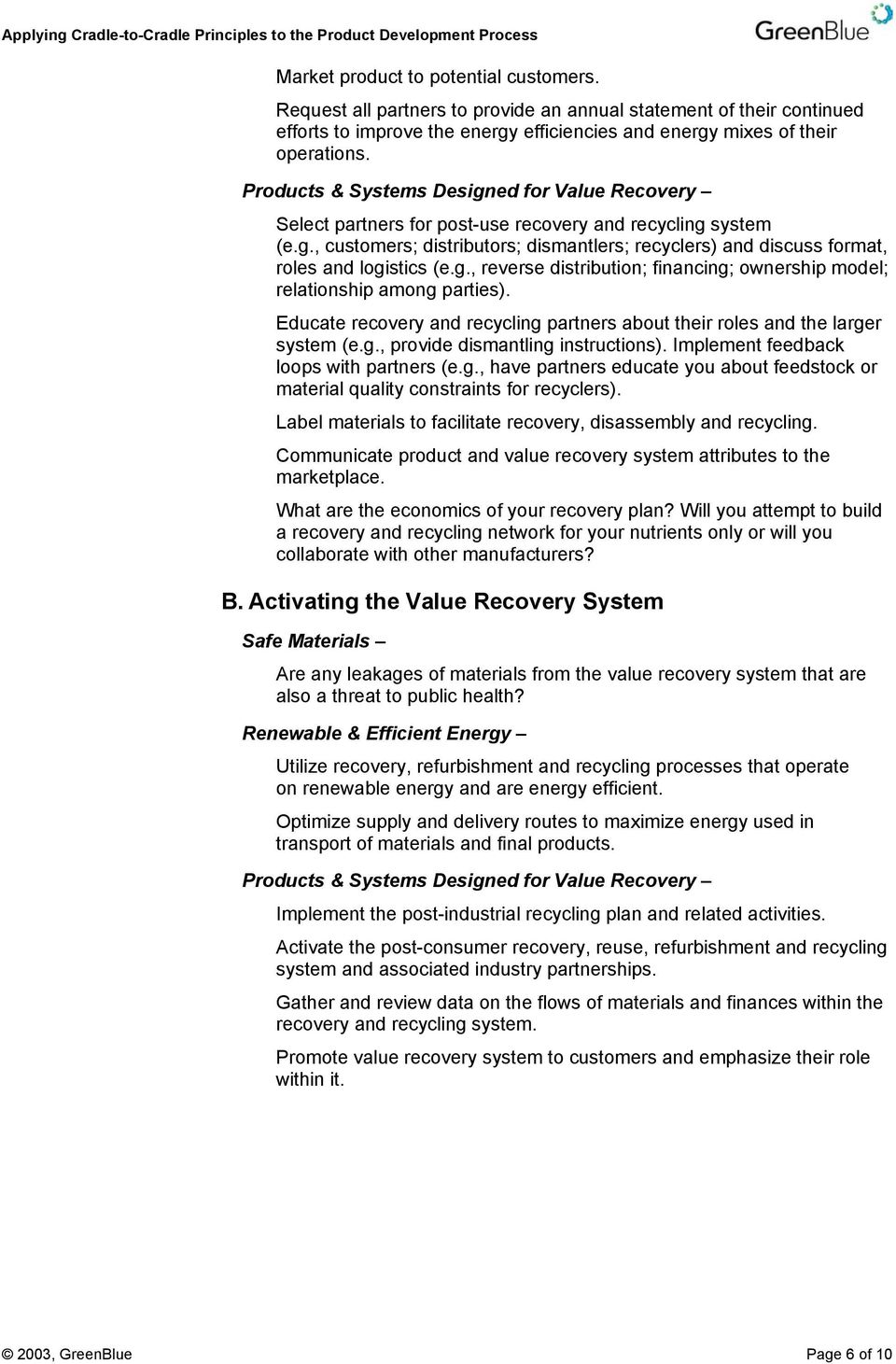
6 Market product to potential customers. Request all partners to provide an annual statement of their continued efforts to improve the energy efficiencies and energy mixes of their operations. Select partners for post-use recovery and recycling system (e.g., customers; distributors; dismantlers; recyclers) and discuss format, roles and logistics (e.g., reverse distribution; financing; ownership model; relationship among parties). Educate recovery and recycling partners about their roles and the larger system (e.g., provide dismantling instructions). Implement feedback loops with partners (e.g., have partners educate you about feedstock or material quality constraints for recyclers). Label materials to facilitate recovery, disassembly and recycling. Communicate product and value recovery system attributes to the marketplace. What are the economics of your recovery plan? Will you attempt to build a recovery and recycling network for your nutrients only or will you collaborate with other manufacturers? B. Activating the Value Recovery System Are any leakages of materials from the value recovery system that are also a threat to public health? Utilize recovery, refurbishment and recycling processes that operate on renewable energy and are energy efficient. Optimize supply and delivery routes to maximize energy used in transport of materials and final products. Implement the post-industrial recycling plan and related activities. Activate the post-consumer recovery, reuse, refurbishment and recycling system and associated industry partnerships. Gather and review data on the flows of materials and finances within the recovery and recycling system. Promote value recovery system to customers and emphasize their role within it. 2003, GreenBlue Page 6 of 10
7 IV. Evaluation A. Learning from the Experience & Guiding Future Enhancements Collaborate with suppliers to develop next generation materials. Collaborate with suppliers and contract manufacturers to develop next generation manufacturing equipment and processes. Revise the materials flow model for the recovery and recycling system as needed. Are materials leaking from the value recovery system? How can we prevent leakage of our valuable materials in the future? How can we work with other parties to improve the recovery of valuable materials through needed product or recovery system design changes? Establish feedback loops to use recycling data to improve the design of the product and value recovery system during the next iteration of the product development process. Across All Design Principles Collect data for the future redesign of the product, processes and value recovery system. Measure actual outcomes against stated goals and anticipated outcomes. Identify opportunities for improved goal achievement in the future. 2003, GreenBlue Page 7 of 10

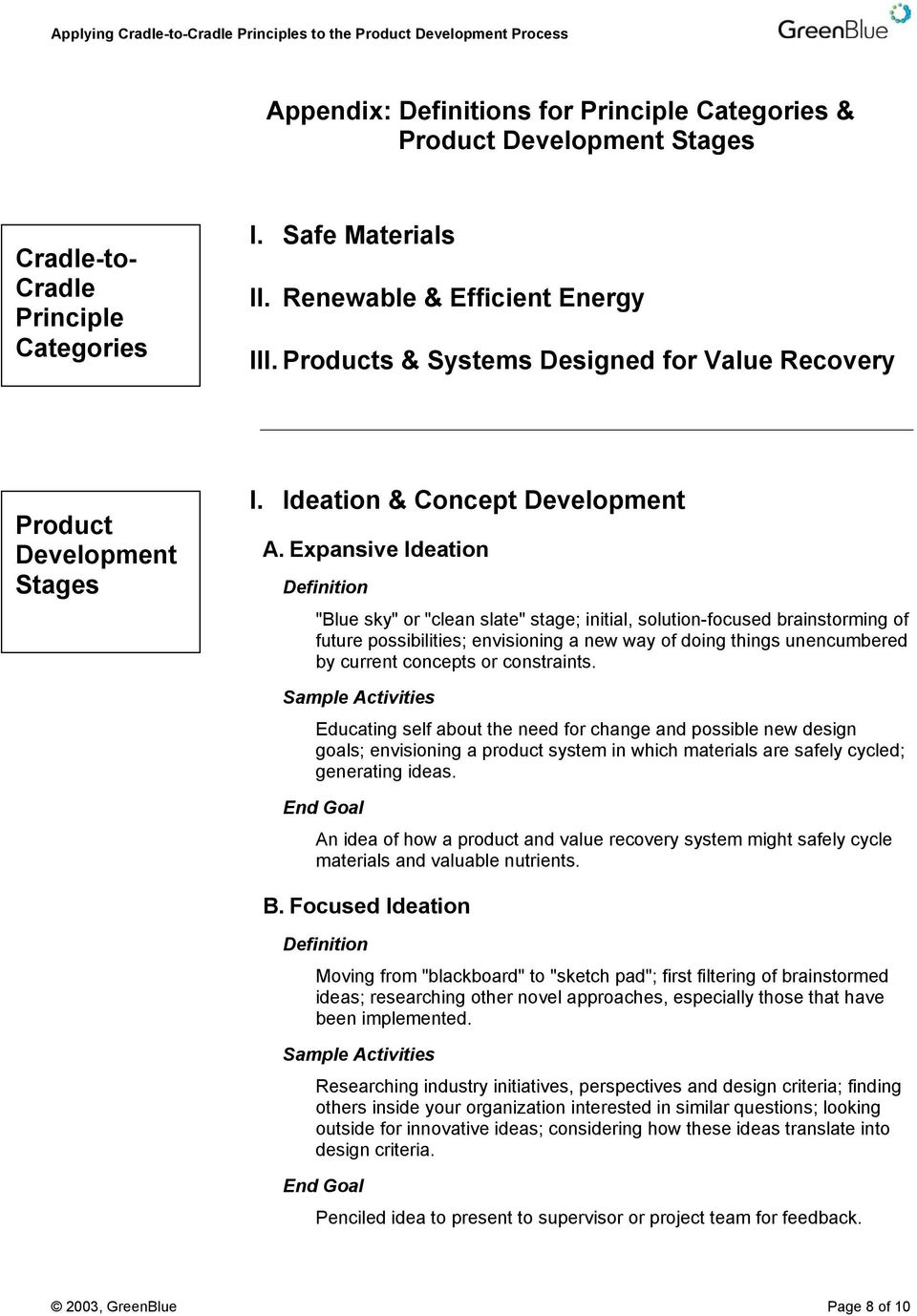
8 Appendix: s for Principle Categories & Product Development Stages Cradle-to- Cradle Principle Categories I. Safe Materials II. Renewable & Efficient Energy III. Products & Systems Designed for Value Recovery Product Development Stages I. Ideation & Concept Development A. Expansive Ideation "Blue sky" or "clean slate" stage; initial, solution-focused brainstorming of future possibilities; envisioning a new way of doing things unencumbered by current concepts or constraints. Educating self about the need for change and possible new design goals; envisioning a product system in which materials are safely cycled; generating ideas. An idea of how a product and value recovery system might safely cycle materials and valuable nutrients. B. Focused Ideation Moving from "blackboard" to "sketch pad"; first filtering of brainstormed ideas; researching other novel approaches, especially those that have been implemented. Researching industry initiatives, perspectives and design criteria; finding others inside your organization interested in similar questions; looking outside for innovative ideas; considering how these ideas translate into design criteria. Penciled idea to present to supervisor or project team for feedback. 2003, GreenBlue Page 8 of 10
9 C. Defining the Concept Refining the concept and gaining consensus within division or project team; developing content; begin "reality-check" process. Deciding what you want/expect to do; selecting goals and success metrics; charting design and implementation process and activities. A tangible concept approved by project team, benchmark against success metrics throughout the product development process. II. From Concept to Design A. Translating the Concept into Design Translating concepts into design; comparing alternative designs; deciding how the idealized concept of safely cycling materials can be realized through the design of the product and the value recovery system. Researching what is currently practical for your product and value recovery system based on your success metrics; communicating objectives to suppliers; defining the breadth of gap between the practical design and ideal concept in order to strategically plan for possible future enhancements. Tentative design specifications, subject to additional research and project team feedback. B. Actualizing the Design Revising and finalizing design based on gathered data and current constraints. Selecting conforming materials; optimizing assembly and disassembly attributes; aligning manufacturing processes; identifying and prioritizing needed changes to recovery and recycling system based on constraints and opportunities; developing an actionable plan for changes. Formal design of product and value recovery system that will be enacted as fully as possible in current product development process. 2003, GreenBlue Page 9 of 10

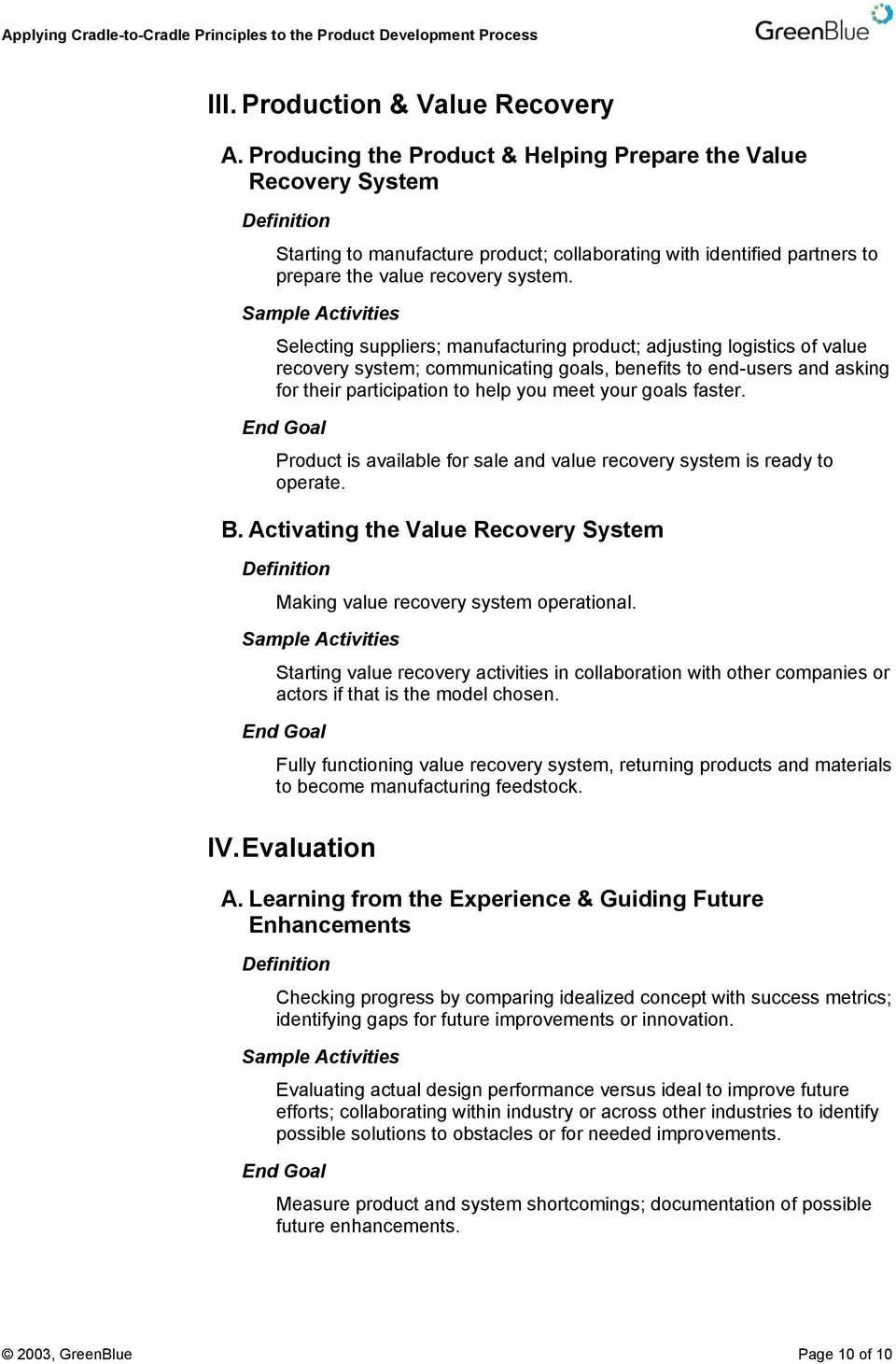
10 III. Production & Value Recovery A. Producing the Product & Helping Prepare the Value Recovery System Starting to manufacture product; collaborating with identified partners to prepare the value recovery system. Selecting suppliers; manufacturing product; adjusting logistics of value recovery system; communicating goals, benefits to end-users and asking for their participation to help you meet your goals faster. Product is available for sale and value recovery system is ready to operate. B. Activating the Value Recovery System Making value recovery system operational. Starting value recovery activities in collaboration with other companies or actors if that is the model chosen. Fully functioning value recovery system, returning products and materials to become manufacturing feedstock. IV. Evaluation A. Learning from the Experience & Guiding Future Enhancements Checking progress by comparing idealized concept with success metrics; identifying gaps for future improvements or innovation. Evaluating actual design performance versus ideal to improve future efforts; collaborating within industry or across other industries to identify possible solutions to obstacles or for needed improvements. Measure product and system shortcomings; documentation of possible future enhancements. 2003, GreenBlue Page 10 of 10
Chapter 15 Managing Reverse Flows in the Supply Chain
 Chapter 15 Managing Reverse Flows in the Supply Chain Traditionally, reverse flows were not viewed as adding value for customers or revenue for the manufacturer or producer. Information and financials
Sustainability Driven Innovation Harnessing sustainability's ability to spark innovation
 Sustainability Driven Innovation Harnessing sustainability's ability to spark innovation As used in this document, Deloitte means Deloitte LLP and its subsidiaries. Please see www.deloitte.com/us/about
Maximize, Optimize, and Minimize (MOM) The framework for a better customer annuity supply chain
 Maximize, Optimize, and Minimize (MOM) The framework for a better customer annuity supply chain SM Copyright 2005 United Parcel Service of America, Inc. All Rights Reserved. No part of this publication
Measuring Performance of Reverse Supply Chains in a Computer Hardware Company
 Measuring Performance of Reverse Supply Chains in a Computer Hardware Company M.B. Butar Butar, D. Sanders, G. Tewkesbury 1 School of Engineering, University of Portsmouth, Portsmouth, United Kingdom ([email protected])
Beyond zero-waste. Cradle to Cradle Products Innovation Institute Roy Vercoulen Vice President Europe [email protected]
 Beyond zero-waste Cradle to Cradle Products Innovation Institute Roy Vercoulen Vice President Europe [email protected] A shift in paradigm Eliminate the concept of waste not reduce, minimize, or avoid
HUGO BOSS ENVIRONMENTAL COMMITMENT. Our claim. Our approach
 HUGO BOSS ENVIRONMENTAL COMMITMENT HUGO BOSS assumes responsibility for future generations. This entails that we also pursue our high standards for quality and performance in environmental protection.
Logistics Management SC Performance, SC Drivers and Metrics. Özgür Kabak, Ph.D.
 Logistics Management SC Performance, SC Drivers and Metrics Özgür Kabak, Ph.D. Outline Supply Chain Performance: Achieving Strategic Fit and Scope Competitive and supply chain strategies Achieving strategic
Executive Summary... 2. OpenEdge Streamlines Development and Support... 2. Factors Affecting Benefits And Costs... 3. Disclosures...
 TABLE OF CONTENTS Executive Summary... 2 OpenEdge Streamlines Development and Support... 2 Factors Affecting Benefits And Costs... 3 Disclosures... 3 TEI Framework And Methodology... 5 Analysis... 7 Interview
THE SUPPLY CHAIN MANAGEMENT AND OPERATIONS AS KEY TO FUTURE COMPETITIVENESS FOR RESEARCH, DEVELOPMENT AND MANUFACTURE OF NEW VEHICLES
 Journal of KONES Powertrain and Transport, Vol. 18, No. 3 2011 THE SUPPLY CHAIN MANAGEMENT AND OPERATIONS AS KEY TO FUTURE COMPETITIVENESS FOR RESEARCH, DEVELOPMENT AND MANUFACTURE OF NEW VEHICLES Julen
Program Life Cycle Cost Driver Model (LCCDM) Daniel W. Miles, General Physics, June 2008
 Program Life Cycle Cost Driver Model (LCCDM) Daniel W. Miles, General Physics, June 28 Introduction Several years ago during the creation of the Periscope Total Ownership Cost (TOC) Program, it became
Primary Logistics Activities
 1 TOPIC 1: OVERVIEW OF BUSINESS LOGISTICS AND PLANNING Topic Outcomes: You should be able: 1. Define logistics 2. Define activity mix in logistics business 3. Determine the importance of business logistics
Green Product Management
 Green Product Management Wistron is not only a professional product design, manufacturing and aftersales service company, but also a provider of technical services. Equally our product development system
Supply Chains: From Inside-Out to Outside-In
 Supply Chains: From Inside-Out to Outside-In Table of Contents Big Data and the Supply Chains of the Process Industries The Inter-Enterprise System of Record Inside-Out vs. Outside-In Supply Chain How
This alignment chart was designed specifically for the use of Red River College. These alignments have not been verified or endorsed by the IIBA.
 Red River College Course Learning Outcome Alignment with BABOK Version 2 This alignment chart was designed specifically for the use of Red River College. These alignments have not been verified or endorsed
Buy versus Build Considerations for Clients Purchasing CLO Dashboard
 Buy versus Build Considerations for Clients Purchasing CLO Dashboard Prepared by Zeroed-In Technologies for use by clients evaluating CLO Dashboard against their internal development of similar executive
Strategic Planning Process Map
 Advancing Statewide Spatial Data Infrastructures in Support of the National Spatial Data Infrastructure (NSDI) Strategic Planning Process Map For use by all Stakeholders in the Geospatial Community Produced
Best practices for planning and budgeting. A white paper prepared by Prophix
 A white paper prepared by Prophix Executive summary The continual changes in the business climate constantly challenge companies to find more effective business practices. However, common budgeting limitations
Best Practices for Planning and Budgeting. A white paper prepared by PROPHIX Software October 2006
 A white paper prepared by PROPHIX Software October 2006 Executive Summary The continual changes in the business climate constantly challenge companies to find more effective business practices. However,
Four distribution strategies for extending ERP to boost business performance
 Infor ERP Four distribution strategies for extending ERP to boost business performance How to evaluate your best options to fit today s market pressures Table of contents Executive summary... 3 Distribution
Life insurance policy administration: Operate efficiently and capitalize on emerging opportunities.
 Life insurance policy administration: Operate efficiently and capitalize on emerging opportunities. > RESPOND RAPIDLY TO CHANGING MARKET CONDITIONS > DRIVE CUSTOMER AND AGENT LOYALTY > ENHANCE INTEGRATION
Standards for Developing and Implementing Administrative Systems at UC Davis
 Page 1 of 7 Standards for Developing and Implementing Administrative Systems at UC Davis Introduction The purpose of this document is to describe Standards for Developing and Implementing Administrative
Differentiate your business with a cloud contact center
 Differentiate your business with a cloud contact center A guide to selecting a partner that will enhance the customer experience An Ovum White Paper Sponsored by Cisco Systems, Inc. Publication Date: September
PSI Leadership Services
 PSI Leadership Services Strategic Solutions for Your Leadership Needs Select, Promote, & Develop the Leadership Talent Needed to Drive the Growth of Your Business SOLUTION BENEFIT/OBJECTIVE TYPICAL PROJECTS
Introduction to SOA governance and service lifecycle management.
 -oriented architecture White paper March 2009 Introduction to SOA governance and Best practices for development and deployment Bill Brown, executive IT architect, worldwide SOA governance SGMM lead, SOA
Dashboard solutions Executive brief April 2007. Capitalize on the value of active dashboards to improve business flexibility and decision making.
 Dashboard solutions Executive brief April 2007 Capitalize on the value of active dashboards to improve business flexibility and decision making. Page 2 Contents 2 Executive summary 2 Dashboard trends and
BREEAM Refurbishment and Fit-out 2014 Briefings. Part of the BRE Trust
 BREEAM Refurbishment and Fit-out 2014 Briefings Part of the BRE Trust BREEAM for Refurbishment and Fit-out Follows 2 years of development Draft scheme published and consultation from 19 th July 2014 Launched
Principles of Software Engineering: Software Methodologies. COSI 120b, Spring 2005
 Principles of Software Engineering: Software Methodologies COSI 120b, Spring 2005 Overview What are methodologies? The methodologies Traditional Incremental Evolutionary Other Conclusions Way Forward What
Avoiding the Landfill: The Recycling of Vinyl Roof Membranes
 Avoiding the Landfill: The Recycling of Vinyl Roof Membranes With its European counterparts blazing the trail, the North American vinyl (PVC) roofing industry has entered a new phase in its commitment
Holcim Leadership Journey 2012-2014. May 14, 2012
 Holcim Leadership Journey 2012-2014 Summary of the Holcim Leadership Journey 2012-2014 Focus on health and safety strengthen the social dialog Development and generation of leaders and talents By 2014
Best Practices in School Budgeting
 Best Practices in School Budgeting 5A Put the Strategies into Practice and Evaluate Results SUMMARY Prerequisite Best Practices: None Key Points A district should establish a system to ensure that its
HARD DRIVE REMARKETING
 A PUBLICATION BY HORIZON TECHNOLOGY THE SUPPLY CHAIN PROFESSIONAL S GUIDE TO HARD DRIVE REMARKETING THE INTRODUCTORY GUIDE TO HARD DRIVE DISPOSITION & REMARKETING TO MAXIMIZE COMPANY PROFIT TABLE OF CONTENTS
The Empire State Building Repositioning an Icon as a Model of Energy Efficient Investment
 The Empire State Building Repositioning an Icon as a Model of Energy Efficient Investment Motivation The goal with ESB has been to define intelligent choices which will either save money, spend the same
HR - A STRATEGIC PARTNER Evolution in the adoption of Human Capital Management systems
 www.wipro.com HR - A STRATEGIC PARTNER Evolution in the adoption of Human Capital Management systems FUTURE READY SYSTEM FOR AN INSPIRED WORKFORCE Anand Gupta, Director, Oracle Cloud Services, Wipro Table
What is an Innovation Ecosystem? By Deborah J. Jackson. National Science Foundation, Arlington, VA
 What is an Innovation Ecosystem? By Deborah J. Jackson National Science Foundation, Arlington, VA The analogy with biological ecosystems One expects there to be a conceptual analogy between an innovation
Research for SWITCH-Asia Project: activities SO2 and SO3 IHS/Erasmus University
 Research for SWITCH-Asia Project: activities SO2 and SO3 IHS/Erasmus University Title: Strengthening supply chain and stimulating demand for sustainable housing products in Nepal. Coordinator: Dr. Ogenis
AberdeenGroup. Procurement in New Product Development: Ensuring Profit from Innovation. Business Value Research Series
 AberdeenGroup Procurement in New Product Development: Ensuring Profit from Innovation Business Value Research Series March 2006 Executive Summary P roduct innovation is a team sport. Product strategists
Contents. viii. 4 Service Design processes 57. List of figures. List of tables. OGC s foreword. Chief Architect s foreword. Preface.
 iii Contents List of figures List of tables OGC s foreword Chief Architect s foreword Preface Acknowledgements v vii viii 1 Introduction 1 1.1 Overview 4 1.2 Context 4 1.3 Purpose 8 1.4 Usage 8 2 Management
RESEARCH PAPERS FACULTY OF MATERIALS SCIENCE AND TECHNOLOGY IN TRNAVA SLOVAK UNIVERSITY OF TECHNOLOGY IN BRATISLAVA
 RESEARCH PAPERS FACULTY OF MATERIALS SCIENCE AND TECHNOLOGY IN TRNAVA SLOVAK UNIVERSITY OF TECHNOLOGY IN BRATISLAVA 2012 Special Number QUALITY IN SERVICE MANAGEMENT SYSTEM ACCORDING TO ISO 20000 Ružena
Ontario s s Water and Wastewater Energy Management Best Practices
 Ontario s s Water and Wastewater Energy Management Best Practices Erin Cain February 27 th, 2007 AWWA/WEF Joint Management Conference February 25-28, 2007 Introduction What can I take back and apply? Energy
SAMPLE QUESTIONS EXAM EXEMPLAR QUESTIONS. AD5 - Sustainability in supply chains. Level 5 Advanced Diploma in Procurement and Supply
 Level 5 Advanced Diploma in Procurement and Supply AD5 - Sustainability in supply chains EXAM EXEMPLAR QUESTIONS QUESTIONS AND INDICATIVE ANSWER CONTENT Page 1 of 8 QUALIFICATIONS 2013 QUESTIONS AND MARKING
Development, Acquisition, Implementation, and Maintenance of Application Systems
 Development, Acquisition, Implementation, and Maintenance of Application Systems Part of a series of notes to help Centers review their own Center internal management processes from the point of view of
JOURNAL OF OBJECT TECHNOLOGY
 JOURNAL OF OBJECT TECHNOLOGY Online at www.jot.fm. Published by ETH Zurich, Chair of Software Engineering JOT, 2006 Vol. 5. No. 8, November-December 2006 Requirements Engineering Tasks Donald Firesmith,
Chapter 2 Software Processes
 Chapter 2 Software Processes Chapter 2 Software Processes Slide 1 Topics covered Software processes and process models Generic models: Waterfall Incremental development Reuse-oriented software engineering
Renewable Energy Solutions
 Supply Solutions Demand Solutions Renewable Energy Solutions Price Risk Management Utility Energy Management Overview Energy Management Solutions, Inc. (EMS), works globally with companies of all sizes,
An Introduction to Product Takeback
 An Introduction to Product Takeback Overview Driving forces behind product takeback Product takeback legislation Product end-of-life options Reverse logistics Case study Motivation for Product Takeback
The Value of Hiring Unconventional Candidates in Facilities Management
 The Value of Hiring Unconventional Candidates in Facilities Management An Executive Search Perspective Written by Sami L. Barry F acilities management is moving forward in an increasingly complex environment
SUSTAINABLE PROCUREMENT GUIDELINES
 SUSTAINABLE PROCUREMENT GUIDELINES Purpose Consistent with Stanford s sustainability goals, the purpose of these guidelines is to support and facilitate the purchase of products, services and materials
Contemporary Logistics. Research on Factors that Affect the Eco-efficiency of Remanufacturing Closed-loop Supply Chain
 Contemporary Logistics 02 (2011) 1838-739X Contents lists available at SEI Contemporary Logistics journal homepage: www.seiofbluemountain.com Research on Factors that Affect the Eco-efficiency of Remanufacturing
Partnering for Project Success: Project Manager and Business Analyst Collaboration
 Partnering for Project Success: Project Manager and Business Analyst Collaboration By Barbara Carkenord, CBAP, Chris Cartwright, PMP, Robin Grace, CBAP, Larry Goldsmith, PMP, Elizabeth Larson, PMP, CBAP,
Introduction to Strategic Supply Chain Network Design Perspectives and Methodologies to Tackle the Most Challenging Supply Chain Network Dilemmas
 Introduction to Strategic Supply Chain Network Design Perspectives and Methodologies to Tackle the Most Challenging Supply Chain Network Dilemmas D E L I V E R I N G S U P P L Y C H A I N E X C E L L E
White Paper: Conceptual Engineering
 White Paper: Conceptual Engineering CAD Tools that Promote Invention Executive Summary Today s mechanical engineers are challenged to produce new products in less time than ever before. Over the past ten
Research Note: What is a Knowledge Management Project? by David De Long Tom Davenport & Mike Beers
 Research Note: What is a Knowledge Management Project? by David De Long Tom Davenport & Mike Beers The term knowledge management is increasingly finding its way into the management lexicon as concepts
Best Practices in Revenue Cycle Services
 Best Practices in Revenue Cycle Services Client Case Study Presented by: Energy. Knowledge. Results. Overview In the drive to increase customer satisfaction and retention, while reducing operating costs,
PORTER S STRATEGY, VALUE CHAINS AND COMPETITIVE ADVANTAGE
 PORTER S STRATEGY, VALUE CHAINS AND COMPETITIVE ADVANTAGE Vasile Voicu Pantea, Luiela Magdalena Csorba, Olga Irina Maxim University Aurel Vlaicu of Arad Abstract: A strategy means the plans and actions
E-Commerce and Inventory Management
 E-Commerce and Inventory Management Snyder, Rell National University [email protected] Hamdan, Basel Argosy University [email protected] ABSTRACT The rise of the Internet has revolutionized the manner in
Productivity and Return on Investment from COSMOS Finite Element Analysis Software
 Productivity and Return on Investment from COSMOS Finite Element Analysis Software Prepared by: MIT Sloan School of Management Report prepared for: Structural Research & Analysis Corporation Prepared by:
WHITE PAPER: ANALYSIS OF SUCCESSFUL SUPPLY CHAIN ORGANIZATION MODELS
 WHITE PAPER: ANALYSIS OF SUCCESSFUL SUPPLY CHAIN ORGANIZATION MODELS Enporion, Inc. March, 2009 www.enporion.com SUPPLY CHAIN ORGANIZATION MODELS THAT DRIVE SUCCESS To ensure success in your supply chain
Track and trace solution for returnable asset management
 Track and trace solution for returnable asset management An industry whitepaper 3960 Fabian Way Palo Alto, CA 94303 650-397- 2550 www.frequentz.com Copyright 2014 Frequentz. All rights reserved. Returnable
A proven 5-step framework for managing supplier performance
 IBM Software Industry Solutions Industry/Product Identifier A proven 5-step framework for managing supplier performance Achieving proven 5-step spend framework visibility: benefits, for managing barriers,
By Peter Merholz, http://peterme.com. If you use it, please attribute it. Thanks.
 Ideation/Generation Definition / Requirements Iterative design Implementation Ideation/Generation Definition / Requirements Iterative design Implementation Understand the market Customer empathy Ideation/Generation
The Landscape of Health Information Management
 1 Benchmark Report The Landscape of Health Information Management Benchmarking Trends and Insights for HIM Leadership Sponsored by himagine solutions Brought to you by himagine solutions, inc. and ADVANCE
ICT Remanufacturing in the European B2B market. Questions + Answers. www.bitkom.org
 ICT Remanufacturing in the European B2B market www.bitkom.org 2 ICT Remanufacturing in the European B2B market Global ICT»Original Equipment Manufacturers«(OEMs) are actively engaged in the effective reuse
Supplier Management for Complex Outsourced Services: A Strategic Framework
 Supplier Management for Complex Outsourced Services: A Strategic Framework Chris O D Malone, Director Shared Services Expense Management Solutions, Inc. 508-460-7014; [email protected] 93 rd
Business Plan Guide for a Small Business
 Business Plan Guide for a Small Business A Business Plan is a written document that describes the path of your business venture. It describes what you want to do and how you plan to do it, usually covering
Customer Experience Strategy and Implementation
 Customer Experience Strategy and Implementation Enterprise Customer Experience Transformation 2014 Andrew Reise, LLC. All Rights Reserved. Enterprise Customer Experience Transformation Executive Summary
SUSAN HARWOOD GRANT OSHA SMALL BUSINESS ASSISTANCE RIT S OSHA OUTREACH CENTER TRAINING OUTLINE AND
 SUSAN HARWOOD GRANT OSHA SMALL BUSINESS ASSISTANCE AND RIT S OSHA OUTREACH CENTER TRAINING OUTLINE TOPIC: INTRODUCTION This section overviews the core elements, processes and steps needed to implement
Testimony of MICHAEL BIDDLE. President and Founder of MBA Polymers, Inc. of Richmond California. before the Subcommittee on
 Testimony of MICHAEL BIDDLE President and Founder of MBA Polymers, Inc. of Richmond California before the Subcommittee on Government Management, Organization, and Procurement of the Oversight and Government
Moving the NPS Needle - How to Use Customer Feedback to Drive Improvement
 Moving the NPS Needle - How to Use Customer Feedback to Drive Improvement Content Introduction: NPS for the Digital Enterprise 3 Chapter Three: Taking Action with Net Promoter Online 12 Chapter One: Vanity
Best in Class Referral Programs
 Take your business to the next level Best in Class Referral Programs Lower cost per sale, Higher Retention, Increased Profits Free Sales and Marketing Audit Call 410-977-7355 Best in Class Customer Referral
Migration Planning guidance information documents change ManageMent Best Practices October 7, 2011
 Migration Planning guidance information documents change ManageMent Best Practices October 7, 2011 Table Of Contents 1. Purpose... 1 2. Change Management Approach... 1 2.1 Change Management Objectives...
INTRODUCTION TO RAPID PRODUCT DEVELOPMENT (RPD)
 INTRODUCTION TO RAPID PRODUCT DEVELOPMENT (RPD) SCHEMATIC REPRESENTATION FOR NEW INTERNATIONAL PRODUCTS DEVELOPMENT The scheme below considers the product design concept, main outlines and shape were defined
Reverse Logistics the least used differentiator
 Reverse Logistics the least used differentiator SM Copyright 2005 United Parcel Service of America, Inc. All Rights Reserved. No part of this publication may be reproduced without the prior written permission
Negotiating Intellectual Property (IP) Clauses
 White Paper Negotiating Intellectual Property (IP) Clauses This document outlines the four main types of Intellectual (IP) and options for negotiation. CIPS members can record one CPD hour for reading
Greening the rusty supply chain. Critical factors for effective GSCM. Critical factors for GSCM include:
 Article Greening the rusty supply chain Green supply chain management (GSCM) is important in enterprises achieving profit and market share objectives by reducing environmental risk and impact. It is a
CITY OF VAUGHAN EXTRACT FROM COUNCIL MEETING MINUTES OF FEBRUARY 17, 2015
 EXTRACT FROM COUNCIL MEETING MINUTES OF FEBRUARY 17, 2015 Item 3, Report No. 5, of the Finance, Administration and Audit Committee, which was adopted without amendment by the Council of the City of Vaughan
EMC, VNX and ENERGY EFFICIENCY
 White Paper EMC, VNX and ENERGY EFFICIENCY Providing industry leadership and customer value Abstract This white paper explains the value EMC places on energy efficiency across the corporation and in particular
Crosswalk Between Current and New PMP Task Classifications
 Crosswalk Between Current and New PMP Task Classifications Domain 01 Initiating the Project Conduct project selection methods (e.g., cost benefit analysis, selection criteria) through meetings with the
WebSphere Business Modeler
 Discovering the Value of SOA WebSphere Process Integration WebSphere Business Modeler Workshop SOA on your terms and our expertise Soudabeh Javadi Consulting Technical Sales Support WebSphere Process Integration
BUILDING A SUCCESSFUL BUSINESS CASE FOR TALENT MANAGEMENT TECHNOLOGY By Kelly McCombs and Tim Welsh, AON Hewitt
 BUILDING A SUCCESSFUL BUSINESS CASE FOR TALENT MANAGEMENT TECHNOLOGY By Kelly McCombs and Tim Welsh, AON Hewitt Introduction Human Resources today sits smack-dab in the middle of the most compelling and
Feature. Developing an Information Security and Risk Management Strategy
 Feature Developing an Information Security and Risk Management Strategy John P. Pironti, CISA, CISM, CGEIT, CISSP, ISSAP, ISSMP, is the president of IP Architects LLC. He has designed and implemented enterprisewide
SUPPLY CHAIN (SC) DRIVERS AND OBSTACLES
 SUPPLY CHAIN (SC) DRIVERS AND OBSTACLES Drivers of SC performance Facilities Inventory Transportation Information Sourcing Pricing The discussion here is mainly concerned with how these drivers are used
Greening the Supply Chain: From Waste to Resource Management
 Greening the Supply Chain: From Waste to Resource Management Green Supply Chain Forum Florida International University February 19, 2009 Prepared by: Paul Ligon, [email protected] WM Sustainability Highlights
eclips Design Packet Middle School and High School NASA Real World: Mathematics (Grades 6-8) NASA Launchpad (Grades 9-12) Educational Product
 eclips Middle School and High School Design Packet Educational Product Educators & Students Grades 6-12 NP-2009-12-229-LaRC NASA Real World: Mathematics (Grades 6-8) NASA Launchpad (Grades 9-12) www.nasa.gov/education/nasaeclips
Waste management and disposal:
 Waste management and disposal: A best practice business guide An ebook produced by FCC Environment 01 Waste management and disposal: a strategy for success Introduction Your guide to waste management FCC
Your Software Quality is Our Business. INDEPENDENT VERIFICATION AND VALIDATION (IV&V) WHITE PAPER Prepared by Adnet, Inc.
 INDEPENDENT VERIFICATION AND VALIDATION (IV&V) WHITE PAPER Prepared by Adnet, Inc. February 2013 1 Executive Summary Adnet is pleased to provide this white paper, describing our approach to performing