
Installation & Reference Manual. Version 3.1 December 2006 Part No. DOC-MN-INST-00
|
|
|
- Priscilla Barnett
- 10 years ago
- Views:
Transcription
1 Installation & Reference Manual Version 3.1 December 2006 Part No. DOC-MN-INST-00
2 - i - Installation & Reference Manual Contents Contents Introduction... 1 Platform Overview... 2 maximiser Hardware... 2 maximiser Software...7 System Architecture... 9 Installing a System System Operation Manager Configuring System defaults Configuring the Call Server Setting the IP Address of the Call Server Using DHCP System Time Setting up administrative access Using Auto Add Phones Setting up Licences Connecting a Module Connecting a Proactive Communication Station Call Status Call Logging Configuring PBX functionality Configuring an Analogue Extension Port Configuring an IP Phone Working with Users Working with Dial Plans Working with Groups Routing calls via a Department Setting up the Contacts Database Using a Time Plan...99 Setting up a Meet Me Conference Creating Companies Working with Trunks Working with Direct Dial In Call Plans Working with Least Cost Call Plans Using Area Codes Configuring Music Channels Using Events Fax Server Support Using the TAPI Driver Internal Web Server Working with Voic Voic Ports Licensing Enabling Voic for a User Leaving a Message Accessing Voic Remote Access to Voic Setting up Voic V3.1/1206/4 - i - Contents

3 - ii - Installation & Reference Manual Contents Setting up SMS Alerts Voic for a Department Creating an Auto Attendant Call Recording Troubleshooting Voic Importing and Exporting the Configuration Data Routing Creating a WAN Link Setting up IP Routes Setting up PPP Setting up Bandwidth on Demand (BOD) Troubleshooting Warnings Using Commands Reset Switch Powering down a Call Server Rebooting a Call Server Rebooting a module Backing up the Database Upgrading the System Using Telnet Field Descriptions System Administrators Licences Users Dial Plans Groups Departments Contacts Time Plans Meet Me Conference Modules Phones Unassigned Phones Unassigned Modules Voic Ports Auto Attendant Companies Trunks Trunk Groups Direct Dial In Call Plans Least Cost Call Plans WAN Ports WAN Links Area Codes Music Channels Events Technical Data Cable Specifications V3.1/1206/4 - ii - Contents
4 - iii - Installation & Reference Manual Contents Relay Outputs Event Inputs PCS 400 Technical Details PCS 100 Technical Details PCS 10 Technical Details PCS 5 Technical Details Voice Compression Card Technical Details Music on Hold Adapter Technical Details Glossary Index V3.1/1206/4 - iii - Contents

5 - 1 - Installation & Reference Manual Introduction Introduction The maximiser business telephony system from SpliceCom provides a breakthrough in integrated voice communications. Developed from state of the art technology it delivers real life benefits associated with many traditionally separate components in one single, seamless system, currently supporting 8 to 5,000 IP or analogue extensions. When used in conjunction with SpliceCom s broad range of Proactive Communication Station (PCS) phones or applications, maximiser allows businesses to converge their telephone system with their core business applications, so ensuring that the right information can be delivered to the desktops of the right people at the right time. Through the use of an innovative architecture, maximiser eliminates the physical and geographical limitations of traditional telephone systems, allowing great savings to be made on administration, management and infrastructure costs, through the unification of resource. This approach allows all businesses, irrespective of size, to benefit from extended communications, and more importantly protects their initial investment by growing with the business as the need for communication scales and becomes ever more demanding. Embracing open standards wherever they exist, maximiser utilises a Linux operating system and IP communications as its core. This allows it to be deployed as a simple PBX with sophisticated, yet easy to use call handling facilities. Alternatively, maximiser can be used to deliver voice as just another application albeit a very business critical one in a fully converged IP network. In the latter case, maximiser s modular components can be distributed throughout a building, spread across a campus or even located in different locations, yet still operate and be managed as a single integrated system. With its ability to integrate seamlessly with multiple applications, independent of platform or location, maximiser delivers the blueprint for business telephony in the 21 st Century. The purpose of this manual is to give a step by step guide on how to install, configure and troubleshoot a maximiser system. The manual starts with a feature guide of each element of a system together with an understanding of the architecture used and finishes with a complete listing of each configuration field and its function together with in-depth technical data. Please note that where the phrase Call Server is used this refers to the 4100 Call Server and 4140 Remote Call Server unless specified. V3.1/1206/4-1 - Introduction

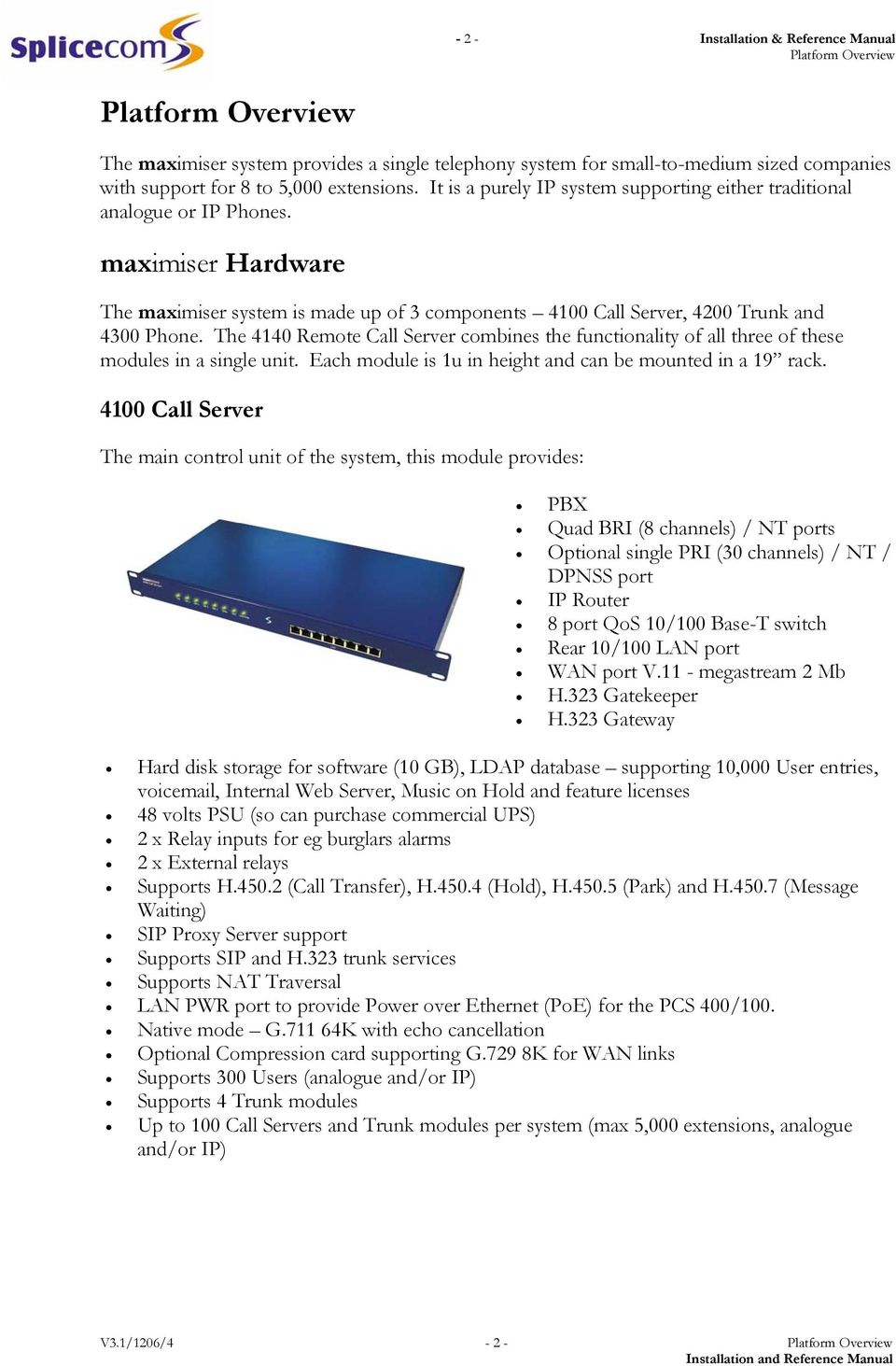
6 - 2 - Installation & Reference Manual Platform Overview Platform Overview The maximiser system provides a single telephony system for small-to-medium sized companies with support for 8 to 5,000 extensions. It is a purely IP system supporting either traditional analogue or IP Phones. maximiser Hardware The maximiser system is made up of 3 components 4100 Call Server, 4200 Trunk and 4300 Phone. The 4140 Remote Call Server combines the functionality of all three of these modules in a single unit. Each module is 1u in height and can be mounted in a 19 rack Call Server The main control unit of the system, this module provides: PBX Quad BRI (8 channels) / NT ports Optional single PRI (30 channels) / NT / DPNSS port IP Router 8 port QoS 10/100 Base-T switch Rear 10/100 LAN port WAN port V.11 - megastream 2 Mb H.323 Gatekeeper H.323 Gateway Hard disk storage for software (10 GB), LDAP database supporting 10,000 User entries, voic , Internal Web Server, Music on Hold and feature licenses 48 volts PSU (so can purchase commercial UPS) 2 x Relay inputs for eg burglars alarms 2 x External relays Supports H (Call Transfer), H (Hold), H (Park) and H (Message Waiting) SIP Proxy Server support Supports SIP and H.323 trunk services Supports NAT Traversal LAN PWR port to provide Power over Ethernet (PoE) for the PCS 400/100. Native mode G K with echo cancellation Optional Compression card supporting G.729 8K for WAN links Supports 300 Users (analogue and/or IP) Supports 4 Trunk modules Up to 100 Call Servers and Trunk modules per system (max 5,000 extensions, analogue and/or IP) V3.1/1206/4-2 - Platform Overview
7 - 3 - Installation & Reference Manual Platform Overview 4200 Trunk This module provides additional ISDN and WAN ports: Quad BRI (8 channels) / NT ports Optional single PRI (30 channels) / NT / DPNSS port WAN port V.11 - megastream 2 MB 8 port QoS 10/100 Base-T switch Integral H.323 Gateway IP Router LAN Power port for Power over Ethernet Up to 4 Trunk Modules per Call Server Up to 100 Trunk Module and Call Servers per system 4300 Phone This module provides connection for standard analogue telephones: Available as 4315 providing 15 POTS ports or 4330 providing 30 POTS ports Support for DTMF analogue handsets, PCS 5/10, fax machines and modems Caller Display support On-hook voltage 48V, off-hook current 25 ma, ring voltage 44V rms 10/100 LAN port for connection to network PCMCIA slot for wireless LAN connection Provided with PCS 50 application to partner an analogue handset from a Windows or Mac OSX PC V3.1/1206/4-3 - Platform Overview

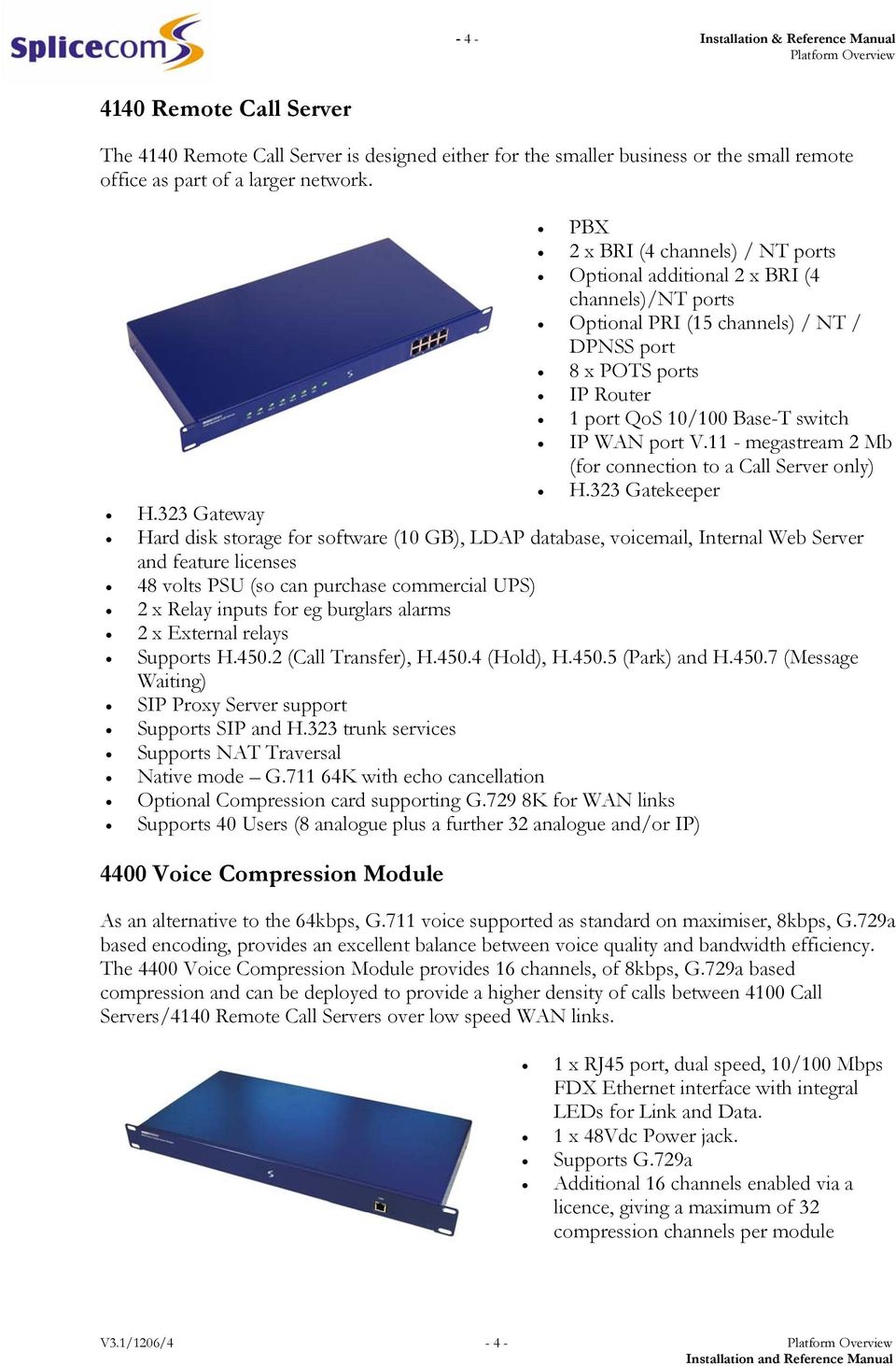
8 - 4 - Installation & Reference Manual Platform Overview 4140 Remote Call Server The 4140 Remote Call Server is designed either for the smaller business or the small remote office as part of a larger network. PBX 2 x BRI (4 channels) / NT ports Optional additional 2 x BRI (4 channels)/nt ports Optional PRI (15 channels) / NT / DPNSS port 8 x POTS ports IP Router 1 port QoS 10/100 Base-T switch IP WAN port V.11 - megastream 2 Mb (for connection to a Call Server only) H.323 Gatekeeper H.323 Gateway Hard disk storage for software (10 GB), LDAP database, voic , Internal Web Server and feature licenses 48 volts PSU (so can purchase commercial UPS) 2 x Relay inputs for eg burglars alarms 2 x External relays Supports H (Call Transfer), H (Hold), H (Park) and H (Message Waiting) SIP Proxy Server support Supports SIP and H.323 trunk services Supports NAT Traversal Native mode G K with echo cancellation Optional Compression card supporting G.729 8K for WAN links Supports 40 Users (8 analogue plus a further 32 analogue and/or IP) 4400 Voice Compression Module As an alternative to the 64kbps, G.711 voice supported as standard on maximiser, 8kbps, G.729a based encoding, provides an excellent balance between voice quality and bandwidth efficiency. The 4400 Voice Compression Module provides 16 channels, of 8kbps, G.729a based compression and can be deployed to provide a higher density of calls between 4100 Call Servers/4140 Remote Call Servers over low speed WAN links. 1 x RJ45 port, dual speed, 10/100 Mbps FDX Ethernet interface with integral LEDs for Link and Data. 1 x 48Vdc Power jack. Supports G.729a Additional 16 channels enabled via a licence, giving a maximum of 32 compression channels per module V3.1/1206/4-4 - Platform Overview
9 - 5 - Installation & Reference Manual Platform Overview Proactive Communication Station 400 This IP Phone (PCS 400) provides: Standard telephony functionality Graphical touch screen LCD interface Ability to display real time video and graphical information during call Provides LAN port for PC b PCMCIA Card Slot for Wireless LAN USB port for connection of mouse and keyboard Headset connection Can be wall mounted Powered by LAN via Powered Ethernet PSU or optional external PSU Context Sensitive Screen Fully integrated with LDAP database for viewing and annotating customer records and notes Integral web browser Proactive Communication Station 100 The PCS 100 is an IP Phone presented as a conventional business telephone. It provides caller ID, a dedicated Busy Lamp Field together with pre programmed buttons for simple and easy access to system features. Standard 12 button telephony functionality Display of number/name 64 x 128 Context Sensitive LCD Display 8 Dynamic, Context Sensitive Keys Headset connection. Powered via the LAN or optional STEPS power supply Fully integrated with system database for viewing and speed dialling users, departments, contacts and favourites 2 Port QOS switch, single cable to desk. Can be wall mounted Enhanced volume and speech quality of incoming calls with Automatic Gain Control (AGC). V3.1/1206/4-5 - Platform Overview

10 - 6 - Installation & Reference Manual Platform Overview Proactive Communication Station 10 The PCS 10 is an analogue handset providing the following features: 3 line LCD display with contrast settings display of Calling Line Number/Name & Caller Line Name Message Waiting icon 10 pre-programmed keys 10 user definable keys Internal directory (100 names/numbers) Missed call/clear/dial/pause/recall/redial/ Speaker/Volume/Mute keys Can be partnered with PCS 50 Proactive Communication Station 5 The PCS 5 is an analogue handset providing the following features Standard 12 button keypad Visual call indicator Recall/Redial/Mute/Pause keys Can be partnered with PCS 50 Power over Ethernet PSU This is an external power supply: Providing IP phones, including the PCS 400/100, with power over the LAN when connected to the integral 10/100 Mbps switch. Connected to LAN PWR port on Call Server and/or Trunk Module LAN PWR port provides power to 2 spare pairs on Ethernet ports Up to 8 IP Phones can be powered via the Powered Ethernet PSU. Supports the 802.3af Power over Ethernet standard PCS PSU This is an external power supply providing PCS 400 IP phones with local power for applications not using power over LAN, eg Wireless LAN connected phones. V3.1/1206/4-6 - Platform Overview

11 - 7 - Installation & Reference Manual Platform Overview Single Terminal Ethernet Power Supply (STEPS) This is an External Power over Ethernet PSU for the PCS 400/100 or other 802.3af compliant device. Please note: if a PCMCIA card is required in the PCS 400 a standard PCS PSU must be used. Voice Compression Card maximiser supports G.711 encoding with echo suppression as standard for transporting voice. Where compressed voice is a requirement, G.729a between Call Servers is supported through optional internal Voice Compression Cards, one fitted at each end. Supports up to 8 channels. Please refer to page 238 for further technical data on these products. maximiser Software Proactive Communication Station 50 This PC application (PCS 50) provides the same telephony functionality as available on the PCS 400. PCS 50 can run as an IP Softphone or be programmed to partner a User s PCS 5/10/100 or existing analogue phone from their PC. Versions for Windows and Mac OS X are currently available. Please refer to page 43 for further details. PCS Operators Console This application combines all of the main PCS 50 functions on a single full screen page for operators and receptionist. Like the PCS 50 from which it is derived it can be run as an IP Softphone or as a Partner to PCS 400, PCS 100, PCS 10, PCS 5 or existing analogue phones. Windows and Mac OS X versions are available. Please refer to page 50 for further details. V3.1/1206/4-7 - Platform Overview

12 - 8 - Installation & Reference Manual Platform Overview Manager This is a web-based application that is used to view and configure the database. It can be run from any web browser (IE v5 or higher, Netscape v6 or higher, Apple IE v5 or higher) that can connect to the maximiser. Please refer to page 17 for further details. Voic The 4100 Call Server provides integral voic & Auto-Attendant facilities, providing 8 simultaneous connections and 30 hours of message storage. A 4140 Remote Call Server provides 4 simultaneous connections and 10 hours of message storage. This voic and Auto-Attendant application can also be run on a standalone Linux PC where more simultaneous connections or greater storage capacity is required. A MessageBox licence is required for each User and Department requiring a voic facility. Please refer to page 134 for further details. Enhanced Speech Processing (ESP) Enhanced Speech Processing is SpliceCom s advanced multi-layer auto-attendant and Interactive Voice Response (IVR) system for maximiser. Licensed on a per-port basis ESP utilises standards based VoiceXML to deliver great flexibility and interoperability for voice processing requirements. ESP allows you to answer calls, play files, collect DTMF digits, record files and transfer calls. Features and functionality supported by ESP include; Multi-Layer Auto Attendant Dial-by Extension Voice Forms (DTMF digit and spoken response capture) Text-To-Speech (TTS) Conversion Reminder/Wake-Up/Alarm Calls IMAP Unified Messaging Spoken Collection & Reply Queue Buster Call Back When Free V3.1/1206/4-8 - Platform Overview

13 - 9 - Installation & Reference Manual System Architecture System Architecture The system operates entirely around a LAN/IP network environment, eliminating any previous geographic constraints imposed upon similar systems. The system is constructed with several distinct and discrete components, all physically independent and operating symbiotically to provide a single seamless system. Working with the System All maximiser modules are linked via TCP/IP. Each module is a host on the network with its own IP address. Therefore each module can be connected via standard CAT 5 cabling, leased line, or Wireless LAN networking in the case of the Phone Module and the PCS 400. This allows for multi-site networking with the advantage of only one system to configure & manage from anywhere. The configuration of the system is stored on the database which resides on each Call Server; this can be accessed via Manager. Manager is a web-based application so can be run from any web browser that has an IP connection to the system. As the maximiser system is a purely IP system all calls are carried over IP therefore H.323, the industry standard for Voice over IP, is supported. This means that the Call Server acts as the H.323 Gateway. A gateway is responsible for translating one transmission type into another, so in the case of the Call Server, for example, it will translate calls received via ISDN so they can travel over an IP network and vice a versa. The Trunk Module will also provide this functionality. The Call Server also acts as the H.323 Gatekeeper and is responsible for controlling the access into and out of the network phone registration, call routing and call logging etc. Quality of Service, also managed by the Call Server, will ensure that Voice packets have priority over Data packets. This will make sure that a conversation is not broken up or interrupted. The configuration of the system is stored on the LDAP database held on the hard disk contained within the Call Server. LDAP (Lightweight Directory Access Protocol) is the protocol used to store information on a database that can be searched and queried over a network by any number of users. In the case of the maximiser system LDAP allows the configuration to be viewed and amended via Manager and allows users to view telephone directories and contact information via the PCS. As LDAP is the industry standard for accessing databases future applications will include access to third party databases. V3.1/1206/4-9 - System Architecture

14 Installation & Reference Manual System Architecture Phone Module 1st Floor Phone Module 2nd Floor Cat 5/5e/6 Ethernet Phone Module Satellite Site Leased Line Configured with Manager via standard Web Browser connected directly to Call Server, or via LAN, IP WAN, VPN etc Call Server System Directory The system is powered by a centrally replicated but distributed information directory. In essence this allows components of the system that are on different continents to act and operate in the same way as components only inches away from the central unit. All systems access this database using LDAP (the internet standard for accessing databases) for both reading and writing to the information. Call Servers are responsible for holding, distributing and replicating this information. All other modules must have a direct connection via a LAN to a Call Server. There are two different scenarios that are constructed: Primary Mode The Call Server that acts as the Primary administration module and holds the master database for the entire system. This Call Server is responsible for replicating this database to other Secondary Call Servers. Secondary Mode Secondary Mode indicates that this Call Server will receive a replica of the database from the Primary Call Server. Any local changes are passed back to the Primary for distribution to all other Secondary Call Servers. In all of the above cases non-administrative modules, ie Phone and Trunk modules, obtain their configuration from a local Call Server, thus they do not need to be configured directly. This allows live deployment of new modules with minimum complexity. Caching Period The Caching Period determines how often the Call Servers exchange updates. V3.1/1206/ System Architecture

15 Installation & Reference Manual System Architecture Gatekeeper All Trunks and Phones register with the Gatekeeper in the usual H.323 secure methods. The Gatekeeper is responsible for all Phone Registrations, Call Routing and Call Logging. Although communication peers (eg phones) pass the voice data directly between them, the Gatekeeper will control all of the call routing. The Gatekeeper therefore does not require high performance data capabilities. The Call Server runs Gatekeeper functionality. Trunks Trunk gateways are registered with the Gatekeeper and act as a resource for the Gatekeeper to route calls to and from the public PSTN networks. Trunks can be on physically separate modules and geographic sites. Clock synchronisation is performed by a combination of buffering and Clock Count signalling between the master system and all slaves. Call Servers and Trunk Modules run Gateway functionality. Distributed Phone Modules As each Phone Module is LAN connected it can now be distributed geographically within a building or separate buildings and will only require one cable between the module(s) and the administration system. This is particularly useful when wiring different floors of a building; only a small number of vertical risers are needed. Each 100 Mpbs FDX Ethernet connection is capable of handling between concurrent calls, assuming no other traffic. Where non- QoS (Quality of Service) Switches are deployed then it is recommended that Voice be separated from normal LAN traffic, each Call Server and Trunk module contains a QoS Switch to allow such segregation. In normal circumstances (simple telephony) it is recommended that the Ethernet cabling be treated as a new generation of flexible voice cabling and independently connected, especially with the use of structured wiring and patch panels. Computer Telephony Because each Phone Module is geographically independent so is the Phone oriented computer telephony. Each Phone Module is responsible for its own handling of a third party TAPI interface. Additionally the central administrator can have first party telephony ports via TAPI.3.0 and H.323. This is the method used for external voic . Distributed Voic Because voic utilises H.323, voic platforms can be operating system independent and located in any appropriate location. Because of the multi-port registration philosophy voic can be spread across many machines increasing the potential capacity of the system. Especially important when SAPI (speech recognition) is required. V3.1/1206/ System Architecture

16 Installation & Reference Manual System Architecture Call Servers are capable of running an Auto attendant and voic service as standard. The 4100 Call Server can handle a maximum of 30 hours of storage and 8 simultaneous connections. The 4140 Remote Call Server can handle a maximum of 10 hours of storage and 4 simultaneous connections. Voic can also run on a Linux server and will handle storage limited only by the disk space of the machine (approx 0.5 Mbytes per minute). Extendibility Although the maximiser platform provides primary applications; Proactive Communication Station, voic etc, the use of H.323 and LDAP means that independent vendors can hook into the system extending the range of options available. This is especially important in the Call Centre market. Manageable Objects The internal LDAP database contains the following configurable objects. System Access to system functionality and system setting such a System Name required for licence activation and the system Locale. Please refer to page 19 for further details. Administrators The list of administrators of the system. A default Administrator called Manager will be created at start-up with read/write access to all objects, and will be given a password of managerpassword. Please refer to page 22 for further details. Licences The list of licences keys purchased for the system. Please refer to page 23 for further details. Users Each user can make use of the system for communications. These are the primary parameters for all of the telephony facilities that a user may have. They are distinct from the phone parameters since a user may login at any phone. Please refer to page 33 for further details. Dial Plans Dial Plans determine how digits dialled on a User s handset are handled. Please refer to page 74 for further details. Groups Groups are collections of users and/or capabilities that can be used to identify groups of users. A distribution group can contain just one user, a thousand users or no users. Alternatively it may have a capability requirement to automatically select users with a particular skill eg French 80%. Groups may contain other groups to form Super Groups. Please refer to page 80 for further details. V3.1/1206/ System Architecture
17 Installation & Reference Manual System Architecture Departments Departments are used to determine the distribution of calls to a particular group of Users. A caller can dial one number and any available member of a Group can answer the call. A Department is used to determine what will happen to the call out of hours, if the members of the Group are unavailable or busy. Please refer to page 84 for further details. Contacts The contacts database provides directory lookup information of, eg customers and suppliers, plus personal contacts. An incoming call will be alpha tagged if a CLI match is found in the Contacts database and will be displayed on the PCS, or caller display of the phone. Contacts may also be marked with account codes for billing and tracking purposes. Please refer to page 94 for further details. Time Plans Time Plans provide a positive restriction of when activities may happen. In essence a Time Plan defines when things are allowed to operate by day of the week and time of the day. Please refer to page 99 for further details. Meet Me Conferences A Meet Me Conference provides the facility to create a conference that can be joined by Users as and when required. Please refer to page 102 for further details. Modules Modules determine the components that make up the maximiser system. Each module can be configured individually. Phones A list of the Phone modules connected to the system, enabling the configuration of each individual analogue port. Each IP Phone connected will be listed under the Call Server. Unassigned Phones A list of IP Phones requesting registration to the system. Please refer to page 23 for further details. Unassigned Modules A list of modules requesting registration to the system. Please refer to page 27 for further details. Voic Ports Voic ports allow different capabilities to be assigned to the locations providing a voic service. Please refer to page 134 for further details Auto Attendant Voic provides the ability to create a simple Auto Attendant facility whereby callers can be transferred to a User or Department from a predefined list of options. Please refer to page 158 for further details. V3.1/1206/ System Architecture
18 Installation & Reference Manual System Architecture Companies Users, Departments, Contacts and Meet Me Conferences can be assigned to different Companies so that Users are unaware of the usage of the system by other businesses. An Auto Attendant can be assigned to each Company. Please refer to page 102 for further details. Trunks A list of modules providing Trunk ports so that each port can be configured individually. Please refer to page 108 for further details. Trunk Groups A Trunk group allows the grouping together of multiple Trunks for delivery of calls. This is very useful in geographically organising the flow of calls, and can also be used to differentiate levels of service, by keeping spare capacity for high priority calls. Please refer to page 109 for further details. Direct Dial In Call Plans DDI Call Plans determine how incoming ISDN calls will be routed. Please refer to page 115 for further details. Least Cost Call Plans Least Cost Call Plans apply to all calls that will be routed to a trunk via a gateway. It allows the best selection of a trunk and selection of service providers, based upon the number dialled and time of day. It can also be used to control the geographic exit point from the network, eg all calls to London numbers would exit via a London trunk module, but calls to Edinburgh would exit via the Edinburgh trunk module. If a trunk should be busy or fail then alternate translations and trunks would be used. Please refer to page 123 for further details. WAN Links WAN Links provide the ability to connect remote systems via a 2Mbps Megastream leased line or via ISDN dial up. Please refer to page 175 for further details. Area Codes A list of ambiguous telephone numbers to be matched with incoming CLI when a match is not found within Contacts. The main purpose of these entries is to match the area code part of the CLI so that caller display will inform the User from which area the call has originated. Please refer to page 124 for further details. Music Channels This section of the system determines which WAV is to be played via the internal music channels when external calls are placed on hold. Please refer to page 125 for further details. Events Events allow web pages to be sent to a PCS to display warning messages, company information etc. A Relay Input port or a Dial Plan entry can activate an Event. Please refer to page 128 for further details. V3.1/1206/ System Architecture

19 Installation & Reference Manual Installing a System Installing a System A 4100 Call Server or 4140 Remote Call Server should be the first module to be powered up; all subsequent modules will join this system. 1 Power up the Call Server using the power supply provided. 2 The NET LED will flash to indicate a system check. 3 The SpliceCom LED will become solid when the unit is ready Call Server Front and Rear view SpliceCom LED LED status lights Integral LAN Switch with 8 x 10/100 Mbps Ethernet ports Power socket Power socket for Power over Ethernet PSU 4 ISDN BRI 10/100 Mbps Ethernet LAN port (for future use) Input Triggers 1 ISDN PRI Relay sockets IP WAN Interface 4140 Remote Call Server Front and Rear view LED status lights SpliceCom LED 8 analogue phone sockets Power socket 4 ISDN BRI 10/100 Mbps Ethernet LAN port (for future use) Input Triggers 1 ISDN PRI Relay sockets IP WAN Interface V3.1/1206/ Installing a System

20 Installation & Reference Manual Installing a System By default, the IP Address of the Call Server is and will act as a DHCP Server using an address range of to The first address given out will be (This default configuration can be changed, please refer to page 21 for further details.) If this Call Server is the only one on the network this module will become the Primary administration module. If a Call Server already exists on the network any new Call Servers will attempt to join this system. Ensure a Call Server is disconnected from the network during power up if this is not required. Please refer to page 31 for further details. When connecting to the LAN ports on the front of the 4100 Call Server straight or crossover cables can be used because each port automatically changes to MDI/MDX. When connecting to the LAN port at the back of the 4140 Remote Call Server a crossover cable is required. (Please note that this port is not used in an installed environment.) The ISDN Trunk ports on the back of the Call Server can be used to connect to the exchange or to another system. Please refer to page 108 for further information. The system operates in native mode at G k with echo cancellation. If the maximiser system is connected to the company LAN and that LAN is used to carry voice then that LAN must provide Quality of Service via LAN switches. V3.1/1206/ Installing a System

21 Installation & Reference Manual System Operation System Operation Manager The configuration of the maximiser system is controlled and stored on the LDAP database within the Call Server. Manager is the application that is used to view and configure this database. Changes to the configuration made via Manager or by a User via their handset are stored in the RAM and copied regularly to the hard disk to be stored permanently. It is important to perform an orderly shut down of the system before power down to ensure all changes are copied to the hard disk and so that the hard disk is shut down cleanly - please refer to page 179 for further details. Manager is a web based application which can be run from any Web browser (Internet Explorer v5 or higher, Netscape v6 or higher or Apple Internet Explorer v5 or higher) that can connect to the maximiser system. Running Manager 1 Your PC must have a IP connection to the Call Server 2 Via a Web Browser, open address of Call Server/manager eg 3 To view the system s configuration administration access is required. By default, full access is available by logging in when requested as follows: User Name = Manager Password = managerpassword For security, it is advisable to at least change the password for this Administrator once access has been achieved. See page 22 for further details. V3.1/1206/ System Operation
22 Installation & Reference Manual System Operation Working in Manager On opening Manager a list of the Manageable Objects is displayed in the Management Information list - please refer to page 12 for a description of each manageable object. A single click on each link will open the relevant configuration form or provide a further list of entries in the database. At the top of each screen the following icons will be displayed where relevant: Submit to send any changes to the database Back to return to the previous screen Delete to delete the entry currently open. A confirmation message will be received. Home to return to the Management Information list When a list of entries is displayed the following icons will assist you to find the entry you require: Next to move down the list of entries Previous to move up the list of entries Go To enter the specific entry you wish to find in the Search box and then select Go To. If the Search box is empty, Go To will take you to the top of the list. Add to create a new entry When editing an entry the Name field may display the following icon: Copy - this will copy the complete entry. Firstly enter a new Name and select Copy. The entry will be copied and given the new name, the existing entry will remain the same. When editing a field within a form the following icons will be displayed: Delete to delete the current entry within the field Change to select a new entry from the list Go To to open and view the current entry. The Back icon previous screen you were working in. will return you to the Please note: if you amend an existing entry select Submit changes. at the top of the screen to save the V3.1/1206/ System Operation
23 Installation & Reference Manual System Operation Configuring System defaults 1 Under the Management Information list click on System 2 Enter a name for your system in the System Name field. Do not use punctuation in this field. This field is useful to identify the system for troubleshooting purposes. If you have purchased licences enter your given System Name. 3 The Supplier Name field is provided purely for information unless licences have been purchased. Enter the Supplier Name provided with the licences. 4 The System Locale field will determine the language used for voic , ring sequences and Caller Display. 5 The Diagnostic Engineering field will determine the password used to access the Root area of the Call Server (please refer to page 188). 6 The Web Password field will determine the password used to access the internal Web Server contained on the Call Server (please refer to page 132) 7 The Maintainer Password field will determine the password used to access the Admin and voic areas on the Call Server. The Admin area can be used to store music on hold files (please refer to page 125), assist with troubleshooting (please refer to page 175) and importing and exporting the configuration (please refer to page 167). 8 Select Submit when ready and you will be returned to the Management Information list. Further information on Licences is available on page 23. For information on Call Status please refer to page 51, Commands please refer to page 179, File Import/Export on page 167, Modify Users on page 172, IP Addresses on page 20, Mailbox Licences on page 134, Sorted Lists on page 57, User Status on page 37, Voic GUIDs on page 165, Voic Status on page 165 and Warnings on page 179. V3.1/1206/ System Operation
24 Installation & Reference Manual System Operation Configuring the Call Server The Call Server can be configured within Manager by selecting Modules and then the Call Server. The Call Server s Name can be changed to help identify the Call Server. The module s hardware ID is displayed together with its IP address and the current version of software being run on this Call Server. The Flash LED button will instruct the Call Server s SpliceCom LED to flash 20 times. This feature is useful when multiple Call Servers are being used on a system and will identify the physical Call Server from its configuration form. For information on working with multiple Call Servers please refer to page 33. For further information on upgrading the software on a Call Server please refer to Upgrading a System from page 185. For further information on using the Module Status field please refer to Connecting a Secondary Call Server on page 33. Setting the IP Address of the Call Server By default, the Call Server will have an IP address of To change this address the following configuration can be made: 1 From the Management Information list select Modules 2 Select the Call Server 3 Under the first tab within the IP Address field enter the IP Address to be used by the Call Server. 4 Select Submit when ready and you will be returned to the Module List. 5 Reboot the Call Server (please refer to page 181 for information on how to reboot a Call Server.) A list of each module s IP address can be viewed in Manager by selecting System and then IP Addresses. V3.1/1206/ System Operation
25 Installation & Reference Manual System Operation Using DHCP By default, a Call Server will act as a DHCP Server using an address range of to To change this behaviour the following configuration can be made. 1 From the Management Information list select Modules 2 Select the Call Server 3 Under the Call Server tab, from the DHCP Server Mode list the following options can be selected: a. Enable (Default) the Call Server will act as the DHCP server using the IP Address range specified in the DHCP Start Address and DHCP End Address fields. Please note: If another DHCP Server is detected on the network and the Call Server is rebooted it will continue to use or it s previously configured IP Address and disable its own DHCP Server which means it will no longer give out IP addresses. If the DHCP Server mode is re-enabled having previously been disabled, the Call Server will firstly check whether another DHCP Server exists on the network. Only if it does not receive an IP address will it become a DHCP Server. b. Disable DHCP is disabled; the Call Server will use the IP address entered in the IP Address field under the previous tab. (This is the recommended option if DHCP is being provided from another vendor) c. Client the Call Server will act as the DHCP client obtaining an IP address from a DHCP Server on the network. 4 The DHCP Start Address and DHCP End Address fields specify the IP address range for the system when the DHCP Server Mode is set to Enable. 5 Reboot the Call Server (please refer to page 181 for information on how to reboot a Call Server.) Please note: - Using the default configuration will be the first IP address to be given out, followed by etc. - Each PCS will obtain its IP address from a DHCP server. - On initial connection a Phone Module will obtain its IP address from a DHCP server. System Time The System configuration form displays the current date and time used by the system. This setting can be changed as follows: 1 In Manager, select System 2 Click on the link to Commands V3.1/1206/ System Operation
26 Installation & Reference Manual System Operation 3 Enter the date and time required 4 Click on Set Time 5 This information will be sent and updated on all handsets on the system Please note: The system will take into account British Summer Time. If multiply Call Servers are being used on one system the above time will be the time used by the Call Server whose Manager is being viewed. Each Call Server can have a different date and time. This information will be sent and updated on all handsets registered to the specific Call Server. A Time Zone can be set when the time displayed in, for example, call logging information needs to be identified with its Time Zone. This is useful when, for example, one maximiser system with multiple Call Servers is working across multiple countries or states and the time of a call needs to be identified with its correct Time Zone. Each Call Server can have a different Time Zone and is configured as follows: 1 Open Manager on the Call Server to be configured 2 Select System 3 Click on the link to Commands 4 From the Time Zone list box select the option required 5 Click on Set Time 6 Reboot the Call Server (please refer to page 181 for further information) Please note: Setnet can be used to set the time zone for a specific Phone Module. For further information on working with multiple Call Servers please refer to page 33. Setting up administrative access By default administration access to the database via Manager is available by logging in as Manager using the password managerpassword. This Administrator has full access to the database. It is recommended that at least the Password be changed to ensure security of the system. V3.1/1206/ System Operation
27 Installation & Reference Manual System Operation 1 Under the Management Information list click on Administrators 2 Select Manager 3 Beside the User Password field click on Change 4 In the Script Prompt enter the password required 5 Select OK 6 Re-enter your password to confirm the change 7 Select OK 8 Select Submit If connecting to an external LDAP database further Administrators can be created allowing read, write, create and delete access to entries within the maximiser database. Please refer to Support for further assistance if this facility is required. Using Auto Add Phones This feature determines whether phones (analogue or IP) will be able to automatically register with the system. If turned on (default), each Phone Module and IP Phone will be able to automatically register with the Call Server, each port and phone will be listed in the configuration and a User automatically created. If turned off, each Phone Module and IP Phone must be manually registered on the system Turn On/Off Auto Add Phones 1 From the Management Information list select Modules 2 Select the Call Server 3 Under the Call Server tab, in the Auto Add Phones field tick to turn on or untick to turn off this feature. Please refer to Connecting a Phone Module on page 27 and Connecting a Proactive Communication Station on page 41 for further details. Setting up Licences Each User created on the system requires a licence, by default the maximiser system is supplied with one User licence, this is called an IPUser licence. This means that one User can be created on the system, eg a User assigned to an IP Phone or a hot desking User. When a Phone Module is connected to the system this is automatically supplied with 15/30 IPUser licences and the 15/30 analogue phone Users automatically created can utilize the system without any additional configuration. If a Remote Call Server is being used the 8 analogue ports are automatically supplied with the required IPUser licences. If further Users are to be connected to the system eg IP Phone Users, hot desking Users etc, additional IPUser licences must be purchased. To provide a User with a voic facility a MessageBox licence is required. On purchasing a Call Server 30 MessageBox licences are provided. A Remote Call Server is supplied with 10 MessageBox licences. Further MessageBox licences must be purchased to increase this number, up to 1,000 per system when using embedded voic or up to 100 on a standalone Remote Call Server. MessageBox licences are also required to provide a Department with voic V3.1/1206/ System Operation
28 Installation & Reference Manual System Operation functionality. Please refer to the Voic section on page 134 for further details. (Please note: a list of which Users and Departments have been assigned MessageBox licences can be viewed in Manager by selecting System and then Mailbox Licences. Please refer to page 165 for further details.) An IPVirtualUser licence is necessary to create a new User that requires PBX functionality, for example, voic , but does not require a physical extension. There is no limit to the number of IPVirtualUser licences that can be run on a Call Server or Remote Call Server. A licence is also required to activate more than one channel on the PRI port available on the 4100 Call Server; a CallServerPRI licence can be purchased to provide this facility. To increase the BRI port capacity of a Remote Call Server up to two RemoteCallServerBRI licences can be purchased. A RemoteCallServerPRI licence will activate the 15-channel PRI port. A FractionalPRI licence will activate one channel on the PRI port of the Remote Call Server, up to 8 channels. To use SIP or H.323 IP Trunk services an IPTrunk licence is necessary for each concurrent channel required. Where the voic application is to be run on a standalone Linux PC a Voice Processing Port licence is required for each channel/simultaneous connection required. To provide Auto Attendant/IVR functionality beyond the single layer provided as standard on maximiser, an ESPSession licence allows a single channel to be enabled. Enhanced Speech Processing (ESP) is a voic function and can run on the Call Server (up to eight licences), Remote Call Server (up to four licences) or a standalone Linux server (up to sixty licences). ESP is a VoiceXML based application and supports Text-to-Speech. An OperatorConsole licence is required for each user who needs to run the PCS Operators Console application. Please note that this is a per-user licence not a concurrent-usage licence. A MessageArchive licence allows a call recording.wav file for a User or Department to be made available for export to an external application, e.g. SpliceRecord. A separate licence will be required for each individual User or Department. A VoiceCompression licence allows a further 16 channels of voice compression to be enabled per Voice Compression Module, giving a maximum of 32 compression channels per module In summary, the licences available on a maximiser system are as follows: IPUser User licence, required for each User created on the system MessageBox to provide voic functionality for a User or Department CallServerPRI required to use the 30-channel PRI port available on the 4100 Call Server RemoteCallServerBRI required to use an additional 2-channel BRI port on the Remote Call Server RemoteCallServerPRI required to use the 15-channel PRI port on the Remote Call Server. FractionalPRI required to activate the minimum number of channels on a PRI port on the Remote Call Server one per channel, up to 8 channels. V3.1/1206/ System Operation
29 Installation & Reference Manual System Operation ESPSession enables a single Enhance Speech Processing channel on the on-board or off-board voic application to facilitate the use of the Extended Attendant. OperatorConsole required for each user running the PCS Operators Console application MessageArchive required to export the voice recordings related to a single User or Department to the SpliceRecord application. IPVirtualUser required to create a User that does not require a physical extension. IPTrunk required to utilize SIP or H.323 IP Trunk services. VoiceCompression required to increase the number of compression channels used on a Voice Compression module. Voice Processing Port required to run the external voic application. One licence per channel required. Configuring the System Name and Supplier Name Licences are issued against a company name and the supplier s name therefore the System Name and Supplier Name provided with the licences must be entered accurately in the System configuration form. If this information is not entered correctly the licences will not activate. 1 Under the Management Information list click on System 2 Enter the System Name provided in the System Name field. 3 Enter the Supplier Name provided in the Supplier Name field. 4 Select Submit when ready and you will be returned to the Management Information list where the System Name and Supplier Name will be displayed. Enter the Licences on the System Each licence is provided with the type of licence, the quantity of licences purchased and a licence key. This information must be correctly entered; otherwise the licences will not be operational. 1 Under the Management Information list click on Licences 2 Click on Add 3 Enter the type, eg IPUser, quantity and the licence key provided. 4 Select Submit 5 The licence key will now appear in the Licence list, click on this link to edit the entry if required. V3.1/1206/ System Operation
30 Installation & Reference Manual System Operation 6 Click on Home to return to Management Information If a licence has not been entered correctly and not authenticated error messages will appear in the Warnings screen which can be accessed as follows: 1. Within Manager, click on System 2. Click on the Warnings link 3. Any error messages relating to licences will appear in this screen. No error messages indicate that the licences have been accepted and authenticated correctly. Voice Processing Port Licence The Voice Processing application is licenced on a per port basis. This is primarily for scenarios where more than 8 concurrent channels are required and a standalone Linux PC or server is required to run the Voice Processing application. The 4100 Call Server is shipped with 8 Voice Processing Port Licences supplied as standard, whilst the 4140 Remote Call Server comes supplied with 4 Voice Processing Port Licences as standard. Neither of these platforms can be expanded further. When running on a networked Linux PC or Server, the maximiser Voice Processing application has been tested running up to 120 concurrent voic ports when hosted on an HP 2.8 GHz Pentium 4 PC running 512 MB of memory. Voice Processing Port Licences cannot be transferred between platforms. Therefore, when the maximiser Voice Processing application is running on a Linux PC or Server, and 16 concurrent Voice Processing ports are required, 16 x Voice Processing Port licences will be needed. Please note that the maximiser Voice Processing application is responsible for running the following; Voic Auto Attendant IVR (ESP) Call Recording Meet Me Conferencing Queue Entry & In-Queue Announcements Music-on-Hold V3.1/1206/ System Operation
31 Installation & Reference Manual System Operation As such, all these tasks will dynamically consume Voice Processing channels. Please take this into account when planning capacity for your requirements. To assist you, maximiser s fully distributed architecture allows any, or all, of these tasks to be run on separate Voice Processing platforms. Connecting a Module Connecting a Phone Module The Phone module enables connection of analogue handsets and PCS 5/10s to the system. All configuration information is obtained from the Call Server and is stored in RAM. 1 Connect the Phone module to the system via the LAN port on the front of the Phone module. This can be either via the network or directly to a LAN port on the Call Server. (A straight LAN cable should be used when connecting the Phone Module to third party LAN switches.) 2 Power up the Phone Module. 3 The module will request an IP address from a DHCP server. It will make 4 attempts and then back off for a period before trying again. The back off period will extend for each failed attempt. 4 Having obtained an IP address the module broadcasts to find a Call Server to provide its configuration and become active. 5 The SpliceCom LED will become solid when the unit is ready. 6 If the Auto Add Phones feature is turned on the Phone Module will automatically register with the system If the Auto Add Phones feature is turned off the Phone Module must be manually registered as follows: a. From the Management Information list select Unassigned Modules b. The Phone Module will be displayed together with its MAC address c. Select this link d. The Module Status field will display Available e. From the Module Status list box select Member f. Select Submit when ready g. This unit will now be listed under Modules 7 Each analogue handset previously connected will ring once to confirm communication with the system 8 Connect each analogue handset to a port on the Phone module via a master dongle. V3.1/1206/ System Operation
32 Installation & Reference Manual System Operation 30 analogue Phone Sockets (15 analogue Phone sockets on 4315) LAN port Power Socket PCMCIA Card Slot The Phone Module controls: Ringing of the telephones at the requested cadence Presentation of the CLI Recognition of off-hook state Recognition of dialed DTMF tones Presentation of DTMF for fax servers The left hand LED on a port displays when a phone is ringing The right hand LED on a port displays when a phone is in use Please note: - Anti static precautions are advised when handling, inserting or removing PCMCIA cards with respect to the Phone 4300 modules. - Calls placed on hold will be automatically taken off hold after 10 minutes Configuring a Phone Module 1 From the Management Information list select Modules 2 The Phone Module will be displayed together with its MAC address 3 Select this link to view and configure this module. 4 For example, you may wish to edit the Name and Description of this module to give an identity and location for future reference. 5 Select Submit when ready 6 Click on Home to return to the Management Information list V3.1/1206/ System Operation
33 Installation & Reference Manual System Operation The Location field indicates to which Call Server the Phone Module is registered. The Call Server is responsible for replicating relevant configuration information to the Phone Module. In turn the Phone Module will store in RAM configuration information relevant to its functionality. The Phone Module will also pass back configuration changes, eg User configuration, to the Call Server. The Flash LED button will instruct the Phone Module s SpliceCom LED to flash. This feature is useful when multiple Phone Modules are being used on a system and will identify the physical Phone Module from its corresponding configuration form. The Product Version field will display which version of software is currently running on the Phone Module. For information on upgrading this software please refer to page 186. Each port on the Phone Module can now be configured independently, see page 53 for further details. Extension Numbering Once a Phone Module has registered with the system each port on the Phone Module, eg Port01, Port02 etc, will be automatically assigned to a User, eg Extn2001, Extn2002 etc, and given an extension number, eg 2001, 2002 etc. Each User can be amended to change this default configuration if required, see page 56 for further details. On a reboot of the Phone Module each analogue handset will ring once to confirm communication with system and display the number of new voic messages waiting for the User assigned to that phone (if voic enabled). To change the extension number range automatically used when a Phone Module registers with a system, eg , the following steps can be taken: V3.1/1206/ System Operation
34 Installation & Reference Manual System Operation 1 Before the Phone Module is connected to the system create a new User with an extension number one before the start of the range required, eg Connect the Phone Module as described on page The new Users created will be given an extension number within the new extension number range, eg The User created in step 1 can be deleted if no longer required. Setting the IP Address When connecting a Phone Module to the system for the first time a DHCP server is required to give the Phone Module an IP address. This address can be viewed within the Phone Module s configuration form as described on page 28. However once connected the Phone Module can be given a static address as follows: 1 Within the Command prompt enter telnet ip address of Phone Module eg telnet You will be prompted for a Username and Password. Enter diag and 7388 respectively. 3 Wait for a # to appear to confirm a connection has been made to the Phone Module 4 Enter setnet 5 The current configuration will be displayed. You will be asked if you wish to change any of this configuration. 6 Enter y 7 You will be asked how the IP address will be assigned. 8 Delete the d and enter s 9 Follow the onscreen prompts entering the IP address you wish to give the Phone Module, eg , the netmask you wish to use, eg , the IP address of the Gateway (Default Router), eg and the IP address of the TFTP server which will be the IP address of the Call Server to provide software to the Phone Module during an upgrade, eg At the following prompts make any changes you require otherwise press Enter to leave the option unchanged. 11 You will be asked if you wish to save the changes. Enter y. 12 Telnet will display that the changes are being saved and Done will appear once finished. 13 Enter poweroff and the Phone Module will reboot Please note: - to return to using DHCP follow the same instructions above. Enter d when asked how the IP address will be assigned. - at any prompt you may enter a? for help on that option or q to quit. - for further information on working with Telnet please refer to page a list of each module s IP address can be viewed in Manager by selecting System and then IP Addresses. - Setnet can be used to set the Time Zone to be used by a specific Phone Module V3.1/1206/ System Operation
35 Installation & Reference Manual System Operation Connecting a Trunk Module A Trunk Module can be connected to a system to increase the number of ports required, for example, to provide additional ISDN ports, an additional WAN port etc. The relevant licence will be required to activate the ports. Please refer to page 23 for further details. 1 Connect the Trunk Module to the system via one of LAN ports on the front of the Trunk Module. This can be either via the network or directly to a LAN port on the Call Server. 2 Power up the Trunk Module. 3 The module will request an IP address from a DHCP server. It will make 4 attempts and then back off for a period before trying again. The back off period will extend for each failed attempt. 4 Having obtained an IP address the module broadcasts to find a Call Server to provide its configuration and become active. 5 The SpliceCom LED will become solid when the unit is ready. 6 Within Manager, from the Management Information list select Unassigned Modules 7 The Trunk Module will be displayed together with its MAC address 8 Select this link 9 The Module Status field will display Available 10 From the Module Status list box select Member 11 Select Submit when ready 12 This unit will now be listed under Modules LED status lights Integral LAN Switch with 8 x 10/100 Mbps Ethernet ports Power socket 4 ISDN BRI 1 ISDN PRI Input Triggers Relay sockets Power socket for Power over Ethernet PSU IP WAN interface Configuring a Trunk Module 1 From the Management Information list select Modules 2 The Trunk Module (SpliceGateway) will be displayed together with its MAC address 3 Select this link to view and configure this module. V3.1/1206/ System Operation
36 Installation & Reference Manual System Operation 4 For example, you may wish to edit the Name and Description of this module to give an identity and location for future reference. 5 Select Submit when ready 6 Click on Home to return to the Management Information list The Location field indicates to which Call Server the Trunk Module is registered. The Call Server is responsible for replicating relevant configuration information to the Trunk Module. In turn the Trunk Module will store in RAM configuration information relevant to its functionality. The Flash LED button will instruct the Trunk Module s SpliceCom LED to flash. This feature is useful when multiple Trunk Modules are being used on a system and will identify the physical Trunk Module from its corresponding configuration form. The Product Version field will display which version of software is currently running on the Trunk Module. For information on upgrading this software please refer to page 186. Setting the IP Address of the Trunk Module When connecting a Trunk Module to the system for the first time a DHCP server is required to give the Trunk Module an IP address. This address can be viewed within the Trunk Module s configuration form as described above. However once connected the Trunk Module can be given a static address as follows: 1 From the Management Information list select Modules 2 Select the Trunk Module (SpliceGateway) 3 Under the first tab within the IP Address field enter the IP Address to be used by the Call Server. 4 Select Submit when ready and you will be returned to the Module List. 5 Reboot the Trunk Module (please refer to page 182 for information on how to reboot a Trunk module.) A list of each module s IP address can be viewed in Manager by selecting System and then IP Addresses. Each port on the Trunk Module can now be configured independently, please refer to Working with Trunks on page 108 and Creating a WAN Link on page 175 for further details: V3.1/1206/ System Operation
37 Installation & Reference Manual System Operation Connecting a Secondary Call Server Two or more Call Servers can be connected to create one system where one will act as the Primary Call Server and all Call Servers connected to the Primary Call Server become Secondary Call Servers. This can be via the LAN or via a WAN link. On power up, by default, each Call Server will use as its IP address and act as a DHCP Server. If this feature is not required because, for example, is already being used and another DHCP Server exists on the network do not connect the new Call Server to the network until this default configuration has been changed as described on page 20. Linking two Call Servers across a LAN 1 On the Primary Call Server: a. Open Manager, select Modules and select the Call Server from the list b. You may wish to give the Call Server a unique name to help identify this Call Server eg Primary Call Server c. Select the Call Server tab and note the Administration Mode field is set to Primary 2 On the Secondary Call Server: a. Power up the Secondary Call Server b. This Call Server must have a unique IP address and be on the same network as the Primary Call Server. Therefore, if necessary, change the IP address of the Call Server as described on page 20. It is recommended that this address be outside the address range given out by the DHCP Server, eg c. You may wish to the rename the Call Server to help identify this Call Server, eg Secondary Call Server. d. Power down your Call Server, as described on page 181. e. Connect the Call Server to the Primary Call Server either via the network or directly to a LAN port on the Primary Call Server. f. Power up the Call Server g. Open Manager on the Secondary Call Server, eg h. Open System then Commands i. Within the Ask Master field change the IP Address to that of the Primary Call Server, eg j. Click on the Ask Master button 3 On the Primary Call Server: a. In Manager open the Unassigned Modules section of the configuration. b. Select the new Call Server, eg Secondary Call Server c. From the Module Status list box select Member and Submit the change d. Return to the Management Information list and select Modules. e. Select the Secondary Call Server, select the Call Server tab and note that the Administration Mode is set to Secondary. The Secondary Call Server will now be a part of the system controlled by the Primary Call Server. The Primary Call Server will replicate the relevant configuration information to the Secondary Call Server. This means that the configuration of the system can be administered from either Call Server. V3.1/1206/ System Operation
38 Installation & Reference Manual System Operation Linking two Call Servers across a WAN link 1 Ensure you are running the same version of software at both ends. 2 On the Primary Call Server: a. This Call Server must be on different network to Secondary Call Server. Therefore, if necessary, change the IP address of the Call Server as described on page 20, eg If this Call Server is to act as the DHCP Server change the DHCP properties as described on page 21, eg Start Address = End Address = Base Address = b. Within Manager, select Modules and select the Call Server from the list c. You may wish to give the Call Server a unique name to help identify this Call Server eg Primary Call Server d. Select the Call Server tab and note the Administration Mode field is set to Primary 3 On the Secondary Call Server: a. Power up the Secondary Call Server b. This Call Server must be on different network to Primary Call Server. Therefore, if necessary, change the IP address of the Call Server as described on page 20, eg If this Call Server is to act as the DHCP Server change the DHCP properties as described on page 21, eg Start Address = End Address = Base Address = c. Within Manager, select Modules and select the Call Server from the list. You may wish to the rename the Call Server to help identify this Call Server, eg Secondary Call Server. d. Within Manager select WAN Links and select the Secondary Call Server e. Select the default WANLink. (For further details please refer to page 175.) f. Under the IPRoutes tab remove all the existing routes and add an entry to route back to the Primary Call Server, eg IP Address = IP Mask = Metric = 1 g. Power down your Call Server, as described on page 181. h. Connect the Call Server to the Primary Call Server via your WAN link. i. Power up the Call Server. j. The WAN LEDs on both Call Servers will be solid if a connection has been made. You may wish to ping the Primary Call Server to verify that you can communicate with the Primary, eg ping k. In Manager open System then Commands l. Within the Ask Master field change the IP Address to that of the Primary Call Server, eg m. Click on the Ask Master button 4 On the Primary Call Server: V3.1/1206/ System Operation
39 Installation & Reference Manual System Operation a. In Manager open the Unassigned Modules section of the configuration. b. Select the new Call Server, eg Secondary Call Server c. From the Module Status list box select Member and Submit the change d. Return to the Management Information list and select Modules. e. Select the Secondary Call Server, select the Call Server tab and note that the Administration Mode is set to Secondary. 5 On the Secondary Call Server a. In Manager select the WAN Links section of the configuration b. Select the Secondary Call Server and select WANLink c. Under the IPRoutes tab note that the default routes have reappeared. d. Repeat step 3(f) above. e. You may wish to ping the Primary Call Server to verify that you can communicate with the Primary, eg ping The Secondary Call Server will now be a part of the system controlled by the Primary Call Server. The Primary Call Server will replicate the relevant configuration information to the Secondary Call Server. This means that the configuration of the system can be administered from either Call Server. Connecting a Phone or Trunk Module to the Secondary Call Server A Phone or Trunk module can be connected to the Secondary Call Server as described on page 27 and page 31. The Location field within the Phone or Trunk Module s configuration form will display the name of the Call Server that the module it is connected to. When connecting a Phone Module to a Secondary Call Server the additional Users created are all listed under the Users list and have taken the next available extension numbers. Their Initial Phone field displays which port on which Phone Module they are using and their Current Home field, which determines which Call Server is providing their voic service, displays the name of the Secondary Call Server. Connecting a PCS to the Secondary Call Server A PCS 400, PCS 100 or PCS 50 IP Softphone can be connected to the Secondary Call Server as described from page 41. The Initial Phone field within the User s configuration form will display which Call Server the PCS is connected to. Please refer to page 56 for further details. Select Phones from the Management Information list and then the relevant Call Server to display which PCSs are connected to this Call Server. Connecting an existing Primary Call Server to another Primary Call Server Where a Call Server has been previously working as a standalone system and is now to be connected to another system the same method described above is used however the following should be noted: a. Any configuration (other than the IP address and Call Server Name) previously stored on the Secondary Call Server will be lost as this Call Server becomes a part of the Primary Call Server s system and takes its configuration from the Primary Call Server. V3.1/1206/ System Operation
40 Installation & Reference Manual System Operation b. Any Phone and/or Trunk modules and/or PCS 400, 100 and 50 IP Softphones should be disconnected from the Secondary Call Server before it is connected to the Primary Call Server. They can be reconnected again as described above. A Global System After the above procedures have taken place each Call Server, Phone Module, Trunk Module, PCS 400, 100 and 50 IP Softphone is part of the one system regardless of their location. The Primary Call Server will replicate the relevant configuration information to each Secondary Call Server. Primary Call Server Secondary Call Server Each Secondary Call Server will be responsible for passing on relevant configuration information to Phone and Trunk Modules, IP Phones etc that are directly connected to this Call Server. Any configuration information received from these Phone Modules, Trunk Modules or IP Phones etc will be passed back to the Primary Call Server by the Secondary Call Server for storage in the master database. If the Primary Call Server fails all Secondary Call Servers will continue to operate and devices that were registered to the Primary Call Server then re-register to a Secondary Call Server (provided that they are on the same LAN). This will be the first Secondary Call Server to respond. If a device, eg Phone Module or PCS, is connected to the system via the network the Primary Call Server will always respond the quickest to a registration request, followed by the Secondary Call Server with the smallest number of devices attached and so on. This will ensure that the load is shared among all Secondary Call Servers. Therefore, to ensure that any module or IP Phone connected to the Secondary Call Server does not register with the Primary Call Server V3.1/1206/ System Operation
41 Installation & Reference Manual System Operation before the linking process is complete power up the unit after the Secondary Call Server has connected to the Primary Call Server. User Status To verify user registration across multiple Call Servers from Manager select System and then User Status. This facility will display which Users are registered to which Call Server. System Time Each Call Server within one system can have a different date, time and Time Zone. Please refer to page 21 for further information. Connecting a Voice Compression Module The 4400 Voice Compression Module provides 16 channels, of 8kbps, G.729a based compression and can be deployed to provide a higher density of calls between Call Servers over low speed WAN links. A further 16 channels of voice compression can be enabled per Voice Compression Module via a licence giving a maximum of 32 compression channels per module (please refer to the Licensing section on page 23 for further information). By using a standard LAN for interconnectivity between the Voice Compression Module and its associated Call Server, there is no limit to the number of compression channels that can be practically deployed. This allows multiple 4400 Voice Compression Modules to be used with single or multiple Call Servers, with the compression channels being dynamically allocated as, or when, required. 1 Connect the VCM to the system via the LAN port on the front of the VCM Module. This can be either via the network or directly to a LAN port on the Call Server. 2 Power up the VCM. 3 The module will request an IP address from a DHCP server. It will make 4 attempts and then back off for a period before trying again. The back off period will extend for each failed attempt. 4 Having obtained an IP address the module broadcasts to find a Call Server to provide its configuration and become active. 5 The SpliceCom LED will become solid when the unit is ready. 6 Within Manager, from the Management Information list select Unassigned Modules 7 The VCM will be displayed together with its MAC address 8 Select this link 9 The Module Status field will display Available 10 From the Module Status list box select Member 11 Select Submit when ready 12 This unit will now be listed under Modules V3.1/1206/ System Operation
42 Installation & Reference Manual System Operation LAN Port Power socket For information on installing a Voice Compression card please refer to page 40. A Voice Compression Module or Card will required at both ends to provide compression for calls between two Call Servers. Configuring a Voice Compression Module 1 From the Management Information list select Modules 2 The VCM (SpliceCompressor) will be displayed together with its MAC address 3 Select this link to view and configure this module. 4 For example, you may wish to edit the Name and Description of this module to give an identity and location for future reference. 5 Select Submit when ready 6 Click on Home to return to the Management Information list The Location field indicates to which Call Server the VCM is registered. The Call Server is responsible for replicating relevant configuration information to the VCM. In turn the VCM will store in RAM configuration information relevant to its functionality. The Flash LED button will instruct the VCM s SpliceCom LED to flash. This feature is useful when multiple VCMs are being used on a system and will identify the physical VCM from its corresponding configuration form. V3.1/1206/ System Operation
43 Installation & Reference Manual System Operation The Product Version field will display which version of software is currently running on the VCM. For information on upgrading this software please refer to page 186. Setting the IP Address When connecting a VCM to the system for the first time a DHCP server is required to give the VCM an IP address. This address can be viewed within the VCM s configuration form as described above. However once connected the Voice Compression Module can be given a static address as follows: 1 From the Management Information list select Modules 2 Select the VCM (SpliceCompressor) 3 Under the first tab within the IP Address field enter the IP Address to be used by the Call Server. 4 Select Submit when ready and you will be returned to the Module List. 5 Reboot the VCM (please refer to page 182 for information on how to reboot a VCM.) A list of each module s IP address can be viewed in Manager by selecting System and then IP Addresses. Creating an Intramodule Trunk In order to use the compression provided by a Voice Compression Module or Card (see below) the following should be configured. For calls between two Call Servers a Voice Compression Module or Voice Compression Card is required at both ends together with the following configuration. 1 From the Management Information list select Modules 2 Select the Call Server to which the VCM is connected or in which the card has been installed. 3 Select the Intramodule Trunks tab 4 Click on Add Intramodule Trunk 5 In the Name field enter a name to identify this trunk 6 In the Capacity field enter the number of connections to be allowed on this link 7 From the Compression Type list box select G729A8K 8 Select Submit when ready and you will be returned to the list of Intramodule Trunks 9 Select the new Intramodule Trunk 10 Click within the Member field and the list of Modules on the system will appear 11 Select the Call Server at the other end 12 Submit the entry 13 Repeat steps 10 to 12 until all the required Call Servers that have a VCM connected or containing a Voice Compression Card have been entered. 14 Select Submit at the top to save the changes V3.1/1206/ System Operation
44 Installation & Reference Manual System Operation If calls are to be made to a Call Server that does not contain a Voice Compression Card or does not have a Voice Compression Module connected it is recommended that the following Intramodule Trunk is also created. If fax calls are to be made between two Call Servers where compression is supported the following Dial Plan entry should be created within each fax machine s Dial Plan.. The DialTransparent Action will allow calls to by-pass an Intramodule Trunk. A call made via this Dial Plan entry does not consume a compression channel. (For further information on Dial Plans please refer to page 74.) Installing a Voice Compression Card A Voice Compression Card supports G.729a to compress up to 8 voice calls between two Call Servers. A card must be fitted at both ends as follows: Call Server 1 Remove the lid 2 Place nylon standoffs supplied in mounting holes located by silk screen logos MTG14 and MTG15. 3 Fit VCC card to connector J12 and standoffs - take care to correctly align the pins. 4 Replace the lid. V3.1/1206/ System Operation
45 Installation & Reference Manual System Operation Remote CallServer 1 Remove the lid 2 Place nylon standoffs supplied in mounting holes located by silk screen logos MTG9 and MTG10. 3 Fit VCC card to connector J11 and standoffs - take care to correctly align the pins. 4 Replace the lid. Connecting a Proactive Communication Station PCS 400 / 100 Power to a PCS can be provided via a Powered Ethernet PSU connected to the LAN PWR port at the back of the Call Server. The LAN PWR port provides power to the 2 spare pairs on each of the 8 Ethernet ports on front of the Call Server. Therefore, up to 8 PCS 400/100s can be powered via the Powered Ethernet PSU. Alternatively, the individual STEPS Power over Ethernet PSU or a third party PoE switch can be used. (Please note that one PoE port cannot be used to provide PoE to ports on a hub or switch connected to this port.) The PCS 400 can also be powered by a standalone PCS PSU connected directly to the back of the phone. When using these individual power supplies, it is recommended that when powering on/off the PCS 400 that this is done via the power block not via the connection to the phone. Please note: if a PCMCIA card is required in the PCS 400 a PCS PSU must be used. 1 Connect the PCS to the system via the network or directly to a LAN port on the Call Server 2 The PCS is a DHCP client and must obtain its IP address from a DHCP server. 3 An IPUser licence is required and must be installed before registration (See page 23 for further information.) 4 If the Auto Add Phones feature is turned on the Call Server will automatically register the PCS. (Please refer to page 23 for further details.) If the Auto Add Phones feature is turned off: a. From the Management Information list select Unassigned Phones b. The MAC address of the PCS will identify the unit connected. Click on the unit required c. From the Status list box select Member d. Click on Submit e. The unit will now appear under Phones 5 Once the system has registered the PCS a User will be automatically created, configured with the next available extension number. 6 The User s Initial Phone field displays the name of the module to which the PCS is connected. V3.1/1206/ System Operation
46 Installation & Reference Manual System Operation The above procedures also apply to non-splicecom IP Phones. A list of recommended IP Phones is available from our Marketing department. Each IP Phone connected can be configured independently, see page 54 for further details. Please note that a PCS 400 has no storage capabilities and therefore any downloads performed by the User will not be stored permanently. Viewing the IP address To determine the IP address of a PCS 400, on the handset press the More Options icon twice and then the Information icon. The IP address of a PCS 100 is displayed during power up of the phone. Alternatively, after power up press the down arrow on the handset, the IP address will be displayed on the screen. Press the down arrow or up arrow to return to the previous screen. A list of the IP address of each PCS 400 and 100 can also be viewed in Manager by selecting System and then IP Addresses.. Setting the IP Address When connecting a PCS 400/100 to the system for the first time a DHCP server is required to give the PCS an IP address. This address can be viewed as described above. However once connected the PCS 400/100 can be given a static address as follows: V3.1/1206/ System Operation
47 Installation & Reference Manual System Operation 1 Within the Command prompt enter telnet ip address of PCS 400/100 eg telnet You will be prompted for a Username and Password. Enter diag and 7388 respectively. 3 Wait for a # to appear to confirm a connection has been made to the PCS 4 Enter setnet 5 The current configuration will be displayed. You will be asked if you wish to change any of this configuration. 6 Enter y 7 You will be asked how the IP address will be assigned. 8 Delete the d and enter s 9 Follow the onscreen prompts entering the IP address you wish to give the PCS, eg , the netmask you wish to use, eg , the IP address of the Gateway (Default Router), eg and the IP address of the TFTP server which will be the IP address of the Call Server to provide software to the PCS during an upgrade, eg At any other prompt make the changes you require otherwise press Enter to leave the option unchanged. 11 You will be asked if you wish to save the changes. Enter y. 14 Telnet will display that the changes are being saved. 15 When finished enter poweroff and the PCS will reboot Please note: - If a PCS 400 or 100 have the same IP address a warning message will be displayed on the screen. - To return to using DHCP follow the same instructions above. Enter d when asked how the IP address will be assigned. - At any prompt you may enter a? for help on that option or q to quit. - For further information on working with Telnet please refer to page 188. PCS 50 The PCS 50 application provides the same telephony functionality as available on the PCS 400. This application can run as an IP soft phone or be programmed to partner a User s handset from their PC. The PCS 50 application can be installed on a Windows PC or Mac OS X. Please note that the PCS obtains the time from the DHCP Server. Installing the PCS 50 software on a Windows PC 1 Run the PCS 50 set-up file. 2 Select Yes to continue with the installation. 3 Select Next at the Welcome screen. 4 Select where on the PC you wish the software to be loaded. By default, this will be C://Program Files/PCS50. Select Next. 5 Enter a name for the Start Menu folder that will contain the PCS 50 short cut. By default, this will be PCS50. Select Next. 6 Select whether you wish a short cut to be created on your desktop. By default, this option will be ticked. Select Next. V3.1/1206/ System Operation
48 Installation & Reference Manual System Operation 7 The Ready to Install screen will confirm your previous choices. Select Back to make any changes. Select Install when ready. 8 Finally, select whether to launch the PCS 50 application immediately. By default, this option is ticked. Select Finish. PCS 50 as an IP Soft Phone on a Windows PC When run the PCS 50 application will use the same method as the PCS 400/100 to register with the system - see page 41 for details. An IPUser licence is required to run a PCS 50 as an IP Soft Phone. The multi-media PC running this software will require a headset and microphone connected. The relevant User s Initial Phone field displays the name of the module to which the PCS is connected. V3.1/1206/ System Operation
49 Installation & Reference Manual System Operation When run the PCS application will broadcast for a Call Server, if run remotely the PCS must be configured with the IP address of the Call Server (gatekeeper) as follows: 1 Open the Properties of the short cut 2 In the Target field add -gk ip address of Call Server, eg -gk so that the Target path reads as per the following example: C:\PCApps\PCS.exe -gk Select OK Alternatively, 1 From the File menu on the PCS 50 select Preference. 2 In the IP Address field enter the address of the Call Server. V3.1/1206/ System Operation
50 Installation & Reference Manual System Operation Please note: an entry placed in the short cut properties will override entries in the Preferences dialog box. PCS 50 as a partner to a User s handset on a Windows PC The PCS 50 can be run to partner any handset being used on the maximiser system PCS 10, PCS 5, analogue handset, PCS 400, PCS 100 giving the user the additional functionality provided by the PCS. To run the PCS 50 as a partner to a User s handset perform the following: 1 From the Management Information list select Users 2 Select the User who wishes to use the PCS 50 as a partner to their handset 3 Beside the Initial Phone field click on Go To 4 You will be taken to the port assigned to this User 5 Under the POTS Phone tab or PCS tab, in the Partner Login Code field enter a 1-8 digit access code. 6 Submit the change and you will be returned to the User s configuration form. 7 Create a short cut to PCS.exe (This is not required if a short cut was created during installation.) 8 Open the Properties of the short cut and in the Target field add the following: -pots ip address of Phone module:port no,partner login code or -pots ip address of PCS 400:5001,partner login code or -pots ip address of PCS 100:5001,partner login code so that the Target path reads as per the following example: C:\PCApps\PCS.exe -pots :5010,1234 V3.1/1206/ System Operation
51 Installation & Reference Manual System Operation Please note: - The IP address of the Phone Module can be viewed within Manager. Select Modules from the Management Information list and then select the relevant Phone Module, the IP address is displayed. - Each port on a Phone module and Remote Call Server is given a reference number starting at Therefore port 1 is referenced as 5001, port 2 as 5002 etc. - The IP address of a PCS 400 can be viewed by selecting the Information icon from the Home Page toolbar. - The IP address of a PCS 100 can be viewed by press the down arrow on the handset, the IP address being used by the handset will be displayed. The IP address is also displayed during power up - The port reference number for a PCS 400/100 will always be Select OK 10 Double click on the short cut to run the PCS application 11 Once a connection has been made with the system note that the User Name and extension number is displayed at the top of the window. 12 Lift the handset on the phone to confirm that the connection between the PCS 50 and the phone is set up correctly. The dial pad will appear and a call can be made. V3.1/1206/ System Operation
52 Installation & Reference Manual System Operation Installing the PCS 50 software on a Mac OS X Double click on the icon for the downloaded PCS50 application. This will unzip the application onto the desktop and create a file called, eg PCS50_MAC pkg ( being the version). Run the application that is now on the desktop 1 Run the PCS 50 Mac installation (double click on the pkg file) 2 Click the continue button to proceed with the installation 3 Select where on your Mac you wish the software to be installed, by default this will be the applications folder on the main hard disk drive 4 Click the install button if you are happy with where the application is to be installed 5 Once installed launch the application from the correct folder PCS 50 as IP Soft phone on a Mac OS X Launch the application and it will follow the same registration process as a PCS 400/100. If the PCS50 is running remotely you will need to enter the IP address of the Call Server. 1 Open the application 2 Select Preferences from the PCS50 drop down list 3 Enter the IP address of the Call Server into the IP Address field 4 Close and reopen the application V3.1/1206/ System Operation
53 Installation & Reference Manual System Operation PCS 50 as a Partner to a User s handset on a Mac OS X The PCS 50 can be run to partner any handset being used on the maximiser system PCS 10, PCS 5, analogue handset, PCS 400, PCS 100 giving the user the additional functionality provided by the PCS. To run the PCS 50 as a partner to a User s handset perform the following: WARNING Firstly, turn off Auto Add Phones otherwise the application will register as an IP soft phone. Please refer to page 23 for further information. 1 From the Management Information list select Users 2 Select the User who wishes to use the PCS 50 as a partner to their handset 3 Beside the Initial Phone field click on Go To 4 You will be taken to the port assigned to this User 5 Under the POTS Phone tab, in the Partner Login Code field enter a 1-8 digit access code. 6 Submit the change and you will be returned to the User s configuration form. 7 Open the PCS50 application 8 From the PCS50 drop down list select Preferences 9 Enter the IP address of the Phone Module or PCS 400/100 into the IP address field 10 Enter the relevant port number into the Port Number field, eg Enter the Partner Login Code into the Login Code field 12 Close and reopen the application V3.1/1206/ System Operation
54 Installation & Reference Manual System Operation Please note: - The IP address of the Phone Module can be viewed within Manager. Select Modules from the Management Information list and then select the relevant Phone Module, the IP address is displayed. - Each port on the Phone module is given a reference number starting at Therefore port 1 is referenced as 5001, port 2 as 5002 etc. - The IP address of the PCS 400 can be viewed by selecting the Information icon from the Home Page toolbar. - The IP address of a PCS 100 can be viewed by press the down arrow on the handset. The IP address is also displayed during power up - The port reference number for a PCS 400/100 will always be Please refer to the PCS 400 & 50 User Manual and/or the PCS 100 User Manual for further details on working with the range of Proactive Communication Station solutions. PCS Operators Console The PCS Operators Console application provides the most frequently used features and facilities of the PCS 400/PCS 50 on a single page, full screen display. This application has been specifically developed for Operators & Receptionists and can run as an IP soft phone or be programmed to partner a User s handset from their PC. The PCS Operators Console application can be installed on PCs or Laptops running the Microsoft Windows or Apple Mac OS X operating systems. Configuration of the PCS Operators Console is identical to that for the PCS 50.: To install the PCS Operators Console on a Windows PC please refer to page 43. To configure the PCS Operators Console as an IP Softphone on a Windows PC please refer to page 44. To configure the PCS Operators Console as a Phone Partner on a Windows PC please refer to page 46. To install the PCS Operators Console on a Apple Mac OS X platform please refer to page 48. To configure the PCS Operators Console as an IP Softphone on an Apple Mac OS X platform please refer to page 48. V3.1/1206/ System Operation
55 Installation & Reference Manual System Operation To configure the PCS Operators Console as a Phone Partner on an Apple Mac OS X platform please refer to page 49. Please note that a valid Operator Console Licence must be purchased for each User wanting to use this application. Once the appropriate licences have been entered on the system, enable the Operator Console Licence tick-box - located at the bottom of the first User configuration page for each User who will be using the application. Please refer to the PCS Operators Console User Manual for further details on working with this particular Proactive Communication Station solution. Call Status The Call Status allows all calls on the system to be viewed. Source: Name and extension number of the User making the call Target: The number dialled by the Source. The User or Contact name will be displayed if matched to the number dialled V3.1/1206/ System Operation
56 Installation & Reference Manual System Operation Connected to: The number the Source was actually connected to. The User or Contact name will be displayed if matched to the number dialled Call Logging Call information to be used by third party call logging applications can be obtained from the system via Telnet to port Please refer to the Call Logging Format document available from Marketing for details on the description of each field. Changing the Call Logging Password The Call Logging Password configurable under System can be used to protect access. 1 From the Management information list select System 2 Beside the Call Logging Password field click on Change 3 In the Script Prompt enter the password required 4 Select OK 5 Re-enter your password to confirm the change 6 Select OK 7 Submit the change No logging output will occur without the CallLogging password being received (newline terminated). The password must be transmitted in one block/packet. V3.1/1206/ System Operation
57 Installation & Reference Manual Configuring PBX functionality Configuring PBX functionality Configuring an Analogue Extension Port Physical analogue extension ports on the Phone module can be configured as follows: 1 From the Management Information list select Phones 2 Select the relevant Phone Module 3 Select the port you wish to configure The port is automatically assigned a name which cannot be changed. This name is used by a User s Initial Phone field to indicate the port to which they are assigned. Use the Find User link to view the User assigned to this port. Use the Back icon to return to the port. You may wish to enter a description to assist with identifying the port eg its physical location etc. For a list of which ports have been assigned to which Users select System from the Management Information list and select Sorted Lists. This feature will also highlight a record where a port has been assigned to more than one User in error. Under the POTS Phone tab the following can be configured: Caller Display Type None Call Display information will not be sent to the extension Default PCS 10 (suitable for most analogue handsets) BT UK Bell USA DTMF Europe BTNoMessages for use with InterQuartz Discovery analogue phones TrunkLine Sends a disconnect signal to the end device. FaxServer for Fax Server support, please refer to page 130 for further details. Interquartz for use with Interquartz Gemini analogue phones V3.1/1206/ Configuring PBX functionality
58 Installation & Reference Manual Configuring PBX functionality Alarm Port for use with Analogue Alarms. Does not re-generate DTMF tones. PCS PCS 10 PCSLamp Reserved for future use. Lamp Reserved for future use. If this field is set to None the extension will not ring once after the relevant Phone Module has been rebooted. Caller Display Length By default the Caller Display Length is set to 0, which means 20 characters will be sent to the handset. Change this length when more or less characters are required. Set to 16 for the PCS 10. The information sent will display the Caller information and then the Destination information, eg Extn2002 Support. The destination uses the first word of eg the User name and remaining characters are used for the Caller s information. Paging Port Type None for use if this port is to be used as a standard extension with analogue phone. Paging for use if powered speakers are to be connected to this port for use as a Tannoy. MusicOnHold for use if an external Music-on-Hold source is to be connected to this port. Offhook Working Tick this box if a headset is used in conjunction with the phone connected to this port. Allows the use of a headset without picking up the receiver For information on using the Partner Login Code field please refer to page 43 for further details. For information on the Remote PSTN and Remote Idle fields please refer to page 73. Configuring an IP Phone 1 From the Management Information list select Phones 2 Select the module that the PCS or IP phone is connected to, eg Call Server 3 The MAC Address of the unit will identify the specific phone or PC 4 Select this entry if configuration is required. You may wish to change the name and/or the description to assist with identifying the phone eg its physical location etc. This name is used by a User s Initial Phone field to indicate the IP phone to which they are assigned. Use the Find User link to view the User assigned to this port. Use the Back icon to return to the port. V3.1/1206/ Configuring PBX functionality
59 Installation & Reference Manual Configuring PBX functionality For a list of which IP Phones have been assigned to which Users select System from the Management Information list and select Sorted Lists. This feature will also highlight a record where an IP Phone has been assigned to more than one User in error. Under the PCS tab the following can be configured. Model Should be set to Colour for a PCS 400. Serial Number This is the MAC address of the PCS or IP phone Screen Saver For use with a PCS 400 Mode None the screen saver will appear between 7 pm and 8 pm each day. Idle the screen saver will appear after the PCS 400 has been idle for the time indicated in the Idle Timeout field. Night the Screen Saver will appear between the times entered in the Night Starttime and Night Endtime fields. Idle Timeout (secs) The number of seconds that a PCS 400 is to remain idle before the screen saver will be used. Night Starttime The time in 24 hour clock that the screen saver will appear Night Endtime The time in 24 hour clock that the screen saver will be removed. In all cases the screen saver can be removed by touching the screen. The PCS 400 must be rebooted to activate any change of configuration. For information on using the Partner Login Code field please refer to page 43 for further details. V3.1/1206/ Configuring PBX functionality
60 Installation & Reference Manual Configuring PBX functionality Working with Users The User list under the Management Information list displays each user of the maximiser system. These can be Users assigned to a physical analogue extension, or IP Phone, or floating users who are not assigned to a specific location and will log onto a phone as and when required. PBX functionality is assigned to Users rather than to extension ports so that users of the system can log on to any phone and their User settings will follow them. Please refer to page 172 for details on how to export a User s list for management purposes. Configuring a User 1 From the Management Information list select Users 2 Click on the link to view the configuration of each specific User. Each User is assigned a Name which is used to identify them on the system, for example, when calls to and from this User are made the name will appear in Caller Display. It is recommended that this be changed to a unique, relevant name, use alphanumerical characters only, do not use any punctuation and begin with a letter. Note: please select Ex directory if a User is not to appear in the PCS Users directory. Each User is identified on the database by a GUID (Global Unique Identifier). This unique identifier can be displayed by selecting System from the Management Information List and then Voic GUIDs. The Description field will assist with further identification in Manager and in the PCS Users directory. The Extension number field determines the internal number of the User s telephone. The Initial Phone field indicates the physical analogue port or IP phone to which the User is assigned. Leave this field blank if the User is to log on to an available phone (please refer to the Hot Desking section on page 63 for further information). V3.1/1206/ Configuring PBX functionality
61 Installation & Reference Manual Configuring PBX functionality The User s Locale specifies the language to be displayed on their IP phones. If left blank the System Locale will be used. The Company field determines the Company to which this user is assigned. Please refer to page 102 for further information on Companies. The Current Home field determines which Call Server is providing the User with a voic service. Please refer to page 135 for further information. The User Class list box determines whether the User will be given access to the General tab of the User Configuration form on a PCS. The Restricted option ensures a User can not change the settings for Forwarding, Call Waiting, Do Not Disturb etc. The HotelRoom option is for future use. The Ex Directory option, if ticked, will ensure that this User does not appear in the User Directory on the PCS. This is useful when creating a User that will not be dialled by users of the system. The Operator Console Licence option, if ticked, allows this User to run the PCS Operators Console application, provided a valid licence has been purchased and the key relating to it has been loaded on the system. Please refer page 50 for further information. The Virtual User option allows this User to run without being associated to a physical extension. Please refer to page 66 for further information. Duplicate User Names and Extension Numbers It is essential that duplicate User Names and Extension Numbers are not used on a system. To ensure that duplicates have not been entered select System from the Management Information list and then Sorted Lists. This program will highlight entries where an identical name or extension number exists. It is also useful to quickly view which physical analogue port or PCS that the User is assigned to and ensure that the port or PCS has not been assigned to more than one User. Where multiple Call Servers are being run on one system the User Status facility will verify to which Call Server Users are registered. To view this facility from Manager select System and then User Status. Music on Hold For information on assigning music on hold to a specific User please refer to page 126. Voic For information on voic functionality for a User please refer to page 134. Using an Information URL A web page can be displayed on a PCS involved in a call to or from a specific User. For example, a member of the Accounts department may require access to the customers accounts records or a member of the Sales team may need access to sales information when dealing with calls to and/or from customers. This web page could be stored on the internal web server V3.1/1206/ Configuring PBX functionality
62 Installation & Reference Manual Configuring PBX functionality (please refer to page 132 for further details), the customer s intranet or accessed externally if an Internet connection is available. 1 From the Management Information list select Users 2 From the User list select the User required. 3 In the Information URL field enter the path to the web page to be displayed, eg or 4 From the AutoDisplay URL list box select one of the following: a) NoAction the web page specified in the Information URL field can be viewed via the Information icon on a PCS involved in a call to or from this User b) On Ring the web page specified in the Information URL field is automatically displayed on a PCS involved in a call to or from this User while the call is ringing c) On Connect the web page specified in the Information URL field is automatically displayed on a PCS involved in a call to or from this User once the call is answered 5 From the AutoURL Direction list box select one of the following: a) Bothway the web page will be displayed on both PCSs involved in an internal call to or from this User. The User s PCS will also display the web page when an external call is either made or received by the User. b) Incoming the web page will only be displayed on the PCS receiving the internal call either to or from this User. The User s PCS will also display the web page when an external call is received by the User. c) Outgoing the web page will only be displayed on the PCS making the internal call either to or from this User. The User s PCS will also display the web page when an external call is made by the User. 6 Select Submit when finished Displaying a Directory A list of Users or Departments or the User s speed dials can be displayed on a PCS when a call is made to and/or received by the User to enable the call to be processed efficiently. (For further information on the User s speed dials please refer to page 71.) 1 From the Management Information list select Users 2 From the User list select the User required. 3 From the AutoDisplay URL list box select one of the following: a) Favourites the user s Favourites (Speed Dials) are automatically displayed on a PCS involved in a call to or from this User once the call is answered b) Users the Users Directory is automatically displayed on a PCS involved in a call to or from this User once the call is answered c) Departments the Department Directory is automatically displayed on a PCS involved in a call to or from this User once the call is answered 4 From the AutoURL Direction list box select one of the following: a) Bothway the directory will be displayed on both PCSs involved in an internal call to or from this User. The User s PCS will also display the directory when an external call is either made or received by the User. b) Incoming the directory will only be displayed on the PCS receiving the internal call either to or from this User. The User s PCS will also display the directory when an external call is received by the User. V3.1/1206/ Configuring PBX functionality
63 Installation & Reference Manual Configuring PBX functionality c) Outgoing the directory will only be displayed on the PCS making the internal call either to or from this User. The User s PCS will also display the directory when an external call is made by the User. Please note: If the User is making a call to or receiving a call for a Department the Information URL and AutoDisplay URL settings for the Department take priority. If the User is making a call to or receiving a call from a Contact the Information URL and AutoDisplay URL settings for the Contact take priority. Setting the User s Details A User s Home and Mobile telephone numbers entered via the Details tab, allow other Users to speed dial these numbers from a PCS. (Please note: If the Ex Directory option is ticked this User will not appear in the User Directory available via the PCS.) These number will also be matched against incoming CLI and display the User s name in Caller Display. Voic can also use these numbers as explained in the Voic section from page 134. The Home Page field determines which web page will be displayed as default on the User s PCS. This could be a page stored on the internal web server (please refer to page 132 for further details), the customer s intranet or accessed externally if an Internet connection is available. Using Forwarding Forwarding will allow users of the system to take their calls when they are out of the office or on another extension. This feature also ensures that their calls are answered when their extension is busy or not answered. Setting up Forwarding 1 From the Management Information list select Users 2 Select the User you wish to configure 3 Select the Telephony tab 4 In the Forward/Follow Me field enter the number to which calls should be routed. This can be an internal extension or an external number eg a mobile number. To forward calls to a Department precede the extension number with a colon eg : From the Forward list box select one of the following options: V3.1/1206/ Configuring PBX functionality
64 Installation & Reference Manual Configuring PBX functionality a. None calls will not be forwarded b. Personal all calls to the User s extension number and DDI will be forwarded c. DualPersonal - all calls to the User s extension number and DDI will be forwarded, and the User s extension will ring. Calls to the User s Department will ring on the User s extension. d. All - all calls to the User s extension number and DDI will be forwarded plus any calls to a Department to which the User is a member. e. DualAll - all calls to the User s extension number and DDI will be forwarded plus any calls to a Department to which the User is a member, and the User s extension will ring. 2 Select Submit to confirm the entry Calls to this extension will now be forwarded and the following will take effect: - If the Forward number also has Forwarding set the call will be forwarded on. If the Forward number is not answered within the original User s No Answer Time the call will be routed to the original User s voic , no further forwarding occurs. If the Forward number is not answered with the original User s No Answer Time and the original user has Forward on No Answer set the call will be forwarded to this number. If the Forward number is busy the call will be routed to the original User s voic , no further forwarding occurs. If the Forward number is busy and the original User has Forward on Busy set this will be ignored, the call will be routed to the original User s voic , no further forwarding occurs. If the extension is forwarded to a Department and is not answered and is routed to voic this will be the Department s voic not the original User s voic If an external Forward number has a voic service, eg a mobile, and this voic service answers the call no further forwarding will occur. A broken dial tone on the User s handset may indicate that Forwarding has been set. Setting Forward on Busy 1 From the Management Information list select Users 2 Select the User you wish to configure 3 Select the Telephony tab 4 In the Forward on Busy field enter the number to which calls should be routed when this User is busy. This can be an internal extension or an external number eg a mobile number. To forward calls to a Department precede the extension number with a colon eg : To activate this feature tick Forward on Busy 6 Select Submit to confirm the entry Calls to this extension will now be forwarded when the User is busy and the following will take effect: - If the Forward on Busy number has Forwarding set the call will be forwarded on. If the Forward on Busy number is not answered within the original User s No Answer Time the call will be routed to the original User s voic , no further forwarding occurs. If the Forward on Busy number is busy and Forward on Busy is set for that extension the call will be forwarded on. V3.1/1206/ Configuring PBX functionality
65 Installation & Reference Manual Configuring PBX functionality If the Forward on Busy number is busy and Forward on Busy is not set for that extension the call will be routed to the original User s voic . If the extension is forwarded to a Department and is not answered and is routed to voic this will be the Department s voic not the original User s voic If an external Forward number has a voic service, eg a mobile, and this voic service answers the call no further forwarding will occur. A broken dial tone on the User s handset may indicate that Forwarding has been set. Setting Forward on No Answer 1 Under the Management Information list select Users 2 Select the User you wish to configure 3 Select the Telephony tab 4 In the Forward on No Answer field enter the number to which calls should be routed when this extension is not answered. This can be an internal extension or an external number eg a mobile number. To forward calls to a Department precede the extension number with a colon eg : To activate this feature tick Forward on No Answer 6 Select Submit to confirm the entry Calls to this extension will now be forwarded after the User s No Answer Time and the following will take effect: - If the Forward on No Answer number has Forwarding set the call will be forwarded on. If the Forward on No Answer number is also not answered within the original User s No Answer Time the call will be routed to the original User s voic , no further forwarding occurs. If the Forward on No Answer number is busy and Forward on Busy is set for that extension the call will be forwarded on. If the Forward on No Answer number is busy and Forward on Busy is not set for that extension the call will be routed to the original User s voic . If the extension is forwarded to a Department and is not answered and is routed to voic this will be the Department s voic not the original User s voic If an external Forward number has a voic service, eg a mobile, and this voic service answers the call no further forwarding will occur. A broken dial tone on the User s handset may indicate that Forwarding has been set. Please note: All the above Forwarding features can be set by the User via their PCS or via a Dial Plan entry. If a User sets a Forwarding option but does not enter a Forwarding number the setting will be ignored. Setting the No Answer Time It is important to determine a User s No Answer Time that will be suitable to the user. This is the amount of time the User will be given to answer their extension before the call is routed to Voic or to their Forward on No Answer number, if configured. By default, this is set to 20 seconds. 1 Under the Management Information list select Users 2 Select the User you wish to configure V3.1/1206/ Configuring PBX functionality
66 Installation & Reference Manual Configuring PBX functionality 3 Under the Telephony tab, in the No Answer Time field, enter the number of seconds required Using Call Waiting Call Waiting will allow the User to receive a second call and to toggle between the two calls. When this feature is enabled the User will hear an intermittent beep in the headset when a second call is received. A PCS will also indicate when a call is waiting and will enable the User to toggle between the two calls. A User may prefer not to hear the intermittent beep; this can be achieved by selecting the NoBeep option. If a User is using a PCS 50 as a partner to their handset and would prefer not to hear the intermittent beep in the headset this can be achieved by selecting the PhoneTools option. The intermittent beep can still be heard via the PCS 50. Configuring Call Waiting via Manager 1 Under the Management Information list select Users 2 Select the User you wish to configure 3 Under the Telephony tab from the Call Waiting list box select either: a. Disable (default) no Call Waiting functionality is available for this User. b. Enable the User can receive a second call and toggle between the two calls. The User will be informed of a second call by an intermittent beep in the headset and via a PCS c. Phone Tools if the User is running a PCS 50 as a partner to their handset this option will enable Call Waiting and the intermittent beep will not be heard in the headset but can be heard via the PCS 50. If the User is not using a PCS 50 as a partner this option is the same as setting the Enable option. d. NoBeep enables Call Waiting but disables the intermittent beep. 4 Select Submit to finish Users can also set this feature via their PCS or via a Dial Plan entry. Call Waiting to an analogue handset can be handled as follows: 1 First call is in progress and the User is informed of a call waiting by the intermittent beep 2 Use the Hold facility to place the first call on hold 3 The second call will be automatically presented 4 Use the Hold facility to end the second call and return to the first caller. If the User replaces the handset instead of following Step 4 the two calls will be connected together. (Please refer to the PCS User Manual for details on handling a call waiting via a PCS.) V3.1/1206/ Configuring PBX functionality
67 Installation & Reference Manual Configuring PBX functionality Call Barring Users can be barred from making calls to specific numbers or for all external calls. To bar calls to all external numbers: 1 Under the Management Information list select Users 2 Select the User you wish to configure 3 Under the Telephony tab tick Outgoing Call Bar 4 Select Submit to save the change To bar calls to specific numbers please refer to the Working with Dial Plans section from page 74. Using Hot Desking Hot Desking allows Users who may not require a permanent physical extension the ability to use all the facilities provided by the PBX, eg voic , forwarding etc, and the ability to log on to a physical phone when in the office, for example. An IPUser licence is required to create a new User on the maximiser. These Users are given a unique extension number and a Login Code to enable them to log on to a physical phone, which could be an analogue handset or a PCS, as and when required. A Login Idle Time can be used to specify how long an extension is idle before that User is automatically logged off. 1 Under the Management Information list click on Users 2 Select Add 3 Enter a name in the User Name field using alpha-numeric characters only. Enter a description to further identify this User if required. 4 Select Submit 5 Within the User list click on the new User just created 6 Enter an extension number that is not already being used 7 In the Login Access Code field enter a number (max 8 digits) that will be the User s passcode. 8 If required, in the Login Idle Period field, under Telephony, enter the amount of seconds this User will be idle before automatic log off. By default this is set to seconds. 9 Select Submit The User s Login Access Code field can contain an asterisk (*). This means any number can be entered during the log in process. The User will now be able to log on to :- 1) An analogue handset via a Dial Plan entry, similar to the following examples: V3.1/1206/ Configuring PBX functionality
68 Installation & Reference Manual Configuring PBX functionality The Translate to field contains the User s extension number and Login Code. or In this example the User must enter *3extension no*login code# or In this example the User s Login Access Code field contains an asterisk (*), therefore the Translate To field must specify the Login Code. The User must enter *3extension no. For further information on creating Dial Plan entries please refer to page 74. 2) An analogue handset to which no User is assigned enter #extn no*login access code#, eg #2040*1234#. 3) A PCS click on icon and enter extn no*login access code, eg 2040*1234, on the keypad and click on again. If the User s Login Access Code field contains an asterisk (*) the User can enter extension no*any number eg 2040*1 The PCS or analogue handset will return to the assigned User either :- 1 When the User logs off via a Dial Plan entry or via the PCS ( Clear icon), or 2 After the Login Idle Period, or 3 On a reboot of the system Using the PCS 50 as a partner when hot desking Where multiple phones are to be used for hot desking, the PCS 50 can be configured to partner which ever handset the hot desking User logs on to. This is useful, for example, for members of staff who, when they come into the office, bring in their laptops and wish their PCS 50 to partner any handset that is available to them. Note: each handset to be used for this facility must be given the same Partner Login Code. V3.1/1206/ Configuring PBX functionality
69 Installation & Reference Manual Configuring PBX functionality 1 For each handset that will be used as a hot desking phone enter a Partner Login Code as follows: a. From the Management Information list select Phones b. Select the relevant module c. Select the port/phone you wish to configure d. Under the POTS Phone or PCS tab, in the Partner Login Code field enter a 1-8 digit access code. This code must be the same on each phone. For further information on configuring a phone on the system please refer to Configuring an Analogue Extension Port on page 53 and Configuring an IP Phone on page Open the PCS application on the User s PC 3 From the File menu (Windows) or PCS50 menu (Mac) select Preferences 4 In the Port field enter any text, eg 1 5 In the Partner Login Code field enter the Partner Login Code configured on each handset as above 6 In the Hotdesk Number field enter the User s extension number 7 In the Hotdesk Code field enter the User s Login Access Code 8 Select OK 9 The PCS 50 application will now partner which ever handset the User is logged on to. V3.1/1206/ Configuring PBX functionality
70 Installation & Reference Manual Configuring PBX functionality Creating a Virtual User A Virtual User is a User created on the system to facilitate PBX functionality only. This User does not require a physical extension and will not be logging on to a physical extension. For example, this facility can be used in a school where teachers will be checking and collecting their voic from a single phone in the classroom. (For further information on voic please refer to page 134.) An IPVirtualUser licence is required to use this facility. (For further information on Licences please refer to page 23.) 1 Under the Management Information list select Users 2 Click on Add 3 Enter a unique Name (use alphanumeric characters only, do not use any punctuation and begin with a letter) and a Description if required. 4 Tick the Virtual User field 5 Select Submit to finish 6 From the User list select the User created above and configure as required. User s Dial Plan A Dial Plan determines how digits dialled on the User s handset are processed. Therefore a Dial Plan must be assigned to a User to allow external dialling. A Dial Plan can also provide access to PBX functionality via short codes, use of Speed Dials, and be used to allow or bar calls to specific numbers. 1 Under the Management Information list select Users 2 Select the User you wish to configure 3 Under the Telephony tab, beside the Dial Plan field select Change 4 From the list of Dial Plans select the entry required 5 Select Submit to finish For further information on working with Dial Plans please refer to page 74. Creating Private Park Slots A User of a PCS is given access to park slots 1, 2, 3, and 4 via four icons within the Call Status screen. The park slots accessed via these icons can be changed. 1 Under the Management Information list select Users 2 Select the User you wish to configure V3.1/1206/ Configuring PBX functionality
71 Installation & Reference Manual Configuring PBX functionality 3 Under the Telephony tab in the Park Slot Base field enter the value to be added to the existing park slot number, eg 10 4 In the Park Slot Offset field enter the existing park slot number where the re-numbering is to start, eg 2 5 Submit the change In this example the second Park icon will now access Park Slot 12, the third accesses Park Slot 13 and the fourth accesses Park Slot 14. Please note: Each Company is configured with a Park Timeout (default 5 mins) which means a call parked by a User who is a member of a Company will be represented to that User after this timeout. Please refer to page 105 for further details. Using Do Not Disturb The Do Not Disturb function allows Users to set their phones as permanently busy and a caller will either be given the busy tone, be transferred to voic (if enabled) or be transferred to the Forward on Busy number (if set). However, if a User wishes to set Do Not Disturb and also receive a call from a specific number, eg an important call from a customer, this number can be entered as an Exception Telephone Number. Turn on Do Not Disturb 1 Under the Management Information list select Users 2 Select the User you wish to configure 3 Under the DND tab, select Do Not Disturb 4 Select Submit when finished Setting a Do Not Disturb Exception Number 1 Under the Management Information list select Users 2 Select the User required 3 Under the DND tab, in the Exception Telephone Number field enter an internal or external number 4 Submit the new entry 5 Repeat steps 3 and 4 to add all numbers required 6 Select Submit at the top when finished When a call is received from a DND Exception Number the call will be presented to the extension as normal The Exception Telephone Number field has the ability to left hand partial match numbers, using? s, which means, for example that a DDI range ( ) or area code (01923) could be matched and the call presented to the extension even though Do Not Disturb is set. A broken dial tone on the User s handset may indicate that Do Not Disturb has been set. Users can also set this feature via their PCS or via a Dial Plan entry. V3.1/1206/ Configuring PBX functionality
72 Installation & Reference Manual Configuring PBX functionality Using an Out of Office Message Users may wish to inform internal callers when they are out of the office. The message selected will be displayed on the caller s PCS. Users can create their Out of Office Message, eg On Holiday until Tuesday, via their PCS; alternatively an Out of Office Message can be configured directly within the User s form. 1 From the Management Information list select Users 2 From the Users list select the User required 3 Under the DND tab, from the Out of Office list box select the mode required, eg On Holiday. 4 In the Out of Office Message field enter the text to appear with the above selection, eg until Tuesday. 5 Select Submit to finish 6 The message will appear on a caller s PCS when a call is made to this User s extension. To cancel an Out of Office message select In The Office from the Out of Office list box. The text in the Out of Office Message field can remain to be used next time this feature is applied. Setting up Skills Based Routing A list of skills and the strength of that skill, for example knowledge of a product for a Help Desk or ability to speak a foreign language, can be assigned to a User. 1 Under the Management Information list click on Users 2 Select the User required 3 Under the Capability tab, in the Capability field enter the skill, eg French 4 In the Capability % field enter the strength of the skill, eg 75 5 Click on Submit 6 Steps 3 to 5 can be repeated if further capabilities can be added 7 Select Submit to finish A Group of Users could now be created whereby, for example, all Users must have at least 50% French to answer calls from French customers. 1 From the Management Information list select Groups 2 Click on Add 3 Enter a name in the Group Name field using alpha-numeric characters only, eg FrenchSpeakers, and a description if required. 4 Select Submit 5 Select the new Group from the list 6 Within the Capability field enter the skill required eg French (this must match exactly the name entered in the User s Capability field) V3.1/1206/ Configuring PBX functionality
73 Installation & Reference Manual Configuring PBX functionality 7 Within the Capability % field enter the percentage level of skill required eg 50 8 Click on Submit 9 The Group will be automatically populated with the Users meeting this skill level. The Order field will display the User s Capability %. 10 Select Submit to finish This Group can be assigned to a Department and calls from French customers could be routed to this Department, for example. The order the calls are presented to the Members of this Group is determined by their Capability displayed in the Order field where the higher the number the higher the priority. (For further information on Departments please refer to page 84.) If the number of Users who speak French changes the Group or Department does not need to be reconfigured as the Group will automatically look for any Users with a capability of at least 50% in French. Please note that capabilities are accumulative therefore if a Group requires staff to have 50% fluency in French and 20% fluency in Spanish and you have 10 staff with 50% French of which only 5 have 20% Spanish then the Group will only have 5 members. For further information on working with Groups please refer to page 80. Changing a User s Ring Tunes By default, a User will be able to recognise an incoming external call from an incoming internal call by the ring tone. A User of a PCS can change these ring tones. Change the Ring Tune for an Internal or External Call 1 Under the Management Information list select Users 2 Select the User required 3 Under the Tunes tab, from the Ring Tune Type select either: a. Internal all calls received from an internal extension b. External all calls received from an external number 4 In the Tune field enter the number to match the Tune required (see table below) 5 Submit the new entry 6 Submit to finish Tune No Default PCS 50 WAV files V3.1/1206/ Configuring PBX functionality
74 Installation & Reference Manual Configuring PBX functionality 0 Default Internal ring tune Ring Tune 0.wav 1 Default External ring tune Ring Tune 1.wav 2 Default System ring tune Ring Tune 2.wav 3 Melody 1 Ring Tune 3.wav 4 Melody 2 Ring Tune 4.wav 5 Melody 3 Ring Tune 5.wav 6 Melody 4 Ring Tune 6.wav 7 Melody 5 8 Melody 6 9 Melody 7 10 Melody 8 11 Melody 9 The PCS 50 WAV files are stored by default in C:\Program Files\PCS50\res and are formatted as CCITT A-Law 8.000kHz 8bit mono. If no ringing is required when using a PCS 50 as an IP phone or as a partner enter a tune number where no corresponding WAV file is stored on the User s PC. If the PCS 50 is partnered to a PCS 100 or 400 changing a User s ring tones will change the ringing on the IP handset. Therefore, delete the WAV files stored in C:\Program Files\PCS50\res and the PCS 50 will not ring. Specify a Ring Tune for a specific incoming call 1 Under the Management Information list select Users Select the User required Under the Tunes tab, from the Ring Tune Type select CallerID In the Telephone Number field enter the incoming number to be matched. This can be an internal extension or external number. 5 In the Tune field enter the Tune number required. 6 Submit the new entry 7 Submit to finish Specify a Ring Tune for personal or Department calls 1 Under the Management Information list select Users 2 Select the User required 3 Under the Tunes tab, from the Ring Tune Type select Destination 4 In the Telephone Number field enter the number to be called. If the User wishes to recognise calls to his extension/ddi enter the User s extension number. If the User wishes to recognise calls to a Department to which he is a member enter the Department s extension number 5 In the Tune field enter the Tune number required. 6 Submit the new entry 7 Submit to finish This entry will take precedence over any other Ring Tune entry. V3.1/1206/ Configuring PBX functionality
75 Installation & Reference Manual Configuring PBX functionality Specify a Ring Tune when Forward/Follow Me Both Personal is set When the Forward/Follow Me Both Personal or Both All feature is set the User s extension will ring as well as the Forward number. (Please refer to page 59 for details on this feature.) The User may wish to have a different ring tune played on their extension to remind them when this feature is set. 1 2 Under the Management Information list select Users Select the User required 3 Under the Tunes tab, from the Ring Tune Type list box select Parallel 4 In the Tune field enter the number to match the Tune required 5 Submit the new entry 6 Submit to finish Specify a Ring Tune for System calls System calls are generated by the PBX, for example voic call-back. 1 2 Under the Management Information list select Users Select the User required 3 Under the Tunes tab, from the Ring Tune Type select System 4 In the Tune field enter the number to match the Tune required 5 Submit the new entry 6 Submit to finish Working with User Speed Dials Each User can have a list of regularly used telephone numbers (internal or external) for speed dialling. These can be dialled via a short code or for PCS Users via an icon displayed in their Favourites list. A PCS User s Speed Dial set up for an internal extension will also act as a BLF and will be required to use the PCS Call Pick Up facility when the User is a member of a company. 1 2 Under the Management Information list click on Users Select the User required 3 Under the Speed Dial tab, in the Speed Dial Description field enter a description for the Speed Dial, eg Head Office. 4 In the Short Code field enter the number to be dialled by the User, eg 123. (This entry is not required for a User of PCS who wishes to dial via the Speed Dial icon only.) 5 In the Telephone Number field enter the number to be dialled by the PBX, eg Select Submit 7 Repeat steps 4 to 6 to enter further Speed Dials 8 Select Submit to finish Note: User Short Codes take priority over Dial Plan entries. User s can set this functionality via their PCS. V3.1/1206/ Configuring PBX functionality
76 Installation & Reference Manual Configuring PBX functionality Using Account Codes Account Codes can be used to identify external calls made for a specific project or client. For example, a code of 1234 can identify an external call made for the new office project being managed by the Office Administrator. This code will be displayed with the Call Logging output, please refer to page 52 for further information. Firstly, you will need to create the Account Code that the User must dial. This is done via a Contact. For further information on working with Contacts please refer to page Under the Management Information list click on Contacts 2 Select Add 3 In the Contact Name field enter the User s User Name 4 Submit the new entry 5 Select the new Contact created above 6 Under the Organisation tab, in the Account (our ref) field enter the code to be dialled by the User, eg Submit the change A Dial Plan entry must then be created to allow the User to dial the Account Code and make an external call. For further information on working with Dial Plans please refer to page From the Management Information list click on Dial Plans 9 Select the Dial Plan being used by the User eg Standard Select Add Dial Plan Entry In the Number Match field enter the digits to be dialled by the User eg *90 From the Action list box select DialAccount 13 In the Translate To field enter %r Ensure the relevant Time Plan has been selected eg Standard Ensure the entry is pointing to a Least Cost Call Plan eg Standard 16 Submit the entry To dial an external number with the Account Code the User must now enter the following on their extension: Dial Plan Entry Account Code*telephone number eg *901234* Users can be forced to enter an Account Code with every external call as follows: 1 2 Under the Management Information list click on Users Select the User required 3 Under the Telephony tab tick the Require Account Coding field 4 Submit the change V3.1/1206/ Configuring PBX functionality
77 Installation & Reference Manual Configuring PBX functionality Setting up Remote PSTN operation Remote PSTN operation will allow a User to receive and make calls from a home telephone or mobile as though they were in the office. This means callers/recipients will be unaware that the User is working from home, the User will not incur any call charges and the User will be able to handle the call as if they were in the office eg transfer calls. The maximiser will send CLI information with all calls so that if the User is able to receive CLI at home or on their mobile (this service is arranged through the User s telephone company) the User will be able to differentiate between business and personal calls. No drop in speech quality will occur when using PSTN lines which may happen when using VoIP over the Internet. This feature can be configured for a user of an analogue phone port as a Phone Module controls this feature and is set up within the ports configuration form as follows: 1 From the Management Information list select Users 2 Select the User that requires Remote PSTN operation 3 Beside the Initial Phone field select Go To 4 You will be taken to the port assigned to this User 5 Select the POTS Phone tab 6 Within the Remote PSTN field enter the User s home or mobile telephone number. 7 Submit the change. 8 You will be returned to the User s configuration form. The User assigned to this port will now receive calls on their home or mobile telephone as though they were in the office. Internal extensions can dial the User s extension number and the home or mobile phone will ring. A mobile phone can transfer a call by pressing the * key three times which provides the dial tone and the destination number can be entered. Once the call has been answered the original call can be transferred by ending the call on the mobile. Please note that the caller will hear the tones when the * is pressed. Please note: If an analogue phone is connected to this port this handset will now be unusable. Ensure that Forward/Follow Me has not been configured for this User as two calls will be received at the home or mobile phone. If the Forward/Follow Me call is answered the User will be unable to use Remote PSTN functionality eg they will be unable to transfer the call. The system will make one attempt to route the call to the Remote PSTN number. If the number is busy or not answered the call will be handled in the usual manner eg routed to voic if configured. V3.1/1206/ Configuring PBX functionality
78 Installation & Reference Manual Configuring PBX functionality To enable a User to make calls from their home telephone number and not incur call charges outgoing calls must be made via a PCS 50 set up as a partner to the User s analogue port (please refer to page 46 for further details). The PCS 50 must be running on a home PC with a VPN connection to the office. When a call is made via the PCS 50 in addition to a call being made to the destination the maximiser will also ring the User s Remote PSTN number therefore the office is billed for both parts of the call and User s office DDI number will be sent with the CLI information rather than the User s home number. Please note: PCS 50 only needs to be running when an outgoing business call is to be made. When a call is received a typical home telephone (analogue PSTN) will not clear the call when the phone is put down. Therefore an outgoing call made via the PCS 50 must be ended via the PCS 50 to clear the call from the maximiser. In case a User forgets to end a call via the PCS 50 the system will automatically end the call after the 60 seconds default idle period. However the PCS 50 must be running for this idle period to be activated. The default idle period can be configured as follows: 1 From the Management Information list select Users 2 Select the User that requires the idle period to be changed 3 Beside the Initial Phone field select Go To 4 You will be taken to the port assigned to this User 5 Select the POTS Phone tab 6 Within the Remote Idle field enter the number of seconds required. 7 Submit the change. 8 You will be returned to the User s configuration form. Please note: It may be useful to have a home telephone that has loudspeaker facilities so that the user can hear calls that ring during the idle period and when the local line clears. A mobile phone is able to clear incoming calls itself. Remote PSTN operation is not configurable for a user of a PCS 400/100. If this feature is required assign the User to an analogue phone port and configure as above. When the User is in the office and wishes to use a PCS 400/100 the User should log on to the PCS 400/100 and this will disable the Remote PSTN feature (please refer to Using Hot Desking on page 63 for further details). When the User logs off from the PCS 400/100 the User will be returned to the assigned analogue phone port and therefore the Remote PSTN feature will be enabled. Working with Dial Plans Dial Plans determine how digits dialled on a User s extension are handled. A Dial Plan will allow you to create speed dials, short codes to system features and set up call barring. A Dial Plan can be assigned to one or many Users. Multiple Dial Plans can be created to allow or disallow certain functionality for specific Users or where Users belong to different Companies (please refer to page 105 for further details). V3.1/1206/ Configuring PBX functionality
79 Installation & Reference Manual Configuring PBX functionality By default, a Standard Dial Plan is created which allows the User to make external calls (no prefix is required) and provides the short code of 1571 to allow User s access to their voic box. Creating a Dial Plan 1 From the Management Information list select Dial Plans 2 Click on Add 3 Enter a Dial Plan Name, using alpha-numeric characters only, do not use any punctuation and do not begin with a number, and description if required 4 Select Submit 5 From the Dial Plan list select the new Dial Plan 6 In the Dial Delay Time field enter the amount of time after a digit is entered before the system starts to process the number dialled (in milliseconds) 7 In the Dial Delay Count field the number of digits to be entered before the system starts to process the number dialled 8 Click on Add Dial Plan Entry 9 In the Number Match field enter the digits to be dialled on an extension eg 456. The digits dialled are matched from the left and the system will look for closest match. Therefore a Dial Plan entry of 2 and 256 can exist in the same Dial Plan. 10 From the Action list box select the action to be performed by the system eg Dial. Please refer to page 201 for a description of each Action. 11 In the Translate To field enter the digits to be processed by the system eg If this entry is to be active only during certain hours enter the relevant Time Plan (see page 99 for further information). 13 If you wish to force the outgoing CLI enter the User or Department s extension number in the Translate CLI To field. (Please refer to page 76 for further details.) 14 If you wish to assign this entry to a specific Least Cost Call Plan select the relevant plan from the list box (see page 123 for further information.) 15 Submit the new entry 16 Repeat steps 8 to 15 until all the required short codes, speed dials etc have been entered 17 Select Submit to finish Alternatively, amend the Standard Dial Plan and follow steps 8 to 17. A ready-made list of Dial Plan entries is available with the maximiser system and can be imported into the configuration. For further details please refer to page 169. Dial Plan Commands The following commands can also be used within a Dial Plan entry: V3.1/1206/ Configuring PBX functionality
80 Installation & Reference Manual Configuring PBX functionality In the Number Match field. (full stop) = the digits dialled by the user will match exactly the digits entered before the full stop. This means, for example, that a Dial Plan entry of 1. can be used but still allow Users the ability to dial 100 to BT. In the Translate To field - %n = dial all digits entered by the user %r = dial the number entered by the user minus the digits entered in the Number Match field! = go to voic (please refer to page 134 for further details) -n (where n is a number) = used in conjunction with the Park action, instructs the system to park the call in the next available slot starting at n, eg -1 In the Translate CLI To field -? = withhold the number Creating a Dial Plan entry to allow External calls A Dial Plan determines how digits dialled on the User s handset are processed. Therefore a Dial Plan must be assigned to a User to allow external dialling. The following Dial Plan entries give examples on how to allow external dialling: The Number Match field in the above example is left blank so that all numbers dialled, unless a specific Dial Plan entry exists, will be routed via this Dial Plan entry. If a prefix is required to allow external dialling the following example entry could be created. Setting Call Barring As well as allowing external calls to be made Dial Plan entries can be used to disallow external calls. The following gives an example, where calls to international numbers are barred. Forcing Outgoing CLI The Translate CLI To field in a Dial Plan entry can be used to specify the outgoing CLI for a specific call. This is useful if you wish the main company number to be presented with external calls rather than the User s individual DDI number. V3.1/1206/ Configuring PBX functionality
81 Installation & Reference Manual Configuring PBX functionality A User or Department s Extension Number should be entered in the Translate CLI To field. This number will be used as the CLI for all internal calls. For external calls the User or Department s DDI number as specified in the relevant DDI Call Plan will be presented as the CLI. (Please refer to page 115 for further information.) If the Users own extension numbers are to be used as CLI for internal calls the following example Dial Plan entry for each extension number range can be created. An entry in the Translate CLI To field will take precedence over a User s DDI Call Plan entry (please refer to page 115 for further information) and the Trunk s Presentation Number (please refer to page 108 for further information). Assigning a Dial Plan to a User Dial Plans are assigned to Users and determine how digits dialled on their extension will be handled. 1 From the Management Information list select Users 2 From the Users list select the User required 3 Select the Telephony tab 4 For the Dial Plan field select Change 5 Select the Dial Plan required and this will be displayed in the Dial Plan field 6 Select Submit to confirm the entry Please note: a User must be assigned a Dial Plan in order to make outgoing calls. V3.1/1206/ Configuring PBX functionality
82 Installation & Reference Manual Configuring PBX functionality Using a Common Dial Plan If different Dial Plans are going to be used by different Users and there are common entries in each dial plan. These common entries can be created in one Dial Plan and then associated with another Dial Plan so that both Dial Plans are used. This means that these common entries do not need to be stored in each Dial Plan. 1 Create a Dial Plan and create the entries that will be common to each User. 2 Create another Dial Plan and create the entries that will be specific to the particular User(s) 3 Within this Dial Plan beside the Common Dial Plan field click on Change 4 From the Dial Plan list select the Dial Plan containing the common entries 5 Submit to save the Dial Plan Example Dial Plan Entries Further examples are available within the relevant sections of this manual. Allow external calls A speed dial An external number, extension number, User Name or Department Name can be used in the Translate To field. Override Outgoing Call Bar V3.1/1206/ Configuring PBX functionality
83 Installation & Reference Manual Configuring PBX functionality External call via a prefix Withhold CLI Users can prefix a number with 141 if they wish to withhold their CLI. Pick up a call to a User or Department The Translate To field contains the Extension number, User Name or Department Name. or Please note: if the Translate To field contains a number of two digits or less this will translate to a Park Slot number. Pick up a call to a member of a Group (This will pick up any internal call, DDI or Department call to a member of the Group.) The Translate To field contains the name of the Group. Park and pickup a call V3.1/1206/ Configuring PBX functionality
84 Installation & Reference Manual Configuring PBX functionality Page an extension Activate an External Relay port Automatically dial an extension when a specific phone is picked up Create this Dial Plan entry within a new Dial Plan, set the Dial Delay Count and Time to 0 and configure the User assigned to the phone with the new Dial Plan. Create a 3-way conference The Translate To field contains the number (internal or external) to be called when creating the conference. Silent call monitoring The Translate To field contains the extension number to be monitored. Working with Groups A Group can be used to put together a specific selection of Users, Phones and Groups. This could be used for Users with a similar job function and are required to answer specific calls, or where specific extensions on the system are to receive a message via a web page. Creating a Group of Users A Group can be used to link a group of Users, for example, by department, job function or by skill level, eg the ability to speak a foreign language. By default, a Group called MainGroup is created containing the first two Users eg Extn2001 and Extn2002. V3.1/1206/ Configuring PBX functionality
85 Installation & Reference Manual Configuring PBX functionality 1 From the Management Information list select Groups 2 A list of the current Groups are displayed 3 Click on Add 4 Enter a Name for the Group in the Group Name field. Use alphanumeric characters only, do not use any punctuation and begin with a letter. 5 If required, in the Group Description field enter a description to help identify the Group 6 Select Submit 7 The new group will appear in the Group List 8 Select on the new Group 9 Click within the blank Member field 10 From the list select User 11 Select the User you wish to add and this name will appear in the Member field 12 In the Order field enter the order number if required. The higher the number the higher the priority, for example, a User with an Order number of 4 will have a higher priority than a User with an Order number of 1. The member with the higher number will be presented with a call first, then the next highest and so on. 13 Select Submit 14 Repeat steps 9 to 13 can add further members. 15 Select Submit to finish For information on how a Group is used to present calls please refer to Assigning a Distribution Group to a Department on page 85. Adding a Group to a Group Where the Users to be added to a Group are already contained in an existing Group, rather than entered each User in separately again the existing Group can be added instead. 1 From the Management Information list select Groups 2 Select the Group to be amended 3 Click within the blank Member field 4 From the list select Group 5 Select the Group you wish to add and this name will appear in the Member field 6 In the Order field enter the order number if required. The higher the number the higher the priority, for example, a Phone with an Order number of 4 will have a higher priority than a Phone with an Order number of 1. 7 Click on Submit V3.1/1206/ Configuring PBX functionality
86 Installation & Reference Manual Configuring PBX functionality 8 Repeat steps 3 to 7 to add further Groups 9 Select Submit to finish Creating a Group of Phones This feature is used with Events which is described from page 128. An Event is used to send a web page providing a specific message to a group of Users or Phones. The benefit of sending an Event to a group of phones is that regardless of who is logged on to a particular phone the message will still be received. 1 From the Management Information list select Groups 2 A list of the current Groups are displayed 3 Click on Add 4 Enter a Name for the Group in the Group Name field. Use alphanumeric characters only, do not use any punctuation and begin with a letter. 5 If required, in the Group Description field enter a description to help identify the Group 6 Select Submit 7 The new group will appear in the Group List 8 Select on the new Group 9 Click within the blank Member field 10 From the list select Phone 11 From the Module list select the relevant module 12 From the Phone list select the Phone you wish to add and this name will appear in the Member field 13 Select Submit 14 Repeat steps 9 to 13 can add further members. 15 Select Submit to finish V3.1/1206/ Configuring PBX functionality
87 Installation & Reference Manual Configuring PBX functionality Remove a Member from a Group 1 From the Management Information list select Groups 2 Select on the Group required 3 Click on Delete beside the User/Group/Phone to be deleted 4 Select Submit when finished. Creating a Group of Users with specific skills A Group can be set up to be automatically populated with User s who meet a specific skill, eg those that can speak French, or those that can support the maximiser etc. To set up a User s Capability please refer to Setting up Skills Based Routing on page From the Management Information list select Groups 2 Click on Add 3 Enter a name in the Group Name field using alphanumeric characters only, eg FrenchSpeakers, and a description if required. 4 Select Submit 5 Select the new Group from the list 6 Within the Capability field enter the skill required, eg French. This must match exactly the Capability entered in the User s Capability tab. 7 Within the Capability % field enter the percentage level of skill required eg 50 8 Click on Submit 9 The Group will be automatically populated with the Users meeting this skill level. The Order field will display the User s Capability %. This will also determine the order of the Group where the higher the number the higher the priority. 10 Select Submit to finish Please note that capabilities are accumulative therefore if a Group requires staff to have 50% fluency in French and 20% fluency in Spanish and you have 10 staff with 50% French of which only 5 have 20% Spanish then the Group will only have 5 members. V3.1/1206/ Configuring PBX functionality
88 Installation & Reference Manual Configuring PBX functionality Pick up a call to a member of a Group via a Dial Plan entry A Dial Plan entry similar to the following example can be created to allow Users to pick up a call ringing for a User that is a member of a Group. This will pick up any internal call, DDI or Department call to a member of the Group. The Translate To field contains the name of the Group. Routing calls via a Department A Department is used to determine how calls will be presented to a Group. By default, a Department called Main containing MainGroup as its Distribution Group is created. All incoming calls are routed to this Department until configured otherwise. Creating a Department Once a Group has been created a Department is then created to determine how calls will be presented to the Group. 1 From the Management Information list select Departments 2 A list of the current Departments are displayed 3 Click on Add 4 In the Department Name field enter a unique Name for the Department, use alphanumeric characters only, do not use any punctuation and begin with a letter, and a Description if required. This Name is used to identify a call to this Department in Caller Display 5 In the Extension field enter a unique extension number that will be used to route calls to this Department. Ensure that this number does clash with an existing extension number. 6 Select Submit 7 The new Department will be listed in the Department List Each Department created will be listed in the Departments directory on a PCS. Each Department is identified on the database by a GUID (Global Unique Identifier). This unique identifier can be displayed by selecting System from the Management Information List and then Voic GUIDs. V3.1/1206/ Configuring PBX functionality
89 Installation & Reference Manual Configuring PBX functionality Duplicate Department Names and Extension Numbers It is essential that duplicate Department Names and Extension Numbers are not used on a system. To ensure that duplicates have not been entered select System from the Management Information list and then Sorted Lists. This program will highlight entries where an identical name or extension number exists. Assigning a Distribution Group to a Department A Group is assigned to a Department to determine which Users will receive calls routed to this Department. This is called the Distribution Group. The Group must have been previously created as detailed on page From the Management Information list select Departments 2 A list of the current Departments are displayed 3 Select the Department required 4 Select the Distribution tab 5 Beside the Distribution Group field select Change 6 From the Group list select the Group required and this Group will be displayed in the Distribution Group field 7 From the Distribution Mode list box select the method to be used to distribute the calls: a) All all members of the Group are presented with the call simultaneously. This mode will allow you to reject a call (using a PCS) without it coming back a few seconds later. b) Rotary the call will be presented to the member of the Group with the highest Order number, then to the User with the next highest number and so on. c) Sequential same as Rotary however subsequent calls will presented to the next User in the Group after the User who was last presented with a call. d) Manual this option will allow third party call centre applications to control when calls will be presented to an agent. 8 If Rotary or Sequential Mode is selected the No Answer Time will determine how long the call will ring on each extension before moving to the next extension. Under the Telephony tab in the No Answer Time field enter the number of seconds required. 9 Select Submit to finish Please note: - Comfort announcements can be played to the caller while waiting for the call to be answered. Please refer to page 153 for further information. - If the Max Number of Active Calls before Busy entry has been exceeded the caller will be given busy or presented to voic . - Calls will pass to voic after the time entered in the Max No Answer Time before voic field. Please refer to page 148 for further details. V3.1/1206/ Configuring PBX functionality
90 Installation & Reference Manual Configuring PBX functionality Using an Alternate Distribution Group If the Distribution Group is unavailable to take a call it can be passed to an Alternate Distribution Group. The Max Ring Time Before Alternate Distribution field determines how long the call will ring round the group without being answered before being passed to the Alternate Distribution Group. The Alternate Distribution Mode will determine how the calls will be presented to the Alternate Distribution Group. 1 From the Management Information list select Departments 2 A list of the current Departments are displayed 3 Click on the Department required 4 Select the Distribution tab 5 Beside the Alternate Distribution Group field select Change 6 From the Group list select the Group required and this Group will be displayed in the Alternate Distribution Group field 7 From the Alternate Distribution Mode list box select the method to be used to distribute the calls: a) All all members of the Group are presented with the call simultaneously. This mode will allow you to reject a call (using a PCS) without it coming back a few seconds later. b) Rotary the call will be presented to the member of the Group with the highest Order number, then to the User with the next highest number and so on. c) Sequential same as Rotary however subsequent calls will presented to the next User in the Group after the User who was last presented with a call. d) Manual this option will allow third party call centre applications to control when calls will be presented to an agent. 8 Under the Telephony tab, in the Max Ring before Alternate Distribution field enter the number of seconds to elapse before the unanswered call is presented to the Alternate Distribution Group. Please note: a) If the Distribution Group Mode is set to All this will be the amount of time the call will ring on all extensions simultaneously before being passed to the Alternate Distribution Group. b) If the Distribution Group Mode is set to Rotary or Sequential this will be the amount of time the call will ring round the Group before being passed to the Alternate Distribution Group. Therefore if the Group contains two members, the No Answer Time is set to 10 seconds and the Max Ring before Alternate Distribution field is set to 30 seconds, the call will ring on the first extension for 10 seconds, on the second V3.1/1206/ Configuring PBX functionality
91 Installation & Reference Manual Configuring PBX functionality for 10 seconds, back to the first for 10 seconds and then be passed to the Alternate Distribution Group. Please note: - Comfort announcements can be played to the caller while waiting for the call to be answered. Please refer to page 153 for further information. - If the Max Number of Active Calls before Busy entry has been exceeded the caller will be given busy. - Calls will pass to voic after the time entered in the Max No Answer Time before voic field. Please refer to page 148 for further details. Using an Alternate Distribution Group 2 If the Alternative Distribution is unavailable to take a call it can then pass to the Alternate Distribution Group 2. The Max Ring Time Before Alternate Distribution field determines how long the call will ring round the Alternate Distribution Group without being answered before being passed to the Alternate Distribution Group 2. The Alternate Distribution Mode 2 will determine how the calls will be presented to the Alternate Distribution Group 2. 1 From the Management Information list select Departments 2 A list of the current Departments are displayed 3 Click on the Department required 4 Select the Distribution tab 5 Beside the Alternate Distribution Group 2 field select Change 6 From the Group list select the Group required and this Group will be displayed in the Alternate Distribution Group 2 field 7 From the Alternate Distribution Mode 2 list box select the method to be used to distribute the calls: a) All all members of the Group are presented with the call simultaneously. This mode will allow you to reject a call (using a PCS) without it coming back a few seconds later. b) Rotary the call will be presented to the member of the Group with the highest Order number, then to the User with the next highest number and so on. c) Sequential same as Rotary however subsequent calls will presented to the next User in the Group after the User who was last presented with a call. d) Manual this option will allow third party call centre applications to control when calls will be presented to an agent. 8 The entry in the Max Ring before Alternate Distribution field determines how long the call will ring round the Alternate Distribution Group without being answered before being passed to the Alternate Distribution Group 2. Please note: a) If the Alternate Distribution Group Mode is set to All this will be the amount of time the call will ring on all extensions simultaneously before being passed to the Alternate Distribution Group 2. b) If the Alternate Distribution Group Mode is set to Rotary or Sequential this will be the amount of time the call will ring round the Group before being passed to the Alternate Distribution Group 2. Therefore if the Group contains two members, the No Answer Time is set to 10 seconds and the Max Ring before Alternate Distribution field is set to 30 seconds, the call will ring on the first extension for 10 seconds, on the second for 10 seconds, back to the first for 10 seconds and then be passed to the Alternate Distribution Group 2. V3.1/1206/ Configuring PBX functionality
92 Installation & Reference Manual Configuring PBX functionality Please note: - Comfort announcements can be played to the caller while waiting for the call to be answered. Please refer to page 153 for further information. - If the Max Number of Active Calls before Busy entry has been exceeded the caller will be given busy. - Calls will pass to voic after the time entered in the Max No Answer Time before voic field. Please refer to page 148 for further details. Using Night Service A Department has three modes In Hours, Out of Hours and Timed. When the In Hours mode is selected the Department is operational. However the Department can be placed into Out Of Hours mode when members of the Distribution Group are unavailable to take the calls. A Dial Plan entry is used to place a Department into Out of Hours mode. 1 Create two Dial Plan entries similar to the following examples: Please refer to page 74 for further information on how to work with Dial Plans. 2 On dialling, eg *90, the Department will be placed into Out of Hours mode. 3 On dialling, eg *91, the Department will be placed into In Hours mode. A Time Plan can be used to specify the exact hours the Department will be operational as follows: 1 From the Management Information list select Time Plans 2 Click on Add 3 Enter a Name using alphanumeric characters only and enter a Description if required 4 Select Submit 5 From the Time Plan List select the new Time Plan 6 In the Start Day of Week list box select the day the Time Plan is to start 7 In the Start Time field enter the time each day the Time Plan is to start 8 In the End Day of Week list box select the day the Time Plan is to end 9 In the End Time field enter the time each day the Time Plan is to end 10 Submit the entry 11 Submit to finish V3.1/1206/ Configuring PBX functionality
93 Installation & Reference Manual Configuring PBX functionality Please refer to page 99 for further information on working with Time Plans. 12 From the Management information list select Departments. A list of the current Departments are displayed 13 Select the Department required 14 From the Mode list box select Timed 15 Beside the In Hours Time Plan field select Change and select the Time Plan created above from the list 16 Select Submit to finish A Dial Plan entry can also be used to place a Department into Timed mode as per the following example: Viewing a Department s Mode The Mode field within a Department s configuration form will display the Mode currently being used by the Department. 1 From the Management Information list select Departments. A list of the current Departments are displayed 2 Select the Department required 3 The Mode field will display either In Hours, Out of Hours or Timed. V3.1/1206/ Configuring PBX functionality
94 Installation & Reference Manual Configuring PBX functionality Out of Hours Distribution Group When a Department is in Out of Hours mode or using Time mode and is outside of its operational hours, calls can be presented to an alternative Group. In this situation an Out of Hours Distribution Group and Out of Hours Distribution Mode is selected. 1 From the Management Information list select Departments. A list of the current Departments are displayed 2 Select the Department required 3 Select the Distribution tab 4 Beside the Out of Hours Distribution Group field click on Change 5 Select the Group required and this will be displayed in the Out of Hours Distribution Group field 6 From the Out of Hours Distribution Mode list box select the method to be used to distribute the calls to the Out of Hours Distribution Group: a. All all members of the Group are presented with the call simultaneously. This mode will allow you to reject a call (using a PCS) without it coming back a few seconds later. b. Rotary the call will be presented to the member of the Group with the highest Order number, then to the User with the next highest number and so on. c. Sequential same as Rotary however subsequent calls will presented to the next User in the Group after the User who was last presented with a call. d. Manual this option will allow third party call centre applications to control when calls will be presented to an agent. 7 Select Submit to finish Please note: - Comfort announcements can be played to the caller while waiting for the call to be answered. Please refer to page 153 for further information. - If the Max Number of Active Calls before Busy entry has been exceeded the caller will be given busy. - Calls will pass to voic after the time entered in the Out of Hours Max No Answer Time before voic field. Please refer to page 148 for further details. Using an Information URL If a member of a Department is using a PCS a web page can be displayed when a call is made to and/or received for a Department. This could be a page stored on the internal web server V3.1/1206/ Configuring PBX functionality
95 Installation & Reference Manual Configuring PBX functionality (please refer to page 132 for further details), the customer s intranet or accessed externally if an Internet connection is available. 1 From the Management Information list select Departments 2 From the Department list select the Department required. 3 In the Information URL field enter the path to the web page to be displayed, eg or 4 From the AutoDisplay URL list box select one of the following: d) NoAction the web page is not automatically displayed on a PCS when is call is made to and/or received for the Department. However the web page can be viewed via the Information icon on the handset. e) On Ring the web page will display on the PCS when a call for this department is ringing f) On Connect the web page will display on the PCS once a call to this department has been answered. 5 From the AutoURL Direction list box select one of the following: d) Bothway the web page will be displayed on the PCS making the call and on the PCS receiving the call for this Department e) Incoming the web page will only be displayed on the PCS receiving the call for this Department f) Outgoing the web page will only be displayed on the PCS making the call to this Department 6 Select Submit when finished Displaying a Directory If a member of a Department is using a PCS a list of Users or Departments or the User s speed dials can be displayed when a call is made to and/or received for a Department to help them process the call efficiently. This feature would be useful to an Operator/Receptionist who will be transferring calls on to other Users or Departments. 1 From the Management Information list select Departments 2 From the Department list select the Department required. 3 From the AutoDisplay URL list box select one of the following: V3.1/1206/ Configuring PBX functionality
96 Installation & Reference Manual Configuring PBX functionality a) Favourites the User s speed dial list will be displayed once a call to this department has been answered b) Users the User directory will be displayed once a call to this department has been answered c) Departments the Department directory will be displayed once a call to this department has been answered 4 From the AutoURL Direction list box select one of the following: a) Bothway the directory will be displayed on the PCS making the call and on the PCS receiving the call for this Department b) Incoming the directory will only be displayed on the PCS receiving the call for this Department c) Outgoing the directory will only be displayed on the PCS making the call to this Department 5 Select Submit when finished Please note that the Information URL and AutoDisplay URL settings for a Contact take priority over the Information URL and AutoDisplay URL settings for a Department. Setting the maximum number of calls to be handled by the Department The Max Number of Active Calls before Busy feature will determine the total number of calls to be controlled by the Department at any one time. This number includes all connected calls, all calls waiting and all calls being distributed. Once this number has been exceeded any subsequent caller will be given busy. 1 From the Management Information list select Departments 2 From the Department list select the Department required. 3 Under the Telephony tab, in the Max Number of Active Calls before Busy field enter the number of calls to be handled by the Department at any one time. 4 Select Submit when finished V3.1/1206/ Configuring PBX functionality
97 Installation & Reference Manual Configuring PBX functionality Assigning the Wrap Up Time The Wrap Up Time feature specifies the amount of time given to each member of the Distribution Groups at the end of each call. Therefore they will not be available to receive the next call until this time has elapsed. This will allow time for any administrative tasks eg completing contact reports, updating databases etc. This time will affect any User who has answered a call for this Department regardless of how the connection was made. 1 From the Management Information list select Departments 2 From the Department list select the Department required. 3 Under the Telephony tab, in the Wrap Up Time field enter the number of seconds to elapse before a User will be presented with the next call. 4 Select Submit when finished. The Wrap Up Time can be truncated by user invention ie by placing a phone off-hook and then on-hook or by making a call. Using a DDI Call Plan to Route calls to the Department External calls to a Department can be routed via a Direct Dial In Call Plan entry. 1 From the Management Information list select Direct Dial In Call Plans 2 Select the DDI Call Plan required 3 Within a new entry at the bottom, in the Number Match field enter the DDI number to be used 4 From the Bearer Capability list box select Voice 5 In the Translate To field enter the extension number or name of the Department 6 Submit the new entry 7 Select Submit to finish For more information on Direct Dial In Call Plans please refer to page 115. V3.1/1206/ Configuring PBX functionality
98 Installation & Reference Manual Configuring PBX functionality Pick up a Department call via a Dial Plan entry A Dial Plan entry can be created similar to the following examples that will allow Users to pick up a call ringing for a Department. Extension number or Department Name can be used in the Translate To field. or Please note: if the Translate To field contains a number of two digits or less this will translate to a Park Slot number. Voic For information on using voic functionality with a Department please refer to page 148. Music on Hold For information on assigning music on hold to a specific Department please refer to page 126. Setting up the Contacts Database The Contacts database can be used to store information on, for example, customers and suppliers. The database can be used as an address book, telephone directory for speed dialling and for pop-up information when the incoming CLI matches a number within the Contact. The Contacts database can store up to 10,000 entries. Creating a Contact 1 From the Management Information list select Contacts 2 Select Add 3 Enter a Contact Name, using alpha-numeric characters only, do not use any punctuation, and Description if required. This entry must be unique. 4 Enter their principle telephone number 5 Select Submit 6 From the Contacts list select the new Contact 7 Enter the company name, department and telephone numbers relating to this contact in the relevant fields. 8 Under the Organisation tab enter the contact s, title, address etc in the relevant fields V3.1/1206/ Configuring PBX functionality
99 Installation & Reference Manual Configuring PBX functionality Each Contact created will be listed in the PCS Contacts Directory and the phone numbers entered can be used by the PCS for speed dialling and for matching incoming CLI. On matching the incoming CLI to a contact the caller s name and business name will be displayed on the PCS. An analogue handset with caller display will display the contact name. The address details of the Contact entered under the Organisation tab can also be viewed via a PCS. Please note that the Company field in a Contact bears no relation to the Companies feature of the system. This is purely the name of the business in which the Contact works. For information on creating Contacts for use with the Companies feature please refer to page 106. For information on using the Direct Route To feature please refer to page 107. Contacts can also be created by a User via their PCS. Using an Ambiguous Number The Ambiguous Number field can be used to match a range of numbers, particularly useful if a company has a large DDI number range. The? is used to specify any number, therefore an entry of, eg ???, will match all calls from SpliceCom. Contacts with a complete match will have priority over an ambiguous number. 1 From the Management Information list select Contacts 2 Select Add 3 Enter a Contact name using alpha-numeric characters only and description if required 4 Select Submit 5 In the Ambiguous Number field enter the number to be matched against incoming CLI, using a? where a digit will be variable. 6 Select Submit to finish V3.1/1206/ Configuring PBX functionality
100 Installation & Reference Manual Configuring PBX functionality Using an Information URL When a call is received from or made to a Contact it may be necessary to present the User with a specific web page on their PCS to help them deal with the call efficiently. This could be a page stored on the internal web server (please refer to page 132 for further details), the customer s intranet or accessed externally if an Internet connection is available. 1 From the Management Information list select Contacts 2 From the Contact list select the Contact required. 3 Under the Organisation tab, in the Information URL field enter the path to the web page to be displayed, eg or 4 From the AutoDisplay URL list box select one of the following: a) NoAction the web page specified in the Information URL field is not automatically displayed on a PCS when a call is made to and/or received from this Contact. However the web page can be viewed via the Information icon on the handset. b) On Ring the web page will display on the PCS when a call from or to this Contact is ringing c) On Connect the web page will display on the PCS once a call from or to this Contact is answered. 5 From the AutoURL Direction list box select one of the following: a) Bothway the web page will be displayed on a PCS when a call is made to this Contact and on a PCS when a call is received from this Contact b) Incoming the web page will only be displayed on a PCS when a call is received from this Contact c) Outgoing the web page will only be displayed on a PCS when a call is made to this Contact V3.1/1206/ Configuring PBX functionality
101 Installation & Reference Manual Configuring PBX functionality Displaying a Directory When a call is received from or made to a Contact a list of Users or Departments or the User s speed dials can be displayed on the PCS answering the call to enable the call to be processed efficiently. 1 From the Management Information list select Contacts 2 From the Contact list select the Contact required. 3 Under the Organisation tab, from the AutoDisplay URL list box select one of the following: a) Favourites the User s speed dial list will be displayed once a call to or from this Contact has been answered b) Users the User directory will be displayed once a call to or from this Contact has been answered c) Departments the Department directory will be displayed once a call to or from this Contact has been answered 4 From the AutoURL Direction list box select one of the following: a) Bothway the directory will be displayed on a PCS when a call is made to this Contact and on a PCS when a call is received from this Contact b) Incoming the directory will only be displayed on a PCS when a call is received from this Contact c) Outgoing the directory will only be displayed on a PCS when a call is made to this Contact Please note that the Information URL and AutoDisplay URL settings for a Contact take priority over the Information URL and AutoDisplay URL settings for a Department. Please refer to page 168 for details on how to import or export a Contacts database. V3.1/1206/ Configuring PBX functionality
102 Installation & Reference Manual Configuring PBX functionality Contact Notes During a call to or from a contact via a PCS notes can be written and stored with the Contact for future information. These can be viewed under the Notes tab of the Contact. Each note can contain up to 128 characters. It is important that the User selects Add to Contact if a note is to be permanently stored with the Contact in the configuration Routing calls from a Contact to a specific User or Department This feature uses the Direct Route To field within a Contact. However the system needs to know which Company s list of Contacts to search in order to use this feature. Therefore please refer to page 107 within the Creating Companies section for further information. Generating a Nuisance Number The Contacts database can also be used to blacklist specific incoming numbers from which users of a PCS do not wish to receive calls. This is achieved by creating a Contact called ZZZNUISANCE as follows: 1 Create a new Contact. In the Contact Name field enter ZZZNUISANCE 2 In the Direct Route To field enter one of the following: a. Extension number this could be the extension number of a User or Department that will filter the calls, eg Reception b.!play:wav file name eg!play:mymessage.wav this could play a recording to the caller indicating that their call is not required. The WAV file must be stored in the FTP area of the Call Server. For information on how to place a WAV file in the FTP area please refer to the Configuring Music Channels section on page 125. V3.1/1206/ Configuring PBX functionality
103 Installation & Reference Manual Configuring PBX functionality After receiving a nuisance call the users of a PCS can now blacklist this external number by accessing the Incoming Call List, selecting the call and clicking on the Nuisance Number icon. Please refer to the PCS User Manual for further details. A new Contact will be created in the Contacts database where the Contact Name will be ZZZNUISANCEexternal number eg ZZZNUISANCE The entry in the Direct Route To field will also be copied into this new Contact In order for the Direct Route To feature to operate the system needs to know which Company s list of Contacts to search. Therefore please refer to page 107 within the Creating Companies section for further information. Using a Time Plan A Time Plan can be used to specify the day of the week and time of the day a facility is operational. For example, a Time Plan can be used to stipulate when a Department is operational and outside of these hours when the Out of Hours Distribution Group will be used. V3.1/1206/ Configuring PBX functionality
104 Installation & Reference Manual Configuring PBX functionality A Time Plan can be applied to Departments, Dial Plans, Least Cost Call Plans and Direct Dial In Call Plans. By default, a Time Plan called Standard is created. This is set for Saturday to Sunday, 00:00 to 23:59 so that all features using a Time Plan will be active 24 hours unless changed. Creating a Time Plan 1 From the Management Information list select Time Plans 2 Click on Add 3 Enter a Name, using alphanumeric characters only, do not use any punctuation and begin with a letter, and enter a Description if required 4 Select Submit 5 From the Time Plan List select the new Time Plan 6 Select the Time Band tab 7 In the Start Day of Week list box select the day the Time Plan is to start 8 In the Start Time field enter the time each day the Time Plan is to start, in 24 hour format eg In the End Day of Week list box select the day the Time Plan is to end 10 In the End Time field enter the time each day the Time Plan is to end, in 24 hour format eg Submit the entry 12 Repeat steps 7 to 11 to create further entries 13 Submit to finish 14 This Time Plan is now available to be entered in any Time Plan field of a relevant manageable object eg a Department Please note: When a Time Plan is used with an Internet Connection this plan is only checked at initial connection. Therefore a Time Plan will not disconnect the connection. For information on the time provided by the system please refer to page 21. Using an Alternate Time Plan On certain days of the year, eg Bank Holidays, an alternative Time Plan may be required because, for example, the company is closed and calls are to be routed directly to voic or the phones are only going to be manned for the morning etc. V3.1/1206/ Configuring PBX functionality
105 Installation & Reference Manual Configuring PBX functionality 1 Firstly create a new Time Plan as described above to determine the operational hours on, for example, a Bank Holiday. (In this example, the Time Plan has no operational hours) or 2 Return to the original Time Plan 3 Select the Date Exception tab 4 Beside the Alternative Time Plan field select Change 5 From the Time Plan list select the Time Plan required 6 From the Day of Month list box select the date required 7 From the Month list box select the month required 8 Submit the entry 9 Repeat steps 6 to 8 until the dates required have been entered 10 Submit to finish and save the changes to the Time Plan In this example, on the days listed the Alternate Time Plan will be used and the operational hours determined by this Time Plan will be used. V3.1/1206/ Configuring PBX functionality
106 Installation & Reference Manual Configuring PBX functionality Setting up a Meet Me Conference The Meet Me Conference facility can be used to create a call conference that callers can join, via a DDI Call Plan entry or Dial Plan entry, whilst the conference is in progress. To use this facility the CapabilityConference option must be ticked within the relevant Voic Port. Please refer to page 134 for further information. A Meet Me Conference can be created either via the Management interface or via a Dial Plan entry. Creating a Meet Me Conference 1 From the Management Information list select Meet Me Conference 2 Click on the Add 3 Enter a number in the Name field that will be used to identify the conference 4 If you wish to identify the organiser of this conference enter the text/numbers required in the Organiser field 5 Select Submit 6 From the Meet Me Conference List select the new Conference 7 If users are to be limited to a specific date and time that they can join the conference enter the following: a. In the Start Time field enter the time from which users can join the conference, eg 1100, no punctuation. b. In the End Time field enter the time you wish the conference joining to end eg 1200, no punctuation. c. In the Date field enter the date (in yymmdd format) on which the conference will take place. 8 If the ability to initiate and join the conference is to be protected by a password, in the Pin field enter a number which users must enter when starting or joining the conference. Each participant occupies a voic connection. 9 If the conference is to be limited to a specific number of users, in the Maximum Members field enter the maximum number of participants for this conference. 10 The Secure option is for future use. The conference is then initiated via a Dial Plan or DDI Call Plan entry as follows. V3.1/1206/ Configuring PBX functionality
107 Installation & Reference Manual Configuring PBX functionality Initiating a Meet Me Conference A Meet Me Conference can be started via a Dial Plan entry similar to the following example: After dialling the Dial Plan entry, eg *66, the user will be asked to enter the conference number followed by #, eg 8888#. If a number has been entered in the Pin field for this conference the user will be asked to enter the conference PIN followed by #, eg 1234#. A beep will confirm that the conference has been successfully started. The following alternatives could be entered in the Translate To field: 1!ConferenceCreate:conference number, eg!conferencecreate: !ConferenceCreate:%r The User would dial the short code followed by the conference number and #, eg *998888#. In both cases the User would be asked for the conference PIN if configured and a beep would confirm that the conference has been successfully started. A Meet Me Conference can be started via a DDI Call Plan entry similar to the following example: After dialling DDI number the user will be asked to enter the conference number followed by #, eg 8888#. If a number has been entered in the Pin field for this conference the user will be asked to enter the conference PIN followed by #, eg 1234#. A beep will confirm that the conference has been successfully started. Users and external contacts can then join a conference either via a Dial Plan entry or DDI Call Plan entry as described below in Joining a Meet Me Conference. Both the Dial Plan entry and DDI Call Plan entry described above can be used to create and start a new Meet Me Conference. When asked for the conference number any number can be entered unless used for an existing Meet Me Conference. A Meet Me Conference entry will be automatically created and can be viewed via Manager. The extension number or DDI number of the originator of the conference will be displayed in the Organiser field. Users can join this conference either via a Dial Plan entry or DDI Call Plan entry as described below within 30 minutes of its creation. If the User belongs to a Company the Meet Me Conference entry will be displayed under the specific Company within Manager. Please refer to page 108 for further information on working with a Meet Me Conference for a Company. V3.1/1206/ Configuring PBX functionality
108 Installation & Reference Manual Configuring PBX functionality A Dial Plan entry can also be used to create and start a Meet Me Conference where the conference number is the extension number of the User that originated the conference. In this case the Translate To field would contain!conferencecreate:%s. Joining a Meet Me Conference A Meet Me Conference can be joined via a Dial Plan or Direct Dial In Call Plan. To allow Users to join a Meet Me Conference internally a Dial Plan similar to the following example can be used: When a User dials this Dial Plan entry, eg #99, they will firstly be asked for the conference number of the Meet Me Conference they wish to join followed by #, eg 8888#. If a number has been entered in the Pin field for this conference the user will be asked to enter the conference PIN followed by #, eg 1234#. A beep will confirm that they have successfully joined the conference. The following alternatives could be entered in the Translate To field: 1!ConferenceJoin:conference number, eg!conferencejoin: !ConferenceJoin:%r The User would dial the short code followed by the conference number and a #, eg *998888#. In both cases the User would be asked for the conference PIN if configured and a beep would confirm that the conference has been successfully started. A Direct Dial In Call Plan entry can be used to allow external staff or contacts to join a Meet Me Conference, as per the following example: When a caller dials this DDI number they will firstly be asked for the conference number of the Meet Me Conference they wish to join followed by #, eg 8888#. If a number has been entered in the Pin field for this conference the user will be asked to enter the conference PIN followed by #, eg 1234#. A beep will confirm that they have successfully joined the conference. V3.1/1206/ Configuring PBX functionality
109 Installation & Reference Manual Configuring PBX functionality Creating Companies The Companies feature allows the maximiser system to be used by multiple businesses/companies that do not wish to view each other s User, Department and Contact Directories via the PCS or access each others Park slots or display each others ringing phones in the Call Pick Up screen. Each Company can also have its own auto attendant and Park Timeout. The database is still centrally administered via Manager providing ease of management of the system however users will be unaware of this usage. Creating a Company 1 From the Management Information list select Companies 2 A list of the current Companies are displayed 3 Click on Add 4 Enter a name for the Company in the Name field. Use alphanumeric characters only, do not use any punctuation and begin with a letter. 5 If required, in the Description field enter a description to help identify the Company 6 If required, in the Park Timeout field enter the amount of time (in seconds) a call parked by a User who is a member of this Company is held in the park slot before being represented to the User. By default, this is set to 5 minutes. 7 Select Submit 8 The new Company will appear in the Companies List Each Company is identified on the database by a GUID (Global Unique Identifier). This unique identifier can be displayed by selecting System from the Management Information List and then Voic GUIDs. Assigning a User to a Company Each User is created within the Users section of the Manager and then assigned to a specific Company if required. 1 From the Management Information list select Users 2 A list of the current Users are displayed 3 Click on the User required 4 Click on the Change icon beside the Company field 5 A list of available Companies will appear 6 Click on the Company required and this will be entered into the Company field 7 Select Submit to save the change The User will now only be able to view, in the Users Directory on their PCS, Users assigned to the same company. The User will still be able to dial other Users on the system however they will not be able to do this via the Users Directory. If a User is not assigned to a Company the User will remain a global User and will be able to view all Users regardless of the Company they belong to. V3.1/1206/ Configuring PBX functionality
110 Installation & Reference Manual Configuring PBX functionality Please note: - Park slots are company dependent; therefore a User will not be able to pick up a parked call parked by a User belonging to different Company or a global User. - To provide a Park Timeout for global Users create a Company called Default. Configure the timeout required. Do not add the global Users to this Company. - if a User is a member of a Company and wishes to use the Call Pick-up feature on their PCS the relevant extension must be a member of the same company and set up in their Speed Dial list. View the Users assigned to a Company 1 From the Management Information list select Users (by Company) 2 Select the Company required 3 A list of the Users assigned to the Company will be listed. A User configuration can be edited from this location. Assigning a Department to a Company Each Department is created within the Departments section of the Manager and then assigned to a specific Company if required. 1 From the Management Information list select Departments 2 A list of the current Departments are displayed 3 Click on the Department required 4 Click on the Change icon beside the Company field 5 A list of available Companies will appear 6 Click on the Company required and this will be entered into the Company field 7 Select Submit to save the change A User belonging to this Company will now only be able to view, in the Departments Directory on their PCS, Departments assigned to the same company. The User will still be able to dial other Departments on the system however they will not be able to do this via the Departments Directory. A global User will be able to view all Departments regardless of the Company they belong to. View the Departments assigned to a Company 1 From the Management Information list select Departments (by Company) 2 Select the Company required 3 A list of the Departments assigned to the Company will be listed. A Department can also be configured from this location. Creating a Contact for a Company A Contact to be viewed only by members of a specific Company can be created as follows: 1 From the Management Information list select Contacts (by Company) V3.1/1206/ Configuring PBX functionality
111 Installation & Reference Manual Configuring PBX functionality 2 A list of the available Companies are listed 3 Select the Company required 4 Click on Add 5 Enter a Contact Name, using alpha-numeric characters only, do not use any punctuation and begin with a letter. This entry must be unique within this Company. Enter a Description if required. 6 Enter their principle telephone number 7 Select Submit 8 From the Contacts list select the new Contact 9 Enter any other information required. Please refer to the Setting up the Contacts Database section on page 94 for further information on working with Contacts. Only Users that belong to the same Company will be able to view this Contact in the Contact Directory via their PCS. Global Users will only be able to view Contacts created in the global Contacts list A Contact can be created by a User via their PCS, if this User belongs to a Company the Contact will be saved in the relevant Company s Contact list. A Contact created by a global User will be saved in the global Contacts list. Incoming CLI will only be matched to entries within the Company to which the User receiving the call belongs. Routing calls from a Contact to a specific User or Department Calls from a particular Contact may need to be handled by a specific User or Department, the maximiser can route calls directly rather than via the receptionist first, for example. This feature can be configured as follows: Firstly, determine to whom the Contact will be directed: 1 Open the relevant Contact 2 In the Direct Route To field enter the extension number, User or Department Name to which a call is to be routed. 3 Submit the change Secondly, all the relevant DDI Call Plan entries must be routed to the required Company so that the system knows which Company s list of Contacts to search. The Translate To field must contain the Company name in square brackets followed by the extension number, User or Department Name to which a call will be normally routed, as per the following example. V3.1/1206/ Configuring PBX functionality
112 Installation & Reference Manual Configuring PBX functionality If the Contact to be routed is contained within the global Contacts list do not enter a Company Name in the square brackets, as per the following example. Please refer to Working with Direct Dial In Call Plans on page 115 for further information of creating a DDI Call Plan. Creating a Meet Me Conference for a Company Where a Meet Me Conference is to be assigned to a specific Company the following configuration can be performed. 1 From the Management Information list select Meet Me Conferences (by company) 2 A list of the available Companies are listed 3 Select the Company required 4 Click on Add 5 Enter the number to identify this conference in the Name field and if required the text/numbers that will be used to identify the organiser of this conference. 6 Select Submit 7 From the Meet Me Conference list select the new conference 8 Enter any other information required as explained in detail on page 102 The conference can be initiated via a Dial Plan or DDI Call Plan entry where the Translate To field would contain!conferencecreate:company name:, eg!conferencecreate:helguson Design: Users and external contacts can join the conference via a Dial Plan or DDI Call Plan entry where the Translate To field would contain!conferencejoin:company name:, eg!conferencejoin:helguson Design: Please refer to page 102 for further details on working with a Meet Me conference. Please refer to page 160 for details on how to create an Auto Attendant for a Company. For information on how to record outbound external calls made by a member of a Company please refer to page 163. Working with Trunks Configuring a Trunk Each ISDN BRI or PRI port provided by a Call Server, Trunk Module or Remote Call Server is displayed under the Trunk section of the configuration. Each Trunk can be configured independently, as follows. V3.1/1206/ Configuring PBX functionality
113 Installation & Reference Manual Configuring PBX functionality 1 From the Management Information list select Trunks 2 Select the relevant module containing the trunk required, eg CallServer 3 Select the trunk required 4 You may wish to change the Description field to assist you with identifying the port 5 In the Presentation Number field enter the number to be presented as outgoing CLI on this port if required. (Please note that the Translate CLI To field in a Dial Plan entry and a DDI Call Plan entry will have priority over the Presentation Number.) 6 The DDI Call Plan field determines a. the plan to be used to route an incoming call received on this Trunk, and b. the outgoing CLI to be sent with an outgoing call via this Trunk 7 Submit the changes when ready Please note: A CallServerPRI licence is required to use more than one channel on a PRI trunk on the 4100 Call Server. A RemoteCallServerBRI licence is required to activate the third and fourth BRI port (one licence for each port). A RemoteCallServerPRI licence is required to activate the 15 channel PRI port available on the Remote Call Server. A FractionalPRI licence will activate one channel on the PRI port of the Remote Call Server, up to 8 channels. Each of these ports will be set with a default value of 0 channels and must be amended to enable the channels. Creating a Trunk Group Trunk Groups allow one or more Trunks to be grouped together so that outgoing calls can be routed on to specific Trunks. Least Cost Call Plans entries point to a Trunk Group so that when specific digits are dialled these calls will be routed to the correct Trunk(s). By default, all Trunks are members of the AllTrunks group, and the default entry in the Standard Least Cost Call Plan points to the AllTrunks group. Therefore all outgoing calls, by default, will use the first available Trunk.. However, further Trunk Groups can be created as follows: 1 From the Management Information list select Trunk Groups 2 Click on Add to create a new Trunk Group 3 Enter a Name, using alpha-numeric characters only, do not use any punctuation and begin with a letter, and a Description if required 4 Submit the new Trunk Group 5 From the Trunk Group list select the new Trunk Group 6 Click within the TrunkRef Name field and select Trunk 7 From the Module list select the relevant module 8 From the Trunk list select the Trunk required 9 Select Submit 10 Repeat steps 6 to 9 to add further Trunks V3.1/1206/ Configuring PBX functionality
114 Installation & Reference Manual Configuring PBX functionality 11 Select Submit to finish Please note: if a Trunk Group contains trunks from multiple Call Servers trunks located on the Call Server where the call was initiated will be used first. Assigning a Trunk Group to a Least Cost Call Plan entry Outgoing calls are routed to a specific Trunk Group via a Least Cost Call Plan entry. 1 From the Management Information list select Least Cost Call Plans 2 Select the Least Cost Call Plan required 3 Select Add Least Cost Call Plan Entry 4 In the Number Match field enter the digits to be dialled to access the Trunk Group. (Ensure this entry does not clash with a Dial Plan entry.) 5 From the Primary Action list box select Dial 6 From the Primary Trunk Group list box select the Trunk Group required 7 In the Primary Dial field enter the number to be dialled by the system, or a) If all the digits entered by eg the User are to be used enter %n b) If the digits entered minus the numbers in the Number Match field are to be used enter %r 8 Submit the new entry 9 Submit to finish Further information on Least Cost Call Plans is available from page 123. V3.1/1206/ Configuring PBX functionality
115 Installation & Reference Manual Configuring PBX functionality Route of an Incoming Call The following diagram displays the route of an incoming call to the system. Call received by a 1 Trunk Number dialled matched against 2 DDI Call Plan Entry Call presented to 3 User or Department etc Route of an Outgoing Call The following diagram displays the route of an outgoing call made by a User of the system. Number dialled by a 1 User Number matched to a Dial Plan entry 2 Dial Plan Number matched to a Least Cost Call Plan entry 3 Least Cost Call Plan Least Cost Call plan specifies the 4 Trunk Group Call presented to a (Outgoing CLI determined by DDI Call Plan or Presentation Number) 5 Trunk V3.1/1206/ Configuring PBX functionality
116 Installation & Reference Manual Configuring PBX functionality Setting up a Trunk port as a NT port All ISDN ports on the Call Server and Trunk Module can work in NT mode. Network Termination mode is pretending to be an exchange so that other PBXs can connect to the system. 1 From the Management Information list select Trunks 2 Select the relevant module containing the trunk required, eg CallServer 3 Select the trunk required 4 Change the Description of the port if required 5 In the Presentation Number field enter the number to be presented as CLI on this port if required. (Please note that the Translate CLI to field in a Dial Plan entry and a DDI Call Plan entry will have priority over the Presentation Number.) 6 Under the ETSI BRI Trunk or ETSI PRI Trunk tab, in the TEI field enter 127 (this may solve communication problems with the remote end. This is not required on a PRI Trunk port). 7 Select the NT field. A tick will indicate that this field is enabled. 8 Submit the changes 9 From the Management Information list select Trunk Groups 10 Click on Add to create a new Trunk Group 11 Enter a Name, eg NT Port, and description if required 12 Submit the new Trunk Group 13 From the Trunk Group list select the new Trunk Group 14 Click within the TrunkRef Name field and select Trunk 15 From the Module list select the relevant module 16 From the Trunk list select the Trunk modified above 17 Submit the new entry 18 Select Submit to finish 19 From the Management Information list select Least Cost Call Plans 20 Select the relevant Least Cost Call Plan eg Standard 21 Click Add Least Cost Call Plan Entry, in the Number Match field enter the digit(s) to be used to access the NT port. (Ensure this entry does not clash with a Dial Plan entry.) 22 From the Primary Action list select Dial 23 From the Primary Trunk Group field select the Trunk Group created above 24 In the Primary Dial field enter the number to be dialled by the system, or a) If all the digits entered by eg the User are to be used enter %n b) If the digits enter minus the numbers in the Number Match field are to be used enter %r 25 Submit the new entry 26 Submit to finish V3.1/1206/ Configuring PBX functionality
117 Installation & Reference Manual Configuring PBX functionality 27 Connect the relevant dongle to the relevant port and connect this to the device requiring ISDN Please note: 1 No call progress tones are provided 2 When setting up Trunk ports to simulating ISDN into your system in a test environment the call can go out on any port other than the NT port. Trunk NT Mode Dongles These dongles are used to swap the transmit and receive pairs from the ISDN connector to allow a straight category 5 UTP cable to be used to connect to the slaved device, e.g. another PBX or video conferencing equipment. The BRI dongles also provide termination resistors that are usually provided by a telephone company s NT. The dongles may be purchased from your reseller or created as follows: PRI Cross-over Dongle RJ45 connector pin out : RJ45 Connector pin out 1 : 4 2 : 5 3 : 3 4 : 1 5 : 2 6 : 6 7 : 7 8 : 8 BRI Short Haul Cross-over Dongle The short haul dongle should be used to connect to a slaved device within 10m of the trunk connector, i.e. the cable connected to the dongle should be <10m. This is to ensure signal quality. Exceeding 10m may cause a high error rate on the link and, although generally operational, is not advised. RJ45 connector pin out : RJ45 Connector pin out 1 : 1 2 : 2 3 : 4 V3.1/1206/ Configuring PBX functionality
118 Installation & Reference Manual Configuring PBX functionality 4 : 3 5 : 6 6 : 5 7 : 7 8 : 8 A 50 Ohm resistor is connected across pins 3 & 6 of the first RJ45 connector. A 50 Ohm resistor is connected across pins 4 & 5 of the first RJ45 connector. BRI Long Haul Cross-over Dongle The long haul dongle should be used when the slaved device is further than 10m from the trunk connector. The pin out is the same as the short haul dongle but the termination resistors change, i.e. RJ45 connector pin out : RJ45 Connector pin out 1 : 1 2 : 2 3 : 4 4 : 3 5 : 6 6 : 5 7 : 7 8 : 8 A 100 Ohm resistor is connected across pins 3 & 6 of the first RJ45 connector. A 100 Ohm resistor is connected across pins 4 & 5 of the first RJ45 connector. Further 100 Ohm termination is required at the slaved device to ensure signal quality. This is usually provided by either another (but different) dongle or a patch panel containing the termination. These devices are generally available from RS Components or Farnell, however for completeness the dongle can be made up as follows: RJ45 connector pin out : RJ45 Connector pin out 1 : 1 2 : 2 3 : 3 4 : 4 5 : 5 6 : 6 7 : 7 8 : 8 (i.e. no cable swaps) A 100 Ohm resistor is connected across pins 3 & 6 of the RJ45 connector. A 100 Ohm resistor is connected across pins 4 & 5 of the RJ45 connector. Configuring DPNSS A PRI port provided by the Call Server, Trunk Module and Remote Call Server can be configured to support DPNSS. No additional licence is required for this feature other than the CallServerPRI licence or RemoteCallServerPRI licence required to enable a PRI port. This implementation of DPNSS will support: Simple Calls, Name, Number, Loop Avoidance, Data Call, and Node Numbers including Message Waiting and Visual Voice for Index. V3.1/1206/ Configuring PBX functionality
119 Installation & Reference Manual Configuring PBX functionality Please refer to SpliceCom Support for assistance with configuration of DPNSS. Creating a H.323 trunk The Call Server and Remote Call Server both support H.323 Trunk services and can be configured as follows. Please note that required number of IPTrunk licences must be entered to use this facility (please refer to page 23 for further details). A Voice Compression Module or card is required to use this facility across the Internet (please refer to page 37 for further details). 1 From the Management Information list select Modules 2 From the Module list click on Add 3 In the Name field enter a name to identify this external gateway 4 From the Type of Module list box select H323 and ExternalGatewayModule 5 Submit the new module 6 From the Module list select the module created above 7 Enter the IP address of the remote end. 8 Beside the Location field click on Change 9 From the Module list select the Call Server to which this module is to be registered. 10 Select Submit to save the changes. 11 From the Management Information list select Trunks 12 Select the Module created above 13 From the Trunk List select Virtual 14 In the Presentation Number field enter the number to be sent on this Trunk. 15 In the DDI Call Plan field, if the Standard DDI Call Plan is not required, click on Change to select the required plan to be used on this trunk 16 In the Capacity field enter the number of connections to be allowed on this link. V3.1/1206/ Configuring PBX functionality
120 Installation & Reference Manual Configuring PBX functionality 17 Select the H323 Trunk tab 18 From the Compression Type list box select G729A8K, if required, otherwise select None. 19 If the link is going across the Internet, in the NAT Server field enter the IP address allocated by the ADSL provider, otherwise leave blank. 20 If the link is going across the Internet, in the NAT Port field enter 1720, otherwise leave blank. 21 If the link is going across the Internet, from the NatMode field select Static, otherwise select None. 22 Submit to save the changes. Creating a SIP trunk The Call Server and Remote Call Server both support SIP Proxy Server and SIP Trunk services and can be configured as follows. Please note that a Voice Compression Module or card is required to use this facility (please refer to page 37 for further details) together with the required number of IPTrunk licences (please refer to page 23 for further details). 1 From the Management Information list select Modules 2 From the Module list click on Add 3 In the Name field enter a name to identify this external gateway 4 From the Type of Module list box select SIP and ExternalGatewayModule V3.1/1206/ Configuring PBX functionality
121 Installation & Reference Manual Configuring PBX functionality 5 Submit the new module 6 From the Module list select the module created above 7 Enter the IP address of the remote end, or the name, e.g. sip.example.com, if required instead 8 Beside the Location field click on Change 9 From the Module list select the Call Server to which this module is to be registered. 10 Select Submit to save the changes. 11 From the Management Information list select Trunks 12 Select the Module created above 13 From the Trunk List select Virtual 14 In the Presentation Number field enter the number to be sent on this Trunk. (This may be the account number supplied by the SIP provider.) 15 In the DDI Call Plan field, if the Standard DDI Call Plan is not required, click on Change to select the required plan to be used on this trunk 16 In the Capacity field enter the number of connections to be allowed on this link. V3.1/1206/ Configuring PBX functionality
122 Installation & Reference Manual Configuring PBX functionality 17 Select the SIP Trunk tab 18 From the Compression Type list box select G729A8K 19 In the NAT Server field enter the IP address allocated by the ADSL provider 20 In the NAT Port field enter From the NatMode field select Static 22 If a Registration Address, User Name and Password have been supplied by the SIP provider enter this information in the relevant fields otherwise leave the fields blank. 23 Submit to save the changes. Working with Direct Dial In Call Plans In order to direct your incoming DDI numbers to the correct User, Department, data connection etc a DDI Call Plan is used to route the calls to the correct location. By default, a Standard DDI Call Plan is created which routes all incoming external calls to the Main Department. V3.1/1206/ Configuring PBX functionality
123 Installation & Reference Manual Configuring PBX functionality Creating a Direct Dial In Call Plan 1 From the Management Information list select Direct Dial In Call Plans 2 Click on Add 3 Enter a Name, using alpha-numeric characters only, do not use any punctuation and begin with a letter, and a Description if required 4 Select Submit 5 From the DDI Call Plan list select the new entry 6 Click on Add DDI Call Plan Entry 7 In the Number Match field enter the DDI Number required. The number entered must be the number presented by the exchange (typically last 6 digits) as an exact match is made. This field is also relevant to outgoing CLI for the User as explained below. 8 Click in the Bearer Capability field and select the option required eg Voice for connection to a User or Department 9 If this entry is only active during certain hours enter the relevant Time Plan 10 In the Translate To field enter the extension number or name of the User or Department to which calls to this DDI number are to be routed. 11 The Locale field is for future use 12 Submit this new entry 13 Repeat steps 6 to 12 to add further entries 14 Submit to finish Please note: if a DDI Call Plan entry is to be used to determine the outgoing CLI for a call the Translate To field must contain the User or Department s extension number only (please refer to page 120 for further details). Alternatively, amend the default Standard DDI Call Plan and follow steps 6 to 13. It is recommended that a default entry be created in which the Number Match field is left blank, as shown by the first entry in the diagram above. This example will route all incoming calls to the Main Department unless a specific entry exists. If a Time Plan is used the call will be routed during the hours specified by the Time Plan. Outside of those hours the system will look for the next match in the list or use the default entry. Please refer to page 171 for details on how to import or export DDI Call Plan entries. V3.1/1206/ Configuring PBX functionality
124 Installation & Reference Manual Configuring PBX functionality Outgoing CLI for external calls A DDI Call Plan entry is also used when external calls are made. The outgoing CLI used will be the number in the Number Match field if the extension making the call matches in the Translate To field, unless the User s Dial Plan contains an entry specifying the outgoing CLI (please refer to page 76 for further details). If no matches are found then the Trunk s Presentation Number will be used. The order in which the configuration of the system will determine the outgoing CLI to be presented for a specific User when making an external call is as follows: 1 Dial Plan entry Translate CLI To field 2 DDI Call Plan entry 3 Trunk Presentation Number field User dials from extension x Digits dialled are matched by a Dial Plan entry Extension number y found in Translate CLI To field of Dial Plan entry No Yes Extension number y matched in DDI Call Plan No Extension number x matched in DDI Call Plan No Yes Yes DDI number in Number Match field of DDI Call Plan entry sent as CLI DDI number in Number Match field of DDI Call Plan entry sent as CLI Trunk Presentation Number sent as CLI Examples 1) A User on extension 2001 dials an external number, which is matched by the default Dial Plan entry. The Translate CLI To field is blank so no outgoing CLI has been specified. The Least Cost Call Plan determines the Trunk that this call will use. V3.1/1206/ Configuring PBX functionality
125 Installation & Reference Manual Configuring PBX functionality The DDI Call Plan assigned to this Trunk is checked for an entry for extension No entry exists therefore the Trunk s Presentation number is sent as the outgoing CLI. 2) A User on extension 2001 dials an external number, which is matched by the default Dial Plan entry. The Translate CLI To field is blank so no outgoing CLI has been specified. The Least Cost Call Plan determines the Trunk that this call will use. The DDI Call Plan assigned to this Trunk contains an entry for the User, ie the Translate To field contains the User s extension number. The outgoing CLI for this call will be ) A User on extension 2001 dials an external number, which is matched by the default Dial Plan entry. This Dial Plan entry has been configured to send out the DDI for the Main Department as the outgoing CLI. The Least Cost Call Plan determines the Trunk that this call will use. The DDI Call Plan assigned to this Trunk contains an entry for the Main Department, ie the Translate To field contains the Department s extension number. The outgoing CLI for this call will be When configuring this facility it is recommended that Dial Plan entries similar to the following examples are created for all ranges of extension numbers used on the system to ensure that internal calls display the extension number calling rather the number entered in the Translate CLI To field in the above Dial Plan entry eg V3.1/1206/ Configuring PBX functionality
126 Installation & Reference Manual Configuring PBX functionality Please note: If Presentation Numbers outside the DDI range are to be used then a dummy entry of Number Match = <presentation number> and TranslateTo = <presentation number> must be added. This is to authorise the system to output a number not used within the DDI range. Force outgoing CLI for Manager/Secretary working The Translate CLI To field contains the extension number of the Manager s assistant. This Dial Plan entry would be created within a Dial Plan assigned only to the Manager. The assistant s CLI would be used for all outgoing calls. Routing calls dependent on the incoming CLI You may wish to route calls to, for example, a User or Department when calls are received from a specific customer. 1 From the Management Information list select DDI Call Plans 2 Select the DDI Call Plan required 3 In the Caller ID field enter the incoming number, eg the customer s telephone number 4 If this entry is only to be active during certain hours enter the relevant Time Plan 5 In the Translate To field enter the extension number or name of the User or Department to which calls are to be routed. 6 Submit the new entry 7 Select Submit to finish A question mark (?) entered in the Caller ID field will route calls where the incoming CLI has been withheld. The Caller ID field has the ability to left hand partial match numbers, using? s, which means, for example that a DDI range (eg ) could be matched and the call presented to a User or Department. V3.1/1206/ Configuring PBX functionality
127 Installation & Reference Manual Configuring PBX functionality Routing calls from a Contact to a specific User or Department This feature uses the Direct Route To field within a Contact, for further information on Contacts please refer to page 94. However the system needs to know which Company s list of Contacts to search in order to use this feature. Therefore please refer to page 107 within the Creating Companies section for full details. Working with Least Cost Call Plans Least Cost Calls Plans determine the routing of outgoing external calls; this may be simply to specify the Trunk Group to be used or to specify the carrier that will take the call. By default, a Standard Least Cost Call Plan is created which will route all externals via the AllTrunks Trunk Group. Creating a Least Cost Call Plan 1 From the Management Information list select Least Cost Call Plans 2 Click on Add 3 Enter a Least Cost Call Plan Name, using alpha-numeric characters only, do not use any punctuation and begin with a letter, and a Description if required 4 Select Submit 5 From the Least Cost Call Plan list select the new Least Cost Call Plan 6 Beside the Location field, click on Change and select the module to which this call plan is to be assigned, eg Call Server 7 The name of the module will appear in the Location field 8 Click on Add Least Cost Call Plan Entry 9 In the Number Match field enter the number to be dialled by eg the User 10 From the Primary Action list box select the Action required (please refer to page 201 for a full list of the functions of each Action) 11 In the Primary DTMF field enter the digits to be dialled once a connection has been made. This may be a pass code required by the carrier. A pause may be required either before or after the pass code in which case insert a D either before and/or after the code digits. 12 From the Primary Trunk Group list select the Trunk Group that calls via this Least Cost Call Plan entry will use. 13 In the Primary Dial field enter the number to be dialled by the system, and/or a) If all the digits entered, by eg the User, are to be used enter %n b) If the digits entered minus the numbers in the Number Match field are to be used enter %r 14 If this entry is only to be active during certain hours from the Time Plan list box select the Time Plan required (see page 99 for further information) 15 If required repeat steps 10 to 13 using the Secondary Action field, Secondary DTMF field, Secondary Trunk Group field and Secondary Dial field. The Secondary entries will be used if the Primary entry fails. 16 This new Least Cost Call Plan can now be assigned to a Dial Plan entry Alternatively, amend the default Standard Least Cost Call Plan and follow steps 8 to 15. V3.1/1206/ Configuring PBX functionality
128 Installation & Reference Manual Configuring PBX functionality This diagram gives an example of a default Least Cost Call Plan entry to allow external calls to routed over any available Trunk. This diagram gives an example of a Least Cost Call Plan entry, which is used to route calls to a specific Trunk(s) via a prefix. This diagram gives an example of a Least Cost Call Plan entry, which is used to route calls via a specific carrier. Using Area Codes Where an incoming CLI match is not found within a Contact it may be useful to display from which area the call has originated, for example could be displayed as Watford. 1 From the Management Information list select Area Codes 2 Click on Add 3 Enter the Name to be displayed, using alpha-numeric characters only, do not use any punctuation and begin with a letter, eg Watford 4 In the Ambiguous Telephone Number field enter the number to be matched against incoming CLI, using a? where a digit will be variable. 5 Select Submit to finish Please note: The number of digits must match the number of possible digits; some exchanges may require multiple entries. V3.1/1206/ Configuring PBX functionality
129 Installation & Reference Manual Configuring PBX functionality A list of ready-made UK Area Codes is available with the maximiser system and can be imported into the configuration. Please refer to page 167 for further details. Configuring Music Channels The Music Channels section of the configuration allows you to determine the music or message to be played to an external caller while their call is on hold. The maximiser system can support up to 6 Music Channel entries so that a different message or music can be played to callers to a specific Company, Department or User. Music can be stored on the Call Server as a WAV file or supplied via an external music source. The ability of a specific Call Server to support this facility is controlled by the relevant Voic Port. Ensure that Capability Music option is ticked. Please refer to page 134 for further details. Please note: A music channel will not use a voic channel.) Internal Music on Hold The music/message to be played is stored as a WAV file (CCITT A-Law 8.000kHz 8bit mono) on the relevant Call Server. (Microsoft s Sound Recorder will allow you to format a normal WAV file to this format or Goldwave is available at a modest cost ( There is no limit to the number and size of WAV files that can be stored on the Call Server (other than disk space). (Please note that 8000Hz mono 16bit (128kbps) WAV files can also be used but they are twice the size.) Please note: WAV files are a general resource. If used for messages callers will not be automatically played the message from the beginning. A default Music Channel entry called DefaultHoldMusic will play the default WAV file provided with the system. The Play List field is blank, which indicates that the default WAV file should be used. This entry will play Please hold to all external callers placed on hold, however this default configuration can be changed as follows: Change the Default Music on Hold 1 Format the WAV file to be used as CCITT A-Law 8.000kHz 8bit mono. V3.1/1206/ Configuring PBX functionality
130 Installation & Reference Manual Configuring PBX functionality 2 Use FTP to send this WAV file to the required Call Server, as follows: a. Place the WAV file in the root, eg C:/ b. In the Command Prompt, enter ftp <ip address>, eg ftp c. When prompted enter admin as the User Name and password (default) as the Password d. Enter put <filename>.wav, eg put mymusic.wav e. After receiving the Transmission Complete message enter Quit or a. In Explorer, enter ftp://admin:password@<ip address>, eg ftp://admin:password@ b. Copy the WAV file into this area 3 In Manager, from the Management Information list select Music Channels 4 Select DefaultHoldMusic 5 In the Play List field enter the name of the WAV file, eg mymusic.wav The Source Module field indicates the Call Server where the WAV file is stored and that calls to this Call Server will be played this music/message. This is useful where multiple Call Servers are in operation on one system and a different music/message should be played at each Call Server. If this field is left blank the WAV file will be played for calls received on all Call Servers operational on the system however the WAV file must be stored on each Call Servers. Change the Password access to Admin 1 In Manager, from the Management Information list, select System 2 Beside the Maintainer Password field click on Change 3 In the Script Prompt enter the password required 4 Select OK 5 Re-enter your password to confirm the change 6 Select OK 7 Submit the change. Create a Music Channel for a Department, User or Company To use a different WAV file for a specific Department, User or Company, create a Music Channel entry similar to the following example: 1 Format the WAV file to be used as CCITT A-Law 8.000kHz 8bit mono. 2 Use FTP to send this WAV file to the Call Server as detailed above 3 In Manager, from the Management Information list, select Music Channels 4 Click on Add 5 In the Name field enter the name of the Department, User or Company 6 In the Play List field enter the name of the WAV file copied to the Call Server in Step 2 7 In the Multicast Address field enter In the Multicast Port field enter an even number that you have not used in another Music Channel entry, eg 16642, (not less than 1024). 9 Submit the entry 10 From the Music Channel list select the entry created above 11 Beside the Source Module field select Change V3.1/1206/ Configuring PBX functionality
131 Installation & Reference Manual Configuring PBX functionality 12 From the list provided select the Call Server where the WAV file is stored. The music/message will be played to the calls received by this Call Server. 13 Select Submit to finish If a Music Channel entry has been created for a Company this WAV file will be used for all external calls into this company unless there is an entry specific to a User or Department within that Company. External Music On Hold Music on hold can be supplied into the system via a Phone Module port. You will require a Music on Hold Adapter, which converts a 3.5 mm stereo jack to RJ45 for connection into a phone module port. (Technical details of the adapter can be found on page 246.) The music source should provide approx 1V p-p and have its own volume control; the volume cannot be adjusted via the Phone Module. 1 In Manager, from the Management Information list select Phones 2 From the Phone Module list select the Phone Module required 3 From the Phone List select the port required 4 Under the POTS Phone tab from Paging Port Type list box select Music on Hold 5 Submit the change 6 From the Management Information list select Music Channels 7 Select DefaultHoldMusic 8 In the Playlist field enter any text, eg CD player on port 8. This must not be the same as the name of a WAV file currently stored on the Call Server. 9 Edit the Multicast Port field to equal x port number, eg for port 8 the entry will be V3.1/1206/ Configuring PBX functionality
132 Installation & Reference Manual Configuring PBX functionality 10 Where more than one Call Server is operational within a system leave the Source Module field blank to play the music globally alternatively enter a specific Call Server to play the music only for calls received on that Call Server. 11 Submit the changes. 12 Reboot the Phone Module if required. If you wish the external music to be played for calls to a specific Department, User or Company create a new Music Channel with the same entries as described above and enter the Department, User or Company name in the Name field. To ensure that calls are not made to the music on hold port it is recommended that the User assigned to this port has Do Not Disturb set and voic is not enabled. Please note: it is your responsibility to make your own arrangements with the Performance Rights Society ( regarding licences for playing regular CD tracks. Using Events Events allow web pages to be sent to a PCS and displayed to, for example, alert Users of a fire alarm, inform Users of maintenance on the network, etc. Closing an external input contact or dialling a Dial Plan entry can activate an Event. An Event will only activate on a PCS connected to the Call Server where the Event was generated. By default, there are 100 Events. Event 0 will display each User s Home Page, Event 1 will display input1.php, and similarly Event 2 to 99 will display input2.php, input3.php etc. These files are stored on the internal Web Server and can be amended as required. The example pages will switch back to the previous page after 30 seconds; this is a result of the programming of these pages and not of the system. For further information on accessing the internal Web Server please refer to page 132. V3.1/1206/ Configuring PBX functionality
133 Installation & Reference Manual Configuring PBX functionality Amending an existing Event An existing Event can be amended to display the required web page when the Event is activated. 1 From the Management Information list select Event 2 From the Event List select the event to be amended 3 In the Information URL field enter the address to the web page to be displayed when this event is activated. If this field is left blank the Event will display the User s Home Page. Activating an Event An Event can be activated by either: 1 A Dial Plan entry. A Dial Plan entry can be used to activate all Events, as per the following example: Using this example, dialling 131 would activate Event 1, 132 would activate Event 2 and so on. 2 Relay Input ports. Closing a contact on the 2 input ports on the rear of the Call Server will activate Events 1 or 2. Please refer to page 242 for further information. Specifying the User Group The User Group field within an Event can be used to specify which Users should be sent the Event and can be configured as follows: 1 Create a Group containing the Users to be sent the Event. Please refer to Creating a group of Users on page 80 for further details. 2 From the Management Information list select Event 3 From the Event List select the event to be amended 4 Beside the User Group field select Change 5 From the Group list select the Group created above 6 Submit the change 7 This Event will now only be sent to the User s in the specified Group V3.1/1206/ Configuring PBX functionality
134 Installation & Reference Manual Configuring PBX functionality Specifying the Phone Group The Phone Group field within an Event can be used to specify which phones on the system should be sent the Event. This means that regardless of which User is currently logged on to a particular phone the message will be received. This feature can be configured as follows: 1 Create a Group containing the Phones to be sent the Event. Please refer to Creating a group of Phones on page 82 for further details. 2 From the Management Information list select Event 3 From the Event List select the event to be amended 4 Beside the Phone Group field select Change 5 From the Group list select the Group created above 6 Submit the change 7 This Event will now only be sent to the phones in the specified Group Fax Server Support 1 Configure the Caller Display Type on the analogue extension port connected to the Fax Server to FaxServer. 2 Create a new Group and add the User assigned to the above port 3 Create a new Department and in the Distribution Group add the Group created above 4 Create a DDI Call Plan entry routed to this Department. Using the TAPI Driver The TAPI Driver available with the maximiser system enables users to dial directly from their Microsoft Outlook Contacts. This driver is currently available for Microsoft Windows 2000 and XP. 1 Download the TAPI driver from the SpliceCom Technical Forum 2 Unzip the file and save in \WINNT\System32 on the user s PC 3 On the user s PC, from Control Panel open Phones and Modem Options 4 Select the Advanced tab and select Add 5 Select maximiser TAPI Service Provider and select Add 6 With maximiser TAPI Service Provider selected, select Configure 7 In the IP Address field enter the IP Address of the Phone Module 8 In the Port field enter the Port number to which the user s handset is connected, eg 5001, 5020 etc (this will be truncated to 1, 20 etc) 9 In the Access Code field enter the port s Partner Login Code 10 Select OK and then Close 11 Within Microsoft Outlook open the user s Contacts V3.1/1206/ Configuring PBX functionality
135 Installation & Reference Manual Configuring PBX functionality 12 Select the Dial icon 13 Select Dialling Options 14 From the Connect Using Line list box select maximiser on 15 Select OK and Close 16 The user will now be able to dial directly from a Microsoft Outlook Contact. Please note: - The IP address of the Phone Module can be viewed within Manager. Select Modules from the Management Information list and then select the relevant Phone Module, the IP address is displayed. - Each port on a Phone module is given a reference number starting at Therefore port 1 is referenced as 5001, port 2 as 5002 etc. - The port s Partner Login Code can be configured within Manager. Open the configuration form for the relevant User. Beside the Initial Phone field select Go To. From the Port s configuration form select the POTS Phone tab. The Partner Login Code field is displayed. V3.1/1206/ Configuring PBX functionality
136 Installation & Reference Manual Internal Web Server Internal Web Server A Web Server (Apache with PHP and LDAP module) is contained on the hard disk within the Call Server. This Web Server controls the PHP images displayed on the Proactive Communication Station. These can be accessed via FTP as follows: 1 In the Command Prompt, enter ftp <ip address>, eg ftp When prompted enter web as the User Name and password (default) as the Password 3 Enter get filename.php eg get index.php. The file will be downloaded and placed in the root, eg C:/ 4 Edit the file as required 5 Place the amended file in the root, eg c:/ 6 In the Command Prompt, enter put filename.php, eg put index.php 7 Once the Transmission is complete message is received, enter Quit or 1 In Explorer, enter ftp://web:password@<ip address>, eg ftp://web:password@ Copy and paste the required files into this area Changing the Password to the Web Server 1 In Manager, from the Management Information list, select System 2 Beside the Web Password field click on Change 3 In the Script Prompt enter the password required 4 Select OK 5 Re-enter your password to confirm the change 6 Select OK 7 Submit the change. Home Page Each User can be configured with a Home Page, this will be the default screen displayed on their PCS. The Web page to be displayed can be set under the Details tab of each User s configuration form and can point to an external web page if an Internet connection is available, or to a page on the customer s Intranet or to a page on the internal Web Server. To point a User s Home Page to a file stored on the internal Web Server enter: address of Call Server>/<file name>.php. By default each User s Home Page field points to Index.php can be accessed as explained above and amended as required. Information URL The PCS can display web pages when the incoming CLI of a call matches a number entered in a Contact or when a call is routed via a Department. The path to the web page should be entered in the Information URL field, this can point to an external web page if an Internet connection is available, or to a page on the customer s Intranet or to a page on the internal Web Server. V3.1/1206/ Internal Web Server
137 Installation & Reference Manual Internal Web Server To point the Information URL field to a file stored on the internal Web Server enter: address of Call Server>/<file name>.php eg The AutoDisplay URL field then determines when this web page will appear, either: OnRing when a call is presented to the phone and before it has been answered. or OnConnect once the call has been answered. Contact.php is an example page provided by default on the Web Server to demonstrate information available from the Call Server. This information could be used by the web author to, for example, search a database and display the results of the query. In the Information URL field, enter to demonstrate the information available. %n = Number Caller s number %c = Contact Caller s name (if available) %u = User Name Recipient s User name %e = Extension Number Recipient s extension number %d = Destination Number Destination of the call User or Department number %p = Port Address of the phone receiving the call %t = Target Name Name of the destination User or Department name. Events A Event can display an external web page if an Internet connection is available, or to a page on the customer s Intranet or to a page on the internal Web Server. To point an Event to a file stored on the internal Web Server enter: address of Call Server>/<file name>.php eg Please refer to page 128 for further information on Events. V3.1/1206/ Internal Web Server
138 Installation & Reference Manual Working with Voic Working with Voic Embedded voic is run from a Call Server or Remote Call Server, no PC is required for administration. A Call Server can handle a maximum of 30 hours of message, which are stored on the hard disk, and 8 simultaneous connections. A Remote Call Server can handle 10 hours of message storage and 4 simultaneous connections. Each 1 minute of message uses 0.5 MB of hard disk space. Embedded voic provides standard voic and auto attendant facilities. This voic and Auto-Attendant application can also be run on a standalone Linux PC where more simultaneous connections or greater storage capacity is required. Please refer to the Reseller Forum FAQs for installation instructions. Voic Ports By default, one Voic Port is created on the database and can be used to control the entire voic facility. However on systems with more than one Call Server additional Voic Ports can be created if different settings are required for each Call Server, for example, when Call Servers need to connect to different servers for the Voic facility. 1 From the Management Information list select Voic Ports 2 Click on Add 3 Enter a Name for the Voic Port, using alpha-numeric characters only, do not use any punctuation and begin with a letter, and a Description if required 4 Beside the Location field click on Change and from the Module list select the Call Server required. If left blank, this Voic Port will be used by the entire system. 5 Tick Capability VM so that this Call Server will support voic functionality 6 If this Call Server is to support Auto Attendant functionality tick Capability AA 7 If this Call Server is to support Music on Hold tick Capability Music 8 If this Call Server is to support Department Announcements tick Capability Queue 9 If this Call Server is to support call recording tick CapabilityRecording 10 If this Call Server is to support the conferencing feature tick CapabilityConference 11 Click on Submit to save the new Voic Port 12 Select the new Voic Port from the Voic Ports list 13 Beside the Dial Plan field click on Change and from the Dial Plan list select the required Dial Plan. This will determine how digits dialled by the voic server are handled. This is required when using Auto Attendant, Callback and Assistant Telephone functionality. 14 The Smart Host and Source Address fields are used when configuring Voic as described on page 145. Licensing On purchase a Call Server will be provided with 30 voic licences, which can be assigned, to Users and Departments. A Remote Call Server is provided with 10 voic licences. To increase this number additional MessageBox licences can be purchased, up to 1,000 per system or 100 on a standalone Remote Call Server. A list of which Users and Departments have been assigned MessageBox licences can be viewed in Manager by selecting System and then Mailbox Licences. V3.1/1206/ Working with Voic
139 Installation & Reference Manual Working with Voic Please refer to Setting Up Licences on page 23 for further information. Enabling Voic for a User In order to determine which Users are allowed to use the voic functionality this facility can be turned on or off as follows: 1 From the Management Information list select Users 2 From the User list select the User required 3 Select the Voic tab 4 Tick Enable Voic and Messagebox License (both options must be ticked to enable the voic facility) 5 Select Submit when finished If there are insufficient licences available these settings will not be saved. A list of which Users have been assigned MessageBox licences can be viewed in Manager by selecting System and then Mailbox Licences. Please note: A user of a PCS 400 can still use the Record feature without the Enable Voic option selected, however a Messagebox Licence is required. The Current Home field under the User s Details tab determines which Call Server is providing the User with a voic service. Enabling voic for a User can only be done through Manager or via a Dial Plan entry so that administrators have control of this functionality. The following diagram gives example Dial Plan entries to enable/disable a User s voic facility. For further information on Dial Plans please refer to page 74. Leaving a Message Callers to a User s extension or DDI number will automatically be transferred to voic if the User s extension is busy or not answered within the User s No Answer Time. Callers will be played the default message No one is available to take your call at the moment. Please leave a message after the tone. followed by a beep. Callers will be given 5 minutes to record a message. If no sound is heard for 10 seconds the caller will be automatically disconnected. A caller can interrupt the greeting by pressing #. V3.1/1206/ Working with Voic
140 Installation & Reference Manual Working with Voic If the caller hangs up without leaving message the User will not receive a blank message. Transfer to Voic If a User wishes to be able to dial directly to another User s voic or to transfer a caller to another User s voic this can be done either via their PCS or via a Dial Plan entry similar to the following examples: or The! in the Translate To field = Go to Voic . Using the Assistant Telephone Number Each User can be configured with an extension number to which callers can be transferred if they do not wish to leave a message. Pressing 0 during or after the User s greeting activates the Assistant Telephone number. 1 From the Management Information list select Users 2 From the Users list select the User required 3 Under the Voic tab, in the Assistant Telephone field enter the extension number to which callers are to be transferred. 4 Select Submit when finished. V3.1/1206/ Working with Voic
141 Installation & Reference Manual Working with Voic If a caller elects to be transferred to the Assistant and the call is not answered the caller will be forwarded to the Assistant s voic . This feature can be set by a User of a PCS 400/50. Please note: Ensure that the relevant Voic Port has been configured with a Dial Plan otherwise the voic server will not be able to dial the digits entered in the Assistant Telephone field. Accessing Voic Users will be informed that they have a new message by one of the following methods: Via the handset - broken dial tone will be heard Via Caller Display - message waiting LED - message waiting message - handset will ring once and the number of new messages displayed Via PCS 400 the Message icon and stylus LED will flash Via PCS 100 the Message Waiting Indicator LED with flash Via PCS 50 the Message icon with flash Users can access their messages via a Dial Plan entry, via their PCS or via Voic Callback If a Dial Plan entry is to be used the following gives an example for voic retrieval: The Translate To field is left blank so that the short code can be used by all Users and the extension on which the short code is dialled determines which User s voic is accessed. (This is also the default Dial Plan entry for voic access in the Standard Dial Plan.) When accessing their voic , if the User has not been assigned a Messagebox licence, they will receive a message indicating that this facility is not available. Securing access to a User s messages If a Dial Plan entry is to be used to access voic this access can be protected by an Access Code which can be configured as follows: 1 From the Management Information list select Users 2 From the User list select the User required 3 Under the Voic tab, in the Access Code field enter a 1-8 digit code 4 From the VM Contact Type list box select Telephone V3.1/1206/ Working with Voic
142 Installation & Reference Manual Working with Voic 5 From the VM Contact Method list box select Prompt 6 In the Telephone Number field enter the User s extension number 7 Select Submit when finished Using Voic Callback When a new message is received the voic server can ring the User and on answer the new message is delivered. 1 In Manager, from the Management Information list select Users 2 Select the User required 3 Under the Voic tab, from the VM Contact Type list box select Telephone 4 From the VM Contact Method list box select Deliver 5 In the Telephone Number field enter the User s extension number. 6 Submit the new entry 7 Select Submit to save the change Voic will attempt to deliver a new message immediately the message is received. If this is not successful this will be repeated after 3 minutes, 10 minutes, 30 minutes, 1 hour and every 3 hours until the callback has been answered. Please note: Ensure that the relevant voic Port has been configured with a Dial Plan otherwise the voic server will not be able to dial the digits entered in the Telephone Number field. Voic Callback can be configured to call the User on another extension or external number please refer to Remote Access to Voic on page 143. Listening to Messages On accessing their voic box via a Dial Plan or via Voic Callback the User will be informed how many new messages they have. Each new message will be played followed by the time of the call. If the User has any old messages these will then be played. (Please refer to the PCS User Manual for details on listening to messages via a PCS.) Messages are stored until listened to and are then deleted after 7 days unless manually saved. A message is marked as old after listening to the first 10 seconds. To assist with the management of messages the following options are available: 1 Play the Help message, then return to your previous position V3.1/1206/ Working with Voic
143 Installation & Reference Manual Working with Voic 2 Skip forward by 2 seconds 3 Delete the message you are currently listening to 4 Play previous message 5 Forward the message you are currently listening to 1 Forward message to another voic box with a message attached 2 Forward message to another voic box 3 Forward message to 0 To cancel 6 Play next message 7 Save the message you are currently listening to 8 Skip back by 2 seconds 9 Play the source of the call for the message you are currently listening to 0 Call back the source. (The relevant Voic Port must be configured with a Dial Plan to support this feature.) * Settings At the end of all messages the User will be played For help, please press 1 and the above list of options will be detailed. Forwarding Voic messages A User can forward a message, to another colleague with or without an annotation or to an account, by pressing 5 after listening to the message. Forward a message to colleague(s) with a message attached 1 After listening to the message, press 5 2 Press 1 3 When prompted, record the message to be attached and finish with a # 4 When prompted, enter the extension number of the User to receive the message followed by a #, enter the next extension number followed by a #, etc. Finish with a #, eg 2001## or 2001#2002##. 5 The next message or For help, please press 1 will be played. Forward a message to a colleague(s) without a message attached 1 After listening to the message, press 5 2 Press 2 3 When prompted, enter the extension number of the User to receive the message followed by a #, enter the next extension number followed by a #, etc. Finish with a #, eg 2001## or 2001#2002##. V3.1/1206/ Working with Voic
144 Installation & Reference Manual Working with Voic 4 The next message or For help, please press 1 will be played. Forward a message to an account 1 After listening to the message, press 5 2 Press 3 3 The next message or For help, please press 1 will be played. Please refer to page 145 for details on how to set up Voic . Voic Settings After accessing their voic box the User can press * and will be given the following options: 1 Repeat the options 2 Record a new greeting 3 Set Forwarding 4 Add a voice tag to incoming CLI Recording a daily greeting A User can record a daily greeting as follows: 1 On accessing voic press * 2 Press 2 3 The User s current daily greeting will be played 4 Speak greeting after the tone followed by hash or silence will be played 5 Record the new greeting and press # when finished 6 The new greeting will be played back 7 The following options will be listed: 1 Repeat the options 2 Re-record the greeting 3 Delete the greeting (Restore the previous greeting or return to the default message.) 7 or Hang up to save the greeting (and return to the previous menu) 0 Discard the greeting (Do not save new greeting and return to previous menu.) Please note: If a User has recorded a permanent greeting the User s daily greeting will be deleted at midnight and their permanent greeting will be used until a new daily greeting is recorded. Please refer to page 142 for further details. A User can also change his greeting via a Dial Plan entry using the Voic Greeting Action. Please refer to page 142 for further details. Setting Forwarding via Voic Users can set their Forward/Follow Me facility via voic , this is particularly useful when Users are out of the office and dialling in via, for example, their mobiles. (Please note that this feature will set the User s Forward list box to Personal thereby only forwarding calls to the User s extension number and DDI.) V3.1/1206/ Working with Voic
145 Installation & Reference Manual Working with Voic Under the Details tab of the User s configuration form a User s home number, mobile number and a further two numbers can be stored. Voic can use these numbers for forwarding. 1 On accessing voic press * 2 Press 3 3 The following options will be listed: 1 Repeat the options 2 Cancel Forwarding 3 Forward to Home 4 Forward to Mobile 5 Forward to Spare1 6 Forward to Spare2 7 Forward to here (the CLI of phone being used to access voic will be entered as the Forward/Follow Me number) 0 Return to settings Assigning a Voice Tag to incoming CLI When a call is received by voic the CLI of the caller, if presented, is recorded. To assist with the management of voic messages a recorded name can be assigned to this CLI so that voic will inform the User of the name of the caller before playing the message. 1 On accessing voic press * 2 Press 4 3 Please speak name for <number> followed by hash or silence will be played 4 The following options will be listed: 1 Repeat the options 2 Re-record the tag 3 Delete the tag 7 Save the tag 0 Return to the previous menu Changing the Voic Access Code Each User can have an access code to enable remote access to voic as described from page 143. This code can be set as follows: 1 On accessing voic press * 2 Press 5 3 Enter a new Access Code followed by # message will be placed 4 Enter the new code required eg 4567# 5 Your new Access Code has been set will be played and you will be returned to the previous menu. This feature is not announced in the Settings menu for security reasons. V3.1/1206/ Working with Voic
146 Installation & Reference Manual Working with Voic Recording a Daily Greeting via a Dial Plan entry Each User can recording their daily greeting via Settings as described from page 140. Alternatively, a Dial Plan entry can be used similar to the following example. The Translate To field contains the User s extension number or name. If left blank the short code will access the greeting for the User on whose extension the short code was dialled. 1 On dialling the short code the current greeting will be played. 2 Speak greeting after the tone will be played 3 Record the new greeting and press # when finished 4 The new greeting will be played back 5 The following options can then be used to save or re-record the greeting: 2 Re-record the new greeting 3 Delete the new greeting and restore the previous greeting 7 Save the new greeting (or hang up) 0 Do not save new greeting Please note: If a User has recorded a permanent greeting the User s daily greeting will be deleted at midnight and their permanent greeting will be used until a new daily greeting is recorded. Recording a Permanent Greeting Each User can record two voic greetings. Firstly, the daily greeting which can be recorded via Settings or via a Dial Plan entry as described above and may inform a caller of a User s whereabouts on a particular day, for example You have reached Alice Barker s voic on Tuesday, 4 July. I am currently in a meeting until 11 o clock. Please leave a message and I will call you on my return. The second greeting, the permanent greeting, can be used to give a message that can be used on any day, for example You have reached Alice Barker s voic . Sorry I am unable to take your call. Please leave a message and I will get back to you as soon as possible. If a permanent greeting is recorded the daily greeting is deleted at midnight and the permanent greeting is then used until a new daily greeting is recorded. To create a Permanent greeting a Dial Plan entry similar to the following example can be used. The Translate To field contains the User s extension number or name. If left blank the short code will access the greeting for the User on whose extension the short code was dialled. 1 On dialling the short code the current greeting will be played. 2 Speak greeting after the tone will be played 3 Record the new greeting and press # when finished 4 The new greeting will be played back 5 The following options can then be used to save or re-record the greeting: V3.1/1206/ Working with Voic
147 Installation & Reference Manual Working with Voic 2 Re-record the new greeting 3 Delete the new greeting and restore the previous greeting 7 Save the new greeting (or hang up) 0 Do not save new greeting Remote Access to Voic Users may wish to access their messages from another extension other than their own, from their mobiles, when working at home etc. A Voic Access Code must be configured for the User. Setting a User s Voic Access Code To allow remote access to a User s voic an Access Code must be configured as follows: 1 From the Management Information list select Users 2 From the User list select the User required 3 Under the Voic tab, in the Access Code field enter a 1-8 digit code 4 Select Submit when finished Users can set their own Voic Access Code via Settings. Please refer to page 140 for further details. Default Remote Access All Users can access their voic messages from any location by dialling * while listening to their own greeting message. The User will be prompted for their Access Code, this number should be entered followed by a #. However if direct access is required the following functionality can be configured. Accessing Voic from another extension A User may wish to access voic from any extension or have an assistant responsible for managing voic messages. A Dial Plan entry can be created to enable this facility similar to the following example: The Translate To field must contain the User s extension number. or a general Short Code can be created for every User: V3.1/1206/ Working with Voic
148 Installation & Reference Manual Working with Voic The User will be prompted for their Access Code, this number should be entered followed by a #. Using Voic Callback To automatically deliver new messages to a mobile or home telephone number or to another extension, eg an assistant s extension, Voic Callback can be configured to provide this facility. 1 In Manager, from the Management Information list select Users 2 Select the User required 3 Under the Voic tab, from the VM Contact Type list box select Telephone 4 From the VM Contact Method list box select Deliver 5 In the Telephone Number field enter external telephone or internal extension number required 6 Submit the new entry 7 Select Submit to save the change Voic will attempt to deliver a new message immediately the message is received. If this is not successful this will be repeated after 3 minutes, 10 minutes, 30 minutes, 1 hour and every 3 hours until the callback has been answered. If during this time a User has accessed the voic box and listened to the new message the callback will be cancelled. If the Deliver New VM Contact Method is selected the callback will operate as described above however the message will not be preceded by the usual statement indicating the number of new messages received. This is useful if a voic message is to be announced via a paging port. Please note: Ensure that the relevant Voic Port has been configured with a Dial Plan otherwise the voic server will not be able to dial the digits entered in the Telephone Number field. Accessing Voic externally A DDI number can be linked directly to voic running on the Call Server so that User s can have direct access to their messages from an external location, eg their mobile, while at home etc. A Voic Access Code must be configured for each User wishing to access their voic externally. Please refer to page 143 for details on how to configure an Access Code. A DDI Call Plan entry, similar to the following example, should be created. V3.1/1206/ Working with Voic
149 Installation & Reference Manual Working with Voic On dialling the DDI number a User will be prompted for their Account Code, at this point the User should enter their extension number followed by a #. The User will then be prompted for their Access Code, this number should be entered followed by a #. Dialling from a trusted location When a User dials the above DDI number from a location where the incoming CLI matches a number entered in their Home Telephone, Mobile, Spare1 or Spare2 number fields, found under the Details tab of the User s configuration form, the User will not be prompted for their Account Code. If a User does not wish to enter the Access Code when ringing from their mobile or home number, for example, as these are trusted locations, this number can be entered as a Voic Contact as follows: 1 From the Management Information list select Users 2 From the Users list select the User required 3 Select the Voic tab 4 From the VM Contact Type list box and select Telephone 5 From the VM Contact Method list box and select Access 6 In the Telephone Number field enter the number to be matched with the incoming CLI, for example, the User s mobile number. 7 Select Submit Both of these features can be configured for the same number or independently, in other words, one feature is not dependent on the other. Using voic from an INDeX The following example Dial Plan entries can be used to allow access to the appropriate functions in the User s maximiser voic box from the appropriate soft buttons on the DT and 20 Series INDeX digital handsets. V3.1/1206/ Working with Voic
150 Installation & Reference Manual Working with Voic This example Dial Plan entry will allow Users access to their voic . Programme the Listen button to dial this entry. This example Dial Plan entry will allow Users to recording their daily greeting. Programme the Temp Msg button to dial this entry. This example Dial Plan entry will allow Users to leave a message for another User. Programme the Message button to dial this entry. This example Dial Plan entry will allow access to change their setting, such as their voic access code, for example. Programme the Modify button to dial this entry. This example Dial Plan entry will allow Users to recording their permanent greeting. Setting up Voic A User may wish to be notified by that they have received a new message, or they may wish to have their new messages sent to an account, or they may wish to manually forward a message to as and when they require. In order to allow all this functionality on the maximiser system Voic must be configured as follows: 1 From the Management Information list select Voic Ports 2 Select the required Voic Port 3 Within the Smart Host field enter the IP address of the SMTP mail server 4 Within the Source Address enter the name of the account that will be displayed in the From field of an . 5 Submit the changes Configuring a User to utilize this facility 1 From the Management Information list select Users V3.1/1206/ Working with Voic
151 Installation & Reference Manual Working with Voic 2 Select the User required 3 Select the Voic tab 4 From the VM Contact Type list box select 5 From the VM Contact Method list box select the delivery method required: a. Alert inform the User of a new message via an message b. Deliver send the new message in an message. The message will be marked as old on the voic server and deleted after 7 days. c. Copy send the new message in an message. The message will still be considered a new message on the voic server. d. Deliver and Delete send the new message in an message. Immediately delete the message from the voic server. e. Blank User can manually send a voic message to the address by pressing 5 and then 3 after listening to the message or via their PCS. 6 In the Telephone Number field enter the address to receive the above messages. 7 Submit the changes. IMAP Unified Messaging A User s voic messages can be sent to any server supporting Internet Messaging Application Protocol (IMAP) including Lotus Notes, Novell GroupWise, Appl and Microsoft Exchange. This facility allows synchronisation between voic and , whereby if a message is deleted via voic the corresponding will be deleted and visa versa. 1 From the Management Information list select Users 2 Select the User required 3 Select the Voic tab 4 In the Address field enter the address to receive the User s messages 5 In the Server field enter the IP address of the server supporting this facility 6 In the Username field enter the name for the account on the server. 7 In the Password field enter the password for the above account 8 In the Mailbox field enter the folder within the account above to receive the messages eg Inbox 9 Submit to save the changes. V3.1/1206/ Working with Voic
152 Installation & Reference Manual Working with Voic Setting up SMS Alerts If a User wishes to be notified of a new voic message via an SMS alert this can also be configured under the Voic tab in the User s configuration form. 1 In Manager, from the Management Information list select Users 2 Select the User required 3 Under the Voic tab from the VM Contact Type field select SMS. 4 From the VM Contact Method field select Alert. 5 In the Telephone Number field enter the address from the SMS provider. 6 Submit the new entry 7 Submit the change Voic for a Department Enabling Voic In order for a Department to make use of the voic facility the Voic Enabled and Messagbox Licence option must be selected. 1 From the Management Information list select Departments 2 From the Departments list select the Department required 3 Select the Voic tab 4 Tick Voic Enabled and MessageBox License (both options must be ticked to enable the voic facility) 5 Select Submit when finished If there are insufficient licences available these settings will not be saved. A list of which Departments have been assigned MessageBox licences can be viewed in Manager by selecting System and then Mailbox Licences. V3.1/1206/ Working with Voic
153 Installation & Reference Manual Working with Voic The Current Home field determines which Call Server is providing the voic service. Routing Department calls to Voic If calls to a Department are to be routed to voic , to allow callers to leave a message, the Max No Answer Time Before Voic option must be set as follows: 1 From the Management Information list select Departments 2 Select the Department required 3 Select the Telephony tab 4 Within the Max No Answer Time Before Voic field enter the number of seconds that a call will ring for the Department before being passed to voic . This time must take into account the amount time of required for the call to ring around the Distribution Group and Alternate Distribution Groups if configured. 5 Submit the change V3.1/1206/ Working with Voic
154 Installation & Reference Manual Working with Voic Routing Department Calls to Voic out of hours When a Department is in Out of Hours mode or using Timed mode and is outside of its operational hours, calls can be passed to the Out of Hours Distribution Group. If the Out of Hours Distribution Group does not answer the call the Department can be configured to pass the call to voic as follows: 1 From the Management Information list select Departments 2 From the Departments List select the Department required 3 Select the Telephony tab 4 Within the Out of Hours Max No Answer Time Before Voic field enter the number of seconds that a call will ring for the Department before being passed to voic . This time must take into account the amount of time required for the call to ring around the Out of Hours Distribution Group. 5 Submit the change If an Out of Hours Distribution Group has not been configured the Out of Hours Max No Answer Time Before Voic field will determine the amount of time the caller will hear ringing before being passed to voic . Therefore if a call is to pass immediately to voic when the Department is in Out of Hours mode or using Timed mode and is outside of its operational hours, set the Out of Hours Max No Answer Time Before Voic field to 1, for example. Routing Department Calls to an alternative voic box If callers to a Department are to be routed to another Department s voic , for example, where a centralised collection point is required configure the following: 1 From the Management Information list select Departments 2 From the Departments list select the Department required 3 Under the Voic tab, in the Voic Target field enter!leavemessage:extension no where the extension number is the extension of the Department to receive the calls, for example!leavemessage:8000. V3.1/1206/ Working with Voic
155 Installation & Reference Manual Working with Voic Using the Assistant Telephone Number Each Department can be configured with an extension number to which callers can be transferred if they do not wish to leave a message. The caller can activate the Assistant Telephone number by pressing 0 during or after the User s greeting. 4 From the Management Information list select Departments 5 From the Departments list select the Department required 6 Under the Voic tab, in the Assistant Telephone field enter the extension number to which callers are to be transferred. 7 Select Submit when finished. Please note: Ensure that the relevant Voic Port has been configured with a Dial Plan otherwise the voic server will not be able to dial the digits entered in the Assistant Telephone field. Accessing Voic A User can access a Department s messages via a Dial Plan entry, via their PCS or via Voic Callback If a short code is to be used to access the voic for a department the following gives an example of a Dial Plan entry for voic retrieval. The Translate To field must contain the Department s extension number. Any member of the Distribution Group can use this Dial Plan entry to access the Department s voic . If this short code is dialled on an extension that is not a member of the Distribution Group the Department s Access Code will be requested. Please refer to Remote Access to Department Voic on page 156 for further details. Securing access to a Department s voic If further security is required on a Department s voic each member of a Department can be required to enter the Department s Access Code when using a Dial Plan entry to access the Department s voic . This can be configured as follows: 1 From the Management Information list select Departments 2 From the Departments list select the Department required 3 Under the Voic tab, in the Access Code field enter a 1-8 digit code 4 Select Submit when finished 5 From the VM Contact Type list box select Telephone 6 From the VM Contact Method list box select Prompt 7 In the Telephone Number field enter the User s extension number 8 Select Submit when finished V3.1/1206/ Working with Voic
156 Installation & Reference Manual Working with Voic Setting Department Voic Notification If a User of a PCS is to be responsible for handling messages for a Department and wishes to be notified that a new message has been received this Department should be entered in one of the User s Department Voic fields as follows: 1 From the Management Information list select Users 2 From the Users list select the User required 3 Select the Voic tab 4 Beside the Department Voic (1) field select Change 5 From the Department list select the Department required 6 Repeat steps 4 and 5 for the Department Voic (2), (3) and (4) fields, if required. 7 Select Submit to save the change When a new message is received by the Department the Message icon and stylus LED on the User s PCS will flash. Incoming calls answered and missed by the Department will also be logged in the User s Incoming Calls list. Please note: a User does not need to be a member of the Department to use this feature. (Please refer to the PCS User Manual for details on listening to messages via a PCS.) Using Voic Callback When a new message is received by a Department the voic server can be configured to ring a User and deliver the new message. This can be set as follows: 1 In Manager, from the Management Information list select Departments 2 Select the Department required 3 Under the Voic tab, from the VM Contact Type list box select Telephone 4 From the VM Contact Method list box select Deliver 5 In the Telephone Number field enter the User s extension number. 6 Submit the new entry V3.1/1206/ Working with Voic
157 Installation & Reference Manual Working with Voic 7 Select Submit to save the change Voic Callback can also be configured to call an external number. Voic will attempt to deliver a new message immediately the message is received. If this is not successful this will be repeated after 3 minutes, 10 minutes, 30 minutes, 1 hour and every 3 hours until the callback has been answered. Please note: Ensure that the relevant Voic Port has been configured with a Dial Plan otherwise the voic server will not be able to dial the digits entered in the Telephone Number field. Listening to Messages On accessing a Department s voic box via a Dial Plan or via Voic Callback the User will be informed how many new messages have been received. Each new message will be played followed by the time of the call. If the Department has any old messages these will then be played. To assist with the management of Department messages the same options as listed on page 138 are available. (Please refer to the PCS User Manual for details on listening to messages via a PCS.) Messages are stored until listened to and are then deleted after 7 days unless manually saved. A message is marked as old after listening to the first 10 seconds. Recording a daily greeting A User can record a daily greeting for a Department as follows: 1 On accessing voic for the Department press * 2 Press 2 3 Press 2 again to record a normal greeting 4 The current greeting will be played 5 Speak greeting after the tone followed by hash or silence will then be played 6 Record the new greeting and press # when finished 7 The new greeting will be played back 8 The following options will be listed: 1 Repeat the options 2 Re-record the greeting 3 Delete the greeting (restore the previous greeting or return to the default message.) 7 or hang up to save the greeting (and return to the previous menu) 0 Discard the greeting (Do not save new greeting and return to previous menu.) V3.1/1206/ Working with Voic
158 Installation & Reference Manual Working with Voic Please note: If a permanent greeting has been recorded a Department s daily greeting will be deleted at midnight and its permanent greeting will be used until a new daily greeting is recorded. Please refer to page 154 for further details. Recording a daily greeting directly via a Dial Plan entry A Department s daily greeting can be recorded via Settings as described above. Alternatively, a Dial Plan entry can be used similar to the following example. The Translate To field contains the Department s extension number or name. 1 On dialling the short code the current greeting will be played. 2 Speak greeting after the tone will be played 3 Record the new greeting and press # when finished 4 The new greeting will be played back 5 The following options can then be used to save or re-record the greeting: 2 Re-record the new greeting 3 Delete the new greeting and restore the previous greeting 7 Save the new greeting (or hang up) 0 Do not save new greeting Please note: If a permanent greeting is recorded a Department s daily greeting will be deleted at midnight and its permanent greeting will be used until a new daily greeting is recorded. Please refer to page 154 for further details. Recording a permanent greeting Each Department can record two voic greetings. Firstly, the daily greeting which can be recorded via Settings or via a Dial Plan entry as described above and may inform a caller of a Department s status on a particular day, for example The Accounts Department is closed today. Please leave a message and we will call you as soon as possible. The second greeting, the permanent greeting, can be used to give a message that can be used on any day, for example Thank you for calling the Accounts Department. Sorry we are unable to take your call. Please leave a message and we will get back to you as soon as possible. If a permanent greeting is recorded the daily greeting is deleted at midnight and the permanent greeting is then used until a new daily greeting is recorded. To create a Permanent greeting a Dial Plan entry similar to the following example can be used. The Translate To field contains the Department s extension number or name. 1 On dialling the short code the current greeting will be played. 2 Speak greeting after the tone will be played V3.1/1206/ Working with Voic
159 Installation & Reference Manual Working with Voic 3 Record the new greeting and press # when finished 4 The new greeting will be played back 5 The following options can then be used to save or re-record the greeting: 2 Re-record the new greeting 3 Delete the new greeting and restore the previous greeting 7 Save the new greeting (or hang up) 0 Do not save new greeting Recording an Out of Hours greeting The out of hours greeting is played to callers when a Department call has been routed to voic when using Out of Hours or Timed mode (please refer to page 150 for further details). The out of hours greeting can be recorded as follows: 1 On accessing voic for the Department press * 2 Press 2 3 Press 3 to record an out of hours greeting 4 The current greeting will be played 5 Speak greeting after the tone followed by hash or silence will then be played 6 Record the new greeting and press # when finished 7 The new greeting will be played back 8 The following options will be listed: 1 Repeat the options 2 Re-record the greeting 3 Delete the greeting (restore the previous greeting or return to the default message.) 7 or hang up to save the greeting (and return to the previous menu) 0 Discard the greeting (Do not save new greeting and return to previous menu.) Using Announcements While callers are waiting for their call to be answered comfort announcements can be played. The Max Ring Time before Announcement Time option will specify how long the call will ring before the caller is played the first announcement. The Repeat Announcement Time specifies the amount of time before the second announcement is played and how often this is then played. These announcements are played via the voic server and can be configured as follows: 1 From the Management Information list select Departments 2 From the Department list select the Department required. 3 Under the Telephony tab, in the Max Ring Time before Announcements field enter the number of seconds required before the first announcement is played 4 In the Repeat Announcement field enter the number of seconds required before the second announcement is played. This will also specify the interval before the second announcement is played again. 5 Select Submit when finished. V3.1/1206/ Working with Voic
160 Installation & Reference Manual Working with Voic Please note: - The relevant Voic Port must configured to support this facility, this is done by ticking Capability Queue - Calls will pass to voic after the time entered in the Max No Answer Time before Voic field. Please refer to page 149 for further details. - If the Max Number of Active Calls before Busy entry has been exceeded the caller will be given busy. - The caller will just hear ringing if this facility is not used - Music on hold will only be played between announcements to external callers. Recording Announcements Two announcements can be played to a caller and the default announcements will be used unless re-recorded as follows: 1 Access the Department s voic 2 Press * 3 Press 5 to re-record the first announcement or Press 6 to re-record the second announcement 4 Speak announcement after the tone then press hash or remain silent will be played 5 Record the new announcement and press # when finished 6 The new announcement will be played back 7 The following options will be listed: 1 Repeat the options 2 Re-record the new announcement 3 Delete the new announcement and restore the previous announcement or return to the default message 7 Save the new announcement and return to the previous menu, or hang up 0 Do not save new announcement and return to previous menu. Remote Access to Department Voic Users may wish to access Department messages from an extension that is not a member of the Distribution Group, from a mobile, when working at home etc. A Voic Access Code must be configured for the Department. V3.1/1206/ Working with Voic
161 Installation & Reference Manual Working with Voic Setting a Department s Voic Access Code To allow remote access to a Department s voic an Access Code must be configured as follows: 1 From the Management Information list select Departments 2 From the Departments list select the Department required 3 Under the Voic tab, in the Access Code field enter a 1-8 digit code 4 Select Submit when finished Accessing Voic for a Department externally A DDI number can be linked directly to voic running on the Call Server so that User s can have direct access to Department messages from an external location, eg their mobile, while at home etc. This can be the same number used to allow User s to access their voic externally as described on page 144. If a User does not wish to enter the Access Code when ringing from their mobile or home number, for example, as these are trusted locations, this number can be entered as a Voic Contact as follows: 1 From the Management Information list select Departments 2 From the Departments list select the Department required 3 Select the Voic tab 4 From the VM Contact Type list box select Telephone 5 From the VM Contact Method list box select Access 6 In the Telephone Number field enter the number to be matched with the incoming CLI, for example, the User s mobile number. 7 Select Submit Using Voic If a User wishes to be informed that a new message has been received for a Department via the following can be configured. Please note that Voic must set up first as detailed on page From the Management Information list select Departments 2 From the Departments List select the Department required 3 Select the Voic tab 4 From the VM Contact Type list box select 5 From the VM Contact Method list box select the delivery method required: a. Alert inform the User of a new message via an message b. Deliver send the new message in an message. The message will be marked as old on the voic server and deleted after 7 days. V3.1/1206/ Working with Voic
162 Installation & Reference Manual Working with Voic c. Copy send the new message in an message. The message will still be considered a new message on the voic server. d. Deliver and Delete send the new message in an message. Immediately delete the message from the voic server. e. Blank User can manually send a voic message to the address by pressing 5 and then 3 after listening to the message. 6 In the Telephone Number field enter the address to receive the above messages. 7 Submit the changes. Setting up SMS Alerts If a User wishes to be notified of a new voic message for a Department via an SMS alert this can also be configured under the Voic tab in the Department s configuration form. 1 In Manager, from the Management Information list select Departments 2 Select the Department required 3 Under the Voic tab from the VM Contact Type field select SMS. 4 From the VM Contact Method field select Alert. 5 In the Telephone Number field enter the address from the SMS provider. 6 Submit the new entry 7 Submit the change Creating an Auto Attendant The Embedded voic provides the ability to configure an Auto Attendant facility so that callers can select the User or Department to which they wish to be transferred. Firstly, ensure that the relevant Voic Port has been configured with a Dial Plan otherwise the voic server will not be able to dial the digits selected by the caller and the Capability AA option has been ticked, then create the Auto Attendant as follows: 1 From the Management Information list select Auto Attendant 2 Select Add 3 In the Key field enter the digit to be dialled by the caller to make the required selection. This field can contain numbers 0-9, *, #. 4 In the Telephone Number field enter the extension number, User or Department name to which the caller will be transferred. 5 Select Submit V3.1/1206/ Working with Voic
163 Installation & Reference Manual Working with Voic 6 Repeat steps 2 to 5 to enter all options to be available to the caller. Using a Timed option The Auto Attendant can contain an option that will wait 3 seconds for the caller to make a choice and then automatically transfer the call to the configured extension. This can be configured as follows: 1 From the Management Information list select Auto Attendant 2 Select Add 3 In the Key field enter a question mark (?) 4 In the Telephone Number field enter the extension number, User or Department name to which the caller will be transferred. 5 Select Submit Record a Greeting Message To record a greeting to announce the options available to a caller a Dial Plan entry should be created with!leaveaagreeting entered in the Translate To field, similar to the following example: Test the Auto Attendant To test the Auto Attendant internally a Dial Plan entry can be created with!autoattendant entered in the Translate To field, similar to the following example: V3.1/1206/ Working with Voic
164 Installation & Reference Manual Working with Voic Please refer to page 74 for further details on creating a Dial Plan entry. Route external calls to the Auto Attendant To route an incoming DDI number to the Auto Attendant a DDI Call Plan entry should be created with!autoattendant entered in the Translate To field, similar to the following example: Please refer to page 115 for further details on creating a DDI Call Plan entry. Routing a Department call to the Auto Attendant If a call to a Department is not answered the caller can be presented with the Auto Attendant instead of being forwarded to voic . The Max No Answer Time before Voic option must be set as described on page From the Management Information list select Departments 2 From the Departments list select the Department required 3 Select the Voic tab 4 Within the Voic Target field enter!autoattendant. Creating an Auto Attendant for a Company Each Company configured on the maximser system can have a separate Auto Attendant as follows: 1 From the Management Information list select Auto Attendant (by Company) 2 Select the Company required V3.1/1206/ Working with Voic
165 Installation & Reference Manual Working with Voic 3 Create the Auto Attendant as described on page Record a greeting to announce the options using a Dial Plan entry as explained on page 159, however in the Translate To enter!leaveaagreeting:company name, similar to the following example. 5 Create a DDI Call Plan entry as explained above, however in the Translate To field enter!autoattendant:company name, similar to the following example. 6 To test the Auto Attendant internally create a Dial Plan entry as explained on page 159, however in the Translate To field enter!autoattendant:company name, similar to the following example. Call Recording The voic application provides the ability to automatically record calls on the maximiser system. This applies to incoming calls to Users and Departments and outgoing calls made by Users. In addition, Users can manually record any call they wish via their PCS 400, PCS 100, PCS 50 or PCS Operators Console. The resulting recording will be normally stored as a message in their voic box and can be accessed in the same way as normal voic messages. Please refer to the PCS User Manual for further details. Alternatively, Call Recordings can be utilised by external applications, such as SpliceRecord, using Message Archive Licences. Recording Departmental Calls Each Department has the facility to record calls either for the Department as a whole or for a particular group of Users. The calls are recorded as a voic message for that Department and are accessed in the same way as normal voic messages. To use this facility the CapabilityRecording option must be enabled within the relevant Voic Port. Please refer to page 134 for further information. To enable recording for a Department follow these steps: 1 From the Management Information list select Departments 2 From the Departments list select the Department required 3 Under the Voic tab set the Record Mode the to required setting V3.1/1206/ Working with Voic
166 Installation & Reference Manual Working with Voic a. Mandatory to record all calls b. Resource at present will also record all calls c. Random to record a random number of calls in line with the Record Rate d. Disable calls will not be recorded 4 If using Random record mode set a figure here for the numbers calls records are to be made within (eg setting 5 will record 1 in 5 calls) 5 Set a Record Group if required to define the users that will be subject to call recording 6 Select Submit to save the change. To send inbound call recordings to an account the following configuration can be used: 1 From the Management Information list select Departments 2 From the Departments list select the User required 3 Select the Voic tab 4 From the VM Contact Type list box select Archive 5 From the VM Contact Method list box select Deliver and Delete or Deliver 6 In the Telephone Number field enter the address where the recordings are to be sent. 7 Submit the changes If the Deliver and Delete VM Contact Method is used the recording will be immediately deleted from the voic server. If the Deliver VM Contact Method is used the recording will be marked as old on the voic server and deleted after 7 days. Please note that to use this facility Voic must set up first as detailed on page 145. Recording Inbound Calls to a User Automatic recording of Inbound Calls can be enabled on a User by User basis. The calls are recorded as a voic message for that User and are accessed in the same way as normal voic messages. To use this facility the CapabilityRecording option must be enabled within the relevant Voic Port. Please refer to page 134 for further information. To enable recording for a Department follow these steps: 1 From the Management Information list select Users 2 From the Users list select the User required 3 Under the Voic tab set the Record Mode the to required setting a. Mandatory to record all calls b. Resource at present will also record all calls c. Random For Future Use d. Disable calls will not be recorded 4 Select Submit to save the change. V3.1/1206/ Working with Voic
167 Installation & Reference Manual Working with Voic To send inbound call recordings to an account the following configuration can be used: 1 From the Management Information list select Users 2 From the Users list select the User required 3 Select the Voic tab 4 From the VM Contact Type list box select Archive 5 From the VM Contact Method list box select Deliver and Delete or Deliver 6 In the Telephone Number field enter the address where the recordings are to be sent. 7 Submit the changes If the Deliver and Delete VM Contact Method is used the recording will be immediately deleted from the voic server. If the Deliver VM Contact Method is used the recording will be marked as old on the voic server and deleted after 7 days. Please note that to use this facility Voic must set up first as detailed on page 145. Recording Outbound User Calls To use this facility the CapabilityRecording option must be enabled within the relevant Voic Port. Please refer to page 134 for further information. Outbound external calls made from any handset on the system can be automatically recorded via a Dial Plan entry similar to the following example: The resulting messages are stored in a voic box called OutboundRecordings which can be accessed by creating a Department of the same name. To access these messages please refer to the Voic for a Department section from page 148. If the User making an outbound external call via the above Dial Plan is a member of a Company the resulting message will be stored in the voic box specified in the Outbound Record Mailbox field in the relevant Company s configuration form. This can be either a Department s or User s voic box. If this field is empty the resulting message will be stored in OutboundRecordings as explained above. V3.1/1206/ Working with Voic
168 Installation & Reference Manual Working with Voic Alternatively, to record ALL outbound external calls change the Action of the default entry within the Lease Cost Call Plan from Dial to DialRecord. The resulting messages are stored in a voic box called OutboundRecordings which can be accessed by creating a Department of the same name. To access these messages please refer to the Voic for a Department section from page 148. Using Call Recordings with SpliceRecord If you are using maximiser s in-built Call Recording facility with SpliceRecord you will need to enable a MessageArchive licence for each User and Departmental voic box in which the call recordings will initially be deposited. In addition, for each User and/or Department configure the following: 1 From the Management Information list select Users or Departments 2 From the list select the User or Department required 3 Select the Voic tab 4 From the VM Contact Type list box select Archive 5 From the VM Contact Method list box select Deliver and Delete or Deliver 6 Add some text to the Telephone Number field this is not acted upon but there must be some form of entry in the field. 7 Submit the changes. If the Deliver and Delete VM Contact Method is used the recording will be immediately deleted from the voic server. If the Deliver VM Contact Method is used the recording will be marked as old on the voic server and deleted after 7 days. Troubleshooting Voic The voic server on the Call Server can be accessed via your web browser by opening: ftp://voice:password@<ip address of Call Server> eg ftp://voice:password@ Change the Password access to Voice 1 In Manager, from the Management Information list, select System 2 Beside the Maintainer Password field click on Change 3 In the Script Prompt enter the password required 4 Select OK 5 Re-enter your password to confirm the change 6 Select OK 7 Submit the change. V3.1/1206/ Working with Voic
169 Installation & Reference Manual Working with Voic Identifying a User s Voic box Each User is identified on the database by a GUID (Global Unique Identifier). This GUID is used to identify the User s voic folder on the voic server. A list of each User s, Department s and Company s GUIDs are displayed within Manager by selecting System and then Voic GUIDs. Select Index at the top right hand corner to return to the Management Information list. View the number of messages for all Users and Departments The status of each User and Department voic box can be viewed in Manager by selecting System and then Voic Status. Each User and Department is listed together with the number of new messages followed by the total number of messages currently stored in their voic box. Each User and Department with one or more new messages waiting is displayed in white. View the number of MessageBox licences assigned A list of which Users and Departments have been assigned MessageBox licences can be viewed in Manager by selecting System and then Mailbox Licences. V3.1/1206/ Working with Voic
170 Installation & Reference Manual Working with Voic V3.1/1206/ Working with Voic
171 Installation & Reference Manual Importing and Exporting the Configuration Importing and Exporting the Configuration Area Codes, Contacts, Dial Plans and DDI Call Plans can be imported and exported using.csv files to assist with the management of these entries or to use with other systems. Users can be exported to a.csv file to assist with the management of these records. 1 From the Management Information list select System. 2 Selecting File Import/Export It is recommended that a backup of your configuration is made before using this feature. Please refer to page 181 for further details. Area Codes Import A list of all UK Area Codes is provided with the system. This file is called areacodes.txt and can be viewed via your web browser by opening: ftp://admin:password@<ip address of Call Server> eg ftp://admin:password@ To import the entries contained in this file: 1 Select the Import button 2 Confirmation that each entry has been added to the database will be displayed. 3 Select Continue at the bottom to return to the File Import/Export screen. When importing Area Codes if a duplicate name is found a dot will be added until the name is unique, eg if three Area Codes for Yeovil are imported, one will be called Yeovil, the next Yeovil. and the next Yeovil.. The Import function will always add entries to the database; therefore if you accidentally press the Import button twice the entries will be added twice. Use the Remove button to correct this. If you wish to import your own Area Codes list ensure the file is saved in a.csv format and called areacodes.txt. Copy this file into the FTP area. You may wish to make a copy of the existing areacodes.txt before you do this. Remove The Remove button will delete all entries from the database that match entries found in areacodes.txt. Additional entries created manually will not be deleted. Confirmation that each entry has been deleted from the database will be displayed. Select Continue at the bottom to return to the File Import/Export screen. Export The Export option will copy all Area Codes entries contained in the database to a file called areacodes.out.txt. If an existing areacodes.out.txt already exists this will be overwritten. You may wish to make a copy of this file before performing an Export. If any trailing dots are found in the Name field these will be removed. V3.1/1206/ Importing and Exporting the Configuration
172 Installation & Reference Manual Importing and Exporting the Configuration If you wish to open areacodes.out.txt in Microsoft Excel, for example, change the file extension from.txt to.csv. You may wish to use this file as a means of changing the order the Area Code entries are displayed in the database. Make the changes required, save the file as areacodes.txt and copy it into the FTP area, then Import the file. Export & Delete This option will export all Area Code entries to areacodes.out.txt and delete the entries from the database. Contacts Import The Import option allows Contact entries stored on an existing database to be imported into the configuration. The field names must match the following syntax: company, name, phone, fax, mobile, home, spare1, spare2, ambiguous, mail, firstname, lastname, description, department, job, street, city, county, postcode, country, ouraccount, theiraccount, URL, autourl Save the file storing this information in a.csv format, name the file as contacts.txt and copy it to the system, which can be accessed via your web browser by opening: ftp://admin:password@ip address of Call Server eg ftp://admin:password@ To import the entries into the configuration: 1 Select the Import button 2 Confirmation that each entry has been added to the database will be displayed. 3 Select Continue at the bottom to return to the File Import/Export screen. If a duplicate name is found a dot will be added until the name is unique, eg if three Contacts called J Smith are imported, one will be called J Smith, the next J Smith. and the next J Smith.. Any fields that are not recognised by the system will be ignored. The order of the fields in contacts.txt is irrelevant, the system will recognise the field name. All telephone numbers will be imported in a format that can be dialled by the system, ie brackets, spaces etc are removed. If a Contact s address consists of more lines than just Street, Town and County, fields labelled address1, address2, address3 and address4 will be imported and displayed in the Street field separated by a comma. These fields will replace any field labelled street. The Import function will always add entries to the database, therefore if you accidentally press the Import button twice the entries will be added twice. Use the Remove button to correct this. Remove The Remove button will delete all entries from the database that match entries found in contacts.txt. Additional entries created manually will not be deleted. Confirmation that each V3.1/1206/ Importing and Exporting the Configuration
173 Installation & Reference Manual Importing and Exporting the Configuration entry has been deleted from the database will be displayed. Select Continue at the bottom to return to the File Import/Export screen. Export The Export option will copy all Contact entries contained in the database to a file called contacts.out.txt. If an existing contacts.out.txt already exists this will be overwritten. You may wish to make a copy of this file before performing an Export. If any trailing dots are found in the Name field these will be removed. If you wish to open contacts.out.txt in Microsoft Excel, for example, change the file extension from.txt to.csv. You may wish to use this file as a means of changing the order the Contact entries are displayed in the database. Make the changes required, save the file as contacts.txt and copy it into the /ftp area, then Import the file. Export & Delete This option will export all Contact entries to contacts.out.txt and delete the entries from the database. Import Option If selected when importing contacts.txt the system will create an ambiguous number by removing the last two digits from the Telephone number and replacing these with questions marks. Export Option If this option is selected when exporting to contacts.out.txt a space will be added to telephone numbers between the first 0 and the next digit so that Microsoft Excel, for example, will not treat the entry as a number and remove the 0. Dial Plan Use this Plan This field will determine the Dial Plan into which Dial Plan entries will be imported or exported from as explained below. Import A list of ready-made Dial Plan entries is provided with the system. This file is called dialplan.txt and viewed via your web browser by opening: ftp://admin:password@ip address of Call Server eg ftp://admin:password@ Dial Plan entries exported from another system can also be imported into the database, this file must be called dialplan.txt and copied on to the system via FTP. You may wish to make a copy of the existing dialplan.txt before copying the new file. To import the entries contained in this file: 1 Firstly determine into which Dial Plan these entries will be copied V3.1/1206/ Importing and Exporting the Configuration
174 Installation & Reference Manual Importing and Exporting the Configuration 2 Enter the name of the Dial Plan in the Use This Plan field. This Dial Plan must already exist on the database. 3 Select the Import button. 4 Confirmation that each entry has been added to the database will be displayed. 5 Select Continue at the bottom to return to the File Import/Export screen. No checks are made for duplicate entries. The Time Plan and Least Cost Call Plan fields may not be imported (unless dialplan.txt has been created from a file exported from the same system, see below), unless you select the relevant option (see below) and must be manually configured. The Import function will always add entries to the database; therefore if you accidentally press the Import button twice the entries will be added twice. Use the Remove button to correct this. Remove The Remove button will delete all entries from the Dial Plan entered in the Use This Plan field that match entries found in dialplan.txt. Additional entries created manually will not be deleted. Confirmation that each entry has been deleted from the database will be displayed. Select Continue at the bottom to return to the File Import/Export screen. Export The Export option will copy all Dial Plan entries contained in the Dial Plan entered in the Use This Plan field to a file called dialplan.out.txt. If an existing dialplan.out.txt already exists this will be overwritten. You may wish to make a copy of this file before performing an Export. If you wish to open dialplan.out.txt in Microsoft Excel, for example, change the file extension from.txt to.csv. You may wish to use this file as a means of changing the order the Dial Plan entries are displayed in the Dial Plan. Make the changes required, save the file as dialplan.txt and copy it into the FTP area. Ensure the required Dial Plan has been entered in the Use This Plan field and Import the file. Export & Delete This option will export all Dial Plan entries from the specified Dial Plan to dialplan.txt and delete the entries from the specified Dial Plan. Import Option (If file came from recent export..) If the dialplan.txt file was created from a file exported from the same system then this option can be selected and Time Plan and Least Cost Call Plan entries will be imported. Import Option (Guess at extra fields..) This option can be used to second guess the entries for Time Plan and Least Cost Call Plan fields provided there is already one entry in the Dial Plan with these fields entered. All entries imported will then have the same as the existing entry. V3.1/1206/ Importing and Exporting the Configuration
175 Installation & Reference Manual Importing and Exporting the Configuration Export Option If this option is selected when exporting to dialplan.out.txt a space will be added to telephone numbers between the first 0 and the next digit so that Microsoft Excel, for example, will not treat the entry as a number and remove the 0. DDI Plan Use this Plan This field will determine the DDI Call Plan into which DDI Call Plan entries will be imported or exported from as explained below. Import DDI Call Plan entries exported from the same system or from another system can be imported into a specified DDI Call Plan. The file containing these entries must be called ddiplan.txt and copied on to the system, which can be accessed via your web browser by opening: ftp://admin:password@ip address of Call Server eg ftp://admin:password@ To import the entries contained in this file: 1 Firstly determine into which DDI Call Plan these entries will be copied 2 Enter the name of the DDI Call Plan in the Use This Plan field. This DDI Call Plan must already exist on the database. 3 Select the Import button. 4 Confirmation that each entry has been added to the database will be displayed. 5 Select Continue at the bottom to return to the File Import/Export screen. No checks are made for duplicate entries. The Time Plan field will not be imported unless ddiplan.txt has been created from a file exported from the same system and the Import Option is selected, see below. The Import function will always add entries to the database; therefore if you accidentally press the Import button twice the entries will be added twice. Use the Remove button to correct this. Remove The Remove button will delete all entries from the DDI Call Plan entered in the Use This Plan field that match entries found in ddiplan.txt. Additional entries created manually will not be deleted. Confirmation that each entry has been deleted from the database will be displayed. Select Continue at the bottom to return to the File Import/Export screen. Export The Export option will copy all DDI Call Plan entries contained in the DDI Call Plan entered in the Use This Plan field to a file called ddiplan.out.txt. If an existing ddiplan.out.txt already exists this will be overwritten. You may wish to make a copy of this file before performing an Export. If you wish to open ddiplan.out.txt in Microsoft Excel, for example, change the file extension from.txt to.csv. V3.1/1206/ Importing and Exporting the Configuration
176 Installation & Reference Manual Importing and Exporting the Configuration You may wish to use this file as a means of changing the order the DDI Call Plan entries are displayed in the DDI Call Plan. Make the changes required, save the file as ddiplan.txt and copy it into the FTP area. Ensure the required DDI Call Plan has been entered in the Use This Plan field and Import the file. Export & Delete This option will export all DDI Call Plan entries from the specified Dial Plan to dialplan.txt and delete the entries from the specified Dial Plan. Import Option If the ddiplan.txt file was created from a file exported from the same system then this option can be selected and Time Plan field will be imported. The Time Plan Name is stored as a number, which is unique to each system and therefore cannot be exported between systems. Export Option If this option is selected when exporting to ddiplan.out.txt a space will be added to telephone numbers between the first 0 and the next digit so that Microsoft Excel, for example, will not treat the entry as a number and remove the 0. Users Export The Export option will copy all Users stored on the database to a file called users.out.txt, which can be accessed via your web browser by opening: ftp://admin:password@ip address of Call Server eg ftp://admin:password@ If an existing users.out.txt already exists this will be overwritten. You may wish to make a copy of this file before performing an Export. If you wish to open users.out.txt in Microsoft Excel, for example, change the file extension from.txt to.csv. This file can be used for managing a list of Users as a database or spreadsheet application will allow you to quickly and easily search, for example, which Users have been configured with a MessageBox licence. Export Option If this option is selected when exporting to users.out.txt a space will be added to telephone numbers between the first 0 and the next digit so that Microsoft Excel, for example, will not treat the entry as a number and remove the 0. Modify Users This feature of Manager allows the Users configuration to be exported as a.csv file and modified via Telnet or an application such as MS Excel. V3.1/1206/ Importing and Exporting the Configuration
177 Installation & Reference Manual Importing and Exporting the Configuration Download the Users configuration to your PC 1 From Manager select System 2 Then select Modify Users 3 Select Dump (located in the top right hand corner) 4 Enter the range of extension numbers for the User configurations that you wish to download 5 Select the Dump button 6 The configuration will be placed in a file called modify.out.csv and stored on the Web Server in the Download folder (to access this folder please refer to the Internal Web Server section on page 132). 7 A list of the extensions selected and Done will appear once this task has been completed. (Modify.out.csv can now be edited locally via Telnet and vi.) 8 To copy this file to your PC select Download 9 Specify where you wish to save this file on your PC and wait until the task is complete. 10 This file can now be edited via an application such as MS Excel. Please note: MS Excel will remove leading zeros from numbers therefore it is recommended that you to format all columns containing telephone numbers as text. This feature does not download entries within the User s Speed Dial tab. Use the Refresh option (at the top right hand corner of Manager) to return to the first Modify Users screen. Upload the amended Users configuration to the database 1 From Manager select System 2 Then select Modify Users 3 Select Upload 4 Select Browse to select the.csv file to be uploaded 5 Select the Upload button and the file will be saved as modify.csv in the Download folder on the Web server. 6 To make the changes to the configuration on the database select Modify 7 Select Continue from the message displayed 8 Details of the upload will be displayed followed by Done to confirm that changes have been completed. V3.1/1206/ Importing and Exporting the Configuration
178 Installation & Reference Manual Importing and Exporting the Configuration Please note: when certain fields are amended in this way Users phones will re-register with the system and interrupt active calls. Use the Refresh option (at the top right hand corner of Manager) to return to the first Modify Users screen. V3.1/1206/ Importing and Exporting the Configuration
179 Installation & Reference Manual Data Routing Data Routing The maximiser Call Server can be connected, via a WAN (Wide Area Network), to a remote system using the built in V11 port on the rear of the unit connected to, for example, a BT 2Mbps Megastream leased line, or via ISDN dial up. The system supports data rates of 64kbps to 2.048Mbps. This gives the ability to use this connection (data link) for Voice and other data traffic. Voice will be given priority using QoS (Quality of Service) and thus be unaffected by the data traffic on the link. When using voice it is recommended that the link be a minimum of 256kbps, which will allow three simultaneous voice connections. Use of the industrial standard PPP (Point to Point Protocol) is used to allow connectivity to third party routers supporting PPP. Bandwidth on demand data links over ISDN allow call charges to be kept to a minimum as the link will only be active when data is flowing. Several ISDN calls can be linked together to increase bandwidth of the connection. These links also use the industrial standard PPP/MLPPP. Notes: At present, due to the bandwidth requirements for a voice call being greater than 64kbps, it is not recommended to use ISDN calls to link sites for voice traffic. The system does not support NAT/Firewall therefore it is recommended that you only connect friendly sites and do not connect the maximiser directly to the Internet Creating a WAN Link 1 From the Management Information list select WAN Links 2 Select the relevant module containing the WAN port required, eg CallServer 3 Either edit the default link called WANLink and proceed from step 8 or 4 Click on Add 5 Enter a Name using alphanumeric characters only, maximum of eight, eg Location of CallServer and a description if required 6 Select Submit 7 From the WANLink list select the new link 8 In the Account Name Out field enter a name that will be used for access authentication by the distant end using alphanumeric characters starting with a letter 9 In the Account Password Out field enter a password that will be used for access authentication by the distant end 10 In the Account Name In field enter a name that the distant end will send for access authentication 11 In the Account Password In enter a password that the distant end will send for access authentication 12 For the WAN Port field select Change 13 Select the WAN port required and this will be displayed in the WAN Port field. 14 In the Telephone Number field enter the number to dial if this is a dial up link. V3.1/1206/ Data Routing
180 Installation & Reference Manual Data Routing 15 In the DDI Telephone Number field enter the DDI number that is to be used for dial in access to this CallServer or enter * for any data call or if left blank will deny ISDN access into this CallServer 16 VPN Address field is for future use 17 RIP Mode field is for future use 18 Voice Max. Capacity field is for future use 19 For the Time Plan field select change and select the relevant time plan and this will be displayed in the Time Plan field. 20 Dial Usage field is for future use 21 NAT Firewall field is for future use 22 IP Header Compression field is for future use 23 Telephone Number list is for future use 24 In the TrunkRef Name field enter the name of the trunk to be used eg PRI Setting up IP Routes At present the maximiser only supports static IP addresses therefore you will need to enter details of the remote network. 1 From the Management Information List select WAN Links 2 Select the relevant module containing the WAN Port required 3 Select the relevant link from the WANLink List 4 Under the IPRoutes tab enter the IP Address, IP Mask and Metric 5 Submit the new entry 6 Add further routes if required 7 Select when finished Setting up PPP Point to Point Protocol (PPP) is the industry standard used by the maximiser to allow connection to another maximiser or a third party router supporting the same industry standard. 1 From the Management Information List select WAN Links 2 Select the relevant module containing the WAN Port required 3 Select the relevant link from the WANLink List 4 Select the PPP tab 5 PPP Multilink is used for enabling or disabling the negotiation of Multilink. This would typically be enabled but some products may object to negotiating Multilink. 6 Maximum Reconstructed Reception Unit (MRRU) specifies the maximum number of octets in the Information fields of reassembled packets, typically set to 1500 V3.1/1206/ Data Routing
181 Installation & Reference Manual Data Routing 7 Maximum Receive Unit (MRU) the negotiated packet size that can be received from a Multi Link PPP connection, typically set to Sequence Number is for future use 9 Authentication Protocol is the level of security checking between the two ends. a) PAP Password Authentication Protocol, provides a simple method for the peer to establish its identity using a 2-way handshake. This is done only upon initial link establishment. b) CHAP - Challenge-Handshake Authentication Protocol is used to periodically verify the identity of the peer using a 3-way handshake. This is done upon initial link establishment, and MAY be repeated anytime after the link has been established. 10 Authentication Method a) Incoming b) Outgoing c) Bothway recommended Setting up Bandwidth on Demand (BOD) 1 From the Management Information List select WAN Links 2 Select the relevant module containing the WAN Port required 3 Select the relevant link from the WANLink List 4 Select the Bandwidth on Demand (BOD) Tab 5 Min. Call Time specifies that the call should be up for at least the specified amount of time 6 No Session Idle Period specifies the time period a link needs to be idle before the Call Server will close the connection 7 Active Session Idle Period is for future use 8 Idle Traffic Check is for future use 9 Min. Channels Required specifies the number of ISDN Channels the Call Server should use on initial dial up. 10 Max. Channels Required specifies the total number of ISDN Channels the Call Server will use for this link. 11 Extra BW Threshold specifies the amount of throughput on the existing link before an extra ISDN channel is added. 12 Reduce BW Threshold specifies the level of throughput on the existing link before an ISDN channel is removed. V3.1/1206/ Data Routing
182 Installation & Reference Manual Data Routing V3.1/1206/ Data Routing
183 Installation & Reference Manual Troubleshooting Troubleshooting Warnings A list of each reboot of the system and licence error warnings can be displayed as follows: 1 From the Management Information list select System 2 Select Warnings Using Commands A list of commands to assist with the management of the system is available as follows: 1 From the Management Information list select System 2 Select Commands. 3 The following facilities can be selected: Backup: Restart: Set Time: Refresh: Creates a backup of the configuration stored on the database. The backup file created can be accessed via FTP. Please refer to page 181 for further details. Performs an orderly shutdown of the system and reboots the Call Server. Please refer to page 180 for further details. To set the time used by the system. Enter the required date and time and click on this button. This information will be sent and updated on all handsets on the system To refresh the display on this screen Note: the Refresh facility provided by your web browser will activate the last command used. Therefore if Restart was the last command used a refresh will activate a Restart. It is recommended not to use the web browser s Refresh facility when using this screen. Reset Switch The Reset Switch on the front of a module can be used to assist with troubleshooting the SpliceCom system. Orderly Shut down of the File System It is important to shut down the file system within the Call Server before removing power. 1 Press the Reset Switch once. 2 The SpliceCom LED will turn off for a maximum of 10 seconds while the file system closes 3 The LED will then flash slowly to indicate that the shut down is complete. V3.1/1206/ Troubleshooting
184 Installation & Reference Manual Troubleshooting 4 At this point the power can be removed. An orderly shutdown of the Call Server is also required before a Reboot and when defaulting the database as explained below. An orderly shut down of a Phone and Trunk module will also be required when performing a reboot and upgrade as explained below. Reboot (Warm Start) A reboot of a module may be required to restore connection to the LAN, restore connection to the Call Server etc. 1 Firstly perform an orderly shut down as explained above. 2 When the SpliceCom LED is flashing press the Reset Switch once (or no more than 3 times). 3 The LED will turn off for 10 seconds and then flash rapidly as the system restarts. Alternatively wait for 60 seconds the module will automatically restart. Alternatively, use the Reboot Command in Manager (please refer to page 179 for further details). Defaulting the Database (Cold Start) You may wish to erase any configuration changes that you have made to the database and return to the default configuration. Remember to make a copy of the configuration first if you wish to keep it see page 181. This will put the configuration back to the default settings without affecting the voic or Web side of the system. 1 Firstly perform an orderly shut down on the Call Server 2 Press the Reset Switch 4 times (or no more than 7 times). 3 The SpliceCom LED will flash once, flash again after 2 seconds and then turn off for 10 seconds. 4 Wait for the LED to be on solid again to indicate that the system has restarted successfully. Upgrading the Software on a Module The software for the Phone and Trunk Module is stored on the Call Server. Upgrade these modules as follows: (Ensure you have a LAN connection to the Call Server). 1 Firstly perform an orderly shut down on the Phone or Trunk module 2 When the SpliceCom LED is flashing press the Reset Switch 8 times (or no more than 10 times) 3 The LED will flash twice, flash twice again after 2 seconds and then turn off. 4 The activity LED on the LAN port will go solid for a few seconds as the software is downloaded. 5 Shortly after the Splicecom LED will be on and the unit will register with the system again. Each port will flash the ring LED. V3.1/1206/ Troubleshooting
185 Installation & Reference Manual Troubleshooting The software on the Call Server is upgraded via a Factory Restart or via software patch as detailed below. However if you accidentally press the Reset Switch 8 times on the Call Server no action will be performed. Reset Switch Summary The following table gives a summary of the functionality of the Reset Switch after an orderly shut down. No of presses Function LED Indicator Min Max 1 3 Reboot LED will go off, wait 10 secs, then flash rapidly during restart 4 7 Default the database LED will flash one, repeat after 2 secs, then go off. Wait for system to come back up, LED on solid Upgrade software.(not Call Server). 11 n/a Total Erase (SpliceCom use only) LED will flash twice, repeat after 2 secs, then go off. Watch LAN activity LED for download. NOT TO BE DONE BY ANYONE OTHER THAN SPLICEOM PERSONNEL. THIS WILL RENDER THE UNIT INOPERABLE. 12+ n/a Abort command and perform reboot Powering down a Call Server It is important to shut down the file system within the Call Server before removing power. 1 On the Call Server press the Reset Switch once. 2 The SpliceCom LED will turn off for a maximum of 10 seconds while the file system closes 3 The LED will then flash slowly to indicate that the shut down is complete. 4 At this point the power can be removed. Please note that the SpliceCom LED will flash for 60 seconds and then the Call Server will automatically reboot. The above procedure can be performed on a Phone and Trunk Module before power down, however as neither module contains a hard disk this procedure is not essential. Rebooting a Call Server 1 Using Manager, select System from the Management Information list 2 Select Commands V3.1/1206/ Troubleshooting
186 Installation & Reference Manual Troubleshooting 3 Select Restart. An orderly shutdown will be performed and the Call Server will be automatically rebooted. When multiple Call Servers are deployed on one system the Call Server that will reboot will be the one who s Manager is currently being viewed. Alternatively, follow the procedures for rebooting a module as detailed below. Rebooting a module A reboot may be required on a module in order to restore connection to the LAN, restore connection to the Call Server etc. 1 On the relevant module press the Reset Switch once. 2 The SpliceCom LED will turn off for a maximum of 10 seconds 3 The LED will then flash slowly to indicate that the shut down is complete. 4 Press the Reset Switch once (or no more than 3 times). or wait for 60 seconds the module will automatically restart. 5 The LED will turn off for 10 seconds and then become solid one the unit is back up. Backing up the Database Creating a back-up of the configuration 1 In Manager, from the Management Information list, select System 2 Select the link to Commands 3 Click on the Backup button a backup of the current configuration of the database will be made. Please note: a copy of the backup file must be made before a Factory Restart, as this file will be deleted. A back up is also created each time the Call Server is rebooted. Access a backup file Via your web browser open: ftp://admin:password@<ip address of Call Server> eg ftp://admin:password@ The backup text file created is displayed. This can be copied or moved to any location as required. or Via the Command Prompt, 1 Enter V3.1/1206/ Troubleshooting
187 Installation & Reference Manual Troubleshooting ftp <ip address> eg ftp When prompted enter admin as the User Name and password as the Password 3 Use the get command to download the required file, eg get Backup txt, and place it in the root, eg C:\ Change the Password access to Admin 1 In Manager, from the Management Information list, select System 2 Beside the Maintainer Password field click on Change 3 In the Script Prompt enter the password required 4 Select OK 5 Re-enter your password to confirm the change 6 Select OK 7 Submit the change. Sending a backup of the configuration to the system After defaulting the database or a Factory Restart you may wish to restore the system via a backup file. 1 Make a copy the backup text file and rename it newdatabase.txt. 2 Via your web browser: a. Open or ftp://admin:password@<ip address of Call Server> eg ftp://admin:password@ b. Place newdatabase.txt into this area Via the Command Prompt, a. Enter ftp <ip address> eg ftp b. When prompted enter admin as the User Name and password as the Password c. Use the put command eg put newdatabase.txt to copy newdatabase.txt from the root, eg C:\, to this area. d. Once copied the Transmission Complete message will be received V3.1/1206/ Troubleshooting
188 Installation & Reference Manual Troubleshooting 3 Perform an orderly shut down of the Call Server by pressing the Reset Switch once. The SpliceCom LED will slowly flash when the shut down is complete 4 Press the Reset Switch once to restart the Call Server and the newdatabase.txt file will be copied into the database. The newdatabase.txt file will be automatically removed from Admin if the file has been accepted and the database updated. Please note: a backup of the configuration from a Call Server can not be sent to a Remote Call Server and visa versa. Swapping faulty units If a back up file is to be sent to a different module, for example, when installing a new unit in the place of a faulty unit, the following should be performed: Call Server 1 Take a copy of the backup file onto your Laptop 2 If you just swap the Call Server you will loose any Voic greetings and messages as well as any Web pages the customer may have on their Call Server 3 If you still have access to the Call Server you can take a backup of the Voic and Web pages by running the backup script file. 4 Telnet onto the original Call Server and change to the ftp directory. 5 Type in./backup 6 This will place two files into the ftp directory, voic .tar0 and web.tar copy these onto your laptop 7 You may also want to take a copy of any wav files you may have in the ftp directory for music on hold or contacts lists etc. 8 Replace the Call Server Unit with the new one but do not connect it to the network at this time. 9 Place the backup file that you took in step one into the FTP Admin area of the Call Server with the file named newdatabase.txt 10 Telnet onto the Call Server and go to the FTP directory 11 Enter the command./changemac (You can actually enter./ch<tab>). 12 This will run a short script that will change the MAC address within the file newdatabase.txt with that of the new Call Server. 13 Perform a normal reboot of the Call Server either via the reset switch or enter the command poweroff in your telnet session. 14 After the Call Server has been rebooted and its configuration has been loaded you will need to go back into the configuration (the Call Server will still be ) and set the required IP address and DHCP parameters. 15 Once the Call Server is back up verify that it is running the configuration you expect before connecting it back into the network. 16 You can now restore the Voic and Web pages you backed up earlier. 17 Place the voic .tar0 into the ftp directory and rename it to voic .tar 18 Reboot the Call Server and all the voic messages and greetings will be restored. 19 Place the web.tar file into the Web directory of the Call Server 20 Telnet onto the Call Server and change to the Web directory V3.1/1206/ Troubleshooting
189 Installation & Reference Manual Troubleshooting 21 Type tar xvf web.tar 22 This will expand all the web pages into the web directory. 23 Copy any wav files you may have for music on hold back into the ftp directory. 24 Ensure you can make calls. Phone or Trunk Module 1 Ensure the Auto Add Phones feature is disabled within the Call Server. 2 Connect the new module to the system and power up. 3 The Module will appear in the Unassigned Module list 4 Select the module and copy its MAC address (serial number) 5 Edit the existing Module and change its MAC address (serial number) for that of the new one. 6 Submit this change and delete the new Module from the list. 7 Swap all cables over. Upgrading the System Send a Software Patch to the Call Server Software upgrades will be supplied as a file called callserver.patch.tar.gz (for the Call Server) or rcallserver.patch.tar.gz (for the Remote Call Server). Each patch is accumulative. A patch will probably be provided with the version number eg callserver.patch tar.gz. This file must be renamed as callserver.patch.tar.gz or rcallserver.patch.tar.gz and be placed in the ftp area of the Call Server as follows. 1 Via your web browser: a. Open or ftp://admin:password@<ip address of Call Server> eg ftp://admin:password@ b. Copy the patch into this area Via the Command Prompt, a. Enter ftp <ip address> eg ftp b. When prompted enter admin as the User Name and password as the Password c. Use the put command to copy the patch from the root, eg C:\, to this area. d. Once copied the Transmission Complete message will be received e. Enter Quit once finished 2 Perform an orderly shut down of the Call Server by pressing the Reset Switch once. The SpliceCom LED will slowly flash when the shut down is complete V3.1/1206/ Troubleshooting
190 Installation & Reference Manual Troubleshooting 3 Press the Reset Switch once to restart the Call Server and the patch will be sent into the Call Server. The patch will be automatically removed from the Admin area if the file has been accepted and the software upgraded. Please note: If you are upgrading from version or below you will need to download and place in the Admin area the following two files: adminmod.patch.tar.gz or rmtcs.patch.tar.gz (approx. 3Mb) callserver.root.tar.gz or rcallserver.root.tar.gz (approx. 250mb) A second reboot may be required. This upgrade will reset Web pages, inittab, startvpn files back to default. (If you required further information on these files please contact Support.) Upgrading the Phone Module, Trunk Module and Voice Compression Module Once the new software patch has been sent to the Call Server or after a Factory Restart, the software on the Phone Module, Trunk Module and VCM can be upgraded, as follows: 1 Perform an orderly shut down of the module (press the Reset switch once) 2 When the SpliceCom LED is flashing press the Reset Switch 8 times (or no more than 10 times). 3 The LED will flash twice, flash twice again after 2 seconds and then turn off for 10 seconds. 4 The LAN activity LED will be solid for a few seconds as it downloads the software from the Call Server. If you accidentally press the Reset Switch 8 times on the Call Server no action will be performed. If the Phone Module is a DHCP client please note: The Phone module has its operational software stored in flash memory. When upgrading this software as above the module does its usual DHCP request for an IP address BUT it also looks in the DHCP response for Option 66 Boot Server Host Name to find out the location of the software. The Phone Module then does a TFTP request to that server for the potsmod.img file. If it does not see that option within the DHCP response the module will not come back up as it has already erased the original software. When the Call Server acts as the DHCP server it gives out the required fields. A Windows 2000 DHCP server can also give out this DHCP option either in general or to specific MAC addresses, but only if option 67 Boot file name is also specified. The configured file name is not important to the Phone Module so use any name, eg frog.txt. In summary, it is important that the DHCP server has option 66 (and 67, if necessary) pointing to the Call Server otherwise the Phone module software upgrades will fail. V3.1/1206/ Troubleshooting
191 Installation & Reference Manual Troubleshooting Upgrading the Software on the PCS 400 You will need to know the IP address of the PCS 400 which is displayed on the handset by pressing the More Options icon twice and then the Information icon. Alternatively, a list of the IP address for each PCS 400 can be viewed in Manager by selecting System and then IP Addresses. Once the new software patch has been sent to the Call Server or after a Factory Restart, the PCS 400 can be upgraded as follows: 1 Within the Command Prompt on a PC connected to the system enter telnet ip address of PCS 400 eg telnet When prompted enter diag as the PCS Login and 7388 as the Password 3 A # will appear, indicating that the previous entries where accepted and a command can be entered 4 Enter upgrade now 5 The PCS will reboot and automatically restart. Upgrading the Software on the PCS 100 You will need to know the IP address of the PCS 100 which can be viewed via the following three methods: 1 during power up of the phone. 2 after power up press the down arrow on the handset, the IP address and current software version being used by the PCS 100 will be displayed on the screen. Press the down arrow or up arrow to return to the previous screen. 3 a list of the IP address for each PCS 100 can be viewed in Manager by selecting System and then IP Addresses. Once the new software patch has been sent to the Call Server or after a Factory Restart, the PCS 100 can be upgraded as follows: 1 Within the Command Prompt enter telnet ip address of Call Server eg telnet When prompted enter diag as the PCS Login and 7388 as the Password 3 A # will appear, indicating that the previous entries where accepted and a command can be entered 4 Enter upgrade now 5 The PCS 100 will reboot. When the PCS 100 is ready press the down arrow to check the version number to ensure the upgrade has taken place. V3.1/1206/ Troubleshooting
192 Installation & Reference Manual Troubleshooting Using Telnet When requesting support from SpliceCom the Support staff may request that you send copies of files providing a trace of your system. These files are accessed via Telnet as follows: 1 Within the Command prompt on a PC connected to the system enter telnet ip address of Call Server eg telnet When prompted enter root as the SpliceSwitch Login and password as the Password 3 A # will appear, indicating that the previous entries where accepted and a command can be entered Telnet is built into Microsoft Windows and most operating systems, otherwise a free version is available from Changing the Password access to Root 1 In Manager, from the Management Information list, select System 2 Beside the Diagnostic Engineering field click on Change 3 In the Script Prompt enter the password required 4 Select OK 5 Re-enter your password to confirm the change 6 Select OK 7 Submit the change. Telnet Commands The following commands can be used via Telnet: cd cd / cd /directory name cd.. ls ls -l ls -l B* pwd exit - change directory - go to root - change to the named directory eg cd /ftp - back one level - view files and directories stored in this directory - view files and directories stored in this directory plus details eg size, date - view files beginning with B - view current location - exit Telnet The files that are likely to be requested are: Admin_xxxx.log Call set up trace Gateway_xxxx.log ISDN trace Voic _xxxx.log voic trace Core.xxxx trace dumps These files can be found in the root and should be copied to the FTP area where they can be accessed, using the following command: mv a b - move a to b eg mv Admin_1265.log /ftp V3.1/1206/ Troubleshooting
193 Installation & Reference Manual Troubleshooting (This command can also be used to rename a file eg mv Admin_1265.log trace1.log) Where a long file name must be entered the Tab key on your keyboard can be used to auto complete a long entry. Enter the first unique letters of the file name and then press Tab, eg mv A then Tab may find mv Admin_. If only part of the file name is displayed you can continue to add unique parts of the file name and then press Tab until the complete file name is displayed. Once placed in the FTP area these files can be accessed via your web browser as follows: ftp://admin:password@<ip address of Call Server> eg ftp://admin:password@ The following lists further commands that can be used in Telnet and that you may be requested to use by the SpliceCom Support staff. cp a b - copy a to b eg cp Admin_1265.log /ftp rm - remove eg rm Admin_1265.log /ftp date - show date date set date (mmddhhmmyyyy) /sbin/hwclock w u - write time to chip poweroff reboot chmod - poweroff and restart, so can be done remotely - reboot and restart, SpliceCom LED flashes for a minute before rebooting - change file permissions e.g. chmod +x frog Up arrow on keyboard up through history of commands Down arrow on keyboard down through history of commands Setnet - network configuration utility Vi Commands vi - the editor I - go into insert mode dd - delete line <esc>:q! <esc>:wq - quit edit - write quit Chain telnets e.g. telnet into then into You may also be asked to access the following file names: cat /dev/emlog0 cat /dev/emlog1 cat /dev/emlog2 cat /dev/emlog3 catalogue file this is main unit trace gateway trace voic trace phone module trace V3.1/1206/ Troubleshooting
194 Installation & Reference Manual Troubleshooting If you are accessing your FTP area via your command prompt, the following commands can be used. mode image hash get a put a mget B* quit - switch to binary file transfer - show progress - get file from FTP area and place in root - put file from root into FTP area - will attempt to get all files from the FTP and ask you if you want them (y/n) - exit tftp - trivial file transfer protocol eg tftp g l frog r frog V3.1/1206/ Troubleshooting
195 Installation & Reference Manual Field Descriptions Field Descriptions System System Name 64 Domain Characters. Name to identify the system. When licences are used this field must match exactly the name provided with the licence keys. Supplier Name Name to identify the supplier of the system. This field must be used when licences are configured and must match exactly the name provided with the licence keys. System Description 128 Characters. Text description of the system. System Locale 3 Characters. As per Windows 2000 locales, eg eng for English UK. Controls default Caller Display type, ring sequences, language used by voic . Call Logging Password 64 Characters. Password used to gain access to Call Logging information. (Default=none = no access). Diagnostic Engineering Password 64 Characters. Password used to gain access to Root. (Default=password) Web Password 64 characters. Password to gain access to the internal Web Server. (Default = password) Maintainer Password 64 characters. Password to gain access to the Admin and voic area. (Default = password) Call Status List of calls currently active on the system. Commands Backup: Creates a backup of the configuration stored on the database. Restart: Performs an orderly shutdown of the system and reboots the Call Server. Ask Master: Used when connecting a Secondary Call Server to a Primary Call Server. The IP Address of the Call Server is entered in the Ask Master field. This address will automatically revert back to to ensure this process is not activated in error. Set Time: To set the time used by the system. Refresh: To refresh the display on this screen File Import/Export This screen provides the ability to import and export Area Codes, Contacts, Dial Plan, DDI Call Plans and Users. V3.1/1206/ Field Descriptions
196 Installation & Reference Manual Field Descriptions Modify Users Allows User parameters to be modified off line using an Excel spreadsheet. IP Addresses Lists IP addresses against associated name and MAC address. Mailbox Licenses Displays the number of MessageBox licences installed, the number allocated and which Users and Department they have been allocated to. Sorted Lists Sorts by Name, Extension & Initial Phone and searches for duplicate entries. Also lists by physical Phone. User Status Checks that User locations are consistent across all active Call Servers. Voic GUIDs List of Users, Departments and Companies with their corresponding GUIDs (global unique identifier). Assists with identification when the GUID is displayed rather than the name, for example, when searching for a User s voic folder on the voic server. Voic Status Lists all voic boxes and the number of unplayed and total voic messages for each account. Warnings This screen provides a list of each reboot of the system and licence error warnings. Administrators Name 64 Domain Characters. Name of administrator. Description 128 Characters. Text description of the adminstrator. User Password 64 Characters. Password for this adminstrator. Add Access Rights Allows Administrators to be given Read, Write, Create and Delete access to different areas of the maximiser database when connecting to an external LDAP database. Licences Type Name of the licence type V3.1/1206/ Field Descriptions
197 Installation & Reference Manual Field Descriptions Quantity Number of licences purchased Key 34 character string Users User s Name tab Name 64 Domain Characters. Name of the user. Description 128 Characters. Description of the user. Extension 8 Digits. Primary telephone number for the user. This is the extension number of the User on the system. Initial Phone ID (GUID) of the initial phone this user is associated with. If blank then the user does not have an associated phone. Locale 3 Characters. This is used to control display language for this user. If blank then user assumes hierarchical locale (local Call Server Locale or System Locale). Company The name (GUID) of the Company to which this User has been assigned. Current Home The name (GUID) of the Call Server hosting the User s voic . Information URL 128 Characters. Used with the PCS. The address of the web page to be displayed on a PCS when a call involving this User is made. This can be a web page accessed via the Internet, stored on the Intranet or on the maximiser s internal web server. Used in conjunction with the NoAction, OnRing and OnConnect Autodisplay URL options. Autodisplay URL NoAction the web page specified in the Information URL field can be viewed via the Information icon on a PCS involved in a call to or from this User OnRing the web page specified in the Information URL field is automatically displayed on a PCS involved in a call to or from this User while the call is ringing OnConnect the web page specified in the Information URL field is automatically displayed on a PCS involved in a call to or from this User once the call is answered V3.1/1206/ Field Descriptions
198 Installation & Reference Manual Field Descriptions Favourites the user s Favourites (Speed Dials) are automatically displayed on a PCS involved in a call to or from this User once the call is answered Users the Users Directory is automatically displayed on a PCS involved in a call to or from this User once the call is answered Departments the Department Directory is automatically displayed on a PCS involved in a call to or from this User once the call is answered AutoURL Direction Bothway the web page or directory will be displayed on both PCSs involved in an internal call to or from this User. The User s PCS will also display the web page or directory when an external call is either made or received by the User. Incoming the web page or directory will only be displayed on the PCS receiving the internal call either to or from this User. The User s PCS will also display the web page or directory when an external call is received by the User. Outgoing the web page or directory will only be displayed on the PCS making the internal call either to or from this User. The User s PCS will also display the web page or directory when an external call is made by the User. User Class Normal/Restricted. Restricted removes the General tab of the User Configuration form on the PCS for this User. (HotelRoom for future use.) User Display Preference Normal/Small/Large. Changes the size of the font used by the PCS 400. Ex Directory Enable/Disable. When enabled this User will not be displayed in the User directory on the PCS. Operator Console Licence Enable/Disable. When enabled this User will be able to run the PCS Operators Console as either a Phone Partner or an IP Softphone (requires IP User Licence). Virtual User Enable/Disable. To be enabled when a new User is created that will not be assigned to a physical phone and is only be used to provide PBX functionality. This facility requires an IPVirtualUser licence. Details tab Home Telephone 64 Characters. User s home telephone number. No spaces or punctuation should be used. This information is used by voic and a PCS. Mobile 64 Characters. User s mobile telephone number. No spaces or punctuation should be used. This information is used by voic and a PCS. Spare1 64 Characters. Additional telephone number. No spaces or punctuation should be used. This information is used by voic and a PCS. V3.1/1206/ Field Descriptions
199 Installation & Reference Manual Field Descriptions Spare2 64 Characters. Additional telephone number. No spaces or punctuation should be used. This information is used by voic and a PCS. Home Page 128 Character URL. Determines the web page to displayed as this User s Home Page on their PCS. Address 128 Characters. Storage field for User s address Telephony tab Forward / Follow Me The telephone number to redirect ALL calls to when Forwarding/Follow Me is set. This can be an external number or internal extension number. Follow Me list box None - calls will not be forwarded Personal - all calls to the User s extension number and DDI will be forwarded DualPersonal - all calls to the User s extension number and DDI will be forwarded, and the User s extension will ring All - all calls to the User s extension number and DDI will be forwarded plus any calls to a Department to which the User is a member. DualAll - all calls to the User s extension number and DDI will be forwarded plus any calls to a Department to which the User is a member, and the User s extension will ring. Forward On Busy The telephone number to redirect calls to when Forward on Busy is set. This can be an external number or internal extension number. Forward On Busy tick box Enable/Disable. When enabled calls will be redirected to the Forward on Busy number when the User is busy. Forward On No Answer The telephone number to redirect calls to when Forward on No Answer is set. This can be an external number or internal extension number. Forward On No Answer tick box Enable/Disable. When enabled calls will be redirected to the Forward on No Answer number when the User s extension is not answered within the No Answer Time. No Answer Time The amount of time (in seconds) the User s extension will ring before it is considered not answered. (Default = 20 seconds) Call Waiting Controls the use of Call Waiting for the User. V3.1/1206/ Field Descriptions
200 Installation & Reference Manual Field Descriptions Disable (default) disables this facility Enable allows the User to receive a second call and then toggle between the two calls. The User will be informed of a call waiting by an intermittent beep in the headset and via a PCS PhoneTools for use with PCS 50 as a partner. Enables Call Waiting but the intermittent beep in the headset is disabled. NoBeep Enables Call Waiting but the intermittent beep is disabled. Outgoing Call Bar Enable/Disable. When enabled the User cannot make external calls. Require Account Coding If enabled the User must enter an Account Code before making an external call. Login Access Code 8 Digits. The access code required to be entered to login as this user. Login Idle Time If a User has been manually logged in, then this is the amount of time (in seconds) the user can be idle before they are automatically logged out. 0 = never log out. Default = seconds. Dial Plan Name (GUID) of the Dial Plan used by the User. Supervisor of For future use. Park Slot Base Number. For use with the PCS. The value to be added to the existing Park Slot numbers accessed via the Park icons. Park Slot Offset Number. For use with the PCS. Specifies from which existing Park Slot number the Park Slot Base value will be added. Pickup Alerts For future use. DND tab Out Of Office Message to be displayed on the PCS when a call is made to this User. InTheOffice (disabled), InMeeting, AtLunch, OnHoliday, OffSite. Out Of Office Message 64 Characters. Additional text that will be displayed with the message selected above, eg until 29 September, in Boardroom. V3.1/1206/ Field Descriptions
201 Installation & Reference Manual Field Descriptions Do Not Disturb Enable/Disable. When enabled the User will not receive any calls and the extension is considered busy unless the incoming number matches an entry in the Exception Telephone Number list. Exception Telephone Number List of telephone numbers that will get through even when Do Not Disturb is set. With Left hand partial matching. Capability tab Capability 16 Characters. Name of capability, eg French. Capability % Percentage Strength of this capability, eg 50%. Tunes tab Ring Tune Type The instance when the selected tune is used System - ANY system call (Telephone Number field is ignored) Internal - ANY internal number (Telephone Number field is ignored) External - ANY external number (Telephone Number field is ignored) CallerID - left hand matches the incoming Caller ID. (This has priority over all other entries). Destination - left hand matches the destination number of the call. (This has priority over Internal or External entries). Parallel - Used in conjunction with Forward/Follow Me Both Personal feature. Determines the ring tune to be played on the User s extension. (Telephone Number field is ignored) Telephone Number Used in conjunction with the CallerID and Destination Ring Tune Type. Determines for which number the ring tune will be used. Tune The Ring Tune/ringing method to be used is specified by a number between 1 and 255. Each type of phone may have a different selection and if not supported then will play tune 1. All phones support tunes 1, 2 and 3. (Internal, External, System). Speed Dial tab Speed Dial Description 64 Character. Description of this speed dial. Short Code 8 Digits. Digits to be entered to dial the Telephone Number V3.1/1206/ Field Descriptions
202 Installation & Reference Manual Field Descriptions Telephone Number 64 Digits. Telephone number to be dialled when this speed dial is selected. Voic tab Enable Voic Enable/Disable. Enables voic facilities for this User. Messagebox Licence Enable/Disable. Assigns a MessageBox licence to this User. Voic will not be activated if this field is disabled. Message Archive Licence Enable/Disable. Allows the location of Call Recordings for this User to be made available to a 3 rd party application for access or downloading. Required for SpliceRecord. Access Code 8 digits. Authorisation passcode to secure access to the User s voic . Assistant Telephone 8 digits. The extension number to which callers will be transferred if they press 0 during or after the User s voic greeting. Department Voic 1, 2, 3, 4 For use with the PCS. These fields specify the Departments for which voic messages can be accessed via the User s Incoming Calls list. Missed and answered calls to these Departments will also be listed in the User s Incoming Calls list. Record Mode Defines the mode that the call recording is to follow. Mandatory Resource Random Disable - Records all calls. - Records all calls provided the appropriate voic resource is available at that time. - Records a random number of calls. - Recording prohibited. Enable SMS Enable/Disable. Allows the User to send and receive SMS text messages via the PCS 400 and PCS 50 applications when enabled. SMS buttons appear to the right hand send of the Contact, User & Departmental Choose Number boxes when enabled. SMS Originator Enter the telephone number to which you want text replies sent to, if any. Address For IMAP integration for forwarding. The address to receive the User s messages. V3.1/1206/ Field Descriptions
203 Installation & Reference Manual Field Descriptions Server For IMAP integration for forwarding. The IP address of the server supporting this facility. Username For IMAP integration for forwarding. The name for the account on the server. Password For IMAP integration for forwarding. The password for the above account Mailbox For IMAP integration for forwarding. The folder within the account above to receive the messages eg Inbox VM Contact Type Telephone 1) when accessing voic remotely if the incoming CLI matches the entry in the Telephone Number field the User will not need to enter their Access Code. The Contact Method field must be set to Access. 2) voic will ring the number entered in the Telephone Number field to attempt to delivery a new message. The Contact Method field must be set to Deliver or Deliver New. an message will be sent to the address specified in the Telephone Number field when a new message is received SMS an SMS alert will be sent to the address specified in the Telephone Number field when a new voic message is received Lamp Used over a DPNSS link to an Index to light the message-waiting lamp on the Index handset. Archive Enables an external application such as SpliceRecord to collect call recordings, made manually and/or automatically, from this User s voic box. VM Contact Method should be set to Deliver and Delete or Deliver. The former is strongly recommended as it minimizes the hard disc space consumed by call recording. Archive a new call recording will be sent to the address specified in the Telephone Number field. SMSWeb for future use VM Contact Method Blank Alert Used in conjunction with Contact Type. The User can manually select to forward a voic message to the address entered in the Telephone Number field. 1) When used in conjunction with the Contact Type the User will be automatically sent an message to the address entered in the Telephone Number field to inform them that they have received a new voic message. 2) When used in conjunction with the SMS Contact Type the SMS alert will be sent to the address specified in the Telephone Number field V3.1/1206/ Field Descriptions
204 Installation & Reference Manual Field Descriptions Deliver Copy Access Prompt 3) When used in conjunction with the Lamp Contact Type the message waiting lamp will be lit on the extension number entered in the Telephone Number field 1) When used in conjunction with the and Archive Contact Type a new voic message will be automatically sent to the address entered in the Telephone Number field. The message will be marked as old on the voic server and deleted after 7 days. 2) When used in conjunction with the Telephone Contact Type voic will attempt to deliver a new voic message to the number entered in the Telephone Number field Used in conjunction with the Contact Type. A new voic message will be automatically sent to the address entered in the Telephone Number field. The message will still be considered a new message on the voic server Used in conjunction with the Telephone Contact Type to allow User s to access their voic remotely without entering the Access Code. Used in conjunction with the Telephone Contact Type to prompt a User for their Access Code when accessing voic via a Dial Plan entry. Deliver and Delete Used in conjunction with the and Archive Contact Type. A new voic message will be automatically sent to the address entered in the Telephone Number field. The message will be immediately deleted from the voic server. Deliver New Deliver Link Used in conjunction with the Telephone Contact Type. Voic will attempt to deliver a new voic message to the number entered in the Telephone Number field however the message will not be preceded by the usual statement indicating the number of new messages received. - Used in conjuction with the Contact Type. A new voic message will be automatically sent to the address entered in the Telephone Number field and linked to the embedded media player on the recipient s PC. Telephone number 64 characters. When used with Telephone Contact Type and the Access Contact Method the telephone number to match against the incoming CLI to allow the User to access voic remotely without having to enter the Access Code. When used with Telephone Contact Type, the Deliver and Deliver New Contact Method the telephone number dialed by the system to allow voic to deliver a new message. When used with Telephone Contact Type and the Prompt Contact Method the User s extension number. When used with the Contact Type the address where messages informing the User of a new message will be sent. When used with SMS Contact Type the address where SMS alerts informing the User of a new voic message will be sent. When used with the Lamp Contact Type the extension number of the Index handset across the DPNSS link When used with the Archive Contact Type this field is ignored, however, there must be at least a single character entered. When used with Archive Contact Type the address where the new call recording will be sent. V3.1/1206/ Field Descriptions
205 Installation & Reference Manual Field Descriptions Dial Plans Name 64 Domain Characters. Name of the Dial Plan. Description 128 Characters. Text description of this Dial Plan Dial Delay Time Milliseconds. Time allowed to expire before a number is forced to the line. Dial Delay Count Number. The number of characters after which a number is forced to the line. Common Dial Plan The name of the Dial Plan to be used in conjunction with this Dial Plan that typically contains common entries used by all Users. Dial Plan Entry Number Match 64 Characters. Digits to be matched with the digits dialled by the User. A left hand matching string. Action The action to be performed. Busy the busy tone will be presented CallWaitingDisable set the Call Waiting field to Disable for the User whose User Name or extension number has been entered in the Translate To field. If the Translate To field is blank this Action will be activated for the User on whose extension the short code was dialled. CallWaitingEnable set the Call Waiting field to Enable for the User whose User Name or extension number has been entered in the Translate To field. If the Translate To field is blank this Action will be activated for the User on whose extension the short code was dialled. CallWaitingPhoneTools set the Call Waiting field to PhoneTools for the User whose User Name or extension number has been entered in the Translate To field. If the Translate To field is blank this Action will be activated for the User on whose extension the short code was dialled. CampOn to be advised CancelAllForwarding turn off the Forward on Busy option and the Forward On No Answer option and set the Forward/Follow Me field to None for the User whose User Name or extension number has been entered in the Translate To field. If the Translate To field is blank this Action will be activated for the User on whose extension the short code was dialled. Conference create a 3-way conference with the number (internal or external) entered in the Translate To field. V3.1/1206/ Field Descriptions
206 Installation & Reference Manual Field Descriptions Dial dial the digits entered in the Translate To field DialAccount make a call using the account code entered in the Translate To field DialAutoAnswer forces calls made to an IP extension to be automatically answered. For use with PCS 400, PCS 100, PCS 50 IP Softphone & PCS Operators Console IP Softphone only. DialAutoConference join the call taking place on the number (internal or external) entered in the Translate To field to create a 3-way conference. DialAutoListen silently monitor the extension number entered in the Translate To field. Provides listen-only Call Monitor/Eavesdrop facilities to Managers, Administrators and Supervisors. DialEmergency allows an external call to be made when Outgoing Call Bar is set DialForceCallWaiting force the Call Waiting facility on the extension entered in the Translate To field when Call Waiting has not been set for this extension. User will hear the intermittent beep in the headset to indicate a second call is waiting. DialForceCWRecall transfer (unannounced) the call to the extension number entered in the Translate To field. If the extension is busy force the Call Waiting facility when Call Waiting has not been set for this extension. User will hear the intermittent beep in the headset to indicate a second call is waiting. If the call is not answered return the call, do not forward to voic . DialHash wait for a terminating # then dial the digits entered in the Translate To field DialPriority allow the call to take priority over calls queuing for the Department entered in the Translate To field. DialRecall transfer (un-announced) the call to the extension number entered in the Translate To field. If the call is not answered return the call, do not forward to voic . DialRecord for outbound external calls only. Dial the digits entered in the Translate To field and the call will be recorded. A voic box call OutboundRecordings is created which can be accessed via a Department of the same name. If the User making the outbound external call is a member of a Company the recording will be stored in the voic box specified within the relevant Company s configuration form DialTransparent allow call to by-pass an intra-module trunk. Used for fax calls between sites to be routed over the PSTN where there is a compressed (8 kbps G.729a) link using a Voice Compression Module or card between sites. Does not consume a compression channel. DialTrunk for future use DoNotDisturbDisable turn off the Do Not Disturb option for the User whose User Name or extension number has been entered in the Translate To field. If the Translate To field is blank this Action will be activated for the User on whose extension the short code was dialled. V3.1/1206/ Field Descriptions
207 Installation & Reference Manual Field Descriptions DoNotDisturbEnable turn on the Do Not Disturb option for the User whose User Name or extension number has been entered in the Translate To field. If the Translate To field is blank this Action will be activated for the User on whose extension the short code was dialled. DoNotDisturbExceptionAdd add to the Do Not Disturb Exception Telephone Number list the number entered in the Translate To field. This will be activated for the User on whose extension the short code was dialled. DoNotDisturbExceptionRemove remove from the Do Not Disturb Exception Telephone Number list the number entered in the Translate To field. This will be activated for the User on whose extension the short code was dialled. DoNotDisturbExceptionRemoveAll remove all numbers from the Do Not Disturb Exception Telephone Number list. This will be activated for the User on whose extension the short code was dialled. DoNotDisturbToggle toggle on/off the Do Not Disturb option for the User whose User Name or extension number has been entered in the Translate To field. If the Translate To field is blank this Action will be activated for the User on whose extension the short code was dialled. FollowMeAll set Forward/Follow Me to All for the User whose User Name or extension number has been entered in the Translate To field. If the Translate To field is blank this Action will be activated for the User on whose extension the short code was dialled. FollowMeBothAll set Forward/Follow Me to BothAll for the User whose User Name or extension number has been entered in the Translate To field. If the Translate To field is blank this Action will be activated for the User on whose extension the short code was dialled. FollowMeBothPersonal set Forward/Follow Me to BothPersonal for the User whose User Name or extension number has been entered in the Translate To field. If the Translate To field is blank this Action will be activated for the User on whose extension the short code was dialled. FollowMeDisable set Forward/Follow Me field to None for the User whose User Name or extension number has been entered in the Translate To field. If the Translate To field is blank this Action will be activated for the User on whose extension the short code was dialled. FollowMeEnable set Forward/Follow Me field to Personal for the User whose User Name or extension number has been entered in the Translate To field. If the Translate To field is blank this Action will be activated for the User on whose extension the short code was dialled. FollowMeSet set the Forward/Follow Me number field to the number entered in the Translate To field. This will be activated for the User on whose extension the short code was dialled. FollowMeToggle toggle between Personal and None in the Forward/Follow Me field for the User whose User Name or extension number has been entered in the Translate To field. If the Translate To field is blank this Action will be activated for the User on whose extension the short code was dialled. V3.1/1206/ Field Descriptions
208 Installation & Reference Manual Field Descriptions ForwardOnBusyDisable turn off the Forward on Busy option for the User whose User Name or extension number has been entered in the Translate To field. If the Translate To field is blank this Action will be activated for the User on whose extension the short code was dialled. ForwardOnBusyEnable turn on the Forward On Busy option for the User whose User Name or extension number has been entered in the Translate To field. If the Translate To field is blank this Action will be activated for the User on whose extension the short code was dialled. ForwardOnBusySet set the Forward on Busy number field to the number entered in the Translate To field. This will be activated for the User on whose extension the short code was dialled. ForwardOnBusyToggle toggle on/off the Forward on Busy option for the User whose User Name or extension number has been entered in the Translate To field. If the Translate To field is blank this Action will be activated for the User on whose extension the short code was dialled. ForwardOnNoAnswerDisable turn off the Forward on No Answer option for the User whose User Name or extension number has been entered in the Translate To field. If the Translate To field is blank this Action will be activated for the User on whose extension the short code was dialled. ForwardOnNoAnswerEnable turn on the Forward on No Answer option for the User whose User Name or extension number has been entered in the Translate To field. If the Translate To field is blank this Action will be activated for the User on whose extension the short code was dialled. ForwardOnNoAnswerSet set the Forward on No Answer number field to the number entered in the Translate To field. This will be activated for the User on whose extension the short code was dialled. ForwardOnNoAnswerToggle toggle on/off the Forward on No Answer option for the User whose User Name or extension number has been entered in the Translate To field. If the Translate To field is blank this Action will be activated for the User on whose extension the short code was dialled. Login log in as the User specified by the extension number and Login Code entered in the Translate To field. The extension number and Login Code are separated by an asterisk eg 2040*1234 Logout log out the User currently logged in and return to the User assigned to this phone NightServiceInHours set the Mode field to In Hours for the Department whose Department Name or extension number has been entered in the Translate To field. NightServiceOutOfHours set the Mode field to Out of Hours for the Department whose Department Name or extension number has been entered in the Translate To field. NightServiceTimed set the Mode field to Timed for the Department whose Department Name or extension number has been entered in the Translate To field. V3.1/1206/ Field Descriptions
209 Installation & Reference Manual Field Descriptions None no action will be performed NumberUnavailable the busy tone will be presented OutOfOfficeDisable set the Out of Office field to In The Office for the User whose User Name or extension number has been entered in the Translate To field. If the Translate To field is blank this Action will be activated for the User on whose extension the short code was dialled. OutOfOfficeEnable set the Out of Office field to In Meeting for the User whose User Name or extension number has been entered in the Translate To field. If the Translate To field is blank this Action will be activated for the User on whose extension the short code was dialled. Page page the phone(s) assigned to the User Name, extension number or Group name entered in the Translate To field Park park a call in the park slot number entered in the Translate To field. An entry of -n (where n is a number) in the Translate To field instructs the system to automatically park the call in next available slot starting at n, eg 1 Pickup pick up a call ringing on a phone assigned to the User Name, Department Name, Group Name or extension number entered in the Translate To field. If this field is blank this Action will pick up a call ringing on any phone. or - pick up a call parked in the park slot number entered in the Translate To field. Please note that a number of two digits or less entered in the Translate To field will translate to a Park Slot number. RelayClose close the External Relay port (1 or 2) specified in the Translate To field RelayOpen open the External Relay port (1 or 2) specified in the Translate To field RelayPulse close the External Relay port (1 or 2) specified in the Translate To field for 5 seconds and then reopen the port SetEvent activate the Event entered in the Translate To field SetHomeNumber set the Home Telephone number field to the number entered in the Translate To field. This will be activated for the User on whose extension the short code was dialled. SetMobileNumber set the Mobile number field to the number entered in the Translate To field. This will be activated for the User on whose extension the short code was dialled. SetSpare1Number set the Spare1 number field to the number entered in the Translate To field. This will be activated for the User on whose extension the short code was dialled. SetSpare2Number set the Spare2 number field to the number entered in the Translate To field. This will be activated for the User on whose extension the short code was dialled. V3.1/1206/ Field Descriptions
210 Installation & Reference Manual Field Descriptions Voic AddCallMe to be advised Voic Disable turn off the Enable Voic option for the User whose User Name or extension number has been entered in the Translate To field. If the Translate To field is blank this Action will be activated for the User on whose extension the short code was dialled. Voic Enable turn on the Enable Voic option for the User whose User Name or extension number has been entered in the Translate To field. If the Translate To field is blank this Action will be activated for the User on whose extension the short code was dialled. Voic Greeting access the daily greeting for the User or Department whose name or extension number has been entered in the Translate To field. If the Translate To field is blank this Action will be activated for the User on whose extension the short code was dialled. Voic GreetingPermanent access the permanent greeting for the User or Department whose name or extension number has been entered in the Translate To field. If the Translate To field is blank this Action will be activated for the User on whose extension the short code was dialled. Voic RemoveAllCallMe to be advised Voic RemoveCallMe to be advised Voic Retrieve access voic for the User or Department whose extension number has been entered in the Translate To field. If the Translate To field is blank this Action will be activated for the User on whose extension the short code was dialled. Translate To 128 Characters. The digits to be dialled by the system. Time Plan The name (GUID) of a Time Plan that controls when this entry is active. Translate CLI To 128 Characters. The extension number to be matched in the relevant DDI Call Plan. The digits entered in the Number Match field of the extension number s DDI Call Plan entry will be sent as outgoing CLI. Least Cost Call Plan The name (GUID) of the Least Cost Call Plan to be used when an outgoing external call is made as a result of this entry. Groups Name 64 Domain Characters. Name of the Group. V3.1/1206/ Field Descriptions
211 Installation & Reference Manual Field Descriptions Description 128 Characters. Text description of the Group. Member The list of Users, Phones and/or Groups that are members of this Group. Order The order in which calls will be presented to the Members. The member with the higher number will be presented with a call first, then the next highest and so on. Capability 16 characters. Name of the capability. Capability % Percentage Minimum strength of this capability. Departments Department tab Name 64 Domain Characters. Name of the Department. Description 128 Characters. Text description of the Department. Extension 8 Digits. Extension number for the Department Mode Timed OutOfHours InHours uses the In Hours Time plan to automatically determine the operational hours of the Department. permanently places the department into out of hours. permanently places the department into operational hours. In Hours Time Plan The name (GUID) of the Time Plan that will determine the operational hours of the Department. Any period outside the Time Plan is considered as Out Of Hours. Information URL 128 Characters. Used with the PCS. The address of the web page to be displayed on a PCS when a call is made to and/or received by a Department. This can be a web page accessed via the Internet, stored on the Intranet or on the maximiser s internal web server. Used in conjunction with the NoAction, OnRing and OnConnect Autodisplay URL options. Autodisplay URL NoAction the web page specified in the Information URL field is not automatically displayed on a PCS when a call is made to and/or received for the Department. However the web page can be viewed via the Information icon on the handset. V3.1/1206/ Field Descriptions
212 Installation & Reference Manual Field Descriptions OnRing the web page specified in the Information URL field is displayed on a PCS while a call for this Department is ringing OnConnect the web page specified in the Information URL field is displayed on a PCS when a call for the Department is answered Favourites the user s Favourites (Speed Dials) are displayed on a PCS when a call for this Department is answered Users the Users Directory is displayed on a PCS when a call for this Department is answered Departments the Department Directory is displayed on a PCS when a call for this Department is answered AutoURL Direction Bothway the web page or directory will be displayed on the PCS making the call and on the PCS receiving the call for this Department Incoming the web page or directory will only be displayed on the PCS receiving the call for this Department Outgoing the web page or directory will only be displayed on the PCS making the call to this Department Current Home The name of the Call Server hosting the Department s voic . Company The name (GUID) of the Company to which this Department has been assigned. Account (Our ref) For future use Ex Directory Enable/Disable. When enabled this Department will not be displayed in the Departments directory on the PCS. Distribution tab Distribution Group Name (GUID) of Group to which calls will be distributed (delivered). Distribution Mode All all members of the Distribution Group will be presented with a call simultaneously Rotary a call is presented to the User with the highest Order number in the Distribution Group, then to the User with the next highest Order number and so on. Sequential same as Rotary however subsequent calls will be presented to the next User in the Distribution Group after the User who was last presented with a call. Manual members of the Distribution Group manually request a call for Department. For use with third part call centre applications that control when calls will be presented. V3.1/1206/ Field Descriptions
213 Installation & Reference Manual Field Descriptions Alternate Distribution Group Name (GUID) of the Group to which call will be delivered if the Max Ring Time Before Alternate Distribution has expired and the call has not been answered by a member of the Distribution Group. Alternate Distribution Mode All all members of the Alternate Distribution Group will be presented with a call simultaneously Rotary a call is presented to the User with the highest Order number in the Alternate Distribution Group, then to the User with the next highest Order number and so on. Sequential same as Rotary however subsequent calls will be presented to the next User in the Alternate Distribution Group after the User who was last presented with a call. Manual members of the Alternate Distribution Group manually request a call for Department. For use with third part call centre applications that control when calls will be presented. Alternate Distribution Group 2 Name of the Group to which a call will be delivered if the Max Ring Time Before Alternate Distribution has expired and the call has not been answered by a member of the Alternate Distribution Group. Alternate Distribution Mode 2 All all members of the Alternate Distribution Group 2 will be presented with a call simultaneously Rotary a call is presented to the User with the highest Order number in the Alternate Distribution Group 2, then to the User with the next highest Order number and so on. Sequential same as Rotary however subsequent calls will be presented to the next User in the Alternate Distribution Group 2 after the User who was last presented with a call. Manual members of the Alternate Distribution Group 2 manually request a call for Department. For use with third part call centre applications that control when calls will be presented. Out of Hours Distribution Group Name (GUID) of Group to which calls will be delivered when the Out of Hours Mode is selected or during the hours outside of the In Hours Time Plan. Out of Hours Distribution Mode All all members of the Out of Hours Distribution Group will be presented with a call simultaneously Rotary a call is presented to the first User listed in the Out of Hours Distribution Group, then to the next in the list and so on. Sequential a call is presented to the next User in the Out of Hours Distribution Group after the User who was last presented with a call. Manual members of the Out of Hours Distribution Group manually request a call for Department. For use with third part call centre applications that control when calls will be presented. V3.1/1206/ Field Descriptions
214 Installation & Reference Manual Field Descriptions Telephony tab Max Ring Before Announcement Time The amount of time (in seconds) a call to the Department will ring before the comfort announcements are played. Repeat Announcement Time. The amount of time (seconds) between each comfort announcement. The call will be placed on hold. Max Ring Before Alternate Distribution The amount of time (in seconds) a call will ring the Distribution Group before being passed to the Alternate Distribution Group. This will also be the amount of time a call will ring the Alternate Distribution Group before being passed to the Alternate Distribution Group 2. (Please note that a call will pass to voic after the Max No Answer Time Before Voic , if set, regardless of the amount of time entered in this field.) Max Number of Active Calls Before Busy The number of calls to be controlled by the Department. An active call is a connected call, a call waiting in the queue or a call being distributed. When this number has been exceeded any subsequent calls will be given busy or presented to voic . Wrap Up Time The amount of time (in seconds) given at the end of each Department call. The User will be unable to receive any further calls within this time. This will allow time for any administrative tasks at the end of a Department call. No Answer Time The amount of time (in seconds) a call will ring on each extension before moving to the next member of the Distribution Group. Only used with Rotary and Sequential Distribution Modes. (Please note that a call will pass to voic after the Max No Answer Time Before Voic , if set, regardless of the amount of time entered in this field.) Max No Answer Time Before Voic The amount of time (in seconds) a call will ring for the Department before being transferred to voic . Out of Hours Max No Answer Time Before Voic The amount of time (in seconds) a call will ring the Out of Hours Distribution Group before being passed to voic . Voic tab Voic Enabled Enable/Disable. If enabled the voic facility is available to the Department. However calls will not route to voic unless the Max No Answer Time Before Voic is set. Messagebox Licence Enable/Disable. If enabled the Department has been assigned a licence to use voic . The voic facility will not be available if this field is disabled. V3.1/1206/ Field Descriptions
215 Installation & Reference Manual Field Descriptions Message Archive Licence Enable/Disable. Allows the location of Call Recordings for this Department to be made available to a 3rd party application for access or downloading. Required for SpliceRecord. Voic Access Code 8 digits. Authorisation passcode to secure the Department s voic . Voic Target The name of the AutoAttendant to which calls will be routed, rather than voic , if the call is not answered or the voic box into which messages should be left if different from the default. Entered as!leavevoic extension number. Assistant Telephone 8 digits. The extension number to which callers will be transferred if they press 0 during or after the Department s voic greeting. Record Rate Defines the number of calls to randomly record (eg A setting of 5 will record 1 in 5 calls) Record Group Group of Users who will be subject to call recording Record Mode Defines the mode that the recording is to follow. Mandatory - Records all calls. Resource - Records all calls provided the appropriate voic resource is available at that time. Random - Records a random number of calls as defined by the Record Rate. Disable - Recording prohibited. VM Contact Type Telephone SMS Lamp Archive 1) when accessing voic remotely if the incoming CLI matches the entry in the Telephone Number field the Access Code will not be required. The Contact Method field must be set to Access. 2) voic will ring the number entered in the Telephone Number field to attempt to delivery a new message. The Contact Method field must be set to Deliver. an message will be sent to the address specified in the Telephone Number field when a new message is received an SMS alert will be sent to the address specified in the Telephone Number field when a new voic message is received Used over a DPNSS link to an Index to light the message waiting lamp on the Index handset. Enables an external application such as SpliceRecord to collect call recordings, made manually and/or automatically, from this User s voic box. VM Contact Method should be set to Deliver and Delete or Deliver. V3.1/1206/ Field Descriptions
216 Installation & Reference Manual Field Descriptions The former is strongly recommended as it minimizes the hard disc space consumed by call recording. Archive a new call recording will be sent to the address specified in the Telephone Number field. SMSWeb for future use VM Contact Method Blank Alert Deliver Copy Access Prompt Used in conjunction with Contact Type. A user can manually select to forward a voic message to the address entered in the Telephone Number field. 1) When used in conjunction with the Contact Type an message will be automatically sent to the address entered in the Telephone Number field to inform the recipient that a new voic message has been received for the Department 2) When used in conjunction with the SMS Contact Type the SMS alert will be sent to the address specified in the Telephone Number field 3) When used in conjunction with the Lamp Contact Type the message waiting lamp will be lit on the extension number entered in the Telephone Number field 1) When used in conjunction with the or Archive Contact Type a new voic message will be automatically sent to the address entered in the Telephone Number field. The message will be marked as old on the voic server and deleted after 7 days. 2) When used in conjunction with the Telephone Contact Type voic will attempt to deliver a new voic message to the number entered in the Telephone Number field Used in conjunction with the Contact Type. A new voic message will be automatically sent to the address entered in the Telephone Number field. The message will still be considered a new message on the voic server Used in conjunction with the Telephone Contact Type. An Access Code will not be required when accessing voic remotely. Used in conjunction with the Telephone Contact Type to prompt a User, whose extension number has been entered in the Telephone Number field, for the Department s Access Code when accessing voic via a Dial Plan entry Deliver and Delete Used in conjunction with the or Archive Contact Type. A new voic message will be automatically sent to the address entered in the Telephone Number field. The message will be immediately deleted from the voic server. Deliver New Deliver Link Used in conjunction with the Telephone Contact Type. Voic will attempt to deliver a new voic message to the number entered in the Telephone Number field however the message will not be preceded by the usual statement indicating the number of new messages received. - Used in conjuction with the Contact Type. A new voic message will be automatically sent to the address entered in the Telephone Number field and linked to the embedded media player on the recipient s PC. V3.1/1206/ Field Descriptions
217 Installation & Reference Manual Field Descriptions Telephone number 64 characters When used with Telephone Contact Type and the Access Contact Method the telephone number to match against the incoming CLI to allow the User to access voic remotely without having to enter the Access Code. When used with Telephone Contact Type, the Deliver and Deliver New Contact Method the telephone number dialed by the system to allow voic to deliver a new message. When used with Telephone Contact Type and the Prompt Contact Method the User s extension number. When used with the Contact Type the address where messages informing the User of a new message will be sent. When used with SMS Contact Type the address where SMS alerts informing the User of a new voic message will be sent. When used with the Lamp Contact Type the extension number of the Index handset across the DPNSS link When used with the Archive Contact Type this field is ignored, however, there must be at least a single character entered. Contacts Contact Name 64 Domain Characters. Name of the Contact. This name will be displayed in Caller Display when the incoming CLI is matched in this Contact Description 128 characters. Text description of this Contact. Company 128 characters. Text to identify the Contact s company/business Department 128 characters. Text to identify the Contact s department within that company. Direct Route To 64 Characters. The extension number, User or Department Name to which a call from the Contact is to be routed. Alternative the name of a WAV file to be played when a call is received from the Contact by entering!play:wav file name. The WAV file must be stored in the FTP area of the Call Server. Telephone 64 Characters. Telephone number. No spaces or punctuation should be used. Mobile 64 Characters. Telephone number. No spaces or punctuation should be used. Fax 64 Characters. Telephone number. No spaces or punctuation should be used. V3.1/1206/ Field Descriptions
218 Installation & Reference Manual Field Descriptions Home 64 Characters. Telephone number. No spaces or punctuation should be used. Spare1 64 Characters. Telephone number. No spaces or punctuation should be used. Spare2 64 Characters. Telephone number. No spaces or punctuation should be used. Ambiguous Number 64 Characters. Used to match an incoming CLI range. A question mark (?) is used to indicate where the number will be variable eg ??? will match , , , etc. Ex Directory Enable/Disable. When enabled this Contact will not be displayed in the Contacts directory on the PCS. Organisation tab Job Title 64 characters. Text to identify the Job Title of the Contact. First Name 64 characters. Text to identify the first name of the Contact. Last Name 64 characters. Text to identify the last name of the Contact Street 64 characters. Text to identify the address of the Contact Town/City 64 characters. Text to identify the Town or City of the Contact s address County 64 characters. Text to identify the County of the Contact s address Post Code 64 characters. Text to identify the Post Code of the Contact s address Country 30 characters. Text to identify the Country of the Contact s address Account (our ref) The code to be registered with this Contact when making a call with an Account Code. Account (their ref) Allows an Account Code to be entered for this Contact. This code then appears in the Call Logging output against telephone calls made to or from this Contact. V3.1/1206/ Field Descriptions
219 Installation & Reference Manual Field Descriptions Address 64 characters. Text to identify the Contact s addres. Information URL 128 Characters. Used with the PCS. The address of the web page to be displayed on a PCS when a call is made to and/or received from this Contact. This can be a web page accessed via the Internet, stored on the customer s Intranet or on the maximiser s internal web server. This field can be used in conjunction with the NoAction, OnRing and OnConnect Autodisplay URL options. Autodisplay URL NoAction the web page specified in the Information URL field is not automatically displayed on a PCS when a call is made to and/or received from this Contact. However the web page can be viewed via the Information icon on the handset. OnRing the web page specified in the Information URL field is displayed while a call to or from this Contact is ringing OnConnect the web page specified in the Information URL field is displayed on a PCS when a call to or from this Contact is answered Favourites the User s Favourites (Speed Dials) are displayed on a PCS when a call to or from this Contact is answered Users the Users Directory is displayed on a PCS when a call to or from this Contact is answered Departments the Department Directory is displayed on a PCS when a call to or from this Contact is answered AutoURL Direction Bothway the web page or directory will be displayed on a PCS when a call is made to this Contact and on a PCS when a call is received from this Contact Incoming the web page or directory will only be displayed on a PCS when a call is received from this Contact Outgoing the web page or directory will only be displayed on a PCS when a call is made to this Contact Notes tab Date and Time The date and time that the note was created. When a Note is created via a PCS the date and time will be automatically entered. Originator The User Name of the User that created the note. When a Note is created via a PCS the name of the originator will be automatically entered. Comment 128 characters. Text field. V3.1/1206/ Field Descriptions
220 Installation & Reference Manual Field Descriptions Time Plans Name 64 Domain Characters. Name of the Time Plan Description 128 Characters. Text description of the Time plan Time Band Start Day Of Week The day of the week that the Time Plan is to start. Sunday-Saturday Start Time The time each day the Time Plan is to start. 24hr format eg This is an inclusive time. End Day Of Week The day of the week that the Time Plan is to end. Sunday-Saturday. This entry must be a day after the Start Day of Week or the same day. End Time The time each day that the Time Plan is to end. 24hr format eg This is an inclusive time. Date Exception Alternate Time Plan The name (GUID) of the Time Plan to be used on the days listed below. Day of Month The day (1-31) within the specified month that the Alternate Time Plan will be used. Month The month of the date that the Alternate Time Plan will be used. Meet Me Conference Name 64 characters. A digit number to identify the conference Organiser 64 characters. A digit number or text to identify the organiser of the conference Start Time The time that the conference should be active for participants to join. 24hr format eg 1100 End Time The time that the conference should cease to accept new participants. 24hr format eg 1200 Date The day that the conference should be active. Format must be yymmdd eg V3.1/1206/ Field Descriptions
221 Installation & Reference Manual Field Descriptions PIN Personal Identification Number to be entered by all participants before they can join the conference Maximum Members Specifies the maximum number of participants in this conference. Each participant occupies a voic connection. Secure For future use Modules Call Server Name 64 Domain Characters. Name of this module. Description Description of the module Locale 3 Characters. The locale that controls Caller Display type, ring sequences and the language used by voic on this particular module. If blank then assume System Locale. Serial Number The primary MAC address of this module. Module Status Member a module that is a part of the system Available a module that is waiting for permission to join NonMember non members are modules that are part of another system, but because of the network are visible for this domain. This mode prevents them joining the wrong domain. IP Address IP Address of this module, in xxx.xxx.xxx.xxx form. Flash LED The Flash LED button will instruct the Call Server s SpliceCom LED to flash 20 times. Product Version Software version running on this module V3.1/1206/ Field Descriptions
222 Installation & Reference Manual Field Descriptions Call Server/Remote Call Server tab Administration Mode Primary a Call Server that is the master administrative module controlling the configuration database. Secondary a Call Server that is linked to a Primary Call Server and receives its configuration from the Primary. Caching Period Minutes. Frequency of the database synchronisation with the Primary Call Server. DHCP Server Mode Enable the Call Server will act as the DHCP server using the IP Address range specified in the DHCP Start Address and DHCP End Address fields. If another DHCP Server has been detected on the network and the Call Server is rebooted it will keep its previous IP address and disable its own DHCP server. Disable DHCP is disabled; the Call Server will use the IP address entered in the IP Address field under the previous tab. Client the Call Server will act as the DHCP client obtaining an IP address from a DHCP Server on the network. DHCP Start Address First IP address of the IP address range to be used when the DHCP Server Mode is set to Enable. Default = DHCP End Address Last IP address of the IP address range to be used when the DHCP Server Mode is set to Enable. Default = The system assumes a linear distance between the two numbers and has no knowledge of sub address masks. DHCP Base Address Default = The network on which the Call Server will allocating IP addresses. DHCP Base Mask Default = IP address mask to be used by the Call Server. DHCP Router Default Gateway DNS Domain Name Domain name DNS Primary DNS primary server DNS Secondary DNS secondary server V3.1/1206/ Field Descriptions
223 Installation & Reference Manual Field Descriptions RIP Mode For future use. Default = RIPDisable Public IP Address For future use Public IP Mask For future use Public Firewall For future use. Default = Standard SMTP Address IP address of SMTP server to which an is to be sent when a message appears in Warnings. SMTP Server Name of SMTP server to which an is to be sent when a message appears in Warnings. Auto Add Phones Enable / Disable. If enable, this feature will allow Phone Modules and IP Phones to automatically register with the Call Server. If disabled Phone Modules and IP Phones must be manually registered. Global BLF Enable/Disable. When enabled this feature provides a system wide Busy Lamp Field view across all networked Call Servers for all User s on the system. Requires multicast Router support to transport Global BLF info between sites. Where required, this option must be enabled on all Call Servers not just the Primary Call Server. Trace Socket Enables tracing via Telnet Trace H225 Enables tracing via Telnet Trace H450 Enables tracing via Telnet Trace LDAP Enables tracing via Telnet Debug Calls Level Basic / Normal / Detail / Debug Determines the amount of information displayed in the Admin (emlog0) output. Global Call Log Enable/Disable. When enabled in a multi-call Server network this feature provides a unified Call Logging output from all Servers to be presented on the Primary Call Server. Where required, this option must be enabled on all Call Servers not just the Primary Call Server. V3.1/1206/ Field Descriptions
224 Installation & Reference Manual Field Descriptions Trace RAS Enables tracing via Telnet Trace H245 Enables tracing via Telnet Trace Gatekeeper Enables tracing via Telnet Trace SIP Enables tracing via Telnet IP Routes tab For future use Intramodule Trunks tab Name 64 Domain characters. Name of this trunk. Capacity Number of connections to be allowed via this Call Server. Reserver Incoming Capacity For future use Compression Type None - calls to be made without using compression ALAW64K - for future use G729A8K - use G.729a based compression supported via a Voice Compression Module or Card Member List of Modules to whom compressed calls will be made. Phone Module Name 64 Domain characters. Name of this module. Description Description of the module Locale 3 Characters. The locale that controls Caller Display type, ring sequences and the language used by voic on this particular module. If blank then assume System Locale. V3.1/1206/ Field Descriptions
225 Installation & Reference Manual Field Descriptions Serial Number The primary MAC address of this module. Module Status Member a module that is a part of the system Available a module that is waiting for permission to join NonMember non members are modules that are part of another system, but because of the network are visible for this domain. This mode prevents them joining the wrong domain. IP Address IP Address of this module, in xxx.xxx.xxx.xxx form. Flash LED The Flash LED button will instruct the Phone Module s SpliceCom LED to flash 20 times. Product Version Software version running on this module Location Name of the Call Server to which the Phone Module is registered. Trunk Module Name 64 Domain Characters. Name of this module. Description Description of the module Locale 3 Characters. The locale that controls Caller Display type, ring sequences and the language used by voic on this particular module. If blank then assume System Locale. Serial Number The primary MAC address of this module. Module Status Member a module that is a part of the system Available a module that is waiting for permission to join NonMember non members are modules that are part of another system, but because of the network are visible for this domain. This mode prevents them joining the wrong domain. IP Address IP Address of this module, in xxx.xxx.xxx.xxx form. Flash LED The Flash LED button will instruct the Trunk Module s SpliceCom LED to flash 20 times. V3.1/1206/ Field Descriptions
226 Installation & Reference Manual Field Descriptions Product Version Software version running on this module. Location Name of the Call Server to which the Trunk Module is registered. External Gateway Module Name 64 Domain Characters. Name of this module. Description Description of the module Locale 3 Characters. The locale that controls Caller Display type, ring sequences and the language used by voic on this particular module. If blank then assume System Locale. Serial Number The primary MAC address of this module. Module Status Member a module that is a part of the system Available a module that is waiting for permission to join NonMember non members are modules that are part of another system, but because of the network are visible for this domain. This mode prevents them joining the wrong domain. IP Address IP address of the remote end, in xxx.xxx.xxx.xxx form, or the name, e.g. sip.example.com. Product Version Not applicable Location Name of the Call Server to which the module is registered. Voice Compression Module Name 64 Domain Characters. Name of this module. Description Description of the module V3.1/1206/ Field Descriptions
227 Installation & Reference Manual Field Descriptions Locale 3 Characters. The locale that controls Caller Display type, ring sequences and the language used by voic on this particular module. If blank then assume System Locale. Serial Number The primary MAC address of this module. Module Status Member a module that is a part of the system Available a module that is waiting for permission to join NonMember non members are modules that are part of another system, but because of the network are visible for this domain. This mode prevents them joining the wrong domain. IP Address IP Address of this module, in xxx.xxx.xxx.xxx form. Flash LED The Flash LED button will instruct the VCM s SpliceCom LED to flash 20 times. Product Version Software version running on this module. Location Name of the Call Server to which the VCM is registered. Phones Analogue extension port Fields specific for an analogue extension port listed under a Phone Module: Name 64 Domain Characters. The name of this port. Find User Go to the User to whom this port is assigned. Description 128 Characters. Text description for this port. Product Version For future use POTS Phone tab Caller Display Type None Call Display information will not be sent to the extension Default PCS 10 (suitable for most analogue handsets) V3.1/1206/ Field Descriptions
228 Installation & Reference Manual Field Descriptions BT UK Bell USA DTMF Europe BTNoMessages for use with InterQuartz Discovery analogue phones Trunk line for future use Fax Server allows connection of a fax server to this port Interquartz for use with Interquartz Gemini analogue phones Alarm Port for use with Analogue Alarms. Does not re-generate DTMF tones. PCS PCS 10 PCSLamp Reserved for future use. Lamp Reserved for future use. Caller Display Length The number of characters to be sent to the port. Default = 0 which represents 20 characters. Partner Login Code 1-8 digit code. Used to secure ability to run PCS50 as an assistant on this port. Remote PSTN The number to be dialled by the system when the User assigned to this port is working from home or on a mobile and wishes to handle calls as though they were in the office. Remote Idle Seconds. The number of seconds that the User s home telephone will remain idle before a call from the maximiser system is cleared. Paging Port Type None for use if this port is to be used as a standard extension with analogue phone. Paging for use if powered speakers are to be connected to this port for use as a Tannoy. MusicOnHold for use if an external Music-on-Hold source is to be connected to this port. Offhook Working Enable/Disable. Allows the use of headset without the need to lift the receiver Regenerate DTMF Enable/Disable. If enabled DTMF will be regenerated on this port rather than passed Inband. IP Phone Fields specific for an IP Phone listed under a Call Server: Name 64 Domain Characters. The name of this phone. Find User Go to the User to whom this phone is assigned. Description 128 Characters. Text description for this phone. V3.1/1206/ Field Descriptions
229 Installation & Reference Manual Field Descriptions Product Version Software version running on this phone PCS tab Model Should be set to Colour for PCS 400. Should be set to None for PCS 100. Serial Number MAC address of this phone. Partner Login Code 1-8 digit code. Used to secure ability to run PCS 50 as a partner on this port. Proxy Server Address For future use Proxy Server Port For future use Java Licence For future use Screen Saver For use with a PCS 400 Mode None the screen saver will appear between 7 pm and 8 pm each day. Idle the screen saver will appear after the PCS 400 has been idle for the time indicated in the Idle Timeout field. Night the Screen Saver will appear between the times entered in the Night Starttime and Night Endtime fields. Idle Timeout (secs) The number of seconds that a PCS 400 is to remain idle before the screen saver will be used. Night Starttime The time in 24 hour clock that the screen saver will appear Night Endtime The time in 24 hour clock that the screen saver will be removed. Unassigned Phones Name 64 Domain Characters. Name of this phone. Type of Phone Name of the type of unit requesting registration V3.1/1206/ Field Descriptions
230 Installation & Reference Manual Field Descriptions Serial Number MAC address of this phone. Status Member a phone that is permitted to register on the system Available a phone that is waiting for permission to join NonMember a phone that is not permitted to register on the system Location Name of the Call Server to which the phone is connected. Unassigned Modules Please refer to the field list for each Module from page 217. Voic Ports Name 64 Domain Characters. Name of the Voic Port Description 128 Characters. Text description of this Voic Port Location The name of the Call Server (GUID) on which this Voic Port is active. If left blank then Primary Call Server is used. H.323 Address For use when an external voic PC is used. Entry can be in Domain Name or IP Address format. Capacity Defines the maximum number of calls allowed into this Voic Port Smart Host The IP Address of the SMTP mail server to be used for voic functionality. Source Address The name of the account used for the voic functionality. This will be the name displayed in the From field of an message. Product Version Software version of voic Dial Plan The name of the Dial Plan to be used by the voic facility. Required for Call back features, Auto Attendant and any feature where the voic server is dialling a number. V3.1/1206/ Field Descriptions
231 Installation & Reference Manual Field Descriptions Remote Location For future use. ESP Capacity Defines the maximum number of Enhanced Speech Processing (ESP) calls allowed into this Voic Port. Internal Collect Number Number to be included in SMS message to allow access voic internally. External Collect Number Number to be included in SMS message to allow access voic externally. Voice Enter either David or Millie to determine the voice to be used with VXML and Text-to-Speech. If left blank will use David. Capability Capability Music enables and disables the ability by this voic port to support Music On Hold. Capability AA enables and disables the ability by this voic port to support an Auto Attendant. CapabilityRecording enables and disables the ability by this voic port to support call recording CapabilityEA - redundant Capability Queue enables and disables the ability by this voic port to support announcements for a Department. Capability VM enables and disables the ability by this voic port to support the voic facility. CapabilityConference - enables and disables the ability by this voic port to support call conferencing. Auto Attendant Key 1 character. The digit to be dialled by a caller to active the required selection. This field can contain numbers 0-9, *, # or?. The? indicates a 3 second wait before the entry in the Telephone Number field is dialled. Telephone Number The extension number, User or Department name to which a caller will be transferred when making this selection. Companies Name 64 Domain characters. Name of the Company V3.1/1206/ Field Descriptions
232 Installation & Reference Manual Field Descriptions Description 128 Characters. Text description of the Company. Park Timeout Default 5 mins. Any call parked by a User who is a member of this Company will be held in the Park Slot for the time (in seconds) specified in this field and then represented to the User. Outbound Record Mailbox The User or Department voic box in to which outbound external calls will be recorded when the DialRecord Dial Plan Action is used to make an external call. Auto Attendant (by company) Please refer to the Auto Attendant field list on page 227. Contacts (by company) Please refer to the Contacts field list on page 213. Users (by company) Please refer to the Users field list on page 193. Departments (by company) Please refer to the Departments field list on page 207. Meet Me Conference (by company) Please refer to the Meet Me Conferences field list on page 216. Trunks Name 64 Doman Characters. Name of this trunk. Not configurable. Description 128 Characters. Text description of this trunk. Presentation Number 64 Characters. The Telephone Number to be presented as a CLI on outgoing calls when no other alternative exists. DDI Call Plan Name (GUID) of the DDI Call Plan to be used to route incoming calls on this trunk and to determine the outgoing CLI for a call. Capacity Number. The quantity of channels/connections available on this trunk. V3.1/1206/ Field Descriptions
233 Installation & Reference Manual Field Descriptions Reserve Incoming Capacity For future use Reserve Outgoing Capacity For future use Reserve Voice Capacity For future use Reserve Data Capacity For future use Port ISDN default 0 SIP trunk default 5060 H323 trunk default 1720 Dial Plan The name of the Dial Plan to be used if the DDI Call Plan field is empty. For use with ISDN equipment connected to this port. Remote IP Address H323 Trunk only. For future use. Relay Media H323 and SIP Trunk only. For future use Out of Service Enable/Disable. If enabled outgoing calls will not be passed to this Trunk. ETSI BRI /ETSI PRI Trunk tab TEI Terminal Equipment Identifier - to identify each unit connected to a particular ISDN line. For Point to Point lines this is set to 0. For Point to Multi-Point line this can also be set to 0, however if multiple devices are sharing a Point to Multi-Point line it should be set to 127 and the exchange decides on the TEI's to be used by this unit. NT Enable/Disable. If enabled this Trunk will act as an S0 port. DPNSS 1 Enable/Disable. Enables DPNSS for this port. DPNSS 1 Node Number The component number given to the Call Server. Typically 3 digits. DPNSS 1 Peer Nodes The component number to which this port is connected V3.1/1206/ Field Descriptions
234 Installation & Reference Manual Field Descriptions Layer 2 Trace Enables tracing via Telnet Layer 3 Trace Enables tracing via Telnet Outgoing Call Party Plan Determines the numbers to be added to the outgoing CLI. Unknown (default) the carrier determines this option National adds a 0 (zero) International adds 44 National Prefix Determines the prefix for incoming calls. When left blank, the default, 0 is used. Entering a non-digit such as. or > leaves the digit space blank. International Prefix Determines the prefix for incoming calls. When left blank, the default, 00 is used. Entering a non-digit such as. or > leaves the digit space blank. DPNSS Message Waiting On String PRI only. Enter string required to turn on Message Waiting lamp at remote end. DPNSS Message Waiting Off String PRI only. Enter string required to turn off Message Waiting lamp at remote end. SIP Trunk tab Compression Type None - calls to be made without using compression ALAW64K - for future use G729A8K - use G.729a based compression supported via a Voice Compression Module or Card Location For future use NAT Server IP address allocated by the ADSL provider, in xxx.xxx.xxx.xxx form NAT Port Port to be used by NAT = 5060 NatMode Static use IP address entered above STUN for future use Receive on Port Default = 5060 V3.1/1206/ Field Descriptions
235 Installation & Reference Manual Field Descriptions Registrar Address Address provided by SIP provider Registration User Name User Name provided by SIP provider Registration Password Password provided by SIP provider H323 Trunk tab Compression Type None - calls to be made without using compression ALAW64K - for future use G729A8K - use G.729a based compression supported via a Voice Compression Module or Card Location For future use NAT Server IP address allocated by the ADSL provider, in xxx.xxx.xxx.xxx form NAT Port Port to be used by NAT = 1720 NatMode Static use IP address entered above STUN for future use Allow Fast Start Enable/Disable. Must selected at both ends. Required for link from Call Server to Call Server. Trunk Groups Name 64 Domain Characters. Name of the Trunk Group. Description 128 Characters. A text description of this Trunk Group. TrunkRef Name List of Trunks (GUIDs) that are members of the Trunk Group V3.1/1206/ Field Descriptions
236 Installation & Reference Manual Field Descriptions Direct Dial In Call Plans Name 64 Domain Characters (GUID). Name of the DDI Call Plan Description 128 Characters. Text description of this DDI call plan DDI Call Plan entry Number Match 64 Characters. The incoming DDI number to be matched. An exact match is required. This number will also be the outgoing CLI for the extension number entered in the Translate To field. Bearer Capability Set to Voice, Data or Video. Informational field only. Caller ID 64 Characters. The number to be matched against incoming CLI. Left hand matching. Time Plan The name (GUID) of the Time Plan to determine when this entry is active. Translate To 64 Characters. The number or name to which the incoming call is to be routed. This can be a User, Contact, Department, or external number. If a DDI Call Plan entry is to be used to determine the outgoing CLI for a call enter the User or Department s extension number in this field. Locale For future use. Least Cost Call Plans Name 64 Domain Characters (GUID). Name of the Least Cost Call Plan. Description 128 Characters. Text description of this Least Cost Call Plan Location Name of the Call Server to which this Least Cost Call Plan applies. If blank then applies to all Call Servers without a specific plan. Lease Cost Call Plan entry Number match 64 Characters. Digits to be matched with the digits dialled. A left hand matching string. V3.1/1206/ Field Descriptions
237 Installation & Reference Manual Field Descriptions Primary Action The action to be performed. For an explanation of each Action please refer to page 201. Primary DTMF 64 Digits. The digits to be dialled once a connection has been made. Primary Trunk Group Name (GUID) of the Trunk group to be used for the external call made as a result of this entry. Primary Dial 128 Characters. The digits to be dialled by the system. Time Plan The name (GUID) of a Time Plan that determines when this entry is active. Secondary Action, Secondary DTMF, Secondary Trunk Group, Secondary Dial Same as Primary but used if the Primary does not succeed. WAN Ports Name Unique name for this WAN port. Description Text description for this port. Speed Speed of this port in bits per second (bps). WAN Links Name Tab Name Unique name for this link using a maximum of 8 alphanumeric characters. Description Text description for this link Account Name Out Account name sent to distant end to ask for access Account Password Out Account password sent to distant end to ask for access Account Name In Name presented from distant end to be checked with password for access authentication. V3.1/1206/ Field Descriptions
238 Installation & Reference Manual Field Descriptions Account Password In Password presented from distant end to be checked with name for access authentication. WAN Port If configured will allow use on the physical port of this module. Telephone Number ISDN number to dial to reach the distant end DDI Telephone Number Blank - No ISDN access into this unit * - ISDN access allowed via any data call on any ISDN port Any number - ISDN access allowed when matched to this DDI on any ISDN port VPN Address For future use RIP Mode For future use Voice Max. Capacity For future use Time Plan The name (GUID) of the Time Plan that will determine the operational hours of the link, if left blank the link will work 24x7 Dial Usage Quota For future use NAT Firewall For future use IP Header Compression For future use Telephone Number List For future use TrunkRef Name Trunks on this module that outgoing calls will be made. Please note: Data calls are not routed via dial plans or least cost route plans so enter any required prefixes in the Telephone Number field. IP Routes Tab IP Address The TCP/IP address of the distant network or host IP Mask The subnet mask for the IP Address above Metric A value from 0 to 15 where 0 is the best value. If in doubt set it as 1, equates to values in RIP. V3.1/1206/ Field Descriptions
239 Installation & Reference Manual Field Descriptions PPP Tab PPP Multilink Enable/Disable. Enables the negotiation of Multilink. Some products abandon a call/link if asked to negotiate. Typically set to Enable Maximum Reconstructed Reception Unit Specifies the maximum number of octets in the Information fields of reassembled packets, typically set to 1500 Maximum Receive Unit The negotiated packet size that can be received from a Multi Link PPP connection typically set to 1500 Sequence Numbers Short (2 bytes) or Long (4 bytes). Authentication Protocol PAP - Password Authentication Protocol, provides a simple method for the peer to establish its identity using a 2-way handshake. This is done only upon initial link establishment Chap - Challenge-Handshake Authentication Protocol is used to periodically verify the identity of the peer using a 3-way handshake. This is done upon initial link establishment, and MAY be repeated anytime after the link has been established Authentication Method Incoming - Authentication is only verified in one direction. Outgoing - Authentication is only verified in one direction Bothway - Authentication is verified in both directions. BOD Tab Min. Call Time Specifies the amount of time the call should remain up before closing through inactivity No Session Idle Period Specifies the time period a link needs to be idle before the Call Server will close the connection Active Session Idle Period For future use Idle Traffic Check For future use Min. Channels Required Specifies the number of ISDN Channels the Call Server should use on initial dial up Max. Channels Allowed Specifies the total number of ISDN Channels the Call Server will use for this link. V3.1/1206/ Field Descriptions
240 Installation & Reference Manual Field Descriptions Extra BW Threshold Specifies the amount of throughput on the existing link before an extra ISDN channel is added. Reduce BW Threshold Specifies the level of throughput on the existing link before an ISDN channel is removed Incoming Traffic Keeps Link Up For future use Area Codes Name 64 characters. The name to be displayed in Caller Display when the incoming CLI is matched by the Ambiguous Telephone Number field. Ambiguous Telephone Number 64 Characters. Used to match an incoming CLI range. A question mark (?) is used to indicate where the number will be variable eg 01923?????? will match , etc. Music Channels Name 64 characters. This field will indicate when the Music Channel will be used. If this Music Channel is to be active when a Department call is on hold enter the Department name. If the Music Channel is to be active when a specific User places a call on hold enter the User Name. If the Music Channel is to be active when calls to a specific Company are placed on hold enter the Company Name. If the Music Channel is to be active for all calls placed on hold (unless a specific User or Department or Company Music Channel exists) enter DefaultHoldMusic. Playlist 64 characters. If the message/music is to be stored internally enter the name of the WAV file, stored in the Admin area of the Call Server, to be played. If this field is left blank the default WAV file will be played ( Please hold ). Alternatively, if the music/message is being played from an external source enter any text that does not match the name of a WAV file stored on the Call Server. Multicast Address 18 characters. The Multicast address of the Call Server, eg Multicast Port 128 characters. The address of the Multicast Port for the Music Channel. Where the music is being stored internally this must be an even number not already in use (not less than 1024). Where the music is being sourced externally the number entered must be equal to x port number. Source Module The name of the Call Server (GUID) on which the Music Channel is active. The WAV file is stored on this Call Server and calls to this Call Server will be played the music/message indicated V3.1/1206/ Field Descriptions
241 Installation & Reference Manual Field Descriptions in the Playlist field. If this field is left blank the Music Channel will be active on all Call Servers operational in the one system. Events Number 2 characters. The number to be used to active the Event. Any number (0-99) can be activated by a Dial Plan entry. Numbers 1 and 2 can be activated via the Relay Input ports. User Group The name of the Group (GUID) to which the Event will be sent. Only members of this Group will receive the Event thereby ensuring only the relevant Users are sent the Event. Phone Group The name of the Group (GUID) to which the Event will be sent. Only members of this Group will receive the Event thereby ensuring only the relevant Users are sent the Event. Information URL 128 Characters. The address of the web page to be displayed on a PCS when the Event is activated. This can be a web page accessed via the Internet, stored on the customer s Intranet or on the maximiser s internal web server. V3.1/1206/ Field Descriptions
242 Installation & Reference Manual Technical Data Technical Data Approval These products are CE compliant according to the European Directives for Telecommunications, Safety and EMC. Safety Caution The Phone43xx telephone ports and Remote Call Server telephone ports are classified as TNV-2 ports. These ports may generate voltages exceeding normal safe (SELV) limits, e.g. when ringing. Care should be exercised when using these ports (avoid touching the contacts) and only TNV-2 or TNV-3 compliant devices may be attached. The ISDN ports on the CallServer/Trunk/Remote Call Server units are classified as TNV-1 ports. This means that the connecting device (e.g. ISDN line from the telephone company) normally operates within safe limits but can on occasion have high Voltage transients. The CallServer/Trunk/Remote Call Server will not be harmed by these transients but care should be exercised when handling the cable connected to the telephone company s NTU, i.e. avoid touching the cable contacts. All other ports operate within safe (SELV) limits. For continued safe operation these ports may only be connected to other SELV ports. EMC Caution Warnings These products are Class A. In a domestic environment these products may cause radio interference in which case the user may be required to take adequate measures. General Module Dimensions (mm) : 487(w) x 224(d) x 43(h) Call Server Weight (Kg) : 3.6 Trunk module Weight (Kg) : 3.4 Phone module Weight (Kg) : 3.5 Remote Call Server Weight (Kg) : 3.7 Voice Compression module Weight (Kg): 3.4 Environmental : 0 to 40 C 85% Relative Humidity, non condensing AC power supplies The lump in line PSUs used with the products operate from a 230Vac 50Hz mains supply. Port Definitions Phone 43xx DC Power Inlet : 2.5mm jack socket for 48V, 1A power supply. V3.1/1206/ Technical Data
243 Installation & Reference Manual Technical Data PCMCIA LAN port POTS ports : Support for 5V and dual voltage 5V/3.3V cards. Support is also dependent on available s/w drivers. : 10/100BaseT Full Duplex, MDI LAN port. : Telephone ports see safety statement concerning TNV-2. : Off hook voltage = 48V : Ringing Voltage = 44Vrms : Loop current = 25mA Call Server/Trunk DC Power Inlet : 2.5mm jack socket for 48V, 1A power supply. DC Power over LAN : 5 pin DIN socket for 48V, 2.7A power supply. LAN ports (front) : 10/100BaseT Full Duplex, Auto MDI/MDI-X LAN ports. : These ports may also provide power over LAN to IEEE 802.3af compliant attached devices. LAN port (back) : 10/100BaseT Full Duplex, MDI LAN port. (Call Server only) BRI ports : Basic rate ISDN ports meeting CTR3 see safety statement. PRI port : Primary rate ISDN port meeting CTR4 see safety statement. WAN port : V.11 (X.21) WAN interface operating up to 2.048Mb/s. Event inputs : Opto-coupled inputs to trigger events see text for details. Relay outputs : Opto-coupled outputs to control external devices see text for details. Remote Call Server DC Power Inlet LAN port (back) BRI ports PRI port WAN port Event inputs Relay outputs POTS ports : 2.5mm jack socket for 48V, 1A power supply. : 10/100BaseT Full Duplex, MDI LAN port. : Basic rate ISDN ports meeting CTR3 see safety statement. : Primary rate ISDN port meeting CTR4 see safety statement. : V.11 (X.21) WAN interface operating up to 2.048Mb/s. : Opto-coupled inputs to trigger events see text for details. : Opto-coupled outputs to control external devices see text for details. : Telephone ports see safety statement concerning TNV-2. : Off hook voltage = 48V : Ringing Voltage = 44Vrms Voice Compression Module DC Power Inlet : 2.5mm jack socket for 48V, 1A power supply. LAN port : 10/100BaseT Full Duplex, MDI LAN port. Cable Specifications Warning: The products are not designed to directly connect to cables that are routed external to a building. RJ45 connections The RJ45 ports on the units (i.e. ISDN ports and LAN ports) are connected to other devices using standard category 5 UTP patch cables. These may be supplied with the units but are also commercially available from numerous retail outlets. V3.1/1206/ Technical Data
244 Installation & Reference Manual Technical Data Alternatively custom lengths using category 5 UTP cable and 8 pin RJ45 plugs can be made up as follows: End A Cable Notes End B 1 Twisted 1 2 Pair 2 3 Twisted 3 6 Pair 6 4 Twisted 4 5 Pair 5 7 Twisted 7 8 Pair 8 The allocation of pairs of pins to twisted pairs is important for signal integrity, e.g. if the wire from pin 1 was not twisted with the wire from pin 2 then any LAN link made with this cable would be prone to generating errors. X.21 WAN cable The V.11 WAN port is connected to the telephone company s NTU (Network Termination Unit) by the cable described below. The WAN port connects to the shielded plug with UNC 4-40 locking screws and the NTU connects to the unshielded plug with M3 locking screws. This cable is available from your reseller or may be constructed as follows: Item Description 1 15 Way D-Type Shielded Plug with UNC 4-40 locking screws Way D-Type Unshielded Plug with M3 locking screws. 3 6 twisted pair screened cable V3.1/1206/ Technical Data
245 Installation & Reference Manual Technical Data Pin Connections End A Name Cable Notes End B 11 Receive B Twisted 11 4 Receive A Pair 4 2 Transmit A Twisted 2 9 Transmit B Pair 9 3 Control A Twisted 3 10 Control B Pair 10 5 Indicate A Twisted 5 12 Indicate B Pair 12 6 SE-Timing A Twisted 6 13 SE-Timing B Pair 13 8 Ground End A hood is connected to the Screened Cable Drain Wire. End B is not connected to the screen in any way Relay Outputs External devices may be switched by the relay outputs provided by the 3.5mm stereo jack sockets Socket Pin Description 1 Connected to unit chassis 2 Relay contact 3 Not connected 4 Not connected 5 Relay contact Channel A Channel B Plug Shield The shield connector of the mating plug is connected to the unit chassis. The on board relays are solid state optically isolated devices that can connect plug contacts channel A to channel B. Their characteristics are as follows: V3.1/1206/ Technical Data
246 Installation & Reference Manual Technical Data Switching ability = a.c. or d.c signals of either polarity. Absolute Maximum Voltage = 60V peak. Beyond this, damage will occur. Recommended Maximum Voltage = 48V. Maximum relay on impedance = 15 Ohms. Minimum relay off impedance = 500MOhms. Recommended Maximum current = 140mA. Current Limit = 300mA. Event Inputs External event inputs are provided using 4 pin mini DIN connectors that have the following pin out: View looking into socket. Pin Description 1 : Limited power source return 2 : Signal detect - 3 : Limited power source feed (5V) 4 : Signal detect + 5 : Chassis connection 6 : Chassis connection 7 : Chassis connection Pins 5,6 & 7 are contacts that connect the shield of the mating mini DIN plug to the unit chassis. The input is an opto-isolator that detects current between pins 4 and 2. It can be used in one of two modes: External power source In this mode the external power source is switched across pins 4 and 2 by the external event, e.g. a mechanical switch on a door entry system. The input is isolated from the chassis and has the following specification: Absolute Maximum Voltage = 60V. Beyond this, damage will occur. Recommended Maximum Voltage = 48V. Input impedance = 1000 Ohms. Recommended on current > 3mA. Recommended off current = 0mA. To activate the opto-isolator pin 4 should be at a higher voltage than pin 2. No damage will occur if the voltage polarity is reversed, however no event will be detected. V3.1/1206/ Technical Data
247 Installation & Reference Manual Technical Data Internal power source For convenience a limited power source is provided on pins 3 and 1. This can be used to drive the opto-isolator using a switch in series to gate the current to the opto-isolator. Alternatively pin 1 can be connected to pin 2 and pin 3 to pin 4 and a switch used between pins 4 and 2 to short out the power source. Power Source open circuit Voltage = 5V Power Source impedance = 2000 Ohms No damage will occur to the power source if it is shorted out. The power source should not be used for any other purpose. PCS 400 Technical Details Approval The product is CE compliant according to the European Directives for Safety and EMC. Safety Caution The product should not be disassembled. There are no user serviceable parts. The internal Cold Cathode Fluorescent Lamps used to back light the LCD operate at high voltage and could pose a shock risk if exposed. General Dimensions (mm) : 275(w) x 190(d) x 145(h) Weight (Kg) : 1.73 Environmental : 0 to 40 C 85% Relative Humidity, non condensing LCD Resolution : 640 x 480 Colours : Port definitions PCMCIA : Support for 5V and dual voltage 5V/3.3V cards. Support is also dependent on available s/w drivers. USB Host Interface : USB 1.1 DC Power Inlet : 2.5mm jack socket for optional 48V power supply. PC port : 10/100BaseT Full Duplex, Auto MDI/MDI-X LAN port. LAN port : 10/100BaseT Full Duplex, Auto MDI/MDI-X LAN port and 802.3af compliant power sink Headset port : General 4 pin headset connection. Inner pins connect to earpiece and outer pins connect to microphone. Handset port : For connection of supplied handset. V3.1/1206/ Technical Data
248 Installation & Reference Manual Technical Data Power Supply Considerations The product may be powered from either the LAN port or the DC Power Inlet. The DC Power Inlet will take precedence if both are supplied. An 802.3af compliant power supply can provide up to 12.95W to the LAN port. Care should be exercised when adding USB or PCMCIA devices as exceeding the available power will cause the PCS400 to shut down. The nominal power requirement for the PCS400 alone is 11W. Sufficient power is generally available to drive a USB keyboard and mouse. If greater power is required then the DC Power Inlet should be used (or alternatively an externally powered USB hub). The DC Power Inlet may be connected to a 48Vdc power source. (Available from your reseller.) This will provide sufficient power for any USB or PCMCIA compliant devices. PCS 100 Technical Details Approval The product is CE compliant according to the European Directives for Safety and EMC. Safety Caution The product should not be disassembled. There are no user serviceable parts. General Dimensions (mm) : 275(w) x 190(d) x 145(h) Weight (Kg) : 1.1 Environmental : 0 to 40 C 85% Relative Humidity, non condensing LCD Resolution : 64 x 128 Monochrome shades : 2 Port definitions PC port LAN port Headset port Handset port : 10/100BaseT Full Duplex, Auto MDI/MDI-X LAN port. : 10/100BaseT Full Duplex, Auto MDI/MDI-X LAN port and 802.3af compliant power sink : General 4 pin headset connection. Inner pins connect to earpiece and outer pins connect to microphone. : For connection of supplied handset. V3.1/1206/ Technical Data
249 Installation & Reference Manual Technical Data Power Supply Considerations The product is powered by an 802.3af compliant power source. The nominal power requirement is 3W. PCS 10 Technical Details Approval The product is CE compliant according to the European Directives for Telecommunications, Safety and EMC. Safety Caution The product should not be disassembled. There are no user serviceable parts. The product may only be used with the supplied AC power adapter. All the ports are classified as TNV-3. When the line port is connected to a telephone line, these ports may exhibit Voltages above normal safe (SELV) limits (e.g. during ringing) and may exhibit high Voltage transients. Care should be exercised when using these ports, i.e. avoid touching the contacts. General Dimensions (mm) : 215(w) x 198(d) x 80(h) Weight (Kg) : 0.9 Environmental : 0 to 40 C 85% Relative Humidity, non condensing AC Power Supplies The AC adapter, required to enable the caller display functionality, operates from a 230Vac 50Hz mains supply. Port Definitions Line : socket for supplied lead to connect to a telephone line. Data : 4 pin socket to connect to a modem/fax Headset port : 4 pin socket for a headset Handset port : For connection of supplied handset Power : For connection of optional AC supply PCS 5 Technical Details Approval The product is CE compliant according to the European Directives for Telecommunications, Safety and EMC. V3.1/1206/ Technical Data
250 Installation & Reference Manual Technical Data Safety Caution The product should not be disassembled. There are no user serviceable parts. All the ports are classified as TNV-3. When the line port is connected to a telephone line, these ports may exhibit Voltages above normal safe (SELV) limits (e.g. during ringing) and may exhibit high Voltage transients. Care should be exercised when using these ports, i.e. avoid touching the contacts. General Dimensions (mm) : 160(w) x 225(d) x 85(h) Weight (Kg) : 0.65 Environmental : 0 to 40 C 85% Relative Humidity, non condensing Port Definitions Line : socket for supplied lead to connect to telephone line. Handset port : For connection of supplied handset Voice Compression Card Technical Details The VCC-8CH is a plug in card that may be installed into either the CallServer or Remote CallServer. It provides up to 8 full duplex channels of voice compression according to the G729A standard. Dimensions (mm) : 104x64x12 Weight (Kg) : 0.05 Music on Hold Adapter Technical Details The "Music on Hold" adapter provides a simple mechanism for injecting sound from an external device into a POTS port for use as hold music. The adapter is 61mm x 17mm x 16mm and has an RJ45 socket and a 3.5mm stereo jack socket. The RJ45 pins 4 & 5 (i.e. centre pins) connect via a UTP cable to a POTS port. The 3.5mm socket can be connected to the external device with an appropriate lead. Note that the left and right channels of the 3.5mm socket are shorted together. V3.1/1206/ Technical Data
251 Installation & Reference Manual Technical Data Socket Pin Description 2 & 5 Shorted 3 & 4 Not connected Channel A Channel B Plug Shield Due to its simplicity and the use of a POTS port there are several inherent limitations, i.e. 1 The normal POTS bandwidth filters are applied and suppress frequencies below 100Hz and above 3kHz. 2 There is no volume control in the adapter or elsewhere in the system and so this function must be supplied by the external device. 3 The POTS port presents a 600 Ohm load to the external device and requires a peak to peak audio signal of around 4V. This places some restrictions on the external device and in general the line-out port of such a device is not capable of producing the required output levels. In general the headphone or speaker outputs are more suited. An external amplifier can be used to boost the signal of an external device accordingly. V3.1/1206/ Technical Data
252 Installation & Reference Manual Glossary Glossary Blind Transfer This is an un-announced transfer, where the user dials the number required and hangs up to connect the caller without the destination verbally accepting the call. Broadcast In general, to broadcast (verb) is to cast or throw forth something in all directions at the same time. A radio or television broadcast (noun) is a program that is transmitted over airwaves for public reception by anyone with a receiver tuned to the right signal channel. Broadcast should not be confused with a multicast which is a transmission to multiple specific receivers (as in to a distribution list). Call Waiting The Call Waiting facility enables a User to receive a second call and handle the two calls simultaneously. DHCP Dynamic Host Configuration Protocol (DHCP) is a communications protocol that lets network administrators manage centrally and automate the assignment of IP addresses in an organisations network. Using IP, each host on the network must be assigned a unique IP address. Without DHCP, the IP address must be entered manually at each computer and, if computers move to another location in another part of the network, a new IP address must be entered. DHCP lets a network administrator supervise and distribute IP addresses from a central point and automatically sends a new IP address when a computer is connected into a different place in the network. A DHCP client is a host on a network configured to obtain an IP address from a DHCP Server. A DHCP server is host on the network configured to assign IP addresses to DHCP clients. DHCP uses the concept of a "lease" or amount of time that a given IP address will be valid for a computer. The lease time can vary depending on how long a user is likely to require the network connection. This is especially useful in environments where users change frequently. Using very short leases, DHCP can dynamically reconfigure networks in which there are more computers than there are available IP addresses. DHCP supports static addresses for computers that need a permanent IP address. Some operating systems, including Windows NT/2000, come with DHCP servers. Domain Characters Alpha-numeric characters only, no punctuation, beginning with a letter DPNSS The Digital Private Network Signalling System (DPNSS) has evolved as the de-facto standard for inter-site communications between traditional PBXs in the UK. Whilst not formally regulated, it is a voluntary standard that has been developed by BT in conjunction with major PBX manufacturers over the last two decades and allows interconnection of equipment from different vendors over the ISDN network. V3.1/1206/ Glossary
253 Installation & Reference Manual Glossary Gatekeeper A gatekeeper controls the access into and out of the network ensuring the information is correctly formatted, translating one transmission type into another Gateway A gateway is a network point that acts as an entrance to another network. The computers that control traffic within a network are gateway nodes. In the network a computer server acting as a gateway node is often also acting as a proxy server and a firewall server. A gateway is often associated with both a router, which knows where to direct a given packet of data that arrives at the gateway, and a switch, which furnishes the actual path in and out of the gateway for a given packet. Global User A User not assigned to a specific Company and is able to view all Users and Departments via their PCS directories. GUID (global unique identifier) A unique string of digits generated to identify an entry within the database such as a User, Department etc, eg eb3c e d H.323 H.323 is a standard approved by the International Telecommunication Union (ITU) in 1996 to promote compatibility in videoconference transmissions over IP networks. H.323 was originally promoted as a way to provide consistency in audio, video and data packet transmissions in the event that a local area network (LAN) did not provide guaranteed service quality (QoS). It is now considered to be the standard for interoperability in audio, video and data transmissions as well as Internet phone and voice-over-ip (VoIP) because it addresses call control and management for both point-to-point and multipoint conferences as well as gateway administration of media traffic, bandwidth and user participation. Hub In general, a hub is the central part of a wheel where the spokes come together. The term is familiar to frequent fliers who travel through airport "hubs" to make connecting flights from one point to another. In data communications, a hub is a place of convergence where data arrives from one or more directions and is forwarded out in one or more other directions. A hub usually includes a switch of some kind. (A product that is called a "switch" could usually be considered a hub as well.) The distinction seems to be that the hub is the place where data comes together and the switch is what determines how and where data is forwarded from the place where data comes together. Regarded in its switching aspects, a hub can also include a router. LDAP LDAP (Lightweight Directory Access Protocol) is a software protocol for enabling anyone to locate organizations, individuals, and other resources such as files and devices in a network. LDAP is a "lightweight" (smaller amount of code) version of Directory Access Protocol (DAP), which is part of X.500, a standard for directory services in a network. LDAP is lighter because in its initial version it did not include security features. LDAP originated at the University of Michigan and has been endorsed by at least 40 companies. Netscape includes it in its latest Communicator suite of products. Microsoft includes it as part of what it calls Active Directory in a number of products including Outlook Express. Novell's NetWare Directory Services interoperates with LDAP. V3.1/1206/ Glossary
254 Installation & Reference Manual Glossary In a network, a directory tells you where in the network something is located. On TCP/IP networks (including the Internet), the domain name system (DNS) is the directory system used to relate the domain name to a specific network address (a unique location on the network). However, you may not know the domain name. LDAP allows you to search for an individual without knowing where they're located (although additional information will help with the search). An LDAP directory is organized in a simple "tree" hierarchy consisting of the following levels: The root directory (the starting place or the source of the tree), which branches out to Countries, each of which branches out to Organizations, which branch out to Organizational units (divisions, departments, and so forth), which branches out to (includes an entry for) Individuals (which includes people, files, and shared resources such as printers) An LDAP directory can be distributed among many servers. Each server can have a replicated version of the total directory that is synchronized periodically. An LDAP server is called a Directory System Agent (DSA). An LDAP server that receives a request from a user takes responsibility for the request, passing it to other DSAs as necessary, but ensuring a single coordinated response for the user. Multicast Multicast is communication between a single sender and multiple specific receivers on a network (as in to a distribution list). No Answer Time The amount of time an extension will ring before it is considered not answered. When configured for a User the call will route to either the Forward on No Answer number or voic . If configured for a Department the call will route to the next member in the Group. Power over Ethernet Power over Ethernet (PoE) is a technology for wired Ethernet LANs (Local Area Networks) that allows the electrical current, necessary for the operation of each device, to be carried by the data cables rather than by power cords. This minimizes the number of mains connections required to install the network. The result is lower cost, less downtime, easier maintenance, and greater installation flexibility than with traditional wiring. The alternative is to power each device directly from individual power supplies. Power over Ethernet will power devices up to 100 meters from the power supply and the number of devices supported by the PoE supply is a factor of the devices power requirement. Quality of Service On the Internet and in other networks, QoS (Quality of Service) is the idea that transmission rates, error rates, and other characteristics can be measured, improved, and, to some extent, guaranteed in advance. QoS is of particular concern for the continuous transmission of highbandwidth video and multimedia information. Transmitting this kind of content dependably is difficult in public networks using ordinary "best effort" protocols. V3.1/1206/ Glossary
255 Installation & Reference Manual Glossary Using the Internet's Resource Reservation Protocol (RSVP), packets passing through a gateway host can be expedited based on policy and reservation criteria arranged in advance. Using ATM, which also lets a company or user pre-select a level of quality in terms of service, QoS can be measured and guaranteed in terms of the average delay at a gateway, the variation in delay in a group of cells (cells are 53-byte transmission units), cell losses, and the transmission error rate. The Common Open Policy Service (COPS) is a relatively new protocol that allows router and layer 3 switches to get QoS policy information from the network policy server. Session Initiation Protocol (SIP) 2.0 Session Initiation Protocol (SIP) is a protocol for initiating, modifying, and terminating an interactive user session that involves multimedia elements in this instance Voice over IP. SIP is a peer-to-peer protocol and as such it requires only a very simple (and thus highly scalable) core network with intelligence distributed to the network edge, embedded in endpoints (terminating devices such as IP Phones built in either hardware or software). Many SIP features are implemented in the communicating endpoints as opposed to traditional telephony features, which are commonly implemented in the network or PBX. A direct alternative to H.323, SIP has its roots in the IP community rather than the telecom industry. SIP has been standardised and governed primarily by the IETF while the H.323 VoIP protocol has been traditionally more associated with the ITU. Like H.323, SIP works in concert with several other protocols and is only involved in the signaling portion of a communication session. SIP acts as a carrier for the Session Description Protocol (SDP), which describes the media content of the session, e.g. what IP ports to use, the codec being used etc. In typical use, SIP sessions are simply packet streams of the Real-Time Transport Protocol (RTP). RTP is the carrier for the actual voice or video content itself and is also used by H.323. SIP is similar to HTTP and shares some of its design principles: It is human readable and request response structured. SIP shares many HTTP status codes, such as the familiar 404 not found. SIP and H.323 are not limited to voice communication but can mediate any kind of communication session including video, instant messaging, online games, and virtual reality, or future, unrealised applications. This fully integrated feature within maximiser allows SIP and H.323 devices to be concurrently supported across a single system, with calls being passed seamlessly between both device types. The following features are supported for SIP end point devices; Simple Call Transfer - Refer Method (RFC 3515), Message Waiting Indication (RFC 3842), Session Timers (RFC 4028), RTP Payload for DTMF Digits (RFC 2833). Switch In telecommunications, a switch is a network device that selects a path or circuit for sending a unit of data to its next destination. A switch may also include the function of the router, a device or program that can determine the route and specifically what adjacent network point the data should be sent to. In general, a switch is a simpler and faster mechanism than a router, which requires knowledge about the network and how to determine the route. V3.1/1206/ Glossary
256 Installation & Reference Manual Index Index A Account Codes, 72 administrative access, 22 Administrators, 12, 23 field descriptions, 192 Alternate Distribution Group, 86 Alternate Distribution Group 2, 87 Alternate Distribution Mode, 86 Alternate Distribution Mode 2, 87 Alternate Time Plan, 100 Ambiguous Number, 95, 124 analogue extension port, 53 announcements, 155 Capability Queue, 156 record an announcement, 156 approval, 238 Area Codes, 14, 124 Ambiguous Number, 124 exporting, 167 field descriptions, 236 importing, 167 Assistant Telephone Number field, 136, 151 Auto Add Phones, 23, 27, 41 Auto Attendant, 13, 158 Capability AA, 158 Companies, 160 field descriptions, 227 record a greeting, 159 route Department calls, 160 route external calls, 160 test, 159 timed option, 159 AutoDisplay URL, 58, 91, 96, 97, 133 AutoURL Direction, 58, 91, 92, 96, 97 B back up a system, 182 Bandwidth On Demand, 177 blacklist a number, 98 blind transfer, 248 BRI Long Haul Cross-over Dongle, 114 BRI Short Haul Cross-over Dongle, 113 broadcast, 248 broken dial tone, 60, 61, 67, 137 C cable specifications, 239 RJ45 connections, 239 X.21 WAN cable, 240 call barring, 63, 76 Call Logging, 52 Call Logging Password, 52 call monitoring, 80 call recording, 161, 162, 163 Capability Recording, 161, 162, 163 Departments, 161 Users, 162, 163 Call Server, 2, 9, 10 install, 15 IP Address, 20 Primary Call Server, 10, 33 Secondary Call Server, 10, 33 technical data, 239 time, 21 upgrade, 185 Call Status, 51 Call Waiting, 62, 248 Caller Display, 19, 53, 59, 84, 95, 137 Caller ID field, 122 CallServerPRI licence, 24, 109 Capability, 68, 83 Challenge Handshake Authentication Protocol, 177, 235 Commands, 179 Companies, 14, 105 Auto Attendant, 160 Contacts, 106 Departments, 106 Direct Route To field, 107 field descriptions, 227 global Contacts list, 107 global User, 105, 106, 107 Meet Me Conference, 108 Outbound Record Mailbox, 163 Park Timeout, 67, 105 recording a call, 163 Users, 105 conference, 80, 102 Capability Conference, 102 Contacts, 13, 94 Ambiguous Number, 95 AutoDisplay URL, 96, 97 AutoURL Direction, 96, 97 Caller Display, 95 Companies, 106 Contacts Directory, 95 Direct Route To field, 107 display a directory, 97 exporting, 168 field descriptions, 213 global Contacts list, 107 global User, 107 importing, 168 incoming CLI, 95 Information URL, 96 Notes, 98 nuisance number, 98 speed dialling, 95 Current Home field, 57, 135, 149 D data routing, 175 DDI Call Plan field, 109 defaulting the database, 180 Departments, 13, 84 V3.1/1206/ Index
257 Installation & Reference Manual Index Alternate Distribution Group, 86 Alternate Distribution Group 2, 87 Alternate Distribution Mode, 86 Alternate Distribution Mode 2, 87 announcements, 155 AutoDisplay URL, 91 AutoURL Direction, 91, 92 call record, 161 Caller Display, 84 Companies, 106 Current Home field, 149 DDI Call Plan entry, 93 Departments Directory, 84, 106 display a directory, 91 Distribution Group, 85 Distribution Mode, 85 field descriptions, 207 In Hours Mode, 88 In Hours Time Plan field, 88 Information URL, 90 Max Number of Active Calls before Busy field, 92 Max Ring Time Before Alternate Distribution field, 86, 87 music on hold, 126 Night Service, 88 No Answer Time, 85 Out of Hours Distribution Group, 90 Out of Hours Distribution Mode, 90 Out of Hours Mode, 88 pick up a Department call, 94 recording a call, 161 Sorted Lists, 85 Timed Mode, 88 Voic , 148 Wrap Up Time field, 93 DHCP, 21, 248 Diagnostic Engineering Password, 19, 188 Dial Delay Count field, 75 Dial Delay Time field, 75 Dial Plans, 12, 74 Actions, 201 call barring, 76 commands, 75 common dial plan, 78 Dial Delay Count field, 75 Dial Delay Time field, 75 examples, 78 exporting, 169 external calls, 76 field descriptions, 201 importing, 169 Least Cost Call Plan field, 75 outgoing CLI, 75, 76 Translate CLI To field, 75, 76 Users, 66, 77 DialTransparent, 40 dimensions, 238 Direct Dial In Call Plans, 14, 118 Caller ID field, 122 exporting, 171 field descriptions, 232 importing, 171 incoming CLI, 122 outgoing CLI, 119, 120 Time Plan field, 119 Direct Route To field, 98, 107 display a directory, 58, 91, 97 Distribution Group, 85 Distribution Mode, 85 Do Not Disturb, 67 domain characters, 248 DPNSS, 114, 248 E Smart Host field, 146 Source Address field, 146 EMC caution, 238 Enable Voic field, 135 Enhanced Speech Processing (ESP), 8 ESPSession licence, 24 Event Inputs, 242 Events, 14, 128, 133 field descriptions, 237 Phone Group, 130 User Group, 129 Ex Directory, 57 Exception Telephone Number field, 67 exporting, 167 Area Codes, 167 Contacts, 168 Dial Plans, 169 Direct Dial In Call Plans, 171 Modify Users, 172 Users, 172 extension number, 56, 84 Sorted Lists, 57, 85 external calls, 76, 123 F fax calls DialTransparent, 40 fax server, 130 field descriptions, 191 Forward on Busy, 60 Forward on No Answer, 61 Forward/Follow Me field, 59 Forwarding, 59 G Gatekeeper, 9, 11, 249 Gateway, 9, 249 global Contacts list, 107 global User, 105, 106, 107, 249 glossary, 248 Groups, 12, 80 adding a Group to a Group, 81 Capability, 68, 83 field descriptions, 206 Group of Phones, 82 Group of Users, 80 Order, 80 V3.1/1206/ Index
258 Installation & Reference Manual Index pick up a call to a Group, 84 H H.323, 9, 11, 12, 249 Gatekeeper, 9, 249 Gateway, 9, 249 H.323 trunk, 115 Home Page, 59, 132 Home telephone number, 59, 145 hot desking, 63 hub, 249 I IMAP Unified Messaging, 147 importing, 167 Area Codes, 167 Contacts, 168 Dial Plans, 169 Direct Dial In Call Plans, 171 Modify Users, 172 In Hours Mode, 88 In Hours Time Plan field, 88 incoming call, 111 incoming CLI, 59, 95, 122, 124, 141 Information URL, 58, 90, 96, 132 Initial Phone field, 41, 44, 53, 56 Sorted Lists, 53, 55 Internal Web Server, 132 Intramodule Trunk, 39 IP Address, 20, 30, 32, 39, 42 IP Phone, 54 IP Routes, 176 IPUser licence, 23, 63 IPVirtualUser licence, 24, 66 ISDN ports, 16, 108 L LAN PWR port, 6 LDAP, 249 LDAP database, 9, 10, 12, 17 Least Cost Call Plan field, 75 Least Cost Call Plans, 14, 110, 123 field descriptions, 232 Licences, 12, 23, 134 field descriptions, 192 Locale field, 57 Login Access Code field, 63 Login Idle Period field, 63 M Mailbox Licences, 134, 135, 148 Maintainer Password, 19, 126, 164, 183 Manageable Objects, 12 Manager, 8, 17 navigation icons, 18 Max No Answer Time Before Voic field, 149 Max Number of Active Calls before Busy field, 92 Max Ring Time Before Alternate Distribution field, 86, 87 Max Ring Time before Announcement Time field, 155 Meet Me Conference, 102, 108 Capability Conference, 102 field descriptions, 216 MessageArchive licence, 24 MessageBox licence, 23, 134 Mobile telephone number, 145 Modify Users, 172 Modules, 13 connecting a module, 27 field descriptions, 217 multicast, 250 multiple Call Servers, 33 User Status, 37 Music Channels, 14, 125 Capability Music, 125 field descriptions, 236 music on hold, 125 Companies, 126 Departments, 126 external music source, 127 music on hold adapter, 246 Users, 126 N Network Password, 22 Night Service, 88 No Answer Time, 61, 85, 250 Notes, 98 NT Mode Dongles, 113 NT port, 112 nuisance number, 98 O Operator Console licence, 24, 57 Order, 80 Out of Hours Distribution Group, 90 Out of Hours Distribution Mode, 90 Out of Hours Max No Answer Time Before Voic field, 150 Out of Hours Mode, 88 Out of Office Message, 68 Outbound Record Mailbox field, 163 outgoing call, 111 Outgoing Call Bar field, 63 outgoing CLI, 75, 76, 109, 119, 120 P paging, 80 Park Slot Base, 67 Park Slot Offset, 67 Park Timeout field, 67, 105 Partner Login Code field, 46, 49 Password Authentication Protocol, 177, 235 PCS 10, 6 technical data, 245 PCS 100, 5 install, 41 IP Address, 42 technical data, 244 upgrade, 187 PCS 400, 5 V3.1/1206/ Index
259 Installation & Reference Manual Index install, 41 IP Address, 42 screen saver, 55 technical data, 243 upgrade, 187 PCS 5, 6 technical data, 245 PCS 50, 7, 43 install on Mac OS X, 48 install on Windows PC, 43 IP soft phone on Mac OS X, 48 IP soft phone on Windows PC, 44 partner to a hot desking User, 64 partner to handset on Mac OS X, 49 partner to handset on Windows PC, 46 Preferences, 48, 49, 65 PCS Operators Console, 7, 50 Operator Console licence, 24, 57 permanent greeting, 142 Phone Module, 3, 9, 11 analogue extensions, 53 configuration, 28 install, 27 IP address, 30, 42 licences, 23 technical data, 238 time zone, 22 upgrade, 186 Phones, 13, 46, 49, 53 field descriptions, 223 Groups, 82 pick up a call to a Group, 84 pick up a Department call, 94 Point to Point Protocol, 176 CHAP, 177 PAP, 177 port definitions, 238 port number, 47, 50 power down a Call Server, 181 Powered Ethernet PSU, 6 Presentation Number, 109, 120 PRI Cross-over Dongle, 113 Primary Call Server, 10 install, 33 private park slots, 66 Q Quality of Service, 16, 250 R reboot, 180 reboot a module, 182 recording a call, 162, 163 Capability Recording, 161, 162, 163 Departments, 161 Message Archive licence, 24 Users, 162, 163 Relay Outputs, 241 Remote Call Server, 4 install, 15 IP Address, 20 technical data, 239 upgrade, 185 Remote PSTN operation, 73 field descriptions, 224 Repeat Announcement Time field, 155 Reset Switch, 179 defaulting the database, 180 reboot, 180 shut down, 179 summary, 181 upgrade a module, 180 restore a system, 183 ring sequences, 19 Ring Tunes, 69 Routes, 176 S safety caution, 238 screen saver, 55 Secondary Call Server, 10 install, 33 Session Initiation Protocol (SIP), 251 short codes, 74 shut down, 179 silent call monitoring, 80 Single Terminal Ethernet Power Supply, 7 SIP trunk, 116 skills based routing, 68 SMS alerts, 148, 158 Sorted Lists, 53, 55, 57, 85 speed dialling, 95 Speed Dials, 71 SpliceRecord, 164 Supplier Name field, 19, 25 switch, 251 System, 12 Commands, 179 configuration, 19 directory, 10 field descriptions, 191 install, 15 IP Addresses, 20, 30, 32, 39, 42 Mailbox Licences, 134, 135, 148 Modify Users, 172 time, 21 upgrade, 185 Voic GUIDs, 165 Voic Status, 165 System Locale field, 19 System Name field, 19, 25 T TAPI, 11, 130 technical data, 238 AC power supplies, 238 approval, 238 cable specifications, 239 dimensions, 238 EMC caution, 238 Event Inputs, 242 PCS 10, 245 V3.1/1206/ Index
260 Installation & Reference Manual Index PCS 100, 244 PCS 400, 243 PCS 5, 245 port definitions, 238 Relay Outputs, 241 safety caution, 238 weights, 238 TEI field, 112 Telnet, 188 time, 21, 43 Time Band, 100 Time Plan field, 75, 88, 119, 123 Time Plans, 13, 99 Alternate Time Plan, 100 Date Exception, 100 field descriptions, 216 Time Band, 100 Time Zone, 22 Timed Mode, 88 Translate CLI To field, 75, 76 Troubleshooting, 179 back up a system, 182 Commands, 179 defaulting the database, 180 reboot, 180, 182 Reset Switch, 179 restore a system, 183 shut down, 179, 181 swapping faulty units, 184 Telnet, 188 upgrade a Call Server, 185 upgrade a module, 186 upgrade a PCS 100, 187 upgrade a PCS 400, 187 upgrade a Remote Call Server, 185 upgrade a system, 185 Warnings, 179 Trunk Groups, 14, 109 field descriptions, 231 Least Cost Call Plans, 110 Trunk Module, 3, 9, 11 configuration, 31 install, 31 IP Address, 32 technical data, 239 upgrade, 186 Trunk ports, 16 Trunks, 11, 14, 108 BRI Long Haul Cross-over Dongle, 114 BRI Short Haul Cross-over Dongle, 113 CallServerPRI licence, 24, 109 DDI Call Plan field, 109 field descriptions, 228 H.323 trunk, 115 NT Mode Dongles, 113 NT port, 112 outgoing CLI, 109 Presentation Number, 109 PRI Cross-over Dongle, 113 SIP trunk, 116 TEI field, 112 U Unassigned Modules, 27, 31, 37 field descriptions, 226 Unassigned Phones, 13, 41 field descriptions, 225 upgrade Call Server, 185 module, 186 PCS 100, 187 PCS 400, 187 Remote Call Server, 185 system, 185 User Class, 57 Users, 12, 29, 41, 56 AutoDisplay URL, 58 AutoURL Direction, 58 call recording, 162, 163 Call Waiting, 62 Capability, 68 Companies, 105 Current Home field, 57 Details, 59 Dial Plan, 66, 77 display a directory, 58 Do Not Disturb, 67 Ex Directory, 57 Exception Telephone Number field, 67 exporting, 172 field descriptions, 193 Forward on Busy, 60 Forward on No Answer, 61 Forward/Follow Me field, 59 Forwarding, 59 global User, 105, 106, 107 Groups, 80 Home Page, 59, 132 Home telephone number, 59 hot desking, 63 Information URL, 58 Initial Phone field, 56 Locale field, 57 Login Access Code field, 63 Login Idle Period field, 63 Mobile telephone number, 59 music on hold, 126 No Answer Time, 61 Operator Console licence, 57 Out of Office Message, 68 Outgoing Call Bar field, 63 Park Slot Base, 67 Park Slot Offset, 67 private park slots, 66 recording a call, 162, 163 Ring Tunes, 69 skills based routing, 68 Sorted Lists, 57 Speed Dials, 71 User Class, 57 V3.1/1206/ Index
261 Installation & Reference Manual Index User Status, 37 Users Directory, 105 Virtual User, 66 Voic , 135 V Virtual User, 66 IPVirtualUser licence, 24 Voice Compression Card, 7 install, 40 technical data, 246 Voice Compression Module, 4 configuration, 38 install, 37 Intramodule Trunk, 39 IP Address, 39 technical data, 239 upgrade, 186 Voice Processing application, 26 licensing, 26 Voic , 8, 11, 19, 57, 134 Access Code, 137, 141, 143, 157 access Department Voic , 151 access User Voic , 137 access Voic externally, 144, 157 access Voic from another extension, 143 announcements, 155 assign a Voice Tag to incoming CLI, 141 Assistant Telephone Number field, 136, 151 Auto Attendant, 158 call recording, 161 callback, 138, 139, 144, 152 caller display, 137 Capability VM, 134 Current Home field, 57, 135, 149 DDI Call Plan entry, 144 delete a message, 139 Department Voic field, 152 Departments, 148 Dial Plan, 134, 137, 138, 144, 153 Smart Host field, 146 Source Address field, 146 Enable Voic field, 135 forward a message, 139 forward a message to , 140 Help message, 138 Home telephone number, 145 IMAP Unified Messaging, 147 INDeX, 145 leave a message, 135 licences, 134 listen to a message, 138, 153 Mailbox Licences, 134 Max No Answer Time Before Voic field, 149 Max Ring Time before Announcement Time field, 155 MessageArchive licence, 24 MessageBox licence, 23, 134 Mobile telephone number, 145 Out of Hours Max No Answer Time Before Voic field, 150 record a daily greeting, 140, 142, 153, 154 record a permanent greeting, 142 record an announcement, 156 recording a call, 161, 162, 163 remote access, 143, 156 Repeat Announcement Time field, 155 save a message, 139 securing access, 137 set forwarding, 140 settings, 140 SMS alerts, 148, 158 storing messages, 138, 153 transfer to voic , 136 trusted location, 145, 157 VM Contact Method, 138, 144, 145, 147, 151, 152, 157, 158 VM Contact Type, 137, 138, 144, 145, 147, 151, 152, 157, 158 Voic , 146, 157 Voic GUIDs, 165 Voic Ports, 13, 134 Voic Status, 165 Voic Ports, 13, 134 Capability AA, 158 Capability Music, 125 Capability Queue, 156 Capability VM, 134 CapabilityRecording, 161, 162, 163 Dial Plan, 134 field descriptions, 226 W WAN Link, 175 WAN Links field descriptions, 233 WAN Ports field descriptions, 233 Warnings, 26, 179 Web Password, 19, 132 Web Server, 132 Events, 133 Home Page, 132 Information URL, 58, 91, 96, 132 weights, 238 Wide Area Networking, 175 Wrap Up Time field, 93 Z ZZZNUISANCE, 98 V3.1/1206/ Index
262 SpliceCom Limited The Hall Business Centre, Berry Lane, Chorleywood, Hertfordshire WD3 5EX Tel: Fax: Website:
Maximiser OS Platforms. SpliceCom. Britain s leading developer of telephone systems
 Maximiser OS Platforms SpliceCom Britain s leading developer of telephone systems SpliceCom Systems The wide range of unique, field proven business telephony solutions available from SpliceCom allows you
IP Telephony. User Guide. System SPA9000. Model No. Voice
 IP Telephony System User Guide Voice Model No. SPA9000 Copyright and Trademarks Specifications are subject to change without notice. Linksys is a registered trademark or trademark of Cisco Systems, Inc.
H.323 / SIP VoIP Gateway VIP GW. Quick Installation Guide
 H.323 / SIP VoIP Gateway VIP GW Quick Installation Guide Overview This quick installation guide describes the objectives; organization and basic installation of the PLANET VIP-281/VIP-480/VIP-880/VIP-1680/VIP-2480
Chapter 15: Advanced Networks
 Chapter 15: Advanced Networks IT Essentials: PC Hardware and Software v4.0 1 Determine a Network Topology A site survey is a physical inspection of the building that will help determine a basic logical
Quick Start Guide v1.0
 Quick Start Guide v1.0 Table of contents : 01. Quick Start Guide...03 O2. Configuring your VoIPOffice appliance...14 03. Adding a VoIPtalk trunk...21 04. Configuring UADs for use with VoIPOffice...25 05.
GW400 VoIP Gateway. User s Guide
 GW400 VoIP Gateway User s Guide P/N: 956YD30001 Copyright 2006. All Rights Reserved. Document Version: 1.0 All trademarks and trade names are the properties of their respective owners. i Table of Contents
Management Summary for Unified Communications IP PBX
 Management Summary for Unified Communications IP PBX Prepared By for YOU of General: The Unified Communication Internet Protocol Private Branch Exchange (UCIPPBX) is a fully realised 3 rd generation office
Frontier DSL SelfConnect Guide
 Frontier DSL SelfConnect Guide Frontier DSL Self-Installation Guide Table of Contents Getting Started...2 Customer and Computer Requirements...2...3 STEP 1: Install Microfilters...3 STEP 2: Install Your
SIP Proxy Server. Administrator Installation and Configuration Guide. V2.31b. 09SIPXM.SY2.31b.EN3
 SIP Proxy Server Administrator Installation and Configuration Guide V2.31b 09SIPXM.SY2.31b.EN3 DSG, DSG logo, InterPBX, InterServer, Blaze Series, VG5000, VG7000, IP590, IP580, IP500, IP510, InterConsole,
Configuration Guide for connecting the Eircom Advantage 4800/1500/1200 PBXs to the Eircom SIP Voice platform.
 Configuration Guide for connecting the Eircom Advantage 4800/1500/1200 PBXs to the Eircom SIP Voice platform. 1 Contents Introduction.... 3 Installing the Applications Module... 4 Ordering a Licence for
Avaya IP Office Family Overview
 Avaya IP Office Family Overview The all-in-one solution for your business needs Converged Voice and Data Networks Customer Relationship Management Unified Communication Supported by: Avaya Labs and Services
BiPAC 7404V series. VoIP/(802.11g) ADSL2+ (VPN) Firewall Router. Quick Start Guide
 BiPAC 7404V series VoIP/(802.11g) ADSL2+ (VPN) Firewall Router Quick Start Guide VoIP/(802.11g) ADSL2+ (VPN) Firewall Router For more detailed instructions on configuring and using the Billion VoIP/(802.11g)
ICE 008 IP PBX. 1. Product Information. 1.1. New Mini PBX. 1.2. Features 1.2.1. System Features
 1. Product Information 1.1. New Mini PBX ICE 008 IP PBX ICE008 is new generation office communication equipment that delivers traditional PBX (private branch exchange) functions and more with advanced
Linksys Voice over IP Products Guide: SIP CPE for Massive Scale Deployment
 Linksys Voice over IP Products Guide: SIP CPE for Massive Scale Deployment Corporate Headquarters Linksys 121 Theory Drive Irvine, CA 92617 USA http://www.linksys.com Tel: 949 823-1200 800 546-5797) Fax:
Voice Gateway with Router
 Voice User Guide Model No. SPA3102 Copyright and Trademarks Specifications are subject to change without notice. Linksys is a registered trademark or trademark of Cisco Systems, Inc. and/or its affiliates
In the following installation procedures, do not disconnect the Mediatrix 3000 Series while the LEDs are flashing.
 Discover the Power of Mediatrix 000 Series Installation Warning: In the following installation procedures, do not disconnect the Mediatrix 000 Series while the LEDs are flashing. Thank you for choosing
4. H.323 Components. VOIP, Version 1.6e T.O.P. BusinessInteractive GmbH Page 1 of 19
 4. H.323 Components VOIP, Version 1.6e T.O.P. BusinessInteractive GmbH Page 1 of 19 4.1 H.323 Terminals (1/2)...3 4.1 H.323 Terminals (2/2)...4 4.1.1 The software IP phone (1/2)...5 4.1.1 The software
Getting Started KX-TDA5480
 4-Channel VoIP Gateway Card Getting Started KX-TDA5480 Model KX-TDA0484 Thank you for purchasing the Panasonic 4-Channel VoIP Gateway Card, KX-TDA5480/KX-TDA0484. Please read this manual carefully before
How To Program A Talkswitch Phone On A Cell Phone On An Ip Phone On Your Ip Phone (For A Sim Sim) On A Pc Or Ip Phone For A Sim Phone On Iphone Or Ipro (For An Ipro) On
 TALKSWITCH DOCUMENTATION ADDING IP PHONES TO TALKSWITCH RELEASE 6.50 CT.TS005.008104 ANSWERS WITH INTELLIGENCE COPYRIGHT INFORMATION Copyright 2011 Fortinet, Inc. All rights reserved. Fortinet, FortiGate,
Student Halls Network. Connection Guide
 Student Halls Network Connection Guide Contents: Page 3 Page 4 Page 6 Page 10 Page 17 Page 18 Page 19 Page 20 Introduction Network Connection Policy Connecting to the Student Halls Network Connecting to
IP Office - Voice Communications Capabilities
 IP Office - Voice Communications Capabilities IP Office offers full voice functionality with a comprehensive list of features and benefits for the small and mid-sized business and branch office, including:
Vision User Manual. Version 1.4 December 2012
 Vision User Manual Version 1.4 December 2012 Document No. 013 Version No. v1.4/1212/6 Copyright SpliceCom Ltd SpliceCom Ltd The Hall Business Centre, Berry Lane Chorleywood, Herts WD3 5EX Tel: 01923 287700
Broadband Phone Gateway BPG510 Technical Users Guide
 Broadband Phone Gateway BPG510 Technical Users Guide (Firmware version 0.14.1 and later) Revision 1.0 2006, 8x8 Inc. Table of Contents About your Broadband Phone Gateway (BPG510)... 4 Opening the BPG510's
Our commitment. How is Allworx different? There s no compromising for our customers! Move at your own pace. No compromising on features
 Our commitment Allworx delivers on the promise of VoIP telephony for businesses by overcoming the daunting price and functionality obstacles of other suppliers. Up to now, competitive product offerings
SpliceCom Navigate. Flip Connect. User Guide
 Flip Connect SpliceCom Navigate User Guide _- Flip Solutions Ltd t/a Flip Connect Unit 5/6, 29 Mill Lane, Welwyn Hertfordshire, AL6 9EU 020 3056 5060 0870 421 5411 [email protected] www.flipconnect.co.uk
IP PBX. SD Card Slot. FXO Ports. PBX WAN port. FXO Ports LED, RED means online
 1 IP PBX SD Card Slot FXO Ports PBX LAN port PBX WAN port FXO Ports LED, RED means online 2 Connect the IP PBX to Your LAN Internet PSTN Router Ethernet Switch FXO Ports 3 Access the PBX s WEB GUI The
Connecting to the Internet. LAN Hardware Requirements. Computer Requirements. LAN Configuration Requirements
 Connecting to the Internet LAN Hardware Requirements Computer Requirements LAN Configuration Requirements Installation Performed by Time Warner Cable Technician Connecting via Ethernet Connecting via USB
Cisco Unified Communications 500 Series
 Cisco Unified Communications 500 Series IP PBX Provisioning Guide Version 1.0 Last Update: 02/14/2011 Page 1 DISCLAIMER The attached document is provided as a basic guideline for setup and configuration
eircom advantage 4800 System Introduction
 eircom advantage 4800 System Introduction Specifications subject to change without notice. Facilities described may or may not be supported by your network. eircom advantage is the registered trademark
Configuration Notes 290
 Configuring Mediatrix 41xx FXS Gateway with the Asterisk IP PBX System June 22, 2011 Proprietary 2011 Media5 Corporation Table of Contents Introduction... 3 About Mediatrix 41xx Series FXS Gateways...
COMPLEX SYSTEMS ONE SOLUTION
 Communications Products, Inc. United States Coast Guard Avaya IP Office Training DAY 1 LESSONS 1, 2 & 3 COMPLEX SYSTEMS ONE SOLUTION Lesson 1 Introduction & Familiarization to IP Office Lesson Objective:
Getting Started. 16-Channel VoIP Gateway Card. Model No. KX-TDA0490
 16-Channel VoIP Gateway Card Getting Started Model No. KX-TDA0490 Thank you for purchasing a Panasonic 16-Channel VoIP Gateway Card. Please read this manual carefully before using this product and save
1 VoIP/PBX Axxess Server
 - 1 1 VoIP/PBX Axxess Server The Axxess Server supports comprehensive Voice Over Internet Protocol network services, which are based on the Open Source Asterisk VoIP software. The Axxess Server VoIP telephony
FortiVoice. Version 7.00 User Guide
 FortiVoice Version 7.00 User Guide FortiVoice Version 7.00 User Guide Revision 2 28 October 2011 Copyright 2011 Fortinet, Inc. All rights reserved. Contents and terms are subject to change by Fortinet
04/09/2007 EP520 IP PBX. 1.1 Overview
 1.1 Overview The EP520 IP PBX is an embedded Voice over IP (VoIP) Server with Session Initiation Protocol (SIP) to provide IP extension phone connection for global virtual office of small-to-medium business
Prestige 202H Plus. Quick Start Guide. ISDN Internet Access Router. Version 3.40 12/2004
 Prestige 202H Plus ISDN Internet Access Router Quick Start Guide Version 3.40 12/2004 Table of Contents 1 Introducing the Prestige...3 2 Hardware Installation...4 2.1 Rear Panel...4 2.2 The Front Panel
Welcome. Unleash Your Phone
 User Manual Welcome Unleash Your Phone For assistance with installation or troubleshooting common problems, please refer to this User Manual or Quick Installation Guide. Please visit www.vonage.com/vta
How To Set Up A Gxp280 Ip Phone On A Cell Phone On Your Computer Or Ip Phone (Siphone) On A Sim Sim Sim Or Ipro (Cell Phone) On Your Ipro Or Ipo (Cellphone) On
 GXP280 Small Business IP Phone Quick Installation Guide Part Number: 9620001302A Document Version Number: 1.0 1 GXP280 IP Phone Quick Installation Guide WARNING: Please DO NOT power cycle the GXP280 when
NetComm V90 VoIP Phone Quick Start Guide Draft Release 0.1
 NetComm V90 VoIP Phone Quick Start Guide Draft Release 0.1 Copyright NetComm Ltd Overview NetComm V90 SIP VoIP Phone User Guide Table of Contents Overview... 3 V90 VoIP Phone Specification...4 Shipping
AudioCodes Mediant 1000 Configuration Guide
 AudioCodes Mediant 1000 Configuration Guide 2010 FaxBack, Inc. All Rights Reserved. NET SatisFAXtion and other FaxBack products, brands and trademarks are property of FaxBack, Inc. Other products, brands
LDK STEP INTO THE FUTURE
 LDK STEP INTO THE FUTURE READY FOR THE FUTURE IS YOUR BUSINESS BENEFITING FROM THE EVOLUTION IN COMMUNICATIONS? n Use an IP phone at home or when you are travelling to make and receive calls as if you
Allworx Installation Course
 VPN Hello and welcome. In the VPN section we will cover the steps for enabling the VPN feature on the Allworx server and how to set up a VPN connection to the Allworx System from your PC. Page 1 VPN The
EZLoop IP-PBX Enterprise SIP Server
 EZLoop IP-PBX Enterprise SIP Server Copyright 2007 Teletronics International, Inc. 2 Choke Cherry Road, Rockville, MD 20850 [email protected] www.teletronics.com CH1. Overview...4 1.1 Specifications...4
Front LEDs... 2 Rear Ports... 3 BASIC INSTALLATION... 4 Connecting Your Router... 5 Network Configuration... 6
 0 P a g e Table of contents Front LEDs... 2 Rear Ports... 3 BASIC INSTALLATION... 4 Connecting Your Router... 5 Network Configuration... 6 Gateway Configuration... 11 Accessing your gateway... 11 Displaying
User Manual. SIP Analog Telephone Adaptor SIP-GW2. Sedna Advanced Electronics Ltd. www.sednacomputer.com
 User Manual SIP-GW2 SIP Analog Telephone Adaptor Sedna Advanced Electronics Ltd. www.sednacomputer.com Table of Contents 1. WELCOME... 3 2. INSTALLATION... 3 3. WHAT IS INCLUDED IN THE PACKAGE... 5 3.1
GXP-2020 6-line SIP Enterprise Phone Quick Installation Guide
 1 GXP-2020 6-line SIP Enterprise Phone Quick Installation Guide WARNING: Please DO NOT power cycle the GXP-2020 when LED lights are flashing during system boot up or firmware upgrade. You may corrupt firmware
CONNECTING YOUR BUSINESS WITH TOMORROW KX-TD
 CONNECTING YOUR BUSINESS WITH TOMORROW KX-TD Digital business telephone system range KX-TD range Digital super hybrid systems For today The Panasonic brand has been built upon years of manufacturing top
WEB CONFIGURATION. Configuring and monitoring your VIP-101T from web browser. PLANET VIP-101T Web Configuration Guide
 WEB CONFIGURATION Configuring and monitoring your VIP-101T from web browser The VIP-101T integrates a web-based graphical user interface that can cover most configurations and machine status monitoring.
Function Description Ascom IP-DECT System
 Function Description Contents 1 Introduction... 1 1.1 Abbreviations and Glossary... 1 2 Technical Solution... 2 2.1 System Size... 2 2.2 LDAP Server... 3 2.3 Supported Protocols... 3 2.4 Power the Base
Com.X2 Intelligent Branch Exchange
 Com.X2 provides a flexible and feature-rich Hybrid-PBX and IP-Gateway solution. Com.X2 provides a scalable and powerful telephony solution for the Enterprise user. Features 4U wall-mount unit Seamless
The All-In-One Solution for Your Business Needs. Avaya IP Office Family Overview. Converged Voice and Data Networks. Customer Relationship Management
 Avaya IP Office Family Overview The All-In-One Solution for Your Business Needs Converged Voice and Data Networks Customer Relationship Management Unified Communication All supported by Avaya Labs and
Com.X1 the Complete Telephony Solution in a Box
 Com.X1 is both a flexible and feature-rich Hybrid-PBX and IP-Gateway solution in a single 1U box. Com.X1 provides a scalable and powerfull telephony solution for small to medium installations. Features
Prestige 2002 Series. VoIP Analog Telephone Adaptor. Quick Start Guide
 VoIP Analog Telephone Adaptor Quick Start Guide Version 3.60 5/2005 Overview The Prestige allows you to use an analog telephone to make phone calls over the Internet (Voice over IP or VoIP). It uses SIP
Linksys SPA2102 Router Configuration Guide
 Linksys SPA2102 Router Configuration Guide Dear 8x8 Virtual Office Customer, This Linksys guide provides instructions on how to configure the Linksys SPA2102 as a router. You only need to configure your
MAGIC TH6. System Configuration SW Version 2.000
 MAGIC TH6 System Configuration SW Version 2.000 1 Basic Settings Starting the Windows PC Software Line interface settings Operating Mode Audio lines Hold Signal Signal Processing Database Connection 2
Voice over IP Basics for IT Technicians
 Voice over IP Basics for IT Technicians White Paper Executive summary The IP phone is coming or has arrived on desk near you. The IP phone is not a PC, but does have a number of hardware and software elements
ABOUT YOUR BT QUANTUM SYSTEM...
 Contents CONTENTS... 2 USING THIS DOCUMENT... 1 BT CONTACT DETAILS... 1 ABOUT YOUR BT QUANTUM SYSTEM... 2 BT QUANTUM HARDWARE... 2 Digital Base Module... 3 IP Base Module... 3 Telephony Expansion Module
Attachment III Scope of Work Tehama Count Dept of Social Services Phone System Replacement RFP 2014
 Attachment III Scope of Work Tehama Count Dept of Social Services Phone System Replacement RFP 2014 1. Scope of work a. The proposed system will be installed at three TCDSS offices in Red Bluff and Corning,
IP PBX SH-500N WWW.HIPERPBX.COM
 IP PBX SH-500N COMPANIES THAT WANT TO EXPAND AND IMPROVE THEIR TELEPHONE SYSTEM IP PBX SH-500N The IP PBX SH-500N is designed for companies that want to expand and improve their telephone system, and/or
Internet Telephony PBX System. IPX-300 Series. Quick Installation Guide
 Internet Telephony PBX System IPX-300 Series Quick Installation Guide Overview PLANET IPX-300/IPX-300W IP PBX telephony systems ( IP PBX in the following term) are designed and optimized for the small
AYCTelecom. IPcts. The IP Converged Telephone System for the Small Business
 AYCTelecom IPcts The IP Converged Telephone System for the Small Business AYC IPcts Concept An IP telephone system for Small Businesses Up to 8 incoming/outgoing trunk lines, 25 extension phones, Voicemail,
Getting Started. 16-Channel VoIP Gateway Card. Model No. KX-TDA0490
 16-Channel VoIP Gateway Card Getting Started Model No. KX-TDA0490 Thank you for purchasing a Panasonic 16-Channel VoIP Gateway Card. Please read this manual carefully before using this product and save
LifeSize Networker Installation Guide
 LifeSize Networker Installation Guide November 2008 Copyright Notice 2006-2008 LifeSize Communications Inc, and its licensors. All rights reserved. LifeSize Communications has made every effort to ensure
Barracuda Link Balancer Administrator s Guide
 Barracuda Link Balancer Administrator s Guide Version 1.0 Barracuda Networks Inc. 3175 S. Winchester Blvd. Campbell, CA 95008 http://www.barracuda.com Copyright Notice Copyright 2008, Barracuda Networks
VoIPOffice. VoIPOffice Hosted Edition provides advanced features such as Unified Messaging, Automatic Call Distribution,
 Telappliant Hosted Edition is the next generation call management solution providing ultimate flexibility and features, all via a high speed Internet connection. Hosted Edition provides all of the benefits
PRImaGate Switch RACK 3U
 From 8 to 32 channels Integrated LCR / Router Voice Call Back SMS Server VOIP RACK 3U SMS PRESENTATION Specially designed for big companies, call-centres and companies whom GSM traffic is high, PRImaGate
VMX Business Phone Systems. Connecting People Connecting Business. Customer Proposition
 VMX Business Phone Systems Connecting People Connecting Business What is the VMX? Private on-premise telephone system (PBX) that enables phones to communicate with the outside world through the Internet.
Evolution PBX User Guide for SIP Generic Devices
 Evolution PBX User Guide for SIP Generic Devices Table of contents Introduction... 1 Voicemail... Using Voicemail... Voicemail Menu... Voicemail to Email... 3 Voicemail Web Interface... 4 Find Me Rules...
DSL-2600U. User Manual V 1.0
 DSL-2600U User Manual V 1.0 CONTENTS 1. OVERVIEW...3 1.1 ABOUT ADSL...3 1.2 ABOUT ADSL2/2+...3 1.3 FEATURES...3 2 SPECIFICATION...4 2.1 INDICATOR AND INTERFACE...4 2.2 HARDWARE CONNECTION...4 2.3 LED STATUS
Family of Products. Award-winning phone systems for businesses
 Allworx Family of Products 2007 Allworx Family of Products Award-winning phone systems for businesses Whether your business has 10 employees at a single site or hundreds of employees at multiple sites,
Thank you for purchasing a Panasonic Pure IP-PBX. Please read this manual carefully before using this product and save this manual for future use.
 IP Networking Guide Model No. Pure IP-PBX KX-NCP500 KX-NCP1000 Thank you for purchasing a Panasonic Pure IP-PBX. Please read this manual carefully before using this product and save this manual for future
VOI-7000 VOI-7100 SIP IP Telephone
 VOI-7000 VOI-7100 SIP IP Telephone User Manual 1 Ver 2.01-0609 Table of Contents 1. INTRODUCTIONS... 1 1.1. FEATURES... 1 1.2. PACKING CONTENTS... 2 1.3. LCD DISPLAY AND KEYPADS... 2 2. INSTALLATIONS &
User Guide. IP Multimedia 1110, 1120, 1140 & 1150 phones
 User Guide IP Multimedia 1110, 1120, 1140 & 1150 phones Content 1. IP Phone buttons & usage 2. Logging on / off your IP Phone 3. Changing your password 4. Making a call 5. Receiving a call 6. Placing a
Adapter GL386. User Manual is available in other languages at
 Adapter GL386 User Manual is available in other languages at www.glipfone.com GL386 User Manual Contents: Chapter 1 Introduction ---------------------------------------------------------------- 1 Chapter
CPEi 800/825 Series. User Manual. * Please see the Introduction Section
 CPEi 800/825 Series User Manual * Please see the Introduction Section Contents Introduction...iii Chapter 1: CPEi 800/825 User Guide Overview... 1-1 Powerful Features in a Single Unit... 1-2 Front of the
ADSL MODEM. User Manual V1.0
 ADSL MODEM User Manual V1.0 CONTENTS 1.OVERVIEW... 3 1.1 ABOUT ADSL... 3 1.2 ABOUT ADSL2/2+... 3 1.3 FEATURES... 3 2 SPECIFICATION... 4 2.1 INTERFACE INTRODUCTION... 4 2.1.1 INDICATOR AND INTERFACE...
Converged Telephony Solution. Technical White Paper
 CTS White Paper Page 1 of 11 Converged Telephony Solution Technical White Paper ٠ May 2004 CTS White Paper Page 2 of 11 Converged Telephony Solution White Paper The focus of this white paper is to explain
GSM GATEWAY PRI / E1 RACK 3U
 PRIma GATE GSM GATEWAY From 8 to 32 channels Integrated LCR / Router Voice Call Back SMS Server RACK 3U PRESENTATION Specially designed for big companies, call-centres and companies whom GSM traffic is
640-460 - Implementing Cisco IOS Unified Communications (IIUC)
 640-460 - Implementing Cisco IOS Unified Communications (IIUC) Course Introduction Course Introduction Module 1 - Cisco Unified Communications System Introduction Cisco Unified Communications System Introduction
Arc Connect for Cisco CallManager - System Design Guide
 Arc Connect for Cisco CallManager - System Design Guide Arc Solutions, 5 Bourne Court, Southend Road, Woodford, Essex, IG8 8HD United Kingdom Tel: +44 (0)208 498 8400, Fax: +44 (0)208 498 8499 www.arcsolutions.com
Total Recall Max SIP VoIP Call Recording Server
 Total Recall Max SIP VoIP Call Recording Server Introduction In an increasingly security conscious, results driven and litigious world, communications recording is vital to meeting your duty of care, management
V101 SIP VoIP Telephone Adaptor User Manual V1.1m
 V101 SIP VoIP Telephone Adaptor User Manual V1.1m Quick Guide Step 1: Broadband (ADSL/Cable Modem) Connections for V101 A. Connect V101 LAN port to ADSL NAT Router as the following connection. B. Connect
Network Connection Considerations for Microsoft Response Point 1.0 Service Pack 2
 Network Connection Considerations for Microsoft Response Point 1.0 Service Pack 2 Updated: February 2009 Microsoft Response Point is a small-business phone solution that is designed to be easy to use and
Telephone Devices. SpliceCom. Britain s leading developer of telephone systems
 Telephone Devices SpliceCom Britain s leading developer of telephone systems The SpliceCom Difference SpliceCom s product architecture is unique. All core platforms, phones and applications have been developed
Internet Telephony Terminology
 Internet Telephony Terminology Understanding the business phone system world can be a daunting task to a lay person who just wants a system that serves his or her business needs. The purpose of this paper
Back Office Recorder 4iP Installation Guide Intelligent Recording Limited
 Back Office Recorder 4iP Installation Guide Intelligent Recording Limited Downloads Available at www.usbcallrecord.com UK Office +44 (0) 1909 512148 US Office +1 949.587.1226 Copyright Intelligent Recording
AudioCodes. MP-20x Telephone Adapter. Frequently Asked Questions (FAQs)
 AudioCodes MP-20x Telephone Adapter Frequently Asked Questions (FAQs) Page 2 AudioCodes Customer Support Table of Contents Introduction... 6 Frequently Asked Questions... 7 Web Access... 7 Q1: How must
1 Getting Started. Before you can connect to a network
 1 Getting Started This chapter contains the information you need to install either the Apple Remote Access Client or Apple Remote Access Personal Server version of Apple Remote Access 3.0. Use Apple Remote
UIP1868P User Interface Guide
 UIP1868P User Interface Guide (Firmware version 0.13.4 and later) V1.1 Monday, July 8, 2005 Table of Contents Opening the UIP1868P's Configuration Utility... 3 Connecting to Your Broadband Modem... 4 Setting
To ensure you successfully install Timico VoIP for Business you must follow the steps in sequence:
 To ensure you successfully install Timico VoIP for Business you must follow the steps in sequence: Firewall Settings - you may need to check with your technical department Step 1 Install Hardware Step
Voice over IP (VoIP) Basics for IT Technicians
 Voice over IP (VoIP) Basics for IT Technicians VoIP brings a new environment to the network technician that requires expanded knowledge and tools to deploy and troubleshoot IP phones. This paper provides
IP Office Phone System Features
 IP Office Phone System Features The Avaya IP Office platform represents the ideal, most versatile office telephone system for small and medium business that money can buy. Our customers love it and industry
Configuration Notes 283
 Mediatrix 4400 Digital Gateway VoIP Trunking with a Legacy PBX June 21, 2011 Proprietary 2011 Media5 Corporation Table of Contents Table of Contents... 2 Introduction... 3 Mediatrix 4400 Digital Gateway
Broadband Services from MTNL. User's Guide
 Broadband Services from MTNL User's Guide 1 Dear Customer, Welcome to the world of TRIBAND the true broadband service from MTNL. This Users Guide contains general information to help you utilise our services
Overview 1. Document Objectives 1. Document Organization 1. Preparation before VIP-280/VIP-320 administration 1
 Table of Contents Overview 1 Document Objectives 1 Document Organization 1 Preparation before VIP-280/VIP-320 administration 1 Physical Installation 1 Keypad and button definition on DCT-100 3 Installing
CONNECTING YOUR BUSINESS WITH TOMORROW KX-TD. Digital business telephone system range
 CONNECTING YOUR BUSINESS WITH TOMORROW KX-TD Digital business telephone system range KX-TD range Digital super hybrid systems For today The Panasonic brand has been built upon years of manufacturing top
Features Phone Access... 1. Features Web Access... 3. emta Quick Reference Guide...14. Troubleshooting...15. Quick Reference Guide...
 Phone TABLE OF CONTENTS Features Phone Access... 1 Features Web Access... 3 emta Quick Reference Guide...14 Troubleshooting...15 Quick Reference Guide...16 Features Phone Access Caller ID Feature that