
DOC PharmSpec 3. Software Manual. 10/2013, Edition 3
|
|
|
- Kory Dean
- 10 years ago
- Views:
Transcription
1 DOC PharmSpec 3 Software Manual 10/2013, Edition 3

2

3 Table of Contents Section 1 PharmSpec 3 description What is new in PharmSpec 3? Software components...3 Section 2 Installation PC requirements Software installation Windows settings...9 Section 3 Administration Add users User rights Give optional rights to a user Remove users Disable an obsolete procedure Enable a procedure Backup the database Archive data Restore the database View the activity logs...22 Section 4 Hardware installation sampler or 9705 sampler...23 Section 5 Hardware settings or sampler Add a sensor Change a sensor Remove a sensor Add a counter Remove a counter Add a sampler Change the sampler settings Remove a sampler sampler...30 Section 6 Operating parameters Select the sample identifiers for counter tests...34 Section 7 Setup options Check for software and procedure updates Select report options Enable warnings Setup local users...38 Section 8 Operation Log in User interface View user rights Manually operate the sampler Do a procedural test Do a counter test Do an instrument standardization test Do a test in simulation mode View the pulse height analyzer graph

4 Table of Contents 8.10 Review and approve test results in the queue...46 Section 9 Historical reports View, print and/or export historical test reports Attach an archive database...50 Section 10 License Update...53 Section 11 Procedure Builder Make a report template Start the report template wizard Enter the report titles Enter the report headers Select the format for test parameters and results Preview the report template Name and save the report template Make a user-defined procedure Start the procedure wizard Enter the sample identifiers Enter the computational and parameter settings Enter the pass/fail criteria Enter instructions for the procedure Select a report template Name the procedure Review and save the procedure...59 Section 12 Procedure Distributor...61 Section 13 Procedure Loader...63 Section 14 Troubleshooting Detach and attach the PharmSpec database...69 Section 15 Using the online help...71 Section 16 Using the shortcut keys...73 Index

5 Section 1 PharmSpec 3 description PharmSpec 3 is a Microsoft Windows application that is used with the HIAC liquid particle counting sensors and the HIAC samplers. PharmSpec collects and analyzes raw data from the liquid particle counting sensors using the USP, EP, JP or KP procedural standards, or user-defined test procedures. PharmSpec 3 features include: Compliance with FDA 21 CFR Part 11 requirements Data analysis of single or multiple runs done using the USP<788>, USP<789>, CP, EP, JP and KP procedural standards or user-defined test procedures (up to 16 channels) Test results can be reviewed and approved electronically Pulse height analyzer (PHA) graph for the last test done (9703 and only) Historical reports can be viewed, printed and exported (PDF, DOC, XLS or CSV) Historical data backup, restore and archive Procedure Builder to make user-defined test procedures and report templates View Activity Logs function 1.1 What is new in PharmSpec 3? 1.2 Software components New PharmSpec 3 features include: Compatibility with the HIAC Liquid Particle Counting System Compatibility with MC particle counting sensors Users are added to PharmSpec using Windows User Management Users log in to PharmSpec using their Windows user account logins and passwords Password expirations and lockout settings are selected using Windows USP<789> test procedural standards Procedural standards and user-defined test procedures can be distributed to other computers by the user Partial results are recorded for incomplete tests Automatic checks for procedure and software updates can be scheduled by the user Batch printing and exporting of reports Alarms for invalid configuration, calibration due, bubbles detected, concentration limit exceeded, sample probe needs recalibration, sensor blocked and sensor contaminated Number of reviewer signature lines on printed reports is set by the user Company logo can be added to reports by the user FDA 21 CFR Part 11 requirement features can be disabled using a license key (logins, user administration, review and approvals of tests, and audit trails) Local language support for French, German, Italian and Japanese Historical reports (Archives) Reports can be displayed in local language or English on non-english systems 64 bit support for Windows 7, Windows Vista and Windows XP Component License Update PharmSpec Description Used to upgrade the license key for PharmSpec (refer to License Update on page 53) Used to configure the test setup, do tests and show results/reports /activity logs 3

6 PharmSpec 3 description Component Procedure Builder Procedure Distributor Procedure Loader Simulation Application Database Utility Description An optional software component that allows a user to make user-defined procedures and new report templates (refer to Procedure Builder on page 55) Used to save licensed procedures and user-defined procedures to a Microsoft Access database file (refer to Procedure Distributor on page 61) Used to install licensed procedures and user-defined procedures on a computer with PharmSpec from a Microsoft Access database file (refer to Procedure Loader on page 63) Used to select the pre-defined result values that are used by PharmSpec when tests are done in simulation (demo) mode (refer to Do a test in simulation mode on page 43) Used to restore, backup and archive data. 4

7 Section 2 Installation 2.1 PC requirements The PC requirements shown in Table 1 are the minimum requirements supported. The user may benefit by using a faster processor and/or additional memory. Windows Vista and Windows 7 users may have higher requirements. Table 1 PC requirements for PharmSpec 3 Component Processor Operating System Memory Hard disk FN Drives Display Power supply Removable drive Printer Port Software Requirement Pentium 1.0 GHz Windows XP with Service Pack 3 or later Windows Vista with Service Pack 2 or later Windows 7 platforms 64 bit for all OS 512 MB of RAM 2 GB of available hard-disk space A CD drive, DVD drive, USB port or network connection is required for installation Super VGA video adapter and monitor, 1024 x 768 or higher resolution Uninterruptable power supply (UPS) Removable drive for backing up data, such as a recordable CD or a network server that can back up the computer hard drive Color printer capable of printing at 300 dpi or 9705: USB port to connect sampler, or 9703: COM port to connect sampler Internet Explorer 6 SP1 or higher 1 Actual requirements can vary based on the system configuration and the applications and features that are installed. Additional hard-disk space may be required. 2.2 Software installation Pre-requisites:The user must have Windows Administrator rights on the computer to install PharmSpec. If logging in to Windows using a domain user account, make sure the network cable is plugged in to the computer and there is a connection to the network. PharmSpec is installed on the computer using an installation wizard. The installation wizard: Installs PharmSpec and PharmSpec software components, depending on the license (refer to Software components on page 3) Installs SQL Server 2008 and a database file for PharmSpec Adds four PharmSpec user security groups to the computer Adds a shortcut icon for PharmSpec to the desktop Note: A complete installation of the main application (.NET environment and SQL Server database support) can take up to 45 minutes to complete. To install the software: 1. Log in to Windows using the Windows user name and password of a Windows Administrator on the computer. 2. Put the installation disk in the CD or DVD drive. 5

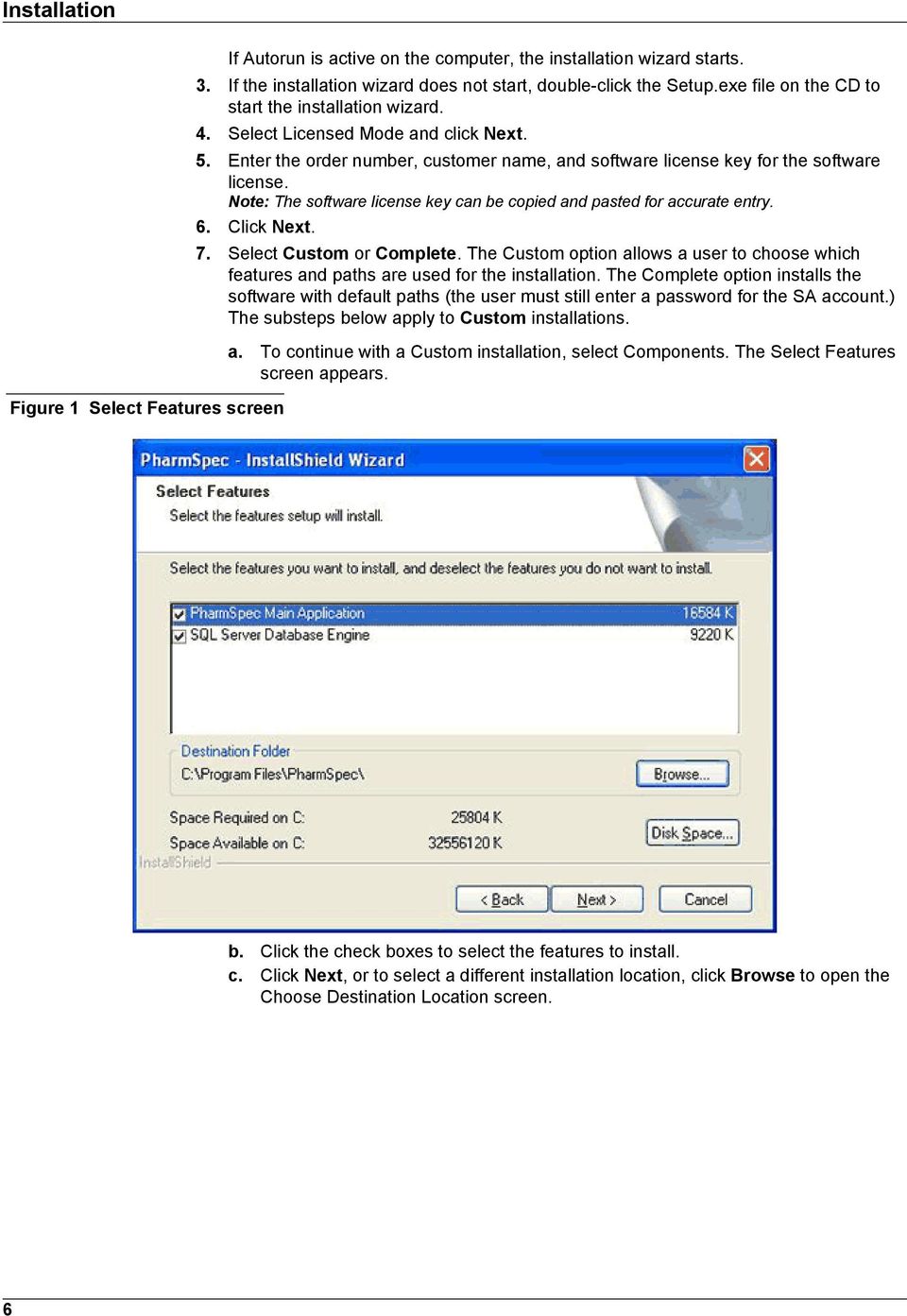
8 Installation Figure 1 Select Features screen If Autorun is active on the computer, the installation wizard starts. 3. If the installation wizard does not start, double-click the Setup.exe file on the CD to start the installation wizard. 4. Select Licensed Mode and click Next. 5. Enter the order number, customer name, and software license key for the software license. Note: The software license key can be copied and pasted for accurate entry. 6. Click Next. 7. Select Custom or Complete. The Custom option allows a user to choose which features and paths are used for the installation. The Complete option installs the software with default paths (the user must still enter a password for the SA account.) The substeps below apply to Custom installations. a. To continue with a Custom installation, select Components. The Select Features screen appears. b. Click the check boxes to select the features to install. c. Click Next, or to select a different installation location, click Browse to open the Choose Destination Location screen. 6
9 Installation Figure 2 Choose Destination Location screen Figure 3 Select database server screen d. Click Next. If both the application and the database were selected, the database is automatically installed. If SQL was not selected in the Select Features screen, the Select Database Server window opens and steps e and f apply. Note: In Complete installations, the SQL installation path is fixed to the location recommended by Microsoft and cannot be changed. 7

10 Installation e. Click Browse to view the list of database servers. Figure 4 Available database servers f. Highlight a server in the list and click OK. The password window opens. Figure 5 SQL password screen 8 g. Enter the SA password in the Password field. 8. Click Next to accept the installation settings and start the installation process. 9. When the installation is complete, the user is given a chance to place the name of the installer in the PharmSpecAdmins group and to create a CalTech user. Refer to Add users on page 11.

11 Installation 2.3 Windows settings Option Display settings Decimal separator Date separator and format Time separator and format Set the Windows display, decimal separator and time and date separator and formats as shown in Table 2. The user must have Windows Administrator rights on the computer to change the Windows settings. Table 2 Windows settings Setting Set for small fonts Set correctly for the user (typically either the decimal. or comma, character) Set the date separator and format for the short date as the user wants it to be shown in PharmSpec Set the time separator and format as the user wants it to be shown in PharmSpec 9

12 Installation 10

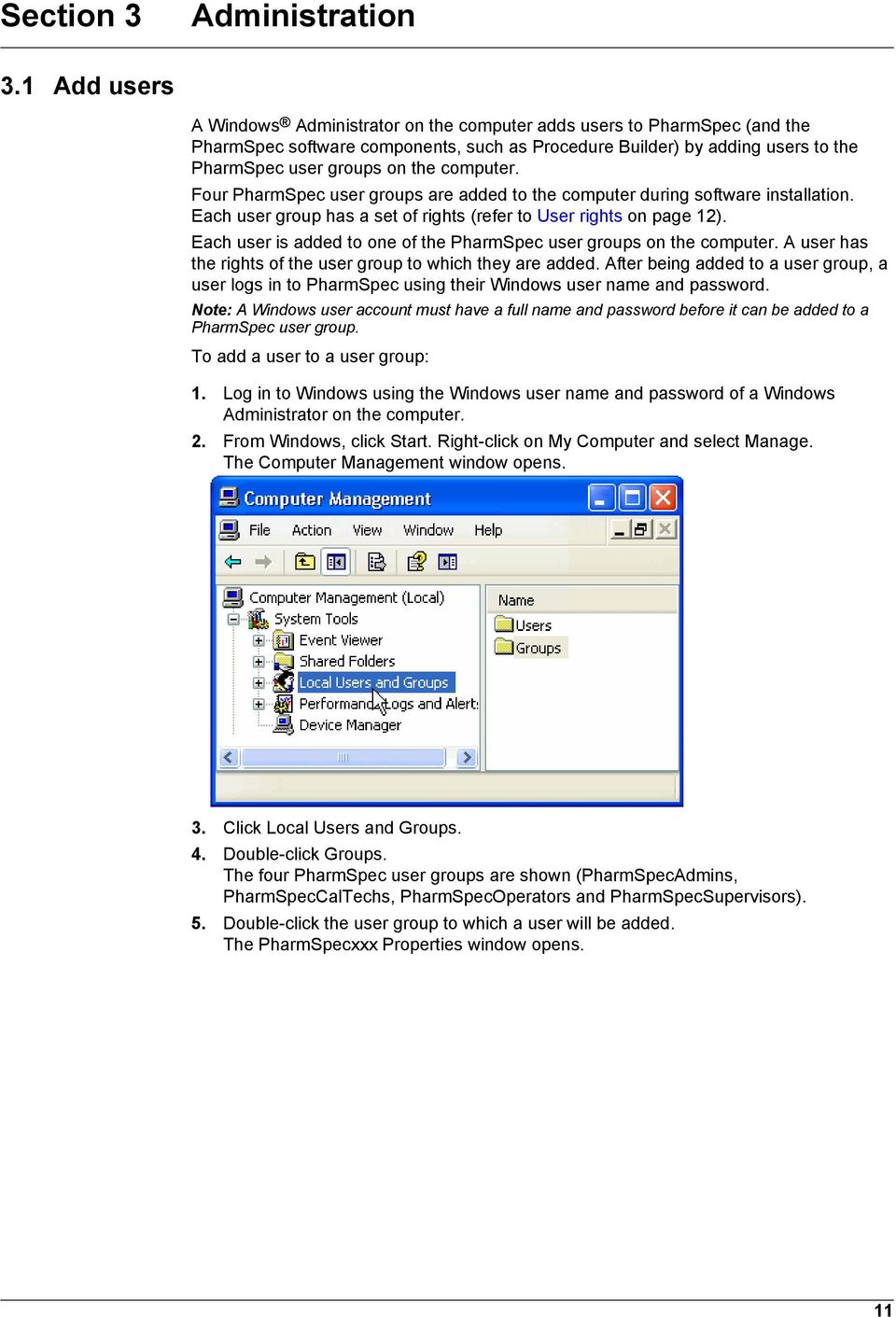
13 Section 3 Administration 3.1 Add users A Windows Administrator on the computer adds users to PharmSpec (and the PharmSpec software components, such as Procedure Builder) by adding users to the PharmSpec user groups on the computer. Four PharmSpec user groups are added to the computer during software installation. Each user group has a set of rights (refer to User rights on page 12). Each user is added to one of the PharmSpec user groups on the computer. A user has the rights of the user group to which they are added. After being added to a user group, a user logs in to PharmSpec using their Windows user name and password. Note: A Windows user account must have a full name and password before it can be added to a PharmSpec user group. To add a user to a user group: 1. Log in to Windows using the Windows user name and password of a Windows Administrator on the computer. 2. From Windows, click Start. Right-click on My Computer and select Manage. The Computer Management window opens. 3. Click Local Users and Groups. 4. Double-click Groups. The four PharmSpec user groups are shown (PharmSpecAdmins, PharmSpecCalTechs, PharmSpecOperators and PharmSpecSupervisors). 5. Double-click the user group to which a user will be added. The PharmSpecxxx Properties window opens. 11
14 Administration 6. Click Add. The Select Users, Computers, or Groups window opens. 7. Click Locations. To add domain users, select the correct domain name. To add local users, select the computer name. 8. Enter the Windows user name for the user. 9. Click Check Names. The first and last name of the user, their Windows user name and domain name are shown. 10. Click OK. 11. Click OK to save the changes and close the window. 3.2 User rights A Windows Administrator on the computer gives rights to users by adding each user to one of the four PharmSpec user groups on the computer (refer to Add users on page 11). Each user group has a set of default rights and optional rights (Table 3). 12

15 Administration A user is automatically given the default rights for the user group to which they have been added. A user can also be given one or more of the optional rights for a user group by a PharmSpec Administrator (refer to Give optional rights to a user on page 13). For information on how to view the rights of each user, refer to View user rights on page 39. Table 3 User group rights Rights Operator Supervisor Calibration Technician Administrator View Profile x x x x Run Tests x (optional) x x x View or Print Reports x x x x Review Reports x (optional) x x x Setup Test System x (optional) x (optional) x Approve Reports x (optional) x View/Print Activity Logs x (optional) x Load/Create Procedures x (optional) x Disable Obsolete Procedures x (optional) x Options x (optional) x x x Run Instrument Standardization Tests x (optional) x (optional) Administration Setup x (optional) 1 1 This right is given to Administrators by default. If removed, the Administrator can no longer change their optional rights. 3.3 Give optional rights to a user A PharmSpec Administrator can give one or more of the optional rights for a user group to a user. Note: Changes made to the rights of the user that is logged in are not available until the user logs out of PharmSpec and then logs in to PharmSpec. To give one or more of the optional rights for a user group to a user: 1. Log in to PharmSpec using the Windows user name and password of a PharmSpec Administrator on the computer. 2. Select Setup, Administration. 3. Select the user. 4. Click Modify User Rights. The rights of the selected user are shown. 13

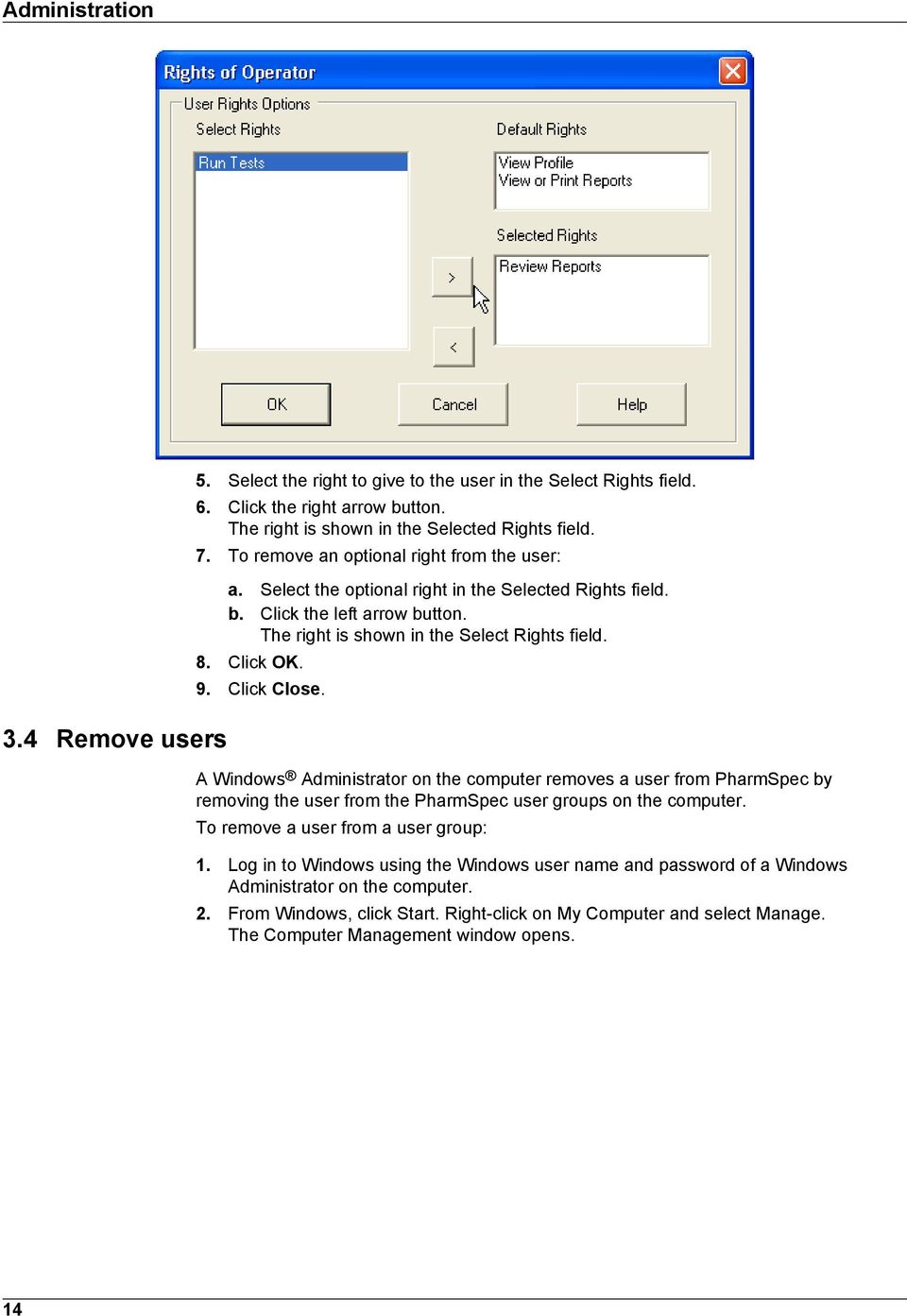
16 Administration 3.4 Remove users 5. Select the right to give to the user in the Select Rights field. 6. Click the right arrow button. The right is shown in the Selected Rights field. 7. To remove an optional right from the user: a. Select the optional right in the Selected Rights field. b. Click the left arrow button. The right is shown in the Select Rights field. 8. Click OK. 9. Click Close. A Windows Administrator on the computer removes a user from PharmSpec by removing the user from the PharmSpec user groups on the computer. To remove a user from a user group: 1. Log in to Windows using the Windows user name and password of a Windows Administrator on the computer. 2. From Windows, click Start. Right-click on My Computer and select Manage. The Computer Management window opens. 14
17 Administration 3. Click Local Users and Groups. 4. Double-click Groups. The four PharmSpec user groups are shown (PharmSpecAdmins, PharmSpecCalTechs, PharmSpecOperators and PharmSpecSupervisors). 5. Double-click the user group from which a user will be removed. The PharmSpecxxx Properties window opens. 6. Select the Windows user to remove. 7. Click Remove. 8. Click OK to save the changes and close the window. 3.5 Disable an obsolete procedure A user with the Disable Obsolete Procedures right can disable an obsolete procedure. When a procedure is disabled: The procedure is removed from the Standard Procedures field at the top of the main window. The status of the procedure changes from active to obsolete so that the procedure can not be used to do tests. 15

18 Administration To disable an obsolete procedure: 1. Log in to PharmSpec using the Windows user name and password of a PharmSpec user with the Disable Obsolete Procedures right. 2. Select Setup, Disable Obsolete Procedures. The Disable Obsolete Procedures window opens. 3.6 Enable a procedure 3. Select the procedure in the Active Procedures field. 4. Click the right single arrow button. The procedure moves to the Obsolete Procedures field. Note: Click the double arrow buttons to move all procedures from one field to the other. 5. Click OK. A user with the Disable Obsolete Procedures right can enable a procedure that has been disabled. When a procedure is enabled: The procedure is added to the Standard Procedures field at the top of the main window. The status of the procedure changes from obsolete to active so that the procedure can be used to do tests. To enable a procedure: 1. Log in to PharmSpec using the Windows user name and password of a PharmSpec user with the Disable Obsolete Procedures right. 2. Select Setup, Disable Obsolete Procedures. The Disable Obsolete Procedures window opens. 16

19 Administration 3. Select the procedure in the Obsolete Procedures field. 4. Click the left arrow button. The procedure moves to the Active Procedures field. 5. Click OK. 3.7 Backup the database The database utility allows a Windows Administrator to do a full or quick backup of the PharmSpec database manually at any time and schedule automatic data backups on a daily, weekly or monthly interval. The Database Utility is a software component that comes with PharmSpec. Note: Only Windows Administrators can log in to the Database Utility. A full backup stores a copy of the entire database in the backup folder. A quick backup stores the changes made to the database since the last backup (either quick or full) in the backup folder. To backup the database or schedule backups: 1. Log in to Windows using the Windows user name and password of a Windows Administrator on the computer. 2. From Windows, select Start, All Programs, PharmSpec, Database Utility. 3. Log in to the Database Utility using the Windows user name and password of a Windows Administrator. 4. Select the Backup tab. The Backup Configuration window opens. 17

20 Administration 5. To change the default backup drive: a. Select the drive where backups should be saved. b. Click OK. 6. To do a full backup now, select Full and click Backup Now. 7. To do a quick backup now, select Quick and click Backup Now. 8. To schedule full backups: a. Select Full and click Schedule. The Schedule Backup window opens. 18

21 Administration 3.8 Archive data b. Select the days and times when a full backup is done. c. Click OK. 9. To schedule quick backups: a. Select Quick and click Schedule. The Schedule Backup window opens. b. Select the days and times when a quick backup is done. c. Click OK. 10. Close the Database Utility. A Windows Administrator can archive all database entries made before a selected date. Use the Archive feature to remove old entries from the database and save them to the archive folder. Use the Database Utility to attach the archive database and view archived data in PharmSpec. 1. On the computer, log in to Windows using the Windows user name and password of a Windows Administrator. 2. From Windows, select Start, All Programs, PharmSpec, Database Utility. 3. Log in to the Database Utility using the Windows user name and password of a Windows Administrator. 4. Select the Archive tab. 19
22 Administration 3.9 Restore the database 5. To change the default archive folder: a. Click the browse button. b. Select the folder. c. Click OK. 6. To archive database entries: a. Select the start date to archive. (The default date is 30 days before the current date.) b. Click the Archive folder. All database entries made before the date selected are removed from the database and saved on the archive drive. 7. Close the Database Utility. The PharmSpec database can be restored from the last full or full and quick database backup done (refer to Backup the database on page 17) using the Database Utility. A database restore replaces the current database with the backup database. The Database Utility is a software component that comes with PharmSpec. Note: Only Windows Administrators can log in to the Database Utility. To restore the database from the backup: 1. On the computer, log in to Windows using the Windows user name and password of a Windows Administrator on the computer. 2. Make sure that PharmSpec, Procedure Builder, Procedure Distributor or Procedure Loader is not open on the computer. 3. From Windows, select Start, All Programs, PharmSpec, Database Utility. 20
23 Administration 4. Log in to the Database Utility using the Windows user name and the password of a Windows Administrator on the computer. The PharmSpec DB Tools window opens. Figure 6 SA password screen 5. To restore the database using only the last full backup done: a. Select Database (Full Only). b. Select the full backup file to use to restore the database. 6. To restore the database using the last full backup and any quick backup done since the last full backup: a. Select Database (Full + Quick). b. Select the full backup file and quick backup file to use to restore the database. 7. Click Restore. The SA password window opens. 8. Enter the password that was entered during the installation procedure. 21
24 Administration 9. To clear the database log, click Clear DB Log. Do not clear the database log unless instructed to do so by Technical Services. 10. Click Close to close the window. 11. Restart the computer View the activity logs Figure 7 Activity logs screen (partial) A PharmSpec user with the View/Print Activity Logs right can view and print the activity logs. To view and/or print the activity logs: 1. Log in to PharmSpec using the Windows user name and password of a PharmSpec user with the View/Print Activity Logs right. 2. Select Reports, View Activity Logs. The View Activity Logs window opens. All the activities that have occurred today are shown in the window. 3. To show the activity logs for a specific date/time range, enter the date/time range in the Date/Time fields and click Apply. 4. To show the activity logs for a specific user, select the user in the User field and click Apply. 5. To show the activity logs for a specific type of activity, select the activity in the Activity field and click Apply. 6. To print the activity logs shown, click Print. 7. To export the activity log shown, click Export. The activity log can be exported as a Word, Excel or a comma separated text (CSV) file. 8. To close the window, click Close. 22
25 Section 4 Hardware installation sampler Connect the sampler to the computer with PharmSpec: 1. Connect the communication (COM) cable to the sampler and the computer. 2. Turn on the sampler or 9705 sampler Connect the sampler to the computer with PharmSpec: 1. Turn on the sampler. 2. Connect the USB cable to the sampler and the computer. 3. If the Windows Found New Hardware Wizard starts, use the wizard to install the hardware driver. The default location for the hardware driver is C:\Program Files \PharmSpec\Hardware Drivers\<sampler model>. 23
26 Hardware installation 24
27 Section 5 Hardware settings or sampler Select the hardware settings to configure the software for use with the instrument before a test is done. Change the hardware settings when there is a change in the hardware components (i.e. sensor, probe or syringe). Connect the instrument to the computer with PharmSpec before selecting the hardware settings (refer to Hardware installation on page 23). To select the hardware settings: 1. Log in to PharmSpec using the Windows user name and password of a PharmSpec user with the Setup Test System right. 2. Select Setup, Hardware Settings. The Hardware Settings window opens. 3. If Simulation is selected, unselect Simulation and click OK. Click Yes to change to online mode. Some fields on the Hardware Settings window are automatically populated, such as the Sampler fields and Counter fields and can not be changed. Some buttons are disabled, depending on the sampler. 4. (9703) In the Communication area of the window, select the communication (COM) port on the computer that is connected to the sampler cable in the Port field. The default baud rate of is correct. 5. (9703+) In the Communication area of the window, select USB in the Port field. 6. Add the sensor that is installed in the sampler to the hardware settings (refer to Add a sensor on page 25). 7. In the Sensor area of the Hardware Settings window, select the model and serial number of the sensor installed in the sampler. The Sensor Data area of the window shows the information entered for the sensor selected. 8. (9703) Add the sampler to the hardware settings (refer to Add a sampler on page 29). 9. (9703) In the Sampler area of the Hardware Settings window, select the model and serial number of the sampler. 10. (9703+) Change the sampler settings (refer to Change the sampler settings on page 29). 11. To automatically print test reports after doing a test, select Auto Print On. 12. In the PHA area of the window, select the minimum (XMin) and maximum (XMax) partical sizes (microns) that are shown on the horizontal axis of the PHA chart. The maximum size should be at least 30 microns larger than the minimum size Add a sensor To add a sensor to the hardware settings (9703 and only): 1. Click Sensor in the Add/Modify/Remove area of the Hardware Settings window. The Add Sensor window opens. 25
28 Hardware settings 2. To enter the sensor information: a. Select Add. b. To add a HRLD sensor, select Single in the Calibration Mode field. c. To add an MC sensor, select Dual in the Calibration Mode field. Fields for two calibration curves are shown: Extinction and Scatter. d. Enter the sensor information provided on the Certificate of Calibration sheet or Test Setup Configuration sheet that was included with the sensor. A minimum of four calibration values (size and millivolts) must be entered for each calibration curve. If there are multiple calibration curves for a sensor due to different flow rates (or other reasons), add a sensor with a different model number (e.g., HRLD-150 at 10 ml or HRLD-150 at 25 ml) for each calibration data set. Note: If the entered sensor model is not included in the C:/Program Files/PharmSpec/validconfig.xml file, PharmSpec will not be able to validate the configuration and bubble detection warnings will not given by PharmSpec. 26
29 Hardware settings 3. To import the sensor information from a file: a. Select Import. The Import Sensor window opens. b. Select the file that contains the sensor information. c. Click Open. The imported sensor information is shown in the fields. The information shown can be changed except for the sensor type, model and serial number. 4. Click Save. The sensor is added. 5. To clear the sensor fields so another sensor can be added, click Yes. 6. To not clear the sensor fields, click No. 7. Click Close to close the window Change a sensor A PharmSpec user with the Setup Test System right can add/change the sensor details and calibration data for a sensor after the sensor is added to the hardware settings. The sensor type, model and serial number can not be changed. To add/change the settings for a sensor: 1. Log in to PharmSpec using the Windows user name and password of a PharmSpec user with the Setup Test System right. 2. Select Setup, Hardware Settings. The Hardware Settings window opens. 3. Click Sensor. 4. Select Modify. The Modify Sensor window opens. 5. Select the sensor model and serial number. 6. Add/Change the sensor settings. Enter the sensor calibration information provided on the Certificate of Calibration sheet or Test Setup Configuration sheet that was included with the sensor. A minimum of four calibration values (size and millivolts) must be added for each calibration curve. Note: The sensor type, model and serial number can not be changed. 7. Click Save. The new sensor information is saved. 8. Click OK. 9. Click Close to close the window Remove a sensor A PharmSpec user with the Setup Test System right can remove a sensor from the hardware settings if the sensor is not currently configured as the active sensor in PharmSpec. The sensor currently configured as the active sensor in PharmSpec can not be selected in the Remove Sensor window. To remove a sensor from the hardware settings: 1. Log in to PharmSpec using the Windows user name and password of a PharmSpec user with the Setup Test System right. 2. Select Setup, Hardware Settings. The Hardware Settings window opens. 3. Click Sensor. 4. Select Remove. The Remove Sensor window opens. 5. Select the model of the sensor in the Model field. 27
30 Hardware settings 6. Select the serial number for the sensor in the Serial Number field. 7. Click Remove. 8. Click Yes to remove the sensor. 9. Click OK. 10. Click Close to close the window Add a counter To add a counter to the hardware settings: 1. Click Counter in the Add/Modify/Remove area of the Hardware Settings window. The Add Counter window opens. 2. Enter the counter model in the Model field. 3. Enter the counter serial number in the Serial Number field. 4. Click Save. 5. Click Close to close the window Remove a counter A PharmSpec user with the Setup Test System right can remove a counter from the hardware settings if the counter is not connected to PharmSpec. The counter that is connected to PharmSpec can not be selected in the Remove Counter window. To remove a counter from the hardware settings: 1. Log in to PharmSpec using the Windows user name and password of a PharmSpec user with the Setup Test System right. 2. Select Setup, Hardware Settings. The Hardware Settings window opens. 3. Click Counter. The Add Counter window opens. 4. Select Remove. The Remove Counter window opens. 5. Select the model of the counter in the Model field. 6. Select the serial number for the counter in the Serial No. field. 7. Click Remove. 8. Click Yes to remove the counter. 9. Click OK. 10. Click Close to close the window. 28
31 Hardware settings Add a sampler To add a sampler to the hardware settings (9703 only): 1. Click Sampler in the Add/Modify/Remove area of the Hardware Settings window. The Add Sampler window opens. 2. Enter the model of the sampler. 3. Enter the serial number for the sampler. 4. Select the size of the syringe installed in the sampler. 5. Select the size of the probe installed in the sampler. 6. To have the arm automatically lift after a test is complete or after each run: a. Select Lift Arm. b. Select Lift arm after test completed or select Lift arm after each run. 7. Click Save. The sampler is added. 8. To clear the sampler fields so that another sampler can be added, click Yes. 9. To not clear the sampler fields, click No. 10. Click Close to close the window. The Sampler Data (Current Setup) area of the window shows the syringe size and probe size selected Change the sampler settings A PharmSpec user with the Setup Test System right can add/change the settings for a sampler (different size probe or syringe, etc.) after the sampler is added to the hardware settings (9703 and only). Note: A sampler is automatically added to the hardware settings. To change the hardware settings for the sampler: 1. Log in to PharmSpec using the Windows user name and password of a PharmSpec user with the Setup Test System right. 2. Select Setup, Hardware Settings. The Hardware Settings window opens. 3. Click Sampler in the Add/Modify/Remove area of the Hardware Settings window. The Add Sampler window opens. 29
32 Hardware settings 4. (9703) Select Modify. The Modify Sampler window opens. 5. (9703) Select the model of the sampler. 6. (9703) Select the serial number for the sampler. 7. Select the size of the syringe installed in the sampler. 8. Select the size of the probe installed in the sampler. 9. To have the arm automatically lift after a test is complete or after each run: a. Select Lift Arm. b. Select Lift arm after test completed or select Lift arm after each run. 10. Click Save and then OK. 11. Click Close to close the window. The Sampler Data (Current Setup) area of the window shows the syringe size and probe size selected. 12. If the probe size was changed, reset the minimum height of the probe to the sampler container using the front panel controls on the sampler before starting a test (refer to the sampler user manual) Remove a sampler A PharmSpec user with the Setup Test System right can remove a sampler from the hardware settings if the sampler is not currently configured as the active sampler in PharmSpec. The sampler currently configured as the active sampler in PharmSpec can not be selected in the Remove Sampler window sampler To remove a sampler from the hardware settings: 1. Log in to PharmSpec using the Windows user name and password of a PharmSpec user with the Setup Test System right. 2. Select Setup, Hardware Settings. The Hardware Settings window opens. 3. (9703+ and 9705) In the Communication area of the window, select any one of the COM ports in the Port field. 4. Click Sampler in the Add/Modify/Remove area of the Hardware Settings window. The Add Sampler window opens. 5. Select Remove. The Remove Sampler window opens. 6. Select the model of the sampler in the Model field. 7. Select the serial number for the sampler in the Serial Number field. 8. Click Remove. 9. Click Yes to remove the sampler. 10. Click OK. 11. Click Close to close the window. To select the hardware settings: 1. Log in to PharmSpec using the Windows user name and password of a PharmSpec user with the Setup Test System right. 2. Select Setup, Hardware Settings. The Hardware Settings window opens. 3. If Simulation is selected, unselect Simulation and click OK. Click Yes to confirm. 30
33 Hardware settings Some fields on the Hardware Settings window are automatically populated, such as the Sensor, Counter and Sampler fields, and can not be changed. Some buttons are disabled. 4. In the Communication area of the window, select USB in the Port field. 5. Add the calibration information for the sensor currently installed in the sampler to the hardware settings (refer to Change a sensor on page 27). The Sensor Data area of the window shows the information entered for the sensor. 6. To automatically print test reports after doing a test, select Auto Print On. 31
34 Hardware settings 32
35 Section 6 Operating parameters Select the operating parameters before a test is done. The operating parameters selected are used for the Run counter test. The tare volume values selected are also used for standard test procedures and instrument standardization tests. PharmSpec gets data from the instrument using the operating parameters selected and saves the data in the database. Data analysis is done according to the particle distribution and the pass/ fail classifications of the test procedures. To select the operating parameters and tare volume values: 1. Log in to PharmSpec using the Windows user name and password of a PharmSpec user with the Setup Test System right. 2. Select Setup, Hardware Settings. 3. In the Operating Parameters area of the Hardware Settings window, click Modify. The Operating Parameters window opens. 4. Enter the operating parameters (sample volume, number of runs, particle size(s) monitored, etc.) Value Tare volume Multi-stroke tare Description A volume that is drawn before the sample volume. A tare volume is drawn on the first stroke of the first run of a test to remove any fluids in the tubing from the last run (or bubbles if the tubing is empty). Pulling a tare volume makes sure that the sample data obtained is only from the fluid from the sample container currently on the sampler. A volume that is drawn between strokes only when multiple strokes are necessary to complete the sample. A multi-stroke tare volume brings the sample fluid up to speed before counting starts. 5. To not use the data for the first run, select Discard First Run. When selected, the test results of the first run will not be used in the computations but will still be shown and stored. 33
36 Operating parameters 6. To open the Operating Parameters window at the start of each counter test so that the operator can make sure that the settings are correct for the test to be started, select Show this screen at the beginning of each test. 7. Click OK. 6.1 Select the sample identifiers for counter tests To select the sample identifiers that are entered at the start of a counter test: 1. Log in to PharmSpec using the Windows user name and password of a PharmSpec user with the Setup Test System right. 2. Select Setup, Hardware Settings. 3. In the Operating Parameters area of the Hardware Settings window, click Field Names. 4. Enter the number of sample identifier fields to include-0 to Enter a sample identifier label in each field, such as Lot ID and Batch ID. 6. Click OK. 34
37 Section 7 Setup options 7.1 Check for software and procedure updates Pre-requisites: The computer must be connected to the internet to do a software and procedure update check and to download updates. A PharmSpec user with the Options right can: Check for software and procedure updates manually at any time Select a schedule for software and procedure updates checks to be done by the software Download software and procedure updates to the computer Note: Only a Windows Administrator on the computer can install software and procedure updates on the computer. To check for updates now, schedule update checks and/or download updates: 1. Log in to PharmSpec using the Windows user name and password of a PharmSpec user with the Options right. 2. Select Setup, Options. The Update Scheduler tab in the Options window opens. 3. To change the default location for downloads: a. Click Browse. b. Navigate to the folder where updates should be downloaded and select the folder. c. Click OK. 4. To schedule an update check to be done when PharmSpec is started, select Check for updates at program startup. The Update Viewer window opens when an update check is done. 5. To schedule daily, weekly or monthly update checks: a. Select Check for updates. b. Select Daily, Weekly or Monthly. c. Enter the time of day when the update check is done. d. (Weekly) Select the day of the week for the update check. 35
38 Setup options e. (Monthly) Select the day of the month for the update check. The Update Viewer window opens when an update check is done. 6. To check for updates now, click Check for Updates Now. The Update Viewer window opens and lists the updates. 7.2 Select report options 7. To download updates, select Download in the Action field for each update to download and click OK. The selected updates are downloaded to the computer. A PharmSpec user with the Options right can: Change the number of blank signature lines for Reviewers on printed reports Change the location of the sample identification values on reports Add a company logo to reports Note: Changes made to the report options only apply to new test reports, not existing test reports. To select report options: 1. Log in to PharmSpec using the Windows user name and password of a PharmSpec user with the Options right. 2. Select Setup, Options. 3. Click the Reports tab. The Reports tab of the Options window opens. 36
39 Setup options 4. Select the number of blank signature lines for reviewers on printed reports-0 to Select where sample identification values are located on reports-left or right side. 6. To add a company logo to reports: a. Select Add company logo to reports. b. Click Browse. c. Select the image file to add to reports and click Open. d. Select where the company logo is located on reports-left or right side. The company logo is automatically reduced in size to fit in the window. 7. Click OK. 7.3 Enable warnings A PharmSpec user with the Options right can: Enable or disable individual software warnings Schedule sensor calibration warnings Note: All warnings are disabled by default. 1. Log in to PharmSpec using the Windows user name and password of a PharmSpec user with the Options right. 2. Select Setup, Options. 3. Click the Errors and Warnings tab. The Errors and Warnings tab of the Options window opens. 37
40 Setup options 4. To enable a warning, select the checkbox for the warning. 5. To enable and schedule sensor calibration warnings: a. Select Warn when the sensor needs to be calibrated. b. Select the calibration warning period (the number of days before a calibration is due to start warnings). c. Select the calibration warning interval (the number of days between warnings). 6. Click OK. 7.4 Setup local users Reasons to set up local users include: Operation of the when not on a VPN Operators do not have domain accounts Additional users are required 1. Click the Start menu and select Help and Support. 2. In the search box, type Create a new user account. Instructions for setting up a local user will appear. 3. Follow the instructions to set up local user accounts for the OS type. 4. Add the user to the appropriate PharmSpecAdmins group. Refer to Add users on page 11 38
41 Section 8 Operation 8.1 Log in 8.2 User interface Figure 8 PharmSpec main window To log in to PharmSpec or a PharmSpec software component (i.e. Procedure Loader), enter the Windows user name and password of a PharmSpec user. Contact a Windows Administrator on the computer to be added as a PharmSpec user. To start PharmSpec, select Start, All Programs, PharmSpec, Pharmspec. Then, log in to PharmSpec using the Windows user name and password of a PharmSpec user. The main window of PharmSpec is shown in Figure 8. 1 Toolbar 4 Status bar software mode (simulation or online) 2 Standard Procedures field procedural test selected 5 Status bar status messages 3 IST Standards field IST procedure selected 8.3 View user rights User rights are set for each user by a Windows Administrator on the computer (refer to Add users on page 11). User rights determine which menus in PharmSpec and which PharmSpec software components a user can use. To view the rights of the user currently logged in to PharmSpec, select User, View Profile. To view the rights of all the PharmSpec users on the computer: 39
42 Operation 1. Log in to PharmSpec using the Windows user name and password of a PharmSpec Administrator on the computer. 2. Select Setup, Administration. 3. Select a user and click Modify User Rights to view their user rights. 8.4 Manually operate the sampler A user can manually operate a 9703 or sampler using PharmSpec. To manually operate the sampler, select Setup, Sampler Control. The Sampler Control window opens. Click a button in the window to do the function. The button functions are shown in Table 4. Table 4 Sampler control buttons Button Function Load syringe Extends the syringe plunger so a user can load or unload a syringe. Prime Flush Arm Up Versions Abort/Stop Close Help Draws the sample in to the sampler to remove air and to make sure that the sample is in the sensor when counting starts. (9703) A back flush is done with one syringe pull. (9703+) The user selects a forward flush or back flush and the number of syringe pulls done per forward flush or back flush. Back flush reverses the sample flow through the sampler to remove a blockage in the sensor or probe. Forward flush (9703+ only) pulls the sample flow through the sampler to flush the sensor and can be used to flush a cleaning liquid through the instrument to clean the instrument. Raises the sensor arm so that a user can remove or change of the sample. Shows the sampler and counter version. Cancels the current manual sampler operation. Closes the Sampler Control window. Opens the online help for the Sampler Control window. 8.5 Do a procedural test A PharmSpec user with the Run Test right can do a procedural test. To do a procedural test: 40
43 Operation 1. Log in to PharmSpec using the Windows user name and password of a PharmSpec user with the Run Test right. 2. Select the procedure to do in the Standard Procedures field at the top of the main window. 3. Select Sample Test, Run Procedural Test or push F7. The Sampler Identification window opens. 4. Enter the sample identification value(s) for the sample to be used. Note: The sample identification fields shown are specific to the test procedure and can not be changed. 5. Click Continue. 6. Do the steps in the Description field. 7. Change the test parameters as necessary. Each parameter field shows a default value. The parameters can be changed within the limits set in the procedural test. 8. Click Start. The test results are shown in the Results area of the window. The test outcome (PASS or FAIL) is shown at the bottom of the Results area of the window when all the test runs are done. 9. To stop a test, click Stop. 10. To electronically review or review and approve the test results now (user with Review Tests and/or Approve Tests rights): a. Click Review/Approve. b. Enter comments and click Review. c. Enter the Windows user name and password of a PharmSpec user with the Review Reports right. d. Click OK. e. To allow another review, click Exit and then Close. Select Review and Approve. Refer to Review and approve test results in the queue on page 46. f. To approve the test results, enter comments and click Approve. Once the test results are approved, no more reviews can be added. g. Enter the Windows user name and password of a PharmSpec user with the Approve Reports right. h. Click OK. i. Click Exit. 11. To electronically review and approve the test results later, click Queue. 12. If the test is an informal test that does not have to be reviewed or approved, click Save Only. 13. To save the test results so they can be printed later and then signed, click Save Only. 14. To print the test report, click Print. If the test results have been reviewed or reviewed and approved electronically, the report prints with the electronic signature(s) and the comment(s). If the test results have been saved by selecting Save Only, the report prints with blank reviewer and approver signature lines. If the test results are in the queue, the report prints without signature lines or electronic signatures. Note: The software can be configured to automatically print reports after each test (refer to 9703 or sampler on page 25). 15. To prepare the instrument to sample using the remote user interface on the sampler (9705 only), click Remote. Prepare the instrument to take a sample. Push Start on 41
44 Operation 8.6 Do a counter test the remote user interface to start the test. When the test is done, the test results are shown on PharmSpec. The Remote button is disabled if the sampler does not have a remote user interface. 16. To do another procedural test, click Clear. Then click Run Test. 17. Click Close to close the window. A PharmSpec user with the Run Test right can do a counter test. A counter test is not a procedural test, so no Pass/Fail results are shown. To do a counter test: 1. Log in to PharmSpec using the Windows user name and password of a PharmSpec user with the Run Test right. 2. Select the operating parameters for the counter test (refer to Operating parameters on page 33). 3. Select Sample Test, Run Counter or push F9. 4. Enter a sample identification value(s) in the field(s). Note: The Sample Identification window does not open if zero sample identification fields were selected by the user (refer to Select the sample identifiers for counter tests on page 34). 5. Click Continue. The Run Counter window opens and the test report is shown. 6. To print the test results report, click Print. 7. To prepare the instrument to sample using the remote user interface on the sampler (9705 only), click Remote. Prepare the instrument to take a sample. Push Start on the remote user interface to start the test. When the test is done, the test results are shown on PharmSpec. The Remote button is disabled if the sampler does not have a remote user interface. 8. To do another counter test, click Run Test. 9. Click Close to close the window. 8.7 Do an instrument standardization test 42 A PharmSpec user with the Run Instrument Standardization Tests right can do the instrument standardization test (IST) procedures that are included with the license. IST procedures are calibration and/or verification tests. Refer to the instrument service manual for the calibration procedures. Note: The Moving Windows and Sensor Resolution instrument standardization tests can not be done with an MC series sensor. To do an IST procedure: 1. Log in to PharmSpec using the Windows user name and password of a PharmSpec user with the Run Instrument Standardization Tests right. 2. Select the IST procedure to do in the IST Standards field at the top of the main window. 3. Select Sample Test, Run IST or push F2. The Sampler Identification window opens. 4. Enter the sample identification value(s) for the sample to be used. Note: The sample identification fields shown are specific to the test procedure and can not be changed. 5. Click Continue. 6. Do the steps in the Description field. 7. Change the test parameters as necessary.
45 Operation Each parameter field shows a default value. The parameters can be changed within the limits set in the test. The most common parameters for a test are sample volume and the number of runs. 8. Click Run Test. The test results are shown on the Results field. 9. To stop a test, click Stop. 10. To electronically review or review and approve the test results now (user with Review Tests and/or Approve Tests rights): a. Click Review/Approve. b. Enter comments and click Review. c. Enter the Windows user name and password of a PharmSpec user with the Review Reports right. d. Click OK. e. To add another reviewer, click Exit and then Close. Select Review and Approve. Refer to Review and approve test results in the queue on page 46. f. To approve the test results, enter comments and click Approve. Once the test results are approved, no more reviews can be added. g. Enter the Windows user name and password of a PharmSpec user with the Approve Reports right. h. Click OK. i. Click Exit. 11. To electronically review and approve the test results later, click Queue. 12. If the test is an informal test that does not have to be reviewed or approved, click Save Only. 13. To save the test results so they can be printed later and then signed, click Save Only. 14. To print the test report, click Print. If the test results have been reviewed or reviewed and approved electronically, the report prints with the electronic signature(s) and the comment(s). If the test results have been saved, the report prints with blank reviewer and approver signature lines. If the test results are in the queue, the report prints without signature lines or electronic signatures. Note: The software can be configured to automatically print reports after each test (refer to 9703 or sampler on page 25). 15. To prepare the instrument to sample using the remote user interface on the sampler (9705 only), click Remote. Prepare the instrument to take a sample. Push Start on the remote user interface to start the test. When the test is done, the test results are shown on PharmSpec. The Remote button is disabled if the sampler does not have a remote user interface. 16. To do another procedural test, click Clear. Click Run Test. 17. Click Close to close the window. 8.8 Do a test in simulation mode Standard, user-defined and some IST test procedures, and counter tests can be done in simulation (demo) mode. In simulation mode, the parameters and ranges for the simulated data that is used by Pharmspec are set by the user using the Simulation Application. The number of size channels and the size label for each channel is set in the operating parameters. 43
46 Operation The Simulation Application is an additional software component that comes with PharmSpec. To do a test in simulation mode: 1. In PharmSpec, select Setup, Hardware Settings. The Hardware Settings window opens. 2. Select Simulation in the top-left corner of the window and then click OK. 3. Select Setup, Hardware Settings and then click Modify to open the Operating Parameters window. 4. Set the number of size channels and the size label for each channel in the Operating Parameters window and then click OK. 5. From Windows, select Start, All Programs, PharmSpec, Simulation Application. The Simulation Application window opens. 6. To do a test using random, simulated channel counts, select Random Numbers. 7. To do a test using fixed channel counts: a. Select Fixed Numbers. b. Select the number of run simulations to use for the test in the Number of Simulations field. Up to 10 sequential simulations can be selected. Note: If the number of run simulations selected is less than the number of runs done by the test, the run simulations that are selected (e.g., Simulation 1 and Simulation 2) are used again until all the runs for the test are completed. For example, if the number of run simulations selected is 2 and the test does 4 runs, Simulation 1 is used first, Simulation 2 is used second, Simulation 1 is used third and Simulation 2 is used fourth. c. Select 1 in the Select Simulation field. d. Enter the channel counts for Simulation 1. Up to 16 channels can be entered for each simulation. Note: The channel counts are the differential count. PharmSpec calculates the cumulative counts based on the differential count. 44
47 Operation e. Enter the channel counts for the rest of the run simulations shown in the Select Simulation field. Note: The run simulations shown in the Select Simulation field depends on the number of simulations selected in the Number of Simulations field. For example, if 4 simulations are selected in the Number of Simulations field, Simulation 1, Simulation 2, Simulation 3 and Simulation 4 are shown in the Select Simulation field. 8. Click Save. 9. In PharmSpec, do the test. 10. To do the test again using less simulations: a. Change the number of simulations selected in the Number of Simulations field in the Simulation Application. For example, change the number of simulations from 4 to 2. If 2 simulations are selected, only Simulation 1 and Simulation 2 will be used. b. Click Save. 11. To do the test again using more simulations: a. Change the number of simulations selected in the Number of Simulations field in the Simulation Application. For example, change the number of simulations from 2 to 4. b. Enter the channel counts for each run simulations shown in the Select Simulation field. c. Click Save. 8.9 View the pulse height analyzer graph A PharmSpec user with the Run Tests right can view the pulse height analyzer (PHA) graph for the test (run counter, procedure or instrument standardization test) that was done last on a 9703 or sampler. Note: The minimum and maximum values shown on the horizontal axis of the PHA graph are selected by the user (refer to 9703 or sampler on page 25). To view the PHA graph for the test done last: 1. Log in to PharmSpec using the Windows user name and password of a PharmSpec user with the Run Tests right. 2. Select Sample Test, PHA. The PHA window opens. 45
48 Operation 3. To view the millivolt response for a specific particle size, drag the red vertical line to that area of the graph. The millivolt response value is shown in the bottom-right corner of the window. Note: The sensor calibration data entered by the user effects the millivolt response value shown. If the sensor calibration data entered is not correct for the sensor being used, incorrect values are shown. 4. To zoom in on one area of the graph, click and drag a box around the area to view. 5. To show the whole graph again, click Zoom Out. 6. To view differential counts on the graph, select Differential Counts per ml. 7. To view cummulative counts on the graph, select Cummulative Counts per ml. 8. To view the results in log format, select Log. 9. To view the results in linear format, select Linear. 10. To print the graph as currently shown, click Print. 11. Click Close to close the window Review and approve test results in the queue A PharmSpec user with the Review Reports right can electronically review test results. A PharmSpec user with the Approve Reports right can electronically approve test results. To electronically review and/or approve test results in the queue: 46
49 Operation 1. Log in to PharmSpec using the Windows user name and password of a PharmSpec user with the Review Reports right. 2. Select Review and Approve. Test results that have not been approved are shown in the Select Test Result field. 3. Expand the test procedures (click +) to show the test results for the procedure that have not been approved. 4. Select the test results to review and/or approve. The results for the selected test are shown in the Results Details field. If the test results have been reviewed, the name of the reviewer(s), the review comments, and the date the review(s) was done are shown in the Review Details field. 5. To add a review to the test results selected: a. Enter comments and click Review. Note: The Review button is enabled only if less than four users have reviewed the selected test results. b. Enter the Windows user name and password of a PharmSpec user with the Review Reports right on the computer. c. Click OK. The comments and electronic signature of the reviewer are added to the report. The Review button is disabled. 6. To add another review to the test results selected: a. Click Close to close the window. b. Select Review and Approve to open the window again. c. Select the test results to review. d. Enter comments and click Review. Note: The Review button is enabled only if less than four users have reviewed the selected test results. e. Enter the Windows user name and password of a PharmSpec user with the Review Reports right on the computer. f. Click OK. The comments and electronic signature of the reviewer are added to the report. The Review button is disabled. 7. To approve the test results selected: a. Enter comments and click Approve. Note: The Approve button is enabled only if the selected test results have been reviewed by at least one user and the test results have not been approved. b. Enter the Windows user name and password of a PharmSpec user with the Approve Reports right on the computer. c. Click OK. The comments and electronic signature of the approver are added to the report. The approved test results are no longer shown in the Select Test Result field. 8. Click Close to close the window. 47
50 Operation 48
51 Section 9 Historical reports 9.1 View, print and/or export historical test reports A PharmSpec user with the View or Print reports right can view, print and/or export historical test reports. Test reports can be batch printed and/or exported. Note: Historical test reports that are in the queue for electronic approval and have not been approved can not be printed or exported. To view, print and/or export a historical test report(s): 1. Log in to PharmSpec using the Windows user name and password of a PharmSpec user with the View or Print reports right. 2. Select Reports, Historical Reports. The Historical Reports window opens. 3. Select the search criteria for the test report(s) to be viewed, exported and/or printed: a. Select the type of test in the Test field. b. Select the test procedure in the Test Procedure field. c. Select a start date for the date range in the Starting Date field. d. Select an end date for the date range in the Ending Date field. e. To add a sample identifier to the search filter, select the sample identifier in the Sample ID field. Enter a sample identifier value in the Value field. Only the sample identifiers for the test procedure selected are shown in the Sample ID field. 49
52 Historical reports 9.2 Attach an archive database f. To add a user name to the search filter, select a user name in the Operator field. 4. Click Apply. The test report(s) that meets the search criteria is shown. The date/time information and the name of the user that did the test are shown for the report(s). 5. To view a test report, select the report and click View or double-click the report. 6. To print one test report, select the report and click Print. 7. To print more than one test report, select the checkbox for each report to print. Click Print. 8. To save one test report to the computer or a network drive, select the report. Click Export. 9. To save more than one test report to the computer or a network drive, select the checkbox for each report to export. Click Export. 10. To View, Print or Export reports from an Archive, select the Use Archive Database check box and enter the search criteria. Note: An archive database must be attached before the check box becomes active. An archived database allows retrieval of historical report and audit trail information. An archive database must be attached before reports from an archive can be viewed, printed or exported. A database can be archived through the Database Utility software component supplied with PharmSpec. 1. On the computer, log in to Windows with the Windows user name and password of a Windows Administrator. 2. Make sure that PharmSpec, Procedure Builder, Procedure Distributor or Procedure Loader are not open. 3. From Windows, select Start, All Programs, PharmSpec, Database Utility. 4. Log in to the Database Utility using the Windows user name and password of a Windows Administrator. The PharmSpec DB Tools window opens. 5. Select the Attach Archive menu item from the Database menu. 50
53 Historical reports Figure 9 Attach Archive screen 6. Browse to the location of the archive file and select it. 51
54 Historical reports Figure 10 Archive selection screen 7. Click Open to attach the archive file. 8. To detach an archive file, select Detach Archive from the Database menu. 52
55 Section 10 License Update A user can update the PharmSpec license key that is installed on the computer using the License Update application. The License Update application is a software component that comes with PharmSpec. Install an updated software license key to: Upgrade the license mode (even if PharmSpec was installed in Demo mode). Add software plug-in modules or standard procedures To start the License Update application, select Start, All Programs, PharmSpec, License Update. The License Update window opens. The License Update window shows the current status of installed modules/components and the license mode (licensed or not licensed). To update the PharmSpec license key: If PharmSpec was installed in Demo mode, enter the Sales Order Number, Customer Name and the license key in the fields and then click Upgrade. If PharmSpec is licensed on the computer, enter the new license key in the field and click Upgrade. The License Update application validates the license key, and the sales order number and customer name if entered. If the license key entered is valid, the License Update application updates the license of PharmSpec. If the license key entered is invalid, an error message is shown. To close the License Update application, click Exit. 53
56 License Update 54
57 Section 11 Procedure Builder User-defined (custom) procedures and new report templates can be made for PharmSpec using Procedure Builder. Procedure Builder is an optional software component that comes with PharmSpec, depending on the license. Note: Only a PharmSpec user with the Load/Create Procedures right can log in to Procedure Builder. To start Procedure Builder: 1. Make sure that PharmSpec, Procedure Distributor or Procedure Loader is not open on the computer. 2. Select Start, All Programs, PharmSpec, Procedure Builder. 3. Log in to Procedure Builder using the Windows user name and password of a PharmSpec user with the Load/Create Procedures right. Four buttons are shown on the main window: Button Procedure Report Help Exit Description Used to make a custom procedure Used to make a report template Used to open the online help for Procedure Builder Used to close Procedure Builder 11.1 Make a report template Procedure Builder can be used to load a report template (either user-defined or standard), copy it, change the copy and save it to a different name. A user can also make a new report template. Each user-defined procedure has a report template added to it by a user when the userdefined procedure is made. The report template controls how the test results are shown in the test reports for the user-defined procedure (font, color, etc.). Note: A report template can not be changed after it is saved. A copy of a report template can be changed and saved with a different report template name Start the report template wizard 1. Click Report Enter the report titles 2. To make a new report template, select Create and click OK. The Configure Title names of the Report window opens. 3. To make a report template by changing an existing report template: a. Select Load. b. Select the report template to load. c. Click OK. The Configure Title names of the Report window opens. 1. Enter the report title(s) in the Titles fields. Up to four titles can be added. At least one title must be added. 2. Select the page alignment for each title in the Alignment field. 3. Select the font for each title: a. Click Font. b. Select the font family, style, size and effects. c. Click OK. 55
58 Procedure Builder Enter the report headers 4. Select the color for each title: a. Click Color. b. Click on a color to select the color. c. Click OK. The font and color selected is shown in the Sample field. 5. Click Next. The Configure Headers window opens. 1. Select the headers to be shown on the report. The first header can not be changed. The headers determine the test result data that is shown on the test report. 2. Select the page alignment for the headers in the Alignment field. 3. Select the font for the headers: a. Click Font. b. Select the font family, style, size and effects. c. Click OK. 4. Select the color for the headers: a. Click Color. b. Click on a color to select the color. c. Click OK. The font and color selected is shown in the Sample field. 5. Click Next. The Configure fonts for Test Parameters and Results window opens Select the format for test parameters and results Preview the report template 1. Select the page alignment for the test parameters and results in the Alignment fields. Test parameters are shown at the top of the report. Test results are shown at the bottom of the report. 2. Select the fonts for the parameters and results: a. Click Font. b. Select the font family, style, size and effects. c. Click OK. 3. Select the colors for the parameters and results: a. Click Color. b. Click on a color to select the color. c. Click OK. The font and color selected is shown in the Sample field. 4. Click Next. The Preview Report Template window opens. 1. Preview the sample report. 2. To print the sample report, click Print. 3. To change the report template, click Previous. 4. Click Next. The Save Report Template window opens. 56
59 Procedure Builder Name and save the report template 1. Enter a name for the report template. 2. Click Finish. The new report template is made. 3. Click OK. The main window is shown Make a user-defined procedure Start the procedure wizard Procedure Builder can be used to load a test procedure (either user-defined or licensed), copy it, change the copy and save it to a different name. A user can also make a new user-defined procedure. User-defined procedures are automatically added to the Standard Procedures field on the main window of PharmSpec and are done the same as a licensed test procedure. The name of each user-defined procedure starts with User-Defined_. Note: A user-defined procedure can not be changed after it is saved. A copy of a user-defined procedure can be changed and saved with a different procedure name. 1. Click Procedure Enter the sample identifiers 2. To make a new procedure, select Create and click OK. The Sample Identification Settings window opens. 3. To create a procedure by changing an existing procedure: a. Select Load and then select the procedure to load. b. To print the details of the selected procedure, click Print. c. Click OK to change the selected procedure. The Sample Identification Settings window opens. 1. Enter the number of sample identifiers to be entered at the start of the test procedure-1 to Enter a field name for each sample identifier. 3. Click Next. The Computational and Parameters Settings window opens Enter the computational and parameter settings 1. To not include the results of the first run of the test in the calculations, select Discard First Run. The data from the first run is shown and saved but not used in any calculations (computing averages, etc.). 2. Select the primary computation method in the Primary Computation field. Parameters for the primary computation method selected are shown in the Parameter Inputs field. Some parameters are constant values and some, such as sample volume, are entered by the operator when the test is done. 3. Select the secondary computation method in the Secondary Computation field. The primary computation method selected changes the secondary computation methods shown. 4. Select a minimum limit, default value, maximum limit and mode for each parameter shown in the Parameter Inputs field. 57
60 Procedure Builder The mode options are: Enter the pass/fail criteria Read Only the value can not be modified when the test is done. The value is shown in the window. Read/Write the value can be changed when the test is done. The value is shown in the window. Invisible the value is used to configure internal parameters. The value is not visible in the window. 5. Click Next. The Next button is only enabled after all values are entered. If invalid data is entered, a message is shown. To reset the Parameter Inputs table, select the primary computation again. 1. Enter the pass/fail criteria for the test procedure. Enter the counts (sum/average) of a particular particle size per unit volume (ml per container) that are necessary for the test to pass. The pass criteria can include one or more particle sizes. 2. To remove a row in the Pass/Fail criteria field, select the row to delete and click Delete. 3. Click Next. The Help Information Settings window opens Enter instructions for the procedure Select a report template Name the procedure 1. Enter the operator instructions that are shown in the window when the procedure is done. The maximum characters is 166. Operator instructions are shown in the top-left corner of the procedure window. 2. Click Next. The Report Template Settings window opens. 1. To make a new report template: a. Select Create. b. Click Create. c. Make a new report template (refer to Make a report template on page 55). 2. Select a report template: a. Select Select. b. Click Select. c. Select the report template and click OK. The name of the selected report template is shown in the window. 3. Click Next. The Save Configuration window opens. 1. Select the test type in the Test Type field. The Procedure Name field shows the changes made to the Test Type field. 2. Enter a procedure name in the Test Name field. The Procedure Name field shows the changes made to the Test Name field. 3. Click Next. The Configured Test Procedure Information window opens. 58
61 Procedure Builder Review and save the procedure 1. Read the test procedure details. 2. To print the procedure details, click Print. 3. To change the procedure, click Previous. 4. To save the procedure, click Finish. The new procedure is made and saved in the PharmSpec database. 5. Click OK. The main window is shown. 59
62 Procedure Builder 60
63 Section 12 Procedure Distributor PharmSpec standard procedures and/or user-defined test procedures can be saved to a Microsoft Access Database file using Procedure Distributor. The test procedures can then be distributed to another computer with PharmSpec using Procedure Loader. Procedure Distributor is a software component that comes with PharmSpec. Note: Only a PharmSpec user with the Load/Create Procedure right can log in to Procedure Distributor. Note: Licensed procedures can only be ran on a computer if they are licensed on the computer. To save test procedures to a Microsoft Access Database file: 1. Make sure that PharmSpec, Procedure Builder, Procedure Loader or the Database Utility is not open on the computer. 2. Select Start, All Programs, PharmSpec, Procedure Distributor. 3. Log in to Procedure Distributor using the Windows user name and password of a PharmSpec user with the Load/Create Procedures right. The Procedure Distributor main window opens. 4. Click Export Procedures. The Select the Procedure(s) to be downloaded to Access Database window opens. 5. Select the procedures to save to a Microsoft Access Database file: a. Select a procedure in the Master Procedures List field. b. Click Add. The procedure moves to the Selected Procedures List field. c. Do the previous steps again to add another procedure to the file as necessary. d. To remove a procedure from the Selected Procedures List field, select the procedure and click Remove. 61
64 Procedure Distributor The procedure moves to the Master Procedures List field. 6. When all the procedure to be saved in the file are shown in the Selected Procedures List field, click Save Procedure(s). 7. Enter a filename for the file and then click Save. 8. To close Procedure Distributor, click Close and then click Close. 62
65 Section 13 Procedure Loader PharmSpec licensed procedures and/or user-defined procedures can be installed on a computer with PharmSpec using Procedure Loader. Procedure Loader is a software component that comes with PharmSpec. Procedure Loader is used to: Install PharmSpec licensed procedure updates Install PharmSpec licensed procedures and user-defined test procedures from one computer to another Procedure Loader installs procedures that are in a Microsoft Access Database file on a computer with PharmSpec. A Microsoft Access Database file that contains procedures is made using Procedure Distributor. Note: Only a PharmSpec user with the Load/Create Procedure right can log in to Procedure Loader. To install PharmSpec procedures on a computer with PharmSpec: 1. Make sure that PharmSpec, Procedure Builder, Procedure Distributor or the Database Utility is not open on the computer. 2. Select Start, All Programs, PharmSpec, Procedure Loader. 3. Log in to the Procedure Loader using the Windows user name and password of a PharmSpec user with the Load/Create Procedures right. The Procedure Loader main window opens. 4. Click Load. The Procedure Loader window opens. 5. Navigate to the Microsoft Access Database file that contains the PharmSpec procedures, select the database file and then click Open. 6. Select the procedures to install on the computer: a. Select a procedure in the Master Procedures List field to install on the computer. 63
66 Procedure Loader b. Click the right arrow button. The procedure moves to the Selected Procedures List field. c. Do the previous steps again to select another procedure as necessary. d. To remove a procedure from the Selected Procedures List field, select the procedure and click the left arrow button. The procedure moves to the Master Procedures List field. 7. Click Upload Procedure. Procedure Loader installs the selected procedures on the computer. Note: If a selected procedure was previously installed on the computer, Procedure Loader will not install it again on the computer. Procedures can not be overwritten. 8. To close Procedure Loader, click Close and then click Close again. 64
67 Section 14 Troubleshooting Table 5 Warnings Warning Cause Action Bubbles detected Calibration due Invalid configuration Logo file missing The instrument has detected bubbles in the sample A sensor calibration is due Note: The calibration warning period and interval are selected by the user (refer to Enable warnings on page 37). The current configuration of the sampler may cause bubbles The company logo file that was added to reports can not be found The file has been deleted or the file location has changed Look at the procedure used to make the sample to make sure that bubbles were not introduced when the sample was made. Decrease the stir bar RPM as necessary. Make sure that the sample probe is tightened so that the probe is attached firmly. Make sure that the syringe is attached firmly to the lock fitting of the Teflon valve house. Using light hand pressure, turn the syringe clockwise until the syringe is tightly seated. Calibrate the sensor as necessary. One or more of the values may be out of tolerance: syringe size, probe size or flow rate. Change the sampler configuration as necessary. Add the company logo file to reports again (refer to Select report options on page 36). Probe changed The probe size has been changed Set the minimum height of the probe to the sample container using the front panel controls on the sampler. Sensor model not recognized Some users could not be displayed The sensor model that was entered is not included in the C:\Program Files\PharmSpec\validconfig.xml file, so PharmSpec can not validate the configuration The Windows user account that was used to log in to Windows does not have domain access The Windows user account that was used to log in to PharmSpec does not have domain access The computer is not connected to the domain The Windows user account for one or more users does not have a full name No action is necessary. Note: Bubble detection warnings will not be given by PharmSpec. Log in to Windows and PharmSpec using a domain user account. Make sure that the computer is connected to the domain. Make sure that the domain connection is operating. Make sure that each Windows user account has a full name. 65
68 Troubleshooting Table 6 Errors Alarm Cause Action Concentration limits exceeded Controller error Counter board error Counter communications error Lift move error The concentration limit was exceeded An internal error has been identified by the controller board The counter board has identified a problem that occurred during a self test The internal counter board may have damage or not be connected to power The arm lift does not move during a run, when the instrument is turned on or when the arm lift is operated manually Make sure that the concentration limit for the sensor is set correctly in PharmSpec. Make sure that the solution was made to the correct concentration. Make sure that the dilution factor is set correctly in PharmSpec. 1. Make sure that all the cables are installed correctly. 2. Turn off the instrument. 3. Turn on the instrument. 4. If the error code continues, contact technical support. 1. Turn off the instrument. 2. Turn on the instrument. 3. If the error code continues, contact technical support. Contact technical support. 1. Identify why the lift is not moving. 2. When the lift can again operate as usual, turn off the instrument. 3. Turn on the instrument. 4. If the error code continues, contact technical support. Moving window out of range The selected mean particle size is outside the calibration curve Select a mean particle size that is inside the calibration curve. No sensor attached The sensor cable is not connected to the sampler Make sure that the sensor cable is in good condition and is correctly connected to the sampler. Partial results Plug-in communications error Only part of the test was completed. The results for the part(s) of the test that was completed can be shown on PharmSpec. The docking module is not connected or is not communicating correctly Identify why the test could not be completed. Correct the problem and then do the test again. 1. Make sure that the docking module is installed correctly. 2. Turn off the instrument. 3. Turn on the instrument. 4. If the error code continues, contact technical support. 66
69 Troubleshooting Table 6 Errors (continued) Alarm Cause Action Probe collision The probe hit the bottom of the sample container Set the minimum height of the probe to the sample container using the front panel controls on the sampler. Sampler not connected Sensor calibration expired Sensor contamination Sensor error Syringe command overflow Syringe communications error Syringe plunger overload Syringe pump EEPROM error The sampler did not respond to PharmSpec in the set amount of time The sensor calibration has expired The sensor calibration due date has passed The sensor cell is contaminated because: The cell is dirty There are too many bubbles There is a void in the sample, or The concentration of the sample is more than the concentration limit of the sensor An internal error has been identified by the counter board The buffer contains too many characters Commands in the buffer must be completed before more commands can be sent The internal syringe pump may have damage or not be connected to power A blockage in the sample probe, sensor or sample lines will not let fluid move through the instrument Not known Make sure that the sampler is connected to the computer (refer to Hardware installation on page 23). Make sure that power is applied to the sampler. Contact the manufacturer to schedule an onsite sensor calibration. 1. Forward flush the sensor to remove any contamination. Flush with an appropriate cleaning agent or solvent. Multiply the sample volume by 4 and use that volume to flush the sensor. 2. If a forward flush does not remove the contamination, clean the sensor with the sensor cell cleaning kit that comes with the instrument. 3. If a sensor cleaning does not remove the contamination, contact technical support. 1. Make sure that the sensor cables are installed correctly. 2. Turn off the instrument. 3. Turn on the instrument. 4. If the error code continues, contact technical support. 1. Turn off the instrument. 2. Turn on the instrument. 3. If the error code continues, contact technical support. Contact technical support. Back flush, forward flush or clean the sensor. 1. Turn off the instrument. 2. Turn on the instrument. 3. If the error code continues, contact technical support. 67
70 Troubleshooting Table 6 Errors (continued) Alarm Cause Action Syringe pump invalid command An incorrect command was given Correct the command and the pump will operate as usual. 1. Turn off the instrument. 2. Turn on the instrument. 3. If the error code continues, contact technical support. Syringe pump invalid response An invalid parameter was given with a command Correct the parameter and the pump will operate as usual. 1. Turn off the instrument. 2. Turn on the instrument. 3. If the error code continues, contact technical support. Syringe pump not initialized Syringe pump trap error Syringe valve overload Wrong sensor cable PharmSpec was unable to connect to the database The pump is not initialized Not known The valve is stuck or a part in the valve assembly should be serviced The syringe valve should be replaced if continuous valve overload errors occur The wrong sensor cable is being used PharmSpec or the PharmSpec software component can not connect to the PharmSpec database. Loss of Network network connection. Table 7 Symptoms 1. Turn off the instrument. 2. Turn on the instrument. 3. If the error code continues, contact technical support. 1. Turn off the instrument. 2. Turn on the instrument. 3. If the error code continues, contact technical support. 1. Turn off the instrument. 2. Turn on the instrument. 3. If the error code continues, contact technical support. 1. Use a sensor cable. 2. Turn off the instrument. 3. Turn on the instrument. 4. If the error code continues, contact technical support. Check your network connection. When network connection is established, click Retry. Alarm Cause Action PharmSpec or a PharmSpec software component will not start PharmSpec or the PharmSpec software component can not connect to the PharmSpec database If instructed to do so by technical support, detach and then attach the PharmSpec database to the database server (refer to Detach and attach the PharmSpec database on page 69). 68
71 Troubleshooting 14.1 Detach and attach the PharmSpec database If PharmSpec or a PharmSpec software component can not be started, the software may not be able to connect to the PharmSpec database because: The logging account in the database (PharmSpecUsr) was not made during installation, or The link to the logging account was broken when a backup was restored If instructed to do so by technical support, detach and then attach the PharmSpec database file to the database server engine using the Database Utility. The Database Utility is a software component that comes with PharmSpec. To detach and then attach the PharmSpec database: 1. Log in to Windows using the Windows user name and password of a Windows Administrator on the computer. 2. Make sure that PharmSpec, Procedure Builder, Procedure Distributor or Procedure Loader is not open on the computer. 3. On the computer, select Start, All Programs, PharmSpec, Database Utility. 4. Log in to the Database Utility using the Windows user name and password of a PharmSpec Administrator with Backup/Archive rights on the computer. 5. Select Database, Detach. 6. Select Database, Attach. 7. Select the PharmSpec database file to attach (Example: PharmSpecDB_Data.mdf) and click OK. 8. Select File, Exit to close the Database Utility. 69
72 Troubleshooting 70
73 Section 15 Using the online help To open the online help, select Help, Contents. The online help has many navigation options (Table 8). Table 8 Online help navigation options Button Contents tab Index tab Search tab Toolbar controls Help buttons Description Shows the table of contents for the help system. Topics are organized in books for efficient retrieval. Click the + icon located next to each book to expand the outline and show topics. To view a topic, select the topic. Shows an index of help topics. To locate a topic, either scroll through the list, or enter a keyword or phrase for which to search and then press Enter. To view a topic, double-click the topic or select the topic and click Display. Allows the user to search for words contained in topics. After the word is located, the topics containing that word are shown in a list. To view a topic, double-click the topic or select the topic and click Display. The toolbar contains Hide/Show, Back, and Print buttons, similar to the buttons found in Web browsers. These buttons let the user hide the content pane, browse back through topics previously viewed, and print the active pane. Many software windows have a Help button. Click the Help button to view information for that window. 71
74 Using the online help 72
75 Section 16 Using the shortcut keys Key Alt + F9 Alt + F4 Ctrl + R Ctrl + U Ctrl + Shift + S F7 F9 F2 Many of the software menus can be selected using the shortcut keys shown in Table 9. Table 9 Shortcut keys Menu View Profile Exit Hardware Settings Administration Sampler Control Run Procedural Test Run Counter Run IST 73
76 Using the shortcut keys 74
77 Index A activity logs...22 C counter add...28 remove...28 counter test...42 operating parameters...33 sample identification values...34 D database...3 archive...19 backup...17 detach...69 restore...20 Database Utility...20 E errors I instrument connect to a computer or hardware settings and manual operation...40 operating parameters...33 version...40 L License Update...53 P procedural test...40 procedure change...57 counter test...42 disable...15 distribute...61 enable...16 install...63 instrument standardization test...42 simulation mode...43 user-defined test...55 Procedure Builder...55 Procedure Distributor...61 Procedure Loader...63 pulse height analyzer...45 configure XMin and XMax...25 print...45 view...45 R report company logo...36 export...49 print...49 review and approve...46 sample identification values...36 signature lines...36 template...55 view...49 S sampler add...29 change...29 remove...30 sensor add...25 calibrate...42 calibration warning...37 change...27 remove...27 shortcut keys...73 Simulation Application...43 software components...3 description...3 features...3 installation...5 license...53 PC requirements...5 updates...35 Windows settings...9 T tare multi stroke...33 volume...33 troubleshooting...65 U updates check for...35 download...35 user activity...22 add
78 Index add optional rights...13 group rights...12 interface...39 log in...39 remove...14 view rights...39 W warnings...65 disable...37 enable
79
80 Beckman Coulter, Inc. 250 S. Kraemer Blvd. Brea, CA 92821, U.S.A. 製 造 販 売 元 : ベックマン コールター 株 式 会 社 東 京 都 江 東 区 有 明 三 丁 目 5 番 7 号 TOC 有 明 ウエストタワー Beckman Coulter do Brasil Com e Imp de Prod de Lab Ltda Estr dos Romeiros, Galpao G3 - Km Sao Paulo - SP Brasil CNPJ: / 贝 克 曼 库 尔 特 有 限 公 司, 美 国 加 利 福 尼 亚 州, Brea 市,S. Kraemer 大 街 250 号, 邮 编 :92821 电 话 :(001) Beckman Coulter, Inc., 2011, All rights reserved. Printed in U.S.A.
Guide to Installing BBL Crystal MIND on Windows 7
 Guide to Installing BBL Crystal MIND on Windows 7 Introduction The BBL Crystal MIND software can not be directly installed on the Microsoft Windows 7 platform, however it can be installed and run via XP
Table of Contents. 1. Overview... 3. 1.1 Materials Required. 3 1.2 System Requirements. 3 1.3 User Mode 3. 2. Installation Instructions..
 Table of Contents 1. Overview..... 3 1.1 Materials Required. 3 1.2 System Requirements. 3 1.3 User Mode 3 2. Installation Instructions.. 4 2.1 Installing the On Call Diabetes Management Software. 4 2.2
SOFTWARE INSTALLATION INSTRUCTIONS
 AUDITGARD LGA Electronic Combination Lock SOFTWARE INSTALLATION INSTRUCTIONS Implementation Package The AuditGard Software implementation package includes: 707013 AuditGard Software Install CD 42145 Programming/Audit
GUARD1 PLUS SE Administrator's Manual
 GUARD1 PLUS SE Administrator's Manual Version 4.4 30700 Bainbridge Road Solon, Ohio 44139 Phone 216-595-0890 Fax 216-595-0991 [email protected] www.guard1.com i 2010 TimeKeeping Systems, Inc. GUARD1 PLUS
COMBOGARDPRO. 39E Electronic Combination Lock SOFTWARE INSTALLATION INSTRUCTIONS
 COMBOGARDPRO 39E Electronic Combination Lock SOFTWARE INSTALLATION INSTRUCTIONS IMPLEMENTATION PACKAGE The ComboGard Pro Software implementation package includes: 707012 ComboGard Pro Software Install
ScanShell.Net Install Guide
 ScanShell.Net Install Guide Please install the software first - DO NOT PLUG IN THE SCANNER The scanner has been carefully packaged to avoid damage during transportation. Before operating the scanner, please
InventoryControl for use with QuoteWerks Quick Start Guide
 InventoryControl for use with QuoteWerks Quick Start Guide Copyright 2013 Wasp Barcode Technologies 1400 10 th St. Plano, TX 75074 All Rights Reserved STATEMENTS IN THIS DOCUMENT REGARDING THIRD PARTY
QIAsymphony Management Console User Manual
 April 2012 QIAsymphony Management Console User Manual For use with software version 4.0 Sample & Assay Technologies Trademarks QIAGEN, QIAsymphony, Rotor-Gene (QIAGEN Group). InstallShield (Informer Technologies,
User Manual. Thermo Scientific Orion
 User Manual Thermo Scientific Orion Orion Star Com Software Program 68X637901 Revision A April 2013 Contents Chapter 1... 4 Introduction... 4 Star Com Functions... 5 Chapter 2... 6 Software Installation
Diamond II v2.3 Service Pack 4 Installation Manual
 Diamond II v2.3 Service Pack 4 Installation Manual P/N 460987001B ISS 26APR11 Copyright Disclaimer Trademarks and patents Intended use Software license agreement FCC compliance Certification and compliance
Point of Sale 2015 Enterprise. Installation Guide
 Point of Sale 2015 Enterprise Installation Guide Contents About this guide 3 System Requirements - Microsoft SQL Server 2008 R2 Express 3 System Requirements - POS Enterprise 2015 (Administrator) 3 System
3M Occupational Health and Environmental Safety 3M E-A-Rfit Validation System. Version 4.2 Software Installation Guide (Upgrade) 1 P age
 3M Occupational Health and Environmental Safety 3M E-A-Rfit Validation System Version 4.2 Software Installation Guide (Upgrade) 1 P age Contents Important Information Read First... 3 Software Download...
StrikeRisk v6.0 IEC/EN 62305-2 Risk Management Software Getting Started
 StrikeRisk v6.0 IEC/EN 62305-2 Risk Management Software Getting Started Contents StrikeRisk v6.0 Introduction 1/1 1 Installing StrikeRisk System requirements Installing StrikeRisk Installation troubleshooting
Software Operations Manual
 Software Operations Manual Version 5.0 BinMaster 7201 North 98th Street Lincoln, NE 68507 Phone: 402-434-9102 / Fax: 402-434-9133 [email protected] - www.binmaster.com System Requirements PC with 1GHz
DataSuite Installation and Activation Guide
 DataSuite Installation and Activation Guide This document provides a detailed overview of the installation and activation procedure for the DataSuite v2.4.0.0 software. DataSuite allows you to configure
Symantec Backup Exec 12.5 for Windows Servers. Quick Installation Guide
 Symantec Backup Exec 12.5 for Windows Servers Quick Installation Guide 13897290 Installing Backup Exec This document includes the following topics: System requirements Before you install About the Backup
e-dpp 4.0.2 May 2013 Quick Installation Guide Microsoft Windows 2003 Server, XP, Vista, 7 Access Database
 e-dpp 4.0.2 May 2013 Microsoft Windows 2003 Server, XP, Vista, 7 Access Database ELTECHS Engineering and Consulting Co., Ltd., Japan www.eltechs.co.jp Tel No. +81 (47) 490-1010 Fax No. +81 (47) 490-1011
Symantec Backup Exec TM 11d for Windows Servers. Quick Installation Guide
 Symantec Backup Exec TM 11d for Windows Servers Quick Installation Guide September 2006 Symantec Legal Notice Copyright 2006 Symantec Corporation. All rights reserved. Symantec, Backup Exec, and the Symantec
File Management Utility. T u t o r i a l
 File Management Utility T u t o r i a l Contents System Requirements... 2 Preparing Files for Transfer to GlobalMark... 2 Application Launch... 2 Printer Setup... 2 Communication Status... 4 Communication
Pipeline Compliance System v7.6. Installation Guide
 Pipeline Compliance System v7.6 Installation Guide Information in this document is subject to change without notice. 1999-2014 American Innovations, Ltd. All rights reserved. American Innovations www.aiworldwide.com
Xactimate v.27 Network Installation
 Xactimate v.27 Network Installation Requirements Like all networked software applications, Xactimate Version 27 must be installed on a workstation connected to a network that has been properly set up and
Instruction manual. testo easyheat Configuration and Analysis software
 Instruction manual testo easyheat Configuration and Analysis software en 2 General Information General Information This documentation includes important information about the features and application of
U90Ladder / VisiLogic /UniLogic and software utilities system requirements. Contents
 U90Ladder / VisiLogic /UniLogic and software utilities system requirements Contents Minimum System Requirements... Error! Bookmark not defined. UniLogic Installation... 3 Firmware Update and Management...
MULTIFUNCTIONAL DIGITAL SYSTEMS. Network Fax Guide
 MULTIFUNCTIONAL DIGITAL SYSTEMS Network Fax Guide 2009 KYOCERA MITA Corporation All rights reserved Preface Thank you for purchasing Multifunctional Digital Color Systems. This manual explains the instructions
BillQuick Agent 2010 Getting Started Guide
 Time Billing and Project Management Software Built With Your Industry Knowledge BillQuick Agent 2010 Getting Started Guide BQE Software, Inc. 2601 Airport Drive Suite 380 Torrance CA 90505 Support: (310)
GE Healthcare Life Sciences UNICORN 5.31. Administration and Technical Manual
 GE Healthcare Life Sciences UNICORN 5.31 Administration and Technical Manual Table of Contents Table of Contents 1 Network setup... 1.1 Network terms and concepts... 1.2 Network environment... 1.3 UNICORN
Important. Please read this User s Manual carefully to familiarize yourself with safe and effective usage.
 Important Please read this User s Manual carefully to familiarize yourself with safe and effective usage. About This Manual This manual describes how to install and configure RadiNET Pro Gateway and RadiCS
Trax Attendance Manager Full Installation (Windows XP, 32 bit Windows Vista, or 32 bit Windows 7)
 Trax Attendance Manager Full Installation (Windows XP, 32 bit Windows Vista, or 32 bit Windows 7) NOTE: There are separate instructions for 64 bit Windows Vista, 64 bit Windows 7, and clients in Canada.
LOREX CLIENT Remote Software 4.0
 LOREX CLIENT Remote Software 4.0 Instruction Manual English Version 2.0 MODEL: L20WD800 Series www.lorexcctv.com Copyright 2008 LOREX Technology Inc. Table of Contents Table of Contents Software Installation...
Centurion PLUS CPC4 Download Guide
 Centurion PLUS CPC4 Download Guide using C4 File Transfer Utility. 1010537 03 01 10 Section 50 1.0 Background: 1.1 The Centurion PLUS Control system consists of a Centurion PLUS Core (CPC4 1) and Color
F9 Integration Manager
 F9 Integration Manager User Guide for use with QuickBooks This guide outlines the integration steps and processes supported for the purposes of financial reporting with F9 Professional and F9 Integration
PTPhoneManager II. User guide
 COMMUNICATION AT ITS BEST PTPhoneManager II User guide Communications A member of PEIKER group DOCUMENT PEI TEL Communications GmbH - PTPhoneManager II - 2 - T ABLE OF CONTENTS Table of contents Table
Portions of this product were created using LEADTOOLS 1991-2009 LEAD Technologies, Inc. ALL RIGHTS RESERVED.
 Installation Guide Lenel OnGuard 2009 Installation Guide, product version 6.3. This guide is item number DOC-110, revision 1.038, May 2009 Copyright 1992-2009 Lenel Systems International, Inc. Information
DUKANE Intelligent Assembly Solutions
 PC Configuration Requirements: Configuration Requirements for ipc Operation The hardware and operating system of the PC must comply with a list of minimum requirements for proper operation with the ipc
Topaz Installation Sheet
 Topaz Installation Sheet P/N 460924001E ISS 08FEB12 Content Introduction... 3 Recommended minimum requirements... 3 Setup for Internet Explorer:... 4 Topaz installation... 10 Technical support... 14 Copyright
SA-9600 Surface Area Software Manual
 SA-9600 Surface Area Software Manual Version 4.0 Introduction The operation and data Presentation of the SA-9600 Surface Area analyzer is performed using a Microsoft Windows based software package. The
Updated: May 2008. Copyright 2005-2008 DBA Software Inc. All rights reserved. 2 Getting Started Guide
 Updated: May 2008 Copyright 2005-2008 DBA Software Inc. All rights reserved. 2 Getting Started Guide Table of Contents Welcome 4 Support Center Subscription 5 1. System Requirements 7 2. Installing the
Table of Contents. CHAPTER 1 About This Guide... 9. CHAPTER 2 Introduction... 11. CHAPTER 3 Database Backup and Restoration... 15
 Table of Contents CHAPTER 1 About This Guide......................... 9 The Installation Guides....................................... 10 CHAPTER 2 Introduction............................ 11 Required
Installation Instruction STATISTICA Enterprise Server
 Installation Instruction STATISTICA Enterprise Server Notes: ❶ The installation of STATISTICA Enterprise Server entails two parts: a) a server installation, and b) workstation installations on each of
Installation Instruction STATISTICA Enterprise Small Business
 Installation Instruction STATISTICA Enterprise Small Business Notes: ❶ The installation of STATISTICA Enterprise Small Business entails two parts: a) a server installation, and b) workstation installations
PLEASE NOTE: The client data used in these manuals is purely fictional.
 Welcome! CAREWare Quick Start guides will walk you through the basics of setting up, managing and using the main CAREWare functions. It is intended for non-technical users who just need to get basic information
Reporting for Contact Center Setup and Operations Guide. BCM Contact Center
 Reporting for Contact Center Setup and Operations Guide BCM Contact Center Document Number: NN40040-302 Document Status: Standard Document Version: 04.00 Part Code: N0060637 Date: June 2006 Copyright 2005
VERITAS Backup Exec 9.1 for Windows Servers Quick Installation Guide
 VERITAS Backup Exec 9.1 for Windows Servers Quick Installation Guide N109548 Disclaimer The information contained in this publication is subject to change without notice. VERITAS Software Corporation makes
BCA Software Installation and Troubleshooting Guide
 BCA Software Installation and Troubleshooting Guide This document contains four components: Prerequisites provides the list of prerequisites and system requirements to successfully install and run the
Introduction and Overview
 Inmagic Content Server Workgroup 10.00 Microsoft SQL Server 2005 Express Edition Installation Notes Introduction and Overview These installation notes are intended for the following scenarios: 1) New installations
Partner. Sage Pastel. Accounting. Installation Guide
 Sage Pastel Accounting Partner Installation Guide Sage Pastel: +27 11 304 3000 Sage Pastel Intl: +27 11 304 3400 www.pastel.co.za www.sagepastel.com [email protected] [email protected] Sage Pastel Accounting
OPTAC Fleet Viewer. Instruction Manual
 OPTAC Fleet Viewer Instruction Manual Stoneridge Limited Claverhouse Industrial Park Dundee DD4 9UB Help-line Telephone Number: 0870 887 9256 E-Mail: [email protected] Document version 4.0 Part Number:
File Management Utility User Guide
 File Management Utility User Guide Legal Notes Unauthorized reproduction of all or part of this guide is prohibited. The information in this guide is subject to change without notice. We cannot be held
HP LaserJet MFP Analog Fax Accessory 300 Send Fax Driver Guide
 HP LaserJet MFP Analog Fax Accessory 300 Send Fax Driver Guide Copyright and License 2008 Copyright Hewlett-Packard Development Company, L.P. Reproduction, adaptation, or translation without prior written
@ptitude Observer. Installation Manual. Part No. 32170700 Revision G
 Part No. 32170700 Revision G Installation Manual Copyright 2012 by SKF Reliability Systems All rights reserved. Aurorum 30, 977 75 Lulea Sweden Telephone: +46 (0) 31 337 10 00, Fax: +46 (0) 920 134 40
MGC WebCommander Web Server Manager
 MGC WebCommander Web Server Manager Installation and Configuration Guide Version 8.0 Copyright 2006 Polycom, Inc. All Rights Reserved Catalog No. DOC2138B Version 8.0 Proprietary and Confidential The information
Legal Notes. Regarding Trademarks. 2013 KYOCERA Document Solutions Inc.
 Legal Notes Unauthorized reproduction of all or part of this guide is prohibited. The information in this guide is subject to change without notice. We cannot be held liable for any problems arising from
Centran Version 4 Getting Started Guide KABA MAS. Table Of Contents
 Page 1 Centran Version 4 Getting Started Guide KABA MAS Kaba Mas Welcome Kaba Mas, part of the world-wide Kaba group, is the world's leading manufacturer and supplier of high security, electronic safe
Read Me UNISTREAM AUTOMATION IDE
 Read Me UNILOGIC SOFTWARE UNISTREAM AUTOMATION IDE Unitronics UniLogic software is the programming Integrated Development Environment (IDE) you use to configure hardware, communications, and develop both
VERITAS Backup Exec TM 10.0 for Windows Servers
 VERITAS Backup Exec TM 10.0 for Windows Servers Quick Installation Guide N134418 July 2004 Disclaimer The information contained in this publication is subject to change without notice. VERITAS Software
FAS Asset Accounting FAS CIP Accounting FAS Asset Inventory SQL Server Installation & Administration Guide Version 2011.1
 FAS Asset Accounting FAS CIP Accounting FAS Asset Inventory SQL Server Installation & Administration Guide Version 2011.1 2011 Sage Software, Inc. All rights reserved. Published by Sage 2325 Dulles Corner
UNGASS CRIS 2008
 version 1.0 UNGASS DATA ENTRY SOFTWARE: GLOBAL REPORTING 2008 TROUBLESHOOTING GUIDE Prepared by UNAIDS Evidence, Monitoring, and Policy Department UNAIDS 20, Avenue Appia 1211 Geneva 27 Switzerland Tel.
Client Program Installation Guide
 Siku Quanshu (Wenyuange Edition) Online Subscription Services Client Program Installation Guide 1. System Requirements The minimum requirements of the Siku Quanshu (Wenyuange Edition) Online Subscription
LockView 4.3.1 CompX Database & Network Configuration & Installation Manual
 LockView 4.3.1 CompX Database & Network Configuration & Installation Manual Table of Contents CompX Database & Network Configuration & Installation Manual Introduction... 4 Installation Requirements...
Backup Recording Viewer for NS
 Backup Recording Viewer for NS Installation and Operation Manual Version 1.0 Poltys, Inc. 3300 N. Main Street, Suite D, Anderson, SC 29621-4128 +1 864 642 6103, [email protected] www.poltys.com 2013 Poltys,
SYSTEM REQUIREMENTS...
 Contents INTRODUCTION... 1 BillQuick HR Setup Checklist... 2 SYSTEM REQUIREMENTS... 3 HARDWARE REQUIREMENTS... 3 SOFTWARE REQUIREMENTS... 3 Operating System Requirements... 3 Other System Requirements...
OPTAC Fleet Viewer. Instruction Manual
 OPTAC Fleet Viewer Instruction Manual Stoneridge Limited Claverhouse Industrial Park Dundee DD4 9UB Help-line Telephone Number: 0870 887 9256 E-Mail: [email protected] Document version 3.0 Part Number:
Pearl Echo Installation Checklist
 Pearl Echo Installation Checklist Use this checklist to enter critical installation and setup information that will be required to install Pearl Echo in your network. For detailed deployment instructions
ProSystem fx Engagement Installation Guide
 ProSystem fx Engagement Installation Guide August 2011 Copyright 2011 CCH INCORPORATED. A Wolters Kluwer business. All Rights Reserved. Material in this publication may not be reproduced or transmitted,
Portions of this product were created using LEADTOOLS 1991-2010 LEAD Technologies, Inc. ALL RIGHTS RESERVED.
 Installation Guide Lenel OnGuard 2010 Installation Guide, product version 6.4. This guide is item number DOC-110, revision 1.045, May 2010 Copyright 1995-2010 Lenel Systems International, Inc. Information
Table of Contents. Introduction...9. Installation...17. Program Tour...31. The Program Components...10 Main Program Features...11
 2011 AdRem Software, Inc. This document is written by AdRem Software and represents the views and opinions of AdRem Software regarding its content, as of the date the document was issued. The information
ACS CLIENT SOFTWARE USER MANUAL
 ACS CLIENT SOFTWARE USER MANUAL 1 ACS USER GUIDE 1.1 System Requirement Recommended System Requirement OS CPU VGA RAM HDD WindowXP, Vista Pentium 4, 2Ghz 1024*768, 64MB 24bit color graphic card 1GB 20MB
4cast Client Specification and Installation
 4cast Client Specification and Installation Version 2015.00 10 November 2014 Innovative Solutions for Education Management www.drakelane.co.uk System requirements The client requires Administrative rights
UNICORN 7.0. Administration and Technical Manual
 UNICORN 7.0 Administration and Technical Manual Page intentionally left blank Table of Contents Table of Contents 1 Introduction... 1.1 Administrator functions overview... 1.2 Network terms and concepts...
Virtual Office Remote Installation Guide
 Virtual Office Remote Installation Guide Table of Contents VIRTUAL OFFICE REMOTE INSTALLATION GUIDE... 3 UNIVERSAL PRINTER CONFIGURATION INSTRUCTIONS... 12 CHANGING DEFAULT PRINTERS ON LOCAL SYSTEM...
LockView 4.2 CompX Database & Network Configuration & Installation Manual
 LockView 4.2 CompX Database & Network Configuration & Installation Manual Table of Contents CompX Database & Network Configuration & Installation Manual Introduction... 4 Installation Requirements... 5
VisionView Maintenance Utility 1.2.0 Release Notes
 VisionView Maintenance Utility 1.2.0 Release Notes Copyright 2008-2009, Cognex Corporation. All rights reserved. Overview This document describes Release 1.2.0 of the Cognex VisionView Maintenance Utility.
Bosch ReadykeyPRO Unlimited Installation Guide, product version 6.5. This guide is item number DOC-110-2-029, revision 2.029, May 2012.
 Bosch ReadykeyPRO Unlimited Installation Guide, product version 6.5. This guide is item number DOC-110-2-029, revision 2.029, May 2012. Copyright 1995-2012 Lenel Systems International, Inc. Information
Magaya Software Installation Guide
 Magaya Software Installation Guide MAGAYA SOFTWARE INSTALLATION GUIDE INTRODUCTION Introduction This installation guide explains the system requirements for installing any Magaya software, the steps to
SAPIP GUI INSTALLATION. Table of Contents
 QUICK START GUIDE SAPIP GUI INSTALLATION Table of Contents 1. Install CSU cable driver for SapIP..2-3 2. Check for pre-requisite for SAPIP GUI install......2 3. Check for pre-requisite for SAPIP GUI install...2-6
UNICORN 6.4. Administration and Technical Manual
 UNICORN 6.4 Administration and Technical Manual Page intentionally left blank Table of Contents Table of Contents 1 Introduction... 1.1 Administrator functions overview... 1.2 Network terms and concepts...
Additional Requirements for ARES-G2 / RSA-G2. One Ethernet 10 Base T/100 Base TX network card required for communication with the instrument.
 TA Instruments TRIOS Software Installation Instructions Installation Requirements Your TRIOS Instrument Control software includes all the components necessary to install or update the TRIOS software, as
Liebert Nform Infrastructure Monitoring Software. User Manual - Version 4
 Liebert Nform Infrastructure Monitoring Software User Manual - Version 4 TABLE OF CONTENTS 1.0 ABOUT LIEBERT NFORM................................................1 1.1 How Do You Contact Emerson Network
testo easyheat Configuration and Analysis software Instruction manual
 testo easyheat Configuration and Analysis software Instruction manual en 2 General Information General Information This documentation includes important information about the features and application of
IMPORTANT: The person who installs and sets up the PCS Axis database on the central database server
 PCS Axis v1.9 Client/Server New Installation (without Replication) May 2015 Introduction American Innovations (AI) is pleased to announce version 1.9 of our Pipeline Compliance System Axis software (PCS
STATISTICA VERSION 12 STATISTICA ENTERPRISE SMALL BUSINESS INSTALLATION INSTRUCTIONS
 STATISTICA VERSION 12 STATISTICA ENTERPRISE SMALL BUSINESS INSTALLATION INSTRUCTIONS Notes 1. The installation of STATISTICA Enterprise Small Business entails two parts: a) a server installation, and b)
SupportDesk Installation Guide Main Client Version 6.9 8.5
 SupportDesk Installation Guide Main Client Version 6.9 8.5 Richmond Systems Ltd, West House, West Street, Haslemere, Surrey, GU27 2AB Tel: +44 (0)1428 641616 - Fax: +44 (0)1428 641717 - [email protected]
Quick Start Guide 0514US
 Quick Start Guide Copyright Wasp Barcode Technologies 2014 No part of this publication may be reproduced or transmitted in any form or by any means without the written permission of Wasp Barcode Technologies.
Contents. Hardware Configuration... 27 Uninstalling Shortcuts Black...29
 Contents Getting Started...1 Check your Computer meets the Minimum Requirements... 1 Ensure your Computer is Running in Normal Sized Fonts... 7 Ensure your Regional Settings are Correct... 9 Reboot your
16.4.3 Lab: Data Backup and Recovery in Windows XP
 16.4.3 Lab: Data Backup and Recovery in Windows XP Introduction Print and complete this lab. In this lab, you will back up data. You will also perform a recovery of the data. Recommended Equipment The
ScanWin Installation and Windows 7-64 bit operating system
 ScanWin Installation and Windows 7-64 bit operating system In order to run the ScanWin Pro install and program on Windows 7 64 bit operating system you need to install a Virtual PC and then install a valid,
Quick Start Using DASYLab with your Measurement Computing USB device
 Quick Start Using DASYLab with your Measurement Computing USB device Thank you for purchasing a USB data acquisition device from Measurement Computing Corporation (MCC). This Quick Start document contains
Legal Notes. Regarding Trademarks. 2012 KYOCERA Document Solutions Inc.
 Legal Notes Unauthorized reproduction of all or part of this guide is prohibited. The information in this guide is subject to change without notice. We cannot be held liable for any problems arising from
Backup Exec 15. Quick Installation Guide
 Backup Exec 15 Quick Installation Guide 21344987 Documentation version: 15 PN: 21344987 Legal Notice Copyright 2015 Symantec Corporation. All rights reserved. Symantec, the Symantec Logo, the Checkmark
FrontDesk Installation And Configuration
 Chapter 2 FrontDesk Installation And Configuration FrontDesk v4.1.25 FrontDesk Software Install Online Software Activation Installing State Related Databases Setting up a Workstation Internet Transfer
Korosi Monitoring System (KMS) Software Manual
 PT. KOROSI SPECINDO Corrosion Monitoring System Eng. Doc. No.: KS-MNL-KMS Korosi Monitoring System (KMS) Software Manual Revision Date Prepared Approved Description 0 23/05/2008 ES JH Issued for approval
AXIS Camera Station Quick Installation Guide
 AXIS Camera Station Quick Installation Guide Copyright Axis Communications AB April 2005 Rev. 3.5 Part Number 23997 1 Table of Contents Regulatory Information.................................. 3 AXIS Camera
Legal Notes. Regarding Trademarks. Model supported by the KX printer driver. 2010 KYOCERA MITA Corporation
 Legal Notes Unauthorized reproduction of all or part of this guide is prohibited. The information in this guide is subject to change for improvement without notice. We cannot be held liable for any problems
Rapid Assessment Key User Manual
 Rapid Assessment Key User Manual Table of Contents Getting Started with the Rapid Assessment Key... 1 Welcome to the Print Audit Rapid Assessment Key...1 System Requirements...1 Network Requirements...1
Automation License Manager
 s Contents Product Overview 1 Installation 2 Working with the Automation License Manager 3 Glossary Manual Index 12/2008 A5E02389428-01 Legal information Warning notice system This manual contains notices
TRBOnet Enterprise 3.0
 TRBOnet Enterprise 3.0 Installation and Configuration Guide TRBOnet Enterprise Installation and Configuration Guide 2 Contents: Architecture Overview 1 1.1. Architecture Overview 1 1.2. System Diagram
RedBeam Asset Tracking User Manual
 RedBeam Asset Tracking User Manual Contact us at www.redbeam.com. Page 1 Table of Contents Table of Contents... 2 Overview... 4 PC Prerequisites... 4 Mobile Computer Prerequisites... 4 Section 1: Installation...
Installation Guide v3.0
 Installation Guide v3.0 Shepherd TimeClock 4465 W. Gandy Blvd. Suite 800 Tampa, FL 33611 Phone: 813-882-8292 Fax: 813-839-7829 http://www.shepherdtimeclock.com The information contained in this document
ivms-4200 Client Software Quick Start Guide V1.02
 ivms-4200 Client Software Quick Start Guide V1.02 Contents 1 Description... 2 1.1 Running Environment... 2 1.2 Surveillance System Architecture with an Performance of ivms-4200... 3 2 Starting ivms-4200...
SQL Server 2008 R2 Express Installation for Windows 7 Professional, Vista Business Edition and XP Professional.
 SQL Server 2008 R2 Express Installation for Windows 7 Professional, Vista Business Edition and XP Professional. 33-40006-001 REV: B PCSC 3541 Challenger Street Torrance, CA 90503 Phone: (310) 303-3600