
RESEARCH STUDENT HANDBOOK
|
|
|
- Geraldine Pearson
- 10 years ago
- Views:
Transcription
1 RESEARCH STUDENT HANDBOOK December 2010

2 PREFACE Welcome to research at Anglia Ruskin University. The Research Students Handbook includes information for all doctoral, MPhil, MProf and PGDipProf candidates. I am very grateful to colleagues from across Anglia Ruskin University who have contributed to this handbook. If you have any queries, please do not hesitate to ask your supervisor; your Faculty Director of Research Students; Julie Scott, Research Training and Ethics Manager; Dr Barbara Reid, Research Training; or me. If you require the handbook in an alternative format (e.g. Braille, large print, audio or electronic format) can you please let me know and I will ask the Transcription Services to produce this. I wish you every success in your research. Professor Caroline Strange Assistant Director (Research Support) Research, Development and Commercial Services December

3 2

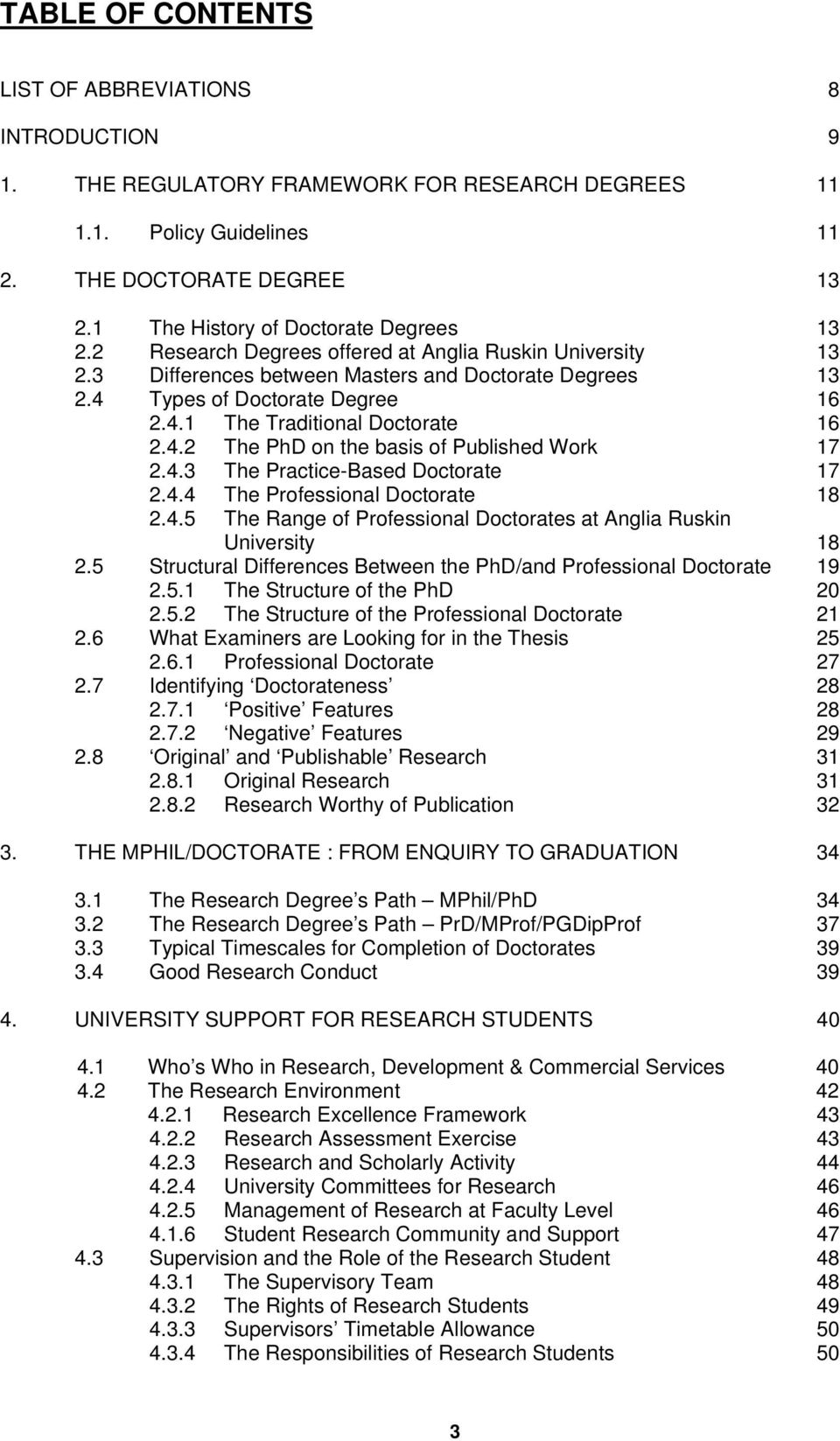
4 TABLE OF CONTENTS LIST OF ABBREVIATIONS 8 INTRODUCTION 9 1. THE REGULATORY FRAMEWORK FOR RESEARCH DEGREES Policy Guidelines THE DOCTORATE DEGREE The History of Doctorate Degrees Research Degrees offered at Anglia Ruskin University Differences between Masters and Doctorate Degrees Types of Doctorate Degree The Traditional Doctorate The PhD on the basis of Published Work The Practice-Based Doctorate The Professional Doctorate The Range of Professional Doctorates at Anglia Ruskin University Structural Differences Between the PhD/and Professional Doctorate The Structure of the PhD The Structure of the Professional Doctorate What Examiners are Looking for in the Thesis Professional Doctorate Identifying Doctorateness Positive Features Negative Features Original and Publishable Research Original Research Research Worthy of Publication THE MPHIL/DOCTORATE : FROM ENQUIRY TO GRADUATION The Research Degree s Path MPhil/PhD The Research Degree s Path PrD/MProf/PGDipProf Typical Timescales for Completion of Doctorates Good Research Conduct UNIVERSITY SUPPORT FOR RESEARCH STUDENTS Who s Who in Research, Development & Commercial Services The Research Environment Research Excellence Framework Research Assessment Exercise Research and Scholarly Activity University Committees for Research Management of Research at Faculty Level Student Research Community and Support Supervision and the Role of the Research Student The Supervisory Team The Rights of Research Students Supervisors Timetable Allowance The Responsibilities of Research Students 50 3
5 4.3.5 The Responsibilities of Supervisors Intermission of Study Complaints Procedure Appeals Procedure Review of an Examination Decision University Research Facilities & Student Services Equality and Diversity Anglia Ruskin University Library Information Technology & Computers Statistical Software & Statistical Analysis Copy Centres Student Counselling Supporting Students with Disabilities Anglia Ruskin Transcription Centre Learning Support Chaplaincy Support for International Students English Language Support for International Students Accommodation Catering Student Money Advice Health Matters, including First Aid Childcare Employment Bureau Careers Guidance Alumni Office Leisure Facilities NATIONAL SUPPORT FOR RESEARCH STUDENTS National Postgraduate Committee Postgraduate Studentships Vitae Research Councils UK Graduate Prospects The Graduate Junction Leadership Development of Principal Investigators European Charter for Researchers and The Code of Conduct for the Recruitment of Researchers FROM ENQUIRY TO APPROVAL Enquiry Registration Fee Waiver Your Receipt and Registration Period Re-registration International Research Students and the new UK Immigration Regulations Approval Anglia Ruskin University s Research Degrees Committee System Preparing the Research Proposal Types of Award Ethics Approval Health & Safety Requirements Research Training: Agreeing a Programme Submission of the Research Proposal 82 4

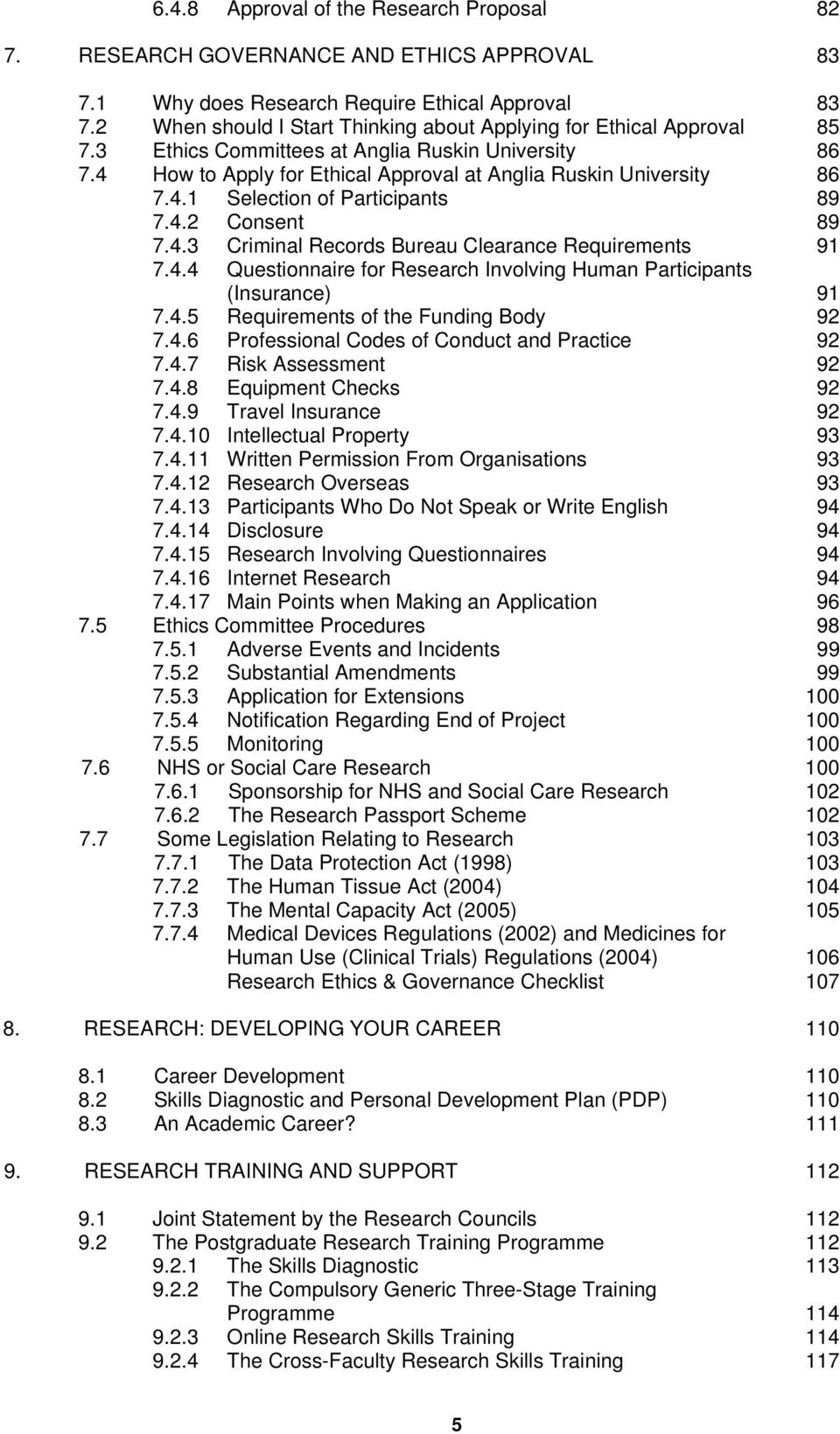
6 6.4.8 Approval of the Research Proposal RESEARCH GOVERNANCE AND ETHICS APPROVAL Why does Research Require Ethical Approval When should I Start Thinking about Applying for Ethical Approval Ethics Committees at Anglia Ruskin University How to Apply for Ethical Approval at Anglia Ruskin University Selection of Participants Consent Criminal Records Bureau Clearance Requirements Questionnaire for Research Involving Human Participants (Insurance) Requirements of the Funding Body Professional Codes of Conduct and Practice Risk Assessment Equipment Checks Travel Insurance Intellectual Property Written Permission From Organisations Research Overseas Participants Who Do Not Speak or Write English Disclosure Research Involving Questionnaires Internet Research Main Points when Making an Application Ethics Committee Procedures Adverse Events and Incidents Substantial Amendments Application for Extensions Notification Regarding End of Project Monitoring NHS or Social Care Research Sponsorship for NHS and Social Care Research The Research Passport Scheme Some Legislation Relating to Research The Data Protection Act (1998) The Human Tissue Act (2004) The Mental Capacity Act (2005) Medical Devices Regulations (2002) and Medicines for Human Use (Clinical Trials) Regulations (2004) 106 Research Ethics & Governance Checklist RESEARCH: DEVELOPING YOUR CAREER Career Development Skills Diagnostic and Personal Development Plan (PDP) An Academic Career? RESEARCH TRAINING AND SUPPORT Joint Statement by the Research Councils The Postgraduate Research Training Programme The Skills Diagnostic The Compulsory Generic Three-Stage Training Programme Online Research Skills Training The Cross-Faculty Research Skills Training 117 5
7 9.2.5 Faculty Subject-Specific Training The Additional Skills Training Programme Understanding Research Training Programme Introduction to Research Ethics and Governance Introduction to RefWorks Bibliographic Management Software Introduction to Statistics Introduction to Statistical Package for the Social Sciences Project Management Sessions Designing Your Research Poster Learning and Teaching in Practice Professional Doctorate Workshops Annual Research Student Conference Support for International Students Welcome Days for International Students Spring Training Week External Training Events HEALTH AND SAFETY REQUIREMENTS Using Display Screen Equipment Manual Handling Accident Reporting System Fire Emergency Procedures Children and Young Persons on the Premises Further Information MONITORING YOUR PROGRESS Annual Review Meetings The Online Annual Monitoring Process Completed Forms Annual Monitoring Report Feedback CONFIRMATION OF APPROVAL AS A DOCTORAL CANDIDATURE/TRANSFER FROM MPHIL to PhD THE WRITING UP STAGE THE THESIS Preparation and Submission of the Thesis Identifying Examiners and Seeking RDSC Approval Stage Three Training Technical Specifications of the Thesis Citing Electronic Sources The Abstract Format of the Thesis Arrangements for Submission of the Thesis Preparing for the Viva VIVA VOCE The Viva Voce Examination The Outcome Re-examinations Review of an Examination Decision Final Award 137 6

8 15.5 Graduation Wider Reading on the Viva Voce MANAGEMENT OF INTELLECTUAL PROPERTY RIGHTS USEFUL BACKGROUND PAPERS, WEB LINKS & TEXTS Background Papers & Web Links Some Relevant Texts for Doctoral Candidates 141 APPENDICES: 1. Research Supervision: Notes of a Meeting Auditing Your Thesis Joint Statement of the Research Councils Skills Training Requirements for Research Students, Skills Diagnostic Template Checklist for Supervisors for Meeting with New Research Degree Students The Policy on Intellectual Property,

9 LIST OF ABBREVIATIONS/ACRONYMS ANET Anglia Ruskin University On-line Community AO Academic Office ARRO Anglia Ruskin Research Online our Institutional Repository CRB Criminal Records Bureau CMT Anglia Ruskin University Corporate Management Team EEA European Economic Area FHEQ Framework for Higher Education Qualifications (QAA, 2001) FREP Faculty Research Ethics Panel FRDSC Faculty Research Degrees Subcommittee HEFCE Higher Education Funding Council for England ISMS Information Systems and Media Services MPhil Master of Philosophy MProf Professional Masters NHS REC National Health Service Research Ethics Committee NPC National Postgraduate Committee PDP Personal Development Planning PGDipProf Postgraduate Diploma in Professional Research PhD Doctor of Philosophy PrD Professional Doctorate RAE Research Assessment Exercise RC Research Committee RCUK Research Councils UK RDSC Research Degrees Subcommittee RDCS Research, Development & Commercial Services REF Research Excellence Framework (the last Research Assessment Exercise was undertaken in 2008; the next exercise is the REF in 2014) RESC RM QAA UKBA Vitae Research Ethics Subcommittee Risk Management Quality Assurance Agency UK Border Agency This national body, funded by RCUK incorporates the former UK GRAD and UKHERD. 8

10 INTRODUCTION This handbook aims to offer generic guidance and assistance to all postgraduate research students at Anglia Ruskin University who are engaged in research leading to the PGDipProf, MProf, MPhil, PhD and Professional Doctorate awards. While it may not be able to answer every question that you will face as a student over the period of your research, it provides key information about aspects which will be of importance to you and should be read in conjunction with the: Research Degrees Regulations, Eleventh Edition, revised July 2010 incorporating the Senate Code of Practice on Postgraduate Research Programmes. Please see Senate Code of Practice on Postgraduate Research Programmes Procedural document for Fifth Edition, revised October Please see These were the current versions at the time of going to press. The websites for the Research Degrees Regulations and the Senate Code of Practice on Postgraduate Research Programmes Procedural document have the most up-to-date version. This handbook covers procedural, pedagogic and pastoral aspects and is divided into fifteen sections that, collectively, seek to explain different aspects of the research student experience: Section 1 provides an overview of the regulatory framework within which research degrees operate, externally and within Anglia Ruskin University. Section 2 discusses, in some detail, the key features of a doctorate and how it is distinguished from a Masters research degree, for example, the MPhil or MProf. It also discusses the differences between the PhD and Professional Doctorate. Section 3 details the research degree s path for both MPhil/PhD and the Professional Doctorate programmes, from enquiry to graduation. Section 4 defines your role as a research student and the support you can expect from Anglia Ruskin University in terms of supervision and research facilities, together with information about more general University support. Section 5 gives details of organisations that provide support for research students nationally. Section 6 details the process from initial student enquiry to approval of the proposed research. Please note that research approval requires, where appropriate, ethics approval see Section 7. Section 7 looks at the process of ethics approval of the proposed research. Section 8 focuses on your career development and explains the function of the skills diagnostic in identifying those research skills that you wish to enhance. Section 9 provides information about research training offered within Anglia Ruskin University. Section 10 looks at Health & Safety requirements. Section 11 details Monitoring Your Progress. 9
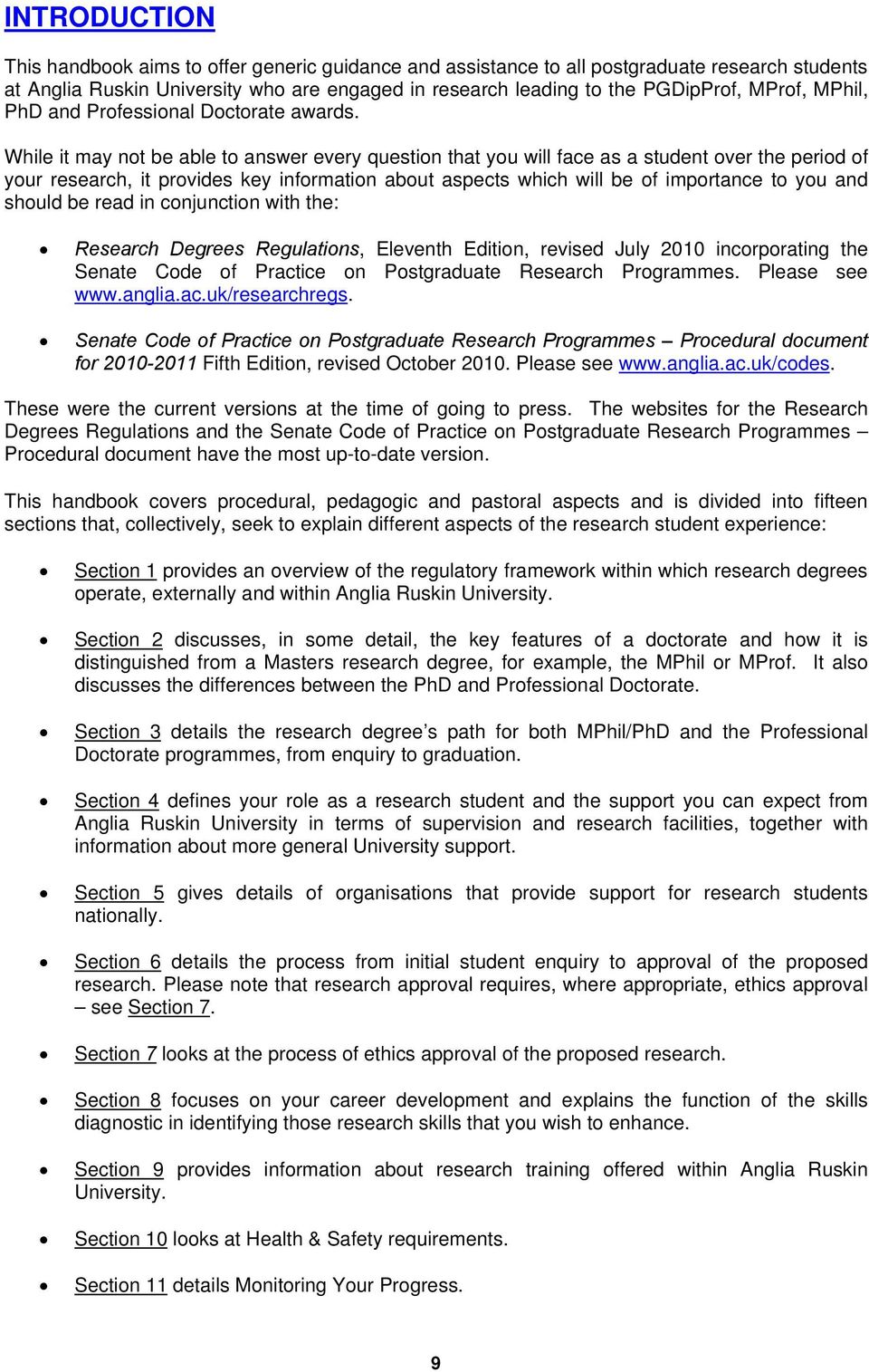
11 Section 12 concerns the confirmation of candidature for the doctorate and the transfer from masters to the doctorate process. Section 13 provides information on the Writing Up Stage. Sections 14 and 15 focus on the thesis and the viva voce respectively. Section 16 looks at issues relating to the management of intellectual property rights. Finally, Section 17 provides details of useful background reading and web links. 10

12 1 THE REGULATORY FRAMEWORK FOR RESEARCH DEGREES 1.1 Policy Guidelines The Quality Assurance Agency (QAA), within its Academic Infrastructure, provides guidance on the level of master s and doctorate awards, whilst the Code of Practice contains precepts relating to postgraduate research programmes. An introduction to the QAA may be found at The QAA Code of Practice for Postgraduate Research Programmes is available at: The code contains guidance across a range of key areas and these will be referred to within the handbook at appropriate points. Within Anglia Ruskin University this guidance is reflected in the key documents: Research Degrees Regulations, Eleventh Edition, revised July 2010 incorporating the Senate Code of Practice on Postgraduate Research Programmes. Senate Code of Practice on Postgraduate Research Programmes Procedural document for Fifth Edition, revised October These documents contextualize the QAA framework levels and Code of practice precepts within Anglia Ruskin University. They also reflect a range of external and internal reference points such as the Roberts Review, 2002; HEFCE s work on threshold standards for research degree programmes, HEFCE 03/23; the UK Council for Graduate Education s Developing good practice in research degrees delivery, 2004; The Research Councils UK Joint Skills Statement, In September 2010, Vitae published the new Researcher Development Framework, see RDF.html. As described by Vitae, the Framework is a tool for planning, promoting and supporting the personal, professional and career development of researchers in higher education. It describes the knowledge, skills, behaviours and personal qualities of researchers and encourages them to aspire to excellence through achieving higher levels of development. The Framework has an associated Researcher Development Statement that is an evolution of the Joint Skills Statement. During we shall be preparing to implement the new Researcher Development Statement, please see within the Skills Diagnostic. The Research Degrees Regulations are sent to research students, supervisors, examiners, chairs of examinations and members of Anglia Ruskin University s Research Committee, Research Degrees Subcommittee and Faculty Research Degrees Subcommittees. The Regulations are available at: Copies are also available from the Research Degrees Unit in the Academic Office. The Senate Code of Practice contains information relating to the award of MPhil, PhDs, PhDs awarded on the basis of published work, Professional Doctorates, Professional Masters, the Postgraduate Diploma in Professional Research and Anglia Ruskin University s Research Diploma. The Procedural Document (please see 11

13 that accompanies the Senate Code of Practice, sets out the detailed procedural arrangements for Postgraduate Research Degrees. These documents, taken together with this Research Student Handbook, make clear the environment that Anglia Ruskin University wishes to create for the support of students undertaking research. 12

14 2 THE DOCTORATE DEGREE 2.1 The History of Doctorate Degrees The UK Council for Graduate Education (2002) points out that: 1.3 Doctorates mark the highest level of achievement gained by a student within universities. As such they have been awarded by universities since the thirteenth century. For much of their history the practice was to award Doctorates in specific subject areas (Doctor of Law, Doctor of Theology), but by the early nineteenth century a new award, the Doctorate of Philosophy (PhD or DPhil), emerged to recognise distinction in research as opposed to distinction in scholarship. 1.5 Other important trends have become apparent in the last quarter of the twentieth century. The intellectual demands of a whole range of jobs have grown. 1.6 The alternative forms of doctoral education, of which Professional Doctorates are one example, have been developed as a positive response to an identified need, whether of industry and commerce, or the public sector. (The UK Council for Graduate Education, 2002, pp10 12) 2.2 Research Degrees offered at Anglia Ruskin University Anglia Ruskin University offers the following higher degrees by research: Research Diploma Master of Philosophy (MPhil) Doctor of Philosophy (PhD) PhD by Published Work Professional Doctorate in Business Administration (DBA) Professional Doctorate in Education (EdD) Professional Doctorate in Health and Social Care (PrD) Professional Doctorate in Built Environment (PrD) Professional Doctorate in Practical Theology (PrD) Professional Doctorate in Laws (LLD) Professional Masters (MProf) Postgraduate Diploma in Professional Research (PGDipProf) As you start your research studies it is important that you are clear about the requirements of the research qualification for which you have registered; also, that you understand the differences between specific awards. 2.3 Differences between Masters and Doctorate Degrees In reflecting the Code of Practice for the Assurance of Academic Quality and Standards in Higher Education: Postgraduate Research Programmes as laid down by the Quality Assurance Agency for Higher Education, (available at: for the award of a doctorate, candidates must demonstrate that they have mastered a special field and made an original personal contribution to the understanding of a problem, or to the advancement of knowledge or to the generation of new ideas. It is also necessary to demonstrate a deep understanding and awareness of the background to the subject. 13
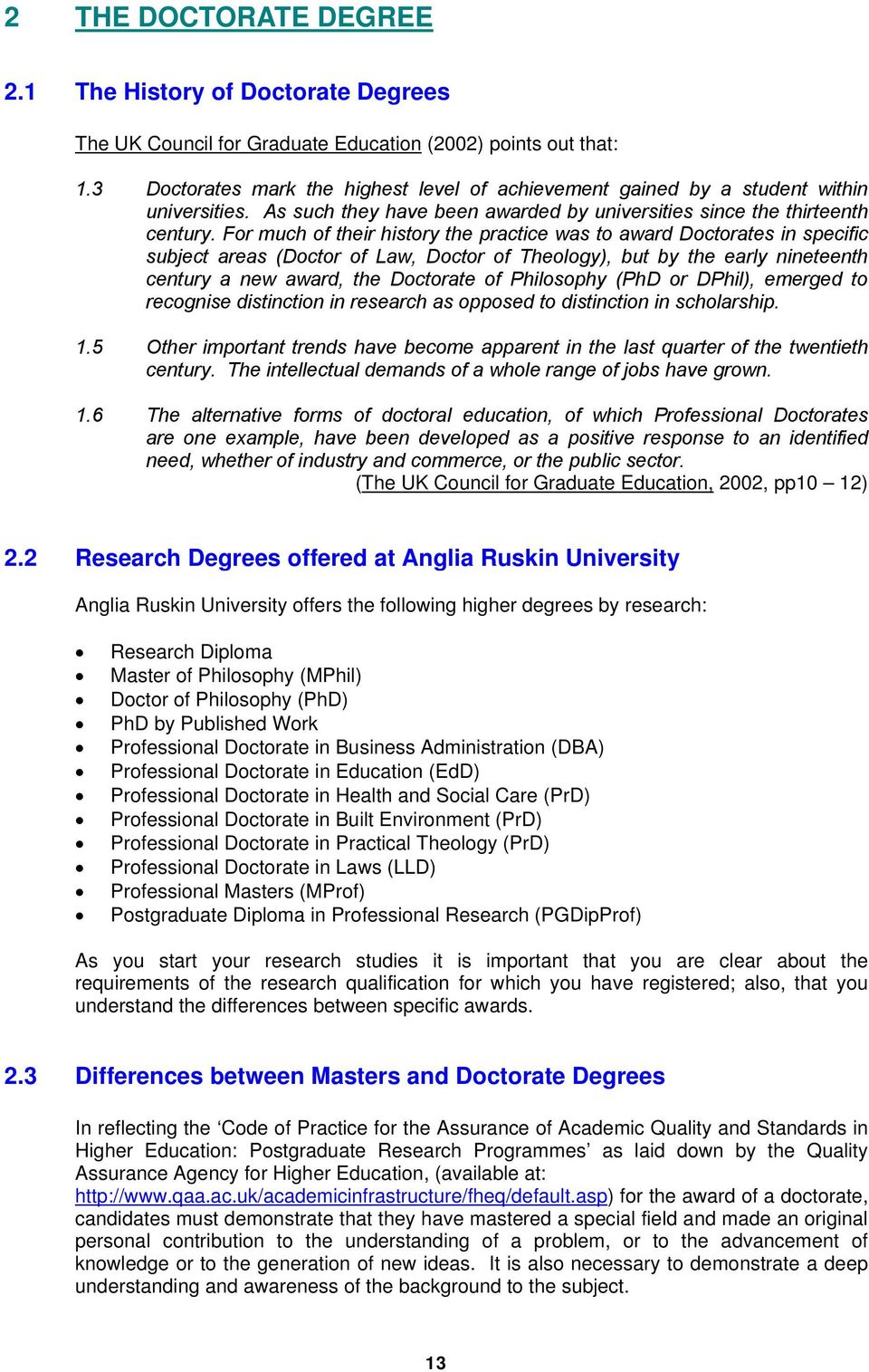
15 This is reflected in Part A Section 1.6 of Anglia Ruskin University s Research Degrees Regulations, revised July 2010, that state: A doctoral degree shall be awarded to a candidate who, having critically investigated and evaluated an approved topic resulting in an independent and original contribution to knowledge and demonstrated an understanding of research methods appropriate to the chosen field, has presented and defended a thesis by oral examination to the satisfaction of the examiners. The Masters differs from the Doctorate in terms of the depth of study required and the extent of the personal contribution to knowledge. Competence in conducting an independent enquiry is required, as well as in the use of appropriate research methods and techniques. It is also necessary to demonstrate satisfactory background knowledge of the subject. As Part A Section 1.5 of the Research Degrees Regulations, revised July 2010, state: The MPhil shall be awarded to a candidate who, having critically investigated and evaluated an approved topic and demonstrated an understanding of research methods appropriate to the chosen field, has presented and defended a thesis by oral examination to the satisfaction of the examiners. Guidance on the Doctoral and Masters levels is provided in The Framework for Higher Education Qualifications in England, Wales and Northern Ireland (FHEQ), August 2008, QAA. The Doctoral Level The Framework for Higher Education Qualifications (QAA, 2008) states that: Doctoral degrees are awarded for the creation and interpretation, construction and/or exposition of knowledge which extends the forefront of a discipline, usually through original research. Holders of doctoral degrees will be able to conceptualise, design and implement projects for the generation of significant new knowledge and/or understanding. Holders of doctoral degrees will have the qualities needed for employment that require both the ability to make informed judgements on complex issues in specialist fields and an innovative approach to tackling and solving problems. Descriptor for a higher education qualification at level 8: Doctoral degree Doctoral degrees are awarded to students who have demonstrated: the creation and interpretation of new knowledge, through original research or other advanced scholarship, of a quality to satisfy peer review, extend the forefront of the discipline, and merit publication a systematic acquisition and understanding of a substantial body of knowledge which is at the forefront of an academic discipline or area of professional practice 14

16 the general ability to conceptualise, design and implement a project for the generation of new knowledge, applications or understanding at the forefront of the discipline, and to adjust the project design in the light of unforeseen problems a detailed understanding of applicable techniques for research and advanced academic enquiry. Typically, holders of the qualification will be able to: make informed judgements on complex issues in specialist fields, often in the absence of complete data, and be able to communicate their ideas and conclusions clearly and effectively to specialist and non-specialist audiences continue to undertake pure and/or applied research and development at an advanced level, contributing substantially to the development of new techniques, ideas or approaches. And holders will have: the qualities and transferable skills necessary for employment requiring the exercise of personal responsibility and largely autonomous initiative in complex and unpredictable situations, in professional or equivalent environments. The Masters Degree (Level 7) The FHEQ (2008) states that: Much of the study undertaken for master s degrees will have been at, or informed by, the forefront of an academic or professional discipline. Students will have shown originality in the application of knowledge, and they will understand how the boundaries of knowledge are advanced through research. They will be able to deal with complex issues both systematically and creatively, and they will show originality in tackling and solving problems. They will have the qualities needed for employment in circumstances requiring sound judgement, personal responsibility and initiative, in complex and unpredictable professional environments. Descriptor for a higher education qualification at level 7: Master s degree Masters Degrees are awarded to students who have demonstrated: a systematic understanding of knowledge, and a critical awareness of current problems and/or new insights, much of which is at, or informed by, the forefront of their academic discipline, field of study, or area of professional practice a comprehensive understanding of techniques applicable to their own research or advanced scholarship originality in the application of knowledge, together with a practical understanding of how established techniques of research and enquiry are used to create and interpret knowledge in the discipline conceptual understanding that enables the student: o to evaluate critically current research and advanced scholarship in the discipline o to evaluate methodologies and develop critiques of them and, where appropriate, to propose new hypotheses. 15

17 Typically, holders of the qualification will be able to: deal with complex issues both systematically and creatively, make sound judgements in the absence of complete data, and communicate their conclusions clearly to specialist and non-specialist audiences demonstrate self-direction and originality in tackling and solving problems, and act autonomously in planning and implementing tasks at a professional or equivalent level continue to advance their knowledge and understanding, and to develop new skills to a high level. And holders will have: the qualities and transferable skills necessary for employment requiring: o the exercise of initiative and personal responsibility o decision-making in complex and unpredictable situations o the independent learning ability required for continuing professional development. 2.4 Types of Doctorate Degree At Anglia Ruskin we offer the Traditional Doctorate, PhD, the Practice-Based Doctorate, PhD and the Professional Doctorate, PrD. Figure 1 outlines one difference between the PhD and PrD Traditional Doctorate and Practice-Based Doctorate Professional Doctorate Starting point for the research Theory Practice Practice Theory Theory Practice Figure 1: Theory Practice Sequences in Doctoral Programmes The Traditional Doctorate Generally, the candidate identifies an area where significant new knowledge/ understanding may be generated. Please note that for funded research and in some disciplines, for example, science and engineering, the sponsor/supervisor may identify the area to be researched. Having identified your intellectual problem ( gap in knowledge ), the research question(s)/hypothesis is established. The framework for undertaking the research is then formulated. The field work, which may, for example, be data collection, analysis of records, accounts, papers etc., recording of interviews, experiments, is undertaken and findings are analysed. In drawing conclusions, reference is made back to 16

18 the original research question/hypothesis. A critical reflection on the contribution to knowledge is required. Successful doctoral candidates are expected to have undertaken research worthy of refereed publication. Candidates who have published research over several years may wish to consider the route to a PhD based on published works. There are differences in the two approaches to a PhD - while the PhD is based typically on a supervised programme of research and the submission of a traditional dissertation, the PhD by Published Work is based upon research leading to a number of coherent publications, each of which has been subjected to peer review (Powell, 2004) PhD on the basis of Published Work Candidates who have published work, normally within the last ten years, that demonstrates an independent and original contribution to knowledge and an understanding of research methods, may apply to establish a prima facie case for the award of a PhD or MPhil. The Research Degrees Regulations, July 2010, Part B, give the principles and procedures for the submission of a PhD on the basis of Published Work. Although this route to a PhD was introduced relatively recently in the UK, as Powell (2004) states - the concept of having a PhD submission wholly or largely based on published works has existed since the nineteenth century when in Germany it was a requirement of doctoral dissertations that they be printed and copies placed in all national university libraries The Practice-Based Doctorate Practice-Based Doctorates 'include practice as an integral component (or theorise that practice), in relation to its research questions, issues or problems, its outputs and outcomes, and crucially its research methods or approaches, thereby generating new or enhanced knowledge and understanding in the discipline' (Arts and Humanities Research Council (AHRC) guidance on practice-led and applied research eligible for research funding). The practice-based doctorate advances knowledge partly by means of practice. An original/creative piece of work is included in the submission for examination. It is distinct in that significant aspects of the claim for doctoral characteristics of originality, mastery and contribution to the field are held to be demonstrated through the original creative work. Practice-based doctoral submissions must include a substantial contextualisation of the creative work. This critical appraisal or analysis not only clarifies the basis of the claim for the originality and location of the original work, it also provides the basis for a judgement as to whether general scholarly requirements are met. This could be defined as judgement of the submission as a contribution to knowledge in the field, showing doctoral level powers of analysis and mastery of existing contextual knowledge, in a form which is accessible to and auditable by knowledgeable peers. UK Council for Graduate Education (UKCGE) (1997). Creative work must be accompanied by a written component, the length of which should fall within the boundaries established by the research degrees regulations and be negotiated and approved at the research-proposal stage. Such written work must conform to the requirements of a thesis at the doctoral level. 17
19 2.4.4 The Professional Doctorate This moves in a different way. Candidates undertake research in the workplace, with the aim of enhancing understanding of - and making a difference to - practice. Starting from contemporary practice that surrounds the candidate, research is expected to draw on theory to assist in explaining and understanding practice. Such a view is in the Elliott (1991) tradition of giving action research the primary imperative of improving practice. Thus, the professional doctorate sandwiches theory between practice, thereby drawing the evidence from the reality of the researcher s own place of employment (Woolliams, 1997). Locating the professional doctorate in this tradition places it clearly in the scholarly area of what Middlewood, Coleman and Lumby (1999) term making a difference. They highlight a significant emphasis in this type of award. Whilst it is possible that findings from PhD research may make a difference to practice through dissemination, this is not necessarily a prerequisite of the traditional PhD. In the professional doctorate it is the critical factor that provides uniqueness among approaches to doctoral study. At the national level, different models have emerged among British universities that have loose affiliations to practitioner research. The Anglia Ruskin doctoral programmes are explicit in locating improvements to practice, as being absolutely central to the recruitment, delivery and assessment processes of this type of research The Range of Professional Doctorates at Anglia Ruskin University Each Faculty has at least one Professional Doctorate (PrD) programme. The educational philosophy for each programme is given below: The PrD in the Built Environment The rational and demand for a new form of doctorate in the Department of the Built Environment at Anglia Ruskin University stemmed from concern that the conventional parttime route and the nature of the PhD, does not always meet the needs of either the candidates or their employers. A new approach, tailored to the needs of professional practice, was needed. The Professional Doctorate is therefore specifically designed and tailored for senior professionals who wish to study at doctoral level and who work in organisations that appreciate the benefits that accrue from this special form of education. The PrD in Business Administration (the DBA) The DBA offers a route to a doctorate degree that is different from the traditional PhD. The DBA places a high value on the transferability of research findings to and from the workplace, which is recognised as both the field for, and the beneficiary of, high quality research. Rather than add to their traditional workload, candidates should seek to integrate and diffuse their doctoral studies within their professional context. The DBA is primarily designed therefore to enable a significant contribution to be made to the enhancement of professional practice in the business area through the application and development of theoretical frameworks. The PrD in Education (the EdD) The rationale for the EdD stems from (i) the professional nature of the programmes that the Faculty of Education has traditionally been offering at undergraduate and Masters level and (ii) the nature of research undertaken by the academic staff and researchers in the Faculty. It is also informed by the wider debate in the field and acknowledgement that research should be both informed by and contribute to improving professional practice. The overall structure of the Professional Doctorate framework and specific requirements of the EdD offers supportive cohort-based, flexible, blended and work-based learning. The PrD in Health and Social Care The Faculty of Health and Social Care offers the Professional Doctorate programme because the focus on problem-solving/research is one that not only promotes practitioner 18
20 research per se, but engages practitioners in research related to an issue that is applicable to the employing organisation. The importance of the role of the mentor and the organisational approval of the project is reflected in this research programme. The focus on organisational development is viewed as being of particular relevance to concepts of practitioner research within health and social care. The PrD in Laws (the LLD) The Professional Doctorate in Laws programme is designed for senior legal professionals, managers and administrators, working at mid- or late-career in private practice, the judiciary, court service or other law-related bodies, both in the UK and other countries. A study commissioned by the Nuffield Foundation, and authored by Law Professors Dame Hazel Genn, Martin Partington and Sally Wheeler, Law in The Real World: Improving Our Understanding of How Law Works (2006) identified a shortage in the field of empirical legal research, which it defined as the study through direct methods of the operation and impact of law and legal processes in society. The report considered that such research was crucial in revealing and explaining the practice and procedures of legal, regulatory, redress and dispute resolution processes and how these affect government, businesses and citizens. It found that UK law schools were historically dominated by theoretical and textbased doctrinal research, which often appeared to be self-replicating, and that academic researchers lacked the appropriate research skills in empirical and trans-disciplinary areas. The recent growth of the Socio-Legal Studies Association (SLSA) supports the argument of the Nuffield report about the role of empirical legal research. This report thus opens a research area that is well suited to the PrD model of doctoral research. The PrD in Practical Theology Practical Theology, in its more historically recent sense, denotes theology based explicitly on the methodology of dialectical relationship between theory and practice. The theory is multidisciplinary, and will be drawn both from traditional religious texts or disciplines of enquiry and from secular sources of knowledge, particularly the human sciences. The practice is normally in an area which involves pastoral work, for example hospital chaplaincy, adult education or community development. It involves critical reflection on practice through empirical research and hermeneutical reflection. Practical Theology is a subject which lends itself well to treatment within a Professional Doctorate framework as it is a branch of theology which a) is epistemologically committed to viewing practice as disclosive of understanding/truth, b) is methodologically committed to the dialectic between reflection and action, c) is rooted for its subject matter in issues of practice, and d) is of interest to people operating in a wide range of professional capacities, who wish to develop as reflective professionals. A Professional Doctorate works from practice to theory to practice. Within the discipline of Practical Theology it is important to both develop and differentiate between traditional PhD work, which takes a more theoretical overview of the discipline, and particular practice oriented research, which is well served by the Professional Doctorate. We envisage the professional doctoral research as contributing in three areas, namely to the organisation from which the candidate comes, to the way in which a typical person in the candidate s context would develop good practice, and to individual growth through the programme. 2.5 Structural differences between the PhD and Professional Doctorate All doctoral students are advised to heed the advice given by Cipolla (1995) to PhD students: students (must) realise that original research contributions come about after diligent review, concentration and analysis. The world is your oyster and in research 19

21 everything is up for grabs. ``Caminante no hay camino. Se hace camino al andar'' (Traveller, there are no paths. Paths are made by walking). Whilst all doctorate programmes have parity in terms of the level of the final award, they differ in focus and delivery. A helpful discussion on the doctorate and making a choice between the PhD and the Professional Doctorate is given in Wellington et al. (2005), Part The Structure of the PhD Features of the traditional doctorate include: that it is an award made usually for original research. This research can take many forms, that include (Phillips & Pugh, 2000): carrying out empirical work that has not been undertaken before making a synthesis that has not previously been undertaken using existing material but with a new and different interpretation trying out something in this country that has previously only been done in other countries taking a particular technique and applying it in a new area (see Phillips & Pugh, 2000, pp for their full list). recruitment is undertaken on an individual or cohort basis and, although the student will have two or more supervisors, the research is generated by the individual, sometimes working in isolation distinct differences between students researching in science and those in social sciences and humanities. In science, research tends to be closely linked to the work of the research organisation or specialist research group, while in the social sciences and humanities the research is generally done on a more autonomous basis (see Taylor & Beasley, 2005, pp34 37, for a full discussion) that each discipline therefore, inevitably places different expectations and demands on students at different stages. (However, according to Phillips & Pugh (2000) there are four elements to the form of the PhD, which all students will need to master: background theory; focal theory; data theory and contribution.) Background theory: This is achieved by undertaking a literature review which evidences that you have a full grasp of the current state of knowledge of the field being researched Focal theory: This provides the framework to the research itself, establishing hypotheses and thesis Data theory: This justifies the relevance and validity of the material being used to support the thesis Finally, contribution identifies the distinct way in which the research undertaken has added to understanding in the field or discipline, in particular how background and focal theory are now different as a result of the study The time-scale over which these four elements are achieved will vary but normally will occur over a period of three years (or six years, if you are studying part-time). evidence that you, as a holder of a doctorate, have gained the expertise of a professional researcher In Planning a Doctorate Schedule for Success, UK Grad (2008) identifies a series of key steps to help the Doctorate researcher keep on track. These include: 20
22 comprehensive planning early on agreeing a general timeline with your supervisor and setting specific milestones against which to measure progress reviewing milestones regularly and breaking tasks down into manageable activities. The value of good planning is highlighted by Wisker (2001, p231), so that as you are writing you are: keeping good notes of sources, methods, results and data talking and thinking through drafts of chapters writing up drafts of chapters altering your work in the light of comments from your supervisor(s) The Structure of the Professional Doctorate During our Professional Doctorate programmes, except for the recently validated PrD in Practical Theology, were revalidated and a new PrD in Laws (the LLD) was validated. All our PrDs have a common framework, see Figure 2, that includes award titles of Postgraduate Diploma in Professional Research (PGDipProf) and Professional Masters (MProf). Depending on the Professional Doctorate programme, each award may be studied as a qualification in its own right. For all programmes, however, the MProf or PGDipProf may be awarded, as appropriate, to recognise the achievements of students who have to withdraw from the Professional Doctorate or have not met the requirements for the award of a Professional Doctorate. The common aims and assessment criteria for each of the three awards are given in the Professional Doctorate handbook for each programme. Stage 1 of the Professional Doctorate programme involves workshops and seminars on methodology and research design and leads to the preparation of papers totalling a maximum of 21,000 words. The role of Stage 1 is to structure and build up the candidate s ability to reflect on and examine critically practice at an advanced level, to develop an understanding of techniques and/or methodologies applicable to practitioner research, to deepen candidate s understanding of their professional practice, and enable candidates to design a research project that is capable of generating new knowledge and understanding of professional practice. At this stage, candidates are supported by an academic advisor. Upon successful completion of Stage 1, candidates may progress to Stage 2 of the programme or be awarded the Postgraduate Diploma in Professional Research. In Stage 2, candidates undertake original research resulting in a thesis. For the Professional Masters, candidates will be expected to display academic rigour and the capacity to produce publishable work. In advancing their understanding and practice within their profession, candidates will develop an awareness of research as a vehicle to integrate theory and practice. Some originality in the application of knowledge or methodology is expected at this level. Professional Doctorate candidates are required to have conducted original research or other advanced scholarship that satisfies peer review and extends the forefront of the 21
23 discipline. Within the thesis and at the viva, candidates will demonstrate a critical and contextually appropriate application of techniques for original research, effective communication, critical and independent reasoning appropriate to advanced academic enquiry. The assessment criteria for each award are given in Section 8, Part C of the Research Degrees Regulations, July Prospective students for the Professional Doctorate programme who do not have any experience of research are required to undertake and pass an introductory Understanding Research training programme. This has been designed specifically for PrD, MProf and PGDipProf students prior to registration on any of the awards. 22
24 Figure 2 Professional Doctorate Generic Structure Postgraduate Diploma Professional Masters Professional Doctorate Masters Degree and Professional Experience Confirmation Professional Doctorate Research Proposal Transfer Honours Degree and Professional Experience Stage 1 Stage 2 Nonstandard Entry Understanding Research Postgraduate Diploma Professional Masters 23
25 For Professional Doctorate programmes, candidates are usually recruited into cohorts of around 6 15 members whose learning draws upon their respective experiences to complement formal inputs from staff. Professional doctorates differ from the traditional doctorate in focus in that they are involved a priori with professional practice and would expect to show the following characteristics: 1 1. Practitioner-based research demands an integral involvement by the researcher with intent to change the organisation. This intent may not succeed - no change may take place as a result of the intervention - and the change may not be as intended. 2. Practitioner-based research must have some implications beyond those required for action or generation of knowledge in the domain of the project. It must be possible to envisage talking about the theories developed in relation to other situations. Thus it must be clear that the results could inform other contexts, at least in the sense of suggesting areas for consideration. 3. As well as being usable in everyday life, practitioner-based research demands valuing theory, with theory elaboration and development as an explicit concern of the research process. 4. If the generality drawn out of the practitioner-based research is to be expressed through the design of tools, techniques, models and methods then this, alone, is not enough - the basis for their design must be explicit and shown to be related to the theories which inform the design and which, in turn, are supported or developed through practitioner-based research. 5. Practitioner-based research will often be concerned with a system of emergent theory. Here the theory develops from a synthesis of that which emerges from the data and that which emerges from the use, in practice, of the body of theory that informed the intervention and research intent. 6. Theory-building, as a result of practitioner-based research, will be incremental, moving through a cycle of developing theory-to-action-to-reflection-to-developing theory from the particular to the general in small steps. 7. What is important for practitioner-based research is not a (false) dichotomy between prescription and description, but recognition that descriptions will be prescription, even if implicitly so. Thus presenters of practitioner-based research should be clear about what they expect the reader to take from it and present it with a form and style appropriate to this aim. 8. For good quality practitioner-based research a high degree of systematic method and orderliness is required in reflecting about, and holding onto the research data and the emergent theoretical outcomes of each episode or cycle of involvement in the organisation. 9. For practitioner-based research, the processes of exploration of the data - rather than collection of the data - in the detecting of emergent theories and development of existing theories, must either be replicable or, at least, capable of being explained to others. 1 [Based on Chapter 13 from Eden and Huxham, 2002, Management Research, Sage Publications, p269 et seq] 24
26 10. The full process of practitioner-based research involves a series of interconnected cycles, where writing about research outcomes at the latter stages of a practitionerbased research project is an important aspect of theory exploration and development, combining the processes of explicating pre-understanding and methodical reflection to explore and develop theory formally. 11. Adhering to the ten characteristics above is a necessary but not sufficient condition for the validity of practitioner-based research. 12. It is difficult to justify the use of practitioner-based research when the same aims can be satisfied using approaches (such as controlled experimentation or surveys) that can demonstrate the link between data and outcomes more transparently. Thus in practitioner-based research, the reflection and data collection process - and hence the emergent theories - are most valuably focused on the aspects that cannot be captured by other approaches. 13. In practitioner-based research, the opportunities for triangulation that do not offer themselves with other methods should be exploited fully and reported. They should be used as a dialectical device which powerfully facilitates the incremental development of theory. 14. The history and context for the intervention must be taken as critical to the interpretation of the likely range of validity and applicability of the results of practitionerbased research. 15. Practitioner-based research requires that the theory development, which is of general value, is disseminated in such a way as to be of interest to an audience wider than those integrally involved with the action and/or with the research. 2.6 What Examiners are Looking for in the Thesis The examination of any thesis is a time-consuming process that involves high stake assessment. There are a range of possible outcomes from a viva, see section 11, Part A, Research Degrees Regulations, July Submission of a poor quality thesis with inadequate defence at the viva could well result in a failure or the recommendation for resubmission for a lower level award. The Research Degrees Subcommittee permits one re-examination, subject to certain requirements (see Section 11, Research Degrees Regulations, revised July 2010). It is therefore crucial that you do not submit before your supervisors advise you that your thesis is at the doctoral/masters level and capable of being defended at the viva. Examiners are by definition experts in your discipline/area of study, who have not previously been involved in advising you in your studies. Their task is to decide whether your work meets the criteria laid down for awards at this level. Another role of the examiners at the viva is to confirm that the thesis is the candidate s own work. Your thesis needs to satisfy Anglia Ruskin University Research Degrees Regulations, this includes all aspects of structure and presentation, including word length; please see the Research Degrees Regulations, Eleventh Edition, revised July In an address to the University of Canberra Postgraduate Students Association, Professor Arthur Georges, (1996) included the following advice to candidates on the constitution of an excellent thesis. This advice assumes that the research itself meets the requirements and level of the research degree, see section 2.3. It is important to keep the thesis in the right perspective. It is not an end in itself, but rather your attempt to undertake a substantial piece of research as one further step in developing a research career. The thesis should be 25
27 couched in this broader context, for it is from there that the examiners will view it. It pays to keep this in mind. Now for some specifics: IN THE VERY BEGINNING Does the thesis contain a succinct critical review of what is currently known so that the examiner is not left pondering as to how the work fits into the broader scheme of things? Is there sufficient background provided so that the examiner can appreciate the research problems that you are to tackle, and the objectives of the thesis? Have the deficiencies in our current knowledge been clearly identified and the significance of addressing them been established? Has the scope of the current work been clearly articulated so as to avoid a mismatch in the examiner's expectations and what is actually delivered? Have the research objectives been stated with sufficient precision to enable the examiner to assess whether they have been achieved or not? Do the objectives fit comfortably with (a) the critical review, do they arise from (b) the significant deficiencies in our current knowledge or understanding, and do they lie within (c) the scope of the study? Have the principal results and conclusions been stated early, usually in the abstract, so that the examiner knows where the thesis is heading from the very beginning? Do not leave the examiner in the dark. THE WORK ITSELF Are the materials and methods detailed enough to ensure that the work is reproducible? Is the use of novel or non-standard methods or approaches fully justified in a way that convinces the examiner that the candidate is fully conversant with the subject? Is the experimental design clearly articulated and appropriate to the objectives, and are the methods of statistical analysis appropriate? Are the results unequivocal and of substance? Does the thesis make an original contribution to knowledge? THE END GAME Is the significance of the results fully explored in relation to the current literature, especially where the results are at odds with current understanding? 26
28 Are the substantive discussion points brought home with finality? Can the examiner see clearly what the candidate has concluded, before the thesis moves on to the next idea? Has clear ownership of your contribution been established? Are all the linkages between discrete elements of the results brought together where they are relevant to substantive conclusions? The examiner is looking for a synopsis, not a summary. Are all the conclusions and is all of the discussion clearly linked to the results or to the established results of others. Speculation outside the realms of that supported by concrete data has its place, but it should not dominate the discussion. Have all the stated research objectives of the thesis been addressed, regardless of the outcome? Have the avenues for future work opened up by the thesis been clearly articulated? IN THE FINAL ANALYSIS Has the thesis made a substantive original contribution to our knowledge and understanding? Professional Doctorate In considering the thesis of a candidate for a professional doctorate, examiners would expect it to: focus upon the working context of candidates embrace research quests and subsequent research design that originated in professional practice rather than extant theory exhibit an action-based approach to research rather than methodologies that adopt more expansive forms of fieldwork define research boundaries which are small, inclusive and contextually determined by the working context of candidates often draw upon a relatively small sample of respondents provide considered reflections on the intellectual journey of candidates that explain the transfer of learning from the research process to the working context generate conclusions that are evidence-based, conceptually justified and possess the capacity to improve, or have already improved, the professional practice of their working context and/or themselves often provide thick critical and reflective descriptions that invite and enable the reader, rather than candidate, to consider how the findings can be generalised display appropriate evidence of originality and independent judgment 27
29 constitute a contribution to professional practice and exhibit development of professional competencies. 2.7 Identifying Doctorateness This section addresses three critical issues that confront everyone who undertakes doctoral level research. The generally accepted positive features of a doctorate are examined, together with some of the negative features. The presence of these characteristics in research, writing and presentation confirm to examiners that the work is at doctorate level. Please note that the various statements in each category contain considerable overlap. This is inevitable, since they are different ways of considering and presenting the same basic set of thoughts. No single doctoral study would be described by all the statements. However, a successful piece of work would illustrate several statements under each heading in the Positive Features section, and would ideally be free of the weaknesses that are described in the Negative Features section. The lists do not constitute any form of formula-based assessment checklist. It is suggested that you use them to reflect upon the scholastic nature of your work across various dimensions, and to identify areas where improvement may be possible Positive' Features Intellectual Grasp grasps the scope, wider significance and possibilities of the topic shows readiness to examine apparently tangential areas for possible relevance contains a broad theoretical base that is treated critically demonstrates a coherent and explicit theoretical approach fully thought through and critically applied - i.e. noting its limitations provides rigorous analyses that are related to their respective methodological and epistemological contexts shows iterative development, allowing exploration and rejection of alternatives possesses an internal dialogue - plurality of approach/method, to validate the one chosen gives a systematic account of the topic, including a review of all plausible possible interpretations maintains clear and continuous links between theory, method and interpretation presents a reflexive, self-critical account of relationships involved in the inquiry and the methodology connects theory and practice articulates clearly the relationship between research and practitioner roles - from mode two (i.e. problem rather than theory-led) research - such as in professional doctorates 28
30 indicates the future development of the work with a possible research agenda demonstrates full mastery of the topic - that the research student is now an expert in the field. Coherence displays coherence of structure (e.g. the conclusions follow clearly from the data) skilfully organises a number of different angles and perspectives on a given issue is cogently organised and expressed with a definite agenda and an explicit structure presents a sense of the researcher's learning as a journey, as a structured incremental progress through a process of both argument and discovery. Engagement with the Literature displays comprehensive coverage of the field/secure command of the literature in the field shows breadth of contextual knowledge in the discipline successfully critiques established positions engages critically with other significant work in the field draws on literature with a focus different from the viewpoint pursued in the thesis maintains a balance between delineating an area of debate and advocating a particular approach. Grasp of Methodology the methodology is clearly established and applied methodological analysis indicates the advantages AND the disadvantages of the approach adopted uses several methodologies for triangulation. Presentation the thesis is written in a clear style that is easy to read and appropriately presented Negative Features Lack of intellectual grasp lack of a clear distinction between objective and subjective material lack of clear idea of 'data' conclusions stated too early and not brought together dogmatic presupposition of issues failure to follow up and evaluate alternative lines of argument failure to defend properly the validity and generalisation of innovative research methods 29
31 apparent unawareness of the limitations of the work undertaken description rather than theoretical analysis lack of background knowledge - research students should demonstrate a knowledge of the subject which is broader than the actual topic area. Lack of Coherence lack of focus, stated aim, 'tightly managed' structure or coherent argument lack of integrity in research design lack of clearly formulated conclusions ill-justified changes of direction lack of initial focus/conviction pursuit of 'originality' at the expense of control over the material. Poor engagement with the literature uncritical use of references misrepresentation of texts lack of rigour in referencing and bibliography lack of up-to-date knowledge of other research in the field. Lack of originality no original contribution to knowledge no theoretical contribution to the specific field of study, discipline or specialisation 'encyclopaedic' knowledge but no 'personal spark'. Lack of generalisation no discussion of how findings are applicable to other situations no movement beyond questions and findings into making suggestions. Methodological weakness superficial explanation of the research design and conduct of the fieldwork inappropriate statistical analyses 'prejudice' (e.g. gender, class, racial, regional) i.e. unexamined social stereotyping. NB: Be aware that many students confuse methodology with the method(s). Many theses are rejected because the chapter on methodology often ignores methodology and discusses only method and techniques. The main methodological choices in research design are: Researcher is independent v Researcher is involved Large samples v Small samples Testing theories v Generating theories 30
32 Experimental design v Fieldwork methods Verification v Falsification Poor presentation disjointed, unstructured writing badly written 'with no concern for the reader' style too discursive, prolix, obscure or too anecdotal. Clear and helpful advice on writing is given in Badley (2008). NB: It is important that you ensure that your thesis is spell-checked and that pagination is co-incident with the contents page listing. 2.8 Original and Publishable Research These two terms are often used as the fundamental 'criteria' for doctoral level research. This section provides guidance on how they may be interpreted in different research contexts, methodologies and disciplines. 'Publishable' and 'originality' are (or ought to be) linked concepts. This suggests that PhD and professional doctorate theses: ought to be a report of work which others would want to read ought to tell a compelling story articulately and pre-empt inevitable critiques ought to carry readers into complex realms, where they are informed and educated ought to be sufficiently speculative or original to command respectful peer attention Original Research makes an original contribution to knowledge or understanding of the subject, in topic area, in method, in experimental design, in theoretical synthesis, or engagement with conceptual issues pushes the topic into new areas - beyond its obvious focus solves some significant problem or gathers original data or re-frames issues is imaginative and creative - yet rigorous - in its approach to problems goes beyond its sources to create a new position which critiques existing theoretical positions uses the empirical study to enlarge the theoretical understanding of the subject contains innovation, speculation, imaginative reconstruction, cognitive excitement - the research student has clearly wrestled with the method, trying to shape it in order to gain new insights is comprehensive in its theoretical linkages or makes novel connections between areas of knowledge 31
33 opens up neglected areas or takes a new viewpoint on an old problem shows something new must have been learned and demonstrated, such that the reader is made to re-think a stance or opinion shows 'a spark of inspiration as well as perspiration' shows development towards independent research and innovation is innovative in content and adventurous in method, obviously at the leading edge in its particular field, with potential for yielding new knowledge contains innovative insights upon the research issue(s) shows clear evidence of professional development and innovation, where appropriate contains detailed description of a very high level of professional creativity, sensitivity and responsibility makes a personal synthesis of an interpretive framework shows depth and breadth of scholarship - synthesising previous work and adding original insights/models/concepts or new frameworks for interpreting the research phenomena - perhaps arguing against conventional views applies established techniques to novel patterns, or devises new techniques which allow new questions to be addressed meets the subject area requirements of the journal/conference audience Research Worthy of Publication Research that publishers will wish to include in, for example, peer-reviewed journals/conference publications must demonstrate the features outlined in section on original research. The research output must be written with an awareness of the audience for the work. The paper must also conform to the publisher s requirements. When writing your paper, aim for clarity and a concise style appropriate for your discipline. Further helpful advice can be found in Hartley, J. (2008) Academic Writing and Publishing, Murray, R. (2000) Writing for Academic Journals and Rumsey, S. (2005) How to find information, a guide for researchers. Section References Badley, G (2008) Write a Lot Better. Anglia Ruskin University. Available at Cipolla, R. (1995) Guidelines on PhD Research and Supervision. Available online at (accessed 20 August 2008) Dunleavy, P. (2003) Authoring a PhD. Basingstoke: Palgrave Macmillan. ISBN: Elliott, J. (1991) Action Research for Educational Change. Milton Keynes: Open University Press. 32
34 Georges, A. (1996) The Research Thesis: What Examiners Look For. Available online at (accessed 20 August 2008) Hartley, J. (2008) Academic Writing and Publishing, A Practical Handbook. London and New York: Routledge. ISBN: Middlewood, D. et al. (1999) Practitioner Research in Education, Making a Difference. London: Sage Publications. Murray, R. (2000) Writing for Academic Journals. Maidenhead: Open University Press. Phillips, E. M. and Pugh, D. S. (2000) How to get a PhD. A handbook for students and their supervisors. Third Edition Buckingham: Open University Press. Powell, S.D. (2004) The Award of PhD on the Basis of Published Work in the UK. UKCGE Rumsey, S. (2005) How to find information, a guide for researchers. Maidenhead: Open University Press. Taylor, S. & Beasley, N. (2005) A Handbook for Doctoral Supervisors. London & New York: Routledge. UK Council for Graduate Education (UKCGE) (2002) Professional Doctorates. Dudley: UK Council for Graduate Education. Vitae Project Management. Available at: Wellington, J., Bathmaker, A., Hunt, C., McCulloch, G.and Sikes, S. (2005) Succeeding with your Doctorate, London: Sage Publications Wisker, G. (2001) The Postgraduate Research Handbook. Basingstoke: Palgrave. Woolliams, P. (1997) Iterations within doctorate programmes. Postgraduate Innovations Conference. London: Association of Business Schools. 33
35 3 THE MPHIL/DOCTORATE: FROM ENQUIRY TO GRADUATION 3.1 The Research Degree s Path - MPhil/PhD Admission Compulsory Research Training Programme Annual Events Registration Stage One Approval of Research Proposal MPhil, MPhil (with possibility of transfer to PhD) & PhD. Ethics Approval where appropriate (your Research Proposal cannot be finally approved until you receive Ethics Approval) Stage Two 1. Monitoring 2. Re-registration 3. Research Student Conference RD4: Approval of Confirmation of Candidature for PhD only Stage Three Submission of Thesis Viva Voce Graduation 34
36 The MPhil/PhD Having registered as a research student, you will find it most helpful to attend Stage One of the training programme as soon as possible. At this stage, the training is designed to support you in preparing your research proposal; this forms part of the Research Proposal submission to the Faculty Research Degrees Subcommittee. The requirements for this submission may be found in Section 6.3 of this handbook. Further details of the training programme may be found in Section 8. Please note that the three-stage training is compulsory. Additionally, following registration, you should discuss with your First Supervisor your research skills training needs. To prepare for this, please complete the Skills Diagnositc, see section 8.2 of this Handbook. If you are planning to progress to a PhD, you may register for an MPhil, with the possibility of transfer to a PhD, or for the PhD. This latter route is appropriate for students who already hold an MPhil. Please see Section 6 of the Research Degrees Regulations. Towards the end of each academic year, the annual monitoring of your progress takes place further information about this process may be found in Section 11. During their first year, research students will have two monitoring events. The additional monitoring event is to check that their research is progressing well and give the student a further formal opportunity to raise any queries or difficulties that they are experiencing. If you are aiming to progress to a PhD, you should ensure that you attend Stage Two of the training programme: Academic Writing and Presentations, before making your submission for Confirmation of Candidature. Details of the requirements for Confirmation of Candidature may be found in Section 6 of the Research Degrees Regulations. If you are registered for an MPhil, you should plan to attend this training soon after your research proposal has been approved or at least one year before submitting your thesis. It is advisable for you to attend the Stage 3 training: Preparation for the Thesis and Viva, between six months and a year before submitting your thesis. This is designed to help ensure that you understand the role of the thesis in the viva and the need for very careful structuring of the thesis and accuracy within the thesis. The thesis must conform with Anglia Ruskin University Research Degrees Regulations. Submission of the thesis is your responsibility and you are advised to seek the agreement of the supervisory team before submitting your thesis. The submission process for all research degree awards, except for the PhD by Published Work, may be found in Part A, Section 8 of the Research Degrees Regulations. Please see Part B of the Research Degrees Regulations for the regulations for the award of PhD by Published Work. The annual monitoring process continues throughout the duration of your registration as a research student; this provides an additional check on progress. You will need to reregister on-line each year with the Anglia Ruskin University Registration and Audit Office see Section Failure to re-register will result in loss of access to services; for example, the library, and could result in your withdrawal from the research degree for which you were registered. Following submission of the thesis, it is sent to the examiners who each complete a preliminary report on the thesis. Providing the examiners consider that the thesis meets the requirements for the viva, the Academic Office makes arrangements for the viva to take place. Following the viva, if the examiners are satisfied that you have reached the required standard, they will recommend the award of the research degree. This recommendation has to be ratified by the Research Degrees Subcommittee. You will then graduate, usually at the next Graduation Ceremony. Congratulations! 35
37 NB: Copies of all forms referred to here are available from the RDCS website at University contacts for research students are available at: under Contact details. 36
38 3.2 The Research Degree s Path PrD / MProf / PGDipProf Professional experience & MSc/MA entry Annual Events Stage 1 Compulsory Research Training Programme 1. Monitoring 2. Reregistration 3. Research Student Conference Completion of Papers totalling 21,000 words (Postgraduate Diploma in Professional Research) & Approval of Research Proposal Stage 2 RD4: Approval of Confirmation of Candidature for PrD only All students must attend the Three Stage generic skills research training programme. Additionally, Professional Doctorate Programmes have common workshops for all PrD/MProf/PGDip Prof candidates and subject specific research training workshops. Submission of Thesis Viva Voce Graduation 37
39 PrD/MProf/PGDipProf Having registered as a student on Stage One of your Professional Doctorate (PrD) programme, one of your first tasks will be to complete the papers totalling 21,000 words that are a requirement of this first stage of the programme. You will also need to discuss your research training needs with your Programme Director and agree a coherent training framework, please see section 8.2 of this Handbook for further details. Candidates attend training workshops specifically designed for their programme. Candidates need to ensure that training covers that provided by Anglia Ruskin University s Three Stage generic skills training programme (See Section of this handbook for further details). The first part of this training is designed to support you in preparing your research proposal which you have to complete within 24 months of registration for part-time candidates and 12 months for full-time candidates. The requirements for the submission of your research proposal may be found in Section 6.3 of this handbook. Further details of the training programme may be found in Section 9. Candidates may find it helpful to attend the Academic Writing session (Stage 2B) to support the writing of their Stage 1 papers. Towards the end of each academic year, the annual monitoring of your progress takes place further information about this process may be found in Section 11. Once the Faculty Research Degrees Subcommittee has confirmed that you have satisfied the requirements for successful completion of Stage One, you will be accepted on to Stage Two of your PrD programme and will be required to submit your research proposal to your Programme Director for approval. During this stage you will find it helpful to equip yourself with skills in Academic Writing and Presentations before making your submission for Confirmation of Candidature. Details may be found in Section 6 of the Research Degree Regulations. It is also advisable for you to attend Stage 3 training: Preparation for the Thesis and Viva, between six months and a year before submitting your thesis. This is designed to help ensure that you understand the role of the thesis in the viva and the need for very careful structuring of the thesis and accuracy within the thesis. The thesis must conform with Anglia Ruskin University Research Degrees Regulations. Submission of the thesis is your responsibility and you are advised to seek the agreement of the supervisory team before submission. Section 8 of the Research Degrees Regulations outlines the submission process. The annual monitoring process continues throughout the duration of your registration as a research student; this provides an additional check on progress. You will need to reregister on-line each year with the Anglia Ruskin University Registration and Audit Office see Section Failure to re-register will result in loss of access to services; for example, the library, and could result in your withdrawal from the research degree for which you were registered. Following submission of the thesis, it is sent to the examiners who each complete a preliminary report on the thesis. Providing the examiners consider that the thesis meets the requirements for the viva, the Academic Office make arrangements for the viva to take place. Following the viva, if the examiners are satisfied that you have reached the required standard, they will recommend the award of the research degree. This recommendation has to be ratified by the Research Degrees Subcommittee. You will then graduate, usually at the next Graduation Ceremony. Congratulations! NB: Copies of all forms referred to here are available from the RDCS website at University contacts for all stages of the professional doctorate are available at: under Contact details. 38
40 3.3 Typical Timescales for Completion of Doctorates The timescales for completion of research degrees are set out in Part A, Section 4 of the Research Degrees Regulations, Eleventh Edition, July As a guide, Research Councils, for example, the Economic and Social Science Research Council and the Engineering and Physical Sciences Research Council, expect full-time students undertaking research for a PhD to complete in three to four years. For the Arts and Humanities Research Council, studentships are normally held for up to three years for fulltime study. Funding, and hence completion times for part-time students, varies depending on the Research Council. For example, the Engineering and Physical Sciences Research Council expects that students will complete in a timescale, related to full-time funding, that reflects the percentage of time the student spends on their PhD. On the other hand, the Economic and Social Science Research Council will not support part-time students for more than seven years, whereas the Arts and Humanities Research Council will only fund part-time students for up to five years. In undertaking research for submission in your thesis, for a research degree, you are effectively managing a small-scale research project. This requires project management skills. You are advised to attend the session run on Project Management (see and/or study the online course Research Project Management details about this course are provided in section of this Research Student Handbook. 3.4 Good Research Conduct It is very important that you conduct your research to the highest levels of integrity. When you refer to the work of other researchers, please ensure that you acknowledge this by accurately referencing their research. Failure to do this will result in your having committed plagiarism. Guidance on academic honesty, plagiarism and cheating is available in Part 1 of the Stage 1 Workbook. All students are provided with a printed copy of this when they attend this element of the 3-Stage training. The Stage 1 Workbook is also available at: It is also essential that your research design is appropriate so that your findings are robust and defensible. Sound research design and appropriate research methods are vital. These are considered very carefully when applications are made for ethical approval of the proposed research. All researchers are required to adhere to the research governance and ethics approval requirements as set out by national and international bodies, professional and regulatory research guidance. Guidance on seeking ethical approval of your proposed research is given in Section 7 of this Research Student Handbook. The Research Ethics Guidebook: a Resource for Social Scientists, please see also provides comprehensive guidance on all aspects related to ethics. Please note that failure to gain ethical approval for your research could result in examiners refusing to examine your thesis and publishers refusing to publish your research. Clear guidance on professional behaviour in research and Anglia Ruskin University s Procedure for the Investigation of Allegations of Misconduct in Research is provided in the Policy document entitled Misconduct in Research. This is available at: 39
41 4 UNIVERSITY SUPPORT FOR RESEARCH STUDENTS 4.1 Who s Who in Research, Development & Commercial Services Research, Development & Commercial Services (RDCS) is a support unit at Anglia Ruskin University for research support and training, business liaison, regional engagement and community interaction. It provides an integrated support service to students, staff and third parties interested in undertaking research. Key personnel and activities for which they are responsible are: Contact Title Ext. Dr. Tony West Director, Research, Development & Commercial Services 4204 [email protected] Elaine Williams Personal Secretary 4874 [email protected] Martin Lawrence Clerical Assistant 3153 [email protected] Research Support & Training Professor Caroline Strange Assistant Director (Research Support) 3125 [email protected] Brenda Joyce Personal Secretary 4209 [email protected] Julie Scott Jill Smit Research Training & Ethics Manager Research Support Co-ordinator 4210 [email protected] 4208 [email protected] Emeritus Professor Graham Badley Educational Development [email protected] Dr. Barbara Reid Research Training Programme Course Presenter 5833 [email protected] Research Office Ruth Sandland Aimi MacCormac UK Research Funding Manager European & International Research Funding Manager 2553 [email protected] 4857 [email protected] Kimberley Lilley Research Administrator 4211 [email protected] 40
42 Vacant Business Development Chris Davies Marcia Baldry Charity Green Caroline Hyde Jemma Little Rob Shorrock Zlatka Stoeva Vacant Vacant Compliance Unit Julia Marsh Kimberley Lilley Research Applications Administrator Assistant Director, Business Development Business Development Manager for Health and Social Care Business Development Manager for Creative and Cultural Industries (PT) Business Development Manager for Creative and Cultural Industries (PT) Business Development Manager for Sustainability & Technology Business Development Manager for Education and Childhood Development Business Development Manager for Business and Financial Services Business Development Manager for Marketing Assistant Business Development Manager Project & Compliance Support Manager Administrator and Business Desk Receptionist KTP Office Simon Daly David Firth Lynsey McCulloch Knowledge Transfer Programmes Manager, Cambridge Knowledge Transfer Programmes Manager, Chelmsford Business Administration Manager Amanda Webb Administrator KTP Office
43 Regional Low Carbon sktp Programme Marla Fuchs Project Co-ordinator 5818 Carole Randall Programme Manager 4310 Anglia Ruskin Transcription Centre Steve Carey Janice Green Valerie Williams Manager Anglia Ruskin Transcription Centre Transcription Administrator Anglia Ruskin Transcription Centre Transcription Administrator Anglia Ruskin Transcription Centre RDCS has offices on both campuses: Chelmsford: Cambridge: Research, Development & Commercial Research, Development & Commercial Services Services 3 rd floor, Ashby House Anglia Ruskin University Rivermead Campus St George House Anglia Ruskin University Guildhall Street Bishop Hall Lane Cambridge Chelmsford CM1 1SQ CB2 3NH RDCS website: Enquiries: [email protected] In addition to the facilities offered by Faculties, Research, Development & Commercial Services offers support to all University research students across the following areas: Research Student Training (See Section 9 of this Handbook) Ethics Approval (See Section 7) Grant Seeking ( [email protected] ) 4.2 The Research Environment Anglia Ruskin University s community of research students numbers around 400 and is located in faculties, partner colleges and overseas. Currently, the majority of students are studying MPhil or PhD degrees, though many are progressing towards Professional Doctorates in Built Environment, Business Administration, Education, Health and Social Care, Laws and Practical Theology. 42
44 4.2.1 Research Excellence Framework The Research Excellence Framework (REF) is the new system for assessing the quality of research in UK higher education institutions. It replaces the Research Assessment Exercise (see section 4.2.2). Institutions are invited to make submissions to the REF that are assessed in terms of: the quality of research outputs the wider impact of the research the vitality of the research environment. The timetable for the REF is: July 2010 Main Panel Chairs Designate appointed. Announce panel structure and start recruitment of expert panels 17 September 2010 Deadline for applications for sub panel chairs 8 October 2010 Deadline for nominating panel members October 2010 Sub-panel chairs appointed November 2010 Reports from the impact pilot exercise December 2010 Panel members appointed Early 2011 Panels begin meeting Mid 2011 Panels consult on criteria Mid 2011 Guidance on submissions published Late 2011 Panel criteria and methods published Early 2013 Submission system operational Late 2013 Submissions deadline 2014 Panels assess submissions December 2014 Outcomes published The outcomes from the REF will: inform the selective allocation of research funding to HEIs provide benchmarking information and establish reputational yardsticks provide accountability for public investment in research and demonstrate its benefits. Further information about the REF and preparations for our submission may be found at: Research Assessment Exercise 2008 The 2008 Research Assessment Exercise (RAE) results demonstrated that our research is increasing in quality. Reflecting this improvement, Anglia Ruskin University moved within the Times Higher Education tables from 121 st to 86 th position. This was the largest improvement in position recorded in the RAE 2008 outcome and was also attained by two other Higher Education Institutions: Queen Mary University of London (48th to 13th) and University of Hertfordshire (93rd to 58th). We came top of the new universities for Psychology, second for English Language and Literature (including contributions from Communication, Film and Media) and third for History. More than half of the work in all nine of Anglia Ruskin s submissions was recognised as of international quality, with eight submissions having a proportion of their work rated as world-leading. We also achieved similar rankings in the Guardian and Research Fortnightly. 43
45 The overall quality profiles for each Unit of Assessment that we submitted are given in Table 1. Unit of Assessment Overall quality profile (percentage of research activity at each quality level) 4* 3* 2* 1* UN UOA 12 Allied Health Professions and Studies UOA 32 Geography and Environmental Studies UOA 40 Social Work and Social Policy and Administration UOA 44 Psychology UOA 50 European Studies UOA 57 English Language & Literature UOA 62 History UOA 63 Art and Design UOA 67 Music Table 1 Overall Quality Profiles Explanation of grades: 4* world leading 3* internationally excellent 2* recognised internationally 1* recognised nationally UN unclassified Research and Scholarly Activity Anglia Ruskin University Research and Scholarly Activity Strategy, , has four main goals: to foster and support high quality research and scholarship to develop centres of international research excellence in selected areas to lead nationally in knowledge transfer to ensure that all our academic activities take place in an atmosphere informed by research, knowledge transfer and scholarship In building on our specialist research areas, we are establishing Research Institutes, Centres and Groups. Research Institutes are: Postgraduate Medical Institute (PMI). The PMI currently consists of 17 partners, including the NHS acute hospitals in Essex, the County s five Primary Care Trusts, two private hospital groups and the Royal Society for Public Health and the five faculties of Anglia Ruskin University. The PMI brings together clinical and academic expertise and resources of all seventeen partners for the development of clinical and professional practice in health and social care. The Vision and Eye Research Unit has also been established, as a collaborative venture with Hinchingbrooke Hospital in Cambridgeshire, to foster research in ophthalmology and optometry. 44
46 For further information please see: Cultures of Digital Economy Research Institute (CoDE) The Cultures of the Digital Economy (CoDE) is an interdisciplinary research institute located within the Faculty of Arts, Law and Social Sciences. Its research areas encompass media theory and network culture, media archaeology, digital music and video, fine arts, video games, production and performance, serious gaming and digital text, in addition to an important scientific contribution from areas such as audio engineering and computer design and animation. The Institute fosters a critical and experimental interdisciplinary research environment and through projects, seminars and published research aims to explore the role of current and emerging technologies in a creative context. CoDE has four emerging research streams: social media and network politics; digital performance and production; digital humanities archives, interfaces, tools; and play and serious gaming. For further information please see: Global Sustainability Institute The creation of the Global Sustainability Institute consolidates and creates a centre for research, development and postgraduate training in the subject. Its focus of activity is across a broad portfolio including sustainable: built environment, environment, technology, tourism, business practice, education and health. Within the Institute, for example, the Faculty of Science and Technology offers established research in sustainable built environment, environment/ecology and technology and the Ashcroft International Business School is engaged with research in sustainable tourism. Institute of International Management Practice The Institute of International Management Practice, led by the Ashcroft International Business School, focuses upon research that develops new insights and understanding of different models of management practice across businesses and organisations, industry and market sectors. Knowledge relating to the practice of management is relatively underdeveloped. Our research approach involves the creative blending of management theory and practice in the context of understanding innovation in international management practice. The Institute plans to establish a number of partner hubs in international locations. Childhood and Youth Research Institute The Childhood and Youth Research Institute is a new unique multi-disciplinary initiative that puts the well being of children and young people at the heart of research. It brings together the diverse experience and expertise of academics from different disciplines who share an interest in childhood and youth. In the first instance, this will include three faculties: Arts, Law and Social Sciences; Education; and Health and Social Care. Led by sociologist and disability researcher, Dr Chrissie Rogers, the Childhood and Youth Research Institute, is supported by a new team of three post-doctoral research fellows and a cross-disciplinary Steering Group. The ambition is to engage with themes that broadly straddle social justice, including disability, inclusion and special educational needs, intimacy, sexuality/asexuality, marginalised and vulnerable children and young people, children s literature and performance, early childhood, crime/deviance, families, formal and informal education, mental and physical health, law, pregnancy and care. Details of current University research centres and groups may be found at: 45
47 4.2.4 University Committees for Research Research at Anglia Ruskin University is supported by the support service, Research, Development and Commercial Services (RDCS). University research policy is steered by the Research Committee. Research degrees are the remit of the Research Degrees Subcommittee (RDSC). University committees that have a research focus are: External Funding Committee Research Committee Chair Secretary Ext Prof. Alan Sibbald, Deputy Vice Chancellor (Research, Scholarship and Development) Prof. Alan Sibbald, Deputy Vice Chancellor (Research, Scholarship and Development) Beverley Pascoe 4211 (Elaine Williams until February 2011) 4874 Lorraine Shotliff 4909 Research Degrees Subcommittee (RDSC) Prof. Alan Sibbald, Deputy Vice Chancellor (Research, Scholarship and Development) Louisa Latham 4912 Research Ethics Subcommittee (RESC) Steve Bennett, University Secretary and Clerk Beverley Pascoe (Kimberley Lilley until February 2011) For further information about the Research Committee and its subcommittees, their terms of reference and membership, please see the document Constitution of the Senate and its Standing Committees by going to and looking under 'University Information', then 'University Committees' Management of Research at Faculty Level Executive responsibility for research policy and research degrees operations within each Faculty lies with its Director of Research and Director of Research Students (see below). Within the Faculty, their role includes: managing research degree activities developing research-active staff increasing the level of research income managing, developing and monitoring research activity marketing research. Faculty Arts, Law and Social Science Director of Research Prof Eugene Giddens Ext. Director of Research Students 2965 Prof Sarah Annes Brown Ext Ashcroft International Business School Dr Rob Willis 6854 Dr Rob Willis 6854 Education Prof Theodora Papatheodorou 3514 Dr Chrissie Rogers 3543 Health and Social Care Dr Tina Moules 2527 Julie Smith
48 Faculty Science and Technology Director of Research Prof Michael Cole Ext. Director of Research Students 2525 Dr. Silvia Cirstea (Training only) (Cambridge) Ian Frame (Chelmsford) Dr. Charlotte Nevison (Cambridge) Ext Research administrators in each faculty support the administration of research degree processes, for example, annual monitoring, re-registration and maintain research students records. Faculty Faculty Research Degrees Administrator Ext. Arts, Law and Social Science Helen Jones 2475 Ashcroft International Business School Elaine Jackson 6832 Education Michelle Nelson 3502 Health and Social Care Clare Mitchell 2362 Science and Technology Susan Short / Julia Lane Student Research Community and Support Research Student Mailbase Research is a potentially isolating experience and joining the mailbase offers the opportunity to contact other students to discuss research issues/raise issues of common concern. You will be encouraged to join the mail-base at the Stage 1 training. Students also use the mail-base to seek help, for information and to advertise social events. To join the Research Student Mailbase, please Brenda Joyce ([email protected]) Annual Research Student Conference The annual Student Research Conference offers student researchers the opportunity to showcase and discuss their research with others. Information about the Conference is available on the RDCS website at: 47
49 North Group North Group is a Research Student support group meeting regularly on the Chelmsford campus. We meet monthly on the second Wednesday of each month in semester time between p.m. The group has been running some years and has seen several members achieve doctorates. Named North Group because the meetings used to be held in the North Building on the old Chelmsford Central Campus, we are a student-run group with an agenda that is set by our members. Supervisors are allowed to attend meetings by invitation only, although we are fortunate to have some experienced researchers who attend from time to time and offer us their advice and comment. Members of the group share news on their research progress and are able to explore challenges in their work in a supportive and non-judgemental setting. We come from a variety of subject disciplines and are at different stages of the MPhil, PhD and Prof. Doc programmes. Most of us are part-time students but all Anglia Ruskin research students are very welcome to join us. Meetings are mostly held on the second Wednesday of each month. Please see for details of meetings. The current convenor of the group is Diana Garfield, Faculty Liaison Librarian to the Business School and a research student in the Faculty of Arts, Law and Social Sciences. for further details [email protected] East Group East Group, so called due to the Cambridge campus location on East Road, is based in Cambridge and seeks to foster a sense of community amongst postgraduate research students. The group organises social events as well as providing forums for academic discussion and problem solving and meets every fortnight, alternating between a social event and more formal meetings. At the latter, students may practice papers, or raise issues they are having with their studies, or would like raised on Student Union or University committees We plan to meet regularly on the Cambridge campus on the third Wednesday of each month in semester time between p.m. Meetings usually take place once a month on Wednesday and dates will be posted on the web at and the research student mailbase. The current convenor of the group is Rob Tovey ([email protected]). Please Rob for further details. 4.3 Supervision and the Role of the Research Student The Supervisory Team All research students at Anglia Ruskin University are normally supervised by a supervisory team which consists of: A First Supervisor with responsibility to supervise the candidate on a regular and frequent basis and to act as the principal point of contact on administrative matters. S/he will also be accountable to the Faculty in the first instance and to the University for the proper conduct of the research programme, including compliance with relevant 48
50 University policies. For MPhil/PhD candidates, the supervisory team will have been identified before students first register. One, or possibly two Second Supervisor(s) who may have a specialist or generalist role, depending on the nature of the research, and can be equally active in terms of supervision as the First Supervisor. In some instances, an Adviser may be appointed who will provide guidance on a specific aspect of the research. Advisors do not have a supervisory role. Where students are studying for a Professional Doctorate, the supervisor may also work with a non-academic mentor from within the organisation who provides help and advice with organisational insight and acts to ensure that the project continues to meet organisational objectives. If you are based permanently abroad, appropriate local arrangements for supervision will be agreed as part of the approval process. Teams of supervisors are increasingly inter-disciplinary and their members can be drawn from several faculties, or even from outside Anglia Ruskin University (except for the First Supervisor). At least one member of this team must have supervised a research degree to completion and hold a doctoral qualification. Please see the Research Degrees Regulations, July 2010 Section 5 for full details concerning the composition of the supervisory team The Rights of Research Students As a research student, you are entitled access a range of University facilities. Before you start your research, it is important that you are clear about the facilities that are available to you. University facilities available to you will include: appropriate desk space, access to ICT and Library support, in addition to the normal academic support (If your research involves experimental work and you do not have access to laboratory facilities elsewhere, you will be allocated bench space in an Anglia Ruskin University laboratory. If most of your work is carried out in the laboratory, this may be in place of a permanent desk in the office. However as you will require a place in which to write, desks, possibly shared in a communal room (but not the laboratory), will be provided for this purpose.) access to up-to-date books and periodicals in either Anglia Ruskin University or other libraries an entitlement to 10 inter-library loans per annum that can be charged to the Faculty. All research students will be assisted in accessing library collections at other institutions if this is required to carry out their research work appropriate training in IT and information systems, as well as access to advisory and support services, as needed (See Section 4.4 which follows, for full details of services provided). If a problem arises between you and your supervisor that cannot be resolved informally at the local level, you have the right to ask the Students' Union Advice Service and/or Research, Development & Commercial Services (RDCS) to mediate. If this mediation fails, you can request to change supervisors, if this is possible, and/or raise the complaint 49
51 through Anglia Ruskin University's complaints procedure (See Section for further details) Supervisors Timetable Allowance The recommended minimum levels of timetable allowance for supervision have been agreed to be a total of 35 hours per annum for full-time research students and a total of 20 hours for part-time students. Professional doctorates include a programme of research based workshops staffed by the programme team and individual faculties will have their own arrangements for resourcing these events The Responsibilities of Research Students As a research student you have the primary responsibility for the conduct of your programme of research and study, including the planning, writing and submission of the thesis. Good quality postgraduate research, however, also depends on a good professional relationship between student and Supervisory Team, as well as effective support and facilities provided by the appropriate parts of Anglia Ruskin University. It is imperative that the expectations and assumptions of supervisors and students are shared and made clear from the outset of the relationship. In addition to the Anglia Ruskin University Research Degrees Regulations, Faculties/Departments may have a code or guidelines covering specific practice to assist research students. You should therefore, at an early stage, discuss with your Supervisory Team your respective roles and responsibilities, so that you are clear as to who does what. The various arrangements for supervision should be reviewed regularly, so that a mutually rewarding partnership and collaboration between student and the Supervisory Team is established and maintained. The following list of responsibilities of research students is taken mainly, but not entirely, from guidelines of The National Postgraduate Committee (NPC). You should: on an annual basis, complete/revise a Skills Diagnostic and agree the events / training you need to attend to support research/future career aspirations familiarise yourself with the Anglia Ruskin University Research Degrees Regulations, the Senate Code of Practice for Research Degrees (this is available as Annexe 9 of the Research Degrees Regulations), including Ethics approval procedures and Health and Safety regulations within 1 month of registering (or for Professional Doctorate programme students, after completing Stage 1) submit your 1000 word research proposal. The requirements for the research approval process are provided within Section 3 of the Research Degrees Regulations. The forms for submission of the research proposal may be found at: All MPhil/PhD candidates, both full- and part-time must submit their research proposal within one month of registration. agree with your supervisory team the format for supervision meetings produce all material in word-processed or typed form (materials containing complex equations may be exempted, but the presentation of such must be neat and legible) 50
52 Inform your supervisory team when you discuss your research in detail with other academics/practitioners take responsibility, when required, for initiating tutorials and meetings with your Supervisory Team, so that frequent and regular contact is maintained (it is recognised that this may vary during different stages of the research programme). (Any serious problem with a supervisor, including access, should be taken up initially with the supervisor at the time.) maintain and monitor the progress of your work, including keeping notes of research supervisions (see Notes of a Meeting Template attached at Appendix 1, which you may find helpful to use); a regular research diary or log and completing online Annual Monitoring forms ( Attending an annual review meeting with your supervisory team and an independent Chair. take an active part in research seminars/conferences, contribute to the research community within Anglia Ruskin University and submit research work for scholarly publication agree with your supervisory team a timetable for completion to include the approval of the thesis timetable, nomination of the examiners, entry for the examination, compliance with other regulations of Anglia Ruskin University and deadline for the submission of the thesis with the appropriate format and technical specification. N.B. You have final responsibility for the quality of the research and for entry to the examination and preparation and submission of the thesis. Normally, research students would be unwise to go against the advice of supervisors concerning readiness for examination The Responsibilities of Supervisors Research students normally have specific assumptions and expectations of their supervisors. It will be helpful therefore if you are clear about the different roles and responsibilities of supervisors. The main phases of supervision are: providing guidance on the research topic and the design of the research proposal, including any application for ethics approval registration and development of the research student's research programme progress of the research student's research submission and examination of the thesis. The main duties and responsibilities of supervisors normally include: providing guidance on the research topic, research design undertaking the research conducting on an annual basis a skills audit using the Skills Diagnostic with the research student in order to identify appropriate training sessions to meet the student's needs and recording this in the student's Personal Development Plan. For further information, please see Section 8 and Appendix 4. 51
53 providing advice on ethics and applying for ethics approval of the research project, where this is required providing advice on health and safety requirements explaining the support services available to students from Anglia Ruskin University and other appropriate institutions providing information and advice on approval of the research proposal, transfer/confirmation of candidature, and any extensions and intermissions. (This includes attendance at FRDSC and possibly Research Degrees Subcommittee meetings.) convening frequent and regular research supervisions (agreeing deadlines for the regular submission of written work and providing constructive feedback) keeping a regular diary or notes of meetings, reviewing research activity and anticipating possible difficulties for a First Supervisor, submitting an annual report on the student's progress attending the annual review meeting with the student and independent chair supporting and monitoring the student s acquisition of research skills and student engagement in research training, to ensure that s/he fulfils the requirements of the joint statement of the Research Councils on skills training providing training and support in research techniques and methodology, encouraging student attendance at research seminars facilitating contact with other researchers providing advice on the production of refereed scholarly papers and articles providing guidance on writing up, thesis production and submission, the nomination of examiners, arranging a mock viva and de-briefing, attending the viva as an observer if requested advising on referrals and the examiners reports and providing guidance on an action strategy and re-submission of thesis, where relevant. Full details of University requirements are available in Section 5 of the Research Degrees Regulations, revised July Please also refer to the supervisors checklist for supervisors for meeting with new research degree students (Appendix 5) Intermission of Study Where the candidate is prevented, by ill-health or other cause, from making progress with the research, the candidate may apply to the Faculty Research Degrees Subcommittee, to intermit, normally for not more than six months at a time. Candidates who wish to intermit from their studies must seek approval from the Faculty Research Degrees Subcommittee normally prior to the date of commencement of intermission. Approval of any period of 52
54 intermission shall be subject to a candidate s immigration status. Please see section 4.14 of the Research Degrees Regulations for full details Complaints Procedure It is the policy of Anglia Ruskin University to deal, as quickly and fairly as possible, with any complaint a student may have about treatment by an employee or a department of Anglia Ruskin University or concerning maladministration by a committee of Anglia Ruskin University. The purpose of this procedure is to provide an opportunity for the student to resolve any such problem. All complaints will be raised initially by completion by the student of a CS1 Form which should then be forwarded to Dean of Faculty within three calendar months of the incident or event about which the complaint is made. University procedures are very carefully followed and are detailed in the Rules, Regulations and Procedures for Students, Sixteenth Edition, revised April 2009 and amended July This document, together with all relevant forms, is available on the student website under Student Complaints: Forms and Procedures at Master_Copy_16th_Edition_Rules_and_Regs.doc If you do have a complaint, it is important that you follow these procedures carefully and seek appropriate advice, either from staff within your Faculty or from staff in Student Services ( You may also find it helpful to discuss issues through carefully at an early stage with a colleague or member of staff whom you feel you can trust Appeals Procedure Professional Doctorate candidates in Stage I may appeal using the Academic Appeals process as set out in the Academic Regulations. Please see Section 9 of the Academic Regulations, July ( Review of an Examination Decision A candidate may, in the circumstances set out under Section 13 of the Research Degrees Regulations (Eleventh Edition, revised July 2010), request a review of an examination decision. 4.4 University Research Facilities & Student Services Equality and Diversity Anglia Ruskin University is committed to ensuring that while you are studying with us, you will benefit from a supportive learning environment, one which is free from harassment, bullying, unfair discrimination and other kinds of unacceptable behaviour. This cannot happen by itself, however. We all have a contribution to make, by treating those with whom we come into contact with dignity, courtesy and respect, and expecting similar treatment in return. We hope the following will help you to help us achieve that aim. We have an Equality and Diversity Group chaired by the Deputy Vice Chancellor, Human Resources & Student Experience. This Group includes representatives from the Students 53
55 Union. Please take a few minutes to familiarise yourself with the equality policies relating to students (summarised below). For the full texts of these, and to access a wide range of on-line sources of information and support, why not visit our Equality and Diversity web pages: Equality in the curriculum Throughout the learning and teaching experience at Anglia Ruskin University, we subscribe to the key principle that all students are individuals with an equal right to education though with different learning and teaching needs. We aim to meet these needs in various ways by: ensuring that the language and behaviour of staff and students is based on respect for the dignity of the individual, and is not demeaning on grounds of race, nationality, gender, sexuality, disability, religion, age, or other personal characteristic. Sometimes, the fear of giving offence or being accused of prejudice can inhibit academic debate and discussion. Sensitive use of appropriate language can enable those discussions to happen advising academics of students specific learning needs, where these have been identified and agreed with the student providing support for students with identified learning needs providing support and training for teaching staff in meeting students learning needs actively and systematically seeking constructive feedback from students using a variety of means. Anglia Ruskin s equality policies Valuing Diversity and Promoting Equality is the overarching statement of our commitment to ensuring we maximise the potential of all our staff and students, and to equip students for life in a multicultural and diverse society. The aim of the policy is to provide a supportive environment in which to work and study, and where we will treat each other with dignity, courtesy and respect. This policy is supported by: Dignity at Work and Study Policy and Procedures for Staff and Students, which describes what is, and what is not, acceptable behaviour at work and at study. This policy includes sections on harassment and bullying, with web links to additional sources of advice and support. It includes practical guidance in the event a student or member of staff experiences any of the following: harassment on grounds of race, nationality, gender, disability, sexual orientation, religion or belief, age, or any other personal characteristic bullying victimisation any other form of unacceptable or offensive behaviour. 54
56 A short booklet entitled Treating People with Dignity, Courtesy and Respect, summarising the main points of this policy, is issued to all staff. The Students Union produces a companion leaflet for students, Dignity at Study. Our other equality policies relate primarily to staff, and include Employment of Disabled People and Flexible Working. You can find full texts of these policies and other equality-related information at Anglia Ruskin University Library The University has two main libraries in Cambridge and Chelmsford, and two smaller specialist nursing libraries at the Fulbourn and Peterborough sites. Each library offers a wide range of collections, both physical and digital. We also have a range of study facilities including open access computers, bookable group study rooms, and seminar rooms equipped with presentation facilities. Our website at is the gateway to our services and provides access to our digital collections which include databases, journals and a growing collection of e-books. The Researchers section of the library web site contains useful information and links and includes Research News, a monthly update highlighting particular services and issues of interest. You will need your Library Login, consisting of the barcode from your University ID card and your password (usually DDMM of your birthday) to access our online services. We offer an enquiry service for those visiting our libraries and also online via Ask Us. Individual appointments are available to both students and staff from Academic Services Team Librarians who can also provide training sessions for research students and supervisors to assist with identifying and exploiting information sources effectively. Where a researcher needs to go beyond the resources of our library, we provide an interlibrary loan service including document delivery from the British Library to your desktop. We also belong to the SCONUL Access scheme, which allows research students to borrow from other participating academic libraries. Anglia Ruskin staff and research students may also apply to use Cambridge University Library and/or apply for a British Library reader s pass. ARRO (Anglia Ruskin Research On-Line) We have recently launched an institutional repository enabling the University to showcase and to provide on-line access to its research output. A repository allows an institution to raise the profile of its research, aids in the rapid dissemination of knowledge and is an important element in the move towards open access publishing. The University Research Degree Regulations including regulations regarding the electronic submission of theses for inclusion in ARRO Bibliographic Management Software RefWorks is a Bibliographic Management Service that allows you to create a personal database and compile instant bibliographies in a variety of styles. It is web-based so it can be accessed from any computer with an Internet connection. 55
57 Help & Advice The Library Academic Services Team is available to offer help and support both in locating sources of information and in information searching techniques. Please contact your Faculty Liaison Librarian for more information. Ashcroft International Business Diana Garfield School Arts, Law and Social Sciences Karen Ready Education Carol McMaster Faculty of Health and Social Care Faculty of Science and Technology Maurice Wakeham Ruth Rule Information Technology & Computers Help and Support Student IT support is provided at the University Library IT Helpdesk. You can contact the Helpdesk in the following way:- Chelmsford: (from abroad ext 6600) Cambridge: Visit us in person - we are located on the ground floor of the Chelmsford and Cambridge libraries us at: [email protected] The Helpdesk web-site can be accessed at: Once you have registered as an Anglia Ruskin student your username will be available. This will enable you to: log in to the Anglia Ruskin University network of PCs and use the standard facilities including Word, Excel, PowerPoint etc; obtain your own (University based) address. Open access computers are provided on the main University Campuses. All Open Access PCs have Internet and access, Microsoft Office XP Pro, SPSS, MindGenius and other supported software. All students are provided with an individual storage area (Home Directory) on central servers. The Home Directory is also accessible via a web browser when working off campus. USB pen drives can be used on the PCs; you will need to provide your own media for these. Authenticated wireless network access is available in designated areas for students who bring in their own wireless enabled laptops. 56
58 While you are registered as an Anglia Ruskin student, it will not cost you anything to use the Open Access facilities. However, when you need to print assignments, for example, there is a cost for laser and colour printing. Please remember to ALWAYS make more than one copy of all your research work, as Anglia Ruskin University cannot be responsible for maintaining copies of any research data or writing Statistical Software & Statistical Analysis For many of you, statistics are likely to play some or an important part in your project. Statistics Package for the Social Scientist (SPSS) Is one of the most commonly used software package for researchers. Note that it comes as a series of modules. The base module enables one to enter data and perform basic statistics. It is available on all University computers from the network. Additional modules can be added to enable a researcher to perform other types of analysis. Anglia Ruskin University provides the SPSS BASE and some other modules across the network. Some departments may have other modules with analytical methods appropriate to the nature of the research they undertake, (for example, Ashcroft International Business School uses SPSS GoldMining and SPSS Diamond add-on modules). Under University s licensing arrangements, research students are entitled to download SPSS via E-Vision. ( Data Mining Students undertaking inductive research are likely to get involved in data mining. Usually this is done by using specialist software packages such as Decision Explorer, SPSS BASE, Excel. Decision Explorer will help you with deep data mining of complex situations. It generates a map of the issues involved which you can then explore and analyse. Each map can be worked on separately; unique and powerful analysis functions allow you to manipulate and analyse your maps. Decision Explorer can import QSR NVIVO nodes and is particularly powerful for joint decision making and strategy development. Excel or SPSS BASE may be useful to use when charting methods to look for trends, exceptions or outliers. For more information see: Colin Eden, C. and Ackermanlis, F. (1998) Making Strategy, London: Sage. A Student Edition limited to 300 concepts per model and supplied with an introductory manual is also available. Analysis of Qualitative Data It would be a mistake to assume that IT analysis of research data is only based on statistics of quantitative data. There are now many software methods available to help the researcher analyse qualitative data. Thus interviews and source documents can be subject to KWIC analysis (keyword in context). NVIVO can be used to manage and code documents. NVivo NVivo 8 is designed to handle very rich information, where deep levels of analysis on both small and large volumes of data are required. It can remove many of the manual tasks 57
59 associated with analysis, like classifying, sorting and arranging information. For further information on NVivo 8 please go to Under our University s licensing arrangements, research students may download NVivo 8 via e-vision ( To access e-vision you must be a registered student or member of staff. To run the software you may need the licence key: NVT08-LZ000-DHA2U-AF6BH-IHNB Copy Centres If you are looking for photocopying services (colour or black and white), OHP transparencies from printed originals, binding for thesis etc or general advice, you are advised to contact or call in at either of the Digital Copy Services in Cambridge and Chelmsford. Further information is provided at Cambridge: Chelmsford: Under Coslett Building Rivermead Industrial Estate (by the main entrance next to the Coslett Café) Unit 3 Opening hours: Mon Fri Opening hours: Mon Fri 09.00am 4.30pm 8.30am 4.30pm Tel: Tel: Student Counselling Whilst undertaking research is stimulating and provides exciting challenges problems may be encountered, these can include personal and family difficulties. Frustration and isolation are common and normal experiences for postgraduates at some point on your doctoral journey. Any such difficulties should be discussed at an early stage, either with your supervisor or with someone else in Anglia Ruskin University whom you trust. Another source of specialist support you may consider accessing is the Counselling and Wellbeing Service which offers free, confidential advice and support on both campuses: Cambridge You can make an appointment at Student Services Reception, Helmore 341 or telephone /2598. Appointments are available Monday Thursday 09.00am 5.00pm and Friday, 9.00am to 4.30pm. Chelmsford Appointments are available Monday Thursday 10.00am 5.00pm and Friday 10.00am 4.00pm. To make an appointment, please telephone Supporting Students with Disabilities If you have a disability and need extra help in accessing any aspect of your research, you may find it helpful to contact the Study Support Services Team in either Cambridge or Chelmsford If you are undertaking research at one of our Regional Partnership Colleges, you are advised to contact Learning Support or Study Support. 58
60 Disabled Students Allowances can be available to postgraduate students depending on the fulfilment of residency requirements and the nature of study (full- or part-time, for example, or taught or research only). Some Research Councils have equivalent funding. These issues should be discussed with your supervisor at an early stage. The Disability Discrimination Act 1995 makes it unlawful to discriminate against applicants, potential applicants or students. Discrimination may occur if disabled applicants or students are treated less favourably, or when there has been a failure to make a reasonable adjustment which would place them at a substantial disadvantage when compared to others for a reason relating to their disability. For further information on the legislation see the Disability Rights Commission web site: Disclosure Once a student has disclosed a disability to a member of staff or where Anglia Ruskin University might reasonably be expected to be aware of a student s disability, Anglia Ruskin University would be deemed to know and therefore have a responsibility not to discriminate. You may be unsure whether you wish to disclose a disability. If you are in this position you may find it helpful to discuss issues in confidence with the Study Support Services Team: Cambridge Joyce McCulloch (Student Adviser, Dyslexia) Reception in Hel 341, 3rd floor, Helmore building Extension [email protected] Jane Bousfield (Student Adviser, Disabilities) Reception in Hel 341, 3rd floor, Helmore building Extension [email protected] Chelmsford Sue Butler (Student Adviser Study Skills and Disabilities) 2nd floor, Tindal Rivermead Extension [email protected] Rosemary Chaplin (Student Adviser, Dyslexia) 2nd floor, Tindal Rivermead Extension [email protected] Another helpful web-site which you might find useful to access is: Techdis, a Joint Information Systems Committee (JISC) funded service which provides information, advice and resources for supporting disabled students in higher education: 59
61 4.4.8 Anglia Ruskin Transcription Centre This service is based at Anglia Ruskin University s Rivermead campus and provides transcription services to translate text based and graphical information into alternative formats for use by people with sight problems. Facilities currently on offer include: Braille transcription Audio transcription Large print transcription Electronic transcription Tactile map and diagram transcription Accessible business cards Easy read transcription Audio to text transcription For further information, please contact Val Williams or Janice Green on or [email protected] Learning Support If you have a disability (including a sensory impairment, mental health difficulty), Specific Learning Difficulty (for example dyslexia or dyspraxia) please contact us as soon as possible for details about the support and advice Anglia Ruskin University can offer. We also provide study skills support for all students. This includes: individual study skills support and advice availability of study guide books and information sheets access to IT equipment including computers with adaptive software on-line study guides weekly programme of group study skills. Contact details for the Study Support Services Team: Chelmsford Cambridge Student Services Student Services 2 nd Floor, Tindal Building Room 341, Helmore Building Rivermead Campus Cambridge Campus Telephone Telephone [email protected] Chaplaincy The Chaplaincy exists to serve all students and staff, irrespective of faith or commitment. It aims to offer: opportunities for exploring issues of faith, whatever your starting point a place where personal or spiritual issues can be discussed in confidence services and fun events a friendly face and a listening ear 60
62 information about workshops and/or spiritual support for anyone, Christian or of other faiths; prayer for the life of Anglia Ruskin University and concerns of individuals. At Cambridge the Chaplain is Rev d Nigel Cooper who is based in the Chaplaincy office in Helmore 103. Associated with him is a voluntary team from a variety of Christian traditions and other faiths. There is a Quiet room, Mum 110 for anyone who wishes for a quiet space to think and pray or just be still. Next to it is the Muslim prayer room, Mum 111. Morning Prayer is said daily in the Quiet Room, Mum 110. The chaplaincy runs a graduate and staff film club, Film4, meeting once a month. icafe is designed for international students to meet each other and home students; it meets Monday evenings in Coslett. To contact the Chaplaincy at Cambridge, please ring Nigel on or him at [email protected] or joint the Chaplaincy Facebook Group or visit the Chaplaincy website on: and click on Cambridge. At Chelmsford the Chaplains Office can be found at the Chaplaincy Centre at 90 Ransomes Way, Rivermead Student Village. The Chaplain is Rev d Tony Cant who can be contacted via on [email protected] or on Tel: or via the Chaplaincy website on and click on Chelmsford. Tony and his team are happy to talk and listen to people of all backgrounds, to discuss issues of faith or personal matters, in confidence. They are also there simply to have a friendly chat and a cup of coffee, so make sure you pop along to see them when you have some free time. You will be most welcome Support for International Students International students make up approximately 18% of the full-time student population at Anglia Ruskin University. For advice relating to matters such as extending your student visa; work entitlements; police registration; health entitlements; visas to visit other European countries; etc, please contact the International Student Advisors on either campus. Comprehensive information can also be found at Cambridge Chelmsford Jean Yeadon Evis Bakiri-Read International Student Support International Student Support Helmore 122 2nd Floor, Tindal Building Tel Tel [email protected] [email protected] English Language Support for International Students Anglia Ruskin University provides English language modules to postgraduate students as part of their studies or the option of postgraduate English language workshops. Once you apply for a place as a research student at Anglia Ruskin University, attendance on these modules or workshops may be made a condition of enrolment. For students with English as a second language, the Anglia Ruskin University Language Centre offers drop-in sessions for research students as follows: Cambridge Helmore 247 (The Language Centre) Tuesdays and Thursdays from 4 5pm Chelmsford Marconi Building 203 (The Language Centre) Tuesdays and Thursdays from 4 5pm 61
63 Students are offered support with academic vocabulary, presentations in English, writing introductions and conclusions, referencing and punctuation. For further information, please contact Dr Annie Morgan-James: Accommodation University Accommodation Services staff manage all University student accommodation and are there to ensure the security, safety and comfort of students and to ensure compliance with government legislation. The Service also provides information and support to students who choose to live independently in private rented accommodation. Detailed information about the range of support provided to students by Anglia Ruskin University Accommodation Services is available on The two campus offices are as follows: Cambridge Campus Chelmsford Campus University Accommodation Services University Accommodation Services Anglia Ruskin University Anglia Ruskin University East Road Ashby House Cambridge CB1 1PT Chelmsford CM1 1SQ Tel: Tel: The Cambridge Office is open Monday Friday, 10.00am 5.00pm (except Bank Holidays). The Chelmsford Office is open Monday Thursday, 9.00am to 5.00pm and Fridays 9.00am 4.30pm (except Bank Holidays) Catering Anglia Ruskin University offers a range of catering facilities on both campuses, as follows: Cambridge The Street Restaurant Open from 8.30am Monday Friday, serving continental and full cooked English breakfasts until 10.30am. Between 11.30am and 2.00pm a choice of traditional English and international dishes, hot snacks and a salad bar are available. Sandwiches, baguettes, confectionery and hot and cold drinks are available throughout the day. Café@Coslett Open from 8.30am to 5.00pm Monday Thursday (4.00pm on Friday). Internet café serving fresh filter coffees and teas, ready-made and made-to-order sandwiches, baguettes and rolls plus a selection of sweet and savoury pastries and snacks. Helmore Café Open from 8.00am until early evening to serve both early risers and those with evening classes. Serves Costa coffee, as well as fresh filter coffees, traditional and speciality teas, cold drinks, sandwiches, baguettes, pastries and confectionery. 62
64 Chelmsford - Rivermead Campus The Riverside Restaurant Open from 08.00am to 2.00pm serving sandwiches, rolls, confectionery and hot and cold drinks. Between 11.30am and 2.00pm a choice of traditional English and international dishes, hot snacks and a salad bar are available. Rivermead Coffee Bar Open from 8.00am to early evening, serving Costa coffee as well as fresh filter coffees, traditional and speciality teas, cold drinks, sandwiches, panini, rolls, pastries and confectionery. Tindal Café Open from 08.00am to 4.00pm (3.30pm on Friday). This facility offers the same service as the Rivermead Coffee Bar with the addition of a made to order sandwich bar. All facilities are currently open Monday to Friday. Opening hours may vary during vacations. For further information please see: Information on facilities available outside these times is provided at: and Student Money Advice The Student Money Advisers in Student Services provide advice about a wide range of student-related matters including: student loans and grants, tuition fees and supplementary grants access to Learning Fund NHS bursaries funding for part-time and postgraduate courses advice on childcare issues and various methods of funding childcare child and working tax credits money management dealing with banks welfare benefits income and council tax. Cambridge: If you need advice or if you are experiencing financial difficulty, come along to Student Services Hel 341 and ask to see one of the Student Money Advisers. They run daily dropin sessions between and or appointments can be arranged at other times. They can be contacted on /2598, [email protected]. Chelmsford: The Student Money Advisers, Bridget Searle and Sheryl Kemp, run daily appointment sessions for students. They can be contacted in the following ways: Come along to Student Services, on the 2nd Floor, Tindal Building, Rivermead Campus and ask to make an appointment with one of the Student Money Advisers; 63
65 Contact us by telephone: /4242; Contact us by Health Matters, including First Aid All students (including International students resident in the UK for longer than 6 months) are STRONGLY advised to register with a local GP, if not local to the area. Being a student doesn t automatically exempt you from NHS charges. You will have to pay dental, optical and prescription charges (the latter is currently in the region of 7.20 per item). However, you may qualify for help with these, on grounds of low income. To apply for help, complete the HC1 form available from the Medical Centre, main post office and DoSS offices. Student medical facilities are available on both campuses and can provide help with most aspects, including emergency contraception. Cambridge The Medical Centre in the Mumford building, which is the branch surgery of The Red House, 96 Chesterton Road, Cambridge, offers a full, confidential, traditional general medical service. Appointments are available with the doctor every weekday morning and Monday afternoons during semester time. A nurse is also available from 08.30am 5.00pm Mondays Thursdays, until 4.00pm on Friday. The Medical Centre closes for lunch each weekday from 1.00pm until 2.00pm. During weekends, evenings and vacations, 24 hour medical cover is provided by the main surgery (The Red House, 96 Chesterton Road, Cambridge, (office hours) and , Cambridge Doctors on Call (for outside office hours), but only if you are in need of urgent medical attention. In addition, NHS Direct is a 24-hour helpline for advice. In an emergency, the nearest Casualty Department is at Addenbrookes Hospital, Hills Road, Cambridge. An emergency is a condition such as suspected broken bones, road accidents, severe wounds that require stitching, suspected heart attacks and other life threatening circumstances which require immediate attention. Chelmsford In an emergency the nearest Accident and Emergency Department is at Broomfield Hospital, Chelmsford. First Aid For First Aid support, please contact Reception and ask them to contact your nearest First Aider Childcare Childcare provision is available on the Cambridge campus on the ground floor of Peter Taylor building. The nursery operates for 47 weeks throughout the year, opening from 08.30am 5.30pm, catering for children from 3 months to 5 years. Places are competitively priced and maintained by Anglia Ruskin University. For further information, please contact the Nursery Manager, Caroline Jones on Further support, information and advice about childcare issues is available from the Student Services Information Team on /4240 or [email protected] 64
66 During school holidays (except Christmas), students can access the Cambridge Universities Holiday Play-scheme for children aged 5 14 years. For more information, please contact the Childcare Office on At Chelmsford, students can benefit from discounts off the standard fees from a number of local private nurseries. For further information and support or advice on any childcare issues, including after-school and holiday clubs, please contact the Student Services Information Team /4240 or [email protected] Employment Bureau The Employment Bureau is Anglia Ruskin s own specialist recruitment agency situated on the major campuses at Cambridge and Chelmsford. Our aim is to offer an employment service which supports students both during their studies and beyond. We offer two core services: Temporary Work If you re looking to supplement your income, we may be able to find temporary work for you or point you in the direction of the many employers who advertise through us. Anglia Ruskin is one of the few universities in the country who require any requirements for temporary workers to be made available to its students in the first instance, therefore providing a range of work to our students which is convenient and designed to fit neatly around your academic studies. In addition, we deal with a number of employers in the local area who come to us with similar enquiries. Recent assignments include call centre work, catering, and admin support. Permanent Placement Once you ve completed your degree, we can help you to find your ideal permanent position. We have a proven success in placing Graduates. To find out more about current opportunities, please contact: CAMBRIDGE CHELMSFORD Room Hel 109 Ashcroft Reception Area Tel: Tel: Web-link: Careers Guidance As you undertake your research, it is important that you are preparing for your future career or career development. The Research Councils have identified career management as an integral part of working effectively at postgraduate research level. You may already know your future career plan but if you are not certain, then Anglia Ruskin University s Employability and Careers Service offers a range of support for research students, including: career choice and planning CV and job application preparation information regarding employers and job profiles funding and sponsorship for further study 65
67 interview practice psychometric tests self-presentation skills. Employability and Careers Service staff are available on both campuses at the following times: Cambridge Monday Thursday 9.00am 5.00pm and Friday 9.00am 4.30pm; Evening appointments are available on request. Please contact Student Services, Helmore 341 on or 2598 or Chelmsford Monday Thursday 9.00am 5.00pm and Friday 9.00am 4.00pm. Evening appointments are available on request Please contact Student Services, 2nd floor Tindal Building, Rivermead Campus on or 4240 or Alternatively, visit our website: References Please note that Anglia Ruskin University will supply you with a reference in support of applications for employment, financial support for further study etc. The reference will normally be drafted by someone who has worked with you e.g. First Supervisor and signed or authorised by a senior member of staff on behalf of Anglia Ruskin University. You are free to ask any member of staff to support you with an additional reference. You should always seek their permission to do so and you must be clear that they are writing in a personal capacity and that Anglia Ruskin University cannot be responsible for the content of personal references. In common with many universities, Anglia Ruskin retains a permanent computer held record of your academic achievements and award. All our holdings of material about you are subject to the Data Protection Act (1998) Alumni Office Once you been awarded your research degree, you will become one of our Anglia Ruskin University Alumni this is free and automatic. The Alumni Office is here to help facilitate this special new relationship and to help you get the most benefit possible from your links with us and each other. You will receive the alumni magazine, Aspects, by twice a year this is produced especially for our graduates and is filled with articles, news of alumni and information on your University. The Alumni Office can also help you to trace student colleagues, organize reunions, promote your business on our webpage and much more. There are currently around 55,000 Anglia Ruskin alumni worldwide who are still in contact with us, so involvement after graduation can be both socially and professionally beneficial. Do have a look at the alumni website, then if you would like any further details about the Alumni Network and the services we offer please get in touch. Sue Jacobs (Head of Alumni Relations), Sharon Wuyts and Erin Butcher (Alumni & Development Officers) make up the alumni team. They are based in the International & Development Office on the Rivermead Campus, Chelmsford. 66
68 How to contact us: Telephone: (UK); Ext 4710 (international) Website: Leisure Facilities Sports Cambridge Anglia Ruskin Students Union manages sport on the Cambridge Campus. There are currently over 30 sports teams, as well as many other individual and recreational activities available which include anything from football to skydiving. Anglia Ruskin enters sports teams and individuals at various competitive levels, as well as organising events just for fun. If you have an interest in playing sport, coaching a team or taking part in a recreational or fitness activity, or any other aspect of sport, clubs and societies, please call in to the Sports office and speak to Martyn Blackford ([email protected]), or Alexis Mannion ([email protected]), Helmore 1 st Floor, Tel: Facilities include: a multi gym, changing and shower rooms sports pitches for football and rugby located two miles north of the Anglia Ruskin Campus opposite the Travellers Rest Inn, close to the Felix Hotel on White House Lane, Huntingdon Road a multi use studio for a variety of active lifestyle classes (new for 2010). Facilities also used include the Kelsey Kerridge Sports Hall, as well as Parkside Swimming Pool, Gonville Place (over looking Parker s Piece). These two facilities are 500 metres west of Anglia Ruskin. There are many activities each week in the Kelsey Kerridge Sports Hall, including badminton, squash and aerobics to name a few (some of which are at discounted rates for Anglia Ruskin students). For further details, contact the Students Union. We also use the Abbey Swimming Pool, which is two miles east of the University off Newmarket Road. Chelmsford As part of the development of the Rivermead Campus, Anglia Ruskin University has built a new Sports Facility known as Mildmay, which opened in This state of the art sports hall caters for a wide range of sports and also includes a well equipped and air conditioned fitness suite. Sports coaching sessions are available to all and currently include: Football, Netball, Rugby, Badminton, Volleyball, Tennis, Table Tennis, Fencing, Karate, Judo, and Basketball. Internal leagues include: 4 a-side indoor football, and look out for our Festive Fun Leagues at Easter and Christmas. Our Active Lifestyle programme includes exercise to music classes such as: Aerobics, Legs, Tums and Bums, Circuit Training lite, Dance Vibes and various other taster classes. Within the mind and body style selection you can expect Yoga, Pilates and Tai Chi. We also have an onsite physiotherapy clinic that operates during the evening in association with our health colleagues. To find out more, please contact: Steve Dupree or Claire Markwell, in Mildmay Reception, Rivermead, Tel: or 4321 Website: 67
69 Anglia Ruskin Sports Scholarships The University offers selective sports scholarships and bursaries to students of high potential. Awards are available in the core sports of cricket, rowing, athletics and swimming (other sports are considered on a case by case basis), and can be accessed via any of the degrees offered at Anglia Ruskin. Awards are made each year, subject to the availability of funding. For an information pack about scholarships and bursaries please contact the Office of Student Affairs on If you wish to discuss the Sports Scholarship Scheme on an informal basis, please contact either: Don Keiller (Cambridge campus) [email protected] or Steve Dupree (Chelmsford campus) [email protected] Theatre On the Cambridge campus the Mumford Theatre is one of Anglia Ruskin's most valuable resources. The Mumford is currently the largest teaching space on campus and is therefore used extensively as a lecture theatre. Its main function, however, is as a theatre presenting a diverse range of productions over the course of the year. Its programme includes visits from professional touring theatre companies, local amateur productions as well as student work. There is also a programme of free Lunchtime Concerts on Fridays. The theatre also exists to support students in arts activity, so if you have ideas about producing a play or other arts project, the theatre staff are available to you for help and advice. We also have a team of stewards for performances at the theatre, and if you re interested in becoming a theatre steward let us know and we can give you information about this. Contacting the theatre: Richard Purkiss, Theatre Manager, Tel: or go along to the Theatre s Box Office. Alternatively you can the Theatre on [email protected]. Volunteering Anglia Ruskin is continuing to develop volunteering and community activity for both staff and students through the Community Development Office. Anyone can volunteer, and the amount of time you give is entirely up to you. In most cases you do not need experience, and where specific skills are required specialist training will be provided at no cost to you. All that most organisations ask for is enthusiasm and commitment. You could be interested in music, the environment, sport, social issues, working with children in schools or youth centres, management, computers, administration etc. Whatever interests you, the Community Development Office aims to provide opportunities in and around your local area. Anglia Ruskin University has also supported a number of community projects and many of these projects involve students and staff, who give up their time to become an active citizen. If you are interested in volunteering on an internal project and want to find out more, or simply have an idea for a community project, please contact us below: CAMBRIDGE: CHELMSFORD: [email protected] [email protected] 68
70 5 NATIONAL SUPPORT FOR RESEARCH STUDENTS A range of organisations exist nationally to offer support and advice to students engaged in postgraduate research. Some of the most important, together with information about the services they offer, are listed below. 5.1 National Postgraduate Committee Web-site: The National Postgraduate Committee (NPC) is a charity which aims to advance postgraduate education in the UK. It is made up of postgraduate student representatives from educational institutions with postgraduate students. The NPC aims to promote the interests of postgraduates studying in the UK, while remaining politically non-aligned. Membership is open to individual students or affiliated educational institutions. The Students Union at Anglia Ruskin is an affiliated member of the NPC and is working hard to raise the profile and awareness of the distinct needs of postgraduate students, both taught and research, within Anglia Ruskin University. The NPC is led by a General Secretary but is mainly run by volunteers. It produces publications such as guidelines for institutions on postgraduate issues, a newsletter, a journal and runs an annual conference. NPC officers give advice to affiliated members. The NPC also canvasses and represents postgraduate views on government initiatives such as the Dearing report and QAA s postgraduate qualifications review. The NPC runs five electronic mailing lists: Postgrad is a general discussion group, covering any issues relating to postgraduate education Postgrad-NI is an equivalent to the Postgrad list for Northern Ireland the NPC list is used for sending out information about NPC meetings and publications, and for policy discussions NPC Scotland and NPC Wales are for people with an interest in postgraduate issues and the NPC's activity in Scotland or Wales respectively. The Postgrad, Postgrad-NI, NPC Scotland and NPC Wales lists are open to anyone who wishes to join; you need only supply your first name, last name and address. The NPC list is restricted in its membership: to join it, you will need to supply further information before your application can be processed. 5.2 Postgraduate Studentships Website: This web-site provides a one-stop shop for up-to-the-minute information about funding opportunities at both Masters and Doctoral levels. Subject areas listed currently include: arts and humanities business and economics engineering and computing law medicine, health and biomedical sciences 69
71 research methods science and maths social sciences. It also provides updates on postgraduate fairs and open days. 5.3 Vitae Website: Vitae launched in June 2008, is a new organisation to champion the professional and career development of both doctoral researchers and research staff in higher education institutions and research institutes. It incorporates UK GRAD and UKHERD (UK Higher Education Researcher Development). It is supported by the Research Councils UK (RCUK) and managed by The Career Development Organisation (CRAC). From Vitae s brochure: Vitae provides resources, advice, information and fora for individual postgraduate researchers and members of research staff who are interested in their professional development and careers. Their activities include: a dedicated researchers portal with information, news and opportunities a programme of national courses and activities including; GRADschools, three to four day experiential programmes for postgraduate researchers focusing on developing their professional skills and career goals; Careers in Focus programmes; and other activities labour market and careers information, including surveys and research opportunities to input to national policy developments and initiatives. The Vitae website offers a wide range of information and support, including information about events, publications and resources. A particular feature are the regional Hubs which have been set up to: promote the researcher development agenda at a regional level build and sustain a network of staff with local responsibility for supporting researchers facilitate a sharing of knowledge and practice inform on policy and opportunities encourage regional engagement in national discussions & initiatives. There are eight regional hubs: East of England Hub London Hub Midlands Hub North West Hub Scotland and Northern Ireland Hub South East Hub South West and Wales Hub 70
72 Yorkshire and North East Hub. Anglia Ruskin University is a member of the East of England (EE) Hub. For full information please access the Vitae website or the hub on [email protected]. Alternatively, you may wish to contact Prof Caroline Strange, ([email protected]) who is on the EE Hub Steering Committee. UK GRAD Schools Grad Schools are run to support research candidates in the acquisition of research generic skills. There are: National GRAD schools These are designed for postgraduate research students to assess and develop their personal effectiveness, networking and team-working, communication and career management skills. They allow you to identify ways to develop yourself, to see the relevance of your skills in different environments and to feel more able to promote yourself and your abilities. National GRAD schools are residential and vary between three and five days in length. Participants attend from all institutions and disciplines. Research students who are funded by a Research Council are funded to attend a Grad School. Local GRADschools Local GRADschools complement existing course provision. They vary in length between one and four days, and can be residential or non-residential courses. UK GRAD also runs shorter sessions at universities and conferences These may be anything from one hour to two days long and are designed individually to meet the individual needs of the institution. To find out more about current courses, please access the Vitae website ( 5.4 Research Councils UK Website: RCUK was established in 2002 to enable the Research Councils to work together more effectively to enhance the overall impact and effectiveness of their research, training and innovation activities, contributing to the delivery of the Government s objectives for science and innovation. Their website aims to give comprehensive and up-to-date information on the progress of cross-council activities and to provide a portal into individual Council s support for research, training, knowledge transfer and public engagement. It also provides details on how the Research Councils operate and the role they play in helping to deliver Government s objectives for science and innovation. The site incorporates extensive links to each Research Council, i.e. Arts & Humanities Research Council (AHRC) Biotechnology & Biological Sciences Research Council (BBSRC) Economic & Social Research Council (ESRC) 71
73 Engineering & Physical Sciences Research Council (EPSRC) Medical Research Council (MRC) Natural Environment Research Council (NERC) Science and Technology Facilities Council (STFC) For further information about the activities of the Research Councils, please contact: Ruth Sandland in Research, Development & Commercial Services Research Councils UK (RCUK) ( provides links to all the research councils and an overview about the Research Councils. 5.5 Graduate Prospects Website: Very helpful information and advice is provided on this website for graduates. Topics covered include postgraduate courses and study opportunities, sources of funding, careers advice and vacancies for graduates. 5.6 The Graduate Junction Website: The Graduate Junction, is the first website to bring together Masters, Doctoral and Postdoctoral researchers from any discipline around the globe. It aims to provide an easy way to meet and communicate with others who share common research interests in a global multi-disciplinary environment. Through The Graduate Junction you can learn about current research being undertaken by other graduate researchers all over the world. The Graduate Junction also aims to become a central source of relevant information. This new free online resource has been developed by graduate researchers at Durham and Oxford University (UK). They have designed a simple, easy to use platform which only provides relevant information and functionality. More information about The Graduate Junction's vision, its Team and university testimonials are available online. Launched in May 2008, early versions of The Graduate Junction, with limited publicity, attracted more than 8000 researchers from over 70 countries to register. Now with a redesigned site, an expanded Team and articles in well established press such as The Chronicle of Higher Education (US) and The Times Higher Education (UK), the community is growing rapidly. The Graduate Junction website invites you to help build an online global graduate research community. The information listings have only just been added so it will take some time to provide comprehensive coverage. If you are organizing a conference or involved with a graduate journal and want to list it for free please contact them. 72
74 5.7 Leadership Development of Principal Investigators Website: This on-line resource has been developed by the Universities of Leicester, Cambridge and Loughborough, in partnership with Imperial College, London, the London School of Economics and University College London. As the web-site explains, newly appointed Principal Investigators (PIs) are expected to lead and manage a research team; secure new research grants; liaise with stakeholders; publish; respond to institutional issues and agendas, and maintain and develop their own research expertise. Frequently they simultaneously carry out a range of teaching and administrative duties too. The web-site aims to provide guidance and support in five key areas: leading a research team legal and ethical issues developing your researchers managing your research career managing research finances. A key feature is explicit focus on issues identified by PIs in a large-scale survey and in local focus groups. 5.8 European Charter for Researchers and the Code of Conduct for the Recruitment of Researchers Website: -E91FB3DD-92C0-B158-3F336B The European Commission has adopted a European Charter for Researchers and a Code of Conduct for the Recruitment of Researchers (11 March 2005). If you are thinking about conducting research in Europe, it is important to familiarise yourself with the document on this website. In particular, the European Charter for Researchers addresses the roles, responsibilities and entitlements of researchers and their employers or funding organisations. It aims to ensure that the relationship between these parties contributes to successful performance in the generation, transfer and sharing of knowledge, and to the career development of researchers. The Code of Conduct for the Recruitment of Researchers aims to improve recruitment, to make selection procedures fairer and more transparent and proposes different means of judging merit: i.e. that merit should not just be measured on the number of publications but on a wider range of evaluation criteria, such as teaching, supervision, teamwork, knowledge transfer, management and public awareness activities. 73
75 6 FROM ENQUIRY TO APPROVAL To become a research student at Anglia Ruskin University, students normally undergo the following stages: Enquiry Application, including an interview with the potential First Supervisor Registration with Anglia Ruskin University as a research student and payment of fees Approval of the research proposal, that includes ethics approval and approval of the supervisory team. 6.1 Enquiry Enquiries from potential research degrees students are welcome at any time of the year. While potential research students sometimes contact a specific faculty or individual member of staff, to formalise your enquiry you need to complete the Research Degrees Application Form and return it to the Admissions Office in Chelmsford. The application form is available from the Anglia Ruskin University Contact Centre, from Admissions or can be down-loaded from the RDCS website at: You may have identified a specific research topic already. All applicants, as part of the admissions process, are required to submit an outline of the proposed area of research interest. On receipt of your application, staff in the Admissions Office will record your enquiry and forward it to the Director of Research or the Director of Research Students of the appropriate Faculty, whose responsibility it is to consider whether supervision can be offered in your proposed research subject area. If your proposed research lies within a subject area where we are able to offer supervision, the Director of Research will arrange an interview to discuss your application. This should also be attended by a potential First Supervisor and will concentrate on the following areas: the nature and scope of your proposed research your ability to undertake the study including, if your first language is not English, your ability to satisfy the minimum University English language requirements of IELTS 6.5/ TOEFL600 (if necessary, an offer of a place to read for a research degree may be made subject to completion of Anglia Ruskin University s Postgraduate English Language Support programme) Anglia Ruskin University s ability to offer supervision, together with who might act as your supervisory team any special requirements you may have, such as IT equipment, training or travel. Full details of University admissions requirements are to be found on the RDCS website: and also in Anglia Ruskin University s Postgraduate Prospectus and Anglia Ruskin University s Research Degrees Regulations, July Admission decisions involve the Faculty Director of Research / Director of Research Students and at least one other member of the Faculty, or, for admission to a professional 74
76 doctorate programme includes the Programme Director for that programme. All such decisions are authorised by the Dean or the Deputy Dean. If Anglia Ruskin University can offer you supervision in a clearly defined area of research, you will receive a formal offer letter from the Admissions Office. It will indicate the Faculty to which you will be attached and will name the supervisory team provisionally appointed to assist you in developing your research proposal. You will normally have four weeks to accept this offer and formally register as a student of Anglia Ruskin University. Professional doctorate programmes, although receiving and encouraging enquiries throughout the year, may tend to cluster recruitment and admittance on an annual basis in order that students can operate as cohorts and benefit from being part of a peer group. In order to be eligible for direct entry to Stage 1 of a Professional Doctorate, applicants must have a master s degree which includes training in research and have completed a research project or dissertation. Students without a master s degree or lacking the necessary research experience will need to successfully complete the Understanding Research training programme before entering the Professional Doctorate programme. 6.2 Registration Once confirmation of acceptance of the offer has been received by your Admissions Officer, you will be sent an Induction Pack containing joining information, Online Registration, Instructions and a Research Student Handbook, signifying that you have been accepted as a research student. Please note that registration represents the contract between you and Anglia Ruskin University. It is legally binding and indicates Anglia Ruskin University will provide an agreed level of facilities to enable you to undertake your studies. As such it has resource implications and the number of people who can agree to the allocation of those resources is limited. To register as an Anglia Ruskin University Research Student, please complete the Anglia Ruskin University Online Registration Task and either pay fees or complete the Fee Waiver form. You will not be able to use Anglia Ruskin s University Library until you have completed the registration process. Contact details to which all correspondence and queries should be addressed are: [email protected] Registration & Audit Office Anglia Ruskin University St., George House Guildhall Street Cambridge, CB2 3NH Registration & Audit Office Anglia Ruskin University Bishop Hall Lane Chelmsford CM1 1SQ Staff to contact regarding registration are:- Cambridge Campus: Nick Treadwell Ext Faculty of Science & Technology, Nick Treadwell Ext Faculty of Education Nick Treadwell Ext Faculty of Health & Social Care (Part-time students) Anne Wilson Ext Faculty of Health & Social Care (Full-time students) Becky Ljunggren Ext Ashcroft International Business School Barbara Toninato Ext Faculty of Arts, Law & Social Sciences 75
77 Chelmsford Campus: Jennifer Brown Ext Faculty of Education (Full-time students) Denise Sneddon Ext Faculty of Education (Full-time students) Marian Reynolds Ext Faculty of Health & Social Care Jennifer Brown Ext Faculty of Arts, Law & Social Sciences Denise Sneddon Ext Faculty of Science & Technology Jennifer Brown Ext Ashcroft International Business School Jason Archontides Ext Registration and Audit Manager (Cambridge) Janice Carn Ext Registration and Audit Manager (Chelmsford) Payment of Tuition Fees Tuition Fees may be paid on-line ( or else in person at the Financial Services Offices. In Cambridge this is in Eastings 004 (Tel ext 2006); in Chelmsford, you will find it on the Third Floor, Rivermead Gate on the Rivermead Campus (ext 3255). Fees are payable: in full on or before the Registration date by instalments as follows (if course duration is greater than 4 months): instalment of one-third of the years fee plus an administration fee of 3% (which is of the total fee) is due on or before Registration; thereafter, the balance of the fee is payable in either 4 or 6 equal monthly instalments (dependent on the course duration) by Recurring Card Payments, and requires you to enter your credit/debit card details from which payment of fees will be made. Further information about payment on-line is available on the web site: Please go to this web address to set up your Recurring Card Payments. Please then log on to pay your fees and set up your instalment plan, as follows: select tuition fees - pay by instalments then enter the total tuition/research student fee that you have been assessed to pay then enter your payment details (or arrange that whoever is paying your fee liability, enters their payment details) the card holder s name should be entered (as it appears on the credit/debit card); card number is the long number across the middle of the card (without spaces) expiry date is required for all cards. Start date is only mandatory for Switch & Solo cards card security number is the last three digits on the signature strip card issue number is only required for Switch & Solo cards. Once you have completed the payment process you will receive an showing the amount paid and the amounts due on each instalment date. If you have any queries relating to payment, please contact the Financial Services on followed by the relevant extension number, as follows: 76
78 Web payment queries ext 3789/3733 Credit Control Last name A D ext 3781 E L ext 3786 M R ext 3777 S Z ext Fee waiver Anglia Ruskin University s staff and some students in receipt of studentships are eligible for fee waiver. To claim fee waiver you must complete the form Application for Staff Development - Fee Waiver Scheme and have it signed by the Faculty s Dean or Director of Research. The form should be sent to Financial Services, East Road, Cambridge CB1 1PT or handed in to either of the Financial Services Offices Your Receipt and the Registration Period At the end of your online registration process you will be able to print off a confirmation of registration receipt. Please send a passport photo to the i-centre by ([email protected]) or by post so that your Student ID Card can be printed. Please see for further details. You will need your Student ID Card to register with Information Systems and Media Service (ISMS) and Anglia Ruskin University Library. Anglia Ruskin University offers two registration points per year. All offer letters will invite students to begin in either September or January, as appropriate. Your registration is for a maximum of 12 months at which point you must re-register Re-registration All re-registration is now done on e-vision You will need to log on and look under 'My Registration' - click on 'Re-register now'. You should have received an on your Anglia explaining what to do. If you have any problems logging in, please look at : or contact your local IT help desk. The phone numbers are /6001. You will also need to pay your fees. You need to register to retain access to the Anglia Ruskin University Library and to Information Systems and Media Services (ISMS). 6.3 International Research Students and the new UK Immigration Regulations The new requirements of the UK Border Agency (UKBA) came into effect on 31 March 2009 and are applicable to all students from non-european Economic Area (EEA) countries. Under these regulations full-time research students at Anglia Ruskin will have 3 years 8 months to complete their PhD with the possibility of a 4 months extension. Similarly, MPhil full-time research students will be given 2 years 8 months to complete their award. From September 2009, new international research students have to make regular contact with their supervisory team, faculty research staff and research skills training staff, for 77
79 example, staff in RDCS, to demonstrate that they are still undertaking their research programme. Students will be reported to the UKBA if there are any unauthorised absences from their studies. Students must make at least 10 contacts in their first year. Students who fail to enrol within the prescribed enrolment period or who discontinue their studies will also be reported to the UKBA. Further information and the contact record forms are provided at: As an example, the contact points for the first year for research students commencing in September /October 2010 are: Contact Student Activity point no.(s) 1 Student collects their ID card 2 Attends Stage 1 training Reporting Period (month in 2010/11) Sept/Oct 2010 Oct 2010 Action to record Card shown to Faculty Research Administrator (FRA) From SITS record Compulsory Yes Yes 3 Undertakes Skills diagnostic discussion with supervisor Supervisions with completed logs 9-10 Meets with Faculty Director of Research Students once per semester 11 Attends Stage 1 training 12 Attends ethics training Attends 6 Faculty training events 19 Completes annual monitoring 20 Attends Research Student Conference Oct 2010 Nov & Dec 2010, February, March & June 2011 Sept 2010 Jan 2011 Feb July 2011 Oct / Nov 2010 Oct Dec 2010 Oct 2010 July 2011 May 2011 March June 2011 Supervisory log sent to FRA Supervisory logs sent to FRA Faculty Director of Research Students reports attendance to FRA From SITS record From SITS record Faculty record kept by FRA sent (hopefully automatically) to FRA when supervisor has completed their section of the form From SITS record Yes 3 compulsory yes yes no yes yes no 6.4 Approval Once registered, your first task as a research student is to seek approval for your research degree proposal. You are required to submit your research proposal together with your ethics checklist to your First Supervisor by no later than 31 October for September registrations and 4 March for January registrations. Your research proposal will normally 78
80 be considered for approval by your subject specialist supervisor, the Faculty Director of Research Students and the Chair of the Faculty Research Degrees Subcommittee (FRDSC) Anglia Ruskin University s Research Degrees Committee System Anglia Ruskin University s committee system for the management of research degrees can be depicted as: Research Degrees Subcommittee (RDSC) Arts, Law and Social Sciences FRDSC Ashcroft International Business School FRDSC Health and Social Care FRDSC Science & Technology FRDSC Education FRDSC Research Degrees Subcommittee (RDSC) RDSC is a subcommittee of the Research Committee. The membership is drawn from all faculties and members possess considerable expertise in research degree supervision and examination. RDSC is responsible for ensuring that research degrees at Anglia Ruskin University are conducted to the highest standards. Through its subcommittees, RDSC ensures that: research students are suitably qualified to undertake a research degree supervisory teams have the appropriate expertise research projects are of the appropriate standard. Faculty Research Degrees Subcommittees (FRDSCs) Faculty Research Degrees Subcommittees are subcommittees of RDSC. They have specific responsibility for approving research degree proposals and monitoring research students progress, including those students on professional doctorate programmes. They also consider applications from those seeking confirmation of approval as a candidate for a doctorate. While FRDSCs are of similar size, the expertise of their membership is more subject specific than that for the Research Degrees Subcommittee. Details of the dates of FRDSC meetings can be found under the section headed Documents at: 79
81 There are five FRDSCs: Faculty Chair Secretary Ext Arts, Law and Prof. Sarah Annes Sandra Cutter 2185 Social Science Brown glia.ac.uk Ashcroft International Business School Education Dr Rob Willis Prof. Theodora Papatheodorou Caroline Struthers Mary Cheesewright Health and Social Care Prof. David Humber Caroline Struthers 4918 Science and Technology Dr. Charlotte Nevison Helen Van Damme 4961 Helen.Van- In most circumstances, you will be informed of the faculty in which you are registered in the letter that accompanies your induction pack. It may be that your research topic or the methodology (approach) being adopted for your research results in your proposal being considered by a different faculty. In consultation with your supervisory team, you should seek to ensure that your research is always considered by the most appropriate faculty, i.e. one appropriate for your subject area and methodology. Thus, if you feel it appropriate, and with the approval of your First Supervisor and Director of Research Students, you may request that your application is considered by another faculty Preparing the Research Proposal Apart from Professional Doctorate programme candidates and candidates for PhD by Published Work, all new students are required to submit their research proposal for approval, to their First Supervisor by no later than 31 October for September registrations and 4 March for January registrations. Your research proposal will normally be considered for approval by your subject specialist supervisor, Faculty Director of Research Students and Chair of FRDSC. All Professional Doctorate and Professional Masters candidates are required to seek approval of their research proposal normally within 24 months of initial registration for parttime candidates and 12 months for full-time candidates. Professional Doctorate and Professional Masters candidates should submit their research proposal to the Programme Director. To obtain approval of your research proposal you need to provide: your completed Research Proposal Form (this includes your actual proposal) copies of all Stage 1 papers (Professional Doctorates only) details about your supervisory team RD1.2 (Faculty to provide CV s) completion of the Ethics Review Checklist (see Section 7.1) evidence of ethics approval, where required. 80
82 Where research requires ethical approval, please note that failure to gain the ethical approval could result in examiners refusing to examine your thesis and publishers refusing to publish your research. The Research Proposal Forms are available from the appropriate FRDSC Secretary or can be downloaded from the website under Research Degrees Administration within Documents and Forms. In formulating a research proposal, applicants must seek the advice and guidance of the supervisory team. Professional Doctorate / MProf candidates should seek advice and guidance from their programme director. The research proposal should not exceed 1,000 words (excluding references and any sections marked with an asterisk). In completing your research proposal, you are required to follow the structure outlined below: indicative title context for the research draft research questions research objectives indicative research methods ethical considerations key references work plan These and other issues relating to developing an effective research proposal are covered in Stage 1 of the Three-Stage Research Training, details of which are provided in Section 9. Please see Part A, Section 3 of the Research Degrees Regulations, Eleventh Edition, July 2010 for further information about the scrutiny of the Research Proposal Types of Award There are five types of approval: MPhil MPhil with the possibility of transfer to PhD PhD subject to confirmation of candidature PrD PhD by Published Work. In choosing the type of award that you wish to study for, please consult Section 2 of this handbook: Research Degrees Criteria Ethics Approval All research students undertaking research involving human participants or human tissue at any level must seek ethics approval. Details of the ethics procedures may be found in Section 7 of this handbook. An explanation of University procedures and the forms to be used for seeking ethics approval may be found at: 81
83 6.4.5 Health & Safety Requirements Anglia Ruskin places great importance on protecting the health and safety of all staff, students and visitors and we have clearly defined Health and Safety obligations. As a researcher, you should familiarise yourself with our University Health and Safety policy statement and policies covering risk assessment, fire safety, first aid and other related Health and Safety information, available at You should take all reasonable steps to ensure that you comply with our University Health and Safety requirements, ensuring a risk assessment is carried out for aspects of your research, consulting your faculty or our University Risk Management for help or advice, contact details available from the Risk Management website Research Training: Agreeing a Programme You are advised to discuss your training needs with your supervisor at the earliest possible opportunity. For example, do you need particular help with survey and interview techniques or questionnaire design and computer analysis? You may wish to develop your language skills, acquire statistical techniques or undertake additional guided reading in a new area or discipline. Please see section 8.2 of this handbook for information about completing the Skills Diagnostic. Your supervisory team will advise on the appropriate time to take up training opportunities within Anglia Ruskin University or the availability of specific external provision Submission of the Research Proposal You must agree the final draft of your research proposal with your supervisory team. Please remember to sign your research proposal form and submit it to your First Supervisor. When your research proposal is accepted, the status of your registration changes to Approved. If not approved, the proposal may be sent back for further development and resubmission Approval of the Research Proposal Following consideration of your research proposal, the secretary of the Faculty Research Degrees Subcommittee (FRDSC) will write to inform you of the outcome. The supervisory team will be approved as part of the research proposal application. Research proposals may be approved subject to certain conditions, such as the receipt of ethics approval or the completion of the Stage I Research Training. Any outstanding conditions must be met otherwise this may result in your withdrawal from the programme. If your research proposal is not approved on first submission, you will receive feedback on your submission. You will then have two months to revise and resubmit your proposal. Only one resubmission is permitted. 82
84 7 RESEARCH GOVERNANCE AND ETHICS APPROVAL 7.1. Why does research require ethical approval? As part of good Research Governance, research requires ethical approval. This is: to protect the rights and welfare of participants and minimise the risk of physical and mental discomfort, harm and danger from research procedures to protect your rights as a researcher to carry out legitimate investigations, as well as the reputation of Anglia Ruskin University, for research conducted by its students and staff to minimise the potential for claims of negligence made against you, Anglia Ruskin University and any collaborating individual or organisation because, increasingly, refereed journals require evidence of ethical approval. because a consideration of the ethical issues is likely to influence your research design to avoid potential problems later on, by trying to ensure that the main ethical issues are addressed before the research starts. Research requires ethical approval if it involves: human participants (including observation or questionnaires) accessing personal, sensitive or confidential data relevant material, as defined by the Human Tissue Act (2004) participants who are 16 years and over who lack capacity to consent and therefore fall under the Mental Capacity Act (2005) NHS patients, staff or premises or social care settings. If you are carrying out research that does not fall into any of the above categories, but that you and your supervisor feel presents significant ethical issues, you are advised to submit an application with an explanatory note as to why you think your application should be considered. For example, research that is politically sensitive or involves archaeological remains with religious significance would both fall into this category. All research degrees candidates must submit the ethics review checklist before undertaking their research. Even if your research does not require ethical approval, you need to submit the ethics review checklist, signed and dated, to confirm that this is the case. Failure to comply with our ethics procedures may be construed as misconduct or gross misconduct and will be dealt with by our Student Disciplinary Procedures or Staff Disciplinary and Dismissal Policy and Procedures, as appropriate. Please note that, even if you do not require ethical approval, there may be permissions you need to obtain, for example, you may need written permission when undertaking research about an organisation, even if the information is in the public domain. The main reason for 83
85 this is to protect you as the researcher, to avoid the likelihood of a situation occurring when you have carried out the research, but an organisation is not happy for you to use data that you have collected from it. There may also be ethical issues that you need to think about even if your project does not require formal approval. In addition, although potential ethical issues should be considered during the planning and application stages, unforeseen ethical issues are likely to emerge during the course of your research. Research involving animals For research involving animals, please see: There is only a limited amount of research that we are authorised to carry out that falls into this category. Research ethics and governance training We recommend that you attend the research ethics training if you have limited previous experience of ethics, in order to help you understand the requirements of ethical approval. Details of the research ethics training sessions are on the Research, Development and Commercial Services website at: This ethics training includes online courses please also see Section of this handbook for more information. The Research Ethics Guidebook: a Resource for Social Scientists, please see also provides comprehensive and helpful guidance on all aspects related to ethics. The Human Tissue Act (2004) and the Mental Capacity Act (2005) Anglia Ruskin University is not authorised to review all of the research that falls under the Human Tissue Act (2004), or any research that falls under the Mental Capacity Act (2005). The review for research falling under either Act in England must be carried out by an ethics committee that is recognised by the Secretary of State. There are certain exceptions to this where Anglia Ruskin University is able to review studies that fall under the Human Tissue Act, because the research falls under the conditions of our licence from the Human Tissue Authority. For the Human Tissue Act (2004), the ethics committee that is recognised by the Secretary of State is an NHS Research Ethics Committee (NHS REC). Both NHS RECs and the Social Care Research Ethics Committee (which is based in London) are authorised to review studies that fall under the Mental Capacity Act. For further information about research that Anglia Ruskin University can review that falls under the Human Tissue Act (2004), please contact [email protected]. Please note that you must contact Dr Bristow and inform him about all research you are planning that falls under the Human Tissue Act (2004), as he is the Designated Individual for our licence. (Please note that The Human Tissue Act (2004) applies to England, Wales and Northern Ireland; Scotland has the Human Tissue (Scotland) Act The Mental Capacity Act (2005) applies to England and Wales.) Obtaining ethical approval before starting your research Please contact your Faculty Research Ethics Panel (FREP) Administrator to see whether your research proposal needs to be considered by one of the ethics committees within Anglia Ruskin University. You may need to obtain approval from the Research Ethics Subcommittee (RESC) or your Faculty Research Ethics Panel (FREP). If you are carrying out research in the NHS you need to obtain two sets of approval. Firstly approval needs to be sought from an NHS Research Ethics Committee (NHS REC). 84
86 Secondly, approval must be obtained from the Research and Development (R&D) Department or Committee from each NHS Organisation in which you are undertaking your research (arrangements for R&D approval may vary). You need to contact the R&D Department of the NHS Organisation in the first instance. You can find contacts details for R&D Departments on the NHS R&D Forum website at: For NHS research in England, your study may fall under the criteria for proportionate review from the NHS REC, rather than having to be reviewed by the full committee: If you intend to carry out a pilot study, you must obtain ethics approval for this. Please note that you cannot start any part of your research until you have obtained the appropriate ethical approval. Within Anglia Ruskin University, applications that are deemed to be higher risk are reviewed by RESC, which reports to the Research Committee. Other proposals are reviewed by FREPs (which have delegated authority from RESC) or, for some faculties, by other arrangements please see your FREP Administrator. There is a FREP in each faculty. Undertaking research overseas If you are carrying out research overseas, in addition to approval from Anglia Ruskin University, you need to ensure that you have obtained any ethical approval required by that country. It is also your responsibility to ensure that you are aware of and comply with any relevant legislation for that country. You also need to comply with English law. If there is any conflict between the ethical requirements of Anglia Ruskin University and other organisations where you are undertaking your research, please let us know as soon as possible and prior to starting your research, in order that we can review this. In addition, if there is any conflict between English law and the law of the country in which you are carrying out the research, please let us know immediately and certainly prior to starting your research. 7.2 When should I start thinking about applying for ethical approval? If you are planning research involving or relating to human participants, you are advised to consider ethical issues at the earliest possible stage in the planning and writing of your proposal for several reasons. Firstly, practically there must be time allowed for necessary consultation as part of the ethics review process. The RESC or FREPs may request changes to an application, which then needs to be resubmitted. Secondly, additional preparation time should also be allowed because a proper consideration of ethical principles is relevant to, and will almost certainly influence fundamental aspects of the research design, from research methods to sampling. Good research design is essential and will greatly benefit your research project. Thirdly, for some studies, you will be required to obtain Criminal Records Bureau (CRB) clearance. This process needs to be started as soon as possible. You need to think about which committee meeting you are planning to submit your research to and check the cut-off date for this. If you think your research might need to be referred to the Research Ethics Subcommittee because it is higher risk (for more information regarding this, please see sections 7.3 and 7.4), please bear in mind that this committee only meets once every two months and therefore you should plan your 85
87 submission with the cut-off dates for this meeting (usually 6 weeks before the meeting) in mind. RDCS run ethics training sessions for research with human participants and you may find it useful to attend one of these. They include a basic introduction to ethical issues and applying for ethical approval. For further information, please see: You can also refer to the Question specific advice for completing ethics applications, which is available on the RDCS website at: Please go to applicants in the menu on the left of the screen and from within the main text select Question specific advice. 7.3 Ethics Committees at Anglia Ruskin University Anglia Ruskin University s research ethics policy and procedures are determined by the Research Ethics Subcommittee (RESC), which is comprised of representatives from all faculties and lay members. Research Ethics Subcommittee Chair: Steve Bennett Executive Secretary: Kimberley Lilly Faculty Research Ethics Panel contacts are: Faculty Ashcroft International Business School Arts, Law and Social Sciences Education Health and Social Care Science and Technology Contacts Chair: Dr. Andrew Armitage Administrator: Elaine Jackson Chair: Dr Bronwen Walter Administrator: Helen Jones Chair: Dr Paulette Luff Administrator: Michelle Nelson Chair: Dr Leslie Gelling Administrator: Claire Mitchell Chair: Prof Mike Cole Administrator: Susan Henstock Full details of the membership of these Faculty Research Ethics Panels (FREPs) and dates of meetings are available at: Applying for ethical approval Information regarding our ethics procedures is located on the Research, Development and Commercial Services (RDCS) website at: By completing the Ethics Review Checklist, you will then know whether formal ethical approval is required. The Checklist may be found at: 86
88 Regardless of whether you need to obtain ethical approval for your research, your completed ethics review checklist must be submitted with your research proposal and also sent to your FREP administrator. If you require ethical approval for your research, the ethics flowchart, that may be found on the website at: shows the route you need to take to obtain this approval. The Guidelines for applying for ethical approval at Anglia Ruskin University, also available at this web address, explain when ethical approval is needed and detail the application process. These should be read in conjunction with the Policy and Code of Practice for Research with Human Participants, again available at The ethics application form and other documents, for example, the participant information and consent form templates may also be found at this address. Relating to your application for ethical approval, the Procedure for the Investigation of Allegations of Misconduct in Research Procedure provides information on, for example, standards of professional behaviour in research. This may be found at: To apply for ethics approval, first contact your FREP Administrator who will advise you on the requirements for obtaining approval. If required, please submit your application and accompanying documents to your FREP Administrator. If your research involves more than one faculty or you are from a support service, please submit your application for ethics approval to the RESC Executive Secretary. For applications that are submitted to a FREP, the committee will determine whether they are able to review the study, or if it is deemed to be higher risk, in which case it will refer the research to the RESC. Research will require review by the RESC if, for example: it involves children under 16 years of age it involves people aged 16 years and over who may be classified as being in vulnerable groups, but have the capacity to consent (if people do not have the capacity to consent, the research falls under the Mental Capacity Act and will require review by an ethics committee that is recognised by the Secretary of State for reviewing research that falls under the Act) it involves the penetration of a participant s skin or body orifices by any substance or device participants may be required to undergo long periods of sleeplessness, confinement, sensory deprivation or any form of stress there is a foreseeable risk of physical, social or psychological harm to participants arising from the procedure it involves the deception of participants where there are significant financial inducements. All undergraduate, postgraduate and staff research is subject to the same procedures. The documents you need to submit to seek ethics approval are: the ethics review checklist 87
89 the ethics application form a detailed research proposal clearly outlining the research approach and methods to be used the participant information sheet the consent form a copy of CRB clearance (if applicable) or equivalent, if carrying out research overseas any other documentation that will be used for the research, for example, copy of poster or to be used for recruitment purposes, copy of questionnaire or interview schedule if applicable, the insurance questionnaire and response. Further information is provided regarding this in Section if applicable, risk assessment and the resulting procedure (see Section 7.4.7) if your research involves an overnight stay, evidence that you have travel insurance in place (for further information, please see: or contact [email protected] if you have any queries after looking at this) written permission from organisations in which you will be undertaking research, see Section There are templates for the participant information sheet and consent form at These are for guidance only. You do not need to follow these templates if they are not applicable to your type of research, but you must ensure that you have included all the key information in both. You must, for example, always mention any potential risks, together with the fact that participants have the right to withdraw at any time and without giving a reason. The standard formats for the participant information sheet and consent form would not be appropriate in some instances; for example, when asking younger children to consent. If you are asking participants to complete a questionnaire that will be anonymous, you do not need to ask participants to sign a consent form. Consent is implied by the return of the questionnaire. Please ensure that you have submitted all the relevant documents, as without these the ethics committee will be unable to consider your study. This will cause a delay to your research being approved. It is good practice to include a date and version number on all documents, including, for example, the application form, the research proposal, participant information sheet and consent form, in case changes are required. This means that you can easily identify the current documentation which has received ethics approval. It also should speed up the process for ethical approval, as the committee will know which is the latest documentation. You must ensure that the documents you submit to RESC or FREP are the ones you will use when undertaking your research. If you subsequently make any changes to any documentation, for example, the participant information sheet, you will need to submit the revised form to the committee as a substantial amendment. Please submit any revised 88
90 documents with the text highlighted or in a different colour. This makes your changes much clearer to the ethics committee. If you have any queries regarding which documents to submit, please contact your FREP Administrator. Possible decisions of the committee are: approve outright offer approval subject to certain conditions request specific revisions request a full resubmission reject outright. Students should ensure that they have consulted their supervisor and that he/she is happy with the ethics application prior to submission Selection of participants The ethics committee will want to be assured that you have given careful consideration regarding how you will select participants. Selection must be in compliance with the Data Protection Act (1998). If you will be carrying out research in another organisation, you need to give due consideration regarding how you will access the names of potential participants. You will not be able to access a database or people s names and addresses that are held by another organisation without the prior permission from the participants. Therefore, the initial approach to participants may need to come from someone working at that organisation. You also need to refer to your sampling technique and think about whether your sample is defined either theoretically, for example, random or purposeful or convenience sampling this might include choosing participants from your peer group. Your choice of sampling technique must always be justified. Your inclusion and exclusion criteria must be defined. Please ensure that you do not collect any unnecessary data. For example, if you are using a poster to recruit participants for your research, please clearly identify any exclusion criteria on this to save people who do not meet the inclusion criteria spending their time contacting you. Also, do not ask people to complete a questionnaire to establish whether they meet the inclusion criteria screen these people out beforehand, if feasible, to avoid wasting their time Consent This is an important area and one that the committee will focus on when reviewing your application. Consent must be freely given and informed. There must be no coercion. Participants must have the capacity to consent and the right to withdraw without penalty or providing an explanation. You must ensure that you include all relevant information and explain clearly what participants will be asked to do on the participant information sheet. Participants should be told why they have been selected to take part and how many people have been approached. Within any information given to participants, you must ensure that you state that your research/study has ethical approval from Anglia Ruskin University. Participants must be informed about any risks. There will always be some; it is not acceptable to say that there are no risks. Participants must also be informed about their legal rights, the storage and destruction of data, and that they have the right to withdraw at any time, without giving a reason. You must also provide contact details for further information. These must be your Anglia Ruskin address and if possible, telephone number. You should not give a personal address or personal landline telephone number (mobile numbers are 89
91 acceptable if there is no alternative). In addition, you should provide a contact point for complaints (these should be dealt with by Anglia Ruskin University procedure). For further information about the procedure for complaints, please see: Taking consent must be viewed as a process, not just the person reading a participant information sheet and signing a consent form. There is evidence that people understand much less that we think they do. You should therefore check the readability of your participant information sheet. In addition, you must ensure that people understand what they are being asked to do, by asking them questions about what is on the information sheet to establish that they understand it. The committee will also want to be assured that participants are being given adequate time to decide whether they wish to take part and have the opportunity to discuss the research with family and friends. If you will be using direct quotes from participants in your dissemination, or recording using audio or visual equipment, this must be stated on both the participant information sheet and as one of the statements on the consent form. If you will be making use of personally identifiable information in dissemination, for example photographs, participants must be given the opportunity to be contacted on each occasion that these will be used. It is good practice to notify all participants regarding the last approximate date it will be possible to withdraw their data (for example, prior to publication). You also need to consider whether participants data would still be useful if they decide to withdraw. If this is the case, they will need to consent for its use. You can therefore give participants the option to withdraw and also have their data withdrawn, or to withdraw but state that they are still happy for their data to be used. If you are carrying out a focus group, it will not be possible to withdraw one person s data following the intervention without removing the data for all the participants, because what one person says will affect the response from others. You therefore must make it clear in the participant information sheet that it will not be possible to withdraw data in this case. You also need to make it as easy as possible for people to withdraw, bearing in mind that they might not feel comfortable telling you directly that they no longer want to participate. You could provide several options; for example, they could you or post you a slip you give them at the start of the study saying they would like to withdraw. You should also guard against unrealistic assurances to participants about data being anonymous. It is essential that every effort is made to remove all identifying information relating to participants prior to dissemination. It is, though, sometimes possible, for example, with case studies, that people may be identified. This needs to be made explicit in the participant information sheet. The words, anonymous and confidential, are often confused. You must ensure that you refer to these correctly on the participant information sheet. Please ensure that your documentation is inclusive. For example, if your research sample is likely to include people who cannot speak or write English, the documentation needs to be translated (a professional translator would also need to be employed, unless you are a native speaker or fluent in the language yourself). You also need to consider people with special needs (for example, dyslexia) and the provision of documentation in alternative formats. If you are doing research that relates to other people, for example asking participants questions about family members, you should also obtain either consent or permission from them, as applicable. Travel by participants If the research will involve participants having to travel to where the study will be carried out, this must be made explicit on the participant information sheet, including how many 90
92 visits will be required, how frequent they will need to be and whether travelling expenses will be reimbursed. Access to data You should also state who will have access to the data (for example, the research team) and whether it will be in an anonymised format. You also need to consider that confidentiality will be limited in some instances, for example in cases of disclosure by the participant (please see Section 4.14 for further information). Please refer to the template participant information sheet and consent form at Criminal Records Bureau Clearance Requirements It is essential that you obtain this prior to starting your research if it is needed for the purposes of the study you will be undertaking. All Criminal Records Bureau (CRB) clearance must have been carried out in the last year and through Anglia Ruskin University, unless you are carrying out research in an organisation that you are working in, when we will accept a copy of the CRB that has been carried out by them, providing that this meets their requirements. If you are a student you may need to pay for a CRB to be carried out via Anglia Ruskin University and should contact your Supervisor/Faculty Director of Research for clarification. Please contact [email protected] for further information regarding CRB clearance if you are a student and HR Services if you are staff. You need to submit a copy of the CRB clearance with your ethics application. You also need to be aware of the Vetting and Barring Scheme. For further information, please see: If you are carrying out research abroad, you will need to obtain the equivalent of CRB clearance for that country, if required and submit this with your ethics application. For further information, please see: Questionnaire for Research Involving Human Participants (Insurance) It is essential that you complete this questionnaire if your study falls into any of the categories defined in it. This is because your research may not be covered by Anglia Ruskin University s existing insurance. The questionnaire can be found at: You must send or the questionnaire to Andy Chapman, Second Floor, Corporate Risk and Compliance Officer, Second Floor, Rivermead Gate ([email protected]) This must be done prior to submitting your ethics application. You should submit a copy of the questionnaire and the response from our insurers (UMAL) with your ethics application. If you are told additional insurance will be required for the research, please speak to your supervisor/line manager/faculty Director of Research as a matter of urgency to establish whether your department/faculty will fund any additional costs incurred. 91
93 7.4.5 Requirements of the Funding Body You must ensure that your ethics application and planned research complies with all the requirements from your funder Professional Codes of Conduct and Practice It is your responsibility as the researcher to ensure that your proposed research complies with these. Please see section 3.4 on Good Research Conduct Risk Assessment If there are any significant potential risks that will arise from your research, you must complete a Risk Assessment (health and safety) with your Supervisor/Line Manager. Risks include, for example, lone working or hazards. It is essential that the Risk Assessment form is completed and submitted with the ethics application. Your First Supervisor must also keep it on record. Once a form has been completed, a list of procedures for the researcher should be developed to address the risks identified on the form. These procedures should also be submitted with the ethics application and kept on file. Risk Assessment forms must be reviewed annually. Please send an updated copy to the ethics committee. For further information and a copy of the risk assessment form, please refer to: If you have any queries regarding when a risk assessment should be completed, or require assistance with completing one, please contact Sarah Day, Risk Management Officer on [email protected] A risk assessment for risks relating to the project must be completed for all externally funded research if the funding has been applied through via our university. Please see the RDCS website: in the first instance. If you require further information, please contact Julia Marsh at [email protected] Equipment Checks Electrical or other safety checks must be carried out on any equipment prior to it being used, if it has not already undergone appropriate checks by Anglia Ruskin University. Researchers must also be trained in the use of any equipment and updates provided as required Travel Insurance This is a reminder that all staff and students who are travelling in the UK or overseas for the purposes of their research must consult this website: Alternatively, from My Anglia, go to Support Services and then to the Office of the Secretary and Clerk. You will need to complete the insurance registration form in the first instance. 92
94 Please contact Andrew Chapman, Corporate Risk and Compliance Officer on for further information. You should submit evidence that this process has been completed with your ethics application Intellectual Property If any intellectual property could arise from your research, you must ensure that this is addressed at the earliest point. Please see our Intellectual Property Guidelines and Policy at: or contact Chris Davies, Research Development and Commercial Services on address or Written Permission from Organisations If you are carrying out research in other organisations, you must obtain written permission from a person in authority. The signed letter from the organisation must include permission for your use and ownership of data and your right to publish findings. If you plan to use the name of the organisation in the dissemination, you must also have permission for this. Alternatively, if there is any possibility of the organisation being identified, even if their name or other key information is not used, this must be clarified in writing. This is to try and avoid potential problems later on. We do not want researchers to be in a position where, after undertaking their research and collecting data, an organisation subsequently refuses permission for the data to be used. Please note that, even when you have obtained written permission, you may also need to seek verbal permission from managers on less senior levels and will also still need consent from participants. You also need to ensure as far as possible that people working at the organisation have not been told that they have to take part by someone in their organisation and that their consent is voluntary. Please see Section for information about obtaining the equivalent of CRB clearance overseas Research Overseas If research is to be carried out overseas, it must comply with English law and be approved by our university ethics committee. In addition, you must ensure that you comply with any laws relating to research for that country and obtain any local ethical approval required. Should no local approval be required, please state in your application that you have checked whether you needed to obtain this. If you do need local ethical approval, it is advisable to seek this prior to the approval from our committee. Please submit copies of all the documentation you needed to submit for local ethical approval and their approval letters with your application to our ethics committee. You need to wait until you have both sets of approval before you start your research. It is also essential that you are aware of cultural norms. You must complete a Risk Assessment (Health & Safety) and clarify whether you will additional insurance (for further information, please see Section 4.9). You must also give consideration to whether you speak the language(s) of the country you will be researching in fluently. 93
95 Participants who do not Speak or Write English You need to make adequate provision for participants who do not speak or write English, if you do not speak their language fluently. You must employ a professional translator if your research will involve people who do not speak or write English and ensure that all documents are translated Disclosure One issue that arises fairly frequently in research is whether information that is revealed during the course of the study should be disclosed, either to participants or third parties. The decision as to whether to disclose can arise in a variety of situations, for example: incidental findings of medical investigations (e.g. abnormalities found in MRI scans or eye-tests) participants expressing the intent to harm themselves or others when illegal activities by participants come to light if unethical practice is revealed by staff working at organisations where the research is being undertaken. The issue of whether to disclose needs to be considered on a case-by-case basis for each research project. Although it may seem that participants should always be informed about abnormalities found in medical tests, this needs to be balanced against their autonomy (right not to be given findings if they do not wish to be). Implications for family members or partners (for example, in the case of genetic conditions or sexually transmitted infections), also need to be taken into account. Another consideration is whether the researcher is qualified to interpret the results and the further support that is available for the participant (e.g. his/her GP, counselling). It should be made clear that the findings indicate a problem that requires further investigation, rather than being a formal diagnosis, unless this is the situation. A further consideration is if the researcher is passing on information about a potentially serious medical condition. Does the researcher have the expertise to do this and how much support should he/she be providing to the participant before referral to another party? How quickly will this further support be available if the findings are highly distressing for the participant? There may be an impact on the participant s insurance or future employability as a result of the findings and these must also be considered at the planning stages of the research and included on the participant information sheet. Also of importance is the measure that has been used to obtain the information. If the results of a questionnaire have suggested intent to self-harm, for example, how robust is this measure clinically? The researcher can be seen to have a duty of care to pass this information on to a third party (for example, the person s doctor/gp.), but the point at which this should occur may not always be clear. As well as providing details in the information sheet, researchers should discuss their intent with participants to pass the information on to third parties when the situation arises, providing this is feasible and the safety of the researcher will not be compromised. The issue of disclosure becomes even more complex in the area of illegal activities. When a researcher is working with certain groups of participants, for example people who take illegal drugs, this issue will arise. Clearly, a great deal of valuable research takes place within these areas, but the issues must be carefully addressed. In general, there is no legal obligation to report an offence (except in certain terrorism and money laundering cases), but careful consideration of the Serious Crime Act, 2007 should be undertaken by 94
96 the researcher. This Act deals with offences such as assisting or encouraging an offender, which may impose a duty to act in order to avoid liability. Legal advice may need to be sought. In the instance of an employee revealing unethical or bad practice, this should generally be disclosed, but there are also a number of factors that need to be considered. Is the researcher also employed at the organisation? Is the bad practice likely to be dangerous, for example, if the research is taking place in a medical setting, or illegal (e.g. fraud?). Who should the information be disclosed to? Are there any negative consequences that may arise for the researcher if he/she does this, for example, if he/she works at the organisation? The RESC or your FREP (depending on where the application was made) will want to be certain that the researcher has weighed up the various factors prior to making their application and that the approach is justified. This will serve to reduce the risk to the researcher, as problems are less likely to occur later on. Researchers also need to ensure that they are complying with any professional codes of practice or any policies within the organisation in which they are working. When working with a group of participants where disclosure is likely to occur, there should be a clause on the information sheet stating that if certain details are revealed, they will need to be passed onto third parties. If research involves medical tests, the researcher should consider carefully beforehand whether results should be fed back to participants, their rights in saying they do not want this information and in the case of genetic or infectious conditions, whether others also need to be made aware and who should inform them. Any impact on insurance and employability must be made clear to the participant beforehand. Students must always notify their supervisors should issues of disclosure arise and all researchers must notify the appropriate ethics committee, unless this has been addressed in sufficient detail in the ethics application. Even when all factors have been addressed in detail beforehand, situations may arise when it is not clear whether passing on of disclosed information should take place. These should be discussed by the research team and referred to the Research Ethics Subcommittee or Faculty Research Ethics Panel immediately Research Involving Questionnaires If you are asking people to complete a questionnaire which will be anonymous, consent is implied by its return. You do not need to also ask participants to complete a consent form. You must still include relevant information about the study, although you may choose not to have a separate participant information sheet (you could incorporate the information with the questionnaire). If using a standardised questionnaire, you must ensure that you comply with any copyright regulations. Should you be devising your own questionnaire, it is strongly recommended that you pilot it first (please note that ethical approval will also be required for the pilot study and any changes following it will need ethical approval. These changes can generally be submitted using the process for substantial amendments. You should not need to make a new application). Please highlight any changes in a different colour, in order that the ethics committee can easily identify what the revisions are Internet Research There are special considerations that you need to give to internet research. If researching documents that are in the public domain, you need to consider whether you should still obtain written permission from any organisations you are researching. In other cases, it is less clear about what constitutes the public domain. For example, although what people say in chat-rooms on internet sites is technically in the public domain, this does not mean that it would be ethical, or people would expect, for it to be used for research. On the other hand, it may not be possible to obtain consent from people and, if this is the case, you need to justify the approach that you have used. Another issue is how you be can sure 95
97 that participants are who they claim to be (e.g. can you be sure that they are all over 18 years of age). You also need to consider whether you will be recruiting participants on an international basis, given world-wide access to the internet. If appropriate for your research, you may consider gaining permission from an organisation about advertising for participants on their website, if it is applicable to the type of research you are doing Main Points when Making an Application Some of the main points to remember when making an application are as follows. General advice Allow plenty of time to prepare your application. The ethics committee want to be assured that you have thought about all aspects of your research and addressed potential risks and ethical issues. Ensure that you have included all documents with your application, as the ethics committee will need to see a comprehensive set of documentation relating to your research. If you are carrying out emerging research, you need to make this clear in your application. Alternatively, if you do not know what your interview schedule will be at this stage (for example, if it will be designed following the results of an initial questionnaire), you can submit the interview schedule as a substantial amendment at a later point. Please note that you must not implement this component of the study until it has been approved. Make sure that you have proof read your application and accompanying documents. Please ensure that you spell out any acronyms the first time you use them in your application. Make sure that the ethics review checklist and your application form are signed by you and for students, also by your supervisor. There are templates for the participant information sheet and consent form on the website. These are a recommended format, but you can adapt them if they are not relevant for your research. You do need, however, to ensure that you have included all key information, for example relating to risks, insurance and storage and destruction of data. Avoid the use of jargon in the participant information sheet. It may be useful to show your participant information sheet to a friend or a colleague who is not in your field, to check that it is easily understood. Please ensure you use the terms confidential and anonymous correctly. Key information for inclusion in your application A telephone number should be included on the participant information sheet for potential participants to contact the researcher, should they have any queries relating to the research. Personal telephone numbers, including mobile numbers, should not be used. If an address is provided, this must be your Anglia Ruskin address. You should make it clear that participants can contact you should they have any concerns (attempt informal resolution) and include our university contact details for complaints on the participant information sheet, should they wish to take the issue further. Please see: 96
98 You must provide clear information about how you plan to recruit participants (Question 8 on the ethics application form) and ensure that your procedure complies with the Data Protection Act (1998). The ethics committee will also want to be sure that there is no coercion. For example, if you are carrying out research in a school or another organisation, you need to be sure as far as possible that people are not being told by those senior to them that they have to take part. The requirement for voluntary consent without coercion can be aided by having a pack for the organisation, with clear recruitment procedures, which make it clear that people should not take part if they do not wish to and can withdraw at any time. You must also provide complete information about the storage and destruction of data (Question 22 of ethics application form) and ensure that all arrangements comply with the Data Protection Act (1998). There are questions in the ethics application form relating to risks to the participants and to the researcher (Questions 12 14). Please ensure that you consider all risks. Even for a low risk study, there are some issues that you will need to think about. It is not sufficient to say that there are no risks in response to these questions. The ethics committee wants to see that you have considered all risks that could reasonably be foreseen and have put procedures in place to deal with any incidents that could arise. If applicable to the research, you need to consider what you would do if a participant discloses some information that you would need to pass to a third party. This information might, for example, be participants saying that they might harm themselves or others or discussing planned or actual illegal activities. If you are working with a group of participants where this is likely to occur, you should say in the information sheet that if the participant does disclose certain information, you need to pass this on to a third party. You should be aware of unrealistic assurances of anonymity. If there is a chance that participants may be identified through dissemination, even though their names or other identifying information are not used, you must make this clear on the participant information sheet and during the consent process. If your research falls under legislation, for example, the Human Tissue Act (2004), you should state in the participant information sheet that your research complies with this. The ethics committee will also want to see that you are familiar with the legislation and evidence that you will adhere to it. It is also your responsibility to be aware of any legislation that comes into place during the course of your study. You would need to make any necessary changes to your research resulting from the legislation and apply for approval for these revisions through the relevant ethics committee. This could usually be done following the procedure for submitting a substantial amendment (please see Section for further information regarding this). Research in other organisations If you are carrying out research in another organisation you need to follow their ethics standards and procedures. Please ensure that you have sent a copy of any other ethics application you have had to make to the organisation and the subsequent ethical approval to the RESC Secretary or RESC Administrator for our records. In some cases, we may accept the ethical approval from an organisation as equivalent to our own, meaning that you do not also have to apply to the university ethics committee. This will be considered on a case-by-case basis. Please check this with your FREP Chair. 97
99 Research overseas if you are carrying out research overseas, it is your responsibility to ensure that you obtain any ethical approval required and comply with all legislation relating to research in that country, as well as English law. Any changes following approval of your research ethics application If you subsequently make changes to any documents, these will require further review by the committee and will need to be submitted as a substantial amendment. Please submit the documents with the changes highlighted. Please see Section Ethics Committee Procedures The ethical approval process is detailed below. To apply for ethics approval, first contact your FREP Administrator who will advise you on the requirements for obtaining approval. If required, please submit your application and accompanying documents to your FREP Administrator. If your research involves more than one faculty or you are from a support service, please submit your application for ethics approval to the RESC Executive Secretary. If your FREP Administrator informs you that your research will need ethical approval from a committee, the ethics application and relevant documentation will be considered by the Chair or a member of your FREP. If the research is low risk, the FREP will be able to review the study. For higher risk research, the FREP will refer the project to RESC. You are likely to be allocated a Sponsor. This is a person from the committee who will work with you and suggest any amendments required prior to the committee meeting. You are advised to submit any amendments as soon as possible, in order to give time for the committee to review the revisions prior to the meeting. Finally, you will be informed of the decision by letter following the meeting. Possible decisions of the FREP or RESC are: approve the application offer approval subject to certain conditions request specific revisions request a full resubmission reject outright. When minor revisions are required, it may be possible for the Chair to approve the minor revisions on behalf of the committee. Please contact the RESC Executive Secretary or FREP Administrator, as relevant, if you require clarification on this. Please note that any subsequent amendments to the research will require approval. Please note that initial approval from the RESC/FREP is for a period of three years only. Any appeals or complaints arising from research activity should be dealt with through the appropriate Anglia Ruskin University procedures. Information on the complaints procedure may be found at: 98
100 7.5.1 Adverse Events and Incidents Any accidents and near misses relating to the research must be reported in line with the Accident Reporting System. They must be reported to a member of the Risk Management team immediately. For further information, please see the Risk Management website: or contact Sarah Day on [email protected] or X4239. Please also notify the FREP Administrator or RESC Executive Secretary. You must report any other adverse incidents or events relating to the research to the FREP Administrator or RESC Executive Secretary within two working days of their occurrence. This may include, for example, complaints from participants. Any issues that are deemed as urgent must be reported immediately Substantial Amendments You must not implement any substantial amendments unless the Research Ethics Subcommittee (RESC) or Faculty Research Ethics Panels (FREPs) have approved them. This is because the amendment may affect the original decision to grant ethical approval. If you wish to make substantial amendments to your research, you will need to submit these in writing to the RESC Secretary or FREP Administrator. Please clearly detail the changes to the original proposal. Please include the full title of the research study, the project number, your name and the date the study was given ethical approval. You also need to submit any revised documents, for example the participant information sheet or consent form. You should indicate on the documents the changes that have been made by highlighting them. Please also indicate the number of the amendment (first, second etc). You will need to wait for a letter of acknowledgment from the RESC Secretary or FREP Administrator prior to implementing a substantial amendment. Examples of substantial amendments are: changes to the design or methodology of the study, or to background information affecting its scientific value changes to the procedures participants need to undertake any changes relating to the safety or physical or mental integrity of participants any changes to the risk/benefit assessment for the study changes to study documentation, for example the participant information sheet or consent form, questionnaire or interview schedules a change to the insurance or indemnity arrangements for the study any other significant change to the protocol additions to the research team any changes required in order to comply with new legislation. 99
101 Examples of minor amendments, which do not require approval, are: correction of typographical errors changes in the documentation used by the research team for recording study data. This may not be applicable to certain types of qualitative research, where the content of questionnaires/interviews will evolve. If this will be the case, you need to make this explicit in your original ethics application. It is advisable to date all your study documentation and give it a version number. This is in order that you can track amendments easily. As the period for ethical approval is three years, it is then clear which of the documentation is currently ethically approved Application for Extensions If you plan to extend the duration of the project beyond the original approval given for three years, you need to notify the RESC or FREP in writing. You need to ensure that you do this in adequate time, in order that approval can be granted before your ethical approval expires Notification Regarding End of Project When your study has ended, please ensure that you notify the RESC Secretary or FREP Administrator (as applicable) Monitoring All research is subject to monitoring as part our Research Governance procedures. Please ensure that you keep a research file, with copies of all the documentation relating to the study and evidence of the original ethical approval and any subsequent approval for amendments. You may also be sent a form to complete for research monitoring purposes. 7.6 National Health Service (NHS) or Social Care Research Approval from an NHS Research Ethics Committee (NHS REC) and NHS Research and Development (R&D) Department, Research Governance Group or equivalent from Social Care or the Social Care Research Ethics Committee is regarded as equivalent to our own. If you obtain approval from these committees, you do not need to obtain approval from Anglia Ruskin University. You do, however, need to ensure that you have sent a copy of the approval documentation to the RESC Executive Secretary prior to starting your research. If you are carrying out research in the NHS you need to obtain two sets of approval. Firstly approval needs to be sought from an NHS Research Ethics Committee (NHS REC). Secondly, approval must be obtained from the Research and Development (R&D) Department or Committee from each NHS Organisation in which you are undertaking your research (arrangements for R&D approval may vary). You need to contact the R&D Department of the NHS Organisation in the first instance. You can find contacts details for R&D Departments on the NHS R&D Forum website at: 100
102 You must send to the RESC Secretary a copy of the: NHS Research Ethics Committee Approval NHS R&D Management Approval sponsor letter or confirmation. The address for the RESC Secretary is: Research, Development and Commercial Services Anglia Ruskin University Bishop Hall Lane Chelmsford Essex CM1 1SQ If you required a Research Passport, please also let the RESC Secretary know, stating whether this was a project-specific or three-year passport. For further information regarding the Research Passport, please see: For Social Care research, you must send a copy of the approval letter and confirmation of the Sponsor to the RESC Secretary. It is essential that we hold a record of all NHS and Social Care research activity. The documentation must be sent prior to starting your research. For NHS research, you must first check whether your research is entitled to support from the National Institute for Health Research (NIHR) Clinical Research portfolio. Please see the (NIHR) Clinical Research Coordinating Centre website: or speak to the relevant NHS R&D Department for further information. For research that falls under the Human Tissue Act (2004) or Mental Capacity Act (2005) and requires approval by an NHS REC, but does not involve the NHS, NHS R&D Management Approval will not be required. In this instance, you must send a copy of your application, confirmation of Sponsor and any accompanying documents, as well as the NHS REC Approval letter, to the RESC Executive Secretary. Please note that it is your responsibility to ensure that you obtain any approvals for amendments or extensions from the NHS REC and also obtain NHS R&D Management Approval for these as required. Copies of this approval must also be sent to the RESC Executive Secretary. You must also comply with any other requirements of the NHS and Social Care committees and all relevant policies and procedures within the organisation e.g. confidentiality. For further information regarding the NHS REC, please see the National Research Ethics Service website: and the Integrated Research Application System (IRAS) website: For contact details for NHS R&D Departments, please see the NHS R&D Forum website: For information about the Social Care Research Ethics Committee please see: 101
103 7.6.1 Sponsorship for NHS and Social Care Research All NHS and Social Care research requires a sponsor. Please note that this has a different meaning to that used by Anglia Ruskin University (where the sponsor is the person designated to review your study in preparation for an ethics committee meeting). The Department of Health defines a sponsor as the organisation that takes on responsibility for confirming there are proper arrangements to initiate, manage and monitor, and finance a study. Anglia Ruskin University is able to take on the role of Sponsorship in certain instances. If we are asked to act as sponsor or co-sponsor for your research, please check with your FREP Administrator as to the arrangements in your faculty for this. An individual, for example a member of staff or supervisor, may not take on the role of sponsor due to the liabilities involved. Only the Chief Executive of an organisation or someone with delegated authority can approve Sponsorship. Please note that your study will still require a sponsor if it does not involve the NHS, but requires review by an NHS Research Ethics Committee because it falls under the remit of the Mental Capacity Act (2005) or meets the relevant criteria under the Human Tissue Act (2004). For further information, regarding the responsibilities of a sponsor, please see the Research Governance Framework for Health and Social Care: Second Edition (2005), which is on the Department of Health s website: nce/dh_ The Research Passport Scheme The Research Passport Scheme was implemented in August It was developed by NHS R&D and the UK Clinical Research Collaboration. If you are carrying out research involving the NHS, you may require a Research Passport. If so, please ensure that you have read and are familiar with the Research Passport Policy and Guidelines, that are available at: A Research Passport is the mechanism for non-nhs staff to obtain an honorary contract or letter of access when they propose to carry out research in the NHS. It is one set of checks (e.g. Criminal Records Bureau and Occupational Health Clearance) for people carrying out research in the NHS. The aim of the Research Passport is to avoid multiple checks and speed up the process for gaining permission to undertake research within the NHS. You do not need a Research Passport or an honorary contract if you meet any of the following criteria: you are employed by an NHS Organisation you are an independent contractor (e.g. GP) or employed by an independent contractor you have an honorary clinical contract with the NHS (clinical academics) you are a student who will be supervised within clinical settings by an NHS employee or HE staff member with an honorary clinical or research contract. The Research Passport Form is completed by the researcher and by Anglia Ruskin University and presented to all relevant NHS Organisations. 102
104 For students your form will need to be signed by staff from Admissions, your supervisory team and Occupational Health. Members of staff will require signatures from Human Resources, their line manager and Occupational Health. Please note that obtaining a Research Passport does not replace the need to obtain NHS Research Ethics Committee and NHS R&D Management Approval or any regulatory approvals required. 7.7 Some Legislation Relating to Research It is essential that you are aware of all legislation relating to your research. For overseas research, you need to be aware of and comply with the laws of that country and also comply with English law and accepted standards. If there is any conflict between these and your conditions of ethics approval, please refer to the FREP or RESC immediately, prior to starting your research The Data Protection Act (1998) You must be familiar with this Act and adhere to all its requirements. The eight Principles of the Act are: 1. fair and lawful processing (participants must be aware of how their data will be used) 2. purposes for holding data obtained for a specific and lawful purpose 3. data must be adequate, relevant and not excessive the researcher must only collect what is needed 4. data must be accurate and up-to-date 5. retention and disposal of data not kept for longer than necessary 6. rights of data subjects data must be processed in accordance with these 7. data must be kept safe from unauthorised processing, or accidental loss or destruction 8. data must not be transferred to a country or territory outside the European Economic Area, unless the country has adequate levels of protection for personal data. There are exemptions under the Data Protection Act when data is being collected for research. Data gathered for the purposes of research activity are exempt from being processed in accordance with the second and fifth data protection principles. This means that personal information can be (i) processed for purposes other than those for which it was originally obtained and (ii) held indefinitely. You must, however, take into account that exemptions only apply if the personal data are not processed to support measures or decisions relating to particular individuals or are not processed in such a way that substantial damage or distress may be caused to the data subject(s). Researchers must consider this on a case-by-case basis. The Act defines personal data and sensitive data. Personal data is that which a living individual can be identified from and includes photographs and messages. Sensitive data is information regarding a person s: racial or ethnic origin political opinions religious beliefs Trade Union membership physical or mental health sexual life 103
105 commission or alleged commission by him/her of any offence proceedings for any offence committed or alleged to have been committed. Greater care must be taking in storing this data and deciding who has access to it. Please see our Data Protection Policy at: The Data Protection Act 1998 is available at: The Human Tissue Act (2004) This Act covers England, Wales and Northern Ireland. It came into force on 1 September 2006 and is not limited to healthcare settings. The Act regulates the removal, retention and storage of tissue and organs for people who have died and the retention and storage of such material for people who are living (removal from people who are living is covered by Common Law). The Human Tissue Authority has been appointed to oversee compliance with the Act. The fundamental principle underpinning the Act is appropriate consent for scheduled purposes. Research is a scheduled purpose. The definition of relevant material is that which is from a human body and includes or consists of human cells. This includes saliva and bodily waste products. There is a new offence of DNA theft (which includes hair and nails in this context) that applies UK-wide. In some instances, ethical review must be carried out by an NHS Research Ethics Committee, even if the research does not involve the NHS. University Research Ethics Committees are not authorised to review research where it involves either of the following: storage of relevant material (including any use of such material involving holding it overnight) otherwise than under the terms of a licence from the Human Tissue Authority to store relevant material for research use of relevant material from the living or analysis of DNA in such material, and consent has not been given by the donors to use for research or DNA analysis. The Saliva Analysis Laboratory at Anglia Ruskin University has a licence from the Human Tissue Authority. Please contact [email protected] if you require further information regarding whether our Research Ethics Subcommittee is authorised to review your research, or regarding the Human Tissue Act in general. If an NHS REC needs to review your research, but it does not involve the NHS, you need to submit all the documents you have submitted to the ethics committee and all correspondence and approval from them to the RESC Executive Secretary, There are also Codes of Practice and you need to be familiar with the relevant Code(s). Offences under the Human Tissue Act (2004) include removing, storing or using human tissue for scheduled purposes without appropriate consent and carrying out licensable activities without holding a licence from the Human Tissue Authority. Penalties include a fine, up to three years imprisonment or both. 104
106 For further information please see: Human Tissue Act (2004): the Human Tissue Authority website: and the research section of the Human Tissue Authority website, where you will also find the Code of Practice for Research: The Mental Capacity Act (2005) This Act applies to England and Wales only. It came into force on 1 October 2007 and generally relates only to people aged 16 years and over. The Act empowers and protects people unable to make decisions for themselves, for example, matters relating to property and financial affairs or healthcare treatments. It also covers intrusive research (i.e. that which would have normally required consent). There are a range of factors that can cause incapacity, including learning disabilities, dementia and mental health problems. Loss of capacity can also be temporary, for example due to shock or the effects of drugs or alcohol. The Act introduces two new criminal offences of ill treatment against people who lack capacity: 1) ill treatment, 2) wilful neglect - with a penalty of imprisonment for up to five years. The five key principles that underpin the Act are: a presumption of capacity (the starting point is that people have the right to make their own decisions) people have the right to be supported to make their own decisions people should be allowed to make what may be viewed as unwise decisions anything carried out for or on behalf of people who do not have capacity must be in their best interests the least restrictive option must be taken. The two-stage test of capacity is: Is there an impairment or disturbance in the functioning of the person s mind or brain? If yes, is this sufficient to cause the person to be unable to make that particular decision at the relevant time? If the answer is yes, the research will need to meet all the requirements of the Mental Capacity Act. The ability of a person to make a decision should be assessed in each different situation. It is important to acknowledge that people may have the capacity to make some decisions but not others, or their ability to do this may fluctuate over time. Any research that falls under the Act will need to be reviewed by an ethics committee recognised by the Secretary of State (an NHS Research Ethics Committee or the Social Care Research Ethics Committee, even if it does not involve the NHS or Social Care). University research ethics committees are not authorised to review research that falls under the Act. You need to submit copies of the documentation you submitted to the NHS REC or Social Care REC and all correspondence and approval from them to the RESC Executive Secretary. 105
107 Researchers who carry out research that is within the remit of the Act are also legally required to have regard to the Code of Practice, available at: Other useful links for further information are: Mental Capacity Act (2005): The Office of the Public Guardian: The Ministry of Justice website: If you are carrying out research with vulnerable groups who do have capacity to consent, this can be reviewed by RESC. You must, however, provide written information about how you will ensure participants are able to consent and therefore do not fall under the remit of the Mental Capacity Act (2005). If one or more participant is unable to consent, the research falls under the Act and legally can only be reviewed by an NHS REC Medical Devices Regulations (2002) and Medicines for Human Use (Clinical Trials) Regulations (2004) When you are planning your research, you must ensure that it does not fall under the Medicines for Human Use (Clinical Trials) Regulations (2004) or Medical Devices Regulations (2002). Please check the Medicines and Healthcare products Regulatory (MHRA) website for further information. If you are unsure whether your study falls under either of these regulations, please the MHRA for clarification. Should you be proposing a study that does fall under either of these regulations, it is essential you check this immediately with Julie Scott, Research Training & Ethics Manager at [email protected] 106
108 Research Ethics & Governance Checklist Date , V1.0 These are some of the main points the RESC or FREPS will consider. 1. All documents received, including ethics review checklist, questionnaire and interview schedules & copy of recruitment poster if applicable. 2. Ethics review checklist and ethics application form signed and dated. 3. Do participant information sheet and consent form contain all the key information? 4. Does participant information sheet include a contact telephone number and address? (must not be personal number and must be an Anglia address) and information and details about how to make a complaint? 5. Are participant information sheet/consent forms of easy readability? 6. Is the procedure for consent satisfactory? Yes No Not applicable 7. Are researchers appropriately qualified? 8. If using terms confidentiality and anonymity in participant information sheet, are these terms used correctly? 9. CRB clearance carried out in last year and via Anglia Ruskin University (or, if the researcher works for the organisation where the research is being carried out, carried out by that organisation). 10. Insurance questionnaire completed (questionnaire for research involving human participants) and approved by UMAL (must be submitted with application with response from UMAL). 11. Risk assessment & action plan completed (must be submitted with application). 12. Travel insurance in place (required if involves a flight and overnight stay, either within the UK or abroad). 13. Complies with Data Protection Act (1998) if not enough information given must be condition of ethics approval. 14. Are all aspect of the study (e.g. recruitment of participants, storage of data) in compliance with the Data Protection Act (1998)? 15. Will personally identifiable information e.g. photographs, be used? If so, have measures been put in place for this? e.g. participants have given consent for this and given option to be contacted on each occasion they will be used? 107
109 16. Research involving children systems for assent/consent in place and participant information sheet/consent forms for parents and children. Is information for children age-appropriate? 17. Falls under Mental Capacity Act (2005) needs referral to NHS REC. 18. Involves vulnerable adults who can consent are measures in place to ensure they are able to consent and therefore do not fall under the Mental Capacity Act (2005)? 19. Falls under Human Tissue Act (2004) checked that our university is authorised to review it (if not, needs referral to NHS REC). 20. Falls under Medical Devices Regulations (2002) if so requires notice of no objection from MHRA and systems to comply with legislation refer to NHS REC. 21. Has power calculation been carried out? (clinical studies). 22. Has equipment been safety checked and are researchers trained in its use? 23. If participants need to travel for the purpose of the research will expenses be reimbursed? Are participants told on the participant information sheet whether expenses will be reimbursed? 24. Will there be financial inducements if so are these acceptable? 25. If research is overseas, confirmation from researcher that has applied for any ethical approval required and will comply with the laws of that country as well as UK accepted laws and standards. 26. Ethical approval from any other organisations involved in research obtained. 27. If research is taking place in organisations need written confirmation, including regarding ownership and access to data, use of data, if organisation will be identifiable in write-up. 28. If not possible to ensure complete anonymity of organisations or participants (e.g. there may be a chance they could be identified even if names or other personal information is not used, for example in case studies) has this been stated in participant information sheet? 29. Intellectual Property agreements in place? Yes No Not applicable 30. Disclosure measures in place to deal with this (e.g. risk of harm to self or others, illegal activity). Is this included on participant information sheet? 31 Does participant information sheet state that study complies with legislation e.g. the Human Tissue Action (2004)? 32 Study involves participants who do not speak/write English. Arrangements in place for Professional Interpreter for oral and written translation. 108
110 33. Involves deception justification for this provided. No alternative way to carry out study? 34. Does research involved sensitive topics if so is this addressed sufficiently? 35. Is sufficient funding in place? Yes No Not applicable 109
111 8 RESEARCH: DEVELOPING YOUR CAREER 8.1 Career Development In undertaking your research degree it is important to consider your future career and/or career prospects. You will be gaining additional skills that should be reflected in your CV. Gaining your research degree will open up additional career opportunities. The Vitae (Realising the potential of researchers) website gives further information regarding careers. Please refer to the link: The website provides a range of information, for example: managing your Career working in the Higher Education Sector and other sectors research and non-research careers working overseas employment by discipline marketing yourself. The Marketing Yourself section contains the following information: setting objectives creating effective CVs job applications presenting your research covering letters applying for academic jobs successful interviews assessment centres networking. The Help and Support section includes information on national support, useful websites and helpful publications. To help you plan your research, please see: This is helpful for evaluating your objectives, managing your research project and planning ahead. You may also wish to look at Prospects, the UK s official graduate careers website, for further information regarding careers. A helpful book on research careers is: Delamont, S and Atkinson, P. (2004) Successful Research Careers A Practical Guide. Cornwall: The Society for Research into Higher Education and the Open University Press. ISBN Skills Diagnostic and Personal Development Plan (PDP) The Research Councils have identified a number of skill areas that they think are particularly important for career development and for completing a research degree. The Skills Diagnostic includes many of the skills you will need. These are: research skills and techniques research environment research management 110
112 personal effectiveness communication skills networking and team working career management. Each of these areas specifies a detailed range of aspects which your supervisor will contextualise further with you in the context of your own subject discipline. Following registration as a research student, you should complete the Skills Diagnostic and plan with your supervisor those skills you wish to enhance and your training requirements for the first year. These you will record on your Personal Development Plan (PDP). When you have either undertaken training events or acquired the skills, through, for example, learning how to critically analyse and evaluate research findings, please record this on your PDP. The Skills Diagnostic and the PDP may be found on the Research, Development and Commercial Services website at: You will also find an example PDP here, which you may find helpful when completing your own. The PDP should be submitted for the next annual monitoring. For students first registering in January, the PDP form will cover only part of a year. You will also find the Joint Statement of the UK Research Councils Training Requirements for Research Students in full in Appendix 3 of this handbook and the Skills Diagnostic template in Appendix 4. The PDP is submitted for annual monitoring each year. Following annual monitoring, the research student should revisit the skills diagnostic and ensure the diagnostic reflects their updated skills. A new PDP form for the following year should be started this will outline the skills acquisition that is planned for the year ahead. Both the revised skills diagnostic and the new PDP form should be approved by the First Supervisor. Additional opportunities to acquire further skills may become available during the year and any such skills acquisition should be added to the PDP. 8.3 An Academic Career? If you are thinking of the possibility of an academic career, whether full-or part-time, do try and gain some teaching/ tutorial experience. Do discuss your career plans with your supervisory team and the Head of your Department and ask whether you can have some teaching experience. You will need to undertake the three-day training (see section 9.2.9), designed for research students who teach, before undertaking any teaching. A helpful book written for research students just beginning to teach is: Morss, K and Murray, R (2005) Teaching at University, A Guide for Postgraduates & Researchers, London: SAGE Publications. ISBN
113 9 RESEARCH TRAINING AND SUPPORT 9.1 Joint Statement by the UK Research Councils There has been an increasing focus on the provision of training for research students. The Roberts Review (2002) included, within Recommendation 4.2 on PhD Training Elements, the following: The Review recommends that HEFCE and the Research Councils, as major funders of PhD students, should make all funding related to PhD students conditional on students training meeting stringent minimum standards. These minimum standards should include the provision of at least two weeks dedicated training a year, principally in transferable skills, for which additional funding should be provided and over which the student should be given some control. Following the Roberts report, the Metcalfe report in October 2002 on Improving standards in postgraduate research degree programmes reviewed good practice in higher education institutions and made reference to the Joint Statement by the Research Councils/Arts & Humanities Research Board, 2001, on the skills training requirements for research students. This joint statement provides a framework description of the range of skills, knowledge and attributes which, as a research student, you are meant to be developing over the course of your study programme. The Joint Statement is appended at Appendix The Postgraduate Research Training Programme Anglia Ruskin University reviewed its research training provision in the light of this and put in place a structure to support you in the development of these skills. Key elements of our training programme include: Anglia Ruskin University s generic Three Stage Training Programme (compulsory) the annual Research Student Conference the cross-faculty social sciences research training programme Faculty Subject Specific Training (some of which may be compulsory) Online Research Skills Training Epigeum Introduction to Research Ethics & Governance the Additional Skills Training Programme (provided by HR Services) Designing Your Research Poster Learning and Teaching in Practice (compulsory for students who do not have a teaching qualification for higher education and will be teaching) Project Management RefWorks Bibliographic Management Software 112
114 Statistics support and Statistical Packages for the Social Sciences (SPSS) Professional Doctorate Workshops Understanding Research (designed for those with little experience/knowledge of research who wish to be admitted to a professional doctorate or doctoral programme) Details of all research training offered and the dates of sessions are given at: Please book onto all courses by ing [email protected], unless indicated otherwise. The majority of the sessions organised by Research, Development and Commercial Services (RDCS) are run both in Cambridge and Chelmsford. As well as being offered throughout the year, the compulsory sessions and some of the other training courses provided by RDCS will also be provided during the Spring Training Week for those people who may find it easier to attend training in one block. For the Spring Training week programme, please see You may book onto as many sessions as you would like to during this week. When you have booked onto a session, you will be sent further information by Brenda Joyce. Please ensure that you read this carefully beforehand, as in some cases you will be asked to undertake preparatory work prior to the session. Also, please ensure that you bring the information sent to you by Brenda with you. If you are unable to attend a course, please ensure that you let Brenda know as soon as possible. We reserve the right to charge your faculty for the cost of any training sessions you book onto but do not attend. We also reserve the right to cancel any courses if there is not sufficient demand. You will be notified of this sufficiently in advance of the session. All the course materials are available in alternative formats (e.g. Braille, large print, electronically, audio) on request. Please contact Julie Scott on telephone number or [email protected] to request materials in an alternative format at least four weeks prior to the session to allow our Transcription Service sufficient time to produce them The Skills Diagnostic The Skills Diagnostic is the key to planning your research skills needs. It is available at the website: At the start of your degree programme, you will be asked to use the Skills Diagnostic to assess yourself against the Research Councils' skills template and, with the assistance of your supervisor, to identify any additional help that you feel that you are likely to need to develop across relevant aspects. Guidance notes for the skills statements have been provided for Sections A C and are available at the website while further guidance on aspects will be provided by your Faculty. 113
115 Once you have completed this self-assessment with the help of your Supervisor, you will then be able to start identifying appropriate sources of training. These may be either within or outside Anglia Ruskin University. These plans for training will then need to be factored into your Personal Development Plan (PDP) that forms part of the Research Student s Annual Monitoring Report which is discussed in Section 11 of this handbook. Please note that the PDP form is submitted for annual monitoring each year. Following annual monitoring you should revisit the skills diagnostic and update it to reflect those skills acquired in the previous year. A new PDP form should then be started for the next year this will outline the skills acquisition planned for this coming year. Full advice about how to complete these documents is available from the website at: but you may find it helpful first to consult the hard copy of the Skills Diagnostic Template, please see Appendix The Compulsory Generic Three-Stage Training Programme Anglia Ruskin University-wide research training scheme which is run through Research, Development & Commercial Services (RDCS) provides central guidance and support to all research students during the course of their research studies. This programme is compulsory for all students unless your Faculty Director of Research/ Faculty Director of Research Students has approved an exemption from any element of the programme. You may decide to apply for an exemption, for example, for Stage 2: Part A Presentations, if you already have considerable experience of teaching in higher education or of giving presentations in your workplace. The programme has three stages: Stage 1 Induction for new research students comprising strategies for success as a research student; the Doctorate and MPhil expectations, introduction to the library and facilities for research students; working with supervisors, University services and facilities; self-audit and Research Development Portfolio; introduction to ethics; Stage 2 Comprising academic writing and scholarly publishing; seminar and conference presentations; Stage 3 Comprising thesis production and preparation for the viva voce. These programmes are held on the Cambridge and Chelmsford campuses and normally consist of workshop-style sessions tutored by RDCS members of staff working with colleagues with research degree expertise. The training programme may be found at: Please note that for some of the courses you will be required to undertake preparation before the session, for example, for Stages1, 2A and Online Research Skills Training Further research skills training is provided by the Epigeum online skills courses - see These have been developed by leading researchers in several 114
116 universities and give a speedy introduction to basic general research that is helpful to those starting out in research. Courses contain video clips, reading material and interactive activities and have guest appearances from well known experts and academics. You are invited to complete a course by passing a test and downloading your certificate. Most courses are 90 minutes long. To access the courses go to: To register, research students should use their Anglia Ruskin address [email protected] The courses are: An Introduction to Research Skills UK version This 10 minute video, based on a drama with additional documentary interviews, explains why researchers need research skills training. Key themes also include research training and employability and stakeholder views. Research Ethics Ethics 1: Good Research Practice In helping researchers understand ethical frameworks, typical dilemmas and basic tools common in research ethics, the course includes scenarios that teach practical methods of applying ethics when planning and conducting research. The course syllabus includes a definition of research ethics, objections to ethics, ethics in practice, ethics and healthcare research, social aspects of ethics in other types of research, writing reports and the ethics review. Ethics 2: Working with Human Subjects This helps researchers understand the ethical considerations when research involves human subjects. The course syllabus includes defining a human participant, types of participation, ethics and regulation, the Human Tissue Act, the Mental Capacity Act, informed consent, communicating effectively, consent and children, confidentiality and liability and inducement. Transferable Skills Intellectual Property in the Research Context Lack of awareness of intellectual property (IP) may result in the researcher missing an opportunity to commercialise their ideas. This course helps students work out what type of intellectual property they need to protect their work and how to take the necessary steps to secure such protection. The course syllabus includes patents, trademarks, copyright, ownership, publish or patent and IP protection in academia. Research Project Management In completing your research degree on time, it is essential that you plan your research programme. This course introduces traditional project management methodologies and illustrates how these tools and techniques apply in the research context. The course syllabus includes the project lifecycle, the project concept and plan, success criteria, Gantt chart, critical paths and project management tools. Getting Published - Arts This provides guidance and support to arts and humanities students on publishing their research. The course syllabus includes publication strategy, the peer review process, what makes a publishable paper?, awareness of your audience, referencing, submitting a paper, referee reports and the book proposal. 115
117 Getting Published - Sciences In providing a guide to publication in the sciences, those taking this course are introduced to a fictional animated early career researcher who is experiencing the publishing process. There are regular quizzes to check on progress and tips from journal editors. The course syllabus includes why publish?, journal selection, stages of writing a paper, software packages, submitting the paper, the editorial process, dealing with rejection, responding to referees comments and what makes a good paper? Career Planning in the Arts, Humanities and Social Sciences Providing an introduction to career planning, this course helps you analyse your skills and choose a future career. It also includes sections on routes to success, how to market yourself, effective application form writing, interview skills and the importance of networking and gaining experience. Career Planning in the Sciences This is designed to help researchers become more aware of the key factors in their career planning. It includes topics such as: understanding your motivations and constraints, what is your style?, have you got the ingredients to give you career choices?, enterprise, entrepreneurship or self-employment, identify your career path, the hidden job market and CV hints. Managing your Research Supervisor or Principal Investigator This is one of the more popular courses. It offers practical tips on how to manage your supervisor. Topics include mutual expectations, preparing for meetings, reading body language, managing meetings and what to do when things go wrong. Selecting a Conference, Presenting & Networking In this course advice is offered on how to select, present and network at academic conferences. Topics include: the conference landscape, essentials of good presentation, introduction to networking and why network? Research Methods Research Methods in the Arts and Humanities This covers research methodology in the arts and humanities; thinking critically, thinking theoretically; approaching archives, artefacts and other evidence, and, understanding disciplinarity and interdisciplinarity. Research Methods in the Social Sciences The author, Dr Gordon Rugg, also wrote, with Professor Marion Petre, A Gentle Guide to Research Methods. He has worked in a variety of fields including English, field archaeology, artificial intelligence, information retrieval and human factors. The course syllabus includes framing a research question, research design and data collection. Research Methods in the Sciences The authors for this course come from different science areas. In writing on research methods the topics include a discussion on what is science? before introducing the formulation and evaluation of research questions, designing and planning your research and, very importantly, reflection and communication. Research Methods in Literature Review Covering why a literature review is important, this course also includes topics such as the importance of a question, key words and search terms, sources and critical appraisal. 116
118 9.2.4 The Cross-Faculty Research Skills Training In reflecting upon the particular needs of researchers in the social sciences, there is a programme of sessions that runs at both Cambridge and Chelmsford in the first semester of each academic year. The training aims to reflect the Expectations for Core Research Methods Training outlined in the ESRC Postgraduate Training and Development Guidelines These may be found at: ortunities/ptf.aspx Further details of this programme may be found at: Faculty Subject-Specific Training Each Faculty runs research student training that is subject-specific, some of which may be compulsory and complements the generic training provided by Research, Development & Commercial Services (RDCS). For further information, please contact either the Director of Research, Director of Research Students or the Research Administrator as detailed below: Faculty Arts, Law and Social Sciences Director of Research/Scholarship and Knowledge Transfer Prof Eugene Giddens Eugene.Giddens@anglia. ac.uk Director of Research Students Prof Sarah Annes Brown [email protected]. uk Research Administrator, Training Helen Jones Helen.Jones@anglia. ac.uk Ashcroft International Business School Dr Robert Willis [email protected] Dr Robert Willis [email protected] Elaine Jackson Elaine.Jackson@angl ia.ac.uk Education Prof Theodora Papatheodorou Dr Chrissie Rogers [email protected] c.uk Michelle Nelson Michelle.Nelson@ang lia.ac.uk Faculty of Health and Social Care Science and Technology Dr Tina Moules [email protected] k Prof Mike Cole [email protected] k Julie Smith [email protected] Dr Charlotte Nevison Charlotte.Nevison@angli a.ac.uk (Cam) Ian Frame (Chelm) [email protected] Claire Mitchell Claire.Mitchell@angli a.ac.uk Susan Short Susan.Short@anglia. ac.uk Julia Lane [email protected]
119 9.2.6 The Additional Skills Training Programme The Research Councils Skills Template includes a range of competencies and techniques that, it is recommended, doctoral candidates should possess by the end of their programme of study. Some of them are very specific to the research process; others are much more generic and transferable across disciplines and occupations. The need for the acquisition of these skills will be essentially individual and you will be able to identify your own needs through the Skills Diagnostic process discussed earlier. Items identified here should be included for action in your Personal Development Plan. The additional skills training programme is coordinated by Human Resources Services. Places on these sessions are subject to availability and demand. The training will incorporate sessions on aspects such as Intellectual Property Rights; career development planning; networking and team working; project management; reflective writing and dealing with conflict and difficult situations. The programme will be reviewed annually, in the light of feedback from both research students and staff. For up-to-date details of the current programme, please refer to the Research, Development & Commercial Services website: Understanding Research Training Programme This training programme has been developed for potential research candidates who wish to enter a professional doctorate programme or undertake research for an MPhil or PhD, but lack research experience. Some sessions will be helpful for international research students who would like more detailed understanding knowledge about the research culture in the UK. Other research students, such as those considering transferring to a Professional Masters or a Professional Doctorate but who lack the relevant research background, may also find the training sessions helpful. The sessions are available to all research candidates. Main aims of the training programme: an introduction to the philosophy and methodology of research in general including the concept of research culture an approach to formulating research questions an overview of methods of data collection and analysis in both quantitative and qualitative research an introduction to research ethics. The training sessions prepare candidates for the speed doctorate exercise at the end of the programme. The main purpose of the speed doctorate exercise is to simulate the preparation and completion of a doctorate. The speed doctorate can be undertaken individually, in pairs or in small groups. Candidates will be asked to consider how they would conduct a small practitioner-research project within the framework of a professional doctorate. For the purposes of the exercise candidates will be expected to: write a realistic research question for their speed doctorate specify their main objectives and rationale for their practitioner-research project 118
120 identify and critique key sources in the literature and other resources outline their research methodology and research methods indicate their expected contribution to knowledge and its relevance to their own profession, their discourse community and to society as a whole collect these items in a portfolio of evidence present a summary of their practitioner-research project Introduction to Research Ethics and Governance These sessions cover ethical issues, legislation relating to research, a case-study and applying for ethical approval will be provided both in Cambridge and Chelmsford. The sessions are optional, but it is strongly advised that you attend if your research will involve ethical issues Introduction to Ref Works Bibliographic Management Software These are optional sessions but are very useful for students to attend. During this session you will: register to use RefWorks log in to the Digital Library using the Library Login search the Digital Library and import a reference directly into RefWorks search for references in a database which allows direct import into RefWorks (examples: CSA Illumina; Expanded Academic ASAP. Business Source Premier (EBSCO)) search for references in a database which does not have a direct import into RefWorks (example: Web of Knowledge; Emerald). Save selected references as a text file and import into RefWorks be aware of how to add references manually search a database or catalogue from within RefWorks create a folder for your references, and organise all your references into it set output style to the Harvard System generate a bibliography as a word document from the references in your folder Introduction to Statistics These optional sessions are intended to introduce the basics of statistics through mainly environmental examples and to give participants an appreciation of the reasoning behind the techniques available in packages such as Excel and SPSS. Please see for the programme dates. 119
121 Introduction to SPSS (Statistical Package for the Social Sciences) These are optional sessions. Participants will be introduced to some of the functions of SPSS, including the software environment, how to enter data, producing descriptive analyses and finally, in the afternoon, some inferential tests such as t-tests, correlations and ANOVAs. Please see for the programme dates Project Management Sessions It is very important to think about taking a project management approach to your research. This workshop gives you the opportunity for practical experience of using project management tools and concepts to plan your research schedule, prepare for the potential pitfalls and keep your project on track. It's a useful refresher if you have used the project management process before; if you have no previous project management experience, you will gain practical knowledge that will be equally useful for both your current research project and any future projects Designing Your Research Poster This session is aimed at people who will be submitting posters to our Annual Research Student Conference or other conferences. It includes information and advice on how to market your poster and what information to include Learning and Teaching in Practice (formerly Training for Research Students who Teach) Please ensure that if you are teaching on any modules and have not received approved training for that teaching, you make time to attend this programme that was specifically developed for researchers. The programme has been devised to meet the requirements of Level 1 of the National Framework for lecturing in HE - for further details on this, please see the Higher Education Academy web-site: In addition, candidates may choose to submit an assessment to be considered for a certificate from the Staff Educational Development Association (SEDA). The programme will run at Cambridge and Chelmsford on the following dates and will consist of three taught days, as detailed below. To book a place, please contact Brenda Joyce by [email protected] or telephone on A maximum of 21 participants can be accepted on to any one programme. Programmes will run subject to a minimum of 10 participants. The course will incorporate six key areas of learning: 1. design and planning of learning activities and/or programmes of study 2. teaching and/or supporting student learning 3. assessment and giving feedback to learners 4. developing effective environments and student support and guidance 5. integration of scholarship, research and professional activities with teaching and supporting learning 6. evaluation of practice and continuing professional development. 120
122 Indicative Session content is below: Day Introduction to the course How People Learn Learning Styles Introduction to Micro-teaching and Lesson Planning Teaching and assessing large groups Teaching and assessing small groups Day Assessment and Evaluation Diversity and Student Support Technologies to Support Learning Professional Roles, Values and Development Day Microteaching Review of Micro-teaching Quality: Key terms and recent developments Conclusion issues and discussion To find out more about the course, please contact Dr Jaki Lilly on [email protected] Professional Doctorate Workshops Please contact the programme leader in your Faculty/Department: AREA Arts, Law and Social Sciences PrD : Practical Theology Arts, Law and Social Sciences PrD : Laws Ashcroft International Business School DBA PROGRAMME DIRECTOR Zoe Bennett Prof. Robert Home Dr Robert Willis CONTACT DETAILS [email protected] (Tel: ) [email protected] (Tel: ) [email protected] (Tel: ) Education EdD Dr. Geraldine Davis [email protected] (Tel: ) Faculty of Health and Social Care PrD : Health & Social Care Science and Technology PrD : Built Environment Julie Smith Ian Frame [email protected] (Tel: ) [email protected] (Tel: ) Annual Research Student Conference, Chelmsford. Full-time students are expected to attend this and part-time students are strongly encouraged to. The day consists of workshops and poster and paper presentations from students and is an excellent opportunity for networking. Feedback from previous years has been excellent. Information about the conference is available on the RDCS website at: 121
123 9.3 Support for International Students In addition to all the training sessions mentioned above, international students may find the following helpful Welcome Days for International Students These days are aimed to welcome research students and provide them with key information about our university. For information for new international students, please go to Please also note that the British Council provides a guide for international researchers moving to the UK at: Spring Training Week We will be running the three-stage compulsory training and other training sessions during a week in the Spring. This is open to all research students, but it is hoped that it will make it easier for international students to attend if the sessions are taking place over the course of a week. For the full programme please see For details regarding booking please [email protected] For the Spring Training Week, the University Accommodation Services may be able to provide accommodation on the Chelmsford Campus. You can apply online for accommodation, please go to estates_facilities/accommodation_services.html. Alternatively, please contact the Accommodation Office at +(44) (0) Ext or or [email protected] 9.4 External training events Please discuss with your supervisor which training events or conferences you should attend in order to develop your skills further. Information about some of the national support available is detailed in Chapter 5. You are advised to access details of the training provided by VITAE specifically for postgraduate students: where you may find details of other courses that may support your researcher development. 122
124 10 HEALTH and SAFETY REQUIREMENTS All reasonable steps must be taken to ensure compliance with the safety requirements of laboratory, workshop and fieldwork procedures in relation to research activity. Each faculty will have a risk management /assessment document, for which all researchers should familiarise themselves with, particularly if your research involves potentially dangerous or harmful substances and exposure to risk. It will be helpful, too, if can make time to familiarise yourselves with Anglia Ruskin University s Health and Safety website, which has details of the Policy Statement, all procedures and guidance, including essential information on hazardous agents, regulations on protective clothing, first aid and emergency procedures. The website is available at: For information and guidance on how to carry out a risk assessment please contact your Lecturer, Faculty Management or any member of the Risk Management team. Guidance is also available at: In the sections that follow, you will find guidance across key aspects relating to safety whilst carrying out everyday tasks. As well as the information detailed here, you are also advised to follow any local procedures in place in individual faculties and Student Services as you move around Anglia Ruskin University Using Display Screen Equipment Getting Comfortable: where possible, adjust your chair and VDU to find the most comfortable position for your work where possible, try different arrangements of keyboard, screen, mouse and documents to find the best arrangement for you make sure you have enough workspace to take whatever documents or other equipment you need a document holder may help you to avoid awkward neck and eye movements where possible, arrange your desk and VDU to avoid glare or bright reflections on the screen make sure there is space under your desk to move your legs freely avoid excess pressure from the edge of your seat on the backs of your legs and knees. Using the Keyboard: support your forearms on the desk try to keep your wrists straight when typing keep a soft touch on the keyboard do not overstretch your fingers. Using a Mouse: position the mouse within easy reach, so that it can be used with the wrist straight support your forearm on the desk, try to avoid stretching your arm and don t grip the mouse too tightly rest your fingers lightly on the buttons and do not press them too hard. Reading the Screen: adjust the brightness and contrast controls on the screen to suit the lighting conditions in the room make sure the screen surface is clean 123
125 choose options giving text that is large enough to read easily on your screen. Select colours that are easy on the eye individual characters on the screen should be sharply focused and should not flicker or move. If they do, the VDU may need servicing or adjustment. Posture and Breaks: do not sit in the same position for long periods. Make sure you change your posture as often as practicable. Some movement is desirable, but avoid repeated stretching to reach things you need (if this happens a lot, rearrange your workstation) take frequent breaks from the display screen equipment (DSE). Frequent short breaks are better than fewer long ones, for example 10 minutes in every hour. Laptops: it is best to avoid using a portable for long periods when full-sized equipment is available; in order to minimise risks ensure that: you are sitting comfortably the screen is angled so it can be clearly seen with minimal reflections you take frequent breaks the laptop is placed on firm surface and at right height for keying. Note: Whatever type of display screen equipment you are using, ensure that it is positioned to avoid limbs getting caught in cables and that cables do not cross pedestrian routes. Source: HSE INDG36 (rev1) 7/ Manual Handling Stop and think Plan the lift: where is the load to be placed? do you need help with the load? remove obstructions such as discarded wrapping materials for a long lift, such as floor to shoulder height, consider resting the load mid-way, e.g. on a table, to change grip position your feet feet apart giving a balanced and stable base for lifting place leading leg as far forward as is comfortable and, if possible, pointing in the direction you intend to go. Adopt a Good Posture: when lifting from a low level, bend the knees. Do not kneel or over-flex the knees keep the back straight, maintaining its natural curve (tucking the chin in helps) lean forward a little over the load if necessary to get a good grip keep the shoulders level and facing in the same direction as the hips. Get a Firm Grip: try to keep the arms within the boundary formed by the legs the best position and type of grip depends upon the circumstances and individual preferences. However, the grip must be secure a hook grip is less tiring than keeping the fingers straight if you need to vary the grip as the lift proceeds, do it as smoothly as possible. Keep Close to the Load: keep the load close to the trunk of your body for as long as possible 124
126 keep the heaviest side of the load next to the trunk if a close approach to the load is not possible, slide it towards you before trying to lift it. During the Lift: lift smoothly, raising the chin as the lift begins, keeping control of the load move the feet do not twist the trunk when turning to the side if precise position of the load is necessary, put it down first and then slide into the desired position. Source: HSE INDG143 (rev1) 1/ Accident Reporting System When an accident occurs it is important to determine the cause(s) in order to prevent a reoccurrence. It is also important to ensure that appropriate medical attention is obtained. For these reasons all accidents and near misses, whether they cause injury or not, must be reported to a member of staff within your Faculty. This person may be a tutor, technician or a member of the administrative staff. They will then pass the information on to Risk Management ( If the incident occurs in your hall of residence (including accommodation rented from Anglia Ruskin), please inform a member of University Accommodation Services staff. There is a legal requirement for Anglia Ruskin University to record all accidents and some categories will need to be reported to the Health and Safety Executive under the terms of the Reporting of Injuries, Diseases and Dangerous Occurrences Regulations 1995 (RIDDOR). Further information, including a link to the Accident Reporting and Report of a Dangerous Occurrence form, is available on the Risk Management intranet site: Finally, if you see something that is potentially dangerous or someone acting in a dangerous manner, then please report it Fire Emergency Procedures As you move around University premises, please take note of the fire regulations (fire exit, assembly point etc) posted in the different rooms. In the event of a fire When the Fire Alarm sounds continuously anywhere in Anglia Ruskin University you must: stop what you are doing immediately leave the building without delay using the nearest available Fire Exit ensure everyone evacuates the building do not stop to collect belongings go to the assembly area (confirm where this is) do not re-enter the building unless authorised to do so by the Fire Brigade remain in the assembly area until instructed by an authorised person. 125
127 If you discover a fire you must: operate the nearest alarm telephone the Fire Brigade (9-999) giving the fire's exact location switch off equipment if safe to do so if trained and competent, attack the fire with the appropriate extinguisher not take any risks Children and Young Persons on the Premises It is the policy of Anglia Ruskin to ensure, so far as is reasonably practicable, the safety of all children and young persons on its property. To this end, we have developed and implemented the Children and Young Persons on the Premises Policy (Child Protection Policy and Guidelines). If for any reason you need to bring your children on to Anglia Ruskin owned or managed property, please ensure that you comply with the Policy, which is available in the HSMS (Health and Safety Management Systems) procedures section of the Risk Management (RM) intranet site. Children should only be brought to Anglia Ruskin by students in an emergency situation or when making extremely quick visits (for example, to the library for book returning). It is imperative that you obtain permission from your Faculty Dean and Lecturer before bringing your child onto Anglia Ruskin premises and it is also imperative that your child stays with you and in your sight at all times whilst on the premises. A form (RMD/COP5, available from your Faculty Dean or in the forms section of the RMD intranet site) must be completed by the parent or guardian and authorised by the Dean or Lecturer in charge. Please refer to the policy, or ring the RMD for more details. Anglia Ruskin University Library has adopted a scheme whereby children and young persons who visit with their guardians have to be signed in and given a badge or sticker to wear, so that staff know that they are accompanied. We don't expect simple visits like dropping off books to be included, but longer research periods would be counted. Not only does this process explain in full to the accompanying adult that they are ultimately responsible for the child, but also aids the staff in fire evacuation. If you should become pregnant whilst studying at Anglia Ruskin, please take time to read our New and Expectant Mothers Policy, available in the HSMS procedures section of the RMD intranet site Further Information For further information of health and safety policies, procedures and guidelines please visit our Intranet site: If you wish to obtain further information on any Risk Management issues please contact either Paul Varley or one of the Risk Management Officers. Contact details are as follows: Cambridge: Paul Varley, Head of Risk Management Victoria House Cambridge Tel: [email protected] 126
128 Chelmsford: Roger Thorne, Risk Management Officer Fire Safety Rivermead Gate Bishop Hall Lane Chelmsford Tel: Andy Chapman, Corporate Risk & Compliance Officer Rivermead Gate Bishop Hall Lane Chelmsford Tel: Sarah Day, Risk Management Officer Rivermead Gate Bishop Hall Lane Chelmsford Tel:
129 11 MONITORING YOUR PROGRESS All research students, except those registered for PhD by Published Works, are required to attend an annual review meeting and complete the online annual monitoring form each year for the duration of your registration as a research student. All new research students are required to attend two review meetings in their first year. The annual monitoring process is intended to check that you are progressing at an appropriate rate through your research degree studies and provide information to your FRDSC if satisfactory progress is not being achieved. It offers you and your supervisory team the opportunity to assess your research over the last twelve months, to ensure that training is undertaken at the appropriate stage and to consider and agree objectives for the forthcoming year. It is particularly important to take account of the training requirements of the Research Councils and monitor progress in acquiring these skills. The annual monitoring process aids your Faculty s Director of Research/Director of Research Students and Anglia Ruskin University by providing early warning of any problems that may be arising. The annual monitoring process is compulsory and failure to comply may result in withdrawal from your programme Annual Review Meetings The annual review meetings are designed to be supportive and to acknowledge your achievements as well as setting objectives for the forthcoming year. The meetings will allow you the opportunity to discuss your research, your training, what is working well and any difficulties you may be experiencing. Your Faculty Director of Research Students is responsible for co-ordinating the meetings and your Faculty will contact you to arrange your meeting. Review meetings for full-time students will take place face-to-face, however, for part-time students the meeting may take place by video link and for international students located overseas, teleconferencing may be used. The annual review meetings should take place by 30 th April each year and will be attended by yourself, your First Supervisor and one other member of your Supervisory team. If you are a student registered on Stage 1 of a Professional Doctorate, your Programme Director will attend the meeting. Each annual review meeting will be attended by a Chair who is independent of your Supervisory team. The Chair of your annual review meeting will produce a summary report of the meeting, a copy of which will be sent to you within five working days of the meeting The Online Annual Monitoring Process You will be notified by and by letter when the online annual monitoring process will begin and the deadline for completion of the process. You will then be asked to complete your section of the on-line annual monitoring form first. Your First Supervisor will discuss your progress with other members of your supervisory team and with yourself. Together, you will agree a set of objectives and a timetable for completion of tasks for the forthcoming year. Your First Supervisor then completes their section of the annual monitoring form. Both you and your First Supervisor can view the completed form on-line. For guidance on completing the form, please contact the Secretary to the Faculty Research Degrees Subcommittee or the Research Degrees Manager. 128
130 11.3 Completed Forms The completed forms are received by the Secretary to the Faculty Research Degrees Subcommittee who submits all the forms to the Faculty Annual Monitoring Panel for Research Degrees. Each Panel considers all the forms, paying particular attention to the frequency of supervisory meetings, your log of supervisory events, your Personal Development Plan, research training undertaken and any quality assurance issues. The Panel also agrees feedback to be included in the final section of the annual monitoring form, which is sent to both you and your First Supervisor Annual Monitoring Report The Faculty Director of Research (or nominee) then produces a Faculty Synoptic Annual Monitoring Report, together with an action plan, for consideration by the Faculty Research Degrees Subcommittee at the autumn meeting. A University-level report on annual monitoring is then considered by the Research Degrees Subcommittee, Research Committee and by Senate Feedback In addition to receiving individual feedback from the Faculty Annual Monitoring Panel, you will also receive feedback on any common themes arising from annual monitoring, together with information on the way which Anglia Ruskin is dealing with the issues raised. 129
131 12 CONFIRMATION OF APPROVAL AS A DOCTORAL CANDIDATURE / TRANSFER FROM MPhil to PhD This process is designed to support the research candidate and provide a check on the level of the research. Candidates must clearly demonstrate that there is evidence of originality in the research, that a significant contribution to knowledge is being made and that there is potential for a successful outcome at the doctoral level. The requirements are detailed for PhD candidates in the Research Degrees Regulations, Eleventh Edition, July 2010, Part A - section 6, and, for Professional Doctorate candidates in Part C section 6. By this stage you should have carefully considered the structure of your thesis and present an indicative structure within your progress report. The Stage 2B research training contains advice on structuring your thesis. You may find it helpful to use a diagrammatic approach in deciding upon a logical sequence for your chapters/parts of your thesis. Mind mapping software may be helpful. 130
132 13 THE WRITING UP STAGE The Writing Up Stage is available to candidates for the awards of MPhil, PhD, MProf and Professional Doctorate (excluding PhD by Published Work). The criteria that you need to meet and details regarding how to apply for the reduced fee, whilst registered as Writing Up, may be found in the Research Degrees Regulations, July Part A, Section 7. The application form, RD17, and notes of guidance are available online at under Documents and Forms. Please read these very carefully before applying and note that candidates who have not formally submitted their thesis for examination will be withdrawn at the end of the Writing Up Stage (from the Research Degrees Regulations, July 2010, Part A section 7.5) Please note that you do not have to enter the Writing Up Stage to submit your thesis. 131
133 14 THE THESIS 14.1 Preparation and Submission of the Thesis To complete your studies as a research student you must: have attended all appropriate training to support your research and have attended the generic University three-stage research training programme or its equivalent complete your thesis ensuring that you adhere to Anglia Ruskin University's technical specifications for its presentation and reproduction submit the appropriate number of copies of your thesis to the Research Degrees Unit in the Academic Office. You may find it helpful to audit your thesis using the form in Appendix Identifying Examiners and Seeking RDSC Approval Your supervisory team should discuss with you the choice of examiners. You may suggest an external examiner, for example. Your suggestion should be discussed by your supervisory team with you. Your supervisors may have very good reasons for accepting or rejecting your suggested examiner and will explain their decision. Examiners shall normally possess a doctorate, be experienced in research in the general area of the candidate s thesis and, where practicable, have experience as a specialist in the topic(s) to be examined. To be eligible, examiners must have substantial examination experience of higher research degrees at the level of the award for which they have been appointed to examine. For examination of a Professional Doctorate, the examining team should have substantial experience of examining professional doctorates candidates (i.e. normally have examined at least three professional doctorate candidates). Your supervisory team will make an informal approach to your potential examiners to ascertain their interest and availability. If they agree, a recent C.V. for consideration by Anglia Ruskin's Research Degrees Subcommittee will be requested. Once your external examiners have been identified, your supervisory team will submit an application for formal approval of your examiners to the Research Degrees Subcommittee, using form RD Stage Three Training In order to enter the examination process students will normally be required to have attended, or made arrangements to attend Stage 3 of Anglia Ruskin University s Research Student Training programme. (See Section 8 of this handbook for details of this programme). 132
134 14.4 Technical Specifications of the Thesis In addition to ensuring that the research meets the standard of a Masters or Doctorate award, you must also ensure that the thesis meets the technical specifications that govern the presentation of research degree theses. Anglia Ruskin University s technical specifications for the thesis are set out in Part A - Section 8 of the Research Degrees Regulations, Eleventh Edition. You are advised to read these requirements carefully, in particular the requirements regarding: format of the thesis, including binding English language requirements/presentation in a language other than English referencing (Harvard is used in some subject areas but different discipline conventions are accepted) maximum word limits Citing Electronic Sources Increasingly, information is published in electronic formats such as web pages, e-journals, and CD-ROMS. The principles of the Harvard System have been adapted to provide a basis for citing such sources. Whilst this has not been adopted as a standard, it does offer a means of consistent and accurate citation of e-sources The Abstract One of the last tasks you will have to complete when writing your thesis is the Abstract and it is important that you are clear about what you are required to do in this section. Purpose The Abstract provides a summary of the thesis. It allows a reader to gain an overview of your work. It should also provide brief answers to the 'why, where, how, when, who and what' questions that are asked about the research. Location The Abstract appears immediately after the Acknowledgements page and before the Table of Contents. Structure The Abstract needs to explain to the reader: what was investigated and why how the topic was investigated what was found what conclusions are drawn from the evidence. If each of these four items is described in a single paragraph, the text of the Abstract will display a logical account of the research that has been undertaken. Please note that there are other modes of abstract writing that reflect the specific conventions of individual disciplines. Please note that immediately after the abstract, but on the same page, you are asked to include three to six keywords that reflect your research. 133
135 Length The Abstract should contain approximately 300 words. These will be presented on a single page and should conform to the specification presented in Annex 4 of the Research Degrees Regulations (See 8.2 ibid). Protocols As you draft the text of the Abstract, it is important to note that: abstracts are a preamble to, rather than an integrated part of the thesis abstracts are normally written in jargon free text with simple and direct language abstracts do not contain references the abstract may be the first, or even the only, page of the thesis that a reader encounters the abstract sells the thesis to potential readers who may wish to learn about the research, but who only wish to discover if its content or methodology corresponds with their interests Format of the Thesis The most useful source to refer to here is Section 8 of the Research Degrees Regulations, Eleventh Edition. Other suggested texts are: Dunleavy, P. (2003) Authoring a PhD. Basingstoke: Palgrave Macmillan. ISBN: ; Murray, R. (2002) How to write a thesis. Guildford: OUP. ISBN: You are also advised to consult the list of further texts, annotated helpfully by Prof Vernon Trafford, which is provided on the RDCS website at: and also printed at the end of this Handbook in Section 15. Copies of the thesis should be presented in a permanent or legible form, either in typescript print. However, your attention is drawn to the fact that you will also be asked to provide an electronic copy Arrangements for Submission of the Thesis Your Supervisory Team must see the final draft before submission for examination. When your thesis is complete you should submit it to the Research Degrees Unit. To do this you should send: completed form RD9, confirming that the thesis has not been submitted for a comparable academic award 134
136 enough copies of your thesis for one copy to be distributed to each of the examiners, the independent chair and any of your Supervisory Team that you would like to attend the viva voce; (you will also need a copy for your own use!) the appropriate examination fee. Form RD9 is available from the Research Degrees Unit or can be downloaded from the website: under Documents and Forms. Confidential Research: guidance regarding a confidential thesis may be found in the Research Degrees Regulations, 2010, in Section A paragraphs and Preparing for the Viva The Research Degrees Regulations, Eleventh Edition, July 2010 contain full details of all the procedures and regulations pertaining to the viva voce. You should ensure that you have a comprehensive understanding of this process and discuss it with your supervisory team. Usually, your supervisory team will organise a mock viva for you. Ideally this should be undertaken before you submit your thesis and when you have time to make alterations to your thesis, should the outcome of the mock viva suggest deficiencies in your thesis. 135
137 15 VIVA VOCE On submission of the thesis the Research Degrees Unit make arrangements for the viva voce examination. This normally takes place within three months from the date of submission, depending on the availability of the examiners. On submission of the thesis, your student status now changes to examination stage The Viva Voce Examination The Research Degrees Unit will invite each of your approved examiners. In addition, a member of academic staff, approved by Anglia Ruskin University's Research Degrees Sub- Committee, will be appointed to chair the examination and to host the event, co-ordinate arrangements and provide specialist case-law guidance to the examiners. Anglia Ruskin University regulations permit you, as the research student, to request that up to two members of your supervisory team be present in the examination room as an observer(s). During the oral examination, the examiners of MPhil, MProf and Doctorate theses will wish to identify successful aspects of the research, discuss major questions and interpretations raised in the work, as well as possibilities of scholarly publication. In particular, examiners of professional doctorate or professional masters theses will wish to identify the nature of engagement by candidates with the re-defining and development of professional practice in their respective contexts. At the end of the viva, you will be asked to leave the examination room, so that the examiners can reach a decision. Usually the examiners complete a joint final report. Where the examiners are not in agreement, separate reports and recommendations are made The Outcome If the examiners are satisfied that you have reached the required standard, they will recommend the award of the research degree. Examiners will usually inform you informally of their decision, at the end of the examination. If there are minor editorial revisions required to the thesis, you may be advised that the examiners will recommend the award of the appropriate degree, subject to the minor amendments being addressed. You are normally allowed up to three months to complete these amendments. If there are substantial deficiencies in the thesis, and/or an unsatisfactory performance in the oral examination, the examiners will recommend re-examination of the thesis by an agreed date, normally not more than one year after the viva. The candidate may also be re-examined. When candidates resubmit their thesis they must attach a summary of the changes they have made by identifying the changes that can be found in the resubmitted thesis. Sometimes examiners recommend the award of an MPhil degree if they believe a doctorate cannot be achieved, even with a re-submission. In the case of a referral, it is imperative that, on the day of examination, all concerned are clear about the deficiencies in the thesis and the action needed to correct the weaknesses in the prescribed time. The examiners may indicate in writing at the examination what the deficiencies are and what has to be achieved before re-submission. Alternatively, the examiners may submit a more detailed report within 10 working days from the date of examination. 136
138 15.3 Re-examinations Anglia Ruskin University normally permits one re-examination, - see section 12 of the Research Degrees Regulations, Eleventh Edition, revised July 2010, for further information. If you are faced with re-examination, do make certain that you check the revised thesis against the examiners report and take appropriate soundings from other specialists before re-submission. You should also consult fully the members of your Supervisory Team Review of an Examination Decision A research student may request a review of an examination decision, subject to the Research Degrees Regulations, Eleventh Edition, revised July For details, please see Part A, Section 13 of these Regulations Final Award Following the award of the higher degree, you should provide Anglia Ruskin University with one copy of the permanently bound thesis and a copy of the thesis in digital form, together with your completed Thesis Deposit Agreement Form. The completed Thesis Deposit Agreement Form confirms your agreement to have your thesis published/uploaded into Anglia Ruskin Research Online (ARRO), the Institutional Repository. Please note that if your research is confidential, then your thesis will not be uploaded into ARRO and you should not give your agreement for this. Anglia Ruskin University will: upload your thesis into ARRO (provided you have given agreement for this) lodge one bound copy in Anglia Ruskin University Library and in the library of any Collaborating Establishment send one copy of the title page, abstract and contents pages of a PhD, DBA, EdD, LLD and PrD thesis to the British Library, together with the candidate s signed Doctoral Thesis Agreement form. While the copies of the thesis submitted for examination are the property of Anglia Ruskin University, copyright on its contents remains with you Graduation Once the Research Degrees Subcommittee has endorsed the examiners' recommendation and confirmed your award, you will be invited by the Academic Office to attend the next appropriate Graduation ceremony. Congratulations! 15.6 Wider Reading on the Viva Voce Useful material on the Viva can be found in: Murray, R. (2003) How to survive your Viva. Maidenhead: OUP. ISBN: (pb) & (hb). 137
139 Tinkler, P. & Jackson, C. (2004) The Doctoral Examination Process: A handbook for students, examiners and supervisors. Berkshire: OUP. Trafford, V. & Leshem, S. (2008) Stepping Stones to Achieving your Doctorate. Maidenhead: Open University Press. ISBN Trafford, V. (2003) Questions in doctoral vivas: views from the inside. Quality in Education, Special Edition, 11,
140 16 MANAGEMENT OF INTELLECTUAL PROPERTY RIGHTS For many years it has been Government policy that universities should own and exploit their own Intellectual Property. Intellectual Property is a type of intangible asset. It is the result of original thought and creativity, so universities are, because of their very nature, producers of Intellectual Property. Some of that Intellectual Property is very valuable, as it leads to technical innovation. Some of it is valuable in a less obvious way in that it might not be commercially exploitable in its own right but could be used in association with other intellectual property to generate commercial income. Musical compositions and literary works are also forms of Intellectual Property. Some forms of Intellectual Property are automatically protected by law from being copied without authorisation. In other cases, Intellectual Property rights have to be established through a registration process. When Government talks about university Intellectual Property it is generally thinking about patentable Intellectual Property, and this type of Intellectual Property is what is principally covered in these notes. Awareness of the value of university Intellectual Property has grown rapidly in the past twenty years. Government has, over a number of years, offered funding through various initiatives to raise awareness of Intellectual Property issues in universities and for universities to recruit specialist personnel to establish and run technology transfer offices. Most, if not all, universities now have some formal organisation and a set of procedures for recognising and protecting Intellectual Property. (Anglia Ruskin University, Guidance on the Management of Intellectual Property Rights, 2008) Please see the diagram on the next page for details of how Research, Development & Commercial Services can help you identify the IP of research areas. Our Policy on Intellectual Property is given in Appendix 6. Guidance on the Management of Intellectual property Rights may be found on the RDCS website. For further advice, please contact: Dr. Tony West Director Research, Development & Commercial Services Anglia Ruskin University Bishop Hall Lane Chelmsford Essex CM1 1SQ [email protected] Tel: /2325 For the most up-to-date information on this complex area, you are advised to access the following website: 139
141 KNOWLEDGE MANAGEMENT AND EXPLOITATION ADVICE AVAILABLE THROUGH RESEARCH, DEVELOPMENT & COMMERCIAL SERVICES (RDCS) Intellectual Property (IP) comes about through, research, development, design, invention, innovation and creation. Please contact RDCS if you think your work might be generating valuable IP Assessing the nature, possible application and potential of the new IP RDCS will help you RDS to will evaluate help you IP to evaluate by: IP by: Identifying ownership of the new IP (the Foreground) and of any underpinning IP (the Background) Look for research and/or teaching applications for the new IP If No then: Investigating the commercial (exploitable) potential If Yes then: Exploitation and/or Collaboration Agreement with owner Protection of Background IP and/or negotiated use of third party owned IP RDCS will help you RDS to will protect help you IP rights to protect via: IP rights via: 50,000 30,000 20,000 10,000 5,000 3,000 1,000 Patent Patent Registered Design Applied Applied for for via via Taken out with the the the Patent Patent Office Office Patent Office Trade Mark Taken Trade out Mark with the Patents ly cost environment Trade Secrecy Knowledge & Know How Protected by Confidentiality Agreements and Non-disclosure Copyright practices Automatic IP Like Rights (IPRs) TakOffice en out with the Patents Office that can be assigned or licensed out RDCS will help to exploit (commercialise) the IP via direct sale of IPR or: RDS will help to exploit (commercialise) the IP via direct sale of IPR or: Licensing Out Allow use of IP by second party in return for fees and/or profit share (royalties) Spin Out New company set up with investment capital based on a business plan Joint Venture Partnership with company to create, 140 sell and distribute a product or service Consultancy Services One off service or branded provision for an identified market
142 17 USEFUL BACKGROUND PAPERS, WEB LINKS & TEXTS 17.1 Background Papers & Web Links Anglia Ruskin University (revised July 2010) Research Degrees Regulations, Eleventh Edition. Anglia Ruskin University. Available at: Anglia Ruskin University (revised June 2010) Senate Code of Practice on Postgraduate Research Programmes, Annex 9 of the Research Degrees Regulations, July 2010, Anglia Ruskin University. ( Anglia Ruskin University (October 2010) Senate Code of Practice on Postgraduate Research Programmes, Procedural Document for Fifth Edition, Anglia Ruskin University. Available at: Metcalfe, J. Thompson, Q. and Green, H. (2002) Improving standards in postgraduate research degree programmes. A report to the Higher Education Funding Councils of England, Scotland and Wales, HEFCE. Quality Assurance Agency (QAA) (2007) Report on the review of research degree programmes: England and Northern Ireland. Available at: Quality Assurance Agency (QAA) (2004) Code of practice for the assurance of academic quality and standards in higher education: Postgraduate Research Programmes. Gloucester: QAA. Available at: Quality Assurance Agency (QAA) (August 2008) Framework for Higher Education Qualifications. Gloucester: QAA. Available at: The Roberts Review (2002) SET for Success - The supply of people with science, technology, engineering and mathematics skills. HM Treasury Report. Available at: Some Relevant Texts for Doctoral Candidates This list of sources has been assembled by Emeritus Professor Vernon Trafford, Faculty of Education, Emeritus Professor Graham Badley and Professor Caroline Strange, RDCS, with an accompanying overview on their respective content. Andrews, R Research Questions London: Continuum ISBN Paperback: This informative guide is intended to help researchers write effective and answerable questions. First, Andrews discusses the nature of questions pointing out that they derive from particular contexts or situations. Indeed all research questions benefit from being framed within a rationale which suggests that the answers generated will contribute to debate and knowledge. Second, research questions are often generated by consideration of the research topic itself or they emerge from a review of the 141
143 literature. Third, Andrews has a key chapter which examines how research questions may best be formulated in relation to methodology and to the topic s theoretical perspectives. Fourth, researchers are urged to focus on a specific main question and on only one or two subsidiary questions. However, fifth, researchers are urged to answer the contributory questions which inevitably emerge in their research and to connect those answers as explicitly as possible. Overall, this is a useful and admirably clear overview of the importance of getting research questions right. Bryman, A Social Science Methods Oxford: Oxford University Press Paperback: This is a very comprehensive, well written and authoritative text on social science research methods. Helpful examples illustrate the theoretical approaches. This is perhaps not an introductory text, but definitely a very important reference text for research students in the social sciences. Burton, S. and Steane, P. (Eds) Surviving your thesis. London: Routledge Paperback: The authors open with a short powerful warning regarding the need for personal resilience in doing a thesis. Wise words indeed! This emphasis flows through Parts that deal with: Preparation for the thesis and the early stages, Operational issues and the medium stage, Submission and the later stages. The topics in the sixteen chapters are fairly predictable, but their advice is helpful to supervisors and candidates alike. Clough, P. and Nutbrown, C A student s guide to methodology justifying enquiry. London: Sage. 2 nd Edition Paperback: This book is pragmatic and direct in style and advice. It sets out to justify enquiry in its three Parts: Research is methodology, The pervasive nature of methodology, and, Making research public. It constantly poses questions and challenges traditional orthodoxies as issues to be justified when a research conclusion is reached. The authors urge researchers to make their assumptions explicit, justify all their decisions and explain how their research develops during the process of researching. It is written in a sympathetic manner and handles complex issues simply and clearly. Delamont, S., Atkinson, P. and Parry, O Supervising the doctorate: a guide to success Maidenhead: Society for Research into Higher Education and Open University Press, 2 nd Edition Paperback: The second edition of this book was written after supervisor training became a regular feature of University staff development offerings. It deals with supervisory roles from initial enquiry to beyond the viva, containing cameos of relationships that worked and others that failed. It is easy to read and contains a reference list that deserves to be explored. This book offers valuable advice for novice supervisors and reinforcement for experienced supervisors. Dunleavy, P Authoring a PhD Basingstoke: Palgrave Macmillan Paperback:
144 This book deals with planning, drafting, writing and finishing a thesis. The content sheds light on alternative ways of doing things but regrettably the layout and presentation of the text is rather heavy going. Nonetheless, there are genuine insights on academic writing, the career significance of a title for thesis itself and choosing examiners. Eley, A.R. and Jennings, R Effective postgraduate supervision: improving the student/supervisor relationship. Maidenhead: Open University Press Paperback: This book is written for trainers, staff developers and others who provide support for supervisors, and also for supervisors themselves. It addresses a broad readership and each chapter addresses a single doctoral issue as a case example. Most of the cases deal with regularly occurring, and occasionally critical, supervisory issues. Questions are posed to extend the immediacy of the Issues, and observations are provided. Rather surprisingly, the authors include only 15 items in a bibliography. Eley, A. and Murray, R How to be an effective supervisor. Maidenhead: Open University Press Paperback: This book is based on the precepts of the QAA. The code of practice for managing Postgraduate Research Programmes is the template against which the authors explore and explain effective supervision. Eleven chapters deal with institutional management, candidate selection, recruitment, monitoring and review, training and generic skills, feedback, examination arrangements and complaints. Appendices contain models of supervisors training, supervisor development and commentaries on the QAA precepts. Finn, J.A Getting a PhD Abingdon: Routledge Paperback: Finn addresses his text at doctoral candidates through a user-friendly and practical self-help book. The book is easy to read, full of practical help, with numerous exercises, it is well supported by web addresses for further reading and is solidly based on empirical research and theoretical foundations. A substantial chapter is devoted to publishing from doctoral research as a means of demonstrating doctorateness. He also provides advice on what to do once the doctorate has been achieved. Hart, C Doing a literature review. London: Sage. 2 nd edition Paperback: AND Hart, C Doing a literature search. London: Sage Paperback: These two texts deal with essential components for anyone undertaking serious research. They each argue that a Literature Search and Literature Review are critical features of the research process. The examples they present transcend disciplines and are generic, with their respective issues being carefully located in explicit models of the research process. These books readable, amusing in parts, insightful and 143
145 contain numerous web sources. Both are thought-provoking and challenge taken-forgranted assumptions about the literature. One or the other should be purchased. Hartley, J Academic writing and publishing: a practical handbook. London: Routledge Paperback: Hartley characterises academic writing as unnecessarily complicated, pompous, longwinded, technical, impersonal, authoritative, humourless, elitist and exclusive. He suggests that, even so, such writing can be appropriate in specific circumstances and can be easier for non-native speakers to follow. However, his book is a campaign against advice which tries to turn academic writing into impersonal, precise and objective prose. Instead, like the Fowlers, he promotes academic writing which is direct, simple, brief, vigorous, and lucid. The trouble is that those who try for a more readable approach may well be criticized by journal editors and referees for putting accessibility before or instead of academic formality. Kamler, B. and Thomson, P Helping doctoral students write. London: Routledge Paperback: This text emerged from supervisory workshops over the years. The authors assembled evidence on blockages, style and issues of expression and presenting scholarly meaning that supervisors encountered in draft writing that was submitted for their comment. The authors use their extensive experience when they offer practical aids for supervisors to adopt in order to recognize and cope with such difficulties. This is an excellent sourcebook for any supervisor who is involved with writing postgraduate research. Murray, R How to survive your viva. Maidenhead: Open University Press Paperback: This book addresses candidates as its primary audience, but supervisors, too, would find its advice relevant and helpful. It progresses from a consideration of the legal, scholarly and procedural aspects of the viva, through Countdown to the viva and onto Questions and Answers. The final chapters deal with Preparations and post-viva issues. The book reflects Murray s extensive work into doctoral training, preparation and examining. Murray, R How to write a thesis. Buckingham: Open University Press. 2 nd edition Paperback: This is a companion to the above text. It offers practical advice on writing styles, doctorateness, structuring theses, being creative, self-monitoring, and writing beyond the thesis. It explains writing techniques through easy-to-follow examples and exercises that include guidance on writing plans. It also deals with the dreaded writers block. This is a valuable text for supervisors wishing to understand and resolve the frequently occurring difficulties encountered by writers of doctoral theses. Oliver, P Writing your thesis. London: Sage. 2 nd edition Paperback: This book introduces candidates to writing a doctoral thesis. It addresses issues that others sometimes overlook. In Part 1: The Process of Academic Writing, the following 144
146 questions are addressed: what is a research thesis, what is the intellectual content of the thesis, who is the audience for the thesis, roles for supervisors, structuring the thesis. Part 2 deals with: Writing your Thesis and it explores the academic and practical aspects of writing. Its structure guides readers carefully along their doctoral journey. Pearce, L How to examine a thesis. Maidenhead: Society for Research into Higher Education and Open University Press Paperback: This is the only UK book that deals with this topic. The text is presented in a descriptive manner that neither uses, nor develops, a conceptual appreciation of the numerous roles performed by examiners. However, this oversight is offset by a depth of practical issues relating to a national view of examining, being appointed, reading the thesis, preparing for the viva, the viva process and after the viva. For novice examiners this text is a helpful introduction to their forthcoming role(s). The book will help supervisors to explain the details of the examination process to their candidates who are entitled to know how their examination process will operate and how it will be conducted. Phillips, E.M. and Pugh, D.S How to get a PhD. Buckingham: Open University Press. 4 th edition Paperback: When it was published in 1987, this book addressed a genuine gap in the market. Since then it has provided a broad and informed introduction to being a doctoral candidate or supervisor. Its strength is that it explains what it is like to join others as a postgraduate researcher. It locates the nature of the Ph.D. within what is perhaps the most thorough explanation of originality in research. Chapters address How to do research, Managing your supervisor, and the composition of the Ph.D. community. Candidates and their supervisors can each benefit from occasionally dipping into this text. Powell, S. and Green, H The doctorate worldwide. Maidenhead: Society for Research into Higher Education and Open University Press Paperback: The book analyses the provision of doctoral education through structured case examples written by eminent academics from seventeen countries. It represents a useable source- book for comparative purposes ~ or just to see what happens in other countries! Punch, K.F Developing effective research proposals. London: Sage. 2 n edition Paperback: This book fulfils its title completely by setting research proposals at the centre of wellplanned research. It explains how proposals can be compiled, assessed and used. Examples illustrate different types of proposals and how they reflect various types of research. Punch argues that thinking about research proposals ensures that essential components of research receive appropriate attention. It is easy to read, practical and grounded in the theory of research. It is a worthy book for candidates and supervisors. 145
147 Roberts, B Getting the most out of the research experience: What every researcher needs to know. London: Sage Paperback: This is a useful attempt to provide a practical guide to the researcher s actual experience of research. As such it is a relatively unusual text and a welcome addition for research students looking for guidance, help and even comfort. Research is presented both as a journey and as an adventure - a voluntary departure from the mundane world - where researchers, somewhat ideally, may assume new identities, adopt different styles, improvise on untried themes and test themselves out in their new world. The idea here is, admittedly, rather romantic in suggesting research as exciting social inquiry and discovery, a quest for the new. Rugg, G. and Petre, M A Gentle Guide to Research Methods. Maidenhead: Open University Press Paperback: This introductory guide is very helpful for those starting a research project. It covers the whole process of conducting research. This includes: choosing a research project, research design, data collection methods and analysis. Scott, D., Brown, A., Lunt, I. and Thorne, L Professional doctorates: integrating professional and academic knowledge. Maidenhead: Society for Research into Higher Education and Open University Press Paperback: The four authors are involved in the design and delivery of professional doctorate programmes at their respective universities. They offer a broad critique of the relationship between traditional Ph.D.s and the emergent professional doctorates ~ especially the Ed.D. Dealing with recruitment, aims, assessment, curricula, pedagogy etc. this scholarly text explains the underlying concepts associated with alternatives to the Ph.D. as a mode of doctoral study. Taylor, S. and Beasley, N A handbook for doctoral supervisors. London: Routledge. (Shown as Beasley and Taylor on the Routledge site.) Paperback: The authors professional backgrounds in HE staff development are reflected in how they approach and portray supervision. The practical needs of supervisors are explained as they cope with an array of demands and problems in their many roles. The six parts of the book are: The Supervisory Context ; Preparing the ground ; Supporting the research project ; Supporting the candidate ; Completion and examination ; and Improving practice. The book is easy to read, enjoyable, practical and at times wise in advice that is offered. Tinkler, P. and Jackson, C The doctoral examination process Maidenhead: Society for Research into Higher Education and Open University Press Paperback: The authors provide a comprehensive account of doing a doctorate in the UK. The book contains ample statistics that anyone interested in this topic would find relevant. The authors sociological perspective towards the topic, explains actions and motives throughout the entire doctoral examination process. It contains chapters on The Doctoral examination process, The purpose of the viva, Examiners, Attendees, Ways 146
148 of preparation, Tips and Issues plus post viva. Appeals are dealt with in a positive way. This book neatly combines evident heavy scholarship with easy reading. Trafford, V.N. and Leshem, S Stepping stones to achieving your doctorate Maidenhead: Open University Press Paperback: This book argues that understanding the criteria that examiners actually use when examining theses is the starting point to achieve a doctorate. These criteria can be used as research is planned, undertaken, written and defended. Evidence supports that case through 50 practical examples from examiners, supervisors and candidates and 28 figure/tables portraying concepts and relationships in the doctoral process. What transpires when theses are examined provide audit systems that supervisors and candidates can use to assess the scholarly merit of theses before they are submitted. Wellington, J Making Supervision Work for You London: Sage Paperback: Discussing the supervision process from both the research students and supervisors perspective, this very helpful book provides valuable advice for research students. It covers the research students journey from the start to after the viva. Questions that the book addresses include: What ground rules need to be negotiated at the start? What are the vitally important interactions in the supervisor process? What is meant by originality? After the viva, is there a role for your supervisor? Wisker, G The good supervisor Basingstoke: Palgrave MacMillan Paperback: An explicit theme throughout this text is that research has an inherent learning dimension. Wisker argues that too often this feature of the supervisor/candidate relationship is overlooked. The text is easy to read, it contains practical questions and tasks and it provides numerous examples of good practice. The text has relevance to supervising at the undergraduate, postgraduate and doctoral level of research. 147
149 APPENDIX 1: Research Supervision Notes of a Meeting Date Venue Time and Duration Participants Scope and Purpose Main Issues Discussed 1 2. Decisions Taken Next research tasks A B Deadlines A B Additional Remarks Next meeting Date Time Place 148
150 APPENDIX 2: Auditing Your Thesis Name: 1. Proposed Title of the thesis: PhD/PrD: 2. What is your principal research question? 3. Ignoring the practical and factual likely outcomes from the research, how will the research contribute to knowledge? 4. How does your research question derive from and link to your review of the literature (and is there any appropriate single founding or seminal paper or framework you will cite?) 5. How does your research question derive from and link to current issues in professional practice and/or the business or education problem you are addressing? 6. What is/are the main propositions you have or will likely generate from 2), 3) and 4) that will inform your research design? 149
151 7. Research Design: are you therefore:- 7a) Mainly testing or developing theory? 7b) Following a conventional or innovative methodological approach (compared to the way this type of research question might normally be investigated)? 7c) Using a context that is familiar or unfamiliar in terms of the norms for the subject domain? 7d) Following mainly an inductive or deductive approach? 7e) Intending to extend, challenge or refute existing knowledge/practice? 7f) Focusing more on reliability or validity? 7g) Adopting more of a quantitative or qualitative approach? 8. Evidence: 8a) What primary evidence will you seek to collect? 8b) How will you use/evaluate this evidence? 9. Research Methods, Tools and Techniques What will you use to give added value to your research? (e.g. text analysis of your interviews, data mining of questionnaire data, conjoint analysis) 150
152 10. Methodological Critique: how will you demonstrate and support (critically) your methodological stance? 11. What is the gap in knowledge therefore that you are seeking to fill? 12. Summarise your conceptual framework (or the one you will adopt/base your research upon) 13. What are the likely/possible outcomes (or what might be the nature of such outcomes)? 13a) as factual conclusions 13b) as conceptual conclusions 151
153 13c) as conclusions that will inform and enhance professional practice? 14. What reflections are you likely to be able to make on your research question (the nature of)? 15. What is the likely generalisation of your research findings (and how may your findings be made more general)? 16. Personal Development: how will you report (and critique) your personal journey and personal development? Vernon Trafford and Peter Woolliams,
154 APPENDIX 3: Joint Statement of the Research Councils Skills Training Requirements for Research Students Introduction The research councils play an important role in setting standards and identifying best practice in research training. This document sets out a joint statement of the skills that doctoral research students funded by the research councils would be expected to develop during their research training. These skills may be present on commencement, explicitly taught, or developed during the course of the research. It is expected that different mechanisms will be used to support learning as appropriate, including self-direction, supervisor support and mentoring, departmental support, workshops, conferences, elective training courses, formally assessed courses and informal opportunities. The research councils would also want to re-emphasise their belief that training in research skills and techniques is the key element in the development of a research student, and that PhD students are expected to make a substantial, original contribution to knowledge in their area, normally leading to published work. The development of wider employment-related skills should not detract from that core objective. The purpose of this statement is to give a common view of the skills and experience of a typical research student, thereby providing universities with a clear and consistent message aimed at helping them to ensure that all research training is of the highest standard, across all disciplines. It is not the intention of this document to provide assessment criteria for research training. It is expected that each council will have additional requirements specific to their field of interest and will continue to have their own measures for the evaluation of research training within institutions. Postgraduate research programmes (A) Research Skills and Techniques - to be able to demonstrate: 1. the ability to recognise and validate problems and to formulate and test hypotheses. 2. original, independent and critical thinking, and the ability to develop theoretical concepts. 3. a knowledge of recent advances within one's field and in related areas. 4. an understanding of relevant research methodologies and techniques and their appropriate application within one's research field. 5. the ability to analyse critically and evaluate one's findings and those of others. 6. an ability to summarise, document, report and reflect on progress. (B) Research Environment - to be able to: 1. show a broad understanding of the context, at the national and international level, in which research takes place. 153
155 2. demonstrate awareness of issues relating to the rights of other researchers, of research subjects, and of others who may be affected by the research; for example, confidentiality, ethical issues, attribution, copyright, malpractice, ownership of data and the requirements of the Data Protection Act. 3. demonstrate appreciation of standards of good research practice in their institution and/or discipline. 4. understand relevant health and safety issues and demonstrate responsible working practices. 5. understand the processes for funding and evaluation of research. 6. justify the principles and experimental techniques used in one's own research. 7. understand the process of academic or commercial exploitation of research results. (C) Research Management - to be able to: 1. apply effective project management through the setting of research goals, intermediate milestones and prioritisation of activities. 2. design and execute systems for the acquisition and collation of information through the effective use of appropriate resources and equipment. 3. identify and access appropriate bibliographical resources, archives, and other sources of relevant information. Use information technology appropriately for database management, recording and presenting information. (D) Personal Effectiveness - to be able to: 1. demonstrate a willingness and ability to learn and acquire knowledge. 2. be creative, innovative and original in one's approach to research. 3. demonstrate flexibility and open-mindedness. 4. demonstrate self-awareness and the ability to identify own training needs. 5. demonstrate self-discipline, motivation, and thoroughness. 6. recognise boundaries and draw upon/use sources of support as appropriate. 7. show initiative, work independently and be self-reliant. (E) Communication Skills - to be able to: 1. write clearly and in a style appropriate to purpose, eg progress reports, published documents, thesis. 2. construct coherent arguments and articulate ideas clearly to a range of audiences, formally and informally through a variety of techniques. 3. constructively defend research outcomes at seminars and viva examination. 4. contribute to promoting the public understanding of one's research field. 154
156 5. effectively support the learning of others when involved in teaching, mentoring or demonstrating activities. (F) Networking and Teamworking - to be able to: 1. develop and maintain co-operative networks and working relationships with supervisors, colleagues and peers, within the institution and the wider research community. 2. understand one's behaviours and impact on others when working in and contributing to the success of formal and informal teams. 3. listen, give and receive feedback and respond perceptively to others. (G) Career Management - to be able to: 1. appreciate the need for and show commitment to continued professional development. 2. take ownership for and manage one's career progression, set realistic and achievable career goals, and identify and develop ways to improve employability. 3. demonstrate an insight into the transferable nature of research skills to other work environments and the range of career opportunities within and outside academia. 4. present one's skills, personal attributes and experiences through effective CVs, applications and interviews. 155
157 APPENDIX 4: SKILLS DIAGNOSTIC TEMPLATE Research Councils' Recommended Training Where do you feel you are in relation to these skills currently? No experience Some experience Very experienced Evidence which demonstrates that you have these skills in place at Master's/Doctoral level Further training that you will require to develop skill(s) to Master's/Doctoral level Self -assessment & development priorities agreed with First Supervisor A. Research skills & techniques 1. Demonstrate the ability to recognise and validate problems 2. Demonstrate original, independent and critical thinking, and the ability to develop theoretical concepts. 3. Demonstrate a knowledge of recent advances within one's field and in related areas 4. Demonstrate an understanding of relevant research methodologies and techniques and their appropriate application within one's research field 5. Demonstrate the ability to critically analyse and evaluate one's findings and those of others 6. Demonstrate an ability to summarise, document, report and reflect on progress 156
158 Research Councils' Recommended Training Where do you feel you are in relation to these skills currently? No experience Some experience Very experienced Evidence which demonstrates that you have these skills in place at Master's/Doctoral level Further training that you will require to develop skill(s) to Master's/Doctoral level Self -assessment & development priorities agreed with Director of Studies B. Research environment 1. Show a broad understanding of the context, at the national and international level, in which research takes place 2. Demonstrate awareness of issues relating to the rights of other researchers, of research subjects, and of others who may be affected by the research e.g. confidentially, ethical issues, attribution, copyright, malpractice, ownership of data and the requirements of the Data Protection Act 3. Demonstrate appreciation of standards of good research practice in your institution and/or discipline 4. Understand relevant health and safety issues and demonstrate responsible working practices 5. Understand the processes for funding and evaluation of research 157
159 Research Councils' Recommended Training Where do you feel you are in relation to these skills currently? No Some Very experience experience experienced Evidence which demonstrates that you have these skills in place at Master's/Doctoral level Further training that you will require to develop skill(s) to Master's/Doctoral level Self -assessment & development priorities agreed with Director of Studies 6. Justify the principles and experimental techniques used in one's own research 7. Understand the process of academic or commercial exploitation of research results C. Research management 1. Able to apply effective project management through the setting of research goals, intermediate milestones and prioritisation of activities 2. Able to design and execute systems for the acquisition and collation of information through the effective use of appropriate resources and equipment 3. Able to identify and access appropriate bibliographical resources, archives, and other sources of relevant information 4. Able to use information technology appropriately for database management, recording and presenting information 158
160 Research Councils' Recommended Training Where do you feel you are in relation to these skills currently? No experience Some experience Very experienced Evidence which demonstrates that you have these skills in place at Master's/Doctoral level Further training that you will require to develop skill(s) to Master's/Doctoral level Self -assessment & development priorities agreed with Director of Studies D. Personal effectiveness 1. Demonstrate a willingness and ability to learn and acquire knowledge 2. Be creative, innovative and original in one's approach to research 3. Demonstrate flexibility and openmindedness 4. Demonstrate self-awareness and the ability to identify own training needs 5. Demonstrate self-discipline, motivation and thoroughness 6. Recognise boundaries and draw upon/ use sources of support as appropriate 7. Show initiative, work independently and be self-reliant 159
161 Research Councils' Recommended Training Where do you feel you are in relation to these skills currently? No experience Some experience Very experienced Evidence which demonstrates that you have these skills in place at Master's/Doctoral level Further training that you will require to develop skill(s) to Master's/Doctoral level Self -assessment & development priorities agreed with Director of Studies E. Communication skills 1. Write clearly and in a style appropriate to purpose, e.g. progress reports, published documents, thesis 2. Construct coherent arguments and articulate ideas clearly to a range of audiences, formally and informally through a variety of techniques 3. Constructively defend research outcomes at seminars and viva examination 4. Contribute to promoting the public understanding of one's research field 5. Effectively support the learning of others when involved in teaching, mentoring or demonstrating activities 160
162 Research Councils' Recommended Training Where do you feel you are in relation to these skills currently? No experience Some experience Very experienced Evidence which demonstrates that you have these skills in place at Master's/Doctoral level Further training that you will require to develop skill(s) to Master's/Doctoral level Self -assessment & development priorities agreed with Director of Studies F. Networking & team-working 1. Develop and maintain co-operative networks and working relationships with supervisors, colleagues and peers, within the institution and the wider research community 2. Understand one's behaviours and impact on others when working in and contributing to the success of formal and informal teams 3. Listen, give and receive feedback and respond perceptively to others 161
163 Research Councils' Recommended Training Where do you feel you are in relation to these skills currently? No experience Some experience Very experienced Evidence which demonstrates that you have these skills in place at Master's/Doctoral level Further training that you will require to develop skill(s) to Master's/Doctoral level Self -assessment & development priorities agreed with Director of Studies G. Career management 1. Appreciate the need for and show commitment to continued professional development 2. Take ownership for and manage one's career progression, set realistic and achievable goals, and identify and develop ways to improve employability 3. Demonstrate an insight into the transferable nature of research skills to other work environments and the range of career opportunities within and outside academia 4. Present one's skills, personal attributes and experiences through effective CVs, applications and interviews 162
164 Personal Development Plan Name: Supervisory Team: Date: Priority No. Key priorities up to August 20 Strategy & resources / support needed 1 Date Achieved Having completed your PDP above: critically reflecting on your research experience to date which of your skills need further enhancement to achieve a successful academic outcome and enhance your career prospects? What skills do you think you have best achieved or improved? Dates reviewed with Supervisor Please note that an exemplar PDP may be viewed at: 163
165 Research Councils' Recommended Training Guidance Notes To assist in evaluating your skills, most parts of sections A C of the Skills Diagnostic have been described in more detail we hope you will find this helpful. A. Research skills & techniques 1. Demonstrate the ability to recognise and validate problems You understand the ways in which your discipline is advanced, together with the steps involved in deciding whether the proposed area of study for investigation will contribute a significant advance to knowledge. 2. Demonstrate original, independent and critical thinking and the ability to develop theoretical concepts. 2.1 Demonstrate the ability to apply critical thinking in developing theoretical concepts 2.2 Independently produce alternative perspectives on research, theories or practice 2.3 Generate theory from scholarship, observation, practice and experience 3. Demonstrate a knowledge of recent advances within one's field and in related areas 3.1 Demonstrate a knowledge of recent advances at the forefront of the field and related areas 4. Demonstrate an understanding of relevant research methodologies and techniques and their appropriate application within one's research field 4.1 Understand the relevant research approaches and techniques and understand how these are applied within the field 5. Demonstrate the ability to critically analyse and evaluate one's findings and those of others 5.1 Demonstrate the ability to critically analyse and evaluate one' s work and that of others 5.2 Critically review published work in the discipline area 6. Demonstrate an ability to summarise, document, report and reflect on progress 6.1 Assessing progress, be able to reflect on achievement, document activities and summarise and report to others 6.2 Use these processes to inform forward planning 164
166 B. Research environment 1. Show a broad understanding of the context at the national and international level, in which research takes place 1.1 Able to define the research community relevant to your discipline area 1.2 Show how the research community in your discipline area is organised at the local, national and international level Describe the roles of national and international governments, public and community bodies and businesses in setting the research agenda in your discipline area 1.4 Show how research in your discipline area is communicated to colleagues and the public 3 2. Demonstrate awareness of issues relating to the rights of other researchers, or research subjects, and of others who may be affected by the research, e.g. confidentiality, ethical issues, attribution, copyright, malpractice, ownership of data and the requirements of the Data Protection Act. 2.1 Be able to explain the rights of colleagues working together on a project in the context of how important decisions about the project may affect them, and how concerns about these decisions should be addressed 2.2 Show an understanding of the role of the research student in a project and the obligations of research students to the project team, as well as the obligation of the project team to the research student 2.3 Understand the ethical framework in which research in the discipline area takes place, in terms of (i) codes of conduct of learned societies and (ii) requirements of public organisations (e.g. NHS) 2.4 Be able to apply the ethics framework of Anglia Ruskin University to your research proposal(s) to ensure that proper confidentiality is maintained, and that the rights of the participants are properly protected 2.5 Understand the processes by which intellectual property generated by research is protected and who shares ownership of the intellectual property 2.6 Be able to identify what appropriate action should be taken when aware of a colleague's malpractice, or on discovery of your own errors, and to appreciate the implications of not taking appropriate action 3. Demonstrate appreciation of standards of good research practice in your institution and discipline 3.1 Understand your obligations and rights under Anglia Ruskin University s codes of conduct for staff and students 3.2 Understand the requirements for accurately documenting your research and for ensuring that all procedures conform to accepted standards 3.3 Appreciate the role of academic journals in quality control of procedures 2 E.g. Who generates research questions? Who funds research? Who uses the results of research? Who evaluates research? 3 E.g. Meetings and conferences; Exhibitions and performances; Learned Journals and monographs; Popular publications and the media 165
167 4. Understand relevant health and safety issues and demonstrate responsible working practices 5. Understand the process for funding and evaluation of research 5.1 Be able to define the scope of research projects in terms of the main method by which projects may be instigated Appreciate the needs of researchers undertaking different types of projects for resources and the benefits of funding to the success of projects 5.3 Show an appreciation the effect of funding availability on driving research Understand the processes by which academic journals and meetings assess submissions for publication 6 6. Justify the principles and experimental techniques used on one's research 6.1 Show a knowledge of the various ways in which a researcher can tackle a research question proposal in the discipline area to generate original output 6.2 Show a critical knowledge of the limitations of these techniques and the extent to which the outputs of the techniques can be considered rigorous 6.3 Be able to infer what can be concluded and what cannot be concluded from the use of different techniques or approaches 7. Understand the process of academic or commercial exploitation of research results 7.1 Understand the role of research outputs as a driver of academic careers 7.2 Understand the process of turning a commercial idea based on research results into a commercial product and the implications of each for the success of the project and the benefits to each party in - i. Patents and licenses ii. Spin-outs and spin-offs iii. Commercially funded research 7.3 Show an appreciation of the relative contributions of academe and industry in bringing a project to commercial success 4 E.g. Curiosity-driven; Problem driven; Research Council Priority driven; Commercially driven 5 Be able to draw up a funding proposal that fulfils the requirements for a funding body in terms of - a. Complying with the requirements of the funding body for information about the technical definition of the project in terms of techniques, time-course and feasibility b. Fitting the project into an area targeted by the funding body c. Showing how the project develops from current knowledge and how it will make an important original contribution to knowledge d. Explaining the importance of the project to the public good e. Explaining the track-record of the project team 6 i. The function of the editorial board ii. The selection of referees iii. Anonymity in the refereeing process iv. The evaluation of referees of submissions v. The role of the editor and editorial board in assessing referees' reports and transmitting them to the authors vi. The standards and standing of the publication vii. The options open to authors on receiving the response from the journal 166
168 C. Research management 1. Apply effective project management through the setting of research goals, intermediate milestones and prioritisation of activities 1.1 Understand and apply the principles of effective project management within your discipline 1.2 Appreciate the importance of effective budgetary and resources management in achieving research goals 1.3 Comprehend and utilise the Anglia Ruskin University framework from registration to graduation, for example, using the skills audit to determine training needs; attending compulsory training; writing and submitting the research proposal; meeting annual monitoring requirements 1.4 Effectively plan for completion of the research award within the minimum registration period or funding period, if appropriate 2. Design and execute systems for the acquisition and collation of information through the effective use of appropriate resources and equipment 2.1 Apply appropriate methods of data collection within the research methodology employed. 2.2 Assure the quality of data collected through, for example, careful piloting and monitoring of the collection techniques to ensure comprehensive data-sets are achieved. 2.3 Working with the supervisory team and with the approval of the relevant Dean/Associate Dean, ensure that planned use of resources is feasible and apposite. 3. Identify and access appropriate bibliographical resources, archives and other sources of relevant information 3.1 Understand the range of potential sources to draw upon in support of planned research e.g. Record Offices; Museums; Libraries; Patent Office Records; Web-based resources, etc, etc 3.2 Identify journals and conference papers appropriate to the discipline area 3.3 Utilise identified sources within a planned framework, keeping a comprehensive record of references/ bibliographical material accessed. 4. Use information technology appropriately for database management, recording and presenting information 4.1 In relation to referencing, understand the use of referencing software and its advantages 4.2 Understand the range of data collection techniques appropriate to the discipline area 4.3 Where appropriate, use data-base software tools for data information, analysis and management 4.4 In communicating research outputs, make appropriate use of software e.g. PowerPoint, to present findings 167
169 APPENDIX 5: CHECKLIST FOR SUPERVISORS FOR MEETING WITH NEW RESEARCH DEGREE STUDENTS When completed this form must be signed by the student and First Supervisor and retained by the First Supervisor The Senate Code of Practice, which is based on the QAA Code of Practice, sets out in paragraph 7.6 the issues which supervisors need to ensure all research students are aware of at an early stage in their studies. To assist supervisors, a checklist has been produced, which includes the sources of information. Section 3 of the Research Student Handbook includes a flow diagram of the research degrees path which you may also find helpful. The Research Student Handbook has been designed to provide sequential guidance through the stages of a research degree. Issue When Occurs Sources of Information Date Discussed Registration/reregistration requirements September/January Research Student Handbook, Section 6.2; Research Degrees Regulations, 2.25 to Approval of Research Proposal Ethics Approval Confirmation of Approval of Candidature for PhD By no later than 31 October for September registrations and no later than 4 March for January registrations Ethics approval should be sought as soon as possible after registration. A completed ethics checklist must be submitted with the Research Proposal Full-time 2 years after Registration Part-time 4 years after Registration Professional Doctorates 18 months after Research Proposal Approved Research Student Handbook, Section 6.3; Procedural document which accompanies the Senate Code of Practice, Section 3; Research Degrees Regulations, Section 3. Research Proposal Form (MPhil / PhD) Research Proposal Form (MProf / Prof Doc) Research Student Handbook, Section 7; Research Degrees Regulations, Section 3.4; Procedural document which accompanies Senate Code of Practice, Section 5; Research Ethics Subcommittee Guidelines on Research Development & Commercial Services website. Research Student Handbook, Section 12; Research Degrees Regulations, Section 6; Procedural document which accompanies the Senate Code of Practice, Section 8. RD4 Form 168
170 Issue When Occurs Sources of Information Date Discussed Writing up Stage See Research Degree Regulations Section 7 for entry criteria. Research Student Handbook, Section 3.3; Research Degree Regulations, Section 7 Procedural document which accompanies the Senate Code of Practice, Section 9. Application to Enter WUP Stage Form & Notes of Guidance Examination Timescales for completion see Research Degrees Regulations, Section 4 Research Student Handbook, Sections 13 & 14; Research Degrees Regulations, Sections 9-13 Annual Monitoring Nature of the Research Completion of Online Form: - End April Students End May Supervisors Annual Review Meetings:- September end April Note: All new students are required to attend 2 review meetings in the first year, one of which will be the Annual Monitoring meeting. Ideally these meetings should take place between 3-6 months and 9-12 months. Procedural document which accompanies the Senate Code of Practice, Sections Annual Monitoring Website / Annual Monitoring Website for Stage 1 Professional Doctorate Students Only Research Degrees Regulations, Section 4 Research Student Handbook, Section 2; The QAA Framework for HE Qualifications Doctoral level, published in the Research Supervisors Handbook, Section 1; Research Degrees Regulations, Annex 1 169
171 Issue When Occurs Sources of Information Date Discussed Supervisory Team Skills Diagnostic PDP (Personal Development Planning) Research Training Communications and Frequency of Contact with the Supervisory Team Approved at the time the research proposal is approved At induction PDP to be submitted as part of annual monitoring each year. Stages 1 - as soon as possible after registration Stages 2A & 2B - before Confirmation of Candidature Stage 3 before the viva To be agreed at first meeting with student (Please also refer to Annual Monitoring Section on review meetings) Research Student Handbook, Section 4.3; Research Supervisors Handbook, Section 2; Research Degrees Regulations, Section 5; Senate Code of Practice, Section 7. RD2 Change of Supervisory Team Form Research Supervisors Handbook, Section 2.3.3; The Research Development & Commercial Services website, under Research Support & Training Research Support Documents Skills Diagnostic / PDP / Example PDP / PDP Guidance Research Student Handbook, Section 8.2. Research Student Handbook, Section 9; Research Supervisors Handbook, Section 2.3.3; Research Development & Commercial Services website, under Research Support & Training Research Training. Faculty Research Training Programme; Senate Code of Practice, Section 9. Research Student Handbook, Section 4.3; Research Supervisors Handbook, Section
172 Notes of Supervisory Meetings Every meeting Full notes of meetings to be submitted as part of annual monitoring each year. Research Development & Commercial Services website under Research Support & Training Research Support Forms Supervisor Meeting Notes. Research Student Handbook, Section 4.3.4; Research Supervisors Handbook, Section Signature of Student.. Signature of Supervisor. Date 171
173 APPENDIX 6: Anglia Ruskin University Policy on Intellectual Property, 2009 (September 2008) 1 Introduction 1.1 Anglia Ruskin University ( we ) strives to contribute to social, cultural and economic development, especially through our research and scholarship, endeavouring to become a centre of excellence for Knowledge Transfer. 1.2 This document sets out our policy on ownership and commercialisation of Intellectual Property rights in work created by members of our staff. The policy is intended to reflect not only the provisions of the relevant UK legislation but also academic custom and practice as it currently operates in the university sector. 1.3 The purpose of Knowledge Transfer is focused on benefits to the advancement of science and technology, the national and global economies, their regeneration and sustainability as well as the welfare of the nation and mankind, namely through: exploitation and commercialisation; building and strengthening our own and related brands; benefit and/or improvement to teaching; and benefit and/or improvement to research. 1.4 We encourage and support the development and exploitation of Intellectual Property (as defined in 1.5 below) for the purposes set out above and we will use our reasonable endeavours to develop and exploit Intellectual Property via Knowledge Transfer. 1.5 Intellectual Property, for the purposes of this Policy, includes the following: patentable and non-patentable inventions registered or unregistered designs, topography rights copyright and database rights registered and unregistered trademarks, and domain names know-how all rights of a similar nature. 1.6 Intellectual Property can arise from our knowledge base including, but not limited to, teaching, research, the provision of services, and physical and human resources. 1.7 The Office of the Secretary and Clerk has the responsibility for ensuring compliance with this Policy. 1.8 In the event of any uncertainty in relation to whether we will lay claim to the ownership of any copyright produced by an employee outlined in paragraph 2.5 please contact the Deputy Vice Chancellor for Research, Development & Scholarship or Director of Research, Development & Commercial Services for guidance. 2 Ownership of Intellectual Property 2.1 In accordance with UK law (and in common with other universities), we will own all Intellectual Property generated by our employees in the course of their employment. Such ownership is subject to the exceptions in paragraphs 2.4 and 2.5 below and to the provisions relating to employees inventions in the Patents Act. 172
174 2.2 Where Intellectual Property is generated through collaborative work with others or by personnel not employed by us in circumstances where we have contributed to its generation, we will seek to establish a share in the ownership of that Intellectual Property (although such share will be dependent on the co-operation of the other parties involved). 2.3 Where we think it appropriate, we will also seek to obtain access to Intellectual Property belonging to other parties for the purpose of Knowledge Transfer including, but not limited to, that of students and service providers. 2.4 We will not assert ownership of Intellectual Property rights in the following works so that these will reside with the member of staff who created them: material produced by members of our staff for their own personal use and reference, including as an aid to teaching material created wholly outside of the course of employment of our staff where such materials are wholly unconnected with the member of staff s employment. 2.5 We support and promote the principle of academic freedom and encourage staff to advance their academic development by academic publication. In accordance with academic practice we will not normally assert ownership of the copyright in any works or design compiled, edited or otherwise brought into existence by a member staff as a scholarly work produced in furtherance of his/her professional career. Such copyright shall belong to him/her; scholarly work includes items such as books, contributions to books, articles and conference papers and shall be construed in the light of the common understanding of the phrase in higher education. We are most likely to lay claim to copyright in such works when we have commissioned it and/or paid for it in all or part and/or own the intellectual property on which it is based. 2.6 Nothing contained in this policy will limit any statutory or other right of a member of staff in relation to such Intellectual Property rights. 3 The process of Knowledge Transfer in the development and exploitation of Intellectual Property 3.1 The development and exploitation of Intellectual Property should not be an afterthought. Instead, its potential should be built into all relevant academic and non-academic activities. 3.2 Staff shall at the earliest possible opportunity inform their line manager, who will in turn inform the Director of Research, Development & Commercial Services of: the generation of Intellectual Property which may have value; and/or any situations where Intellectual Property is likely to be created which may not be wholly owned by us so that appropriate action can be taken. 3.3 All staff and students should be made aware of the need to protect our and their interests in Intellectual Property and must not take any action which could compromise the potential development and exploitation of such Intellectual Property. For example, staff may not negotiate deals or act on behalf of the owner of Intellectual Property without our proper authorisation. Any patentable invention must be kept confidential until permission to disclose it to others is granted. Whilst acknowledging our staff s need to participate in academic debate and attend conferences, staff members are reminded that disclosure of potentially valuable Intellectual Property to the outside world is likely to damage that value. 3.4 All staff should act co-operatively and be supportive of our endeavour and activities in relation to the Knowledge Transfer process. In particular, staff must at our request and expense do all such acts and execute all such documents which may be necessary to 173
175 vest the Intellectual Property rights falling within this Policy in Anglia Ruskin University and give effect to the terms of this Policy. 3.5 Staff should be aware that failure to comply with paragraphs 3.2, 3.3 or 3.4 could result in serious financial consequences as well as affect the reputation and credibility of Anglia Ruskin University and its staff. 3.6 Those of our students who may contribute to the creation of valuable Intellectual Property will need to sign an agreement to waive/assign their rights before commencing the work in question. Copies of this agreement can be obtained from the Office of the Secretary and Clerk. 3.7 An appropriate confidentiality agreement should be put in place in any situation where confidential information is to be disclosed (eg before revealing a potentially patentable invention). Template confidentiality agreements for use in a variety of circumstances can be obtained from the Office of the Secretary and Clerk. 4 Management of the development and exploitation of Intellectual Property in relation to Knowledge Transfer 4.1 The development of Intellectual Property involves various steps, typically: identification, evaluation, protection and exploitation. We will endeavour to manage these steps (using our own and/or external expertise) in a cost-effective manner and in line with paragraphs 1.2 and 1.3 above. 4.2 Not all Intellectual Property generated will be worth taking through the protection and exploitation process and it will be our decision whether to: do so at our expense; and/or seek external funding and/or investment for the development and exploitation of our Intellectual Property. 4.3 We will manage the protection of Intellectual Property rights in accordance with our internal Guidance on the Management of Intellectual Property Rights, which is a separate document and is available from Research, Development & Commercial Services. 4.4 Protection of Intellectual Property will be sought in the form we believe to be appropriate (while recognising the rights of other parties) in order to facilitate and maximise the benefits of any Knowledge Transfer activities. 4.5 Intellectual Property may be exploited via a number of routes including licensing, assignment, provision of services, consultancy, spin-out company formation, start-up company formation, collaboration (including sponsorship), and joint ventures. 4.6 As set out in paragraph 2.1 above, we will own the Intellectual Property generated by our staff. However, we may agree to re-assign our rights and/or allow individual staff to develop and exploit Intellectual Property where we consider this appropriate. Such approach will be dealt with on a case-by-case basis. 4.7 Commercially or other sponsored research or work will usually identify from the outset whether the sponsor wishes to own the Intellectual Property arising from that research or work. However, even in instances where we agree to such ownership, we must at least try to retain or obtain rights for academic, teaching and research use of Intellectual Property generated by our staff. 174
176 5 Income Sharing 5.1 In the event that we receive royalties or other forms of income from Intellectual Property owned by us and created by members of our staff, then such income, after deduction of the direct costs paid for by us and subject to any claims of a funding agency ( Net Income ), shall be shared with the creators of the works in question in accordance with this Policy. Direct costs include staff, materials, travel, insurance, legal fees, agency fees, marketing and other related fees directly attributable to the relevant Intellectual Property. 5.2 A general distribution formula is provided below: Amount of Net Income Share of Net Income % Inventor Us Up to 100, ,001 to 1,000, ,000,001 and above Any variation to the agreed distribution formula must be approved by CMT. 5.4 Should CMT consider it necessary to alter the distribution formula under special circumstances in particular cases, CMT will be allowed to do so for those cases without being seen as setting up a precedent and will provide an explanation in writing. 5.5 In reaching its decision, CMT will have regard for the need of the staff to receive a reasonable reward from the income generated by Intellectual Property which they have created. 5.6 Where undergraduate or postgraduate students have signed agreements transferring their rights to us, they will be treated as members of our staff for the purpose of Net Income sharing under paragraph 5 of this Policy. 5.7 We will inform inventors, both students and staff, of the amount of Net Income they are entitled to (if any) as soon as practical. However, it is their responsibility to keep us informed of their up to date contact details. Failure to inform us of such contact details may result in non-payment or delay. 5.8 Our consultancy, contract research and Knowledge Transfer Partnership activities are dealt with in separate policy documents. 6 Effective Date and amendments 6.1 This Policy replaces any previous policies on Intellectual Property and is effective from: September This Policy may be amended from time to time when we deem appropriate. End 175
177 Anglia Ruskin University Bishop Hall Lane Chelmsford Essex CM1 1SQ Tele
What is expected of Candidates for a Research Degree?
 What is expected of Candidates for a Research Degree? The Quality Assurance Agency s definition of what Masters and Doctorates are is given along with their qualification descriptors (QAA framework for
Instructions to Examiners of Research Degrees (including Postgraduate Diploma by research and training)
 (including Postgraduate Diploma by research and training) 1. Research Degree Candidates 1.1 Candidates may proceed to the degree of Master of Arts (in the Faculties of Humanities and Social Sciences),
Regulations and Procedures Governing the Award of the Degrees of: Doctor of Philosophy by Published Work
 Regulations and Procedures Governing the Award of the Degrees of: Doctor of Philosophy by Published Work and Doctor of Philosophy by Practice 2014-15 Issued by the Standards and Enhancement Office, September
Teaching and Learning Methods
 Programme Specification (Postgraduate) Date amended: 1. Programme Title (EdD) 2. Awarding body or institution University of Leicester 3. a) Mode of Study part time b) Type of Study postgraduate research
Regulations and Procedures Governing the Award of the Degrees of: Doctor of Philosophy by Published Work
 Regulations and Procedures Governing the Award of the Degrees of: Doctor of Philosophy by Published Work and Doctor of Philosophy by Practice Approved by the Board of Studies for Research Degrees, October
REGULATIONS FOR RESEARCH DEGREE PROGRAMMES. MPhil PhD PhD by Published Work Professional Doctorates Higher Doctorates
 REGULATIONS FOR RESEARCH DEGREE PROGRAMMES MPhil PhD PhD by Published Work Professional Doctorates Higher Doctorates May 2013 Contents Page 1. Principles 4 2. Master of Philosophy/Doctor of Philosophy
Faculty of Arts & Humanities Plymouth University. Master of Research (M.Res) History. Programme Specification
 Faculty of Arts & Humanities Plymouth University Master of Research (M.Res) History Programme Specification Informal Faculty Review: 18 July 2006 Approval Event: 22 November 2006 First intake: September
Programme Specification. Doctor of Education. Valid from: Sept 2015 Programme Code: PX3AA
 Programme Specification Doctor of Education Valid from: Sept 2015 Programme Code: PX3AA 1 CONTENTS SECTION ONE: GENERAL INFORMATION... 1 SECTION TWO: OVERVIEW AND PROGRAMME AIMS... 2 SECTION THREE: PROGRAMME
Guidance for Internal and External Examiners of Candidates for Research Degrees
 Guidance for Internal and External Examiners of Candidates for Research Degrees REVISED SEPTEMBER 2013. TABLE OF CONTENTS 1 APPOINTMENT OF EXAMINERS...1 2 APPOINTMENT OF AN INDEPENDENT CHAIR...1 3 DISPATCH
Regulations for Research Programmes of Study (including new route PhD programmes)
 Regulations for Research Programmes of Study (including new route PhD programmes) Note: These Regulations are adapted from the general Regulations for Research Programmes of Study for the University of
How To Be Successful At Benha University
 Benha University Program Specification for Doctor of Philosophy in Electrical Engineering Electrical Communications Introduction: This Program specification provides a concise summary of the main features
Doctor of Philosophy. Programme of Study for the degree of Doctor of Philosophy
 Doctor of Philosophy Programme of Study for the degree of Doctor of Philosophy 1. Candidates may undertake study for the degree of PhD in any Faculty of the University or accredited Institution, or in
Quality Handbook. Part B: Assuring and Enhancing Quality. Section 11: Research degrees. Section11. Nottingham Trent University
 Nottingham Trent University Quality Handbook Part B: Assuring and Enhancing Quality Section : Research degrees Contents. The postgraduate research environment... 2 2. Course monitoring and reporting...
Alternative Routes to Doctorate Qualification. Professor Sandra Watson Associate Dean Academic Development Edinburgh Napier Business School
 Alternative Routes to Doctorate Qualification Professor Sandra Watson Associate Dean Academic Development Edinburgh Napier Business School Range of Options PhD-Research Doctorate PhD by Published Work
Teaching institution: Institute of Education, University of London
 PROGRAMME SPECIFICATION Doctor in Education Awarding body: Institute of Education, University of London Teaching institution: Institute of Education, University of London Name of the final award: Doctor
Professional Doctorates Framework. Principles and Regulations
 Professional Doctorates Framework Principles and Regulations Issued by the Quality Assurance and Enhancement Unit, First edition, July 2007 Approved by the Board of Studies for Research Degrees, 25 April
HENLEY BUSINESS SCHOOL DOCTORAL PROGRAMME SPECIFICATION DOCTOR OF BUSINESS ADMINISTRATION
 HENLEY BUSINESS SCHOOL DOCTORAL PROGRAMME SPECIFICATION DOCTOR OF BUSINESS ADMINISTRATION 1 1 CONTENTS Page 1. Award Information and Programme Description 3 2. Educational Aims of the Programme 4 Programme
Qualifications and Credit Framework (NUQCF) - Guidance
 Qualifications and Credit Framework (NUQCF) - Guidance Summary 1. The University s Framework is set out in summary form at http://www.ncl.ac.uk/ltds/assets/documents/qshnuqcf-pol.pdf FHEQ Levels 2. Qualifications
RESEARCH DEGREES HANDBOOK 2014-15
 RESEARCH DEGREES HANDBOOK 2014-15 Section C: Framework for Postgraduate Student Training IN THIS SECTION: C1 C2 C3 C1 Context The Components of the Programme Management and Quality Assurance CONTEXT C1.1
ACADEMIC AWARD REGULATIONS Framework and Regulations for Professional Doctorates. Approval for this regulation given by :
 ACADEMIC AWARD REGULATIONS Framework and Regulations for Professional Doctorates Name of regulation : Purpose of regulation : Approval for this regulation given by : Responsibility for its update : Regulation
Criteria for the Accreditation of. DBA Programmes
 Criteria for the Accreditation of DBA Programmes 1 1 INTRODUCTION 1.1 This document sets out the criteria for DBA programme accreditation. While setting the standards that accredited provision is expected
How To Get A Masters Degree By Research
 REGULATION 23 MASTERS DEGREES BY RESEARCH 1. General The University confers Masters Degrees by Research in line with the Framework for Higher Education Qualifications in England, Wales and Northern Ireland
Faculty of Humanities and Social Sciences
 Programme Specification Doctor of Education (EdD) Valid from: September 2014 Faculty of Humanities and Social Sciences SECTION 1: GENERAL INFORMATION Awarding body: Teaching institution and location: Final
Arts, Humanities and Social Science Faculty
 Masters in Teaching and Learning For students entering Part 1 in 2011/2 Awarding Institution: Teaching Institution: Relevant QAA subject Benchmarking group(s): Faculty: Programme length: Date of specification:
De Montfort University. Course Template
 De Montfort University Course Template 1. Basic information Course Name: Criminology and Criminal Justice Course Code: PA081T Level (UG, PG): Postgraduate Doctorate Academic Period: 2015 Faculty: HLS -
Honours Degree (top-up) Business Abbreviated Programme Specification Containing Both Core + Supplementary Information
 Honours Degree (top-up) Business Abbreviated Programme Specification Containing Both Core + Supplementary Information 1 Awarding Institution / body: Lancaster University 2a Teaching institution: University
Doctor of Education - Higher Education
 1 Doctor of Education - Higher Education The University of Liverpool s Doctor of Education - Higher Education (EdD) is a professional doctoral programme focused on the latest practice, research, and leadership
Doctor of Clinical Psychology
 Doctor of Clinical Psychology Programme of study for the degree of Doctor of Clinical Psychology 1. The following may be accepted as a candidate for the degree of Doctor of Clinical Psychology: Graduates
PROGRAMME SPECIFICATION
 Programme Specification Section 1: Basic Data Awarding institution/body Teaching institution Faculty responsible for programme University of the West of England University of the West of England Faculty
REGULATION 5.1 HIGHER DOCTORATES, THE DOCTORAL DEGREE (RESEARCH), THE DOCTORAL DEGREE (PROFESSIONAL) AND THE MASTERS DEGREE (RESEARCH)
 REGULATION 5.1 HIGHER DOCTORATES, THE DOCTORAL DEGREE (RESEARCH), THE DOCTORAL DEGREE (PROFESSIONAL) AND THE MASTERS DEGREE (RESEARCH) PART A GENERAL PART B HIGHER DOCTORATES PART B THE SCHEDULE PART C
ROYAL HOLLOWAY University of London PROGRAMME SPECIFICATION
 ROYAL HOLLOWAY University of London PROGRAMME SPECIFICATION This document describes the Doctorate in Clinical Psychology. This specification is valid for new entrants and current students from September
PGCert/PGDip/MA Education PGDip/Masters in Teaching and Learning (MTL) Programme Specifications
 PGCert/PGDip/MA Education PGDip/Masters in Teaching and Learning (MTL) Programme Specifications Faculty of Education, Law and Social Sciences School of Education December 2011 Programme Specification PG
Programme Specification
 Doctor of Business Administration Programme Specification 1. Programme title Doctor of Business Administration (DBA) 2. Awarding institution Middlesex University 3. Teaching institution Middlesex University
BIRMINGHAM CITY UNIVERSITY. MA Criminology. Programme Specification
 BIRMINGHAM CITY UNIVERSITY MA Criminology Programme Specification Faculty of Education, Law and Social Sciences March 2011 Programme Specification: MA Criminology NOTE: This specification provides a concise
CODE OF PRACTICE FOR RESEARCH DEGREES
 CODE OF PRACTICE FOR RESEARCH DEGREES Contents Page 1. Introduction 2. Admission to the Doctoral School 3. The stages of the doctoral programme 4. The responsibilities of the supervisor and the student
Bath Spa University Research Degree Regulations 2014-15
 Bath Spa University Research Degree Regulations 2014-15 Approved by Academic Board 22 July 2014 1. Supervised Research Degrees 1.1 Master of Philosophy (MPhil), Doctor of Philosophy (PhD), Professional
Course Specification MSc Accounting 2016-17 (MSACT)
 LEEDS BECKETT UNIVERSITY Course Specification MSc Accounting 2016-17 (MSACT) Our courses undergo a process of review periodically, in addition to annual review and enhancement. Course Specifications are
Programme Specification
 Programme Specification Title: Marketing Final Award: Master of Science (MSc) With Exit Awards at: Postgraduate Certificate (PG Cert) Postgraduate Diploma (PG Dip) Master of Science (MSc) To be delivered
Professional Doctorate in Criminal Justice (DCrimJ)
 Professional Doctorate in Criminal Justice (DCrimJ) Programme Specification Primary Purpose: Course management, monitoring and quality assurance. Secondary Purpose: Detailed information for students, staff
Doctor of Education (Higher Education)
 Doctor of Education (Higher Education) Thesis Handbook 1 20th October 2014 University of Liverpool Professional Doctorate programmes delivered in partnership with Laureate Online Education Contents Introduction...
PROGRAMME SPECIFICATION
 PROGRAMME SPECIFICATION 1 Awarding Institution Newcastle University 2 Teaching Institution Newcastle University 3 Final Award EdD 4 Programme Title Professional Doctor of Education 5 UCAS/Programme Code
Honours Degree (top-up) Computing Abbreviated Programme Specification Containing Both Core + Supplementary Information
 Honours Degree (top-up) Computing Abbreviated Programme Specification Containing Both Core + Supplementary Information 1 Awarding Institution / body: Lancaster University 2a Teaching institution: University
PROGRAMMME SPECIFICATION FOR MA in LEADERSHIP AND MANAGEMENT (HEALTH AND SOCIAL CARE SERVICES)
 PROGRAMMME SPECIFICATION FOR MA in LEADERSHIP AND MANAGEMENT (HEALTH AND SOCIAL CARE SERVICES) MA in LEADERSHIP AND MANAGEMENT (HEALTH AND SOCIAL CARE SERVICES) 1. Award 2. Route Management (Health and
Programme Specification
 Programme Specification (please see the notes at the end of this document for a summary of uses of programme specifications) Fields marked with * must be completed for the initial submission for Stage
Research Degrees Regulations
 Research Degrees Regulations Sixteenth Edition September 2015 www.anglia.ac.uk/researchregs Research Degrees Regulations Sixteenth Edition September 2015 This edition supersedes any earlier editions of
E. DOCTOR OF THEOLOGY (ThD) AWARD SUMMARY. Qualifications for Admission to Candidature
 E. DOCTOR OF THEOLOGY (ThD) AWARD SUMMARY Qualifications for Admission to Candidature Duration Structure English Proficiency A person may apply for admission to the ThD if he or she has obtained or is
Doctoral Programme Profile
 Doctoral Programme Profile Geography and Environment This Programme Profile provides. Awarding Institution University of Southampton Teaching Institution University of Southampton Final award PhD Name
LONDON SCHOOL OF COMMERCE. Programme Specifications for the. Cardiff Metropolitan University. MSc in International Hospitality Management
 LONDON SCHOOL OF COMMERCE Programme Specifications for the Cardiff Metropolitan University MSc in International Hospitality Management 1 Contents Programme Aims and Objectives 3 Programme Learning Outcomes
Quality Handbook. Part A: Governance and award frameworks. Section 3: Postgraduate (taught and research) awards. Section3. Nottingham Trent University
 Nottingham Trent University Quality Handbook Part A: Governance and award frameworks Section 3: Postgraduate (taught and research) awards Contents Introduction... 2 Postgraduate taught award framework...
continue to advance their Manufacturing Management knowledge and understanding, and develop new skills to a high level;
 PROGRAMME SPECIFICATION COURSE TITLES: PgD Manufacturing Management MSc Manufacturing Management PgC Engineering (Exit award only) PLEASE NOTE: This specification provides a concise summary of the main
BA (Hons) Contemporary Textiles (top up) BA (Hons) Contemporary Fashion (top up) BA (Hons) Contemporary Design for Interiors (top up)
 BA (Hons) Contemporary Textiles (top up) BA (Hons) Contemporary Fashion (top up) BA (Hons) Contemporary Design for Interiors (top up) Abbreviated Programme Specification Containing Both Core + Supplementary
RESEARCH DEGREES ACADEMIC FRAMEWORK
 RESEARCH DEGREES ACADEMIC FRAMEWORK 1 INTRODUCTION 1.1 This document sets out the regulatory requirements of the Research Degrees Academic Framework ( the Framework ) for Canterbury Christ Church University
MSc Forensic Accounting
 MSc Forensic Accounting Programme Specification Primary Purpose: Course management, monitoring and quality assurance. Secondary Purpose: Detailed information for students, staff and employers. Current
Programme Specification
 Programme Specification Course record information Name and level of final award: MSc Cyber Security and Forensics Name and level of intermediate awards: Postgraduate Diploma in Cyber Security and Forensics
Levels and Awards Framework
 Please note that this document has been replaced by the Credit and Qualifications Framework from 2014/15. Please click here to access it. Levels and Awards Framework TQA Manual - Introduction and Contents
Programme Specification
 Programme Specification Title: Construction Project Management Final Award: Master of Science (MSc) With Exit Awards at: Postgraduate Certificate (PG Cert) Postgraduate Diploma (PG Dip) Master of Science
PROGRAMME SPECIFICATION
 PROGRAMME SPECIFICATION 1 Awarding Institution Newcastle University 2 Teaching Institution Newcastle University 3 Final Award MA (Master of Arts) 4 Programme Title Media and Public Relations 5 UCAS/Programme
Nottingham Trent University Course Specification Multidisciplinary Master s
 Nottingham Trent University Course Specification Multidisciplinary Master s Basic Course Information 1. Awarding Institution: Nottingham Trent University 2. School/Campus: All Schools / All Campuses 3.
Programme Specification May 2012
 Faculty of Business Computing and Law Programme Specification May 2012 MSc Accounting and Finance Valid from September 2012 JACS code N400/N300 Programme code Valid for delivery at University of Derby
PROGRAMME SPECIFICATION POSTGRADUATE PROGRAMMES. School of Health Sciences Division of Applied Biological, Diagnostics and Therapeutic Sciences
 PROGRAMME SPECIFICATION POSTGRADUATE PROGRAMMES KEY FACTS Programme name Award School Department or equivalent Programme code Type of study Full Time Part Time Total UK credits 180 Total ECTS 90 PROGRAMME
KEELE UNIVERSITY CODE OF PRACTICE ON POSTGRADUATE RESEARCH DEGREES
 KEELE UNIVERSITY CODE OF PRACTICE ON POSTGRADUATE RESEARCH DEGREES Revisions Approved by Senate 25 June 2014 First Approved by Senate and Effective from 5 March 2008 Minor modifications June 2008, February
Master of Philosophy Doctor of Philosophy PhD by Published Work and Postgraduate Diploma (by Research)
 MAC1981 University of Wolverhampton Regulations for the Degree Awards of: Master of Philosophy Doctor of Philosophy PhD by Published Work and Postgraduate Diploma (by Research) Effective from 1 January
AWARDING INSTITUTION/BODY:
 B1: Programme Specification PROGRAMME TITLE: MSc in Applied Sport and Exercise Psychology/MSc Sport and Exercise Psychology (with PgDiploma exit award) PLEASE NOTE. This specification provides a concise
Plymouth University. Programme Specification. Faculty of Business. Master of Business Administration 3070. Plymouth Graduate School of Management
 Plymouth University Faculty of Business Plymouth Graduate School of Management Programme Specification Master of Business Administration 3070 Final Approval Version March 2015 1 1. Master of Business Administration
University of Cambridge: Programme Specifications MASTER OF STUDIES IN INTERDISCIPLINARY DESIGN FOR THE BUILT ENVIRONMENT
 University of Cambridge: Programme Specifications Every effort has been made to ensure the accuracy of the information in this programme specification. Programme specifications are produced and then reviewed
Risk Implications There are no material risks to the University associated with the approval of these amendments.
 Title: Updates to Regulations for EdD Author: Dr Vivien Easson, Head of Postgraduate Research Service Date: 30 April 2015 Agenda: Learning and Teaching Committee, 13 May 2015 Version: Final Status: Open
value equivalent value
 PROGRAMME APPROVAL FORM SECTION 1 THE PROGRAMME SPECIFICATION 1. Programme title and designation MRES Clinical Research TMRS1KTCNR TMRS2KTCNR 2. Final award Award Title Credit ECTS Any special criteria
Mode of Study The MPH course will be delivered full-time and part-time on campus at the Kedleston Road site
 PROGRAMME SPECIFICATION DOCUMENT SECTION ONE: GENERAL INFORMATION Programme Title/ Subject Title: Master of Public Health Award title and Interim awards: Postgraduate Certificate in Public Health Postgraduate
Programme name Advanced Practice in Health and Social Care (Advanced Nurse Practitioner- Neonatal/Child/Adult)
 PROGRAMME SPECIFICATION KEY FACTS Programme name Advanced Practice in Health and Social Care (Advanced Nurse Practitioner- Neonatal/Child/Adult) Award MSc School School of Health Sciences Department Division
Programme Specification PG Cert/ PG Dip/ MA Integrative Counselling
 Programme Specification PG Cert/ PG Dip/ MA Integrative Counselling 1. Awarding institution/body University of Worcester 2. Teaching institution The Iron Mill Institute, Exeter PCI College, Dublin 3. Programme
RESEARCH HIGHER DEGREE STUDENT PROFESSIONAL DEVELOPMENT PORTFOLIO
 The University of Queensland School of Social Work and Applied Human Sciences RESEARCH HIGHER DEGREE STUDENT PROFESSIONAL DEVELOPMENT PORTFOLIO 2005 RESEARCH HIGHER DEGREE STUDENTS GRADUATE ATTRIBUTES
Foundation Degree (Arts) International Hospitality Management
 Foundation Degree (Arts) International Programme Specification Programme Code: 2C44 Programme valid from September 2014 Valid for delivery at: University of Derby Derby College (from September 2015) CONTENTS
Programme Title: MSc/Diploma/Certificate in Advancing Nursing Practice
 THE UNIVERSITY OF EDINBURGH PROGRAMME SPECIFICATION FOR MSc in Advancing Nursing Practice Awarding Institution: The University of Edinburgh Teaching Institution: The University of Edinburgh Programme accredited
COURSE OR HONOURS SUBJECT TITLE: PgDip / MSc in Health Psychology (with PGCert exit award)
 154 COURSE OR HONOURS SUBJECT TITLE: PgDip / MSc in Health Psychology (with PGCert exit award) PLEASE NOTE: This specification provides a concise summary of the main features of the course and the learning
Master's degree characteristics
 Master's degree characteristics March 2010 The Quality Assurance Agency for Higher Education 2010 ISBN 978 1 84979 094 9 All QAA's publications are available on our website www.qaa.ac.uk Registered charity
RESEARCH DEGREE REGULATIONS
 RESEARCH DEGREE REGULATIONS These regulations apply to programmes of study leading to the award of Master of Philosophy and Doctor of Philosophy, including the Doctor of Philosophy awarded on the basis
Integrated degree of PhD and LLM (Legal Studies) 1
 Integrated degree of PhD and LLM (Legal Studies) 1 Programme of Study for Integrated degree of PhD and LLM (Legal Studies) 2 A minimum of 180 credits in modular courses will be taken in Years One and Two:
All LJMU programmes are delivered and assessed in English
 PROGRAMME SPECIFICATION Doctorate of Business in Doctorate of Business Administration Awarding institution Teaching institution JACS Code Programme Duration Language of Programme Subject benchmark statement
PhD by Publication and Practice
 PhD by Publication and Practice Research and Knowledge Exchange: Graduate School 2013 These guidelines are designed for active researchers who are either internal or external to the University and provide
COURSE SUBJECT TITLE: Master of Science in Management & Corporate Governance/Grad ICSA. 1. Awarding Institution/Body University of Ulster
 B1 COURSE SPECIFICATION COURSE SUBJECT TITLE: Master of Science in & Corporate Governance/Grad ICSA This specification provides a concise summary of the main features of the Course and the learning outcomes
PROGRAMME SPECIFICATION
 PROGRAMME SPECIFICATION KEY FACTS Programme name Master of Public Health Award Master of Public Health (MPH) School Health Sciences Department or equivalent Health Services Research and Management Programme
B1: Programme Specification HEALTH MANAGEMENT AND PRACTICE
 B1: Programme Specification PROGRAMME TITLE: PgC/PgD/MSc in ENVIRONMENTAL HEALTH MANAGEMENT AND PRACTICE PLEASE NOTE. This specification provides a concise summary of the main features of the programme
PROGRAMME SPECIFICATION
 PROGRAMME SPECIFICATION 1. Programme Title BA (Hons) Counselling 2. Name of final Award (s) 3. Awarding body/institution 4. Teaching institution 5. Mode (s) of Delivery GENERAL INFORMATION BA (Hons) Counselling
POSTGRADUATE PROGRAMME SPECIFICATION
 POSTGRADUATE PROGRAMME SPECIFICATION Programme Title: Awarding Body: Institution: Final Awards: Intermediate Awards: Mode of Study UCAS Codes: QAA Subject Benchmarks: JACS Code: Professional/Statutory
BSc Hons Property Investment, Appraisal and Development F/T 6793
 PROGRAMME SPECIFICATION PROGRAMME TITLE: BSc Hons Property Investment, Appraisal and Development F/T 6793 BSc Hons Property Investment, Appraisal and Development with Diploma in Professional Practice F/T
Strathclyde Business School DBA Handbook 2015/16
 Strathclyde Business School DBA Handbook 2015/16 1 Welcome to Strathclyde Business School (SBS) I am delighted to welcome you to the SBS DBA programme, which I hope will prove to be a challenging and rewarding
Programme Specification
 Programme Specification Title: Accounting Final Award: Master of Science (MSc) With Exit Awards at: Postgraduate Certificate (PG Cert) Postgraduate Diploma (PG Dip) Master of Science (MSc) To be delivered
PROGRAMME SPECIFICATION MA/MSc Psychology of Education and the MA Education (Psychology)
 PROGRAMME SPECIFICATION MA/MSc Psychology of Education and the MA Education (Psychology) Awarding Institution: Institute of Education, University of London Teaching Institution: Institute of Education,
Nettitude Ltd. (FHEQ) level 7] MSc Postgraduate Diploma Postgraduate Certificate. British Computer Society (BCS) Master s Degree in Computing
![Nettitude Ltd. (FHEQ) level 7] MSc Postgraduate Diploma Postgraduate Certificate. British Computer Society (BCS) Master s Degree in Computing](/thumbs/25/4931650.jpg "Nettitude Ltd. (FHEQ) level 7] MSc Postgraduate Diploma Postgraduate Certificate. British Computer Society (BCS) Master s Degree in Computing") Faculty of Engineering and Informatics Programme Specification Programme title: MSc Cyber Security Academic Year: 2015/16 Degree Awarding Body: Partner(s), delivery organisation or support provider (if
Faculty of Engineering and Informatics Programme Specification Programme title: MSc Cyber Security Academic Year: 2015/16 Degree Awarding Body: Partner(s), delivery organisation or support provider (if