
EMA Radar for Enterprise Network Management Systems (ENMS): Q4 2012
|
|
|
- Ellen McDaniel
- 10 years ago
- Views:
Transcription
1 EMA Radar for Enterprise Network Management Systems (ENMS): Q By Tracy Corbo and Jim Frey ENTERPRISE MANAGEMENT ASSOCIATES (EMA ) Radar Report October 2012

2 Table of Contents Executive Summary... 1 Introduction and Methodology... 1 The Role of ENMS Solutions... 2 The Market and the Players... 3 Visibility, the Cloud, the Growing Influence of Virtualization... 4 Focus of This Research... 4 Criteria... 5 Deployment & Administration... 5 Cost Advantage... 6 Architecture & Integration... 6 Functionality... 7 Vendor Strength... 8 General Findings... 8 EMA Radar Map for ENMS Medium Deployments Distribution of Results Value Leaders Value Leader: Centerity Special Recognition: Most Extensible Medium Deployments: Centerity Monitor Centerity Profile I
3 Executive Summary The term network management encompasses a broad range of solutions from single point products to element managers to large enterprise-class solutions. For the purpose of this ENTERPRISE MANAGEMENT ASSOCIATES (EMA ) report, the term Enterprise Network Management Systems (ENMS) includes network-centric management solutions that are used by large organizations operations and engineering teams to discover, monitor, assess, troubleshoot, and generally maintain highly distributed enterprise networks. For this EMA Radar, the focus was put specifically on core capabilities and features primarily associated with network operations need to ensure health and availability of the network. Supporting functional capabilities such as performance monitoring, configuration management, asset management, as well as integrated management of connected non-network devices were also considered, but as non-critical (albeit helpful/valuable) extensions. In this EMA Radar, 16 current ENMS solutions coming from 15 vendor providers are reviewed and compared according to a broad range of measures regarding both product strength and overall cost efficiency, as well as in terms of the overall strength of the vendors themselves. Introduction and Methodology For the purpose of this EMA Radar, the goal was to review and compare solutions that have been specifically designed for and credibly deployed in large enterprise settings. Consequently, all ENMS solutions were required to meet the following minimal criteria to be covered in this report: 1. Precious few enterprise networks are comprised solely of one network equipment manufacturer s equipment (a.k.a. mono-vendor ). Consequently, ENMS solutions were required to support management of components and elements from multiple networking equipment manufacturers, so element management solutions that only support (or substantially only support) one particular networking equipment vendor s platforms and products are not included in this report. 2. ENMS solutions will rarely if ever exist or be operated in a purely standalone manner. Solutions covered were required to have proven abilities to share information with and obtain information from other IT planning and operations management tools and systems. 3. To be appropriate for large enterprises, ENMS solutions must be capable of scaling to monitor tens of thousands of elements. Medium enterprises have somewhat lesser needs, but still require ability to scale. Only those ENMS solutions that have been credibly deployed in a setting where at least 5000 elements are being concurrently monitored/managed within a single customer/ user deployment were included. In the development of this EMA Radar, EMA engaged 15 providers of ENMS solutions in a detailed analysis of the scope and capabilities of their offerings. The solution providers represent a mix of vendors, ranging from small, privately held, pure-play vendors to very large systems and software technology providers. 1

4 This EMA Radar covers ENMS solutions from the following vendors: CA Technologies Centerity EMC Entuity Hewlett-Packard (two products) IBM Infosim Ipswitch Kratos Networks OPNET Paessler Quest Software ScienceLogic SolarWinds Zyrion While there are other suppliers of such products, it is EMA s belief that this represents a significant majority of those that are actively and viably addressing the needs of medium and large enterprises today. The Role of ENMS Solutions Despite the maturity of this market, ENMS solutions continue to play a vital role in today s large enterprise, and not just in older/mature IT shops. Of course, the longevity of these tools in the market means that some large enterprise customers have heavily invested in and customized these solutions to the point of which in order to remove them, it would require a forklift overhaul of the Network Operations Center (NOC) itself. At the same time, these solutions are a good fit for younger organizations that have grown and matured to the point where the disparate low-end (often open source or freeware) solutions they had been using do not scale and are too difficult to maintain. While ENMS tools from the large IT vendors such as CA Technologies, EMC, HP, and IBM are firmly rooted in the large enterprise NOC and datacenter, other players are finding purchase in part because of their ability to scale and monitor a variety of IP devices. Virtualization, WLAN, VoIP, mobile devices, and everything gets an IP address from UPCs to motion detectors are all driving an increase in the amount of IP traffic that needs to be enabled and supported. Such hyper-growth in connectedness is making the network, and hence the role and importance of assuring the network is healthy and working, increasing critical. As the ENMS solutions market has matured, newer entrants have come into the market that offer a particular set of functionality, addressing operational needs that were not fully met by existing solutions or have not been easily achieved with the traditional tools of choice. Often the case is such that solutions from more than one of the vendors in this EMA Radar will sit in the same NOC or datacenter, being used in conjunction with each other or even just in a standalone manner. For example, during the course of 2
5 our study, it was not usual to come across shops whose primary ENMS tool came from one of the Big Four, but whom had also deployed solutions from other vendors covered here. In large enterprise organizations the NOC and datacenter often have their tools of choice. This means that it is not uncommon for ENMS solutions to be deployed alongside any number of management and monitoring point solutions EMA has uncovered shops with upwards of 20 or 30 different tools in use to support operations. As IT teams engage in datacenter consolidation projects it is not unusual for them to look for ways to reduce the number of management tools in use across the organization and standardize on fewer platforms. This makes it even more important that an ENMS solution remain relevant to the organization as a whole. The Market and the Players The ENMS market is a mature, but active global market. The majority of leading vendors (in terms of market share and existing installed base) are U.S.-based. ENMS solutions constitute a very established sector with some tools having been on the market for over twenty years. Even among the newer entrants, most have been around, on average, six to seven years. Consequently, many of these solutions are in second, third, fourth or even greater generations, and have survived because of clear and continuous value delivered to enterprise network operations teams. But being mature does not mean that there are not ongoing and current new requirements, demands, and challenges. There is a relentless drumbeat of technological innovations that must be embraced, both in terms of managed elements as well as the techniques used to develop ENMS solutions themselves. For instance, the wildfire of server virtualization has transformed datacenter architectures and brought with it new demands for managing mixed physical/virtual infrastructures. The advent of cloud services has brought with it an increased sensitivity regarding network reliability, visibility, and efficiency for reaching externally hosted systems, workloads, and storage. And evolving software development practices have moved UI/consoles from thick client to lightweight/web-based and now mobile devices. Some solutions are even moving toward hybrid delivery models, with SaaS options and subscription licensing. After reviewing the data collected for this study, it was clear that the solutions should be divided into two distinct groups in regards to the size of the organizations that typically adopt and deploy each, as well as just how large those managed environments were. CA Technologies, EMC, Entuity, HP ANM, IBM, Infosim, Kratos Networks, and OPNET all primarily sell into very large enterprise, government, and communications service provider (a.k.a. Telco ) environments and all had documented live deployments covering at least 25,000 network elements within a single customer/implementation. Henceforth in this report, this higher-end cluster is called the Large Deployments group. Centerity, HP IMC, Ipswitch, Paessler, Quest, ScienceLogic, SolarWinds, and Zyrion typically sell into small and medium-sized enterprises, though many have also sold to large enterprise on a regional or divisional basis. In the case of Centerity and Ipswitch, a substantial portion of their installed based is also found in small business (less than 500 employees). This latter group is referred to in the balance of this EMA Radar as the Medium Deployments group. It should be noted here that many of the solutions in the Medium Deployments group have been designed to scale in a manner similar to those in the Large Deployments group. Indeed, some in the Medium Deployments group are managing 10,000 or even 20,000 network devices. In these borderline cases, core market penetration (small/medium/large) was used as a tiebreaker for classification. 3
6 What has been interesting to note is that most of the newer players have found particularly firm footing in the medium enterprise a market that has been historically underserved by the bigger IT vendors. At the very lowest end of the network management tools market, small businesses and small enterprises have a plethora of open source and low-cost point solutions that will commonly meet their needs, and/ or often turn to Management Services Providers (MSPs) for network management. But medium-sized enterprises need something different, tending to favor tightly integrated or unified solutions that are on a single platform and therefore easier to deploy and manage. While mid-market ENMS solutions might lack the depth of features and ultra-high scalability of the largest platforms, they provide a good, solid solution for managing a wide range of devices. In a growing number of cases, including several based on EMA reference calls for this study, the buying decision for mid-market ENMS solutions was an operations person in the datacenter rather than the NOC, largely because the traditional NOC is often small or doesn t even exist in a mid-market enterprise. Visibility, the Cloud, the Growing Influence of Virtualization As enterprise IT teams look to embrace cloud computing and service models, one factor that is a serious point of difficulty is visibility and monitoring. EMA research has shown that the network team is heavily involved in operational monitoring of internal and external cloud-based resources, and is often held primarily responsible for assuring health and performance. But this represents a real challenge, because the use of cloud commonly includes a significant degree of virtualization and abstraction, obscuring the relationship between physical and virtual resources and elements. Internal cloud, which is really nothing more than the service-oriented endpoint seeded by virtualization of the datacenter servers, is perhaps the easiest problem to solve, requiring only that network managers gain access to information about virtual network elements, such as vswitches, and the incremental connectivity that those virtual network elements provide as part of the end-to-end path. External cloud services are more difficult to accommodate, because rarely do they include discrete definition or visibility into network connectivity beyond the initial hop to the external cloud provider s location(s). While most ENMS solutions have turned to engage and embrace network management in virtual server environments, few have made significant headway in solving the external cloud challenge. EMA is continuing to follow these emerging areas, as they represent substantial potential for change and disruption to network management tools, technologies, and best practices, and has included a set of sophistication tests within this research report to determine current progress. Focus of This Research This EMA Radar Report is intended to assemble a clear picture of the current range of ENMS products in the marketplace today, how they differ in terms of product approach, core strengths and weaknesses, the total cost of ownership and operations, and the relative strength/size of supplier vendors. The output is intended to guide IT practitioners engaged in research on this topic to identify a short list of solutions for their needs. Under each of the key areas, vendors and their respective ENMS product and service offerings were evaluated on a broad range of weighted factors that were subsequently used to rate each product relative to the others in the study. The report generated individual ratings charts of the type as seen in Figure 1 for each solution as well as a final EMA Radar Map showing how all of the vendor solutions scored relative to one another. 4
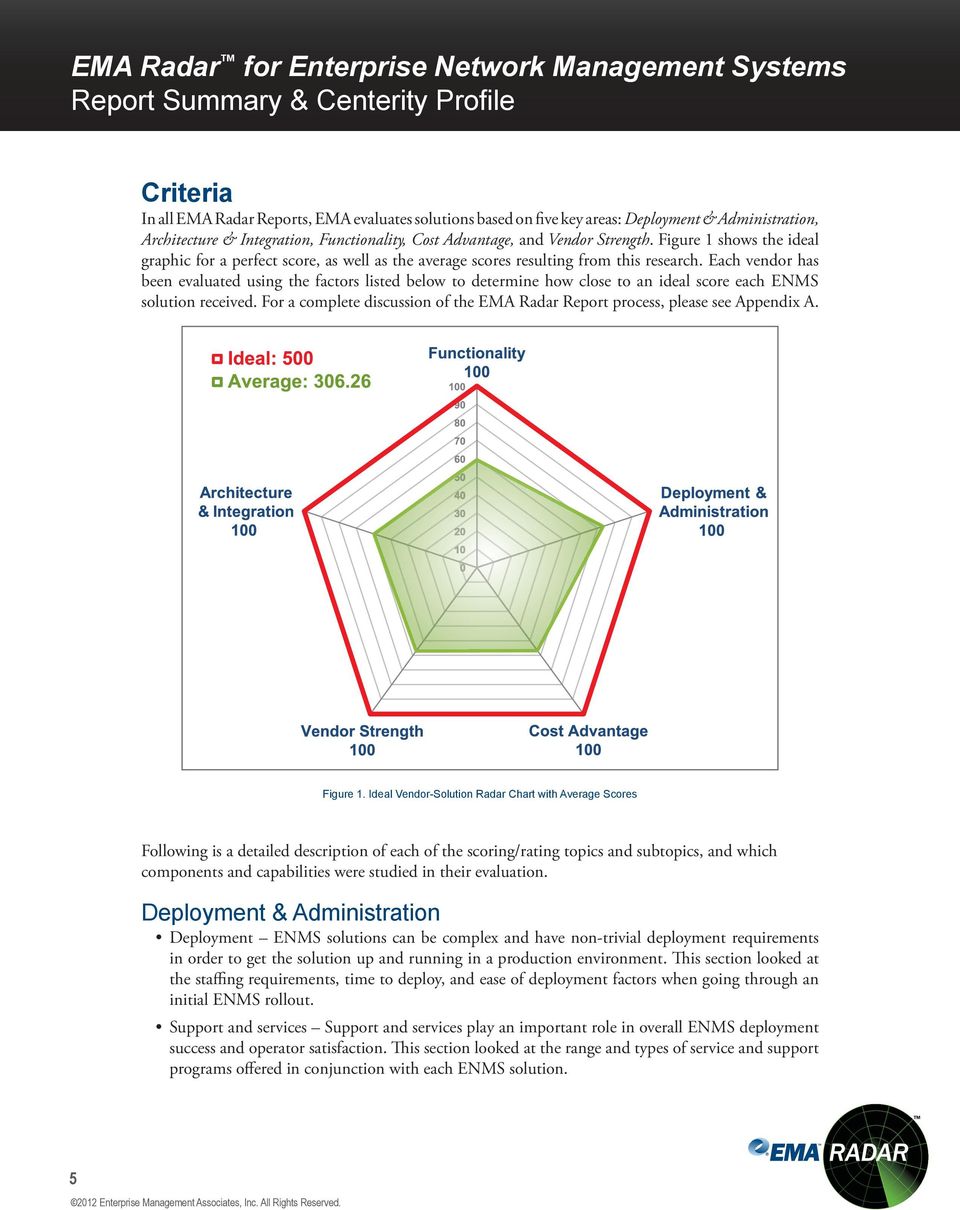
7 Criteria In all EMA Radar Reports, EMA evaluates solutions based on five key areas: Deployment & Administration, Architecture & Integration, Functionality, Cost Advantage, and Vendor Strength. Figure 1 shows the ideal graphic for a perfect score, as well as the average scores resulting from this research. Each vendor has been evaluated using the factors listed below to determine how close to an ideal score each ENMS solution received. For a complete discussion of the EMA Radar Report process, please see Appendix A. Figure 1. Ideal Vendor-Solution Radar Chart with Average Scores Following is a detailed description of each of the scoring/rating topics and subtopics, and which components and capabilities were studied in their evaluation. Deployment & Administration Deployment ENMS solutions can be complex and have non-trivial deployment requirements in order to get the solution up and running in a production environment. This section looked at the staffing requirements, time to deploy, and ease of deployment factors when going through an initial ENMS rollout. Support and services Support and services play an important role in overall ENMS deployment success and operator satisfaction. This section looked at the range and types of service and support programs offered in conjunction with each ENMS solution. 5
8 Ease of use/administration The easier the system is to deploy and manage once it is up and running, the stickier the solution becomes, fostering positive operator experience with the product as well as improved likelihood that the product will be fully utilized. This section looked at the level of expertise typically required to administer and maintain ENMS solutions, as well as levels and forms of automation available to assist in these tasks. Cost Advantage Medium enterprise deployment scenario This section assessed a sample deployment scenario for a medium/large-sized enterprise to determine total solution requirements in terms of hardware, software, and staffing, as well as solution list pricing. Large enterprise deployment scenario This section provided a sample deployment scenario for a large/very large enterprise to determine total solution requirements in terms of hardware, software, and staffing, as well as solution list pricing Licensing/maintenance costs This section looked at the range and type of licensing models available for ENMS solutions as well as the ongoing operational costs for associated maintenance and support charges. Architecture & Integration Data collection There are a broad range of methods for collecting data relevant to ENMS functions, as well as a variety of data types that can be collected. This section examined the breadth of data collection methods as well as the breadth of data standards/types supported. High availability For many operations teams, continuous and uninterrupted management and monitoring are an absolute must. This section examined the various methods available to ensure an ENMS can continue to function despite outages on the network as well as outages (planned or unplanned) within the ENMS itself. **Note emerging approaches to this set of objectives using live server virtualization load balancing, such as VMware vmotion and HA, were not included in this analysis. Scalability Enterprise deployments can grow very large, sometimes in relatively short order, making it critical that solutions are capable of supporting expansion. As demand increases, solutions should provide options for scaling up to meet needs, with proven top-end capabilities to support tens or hundreds of thousands of managed elements. This section looked at the degree of elasticity for growth in ENMS solutions. Internationalization/localization Globalization of the economy makes localization of the user interface an important factor when working with large organizations whose network operations teams are scattered across the globe. This section assessed how broadly an ENMS solution has been adapted to support multi-lingual operations teams. Integration The growing demand for cross collaboration between IT departments is making integration an important component for ENMS solutions. This section looked at supported integration options and methods as well as the existence of commonly-fielded integrations with complementary and related IT management systems and disciplines including event management, service desk, cross-domain dashboards, and CMDB/CMS. 6
9 Functionality Discovery One of the first and most critical aspects of any ENMS system is its ability to discover elements to be brought under management. This section looked at the different methods of discovery, the types of elements that could be discovered, and the ability of the discovery engine to work with third party repository tools. Correlation ENMS scope is no longer about just managing network hardware devices. Today s ENMS must be able to correlate data across hybrid infrastructures that contain physical as well as virtual elements. This section looked at how well a solution handles data and event correlation across mixed managed environments. Fault isolation When failures do occur, job #1 is fast response and absolute minimum MTTR. This section examined how each ENMS solution delivers and facilitates isolation and root cause analysis. Troubleshooting Once a problem is isolated, the next step is to zero-in and understand the true underlying source of the issue, so that mitigations can be applied. There a number of methods for handling troubleshooting with an ENMS, and this section looked at the breadth and depth of options available. Alerts/alarms Alerts and alarms comprise the most visible day-to-day operations data flow from most every ENMS, and management of them has long been one of the key features of these types of solutions. This section looked at the range of alert and alarm management capabilities supported. Monitoring While catching traps and alarms is considered table stakes, many solutions go above and beyond by actively harvesting additional management data to paint a more complete picture of operational activity and health. This section looked at some of the more advanced monitoring features available on ENMS platforms. Grouping When managed environments get large, logical grouping of elements and components becomes essential for turning large volumes of monitoring data into digestible, actionable information. This section looked at the range of grouping and mapping features available in ENMS platforms. Business impact analysis While network or network-connected component failures or degradations are important, it is even more crucial to understand which business systems, applications, or processes are impacted by any outage. This section looked at what options are in place to assess the business impact of network incidents and problems. Virtualization Extending an ENMS to manage virtual network elements is one of the greatest current growth areas. This section evaluated the types of features and capabilities each ENMS offered for gathering data from virtualized environments and integrating virtual network elements and virtual networking into traditional/physical coverage capabilities. Cloud While this is still an emerging area, network managers need their ENMS to help them understand which resources are cloud based (particularly for external cloud services) and the basics in terms of health, availability, and reachability. This section examined functional capabilities with ENMS solutions to address this growing need. 7
10 Vendor Strength Vision/strategy This section looked at each ENMS solution provider s ability to clearly define and articulate their market position and strategy in comparison to their core business as well as other vendors in this market sector. Financial strength Part of ENMS evaluation is the assessment of strength and staying power of the technology vendor. This section assessed each solution provider vendor s current stability and financial outlook. Partnerships/channel The best solutions surround themselves with supporting friends, whether they are complementary technology providers or feet on the street to distribute, deploy, and support the ENMS. This section evaluated the breadth and depth of technology and channel partners for each ENMS product and vendor. Customer validation As part of the survey process, we ask each ENMS solution provider to identify at least three customer references with whom EMA can speak, in order to validate features, functionality, and overall customer experience. The quality and strength (and in some cases quantity, or lack thereof) of customer references play an important role in EMA s overall evaluation of each vendor and solution. General Findings First and foremost, our study found a broad range of solutions that provided solid, valuable network monitoring and management capabilities. By passing the core criteria for inclusion (see above), each solution had to support large-scale multivendor environments with a core set of features that would be sufficient for supporting network engineering and operations, whether or not a formal NOC exists. The clearest differentiation among ENMS solutions was found in the breadth and scope of advanced features, integrations, and related/supporting functions, as well as in the range of cost effectiveness. Also, this study found that the majority of vendors reviewed offered a high level of cost efficiency, and this is good news for networking pros. The question for those evaluating such solutions is what level of feature/functionality completeness is required of an ENMS solution versus specific deployment requirements and budget limitations. What we found in this particular study was a good spread that should encourage practitioners to evaluate a number of options, each of which could fit a broad range of functional objectives. Besides ranging in functional capabilities and scope, product architectures were also found to vary. For example, one point to take into consideration when reviewing these solutions is how many components or separate binaries need to be set up and installed. In some cases there is a single binary that requires no additional installations, and additional add-ons (as available) simply require the purchase of a licensing key to access the features. Other solutions require multiple independent binaries to be installed, offering some advantages in terms of deployment flexibility and load distribution, but increasing deployment complexity. Integration of multi-binary components can range from tightly integrated to (essentially) standalone, even requiring launch of totally independent applications during regular use. Further, all ENMS solutions require a database, which can sometimes be embedded or sometimes must be purchased separately (or either, at the users option). Among the vendors in this survey, we found an even split between vendors offering embedded versus requiring a separate database, with no discernable correlation between vendor size or product time in the market, nor with overall scalability. 8
11 A clear trend has emerged within ENMS solutions in response to the fast growth in new IP-addressable endpoints, as well as the recognition that even existing, well-known endpoints are an important part of the whole picture for infrastructure monitoring and management. Traditional ENMS tools tend to be network-oriented and therefore geared towards the network engineer or operator, but from the broader operations perspective, it is necessary to obtain basic information from all network-connected elements. Cross-domain, service-oriented operators daunted by the rigor of traditional monitoring are in some cases looking for a lighter-touch style of monitoring, such as just an occasional ping rather than a full SNMP agent and MIB. In many cases in this study, particularly in shops below large enterprise size, we found that the buying decision tended to be driven not by the NOC, but rather someone within the datacenter or cross-domain operations team looking for greater visibility across all IP-addressable devices on the network. Such buyers indeed sought lighter-weight solutions that could scale, were easy to use (not just for network engineers), easy to deploy, and in many cases cost was a big factor. This tended to push those buyers towards more broad-ranging, network-centric or networkinclusive solutions that might not have the same feature depth as a traditional ENMS. Licensing models varied widely among the different solutions reviewed, and in some cases the first year of maintenance is included in the purchase price. Most vendors offer more than one type of licensing model. A growing number, for instance, offer subscription licensing, which commonly includes the cost of maintenance and support in a monthly or annual rate, making it possible to gain access to highly function ENMS products without having to tap capital budgets. Ultimately, it is critical to determine what type of licensing model makes the most sense for a particular deployment environment. Highly dynamic, changing environments require more flexible licensing models while more static environments can make due with a more restrictive one. This point proved to be an important criterion for some networking pros when choosing an ENMS solution. The most important takeaway from this EMA Radar was that there was no one right answer. Sometimes more sophisticated and complex ENMS solutions are overkill. At the same time, a lighter ENMS that is lacking in functionality and scale will eventually break if pushed beyond its design parameters. Each and every deployment environment is unique and it is critical to take the time to execute a proper evaluation process, taking into consideration site-specific management objectives and environmental factors in determining which requirements are mandatory and which are nice to have. The role and criticality of the network is increasing keeping that network up and running is becoming paramount and that means the requirements for network visibility and monitoring will keep ENMS solutions viable and essential for years to come. 9

12 EMA Radar Map for ENMS Medium Deployments The ENMS Radar Map shown in Figure 3 shows how eight of the ENMS solutions that offer enterpriseclass scale, but have not been deployed to manage networks of at least 25,000 devices, ranked in comparison to each other, in terms of cost efficiency (x axis) and product strength (y axis). The size of the bubble indicates relative measures of vendor strength. It should be noted that many of these solutions have been designed to scale to many tens of thousands of managed elements. Our decision to place them in the Medium Deployments peer group was based on largest successfully fielded installation (in terms of total managed network devices). For those that were near the 25,000-device cut-off limit, we also considered where the majority of historical deployments have been, and those whose installed base is mostly comprised of Small-to-Medium Businesses (or SMBs) were assigned to the Medium Deployments group. Figure 2. EMA Radar Map for ENMS Medium Deployments 10
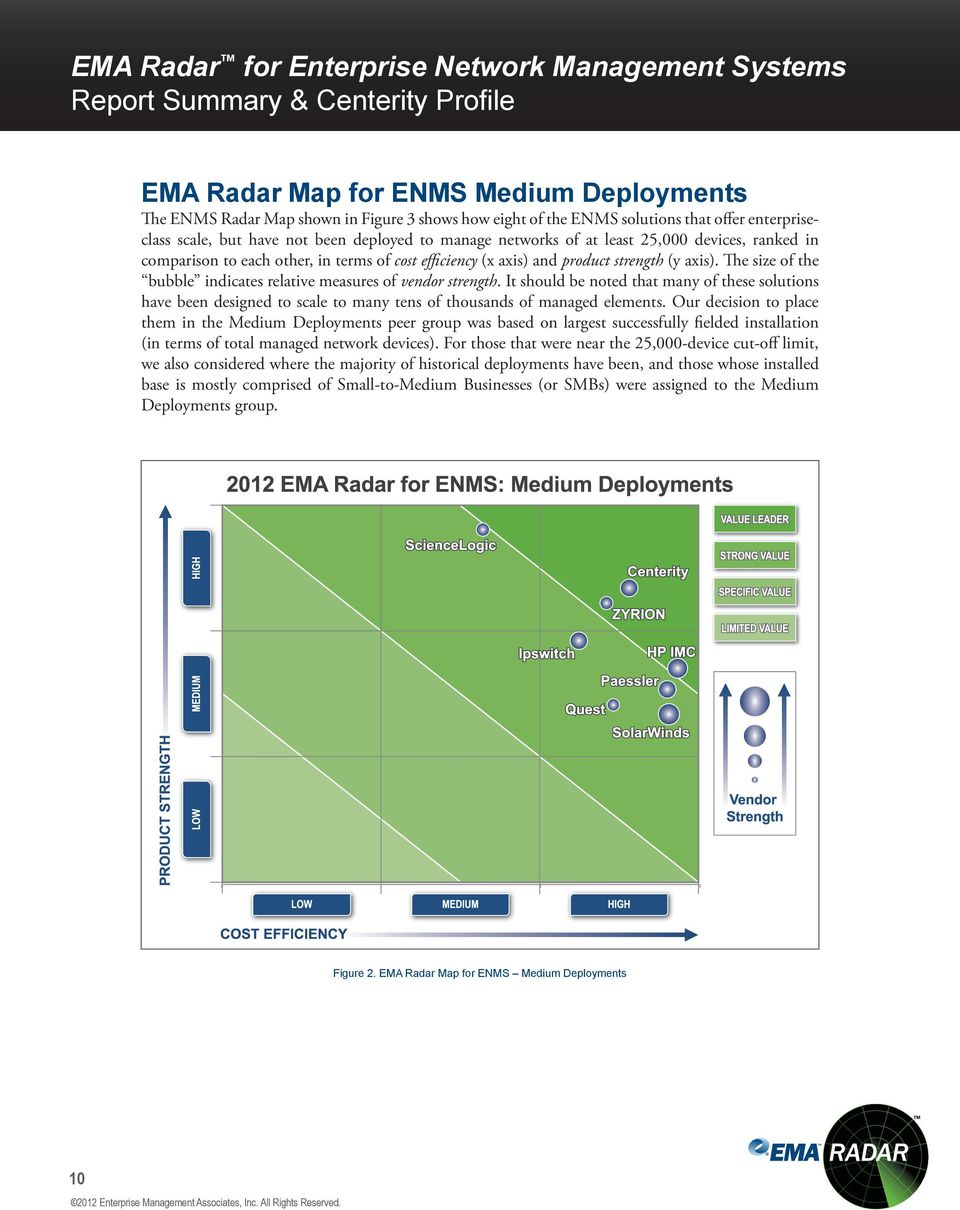
13 Distribution of Results The results shown in Figure 2 indicate a very high level of cost efficiency and clustering of solutions in the Strong Value band. Three solutions, Centerity Monitor, Zyrion Traverse, and HP IMC, finished in the Value Leader band. Within the Strong Value band, ScienceLogic had very high product strength but relatively lower cost efficiency. The other Strong Value solutions were clustered into a group that included Ipswitch WhatsUp Gold, Paessler PRTG, Quest Foglight NMS, and SolarWinds Network Performance Monitor. Value Leaders Value Leaders are those solutions that have achieved the best combinations of product strength and cost efficiency scores. Three ENMS solutions emerged as Value Leaders within the Medium Deployments group as a result of this analysis, and are summarized below in decreasing product strength order. It should be noted here that the top two solutions are truly more than just a network management system. Both have gone to great lengths to build in BSM-like functionality, with Centerity going so far as to position its Centerity Monitor specifically as a next-generation, cross-domain BSM solution. Value Leader: Centerity Centerity Monitor scored extremely well in this analysis, representing a very good product strength to cost efficiency ratio. The company was founded in 2006 and is not well known yet in the U.S., having only recently expanded beyond its core markets in Europe and Israel. The product was constructed to be a next-generation BSM solution that could draw data from all types and forms of information technology components and elements, and then bring that together into a common platform. The development team thus focused on making the process of adding new devices into management very fast and easy, and most Centerity customers are able to do this entirely on their own. The Centerity solution scored high marks for ease of use and ease of administration, along with a number of strengths in key ENMS feature areas such as business impact analysis and cross-domain correlation. Special Recognition: Most Extensible Medium Deployments: Centerity Monitor When a solution has been architected to collect data from anything with an interface, then that vendor had best be ready to back that claim up with highly facilitated features for adapting to new data sources. Centerity had done just this with its Centerity Monitor, allowing users to bring a virtually unlimited range of device types under management on their own or with precious little assistance. Centerity customers pointed this capability out as a key decision point in selecting Centerity Monitor over other solutions. 11
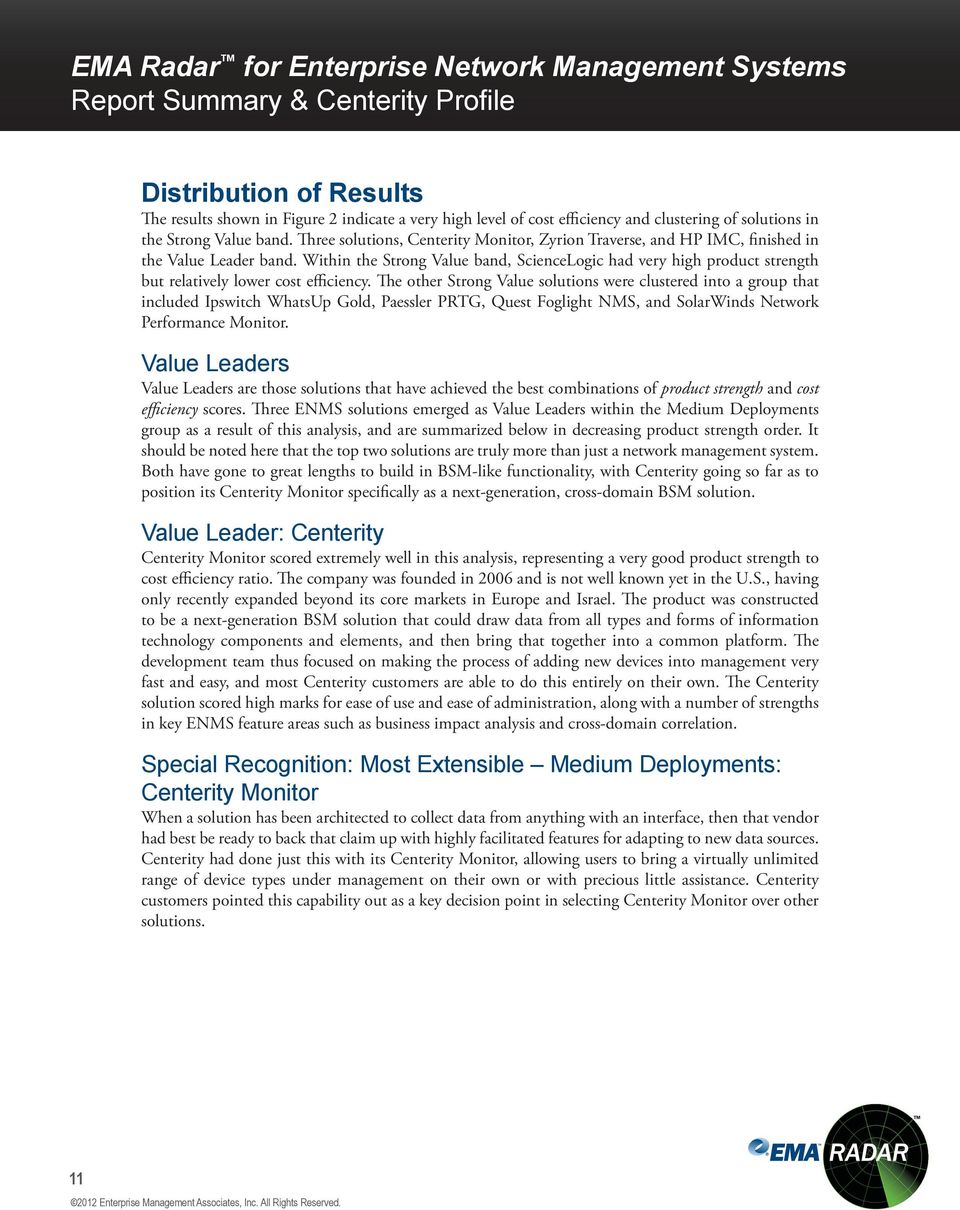
14 Centerity Profile Introduction Centerity is a newcomer to the U.S. network management tools market with R&D based in Israel and sales offices located in Needham, MA. The company has primarily seen success in the small enterprise and small business sectors in Israel across a number of verticals including finance, government, and communications services providers. The company s objective has been to develop a next generation, all-in-one integrated BSM solution that consolidates all infrastructure management (network, compute, storage, desktop, facilities, and more) and then adds business-oriented monitoring and reporting. This solution has strong appeal to IT operators who want easy-to-use management tools that can handle a wide variety of devices from a single console. Centerity At a Glance Founded: 2006 Locations worldwide Two HQ Location: Needham, MA Primary market penetration: Public/Private: Private Linkedin: Centerity Profitable: Yes Free trial download of ENMS? Small Business, Small Enterprise Total employees: Less than 250 Vendor url: Yes 12
15 Enterprise Network Management Product Offering Primary Enterprise Management Solution: Centerity Monitor Enterprise edition Database: Embedded as part of the platform Additional Components Required (to support configuration scenario in this report): None Deployment Options: Software client (can be installed on VM) Survey Results The following section reviews how the Centerity Monitor solution compared to others in the medium deployment group, across each of the major study segments. Deployment Cost Efficiency Overall, the Centerity solution ranked well in terms of deployment cost efficiency, finishing slightly above average among the medium deployment group. Contributing to this success, Centerity Monitor received top marks in ease of deployment among its peers. Also important was flexibility Centerity customers commented that the ability to easily and rapidly customize the product greatly improved their deployment efficiency and substantially mitigated ongoing services costs. Product Strength The Centerity Monitor solution scored the second-highest aggregate product strength ranking among the medium deployment group. Centerity Monitor s strongest attribute in this segment is in the area of data collection. Centerity had the broadest set of support for data collection method and types. This was an important aspect of the Centerity Monitor, lending to its strength for monitoring many device types beyond networking equipment. Vendor Strength Centerity is a private vendor, so the details of their financial position are not available. Centerity s list of technology partnerships is on par with the majority of vendors in the medium deployment segment, but this group does lack the breadth and depth of partnerships of the other vendors that scored high marks. The two areas where Centerity shined were in vendor vision and customer validation. The two components went hand in hand. Centerity s vision to develop an all-in-one integrated platform that could be deployed rapidly without undue complexity was validated loud and clear in conversations with customers. Customer Insights The following section is drawn from our customer conversations. We asked Centerity customers what they liked best about the vendor and product as well as new features or functionality they would like to see included or addressed in future product releases. Customer Kudos: Customer service All references pointed out how easy Centerity was to work with and that the 13
16 company is very responsive to their needs. Flexibility One customer made special mention of how they needed to extend the solution to gather data from a broad range of equipment and elements and how easily this was accomplished, requiring little to no assistance from Centerity support. Customer Wish List: NetFlow Product operators indicated that integrated support for NetFlow would be a nice to have (though it was not deemed critical.) GUI Customers indicated that the operator interface, while functional, is a bit sparse and could use with a little help from a graphic designer to give it a fresher look and feel and to be more visually impactful. U.S.-based support team Customers pointed out that the support, while very good, is not 24x7, and is currently centered on business hours in Israel. EMA Summary Opinion As a result of the data from this survey, conversations with customers, channel partners and the vendors, this section summarizes what EMA believes to be the strengths of each vendor as well as areas in which the vendor could make improvements. Centerity Strengths Broad device and integrated cross-domain support This characteristic plays well to IT s growing challenge of keeping track of everything IP. The solution is well-positioned to handle the needs of the datacenter and the broader set of IT monitoring requirements, and can bring network monitoring together with data from connected technologies (i.e. servers, storage, applications, end devices, and even user experience) so that a truly holistic, business-aligned understanding of the IT function becomes possible. Centerity Areas for Improvement U.S.-based support Centerity is working hard to expand presence in the US market, and to do so successfully they will need to provide a U.S.-based customer support center to help build credibility in the US market and establish true 24x7 support. 14

17 About Enterprise Management Associates, Inc. Founded in 1996, Enterprise Management Associates (EMA) is a leading industry analyst firm that provides deep insight across the full spectrum of IT and data management technologies. EMA analysts leverage a unique combination of practical experience, insight into industry best practices, and in-depth knowledge of current and planned vendor solutions to help its clients achieve their goals. Learn more about EMA research, analysis, and consulting services for enterprise line of business users, IT professionals and IT vendors at or blogs.enterprisemanagement.com. You can also follow EMA on Twitter or Facebook. This report in whole or in part may not be duplicated, reproduced, stored in a retrieval system or retransmitted without prior written permission of Enterprise Management Associates, Inc. All opinions and estimates herein constitute our judgement as of this date and are subject to change without notice. Product names mentioned herein may be trademarks and/or registered trademarks of their respective companies. EMA and Enterprise Management Associates are trademarks of Enterprise Management Associates, Inc. in the United States and other countries. EMA, ENTERPRISE MANAGEMENT ASSOCIATES, and the mobius symbol are registered trademarks or common-law trademarks of Enterprise Management Associates, Inc. Corporate Headquarters: 1995 North 57th Court, Suite 120 Boulder, CO Phone: Fax: Centerity

EMA Radar for Enterprise Network Availability Monitoring System (ENAMS): Q3 2014. Report Summary & HP IMC Profile
 EMA Radar for Enterprise Network Availability Monitoring System (ENAMS): Q3 2014 Report Summary & HP IMC Profile By Tracy Corbo and Jim Frey ENTERPRISE MANAGEMENT ASSOCIATES (EMA ) Radar Report July 2014
EMA Radar for Application Discovery and Dependency Mapping (ADDM): Q4 2013. AppEnsure Profile
 EMA Radar for Application Discovery and Dependency Mapping (ADDM): Q4 2013 By Dennis Drogseth, VP of Research ENTERPRISE MANAGEMENT ASSOCIATES (EMA ) Radar Report December 2013 AppEnsure Introduction Santa
EMA Radar for Application Performance Management (APM) for Cloud Services: Q1 2012
 EMA Radar for Application Performance Management (APM) for Cloud Services: Q1 2012 Compuware Profile By Julie Craig, Research Director Enterprise Management Associates (EMA) January 2012 Table of Contents
Assuring Converged Infrastructure: Converged Management Strategies for Cisco UCS
 Converged Management Strategies for Cisco UCS An ENTERPRISE MANAGEMENT ASSOCIATES (EMA ) White Paper Prepared for CA Technologies April 2012 IT & DATA MANAGEMENT RESEARCH, INDUSTRY ANALYSIS & CONSULTING
Streamlining the Process of Business Intelligence with JReport
 Streamlining the Process of Business Intelligence with JReport An ENTERPRISE MANAGEMENT ASSOCIATES (EMA ) Product Summary from 2014 EMA Radar for Business Intelligence Platforms for Mid-Sized Organizations
Three Asset Lifecycle Management Fundamentals for Optimizing Cloud and Hybrid Environments
 Three Asset Lifecycle Management Fundamentals for Optimizing Cloud and Hybrid Environments An ENTERPRISE MANAGEMENT ASSOCIATES (EMA ) White Paper Prepared for BMC April 2011 IT & DATA MANAGEMENT RESEARCH,
Bringing Enterprise-class Network Performance and Security Management Together using NetFlow
 Bringing Enterprise-class Network Performance and Security Management Together using NetFlow An ENTERPRISE MANAGEMENT ASSOCIATES (EMA ) White Paper Prepared for Lancope November 2009 IT MANAGEMENT RESEARCH,
EMA Radar for Private Cloud Platforms: Q1 2013
 EMA Radar for Private Cloud Platforms: Q1 2013 By Torsten Volk ENTERPRISE MANAGEMENT ASSOCIATES (EMA ) Radar Report March 2013 BMC Software EMA Radar for Private Cloud Platforms: Q1 2013 (IaaS, PaaS, SaaS)
EMA Radar for Workload Automation (WLA): Q2 2012
 EMA Radar for Workload Automation (WLA): Q2 2012 By Torsten Volk, Senior Analyst Enterprise Management Associates (EMA) June 2012 Introduction Founded in 2004, Network Automation focuses on automating
Four Priorities for Integrated, Service-Centric Performance Management
 Service-Centric Performance Management An ENTERPRISE MANAGEMENT ASSOCIATES (EMA ) White Paper Prepared for Watch4net May 2011 IT & DATA MANAGEMENT RESEARCH, INDUSTRY ANALYSIS & CONSULTING Table of Contents
Next-Generation Asset Management and IT Financial Analytics: Optimizing IT Value in a World of Change
 Next-Generation Asset Management and IT Financial Analytics: Optimizing IT Value in a World of Change An ENTERPRISE MANAGEMENT ASSOCIATES (EMA ) Research Report Written by Dennis Drogseth May 2014 Sponsored
Building on a Foundation for Growth: Integrating DLP with Message Security Infrastructure
 Building on a Foundation for Growth: Integrating DLP with Message Security Infrastructure An ENTERPRISE MANAGEMENT ASSOCIATES (EMA ) White Paper Prepared for RSA, The Security Division of EMC April 2010
EMA Radar for Workload Automation (WLA): Q2 2012
 EMA Radar for Workload Automation (WLA): Q2 2012 Cisco Software Profile By Torsten Volk, Senior Analyst Enterprise Management Associates (EMA) June 2012 Cisco Systems Profile Introduction Cisco Systems
Essential Ingredients for Optimizing End User Experience Monitoring
 Essential Ingredients for Optimizing End User Experience Monitoring An ENTERPRISE MANAGEMENT ASSOCIATES (EMA ) White Paper Prepared for Neustar IT MANAGEMENT RESEARCH, Table of Contents Executive Summary...1
WHITE PAPER OCTOBER 2014. Unified Monitoring. A Business Perspective
 WHITE PAPER OCTOBER 2014 Unified Monitoring A Business Perspective 2 WHITE PAPER: UNIFIED MONITORING ca.com Table of Contents Introduction 3 Section 1: Today s Emerging Computing Environments 4 Section
CA Virtual Assurance for Infrastructure Managers
 PRODUCT SHEET: CA Virtual Assurance for Infrastructure Managers CA Virtual Assurance for Infrastructure Managers agility made possible CA Virtual Assurance for Infrastructure Managers is an add-on product
Global Headquarters: 5 Speen Street Framingham, MA 01701 USA P.508.872.8200 F.508.935.4015 www.idc.com
 Global Headquarters: 5 Speen Street Framingham, MA 01701 USA P.508.872.8200 F.508.935.4015 www.idc.com E X C E R P T N i n e S t a r t - U p s a n d I n n o v a t o r s E x t e n d t h e C l o u d S y
Kaseya White Paper Proactive Service Level Monitoring: A Must Have for Advanced MSPs
 Kaseya White Paper Proactive Service Level Monitoring: A Must Have for Advanced MSPs Providers of IT services, such as systems integrators, are expanding rapidly into the managed services arena, and becoming
Desktop Automation: Effective Desktop Operations & Management with Cloud Orchestration
 Desktop Automation: Effective Desktop Operations & Management with Cloud Orchestration An ENTERPRISE MANAGEMENT ASSOCIATES (EMA ) White Paper Prepared for Citrix August 2014 IT & DATA MANAGEMENT RESEARCH,
Cross-Domain Service Management vs. Traditional IT Service Management for Service Providers
 Position Paper Cross-Domain vs. Traditional IT for Providers Joseph Bondi Copyright-2013 All rights reserved. Ni², Ni² logo, other vendors or their logos are trademarks of Network Infrastructure Inventory
can you improve service quality and availability while optimizing operations on VCE Vblock Systems?
 SOLUTION BRIEF Service Assurance Solutions from CA Technologies for VCE Vblock Systems can you improve service quality and availability while optimizing operations on VCE Vblock Systems? agility made possible
Workload Automation: The Heart of Enterprise Operations
 An ENTERPRISE MANAGEMENT ASSOCIATES (EMA ) White Paper Prepared for Skybot Software October 2011 IT & DATA MANAGEMENT RESEARCH, INDUSTRY ANALYSIS & CONSULTING Table of Contents Executive Summary...1 Introduction...1
Service Catalog: Dramatically Improving the IT/Business Relationship
 Service Catalog: Dramatically Improving the IT/Business Relationship An ENTERPRISE MANAGEMENT ASSOCIATES (EMA ) White Paper Prepared for Numara Software February 2009 IT MANAGEMENT RESEARCH, Table of Contents
Object Storage: A Growing Opportunity for Service Providers. White Paper. Prepared for: 2012 Neovise, LLC. All Rights Reserved.
 Object Storage: A Growing Opportunity for Service Providers Prepared for: White Paper 2012 Neovise, LLC. All Rights Reserved. Introduction For service providers, the rise of cloud computing is both a threat
ITIL V3: Making Business Services Serve the Business
 ITIL V3: Making Business Services Serve the Business An ENTERPRISE MANAGEMENT ASSOCIATES (EMA ) White Paper Prepared for ASG October 2008 IT Management Research, Industry Analysis, and Consulting Table
Big Data Comes of Age: Shifting to a Real-time Data Platform
 An ENTERPRISE MANAGEMENT ASSOCIATES (EMA ) White Paper Prepared for SAP April 2013 IT & DATA MANAGEMENT RESEARCH, INDUSTRY ANALYSIS & CONSULTING Table of Contents Introduction... 1 Drivers of Change...
are you helping your customers achieve their expectations for IT based service quality and availability?
 PARTNER BRIEF Service Operations Management from CA Technologies are you helping your customers achieve their expectations for IT based service quality and availability? FOR PARTNER USE ONLY DO NOT DISTRIBUTE
Improve Your Business Through Best Practice IT Management. A White Paper Prepared for Kaseya September 2007
 A White Paper Prepared for Kaseya September 2007 Table of Contents Executive Summary...1 Introduction...1 The Role of Best Practices in Managing IT Services...1 Profitability...1 Reliability...2 Best Practices
SEVEN WAYS TO AVOID ERP IMPLEMENTATION FAILURE SPECIAL REPORT SERIES ERP IN 2014 AND BEYOND
 SEVEN WAYS TO AVOID ERP IMPLEMENTATION FAILURE SPECIAL REPORT SERIES ERP IN 2014 AND BEYOND CONTENTS INTRODUCTION................................ 3 UNDERSTAND YOUR CURRENT SITUATION............ 4 DRAW
Project Management Software Buyer s Guide: What You Need To Know Before Evaluating
 Project Management Software Buyer s Guide: What You Need To Know Before Evaluating EnterPlicity Project Management Software Buyer s Guide 2 Copyright holder is licensing this under the Creative Commons
Converged and Integrated Datacenter Systems: Creating Operational Efficiencies
 Insight Converged and Integrated Datacenter Systems: Creating Operational Efficiencies Rob Brothers IDC OPINION Enterprise IT has moved away from siloed servers, storage, information, and processes and
EMA Service Catalog Assessment Service
 MORE INFORMATION: To learn more about the EMA Service Catalog, please contact the EMA Business Development team at +1.303.543.9500 or [email protected] The IT Service Catalog Aligning
A Unified View of Network Monitoring. One Cohesive Network Monitoring View and How You Can Achieve It with NMSaaS
 A Unified View of Network Monitoring One Cohesive Network Monitoring View and How You Can Achieve It with NMSaaS Executive Summary In the past few years, the enterprise computing technology has changed
BI Platforms User Survey, 2011: Customers Rate Their BI Platform Vendors
 BI Platforms User Survey, 2011: Customers Rate Their BI Platform Vendors Gartner RAS Core Research Note G00211769, Rita L. Sallam, 4 April 2011, RA1 07132011 Gartner recently surveyed business intelligence
CA Virtual Assurance for Infrastructure Managers
 DATA SHEET CA Virtual Assurance for Infrastructure Managers (Includes CA Systems Performance for Infrastructure Managers) CA Virtual Assurance for Infrastructure Managers (formerly CA Virtual Performance
Pragmatic Business Service Management
 Pragmatic Business Service Management Written by Quest Software, Inc. White Paper Copyright Quest Software, Inc. 2007. All rights reserved. This guide contains proprietary information, which is protected
Integration Maturity Model Capability #5: Infrastructure and Operations
 Integration Maturity Model Capability #5: Infrastructure and Operations How improving integration supplies greater agility, cost savings, and revenue opportunity TAKE THE INTEGRATION MATURITY SELFASSESSMENT
EMA Services for IT Vendors
 Services to Help You Achieve Your Goals Founded in 1996, Enterprise Management Associates (EMA) is a leading industry analyst and consulting firm that specializes in going beyond the surface to provide
Better Virtualization Outcomes with Citrix Essentials for XenServer and NetApp Storage
 Better Virtualization Outcomes with Citrix Essentials for XenServer and NetApp Storage An ENTERPRISE MANAGEMENT ASSOCIATES (EMA ) White Paper Prepared for Citrix and NetApp August 2009 IT MANAGEMENT RESEARCH,
CA Systems Performance for Infrastructure Managers
 PRODUCT SHEET: CA Systems Performance for Infrastructure Managers agility made possible CA Systems Performance for Infrastructure Managers CA Systems Performance for Infrastructure Managers is an add-on
Service Performance Management: Pragmatic Approach by Jim Lochran
 www.pipelinepub.com Volume 3, Issue 12 Service Performance Management: Pragmatic Approach by Jim Lochran As the mix of service provider offerings become more IP centric, the need to overhaul existing service
CLOUD COMPUTING SOLUTION - BENEFITS AND TESTING CHALLENGES
 CLOUD COMPUTING SOLUTION - BENEFITS AND TESTING CHALLENGES PRAKASH.V, GOPALAKRISHANAN.S Assistant Professor Department of Computer Applications, SASTRA University Associate Dean Department of Computer
SolarWinds Network Performance Monitor
 SolarWinds Network Performance Monitor powerful network fault & availabilty management Fully Functional for 30 Days SolarWinds Network Performance Monitor (NPM) makes it easy to quickly detect, diagnose,
IDC MarketScape: Worldwide Datacenter Infrastructure Management 2015 Vendor Assessment
 IDC MarketScape IDC MarketScape: Worldwide Datacenter Infrastructure Management 2015 Vendor Assessment Jennifer Koppy THIS IDC MARKETSCAPE EXCERPT FEATURES EMERSON NETWORK POWER IDC MARKETSCAPE FIGURE
Public, Private and Hybrid Clouds
 Public, Private and Hybrid Clouds When, Why and How They are Really Used Sponsored by: Research Summary 2013 Neovise, LLC. All Rights Reserved. [i] Table of Contents Table of Contents... 1 i Executive
IDC MarketScape: Worldwide Service Desk Management Software 2014 Vendor Analysis
 IDC MarketScape IDC MarketScape: Worldwide Service Desk Management Software 2014 Vendor Analysis Robert Young THIS IDC MARKETSCAPE EXCERPT FEATURES: CHERWELL SOFTWARE IDC MARKETSCAPE FIGURE FIGURE 1 IDC
Automating ITIL v3 Event Management with IT Process Automation: Improving Quality while Reducing Expense
 Automating ITIL v3 Event Management with IT Process Automation: Improving Quality while Reducing Expense An ENTERPRISE MANAGEMENT ASSOCIATES (EMA ) White Paper Prepared for NetIQ November 2008 IT Management
Ipswitch WhatsUp Gold vs. Solarwinds Orion Comparing Product Offerings
 Ipswitch WhatsUp Gold vs. Solarwinds Orion Comparing Product Offerings Matched Capabilities, Yet Multifold Differences in Cost by MarketPlane Consulting sponsored by Ipswitch March 2010 INTRODUCTION With
Service Management and Operations: A Data Center Perspective
 Service Management and Operations: A Data Center Perspective An ENTERPRISE MANAGEMENT ASSOCIATES (EMA ) White Paper Prepared for LANDesk Software March 2010 IT MANAGEMENT RESEARCH, Table of Contents Executive
I D C T E C H N O L O G Y S P O T L I G H T
 I D C T E C H N O L O G Y S P O T L I G H T U n i fied Cloud Management Increases IT- as- a - S e r vi c e Ag i l i t y November 2013 Adapted from VMware Unifies Cloud Management Portfolio with a Focus
TRAVERSE: VIRTUALIZATION AND PRIVATE CLOUD MONITORING
 TRAVERSE: VIRTUALIZATION AND PRIVATE CLOUD MONITORING SUMMARY Given recent advances in distributed computing, virtualization and private cloud technologies, enterprise datacenters have effectively become
EMA Radar for Private Cloud Platforms: Q1 2013
 EMA Radar for Private Cloud Platforms: Q1 2013 By Torsten Volk ENTERPRISE MANAGEMENT ASSOCIATES (EMA ) Radar Report March 2013 ASG Software Solutions EMA Radar for Private Cloud Platforms: Q1 2013 (IaaS,
ScienceLogic Offers Unified Infrastructure Monitoring and Analytics for Hybrid IT
 VENDOR PROFILE ScienceLogic Offers Unified Infrastructure Monitoring and Analytics for Hybrid IT Mary Johnston Turner David Immerman IDC OPINION Enterprise datacenter infrastructure environments are becoming
White Paper. The Top 20 Tools Needed for Hybrid IT
 White Paper The Top 20 Tools Needed for Hybrid IT 1 IT today is more complex than ever. Public cloud, networks, storage systems, servers, and applications all combine to deliver today s IT services. But
Managed service provider Bell Techlogix shines its BEAM to differentiate
 Analyst: Katy Ring 1 Nov, 2013 Managed service provider Bell Techlogix shines its BEAM to differentiate Bell Techlogix is a midsized US managed service provider (MSP) that is ahead of the curve in getting
THE CONVERGENCE OF NETWORK PERFORMANCE MONITORING AND APPLICATION PERFORMANCE MANAGEMENT
 WHITE PAPER: CONVERGED NPM/APM THE CONVERGENCE OF NETWORK PERFORMANCE MONITORING AND APPLICATION PERFORMANCE MANAGEMENT Today, enterprises rely heavily on applications for nearly all business-critical
Support the Era of the App with End-to-End Network and Application Performance Visibility
 Support the Era of the App with End-to-End Network and Application Performance Visibility Traditional Performance Management Is Not Enough The realities of the modern IT landscape are daunting. Your business-critical
I D C V E N D O R S P O T L I G H T
 I D C V E N D O R S P O T L I G H T S u p p o r t i n g Softw a re Business Transformation w ith Sys t e m s D e s i g n e d for the Task November 2014 Adapted from Managing Business Model Transitions
SolarWinds Network Performance Monitor powerful network fault & availabilty management
 SolarWinds Network Performance Monitor powerful network fault & availabilty management Fully Functional for 30 Days SolarWinds Network Performance Monitor (NPM) is powerful and affordable network monitoring
Consolidating IT Infrastructure Management: Unifying Data Center Hardware and Software Administration
 Consolidating IT Infrastructure Management: Unifying Data Center Hardware and Software Administration An ENTERPRISE MANAGEMENT ASSOCIATES (EMA ) White Paper Prepared for Emerson Network Power October 2014
7 things to ask when upgrading your ERP solution
 Industrial Manufacturing 7 things to ask when upgrading your ERP solution The capabilities gap between older versions of ERP designs and current designs can create a problem that many organizations are
VALUE PROPOSITION FOR SERVICE PROVIDERS. Helping Service Providers accelerate adoption of the cloud
 VALUE PROPOSITION FOR SERVICE PROVIDERS Helping Service Providers accelerate adoption of the cloud Partnership with Service Providers Enabling Your Cloud Services in Complex Environments Today s challenge
RED HAT OPENSTACK PLATFORM A COST-EFFECTIVE PRIVATE CLOUD FOR YOUR BUSINESS
 WHITEPAPER RED HAT OPENSTACK PLATFORM A COST-EFFECTIVE PRIVATE CLOUD FOR YOUR BUSINESS INTRODUCTION The cloud is more than a marketing concept. Cloud computing is an intentional, integrated architecture
Enterprise Business Service Management
 Technical white paper Enterprise Business Service Management Key steps and components of a successful solution Table of contents Executive Summary... 2 Setting the goal establishing an IT initiative...
Elevating Data Center Performance Management
 Elevating Data Center Performance Management Data Center innovation reduces operating expense, maximizes employee productivity, and generates new sources of revenue. However, many I&O teams lack proper