
CA SiteMinder. Policy Server Administration Guide. r12.0 SP2
|
|
|
- Julius Hensley
- 10 years ago
- Views:
Transcription
1 CA SiteMinder Policy Server Administration Guide r12.0 SP2
2 This documentation and any related computer software help programs (hereinafter referred to as the "Documentation") are for your informational purposes only and are subject to change or withdrawal by CA at any time. This Documentation may not be copied, transferred, reproduced, disclosed, modified or duplicated, in whole or in part, without the prior written consent of CA. This Documentation is confidential and proprietary information of CA and may not be used or disclosed by you except as may be permitted in a separate confidentiality agreement between you and CA. Notwithstanding the foregoing, if you are a licensed user of the software product(s) addressed in the Documentation, you may print a reasonable number of copies of the Documentation for internal use by you and your employees in connection with that software, provided that all CA copyright notices and legends are affixed to each reproduced copy. The right to print copies of the Documentation is limited to the period during which the applicable license for such software remains in full force and effect. Should the license terminate for any reason, it is your responsibility to certify in writing to CA that all copies and partial copies of the Documentation have been returned to CA or destroyed. TO THE EXTENT PERMITTED BY APPLICABLE LAW, CA PROVIDES THIS DOCUMENTATION "AS IS" WITHOUT WARRANTY OF ANY KIND, INCLUDING WITHOUT LIMITATION, ANY IMPLIED WARRANTIES OF MERCHANTABILITY, FITNESS FOR A PARTICULAR PURPOSE, OR NONINFRINGEMENT. IN NO EVENT WILL CA BE LIABLE TO THE END USER OR ANY THIRD PARTY FOR ANY LOSS OR DAMAGE, DIRECT OR INDIRECT, FROM THE USE OF THIS DOCUMENTATION, INCLUDING WITHOUT LIMITATION, LOST PROFITS, LOST INVESTMENT, BUSINESS INTERRUPTION, GOODWILL, OR LOST DATA, EVEN IF CA IS EXPRESSLY ADVISED IN ADVANCE OF THE POSSIBILITY OF SUCH LOSS OR DAMAGE. The use of any software product referenced in the Documentation is governed by the applicable license agreement and is not modified in any way by the terms of this notice. The manufacturer of this Documentation is CA. Provided with "Restricted Rights." Use, duplication or disclosure by the United States Government is subject to the restrictions set forth in FAR Sections , , and (c)(1) - (2) and DFARS Section (b)(3), as applicable, or their successors. Copyright 2009 CA. All rights reserved. All trademarks, trade names, service marks, and logos referenced herein belong to their respective companies.
3 CA Product References This document references the following CA products: CA SiteMinder CA SOA Security Manager CA Identity Manager CA Security Compliance Manager Contact CA Contact Technical Support For your convenience, CA provides one site where you can access the information you need for your Home Office, Small Business, and Enterprise CA products. At you can access the following: Online and telephone contact information for technical assistance and customer services Information about user communities and forums Product and documentation downloads CA Support policies and guidelines Other helpful resources appropriate for your product Provide Feedback If you have comments or questions about CA product documentation, you can send a message to [email protected]. If you would like to provide feedback about CA product documentation, complete our short customer survey, which is also available on the CA Support website, found at
4

5 Contents Chapter 1: Policy Server Management 13 Policy Server Management Overview Policy Server Components Policy Server Operations Policy Server Administration Policy Server Management Tasks Policy Server Management Console Policy Server User Interface Open the FSS Administrative UI Chapter 2: Starting and Stopping the Policy Server 23 Services and Processes Overview Start and Stop Policy Server Services on Windows Systems Start and Stop Policy Server Processes on UNIX Systems Configure the Policy Server Executives Configure Windows Executives Configure the UNIX Executive Chapter 3: Configuring Policy Server Data Storage Options 29 Configure Data Storage Options Overview Configure the Policy Store Database Configure the Key Store or Audit Logs to Use the Policy Store Database Configure a Separate Database for the Key Store Configure a Separate Database for the Audit Logs Configure a Separate Database for Token Data Configure a Database for the Session Server Configure Session Server Timeout for Heavy Load Conditions Configure LDAP Storage Options Configure an LDAP Database Configure LDAP Failover Configure Enhanced LDAP Referral Handling Configure Support for Large LDAP Policy Stores Configure ODBC Storage Options Configure an ODBC Data Source Configure ODBC Failover Configure Text File Storage Options Contents 5
6 Audit Data Import Tool for ODBC Log More Audit Data to a Text File Audit Data Import Prerequisites for ODBC Import Audit Data into an ODBC Database Specify a Netscape Certificate Database File Chapter 4: Configuring General Policy Server Settings 43 Policy Server Settings Overview Configure Policy Server Settings Configure Access Control Settings Configure Policy Server Administration Settings Configure Policy Server Connection Options Configure Policy Server Performance Settings Configure RADIUS Settings Configure OneView Monitor Settings Reschedule SiteMinder Policy Data Synchronization Chapter 5: Changing the Policy Server Super User Password 47 Super User Password Overview Change the Policy Server Super User Password Chapter 6: Configuring and Managing Encryption Keys 49 Policy Server Encryption Keys Overview Key Management Overview FIPS Agent Keys Dynamic Agent Key Rollover Agent Keys Used in Dynamic Key Rollover Rollover Intervals for Agent Keys Static Keys Session Ticket Keys Key Management Scenarios Key Management Considerations Common Policy Store and Key Store Multiple Policy Stores with a Common Key Store Multiple Policy Stores with Separate Key Stores Reset the r6.x Policy Store Encryption Key Reset the r12.x Policy Store Encryption Key Configure Agent Key Generation Manage Agent Keys Configure Periodic Key Rollover Policy Server Administration Guide
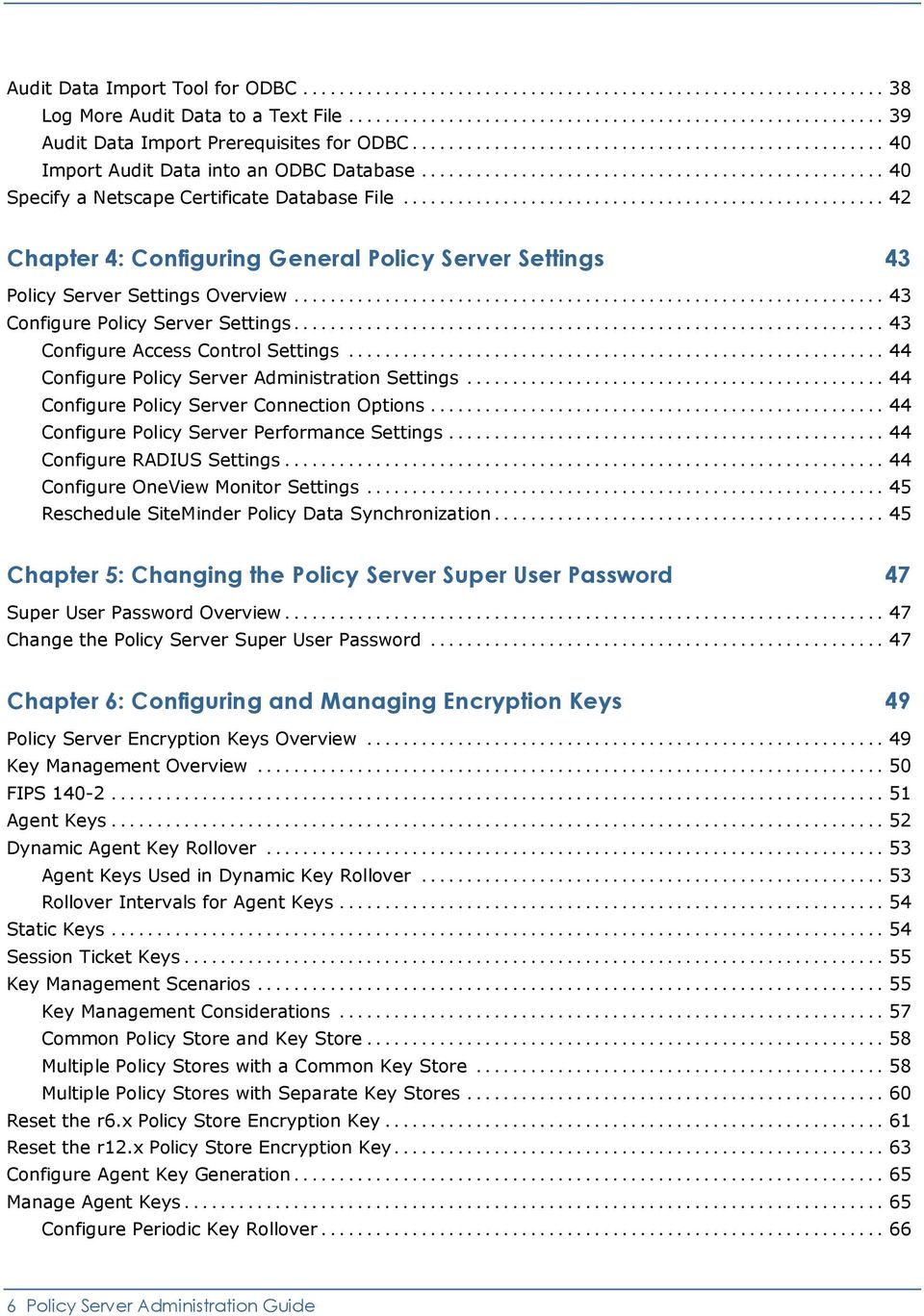
7 Manually Rollover the Key Coordinate Agent Key Management and Session Timeouts Change Static Keys Manage the Session Ticket Key Generate a Session Ticket Key Manually Enter the Session Ticket Key Set the EnableKeyUpdate Registry Key Shared Secret for a Trusted Host Configure Trusted Host Shared Secret Rollover Chapter 7: Configuring Policy Server Logging 75 Policy Server Logging Overview Configure the Policy Server Logs Record Administrator Changes to Policy Store Objects How to Process Old Log Files Automatically How to Include SiteMinder Administrative Audit Events in Reports Mirror ODBC Audit Log Content in Text-based Audit Logs on Windows Mirror ODBC Audit Log Content in Text-based Audit Logs on Solaris Report Logging Problems to the System Log Chapter 8: Configuring the Policy Server Profiler 83 Configure the Policy Server Profiler Change Profiler Settings Avoid Profiler Console Output Problems on Windows Configure Profiler Trace File Retention Policy Manually Roll Over the Profiler Trace Log File Dynamic Trace File Rollover at Specified Intervals Chapter 9: Configuring Administrative Journal and Event Handler 89 Administrative Journal and Event Handler Overview Configure Advanced Settings for the Policy Server Add Event Handler Libraries Chapter 10: Adjusting Global Settings 91 Enable User Tracking Enable Nested Security Enable Enhanced Active Directory Integration Contents 7
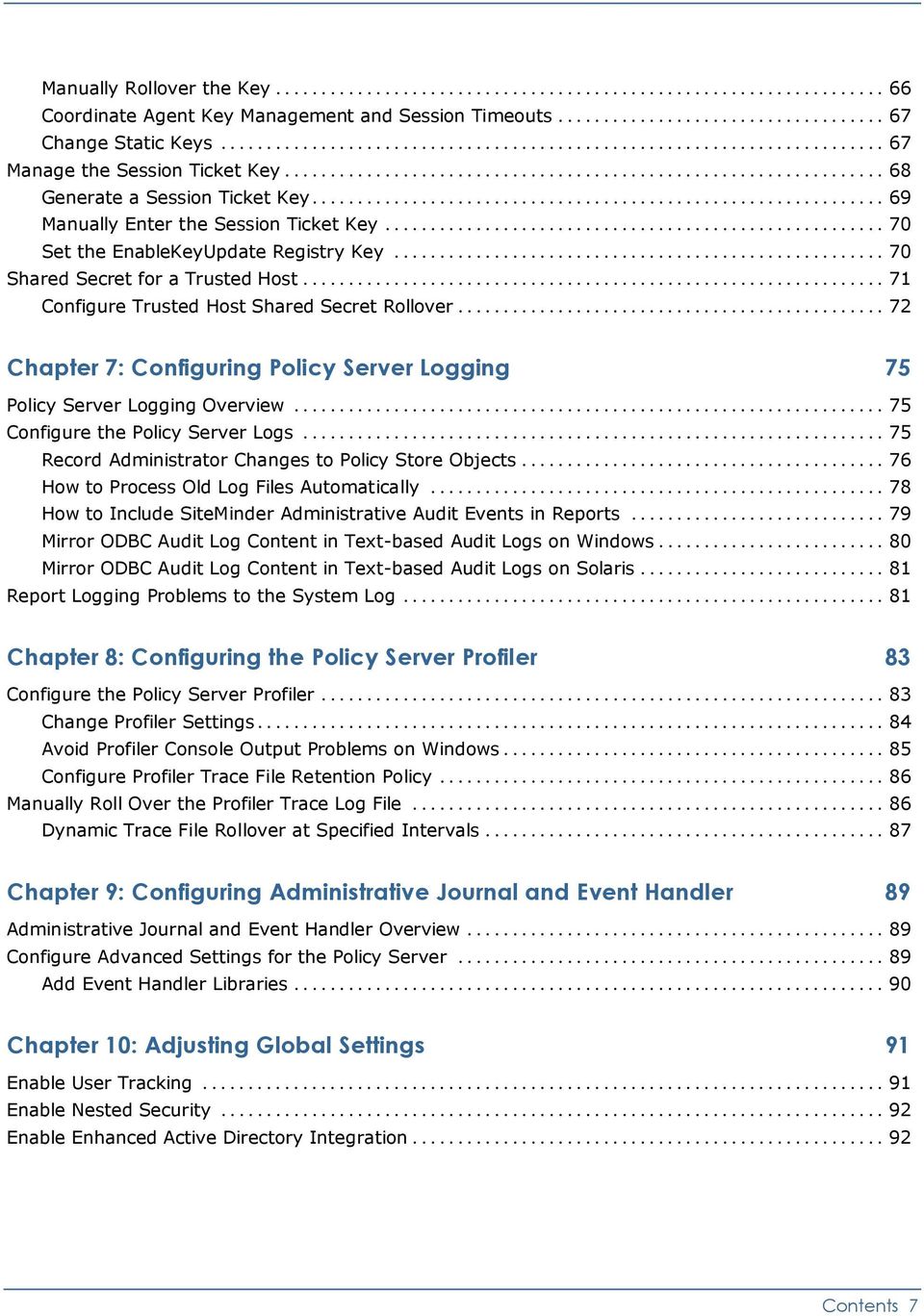
8 Chapter 11: Cache Management 95 Cache Management Overview Configure Caches Flush Caches Flush All Caches Flush User Session Caches Flush Resource Caches Flush the Requests Queue on the Policy Server Flush the Policy Store Cache Chapter 12: User Session and Account Management 101 User Session and Account Management Prerequisites Enable and Disable Users Manage User Passwords Auditing User Authorizations Chapter 13: Clustering Policy Servers 105 Clustered Policy Servers Failover Thresholds Hardware Load Balancing Considerations Configure Clusters Configure a Policy Server as a Centralized Monitor for a Cluster Point Clustered Policy Servers to the Centralized Monitor Chapter 14: Using the OneView Monitor 111 OneView Monitor Overview Policy Server Data Web Agent Data Configure the OneView Monitor Clustered Environment Monitoring Access the OneView Viewer Chapter 15: Monitoring SiteMinder Using SNMP 129 SNMP Monitoring SNMP Overview SiteMinder SNMP Module Contents Dependencies SNMP Component Architecture and Dataflow SiteMinder MIB MIB Overview Policy Server Administration Guide
9 SiteMinder MIB Hierarchy MIB Object Reference Event Data Configure the SiteMinder Event Manager Event Configuration File Syntax Event Configuration File Examples Start and Stop SiteMinder SNMP Support Start and Stop the Windows Netegrity SNMP Agent Service Start and Stop SNMP support on UNIX Policy Servers Troubleshooting the SiteMinder SNMP Module SNMP Traps Not Received After Event Chapter 16: SiteMinder Reports 147 Report Descriptions Schedule a SiteMinder Report View SiteMinder Reports Delete SiteMinder Reports Recurring Reports Delete Recurring Reports Modify Recurring Reports View Recurring Reports Chapter 17: Policy Server Tools 153 Policy Server Tools Overview Requirement When Using the Policy Server Tools on Linux Red Hat Export Policy Data Using smobjexport Export Policy Store Objects With Dependencies Import Policy Data Using smobjimport Overview of the XML-based Data Format Export Policy Data Using XPSExport Add Policy Data Overlay Policy Data Replace Policy Data Import Policy Data Using XPSImport Troubleshooting Policy Data Transfer Export and Import Stored Keys Manage an LDAP Policy Store Using smldapsetup Modes for smldapsetup Arguments for smldapsetup smldapsetup and Sun Java System Directory Server Enterprise Edition Remove the SiteMinder Policy Store using smldapsetup Contents 9

10 Delete SiteMinder Data in ODBC Databases Check Solaris Patches with smpatchcheck Import Tokens Using the SiteMinder Token Tool SiteMinder Test Tool Change the SiteMinder Super User Password Using smreg How to Count the Users in your SiteMinder Environment Map the Active Directory inetorgperson Attribute Determine the Number of Users Associated with SiteMinder Policies XPSConfig Manage Product Parameters XPSEvaluate Evaluate Expressions XPSExplorer Browse Policy Store Data Export a Subset of Policy Store Data XCart Management XPSSecurity Manage XPS Administrators Make an Administrator a Super User XPSSweeper Synchronize XPS and SiteMinder Policy Stores Run XPSSweeper as a Batch Job Configure Autosweep Using XPSConfig Appendix A: SiteMinder and CA Security Compliance Manager 213 How SiteMinder and CA Security Compliance Manager Integration Works Generate the Compliance Reports Display List of Available Compliance Reports Or Their Fields Add a New Compliance Report Change the Content of the Existing Compliance Reports Appendix B: General SiteMinder Troubleshooting 219 Command Line Troubleshooting of the Policy Server Start or Stop Debugging Dynamically Start or Stop Tracing Dynamically Check the Installed JDK Version Override the Local Time Setting for the Policy Server Log Review System Application Logs LDAP Referrals Handled by the LDAP SDK Layer Disable LDAP Referrals Handle LDAP Referrals on Bind Operations Idle Timeouts and Stateful Inspection Devices Error -- Optional Feature Not Implemented Errors or Performance Issues When Logging Administrator Activity Troubleshoot Policy Server Console Help on Netscape Browsers Event Handlers List Settings Warning when Opening Policy Server Management Console Policy Server Administration Guide

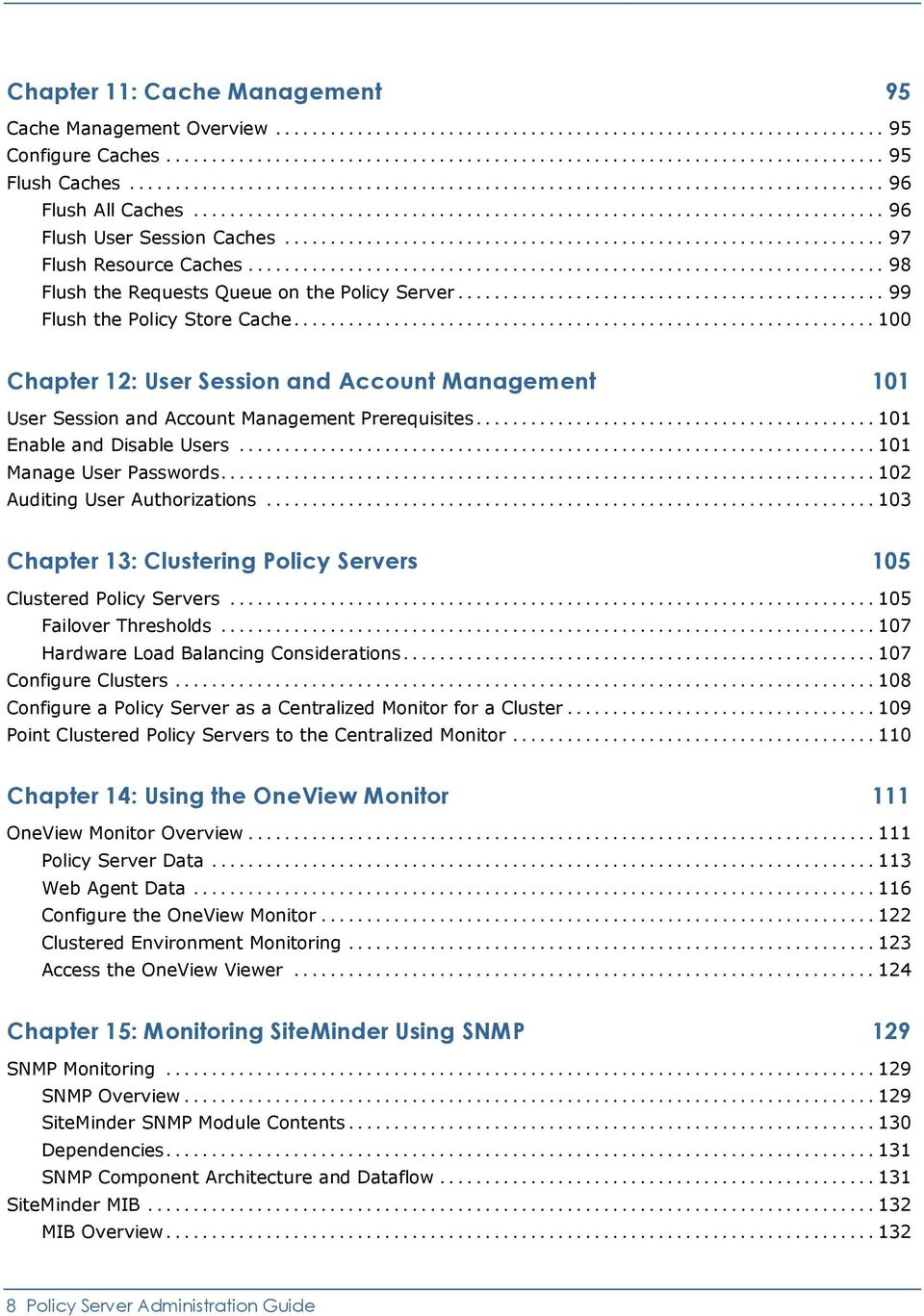
11 SiteMinder Policy Server Startup Event Log Appendix C: Scaling Your SiteMinder Environment 233 Manage Agent Keys in Large Environments How to Determine When to Add Web Agents Estimate User Requests Determine the Number of Users the Web Agent Can Support Maximum Available Sockets for a Web Agent Configure Web Agents Under Heavy Loads Improve Performance in More Stable Environments How to Determine When to Add Policy Servers Determine the Number of Sockets Opened to a Policy Server Determine the Number of Web Agents a Policy Server Can Support Modify the Number of Connections Provided by Policy Servers How to Configure Policy Servers Under Heavy Loads Netscape LDAP Directory Tuning Replication Considerations UNIX Server Tuning nofiles Parameter File Descriptors Timezone Considerations Appendix D: Log File Descriptions 253 smaccesslog smobjlog Appendix E: Publishing Diagnostic Information 263 Diagnostic Information Overview Use the Command Line Interface Specify a Location for Published Information Published Data Published Policy Server Information Published Object Store Information Published User Directory Information Published Agent Information Published Custom Modules Information Appendix F: Error Messages 279 Authentication Authorization Contents 11
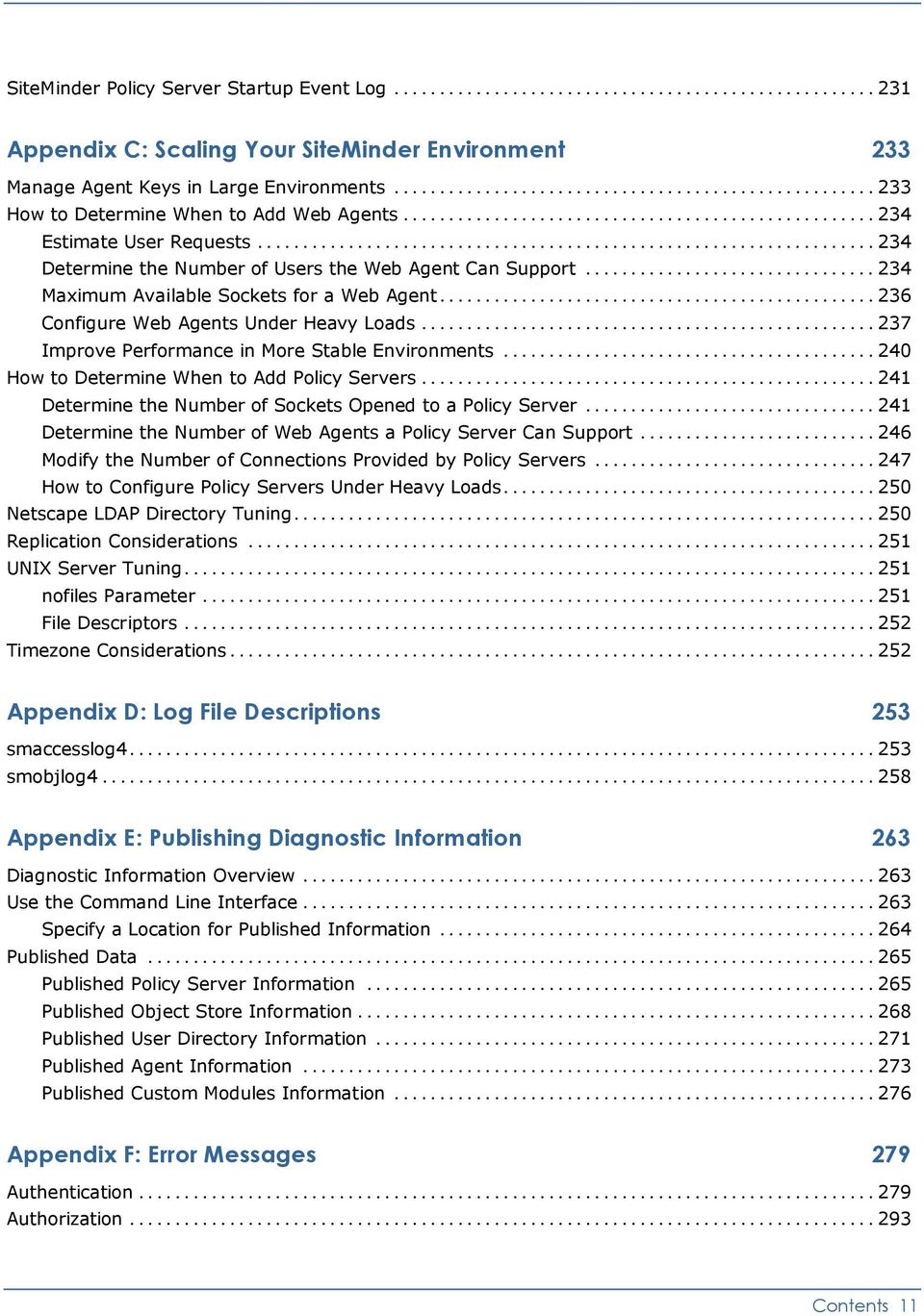
12 Server Java API LDAP ODBC Directory Access Tunnel Index Policy Server Administration Guide

13 Chapter 1: Policy Server Management This section contains the following topics: Policy Server Management Overview (see page 13) Policy Server Management Tasks (see page 17) Policy Server Management Overview The Policy Server provides a platform for access control that operates in conjunction with other CA products, including: CA SiteMinder Combines the Policy Server with Web Agents to provide access control for Web servers. CA SOA Security Manager Provides access control for XML-based transactions. If you have purchased this product, see the CA SOA Security Manager Policy Configuration Guide for more information. CA Identity Manager Provides identity management services, see the CA Identity Manager Administration Guide for more information. Note: For information about SiteMinder and policy-based resource management, see the Policy Server Configuration Guide. Policy Server Components A Policy Server environment consists of two core components: Policy Server Provides policy management, authentication, authorization, and accounting services. Policy Store Contains all Policy Server data. Additional components are included with various CA products, for example, SiteMinder Agents. SiteMinder Agents are integrated with a standard Web server or application server. They enable SiteMinder to manage access to Web applications and content according to predefined security policies. Other types of SiteMinder Agents allow SiteMinder to control access to non-web entities. For example, a SiteMinder RADIUS Agent manages access to RADIUS devices, while a SiteMinder Affiliate Agent manages information passed to an affiliate s Web site from a portal site. Chapter 1: Policy Server Management 13
14 Policy Server Management Overview Policy Server Operations The Policy Server provide access control and single sign-on. It typically runs on a separate Windows or UNIX system, and performs the following key security operations: Authentication The Policy Server supports a range of authentication methods. It can authenticate users based on user names and passwords, using tokens, using forms based authentication, and through public-key certificates. Authorization The Policy Server is responsible for managing and enforcing access control rules established by Policy Server administrators. These rules define the operations that are allowed for each protected resource. Administration The Policy Server can be configured using the Administrative UI. The Administration service of the Policy Server is what enables the UI to record configuration information in the Policy Store. The Policy Store is the database that contains entitlement information. Accounting The Policy Server generates log files that contain auditing information about the events that occur within the system. These logs can be printed in the form of predefined reports, so that security events or anomalies can be analyzed. Health Monitoring Policy Server provides health monitoring components. 14 Policy Server Administration Guide
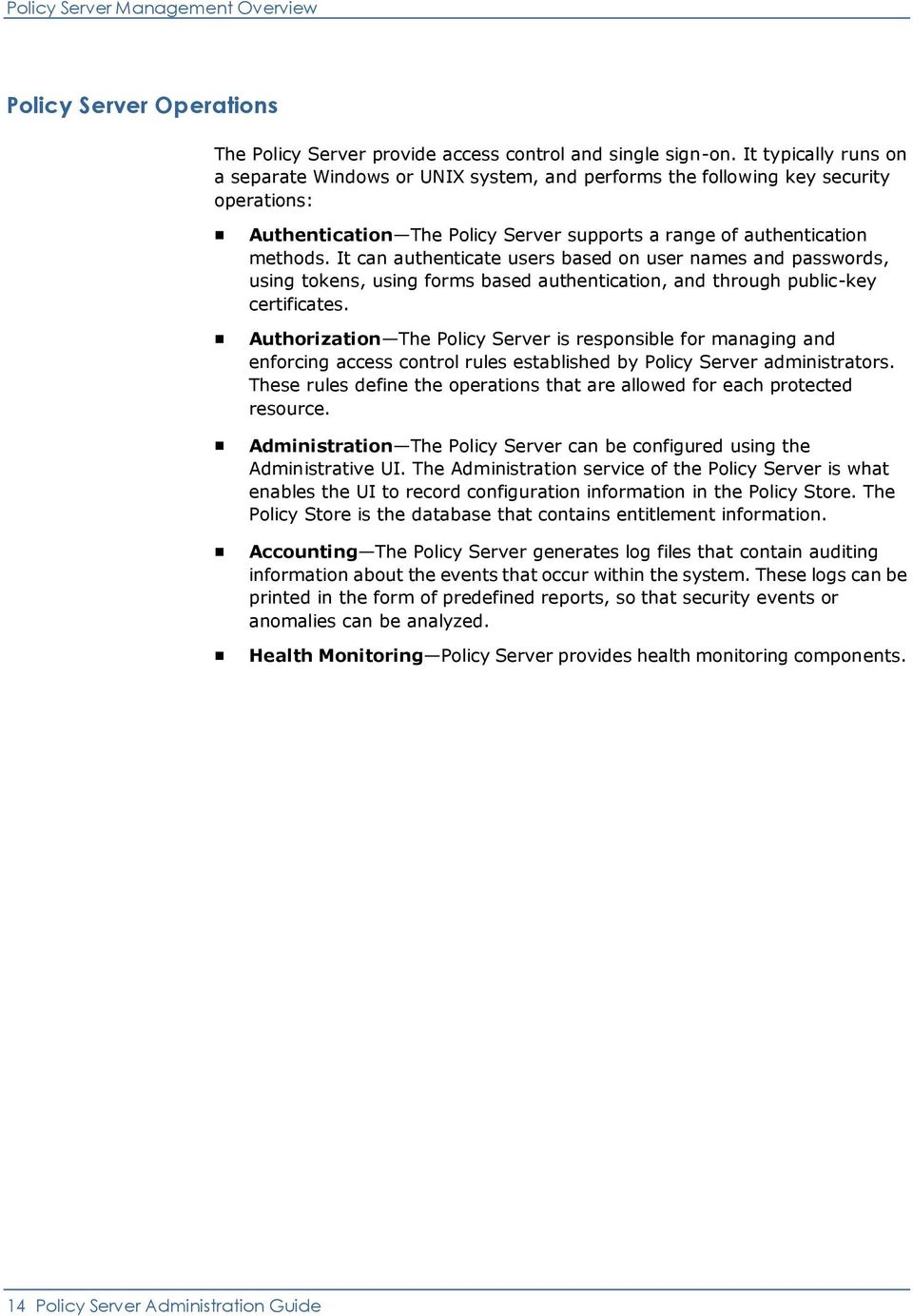
15 Authorization Authentication Administration Accounting Policy Server Management Overview The following diagram illustrates a simple implementation of a Policy Server in a SiteMinder environment that includes a single SiteMinder Web Agent. Web Server Agent Protected Resources Accounting Logs User Directories Policy Server Policy Store In a Web implementation, a user requests a resource through a browser. That request is received by the Web Server and intercepted by the SiteMinder Web Agent. The Web Agent determines whether or not the resource is protected, and if so, gathers the user s credentials and passes them to the Policy Server. The Policy Server authenticates the user against native user directories, then verifies if the authenticated user is authorized for the requested resource based on rules and policies contained in the Policy Store. When a user is authenticated and authorized, the Policy Server grants access to protected resources and delivers privilege and entitlement information. Note: Custom Agents can be created using the SiteMinder Agent API. For more information, see the Programming Guide for C. Chapter 1: Policy Server Management 15
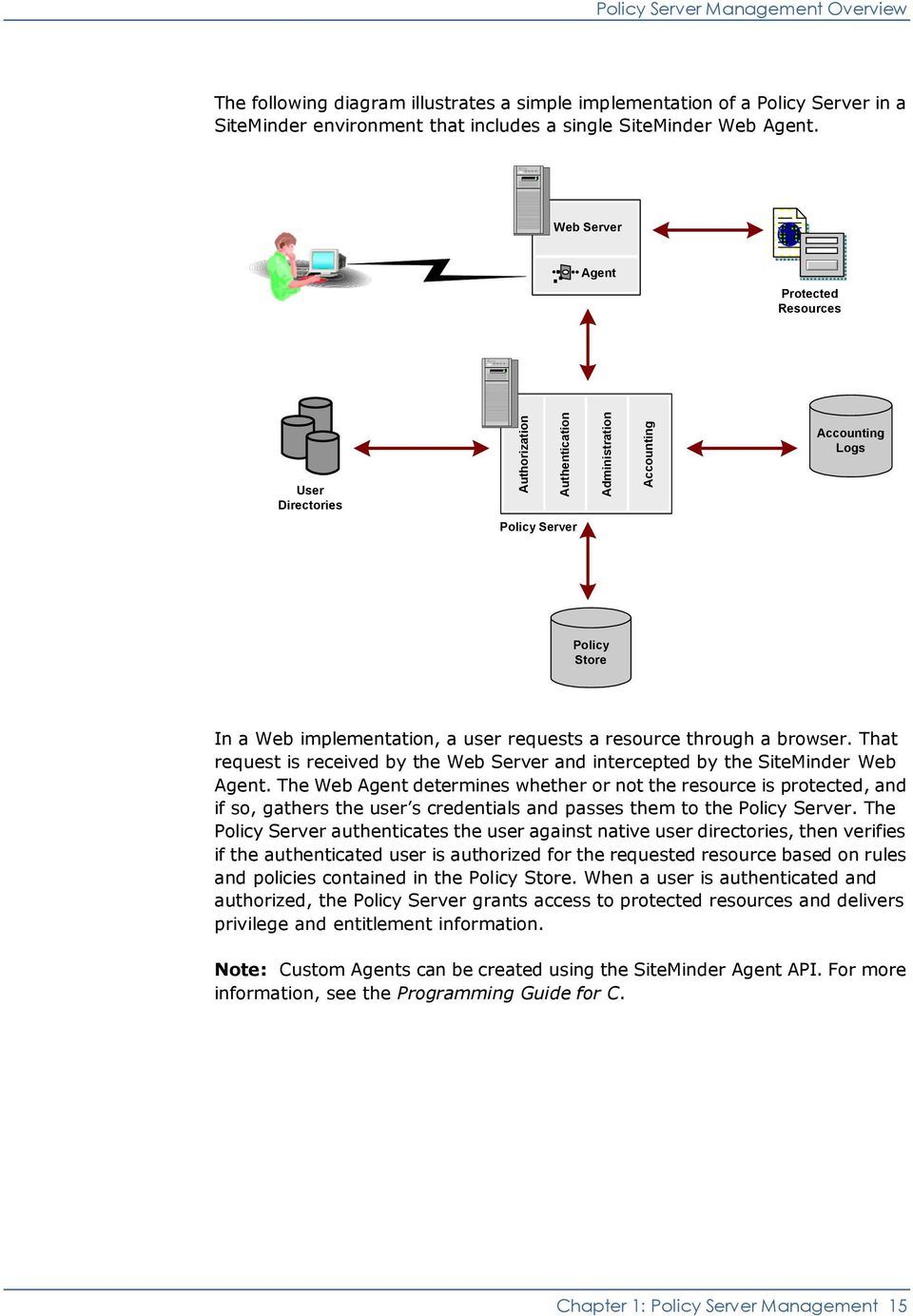
16 Policy Server Management Overview Policy Server Administration The following diagram illustrates the Policy Server administrative model: Object Store 2 1 Policy Store Policy Server Application Server 3 4 Administrative UI Report Server Administrator Store Report Database Audit Database 1. Policy Server The Policy Server provides policy management, authentication, authorization, and accounting services. 2. Policy store - The policy store contains all of the Policy Server data. You can configure a policy store in a supported LDAP or relational database. 3. Administrative UI You use the Administrative UI to manage SiteMinder administrator accounts, objects, and policy data through the Policy Server. You configure a directory XML file, an administrator user store, and an object store when installing the Administrative UI: Object store The Administrative UI is an asynchronous application that is event and task-based. The object store stores this information. You configure an object store in either a Microsoft SQL Server or Oracle database. Administrator user store The Administrative UI authenticates SiteMinder administrator accounts using the administrator user store. All of your administrator accounts must be stored in a single administrator user store. You configure an administrator user store in a supported LDAP directory server or ODBC database when installing the Administrative UI. 16 Policy Server Administration Guide
17 Policy Server Management Tasks 4. Report server and databases You can create and manage a collection of SiteMinder policy analysis and audit reports from the Administrative UI. A report server and report database are required to use the reporting feature. The report server and report database are required to run policy analysis reports. The report server and audit database are required to run audit-based reports. Policy Server Management Tasks As a Policy Server administrator, you are responsible for system-level configuration and tuning of the SiteMinder environment, monitoring and ensuring its performance, as well as management of users and user sessions as necessary. You perform most fundamental system configuration and management tasks using the Policy Server Management Console. Others tasks are performed using the Administrative UI. Policy Server management tasks include: Starting and Stopping the Policy Server Configuring the Policy Server Executives Cache Management Configuring and Managing Encryption Keys User Session and Account Management Monitoring the Health of Your SiteMinder Environment Running Reporting Policy Server Management Console The Policy Server Management Console (or Management Console) provides a range of Policy Server configuration and system management options. The Management Console has a tab-based user interface in which information and controls are grouped together by function and presented together on tabs in a single window. Important! The Policy Server Management Console should only be run by users who are members of the administrator group in Microsoft Windows. Chapter 1: Policy Server Management 17
18 Policy Server Management Tasks Start the Management Console To open the Management Console Windows--Select the Policy Server Management Console icon in the SiteMinder program group UNIX--Run installation_directory/siteminder/bin/smconsole. Note: To run the Policy Server Management Console on UNIX, the X display server needs to be running and the display enabled by export DISPLAY=n.n.n.n:0.0, where n.n.n.n is the IP address of the machine running the Policy Server. Save Changes to Management Console Settings On any tab in the Management Console, click: Apply to save the settings and keep the Management Console open OK to save the settings and close the Management Console. Note: You must stop and restart the Authentication and Authorization processes to put Management Console settings changes into effect. The Policy Server cannot use the new settings until these services restart. Policy Server User Interface The browser-based CA SiteMinder Administrative UI primarily enables management of Policy Server objects, but also provides some system management functionality. To access the Administrative UI 1. Do one of the following: From the computer hosting the Administrative UI, click Start, Programs, CA, SiteMinder, SiteMinder Administrative UI. Open the following URL in your browser: The host_name is the name of the computer on which the Administrative UI runs. You must use a fully-qualified domain name. If the Administrative UI is not using the default HTTP port (80), you must add the port number as shown in the following example: The login page for the Administrative UI appears. 18 Policy Server Administration Guide
19 Policy Server Management Tasks 2. Enter a valid user name and password in the appropriate fields. If you are accessing the Policy Server for the first time, use the default super user administrator account, which you created during Policy Server installation. 3. Click Log In. The Administrative UI opens. The contents of the window depend on the privileges of the administrator account you used to login. You will only see the items to which your account has access. Chapter 1: Policy Server Management 19
20 Policy Server Management Tasks Grant Access to XPS Tools Access to the XPS Tools included with SiteMinder must be granted to individual users by an Administrator using the Administrative UI. To grant access to the XPS tools 1. Log into the Administrative UI. 2. Click the Administration tab. 3. Click Administrator, and then click one of the following: To add a new administrator, click Create Administrator To change the access of an existing administrator, click Modify Administrator 4. Enter a name and an optional description in the respective fields. 5. Enter a user path, or click the Lookup button and select an existing user path. Note: The user path (specified in the Administrative UI or with the XPSSecurity tool by an Administrator) is required for write access to any of the settings controlled by the XPS Tools. A user path has the following format: namespace://directory_server/dn or Login_for_OS 6. (Optional) Select the Super User check box to grant super user rights. 7. Select any of the following check boxes in the command line tools section of the Access Methods group box: XPSEvaluate Allowed Grants access to the XPS expression evaluation tool. XPSExplorer Allowed Grants access to the tool that edits the XPS database. XPSRegClient Allowed Grants access to the XPS tool that registers Web Access Managers or Reports servers as privileged clients. XPSConfig Allowed Grants access to the tool that examines configures XPS settings in XPS-aware products. XPSSecurity Allowed Grants access to the security tool which creates XPS users and specifies their XPS-related privileges. 8. (Optional) Select the check box of any other access you want to grant. 20 Policy Server Administration Guide
21 Policy Server Management Tasks 9. (Optional) To restrict the user's access to specific categories only, click the Create button, and then select the categories you want. 10. Click Submit. Your changes are submitted and a response appears. More information: Add Event Handler Libraries (see page 90) Chapter 1: Policy Server Management 21
22 Policy Server Management Tasks Open the FSS Administrative UI The FSS Administrative UI is an applet-based application that is installed with the Policy Server. This UI contains federation-specific objects such as affiliates (consumers, service providers, resource partners) and SAML authentication schemes that you configure to support federated communication between two partners. Important! You must register each UI with the Policy Server. Registering the FSS Administrative UI with the Policy Server ensures that the communication between both components is FIPS-encrypted (AES encryption). For more information about registering a UI, see the Policy Server Installation Guide. To open the FSS Administrative UI 1. Do one of the following tasks: Open the following URL in your browser: Note: A port number is required only when you are not using the default port. Click Start, Program Files, SiteMinder, SiteMinder FSS Administrative UI. The FSS Administrative UI appears in your browser. 2. Enter the following information: SiteMinder in the Username field The password for the SiteMinder Super User account in the Password field. The name of the 4.x Agent identity you created in the Host Name field. The shared secret of the 4.x Agent identity you created in the Passphrase field. 3. Click Login. You can administer your SiteMinder federation objects and policies using the FSS Administrative UI. The intent of the FSS Administrative UI is to let you manage SiteMinder etrust SiteMinder FSS. If you are familiar with previous versions of the SiteMinder Policy Server User Interface, you will notice that all SiteMinder objects appear in the FSS Administrative UI. The only objects that do not appear are objects related to Enterprise Policy Management (EPM) and reports. You can use the FSS Administrative UI to manage the SiteMinder objects. If you need information while using the FSS Administrative UI, consult the FSS Administrative UI online help system. 22 Policy Server Administration Guide
23 Chapter 2: Starting and Stopping the Policy Server This section contains the following topics: Services and Processes Overview (see page 23) Start and Stop Policy Server Services on Windows Systems (see page 24) Start and Stop Policy Server Processes on UNIX Systems (see page 24) Configure the Policy Server Executives (see page 25) Services and Processes Overview The Policy Server runs two services under Windows and two processes on UNIX. The Policy Server installation process starts the Policy Server and Monitor processes and configures executive applications to run the processes automatically at system startup in the future. The main Policy Server processes for Windows are: Policy Server Serves Agent requests for authentication, authorization, accounting and logging, and (if enabled) administration. SiteMinder Health Monitor Service The OneView Monitor, which monitors the health and performance of the authentication server, authorization server, and Web Agent. The main Policy Server processes for UNIX are: smpolicysrv Serves Agent requests for authentication, authorization, accounting and logging, and (if enabled) administration. smmon The OneView Monitor, which monitors the health and performance of the authentication server, authorization server, and Web Agent. Chapter 2: Starting and Stopping the Policy Server 23
24 Start and Stop Policy Server Services on Windows Systems Start and Stop Policy Server Services on Windows Systems To start or stop Policy Server services on Windows systems: On the Management Console Status tab, click the Start or Stop button. Use the Windows Services dialog, which you can access from the Windows Start Menu using Settings, Control Panel, Services. When you start or stop a Policy Server process, the associated executive starts or stops. You can stop the policy server from the command line using smpolicysrv: installation_path\siteminder\bin\smpolicysrv -stop Note: On Windows systems, do not run the smpolicysrv command from a remote desktop or Terminal Services window. The smpolicysrv command depends on inter-process communications that do not work if you run the smpolicysrv process from a remote desktop or Terminal Services window. Important! If you are running a SiteMinder utility or executable on Windows Server 2008, be sure to open the command line window with Administrator permissions, even if you are logged into the system as an Administrator. For more information, see the release notes for your SiteMinder component. Start and Stop Policy Server Processes on UNIX Systems To start or stop Policy Server processes on UNIX systems, take either of these actions: On the Management Console Status tab, click the corresponding Start and Stop button. Use the supplied scripts. Two scripts are provided to start and stop the Policy Server processes. These scripts also stop the UNIX executive so that the processes do not restart automatically. installation_path/siteminder/start-all installation_path/siteminder/stop-all In addition, the following script can be used to start and stop the Policy Server process. If the UNIX executive is not running when you execute the script, the executive starts along with the process. The script can be invoked with the same command line options, as follows: installation_path/siteminder/smpolsrv 24 Policy Server Administration Guide
25 Configure the Policy Server Executives Command line options: -stop -start -status Stops a process. Starts a process. Indicates whether or not a process is running. The Policy Server logs all UNIX executive activity in the installation_directory/log/smexec.log file. Log entries are always appended to the existing log file. More Information: Command Line Troubleshooting of the Policy Server (see page 219) Configure the Policy Server Executives In both UNIX and Windows installations of the Policy Server, one or more executive applications monitor the status of Policy Server processes and automatically restart any processes that fail. The following sections describe how to start and stop Policy Server processes based on your platform and how to configure, disable, and enable the UNIX and Windows executives. Chapter 2: Starting and Stopping the Policy Server 25
26 Configure the Policy Server Executives Configure Windows Executives For Windows, each Policy Server process is monitored by a separate executive. Each of these executives reads the following threshold values from the Policy_Server_installation_ path\config\siteminder.conf configuration file: SMEXEC_UPTIME_THRESHOLD Indicates the minimum amount of time (in seconds) a Policy Server service must run after startup before the associated executive stops monitoring for frequent crashes. The default value for this parameter is 60 seconds. SMEXEC_RESTART_THRESHOLD Indicates the maximum number of times the executive attempts to restart a service in the time specified by the SMEXEC_UPTIME_THRESHOLD parameter. If a service crashes more than the number of attempts specified by this parameter, the executive stops attempting to restart the service. The default value for this parameter is five attempts. To change the threshold parameters, edit the siteminder.conf file and restart the Policy Server processes. Configure the UNIX Executive For UNIX, the Policy Server and Health Monitor processes are monitored by a single executive. The executive reads its settings from the following configuration file: installation_path/config/siteminder.conf You can edit this file to change the following settings: POLICYSERVER_ENABLED Indicates the state of the Policy Server process when the executive starts running. Set this parameter to YES to enable the process at executive startup. MONITOR_ENABLED Indicates the state of the health monitor process when the executive starts running. Set this parameter to YES to enable the process at executive startup. SMEXEC_UPTIME_THRESHOLD Indicates the minimum amount of time (in seconds) a Policy Server service must run after startup before the associated executive stops monitoring for frequent crashes. The default value for this parameter is Policy Server Administration Guide
27 Configure the Policy Server Executives SMEXEC_RESTART_THRESHOLD Indicates the maximum number of times the executive attempts to restart a service in the time specified by the SMEXEC_UPTIME_THRESHOLD parameter. If a service crashes more than the number of attempts specified by this parameter, the executive stops attempting to restart the service. The default value for this parameter is five attempts. To change any of the UNIX Executive parameters 1. Edit the installation_path/config/siteminder.conf file. 2. From a command line, run the following script: installation_path/siteminder/bin/stop-all The Policy Server processes stop. 3. From a command line, run the following script: installation_path/siteminder/bin/start-all The UNIX executive restarts using the new settings in the siteminder.conf file. Chapter 2: Starting and Stopping the Policy Server 27
28
29 Chapter 3: Configuring Policy Server Data Storage Options This section contains the following topics: Configure Data Storage Options Overview (see page 29) Configure the Policy Store Database (see page 30) Configure the Key Store or Audit Logs to Use the Policy Store Database (see page 31) Configure a Separate Database for the Key Store (see page 31) Configure a Separate Database for the Audit Logs (see page 32) Configure a Separate Database for Token Data (see page 33) Configure a Database for the Session Server (see page 33) Configure LDAP Storage Options (see page 34) Configure ODBC Storage Options (see page 37) Configure Text File Storage Options (see page 38) Audit Data Import Tool for ODBC (see page 38) Specify a Netscape Certificate Database File (see page 42) Configure Data Storage Options Overview You configure storage locations for Policy Server databases (policy store, key store, and audit logs) from the Management Console Data tab. To configure Policy Server data storage settings 1. Start the Policy Server Management Console. Important! If you are accessing this graphical user interface on Windows Server 2008, open the shortcut with Administrator permissions, even if you are logged into the system as an Administrator. For more information, see the release notes for your SiteMinder component. 2. Click the Data tab. 3. Select the database that you want to configure from the Database drop-down list. The database you select determines the storage possibilities that are available for that database type and presented on the Storage drop-down list. Note: The table at the end of this procedure lists the databases you can configure and the storage options available for each one. The combination of these settings determines the settings displayed in the context-sensitive group box below them. 4. Select a storage type for the selected database from the Storage drop-down list. Chapter 3: Configuring Policy Server Data Storage Options 29
30 Configure the Policy Store Database 5. Configure data storage options for the chosen Policy Server database in the context-sensitive group box below the Database and Storage controls. 6. When you have finished, click Apply to save your settings, or click OK to save the settings and exit the Management Console. The following table lists SiteMinder database types and the available storage options: Database Database Description Available Storage Policy Store Key Store Audit Logs Session Server The database for the Policy Store. You must specify the Policy Store database. The database that contains keys used to encrypt cookies created by SiteMinder Agents. The database where you store audit logs containing event information. The database in which the session server stores persistent session data. LDAP ODBC LDAP ODBC ODBC Text file ODBC Configure the Policy Store Database The Policy Store is the database in which all Policy Server objects are stored. To configure the policy store database 1. Select Policy Store from the Database drop-down list. 2. Select an available storage type (LDAP or ODBC) from the Storage drop-down list. 3. Specify Storage Options appropriate for the chosen storage type. 4. Click Apply to save your settings, or click OK to save the settings and exit the Console. 5. (Optional) If you changed the Policy Store database storage type to LDAP, and want the Policy Store to be used as the key store, complete the steps described Configure the Key Store or Audit Logs to Use the Policy Store Database (see page 31). Note: If you have one or more Policy Servers communicating with an LDAP-enabled policy store, configure the same setting in the Management Console on each of those Policy Server systems. 30 Policy Server Administration Guide
31 Configure the Key Store or Audit Logs to Use the Policy Store Database More Information: Configure LDAP Storage Options (see page 34) Configure the Key Store or Audit Logs to Use the Policy Store Database After you configure the Policy Store, you can optionally configure databases. If the Policy Store is of a compatible storage type (that is, if the Policy Store is configured to be stored in a database that is also a valid storage option for the other database), you can configure the Policy Server to use the policy store database as one or more of the following: Key store Audit logs Important! If you are using an LDAP database as your Policy Store, do not use the Policy Store database for audit logs. Audit logs cannot be written to an LDAP database. If you are using the SiteMinder sample data source (SmSampleUsers) as your Policy Store, do not use the Policy Store database for audit logs. Audit logs are not supported by the sample policy store. To configure another database to be stored in the Policy Store database, set the Use Policy Store Database option that appears between the Database drop-down list and the Storage Options area whenever a database other than Policy Store is chosen from the Database drop-down list. When the Use Policy Store Database option is selected, the Storage drop-down list and the context-sensitive Storage Options are grayed-out. Configure a Separate Database for the Key Store The Key store is where the Policy Server stores keys used to encrypt cookies created by SiteMinder Agents. To configure a separate database for the key store 1. Choose Key Store from the Database drop-down list. 2. Choose an available storage type (LDAP or ODBC) from the Storage drop-down list. Note: The Policy Server supports mixed LDAP/ODBC policy and key stores. The policy store can exist in an ODBC database and the key store can reside in an LDAP Directory Server or vice versa. For a list of supported databases, refer to the SiteMinder Platform Matrix on the Technical Support site. Chapter 3: Configuring Policy Server Data Storage Options 31
32 Configure a Separate Database for the Audit Logs 3. Specify Storage Options appropriate for the chosen storage type. 4. Click Apply to save your settings, or click OK to save the settings and exit the Console. More information: Configure LDAP Storage Options (see page 34) Configure a Separate Database for the Audit Logs The audit log database is where the Policy Server stores audit logs containing event information. These settings may reduce Policy Server performance. If this is a problem, configure auditing data logs in a text file instead of database. To configure a separate database for audit logs 1. Choose Audit Log from the Database drop-down list. 2. Choose an available storage type (ODBC or Text file) from the Storage drop-down list. 3. Specify Storage Options appropriate for the chosen storage type. 4. Click Apply to save your settings, or click OK to save the settings and exit the Console. When deciding whether to store the Policy Server audit logs in an ODBC database or text file, you should consider the following factors: SiteMinder Reporting requires that the audit logs are written to an ODBC database. Reporting will not function if the audit logs are written to a text file. SiteMinder audit logging to an ODBC database and to a text file supports internationalization (I18N). If your Policy Server will operate under heavy load, you should consider logging to a text file rather than an ODBC database. However, if you do log to an ODBC database, you should set the following registry key values in the HKEY_LOCAL_MACHINE\SOFTWARE\Netegrity\SiteMinder\CurrentVersion\ Database\ registry location to prevent loss of auditing data under heavy load: ConnectionHangwaitTime Set to 60 seconds for heavy loads. The default is 30 seconds. QueryTimeout Set to 30 seconds for heavy loads. The default is 15 seconds. 32 Policy Server Administration Guide
33 Configure a Separate Database for Token Data LoginTimeout Set to 30 seconds for heavy loads. The default is 15 seconds. Note: The value of ConnectionHangwaitTime should always be at least double the value of QueryTimeout and LoginTimeout. Configure a Separate Database for Token Data The token data database is where the Policy Server stores token data for hardware authentication tokens. To configure a separate database for token data 1. Choose Token Data from the Database drop-down list. 2. Choose an available storage type (ODBC) from the Storage drop-down list. 3. Specify the ODBC Storage Options appropriate for the chosen storage type. 4. Click Apply to save your settings, or click OK to save the settings and exit the Console. Configure a Database for the Session Server The session server database is where the Policy Server Session Server stores persistent session data. To configure a database for the session server 1. Choose Session Server from the Database drop-down list. 2. Choose an available storage type from the Storage drop-down list. 3. Set the Enable Session Server option. You should only enable the Session Server if you are going to use persistent sessions in one or more realms; when enabled, the Session Server impacts Policy Server performance. Note: The Use Policy Store database check box is disabled. For performance reasons, the session server cannot be run on the same database as the policy store. 4. Specify Storage Options appropriate for the chosen storage type. 5. Click OK to save the settings and exit the Console. Chapter 3: Configuring Policy Server Data Storage Options 33
34 Configure LDAP Storage Options Configure Session Server Timeout for Heavy Load Conditions Under extremely heavy load conditions, long-running queries necessary for Session Server maintenance tasks, such as removing idled-out or expired sessions, can timeout. You can adjust the timeout for Session Server maintenance tasks (60 seconds by default), by increasing the value of the MaintenanceQueryTimeout registry setting to allow the maintenance thread to complete its' tasks successfully. The MaintenanceQueryTimeout registry setting can be found at the following registry location: HKEY_LOCAL_MACHINE\SOFTWARE\Netegrity\SiteMinder\CurrentVersion\ SessionServer Configure LDAP Storage Options Use the LDAP context-sensitive storage controls to point to an LDAP directory configured to be used as a policy store to hold policy information or to point to an LDAP directory configured to be used as a key store. Note: Whenever you update parameters relating to an LDAP database, restart the Policy Server to make the new parameters effective. Configure an LDAP Database To configure an LDAP database 1. Specify the Server name or IP address of the LDAP server in the LDAP IP Address field. For performance reasons, the IP address is preferred. Note: You can specify multiple servers in this field to allow for LDAP server failover. 2. Specify the LDAP branch under which the SiteMinder schema is located in the Root DN field (for example, o=myorg.org). 3. If your Policy Server communicates with the LDAP directory over SSL, select the Use SSL check box. Note: If you select this option, you must specify a certificate database in the Netscape Certificate Database File field. 4. Specify the DN of the LDAP directory administrator (for example, cn=directory Manager) in the Admin Username field. 5. Enter the administrative password for the LDAP directory in the Admin Password field. 34 Policy Server Administration Guide
35 Configure LDAP Storage Options 6. Confirm the administrative password for the LDAP directory in the Confirm Password field. 7. Click Test LDAP Connection to verify that the parameters you entered are correct and that the connection can be made. Configure LDAP Failover If you have multiple LDAP directories, you can configure directories for failover. To enable failover, enter LDAP server IP addresses and port numbers in the LDAP Server field as a space-delimited list of LDAP server addresses. You can specify a unique port for each server. If your LDAP servers are running on a non-standard port (389 for non SSL/ 636 for SSL), append the port number to the last server IP address using a : as a delimiter. For example, if your servers are running on ports 511 and 512, you can enter the following: : :512 If the LDAP server on port 511 did not respond to a request, the request is automatically passed to on port 512. If all of your LDAP servers are running on the same port, you can append the port number to the last server in the sequence. For example, if all of your servers are running on port 511, you can enter the following: :511 Configure Enhanced LDAP Referral Handling Enhancements have been made to SiteMinder s LDAP referral handling to improve performance and redundancy. Previous versions of SiteMinder supported automatic LDAP referral handling through the LDAP SDK layer. When an LDAP referral occurred, the LDAP SDK layer handled the execution of the request on the referred server without any interaction with the Policy Server. SiteMinder now includes support for non-automatic (enhanced) LDAP referral handling. With non-automatic referral handling, an LDAP referral is returned to the Policy Server rather than the LDAP SDK layer. The referral contains all of the information necessary to process the referral. The Policy Server can detect whether the LDAP directory specified in the referral is operational, and can terminate a request if the appropriate LDAP directory is not functioning. This feature addresses performance issues that arise when an LDAP referral to an offline system causes a constant increase in request latency. Such an increase can cause SiteMinder to become saturated with requests. Chapter 3: Configuring Policy Server Data Storage Options 35
36 Configure LDAP Storage Options To configure LDAP referral handling 1. Open the Policy Server Management Console. Important! If you are accessing this graphical user interface on Windows Server 2008, open the shortcut with Administrator permissions, even if you are logged into the system as an Administrator. For more information, see the release notes for your SiteMinder component. 2. Select the Data tab. Enable Enhanced Referrals Mark this check box to allow the Policy Server to use enhanced handling LDAP referrals at the Policy Server, rather than allowing LDAP referral handling by the LDAP SDK layer. Max Referral Hops Indicates the maximum number of consecutive referrals that will be allowed while attempting to resolve the original request. Since a referral can point to a location that requires additional referrals, this limit is helpful when replication is misconfigured, causing referral loops. 3. Modify the values as required. 4. Restart the Policy Server. Configure Support for Large LDAP Policy Stores Large LDAP policy stores can cause Administrative UI performance issues. To prevent these problems, you can modify the values of these two registry settings: Max AdmComm Buffer Size Specifies the Administrative UI buffer size (specifically, the maximum amount of data, in bytes, that is passed from the Policy Server to the Administrative UI in a single packet). The Max AdmComm Buffer Size registry setting should be configured at the following registry location: HKEY_LOCAL_MACHINE\SOFTWARE\Netegrity\SiteMinder\CurrentVersion \PolicyServ\ The value of this setting must be set very carefully as allocation of a larger buffer results in a decrease in overall performance. The acceptable range of Max AdmComm Buffer Size is 256KB to 2 GB. The default value this is 256KB (also applies when this registry setting does not exist). 36 Policy Server Administration Guide
37 Configure ODBC Storage Options SearchTimeout Specifies the search timeout, in seconds, for LDAP policy stores. The SearchTimeout registry setting should be configured at the following registry location: HKEY_LOCAL_MACHINE\SOFTWARE\Netegrity\SiteMinder\CurrentVersion \LdapPolicyStore\SearchTimeout The appropriate value for this setting depends upon and can vary according to several factors including network speed, size of the LDAP search query response, the LDAP connection state, load on LDAP server, and so on. The value should be large enough to prevent LDAP timeout when fetching large amounts of policy store data from the LDAP server. The default value is 20 seconds (also applies when this registry setting does not exist). More information: Configure the Policy Store Database (see page 30) Configure a Separate Database for the Key Store (see page 31) Configure ODBC Storage Options Use the ODBC context-sensitive storage controls to configure an ODBC data source to hold the policy store, key store, audit logs, token data, or session server data. Note: For more information on installing ODBC data sources, see the Policy Server Installation Guide. Configure an ODBC Data Source To configure an ODBC data source 1. Specify the name of the ODBC data source in the Data Source Information field. You can enter multiple names in this field to enable ODBC failover. Data Source Information Indicates the name of the ODBC data source. You can enter multiple names in this field to enable failover. User Name Indicates the user name of the database account (if required) with full rights to access the database. Password Contains the password of the database account. Chapter 3: Configuring Policy Server Data Storage Options 37
38 Configure Text File Storage Options Confirm Password Contains a duplicate of the database account password, for verification. Maximum Connections Indicates the maximum number of ODBC connections per database allowed at one time. 2. Click Test ODBC Connection to verify that the parameters you entered are correct and that the connection can be made. Configure ODBC Failover If you have multiple ODBC data sources and you want to configure failover, list the data source names in the Data Source Information field, separated by commas. For example, entering SiteMinder Data Source1,SiteMinder Data Source2 in the Data Source Name field causes the Policy Server to look at Data Source 1 first. If SiteMinder Data Source1 does not respond, the Policy Server automatically looks for SiteMinder Data Source2. Note: Using the method described above, you can configure failover for data sources used as policy stores, key stores, session stores, and audit logs. Configure Text File Storage Options Use the Text File storage options to configure a text file to store the Policy Store audit logs. To specify a text file, type the full path of a file in the File name field or click the Browse button and browse to the required directory and click on or type the name of the desired file. Audit Data Import Tool for ODBC The Policy Server can store audit data in an ODBC database or output audit data to a text file. The tool smauditimport reads a SiteMinder audit data text file and imports the data into an ODBC database that has been configured as an audit store using 5.x or 6.x schema. The smauditimport tool imports authentication, authorization, and admin data into the corresponding tables in the ODBC database. The tool logs the number of rows successfully imported into the ODBC database. For each row in the text file that is successfully imported, the tool replaces the leading character "[" with the number sign "#". For each row that cannot be imported into the ODBC database, the tool logs the row number. 38 Policy Server Administration Guide
39 Audit Data Import Tool for ODBC The smauditimport tool can be run multiple times on the same file. The tool only processes those rows that have not been successfully imported into the ODBC database or the rows that begin with the opening bracket "[". To restore a text file to its original format, replace the leading character of every row with the opening bracket "[". Note: In some SiteMinder documentation, the terms "audit" and "logging" are used interchangeably. Log More Audit Data to a Text File By default, the Policy Server logs less audit data to a text file than to an ODBC database. You can log more audit data to a text file than the default and bring the amount of data in line with an ODBC database. To do so, manually add the following registry key and set its value to one: "Enable Enhance Tracing". To disable "Enable Enhance Tracing", set its value to zero (the default). To log more audit data to a text file 1. Manually add the registry key "Enable Enhance Tracing": Windows Add the following key: TYPE=DWORD \netegrity\siteminder\currentversion\reports \"Enable Enhance Tracing" Solaris Follow these steps: a. Open the file:.../siteminder/registry/sm.registry. b. Locate the line: HKEY_LOCAL_MACHINE\SOFTWARE\Netegrity\SiteMinder \CurrentVersion\Reports=25089 c. Below the line, add the following: "Enable Enhance Tracing"=0x1; REG_DWORD d. Save and close the file. 2. Set "Enable Enhance Tracing" to one. Note: The value of "Enable Enhance Tracing" does not affect logging of Entitlement Management Services (EMS) events. Chapter 3: Configuring Policy Server Data Storage Options 39
40 Audit Data Import Tool for ODBC Audit Data Import Prerequisites for ODBC Before you run the tool smauditimport, verify that the following prerequisites have been satisfied: The Policy Server is installed on a Windows, Solaris, or Linux operating environment. Note: For Solaris and Linux platforms, run nete_ps_env.ksh before running the smauditimport tool. The ODBC database is configured as an audit (logging) store with 5.x or 6.x schema. Note: For more information about how to configure an ODBC database as an audit (logging) store, see the Policy Server Installation Guide. The registry key "Enable Enhance Tracing" is set to one. Import Audit Data into an ODBC Database The tool smauditimport reads a SiteMinder audit data text file and imports it into an ODBC database. The tool is located in the \bin directory under the Policy Server installation directory. Important! Before you import audit data into an ODBC database, configure the database as an audit store with SiteMinder 5.x or 6.x schema. For more information about how to configure an ODBC database with SiteMinder schema, see the Policy Server Installation Guide. Important! If you are running a SiteMinder utility or executable on Windows Server 2008, be sure to open the command line window with Administrator permissions, even if you are logged into the system as an Administrator. For more information, see the release notes for your SiteMinder component. To import audit data into an ODBC database 1. On the computer where the Policy Server is installed, navigate to siteminder_installation\bin. siteminder_installation Specifies the Policy Server installation path. 40 Policy Server Administration Guide
41 Audit Data Import Tool for ODBC 2. Run the following command: smauditimport audit_file dsn user_name user_password -f -v -bbulk_load_size -s5 -s6 audit_file dsn Specifies the path and name of the text file containing the audit data. Note: The smauditimport tool requires the full path name of the audit data text file. Specifies the Data Source Name (DSN) of the ODBC database. user_name Specifies the name of the ODBC database administrator. user_password -f -v Specifies the password of the ODBC database administrator. (Optional) When an error occurs while importing audit data, smauditimport logs the row number and continues processing. Default: Without the -f option, smauditimport logs the row number, but stops processing when an error occurs. (Optional) Validates the number of fields in the text file, validates that the values in numeric fields fall within specified ranges, validates the connection to the database, and outputs errors. Note: When the smauditimport tool is run in the validation mode, no data is imported into the database. -b bulk_load_size (Optional) Specifies the number of rows to read and import into the ODBC database. Default: 100 -s5 -s6 (Optional) Supports an ODBC database configured as an audit store with either 5.x schema or 6.x schema. Default: Supports an ODBC database configured as an audit store with 6.x schema. Chapter 3: Configuring Policy Server Data Storage Options 41
42 Specify a Netscape Certificate Database File Specify a Netscape Certificate Database File If you are using an LDAP directory to store policies or user information over SSL, you must point the Policy Server to the directory that contains Netscape Certificate Database files. The directory must contain the cert7.db and key3.db files. Before you install the Certificate Database file, make a copy of it. Use the certificate database copy instead of the original and do not use cert7.db if it is currently being used by Netscape Communicator. Type the name of the Certificate database in the Netscape Certificate Database file field or browse the directory tree to locate and select the database. This field does not require a value for Active Directory user stores configured in the Administrative UI using the AD namespace. AD user stores use the native Windows certificate repository when establishing an SSL connection. More information: Configure a Separate Database for the Audit Logs (see page 32) 42 Policy Server Administration Guide
43 Chapter 4: Configuring General Policy Server Settings This section contains the following topics: Policy Server Settings Overview (see page 43) Configure Policy Server Settings (see page 43) Policy Server Settings Overview The Policy Server allows you to configure a number of general settings that determine the way it behaves and performs from the Policy Server Management Console Settings tab: TCP ports for access control Administration settings including the TCP port, and Inactivity Timeout Connection settings RADIUS settings Performance settings OneView Monitor settings Configure Policy Server Settings To configure general Policy Server settings 1. Start the Policy Server Management Console. Important! If you are accessing this graphical user interface on Windows Server 2008, open the shortcut with Administrator permissions, even if you are logged into the system as an Administrator. For more information, see the release notes for your SiteMinder component. 2. Click the Settings tab. 3. Adjust the desired settings. 4. When you have finished, click Apply to save your settings, or click OK to save the settings and exit the Management Console. Chapter 4: Configuring General Policy Server Settings 43
44 Configure Policy Server Settings Configure Access Control Settings The Policy Server uses three separate TCP ports to communicate with SiteMinder Agents for authentication, authorization, and accounting. To enable or disable these Agent communication ports, as well as change the TCP port numbers used for each function, use the controls in the Access Control group box on the Management Console Settings tab. Configure Policy Server Administration Settings The Policy Server uses a TCP port to communicate with the Administrative UI to allow browser-based policy management. To enable or disable and change the TCP port number used to communicate with the Administrative UI, as well as specifying a timeout value for administrative inactivity, use the controls in the Administration group box on the Management Console Settings tab. Configure Policy Server Connection Options To specify the maximum number of Policy Server threads, and the idle timeout for a connection to the Policy Server, use the controls in the Connection Options group box on the Management Console Settings tab. Configure Policy Server Performance Settings To configure cache and thread settings to tune Policy Server performance, use the Performance group box on the Management Console Settings tab. Configure RADIUS Settings To specify settings to enable support of RADIUS components in your deployment, use the RADIUS group box on the Management Console Settings tab. 44 Policy Server Administration Guide
45 Configure Policy Server Settings Configure OneView Monitor Settings By default the OneView Monitor runs locally on the Policy Server that it is monitoring. To configure the monitor to accept connections from other Policy Servers to be monitored remotely or to specify a central remote Policy Server that is to monitor all Policy Servers in a cluster, use the OneView Monitor group box on the Management Console Settings tab. Reschedule SiteMinder Policy Data Synchronization SiteMinder automatically synchronizes Policy Data using the XPSSweeper tool. You can change how often this tool runs by setting the following parameter: AutosweepSchedule Specifies the days and times (hour and minute) at which the XPSSweeper process runs. Default: Mondays at 08:30 Limits: GMT Time zone using the 24-hour clock. Separate multiple entries with commas or spaces Example: Mon@13:30,Tue@14:00 Note: If you do not have write access to the SiteMinder binary files (XPS.dll, libxps.so, libxps.sl), an Administrator must grant you permission to use the related XPS command line tools using the Administrative UI or the XPSSecurity tool. To reschedule the synchronization of the SiteMinder databases 1. Open a command line on the Policy Server, and enter the following command: xpsconfig The tool starts and displays the name of the log file for this session, and a menu of choices opens. 2. Enter the following: xps A list of options appears. 3. Enter the following: 8 (AutosweepSchedule) The current schedule for the XPSSweeper tool appears. Chapter 4: Configuring General Policy Server Settings 45
46 Configure Policy Server Settings 4. Type C, and then enter the day and time you want. If you want to enter several days or times, separate them with commas or spaces. Use the following format: The new and old settings appear. The values you added are shown at the bottom of the settings as a "pending value." 5. Do the following: a. Enter Q twice. b. Enter L. c. Enter Q to end your XPS session. Your changes are saved and the command prompt appears. More information: Policy Server Tools Overview (see page 153) 46 Policy Server Administration Guide
47 Chapter 5: Changing the Policy Server Super User Password This section contains the following topics: Super User Password Overview (see page 47) Change the Policy Server Super User Password (see page 47) Super User Password Overview The Super User is the Policy Server administrator account established automatically by the Policy Server installation process. You can change the Super User password from the Management Console Super User tab. Note: Changing the Super User Account Password in this dialog box does not enable the Super User if it has been previously disabled by using the Administrative UI. Change the Policy Server Super User Password To change the Policy Server super user password 1. Start the Policy Server Management Console. Important! If you are accessing this graphical user interface on Windows Server 2008, open the shortcut with Administrator permissions, even if you are logged into the system as an Administrator. For more information, see the release notes for your SiteMinder component. 2. Click the Super User tab. 3. In the Old Password field, enter the current password of the Super User. 4. In the New Password field, enter the new password of the Super User. Note: The SiteMinder superuser administrator s password may not contain the pipe ( ), greater than (>), or less than (<) characters. 5. In the Confirm Password field, enter the new password to verify it. 6. Click Apply to save the Super User changes, or click OK to save the settings and close the Console. Note: Changes to the Super User account password take effect without restarting the Policy Server process. Chapter 5: Changing the Policy Server Super User Password 47
48
49 Chapter 6: Configuring and Managing Encryption Keys This section contains the following topics: Policy Server Encryption Keys Overview (see page 49) Key Management Overview (see page 50) FIPS (see page 51) Agent Keys (see page 52) Dynamic Agent Key Rollover (see page 53) Static Keys (see page 54) Session Ticket Keys (see page 55) Key Management Scenarios (see page 55) Reset the r6.x Policy Store Encryption Key (see page 61) Reset the r12.x Policy Store Encryption Key (see page 63) Configure Agent Key Generation (see page 65) Manage Agent Keys (see page 65) Manage the Session Ticket Key (see page 68) Shared Secret for a Trusted Host (see page 71) Policy Server Encryption Keys Overview The Policy Server and Agents use encryption keys to encrypt and decrypt sensitive data passed between Policy Servers and Agents in a SiteMinder environment. Agent keys are used to encrypt SiteMinder cookies that may be read by all agents in a single sign-on environment, and are shared by all agents in a single sign-on environment, since each agent must be able to decrypt cookies encrypted by the other agents. Agent keys are managed by the Policy Server, and distributed to agents periodically. Session ticket keys are used by the Policy Server to encrypt session tickets. Session tickets contain credentials and other information relating to a session (including user credentials). Agents embed session tickets in SiteMinder cookies, but cannot access the contents since they do not have access to session ticket keys which never leave the Policy Server. Both types of keys are kept in the Policy Server's key store and distributed to Agents at runtime. By default, the key store is part of the Policy Store, but a separate key store database can be created if desired. Chapter 6: Configuring and Managing Encryption Keys 49
50 Key Management Overview Other, special keys are: A policy store key is used to encrypt certain data in the policy store. The policy store key is stored, encrypted, in an on-disk file. The Policy Server encrypts the policy store key using a proprietary technique. The policy store key is derived from the encryption key specified when you installed the Policy Server. A key store key is used to encrypt agent and session ticket keys in a separately configured key store. The key store key is kept in the registry (or UNIX equivalent) encrypted with the policy store key. Key Management Overview To keep key information updated across large deployments, the Policy Server provides an automated key rollover mechanism. You can update keys automatically for Policy Server installations that share the same key store. Automating key changes also ensures the integrity of the keys. For SiteMinder Agents that are configured for single sign-on, the key store must be replicated and shared across all SiteMinder environments in the single sign-on environment. If the Policy Server determines that a key store that was configured separately from the policy store is unavailable, it attempts to reconnect to the key store to determine if it has come back online. If the connection fails, the Policy Server: Goes in to a suspended state and refuses any new requests on established connections until the key store comes back online. A Policy Server in a suspended state remains up for the length of time specified in SuspendTimeout, at which point the Policy Server shuts down gracefully. If SuspendTimeout is equal to zero, the Policy Server remains in the suspended state until the key store connection is reestablished. Returns an error status to let Web Agents failover to another Policy Server. Logs the appropriate error messages. Additionally, when the Policy Server is started and the key store is unavailable, the Policy Server shuts down gracefully. You manage keys using the SiteMinder Key Management dialog box in the FSS Administrative UI. 50 Policy Server Administration Guide
51 FIPS FIPS The Federal Information Processing Standards (FIPS) publication specifies the requirements for using cryptographic algorithms within a security system protecting sensitive, unclassified data. SiteMinder embeds RSA 's Crypto-C ME v2.0 cryptographic library, which has been validated as meeting the FIPS Security Requirements for Cryptographic Modules. The validation certificate number for this module is 608. SiteMinder's Java-based APIs use a FIPS-compliant version of the Crypto-J cryptographic library. SiteMinder can operate in a pre-fips mode or in a FIPS-only mode. The cryptographic boundaries, that is, the way SiteMinder applies encryption, are the same in both modes, but the algorithms are different. In FIPS-only mode, SiteMinder uses the following algorithms: AES Key Wrap for key encryption. AES in OFB mode (HMAC-SHA 256) for channel encryption. AES in CBC mode (HMAC-SHA 224) for encrypting tokens used to facilitate single sign-on. The SiteMinder core components make extensive use of encrypted data: The Web Agent encrypts: Cookies using an Agent Key retrieved from the Policy Server Data sent to the Policy Server using a Session Key A Shared Secret using the Host Key. The encrypted Shared Secret is stored in the Host Configuration file. The Policy Server encrypts: Data sent to the Web Agent using a Session Key The Policy Store Key using the Host Key Sensitive data in the Policy Store using the Policy Store Key Session Spec using the Session Ticket Key Data sent to the Administrative UI using a Session Key Password Services data in a user directory using the Session Ticket Key Chapter 6: Configuring and Managing Encryption Keys 51
52 Agent Keys The Policy Store Key is used to encrypt sensitive data stored in the Policy Store. It is derived from a seed string entered during the installation of the Policy Store. The Policy Store Key is also encrypted, using the Host Key, and stored in a system-local file. To support unattended operation, the Host Key is a fixed key embedded in the Policy Store code. Agents use this same Host Key mechanism to encrypt and store their copies of their Shared Secrets. The Session Ticket Key (used by the Policy Server to form authentication tokens) and Agent Keys (primarily used by Web Agents to encrypt cookie data) are encryption keys stored in the Policy Store (or Key Store, depending on SiteMinder configuration settings) in encrypted form. They are encrypted using the Policy/Key Store Key. The Key Store Key is encrypted in the Policy Store. Agent Shared Secrets (used for Agent authentication and in the TLI Handshake), along with other sensitive data, are also encrypted with the Policy Store Key and stored in the Policy Store. Agent Keys SiteMinder Web Agents use an Agent key to encrypt cookies before passing the cookies to a user s browser. When a Web Agent receives a SiteMinder cookie, the Agent key enables the Agent to decrypt the contents of the cookie. Keys must be set to the same value for all Web Agents communicating with a Policy Server. The Policy Server provides the following types of Agent keys: Dynamic Keys are generated by a Policy Server algorithm and are distributed to connected Policy Servers and any associated SiteMinder Web Agents. Dynamic keys can be rolled over at a regular interval, or by using the Key Management dialog box of the Administrative UI. For security reasons, this is the recommended type of Agent key. Static Keys remain the same indefinitely, and can be generated by a Policy Server algorithm or entered manually. SiteMinder deployments uses this type of key for a subset of features that require information to be stored in cookies on a user s machine over extended periods of time. Note: A static agent key is always generated at installation. This static key is used for certain other product features, such as user management, whether or not you use the static key as the Agent key. More information: Dynamic Agent Key Rollover (see page 53) 52 Policy Server Administration Guide
53 Dynamic Agent Key Rollover Dynamic Agent Key Rollover Dynamic Agent key rollover is configured in the Key Management dialog of the FSS Administrative UI. Web Agents poll the Policy Server for key updates at a regular interval. If keys have been updated, Web Agents pick up the changes during polling. The default polling time is 30 seconds, but can be configured by changing the pspollinterval parameter of a Web Agent. Note: For information about changing the parameters of a Web Agent, see the SiteMinder Web Agent Configuration Guide. The Policy Server uses an algorithm to generate dynamic keys at a regular interval. These keys are saved in the key store. When a Web Agent detects new keys, it retrieves them from the key store. Agent Keys Used in Dynamic Key Rollover SiteMinder deployments use the following keys in a dynamic key rollover and maintain them in the key store: An Old Key is a Dynamic key that contains the last value used for the Agent key before the current value. A Current Key is a Dynamic key that contains the value of the current Agent key. A Future Key is a Dynamic key that contains the next value that will be used as the Current key in an Agent key rollover. Static Key When the Policy Server processes a dynamic Agent key rollover, the value of the current key replaces the value of the old key. The value of the future key replaces the value of the current key, and the Policy Server generates a new value for the future key. When receiving a cookie from a client browser, the Web Agent uses the current key from the key store to decrypt the cookie. If the decrypted value is not valid, the Web Agent tries the old key, and if necessary, the future key. The old key may be required to decrypt cookies from an Agent that has not yet been updated, or to decrypt existing cookies from a client s browser. The future key may be required for cookies created by an updated Agent, but read by an Agent that has not yet polled the key store for updated keys. Chapter 6: Configuring and Managing Encryption Keys 53
54 Static Keys Rollover Intervals for Agent Keys At a specified time, the Agent key rollover process begins. To prevent multiple rollovers from multiple Policy Servers, each server sets a rollover wait time of up to 30 minutes. If no update has been performed by the end of the wait time, that Policy Server updates the keys. All Policy Servers wait for updated keys and then process the new keys to their Agents. Even for a single Policy Server, the update time may be up to 30 minutes beyond the time specified for the rollover. The Agent Key Rollover process begins at the time(s) specified in the SiteMinder Agent Key Management dialog box. The process can take up to three minutes. In that time period, all Web Agents connected to the Policy Server receive updated keys. Note: In a deployment that involves multiple replicated Policy Servers, the process for distributing Agent keys may take up to 30 minutes. Static Keys A static key is a string used to encrypt data which remains constant. In a SiteMinder deployment that uses the Agent Key rollover feature, a static key provides a method for maintaining user information across an extended period of time. The following SiteMinder features and situations make use of the static key: Saving User Credentials for HTML Forms Authentication If an HTML Forms authentication scheme has been configured to allow users to save credentials, the Policy Server uses the static key to encrypt the user s credentials. User Tracking If user tracking is turned on, the Policy Server uses the static key to encrypt user identity information. Single Sign-on Across Multiple Key Stores In a SiteMinder deployment that includes multiple key stores, the static key may be used for single sign-on. In this situation, SiteMinder Agents use the static key for all cookie encryption. Note: If you change the static key, any cookies created with the former static key are invalid. Users may be forced to re-authenticate, and user tracking information becomes invalid. In addition, if the static key is used for single sign-on, users are challenged for credentials when they attempt to access resources in another cookie domain. 54 Policy Server Administration Guide
55 Session Ticket Keys More information: Multiple Policy Stores with Separate Key Stores (see page 60) Session Ticket Keys When a user successfully logs into a protected resource, the Policy Server creates a session ticket. The session ticket is what the Policy Server uses to determine how long a user s authentication remains valid. This session ticket is encrypted using the session ticket key and cached in the Agent User Cache. You can choose to have the Policy Server generate the session ticket key using an algorithm, or you can enter a session ticket key in the SiteMinder Key Management dialog box. For security reasons, the randomly generated key is recommended. However, if your SiteMinder implementation includes multiple key stores in a single sign-on environment, you must enter the same session ticket key for all key stores. More information: Cache Management Overview (see page 95) Manage the Session Ticket Key (see page 68) Key Management Scenarios There are three types of scenarios for key management based on how you implement Policy Servers, policy stores and key stores, along with your single sign-on requirements. These scenarios include: Common Policy Store and Key Store In this scenario, a group of Policy Servers shares a single policy store and key store, providing access control and single sign-on in a single cookie domain. The policy store data is maintained in a single policy store. Key data is maintained in a single key store. The key store may be part of the policy store, or may be a separate store. Both policy store and key store data may be replicated for failover purposes. Replication must be configured based on the database or directory type selected for the policy store. For information about replication schemes, consult the documentation provided by your database or directory vendor. Chapter 6: Configuring and Managing Encryption Keys 55
56 Key Management Scenarios Multiple Policy Stores with a Common Key Store In this scenario, groups of Policy Servers connect to separate policy stores, but share a common key store, providing access control and single sign-on across multiple cookie domains. The policy store data for each group of Policy Servers is maintained in a single policy store. Key data for all groups of Policy Servers is maintained in a single key store. The separate key store allows Agents associated with all Policy Servers to share keys, enabling single sign-on across separate cookie domains. Both policy store and key store data may be replicated for failover purposes. Replication must be configured based on the database or directory type selected for the policy store. For information about replication schemes, consult the documentation provided by your database or directory vendor. Multiple Policy Stores and Multiple Key Stores In this scenario, each group of Policy Servers shares a single policy store and key store, providing access control and single sign-on across multiple cookie domains where it is desirable for the Policy Servers in each cookie domain to have a separate key store. The policy store data for each group of Policy Servers is maintained in a single policy store. Key data for each group of Policy Servers is maintained in a single key store. The key store may be part of the policy store, or may be a separate store. The same set of static keys allows for single sign-on across all Web Agents. Both policy store and key store data may be replicated for failover purposes. Replication must be configured based on the database or directory type selected for the policy store. For information about replication schemes, consult the documentation provided by your database or directory vendor. More information: Configure LDAP Failover (see page 35) Configure ODBC Failover (see page 38) 56 Policy Server Administration Guide
57 Key Management Scenarios Key Management Considerations When deciding on the key management scenario for your enterprise, consider the following: When configuring dynamic keys in an environment with multiple Policy Servers that share a common key store, a single Policy Server must be nominated to perform Agent Key generation. You should disable key generation on all other Policy Servers. In a network configuration with multiple Policy Servers, the Policy Server Management Console enables you to specify a policy store for each Policy Server. Policy stores can be master policy stores that are the primary location for storing SiteMinder objects and policy information, or they can be replicated policy stores that use data copied from a master policy store. Master/slave directories or databases must be configured according to the specifications of the directory or database provider. The Policy Server provides the ability to specify a failover order for policy stores, but it does not control data replication. For information about replication schemes, see your directory or database provider s documentation. In any network that uses dynamic key rollover, the key store for a Policy Server may be a master key store or a replicated slave key store. Master key stores receive keys directly from the Policy Server process that generates the keys. Slave key stores receive copies of the keys in the master key store. In a master/slave environment, you must configure key generation from Policy Servers that point to the master policy store and key store. The master policy store and key store data must then be replicated across all other policy stores and key stores included in your failover order. In any single sign-on environment for multiple cookie domains, dynamic keys can only be used if there is a single master key store, or slave key stores with keys replicated from a single master key store. Policy stores and keys stores can be installed on mixed LDAP and ODBC directories. The policy store can reside in an ODBC database and the key store can reside in an LDAP Directory Server or vice versa. For a list of supported databases, go to the Technical Support site and search for the SiteMinder r12.0 SP2 Platform Support Matrix. More information: Configure Agent Key Generation (see page 65) Configure LDAP Failover (see page 35) Configure ODBC Failover (see page 38) Chapter 6: Configuring and Managing Encryption Keys 57
58 Key Management Scenarios Common Policy Store and Key Store The simplest scenario for a SiteMinder configuration that uses key rollover is when multiple Policy Servers use a single policy store (and its associated failover policy stores), along with a single key store. The following figure shows multiple Policy Servers using a single policy store. Web Servers with Web Agents Policy Store Replicated Policy Store Policy Servers Key Store Replicated Key Store In this type of configuration, Policy Servers retrieve dynamic keys from the key store. The Web Agents associated with the Policy Servers collect new keys from the Policy Servers. More information: Key Management Considerations (see page 57) Multiple Policy Stores with a Common Key Store If a network configuration consists of multiple Policy Servers with separate policy stores in a single sign-on environment, it is possible to have a common key store that all of the Policy Servers use for key rollover. 58 Policy Server Administration Guide
59 Key Management Scenarios The following figure shows multiple Policy Servers using a common key store. Web Servers with Web Agents Web Servers with Web Agents Policy Servers for cookie domain.myorg1.org Policy Servers for cookie domain.myorg2.org Policy Store Policy Store Replicated Policy Store Key Store Replicated Key Store Replicated Policy Store One Policy Server generates dynamic keys and stores them in the central key store. Each Policy Server is configured using the Policy Server Management Console to use the central key store; Agent key generation should be disabled for all other Policy Servers. Agents poll their respective Policy Servers to retrieve new keys. The Policy Servers retrieve new keys from the common key store and pass them to the SiteMinder Agents. Note: This scenario requires an additional registry setting that forces Policy Servers that are not generating keys to poll the key store for key updates. More information: Key Management Considerations (see page 57) Set the EnableKeyUpdate Registry Key (see page 70) Chapter 6: Configuring and Managing Encryption Keys 59
60 Key Management Scenarios Multiple Policy Stores with Separate Key Stores If a network configuration is composed of multiple Policy Servers, policy stores, and master key stores, an administrator with appropriate privileges can specify the same static key and session ticket key for each policy store in order to facilitate one or more of the following: Single sign-on across all Agents Password Services with a common user directory The following figure shows an environment with multiple Policy Servers and stores. Web Servers with Web Agents Web Servers with Web Agents Policy Servers for cookie domain.myorg1.com Policy Servers for cookie domain.myorg2.com Replicated Policy Store Policy Store Administrator Policy Store Replicated Policy Store Key Store Key Store Replicated Key Store Enters static key and session ticket key in Policy Server UI for each key store Replicated Key Store In the previous example, the same static key is used to encrypt all cookies created by SiteMinder Web Agents. More information: Key Management Considerations (see page 57) 60 Policy Server Administration Guide
61 Reset the r6.x Policy Store Encryption Key Reset the r6.x Policy Store Encryption Key To reset the r6.x policy store encryption key 1. Log into a Policy Server host system. 2. Run the following command: smobjexport -dsiteminder_administrator -wpassword -ofile_name -c -dsiteminder_administrator Specifies the name of the SiteMinder administrator account. Note: This administrator must be able to manage all SiteMinder domain objects. -wpassword Specifies the password of the SiteMinder administrator account. -ofile_name -c Specifies the following: The path to the output location The name of smdif file the utility creates Note: If this argument is not specified, the default output file names are stdout.smdif and stdout.cfg. Exports sensitive data as clear text. The utility exports the policy store data into the smdif file. 3. Be sure that the smreg utility is located in policy_server_home\bin. policy_server_home Specifies the Policy Server installation path. Note: If the utility is not present, you can find the utility in the Policy Server installation media, which is available on the Support site. 4. Run the following command: smreg -key encryption_key encryption_key Specifies the new encryption key. Limits: 6 to 24 characters. The policy store encryption key is changed. 5. Start the Policy Server Management Console and open the Data tab. Chapter 6: Configuring and Managing Encryption Keys 61
62 Reset the r6.x Policy Store Encryption Key 6. Re enter the policy store administrator password and click Update. The administrator password is re encrypted using the new encryption key. 7. Run the following command: smreg -su password password Specifies the SiteMinder super user password. The super user password is set and encrypted using the new encryption key. 8. Run the following command: smobjimport -dsiteminder_administrator -wpassword -ifile_name -r -f -c -dsiteminder_administrator Specifies the name of the SiteMinder administrator account. Note: This administrator must be able to manage all SiteMinder domain objects. -wpassword Specifies the password of the SiteMinder administrator account. -ifile_name -r -f Specifies the following: The path to the smdif file The name of the smdif file name Note: If this argument is not specified, the default input file names are stdout.smdif and stdout.cfg. Specifies that duplicate policy store information can be overwritten during the import. Turns off automatic renaming of objects. By default, when the utility attempts to import an object with a name that exists in the target policy store, the utility creates a duplicate object. The name of the object is nameoid. name oid Specifies the name of the object. Specifies the object ID of the new duplicate object. The utility returns errors messages for any objects that could not be created because of naming conflicts. 62 Policy Server Administration Guide
63 Reset the r12.x Policy Store Encryption Key -c Indicates that the input file contains sensitive data in clear text. 9. Run the following command: smreg -su password password Specifies the SiteMinder super user password. The super user password is set. The policy store encryption key is reset. Reset the r12.x Policy Store Encryption Key To reset the r12.x policy store encryption key 1. Log into the Policy Server host system. 2. Run the following command: XPSExport output_file -xa -xs -xc -passphrase passphrase output_file -xa -xs -xc Specifies the name of the XML file to which the policy store data is exported. Specifies that all policy store data be exported. Specifies that security data be exported. Specifies that configuration data be exported. -passphrase passphrase Specifies the passphrase that is required for the encryption of sensitive data. Limits: The passphrase must: Be at least eight characters long Contain at least one uppercase and one lowercase character Contain at least one numeric digit Note: If the passphrase contains a space, enclose the passphrase with quotes. The utility exports the policy store data to the XML. Chapter 6: Configuring and Managing Encryption Keys 63
64 Reset the r12.x Policy Store Encryption Key 3. Be sure that the smreg utility is located in policy_server_home\bin. policy_server_home Specifies the Policy Server installation path. Note: If the utility is not present, you can find the utility in the Policy Server installation media, which is available on the Support site. 4. Run the following command: smreg -key encryption_key encryption_key Specifies the new encryption key. Limits: 6 to 24 characters. The utility changes the policy store encryption key. 5. Run the following command: XPSImport input_file -fo -passphrase passphrase input_file -fo Specifies the name of the XML file that contains the exported policy store data. Allows existing policy store data to be overwritten. -passphrase passphrase Specifies the passphrase required for the decryption of sensitive data. Important! If the passphrase does not match the passphrase entered during the policy store export, sensitive data cannot be decrypted and the import fails. The utility imports the policy store data. The policy store encryption key is reset. 64 Policy Server Administration Guide
65 Configure Agent Key Generation Configure Agent Key Generation You use the Policy Server Management Console Keys tab to configure how the Policy Sever handles Agent key generation. Note: Enable key generation only on the Policy Server that you want to generate Agent keys. To configure Policy Server agent key generation 1. Start the Policy Server Management Console. Important! If you are accessing this graphical user interface on Windows Server 2008, open the shortcut with Administrator permissions, even if you are logged into the system as an Administrator. For more information, see the release notes for your SiteMinder component. 2. Click the Keys tab. 3. Complete the fields and controls presented on the Keys tab to configure Agent key generation. 4. When you are done, click Apply to save your changes. Manage Agent Keys The SiteMinder Key Management dialog box, which you access from the Administrative UI, enables you to configure periodic Agent key rollovers, execute manual rollovers, and change the static key. It also enables you to manage the session ticket key. Note: To manage keys, you must log into the Administrative UI using an account with the Manage Keys and Password Policies privilege. For more information, see the Policy Server Configuration Guide. More information: Manage the Session Ticket Key (see page 68) Configure Periodic Key Rollover (see page 66) Manually Rollover the Key (see page 66) Change Static Keys (see page 67) Chapter 6: Configuring and Managing Encryption Keys 65
66 Manage Agent Keys Configure Periodic Key Rollover The Policy Server supports periodic Agent key rollovers weekly, daily, or at fixed intervals in a single day. The shortest allowable period between rollovers is one hour. Note: If your operating system is not configured to adjust the system time for daylight savings time, key rollover may be offset by one hour. To ensure that key rollover occurs at the expected time, configure your operating system to recognize daylight savings time. To configure periodic key rollover 1. In the Policy Server Management Console, select Enable Agent Key Generation check box in the Keys tab and click OK. 2. Log into the Administrative UI. 3. From the Administration tab, select Policy Server, Key Management. The Key Management pane opens. 4. In the Agent Key group box, select Use dynamic Agent Key. The pane changes to support dynamic keys. 5. In the Dynamic Key Detail group box, select Automatic key rollover then click Set rollover frequency. The Dynamic Key Rollover group box appears. 6. Set the frequency of the automatic key rollover. 7. Click OK. You return to the Key Management pane. Manually Rollover the Key One of the Agent key management features lets you manually rollover dynamic Agent keys. This feature provides added security because the keys can be rolled over at any time. You can also use this feature if you want the Policy Server to generate dynamic keys, but you do not want the keys to rollover at a fixed interval. To manually rollover dynamic Agent keys 1. Log into the Administrative UI. 2. From Administration tab, select Policy Server, Key Management. The Key Management pane opens. 66 Policy Server Administration Guide
67 Manage Agent Keys 3. In the Agent Key group box, select Use dynamic Agent Key. The pane changes to support dynamic keys. 4. In the Dynamic Key Detail group box, select Manual Key Rollover. 5. To rollover dynamic keys, click Rollover Now. The Policy Server immediately generates new Agent keys. Unless you manually execute an Agent key rollover, the Policy Server does not generate new dynamic keys automatically. Note: Do not click this button multiple times unless you want to rollover keys more than once. Web Agents pick up the new keys the next time they poll the Policy Server, which may take up to three minutes due to cache synchronization. If you want to use an entirely new set of keys to for security reasons, you can rollover dynamic keys twice to remove the old key and the current key from the key store. Coordinate Agent Key Management and Session Timeouts You must coordinate the updating of agent keys and session timeouts or you may invalidate cookies that contain session information. This coordination is critical because the person designing policies in your organization may be different than the person configuring dynamic key rollover. Session timeouts should be less than or equal to two times the interval configured between Agent key rollovers. If an administrator configures an agent key rollover to occur two times before a session expires, cookies written by the Web Agent before the first key rollover will no longer be valid and users will be re-challenged for their identification before their session terminates. For example, if you configure key rollover to occur every three hours, you should to set the Maximum Session timeout to six hours or less to ensure that multiple key rollovers do not invalidate the session cookie. Change Static Keys You can change the static Agent key used by SiteMinder Web Agents to encrypt identity information for certain SiteMinder features. Important! Changing the static key is not recommended because the change can cause some SiteMinder features to lose the data they require to function properly. Features that establish and use an identity stored in a persistent cookie will no longer work. Change the static key only in extreme situations such as security breaches. Authenticated users may be forced to login again before single sign-on will function across multiple SiteMinder installations. Chapter 6: Configuring and Managing Encryption Keys 67
68 Manage the Session Ticket Key A static key may also be used to maintain a single sign-on environment in an environment that requires multiple Policy Servers and multiple master key stores. To change the static key 1. Log into the Administrative UI. 2. From the Administration tab select Policy Server, Key Management. The Key Management pane opens. 3. In the Agent Key group box, select Use Static Key. The pane changes to support static keys. 4. Do one of the following: In the Generate a random key group box, click Rollover Now to make the Policy Server generate a new random static key. In the Specify an Agent key group box, enter a static key by setting the following fields: Static key Specify a value that the Policy Server uses as the static key. Use this option in situations where two key stores must use the static key to maintain a single sign-on environment. Confirm key 5. Click Rollover Now. Re-enter the static key. Depending on the option you selected, the Policy Server generates a new static key or uses the one you specified. The static key rolls over within three minutes. 6. Click Submit to save your changes. Manage the Session Ticket Key The Policy Server can generate the session ticket key using an algorithm, or you can enter the session ticket key manually. A session ticket is established each time a user authenticates successfully and enables the Policy Server to determine how long a user s session can continue. Note: The only implementation that requires a manually assigned session ticket key is one that includes multiple, independent key stores. Automatically generated keys cannot be propagated across independent key stores by the Policy Server. In all other instances it is recommended that you use the session ticket key generated by the Policy Server algorithm. 68 Policy Server Administration Guide
69 Manage the Session Ticket Key Generate a Session Ticket Key The Policy Server can generate the session ticket key using a method similar to the one for generating dynamic Agent keys. Randomly generating the session ticket key enables the Policy Server to use an algorithm to create the key used for encryption and decryption. To generate a session ticket key 1. Log into the Administrative UI. 2. From the Administration tab, select Policy Server, Key Management. The Key Management pane opens. 3. Do one of the following: In the Generate a Random Session Ticket Key group box, click Rollover Now. The Policy Server generates a new session ticket key. This key immediately replaces the one that is used to encrypt and decrypt session tickets. Specify a Session Ticket Key group box, complete the following fields: Session ticket key Enter a value for the session ticket key. The Policy Server immediately replaces the existing session ticket key with the value you entered. Confirm Re-enter the session ticket key. 4. Click Rollover Now. 5. Click Submit to save your changes. Chapter 6: Configuring and Managing Encryption Keys 69
70 Manage the Session Ticket Key Manually Enter the Session Ticket Key If your Policy Server is part of an implementation that includes multiple key stores, you can manually enter the session ticket key. To enter the session ticket key 1. From the Administration tab, select Policy Server, Key Management. The Key Management pane opens. 2. In the Specify a Session Ticket Key group box, enter values for the following fields: Session Ticket Key Enter a session ticket key Confirm Re-enter the session ticket key 3. Click Rollover Now. The Policy Server immediately replaces the existing session ticket key with the value you entered. 4. Click Submit. Set the EnableKeyUpdate Registry Key When a single Policy Server generates encryption keys in an environment with multiple Policy Servers that connect to disparate policy stores, but share a central key store, an additional registry setting is required. This registry setting configures each Policy Server to poll the common key store and retrieve new encryption keys at a regular interval. To configure the EnableKeyUpdate registry key on a Windows Policy Server 1. From the Windows Start menu, select Run. 2. Enter regedit in the Run dialog box and click OK. 3. In the Registry Editor, navigate to: HKEY_LOCAL_MACHINE\SOFTWARE\Netegrity\SiteMinder\ CurrentVersion\ObjectStore 70 Policy Server Administration Guide
71 Shared Secret for a Trusted Host 4. Change the following registry value: "EnableKeyUpdate"=0 to "EnableKeyUpdate"=1 5. Restart the Policy Server. To configure the EnableKeyUpdate registry key on a UNIX Policy Server 1. Navigate to: install_directory/siteminder/registry 2. Open sm.registry in a text editor. 3. Locate the following text in the file: HKEY_LOCAL_MACHINE\SOFTWARE\Netegrity\SiteMinder\ CurrentVersion\ObjectStore 4. Change the following registry value: "EnableKeyUpdate"=0 to "EnableKeyUpdate"=1 5. Restart the Policy Server. More information: Multiple Policy Stores with a Common Key Store (see page 58) Shared Secret for a Trusted Host When you register a trusted host, the installation process automatically generates a shared secret for the Web Agent and stores that shared secret in the SmHost.conf file, the Host Configuration file. If you choose to enable shared secret rollover when registering a trusted host, you can rollover the shared secrets for trusted hosts. You can rollover shared secrets manually or periodically. During a manual or periodic shared secret rollover, shared secrets are only rolled over for Agents that were configured at installation to allow rollovers. For information about installing Web Agents and registering trusted hosts, see the SiteMinder Web Agent Installation Guide. Chapter 6: Configuring and Managing Encryption Keys 71
72 Shared Secret for a Trusted Host Shared secret rollover occurs automatically only on servers that are configured to enable Agent key generation. You enable Agent key generation by selecting the Enable Agent Key Generation check box in the Keys tab of the Policy Server Management Console. This setting is enabled by default. Important! We recommend that only one Policy Server be enabled to generate keys. If there are multiple policy stores in an environment, but only a single shared key store, the shared secrets in the policy store are rolled over automatically only in the policy store for the Policy Server with key generation enabled. For the other policy stores, you can manually execute a rollover. To manually rollover the shared secret, use the FSS Administrative UI or the C Policy Management API running on a Policy Server configured to the target policy store. Note: The shared secret policy object is kept in the key store, and thus will be shared by all policy stores that share the same key store. The shared secrets themselves are kept in the trusted host objects, which are part of the policy store. Configure Trusted Host Shared Secret Rollover The Policy Server supports manual and periodic rollover of shared secrets for trusted hosts. Periodic rollovers can be configured hourly, daily, weekly, or monthly; one hour is the shortest allowable period between rollovers. The Policy Server initiates periodic rollovers based on the age of the shared secret for each trusted host, rather than at a specific time of the day, week, or month. By rolling over each shared secret as it expires, the processing associated with the rollover is distributed over time, and avoids placing a heavy processing load on the Policy Server. If you use the manual rollover feature, future periodic rollovers will generally be clustered together for all trusted hosts, since the manual rollover sets new shared secrets for all trusted hosts that allow shared secret rollover. Important! If you enable key generation on more than one Policy Server associated with a single policy store, the same shared secret can be rolled over more than once in a short period of time due to object store propagation delays. This can result in orphaned hosts whose new shared secrets have been discarded. To avoid this potential problem, enable shared secret rollover for a single Policy Server per policy store. 72 Policy Server Administration Guide
73 Shared Secret for a Trusted Host To configure shared secret rollover for trusted hosts 1. In the Keys tab of the Policy Server Management Console, ensure that the Enable Agent Key Generation check box is selected. 2. Log into the Administrative UI. 3. From the Administration tab, select Policy Server, Shared Secret Rollover. The Shared Secret Rollover pane opens. 4. In the Shared Secret Rollover group box, do one of the following: For an immediate rollover, click Rollover Now. To ensure that the shared secret is never rolled over, select Never Rollover Shared Secret. To specify a period rollover, select Rollover Shared Secret every and complete the following fields: Rollover Frequency Enter an integer for the number of times a rollover should occur. This number works together with the value of the rollover period. Rollover Period From the pull-down list, select Hours, Days, Weeks or Months for the occurrence of the rollover. The Policy Server begins the process of rolling over shared secrets for all trusted hosts configured to allow shared secret rollover. The rollover may take some time depending on the number of trusted hosts in your deployment. 5. Click Submit to save your changes. Chapter 6: Configuring and Managing Encryption Keys 73
74
75 Chapter 7: Configuring Policy Server Logging This section contains the following topics: Policy Server Logging Overview (see page 75) Configure the Policy Server Logs (see page 75) Report Logging Problems to the System Log (see page 81) Policy Server Logging Overview The Policy Server log file records information about the status of the Policy Server and, optionally, configurable levels of auditing information about authentication, authorization, and other events in the Policy Server log file. If the Policy Server is configured as a RADIUS Server, RADIUS activity is logged in the RADIUS log file. You configure these logs from the Management Console Logs tab. Configure the Policy Server Logs To configure the Policy Server logs 1. Start the Policy Server Management Console. Important! If you are accessing this graphical user interface on Windows Server 2008, open the shortcut with Administrator permissions, even if you are logged into the system as an Administrator. For more information, see the release notes for your SiteMinder component. 2. Click the Logs tab. 3. Adjust the settings presented in the Policy Server Log and Policy Server Audit Log group boxes to configure the location, rollover characteristics and required level of audit logging for the Policy Server log. 4. If the Policy Server is configured as a RADIUS server, adjust the settings presented in the RADIUS Log group box. 5. Click Apply to save your changes. Chapter 7: Configuring Policy Server Logging 75
76 Configure the Policy Server Logs Record Administrator Changes to Policy Store Objects You can specify whether changes made to policy store objects by administrators are recorded in the Policy Server audit logs. The audit logs are stored as text files, as shown in the following example: policy_server_home/audit/xps-process_id-start_time-audit_sequence.file_type The name of each audit log file contains the following information: process_id Indicates the number of the process associated with the audited event. start_time Indicates the time the transaction started in the following format: YYYYMMDDHHMMSS A four-digit year and the 24-hour clock are used. Example: audit_sequence Provides a sequence number for the audited event. file_type Indicates one of the following event types: access Indicates an audit log file that contains the following access events: a Administrative UI or a reports server is registered a Administrative UI or a reports server acts as a proxy on behalf of another user an administrator is denied access for a requested action audit Indicates an audit log file that contains the following events: an object is modified (using an XPS Tool or Administrative UI) administrator records are created, modified, or deleted txn Indicates an audit log file that contains the following transaction events: An XPS tool begins, commits, or rejects a change to an object. 76 Policy Server Administration Guide
77 Configure the Policy Server Logs Note: If you do not have write access to the SiteMinder binary files (XPS.dll, libxps.so, libxps.sl), an Administrator must grant you permission to use the related XPS command line tools using the Administrative UI or the XPSSecurity tool. To track administrator changes to policy store objects 1. Open a command line on the Policy Server, and enter the following command: xpsconfig The tool starts and displays the name of the log file for this session, and a menu of choices opens. 2. Enter the following: xps A list of options appears. 3. Enter the following: 1 (AuditEnabled) The current policy store audit settings appear. 4. Enter C. Note: This parameter uses a value of TRUE or FALSE. Changing its value toggles between the two states. The updated policy store audit settings appear. The new value is shown at the bottom of the list as "pending value." 5. Do the following: a. Enter Q twice. b. Enter L. c. Enter Q to end your XPS session. Your changes are saved and the command prompt appears. Chapter 7: Configuring Policy Server Logging 77
78 Configure the Policy Server Logs How to Process Old Log Files Automatically You can configure SiteMinder Policy Server to automatically process old log files by customizing one of the following scripts: Harvest.bat (Windows) Harvest.sh (UNIX or Linux) The script runs when one of the following events occurs: When the XPSAudit process starts (using the following option) CLEANUP Processes all of the log files in the directory at once. Whenever the log files are rolled over When the XPSAudit process exits During a rollover or an exit, the files are processed one-at-a-time by file name. You can customize the script to process the files any way you want. For example, you could modify the script to delete them, move them to a database or archive them to another location. Note: This script is provided only as an example. It is not supported by CA. To automatically process old log files, do the following: 1. Open the following directory on your Policy Server: policy_server_home/audit/samples 2. Open the appropriate script for your operating system with a text editor, and then save a copy to the following directory: policy_server_home/audit/harvest.extension Note: Do not rename the file or save it to a location different from the one specified. 3. Use the remarks in the script as a guide to customize the script according to your needs. 4. Save your customized script and close the text editor. 78 Policy Server Administration Guide
79 Configure the Policy Server Logs How to Include SiteMinder Administrative Audit Events in Reports If you already have a SiteMinder report server and an audit database, you can configure your SiteMinder Policy server to collect administrative audit events that you can import one the following report database types: Oracle database Microsoft SQL Server database After the data is imported, you can include it in any reports you generate using the SiteMinder report server. A sample Perl script is installed with the SiteMinder Policy Server that you can customize to meet your needs. To include administrative audit events in your SiteMinder reports, use the following process: 1. Copy the sample scripts on the Policy Server by doing the following: a. Open the following directory: policy_server_home\audit\samples Note: The following directories are the default locations for the policy_server_home variable: C:\Program Files\ca\siteminder (Windows) /opt/ca/siteminder (UNIX, Linux) b. Locate the following files: Harvest.bat (for Windows) Harvest.sh (for UNIX, Linux) ProcessAudit.pl Categories.txt c. Copy the previous files to the following directory: policy_server_home\audit 2. (Optional) Customize the ProcessAudit.pl script. 3. After the next scheduled run of the XPSAudit command, copies of the audit logs are created using the comma-separated value (CSV) format, and stored as.tmp files in the following directory: policy_server_home\audit_r6tmp 4. Copy the.tmp files from the previous directory on the Policy Server to the server that hosts your audit database. 5. Create one of the following files to map the CSV-formatted contents of the.tmp files to your database schema: Chapter 7: Configuring Policy Server Logging 79
80 Configure the Policy Server Logs control_file_name.ctl (control file for Oracle databases) format_file_name.fmt (format file for SQL Server databases) Note: For more information, see the documentation or online help provided by your database vendor. 6. On the server that hosts your audit database, run whichever of the following commands is appropriate for your type of database: sqlldr (for Oracle databases) bcp (for SQL Server databases) Note: For more information, see the documentation or online help provided by your database vendor. 7. After the command finishes, use the reports server to generate a report of administrative events. The administrative audit events appear in the report. Mirror ODBC Audit Log Content in Text-based Audit Logs on Windows When the SiteMinder audit logs are stored as text files, they include a partial list of the available fields by default. If you want the text files that contain your audit logs to include all of the available fields, like an ODBC Audit database does, you can add a registry key to your Policy Server. To mirror ODBC Audit log content in text-based audit logs 1. Open the registry editor. 2. Expand the following location: HKEY_LOCAL_MACHINE\Netegrity\SiteMinder\CurrentVersion\Reports\ 3. Create a new DWORD value with the following name: Enable Enhance Tracing 4. Set the Value to 1. If you want to disable this setting in the future, change the value back to Restart your Policy Server. The ODBC Audit log content will appear in your text-based audit logs. 80 Policy Server Administration Guide
81 Report Logging Problems to the System Log Mirror ODBC Audit Log Content in Text-based Audit Logs on Solaris When the SiteMinder audit logs are stored as text files, they include a partial list of the available fields by default. If you want the text files that contain your audit logs to include all of the available fields, like an ODBC Audit database does, you can add a registry key to your Policy Server. To mirror ODBC Audit log content in text-based audit logs 1. Open the following file: sm.registry 2. Locate the following line: - HKEY_LOCAL_MACHINE\SOFTWARE\Netegrity\SiteMinder\CurrentVersion\Reports= Add a new line beneath the previous one with the following text: - Enable Enhance Tracing= 0x1; REG_DWORD Note: If you want to disable this feature in the future, change the 0x1 to 0x0. 4. Restart your Policy Server. The ODBC Audit log content will appear in your text-based audit logs. Report Logging Problems to the System Log You can configure the Policy Server to log information about exceptions that can occur while preparing or executing audit logs to the Windows event log viewer. This configuration can prevent you from missing this information in a production environment where debug logs are disabled. To configure this feature, set the value of the CategoryCount registry key to 7. The CategoryCount registry key is found in the following registry location: HKEY_LOCAL_MACHINE\SYSTEM\CurrentControlSet\Services\Eventlog\Application \SiteMinder These events are logged under the event log categories ObjAuditLog and AccessAuditLog. SiteMinder calls object events when objects are created, updated, or deleted. Any exceptions that occur while preparing/executing SiteMinder obj audit logs are logged to Windows event viewer under the 'ObjAuditLog' category. Chapter 7: Configuring Policy Server Logging 81
82 Report Logging Problems to the System Log Access events result from user-related activities and are called in the context of authentication, authorization, administration, and affiliate activity. Any exceptions that occur while preparing/executing SiteMinder access audit logs are logged to Windows event viewer under the 'AccessAuditLog' category. 82 Policy Server Administration Guide
83 Chapter 8: Configuring the Policy Server Profiler This section contains the following topics: Configure the Policy Server Profiler (see page 83) Manually Roll Over the Profiler Trace Log File (see page 86) Configure the Policy Server Profiler The Policy Server Profiler allows you to trace internal Policy Server diagnostics and processing functions. To configure the profiler 1. Start the Policy Server Management Console. Important! If you are accessing this graphical user interface on Windows Server 2008, open the shortcut with Administrator permissions, even if you are logged into the system as an Administrator. For more information, see the release notes for your SiteMinder component. 2. Click the Profiler tab. 3. Set the Enable Profiling option to enable profiling. 4. To select configuration settings for the Profiler, do one of the following: Accept the Profiler settings specified by the default smtracedefault.txt file presented in the Configuration File drop-down list. Select another configuration file that has already been selected during this management session from the Configuration File drop-down list. Click the Browse button to select another configuration file. 5. To change the Profiler settings stored in a Profiler configuration file and save them in the same or a new file, click the Configure Settings button to open the Policy Server Profiler dialog. 6. Adjust the settings presented in the Output group box to specify the output format for information generated by the Policy Server Profiler. 7. Click Apply to save your changes. Chapter 8: Configuring the Policy Server Profiler 83
84 Configure the Policy Server Profiler Notes: Changes to the Profiler settings take effect automatically. However, if you restart the Policy Server, a new output file (if the Profiler is configured for file output) is created. The existing Profiler output file is automatically saved with a version number. For example: smtracedefault.log.1 If changes to the Logging or Tracing facility settings are not related to the Profiler output file, for example, enabling/disabling the console logging on Windows, the existing file is appended with new output without saving a version of the file. By default The Policy Server retains up to ten output files (the current file and nine backup files). Older files are replaced automatically with newer files when the ten file limit is reached. You can change the number of files to retain by configuring the TraceFilesToKeep DWORD registry setting to the required decimal value. The TraceFilesToKeep registry setting must be created in the following registry location: HKEY_LOCAL_MACHINE\SOFTWARE\Netegrity\SiteMinder\CurrentVersion\ LogConfig\TraceFilesToKeep Change Profiler Settings You can specify which components and data fields will be included in Policy Server tracing, and you can apply filters to tracing output so that the profiler only captures specific values for a given component or data field. To configure profiler settings 1. Start the Policy Server Management Console. Important! If you are accessing this graphical user interface on Windows Server 2008, open the shortcut with Administrator permissions, even if you are logged into the system as an Administrator. For more information, see the release notes for your SiteMinder component. 2. Click the Profiler tab. 3. Click the Configure Settings button. Note: This button is only active when you select the Enable Profiling check box. The Policy Server Profiler dialog opens. 84 Policy Server Administration Guide
85 Configure the Policy Server Profiler 4. Optionally, choose a Profiler template file that contains a predefined set of components and data fields appropriate for a particular tracing task from the Template drop down list: general_trace.template Provides options for general, broad scope tracing. authentication_trace.template Provides options for tracing user authentications. authorization_trace.template.txt Provides options for tracing user authorizations. You can use Profiler templates as a starting point for Profiler configuration. Once a template has been loaded, you can manually modify the components and data fields that it specifies as well as apply data filters. 5. Review/configure trace options by doing one or more of the following: Select Components--Specify which components--actions executed by the Policy Server--to trace on the Components tab. Select Data Fields--Specify which data fields--actual pieces of data used by the Policy Server to complete its tasks--to trace on the Data tab. Add Filters--Specify data filters that will include or exclude information from the tracing process on the Filters tab. 6. To save your new settings, do one of the following: To save the settings in the currently selected configuration file, click OK. To save the settings to a new configuration file, select File, Save As and specify a new text file. 7. Select File, Close to close the profiler and return to the Policy Server Management Console. 8. Select the Browse button to the right of the Configuration File field. Avoid Profiler Console Output Problems on Windows On Windows Policy Servers, you should disable QuickEdit Mode and Insert Mode to avoid problems when you enable console debugging. QuickEdit Mode and Insert Mode are features that you can enable from a Windows command prompt window. To Disable QuickEdit Mode and Insert Mode 1. Access the command prompt window. 2. Right click in the window's title bar to display the pull-down menu. 3. Select Properties. Chapter 8: Configuring the Policy Server Profiler 85
86 Manually Roll Over the Profiler Trace Log File 4. If QuickEdit Mode and Insert Mode are checked, deselect them. 5. Click OK. Configure Profiler Trace File Retention Policy By default the Policy Server retains up to ten output files (the current file and nine backup files). Older files are replaced automatically with newer files when the ten file limit is reached. You can change the number of files to retain by configuring the TraceFilesToKeep DWORD registry setting to the required decimal value. The TraceFilesToKeep registry setting should be created in the following registry location: HKEY_LOCAL_MACHINE\SOFTWARE\Netegrity\SiteMinder\CurrentVersion\LogConfig\ TraceFilesToKeep Manually Roll Over the Profiler Trace Log File The Policy Server allows you to manually rollover the Policy Server Profiler trace log file using the smpolicysrv command. Important! If you are running a SiteMinder utility or executable on Windows Server 2008, be sure to open the command line window with Administrator permissions, even if you are logged into the system as an Administrator. For more information, see the release notes for your SiteMinder component. To start trace logging to a file, run the following command: smpolicysrv starttrace This command starts logging to a trace file and does not affect trace logging to the console. It issues an error if the Policy Server is not running. If the Policy Server is already logging trace data, running the starttrace command causes the Policy server to rename the current trace file with a time stamp appended to the name in the form: file_name.yyyymmdd_hhmmss.extension and create a new trace file with the original name. For example, if the trace file name in Policy Server Management Console s Profiler tab is C:\temp\smtrace.log, the Policy Server generates a new file and saves the old one as c:\temp\smtrace _ log. The time stamp indicates that the Policy Server created the file on October 7, 2005 at 12:18 pm. If you have not enabled the tracing of a file feature using the Policy Server Management Console s Profiler tab, running this command does not do anything. 86 Policy Server Administration Guide
87 Manually Roll Over the Profiler Trace Log File To stop trace logging to a file, run the following command: smpolicysrv -stoptrace This command stops logging to a file and does not affect trace logging to the console. It issues an error if the Policy Server is not running. Note: On Windows systems, do not run the smpolicysrv command from a remote desktop or Terminal Services window. The smpolicysrv command depends on inter-process communications that do not work if you run the smpolicysrv process from a remote desktop or Terminal Services window. Dynamic Trace File Rollover at Specified Intervals You can also write a script to cause a trace file to be rolled over at a specified time interval. For example, to create a new trace file every hour, write a script similar to the following: smpolicysrv starttrace repeat forever wait 1 hour smpolicysrv starttrace end repeat This is similar to the time-based rollover option on the Policy Server Management Console s Logs tab. Chapter 8: Configuring the Policy Server Profiler 87
88
89 Chapter 9: Configuring Administrative Journal and Event Handler This section contains the following topics: Administrative Journal and Event Handler Overview (see page 89) Configure Advanced Settings for the Policy Server (see page 89) Administrative Journal and Event Handler Overview The Policy Server Administrative Journal can be configured to specify how often administrative changes are applied to the Policy Server and how long the Policy Server maintains a list of applied changes. Event Handlers are shared libraries that can be added to the Policy Server to handle certain events. Configure Advanced Settings for the Policy Server To configure the Policy Server advanced settings 1. Start the Policy Server Management Console. Important! If you are accessing this graphical user interface on Windows Server 2008, open the shortcut with Administrator permissions, even if you are logged into the system as an Administrator. For more information, see the release notes for your SiteMinder component. 2. Click the Advanced tab. 3. Adjust the settings presented in the Administrative Journal group box to configure how often administrative changes are applied to the Policy Server, and how long the Policy Server maintains a list of applied changes. 4. Click Apply to save your changes. Chapter 9: Configuring Administrative Journal and Event Handler 89
90 Configure Advanced Settings for the Policy Server Add Event Handler Libraries You can add additional event handler libraries to the SiteMinder Policy Server. Note: If you do not have write access to the SiteMinder binary files (XPS.dll, libxps.so, libxps.sl), an Administrator must grant you permission to use the related XPS command line tools using the Administrative UI or the XPSSecurity tool. To add event handler libraries 1. Open a command line on the Policy Server, and enter the following command: xpsconfig The tool starts and displays the name of the log file for this session, and a menu of choices opens. 2. Enter the following: xps A list of options appears. 3. Enter the following: 5 (AuditSMHandlers) The settings for the event handler libraries appear. 4. Type C, and then enter the path and file name of the event handler library you want to add. Separate multiple library locations with commas. The settings for the event handler libraries appear. The value you added is shown at the bottom of the settings as a "pending value." 5. Do the following: a. Enter Q twice. b. Enter L. c. Enter Q to end your XPS session. Your changes are saved and the command prompt appears. More information: Grant Access to XPS Tools (see page 20) Event Handlers List Settings Warning when Opening Policy Server Management Console (see page 230) 90 Policy Server Administration Guide
91 Chapter 10: Adjusting Global Settings This section contains the following topics: Enable User Tracking (see page 91) Enable Nested Security (see page 92) Enable Enhanced Active Directory Integration (see page 92) Enable User Tracking The Policy Server Global Tools task lets you enable and disable user tracking. If you enable user tracking, SiteMinder Web Agents save Global Unique Identifiers (GUIDs) in cookies. When users access a resource protected by an Anonymous authentication scheme for the first time, the Web Agent creates a cookie that includes the user s GUID. Each GUID is a unique value, therefore, it may be used to track an anonymous user and customize Web content. Affiliate Agents require user tracking. If you are using SiteMinder for a network that includes Affiliate Agents, you must enable user tracking as described in the following procedure. To enable user tracking 1. Log into the Administrative UI. 2. Click Administration, Policy Server, Global Tools. The Global Tools pane opens. 3. Select Enable User Tracking in the Global Settings group box. 4. Click Submit. The Policy Server enables user tracking. Chapter 10: Adjusting Global Settings 91
92 Enable Nested Security Enable Nested Security The Policy Server Modify Global Tools pane in the Administrative UI lets you enable and disable the nested security, which provides backwards compatibility for older versions of SiteMinder. To enable the nested security option 1. Log into the Administrative UI. 2. Click Administration, Policy Server, Global Tools. The Global Tools pane opens. 3. Select the Enable Nested Security checkbox. 4. Click Submit. The Policy Server enables nested security. Enable Enhanced Active Directory Integration Active Directory 2000 and Active Directory 2003 have several user and domain attributes that are specific to the Windows network operating system (NOS) and are not required by the LDAP standard. These attributes are: accountexpires useraccountcontrol pwdlastset unicodepwd lastlogon lastlogontimestamp badpasswordtime badpwdcount lockouttime 92 Policy Server Administration Guide
93 Enable Enhanced Active Directory Integration lockoutduration pwdmaxage If you configure the Policy Server to use Active Directory as a user store, enable Enhanced Active Directory Integration from the Policy Server Global Tools task available from the Administrative UI. This option improves the integration between the Policy Server s user management feature and Password Services with Active Directory by synchronizing Active Directory user attributes with SiteMinder mapped user attributes. Note: The feature is not supported with ADAM. To enable enhanced Active Directory integration 1. Log into the Administrative UI. 2. Click Administration, Policy Server, Global Tools. The Global Tools pane opens. 3. Select Enhance Active Directory Integration. By default this feature is disabled. Note: After enabling this feature, you must have administrator credentials to modify the AD user store and have privileges to update AD attributes. If you do not have these credentials and privileges, the Policy Server returns an error message. 4. Click Submit. The Policy Server enables enhanced Active Directory integration. 5. Navigate to the User Directory dialog on the Infrastructure tab. 6. Open the Active Directory object for editing. 7. In the Root field, enter the default Windows domain s DN as the user directory root. For example: dc=windowsdomain,dc=com Note: AD-specific features may not work in the Root field is set to another value. 8. Click Submit. Note: A password policy that disables an account after exceeding an inactivity period does not work properly if the Enhance Active Directory Integration feature is enabled with AD As a result, user account inactivity integration is not supported for AD 2000; use AD 2003 instead. Chapter 10: Adjusting Global Settings 93
94
95 Chapter 11: Cache Management This section contains the following topics: Cache Management Overview (see page 95) Configure Caches (see page 95) Flush Caches (see page 96) Cache Management Overview SiteMinder provides several caches that can be configured to maintain copies of recently accessed data (for example, user authorizations) to improve system performance. These caches should be configured to suit the nature of the data in your environment, but may also require periodic manual flushing. SiteMinder deployments can be configured to maintain the following cache on the Policy Server: The User Authorization Cache stores user distinguished names (DNs) based on the user portion of policies and includes the users group membership. SiteMinder also maintains an Agent Cache on each a SiteMinder Agent machine. The Agent Cache has two components: The Agent Resource Cache stores a record of accessed resources that are protected by various realms. This cache speeds up Agent to Policy Server communication, since the Agent knows about resources for which it has already processed requests. The Agent User Cache maintains users encrypted session tickets. It acts as a session cache by storing user, realm, and resource information. Entries in this cache are invalidated based on timeouts established by the realms a user accesses. Configure Caches You enable and configure Policy Server cache settings using the Policy Server Management Console. For more information about configuring the agent caches, see the Web Agent Configuration Guide. Chapter 11: Cache Management 95
96 Flush Caches Flush Caches When you change SiteMinder objects, SiteMinder automatically flushes the appropriate cache entries. The cache settings also specify a regular interval for applying administrative changes. When making sensitive changes (for example, changing the access rights to highly critical information), you have the option of flushing SiteMinder caches manually. This manual step helps ensure that unauthorized users cannot access protected resources based on information stored in the caches. Cache Management features are accessible from the Policy Server Global Tools pane in the Administrative UI. They let you force an update of SiteMinder data by manually flushing the following caches: All Caches Enables you to flush all caches, including user sessions, resource information, and user directory caches (including certificate CRLs). User Session Caches Enables you to force users to reauthenticate when they try to access protected resources. Resource Caches Enables you to flush cached information about resources. Flush All Caches The Cache Management options provide a method for administrators to flush the contents of all caches. Flushing all caches may adversely affect the performance of a Web site, since all requests immediately following the cache flush must retrieve information from user directories and the policy store. However, this action may be necessary if critical user privileges and policy changes must go into effect immediately. Cache management features are only available to administrators who have either the Manage Users or Manage System and Domain Objects privileges. The Flush All button is only available for administrators with the Manage System and Domain Objects. If the menu selection is not available, the administrator account you used to log in does not have enough privileges to access the cache function. 96 Policy Server Administration Guide
97 Flush Caches If your configuration contains two policy servers pointing to one policy store, you can ensure that the primary (object cache) is included in the Flush All command. This causes both the primary and secondary caches to be rebuilt from the policy store. To enable this functionality, you must add the following entry to the registry: Registry Name - FlushObjCache Type - DWORD Value - 0 (default) Location - HKEY_LOCAL_MACHINE\SOFTWARE\Netegrity\SiteMinder\CurrentVersion\Obje ctstore To flush all caches 1. Log into the Administrative UI. 2. Click Administration, Policy Server, Cache Management 3. In the All Caches group box, click Flush All. Note: The Flush All button is only enabled for administrators that have both the Manage Users and Manage the SiteMinder Objects privileges. The Policy Server and associated SiteMinder Agents flush all caches. This process will take up to twice the time specified by your policy server poll interval while the Policy Server synchronizes caches. 4. Click Submit. All caches are cleared. Flush User Session Caches When a user successfully authenticates, the Policy Server begins a session for the authenticated user. During the user s session, the Web Agent stores authorization information in the user cache. However, if you change user access rights, it may be necessary to force the Policy Server to flush user session information from the Web Agent s cache. You can do this from the Administrative UI's Modify Global Tools pane. To flush user sessions 1. Log into the Administrative UI. 2. Click Administration, Policy Server, Cache Management. The Modify Global Tools pane appears. Chapter 11: Cache Management 97
98 Flush Caches 3. In the User Session Caches group box, select one of the following options: All Flushes all user sessions from the user cache. Specific User DN Flushes a specific DN from the user cache. If you select this radio button, select the user directory from the Directory drop-down list that contains the DN you want to remove and then enter the distinguished name in the DN field. You must specify a user s DN, not a group s DN. If you do not know the DN, click Lookup and search for the DN. Note: The option to flush user caches is only enabled for administrators that have the Manage Users privilege. 4. Click Flush. Depending on the radio button you selected, SiteMinder flushes all users or a specific DN from the user cache. This process takes up to twice the time specified by your Policy Server poll interval while the Policy Server synchronizes caches. 5. Click Submit. The user session caches are cleared. Flush Resource Caches SiteMinder Web Agents stores information about specific resources that users access in a resource cache. The resource cache records the following: Record of the Resources that have been accessed by users Whether or not the resources are protected by SiteMinder If a resource is protected, how the resource is protected If you change rules or realms, you may want the changes to take effect immediately. If so, you must flush the resource cache. Note: For detailed information about flushing resource caches for a realm or for a specific policy, see the Policy Server Configuration Guide. To flush resource caches 1. Log into the Administrative UI. 2. Click Administration, Policy Server, Cache Management. 98 Policy Server Administration Guide
99 Flush Caches 3. In the Resource Caches group box, click Flush. This flushes all resource caches and forces Web Agents to authorize requests against the Policy Server. This process will take up to twice the time specified by your policy server poll interval while the Policy Server synchronizes caches. Note: For an administrator with the Manage Domain Objects privilege for specific policy domains, flushing all resource caches only flushes the caches for the realms within the administrator s policy domains. 4. Click Submit. The resource cache are cleared. Flush the Requests Queue on the Policy Server Requests from SiteMinder agents are set to time out after a certain interval. However, the Policy Server continues to process all agent requests in the queue, even those requests that have timed out, in the order that they were received. The following situations can cause the queue to fill with agent requests faster than the Policy Server can process them: Network lag between the Policy Server and the policy store or user store databases Heavy loads on the policy store or user store databases Policy Server performance problems When the Policy Server requests queue fills with agent requests, you can flush the timed-out agent requests from the queue, so that only the current agent requests remain. Only use this procedure in the following case: 1. Agent requests waiting in the Policy Server queue time out. 2. One or more Agents resend the timed-out requests, overfilling the queue. Important! Do not use -flushrequests in normal operating conditions. To flush the requests queue on the Policy Server 1. Open a command prompt on the Policy Server. 2. Run the following command: smpolicysrv -flushrequests The request queue is flushed. Chapter 11: Cache Management 99
100 Flush Caches Note: On Windows systems, do not run the smpolicysrv command from a remote desktop or Terminal Services window. The smpolicysrv command depends on inter-process communications that do not work if you run the smpolicysrv process from a remote desktop or Terminal Services window. Important! If you are running a SiteMinder utility or executable on Windows Server 2008, be sure to open the command line window with Administrator permissions, even if you are logged into the system as an Administrator. For more information, see the release notes for your SiteMinder component. Flush the Policy Store Cache Flushing the policy store caches flushes all of the current entries and reloads the cache with all of entries in the policy store. During the flush, the policy store cache is taken offline. The Policy Server either pauses or uses the policy store directly to make policy decisions To flush the policy store cache 1. Open the registry editor. 2. Navigate to \\HKEY_LOCAL_MACHINE\SOFTWARE\Netegrity\SiteMinder\CurrentVersion \ObjectStore. 3. Create the FlushObjCache registry key with the following values: Type: DWORD Value: 1or Enables the key. When enabled, you can use the Flush All button on the Cache Management dialog to flush all Policy Server and associated SiteMinder Agent caches, including the policy store cache. Disables the key. When disabled, you can use the Flush All button on the Cache Management dialog to flush all Policy Server and associated SiteMinder Agent caches, excluding the policy store cache. Note: If a value does not exist, the key is disabled. 4. Use the Cache Management dialog in the Administrative UI to flush all caches. 100 Policy Server Administration Guide
101 Chapter 12: User Session and Account Management This section contains the following topics: User Session and Account Management Prerequisites (see page 101) Enable and Disable Users (see page 101) Manage User Passwords (see page 102) Auditing User Authorizations (see page 103) User Session and Account Management Prerequisites The Policy Server provides user session and account management functionality, allowing you to flush the session cache, enable and disable users, and manage passwords for individual users. To manage user sessions and accounts, the following prerequisites must be met: You must have an administrator account with the Manage Users privilege. To enable or disable user accounts, the user directory that contains user information must be configured with a Disable User attribute. To change passwords or force password changes, a password policy must be configured on the Policy Server and the user directory that contains user information must be configured with the Password Data attribute. Note: For more information about configuring administrator privileges, user directories, and password policies, see the Policy Server Configuration Guide. Enable and Disable Users SiteMinder begins a user session after a user logs in and is authenticated. SiteMinder stores user attributes in its user session cache. When you disable a user, the Agent flushes the session cache, removing user identification and session information. When the user attempts to access additional resources in the current session, the Web Agent no longer has the user s data in its cache. The Agent contacts the Policy Server and attempts to re-authenticate the user. The Policy Server determines that this user is disabled in the user directory and rejects the Agent s request to authenticate, which ends the session. Chapter 12: User Session and Account Management 101
102 Manage User Passwords To enable or disable a user account 1. Log into the Administrative UI. 2. Click Administration, Users, Manage User Accounts. The Manage User Accounts pane opens. 3. Select the user directory connection for the directory that contains the user you want to enable or disable. 4. Click the Search icon. The Policy Server displays the Directory Users pane. 5. Enter search criteria in the Users/Groups group box and click GO to execute a search for the user you want to enable or disable. The search criteria is determined by the type of user directory you selected. You can enter the search criteria as either an attribute and a value, or as an expression. You can click Reset to clear the search criteria. The Policy Server displays search results in the Users/Groups group box. 6. Select a single user from the list of results. The Change user's state group box contains a button. This button is labeled Enable for a disabled user, or Disable for an enabled user. 7. Click Enable/Disable. The Policy Server disables or enables the selected user by changing a value in the user s profile. Manage User Passwords The Manage User Accounts pane in the Administrative UI enables you to force password changes for users, or change user passwords to new values. Be sure that a password policy exists before you force users to change passwords. If no password policy exists, users will not be able to change their passwords, and therefore will not be able to access protected resources. If you force a user to change passwords, and the user is accessing resources through an Agent that is not using an SSL connection, the user s new password information will be received over the non-secure connection. To provide a secure change of passwords, set up a password policy that redirects the user over an SSL connection when changing passwords. To manage user passwords 1. Log into the Administrative UI. 2. Click Administration, Users, Manage User Accounts. The Manage User Accounts pane opens. 102 Policy Server Administration Guide
103 Auditing User Authorizations 3. Select the user directory connection for the directory that contains the user for whom you want to manage passwords. 4. Click the Search icon. The Policy Server displays the user directory search dialog box associated with the type of directory you selected from the Directory drop-down list. 5. Enter search criteria in the Users/Groups group box and click GO to execute a search for the user you want to enable or disable. The search criteria is determined by the type of user directory you selected. You can either enter an attribute and a value, or enter an expression. You can click Reset to clear the search criteria. The Policy Server displays search results in the Users/Groups group box. 6. Select a single user from the list of results. 7. To force the selected user to change passwords on their next login, click Force Password Change in the Reset User's Password group box. 8. To change a user s password to a new value, enter a new password in the Change user's password group box. Re-enter the password to confirm. Note: The password that you specify is not constrained by any password policy but it is recorded in the user's password history. Auditing User Authorizations Use the Web Agent s auditing feature to track and log successful authorizations stored in the user session cache, allowing you to track user activity and measure how often applications on your Web site are used. When you select this option, the Web Agent sends a message to the Policy Server each time a user is authorized from cache to access resources. You can then run log reports that shows user activity for each SiteMinder session. If you do not enable auditing, the Web Agent will only audit authentications and first-time authorizations. Note: For instructions on how to enable auditing, see the Web Agent Configuration Guide. Chapter 12: User Session and Account Management 103
104 Auditing User Authorizations Web Agents automatically log user names and access information in native Web Server log files when users access resources. Included in the audit log is a unique transaction ID that the Web Agent generates automatically for each successful user authorization request. The Agent also adds this ID to the HTTP header when SiteMinder authorizes a user to access a resource. The transaction ID is then available to all applications on the Web server. The transaction ID is also recorded in the Web Server audit logs. Using this ID, you can compare the logs and follow the user activity for a given application. To view the output of the auditing feature, you can run a SiteMinder report from the Administrative UI. 104 Policy Server Administration Guide
105 Chapter 13: Clustering Policy Servers This section contains the following topics: Clustered Policy Servers (see page 105) Configure Clusters (see page 108) Configure a Policy Server as a Centralized Monitor for a Cluster (see page 109) Point Clustered Policy Servers to the Centralized Monitor (see page 110) Clustered Policy Servers Load balancing and failover in a SiteMinder deployment provide a high level of system availability and improve response time by distributing requests from SiteMinder Agents to Policy Servers. Defining clusters in combination with load balancing and failover further enhance the level of system availability and system response time. Traditional round robin load balancing without clusters distributes requests evenly over a set of servers. However, this method is not the most efficient in heterogeneous environments, where computing powers differ, because each server receives the same number of requests regardless of its computing power. Another problem with efficiency can occur when data centers are located in different geographical regions. Sending requests to servers outside a certain locale can lead to the increased network communication overhead, and in some cases to the network congestion. To address these issues and to improve system availability and response time, you can define a cluster of Policy Servers and associated Web Agents configured to perform (software-based) load balancing and failover. Policy Server clusters provide the following benefits over a traditional load balancing/failover scheme: Load is dynamically distributed between Policy Servers in a cluster based on server response time. A cluster can be configured to failover to another cluster when the number of available servers in the cluster falls below a configurable threshold. Chapter 13: Clustering Policy Servers 105
106 Clustered Policy Servers The following figure illustrates a simple SiteMinder deployment using two clusters: Web Server Web Server Web Server Web Server Agent Agent Agent Agent Cluster A Policy Servers Policy Servers Cluster B Policy Store Consider Cluster A and Cluster B as distributed in two different geographical locations, separated by several time zones. By dividing the Web Agents and Policy Servers into distinct clusters, the network overhead involved with load balancing across geographically separate regions is only incurred if the Policy Servers in one of the clusters fail, requiring a failover to the other cluster. More information: Failover Thresholds (see page 107) Clustered Environment Monitoring (see page 123) 106 Policy Server Administration Guide
107 Clustered Policy Servers Failover Thresholds In any clustered SiteMinder environment, you must configure a failover threshold. When the number of available Policy Servers falls below the specified threshold, all requests that would otherwise be serviced by the failed Policy Server cluster are forwarded to another cluster. The failover threshold is represented by a percentage of the Policy Servers in a cluster. For example, if a cluster consists of four Policy Servers, and the failover threshold for the cluster is set at 50%, when three of the four Policy Servers in the cluster fail, the cluster fails, and all requests fail-over to the next cluster. The default failover threshold is zero, which means that all servers in a cluster must fail before failover occurs. Hardware Load Balancing Considerations If you are deploying a hardware load balancer between the SiteMinder Policy Server and Web Agents, consider the following: Do not configure a TCP heartbeat or health check directly against the Policy Server TCP ports. Heartbeats and health checks applied directly against the TCP ports of the Policy Server can adversely affect its operation. Design a comprehensive facility for the load balancer to test the operational health of the Policy Server. Consider the impact of a single Policy Server configuration on the Web Agent failover algorithm as opposed to a multiple Policy Server configuration. Consider performance and failure scenarios in Web Agent and Policy Server tuning and monitoring. If the load balancer is configured to proxy Agent-to-Policy-Server connections, consider the timeouts and the socket states of the load balancer. Note: For more information about deploying a hardware load balancer between Web Agents and Policy Servers, see the related Knowledge Base article (KB ID 21135) on the Support site. More information: Contact CA (see page iii) Chapter 13: Clustering Policy Servers 107
108 Configure Clusters Configure Clusters Policy Server clusters are defined as part of a Host Configuration Object. When a SiteMinder Web Agent initializes, the settings from the Host Configuration Object are used to setup communication with Policy Servers. Note: For information about Host Configuration Objects, see the Web Agent Configuration Guide and the Policy Server Configuration Guide. To configure a cluster 1. Select the Infrastructure tab. A list of tasks appears. 2. Select Agents, Create Host Configuration. The Create Host Configuration pane appears. 3. Select the Clusters tab. 4. In the Clusters group box, click Add. The Cluster Setup group box opens. Note: You can click Help for a description of fields, controls, and their respective requirements. 5. Enter the IP address and the port number of the Policy Server in the Host and Port fields respectively. 6. Click Add to Cluster. The Policy Server appears in the servers list in the Current Setup group box. 7. Repeat these steps to add other Policy Servers to the cluster. 8. Click OK to save your changes. Your return to the Host Configuration pane. The Policy Server cluster is listed in a table. 108 Policy Server Administration Guide
109 Configure a Policy Server as a Centralized Monitor for a Cluster 9. In the Failover Threshold Percent field, enter a percentage of the number of Policy Servers that must be active and click Apply. If the percentage of active servers in the cluster falls below the percentage you specify, the cluster fails over to the next available cluster in the list of clusters. This setting applies to all clusters that use the Host Configuration Object. Important! The Policy Server specified in the Configuration Values group box is overwritten by the Policy Servers specified in a cluster. This Policy Server is no longer used because a cluster is configured. For the value of the Policy Server parameter in the Configuration Values group box to apply, do not specify any Policy Servers in a cluster. If clusters are configured and you decide to remove the clusters in favor of a simple failover configuration using the Policy Server parameter in the Configuration Values group box, be sure to delete all Policy Server information from the cluster. 10. Click Submit to save your changes. Configure a Policy Server as a Centralized Monitor for a Cluster The OneView Monitor can be configured to monitor a Policy Server cluster. To enable this configuration, one Policy Server must be set up as a centralized monitor with the other clustered Policy Servers pointing to it. To configure a Policy Server as a centralized monitor 1. Start the Policy Server Management Console. Important! If you are accessing this graphical user interface on Windows Server 2008, open the shortcut with Administrator permissions, even if you are logged into the system as an Administrator. For more information, see the release notes for your SiteMinder component. 2. In the Settings tab, select Allow Incoming Remote Connections. 3. Click OK to save your changes and close the Policy Server Management Console. 4. Restart the OneView Monitor. This setting allows the centralized Policy Server monitor to accept remote connections from the other clustered Policy Servers. Note: The network channel between a Policy Server and a Monitor process is non-secure. After you configure a Policy Server as a centralized monitor, configure the Policy Server Management Console to point the other clustered Policy Servers to it. Chapter 13: Clustering Policy Servers 109
110 Point Clustered Policy Servers to the Centralized Monitor Point Clustered Policy Servers to the Centralized Monitor To point Policy Servers to a centralized monitor 1. For each Policy Server that will point to the monitoring service, open the Policy Server Management Console. Important! If you are accessing this graphical user interface on Windows Server 2008, open the shortcut with Administrator permissions, even if you are logged into the system as an Administrator. For more information, see the release notes for your SiteMinder component. 2. In the Settings tab, under OneView Monitor, select Connect to Remote Monitor. 3. In the field below, enter the hostname and TCP port number of the system where the monitoring service is configured. For example: server.company.com: Click OK to save your changes and close the Policy Server Management Console. 5. Restart the Policy Server. More information: Clustered Policy Servers (see page 105) 110 Policy Server Administration Guide
111 Chapter 14: Using the OneView Monitor This section contains the following topics: OneView Monitor Overview (see page 111) OneView Monitor Overview The SiteMinder OneView Monitor identifies performance bottlenecks and provides information about resource usage in a SiteMinder deployment. It also displays alerts when certain events, such as component failure, occur. It does this by collecting operational data from the following SiteMinder components: Policy Server SiteMinder Web Agent As these components are added to a SiteMinder deployment, they are automatically registered with OneView Monitor. You do not need to configure OneView to monitor these components. Each machine that hosts a monitored component includes a OneView agent. The agent sends operational data to the OneView Monitor, which resides on the machine where the Policy Server is installed. The OneView Monitor sends the operational data to a Web browser or (optionally) an SNMP agent. The SNMP agent sends the data to the SNMP manager. OneView Monitor data can be accessed from a Web browser, or from a third-party SNMP monitoring application. Chapter 14: Using the OneView Monitor 111
112 OneView Monitor Overview The following graphic illustrates how the OneView Monitor is integrated in a SiteMinder deployment. The OneView Monitor collects properties, such as the IP address of the component s host machine, and counters that reflect a component s activity, such as how many times users have logged into your site. Counters are reset when the component is restarted. Using the Web-based OneView viewer, administrators can define tables to view some or all of the data for a specific component. The data is refreshed at configurable intervals. SNMP support enables monitoring applications to retrieve operational data from the OneView Monitor. SNMP support includes a Management Information Base (MIB) and an SNMP agent. Note: In an environment that includes a clustered Policy Servers, you can specify a single OneView Monitor to monitor activity on all Policy Servers in a cluster. To configure a central monitor, you must adjust the OneView Monitor settings in the Policy Server Management Console for each Policy Server in the cluster. 112 Policy Server Administration Guide
113 OneView Monitor Overview More information: Setting The Data Refresh Rate and Heartbeat (see page 122) SNMP Monitoring (see page 129) Policy Server Data The following lists and describes Policy Server data: AgentTable Table of agents that are connected to this server. Note: AgentTable is not available using SNMP. AuthAcceptCount Number of successful authentications. AuthRejectCount Number of failed authentication attempts. These attempts failed because of invalid credentials. AzAcceptCount Number of successful authorization attempts. AzRejectCount Number of rejected authorization attempts. These attempts were rejected because of insufficient access privileges. CacheFindCount Number of find operations in the authorization cache. Updated each time an authorization process asks whether a user belongs to a policy. CacheFindCount/sec Number of authorization cache find operations occurring per second. CacheHitCount Number of hits on the authorization cache. Updated each time the cache answers true when an authorization process asks whether a user belongs to a policy. CacheHitCount/sec Number of hits on the authorization cache occurring per second. CacheTTLMissCount Number of authorization cache misses because an element is found in the cache but considered too old. Chapter 14: Using the OneView Monitor 113
114 OneView Monitor Overview Component Path Path of the Policy Server, which uniquely identifies the server. The component path includes the following information: Host IP address Component type Component instance ID Note: Component Path is not available using SNMP. Crypto bits Length of the encryption key used to encrypt/decrypt data sent between the Web Agent and the Policy Server. HitRate Host The ratio of authorization cache hits to authorization find operations. This is an indicator of authorization cache effectiveness. IP address of the machine where the authentication server is installed. Note: The Host IP address is included in the Component Path. IsProtectedCount Label Number of IsProtected calls received from an Agent. Policy Server build number. LastActivity Date and time of the Policy Server s last interaction with the Monitor. MaxSockets Maximum number of Web Agent sockets available to submit concurrent requests to a Policy Server. MaxThreads Maximum number of worker threads in the thread pool. MaximumThreadsEverUser Maximum number of worker threads from the thread pool ever used. PriorityQueueLength Number of entries in the priority queue. The priority queue holds entries of high priority. See ServerQueueLength. Platform Operating system of the machine where the Policy Server is installed. 114 Policy Server Administration Guide
115 OneView Monitor Overview PolicyCacheEnabled Port Indicates whether the policy cache is enabled. Policy Server port number. Product Policy Server product name. ServerQueueLength Number of entries in the normal queue. The normal queue holds entries of normal priority. See PriorityQueueLength. SocketCount Number of open sockets, which corresponds to the number of open connections between the Policy Server and Web Agents. Status Status of the Policy Server. The status can be Active or Inactive. Inactive status indicates that there was no interaction between the Policy Server and the monitor for a specified period of time. The period of time is determined by the heartbeat interval. ThreadsAvailable Number of a worker threads that are available from within the thread pool. All worker threads, which process requests, are organized into a thread pool. Not all threads are busy immediately--only when enough load is applied. This value shows how many threads are not currently busy. ThreadsInUse Number of worker threads from the thread pool that are in use. Time Zone Type Time zone for the geographical location where the Policy Server is installed. Type of Policy Server. Universal Coordinated Time The startup time of the Policy Server. UserAzCacheEnabled Update Indicates whether the user authorization cache is enabled. Version number of the most recently applied update. Chapter 14: Using the OneView Monitor 115
116 OneView Monitor Overview Version Version number of the Policy Server. Web Agent Data The following lists and describes Web Agent data: AuthorizeAvgTime Indicates the average time it takes to authorize a user (in milliseconds). AuthorizeCount Number of authorization attempts made by this Agent. An authorization attempt occurs when a user supplies credentials to the Policy Server in order to access a protected resource. AuthorizeErrors Number of errors that occurred during authorization attempts made by this Web Agent. An error indicates a communication failure between the Web Agent and Policy Server during an authorization call. AuthorizeFailures Number of failed authorization attempts. An authorization attempt fails when a user lacks sufficient privileges to access a resource. BadCookieHitsCount Number of cookies that the Web Agent could not decrypt. BadURLcharsHits Number of requests that the Agent refuses because of bad URL characters. Bad URL characters are specifically blocked to prevent a Web client from evading SiteMinder rules. These characters are specified in the Web Agent s configuration. Component Path Path of the Web Agent. The component path includes the following information: Host IP address Component type Component instance ID Note: Component Path is not available using SNMP. 116 Policy Server Administration Guide
117 OneView Monitor Overview CrosssiteScriptHits Number of cross-site scripting hits. A cross-site scripting hit consists of malicious code embedded in pages at your site. Note: For more information about cross-site scripting, see the Web Agent Configuration Guide. Crypto bits Length of the encryption key used to encrypt/decrypt data sent between the Web Agent and the Policy Server. ExpiredCookieHitsCount Host Number of requests that contained an expired cookie. IP address of the machine where the Web Agent is installed. Note: The Host IP address is included in the Component Path. IsProtectedAvgTime The average amount of time it takes (in milliseconds) for the Web Agent to determine from the Policy Server whether or not a resource is protected. IsProtectedCount Number of times the Web Agent has checked the Policy Server to see if a resource is protected. Note: If the resource cache is set to 0, the OneView Monitor may record two or more IsProtected calls per login attempt. If the Web Agent is not caching information, it must check with the Policy Server to determine whether or not a resource is protected each time a request is made to the Web server. If the resource cache is not set to 0, the OneView Monitor only records one IsProtected call. In this case, the Web Agent makes one IsProtected call to the Policy Server; subsequent requests to the Web server for the same resource are satisfied against the Web Agent s resource cache until the resource in the cache expires or the resource cache is flushed. IsProtectedErrors Label Number of times an error has occurred when the Web Agent asks the Policy Server whether or not a resource is protected. An error indicates a communication failure between the Web Agent and the Policy Server. Web Agent build number. Last Activity Date and time of the Web Agent s last activity. Chapter 14: Using the OneView Monitor 117
118 OneView Monitor Overview LoginAvgTime Average time it takes for a user to log in. LoginCount Number of login attempts made from this Web Agent. LoginErrors Number of errors that occurred during login attempts. An error indicates a communication failure between the Web Agent and the Policy Server. LoginFailures Name Number of failed login attempts. Login failures occur when users supply invalid credentials. Name of the Web Agent. Platform Operating system of the machine where the Web Agent is installed. Product Web Agent product name. ResourceCacheCount Number of entries in the resource cache. The resource cache stores information about recently accessed resources to speed up subsequent requests for the same resource. The number of entries in the resource cache can be 0 to n, where n is the maximum cache size specified in the Web Agent s configuration. ResourceCacheHits Number of times that the Web Agent located a resource in the resource cache. This number indicates how frequently SiteMinder is using cached resources. ResourceCacheMax The maximum number of entries the resource cache can contain. This number is specified in the Web Agent s configuration. Note: Details on setting the resource cache size exist in the Web Agent Configuration Guide. ResourceCacheMisses The number of times the Web Agent could not locate a resource in the resource cache. This occurs when: The resource has not been accessed before The cached information has expired 118 Policy Server Administration Guide
119 OneView Monitor Overview SocketCount Number of open sockets, which corresponds to the number of open connections between the Policy Server and the Web Agent. Note: Because the Web Agent architecture has changed, SocketCount has no value. Status Status of the Web Agent. The status can be Active or Inactive. Inactive status indicates that there was no interaction between the Web Agent and the monitor for a specified period of time. The period of time is determined by the heartbeat interval. Time Zone Type Time zone for the geographical location where the Web Agent is installed. Type of monitored component. In this case, the Web Agent. Universal Coordinated Time Update The startup time of the Web server where the Web Agent is installed. Version number of latest software update. Chapter 14: Using the OneView Monitor 119
120 OneView Monitor Overview UserSessionCacheCount Number of entries in the user session cache. The user session cache stores information about users who have recently accessed resources. Storing user information speeds up resource requests. The number of entries in the user session cache can be 0 to n, where n is the maximum cache size specified in the Web Agent s configuration. see the Web Agent Configuration Guide for information on setting the user session cache size. Note: The user session cache count may differ based on the Web server where the session cache is located. For Web Agents that use multi-thread cache, such as IIS Web Agents, iplanet 4.x and 6.0 Web Agents (on Windows operating systems), and Domino Web Agents (on Windows and UNIX operating systems), the OneView Monitor increases the user session cache count when a user is successfully authenticated and receives a session cookie from the Web Agent. Apache and iplanet 4.x and 6.0 Web Agents running on UNIX operating systems, which use multi-process cache, count sessions differently. A user s session is not added to the session cache until he presents a session cookie to the Web Agent. The Web Agent creates a session cookie for the user after he is successfully authenticated. SiteMinder uses that cookie to authenticate the user if he makes additional resource requests. This means that the user s first login is not recorded in the user session cache count. If the user makes another request and SiteMinder authenticates the user using the session cookie, the user session cache count increases. In all Web Agents, the user session is valid for resources in one realm. If the user accesses a resource in a different realm using a session cookie, he is given another user session, which increases the user session cache count. UserSessionCacheHits Number of times that Web Agent accessed the user session cache. UserSessionCacheMax The maximum number of entries the user session cache can contain. This number is specified in the Web Agent s configuration. Note: Details on setting the user session cache size exist in the Web Agent Configuration Guide. UserSessionCacheMisses The number of times the Web Agent could not locate user session information in the user session cache. This occurs when: The user has not accessed a resource before The cached information has expired 120 Policy Server Administration Guide
121 OneView Monitor Overview ValidationAvgTime Average amount of time it takes to validate a cookie used to authenticate a user (in milliseconds). Cookies may be used to authenticate a user in a single sign-on environment. ValidationCount The number of times a specific Web Agent attempted to validate a session cookie against the Policy Server to authenticate a user, instead of matching that user s credentials to a user directory entry. (The Web Agent creates a session cookie on the user s browser when a user is successfully authenticated, and uses that cookie to authenticate the user on subsequent requests for new resources.) The following conditions affect the ValidationCount: User Session Cache size If a Web Agent s user session cache is set to a value greater than 0, the user s session information is stored in the cache. The Web Agent validates the session against the session cache instead of the Policy Server, so the ValidationCount does not increase. If the user session cache is set to 0, the ValidationCount increases each time a user requests a protected resource because the Web Agent must validate the session against the Policy Server. Multi-thread vs. Multi-process cache Web Agents that use multi-threaded cache, such as IIS Web Agents, iplanet 4.x and 6.0 Web Agents (on Windows operating systems, and Domino Web Agents (on Windows and UNIX operating systems), add a session to the session cache (if the session cache size is greater than 0) when a user is successfully authenticated. If that user requests additional resources from the same realm, the Web Agent validates the user against the session cache, so the ValidationCount does not increase. Apache and iplanet 4.x and 6.0 Web Agents running on UNIX operating systems, which use multi-process cache, do not add the session cookie to the session cache until the user presents the cookie to the Web Agent during a request for another resource in the realm where she was authenticated. The Web Agent validates the first request made with a session cookie against the Policy Server, which increases the ValidationCount. Subsequent requests are validated against the cache. ValidationErrors The number of errors that occurred when the Web Agent attempted to validate a user session. Errors indicate a communication failure between the Web Agent and the Policy Server. Chapter 14: Using the OneView Monitor 121
122 OneView Monitor Overview ValidationFailures The number of times the Web Agent has failed to validate a user session because of an invalid session cookie. Version Version number of the Web Agent. Configure the OneView Monitor Configuring the OneView Monitor includes: Setting the data refresh rate and heartbeat Configuring port numbers Setting The Data Refresh Rate and Heartbeat You can change how often data is sent between the OneView Monitor and a monitored component by modifying the following settings: Refresh rate determines how often the OneView Monitor requests data from the authentication and authorization servers. The default refresh rate is 5 seconds. Heartbeat specifies how often monitored components send a heartbeat to the Monitor. For the authentication and authorization servers, the heartbeat indicates whether or not the component is active. For the Web Agent, the heartbeat determines how often the Monitor receives the Web Agent s operational data. The default value is 30 seconds. To modify the default values 1. Open Policy_Server_installation/monitor/mon.conf. 2. Change the value paired with the following properties, as necessary: Refresh rate: nete.mon.refreshperiod Hearbeat: nete.mon.hbperiod Note: The value for these properties is specified in seconds. 3. Save and close mon.conf. 4. Restart the OneView Monitor. More information: Start and Stop Policy Server Services on Windows Systems (see page 24) Start and Stop Policy Server Processes on UNIX Systems (see page 24) 122 Policy Server Administration Guide
123 OneView Monitor Overview Configuring Port Numbers The One View Monitor uses the following default port numbers: OneView Agent OneView Monitor To change the default port numbers 1. Open Policy_Server_installation/config/conapi.conf. 2. Change the port number paired with the following properties, as necessary: OneView Agent: nete.conapi.service.monagn.port OneView Monitor: nete.conapi.service.mon.port 3. Save and close conapi.conf. Note: For more information about the properties in conapi.conf, see the notes in the conapi.conf file. 4. Restart the OneView Monitor. More information: Start and Stop Policy Server Services on Windows Systems (see page 24) Start and Stop Policy Server Processes on UNIX Systems (see page 24) Clustered Environment Monitoring In a non-clustered SiteMinder deployment, a Monitor process is located on the same system as the Policy Server. The Monitor user interface and the SNMP provide information for a single Policy Server. To monitor a cluster, the Policy Servers in the cluster must be configured to point to a single Monitor process. The Policy Server Management Console allows you to specify a Monitor process host. Consider the following when implementing a monitoring in a clustered environment: The network channel between a Policy Server and a Monitor process is non-secure. If the Monitor process fails, all monitoring stops. If the Monitor host is disconnected, the monitoring stops. Monitoring through SNMP is supported for a cluster. Note: By not enabling clustering, all servers are in the default cluster. Centralized monitoring can be enabled for non-clustered environments. Chapter 14: Using the OneView Monitor 123
124 OneView Monitor Overview More information: Point Clustered Policy Servers to the Centralized Monitor (see page 110) Access the OneView Viewer Protect The OneView Viewer View Monitored Components Be sure the OneView Monitor service is running before you access the OneView viewer. To access the OneView viewer, enter the following URL in a browser: where your_server.your_company.org:port is the host name or IP address, and the port number of the Web server which is configured for the OneView Monitor. Note: For instructions on configuring a Web server for the OneView Monitor, see the Policy Server Installation Guide. To protect the OneView viewer, create a SiteMinder policy that protects the resources in sitemindermonitor. OneView Monitor provides four default tables: All Components (displayed) Policy Servers Agents The All Components table is displayed when you open OneView. Note: A Web Agent installed on an Apache or iplanet 6.0 Web server will not appear in the OneView viewer until that Web Agent asks the Policy Server if a resource is protected. When the Web Agent requests information from the Policy Server, it is registered with the OneView Monitor. The OneView viewer displays operational data in configurable tables. A table may contain a Details column. Clicking an icon in the Details column opens a window that displays all the monitored data for a particular component. 124 Policy Server Administration Guide
125 OneView Monitor Overview How to Customize OneView Displays Customizing OneView displays includes: Setting up tables (see page 125) Configuring alerts (see page 126) Displaying tables (see page 126) Sorting tables (see page 126) Configuring data updates (see page 126) Saving settings (see page 127) Changing the default display (see page 127) Loading settings (see page 127) Set Up Tables To set up tables 1. Click Configure. The Table Configuration dialog box opens. 2. Complete one of the following options: Select Existing Table. Choose a table from the list box. Select New Custom Table. Enter a name in the Table Name field. 3. Select components to display in the table. 4. Select the fields to display in the table. Specify the order in which the fields are displayed by selecting a field and using the up or down arrow to position the field. The available fields are determined by the type of component(s) selected for the table. Note: The value for some of the fields can be displayed as a continuously increasing number (reset when the component is restarted) or as an average since the last update period. To view the average value, select a field name with /sec appended to it. 5. Click OK. Note: Make sure to save the table after configuring it. More information: Save Settings (see page 127) Chapter 14: Using the OneView Monitor 125
126 OneView Monitor Overview Configure Alerts Display Tables Sort Tables Configure Data Updates To configure alerts 1. Click Configure. 2. Click the Alerts tab. 3. Select a field from the left list box. This list box contains all of the fields in the currently loaded tables. 4. Select an operator from the middle list box. 5. Specify a value for the field that you selected in step Optionally, select Highlight the table cell to have OneView highlight the specified table cell when the specified criteria is met. 7. Optionally, select Pop up a warning message to have OneView display a pop-up window when the specified criteria is met. To display tables, select a table from the View Table list box in the main viewer page. When you select a table from this list, OneView displays the selected table below the existing table. To hide a table, click the Hide button. You can sort the data in each column in a table in ascending or descending order. Sorting columns helps organize a table. For example, sorting a table based on Status enables you to view all inactive components grouped together. Note: An arrow in the column heading indicates which column is sorted. By default, OneView updates data every thirty seconds. You can: Modify the amount of time that passes between automatic updates Configure the OneView to update data only when you refresh the browser 126 Policy Server Administration Guide
127 OneView Monitor Overview To configure data updates 1. Click Updates. SiteMinder opens the Updates dialog box. 2. Select one of the following: Live Updates--Updates the data after a specified period of time. Specify the time interval in seconds. Manual Updates--Updates the data when a user refreshes the page. 3. Click OK. Save Settings Saving a setting saves: Table definitions Main page display Table sorting Update rate To save settings 1. Click Save Settings. SiteMinder displays a dialog box where you can name the settings. 2. Enter a name in the text box. 3. Click OK. Change the Default Display To change the default display 1. Rename the defaults file in siteminder_installation\monitor\settings. 2. In the OneView Monitor console, configure the settings. 3. Save the settings as defaults. Load Settings To load settings 1. Click Load Settings. SiteMinder displays a dialog box where you can select settings to load. 2. Select a setting from the list box. 3. Click OK. Chapter 14: Using the OneView Monitor 127
128
129 Chapter 15: Monitoring SiteMinder Using SNMP This section contains the following topics: SNMP Monitoring (see page 129) SiteMinder MIB (see page 132) Configure the SiteMinder Event Manager (see page 141) Start and Stop SiteMinder SNMP Support (see page 143) Troubleshooting the SiteMinder SNMP Module (see page 144) SNMP Monitoring The SiteMinder SNMP module enables many operational aspects of the SiteMinder environment to be monitored by SNMP-compliant network management applications. SNMP Overview Network management takes place between two types of systems: those in control, called managing systems, and those observed and controlled, called managed systems. Managed systems can include hosts, servers, and the software components that run on those systems, or network components such as routers or intelligent repeaters. To promote interoperability, cooperating systems adhere to the industry standard Simple Network Management Protocol (SNMP), an application-layer protocol designed to facilitate the exchange of management information between network devices. Chapter 15: Monitoring SiteMinder Using SNMP 129
130 SNMP Monitoring A complete SNMP solution comprises three components: SNMP Management Information Base (MIB) is a database of managed objects. The managed objects, or variables, can be read by a managing system to provide information about the managed system. SNMP Agents are low-impact software modules that access information about the managed system and make it available to the managing system. For software systems, agent functionality is sometimes split between a master agent (provided by the host operating system) and subagent (provided by the managed application). Note: SNMP agents, which are a standard component of all SNMP implementations should not be confused with SiteMinder Agents. SNMP Manager is typically a Network Management System (NMS) application such as HP OpenView. The SiteMinder SNMP module provides SNMP request handling and configurable event trapping for the SiteMinder environment. It does this by collecting operational data from the SiteMinder OneView Monitor and making it available in a MIB to third-party NMS applications that support the SNMP protocol (for example, HP OpenView). Note: The 6.0 SNMP agent is backwards compatible with all SiteMinder 5.x-based Agent applications. SiteMinder SNMP Module Contents The SiteMinder SNMP module consists of: SiteMinder SNMP MIB is the database of SiteMinder objects that can be monitored by an SNMP-compliant network management system. A SiteMinder SNMP Subagent responds to SNMP requests (GET and GETNEXT only) passed to it from an SNMP master agent. SiteMinder Event Manager captures Policy Server events and, if configured to do so, generates SNMP traps (unsolicited messages sent by an SNMP agent to a SNMP NMS indicating that some event has occurred). More information: SiteMinder MIB (see page 132) Configure the SiteMinder Event Manager (see page 141) Start and Stop SiteMinder SNMP Support (see page 143) 130 Policy Server Administration Guide
131 SNMP Monitoring Dependencies The SiteMinder SNMP Module has the following dependencies: SiteMinder OneView Monitor The SiteMinder SNMP Module obtains operational information from the OneView Monitor. OneView Monitor must also be configured and running on any Policy Server on which you want to run the SiteMinder SNMP Module. SNMP Master Agent The SiteMinder SNMP Module does not provide an SNMP Master Agent. You will need to ensure that the SNMP Master Agent (Windows SNMP Service or Solstice Enterprise Master Agent) appropriate to the Operating System of the Policy Server on which you are running the SiteMinder SNMP Module is also installed and enabled. SNMP Component Architecture and Dataflow The following figure illustrates SNMP module dataflow: SNMP Management Application (for example, HP OpenView) SiteMinder MIB SNMP request SNMP response Host SNMP Master Agent (for example, Windows SNMP Service SNMP request SNMP response SiteMinder SNMP Subagent SiteMinder OneView Monitor Policy Server Chapter 15: Monitoring SiteMinder Using SNMP 131
132 SiteMinder MIB SiteMinder SNMP Dataflow: 1. The SNMP Master Agent receives SNMP requests from a management application. 2. The SNMP Master Agent forwards the SNMP request to the SNMP Subagent. 3. The SiteMinder SNMP Subagent retrieves the requested information from OneView Monitor. 4. The SiteMinder SNMP Subagent passes the retrieved information back to the SNMP Master Agent. 5. The SNMP Master Agent generates an SNMP response and sends it back to the requesting management application. SiteMinder MIB The SiteMinder MIB provides a SNMPv2-compliant data representation of all monitored components in the SiteMinder environment. The SiteMinder MIB is supplied in an ASCII text file: SiteMinder_Install_Directory\mibs\NetegritySNMP.mib. MIB Overview SNMP MIB structure is logically represented by an inverse tree hierarchy. MIBs for internet-related products such as SiteMinder are located under the ISO main branch of the MIB hierarchy. 132 Policy Server Administration Guide
133 SiteMinder MIB The upper part of the ISO branch is shown in the following figure. org dod internet directory mgmt experimental private MIB branches, MIBs, and managed objects within MIBs are all identified by short text strings. Complete MIB hierarchies can be expressed notationally by concatenating branch and object identifiers, separating each entry with a period. For example, the private sub-branch of the internet entry shown above can be expressed as iso.org.dod.internet.private. Chapter 15: Monitoring SiteMinder Using SNMP 133
134 SiteMinder MIB SiteMinder MIB Hierarchy The SiteMinder MIB can be expressed as iso.org.dod.internet.private. enterprises.netegrity.products.siteminder. Supported managed components represented by MIB objects are Policy Servers and Web Agents. Because there can be multiple instances of each of these components, the managed properties of each of these components are columnar objects. Label from the root to this point is org.dod.internet.private.enterprises.netegrity.products siteminder agents policyserver smevent webagent- Table policyserver- Table The SiteMinder MIB has three sub-branches: Policy Server Contains the Policy Server (policyservertable) objects. agents Contains Web Agent (webagent) objects. smevent Contains SNMP trap types for system events. MIB Object Reference The following sections contain detailed lists of the Policy Server, Web Agent, and Event MIB objects. 134 Policy Server Administration Guide
135 SiteMinder MIB Authentication Server Data The following table contains the subset of Authentication Server properties that are exposed as objects in the SiteMinder MIB, which are under iso.org siteminder.policyserver.policyservertable. Object Name SNMP Type Object Description policyserverindex Integer32 A unique identifier for the current Policy Server instance. policyserverhostid IP address IP address of the machine where the Policy Server is installed. policyservertype Display string Type of component. policyserverstatus Integer32 Status of the Policy Server. The status can be Active or Inactive. policyserverport Integer32 Policy Server port number. policyserverproduct Display string Policy Server product name. policyserverplatform Display string Operating system of the machine where the Policy Server is installed. policyserverversion Display string Version number of the Policy Server. policyserverupdate Display string Version number of the most recently applied update. policyserverlabel Display string Policy Server build number. policyservercrypto Integer32 Length of the encryption key used to encrypt/decrypt data sent between the Web Agent and the Policy Server. policyserverutc Display string The startup time of the Web server where the Policy Server is installed. The time is specified in Universal Coordinated Time format. policyservertime Zone Integer32 Time zone for the geographical location where the Policy Server is installed. policyservermaxsockets Integer32 Maximum number of open sockets (which correspond to the number of open connections between the Policy Server and Web Agents) that the Policy Server can support. policyserversocketcount Gauge32 Number of open sockets, which corresponds to the number of open connections between the Policy Server and Web Agents. policyserverauth AcceptCount Counter32 Number of successful authentications. Chapter 15: Monitoring SiteMinder Using SNMP 135
136 SiteMinder MIB Object Name SNMP Type Object Description policyserverauthreject- Count policyserverazaccept-co unt policyserverazreject-co unt policyserverpolicy-cache Enabled policyserverl2cache-en abled Counter32 Counter32 Counter32 Truth Value Truth Value Number of failed authentication attempts. These attempts failed because of invalid credentials. Number of successful authorizations. Number of failed authorization attempts. These attempts failed because of invalid credentials. Indicates whether or not policy cache is enabled. Indicates whether or not L2 cache is enabled. Web Agent Objects in the SiteMinder MIB The following table contains the Web Agent properties that are exposed as objects in the SiteMinder MIB, which are under iso.org siteminder.webagenttable.webagententry. Object Name SNMP Type Object Description webagentindex Integer32 A unique identifier for the current Web Agent instance. webagenthostid IP address IP address of the machine where the web agent server is installed. webagenttype Display string Type of component. webagentstatus Integer32 Status of the Web Agent. The status can be Active or Inactive. webagentport Integer32 Web Agent port number. webagentproduct Display string Web Agent product name. webagentplatform Display string Operating system of the machine where the Web Agent is installed. webagentversion Display string Version number of the Web Agent. webagentupdate Display string Version number of the most recently applied update. webagentlabel Display string Web Agent build number. webagentcrypto Integer32 Length of the encryption key used to encrypt/decrypt data sent between the Web Agent and the Policy Server. 136 Policy Server Administration Guide
137 SiteMinder MIB Object Name SNMP Type Object Description webagentutc Display string The startup time of the Web server where the Web Agent is installed. The time is specified in Universal Coordinated Time format. webagenttime Zone Integer32 Time zone for the geographical location where the Web Agent is installed. webagentsocketcount Gauge32 Number of open sockets, which corresponds to the number of open connections between the Policy Server and the Web Agent. Note: Because the Web Agent architecture has changed, SocketCount has no value. webagentresource-cac hecount webagentresource-cac hehits webagentresource-cac hemisses Integer32 Integer32 Integer32 Number of entries in the resource cache. The resource cache stores information about recently accessed resources to speed up subsequent requests for the same resource. The number of entries in the resource cache can be 0 to the n, where n is the maximum cache size specified in the Web Agent s configuration. Number of times that the resource cache is accessed. This number indicates how frequently SiteMinder is using cached resources. The number of times the Web Agent could not locate a resource in the resource cache. This occurs when: The resource has not been accessed before. webagentusersession- CacheCount Integer32 The cached information has expired. Number of entries in the user session cache. The user session cache stores information about users who have recently accessed resources. Storing user information speeds up resource requests. The number of entries in the user session cache can be 0 to n, where n is the maximum cache size specified in the Web Agent s configuration. Note: The user session cache count may differ based on the Web server where the session cache is located. webagentusersession- CacheHits Integer32 Number of times that Web Agent accessed the user session cache. Chapter 15: Monitoring SiteMinder Using SNMP 137
138 SiteMinder MIB Object Name SNMP Type Object Description webagentusersession- CacheMisses Integer32 The number of times the Web Agent could not locate user session information in the user session cache. This occurs when: The user has not accessed a resource before. webagentisprotected-c ount webagentisprotected-e rrors Integer32 Integer32 The cached information has expired. Number of times the Web Agent has checked the Policy Server to see if a resource is protected. Note: If the resource cache is set to 0, two or more IsProtected calls may be recorded per login attempt. If the Web Agent is not caching information, it must check with the Policy Server to determine whether or not a resource is protected each time a request is made to the Web server. If the resource cache is not set to 0, only one IsProtected call will be recorded. In this case, the Web Agent makes one IsProtected call to the Policy Server; subsequent requests to the Web server for the same resource are satisfied against the Web Agent s resource cache until the resource in the cache expires or the resource cache is flushed. Number of times an error has occurred when the Web Agent asks the Policy Server whether or not a resource is protected. An error indicates a communication failure between the Web Agent and the Policy Server. webagentisprotected-a vgtime Unsigned 32 The average amount of time it takes for the Web Agent to determine from the Policy Server whether or not a resource is protected. webagentlogincount Counter 32 Number of login attempts made from this Web Agent. webagentloginerrors Counter 32 Number of errors that occurred during login attempts. An error indicates a communication failure between the Web Agent and the Policy Server. webagentloginfailures Counter 32 Number of failed login attempts because users were not authenticated or authorized by the Policy Server. webagentloginavgtime Unsigned 32 Average time it takes for a user to log into a resource. 138 Policy Server Administration Guide
139 SiteMinder MIB Object Name SNMP Type Object Description webagentvalidation-co unt webagentvalidation-err ors webagentvalidation-fail ures Counter 32 Counter 32 Counter 32 The number of times a specific Web Agent attempted to validate a session cookie against the Policy Server to authenticate a user, instead of matching that user s credentials to a user directory entry. (The Web Agent creates a session cookie on the user s browser when a user is successfully authenticated, and uses that cookie to authenticate the user on subsequent requests for new resources.). The number of errors that have occurred when the Web Agent attempted to validate a user session. Errors indicate a communication failure between the Web Agent and the Policy Server. The number of times the Web Agent has failed to validate a user session because of an invalid session cookie. webagentvalidation-av gtime webagentauthorize-cou nt webagentauthorize-err ors webagentauthorize-fail ures webagentauthorize-avg Time webagentcrosssite-scri pthits Unsigned 32 Counter 32 Counter 32 Counter 32 Integer32 Integer32 Average amount of time it takes to validate a cookie used to authenticate a user (in milliseconds). Cookies may be used to authenticate a user in a single sign-on environment. Number of authorization attempts made by this Agent. An authorization attempt occurs when a user supplies credentials to the Policy Server in order to access a protected resource. Number of errors that occurred during authorization attempts made by this Web Agent. An error indicates a communication failure between the Web Agent and Policy Server during an authorization call. Number of failed authorization attempts. An authorization attempt fails when a user enters invalid credentials. Indicates the average time it takes to authorize a user (in milliseconds) Number of cross-site scripting hits. A cross-site scripting hit consists of malicious code embedded in pages at your site. For more information about cross-site scripting, see the SiteMinder Web Agent Configuration Guide. webagentbadurl-chars Hits Integer32 Number of requests that the Agent refuses because of bad URL characters. Bad URL characters are specifically blocked to prevent a Web client from evading SiteMinder rules. These characters are specified in the Web Agent s configuration. Chapter 15: Monitoring SiteMinder Using SNMP 139
140 SiteMinder MIB Object Name SNMP Type Object Description webagentbadcookie-hit scount webagentexpired-cooki ehitscount Gauge32 Gauge32 Number of cookies that the Web Agent could not decrypt. Number of requests that contained an expired cookie. Event Data The following table contains the objects in the SiteMinder MIB, under iso.org siteminder.smevents, for system events that can be mapped to SNMP traps using the SiteMinder Event Manager Event Name Event ID Event Category Event Category Type serverinit SmLogSystemEvent_ServerInit Server activity System serverup SmLogSystemEvent_ServerUP serverdown SmLogSystemEvent_ServerDown serverinitfail SmLogSystemEvent_ServerInitFail dbconnectionfailed SmLogSystemEvent_DbConnectFail ldapconnection-faile d logfileopenfail SmLogSystemEvent_LDAP-ConnectFa il SmLogSystemEvent_LogFile-OpenFail System Activity agentconnection-fail ed SmLogSystemEvent_Agent-Connectio nfail authreject SmLogAccessEvent_AuthReject Authentication Access validatereject SmLogAccessEvent_ValidateReject azreject SmLogAccessEvent_AzReject Authorization 140 Policy Server Administration Guide
141 Configure the SiteMinder Event Manager Event Name Event ID Event Category Event Category Type adminreject SmLogAccessEvent_AdminReject Administration objectloginreject SmLogObjEvent_LoginReject Authentication Object objectfailedlogin AttemptsCount SmLogObjEvent_FailedLogin-Attempt scount emsloginfailed SmLogEmsEvent_LoginFail DirectorySession EMS emsauthfailed SmLogEmsAuthFail Configure the SiteMinder Event Manager The Event Manager application (supplied as a library file, EventSNMP.dll) that captures Policy Server events, determines whether SNMP traps are to be generated for those events (as specified by a configuration file) and if so, generates SNMP traps to specified NMS(s). You configure the SiteMinder Event Manager by defining the Event Configuration File (SM_Install_Directory\config\snmptrap.conf), which defines what events are to be processed and the addresses of the NMSs to which the traps should be sent. Event Configuration File Syntax The snmptrap.conf is an editable ASCII file, with a simple one line per event syntax: Event_Name Destination_Address Event_Name The name of a MIB event object (or a comma-separated group of names of event objects). Examples: serverup serverup,serverdown serverup,serverdown,serverinitfail Chapter 15: Monitoring SiteMinder Using SNMP 141
142 Configure the SiteMinder Event Manager Destination_Address The address of an NMS (or a comma-separated group of the addresses of NMSs) to which generated traps should be sent. Each address should be of the form: HostID:port:community HostID Port (mandatory) Either a hostname or IP address. (optional) IP port number. Default: 162. Community (optional) An SNMP community. Note that if community is specified, Port must also be specified. Default: public Example: Example: :162 Example: victoria:162:public Note: Be careful to avoid event duplication. That is, you should avoid putting the same event in multiple entries. Also, comment lines can be added lines, prefixed with a # character. Event Configuration File Examples ServerDown,serverUp :567:public This entry configures the Event Manager to send serverdown and serverup SNMP traps to the NMS at IP address , port 567, community public. agentconnectionfailed ,victoria This entry configures the Event Manager to send SNMP traps of agentconnectionfailed type will be sent to IP address , port 567, community public and to host victoria, port 567, community public. azreject This entry configures the Event Manager to discard all events of the azreject type so that no traps are sent. 142 Policy Server Administration Guide
143 Start and Stop SiteMinder SNMP Support Start and Stop SiteMinder SNMP Support If you chose to install SiteMinder SNMP support when you installed the Policy Server, the SiteMinder SNMP Agent service should start automatically whenever the Policy Server initializes. This section describes how to manually start and stop the SiteMinder SNMP subagent on Windows and UNIX Policy Servers. Start and Stop the Windows Netegrity SNMP Agent Service To start the SiteMinder SNMP subagent on Windows Policy Servers 1. Open the Services control panel: (Windows Server) Start, Settings, Control Panels, Administrative Tools, Services. (Windows NT) Start, Settings, Control Panels, Services. 2. Select the Netegrity SNMP Agent service. 3. Click Start. Note: When you restart the Windows SNMP service, also manually restart the Netegrity SNMP Agent service. To stop the SiteMinder SNMP subagent on Windows Policy Servers 1. Open the Services control panel: (Windows Server) Start, Settings, Control Panels, Administrative Tools, Services. (Windows NT) Start, Settings, Control Panels, Services. 2. Select the Netegrity SNMP Agent service. 3. Click Stop. Note: If you stop the Windows SNMP service, the Netegrity SNMP Agent service is not generally available, but can then be accessed through port 801. Chapter 15: Monitoring SiteMinder Using SNMP 143
144 Troubleshooting the SiteMinder SNMP Module Start and Stop SNMP support on UNIX Policy Servers On UNIX Policy Servers, the SiteMinder service can only be started or stopped by starting or stopping the Sun Solstice Enterprise Master agent (snmpdx) daemon. To start the Netegrity SNMP Agent service on UNIX Policy Servers 1. Login as super user (root) 2. Type cd /etc/rc3.d 3. Type sh SXXsnmpdx (S76snmpdx) start To stop the Netegrity SNMP Agent service on UNIX Policy Servers 1. Login as super user (root) 2. Type cd /etc/rc3.d 3. Type sh SXXsnmpdx (S76snmpdx) stop Note: Stopping the Sun Solstice Enterprise Master agent operation will disable all SNMP services on the UNIX host. Troubleshooting the SiteMinder SNMP Module This section provides some advice and describes some tools that SiteMinder provides to help you isolate the point of failure if you have trouble establishing a management connection to, or receiving SNMP traps from SiteMinder. SNMP Traps Not Received After Event Symptom: I am not receiving SNMP traps when events that should have generated them occur. Solution: 1. Check network connectivity between the NMS and monitored Policy Server. 2. Check that the SiteMinder SNMP subagent and SNMP master agent are running on the Policy Server. 3. Enable trap logging by setting the NETE_SNMPLOG_ENABLED system environment variable. 144 Policy Server Administration Guide
145 Troubleshooting the SiteMinder SNMP Module SiteMinder generates the following log files in sminstalldir/log: Windows: SmServAuth_snmptrap.log SmServAz_snmptrap.log SmServAcct_snmptrap.log SmServAdm_snmptrap.log UNIX: smservauth_snmptrap.log smservaz_snmptrap.log smservacct_snmptrap.log smservadm_snmptrap.log Important! The log files generated can grow very rapidly. You should disable trap logging and delete the file as soon as you have resolved your trap receipt issues. Chapter 15: Monitoring SiteMinder Using SNMP 145
146
147 Chapter 16: SiteMinder Reports This section contains the following topics: Report Descriptions (see page 147) Schedule a SiteMinder Report (see page 148) View SiteMinder Reports (see page 149) Delete SiteMinder Reports (see page 150) Recurring Reports (see page 150) Report Descriptions SiteMinder reports are organized into two groups: Audit reports Analysis reports Audit reports are created from existing audit capabilities of the Policy Server. The Policy Server must be configured to write to a database. Analysis reports are based on run-time policy evaluation, for example, evaluating which users can perform what tasks. You can generate the following reports using the SiteMinder Administrative UI: Activity By User Lists activities of all users during the specified time period. Administrative Operations by Administrator Lists all administrative operations in the policy store by administrator. Applications Lists all configured applications that the user is authorized to use. Applications by User Lists all users for a given set of applications. Denied Authorizations Lists all denied authorizations. Denied Resources Lists all denials of requested resources. Policies by Role Lists all policies for a specified set of roles in an application. Chapter 16: SiteMinder Reports 147
148 Schedule a SiteMinder Report Protected Resources Lists all protected resources (realm + rule filter). Resource Activity Lists all authentication and authorization activity by resource. Resources by User Lists all resources for a specified set of users. Roles by Application Lists all roles defined for each specified application. Roles by Resource Lists all roles defined for a specified resource. Users by Resource Lists all users associated with each specified resource. Users by Role Lists all users that belong to a specified role. Schedule a SiteMinder Report You can schedule a SiteMinder audit or analysis report on the Reports tab in the Administrative UI. To schedule a SiteMinder report 1. Click the Reports tab and either Audit or Analysis. 2. Select the report you want to run. 3. Fill in all the required parameters. These will vary from report to report. 4. Click Next. 5. Select one of the following options from the drop-down list: Now The report is run now. Once The report is run only once. Hourly The report runs repeatedly at the specified hourly interval. Daily The report runs repeatedly at the specified daily interval. 148 Policy Server Administration Guide
149 View SiteMinder Reports Weekly The report is run weekly on the specified day or days. Monthly The report is run repeatedly at the specified monthly interval. Nth Day of the Month The report is run repeatedly on the specified day of the month. First Monday The report is run on the first Monday of the month. Last Day The report is run on the last day of the month. Xth Day of the Nth Week of the Month The report is run on the specified day and week of the month. 6. Enter a description. 7. Click Submit. View SiteMinder Reports On the Reports tab in the Administrative UI, you can view any SiteMinder report whose status is Complete. If the status is Failed, you can view the status details. To view SiteMinder reports 1. Click Reports, General, View SiteMinder Reports. The SiteMinder Report Search pane appears. 2. Click the radio button for the report you want to view. Note that the Status field must indicate that the report has completed. 3. Click Select. The report is displayed on the screen. 4. (Optional) Click the file icon if you want to save the report to a file. Select the output file format from the drop-down list. 5. (Optional) Click the printer icon to print the report. 6. (Optional) You can page through the report or enter a search string. 7. Click Close when you are finished viewing the report. Chapter 16: SiteMinder Reports 149
150 Delete SiteMinder Reports Delete SiteMinder Reports You can delete one or more SiteMinder reports on the Reports tab of the Administrative UI. To delete SiteMinder reports 1. Click Reports, General, Delete SiteMinder Reports. The Delete SiteMinder Reports pane opens. 2. Search for SiteMinder reports to delete by Report Name or Description or search for all SiteMinder reports. 3. Select one or more or all SiteMinder reports to delete, and click Submit. The Delete SiteMinder Reports task is submitted for processing. Recurring Reports The Recurring Reports feature allows you to manage SiteMinder reports that have been scheduled to run more than once. This feature allows you to perform the following tasks: Delete Recurring Reports Delete one or more recurring SiteMinder reports. Modify Recurring Reports Modify the schedule of the selected recurring SiteMinder report. View Recurring Reports View the schedule of the selected recurring SiteMinder report. Delete Recurring Reports You can delete one or more recurring SiteMinder reports on the Reports tab of the Administrative UI. To delete recurring reports 1. Click Reports, General, Recurring Reports, Delete Recurring Reports. The Delete Recurring Reports pane opens. 150 Policy Server Administration Guide
151 Recurring Reports 2. Search for recurring reports to delete by Report Name or Description or search for all recurring reports. 3. Select one or more or all recurring reports to delete, click Delete, and click OK. The Delete Recurring Reports task is submitted for processing. Modify Recurring Reports You can modify the schedule of a recurring SiteMinder report on the Reports tab of the Administrative UI. To modify recurring reports 1. Click Reports, General, Recurring Reports, Modify Recurring Reports. The Modify Recurring Reports pane opens. 2. Search for a recurring report to modify by Report Name or Description or Search for all recurring reports. 3. Select one recurring report to modify, and click OK. The Schedule Type, Details, and Start and End Times are displayed for the selected recurring report. 4. Modify the schedule for the recurring report, and click Submit. The Modify Recurring Reports task is submitted for processing. View Recurring Reports You can view the schedule of a recurring SiteMinder report on the Reports tab of the Administrative UI. To view recurring reports 1. Click Reports, General, Recurring Reports, View Recurring Reports. The View Recurring Reports pane opens. 2. Search for a recurring report to view by Report Name or Description or Search for all recurring reports. 3. Select one recurring report to view, and click OK. Scheduling information is displayed for the selected recurring report. 4. Click Close. The View Recurring Reports pane closes. Chapter 16: SiteMinder Reports 151
152
153 Chapter 17: Policy Server Tools This section contains the following topics: Policy Server Tools Overview (see page 153) Export Policy Data Using smobjexport (see page 156) Import Policy Data Using smobjimport (see page 160) Overview of the XML-based Data Format (see page 163) Export Policy Data Using XPSExport (see page 164) Import Policy Data Using XPSImport (see page 172) Export and Import Stored Keys (see page 174) Manage an LDAP Policy Store Using smldapsetup (see page 176) Delete SiteMinder Data in ODBC Databases (see page 185) Check Solaris Patches with smpatchcheck (see page 186) Import Tokens Using the SiteMinder Token Tool (see page 187) SiteMinder Test Tool (see page 188) Change the SiteMinder Super User Password Using smreg (see page 188) How to Count the Users in your SiteMinder Environment (see page 189) XPSConfig Manage Product Parameters (see page 192) XPSEvaluate Evaluate Expressions (see page 196) XPSExplorer Browse Policy Store Data (see page 198) XPSSecurity Manage XPS Administrators (see page 206) XPSSweeper Synchronize XPS and SiteMinder Policy Stores (see page 209) Policy Server Tools Overview SiteMinder provides a number of administrative tools to help manage your SiteMinder environment. The list following describes the function of each tool. smobjexport Contains arguments that let you export an entire policy store; a specified policy domain; the specified policy domain and all system objects used by the policy domain, such as administrators, Agents, authentication schemes and user directories; Agent keys stored in the policy store along with the rest of the policy store data. By default, keys are not included in the export; only the Agent keys stored in the policy store; variables only. smobjimport Imports policy data into the SiteMinder policy store. smkeyexport Exports keys from the key store. smkeyimport Imports keys into the key store. Chapter 17: Policy Server Tools 153
154 Policy Server Tools Overview smldapsetup Manages the SiteMinder policy store in an LDAP directory. ODBC database SQL scripts Removes SiteMinder policy store, token data, and log schema from ODBC databases. smpatchcheck Checks to make sure all of the required/recommended patches are installed on your Solaris machine. smreadclog Reads RADIUS log files generated by the Policy Server. SiteMinder Token Tool smreg Preloads information about hardware tokens. Lets you change the SiteMinder Super User password. 154 Policy Server Administration Guide
155 Policy Server Tools Overview In addition, SiteMinder provides tools for working with policy data. The following list provides an overview of the XPS-family of tools. XPS tools are platform-independent command-line utilities that XPS administrators can use to manage policy store data. To learn about the options for a particular tool, enter the tool name followed by the -? parameter at the command line. XPSConfig Manages configuration data including vendors, products, and product parameters. Note: To use XPSConfig, you must be an administrator with XPSConfig rights. XPSEvaluate Evaluates expressions and allows you to test performance. Note: To use XPSEvaluate, you must be an administrator with XPSEvaluate rights. XPSExplorer Manages policy data including vendors, products, and applications. Note: To use XPSExplorer, you must be an administrator with XPSExplorer rights. XPSExport Exports data from an XPS data store. XPSImport Imports data to an XPS data store. XPSSecurity Allows interactive creation and editing of XPS Administrators and their rights. To use this tool, copy it from either \win32\tools or /solaris/tools from the SiteMinder installation file (that you downloaded from CA) to the policy_server_home\bin directory. policy_server_home Specifies the Policy Server installation path. Important! After you use XPSSecurity, delete it from policy_server_home\bin to prevent unauthorized use. Note: To use XPSSecurity, you must be an administrator with XPSSecurity rights. XPSSweeper Synchronizes XPS and SiteMinder policy stores. Note: To use XPSSweeper, you must be an administrator. No additional rights are required. Chapter 17: Policy Server Tools 155
156 Export Policy Data Using smobjexport More information: Reschedule SiteMinder Policy Data Synchronization (see page 45) Requirement When Using the Policy Server Tools on Linux Red Hat For the Policy Server tools (smreg, smobjimport, smobjexport) to work correctly on a Linux Red Hat operating system, you must define the Policy Server host name in /etc/hosts. The host name must be defined in this location because these utilities generate adminoids and OIDs. The operating system uses the gethostid() and gettimeofday() Linux functions when generating these OIDs. Export Policy Data Using smobjexport The smobjexport tool exports the entire policy store or a single policy domain by creating two files: an.smdif (SiteMinder Data Interchange Format) and a.cfg (environment configuration) file. The.smdif file standardizes SiteMinder data so you can import it to a different type of policy store. For example, you can export an.smdif file from an ODBC database and import it to an LDAP directory. The environment configuration (.cfg) file contains environment-specific properties for the policy store such as IP Addresses, redirection URLs, shared secrets, agent names, logging settings, and.com extensions. Tabs separate the text in the.cfg file, and you can edit it as a tab-delimited file in any text editor or Microsoft Excel. Note: Using the Command Line Interface, you can write Perl scripts to import and export particular objects rather than all the Policy Store objects. For more information, see the API Reference Guide for Perl. The following table describes the four fields of a sample registration scheme entry from the.cfg file. Object OID Object Class Property Type Value <reg scheme OID> SelfReg RegistrationURL The Object OID column is represented only by the OID variable since OIDs such as the following are too long to fit: reg_scheme_oid = 0d-6dc75be d3-95cc-00c04f7468ef Each entry's fields--object OID, Object Class, Property Type, Value--can be edited in a text editor or Excel. 156 Policy Server Administration Guide
157 Export Policy Data Using smobjexport Note: For backward compatibility, the smobjexport command line only references the.smdif file. As a result, the corresponding environment configuration file is created according to the following naming convention: if the output file you specify with the smobjexport command has an.smdif extension (for example, file_name.smdif), then the extension is replaced with.cfg (such as file_name.cfg) for the configuration file. However, if the output file you specify does not have an.smdif extension (for example, file_name.txt), then.cfg is appended to file name and extension (such as file_name.txt.cfg). smobjexport uses the following arguments to supply information required to export the data: -ofile_name -f Specifies the path and file name of the output.smdif file. If this argument is not specified, the default output file names are stdout.smdif and stdout.cfg. This filename should be a name other than the one used for smldapsetup ldgen -ffile_name, otherwise the export will be overwritten. Overwrites an existing output file. -sdomain-name Exports only the specified policy domain. -edomain-name Exports the specified policy domain and all system objects used by the policy domain, such as administrators, Agents, authentication schemes, and user directories, including the following: If one of the system objects is a Host Configuration object, all Host Configuration objects are exported. If one of the system objects is an Agent Configuration object, all Agent Configuration Objects are exported. If one of the system objects is an affiliate (when the Policy Server Option Pack is installed), the entire domain to which the affiliate belongs is exported. -c -cb Exports sensitive data as clear-text. Exporting data as clear-text allows you to migrate policy data from a SiteMinder deployment that uses one encryption key to another SiteMinder deployment that uses a different encryption key. To use -c, you must enter the credentials of a SiteMinder administrator who can manage all SiteMinder domain objects. Enter credentials using the -d and -w arguments. Exports sensitive data encrypted with backward-compatible cryptography. Chapter 17: Policy Server Tools 157
158 Export Policy Data Using smobjexport -cf Exports sensitive data encrypted with FIPS-140 compatible cryptography. -dadmin-name Specifies the login name of a SiteMinder Administrator that can manage all SiteMinder objects in the policy store being exported. -wadmin-pw -k -x -v -t -u -l -m -i -j -? Specifies the password of the SiteMinder Administrator specified using -d. Exports Agent keys stored in the policy store along with the rest of the policy store data. By default, keys are not included in the export. Exports only the Agent keys stored in the policy store. Enables verbose mode. Enables low level tracing mode. This mode can be used to troubleshoot the export process. Export variables only. Creates a log file. Make sure the file_name.smdif file ends with an.smdif and not a.txt or other extension. If the file_name.smdif file ends with an.smdif extension, smobjexport creates a log file with a.log extension. However, if the file_name.smdif file ends with a.txt extension, smobjexport creates a file_name.txt.log file, which is incorrect since the log file must be in the file_name.log format. Exports IdentityMinder objects only. Exports specific IdentityMinder objects and all relevant system objects. Exports a specific IdentityMinder directory and all relevant system objects. Displays the help message. 158 Policy Server Administration Guide
159 Export Policy Data Using smobjexport Note: If the arguments contain spaces, use double quotes around the entire argument. For example, if the name of the SiteMinder administrator is SiteMinder Admin, the argument for smobjexport would be -d" SiteMinder Admin" To export data using smobjexport 1. Navigate to one of the following locations: On Windows, SiteMinder_installation\bin On UNIX, SiteMinder_installation/bin siteminder_installation Specifies the installed location of SiteMinder. 2. Enter the following command: smobjexport -ofile_name.smdif -c -dadmin-name -wadmin-pw -v -t file-name Specifies the name of the.smdif output file that will contain the exported policy store data admin-name Specifies the name of a SiteMinder administrator that can manage all SiteMinder objects admin-password Specifies the password for the specified SiteMinder administrator. Note: Ensure the file_name.smdif file ends with a.smdif and not a.txt extension. Example: smobjexport -opstore.smdif -c -dsiteminder -wpassword -v -t Note: The -ofile_name argument should use a filename other than the one used for the smldapsetup ldgen -ffile_name; otherwise the export may be overwritten. Chapter 17: Policy Server Tools 159
160 Import Policy Data Using smobjimport Export Policy Store Objects With Dependencies When exporting policy store objects with dependencies by either running smobjexport with the e option or by using the migration methods in the Command Line Interface: If any of the object s dependencies is a Host Configuration Object, then all Host Configuration Objects are exported. If any of the object s dependencies is an Agent Configuration Object, then all Agent Configuration Objects are exported. If any of the object s dependencies is an affiliate (when Policy Server Option Pack is installed), then the entire affiliate domain to which the affiliate belongs is exported. Note: The -e option does not support exporting Affiliate domains. Import Policy Data Using smobjimport The smobjimport tool imports the entire policy store or a single policy domain using two files--an.smdif (SiteMinder Data Interchange Format) and a.cfg (environment configuration) file--created by smobjexport. The.smdif file standardizes SiteMinder data so you can import it into an ODBC or LDAP directory. For example, you can export an.smdif file from an ODBC database and import it to an LDAP directory. The environment configuration (.cfg) file contains environment specific properties for the policy store such as the IP Addresses, redirection URLs, shared secrets, and logging settings. The text in the.cfg file is separated by tabs and you can read it in an Excel spreadsheet. Using the Command Line Interface, you can write Perl scripts to import and export particular objects rather than all the Policy Store objects. For more information, see the SiteMinder Programming Guide for Perl. Note: The naming convention for smobjimport is the same as smobjexport in that it supports an.smdif file and.cfg file. Using smobjexport as an example, if the output file you specified with the smobjexport command has an.smdif extension (that is, file_name.smdif), then the extension is replaced with.cfg (such as file_name.cfg) for the configuration file. However, if the output file you specify does not have an.smdif extension (that is, file_name.txt), then.cfg is appended to file name and extension (such as file_name.txt.cfg). 160 Policy Server Administration Guide
161 Import Policy Data Using smobjimport smobjimport uses the following arguments to supply information required to import data: -4 Allows you to import policy store data from SiteMinder 4.51/ ifile_name -f -c Specifies the path and file name of the input.smdif file. Indicates that duplicate information should be overwritten. Be careful using this argument as it enables you to overwrite default SiteMinder objects that may have been imported into a new policy store by using smpolicy.smdif. Indicates that the input file contains sensitive data in clear-text. This argument allows to you import policy data from a SiteMinder deployment that uses one encryption key to another SiteMinder deployment that uses a different encryption key. This option requires the credentials of a SiteMinder administrator who can manage all SiteMinder domain objects. Enter credentials using the -d and -w arguments. -dadmin-name Specifies the login name of a SiteMinder Administrator that can manage all SiteMinder objects. -wadmin-pw -k -v -t -l Specifies the password of the SiteMinder Administrator specified in -d. Imports Agent keys stored in the policy store. If you import using this argument, and the policy store to which you are importing already contains keys, single sign-on for existing users may be interrupted. Note that keys are created each time you start the Policy Server. Enables verbose mode. Enables low level tracing mode. This can be used to troubleshoot the import process. Creates a log file. Make sure the file_name.smdif file ends with an.smdif and not a.txt or other extension. If the file_name.smdif file ends with an.smdif extension, smobjimport creates a log file with a.log extension. However, if the file_name.smdif file ends with a.txt extension, smobjimport creates a file_name.txt.log file, which is incorrect since the log file must be in the file_name.log format. Chapter 17: Policy Server Tools 161
162 Import Policy Data Using smobjimport -r -u -m +m -? -a1 -a2 -a3 Turns off automatic renaming of objects. By default, when smobjimport attempts to import an object with a name that already exists in the target policy store, it creates a duplicate object with a name of nameoid, where name is the name of the object, and oid is the object ID of the new duplicate object. If you use this flag to turn off the automatic renaming feature, smobjimport returns errors messages for any objects that could not be created because of naming conflicts. Import variables only. Import IdentityMinder objects only. Import SiteMinder objects only. Displays the help message. Disables object store validation and helps increase the speed at which objects are imported. Important! This parameter should only be used when importing data into a new policy store and when the imported.smdif file is consistent with regards to policy store objects. Disables object store auditing and helps increase the speed at which objects are imported. Disables object store cache updates and helps increase the speed at which objects are imported. Important! Do not use this parameter when importing data into an existing policy store with more than one policy store pointing at it. Using this parameter disables cache synchronization between the Policy Servers. 162 Policy Server Administration Guide
163 Overview of the XML-based Data Format -a Same as setting -a1, -a2, and -a3 together. Important! This should only be used on a new policy store. Do not use this parameter when importing data into an existing policy store since it could corrupt the policy store. Note: If any of the arguments contain spaces, use double quotes around the entire argument. For example, if the name of the SiteMinder administrator is SiteMinder Admin, the argument for smobjimport would be -d"siteminder Admin". If the description of a SiteMinder object specified in the Administrative UI is more than one line long, smobjimport will only import the first line of the description. To import Policy data using smobjimport 1. Navigate to one of the following locations: On Windows, SiteMinder_installation\bin SiteMinder_installation Specifies the installed location of SiteMinder. On Unix, SiteMinder installation/bin SiteMinder_installation Specifies the installed location of SiteMinder. 2. Enter the following command: smobjimport -ifile_name -dadmin-name -wadmin-pw -v -t Example: smobjimport -ipstore.smdif -dsiteminder -wpassword -v -t Note: You only need to enter the.smdif file with the smobjimport command, since it automatically imports both the.smdif and.cfg files together if they are in the same directory. The environment properties stored in the.cfg file take precedence over the ones in the.smdif file. Thus, you can overwrite an environment s data by pairing the.smdif file with a different.cfg file when running smobjimport. Overview of the XML-based Data Format Enterprise environments can require policy store data to be moved from one environment to another, such as from a development environment to a staging environment. In releases prior to r12, policy objects are represented using the proprietary SiteMinder Data Interchange Format (SMDIF), using smobjimport and smobjexport for migrating the data. This export format and these tools have been replaced by an XML-based export format, using XPSExport and XPSImport to migrate the data. Chapter 17: Policy Server Tools 163
164 Export Policy Data Using XPSExport The XML-based export format uses the following fundamental schemas: XPSDeployment.xsd Describes the top-level schema, which includes the other schemas. It defines the root element and sub-elements. An XML file conforming to this schema can contain an instance of Data Dictionary, Policy, and Security Data. XPSDataDictionary.xsd Describes meta-data information about object types and their properties. XPSPolicyData.xsd Describes the meta-data information about objects stored in the policy store, such as domains, policies, rules, applications, and the relationships between them. XPSSecurityData.xsd Describes meta-data used for representing policy store administrators and their access rights. XPSGeneric.xsd Contains definitions of the generic data types used in the other schema files. This format supports not only exporting and importing policy data in its entirety, but also exporting and importing a subset of the policy data. A granular export presupposes knowledge of how the data will be imported. On export, you can specify the entire policy data, or a portion of the data using an object identifier and optionally one of these three export types: Add specifies that only additions can be done during import. Replace specifies an overwrite of existing policy data during import. Overlay specifies that updates to policy data are done during import. Note: The XPSExport and XPSImport tools encrypt sensitive data based on the FIPS mode the Policy Server is operating in. There are no additional parameters in these tools to set for data encryption. Export Policy Data Using XPSExport The XPSExport tool supports the following tasks for migrating Policy Store data: Export all the data dictionary. Export all the security data. Export all the policy data. 164 Policy Server Administration Guide
165 Export Policy Data Using XPSExport Export all the configuration data. Export a portion of the policy data. You can export a subset of policy data by specifying a root object's identifier in the command line or in a file (using the -xf parameter). Only objects that do not have a parent class can be exported. For example, to export a realm object, you specify the identifier (XID) of the realm's parent domain. You can also create and edit a custom export file using the "shopping cart", or XCart, capability in XPSExplorer (xspexplorer -xf ). You can set the import mode (ADD, OVERLAY, REPLACE, or DEFAULT) on a per object basis in the XCart file. You can then pass the XCart file to XSPExport using the -xf parameter. Note: XSPExport does not export keys from the key store. You must use smkeyexport for this purpose. Syntax The syntax of the XPSExport is following: XPSExport output_file [-xo object_xid] [-xo-add object_xid] [-xo-replace object_xid] [-xo-overlay object_xid] [-xf file_name] [-xa] [-xd] [-xs] [-xc] [-passphrase phrase] [-?] [-vt] [-vi] [-vw] [-ve] [-vf] [-l log_file] [-e err_file] Parameters output_file The output XML file. -xo object_xid Specifies one or more objects for granular export. You can optionally specify one of the following export types: -xo-add object_xid Specifies only additions are done during import. -xo-replace object_xid Specifies policy data is overwritten during import. -xo-overlay object_xid Specifies policy data is updated during import. Chapter 17: Policy Server Tools 165
166 Export Policy Data Using XPSExport -xf file_name -xa -xd -xs -xc (Optional) Specifies the absolute name of a file that contains the list of XIDs of objects to be exported. The entries in the file have the following format: CA.SM::UserDirectory@0e-255e d-40fb-93cd-f2fed81f656e ADD = CA.SM::AuthScheme@0d-4afc0e41-ae25-11d1-9cdd aac24b REPLACE = CA.SM::Agent@01-cb8b3401-a6aa e-c c0 OVERLAY = CA.SM::Domain@03-7bdf31f2-44d7-4d7b-a8f5-5de2eaa0b634 These entries correspond to the following command-line parameters: -xo CA.SM::UserDirectory@0e-255e d-40fb-93cd-f2fed81f656e -xo-add CA.SM::AuthScheme@0d-4afc0e41-ae25-11d1-9cdd aac24b -xo-replace CA.SM::Agent@01-cb8b3401-a6aa e-c c0 -xo-overlay CA.SM::Domain@03-7bdf31f2-44d7-4d7b-a8f5-5de2eaa0b634 (Optional) Exports entire policy data. Note: This option cannot be used with -xo, -xo-add, -xo-replace, -xo-overlay, or -xf. (Optional) Exports the entire data dictionary. (Optional) Exports the entire security data. (Optional) Exports the entire configuration data. -passphrase phrase -? -vt (Optional) Specifies the passphrase required for encryption of sensitive data. This must be at least eight characters long and must contain at least one digit, one uppercase and one lowercase character. The passphrase can contain a space enclosed in quotes. If not specified as a command-line option, the export process prompts for a passphrase when sensitive data is being exported. Displays command-line help. (Optional) Sets verbosity level to TRACE. 166 Policy Server Administration Guide
167 Export Policy Data Using XPSExport -vi -vw -ve -vf (Optional) Sets verbosity level to INFO. (Optional) Sets verbosity level to WARNING (default). (Optional) Sets verbosity level to ERROR. (Optional) Sets verbosity level to FATAL. -l log_file (Optional) Outputs log to the specified file. -e err_file (Optional) Specifies the file to which errors and exceptions are logged. If omitted, stderr is used. Example XPSExport PolicyData.xml -xo -xo-overlay -xd -e C:\tmp\ExceptionLog.txt Note: In case of granular export, the export type will either be specified explicitly on the command line or will be retrieved from the data dictionary in case it is not specified on the command line. For dump export, the export type attribute for all objects is Replace (whatever the data dictionary value for the object class is set to) because a load import of the policy data is effectively an overwrite of the entire policy data in the policy store. During the execution of XPSExport, if any error is encountered during the parsing of the command line options, the export tool aborts and logs the errors encountered in the exception file (or stderr). Also, the export process aborts if the export of any object fails. In such a scenario, appropriate errors are logged to the exception file (or stderr) and the XML output file (if it has been created) is deleted. Chapter 17: Policy Server Tools 167
168 Export Policy Data Using XPSExport Add Policy Data The diagram following shows a SiteMinder policy domain named Domain1 in the source policy store that has to be exported and imported to the target policy store. Source Policy Store Target Policy Store Domain1 --Realm1 --Realm2 Domain1 --Realm1 --Realm3 Export Import The target policy store already has a domain with the same name, but there are differences between the two: The properties of Realm1 have been updated in the source policy store and consequently have different values from their counterparts in the target policy store. There is a Realm2 in Domain1 that does not exist in the target policy store. To specify a granular import of only one object (Realm2) into the target policy store, the command line on export would look like this: XPSExport gran-add.xml -xo-add CA.SM: :Domain@03-0fb7bd bb9-b240-c b1 168 Policy Server Administration Guide
169 Export Policy Data Using XPSExport After a successful import Domain1 in the target policy store has three realms. The properties of Realm1 are not updated, as shown in the figure following. Source Policy Store Target Policy Store Domain1 --Realm1 --Realm2 Domain1 --Realm1 (not updated) --Realm2 --Realm3 Overlay Policy Data The diagram following shows a SiteMinder policy domain named Domain1 in the source policy store that has to be exported and imported to the target policy store. Source Policy Store Target Policy Store Domain1 --Realm1 --Realm2 Domain1 --Realm1 --Realm3 Export Import Chapter 17: Policy Server Tools 169
170 Export Policy Data Using XPSExport The target policy store already has a domain with the same name, but there are differences between the two: The properties of Realm1 have been updated in the source policy store and consequently have different values from their counterparts in the target policy store. There is a Realm2 in Domain1 that does not exist in the target policy store. To specify a granular import where the target policy store is updated with the latest changes from the source policy store, the command line on export would look like this: XPSExport gran-add.xml -xo-overlay CA.SM: :Domain@03-0fb7bd bb9-b240-c b1 After a successful import the properties of Realm1 on the target policy store are updated, as shown in the figure following. Source Policy Store Target Policy Store Domain1 --Realm1 --Realm2 Domain1 --Realm1 (updated) --Realm2 --Realm3 170 Policy Server Administration Guide
171 Export Policy Data Using XPSExport Replace Policy Data The diagram following shows a SiteMinder policy domain named Domain1 in the source policy store that has to be exported and imported to the target policy store. Source Policy Store Target Policy Store Domain1 --Realm1 --Realm2 Domain1 --Realm1 --Realm3 Export Import The target policy store already has a domain with the same name, but there are differences between the two: The properties of Realm1 have been updated in the source policy store and consequently have different values from their counterparts in the target policy store. There is a Realm2 in Domain1 that does not exist in the target policy store. To duplicate the contents of the source policy store in the target policy store, the command line on export would look like this: XPSExport gran-add.xml -xo-replace CA.SM: :Domain@03-0fb7bd bb9-b240-c b1 Chapter 17: Policy Server Tools 171
172 Import Policy Data Using XPSImport After a successful import Domain1 in the target policy store is exactly the same as Domain1 in the source policy store, as shown in the figure following. Source Policy Store Target Policy Store Domain1 --Realm1 --Realm2 Domain1 --Realm1 (updated) --Realm2 Import Policy Data Using XPSImport The XPSImport tool supports the following tasks for migrating policy store data: Import the entire policy data. Import a portion of the policy data. Import configuration data. Note: XPSImport does not import keys into the key store. You must use smkeyimport for this purpose. Syntax The syntax for XPSImport is: XPSImport input_file [-passphrase phrase] [-validate] [-fo] [-vt] [-vi] [-vw] [-ve] [-vf] [-e file_name] [-l log_path] [-?] Parameters input_file Specifies the input XML file. -passphrase phrase (Optional) Specifies the passphrase required for decryption of sensitive data. The phrase must be the same as the phrase specified during export, or the decryption will fail. -validate (Optional) Validates the input XML file without updating the database. 172 Policy Server Administration Guide
173 Import Policy Data Using XPSImport -fo Allows force overwrite of existing policy store date for a dump load. -vt (Optional) Sets verbosity level to TRACE. -vi -vw -ve -vf (Optional) Sets verbosity level to INFO. (Optional) Sets verbosity level to WARNING (default). (Optional) Sets verbosity level to ERROR. (Optional) Sets verbosity level to FATAL. -l log_path (Optional) Outputs a log file to the specified path. -e file_name -? (Optional) Specifies the file to which errors and exceptions are logged. If omitted, stderr is used. Displays command-line help. Example XPSImport PolicyData.xml -e C:\\tmp\\ExceptionLog.txt This example imports policy data objects as specified in the PolicyData.xml file. It is not immediately evident from the command line if the import is a dump load or a granular import. That information can however be retrieved by looking at the IsDumpExport attribute of <PolicyData> element in the input XML file. If this attribute is set to true, it indicates that the input XML file has to be used for dump load. Chapter 17: Policy Server Tools 173
174 Export and Import Stored Keys Troubleshooting Policy Data Transfer The following factors might possibly be relevant when transferring policy store data: Errors are logged to the console (stdout/stderr) or directed to a file. The levels of logging are listed following: Trace Information Warning Error Fatal An export fails if the file already exists. An import is rolled back if validation fails for an object in the XML file. Granular import fails if objects exported with Add type already exist in the target policy store. Export and Import Stored Keys XPSExport and XPSImport do not handle moving keys to and from the key store. For this purpose you must use smkeyexport and smkeyimport. The smexportkey tool exports keys from the key store. The syntax for smkeyexport is following. smkeyexport -dadminname -wadminpw [-ooutput_filename] [-f] [-c] [-cb] [-cf] [-l] [-v] [-t] [-?] -d -w -o -f -c Specifies the name of the SiteMinder administrator. Specifies the password of the SiteMinder administrator. (Optional). Specifies the output file; defaults to stdout.smdif. (Optional).Overwrites an existing output file. (Optional). Exports sensitive data unencrypted. 174 Policy Server Administration Guide
175 Export and Import Stored Keys -cb -cf -l -v -t -? (Optional). Exports sensitive data encrypted with backward-compatible cryptography. (Optional). Exports sensitive data encrypted with FIPS-compatible cryptography. (Optional). Creates and logs entries to the specified file (filename.log). (Optional). Specifies verbose messaging. (Optional). Enables tracing. (Optional). Displays command options. The smkeyimport tool imports keys into the key store. The syntax of smkeyimport is following. smkeyimport -iinput_file -dadminname -wadminpw [-c] [-cb] [-cf] [-l] [-v] [-t] [-?] -i -d -w -c -cb -cf -l Specifies the input file name. Specifies the name of the SiteMinder administrator. Specifies the password of the SiteMinder administrator. (Optional). Specifies that the input file contains clear-text passwords. (Optional). Imports clear-text passwords with backward-compatible cryptography. (Optional). Imports clear-text passwords with FIPS-compatible cryptography. (Optional). Creates and logs entries to the specified file (file.log). Chapter 17: Policy Server Tools 175
176 Manage an LDAP Policy Store Using smldapsetup -v (Optional). Specifies verbose messaging. -t (Optional). Enables tracing. -? (Optional). Displays command-line options. Manage an LDAP Policy Store Using smldapsetup The smldapsetup utility allows you to manage an LDAP policy store from the command line. Using smldapsetup, you can configure an LDAP policy store, generate an LDIF file, and remove policy store data and schema. To use smldapsetup, specify a mode, which determines the action that smldapsetup will perform, and arguments, which contain the values that are used to configure the LDAP server. The following table contains the modes you can use with smldapsetup and the arguments each mode uses: Modes reg ldgen ldmod remove switch Arguments -hhost, -pportnumber, -duserdn, -wuserpw, -rroot, -ssl1 0, -ccertdb, -k1 -hhost, -pportnumber, -duserdn, -wuserpw, -rroot, -mn, -ssl1 0, -ccertdb -fldif, -ttool, -ssuffix, -e, -k -hhost, -pportnumber, -duserdn, -wuserpw, -rroot, -ssl1 0, -ccertdb, -fldif, -ssuffix, -e, -k, -i -hhost, -pportnumber, -duserdn, -wuserpw, -rroot, -ssl1 0, -ccertdb, -k none revert -v status -v 176 Policy Server Administration Guide
177 Manage an LDAP Policy Store Using smldapsetup To use smldapsetup 1. Navigate to one of the following locations: (Windows) siteminder_home\bin (UNIX) siteminder_home/bin siteminder_home Specifies the installed location of SiteMinder. 2. Enter the following command: smldapsetup mode arguments Important! If you are running a SiteMinder utility or executable on Windows Server 2008, be sure to open the command line window with Administrator permissions, even if you are logged into the system as an Administrator. For more information, see the release notes for your SiteMinder component. Example: smldapsetup reg -hldapserver.mycompany.com -d LDAP User -wmypassword123 -ro=security.com Note: When running smldapsetup, make sure that the LDAP user you specify has the appropriate administrator privileges to modify schema in the LDAP Directory Server. If this user does not have the proper privileges, then the LDAP server will not allow you to generate the policy store schema. After running the smldapsetup command, this user appears in the Admin Username field on the Data tab of the Policy Server Management Console. More Information: Modes for smldapsetup (see page 178) Arguments for smldapsetup (see page 179) Chapter 17: Policy Server Tools 177
178 Manage an LDAP Policy Store Using smldapsetup Modes for smldapsetup The mode indicates the action that smldapsetup performs. You can specify a mode to connect to the LDAP server, generate an LDIF file, configure an LDAP policy store and remove policy data. The modes for smldapsetup include: reg ldgen ldmod Tests the connection to the LDAP server. If the connection succeeds, smldapsetup configures the SiteMinder LDAP server as its policy store using the -hhost, -pportnumber, -duserdn, -wuserpw, -rroot, -ssl1/0 and -ccertdb arguments. Automatically detects supported LDAP servers and generates an LDIF file with the SiteMinder schema. The generated file is used by smldapsetup ldmod to create the SiteMinder schema. If the -e argument is specified, smldapsetup ldgen creates an LDIF file that can be used with ldmod to delete the SiteMinder schema. Use the -m switch to skip automatic detection of LDAP servers. The ldgen mode requires the -f switch unless previously configured in reg mode. Connects to the LDAP server and the SiteMinder schema without populating the policy store with any data. It requires the LDAP modify program and the LDIF file, specified with the -fldif argument. If you specify the -hhost, -pport_number, -duserdn,-wuserpw, -rroot, -ssl1/0 and -ccertdb arguments, smldapsetup ldmod will modify the LDAP directory specified using these arguments. If you do not specify -hhost, -pportnumber, -duserdn, -wuserpw, -rroot, -ssl1/0 and -ccertdb, smldapsetup ldmod uses the LDAP directory previously defined using smldapsetup reg or the Policy Server Management Console. remove Connects to the LDAP server, then removes all policy data stored under the SiteMinder LDAP node that corresponds to the current version of smldapsetup. If you specify the -hhost, -pport_number, -duserdn,-wuserpw, -rroot, -ssl1/0 and -ccertdb arguments, smldapsetup remove will remove policy data from the LDAP directory specified by these arguments. If you do not specify -hhost, -pport, -duserdn, -wuserpw, -rroot, -ssl1/0 and -ccertdb, smldapsetup remove will remove the policy data from the LDAP directory previously defined using smldapsetup reg or the Policy Server Management Console. switch Reconfigures the Policy Server to use LDAP rather than ODBC. It does not prepare the LDAP store or the LDAP connection parameters before making the change. 178 Policy Server Administration Guide
179 Manage an LDAP Policy Store Using smldapsetup revert status Reverts to ODBC policy store from LDAP. The only argument used with this mode is -v. Verifies that the LDAP policy store connection parameters are configured correctly. It requires the -v argument. If you specify the -hhost, -pport_number, -duserdn, -wuserpw, -rroot, -ssl1/0 and -ccertdb arguments, smldapsetup status tests the connection to the LDAP directory specified using these arguments. If you do not specify -hhost, -pport_number, -duserdn, -wuserpw, -rroot, -ssl1/0 and -ccertdb, smldapsetup status verifies the connection to the LDAP directory previously defined using smldapsetup reg or the Policy Server Management Console. From the Data tab in the Policy Server Management Console, you can view or change the settings you configured with the reg, switch and revert functions using a GUI interface. You must use smldapsetup to perform the ldgen, ldmod, remove, and status functions. Arguments for smldapsetup Arguments allow you to specify the information used by the modes to manage the LDAP policy store. If you do not specify arguments, smldapsetup uses the values configured in the Policy Server Management Console. Note: smldapsetup does not allow spaces between an argument and its value. For example, the -h argument should be specified as follows: smldapsetup ldmod -hldapserver.mycompany.com The arguments you can specify in an smldapsetup call are listed below: -hhost Specifies the fully qualified name of the LDAP server; the relative name, if the machines are in the same domain (-hldapserver); or the IP address (-h ). If you do not specify a host, smldapsetup uses the previously configured value as the default. Example: -hldapserver.mycompany.com -pport_number Specifies a non-standard LDAP port. The LDAP port must be specified if the LDAP server is using a non-standard port or if you are moving a server to a new server that uses a different port, such as moving from a server using SSL to one that is not. If a port is not specified, the previous configuration values are used. If no previous port configuration has been specified, smldapsetup uses the default ports 389, if SSL is not being used, or 636, if SSL is being used. Chapter 17: Policy Server Tools 179
180 Manage an LDAP Policy Store Using smldapsetup -duserdn Specifies the LDAP user name of a user with the power to create new LDAP directory schema and entries. This is not necessarily the user name of the LDAP server administrator. If you do not specify a user name, smldapsetup uses the previously configured name as the default. -wuserpw -rroot -e -mn Specifies the password for the user identified in the -d argument. If you do not specify a password, smldapsetup uses the previously configuration value. Example: -wmypassword123 Specifies the distinguished name of the node in the LDAP tree where SiteMinder will search for the policy store schema. If you do not specify a root, smldapsetup uses the previously configured root. Example: -ro=security.com When specified with smldapsetup ldgen, generates an LDIF file that can delete the SiteMinder schema. The generated file must be used with smldapsetup ldmod to remove the schema. Skips automatic detection of LDAP servers and specify type of LDAP policy store where n is one of the following: iplanet v4 LDAP servers. Active Directory LDAP servers. Oracle Internet Directory. iplanet v5. Sun Directory Servers. Active Directory Application Mode (ADAM). 180 Policy Server Administration Guide
181 Manage an LDAP Policy Store Using smldapsetup -fldif -ttool Specifies the absolute or relative path to an LDIF file from the directory in which smldapsetup is being executed. Example: -f../siteminder/db/smldap.ldif Default: if you do not specify a path, smldapsetup uses the current directory as the default. Specifies the absolute or relative path, including filename and extension, of the ldapmodify command line utility. Ldapmodify is used to configure the server schema using the LDIF format commands. LDAP servers and SiteMinder provide a copy of ldapmodify. If the utility is not in the default location, use this argument to specify its location. -ssl1_or_0 -ccert -k-k1 -v Specify -ssl1 to use an SSL-encrypted connection to the LDAP server, and -ssl0 to use a non-ssl connection. If you do not specify a value for -ssl, smldapsetup uses the previously configured value. If the LDAP connection has not been configured before, the initial default value is 0. This argument must be specified when using an SSL encrypted (-ssl1) LDAP connection. Specifies the path of the directory where the SSL client certificate database file, which is usually called cert7.db for the Netscape Navigator Web browser, exists. Example: If cert7.db exists in /app/siteminder/ssl, specify -c/app /siteminder/ssl when running smldapsetup ldmod -f/app/siteminder/pstore.ldif -p81 -ssl1 -c/app/siteminder/ssl. Note: For policy stores using an SSL-encrypted connection to Sun Java System LDAP, make sure the key3.db file exists in the same directory as cert7.db. Enables you to use smldapsetup to set up or modify a key store if you are storing key information in a different LDAP directory. If you specify -k, smldapsetup checks to see if the Policy Server is pointing to the key store before performing any functions. If the Policy Server is not pointing to the key store, smldapsetup issues a warning. If you specify -k1, in conjunction with smldapsetup ldgen and the other arguments for a new policy store, smldapsetup creates a separate key store in the location you specify. If you do not specify -k or -k1, smldapsetup will modify the policy store. Enables verbose mode for troubleshooting. With -v, smldapsetup logs its command-line arguments and configuration entries as it performs each step in the LDAP migration. Chapter 17: Policy Server Tools 181
182 Manage an LDAP Policy Store Using smldapsetup -iuserdn -q -u -x Specifies the distinguished name of an account that should be used by SiteMinder to make modifications to the policy store. This argument allows an administrator account to retain control of the SiteMinder schema while enabling another account that will be used for day-to-day modifications of SiteMinder data. When a change is made using the Administrative UI, the account specified by this argument is used. Be sure to enter the entire DN of an account when using this argument. Enables quiet mode for no questions to be asked. Creates a 6.x upgrade schema file (LDIF). Use the -x argument with ldmod to generate replication indexes for another 5.x Sun Java System Directory Server Enterprise Edition (formerly Sun ONE/iPlanet) LDAP directory server. -ssuffix -? This option allows you to specify a suffix other than the default parent suffix when configuring the 6.x Policy Server's schema in a Sun Java System Directory Server Enterprise Edition (formerly Sun ONE/iPlanet) LDAP directory server. Example: assume the following: ou=apps,o=test.com is the Policy Store root. o=test.com is the root suffix. ou=netegrity,ou=apps,o=test.com is the sub suffix. If you do not use the -s parameter with smldapsetup, the Policy Server assigns ou=apps,o=test.com as a parent suffix of ou=netegrity,ou=apps,o=test.com. To change this and have the appropriate parent suffix set, run smldapsetup using the -s parameter while specifying o=test.com. Displays the help message. Note: If the arguments contain spaces, you must enter double quotes around the entire argument. For example, if the name of the SiteMinder administrator is LDAP user, the argument for smldapsetup would be: -d LDAP user". 182 Policy Server Administration Guide
183 Manage an LDAP Policy Store Using smldapsetup smldapsetup and Sun Java System Directory Server Enterprise Edition In a Sun Java System Directory Server Enterprise Edition (formerly Sun ONE/iPlanet) directory server, smldapsetup creates the ou=netegrity, root sub suffix and PolicySvr4 database. root The directory root you specified in the Root DN field on the Data tab of the Policy Server Management Console. This variable has to be either an existing root suffix or sub suffix. Example: If your root suffix is dc=netegrity,dc=com then running smldapsetup produces the following in the directory server: A root suffix, dc=netegrity,dc=com, with the corresponding userroot database. A sub suffix, ou=netegrity,dc=netegrity,dc=com, with the corresponding PolicySvr4 database. Example: If you want to place the policy store under ou=apps,dc=netegrity,dc=com, then ou=apps,dc=netegrity,dc=com has to be either a root or sub suffix of the root suffix dc=netegrity,dc=com. If it is a sub suffix, then running smldapsetup produces the following: A root suffix, dc=netegrity,dc=com, with the corresponding userroot database. A sub suffix, ou=apps,dc=netegrity,dc=com, with the corresponding Apps database. A sub suffix, ou=netegrity,ou=apps,dc=netegrity,dc=com, with the corresponding PolicySvr4 database. Note: For more information about root and sub suffixes, see the Sun Microsystems documentation. Chapter 17: Policy Server Tools 183
184 Manage an LDAP Policy Store Using smldapsetup Remove the SiteMinder Policy Store using smldapsetup To remove the SiteMinder policy store data and schema from an LDAP directory, you must first delete the data, then remove the schema. Important! Before removing the SiteMinder policy store data, be sure that the Policy Server is pointing to the policy store that contains the data you want to delete. smldapsetup will remove the data from the policy store to which the Policy Server is pointing. Additionally, export the policy store data to an output file and create a backup of the file before removing the data. If you are running a SiteMinder utility or executable on Windows Server 2008, be sure to open the command line window with Administrator permissions, even if you are logged into the system as an Administrator. For more information, see the release notes for your SiteMinder component. To remove the policy store using smldapsetup 1. Navigate to the following location: (Windows) siteminder_home\bin (UNIX) siteminder_home/bin siteminder_home Specifies the installed location of SiteMinder. 2. Remove the policy store data by entering the following command: smldapsetup remove -hldap_ip_address -pldap_port -d LDAP_Admin -wldap_admin_password -rldap_base_dn -v Example: smldapsetup remove -h p552 -d"cn=directory manager" -wfirewall -rdc=ad,dc=test,dc=com -v Note: Removing the policy store data may take a few moments. 3. Generate the LDIF file you will use to delete the schema by entering the following: smldapsetup ldgen -e -fldif ldif Specifies the name of the LDIF file you are generating. Example: smldapsetup ldgen -e -fdelete.ldif 184 Policy Server Administration Guide
185 Delete SiteMinder Data in ODBC Databases 4. Remove the SiteMinder schema by executing the following command: smldapsetup ldmod -fldif ldif Specifies the name of the LDIF file you generated using smldapsetup ldgen -e. Example: smldapsetup ldmod -fdelete.ldif Delete SiteMinder Data in ODBC Databases SiteMinder provides SQL scripts that delete the SiteMinder schema from ODBC databases. The following list describes each SQL script: sm_oracle_ps_delete.sql Removes the SiteMinder 6.x policy store and data from an Oracle database. sm_oracle_logs_delete.sql Removes SiteMinder 6.x logs stored in an Oracle database if the database was created using sm_oracle_logs.sql. sm_oracle_ss_delete.sql Removes the SiteMinder 6.x Session Server tables and data from an Oracle database. sm_mssql_ps_delete.sql Removes the SiteMinder 6.x policy store and data from an SQL database. sm_mssql_logs_delete.sql Removes SiteMinder 6.x logs stored in an SQL database if the database was created using sm_mssql_logs.sql. sm_mssql_ss_delete.sql Removes the SiteMinder 6.x Session Server tables and data from a SQL database. sm_db2_ps_delete.sql Removes the SiteMinder 6.x policy store and data from a DB2 database. sm_db2_logs_delete.sql Removes SiteMinder 6.x logs stored in a DB2 database if the database was created using sm_db2_logs.sql. sm_db2_ss_delete.sql Removes the SiteMinder 6.x Session Server tables and data from a DB2 database. Chapter 17: Policy Server Tools 185
186 Check Solaris Patches with smpatchcheck The ODBC database SQL scripts are in the following location: (Windows) siteminder_home\db siteminder_home Specifies the Policy Server installation path. (UNIX) siteminder_home/db siteminder_home Specifies the Policy Server installation path. Delete the database objects by running the appropriate SQL script using DB2, SQL Plus for Oracle, or SQL Server Query Analyzer. Note: For more information about running SQL scripts, see your database documentation. Check Solaris Patches with smpatchcheck SiteMinder provides a utility, called smpatchcheck, that checks whether or not you have the Solaris patches required for the Policy Server and Web Agent installed on your system. Smpatchcheck can be run on the Solaris versions listed on the SiteMinder Platform Matrix. To access this matrix, go to Technical Support and search for the SiteMinder Platform Support Matrix. To use smpatchcheck 1. Navigate to siteminder_home/bin siteminder_home Specifies the Policy Server installation path. 2. Enter smpatchcheck. Smpatchcheck looks for each required/recommended patch and then displays its status. For example: Testing for Required Patches: Testing for Patch: NOT Installed Testing for Recommended Patches: Testing for Patch: Installed Testing for Patch: Installed SiteMinder Patch Check: Failed 186 Policy Server Administration Guide
187 Import Tokens Using the SiteMinder Token Tool Smpatchcheck returns one of the following messages: Failed One or more of the required patches is not installed. Partially Failed One or more of the recommended patches is not installed. Success All of the required and recommended patches are installed. Import Tokens Using the SiteMinder Token Tool SiteMinder supports hardware based security cards or tokens. Tokens use a dynamically generated password to provide an additional level of security. All tokens require a data file provided by the vendor. Some tokens, such as ACE, access the token data file remotely on the server of the vendor. Most tokens access the token database locally through the SiteMinder Token Tool. The administrator must import a token data file before assigning tokens to users. This file, which the token vendor provides, contains the identification or serial number for each token you are licensed to install. To import the token data file 1. Before using this tool, be sure that the Policy Server is running and configured with policy store. 2. From the Windows Start menu, select Programs, SiteMinder, SiteMinder Token Tool. 3. (Optional) If you want to overwrite existing tokens, select Overwrite duplicate tokens. 4. Specify the type of token in the Pick field and click Import. The Open dialog appears. 5. Select the location from which to import the token data file and click Open. You can either import this file from your hard drive or directly from an installation disk. The Token Tool displays a list of all the serial numbers installed in the database. 6. Click Exit to close and exit the token utility. Chapter 17: Policy Server Tools 187
188 SiteMinder Test Tool SiteMinder Test Tool The SiteMinder Test Tool is a utility that simulates the interaction between Agents and Policy Servers. It tests the functionality of the Policy Server. During testing, the Test Tool acts as the Agent, making the same requests to the Policy Server as a real Agent. This allows you to test your SiteMinder configuration before deploying it. Note: For further information about this tool, see the Policy Server Configuration Guide. Change the SiteMinder Super User Password Using smreg To change the super user password 1. Be sure that the Policy Server is running and pointed at a configured policy store. 2. Be sure that the smreg utility is located in policy_server_home\bin. policy_server_home Specifies the Policy Server installation path. Note: If the utility is not present, you can find it in the Policy Server installation media available on the Support site. 3. Run the following command: smreg -su password password Specifies the password for the SiteMinder super user account. Note: Be sure that there is a space between -su and the password. The utility changes the super user account password. 4. Delete the smreg utility. Deleting the utility prevents anyone from changing the super user password. 188 Policy Server Administration Guide
189 How to Count the Users in your SiteMinder Environment How to Count the Users in your SiteMinder Environment To comply with the terms of your SiteMinder license, you can count the number of users in your SiteMinder environment. The following process describes how to configure your directories and count the SiteMinder users stored within them: 1. Make the following changes to each user directory you want to count: Note: For more information, see the SiteMinder Policy Server Configuration Guide. Require the use of Administrator Credentials by entering the user name and password of the directory administrator in the Administrative UI. Define a Universal ID and other user attribute mappings using the Administrative UI. 2. For Microsoft Active Directory user stores, map the inetorgperson attribute using the Administrative UI. 3. Determine the number of users associated with SiteMinder policies. Chapter 17: Policy Server Tools 189
190 How to Count the Users in your SiteMinder Environment Map the Active Directory inetorgperson Attribute If any of your SiteMinder user stores are on Microsoft Active Directory servers, you need to map the inetorgperson in each Active Directory server before counting the SiteMinder users in it. To map the inetorgperson attribute 1. Open the Administrative UI. 2. Click Infrastructure, Directory, User Directory, Modify User Directory. The search screen appears. 3. Click the Directory you want and click Select. The Modify User Directory: Directory_Name window opens. 4. In the Attribute Mapping List group box, click Create. The Create Attribute Mapping dialog appears. 5. Click Create a new object of type Attribute Mapping, and then click OK. The Create Attribute Mapping: dialog appears. 6. Click the Name field and type the following: inetorgperson 7. (Optional) We recommend clicking the Description Field and enter the following: Custom Mapping to Count Active Directory Users (with XPSCounter) 8. In the properties group box, do the following: a. Make sure the Alias radio button is selected. b. Click the Definition field and type the following: User 9. Click OK. The Modify User Directory window appears. 10. Click Submit. Your changes are saved and the inetorgperson attribute is mapped. 190 Policy Server Administration Guide
191 How to Count the Users in your SiteMinder Environment Determine the Number of Users Associated with SiteMinder Policies To comply with the SiteMinder licensing terms, you can determine how many users in your organization are associated with SiteMinder policies. Note: If you do not have write access to the SiteMinder binary files (XPS.dll, libxps.so, libxps.sl), an Administrator must grant you permission to use the related XPS command line tools using the Administrative UI or the XPSSecurity tool. To determine the number of users 1. Open a command window on the Policy Server, and then enter the following command: XPSCounter The tool starts and displays the name of the log file for this session, and the License Parameters menu opens. 2. Enter 1. The Parameter menu appears. 3. Enter C. The Counter menu appears. 4. Enter I. 5. Enter? to search for a user directory XID. Only those user directories that are defined in your policy store appear in the list. 6. Enter the number of the directory that contains the users you want to count. Note: This tool counts the number of user objects in each directory that you specify. It does not account for the same user object being listed in multiple directories or multiple user objects for the same user in a directory. You must consider this when interpreting the results provided by this tool. 7. (Optional) Enter a comment to describe the results. The users are counted and a confirmation message appears. 8. (Optional) Repeat Steps 5 through 8 to count the users in another directory. Chapter 17: Policy Server Tools 191
192 XPSConfig Manage Product Parameters 9. Enter V. The following information appears for each directory counted: XID Name Displays the unique identifier for the specified user directory. Example: Displays the name of the specified user directory (as defined in the Administrative UI). : count Total Displays the most-recent user count of the specified user directory. You do not have to delete any previous values stored in the counter because this value is updated automatically every time the counter is run. Example: : 23 Displays the total of number of users from all of the user directories you counted. For example, if you counted number of users for two different directories, and each directory has 23 users, the total shown will be 46. XPSConfig Manage Product Parameters XPSConfig is an interactive command-line utility that allows administrators and members of operations to view product parameters and, if allowed, edit their settings. While you may have your own product-specific configuration tool using XPS programming interfaces, XPSConfig is available so that this is not a requirement. For each vendor and installed product, XPSConfig manages the parameters or named settings that are defined in the product's Data Dictionary. Each product can read, write, and validate its own parameter settings. To use XPSConfig, you must be an administrator with XPSConfig rights. 192 Policy Server Administration Guide
193 XPSConfig Manage Product Parameters Parameters have the following attributes: Name Specifies the name of the parameter. Limits: Names must start with a letter or underscore and contain only letters, numbers, and underscores. Names can be up to 32 characters in length. Names are not case-sensitive. Type Scope Specifies the data type of the parameter value: Logical Numeric String Logical Specifies a Boolean value: TRUE or FALSE. Numeric String Specifies an integer. Specifies a string of characters. Specifies the value or scope of the parameter: Ask Global Local Managed Overrideable Read Only Ask Global Local Specifies that the value is managed by the product, not by XPS, and that the value is read only. Specifies that the value is stored in the policy store and accessible by all Policy Servers sharing that policy store. Specifies that each Policy Server stores its own value. Managed Specifies that the value is managed by the product, not by XPS, and that the value is read-write. Chapter 17: Policy Server Tools 193
194 XPSConfig Manage Product Parameters Export Report Overrideable Specifies that a value stored locally on a Policy Server can override a value stored globally on a shared policy store. Read Only Specifies that the value is both the default value and read only. Specifies whether the parameter is included in exports of the policy store. Type: Boolean Specifies whether the parameter is included in capabilities reporting for the Policy Server. Type: Boolean RemoteAccess Specifies what type of access the remote API has to the parameter: None Read ReadWrite Description Describes the purpose of the parameter. LicenseType Specifies the type of license limit: None SoftLimit HardLimit ExpDate None Specifies that the parameter is not a license limit. SoftLimit Specifies that the parameter is a soft or advisory license limit. HardLimit Specifies that the parameter is a hard or absolute license limit. ExpDate Default Value Specifies that the parameter is the date on which the license expires. Specifies a default value for use when the current value is undefined. Note: If the default value is undefined, its value is specified according to its data type: String space 194 Policy Server Administration Guide
195 XPSConfig Manage Product Parameters Number zero Boolean FALSE Visible Specifies whether the parameter is visible to XPSConfig. Type: Boolean Syntax XPSConfig has the following format: XPSConfig [-vendor vendor] [-product product] [-?] [-vt -vi -vw -ve -vf] [-l log_path] [-e err_path] [-r rec_path] Parameters XPSConfig includes the following options: -vendor (Optional) Specifies the name of the vendor whose data you want to view. -product -? (Optional) Specifies the name of the product whose data you want to view. (Optional) Displays help information for this utility. -vt -vi -vw -ve -vf (Optional) Specifies when to log error information to the error file and how much information to log. -vt -vi -vw Logs detailed information so that you can TRACE errors. Logs information in case there is an error. Logs error information in the event of a WARNING, ERROR, or FATAL error. Chapter 17: Policy Server Tools 195
196 XPSEvaluate Evaluate Expressions -ve Logs error information in the event of an ERROR or FATAL error. -vf Logs error information in the event of a FATAL error. -l (Optional) Outputs logging information to the specified location. Default: stdout -e (Optional) Outputs error information to the specified location. Default: stderr -r (Optional) Outputs a record of the session to the specified location. XPSEvaluate Evaluate Expressions Syntax XPSEvaluate is an interactive command-line utility that allows administrators and application developers to evaluate expressions and test performance. To use XPSEvaluate, you must be an administrator with XPSEvaluate rights. XPSEvaluate has the following format: XPSEvaluate [-np] [-trace] [-dbg debuglist] [-f DB formulapath] [-c contextpath] [-u userpath] [-step] [-?] [-vt -vi -vw -ve -vf] [-l log_path] [-e err_path] [-r rec_path] Parameters XPSEvaluate includes the following options: -np (Optional) Specifies no prompt. -trace (Optional) Turns on tracing. -dbg (Optional) Specifies the debug list. 196 Policy Server Administration Guide
197 XPSEvaluate Evaluate Expressions -f (Optional) Specifies the location of the named expressions. Note: DB specifies the policy store. -c (Optional) Specifies the location of the context values. -u -step -? (Optional) Specifies the location of the user attributes. (Optional) Shows evaluation steps. (Optional) Displays help information for this utility. -vt -vi -vw -ve -vf -l -e -r (Optional) Specifies when to log error information to the error file and how much information to log. -vt -vi -vw -ve -vf Logs detailed information so that you can TRACE errors. Logs information in case there is an error. Logs error information in the event of a WARNING, ERROR, or FATAL error. Logs error information in the event of an ERROR or FATAL error. Logs error information in the event of a FATAL error. (Optional) Outputs logging information to the specified location. Default: stdout (Optional) Outputs error information to the specified location. Default: stderr (Optional) Outputs a record of the session to the specified location. Chapter 17: Policy Server Tools 197
198 XPSExplorer Browse Policy Store Data XPSExplorer Browse Policy Store Data Syntax XPSExplorer is an interactive command-line utility that allows an administrator or application developer to view the data in a policy store. When you export a subset of policy store data, you can use XPSExplorer to locate the identifiers of the objects (XIDs) that you want to export. To use XPSExplorer, you must be an administrator with XPSExplorer rights. XPSExplorer has the following format: XPSExplorer [-?] [-vt -vi -vw -ve -vf] [-l log_path] [-e err_path] [-r rec_path] Parameters XPSExplorer includes the following options: -? (Optional) Displays help information for this utility. -vt -vi -vw -ve -vf -l (Optional) Specifies when to log error information to the error file and how much information to log. -vt -vi -vw -ve -vf Logs detailed information so that you can TRACE errors. Logs information in case there is an error. Logs error information in the event of a WARNING, ERROR, or FATAL error. Logs error information in the event of an ERROR or FATAL error. Logs error information in the event of a FATAL error. (Optional) Outputs logging information to the specified location. Default: stdout 198 Policy Server Administration Guide
199 XPSExplorer Browse Policy Store Data -e (Optional) Outputs error information to the specified location. Default: stderr -r (Optional) Outputs a record of the session to the specified location. Export a Subset of Policy Store Data To export a subset of policy store data, you need the identifiers of the objects (XIDs) that you want to export. You can use XPSExplorer to locate object identifiers. To use XPSExplorer, you must be an administrator with XPSExplorer rights. In this use case, you export the following accounting applications: Accounts Payable Accounts Receivable General Ledger Payroll Export a subset of policy store data 1. Open a command prompt on the machine hosting the Policy Server. 2. Enter the following command: XPSExplorer The main menu opens and lists vendors, products, and classes. Note: Only objects in top-level classes can be exported. Top-level classes are marked with asterisks. 3. Enter the number corresponding to the class of objects that you want to export. The Class Menu opens. Example: If the number 15 corresponds to accounting, enter Enter S to view the objects in the class. The Search Menu opens and the objects in the class are listed. Example Search Results: 1-CA.SM::Accounting@0e-08c6cadb-e30b-4e06-9e2e-b3d7a866fab8 (I) Name (C) Desc : "Accounts Payable" : "accounts payable" Chapter 17: Policy Server Tools 199
200 XPSExplorer Browse Policy Store Data (I) Name (C) Desc : "Accounts Receivable" : "accounts receivable" 3-CA.SM::Accounting@03-1c7ac22e c61-8f2f-6261a0ef3a92 (I) Name (C) Desc : "General Ledger" : "general ledger" 4-CA.SM::Accounting@10-8d78bb81-ae15-11d1-9cdd aac24b (I) Name (C) Desc : "Payroll" : "payroll" 5-CA.SM::Accounting@@12-88f119a0-3fd1-46d0-b8ac-c1e83f00f97d (I) Name (C) Desc : "Job Costing" : "job costing" Example Object Identifiers (XIDs): CA.SM::Accounting@0e-08c6cadb-e30b-4e06-9e2e-b3d7a866fab8 CA.SM::Accounting@0e-3b0f4ccf-71f b095-2b5a830c3244 CA.SM::Accounting@03-1c7ac22e c61-8f2f-6261a0ef3a92 CA.SM::Accounting@10-8d78bb81-ae15-11d1-9cdd aac24b CA.SM::Accounting@@12-88f119a0-3fd1-46d0-b8ac-c1e83f00f97d 5. Enter Q three times to exit the Search, Class, and Main Menus and return to the command prompt. 6. Enter the following command at the command prompt: XPSExport output_file -xo object_xid_1 -xo object_xid_2 -xo object_xid_3 -xo object_xid_4 output_file Specifies the XML file to which the policy store data is exported. -xo object_xid Specifies the identifier of each object that you want to export. Note: You can copy the object identifiers (XIDs) from the Search results and paste them in the command line. 200 Policy Server Administration Guide
201 XPSExplorer Browse Policy Store Data Example: XPSExport accounting.xml -xo -xo -xo -xo The policy store data for the specified accounting applications is exported to accounting.xml. XCart Management XPSExplorer includes the XCart feature. XCart allows you to collect the identifiers of the objects (XIDs) that you want to export and save them to a file for later use without manually copying and pasting each one. To use XPSExplorer, you must be an administrator with XPSExplorer rights. To access XCart, enter X for XCart Management in the Main Menu of XPSExplorer. The XCart Menu opens and displays any objects that are in the XCart. The following options are context-sensitive and may or may not be displayed depending on the context: C - Clear cart. Empties the XCart. L - Load cart from file. Initial load - Loads the XCart with the contents of the specified file and remembers the specified file name as the XCart file. Subsequent loads - Adds the contents of the specified file to the XCart. Note: The name of the XCart file does not change. S - Save cart to file: xcart_file Saves the contents of the XCart to the XCart file. Important! The S command overwrites the contents of the XCart file without prompting first. N - Save cart to new file. Saves the contents of the XCart to the specified file and remembers the specified file name as the XCart file. Note: The N Command prompts before overwriting the specified file. Chapter 17: Policy Server Tools 201
202 XPSExplorer Browse Policy Store Data Each object is tagged with an import mode that determines how it will be imported from the XPS file to the policy store: A - Set import mode to ADD. Adds new objects; does not replace existing objects. O - Set import mode to OVERLAY. Replaces existing objects; does not add new objects. R - Set import mode to REPLACE. Replaces existing objects and adds new objects. D - Set import mode to default. Specifies the default import mode. Note: For each product class, there is a default import mode defined in the product's data dictionary. Q - Quit Export a Subset of Policy Store Data Using XCart Exits the XCart Menu and returns to the Main Menu. To export a subset of policy store data, you need the identifiers of the objects (XIDs) that you want to export. You can use the XCart feature of XPSExplorer to locate objects and save them in an XCart file for later use when you export. For example, an administrator can set up an XCart file for members of operations to use as needed. To use XPSExplorer, you must be an administrator with XPSExplorer rights. In this use case, you save the following four accounting applications in a file for later use: Accounts Payable Accounts Receivable General Ledger Payroll Export a subset of policy store data using XCart 1. Open a command prompt on the machine hosting the Policy Server. 2. Enter the following command: XPSExplorer The Main Menu opens and lists vendors, products, and classes. Note: Only objects in top-level classes can be exported. Top-level classes are marked with asterisks. 202 Policy Server Administration Guide
203 XPSExplorer Browse Policy Store Data 3. Enter X for XCart Management. The XCart Menu opens. 4. Create a text file. Example: C:\xcart\accounting.txt Note: This is where you want the contents of the XCart to be saved. 5. Enter L for Load cart from file. 6. Enter the path and name of the text file you created. The specified file name is remembered as the XCart file. Example: C:\xcart\accounting.txt Note: The file must exist. If not, L has no effect. 7. Enter Q to return to the Main Menu. 8. Enter the number corresponding to the class that you want to export. The Class Menu opens. Example: If the number 15 corresponds to Accounting, enter Enter S to view the objects in the class. The Search Menu opens and the objects in the class are listed. Example Search Results: 1-CA.SM::Accounting@0e-08c6cadb-e30b-4e06-9e2e-b3d7a866fab8 (I) Name (C) Desc : "Accounts Payable" : "accounts payable" 2-CA.SM::Accounting@0e-3b0f4ccf-71f b095-2b5a830c3244 (I) Name (C) Desc : "Accounts Receivable" : "accounts receivable" 3-CA.SM::Accounting@03-1c7ac22e c61-8f2f-6261a0ef3a92 (I) Name (C) Desc : "General Ledger" : "general ledger" 4-CA.SM::Accounting@10-8d78bb81-ae15-11d1-9cdd aac24b (I) Name (C) Desc : "Payroll" : "payroll" 5-CA.SM::Accounting@@12-88f119a0-3fd1-46d0-b8ac-c1e83f00f97d (I) Name (C) Desc : "Job Costing" : "job costing" Chapter 17: Policy Server Tools 203
204 XPSExplorer Browse Policy Store Data 10. For Accounting applications one through four: a. Enter the number corresponding to the application. b. Enter X for Add to XCart. c. Enter Q to exit the XCart Menu and return to the Search Menu. Note: An asterisk before an application indicates that it is in the XCart. 11. Enter Q twice to exit the Search and Class Menus and return to the Main Menu. 12. Enter X for XCart Management. 13. Enter S to Save the cart to the XCart file: C:\xcart\accounting.txt. 14. Enter Q twice to exit the XCart and Main Menus and return to the command prompt. 15. Enter the following command at the command prompt: XPSExport output_file -xf xcart_file output_file Specifies the XML file to which the policy store data is exported. -xf xcart_file Specifies the path and name of the XCart file containing the identifiers of the objects (XIDs) to export. Example: Add an Application to an XCart File XPSExport accounting.xml C:\xcart\accounting.txt The policy store data for the accounting applications saved in the XCart file is exported to accounting.xml. In this use case, you add a fifth accounting application, Job Costing, to the following four accounting applications already in the XCart file, accounting.txt, using the XCart feature of XPSExplorer: Accounts Payable Accounts Receivable General Ledger Payroll Note: To use XPSExplorer, you must be an administrator with XPSExplorer rights. 204 Policy Server Administration Guide
205 XPSExplorer Browse Policy Store Data Add an application to an XCart file 1. Open a command prompt on the machine hosting the Policy Server. 2. Enter the following command: XPSExplorer The Main Menu opens and lists vendors, products, and classes. Note: Only objects in top-level classes can be exported. Top-level classes are marked with asterisks. 3. Enter X for XCart Management. The XCart Menu opens. 4. Enter L for Load cart from file. 5. Enter the path and name of the existing text file containing the four accounting applications. The specified file name is remembered as the XCart file. Example: C:\xcart\accounting.txt 6. Enter Q to return to the Main Menu. 7. Enter the number corresponding to the class that you want added to the XCart file. The Class Menu opens. Example: If the number 15 corresponds to accounting, enter Enter S to view the objects in the class. The Search Menu opens and the objects in the class are listed. Example Search Results: 1-CA.SM::Accounting@0e-08c6cadb-e30b-4e06-9e2e-b3d7a866fab8 (I) Name (C) Desc : "Accounts Payable" : "accounts payable" 2-CA.SM::Accounting@0e-3b0f4ccf-71f b095-2b5a830c3244 (I) Name (C) Desc : "Accounts Receivable" : "accounts receivable" 3-CA.SM::Accounting@03-1c7ac22e c61-8f2f-6261a0ef3a92 (I) Name (C) Desc : "General Ledger" : "general ledger" Chapter 17: Policy Server Tools 205
206 XPSSecurity Manage XPS Administrators (I) Name (C) Desc : "Payroll" : "payroll" 5-CA.SM::Accounting@@12-88f119a0-3fd1-46d0-b8ac-c1e83f00f97d (I) Name (C) Desc : "Job Costing" : "job costing" Note: An asterisk before an application indicates that it is in the XCart. 9. To add Job Costing to the XCart file: a. Enter 5 for the Job Costing application. b. Enter X for Add to XCart. c. Enter Q to exit the XCart menu and return to the Search Menu. The asterisk before the application indicates that it is in the XCart. d. Enter Q twice to exit the Search and Class Menus and return to the Main Menu. e. Enter X for XCart Management. f. Enter S to Save the XCart to the XCart file: C:\xcart\accounting.txt. Job Costing is added to accounting.txt. 10. Enter Q twice to exit the XCart and Main Menus and return to the command prompt. XPSSecurity Manage XPS Administrators Syntax XPSSecurity is an interactive command-line utility that allows administrators and members of operations to create and delete administrators and edit their rights. To use XPSSecurity, you must be an administrator with XPSSecurity rights. XPSSecurity has the following format: Parameters XPSSecurity [-?] [-vt -vi -vw -ve -vf] [-l log_path] [-e err_path] [-r rec_path] XPSSecurity includes the following options: -? (Optional) Displays help information for this utility. 206 Policy Server Administration Guide
207 XPSSecurity Manage XPS Administrators -vt -vi -vw -ve -vf -l -e -r (Optional) Specifies when to log error information to the error file and how much information to log. -vt -vi -vw -ve -vf Logs detailed information so that you can TRACE errors. Logs information in case there is an error. Logs error information in the event of a WARNING, ERROR, or FATAL error. Logs error information in the event of an ERROR or FATAL error. Logs error information in the event of a FATAL error. (Optional) Outputs logging information to the specified location. Default: stdout (Optional) Outputs error information to the specified location. Default: stderr (Optional) Outputs a record of the session to the specified location. Chapter 17: Policy Server Tools 207
208 XPSSecurity Manage XPS Administrators Make an Administrator a Super User A super user is defined when the connection to the external administrator store is configured. The super user is used to create and manage all other administrator accounts. If the super user is unavailable, use XPSSecurity to make any user in the external store a super user. To make an administrator a super user 1. Log into the Policy Server host system with a SiteMinder administrator account that has XPSSecurity rights. Note: If an administrator with XPSSecurity rights is not available, you can log in as one the following: (Windows) the system administrator (UNIX) root the user who installed the Policy Server 2. Be sure that the XPSSecurity utility is located in policy_server_home/bin. policy_server_home Specifies the Policy Server installation path. Note: If the utility is not present, you can find it in the Policy Server installation media available on the Support site. 3. Open a command window and run the following command: XPSSecurity The main menu appears. 4. Type A and press Enter. The administrator menu lists the SiteMinder administrators in the external store. Each administrator is prefixed with a number. 5. Type the number of the administrator and press Enter. The administrator menu displays attributes specific to the administrator you chose. Each attribute is prefixed with a number. 6. Type 2 and press Enter. The administrator menu updates with flag settings. 7. Type a question mark (?) and press Enter. The Disabled and Super User flags appear. Each flag is prefixed with a number. 8. Type 2 and press Enter. The Super User flag is selected. 208 Policy Server Administration Guide
209 XPSSweeper Synchronize XPS and SiteMinder Policy Stores 9. Type Q and press Enter. The administrator menu displays attributes specific to the administrator. The Flags attribute is set to Super User. 10. Type U and press Enter. The administrator record is updated. 11. Type Q and press Enter. The administrator menu lists the SiteMinder administrators in the external store. The administrator you chose appears as a super user. 12. Type Q and press Enter for the next two prompts to exit the utility. The administrator you chose is a super user. Use this administrator to restore modified or deleted permissions. XPSSweeper Synchronize XPS and SiteMinder Policy Stores Syntax XPSSweeper is a command-line utility that can also be run as a batch job. You can use XPSSweeper to synchronize XPS and SiteMinder policy stores. Usually, XPS synchronizes the different policy stores. However, when legacy tools are used, the policy stores may need to be resynchronized using XPSSweeper. In any case, XPSSweeper does not harm the policy stores and can be run as a precaution. XPSSweeper has the following format: XPSSweeper [-f] [-s seconds] [-m entries] [-?] [-vt -vi -vw -ve -vf] [-l log_path] [-e err_path] Parameters XPSSweeper includes the following options: -f -s (Optional) Runs XPSSweeper in a loop forever. Note: Use Control-C to exit. (Optional) Sleeps for the specified number of seconds between iterations of XPSSweeper. Chapter 17: Policy Server Tools 209
210 XPSSweeper Synchronize XPS and SiteMinder Policy Stores -m -? (Optional) Outputs a milestone message every time the specified number of entries has been logged. (Optional) Displays help information for this utility. -vt -vi -vw -ve -vf -l -e (Optional) Specifies when to log error information to the error file and how much information to log. -vt -vi -vw -ve -vf Logs detailed information so that you can TRACE errors. Logs INFOrmation in case there is an error. Logs error information in the event of a WARNING, ERROR, or FATAL error. Logs error information in the event of an ERROR or FATAL error. Logs error information in the event of a FATAL error. (Optional) Outputs logging information to the specified location. Default: stdout (Optional) Outputs error information to the specified location. Default: stderr Run XPSSweeper as a Batch Job You can run XPSSweeper as a batch job by setting the following two XPS configuration parameters using XPSConfig: CA.XPS::$Autosweep Specifies whether to run XPSweeper according to the Autosweep schedule or not to run XPSSweeper at all. Type: Boolean 210 Policy Server Administration Guide
211 XPSSweeper Synchronize XPS and SiteMinder Policy Stores CA.XPS::$AutosweepSchedule Specifies the Autosweep schedule in GMT using the following format: DDD HH MM (Optional) Specifies the day of the week: Sun Mon Tue Wed Thu Fri Sat Specifies the hour. Range: Specifies the number of minutes past the hour. Range: Examples: Every Sunday at 8:30am GMT 15:15 Every Tuesday at 2:00pm GMT Everyday at 3:15pm GMT Every Sunday at 8:30am, every Tuesday at 2:00pm, and everyday at 3:15pm except Tuesday Note: Multiple Autosweep times can be separated by commas, spaces, or semicolons. Policy Servers manage XPSSweeper Autosweep times as follows: XPSSweeper may run a few minutes off schedule because the cache check frequency is every several minutes. If XPSSweeper is already running when it is scheduled to run, it is not stopped and restarted, but allowed to finish the sweep process. XPSSweeper is not run more frequently than every two hours, even when scheduled. Example: If XPSSweeper is scheduled to run at 2:00pm on Tuesday and daily at 3:15pm, the latter sweep is not run on Tuesdays. Chapter 17: Policy Server Tools 211
212 XPSSweeper Synchronize XPS and SiteMinder Policy Stores Configure Autosweep Using XPSConfig In this use case, you configure XPSSweeper to run nightly at 10:00pm GMT. To do so, you set the following two XPS configuration parameters using XPSConfig: CA.XPS::$Autosweep CA.XPS::$AutosweepSchedule To configure Autosweep using XPSConfig 1. Open a command prompt on the machine hosting the Policy Server. 2. Enter the following command: XPSConfig The Products Menu opens and lists the products. 3. Enter XPS for Extensible Policy Store. The Parameters Menu opens and lists the XPS parameters. 4. Enter 7 for Autosweep. The Autosweep Parameter Menu opens. 5. Verify that the Autosweep value is set to TRUE or enter C to Change the value to TRUE. Note: This step specifies running XPSSweeper according to the Autosweep Schedule. 6. Enter Q to exit the Autosweep Menu and return to the Parameters Menu. 7. Enter 8 for AutosweepSchedule. The AutosweepSchedule Parameter Menu opens. 8. Enter C to Change the value of the AutosweepSchedule parameter. 9. Enter 22:00 for the New Value. Note: This step specifies running XPSSweeper nightly at 10:00pm GMT. 10. Enter Q three times to exit the AutosweepSchedule Menu, Parameters Menu, and Products Menu and return to the command prompt. 212 Policy Server Administration Guide
213 Appendix A: SiteMinder and CA Security Compliance Manager This section contains the following topics: How SiteMinder and CA Security Compliance Manager Integration Works (see page 213) Generate the Compliance Reports (see page 214) Display List of Available Compliance Reports Or Their Fields (see page 215) How SiteMinder and CA Security Compliance Manager Integration Works CA SiteMinder has a command-line tool, smcompliance, which creates compliance reports that you can manually import into CA Security Compliance Manager. The smcompliance tool generates the following types of reports by default: Policies Lists all of the policies stored in the SiteMinder Policy Server from which the command was run. User Directory Lists all of the user directories in the policy store that is associated with the Policy Server. User Resources Lists the users, their respective user directories and any associated policies. To export SiteMinder compliance data to CA Security Compliance Manager, use the following process: 1. (Optional) Update the configuration file for the compliance tool if you want to do any of the following: Change the report name or field names in an existing report. Add a new report. Delete a report. 2. Generate the reports by running the compliance tool on the Policy Server. 3. Send the generated reports to the CA Security Compliance Manager administrator in your organization. Appendix A: SiteMinder and CA Security Compliance Manager 213
214 Generate the Compliance Reports Generate the Compliance Reports The SiteMinder compliance reports for CA Security Compliance Manager are generated with a command line tool. After the reports are generated, you must send them to the CA Security Compliance Manager administrator in your organization so they can be imported into CA Security Compliance Manager. To generate the compliance reports 1. Open a command line window on the machine which hosts the Policy Server. 2. Run the smcompliance command with any of the following options: -dir directory_name Specifies the full path to an output directory where the generated reports will be saved. If this directory already exists, the tool renames the existing directory as a backup. Default: siteminder_home/compliance/output -conf configuration_file Specifies the full path to the configuration file that determines the content and format of the reports. The default configuration file has the content for CA Security Compliance Manager, but you can customize a configuration file to meet your needs. Default: siteminder_home/compliance/config -log log_file Specifies the full path to a log file. Default: siteminder_home/compliance/output -format format_type Specifies one of the following file types for the reports: CSV (comma-separated value) file. XML file Default: csv The reports and log file are generated. The files are ready to send to the CA Security Compliance Manager administrator. 214 Policy Server Administration Guide
215 Display List of Available Compliance Reports Or Their Fields Display List of Available Compliance Reports Or Their Fields The SiteMinder compliance-report tool, smcompliance, can generate other types of reports in addition to those reports produced by default. To display a list of available compliance reports 1. Open a command prompt on the Policy Server. 2. Enter the following command: smcompliance -help reports A list of report names appears. 3. (Optional) To see what fields a report contains, enter the following command: smcompliance -generate report_name The report_name must match a name from the list in Step 2. For example, to see what fields the agents report contains, enter the following: smcompliance -generate agents A list of fields for the report appears in XML format. You can add the XML to a configuration file to produce a new report. Appendix A: SiteMinder and CA Security Compliance Manager 215
216 Display List of Available Compliance Reports Or Their Fields Add a New Compliance Report You can generate other types of compliance reports by adding new reports to the configuration file used by the smcompliance tool. To add a new compliance report 1. Verify the name of the report you want to add displaying a list of available compliance reports with the smcompliance tool. 2. Display the fields of the report you want to add, then copy the xml-formatted text from the screen. 3. Navigate to the following directory on the Policy Server. siteminder_home\compliance\config 4. Open the default configuration file, compliance.conf, with a text editor. 5. Save a copy of the default file using a different name. 6. Copy an existing <report> section and paste it above the </reports> tag at the bottom of the configuration file. 7. Remove the existing text between the <columns> tags. 8. Add the text from Step 2 between the <columns> tags. 9. Replace the value of the name attribute in the <report> tag with the name of the report from Step Change the value of the name attribute in the <table> tag to describe the new report. The generated report file uses this name. 11. Save your changes and close the new configuration file. The new report is added. 12. Run the smcompliance command and specify the new configuration file. 216 Policy Server Administration Guide
217 Display List of Available Compliance Reports Or Their Fields Change the Content of the Existing Compliance Reports The reports generated by the default configuration file provide the typical compliance information that CA Security Compliance Manager needs. If your organization has different needs, you can create your own custom configuration file to generate reports with the information you want. 1. Navigate to the following directory on the Policy Server. siteminder_home\compliance\config 2. Open the default configuration file, compliance.conf, with a text editor. 3. Save a copy of the default file using a different name. 4. Make the any of the following changes to the new copy of the configuration file: To remove a report, look between the <report> and </report> tags for the report that you want to remove, and then delete the section and the tags. To change the name of a report, modify the value of the name attribute in the <table> tag. To change the name of a field in a report (not the information it contains), modify the value of the name attribute in the <column> tag. Move any columns you want to add from <comment> section in the configuration file to the <columns> section. Appendix A: SiteMinder and CA Security Compliance Manager 217
218
219 Appendix B: General SiteMinder Troubleshooting This section contains the following topics: Command Line Troubleshooting of the Policy Server (see page 219) Check the Installed JDK Version (see page 224) Override the Local Time Setting for the Policy Server Log (see page 225) Review System Application Logs (see page 225) LDAP Referrals Handled by the LDAP SDK Layer (see page 225) Idle Timeouts and Stateful Inspection Devices (see page 228) Error -- Optional Feature Not Implemented (see page 229) Errors or Performance Issues When Logging Administrator Activity (see page 230) Troubleshoot Policy Server Console Help on Netscape Browsers (see page 230) Event Handlers List Settings Warning when Opening Policy Server Management Console (see page 230) SiteMinder Policy Server Startup Event Log (see page 231) Command Line Troubleshooting of the Policy Server You can run the Policy Server process interactively in a separate window with debugging options turned on to troubleshoot problems. The following server executable may be run from the command line: install_dir/siteminder/bin/smpolicysrv Note: On Windows systems, do not run the smpolicysrv commands from a remote desktop or Terminal Services window. The smpolicysrv command depends on inter-process communications that do not work if you run the smpolicysrv process from a remote desktop or Terminal Services window. Use the following options with the smpolicysrv command: -tport_number This option is used to modify the TCP port that the server binds to for Agent connections. If this switch is not used, the server defaults to the TCP port specified through the Policy Server Management Console. -uport_number This option is used to modify the UDP port that the server binds to for RADIUS connections. If this switch is not used, the server defaults to the UDP port specified through the Policy Server Management Console. This switch is applicable to the authentication and accounting servers only. Appendix B: General SiteMinder Troubleshooting 219
220 Command Line Troubleshooting of the Policy Server -stop -abort -stats This switch stops the server in the most graceful manner possible. All database and network connections are closed properly using this method. This switch stops the server immediately, without first closing database and network connections. This switch produces current server runtime statistics such as thread pool limit, thread pool message, and the number of connections. -resetstats This switch resets the current server runtime statistics without restarting the Policy Server. This switch resets the following counters: Max Threads is reset to the Current Threads value. Max Depth of the message queue is reset to the Current Depth of the message queue. Max Connections is reset to Current Connections. Msgs, Waits, Misses, and Exceeded limit are reset to zero. This switch does not reset the following counters: Thread pool limit Current Threads Current Depth of the message queue Current Connections Connections Limit -publish Publishes information about the Policy Server. -tadmport_number Sets the TCP port for the administration service. -uacport_number Sets the UDP port for Radius accounting. -uadmport_number Sets the UDP port for the administration service. -uauthport_number Sets the UDP port for Radius authentication. 220 Policy Server Administration Guide
221 Command Line Troubleshooting of the Policy Server -ac Enables the servicing of Agent API requests. -noac Disables the servicing of Agent API requests. -adm Enables the servicing of administration requests. -noadm Disables the servicing of administration requests. -radius Enables the servicing of RADIUS requests. -noradius Disables the servicing of RADIUS requests. -onlyadm Combines the following options into a single option: -adm -noac -noradius starttrace The command: starts logging to a trace file and does not affect trace logging to the console. issues an error if the Policy Server is not running. If the Policy Server is already logging trace data, running the starttrace command causes the Policy server to: rename the current trace file with a time stamp appended to the name in the form: file_name.yyyymmdd_hhmmss.extension create a new trace file with the original name For example, if the trace file name in Policy Server Management Console s Profiler tab is C:\temp\smtrace.log, the Policy Server generates a new file and saves the old one as c:\temp\smtrace _ log. The time stamp indicates that the Policy Server created the file on October 7, 2005 at 12:18 pm. If you have not enabled the tracing of a file feature using the Policy Server Management Console s Profiler tab, running this command does not do anything. Appendix B: General SiteMinder Troubleshooting 221
222 Command Line Troubleshooting of the Policy Server -stoptrace The command: stops logging to a file and does not affect trace logging to the console. issues an error if the Policy Server is not running. You can use two smpolicysrv command line options, -dumprequests and -flushrequests, to troubleshoot and recover more quickly from an overfull Policy Server message queue. Only use these options in the following case: 1. Agent requests waiting in the Policy Server message queue time out. 2. One or more Agents resend the timed-out requests, overfilling the message queue.!important Do not use -dumprequests and -flushrequests in normal operating conditions. -dumprequests Outputs a summary of each request in the Policy Server message queue to the audit log. -flushrequests Flushes the entire Policy Server message queue, so that no requests remain. 222 Policy Server Administration Guide
223 Command Line Troubleshooting of the Policy Server Start or Stop Debugging Dynamically You can start or stop the debugging function of certain components at any time without restarting the Policy Server. Note: We recommend using this feature only when directed to do so by CA technical support personnel. To start or stop debugging dynamically 1. Open a command window on the machine hosting the Policy Server. 2. Type the following command: smcommand -i SiteMinder A list of options appears. 3. Select one of the following debugging options according to the instructions given by your CA support representative. CA.EPM::EPMObjects_Debug Toggles the debugging state of the SiteMinder EPM component. CA.XPS::Debug Toggles the debugging state of the SiteMinder XPS component. CA.XPS::XPSEval_Debug Toggles the debugging state of the SiteMinder XPSEvaluate component. Appendix B: General SiteMinder Troubleshooting 223
224 Check the Installed JDK Version Start or Stop Tracing Dynamically You can start or stop the tracing functions of certain components at any time without restarting the Policy Server. To start or stop tracing dynamically 1. Open a command window on the machine hosting the Policy Server. 2. Type the following command: smcommand -i SiteMinder 3. A list of options appears. The tracing options display the opposite of their current states. For example, if tracing for CA XPS is currently disabled, the option to turn it on appears as follows: item_number - CA.XPS::TraceOn 4. Select one of the following options by typing the number of the option you want: CA.EPM::EPMObjects_TraceState Toggles tracing for the EPM Objects components on or off. CA.XPS::TraceState Toggles tracing for the CA XPS components on or off. CA.XPS::XPSEval_TraceState Toggles tracing for the XPS Expression Evaluator components on or off. A confirmation message appears. The list of options is re-displayed with your changes. 5. (Optional) Repeat Step 4 to start or stop tracing on another component. 6. Type Q to quit. Tracing has been changed dynamically. Check the Installed JDK Version If a Policy Server fails to start, check that the correct version of the JDK is installed. 224 Policy Server Administration Guide
225 Override the Local Time Setting for the Policy Server Log Override the Local Time Setting for the Policy Server Log The Policy Server log file, install_dir/siteminder/log/smps.log, displays time in local timezone as identified by the operating system of the machine on which the Policy Server is installed. To display the time in this log file in GMT time: 1. Locate the following registry setting: HKEY_LOCAL_MACHINE\SOFTWARE\Netegrity\SiteMinder\ CurrentVersion\LogConfig\LogLocalTime 2. Change the value from 1 (which is the default) to 0. Review System Application Logs If the Policy Server fails to start, review the event log (on Windows) or the syslog (on UNIX) for information about the Policy Server. On Windows, view the event log using the Event Viewer. From the Log menu of the Event Viewer, select Application. On UNIX, view the syslog using a text editor. LDAP Referrals Handled by the LDAP SDK Layer Enhancements have been made to SiteMinder s LDAP referral handling to improve performance and redundancy. Previous versions of SiteMinder supported automatic LDAP referral handling through the LDAP SDK layer. When an LDAP referral occurred, the LDAP SDK layer handled the execution of the request on the referred server without any interaction with the Policy Server. SiteMinder now includes support for non-automatic (enhanced) LDAP referral handling. With non-automatic referral handling, an LDAP referral is returned to the Policy Server rather than the LDAP SDK layer. The referral contains all of the information necessary to process the referral. The Policy Server can detect whether the LDAP directory specified in the referral is operational, and can terminate a request if the appropriate LDAP directory is not functioning. This feature addresses performance issues that arise when an LDAP referral to an offline system causes a constant increase in request latency. Such an increase can cause SiteMinder to become saturated with requests. Appendix B: General SiteMinder Troubleshooting 225
226 LDAP Referrals Handled by the LDAP SDK Layer Disable LDAP Referrals If LDAP referrals are causing errors, you can disable all LDAP referrals. Note that disabling LDAP referrals will cause any referrals in your directory to return errors. To disable LDAP referral handling for Policy Servers on Windows 1. From the Windows Start menu, select Run. 2. Enter regedit in the Run dialog box and click OK. 3. In the Registry Editor, navigate to: HKEY_LOCAL_MACHINE\SOFTWARE\Netegrity\SiteMinder\ CurrentVersion\Ds\LDAPProvider 4. Modify the following registry value: Note: The value is shown in hexadecimal notation. "EnableReferrals"=dword: Determines if any LDAP referrals are handled by the Policy Server. If set to 0, no LDAP referrals will be accepted by the Policy Server. If set to 1, the Policy Server accepts LDAP referrals. LDAP referrals are enabled by default. This setting may only be modified by editing the Registry. 5. Restart the Policy Server. To disable LDAP referral handling for a Policy Server on Solaris 1. Navigate to: install_dir/siteminder/registry 2. Open sm.registry in a text editor. 3. Locate the following text in the file: HKEY_LOCAL_MACHINE\SOFTWARE\Netegrity\SiteMinder\ CurrentVersion\Ds\LDAPProvider 4. Locate the line that follows the line from step 3 and begins with: EnableReferrals 5. Modify the value that comes just before the semicolon as follows. Note: The value must be converted to hexadecimal notation. Determines if any LDAP referrals are handled by the Policy Server. If set to 0, no LDAP referrals will be accepted by the Policy Server. If set to 1, the Policy Server accepts LDAP referrals. 6. Restart the Policy Server. 226 Policy Server Administration Guide
227 LDAP Referrals Handled by the LDAP SDK Layer Handle LDAP Referrals on Bind Operations To configure LDAP referrals on bind operations for Policy Servers on Windows 1. From the Windows Start menu, select Run. 2. Enter regedit in the Run dialog box and click OK. 3. In the Registry Editor, navigate to: HKEY_LOCAL_MACHINE\SOFTWARE\Netegrity\SiteMinder\ CurrentVersion\Ds\LDAPProvider 4. Modify the following registry value: Note: The value is shown in hexadecimal notation. "ChaseReferralsOnBind"=dword: Determines if LDAP referrals on a bind operation should be chased. Most LDAP directory servers handle LDAP referrals on binds. If your directory server handles referrals on binds, ChaseReferralsOnBind has no effect. However, if your directory does not, this setting allows the Policy Server to handle bind referrals. If your server does handle referrals on bind operations you can change this setting to 0, disabling the Policy Server s ability to handle bind referrals. Referral chasing on binds is enabled by default. This setting may only be modified by editing the Registry. 5. Restart the Policy Server. To configure LDAP referrals on bind operations for a Policy Server on Solaris 1. Navigate to: install_dir/siteminder/registry 2. Open sm.registry in a text editor. 3. Locate the following text in the file: HKEY_LOCAL_MACHINE\SOFTWARE\Netegrity\SiteMinder\ CurrentVersion\Ds\LDAPProvider 4. Locate the line that follows the line from step 3 and begins with: ChaseReferralsOnBind Appendix B: General SiteMinder Troubleshooting 227
228 Idle Timeouts and Stateful Inspection Devices 5. Modify the value that comes just before the semicolon as follows. Note: The value must be converted to hexadecimal notation. Determines if LDAP referrals on a bind operation should be chased. Most LDAP directory servers handle LDAP referrals on binds. If your directory server handles referrals on binds, ChaseReferralsOnBind has no effect. However, if your directory does not, this setting allows the Policy Server to handle bind referrals. If your server does handle referrals on bind operations you can change this setting to 0, disabling the Policy Server s ability to handle bind referrals. 6. Restart the Policy Server. Idle Timeouts and Stateful Inspection Devices Stateful inspection devices, such as firewalls, generally have an idle timeout setting. SiteMinder connections from Policy Servers to Agents also have idle timeout settings. The Policy Server polls the services at a regular interval. The polling interval has a 5-minute cap. This means the idle connections will time out within 5 minutes of the configured value. For example, if the value 55 minutes is specified as the timeout, then the connections will time out between 55 and 60 minutes. By default, connections created between a Policy Server and a Web Agent expire after 10 minutes of inactivity. If a firewall or other stateful network device exists between a Policy Server and a Web Agent and connections are idle for longer that the device s idle timeout, then the device ends those connections without notifying either the Policy Server or the Web Agent. When the Web Agent attempts to use a connection that has been terminated by a network device, it receives a network error, resets the connection, and reports a 500 error ( ) to the browser. The Agent also closes all other connections in the connection pool that are the same age or older than the one that received the error. On the Policy Server side, however, the sockets for those connections remain established. Depending on the load patterns for the site, connection growth can occur to a point that it interferes with the proper operation of the Policy Server. 228 Policy Server Administration Guide
229 Error -- Optional Feature Not Implemented To prevent a firewall or other stateful network device from terminating Policy Server Web Agent connections, you must configure an idle timeout for Policy Server. When the Policy Server closes a TCP/IP connection, it will wait for a specified period of inactivity and then send RESET, closing the server and client ends of the connection cleanly. The period of inactivity is specified in the Idle Timeout (minutes) field on the Settings tab of the Policy Server Management Console. Note: The Idle Timeout (minutes) field can also be used to limit the amount of time an administrator may be connected. At installation, the Idle Timeout value is set to 10 minutes. To work with a stateful network device, set the value to a shorter time period than the TCP/IP idle timeout of the device that is located between the web agent and the policy server. It is recommended that the TCP Idle Session Timeout be set to 60% of the idle timeout of any stateful device(s) to ensure that the Policy Server s timeout occurs first. Error -- Optional Feature Not Implemented When the Policy Server attempts to use an ODBC data source, but cannot connect to the database, the following error message may appear: Optional feature not implemented.. Error code -1 Often this message indicates a component mismatch, a misconfiguration or invalid credentials. Note: CA's configuration of the Intersolv or Merant drivers differs from the default configuration. If you receive the above message, and you are using an ODBC data source as your policy store, or for logging, see the sections that describe the configuration of ODBC data sources in the Policy Server Installation Guide. Appendix B: General SiteMinder Troubleshooting 229
230 Errors or Performance Issues When Logging Administrator Activity Errors or Performance Issues When Logging Administrator Activity On the Audit tab of the Policy Server Management Console, if you have set Administrator Changes to Policy Store Objects to Log All Events, and you are logging to an ODBC data source, you may encounter one of the following: Substantial delays when saving objects in the Administrative UI The error message: Exception occurred while executing audit log insert. If either of these conditions occur, log to a text file instead. Troubleshoot Policy Server Console Help on Netscape Browsers If Netscape 4.7 (or earlier) is your default browser on Windows, you may have a problem starting the help. If you start the help while no Netscape window is open, you receive an error message. However, the correct help still appears and works properly. If you start the help while a Netscape window is already open, the Help does not appear. Both symptoms can be addressed by upgrading Netscape to a more recent version or by making Internet Explorer the default browser. The problems do not occur for Netscape on UNIX. Event Handlers List Settings Warning when Opening Policy Server Management Console Symptom: When I log into the Policy Server Management Console for the first time after upgrading to SiteMinder r12.0 SP2, a warning message appears saying that the event handlers list should be set to XPSAudit. Solution: For SiteMinder r12.0 SP2, you can no longer add custom event handler libraries using the Policy Server Management Console. Use the XPSConfig command-line tool to add any custom event-handler libraries. 230 Policy Server Administration Guide
231 SiteMinder Policy Server Startup Event Log More information: Add Event Handler Libraries (see page 90) SiteMinder Policy Server Startup Event Log Symptom: My Policy Server crashed while it was starting up. I want to know what SiteMinder startup events occurred before the Policy Server crashed. Solution: If the Policy Server crashes on startup, a log of the startup events is stored in the following file: policy_server_home/audit/smstartupevents.audit Appendix B: General SiteMinder Troubleshooting 231
232
233 Appendix C: Scaling Your SiteMinder Environment This section contains the following topics: Manage Agent Keys in Large Environments (see page 233) How to Determine When to Add Web Agents (see page 234) How to Determine When to Add Policy Servers (see page 241) Netscape LDAP Directory Tuning (see page 250) Replication Considerations (see page 251) UNIX Server Tuning (see page 251) Timezone Considerations (see page 252) Manage Agent Keys in Large Environments Agent keys are used by Web Agents to encrypt and decrypt cookies passed to a user s browser. The value of an Agent key is initially set by the Policy Server when the Policy Server receives its first request from a Web Agent. The key is then used by the Web Agent to encrypt the contents of cookies it passes to the user s browser. All Web Agents in a SiteMinder deployment must be set to the same value to participate in a single sign-on environment. Changing the value of Agent keys on a regular basis provides the strongest security. If keys are updated on a regular basis, a key that may have lost its integrity would only be in use for a minimal amount of time. The challenge of managing Agent keys in large organizations is that all Agent keys must be updated simultaneously. If the Agent keys in a SiteMinder installation are not all identical, communication between multiple Web Agents using single sign-on cookies cannot take place. To address the challenge of changing all keys simultaneously, the Policy Server provides dynamic Agent key rollover. When the Policy Server is configured to use this feature, the Policy Server generates an Agent key dynamically and distributes the key to associated Web Agents. If the Web Agents are configured to work with multiple Policy Servers, new Agent keys are pushed out to these other Policy Servers in the SiteMinder installation, as well. Note: Session timeouts must be less than two times the interval between Agent key rollovers. If a session timeout is not less than twice the interval, users may be challenged for credentials before their sessions terminate. For information about session timeouts, see the Web Agent Configuration Guide. Appendix C: Scaling Your SiteMinder Environment 233
234 How to Determine When to Add Web Agents How to Determine When to Add Web Agents To ensure the best performance of SiteMinder, the installation should have an adequate number of Web servers (hosting Web Agents) to support user requests. If there are not enough Web servers/web Agents in place, users may face a delay in service if the Web servers operate under heavy loads of users. In the worst scenario, users will not be able to log in at all if their request to log in times out before being received by the Policy Server. Therefore, it is important to add more Web servers and Web Agents to the environment as user and resource requirements grow. Estimate User Requests There are several ways to estimate how many users a Web Agent supports: Generate a SiteMinder Activity report for each Web Agent in the installation. This report provides information about the time, user, category of activity, denials, failures, and a brief description of the activity. Generate an activity report for the Web server. For more information, see your Web server documentation. Determine the Number of Users the Web Agent Can Support The number of concurrent users a Web Agent can support depends on several factors, including the number of TCP/IP sockets the Web Agent has available. Other factors that affect the number of users a Web Agent can support include: The amount of memory available to the Web Agent s Web Server The processor speed of the Web Agent s Web Server How cache is configured 234 Policy Server Administration Guide
235 How to Determine When to Add Web Agents How Requests are Handled When a user request, such as a GET, PUT, or POST, is received by a Web Agent, the Web Agent forwards the request to the Policy Server. The Web Agent uses multiple threads to provide high performance processing of many requests. The Policy Server must provide enough sockets (one for each thread) to support communication with the Web Agent. The Policy Service combines the Authentication, Authorization, and Accounting functions in to one service that listens, by default, on port for Web Agent requests. By default, a Web Agent requires two sockets to communicate with the Policy Server on port Two User Requests Web Server Agent Two Sockets for Port Policy Server Note: The Policy Server Management Console lists the default ports of 44442, 44443, and for Authentication, Authorization, and Accounting, respectively, for 5.x Web Agent mixed-mode compatibility with the Policy Server. A 5.x Web Agent opens sockets across all three ports to communicate with a Policy Server service. The total number of sockets used by the Web Agent is one factor you must consider when determining how many Web Agents a Policy Server can support. More information exists in How to Determine When to Add Policy Servers (see page 241). Appendix C: Scaling Your SiteMinder Environment 235
236 How to Determine When to Add Web Agents When the load requirements increase as more users attempt to access the resource protected by the Web Agent, the Web Agent uses more socket connections for each port. By default, the maximum number of socket connections that the Web Agent can sustain through port is 20. Multiple User Requests Web Server Agent 20 Socket Connections Policy Server Maximum Available Sockets for a Web Agent How the Queue Works By default, each Web Agent can sustain 20 sockets to each of the Policy Server. If the number of requests exceeds the open sockets at any given time, requests are placed in a queue. The queue is designed to hold a maximum of 300 requests. For example, if the default Web Agent configuration values were not modified, 20 requests could be sent to the Policy Server at once. An additional 300 requests could then be placed in a queue. Therefore, using the default settings, the Web Agent could support 320 requests at any given moment. By caching user information, Web Agents can support more than 320 requests at any given moment, even if you do not modify the default configuration options. However, in almost all deployments, far fewer than 320 simultaneous requests are required between a single Web Agent and the Policy Server. 236 Policy Server Administration Guide
237 How to Determine When to Add Web Agents Once placed in a queue, requests remain pending until one of the following takes place: A socket is made available and the request is sent to the Policy Server. The request times out. Increase the Request Timeout If the amount of time allocated for the request expires, the request is removed from the queue, and the user must re-attempt to access the resource. To avoid this situation when a Web Agent is experiencing a heavy load, the request timeout setting should be set to a greater amount of time. This value is defined in the Host Configuration Object which resides on the Policy Server. The default value is 60 seconds (60000 milliseconds). Increase the Available Sockets for Web Agents To handle a heavier load of requests, you can increase the default maximum number of sockets that the Web Agent can sustain for the port. The value is defined by the MaxSocketsPerPort setting in the Host Configuration Object. Configure Web Agents Under Heavy Loads Sockets Usage For Web Agents in environments where there is heavy traffic between the Web Agents and the Policy Servers, modify the appropriate configuration settings identified below in the Host Configuration Object. In this section, connections discussed are from the Web Agent to the Policy Server service listening on the default port of Therefore, if nofiles(descriptors) is set to 1024, that means that the Policy Server service has 1024 file descriptors available. Netscape / Sun Java Systems web servers are assumed to be configured for the default of single-process mode (MaxProcs set to 1). Sun Java Systems (formerly iplanet) v6 runs in multi-process mode by default. Sockets and IIS/Sun Java Systems Web Agents For Web Agents installed on IIS or Sun Java Systems Web Servers, the MinSocketsPerPort and MaxSocketsPerPort settings, in the host configuration object, determine the minimum and maximum number of sockets that will be open from the Web Agent to the Policy Server. When the Web server, with an installed and enabled SiteMinder Web Agent, starts, the Agent opens the number of sockets specified by the MinSocketsPerPort setting as defined in the host configuration object for the Agent. Appendix C: Scaling Your SiteMinder Environment 237
238 How to Determine When to Add Web Agents As load increases, the number of sockets also increases, up to the number of sockets specified in the MaxSocketsPerPort setting in the host configuration object. If the Web Agent receives more requests than the number specified in MaxSocketsPerPort, then the overflow requests are placed in a queue. Note: The queue for overflow requests has a limit of 300. Each request uses a socket, but not all requests open new sockets. If all sockets from the connection pool are in use, then the Agent opens additional sockets as needed. New sockets are opened in groups defined by the number specified in the newsocketstep setting of the host configuration object. The Agent will continue to open new sockets as needed until the maximum limit specified in the MaxSocketsPerPort setting is reached. Only a single request can be executed on a socket, meaning that a socket is utilized until a reply comes back from the Policy Server. Once a request is completed, the socket is placed into a connection pool so that it can be used to service another request. Sockets and Apache Web Agents Once a socket is opened, it will not be closed. Exceptions include communication errors between the Agent and the Policy Server, and the idling out of connections by the Policy Server. Socket(s) will be closed by the Policy Server if they are unused for the length of time specified by the TCP Idle Session Timeout for the associated service (specified in the Policy Server Management Console). Unlike the other Agents, Apache Web Agents do not use connection pooling. Apache is multi-processed and has a drastically different architecture from IIS and iplanet Web servers, which are multi-threaded. Apache spawns child processes to handle requests, and uses a configuration setting called MaxClients to determine the maximum number of child processes that it will fork to handle load. The number of child processes is managed by Apache settings in the httpd.conf file. Each child process has its own independent socket connection(s) to the Policy Server. When the Apache parent process forks a child, an initial connection is opened to each Policy Server for the default Agent. The total number of sockets opened from an Apache server at maximum will equal the value of MaxClients times the number of trusted hosts. Note: This connection model may have major implications for the Web Agent to Policy Server ratio (depending on the version of the Policy server being used), as the limiting factor often becomes connections between the agent and Policy Server, rather than the number of transactions per second. Before deploying Web Agents on Apache, it is very important to ensure that the Policy Server can handle the maximum number of connections that may be opened by all Web Agents that connect to it. More information: Sample Calculations for Sockets and Maximum Connections (see page 248) 238 Policy Server Administration Guide
239 How to Determine When to Add Web Agents Increase the Number of Sockets per Port If the number of user requests will exceed 60 (20 requests being processed and 40 requests in queue) at any given moment, increase the Web Agent s MaxSocketsPerPort setting to a more suitable value. However, if you have multiple Trusted Hosts in the SiteMinder installation, and you increase the Max Sockets Per Port value for each Trusted Host, you may need to modify the Max Sockets setting in the Policy Server Management Console (Settings tab), as well. More information: How to Determine When to Add Policy Servers (see page 241) Configure Dynamic Load Balancing or Failover If the Web Agent works with multiple Policy Servers, configure dynamic load balancing to let the Web Agent distribute requests across all of the Policy Servers. Dynamic load balancing provides faster access to Policy Servers and therefore, more efficient user authentication and authorization. Failover and load balancing considerations differ based on the type of Web server on which you install your Web Agents. Failover/LoadBalancing for IIS or Sun Java Systems Web Agents If you configure your environment for failover or load-balancing between Policy Servers, then the Web Agent opens the minimum number of sockets to each Policy Server at startup. Connections to a load-balanced Policy Server occur in the same way as connections to a single Policy Server, although fewer sockets may be opened to each Policy Server, since each is getting half of the total requests. If configured for failover, and an error occurs between the Web Agent and the primary Policy Server, then connections to the failover Policy Server will be used. Failover occurs per service, so there may be active connections to both the primary and the failover Policy Servers at once. Once the primary Policy Server comes back up, the sockets opened to the failover server remain. All new sockets will be opened to the primary Policy Server. Failover is inherently part of load balancing; if one of the load balancing Policy Servers becomes unavailable, normal failover takes place. Appendix C: Scaling Your SiteMinder Environment 239
240 How to Determine When to Add Web Agents Failover/LoadBalancing for Apache Web Agents Increase the Request Timeout The Apache agent opens the same number of connections to all configured Policy Servers, whether or not failover has occurred. Since each child process has its own connection(s) to the Policy Server, failover occurs independently for each child. This can result in a 500 error for each socket as failover takes place. Once the primary Policy Server comes back up, the sockets opened to the failover server remain. All new sockets will be opened to the primary Policy Server. Failover is inherently part of load balancing; if one of the load balancing Policy Servers becomes unavailable, normal failover takes place. Modify the default value of milliseconds (60 seconds) if the network connections are slow or you expect a large number of users. Note: Cache can also be increased to improve Web Agent performance, however, increasing cache is usually more appropriate for sites that are not experiencing a large number of policy changes, as described in the section below. Improve Performance in More Stable Environments Decrease the Policy Server Poll Interval For environments that are not subject to frequent policy changes, you can modify the following configuration parameters. Changing these values will improve performance by decreasing the amount of communication between Web Agents and Policy Servers. Therefore, Web Agents will not retrieve information about policy changes on a frequent basis. This parameter field determines how often the Web Agent retrieves information about policy changes from the Policy Server. A higher interval decreases traffic between the Policy Server and Web Agent. By default, the Web Agent polls the Policy Server every 30 seconds. Modify the Maximum User Session Cache Size This parameter specifies the size of the user cache, in megabytes, where the Web Agent caches information about authenticated users. When the cache fills to capacity, the Web Agent replaces the oldest user in the cache with a new user. The size of the cached information for each user entry will vary depending on resource usage requirements. You can increase performance by increasing the size of the cache according to your system s available memory. 240 Policy Server Administration Guide
241 How to Determine When to Add Policy Servers Increase the Resource Cache Timeout This parameter specifies the amount of time that resource entries remain in the cache. After the timeout expires, the Web Agent removes cached entries and contacts the Policy Server if the user attempts to access the protected resource again. By default, this value is set at 600 seconds (10 minutes). How to Determine When to Add Policy Servers Each Policy Server in the SiteMinder environment must have adequate resources to perform its tasks. As user populations grow and resources are added to the environment, the demands placed on each Policy Server within the environment grow. If the demands placed on the Policy Server exceed the capabilities of the server, performance suffers. By default, the Policy Server provides 256 sockets for port (authorization, authentication, and accounting) when installed on either Windows NT or UNIX. Each socket can remain open for an unlimited period of time. Two general factors can help you determine when to add Policy Servers to your environment: Determining the number of sockets a Web Agent opens to the Policy Server Determining the number of Web Agents a Policy Server supports Determine the Number of Sockets Opened to a Policy Server The Policy Server combines the following functions into one service: Authentication Authorization Accounting By default this Policy Server service listens for Web Agent requests on port Note: The Policy Server Management Console lists the default ports of 44442, 44443, and for Authentication, Authorization, and Accounting, respectively, for 5.x Web Agent mixed-mode compatibility with the Policy Server. A 5.x Web Agent can open sockets across all three ports to communicate with a Policy Server service. Appendix C: Scaling Your SiteMinder Environment 241
242 How to Determine When to Add Policy Servers The number of sockets a Web Agent opens to the Policy Server port is dependent on the following: The socket configuration settings in the Web Agent's host configuration object The web server's mode of operation and configuration single-process/multi-threaded multi-process/single-threaded multi-process/multi-threaded Note: Refer to your vendor-specific documentation to determine the mode of operation in which your web server is operating. The Web Agent version Host Configuration Object Socket Parameters The number of sockets a Web Agent opens to a Policy Server is defined in the Host Configuration Object (HCO). The settings include: MaxSocketsPerPort Specifies the total number of sockets that a Web Agent can open to the port on which the Policy Server service is listening. Default: 20 MinSocketsPerPort Specifies, on start up, the minimum number of sockets that a Web Agent opens to the port on which the Policy Server service is listening. Default: 2 NewSocketSetup Specifies the increment to which new sockets are created. New sockets are created up to the number specified by MaxSocketsPerPort. Default: Policy Server Administration Guide
243 How to Determine When to Add Policy Servers Single-Process/Multi-Threaded Web Server Example: 5.x Web Agent A single-process/multi-threaded web server creates multiple threads to handle client requests. Each thread requires the Web Agent to open a socket to the Policy Server port on which the service is listening. Note: You configure the maximum number of threads a process creates in the web server's configuration file. Consider the expected load on the web server when configuring this setting. Refer to your vendor-specific documentation for more information. All three HCO parameters, MaxSocketsPerPort, MinSocketsPerPort, and NewSocketSetup, apply to a Web Agent installed on a single-process/multi-threaded web server. Using the default socket settings in the HCO on startup, a 5.x Web Agent opens two sockets to each port, 44441, 44442, and 44443, as specified by MinSocketsPerPort. As needed, the Web Agent opens additional sockets on each port as specified by NewSocketSetup up to the number specified by MaxSocketsPerPort. The maximum number of sockets a 5.x Web Agent opens to communicate with each Policy Server listed in its HCO is 60: (MaxSocketsPerPort) x (Number of Ports on which Service Listens) = (Max Sockets) 20 x 3 = 60 Example: 6.x Web Agent Using the default socket settings in the HCO on startup, a 6.x Web Agent opens two sockets to port 44443, as specified by MinSocketsPerPort. As needed, the Web Agent opens additional sockets on port as specified by NewSocketSetup up to the number specified by MaxSocketsPerPort. The maximum number of sockets a 6.x Web Agent opens to communicate with each Policy Server listed in its HCO is 20. (MaxSocketsPerPort) x (Number of Ports on which Service Listens) = (Max Sockets) 20 x 1 = 20 Appendix C: Scaling Your SiteMinder Environment 243
244 How to Determine When to Add Policy Servers Multi-Process/Single-Threaded Web Server A multi-process/single-threaded web server creates multiple, concurrent single-threaded processes to handle client requests. Each thread requires the Web Agent to open a socket to the port on which the Policy Server service is listening. Note: You configure the maximum number of processes the web server creates in the web server's configuration file. Consider the expected load on the web server when configuring this setting. Refer to your vendor-specific documentation for more information. The MinSocketsPerPort setting in the HCO is the only applicable socket parameter to a Web Agent installed on a multi-process/single-threaded web server because the web server handles each request with a separate process. A Web Agent never has to handle more than one thread per process. As such, the Web Agent only needs to open one socket on start-up and does not need to open further sockets. Example: 5.x Web Agent (Max Processes) x (MinSocketsPerPort) Note: CA recommends changing the MaxSocketsPerPort, MinSocketsPerPort, and NewSocketSetUp default settings to 1 to prevent Web Agents from opening unnecessary sockets. More information on modifying the default HCO settings exist in the Policy Server Configuration Guide. In this example, the Web Server is configured for 150 concurrent processes. Your environment may differ. Using a MinSocketsPerPort setting of 1 on startup, a 5.x Web Agent opens one socket to each Policy Server port: 44441, 44442, and The maximum number of sockets a 5.x Web Agent opens to communicate with each Policy Server listed in its HCO is 450. x (Number of Ports on which Service Listens) = (Max Sockets) 150 x 1 x 3 = 450 Example 6.x Web Agent (Max Processes) x (MinSocketsPerPort) In this example, the Web Server is configured for 150 concurrent processes. Your environment may differ. Using a MinSocketsPerPort setting of 1 on start-up, a 6.x Web Agent opens one socket to port The maximum number of sockets a 6.x Web Agent opens to communicate with each Policy Server listed in it HCO is 150: x (Number of Ports on which Service Listens) = (Max Sockets) 150 x 1 x 1 = Policy Server Administration Guide
245 How to Determine When to Add Policy Servers Multi-Process/Multi-Threaded Web Server A multi-process/multi-threaded web server creates multiple, concurrent multi-threaded processes to handle client requests. Each thread requires the Web Agent to open a socket to the port on which the Policy Server service is listening. Note: You configure the maximum number of processes the web server creates and the maximum number of child threads for each process in the web server's configuration file. Consider the expected load on the web server when configuring these setting. Refer to your vendor-specific documentation for more information. Example: 5.x Web Agent All three HCO parameters, MaxSocketsPerPort, MinSocketsPerPort, and NewSocketSetup, apply to a Web Agent installed on a multi-process/multi-threaded web server. In this example, the web server is configured for 150 concurrent processes. Your environment may differ. Using the default socket settings in the HCO on startup, a 5.x Web Agent opens two sockets to each port, 44441, 44442, and 44443, as specified by MinSocketsPerPort. As needed, the Web Agent opens additional sockets on each port as specified by NewSocketSetup up to the number specified by MaxSocketsPerPort. The maximum number of sockets a 5.x Web Agent opens to communicate with each Policy Server listed in its HCO is (MaxSocketsPerPort) 20 x (Number of Ports on x which Service Listens) x (Max Processes) = (Max Sockets) x 3 x 150 = 9000 Example: 6.x Web Agent In this example, the web server is configured for 150 concurrent processes. Your environment may differ. Using the default socket settings in the HCO on startup, a 6.x Web Agent opens two sockets to port 44443, as specified by MinSocketsPerPort. As needed, the Web Agent opens additional sockets as specified by NewSocketSetup up to the number specified by MaxSocketsPerPort. The maximum number of sockets a 6.x Web Agent opens to communicate with each Policy Server listed in its HCO is 3000: (MaxSocketsPerPort) 20 x (Number of Ports on x which Service Listens) x (Max Processes) = (Max Sockets) x 1 x 150 = 3000 Appendix C: Scaling Your SiteMinder Environment 245
246 How to Determine When to Add Policy Servers Determine the Number of Web Agents a Policy Server Can Support The load requirements of the Policy Server depend upon how many Web Agents are configured to use the Policy Server, and how many requests each Web Agent supports. The sockets required by the Web Agents that the Policy Server serves must not exceed the maximum number of sockets that Policy Server provides. Socket requests are fulfilled by the Policy Server on a first come, first served basis. For example, by default, the Policy Server provides a maximum of 256 sockets. By default, a Web Agent uses a maximum of 20 sockets. Therefore, if you do not modify the default values of either the Policy Server or the Web Agent, the Policy Server can support 12 Web Agents: 12(agents) x 20(sockets) = 240(sockets) This configuration is acceptable because the total sockets required (240) is less than the 256 maximum default threshold. Adding another Web Agent would increase the socket requirement to 260, which the Policy Server could not support. If you increase the sockets per port parameter for the Web Agent, the Policy Server would support fewer Web Agents, unless you modified the number of sockets the Policy Server provided. For example, if the Policy Server provided 256 sockets, it would also support the following configuration: 4(agents) x 25(sockets) + 10(agents) x 15(sockets) = 250(sockets) The total number of sockets used (250) would be less than the maximum number of sockets provided by the Policy Server. The four Web Agents configured to use 25 sockets could protect heavily used sites, where as the ten Web Agents using only 15 sockets could protect sites that experience lower traffic. If the number of sockets required by the Web Agents exceeds the maximum provided by the Policy Server, you must do one of the following: Increase the number sockets provided by the Policy Server, as described in the following section, or Add another Policy Server to the configuration 246 Policy Server Administration Guide
247 How to Determine When to Add Policy Servers Modify the Number of Connections Provided by Policy Servers Modify the number of connections the Policy Server supports by changing the Max Connections value on the Settings tab of the Policy Server Management Console for each of the Policy Server. Generally, there is no reason to decrease the default number of connections (256). You should only increase the value if the Web Agents served by the Policy Server require additional connections. The maximum number of connections that the Policy Server can support is determined by the following settings: On UNIX: the kernel limit on open file descriptors. For more information about how to set this parameter, see the Policy Server installation instructions for UNIX in the Policy Server Installation Guide. On Windows: the number of open handles A proper nofiles(descriptors) setting is required on Solaris Policy Servers to accommodate the sockets being opened by the Web Agents. This configures the ulimit or the number of file descriptors available to each Policy Server service. The ulimit should be set to at least 1024, and may be higher depending on the system needs and the version of Solaris being used. To set nofiles(descriptors) to 1024, for example, run ulimit n 1024; this command usually is placed in smuser s.profile file so that it runs whenever smuser logs in (su smuser). The nofiles(descriptors) value determines the maximum number of sockets and files which may be used at the same time by the process, which may include, besides connections to the agent, connections to such objects as the user directory and log files. The Maximum Connections value may be increased up to just below the ulimit. Note: There is a theoretical MaxConnections maximum of 32,000. However, CA recommends setting MaxConnections no higher than 10,000, which is the maximum tested value. Note that some room must be left when setting Maximum Connections. For example, if it is calculated that there could be up to 1024 Web Agent connections, you should use the Settings Tab to set Maximum Connections to a slightly higher value, such as Appendix C: Scaling Your SiteMinder Environment 247
248 How to Determine When to Add Policy Servers Sample Calculations for Sockets and Maximum Connections The following sections provide examples of how to calculate the needed number of sockets for Agents and the maximum connections for Policy Servers. IIS and Sun Java Systems Examples If there is one Web Agent, and thus one trusted host, connecting to the Policy Server, and the MaxSocketsPerPort setting is 20, then there will be a maximum of 20*1 = 20 open sockets. Even if multiple Agent identities are created within that Web Agent, as long as there is only one smhost.conf file, only one set of sockets will be opened to the Policy Server. If there are any Web Agents using the Policy Server for failover, then MinSocketsPerPort for each trusted host must also be added (except for Apache see below). You should also calculate the total number of sockets needed on the Policy Server if all of the Agents failover completely. By default, the maximum number of Agent connections is 256. If the number of client connections exceeds the number that the Policy Server can accept, the Policy Server will refuse additional connections. If this occurs, then with debug tracing enabled on the Policy Server, the following message appears in the debug log for the affected service: Rejected connection request. Too many server threads (256) or server is shutting down. In addition, 500 errors appear in the browser making the request. Apache Examples In Apache, the number of connections is calculated as one connection per Apache child process, per trusted host. For example, if you have a maximum of 150 child processes (value of MaxClients in httpd.conf) and 1 trusted host, then there will be a maximum of 150 * 1 = 150 connections from that Agent. The maximum number of child processes (Apache agents) / MinSocketsPerPort (other agents) for other Web Agents using the Policy Server for failover must also be added to that total. If this occurs, then with debug tracing enabled on the Policy Server, the following message appears in the debug log for the affected service: Rejected connection request. Too many server threads (256) or server is shutting down. In addition, 500 errors appear in the browser making the request. 248 Policy Server Administration Guide
249 How to Determine When to Add Policy Servers IIS and Sun Java Systems Recommendations For IIS and Sun Java Systems Web Agents, if all sockets in the connection pool are being used, then this usually indicates that there is a bottleneck in the back end (Policy Server, user directory, and so on). For that reason, and to limit the number of connections to the Policy Server, CA recommends against increasing MaxSocketsPerPort above the default of 20. With the default MaxSocketsPerPort (Web Agent) and Maximum Connections (Policy Server) settings, Agent identities may connect to a single Policy Server. You must ensure that the maximum number of sockets that can be opened does not exceed the capacity of the Policy Server to accept those connections. Apache Recommendations For Apache Web Agents, the suggested ratio of Web Agents to Policy Servers is of 2-4 Agent identities per Policy Server, depending on the Maximum Connections setting on the Policy Server and the MaxClients setting on each Apache instance, and the number of agent identities. You must ensure that the maximum number of sockets that can be opened does not exceed the capacity of the Policy Server to accept those connections. How the Policy Server Threading Model Works The Policy Server worker thread pool consists of two separate thread pools that independently process High Priority and Normal Priority messages. A reactor thread receives all incoming Web Agent requests and depending on the message type, passes them to either the High Priority or Normal Priority queue. High Priority messages include Agent connection requests. Normal Priority messages include user messages, such as authentication and authorization requests. High Priority messages the default number of worker threads in the thread pool available for High Priority messages is five and the maximum number is 20. You can change the default value by adding and setting the PriorityThreadCount registry key. Normal Priority messages the default number of worker threads in the thread pool available for Normal Priority messages is eight. You can add additional worker threads by modifying the Maximum Threads setting field on the Data tab in the Policy Server Management Console. Note: For more information, see the Policy Server Management Console Reference in this guide. The maximum number of worker threads available to Normal Priority messages depends on the operating system on which the Policy Server is installed and on the amount of memory available to the system. See your vendor-specific documentation for more information about thread usage. Varying the size of the thread pool to improve performance is an iterative process that is largely dependent on the specific environment in use. Appendix C: Scaling Your SiteMinder Environment 249
250 Netscape LDAP Directory Tuning How to Configure Policy Servers Under Heavy Loads If the load requirements of the Policy Server serving your site are large (any number that requires a great deal of CPU usage), you can: Turn Off Logging Unless you are tracking log information for a specific reason, such as troubleshooting or monitoring usage, turn off logging. Logging may have an adverse affect on performance. Add Memory Add more memory to the servers hosting the Policy Server. This will enable you to set a higher number of maximum sockets for the Policy Server. Add Additional Policy Servers Adding additional Web servers for more Policy Servers enables the site to support more users and resources. Each Policy Server can be configured to use the same policy store. The Web Agents in the site can then be configured to use different Policy Servers, which spreads the load requirements among the multiple Policy Servers and improves performance. Netscape LDAP Directory Tuning When using a Netscape LDAP directory for the policy store or user directory, follow these guidelines: Configure a primary and secondary directory, and configure the Policy Server to failover to the secondary directory. Configuring a backup directory ensures that if the primary directory fails, the secondary directory can be used in its place. Modify the LDAP directory timeout value to a number that is less than the Web Agent request timeout. For example, if the Web Agent request timeout is 60 seconds, set the LDAP timeout to 50 seconds. Setting a smaller timeout for the LDAP directory will avoid waiting for the LDAP directory to respond. Increase the size limit in entries. Specifies the maximum number of entries to return from a search operation. Increase the look thru limit entries. Specifies the maximum number of entries that are checked in response to a candidate search request. Increase max entries in cache. Specifies the number of entries the directory server will maintain in cache. Increasing this number uses more memory but can substantially improve search performance. Increase the DB cache size in bytes. Specifies the size in bytes of the in-memory cache. Increasing this number uses more memory but can substantially improve server performance, especially during modifications or when the indexes are being built. However, do not increase this number beyond the available resources for your machine. For more information, see your LDAP documentation. 250 Policy Server Administration Guide
251 Replication Considerations Replication Considerations Replicating databases is a process of creating and managing duplicate versions of a directory or database. Replicating databases and directories enables you to make changes to one directory, such as importing a policy store, and mirror the changes in the replicated database or directory. Replicate databases and directories to: Improve performance in geographically distributed environments. For example, if there is a Policy Server in London, England and a Policy Server in Boston, Massachusetts, and the policy store is in Boston, you could replicate the policy store database and provide the London office with the replica. By replicating the policy store, both Policy Servers would be accessing the same data. However, the Policy Server in London could now access the replicated policy data faster, while creating less network traffic. Safeguard data. Replicating databases enables you to configure failover. If one database is taken off-line to be backed up or fails to respond to a request, the replicated database can be used in its place. UNIX Server Tuning To improve the performance of a UNIX server, follow these guidelines: Minimize the paging of memory to disk. Server performance often suffers if paged memory is used. Decrease size of buffers servicing requests. HTTP traffic found at Web sites is typically smaller than default buffer sizes. nofiles Parameter The nofiles parameter defines the total number of sockets and file descriptors that the shell and its descendants have been allocated. By default, this parameter is set to 64 on UNIX servers. Increasing this value increases the number of sockets you can use. For more information, see the Web Agent Installation Guide. Appendix C: Scaling Your SiteMinder Environment 251
252 Timezone Considerations File Descriptors The maximum number of file descriptors available to a Policy Server must match or exceed the sum of the maximum numbers of connections configured for each Web Agent talking to this Policy Server. However, in the case of Apache Web Agents, each child process may potentially use up to the maximal number of connections as well. Therefore, it is recommended that the maximum number of file descriptors is set to unlimited on the Policy Server side. The maximum number of file descriptors can be configured by running the ulimit -n <value> command, where <value> is a positive integer or the word "unlimited". Timezone Considerations Policy and rule time restrictions are based on the local time defined on the server hosting the Policy Server. For example, if the Policy Server resides in Portland, Oregon, and a rule is configured to fire between 9 am and 5 pm, the rule would actually fire in Boston, Massachusetts between noon and 8 pm. However, to configure Agent key rollovers, you must specify the time using Greenwich Mean Time (GMT). Using GMT ensures that all the keys rollover at the same time, regardless of the geographical location. Note: For more information, see the Web Agent Configuration Guide. 252 Policy Server Administration Guide
253 Appendix D: Log File Descriptions This section contains the following topics: smaccesslog4 (see page 253) smobjlog4 (see page 258) smaccesslog4 The following table describes the logging that appears in smaccesslog4, which logs authentication and authorization activity. Field Name Description Null? Field Type sm_timestamp This marks the time at which the entry was made to the database. NOT NULL DATE sm_categoryid The identifier for the type of logging. It may be one of the following NOT NULL NUMBER(38) 1 = Auth 2 = Az 3 = Admin 4 = Affiliate sm_eventid This marks the particular event that caused the logging to occur. It may be one of the following: NOT NULL NUMBER(38) 1 = AuthAccept 2 = AuthReject 3 = AuthAttempt 4 = AuthChallenge 5 = AzAccept 6 = AzReject 7 = AdminLogin 8 = AdminLogout 9 = AdminReject 10 = AuthLogout 11 = ValidateAccept 12 = ValidateReject Appendix D: Log File Descriptions 253
254 smaccesslog4 Field Name Description Null? Field Type 13 = Visit sm_hostname The machine on which the server is running. VARCHAR2(255) sm_sessionid sm_username sm_agentname sm_realmname This is the session identifier for this user s activity. The username for the user currently logged in with this session. The name associated with the agent that is being used in conjunction with the policy server. This is the current realm in which the resource that the user wants resides. VARCHAR2(255) VARCHAR2(512) VARCHAR2(255) VARCHAR2(255) sm_realmoid This is the unique identifier for the realm. VARCHAR2(64) sm_clientip sm_domainoid This is the IP address for the client machine that is trying to utilize a protected resource. This is the unique identifier for the domain in which the realm and resource the user is accessing exist. VARCHAR2(255) VARCHAR2(64) sm_authdirname This not used by the reports generator. VARCHAR2(255) sm_authdirserver This not used by the reports generator. VARCHAR2(512) sm_authdir-namesp ace This not used by the reports generator. VARCHAR2(255) 254 Policy Server Administration Guide
255 smaccesslog4 Field Name Description Null? Field Type sm_resource This is the resource, for example a web page, that the user is requesting. VARCHAR2(512) sm_action This is the HTTP action. Get, Post, and Put. VARCHAR2(255) sm_status This is some descriptive text about the action. VARCHAR2(1024) sm_reason These are the motivations for logging and above are user defined. They are as follows: NOT NULL NUMBER(38) 0 = None 1 = PwMustChange 2 = InvalidSession 3 = RevokedSession 4 = ExpiredSession 5 = AuthLevelTooLow 6 = UnknownUser 7 = UserDisabled 8 = InvalidSessionId 9 = InvalidSessionIp 10 = CertificateRevoked 11 = CRLOutOfDate 12 = CertRevokedKeyCompromised 13 = CertRevokedAffiliationChange 14 = CertOnHold 15 = TokenCardChallenge 16 = ImpersonatedUserNotInDi 17 = Anonymous 18 = PwWillExpire 19 = PwExpired 20 = ImmedPWChangeRequired 21 = PWChangeFailed 22 = BadPWChange Appendix D: Log File Descriptions 255
256 smaccesslog4 Field Name Description Null? Field Type 23 = PWChangeAccepted 24 = ExcessiveFailedLoginAttempts 25 = AccountInactivity 26 = NoRedirectConfigured 27 = ErrorMessageIsRedirect 256 Policy Server Administration Guide
257 smaccesslog4 Field Name Description Null? Field Type sm_reason (continued) 28 = Tokencode 29 = New_PIN_Select 30 = New_PIN_Sys_Tokencode 31 = New_User_PIN_Tokencode 32 = New_PIN_Accepted 33 = Guest 34 = PWSelfChange 35 = ServerException 36 = UnknownScheme 37 = UnsupportedScheme 38 = Misconfigured 39 = BufferOverflow sm_transactionid This is not used by the reports generator. VARCHAR2(255) sm_domainname This is the name of the domain in which the realm and resource the user is accessing exist. NULL VARCHAR2(255) sm_impersonator-n ame This is the login name of the administrator that is acting as the impersonator in an impersonated session. NULL VARCHAR2(512) sm_impersonator-di rname This is the name of the directory object that contains the impersonator. NULL VARCHAR2(255) Appendix D: Log File Descriptions 257
258 smobjlog4 smobjlog4 The following table describes the logging that appears in smobjlog4, which logs administrative events. Field Name Description Null? Type sm_timestamp This marks the time at which the entry was made to the database. NOT NULL DATE sm_categoryid The identifier for the type of logging. It may be one of the following: NOT NULL NUMBER(38) 1 = Auth 2 = Agent 3 = AgentGroup 4 = Domain 5 = Policy 6 = PolicyLink 7 = Realm 8 = Response 9 = ResponseAttr 10 = ResponseGroup 11 = Root 12 = Rule 13 = RuleGroup 14 = Scheme 15 = UserDirectory 16 = UserPolicy 17 = Vendor 18 = VendorAttr 19 = Admin 20 = AuthAzMap 21 = CertMap 22 = ODBCQuery 23 = SelfReg 24 = PasswordPolicy 258 Policy Server Administration Guide
259 smobjlog4 Field Name Description Null? Type 25 = KeyManagement 26 = AgentKey 27 = ManagementCommand 28 = RootConfig sm_categoryid (continued) 29 = Variable 30 = VariableType NOT NULL NUMBER(38) 31 = ActiveExpr 32 = PropertyCollection 33 = PropertySection 34 = Property 35 = TaggedString 36 = TrustedHost 37 = SharedSecretPolicy Appendix D: Log File Descriptions 259
260 smobjlog4 Field Name Description Null? Type sm_eventid This marks the particular event that caused the logging to occur. It may be one of the following: NOT NULL NUMBER(38) 1 = Create 2 = Update 3 = UpdateField 4 = Delete 5 = Login 6 = Logout 7 = LoginReject 8 = FlushAll 9 = FlushUser 10 = FlushUsers 11 = FlushRealms 12 = ChangeDynamicKeys 13 = ChangePersistentKey 14 = ChangeDisabledUserState 15 = ChangeUserPassword 16 = FailedLoginAttemptsCount sm_hostname 17 = ChangeSessionKey This is not used by the reports generator for administrative logging. VARCHAR2(255) sm_sessionid This is the session identifier for this user s activity. VARCHAR2(255) sm_username The username for this administrator. VARCHAR2(512) sm_objname sm_objoid sm_fielddesc This is the object in the administrator that is being accessed. This is the unique identifier for the object being accessed in the administrator. This is not used by the reports generator. This is some descriptive text for the action being taken by the administrator. VARCHAR2(512) VARCHAR2(64) VARCHAR2(1024) 260 Policy Server Administration Guide
261 smobjlog4 Field Name Description Null? Type sm_domainoid This is the unique identifier for the domain that has an object being modified in the administrator. This is not used by the reports generator. VARCHAR2(64) sm_status This is some descriptive text about the action. This is not used by the reports generator. VARCHAR2(1024) Appendix D: Log File Descriptions 261
262
263 Appendix E: Publishing Diagnostic Information This section contains the following topics: Diagnostic Information Overview (see page 263) Use the Command Line Interface (see page 263) Published Data (see page 265) Diagnostic Information Overview The Policy Server includes a command line tool for publishing diagnostic information about a SiteMinder deployment. Using the tool, you can publish information about Policy Servers, policy stores, user directories, Agents, and custom modules. Use the Command Line Interface The Policy Server includes a command that can be executed at the command line to publish information. The command is located in the installation_dir/siteminder/bin directory. To publish information, use smpolicysrv command, followed by the -publish switch. For example: smpolicysrv -publish <optional file_name> Note: On Windows systems, do not run the smpolicysrv command from a remote desktop or Terminal Services window. The smpolicysrv command depends on inter-process communications that do not work if you run the smpolicysrv process from a remote desktop or Terminal Services window. Important! If you are running a SiteMinder utility or executable on Windows Server 2008, be sure to open the command line window with Administrator permissions, even if you are logged into the system as an Administrator. For more information, see the release notes for your SiteMinder component. Appendix E: Publishing Diagnostic Information 263
264 Use the Command Line Interface Specify a Location for Published Information Published information is written in XML format to a specified file. The specified file name is saved in the following registry key: HKEY_LOCAL_MACHINE\SOFTWARE\Netegrity\SiteMinder\CurrentVersion\ Publish This key is located in the system registry on Windows systems, and in the install_dir/registry/sm.registry file on UNIX. The default value of the registry setting is: policy_server_install_dir>\log\smpublish.xml If you execute smpolicysrv -publish from a command line, and you do not supply a path and file name, the value of the registry setting determines the location of the published XML file. Note: On Windows systems, do not run the smpolicysrv command from a remote desktop or Terminal Services window. The smpolicysrv command depends on inter-process communications that do not work if you run the smpolicysrv process from a remote desktop or Terminal Services window. Important! If you are running a SiteMinder utility or executable on Windows Server 2008, be sure to open the command line window with Administrator permissions, even if you are logged into the system as an Administrator. For more information, see the release notes for your SiteMinder component. To specify a location and generate output in an XML file 1. From a command line, navigate to: installation_dir/siteminder/bin 2. Type the following command: smpolicysrv -publish path_and_file_name For example, on Windows: smpolicysrv -publish c:\netegrity\siteminder\published-data.txt For example, on UNIX: smpolicysrv -publish /netegrity/siteminder/published-data.txt The Policy Server generates XML output in the specified location and updates the value of the HKEY_LOCAL_MACHINE\SOFTWARE\Netegrity\ SiteMinder\CurrentVersion\Publish registry key to match the location you specified. 264 Policy Server Administration Guide
265 Published Data Published Data This section outlines the information that may be published for the following: Policy Servers Policy/Key Stores User Directories Agents Custom Modules Published Policy Server Information The Policy Server information includes the server name, platform, configuration, and server versions information. In addition, any registry settings used to configure the Policy Server may be published. Published Policy Server information includes: Basic Information: Name Versioning Platform Thread Pool statistics Server Configuration (those values set in the Policy Server Management Console): Key Management Journaling Caching Event Handlers Trace Logging Audit Logging Appendix E: Publishing Diagnostic Information 265
266 Published Data Published Policy Server XML Output Format The following example shows how Policy Server information is formatted: <SERVER> < SHORT_NAME> smpolicysrv </SHORT_NAME> <FULL_NAME> SiteMinder Policy Server </FULL_NAME> <PRODUCT_NAME> SiteMinder(tm) </PRODUCT_NAME> <VERSION> 6.0 </VERSION> <UPDATE> 01 </UPDATE> <LABEL> 283 </LABEL> <PLATFORM> Windows (Build 3790) </PLATFORM> <SERVER_PORT> </SERVER_PORT> <RADIUS_PORT> 0 </RADIUS_PORT> <THREADPOOL> <MSG_TOTALS> </MSG_TOTALS> <MSG_DEPTH> 2 </MSG_DEPTH> <THREADS_LIMIT> 8 </THREADS_LIMIT> <THREADS_MAX> 3 </THREADS_MAX> <THREADS_CURRENT> 3 </THREADS_CURRENT> </THREADPOOL> <CRYPTO> 128 </CRYPTO> <KEYMGT> <GENERATION> enabled </GENERATION> <UPDATE> disabled </UPDATE> </KEYMGT> <JOURNAL> <REFRESH> 60 </REFRESH> <FLUSH> 60 </FLUSH> </JOURNAL> <PSCACHE> <STATE> enabled </STATE> <PRELOAD> enabled </PRELOAD> </PSCACHE> <USERAZCACHE> <STATE> enabled </STATE> <MAX> 10 </MAX> <LIFETIME> 3600 </LIFETIME> </USERAZCACHE> </SERVER> 266 Policy Server Administration Guide
267 Published Data The following table defines the Policy Server information that is published. TAG Contains Description Parent Tag Required SERVER Elements Denotes server information SMPUBLSIH Required SHORT_NAME Text Abbreviated name of the server SERVER Required FULL_NAME Text Full name of the running server SERVER Required PRODUCT_NAME Text Name of the Product SERVER Required VERSION Text Version of the server SERVER Required UPDATE Text Service Pack version SERVER Required LABEL Text Build or CR number SERVER Required PLATFORM Text OS platform identifying data SERVER Required THREAD_POOL Elements Information about the thread pool MSG_TOTAL Int Number of thread pool messages handled MSG_DEPTH Int Max number of messages in thread pool SERVER THREAD_POOL THREAD_POOL Required Required Required THREADS_LIMIT Int Ceiling on number of threads THREAD_POOL Required THREADS_MAX Int Max number of threads used THREAD_POOL Required THREADS_CURRENT Int Current number of threads used PSCACHE Elements Denotes information on policy server cache settings THREAD_POOL SERVER Required Required PRELOAD Text Indicates if enabled/disabled PSCACHE Required JOURNAL Empty, Indicates the journaling settings, refresh rate and time values to flush SERVER Required FLUSH Int Value at which to flush JOURNAL Required REFRESH Int Refresh rate JOURNAL Required Appendix E: Publishing Diagnostic Information 267
268 Published Data TAG Contains Description Parent Tag Required KEYMGT Empty, Indicates Key Management settings (Generation: if automatic key generations is enable) (Update: if automatic updating of agent keys is done.) SERVER Required GENERATION Enabled or disabled Enabled or disabled indicates the automatic key generation is enabled KEYMGT Required UPDATE Enabled or disabled Indicates that automatic update of agent keys is enabled KEYMGT Required USERAZCACHE Elements Information about the User AZ cache settings MAX Int Maximum number of cache entries SERVER USERAZCACHE Required Required LIFETIME int Life time of cached object USERAZCACHE Required PORT Int Port Number SERVER Required RADIUS_PORT Int Radius Port number (if enabled) SERVER Required STATE text, enabled or disabled Indicates if something is enabled or disabled Many tags Various Published Object Store Information The Policy Server can store information in the following types of object stores: policy store key store audit log store session server store Published object store information includes the type of object store is being used, back-end database information, configuration, and connection information. 268 Policy Server Administration Guide
269 Published Data Published Policy/Key Store XML Output Format The following example shows how policy/key store information is formatted: <POLICY_STORE> <DATASTORE> <NAME> Policy Store </NAME> <USE_DEFAULT_STORE> false </USE_DEFAULT_STORE> <LOADED> true </LOADED> <SERVER_LIST> <CONNECTION_INFO> <TYPE> ODBC</TYPE> <SERVICE_NAME> sm </SERVICE_NAME> <USER_NAME> sa </USER_NAME> <DBMS_NAME> Microsoft SQL Server </DBMS_NAME> <DRIVER_NAME> Microsoft SQL Server </DRIVER_NAME> <DBMS_VERSION> </DBMS_VERSION> </CONNECTION_INFO> </SERVER_LIST> </DATASTORE> <DATASTORE> <NAME> Key Store </NAME> <USE_DEFAULT_STORE> true </USE_DEFAULT_STORE> <LOADED> true </LOADED> </DATASTORE> <DATASTORE> <NAME> Audit Log Store </NAME> <USE_DEFAULT_STORE> true </USE_DEFAULT_STORE> <LOADED> true </LOADED> </DATASTORE> <DATASTORE> <NAME> Session Server Store </NAME> <USE_DEFAULT_STORE> false </USE_DEFAULT_STORE> <LOADED> false </LOADED> </DATASTORE> </POLICY_STORE> Appendix E: Publishing Diagnostic Information 269
270 Published Data The following table defines the policy/key store information that is published. TAG Contains Description Parent Tag Required POLICY_STORE Elements Denotes all the Data Store information DATASTORE Elements Denotes information about a particular Object Store. SMPUBLISH POLICY_STORE Required Required Type is the type of data store. Use defaults indicates if default objectstore is being used for that type. Loaded indicates if that type is loaded. NAME Text Name/Type of Data Store DATASTORE Required USE_DEFAULT_STORE Text Indicates (True/false) if storage is within the default Policy Store LOADED Text Indicates (true/false) if the data store has been loaded and initialized TYPE Text Type of policy store, that is, ODBC/LDAP DATASTORE DATASTORE DATASTORE Required Required Required SERVER_ LIST Elements List of fail over servers used for data store (ODBC) DATASTORE Optional CONNECTION_INFO Elements Type of Server Connection SERVER_LIST Optional DRIVER_NAME Text Name of the ODBC driver name CONNECTION Optional IP Text IP address DATASTORE Optional LDAP_VERSION Text LDAP version DATASTORE Optional API_VERSION Text LDAP API version DATASTORE Optional PROTOCOL_VERSION Text LDAP protocol version DATASTORE Optional API_VENDOR Text API Vendor DATASTORE Optional 270 Policy Server Administration Guide
271 Published Data TAG Contains Description Parent Tag Required VENDOR_VERSION Text Vendor version DATASTORE Optional Published User Directory Information For each user directory that has been loaded and accessed by the Policy Server, the following information can be published: Configuration Connection Versioning Appendix E: Publishing Diagnostic Information 271
272 Published Data Published User Directory XML Output Format The user directory information will be formatted like the following example: Note: The published information will vary depending on the type of user directory. < USER_DIRECTORIES> <DIRECTORY_STORE > <TYPE> ODBC </TYPE> <NAME> sql5.5sample </NAME> <MAX_CONNECTIONS> 15 </MAX_CONNECTIONS> <SERVER_LIST> <CONNECTION_INFO> <TYPE> ODBC</TYPE> <SERVICE_NAME> sql5.5sample </SERVICE_NAME> <USER_NAME> sa </USER_NAME> <DBMS_NAME> Microsoft SQL Server </DBMS_NAME> <DRIVER_NAME> Microsoft SQL Server </DRIVER_NAME> <DBMS_VERSION> </DBMS_VERSION> </CONNECTION_INFO> </SERVER_LIST> </DIRECTORY_STORE > <DIRECTORY_STORE> <TYPE> LDAP: </TYPE> <NAME> LDAPsample </NAME> <FAILOVER_LIST> :12002 </FAILOVER_LIST> <VENDOR_NAME> Netscape-Directory/4.12 B </VENDOR_NAME> <SECURE_CONNECTION> disabled </SECURE_CONNECTION> <CREDENTIALS> required </CREDENTIALS> <CONNECTION_INFO> <PORT_NUMBER> </PORT_NUMBER> <DIR_CONNECTION> :12002 </DIR_CONNECTION> <USER_CONNECTION> :12002 </USER_CONNECTION> </CONNECTION_INFO> <LDAP_VERSION> 1 </LDAP_VERSION> <API_VERSION> 2005 </API_VERSION> <PROTOCOL_VERSION> 3 </PROTOCOL_VERSION> <API_VENDOR> mozilla.org </API_VENDOR> <VENDOR_VERSION> 500 </VENDOR_VERSION> </DIRECTORY_STORE> </USER_DIRECTORIES> 272 Policy Server Administration Guide
273 Published Data The following table defines the user directory information that will be published. TAG Contains Description Parent Tag Required USER_DIRECTORIES Elements Denotes a collection of loaded directory stores DIRECTORY_STORE Elements Denotes a particular directory store. SMPUBLISH USER_DIRECTORIES Required Optional TYPE Text Type of Directory Store DIRECTORY_STORE Required NAME Text Defined name of the Directory store MAX_CONNECTIONS Int Maximum number of connections defined SERVER_LIST Elements Collection of servers (ODBC) DIRECTORY_STORE DIRECTORY_STORE DIRECTORY_STORE Required Optional Optional FAILOVER_LIST Text Published Agent Information Published Agent information lists the agents currently connected to policy server, including their IP address and name. Appendix E: Publishing Diagnostic Information 273
274 Published Data Published Agent XML Output Format The Agent information will be formatted as in the following example: < AGENT_CONNECTION_MANAGER> <CURRENT> 4 </CURRENT> <MAX> 4 </MAX> <DROPPED> 0 </DROPPED> <IDLE_TIMEOUT> 0 </IDLE_TIMEOUT> <ACCEPT_TIMEOUT> 10 </ACCEPT_TIMEOUT> <AGENT_CONNECTION> <NAME> agent1 </NAME> <IP> </IP> <API_VERSION> 1024 </API_VERSION> <LAST_MESSAGE_TIME> 0x05705E0C </LAST_MESSAGE_TIME> </AGENT_CONNECTION> <AGENT_CONNECTION> <NAME> agent1 </NAME> <IP> </IP> <API_VERSION> 1024 </API_VERSION> <LAST_MESSAGE_TIME> 0x05705E0C </LAST_MESSAGE_TIME> </AGENT_CONNECTION> <AGENT_CONNECTION> <NAME> agent1 </NAME> <IP> </IP> <API_VERSION> 1024 </API_VERSION> <LAST_MESSAGE_TIME> 0x05705E0C </LAST_MESSAGE_TIME> </AGENT_CONNECTION> <AGENT_CONNECTION> <NAME> 940c0728-d c-9a0e-b2f831f78c56 </NAME> <IP> </IP> <API_VERSION> </API_VERSION> <LAST_MESSAGE_TIME> 0x05705E0C </LAST_MESSAGE_TIME> </AGENT_CONNECTION> </AGENT_CONNECTION_MANAGER> Note: The Agent connections information is contained within the <AGENT_CONNECTION_MANAGER>tag. 274 Policy Server Administration Guide
275 Published Data The following table defines the Agent information that will be published. TAG Contains Description Parent Tag Required AGENT_CONNECTION- _MANAGER Elements Defines data for the agent connections SM_PUBLISH Required CURRENT Int Number of current connections MAX Int Maximum number of connections DROPPED Int Maximum number of connections IDLE_TIMEOUT Int Time after which an idle connection is timed out. ACCEPT_TIMEOUT Int Time after which an attempted connection is timed out AGENT_CONNECTION Elements Denotes data about an active agent connection AGENT_CONNECTION- _MANAGER AGENT_CONNECTION- _MANAGER AGENT_CONNECTION- _MANAGER AGENT_CONNECTION- _MANAGER AGENT_CONNECTION- _MANAGER AGENT_CONNECTION- _MANAGER Required Required Required Required Required Optional IP Text IP address of agent AGENT_CONNECTION Required API_VERSION Int Version of the API used by the connected agent AGENT_CONNECTION Required NAME Text Name of the agent AGENT_CONNECTION Required LAST_MESSAGE_TIME Int Time since last message from agent AGENT_CONNECTION Required AGENT_CONNECTION- _MANAGER Elements Defines data for the agent connections SM_PUBLISH Required Appendix E: Publishing Diagnostic Information 275
276 Published Data Published Custom Modules Information Custom modules are DLLs or libraries that can be create to extend functionality of an existing Policy Server. These come in several types: event handlers, authentication modules, authorization modules, directory modules, tunneling modules, and DMS modules. Authentication modules are generally referred to as custom Authentication schemes and the Authorization modules are known as Active Policies. Tunnel modules are used to define a secure communication with an Agent. Event modules provide a mechanism for receiving event notifications. Information about which custom modules have been loaded by a Policy Server can be published. Each type of custom module is defined in its own XML Tag Published Custom Modules XML Output Format The following table defines the custom module information that will be published. TAG Contains Description Parent Tag Required EVENT_LIB Elements Indicates data about Event API custom Modules AUTH_LIB Elements Indicates data about Authentication API custom Modules DS_LIB Elements Indicates data about Directory API custom Modules DMS_LIB Elements Indicates data about DMS workflow API custom Modules TUNNEL_LIB Elements Indicates data about Tunnel API custom Modules AZ_LIB Elements Indicates data about Authorization API custom Modules SMPUBLISH SMPUBLISH SMPUBLISH SMPUBLISH SMPUBLISH SMPUBLISH Optional Optional Optional Optional Optional Optional There following are common to every type of custom module: TAG Contains Description Parent Tag Required FULL_NAME Text Full name of library or DLL include path. CUSTOM_INFO Text Information provided by the custom library. Required Optional LIB_NAME Text Library or DLL name Optional 276 Policy Server Administration Guide
277 Published Data VERSION Int Version of the API supported Optional The following are specific to certain types of modules: TAG Contains Description API Type Required ACTIVE_FUNCTION Text Name of function loaded to be callable as an active expression Authorization API Optional Appendix E: Publishing Diagnostic Information 277
278
279 Appendix F: Error Messages This section contains the following topics: Authentication (see page 279) Authorization (see page 293) Server (see page 295) Java API (see page 311) LDAP (see page 319) ODBC (see page 344) Directory Access (see page 347) Tunnel (see page 352) Authentication Message Function Description 1) Sending a new PIN to ACE/Server for validation. 2) Sending a new PIN to ACE/Server for validation %1s Ace Server --- couldn t get PIN policies Ace Server --- couldn't get PIN params SmLoginLogoutMessage::Send- NewPinForValidation1 SmLoginLogoutMessage::Send- NewPinForValidation2 SmLoginLogoutMessage::Sm-Au thacegetpinpoliciesfail SmLoginLogoutMessage::Sm-Ac ehtmlpinparamfail Information only. If you are experiencing problems with your ACE/SecurID authentication scheme(s), please provide this message to Technical Support. Information only. If you are experiencing problems with your ACE/SecurID authentication scheme(s), please provide this message to Technical Support. The message is given in the SecurID authentication scheme when ACE server backend PIN policy cannot be retrieved using SecurID/ACE API call. The message is given in the SecurID authentication scheme when ACE PIN parameters cannot be retrieved using SecurID/ACE API call. ACE State not ACM_NEXT_CODE_ REQUIRED. State = %1i SmLoginLogoutMessage::Ace-N exttokencodestate The message in given in HTML SecurID authentication scheme when token code value is expired and the user is required to wait for the next code before attempting a Appendix F: Error Messages 279
280 Authentication Message Function Description new authentication. Ace/Server - new PIN is required, AceAPI returned ambiguous value for isselectable PIN attribute. Cannot complete Ace authentication. Ace/Server - new PIN is required, can choose or accept system PIN, returning Sm_AuthApi_Reject, Sm_Api_Reason_New_PIN_ Select. Ace/Server - new PIN is required, Must accept system PIN, returned Sm_Api_Reason_New_PIN_ Sys_Tokencode SmLoginLogoutMessage::Sm-Ac ehtmlpinrequired SmLoginLogoutMessage::Sm-Ac ehtmlchooseneworsyspin SmLoginLogoutMessage::Sm-Ac ehtmlcannotchoosepin Information only. If you are experiencing problems with your ACE/SecurID authentication scheme(s), please provide this message to Technical Support. The message is given in the SecurID authentication scheme when ACE user is configured to use either self-chosen or system-generated PIN. The message is given in the SecurID authentication scheme when ACE user is configured to always use system-generated PIN. Ace/Server - new PIN is required, must choose PIN, returning Sm_AuthApi_Reject, Sm_Api_Reason_New_User_- PIN_Tokencode. SmLoginLogoutMessage::Sm-Ac ehtmlchoosenewpin The message is given in the SecurID authentication scheme when ACE user is configured to always use self-chosen PIN. ACE/Server: ACM_NEW_PIN_ACCEPTED failed with aceretval %1i ACE/Server: ACM_NEW_PIN_ACCEPTED failed with aceretval %1i, ACE status %2i ACE/Server: ACM_NEW_PIN_ACCEPTED failed. SmLoginLogoutMessage::Ace-S ervernewpinacceptedfailed SmLoginLogoutMessage::Not-Wi naceservernewpinaccepted-fail ed SmLoginLogoutMes-sage::NewPi nacceptedfailed Used in HTML SecurID authentication scheme. Given when the new user PIN was not accepted by ACE server. Used in HTML SecurID authentication scheme. Given when the new user PIN was not accepted by ACE server. Used in HTML SecurID authentication scheme. Given when the new user PIN was not accepted by ACE server. 280 Policy Server Administration Guide
281 Authentication Message Function Description AceCheck Access denied by ACE/Server. AceCheck not processed aceretval = %1i AceCheck returned not ACM_NEW_PIN_REQUIRED but %1i AceCheck returned not ACM_NEW_PIN_REQUIRED but %1i AceCheck:Denied---aceRetVal = %1i SmLoginLogoutMessage::Ace-C heckaccessdenied SmLoginLogoutMessage::Ace-C hecknotprocessed SmLoginLogoutMessage::Acm-N ewpinrequiredfail SmLoginLogoutMessage::Invalid -ReturnAceCheckNewPin SmLoginLogoutMessage::Sm-Au thacecheck-denial The message is given in the SecurID authentication scheme when authentication request is rejected by ACE server. The error message is given in the SecurID authentication scheme if ACE authentication process through the ACE/SecurID API cannot be completed. Information only. If you are experiencing problems with your ACE/SecurID authentication scheme(s), please provide this message to Technical Support. Information only. If you are experiencing problems with your ACE/SecurID authentication scheme(s), please provide this message to Technical Support. The message is given in the SecurID authentication scheme when authentication request is rejected by ACE server. AceGetMaxPinLen failed #REF! Used in HTML SecurID authentication scheme. Given when the scheme fails to retrieve max length of user PIN allowed by ACE server. AceSendPin failed SmLoginLogoutMessage::Ace-S endpinfailed The error message is given by HTML SecurID authentication scheme when it fails to send user PIN using to the RSA ACE server ACE/SecurID API. The authentication scheme rejects the request. AceServer - CANNOT_CHOOSE_PIN SmLoginLogoutMessage::Ace-S ervercannotchoosepin Information only. If you are experiencing problems with your ACE/SecurID authentication scheme(s), please provide this message to Technical Support. Appendix F: Error Messages 281
282 Authentication Message Function Description AceServer - MUST_CHOOSE_PIN AceServer :: Sm_Api_Reason_New_PIN_ Select AceServer returning Sm_Api_Reason_New_PIN_ Accepted AceServer:: returning Sm_AuthApi_Reject Sm_Api_Reason_New_PIN_ Accepted, but not success message can be given, don't know the target. AceSetPasscode = %1s AceSetPasscode failed with aceretval = %1i AceSetPin failed AceSetSelectionCode DECRYPT = %1s SmLoginLogoutMessage::Ace-S ervermustchoosepin SmLoginLogoutMessage::Sm-Ap inewpinselectreason SmLoginLogoutMessage::Sm-Ap isuccessreason SmLoginLogoutMessage::Sm-Ap irejectreasonmessage SmLoginLogoutMessage::Sm-Au thacesetpasscode SmLoginLogoutMessage::Ace-S etpasscodefailed SmLoginLogoutMessage::Ace-S etpinfailed SmLoginLogoutMessage::-Selec tioncodedecrypt Information only. If you are experiencing problems with your ACE/SecurID authentication scheme(s), please provide this message to Technical Support. Information only. If you are experiencing problems with your ACE/SecurID authentication scheme(s), please provide this message to Technical Support. Used in HTML SecurID authentication scheme. Given when the user PIN is successfully changed by the user. Information only. If you are experiencing problems with your ACE/SecurID authentication scheme(s), please provide this message to Technical Support. The message is given when the SecurID authentication scheme is making attempt to register passcode for ACE authentication with ACE/SecurID API. The error message is given by SecurID authentication schemes when it fails to register passcode for ACE authentication with ACE/SecurID API. The authentication scheme rejects the request. The error message is given by HTML SecurID authentication scheme when it fails to set user PIN using ACE/SecurID API. The authentication scheme rejects the request. Information only. If you are experiencing problems with your ACE/SecurID authentication scheme(s), please provide this message to Technical Support. 282 Policy Server Administration Guide
283 Authentication Message Function Description AceSetUsername failed with aceretval = %1i AddCurrentPWToHistory - Can't set password history info. AuthenticateUserDir - Can't update user blob data SmLoginLogoutMessage::Ace-S etusernamefailed SmLoginLogoutMes-sage::Error SettingPassword-History SmLoginLogoutMessage::Blob-U pdatefailed The message is given by SecurID authentication schemes when it fails to register username for ACE authentication with ACE/SecurID API. The authentication scheme rejects the request. Failed to add current password to the list of most recent passwords. Failed to update Password Blob Data during Authentication process. Cannot get AceAlphanumeric SmLoginLogoutMessage::Get-Ac ealphanumericfail Failed to find method in ACE client library. Cannot get AceCancelPin Cannot get AceCheck Cannot get AceClientCheck Cannot get AceClose Cannot get AceGetAuthenticationStatus SmLoginLogoutMessage::Get-Ac ecancelpinfail SmLoginLogoutMessage::Get-Ac echeckfail SmLoginLogoutMessage::Get-Ac eclientcheckfail SmLoginLogoutMessage::Get-Ac eclosefail SmLoginLogoutMessage::Ace-G etauthenticationstatusfail Failed to find method in ACE client library. Failed to find method in ACE client library. Failed to find method in ACE client library. Failed to find method in ACE client library. Failed to find method in ACE client library. Cannot get AceGetMaxPinLen Cannot get AceGetMinPinLen Cannot get AceGetPinParams Cannot get AceGetShell Cannot get AceGetSystemPin Cannot get AceGetTime SmLoginLogoutMessage::Null-A cegetmaxpinlen SmLoginLogoutMessage::Null-A cegetminpinlen SmLoginLogoutMessage::Get-Ac epinparamfail SmLoginLogoutMessage::Ace-G etshellfail SmLoginLogoutMessage::Ace-G etsystempinfail SmLoginLogoutMessage::Ace-G ettimefail Failed to find method in ACE client library. Failed to find method in ACE client library. Failed to find method in ACE client library. Failed to find method in ACE client library. Failed to find method in ACE client library. Failed to find method in ACE client library. Appendix F: Error Messages 283
284 Authentication Message Function Description Cannot get AceGetUserData Cannot get AceGetUserSelectable SmLoginLogoutMessage::Ace-G etuserdatafail SmLoginLogoutMessage::Ace-G etuserselectable-fail Failed to find method in ACE client library. Failed to find method in ACE client library. Cannot get AceInit Cannot get AceInitialize Cannot get AceLock Cannot get AceSendNextPasscode SmLoginLogoutMessage::Get-Ac einitfail SmLoginLogoutMessage::Ace-In itializefail SmLoginLogoutMessage::Ace-Lo ckfail SmLoginLogoutMessage::Ace-S endnextpasscodefail Failed to find method in ACE client library. Failed to find method in ACE client library. Failed to find method in ACE client library. Failed to find method in ACE client library. Cannot get AceSendPin Cannot get AceSetNextPasscode SmLoginLogoutMessage::Null-A cesendpin SmLoginLogoutMessage::Ace-S etnextpasscodefail Failed to find method in ACE client library. Failed to find method in ACE client library. Cannot get AceSetPasscode Cannot get AceSetPin Cannot get AceSetUserClientAddress SmLoginLogoutMessage::Ace-S etpasscodefail SmLoginLogoutMessage::Null-A cesetpin SmLoginLogoutMessage::Ace-S etuserclientaddressfail Information only. If you are experiencing problems with your ACE/SecurID authentication scheme(s), please provide this message to Technical Support. Failed to find method in ACE client library. Failed to find method in ACE client library. Cannot get AceSetUsername Cannot load aceclnt.dll Cannot retrieve new password from password message SmLoginLogoutMessage::Ace-S etusernamefail SmLoginLogoutMessage::Ace-ln tdllloadfail SmLoginLogoutMessage::New-P asswordretrievefail Failed to find method in ACE client library. Failed to load ACE client library. When processing Login request, and breaking up password for New and Old, failed to retrieve New Password. 284 Policy Server Administration Guide
285 Authentication Message Function Description Cannot retrieve old password from password message SmLoginLogoutMessage::Old-Pa sswordretrievefail When processing Login request, and breaking up password for New and Old, failed to retrieve Old Password. Cannot retrieve token from password message ChangePassword - Can't change password via the provider ChangePassword - Can't validate the new password CheckPasswordPolicies - authentication status changed to failure due to password policy misconfiguration. SmLoginLogoutMessage::Token -RetrieveFail SmLoginLogoutMessage::Pwd-C hangefailviaprovider SmLoginLogout-Message::Chan gepwdvalidation-fail SmLoginLogout-Message::Check PwdFailCause-Misconfig When processing Login request, and breaking up password for New and Old, failed to retrieve password token. Failed to change password in User Directory during Change Password request. Failed to validate password in User Directory during Change Password request. When checking password policies, failed to validate login attempt. Probably because password policy is misconfigured. Could not find the Variable to delete %1s CSmAuthUser - ChangePassword - Can't update user blob data SmLoginLogout-Message::Varia blefinderrorto-delete SmLoginLogoutMes-sage::Chan gepwdblobupdatefail Session Variable flag were passed as part of Request before Session Variable name. Failed to update Password Blob Data during Change Password request. DB error reading CRYPTOcard data. SmLoginLogoutMes-sage::Unkn ownexception-readingcryptocar d The Encotone authentication scheme is not supported. DB error reading CRYPTOcard data. %1s SmLoginLogoutMessage::DB-Err orreadingcryptocard The Encotone authentication scheme is not supported. DB error reading Encotone data. DB error reading Encotone data. %1s SmLoginLogout-Message::Unkn ownexception-readingencotone Data SmLoginLogout-Message::DBErr orreading-encotonedata The Encotone authentication scheme is not supported. The Encotone authentication scheme is not supported. DB error updating CRYPTOcard data. SmLoginLogout-Message::Unkn ownexception-updatingcryptoca rd The Encotone authentication scheme is not supported. Appendix F: Error Messages 285
286 Authentication Message Function Description DB error updating CRYPTOcard data. %1s SmLoginLogout-Message::DBErr orupdating-cryptocard The Encotone authentication scheme is not supported. DB error updating Encotone data. DB error updating Encotone data. %1s SmLoginLogoutMes-sage::Unkn ownexception-updatingencoton edata SmLoginLogout-Message::DBErr orupdating-encotonedata The Encotone authentication scheme is not supported. The Encotone authentication scheme is not supported. DelVariable :Internal Error : Could not find the Variable SmLoginLogoutMessage::Del-Va riablefinderror Variable name is empty when trying to delete it from Session Store. DelVariable Returned Error %1i for Variable %2s Did not set AceSetUsername = %1s Error finding the name of variable to be deleted %1s:Invalid Index %2i Error in scheme configuration parameter lpszserverparam corrupted. Error in scheme configuration parameter: Empty String SmLoginLogoutMessage::Del-Va riablereturnerror SmLoginLogoutMessage::Sm-Au thnotsetuserid SmLoginLogout-Message::Varia blenamefind-invalidindexerror SmLoginLogoutMessage::Error- ScemeConfigServerParam SmLoginLogoutMessage::Error- ScemeConfigParam Failed to delete this variable from Session Store. The message is given by SecurID authentication schemes when it fails to register username for ACE authentication with ACE/SecurID API. The authentication scheme rejects the request. Session Variable flag were passed as part of Request for Session Variable with empty name. Used in SecurID authentication schemes. Same as above. Both basic and form based SecurID authentication schemes require "ACE User ID Attribute Name in Directory" parameter. The error in displayed when this parameter is missing of misconfigured. Failed to authenticate user '%1s' using scheme '%2s'. Unsupported API version. Failed to find authentication realm '%1s SmLoginLogoutMessage::User-A uthfail SmLoginLogoutMessage::Auth-R ealmfindfail Failed to authenticate because of old version of authentication provider library. When processing Radius Authentication request, failed to find Realm protected by given Agent / Agent Group. 286 Policy Server Administration Guide
287 Authentication Message Function Description FindApplicablePassword Policies - error fetching Root SmLoginLogoutMessage::Error- FetchingApplicablePolicyRoot Failed to fetch Root object while validating Logging attempt. FindApplicablePassword Policies - error finding Matching Password Policies FindApplicablePassword Policies - No Password Data attribute defined for user dir %1s FindApplicablePassword Policies - user or directory is NULL GetRandomPassword - Shortest Length greater than Longest Length GetRedirect - Can't find applicable password policies. GetRedirect - Can't retrieve password policy. GetVariable : Internal Error:DelVar %1s does not match Var: %2s GetVariable(Del) Returned Error %1i for Variable %2s SmLoginLogoutMessage::Error- FindingMatchingPolicies SmLoginLogout-Message::Pass worddataattrib-notdefined SmLoginLogoutMessage::Null-A pplicablepwdpolicydir SmLoginLogoutMessage::Long-P wdlength SmLoginLogoutMessage::Error- FindingPasswordPolicy SmLoginLogoutMessage::Error- RetrievePasswordPolicy SmLoginLogoutMessage::Get-V ariablematcherror SmLoginLogoutMessage::Get-V ariabledelreturnerror Failed to fetch PasswordPolicy object while validating Logging attempt. User Directory that we are using has not defined the appropriate attributes for the blob. Both User and Directory objects are NULL when looking for Applicable Password Polices while validating Logging attempt. Created random password exceeds maximum allowed length. Failed to Find Applicable Policies while looking for the first applicable password policy that contains redirect information. Failed to fetch PasswordPolicy object while validating New Password. Variable to be deleted when fetched, has different names for fetching and deleting. Failed to delete this variable from Session Store. GetVariable(Fetch) Returned Error %1i for Variable %2s SmLoginLogoutMessage::Get-V ariablefetchreturnerror Failed to find this variable in Session Store. GetVariable: Internal Error :Could not find variable Invalid format for SiteMinder generated user attribute %1s SmLoginLogoutMessage::Get-V ariablefinderror SmLoginLogoutMessage::Invalid -SmUserAttribFormat Variable name is empty when trying to get Session Variables. ApplcationRole User property has wrong format. Appendix F: Error Messages 287
288 Authentication Message Function Description New PIN was accepted = %1s SmLoginLogoutMessage::New-Pi naccepted Used in HTML SecurID authentication scheme. Given when the user PIN is successfully changed by the user. Nonstandard SelectionCode = %1s Passcode not allocated. PassCode1 not Allocated PassCode1 not Allocated PassCode1 not checked, Error = %1i PassCode1 not set, Error = %1i PassCode1 not set, Error = %1i PassCode2 not Allocated SmLoginLogoutMessage::Ace-S ervernonstandard-selectioncod e SmLoginLogout-Message::Passc odenot-allocated SmLoginLogoutMessage::Mem- AllocPasscode1Fail SmLoginLogout-Message::Passc ode1not-allocated SmLoginLogoutMes-sage::PassC ode1notchecked SmLoginLogoutMessage::Pass-C ode1notset SmLoginLogoutMessage::Pass-C ode2notset SmLoginLogoutMessage::Mem- AllocPasscode2Fail Information only. If you are experiencing problems with your ACE/SecurID authentication scheme(s), please provide this message to Technical Support. Used in SecurID authentication scheme. Failure to allocate buffer for use passcode. Used in SecurID authentication scheme. Failure to allocate buffer for user passcode. Used in SecurID authentication scheme. Failure to allocate buffer for next user passcode. The error message is given in the SecurID authentication scheme if ACE authentication process through the ACE/SecurID API cannot be completed. The message is given when the SecurID authentication scheme is making attempt to register passcode for ACE authentication with ACE/SecurID API. The error message is given by HTML SecurID authentication scheme when it fails to register next passcode for ACE authentication with ACE/SecurID API. The authentication scheme rejects the request. Used in SecurID authentication scheme. Failure to allocate buffer for user passcode. 288 Policy Server Administration Guide
289 Authentication Message Function Description PassCode2 not Sent as NextPasscode, Error = %1i SmLoginLogoutMessage::Pass-C ode2notsentasnextpasscode The error message is given by HTML SecurID authentication scheme when it fails to send next passcode to ACE server through ACE/SecurID API. The authentication scheme rejects the request. Password Message could not be parsed SmLoginLogout-Message::Pass wordmessage-parsefail When processing Login request, and breaking up password for New and Old, failed to parse password string. PIN allocation failed pszbuf allocation failed SmLoginLogoutMessage::Pin-All ocationfailed SmLoginLogoutMessage:pszBuf- AllocFail Used in HTML SecurID authentication scheme. Failure to allocate buffer for user PIN. Used in SecurID authentication scheme. Failure to allocate buffer for RSA SecurID user ID attribute name in SiteMinder user directory. Returning encrypted System PIN in Cookie via UserMsg %1s SelectionCode not allocated. Server exception occurred while authenticating user '%1s' using scheme '%2s SmLoginLogoutMes-sage::Retur ningencrypted-systempin SmLoginLogout-Message::Selec tioncodenot-allocated 'SmLoginLogoutMessage::User- AuthException Information only. If you are experiencing problems with your ACE/SecurID authentication scheme(s), please provide this message to Technical Support. Information only. If you are experiencing problems with your ACE/SecurID authentication scheme(s), please provide this message to Technical Support. Unknown error happened during Authentication process. Most likely in authentication provider library. Server exception occurred while validating authentication for user '%1s 'SmLoginLogoutMessage::Valid- AuthException Error occurred in advanced password services shared library when called during Authentication process. Set Username Error = %1i SmLoginLogoutMessage::Set-Us ernameerror The message is given by SecurID authentication schemes when ti fails to register username for ACE authentication with ACE/SecurID API. The authentication scheme rejects the request. Appendix F: Error Messages 289
290 Authentication Message Function Description SetVariable :Internal Error: Could not find Variable SetVariable :Internal Error: NULL Value found for Variable %1s SetVariable Returned Error %1i for Variable %2s SmAuthenticate: AceInitialization failed SmAuthenticate: Cannot create Event. SmAuthenticate: Couldn't get allocate memory for PIN SmAuthenticate: Did not set AceSetPasscode = %1s SmAuthenticate: No numeric value found for SM_ACE_FAILOVER_ATTEMPT S environment variable, proceeding with default value. SmLoginLogoutMessage::Set-Va riablefinderror SmLoginLogoutMessage::Set-Va riablenullvaluefound SmLoginLogoutMessage::Set-Va riablereturnerror SmLoginLogoutMessage::Sm-Au thaceinitfail SmLoginLogoutMessage::Create -EventFail SmLoginLogoutMessage::Sm-Ac ehtmlpinmemallocfail SmLoginLogoutMessage::Sm-Au thacedidnotsetpasscode SmLoginLogoutMessage::Zero-S mauthacefailover Variable name is empty when trying to set it into Session Store. Variable value is empty when trying to set it into Session Store. Failed to add/update this variable into Session Store. Failed to Initialize ACE client library. Used in SecurID authentication scheme. Failure to create event object in SecurID authentication scheme. Used in SecurID authentication scheme. Failure to allocate buffer for ACE system-generated PIN. The error message is given by SecurID authentication schemes when it fails to register passcode for ACE authentication with ACE/SecurID API. The authentication scheme rejects the request. To support RSA ACE/SecurID failover, SiteMinder Policy Server has an environment variable SM_ACE_FAILOVER_ATTEMPTS. By default, it set to 3. The error message is given when the value of SM_ACE_FAILOVER_ATTEMPTS is 0. In this case RSA ACE/SecurID failover may not work properly with SiteMinder. SmAuthenticate:Cannot allocate storage for EventData SmLoginLogoutMessage::Event- DataMemAllocFail Used in SecurID authentication scheme. Failure to allocate memory for RSA SecurID API structure. 290 Policy Server Administration Guide
291 Authentication Message Function Description SmAuthenticate:Cannot proceed to AceInit--NOT ACE_PROCESSING. aceretval= %1i SmLoginLogoutMessage::Sm-Au thaceinitprocessingfail The message is given by SecurID authentication schemes when it fails to initialize ACE/SecurID API. The authentication scheme rejecting the request and the authentication fails. SmAuthenticate:Did not continue to AceCheck. aceretval= %1i SmLoginLogoutMessage::Sm-Au thacecheckdidnotcontinue The error message is given in the SecurID authentication scheme if ACE authentication process through the ACE/SecurID API cannot be completed. SmAuthenticate:Did not continue to AceInit completion. peventdata->asynchaceret= %1i SmLoginLogoutMessage::Sm-Au thaceinitcompletionfail The message is given by SecurID authentication schemes when it fails to initialize ACE/SecurID API. The authentication scheme rejecting the request and the authentication fails. SmAuthenticate:Name Lock Request has been denied by ACE/Server communication failure. SmLoginLogoutMessage::Sm-Au thnamelockreqdenied The message is given by SecurID authentication schemes when it fails to initialize ACE/SecurID API. The authentication scheme rejecting the request and the authentication fails. SmAuthenticate:Thread Sync failed. wret= %1ul SmLoginLogoutMessage::Sm-Au ththreadsyncfail The message is given on Windows platform by SecurID authentication schemes when the call to asynchronous ACE API call fails. SmAuthenticate:Unable to Lock the UserName. aceretval= %1i SmAuthUser - Failed to fetch Az Realm. SmLoginLogoutMessage::Sm-Au thusernamelockfail SmLoginLogoutMessage::Fetch- AzRealmFailed The message is given by SecurID authentication schemes when it fails to lock username for ACE server. In this case SiteMinder authentication scheme rejects the authentication requests. The name lock feature is available in RSA ACE product of version 5.0 and above.see RSA ACE product documentation for additional information on name lock feature. Failed to find user Realm when getting Application Role User property. Appendix F: Error Messages 291
292 Authentication Message Function Description SmAuthUser - Failed to fetch Domain object. SmLoginLogoutMessage::Fetch- DomainObjFailed Failed to find user Domain when getting Application Role User property. The new PIN can contain alpha-numeric characters only. SmLoginLogoutMessage::Alpha- NumericOnlyNewPin The message is used in HTML SecurID authentication scheme when user was required to change a PIN, and user enters a PIN that contains non-alphanumeric characters. The new PIN can contain digits only. The new PIN is too long The new PIN is too short SmLoginLogoutMessage::Digit- OnlyNewPin SmLoginLogoutMessage::Long- NewPin SmLoginLogoutMessage::Short- NewPin The message is used in HTML SecurID authentication scheme when user was required to change a PIN, and user enters a PIN that contains non-digits. The message is used in HTML SecurID authentication scheme when user was required to change a PIN and a new PIN is too long. The message is used in HTML SecurID authentication scheme when user was required to change a PIN and a new PIN is too short. Unable to proceed PIN change, unknown PIN type. SmLoginLogoutMessage::Ace-S erverunabletoproceedpin-chang e Information only. If you are experiencing problems with your ACE/SecurID authentication scheme(s), please provide this message to Technical Support. Unexpected Message ID found while looking for SmPasswordMsg_Change Password: %1ul Usage: %1s[:AppName] SmLoginLogout-Message::Unex pectedmessage-id SmLoginLogoutMessage::Usage -SmUserAttribFormat When processing Login request, and breaking up password for New and Old, message ID stored in password field is unknown. Help string for correct Application Role User property formatting. UserPIN not allocated. ValidateLoginAttempt - Error Applying Password Policy SmLoginLogoutMessage::User-P innotallocated SmLoginLogoutMessage::Error- ApplyingPasswordPolicy Used in SecurID authentication scheme. Failure to allocate buffer for user PIN. Failed when tried to Apply Password Policy while validating Logging attempt. 292 Policy Server Administration Guide
293 Authorization Message Function Description ValidateLoginAttempt - Error Fetching Password Policy ValidateLoginAttempt - Error Finding Applicable Policies SmLoginLogoutMessage::Error- FetchingPasswordPolicy SmLoginLogoutMessage::Error- FindingApplicablePolicy Failed to fetch PasswordPolicy object while validating Logging attempt. Failed to Find Applicable Policies while validating Logging attempt. ValidateNewPassword - Can't set password change info. ValidateNewPassword - Error fetching Match regular expressions ValidateNewPassword - Error fetching NoMatch regular expressions ValidateNewPassword - Error fetching password policy ValidateNewPassword - Error finding applicable password policies. ValidateNewPassword could not load callout '%1s ValidateNewPassword failed to resolve function '%1s' in '%2s'. Error: %3s SmLoginLogoutMessage::Error- PasswordChange SmLoginLogoutMessage::Match- ExprFetchError SmLoginLogoutMessage::No-Ma tchexprfetcherror SmLoginLogoutMessage::Err-Fe tchingvalidpwdpolicy SmLoginLogoutMessage::Err-Fin dingvalidpwdpolicy 'SmLoginLogoutMessage::Load- CalloutFail SmLoginLogoutMessage::Err-Re solvefuncvalidpwd Failed to set password info while trying to Update Password Blob Data. Failed to get the desired regular expressions for the password policy. Failed to get the desired regular expressions for the password policy. Failed to fetch PasswordPolicy object while validating New Password. Failed to Find Applicable Policies while validating New Password. Failed to Load external library to check password. Failed to find method in external library to check password. Authorization Error Message Function Description Bad %1s request detected Cannot process active expression with variables without licensed etelligent Options SmIsAuthorizedMessage::Bad-Req uestdetected SmIsAuthorizedMessage::CanNot- ProcessActiveExpr The Authorization Request message failed to conform to the proper format. The license for the etelligent Rules feature is not found. The Active Expression will not be processed. Appendix F: Error Messages 293
294 Authorization Error Message Function Description Caught exception while adding variable Exception in IsOk. Exception in IsOk. %1s Failed to Fetch Active Expression %1s Failed to Load Active Expression %1s Failed to Load Domain %1s Failed to Load Variable %1s Failed to Load Variable Type %1s Failed to Load Variables for Active Expression %1s Failed to Load Variables for active expression %1s Failed to resolve attribute %1s Failed to resolve dictionary vendor attribute %1s Failed to resolve response %1s SmIsAuthorizedMessage::Exc-Addi ngvar SmIsAuthorizedMessage::Unk-Exc InIsOK SmIsAuthorizedMessage::ExcIn-Is OK SmIsAuthorizedMessage::Failed-F etchactiveexpr SmIsAuthorizedMessage::Failed-L oadactiveexpr SmIsAuthorizedMessage::Failed-L oaddomain SmIsAuthorizedMessage::Failed-L oadvar SmIsAuthorizedMessage::Failed-L oadvartype SmIsAuthorizedMessage::Failed-L oadvaractiveexpr SmIsAuthorizedMessage::Failed-L oadvarsforactiveexpr SmIsAuthorizedMes-sage::FailedT oresolveattr SmIsAuthorizedMes-sage::FailedT oresolvedictvendattr SmIsAuthorizedMes-sage::FailedT oresolveresponse A software exception was raised while resolving etelligent Rules variables. An unknown exception occurred while performing an Authorization. An exception occurred while performing an Authorization. Could not fetch the Active Expression object from the object store. The Active Expression could not be loaded. Failed to retrieve the Domain object during etelligent Rules variable processing. Failed to get the specified etelligent Rules variable. Failed to get the type of the specified variable. There was a problem resolving Variables, therefore the Active Expression will not be invoked. Failed to load etelligent Rules Variables for an Active Expression Could not fetch the Response Attribute object from the object store. Could not find the specified Vendor Attribute in the Vendor Attribute Dictionary. Could not fetch the Response object from the object store. Failed to resolve response group %1s SmIsAuthorizedMes-sage::FailedT oresolveresponsegp Could not fetch the Response Group object from the object store. 294 Policy Server Administration Guide
295 Server Error Message Function Description Failed to resolve user policy %1u SmIsAuthorizedMes-sage::FailedT oresolveuserpolicy Could not fetch the User Policy object from the object store. Ignoring variable response - no license for etelligent Options Invalid response attribute %1s. Dictionary conflict - attribute may not be in the response IsOk failed. %1s SmIsAuthorizedMessage::No-eTell igentlicense SmIsAuthorizedMessage::Invalid- ResponseAttr SmIsAuthorizedMessage::IsOK-Fai led The license for the etelligent Rules feature was not found. Variables will not be processed. An invalid Response Attribute was not included in the Authorization response. The Authorization check failed Server Message Function Description Failed to initialize TCP server socket: Socket error:%1i Failed to initialize UDP server socket on port: %1ul. Socket error:%2i SmServerMessage::TCP-ServerS ocketinitfail SmServerMessage::UDP-Server SocketInitFailOnPort see the operating system documentation for the specifics of the socket error. (The most common errors are attempting to open a socket already in use on the system or not having sufficient privilege for the socket.) see the operating system documentation for the specifics of the socket error. (The most common errors are attempting to open a socket already in use on the system or not having sufficient privilege for the socket.) Failed to initialize WinSock library SmServerMessage::WinSock-Lib InitFail (Windows systems.) The Windows Sockets library could not be initialized. Verify the library is installed and that its version is supported. Appendix F: Error Messages 295
296 Server Message Function Description Failed to listen on TCP server socket. Socket error %1i Failed to load event handler Failed to load library %1s. Error: %2s Failed to locate required entry point(s) in event provider %1s Failed to write audit log record. Record dropped. SmServerMessage::TCP-ServerS ocketlistenfail SmServerMessage::Event-Handl erloadfail SmServerMessage::FailedTo-Loa dlib SmServerMessage::Req-EntryPo intineventprovider-locatefail CSmReports::LogAccess see the operating system documentation for the specifics of the socket error. (The most common errors are attempting to open a socket already in use on the system or not having sufficient privilege for the socket.) An Event Handler library could not be loaded. Verify the pathnames and access permissions of the configured Event Handlers. The reported Authentication Scheme library could not be loaded. If the accompanying error text does not explain the problem, verify that the named library exists and that the file system protections allow access. The named library is not a valid Event/Audit Log provider. The Policy Server could not write to the audit log. Verify the status of the audit log store. Failed to obtain host name. Socket error %1i SmServerMessage::Host-NameO btainerror The Audit Logger provider could not retrieve the local system's network hostname, probably due to a network error. The accompanying error code (an errno for UNIX systems, a SOCKET_ERROR for Windows systems) may provide more detail. 296 Policy Server Administration Guide
297 Server Message Function Description Failed to obtain host name. Socket error %1i Failed to open Audit log file for append %1s Failed to open RADIUS log file (no file defined) Failed to open RADIUS log file: %1s Failed to query authentication scheme %1s SmServerMessage::Host-NameO btainfail SmServerMessage::Audit-LogFil eappendfail SmServerMessage::Radius-LogFi lenotdefined SmServerMessage::Radius-LogFi leopenfail SmServerMessage::Fail-QueryA uthscheme The local system's network hostname could not be retrieved, probably due to a network error. The accompanying error code (an errno for UNIX systems, a SOCKET_ERROR for Windows systems) may provide more detail. The Audit Logger provider could not open the named file for appending entries. Verify that the pathname provided is valid and that file access permissions are correct. The registry does not have an entry for the RADIUS log file s name, or the name was an empty string, A RADIUS log file with the given name could not be opened for overwriting (if it already exists) or be created (if it does not exist). Check access permissions to the directory and to the file (if it exists). The Policy Server's query of the given Authentication Scheme failed, so the Authentication Scheme could not be initialized. Failed to read on UDP socket. Socket error %1i SmServerMessage::UDP-Socket ReadFail The Policy Server detected an unexpected network error while trying to read a UDP packet carrying either an Admin service connection request or a RADIUS message. The accompanying error code (an errno for UNIX systems, a SOCKET_ERROR for Windows systems) may provide more detail. Appendix F: Error Messages 297
298 Server Message Function Description Failed to receive request on session # %1i : %2s/%3s:%4i. Socket error %5s Failed to resolve agent key %1s SmServerMessage::Request-Rec eiveonsessionfail SmServerMessage::Unresolved- AgentKey The Policy Server detected an unexpected network error while trying to read the agent request in the given session, so it closed the connection. The accompanying error code (an errno for UNIX systems, a SOCKET_ERROR for Windows systems) may provide more detail. The reported Agent Key could not be found in the Policy Store when Agent Keys were being updated. Failed to resolve agent keys Failed to resolve agent keys Failed to resolve agent keys %1s SmServerMessage::FailTo-Resol veagentkeys SmServerMessage::Agent-Keys ResolveFail SmServerMessage::Fail-ToResol veagentkey No Agent keys could be accessed in the Policy Store for Agent Key Update. No Agent keys could be accessed in the Policy Store for Agent Key Update. The reported Agent Key could not be found in the Policy Store when Agent Keys were being updated. Failed to resolve Agent or AgentGroup %1s SmServerMessage::Agent-OrAg entgroupresolvefail The given Agent or Agent Group does not exist or its Policy Store record has become corrupted. Failed to resolve all domains Failed to resolve all vendors. No vendor dictionary will be created. SmServerMessage::Domain-Res olutionfailed SmServerMessage::Failed-ToRes olvevendors The Domain root object record in the Policy Store is missing or has become corrupted. The Vendors root object record in the Policy Store is missing or has become corrupted. Failed to resolve auth-az mapping %1s SmServerMessage::Fail-ToResol veauthazmap The given Auth-Az Map does not exist or its Policy Store record has become corrupted. 298 Policy Server Administration Guide
299 Server Message Function Description Failed to resolve function %1s in %2s. Error: %3s SmServerMessage::Failed-ToRes olvefunc The reported entry point in the given Authentication Scheme library could not be resolved (see the accompanying error text), so the library was not loaded. Failed to resolve function %1s in %2s. Error: %3s Failed to resolve function %1s in %2s. Error: %3s SmServerMessage::Function-Re solvefail SmServerMessage::Fail-ToResol vefunction The reported entry point in the given TransactEMS library could not be resolved (see the accompanying error text), so the library was not loaded. The reported entry point in the given library which reports system configuration information could not be resolved (see the accompanying error text), so the library was not loaded. management object SmServerMessage::Key-Manage mentobjresolvefail The Policy Server detected an error when it attempted to read the Key Management Object from the Policy Store. Failed to resolve key management object Failed to resolve key management object %1s Failed to resolve list of auth-az mappings Failed to resolve log file name SmServerMessage::Resolve-Key MgmtObjFail SmServerMessage::Key-Manage mentobjresolve-failwithval SmServerMessage::Fail-ToResol veauthazmaplist SmServerMessage::Log-FileNam erosolvefail The Agent Key Management Object could not be read from the Policy Store. The Agent Key Management Thread detected an error when it attempted to read the given Agent Key Management Object from the Policy Store. The Auth-Az Map root object record in the Policy Store is missing or has become corrupted. The Audit Logger provider could not retrieve the name for the log file from the registry. Verify that a file name has been configured. Appendix F: Error Messages 299
300 Server Message Function Description Failed to resolve shared secret policy object Failed to resolve user directory %1s SmServerMessage::Shared-Secr etresolvefail SmServerMessage::Fail-ToResol veuserdir The Shared Secret Rollover Policy object record in the Policy Store is missing or has become corrupted. The given User Directory object does not exist or its Policy Store record has become corrupted. Failed to resolve user identity. Denying access. SmServerMessage::User-Identit yfail Because there was a failure while searching the policies of the applicable realms, the user s identity could not be resolved and access was denied. Failed to resolve Version 6 function %1s in %2s. Error: %3s Failed to retrieve audit log flush interval. Setting to infinite Failed to retrieve audit log provider library for namespace %1s SmServerMessage::Failed-ToRes olvever6func SmServerMessage::Audit-LogFlu shintervalretrievefail SmServerMessage::AuditLog-Pr oviderlibretrievefail The reported entry point in the given Version 6 Authentication Scheme library could not be found (see the accompanying error text), so the library will not be used. Verify that the Auth Scheme is not an older version. The Audit Logger ODBC provider could not retrieve the flush interval from the registry. Verify that an interval has been configured. The registry does not have a library name entry for the given Audit Log Provider namespace. Failed to retrieve audit log row flush count. Setting to 1000 Failed to retrieve message from the message queue SmServerMessage::Audit-LogRo wflushcountretrievefail SmServerMessage::Retrieve-Fro mmessagequeuefail The registry does not have an entry for the ODBC Audit Log Provider s row flush count for asynchronous logging, so the default of 1000 will be used. (Windows) An error occurred when the Policy Server process attempted to retrieve a message on its Windows Application Queue. 300 Policy Server Administration Guide
301 Server Message Function Description Failed to rollover trusted host shared secrets Failed to save key management object SmServerMessage::Trusted-Hos tsharedsecretsrolloverfail SmServerMessage::Save-NewM gmtkeyobjfail An error occurred while attempting to roll over trusted host shared secrets. Verify that the rollover policy is valid. The Agent Key Management Object could not be read from the Policy Store when a new Persistent Key was to be saved. Failed to save key management object after key update Failed to save key management object after persistent key update Failed to save key management object after session key update Failed to save new current agent key %1s Failed to save new key management object Failed to save new last agent key %1s SmServerMessage::Save-NewM gmtkeyobjafter-keyupdatefail SmServerMessage::Save-NewM gmtkeyobjafter-persistentkeyu pdatefail SmServerMessage::Save-NewM gmtkeyobjaftersession-keyupd atefail SmServerMessage::Save-NewCu rrentagentkeyfail SmServerMessage::Agent-KeyM anagementobjsavefail SmServerMessage::Save-NewLa stagentkeyfail The Policy Server generated new Agent Keys for roll over but could not record that they are available for use. The new Persistent Key could not be saved in the Agent Key Management Object in the Policy Store. The new Agent Session Key could not be saved in the Policy Store. The given Agent Session Key could not be saved as the Agent s "current" key. The Agent Key management thread generated new Agent Keys for roll over but could not record that they are available for use. The given Agent Session Key could not be saved in the Policy Store as the Agent s "last" key. Failed to save new next agent key %1s SmServerMessage::Save-NewNe xtagentkeyfail The given Agent Session Key could not be saved in the Policy Store as the Agent s "next" key. Failed to save new persistent agent key %1s SmServerMessage::Failed-ToSa venewpersistentagentkey The given Persistent Agent Key could not be saved in the Policy Store. Appendix F: Error Messages 301
302 Server Message Function Description Failed to send response on session # %1i : %2s/%3s:%4i. Socket error %5i Failed to start agent command management watchdog thread SmServerMessage::Response-S endonsessionfail SmServerMessage::Agent-Com mandmanagementthread-creati onfail The response to an agent request in the given session could not be sent due to a network error (or possibly the Agent failing). The accompanying error code (an errno for UNIX systems, a SOCKET_ERROR for Windows systems) may provide more detail. The "watchdog" thread which ensures that the Agent Command Management Thread is running failed to start. Check the operating system s configured per-process limits for maximum number of threads and for maximum open file descriptors. Failed to start journal management thread Failed to start journal management watchdog thread Failed to start key management thread SmServerMessage::Journal-Thre adcreatefail SmServerMessage::Journal-Man agementthreadfail SmServerMessage::AgentKey-T hreadcreatefail The "watchdog" thread could not [re-]start the Policy Store Journal Cleanup Management Thread. Check the operating system s configured per-process limits for maximum number of threads and for maximum open file descriptors. The "watchdog" thread which ensures that the Policy Store Journal Management Cleanup Thread is running failed to start. Check the operating system s configured per-process limits for maximum number of threads and for maximum open file descriptors. The "watchdog" thread could not [re-]start the Agent Key Management Thread. Check the operating system s configured per-process limits for maximum number of threads and for maximum open file descriptors." 302 Policy Server Administration Guide
303 Server Message Function Description Failed to start key management watchdog thread Failed to start main reactor thread SmServerMessage::Key-Manage mentthreadcreatefail SmServerMessage::Main-Reacto rthreadstartfail The "watchdog" thread which ensures that the Agent Key Management Thread is running failed to start. Check the operating system s configured per-process limits for maximum number of threads and for maximum open file descriptors. The Network IO Dispatcher Thread failed to start. Check the operating system s configured per-process limits for maximum number of threads and for maximum open file descriptors. Failed to start object store journal thread Failed to start object store watchdog thread Failed to stat management command channel Failed to update agent keys SmServerMessage::Journal-Star tfailed SmServerMessage::Watchdog-F ailed SmServerMessage::Stat-Mangm CmdChannelFail SmServerMessage::FailTo-Updat eagentkeys The "watchdog" thread could not [re-]start the Policy Store Journal Management Thread. Check the operating system s configured per-process limits for maximum number of threads and for maximum open file descriptors. The "watchdog" thread which ensures that the Policy Store Journal Management Thread is running failed to start. Check the operating system s configured per-process limits for maximum number of threads and for maximum open file descriptors. (Unix/Linux) The stat() of an already-existing Server Command Management pipe/file unexpectedly failed. If also the Server Command Management Thread fails to start, verify that another Policy Server process is not running and delete the pipe/file manually. The Administrator command that Agents update their keys could not be saved in the Policy Store. Appendix F: Error Messages 303
304 Server Message Function Description Failed to update agent keys from server command Failed to update changes agent keys Failed to update persistent key SmServerMessage::Failed-ToUp dateagentkeys SmServerMessage::Fail-ToUpdat echangestoagentkeys SmServerMessage::Failed-ToUp datepersistentkey An Agent s new "current" or "next" Session Key could not be saved in the Policy Store. The command that Agents update their keys could not be saved in the Policy Store. An Agent s Persistent Key could not be saved in the Policy Store. Failed to write on UDP socket. Socket error %1i file not found Getting processor affinity failed SmServerMessage::UDP-Socket WriteFail SmServerMessage::File-NotFoun d SmServerMessage::Get-Process oraffinityfail An Admin GUI initialization packet or a RADIUS response packet could not be sent due to a network error (or possibly the Agent failing). The accompanying error code (an errno for UNIX systems, a SOCKET_ERROR for Windows systems) may provide more detail. (Windows systems.) The service to start the One View Monitor could not read the bin\smmon.bat file. (Windows) The performance tuning parameter for processor affinity could not be processed, so the existing affinity setting will be unchanged. Handshake error: Unknown client name %1s in hello message Inconsistent agent key marker (%1i) Inconsistent number of agent keys (%1i) SmServerMessage::Handshake- ErrorUnknownClient SmServerMes-sage::Inconsisten tagent-keymarker SmServerMes-sage::Inconsisten tnumberof-agentkeys A client provided the reported name when attempting to connect, but an Agent with that name could not be found in the Policy Store. Also caused by the agent using the wrong shared secret. An Agent Key record in the Policy Store has the given unrecognized key type. The Policy Store contains the given incorrect number of keys for an Agent. 304 Policy Server Administration Guide
305 Server Message Function Description Internal error computing realm list. Denying access. SmServerMessage::Realm-Corru pt An unexpected Policy Store failure occured while attempting to fetch the realm list to perform access authorization, so access is denied. Invalid agent key marker (%1i) IP address resource filter not yet suppported by IsOk SmServerMessage::Invalid-Agen tkeymarker SmServerMessage::IPAddr-Reso urcefilternotsupported An Agent Key record in the Policy Store has the given unrecognized key type. Action rules matching in realms does not support matching IP addresses or ranges. IsInDictionary - Could not add Password Dictionary to holder %1s IsInDictionary - Could not create Password Dictionary %1s IsInDictionary - Could not set the Password Dictionary %1s SmServerMessage::Add-Passwo rddicttoholderfailed SmServerMessage::Create-Pass worddictfailed SmServerMessage::Set-Passwor ddictfailed The named password dictionary could not be cached, probably because no more than 100 dictionaries may be cached. Passwords to be matched against entries in the dictionary are assumed to match. An unexpected error (probably an out-of-memory condition) occurred while preparing to cache the named password dictionary. Passwords to be matched against entries in the dictionary are assumed to match. An error occurred while caching the named password dictionary. Passwords to be matched against entries in the dictionary are assumed to match. IsInDictionary - Password Dictionary not open %1s SmServerMessage::Open-Passw orddictfailed The given password dictionary has been loaded but unexpectedly is not open. Passwords to be matched against entries in the dictionary are assumed to not match. Appendix F: Error Messages 305
306 Server Message Function Description IsInProfileAttributes - Error fetching property names SmServerMessage::Fetching-Pro pertynamefail While comparing a password to user profile attribute values, the user attribute names could not be retrieved, so the password is assumed to match. IsInProfileAttributes - Error fetching property values Monitor request for unrecorded data, Null values returned SmServerMessage::Fetching-Pro pertyvaluefail SmServerMessage::MonReq-Unr ecordeddatanullvalue While comparing a password to user profile attribute values, an attribute value could not be retrieved, so the password is assumed to match. The Policy Server did not recognize the name passed it in a request for monitored data. No agent encryption keys found SmServerMessage::Agent-Encry ptionkeynotfound When an Agent s set of keys was fetched from the Policy Store, a complete set was not found. No agent keys in key store No initial agent keys SmServerMessage::AgentKey-N otfoundinkeystore SmServerMessage::Empty-Agen tkeys While attempting to update the Agent Keys in the Policy Store, none were found. The Policy Store holds no Agent Keys and Key Generation has not been enabled. No initial key management object found. This policy server is configured in read-only key management mode. Unable to proceed No namespace available for the audit log provider No Root Config object found, Please run smobjimport to import smpolicy.smdif! No session pointer while processing request %1s SmServerMessage::Key-Manage mentobjnotfound SmServerMessage::No-Namesp aceavailforaudit-logprovider SmServerMessage::Root-Config ObjNotFound SmServerMessage::Null-Session Pointer The Policy Store does not hold an initial Agent Key Management object and Key Generation has not been enabled. The registry does not have an entry for the Audit Log Provider namespace. The Policy Store has not been successfully initialized. The given Agent request was received but the corresponding Agent Session object was not found or valid, so the request packet was returned without 306 Policy Server Administration Guide
307 Server Message Function Description processing. Please check file permissions or path for validity Policy Server caught exception in ProcessMessage. (no message text) SmServerMessage::File-Permissi onorpathcheck SmServerMessage::Unknown-Po lsrvexcpcaught A file could not be opened. An error message giving the file s path name should precede this message.verify that the pathname provided is valid and that file access permissions are correct. The Policy Server had an unexpected exception while processing an Agent request, so an empty response was returned. Policy Server caught exception in ProcessMessage. Text: %1s SmServerMessage::PolSrv-Excp Caught The Policy Server had an unexpected exception while processing an Agent request, so an empty response was returned. The accompanying text may recommend corrective action. Policy store failed operation %1s for object type %2s. %3s Processor affinity left at default setting, cannot set affinity to zero SmServerMessage::Policy-Store OperFail SmServerMessage::Processor-Af finitysetzerofail The Policy Store object layer caught the described exception. (Windows) Zero is an invalid value for the performance tuning parameter for processor affinity, so the existing affinity setting will be unchanged. Reject %1s : Failed to write access log Saw agent name in DoManagement() command %1s, request %2s Saw agent name in Logout() command %1s, request %2s SmServerMessage::Write-FailIn AccessLog SmServerMessage::Agent-Name InDoManagement SmServerMessage::Agent-Name InLogout Audit logging failed for the given rejected Authentication or Authorization request. The "Do Management" Agent command was rejected. The Logout request was rejected. Appendix F: Error Messages 307
308 Server Message Function Description Setting processor affinity failed SmServerMessage::Set-Process oraffinityfail (Windows) The performance tuning parameter for processor affinity could not be processed, so the existing affinity setting will be unchanged. SM exception caught during initialization (%1s) SmServerMessage::SMExcp-Duri nginit During the Policy Server startup "GlobalInit" phase, an exception was caught and startup failed. The accompanying text may provide more detail. SM exception caught during server shutdown (%1s) SmServerMessage::SMExcp-Duri ngservershutdown During the Policy Server shutdown "GlobalRelease" phase, an exception was caught. The accompanying text may provide more detail. TCP port initialization failure SmServerMessage::TCP-PortInit Fail During Policy Server startup the TCP ports enabled for Access Control or Administration requests could not be initialized, so startup was terminated. The service loader failed to start %1s. Error %2i %3s This policy server does not have a session encryption key Thread Pool thread caught exception SmServerMes-sage::SZSERVER _StartFail SmServerMessage::Session-Enc ryptkeynotfound SmServerMessage::ExcpIn-Thre adpool (Windows) The service loader could not be started (see error text), so it could not start the Policy Server or One View Monitor. The Policy Server does not have an initial Session Key and Key Generation is not enabled. If Access Control Requests or Administration Requests are configured to be served, startup is terminated. A Policy Server Worker Thread terminated due to an unexpected condition. A replacement thread will be added to the Thread Pool. 308 Policy Server Administration Guide
309 Server Message Function Description UDP port initialization failure SmServerMessage::UDPPort-Init Fail During Policy Server startup the UDP ports enabled for Administration or RADIUS requests could not be initialized, so startup was terminated. UDP processing exception. SmServerMessage::UDP-Process ingexcp While an Admin GUI initialization packet or a RADIUS response packet was being processed an unexpected error occurred. No response is sent. Unable to create console output collector. Tracing will not be enabled Unable to create file output collector. Tracing will not be enabled SmServerMessage::Trace-NotEn ableconsoleoutput-colleccreate Fail SmServerMessage::Trace-NotEn ablefileoutput-colleccreatefail The Policy Server process could not access the console (or terminal window) as output for the Profiler (trace) log output. Verify that it has appropriate access permission to open the console. A Profiler (trace) log file could not be opened for overwriting (if it already exists) or be created (if it does not exist). Check access permissions to the directory and to the file (if it exists). Unable to create shared secret rollover policy object SmServerMessage::Shared-Secr etcreatefail During Policy Server startup no Shared Secret policy object was found in the Policy Store, then creation of an initial policy object failed so startup was terminated. Unable to enable tracing Unable to reset logger options dynamically SmServerMessage::Trace-NotEn able SmServerMessage::Dynamic-Lo ggerresetfail The initial setup of Profiler (trace) logging was successful but the remainder was not. The thread which detects that logger configuration options were changed while the Policy Server is running could not start, so such changes will not be acted upon unil the Policy Server has been restarted. Appendix F: Error Messages 309
310 Server Message Function Description Unable to resolve agent for request %1s Unable to resolve agent name %1s, request %2s Unable to update password blob data Unexpected exception while publishing AZ Libs Unknown agent key type %1i Unknown Exception caught while publishing Auth Libs SmServerMessage::Unresolved- AgentIdentity SmServerMessage::AgentName- UnResolved SmServerMessage::Blob-Update Failed SmServerMes-sage::Unexpected Exception-PublishingAzLibs SmServerMessage::Agent-KeyT ypeunknown SmServerMessage::Unknown-Ex cppublishauthlibs The Agent request is required to include the Agent identity but it could not be verified. The request is rejected. The Agent request is required to include the Agent identity but it could not be verified for the named Agent. The request is rejected. A user s "Password Blob" data for Password Services could not be updated in the User Store. If it is so configured, the Policy Server rejected the user s authentication attempt. An unexpected exception occurred while querying information about loaded custom authorization modules for diagnostic "Publish" information, so information regarding custom authorization libraries will not be published. While Processing a "Do Management" request, An Agent Key record in the Policy Store was found with the given unrecognized key type, and the request was rejected. An unexpected exception occurred while querying custom authentication scheme libraries for diagnostic "Publish" information, so information regarding loaded custom authentication schemes will not be published. 310 Policy Server Administration Guide
311 Java API Message Function Description Unknown exception caught while publishing Event Lib info Socket Error 104 SmServerMessage::Unknown-Ex cpwhilepublisheventlibinfo A call to bind() function failed. An unexpected exception occurred while querying a custom event handler library for diagnostic "Publish" information, so information regarding custom event libraries loaded by SiteMinder will not be published. This message is returned due to an error occurring when the message is sent across the TLI layer. Java API Error Message Function Description %1s could not fetch administrator directory %1s could not fetch registration directory SmJavaApiMes-sage::Administr atordirectory-fetchfail SmJavaApiMes-sage::Registrati ondirectory-fetchfail Unable to fetch the Registration Administrator User Directory. Check Policy Store. Unable to fetch the Registration User Directory. Check Policy Store. %1s could not fetch registration domain SmJavaApiMes-sage::Registrati ondomain-fetchfail Unable to fetch the Registration domain. Check Policy Store. %1s could not fetch registration realm SmJavaApiMes-sage::Registrati onrealm-fetchfail Unable to fetch the Registration realm. Check Policy Store. %1s could not fetch registration scheme SmJavaApiMes-sage::Registrati onscheme-fetchfail Unable to fetch the Registration scheme. Check Policy Store. %1s invalid realm oid (null) SmJavaApiMessage::Invalid-Re almoid Unable to get the realm oid. Ensure that the user login was successful and a valid Session ID is available. Appendix F: Error Messages 311
312 Java API Error Message Function Description (CSmEmsCommand::Set-Obje ctclasses) Could not rollback properties of directory user %1s after setting properties failed SmJavaApiMessage::Csm-EmsS etobjectclasses-rollbackproper tiesfail Unable to reset the properties of the user after new values were rejected. Verify that the user store is operating correctly and the Policy Server can establish a connection. (CSmEmsCommand::Set-Prop erties) Could not rollback properties of directory user %1s after setting properties failed. SmJavaApiMessage::CSm-Ems SetPropertiesRollback-Propertie sfail Unable to reset the properties of the user after new values were rejected. Verify that the user store is operating correctly and the Policy Server can establish a connection. (CSmEmsCommandV2::Set-O bjectclasses) Could not rollback properties of directory user %1s after setting properties failed. (CSmEmsCommandV2::Set-Pr operties) Could not rollback properties of directory object %1s after setting properties failed. Delegated Management Services (DMS) will not run under an OEM license SmJavaApiMessage::Set-Object ClassesDir-UserRollbackFail SmJavaApiMessage::Set-Proper tiesdirobjrollbackfail SmJavaApiMessage::DMS-RunE rror Unable to reset the properties of the user after new values were rejected. Verify the directory connection defined in the policy store. Unable to reset the properties of the object after new values were rejected. Verify the directory connection defined in the policy store. An OEM License has been detected. Users must purchase a valid license to continue using the product. DMS failed to load workflow library '%1s DMS failed to resolve function '%1s' in library '%2s 'SmJavaApiMessage::DMS-Libr aryloadfail 'SmJavaApiMessage::DMS-Func tionresolvefail Unable to load the custom library or the default library that enables workflow functionality. Either DMS was not properly installed or the custom library is missing or misplaced. DMS encountered a problem while trying to initialize the workflow library. Make sure the library exists and the entry points are defined. DMS Workflow postprocess failure in library %1s: %2s SmJavaApiMessage::DMS-Work flowpostprocessfail DMS encountered a problem after workflow processing. 312 Policy Server Administration Guide
313 Java API Error Message Function Description DMS Workflow preprocess failure in library %1s: %2s SmJavaApiMessage::DMS-Work flowpreprocessfail DMS encountered a problem during workflow pre-processing. Exception caught in post-process DMS Workflow Exception caught in pre-process DMS Workflow. Exception in Transact SessionTimeoutThread. Exception in Transact SessionTimeoutThread. Msg: %1s Failed to create EmsSession Timeout Thread SmJavaApiMessage::ExcpIn-D MSPostprocess SmJavaApiMessage::ExcpIn-D MSPreprocess SmJavaApiMessage::Unknown- ExcpTransactSessionTimeout-T hread SmJavaApiMessage::Excp-Tran sactsessiontimeoutthread SmJavaApiMessage::Ems-Sessi ontimeoutthread-createfail The custom library used to post-process the DMS workflow encountered an exception. Check the library and the post-process function. The custom library used to pre-process the DMS workflow encountered an exception. Check the library and the pre-process function. An unknown error occurred while trying to process expired sessions. An error occurred while trying to process expired sessions. There are not enough system resources to create a new thread. Failed to load EMS API Library '%1s Failed to load function '%1s', EMS API Library '%2s Failed to resolve all domains getusersdelegatedroles failed, error = %1s SmJavaApiMessage::Ems-ApiLi bloadfail SmJavaApiMessage::EmsApi-Li bloadfuncfail SmJavaApiMessage::Domain-R esolvefail SmJavaApiMessage::IMSget-Us ersdelegatedrolesfail Either DMS was not properly installed or the custom library is missing or misplaced. Either DMS was not properly installed or the custom library is missing or misplaced. A problem occurred while trying to retrieve all domains associated with the current administrator. Check for Policy Store corruption. Unable to retrieve roles for this user. Make sure the library smobjims.dll (libsmobjims.so) is installed. getusersdelegatedrolesinapp failed, error = %1s SmJavaApiMessage::IMSget-Us ersdelegatedrolesinappfail Unable to retrieve user roles for the application. Make sure the library smobjims.dll (libsmobjims.so) is installed. Appendix F: Error Messages 313
314 Java API Error Message Function Description getusersdelegatedtasks failed, error = %1s getusersdelegatedtasksinapp failed, error = %1s getusersroles failed, error = %1s SmJavaApiMessage::IMSget-Us ersdelegatedtasksfail SmJavaApiMessage::IMS-getUs ersdelegatedtasksin-appfail SmJavaApiMessage::IMS-getUs ersrolesfail Unable to retrieve tasks for this user. Make sure the library smobjims.dll (libsmobjims.so) is installed. Unable to retrieve user tasks for the application. Make sure the library smobjims.dll (libsmobjims.so) is installed. Unable to retrieve roles for this user. Make sure the library smobjims.dll (libsmobjims.so) is installed. getusersrolesinapp failed, error = %1s getuserstasks failed, error = %1s getuserstasksinapp failed, error = %1s IMSObjectProviderFactory: getimsbaseobjectprovider() - getprocaddress('%1s') failed IMSObjectProviderFactory:get- Provider() - error loading provider library SmJavaApiMessage::IMS-getUs ersrolesinappfail SmJavaApiMessage::IMS-getUs erstasksfail SmJavaApiMessage::IMS-getUs erstasksinappfail SmJavaApiMessage::getIMSB-a seobjectprovider_getproc-addr essfail SmJavaApiMes-sage::IMS_getP roviderlib-loaderror Unable to retrieve user roles for the application. Make sure the library smobjims.dll (libsmobjims.so) is installed. Unable to retrieve tasks for this user. Make sure the library smobjims.dll (libsmobjims.so) is installed. Unable to retrieve user tasks for the application. Make sure the library smobjims.dll (libsmobjims.so) is installed. Make sure the library smobjims.dll (libsmobjims.so) is installed. This message is generated at startup if IdentityMinder not installed, or not installed correctly. IMSObjectProviderFactory:get- Provider() - getprocaddress of %1s failed SmJavaApiMes-sage::IMS_getP rovider_get-procaddressfail The library is corrupt or the Policy Server could not load the library due to lack of resources. ImsRBACProviderFactory:get-P rovider() - getprocaddress of %1s failed SmJavaApiMessage::Ims-RBAC Provider-Factory_getProviderFai l This message is generated at startup if IdentityMinder not installed, or not installed correctly. IsAssociatedWithDirectory failed, error = %1s SmJavaApiMessage::IMSIs-Ass ociatedwithdirectoryfail An error occurred while trying to determine if the user directory is valid for the associated IMS Environment. 314 Policy Server Administration Guide
315 Java API Error Message Function Description IsUserAssignedRole failed, error = %1s IsUserDelegatedRole failed, error = %1s SmJavaAPI: Error finding class ActiveExpressionContext %1p SmJavaAPI: Error finding class NativeCallbackError %1p SmJavaApiMessage::IMSIs-Use rassignedrolefail SmJavaApiMessage::IMSIs-Use rdelegatedrolefail SmJavaApiMessage::MSG_E_-F INDING_CAEClog SmJavaApiMessage::MSG_E_-F INDING_CNCElog An error occurred while trying to determine if the user belongs to a role. An error occurred while trying to determine if the user belongs to a role. The JVM was unable to find the Active Expression class during unitization. Make sure the Option Pack is installed on the Policy Server. Check classpath for smjavaapi.jar. Make sure a valid smjavaapi.jar exists and is included in the classpath. Check to see if the JVM version is supported for this release. SmJavaAPI: Error finding class SmAuthenticationContext %1p SmJavaApiMessage::MSG_E_-F INDING_CAUTHClog Make sure a valid smjavaapi.jar exists and is included in the classpath. SmJavaAPI: Error finding class Throwable %1p SmJavaApiMessage::MSG_E_-F INDING_CTHROWlog The JVM/JRE appears to not have been installed properly. Check to see if a valid rt.jar exists. Ensure that SiteMinder is configured to use a supported version of the JVM. SmJavaAPI: Error finding class TunnelServiceContext %1p SmJavaAPI: Error finding class UserAuthenticationException %1p SmJavaApiMessage::MSG_E_-F INDING_CTSClog SmJavaApiMessage::MSG_E_-F INDING_CUAElog Make sure the Option Pack is installed on the Policy Server a valid smjavaapi.jar exists and is included in the classpath. Make sure a valid smjavaapi.jar exists and is included in the classpath. Check to see if the JVM version is supported for this release. SmJavaAPI: Error finding method ActiveExpressionContext. invoke %1p SmJavaApiMessage::MSG_E_-F IND_MINVOKElog Make sure the Option Pack is installed on the Policy Server a valid smjavaapi.jar exists and is included in the classpath Appendix F: Error Messages 315
316 Java API Error Message Function Description SmJavaAPI: Error finding method ActiveExpressionContext. release %1p SmJavaAPI: Error finding method SmAuthenticationContext. authenticate %1p SmJavaApiMessage::MSG_E_-F IND_MRELEASElog SmJavaApiMessage::MSG_E_-F IND_MAUTHENTICATElog Make sure the Option Pack is installed on the Policy Server a valid smjavaapi.jar exists and is included in the classpath Make sure a valid smjavaapi.jar exists and is included in the classpath. Check to see if the JVM version is supported for this release. SmJavaAPI: Error finding method SmAuthenticationContext. init %1p SmJavaApiMessage::MSG_E_-F IND_MAUTHINITlog Make sure a valid smjavaapi.jar exists and is included in the classpath. Check to see if the JVM version is supported for this release. SmJavaAPI: Error finding method SmAuthenticationContext. query %1p SmJavaApiMessage::MSG_E_-F IND_MAUTHQUERYlog Make sure a valid smjavaapi.jar exists and is included in the classpath. Check to see if the JVM version is supported for this release. SmJavaAPI: Error finding method SmAuthenticationContext. release %1p SmJavaApiMessage::MSG_E_-F IND_MAUTHRELEASElog Make sure a valid smjavaapi.jar exists and is included in the classpath. Check to see if the JVM version is supported for this release. SmJavaAPI: Error finding method Throwable.getLocalized-Messa ge %1p SmJavaApiMessage::MSG_E_-F IND_GLMlog The JVM/JRE appears to not have been installed properly. Check to see if a valid rt.jar exists. Ensure that SiteMinder is configured to use a supported version of the JVM. SmJavaAPI: Error finding method TunnelServiceContext.tunnel %1p SmJavaAPI: Error initializing Java active expressions %1p SmJavaApiMessage::MSG_E_-F IND_MTUNNELlog SmJavaApiMessage::MSG_E_-A CTEXPR_INITlog Make sure a valid smjavaapi.jar exists and is included in the classpath Unable to load the Active Expression library. Check to see if smactiveexpr.jar is in the classpath SmJavaAPI: Error initilizing JNI references for SMJavaAPI %1p SmJavaApiMessage::MSG_E_-I NIT_JNI_REFSlog The JVM encountered an internal error. Check JVM installation. 316 Policy Server Administration Guide
317 Java API Error Message Function Description SmJavaAPI: Error making global reference to class ActiveExpressionContext %1p SmJavaAPI: Error making global reference to class NativeCallbackError %1p SmJavaApiMessage::MSG_E_-G LOBAL_CAEClog SmJavaApiMessage::MSG_E_-G LOBAL_CNCElog The JVM encountered an internal error establishing the active expression context Make sure a valid smjavaapi.jar exists and is included in the classpath. Check to see if the JVM version is supported for this release. SmJavaAPI: Error making global reference to class SmAuthenticationContext %1p SmJavaAPI: Error making global reference to class Throwable %1p SmJavaApiMessage::MSG_E_-G LOBAL_CAUTHClog SmJavaApiMessage::MSG_E_-G LOBAL_CTHROWlog The JVM encountered an internal error establishing a authentication context The JVM/JRE appears to not have been installed properly. Check to see if a valid rt.jar exists. Ensure that SiteMinder is configured to use a supported version of the JVM. SmJavaAPI: Error making global reference to class TunnelServiceContext %1p SmJavaAPI: Error making global reference to class UserAuthenticationException %1p SmJavaApiMessage::MSG_E_-G LOBAL_CTSClog SmJavaApiMessage::MSG_E_-G LOBAL_CUAElog The JVM encountered an internal error establishing a tunnel connection Make sure a valid smjavaapi.jar exists and is included in the classpath. Check to see if the JVM version is supported for this release. SmJavaAPI: Error releasing Java active expressions %1p SmJavaApiMessage::MSG_E_-A CTEXPR_RELEASElog The JVM encountered an internal error. Check JVM installation. SmJavaAPI: Error releasing JNI references for SMJavaAPI %1p SmJavaAPI: Unable to get a JVM environment %1p SmJavaApiMessage::MSG_E_-R EL_JNI_REFSlog SmJavaApiMessage::MSG_-ERR _GETTING_JVMlog The JVM encountered an internal error. Check JVM installation. The JVM encountered an internal error. Check JVM installation. SmJavaAPI: Unable to initialize JNI references %1p SmJavaApiMessage::MSG_-ERR _INIT_JNI_REFlog The JVM encountered an internal error. Check JVM installation. Appendix F: Error Messages 317
318 Java API Error Message Function Description SmJavaAPI: Unable to release JNI references %1p SmJavaApiMessage::MSG_-ERR _REL_JNI_REFlog Policy Server could not completely release resources either after authorization or during shutdown. SmJVMSupport: Error attaching JVM to thread %1p SmJavaApiMessage::MSG_E_-A TTACH_TO_THREADlog The JVM might not have been properly initialized. Make sure there are no stray java processes running SmJVMSupport: Error creating JVM %1p SmJVMSupport: Error destroying JVM %1p SmJVMSupport: Error detaching JVM from thread %1p SmJVMSupport: Error finding class System to release resources from JVM %1p SmJVMSupport: Error getting CLASSPATH environment variable when creating JVM %1p SmJVMSupport: Error getting JVM environment to release resources from JVM %1p SmJVMSupport: Error getting method GC on class System to release resources from JVM %1p SmJVMSupport: Error opening NETE_JVM_OPTION_FILE %1p SmJVMSupport: Error trying to get a created JVM %1p SmJavaApiMessage::MSG_E_-C REATE_JVMlog SmJavaApiMessage::MSG_E_-D ESTROYING_JAVA_VMlog SmJavaApiMessage::MSG_E_-D ETACH_THREADlog SmJavaApiMessage::MSG_E_-J VM_RR_FSYSlog SmJavaApiMessage::MSG_E_-G ETENV_CPlog SmJavaApiMessage::MSG_E_-J VM_RR_ENVlog SmJavaApiMessage::MSG_E_-J VM_RR_GGClog SmJavaApiMessage::MSG_E_-O PEN_JVM_OPTION_FILElog SmJavaApiMessage::MSG_E_-G ET_CREATED_JVM_LOG Make sure the JVM is installed correctly and the library jvm.dll (libjvm.so) is valid The Policy Server did not execute a clean shutdown. JVM resources were not released. The Policy Server did not execute a clean shutdown. JVM resources were not released. The Policy Server did not execute a clean shutdown. JVM resources were not released. Ensure that the CLASSPATH variable is correctly defined The Policy Server did not execute a clean shutdown. JVM resources were not released. The JVM was unable to run the garbage collection. Ensure the validity of rt.jar Ensure that the environment variable NETE_JVM_OPTION_FILE is set and the file is valid The JVM might not have been properly initialized. Make sure there there are no stray java processes running. 318 Policy Server Administration Guide
319 LDAP Error Message Function Description SmJVMSupport: Unknown error caught when creating JVM %1p The Delegated Management Services (DMS) evaluation period has expired SmJavaApiMessage::MSG_E_-C AUGHT_CREATE_JVMlog SmJavaApiMessage::DMS-EvalP eriodexpired Make sure the JVM is installed correctly and the library jvm.dll (libjvm.so) is valid The DMS evaluation period is limited to a fixed amount of time. This message indicates that the evaluation period has expired. Contact your sales representative. LDAP Error Message Function Description (AddMember) Group DN: '%1s', User DN: '%2s'. Status: Error %3i. %4s SmLdapMessage::ErrorLdap-A ddmembergroupdn Failed to add a given user to a given group in an LDAP user directory. See the included LDAP error message for additional information. (AuthenticateUser) DN: '%1s'. Status: Error %2i. %3s SmLdapMes-sage::Authenticat euserdnld-error The Policy Server failed to authenticate a user against an LDAP user directory. This may happen for a variety of reasons, including but not limited to the user supplying a wrong password. See the included LDAP error message for additional information. (Bind - init) Server: '%1s', Port: %2ul. Status: Error SmLdapMessage::ErrorBindInit The LDAP server configured for a user directory could not be initialized. Troubleshoot the LDAP server specified in the error message. (Bind - init) Server: failed to load Security Integration file SmLdapMessage::BindInit-Loa dsecurityintegrationfilefail (Obsolete) (Bind - init) Server: failed to load Security Integration secret (Bind - ldap_set_option CONNECT_TIMEOUT). Status: Error %1i. %2s SmLdapMessage::BindInit-Loa dsecurityintegrationsecret-fail SmLdapMessage::ErrorBind-Ld apoptionconnecttimeout (Obsolete) Unable to set LDAP option. Check the error string for more information. Appendix F: Error Messages 319
320 LDAP Error Message Function Description (Bind - ldap_set_option LDAP_OPT_PROTOCOL_-VERSI ON). Status: Error %1i. %2s (Bind - ldap_set_option LDAP_OPT_REFERRALS). Status: Error %1i. %2s (Bind - ldap_set_option LDAPL_VERSION2). Status: Error %1i. %2s (Bind - ldap_set_option SIZELIMIT). Status: Error %1i. %2s (Bind - ldap_set_option THREAD_FN_PTRS). Status: Error %1i. %2s (Bind - ldap_set_option TIMELIMIT). Status: Error %1i. %2s (Bind - SSL client init failed during LDAP Initialization) Server: '%1s', Port: %2ul, Cert DB: '%3s'. Status: Error SmLdapMessage::ErrorBind-Ld apoptionprotocolversion SmLdapMessage::ErrorBind-Ld apoptionreferrals SmLdapMessage::ErrorBind-Ld apoptionversion2 SmLdapMessage::ErrorBind-Ld apoptionsizelimit SmLdapMessage::ErrorBind-Ld apoptionthreadfnpirs SmLdapMessage::ErrorBind-Ld apoptiontimelimit SmLdapMessage::BindSSL-Lda pclientinitfailed Unable to set LDAP option. Check the error string for more information. Unable to set enable automatic referral handling. Check the error string for more information. Unable to set LDAP option. Check the error string for more information. Make sure your LDAP server is one of the supported versions. Unable to set LDAP option. Check the error string for more information. Unable to set LDAP option. Check the error string for more information. Unable to set LDAP option. Check the error string for more information. Unable to connect to LDAP server. Make sure your LDAP server is running, and the LDAP server and port are correct. (try ping from the policy server machine.) (Bind - SSL client init) Cert DB: '%1s'. Status: Error SmLdapMessage::BindSSL-Clie ntcertdbfailed The client-side initialization of an SSL connection to the LDAP server configured for a user directory failed. Verify if the certificate database is specified correctly. (Bind - SSL init) Server: '%1s', Port: %2ul. Status: Error. Check LDAP server and port. (Bind) DN: '%1s'. Status: Error %2i. %3s SmLdapMessage::BindSSL-Init Failed. Check LDAP server and port. SmLdapMessage::BindDN-Req uirecredentialserror Unable to initialize to LDAP server with SSL. Check the LDAP server and port. Make sure your LDAP server is configured for SSL. Unable to bind to LDAP server. Make sure the credentials are correct. See SiteMinder management console. 320 Policy Server Administration Guide
321 LDAP Error Message Function Description (Bind) Status: Error %1i. %2s (ChangeUserPassword) DN: '%1s'. Status: Error %2i. %3s (ChangeUserPassword) DN: '%1s'. Status: Error %2s (CSmDsLdapProvider::Add-Ent ry) DN: '%1s'. Status: Error %2i. %3s (GetObjProperties) DN: '%1s'. Status: Error %2i. %3s SmLdapMessage::Bind-StatusE rror SmLdapMessage::Change-User PasswordLdError SmLdapMessage::Change-User PasswordDNFail SmLdapMessage::ErrorLdap-A ddentrydn SmLdapMessage::GetObj-Prop ertiesdnlderror Unable to set LDAP option. Check the error string for more information. A password change failed for the specified user because it couldn't bind to the LDAP server using his/her old password. See the error message for any additional information. A password change failed for the specified user. See the error message for any additional information. Failed to add a given DN entry to an LDAP user directory. See the included LDAP error message for additional information. The Policy Server failed to get a requested property of a requested DN in an LDAP user directory. See the included LDAP error message for additional information. (GetUserProp) DN: '%1s', Filter: '%2s'. Status: Error %3i. %4s (GetUserProp) DN: '%1s', Filter: '%2s'. Status: Error %3i. %4s (RemoveEntry) DN: '%1s'. Status: Error %2i. %3s (RemoveMember) Group DN: '%1s', User DN: '%2s'. Status: Error %3i. %4s SmLdapMessage::GetUser-Pro pdnld-error SmLdapMessage::GetUser-Pro psdnlderror SmLdapMessage::ErrorLdap-R emoveentrydn SmLdapMessage::ErrorLdap-R emovemembergroupdn An error occurred when searching for a given DN and specifying an attribute to be retrieved. See the included LDAP error message for additional information. An error occurred when searching for a given DN and specifying attributes to be retrieved. See the included LDAP error message for additional information. Failed to find a DN entry to be removed from an LDAP user directory. See the included LDAP error message for additional information. Failed to remove a given user from a given group in an LDAP user directory. See the included LDAP error message for additional information. Appendix F: Error Messages 321
322 LDAP Error Message Function Description (SetUserProp) DN: '%1s', PropName: '%2s', PropValue: '%3s'. Status: Error %4i. %5s (SetUserProp) DN: '%1s'. Status: Error %2i. %3s (SI Bind - init) Server: '%1s', Port: %2ul. Status: Error (SmDsLdap) Failed to get servers. SmLdapMessage::SetUser-Pro pdnerror SmLdapMessage::SetUser-Pro psdnlderror SmLdapMessage::ErrorSI-Bind Init SmLdapMessage::SmDs-LdapF ailtogetservers Failed to modify a given DN entry in an LDAP user directory. See the included LAP error message for additional information. Failed to modify a given DN entry in an LDAP user directory. See the included LDAP error message for additional information. The LDAP server configured for a user directory could not be initialized. Troubleshoot the LDAP server specified in the error message. Internal error occurred while trying to rebind to referred LDAP server. Data may not be available. (SmDsLdapConnMgr(Bind): SSL client init failed in LDAP Initialization). Server %1s : %2ul, Cert DB: %3s (SmDsLdap-GetHandle) Error while parsing %1s LDAP URL. (SmDsLdap-LdapAdd) DN: '%1s'. Status: Received referral but no handling is implemented. (SmDsLdap-LdapDelete) DN: '%1s'. Status: Received referral but no handling is implemented. (SmDsLdap-LdapModify) DN: '%1s'. Status: Received referral but no handling is implemented. SmLdapMessage::Ldap-ConnM grbindsslcertdbinit-fail SmLdapMessage::GetHandle-L dapurlparsingerror SmLdapMessage:SmDsLdap-A ddhandlingimplerror SmLdapMessage::SmDs-LdapD eletehandlingimplerror SmLdapMessage::SmDs-Ldap ModifyHandlingImplError Unable to initialize to LDAP server with SSL. Check the LDAP server and port. Make sure your LDAP server is configured for SSL. An internal LDAP URL could not be parsed. It must conform to RFC 2255 format. Error was caused Add call returning a referral request. Error was caused Delete call returning a referral request. Error was caused Modify call returning a referral request. 322 Policy Server Administration Guide
323 LDAP Error Message Function Description (SmDsLdap-Referral) Error while parsing %1s LDAP URL. SmLdapMessage::Ldap-URLPar singerror The Policy Server failed to parse a given LDAP URL. The usual cause of failure is a faulty LDAP URL passed as a referral, in which case verify that your LDAP topology is defined correctly and/or disable enhanced LDAP referral handling in the Policy Server Management Console. CSmDsLdapConnMgr (ldap_unbind_s). Server %1s : %2ul CSmDsLdapConnMgr (ldap_unbind_s). Server %1s : %2ul SmLdapMessage::Error-LdapC onnmgrunbind SmLdapMessage::Unknown-Ex ceptionldapconnmgrunbind Error while unbinding from the LDAP server. Internal error occurred while unbinding from the LDAP server. CSmDsLdapProvider::Search() : Wrong syntax of LDAP search filter: %1s CSmDsLdapProvider::Search-B inary(): Wrong syntax of LDAP search filter: %1s CSmDsLdapProvider::Search-C ount(): Wrong syntax of LDAP search filter: %1s CSmObjLdapConnMgr Exception (ldap_unbind_s). Server %1s:%2ul SmLdapMessage::Wrong-Synt axldapsearchfilter SmLdapMessage::Wrong-Synt axldapsearchbinfilter SmLdapMessage::Wrong-Synt axldapsearchcountfilter SmLdapMessage::Excp-CSmOb jldapconn-mgrldap_unbind_s Verify if the LDAP search filter has correct syntax. Verify if the LDAP search filter has correct syntax. Verify if the LDAP search filter has correct syntax. The SiteMinder Policy Server failed to unbind from the LDAP server configured for the policy store. Troubleshoot the LDAP server specified in the error message. Directory's Disabled Flag attribute not proper for password services functionality in CSmDsLdapProvider::Set-Disa bleduserstate Exception (ldap_controls_free) in CSmDsLDAPConn::Create-LDA PControls SmLdapMessage::DirDisabled- FlagNotProper SmLdapMessage::Unknown-Ex ceptionfreeldapcontrols The user attribute chosen to server as a Disabled Flag attribute in the user directory's setting is ill-suited for this purpose. Please reselect the attribute. Unexpected error occurred while releasing an internal object back to LDAP library. This is likely a memory or configuration error on the policy server system. Appendix F: Error Messages 323
324 LDAP Error Message Function Description Exception (ldap_count_entries) in CSmDsLdapProvider::Search-C ount Exception (ldap_explode_dn) in CSmDsLdapProvider::Get-Grou pmembers SmLdapMessage::Unknown-Ex ceptionldapcountentries SmLdapMessage::Ldap-Explod eexceptionget-groupmembers Unknown exception when processing results of an LDAP search in the user directory provider layer. Unknown exception when converting a DN into its component parts. Exception (ldap_init) in CSmDsLdapProvider::Bind Exception (ldap_init) in SecurityIntegrationCheck Exception (ldap_modify_s) in CSmDsLdapProvider::Add-Entr y Exception (ldap_modify_s) in CSmDsLdapProvider::Set-User Props Exception (ldap_search_ext_s) in CSmDsLdapProvider::Ping-Ser ver SmLdapMessage::Unknown-Ex ceptionldapinitbind SmLdapMessage::Unknown-Ex ceptionldapinit SmLdapMessage::Unknown-Ex ceptionldapmodifyadd-entries SmLdapMessage::Unknown-Ex ceptionldapmodify-setuserpro ps SmLdapMessage::Unknown-Ex ceptionpingserver Unknown exception when initializing an LDAP server configured for a user directory. Unknown exception when initializing an LDAP server configured for a user directory. Unknown exception when adding an entry to an LDAP user directory. Unknown exception when modifying an entry in an LDAP user directory. Unable to connect to LDAP server. Make sure your LDAP server is running, and the LDAP server and port are correct. (try ping from the policy server machine.) Exception (ldap_search_ext_s) in CSmDsLdap-Provider::Search SmLdapMessage::Unknown-Ex ceptionldapsearchext Unknown exception when performing an LDAP search in the user directory provider layer. Exception (ldap_search_ext_s) in CSmDsLdapProvider::-SearchB inary Exception (ldap_search_ext_s) in CSmDsLdapProvider::-SearchC ount SmLdapMessage::Unknown-Ex ceptionldapsearchbinext SmLdapMessage::Unknown-Ex ceptionsearchcount Unknown exception when performing an LDAP search in the user directory provider layer. Unknown exception when performing an LDAP search in the user directory provider layer. Exception (ldap_search_s) in CSmDsLdapProvider::Get-ObjP roperties SmLdapMessage::Unknown-Ex ceptionldapsearchget-objprop erties Unknown exception when performing an LDAP search in the user directory provider layer. 324 Policy Server Administration Guide
325 LDAP Error Message Function Description Exception (ldap_search_s) in CSmDsLdapProvider::Get-User Prop Exception (ldap_search_s) in CSmDsLdapProvider::Get-User Props SmLdapMessage::Unknown-Ex ceptionldapsearchget-userpro p SmLdapMessage::Unknown-Ex ceptionldapsearchget-userpro ps Unknown exception when performing an LDAP search in the user directory provider layer. Unknown exception when performing an LDAP search in the user directory provider layer. Exception (ldap_search_s) in CSmObjLdapProvider::Ping-Se rver Exception (ldap_search_st) in CSmObjLdapProvider::Ping-Se rver SmLdapMessage::Excp-Ldap_S earch_s SmLdapMessage::Excpldap_-s earch_st The LDAP server configured for the policy store could not be pinged. Check if it is up and running. The LDAP server configured for the policy store could not be pinged with the given timeout value. Check if it is up and running. Exception (ldap_simple_bind_s) in CSmDsLdapProvider::Bind SmLdapMessage::Unknown-Ex ception-ldapsimplebind Unable to connect to LDAP server. Make sure your LDAP server is running, and the LDAP server and port are correct. (try ping from the policy server machine.) Exception (LdapModify) in CSmDsLdapProvider::Add-Entr y SmLdapMessage::Unknown-Ex ceptionldapmodifyaddentry Unknown exception when adding an entry to an LDAP user directory. Try disabling the enhanced referral handling to see if it helps. Exception (LdapModify) in CSmDsLdapProvider::Add-Me mber SmLdapMessage::Unknown-Ex ceptionldapmodifyadd-member Unknown exception when adding a member to a group in an LDAP user directory. Try disabling the enhanced referral handling to see if it helps. Exception (LdapModify) in CSmDsLdapProvider::Remove- Member Exception (LdapModify) in CSmDsLdapProvider::Set-User Prop SmLdapMessage::Unknown-Ex ceptionldapmodify-removeme mber SmLdapMessage::Unknown-Ex ceptionldapmodifyset-userpro p Unknown exception when removing a member from a group in an LDAP user directory. Try disabling the enhanced referral handling to see if it helps. Unknown exception when modifying an entry in an LDAP user directory. Try disabling the enhanced referral handling to see if it helps. Appendix F: Error Messages 325
326 LDAP Error Message Function Description Exception (ldapssl_client_init) in CSmDsLdapProvider::Init-Inst ance SmLdapMessage::Unknown-Ex ceptionldapsslclinetinit The client-side initialization of an SSL connection to the LDAP server configured for a user directory failed. Verify if the certificate database is specified correctly. Exception (ldapssl_init) in CSmDsLdapProvider::Bind Exception in CSmDsLDAPConn::Create-LDA PControls SmLdapMessage::Unknown-Ex ceptionldapsslinitbind SmLdapMessage::Unknown-Ex ceptioncreateldapcontrols Unable to initialize to LDAP server with SSL. Check the LDAP server and port. Make sure your LDAP server is configured for SSL. Unexpected error occurred while requesting internal object from LDAP library. This is likely a memory or configuration error on the policy server system. Exception in CSmDsLDAPConn::Free-LDAPC ontrols SmLdapMessage::Unknown-ex ceptioncsmdsldap-conn_free LDAPControls Internal error occurred while releasing LDAP controls. Exception in CSmDsLDAPConn::Parse-LDAP Controls SmLdapMessage::Unknown-Ex ceptionparseldapcontrols Unable to parse response from LDAP server. Is the LDAP server running properly? Exception in CSmDsLdapProvider::Get-ObjP roperties SmLdapMessage::Unknown-Ex ceptiongetobjproperties Unknown exception when processing results of an LDAP search in the user directory provider layer. Exception in CSmDsLdapProvider::Get-User Prop SmLdapMessage::Unknown-Ex ceptiongetuserprop Unknown exception when processing results of an LDAP search in the user directory provider layer. Exception in CSmDsLdapProvider::Get-User Props SmLdapMessage::Unknown-Ex ceptiongetuserprops Unknown exception when processing results of an LDAP search in the user directory provider layer. Exception in CSmDsLdapProvider::Search SmLdapMessage::Unknown-Ex ceptioncsmdsldap-providerse arch Unknown exception when processing results of an LDAP search in the user directory provider layer. Exception in CSmDsLdapProvider::Search-B inary SmLdapMessage::Unknown-Ex ceptionsearchbinary Unknown exception when processing results of an LDAP search in the user directory provider layer. 326 Policy Server Administration Guide
327 LDAP Error Message Function Description Exception in SecurityIntegrationCheck SmLdapMessage::Unknown-Ex ceptionsecurityintegration-che ck Unknown exception trying to identify if an LDAP server configured for a user directory is an instance of Security Integration LDAP. Failed to create a paging control SmLdapMessage::Create-Pagin gcontrolfail Internal error occurred while requesting internal object from LDAP library. This is likely a memory or configuration error on the policy server system. Failed to create a sorting LDAP control Failed to fetch user property '%1s' for DN '%2s' Failed to parse LDAP message Failed to parse the server-side sorting response control Failed to parse the virtual list view response control Failed to retrieve cert db location from registry SmLdapMessage::Create-SortL dapcontrolfail SmLdapMessage::FailedTo-Fet chuserpropertyfordn SmLdapMessage::Ldap-ParseM sgfail SmLdapMessage::Parsing-Serv ersideresponse-controlfail SmLdapMessage::Virtual-ListVi ewresponsecontrolfail SmLdapMessage::Retrieve-Cer tdbregfailed Internal error occurred while requesting internal object from LDAP library. This is likely a memory or configuration error on the policy server system. The specified DN does not exist on the LDAP server configured for a user directory, or it does not have the specified property. This can happen, for example, if a SiteMinder SDK application attempts to add a user to a group that does not exist. Received invalid response from LDAP server. Is the LDAP server running properly? Unable to parse response from LDAP server. Is the LDAP server running properly? Unable to parse response from LDAP server. Is the LDAP server running properly? The HKLM\Software\Netegrity\SiteMind er\currentversion\ldappolicystore\ CertDbPath registry entry was not found. Create that entry, entering the appropriate SSL certificate database path or leaving empty if not using SSL connection to the policy store. On a UNIX system, use the sm.registry file in <install-dir>/registry. Appendix F: Error Messages 327
328 LDAP Error Message Function Description Failure executing the server-side sorting LDAP control LDAP admin limit exceeded searching for ActiveExpr entries in policy store LDAP admin limit exceeded searching for Agent entries in policy store LDAP admin limit exceeded searching for AgentCommand entries in policy store LDAP admin limit exceeded searching for AgentGroup entries in policy store LDAP admin limit exceeded searching for AgentKey entries in policy store LDAP admin limit exceeded searching for AgentType entries in policy store SmLdapMessage::Server-Side SortingLdapExecFail SmLdapMessage::Admin-Limit ExceedSearchFor-ActiveExpr SmLdapMessage::Ldap-Admin SizeLimit-Exceeded_Device SmLdapMessage::Ldap-Admin SizeLimit-Exceeded_AgentCom mand SmLdapMessage::Ldap-Admin SizeLimit-Exceeded_DeviceGro up SmLdapMessage::Ldap-Admin SizeLimit-Exceeded_AgentKey SmLdapMessage::Admin-Limit ExceedSearchFor-AgentType Unable to parse response from LDAP server. Is the LDAP server running properly? A search for active expressions in the policy store exceeded the look-through limit the LDAP instance was configured with. Increase the look-through limit on the LDAP server side. Check the size limit for your specific LDAP server. (see LDAP server manual) Also, run the SiteMinder admin UI to check the sizelimit that SiteMinder will use for this LDAP server. Set this to match the server configuration. Check the size limit for your specific LDAP server. (see LDAP server manual) Also, run the SiteMinder admin UI to check the sizelimit that SiteMinder will use for this LDAP server. Set this to match the server configuration. Check the size limit for your specific LDAP server. (see LDAP server manual) Also, run the SiteMinder admin UI to check the sizelimit that SiteMinder will use for this LDAP server. Set this to match the server configuration. Check the size limit for your specific LDAP server. (see LDAP server manual) Also, run the SiteMinder admin UI to check the sizelimit that SiteMinder will use for this LDAP server. Set this to match the server configuration. A search for agent types in the policy store exceeded the look-through limit the LDAP instance was configured with. Increase the look-through limit on the LDAP server side. 328 Policy Server Administration Guide
329 LDAP Error Message Function Description LDAP admin limit exceeded searching for AgentTypeAttr entries in policy store LDAP admin limit exceeded searching for AuthAzMap entries in policy store LDAP admin limit exceeded searching for CertMap entries in policy store LDAP admin limit exceeded searching for Domain entries in policy store LDAP admin limit exceeded searching for KeyManagement entries in policy store SmLdapMessage::Admin-Limit ExceedSearchFor-AgentTypeAt tr SmLdapMessage::Ldap-Admin SizeLimit-Exceeded_AuthAzMa p SmLdapMessage::Ldap-Admin SizeLimit-Exceeded_CertMap SmLdapMessage::LdapAdmin- SizeLimitExceeded_Domain SmLdapMessage::LdapAdmin- SizeLimit-Exceeded_KeyManag ement A search for agent type attributes in the policy store exceeded the look-through limit the LDAP instance was configured with. Increase the look-through limit on the LDAP server side. Check the size limit for your specific LDAP server. (see LDAP server manual) Also, run the SiteMinder admin UI to check the sizelimit that SiteMinder will use for this LDAP server. Set this to match the server configuration. Check the size limit for your specific LDAP server. (see LDAP server manual) Also, run the SiteMinder admin UI to check the sizelimit that SiteMinder will use for this LDAP server. Set this to match the server configuration. Check the size limit for your specific LDAP server. (see LDAP server manual) Also, run the SiteMinder admin UI to check the sizelimit that SiteMinder will use for this LDAP server. Set this to match the server configuration. Check the size limit for your specific LDAP server. (see LDAP server manual) Also, run the SiteMinder admin UI to check the sizelimit that SiteMinder will use for this LDAP server. Set this to match the server configuration. LDAP admin limit exceeded searching for ODBCQuery entries in policy store SmLdapMessage::Ldap-Admin SizeLimit-Exceeded_ODBCQuer y Check the size limit for your specific LDAP server. (see LDAP server manual) Also, run the SiteMinder admin UI to check the sizelimit that SiteMinder will use for this LDAP server. Set this to match the server configuration. Appendix F: Error Messages 329
330 LDAP Error Message Function Description LDAP admin limit exceeded searching for PasswordPolicy entries in policy store SmLdapMessage::Ldap-Admin SizeLimit-Exceeded_PasswordP olicy Check the size limit for your specific LDAP server. (see LDAP server manual) Also, run the SiteMinder admin UI to check the sizelimit that SiteMinder will use for this LDAP server. Set this to match the server configuration. LDAP admin limit exceeded searching for Policy entries in policy store LDAP admin limit exceeded searching for PolicyLink entries in policy store LDAP admin limit exceeded searching for Property entries in policy store SmLdapMessage::Ldap-Admin SizeLimit-Exceeded_Policy SmLdapMessage::Ldap-Admin SizeLimit-Exceeded_PolicyLink SmLdapMessage::Admin-Limit ExceedSearchFor-Property Check the size limit for your specific LDAP server. (see LDAP server manual) Also, run the SiteMinder admin UI to check the sizelimit that SiteMinder will use for this LDAP server. Set this to match the server configuration. Check the size limit for your specific LDAP server. (see LDAP server manual) Also, run the SiteMinder admin UI to check the sizelimit that SiteMinder will use for this LDAP server. Set this to match the server configuration. A search for property objects in the policy store exceeded the look-through limit the LDAP instance was configured with. Increase the look-through limit on the LDAP server side. LDAP admin limit exceeded searching for PropertyCollection entries in policy store LDAP admin limit exceeded searching for PropertySection entries in policy store SmLdapMessage::Admin-Limit ExceedSearchFor-PropertyColle ction SmLdapMessage::AdminLimit- ExceedSearchForProperty-Secti on A search for property collections in the policy store exceeded the look-through limit the LDAP instance was configured with. Increase the look-through limit on the LDAP server side. A search for property sections in the policy store exceeded the look-through limit the LDAP instance was configured with. Increase the look-through limit on the LDAP server side. 330 Policy Server Administration Guide
331 LDAP Error Message Function Description LDAP admin limit exceeded searching for Realm entries in policy store LDAP admin limit exceeded searching for Response entries in policy store LDAP admin limit exceeded searching for ResponseAttr entries in policy store LDAP admin limit exceeded searching for ResponseGroup entries in policy store SmLdapMessage::LdapAdmin- SizeLimitExceeded_Realm SmLdapMessage::Ldap-Admin SizeLimit-Exceeded_Response SmLdapMessage::AdminLimit- ExceedSearchForRespAttr SmLdapMessage::AdminLimit- ExceedSearchForRespGroup Check the size limit for your specific LDAP server. (see LDAP server manual) Also, run the SiteMinder admin UI to check the sizelimit that SiteMinder will use for this LDAP server. Set this to match the server configuration. Check the size limit for your specific LDAP server. (see LDAP server manual) Also, run the SiteMinder admin UI to check the sizelimit that SiteMinder will use for this LDAP server. Set this to match the server configuration. A search for response attributes in the policy store exceeded the look-through limit the LDAP instance was configured with. Increase the look-through limit on the LDAP server side. A search for response groups in the policy store exceeded the look-through limit the LDAP instance was configured with. Increase the look-through limit on the LDAP server side on the LDAP server side. LDAP admin limit exceeded searching for RootConfig entries in policy store SmLdapMessage::AdminLimit- ExceedSearchForRootConfig This should never happen, since there may only be one RootConfig object in the policy store. Possible policy store corruption. LDAP admin limit exceeded searching for Rule entries in policy store SmLdapMessage::AdminLimit- ExceedSearchForRule A search for rules in the policy store exceeded the look-through limit the LDAP instance was configured with. Increase the look-through limit on the LDAP server side. LDAP admin limit exceeded searching for RuleGroup entries in policy store SmLdapMessage::AdminLimit- ExceedSearchForRuleGroup A search for rule groups in the policy store exceeded the look-through limit the LDAP instance was configured with. Increase the look-through limit on the LDAP server side. Appendix F: Error Messages 331
332 LDAP Error Message Function Description LDAP admin limit exceeded searching for Scheme entries in policy store LDAP admin limit exceeded searching for SelfReg entries in policy store LDAP admin limit exceeded searching for ServerCommand entries in policy store SmLdapMessage::AdminLimit- ExceedSearchForScheme SmLdapMessage::AdminLimit- ExceedSearchForSelfReg SmLdapMessage::Admin-Limit ExceedSearchForServer-Comm and A search for authentication schemes in the policy store exceeded the look-through limit the LDAP instance was configured with. Increase the look-through limit on the LDAP server side. A search for registration schemes in the policy store exceeded the look-through limit the LDAP instance was configured with. Increase the look-through limit on the LDAP server side. A search for server commands in the policy store exceeded the look-through limit the LDAP instance was configured with. Increase the look-through limit on the LDAP server side. LDAP admin limit exceeded searching for SharedSecretPolicy entries in policy store LDAP admin limit exceeded searching for TaggedString entries in policy store SmLdapMessage::Admin-Limit ExceedSearchFor-SharedSecret Policy SmLdapMessage::Admin-Limit ExceedSearchFor-TaggedString Check the size limit for your specific LDAP server. (see LDAP server manual) Also, run the SiteMinder admin UI to check the sizelimit that SiteMinder will use for this LDAP server. Set this to match the server configuration. A search for tagged strings in the policy store exceeded the look-through limit the LDAP instance was configured with. Increase the look-through limit on the LDAP server side. LDAP admin limit exceeded searching for TrustedHost entries in policy store LDAP admin limit exceeded searching for UserDirectory entries in policy store SmLdapMessage::Admin-Limit ExceedSearchFor-TrustedHost SmLdapMessage::Admin-Limit ExceedSearchForUser-Director y A search for trusted hosts in the policy store exceeded the look-through limit the LDAP instance was configured with. Increase the look-through limit on the LDAP server side. A search for user directories in the policy store exceeded the look-through limit the LDAP instance was configured with. Increase the look-through limit on the LDAP server side. 332 Policy Server Administration Guide
333 LDAP Error Message Function Description LDAP admin limit exceeded searching for UserPolicy entries in policy store LDAP admin limit exceeded searching for Variable entries in policy store LDAP admin limit exceeded searching for VariableType entries in policy store SmLdapMessage::Admin-Limit ExceedSearchForUser-Policy SmLdapMessage::Admin-Limit ExceedSearchForVariable SmLdapMessage::Admin-Limit ExceedSearchFor-VariableType A search for user policies in the policy store exceeded the look-through limit the LDAP instance was configured with. Increase the look-through limit on the LDAP server side. A search for variables in the policy store exceeded the look-through limit the LDAP instance was configured with. Increase the look-through limit on the LDAP server side. A search for variable types in the policy store exceeded the look-through limit the LDAP instance was configured with. Increase the look-through limit on the LDAP server side. LDAP admin size limit exceeded searching for Admin entries in policy store SmLdapMessage::LdapAdmin- SizeLimitExceeded_Admin Check the size limit for your specific LDAP server. (see LDAP server manual) Also, run the SiteMinder admin UI to check the sizelimit that SiteMinder will use for this LDAP server. Set this to match the server configuration. LDAP Error in Domain_FetchProperty for IMSEnvironments - unsupported policy store version for IMS objects LDAP Error in Domain_SaveProperty for IMSEnvironments - unsupported policy store version for IMS objects LDAP size limit exceeded searching for ActiveExpr entries in policy store SmLdapMessage::Error-Domai nfetchimsenv SmLdapMessage::Error-Domai nsaveimsenv SmLdapMessage::SizeLimit-Ex ceedsearchforactiveexpr The Policy server version must be 5.1 or greater. The Policy server version must be 5.1 or greater. A search for active expressions in the policy store exceeded the size limit the LDAP instance was configured with. Increase the size limit on the LDAP server side. Appendix F: Error Messages 333
334 LDAP Error Message Function Description LDAP size limit exceeded searching for Admin entries in policy store LDAP size limit exceeded searching for Agent entries in policy store LDAP size limit exceeded searching for AgentCommand entries in policy store LDAP size limit exceeded searching for AgentGroup entries in policy store LDAP size limit exceeded searching for AgentKey entries in policy store LDAP size limit exceeded searching for AgentType entries in policy store SmLdapMessage::LdapSize-Li mitexceeded_admin SmLdapMessage::LdapSize-Li mitexceeded_device SmLdapMessage::LdapSize-Li mitexceeded_agent-command SmLdapMessage::LdapSize-Li mitexceeded_devicegroup SmLdapMessage::LdapSize-Li mitexceeded_agentkey SmLdapMessage::SizeLimit-Ex ceedsearchforagenttype Check the size limit for your specific LDAP server. (see LDAP server manual) Also, run the SiteMinder admin UI to check the sizelimit that SiteMinder will use for this LDAP server. Set this to match the server configuration. Check the size limit for your specific LDAP server. (see LDAP server manual) Also, run the SiteMinder admin UI to check the sizelimit that SiteMinder will use for this LDAP server. Set this to match the server configuration. Check the size limit for your specific LDAP server. (see LDAP server manual) Also, run the SiteMinder admin UI to check the sizelimit that SiteMinder will use for this LDAP server. Set this to match the server configuration. Check the size limit for your specific LDAP server. (see LDAP server manual) Also, run the SiteMinder admin UI to check the sizelimit that SiteMinder will use for this LDAP server. Set this to match the server configuration. Check the size limit for your specific LDAP server. (see LDAP server manual) Also, run the SiteMinder admin UI to check the sizelimit that SiteMinder will use for this LDAP server. Set this to match the server configuration. A search for agent types in the policy store exceeded the size limit the LDAP instance was configured with. Increase the size limit on the LDAP server side. 334 Policy Server Administration Guide
335 LDAP Error Message Function Description LDAP size limit exceeded searching for AgentTypeAttr entries in policy store LDAP size limit exceeded searching for AuthAzMap entries in policy store LDAP size limit exceeded searching for CertMap entries in policy store LDAP size limit exceeded searching for Domain entries in policy store LDAP size limit exceeded searching for KeyManagement entries in policy store LDAP size limit exceeded searching for ODBCQuery entries in policy store SmLdapMessage::SizeLimit-Ex ceedsearchforagent-typeattr SmLdapMessage::LdapSize-Li mitexceeded_authazmap SmLdapMessage::LdapSize-Li mitexceeded_certmap SmLdapMessage::LdapSize-Li mitexceeded_domain SmLdapMessage::LdapSize-Li mit-exceeded_keymanagemen t SmLdapMessage::LdapSize-Li mitexceeded_odbcquery A search for agent type attributes in the policy store exceeded the size limit the LDAP instance was configured with. Increase the size limit on the LDAP server side. Check the size limit for your specific LDAP server. (see LDAP server manual) Also, run the SiteMinder admin UI to check the sizelimit that SiteMinder will use for this LDAP server. Set this to match the server configuration. Check the size limit for your specific LDAP server. (see LDAP server manual) Also, run the SiteMinder admin UI to check the sizelimit that SiteMinder will use for this LDAP server. Set this to match the server configuration. Check the size limit for your specific LDAP server. (see LDAP server manual) Also, run the SiteMinder admin UI to check the sizelimit that SiteMinder will use for this LDAP server. Set this to match the server configuration. Check the size limit for your specific LDAP server. (see LDAP server manual) Also, run the SiteMinder admin UI to check the sizelimit that SiteMinder will use for this LDAP server. Set this to match the server configuration. Check the size limit for your specific LDAP server. (see LDAP server manual) Also, run the SiteMinder admin UI to check the sizelimit that SiteMinder will use for this LDAP server. Set this to match the server configuration. Appendix F: Error Messages 335
336 LDAP Error Message Function Description LDAP size limit exceeded searching for PasswordPolicy entries in policy store LDAP size limit exceeded searching for Policy entries in policy store LDAP size limit exceeded searching for PolicyLink entries in policy store LDAP size limit exceeded searching for Property entries in policy store SmLdapMessage::LdapSize-Li mit-exceeded_passwordpolicy SmLdapMessage::LdapSize-Li mitexceeded_policy SmLdapMessage::LdapSize-Li mitexceeded_policylink SmLdapMessage::SizeLimit-Ex ceedsearchforproperty Check the size limit for your specific LDAP server. (see LDAP server manual) Also, run the SiteMinder admin UI to check the sizelimit that SiteMinder will use for this LDAP server. Set this to match the server configuration. Check the size limit for your specific LDAP server. (see LDAP server manual) Also, run the SiteMinder admin UI to check the sizelimit that SiteMinder will use for this LDAP server. Set this to match the server configuration. Check the size limit for your specific LDAP server. (see LDAP server manual) Also, run the SiteMinder admin UI to check the sizelimit that SiteMinder will use for this LDAP server. Set this to match the server configuration. A search for property objects in the policy store exceeded the size limit the LDAP instance was configured with. Increase the size limit on the LDAP server side. LDAP size limit exceeded searching for PropertyCollection entries in policy store LDAP size limit exceeded searching for PropertySection entries in policy store SmLdapMessage::SizeLimit-Ex ceedsearchforproperty-collecti on SmLdapMessage::SizeLimit-Ex ceedsearchforproperty-section A search for property collections in the policy store exceeded the size limit the LDAP instance was configured with. Increase the size limit on the LDAP server side. A search for property sections in the policy store exceeded the size limit the LDAP instance was configured with. Increase the size limit on the LDAP server side. LDAP size limit exceeded searching for Realm entries in policy store SmLdapMessage::LdapSize-Li mitexceeded_realm Check the size limit for your specific LDAP server. (see LDAP server manual) Also, run the SiteMinder admin UI to check the sizelimit that SiteMinder will use for this LDAP server. Set this to match the server configuration. 336 Policy Server Administration Guide
337 LDAP Error Message Function Description LDAP size limit exceeded searching for Response entries in policy store LDAP size limit exceeded searching for ResponseAttr entries in policy store LDAP size limit exceeded searching for ResponseGroup entries in policy store LDAP size limit exceeded searching for RootConfig entries in policy store SmLdapMessage::LdapSize-Li mitexceeded_response SmLdapMessage::SizeLimit-Ex ceedsearchforresponse-attr SmLdapMessage::SizeLimit-Ex ceedsearchforrespgroup SmLdapMessage::SizeLimit-Ex ceedsearchforrootconfig Check the size limit for your specific LDAP server. (see LDAP server manual) Also, run the SiteMinder admin UI to check the sizelimit that SiteMinder will use for this LDAP server. Set this to match the server configuration. A search for response attributes in the policy store exceeded the size limit the LDAP instance was configured with. Increase the size limit on the LDAP server side. A search for response groups in the policy store exceeded the size limit the LDAP instance was configured with. Increase the size limit on the LDAP server side. This should never happen, since there may only be one RootConfig object in the policy store. Possible policy store corruption. LDAP size limit exceeded searching for Rule entries in policy store LDAP size limit exceeded searching for RuleGroup entries in policy store LDAP size limit exceeded searching for Scheme entries in policy store SmLdapMessage::SizeLimit-Ex ceedsearchforrule SmLdapMessage::SizeLimit-Ex ceedsearchforrulegroup SmLdapMessage::SizeLimit-Ex ceedsearchforscheme A search for rules in the policy store exceeded the size limit the LDAP instance was configured with. Increase the size limit on the LDAP server side. A search for rule groups in the policy store exceeded the size limit the LDAP instance was configured with. Increase the size limit on the LDAP server side. A search for authentication schemes in the policy store exceeded the size limit the LDAP instance was configured with. Increase the size limit on the LDAP server side. LDAP size limit exceeded searching for SelfReg entries in policy store SmLdapMessage::SizeLimit-Ex ceedsearchforselfreg A search for registration schemes in the policy store exceeded the size limit the LDAP instance was configured with. Increase the size limit on the LDAP server side. Appendix F: Error Messages 337
338 LDAP Error Message Function Description LDAP size limit exceeded searching for ServerCommand entries in policy store SmLdapMessage::SizeLimit-Ex ceedsearchforserver-comman d A search for server commands in the policy store exceeded the size limit the LDAP instance was configured with. Increase the size limit on the LDAP server side. LDAP size limit exceeded searching for SharedSecretPolicy entries in policy store SmLdapMessage::SizeLimit-Ex ceedsearchforshared-secretpo licy Check the size limit for your specific LDAP server. (see LDAP server manual) Also, run the SiteMinder admin UI to check the sizelimit that SiteMinder will use for this LDAP server. Set this to match the server configuration. LDAP size limit exceeded searching for TaggedString entries in policy store LDAP size limit exceeded searching for TrustedHost entries in policy store LDAP size limit exceeded searching for UserDirectory entries in policy store LDAP size limit exceeded searching for UserPolicy entries in policy store LDAP size limit exceeded searching for Variable entries in policy store LDAP size limit exceeded searching for VariableType entries in policy store SmLdapMessage::SizeLimit-Ex ceedsearchfortaggedstring SmLdapMessage::SizeLimit-Ex ceedsearchfortrustedhost SmLdapMessage::SizeLimit-Ex ceedsearchforuser-directory SmLdapMessage::SizeLimit-Ex ceedsearchforuserpolicy SmLdapMessage::SizeLimit-Ex ceedsearchforvariable SmLdapMessage::SizeLimit-Ex ceedsearchforvariabletype A search for tagged strings in the policy store exceeded the size limit the LDAP instance was configured with. Increase the size limit on the LDAP server side. A search for trusted hosts in the policy store exceeded the size limit the LDAP instance was configured with. Increase the size limit on the LDAP server side. A search for user directories in the policy store exceeded the size limit the LDAP instance was configured with. Increase the size limit on the LDAP server side. A search for user policies in the policy store exceeded the size limit the LDAP instance was configured with. Increase the size limit on the LDAP server side. A search for variables in the policy store exceeded the size limit the LDAP instance was configured with. Increase the size limit on the LDAP server side. A search for variable types in the policy store exceeded the size limit the LDAP instance was configured with. Increase the size limit on the LDAP server side. 338 Policy Server Administration Guide
339 LDAP Error Message Function Description Length of the string supplied is more than the allowed limit.please see LDAP store documentation for more details. SmDsLdapConnMgr (ldap_search_ext_s) in PingServer : %1s SmLdapMessage::Ldap-Length Constrain-Violation_CertMap SmLdapMessage::ErrorLdap-C onnmgrpingserver The value used in the search was too long. Unable to connect to LDAP server. Make sure your LDAP server is running, and the LDAP server and port are correct. (try ping from the policy server machine.) SmDsLdapConnMgr Bind - init. Server %1s : %2ul SmLdapMessage::LdapConn-M grbindinitfail Unable to connect to LDAP server. Make sure your LDAP server is running, and the LDAP server and port are correct. (try ping from the policy server machine.) SmDsLdapConnMgr Bind - SetOption CONNECT_TIMEOUT %1i. Server %2s : %3ul SmLdapMessage::LdapConn-M grbindsetoptionconnect-timeo ut Unable to set LDAP option. Check the error string for more information. SmDsLdapConnMgr Bind - SSL init. Server %1s : %2ul SmDsLdapConnMgr Bind. Server %1s : %2ul. Error %3i-%4s SmLdapMessage::LdapConn-M grbindsslinitfail SmLdapMessage::ErrorLdap-C onnmgrbind Unable to initialize to LDAP server with SSL. Check the LDAP server and port. Make sure your LDAP server is configured for SSL. Unable to connect to LDAP server. Make sure your LDAP server is running, and the LDAP server and port are correct. (try ping from the policy server machine.) SmDsLdapConnMgr Exception (ldap_init). Server %1s : %2ul SmDsLdapConnMgr Exception (ldap_simple_bind_s). Server %1s : %2ul SmDsLdapConnMgr Exception (ldapssl_init). Server %1s : %2ul SmLdapMessage::Unknow-Exc eptionldapconnmgrinit SmLdapMessage::Unknown-Ex ceptionldapconnmgrsimplebin d SmLdapMessage::Unknow-Exc eptionldapconnmgrsslinit Unexpected error while connecting to LDAP server. Check the LDAP server and port configuration settings. Unexpected error while connecting to LDAP server. Check the LDAP server and port configuration settings. Unexpected error while connecting to LDAP server with SSL. Check the LDAP server and port configuration settings. Is the server configured for Appendix F: Error Messages 339
340 LDAP Error Message Function Description SSL? SmObjLdap failed to bind to LDAP server %1s:%2i as %3s. LDAP error %4i-%5s SmLdapMessage::SmObj-Ldap FailToBindToLdapServer Unable to connect to LDAP server. Make sure your LDAP server is running, and the LDAP server and port are correct. (try ping from the policy server machine.) SmObjLdap failed to init LDAP connection to %1s : %2i SmLdapMessage::SmObj-Ldap InitLdapConnFail Unable to connect to LDAP server. Make sure your LDAP server is running, and the LDAP server and port are correct. (try ping from the policy server machine.) SmObjLdap failed to init SSL LDAP connection to %1s : %2i SmObjLdap failed to init SSL using %1s SmObjLdap failed to set LDAP CONNECT_TIMEOUT option SmObjLdap failed to set LDAP PROTOCOL V3 option SmObjLdap failed to set LDAP RECONNECT option SmObjLdap failed to set LDAP THREAD_FN option SmLdapMessage::SmObj-Ldap InitSSLLdapFail SmLdapMessage::SmObj-Ldap InitSSLFail SmLdapMessage::SmObj-Ldap ConnectTimeoutOptFail SmLdapMessage::SmObj-Ldap ProtocolV3OptFail SmLdapMessage::SmObj-Ldap ReconnectOptFail SmLdapMessage::SmObjLdap- ThreadFnOptFail Unable to set LDAP option. This is likely a configuration error on the policy server system. Is the proper LDAP library being used? Unable to initialize to LDAP server with SSL. Check the LDAP server and port. Make sure your LDAP server is configured for SSL. Unable to set LDAP option. This is likely a configuration error on the policy server system. Is the proper LDAP library being used? Unable to set LDAP option. This is likely a configuration error on the policy server system. Is the proper LDAP library being used? Unable to set LDAP option. This is likely a configuration error on the policy server system. Is the proper LDAP library being used? Unable to set LDAP option. This is likely a configuration error on the policy server system. Is the proper LDAP library being used? 340 Policy Server Administration Guide
341 LDAP Error Message Function Description SmObjLdap failed to set LDAP TIMELIMIT option SmObjLdap failed to set LDAP_OPT_REFERRALS option SmObjLdapConnMgr Bind - init. Server: %1s:%2ul SmLdapMessage::SmObjLdap- TimeoutOptFail SmLdapMessage::SmObj-Ldap OptReferralsFail SmLdapMessage::SmObj-Ldap ConnMgrBindinitServer Unable to set LDAP option. This is likely a configuration error on the policy server system. Is the proper LDAP library being used? Unable to set LDAP option. This is likely a configuration error on the policy server system. Is the proper LDAP library being used? The LDAP server configured for the policy store could not be initialized. Troubleshoot the LDAP server specified in the error message. SmObjLdapConnMgr Bind - SetOption CONNECT_TIMEOUT %1i. Server %2s:%3ul SmLdapMessage::SmObj-Ldap ConnMgrBindSetOption-CONNE CT_TIMEOUT The LDAP_X_OPT_CONNECT_TIMEOUT option (LDAP_OPT_SEND_TIMEOUT when using the Microsoft Active Directory SDK) could not be set on the LDAP server configured for the policy store. Troubleshoot the LDAP server specified in the error message. SmObjLdapConnMgr Bind - SSL client init. Server: %1s:%2ul, Cert DB: %3s SmLdapMessage::SmObj-Ldap ConnMgrBindSSLclientinit The client-side initialization of an SSL connection to the LDAP server configured for the policy store failed. Verify if the certificate database is specified correctly. SmObjLdapConnMgr Bind - SSL init. Server: %1s:%2ul SmObjLdapConnMgr Bind. Server %1s:%2ul. Error %3i - %4s SmLdapMessage::SmObj-Ldap ConnMgrBindSSLinit SmLdapMessage::SmObj-Ldap ConnMgrBindServerError The LDAP server configured for the policy store could not be initialized on an SSL connection. Troubleshoot the LDAP server specified in the error message. The SiteMinder Policy Server failed to bind to the LDAP server configured for the policy store. See the included LDAP error message for additional information. Also verify if the Policy Server uses valid LDAP admin credentials. You can reset them in the Data tab in the Policy Server Management Console. Appendix F: Error Messages 341
342 LDAP Error Message Function Description SmObjLdapConnMgr Exception (ldap_init). Server %1s:%2ul SmLdapMessage::ExcpSm-Obj LdapConnMgrldap_init The LDAP server configured for the policy store could not be initialized. Troubleshoot the LDAP server specified in the error message. SmObjLdapConnMgr Exception (ldap_simple_bind_s). Server %1s:%2ul SmObjLdapConnMgr Exception (ldapssl_client_init). Server %1s:%2ul SmLdapMessage::ExcpSm-Obj LdapConnMgrldap_simple_-bin d_s SmLdapMessage::ExcpSm-Obj LdapConnMgrldap-ssl_client_in it The SiteMinder Policy Server failed to bind to the LDAP server configured for the policy store. Verify if the Policy Server uses valid LDAP admin credentials. You can reset them in the Data tab in the Policy Server Management Console. The client-side initialization of an SSL connection to the LDAP server configured for the policy store failed. Verify if the certificate database is specified correctly. SmObjLdapConnMgr Exception (ldapssl_init). Server %1s:%2ul Terminating the server/process... SmLdapMessage::ExcpSm-Obj LdapConnMgrldapssl_init SmLdapMes-sage::Terminating Server-Processes The LDAP server configured for the policy store could not be initialized on an SSL connection. Troubleshoot the LDAP server specified in the error message. Shutting down server process so important reconfiguration may take place. See previous error in log. Unable to fetch more than %1i data entries from the Data Store. \n %2s LDAP_SIZELIMIT_EXCEEDED, Error has been detected. \n %3s Please re-configure the sizelimit parameter of your Directory Server, \n %4s as suggested in your \""Directory Server Manual\"" \n %5s or bind the Directory Server with root dn to overcome this problem. \n %6s Ex : For Iplanet / Netscape, bind the Directory Server as \""cn=directory Manager\"" SmLdapMessage::Unable-ToFe tchmoreentriesfromdata-sourc e Increase sizelimit parameter of your LDAP server 342 Policy Server Administration Guide
343 LDAP Error Message Function Description Unable to retrieve LDAP directory type SmLdapMessage::Unable-ToRe trieveldapdir Unable to determine LDAP vendor and type. Is the target server one of the supported LDAP servers? Processing will continue but further unexpected errors may occur. Unable to search and fetch more data entries from the Data Store. \n %1s LDAP_SIZELIMIT_EXCEEDED, Error has been detected. \n %2s Please re-configure the sizelimit parameter of your Directory Server, \n %3s as suggested in your \""Directory Server Manual\"" \n %4s or bind the Directory Server with root dn to overcome this problem. \n %5s Ex : For Iplanet / Netscape, bind the Directory Server as \""cn=directory Manager\"" Unexpected value of 'arg' argument in rebindproc %1i SmLdapMessage::Unable-ToSe archfetchmore-entriesfromdat asource SmLdapMes-sage::Unexpected ValueArg-Argument The Policy Server cannot retrieve more data from the directory server. See the error message text for possible configuration changes. An illegal value is being passed as the 'arg' argument in a rebindproc call. The rebindproc function is set as a rebind callback for automatic referral handling. Try enabling enhanced referral handling instead. Unexpected value of 'arg' argument in rebindproc_sm %1i Unknown value of freeit argument in rebindproc_sm %1i SmLdapMes-sage::Unexpected ValueArg-Argument2 SmLdapMes-sage::Unexpected ValueFreeit-Argument An illegal value is being passed as the 'arg' argument in a rebindproc_sm call. The rebindproc_sm function is set as a rebind callback for automatic referral handling. Try enabling enhanced referral handling instead. An illegal value is being passed as the freeit argument in a rebindproc call (only 0 and 1 are allowed). The rebindproc function is set as a rebind callback for automatic referral handling Try enabling enhanced referral handling instead. Appendix F: Error Messages 343
344 ODBC Error Message Function Description Unknown value of freeit argument in rebindproc_sm %1i SmLdapMes-sage::Unexpected Value-FreeitArgument2 An illegal value is being passed as the freeit argument in a rebindproc_sm call (only 0 and 1 are allowed). The rebindproc_sm function is set as a rebind callback for automatic referral handling (doesn't apply when using Microsoft Active Directory SDK). Try enabling enhanced referral handling instead. ODBC Error Message Function Description Could not save IMS Environments. Possibly missing schema support SmOdbcMessage::IMSSave-Err ormissingschema Policy server database does not have a schema that supports IMS. Database Error executing query (%1s). Unknown failure. Database Error executing query (%1s). Unknown failure. SmOdbcMessage::Unknown-Fa iluredbexecquery SmOdbcMessage::Unknown-Fa ilureexecodbcquery An unknown error or exception has occurred while trying to execute the given SQL statement. An unknown error or exception has occurred while trying to execute the given SQL statement. Database Error executing query ('%1s'). Error: %2s. SmOdbcMessage::DBError-Exe cquery The given error occurred while trying to execute the given SQL statement. Database Error executing query ('%1s'). Unknown failure. SmOdbcMessage::Unknown-Ex ceptiondbexecquery An unknown error or exception has occurred while trying to execute the given SQL statement. Database Error executing query. Error: %1s. Database error getting escape chars. Error: %1s. SmOdbcMessage::ErrorDB-Exe cquery SmOdbcMessage::DBError-Get EscapeChar The given error occurred while trying to execute the a SQL query. Error occurred when trying to establish the escape character for use with the database. Database error getting escape chars: unknown failure. SmOdbcMessage::Unknown-Ex ceptiondbgetescapechar An unknown exception occurred when trying to establish the escape character for use with the database. 344 Policy Server Administration Guide
345 ODBC Error Message Function Description DB Warning: Data truncation will occur with data value: '%1s' Actual length: '%2u' Maximum allowed length: '%3u Error Code is %1i message is '%2s'. 'SmOdbcMessage::Data-Trunc ationinfo SmOdbcMessage::ErrorCode-A ndmessage A data value for the given input has exceeded the maximum allowed length. The value will be truncated to the maximum length given. A failure occurred trying to connect to the given data source. An error code and error message is given indicating the problem. Error Code is %1i. SmOdbcMessage::ErrorCode A failure occurred trying to connect to the given data source. An error code is given indicating the problem. Failed to allocate query for user directory with oid: '%1s'. Failed to connect to any of the following data sources: '%1s'. Failed to connect to datasource '%1s'. SmOdbcMessage::FailedTo-All ocmemforuserdir SmOdbcMessage::FailedTo-Co nnecttoanyofdatasources SmOdbcMessage::FailedTo-Co nnecttodatasource Failed to allocate the queries used for the user directory specified by the given OID. Failed to connect to any of the User Directories specified. A failure occurred trying to connect to the given data source. Failed to fetch query for user directory with oid: '%1s'. SmOdbcMessage::FailedTo-Fet chqueryforuserdir Search for the User Directory Query with the given oid failed. Failed to fetch user directory with oid: '%1s'. Failed to find data source name for database '%1s'. SmOdbcMessage::FailedTo-Fet chuserdir SmOdbcMessage::FailedTo-Fin ddatasource Search for the User Directory with the given oid failed. Could not find ""ProviderNameSpace"" registry key for the given SiteMinder database Failed to find query definition for %1s SmOdbcMessage::FailTo-FindQ uerydefinition Failed to find the query definition for the given query. Failed to init DataDirect ODBC driver. Unable to load function '%1s' in library '%2s'. DataDirectODBCDriverFunc-Lo adfail Failed to initialize the DataDirect ODBC libraries. The given initialization function could not be found in the provided library. Appendix F: Error Messages 345
346 ODBC Error Message Function Description Failed to init DataDirect ODBC driver. Unable to load library '%1s Failed to load ODBC branding library '%1s'. SmOdbcMessage::DataDirect- ODBCDriverLibLoadFail SmOdbcMessage::ODBC-Brand inglibraryloadfail Could not load the given ODBC library. Please check to your library paths include the SiteMinder ODBC library directory. Failed to load the ODBC libraries that are branded for use by SiteMinder. Failed to resolve name of the ODBC branding library. Failed to retrieve database registry keys for database '%1s'. Invalid credentials or server not found attempting to connect to '%1s' server '%2s'. SmOdbcMessage::ODBC-Brand inglibrarynameresolve-fail SmOdbcMessage::FailedTo-Ret rievedbregkeys SmOdbcMessage::Unable-ToC onnect Failed to resolve the name of the branding library. The library name is indicated from the registry Key OdbcBrandingLib located in the registry under Netegrity/Siteminder/Database Could not find one of the following registry keys (Data Source, User Name, or Password) for the given SiteMinder Database. Invalid credentials supplied for accessing a SiteMinder ODBC database. ODBC Error executing query ('%1s'). Error: %2s. ODBC Error executing query. Error: %1s. SmOdbcMessage::ErrorExec-O DBCQuery SmOdbcMessage::Error-ODBC QueryExec The given ODBC error occurred while trying to execute the given SQL statement. The given ODBC error occurred while trying to execute a SQL query. ODBC Error executing query. Unknown failure SmOdbcMessage::Unknown-Ex ceptionexecodbcquery An unknown exception occurred when trying to execute a SQL query against an ODBC database. 346 Policy Server Administration Guide
347 Directory Access Directory Access Message Message ID Description %1s failed for path '%2s 'FuncFailForPath The policy server failed to get directory information using the custom provider. ADs EnumContainer failed; Error %1xl. %2s ADs Get failed for property '%1s' ; Error %2xl. %3s ADsEnumContainerFailed ADsGetFailForProperty The policy server failed to enumerate container members through the ADSI interface. The policy server failed to get user property through the ADSI interface. ADs GetGroups failed; Error %1xl. %2s ADs Put failed for property '%1s' ; Error %2xl. %3s ADsGetGroupsFail ADsPutFailForProperty The policy server failed to get user groups. The policy server failed to set user property through the ADSI interface. ADs put_filter failed; Error %1xl. %2s ADs Search failed; Error %1xl. %2s ADsBuildEnumerator failed; Error %1xl. %2s ADsBuildVarArrayStr failed; Error %1xl. %2s ADsEnumerateNext failed; Error %xl. %2s ADsGetObject failed; Error %1xl. %2s ADsOpenObject failed on '%1s'. ADSI Error %2xl. %3s ADsPutFilterFailed ADsSearchFail ADsBuildEnumeratorFailed ADsBuildVarArrayStrFailed ADsEnumerateNextFailed ADsGetObjectFail ADsOpenObjectFailed The policy server failed to create enumeration filter through the ADSI interface. The policy server failed to search through the ADSI interface. The policy server failed to enumerate container members through the ADSI interface. The policy server failed to build a variable array through the ADSI interface. The policy server failed to enumerate container members through the ADSI interface. The policy server failed to get object properties through the ADSI interface. The policy server failed to create a handle to the ADSI interface. Appendix F: Error Messages 347
348 Directory Access Message Message ID Description Affiliate PropertyCollection does not match group name Could not fetch properties using '%1s' function AffiliatePropertyCollection-Grou pnamemismatch PropertiesFetchFail The policy server failed to validate affiliate relationship to a policy. The affiliate property collection name does not match the specified policy name. The policy server failed to fetch object properties through the custom provider. Exception in SmDsObj SmDsObjUnknownException The policy server failed to lookup a DS provider. Check if the provider shared library can be loaded by the policy server process. Exception in SmDsObj: %1s SmDsObjException The policy server failed to lookup a DS provider. Check if the provider shared library is accessible by the policy server process. Failed to find an Affiliate PropertyCollections AffiliatePropertyCollectionsFail The policy server failed to fetch an affiliate domain. Check the policy store for consistency. Failed to find attribute AttributeFindFail The policy server failed to find the specified user attribute. Failed to find password property PasswordPropertyFindFail The policy server failed to find password for the specified affiliate. Failed to find Property in PropertySection acting as Affiliate user Failed to find Property-Collection acting as Affiliate user directory Failed to find PropertySection as Affiliate user Failed to find PropertySection in Affiliate user directory AffilateUserPropertyIn-Property SectionFindFail ActingAffiliateUserDirProps-Fin dfail AffilateUserPropertySection-Fin dfail InAffiliateUserDirPropsFindFail The policy server failed to fetch the specified affiliate property. The policy server failed to fetch an affiliate domain. Check the policy store for consistency. The policy server failed to lookup the specified affiliate. The policy server failed to fetch an affiliate from the affiliate domain. Check the policy store for consistency. 348 Policy Server Administration Guide
349 Directory Access Message Message ID Description Failed to find root object! RootObjFindFail The policy server failed to find affiliate domains. Check if affiliate objects are visible through the SiteMinder Administration UI. Failed to find user in Affiliate PropertyCollection Failed to initialize custom directory API module '%1s AffiliatePropertyCollection-User FindFail 'CustomDirAPIModInitFail The policy server failed to lookup the specified affiliate. The policy server failed to initialize the custom provider library. Failed to load custom directory API library '%1s'. System error: %2s Failed to resolve function '%1s' in custom directory API library '%2s'. System error: %3s CustormDirAPILibLoadFail CustormDirAPILibFuncResovl-F ail The policy server failed to load the custom provider library. Check if the appropriate custom provider library is accessible by the policy server process. The policy server failed to initialize the custom provider library. Check if the appropriate custom provider library is accessible by the policy server process. Get Disabled State not supported for namespace ADSI No function '%1s' is available in custom directory API library '%2s Password change not supported for namespace ADSI Password change not supported for namespace LanMan: QueryInterface (IID_IADsContainer) failed; Error %1s %2s %3i. %4s QueryInterface (IID_IADsContainer) failed; Error %1xl. %2s ADSIGetDisabledState-Support ed CustomDirAPILibFunctNot-Fou nd ADSINoPasswordChange LanManPasswordChangeNot-S upported IID_IADsContainerFail QueryInterfaceIID_IADs-Conta inerfail The policy server does not support getting user disabled state through the ADSI interface. The policy server failed to find one of the required methods in the custom provider library. Check if the appropriate custom provider library is accessible by the policy server process. The policy server does not support changing user password through the ADSI interface. The policy server LanMan provider does not support changing user passwords. The policy server failed to enumerate container members through the ADSI interface. The policy server failed to enumerate container members through the ADSI interface. Appendix F: Error Messages 349
350 Directory Access Message Message ID Description QueryInterface (IID_IADsUser) failed; Error %1xl. %2s IID_IADsUserFail The policy server failed to get user groups. QueryInterface (IID_IDirectorySearch) failed; Error %1xl. %2s Set Disabled State not supported for namespace ADSI Unsupported function called: SmDirAddEntry Unsupported function called: SmDirAddMemberToGroup Unsupported function called: SmDirAddMemberToRole Unsupported function called: SmDirChangeUserPassword Unsupported function called: SmDirGetGroupMembers Unsupported function called: SmDirGetRoleMembers Unsupported function called: SmDirGetUserAttrMulti Unsupported function called: SmDirGetUserClasses Unsupported function called: SmDirGetUserGroups Unsupported function called: SmDirGetUserProperties IID_IDirectorySearchFail ADSISetDisabledState-Support ed UnsupportedFuncCallSmDir-Ad dentry UnsupportedFuncCallSmDir-Ad dmembertogroup UnsupportedFuncCallSmDir-Ad dmembertorole UnsupportedFuncCallSmDir-Ch angeuserpassword UnsupportedFuncCallSmDir-Ge tgroupmembers UnsupportedFuncCallSmDir-Ge trolemembers UnsupportedFuncCallSmDir-Ge tuserattrmulti UnsupportedFuncCallSmDir-Ge tuserclasses UnsupportedFuncCallSmDir-Ge tusergroups UnsupportedFuncCallSmDir-Ge tuserproperties The policy server failed to search through the ADSI interface. The policy server does not support setting user disabled state through the ADSI interface. The SmDirAddEntry function is not supported by the affiliate provider library. The SmDirAddMemberToGroup function is not supported by the affiliate provider library. The SmDirAddMemberToRole function is not supported by the affiliate provider library. The SmDirChangeUserPassword function is not supported by the affiliate provider library. The SmDirGetGroupMembers function is not supported by the affiliate provider library. The SmDirGetRoleMembers function is not supported by the affiliate provider library. The SmDirGetUserAttrMulti function is not supported by the affiliate provider library. The SmDirGetUserClasses function is not supported by the affiliate provider library. The SmDirGetUserGroups function is not supported by the affiliate provider library. The SmDirGetUserProperties function is not supported by the affiliate provider library. 350 Policy Server Administration Guide
351 Directory Access Message Message ID Description Unsupported function called: SmDirGetUserRoles Unsupported function called: SmDirLookup Unsupported function called: SmDirRemoveEntry Unsupported function called: SmDirRemoveMemberFrom-Gr oup UnsupportedFuncCallSmDir-Ge tuserroles UnsupportedFuncCallSmDir-Lo okup UnsupportedFuncCallSmDir-Re moveentry UnsupportedFuncCallSmDir-Re movememberfromgroup The SmDirGetUserRoles function is not supported by the affiliate provider library. The SmDirLookup function is not supported by the affiliate provider library. The SmDirRemoveEntry function is not supported by the affiliate provider library. The SmDirRemoveMemberFromGroup function is not supported by the affiliate provider library. Unsupported function called: SmDirRemoveMemberFrom-Rol e UnsupportedFuncCallSmDir-Re movememberfromrole The SmDirRemoveMemberFromRole function is not supported by the affiliate provider library. Unsupported function called: SmDirSearch Unsupported function called: SmDirSearchCount Unsupported function called: SmDirSetUserAttr Unsupported function called: SmDirSetUserAttrMulti Unsupported function called: SmDirSetUserDisabledState UnsupportedFuncCallSmDir-Se arch UnsupportedFuncCallSmDir-Se archcount UnsupportedFuncCallSmDir-Se tuserattr UnsupportedFuncCallSmDir-Se tuserattrmulti UnsupportedFuncCallSmDir-Se tuserdisabledstate The SmDirSearch function is not supported by the affiliate provider library. The SmDirSearchCount function is not supported by the affiliate provider library. The SmDirSetUserAttr function is not supported by the affiliate provider library. The SmDirSetUserAttrMulti function is not supported by the affiliate provider library. The SmDirSetUserDisabledState function is not supported by the affiliate provider library. Appendix F: Error Messages 351
352 Tunnel Tunnel Error Message Function Description Bad security handshake attempt. Handshake error: %1i Client cannot encrypt data successfully during handshake Exception caught during handshake attempt Failed to initialize tunnel service library '%1s'. %2s SmTunnelMessage::Hand-shak eattempterror SmTunnelMessage::Client-Encr yptfail SmTunnelMessage::ExcpIn-Ha ndshakeattempt SmTunnelMessage::Tunnel-Ser vicelibinitfail The client/server security handshake failed due to the specified system error. The client/server security handshake failed. The client could not properly encrypt its handshake messages. An unspecified error occurred during the client/server security handshake. The requested tunnel service library failed initialization. Failed to load tunnel service library '%1s'. System error: %2s Failed to resolve function '%1s' in tunnel service library '%2s'. System error: %3s SmTunnelMessage::Tunnel-Ser vicelibloadfail SmTunnelMessage::Tunnel-Ser vicelibfuncresolvefail The requested tunnel service library could not be loaded. The requested function could not be found in the requested tunnel service library due to a system error. Handshake error: Bad host-name in hello message Handshake error: Bad version number in hello message Handshake error: Failed to receive client ack. Socket error %1i Handshake error: Failed to receive client hello. Client disconnected SmTunnelMessage::Hand-shak eerrorbadhostname SmTunnelMessage::Hand-shak eerrorbadversionno SmTunnelMessage::Hand-shak eerrortoreceiveclientack SmTunnelMessage::Hand-shak eerrorclienthellonot-receive The client/server security handshake failed. The initial message from the client to the server contained an incorrect host name. The client/server security handshake failed. The initial message from the client to the server contained an incorrect version number. The client/server security handshake failed. The initial message from the server to the client was not acknowledged by the client. The client/server security handshake failed. The client disconnted the connection before sending the initial message. 352 Policy Server Administration Guide
353 Tunnel Error Message Function Description Handshake error: Failed to receive client hello. Socket error %1i Handshake error: Failed to send server hello. Socket error %1i Handshake error: Shared secret incorrect for this client This Policy Server version does not support 3.6 agents Tunnel callers are not allowed to execute request %1ul Unexpected handshake error Unknown Exception caught while publishing Tunnel Libs SmTunnelMessage::Hand-shak eerrorsocketerror SmTunnelMessage::Hand-Shak eerrorinsendsocketerror SmTunnelMessage::Hand-shak eerrorsharedsecret-incorrect SmTunnelMessage::Agent-Ver sionnotsupported SmTunnelMessage::Tunnel-Cal lerexecdenied SmTunnelMessage::Hand-shak eerrorunexpected SmTunnelMessage::Unknown- ExcpPublishTunnelLibs The client/server security handshake failed. The client did not send the initial message. The client/server security handshake failed. The initial message from the server to the client couldn't be sent due to a communications failure. The client/server security handshake failed. The initial message from the client to the server contained an incorrect shared secret. The client/server security handshake failed. The version of the client is no longer allowed to establish a tunnel connection. A Tunnel call attempted to make a request that is disallowed. The client/server security handshake failed for an unexpected reason. An unknown exception occurred while a tunnel service library was describing itself through its publishing interface. Appendix F: Error Messages 353
354
355 Index No index entries found. Index 355
CA SiteMinder. Policy Server Management Guide. r6.0 SP6. Second Edition
 CA SiteMinder Policy Server Management Guide r6.0 SP6 Second Edition This documentation, which includes embedded help systems and electronically distributed materials, (hereinafter referred to as the Documentation
CA Spectrum and CA Embedded Entitlements Manager
 CA Spectrum and CA Embedded Entitlements Manager Integration Guide CA Spectrum Release 9.4 - CA Embedded Entitlements Manager This Documentation, which includes embedded help systems and electronically
CA Technologies SiteMinder
 CA Technologies SiteMinder Agent for Microsoft SharePoint r12.0 Second Edition This Documentation, which includes embedded help systems and electronically distributed materials, (hereinafter referred to
CA Performance Center
 CA Performance Center Single Sign-On User Guide 2.4 This Documentation, which includes embedded help systems and electronically distributed materials, (hereinafter referred to as the Documentation ) is
CA NetQoS Performance Center
 CA NetQoS Performance Center Install and Configure SSL for Windows Server 2008 Release 6.1 (and service packs) This Documentation, which includes embedded help systems and electronically distributed materials,
CA SiteMinder. Upgrade Guide. r12.0 SP2
 CA SiteMinder Upgrade Guide r12.0 SP2 This documentation and any related computer software help programs (hereinafter referred to as the "Documentation") are for your informational purposes only and are
CA Single Sign-On r12.x (CA SiteMinder) Implementation Proven Professional Exam
 CA Single Sign-On r12.x (CA SiteMinder) Implementation Proven Professional Exam (CAT-140) Version 1.4 - PROPRIETARY AND CONFIDENTIAL INFORMATION - These educational materials (hereinafter referred to as
CA SiteMinder. Implementation Guide. r12.0 SP2
 CA SiteMinder Implementation Guide r12.0 SP2 This documentation and any related computer software help programs (hereinafter referred to as the "Documentation") are for your informational purposes only
CA Spectrum and CA Service Desk
 CA Spectrum and CA Service Desk Integration Guide CA Spectrum 9.4 / CA Service Desk r12 and later This Documentation, which includes embedded help systems and electronically distributed materials, (hereinafter
CA Nimsoft Service Desk
 CA Nimsoft Service Desk Single Sign-On Configuration Guide 6.2.6 This Documentation, which includes embedded help systems and electronically distributed materials, (hereinafter referred to as the Documentation
CA VPN Client. User Guide for Windows 1.0.2.2
 CA VPN Client User Guide for Windows 1.0.2.2 This Documentation, which includes embedded help systems and electronically distributed materials, (hereinafter referred to as the Documentation ) is for your
CA Unified Infrastructure Management Server
 CA Unified Infrastructure Management Server CA UIM Server Configuration Guide 8.0 Document Revision History Version Date Changes 8.0 September 2014 Rebranded for UIM 8.0. 7.6 June 2014 No revisions for
etrust Audit Using the Recorder for Check Point FireWall-1 1.5
 etrust Audit Using the Recorder for Check Point FireWall-1 1.5 This documentation and related computer software program (hereinafter referred to as the Documentation ) is for the end user s informational
BrightStor ARCserve Backup for Linux
 BrightStor ARCserve Backup for Linux Agent for MySQL Guide r11.5 D01213-2E This documentation and related computer software program (hereinafter referred to as the "Documentation") is for the end user's
CA ARCserve Backup for Windows
 CA ARCserve Backup for Windows Agent for Microsoft SharePoint Server Guide r15 This documentation and any related computer software help programs (hereinafter referred to as the "Documentation") are for
Upgrade Guide. CA Application Delivery Analysis 10.1
 Upgrade Guide CA Application Delivery Analysis 10.1 This Documentation, which includes embedded help systems and electronically distributed materials, (hereinafter referred to as the Documentation ) is
CA APM Cloud Monitor. Scripting Guide. Release 8.2
 CA APM Cloud Monitor Scripting Guide Release 8.2 This Documentation, which includes embedded help systems and electronically distributed materials, (hereinafter referred to as the Documentation ) is for
CA SiteMinder. Web Agent Installation Guide for IIS 12.51
 CA SiteMinder Web Agent Installation Guide for IIS 12.51 This Documentation, which includes embedded help systems and electronically distributed materials (hereinafter referred to as the Documentation
CA Cloud Service Delivery Platform
 CA Cloud Service Delivery Platform Customer Onboarding Version 01.0.00 This Documentation, which includes embedded help systems and electronically distributed materials, (hereinafter referred to as the
CA Nimsoft Monitor. Probe Guide for CA ServiceDesk Gateway. casdgtw v2.4 series
 CA Nimsoft Monitor Probe Guide for CA ServiceDesk Gateway casdgtw v2.4 series Copyright Notice This online help system (the "System") is for your informational purposes only and is subject to change or
CA SiteMinder. Directory Configuration - OpenLDAP. r6.0 SP6
 CA SiteMinder Directory Configuration - OpenLDAP r6.0 SP6 This documentation, which includes embedded help systems and electronically distributed materials, (hereinafter referred to as the Documentation
CA Nimsoft Monitor. Probe Guide for Active Directory Response. ad_response v1.6 series
 CA Nimsoft Monitor Probe Guide for Active Directory Response ad_response v1.6 series Legal Notices This online help system (the "System") is for your informational purposes only and is subject to change
CA SiteMinder. Web Agent Installation Guide for IIS. r12.5
 CA SiteMinder Web Agent Installation Guide for IIS r12.5 This Documentation, which includes embedded help systems and electronically distributed materials, (hereinafter referred to as the Documentation
CA Nimsoft Monitor. Probe Guide for URL Endpoint Response Monitoring. url_response v4.1 series
 CA Nimsoft Monitor Probe Guide for URL Endpoint Response Monitoring url_response v4.1 series Legal Notices This online help system (the "System") is for your informational purposes only and is subject
CA Nimsoft Monitor. Probe Guide for E2E Application Response Monitoring. e2e_appmon v2.2 series
 CA Nimsoft Monitor Probe Guide for E2E Application Response Monitoring e2e_appmon v2.2 series Copyright Notice This online help system (the "System") is for your informational purposes only and is subject
CA ARCserve Backup for Windows
 CA ARCserve Backup for Windows Agent for Sybase Guide r16 This Documentation, which includes embedded help systems and electronically distributed materials, (hereinafter referred to as the Documentation
CA Clarity Project & Portfolio Manager
 CA Clarity Project & Portfolio Manager Using CA Clarity PPM with Open Workbench and Microsoft Project v12.1.0 This documentation and any related computer software help programs (hereinafter referred to
CA Unified Infrastructure Management
 CA Unified Infrastructure Management Probe Guide for IIS Server Monitoring iis v1.7 series Copyright Notice This online help system (the "System") is for your informational purposes only and is subject
Nimsoft Monitor. dns_response Guide. v1.6 series
 Nimsoft Monitor dns_response Guide v1.6 series CA Nimsoft Monitor Copyright Notice This online help system (the "System") is for your informational purposes only and is subject to change or withdrawal
CA SiteMinder. Policy Server Installation Guide. r12.0 SP2
 CA SiteMinder Policy Server Installation Guide r12.0 SP2 This documentation and any related computer software help programs (hereinafter referred to as the "Documentation") are for your informational purposes
CA ARCserve Backup for Windows
 CA ARCserve Backup for Windows Agent for Sybase Guide r16.5 This Documentation, which includes embedded help systems and electronically distributed materials, (hereinafter referred to as the Documentation
How To Install Caarcserve Backup Patch Manager 27.3.2.2 (Carcserver) On A Pc Or Mac Or Mac (Or Mac)
 CA ARCserve Backup Patch Manager for Windows User Guide r16 This Documentation, which includes embedded help systems and electronically distributed materials, (hereinafter referred to as the Documentation
CA Nimsoft Monitor. Probe Guide for DNS Response Monitoring. dns_response v1.6 series
 CA Nimsoft Monitor Probe Guide for DNS Response Monitoring dns_response v1.6 series Legal Notices This online help system (the "System") is for your informational purposes only and is subject to change
CA Cloud Service Delivery Platform
 CA Cloud Service Delivery Platform Service Level Manager Version 01.0.00 This Documentation, which includes embedded help systems and electronically distributed materials, (hereinafter referred to as the
CA SiteMinder. Agent for IIS Installation Guide. r12.0 SP3
 CA SiteMinder Agent for IIS Installation Guide r12.0 SP3 This documentation, which includes embedded help systems and electronically distributed materials, (hereinafter referred to as the Documentation
CA Identity Manager. Installation Guide (WebLogic) r12.5 SP8
 CA Identity Manager Installation Guide (WebLogic) r12.5 SP8 This documentation, which includes embedded help systems and electronically distributed materials, (hereinafter referred to as the Documentation
Unicenter NSM Integration for BMC Remedy. User Guide
 Unicenter NSM Integration for BMC Remedy User Guide This documentation and any related computer software help programs (hereinafter referred to as the Documentation ) is for the end user s informational
CA Nimsoft Monitor. Probe Guide for Lotus Notes Server Monitoring. notes_server v1.5 series
 CA Nimsoft Monitor Probe Guide for Lotus Notes Server Monitoring notes_server v1.5 series Legal Notices This online help system (the "System") is for your informational purposes only and is subject to
CA Nimsoft Monitor. Probe Guide for Apache HTTP Server Monitoring. apache v1.5 series
 CA Nimsoft Monitor Probe Guide for Apache HTTP Server Monitoring apache v1.5 series Legal Notices This online help system (the "System") is for your informational purposes only and is subject to change
Chapter 1: How to Register a UNIX Host in a One-Way Trust Domain Environment 3
 Contents Chapter 1: How to Register a UNIX Host in a One-Way Trust Domain Environment 3 Introduction... 3 How to Register a UNIX Host in a One-Way Trust Domain Environment... 4 Creating a Windows Agentless
BrightStor ARCserve Backup for Windows
 BrightStor ARCserve Backup for Windows Agent for Microsoft SQL Server r11.5 D01173-2E This documentation and related computer software program (hereinafter referred to as the "Documentation") is for the
CA Nimsoft Monitor. Probe Guide for Java Virtual Machine Monitoring. jvm_monitor v1.4 series
 CA Nimsoft Monitor Probe Guide for Java Virtual Machine Monitoring jvm_monitor v1.4 series Legal Notices This online help system (the "System") is for your informational purposes only and is subject to
BrightStor ARCserve Backup for Windows
 BrightStor ARCserve Backup for Windows Tape RAID Option Guide r11.5 D01183-1E This documentation and related computer software program (hereinafter referred to as the "Documentation") is for the end user's
CA Spectrum. Microsoft MOM and SCOM Integration Guide. Release 9.4
 CA Spectrum Microsoft MOM and SCOM Integration Guide Release 9.4 This Documentation, which includes embedded help systems and electronically distributed materials, (hereinafter referred to as the Documentation
CA Process Automation
 CA Process Automation Glossary Service Pack 04.0.01 This Documentation, which includes embedded help systems and electronically distributed materials, (hereinafter referred to as the Documentation ) is
CA Nimsoft Monitor. Probe Guide for Internet Control Message Protocol Ping. icmp v1.1 series
 CA Nimsoft Monitor Probe Guide for Internet Control Message Protocol Ping icmp v1.1 series CA Nimsoft Monitor Copyright Notice This online help system (the "System") is for your informational purposes
CA Nimsoft Monitor. Probe Guide for Performance Collector. perfmon v1.5 series
 CA Nimsoft Monitor Probe Guide for Performance Collector perfmon v1.5 series CA Nimsoft Monitor Copyright Notice This online help system (the "System") is for your informational purposes only and is subject
CA XOsoft Replication for Windows
 CA XOsoft Replication for Windows Microsoft SQL Server Operation Guide r12.5 This documentation and any related computer software help programs (hereinafter referred to as the Documentation ) is for the
CA Nimsoft Monitor. Probe Guide for Microsoft Exchange Server Response Monitoring. ews_response v1.1 series
 CA Nimsoft Monitor Probe Guide for Microsoft Exchange Server Response Monitoring ews_response v1.1 series CA Nimsoft Monitor Copyright Notice This online help system (the "System") is for your informational
CA Identity Manager. Glossary. r12.5 SP8
 CA Identity Manager Glossary r12.5 SP8 This documentation, which includes embedded help systems and electronically distributed materials, (hereinafter referred to as the Documentation ) is for your informational
CA SiteMinder. Federation Security Services Release Notes. r12.0 SP3
 CA SiteMinder Federation Security Services Release Notes r12.0 SP3 This documentation and any related computer software help programs (hereinafter referred to as the "Documentation") are for your informational
Siteminder Integration Guide
 Integrating Siteminder with SA SA - Siteminder Integration Guide Abstract The Junos Pulse Secure Access (SA) platform supports the Netegrity Siteminder authentication and authorization server along with
CA SiteMinder. Web Agent Installation Guide for IIS. r12.0 SP3. Fourth Edition
 CA SiteMinder Web Agent Installation Guide for IIS r12.0 SP3 Fourth Edition This Documentation, which includes embedded help systems and electronically distributed materials, (hereinafter referred to as
CA ARCserve Replication and High Availability
 CA ARCserve Replication and High Availability Installation Guide r15 This documentation and any related computer software help programs (hereinafter referred to as the "Documentation") are for your informational
CA Nimsoft Monitor. Probe Guide for Cloud Monitoring Gateway. cuegtw v1.0 series
 CA Nimsoft Monitor Probe Guide for Cloud Monitoring Gateway cuegtw v1.0 series Legal Notices This online help system (the "System") is for your informational purposes only and is subject to change or withdrawal
CA SiteMinder. SAML Affiliate Agent Guide. 6.x QMR 6
 CA SiteMinder SAML Affiliate Agent Guide 6.x QMR 6 This documentation, which includes embedded help systems and electronically distributed materials, (hereinafter referred to as the Documentation ) is
Arcserve Cloud. Arcserve Cloud Getting Started Guide
 Arcserve Cloud Arcserve Cloud Getting Started Guide This Documentation, which includes embedded help systems and electronically distributed materials, (hereinafter referred to as the Documentation ) is
CA Nimsoft Unified Management Portal
 CA Nimsoft Unified Management Portal HTTPS Implementation Guide 7.6 Document Revision History Document Version Date Changes 1.0 June 2014 Initial version for UMP 7.6. CA Nimsoft Monitor Copyright Notice
Arcserve Backup for Windows
 Arcserve Backup for Windows Agent for Microsoft SharePoint Server Guide r16 Pre-release Document, only for reference This Documentation, which includes embedded help systems and electronically distributed
CA Workload Automation Agent for Microsoft SQL Server
 CA Workload Automation Agent for Microsoft SQL Server Release Notes r11.3.1, Second Edition This Documentation, which includes embedded help systems and electronically distributed materials, (hereinafter
CA Adapter. Installation and Configuration Guide for Windows. r2.2.9
 CA Adapter Installation and Configuration Guide for Windows r2.2.9 This Documentation, which includes embedded help systems and electronically distributed materials, (hereinafter referred to as the Documentation
CA Nimsoft Monitor. Probe Guide for iseries System Statistics Monitoring. sysstat v1.1 series
 CA Nimsoft Monitor Probe Guide for iseries System Statistics Monitoring sysstat v1.1 series Legal Notices This online help system (the "System") is for your informational purposes only and is subject to
CA Performance Center
 CA Performance Center Release Notes Release 2.3.3 This Documentation, which includes embedded help systems and electronically distributed materials, (hereinafter referred to as the Documentation ) is for
CA Unified Infrastructure Management
 CA Unified Infrastructure Management Probe Guide for Informix Database Monitoring informix v4.1 series Copyright Notice This online help system (the "System") is for your informational purposes only and
CA Nimsoft Monitor Snap
 CA Nimsoft Monitor Snap Configuration Guide for IIS Server Monitoring iis v1.5 series Legal Notices This online help system (the "System") is for your informational purposes only and is subject to change
CA ARCserve Backup for Windows
 CA ARCserve Backup for Windows Enterprise Option for SAP R/3 for Oracle Guide r15 This documentation and any related computer software help programs (hereinafter referred to as the "Documentation") are
CA Privileged Identity Manager r12.x (CA ControlMinder) Implementation Proven Professional Exam
 CA Privileged Identity Manager r12.x (CA ControlMinder) Implementation Proven Professional Exam (CAT-480) Study Guide Version 1.5 - PROPRIETARY AND CONFIDENTIAL INFORMATION - These educational materials
CA SiteMinder. SDK Overview. r6.0 SP6/6.x QMR 6. Second Edition
 A SiteMinder SDK Overview r6.0 SP6/6.x QMR 6 Second Edition This documentation, which includes embedded help systems and electronically distributed materials, (hereinafter referred to as the Documentation
CA Mobile Device Management 2014 Q1 Getting Started
 CA Mobile Device Management 2014 Q1 Getting Started This Documentation, which includes embedded help systems and electronically distributed materials, (hereinafter referred to as the Documentation ) is
CA SOA Security Manager
 CA SOA Security Manager Implementation Guide r12.1 Second Edition This documentation and any related computer software help programs (hereinafter referred to as the "Documentation") are for your informational
FileMaker Server 11. FileMaker Server Help
 FileMaker Server 11 FileMaker Server Help 2010 FileMaker, Inc. All Rights Reserved. FileMaker, Inc. 5201 Patrick Henry Drive Santa Clara, California 95054 FileMaker is a trademark of FileMaker, Inc. registered
Unicenter Patch Management
 Unicenter Patch Management Best Practices for Managing Security Updates R11 This documentation (the Documentation ) and related computer software program (the Software ) (hereinafter collectively referred
CA Workload Automation Agent for Remote Execution
 CA Workload Automation Agent for Remote Execution Release Notes r11.3.1 This Documentation, which includes embedded help systems and electronically distributed materials, (hereinafter referred to as the
BrightStor ARCserve Backup for Windows
 BrightStor ARCserve Backup for Windows Serverless Backup Option Guide r11.5 D01182-2E This documentation and related computer software program (hereinafter referred to as the "Documentation") is for the
CA ARCserve Replication and High Availability for Windows
 CA ARCserve Replication and High Availability for Windows Microsoft SQL Server Operation Guide r15 This documentation and any related computer software help programs (hereinafter referred to as the "Documentation")
ehealth Psytechnics Integration for User Guide r6.0 SP3
 ehealth Psytechnics Integration for User Guide r6.0 SP3 This documentation and any related computer software help programs (hereinafter referred to as the Documentation ) is for the end user s informational
CA Change Manager Enterprise Workbench r12
 CA Change Manager Enterprise Workbench r12 Database Support for Microsoft SQL Server 2008 This documentation and any related computer software help programs (hereinafter referred to as the "Documentation")
BrightStor ARCserve Backup for Laptops & Desktops
 BrightStor ARCserve Backup for Laptops & Desktops Server Administrator and Expert User Guide 11.0 C00027-1E This documentation and related computer software program (hereinafter referred to as the Documentation
CA Process Automation
 Communications Release 04.1.00 This Documentation, which includes embedded help systems and electronically distributed materials, (hereinafter referred to as the Documentation ) is for your informational
Chapter 1: How to Configure Certificate-Based Authentication
 Chapter 1: How to Configure Certificate-Based Authentication Introduction Product: CA ControlMinder Release: All OS: All This scenario describes how a system or a CA ControlMinder administrator configures
CA Workload Automation Agent for Databases
 CA Workload Automation Agent for Databases Implementation Guide r11.3.4 This Documentation, which includes embedded help systems and electronically distributed materials, (hereinafter referred to as the
CA Spectrum and CA Performance Center
 CA Spectrum and CA Performance Center Integration Guide CA Spectrum Release 9.3 - CA Performance Center r2.3.00 This Documentation, which includes embedded help systems and electronically distributed materials,
CA ARCserve Replication and High Availability
 CA ARCserve Replication and High Availability Installation Guide r16 This documentation, which includes embedded help systems and electronically distributed materials, (hereinafter referred to as the Documentation
FileMaker Server 14. FileMaker Server Help
 FileMaker Server 14 FileMaker Server Help 2007 2015 FileMaker, Inc. All Rights Reserved. FileMaker, Inc. 5201 Patrick Henry Drive Santa Clara, California 95054 FileMaker and FileMaker Go are trademarks
CA Clarity Project & Portfolio Manager
 CA Clarity Project & Portfolio Manager Connector for CA Unicenter Service Desk & CA Software Change Manager for Distributed Product Guide v2.0.00 This documentation, which includes embedded help systems
CA SiteMinder. Web Agent Installation Guide for Apache-based Servers 12.51
 CA SiteMinder Web Agent Installation Guide for Apache-based Servers 12.51 This Documentation, which includes embedded help systems and electronically distributed materials (hereinafter referred to as the
CA Data Protection. Content Provider Development Guide. Release 15.0
 CA Data Protection Content Provider Development Guide Release 15.0 This Documentation, which includes embedded help systems and electronically distributed materials (hereinafter referred to as the Documentation
CA SiteMinder. Web Agent Installation Guide for Apache-based Servers. r12.5. 2nd Edition
 CA SiteMinder Web Agent Installation Guide for Apache-based Servers r12.5 2nd Edition This Documentation, which includes embedded help systems and electronically distributed materials, (hereinafter referred
FileMaker Server 13. FileMaker Server Help
 FileMaker Server 13 FileMaker Server Help 2010-2013 FileMaker, Inc. All Rights Reserved. FileMaker, Inc. 5201 Patrick Henry Drive Santa Clara, California 95054 FileMaker and Bento are trademarks of FileMaker,
CA Clarity PPM. Connector for Microsoft SharePoint Product Guide. Service Pack 02.0.01
 CA Clarity PPM Connector for Microsoft SharePoint Product Guide Service Pack 02.0.01 This Documentation, which includes embedded help systems and electronically distributed materials, (hereinafter referred
Dell One Identity Cloud Access Manager 8.0.1 - How to Configure for SSO to SAP NetWeaver using SAML 2.0
 Dell One Identity Cloud Access Manager 8.0.1 - How to Configure for SSO to SAP NetWeaver using SAML 2.0 May 2015 About this guide Prerequisites and requirements NetWeaver configuration Legal notices About
IDENTIKEY Appliance Administrator Guide 3.3.5.0 3.6.8
 IDENTIKEY Appliance Administrator Guide 3.3.5.0 3.6.8 Disclaimer of Warranties and Limitations of Liabilities Legal Notices Copyright 2008 2015 VASCO Data Security, Inc., VASCO Data Security International
CA Unified Infrastructure Management
 CA Unified Infrastructure Management Probe Guide for iseries Journal Message Monitoring journal v1.0 series Contact CA Contact CA Support For your convenience, CA Technologies provides one site where you
PATROL Console Server and RTserver Getting Started
 PATROL Console Server and RTserver Getting Started Supporting PATROL Console Server 7.5.00 RTserver 6.6.00 February 14, 2005 Contacting BMC Software You can access the BMC Software website at http://www.bmc.com.
Cisco TelePresence Authenticating Cisco VCS Accounts Using LDAP
 Cisco TelePresence Authenticating Cisco VCS Accounts Using LDAP Deployment Guide Cisco VCS X8.1 D14465.06 December 2013 Contents Introduction 3 Process summary 3 LDAP accessible authentication server configuration
Connector for CA Unicenter Asset Portfolio Management Product Guide - On Premise. Service Pack 02.0.02
 Connector for CA Unicenter Asset Portfolio Management Product Guide - On Premise Service Pack 02.0.02 This Documentation, which includes embedded help systems and electronically distributed materials (hereinafter
NSi Mobile Installation Guide. Version 6.2
 NSi Mobile Installation Guide Version 6.2 Revision History Version Date 1.0 October 2, 2012 2.0 September 18, 2013 2 CONTENTS TABLE OF CONTENTS PREFACE... 5 Purpose of this Document... 5 Version Compatibility...
CA Asset Portfolio Management
 CA Asset Portfolio Management Implementation Guide Release 12.8 This Documentation, which includes embedded help systems and electronically distributed materials, (hereinafter referred to as the Documentation
DevTest Solutions. Local License Server. Version 2.1.2
 DevTest Solutions Local License Server Version 2.1.2 This Documentation, which includes embedded help systems and electronically distributed materials (hereinafter referred to as the Documentation ), is
How To Backup An Org Database On An Org Server On A Pc Oracle Server On Anorora (Orora) With A Backup And Restore Option On A Windows 7.5.2 (Ororora).Org (Orroboron
 CA ARCserve Backup for Windows Enterprise Option for SAP R/3 for Oracle Guide r16 This Documentation, which includes embedded help systems and electronically distributed materials, (hereinafter referred