
orbitvol. 31 No. 3 Oct. 2011
|
|
|
- Rosamond Shepherd
- 10 years ago
- Views:
Transcription
1 orbitvol. 31 No. 3 Oct A Technical Publication for Advancing the Practice of Operating Asset Condition Monitoring, Diagnostics, and Performance Optimization MoniTOr SySTeMS The 3500 Series Machinery Protection System pg 09 ADAPT*.wind Release 1.3 pg 14 What s New with ADre*? pg 26 Wireless Condition Monitoring Update pg 31
2 EDITOR S NOTE Editor s Notepad Editor Orbit Magazine I will probably never make it to the International Space Station, so it gives me great pleasure to be able to legitimately say, Greetings, and welcome to Orbit! Our previous issue featured condition monitoring software, and a future issue will focus on transducers. This particular issue includes updated information for several of our monitor systems. One advantage of being middle-aged is that I can remember the way things used to be. And they were NOT always the good old days When I was a plant operator in the 1980s, my plant used Bently Nevada* 7200 series protection systems on our reactor coolant pumps, feedwater pump turbines, and as part of the Turbine Supervisory Instrumentation (TSI) system for our main turbo-generators. signals were only captured as paper hardcopy on various strip chart recorders. Needless to say, those old-fashioned methods of trending were much more time-consuming than modern digital methods. All of the monitor systems described in this issue use digital communications to store data samples, and software to facilitate condition monitoring and diagnostic analysis. Several of the articles show graphic examples of how our various data plots contributed to the successful diagnosis and resolution of developing machinery problems. I must admit that I felt a brief moment of horror the first time that I saw the interesting Average Shaft Centerline plot on page 74. Hopefully, you will never experience such a moment with one of your own machines. But if you do, I hope that you will take appropriate action and enjoy a happy outcome similar to the example in our case history. * Denotes a trademark of Bently Nevada, Inc., a wholly owned subsidiary of General Electric Company. These analog instruments provided very reliable hardware alarms and automatic machine trips for parameters such as high radial vibration, high axial thrust displacement and overspeed. But the only way that we could use most of them for condition monitoring was to walk to the monitors (sometimes several times per day) and write down the readings on paper log sheets on a clipboard. Even the most critical TSI-related Cheers! Gary
3 In THis issue In this Issue News 04 Changing of the Guard 06 Commtest Joins Bently Nevada Product Line 07 ADre* Goes to School Features 09 The 3500 Series Machinery Protection System 14 ADAPT*.wind Release GE Energy Monitoring and Diagnostics 26 What s New with ADre*? 31 Wireless Condition Monitoring Update Departments AdrE Tips 34 The Importance of Setting Gearbox Tooth Combination As Opposed to Nameplate Ratio Back to Basics 40 ADre* 408 DSPi Signal Processing 55 The Impwortance of Filtered Vibration Data case Histories 60 PCM Strategy Success at Dublin Bay Power, Ireland 68 electrostatic Discharge in a Condensing Steam Turbine Driving a Propylene Compressor Train orbit Volume 31 Number 3 OCTOBER 2011 A Technical Publication for Advancing the Practice of Operating Asset Condition Monitoring, Diagnostics, and Performance Optimization Publisher: GE Energy Editor: Gary B. Swift Design: Gina Alteri European Circulation: Estelle Séjourné North American Circulation: Karen Schanhals Printer: RR Donnelley contributors GE Energy Landon Boyer Eddie Cafferty Gaston Desimone Craig Foster Don Marshall Stephen Plaisance Adam Weiss John Winterton Dublin Bay Power Plant Dave Shepherd Paul Collins DuPont Sabine River Works Jonathon Cardell CREDITS GE Measurement & Control Solutions Global Communications Nik Noel Questions, suggestions, and letters to the editor may be addressed to: ORBIT Magazine 1631 Bently Parkway South Minden, Nevada USA Phone: Fax: [email protected] Printed in the USA. Nearly 40,000 copies distributed worldwide. Copyright 2011 General Electric Company. All rights reserved. * Denotes a trademark of Bently Nevada, Inc., a wholly owned subsidiary of General Electric Company.
4 NEWS Changing of the Guard In keeping with local tradition, the Bently Nevada team gathered in Minden s Ferris Park to bid farewell to Jeff Schnitzer, who has served as our General Manager for the past six years, and to welcome his replacement, Art Eunson. Schnitzer, with his family, will be relocating to Plano, Texas to be the new President and CEO for GE s newly-acquired Lineage Power business. I have learned a lot during my time with the Bently Nevada team, he said, and I will always remember my time here with great fondness. JeFF s PASSion and leadership will truly be missed, SAid MCS CEO, Brian PALMer. He HAS been key TO THe profitable growth OF BenTLy NeVADA and a STrong leader in THe Minden COMMUnity. Eunson comes to us from GE s Energy Services, where he was responsible for delivering customer value in the US North Region. Jeff and the Bently team have created a legacy of great products, great people, and a customer first attitude, he said, and my goal is to build on that as we take Bently forward into the future all while enjoying some great mountain biking, skiing, and other outdoor activities with my family here in the west. Art brings TO THis role a keen expertise in THe energy industry, from BOTH an engineering and a services perspective, ADDed PALMer. We are LOOking FOrWArd TO great THinGS from him. [We send Jeff on his way with the familiar mariners blessing, Fair winds and following seas. And we extend a hearty Welcome aboard! to Art. Watch for an interview with Art in the next issue of ORBIT Editor] 4 ORBIT Vol.31 No.3 Oct.2011
5 NEWS Sealing the deal with a handshake, Jeff Schnitzer (left) welcomes Art Eunson to Minden. Oct.2011 Vol.31 No.3 No.3 Vol ORBIT 5
6 NEWS Commtest* Joins Bently Nevada* Product Line Recently, GE announced the purchase of certain assets of Commtest, a provider and designer of machinery health information systems. GE Energy s Bently Nevada product line will incorporate Commtest products into its portfolio and enhance an already robust lineup. Bently Nevada provides machinery protection and condition monitoring for refineries, petrochemical plants, power plants and wind farms. With more than 50 years of experience, Bently Nevada has built a reputation for improving the reliability and performance of critical production assets like turbines, compressors, motors and generators. As a major component of predictive maintenance, condition monitoring is essential to increase asset longevity. Through condition monitoring, plant managers constantly receive data that provides input about the health of their machinery. For example, by knowing the vibration behavior and temperature of certain assets, managers can make strategic decisions about preventative maintenance to avoid asset fatigue, breakdown and failure. This is especially important in critical applications where failed assets potentially cost hundreds of thousands of dollars a day in lost production revenue and increased operating and maintenance costs. The acquisition of certain Commtest products allows us to significantly upgrade our portable vibration data collection and analysis capabilities, explained Art Eunson, general manager for GE s Bently Nevada product line. Bently has an extensive portfolio of continuous monitoring solutions, sensors and transducers, software and supporting diagnostic & installation services, but the Commtest acquisition will help us bring our customers a more integrated offering that takes into account the health of the entire plant. Commtest is based in Christchurch, New Zealand, and primarily focuses on producing vibration analysis and monitoring equipment including portable vibration monitoring products that offer ease-of-use, cost-effectiveness and up-to-the-minute data collection. The acquisition of Commtest provides GE customers the benefits of highly reliable and accurate machinery condition monitoring for the total plant. With any acquisition, we look for companies and products that have a natural fit and will enhance the solutions we are currently offering, Eunson noted. The vibration and monitoring equipment provided by Commtest elevates the Bently offering. * Denotes a trademark of Bently Nevada, Inc., a wholly owned subsidiary of General Electric Company. Reference: [Press Release] GE Acquires Commtest, Enhances Bently Nevada Condition Monitoring Portfolio. MinDen, nevada, USA August 19, [We will be providing updates on the Commtest products and how they integrate with the Bently Nevada Asset Condition Monitoring product line in future issues of Orbit. Editor] 6 ORBIT Vol.31 No.3 Oct.2011
7 NEWS ADre* Goes to School GE Donates ADRE system to Virginia Tech John G. Winterton, North Region Bently Nevada Technical Leader, recently travelled to Blacksburg, Virginia to deliver an ADre 408 Digital Signal Processing instrument (DSPi) and associated Sxp software that GE donated to Virginia Polytechnic Institute and State University. The university, also known as Virginia Tech, is one of the premier educational institutions in the United States teaching rotordynamics related curricula. The 408 DSPi will specifically be used in the Engineering School Mechanical Engineering Department by Dr. Gordon Kirk, who has been at the institution since 1985 and a full Professor since Dr. Kirk teaches courses in Dynamic Systems, Vibrations, Engineering Design & Projects, and Introduction to Rotor Dynamics. Figure 1: The new ADRE system is an upgrade from two old Bently Nevada* Digital Vector Filter 3 units (blue boxes on the top shelf), and an ADRE 208 Data Acquisition Interface Unit (DAIU) at the left end of the lower shelf. His undergraduate and graduate students are heavily involved in both analytical and experimental research of rotating machinery. To date, he has supervised 22 Master Degree students and 6 PhD students. Their major research work continues to be Computational Fluid Dynamics (CFD) Analysis of Labyrinth Seals, Experimental Evaluation of Turbocharger Stability (Figure 2) and Thermal Instability Design Analysis involving the Morton Effect. * Denotes a trademark of Bently Nevada, Inc., a wholly owned subsidiary of General Electric Company. Figure 2: Overhung turbocharger rotor is instrumented with XY proximity transducers and a phase reference/speed sensor. Oct.2011 No.3 Vol.31 ORBIT 7
8 FEATURES It s a very exciting time to be leading the Bently Nevada Monitors business. Looking back at the work we ve done, the milestones we ve achieved and the problems we VE solved over the last few years it s hard to imagine that there is still so much work to do to get to what we at Bently would consider complete Asset Condition MonitoriNG. In this issue, we ve asked each member of my team to author an article about some current developments in their respective product lines. We d like to give the readers a chance to see how we use our 300 Design Engineers at Bently Nevada to use technology and innovation to solve real customer problems and then build that knowledge into our Monitoring platforms. because of our commitment to our customer and the investment they made in our business. Our redesigns on flagship products are meant to be as painless to those of you who count on our products as possible. In this example, our 3500 system redesign was backwards compatible. With very few exceptions, cards bought today with the latest technology built in, can be placed in any 3500 rack. For instance, today as I write this article, Bently Nevada 3500 series Monitoring systems are monitoring over 1 million points worldwide. As this product line continues to evolve over the years, how many of you knew that we have redesigned the internal hardware and embedded firmware? If we ve done our jobs correctly as Engineers, then most people should not have realized it. This is Bently Nevada invests tens of millions of dollars every year in Engineering and Research to make sure that most innovative technology is delivered directly from our factory in Minden, NV, USA to each and every customer. I hope you enjoy a look into our products from the people directly responsible for them. Landon Boyer Product Line Manager [email protected] 8 ORBIT Vol.31 No.3 Oct.2011
9 FEATURES the3500 series Machinery Protection System Landon Boyer Acting Product Manager Oct.2011 No.3 Vol.31 ORBIT 9
10 FEATURES t Bently Nevada, our philosophy is to continually enhance our flagship products without punishing our valued customers. One example of how we are doing this is by keeping the same form factor in our 3500 system and making sure that new monitors are backwards compatible with the 3500 chassis. In this way, our customers can extend the life of the investment they made in the 3500 product line and continue to take advantage of the most advanced technology the industry has to offer. In other words, if a customer only wants the increased functionality in a single card, they can replace only that card. In many cases, they can upgrade the monitor simply by installing the latest firmware. We are continuously improving the 3500 system. Last year, we invested over 5 million dollars in this product line alone. As technology has evolved, we have completely reworked the product circuitry to take advantage of the advancements. So even though the system looks the same on the outside, it has recently progressed to its third generation on the inside (Figure 1). Along with hardware upgrades, firmware enhancements are also a very regular occurrence. There are more than 100,000 Bently Nevada protection racks in the world today, and each one of the associated customers has unique needs and requests. We take all of them very seriously and we learn more from every inquiry. As we continue to learn and grow in our knowledge of machinery, it is our duty to take what we know and update our products to reflect our new understanding. Our ongoing investment in technology and the subtle way that we have introduced these improvements into the market has presented some unique challenges. Many industry professionals don t realize that the 3500 monitor they purchased in 1996 is internally different from what is shipping today. It becomes a marketing and sales task to individually explain each and every function and improvement as it is developed. 10 ORBIT Vol.31 No.3 Oct.2011
11 FEATURES Figure 1: This photo shows the progression of 3500 circuit boards from the 1995 vintage board (green board on the left) to the 2002 vintage board (center) and finally to the equivalent board that we are manufacturing today (right). Due to the very small dimensions of modern electronic components, the third generation circuitry takes up much less space than the original design. Note: The blue color of the second and third generation circuit boards indicates that they were manufactured to comply with the Restriction of Hazardous Substances (RoHS) Directive. The solder that we use for these boards is completely lead-free. To give you an idea of how this evolution occurred in the past, I ve enclosed a timeline of the features as they were developed and included some things we are currently working on for the near term. The three generations of electrical boards in these timelines are indicated with highlighted blocks. These three revisions are the most intensive as they result in the internal cards being extensively renovated with the most current technology available. In this way we can assure our customers that when they purchase a 3500 System, they are always investing in the technology that will deliver value for years to come. Oct.2011 No.3 Vol.31 ORBIT 11
12 FEATURES 1990s Nov 1995 Dec 1996 Apr 1997 May 1999 Initial Release Temperature Monitors Overspeed Monitors Hydro Monitors Feb 2000 July 2002 Nov 2003 Apr s June 2004 July 2006 July 2006 Apr 2008 May 2008 Feb 2009 Aero Monitor M Squared Revision Started Recip Monitor PV Monitor HazGas Monitor High Density Temp Monitor SIL Rated Monitors New Radial Vibration Monitor New Position Monitor 3500 ENCORE Started Jan 2011 Sept 2011 Dec s Tach. Module Profinet Achilles Gateway Certification Many industry professionals don t realize that the 3500 monitor they purchased in 1996 is internally different from what is shipping today. 12 ORBIT Vol.31 No.3 Oct.2011
13 FEATURES Historical Timeline The M-Squared revision updated the monitor backplane to accommodate the internal Transient Data Interface (TDI) card, which took the place of the external TDXnet* communication processor. The 3500 encore* project created next-generation monitors for retrofit into existing 3300 racks. The technology upgrades that we developed for the encore modules are now being implemented in the standard 3500 system. Current Timeline Without giving away any trade secrets, I can mention a few things that we are working on currently, that you will see on the market very shortly. tachometer Module: The 3500 tachometer module is currently being enhanced with the latest technology, as shown in Figure 1. ProfiNET Gateway: Allows a 3500 system to communicate via PROFINET, which is an open industrial Ethernet standard that is used very widely in process automation systems ENCORE This is the third generation shown in the timeline. Many of you have heard of the new 3500 encore series monitors that we developed in the past year. The concept was developed from the same vision that we have for our standard 3500 product line. That is, How do we make it painless for existing customers to take advantage of new technology? The 3500 encore product is a 3500 board based on the newest technology highlighted above, but in a form factor that allows it to be used in a 3300 chassis. With the larger form factor we were able to include an integral color display for local indication of bargraphs and alarms. This allows customers to extend the life of their investment in the Bently Nevada 3300 system while obtaining the benefits of the latest digital technology. For more information on the 3500 encore product, please visit * Denotes a trademark of Bently Nevada, Inc., a wholly owned subsidiary of General Electric Company. PROFineT is a registered trademark of PROFIBUS and PROFineT International (PI). Achilles Certification: Implements standards for industrial cyber security to improve the reliability of critical processes. Although I am not showing the current timeline beyond 2011, our Multi-Generational Product Plan (MGPP) and corresponding developments currently continue into In other words, we already know the features we d like to add in 2015 and have estimated the components we d like to use to make those plans a reality. As we learn more, the MGPP will continue to grow. Oct.2011 No.3 Vol.31 ORBIT 13
14 FEATURES ADAPT*.wind The ADAPT.wind platform was first developed in 2008 with the goal of providing powerful condition monitoring capabilities for all types of wind turbines. Since the initial release, and over the past three years, we focused on the basics: data and fundamental scientific analysis. Through Failure Modes and Effects Analyses (FMEAs), we have gathered data from hundreds of turbines, refined our existing algorithms, patented several new ones, and put that knowledge back into the product. The result is Release 1.3 of the ADAPT. wind system. This article talks about the ADAPT.wind solution at a high level, discussing several of its unique features. Synchronous Sampling In Release 1.3 of the ADAPT.wind software and 3701 firmware, all waveform sampling is done synchronous to shaft rotation. A wind turbine is a spectrally rich environment, and the use of synchronous sampling without tracking anti-aliasing filtering can lead to unwanted frequency components aliasing into the passband. For this reason, the ADAPT.wind solution tracks all shaft speeds and applies anti-aliasing filters to reduce the likelihood of irrelevant spectral components. The synchronous sampling rate varies, depending on the required span and spectral resolution. It can vary from 8X to 256X. Another added benefit of synchronous sampling on low- and variable-speed machines is improved spectral frequency resolution and accuracy. Figure 1 details a spectrum from an accelerometer on the planetary stage of a gearbox. This spectrum was processed from a waveform record that was sampled asynchronously. Driven by the turbine rotor, the planetary carrier has a typical rotational speed of about 18 rpm, and can vary between 0 rpm and roughly 20 rpm. Spectral waveforms in ADAPT.wind are typically 8192 samples. This spectrum was acquired in 320ms at a sample rate of 25,600 samples per second. With a turbine speed of 18 rpm, it takes Adam Weiss Senior Product Manager Distributed Platforms [email protected] 14 ORBIT Vol.31 No.3 Oct.2011
15 FEATURES Release 1.3 approximately 3.33 seconds for the carrier to make one full revolution. The 320ms waveform represents only a tenth of a full revolution, making the likelihood of detecting a gear or bearing issue with this sampling scheme very low. The mathematics of sampling theory dictate that spectral resolution is proportional to sample time. That means the longer you sample, the better the spectral resolution you can achieve. Since wind turbines are extremely low-speed, you must sample for a long time to get enough spectral resolution to resolve all possible faults. However, due to the variable speed nature of the turbine, it is nearly impossible to sample for a time long enough to allow the required spectral resolution without having the wind speed change. When the speed changes during an asynchronous acquisition, frequency smearing in the spectrum is the result. To minimize the amount of spectral smearing, you can decrease the sample time (to reduce the likelihood of a change in shaft speed) as in Figure 1, or you can sample synchronously as shown in Figure 2. Figure 1: Asynchronously-Sampled Spectrum. Figure 2: Synchronously-Sampled Spectrum for same machine conditions as in Figure 1.
16 FEATURES The waveform used to generate the spectrum in Figure 2 is also an 8192 sample waveform. However, it was sampled with 1024 samples per revolution over 8 revolutions. At 18 rpm, this means the sample time is over 26 seconds, or over 80 times as long as in Figure 1. You can immediately notice the increase in spectral resolution and the decrease in smearing. Features that were not previously visible are now clear. This is the advantage of synchronous sampling, and this is how the ADAPT.wind system acquires waveform data used in its algorithms. Sideband Energy Ratio A new measurement in Release 1.3 is the Sideband Energy Ratio (Ser). This is a patent-pending algorithm used for gear mesh fault detection. It relies heavily on the improved spectral resolution as previously described. Every gear mesh produces a fundamental mesh frequency that corresponds to the number of teeth and the shaft speeds. In the simple case of a parallel helical stage, it can be expressed as in Equation 1: pinion_shaft_speed x N f mesh = pinion 60 where Npinion is the number of teeth on the pinion, and pinion shaft speed is in units of rpm. Note: In typical wind turbine gearboxes, three separate speed-increasing stages are used. This means that three separate gear mesh frequencies may be detectable for the gearbox. This gear mesh frequency, as well as several of its harmonics, are visible in the spectrum of both healthy and faulty gearboxes. As a fault develops, say a cracked tooth, that fault engages in the gear mesh and will modulate the amplitude of the gear mesh frequency. This modulation results in sidebands in the frequency domain. The spacing of the sidebands is equal to the modulation frequency, which in turn, is equal to the rotating speed of the shaft on which the fault occurs. (1) For example, if a gear pinion develops a broken tooth, then the spectrum will show the mesh frequency with sidebands spaced at 1X of the pinion shaft speed. The sidebands will have multiple harmonics as well, both above and below the center frequency. Ser is a simple ratio of the sum of the sideband energy to the energy of the mesh frequency. When the gear mesh is healthy, there will be little amplitude modulation, and an absence of sideband energy. The numerator of the ratio will be small, and the resulting ratio will be small. As a fault develops, sidebands will increase in energy, increasing the value of the ratio. The calculated Ser variable can be trended, as in Figure 3, and alarm setpoints can be established to warn of increasing values of Ser. Figure 4 shows a synchronous spectrum, with orders of rotation for the high speed shaft on the x-axis, from 0 to 100X. Overlaid on the spectrum are the fault frequencies associated with three Ser measurements: one for each of the first three harmonics of the gear mesh associated with the High Speed Stage. From this spectrum, and particularly the fault frequencies shown by the colored overlays, the Ser is calculated as in Equation 2. SER = i 6 = 1 Sideband Amplitude i Center mesh frequency amplitude Figure 5 zooms in on the area of the spectrum around the fundamental gear mesh fault frequency. It shows the mesh frequency and sidebands (gear sidebands of a parallel mesh) for a single Ser fault frequency group. As the energy in the sidebands (at the overlaid sets of sideband lines) increases relative to the 1X line, the calculated Ser will increase. Sideband Energy Ratio has been used successfully to detect several gear faults to date. For a more complete description of Ser and some case history examples, watch for more in-depth articles in upcoming issues of ORBIT magazine. (2) 16 ORBIT Vol.31 No.3 Oct.2011
17 FEATURES Figure 3: Trend of an SER variable. Alarm setpoints can be configured for SER. Figure 4: This high resolution spectrum shows SER Fault Frequency Groups for the first three harmonics of gear mesh frequency for the High Speed Stage. Figure 5: This example shows a Gear Mesh Frequency component at 26X (since the gear in question has 26 teeth). Observe that there is also a small sideband at about 27.9X. Oct.2011 No.3 Vol.31 ORBIT 17
18 FEATURES OPC DA and A&E With Release 1.3, ADAPT.wind is fully compliant with the OPC Foundation specifications for Data Access (DA) version 3.00 and Alarms & Events (A&E) version This allows users access to all static data and alarms generated by the ADAPT.wind system. Dynamic (waveform) data is available for export via CSV (comma separated value) format. The typical use for exporting the static data via OPC is to store it in a site historian, so that it can be viewed and evaluated along with other process parameters such as wind speed, generator electrical load, etc. The nonproprietary CSV format for exported waveform records allows them to be studied in additional detail by using various spreadsheet and mathematical analysis programs. Summary Release 1.3 of ADAPT.wind offers several improvements over previous versions. The most notable features in this release include synchronous sampling, Sideband Energy Ratio (Ser) calculation, and OPC data export. Bently Nevada is committed to exploring the science of vibration on wind turbines, and continues to invest in Research & Development (R&D). As our monitored fleet expands, we use this wealth of data to feed our R&D and provide continuous improvement to the ADAPT.wind offering. As mentioned, watch for case histories in upcoming ORBIT articles. * Denotes a trademark of Bently Nevada, Inc., a wholly owned subsidiary of General Electric Company. OPC Foundation is a registered trademark owned by OPC Foundation, and used for computer software interoperability Accreditation Services. The ADAPT.wind solution is critical to monitoring our drivetrain health. The ability to detect defects at an early stage gives us options. Often, we can continue to run the turbine and replace the part when convenient, either during the next maintenance cycle or during low winds. It has become an integral tool in the effective operation of our wind parks. Chris Dannehy GE Wind rmc Team Leader 18 ORBIT Vol.31 No.3 Oct.2011
19 FEATURES Oct.2011 No.3 Vol.31 ORBIT 19
20 FEATURES Figure 1: Dedicated M&D Engineers monitor our power generation customers machines around the clock. 20 ORBIT Vol.31 No.3 Oct.2011
21 FEATURES & Heavy Duty Power Generation GE Energy Monitoring Diagnostics The goal of the GE Monitoring and Diagnostics (M&D) Center (Figure 1) is to maximize the availability and performance of our customer s power generation assets. The M&D system incorporates an intelligent architecture with powerful local and central capabilities to accomplish these goals. Complementing the system, the M&D team holds strong experience in the operation of the equipment being monitored. Through experiential learning, a suite of targeted algorithms have been developed to enable exception-based monitoring and address dozens of unique equipment failure modes. Craig Foster Engineering Manager M&D Operations [email protected] Oct.2011 No.3 Vol.31 ORBIT 21
22 FEATURES In collecting over 20,000 turbine operating hours of data every day across a huge variety of operating conditions the M&D Center provides a wealth of data not only for immediate response to operating issues, but for product development as well. This data is also being used to provide our customers with fleet benchmarking capabilities enabling better decision making when it comes to maintenance and performance improvements for their plants. These benchmarking capabilities are available on a variety of parameters from the simple counters such as running hours and number of unit starts, to the more complex calculations such as ISO corrected output and heat rate. A simple example of fleet benchmarking capability is provided in Figure 2, showing how two units for a particular customer (bold blue dots) compare to the overall fleet (light-colored dots) in terms of fired hours and fired starts. The primary focus of the M&D Center in Atlanta, Georgia, USA is on GE heavy duty power generation equipment. Considering the coupled driver (turbine) and driven machine (generator) as an individual unit, the M&D Center monitors over 1400 units around the world, with over 1150 gas turbine generator sets and over 250 steam turbine generator sets that s over 200 GW of capacity! To accomplish this monitoring, the operations team is broken into two levels of support. The first tier of support is the frontline which is made up of three shifts working 24 hours a day, 7 days a week in the center and acting quickly as first responders to any issues. The second tier of support is a group of lead engineers with greater depth in the various disciplines across gas turbine, steam turbine and generator operations. These lead engineers issue the specific recommendations back to the customer for fastest remediation of operating issues. The group of lead engineers is made up of a core team in the USA as well as regional resources in Europe and India with plans to add additional regional resources in the near future. The operations team is also supported by sustaining, analytics, applications and product development engineering teams to provide complete monitoring and diagnostics support for our customers. Refer to Figure 3 to see how the M&D center has grown since inception in The M&D system is comprised of three high level components. First, the local sub-system (also referred to as the On-site Monitor or OSM) at plant level collects and archives site data from the turbine control system as well as other instrumentation including the Bently Nevada* 3300, 3500 or 3701 (ADAPT*) platforms. Note: Bently Nevada 3300, 3500 and ADAPT systems have been used widely to provide functions such as machinery protection trips for the monitored gas turbine generator units, as well as to collect condition monitoring data for trending. By correlating vibration data collected by the Bently Nevada instrumentation with data collected through the unit control systems, the M&D Center Engineers are able to perform more accurate diagnoses, and to make them with higher certainty than otherwise possible. The second high level component is a secure network which transmits data to the central sub-system. And finally the central sub-system which hosts the fleet data historian, the central calculation engine, the asset model, and the data visualization tool sets. The central sub-system is anchored by Proficy Historian from GE Intelligent Platforms and is capable of archival and distribution of large volumes of data. Refer to Figure 4 for a high level architecture diagram. 22 ORBIT Vol.31 No.3 Oct.2011
23 FEATURES Figure 2: 2010 GE 7FA Gas Turbine Fleet Data # of Units Monitored Figure 3: The M&D Center now monitors 1,419 Units in 57 countries. Oct.2011 No.3 Vol.31 ORBIT 23
24 FEATURES Historically speaking, the M&D Center has always had a strong focus on asset availability, and this focus continues today. Over the past year, the M&D center addressed over 20,000 operational alarms and responded to over 4500 gas turbine trips helping our customers stay on-line. More than 25 detailed work-instruction covering more than 50 unique failure mechanisms have been developed over the past several years. Refer to Figure 5 to get a sense of how the M&D Center uses the detailed maps to address customer issues. In order to help quantify how the M&D Center impacts customers in resolving issues, the term save has been defined as an event which contains the following characteristics: 1) data signature available in M&D collected data 2) analysis complete to verify operational issue 3) specific action recommended to site for remediation 4) site action implemented 5) connection to financial benefit for customer (typically reduction in hardware damage or subsequent trips avoided) Anomaly Detection A nice example of a save is outlined in Figures 6 and 7. In this example, the detected failure mode was the presence of liquid distillates in the gas fuel of a GE 7FA gas turbine operating in North America during the winter of Early signatures were present in the combustion dynamics data as well as the exhaust thermocouple data. The M&D center quickly identified this signature and recommended a specific action plan for the site to clean the liquid distillates from the fuel system and return the unit to service. * Denotes a trademark of Bently Nevada, Inc., a wholly owned subsidiary of General Electric Company. Figure 4: M&D Center high-level architecture diagram. Plant process and vibration information is collected by the OnSite Monitor (OSM) and then communicated to the M&D Center. 24 ORBIT Vol.31 No.3 Oct.2011
25 FEATURES Figure 5: This graphic maps out how information flows through the established processes. Figure 6: Trend plot of dynamic pressure signals in the Blow-out frequency band (left) and Medium frequency band (right) for upper combustor cans. The y-axis is signal amplitude, and the x-axis is time, while the different colors represent data from different sensors. The time scale for both plots is the same, and it is roughly 11 days. Figure 7: Formation of a cold spot was observed at the lower combustion cans. The left plot shows trends of exhaust gas temperature (EGT) over time, indicating the difference or delta from the mean temperature. The right screen shows the location of EGT sensors relative to the combustor cans. Oct.2011 No.3 Vol.31 ORBIT 25
26 FEATURES what s new with ADre*? 26 ORBIT Vol.31 No.3 Oct.2011
27 FEATURES I n t r O D U C e d in the early 1980s as part of the Bently Nevada product line, ADre is an acronym meaning Automated Diagnostics for Rotating Equipment. The original system automated the labor-intensive task of processing vibration data through analog tracking filters to plot diagnostic data from live transducer signals or prerecorded magnetic tape. update was published in the First Quarter 2007 Orbit issue, where we introduced the Transducer Power Supply Module. Since then, we have made several significant updates, a few of which are summarized on the following pages. The ADre family has evolved through the decades, culminating in the ADre 408 DSPi (Digital Signal Processing Instrument) and ADre Sxp software, which are still continuously being improved and updated. Our most recent ADre The first version of ADRE was the headline of the first issue of ORBIT, more than 31 years ago! Don Marshall Product Manager [email protected] Oct.2011 No.3 Vol.31 ORBIT 27
28 FEATURES Impact Testing This enhancement provides the ability to perform structural analysis. Impact Testing is used to determine the dynamic behavior of mechanical structures by striking the structure with an instrumented hammer and collecting response information from transducers mounted on the structure. The integration of response information from multiple accelerometers at various points of interest allows for modal analysis (velocity compliance, impedance, and mobility). ADre SXp software has been upgraded to accommodate the data collection and signal processing required support forced-response frequency analysis. This includes the capability to process Coherence and Transfer Function information, as well as Cross Spectrum and Phase data. Time Synchronous Averaging (TSA) With this signal processing technique, instead of averaging a series of spectrum plots together, we average a series of synchronously-sampled time waveform records together before processing them into the frequency domain by using Fast Fourier Transform (FFT) algorithms. The advantage of this technique is that any vibration components that are not coherent with the Keyphasor* triggering signal are essentially eliminated due to their random characteristics. The TSA process is very useful when analyzing the vibration of a gearbox or other machine that has rotor shafts operating at different speeds from each other. The averaging process combines up to 512 synchronouslysampled waveform records. Synchronous components that are associated with the shaft that has the Keyphasor transducer are kept, while synchronous components that are associated with the other shaft are attenuated significantly by the averaging process. This process greatly increases the clarity of the resulting spectrum by removing vibration components from the shaft that is not triggering the synchronous collection One common technique is to collect TSA samples using a temporarily-installed Keyphasor transducer. Such a transducer can be moved from one shaft to another between sampling, in order to collect vibration samples specific to any rotor shaft of interest. Analog Output Replay Card The ADre 408 system has the ability to record raw waveform data as it is processed through the input cards. The digitized data is then stored on the ADre 408 s hard drives. You can play back the data using the internal replay card, and resample it using various data collection and signal processing settings, just as if it were live data. The new analog output replay card allows you to play back recorded data and to export the analog signals to outboard devices through multi-conductor cables (Figure 2). This card does not allow you to recondition the signal. It simply restores the original offset and gain and sends the signal out a buffered output. It continuously outputs all 32 channels of recorded data, through 4 Display Port connectors (corresponding to the data cards) for the signal outputs. Each Display Port has 8 channels. MODBUS Data Export This new feature allows you to export static values (not waveform samples) using industry-standard MODBUS protocol. Any system that communicates over MODBUS can now request specified data from an ADre system using a standard registry. One common application is to use an existing System 1* platform to collect additional data from a special test that is being captured by an ADre system. The test data is then available for correlation with historical data from the existing online condition monitoring system. ADre data for the following variables can be exported using this method: Direct: Unfiltered vibration amplitude Average Gap Voltage: DC voltage for proximity transducer signals 1X amplitude & phase (filtered vibration) 2X amplitude & phase (filtered vibration) nx amplitude & phase (filtered vibration) Bandpass: Amplitude for specified frequency range 28 ORBIT Vol.31 No.3 Oct.2011
29 FEATURES Figure 1: The impact test kit includes the options of impulse hammers of different sizes, several different accelerometers, cables, and various adaptors. Figure 2: This photo shows the new analog output replay card with two of four cables connected. Oct.2011 No.3 Vol.31 ORBIT 29
30 FEATURES Figure 3: Color Ranges dialog box from Release 2.6. Observe that the From and To boxes only allowed selecting sample ranges by sample number. Figure 4: With Release 2.7, it is much simpler to select sample ranges, as dates, times, machine speeds and sample numbers are available within the Color Ranges dialog itself. RPM: Machine running speed. Time Tag: Year, month, day, hour, minute, second Enhanced Color Ranges Dialog The Color Ranges dialog has been updated to make it much easier to use. With the previous software, it was necessary to find data samples in a separate dialog in order to know which sample numbers to select in the Color Ranges dialog (Figure 3). 30 ORBIT Vol.31 No.3 Oct.2011 The new dialog (Figure 4) is modeless. This means that you can still work with the rest of the Sxp program while you are configuring the color ranges. You no longer need to close the dialog to perform other tasks, and then open it again to adjust color ranges. There are also some easy new ways to access the dialog from a new button on the plot session window, and from the plot session tree. * Denotes a trademark of Bently Nevada, Inc., a wholly owned subsidiary of General Electric Company. MODBUS is a registered trademark of Modbus Organization, Inc.
31 FEATURES Wireless Condition Monitoring Update The last time we mentioned our wireless monitoring system in ORBIT was back in Since then, the system has undergone several significant improvements in functionality and capability. The basic goal is still the same to augment hardwired monitoring systems and portable collection programs with a flexible wireless solution. Release 1.1 includes updates in the following categories, which we will summarize in this short article. External Power Mounting Options Signal Processing Data Collection Transducer Cables Figure 1: Left to Right: Repeater, Wireless Signal Input Module (wsim), Wireless Gateway, wsim* with new External Power Module rather than a battery pack. Oct.2011 No.3 Vol.31 ORBIT 31
32 FEATURES Figure 2: This photos shows an External Power Module before it is connected to a wsim or repeater unit. Figure 3: This photo shows a Vibration Energy Harvester (VEH) with cable for connecting to the optional External Power Module of a wsim or repeater unit. External Power The original wireless system relied on an internal battery pack in the mounting base of each wsim and repeater unit. Although this design allows extreme flexibility of mounting location, it also includes some potential drawbacks, summarized here: Available Battery Power: Because the energy stored in a battery is finite, every battery eventually needs to be replaced. There is a tradeoff between maximizing battery life and increasing wireless data rates and signal processing. Also, battery life is shortened by temperature extremes. Hazardous Material: Lithium thionyl chloride batteries are regulated as hazardous material and create a potential disposal issue when they become depleted. Also, these batteries cannot be transported on passenger airplanes. This restriction can introduce shipping delays and additional logistical issues, for new batteries as well as for depleted ones. maintenance Cost: There is a labor cost associated with replacing batteries in wsim and repeater units throughout the plant, as well as a replacement cost for the new batteries and disposal cost for the old ones. To address these issues, Release 1.1 includes an optional External Power Module, which can be used in the place of the normal battery pack base on a wsim or repeater module (Figure 2). This module allows the use of an external power supply providing 5 VDC at 0.5 ma. Another option for external power is the Vibration Energy Harvester (VEH), which is essentially a small linear generator. The VEH uses a resonantly-tuned assembly similar to a moving coil velocity sensor. The VEH generates electrical power when the unit is stimulated by mechanical vibration along the vertical axis at a frequency that is compatible with its tuned design (Figure 3). Mounting Options In addition to the stud mount and magnetic mount options that were available with the initial release, the wireless system now includes optional fasteners that are compatible with the widely used Unistrut mounting system (Figure 4). 32 ORBIT Vol.31 No.3 Oct.2011
33 FEATURES factors before establishing data collection intervals shorter than 15 minutes: battery Life: If the data collection interval is set to less than 15 minutes, it will significantly impact the battery life. If you require fast data collection and the battery maintenance is an issue, consider using an external power source. The software includes a Battery Life Estimates worksheet that will estimate the battery life depending on data collection interval, signal processing configuration, and operating temperature. Figure 4: This illustration shows some of the various orientations that wsim or repeater units can be mounted using standard Unistrut installations. Signal Processing Our wireless system now has the capability to perform enveloping processing of acceleration signals. This process demodulates the original high frequency signal to extract meaningful characteristic frequencies that represent symptoms of various machine faults. The demodulation process is widely used to provide early warning of deteriorating condition of rolling element bearings. [Note: We will describe the Enveloping process in more depth in future Orbit issues Editor] Data Collection Previously, data was only collected based on the selected settings in the System 1* Configuration database. With Release 1.1, you can also manually trigger the collection of a sample whenever you want to take a specific measurement. This feature is very useful if you suspect that an asset may be experiencing unusual conditions, or demonstrating abnormal symptoms. Release 1.1 also adds the capability to establish data collection intervals shorter than 15 minutes. It is important to remember that the data collection rate configured for a battery-operated wsim affects the battery life and can cause delayed data collection. Consider the following Available Communication Bandwidth: A wsim can be configured in such a way that it exceeds the available bandwidth allocated to transfer the collected data to System 1 DAQ. While configuring a wsim, consider the collection interval, number of enabled variables, and number of lines on asynchronous waveforms to utilize the available bandwidth. For instance, selecting one minute collection interval for static data with all 4 static variables enabled will disturb any other data collection. To resolve this issue, increase the collection interval to 5 minutes or reduce the number of variables enabled on each channel. The Data Collection worksheet will help you select a valid configuration. delayed or Skipped Data Collection: For batteryoperated wsims, short sample intervals (less than 15 minutes) can lead to delayed data collection cycles and in some cases a scheduled data collection cycle may be skipped altogether. This condition is worsened when the wsim is used at temperatures below 20 C. You can use an external power supply to completely avoid this issue. If an external power supply is not a practical option, increase the time between data collection cycles. Transducer Cables Before Release 1.1, transducer cables were only available in 2, 4 and 6 meter lengths, without armor. Now, these same cables are available with an armored option. For more installation flexibility, longer cables (10, 15 and 25 meters) are also available, in either armored or unarmored configuration. * Denotes a trademark of Bently Nevada, Inc., a wholly owned subsidiary of General Electric Company. Unistrut is a registered trademark of Unistrut International Corporation.
34 Adre Tips The Importance of Setting Gearbox Tooth Combination as Opposed to Nameplate Ratio At the time John wrote this article, he had been with the Bently Nevada team for 25 years, and was our Senior Technical Manager in the northeast USA. He volunteered to write this particular ADre* Tip before he retired which is very appropriate, given his extensive gearbox experience. Editor Typically, gearboxes either increase or decrease the speed of the driver output shaft in order to match the requirements of the driven machine. In some instances, one of these two machines will have accommodations for a Keyphasor* transducer, but the other will not. In such a situation, the 408 DSPi can use the gearbox ratio to generate a derived Keyphasor signal for the machine that does not have its own Keyphasor transducer. In our example, (Figure 1) the gas turbine generator machine train had a speed-reducing gearbox with a nameplate ratio of 1.426:1. A physical notch was available on the generator shaft, and a Keyphasor transducer was applied to provide a one event per turn phase reference (and machine speed) signal for the generator. However, the gas turbine driver did not have provisions for triggering a Keyphasor transducer. Keyphasor Channel Configuration In order for the 408 DSPi to synthesize a derived Keyphasor signal for the gas turbine, it needs to have the ratio of the gear train. In this example, the nameplate ratio was entered in the Events Ratio box in the Keyphasor Channel Configuration dialog (Figure 2). This procedure seems simple enough, but does it provide useful data for diagnostics? Let us observe some of the gas turbine vibration data associated with the derived Keyphasor signal and see for ourselves. Our first example is the Bode plot for the vibration measurement from Bearing 2, at the turbine inlet of the gas turbine (Figure 3). At first glance the data may appear reasonable but more careful examination indicates a strange appearance to the data. One might conclude that the speed was hunting causing a smearing of the data points during the coast-down of the gas turbine. John Winterton 34 ORBIT Vol.31 No.3 Oct.2011
35 adre tips Figure 1: Machine train illustration, showing gas turbine driver (left), speed-reducing gearbox (center) and generator (right). In this example, the generator has a Keyphasor transducer, but the gas turbine does not. Figure 2: Keyphasor Channel Configuration dialog box in Sxp software, with entry for events ratio of (circled). The 408 DSPi will use this ratio together with the Keyphasor signal from the generator to produce a derived Keyphasor signal for the gas turbine. Oct.2011 No.3 Vol.31 ORBIT 35
36 Adre Tips Figure 3: Bode plot. The upper plot shows phase lag, and the lower plot shows vibration amplitude collected during a coast-down of the gas turbine. Figure 4: This polar plot shows vibration data from the gas turbine coast-down. 36 ORBIT Vol.31 No.3 Oct.2011
37 adre tips Wow! What have we got going on in Figure 4? Is this a light rub causing a thermal bow in the rotor? Perhaps a Morton Effect is at play, with its constantlychanging vibration phase angles? (Reference 1) It turns out that the strange appearance of this data is a direct result of the truncated nameplate ratio that we typed into the Events Ratio field in the Sxp Keyphasor Channel Configuration dialog box (Figure 2). The nameplate ratio was stated as But in actuality, this gearbox had gears with a tooth combination of 77 and /54 is a rational number (able to be expressed as a ratio of two integers), with a decimal equivalent of approximately (the 259 group repeats forever). The rounded nameplate value of only has four significant figures, so it is obviously an imperfect representation of the actual physical ratio. Because of the small error inherent in the nameplate ratio, each vibration vector data point in Figure 4 has a different phase angle. The ADre system allows us to avoid this problem by calculating the ratio much more accurately than the truncated value on the nameplate. If the actual number of teeth is known, these values can be entered directly (Figure 5). In this example, the ADre system takes the Keyphasor signal from the generator, multiplies it by 77, and then divides it by 54, to create a derived signal that is essentially phase-locked to the rotation of the gas turbine. Unfortunately, comparable data was not collected using the actual numbers of gear teeth for this machine train. However, if it had been, it would be expected to show a normal clean Bode plot and a non-spiraling Polar plot. Figure 5: Sxp software allows us to enter actual numbers of gear teeth. This results in a much more accurate derived Keyphasor signal than using the truncated nameplate ratio. Oct.2011 No.3 Vol.31 ORBIT 37
38 Adre Tips Note: The indicated phase for the shaft with the derived Keyphasor signal should not be inferred to be absolute, since it will vary from run to run. In other words, it is useless for balancing, run to run phase comparison, etc. However, it will prove very useful for identification of balance resonances. The Importance of Tooth Count In virtually all instances of working with gearbox diagnostics, it will be essential to know the exact tooth combination. In his book, Machinery Malfunction Diagnosis and Correction, Robert C. Eisenmann, Sr., former Global Director of our Machinery Diagnostic Services (MDS) organization, makes the statement. If at all possible, the diagnostician should obtain an exact tooth count on both elements. This must be an exact number (± 0 allowable error). (Reference 2) API Standard 613, Special Purpose Gear Units for Petroleum, Chemical and Gas Industry Services, requires that gearboxes should be designed to have a hunting tooth combination. This design concept requires that the number of teeth in each gear should not be integral multiples of the other. With such a design, each tooth on the gear engages a maximum number of teeth on the pinion, equalizing wear patterns, and reducing any damage caused by a single tooth imperfection. In the ideal case where there is only one unique assembly phase, the number of teeth on the two wheels do not share any common prime factors, and every tooth on the gear engages every tooth on the pinion at some point in time (Reference 3). Finding Tooth Count By definition, a hunting tooth combination cannot be expressed exactly except in the form of a ratio (N1/N2), for example, 77/54. The optimum manner in which to obtain the tooth combination is to physically count the number of teeth. In most instances this can be done through an inspection opening in the gearbox casing (Figure 6). Another method is to research the Technical Manual for the tooth combination, or seek out a drawing (often termed the Mass Elastic Drawing) that shows this type of information. Lacking drawings, you can call the OEM and seek out this information, but often this is time consuming resulting in not knowing the tooth combination when you are ready to start data acquisition. If tooth count information is not available, Bently Nevada Technical Leaders have a ratio finder spreadsheet tool that calculates probable tooth combinations to satisfy specified values of nameplate ratio and ratio boundary conditions. Unfortunately, this is an iterative trial and error process, but the automated calculations provided by the spreadsheet can minimize the number of errors over performing this process manually. The representative output of the spreadsheet for the nominal ratio of is shown in Figure 7, which shows a small excerpt from the full worksheet. It can be seen that the tooth combination of 77/54 is very near the desired If at all possible the diagnostician SHOULD OBTAin an exact TOOTH COUnt on BOTH elements. This must be AN exact number (± 0 allowable error). 38 ORBIT Vol.31 No.3 Oct.2011
39 adre tips Important: When using a calculated tooth combination, remember that in observing the orbit of the shaft with the derived Keyphasor signal, an incorrect tooth combination will show a travelling Keyphasor dot, while the correct tooth combination will lock the Keyphasor dot in place. In addition, the polar plot will show the spiraling effect seen in Figure 4 if the incorrect tooth combination is used. Once the correct tooth combination is entered, the Keyphasor dot will remain stationary and the phase of the 1X vector will display properly in the Polar format. Figure 6: This example shows a speed-increasing gearbox for an integral-gear compressor Exact ratio required Lowest ratio acceptable Highest ratio acceptable If you are ever working with gearbox diagnostics, be aware that the Bently Nevada MDS team has access to the ratio finder spreadsheet tool (Figure 6) and can use it to assist with finding tooth count even it if is not available via other means. * Denotes a trademark of Bently Nevada, Inc., a wholly owned subsidiary of General Electric Company. References 1. Arthit Phuttipongsit, The Morton Effect and Light Rubs in Rotating Machinery, Orbit, Vol 27 No 1, 2007, pp Min./Max. tooth combination N1 N2 N3 N4 Ratio robert C. Eisenmann, Sr., Machinery Malfunction Diagnosis and Correction, Prentice-Hall, Upper Saddle River, N.J., Inc., 1998, p John G. Winterton, Component identification of gear-generated spectra, Orbit, Vol. 12, No. 2 (June 1991), pp Figure 7: This example shows the output from the ratio finder spreadsheet for the gearbox described in this article. Oct.2011 No.3 Vol.31 ORBIT 39
40 Back to basics ADre* 408 DSPi Signal Processing It has been a long time since analog oscilloscopes and spectrum analyzers were widely used to diagnose machinery problems. These functions have been taken over by computers which have become increasingly powerful, and have been used more frequently as diagnostic tools. However, when using computers, an important fact has to be considered they work in a digital world. For this reason, the analog signals coming from the transducers must be transformed into a digital format before they can be used for diagnosing machinery problems. The term analog means that the signal is continuous in nature; it contains an infinite number of amplitude levels, separated by infinitesimal time intervals. A digital signal, on the other hand, is not continuous. It is formed by a finite number of amplitude levels, separated by finite time intervals. The process through which an analog signal is transformed into digital is usually referred to as sampling. Figure 1 shows an example of an original analog signal, while Figure 2 shows a digitized version of the same signal. Amplitude Amplitude Analog Signal Digital or sampled signal Time Figure 1: This example shows a typical analog signal as a timebase waveform. The amplitude of the signal is plotted on the y-axis, while the passage of time is plotted on the x-axis. Time The quality of the digitalized signal depends on two factors: resolution in amplitude (vertical axis) and resolution in time (horizontal axis). Amplitude resolution is controlled by the design of the Analog to Digital Converter (ADC) of the data acquisition instrument, and time resolution is controlled by the sampling rate. Figure 2: This example shows the same analog signal after it has been converted to a series of instantaneous digital samples (small red diamonds) that represent unique values of amplitude and time. If enough instantaneous values are sampled, they can be combined to recreate the original analog signal very accurately. Gaston Desimone Latin America Technical Leader Machinery Diagnostic Services [email protected] 40 ORBIT Vol.31 No.3 Oct.2011
41 back to basics The ADC converts the continuously changing amplitude of the analog signal into a digital sample containing a series of discrete values, represented by binary numbers. Each of these binary numbers is formed by a certain number of bits, the basic unit of information in the digital world. The resolution of an ADC, i.e. the smallest available difference between two consecutive values of amplitude for a given full scale range, is determined by the number of bits of each digital sample, which is based on powers of two (4, 8, 16, 32, 64, etc.). Considering that a bit can have only two states (0 or 1), a particular full scale range will be divided into 2 n separate amplitude levels, where n is the number of bits in the sample. The following example shows how amplitude resolution increases when the number of bits is increased, for a given full scale analog signal range of 10 volts (10,000 mv). Dividing the full scale range (10 V) by the number of available discrete amplitude values (number of bits in the sample) gives us the minimum incremental change that can be captured by the ADC: Resolution for 8-bit A/D: 10 V / 2 8 = 10V / 256 = 39.1 mv resolution for 12-bit A/D: 10 V / 2 12 = 10 V / 4096 = 2.44 mv resolution for 16-bit A/D: 10 V / 2 16 = 10 V / 65,536 = mv resolution for 24-bit A/D: 10 V / 2 24 = 10 V / 16,777,216 = mv The higher the number of bits in the sample, the higher will be the resolution that is provided by the ADC. The tradeoff of using digital samples with more bits is that they require more storage space (memory) and processing time. It is important to observe that the number of bits in each instantaneous value captured by the ADC is not user-configurable, as it is based on the design of the data acquisition device. For the 408 Digital Signal Processing instrument (DSPi), the number of bits in each instantaneous value sampled by the ADC is 24. The second parameter affecting the quality of the sampled signal is the sample rate, which controls the separation between two consecutive samples in time. Unlike the number of bits processed by the ADC, the sample rate is highly configurable. As such, a certain level of knowledge is required to select appropriate sampling parameters, so that important information can be captured and not lost. We will discuss this parameter in more detail in the next section of this article. Signal Sampling in the 408 DSPi Why should we be concerned about carefully configuring our 408 DSPi unit before collecting vibration data? Some valid reasons are listed here: The quality of the collected vibration data affects the quality of the vibration analysis that is performed using the data. When vibration data has not been appropriately sampled, even the best analysis may have no value at all. it is important to know that every acquisition instrument has limitations, and to know what these limitations are for the particular instrument being used. in most cases, opportunities for data acquisition are limited due to machine availability. The sampling settings must be correct the first time otherwise, there may not be another opportunity to collect important data. Because this new piece of equipment is far more versatile than its predecessor, the Data Acquisition Interface Unit (DAIU) 208P, the configuration of sampling parameters has become more complex than it used to be. This requires the user to be quite knowledgeable on signal processing concepts. Synchronous & Asynchronous Sampling Now that we have discussed amplitude resolution, we will move on to sample rate, which is one of the most important configuration parameter that is available with the 408 DSPI. Two types of sampling are available on the 408 DSPI: Synchronous and Asynchronous. Several important differences exist between the two, so we will Oct.2011 No.3 Vol.31 ORBIT 41
42 Back to basics explain them separately. However, before getting into more detail on sampling, let us talk briefly about how data is actually stored in the 408 DSPI hard drives. The process of digitalizing an analog signal in the 408 is not continuous not only because the analog signal is divided into discrete parts but also because these parts are grouped in packages, called waveform records, or waveform samples (Figure 3). Typically, the number of instantaneous values included in these packages may vary between 256 and Both the specific number of instantaneous samples and the way in which these waveform files are filled up with data, depends on whether the sampling process is Synchronous or Asynchronous. Before getting into more detail on these two types of sampling, it is important to make a clarification. Throughout this article, we will be dealing with the process of digitizing a signal, both synchronously and asynchronously. However, it is not the purpose of this article to describe the data collection settings of the 408, which control when the samples are taken (sampling events such as delta RPM or delta time, triggering events, the ratio of static samples to waveform samples to be collected, etc.). Application Example In this example, we will consider using a synchronous sample rate of 256 samples per revolution (256/8). This parameter will be used in two different machines one running at 1800 rpm, and the other running at 6000 rpm. In both cases, the data acquisition device will collect 256 samples during each of the required 8 revolutions, in order to fill up a waveform record, or package with the required 2048 digital values. Though the synchronous sample rate is the same in both cases (256 samples per rev), the time required to complete one revolution is very different for the two machines. In our example, the rotor will take s to complete one revolution for the machine running at 1800 rpm and only 0.01 s for the machine running at 6000 rpm. A direct consequence is that the time interval between two consecutive samples (Figure 5) will differ from one machine to the other. Figure 3: This example shows just a few of the digitized values (black diamonds) that would be included in a typical ADRE waveform sample. 42 ORBIT Vol.31 No.3 Oct.2011
43 Back to basics Figure 4A: Timebase plot generated for a synchronous waveform. Figure 4B: A closer view of the plot header in Figure 4 shows various pieces of important information for the plot. SMPR; 128/16 means that the sample rate is 128 samples per revolution, collected over a total of 16 revolutions. (128x16=2048). The Direct (unfiltered) amplitude value in the upper right corner was derived by a peak-to-peak measurement of the digital waveform. Figure 5: For both machines, each full revolution will include 256 evenly-spaced digital samples (represented by the vertical lines in this illustration. However, the time intervals will be different because of the difference in machine speed. Oct.2011 No.3 Vol.31 ORBIT 43
44 back to basics 1800 RPM Example One full revolution (0.033 s) is split into 256 equal parts. The time interval between samples will therefore be s / 256 = s. To find the sampling frequency, we divide 1 by the sample interval. 1 / s = 7692 samples per second RPM Example One full revolution (0.01 s) is split into 256 equal parts. The time interval between samples will therefore be 0.01 s / 256 = s. To find the sampling frequency, we divide 1 by the sample interval. 1 / s = samples per second. From Figure 5, it is evident that the sampling frequency, measured in samples per second (Hz), will depend upon running speed of the machine. The faster the machine runs, the higher will be the sampling frequency used by the 408, in order to satisfy the selected synchronous sampling rate (128/16, 256/8, etc.). Also, the higher the synchronous sampling rate, the more accurately the digitized waveform record will represent the original analog signal. However, it is important to realize that there is an upper limit on how fast the digital samples can physically be collected. In the 408, the maximum frequency for synchronous sampling is 32 khz. Using the configured Keyphasor maximum speed, ADre SXP software calculates and displays the maximum available synchronous sampling rate that can be selected without exceeding the Hz capability of the ADC. The result of the synchronous sampling that we have described up to this point is a collection of synchronous waveform samples, each containing 2048 digitized values. These waveform samples represent the raw material that is used in two main groups of plots. These are time domain plots (orbit and timebase), and frequency domain plots (spectrum, cascade and waterfall). Note: a full spectrum, cascade or waterfall plot is an enhanced plot that is produced by using the timebase waveforms from xy transducers. It displays the amplitudes of the forward (same direction as shaft rotation) and reverse (opposite direction to shaft rotation) frequency components of the vibration signal. Time domain plots constitute a direct representation of the digitized signal, either as a single waveform or as an orbit, which is a combination of two signals coming from a pair of orthogonal xy transducers. In other words, no further processing, other than digitizing the analog signals, is performed when generating these type of plots. In contrast, the frequency domain representation requires additional manipulation of the original waveform files to extract the various frequency components from the signal. Frequency Domain Analysis For now, we will take a quick look at the basics of frequency domain analysis as it is used for machinery diagnostics This will help with understanding the limitations of synchronous sampling, as well as some advantages that asynchronous sampling has for frequency domain analysis. Later, when we talk about asynchronous sampling, we will come back to the frequency domain considerations in more detail. Once the analog signal has been sampled (transformed into digital format) the Fourier Transform is applied to the sample, through a computational algorithm called Fast Fourier Transform or FFT. The main purpose of this transformation is to go from a time domain (waveform) representation of the signal, to the frequency domain representation of that signal, in order to display a conventional spectrum plot (a representation of all the frequency components that exist in the original complex signal, along with their respective amplitudes). One of the properties associated with the FFT algorithm, is that it takes equally spaced N samples from the time domain, and transforms them into N/2 equally spaced samples in the frequency domain, called lines. 44 ORBIT Vol.31 No.3 Oct.2011
45 Back to basics The number of spectral lines is one half the number of digitized samples in the waveform record. The frequency resolution of the resulting spectrum plot, that is, how close together these lines are to each other, can be calculated as follows: Frequency span Frequency resolution = Number of lines Consequently, if we apply an FFT to a synchronous waveform containing 2048 samples, we will get a line spectrum plot. Since all ADre synchronous waveform records contain a fixed number of 2048 samples, there will always be 1024 lines available from such a sample. In order to calculate the frequency resolution, we need to know which frequency span we are using. This brings up an important question: Is it possible to independently configure the frequency span in Synchronous sampling? The answer to this question is no. Frequency span is automatically set to half the selected synchronous sample rate. Though this may sound arbitrary, it is not. It is based on the Nyquist sampling theorem, which states that in order to accurately extract the frequency information from the original signal; the sampling rate must be at least twice the highest frequency of interest in the original signal. This requirement reduces the possibility of erroneously representing the original signal as a different signal with lower frequency. The presence of such spurious frequency components is referred to as aliasing, and will be discussed in more detail when we explore asynchronous sampling. By highlighting the phrase at least, we are emphasizing the fact that it is a minimum required sampling rate. When we discuss asynchronous sampling, we will see that a higher sampling rate is generally used. Frequency Span Let us go back to the first example scenario of Figure 5 to present some actual numbers. In this case, we saw that a synchronous sampling rate of 256/8 translates into 7692 samples per second (Hz), when the machine is running at 1800 RPM. As defined by the Nyquist criterion, sampling at 7692 Hz, or 256 samples per revolution, will allow us to accurately see frequency components in the digital signal up to 3846 Hz (half of the sampling rate described as frequency units), or 128 times running speed (half of the sampling rate described as orders of shaft rotation speed) Hz / 2 = 3846 Hz 256X / 2 = 128X In summary, once the synchronous sampling rate has been selected, the frequency span will automatically be set to half that value. It is evident from this example that the resulting frequency span can tend to be much higher than is needed for a typical frequency analysis on rotating equipment especially for fluid film turbo machines that do not generate very high orders of vibration relative to shaft speed (Figure 6). If we also consider that this typically high frequency span is spread over a fixed number of only 1024 spectral lines, we will conclude that there are reasons to avoid the use of synchronous sampling in frequency domain analysis with the available options in the 408 DSPi. Synchronous sampling excels for time domain analysis, where the ability to collect many samples per shaft rotation results in a very accurate representation of the original analog signal. In other words, we will most often use synchronous sampling in those cases where the quality of the waveform itself is critical, either in timebase waveform plots or orbit plots. Oct.2011 No.3 Vol.31 ORBIT 45
46 Back to basics Figure 6A: In this example, the spectrum plot was generated from a synchronouslysampled waveform file. Observe that most of the vibration components occur below about 10X (orders of shaft rotative speed), and most of the frequency span is wasted. Figure 6B: This magnified view of the plot header makes it easier to see the sampling parameters. As we discussed, a synchronous waveform sample in ADRE will always have 2048 samples, so it will always provide 1024 spectral lines. The synchronous sample rate (128X) divided by 2 gives a frequency span of 64X. Observe that due to the excessive frequency span of 64X, a relatively poor frequency resolution is achieved in this example: 64X / 1024 lines = X / line Recall: 1X frequency is simply the shaft rotative speed in rpm divided by 60 seconds/minute. So 1X = 2998/60 = Hz. Converting frequency resolution in this example to other units: (0.0625)(49.97 Hz) = 3.12 Hz (3.12 Hz)(60 s/min) = or cycles per minute (cpm) Synchronous Sampling Equations sampling. These can be very handy when configuring your 408 DSPi for collecting waveform samples. Number of revolutions for completing one waveform = record size (2048) Configured sampling rate Time for capturing one waveform = Number of revolutions in record Running speed (rev/sec) Sampling rate (Hz) = Machine speed (rev/sec)* sampling rate (samples/rev) Sampling rate (samples/rev) Frequency span (nx) = 2 where X represents running speed Before we discuss asynchronous sampling in detail, here are some useful equations related to synchronous Spectrum resolution (nx/line) = Frequency span (nx) ORBIT Vol.31 No.3 Oct.2011
47 Back to basics Asynchronous Sampling In the previous section, we discussed how synchronous sampling was performed in the 408 DSPi, emphasizing its dependency on the phase reference pulse. Asynchronous sampling, however, does not depend on this pulse at all. The main difference here is that all of the samples included in the waveform file are equally spaced in time, and the sample rate is independent from changes in rotating speed or the signal frequency. Also, this type of sampling differs from the synchronous type in the number of samples within each waveform record. There are several options available, and the number of individual digitized values within a waveform record varies based on the number of spectral lines, and the Frequency Span, which are both configurable in this type of sampling. Let s review each of these parameters separately. Frequency Span (FS) Recall The Nyquist Theorem says that in order to properly identify all the frequency components within a defined frequency range, the data acquisition device must collect samples at a frequency of at least twice the highest frequency of interest. With the 408 DSPi (as well as most data acquisition devices), once a particular FS has been selected, the asynchronous sampling rate is automatically set to 2.56 times that value. For example, if we wanted to examine the frequency content of a signal up to 1000 Hz, once we have selected a FS of 1000 Hz, the 408 DSPi sets a sampling rate of (1000) (2.56) = 2560 Hz. Using a factor higher than 2 relates to the use of special low pass filters called anti-aliasing filters in this type of sampling (later we will talk a bit more about Nyquist and anti-aliasing filters). Though 2.5 would be an adequate multiplier to determine sample rate, 2.56 is the multiplier that is normally used, in order to comply with the digital sampling constraints of the computer world. The 408 DSPi offers FS options ranging from 50 to 50,000 Hz, which result in sampling rates from 128 to 128,000 Hz. Number of Spectral Lines Numbers of spectral lines ranging from 100 to 6400 are available when using asynchronous sampling in the 408 DSPI. This capability, along with a configurable FS, allows us to achieve the desired frequency resolution, by using the same expression we introduced in synchronous sampling: Frequency Resolution (Hz/line) = Frequency Span (Hz) number of lines At Number this point, of samples it is important in the waveform to state that = this expression should Number of used lines very * 2.56 carefully. The next few pages explain the reason for this cautionary statement. As we discussed in the synchronous sampling section, the number of spectral lines of the FFT (samples in the frequency domain) depends on the size of the corresponding waveform, that is, the amount of samples included in the waveform record. Though we also stated that the FFT delivers N/2 lines from N samples in the waveform, the 408 DSPi, as well as most data acquisition devices, uses N/2.56 when applying the FFT to asynchronous waveforms. Frequency Resolution (Hz/line) = Frequency Span (Hz) We could rephrase this as the following number relationship: of lines Number of samples in the waveform = Number of lines * 2.56 Again, using 2.56 instead of 2 in this expression relates to the use of the anti-aliasing filters, combined with a digital environment. Since the number of spectral lines is configurable for asynchronous sampling with the 408 DSPi, this equation becomes important, as the required amount of samples in the waveform will change based on the number of spectral lines that are specified. The list below shows all the available options for numbers of lines in the 408 DSPi, along with the number of digital samples in the waveform records. 100 lines: 256 samples in the waveform record 200 lines: 512 samples in the waveform record 400 lines: 1024 samples in the waveform record Oct.2011 No.3 Vol.31 ORBIT 47
48 back to basics 800 lines: 2048 samples in the waveform record 1600 lines: 4096 samples in the waveform record 3200 lines: 8192 samples in the waveform record 6400 lines: samples in the waveform record Relationship between Frequency Span (FS) and number of spectral lines We have already discussed the two main configurable parameters involved with asynchronous sampling. Now let s see how they combine with each other to determine the quality of the collected data. 500 Hz would be enough to examine the frequency content from a typical proximity probe signal. We also set 400 lines for the corresponding spectrum plot, which combined with a FS of 500 Hz will give us 1.25 Hz/line of resolution. Everything looks fine, until we examine the cascade plot generated during the shutdown (Figure 7). There seems to be something wrong with the 1X and 2X frequency components in the range of rpm. They are not exactly 1X and 2X, but are slightly lower frequencies. The most important aspect of selecting a particular FS is not frequency span itself, but how fast the samples are collected to fill up a waveform file. As we stated earlier, the sampling rate is 2.56 times the selected FS. Also, we learned that the number of lines determines how many individual samples are required to be in the waveform record in order to generate the corresponding spectrum plot. All of these relationships interact to determine how much time the data collection will take. If we want to apply an FFT algorithm to a waveform or time record, the time that is required to collect the samples may be very important. The reason for this is that the FFT algorithm assumes that the digitized signal is periodic throughout the time that was sampled. In the real world, however, we should keep in mind that things may change with time. When dealing with rotating machines, the perfect example for changing conditions would be transient events such as startups, shutdowns, or speed changes (for variable-speed machines). To illustrate this point, let s take a look at the following scenario. Hopefully, you will see that the shorter the collection time, the better is the possibility for acquiring a periodic signal. Example We want to collect vibration data during the shutdown of a machine. Since the machine is running at 4899 RPM (1X = 82 Hz), a frequency span of So, what exactly is wrong with this scenario?. Let s start by looking at the asynchronous sampling settings. In this case, the selected frequency span of 500 Hz automatically sets the asynchronous sampling rate to 1280 Hz (500 * 2.56). We also know that 400 lines will require a waveform record containing 1024 individual digital samples (400)(2.56) = If the 408 DSPi collects 1280 samples in one second, the time required to fill up a waveform record with 1024 samples will be 0.8 seconds. If we want to generate a spectrum plot from a specific asynchronous waveform, we should verify that the amplitude and the frequency of the signal included in those 0.8 seconds do not change significantly. In our example, the machine speed during shutdown followed the pattern shown in Figure 8. It changed rapidly at the beginning, and then more slowly. At the beginning of the coast-down, rotating speed dropped from 4842 to 4010 rpm in one second. Our 0.8 s sample time will probably include some changes in vibration amplitude, and definitely in frequency. As a result, the FFT will produce smearing in the corresponding spectrum plot. The tradeoff of increasing the frequency span is a decrease in frequency resolution. In most cases, a compromise between the two will have to be considered. In this example, increasing the FS from 500 to 2500 Hz and keeping 400 spectral lines caused a decrease in frequency resolution from 1.25 to 6.25 Hz per line (Figure 9). 48 ORBIT Vol.31 No.3 Oct.2011
49 Back to basics Figure 7: Full cascade plot for a machine shutdown, using a frequency span of 500 Hz. Figure 8: RPM trend plot for a typical machine shutdown. Speed drops rapidly at first, and then more slowly as the machine coasts to a stop. Oct.2011 No.3 Vol.31 ORBIT 49
50 Back to basics Nyquist Theorem and Aliasing When we talked about synchronous sampling we briefly introduced the Nyquist Theorem and an extremely important concept related to signal sampling Aliasing. We will now take a deeper look at these concepts, as they are accounted for in asynchronous sampling. In order to do this, we will consider the following scenario: We need to digitally sample the analog signal shown in Figure 10. For the purpose of this example, we will assume that the signal to be sampled is a single frequency sinusoidal signal. In previous sections of this article, we learned about a particular rule we need to follow when sampling signals, the Nyquist Theorem. We will stick to it by taking samples at twice the frequency of the analog signal. Figure 11 shows black dots overlaid on the original signal. These represent the discrete samples collected by the acquisition device. By collecting two samples per signal cycle (which is the same as collecting samples at twice the signal frequency), we make sure that we can identify alternating amplitudes at the frequency of the original signal. In other words, we can detect the frequency of the original signal. Now let us see what happens if we collect samples at a lower frequency. Figure 12 again shows black dots representing the digital samples, which are now being captured at different locations in the original signal. A direct consequence of this is that when we try to reconstruct the digitized signal, we will see a different signal (green). By comparing it to the original signal (red), it is evident that the frequency of the reconstructed signal is lower than the original. In other words, the original high frequency signal has been aliased to a lower frequency signal. It is important to state that once the aliasing of a signal has occurred, there is no way to know whether the reconstructed signal accurately represents the original signal or not. Figure 9: Full cascade plot for a shutdown, this time using a frequency span of 2500 Hz. 50 ORBIT Vol.31 No.3 Oct.2011
51 Back to basics Figure 10: Simple example of an original analog signal. Figure 11: Digitized samples collected at twice the original signal frequency. Figure 12: Digitized waveform (green) shows aliasing caused by sampling at too low of a sample rate. Oct.2011 No.3 Vol.31 ORBIT 51
52 Back to basics Anti-aliasing Filters Even when the Nyquist theorem ensures that we detect the frequencies of interest, undesired higher frequency components may still generate aliased components that will show up in our selected frequency span. Let us suppose that we want to examine a frequency span of 0 to 1000 Hz. The Nyquist theorem will force us to sample at twice the maximum desired frequency, in this case, 2000 Hz. This will ensure that any frequency component up to 1000 Hz will appear accurately in the reconstructed signal. However, what would happen if the analog signal included a random 1600 Hz component? Signal sampling theory tells us that any frequency component f0 above half the sampling frequency will generate an aliased component at sampling frequency f0. In our example, a 1600 Hz component will generate an alias at 2000Hz 1600Hz = 400Hz. When this happens, we will observe a 400Hz frequency component that was not in the original signal. This can cause a tremendous waste of time trying to relate it to a real problem. In order to avoid this problem, anti-aliasing filters are usually applied to the original signal before the digital sampling process is performed. These are basically low-pass filters that remove frequency components above our selected frequency span. By attenuating signal components that are beyond our identified frequency span, these filters reduce the chance of aliasing of any higher frequencies that might be in the original signal. Amplitude Figure 13: This example shows the behavior of an ideal low-pass filter used for anti-aliasing. Amplitude Passed Rejected Transition Band Frequency Figure 14: Real anti-aliasing filters have a sloped attenuation response rather than a sharp cutoff corner. This creates a transition band with only partial signal rejection. Transition Band Frequency Ideally, an anti-aliasing filter would have the perfect characteristics shown in Figure 13. All signal components lower than the selected cutoff frequency are in the pass-band and are allowed to pass through the filter completely unaffected. All signal components higher than the cutoff frequency are in the stop-band and are perfectly rejected, or prevented from passing through the filter. The cutoff frequency for such a filter would be set at the selected value of frequency span for the sample to be collected, and the sample rate could be as low as exactly two times the cutoff frequency. Selected FS Actual FS Figure 15: The actual frequency span that must be accommodated by the digital sampling process is defined by the high-frequency end of the transition band, rather than by the FS that has been selected in the configuration properties. 52 ORBIT Vol.31 No.3 Oct.2011
53 Back to basics Unfortunately, real filters behave as shown in Figure 14. Here, a transition band is present, starting at the cutoff frequency, and with a sloping roll-off characteristic rather than a sharp corner. Just above the cutoff frequency, the signal is barely rejected at all. The attenuation increases as frequency increases within the transition band, eventually being complete where the stop-band is reached. If we set the cutoff frequency to the selected frequency span for the sample to be collected, and set the sample rate at exactly two times the cutoff frequency, any incompletely-attenuated signal components in the transition band would be aliased down into the digitized waveform file. To avoid the possibility of components within this transition band aliasing into our selected frequency span, the sampling rate must be set to twice the highest frequency of the transition band. This point defines the actual FS that must be accommodated by the sampling process, rather the configured value of FS (Figure 15). The typical asynchronous sampling rate used in most data acquisition devices working in a digital environment, including the 408 DSPi, is 2.56 times the configured value of FS. The asynchronous sampling rate used by the 408 DSPi is 2.56 times the selected value for FS. This sample rate is high enough to accommodate the width of the transition band, and prevent aliasing of signals beyond the configured setting for FS. It also means that more digital samples are collected in the waveform record than are displayed in the resulting spectrum plot. Example If we select 400 spectral lines, and FS = 1000 Hz, the number of collected samples in the waveform record is actually (400)(2.56) = 1024 samples, as shown in this relationship for asynchronous sampling: There are three Laws of the Universe that deal with digitally sampling waveforms and computing spectra with a Fast Fourier Transform (fft): The sample rate governs the frequency span. The total sample time governs the frequency resolution. The number of samples governs the number of lines. number of samples in the waveform = Number of lines * 2.56 Oct.2011 No.3 Vol.31 ORBIT 53
54 Back to basics 1024 samples are actually enough to create 512 spectral lines. Also, since the actual sample rate is (1000)(2.56) = 2560 Hz, the actual FS is 2560/2 or 1280 Hz, rather than our configured value of 1000 Hz. Because we are only interested in the original frequency span (1000 Hz), and the selected number of spectral lines (400), our process truncates the spectrum to discard the highest frequency data (from 1000 to 1280 Hz) and the 112 spectral lines beyond 400. This process provides additional assurance against aliasing. The 2.56 factor also accommodates the binary storage capability of digital buffers (512, 1024, 2048, etc.), and user preferences for traditional round numbers of spectral line options (400, 800, 1600, 3200, etc.). Advantages of Asynchronous Sampling In many cases, two characteristics of the 408 DSPi combine to make asynchronous sampling more appropriate than synchronous sampling for frequency domain analysis: The 408 DSPi allows both the frequency span and the number of spectral lines to be configured individually for asynchronous sampling. This allows more flexibility to select settings that correspond to the conditions of sample collection. The 408 DSPi applies anti-aliasing filters for asynchronous sampling. This reduces the chance of spurious frequency components showing up in the resulting spectrum plots. Just as we did for synchronous sampling, we include some useful relationships for asynchronous sampling here. Sampling rate (samples/sec) = Frequency Span (Hz) * 2.56 Conclusion There are three Laws of the Universe that deal with digitally sampling waveforms and computing spectra with a Fast Fourier Transform (FFT): The sample rate governs the frequency span. The total sample time governs the frequency resolution. The number of samples governs the number of lines (Reference 1). We can generally say that synchronous sampling is often preferable for time domain analysis, and asynchronous sampling for frequency domain analysis. However, it is important to understand the relationships between these three laws, so that we can select settings that are an appropriate compromise for the machine conditions that exist at the time of sampling. (Reference 2) *Denotes a trademark of Bently Nevada, Inc., a wholly owned subsidiary of General Electric Company. References 1. Sampling waveforms and computing spectra, by Don Southwick. ORBIT Vol. 14, No.3, pg. 12, September This article is one of our classics on the topic of basic digital signal processing line spectrum when shouldn t you use it? ORBIT Vol. 14 No. 3, June This article includes several examples of the tradeoffs that occur when collecting waveform samples with higher sample sizes especially when the data collection may occur during machine speed transients, which can cause spectral smearing. Both of these references are available for viewing or downloading at our Orbit Archive Directory: Time required for capturing a waveform = Waveform size (samples in the waveform) Sampling rate (sample/second) Number of samples in the waveform = Number of lines * ORBIT Vol.31 No.3 Oct.2011
55 Back to basics The Importance of Filtered Vibration Data This article contains excerpts from the 2006 Orbit article 25 Years of Experience With Online Condition Monitoring at E.ON Benelux (Reference 1). Two of the five case histories in that article described the use of acceptance region alarming to facilitate rapid detection of a blade failure in a steam turbine, and in a gas turbine. The vector data provided by 1X vibration monitoring allowed the plant staff to quickly shut down both of the machines before the failures could escalate, and helped them to plan appropriate corrective measures. -Editor Overall vibration is a measure of the total amplitude of the original vibration signal. This is an unfiltered measurement that we refer to as being Direct. Direct data can contain many frequency components especially in a machine with a design that produces a rich spectrum of different characteristic frequencies during normal operation. When analyzing orbit or time waveform plots, it is useful to evaluate the direct signals, as they may contain various indications (such as impact spikes) that are worth evaluating further. However, we can realize many additional benefits by evaluating filtered vibration data in addition to direct data. With many machines, it is especially valuable to filter the signal synchronously, that is, to the frequency corresponding to the shaft rotative speed (1X) as well as integer multiples (2X, 3X, nx ). Note: True synchronous filtering requires the use of a Keyphasor* transducer, which provides a consistent one event per rotation triggering pulse for use as a phase reference. When we break the vibration signal into discrete frequency components corresponding to orders of shaft rotation (1X, 2X, etc.), we can measure both the amplitude and phase of the vibration. These two pieces of information give us additional insight that is not available with the direct signals alone. With both amplitude AND phase information, each vibration value is really a vector. The magnitude of the vector is the amplitude of the vibration, while its direction is the measured absolute phase relative to the phase reference signal. Uses of Phase Angle Measurements Phase angle measurements are used extensively in machinery diagnostics and condition monitoring. A few of the many phase angle applications are listed here: Direction of precession Location of fluid induced instability source. Shaft balancing Shaft crack detection Shaft mode shape Shaft/structural resonance detection Synchronously-filtered vibration samples can be collected during steady-state (constant speed) operation during either slow-roll or normal operating conditions, and under conditions of changing speed such as a machine startup or coast-down. The amplitude and phase of the vibration data is typically displayed in plots with Cartesian or polar coordinates. Oct.2011 No.3 Vol.31 ORBIT 55
56 Back to basics BEGIN: 3 JAN 89 12:00 POINT: 1HD END: 25 MAR 89 12:00 TYPE: 2X PHASE LAG 0º 0 MILS pp DEGREES :00 12:00 12:00 12:00 12:00 12:00 12:00 12:00 12:00 1 JAN 12 JAN 25 JAN 6 FEB 18 FEB 2 MAR 14 MAR 26 MAR 7 APR POINT: 1HD TYPE: 2X AMPLITUDE 12:00 12:00 12:00 12:00 12:00 12:00 12:00 12:00 12:00 1 JAN 12 JAN 25 JAN 6 FEB 18 FEB 2 MAR 14 MAR 26 MAR 7 APR 270º 180º Acceptance Region 1x or 2x Response Vector (amplitude and phase) ROTATION 90º Figure 1: This example shows an APHT plot, and a polar plot with several acceptance regions. The Usefulness of Acceptance Regions (Reference 1) When vibration is filtered to a specific multiple of running speed (such as 1X), it can be characterized as a vector. When this vector is trended over time, this is known as an Amplitude/Phase/Time (APHT) plot. As shown in Figure 1, the APHT plot can be represented in either Cartesian or polar coordinates. When using Cartesian coordinates, it resembles (and can be easily mistaken for) a Bode diagram; however, unlike the Bode diagram, an APHT has as its X-axis units of time rather than machine speed. Similarly, when graphed using polar coordinates, an APHT resembles a polar plot. However, the polar plot is used to show vibration vector changes as a function of machine speed. In contrast, the polar APHT shows vibration vector changes as a function of time not rpm. There is a tendency by some particularly novice vibration analysts to be concerned only with increases in vibration amplitude. More skilled practitioners, however, understand that it is really change in vibration that should always be the basis for concern, and this can be represented by either a change in magnitude or a change in phase both can be equally indicative of a serious malfunction. For this reason, alarming strategies that can detect abnormal changes in the vibration vector (not just an increase in its magnitude) are highly valuable. Bently Nevada* monitoring systems pioneered the concept of an acceptance region in the late 1980s. Simple in concept, but highly useful in practice, the Acceptance Region is simply a defined region within the polar APHT for which the vibration vector is considered normal. When the vector goes outside this defined region, it 56 ORBIT Vol.31 No.3 Oct.2011
57 Back to basics represents an abnormality and an alarm is generated. Because the polar APHT plot is the most convenient way to visualize and establish acceptance region alarms, it is often referred to as an Acceptance Region plot. Acceptance region alarming schemes have steadily increased in sophistication over the last 20 years. Systems today are available that can switch between multiple acceptance regions based on certain machine operating states, such as differing load conditions. Case History Waalhaven Unit 4 (Reference 1) Units 4 and 5 at the Waalhaven plant in Rotterdam are both 340 MW steam turbine generator sets. The units were put into operation in 1974/1975 and were augmented with gas turbines as part of a combined cycle upgrade in Partly due to recurring vibration problems, the units were equipped with an online vibration diagnostics system in One aspect of this system that we found highly useful was its ability to allow individual 1X acceptance region alarms for various machine loads. Acceptance region trending and alarming is highly useful for detecting malfunctions such as imbalance, shaft cracks, shaft bows, and shaft preloads from just a few weeks prior. As shown in the Bode diagram of Figure 3, there was a spectacular change. The team analyzed numerous facets of the data from all machine train bearings along with previously acquired inspection data as follows: The Bode plot showed a much larger amplitude response, but no significant change in resonant frequency. The IP turbine rotor was known to be quite sensitive to imbalance based on previous balancing experiences. 0º after blade faluire before 270º 90º On February 6, 1996, the system detected a very rapid change in the 1X vector on the front bearing of the IP turbine. As shown in Figure 2, the cluster of 1X vector trend points jumped from 10 microns to 45 microns with a slight phase change. We instructed operations to make changes to both real and reactive loads; however, neither increasing nor decreasing load affected this new 1X vibration vector appreciably. A few hours after this incident, the unit was taken out of operation, according to plan. During the coast-down of the unit, the online system collected transient run-down data. This data was overlaid with previously collected transient data from several other shutdowns 60 µm pp Date: Feb 6, 1996 Time: 18:8:21 Speed: 3000 MW: 245 Mvar: º Figure 2: Polar trend plot from IP turbine bearing 1, showing before and after clusters of trend points with dramatic and sudden change of 1X vector. The vector change was more pronounced at #1 (front) rather than #2 (rear) bearing, suggesting the malfunction location was closer to the front bearing than the rear. (Each ring represents a 15 micron change in vibration amplitude, measuring outward from zero at the center.) Oct.2011 No.3 Vol.31 ORBIT 57
58 Back to basics 100 Jan 13, :03 Jan 20, :09 Jan 22, :03 Feb 7, :04 after blade failure 75 Amplitude (µm) before blade failure Speed (rpm) Figure 3: Bode diagram from IP turbine front bearing showing overlaid data collected prior to and after 1X vector change of Figure 2. The mode shape of the IP turbine rotor had changed. The 1X vector showed a rapid, sudden change and was most pronounced at the front bearing of the IP turbine. During an earlier inspection, pitting and cracking of blades on the #6 row of the IP turbine had been observed. The most obvious conclusion based on the data was a sudden change in the amount and location of imbalance, caused by a loss of blading and/or shrouding in the IP turbine section. That same day, a decision was made to partially open the IP turbine to allow inspection of row #6. Preparations were also made to take stock of the repair options and to develop alternatives, carried out in collaboration with the machine OEM. Various scenarios were discussed, ranging from new blades, to blades repairs, to removal of blades. Affecting our discussions was also the knowledge that Unit 4 was scheduled to be removed from service in early Ten days after the 1X vibration vector alarms had occurred, Unit 4 was partially opened and, as expected, missing blade and shrouding material on row #6 was observed (see Figure 4). Because the team was able to very narrowly pinpoint the suspect portion of the machine, the interior parts of the IP turbine (inner cylinders and 58 ORBIT Vol.31 No.3 Oct.2011
59 Back to basics glands) remained closed, resulting in a much less invasive inspection than would have incurred had the condition monitoring data not been available. As mentioned, the unit was scheduled to remain in service for only another 12 months. As such, we elected to simply remove the entire row of blades (Figure 5), rather than replace or repair. The unit was returned to service on Feb 26, 1996, less than 20 days after the blades broke. The repair cost 100,000 USD, including 200 man-days of labor. Alternatively, renewing the entire blade cascade would have taken at least four months to complete and would have come to 1MM USD, including fines. Had the condition monitoring system not been in place, the outage would have been far more invasive, as the source of the problem would not have been known with nearly as much precision. It is also likely that additional damage may have ensued, affecting other blade rows, rather than confining the damage to only a single row. While the removal of row #6 resulted in a 1% overall decrease in turbine efficiency, 3MW loss of power, and 100,000 USD in additional fuel costs for the remainder of its service life, this was more than offset by the savings realized by removing rather than repairing/replacing the blade cascade. Figure 4: : Inspection confirmed the loss of blading and shrouding on row #6 of the IP turbine. *Denotes a trademark of Bently Nevada, Inc., a wholly owned subsidiary of General Electric Company, References 1. Gerard de Jong, 25 Years of Experience With Online Condition Monitoring at E.ON Benelux, Orbit, Vol 26 No 2, 2006, pp Note: This article is available for download at the following link: orbit-archives/online_condition_eon.pdf Figure 5: Row #6 was subsequently removed by grinding, since the machine was slated to remain in service for only another 12 months. Oct.2011 No.3 Vol.31 ORBIT 59
60 case Histories 60 ORBIT Vol.31 No.3 Oct.2011
61 case Histories PCM Strategy Success at Dublin Bay Power, Ireland Dave Shepherd Plant Manager Dublin Bay Power Plant Paul Collins Maintenance Manager Dublin Bay Power Plant Eddie Cafferty Sales Manager Bently Nevada Asset Condition Monitoring Oct.2011 No.3 Vol.31 ORBIT 61
62 case Histories Dublin Bay Power Plant the Dublin Bay Power Plant is a 400MW Combined Cycle operation. It is situated one mile (1.5km) from Dublin city center on the south bank of the River Liffey. It has been in operation for 10 years and typically supplies 10% of Irish electricity demand. It achieves over 90% availability (rolling availability over three years) and this, together with efficiencies of over 57%, makes this one of the most effective plants on the grid. The station is owned by Synergen Energy Limited, a subsidiary of ESB. The maintenance strategy is focused on maximizing availability and minimizing forced outage rate. To achieve this, a Proactive-Centred Maintenance (PCM) strategy is applied. A cornerstone of this approach is an Integrated Condition Monitoring platform, which is based on GE s System 1* software. This is applied to the Main Generation Unit, Boiler Feed-water Pumps, Gas Compressors, Condensate Extraction Pumps, and balance of plant machinery assets together with the Main Transformer. A Supporting Services Agreement (SSA) is in-place with the GE Services team providing Remote Diagnostics and System Support, on both a planned and alarm/event basis. The plant was originally equipped with Bently Nevada vibration monitoring equipment on the Main Generation Unit only. In the following years the monitoring equipment has been updated and developed in accordance with the PCM maintenance strategy. The wireless monitoring system has proven to be a very useful addition, as shown by the summary in Case History #1. 62 ORBIT Vol.31 No.3 Oct.2011
63 Case Histories Figure 1: Motor drive end vibration showing periodic vibration peaks. 1 Figure 2: Trend plot showing daily load reductions from 400 MW. Case History #1 Pump Coupling Problem In November 2010 a Bently Nevada Wireless condition The observed periods of higher than normal vibration monitoring system was installed on the Boiler Feed Pumps. occurred at approximately 24-hour intervals, and During a routine remote connection, the Supporting correlated with daily plant output reductions (typically Services team noted that the Motor Drive End (BFWP B) from midnight until 6:00 a.m.), as shown in Figure 2. showed higher vibration levels than usual (Figure 1). Oct.2011 No.3 Vol.31 ORBIT 63
64 Case Histories Figure 3: This waterfall plot shows a significant 200 Hz vibration component at the Feed Pump B motor DE bearing during the reduced load period. Initially the wireless system was set for daily waveform data collection at a.m. When this high vibration issue was noticed, the wireless system was remotely reconfigured to collect daily waveform samples at 5:30 a.m., in order to include the reduced load period. As shown in Figure 3, a significant vibration component was observed at 200 Hz. Ongoing Actions The plant has two Boiler Feed Water Pumps. During normal operation, only a single pump is required. However, while this high vibration condition was being investigated on the B pump, the A pump was already out of service for maintenance. Hence, the B pump was critical to the ability of the plant to maintain its generation output. The plant maintenance staff was notified of the situation and, with remote diagnostic support, further investigation was performed. The symptom was rapidly traced to an issue with the feed-water pump coupling. This is being considered with the Dublin Bay team given that this level of criticality is better served with an online continuous monitoring system (3500 Series) with hard-wired operator alarms. Paul Collins, Maintenance Manager, concluded, The vibration data gathered aided in the root cause identification of a faulty motor coupling. Prior to the Wireless being installed the fault would not have been identified until further damage to the fluid coupling and possibly the feed-water pump itself had occurred. Case History #2 Clutch Engagement Angle The Main Generation Unit is a single shaft arrangement. The machine train consists of a Gas Turbine, Generator, Clutch, High, Medium and Low Pressure Steam Turbines. The Unit start-up sequence follows a programmed series of events, listed here: 64 ORBIT Vol.31 No.3 Oct.2011
65 Case Histories GT = Reference ST = Observed Figure 4: These plots show the timebase waveform signals from the Keyphasor channels. The upper plot is from the Gas Turbine and the lower plot is from the Steam Turbine. The RulePak determined that the phase lag between the two signals in this example was 251 degrees. 2 Gas Turbine and Generator runs up to 3000 RPM Steam Turbine runs up to 3000 RPM Clutch Engages (torque direction across the clutch is towards the generator) Steam Turbine loading and the plant output continues up to 400MW Over a period of time, it was noted that some start-ups had issues with vibration when the steam turbine enters service and the clutch engages. This resulted in random steam turbine trips on high vibration, and increased risk during plant start-up. The cause of this was suspected to be related to the balance condition on each side of the clutch. The balance condition would improve or degrade as a result of how the amplitude and phase interacted which is suspected to be dependent on the clutch engagement angle. However, the analysis of the problem was complicated by the variable engagement angle of the clutch which initially could not be monitored. The GE Engineering Technology team review the application and determined that a System 1 RulePak could be developed to monitor the clutch engagement angle. This RulePak uses the Kephasor* signals from each side of the clutch to determine a Clutch Engagement Angle. This angle is essentially the phase lag between the Reference Keyphasor signal (from the Gas Turbine) and the Observed Keyphasor signal (from the Steam Turbine). The Phase angle between the two signals is the Calculated Phase Lag (Clutch Engagement Angle). Figure 4 shows timebase waveform plots for the Keyphasor signals. Figure 5 shows a trend plot of the measured Clutch Engagement Angle. In this example, the angle starts at 251 degrees (data trace at left side of plot), followed by a shutdown. The unit was restarted about 8 hours later, and the new Clutch Engagement Angle was 326 degrees. Oct.2011 No.3 Vol.31 ORBIT 65
66 Case Histories Figure 5: Clutch Engagement Angle trend plot. Ongoing Actions The next step will be to fully confirm the correlation between the Calculated Phase Lag (Clutch Engagement Angle) with the vibration behavior during steam turbine loading. Ultimately this will allow better analysis and fault finding of vibration issues and the clutch performance. Case History #3 Transformer Condition Monitoring The main station transformer steps up the generator voltage of 22kV to the grid voltage 220kV. In accordance with the plant strategy GE s Kelman TRANSFIX Dissolved Gas Analysis (DGA) unit (Figure 6) was installed to provide insight into the condition of the transformer. The GE Supporting Services team integrated the data into the System 1 platform via MODBUS over Ethernet protocol, so that Alarm status and Gas Concentration information is now available continuously (Figure 7). This enables the System 1 functionality to be applied to Transformer condition monitoring data in addition to remote support. So far, the transformer is working fine, so this Case History is not about a specific problem. Instead, it is about how System 1 software is being used to continuously monitor a critical asset at the plant. This is a great example of condition monitoring for a fixed asset that is not a rotating machine. Summary These three Case Histories illustrate the benefits, flexibility and functionality of System 1 in a Proactive-Centered Maintenance (PCM) operation. As the business needs and 3 technology have evolved, so has the System 1 platform. As summarized by Paul Collins, Maintenance Manager for the plant, The application of condition monitoring systems gives greater knowledge which allows better maintenance and asset management decision making. This has proven to be the case at Dublin Bay Power plant. * Denotes a trademark of Bently Nevada, Inc., a wholly owned subsidiary of General Electric Company. TRANSFix is a trademark of General Electric Company. MODBUS is a registered trademark of Modbus Organization, Inc. 66 ORBIT Vol.31 No.3 Oct.2011
67 case Histories Figure 6: Dissolved Gas Analysis Current Values shown in System 1 display. Figure 7: Dissolved Gas Analysis Steady trend values show that transformer conditions are normal. Oct.2011 No.3 Vol.31 ORBIT 67
68 Case Histories Ethylene Unit DuPont Sabine River Works, Orange, Texas, USA 68 ORBIT Vol.31 No.3 Oct.2011
69 Case Histories Electrostatic Discharge in a Condensing Steam Turbine Driving a Propylene Compressor Train FOUnded in 1802, DuPont CUrrenTLy OPerATes in MOre THAn 70 COUntries. The Sabine River Works (SRW) site in Orange, Texas, USA, has contributed to DuPont s success for over 50 years, with its first ethylene plant in operation in A new ethylene plant was placed in operation in May 1967, and continues to supply ethylene for use in the manufacture of ethylene copolymers at both SRW and Victoria, Texas plant sites and for export to other users in the United States Gulf Coast region. In May 2008 the ethylene unit completed a major planned overhaul, which included six major compressor trains. During the outage the existing Bently Nevada* 3300 monitoring system was upgraded to the 3500 monitoring system with Transient Data Interface (TDI). The new monitoring system was connected to the existing System 1* platform, which includes the Bently Performance* option. Jonathan Cardell Maintenance and Reliability Engineer DuPont Sabine River Works [email protected] Stephen E. Plaisance Machinery Diagnostics Services Technical Leader [email protected] Oct.2011 No.3 Vol.31 ORBIT 69
70 case Histories ently Performance software extends the functionality of System 1 to include online thermodynamic performance monitoring of machinery. This allows the plant staff to monitor compressor thermodynamic efficiency along with vibration in a collaborative environment. Acceptance regions and Rules are configured to send notifications for abnormal conditions. A remote capability is also available to plant engineers and other trusted consultants. This remote connection capability proved instrumental in assisting in a quick response to the developing machine issue described in this article. The team employed grounding brush technology to stop the progression of this bearing failure mode. Because of the team s prompt reaction and troubleshooting skills using the System 1 tools, the failure mode was impeded before it would have necessitated an immediate unit outage to make bearing repairs. This allowed the Ethylene Unit to continue to operate and postpone an unplanned 14-day outage which would have cost $3.2 million USD ($200,000 Labor & Materials, $524,000 Startup & Shutdown, and $2.46 million in lost earnings). Machine Train Layout Figure 1 shows the propylene compressor train that is the subject of this article. A steam turbine drives a Low Pressure (LP) and High Pressure (HP) axial compressor, which are coupled in tandem. Machine Characteristics Steam Turbine: 36,000 HP 600 psi condensing unit, (rotor weight = 10,500 lb). After the outage, the Ethylene Unit was returned to service. The Ethylene Unit turbomachinery team, together with their corporate Engineering Team and GE s Bently Nevada resources, successfully diagnosed and mitigated a critical bearing failure mode on a 36,000 HP steam turbine, as described below. Following a process upset, the steam turbine was diagnosed with a possible light rub. As vibration levels continued to rise over the ensuing weeks it was noted that there were indications of typical electrostatic discharge. Using their System 1 platform, the team was able to diagnose this rub and also identify an electrical discharge phenomenon that was destroying one of the critical steam turbine s journal bearings at an alarming rate of one percent per day. Low Pressure Compressor (LPC): 8 stage centrifugal compressor, (rotor weight = 10,800 lb). High Pressure Compressor (HPC): 4 stage centrifugal compressor, (rotor weight = 6,000 lb). Typical machine operating speed = 3,800 rpm Condition Monitoring System Display The System 1 display consoles shown in Figure 2 are located where they are easily accessible by the turbomachinery team. Process Upset On the morning of 10 April 2009, a process upset following a converter mis-valving event sent the Propylene LP Compressor into a severe surge condition (Figure 3). 70 ORBIT Vol.31 No.3 Oct.2011
71 case Histories Figure 1: Propylene Compressor Train Figure 2: This photo shows the System 1 display monitors that are a main part of the condition monitoring system. Figure 3: This pressure trend plot shows the process upset in the Propylene LP Compressor Oct.2011 No.3 Vol.31 ORBIT 71
72 Case Histories Initial diagnosis of the event included reviewing the following parameters: Vibration on all bearings Temperature on all bearings Axial position of all rotors Phase angle shift of all rotors Spectral analysis of vibration Process temps & pressures Steam temps & pressures Plant loading Machine speed & horsepower The data reviewed in these parameters did not appear to correlate with the vibration trends. However, the shape of the orbit (Figure 4) in the steam turbine outboard bearing suggested that a rub condition could be present. Figure 5 shows trends of the unfiltered (Direct) vibration amplitudes at the steam turbine bearings. to look at other possible failure mechanisms that could be exhibiting such behavior. The rub was evident, but closer examination showed a continuous degradation in shaft position within the bearing. Having noted this, other previously unseen clues began to surface as suspect. Subsequent Diagnosis Over a month after the process upset and continuously monitoring the slow increase in the steam turbine outboard bearing vibration data the DuPont Engineering Team called in their partners at GE Energy s Machinery Diagnostics Services to remote into the System 1* server to assist in the determination of the unusual vibration trends that were being observed. There was concern and a desire to avoid an unscheduled outage, which would have impacted contractual obligations for production. Also, the Memorial Day weekend was approaching, and personnel availability can be an issue during holidays. Through a remote wide area network connect the GE Energy team reviewed the data from the initial startup in February 2009 to collect reference data for proper review of various plots. The decision was made to continue to monitor machine condition with the expectation that the process conditions would stabilize with the proper valve operations set. We believed that this rub was due to a thermal bow of the rotor on that end of the machine, possibly a hot spot on the rotor. We adjusted the balancing steam to pull more flow from the high pressure end of the machine to the low pressure end. This slowed the rate of change in bearing vibration. At this point, we continued to monitor the machine, expecting stabilization. Vibration continued to slowly trend up (Figure 6), even after waiting for the thermal bow to dissipate. The team began Figure 4: Steam Turbine Outboard Bearing Orbit 72 ORBIT Vol.31 No.3 Oct.2011
73 case Histories Figure 5: Steam Turbine Direct Vibration Trends. The upward trend of the orange and blue data (VD-304 & HD-304) indicates that vibration was increasing at the steam turbine outboard bearing Figure 6: Steam Turbine Outboard Bearing vibration increase slows Oct.2011 No.3 Vol.31 ORBIT 73
74 case Histories The shaft centerline plot for the turbine bearing was reviewed with the plot compensated for the initial gap reference values from the startup (Figure 7). The data was startling as the shaft centerline data showed that the rotor had dropped outside of its bearing clearances, indicative of bearing damage. It was determined that the direction of decay was into the loaded portion of the bearing. The data review now took on more urgency as to determine a The proximity probe operates with a negative voltage and as the shaft material moves closer to the probe the dc voltage becomes less negative (smaller values) and when the shaft moves away from the probe tip the d/c voltage becomes more negative (greater values). In this case it was the Y probe that was reflecting an increase in the voltage (more negative) which correlated with the shaft centerline plot seen earlier. possible cause for the apparent damage and also to try to pinpoint when the degradation may have started. As the change in the steam turbine outboard bearing Y probe d/c voltage began prior to the time of the The process upset that had occurred on 9 April 2009 was initially reasoned to be the logical starting point that caused the bearing damage but as seen in Figure 8, it was apparent that the bearing revealed it was in distress starting almost 5 days prior to the process upset. process upset event, the data review went into a search for possible causes. There had been observed periodic spikes in the orbits and timebase signals that had been originally thought to be noise in the vibration signals possibly related to a damaged signal cable. Additionally, the vibration While the vibration amplitude increases for the steam turbine outboard bearing appeared to definitely begin to increase around the time of the process upset, the gap voltage for one Figure 7: Steam Turbine Outboard Bearing Shaft Centerline Plot. Observe that the indicated position has exceeded the clearance circle by approximately 15 mils, indicating probable degradation of the bearing metal. signals had seen periodic spikes in the older monitoring system that was diagnosed to be from one of the monitors. After a monitor upgrade in the Summer of 2008 and the subsequent proximity probe in the steam turbine outboard bearing was trending down, or in the negative voltage direction. damage the plant sustained during the flooding from Hurricane Ike in the Fall of 2008, it had been theorized that the spikes observed in the vibration signals after the plant Proximity probes have two components, the ac component which is where we get the vibration signal from and the dc component, which is where we get the restart in February 2009 to be a result of some of the Ike damage that had not been able to be adequately discovered and repaired during the Winter 2008 forced outage. position information of the shaft within the bearing clearance. The proximity probes are mounted in an orthogonal orientation (90º apart) near the bearings in order to provide vibration and position information for the respective shaft journal. The probes are called Y and X The spikes seen in the orbits were reviewed again for possible other indications. Figure 9 is an example of the Orbit Timebase signal for the turbine outboard bearing on 25 April (sometimes Vertical and Horizontal as well) to associate with the Cartesian coordinates from an oscilloscope. 74 ORBIT Vol.31 No.3 Oct.2011
75 Case Histories Figure 8: Steam Turbine Vibration Trends (upper) and Outboard Bearing Gap Voltage Trend (lower) Figure 9: Spikes in Orbit Timebase for Turbine Outboard bearing 25 Apr 2009 Oct.2011 No.3 Vol.31 ORBIT 75
76 Case Histories Figure 10 shows the turbine outboard bearing orbit data taken one hour apart for six hours. The spikes are observed to be random, of varying magnitudes and occurring in both the positive and negative directions. Upon review of these characteristics it was theorized that Electrostatic Discharge may be the culprit. As the steam turbine was a condensing steam turbine then it was suspected that excessive static electricity was being developed by the rotative energy of the rotor in the environment of the condensing steam. Typically this is generally removed by a grounding brush to provide a path to remove such electrostatic energy. Second Corrective Action & Response Due to the direction of shaft movement into the load zone of the bearing, and the spikes seen in the orbits, the failure mechanism seemed to fit ESD (Electro Static Discharge) phenomenon. ESD bearing failures are typically due to the release of a static charge through the oil film of the bearing, causing babbitt pitting and deterioration. The solution to this failure mode is proper electrical grounding of the rotating element, typically achieved by a grounding rod or brush (Figure 11). The installed grounding brush was inspected and found to be damaged so a secondary grounding brush was installed to the turbine shaft as seen in Figure 12. The grounding brush was installed on 28 May 2009 and the vibration trends were monitored to evaluate the effect of this solution. The effect of the new grounding brush on the observed orbit plots are the bearing was immediately apparent (Figure 13). After the brush was installed, the spikes disappeared completely indicating that ESD was no longer occurring through the bearing. Figure 10: These orbits on the Steam Turbine Outboard Bearing 25 April 2009 were collected at one hour intervals. 76 ORBIT Vol.31 No.3 Oct.2011
77 Figure 11: Grounding Brush Tip is typically made of flexible conductive fibers or wires. Figure 12: This photo shows the installation of a temporary grounding brush at the steam turbine outboard bearing
78 Case Histories Figure 13: Orbit plots before (left) and after (right) the temporary grounding brush was added on 28 May Figure 14: Hourly steam turbine Direct orbits on 28 May 2009, for the 3 hours before the installation of new grounding brush and the 3 hours after installation Figure 16: Although bearing deterioration has stopped, the shaft centerline is now located about 20 mils away from its normal position inside the bearing clearance circle. Figure 15: Vibration levels have stabilized below the Alert setpoint (yellow horizontal line). Figure 17: 08Jul2009 Shaft orbits have remained consistent. 78 ORBIT Vol.31 No.3 Oct.2011
79 Case Histories More examples of the immediate effect of the ground brush application are shown in Figure 14 with spiking readily apparent for the three hours prior to the installation of the grounding brush but gratefully absent from the orbit trace for the three hours after the application of the grounding brush. As shown in Figure 15, the steam turbine outboard bearing direct vibration amplitudes were observed to stabilize just below the alert alarm setpoint of 2 mil ( mm) peak-to-peak. This was a welcome sign that the evaluation on the second effort and the subsequent actions were successful to mitigate any further machine damage. The average shaft centerline trace, seen in Figure 16, also indicated that no further damage to the bearing was occurring, although it did reflect that nearly 20 mils of babbitt was probably no longer present, indicating significant bearing damage had already occurred. Six weeks after the installation of the new grounding brush, the steam turbine outboard bearing Direct Orbit Timebase plot continued to reflect an absence of electrical spikes - indicating that the ESD issue had indeed been mitigated. The Rest of the Story The resolution of the ESD issue allowed the operation of the unit to continue with planning put in place to replace the turbine bearings at an opportune time. An opportunity presented itself in mid August 2009 to take a quick outage on the propylene machine to replace the bearings for the steam turbine. Figures 18 through 24 reflect the damaged bearings and the damage to the shaft journals caused by Electrostatic Discharge. Because of the team s prompt reaction and troubleshooting skills using the System 1 tools, the failure mode was impeded before it would have necessitated an immediate unit outage to make bearing repairs. This allowed the Ethylene Unit to continue to operate and avoid a 14 day outage. Oct.2011 No.3 Vol.31 ORBIT 79
80 Case Histories Figure 18: Steam Turbine Outboard Journal area displaying the Frosted shaft. This is a classic effect caused by Electrostatic Discharge (ESD), which creates microscopic pits in the shaft surface. The resolution OF THe ESD issue ALLOWed THe OPerATion OF THe unit TO COntinue with PLAnning PUT in PLACe TO replace THe TUrbine bearings AT an OPPOrTUne time. 80 ORBIT Vol.31 No.3 Oct.2011
81 Case Histories Figure 20: Damage to lower half of the steam turbine outboard bearing is very apparent. Figure 19: Close-up photo of the Steam Turbine Outboard Journal, showing frosting effect. Figure 21: Close-up shot of the most heavily damaged bearing pad. The signal lead is for the embedded Type J bearing thermocouple. Oct.2011 No.3 Vol.31 ORBIT 81
82 Case Histories Figure 22: More photos of damage to radial bearing pad. Figure 23: More close-up photos of damage to radial bearing pad Summary Vibration Monitoring is an important ingredient in any condition based monitoring program. Additionally, on line performance monitoring is an equally important part of the same condition based monitoring system. However, as discussed in this paper, the force multiplier for the Ethylene unit s Turbomachinery Team was their onsite expertise, their corporate expertise availability, and their well-established remote connectivity availability with GE s Bently Nevada trained Machinery Diagnostics personnel to quickly diagnose an issue with their machine. Their combined effective use of the GE System 1 Plant Asset Condition Monitoring platform to reliably review dynamic vibration waveform data for machine evaluation helped to make informed decisions for operations and corrective actions for their machine in distress. With data and information in the appropriate trained hands, some inspections could be avoided and cost savings immediately recognized. *Denotes a trademark of Bently Nevada, Inc., a wholly owned subsidiary of General Electric Company. Acknowledgments Photos, data plots, and analysis provided courtesy of, and used with permission of, DuPont Sabine River Works. 82 ORBIT Vol.31 No.3 Oct.2011
83 Case Histories Figure 24: Although axial thrust position had not been a problem during this event, some ESD frosting damage was also observed on one of the thrust bearing pads. Oct.2011 No.3 Vol.31 ORBIT 83
84 MODBUS is a registered trademark of Modbus Organization, Inc. OPC Foundation is a registered trademark owned by OPC Foundation, and used for computer software interoperability Accreditation Services. PROFineT is a registered trademark of PROFIBUS and PROFineT International (PI). Unistrut is a registered trademark of Unistrut International Corporation. (09/2011)
Case History SETPOINT Boost Mode
 Case History SETPOINT Boost Mode Overview A pilot implementation of SETPOINT CMS data acquisition hardware and software has been in place at a major North American refinery since March 2015 and operating
Arun Veeramani. Principal Marketing Manger. National Instruments. ni.com
 Arun Veeramani Principal Marketing Manger National Instruments New Enterprise Solution for Condition Monitoring Applications NI InsightCM Enterprise NI History of Condition Monitoring Order Analysis Toolkit
Technical Training Solutions
 GE Energy Measurement & Control Solutions Technical Training Solutions GE imagination at work Introduction All GE Measurement & Control Solutions product training is conducted by our core group of customer
Machinery condition monitoring software
 VIBex Machinery condition monitoring software Optimize productivity of your facilities VIBex is a state-of-the-art system dedicated to online vibration-based condition monitoring and diagnostics of rotating
Stuart Gillen. Principal Marketing Manger. National Instruments [email protected]. ni.com
 Stuart Gillen Principal Marketing Manger National Instruments stuart.gillen@ New Enterprise Solution for Condition Monitoring Applications NI InsightCM Enterprise NI History of Condition Monitoring Order
export compressor instability detection using system 1* and proficy** smartsignal software
 BP MAGNUS PLATFORM export compressor instability detection using system 1* and proficy** smartsignal software part 1 58 ORBIT Vol.32 No.3 Jul.2012 THIS CASE STUDY DESCRIBES AN EXAMPLE OF A GAS COMPRESSOR
Online Condition Monitoring Reaps Benefits for Borealis Porvoo
 Online Condition Monitoring Reaps Benefits for Borealis Porvoo Bengt Bergman Inspection Technician Borealis Polymers Oy Petri Nohynek Sales Application Engineer Bently Nevada* Asset Condition Monitoring
DATA PROCESSING SOFTWARE
 DATA PROCESSING SOFTWARE UPGRADE OF PROTECTION SYSTEM MMS6000 DIAGNOSTIC DATAMONITOR CONDITION MONITORING EARLY FAULT DETECTION PREDICTIVE MAINTENANCE MMS 6850 1/7 R 2/2011 MMS 6850 DM DATA MANAGER Data
System 1* Condition Monitoring and Diagnostic Software. Premium Package
 System 1* Condition Monitoring and Diagnostic Software Bently Nevada* Asset Condition Monitoring Premium Package The System 1 Premium Package represents GE Bently Nevada s flagship online condition monitoring
Ultrasound Condition Monitoring
 Ultrasound Condition Monitoring Whitepaper Alan Bandes UE Systems, Inc. Abstract: Instruments based on airborne/structure borne ultrasound technology offer many opportunities for reducing energy waste
Condition Monitoring and Maintenance Systems. Condition Monitoring for Industrial Applications
 Condition Monitoring and Maintenance Systems Condition Monitoring for Industrial Applications A Complete Solution Condition Monitoring and Maintenance Systems Presentation Objectives Overview of CMMS Commitment
Vibration analysis and monitoring Compact. Powerful. Modern technology.
 Vibration analysis and monitoring Compact. Powerful. Modern technology. Maximum performance Vibration measurement with state of the art processor technology Expert Vibro is Delphin Technology's new device
Increase System Efficiency with Condition Monitoring. Embedded Control and Monitoring Summit National Instruments
 Increase System Efficiency with Condition Monitoring Embedded Control and Monitoring Summit National Instruments Motivation of Condition Monitoring Impeller Contact with casing and diffuser vanes Bent
Troubleshooting accelerometer installations
 Troubleshooting accelerometer installations Accelerometer based monitoring systems can be tested to verify proper installation and operation. Testing ensures data integrity and can identify most problems.
Intelligent Vibration Monitoring
 Diagnostic Systems Condition Based Monitoring Diagnostic Systems Condition Based Monitoring Intelligent Vibration Monitoring efector Octavis for real-time vibration monitoring Solutions for Predictive
Practical On-Line Vibration Monitoring for Papermachines
 Practical On-Line Vibration Monitoring for Papermachines J Michael Robichaud, P.Eng., CMRP Bretech Engineering Ltd., 49 McIlveen Drive, Saint John, NB Canada E2J 4Y6 email: [email protected] website:
1701/22 FieldMonitor Management Interface Module
 1701/22 FieldMonitor Management Interface Module Bently Nevada Asset Condition Monitoring Description The 1701/22 FieldMonitor Management Interface Module (FMIM) is a highlyintegrated module that provides
WIRELESS ASSET MONITORING
 WIRELESS ASSET MONITORING WITH ANALYSIS AND DYNAMIC DATA TRANSLATOR SOFTWARE WAM 661 WAM 761 WAM 56U Rev. 2.11 WAM WIRELESS ASSET MONITORING SYSTEM OVERVIEW: Spectrum Instruments Ltd s WAM product line
3500/22M Transient Data Interface
 3500/22M Transient Data Interface Bently Nevada* Asset Condition Monitoring Description The 3500 Transient Data Interface (TDI) is the interface between the 3500 monitoring system and GE s System 1* machinery
PeakVue Analysis for Antifriction Bearing Fault Detection
 August 2011 PeakVue Analysis for Antifriction Bearing Fault Detection Peak values (PeakVue) are observed over sequential discrete time intervals, captured, and analyzed. The analyses are the (a) peak values
3500/40M Proximitor* Monitor
 3500/40M Proximitor* Monitor Bently Nevada* Asset Condition Monitoring Description The 3500/40M Proximitor Monitor is a 4-channel monitor that accepts input from Bently Nevada proximity transducers, conditions
MPC 4. Machinery Protection Card Type MPC 4 FEATURES. Continuous on-line Machinery Protection Card
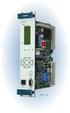 Machinery Protection Card Type FEATURES Continuous on-line Machinery Protection Card Real-time measurement and monitoring using state-of-the-art DSP techniques Fully VME-compatible slave interface Fully
System 1* Software version 6.5
 System 1* Software version 6.5 Simpler to use, simpler to install, simpler to maintain yet more powerful ollowing its release in 2001, System 1 software is today installed at thousands of locations worldwide,
Shaft. Application of full spectrum to rotating machinery diagnostics. Centerlines. Paul Goldman, Ph.D. and Agnes Muszynska, Ph.D.
 Shaft Centerlines Application of full spectrum to rotating machinery diagnostics Benefits of full spectrum plots Before we answer these questions, we d like to start with the following observation: The
330505 Low Frequency Velocity Sensor
 330505 Low Frequency Velocity Sensor Bently Nevada* Asset Condition Monitoring Description The Bently Nevada Low Frequency Velocity Sensor is designed to measure absolute (relative to free space) bearing
3500/25 Enhanced Keyphasor*Module
 3500/25 Enhanced Keyphasor*Module Bently Nevada* Asset Condition Monitoring Description The 3500/25 Enhanced Keyphasor Module is a half-height, two-channel module used to provide Keyphasor signals to the
On-line Machine Condition Monitoring [The CMS System]
![On-line Machine Condition Monitoring [The CMS System]](/thumbs/33/16391803.jpg "On-line Machine Condition Monitoring [The CMS System]") On-line Machine Condition Monitoring [The CMS System] Strategic monitoring control your costs Avoid unplanned downtime Monitor your plant stoppers Early warning maintains profit Efficient and profitable
On-line Machine Condition Monitoring [The CMS System] Strategic monitoring control your costs Avoid unplanned downtime Monitor your plant stoppers Early warning maintains profit Efficient and profitable
Asset Condition Monitoring Solutions
 Asset Condition Monitoring Solutions Our Company Metrix is the preferred supplier of industrial vibration monitoring systems and services to many of the world s leading manufacturers and users of cooling
Combined Cycle Control Overview
 Combined Cycle Control Overview Introduction The Combined Cycle (CC) solution provides for the control and monitoring of a typical CC power plant in a cost effective, preengineered package. Basic Architecture
Vibration Monitoring: Envelope Signal Processing
 Vibration Monitoring: Envelope Signal Processing Using Envelope Signal Processing in Vibration Monitoring of Rolling Element Bearings Summary This article presents a practical discussion of the techniques
How To Use Safety System Software (S3)
 SPECIFICATION DATA Safety System Software (S3) APPLICATION Safety System Software (S 3 ) is a robust, full featured configuration, diagnostic, programming and real-time monitoring package for integrators
PdM Overview. Predictive Maintenance Services
 PdM Overview Predictive Maintenance Services Objective Assessments Maximize Uptime, Lower Costs Predictive Maintenance (PdM) solutions from Rexnord Industrial Services help manage the condition of your
Alain Nifenecker - General Electric Manager Controls Engineering
 GE Energy Benefits of Integrating a Single Plant-Wide Control System Into a Standard Plant Design Philosophy Authors: Luis Cerrada Duque - Empresarios Agrupados Director of I&C Department Charles Weidner
Online Hydro Machinery Monitoring Protection, Prediction and Performance Monitoring Solutions
 Online Hydro Machinery Monitoring Protection, Prediction and Performance Monitoring Solutions 2011, Emerson Process Management. The contents of this publication are presented for informational purposes
Improved Fault Detection by Appropriate Control of Signal
 Improved Fault Detection by Appropriate Control of Signal Bandwidth of the TSA Eric Bechhoefer 1, and Xinghui Zhang 2 1 GPMS Inc., President, Cornwall, VT, 05753, USA [email protected] 2 Mechanical Engineering
ABB North America. Substation Automation Systems Innovative solutions for reliable and optimized power delivery
 ABB North America Substation Automation Systems Innovative solutions for reliable and optimized power delivery Substation Automation Systems Advanced substation automation, protection and control solutions
Equipment Performance Monitoring
 Equipment Performance Monitoring Web-based equipment monitoring cuts costs and increases equipment uptime This document explains the process of how AMS Performance Monitor operates to enable organizations
AMS Suite: Machinery Health Manager v5.4
 S-NSF033010 October 2010 AMS Suite: Machinery Health Manager v5.4 The AMS Machinery Manager v5.4 release is the result of user input collected during plant visits and documented by our customer support
ProSmart. Predictive Condition Monitoring
 ProSmart Predictive Condition Monitoring ProSmart Identifying and Solving problems before they impact production. Time is the most valuable thing a man can spend. Theophrastus, Philosopher MINIMIZING PROCESS
Integrated Performance and Condition Monitoring at DuPont
 Integrated Performance and Condition Monitoring at DuPont Monitoring systems have evolved from standing a nickel on its edge on top of the machine bearing cover or holding a screwdriver to one s temple,
Case Studies on Paper Machine Vibration Problems
 Case Studies on Paper Machine Vibration Problems Andrew K. Costain, B.Sc.Eng. Bretech Engineering Ltd., 70 Crown Street, Saint John, NB Canada E2L 3V6 email: [email protected] website: www.bretech.com
Uptime for Wind Turbines. Dedicated Remote Condition Monitoring System for the Wind Power Industry
 Uptime for Wind Turbines Dedicated Remote Condition Monitoring System for the Wind Power Industry Maximize wind turbine production Wind power is a renewable energy source that makes life greener while
WATCHMAN Reliability Services Enhance OEM Service Center Revenue
 WATCHMAN Reliability Services Enhance OEM Service Center Revenue Keywords: WATCHMAN Analysis, WATCHMAN Remote, Vibration Analysis Services, Online Monitoring, Vibration Analysts, Remote Monitoring, Predictive
by Mark Snyder, P.E. Senior Solutions Specialist, Machinery Management Systems Bently Nevada Corporation e-mail: mark.snyder@bently.
 Project Engineering a Machinery Management System How to make sure your next project delivers the tools you need to properly protect and manage machinery by Mark Snyder, P.E. Senior Solutions Specialist,
Composite Video Separation Techniques
 TM Composite Video Separation Techniques Application Note October 1996 AN9644 Author: Stephen G. LaJeunesse Introduction The most fundamental job of a video decoder is to separate the color from the black
Technical Information
 Technical Information TI No. WL 80-63 E April 2001 Rolling Bearing Diagnosis with the FAG Bearing Analyser Rolling Bearings State-Of-The-Art, Condition-Related Monitoring of Plants and Machines Unforeseen
Gating in SKF @ptitude Observer 9.1
 Application Note Gating in SKF @ptitude Observer 9.1 Introduction In some applications, it is important to collect vibration data only at a specific operating condition of the machine. This way of collecting
The Business case for monitoring points... PCM architecture...
 The Business case for monitoring points... Points Condition Monitoring (PCM) measures key parameters related to the performance of switch machines and turnouts in real time at every movement. Intelligent
MCM & MCMSoC. Concept & Practice. The MCM & MCMSoC
 The MCM & MCMSoC MCM & MCMSoC Concept & Practice A new technology to be an industry standard for condition monitoring of motor based systems and beyond Artesis Products MCM Motor Condition Monitor MQM
GE Intelligent Platforms. Mine Performance. from GE Predictivity
 GE Intelligent Platforms Mine Performance from GE Predictivity Increase throughput and availability If you re like most mining companies, you need to improve both your processes and your equipment availability
Supporting Service Solutions
 GE Energy Services Supporting Service Solutions Bently Nevada* Asset Condition Monitoring Proactive care for your production assets and their condition monitoring systems Imagine your peace of mind if
ANALYZER BASICS WHAT IS AN FFT SPECTRUM ANALYZER? 2-1
 WHAT IS AN FFT SPECTRUM ANALYZER? ANALYZER BASICS The SR760 FFT Spectrum Analyzer takes a time varying input signal, like you would see on an oscilloscope trace, and computes its frequency spectrum. Fourier's
SignalPad Data Logging and Analysis Software
 SignalPad Data Logging and Analysis Software Overview SignalPad is a data logging and analysis application developed with National Instruments LabVIEW. The configuration-based user interface provides ready-to-run
Online Transformer Insulation Monitoring System BushingGard Product Focus. Maximizing Transformer Uptime and Reliability
 Online Transformer Insulation Monitoring System BushingGard Product Focus Maximizing Transformer Uptime and Reliability Critical Energy Transfer... Large power transformers are found around the world at
SPPA-D3000 Plant Monitor Technical Description
 SPPA-D3000 Plant Monitor Technical Description Model-based monitoring and early fault detection for components and processes May 2008 Answers for energy. 1 Siemens AG 2008. All Rights Reserved Contents
Guidance for mounting 4-20 ma vibration sensors on fans
 Guidance for mounting 4-20 m vibration sensors on fans This article provides guidance to determine the number and location of 4-20 m loop powered sensors (LPS ) which produce a reliable vibration monitoring
Social Innovation through Utilization of Big Data
 Social Innovation through Utilization of Big Data Hitachi Review Vol. 62 (2013), No. 7 384 Shuntaro Hitomi Keiro Muro OVERVIEW: The analysis and utilization of large amounts of actual operational data
Department of Electrical and Computer Engineering Ben-Gurion University of the Negev. LAB 1 - Introduction to USRP
 Department of Electrical and Computer Engineering Ben-Gurion University of the Negev LAB 1 - Introduction to USRP - 1-1 Introduction In this lab you will use software reconfigurable RF hardware from National
WIRELESS INSTRUMENTATION TECHNOLOGY
 BS&B WIRELESS, L.L.C. BS&B WIRELESS, L.L.C. WIRELESS INSTRUMENTATION TECHNOLOGY Printed February 2004 BS&B WIRELESS, L.L.C. 7422-B East 46th Place, Tulsa, OK74145 Phone: 918-622-5950 Fax: 918-665-3904
Interactive Computer Based Courses
 These SKF Self-Learning Tools (SLT) are a onestop interactive solution for students at various levels including the students of mechanical and other engineering streams. They eliminate the need to take
VM600 CMS Software. VM600 Series Software for Condition Monitoring System (CMS) FEATURES DESCRIPTION
 VM600 Series Software for Condition Monitoring System (CMS) FEATURES Configuration and operation of VM600 hardware (CMC16 and IOC16T cards) Automatic data acquisition and storage Limit exceedance checking
REMOTE MONITORING AND CONTROL OF THE KAKKONDA GEOTHERMAL POWER PLANTS
 REMOTE MONITORING AND CONTROL OF THE KAKKONDA GEOTHERMAL POWER PLANTS Shinji Nishikawa 1, Toshiyuki Takahashi 1, Takeshi Koi 1, and Katsuyoshi Yamada 2 1 Toshiba Corporation Power Systems & Services Company,
Intelligent Terminal Automation System
 Intelligent Terminal Automation System. Rockwell Automation intelligent Terminal Automation Systems provide a complete automation solution for tank terminals beyond your expectations The Rockwell Automation
When it Surges, It Shakes
 Expertise in Turbomachinery Controls WHITEPAPER When it Surges, It Shakes Publish Date: 11/30/2015 Authors: Shun Yoshida, Steve Sabin, Serge Staroselsky Why is elevated vibration during surge often absent
RTM X42 Multi-Channel Radio Transmission Tension Monitoring and Control System
 RTM X42 Multi-Channel Radio Transmission Tension Monitoring and Control System RTM X42 is an innovative system that utilizes force measuring rollers to capture the tension of individual wires or strands,
Making Accurate Voltage Noise and Current Noise Measurements on Operational Amplifiers Down to 0.1Hz
 Author: Don LaFontaine Making Accurate Voltage Noise and Current Noise Measurements on Operational Amplifiers Down to 0.1Hz Abstract Making accurate voltage and current noise measurements on op amps in
3500/62 Process Variable Monitor
 3500/62 Process Variable Monitor Description The 3500/62 Process Variable Monitor is a 6-channel monitor for processing machine critical parameters (pressures, flows, temperatures, levels, etc.) that merit
PacifiCorp Original Sheet No. 476 FERC Electric Tariff, Substitute 6 th Rev Volume No. 11 APPENDIX 2 TO SGIP
 PacifiCorp Original Sheet No. 476 APPENDIX 2 TO SGIP SMALL GENERATOR INTERCONNECTION REQUEST (Application Form) Transmission Provider: Designated Contact Person: Address: Telephone Number: An Interconnection
CSI 6500 Machinery Health Monitor
 Online Machinery Monitoring Product Data Sheet September 2015 CSI 6500 Machinery Health Monitor Extend PlantWeb with API 670 machinery protection monitoring. Integrate machinery protection monitoring with
Vibration Analysis Services. FES Systems Inc. 1
 Vibration Analysis Services FES Systems Inc. 1 FES Systems Inc. 2 What is Vibration? Vibration is the movement of a body about its reference position. Vibration occurs because of an excitation force that
D. Infrared scanning reports with pictures printed in a final report with any deficiencies and actions taken to rectify.
 SECTION 263354 STATIC UPS TESTING AND COMMISSIONING PART 1 - GENERAL 1.1 SUMMARY A. Section Includes 1. System start-up services. 2. Battery charging. 3. Load bank testing. 4. Battery load testing. 5.
THIS paper reports some results of a research, which aims to investigate the
 FACTA UNIVERSITATIS (NIŠ) SER.: ELEC. ENERG. vol. 22, no. 2, August 2009, 227-234 Determination of Rotor Slot Number of an Induction Motor Using an External Search Coil Ozan Keysan and H. Bülent Ertan
Services. Monitoring and vibration expertise p. 7 - On-site services p. 7 - Remote services p. 9. Fitting - dismounting of bearings p.
 Monitoring and vibration expertise p. 7 - On-site services p. 7 - Remote services p. 9 Fitting - dismounting of bearings p. 10 Shaft alignment p. 10 Bearing expertise p. 11 After-Sales Service and Guarantees
CSI 6500 Machinery Health Monitor
 Online Machinery Monitoring O-6500-010614 Product Data Sheet September 2014 CSI 6500 Machinery Health Monitor Extend PlantWeb with API 670 machinery protection monitoring Integrate machinery protection
SIGNAL PROCESSING FOR EFFECTIVE VIBRATION ANALYSIS
 SIGNAL PROCESSING FOR EFFECTIVE VIBRATION ANALYSIS Dennis H. Shreve IRD Mechanalysis, Inc Columbus, Ohio November 1995 ABSTRACT Effective vibration analysis first begins with acquiring an accurate time-varying
Kevin Kochirka, ABB Turbine Automation, June 29, 2016. Flexible turbine control retrofits Webinar
 Kevin Kochirka, ABB Turbine Automation, June 29, 2016 Flexible turbine control retrofits Webinar Welcome Speaker introduction Kevin Kochirka Sr. Applications Engineer with ABB Inc. [email protected]
INTRUSION PREVENTION AND EXPERT SYSTEMS
 INTRUSION PREVENTION AND EXPERT SYSTEMS By Avi Chesla [email protected] Introduction Over the past few years, the market has developed new expectations from the security industry, especially from the intrusion
Harmonics and Noise in Photovoltaic (PV) Inverter and the Mitigation Strategies
 Soonwook Hong, Ph. D. Michael Zuercher Martinson Harmonics and Noise in Photovoltaic (PV) Inverter and the Mitigation Strategies 1. Introduction PV inverters use semiconductor devices to transform the
Predictive Maintenance in a Mission Critical Environment
 March 2009 Predictive Maintenance in a Mission Critical Environment This paper discusses the need to proactively protect mechanical and electrical support systems in data processing centers and data storage
REMOTE CONDITION MONITORING SYSTEM FOR A HYBRID WIND-DIESEL SYSTEM APPLICATION AT FERNANDO DE NORONHA ISLAND, BRAZIL
 REMOTE CONDITION MONITORING SYSTEM FOR A HYBRID WIND-DIESEL SYSTEM APPLICATION AT FERNANDO DE NORONHA ISLAND, BRAZIL Gustavo de Novaes Pires Leite 2 Brazilian Wind Energy Centre, Brazil 1 [email protected]
fact sheet GE Measurement & Control Bently Nevada* Technical Support Agreements Service and Expertise Delivered* Valuable Benefits
 GE Measurement & Control Bently Nevada* Technical Support Agreements fact sheet Service and Expertise Delivered* You rely on Bently Nevada* Asset Condition Monitoring hardware and software to manage and
AN1200.04. Application Note: FCC Regulations for ISM Band Devices: 902-928 MHz. FCC Regulations for ISM Band Devices: 902-928 MHz
 AN1200.04 Application Note: FCC Regulations for ISM Band Devices: Copyright Semtech 2006 1 of 15 www.semtech.com 1 Table of Contents 1 Table of Contents...2 1.1 Index of Figures...2 1.2 Index of Tables...2
Jeff Thomas Tom Holmes Terri Hightower. Learn RF Spectrum Analysis Basics
 Jeff Thomas Tom Holmes Terri Hightower Learn RF Spectrum Analysis Basics Agenda Overview: Spectrum analysis and its measurements Theory of Operation: Spectrum analyzer hardware Frequency Specifications
VM 600 Series. State of the Art Machinery Monitoring Solutions PROTECTION MONITORING CONDITION MONITORING PERFORMANCE MONITORING
 VM 600 Series Industrial & Marine Division State of the Art Machinery Monitoring Solutions Provides the following: PROTECTION MONITORING CONDITION MONITORING PERFORMANCE MONITORING VM600 Overview Page
APPENDIX F VIBRATION TESTING PROCEDURE
 APPENDIX F VIBRATION TESTING PROCEDURE Appendix F SPS-F-1 of 14 VIBRATION PERFORMANCE TESTING I. General Perform a vibration analysis on all motor driven equipment listed below after it is installed and
Rotating Machinery Diagnostics & Instrumentation Solutions for Maintenance That Matters www.mbesi.com
 13 Aberdeen Way Elgin, SC 29045 Cell (803) 427-0791 VFD Fundamentals & Troubleshooting 19-Feb-2010 By: Timothy S. Irwin, P.E. Sr. Engineer [email protected] Rotating Machinery Diagnostics & Instrumentation
Unit 96: Marine Propulsion Power Plant
 Unit 96: Marine Propulsion Power Plant Unit code: R/503/1756 QCF Level: 5 Credit value: 15 Aim This unit provides learners with an understanding of marine propulsion power plant. Learners will also gain
The software beyond the climatic. Environment simulation
 Spirale 2 The software beyond the climatic Environment simulation Spirale 2... Take it easy! Spirale 2 is a new software, based on a reliable system (Windows NT) and if its performances are surprising,
The Advantages of Enterprise Historians vs. Relational Databases
 GE Intelligent Platforms The Advantages of Enterprise Historians vs. Relational Databases Comparing Two Approaches for Data Collection and Optimized Process Operations The Advantages of Enterprise Historians
W H I T E P A P E R T h e I m p a c t o f A u t o S u p p o r t: Leveraging Advanced Remote and Automated Support
 W H I T E P A P E R T h e I m p a c t o f A u t o S u p p o r t: Leveraging Advanced Remote and Automated Support Sponsored by: NetApp Brad Nisbet December 2008 Matt Healey IDC OPINION Global Headquarters:
Intelligent Device Management: Device Diagnostics
 wp_eddl device diagnostics ra 31/03/2010 16:14:00 Intelligent Device Management: Device Diagnostics Device diagnostics can be carried out using a handheld communicator in the field, a laptop in the workshop,
Monitoring and diagnostics
 Monitoring and Diagnostics Monitoring and diagnostics Analyze the past, monitor the present, and predict the future! Asset Services/Monitoring and Diagnostics Switchgear Services Transformer Services Cable
RecipCOM. Expertise, reciprocating compressor monitoring and protection tailored to your needs
 RecipCOM Expertise, reciprocating compressor monitoring and protection tailored to your needs Do your reciprocating compressors have sufficient protection? Due to the increasing demands on availability
Field Application Note
 Field Application Note Reverse Dial Indicator Alignment RDIA Mis-alignment can be the most usual cause for unacceptable operation and high vibration levels. New facilities or new equipment installations
ON-LINE MONITORING OF POWER PLANTS
 ON-LINE MONITORING OF POWER PLANTS Dr. Hans-Gerd Brummel Siemens Power Generation (PG), Huttenstrasse 12-16, 10553 Berlin, Germany Phone: +49 30 3464 4158, E-mail: [email protected] Table of
Impedance 50 (75 connectors via adapters)
 VECTOR NETWORK ANALYZER PLANAR TR1300/1 DATA SHEET Frequency range: 300 khz to 1.3 GHz Measured parameters: S11, S21 Dynamic range of transmission measurement magnitude: 130 db Measurement time per point:
Onshore Wind Services
 GE Renewable Energy Onshore Wind Services www.ge.com/wind PITCH TABLE OF CONTENTS: 3 Operate and Maintain 3 Asset and Park Management 5 Turbine Maintenance 8 Enhance and Optimize 8 Wind PowerUp * Services
Enhancing Business Performance using Integrated Visibility and Big Data
 Enhancing Business Performance using Integrated Visibility and Big Data Manish Sharma Marketing Leader GE Energy Management [email protected] Photograph of Speaker ARC Advisory Group GE Energy Management
Maximizing return on plant assets
 Maximizing return on plant assets Manufacturers in nearly every process industry face the need to improve their return on large asset investments. Effectively managing assets, however, requires a wealth