
User Guide /11 Rev. B
|
|
|
- Alan Grant
- 10 years ago
- Views:
Transcription
1 Tuxedo Touch WIFI Home Automation System User Guide /11 Rev. B

2

3 Table of Contents ABOUT THE SYSTEM...6 Introduction...6 System Interface...6 Navigating through the Tuxedo Touch Keypad...6 About Your Home Screen...7 Multi-Media Application...7 Weather Forecast...7 System Troubles...9 Power Mode Setup...9 User Codes...10 Extended Functionality...10 LED Operation...10 Safe Mode...10 SECURITY...11 Introduction to Security System Operation...11 How to Arm the System...12 How to Arm Multiple Partitions...12 How to Display Faults...13 How to Bypass Zones...13 How to Clear Bypassed Zones...14 How to Disarm the System...14 To disarm Multi-Partitions do the following:...15 How to Check the Status of Other Partitions...15 Fire and Carbon Monoxide Alarm Operation...16 In Case of Fire Alarm...16 Silencing and Clearing a Fire/Carbon Monoxide Alarm...16 More Choices
4 Table of Contents How to Clear/Hide a Control Panel Message...17 Advanced System Features...17 Console Emulation Mode...17 How to Enter Console Emulation Mode...18 How to View the Event Log...18 How to Send Emergency Messages...18 SETUP...19 Brightness and Volume Control...19 Display & Audio Setup...19 Operation Modes...19 Select a Language (if applicable)...19 Adjust the Screen Timeouts...20 Clean Screen...20 Routine Care...20 System Information...21 IP Setup and Network Connections...21 Multi-Media...24 Voice Messages...24 Video (Audio) Setup...25 Picture Setup...25 Camera Setup...26 User Setup...28 Authority Levels...28 How to Add a User...28 How to Add an Existing User to a Second Keypad...29 How to Delete a User...29 How to Edit a User...29 Safe Mode...30 Time/Date Setup

5 Table of Contents Setting Daylight Savings Time...31 Setting Current Time and Date...31 Advanced Setup...32 AUTOMATION...34 Enroll/Add Z-Wave Devices...34 Editing Z-Wave Device Names...36 Remove/Delete Z-Wave Devices...37 Remove/Delete a Honeywell Thermostat...37 Remove All Z-Wave Devices...38 Abort a Z-Wave Action...38 Create a Scene...38 Create a Group...41 Setting a Secondary Keypad (Controller)...41 Updating Keypads (Controllers) with New or Removed devices...42 Removing a Secondary Keypad (Controller)...42 Output List...42 Z-Wave Troubleshooting...42 Compatible Devices...43 NOTES...44 GLOSSARY...46 NOTE: This device is a Security Enabled Z-Wave Controller. 5
6 About the System Introduction Congratulations on your ownership of a Honeywell Tuxedo Touch WIFI Home Automation System which combines homeautomation and home security. With clear, simple controls on a touch-screen interface, Tuxedo Touch is both easy to learn and easy to use. A Product/Training Video is provided containing easy step by step tutorials to assist with the setup and customization of the system. System Interface Equipped with Wi-Fi capability and built-in Z-Wave technology, Tuxedo Touch WIFI can be retrofitted into home electronics devices and systems without interference from common household wireless electronics. Features The Tuxedo Touch wireless keypad, used for quick and easy security system operation, offers Z-Wave control of the home environment (lights, appliances, thermostats, door locks and cameras) via any web enabled device (PC, Smart Phone and Tablet). Thermostats temperature control for energy conservation when away from home. Lights/Appliances - turn lights and appliances on when the security system is disarmed. Door locks - door unlocks when the security system is disarmed. Cameras control and view up to four cameras in quad view at the same time from any web enabled device. In addition, this system offers you burglary protection and may provide fire, carbon monoxide and emergency protection. To realize the full potential of the system, it is important that you feel comfortable operating it. Your system may consist of one or more of the following: TUXWIFIS Keypad (black/silver housing) TUXWIFIW Keypad (white housing) One or more other keypads for system control Various sensors for perimeter and interior burglary protection, plus a selected number of strategically placed smoke, carbon monoxide or combustion detectors Lighting/output devices. The system uses microcomputer technology to monitor all zones, and provides appropriate information for display on the keypad and/or other keypads used with the system. Your system may also have been programmed to automatically transmit alarm or status messages over the phone lines or wirelessly over GSM to a central alarm monitoring station. UL Wi-Fi has not been evaluated by UL. Navigating through the Tuxedo Touch Keypad Navigation through the Tuxedo Touch Keypad typically begins from the "Home" screen. This is the main default screen (starting screen) and is the first screen you see when you power up and initialize the keypad. It is from this screen that you select from the main menu. Once you have made your selection, you can navigate through various sub-menus by pressing graphical icons to perform the function you desire. 6

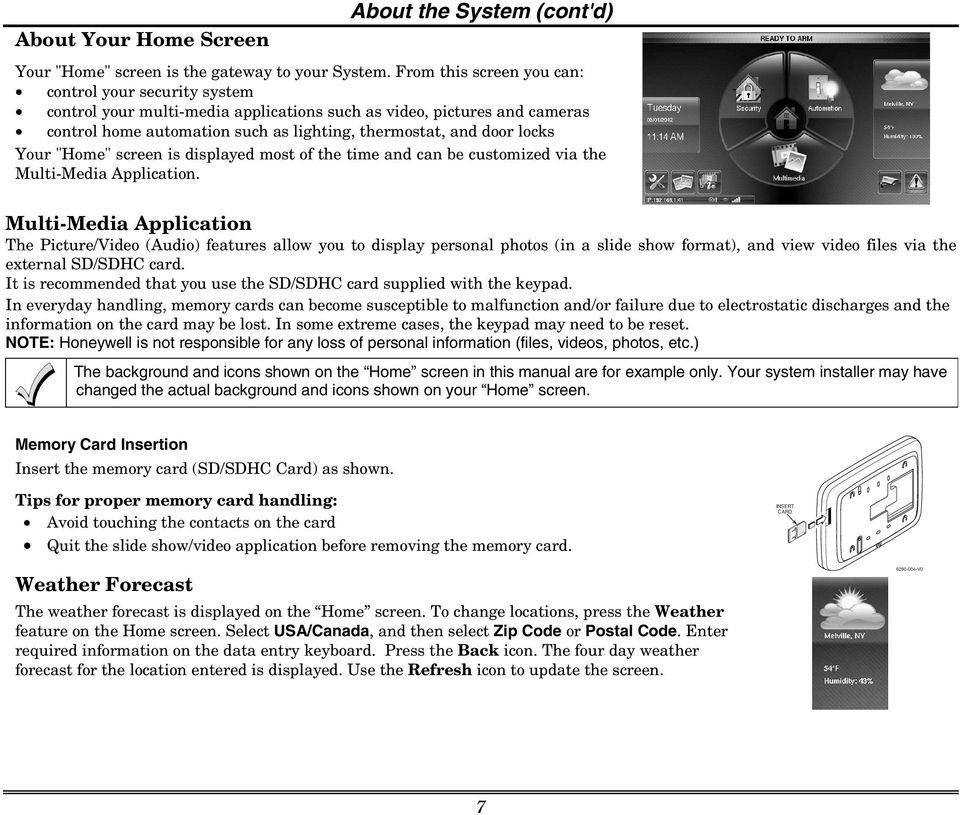
7 About Your Home Screen About the System (cont'd) Your "Home" screen is the gateway to your System. From this screen you can: control your security system control your multi-media applications such as video, pictures and cameras control home automation such as lighting, thermostat, and door locks Your "Home" screen is displayed most of the time and can be customized via the Multi-Media Application. Multi-Media Application The Picture/Video (Audio) features allow you to display personal photos (in a slide show format), and view video files via the external SD/SDHC card. It is recommended that you use the SD/SDHC card supplied with the keypad. In everyday handling, memory cards can become susceptible to malfunction and/or failure due to electrostatic discharges and the information on the card may be lost. In some extreme cases, the keypad may need to be reset. NOTE: Honeywell is not responsible for any loss of personal information (files, videos, photos, etc.) The background and icons shown on the Home screen in this manual are for example only. Your system installer may have changed the actual background and icons shown on your Home screen. Memory Card Insertion Insert the memory card (SD/SDHC Card) as shown. Tips for proper memory card handling: Avoid touching the contacts on the card Quit the slide show/video application before removing the memory card. INSERT CARD Weather Forecast The weather forecast is displayed on the Home screen. To change locations, press the Weather feature on the Home screen. Select USA/Canada, and then select Zip Code or Postal Code. Enter required information on the data entry keyboard. Press the Back icon. The four day weather forecast for the location entered is displayed. Use the Refresh icon to update the screen V0 7
8 About the System (cont'd) Navigation Icon Descriptions To aid in the navigation through the Tuxedo Touch WIFI screens, a set of user-friendly icons has been provided. The appearance and function of these icons are described below. ICON ICON TITLE FUNCTION ICON ICON TITLE FUNCTION Product/Training Videos Accesses Product Introduction and Training Videos. Setup Accesses the Setup menus. "Automation Accesses the Z-Wave setup, Scene setup, and Group setup screens. Multimedia Accesses the Message, Camera, Picture and Video features. "Security Accesses the "Security" screen. Video Allows user to play video files. Home Returns you to the "Home" screen. Picture Allows user to display personal photos in a slide show format. Panic Displays Emergency functions (as programmed by the installer). Note: This icon is displayed and active on all screens except while in the Clean Screen mode, during an LCD Display test in Diagnostics and from the Video and Camera screens. "Message Voice Status Record and retrieve Voice Messages. Allows user to hear system status. Back Reverts to the last screen viewed. Control Panel Message This icon alerts the user to a Control Panel Message. Minimizing the Home Screen Icons When viewing wallpaper displays, the Home screen icons can be minimized by pressing the Minimize Home icon. Press the Maximize Home icon to maximize Home screen icons. Minimize Home Setup Picture Product/Training Videos Maximize Home Security Automation Multimedia Weather Camera Panic 8

9 About the System (cont'd) System Troubles The Security screen also displays an Icon(s) if a system trouble(s) occurs. If a Trouble Icon is shown, contact your alarm company. The following Icons may be shown as applicable to your system: ICON AC Loss The system is not receiving AC power. FUNCTION Bell Failure The system bell or siren has a problem. Note: This Icon displays when interfacing with residential panels only. Expander Failure The system has a failure in an expansion module. Low Battery The system battery, that powers the system during an AC power loss, is low. LRR Supervision Failure The Communication Device used to communicate with the central station has a supervision failure Max Attempts Exceeded The system has exceeded the maximum attempts to communicate with the Central Station. Pager Failure The system cannot communicate with an assigned pager. Telco-1 Cut The system is not able to communicate with the central monitoring station over the primary phone line. Telco-2 Cut The system is not able to communicate with the central monitoring station over the secondary phone line. Wireless Failure The system is not able to communicate with its wireless devices. Note: If multiple faults exist, press the More Choices icon and then the Show Zones icon to view and scroll through the complete list of faults. Power Mode Setup Power Setup Mode allows you to reduce power consumption in the event of a system trouble such as AC Loss or Panel Low Battery. To access Power Mode Setup, from the Home screen, press the Setup icon and then do the following: 1. Press the System Setup icon. 2. Press the Power Mode Setup icon. 3. Enter your Authorized Code, if required. 4. Select Power Save Mode to enable; then choose from the options. 5. Press Apply to save settings. Select from: Turn-off Network Override Display Settings: When selected, Display settings are overwritten and the keypad operates in low power mode: - Brightness/Volume controls decrease to minimum levels. - Return To Homepage After time resets to 30 seconds. - Auto SlideShow After time reverts to Never. When AC power is restored, the original Display settings resume. 9

10 About the System (cont'd) User Codes Each user must be assigned a name with a corresponding 4-digit user code in order to gain access to authorized features and functions. Users for the system are programmed in a central user setup location that provides the specific questions for authorization level, partition assignment, and RF zone assignment. Extended Functionality Extended functions are advanced functions that can be accessed through a standard alpha keypad or through the console emulation mode on your Tuxedo Touch touch-screen. Refer to your Control Panel User Guide for these features. Note: For SIA installations used with a VISTA-128BPTSIA Control, see the SIA CP-01 Quick Reference Chart located on MyWebTech, Document # LED Operation The Tuxedo Touch Keypad has three LEDs as follows: SD/SDHC CARD Slot ARMED (RED) LED ON System is armed. OFF System is not armed. READY (GREEN) LED ON System is disarmed and ready to arm. OFF System is armed or disarmed but not ready. If disarmed, faults or troubles are present. MESSAGE (YELLOW) LED FLASHING The system contains new message(s) for the User. OFF No new messages. RESET BUTTON Press to reset keypad NOTE: If the Screen Blackout (*EN50131 Display) feature is enabled (see below) the keypad returns to the Home screen and the Armed and Ready status LEDs turn OFF after 30 seconds. The keypad will remain in this state until a valid user code is entered. *The EN50131 Display compliance feature is a European Standard designed to prevent unauthorized users from viewing the status of the Security System. Safe Mode The Keypad contains a Safe Mode of operation. In the rare event that the keypad cannot successfully communicate in its graphic mode with the control panel, the Safe Mode is a backup mode that ensures that you can communicate with your system. Refer to the Safe Mode section for further information V0 10

11 Security Introduction to Security System Operation You can arm your system in one of three arming modes: Away, Stay, and Night. The following table lists the three different arming modes and the results of each. FEATURES FOR EACH ARMING MODE Arming Mode AWAY STAY NIGHT FUNCTION Press to arm when no one is staying on the premises. When armed in AWAY, the system sounds an alarm if a protected door or window is opened, or if any movement is detected inside the premises. Press to arm when you are staying home, but might expect someone to use the entrance door later. When armed in STAY, the system sounds an alarm if a protected door or window is opened, but you may otherwise move freely throughout the premises. Press to arm when you are staying home and do not expect anyone to use the entrance door. Your installer may have configured NIGHT Mode differently; have the installer describe the actual settings of this mode. Exit Delay Entry Delay Perimeter Armed Interior Armed Yes Yes Yes Yes Yes Yes Yes No Yes Yes (set for Away or Stay Mode) No (set for Instant or Maximum Mode) Yes Yes (set for Away or Maximum Mode) No (set for Stay or Instant Mode) See note below for Night Mode arming. Note: Night Mode (on Residential Panels Only) arms all perimeter zones plus all zones listed in Zone List 5. Important: On Commercial systems, Away Auto Stay mode is shown as Away mode (with all zones monitored). However, some interior zones may not be armed. Note: The Voice Status Icon ( ) indicates the Voice feature. Press the Voice Status Icon to hear system status. Wait 3 seconds and press again to hear Zone Faults or Trouble conditions. Voice status will annunciate even if Voice mode and Chime mode are disabled. Note that the Voice feature must be enabled (by the installer) for this icon to function correctly during an alarm condition. Note: There is a communicator delay of 30 seconds. This delay will prevent a report to the central station if the control panel is disarmed within 30 seconds after an intrusion alarm is triggered. This delay can be removed, or it 11

12 Security (cont d) can be increased up to 45 seconds at the option of the user by consulting with the installer. Note that emergency, carbon monoxide, and fire-type alarms are normally reported without delay. How to Arm the System Arming the system in any mode is performed in the same way, as described below. Note: Close all perimeter windows and doors before arming. Arm the system as follows: 1. From the Home screen, press the SECURITY icon. 2. Press the selected arming icon. -a text message appears stating which zones are arming and whether or not there is an entry delay -the screen changes to display the remaining exit delay time, and -the exit delay time continues to count down to one. Note: If Quick Arm is Not enabled in your system, a message to enter your User Code is received. When the system is armed for Stay, Night Stay and Instant mode, the keypad beeps 3 times. When the system is armed for Away and Maximum mode, you will hear steady beeps then rapid beeping during the last 10 seconds of Exit Delay. When exit delay time expires, the screen automatically changes to indicate the system is "Armed". Note: For CP-01 installations, Maximum Mode cannot be used. How to Arm Multiple Partitions Note: Some systems may not have multiple partitions and therefore the Arm Multi-Partitions icon is inactive. To arm multiple partitions: 1. From the Home screen, press the Notes: Security icon and then the Arm Multi- A user may have access to some or all of the available partitions. Partition icon. If the user code is accepted, the system displays the partitions that the user has access to. 2. Select the appropriate arming mode. When exit delay time expires, the screen automatically changes to indicate 3. Enter the User Code authorized to access the system is "Armed". other partition(s). 4. Highlight the partition from the list on the screen, and press OK. Note: If any zones are bypassed, a Display Faults ( ) icon is displayed on this screen. 5. Select ALL to arm all partitions listed. 12

13 Security (cont'd) How to Display Faults The Display Faults function is used when you see a Not Ready Fault message and want to determine where the fault is and what type of fault it is. To display faults do the following: 1. From the "Security" screen, press the DISPLAY FAULTS icon. A listing of faulted and/or bypassed zones is displayed. As applicable, take corrective action such as closing a window or door to correct the fault. Show Zones Icons 2. If the fault cannot be corrected, you may choose to bypass a zone by pressing the zone and highlighting it and then pressing the BYPASS SELECTED icon. Distressed Zones Icons Clear Bypasses Refresh Data Bypass Selected Bypass All Distressed Zones Alarm Troubles Faults Bypass Zones Low Battery All How to Bypass Zones The Bypass function is used when you want to arm your system with one or more zones left open. Bypassed zones are unprotected and do not cause an alarm when violated while your system is armed. Residential systems do not allow you to bypass fire, carbon monoxide or emergency zones. On commercial fire systems, a specified user may be allowed to bypass fire, carbon monoxide and system zones if the user was enabled by your system installer. Limits apply as to how many zones can be bypassed at one time. These limits are ten zones on residential systems and five zones on commercial systems. 13

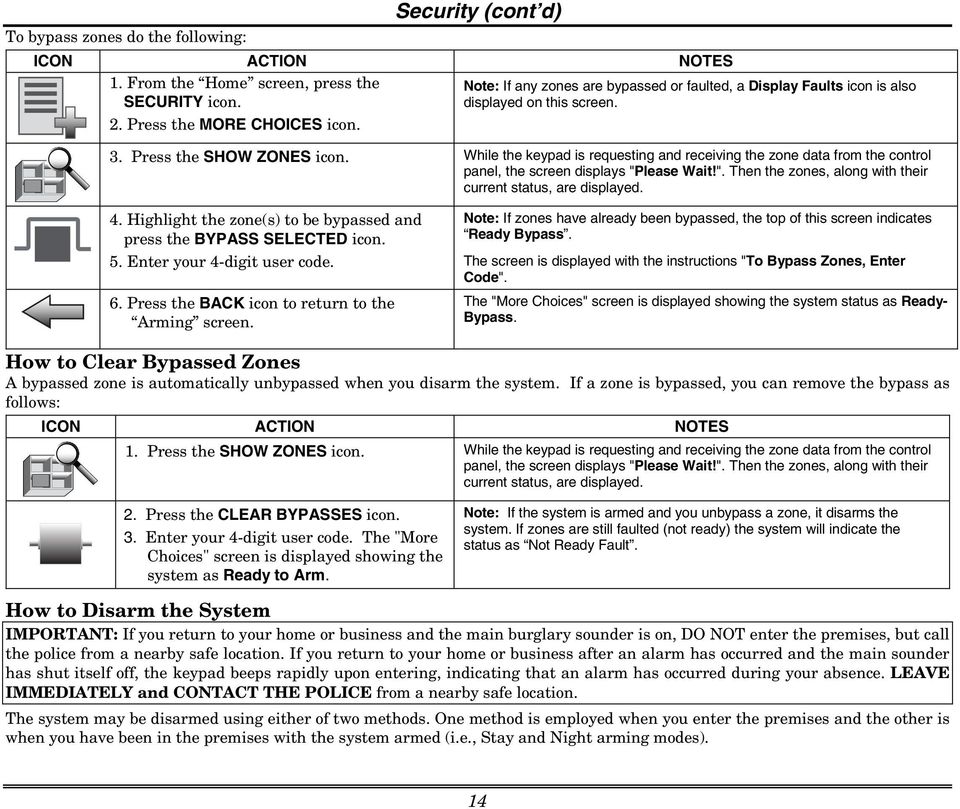
14 Security (cont d) To bypass zones do the following: 1. From the Home screen, press the SECURITY icon. 2. Press the MORE CHOICES icon. Note: If any zones are bypassed or faulted, a Display Faults icon is also displayed on this screen. 3. Press the SHOW ZONES icon. While the keypad is requesting and receiving the zone data from the control panel, the screen displays "Please Wait!". Then the zones, along with their current status, are displayed. 4. Highlight the zone(s) to be bypassed and press the BYPASS SELECTED icon. 5. Enter your 4-digit user code. 6. Press the BACK icon to return to the Arming screen. Note: If zones have already been bypassed, the top of this screen indicates Ready Bypass. The screen is displayed with the instructions "To Bypass Zones, Enter Code". The "More Choices" screen is displayed showing the system status as Ready- Bypass. How to Clear Bypassed Zones A bypassed zone is automatically unbypassed when you disarm the system. If a zone is bypassed, you can remove the bypass as follows: 1. Press the SHOW ZONES icon. While the keypad is requesting and receiving the zone data from the control panel, the screen displays "Please Wait!". Then the zones, along with their current status, are displayed. 2. Press the CLEAR BYPASSES icon. 3. Enter your 4-digit user code. The "More Choices" screen is displayed showing the system as Ready to Arm. Note: If the system is armed and you unbypass a zone, it disarms the system. If zones are still faulted (not ready) the system will indicate the status as Not Ready Fault. How to Disarm the System IMPORTANT: If you return to your home or business and the main burglary sounder is on, DO NOT enter the premises, but call the police from a nearby safe location. If you return to your home or business after an alarm has occurred and the main sounder has shut itself off, the keypad beeps rapidly upon entering, indicating that an alarm has occurred during your absence. LEAVE IMMEDIATELY and CONTACT THE POLICE from a nearby safe location. The system may be disarmed using either of two methods. One method is employed when you enter the premises and the other is when you have been in the premises with the system armed (i.e., Stay and Night arming modes). 14
15 Security (cont'd) To disarm the system when entering the premises: The keypad automatically displays the Entry Delay Active screen when you enter the premises: 1. Enter your 4-digit user code. The partition is disarmed and the "Arming" screen is displayed showing the system as Ready to Arm. Note: If you have a commercial system and a time window has been defined for when you may disarm the system, the system does not disarm if you are outside that time window. To disarm the system when already in the premises: 1. Press the Disarm icon. 2. Enter your 4-digit user code. To disarm Multi-Partitions do the following: 1. From the Home screen, press the Security icon. 2. Press the Arm Multi-Partition icon. 3. Press the Disarm icon. 4. Enter your 4-digit user code. 5. Highlight the partition(s) to disarm and press OK, or press ALL to disarm all partitions. The keypad displays Multi-Partition Arming. How to Check the Status of Other Partitions This system supports between one and eight Partitions (depending on the system.) Partitioning enables a single physical alarm system to control up to eight areas of protection (partitions) depending on the system you have purchased. Each Touch-Screen keypad is assigned a default partition for display purposes, and shows only that partition's information. Note: A letter H following the partition name or number indicates that this is the default partition for the keypad. For example, if your physical site is a four-apartment housing unit, your alarm system may be configured with four partitions. Each apartment s zones (door, windows, smoke detectors, etc.) are assigned to separate partitions, giving each apartment independent arming/disarming control of its own partition (area). A landlord or manager may be granted access to all partitions, so he/she can control the entire system. If a user is so authorized, a keypad or other keypad in one partition can be used to perform system functions in another partition. (Note that only those partitions authorized and programmed by the installer can be accessed in this manner.) 15

16 To check the status of other partitions perform the following: Security (cont d) 1. Press the SECURITY icon. 2. Press the "Current Partition" icon (lower edge of the screen; in this case it displays P1 H unless changed by installer). 3. Enter the code authorized to access other partition(s). If the code is accepted, the system displays the partitions that user has access to. This screen displays the available partitions and their current status. The current partition is shown at the top of the display (P1). To change this assignment, select the appropriate icon (e.g., press P2 to switch control to Partition 2). Note: After leaving this screen when using a residential panel, the selected partition in the keypad automatically reverts back to the keypad s home partition after two minutes. When using commercial panels, you must select the keypad s home partition to return to it. Note: A code may have access to some or all of the available partitions. Fire and Carbon Monoxide Alarm Operation Your fire alarm system and carbon monoxide detector (if installed) is on 24 hours a day, providing continuous protection. In the event of an emergency, the installed smoke, heat, carbon monoxide detectors automatically send signals to your Control/Communicator, triggering a loud interrupted sound from the keypad. An interrupted sound is also produced by optional exterior sounders. EVACUATE ALL OCCUPANTS FROM THE PREMISES IMMEDIATELY. Notify your Central Station/Security Company immediately and wait for further instructions. UL CO annunciation has not been investigated by UL and may not be used for UL installations. In Case of Fire Alarm 1. A FIRE message appears at your keypad and remains on until you silence the alarm. 2. Should you become aware of a fire emergency before your detectors sense the problem, go to your nearest keypad and manually initiate an alarm by pressing the panic key assigned as FIRE emergency (if programmed by the installer) and hold down for at least 2 seconds. 3. Evacuate all occupants from the premises. 4. If flames and/or smoke are present, leave the premises and notify your local Fire Department immediately. Silencing and Clearing a Fire/Carbon Monoxide Alarm 1. Silence, acknowledge, and clear the alarm by: a. For Residential Systems: Press Touch here to Silence on the display to silence the alarm. For Commercial Systems: Enter your code. This silences and acknowledges the alarm and disarming of the system (if armed). b. For Residential Systems: Press the CLEAR icon followed by your code. This acknowledges the alarm and the disarming of the system (if armed). For Commercial Systems: Press the CLEAR icon followed by your code. The system attempts to clear the alarm from memory. If NOT successful (i.e., smoke in the detector) the Security screen is displayed and the Display Faults icon displays a Not Ready Fault. c. Press the DISPLAY FAULTS icon on the Arming screen. The faulted fire/carbon monoxide zone is displayed. d. Press the CLEAR icon and then enter your code. This clears the Fire Alarm/CO Alarm from the system. 16
17 Security (cont'd) 2. If the keypad does not indicate a READY condition after the second sequence, press the DISPLAY FAULTS icon on the Arming screen to display the zone(s) that are faulted. Be sure to check that smoke detectors/carbon monoxide detectors are not responding to smoke, heat, or gas producing objects in their vicinity. In this case, eliminate the source of heat, smoke or leak. 3. If this does not remedy the problem, there may still be smoke/gas in the detector. Clear it by fanning the detector for about 30 seconds. 4. When the problem has been corrected, clear the display by entering the DISPLAY FAULTS icon on the Arming screen, selecting the fire or carbon monoxide zone, pressing the CLEAR icon and then entering your user code. Note: Contact your Central Station/Security Company for servicing if you have further problems with your system. More Choices How to Clear/Hide a Control Panel Message The Control Panel Message icon alerts the user to a control panel message. When a Control Panel Message is displayed, the user has two options. User can clear the Control Panel Message immediately, or minimize the window and clear it at a later time. To Clear/Hide the Control Panel Message, do the following: 1. To clear; press CLEAR. 2. Enter your Authorized Code or, 3. To hide; press HIDE to clear the Control Panel Message later. Once your Authorized Code is accepted, the Control Panel Message is cleared. If the alarm is still present, press CLEAR again and then enter your Authorized Code again. Press the HIDE icon to address the condition later. Advanced System Features While most of the commonly used security functions are available from the keypad s advanced user interface, there are some less used, advanced features that can either be accessed through Console Emulation mode on the keypad or a standard alpha keypad. To use features not supported by the keypad, refer to your Control Panel User Guide. Console Emulation Mode Console Emulation Mode allows you to use a keypad interface just as you would a regular system keypad. All commands shown in Console Emulation mode can also be executed from a standard alpha keypad. Notes: It is recommended that you do not use the Console Emulation Mode to enter GOTO commands. Unsatisfactory operation may result from issuing GOTO commands in Console Emulation. Two icon panics (1 & *, 3 & #, and * & #) do not function in the Console Emulation Mode. The A, B, C, and D icons do function if programmed as panic keys. Check with your system installer for details. Commercial systems with Alpha keypads have a feature where if you press a key for 5 seconds, you receive self help messages about the pressed key or holding the * key for 5 seconds to provide zone descriptors. These features do not function in the keypad as all key presses are instantaneous. 17

18 Security (cont d) How to Enter Console Emulation Mode To access Console Emulation Mode, do the following: 1. From the Home screen, press the SECURITY icon. 2. Press the MORE CHOICES icon. 3. Press the CONSOLE MODE icon. Perform functions as you would from a standard alpha keypad. How to View the Event Log Your system has the ability to record various events in a history log wherein each event is recorded with the time and date of its occurrence. The control panel must be programmed to record various system events in the installer programming mode. To view the Event Log, perform the following: 1. From the Home screen, press Security and then the MORE CHOICES icon. 2. Press the EVENT LOGS icon; the first eight events are displayed. Move the scroll bar down to view the full list of events. 3. Select the Partition that you want to view Events for (or select All Partitions). 4. Select the type of Event to view (or select ALL); the events are displayed with the number of times of its occurrence. Each type of Event can be viewed by category; select from ALL, System, Alarms, Troubles, Bypasses and Open/Close events. How to Send Emergency Messages An emergency message for fire, panic, or medical can be sent to the central monitoring station from the Emergency screen. The Emergency screen can be accessed by activating the "PANIC" Icon located on the lower right corner of the screen. Perform the following to send an emergency message. 1. Press the PANIC Icon. 2. Press and hold (for at least 2 seconds) the associated alarm icon (FIRE, PANIC, SILENT PANIC or MEDICAL). Emergency Icons Fire Panic Silent Panic Medical You are immediately returned to the screen from which you pressed the PANIC Icon. NOTE: The Emergency screen cannot be accessed while running a screen diagnostic test or while in the clean screen mode. Note: The panic button disables during latching and unlatching of Z-Wave doors, while running screen diagnostic testing, when in clean screen mode and when refreshing Z-Wave device status. Emergency messages are optional and may not be available on your system. Ask your system installer if emergency messages are available on your system. NOTE: Medical functionality has not been evaluated by UL and may not be used in UL Listed applications. 18

19 Setup Setup allows you to make changes to the way your keypad is operating. You may access the Brightness and Volume, Display & Audio Setup, IP Setup, System Setup and System Information from the "Setup" screen. Brightness and Volume Control From the "Home" screen, access the "Setup" screen as follows: 1. Press the Setup icon. 2. Move the Brightness/Volume slide bar up or down to increase or decrease settings. 3. Press the Save icon to save settings. If changes are made, when you exit a pop-up window displays: Information Settings saved Display & Audio Setup From the Display & Audio Setup feature you may access Operation Modes, Language, Backlight Off After time, To Homepage After time, Auto Slideshow After time and Clean Screen. Operation Modes Operation modes provides access to Chime Mode, Voice Mode, and Voice Chime which allows you to turn the keypad chime mode and voice mode on or off. Chime Mode Keypad chimes whenever a door or window is open. Voice Mode Keypad voice annunciates whenever a change in system status occurs. Voice Chime The chime mode and voice mode are in effect with the chime beeps followed by voice annunciation. Access the "Operation Modes" screen as follows: 1. From the Setup screen, press the Disp & Audio Setup icon. 2. Enter your Authorized Code", if required. 3. Select Chime Mode or Voice Mode to turn the mode on or off. 4. Press the HOME or BACK icon after making your selection. If the Chime Mode and Voice Mode are both selected, the Voice Chime is automatically selected. It may take a few seconds for the Chime Mode to take effect. When the keypad exits the Operation Modes screen, your selection is saved. Select a Language (if applicable) 1. From the Home screen, press the Setup icon. If applicable, after the language is selected, the keypad will revert back to 2. Press the Disp & Audio Setup icon. the Home screen with the selected language applied. 3. Enter an Authorized Code. 4. Press the Language field; select a language. 19
20 Setup (cont d) Adjust the Screen Timeouts When the keypad is left idle, it automatically: turns the Backlight Off After the selected backlight off time has expired (unless Never option is selected). returns to the Home screen after the selected To Homepage After time has expired (unless Never option is selected), and if enabled, the Auto Slideshow After time begins the slide show. To select the desired screen timeouts, do the following: 1. From the "Home" screen, press the Setup icon. 2. Press the Disp & Audio Setup icon. 3. Enter your Authorized Code", if required. 4. Press the desired selection from the dropdown list displaying the time period for each option. Yes saves the change. No discards the change. If changes are made, when you exit a pop-up window displays: Information Settings saved Settings include: Backlight Off After X time Return To Homepage After X time Auto Slideshow After X time. Note 1: The To Homepage After option is only available if the Screen Blackout (EN50131 Display) option is not enabled by the installer. Note 2: When in EN50131 mode, Auto Slideshow After is preset to 1 minute and can not be changed. Clean Screen With the exception of normal cleaning, the keypad is maintenance free. Clean the touch-screen as follows: 1. From the Home screen, press the Setup At the "Touch Screen Disabled for =30 Seconds" screen, the touchscreen should be wiped clean of fingerprints using a mild soap solution and a icon. soft cloth. When the counter reaches zero, the window automatically closes 2. Press the Disp & Audio Setup icon. and the touch-screen is active. 3. Enter your Authorized Code", if required. NOTE: The Emergency screen cannot be accessed while running in the 4. Press the CLEAN SCREEN icon to disable clean screen mode. the keypad for 30 seconds so you can wipe the screen clean. A pop-up window displays "Touch Screen will be disabled so that you may wipe the screen clean. Please use a damp, soft cloth. DO NOT 5. Press Continue to disable the touch-screen. use any liquids, sprays, or ammonia-based cleaners. Press CONTINUE to disable touchscreen." 6. Press Cancel to exit. **Panics cannot be initiated during this process** IMPORTANT: Do not use an abrasive cleaning agent or abrasive cloth when cleaning the touch-screen or damage to the touchscreen may occur. Routine Care Treat the components of your security system as you would any other electrical equipment. Do not slam sensor-protected doors or windows. Keep dust from accumulating on the keypad and all protective sensors, particularly on motion sensors and smoke detectors. The keypad case and sensors should be carefully dusted with a dry soft cloth. Do not spray water or any other fluid on the units. 20

21 Setup (cont'd) System Information To view the current software/firmware version installed on your system, from the Home screen, do the following: 1. Press the Setup icon. 2. Press the System Info icon. The Interface Name, Host Name, MAC Address, IP Address, Broadcast Address, and NetMask are also displayed. IP Setup and Network Connections Web Server/Hosting The Tuxedo Touch keypad offers built-in web hosting capability to access your Security and Home Automation System via any web enabled device. The Tuxedo Touch keypad IP Address is displayed on the IP Setup screen as well as on the Home screen. This IP Address is used on a standard web browser to control user functions. Supported Browsers include: iphone TM Version ios4, i-pad TM Version ios4 and ios5, Galaxy Android 2.3, Internet Explorer 8 and Safari Supported Routers include: 1. Netgear Model: WNR2000V3; Mode: None, WEP (64 bit & 128 bit), WPA personal, WPA2 personal, and Tx Key 1, 2, 3, D-Link Model: DIR-632; Mode: None, WEP, WPA personal, and WPA2 personal. 3. Linksys Model: WRT54GL; Mode: None, WEP, WPA personal, and WPA2 personal. IP Address Setup In most cases, IP addresses are assigned automatically (Automatic IP Address). You may require a Static (Fixed) IP Address that can be found by accessing your router. Refer to your router instructions for further information. To connect a mobile device to the Tuxedo Touch keypad, view the Local System Control (Tablet/Smartphone) training video, and then do the following: ACTION 1. At your Smart Phone or Tablet: a) Navigate to the Settings feature. b) Turn ON the Wi-Fi setting and select the router to connect to. Enter a name and password, if required. c) Open the browser and enter the IP Address displayed on the Tuxedo Touch keypad into your browser. Or, 2. At your PC: a) Open the browser and enter the IP Address displayed on the Tuxedo Touch keypad into your browser. NOTES After proper connection: Access to basic arming commands is available if using a Smart Phone or Tablet browser. Full access to keypad options is available if using a PC browser. If left inactive, Web connections disconnect after 10 minutes. The IP Address is displayed in the lower left-hand corner on the Tuxedo Touch Keypad Home screen. NOTE: If using an ipad, iphone or PC browser with low bandwidth on the mobile type theme, to switch between normal theme and mobile theme, go to the Home page on the Web browser and press the Switch Theme icon; the user interface displays the mobile theme. Web themes for Android phones and Tablets are not supported. 21
22 Setup (cont d) Network Connections To set up network connections, from the Home screen, and do the following: 1. At the Tuxedo Touch keypad: a) Press the Setup and IP Setup icon. 2. Select a type of network connection: LAN ON or WIFI ON and go to that section below. Setup a LAN Connection From the IP Setup screen, add a LAN network connection as follows: 1. At the Tuxedo Touch keypad: a) Press the LAN ON button. - Select Internet Connection type Obtain address automatically (to have the keypad begin to scan for existing networks to connect to automatically). - Select Internet Connection type Static IP and highlight the IP Address field to enter a Fixed IP address on the Data Entry Keyboard and press GO. Highlight the remaining fields and enter the required information for Subnet Mask, Default Gateway, DNS Server and Port #. 2. Press the Save icon; the IP information will automatically update. This may take up to 60 seconds. 3. At your PC, Smart Phone or Tablet browser, start your browser and enter your IP Address. A pop-up window displays: This will switch off WLAN Network, do you want to continue? Yes or No Use the Data Entry Keyboard to enter the required information. Press the up arrow to switch to capital letters. Press the Space key to add a space between characters. Press the x key to delete/backspace. Press the ABC/123 key to switch between numerals and symbols/characters. Press GO to return to the IP Setup screen. Note: To change the default port number (6280), press the field next to port number and on the data entry keyboard enter a secondary port number between Press GO and then press Save. A pop-up window displays: Success Network Details Saved Port number changed. Keypad is going to reset The keypad will reboot with the newly configured port number. A pop-up window displays: Network Details Saved After proper setup, the IP Address is displayed on the Home page. UL Note: Web Server/Hosting is not Listed for use in UL installations. Remote arming/disarming/programming is not to be used in UL Listed Installations. 22
23 Setup (cont'd) Setup a WLAN (Wi-Fi) Connection From the IP Setup screen, add a WLAN network connection as follows: 1. At the Tuxedo Touch keypad: a) Press the WIFI ON button. - Use the scroll bar to locate a network from the list of Wifi Networks to connect to and highlight that field. Press the Refresh icon until available networks are displayed. - Or, select Add Network and highlight each field to enter the required information for SSID, Security Mode, Passphrase/Shared Key and Port # on the Data Entry Keyboard and press GO. 2. Press the Save icon; the information will automatically update. This may take up to 60 seconds. 3. At your PC, Smart Phone or Tablet browser, start your browser and enter your IP Address. Note: If left inactive, Web connections disconnect after 10 minutes. A pop-up window displays: This will switch off LAN Network, do you want to continue? Yes or No Use the Data Entry Keyboard to enter the required information. Press the up arrow key to switch to capital letters. Press the Space key to add a space between characters. Press the x key to delete/backspace. Press the ABC/.?123 key to switch between numerals and symbols/characters. Press the #+= key to switch to symbols. Press GO to return to previous screen. A pop-up window displays: Network Details Saved A pop-up window displays the message: Settings saved. Select OK to save. Note: To change the default port number (6280), press the field next to port number and on the data entry keyboard enter a secondary port number between Press GO and then press Save. A pop-up window displays: Success Network Details Saved Port number changed. Keypad is going to reset The keypad will reboot with the newly configured port number. Account Setup Account setup provides a browser log-on page for higher security when viewing from a PC, Smart Phone or Tablet. Up to 5 accounts can be created. To set up a user account, do the following: 1. Press the Account Setup button. 2. If required, highlight the User Name/Password fields on the list and enter the data for each on the Data Entry Keyboard ; press GO. 3. Press the Save icon. The new user is displayed on the screen. 4. Press the Clear button to clear the User information. Note: A password is required if logging in from a remote location (not using the premises network). A Confirmation window displays the message: Settings saved. The ENABLED button is displayed when a successful network connection is completed. 23
24 Multi-Media Multi-Media The Multi-Media feature allows you access voice messages, play video files, display a slide show of personal photos, and view up to four cameras at once from your keypad. UL Multi-Media functionality is supplementary only and has not been evaluated by UL. Voice Messages The Tuxedo Touch Keypad can record voice messages for others on the premises. The number of messages is not limited; however, the total time of all messages added together cannot exceed 120 seconds. Note: The voice messages are stored in the memory and all messages are lost if the keypad loses power or if it is reset. Recording/Retrieving Messages Voice messages are recorded and retrieved using the Message Center screen. To access messages, do the following: 1. From the Home screen, press the Multimedia Each message is numbered, dated and the length of the message in icon and then press the Message icon. seconds (Sec) is displayed on the message list. As you are recording your message, the time counter counts down to 2. Enter your Authorized code; the Message indicate the Record Time Remaining. Center screen is displayed. To record additional messages, repeat steps 3 and Press the RECORD icon and record your message while staying within The message indicator flashes and the message is listed in the message list window. approximately one foot of the keypad and Use the slide bar to raise and lower the message volume. As the message is being played, a Play (#): Voice Memo message is speaking at a normal voice volume. displayed above the message list window. 4. Press the STOP icon when you are done When the end of the message is reached, the playback stops. recording the message. Note: The Message LED will continue to flash until all new messages have 5. To listen to a voice message, highlight the been played back entirely. message and then press the PLAY icon. Highlight the message to delete and press the DELETE icon. A confirmation window is displayed stating: 6. To listen to the next message or previous Del Selected Selected Memo 2: 11/02/12 00:30:00 message, press the NEXT or PREV icon. Select Yes or No. 7. To delete the selected message, press the DELETE icon. Press the DELETE ALL button to delete all messages: A confirmation window is displayed stating: 8. To delete all messages, press the DELETE Confirmation Do you want to delete all messages? Select Yes or No. ALL icon. 9. To exit, press the Back or Home icon. Message Icons RECORD PREVIOUS PLAY NEXT DELETE DELETE ALL HOME BACK 24
25 Multi-Media (cont'd) Video (Audio) Setup View the SD Card Video Playback training video and then access the Video (Audio) feature, by doing the following: 1. Insert your personal media (SD/SDHC) card (with stored video files). 2. Press the Multimedia and Video icon. Video Icons 3. Highlight a video file from the list and press the Play icon to start the selected video. 4. Press the Repeat icon to continually replay the selected video. 5. Deselect the Repeat icon to automatically play the complete list of video files starting with the first video and ending with the last. Play Pause Full View Repeat Stop A Video Converter is required to convert videos for proper playback on the Tuxedo Touch Keypad. Use an Internet search engine to locate and download a Video Converter, then follow the steps in the Video Converter Instructions (provided in the carton). Notes: Supported video playback formats are MPEG4 and H.264, containers AVI, MOV, MP4. If the video file causes the keypad to lock, use a small object (such as a paper clip) to press the reset button located in the lower right-hand side of the keypad to reset the keypad. Maximum video resolution should not exceed 400 x 240. Videos can not be played when the EN50131 Display is turned ON. When in Full View mode there is an 8-10 second delay for video display. Press these icons to Play, Pause, view a Full View, Stop or Repeat a video. To exit Full View mode while a video is playing, press anywhere on the screen. Picture Setup This feature allows the user to display up to 1000 personal photos on the touch-screen keypad and can be accessed by pressing the Picture icon on the Home screen, or access this feature as follows: 1. Insert your personal media (SD/SDHC) card (with stored files). 2. Press the Multimedia icon, and Picture icon. 3. Select the type of viewing transition desired by pressing the Transition arrow. Select from (Standard, Horizontal, Vertical or Fade Out). 4. Press the Slide Delay arrow; select the time interval (5, 10, 15, or 20 seconds) that you want to allow between each photo being viewed. 5. To add an image to the slide show, select the image from the list and press the Add Image icon; the image appears on the screen and a check mark appears next to the selected image name on the list. 6. To remove an image from the slide show, select the image, and press the Deselect Image icon. 25 Photo files can be viewed from the (SD/SDHC) Card. Formats supported are.bmp, png or.jpg files. NOTES: To exit slide show at any time and resume keypad operation, press anywhere on the screen. The first image is displayed and a list of stored images appears on the screen. When an image is loading, no other Picture Setup functions can be performed (play, deselect, add or set wallpaper). Press the TOP button to move up one level in the directory. Press the OPEN button to view larger images and/or open directories, select from the list of stored images. Press the CLEAR ALL button to clear all pictures from the current slide show rotation.
26 Multi-Media (cont d) To set a picture as wallpaper: 1. Use the slide bar to scroll through the list of pictures and highlight the file you want to be displayed on the keypad screen. 2. Press the Set Wallpaper icon; view your selection from the Home screen. Picture Icons NOTE: On the Home screen press the Minimize Home icon to reduce the Home screen icons and to have better visibility of the Wallpaper. Press the Maximize Home icon to maximize the Home screen icons. Play Image Previous Image Next Image Add Image Deselect Image Set Wallpaper Minimize Home Maximize Home Camera Setup The Camera feature allows you to enroll cameras and view up to four cameras at one time using the quadrant view feature. If using existing (mounted) cameras, go to Step 4 below. If this is a first time setup, scan/configure the cameras prior to mounting. View the IP Camera Setup training video and then follow the steps below. 1. Connect an Ethernet cable to the back of your camera (LAN); connect the opposite end to the Ethernet port on the router. 2. Apply power to the Camera. It may take a Notes: 1. QuickTime media player must be installed on your PC. 2. Camera viewing is not compatible if using Opera web browser. 3. Do not use ports for camera HTTP configuration. These ports few seconds for initial power-up of camera. will block MPEG streaming and PT commands of Safari based PC and mobile devices. 3. Press the Multimedia and Camera icons (or IMPORTANT: Use the web browser to view cameras for non-security press the Camera icon from the Home purposes only. Camera streams viewed from the web browser can stop screen); then press the Camera Setup icon. without indication due to network connection issues. 4. Press the Discover icon to locate the camera. The screen displays: Discovering Cameras Please Wait Use the Data Entry Keyboard to enter all required information. Press the Up Arrow key to switch to upper case characters Press the X key to delete 5. Press the Add icon (if the camera Press the ABC/.?123 key to switch between numerals and symbols/characters. information is not discovered automatically) Press GO to return to the previous screen. to enter required information. Note: For best performance set video resolution to 320 x 240, 8 frames per 6. To edit camera information, highlight the sec, Normal quality. camera name and press the Edit icon. Add/Edit Options: Highlight each field and enter the required Name: Enter a camera name. Address: Enter IP or URL. information, and then press Save. RTSP Port #: Select from (554, ( )). Model: Select from ipcam-wi, ipcam-wi2, ipcam-wi2b (black), ipcama) To retrieve camera settings and connect to WO, ipcam-pt, WVC210, or other. the camera, press the Connect icon or, User Name: Enter a user name, if desired. 26
27 Multi-Media (cont'd) b) Press the Total Connect icon to reset the Password: Enter a user password, if desired. camera for remote viewing and activate a Resolution: Select from 160 x 120, 320 x 240 or 640 x 480. Frame Rate: Select from 1, 2, 3, 4, 5, 6, 8, 10, 15, 20, 25, or 30. Total Connect account. *HTTP Port Number: Default value = 80. To change enter valid port number c) Press the Save icon. (80 ( )). d) Use the Refresh icon to update the screen. A pop-up window displays: 7. When all cameras have been added, press For remote camera viewing service, please contact your alarm company the CAMERA WIFI icon to enter the camera and ask for Total Connect TM service and provide the camera s MAC ID XX:XX:XX:XX:XX:XX. Press continue to prepare the camera for Total wireless settings from your router. Connect service. Press CONTINUE or CANCEL. If you press Continue a 8. Press the APPLY TO ALL button to set confirmation window displays: Do you want to reset the Camera? Yes or No. cameras to wireless operation. The screen displays: INFO: Camera wifi setup is applicable only for 9. Press the Save icon. discovered cameras 10. Press the Settings icon to enter Advanced Enter the appropriate wireless information: SSID: ANY Camera settings; see Camera Notes below. Security Mode: Disabled, WPA personal, WPA2 personal, or WEP. Network Type: Infrastructure. Domain: USA. Channel: Auto. 11. Remove the Ethernet cable from the For Security Mode information enter: Tx Key: 1, 2, 3 or 4. wireless cameras to view wirelessly via the WEP Encryption: 64 bit Key (10 Hex Chars) or 128 bit Key (26 Hex Chars). Tuxedo Touch Keypad. If camera does not Authentication: Open System or Shared Key. have wireless capability, leave the camera connected to router. Passphrase; then press GO. A pop-up window displays: Info XXX.XXX.X.X WIFI Configuration Saved Setup Icons Camera Icons DISCOVER ADD EDIT DELETE DELETE ALL SETTINGS WIFI Connect Play Auto Pan Quad View Full View Pan/Tilt Reset Camera Notes: 1. To use the Pan/Tilt feature in Quad View, select the camera name from the camera list and then press Pan/Tilt. 2. Press the Quad View icon to enter quad mode. Select a quadrant area on the screen (this area is highlighted) and then select the camera that you want to appear in that quadrant. 3. To remove a single camera, highlight that camera (on the camera list) and press DELETE. To remove all cameras, press DELETE ALL. (Advanced Camera) Settings Press Save! after each selection. Note: Cameras must be enrolled to access the Settings. If multiple cameras are enrolled, highlight the desired camera to make changes. Video Settings: Select the following: MPEG-4 Settings: Resolution, Fixed Quality and Max. Frame Rate; MJPEG Settings: Resolution, Fixed Video Quality and Max. Frame Rate. Network Settings: To make changes to the selected camera. Internet Connection type: If set to Obtain an address automatically, selectable options are Enable Discovery for UPNP, HTTP Port, RTSP Port. If set to Static IP, options are IP Address, Subnet Mask, Default Gateway, Enable Discovery for UPNP, HTTP Port, RTSP Port. Wireless: View the following settings: SSID, Security System, Passphrase/Shared Key, Network Type, Domain and Channel Information. Others: Reset to Defaults: a pop-up window displays: Do you want to reset the Camera? Select Yes to reset the camera to factory default settings. Restart Camera: Press to restart the camera. UL Note: Camera functionality is supplementary only and has not been evaluated by UL. 27
28 User System Setup User Setup allows you to Add a User, Delete a User, and Edit a User. You may access User Setup from the System Setup screen. Each user must be assigned a name with a corresponding 4-digit user code in order to gain access to various features and functions. The keypad can hold the identity for 10 Users in its memory. If additional Users are needed, define the additional Users using the Console Emulation Mode. Users for the system are programmed in a central user setup location that provides the specific questions for authorization levels assigned to different users. You may want these users to be the same, but there are situations in which you may want a user to have limited capabilities. These capabilities are defined by the Authority Level assigned each user. Authority Levels Authority levels define the system functions a particular user can perform. Depending on the authority assigned to you, there are certain system functions you may be prohibited from performing. The following information describes the authority levels that can be assigned through the keypad and provides the equivalent authority level name found in your alarm system manuals. The authority levels that can be assigned are as follows: Equivalent System Name Authority Level Functions Residential Systems Commercial Systems Master Can perform all security functions, add/delete users in assigned partition, Partition Master Level 1 Master program scheduled events, and change partition master code Normal Perform security functions (arm, disarm) Standard User Level 3 Operator A Guest Can arm the system in assigned partitions, but cannot disarm the system unless the system was armed with this code. Note: Do not assign this level if Quick Arm is enabled in your system. Guest Level 4 Operator B No Access How to Add a User Used to restrict access from a partition. N/A N/A 1. From the "Home" screen, press the Use the Data Entry Keyboard to enter all required information. Setup icon. Enter the user name (6 characters max.; no spaces between characters) and press the GO icon. 2. Press the System Setup icon. Press the Up Arrow key to switch to capital letters 3. Press the USER SETUP icon. Press the X key to delete 4. Press the ADD USER icon and enter Press the ABC/.?123 key to switch between numerals and your Authorized Code. symbols/characters. 5. Press the box next to Enter User Name. Press GO to return to the Add User screen. 28
29 User System Setup (cont'd) 6. Type in the user name (6 characters The authorized code for adding users is dependent upon the alarm panel you max.; no spaces between characters) and are interfacing with. Check your alarm panel Installation and Setup Guide to determine who can add users. press the OK icon. If assigning this user to wireless key, enter one of the zone numbers of the 7. Press the box next to User Number and keyfob (the wireless key must be programmed first before it can be assigned to enter an available (3-digit) user a user). number; press the OK icon. Select the partitions, access level, and enter an available user number for this 8. Press the box next to Enter User Code, user. enter the 4-digit User Code for this user For available user numbers, refer to the control panel instructions. and press the OK icon. 9. Press the box next to RF Button Zone (if used); enter the 3-digit RF Button Zone for this user. 10. Press the Save icon. How to Add an Existing User to a Second Keypad After adding a user to the first keypad, the same user can be added to a second keypad. From the second keypad go to User Setup and enter the same user name and same user code (refer to How to Add a User above). The second keypad will automatically update the user information. Press Save. How to Delete a User 1. Select the User you want to delete. 2. Press the DELETE USER icon. 3. Enter your Authorized code. 4. Press the appropriate icon. The Confirm Delete screen is displayed. Three selections are available: add a user, edit a user, or delete a user. The authorized code for deleting, adding, and editing users is dependent upon the alarm panel you are interfacing with. Check your alarm panel Installation and Setup Guide to determine who can delete, add, and edit users. How to Edit a User Note: You cannot edit a User s name or number. To modify a User name or number, you must delete the User and re-enter User. Edit a user as follows: 1. Press the EDIT USER icon. 2. Enter your Authorized code. 3. Select the options needed for this user and press the Save icon. Three selections are available: add a user, edit a user, or delete a user. Note: The authorized code for deleting, adding, and editing users is dependent upon the alarm panel you are interfacing with. Check your alarm panel Installation and Setup Guide to determine who can delete, add, and edit users. When you select Save, the configuration changes are saved and you are returned to the User Setup screen. 29
30 User System Setup (cont'd) Safe Mode The Safe Mode may be automatically entered by the program on a communication failure or may be entered manually on command. To Exit the Safe Mode: 1. Press the! SAFE MODE! button. 2. Select Yes to return to the Normal Mode of operation. The keypad resets and normal operation returns as long as the original conditions that caused the entry into Safe Mode do not still exist.! SAFE MODE! 1. Select Safe Mode and then press Apply. While in the Safe Mode, the Home screen displays the Security, Panic, and 2. Press the OK icon. Message Icon. A message!safe MODE! Is displayed at the lower left side 3. To exit, press the safe mode button and of the screen. press Yes to return to Normal Mode. The keypad resets and restarts in the Safe Mode. In the rare event that the keypad cannot successfully communicate in its graphic mode with the control panel, the Safe Mode is a backup mode that ensures that you can communicate with your system. In this mode, the keypad operates much like a standard non-graphic keypad so that you can control your system until the problem is corrected. If this situation occurs, the keypad presents you with a message of Problems detected. Start Keypad in Safe Mode? and requests a Yes or No response. If you answer with Yes, the keypad enters into the Safe Mode. If you answer with No, the keypad tries to communicate with the panel again. After 3 consecutive times of receiving no response, the keypad enters the Safe Mode automatically. Note: Use care when providing the Yes or No response. Pressing the screen outside the prescribed area may cause the background to come to the front. If this occurs, the Yes/No message that disappeared times-out in 30 seconds even though it is not visible. Then the keypad resets into the Normal Mode (or Safe Mode if this is the third time that the warning message appeared). Note that this is a limited mode of operation. While in this mode: You can use the Security icon to access the Console Emulation Mode of operation to try to clear your faults, disarm the system, or enter additional Alpha Keypad commands specified in your panel User Guide. You can perform almost all functions that you can perform from a standard non-graphic alpha keypad. You can press the Panic key and generate Emergency Messages as defined in the panel s home partition for this keypad. The Armed and Ready LEDs on the front of the keypad indicates the keypad s home partition status. The Message LED (on models with Voice feature) or Trouble LED (on models without Voice feature) is not active in the Safe Mode. The Chime mode functions in the Safe Mode. When an alarm occurs in the Safe Mode, it is displayed on the Console mode screen only and is not shown on the Home screen. 30
31 User System Setup (cont'd) Time/Date Setup You can set the time and date from the Set Time & Date screen. When the time is set it is stored in the keypad and sent to the control panel when you press the Apply icon and answer Yes to the following prompt. Additionally, when using the keypad, the panel may download its time into the keypad periodically after the clock is set (for Vista residential and newer commercial panels such as Vista 128BPT). If Get Time is pressed, the keypad (or a secondary keypad) downloads the time and date from the control panel and exits the Set Time & Date screen. Note: This icon ( ) appears with residential panels and may not appear with all commercial panels. Setting Daylight Savings Time To set the daylight savings time do the following: 1. Press the Time/Date Setup icon; enter your Authorized Code. 2. Press the DST icon if you want daylight savings time to affect your system clock. 3. Set the Start DST time and then the End DST time by pressing the Month, Weekend and Hour that you want DST to start. 4. APPLY saves the settings. 31 If DST On is selected, the keypad adjusts for Daylight Savings time at the month, week and time chosen. Make sure "DST On is checked to enable this feature. Setting Current Time and Date To set the current time, do the following: 1. Press the Time/Date Setup icon; enter your Authorized Code. 2. Press the Month "arrow", and select the current month. 3. Press the Year that is being displayed and enter the current year. 4. Press the Hour that is being displayed and enter the current hour. 5. Press the Minutes that is being displayed and enter the current minute. 6. Press AM or PM. (Each depression switches the AM/PM display). 7. Press the MMDDYY arrow, and select a format for which you want the year to be displayed. 8. Press Apply. After each selection the window closes automatically and the selection is displayed. Select if you want a 12-hour or 24-hour format for your time display by pressing the circle to the left of the 12 Hour display. A confirmation screen displays: Time Setting Confirmation Set time on the security system as well? Yes or No Yes saves the time changes in your security system. No saves the changes to the keypad only. Note: A Yes response is recommended.
32 User System Setup (cont'd) Advanced Setup The Advanced Setup screen allows access to Keypad Test, Keypad Reset, Night Setup and Output Setup menus. Keypad Test A series of diagnostic tests are provided that allows verification of correct operation of the keypad and its connections to the security system. There are a total of four diagnostic tests; LCD Display Test, Audio Test, LED Test, and Calibration Test. Performing Diagnostic Tests Select any diagnostic test from the Diagnostics screen by pressing its associated Test icon. All or any individual test may be run when you access the Diagnostics screen; however, each test must be performed one at a time. At any time when a test is not being performed, you can press back to return to the previous screen or home to return to your home page. Note: Once the Diagnostics screen is exited, subsequent entry to this screen displays all test options as "Not Performed." LCD Display Test Perform the LCD Display Test as follows: 1. Press the Advanced Setup icon. 2. If applicable, enter your Authorized Code. The Emergency screen cannot be accessed while running the LCD Display Test. 3. Press the Keypad Test icon. 4. Press the LCD Display Test icon; a series of screens appear. After each type of display, you are asked if the display was proper. If the response to all questions is yes, the LCD Display Test message area of the Diagnostics screen displays Passed. Audio Test Perform the Audio Test as follows: 1. Press the Audio Test icon; "Testing.." is displayed while beeps sound from the speaker. At the conclusion of the test, a pop-up "Confirmation Window" is displayed with the question "Did you hear Beeping?" LED Test Perform the LED Test as follows: When you press Yes, "Passed" is displayed in the test status column on the "Diagnostics" screen. When you press No, "Failed" is displayed in the test status column on the "Diagnostics" screen. 1. Press the LED Test icon; "Testing.." is At the conclusion of the test, a pop-up "Confirmation Window" is displayed with displayed while the 3 LEDs light the question "Did you see chasing LED pattern?" If you press Yes, "Passed" is displayed in the test status column on the sequentially, top to bottom (red, green, "Diagnostics" screen. yellow), 5 times. If you press No, "Failed" is displayed in the test status column on the "Diagnostics" screen. 32
33 Calibration Test User System Setup (cont'd) 1. Select the Calibration icon and using a A pop-up message displays: stylus, follow the screen directions by Touch screen calibration Touch crosshair to calibrate pressing a series of crosshairs (+) and If the Calibration test was successful, a confirmation screen appears stating: boxes ( ) on the screen until done. Congratulations Calibration Success 2. If the test was successful, press OK; the If the test was unsuccessful, an error message appears stating: Calibration screen returns to the Keypad Test screen. failed, do you want to retry? Yes or No. Keypad Reset To access Keypad Reset press Setup and the System Setup icon and then do the following: 1. Press the Advanced Setup icon. 2. Enter your Authorized Code. 3. Press the Keypad Reset icon. When the Keypad Reset icon is pressed, the message is displayed: Confirmation Are you sure you want to reset? Select Yes or No. Night Setup To set the NIGHT function, press the System Setup and Advanced Setup icon and then do the following: 1. Enter your Authorized Code, if required. 2. Press the Night Setup icon. 3. Select the arming mode to be activated when NIGHT is selected on the "Arming" screen. Apply accepts the setting. Back cancels your selection. Output Setup Function The Output Setup function allows you to disable Output selection. There are a maximum of 18 outputs that can be enabled or disabled. To set the Output Setup function, press the System Setup and Advanced Setup icon and then do the following: Output Setup Icons 1. Enter your Authorized Code, if required. 2. Press the Output Setup icon. 3. Highlight the Output selection on the screen and press the Disable or Enable button to change the setting. 4. Press Apply. Apply OK Back Home This is a local setting for the graphic keypad. If user has the maximum number of keypads on the system, and wants to disable the same output for all, each keypad needs to be set individually. A confirmation window is displayed stating: Information Settings saved Press OK to save the setting. If the Back icon is pressed, a confirmation window appears stating: Output Settings changed. Do you want to save new settings? Select Yes or No. 33
34 Automation The Tuxedo Touch Home Automation System with web hosting capability is equipped with Z-Wave technology and is designed to automate devices in a home control network. The keypad allows you to easily add and control multiple devices with the press of a button. View the Programming of Z-Wave Devices training video and follow the instructions below to add and control devices in a home control network. UL Automation functionality is supplementary only and has not been evaluated by UL. Z-Wave applications have not been evaluated by UL. Enroll/Add Z-Wave Devices Each device must be installed according to the manufacturer s instructions prior to enrollment. WARNING: Automation is intended for lifestyle convenience. Do not use automation for life safety and property protection. Enroll a Light, Switch or Outlet Module Enroll a Z-Wave Light, Switch or Outlet module as described below. 1. At the Tuxedo Touch Keypad: a) Press the Automation icon from the Home screen and then press the Z-Wave Setup icon to display Z-Wave Device Management screen. b) Press the Z-Wave Enroll/ Add icon. 2. At the device Module: a) Press the Function Key on the device. Z-Wave Device Management Icons Note: Z-Wave light modules may vary; follow the instructions in the Users Guide for your specific device to enroll properly into the Z-Wave network. If a dimmer module was enrolled, an On/Off button and a slide bar (to control dimmer) are displayed. If an on/off light/appliance module was enrolled, an On/Off button (to control the device) is displayed. The keypad displays a series of messages: Start add device. Please press function key on device Adding Controller Unit Adding Slave Unit Device added successfully Enroll/Add Remove/Delete Abort Remove Failed Edit Reset Default Router Security Link 34
35 Automation (cont'd) Enroll a Door Lock Assemble the Z-Wave door lock. NOTE: Be sure the door lock orientation/handedness is correct. Refer to the Door Lock s Instruction Guide and connect necessary cables, then install batteries. Enroll the door lock within 5 feet of the keypad refer to the Door Lock s Instruction Guide for enrollment procedure. NOTE: Program the user code in the control panel prior to programming that user code into the door lock. User Codes must be 4-digits. Enroll a door lock device as follows: 1. At the Tuxedo Touch keypad: a) Press the Automation icon From the Home screen and then press the Z- Wave Setup icon to display the Z-Wave Device Management screen. b) Press the Z-Wave Enroll/Add icon. 2. At the Door Lock: a) Press the *Function Key on the door lock. b) Program the selected user code from the panel; refer to Door Lock User Guide. Note: Door lock devices may vary; follow the instructions in the Users Guide for your specific door lock to enroll properly and to program a new user code. The keypad displays a series of messages: Please press *function key on device Adding to Security Network Device added successfully * Enrollment procedure may vary depending on the door lock device. Refer to the door lock instructions for enrollment procedure. Note: If software is upgraded on the Tuxedo Touch keypad, enroll the door lock again and re-set the user code in the door lock. Enroll a Honeywell Thermostat Install Honeywell Thermostat according to the manufactures instructions. Device should be mounted in the final location and tested before adding it to the system. Note: Honeywell is not responsible for property damages due to improper setting of the thermostat modes. To enroll a Honeywell Thermostat into a Z-Wave network, do the following: 1. At the Tuxedo Touch Keypad: a) Press the Automation icon from the Home screen and then press the Z-Wave Setup icon to display the Z-Wave Device Management screen. b) Press the Z-Wave Enroll/Add icon. Note: If installing another brand of thermostat, follow the instructions in the Users Guide for that specific thermostat to enroll properly into the Z-Wave network. The keypad displays a series of messages: Please press *function key on device * If not using a Honeywell thermostat, enrollment procedure may vary. Refer to the thermostat instructions for enrollment procedure. 35
36 Automation (cont'd) 2. At the Z-Wave thermostat: a) Select Thermostat; set Time/Date. b) Follow the instructions in the thermostat Installation Guide for Z-Wave enrollment. c) To complete inclusion, press Done. d) Press Exit to return to normal operation. 3. At the Tuxedo Touch Keypad: a) To verify activation, press the Back icon and wait 30 seconds. Press the Refresh icon; the new device is displayed. The keypad displays a series of messages: Please press function key on device Adding Controller Unit Adding Slave Unit Device added successfully UL Access control functionality has not been evaluated by UL and may not be used in UL Listed applications. Editing Z-Wave Device Names Edit a Device Module Name To edit a device name, do the following: 1. At the Tuxedo Touch Keypad: a) Press the Automation icon from the Home screen and press the Z-Wave Setup icon to display the Z-Wave Device Management screen. b) Highlight the device name and press the Z-Wave Edit icon. c) On the Data Entry keyboard, press Clear and enter a new name. d) Press OK. Enter the new device name on the data entry keyboard. Notes: Use the Shift icon for capital letters. Use the BS (Backspace) icon to make corrections. icon is not available for use at this time. 36
37 Automation (cont'd) Remove/Delete Z-Wave Devices Remove a Light, Switch or Outlet Module To remove a light, switch or outlet module from the Z-Wave network, do the following: 1. At the Tuxedo Touch Keypad: a) Press the Automation icon from the Home screen and then press Z-Wave Setup icon to display the Z-Wave Device Management screen. 2. At the device module: a) Press the Function Key to remove the device from the keypad. Z-Wave Remove/Delete -clears the node from the keypad and resets device to the default setting. Notes: If the device is not removed, refer to the Z-Wave Troubleshooting section. To remove a defective device, refer to the Z-Wave Troubleshooting section. Remove/Delete a Door Lock To remove a door lock module from the Z-Wave network, do the following: 1. From the Home screen, press the Automation icon and the Z-Wave Setup icon. The Z-Wave Device Management screen is displayed. 2. Highlight the device to remove and press the Z-Wave Remove/Delete icon. 3. On the device press the Function Key to remove the device from the keypad. Z-Wave Remove/Delete -clears the node from the keypad and resets device to the default setting. Notes: If the device is not removed, refer to Z-Wave Troubleshooting. When removing the door lock, the user code associated with the door lock will remain in the system. If needed refer to the panel Installation Instructions on how to remove this user code. To remove a defective device, refer to the section on Troubleshooting. Remove/Delete a Honeywell Thermostat IMPORTANT: Honeywell is not responsible for property damages due to improper setting of the thermostat modes. To remove a Honeywell Thermostat from the Z-Wave network, do the following: 1. At the Tuxedo Touch Keypad: a) Press the Automation icon from the Home screen, and then press the Z-Wave Setup icon. 2. At the thermostat: a) Follow the instructions in the thermostat Installation Guide under Installer setup to Remove a Z-Wave Network Connection. b) Press Done; the thermostat is removed. Z-Wave Remove/Delete -clears the node from the keypad and resets device to the default setting. Note: To remove a defective device, refer to the Z-Wave Troubleshooting section. 37
38 Automation (cont'd) Remove All Z-Wave Devices 1. At the Tuxedo Touch Keypad: a) Press the Automation icon from the Home screen and then press the Z- Wave Setup icon to display the Z- Wave Device Management screen. b) Press the Z-Wave Reset icon to delete all devices from the controller. c) Press Yes or No. The message is displayed: Window Warning This Z-WAVE controller is about to be factory defaulted and will lose all devices in the enrolled list. All Z-WAVE devices must be re-enrolled after this reset. Yes or No Abort a Z-Wave Action 1. From the Home screen, press the Automation icon and the Z-Wave Setup icon. The Z-Wave Device Management screen is displayed. 2. If inadvertently a wrong selection was made, (add, delete, or remove failed device) user can press the Abort icon to abort the process. Create a Scene The Scene feature is used to control the function of a single device, or multiple devices based on pre-set Conditions, Triggers, and Actions. When the trigger/condition occurs, the action is executed. View the Customizable Automation Scene training video and then do the following: 1. At the Tuxedo Touch Keypad: a) Press the Automation icon and then press the Scene Setup icon to display the Scene Setup screen. b) Press the Add icon to set up a Scene. c) Press the Name box, enter a Scene Name and press OK. d) Select a Condition, Trigger, and Action that you want to occur for this Scene. See example below. After each selection press Save!!! INFORMATION: Scenes must have at least a trigger and 1 action to work. Enter the event to trigger the scene in the Trigger section. The Condition section is optional. Use the Data Entry Keyboard to enter all required information. Press the Up Arrow key to switch to capital letters Press the X key to delete Press the ABC/.?123 key to switch between numerals and symbols/characters. Press GO to return to the Add New Camera screen. After each selection is complete, press Save to keep the settings. Press Delete to cancel, or Edit to change your selections. Press the Log icon to view a list of Scenes. 38
39 Automation (cont'd) Scene Icons Condition/Trigger/Action Icons ADD DELETE EDIT LOG Add Edit Delete Save Scene Rules Triggers and Conditions include: Time setting, Security mode, Thermostat setting, and Door status. Actions include: Security mode, Lights on/off, Thermostat setting, and Door Lock status. Each Trigger event can have up to 3 Actions. A Trigger event and Condition cannot be the same (i.e., if setting a Trigger event for SECURITY, you cannot set a SECURITY Condition). A total of 10 Scenes can be created. Note: Determine if you need a Condition. The Condition is a condition set to occur prior to a trigger event. See example below. Example: Turn the lights on, when the system is disarmed, only at night. (Condition) only at Night...Set the TIME condition (enter the Start Time and Duration). (Trigger) when the system is Disarmed Set the Trigger to SECURITY: System Disarm. (Action) Turn the lights ON Set the Action to LIGHT: ON. 39
40 Automation (cont'd) Options for adding a Condition (if needed) After each selection press SAVE!!! In the Condition box, press the Add icon. To set the time, press the TIME button: Set the occurrence to Repeated, or Once. If Repeated was selected, choose the desired days of the week; if ONCE was selected Enter Date. To set the security mode, press the SECURITY button and select: DISARM, AWAY, STAY, NIGHT. To set the thermostat settings, press the THERMOSTAT button and select a Thermostat Device from the drop down menu. Use the ABOVE and BELOW buttons to increase/decrease the temperature or press the Temperature Value box and enter 2 digits for the desired temperature. Note: Test thermostats first to ensure proper function in the Scene feature. To set the door lock status, press the DOOR button and select a Door Device from the drop-down menu (see notes below). Select LOCKED or UNLOCKED. Options for adding a Trigger After each selection press SAVE!!! In the Trigger box, press the Add icon. To set the time, press the TIME button and Set the occurrence to Repeated, or Once. If Repeated was selected, choose the desired days of the week; If ONCE was selected, Enter Date. To set a security mode, press the SECURITY button and select: DISARM, AWAY, STAY, NIGHT (for residential panels only). To set the thermostat settings, press the THERMOSTAT button to select the Thermostat Devices from the drop down menu. Use the ABOVE and BELOW button to increase/decrease the temperature range or press the Temperature Value box and enter 2 digits for the desired temperature. Note: Test thermostats first to ensure proper function in the Scene feature. To set the door lock status, press the DOOR button to select a Door Device from the drop-down menu (see notes below). Select LOCKED, UNLOCKED or CODE UNLOCKED. Options for adding an Action After each selection press SAVE!!! In the Action box, press the Add icon. To set the security mode, press the SECURITY button and select: DISARM, AWAY, STAY, NIGHT. Enter User Code, if required. To set the light on/off, press the LIGHT button and select a Light Device from the drop down menu; set the action to ON / OFF. To set the thermostat settings, press the THERMOSTAT button and select a Thermostat Device from the drop-down menu. Press the Set Mode button to set the Action to Off, Heat, or Cool. Press the Set Energy button and select from Normal or Saving energy mode. Press the Set Point button and enter a set point value for Heat Point and Cool Point. Note: Test thermostats first to ensure proper function in the Scene feature. To set the door lock status, press the DOOR button and select a Door Device from the drop-down menu (see notes below). Set the action to LOCKS or UNLOCKS Notes: 1. Motorized door lock bolts physically lock and unlock when activated, but if the door lock installed is a non-motorized type, activation allows the door to be manually unlocked without a key. See Compatible Devices section for further information. 2. Some thermostats do not update temperature status automatically (i.e., Wayne Dalton). 3. When using a Kwikset Smartcode electronic deadbolt door lock (in a Scene that is programmed to trigger when unlocked) the Scene does not trigger if using a key; enter a user code. 40
41 Automation (cont'd) Create a Group Multiple Z-wave devices can function together in a group. Up to 50 groups can be created. Create a Group as follows: 1. Press the Automation icon and then press the Group Setup icon. 2. Press the Add icon and enter a Group Name on the data entry keyboard. 3. Press GO. 4. Select the device(s) to be enabled in this group and press the Save icon. 5. Press the Edit icon to rename the group. Group Setup Icons Delete Edit Add Save Group names (i.e., All, etc.) are displayed across the top to the screen. Use the Data Entry Keyboard to enter all required information. Press the Up Arrow key to switch to capital letters Press the X key to delete Press the ABC/.?123 key to switch between numerals and symbols/characters. Press GO to return to the Add New Camera screen. If settings were changed, a pop-up window displays: Settings saved. Select OK to save. Setting a Secondary Keypad (Controller) After all Z-Wave devices have been enrolled into the Primary Keypad (Controller #1), the device information can be downloaded to a Secondary Keypad (Controller #2). Keep the controllers within 10 feet of each other, apply power to Controller #2 and do the following: 1. At Controller #1: a) Press the Automation icon from the Home screen and then press the Z-Wave Setup icon to display the Z-Wave Device Management screen. 2. At Controller #2: a) Remove any Z-Wave devices that have been added. b) Press the Z-Wave Primary icon (located in the lower right side of the screen). c) Select Yes to change this keypad to a Secondary Controller. 3. At Controller #1: Press the Add icon. 4. At Controller #2: Press the Add icon. 5. To edit information, press the Z-Wave Edit icon. When the Primary Controller icon is pressed, the message is displayed: Please remove all Z-wave devices from network first The message is displayed: Scanning for Devices The message is displayed: Updating Devices. Please Wait When the device information from the Primary Controller is downloaded to the Secondary Controller, the Secondary Controller displays: Controller Add Success The Primary Controller displays: Device Added Successfully 41
42 Automation (cont'd) Updating Keypads (Controllers) with New or Removed devices When devices are added or removed from the Z-Wave network, the device information needs to be updated in the Secondary Keypad (Controller). From the Primary controller, do the following. 1. Press Add on Primary controller. The controller scans for device changes. 2. Press Add on Secondary controller. The message is displayed: Devices added Successfully Removing a Secondary Keypad (Controller) To remove the Secondary controller, do the following: 1. At the Primary Controller keypad: a) Press Delete. 2. At the Secondary Controller keypad: a) Press Delete. Both keypads will display, Device Removed and the Secondary Controller keypad will revert back to the Primary Controller. Output List To access the Output List, from the Home screen, do the following: 1. Press the Automation and Output icons. 2. Enter your Authorized Code. 3. Use the OFF or ON button to control outputs. Z-Wave Troubleshooting PROBLEM Cannot add new device. Device is within proper range but still is not enrolled. Highlighted device will not delete. SOLUTION Make sure the Z-Wave device is within range of the Tuxedo Touch keypad. You may need to move the device closer to the keypad. Refer to the Z-Wave device Instruction Guide for proper range. 1. At the Tuxedo Touch Keypad: a) Press the Automation icon from the Home screen and then press the Z-Wave Setup icon to display the Z-Wave Device Management screen. b) If the device does not appear on the screen, press the Z-Wave Remove/Delete icon. 2. At the Z-Wave device, press the Function Key. The screen will display a message Device Removed. 3. At the Tuxedo Touch Keypad: a) Enroll device again. When deleting a device, if the selected device remains on the screen, highlight the device name and press the Removed Failed Device icon. 42
43 Compatible Devices Automation (cont'd) Z-Wave devices may vary; follow the instructions in the Users Guide for your specific device when adding and deleting devices into the Z-Wave network. Refer to the table below for some of the compatible devices. Door Locks Yale Real Living Push Button Lever Lock Yale Real Living Touchscreen Lever Lock Yale Real Living Push Button Deadbolt Lock Yale Real Living Touchscreen Deadbolt Lock Schalge Link Deadbolt Lock Schlage Link Lever Lock Kwikset Smartcode Lever lock Kwikset Smartcode Deadbolt Lock Thermostats Honeywell ECC Wayne Dalton Zwave Thermostat Trane Zwave Thermostat Appliance HomeManageable Appliance Module Wayne Dalton Small Appliance Module GE Wireless Lighting Control Plug In Appliance Module Lights Leviton/ViziaRF+ Switches Leviton/ViziaRF+ Dimmers Leviton/ViziaRF+ Plug in Modules GE Wireless Lighting Control Dimmers GE Wireless Lighting Control Switches GE Wireless Lighting Control Plug in Lamp Modules Not all Z-wave devices have been tested and some features may produce unpredictable results. 43
44 Notes Wireless Range This device complies with the Z-Wave standard of open-air, line of sight transmission distances of 100 feet. Actual performance in a home depends on the number of walls between the controller and the destination device, the type of construction and the number of Z- Wave enabled devices installed in the control network. Please Note: Z-Wave home control networks are designed to work properly alongside wireless security sensors, Wi-Fi, Bluetooth and other wireless devices. Some 900 MHz wireless devices such as baby cams, wireless video devices and older cordless phones may cause interference and limit Z-Wave functionality. Things to consider regarding RF range: - Each wall or obstacle (such as refrigerator, big screen TV, etc.) between the remote and the destination device will reduce the maximum range of 100 feet by approximately 25-30%. - Brick, tile or concrete walls block more of the RF signal than walls made of wooden studs and drywall. - Wall mounted Z-Wave devices installed in metal junction boxes will suffer a significant loss of range (approximately 20%) since the metal box blocks a large part of the RF signal. WARNING: NOT FOR USE WITH MEDICAL OR LIFE SUPPORT EQUIPMENT! Z-Wave enabled devices should never be used to supply power to, or control the On/Off status or medical and /or life support equipment. Controlling Devices: The features and functions that can be controlled vary by manufacturer and you will need to review the user manual that was provided to determine capabilities of each device. Z-Wave devices are identified by the Z-Wave logo and can be purchased from your local retailer. Z-Wave is a registered trademark Sigma Designs, Inc. and/or its subsidiaries. 44
45 Notes (cont'd) 45
46 Glossary The following terms are used throughout the guide. Arm/Disarm: Armed simply means that the burglary portion of your system is turned ON and is in a state of readiness. Disarmed means that the burglary system is turned OFF, and must be rearmed to become operational. However, even in a disarmed state, emergency, "carbon monoxide" and fire portions of your system are still operational. Bypass: To intentionally leave a specific zone unprotected while the rest of the system is armed. Console Emulation: Console Emulation Mode allows you to use a keypad interface just as you would a regular system keypad. All commands shown in Console Emulation mode can also be executed from a standard alpha keypad. Day/Night Zone: An area of protection whose violation causes a trouble indication during the disarmed (DAY) mode and an alarm during the armed (NIGHT) mode. Delay Zone: An area of protection containing doors most frequently used to enter or exit (typically, a front door, back door, or door from the garage into the building). The delay zone allows sufficient time for authorized entry or exit without causing an alarm. Consult your installer for the entry and exit delay times that have been set for your system during installation and record them on the separate sheet provided in this guide. DHCP Dynamic Host Configuration Protocol, which provides a mechanism for allocating IP addresses dynamically so that addresses can be reused when hosts no longer need them. Home Screen: The screen that is normally displayed on the keypad when entries are not being made. The keypad returns to this screen when the Home icon is pressed or when an entry is not received for a pre-set period of time. Gateway Address Sometimes called a router, a gateway is a computer and/or software used to connect two or more networks which translates information from one network to the other. A Gateway IP Address is the IP address for the gateway. IP Address A unique number consisting of four parts separated by periods, assigned to every computer/workstation connected to the Internet. IP numbers can be static (assigned and unchanging) or dynamic (assigned via DHCP at every startup). Keypad: This is the device through which you operate your system. It contains graphical icons. These graphical icons control the arming or disarming of the system, and perform other functions that were previously described in this manual. Master Code: A 4-digit code that gives users access to all of the system s functions, including the ability to program other users in the system. See also User Code. Message Icon: A graphical icon on the Home screen that allows you to record and retrieve voice messages. Night: An arming mode for the system. Your system installer set the type of arming and the zones armed when sing this mode. Partition: An independent group of zones that can be armed and disarmed without affecting other zones or users. Scene: A series of Z-Wave enabled devices in your home-control network, pre-set to operate remotely. User Code: A 4-digit code that gives users access to the system s basic functions. See also Master Code. Zone: A specific protection point (e.g., door or window). 46
47 FEDERAL COMMUNICATIONS COMMISSION STATEMENTS The user shall not make any changes or modifications to the equipment unless authorized by the Installation Instructions or User's Manual. Unauthorized changes or modifications could void the user's authority to operate the equipment. FCC CLASS B STATEMENT This equipment has been tested to FCC requirements and has been found acceptable for use. The FCC requires the following statement for your information: This equipment generates and uses radio frequency energy and if not installed and used properly, that is, in strict accordance with the manufacturer's instructions, may cause interference to radio and television reception. It has been type tested and found to comply with the limits for a Class B computing device in accordance with the specifications in Part 15 of FCC Rules, which are designed to provide reasonable protection against such interference in a residential installation. However, there is no guarantee that interference will not occur in a particular installation. If this equipment does cause interference to radio or television reception, which can be determined by turning the equipment off and on, the user is encouraged to try to correct the interference by one or more of the following measures: If using an indoor antenna, have a quality outdoor antenna installed. Reorient the receiving antenna until interference is reduced or eliminated. Move the radio or television receiver away from the receiver/control. Move the antenna leads away from any wire runs to the receiver/control. Plug the receiver/control into a different outlet so that it and the radio or television receiver are on different branch circuits. Consult the dealer or an experienced radio/tv technician for help. INDUSTRY CANADA CLASS B STATEMENT This Class B digital apparatus complies with Canadian ICES-003. Cet appareil numérique de la classe B est conforme à la norme NMB-003 du Canada. FCC / IC STATEMENT This device complies with Part 15 of the FCC Rules, and RSS 210 of IC. Operation is subject to the following two conditions: (1) This device may not cause harmful interference (2) This device must accept any interference received, including interference that may cause undesired operation. Cet appareil est conforme à la partie 15 des règles de la FCC & de RSS 210 des Industries Canada. Son fonctionnement est soumis aux conditions suivantes: (1) Cet appareil ne doit pas causer d' interferences nuisibles. (2) Cet appareil doit accepter toute interference reçue y compris les interferences causant une reception indésirable. RF EXPOSURE WARNING The Tuxedo Touch WIFI must be installed to provide a separation distance of at least 7.8 in. (20 cm) from all persons and must not be! co-located or operating in conjunction with any other antenna or transmitter except in accordance with FCC multi-transmitter product procedures.
48 TWO YEAR LIMITED WARRANTY Honeywell International Inc., acting through its Security & Communications business ( Seller ), 2 Corporate Center Drive, Melville, New York warrants its products to be free from defects in materials and workmanship under normal use and service, normal wear and tear excepted, for 24 months from the manufacture date code; provided, however, that in the event the Buyer presents a proper invoice relating to the purchased product and such invoice bears a date later than the manufacture date, then Seller may at its discretion, reflect the warranty period as commencing at invoice date. Except as required by law, this Limited Warranty is only made to Buyer and may not be transferred to any third party. During the applicable warranty period, Seller will repair or replace, at its sole option and as the exclusive remedy hereunder, free of charge, any defective products. Seller shall have no obligation under this Limited Warranty or otherwise if the product: (i) is improperly installed, applied or maintained; (ii) installed outside of stated operating parameters, altered or improperly serviced or repaired by anyone other than the Seller/Seller s Authorized Service/Repair Center; (iii) damage is caused by outside natural occurrences, such as lightning, power surges, fire, floods, acts of nature, or the like; or (iv) defects result from unauthorized modification, misuse, vandalism, alterations of serial numbers, other causes unrelated to defective materials or workmanship, or failures related to batteries of any type used in connection with the products sold hereunder. Exceptions to Warranty With Respect to Honeywell Products listed below: Hardwire Contacts and PIRs Seller warrants parts for hardwire contacts and PIRs in accordance with the terms of the above limited warranty for a period of five (5) years from the manufacture date code. EXCLUSION OF WARRANTIES, LIMITATION OF LIABILITY THERE ARE NO WARRANTIES OR CONDITIONS, EXPRESS OR IMPLIED, OF MERCHANTABILITY, OR FITNESS FOR A PARTICULAR PURPOSE OR OTHERWISE, WHICH EXTEND BEYOND THE DESCRIPTION ON THE FACE HEREOF. TO THE FULLEST EXTENT PERMITTED BY LAW, IN NO CASE SHALL SELLER BE LIABLE TO ANYONE FOR ANY (i) CONSEQUENTIAL, INCIDENTAL, INDIRECT, SPECIAL, OR PUNITIVE DAMAGES ARISING OUT OF OR RELATING IN ANY WAY TO THE PRODUCT AND/OR FOR BREACH OF THIS OR ANY OTHER WARRANTY OR CONDITION, EXPRESS OR IMPLIED, OR UPON ANY OTHER BASIS OF LIABILITY WHATSOEVER, EVEN IF THE LOSS OR DAMAGE IS CAUSED BY SELLER S OWN NEGLIGENCE OR FAULT AND EVEN IF SELLER HAS BEEN ADVISED OF THE POSSIBILITY OF SUCH LOSSES OR DAMAGES. Any product description (whether in writing or made orally by Seller or Seller s agents), specifications, samples, models, bulletin, drawings, diagrams, engineering sheets or similar materials used in connection with the Buyer s order are for the sole purpose of identifying the Seller s products and shall not be construed as an express warranty or condition. Any suggestions by Seller or Seller s agents regarding use, applications, or suitability of the products shall not be construed as an express warranty or condition unless confirmed to be such in writing by Seller. Seller does not represent that the products it sells may not be compromised or circumvented; that the products will prevent any personal injury or property loss by burglary, robbery, fire or otherwise, or that the products will in all cases provide adequate warning or protection. Buyer understands that a properly installed and maintained alarm may only reduce the risk of a burglary, robbery or fire without warning, but it is not insurance or a guarantee that such will not occur or will not cause or lead to personal injury or property loss. CONSEQUENTLY, SELLER SHALL HAVE NO LIABILITY FOR ANY PERSONAL INJURY, PROPERTY DAMAGE OR OTHER LOSS BASED ON ANY CLAIM AT ALL INCLUDING A CLAIM THE PRODUCT FAILED TO GIVE WARNING. However, if Seller is held liable whether directly or indirectly for any loss or damage with respect to the products it sells, regardless of cause or origin, its maximum liability shall not in any case exceed the purchase price of the product, which shall be fixed as liquidated damages and not as a penalty, and shall be the complete and exclusive remedy against the Seller. Should your product become defective during the warranty, please contact your installer to facilitate repair or replacement with Seller pursuant to the terms hereof. Seller reserves the right to replace any defective product under warranty with new, refurbished, or remanufactured product. Ê ?Š /11Rev. B 2 Corporate Center Drive Suite 100, P.O. Box 9040 Melville, NY Copyright 2012 Honeywell International Inc.
FA701 Series. User s Guide. K6249-2V2 5/09 Rev. A
 FA701 Series TouchCenter Keypads User s Guide K6249-2V2 5/09 Rev. A Table of Contents ABOUT THE TOUCHCENTER... 5 Introduction... 5 2 The TouchCenter Interface... 5 Navigating through the TouchCenter...
User Guide. 800-08091V3 4/13 Rev. A
 Tuxedo Touch Series Home Automation System User Guide 800-08091V3 4/13 Rev. A Table of Contents ABOUT THE SYSTEM... 5 Introduction... 5 System Interface... 5 Navigating through the Tuxedo Touch Keypad...
LYNX Touch L7000 Series Security System
 LYNX Touch L7000 Series Security System User Guide 800-16084 12/13 Rev. A LYNX Touch L7000 Series Your Honeywell security system is designed for use with devices manufactured or approved by Honeywell for
LYNX Touch L5210 Series Security System
 LYNX Touch L5210 Series Security System User Guide 800-19975 12/14 Rev. A LYNX Touch L5210 Series Your Honeywell security system is designed for use with devices manufactured or approved by Honeywell for
LYNX Touch L5200 Series Security System
 LYNX Touch L5200 Series Security System User Guide 800-16083V1 12/14 Rev. A LYNX Touch L5200 Series Your Honeywell security system is designed for use with devices manufactured or approved by Honeywell
LYNX Touch Security System
 LYNX Touch Security System User Guide 800-10615V1 12/12 Rev. A LYNX Touch L5100 Series Your Honeywell security system is designed for use with devices manufactured or approved by Honeywell for use with
User Guide. 800-07602V3 4/13 Rev. B
 6280 Series TouchCenter Keypads User Guide 800-07602V3 4/13 Rev. B Table of Contents ABOUT THE TOUCHCENTER... 5 Introduction... 5 The TouchCenter Interface... 5 Navigating through the TouchCenter... 6
VISTA-128FBP VISTA-250FBP Commercial Fire and Burglary Partitioned Security Systems with Scheduling
 VISTA-128FBP VISTA-250FBP Commercial Fire and Burglary Partitioned Security Systems with Scheduling User Guide K0377V2 7/09 Rev. C 2 TABLE OF CONTENTS SYSTEM OVERVIEW... 5 General... 5 A Partitioned System...
LYNX Touch Security System
 LYNX Touch Security System User Guide 1:35 2 PM October 26, 2011 72 Mostly Sunny 68 F F Feels Like 71 Security Messages Automation 5-Day Forecast News Traffic 800-10615 1/12 Rev. A LYNX Touch L5100 Series
Installation and Setup Guide
 Tuxedo Touch Series Home Automation System Installation and Setup Guide 800-08221 7/11 Rev. A Table of Contents About the System...1 Safe Mode...1 Compatibility...1 Software Upgrades...2 Mounting...3
FIRST ALERT INSTRUCTION MANUAL FOR FA 270 KEYPADS SECURITY SYSTEM
 FIRST ALERT INSTRUCTION MANUAL FOR FA 270 KEYPADS SECURITY SYSTEM Page 0 Table of Contents Introduction 1 System Basics.. 1 Burglary Protection.. 1 Fire Protection.. 1 Security Codes. 1 Zones and Partitions
Enhanced. Commercial Burglary Partitioned Security System with Scheduling. User Guide. K4970-1V3 4/09 Rev. B FA560 3 STAY 2 AWAY 1 OFF 5 TEST 9 CHIME
 BS/ESC N/Y SHIFT ARMED READY A D S SPACE R B E T C F X ENTER ARMED READY MAX INSTANT READY R BYPASS FA1660C Enhanced Commercial Burglary Partitioned Security System with Scheduling 4 1 5 FA560 6 7 8 9
3 6HFXULW\6\VWHP 8VHU*XLGH K4333 9/99 AWAY BYPASS STAY ALARM FIRE ARMED OFF AWAY STAY READY MAX TEST BYPASS INSTANT CODE CHIME
 ARMED READY OFF AWAY STAY MAX TEST BYPASS INSTANT CODE CHIME READY ARMED READY NIGHT NO AC PHONE TEST NOT READY CHIME BAT CHECK INSTANT CANCELED OFF AWAY STAY MAX TEST BYPASS INSTANT CODE CHIME READY 3
GC2 Panel User Guide
 GC2 Panel User Guide ENGLISH (International) WIRELESS SECURITY SYSTEM WARNING: OWNER S I NSTRUCTION NOTICE Not to be removed by anyone except occupant THIS PAGE INTENTIONALLY LEFT BLANK CONTENTS System
D1260/D1260B. Keypad. National Security Systems Inc (800)457-1999. Owner's Manual
 D1260/D1260B EN Owner's Manual Keypad National Security Systems Inc (800)457-1999 D1260/D1260B Owner's Manual This system includes a telephone line seizure feature. The system may be programmed to communicate
ADEMCO VISTA SERIES VISTA-20P / VISTA-20PSIA VISTA-15P / VISTA-15PSIA Security Systems
 ADEMCO VISTA SERIES VISTA-20P / VISTA-20PSIA VISTA-15P / VISTA-15PSIA Security Systems User Guide K5309-1V7 3/15 Rev A IMPORTANT! PROPER INTRUSION PROTECTION For proper intrusion coverage, sensors should
VISTA-50P VISTA-50PUL
 S e c u r i t y S y s t e m User's Manual VISTA-50P VISTA-50PUL N5943-6 7/95 TABLE OF CONTENTS SYSTEM OVERVIEW... 3 A Partitioned System... 3 Zones... 3 Fire Protection... 4 Burglary Protection... 4 Alarms...
Wireless Security System
 Wireless Security System 2GIG-CNTRL2 (2GIG-CP2) User s Guide WARNING: Owner s Instruction Notice Not to be removed by anyone except occupant The Go!Control Security System Congratulations on your ownership
VISTA-100. Commercial Fire and Burglary 8VHU*XLGH. Partitioned Security System. N6020-2 Rev B 4/99 FIRE FIRE PULL
 VISTA-100 Commercial Fire and Burglary Partitioned Security System 8VHU*XLGH FIRE FIRE * PULL N6020-2 Rev B 4/99 TABLE OF CONTENTS SYSTEM OVERVIEW... 3 A Partitioned System... 3 Zones... 3 Fire Protection...
Ademco Vista-20P/First Alert FA-168C Basic Commands
 Zones 64 total Ademco Vista-20P/First Alert FA-168C Basic Commands Wireless Yes, Zones 09 to 48 + 16 Keyfob Zones (Zones 49 to 64) Batteries Downloadable Partitions 2 12 volt Rechargable inside main Panel,
GUIDE GETTING STARTED IMPORTANT SUPPORT RESOURCES
 IMPORTANT SUPPORT RESOURCES Subscriber Portal Go to https://portal.coxhomelife.com to log in to your account and manage your system features online. Online Support Go to www.cox.com/homelifesupport to
Lynx Plus Series Security System
 Lynx Plus Series Security System User Guide ARMED READY ESCAPE ADD OFF AWAY RECORD LIGHTS ON 1 2 3 VOLUME TEST PLAY 4 5 6 BYPASS 7 8 9 STAY DELETE AUX SELECT LIGHTS OFF 0 CODE CHIME STATUS NO DELAY FUNCTION
Smart Home Monitoring Powered by Honeywell Total TM Connect Remote Services Basic User Guide
 Smart Home Monitoring Powered by Honeywell Total TM Connect Remote Services Basic User Guide With Honeywell Total Connect Remote Services, you can stay connected and in control of your home or business
SECURITY SYSTEM NOTES
 SECURITY SYSTEM NOTES Installing/Service Company For Service Call Central Station Duress Code FUNCTION CODES Function Code Controls Function EMERGENCY ACTIVATION KEYS (check if enabled) Fire Auxiliary
ADEMCO VISTA SERIES VISTA-20P / VISTA-20PSIA VISTA-15P / VISTA-15PSIA Security Systems
 ADEMCO VISTA SERIES VISTA-20P / VISTA-20PSIA VISTA-15P / VISTA-15PSIA Security Systems User Guide K5309-1V4 10/04 Rev. A IMPORTANT! PROPER INTRUSION PROTECTION For proper intrusion coverage, sensors should
SECURITY SYSTEM NOTES
 SECURITY SYSTEM NOTES Installing/Service Company For Service Call Central Station Duress Code FUNCTION CODES Function Code Controls Function This system is is not partitioned. EMERGENCY ACTIVATION KEYS
Welcome to Bell Aliant NextGen Home Security
 Quick Start Guide Welcome to Bell Aliant NextGen Home Security Congratulations! Your home is now protected by the most advanced security technology available. This guide is intended to familiarize you
Welcome to a whole new level of interactive home security
 Welcome to a whole new level of interactive home security User Manual TouchScreen Key Fob Keychain Remote Web Access Mobile Access ReadyHome User Manual Introducing a whole new level of security for the
Bright House Networks Home Security and Control. Peace of mind included. QUICK START GUIDE
 Bright House Networks Home Security and Control Peace of mind included. QUICK START GUIDE Your System Components BASIC HOME SECURITY EQUIPMENT INCLUDED IN YOUR WIRELESS PACKAGE Touchscreen Wireless Motion
6HFXULW\6\VWHPV 8VHU V*XLGH K5309-1V1 8/01
 9,67$39,67$3&1 9,67$39,67$3&1 6HFXULW\6\VWHPV 8VHU V*XLGH K5309-1V1 8/01 1 IMPORTANT! PROPER INTRUSION PROTECTION For proper intrusion coverage, sensors should be located at every possible point of entry
NetworX NX-6V2. LED Keypad User Manual
 NetworX NX-6V2 LED Keypad User Manual POWER Light is on when AC power is present; flashes to indicate a low battery condition. ARMED Light is on when armed; off when disarmed; flashes to indicate a previous
8VHU V*XLGH 6HFXULW\6\VWHPV (QWUHSUHQHXU(1 6HFXULW\0DQDJHU(1. Meets ADT Security Services Triple Standards Requirements:
 6DIHZDWFK3UR Š (1 (QWUHSUHQHXU(1 6HFXULW\0DQDJHU(1 6HFXULW\6\VWHPV 8VHU V*XLGH Meets ADT Security Services Triple Standards Requirements: C US LISTED Standards for Security and Fire Standard for False
Wireless Security System
 Wireless Security System 2GIG-CP2 User s Guide WARNING: Owner s Instruction Notice Not to be removed by anyone except occupant The Go!Control Security System Congratulations on your ownership of a Go!Control
Security System. User's Guide. Keypad
 Security System EN User's Guide Keypad Security System User's Guide This system includes a telephone line seizure feature. The system can be programmed to communicate with a central monitoring station
SECURITY & MONITORING QUICK GUIDE
 SECURITY & MONITORING QUICK GUIDE Now that you have your security system installed, use it regularly. Regular usage will increase your comfort with operating the system and reduce the likelihood of false
Home Security Touchscreen HSS101
 Home Security Touchscreen HSS101 User Manual 350 East Plumeria Drive San Jose, CA 95134 USA April 2011 202-10834-01 v1.0 2011 NETGEAR, Inc. All rights reserved No part of this publication may be reproduced,
Using your LED Plus keypad
 Using your LED Plus keypad System 238 System 2316 System 238i System 2316i Part Number 5-051-372-00 Rev B Thank you for purchasing this C&K alarm system Your system is one of the most powerful and advanced
SECURITY SYSTEM NOTES. EMERGENCY ACTIVATION KEYS (check if enabled) PROGRAMMED FUNCTIONS
 SECURITY SYSTEM NOTES Installing/Service Company For Service Call Installation Date / / Central Station Duress Code EMERGENCY ACTIVATION KEYS (check if enabled) Fire Auxiliary Emergency Police PROGRAMMED
tattletale User Guide Consumer unit version 2.48 1 P a g e
 tattletale User Guide Consumer unit version 2.48 1 P a g e Contents Basic 1... 4 Base Unit Features... 4 Initial Setup... 4 Arming... 5 Disarming... 5 Quiet Button... 5 Settings... 5 Settings 2... 6 Quick
NetworX Series. NX- 4/8 Code Pad. User Manual (Australian Version)
 NetworX Series NX- 4/8 Code Pad User Manual (Australian Version) Table Of Contents Code Pad Diagram... Inside Front Glossary of Terms...2 Understanding the Code Pad lights...3 Code Pad Tones...4 Fully
ADEMCO LYNXR-EN Security System
 ADEMCO LYNXR-EN Security System User Guide ARMED READY OFF ESCAPE AWAY ADD STAY RECORD LIGHTS ON 1 2 3 VOLUME 4 5 6 TEST 7 8 9 PLAY BYPASS DELETE AUX SELECT LIGHTS OFF CODE CHIME 0 # STATUS NO DELAY FUNCTION
IDS. Users Guide to Keypad Functions S E C U R I T Y MANUAL NO. 700-171-01B ISSUED AUG 2002 VERSION 1.18
 INHEP DIGITAL IDS S E C U R I T Y Users Guide to Keypad Functions MANUAL NO. 700-171-01B ISSUED AUG 2002 VERSION 1.18 Summary of Operation A rm/ disarm [#] + [USER CODE] Quick Quick Quick Away Arm Stay
5HDG\*XDUG5 6HFXULW\6\VWHP 8VHU*XLGH K5481-1 8/00 OFF AWAY STAY AUX
 5HDG\*XDUG5 6HFXULW\6\VWHP OFF AWAY STAY AUX 8VHU*XLGH K5481-1 8/00 7$%/(2)&217(176 SYSTEM OVERVIEW...3 Features...3 General Operation...4 Quick View of System Functions...6 About the Master Keypad...7
HILLS Series LED Code Pad User Manual
 HILLS Series LED Code Pad User Manual Not all features may be available on your system Check with your installer to find out which features are programmed Page 2 TABLE OF CONTENTS Code Pad Diagrams...2
Understanding the Code Pad lights...4. Code Pad tones...5. Fully arming the system On MODE...6. Fully arming the system - Quick Arm MODE...
 TABLE OF CONTENTS...Glossary of terms...2...code Pad Diagram...3 Understanding the Code Pad lights...4 Code Pad tones...5 Fully arming the system On MODE...6 Fully arming the system - Quick Arm MODE...6
GE Concord 4 Quick User Guide
 GE Concord 4 Quick User Guide GE Concord 4 Quick User Guide Page 1 Before Calling Is the keypad beeping? Press *. This will silence the beeping and let you know where the trouble is. Is there a flashing
Document Number: 13004.25-4.5.2-6/15/2012
 Mobile Android App User Guide Copyright 2012 icontrol Networks, Inc. All rights reserved. No reproduction in whole or in part without prior written approval. icontrol Networks, icontrol, and icontrol logo
Firmware version: 1.10 Issue: 7 AUTODIALER GD30.2. Instruction Manual
 Firmware version: 1.10 Issue: 7 AUTODIALER GD30.2 Instruction Manual Firmware version: 2.0.1 Issue: 0.6 Version of the GPRS transmitters configurator: 1.3.6.3 Date of issue: 07.03.2012 TABLE OF CONTENTS
Home Security and Control
 Bright House Networks Home Security and Control Product Description Table of Contents Introduction... 3 Understanding Basic Security Terms and Functionality... 4 Security Zones... 4 Arming Modes... 4 Arm
READY ARMED 2 AWAY 1 OFF 3 STAY B 5 TEST 6 C D MAX BYPASS 9 CHIME # 8 CODE INSTANT READY I I I I I I FA560 K4855V1 3/00
 ARMED MAX INSTANT READY READY R BYPASS R R )$& )$&&1 6HFXULW\6\VWHP A 1 OFF 2 AWAY 3 STAY B 4 5 TEST 6 C D 7 * FA560 8 CODE 0 9 CHIME # I I I I I I HEAT COOL BYPASS ACTIVE 8VHU*XLGH K4855V1 3/00 TABLE
Welcome to a whole new level of interactive home security.
 Welcome to a whole new level of interactive home security. User Manual Touchscreen Key Fob Keychain Remote Web Access iphone /ipod touch / ipad / Android TM Device Access USER MANUAL Introducing a whole
User's Guide. [Home Network] app. Model No.
![User's Guide. [Home Network] app. Model No.](/thumbs/26/8329814.jpg "User's Guide. [Home Network] app. Model No.") User's Guide [Home Network] app Model No. Table of Contents Table of Contents 1 Welcome to the Panasonic Home Network System!...5 1.1 What is the Panasonic Home Network System?...5 1.2 What can I use it
User's Guide [Home Network] app Model No. Table of Contents Table of Contents 1 Welcome to the Panasonic Home Network System!...5 1.1 What is the Panasonic Home Network System?...5 1.2 What can I use it
Protect and connect. Home and away.
 Protect and connect. Home and away. User Guide Welcome to enhanced security for your home. Whether you re at home or away, at your desk or on the go, the Cox Home Security SM system makes it simple to
Rogers Smart Home Monitoring QUICK START GUIDE ROG_6093_QST_GDE_EN.indd 1 9/22/12 8:29 AM
 Rogers Smart Home Monitoring QUICK START GUIDE STAY CONNECTED TO YOUR HOME AND YOUR FAMILY. This Quick Start Guide is designed to help you get the most out of your new system right away and help ensure
Wireless Security System
 Wireless Security System 2GIG-CNTRL2 Operation & User s Guide WARNING: Owner s Instruction Notice Not to be removed by anyone except occupant Technical Support 866-670-1591 www.2gig.com The GO!control
Destiny 4100. Destiny 4100. Owners Manual
 Destiny 4100 Destiny 4100 Owners Manual TABLE OF CONTENTS INTRODUCTION Control Panel...3 Detection Devices...3 Telephone Keypads...3 GLOSSARY... 4-5 LOCAL PHONE ACCESS Using Your Telephones As Keypads...6
Bright House Networks Home Security and Automation Mobile Application. Quick Start Guide
 Bright House Networks Home Security and Automation Mobile Application Quick Start Guide Home Security and Automation Mobile App User Guide Table of Contents Installing the Mobile Application... 4 Configuring
HILLS Series LED Code Pad User Manual
 HILLS Series LED Code Pad User Manual Not all features may be available on your system Check with your installer to find out which features are programmed Page 2 TABLE OF CONTENTS Code Pad Diagrams...2
Honeywell Total Connect 2.0 Remote Services. FAQs. LYNX Touch, LYNX Plus. VISTA Products. Service. Remote Monitoring and Control. Automation Services
 Service Remote Monitoring and Control Remote Arming/Disarming Manage security remotely via the Honeywell Total Connect website or the Honeywell Total Connect app for ios and Android mobile devices. System
800-02577-TC 3/10 Rev. A
 800-02577-TC 3/10 Rev. A Total Connect Online Help Guide TRADEMARKS Honeywell is a registered trademark of Honeywell International Inc. Windows and Windows Vista are trademarks, or registered trademarks
XFINITY HOME SECURITY
 XFINITY HOME SECURITY User Manual WELCOME TO XFINITY HOME SECURITY Whether you re home or away at work or on the go XFINITY Home Security makes it easy for you to stay connected to your home and family.
XFINITY HOME SECURITY
 XFINITY HOME SECURITY User CT1440_HomeS2 BR_WIP.indd 1 WELCOME TO XFINITY HOME SECURITY Whether you re home or away at work or on the go XFINITY Home Security makes it easy for you to stay connected to
User Guide for the DS7060 Control/Communicator
 DS7060 User Guide Copyright 1996-97 Detection Systems, Inc. User Guide for the DS7060 Control/Communicator Copyright 1996-97 Detection Systems, Inc. Detection Systems, Inc., 130 Perinton Parkway, Fairport,
SIMPLIFIED HOME SECURITY AND CONTROL
 SIMPLIFIED HOME SECURITY AND CONTROL HOME CONTROLLER USER GUIDE HOME CONTROLLER Medicom indroduces a whole new level of security for the things that matter most in your life. Whether you re home or away,
User's Manual 5120XM N8031 6/96
 Fire and Burglary System User's Manual 5120XM N8031 6/96 SYSTEM OVERVIEW...3 General...3 Zones...3 Fire & Emergency Protection...3 Burglary Protection...4 Alarms...4 Memory of Alarm...4 ABOUT THE KEYPADS...5
Solution-16 Operators Manual ISSUE 1.60
 Solution-16 Operators Manual ISSUE 1.60 !"#$%&"'()*+ Operators Manual Copyright 2002 by, SYDNEY, AUSTRALIA Document Part Number MA880O DOCUMENT ISSUE 1.60 Printed 22 March 2002 This documentation is provided
Users Guide to Keypad Functions
 Users Guide to Keypad Functions MANUAL NO. 700-175-01J ISSUED JAN 2002 VERSION 1.41 Summary of Operation A rm/ disarm [#] + [USER CODE] Quick Quick Quick Panic Fire Medical Away Arm Stay Arm Stay Arm &
National Security Systems Inc (800)457-1999. Security System User's Guide
 National Security Systems Inc (800)457-1999 Security System User's Guide Security System Glossary As security system technology has evolved, a special jargon has developed. Some terms widely used within
Bright House Networks Home Security and Control Mobile Application
 Bright House Networks Home Security and Control Mobile Application Quick Start Guide LIC# EF20001092 Home Security and Control Mobile App User Guide Table of Contents Installing the Mobile Application...
Mobile Android App User Guide
 Mobile Android App User Guide Mobile Android App User Guide Copyright 2012 icontrol Networks, Inc. All rights reserved. No reproduction in whole or in part without prior written approval. icontrol Networks,
IDS X-Series User Manual 700-398-01D Issued July 2012
 1 2 Contents 1. Introduction to the IDS X-Series Panels... 7 2. Before Operating Your Alarm System... 7 3. Understanding the Keypad LEDs... 8 3.1 Viewing Data on an LED Keypad... 12 3.1.1 LED Status Indicators...
SPECIAL CODES AUXILIARY CODES SYSTEM NOTES
 Installing/Service Company Monitoring Center SPECIAL CODES Master Code Duress Code AUXILIARY CODES "Quick Arm" " Chime" 08 02 09 03 10 04 11 05 12 06 13 07 14 SYSTEM NOTES Exit Delay Time Entry Delay Time
USER S MANUAL. SMDC-16 Digital Control Communicator and SMPC-32 Personal Control
 SMDC-16 USER S MANUAL SMDC-16 Digital Control Communicator and SMPC-32 Personal Control Table of Contents General Descriptions Page Description of Your Alarm System 3 Description of Keypads 3 Keypad Maintenance
Security System. User's Manual VISTA-20BAY. N7527-4 03/98 File No: S1632 SINCE 1946
 Security System User's Manual VISTA-20BAY SINCE 1946 N7527-4 03/98 File No: S1632 TABLE OF CONTENTS System Overview...4 General Information...4 Zones...4 Burglary Protection...4 Security Codes...5 Fire
Simon XTi Quick Operation Guide
 Simon XTi Quick Operation Guide This is the Quick Operation Guide for the Simon XTi system (models 600-1054-95R-12 & 600-1054-95R-12-CN). The Simon XTi provides a graphical user interface for programming
SECURITY SYSTEM NOTES SPECIAL CODES AUXILIARY ARM / DISARM CODES ENTRY / EXIT DELAY TIMES ZONE DESCRIPTIONS
 SECURITY SYSTEM NOTES Installing/Service Company For Service Call SPECIAL CODES Master Code Duress Code "Quick Arm" Digit "Chime" Digit "Entry-Guard" Digit AUXILIARY ARM / DISARM CODES 02 12 22 03 13 23
ShareLink 200 Setup Guide
 ShareLink 00 Setup Guide This guide provides instructions for installing and connecting the Extron ShareLink 00. The ShareLink USB 00 Wireless Collaboration Gateway allows anyone to present content from
Using Your. Security System With Icon Keypad S5020, S5021, S5022
 Using Your Security System With Icon Keypad S5020, S5021, S5022 Contents 1 Overview Your Security System... 1 How Your Security System Works... 2 Your System's Programming... 3 Getting Used to Your System...
SCORPION. micron security products
 SCORPION 4120 6020 & 8020 USER INSTRUCTIONS Thank you for purchasing a Quality Micron Security Alarm Controller. Micron product is manufactured to exacting quality standards. We understand the importance
User s Guide. Security Systems D220
 User s Guide Security Systems D220 Table of Contents About This User s Guide... 3 Introduction... 3 Security System Basics... 4 Controlled Points... 5 24-Hour Points... 6 Keypad Keys... 6 Keypad Lights...
DESTINY 1/19/96 # 800-6006A
 DESTINY TABLE OF CONTENTS KEYPAD AND PHONE DIGIT QUICK REFERENCE NOTE: KEYPAD AND PHONE DIGIT QUICK REFERENCE POWER STATUS HOME AWAY MONITOR DESTINY INTRODUCTION CONTROL PANEL DETECTION DEVICES SWITCHES
Table Of Contents. System Monitoring... 14 System Monitoring Display...14 Monitoring Zones...15 About Areas (partitions)...15 Area Status Display...
 Quick Start Table Of Contents Getting Started... 2 NEware Editions...2 Installing NEware...3 Installing Languages...3 Connecting to NEware...3 Changing Your IP100 Password...4 User Codes... 5 Master Feature...5
User Manual. For quick user information please refer to the CommPact Quick User Guide provided on our website: www.electronics-line.
 User Manual For quick user information please refer to the CommPact Quick User Guide provided on our website: www.electronics-line.com Quick Reference Guide Function Press Additional Information ARM FULL
DESTINY OWNER S MANUAL
 DESTINY OWNER S MANUAL DESTINY You have made a wise decision to protect your family and property with the DESTINY Security System. The DESTINY has been designed to provide you with a maximum level of security
SECURITY SYSTEM NOTES SPECIAL CODES. Security System Configuration
 Installing / Service Company: SECURITY SYSTEM NOTES For Service Call: Master Code SPECIAL CODES Duress Code Security System Configuration Auxiliary Code(s) Quick Arm" Digit: 2 9 3 10 4 11 5 12 6 13 7 14
Solution 16 plus. User Guide Security System
 Solution 16 plus EN Security System Copyright Notice Unless otherwise indicated, this publication is the copyright of Bosch Security Systems Pty Ltd ( Bosch ). All rights are reserved.you may download
SECURITY SYSTEM NOTES. Security System Configuration
 Installing / Service Company: For Service Call: SECURITY SYSTEM NOTES Security System Configuration Master Code: Auxiliary Code(s) 2 3 4 5 6 "Quick Arm" Digit: Exit Delay Time Auxiliary Exit Delay Time
SECTION 13850 DETECTION AND ALARM
 SECTION 13850 DETECTION AND ALARM PART 1 GENERAL 1.01 SUMMARY A. Section Includes 1. Control Panel 2 Associated Equipment B. Products Installed But Not Supplied Under This Section 1. Section 16140 - Wiring
ImagineWorldClient Client Management Software. User s Manual. (Revision-2)
 ImagineWorldClient Client Management Software User s Manual (Revision-2) (888) 379-2666 US Toll Free (905) 336-9665 Phone (905) 336-9662 Fax www.videotransmitters.com 1 Contents 1. CMS SOFTWARE FEATURES...4
Midco SmartHOME. Professionally Monitored Service: User Guide. Touchscreen Key Fob Keychain Remote Web Access Device Access for ios and Android
 Midco SmartHOME Home Automation Home Security Energy Management Professionally Monitored Service: User Guide Touchscreen Key Fob Keychain Remote Web Access Device Access for ios and Android TM User Guide
Simon XTi User Manual
 Simon XTi User Manual Simon XTi P/N 466-2452 REV A 15MAR12 Copyright Trademarks and patents Manufacturer FCC compliance Contact information Customer support 2012 UTC Fire & Security. All rights reserved.
ADEMCO LYNXR-I Security Systems
 K14117 3/06 Rev. A ADEMCO LYNXR-I Security Systems Quick Start Guide UL LYNXR-I is not intended for UL985 Household Fire applications unless a 24-hour backup battery (P/N LYNXRCHKIT-HC or LYNXRCHKIT-SHA)
LYNX Touch Small Business Solutions DYNAMIC, FULL COLOR SELF-CONTAINED BUSINESS CONTROL SYSTEM. Your Connected Business
 LYNX Touch Small Business Solutions DYNAMIC, FULL COLOR SELF-CONTAINED BUSINESS CONTROL SYSTEM Your Connected Business LYNX Touch Protected and Connected Honeywell s LYNX Touch self-contained business
Simon XT User Manual. 600-1054-95R-11 and 600-1054-95R-11-CN P/N 466-2266-02 REV B ISS 13JAN11
 Simon XT User Manual 600-1054-95R-11 and 600-1054-95R-11-CN P/N 466-2266-02 REV B ISS 13JAN11 Copyright Trademarks and patents Manufacturer FCC compliance Contact information 2011 UTC Fire & Security.
www.ealarm.com.my P/N 5-051-371-00 Rev D
 System 236 System 236i P/N 5-051-371-00 Rev D Thank you for purchasing this C&K alarm system Your system is one of the most powerful and advanced alarm systems on the market today, designed to provide
XT30/XT50 U S E R G U I D E
 XT30/XT50 USER GUIDE Silencing an Alarm When the alarm bell or siren is sounding, enter your user code or present your card to a keypad or reader during the Status List display. All/Perimeter or Home/Sleep/Away
USER'S MANUAL. N7527-1V2 Rev B 4/99
 USER'S MANUAL FA162C Security System N7527-1V2 Rev B 4/99 2 SYSTEM OVERVIEW... 4 General... 4 A Partitioned System... 4 Zones... 4 Burglary Protection... 5 Security Codes... 5 Fire Protection... 6 Alarms...
Two-way communication, keep checking the commnunication between the panel and accessories, make sure the system safer.
 Innovative GSM & WIFI dual network operating platform. On WIFI network, the alarm system will work without any fee. If no WIFI, it will work on GSM automatically. With state-of-the-art WIFI network technology,