
Succession Planning Phase II
|
|
|
- Gavin Bradford
- 10 years ago
- Views:
Transcription
1 DCT 182 Succession Phase II by DOUGLAS F. TUTTLE Institute for Public Administration School of Urban Affairs and Public Policy College of Human Services, Education and Public Policy University of Delaware JUNE 2007 Delaware Center for Transportation University of Delaware 355 DuPont Hall Newark, Delaware (302)

2 Succession Phase II By Douglas F. Tuttle Institute for Public Administration School of Urban Affairs and Public Policy College of Human Services, Education and Public Policy University of Delaware Newark, Delaware DELAWARE CENTER FOR TRANSPORTATION University of Delaware Newark, Delaware This work was sponsored by the Delaware Center for Transportation and was prepared in cooperation with the Delaware Department of Transportation. The contents of this report reflect the views of the authors who are responsible for the facts and accuracy of the data presented herein. The contents do not necessarily reflect the official views of the Delaware Center for Transportation or the Delaware Department of Transportation at the time of publication. This report does not constitute a standard, specification, or regulation.
3 The Delaware Center for Transportation is a university-wide multi-disciplinary research unit reporting to the Chair of the Department of Civil and Environmental Engineering, and is co-sponsored by the University of Delaware and the Delaware Department of Transportation. DCT Staff Ardeshir Faghri Director Jerome Lewis Associate Director Wanda L. Taylor Lawrence H. Klepner Sandi Wolfe Assistant to the Director T 2 Program Coordinator Secretary DCT Policy Council Robert Taylor, Co-Chair Chief Engineer, Delaware Department of Transportation Eric Kaler, Co-Chair Dean, College of Engineering The Honorable Tony DeLuca Chair, Delaware Senate Transportation Committee The Honorable Richard Cathcart Chair, Delaware House of Representatives Transportation Committee Timothy K. Barnekov Dean, College of Human Resources, Education and Public Policy Michael J. Chajes Chair, Civil and Environmental Engineering Ralph A. Reeb Director of, Delaware Department of Transportation Stephen Kingsberry Director, Delaware Transit Corporation Shannon Marchman Representative of the Director of the Delaware Development Office Roger Roy Representative, Transportation Management Association Jim Johnson Executive Director, Delaware River & Bay Authority Delaware Center for Transportation University of Delaware Newark, DE (302)

4 Succession Project Phase II Delaware Department of Transportation Prepared for the Delaware Center for Transportation Prepared by the Institute for Public Administration School of Urban Affairs & Public Policy College of Human Services, Education & Public Policy University of Delaware June 2007

5 Table of Contents ABSTRACT 1 PROJECT TEAM MEMBERS 2 INTRODUCTION 3 What is Succession? 3 Why Do Succession Programs Fail? 4 What were the Specific Recommendations of the Phase I report? 4 RESEARCH APPROACH 5 Meetings with the DelDOT Group and others 5 Literature Review 6 Best Practices of Comparable Organizations 6 FINDINGS AND OBSERVATIONS 8 Recommendation 1: Recruitment and Retention among the Planner Series 8 Recommendation 2: Senior Mentoring Program 9 RECOMMENDATIONS 12 Recommendation 1: Recruitment and Retention among the Planner Series 12 Recommendation 2: Senior Mentoring Program 13 Appendix 1 Job Description Specifications: Planner and Engineer Series 14 Appendix 2 Regional University and Engineering Programs 19 Appendix 3 DelDOT Planner Recruitment Brochure Concept Poster 24 Appendix 4 Comparative Mentoring Program Models 26 Appendix 5 Delaware Department of Transportation Mentoring Program 30 ii
6 Abstract Succession planning is an organizational investment in the future. Institutional knowledge is a critical ingredient in the culture of an organization, and its intangible value becomes significant when an organization is faced with the need to pass this knowledge to a new generation of leaders or employees in key positions. An exploration of the current situation in the Delaware Department of Transportation (DelDOT) was undertaken during Phase I of this project, which resulted in the development of three recommendations for future action. This Phase II report details the findings related to two of those recommendations: focusing effort on reducing vacancy rates within the Planner Series and establishing a Senior Mentoring Program within DelDOT. The analysis of current, successful DelDOT efforts to recruit Engineers and the availability of Planner programs at regional institutions of higher education resulted in the development of a conceptual model for Planner recruitment. Utilization of this model should directly address vacancy rates in the Planner series. Regarding the establishment of a Senior Mentoring Program within DelDOT, the research findings highlight best practices regarding mentoring programs among comparable organizations. This project also produced the wholly unexpected result of discovering that a mentoring program already existed within the agency but that it had not been utilized by the staff of the Department. On the whole, this project directly illustrates the practical benefit of applied research. The recommendations that have been developed could be implemented in short order. 1
7 Project Team Members DelDOT Department Representatives Ralph Reeb Director Joseph Cantalupo Assistant Director, State& Regional Robert Taylor - Assistant Director, Transportation Solutions Ted Bishop - Assistant Director, Development Coordination Annamay Decker Project Manager IPA Representatives Douglas Tuttle - Principal Investigator James Flynn Principal Investigator for Phase I Angelina Micheva MPA Graduate Research Assistant 2

8 Introduction This research report has been prepared in response to a Request for Proposal from the Delaware Center for Transportation (DCT). In July 2004, DCT submitted a request to the Institute for Public Administration (IPA) for a study of succession planning for the Delaware Department of Transportation (DelDOT). The first phase of the project explored the current situation of the organization and researched best practices and implementation techniques for the process of succession planning. The end product of Phase I of the Succession Project was a report outlining three recommendations for future action that targeted particular strategies for the development and implementation of succession planning programs within DelDOT. The report concluded with an admonition that the next phase of the project should be Measured, Focused, and Target Selected Project Areas. In that regard, the IPA team was assigned to work specifically with the Department of DelDOT to refine the scope of activities and better focus project efforts. The resultant proposal for the work of the second phase was narrowly directed toward the implementation of two elements of the Phase I recommendations as they applied to the Department, specifically: recruitment and retention practices related to the attraction of quality applicants to open positions within the Planner Series and the establishment of a mentoring program within Department. This report summarizes the findings that were developed through a study, begun in October 2005, of action steps that could be taken to implement those Phase I Succession Project recommendations. What is Succession? As noted in the Phase I project report, succession planning is an organizational investment in the future. To produce the desired results, it must be a long-term approach that institutionalizes active support and participation by top management; assesses human resource requirements based on employment trends and anticipated needs over at least a five-year period; collects/analyzes data on turnover, resignations, and retirements; encourages support and participation from managers and prospective candidates; develops a pool of top-quality internal candidates to fill anticipated openings; explores external sources for attracting additional staff members; encourages workforce diversity; installs mechanisms to ensure the best fit between organizational needs and the full-range of human capital available; helps to align human resources with strategic directory of the organization; and ensures continuity of talent. 3

9 Why Do Succession Programs Fail? As noted in the Phase I report, a 2003 report 1 from the U.S. General Accountability Office identified six major reasons: Lack of on-going support and interest from the leadership ranks. Succession planning is not seen as a priority; funding not sufficient. Recruitment and retention, particularly in critical management and technical areas, is perceived to be sufficient to meet organizational needs. Resistance from middle managers who already feel overburdened with other initiatives not central to their job responsibilities. Employee suspicion toward unsure program goals; poor communications. Organization is too small to sustain a full-scale program. What were the specific recommendations of the Phase I report? The first two recommendations of activities that could be pursued in Phase II of the DelDOT Succession Project (Recruitment and Retention among the Planner series and a Senior Mentoring Program) were proposed in response to critically important human resource management challenges that were facing the department. Recommendation 1: Recruitment and Retention among the Planner Series Anecdotal evidence and workforce trend data generated through the PeopleSoft system during the Phase I analysis revealed higher than average vacancies in certain job titles and occupational groups across the department. It was determined that IPA s research effort should be focused on vacancies within one of these groups in particular the Planner series. Recommendation 2: Senior Mentoring Program IPA s Phase I research team recommended that DelDOT initiate a senior mentoring program to ensure better transfer of institutional knowledge and operational practices from senior staff members and recent retirees to the next generation of departmental leaders be they in managerial, technical, or administrative positions. Recommendation 3: A Succession Tool Box IPA s Phase I research team also put forth a third recommendation intended to address the long-term succession planning needs of DelDOT as well as other state agencies. Of less immediate criticality than Recommendations 1 and 2, this third recommendation envisioned the production, over time, of a series of electronic reports providing base-line data on employment trends (vacancies, turnover, retirements, etc.) and a series of selfpaced, professional-interest questionnaires or work skills assessment instruments to help determine participation with succession planning programs. Implementation of Recommendation 3, which would involve significant collaboration among multiple State offices, was not incorporated into Phase II of the DelDOT Succession Project. 1 U.S. Government Accountability Office. Human Capital: Key Principles for Effective Strategic Workforce, GAO (Washington, D.C. December 11, 2003). 4
10 Research Approach This section discusses the approaches undertaken by the IPA research team in formulating, collecting, analyzing, and presenting information gathered during this project. Meetings with the DelDOT Group and others The work on Phase II of the Succession Project began with a presentation of the findings from the previous phase and a reconfirmation of the direction for the next steps to be taken at a meeting with the division heads from the Department of Del DOT. Ralph Reeb [initial Program Manager], Joseph Cantalupo, Ted Bishop, and Annamay Decker of the DelDOT Unit met with Douglas Tuttle, James Flynn and Angelina Micheva of IPA on October 3 rd, 2005, to kick off Phase II of the project. A subsequent focus group meeting held at DelDOT on November 16 th was attended by Ted Bishop, Joe Cantalupo, & Bob Taylor. This session was particularly helpful in that the Assistant Directors who were responsible for managing the various divisions within the Department were able to provide the IPA team with feedback on the position profile information developed to date and offered their insight on individual issues of concern regarding the focus of the project. Since the research involved in Phase I had been somewhat more theoretical in nature, the input from the managers perspectives was vital in helping to frame a practical and relevant approach to this second phase of the project. The leading areas of challenge to be identified regarding Recommendation 1, recruitment and retention within the Planner Series, were: Turnover and recurring vacancies Relationship of applicants profiles to their actual work responsibilities Pay grades in comparison to engineers Both in preparation for and following this meeting, Support Services Administrator Annamay Decker gathered and provided detailed data on the department s structure, positions classifications, vacancies, and turnover history. On November 22 nd, the IPA team met with Tony Sianni and Virginia Lipkin of the Delaware Division of Social Services (DSS) to examine the Leadership Development framework that currently exists within DSS and explore ways in which it might provide a model for a DelDOT Senior Mentoring Program. On Dec. 9 th, the IPA team met with Denise Beaston, Renee Pugh, & Jim Woodruff of the Human Resources unit of DelDOT to discuss the specific job titles within the planner series to be targeted and the challenges that have been faced in filling vacancies in those positions, from their perspectives. On January 3 rd, 2006, the IPA team attended the State HRM Roundtable meeting in Middletown to share an overview of preliminary findings and assess the degree to which they were representative of a statewide context. 5
11 On January 18 th, a meeting was held with Annamay Decker [who had assumed the responsibility of Program Manager on December 13 th, 2005] to further explore the recruitment initiatives that had been implemented within DelDOT relative to Engineer positions, and to attempt to establish the details of a mentoring program that was reported to already be in existence within DelDOT. On May 1 st, a poster illustrating the concept for a DelDOT Planner recruitment brochure and a sampling of regional universities with and Engineering programs was displayed at the DCT Spring 2006 Research Showcase. Additionally, telephone conferences were held with Ralph Reeb and others, as required to validate specific findings related to the project. Literature Review As the topic of succession planning is a relatively new theme in the field of human resource management, the work associated with Phase I of the Succession Project had involved a heavy reliance by IPA s research team on articles and examples that were available through websites and Internet sources. During Phase II, the IPA team again made significant use of the Internet as a research vehicle in this case, most especially regarding the identification of regional educational institutions that might be targeted for a program to recruit prospective hires for the Planner series, similar to the efforts that were already in place to recruit Engineers. On the topic of mentoring programs, the IPA team turned to the extensive literature review that had been done for Phase I and focused on the identification of programs and practices that had been successfully implemented. A summary of the characteristics and key process issues associated with effective mentoring programs was developed (see Findings and Observations: Recommendation 2), but upon the determination that a DelDOT mentoring program was already in existence (see Appendix 5), no further research was conducted related to this topic. Best Practices of Comparable Organizations Regarding Recommendation 1 concerning recruitment and retention among the Planner series, the search for best practices essentially turned inward with the proposed Planner recruitment initiative being modeled directly on DelDOT s existing program for engineers. The examination of mentoring programs related to Recommendation 2 was significantly more expansive in scope. A meeting was held with the project managers of the mentoring program at the Department for Health and Social Services (DHSS), where it had been in place for three years. The advantages and lessons learned from the application of their program were discussed, along with its design and operational 6
12 activities. Additionally, the characteristics of the mentoring programs of nine other organizations were catalogued in Appendix 4. 7

13 Findings and Observations Recommendation 1: Recruitment and Retention among the Planner Series As noted, the leading areas of challenge to be identified by the unit managers regarding Recommendation 1, recruitment and retention within the Planner Series, were: turnover and recurring vacancies, relationship of applicants profiles to their actual work responsibilities, and pay grades in comparison to engineers. They explained the above problem areas in the context of the planners work and function within DelDOT, noting that there are many specializations within the Department and that there are characteristics unique to various positions that make it difficult to transfer skills across the organization. The managers did express support for succession planning initiatives and the systematic transfer of knowledge to younger employees, acknowledging their benefits, but identified the filling of vacant positions as their highest priority. Typical application and hiring procedures were reviewed in relation to the job specifications, and it was noted that managers frequently found it challenging to include selective and preferential criteria among the job requirements. Overall dissatisfaction was expressed regarding the quality of the candidates who were typically drawn from the certification lists. The records regarding vacancies and requests for filling of positions appeared to support some of the observations made by the division heads. Turnover manifested itself as an issue not only in quantitative terms, but also with a qualitative dimension. Problems that were identified included filling upper level positions within the series that required specific skills. Lengthy processing of requests for replacement was another concern expressed by the management team that appeared to be supported by department reports of the beginning and ending dates of positions occupation periods, most particularly Planner III and Planner IV vacancies that had existed since 2002 and 2003 respectively. Overall, the perceived quality of the applicant pool and the candidates from certification lists appeared to be directly related to the time required to fill vacant positions. The applicants whose profiles met the minimal qualifications rarely demonstrated the competences needed for the specialized job titles. Another factor that reportedly influenced the processing time for hiring requests was the generic descriptions of the planner series requirements. The planner position titles were designed to cover the requirements for planning work on a statewide level, not for DelDOT needs specifically. The planner series description of the State Human Resources Management (HRM) Office reflects this statement. 2 Although it provides a career ladder for the positions, the minimum requirements and skills for the jobs are presented in generic terms, making it possible for people with highly diverse backgrounds to meet them, at least on paper. In 2 8
14 contrast, the Engineer series requirements are structured in a more specific manner including academic degrees that are consistent with particular skill sets (see Appendix 1). Comparisons between Planner and Engineer Series came up frequently in the discussions with Department representatives. For this reason, the IPA team studied the approach that was being taken to engineers recruitment, with the goal of modeling internal best practices that could be emulated and applied to the recruitment of planners. Clearly, a key ingredient in the enhancement of the Planner Series recruitment effort would be to attract a better applicant pool for the vacant positions. Strategies toward that end should logically be based on some of the successful recruiting practices that DelDOT has employed for the Engineer Series. Indeed, by broadening the market penetration of existing resources, the recruitment activities for planners could be improved at little additional cost. Recommendation 2: Senior Mentoring Program Mentoring is a learning partnership between an experienced employee (mentor) and a less experienced employee (protégé) for the purpose of sharing knowledge and information. Mentoring provides all employees with the opportunity for and access to professional growth and development. 3 Summary of Mentoring Programs Activities Benefits to Mentors 4 : Personal satisfaction from fostering the professional development of a protégé. The gratification of passing a legacy to the next generation of employees at the organization. Development of new professional contacts. Exposure to new ideas, technologies, perspectives through interaction with protégés. Improvement of coaching and counseling skills. Enhanced reputation Sense of accomplishment Personal growth Increased knowledge and experiences Broadened perspective Job enrichment Benefits to Protégés: Acquisition of new technical, interpersonal or management skills. Professional development, Career direction Increased personal confidence in the work setting
15 Key information on the culture and inner workings of the organization that could never be gained in a training class Development of a relationship with a person who can be a role model and sounding board to give feedback on ideas and career plans. Development of new professional contacts. Exposure to new ideas, technologies and perspectives, Greater connectivity with all parts of the organization Organizational support, Increased performance Greater understanding of your role in accomplishing the organization mission. Key Process Issues: Be clear about your purpose for offering a mentoring program and make sure the program design supports it. Involve others in the design and think about how it should be positioned in the overall training and development options offered to employees. Mentoring relationships are most successful when they are voluntary. To the extent possible, ensure that participants are committed to the process and are willing and able to devote the extra time and effort that is sometimes necessary. Recognize that many mentoring relationships do not succeed because participants experience work conflicts that drain the ability of either the mentor or protégé to devote sufficient time and energy to the relationship. This cannot always be avoided. However, if participation is actively encouraged and valued by top management and/or the program is tied to agency initiatives such as succession planning, it may lessen the likelihood that there will be drop-outs due to work demands. Keep things simple and informal for both the mentors and protégés. Don't invent a process that will get in the way. Allow creativity in how learning objectives are met. Consider job shadowing, special assignments, teleconferencing, field trips, reading, "homework", and daily "problem area" chats as mentoring tools. Have top leadership support the program through their participation and through advocating its usefulness at meetings and other forums. Have participants support program participation by giving testimonials. These testimonials can be used to recruit future mentors and protégés. If mentoring is to be successful, it must be viewed by top managers as a legitimate development activity. A written learning agreement is helpful. It should specify the learning objectives and activities to the extent practical. Supervisory support is critical. It should be built into the program with management supporting both mentoring and the supervisor's legitimate work needs. Involve supervisors by letting them know about the program, inviting them to orientations, encouraging protégés to share their mentoring agreements with them, and getting their feedback on how the program is working from their perspective. A meeting schedule should be agreed to by the mentor and protégé. Protégés should not be passive and wait for the mentor to approach them. Likewise, mentors should not expect protégés to bear all responsibility for initiating contact. 10
16 Many experienced employees are reluctant to volunteer to become mentors. They have technical expertise but don't feel comfortable in the "mentoring role." When they realize they have been working in informal mentoring roles (as both manager and protégé) throughout their careers and when they have the proper training and encouragement, they become much more willing to officially become mentors. The administrator of the mentoring program should be able to troubleshoot. If a mentoring relationship is not working, be prepared to assist in a resolution. Where possible and appropriate, bring the employee organizations and unions on board early in program development to gain their support. 11

17 Recommendations Recommendation 1: Recruitment and Retention among the Planner Series Tools that are currently available for Engineer Series recruitment include: A brochure advertising career opportunities in engineering within DelDOT An online form that persons interested in engineering can fill out to contact HR, providing their background information and requesting additional particulars on engineering career opportunities Listings of Civil Engineers I, II, III in the continuous job postings category along with Civil Engineering Program Manager I and II Information about the engineering trainee program A separate link for the new salaries listing engineers enhanced pay grades A designated recruiter dealing with engineering positions Engineers internship program Advertising of on-the-job training and assistance in career advancement and professional development For Planners, a similar approach can be applied to: Better position the Planner series as a career opportunity with outlined potential fields of work Classify qualifications that better reflect the key job competencies for Planner series Make the master s degree in an equivalent in the requirement criteria for the series Include planner positions in the continuous job postings listings to build applicant pool for vacancies Explore cooperative opportunities with universities in developing internship programs and targeting potential recruits from among graduates of their degree programs Allocate resources for developing incumbent employees qualifications through including them in certificate or degrees programs as part of their career (GIS, Historic Preservation, ) Targeting recruiting efforts toward master s degree graduates from planning programs in the states surrounding Delaware is an initiative should yield direct benefits in terms of improving the applicant pool. The IPA team identified 15 institutions offering planning related programs with relevant areas of specialization (see Appendix 2). If the DelDOT recruiter visits those same schools in search of engineers, planner applications should be recruited as well. As an example of a marketing piece that could better position the DelDOT s planner positions within the region, the IPA team developed a draft of a brochure that could be posted online and developed into a printed version as well. The brochure content is intended to inform planning degree graduates about DelDOT work and its implications for planning professionals, as well as to guide them to the agency website for further details. It could also be sent to career centers at planning programs 12

18 that the recruiter is not able to visit and still generate awareness about the opportunities for planning careers in DelDOT. When a concept poster illustrating the brochure content (see Appendix 3) was displayed at the DCT Spring 2006 Research Showcase in Dover, it attracted a good deal of interest and the IPA staff in attendance were mistakenly perceived by some persons as being actual DelDOT recruiters. Other techniques for improving recruitment efforts could be implemented immediately through simple website upgrades on the DelDOT webpage. These include updating the continuous job posting listings with certain planning positions, advertising of the opportunity for a career in planning at DelDOT denoting areas of specialization and the opportunity to acquire practical skills on the job. The advertising could provide links to useful specific information about completed projects or details about the nature of the work. Having the upper level positions from the series in the continuous job postings list would ensure a constant flow of applications, thus providing a wider and potentially better pool for selection. Recruitment for positions requiring specific skills traditionally takes a longer period of time, and leaving the process open without closing dates is one way to extend the opportunity for more people to apply. Other long-term options to pursue include the possible reclassification of the Planner Series and a better definition of qualification criteria that reflects the actual competencies needed for performance of the work. The master s degree in planning could also be added as an equivalent to some of the criteria, as is the current practice for the engineer series. These adjustments would properly reflect the existence of specialized planning degree programs and ongoing developments in the field that include modern approaches to utilizing technology in the planning profession. Recommendation 2: Senior Mentoring Program The research conducted during Phase I pointed toward the need for a mentoring program within DelDOT that would focus on leadership and supervisory skills and competences. This is consistent with mentoring programs in other government agencies that have been implemented to develop an internal pool of candidates having the necessary capacity to replace management vacancies. The situation that needs to be addressed in DelDOT, and in the Department in particular, is the orderly transfer of organizational/institutional knowledge. This especially applies to key positions that are occupied by long tenure incumbents who currently or soon will qualify for retirement. Very often they are the only ones that have a particular set of knowledge and skills to perform the job, of which there is little documentation. A current tool that is applied in such cases is the practice of rehiring such retired employees as casual/ seasonal staff. Given that a DelDOT Mentoring Program is currently in place, but unused within the Department, it is recommended that it be activated. 13
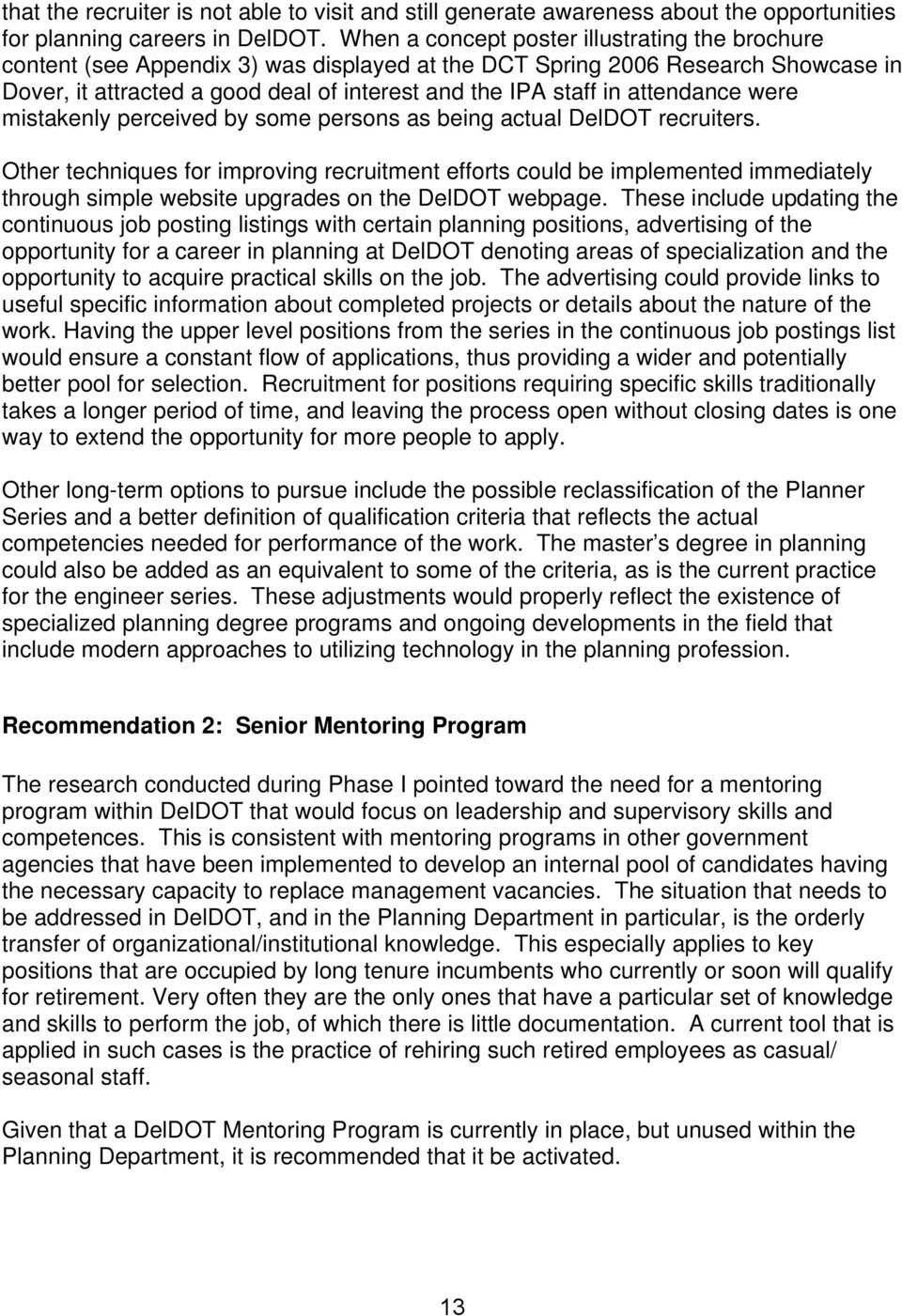
19 Appendix 1 Job Description Specifications Minimum Qualifications level I Series 1. Knowledge of the theories, concepts, principles, practices and procedures of planning. 2. Knowledge of the principles and practices of problem formulation, research design, implementation and analysis. 3. Knowledge of analytical and evaluative modes. 4. Ability to communicate effectively. Engineer Series Possession of a bachelor s degree in the assigned engineering discipline or possession of the Fundamentals of Engineering (FE) (formerly the Engineer in Training) certificate. Minimum Qualifications level II 1. Experience in the design, data collection, analysis and presentation of the results of a complex planning project (complexity is to be determined based on variables such as discipline, population, fiscal impact, geographic area, social impact, planning horizon, public involvement, research and analysis, and the nature of the project team). 2. Experience as project manager on a less complex project (complexity to be determined based on variables such as discipline, population, fiscal impact geographic area, social impact, planning horizon, public involvement, research and analysis, and the nature of the project team). 3. A minimum of one year experience as a planner or one-year experience in a planning function. 4. Ability to communicate effectively 1. Possession of a bachelor s degree in the assigned engineering discipline or possession of the Fundamentals of Engineering (FE) (formerly the Engineer in Training) certificate. 2. One year of experience in the assigned engineering discipline. OR Possession of a master s degree in the assigned engineering discipline 14
20 Minimum Qualifications level III Minimum Qualifications level IV 1. Experience in the design, data collection, analysis and presentation of the results of a most complex planning project (complexity to be determined based on variables such as discipline, population, fiscal impact, geographic area, social impact, planning horizon, public involvement, research and analysis, and the nature of the project team). 2. Experience as a project manager/leader on a complex project (complexity to be determined based on variables such as discipline, population, fiscal impact geographic area, social impact, planning horizon, public involvement, research and analysis, and the nature of the project team). 3. A minimum of two years experience as a planner or two years experience in a planning function. 4. Ability to communicate effectively. 1. Experience in having responsibility for a most complex planning project including designing and conducting research, applying analytical methods including computer and statistical methods, and designing mechanisms for collecting and evaluating information (complexity to be determined by variables such as discipline, population, fiscal impact, geographic area, social impact, planning horizon, public involvement, research and analysis, and the nature of the project team). 2. Experience as a Subject Matter Expert by demonstrating knowledge in the field listed in the selective. 3. Ability to communicate effectively. 1. Possession of a bachelor s degree in the assigned engineering discipline or possession of the Fundamentals of Engineering (FE) (formerly the Engineer in Training) certificate. 2. Four years experience in the assigned engineering discipline. 3. Knowledge of engineering project management. 1. Five years experience in the assigned engineering discipline. 2. Experience in engineering project management. 3. Experience in a specialized engineering area as described in the selective. License, Certification or Registration: Possession of a Professional Engineering License and possession of a Delaware Professional Engineering License by the end of the probationary period. Possession of a master s degree in the assigned engineering discipline. 15

21 Supervisor / Engineering VI 1. Experience with planning project management. 2. Experience in supervision and management relations. 3. Knowledge of the laws, rules, regulations and procedures in the field specified in the selective. 4. Ability to communicate effectively 1. Five years experience in the assigned engineering discipline. 2. Regionally or nationally recognized as a specialist in a specialty or scientific prominence/recognition such as publications in scientific and trade journals. 3. Experience in engineering project management. License, Certification or Registration: Possession of a Professional Engineering License and possession of a Delaware Professional Engineering License by the end of the probationary period. Possession of a master s degree in the assigned engineering discipline. Principal Planner / Civil Engineer Program Manager I Manager of / Civil Engineer Program Manager II 1. Experience in applying the principles and practices of planning related to the field specified in the selective. 2. Experience managing and leading cross-functional project teams. 3. Ability to communicate effectively. 1. Experience in applying the principles and practices of planning related to the field specified in the selective. 2. Experience in analyzing public policy, reviewing/monitoring budgets, negotiating/mediating, and developing, implementing and evaluating programs. 3. Experience in supervision and management relations. 4. Ability to communicate effectively. Experience as a project engineer in Civil Engineering. License, Certification or Registration: Possession of a Professional Engineering License and possession of a Delaware Professional Engineering License by the end of the probationary period. Applicants must have education, training and/or experience demonstrating competence in each of the following areas: 1. Experience as a project engineer in Civil Engineering. 2. Experience in staff supervision. License, Certification or Registration: Possession of a Professional Engineering License and possession of a Delaware Professional Engineering License by the end of the probationary period. 16
22 Basic KSAs required by both positions (Planners 1-4); (Engineers 1) Knowledge of the principles and practices of the planning profession. Knowledge of the areas of concentration, e.g., environmental, social, land use, health, emergency management, transportation, etc., as it applies to planning functions. Knowledge of historical and contemporary issues in the planning profession. Knowledge of the intergovernmental and inter-departmental planning activities. Knowledge of the principles and practices of project leadership and project management. Knowledge of the applicable laws, rules and regulations. Knowledge of public policy formulation and evaluation. Knowledge of state and federal funding sources and budgetary cycles, procedures. Skill in formulating problems and designing and conducting research. Skill in applying analytical methods including computer and statistical methods to planning problems. Skill in designing mechanisms for collecting and evaluating information such as surveys. Skill in building interpersonal relationships in order to work effectively with peers, customers, the public and state and federal officials. Skill in organizing and facilitating focus groups, meetings, symposia and other public forums. Ability to develop comprehensive plans and visualize their efforts. Ability to see issues in a global perspective and understand the relationship with other initiatives within and outside the agency. Ability to integrate various disciplines into the planning process. Ability to analyze and examine issues and options. Knowledge of the principles and practices of engineering. Knowledge of assigned engineering discipline, i.e., Civil, Environmental, Electrical, Materials, Chemical and Mechanical. Knowledge of the methods, techniques and procedures of research, investigation and analysis. Knowledge of mathematical and statistical concepts. Knowledge of applicable state, federal and departmental laws, rules, regulations, policies and procedures. Skills in applying the principles and practices of engineering. Skill in conducting field studies, tests, surveys and investigations. Skill in applying mathematical and statistical concepts. Ability to apply federal and state laws, rules and regulations. Ability to prepare statistical and technical reports. Ability to compile data and information. Additional knowledge needed for Engineers II IV Engineer II requires: Ability to secure data, analyze facts, draw conclusions and recommend courses of action. Engineer III requires: Skill in the interpretation of data and the preparation of reports. Skill in conducting training programs for staff. Skill in overseeing, planning and conducting projects. Skill in interpreting complex design plans. Ability to plan, organize and implement several projects simultaneously. Ability to supervise and evaluate the work of others. 17
23 Ability to mediate and facilitate group discussions. Ability to synthesize, interpret and simplify complex issues. Ability to be resourceful, use initiative and sound judgment in defining and preparing significant substantive elements of planning activities in the public interest. Ability to develop recommended courses of action and express ideas clearly, concisely, and effectively, both orally and in writing. Engineer IV requires: Knowledge of statistical analysis and computer operations in design and problem solving. Skill in data interpretation, program and project analysis and evaluation. Skill in the development and implementation of work methods. Skill in comprehending, analyzing, interpreting and explaining standards, specifications, rules and regulations. Skill in developing, planning and directing studies, surveys and other investigative work. Ability to infuse innovative and original concepts, procedures and techniques. 18
24 Appendix 2 University Institution Temple University Ambler, PA Program Name Community and Regional B.A/ B.S B.S. M.A/ M.S M.S. MCRP* Elective Fields/ Concentrations in master level Programs Program Website mbler/ac_programs/crp_ mas.htm University of Delaware Newark, DE Civil Engineering Public Administration State and Local Management focus on vil/index.htm gradengr/ pp/degrees/mpa/speciali zations.htm North American Programs accredited by the Accreditation Board New York University New York, NY Urban Affairs and Public Policy Urban and Regional Urban MUP Environment, Infrastructure, and Transportation Economic Development and Housing Specialization pp/degrees/mauapp/inde x.htm banplanning/ [email protected] University at Buffalo - The State University of New York Buffalo, NY Urban BA Environmental Design MUP International Development Community development and urban management Economic and international development ning [email protected] Environmental and physical planning GIS and Technologies Civil Engineering Urban Design du/ 19
25 Columbia University New York, NY Urban M.S. Housing International Comparative up Physical and Infrastructure Development Urban Economic Development Hunter College, City University Of New York New York, NY Civil Engineering Urban Urban Studies MUP Housing & Real Estate Economic Development Land Use & Design uny.edu/urban/ du Transportation & Environment Cornell University Ithaca, NY Civil Engineering Regional B.S. Urban & Regional Studies MRP Land Use and Environmental Economic Development m/gradchannel/code/pr ogramvc.asp?inunid=2 2413&sponsor=1 Civil Engineering International Studies in du/ Rutgers, The State University of New Jersey New Brunswick, NJ City and Regional Graduate Certificate in Transportation Studies B.A. Urban Studies MCRP Environmental and Physical Housing and Real Estate Regional and International Development Transportation Policy and Urban and Community Development Civil Engineering s.edu/ 20
26 State University of New York at Albany Albany, NY Urban & Regional Certificate in GIS & Spatial Analysis Urban Studies & MRP Environmental Housing, Local Economic Development, and Community x.html Land-Use and Urban Design Transportation University of Maryland College Park, MD Urban Studies and MCP* Urban Regional Information Systems Local and Community Economic Development Certificate in Historic Preservation Housing Land Use and Environmental P/ Social, Organization, and Administration Urban Design International Urban and Regional Development University of Pennsylvania Philadelphia, PA Civil Engineering City MCP Community and Economic Development Transportation, Environmental and Growth Management du y_plan/index.htm Urban Development and Design Engineering du/depts/index.html 21
27 Virginia Commonwealth University Richmond, Virginia Urban and Regional B.S. Urban Studies & Geography MURP Community Revitalization Environmental International Development Metropolitan Pratt Institute Brooklyn, NY Civil Engineering City and Regional MCRP Community Development (Housing and Economic Development) gep/cgep.html Environmental Preservation University of Virginia Charlottesville, VA Urban & Environmental Historic Preservation Certificate B. of Urban & Environmental MUEP Physical and Land Use Housing and Community Development Environmental Management and Conservation Land Use and Growth Management ept/urban.html Historic Preservation Urban Theory and Public Policy Legal Aspects of Civil Engineering 22
28 Morgan State University Baltimore, MD City and Regional B.S. Architecture & Environmental Design MCRP Community Physical Urban Design Transportation academics/iap/ %7Eiap/programs/progr ams_crp.html International Civil Engineering edu/ce_welchair.htm Legend: M.R.P. Master of Regional MCRP Master of City and Regional MCRP* - Master of Community and Regional MCP* Master of Community MCP Master of City MUP Master of Urban MUEP Master of Urban and Environmental MURP Master of Urban and Regional 23
29 Appendix 3 DelDOT Planner Recruitment Brochure Concept Poster [following page] Created for and displayed at the DCT Spring 2006 Research Showcase 24
30 25
31 Appendix 4 Comparative Mentoring Program Models Organization / Contact DHSS Tony Sianni NYS Department of Economic Development John Bryan (518) NYS Department of Correctional Services John Maloy nysdocs_traininga [email protected] (518) NYS Department of Health Norma Nelson or Rhonda Cooper [email protected]. ny.us [email protected]. ny.us (518) (518) Purpose To provide leadership development To facilitate the transition of qualified Department clerical and secretarial employees into the professional ranks. Employees can move into the title of Economic Development Program Specialist 1 (G-18) after successfully passing a competitive examination and completing a two-year training program. Links experienced Correction Officers with Correction Officer Trainee recruits to help them transition from civilian to Correction Officer Program is voluntary and open to any DOH employee interested in developing their skills. The program will be used in the Department's succession/workforce planning efforts. The program is administered by the Department's Intra- Agency Task Force on Women's Issues. Process Anybody in the divisions can apply people selected per year to complete a project good for the agency for which otherwise there will be no time. Subject matter can be out of the area of expertise of the mentee. Program lasts about a year. The project can be implemented if approved by the leadership committee. Each Economic Development Specialist Trainee is assigned a mentor. This mentor (a Senior Economic Development professional) is charged with advising the trainee on professional development, assisting in on-the-job training, and consulting with the Supervisor and Division Director on work assignments and performance evaluations. Often the trainee will identify a senior professional that he or she would like as a mentor. The Human Resources Office is responsible for monitoring the trainee's development program. Trainees provide progress updates at scheduled intervals. The relationship lasts for two years. The program is administered by the Division of Training. Mentors/counselors are assigned to each recruit by the Correction Officer Recruit Sergeant at the Academy. Counselors are available to the Correction Officer Recruits at all times during their eight weeks of training. The counseling is extended for another three weeks during on-the-job training Mentors and protégés interested in participating should complete and submit an application and resume. The committee then matches the protégé with a mentor who offers skill sets requested or works in an area of interest. The mentor and protégé then complete the Mentor/Protégé Agreement. The program is monitored through two feedback sessions per year and includes a graduation/luncheon ceremony at the conclusion of the program. The protégés are asked to complete a form after each meeting with their mentors. One involves what was gained from the meeting and the other outlines expectations for future meetings. This information is used at the mid-point of the program to evaluate strengths and weaknesses. 26
32 NYS Insurance Department Anne Marie Morrell e.ny.us (212) NYS Department of Motor Vehicles Kenneth Rose ny.us (518) NYS Department of Public Service Janice Nissen ps.state.ny.us (518) Lilli Carroll or Peggy May state.ny.us state.ny.us (518) (518) To coach and motivate new examiner trainees (G-14 and G-16) during their twoyear training program, which includes required classes, seminars, and on-the-job training. The mentoring program is intended to help new professional staff adjust to the rigors of the program and make them an integral part of the Department. To mentor newly hired professional staff. This target group was selected in recognition of the need for workforce succession planning. To assist employees in pursuing their goals by providing a mechanism to enhance skills in their current job or explore career alternatives. The program is open to all employees across the State at all grade levels. Experienced examiners are asked to volunteer to participate in the mentoring program. New trainees and mentors are matched based on the first assignment that the trainee receives. (Note: Trainees rotate among four different bureaus over a two-year period.) Mentors must be permanently assigned to the home office so that they can interact with the protégés when they need assistance. Finally, a mentor may not directly supervise a protégé. Mentors attend a workshop conducted by the training office. While the training office provides ongoing guidance to the mentors, it is up to the individual mentors and protégés to develop their relationships. The program is available to recently hired and recently promoted entry-level professional staff. The mentors invited to participate are all senior managers (M-2 and above) who have significant program responsibilities. Mentors and their protégés are in different organizational units. There is no formal orientation or training program for the mentors. Mentors are asked to continue a relationship with their protégé for one year, but frequency of meetings and activities are left up to the mentor. The process is employee driven. Employees submit an application form that describes what knowledge, skill, or ability (KSA) they are seeking to strengthen or what topical area they wish to explore. Human Resources reviews the application and, if the KSA's the employee is seeking is most appropriately acquired through mentoring, develops a list of potential mentors and contacts them to determine if they are interested and available. A Steering Committee supports the program and assists in identifying mentors. Both mentors and protégés attend a half-day training session and agree on a mentoring contract outlining how objectives will be met. Supervisors of protégés must sign off on the protégé's application and mentors and protégés are encouraged to involve the protégé's supervisor when developing the mentoring contract. The work schedule for mentor/protégé meetings or protégé assignments must be approved by the protégé's supervisor. 27
33 NYS Department of Transportation Kay Champagne dot.state.ny.us (518) It is voluntary and presently open to all main office personnel. The goal of the program is to assist in the development of employee skills, techniques, and perspectives, and to help develop managers and leaders within DOT. The program provides guidance in career planning, personal development, and help in achieving the Department's corporate goals. Mentors and protégés are partnered on a one-toone basis (mentors with certain skills/experiences are matched to protégés who have identified a related desire to attain those skills/experiences), and work together to set goals and identify activities that will assist the protégés in meeting their goals. The duration of the mentoring relationship is determined by the partners. The Employee Development Unit offers developmental opportunities throughout the course of the program that benefits both the mentors and protégés with their working relationships. As mentors, agency leaders take responsibility, not only for preparing their successors, but also for creating an environment where employees can work on organizational issues that challenge them to grow. Mentors use good coaching and mentoring skills to assist in creating this type of environment. National Institute of Standards and Technology v/admin/diversity/h andbook02.htm#in troduction To actively promote mentoring relationships throughout the organization in order to create and develop a "mentor-rich environment." The program is designed to encourage a workplace atmosphere in which interpersonal interactions can be marshaled to benefit both individual career goals and the productivity of the organization. Provides a structure designed to form mentoring relationships, and train mentors and proteges in communication and mentoring skills in Workshops and facilitated focus group meetings. Because the Program is built around a formal pilot program, mentors and mentees are formally matched. Employees with on-going mentoring relationships may want to attend training together with their mentor/mentee to improve mentoring skills. The Mentoring Committee will make selections based on the application packages. Once selected, mentors and proteges will be paired by members of the Mentoring Committee. Once paired, mentors and proteges will attend an Orientation Workshop. Then, mentors and proteges will work together to design a development program that works for both of them. The Mentoring Program will provide a sequence of workshops to assist you in forming and developing mentoring relationships. In addition to the workshops, there will be a series of ongoing focus groups. There will be the opportunity, to discuss in a small group, a particular topic and brainstorm ideas for meeting specific challenges. 28
34 US. Coast Guard web based mentoring entoring.com/uscgm entoring/ Allows the learner to build skills and knowledge while attaining goals for career development. Conversely, it provides the opportunity for the experienced individual to further enhance his/her skill and knowledge areas by continuously reassessing and building upon those areas A personal enhancement strategy through which one person facilitates the development of another by sharing known resources, expertise, values, skills, perspectives, attitudes and proficiencies. This web-based mentoring process helps employees to determine if a mentoring relationship is best for them. It guides the mentee through assessing his/her development needs, finding a suitable mentor from a dynamic database, and creating a mentoring agreement. It also supports the participants by providing just-intime instructions and automated notifications for key activities 29
35 Appendix 5 Delaware Department of Transportation Mentoring Program: Mission Statement: The Delaware Department of Transportation s Mentoring Program is designed to provide employees the opportunities to grow in the areas of professional knowledge, skills, and abilities through an active partnership of identified mentors and mentees. Definition of Terms: Mentors: Employees who have a strong background in a particular skill, knowledge area, or career field coupled with the desire to share this expertise with others. This is a relationship in which a person with greater experience, expertise, and knowledge counsels, teaches, guides, and helps another person to develop professionally. If necessary, the mentor will act as a liaison to other resources to assure a successful partnership. The Mentor serves as a confidential sounding board to listen, support, and advise the mentee. Mentees: Employees with a sense of responsibility for their own professional growth in regards to where they envision moving while employed at the Department of Transportation. This individual takes on both roles as a student and as a trainee. He/she is responsible for giving the mentor feedback on how much guidance is necessary while at the same time having the willingness to take feedback constructively and to learn. The mentee must let the mentor know when he/she is ready for more challenging work or when more help is needed. The mentee openly discusses goals, challenges, and concerns with the Mentor. Objectives of the Program: To share knowledge, experience, and relevant information To act as an instrument through which the more accomplished employee will be able to pass along knowledge, expertise, and relevant experience to those less experienced To provide a foundation for career mobility to those employees electing to become mentees Benefits of the Program: Cultivation of leadership talents Development of professional knowledge, skills, and abilities Anticipated lower turnover rates of promising new employees Cooperative interaction and mutual exchange of ideas between experienced employees and future leaders of the workforce Opportunities for empowerment by which employees may discover their individual paths to success in their careers and receive the necessary training and support to achieve that success 30
36 Outline of the Program: Individuals interested in becoming mentors will have supervisory endorsement and approval and attend an orientation on mentoring. Mentors will receive established guidelines to ensure consistency of the program. A bank of mentors will be established, housed in the HRM Training Center, and managed by the Program Manager. Mentees will be matched with mentors by the Program Manager according to their specific needs. The Program Manager will facilitate the first meeting of the mentor/mentee to ensure consistency and understanding of the program. It is the goal of the program to match a new employee upon hire with a mentor to assist with the adjustment of the employee to his/her environment; i.e., supervisor or the supervisor s designee. It is also the goal of the program to provide mentors to those veteran employees within the Department who may have a need or a desire of such a relationship. The Mentor will forward Interim reports to the Program Manager to ensure a positive match and forward movement. The first interim report will be forwarded within one month of the initiation of the partnership; others, upon advisement of the Program Manager. Feedback forms will be submitted by both parties to the Program Manager on an annual basis. After discussion with the Program Manager, either party can terminate the mentoring relationship. To evaluate the success of the program, both parties will forward a final feedback/comment form at the end of the partnership to the Program Manager. Guidelines of Partnership: The total length of the mentoring process will be contingent on the mentee, the mentor, and the specific need being met. Supervisors may approach employees and encourage their participation in the program either as a mentor or as a participant (mentee) with a particular need and/or desire. The mentoring process may take place during the work hours (approximately 1 2 hours every other week). However, if operational needs dictate otherwise, the two individual supervisors have final say as to the number of work hours permitted during any given week. The schedule of meetings should be submitted to BOTH supervisors in advance for approval. Should either supervisor not approve the schedule, the disapproving supervisor shall notify the other Supervisor prior to the scheduled meetings. A new schedule shall then be submitted by the mentor/mentee to the supervisors for approval. Documentation of mentoring hours during the workday shall be maintained and may be requested by either Supervisor and must be provided by the mentoring duo. Mentoring may also take place after hours. However, neither compensatory time nor overtime will be given for any mentoring done outside of the workday. Mentor application Form View the Powerpoint Presentation 31
37 Delaware Center for Transportation University of Delaware Newark, Delaware AN EQUAL OPPORTUNITY/AFFIRMATIVE ACTION EMPLOYER The University of Delaware is committed to assuring equal opportunity to all persons and does not discriminate on the basis of race, color, gender, religion, ancestry, national origin, sexual orientation, veteran statutes, age, or disability in its educational programs, activities, admissions, or employment practices as required by the Title IX of the Education Amendments of 1972, Title VI of the Civil Rights Act of 1964, the Rehabilitation Act of 1973, the Americans with Disabilities Act, other applicable statutes and University policy. Inquiries concerning these statutes and information regarding campus accessibility should be referred to the Affirmative Action Officer, 305 Hullihen Hall, (302) (voice), (302) (TTD)
Comprehensive System of Personnel Development
 Comprehensive System of Personnel Development Comprehensive System of Personnel Development The Division of Rehabilitation Services (Division) has implemented a number of strategies to ensure trained staff
National Transportation Safety Board Strategic Human Capital Plan FY 2011-2016
 National Transportation Safety Board Strategic Human Capital Plan FY 2011-2016 September 30, 2011 Strategic Human Capital Plan National Transportation Safety Board Fiscal Years 2011 through 2016 Prepared
DESERT COMMUNITY COLLEGE DISTRICT DIRECTOR OF TUTORING AND ACADEMIC SKILLS CENTER (TASC) AND SUPPLEMENTAL INSTRUCTION (SI) BASIC FUNCTION
 DESERT COMMUNITY COLLEGE DISTRICT DIRECTOR OF TUTORING AND ACADEMIC SKILLS CENTER (TASC) AND SUPPLEMENTAL INSTRUCTION (SI) BASIC FUNCTION Under the direction of the Executive Dean of Institutional Effectiveness,
Human Capital Update
 Finance & Administration Committee Information Item IV-A July 10, 2014 Human Capital Update Washington Metropolitan Area Transit Authority Board Action/Information Summary Action Information MEAD Number:
U.S. DEPARTMENT OF TRANSPORTATION
 U.S. DEPARTMENT OF TRANSPORTATION HISPANIC EMPLOYMENT INITIATIVES (HEIs) 5-POINT PLAN Departmental Office of Civil Rights Internal Policy, Program Development and Support Division, S-32 Washington, DC
METROPOLITAN COLLEGE. Goals and Student Assessment Outcomes Measures. Graduate Degree Programs
 METROPOLITAN COLLEGE Goals and Student Assessment Outcomes Measures for Graduate Degree Programs TABLE OF CONTENTS Overview... 3 Degrees Master of Arts in Human Resource Management. 4-10 Human Resource
Comprehensive System of Personnel Development
 Comprehensive System of Personnel Development This attachment describes procedures and activities that the Division of Service to the Blind and Visually Impaired (SBVI) has implemented to ensure trained
CLERK & COMPTROLLER, PALM BEACH COUNTY CLASS DESCRIPTION CLASSIFICATION TITLE: MANAGER HUMAN RESOURCES GENERAL DESCRIPTION OF DUTIES
 CLERK & COMPTROLLER, PALM BEACH COUNTY CLASS DESCRIPTION CLASSIFICATION TITLE: MANAGER HUMAN RESOURCES GENERAL DESCRIPTION OF DUTIES Under general direction, employees in this classification are responsible
Individual Development Planning (IDP)
 Individual Development Planning (IDP) Prepared for Commerce Employees U.S. Department of Commerce Office of Human Resources Management Table of Contents Introduction / Benefits of Career Planning 1 Your
B. Probationary Evaluations
 A.R. Number: 5.7 Effective Date: 2/1/2007 Page: 1 of 9 I. PURPOSE A. This policy outlines the Employee Performance Evaluation System (EPES) and the process to be followed for evaluating City of Richmond
Strategic Plan 2012 2020
 Department of Economics College of Arts and Sciences Texas Tech University Strategic Plan 2012 2020 Mission The Department of Economics is dedicated to excellence in teaching, research, and service. The
Human Capital Management Challenge: Fostering Employee Mentoring, Engagement, and Development in a Limited Budget Environment
 Human Capital Management Challenge: Fostering Employee Mentoring, Engagement, and Development in a Limited Budget Environment By Carolyn M. Taylor Chief Human Capital Officer, Government Accountability
HRM. Human Resource Management Rapid Assessment Tool. A Guide for Strengthening HRM Systems. for Health Organizations. 3rd edition
 HRM Human Resource Management Rapid Assessment Tool for Health Organizations A Guide for Strengthening HRM Systems 3rd edition . Human Resource Management Rapid Assessment Tool Copyright 2005, renewed
Workforce Planning Toolkit
 Workforce Planning Toolkit A Guide To Developing Your Agency s Succession Plan 2007 NASPE SUCCESSION PLANNING IN A MERIT SYSTEM Introduction The nation s estimated 78 million baby boomers began turning
Michael M. Massie, Ph.D. 4001 Meadowcroft Drive Kettering, Ohio 45429 (937) 901-5075 [email protected]
 Page 1 of 6 Created 01-25-2016 09:53:59 Director of Experiential Learn Michael M. Massie, Ph.D. 4001 Meadowcroft Drive Kettering, Ohio 45429 (937) 901-5075 [email protected] Professional Summary
PRO-NET. A Publication of Building Professional Development Partnerships for Adult Educators Project. April 2001
 Management Competencies and Sample Indicators for the Improvement of Adult Education Programs A Publication of Building Professional Development Partnerships for Adult Educators Project PRO-NET April 2001
Succession Planning and Career Development
 Succession Planning and Career Development Succession Planning and Career Development All trademarks are the property of their respective owners. IAAP claims no ownership interest in the trademarks. Table
HUMAN RESOURCES. Management & Employee Services Organizational Development
 Management & Employee Services Organizational Development Human Resources Department FY 2014-15 BUDGETED POSITIONS DIRECTOR.90 FTE * Human Resources Business Partner 1 FTE Human Resources Business Partner
DISTINGUISHING CHARACTERISTICS:
 OCCUPATIONAL GROUP: Human Resources CLASS FAMILY: Central Human Resources CLASS FAMILY DESCRIPTION: This family of positions include those positions which are located in the Division of Personnel. They
University of Washington Career Development Planning Guide
 University of Washington Career Development Planning Guide About U-Plan The purpose of the U-Plan is to provide you with tools and information that can help jump start your career progression. U-Plan
Succession Planning: Contingency Planning to Survive Presentation by Richard Kremzier
 Succession Planning: Contingency Planning to Survive Presentation by Richard Kremzier The fundamentals of Workforce Planning will be reviewed, establishing the context of Succession Planning. The principles
Overview of the Executive Core Qualifications: Preparing for the Senior Executive Service (SES)
 Overview of the Executive Core Qualifications: Preparing for the Senior Executive Service (SES) Presenters: Cheryl Abram Senior Executive Resources and Performance Management UNITED STATES OFFICE OF PERSONNEL
Contact Center Operations Manager
 Career Service Authority Contact Center Operations Manager Page 1 of 6 GENERAL STATEMENT OF CLASS DUTIES Supervises customer service agents working in a contact center environment while managing continuous
OCCUPATIONAL GROUP: Engineering, Mathematics and Science
 OCCUPATIONAL GROUP: Engineering, Mathematics and Science CLASS FAMILY: Research and Statistics CLASS FAMILY DESCRIPTION: This family of positions includes those whose purpose is to conduct, lead, supervise
CLASS TITLE: EQUAL EMPLOYMENT OPPORTUNITY SPECIALIST 1
 OCCUPATIONAL GROUP: Human Resources CLASS FAMILY: Agency Human Resources CLASS FAMILY DESCRIPTION: These positions are located in State Agencies and provide leadership roles in the management and implementation
Career Map for HR Information Systems Specialist (HRIS)
 Career Map for HR Information Systems Specialist (HRIS) General Information This document provides the recommendations within each of the career models for each of the identified HR functions. This includes
Career Map for HR Specialist Position Classification
 Career Map for HR Specialist Position Classification General Information This document provides the recommendations within each of the career models for each of the identified HR functions. This includes
Would I Follow Me? An Introduction to Management Leadership in the Workplace
 Would I Follow Me? An Introduction to Management Leadership in the Workplace This dynamic program clearly shows the right and wrong ways to deal with the very important human dimension of team performance.
CLASS FAMILY: Business Operations and Administrative Management
 OCCUPATIONAL GROUP: Business Administration CLASS FAMILY: Business Operations and Administrative Management CLASS FAMILY DESCRIPTION: This family of positions includes those which perform administrative
Oregon Public Health Workforce Training Needs Assessment. Key Informant Interviews Summary Report
 Oregon Public Health Workforce Training Needs Assessment Summary Report October 2013 Executive Summary In order to support agency workforce development planning, as required by the national Public Health
City of Modesto. Team for Tomorrow
 City of Modesto Team for Tomorrow May 6, 2008 INTRODUCTION: Team for Tomorrow/Workforce Planning Program. In the Management Partners Final Report on our Organizational Health Assessment (dated February
U.S. Nuclear Regulatory Commission. Plan of Action Strategic Workforce Planning
 U.S. Nuclear Regulatory Commission Plan of Action Strategic Workforce Planning January 19, 2001 Strategic Workforce Planning Plan of Action January 19, 2001 Content Overview This plan of action outlines
University of Cincinnati. Business/Fiscal Pay Program Policies and Procedures Manual
 University of Cincinnati Business/Fiscal Pay Program Policies and Procedures Manual Contents CONTENTS... 1 OVERVIEW... 2 BUSINESS/FISCAL SKILL LEVEL OVERVIEW... 2 WHAT ARE SKILL LEVELS?... 2 SKILL LEVEL
Department of Human Resources Strategic Plan
 Department of Human Resources Strategic Plan Planning Period: 2011-2015 State of Vermont Department Strategic Plan Page 1 Table of Contents Message from the Commissioner... 3 Department Overview... 3 Department
How To Be Successful At The Library Of Congress
 Human Capital Management Plan 2004 2008 United States Copyright Office Contents 1 Message from the Register of Copyrights s 3 Introduction Human Capital Framework 3 Our Mission 4 Copyright Office Strategic
Guide on Developing a HRM Plan
 Guide on Developing a HRM Plan Civil Service Branch June 1996 Table of Contents Introduction What is a HRM Plan? Critical Success Factors for Developing the HRM Plan A Shift in Mindset The HRM Plan in
Certified Nonprofit Consultant (CNC)
 Certified Nonprofit Consultant (CNC) WHY DO EXECUTIVES SECURE THE CNC CREDENTIAL?...to validate their professional achievements and personal commitment to advance the common good. Certified Fundraising
Chapter 13 Obtaining a Degree at SUU
 Chapter 13 Obtaining a Degree at SUU Table 13.1 lists the types of degrees and certificates offered at Southern Utah University. Chapter 15, Summary of Programs and Courses, lists the degrees, majors,
WORKFORCE AND SUCCESSION PLANNING
 2012 WORKFORCE AND SUCCESSION PLANNING Toolkit to Identify and Address Strategic Talent Gaps Workforce Management Office NOAA 1/1/2012 Table of contents Introduction... 3 Workforce Planning... 3 Step 1:
Career Development and Succession Planning. Changing Landscape of HR 2012 Conference
 Career Development and Succession Planning Changing Landscape of HR 2012 Conference Overview Career Development Program Succession Planning Process Benefits Reduced organizational risk. Increased productivity.
PRO-NET 2000. A Publication of Building Professional Development Partnerships for Adult Educators Project. April 2002
 Professional Development Coordinator Competencies and Sample Indicators for the Improvement of Adult Education Programs A Publication of Building Professional Development Partnerships for Adult Educators
Part III. Self-Study Report Template
 Part 3 Ministry Of Education And Higher Education Directorate General of Higher Education Part III Self-Study Report Template LABE SELF-STUDY QUESTIONNAIRE http://www.labe.org.lb General Instructions Introduction
State of Delaware Human Resource Management Statewide Training and Organization Development. Knowledge Transfer Tools
 State of Delaware Human Resource Management Statewide Training and Organization Development Knowledge Transfer Tools The goal of Knowledge Management is not to manage all knowledge, but to manage knowledge
Engineering Technology Department Bylaws 2011
 Engineering Technology Department Bylaws 2011 ARTICLE l. DEPARTMENTAL MEMBERSHIP 1.1 Membership in the Engineering Technology Department consists of all persons holding academic rank in the department.
OFFICE OF HUMAN RESOURCES MANAGEMENT CODE OF PRACTICE REGARDING INSTRUCTIONAL STAFF TITLES: TITLE DESCRIPTIONS AND MINIMUM QUALIFICATIONS
 OFFICE OF HUMAN RESOURCES MANAGEMENT CODE OF PRACTICE REGARDING INSTRUCTIONAL STAFF TITLES: TITLE DESCRIPTIONS AND MINIMUM QUALIFICATIONS PREAMBLE INDEX I. ADMINISTRATIVE POSITIONS 1. SENIOR VICE PRESIDENT
SUPPLEMENTAL INFORMATION FOR DOCUMENT 102 SELF STUDY (A STAND-ALONE DOCUMENT; NOT INTENDED TO BE A PART OF A DOCUMENT 102)
 SUPPLEMENTAL INFORMATION FOR DOCUMENT 102 SELF STUDY (A STAND-ALONE DOCUMENT; NOT INTENDED TO BE A PART OF A DOCUMENT 102) Context of Accreditation in the United States Program accreditation is both a
Professional Staff Career Development at UTAS
 Professional Staff Career Development at UTAS Guidance & Resources to Help You Actively Manage Your Career Human Resources [email protected] Professional Staff Career Development @ UTAS Continuous
Department of Public Administration
 The University of Texas at San Antonio 1 Department of Public Administration The Department of Public Administration offers the Master of Public Administration, as well as the Graduate Certificate in Nonprofit
Human Relations Sherry Peters - Director, Human Relations Specialist Professional Phase 2 (SP2), ASPA Bargaining Unit
 JOB TITLE NAME UNIT REPORTS TO JOB FAMILY Organizational Development Specialist Vacant Human Relations Sherry Peters - Director, Human Relations Specialist Professional Phase 2 (SP2), ASPA Bargaining Unit
Supporting Academic Staff Guidelines
 Supporting Academic Staff Guidelines 1.1 Introduction Supporting Academic Staff is a term that classifies Lecturers and teaching Assistants. Both Lecturers and teaching assistants are vital components
I.Program Objectives. Need and Justification
 Proposal for a Joint Degree Program in Law and City and Regional Planning from Georgia State University College of Law and the Georgia Institute of Technology College of Architecture Abstract: This is
ACCOUNT CODE: 8000-000-6000 SUPERVISOR:
 Shoshone-Paiute Tribes, P.O. Box 219, Owyhee, Nevada 89832, PH: (208) 759-3100, Fax: (888) 476-7269 E-Mail Address: [email protected], Website: www.shopaitribes.org JOB ANNOUNCEMENT POSITION: Human Resources
HOW TO PREPARE FOR THE SENIOR EXECUTIVE SERVICE
 HOW TO PREPARE FOR THE SENIOR EXECUTIVE SERVICE A DEPARTMENT OF THE NAVY HANDBOOK Published in 2012 Deputy Assistant Secretary of the Navy (Civilian Human Resources) and the Executive Diversity Advisory
Policies and Procedures Manual
 University of Cincinnati Division of Administration and Finance Policies and Procedures Manual Broadband Program For Project Management Architects Planners Engineers Project Managers Directors Contents
DEVELOPING AN INTEGRATED TALENT MANAGEMENT PROGRAM. A Human Resource Management Framework
 DEVELOPING AN INTEGRATED TALENT MANAGEMENT PROGRAM A Human Resource Management Framework HR POLICY AND PLANNING DIVISION HUMAN RESOURCE BRANCH Public Service Secretariat April, 2008 Government of Newfoundland
NEW YORK STATE SUCCESSION PLANNING
 NEW YORK STATE SUCCESSION PLANNING A Guidebook for Local Officials 2015 Environmental Finance Center Syracuse University PREFACE This guidebook is intended to aid local officials in understanding the
Revised Body of Knowledge And Required Professional Capabilities (RPCs)
 Revised Body of Knowledge And Required Professional Capabilities (RPCs) PROFESSIONAL PRACTICE Strategic contribution to organizational success RPC:1 Contributes to the development of the organization s
NUCLEAR REGULATORY COMMISSION COMPREHENSIVE. Diversity Management Plan
 U.S. NUCLEAR REGULATORY COMMISSION COMPREHENSIVE Diversity Management Plan Vision Statement: NRC is an agency where all employees are valued and have an equal chance to succeed, thereby increasing organizational
CALIFORNIA STATE UNIVERSITY, BAKERSFIELD ACADEMIC SENATE NEW MINOR: HEALTH CARE MANAGEMENT RES 1213021 AAC/BPC
 CALIFORNIA STATE UNIVERSITY, BAKERSFIELD ACADEMIC SENATE NEW MINOR: HEALTH CARE MANAGEMENT RES 1213021 AAC/BPC RESOLVED: that the Academic Senate recommends that the President approve the proposed Public
The 10 Best Graduate Programs In Urban And Regional Planning
 Page 1 of 8 About Contact Home Degrees Colleges Rankings The 10 Best Graduate Programs In Urban And Regional Planning Select a Degree Select a Category Select a Subject Top College Rankings The 25 Best
Student Learning Outcomes Bachelor in Health Information Management Department of Health Sciences College of Applied Science and Technology
 Student Learning Outcomes Bachelor in Health Information Management Department of Health Sciences College of Applied Science and Technology Upon successful completion of the Health Information Management
Succession Planning Process
 Planning Process INTRODUCTION planning is a systematic approach to: Building a leadership pipeline/talent pool to ensure leadership continuity Developing potential successors in ways that best fit their
Career Management. Succession Planning. Dr. Oyewole O. Sarumi
 Career Management & Succession Planning Dr. Oyewole O. Sarumi Scope of Discourse Introduction/Background Definitions of Terms: Career, Career Path, Career Planning, Career Management. The Career Development
Dear Nonprofit Leader
 Dear Nonprofit Leader Last year Mountain States Employers Council partnered with two community nonprofits to create the MSEC Nonprofit Leadership Institute. This year six nonprofits have come together
CAREER OPPORTUNITIES IN HUMAN RESOURCES TRAINING AND DEVELOPMENT
 CAREER OPPORTUNITIES IN HUMAN RESOURCES TRAINING AND DEVELOPMENT Description of the Field Attracting the most qualified employees and matching them to the jobs for which they are best suited is important
HHS MENTORING PROGRAM. Partnering for Excellence MENTORING PROGRAM GUIDE
 HHS MENTORING PROGRAM Partnering for Excellence MENTORING PROGRAM GUIDE November 17, 2008 TABLE OF CONTENTS Page I. VISION STATEMENT.... 2 II. MISSION STATEMENT. 2 III. INTRODUCTION...2 IV. PROGRAM OBJECTIVES.
UNITED STATES DISTRICT COURT WESTERN DISTRICT OF MICHIGAN PROBATION AND PRETRIAL SERVICES OFFICE
 UNITED STATES DISTRICT COURT WESTERN DISTRICT OF MICHIGAN PROBATION AND PRETRIAL SERVICES OFFICE CAREER OPPORTUNITY POSITION ANNOUNCEMENT NO. 15-02 Position: Deputy Chief U.S. Probation Officer, Type II
Certificate Program Course Summary and Assessment Sample
 Certificate Program Course Summary and Assessment Sample Section I: Identification Certificate Program: SDC MDC HRC X. Participant: Wanta Graduate Employee ID#: XXXXXX Course title: HR Basics Date(s) course
Information Technology Specialists, #39110 Occupational Family: Engineering and Technology Pay Band Range: 4-8. Concept of Work
 Information Technology Specialists #39110 Page 1 of 16 Information Technology Specialists, #39110 Occupational Family: Engineering and Technology Pay Band Range: 4-8 Concept of Work This Career Group provides
GREATER DAYTON MINORITY BUSINESS ASSISTANCE CENTER PROGRAM DIRECTOR. Reports to: Executive Director, City of Dayton Human Relations Council
 GREATER DAYTON MINORITY BUSINESS ASSISTANCE CENTER PROGRAM DIRECTOR Reports to: Executive Director, City of Dayton Human Relations Council To apply send resumes to: Joann Wright Secretary to the Executive
UMD Department of Mechanical and Industrial Engineering
 UMD Department of Mechanical and Industrial Engineering Indices and Standards for Tenure and Promotion to Professor as Required by Section 7.12 of the Board of Regents Policy on Faculty Tenure (June 10,
CALIFORNIA STATE UNIVERSITY EAST BAY COMMITTEE ON ACADEMIC PLANNING AND REVIEW. Committee on Academic Program Review
 CALIFORNIA STATE UNIVERSITY EAST BAY COMMITTEE ON ACADEMIC PLANNING AND REVIEW Designation Code: 06-07 CAPR 12 Date Submitted: May 10, 2007 TO: FROM: SUBJECT: PURPOSE: ACTION REQUESTED: Academic Senate
GOVERNMENT OF NEW BRUNSWICK S EXECUTIVE DEVELOPMENT STRATEGY
 GOVERNMENT OF NEW BRUNSWICK S EXECUTIVE DEVELOPMENT STRATEGY DEVELOPING THE RIGHT PEOPLE, IN THE RIGHT POSITION, AT THE RIGHT TIME 2015-2018 Part I New Brunswick Public Service TABLE OF CONTENTS Message
Compensation Manual: Non-Represented Pay Practices
 SEATTLE PUBLIC SCHOOLS Table of Contents 1. Introduction 2. Compensation Philosophy 3. Roles and Responsibilities for Compensation The Classification and Compensation Work Group Executive Director of Talent
Succession Planning Developing Georgia s Future Leaders
 Workforce Services Succession Planning Developing Georgia s Future Leaders Objectives Today s session will provide foundational information related to a basic succession planning model. At the end of the
STATE OF NEVADA Department of Administration Division of Human Resource Management CLASS SPECIFICATION
 STATE OF NEVADA Department of Administration Division of Human Resource Management CLASS SPECIFICATION TITLE GRADE EEO-4 CODE WORKFORCE SERVICES REPRESENTATIVE V 34 B 12.152 SERIES CONCEPT Workforce Services
State of Washington. Guide to Developing Succession Programs. Updated November 2008. Page 1 of 9
 State of Washington Guide to Developing Succession Programs Updated November 2008 Page 1 of 9 Introduction The purpose of succession planning is to develop a pool of internal candidates for future vacancies.
IC Performance Standards
 IC Performance Standards Final Version 1 23 April 2009 1 TABLE OF CONTENTS BACKGROUND... 3 OCCUPATIONAL STRUCTURE... 4 PERFORMANCE ELEMENT CONTENT MODELS... 7 Professional and Technician/Administrative
DoDEA Personnel Center HR Competency Definitions
 DoDEA Personnel Center HR Competency Definitions ATTACHMENT 10 Business Management Competencies Business Process Reengineering Applies business process reengineering principles and techniques to reengineer
Branch Human Resources
 Branch Human Resources Introduction An organization s ability to deliver services to citizens is highly dependant on the capacity of its workforce. Changing demographics will result in increasing numbers
SUCCESSION PLANNING AND MANAGEMENT GUIDE
 SUCCESSION PLANNING AND MANAGEMENT GUIDE HR POLICY AND PLANNING DIVISION HUMAN RESOURCE BRANCH Public Service Secretariat April, 2008 Government of Newfoundland and Labrador P.O. Box 8700 St. John s Newfoundland
SCHOOL OF ENGINEERING Baccalaureate Study in Engineering Goals and Assessment of Student Learning Outcomes
 SCHOOL OF ENGINEERING Baccalaureate Study in Engineering Goals and Assessment of Student Learning Outcomes Overall Description of the School of Engineering The School of Engineering offers bachelor s degree
PUBLIC ACCOUNTANTS COUNCIL HANDBOOK
 PUBLIC ACCOUNTANTS COUNCIL HANDBOOK Adopted by the Public Accountants Council for the Province of Ontario: April 17, 2006 PART I: PROFESSIONAL COMPETENCY REQUIREMENTS FOR PUBLIC ACCOUNTING PART II: PRACTICAL
STAFF REPORT ACTION REQUIRED
 Insert TTC logo here STAFF REPORT ACTION REQUIRED Succession Planning Date: June 20, 2016 To: From: TTC Human Resources & Labour Relations Committee Chief Executive Officer Summary Further to the Human
BY-LAWS OF THE EDWARD J. BLOUSTEIN SCHOOL OF PLANNING AND PUBLIC POLICY. Rutgers, The State University of New Jersey
 1 By-Laws BY-LAWS OF THE EDWARD J. BLOUSTEIN SCHOOL OF PLANNING AND PUBLIC POLICY Rutgers, The State University of New Jersey Article I. PREAMBLE These by-laws, prepared and adopted by the faculty of the
This page was left intentionally blank.
 This page was left intentionally blank. Workforce Planning Model Steps What This Step Accomplishes 1. Define the Scope Determines our focus could be long or short term could be a specific business unit
THE UNIVERSITY OF TEXAS AT AUSTIN ANNUAL PERFORMANCE EVALUATION FOR CLASSIFIED PERSONNEL AND NON-TEACHING PROFESSIONAL STAFF
 THE UNIVERSITY OF TEXAS AT AUSTIN ANNUAL PERFORMANCE EVALUATION FOR CLASSIFIED PERSONNEL AND NON-TEACHING PROFESSIONAL STAFF For Evaluation Period Ending: Employee Name: Department: Title: Manager KEY
Recruiting, Hiring and Employment Development Process White Paper
 Recruiting, Hiring and Employment Development Process White Paper By Kenneth Barton, Frederick Cardin & Garrye Hepburn Overview VCC was formed to promote the financial well being and economic independence
Nursing. Nunavut. Recruitment and Retention Strategy 2007 2012 NUNAVUT NURSES BE THE DIFFERENCE
 Government of Nunavut Department of Health and Social Services Nunavut Nursing Recruitment and Retention Strategy 2007 2012 NUNAVUT NURSES BE THE DIFFERENCE Nunavut Nursing Recruitment and Retention Strategy