
BUSINESS POLICIES: APPENDIX B ( )
|
|
|
- Douglas Hodges
- 10 years ago
- Views:
Transcription
1 BUSINESS POLICIES: APPENDIX B ( )

2 TABLE OF CONTENTS DEFAULT POLICY ACCOUNTING AND REPORTING REQUIREMENTS PRODUCER S FEES & CORPORATE OVERHEAD (PFCO) POLICY COMPLETION PROTECTION POLICY PRODUCTION INSURANCE POLICY STANDARD RECOUPMENT POLICY TREATMENT OF TAX CREDITS The table below outlines which Business Policies apply to each funding program. Business Policy Development Performance Envelope Francophone Minority Aboriginal English Production Incentive Diverse Languages English POV Versioning Default Policy Accounting and Reporting Requirements PFCO - Completion Protection Production Insurance Standard Recoupment Treatment of Tax Credits CONFLICTS In the event of a conflict between a provision in this Appendix B and a provision in the main Guidelines for the applicable Program or Stream, the provision in the main Guidelines shall govern.

3 CHAPTER 1 DEFAULT POLICY IN EFFECT AS OF APRIL 1, 2014
4 1. COMPANY IN DEFAULT An applicant company ( Applicant ) that has committed an event of default under a financing agreement ( Financing Agreement ) 1 entered into with the Canada Media Fund (the CMF ), including under its former legal name, the Canadian Television Fund, or with Telefilm Canada ( Telefilm ) (prior to an asset transfer agreement between the CMF and Telefilm, effective July 1, 2007, whereby all Financing Agreements for television projects entered into with Telefilm were transferred to the CMF), will be considered to be in default with the CMF. An Applicant that is in default under a Financing Agreement for one project is automatically deemed to be in default with respect to all of the Applicant s other projects receiving CMF funding. Further, the CMF shall deem all related parties, as defined the CMF Accounting and Reporting Requirements, ( Related Party ) to be in default vis-à-vis the CMF. 2. EVENTS OF DEFAULT Financing Agreements include a section entitled Events of Default. Following is a summary of common Events of Default that arise: (a) The Applicant s project fails to meet the CMF s Guideline eligibility requirements, including without limitation, the Essential Requirements, genre requirements and minimum threshold requirements; (b) The Applicant fails to report on or pay revenues owed to the CMF; (c) The Applicant fails to complete and/or deliver the project to the triggering broadcaster(s), or in the case of digital media projects, fails to make the project available to the Canadian public; (d) The Applicant fails to deliver all required reports and documentation to the CMF, or fulfill the requirements by the deadline or expiry date set out in the Financing Agreement; or (e) Following a request from the CMF for information or documentation that is directly within the Applicant s control to provide to CMF, the Applicant fails to fulfill such request within thirty (30) days; (f) The Applicant fails to repay in full any amounts (including interest) owing to the CMF in connection with any Financing Agreement; (g) Fraud and/or misrepresentation by the Applicant or a Related Party; (h) Insolvency or bankruptcy of the Applicant or a Related Party; (i) The Applicant ceases to carry on business; and/or (j) Any action is taken to remove control of the project from the Applicant or to seize any elements of the project (subject to the rights of a bona fide completion guarantor). 1 Financing Agreement also means a Deal Memo entered into with the CMF in the year or All references herein to a Financing Agreement shall be deemed to include a Deal Memo, where applicable. Failure to repay any amount owing under a Deal Memo is considered an Event of Default for the purposes of this policy. A Financing Agreement includes agreements entered into to provide production, development, or versioning financing. Appendix B: Business Policies, Section 1: Default Policy March

5 CONVERGENT PROJECTS: As of , all projects funded by the CMF are required to be convergent, having a television component and one or more digital media components or be made available via a CRTC-licensed video-on-demand service or via non-simulcast digital distribution via a Canadian entity, except for projects funded in the Versioning Program and Experimental Stream. It is an Event of Default if any of the components of the convergent project are not completed, delivered to the broadcaster or made available to the Canadian public as applicable. A separate Financing Agreement will be entered into by the CMF for each component of the convergent project that is funded by the CMF. If an Event of Default occurs under a Financing Agreement for one of the components of the convergent project, it will trigger an Event of Default under each of the Financing Agreements for all of the related components of the convergent project. This will apply in all cases, even if there are separate applicants for each component. However, only Related Parties to the applicant that committed the initial event of default will also be deemed to be in default. Related Parties to the applicant(s) for the related component(s) will not be deemed to be in default. 3. THE CMF S DEFAULT RIGHTS If the CMF determines that an Event of Default has occurred under a Financing Agreement, the CMF may do any or all of the following (without limiting or precluding any other rights and remedies that the CMF may have at law or in equity): (a) Reduce the contribution amount and require the Applicant to immediately repay any portion of the reduced amount previously advanced to the Applicant, plus interest; (b) Withhold any payment due to the Applicant or to any Related Party under any Financing Agreement; (c) Refuse to accept any future application or enter into a new Financing Agreement for CMF funding from the Applicant or a Related Party; and/or (d) Terminate the Financing Agreement by giving the Applicant ten (10) business days written notice, and if the default is not cured within the ten (10) business day period, require the Applicant to immediately repay all amounts received by the Applicant under the Financing Agreement, plus interest. 4. INTEREST The CMF charges interest on all repayment amounts at the rate of prime (as set by the Bank of Canada) plus 1% per annum, compounded monthly, calculated and payable from the date of advance both before and after demand, default or judgment. 5. CMF APPLICATIONS FROM APPLICANTS IN DEFAULT Following receipt of a complete application for CMF funding from an Applicant in default with the CMF, the CMF, will notify the Applicant in writing that it has thirty (30) days to resolve the default. An assessment of the application will not be completed until the default with the CMF is resolved. If the default with the CMF is not resolved within the thirty (30) day period, the application will be rejected. Appendix B: Business Policies, Section 1: Default Policy March

6 6. DISCLAIMER This policy is for informational purposes only. The CMF reserves the right to modify this policy at any time. The policy does not limit in any way the rights and remedies that the CMF has under its Financing Agreements or otherwise. Appendix B: Business Policies, Section 1: Default Policy March

7 CHAPTER 2 ACCOUNTING AND REPORTING REQUIREMENTS IN EFFECT AS OF APRIL 1, 2014
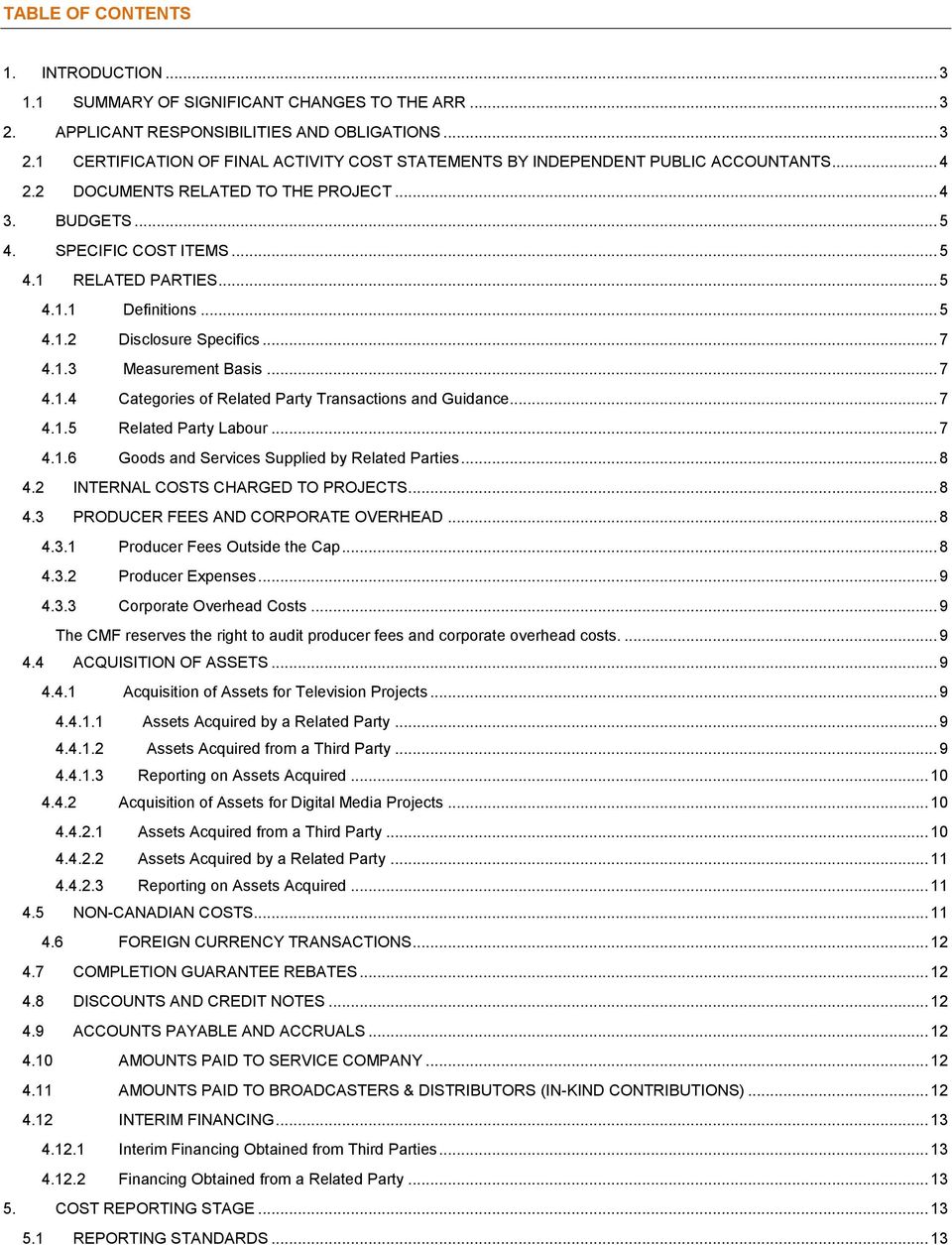
8 TABLE OF CONTENTS 1. INTRODUCTION SUMMARY OF SIGNIFICANT CHANGES TO THE ARR APPLICANT RESPONSIBILITIES AND OBLIGATIONS CERTIFICATION OF FINAL ACTIVITY COST STATEMENTS BY INDEPENDENT PUBLIC ACCOUNTANTS DOCUMENTS RELATED TO THE PROJECT BUDGETS SPECIFIC COST ITEMS RELATED PARTIES Definitions Disclosure Specifics Measurement Basis Categories of Related Party Transactions and Guidance Related Party Labour Goods and Services Supplied by Related Parties INTERNAL COSTS CHARGED TO PROJECTS PRODUCER FEES AND CORPORATE OVERHEAD Producer Fees Outside the Cap Producer Expenses Corporate Overhead Costs... 9 The CMF reserves the right to audit producer fees and corporate overhead costs ACQUISITION OF ASSETS Acquisition of Assets for Television Projects Assets Acquired by a Related Party Assets Acquired from a Third Party Reporting on Assets Acquired Acquisition of Assets for Digital Media Projects Assets Acquired from a Third Party Assets Acquired by a Related Party Reporting on Assets Acquired NON-CANADIAN COSTS FOREIGN CURRENCY TRANSACTIONS COMPLETION GUARANTEE REBATES DISCOUNTS AND CREDIT NOTES ACCOUNTS PAYABLE AND ACCRUALS AMOUNTS PAID TO SERVICE COMPANY AMOUNTS PAID TO BROADCASTERS & DISTRIBUTORS (IN-KIND CONTRIBUTIONS) INTERIM FINANCING Interim Financing Obtained from Third Parties Financing Obtained from a Related Party COST REPORTING STAGE REPORTING STANDARDS... 13
9 5.2 ACCEPTABLE SUPPORTING DOCUMENTS FOR ALL PROJECT COSTS Labour Goods and Services Costs Specific Requirements Producer Fees Outside the Cap Related Parties Related Party Labour Related Goods and Services Television - Section A Costs (i.e. Story Rights Payments and Development Costs) Accounts Payable and Accruals Schedule 1 Glossary Schedule 2 - Sample Disclosure for the FCACS Content Summary of Significant Accounting Policies Example Disclosure of Accounting Policies Assets Acquired and Disposed of During the Project Related Party Transactions Unpaid Costs Locked Budget Items Non-Canadian Costs For Television Projects: Point Performers and Non-Canadian Performers Foreign Currency Exchange (Project Cost Transactions) Sources and Structure of Financing Completion guarantee rebate Amounts paid to broadcasters and/or distributors Service Company Schedule 3 - Sample Allocation Worksheets Labour Allocation Worksheet Goods & Services Allocation Worksheet Appendix B: Business Policies, Section 1: Accounting And Reporting Requirements April

10 1. INTRODUCTION These revised CMF Accounting and Reporting Requirements (ARR) amend and replace the ARR published on April 1, 2012 and are effective for all projects funded and/or reporting final costs after April 1, The ARR applies to all projects funded by the CMF. In the case of Audiovisual treaty coproductions and digital media projects governed by the Framework for International Digital Media Coproduction, the ARR applies to the Canadian share of the budget. The ARR should be read along with the CMF Guidelines including Appendices A and B, and the CMF Financing Agreement. The Applicant should refer to the specific guidelines for the program or stream of funding in the year the Applicant applied for funding. The Guidelines and all related documents are available on the CMF website. The CMF outsources the file administration to the Canada Media Fund Program Administrator Telefilm Canada. Telefilm Canada is authorized to act on behalf of the CMF including ensuring all aspects of the ARR are respected by all applicants for all projects funded by the CMF. The ARR applies to all projects funded by the CMF, including but not limited to: pre-development, development, production, marketing, and versioning. If there are any requirements specific to a program or stream of funding, those differences are noted in the ARR. A glossary of terms is included in Schedule SUMMARY OF SIGNIFICANT CHANGES TO THE ARR Review Engagement required for projects with Budgets greater than $250,000 and less than $500,000 1 ; Related Party section expanded to include examples, measurement basis has been updated, added section on disclosure requirements; New internal allocations section; New section on assets acquired for digital media projects; Expanded acceptable supporting documentation for costs; Updated Schedule 1 glossary and Schedule 2 Sample Disclosure for FCACS; New Schedule 3 Sample Allocation worksheets. 2. APPLICANT RESPONSIBILITIES AND OBLIGATIONS The Applicant(s) responsibilities include: a) The maintenance of separate accounts and related records throughout the project for which financing has been provided. Any specific bank account requirements are outlined in the project financing agreement. b) A final cost report (FCR) must be prepared in the standard industry format and be accompanied by explanatory notes for substantive variances from the Budget. A final certified activity cost statement (FCACS) is also required for certain projects as noted in the CMF Financing Agreement and in the following section 2.1. c) The Applicant must ensure that all its accounting personnel fully comprehend these ARR. d) The Applicant must also ensure that its management and senior accounting personnel have familiarized themselves with the CMF s required documentation dealing with the accounting and reporting of financial information. Such documentation, among others, includes: 1 For projects funded prior to , the threshold for the Review Engagement was a budget greater than $200,000 and less than $500,000. For those projects funded prior to , the threshold from the CMF Financing Agreement will prevail. Appendix B: Business Policies, Section 1: Accounting And Reporting Requirements April

11 i. The CMF Financing Agreement and all other contracts and letters of agreement entered into with the CMF (accompanied by any subsequent amendments); ii. Correspondence exchanged between the CMF and the Applicant or its representatives (legal advisors and independent accountants/auditors); iii. The Budget; iv. These ARR; v. The CMF Application Form for the project; and vi. Other Contractual Agreements, broadcast licence agreements and distribution agreements should they exist. 2.1 CERTIFICATION OF FINAL ACTIVITY COST STATEMENTS BY INDEPENDENT PUBLIC ACCOUNTANTS For projects with a budget that totals $500,000 or greater, the CMF requires a FCACS accompanied by an Independent Auditor s Report. For projects with a budget that totals $250,000 or greater but less than $500,000, the CMF requires a FCACS accompanied by an Independent Public Accountant s Review Engagement Report. For projects with a budget that totals less than $250,000, the Applicant must submit an uncertified FCR, supported by an affidavit. However the CMF reserves the right to instruct that an audit or review engagement be performed, regardless of the budget level. In cases of an audit or review mandate, the Independent Public Accountant selected by the Applicant must be a member in good standing with a professional organization authorized for this type of work with its provincial institute. The auditor must be independent of the Applicant as defined by the provincial institute with whom the auditor is a member. In addition to carrying out its work in accordance with generally accepted auditing standards the auditor must be familiar with the industry and its practices and with these ARR. The Applicant is required to provide to its auditor, a copy of all documents related to the project Specific reporting requirements for versioning projects are defined in the CMF Financing Agreement. 2.2 DOCUMENTS RELATED TO THE PROJECT The Applicant is required to retain all documents related to the project at its place of business or in an archival facility for a period of five years from the year in which the project was completed (as per the auditor s report, the review engagement report or the affidavit). Among others, these documents include the following: All agreements entered into with financiers of the project; Correspondence exchanged between financiers and the Applicant or its representatives; Separate accounts (detailed general ledger, general journal, revenue and disbursement journal, accounting entries, payroll register, etc.) for the project; Bank reconciliations and monthly bank statements; Statement of cash flow, including cash received from all sources of financing, cash outflows in respect of project costs, reconciling to the balance in the general ledger at the end of each month; Cancelled cheques and/or disbursement vouchers and bank debit notes; Bank deposit slips; Purchase invoices and/or supplier statements; Purchase orders or similar authorization for expenditures, signed by authorised personnel of the Applicant; Expense accounts and petty cash reports with corresponding receipts; Duly executed employee contracts and employee T4 slips; Timesheets for Related Party labour costs to the project; Support for Fair Value of Related Party goods and services; Appendix B: Business Policies, Section 1: Accounting And Reporting Requirements April

12 Schedule of total allocations of shared costs; A list of all affiliated, associated or related companies or entities; Any other support for note disclosures, and Any other information required by the CMF. And for projects with exploitation reporting obligations, these reports and all supporting documents must be retained for three years from the date of the last exploitation report. The Applicant and the individual producer(s) must take all necessary precautions to ensure that all financial records of the Applicant related to the project, including paper and computerized records, are retained and made accessible over the five-year period. Care must be taken to ensure records held by terminated personnel are recovered prior to their departure. 3. BUDGETS All project applications must be accompanied by a detailed estimate of total costs (the Budget). In the Convergent Stream, the Digital Media Component(s) must be budgeted separately from the Television Component(s). The Budget should include all costs to complete the project. Budgets are subject to review by CMF. It is important that the estimates of costs on which the project budget is based are appropriately supported. Support for these costs include contracts, agreements, quotes, estimates, and allocation worksheets and must be made available to CMF upon request. The following should be considered when preparing the project Budget: Applicants must complete a CMF Budget Template, a template is available by stream for each program and Where applicable, by component and can be found on the CMF website Allocate amounts to the appropriate line item on the Budget Template; The type and estimate of costs in the Budget must be consistent with the relevant Program Guidelines; Disclose all anticipated related party transactions, a template is available; The participation of the CMF is based in part on its assessment of the Budget; and any amounts in the Budget That the CMF deems ineligible or unreasonable may cause the CMF to adjust the amount of its participation; and Approval of the Budget by the CMF must not be interpreted as final acceptance of the costs in the Budget. In no case may the Budget serve as the sole justification for final costs reported in the FCR; those final costs must be supported by sufficient and appropriate documents. See Acceptable Supporting Documents for examples. 4. SPECIFIC COST ITEMS 4.1 RELATED PARTIES The CMF requires Related Party Transactions (RPT) to be disclosed by the Applicant at Budget and at final costs Definitions The CMF accepts the following definitions of related parties, RPTs and significant influence. These have been determined in accordance with CPA s Accounting Standards for Private Enterprises Section 3840 Related Party Transactions. Related parties exist when one party has the ability to exercise, directly or indirectly, control, joint control or significant influence over the other. Two or more parties are related when they are subject to common control, joint control or common significant influence. For a more detailed definition of Related Parties, including management and immediate family members, see Schedule 1. Appendix B: Business Policies, Section 1: Accounting And Reporting Requirements April

13 A related party transaction is a transfer of economic resources or obligations between related parties, or the provision of services by one party to a related party, regardless of whether any consideration is exchanged. The parties to the transaction are related prior to the transaction. When the relationship arises as a result of the transaction, the transaction is not one between related parties. Control of an enterprise is the continuing power to determine its strategic operating, investing and financing policies without the cooperation of others. Joint control of an economic activity is the contractually agreed sharing of the continuing power to determine its strategic, operating, investing and financing policies. Significant influence over an enterprise is the ability to affect the strategic operating, investing and financing policies of the enterprise. Fair Value is the amount of the consideration that would be agreed upon in an arm's length transaction between knowledgeable, willing parties who are under no compulsion to act. Examples of Related Parties: 1. John Smith is the owner of Company A (CA) but, does not have an active role in the company. His spouse, Martha Smith is an editor for CA. CA has applied to the CMF for funding for Project X. Martha Smith is a Related Party - her role as an editor must be disclosed on the RPT form when CA submits its budget and when reporting final costs for Project X. Martha Smith is a related party as she is the spouse of a shareholder. 2. John Smith is the CEO of Camera Company, but he has no ownership interest in the company. Camera Company provided camera services to CA for Project X. Camera Company is a Related Party camera services must be disclosed on the RPT form when CA submits its budget and when reporting its final costs for Project X. John Smith is considered to have significant influence over Camera Company, therefore, CA and Camera Company are considered to be related. 3. Sue Brown is the Finance Director at CA. and has no equity in the company, but, she decides on the production budget and is the ultimate decision maker. Sue Brown is a Related Party fees for her role as a Finance Director must be disclosed on the RPT form when CA submits its budget and when reporting final costs for Project X. Sue Brown is considered to have significant influence over CA. 4. Sue s son Bob Brown is an extra on the set. Bob Brown is a Related Party fees for his role as an extra must be disclosed on the RPT form. When CA submits its budget and when reporting its final costs for Project X, Bob Brown is a close family member of Sue Brown, she has significant influence over CA. 5. Mike South owns Holding Company which owns Production Company and Services Company. Production Company has applied to the CMF for funding for a project. Holding Company provides accounting and legal services to Production Company and Services Company provides editing services to Production Company. The provision of the services by Holding Company and Services Company to Production Company are all related party transactions. Production Company must disclose all of these transactions on the RPT form when it submits its budget and when reporting final costs for its project. Holding Company is the parent of Production Company. Production Company and Services Company are companies under common control. Appendix B: Business Policies, Section 1: Accounting And Reporting Requirements April

14 4.1.2 Disclosure Specifics A template is available for RPT disclosure at Budget and at final cost. RPTs should also be disclosed in the notes to the FCACS as per Schedule 2 Applicants must disclose the following information with respect to transactions with related parties: a) A description of the relationship between the transacting parties (i.e. shareholder, senior management, spouse of shareholder, a company under common control etc.); b) A description of the transaction(s), including non-monetary transactions (e.g.. parent company provided editing services in exchange for promotional activity provided by Applicant); c) The amount of the transactions classified by budget/final cost line item number; and d) The measurement basis used. All RPTs must be disclosed at FCR even if the transaction was not anticipated to be a RPT in the Budget. And if any anticipated RPTs at Budget are no longer RPTs at FCR, explanations should be provided at FCR Measurement Basis The measurement basis used should be one of the following: Actual Flow-Through Cost: Represents actual costs paid by the Related Party to the third party vendor. If an allocation of actual flow-through cost is made to more than one project, the basis must be supported, or Fair Value is the amount of the consideration that would be agreed upon in an arm's length transaction between knowledgeable, willing parties who are under no compulsion to act. All related party costs must meet the following five criteria: a) Cost must be reasonable in the circumstances (see further guidance below); b) Cost must be included in the FCR or, in the case of depreciable property, the capital cost, of the project; c) Cost must be consistent with the CMF Guidelines; d) Cost must be directly attributable to the project and relate only to the specific phase of the project funded by the CMF (there must be a clear link to specific work performed on the project); and e) Cost must be paid no later than 120 days after the project completion unless the Applicant is waiting for receipt of the tax credit Categories of Related Party Transactions and Guidance The CMF recognizes two categories of Related Party Transactions: 1. Related party labour 2. Goods and services supplied by related parties Related Party Labour The cost of labour (i.e. salaries or fees) for individuals hired by a related party and allocated in whole or in part to the Applicant for the project must correspond to the actual amount paid to the individual and be in accordance with the employment or engagement contract signed with the employer. Such amounts must be supported by corresponding documents such as T4 slips, employment contracts and authorized time sheets specifying the project title. Appendix B: Business Policies, Section 1: Accounting And Reporting Requirements April

15 At the time of the submission of the Budget, the Applicant is expected to make a reasonable estimate of the labour costs involved in the project. The approved budgeted labour costs are not to be used as a justification for the actual labour cost. Labour costs in the FCR must correspond to the actual cost for the period of time worked on the project. If personnel worked on more than one project for a Related Party and is paid by the Related Party, there must be an allocation sheet showing the amounts charged to all projects and must be supported by authorized time sheets. The total on the allocation sheet must correspond to the T4 slip. Related costs such as employee benefits may be included with these costs Goods and Services Supplied by Related Parties Goods and services provided to the Applicant by a Related Party may be accounted for at the Actual Flow-Through Cost or at amount equal to or below Fair Value. Both methods require sufficient and appropriate supporting documents. See Acceptable Supporting Documents for examples. 4.2 INTERNAL COSTS CHARGED TO PROJECTS When a project is accounted for within a company that is carrying on business other than just that of the CMF funded project, all of the internal allocations to the Project should be treated similar to RPT. The transactions should be valued on the same basis as RPTs and reported on the RPT form at Budget and at final cost. Examples: 1. Company D is an existing company with 10 permanent employees producing digital media projects. Company D applies for funding from the CMF for Project Z. Three contractors will be hired to work on Project Z; they will be assisted by 2 of the 10 existing Company D employees. The salaries of the 2 existing employees would be treated similar to a RPT and reported at Budget and at final cost on the RPT form. 2. Broadcaster applies for funding for Project T; the Broadcaster will produce the project in-house. The Broadcaster employs a camera operator who will work on Project T, that portion of the camera operator s time that is allocated to Project T should be treated similar to a RPT. The transaction should be treated similar to a RPT and reported at Budget and at final cost on the RPT form. 4.3 PRODUCER FEES AND CORPORATE OVERHEAD The Producer s Fees and Corporate Overhead (PFCO) Policy is part of Appendix B to the CMF Guidelines. The PFCO policy should be read in conjunction with the ARR. The PFCO policy defines the allowable amounts for producer fees and corporate overhead by stream and program. For Audiovisual treaty coproductions and digital media projects governed by the Framework for International Digital Media Coproduction, the PFCO is based on the Canadian budget and is applicable only to the Canadian producer fees and corporate overhead. The Applicant must ensure that anticipated costs are allocated to the correct budget line item in order to correctly calculate the PFCO cap. The PFCO Calculator: TV is available Producer Fees Outside the Cap In the circumstances where the PFCO Policy allows for producer fees outside of the cap, those fees must reflect the Fair Value of the role/services performed. And those expenses must be substantiated by Acceptable Supporting Documentation. Appendix B: Business Policies, Section 1: Accounting And Reporting Requirements April

16 4.3.2 Producer Expenses A producer may have costs which may be allocated to the project, e.g. travel costs. Such costs are eligible outside the Cap only if substantiated by Acceptable Supporting Documentation. These costs must be incurred in the course of the project and are not subject to any conditions in the CMF Guidelines, and/or the CMF Financing Agreement Corporate Overhead Costs Prior written approval from the CMF is required for any administrative costs included in any budget line items outside of the Fixed Corporate Overhead. Administrative costs specific to the Project are typically allowed outside of the Fixed Corporate Overhead (e.g. rental of additional temporary production office space, salaries paid to Applicant staff for time spent working on the Project, CAVCO user fees providing tax credits are included in the project financing). Any administrative costs allowed outside of the Fixed Corporate Overhead must be supported by Acceptable Supporting Documentation. The CMF reserves the right to audit producer fees and corporate overhead costs. 4.4 ACQUISITION OF ASSETS Acquisition of Assets for Television Projects The CMF recognizes two categories of Assets for production activities: Assets acquired by a Related Party and rented to the Applicant (e.g. camera, lighting, sound, editing and post production equipment, servers, hard drives etc.); and Assets acquired from a third party by the Applicant as on-camera elements (e.g. sets, set decorations, props, wardrobe items, etc.) Assets Acquired by a Related Party These assets are recorded as an asset on the balance sheet of the related company and can be rented by the Applicant for the needs of the project. The accounting and reporting of such asset rental must be based on Fair Value and reported as a RPT. These transactions must be supported by Acceptable Supporting Documentation Assets Acquired from a Third Party For assets acquired by the Applicant for production needs only and that are an integral part of the on-camera requirements of the production: The cost of assets must correspond to their actual purchase or construction cost and must be supported by contracts, invoices and proof of payment; The asset must directly relate to the on-camera production of the project; and When the same assets are used in several productions (renewed series), CMF will permit the total cost to be charged in the first series of episodes. In this case, if there is a subsequent series of episodes utilizing the assets, the cost of such assets must be zero (except for reasonable costs for storage, repair and maintenance, insurance and other operating costs directly related to the asset). Appendix B: Business Policies, Section 1: Accounting And Reporting Requirements April
17 CMF will permit the cost of an asset to be charged only once and the cost recorded must not exceed the actual purchase cost. If the acquired assets are disposed of at the end of production and will no longer be used in future productions, proceeds from the sale must be applied as a credit to the budget line item to which the cost was initially recorded. When the acquired assets are not disposed of at the end of production, are not likely to be used in for future seasons, and have a residual value other than zero, this value must be credited to the budget line item to which it was initially recorded Reporting on Assets Acquired When submitting the FCACS, the Applicant must provide the following information with respect to assets acquired in the course of the production: If no assets were acquired, a note to this effect must be included in the FCACS; If any assets have been acquired at a value equal to or exceeding $5,000 or 0.5% of the total final project cost as reported in the FCACS, a description of the asset and its acquisition cost must appear in a note to the FCACS; Any assets that have a value below $5,000 on an individual basis should be disclosed as other on an aggregate basis; The value of assets presented by way of note should include details of any related labour costs capitalized to fixed assets where labour is provided by persons employed by the Applicant, and If the Applicant disposes of the acquired assets at a cost equal to or exceeding the greater of $5,000 or 0.5% of the total final production cost, a description of each asset, its acquisition cost, the amount of the proceeds of disposition and the accounting for such disposition(s) must appear in the note to the FCACS. Refer to the Schedule 2 for note disclosure requirements for Assets Acquisition of Assets for Digital Media Projects The CMF recognizes two categories of Assets acquired for digital media projects: Assets acquired from a third party for the project; and Assets acquired from a related party and rented to the Applicant for the project Assets Acquired from a Third Party For assets acquired by the Applicant for the project, the asset cost must correspond to their actual purchase or construction cost and must be supported by contracts, invoices and proof of payment. The costs allocated to the project will be based on the amortization of the assets: On a case by case basis in consultation with the CMF, an amortization period will be determined for the life of the assets; The applicant may include the number of months of amortization that those assets will be in use for the completion of the project; and If those assets are not used exclusively for the project, only the portion that is attributable to the project may be included in the costs of the project. Appendix B: Business Policies, Section 1: Accounting And Reporting Requirements April

18 Example: An Applicant purchases an asset valued at $36,000, the amortization period is determined to be 24 months. The asset is used for the project for 10 months and that asset is also used only for 60% of the time by the Applicant for the CMF funded project. The calculation of the amount to include in the CMF-funded project is: $36,000/24 months = $1,500 amortization per month $1,500 X 60% = $900 amortization per month for CMF-funded project $900 X 10 months = $9,000 total cost to CMF funded project Assets Acquired by a Related Party These assets are recorded as an asset on the balance sheet of the related company and can be rented by the Applicant for the needs of the project. The accounting and reporting of such asset rental should be based on Fair Value and must be reported as a RPT. These transactions must be supported by Acceptable Supporting Documentation Reporting on Assets Acquired When submitting the FCACS, the Applicant must provide the following information with respect to assets acquired in the course of the project: If no assets were acquired, a note to this effect must be included in the FCACS; If any assets have been acquired at a value equal to or exceeding $5,000 or 0.5% of the total final project cost as reported in the FCACS, a description of the asset and its acquisition cost must appear in a note to the FCACS, Any assets that have a value below $5,000 on an individual basis should be disclosed as other on an aggregate basis; The value of assets presented by way of note should include details of any related labour costs capitalized to fixed assets where labour is provided by persons employed by the Applicant, and If the Applicant disposes of the acquired assets at a cost equal to or exceeding the greater of $5,000 or 0.5% of the total final project cost, a description of each asset, its acquisition cost, the amount of the proceeds of disposition and the accounting for such disposition(s) must appear in the note to the FCACS Refer to the Schedule 2 for note disclosure requirements for Assets. 4.5 NON-CANADIAN COSTS All non-canadian costs must be identified separately from Canadian costs for all projects, whether Audiovisual treaty coproductions or digital media projects governed by the Framework for International Digital Media Coproduction or otherwise. For television projects, if any non-canadian performers appear in the project, complete the note in FCACS and provide the information requested for a) The non-canadian performers; and Appendix B: Business Policies, Section 1: Accounting And Reporting Requirements April

19 b) The two Canadian performers who have been awarded the CAVCO points for first and second highest paid performers. 4.6 FOREIGN CURRENCY TRANSACTIONS With respect to project costs, gains or losses on foreign currency exchanges, whether realized or not, must be applied against the relevant final cost line item. Accounting for such amounts must be specified in the notes to the FCACS as set out in Schedule 2 - Sample Disclosure for the FCACS. With respect to project financing, gains or losses on foreign currency exchanges, whether realized or not, must be calculated and recorded as of the actual date of conversion and the foreign financier s total participation in the project shall be set out in Canadian dollars and disclosed within the FCACS in the manner presented in Schedule COMPLETION GUARANTEE REBATES The Applicant must indicate in the notes to the FCACS, the total amount received as a rebate or no-claims bonus from a completion guarantor and the note should indicate the manner in which the amount was calculated and accounted for. 4.8 DISCOUNTS AND CREDIT NOTES During the course of the project, the Applicant or a related entity may receive discounts or rebates from suppliers (e.g. volume rebate, early payment rebate), which are not reflected in the budget. Credit notes may also be issued pursuant to adjustments related to services rendered, goods purchased or billing errors. Such discounts, rebates and credits whether from third party suppliers or related entities must be applied against the applicable project cost. 4.9 ACCOUNTS PAYABLE AND ACCRUALS Certain financiers do not release their final payment(s) until receipt of applicable final documentation (including the FCACS), resulting in a temporary deficient cash flow. Therefore, some accrued costs and estimated costs to complete will continue to be payable (the Unpaid Costs ) at the time of submission of the FCR. As a general rule, the total of the Unpaid Costs should correspond to the total of funds to be received from the underlying financing sources for which no related interim financing was provided. The Applicant must indicate in the notes to the FCACS the total of all Unpaid Costs at the time of the preparation of the FCR and should be allocated to the applicable final cost line item AMOUNTS PAID TO SERVICE COMPANY Any amounts paid to Service Company (see Schedule 1) must be recorded on the FCR and specified in the FCACS as set out in Schedule AMOUNTS PAID TO BROADCASTERS & DISTRIBUTORS (IN-KIND CONTRIBUTIONS) Any amounts paid to broadcasters licensing the project and/or distributors acquiring distribution rights to the project as costs (whether in the form of cash or services) must be recorded on the FCR and specified in the notes to the FCACS as set out in Schedule 2. Appendix B: Business Policies, Section 1: Accounting And Reporting Requirements April

20 4.12 INTERIM FINANCING Interim project financing may be obtained from a variety of lending sources, either related or unrelated to the Applicant. All interim and final sources of financing for the project must be disclosed, including any tax credits to be received. If the Applicant and/or a Related Party provided any short-term financing due to cash flow needs, these financing must be disclosed as well. Complete the interim financing section in the FCACS, see Schedule Interim Financing Obtained from Third Parties Normally, a loan agreement is established between the Applicant and the interim financing source (the lender ) specifying the fees, costs, time frame and the applicable interest rate. The cost of interim financing reported in the FCACS must correspond to the amount of fees, costs and interest billed by the lender plus an estimate of the future cost of interim financing based on the lender s borrowing rate, through to the date of receipt of final financing. (I.e. tax credits, broadcast license fees, etc.) Financing Obtained from a Related Party The Applicant may elect to interim finance the project from its own cash resources, other liquid assets, or its line of credit, or those of a related party. In such cases, if any financing costs are charged to the project it must be equivalent to the cost of borrowing of the Applicant or its related party providing such financing. For greater certainty, the cost of borrowing may not exceed that of its related party s external borrowing rate: The cost of interim financing must be calculated as interest accruing on the monthly cash outflow for production costs, less monthly financing in cash received from other sources up to the date the final financing is received. The Applicant may be asked to provide a copy of its cash flow statement including interim amounts received and disbursements made against the loan balance to support such charges; The period for which interest is charged must be reasonable, and should correspond to the period over which the Applicant or its related party has provided the interim financing for the project plus an estimate of the future cost of interim financing up to the date the final financing is received; and In order to recognise an opportunity cost to the related parties providing the interim financing through their equity (savings), and not from the related party s lender, the CMF will allow such related parties to charge a rate equal to prime + 1% 5. COST REPORTING STAGE 5.1 REPORTING STANDARDS See requirements under section 2.1, FCR and affidavit templates by stream, program and where applicable, by component, are available on the CMF website. 5.2 ACCEPTABLE SUPPORTING DOCUMENTS FOR ALL PROJECT COSTS Project costs must be directly related to the project and be supported by invoices or other relevant documentation which provide a detailed description of the expenses charged, the date paid, the title of the project and the name of the Applicant. There must also be proof of payment for costs. Any cost, for which there is either no supporting documentation or inadequate supporting documentation, will be considered inadmissible. Appendix B: Business Policies, Section 1: Accounting And Reporting Requirements April

21 5.2.1 Labour Projects are required to have all of the following supporting documents: For employees: 1) T4 supporting the total amount paid or document from payroll Service Company showing total payment; 2) timesheets signed by authorized individual for employees ; and If any individual worked on more than one project during the year and was paid by the same entity for all the projects, an allocation sheet which indicates the hours worked and the amount paid for all the projects the person worked on must be provided. The total time must correspond to timesheets and the total amount paid must correspond to the T4. See Schedule 3 for a sample of allocation worksheet. For contractors: 1) Contract between Applicant and the external company; 2) Invoice; and 3) Supporting documents showing payments (i.e. cancelled cheque or wire transfer) Goods and Services Costs Example of sufficient and appropriate support: 1) Contract between Applicant and the external company; purchase order, or invoice or purchase receipt from external company, and 2) Cancelled cheque, wire transfer, or cash register receipt, any of which demonstrates payment. If project paid for costs using a credit card, there should be support showing the payment to the holder of the credit card. A credit card statement on its own is not a sufficient supporting documentation Specific Requirements Producer Fees Outside the Cap In addition to the requirements in Acceptable Supporting documents, producers who played other roles in the project must provide documentation to support that the rate paid is representative of Fair Value: 1) Quote(s) from an external company(ies) for a similar role; 2) Other non-related employees payroll information (i.e. T4 or contract) for a similar role; 3) Invoice to external company (non-related) for a similar role; and/or 4) Rate prescribed by the external organizations If the individual worked on more than one project, then the T4 must correspond to all the payments paid to the individual. Refer to the Schedule 3 for a sample allocation worksheet. Appendix B: Business Policies, Section 1: Accounting And Reporting Requirements April
22 Related Parties Related Party Labour Documentation similar to the requirements of Related Goods and Services In addition to supporting documents in 5.2.2, the Applicant must maintain the following documents to show how the rate was determined: Applicant must provide all of the following supporting documents unless otherwise noted: Allocation sheet showing how the goods services are allocated to various productions. The total amount paid to the company must correspond to the allocation table (see Schedule 3 for a sample allocation worksheet); and External party quote for the same service or amounts charged to a non-related party for the same good/service Television - Section A Costs (i.e. Story Rights Payments and Development Costs) The determination of Section A costs is often difficult as the Fair Value of these costs is not easily determinable (i.e. story rights and other intangibles). All such costs must obtain approval by the CMF at the Budget phase. Contact the CMF for discussion if uncertainty arises. CMF reserves the right to assess the reasonability of the costs Accounts Payable and Accruals Accounts Payable must be supported by invoices even if the costs are unpaid. Accruals must be based on Applicant s best estimate of costs and must be properly disclosed in the FCACS and must be paid within 120 days from the date of the FCR. Unpaid costs should be deducted from the cost statements if the costs will not ultimately be paid. Appendix B: Business Policies, Section 1: Accounting And Reporting Requirements April
23 Schedule 1 Glossary Applicant Entity (ies) that has(ve) submitted an application for funding to the CMF. Assets i. Are held for use in the project or supply of goods and services, for rental to others, for administrative purposes or for the development, construction, maintenance or repair of other property, plant and equipment ii. Have been acquired, constructed or developed with the intention of being used on a continuing basis iii. Are not intended for sale in the ordinary course of business Contractual Agreement General term used to refer to the various types of agreements between the CMF and the Applicant. Related Party(ies) A related party is a person or entity that is related to the reporting entity (a) A person or a close member of that person's family is related to a reporting entity if that person: (i) (ii) (iii) Has control or joint control of the reporting entity; Has significant influence over the reporting entity; or Is a member of the key management personnel of the reporting entity or of a parent of the reporting entity. (b) An entity is related to a reporting entity if any of the following conditions applies: (i) (ii) (iii) (iv) (v) (vi) (vii) The entity and the reporting entity are members of the same group (which means that each parent, subsidiary and fellow subsidiary is related to the others) One entity is an associate or joint venture of the other entity (or an associate or joint venture of a member of a group of which the other entity is a member) Both entities are joint ventures of the same third party One entity is a joint venture of a third entity and the other entity is an associate of the third entity The entity is a post-employment benefit plan for the benefit of employees of either the reporting entity or an entity related to the reporting entity. If the reporting entity is itself such a plan, the sponsoring employers are also related to the reporting entity The entity is controlled or jointly controlled by a person identified in (a) A person identified in (a)(i) has significant influence over the entity or is a member of the key management personnel of the entity (or of a parent of the entity) A related party transaction is a transfer of resources, services or obligations between a reporting entity and a related party, regardless of whether a price is charged. Appendix B: Business Policies, Section 1: Accounting And Reporting Requirements April
24 Close members of the family of a person are those family members who may be expected to influence, or be influenced by, that person in their dealings with the entity and include: (a) (b) (c) That person's children and spouse or domestic partner; Children of that person's spouse or domestic partner; and Dependants of that person or that person's spouse or domestic partner. Key management personnel are those persons having authority and responsibility for planning, directing and controlling the activities of the entity, directly or indirectly, including any director (whether executive or otherwise) of that entity. Service Company A Service Company is a production company engaged by the Producer to provide services equalling 20% or more of the budget. The Service Company will preserve and make available for audit and examination by the CMF proper books, accounts and records of the financial assistance provided by the CMF for the purpose of conducting independent audits and evaluations at the expense of the CMF as the CMF may require. The Applicant will ensure that such books, accounts, and records will be preserved by the Service Company for a period of five (5) years after the date of execution of the financing Agreement. In the event of a conflict between the CMF Guidelines and the ARR, the CMF Guidelines will prevail. Appendix B: Business Policies, Section 1: Accounting And Reporting Requirements April
25 Schedule 2 Sample Disclosure for the FCACS 1. Content The Final Certified Activity Cost Statement applicable to the (identify as one of the following formats: feature film or television program/series or digital media product) entitled (the Project ) for the period from to includes all costs incurred by (the Project/company name) with respect to this Project, including costs incurred but unpaid at the time this FCACS was prepared. The Project/company name is responsible for the development/production/marketing of the above referenced Project. The individual producer(s) of the Project is (are). All amounts reported in this FCACS are stated in Canadian dollars, unless otherwise indicated. 2. Summary of Significant Accounting Policies In the following cases, information must be provided on the accounting policies applied, along with a brief description of the application of any specific Canada Media Fund rule on accounting and reporting if: The accounting policy was chosen from among several acceptable accounting policies; Accounting principles and methods specific to the film, television and digital media industry have been applied; Example Disclosure of Accounting Policies The costs incurred relative to the Project have been accounted for according to the Accounting and Reporting Requirements established by the CMF and the CMF Guidelines. The specific rules that differ from Canadian generally accepted accounting principles include the following: a) General: The costs compiled in this report do not take into account any reimbursable tax credit applicable to certified Projects. b) Project activity costs: The Project activity costs include the direct Project expenses as well as the Producer Fees and Fixed Corporate Overhead. Include the % of the specific sections of the approved Budget for these costs. The % s, and relevant Budget sections will depend on the stream and program of funding. For example, for a television project, the Producer Fees and Fixed Corporate Overhead are equal to % of the aggregate of the B + C sections of the approved Project budget for this Project. The % and Budget sections information can be found in the PFCO Policy. c) Completion guarantee: The completion guarantee rebate amount has been applied so as to reduce the cost of the completion guarantee OR the completion guarantee rebate amount has not been calculated in this cost report. d) Interim financing costs: i) From third party lenders are charged to the Project at rates set by that third party; ii) From related-parties correspond to the difference between the monthly cash outflow and monthly cash investments multiplied by the related parties external lender s borrowing rate; iii) Includes estimated borrowing costs up to the date of receipt of the final financing. Appendix B: Business Policies, Section 1: Accounting And Reporting Requirements April
26 e) Assets: For television projects, all assets acquired for the Project are reported as Project costs. All proceeds resulting from the disposition of such assets during the period covered by the FCR have been applied so as to reduce the Project cost items against which they were originally charged. Assets transferred to another Project are considered to be disposed of by the Project for the Fair Value of that asset at the time of disposal. Related-party transactions are measured either at the Actual-Flow-Through Cost or Fair Value. For digital media projects, the amortization of assets is included in the Project costs. Related-party transactions are measured either at the Actual -Flow-Through Cost or Fair Value. f) Other significant accounting policies. Assets Acquired and Disposed of During the Project No assets were acquired during the Project; OR The list of all assets acquired or disposed of whereby the original unit cost was the greater of $5,000 or 0.5% of total Project costs appears in the table below; Line item Description Acquisition Cost Disposition Cost Measurement of disposition cost (Actual or planned) Others 1 Total value Related Party Transactions Line item Description Related party name and description of relationship Measurement (Actual-Flow- Through Cost or Fair Value) Amount $ Total related-party cost 1 Applicant is required to maintain a record of all asset acquisitions regardless of amount. The items that have a value below $5,000 on an individual basis should be disclosed as others on an aggregate basis. Appendix B: Business Policies, Section 1: Accounting And Reporting Requirements April
27 Unpaid Costs The Project costs include unpaid costs. As at (date of final cost report), the Final Certified Activity Cost Statement includes the following unpaid balances: Accounts payable Accrued liabilities Deferred costs Total $ $ $ $ Line Item Description Amount $ Locked Budget Items The budget dated and approved by CMF locks certain specific costs, as included in the table below: Budget Code Description Allowable maximum or minimum amount Total charged in final cost report Total locked amount Non-Canadian Costs Line Item Description Amount $ Total Amount Appendix B: Business Policies, Section 1: Accounting And Reporting Requirements April
28 For Television Projects: Point Performers and Non-Canadian Performers Line Item Name of performer Nationality Fees paid Travel and living (paid or provided) Other costs Total Paid $ Total amount Foreign Currency Exchange (Project Cost Transactions) Line Item Description Currency denomination Foreign currency gain/loss amount $ USD EURO Total Amount Sources and Structure of Financing Name of funding source (including interim financing) Total amount received as at date of FCACS Total amount receivable from/payable to interim lender(s) as at date of FCACS Total financing Total Amount Foreign currency exchange generated pursuant to the sources of financing resulted in a gain (loss) of $. Completion guarantee rebate The Project received a rebate (or no claims bonus) of $ from the completion guarantor. This rebate was accounted for as: Appendix B: Business Policies, Section 1: Accounting And Reporting Requirements April
29 Line Item Description Amount $ Total Amount Amounts paid to broadcasters and/or distributors Line Item Description Payee Amount $ Total Amount Service Company Line Item Description Amount $ Total Amount % of Project Cost X.XX% Appendix B: Business Policies, Section 1: Accounting And Reporting Requirements April
30 Schedule 3 Sample Allocation Worksheets Labour Allocation Worksheet Personnel s name Project Name Role in project Project Name Role in project Project Name Role in Project Project Name X Role in Project X Total Mary Project TV (Line item# & description) Project TV1 (Line item# & description $100 $200 $300 Total personnel charges The Total should correspond to the individual s T4. Goods & Services Allocation Worksheet Line item Description Project Name Project Name Project Name Project Name Project Name Project Name X Total Total goods and services charges Appendix B: Business Policies, Section 1: Accounting And Reporting Requirements April
31 CHAPTER 3 PRODUCER S FEES & CORPORATE OVERHEAD (PFCO) POLICY IN EFFECT AS OF APRIL 1, 2014
32 I. SPIRIT AND INTENT OF POLICY This policy provides producers with clear guidance on the amount of producer s fees and corporate overhead costs that can reasonably be included within their production budget. The percentages and dollar amounts set out below for producer s fees and corporate overhead represent a maximum eligible amount and are referred to as the Cap. The Cap is calculated on the Canadian portion of Sections B+C, in the case of an audiovisual treaty coproduction, and is applicable only to the Canadian producer s fees and corporate overhead. In all cases, where it appears this policy is being used inappropriately to place fees outside the Cap, the CMF will apply the definition of a Producer to determine if a person s fees should be placed within the cap. II. THE CAP A. CONVERGENT STREAM: TELEVISION COMPONENT For the production of television components of projects in the Convergent Stream, the producer s fees and corporate overhead ( PFCO ) included within the production budget shall be a maximum of 20% of Sections B+C of the production budget, with the exception of productions with budgets of less than $500,000 (Low Budget Productions) and for projects funded through the Northern Production Incentive (all budgets) for which the percentage is 30%. Beyond these percentages, there is a maximum dollar amount of $1.4 million per project which is pro-rated up for series of more than 13 hours (13 one-hour episodes or 26 half-hour episodes). Fees to be Included in the Cap The following rules apply to all persons with an Ownership Interest in a production even if they are not receiving a producer credit. All producer s fees (i.e., executive producer, producer, coproducer, associate producer), other production management fees (e.g. production manager, postproduction supervisor) and fees paid for roles that are not clearly outside the responsibilities of a producer (e.g. consultant fees) paid to persons with an Ownership Interest in the production company must be included in the Cap. Fees Allowed Outside the Cap Fees paid to producers and other production managers who do not have an Ownership Interest in the production (including staff producers) may be outside the Cap provided that the spirit and intent of this policy is respected. All other fees paid to production personnel, who do not have an Ownership Interest in the production, may be outside the Cap. Persons with an Ownership Interest may receive payment outside the Cap for roles beyond the definition of a producer (e.g. writer, showrunner, director, actor), provided that any fees in excess of industry standards will be placed within the Cap. Appendix B: Business Policies, Section 3: Producer s Fees & Corporate Overhead (PFCO) Policy March
33 Any amounts exceeding these limits will be included in the Cap. Fees Paid to Financiers Finder s fees for the arranging of the production financing or commercial exploitation of the production (including excessive gap financing fees) must be included in the Cap. Additionally, any fees for responsibilities of a producer payable to financiers (including broadcaster, distributors and agencies) must either be included within the Cap or alternatively, reduce the level of recoupable financing from such financier. Placement of Fees in the Production Budget Fees paid to a person with an Ownership Interest for producer roles (i.e., executive producer, producer, coproducer, associate producer) or production management roles (e.g. production manager, post production supervisor) must be placed in section A of the production budget for purposes of calculating the Producer Fees and Corporate Overhead Cap (they are also included in the Cap). Producer or production management fees that are outside the Cap may be placed in sections B or C of the production budget. Corporate Overhead Costs Corporate overhead is an allocation for corporate overhead expenses (e.g. rental of corporate office space, maintenance and repair expenses, office equipment, supplies, administrative staff salaries, industry association fees that are not specifically related to the production) and is a fixed amount that the CMF will allow ( Fixed Corporate Overhead ). The amount of Fixed Corporate Overhead must not, however, exceed the PFCO Cap. Producers must justify any administrative expenses charged to other budget items of the production in addition to the Fixed Corporate Overhead and such additional administrative expenses are subject to CMF s prior written approval. Administrative expenses specific to the Production are typically allowed outside of Fixed Corporate Overhead (e.g. rental of temporary production office space, salaries paid to production company staff for time spent working on the production, CAVCO user fees, provided tax credits are included in the production financing). Reduction or Deferral of PFCO Note: This section on reduction or deferral of PFCO does not apply where there is a Terms of Trade Agreement in effect between the Canadian Media Production Association and a Canadian broadcaster which governs the Television Component of the Eligible Project. The CMF does not encourage the reduction or deferment of PFCO to close the production financing for a television component of a convergent project. To this end, in the English-language market, the CMF will not permit deferrals, producer investments and/or reductions of PFCO that in the aggregate exceed 25% of total maximum eligible PFCO, unless the producer is able to demonstrate a viable financial structure. The broadcaster should also use their best efforts to close the production financing without deferrals, investments and/or reductions. The broadcaster s best efforts could be demonstrated by: Licence fees in the financing that exceed historical average fees for the genre and format of the project; and The maximum envelope contribution has been committed to the project (or, if the broadcaster does not have sufficient funds remaining in their envelope to commit the maximum envelope contribution, they have used the remaining available funds). Appendix B: Business Policies, Section 3: Producer s Fees & Corporate Overhead (PFCO) Policy March
34 These deferral safeguards are not intended to restrict the producers ability to submit an alternate viable financial structure with a deferral, producer investment or reduction in excess of 25% of the PFCO, which can later be replaced with other funding once it is confirmed. B. CONVERGENT STREAM: DIGITAL MEDIA PRODUCTION For the production of digital medial components of projects in the Convergent Stream: a) For productions with budgets of less than $100,000, the producer s fees included within the production budget shall be a maximum of 15% of Sections A+B of the production budget and the corporate overhead included within the production budget shall be a maximum of 15% of Sections A+B of the production budget; and b) For all other productions, the producer s fees included within the production budget shall be a maximum of 10% of Sections A+B of the production budget and the corporate overhead included within the production budget shall be a maximum of 10% of Sections A+B of the production budget. C. CONVERGENT STREAM: DEVELOPMENT For the development of Television Components in the Convergent Stream, the PFCO must be at 20% of Direct Costs for producer s fees and 20% of Direct Costs for corporate overhead. Direct Costs include all eligible development expenses, except the following: Producer fees and corporate overhead Writer s fees in excess of industry standards The following fees are ineligible costs in development budgets: Option or rights acquisition fees paid to a person with an Ownership Interest; Writer s fees in excess of industry standards paid to a person with an Ownership Interest (exceptions may be made if the writer has a sufficient track record to command fees in excess of industry standards from non-related producers); Fees for any role typically included in the responsibilities of a Producer. For the development of Digital Media Components in the Convergent Stream, the PFCO cannot exceed 20% of the total of budget categories A+B. D. EXPERIMENTAL STREAM For projects in the Experimental Stream, producer fees and corporate overhead included in the budget must be reasonable and: For Development: Account H cannot exceed 20% of Accounts A through F. For Production: Each of producer fees and corporate overhead cannot exceed 10% of Accounts B+C. The corporate overhead included within the budget must be comprised of costs directly related to the project. For Marketing & Promotion: Account E cannot to exceed 10% of Accounts B+C. Appendix B: Business Policies, Section 3: Producer s Fees & Corporate Overhead (PFCO) Policy March
35 Definitions Ownership Interest: A direct or indirect ownership interest in the production company itself, or in any entity with a direct or indirect ownership interest in the production company, including affiliates, subsidiaries and parent entities, granting the holder decisionmaking authority for, or meaningful influence on, the significant matters of the production company. Producer: an individual who controls and is one of the central decision makers in respect of the production from beginning to end. The following indicators are used to determine when a person is performing the role of a central Producer. The producer is normally involved in and is ultimately responsible for: The acquisition and/or meaningful development of the story; The commissions of the writing of the screenplay/series bible; The selection, hiring and firing of the key artists and creative personnel; The preparation, revision and final approval of the budget; All overages; The binding of the production company to talent and crew contracts; The arranging of the production financing; The supervision of the filming/taping and post-production; Final creative control; Production expenditures; Production bank accounts (sole and unfettered cheque signing authority); And arranging of the commercial exploitation of the production. The functions of line producer and production manager, in and of themselves, are not sufficient to confer producer status. Appendix B: Business Policies, Section 3: Producer s Fees & Corporate Overhead (PFCO) Policy March
36 CHAPTER 4 COMPLETION PROTECTION POLICY IN EFFECT AS OF APRIL 1, 2012
37 1. COMPLETION PROTECTION REQUIREMENT The CMF may require completion protection for any production funded. In general, the CMF will rely on the assessment and recommendation of interim lenders or, in the case of minority co-productions, of the majority partner's main creditor/financier, with regards to whether a completion guarantee or another form of completion protection is required. However, the CMF reserves the right, based on its own risk assessment of the production, to require a completion guarantee or other form of completion protection for any production. For those productions where an interim lender has stipulated binding completion protection requirements or where a completion guarantee is in place, the CMF will generally accept the lender s or guarantor s requirements for contingency. CMF Contribution Less than $250,000 For those productions where the CMF contribution amount is less than $250,000, in general, the CMF does not require completion protection and expects that producers will budget adequately for contingency. If a completion guarantee is required If a completion guarantee is issued for a CMF-funded production, the CMF must always be made a beneficiary, irrespective of whether the completion guarantee was required by the CMF or another financier. Rebates for completion guarantee The applicant shall not accept or give any discount or rebate in respect of the completion guarantee without the CMF s prior approval. In the event that a no-claims rebate is recovered from the completion guarantor, such rebate shall first be applied to payment of Budget items and Budget overages. Any balance remaining from the rebate after all Budget items and overages have been paid may be retained by the Producer as a performance bonus. Definitions: Completion guarantor: Company in the full-time business of providing a completion guarantee carrying demonstrable reinsurance coverage. Completion guarantee: Protection acquired or offered by a completion guarantor that guarantees completion and delivery of a production and which, if the production is not completed, ensures that investors and financial partners in that production will be reimbursed. Completion protection: Means of protecting the completing of a production. It typically takes the form of a completion guarantee, but can also be a sum in escrow, unencumbered line of credit, letter of credit, holdback or other measure. Appendix B: Business Policies, Section 4: Completion Protection Policy March
38 CHAPTER 5 PRODUCTION INSURANCE POLICY IN EFFECT AS OF APRIL 1, 2010
39 PRODUCTION INSURANCE POLICY For the production of projects in the Convergent Stream, the Applicant must obtain the following policies of insurance in accordance with the standards of the television and interactive digital media content production industry and the following requirements: (a) Comprehensive General Liability: certificate of insurance naming the CMF and Telefilm Canada, their officers, directors, agents and employees as additional insureds; (b) Entertainment Package: certificate of insurance naming the CMF as a loss payee; and (c) Errors and Omissions: certificate of insurance naming the CMF and Telefilm Canada and their officers, directors, agents and employees as additional insureds. This coverage shall be primary and not contributing to or in excess of any such insurance maintained by CMF and/or Telefilm Canada. The policy shall not contain any exclusions or restrictions in coverage or a deductible in excess of $10,000. The policy must be in effect as of the date of the first broadcast or the date of any earlier exploitation of the project. Notwithstanding the foregoing, in the event that any other financier or broadcaster requires the Errors and Omissions policy to be in effect prior to the date of first broadcast or other exploitation, the CMF and Telefilm Canada must be named as an additional insured on the policy upon commencement of coverage. In any event, the certificate must be delivered to the CMF on the earlier of: delivery of the completed project to the broadcaster or ten (10) business days prior to the first telecast or exploitation of the project. All of the policies outlined above must provide for a thirty (30) day notice of cancellation or material change in coverage to the CMF and provide for standard coverage, policy terms and limits obtained for comparable productions. In the Experimental Stream, projects must be insured in accordance with industry standard policies. Appendix B: Business Policies, Chapter 5: Production Insurance Policy November
40 CHAPTER 6 STANDARD RECOUPMENT POLICY CONVERGENT STREAM IN EFFECT AS OF APRIL 1, 2014
41 This policy applies to the CMF s equity investments in television components of projects in the Convergent Stream. The policy relating to the Experimental Stream is available in a separate document on the CMF s website. STANDARD RECOUPMENT POLICY Producers receiving equity financing (i.e., that portion of CMF participation in excess of the licence fee top-up) must provide to the CMF the opportunity to recoup its equity participation in a manner no less favourable than pro rata and pari passu with Other Financial Participants (as defined below). If a more preferential recoupment position is negotiated by any of the Other Financial Participants than outlined below, the CMF will require similar treatment (pro rata and pari passu). The Standard Recoupment Policy was developed to eliminate negotiation of recoupment deals between the CMF and Producers, to save time, and to provide producers with predictability in the form of pre-approved recoupment structures. The CMF recognizes that in the case of audiovisual treaty co-productions financial structures, distribution arrangements, marketability and other elements vary considerably. The CMF in its sole discretion will consider alternative recoupment proposals in these situations on a case-by-case basis, but no such deal will be approved by the CMF unless it can be demonstrated that it provides an expectation of revenue that is no less favourable than that provided through Model B, described below. The mandate and objectives of the CMF include maximizing the CMF s return on investment when it is an equity investor. The CMF will apply the Standard Recoupment Policy in an adaptable and purposive manner with this objective in mind. In particular, the CMF may: Reject a distribution arrangement where it determines that the entity to do the distribution is unable, or likely will not, exploit the rights in an effective and/or timely manner; Require that a distribution arrangement includes and expresses all terms and conditions necessary for the CMF to meaningfully assess the arrangement this may include requiring that distribution arrangements be provided for in a separate legal agreement; and/or Take different approaches to distribution of traditional distribution rights (e.g. television rights for non- Canadian markets, theatrical, non-theatrical, DVD/Blu-ray, and traditional ancillary rights such as merchandising and music publishing) and digital distribution rights (e.g. electronic sell-through, Internet distribution, mobile/wireless distribution, and digital ancillary rights such as interactive rights). CMF-APPROVED RECOUPMENT MODELS Projects without an Eligible Distributor attached must comply with the recoupment schedule outlined in Model A. Projects with an Eligible Distributor attached, regardless of the level of their distribution advance, must comply with the recoupment schedule outlined in Model B. Appendix B: Business Policies, Section 6: Standard Recoupment Policy Convergent Stream March
42 Model A No Eligible Distributor Attached CMF English and French-Language Productions Territory: Worldwide PRODUCER (PROVINCIAL TAX CREDITS) PRODUCER (FEDERAL TAX CREDITS) CANADA MEDIA FUND OTHER FINANCIAL PARTICIPANTS* Tier 1 (200% of provincial tax credit) 100% of the provincial tax credit participation (equal to 50% of total net revenue in Tier 1) % = tax credit participation as % of recoupable sources of production financing multiplied by 50% % = CMF s Equity as % of recoupable sources of production financing multiplied by 50% % = financial participation as % of recoupable sources of production financing multiplied by 50% Tier 2 (balance of recoupable financing % = balance of federal tax credit balance of CMF Equity Balance of Other Financial Participants participation * Other Financial Participants include, but are not limited to: broadcaster investment, producer deferral, private fund and provincial agency investment, craft and creative deferrals (whether or not by related parties) and any form of producer-related financial participation which is directly or indirectly supported by producer fees or corporate overhead ( Other Financial Participants ). Model B An Eligible Distributor is attached Net Distribution Revenue (as explained in more detail in Appendix A to this document) is briefly defined as world-wide gross revenue received from the sale of the CMF project to end users less: distribution fees/commissions; distribution expenses to a maximum of 10%; Eligible Distributors Eligible Distributors are given a sole first Tier recoupment position. CMF and Other Financial Participants Until full recoupment of the provincial tax credits, this amount will recoup at an amount equal to 50% of all Net Distribution Revenue in Tier 2. Other Financial Participants, with the exception of Federal Tax Credits, will share in the remaining 50% in an amount equivalent to their portion of the overall recoupable sources of production financing (excluding the distribution advance and tax credits). Amounts not recouped in Tier 2 will recoup pro rata and pari passu in Tier 3. Federal tax credits will recoup in Tier 4. Appendix B: Business Policies, Section 6: Standard Recoupment Policy Convergent Stream March
43 CMF English and French Language Productions Territory: Worldwide ELIGIBLE DISTRIBUTOR PRODUCER (TAX CREDITS) CANADA MEDIA FUND OTHER FINANCIAL PARTICIPANTS Tier 1 100% = Distribution advance % = 0 % = 0 % = 0 Tier 2 % = 0 100% of the provincial tax credit (equal to 50% of total net revenue in Tier 2 % = CMF s Equity as % of recoupable sources of production financing (excluding the distribution advance) multiplied by 50% of remaining revenue in the Tier % = financial participation as % of recoupable sources of production financing (excluding distributors and tax credits) multiplied by 50% of remaining revenue in the Tier Tier 3 % = 0 % = 0 balance of CMF Equity balance of Other Financial Participants participation (except tax credits) Tier 4 % = 0 100% = federal tax credits % = 0 % = 0 Note: The Standard Terms and Conditions (Appendix A) must be adhered to. The following applies to all CMF recoupment, whether under Model A, Model B, or an alternative model: The CMF will stop recouping its investments and participating in profits after 7 years from the date of the submission of the first exploitation report for the project. However, where revenues are generated by the project pursuant to a syndication arrangement, the CMF may, at its sole discretion, elect to continue to recoup and/or participate in profits beyond 7 years. The CMF will consider gap financing (a financial guarantee against future revenues) from a recognized gap financier as distribution advances, for the purposes of determining their recoupment position, and will ensure that the terms of such gap financing are in accordance with the Standard Terms and Conditions. In all cases, approved budget over-runs, facilities and service deferrals (deferred payments to commercial laboratories, equipment rental companies and post-production facilities) may be recouped only after the CMF has recouped. The CMF in its discretion may consider approving star breakage (where additional expenditure beyond that originally budgeted is required to contract marquee cast) to recoup preferentially, but only on a case-by-case basis. Profit Participation: The CMF will continue to receive a share of Net Distribution Revenue after full recoupment by all participants in accordance with the final recoupment schedule. The CMF will receive an amount equivalent to the CMF s equity participation as a percentage of total equity participation in the production multiplied by Net Distribution Revenue. The CMF s profit participation shall be calculated no less favourably than any Other Financial Participant, and will be calculated before any profit participation entitlement of a non-equity participant. The CMF will forego 50% of its profit participation for the benefit of the Producer. Other Financial Participants are not obliged to similarly forego any portion of their profit participation. Appendix B: Business Policies, Section 6: Standard Recoupment Policy Convergent Stream March
44 APPENDIX A Standard Terms and Conditions 1. ELIGIBLE DISTRIBUTOR The preferential recoupment position will only be provided to Eligible Distributors. An eligible distributor ( Eligible Distributor ) is one that has demonstrated to the CMF s satisfaction: A level of experience and expertise sufficient to arrange for the distribution of the Canadian television production in question; A sufficient volume of business and a business plan to ensure the company s future financial viability; That it regularly attends relevant international television markets; That it has distributed productions of a similar size and nature; and That for projects that the distributor will distribute in Canada or Canada plus other territories, the distributor is Canadian-controlled within the meaning of the Investment Canada Act, as amended from time to time. An agency, Crown corporation, broadcaster, or other entity which is financed primarily through provincial or federal public funding may be recognized by the CMF as an Eligible Distributor (such as the National Film Board of Canada) or a gap financier. Such a publicly funded Eligible Distributor may recoup its distribution advance and receive fees/commissions and expenses in accordance with those outlined herein for Eligible Distributors. 2. BROADCASTER-AFFILIATED ELIGIBLE DISTRIBUTORS An Eligible Distributor affiliated to a broadcaster (whether public or private sector) may distribute a project in which CMF invests if it meets the requirements outlined herein, and the following safeguards. The goal of these safeguards is to ensure fair dealing for producers and for other distribution companies in situations in which the trigger broadcaster(s) is affiliated with an eligible distribution company. The CMF will use the definition of affiliate set out in the Canada Business Corporations Act. SAFEGUARDS: The negotiation process for traditional distribution rights (e.g. television rights for non-canadian markets, theatrical, nontheatrical, DVD/Blu-ray, traditional ancillary rights, etc.) must be conducted separately from the negotiation process for a broadcaster licence fee commitment to a project. There should be a two-week delay after the producer and broadcaster have completed a short form broadcast agreement and before the broadcaster-affiliated distributor and producer commence negotiation of a distribution commitment. This delay is to allow the producer to solicit offers from other distributors. In the event the producer elects to grant distribution rights to another distributor, the broadcaster shall not reduce its licence fee commitment. The broadcaster-affiliated distribution company is prohibited from accessing information from its affiliated broadcaster that would give it an undue advantage in the negotiating process with the producer. The CMF will ensure that these safeguards are enforced, acting as an arbiter as required. This entails receiving and assessing complaints and enforcing other measures at its own discretion. Appendix B: Business Policies, Section 6: Standard Recoupment Policy Convergent Stream March
45 In the event that the CMF determines that a broadcaster-affiliated distribution company has used undue leverage or coercion in the negotiation processes described above, the CMF at its discretion may elect to disqualify the distribution company as an Eligible Distributor for two years. The CMF will conduct an annual review to ensure that the eligibility of broadcaster-affiliated distribution companies does not have an adverse impact on the distribution industry in general. 3. DISTRIBUTOR FEES Fees deducted must not exceed the following percentages of gross revenues: Television (conventional, pay) 30% Television (syndicated) 35% Theatrical 35% Home video (rental or sell-through) 30% (or 20% royalty payable to producer) Electronic sell-through or digital rental 30% Free Internet broadcast/distribution 30% Paid Internet broadcast/distribution 30% Mobile/wireless distribution 30% Foreign (regardless of medium) 35% Non-theatrical 50% Non-theatrical includes airlines, military bases, hotels, hospitals, schools, museums, libraries, etc. For distributors acquiring only non-theatrical rights without access to commissions from any other media, the commission will be raised to the historical standard of a 70% royalty payable to the Distributor. In exceptional situations, or as described at section 3.2.TV.5.3(1)(a) of the guidelines for the applicable production Program (i.e. the 50/50 revenue share), the CMF will evaluate requests for royalties on Gross Revenues as opposed to these Standard Terms and Conditions. All distributor fees must be inclusive of fees/commissions payable to sub-distributors, agents and local distributors. The CMF will also allow for production companies without an affiliated distribution entity to receive 15% of revenues regardless of medium, language or territory, for sales they directly complete (with the exception of pre-sales included in the financing of the production). This also applies to non-eligible distributors. Fees for sales of ancillary rights (e.g. merchandising, music publishing, format sales) are subject to negotiation on a caseby-case basis. 4. DISTRIBUTION EXPENSES Distribution expenses incurred in connection with the exploitation of a production must be actual and verifiable and include only those reasonably incurred to a maximum of 10% of gross receipts, with the exception of standard guild and union royalties/residuals and net versioning expenses. Versioning expenses are limited to the costs incurred in the creation of a language master and a sub-master for the purposes of creating dubs. Distribution expenses may exceed 10% of gross receipts in the first two years of reporting on the production, provided that a reconciliation is made at the end of the second year of reporting (the fourth reporting period). At that time, the cumulative total of the distribution expenses must not exceed 10% of the cumulative total of the gross receipts for the twoyear period. Allowable distribution expenses are costs related to campaign creation, publicity, material production costs, printing, dubs and other related costs. Other related costs include packing, transportation, insurance customs tariffs, import taxes and those related to censorship requirements and festival entries/market costs (ie.g., the Canadian Screen Awards), including Appendix B: Business Policies, Section 6: Standard Recoupment Policy Convergent Stream March
46 travel accommodation/living expenses for actors and directors. Distribution expenses must be net of any non-recoupable financial assistance the distributor has received from Telefilm, the CMF or elsewhere. Expenses for sales of ancillary rights (eg. merchandising, music publishing, format sales) and digital rights are subject to negotiation on a case-by-case basis. Non-eligible Distribution Expenses are any costs (other than costs for sales of ancillary and digital rights) not specifically listed above and include travel/accommodation/living expenses for producers, distributors and their employees. The CMF will also allow for production companies without an affiliated distribution entity to deduct distribution expenses on sales which they directly complete in the same manner as for distributors as outlined above. 5. OTHER REQUIREMENTS 1.1 Withholding taxes are to be included in distributor s gross receipts for the period in which the taxes were returned to the distributor (i.e. a distributor may only calculate fees/commissions and expenses on Gross Receipts when actually paid to the distributor and not on any amounts withheld by government sources). As such, withholding taxes are not considered to be Distribution Expenses. 1.2 The CMF s share of television retransmission and music (i.e., SOCAN) royalties must be paid directly to the CMF without deduction. Producers are responsible to collect and distribute retransmission and music royalties for the benefit of investors. 1.3 Cross-collateralization of North American revenues and expenses with that of other territories is not allowed. 1.4 Cross-collateralization of revenues and expenses against other titles carried by the distributor is not allowed. Title means any project, program, series or seasons (of a series). For certainty, cross-collateralization between seasons of a series is not permitted. 1.5 Finder s fees for the arranging of the production financing or commercial exploitation of the production (including excessive gap financing fees) must be included in the calculation of producers fees and corporate overhead. Additionally, any fees for responsibilities of a producer payable to financiers (including broadcaster, distributors and agencies) must either be included within the cap or alternatively reduce the level of recoupable financing from such financier. 1.6 A production may be sold as part of a package of productions provided that: A. the distributor has made its best efforts to maximize revenues for the production by selling the production separately; B. the allocation of revenues and expenses among the productions sold as a package will be fair and reasonable; and C. distribution reports (via notes) disclose any package sales and the allocation of the revenues and expenses to the production. 1.7 Distributors must maintain books and accounts in accordance with generally accepted accounting principles and the CMF must have unrestricted rights, without time limitations, to audit the distributor s accounts for a production. 1.8 No limitation may be placed on the producer s right to contest revenue reports. Appendix B: Business Policies, Section 6: Standard Recoupment Policy Convergent Stream March
47 1.9 The producer should also include within the production budget sufficient resources to acquire exploitation rights within Canada and for at least 5 years in the rest of the world for all elements of the production including music, stock footage, stars, writers, etc. unless otherwise approved by the CMF. Exploitation rights must be purchased for a period of at least 5 years for all territories in which pre-sales have been made or for which a distributor has acquired exploitation rights. The cost of acquiring extended exploitation rights are excluded from the calculation of the cap on distribution expenses Revenues must be reported to Telefilm Canada on behalf of the CMF twice a year Distribution agreements must provide for the producer to recover the distribution rights to a production in the event of bankruptcy or insolvency of the distributor The initial licence term of the distribution agreement(s) entered into with the producer shall only be renewable subject to mutual written approval between producer and distributor Distribution agreements must provide that all expenses deducted are net of any non-recoupable financial assistance the distributor has received from the CMF or elsewhere. Appendix B: Business Policies, Section 6: Standard Recoupment Policy Convergent Stream March
48 CHAPTER 7 TREATMENT OF TAX CREDITS IN EFFECT AS OF APRIL 1, 2013
49 This policy applies to the production of projects in the Convergent Stream; however this policy does not apply where there is a Terms of Trade Agreement in effect between the Canadian Media Production Association and a Canadian broadcaster which governs the Television Component of the Eligible Project. ENGLISH-LANGUAGE PROJECTS IN THE PERFORMANCE ENVELOPE PROGRAM Federal and provincial tax credits are not required to be included in the financial structure for projects receiving funding from the CMF, whether funding is licence fee top-up alone or a combination of licence fee top-up and equity. In general, the elements of the financial structure, including the extent to which federal and provincial tax credits are included, will be determined by the market place. Where tax credits are included in the financing structure of a project, the amount included should not exceed 90% of the estimated federal and provincial tax credits. The inclusion of more than 90% of the estimated federal and provincial tax credits in the production financing will be permitted, however, where a producer advises the CMF that (a) all alternative financing sources have been exhausted and that producer wishes to include the additional tax credit amounts in the financial structure for the project, or (b) a provincial tax credit regime effectively requires the inclusion of the full amount of the tax credits in the financial structure for the project. If based on the CMF s judgment, a broadcaster is found to be practicing unfair dealing with a producer by consistently requiring the inclusion of more than 90% of the estimated tax credits in the financial structure for projects, the CMF may elect to freeze the use of the broadcaster s envelope until the situation is remedied. FRANCOPHONE MINORITY PROGRAM, ENGLISH POV PROGRAM, DIVERSE LANGUAGES PROGRAM AND ABORIGINAL PROGRAM Eligible Projects in these Programs must include 90% of the estimated federal and provincial tax credits in their financial structures at application. The inclusion of more than 90% of the estimated federal and provincial tax credits in the production financing will be permitted, however, where a producer advises the CMF that (a) all alternative financing sources have been exhausted and that producer wishes to include the additional tax credit amounts in the financial structure for the project, or (b) a provincial tax credit regime effectively requires the inclusion of the full amount of the tax credits in the financial structure for the project. If based on the CMF s judgment, a broadcaster is found to be practicing unfair dealing with a producer by consistently requiring the inclusion of more than 90% of the estimated tax credits in the financial structure for projects, the CMF may elect to freeze the use of the broadcaster s envelope until the situation is remedied. Appendix B: Business Policies, Section 7: Treatment of Tax Credits March
BUSINESS POLICIES: APPENDIX B (2012-2013)
 BUSINESS POLICIES: APPENDIX B (2012-2013) TABLE OF CONTENTS DEFAULT POLICY...1-1 ACCOUNTING AND REPORTING REQUIREMENTS...2-1 PRODUCER S FEES & CORPORATE OVERHEAD (PFCO) POLICY...3-1 COMPLETION PROTECTION
ACCOUNTING AND REPORTING REQUIREMENTS
 ACCOUNTING AND REPORTING REQUIREMENTS JULY 21, 2014 TABLE OF CONTENTS 1. INTRODUCTION... 3 2. PRODUCTION / DISTRIBUTION COMPANY ( APPLICANT )... 3 2.1 Certification of Final Activity Cost Statements by
A&W Food Services of Canada Inc. Consolidated Financial Statements December 30, 2012 and January 1, 2012 (in thousands of dollars)
 A&W Food Services of Canada Inc. Consolidated Financial Statements December 30, and January 1, (in thousands of dollars) February 12, 2013 Independent Auditor s Report To the Shareholders of A&W Food Services
C2W Music Ltd. Report To The Shareholders Financial Statements Ended September 30 th, 2015
 C2W Music Ltd. Report To The Shareholders Financial Statements Ended September 30 th, The Board of Directors of C2W Music Limited (the Company ) is pleased to announce the financial results th for the
FINANCING AND BUDGETING POLICIES. Development Program. January 2015
 FINANCING AND BUDGETING POLICIES Development Program January 2015 Bell Fund DEVELOPMENT Financing and Budgeting Policies January 2015 Page 1 Table of Contents Table of Contents... 2 A. Digital Media Development
How To Pay Off A Loan From A Bank
 International Bank for Reconstruction and Development General Conditions for Loans Dated March 12, 2012 Table of Contents ARTICLE I Introductory Provisions... 1 Section 1.01. Application of General Conditions...
Indian Accounting Standard (Ind AS) 7 Statement of Cash Flows
 Contents Indian Accounting Standard (Ind AS) 7 Statement of Cash Flows Paragraphs OBJECTIVE SCOPE 1 3 BENEFITS OF CASH FLOW INFORMATION 4 5 DEFINITIONS 6 9 Cash and cash equivalents 7 9 PRESENTATION OF
CONSOLIDATED FINANCIAL STATEMENTS
 CONSOLIDATED FINANCIAL STATEMENTS (Unaudited) (Expressed in Canadian Dollar) and 2007 Index Balance Sheets Statements of Operations, Comprehensive Loss and Deficit Statements of Cash Flows Notes to Financial
HARMONIC DRIVE SYSTEMS INC. AND CONSOLIDATED SUBSIDIARIES CONSOLIDATED FINANCIAL STATEMENTS MARCH 31, 2013
 HARMONIC DRIVE SYSTEMS INC. AND CONSOLIDATED SUBSIDIARIES CONSOLIDATED FINANCIAL STATEMENTS MARCH 31, 2013 HARMONIC DRIVE SYSTEMS INC. AND CONSOLIDATED SUBSIDIARIES CONSOLIDATED BALANCE SHEETS ASSETS
SAMPLE MANUFACTURING COMPANY LIMITED CONSOLIDATED FINANCIAL STATEMENTS. Year ended December 31, 2011
 SAMPLE MANUFACTURING COMPANY LIMITED CONSOLIDATED FINANCIAL STATEMENTS Year ended SAMPLE MANUFACTURING COMPANY LIMITED CONSOLIDATED FINANCIAL STATEMENTS For the year ended The information contained in
G8 Education Limited ABN: 95 123 828 553. Accounting Policies
 G8 Education Limited ABN: 95 123 828 553 Accounting Policies Table of Contents Note 1: Summary of significant accounting policies... 3 (a) Basis of preparation... 3 (b) Principles of consolidation... 3
Sri Lanka Accounting Standard-LKAS 7. Statement of Cash Flows
 Sri Lanka Accounting Standard-LKAS 7 Statement of Cash Flows CONTENTS SRI LANKA ACCOUNTING STANDARD-LKAS 7 STATEMENT OF CASH FLOWS paragraphs OBJECTIVE SCOPE 1 3 BENEFITS OF CASH FLOW INFORMATION 4 5 DEFINITIONS
TCS Financial Solutions Australia (Holdings) Pty Limited. ABN 61 003 653 549 Financial Statements for the year ended 31 March 2015
 TCS Financial Solutions Australia (Holdings) Pty Limited ABN 61 003 653 549 Financial Statements for the year ended 31 March 2015 Contents Page Directors' report 3 Statement of profit or loss and other
Statement of Cash Flows
 STATUTORY BOARD FINANCIAL REPORTING STANDARD SB-FRS 7 Statement of Cash Flows This version of SB-FRS 7 does not include amendments that are effective for annual periods beginning after 1 January 2014.
eqube Gaming Limited Condensed Interim Consolidated Financial Statements For the Three and Nine Months Ended November 30, 2015 (Unaudited)
 Condensed Interim Consolidated Financial Statements For the Three and Nine Months Ended November 30, 2015 Notice to Reader The following interim consolidated financial statements and notes have not been
International Accounting Standard 7 Statement of cash flows *
 International Accounting Standard 7 Statement of cash flows * Objective Information about the cash flows of an entity is useful in providing users of financial statements with a basis to assess the ability
MOUNTAIN EQUIPMENT CO-OPERATIVE
 Consolidated Financial Statements of MOUNTAIN EQUIPMENT CO-OPERATIVE KPMG LLP PO Box 10426 777 Dunsmuir Street Vancouver BC V7Y 1K3 Canada Telephone (604) 691-3000 Fax (604) 691-3031 Internet www.kpmg.ca
Financial Statements. Nova Scotia Association of Health Organizations (Group Insurance Fund) March 31, 2015
 Financial Statements Nova Scotia Association of Health Organizations INDEPENDENT AUDITORS REPORT To the Members of the Nova Scotia Association of Health Organizations We have audited the accompanying financial
GENWORTH MI CANADA INC.
 Condensed Consolidated Interim Financial Statements (In Canadian dollars) GENWORTH MI CANADA INC. Three and six months ended June 30, 2015 and 2014 Condensed Consolidated Interim Statements of Financial
Condensed Interim Financial Statements Fiscal 2013 First Quarter (Unaudited) For the three months ended July 31, 2012 and 2011
 Condensed Interim Financial Statements Fiscal 2013 First Quarter (Unaudited) CRITICAL OUTCOME TECHNOLOGIES INC Page 2 Condensed Interim Financial Statements Table of Contents Notice of No Audit or Review
Dumfries Mutual Insurance Company Financial Statements For the year ended December 31, 2010
 Dumfries Mutual Insurance Company Financial Statements For the year ended December 31, 2010 Contents Independent Auditors' Report 2 Financial Statements Balance Sheet 3 Statement of Operations and Unappropriated
AcuityAds Inc. Condensed Consolidated Interim Financial Statements. Three months ended March 31, 2014 and 2013 (Unaudited)
 AcuityAds Inc. Condensed Consolidated Interim Financial Statements Condensed Consolidated Interim Statements of Financial Position March 31, December 31, 2014 2013 Assets Current assets: Cash $ 446,034
Example Directors' Report, Auditor's Report and Illustrative Financial Statements for Private Entities prepared in accordance with the HKFRS for
 Example Directors' Report, Auditor's Report and Illustrative Financial Statements for Private Entities prepared in accordance with the HKFRS for Private Entities (with Hong Kong Companies Ordinance disclosures)
NEPAL ACCOUNTING STANDARDS ON CASH FLOW STATEMENTS
 NAS 03 NEPAL ACCOUNTING STANDARDS ON CASH FLOW STATEMENTS CONTENTS Paragraphs OBJECTIVE SCOPE 1-3 BENEFITS OF CASH FLOWS INFORMATION 4-5 DEFINITIONS 6-9 Cash and cash equivalents 7-9 PRESENTATION OF A
18 BUSINESS ACCOUNTING STANDARD FINANCIAL ASSETS AND FINANCIAL LIABILITIES I. GENERAL PROVISIONS
 APPROVED by Resolution No. 11 of 27 October 2004 of the Standards Board of the Public Establishment the Institute of Accounting of the Republic of Lithuania 18 BUSINESS ACCOUNTING STANDARD FINANCIAL ASSETS
ENGINEERING.COM INCORPORATED 2002 FINANCIAL STATEMENTS
 ENGINEERING.COM INCORPORATED 2002 FINANCIAL STATEMENTS 2 MANAGEMENT S RESPONSIBILITY FOR FINANCIAL REPORTING To the Shareholders of ENGINEERING.com Incorporated: The consolidated financial statements and
0175/00014699/en Half-Yearly Financial Report GLOBAL DIGITAL SERVICES PLC STC. Correction To:0175/00014529
 Correction To:0175/00014529 0175/00014699/en Half-Yearly Financial Report GLOBAL DIGITAL SERVICES PLC STC Corrected Consolidated Half Year Financial Report 9th February 2016 Global Digital Services PLC
Financial Statements
 ATB INSURANCE ADVISORS INC. Financial Statements Year Ended March 31, 2015 Independent Auditor s Report.... 442 Statement of Financial Position..................... 443 Statement of Changes in Equity....
Statement of Cash Flows
 HKAS 7 Revised February November 2014 Hong Kong Accounting Standard 7 Statement of Cash Flows HKAS 7 COPYRIGHT Copyright 2014 Hong Kong Institute of Certified Public Accountants This Hong Kong Financial
International Financial Reporting Standards (IFRS)
 FACT SHEET September 2011 IAS 7 Statement of Cash Flows (This fact sheet is based on the standard as at 1 January 2010.) Important note: This fact sheet is based on the requirements of the International
462 IBN18 (MAURITIUS) LIMITED. IBN18 (Mauritius) Limited
 462 IBN18 (MAURITIUS) LIMITED IBN18 (Mauritius) Limited IBN18 (MAURITIUS) LIMITED 463 Independent Auditors Report Independent Auditors Report to the member of IBN18 (Mauritius) Limited Report on the Financial
VASSETI (UK) PLC CONSOLIDATED FINANCIAL STATEMENTS FOR THE SIX MONTHS ENDED 30 JUNE 2013
 CONSOLIDATED FINANCIAL STATEMENTS FOR THE SIX MONTHS ENDED 30 JUNE 2013 INTERIM MANAGEMENT REPORT (UNAUDITED) FOR THE 6 MONTHS ENDED 30 JUNE 2013 1. Key Risks and uncertainties Risks and uncertainties
10-1. Auditing Business Process. Objectives Understand the Auditing of the Enteties Business. Process
 10-1 Auditing Business Process Auditing Business Process Objectives Understand the Auditing of the Enteties Business Process Identify the types of transactions in different Business Process Asses Control
TACTEX F1 PRIVATE EQUITY FUND LP SUMMARY OF PRINCIPAL TERMS
 TACTEX F1 PRIVATE EQUITY FUND LP SUMMARY OF PRINCIPAL TERMS Certain terms and attributes of Tactex F1 Private Equity Fund LP (the Partnership ) are highlighted below. This summary is qualified in its entirety
CASH FLOW FACILITY PROGRAM GUIDELINES
 INVESTING IN SCREEN BUSINESS, IDEAS AND PRODUCTIONS IN VICTORIA CASH FLOW FACILITY PROGRAM GUIDELINES We ve divided our guidelines into easy to read sections: All about this program Section 1: 1.1 Program
MASUPARIA GOLD CORPORATION
 CONDENSED CONSOLIDATED INTERIM FINANCIAL STATEMENTS THREE MONTHS ENDED DECEMBER 31, 2011 and 2010 (expressed in Canadian Dollars) NOTICE TO READERS Under National Instrument 51-102, Part 4.3 (3)(a), if
F INANCIAL S TATEMENTS. Brazos Student Finance Corporation Year Ended June 30, 2014 With Independent Auditors Report
 F INANCIAL S TATEMENTS Brazos Student Finance Corporation Year Ended June 30, 2014 With Independent Auditors Report Financial Statements Year Ended June 30, 2014 Contents Independent Auditors Report...1
NOTICE OF NO AUDITOR REVIEW OF INTERIM FINANCIAL STATEMENTS
 Condensed Interim Consolidated Financial Statements of THE BRICK LTD. For the three months ended March 31, 2013 NOTICE OF NO AUDITOR REVIEW OF INTERIM FINANCIAL STATEMENTS Under National Instrument 51-102,
Cross Border Tax Issues
 Cross Border Tax Issues By Reinhold G. Krahn December 2000 This is a general overview of the subject matter and should not be relied upon as legal advice or opinion. For specific legal advice on the information
How To Audit The Canadian Society For International Health
 FINANCIAL STATEMENTS DECEMBER 31, 2014 TABLE OF CONTENTS PAGE Independent Auditor's Report 1 Financial Statements Statement of Operations and Changes in Net Assets 3 Statement of Financial Position 4 Statement
Interim Condensed Consolidated Financial Statements NOBLE IRON INC. For the three months ended March 31, 2015 and 2014 (Unaudited)
 Interim Condensed Consolidated Financial Statements NOBLE IRON INC. MANAGEMENT S COMMENTS ON UNAUDITED INTERIM CONDENSED CONSOLIDATED FINANCIAL STATEMENTS NOTICE OF NO AUDITOR REVIEW OF INTERIM FINANCIAL
Summary of Significant Accounting Policies FOR THE FINANCIAL YEAR ENDED 31 MARCH 2014
 46 Unless otherwise stated, the following accounting policies have been applied consistently in dealing with items which are considered material in relation to the financial statements. The Company and
Consolidated Financial Statements (In Canadian dollars) ACUITYADS INC. Years ended December 31, 2013, 2012 and 2011
 Consolidated Financial Statements ACUITYADS INC. KPMG LLP Telephone (416) 228-7000 Yonge Corporate Centre Fax (416) 228-7123 4100 Yonge Street Suite 200 Internet www.kpmg.ca Toronto ON M2P 2H3 Canada To
ANNUAL REPORT OF CAMBRIC MANAGED SERVICES
 ANNUAL REPORT OF CAMBRIC MANAGED SERVICES CAMBRIC MANAGED SERVICES INC. Directors of the Company 1 Directors Report 2-3 Financial Statements 4-5 Notes forming part of Financial Statements 6-10 CAMBRIC
FINANCIAL STATEMENTS. Alberta Beverage Container Recycling Corporation. Contents
 1 FINANCIAL STATEMENTS Alberta Beverage Container Recycling Corporation Contents 2 Independent Auditor s Report 3 Statement of Operations and Changes in Net Assets 4 Statement of Financial Position 5 Statement
Dear Members, The Directors have pleasure in presenting their Annual Report and Audited Accounts for the year ended March 31, 2015.
 DIRECTORS REPORT Dear Members, The Directors have pleasure in presenting their Annual Report and Audited Accounts for the year ended March 31, 2015. 1. FINANCIAL HIGHLIGHTS: Particulars 2014-2015 2013-2014
ONTARIO VOLLEYBALL ASSOCIATION FINANCIAL STATEMENTS AUGUST 31, 2015
 FINANCIAL STATEMENTS CONTENTS Page INDEPENDENT AUDITOR'S REPORT 1-2 FINANCIAL STATEMENTS Statement of Financial Position 3 Statement of Revenues and Expenditures and Changes in Fund Balance 4 Statement
DIXON MONTESSORI CHARTER SCHOOL FISCAL CONTROL POLICY
 DIXON MONTESSORI CHARTER SCHOOL FISCAL CONTROL POLICY 1. Purpose The Dixon Montessori Charter School Board of Directors ( Board ) has reviewed and adopted the following policies and procedures to ensure
FRS1 FINANCIAL REPORTING STANDARDS ACCOUNTING STANDARDS BOARD OCTOBER 1996 FRS 1 (REVISED 1996)
 ACCOUNTING STANDARDS BOARD OCTOBER 1996 FRS 1 (REVISED 1996) Financial Reporting Standard 1 (Revised 1996) is set out in paragraphs 1-50. The Statement of Standard Accounting Practice set out in paragraphs
Financial Statements Together with Report of Independent Certified Public Accountants FJC. March 31, 2015 and 2014
 Financial Statements Together with Report of Independent Certified Public Accountants FJC TABLE OF CONTENTS Page Report of Independent Certified Public Accountants 1-2 Financial Statements Statements of
eqube Gaming Limited Management Discussion and Analysis For the Three and Nine Month Periods Ended November 30, 2015
 FORM 51-102F1 1. Introduction The following management s discussion and analysis ( MD&A ) for eqube Gaming Limited (the Company ) should be read in conjunction with the Company s unaudited condensed interim
RULES ON THE CHART OF ACCOUNTS AND THE CONTENTS OF ACCOUNTS IN THE CHART OF ACCOUNTS FOR BANKS
 Outsourced translation Official Gazette of RS, Nos 98/2007, 57/2008 and 3/2009 Pursuant to Article 15, paragraph 2, item 2 of the Accounting and Auditing Law (Official Gazette of RS, No. 46/2006), the
Accounting Norms and Principles January 7, 2003
 1 Accounting Norms and Principles January 7, 2003 The purpose of an accounting system is to provide credit union management with complete and accurate financial information that can be used to operate
ASPE AT A GLANCE Section 3856 Financial Instruments
 ASPE AT A GLANCE Section 3856 Financial Instruments December 2014 Section 3856 Financial Instruments Effective Date Fiscal years beginning on or after January 1, 2011 1 SCOPE Applies to all financial instruments
NEPAL ACCOUNTING STANDARDS ON PRESENTATION OF FINANCIAL STATEMENTS
 NAS 01 NEPAL ACCOUNTING STANDARDS ON PRESENTATION OF FINANCIAL STATEMENTS CONTENTS Paragraphs OBJECTIVE SCOPE 1-4 PURPOSE OF FINANCIAL STATEMENTS 5 Responsibility for financial statements 6 Components
Note 2 SIGNIFICANT ACCOUNTING
 Note 2 SIGNIFICANT ACCOUNTING POLICIES BASIS FOR THE PREPARATION OF THE FINANCIAL STATEMENTS The consolidated financial statements have been prepared in accordance with International Financial Reporting
SAMPLE NPO Fiscal Policies & Procedures
 SAMPLE NPO NOTE: The most important part of developing policies and procedures is that they are discussed and agreed upon within the organization. This template is designed to be used in conjunction with
The California State University GAAP Reporting Manual Effective June 2012 CHAPTER 6 STATEMENT OF CASH FLOWS
 CHAPTER 6 STATEMENT OF CASH FLOWS OVERVIEW GASB Statement No. 34 requires the presentation of a statement of cash flows based on the provisions of GASB Statement No. 9. It further requires the use of the
Global Value Fund Limited A.B.N. 90 168 653 521. Appendix 4E - Preliminary Financial Report for the year ended 30 June 2015
 A.B.N. 90 168 653 521 Appendix 4E - Preliminary Financial Report for the year ended 30 June 2015 Appendix 4E - Preliminary Financial Report For the year ended 30 June 2015 Preliminary Report This preliminary
Climb Investco, LLC, a Delaware limited liability company. Climb Credit, Inc., a Delaware Corporation
 Amended and Restated Final Agreement of the Parties PARTIES Lender Manager Master Servicer School ELIGIBILITY Eligible Assets Eligible Schools TRANSACTION Transaction Term Survival Program Size Funding
ATS AUTOMATION TOOLING SYSTEMS INC. Annual Audited Consolidated Financial Statements
 Annual Audited Consolidated Financial Statements For the year ended March 31, 2014 MANAGEMENT S RESPONSIBILITY FOR FINANCIAL REPORTING The preparation and presentation of the Company s consolidated financial
STATEMENT BY THE BOARD
 Financial Statements 1 FINANCIAL STATEMENTS STATEMENT BY THE BOARD In our opinion, (a) the accompanying consolidated financial statements of Info-communications Development Authority of Singapore (the
Financial Statements
 ATB INVESTMENT MANAGEMENT INC. Financial Statements Year Ended March 31, 2015 Independent Auditor s Report.... 462 Statement of Financial Position.... 464 Statement of Changes in Equity... 465 Statement
Glossary of Accounting Terms Peter Baskerville
 Glossary of Accounting Terms Peter Baskerville Account for or 'bring to account': An accounting phrase used to describe the recording of a financial transaction that is required under the generally accepted
FINANCIAL STATEMENTS YEAR ENDED 30 JUNE 2015 ABORIGINAL AND TORRES STRAIT ISLANDER HEALTH PRACTICE COUNCIL OF NSW
 FINANCIAL STATEMENTS YEAR ENDED 30 JUNE 2015 ABORIGINAL AND TORRES STRAIT ISLANDER HEALTH PRACTICE COUNCIL OF NSW New South Wales Health Professional Councils Annual Report 2015 190 Aboriginal and Torres
How To Manage A Corporation
 Western Climate Initiative, Inc. Accounting Policies and Procedures Adopted May 8, 2013 WESTERN CLIMATE INITIATIVE, INC ACCOUNTING POLICIES AND PROCEDURES Adopted May 8, 2013 Table of Contents I. Introduction...
Cash Flow Statements
 Compiled Accounting Standard AASB 107 Cash Flow Statements This compiled Standard applies to annual reporting periods beginning on or after 1 July 2007. Early application is permitted. It incorporates
RANBAXY EGYPT COMPANY (L.L.C.) FINANCIAL STATEMENTS FOR THE YEAR ENDED 31 MARCH 2015 TOGETHER WITH AUDITOR S REPORT
 FINANCIAL STATEMENTS FOR THE YEAR ENDED 31 MARCH 2015 TOGETHER WITH AUDITOR S REPORT Translation of Auditor s report AUDITOR S REPORT TO THE SHAREHOLDERS OF Report on the Financial Statements We have audited
Consolidated Financial Statements of. Years ended September 30, 2015 and 2014
 Consolidated Financial Statements of Years ended September 30, 2015 and 2014 1 KPMG LLP Telephone 519-747-8800 115 King Street South, 2 nd Floor Fax 519-747-8830 Waterloo ON N2J 5A3 Internet www.kpmg.ca
SIGNIFICANT GROUP ACCOUNTING POLICIES
 SIGNIFICANT GROUP ACCOUNTING POLICIES Basis of consolidation Subsidiaries Subsidiaries are all entities over which the Group has the sole right to exercise control over the operations and govern the financial
Consolidated financial statements of MTY Food Group Inc. November 30, 2015 and 2014
 Consolidated financial statements of MTY Food Group Inc. Independent auditor s report...1 2 Consolidated statements of income... 3 Consolidated statements of comprehensive income... 4 Consolidated statements
TUCKAMORE CAPITAL MANAGEMENT INC.
 Consolidated Interim Financial Statements of TUCKAMORE CAPITAL MANAGEMENT INC. Three and Six Months Ended June 30, 2013 and 2012 (Unaudited) These statements have not been reviewed by an independent firm
WIPRO DOHA LLC FINANCIAL STATEMENTS AS AT AND FOR THE YEAR ENDED MARCH 31, 2016
 WIPRO DOHA LLC FINANCIAL STATEMENTS AS AT AND FOR THE YEAR ENDED MARCH 31, 2016 WIPRO DOHA LLC BALANCE SHEET (Amount in ` except share and per share data, unless otherwise stated) As at March 31, 2016
AUDIOTECH HEALTHCARE CORPORATION
 Consolidated Financial Statements of AUDIOTECH HEALTHCARE CORPORATION Year ended September 30, 2008 1 CHARTERED ACCOUNTANTS MacKay LLP 1100 1177 West Hastings Street Vancouver, BC V6E 4T5 Tel: (604) 687-4511
LEGEND ENTERTAINMENT LIMITED 傳 奇 娛 樂 有 限 公 司 (Incorporated in Hong Kong with limited liability)
 LEGEND ENTERTAINMENT LIMITED (Incorporated in Hong Kong with limited liability) REPORTS AND FINANCIAL STATEMENTS FOR THE YEAR ENDED 31 ST DECEMBER 2011 LEGEND ENTERTAINMENT LIMITED Reports and Contents
NEPAL ACCOUNTING STANDARDS ON BUSINESS COMBINATIONS
 NAS 21 NEPAL ACCOUNTING STANDARDS ON BUSINESS COMBINATIONS CONTENTS Paragraphs OBJECTIVE 1 SCOPE 2-14 Identifying a business combination 5-10 Business combinations involving entities under common control
SCHEDULES OF CHAPTER 40B MAXIMUM ALLOWABLE PROFIT FROM SALES AND TOTAL CHAPTER 40B COSTS EXAMINATION PROGRAM
 7/30/07 SCHEDULES OF CHAPTER 40B MAXIMUM ALLOWABLE PROFIT FROM SALES AND TOTAL CHAPTER 40B COSTS Instructions: EXAMINATION PROGRAM This Model Program lists the major procedures and steps that should be
OVID CAPITAL VENTURES INC./ ENTREPRISES OVID CAPITAL INC. CONDENSED INTERIM FINANCIAL STATEMENTS (Unaudited - See Notice to Reader) March 31, 2015
 CONDENSED INTERIM FINANCIAL STATEMENTS March 31, MARCH 31, CONTENTS Page NOTICE TO READER 2 FINANCIAL STATEMENTS Unaudited Condensed Interim Statement of Financial Position 3 Unaudited Condensed Interim
Consolidated financial statements
 Summary of significant accounting policies Basis of preparation DSM s consolidated financial statements have been prepared in accordance with International Financial Reporting Standards (IFRS) as adopted
Charities Accounting Standard Accounting Template Explanatory Notes
 Charities Accounting Standard Accounting Template Explanatory Notes Introduction Purpose of Accounting Template The Accounting Template is designed to help smaller charities prepare and present financial
POLICY MANUAL. Financial Management Significant Accounting Policies (July 2015)
 POLICY 1. Objective To adopt Full Accrual Accounting and all other applicable Accounting Standards. 2. Local Government Reference Local Government Act 1995 Local Government (Financial Management) Regulations
Consolidated Financial Statements
 Consolidated Financial Statements For the year ended February 20, 2016 Nitori Holdings Co., Ltd. Consolidated Balance Sheet Nitori Holdings Co., Ltd. and consolidated subsidiaries As at February 20, 2016
Principal Accounting Policies
 1. Basis of Preparation The accounts have been prepared in accordance with Hong Kong Financial Reporting Standards ( HKFRS ). The accounts have been prepared under the historical cost convention as modified
Analyzing Cash Flows. April 2013
 Analyzing Cash Flows April 2013 Overview Introductions Importance of cash flow in underwriting decisions Key attributes to calculating cash flow Where to obtain information to calculate cash flows Considerations
FINANCIAL STATEMENTS AS AT NOVEMBER 30, 2014
 FINANCIAL STATEMENTS AS AT NOVEMBER 30, 2014 INDEPENDENT AUDITORS REPORT To the Shareholders of the Fonds de solidarité des travailleurs du Québec (F.T.Q.) We have audited the accompanying financial statements
Transition to International Financial Reporting Standards
 Transition to International Financial Reporting Standards Topps Tiles Plc In accordance with IFRS 1, First-time adoption of International Financial Reporting Standards ( IFRS ), Topps Tiles Plc, ( Topps
GUYANA GOLDFIELDS INC.
 Interim Consolidated Financial Statements MANAGEMENT'S RESPONSIBILITY FOR FINANCIAL REPORTING The accompanying unaudited interim consolidated financial statements of Guyana Goldfields Inc. (An exploration
Lawyers and Conveyancers Act (Trust Account) Regulations 2008
 Lawyers and Conveyancers Act (Trust Account) Regulations 2008 Rt Hon Dame Sian Elias, Administrator of the Government Order in Council At Wellington this 30th day of June 2008 Present: Her Excellency the
ACCOUNTING GLOSSARY. Charities/IPCs should retain relevant documents to support their valuation.
 ACCOUNTING GLOSSARY S/N Accounting Terms Explanations INCOME 1. Donations Gifts to Charities/Approved Institution of A Public Character (hereinafter referred to as IPCs) comprise donations in cash and
UNDERSTANDING CANADIAN PUBLIC SECTOR FINANCIAL STATEMENTS
 June 2014 UNDERSTANDING CANADIAN PUBLIC SECTOR FINANCIAL STATEMENTS www.bcauditor.com TABLE OF CONTENTS Who Will Find this Guide Helpful 3 What a Set of Public Sector Financial Statements Includes 5 The
Net cash balances at the year-end were 2.87 million (2014: 2.15 million) and total capital expenditure during the year was 626,000 (2014: 386,000).
 Preliminary Announcement for the year ended 30 September 2015 Chairman s Statement The result for the year to 30 September 2015 is a net Profit before Taxation of 1,869,000 (2014: 1,333,000), on Revenues
World Vision Singapore Audited Financial Statements FY2013
 World Vision Singapore Audited Financial Statements FY2013 The financial information set out in pages FS1 to FS19 has been extracted from the financial statements of the Singapore Operations of World Vision
SAMPLE CONSTRUCTION COMPANY. FINANCIAL STATEMENT AND SUPPLENTARY INFORMANTION For the Year Ended December 31, 2011
 FINANCIAL STATEMENT AND SUPPLENTARY INFORMANTION For the Year Ended December 31, 2011 The financial statement, prepared by an independent Certified Public Accountant, is essential for bonding purposes.
CANADIAN NORTHERN ECONOMIC DEVELOPMENT AGENCY. Statement of Management Responsibility
 CANADIAN NORTHERN ECONOMIC DEVELOPMENT AGENCY Statement of Management Responsibility Responsibility for the integrity and objectivity of the accompanying financial statements for the initial period starting