
Before Starting the CoC Application
|
|
|
- Janel Hutchinson
- 10 years ago
- Views:
Transcription
1 Applicant: St. Joseph County Continuum of Care Project: IN-500 CoC Registration FY2015 IN-500 COC_REG_2015_ Before Starting the CoC Application The CoC Consolidated Application is made up of two parts: the CoC Application and the CoC Priority Listing, with all of the CoC's project applications either approved and ranked, or rejected. The Collaborative Applicant is responsible for submitting both the CoC Application and the CoC Priority Listing in order for the CoC Consolidated Application to be considered complete. The Collaborative Applicant is responsible for: - Reviewing the FY 2015 CoC Program Competition NOFA in its entirety for specific application and program requirements. - Using the CoC Application Detailed Instructions for assistance with completing the application in e-snaps. - Answering all questions in the CoC Application. It is the responsibility of the Collaborative Applicant to ensure that all imported and new responses in all parts of the application are fully reviewed and completed. When doing so, please keep in mind that: - This year, CoCs will see that a few responses have been imported from the FY 2013/FY 2014 CoC Application. Due to significant changes to the CoC Application questions, most of the responses from the FY 2013/FY 2014 CoC Application could not be imported. - For some questions, HUD has provided documents to assist Collaborative Applicants in filling out responses. - For other questions, the Collaborative Applicant must be aware of responses provided by project applicants in their Project Applications. - Some questions require that the Collaborative Applicant attach a document to receive credit. This will be identified in the question. - All questions marked with an asterisk (*) are mandatory and must be completed in order to submit the CoC Application. For Detailed Instructions click here. FY2015 CoC Application Page 1 11/20/2015

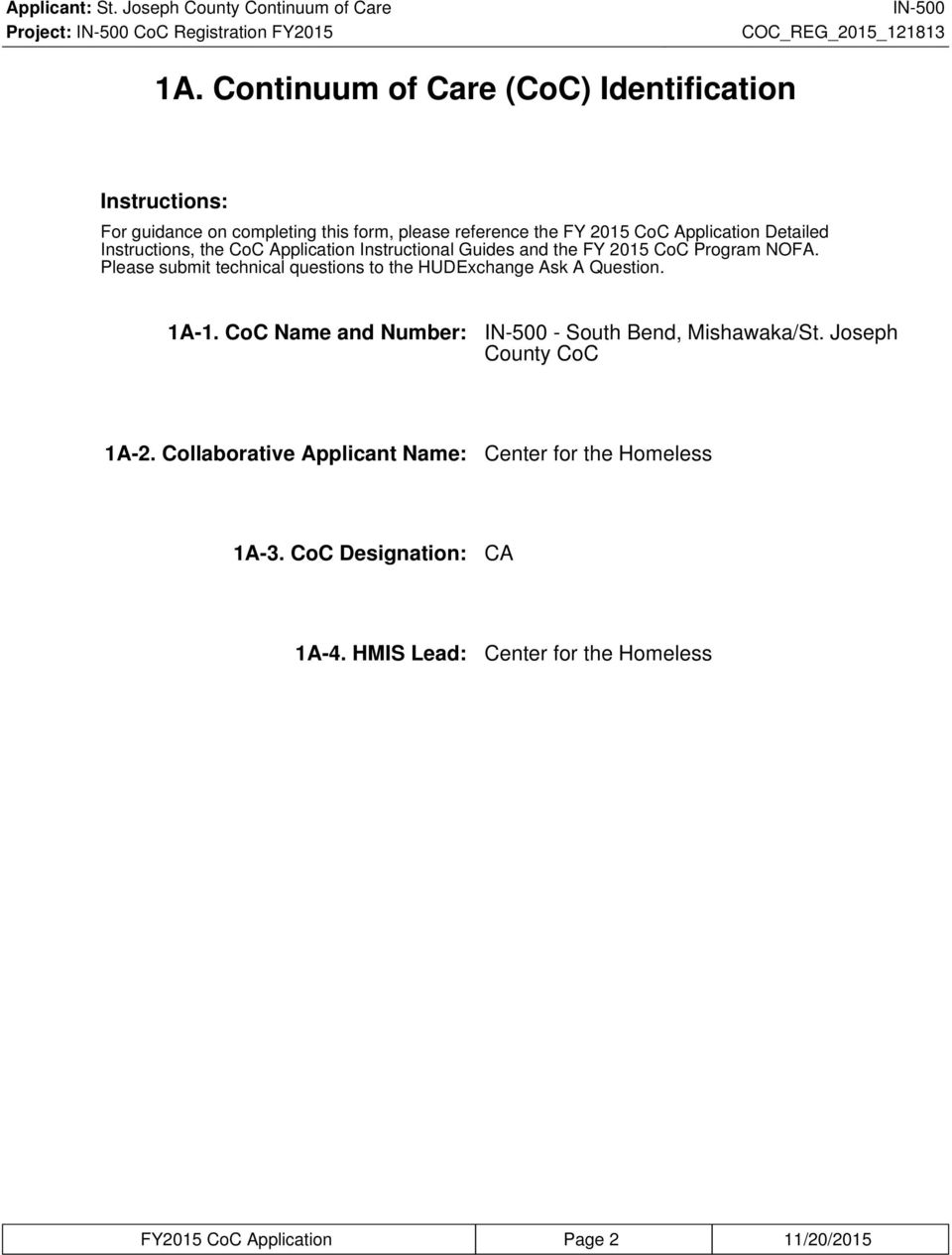
2 Applicant: St. Joseph County Continuum of Care Project: IN-500 CoC Registration FY2015 IN-500 COC_REG_2015_ A. Continuum of Care (CoC) Identification Instructions: For guidance on completing this form, please reference the FY 2015 CoC Application Detailed Instructions, the CoC Application Instructional Guides and the FY 2015 CoC Program NOFA. Please submit technical questions to the HUDExchange Ask A Question. 1A-1. CoC Name and Number: IN South Bend, Mishawaka/St. Joseph County CoC 1A-2. Collaborative Applicant Name: Center for the Homeless 1A-3. CoC Designation: CA 1A-4. HMIS Lead: Center for the Homeless FY2015 CoC Application Page 2 11/20/2015
3 Applicant: St. Joseph County Continuum of Care Project: IN-500 CoC Registration FY2015 IN-500 COC_REG_2015_ B. Continuum of Care (CoC) Engagement Instructions: For guidance on completing this form, please reference the FY 2015 CoC Application Detailed Instructions, the CoC Application Instructional Guides and the FY 2015 CoC Program NOFA. Please submit technical questions to the HUDExchange Ask A Question. 1B-1. From the list below, select those organizations and persons that participate in CoC meetings. Then select "Yes" or "No" to indicate if CoC meeting participants are voting members or if they sit on the CoC Board. Only select "Not Applicable" if the organization or person does not exist in the CoC's geographic area. Organization/Person Categories Participates in CoC Meetings Votes, including electing CoC Board Local Government Staff/Officials Yes Yes Yes CDBG/HOME/ESG Entitlement Jurisdiction Yes Yes Yes Sits on CoC Board Law Enforcement No Not Applicable Not Applicable Local Jail(s) No Not Applicable Not Applicable Hospital(s) Yes No No EMT/Crisis Response Team(s) Yes No No Mental Health Service Organizations Yes Yes Yes Substance Abuse Service Organizations Yes Yes Yes Affordable Housing Developer(s) Yes No No Public Housing Authorities No Not Applicable Not Applicable CoC Funded Youth Homeless Organizations Not Applicable Not Applicable Not Applicable Non-CoC Funded Youth Homeless Organizations Yes Yes Yes School Administrators/Homeless Liaisons No Not Applicable Not Applicable CoC Funded Victim Service Providers Yes Yes Yes Non-CoC Funded Victim Service Providers No Not Applicable Not Applicable Street Outreach Team(s) Yes Yes Yes Youth advocates No Not Applicable Not Applicable Agencies that serve survivors of human trafficking Yes Yes Yes Other homeless subpopulation advocates No Not Applicable Not Applicable Homeless or Formerly Homeless Persons No Not Applicable Not Applicable Veterans Administration personnel Yes Yes Yes Mainstream Resources provider Yes No No Faith Community Yes No No FY2015 CoC Application Page 3 11/20/2015

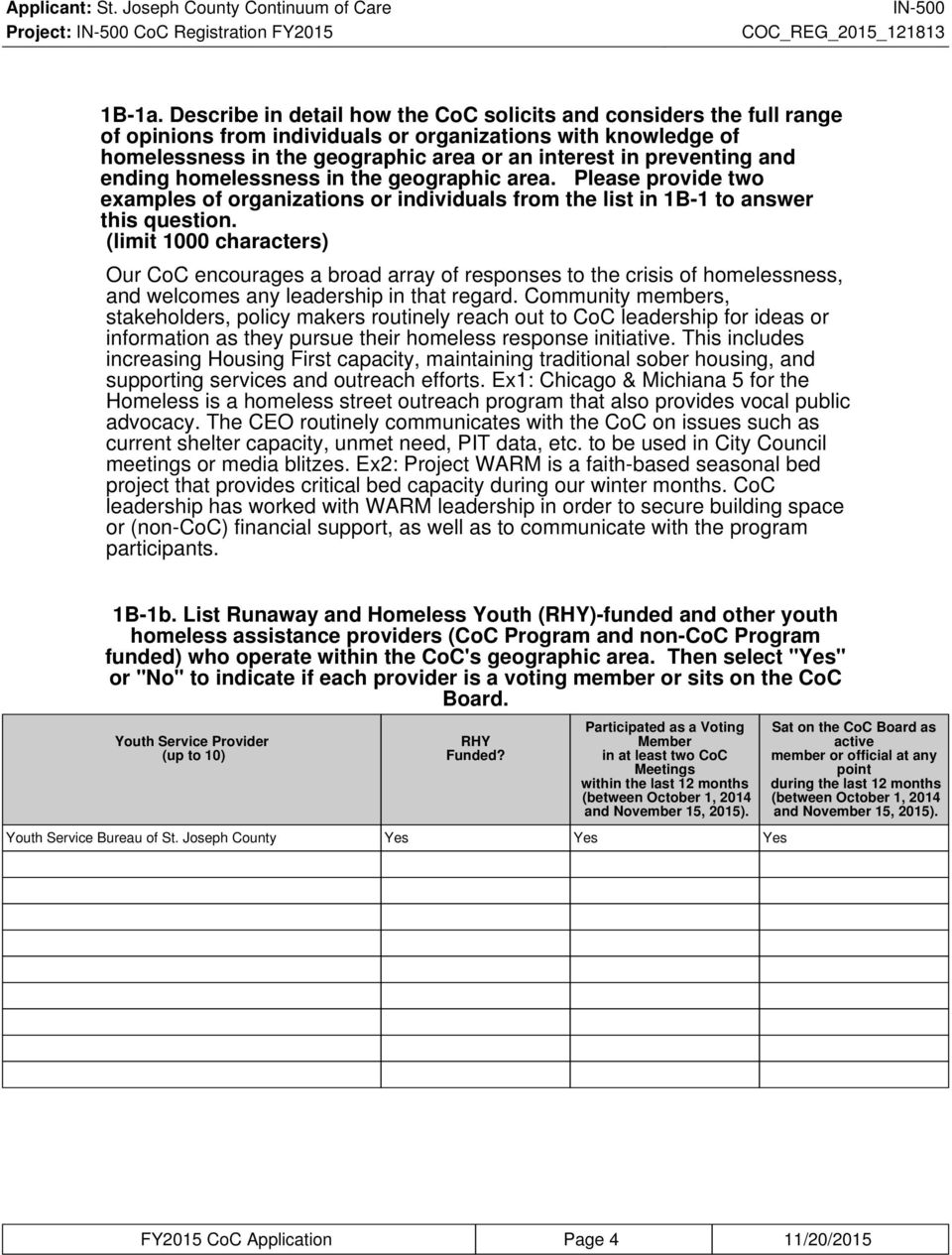
4 Applicant: St. Joseph County Continuum of Care Project: IN-500 CoC Registration FY2015 IN-500 COC_REG_2015_ B-1a. Describe in detail how the CoC solicits and considers the full range of opinions from individuals or organizations with knowledge of homelessness in the geographic area or an interest in preventing and ending homelessness in the geographic area. Please provide two examples of organizations or individuals from the list in 1B-1 to answer this question. (limit 1000 characters) Our CoC encourages a broad array of responses to the crisis of homelessness, and welcomes any leadership in that regard. Community members, stakeholders, policy makers routinely reach out to CoC leadership for ideas or information as they pursue their homeless response initiative. This includes increasing Housing First capacity, maintaining traditional sober housing, and supporting services and outreach efforts. Ex1: Chicago & Michiana 5 for the Homeless is a homeless street outreach program that also provides vocal public advocacy. The CEO routinely communicates with the CoC on issues such as current shelter capacity, unmet need, PIT data, etc. to be used in City Council meetings or media blitzes. Ex2: Project WARM is a faith-based seasonal bed project that provides critical bed capacity during our winter months. CoC leadership has worked with WARM leadership in order to secure building space or (non-coc) financial support, as well as to communicate with the program participants. 1B-1b. List Runaway and Homeless Youth (RHY)-funded and other youth homeless assistance providers (CoC Program and non-coc Program funded) who operate within the CoC's geographic area. Then select "Yes" or "No" to indicate if each provider is a voting member or sits on the CoC Board. Youth Service Provider (up to 10) RHY Funded? Participated as a Voting Member in at least two CoC Meetings within the last 12 months (between October 1, 2014 and November 15, 2015). Youth Service Bureau of St. Joseph County Yes Yes Yes Sat on the CoC Board as active member or official at any point during the last 12 months (between October 1, 2014 and November 15, 2015). FY2015 CoC Application Page 4 11/20/2015
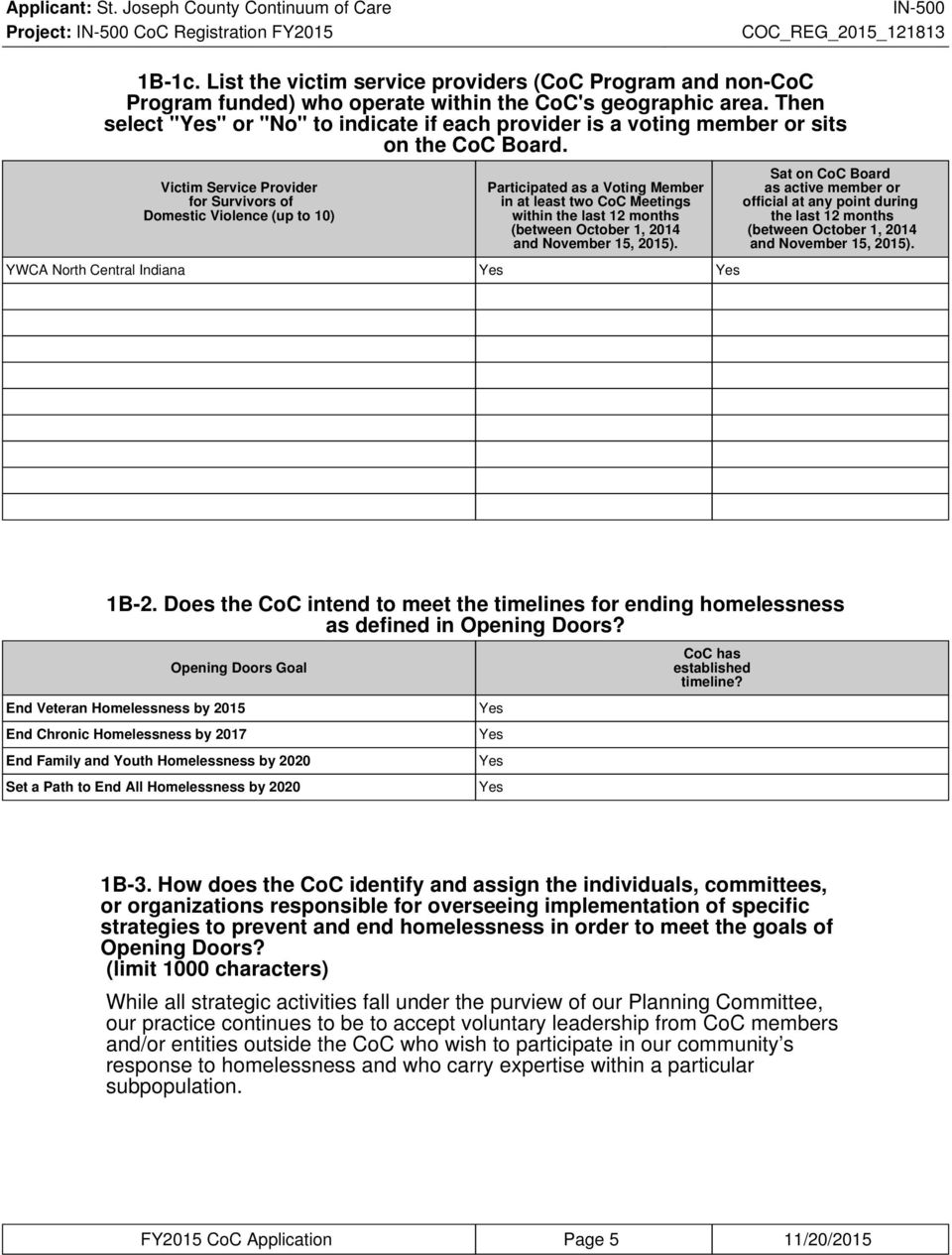
5 Applicant: St. Joseph County Continuum of Care Project: IN-500 CoC Registration FY2015 IN-500 COC_REG_2015_ B-1c. List the victim service providers (CoC Program and non-coc Program funded) who operate within the CoC's geographic area. Then select "Yes" or "No" to indicate if each provider is a voting member or sits on the CoC Board. Victim Service Provider for Survivors of Domestic Violence (up to 10) Participated as a Voting Member in at least two CoC Meetings within the last 12 months (between October 1, 2014 and November 15, 2015). YWCA North Central Indiana Yes Yes Sat on CoC Board as active member or official at any point during the last 12 months (between October 1, 2014 and November 15, 2015). 1B-2. Does the CoC intend to meet the timelines for ending homelessness as defined in Opening Doors? Opening Doors Goal End Veteran Homelessness by 2015 End Chronic Homelessness by 2017 End Family and Youth Homelessness by 2020 Set a Path to End All Homelessness by 2020 Yes Yes Yes Yes CoC has established timeline? 1B-3. How does the CoC identify and assign the individuals, committees, or organizations responsible for overseeing implementation of specific strategies to prevent and end homelessness in order to meet the goals of Opening Doors? (limit 1000 characters) While all strategic activities fall under the purview of our Planning Committee, our practice continues to be to accept voluntary leadership from CoC members and/or entities outside the CoC who wish to participate in our community s response to homelessness and who carry expertise within a particular subpopulation. FY2015 CoC Application Page 5 11/20/2015
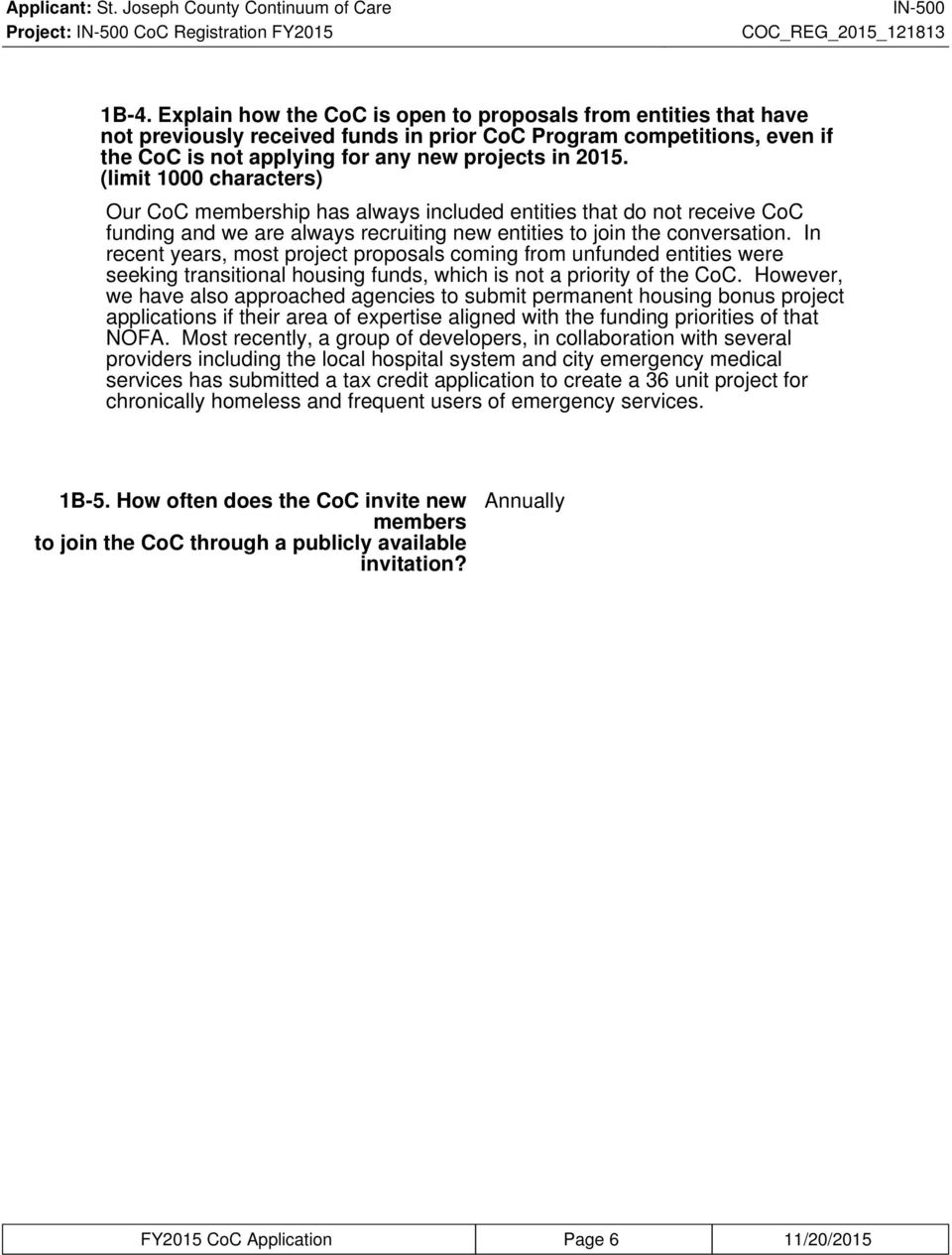
6 Applicant: St. Joseph County Continuum of Care Project: IN-500 CoC Registration FY2015 IN-500 COC_REG_2015_ B-4. Explain how the CoC is open to proposals from entities that have not previously received funds in prior CoC Program competitions, even if the CoC is not applying for any new projects in (limit 1000 characters) Our CoC membership has always included entities that do not receive CoC funding and we are always recruiting new entities to join the conversation. In recent years, most project proposals coming from unfunded entities were seeking transitional housing funds, which is not a priority of the CoC. However, we have also approached agencies to submit permanent housing bonus project applications if their area of expertise aligned with the funding priorities of that NOFA. Most recently, a group of developers, in collaboration with several providers including the local hospital system and city emergency medical services has submitted a tax credit application to create a 36 unit project for chronically homeless and frequent users of emergency services. 1B-5. How often does the CoC invite new members to join the CoC through a publicly available invitation? Annually FY2015 CoC Application Page 6 11/20/2015
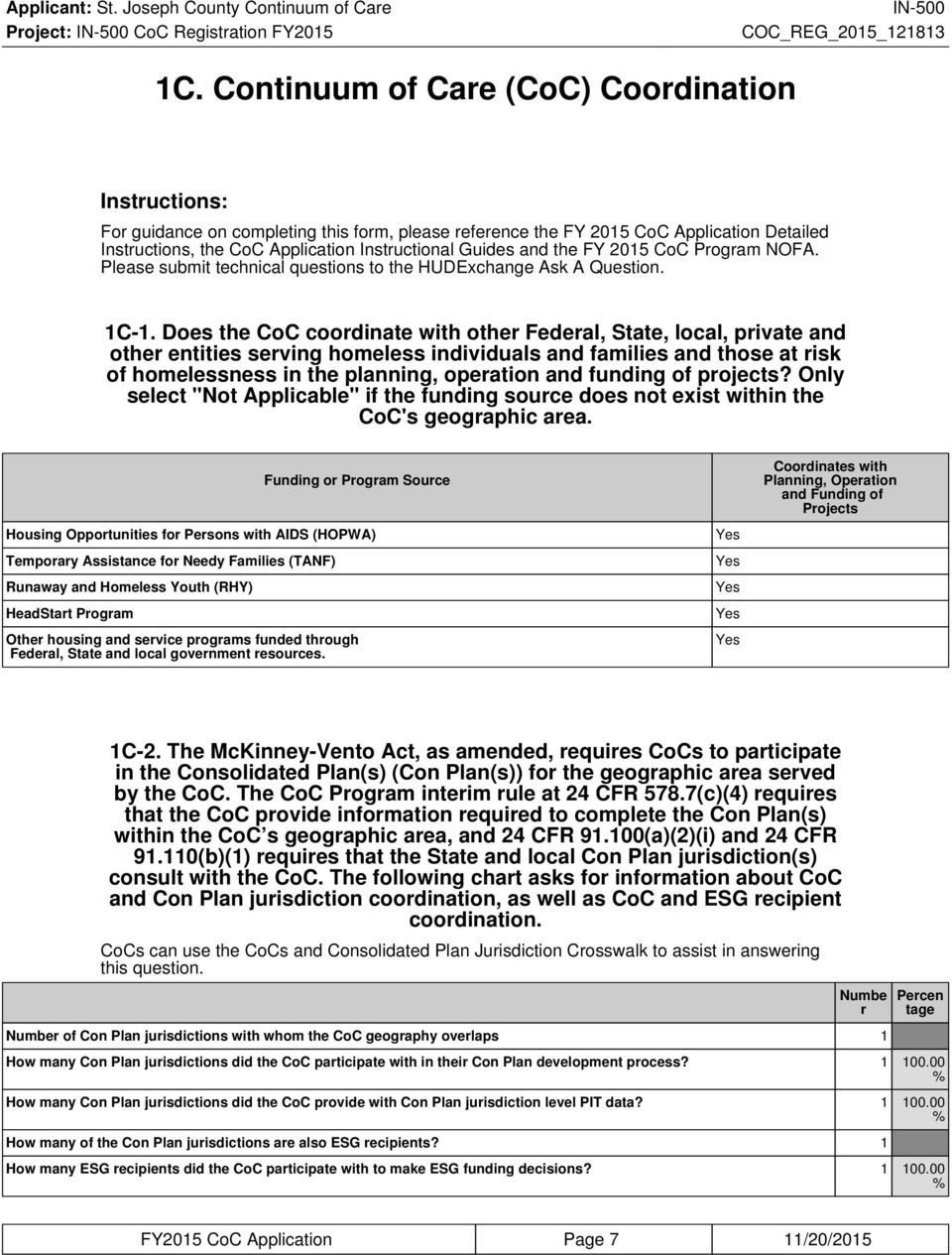
7 Applicant: St. Joseph County Continuum of Care Project: IN-500 CoC Registration FY2015 IN-500 COC_REG_2015_ C. Continuum of Care (CoC) Coordination Instructions: For guidance on completing this form, please reference the FY 2015 CoC Application Detailed Instructions, the CoC Application Instructional Guides and the FY 2015 CoC Program NOFA. Please submit technical questions to the HUDExchange Ask A Question. 1C-1. Does the CoC coordinate with other Federal, State, local, private and other entities serving homeless individuals and families and those at risk of homelessness in the planning, operation and funding of projects? Only select "Not Applicable" if the funding source does not exist within the CoC's geographic area. Funding or Program Source Coordinates with Planning, Operation and Funding of Projects Housing Opportunities for Persons with AIDS (HOPWA) Temporary Assistance for Needy Families (TANF) Runaway and Homeless Youth (RHY) HeadStart Program Other housing and service programs funded through Federal, State and local government resources. Yes Yes Yes Yes Yes 1C-2. The McKinney-Vento Act, as amended, requires CoCs to participate in the Consolidated Plan(s) (Con Plan(s)) for the geographic area served by the CoC. The CoC Program interim rule at 24 CFR 578.7(c)(4) requires that the CoC provide information required to complete the Con Plan(s) within the CoC s geographic area, and 24 CFR (a)(2)(i) and 24 CFR (b)(1) requires that the State and local Con Plan jurisdiction(s) consult with the CoC. The following chart asks for information about CoC and Con Plan jurisdiction coordination, as well as CoC and ESG recipient coordination. CoCs can use the CoCs and Consolidated Plan Jurisdiction Crosswalk to assist in answering this question. Numbe r Number of Con Plan jurisdictions with whom the CoC geography overlaps 1 Percen tage How many Con Plan jurisdictions did the CoC participate with in their Con Plan development process? % How many Con Plan jurisdictions did the CoC provide with Con Plan jurisdiction level PIT data? % How many of the Con Plan jurisdictions are also ESG recipients? 1 How many ESG recipients did the CoC participate with to make ESG funding decisions? % FY2015 CoC Application Page 7 11/20/2015
8 Applicant: St. Joseph County Continuum of Care Project: IN-500 CoC Registration FY2015 IN-500 COC_REG_2015_ How many ESG recipients did the CoC consult with in the development of ESG performance standards and evaluation process for ESG funded activities? % 1C-2a. Based on the responses selected in 1C-2, describe in greater detail how the CoC participates with the Consolidated Plan jurisdiction(s) located in the CoC's geographic area and include the frequency, extent, and type of interactions between the CoC and the Consolidated Plan jurisdiction(s). (limit 1000 characters) Our CoC interacts monthly at a minimum with the Con Plan jurisdiction, because those responsible for drafting the local (entitlement) Con Plan also participate regularly in CoC mtgs. Con Plan agents notify all CoC participants of Con Plan process through the CoC mtgs, and in turn, the CoC membership reviews Con Plan language at least once/year and actively participates in Con Plan public meetings. 1C-2b. Based on the responses selected in 1C-2, describe how the CoC is working with ESG recipients to determine local ESG funding decisions and how the CoC assists in the development of performance standards and evaluation of outcomes for ESG-funded activities. (limit 1000 characters) Our local ESG recipient specifically created its policy in consultation with CoC. Additionally they created standards for project review and selection. In cases where the RFP requests exceeded the funding allocation or if award modifications are deemed necessary, these items are brought to the CoC for input and approval. 1C-3. Describe the how the CoC coordinates with victim service providers and non-victim service providers (CoC Program funded and non-coc funded) to ensure that survivors of domestic violence are provided housing and services that provide and maintain safety and security. Responses must address how the service providers ensure and maintain the safety and security of participants and how client choice is upheld. (limit 1000 characters) The dedicated victim services agency in our community provides DV and sexual assault services and has maintained Board-level participation in our CoC since its inception. Its facility has adequate security and safety planning practices in line with best practices, and has plans to implement CoC-wide lethality assessment training to all other agencies. No CoC agency or public housing provider turns away individuals based on current or past DV, and all agencies have the knowledge and capacity to make referrals as necessary to appropriate victim services. Additionally, we are all by law mandated reporters for abuse and have close working relationships with both Child- and Adult Protective Services. Our collective value of client right to self-determination means that client choice in terms of housing and service provision is always upheld. FY2015 CoC Application Page 8 11/20/2015
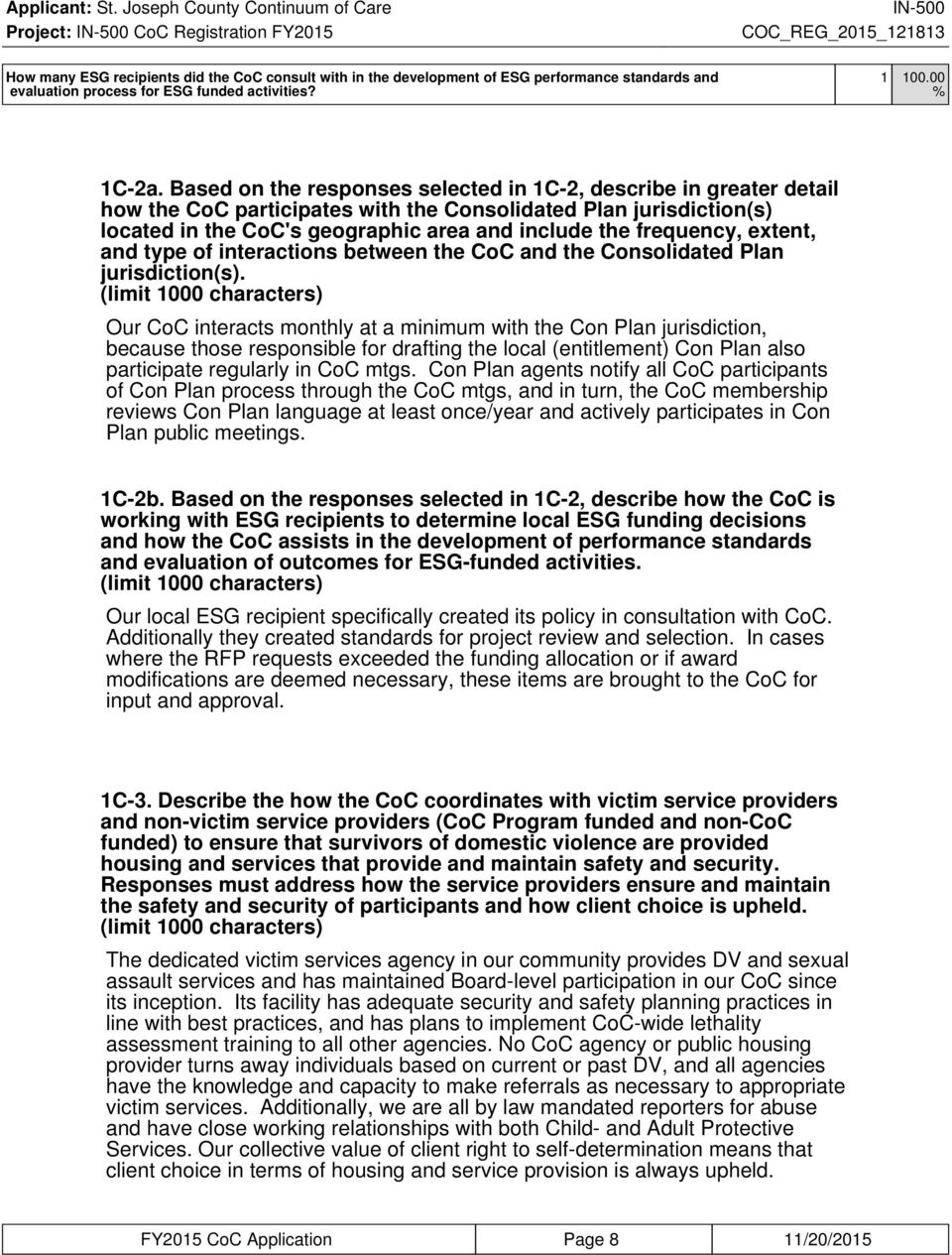
9 Applicant: St. Joseph County Continuum of Care Project: IN-500 CoC Registration FY2015 IN-500 COC_REG_2015_ C-4. List each of the Public Housing Agencies (PHAs) within the CoC's geographic area. If there are more than 5 PHAs within the CoC s geographic area, list the 5 largest PHAs. For each PHA, provide the percentage of new admissions that were homeless at the time of admission between October 1, 2014 and March 31, 2015, and indicate whether the PHA has a homeless admissions preference in its Public Housing and/or Housing Choice Voucher (HCV) program. (Full credit consideration may be given for the relevant excerpt from the PHA s administrative planning document(s) clearly showing the PHA's homeless preference, e.g. Administration Plan, Admissions and Continued Occupancy Policy (ACOP), Annual Plan, or 5-Year Plan, as appropriate). Public Housing Agency Name Housing Authority of South Bend Mishawaka Housing Authority St. Joseph County Housing Authority % New Admissions into Public Housing and Housing Choice Voucher Program from 10/1/14 to 3/31/15 who were homeless at entry PHA has General or Limited Homeless Preference 11.00% Yes-Public Housing 0.00% No 0.00% No If you select "Yes--Public Housing," "Yes--HCV," or "Yes--Both" for "PHA has general or limited homeless preference," you must attach documentation of the preference from the PHA in order to receive credit. 1C-5. Other than CoC, ESG, Housing Choice Voucher Programs and Public Housing, describe other subsidized or low-income housing opportunities that exist within the CoC that target persons experiencing homelessness. (limit 1000 characters) Though not sufficient for our needs in terms of capacity, our community does boast a full array of low income housing and subsidy opportunities for people experiencing homelessness. Our CoC agencies are recipients of Homeless & Runaway Youth Act and Violence Against Women Act funds for transitional housing, HOME funds for rental subsidies for people with serious mental illness, and SSVF funds for RRH and prevention services for veterans and their families. Additionally, the VA has allocated 140 VASH vouchers in this community. 1C-6. Select the specific strategies implemented by the CoC to ensure that homelessness is not criminalized in the CoC's geographic area. Select all that apply. For "Other," you must provide a description (2000 character limit) FY2015 CoC Application Page 9 11/20/2015
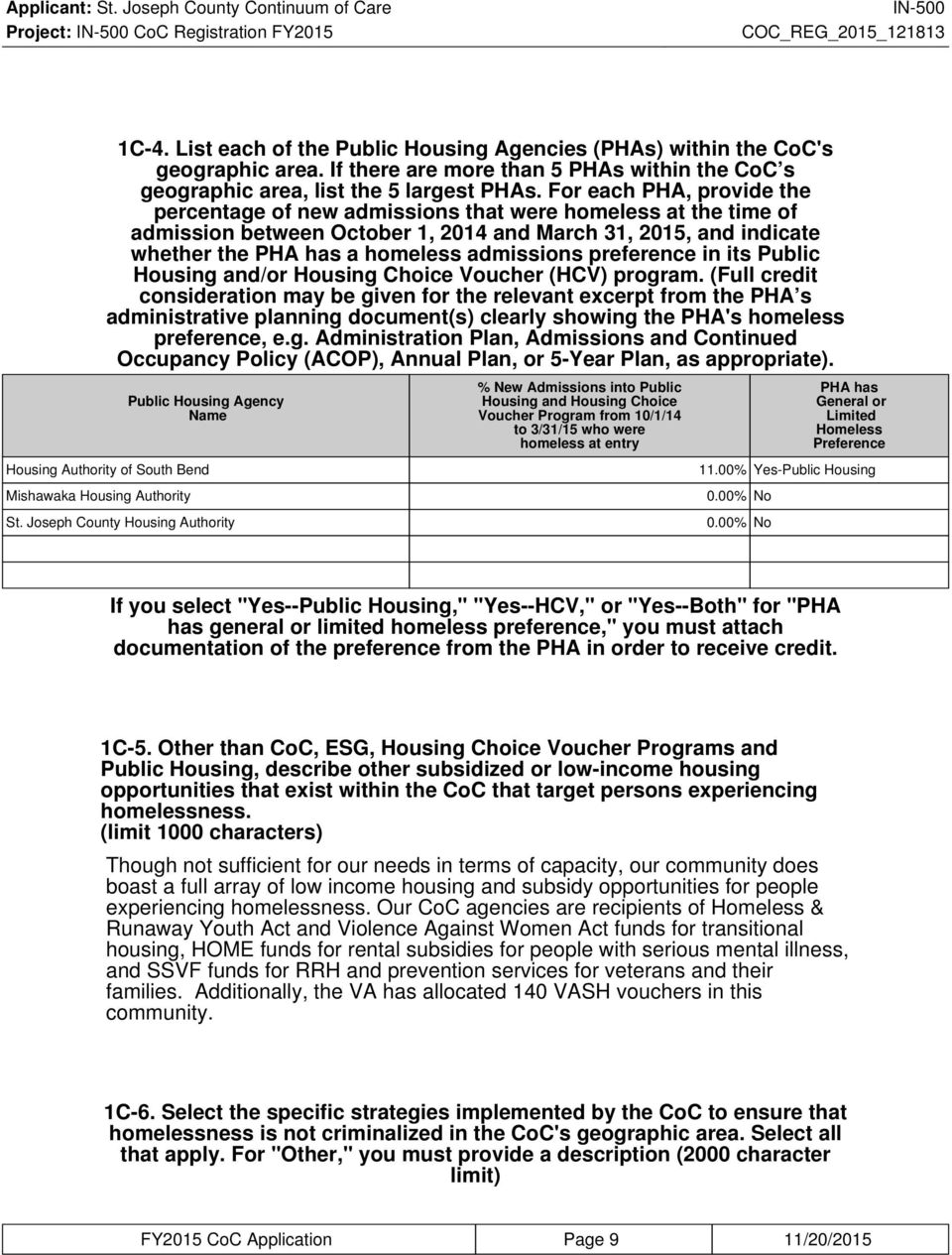
10 Applicant: St. Joseph County Continuum of Care Project: IN-500 CoC Registration FY2015 IN-500 COC_REG_2015_ Engaged/educated local policymakers: Engaged/educated law enforcement: X X Implemented communitywide plans: No strategies have been implemented: Community education/media X FY2015 CoC Application Page 10 11/20/2015

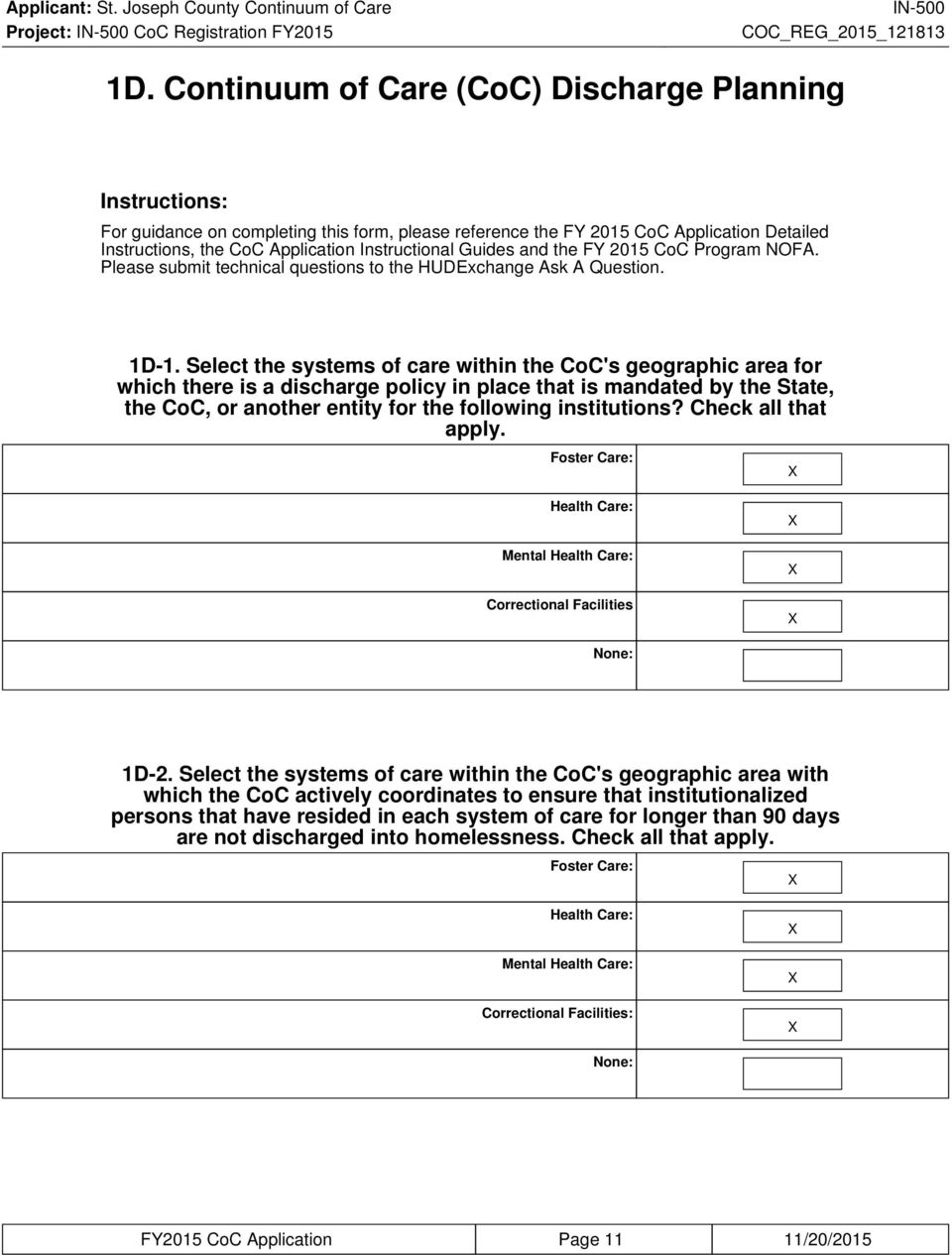
11 Applicant: St. Joseph County Continuum of Care Project: IN-500 CoC Registration FY2015 IN-500 COC_REG_2015_ D. Continuum of Care (CoC) Discharge Planning Instructions: For guidance on completing this form, please reference the FY 2015 CoC Application Detailed Instructions, the CoC Application Instructional Guides and the FY 2015 CoC Program NOFA. Please submit technical questions to the HUDExchange Ask A Question. 1D-1. Select the systems of care within the CoC's geographic area for which there is a discharge policy in place that is mandated by the State, the CoC, or another entity for the following institutions? Check all that apply. Foster Care: X Health Care: Mental Health Care: Correctional Facilities X X X None: 1D-2. Select the systems of care within the CoC's geographic area with which the CoC actively coordinates to ensure that institutionalized persons that have resided in each system of care for longer than 90 days are not discharged into homelessness. Check all that apply. Foster Care: X Health Care: Mental Health Care: Correctional Facilities: X X X None: FY2015 CoC Application Page 11 11/20/2015
12 Applicant: St. Joseph County Continuum of Care Project: IN-500 CoC Registration FY2015 IN-500 COC_REG_2015_ D-2a. If the applicant did not check all boxes in 1D-2, explain why there is no coordination with the institution(s) and explain how the CoC plans to coordinate with the institution(s) to ensure persons discharged are not discharged into homelessness. (limit 1000 characters) N/A FY2015 CoC Application Page 12 11/20/2015

13 Applicant: St. Joseph County Continuum of Care Project: IN-500 CoC Registration FY2015 IN-500 COC_REG_2015_ E. Centralized or Coordinated Assessment (Coordinated Entry) Instructions: For guidance on completing this form, please reference the FY 2015 CoC Application Detailed Instructions, the CoC Application Instructional Guides and the FY 2015 CoC Program NOFA. Please submit technical questions to the HUDExchange Ask A Question. CoCs are required by the CoC Program interim rule to establish a Centralized or Coordinated Assessment system also referred to as Coordinated Entry. Based on the recent Coordinated Entry Policy Brief, HUD s primary goals for coordinated entry processes are that assistance be allocated as effectively as possible and that it be easily accessible regardless of where or how people present for assistance. Most communities lack the resources needed to meet all of the needs of people experiencing homelessness. This combined with the lack of a welldeveloped coordinated entry processes can result in severe hardships for persons experiencing homelessness who often face long wait times to receive assistance or are screened out of needed assistance. Coordinated entry processes help communities prioritize assistance based on vulnerability and severity of service needs to ensure that people who need assistance the most can receive it in a timely manner. Coordinated entry processes also provide information about service needs and gaps to help communities plan their assistance and identify needed resources. 1E-1. Explain how the CoC s coordinated entry process is designed to identify, engage, and assist homeless individuals and families that will ensure those who request or need assistance are connected to proper housing and services. (limit 1000 characters) Our CoC is not yet in total compliance and we recognized the need for help, so we have engaged with HUD TA and CSH to help us complete implementation. Our CoC determined in 2013 that we would utilize the VI/SPDAT as our primary assessment tool, but we have yet to create a policy and procedure around it. The technical framework is ready in our HMIS system, and we will be putting together the implementation plan in short order. In the meantime, all PSH projects using VI/SPDAT for their individual lists, and the partners associated with the new FUSE project, including a local hospital system emergency department (see 1B-4) has committed to utilizing the VI/SPDAT for their project as well. FY2015 CoC Application Page 13 11/20/2015
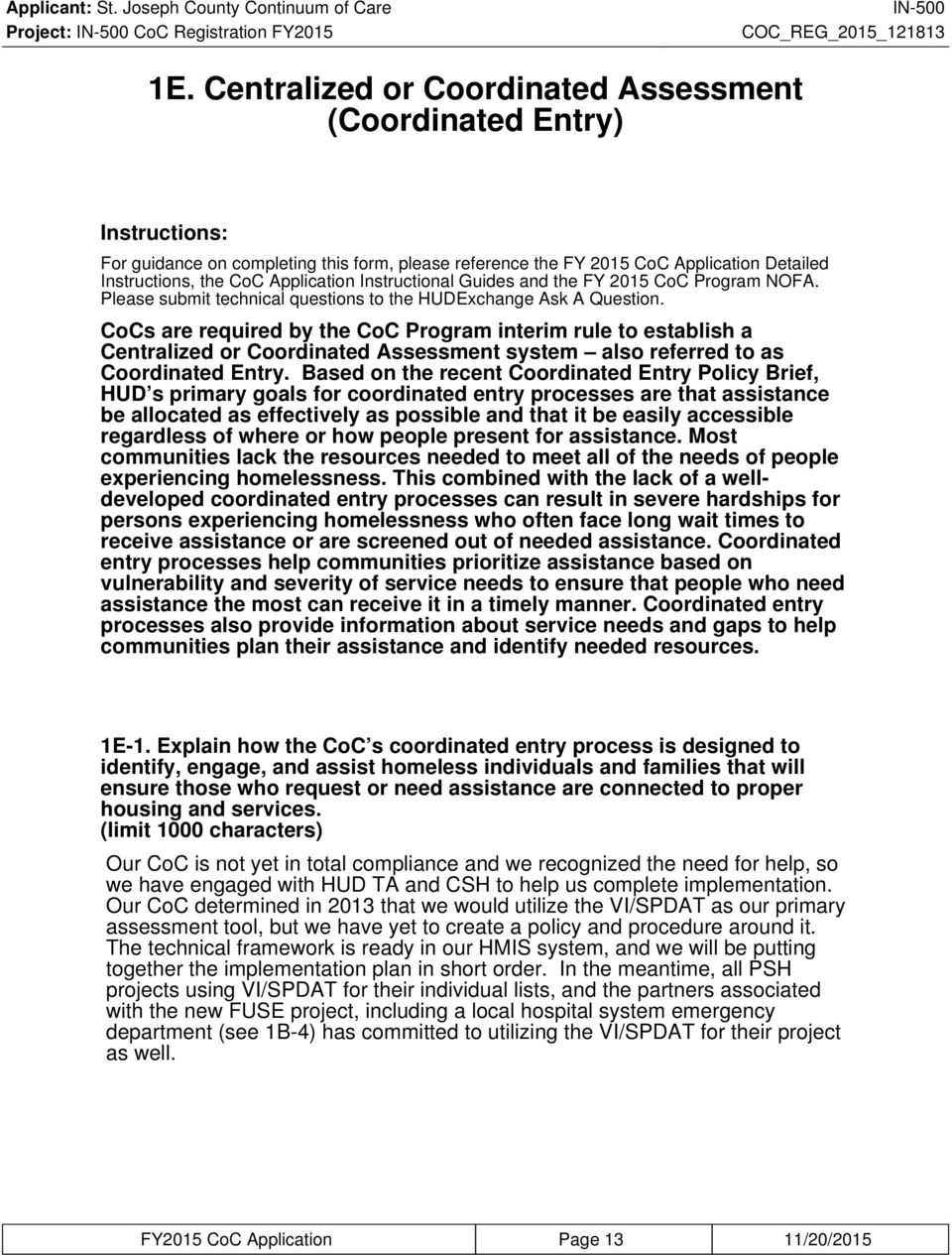
14 Applicant: St. Joseph County Continuum of Care Project: IN-500 CoC Registration FY2015 IN-500 COC_REG_2015_ E-2. CoC Program and ESG Program funded projects are required to participate in the coordinated entry process, but there are many other organizations and individuals who may participate but are not required to do so. From the following list, for each type of organization or individual, select all of the applicable checkboxes that indicate how that organization or individual participates in the CoC's coordinated entry process. If the organization or person does not exist in the CoC s geographic area, select Not Applicable. If there are other organizations or persons that participate not on this list, enter the information, click "Save" at the bottom of the screen, and then select the applicable checkboxes. Organization/Person Categories Local Government Staff/Officials Participates in Ongoing Planning and Evaluation X Makes Referrals to the Coordinated Entry Process Receives Referrals from the Coordinated Entry Process Operates Access Point for Coordinated Entry Process Participates in Case Conferencing Not Applicable CDBG/HOME/Entitlement Jurisdiction Law Enforcement X X Local Jail(s) X Hospital(s) EMT/Crisis Response Team(s) Mental Health Service Organizations Substance Abuse Service Organizations Affordable Housing Developer(s) X X X X X Public Housing Authorities X Non-CoC Funded Youth Homeless Organizations X School Administrators/Homeless Liaisons Non-CoC Funded Victim Service Organizations X X Street Outreach Team(s) X Homeless or Formerly Homeless Persons X FY2015 CoC Application Page 14 11/20/2015
15 Applicant: St. Joseph County Continuum of Care Project: IN-500 CoC Registration FY2015 IN-500 COC_REG_2015_ FY2015 CoC Application Page 15 11/20/2015
16 Applicant: St. Joseph County Continuum of Care Project: IN-500 CoC Registration FY2015 IN-500 COC_REG_2015_ F. Continuum of Care (CoC) Project Review, Ranking, and Selection Instructions For guidance on completing this form, please reference the FY 2015 CoC Application Detailed Instructions, the CoC Application Instructional Guides and the FY 2015 CoC Program NOFA. Please submit technical questions to the HUDExchange Ask A Question. 1F-1. For all renewal project applications submitted in the FY 2015 CoC Program Competition complete the chart below regarding the CoC s review of the Annual Performance Report(s). How many renewal project applications were submitted in the FY 2015 CoC Program Competition? 13 How many of the renewal project applications are first time renewals for which the first operating year has not expired yet? 2 How many renewal project application APRs were reviewed by the CoC as part of the local CoC competition project review, ranking, and selection process for the FY 2015 CoC Program Competition? 11 Percentage of APRs submitted by renewing projects within the CoC that were reviewed by the CoC in the 2015 CoC Competition? % 1F-2. In the sections below, check the appropriate box(s) for each section to indicate how project applications were reviewed and ranked for the FY 2015 CoC Program Competition. (Written documentation of the CoC's publicly announced Rating and Review procedure must be attached.) Type of Project or Program (PH, TH, HMIS, SSO, RRH, etc.) X Performance outcomes from APR reports/hmis Length of stay % permanent housing exit destinations % increases in income X X % mainstream resources FY2015 CoC Application Page 16 11/20/2015

17 Applicant: St. Joseph County Continuum of Care Project: IN-500 CoC Registration FY2015 IN-500 COC_REG_2015_ Monitoring criteria Participant Eligibility Utilization rates X Drawdown rates Frequency or Amount of Funds Recaptured by HUD Need for specialized population services Youth Victims of Domestic Violence Families with Children Persons Experiencing Chronic Homelessness X Veterans None 1F-2a. Describe how the CoC considered the severity of needs and vulnerabilities of participants that are, or will be, served by the project applications when determining project application priority. (limit 1000 characters) For this application, we looked specifically at percentage of chronic homeless as new admissions, and scored projects accordingly. All PSH projects currently utilize the VI/SPDAT, so we was confident that resources are being adequately targeted to the most vulnerable individuals. We are looking to add other vulnerability measures as well as using this year s average performance measures to scale the scoring rubric for next year. FY2015 CoC Application Page 17 11/20/2015

18 Applicant: St. Joseph County Continuum of Care Project: IN-500 CoC Registration FY2015 IN-500 COC_REG_2015_ F-3. Describe how the CoC made the local competition review, ranking, and selection criteria publicly available, and identify the public medium(s) used and the date(s) of posting. In addition, describe how the CoC made this information available to all stakeholders. (Evidence of the public posting must be attached) (limit 750 characters) Our CoC has made it practice to publish the CoC Collaborative Application, including the process and results of our project ranking procedure, on the City of South Bend s website. Our community has boasted an Open Data Portal since August 22, 2013 making it easy for anyone to find information regarding municipal activities, including the ranking of CoC projects for the FY2105 competition. This information was published on DATE, with the stakeholders and project applicants being notified on October 29, F-4. On what date did the CoC and Collaborative Applicant publicly post all parts of the FY 2015 CoC Consolidated Application that included the final project application ranking? (Written documentation of the public posting, with the date of the posting clearly visible, must be attached. In addition, evidence of communicating decisions to the CoC's full membership must be attached.) 11/12/2015 1F-5. Did the CoC use the reallocation process in the FY 2015 CoC Program Competition to reduce or reject projects for the creation of new projects? (If the CoC utilized the reallocation process, evidence of the public posting of the reallocation process must be attached.) Yes 1F-5a. If the CoC rejected project application(s) on what date did the CoC and Collaborative Applicant notify those project applicants their project application was rejected in the local CoC competition process? (If project applications were rejected, a copy of the written notification to each project applicant must be attached.) 11/12/2015 FY2015 CoC Application Page 18 11/20/2015

19 Applicant: St. Joseph County Continuum of Care Project: IN-500 CoC Registration FY2015 IN-500 COC_REG_2015_ F-6. Is the Annual Renewal Demand (ARD) in the CoC's FY 2015 CoC Priority Listing equal to or less than the ARD on the final HUDapproved FY 2015 GIW? Yes FY2015 CoC Application Page 19 11/20/2015
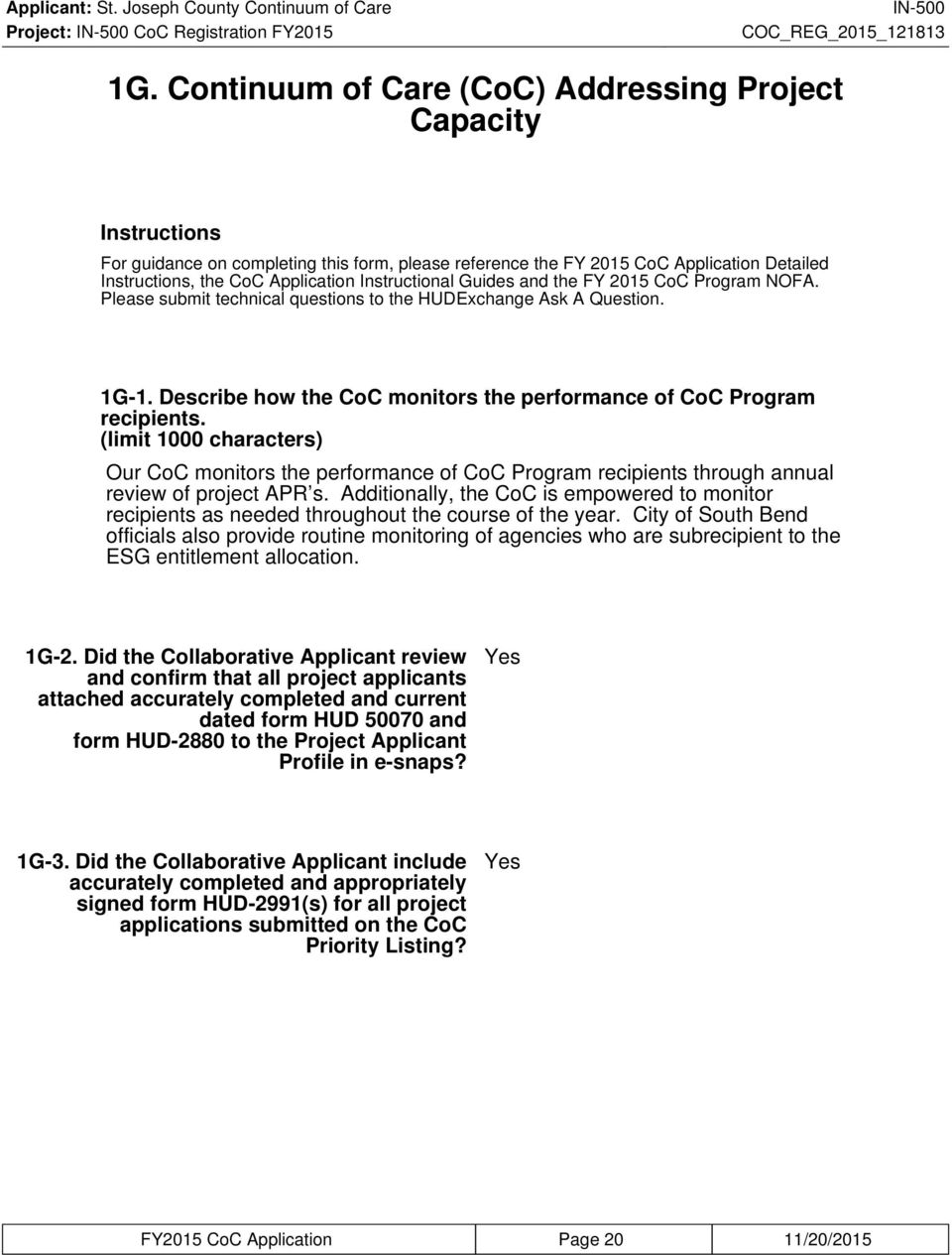
20 Applicant: St. Joseph County Continuum of Care Project: IN-500 CoC Registration FY2015 IN-500 COC_REG_2015_ G. Continuum of Care (CoC) Addressing Project Capacity Instructions For guidance on completing this form, please reference the FY 2015 CoC Application Detailed Instructions, the CoC Application Instructional Guides and the FY 2015 CoC Program NOFA. Please submit technical questions to the HUDExchange Ask A Question. 1G-1. Describe how the CoC monitors the performance of CoC Program recipients. (limit 1000 characters) Our CoC monitors the performance of CoC Program recipients through annual review of project APR s. Additionally, the CoC is empowered to monitor recipients as needed throughout the course of the year. City of South Bend officials also provide routine monitoring of agencies who are subrecipient to the ESG entitlement allocation. 1G-2. Did the Collaborative Applicant review and confirm that all project applicants attached accurately completed and current dated form HUD and form HUD-2880 to the Project Applicant Profile in e-snaps? Yes 1G-3. Did the Collaborative Applicant include accurately completed and appropriately signed form HUD-2991(s) for all project applications submitted on the CoC Priority Listing? Yes FY2015 CoC Application Page 20 11/20/2015
21 Applicant: St. Joseph County Continuum of Care Project: IN-500 CoC Registration FY2015 IN-500 COC_REG_2015_ A. Homeless Management Information System (HMIS) Implementation Intructions: For guidance on completing this form, please reference the FY 2015 CoC Application Detailed Instructions, the CoC Application Instructional Guides and the FY 2015 CoC Program NOFA. Please submit technical questions to the HUDExchange Ask A Question. 2A-1. Does the CoC have a governance charter that outlines the roles and responsibilities of the CoC and the HMIS Lead, either within the charter itself or by reference to a separate document like an MOU? In all cases, the CoC s governance charter must be attached to receive credit. In addition, if applicable, any separate document, like an MOU, must also be attached to receive credit. No 2A-1a. Include the page number where the roles and responsibilities of the CoC and HMIS Lead can be found in the attached document referenced in 2A-1. In addition, in the textbox indicate if the page number applies to the CoC's attached governance charter or the attached MOU. 2A-2. Does the CoC have a HMIS Policies and Procedures Manual? If yes, in order to receive credit the HMIS Policies and Procedures Manual must be attached to the CoC Application. Yes 2A-3. Are there agreements in place that outline roles and responsibilities between the HMIS Lead and the Contributing HMIS Organizations (CHOs)? Yes FY2015 CoC Application Page 21 11/20/2015
22 Applicant: St. Joseph County Continuum of Care Project: IN-500 CoC Registration FY2015 IN-500 COC_REG_2015_ A-4. What is the name of the HMIS software used by the CoC (e.g., ABC Software)? Applicant will enter the HMIS software name (e.g., ABC Software). ClientTrack 2A-5. What is the name of the HMIS software vendor (e.g., ABC Systems)? Applicant will enter the name of the vendor (e.g., ABC Systems). ClientTrack Inc. FY2015 CoC Application Page 22 11/20/2015
23 Applicant: St. Joseph County Continuum of Care Project: IN-500 CoC Registration FY2015 IN-500 COC_REG_2015_ B. Homeless Management Information System (HMIS) Funding Sources Instructions For guidance on completing this form, please reference the FY 2015 CoC Application Detailed Instructions, the CoC Application Instructional Guides and the FY 2015 CoC Program NOFA. Please submit technical questions to the HUDExchange Ask A Question. 2B-1. Select the HMIS implementation coverage area: Single CoC * 2B-2. In the charts below, enter the amount of funding from each funding source that contributes to the total HMIS budget for the CoC. 2B-2.1 Funding Type: Federal - HUD Funding Source Funding CoC $140,596 ESG $0 CDBG $0 HOME $0 HOPWA $0 Federal - HUD - Total Amount $140,596 2B-2.2 Funding Type: Other Federal Funding Source Funding Department of Education $0 Department of Health and Human Services $0 Department of Labor $0 Department of Agriculture $0 Department of Veterans Affairs $0 Other Federal $0 Other Federal - Total Amount $0 FY2015 CoC Application Page 23 11/20/2015
24 Applicant: St. Joseph County Continuum of Care Project: IN-500 CoC Registration FY2015 IN-500 COC_REG_2015_ B-2.3 Funding Type: State and Local Funding Source Funding City $0 County $0 State $0 State and Local - Total Amount $0 2B-2.4 Funding Type: Private Funding Source Funding Individual $0 Organization $35,149 Private - Total Amount $35,149 2B-2.5 Funding Type: Other Funding Source Funding Participation Fees $0 Other - Total Amount $0 2B-2.6 Total Budget for Operating Year $175,745 FY2015 CoC Application Page 24 11/20/2015
25 Applicant: St. Joseph County Continuum of Care Project: IN-500 CoC Registration FY2015 IN-500 COC_REG_2015_ C. Homeless Management Information System (HMIS) Bed Coverage Instructions: For guidance on completing this form, please reference the FY 2015 CoC Application Detailed Instructions, the CoC Application Instructional Guides and the FY 2015 CoC Program NOFA. Please submit technical questions to the HUDExchange Ask A Question. 2C-1. Enter the date the CoC submitted the 2015 HIC data in HDX, (mm/dd/yyyy): 05/15/2015 Project Type 2C-2. Per the 2015 Housing Inventory Count (HIC) indicate the number of beds in the 2015 HIC and in HMIS for each project type within the CoC. If a particular housing type does not exist in the CoC then enter "0" for all cells in that housing type. Total Beds in 2015 HIC Total Beds in HIC Dedicated for DV Total Beds in HMIS HMIS Bed Coverage Rate Emergency Shelter beds % Safe Haven (SH) beds Transitional Housing (TH) beds Rapid Re-Housing (RRH) beds Permanent Supportive Housing (PSH) beds Other Permanent Housing (OPH) beds % % % C-2a. If the bed coverage rate for any housing type is 85% or below, describe how the CoC plans to increase this percentage over the next 12 months. (limit 1000 characters) For Emergency Shelter, the 69 beds not in HMIS are all cold weather, seasonal beds. 40 of those beds are at agencies that only provide seasonal beds, and lack infrastructure and personnel to do HMIS entry. For PSH, the 76 beds not in HMIS are VASH vouchers. The CoC is planning on working with the VA to get these beds into HMIS. FY2015 CoC Application Page 25 11/20/2015
26 Applicant: St. Joseph County Continuum of Care Project: IN-500 CoC Registration FY2015 IN-500 COC_REG_2015_ VA Domiciliary (VA DOM): 2C-3. HUD understands that certain projects are either not required to or discouraged from participating in HMIS, and CoCs cannot require this if they are not funded through the CoC or ESG programs. This does NOT include domestic violence providers that are prohibited from entering client data in HMIS. If any of the project types listed in question 2C-2 above has a coverage rate of 85% or below, and some or all of these rates can be attributed to beds covered by one of the following programs types, please indicate that here by selecting all that apply from the list below. (limit 1000 characters) VA Grant per diem (VA GPD): Faith-Based projects/rescue mission: X Youth focused projects: HOPWA projects: Not Applicable: 2C-4. How often does the CoC review or assess its HMIS bed coverage? Annually FY2015 CoC Application Page 26 11/20/2015
27 Applicant: St. Joseph County Continuum of Care Project: IN-500 CoC Registration FY2015 IN-500 COC_REG_2015_ D. Homeless Management Information System (HMIS) Data Quality Instructions: For guidance on completing this form, please reference the FY 2015 CoC Application Detailed Instructions, the CoC Application Instructional Guides and the FY 2015 CoC Program NOFA. Please submit technical questions to the HUDExchange Ask A Question. 2D-1. Indicate the percentage of unduplicated client records with null or missing values and the percentage of "Client Doesn't Know" or "Client Refused" during the time period of October 1, 2013 through September 30, Universal Data Element Percentage Null or Missing Percentage Client Doesn't Know or Refused 3.1 Name 0% 0% 3.2 Social Security Number 1% 12% 3.3 Date of birth 0% 0% 3.4 Race 0% 0% 3.5 Ethnicity 0% 0% 3.6 Gender 0% 0% 3.7 Veteran status 1% 3% 3.8 Disabling condition 0% 1% 3.9 Residence prior to project entry 0% 7% 3.10 Project Entry Date 0% 0% 3.11 Project Exit Date 0% 0% 3.12 Destination 3% 10% 3.15 Relationship to Head of Household 0% 0% 3.16 Client Location 4% 0% 3.17 Length of time on street, in an emergency shelter, or safe haven 0% 6% 2D-2. Identify which of the following reports your HMIS generates. Select all that apply: CoC Annual Performance Report (APR): ESG Consolidated Annual Performance and Evaluation Report (CAPER): Annual Homeless Assessment Report (AHAR) table shells: X X X FY2015 CoC Application Page 27 11/20/2015
28 Applicant: St. Joseph County Continuum of Care Project: IN-500 CoC Registration FY2015 IN-500 COC_REG_2015_ None 2D-3. If you submitted the 2015 AHAR, how many AHAR tables (i.e., ES-ind, ES-family, etc) were accepted and used in the last AHAR? 12 2D-4. How frequently does the CoC review data quality in the HMIS? Semi-Annually 2D-5. Select from the dropdown to indicate if standardized HMIS data quality reports are generated to review data quality at the CoC level, project level, or both? Both Project and CoC 2D-6. From the following list of federal partner programs, select the ones that are currently using the CoC's HMIS. VA Supportive Services for Veteran Families (SSVF): VA Grant and Per Diem (GPD): Runaway and Homeless Youth (RHY): Projects for Assistance in Transition from Homelessness (PATH): X X X None: 2D-6a. If any of the federal partner programs listed in 2D-6 are not currently entering data in the CoC's HMIS and intend to begin entering data in the next 12 months, indicate the federal partner program and the anticipated start date. (limit 750 characters) FY2015 CoC Application Page 28 11/20/2015
29 Applicant: St. Joseph County Continuum of Care Project: IN-500 CoC Registration FY2015 IN-500 COC_REG_2015_ E. Continuum of Care (CoC) Sheltered Point-in- Time (PIT) Count Instructions: For guidance on completing this form, please reference the FY 2015 CoC Application Detailed Instructions, the CoC Application Instructional Guides and the FY 2015 CoC Program NOFA. Please submit technical questions to the HUDExchange Ask A Question. The data collected during the PIT count is vital for both CoCs and HUD. Communities need accurate data to determine the size and scope of homelessness at the local level so they can best plan for services and programs that will appropriately address local needs and measure progress in addressing homelessness. HUD needs accurate data to understand the extent and nature of homelessness throughout the country, and to provide Congress and the Office of Management and Budget (OMB) with information regarding services provided, gaps in service, and performance. This information helps inform Congress' funding decisions, and it is vital that the data reported is accurate and of high quality. 2E-1. Did the CoC approve the final sheltered PIT count methodology for the 2015 sheltered PIT count? Yes 2E-2. Indicate the date of the most recent sheltered PIT count (mm/dd/yyyy): 01/28/2015 2E-2a. If the CoC conducted the sheltered PIT count outside of the last 10 days of January 2015, was an exception granted by HUD? Not Applicable 2E-3. Enter the date the CoC submitted the sheltered PIT count data in HDX, (mm/dd/yyyy): 05/15/2015 FY2015 CoC Application Page 29 11/20/2015
30 Applicant: St. Joseph County Continuum of Care Project: IN-500 CoC Registration FY2015 IN-500 COC_REG_2015_ F. Continuum of Care (CoC) Sheltered Point-in- Time (PIT) Count: Methods Instructions: Complete Census Count: For guidance on completing this form, please reference the FY 2015 CoC Application Detailed Instructions, the CoC Application Instructional Guides and the FY 2015 CoC Program NOFA. Please submit technical questions to the HUDExchange Ask A Question. 2F-1. Indicate the method(s) used to count sheltered homeless persons during the 2015 PIT count: X Random sample and extrapolation: Non-random sample and extrapolation: HMIS: 2F-2. Indicate the methods used to gather and calculate subpopulation data for sheltered homeless persons: X HMIS plus extrapolation: Interview of sheltered persons: X Sample of PIT interviews plus extrapolation: 2F-3. Provide a brief description of your CoC's sheltered PIT count methodology and describe why your CoC selected its sheltered PIT count methodology. (limit 1000 characters) The CoC has over 90% coverage of shelter beds allowing for a complete census count. HMIS is used for all beds that are in HMIS and interview surveys are used for the beds not covered in HMIS (mostly seasonal beds). FY2015 CoC Application Page 30 11/20/2015
31 Applicant: St. Joseph County Continuum of Care Project: IN-500 CoC Registration FY2015 IN-500 COC_REG_2015_ F-4. Describe any change in methodology from your sheltered PIT count in 2014 to 2015, including any change in sampling or extrapolation method, if applicable. Do not include information on changes to the implementation of your sheltered PIT count methodology (e.g., enhanced training and change in partners participating in the PIT count). (limit 1000 characters) No changes were made. 2F-5. Did your CoC change its provider coverage in the 2015 sheltered count? No 2F-5a. If "Yes" in 2F-5, then describe the change in provider coverage in the 2015 sheltered count. (limit 750 characters) FY2015 CoC Application Page 31 11/20/2015
32 Applicant: St. Joseph County Continuum of Care Project: IN-500 CoC Registration FY2015 IN-500 COC_REG_2015_ G. Continuum of Care (CoC) Sheltered Point-in- Time (PIT) Count: Data Quality Instructions: For guidance on completing this form, please reference the FY 2015 CoC Application Detailed Instructions, the CoC Application Instructional Guides and the FY 2015 CoC Program NOFA. Please submit technical questions to the HUDExchange Ask A Question. 2G-1. Indicate the methods used to ensure the quality of the data collected during the sheltered PIT count: Training: X Provider follow-up: HMIS: X X Non-HMIS de-duplication techniques: 2G-2. Describe any change to the way your CoC implemented its sheltered PIT count from 2014 to 2015 that would change data quality, including changes to training volunteers and inclusion of any partner agencies in the sheltered PIT count planning and implementation, if applicable. Do not include information on changes to actual sheltered PIT count methodology (e.g., change in sampling or extrapolation method). (limit 1000 characters) No changes were made FY2015 CoC Application Page 32 11/20/2015
33 Applicant: St. Joseph County Continuum of Care Project: IN-500 CoC Registration FY2015 IN-500 COC_REG_2015_ H. Continuum of Care (CoC) Unsheltered Pointin-Time (PIT) Count Instructions: For guidance on completing this form, please reference the FY 2015 CoC Application Detailed Instructions, the CoC Application Instructional Guides and the FY 2015 CoC Program NOFA. Please submit technical questions to the HUDExchange Ask A Question. The unsheltered PIT count assists communities and HUD to understand the characteristics and number of people with a primary nighttime residence that is a public or private place not designed for or ordinarily used as a regular sleeping accommodation for human beings, including a car, park, abandoned building, bus or train station, airport, or camping ground. CoCs are required to conduct an unsheltered PIT count every 2 years (biennially) during the last 10 days in January; however, CoCs are strongly encouraged to conduct the unsheltered PIT count annually, at the same time that it does the annual sheltered PIT count. The last official PIT count required by HUD was in January H-1. Did the CoC approve the final unsheltered PIT count methodology for the most recent unsheltered PIT count? Yes 2H-2. Indicate the date of the most recent unsheltered PIT count (mm/dd/yyyy): 01/28/2015 2H-2a. If the CoC conducted the unsheltered PIT count outside of the last 10 days of January 2015, was an exception granted by HUD? Not Applicable 2H-3. Enter the date the CoC submitted the unsheltered PIT count data in HDX (mm/dd/yyyy): 05/15/2015 FY2015 CoC Application Page 33 11/20/2015
34 Applicant: St. Joseph County Continuum of Care Project: IN-500 CoC Registration FY2015 IN-500 COC_REG_2015_ I. Continuum of Care (CoC) Unsheltered Pointin-Time (PIT) Count: Methods Instructions: For guidance on completing this form, please reference the FY 2015 CoC Application Detailed Instructions, the CoC Application Instructional Guides and the FY 2015 CoC Program NOFA. Please submit technical questions to the HUDExchange Ask A Question. 2I-1. Indicate the methods used to count unsheltered homeless persons during the 2015 PIT count: Night of the count - complete census: Night of the count - known locations: X Night of the count - random sample: Service-based count: HMIS: 2I-2. Provide a brief description of your CoC's unsheltered PIT count methodology and describe why your CoC selected its unsheltered PIT count methodology. (limit 1000 characters) For the unsheltered count the CoC conducted a 'blitz' count from 7-9AM the day of the count. The main focus of the count was a location that serves free breakfast and that the majority of unsheltered surveys have been collected from in past years. In addition to the volunteers at this location, outreach teams were deployed through the city looking for individuals who may be homeless and not at the target location. Service providers were also provided with surveys and training. The day of the count and up to a week after they interviewed clients receiving services about their location on the night of the count. FY2015 CoC Application Page 34 11/20/2015
35 Applicant: St. Joseph County Continuum of Care Project: IN-500 CoC Registration FY2015 IN-500 COC_REG_2015_ I-3. Describe any change in methodology from your unsheltered PIT count in 2014 (or 2013 if an unsheltered count was not conducted in 2014) to 2015, including any change in sampling or extrapolation method, if applicable. Do not include information on changes to implementation of your sheltered PIT count methodology (e.g., enhanced training and change in partners participating in the count). (limit 1000 characters) The count was restructured to the morning and fewer locations that the previous year. This was due to feedback that as the day went on the chances of finding an individual who had not already filled out a survey (or at least would say they had) decreased. Also two meal locations had not yielded unsheltered individuals in the two previous counts. 2I-4. Does your CoC plan on conducting an unsheltered PIT count in 2016? (If Yes is selected, HUD expects the CoC to conduct an unsheltered PIT count in See the FY 2015 CoC Program NOFA, Section VII.A.4.d. for full information.) Yes FY2015 CoC Application Page 35 11/20/2015
36 Applicant: St. Joseph County Continuum of Care Project: IN-500 CoC Registration FY2015 IN-500 COC_REG_2015_ J. Continuum of Care (CoC) Unsheltered Pointin-Time (PIT) Count: Data Quality Instructions: For guidance on completing this form, please reference the FY 2015 CoC Application Detailed Instructions, the CoC Application Instructional Guides and the FY 2015 CoC Program NOFA. Please submit technical questions to the HUDExchange Ask A Question. 2J-1. Indicate the steps taken by the CoC to ensure the quality of the data collected for the 2015 unsheltered population PIT count: Training: X "Blitz" count: X Unique identifier: Survey question: X Enumerator observation: None: 2J-2. Describe any change to the way the CoC implemented the unsheltered PIT count from 2014 (or 2013 if an unsheltered count was not conducted in 2014) to 2015 that would affect data quality. This includes changes to training volunteers and inclusion of any partner agencies in the unsheltered PIT count planning and implementation, if applicable. Do not include information on changes to actual methodology (e.g., change in sampling or extrapolation method). (limit 1000 characters) Training was improved this year. Looking at previous years there seemed to have been confusion on how to fill out the chronic homeless portion of the survey so additional guidance was provided. FY2015 CoC Application Page 36 11/20/2015
37 Applicant: St. Joseph County Continuum of Care Project: IN-500 CoC Registration FY2015 IN-500 COC_REG_2015_ A. Continuum of Care (CoC) System Performance Instructions For guidance on completing this form, please reference the FY 2015 CoC Application Detailed Instructions, the CoC Application Instructional Guides and the FY 2015 CoC Program NOFA. Please submit technical questions to the HUDExchange Ask A Question. Universe: Total PIT Count of sheltered and unsheltered persons Emergency Shelter Total 3A-1. Performance Measure: Number of Persons Homeless - Point-in-Time Count. * 3A-1a. Change in PIT Counts of Sheltered and Unsheltered Homeless Persons Using the table below, indicate the number of persons who were homeless at a Point-in-Time (PIT) based on the 2014 and 2015 PIT counts as recorded in the Homelessness Data Exchange (HDX) PIT (for unsheltered count, most recent year conducted) 2015 PIT Difference Safe Haven Total Transitional Housing Total Total Sheltered Count Total Unsheltered Count A-1b. Number of Sheltered Persons Homeless - HMIS. Using HMIS data, CoCs must use the table below to indicate the number of homeless persons who were served in a sheltered environment between October 1, 2013 and September 30, Universe: Unduplicated Total sheltered homeless persons Between October 1, 2013 and September 30, 2014 Emergency Shelter Total 932 Safe Haven Total 0 Transitional Housing Total 773 1,442 FY2015 CoC Application Page 37 11/20/2015
38 Applicant: St. Joseph County Continuum of Care Project: IN-500 CoC Registration FY2015 IN-500 COC_REG_2015_ A-2. Performance Measure: First Time Homeless. Describe the CoC s efforts to reduce the number of individuals and families who become homeless for the first time. Specifically, describe what the CoC is doing to identify risk factors for becoming homeless for the first time. (limit 1000 characters) Our CoC continues to work with our local United Way, who operates our 211 information line as well as provides financial and operational support to a variety of anti-poverty initiatives in St. Joseph County. While our efforts at merging our HMIS with their Community Access Network was tabled due to a variety of logistical constraints, these talks have recently resumed. Once this collaboration is complete, our community will be well-poised to thoroughly engage in targeted prevention work. 3A-3. Performance Measure: Length of Time Homeless. Describe the CoC s efforts to reduce the length of time individuals and families remain homeless. Specifically, describe how your CoC has reduced the average length of time homeless, including how the CoC identifies and houses individuals and families with the longest lengths of time homeless. (limit 1000 characters) Our primary method has been to work to increase our available permanent housing stock. Since 2012, we ve added 26 PSH units funded through the CoC Program. Additionally, our ESG funds have strategically been targeted to creating 15 RRH units. This year, we intend to create 10 PSH and 6 RRH units through reallocation. Finally, our community is in the beginning stages of creating a 30-unit PSH development; they hope to be open by It is important to note that our local housing authority is not at this time a viable partner in this objective. The Housing Authority of South Bend has been placed on troubled status with HUD; its entire board of commissioners was vacated by the mayor and they are operating with an interim ED with an average wait of 42 months for new admissions. They are not currently in a position to move beyond homeless preference to adopting set asides for homeless households, but the new Board is considering converting their operational funds to RAD. * 3A-4. Performance Measure: Successful Permanent Housing Placement or Retention. In the next two questions, CoCs must indicate the success of its projects in placing persons from its projects into permanent housing. FY2015 CoC Application Page 38 11/20/2015
39 Applicant: St. Joseph County Continuum of Care Project: IN-500 CoC Registration FY2015 IN-500 COC_REG_2015_ A-4a. Exits to Permanent Housing Destinations: In the chart below, CoCs must indicate the number of persons in CoC funded supportive services only (SSO), transitional housing (TH), and rapid re-housing (RRH) project types who exited into permanent housing destinations between October 1, 2013 and September 30, Universe: Persons in SSO, TH and PH-RRH who exited Of the persons in the Universe above, how many of those exited to permanent destinations? Between October 1, 2013 and September 30, 2014 % Successful Exits 51.65% A-4b. Exit To or Retention Of Permanent Housing: In the chart below, CoCs must indicate the number of persons who exited from any CoC funded permanent housing project, except rapid re-housing projects, to permanent housing destinations or retained their permanent housing between October 1, 2013 and September 31, Universe: Persons in all PH projects except PH-RRH Of the persons in the Universe above, indicate how many of those remained in applicable PH projects and how many of those exited to permanent destinations? Between October 1, 2013 and September 30, 2014 % Successful Retentions/Exits 91.84% A-5. Performance Measure: Returns to Homelessness: Describe the CoC s efforts to reduce the rate of individuals and families who return to homelessness. Specifically, describe at least three strategies your CoC has implemented to identify and minimize returns to homelessness, and demonstrate the use of HMIS or a comparable database to monitor and record returns to homelessness. (limit 1000 characters) FY2015 CoC Application Page 39 11/20/2015
40 Applicant: St. Joseph County Continuum of Care Project: IN-500 CoC Registration FY2015 IN-500 COC_REG_2015_ We have encountered significant barriers to monitoring and recording returns to homelessness due to the difficulty in distinguishing several returns to homelessness from a single episode that may include entry and exit from more than one housing program. Many of our households do bounce between our jurisdiction and neighboring jurisdictions, which fall under a different HMIS instance, or between HMIS participating and non-participating (eg: DV) programs within our jurisdiction. Attempts to address this problem with the other HMIS jurisdictions have not yet been successful. Once we are able to solve this analytic problem, our CoC will be able to engage in intentional strategic intervention. In the meantime, we continue to work aggressively to identify chronically homeless so that we might limit their movement through the shelter system, as well as enhancing our rapid rehousing capacity so we might do a better job of diverting families from the shelter in the first place. 3A-6. Performance Measure: Job and Income Growth. Describe specific strategies implemented by CoC Program-funded projects to increase the rate by which homeless individuals and families increase income from employment and non-employment sources (include at least one specific strategy for employment income and one for nonemployment related income, and name the organization responsible for carrying out each strategy). (limit 1000 characters) Each of our CoC Program-funded projects work closely with participants to increase their total income through access to eligible benefits/entitlements and referral to job training and education services whenever indicated. Agency case managers have access to the online SOAR training modules and therefore assist disabled individuals obtain their SSI/SSDI, and we enjoy a good relationship with our local Social Security office. Additionally, case managers assist families apply for TANF, secure child support whenever possible. Transitional housing participants (and interested permanent housing participants) are referred to local job training programs available through our local Office of Workforce Development or Goodwill Industries in order in increase employability and overall self-sufficiency. 3A-6a. Describe how the CoC is working with mainstream employment organizations to aid homeless individuals and families in increasing their income. (limit 1000 characters) Our CoC is working with mainstream employment organizations to increase employment and reduce barriers. Agencies have cultivated relationships with specific employers in order to create a hiring preference for their participants and Goodwill is working to create employment initiatives for specific subpopulations (i.e.: women; people with felonies on their record). Additionally, one of our CoC agencies has created a transportation program for employed participants in all our programs in order to compensate for our insufficient public transportation system (no buses after 8pm, no transportation on Sundays). FY2015 CoC Application Page 40 11/20/2015
41 Applicant: St. Joseph County Continuum of Care Project: IN-500 CoC Registration FY2015 IN-500 COC_REG_2015_ A-7. Performance Measure: Thoroughness of Outreach. How does the CoC ensure that all people living unsheltered in the CoC's geographic area are known to and engaged by providers and outreach teams? (limit 1000 characters) Our small geographical area boasts 3 outreach teams (VA, Youth Service Bureau, and PATH) who routinely go to drop in and day programs, soup kitchens, encampments, and the public library. Additionally, service providers will notify the outreach teams of anyone they encounter or anyone about whom they receive a call from the community. Although we can never be 100% certain we ve identified each unsheltered individual, we have reason to believe that we have a significant majority of our unsheltered homeless identified and working toward engagement. 3A-7a. Did the CoC exclude geographic areas from the 2015 unsheltered PIT count where the CoC determined that there were no unsheltered homeless people, including areas that are uninhabitable (e.g., deserts)? No 3A-7b. What was the the criteria and decision-making process the CoC used to identify and exclude specific geographic areas from the CoC's unsheltered PIT count? (limit 1000 characters) No geographic area is specifically excluded from our PIT count. Due to limited resources, we do concentrate our canvassing efforts in a relatively small area where the greatest majority of daytime services are located, because these services are where most unsheltered individuals find themselves during the day. Historically, no one who has ever met HUD s definition of homelessness has been found outside this area. However, every year we make certain to reach out to public service providers in every corner of the county in order to ensure that those areas are covered in the count as well. FY2015 CoC Application Page 41 11/20/2015
42 Applicant: St. Joseph County Continuum of Care Project: IN-500 CoC Registration FY2015 IN-500 COC_REG_2015_ B. Continuum of Care (CoC) Performance and Strategic Planning Objectives Objective 1: Ending Chronic Homelessness Instructions: For guidance on completing this form, please reference the FY 2015 CoC Application Detailed Instructions, the CoC Application Instructional Guides and the FY 2015 CoC Program NOFA. Please submit technical questions to the HUDExchange Ask A Question. Opening Doors, Federal Strategic Plan to Prevent and End Homelessness (as amended in 2015) establishes the national goal of ending chronic homelessness. Although the original goal was to end chronic homelessness by the end of 2015, that goal timeline has been extended to HUD is hopeful that communities that are participating in the Zero: 2016 technical assistance initiative will continue to be able to reach the goal by the end of The questions in this section focus on the strategies and resources available within a community to help meet this goal. 3B-1.1. Compare the total number of chronically homeless persons, which includes persons in families, in the CoC as reported by the CoC for the 2015 PIT count compared to 2014 (or 2013 if an unsheltered count was not conducted in 2014). Universe: Total PIT Count of sheltered and unsheltered chronically homeless persons Sheltered Count of chronically homeless persons Unsheltered Count of chronically homeless persons 2014 (for unsheltered count, most recent year conducted) 2015 Difference B-1.1a. Using the "Differences" calculated in question 3B-1.1 above, explain the reason(s) for any increase, decrease, or no change in the overall TOTAL number of chronically homeless persons in the CoC, as well as the change in the unsheltered count, as reported in the PIT count in 2015 compared to To possibly receive full credit, both the overall total and unsheltered changes must be addressed. (limit 1000 characters) FY2015 CoC Application Page 42 11/20/2015
43 Applicant: St. Joseph County Continuum of Care Project: IN-500 CoC Registration FY2015 IN-500 COC_REG_2015_ Our dramatic increase in the total chronically homeless can be best explained by our heightened focus on targeting. We ve ensured that intake and outreach workers have received adequate training in identifying and recording chronic homelessness. Our unsheltered number of CH has remained relatively unchanged, which does indicate that our efforts to provide emergency basic needs to a vulnerable population continues to be reasonably well-accessed, if not adequate or best-practice. Additionally, there continues to be long waits for disability income resources and public housing. Data from Social Security Administration indicates that the average disability determination period for our local jurisdiction is 16 months, and the average wait time for our local PHA for homeless households (which was only 11% of new admissions) was 32 months. So it is reasonable to conclude that more households are meeting the definition for CH during this period of waiting. 3B-1.2. From the FY 2013/FY 2014 CoC Application: Describe the CoC's two year plan ( ) to increase the number of permanent supportive housing beds available for chronically homeless persons and to meet the proposed numeric goals as indicated in the table above. Response should address the specific strategies and actions the CoC will take to achieve the goal of ending chronic homelessness by the end of (read only) This year, the CoC is increasing its number of CH designated beds by 6 through a reallocation process, representing an 18% increase in CH bed capacity this year. Further, the VA Northern Indiana Health Care System (VANIHCS) has targeted this area with additional HUD-VASH vouchers, and have designated that 70% of these vouchers are to go to veterans who are chronically homeless. Additionally, the CoC is developing MOA s with individual agencies to prioritize the chronically homeless into available PSH beds. In the next year, the CoC leadership will also meet with new Executive Director of the Housing Authority of South Bend (HASB) in order to create a specific policy creating CH set asides from a percentage of PH and HCV turnovers, and to create a single MOA with CoC member agencies and HASB. Finally, the CoC has joined the 100,000 Homes Campaign and we hope specifically to partner with local law enforcement and health care providers in a FUSE (Frequent User Systems Engagement) project. 3B-1.2a. Of the strategies listed in the FY 2013/FY 2014 CoC Application represented in 3B-1.2, which of these strategies and actions were accomplished? (limit 1000 characters) FY2015 CoC Application Page 43 11/20/2015
44 Applicant: St. Joseph County Continuum of Care Project: IN-500 CoC Registration FY2015 IN-500 COC_REG_2015_ Our CoC has made significant progress in increasing our capacity for chronically homeless. We increased our CH designated beds by 16, with all PSH projects agreeing to prioritize CH in their non-designated beds. The VA has continued to invest in this region, with a total of 140 VASH vouchers being made available and with a preference for chronically homeless. A development group stepped forward in 2014 and has recently submitted a tax credit application for a 30 unit permanent housing project for chronically homeless and frequent users of emergency services. We were not able to achieve our goals with the Housing Authority of South Bend due to it being given a troubled designation by HUD and subsequent loss of its Executive Director and entire Board of Commissioners. However, our CoC has cultivated relationships with some of the new Commissioners, who have agreed to a meeting regarding set-asides and single MOU once they are able to complete required corrective action with HUD. 3B-1.3. Compare the total number of PSH beds (CoC Program and non- CoC Program funded) that were identified as dedicated for use by chronically homeless persons on the 2015 Housing Inventory Count, as compared to those identified on the 2014 Housing Inventory Count. Number of CoC Program and non-coc Program funded PSH beds dedicated for use by chronically homelessness persons identified on the HIC Difference B-1.3a. Explain the reason(s) for any increase, decrease or no change in the total number of PSH beds (CoC Program and non CoC Program funded) that were identified as dedicated for use by chronically homeless persons on the 2015 Housing Inventory Count compared to those identified on the 2014 Housing Inventory Count. (limit 1000 characters) In FY2014, our CoC created these additional CH-dedicated beds through the reallocation process. 3B-1.4. Did the CoC adopt the orders of priority in all CoC Program-funded PSH as described in Notice CPD : Prioritizing Persons Experiencing Chronic Homelessness in Permanent Supportive Housing and Recordkeeping Requirements for Documenting Chronic Homeless Status? No 3B-1.4a. If Yes, attach the CoC s written standards that were updated to incorporate the order of priority in Notice CPD and indicate the page(s) that contain the CoC s update. FY2015 CoC Application Page 44 11/20/2015
45 Applicant: St. Joseph County Continuum of Care Project: IN-500 CoC Registration FY2015 IN-500 COC_REG_2015_ B-1.5. CoC Program funded Permanent Supportive Housing Project Beds prioritized for serving people experiencing chronic homelessness in FY2015 operating year. Percentage of CoC Program funded PSH beds prioritized for chronic homelessness FY2015 Project Application Based on all of the renewal project applications for PSH, enter the estimated number of CoC-funded PSH beds in projects being renewed in the FY 2015 CoC Program Competition that are not designated as dedicated beds for persons experiencing chronic homelessness. 92 Based on all of the renewal project applications for PSH, enter the estimated number of CoC-funded PSH beds in projects being renewed in the FY 2015 CoC Program Competition that are not designated as dedicated beds for persons experiencing chronic homelessness that will be made available through turnover in the FY 2015 operating year. 16 Based on all of the renewal project applications for PSH, enter the estimated number of PSH beds made available through turnover that will be prioritized beds for persons experiencing chronic homelessness in the FY 2015 operating year. 15 This field estimates the percentage of turnover beds that will be prioritized beds for persons experiencing chronic homelessness in the FY 2015 operating year % 3B-1.6. Is the CoC on track to meet the goal of ending chronic homelessness by 2017? This question will not be scored. Yes 3B-1.6a. If Yes, what are the strategies implemented by the CoC to maximize current resources to meet this goal? If No, what resources or technical assistance will be implemented by the CoC to reach the goal of ending chronically homeless by 2017? (limit 1000 characters) With 10 additional CH units requested during this funding round and another 30 units coming with the proposed FUSE project, our CoC should be on track to eliminate chronic homelessness by However, with our continued local barriers accessing disability income and public housing, there is concern that we may not be able to achieve this goal if more households progressively meet the definition of chronically homeless. Our CoC has begun to engage the new leadership at our local PHA, and is aware of technical assistance available from CSH to this end. Additionally, our CoC is committed to resuming a targeted effort to engage our local SSA and renew our efforts at implementing SOAR in our jurisdiction. FY2015 CoC Application Page 45 11/20/2015
46 Applicant: St. Joseph County Continuum of Care Project: IN-500 CoC Registration FY2015 IN-500 COC_REG_2015_ B. Continuum of Care (CoC) Strategic Planning Objectives Objective 2: Ending Homelessness Among Households with Children and Ending Youth Homelessness Instructions: For guidance on completing this form, please reference the FY 2015 CoC Application Detailed Instructions, the CoC Application Instructional Guides and the FY 2015 CoC Program NOFA. Please submit technical questions to the HUDExchange Ask A Question. Opening Doors outlines the goal of ending family (Households with Children) and youth homelessness by The following questions focus on the various strategies that will aid communities in meeting this goal. Vulnerability to victimization: Number of previous homeless episodes: Unsheltered homelessness: 3B-2.1. What factors will the CoC use to prioritize households with children during the FY2015 Operating year? (Check all that apply). X X X Criminal History: Bad credit or rental history (including not having been a leaseholder): Head of household has mental/physical disabilities: N/A: FY2015 CoC Application Page 46 11/20/2015
47 Applicant: St. Joseph County Continuum of Care Project: IN-500 CoC Registration FY2015 IN-500 COC_REG_2015_ B-2.2. Describe the CoC's plan to rapidly rehouse every family that becomes homeless within 30 days of becoming homeless on the street or entering shelter. (limit 1000 characters) Our CoC has several new initiatives that will improve our capacity to quickly rehouse homeless families in our community. First, we have a new provider for ESG RRH who has front line access to individuals who are newly or in imminent risk of homelessness. We are also submitting a new RRH project in this competition through the reallocation process. Once we get our coordinated assessment up and running fully, we will be able to target RRH resources to homeless households with children. Additionally, our resumed talks to merge our HMIS with their Community Access Network (CAN) to create a more comprehensive network will be instrumental in identifying non- McKinney Vento funded RRH resources as well as diverting families from the shelter system. 3B-2.3. Compare the number of RRH units available to serve families from the 2014 and 2015 HIC Difference RRH units available to serve families in the HIC: B-2.4. How does the CoC ensure that emergency shelters, transitional housing, and permanent housing (PSH and RRH) providers within the CoC do not deny admission to or separate any family members from other members of their family based on age, sex, or gender when entering shelter or housing? (check all strategies that apply) CoC policies and procedures prohibit involuntary family separation: There is a method for clients to alert CoC when involuntarily separated: CoC holds trainings on preventing involuntary family separation, at least once a year: Individual agency policies prohibit separation X None: FY2015 CoC Application Page 47 11/20/2015
48 Applicant: St. Joseph County Continuum of Care Project: IN-500 CoC Registration FY2015 IN-500 COC_REG_2015_ B-2.5. Compare the total number of homeless households with children in the CoC as reported by the CoC for the 2015 PIT count compared to 2014 (or 2013 if an unsheltered count was not conducted in 2014). Universe: Total PIT Count of sheltered and unsheltered homeless households with children: Sheltered Count of homeless households with children: Unsheltered Count of homeless households with children: PIT Count of Homelessness Among Households With Children 2014 (for unsheltered count, most recent year conducted) 2015 Difference B-2.5a. Explain the reason(s) for any increase, decrease or no change in the total number of homeless households with children in the CoC as reported in the 2015 PIT count compared to the 2014 PIT count. (limit 1000 characters) The lack of significant change in these households speaks to our limited RRH program capacity, which we hope to address this year with the 2 new projects mentioned and the implementation of our coordinated assessment. Once these are accomplished, we hope to see a reduction in the number of families found in emergency shelter and transitional housing. It is also important to note that emergency shelter and transitional housing will always be indicated (and is considered best practice) for families fleeing domestic violence, so it is probable that we may not see reductions that are considered significant. As we move forward with our coordinated assessment implementation, we will be certain to take that into consideration as we determine the best method for targeting resources to families in need. 3B-2.6. Does the CoC have strategies to address the unique needs of unaccompanied homeless youth (under age 18, and ages 18-24), including the following: Human trafficking and other forms of exploitation? LGBTQ youth homelessness? Exits from foster care into homelessness? Family reunification and community engagement? Positive Youth Development, Trauma Informed Care, and the use of Risk and Protective Factors in assessing youth housing and service needs? Unaccompanied minors/youth below the age of 18? No Yes Yes Yes Yes Yes FY2015 CoC Application Page 48 11/20/2015
49 Applicant: St. Joseph County Continuum of Care Project: IN-500 CoC Registration FY2015 IN-500 COC_REG_2015_ B-2.6a. Select all strategies that the CoC uses to address homeless youth trafficking and other forms of exploitation. Diversion from institutions and decriminalization of youth actions that stem from being trafficked: Increase housing and service options for youth fleeing or attempting to flee trafficking: Specific sampling methodology for enumerating and characterizing local youth trafficking: Cross systems strategies to quickly identify and prevent occurrences of youth trafficking: Community awareness training concerning youth trafficking: N/A: X 3B-2.7. What factors will the CoC use to prioritize unaccompanied youth (under age 18, and ages 18-24) for housing and services during the FY2015 operating year? (Check all that apply) Vulnerability to victimization: Length of time homeless: Unsheltered homelessness: Lack of access to family and community support networks: X X X X N/A: 3B-2.8. Using HMIS, compare all unaccompanied youth (under age 18, and ages 18-24) served in any HMIS contributing program who were in an unsheltered situation prior to entry in FY 2013 (October 1, September 30, 2013) and FY 2014 (October 1, September 30, 2014). FY2015 CoC Application Page 49 11/20/2015
50 Applicant: St. Joseph County Continuum of Care Project: IN-500 CoC Registration FY2015 IN-500 COC_REG_2015_ Total number of unaccompanied youth served in HMIS contributing programs who were in an unsheltered situation prior to entry: FY 2013 (October 1, September 30, 2013) FY 2014 (October 1, September 30, 2104) Difference B-2.8a. If the number of unaccompanied youth and children, and youthheaded households with children served in any HMIS contributing program who were in an unsheltered situation prior to entry in FY 2014 is lower than FY 2013, explain why. (limit 1000 characters) This difference is not statistically significant, and overall speaks to the high number of youth who "couch surf" rather than live on the streets. These numbers represent only 4% and 5% of the total homeless youth population. It is also important to note there were only 2 youth under the age of 18 located during this reporting period. 3B-2.9. Compare funding for youth homelessness in the CoC's geographic area in CY 2015 to projected funding for CY Overall funding for youth homelessness dedicated projects (CoC Program and non- CoC Program funded): CoC Program funding for youth homelessness dedicated projects: Non-CoC funding for youth homelessness dedicated projects (e.g. RHY or other Federal, State and Local funding): Calendar Year 2015 Calendar Year 2016 Difference $575, $585, $10, $0.00 $0.00 $0.00 $575, $585, $10, B To what extent have youth housing and service providers and/or State or Local educational representatives, and CoC representatives participated in each other's meetings over the past 12 months? Cross-Participation in Meetings # Times CoC meetings or planning events attended by LEA or SEA representatives: 0 LEA or SEA meetings or planning events (e.g. those about child welfare, juvenille justice or out of school time) attended by CoC representatives: CoC meetings or planning events attended by youth housing and service providers (e.g. RHY providers): 0 12 FY2015 CoC Application Page 50 11/20/2015
51 Applicant: St. Joseph County Continuum of Care Project: IN-500 CoC Registration FY2015 IN-500 COC_REG_2015_ B-2.10a. Given the responses in 3B-2.10, describe in detail how the CoC collaborates with the McKinney-Vento local eduction liaisons and State educational coordinators. (limit 1000 characters) We do not currently have a formal collaboration process but rather rely on agency-level collaboration. We have not identified any current concerns or issues with this arrangement, but it is our intention to explore possibilities for more formal partnership moving forward. 3B How does the CoC make sure that homeless participants are informed of their eligibility for and receive access to educational services? Include the policies and procedures that homeless service providers (CoC and ESG Programs) are required to follow. In addition, include how the CoC, together with its youth and educational partners (e.g. RHY, schools, juvenilee justice and children welfare agencies), identifies participants who are eligible for CoC or ESG programs. (limit 2000 characters) While the CoC does not have a formal written policy, the childrens' case managers at every CoC agency (including those that receive RHY funds) have been trained on federal provisions the education of homeless youth, and have regular contact with the homeless children's liaison at our LEA. Entering families and youth are counseled about their educational rights, including the right to maintain school of origin whenever reasonable, the right to enroll and provide required documentation afterward rather than as a condition of enrollment, et cetera. Our LEA liaison works with every eligible child and youth to ensure these services are provided. Youth and educational providers are well aware of housing resources in this community and make referrals and linkages to housing programs on a regular basis. Moving forward, the CoC will work to create formal collaboration with youth and educational partners to identify participants who are eligible for CoC or ESG programs. FY2015 CoC Application Page 51 11/20/2015
52 Applicant: St. Joseph County Continuum of Care Project: IN-500 CoC Registration FY2015 IN-500 COC_REG_2015_ B. Continuum of Care (CoC) Performance and Strategic Planning Objectives Objective 3: Ending Veterans Homelessness Instructions: For guidance on completing this form, please reference the FY 2015 CoC Application Detailed Instructions, the CoC Application Instructional Guides and the FY 2015 CoC Program NOFA. Please submit technical questions to the HUDExchange Ask A Question. Opening Doors outlines the goal of ending Veteran homelessness by the end of The following questions focus on the various strategies that will aid communities in meeting this goal. 3B-3.1. Compare the total number of homeless Veterans in the CoC as reported by the CoC for the 2015 PIT count compared to 2014 (or 2013 if an unsheltered count was not conducted in 2014). Universe: Total PIT count of sheltered and unsheltered homeless veterans: 2014 (for unsheltered count, most recent year conducted) 2015 Difference Sheltered count of homeless veterans: Unsheltered count of homeless veterans: B-3.1a. Explain the reason(s) for any increase, decrease or no change in the total number of homeless veterans in the CoC as reported in the 2015 PIT count compared to the 2014 PIT count. (limit 1000 characters) Our jurisdiction has continued to receive additional VASH vouchers, totaling 140 as of October 1, Veterans are able to move through our continuum of veteran-specific beds and into permanent housing much more quickly relative to non-veteran homeless. We are pleased to report that for 2 years in a row, we have not found a single unsheltered veteran in our geographical area. FY2015 CoC Application Page 52 11/20/2015
53 Applicant: St. Joseph County Continuum of Care Project: IN-500 CoC Registration FY2015 IN-500 COC_REG_2015_ B-3.2. How is the CoC ensuring that Veterans that are eligible for VA services are identified, assessed and referred to appropriate resources, i.e. HUD-VASH and SSVF? (limit 1000 characters) Our community offers multiple points of entry into the housing assistance system for homeless veterans. Our community boasts the only VA homeless team in the entire catchment area NOT located at a VA Med Center, and they routinely engage in outreach efforts, as do both CoC agencies who offer VAfunded beds for homeless vets; additionally our community continues to operate a year-round veterans overflow bed program. This year we offered our third annual Stand Down event in St. Joseph County and have established a Veteran s Court in this community. This group of providers works together closely to ensure that veterans have access to all resources for which they are eligible, including VASH and SSFV. 3B-3.3. For Veterans who are not eligible for homeless assistance through the U.S Department of Veterans Affairs Programs, how is the CoC prioritizing CoC Program-funded resources to serve this population? (limit 1000 characters) Although our CoC has not specifically set forth policy prioritizing ineligible vets into our CoC funded PSH projects, we have several participants currently in placed our PSH programs who were in fact ineligible for housing assistance through the VA and were therefore participating in our veteran overflow bed program. Moving forward, we will work on establishing a specific policy to that end. It is also important to note that our community offers a 24-bed VA Grant & Per Diem project, which has less-stringent eligibility requirements than the VASH program or even Veterans Health Administration (VHA) for medical services. As a result, our community is able to serve a greater proportion of veterans through the VA than do communities without a GPD project. Total PIT count of sheltered and unsheltered homeless veterans: Unsheltered count of homeless veterans: 3B-3.4. Compare the total number of homeless Veterans in the CoC AND the total number of unsheltered homeless Veterans in the CoC, as reported by the CoC for the 2015 PIT Count compared to the 2010 PIT Count (or 2009 if an unsheltered count was not conducted in 2010) (or 2009 if an unsheltered count was not conducted in 2010) 2015 % Difference % % FY2015 CoC Application Page 53 11/20/2015
54 Applicant: St. Joseph County Continuum of Care Project: IN-500 CoC Registration FY2015 IN-500 COC_REG_2015_ B-3.5. Indicate from the dropdown whether you are on target to end Veteran homelessness by the end of This question will not be scored. No 3B-3.5a. If Yes, what are the strategies being used to maximize your current resources to meet this goal? If No, what resources or technical assistance would help you reach the goal of ending Veteran homelessness by the end of 2015? (limit 1000 characters) Our homeless veterans team is working aggressively to quickly move veterans into permanent housing as quickly as possible, but it is highly unlikely they will all be leased up within the next 6 weeks. Progressively, our community will explore policy initiatives such as to prioritizing those veterans ineligible for VA housing in our CoC-funded programs, as well as exploring additional sources of revenue to support permanent housing and service offerings in this community. It is important to note that in the interest of participating in the statewide effort, our VA team has expanded its reach and placed several people into our housing resources who have originated from outside our jurisdiction. It is therefore difficult for us to know exactly where we stand in eliminating veteran homelessness within our particular geographical area, but we are pleased to be able offer these resources to any veteran in need. FY2015 CoC Application Page 54 11/20/2015
55 Applicant: St. Joseph County Continuum of Care Project: IN-500 CoC Registration FY2015 IN-500 COC_REG_2015_ A. Accessing Mainstream Benefits Instructions: For guidance on completing this form, please reference the FY 2015 CoC Application Detailed Instructions, the CoC Application Instructional Guides and the FY 2015 CoC Program NOFA. Please submit technical questions to the HUDExchange Ask A Question. 4A-1. Does the CoC systematically provide information to provider staff about mainstream benefits, including up-to-date resources on eligibility and mainstream program changes that can affect homeless clients? No 4A-2. Based on the CoC's FY 2015 new and renewal project applications, what percentage of projects have demonstrated that the project is assisting project participants to obtain mainstream benefits, which includes all of the following within each project: transportation assistance, use of a single application, annual follow-ups with participants, and SOARtrained staff technical assistance to obtain SSI/SSDI? Total number of project applications in the FY 2015 competition (new and renewal): FY 2015 Assistance with Mainstream Benefits Total number of renewal and new project applications that demonstrate assistance to project participants to obtain mainstream benefits (i.e. In a Renewal Project Application, Yes is selected for Questions 3a, 3b, 3c, 4, and 4a on Screen 4A. In a New Project Application, "Yes" is selected for Questions 5a, 5b, 5c, 6, and 6a on Screen 4A). Percentage of renewal and new project applications in the FY 2015 competition that have demonstrated assistance to project participants to obtain mainstream benefits: % 4A-3. List the healthcare organizations you are collaborating with to facilitate health insurance enrollment (e.g. Medicaid, Affordable Care Act options) for program participants. For each healthcare partner, detail the specific outcomes resulting from the partnership in the establishment of benefits for program participants. (limit 1000 characters) FY2015 CoC Application Page 55 11/20/2015
56 Applicant: St. Joseph County Continuum of Care Project: IN-500 CoC Registration FY2015 IN-500 COC_REG_2015_ On 1/27/15, Indiana finally received federal approval to use an updated version of their consumer-driven low income insurance plan (aka Healthy Indiana Plan or HIP 2.0) instead of Medicaid. Prior to this, there had had been no expansion of insurance coverage, and now HIP participants, including homeless individuals, are required to manage a health savings account and a variety of copays for services. Medicaid for the non-disabled no longer exists. At this point, there is no CoC-wide coordinated enrollment effort, but CoC recipient agencies are working diligently at the client level to ensure eligible individuals are signed up for HIP 2.0 in addition to other mainstream resources. Whereas as few as 5% of adult men reported health insurance in 2014, now agencies report as many as 60-90%. Case managers are working closely with primary care providers at Beacon Health System, St. Joseph Health System, and Indiana Health Centers in order to ensure coverage throughout the community. Educational materials: 4A-4. What are the primary ways that the CoC ensures that program participants with health insurance are able to effectively utilize the healthcare benefits available? In-Person Trainings: Transportation to medical appointments: Not Applicable or None: X FY2015 CoC Application Page 56 11/20/2015
57 Applicant: St. Joseph County Continuum of Care Project: IN-500 CoC Registration FY2015 IN-500 COC_REG_2015_ B. Additional Policies Instructions: For guidance on completing this form, please reference the FY 2015 CoC Application Detailed Instructions, the CoC Application Instructional Guides and the FY 2015 CoC Program NOFA. Please submit technical questions to the HUDExchange Ask A Question. 4B-1. Based on the CoC's FY 2015 new and renewal project applications, what percentage of Permanent Housing (PSH and RRH), Transitional Housing (TH) and SSO (non-coordinated Entry) projects in the CoC are low barrier? Meaning that they do not screen out potential participants based on those clients possessing a) too little or little income, b) active or history of substance use, c) criminal record, with exceptions for statemandated restrictions, and d) history of domestic violence. Total number of PH (PSH and RRH), TH and non-coordinated Entry SSO project applications in the FY 2015 competition (new and renewal): Total number of PH (PSH and RRH), TH and non-coordinated Entry SSO renewal and new project applications that selected low barrier in the FY 2015 competition: Percentage of PH (PSH and RRH), TH and non-coordinated Entry SSO renewal and new project applications in the FY 2015 competition that will be designated as low barrier : FY 2015 Low Barrier Designation % 4B-2. What percentage of CoC Program-funded Permanent Supportive Housing (PSH), RRH, SSO (non-coordinated Entry) and Transitional Housing (TH) FY 2015 Projects have adopted a Housing First approach, meaning that the project quickly houses clients without preconditions or service participation requirements? Total number of PSH, RRH, non-coordinated Entry SSO, and TH project applications in the FY 2015 competition (new and renewal): Total number of PSH, RRH, non-coordinated Entry SSO, and TH renewal and new project applications that selected Housing First in the FY 2015 competition: Percentage of PSH, RRH, non-coordinated Entry SSO, and TH renewal and new project applications in the FY 2015 competition that will be designated as Housing First: FY 2015 Projects Housing First Designation % FY2015 CoC Application Page 57 11/20/2015
58 Applicant: St. Joseph County Continuum of Care Project: IN-500 CoC Registration FY2015 IN-500 COC_REG_2015_ B-3. What has the CoC done to ensure awareness of and access to housing and supportive services within the CoC s geographic area to persons that could benefit from CoC-funded programs but are not currently participating in a CoC funded program? In particular, how does the CoC reach out to for persons that are least likely to request housing or services in the absence of special outreach? Direct outreach and marketing: Use of phone or internet-based services like 211: Marketing in languages commonly spoken in the community: Making physical and virtual locations accessible to those with disabilities: Not applicable: X 4B-4. Compare the number of RRH units available to serve any population from the 2014 and 2015 HIC. RRH units available to serve any population in the HIC: Difference B-5. Are any new proposed project applications requesting $200,000 or more in funding for housing rehabilitation or new construction? No 4B-6. If "Yes" in Questions 4B-5, then describe the activities that the project(s) will undertake to ensure that employment, training and other economic opportunities are directed to low or very low income persons to comply with section 3 of the Housing and Urban Development Act of 1968 (12 U.S.C. 1701u) (Section 3) and HUD s implementing rules at 24 CFR part 135? (limit 1000 characters) FY2015 CoC Application Page 58 11/20/2015
59 Applicant: St. Joseph County Continuum of Care Project: IN-500 CoC Registration FY2015 IN-500 COC_REG_2015_ N/A 4B-7. Is the CoC requesting to designate one or more of its SSO or TH projects to serve families with children and youth defined as homeless under other Federal statutes? No 4B-7a. If "Yes" in Question 4B-7, describe how the use of grant funds to serve such persons is of equal or greater priority than serving persons defined as homeless in accordance with 24 CFR Description must include whether or not this is listed as a priority in the Consolidated Plan(s) and its CoC strategic plan goals. CoCs must attach the list of projects that would be serving this population (up to 10 percent of CoC total award) and the applicable portions of the Consolidated Plan. (limit 2500 characters) N/A 4B-8. Has the project been affected by a major disaster, as declared by President Obama under Title IV of the Robert T. Stafford Act in the 12 months prior to the opening of the FY 2015 CoC Program Competition? No 4B-8a. If "Yes" in Question 4B-8, describe the impact of the natural disaster on specific projects in the CoC and how this affected the CoC's ability to address homelessness and provide the necessary reporting to HUD. (limit 1500 characters) N/A 4B-9. Did the CoC or any of its CoC program recipients/subrecipients request technical assistance from HUD in the past two years (since the submission of the FY 2012 application)? This response does not affect the scoring of this application. Yes FY2015 CoC Application Page 59 11/20/2015
60 Applicant: St. Joseph County Continuum of Care Project: IN-500 CoC Registration FY2015 IN-500 COC_REG_2015_ B-9a. If "Yes" to Question 4B-9, check the box(es) for which technical assistance was requested. This response does not affect the scoring of this application. CoC Governance: X CoC Systems Performance Measurement: Coordinated Entry: Data reporting and data analysis: HMIS: Homeless subpopulations targeted by Opening Doors: veterans, chronic, children and families, and unaccompanied youth: Maximizing the use of mainstream resources: Retooling transitional housing: Rapid re-housing: Under-performing program recipient, subrecipient or project: X Not applicable: 4B-9b. If TA was received, indicate the type(s) of TA received, using the categories listed in 4B-9a, the month and year it was received and then indicate the value of the TA to the CoC/recipient/subrecipient involved given the local conditions at the time, with 5 being the highest value and a 1 indicating no value. This response does not affect the scoring of this application. Type of Technical Assistance Received Date Received CoC Governanace 02/11/2015 Coordinated Assessment 02/11/2015 Under-performing project 02/12/2015 Rate the Value of the Technical Assistance FY2015 CoC Application Page 60 11/20/2015
61 Applicant: St. Joseph County Continuum of Care Project: IN-500 CoC Registration FY2015 IN-500 COC_REG_2015_ C. Attachments Instructions: For guidance on completing this form, please reference the FY 2015 CoC Application Detailed Instructions, the CoC Application Instructional Guides and the FY 2015 CoC Program NOFA. Please submit technical questions to the HUDExchange Ask A Question. For required attachments related to rejected projects, if the CoC did not reject any projects then attach a document that says "Does Not Apply". Document Type Required? Document Description Date Attached CoC Consolidated Application: Evidence of the CoC's Communication to Rejected Projects CoC Consolidated Application: Public Posting Evidence 03. CoC Rating and Review Procedure 04. CoC's Rating and Review Procedure: Public Posting Evidence 05. CoCs Process for Reallocating Yes IN-500 Rejected P... 11/13/2015 Yes IN-500 Verificati... 11/20/2015 Yes IN-500 Rating & R... 11/13/2015 Yes IN-500 Verificati... 11/20/2015 Yes IN-500 Reallocati... 11/13/ CoC's Governance Charter Yes IN-500 Governance... 11/13/ HMIS Policy and Procedures Manual 08. Applicable Sections of Con Plan to Serving Persons Defined as Homeless Under Other Fed Statutes 09. PHA Administration Plan (Applicable Section(s) Only) 10. CoC-HMIS MOU (if referenced in the CoC's Goverance Charter) 11. CoC Written Standards for Order of Priority 12. Project List to Serve Persons Defined as Homeless under Other Federal Statutes Yes HMIS Policy and P... 11/19/2015 No Yes HASB Annual Plan 11/18/2015 No No No 13. Other No HASB Documentatio... 11/18/ Other No IN-500 ESG Policy... 11/20/ Other No FY2015 CoC Application Page 61 11/20/2015
62 Applicant: St. Joseph County Continuum of Care Project: IN-500 CoC Registration FY2015 IN-500 COC_REG_2015_ Attachment Details Document Description: IN-500 Rejected Projects Documentation Attachment Details Document Description: IN-500 Verification of Public Posting Attachment Details Document Description: IN-500 Rating & Review Procedure Attachment Details Document Description: IN-500 Verification of Public Posting Attachment Details Document Description: IN-500 Reallocation Process Attachment Details Document Description: IN-500 Governance Charter Attachment Details FY2015 CoC Application Page 62 11/20/2015
63 Applicant: St. Joseph County Continuum of Care Project: IN-500 CoC Registration FY2015 Document Description: HMIS Policy and Procedures Manual IN-500 COC_REG_2015_ Attachment Details Document Description: Attachment Details Document Description: HASB Annual Plan Attachment Details Document Description: Attachment Details Document Description: Attachment Details Document Description: Attachment Details Document Description: HASB Documentation of Homeless Preference FY2015 CoC Application Page 63 11/20/2015
64 Applicant: St. Joseph County Continuum of Care Project: IN-500 CoC Registration FY2015 IN-500 COC_REG_2015_ Attachment Details Document Description: IN-500 ESG Policy & Procedure Manual Attachment Details Document Description: FY2015 CoC Application Page 64 11/20/2015
65 Applicant: St. Joseph County Continuum of Care Project: IN-500 CoC Registration FY2015 IN-500 COC_REG_2015_ Submission Summary Page Last Updated 1A. Identification 11/13/2015 1B. CoC Engagement 11/17/2015 1C. Coordination 11/17/2015 1D. CoC Discharge Planning 11/13/2015 1E. Coordinated Assessment 11/17/2015 1F. Project Review 11/20/2015 1G. Addressing Project Capacity 11/20/2015 2A. HMIS Implementation 11/18/2015 2B. HMIS Funding Sources 11/19/2015 2C. HMIS Beds 11/19/2015 2D. HMIS Data Quality 11/19/2015 2E. Sheltered PIT 11/19/2015 2F. Sheltered Data - Methods 11/13/2015 2G. Sheltered Data - Quality 11/13/2015 2H. Unsheltered PIT 11/19/2015 2I. Unsheltered Data - Methods 11/19/2015 2J. Unsheltered Data - Quality 11/19/2015 3A. System Performance 11/20/2015 3B. Objective 1 11/20/2015 3B. Objective 2 11/20/2015 3B. Objective 3 11/20/2015 4A. Benefits 11/18/2015 4B. Additional Policies 11/18/2015 4C. Attachments 11/20/2015 Submission Summary No Input Required FY2015 CoC Application Page 65 11/20/2015
66 Lani Vivirito FW: Need this posted on City's website 1 message Lory Timmer <[email protected]> To: "Lani Vivirito ([email protected])" <[email protected]> Fri, Nov 20, 2015 at 11:36 AM From: Brent Cummins Sent: Thursday, November 12, :55 PM To: Pam Meyer Cc: Lory Timmer Subject: RE: Need this posted on City's website All set. Thanks! From: Pam Meyer Sent: Thursday, November 12, :33 PM To: Brent Cummins <[email protected]> Cc: Lory Timmer <[email protected]> Subject: RE: Need this posted on City's website Brent I forgot to say you can delete the 2013 links. PAM Pamela C. Meyer Director, Neighborhood Engagement Dept. of Community Investment City of South Bend 227 W. Jefferson Blvd. South Bend, IN Telephone: (574) Fax: (574) [email protected]
67 From: Brent Cummins Sent: Thursday, November 12, :26 AM To: Pam Meyer Cc: Lory Timmer Subject: RE: Need this posted on City's website Pam, I modified the menu to contain the Coc: The content under the CoC section has been modified to contain the FY 2015 Notice (I combined the 3 docs into a single download. Let me know if you would prefer they be separate links.) For ease of access (especially if this will be promoted via print), I set up a shortcut: I ll look at some options for the home page and keep you posted. What is the timeframe the app will be available? Thanks!
68 From: Pam Meyer Sent: Thursday, November 12, :28 AM To: Brent Cummins Subject: RE: Need this posted on City's website Brent I re looked and it if it cannot be on the main page then it would go under Federal grants as there is a Continuum of Care section there. Probably should also be added to the bod that says CDBG/HOME/ESG/ CoC Add the red regardless of this posting. Thanks and tell me if this is too confusing to do via . Pamela C. Meyer Director, Neighborhood Engagement Dept. of Community Investment City of South Bend 227 W. Jefferson Blvd. South Bend, IN Telephone: (574) Fax: (574) [email protected] From: Brent Cummins Sent: Thursday, November 12, :55 AM To: Pam Meyer <[email protected]> Cc: Lory Timmer <[email protected]> Subject: RE: Need this posted on City's website Pam, Would this go under the Housing Programs page? programs Thanks!
69 From: Pam Meyer Sent: Tuesday, November 10, :33 PM To: Brent Cummins Cc: Lory Timmer Subject: Need this posted on City's website Importance: High Brent Please see attached that needs to be posted. as soon as possible would be great. I may have another document that goes with this but need to receive it from someone else external to the City and have not yet. When I do I will send that to you. Let me know if any questions. The group does not have a logo or anything to represent them so unsure how to make this any more noticeable. THANKS PAM Pamela C. Meyer Director, Neighborhood Engagement Dept. of Community Investment City of South Bend 227 W. Jefferson Blvd. South Bend, IN Telephone: (574) Fax: (574) [email protected] IMPORTANT NOTICE! This E Mail transmission and any accompanying attachments may contain confidential information intended only for the use of the individual or entity named above. Any dissemination, distribution, copying or action taken in reliance on the contents of this E Mail by anyone other than the intended recipient is strictly prohibited and is not intended to, in anyway, waive privilege or confidentiality. If you have received this E Mail in error please immediately delete it and notify sender at the above E Mail address. Please note that incoming e mails are not routinely screened for response deadlines, and as such, please notify the sender separately by fax of any message containing deadlines. In addition, E Mail information cannot be guaranteed to be secure or error free as information could be intercepted, corrupted, lost, destroyed, arrive late or incomplete, or contain virus. Therefore, the sender does not accept liability for any errors or omissions in the contents of this message which arise as a consequence of E Mail transmission. If verification is required, please request a hardcopy version.
70 Lani Vivirito FW: Need this posted on City's website 1 message Lory Timmer <[email protected]> To: "Lani Vivirito ([email protected])" <[email protected]> Fri, Nov 20, 2015 at 11:36 AM From: Brent Cummins Sent: Thursday, November 12, :55 PM To: Pam Meyer Cc: Lory Timmer Subject: RE: Need this posted on City's website All set. Thanks! From: Pam Meyer Sent: Thursday, November 12, :33 PM To: Brent Cummins <[email protected]> Cc: Lory Timmer <[email protected]> Subject: RE: Need this posted on City's website Brent I forgot to say you can delete the 2013 links. PAM Pamela C. Meyer Director, Neighborhood Engagement Dept. of Community Investment City of South Bend 227 W. Jefferson Blvd. South Bend, IN Telephone: (574) Fax: (574) [email protected]
71 From: Brent Cummins Sent: Thursday, November 12, :26 AM To: Pam Meyer Cc: Lory Timmer Subject: RE: Need this posted on City's website Pam, I modified the menu to contain the Coc: The content under the CoC section has been modified to contain the FY 2015 Notice (I combined the 3 docs into a single download. Let me know if you would prefer they be separate links.) For ease of access (especially if this will be promoted via print), I set up a shortcut: I ll look at some options for the home page and keep you posted. What is the timeframe the app will be available? Thanks!
72 From: Pam Meyer Sent: Thursday, November 12, :28 AM To: Brent Cummins Subject: RE: Need this posted on City's website Brent I re looked and it if it cannot be on the main page then it would go under Federal grants as there is a Continuum of Care section there. Probably should also be added to the bod that says CDBG/HOME/ESG/ CoC Add the red regardless of this posting. Thanks and tell me if this is too confusing to do via . Pamela C. Meyer Director, Neighborhood Engagement Dept. of Community Investment City of South Bend 227 W. Jefferson Blvd. South Bend, IN Telephone: (574) Fax: (574) [email protected] From: Brent Cummins Sent: Thursday, November 12, :55 AM To: Pam Meyer <[email protected]> Cc: Lory Timmer <[email protected]> Subject: RE: Need this posted on City's website Pam, Would this go under the Housing Programs page? programs Thanks!
73 From: Pam Meyer Sent: Tuesday, November 10, :33 PM To: Brent Cummins Cc: Lory Timmer Subject: Need this posted on City's website Importance: High Brent Please see attached that needs to be posted. as soon as possible would be great. I may have another document that goes with this but need to receive it from someone else external to the City and have not yet. When I do I will send that to you. Let me know if any questions. The group does not have a logo or anything to represent them so unsure how to make this any more noticeable. THANKS PAM Pamela C. Meyer Director, Neighborhood Engagement Dept. of Community Investment City of South Bend 227 W. Jefferson Blvd. South Bend, IN Telephone: (574) Fax: (574) [email protected] IMPORTANT NOTICE! This E Mail transmission and any accompanying attachments may contain confidential information intended only for the use of the individual or entity named above. Any dissemination, distribution, copying or action taken in reliance on the contents of this E Mail by anyone other than the intended recipient is strictly prohibited and is not intended to, in anyway, waive privilege or confidentiality. If you have received this E Mail in error please immediately delete it and notify sender at the above E Mail address. Please note that incoming e mails are not routinely screened for response deadlines, and as such, please notify the sender separately by fax of any message containing deadlines. In addition, E Mail information cannot be guaranteed to be secure or error free as information could be intercepted, corrupted, lost, destroyed, arrive late or incomplete, or contain virus. Therefore, the sender does not accept liability for any errors or omissions in the contents of this message which arise as a consequence of E Mail transmission. If verification is required, please request a hardcopy version.
74 ST. JOSEPH COUNTY HOMELESS CONTINUUM OF CARE Homeless Management Information System (HMIS) Policies and Procedures Manual
75 Table of Contents CONTACT INFORMATION...4 HMIS PARTICIPATION POLICY...5 Responsibilities. 5 Participation Requirements. 5 Minimum Participation Standards.. 5 Participation Expectations and HMIS Agency Agreements 6 Hardware, Connectivity and Computer Security Requirements...7 Workstation Specification... 7 Internet Connectivity... 7 Security Hardware/Software... 7 Agency Workstation Access Control... 7 HMIS User Implementation...7 Eligible Users... 7 User Requirements... 8 Setting Up a New User... 8 Enforcement Mechanisms... 9 HMIS Agency Implementation...9 Agency Information Security Protocol Requirements... 9 User Access Levels HMIS CLIENT DATA POLICIES AND PROCEDURES...10 Client Notification Policies and Procedures...10 Definitions and Descriptions of Client Notification and Consent Procedures Written Client Consent for SJCH CoC Network Data Sharing Applicability of Consents Specific Client Notification Procedures for Victims of Domestic Violence Specific Client Notification Procedures for Unaccompanied Minor Youth Privacy Compliance and Grievance Policy HMIS DATA QUALITY POLICIES AND PROCEDURES...14 HMIS Data Quality Plan...14 Data Quality Standard Data Quality Monitoring Data Collection Requirements Data Quality Training Requirements HMIS Data Access Control Policies User Accounts User Passwords Password Reset Temporary Suspension of User Access to HMIS System Inactivity Unsuccessful Login P a g e
76 Electronic Data Control Hardcopy Data Control HMIS De Duplication Policies and Procedures De duplication Data Elements HMIS Data Ownership Policies HMIS Data Use and Disclosure Policy and Procedures Privacy Notice Requirement Approved Uses and Disclosures HMIS Data Release Policies and Procedures Client Identifying Data Data Release Criteria Aggregate Data Release Criteria Data Release Process TECHNICAL SUPPORT HMIS Technical Support Policies and Procedures HMIS Application Support User Training Agency/User Forms Report Generation Programming Related Service Requests HMIS System Availability Policies Glossary of Terms. 23 References/Resources P a g e
77 Contact Information THE CENTER FOR THE HOMELESS 813 S MICHIGAN STREET SOUTH BEND, IN PHONE: FAX: WEB: STAFF AND SUPPORT BRENDAN DEVITT HMIS SYSTEM ADMINISTRATOR PHONE: x [email protected] LINDSEY BLACKFORD HMIS DATA SPECIALIST PHONE: x [email protected] NICOLE KORTE HMIS SYSTEMS SPECIALIST PHONE: x [email protected] Please contact the HMIS Data Specialist with HMIS support questions. 4 P a g e
78 HMIS Participation Policy Responsibilities: Beginning with the 2003 Continuum of Care (CoC) and Emergency Services Grants (ESG) and continuing with the Homeless Emergency Assistance and Rapid Transition to Housing (HEARTH), the United States Department of Housing and Urban Development (HUD) requires all grantees and sub grantees to participate in their local Homeless Management Information System (HMIS). This policy is consistent with the Congressional Direction for communities to provide data to HUD on the extent and nature of homelessness and the effectiveness of its service delivery system in preventing and ending homelessness. The HMIS and its operating policies and procedures are structured to comply with the most recently released HUD Data and Technical Standards for HMIS. Recognizing that the Health Insurance Portability and Accountability Act (HIPAA) and other Federal, State and local laws may further regulate agencies, the Continuum may negotiate its procedures and/or execute appropriate business agreements with Partner Agencies so they are in compliance with applicable laws. Participation Requirements Mandated Participation All agencies that are funded to provide homeless services by the U.S. Department of Housing and Urban Development (HUD) must meet the minimum HMIS participation standards as defined by this Policy and Procedures manual. These participating agencies will be required to comply with all applicable operating procedures and must agree to execute and comply with an HMIS Agency Partner Agreement. Voluntary Participation Although funded agencies are only required to meet minimum participation standards, the St. Joseph County Homeless Continuum of Care (SJCH CoC) strongly encourages funded agencies to fully participate with all of their homeless programs. While the SJCH CoC cannot require non funded providers to participate in the HMIS, the SJCH CoC works closely with non funded agencies to articulate the benefits of the HMIS and to strongly encourage their participation in order to achieve a comprehensive and accurate understanding of homelessness in St. Joseph County. Minimum Participation Standards Collect the Universal Data Elements, as defined by HUD, for all programs operated by the agency that primarily serve persons who are homeless or formerly homeless. Collect Program Specific Data Elements, as defined by HUD, for all clients served by programs funded by HUD. Enter client level data into the HMIS within five working days of client interaction. Comply with all HUD regulations for HMIS participation. 5 P a g e
79 The SJCH CoC uses all submitted data for analytic and administrative purposes, including the preparation of SJCH CoC s reports to funders and the Continuum s participation in the Federal Annual Homeless Assessment Report (AHAR). Participation Expectations and HMIS Agency Agreements Agencies that receive funding through the SJCH CoC Collaborative application to HUD must meet specific funding requirements related to data submittal as outlined in the HMIS Partner Agreement. Authorized agency users directly enter client level data into the HMIS database. Users have rights to access data for clients served by their agency and use HMIS functionality based on their user level privileges. The agency s data are stored in the HMIS central database server, which is protected by numerous technologies to prevent access from unauthorized users. Unless a client requests that his/her identifiers remain hidden at the time that his/her record is created, or if the program serves clients that require a heightened level of privacy protection, primary client identifiers (e.g. name, SSN, DOB and gender) will be available for query by HMIS users from partner agencies to prevent the duplication of client records in the database. However, other individual client data will not be accessible by HMIS users from other agencies outside of the client notification and interagency data sharing procedures. When a client is not willing to share any of his/her identifying information, or if the program serves clients that require a heightened level of privacy protection, the client record should be completely closed at the time that his/her record is created. All individual client data then remains hidden and is not accessible to HMIS users from other agencies. The de duplicating of records takes place at the server level. Agencies are responsible for identifying and ensuring unduplicated client analysis at the agency level. Each agency shall designate at least one Site Administrator who is the agency s point person/specialist regarding HMIS. The Site Administrator is responsible for organizing its agency s users, making sure proper training has taken place for the users and that all paperwork and confidentiality requirements are being followed by all users from that agency. Contact the HMIS Management Team for complete Site Administrator requirements. The HMIS Management Team consists of the HMIS System Administrator, the HMIS Data Specialist, and the HMIS Systems Specialist who work for the SJCH CoC to End Homelessness in St. Joseph County. The HMIS Management Team organizes training, provides technical assistance and on site help when needed. 6 P a g e
80 Hardware, Connectivity and Computer Security Requirements Workstation Specification Computers should meet the minimum desktop specification: Operating System: Any system capable of running a current Internet browser as specified below Processor: 2 GHz Pentium processor or higher Memory: 512MB RAM Hard Drive: 40 MB available space Web Browsers (the most current version of): o MS Internet Explorer o Mozilla Firefox o Google Chrome o Apple Safari Internet Connectivity Partner Agencies must have Internet connectivity for each workstation accessing the HMIS. To optimize performance, all agencies are encouraged to secure a high speed Internet connection with a cable modem, DSL, or T1 line. Agencies expecting a very low volume of data may be able to connect using a dial up connection; however, HMIS management cannot guarantee satisfactory performance with this option. Security Hardware/Software All workstations accessing the HMIS need to be protected by a Firewall. If the workstations are part of an agency computer network, the Firewall may be installed at a point between the network and the Internet or other systems rather than at each workstation. Each workstation also needs to have anti virus and anti spyware programs in use and properly maintained with automatic installation of all critical software updates. Good examples of anti virus software include McAfee and Symantec (Norton) Security systems, among others. Agency Workstation Access Control Access to the HMIS will be allowed only from computers specifically identified by the Partner Agency s Executive Director or authorized designee and HMIS Agency Administrator. Laptop computers will require an additional security statement indicating that they will not be used for unauthorized purposes from unauthorized locations. Access to these workstations will be controlled through both physical security measures and a password. Each agency s HMIS Site Administrator will determine the physical access controls appropriate for their organizational setting based on HMIS security policies, standards and guidelines. Each workstation, including laptops used off site, should have appropriate and current firewall and virus protection as specified above under Security Hardware/Software. 7 P a g e
81 HMIS User Implementation Eligible Users Each Partner Agency shall authorize use of the HMIS only to users who need access to the system for data entry, editing of client records, viewing of client records, report writing, administration or other essential activity associated with carrying out participating agency responsibilities. The HMIS Management Team shall authorize use of the HMIS only to users who need access to the system for technical administration of the system, report writing, data analysis and report generation, back up administration or other essential activity associated with carrying out central server responsibilities. User Requirements Prior to being granted a username and password, users must sign the St. Joseph County HMIS End User Agreement that acknowledges receipt of a copy of the SJCH CoC HMIS Policies and Procedures Manual and pledges to comply with the agency s privacy and confidentiality notice. Users must be aware of the sensitivity of client level data and must take appropriate measures to prevent its unauthorized disclosure. Users are responsible for protecting institutional information to which they have access and for reporting security violations. Users must comply with all policies and standards described within this Policies and Procedures Manual. They are accountable for their actions and for any actions undertaken with their username and password. Site Administrators must ensure that users have received adequate training prior to being given access to the database. Setting Up a New User If the Partner Agency wants to authorize system use for a new user, the agency s Executive Director or authorized designee must: Determine the access level of the proposed HMIS user; and Execute a St. Joseph County HMIS End User Agreement The HMIS Management Team must: Review HMIS records about previous users to ensure that the individual does not have previous violations with the HMIS Policies and Procedures that prohibit their access to the HMIS; Verify that a St. Joseph County HMIS End User Agreement has been correctly executed; Verify that appropriate and sufficient training has been successfully completed; and Create the new user ID and password in ClientTrack. Once the user ID is established, the Site Administrator is responsible for maintaining the user account. If any user leaves the agency or no longer needs access to the HMIS, the Site Administrator is responsible for contacting the HMIS Management Team who will deactivate the user account. Volunteers have the same user requirements that paid staff have. They must have an individual user account, go through the same training, and have the same confidentiality and privacy documents signed and on file with the agency they are serving. 8 P a g e
82 The Executive Director or authorized designee is responsible for ensuring that the user understands and complies with all applicable HMIS policies and procedures. Enforcement Mechanisms The HMIS Management Team will investigate all potential violations of any security protocols. Any user found to be in violation of security protocols will be sanctioned. Sanctions include, but are not limited to: A formal letter of reprimand Suspension of system privileges Revocation of system privileges A Partner Agency s access may also be suspended or revoked if serious or repeated violation(s) of HMIS Policies and Procedures occur by agency users. HMIS Agency Implementation Prior to setting up a new Partner Agency within the HMIS database, the HMIS System Administrator shall: Review HMIS records to ensure that the agency does not have previous violations with the HMIS Policies and Procedures that will prohibit their access to the HMIS; Verify that the required documentation has been correctly executed and submitted or viewed on site, including: Partner Agreement; Certification of Initial Implementation Requirements; Information Security Protocol; Additional Documentation on Agency and Program(s); Designation of Site Administrator; and Fee Payment, if applicable Request and receive approval from the HMIS Management Team to setup a new agency; Work with the Site Administrator to input applicable agency and program information; and Work with the HMIS Management Team to migrate legacy data, if applicable. Agency Information Security Protocol Requirements At a minimum, Partner Agencies must develop rules, protocols or procedures to address the following: Internal agency procedures for complying with the SJC HMIS Privacy Notice and provisions of other HMIS client and agency agreements; Maintaining and posting an updated copy of the agency s HMIS Privacy Notice on the agency s website; Posting a sign in the areas of client intake that explains generally the reasons for collecting personal information; Appropriate assignment of user accounts; Preventing user account sharing; 9 P a g e
83 Protection of unattended workstations; Protection of physical access to workstations where employees are accessing HMIS; Safe storage and protected access to hardcopy and digitally generated client records and reports with identifiable client information; Proper cleansing of equipment prior to transfer or disposal; and Procedures for regularly auditing compliance with the agency s information security protocol. User Access Levels: All HMIS users must be assigned a designated user access level that controls the level and type of access the user will have within the system. Each user will have access to client level data only that is collected by their own agency unless a client specifically consents in writing to share their information. HMIS Client Data Policies and Procedures Client Notification Policies and Procedures The SJCH CoC has prepared standard documents, such as the HMIS Privacy Notice and Client Consent for Data Collection and Release of Information, to be used to meet HUD requirements for client HMIS notification. Partner Agencies may either use these forms or incorporate the content of the HMIS documents in their entirety into the agency s own documentation. All written consent forms must be stored in a client s case management file for record keeping and auditing purposes. Agencies must make reasonable accommodations for persons with disabilities throughout the data collection process. This may include, but is not limited to, providing qualified sign language interpreters, readers, or materials in accessible formats such as Braille, audio, or large type, as needed by the individual with a disability. Agencies that are recipients of federal assistance shall provide required information in languages other than English that are common in the community, if speakers of these languages are found in significant numbers and come into frequent contact with the program. Definitions and Descriptions of Client Notification and Consent Procedures Client Notice A written notice of the assumed functions of the HMIS must be posted and/or given to each client so that he/she is aware of the potential use of his/her information and where it is stored. No consent is required for the functions articulated in the notice. However, as part of the notification process, clients must be informed of their right to designate their client records as hidden/closed. The client also has a right to view a copy of his/her record upon request. To fulfill this requirement, the agency may either adopt the HMIS Privacy Notice or may develop an equivalent Privacy Notice that incorporates all of the content of the standard HMIS Notice. If the agency has a website, the adopted HMIS Privacy Notice or equivalent privacy notice must also be posted on the website. 10 P a g e
84 Hidden/Closed Client Record After learning about the HMIS, if a client does not wish to have his/her Primary Identifiers accessible to all HMIS users, the originating HMIS user should contact the HMIS Management Team to close the client record by locking the security setting on the client screen. Closing a client record will allow the agency to access the client s information for agency purposes. This action will allow HMIS System Administrators to view client identifying information, but will prevent any personal client identifying information from being accessed by HMIS users outside of the originating agency. Written Client Consent for SJC HMIS Network Data Sharing At the initial intake, the Client should be provided an oral explanation and written documentation about the option of sharing his/her information within the SJC HMIS. If a client is interested in sharing his/her information within the HMIS, he/she must authorize it through signing the Client Consent for Data Collection and Release of Information form. The consent must be specific regarding: Purpose, The expiration of the sharing 3 years Affected data elements, Function, and Involved parties. The client maintains a right to revoke written authorization at any time, in which case, any currently shared information will become non shared from that point forward. To fulfill this requirement, the agency may adopt the SJC HMIS s Client Revocation Form or may develop an internal form that incorporates the content of the SJC HMIS s form. Client Authorization HMIS Users may share client information only if the client authorizes that sharing with a valid Client Consent for Data Collection and Release of Information. Authorized users will be able to grant permission based on appropriate client consent to share individual client information with another agency s users. Random file checks for appropriate client authorization, audit trails, and other monitoring tools may be used to monitor that this data sharing procedure is followed. Specific monitoring procedures around program enrollment will be implemented to ensure appropriate client information access. Applicability of Consents The Partner Agency shall uphold Federal and State Confidentiality regulations to protect client records and privacy. If an agency is covered by the Health Insurance Portability and Accountability Act (HIPAA), the HIPAA regulations prevail. The table below summarizes the client data categories and the related notification/consent rules that relate to each data category. These minimum procedures should not imply that all providers would perform all of these functions. 11 P a g e
85 Client Data Categories Primary Identifiers/Demographic Data: Name and Aliases Birth Date Gender Social Security Number Ethnicity Race General Client Information (Shared ClientTrack Client Dashboard): Veteran Status and information Family/Relationship Information Housing History Non-confidential notes Services Provided Enrollment Chronic Homelessness Assessment Protected Information: Disability Information Mental Health Assessment HIV/AIDS Information Domestic Violence Information Case Notes Agency Specific Assessments Summary of Notification/Consent and Data Sharing Procedures Open Client Record: If the client does not ask to hide his/her identifiers, the primary identifiers will be available to all HMIS users in the Client Search to locate an existing client. None of the other client information will be viewable, expect as described below. Closed Client Record: If a client asks to hide his/her primary identifiers, the record will appear on the Client Search List only for the originating agency. It will be hidden to all other agencies. Some system-level users will have access to hidden records for system administration purposes. Open Assessment: With a signed release of information, these data can be shared with HMIS users from partner agencies by opening/unlocking the Shared SJCH CoC assessment. Some or all of this information may be restricted for certain programs in which sharing would violate HIPAA or other state/federal regulations. Closed Assessment: If written consent is not provided, this information is accessible only within the originating agency and some system-level users for system administration purposes. Protected Information: Generally, this information is available only within the originating agency to users that have an authorized access level and to authorized, system-level users for system administration purposes. Any other sharing of this data should be limited to specific partner agencies as a closed exception and requires signed consent from the client. 12 P a g e
86 Specific Client Notification Procedures for Victims of Domestic Violence A mainstream agency that is serving a victim of domestic violence must explain the potential safety risks for domestic violence victims and the client s specific options to protect her/his data, such as designating her/his record as hidden/closed to other agencies. Thus, the client notification form must clearly state the potential safety risks for domestic violence victims and delineate the information sharing options. All staff must be trained on the protocol for educating domestic violence victims about their individual information sharing options. Specific Client Notification Procedures for Unaccompanied Minor Youth Based on their age and potential inability to understand the implications of sharing information, the HMIS cannot be used to share information about unaccompanied minor youth outside of the originating agency. Thus even with written client authorization, users cannot share any client information of unaccompanied minor youth. For the purposes of this policy and according to HUD definition, minor youth are defined as youth under 18 with a household size of one. Privacy Compliance and Grievance Policy Partner Agencies must establish a regular process of training users on this policy, regularly auditing that the policy is being followed by agency staff (including employees, volunteers, affiliates, contractors and associates), and receiving and reviewing complaints about potential violations of the policy. Agencies may want to appoint a Chief Privacy Officer to be responsible for these tasks. Additionally, the Agency may decide to develop a form for the client to officially file a complaint or grievance in regards to his/her PPI. 13 P a g e
87 HMIS Data Quality Policies and Procedures HMIS Data Quality Plan The Continuum has defined a data quality plan that: Specifies the data quality standard to be used by all participating agencies; Provides a mechanism for monitoring adherence to the standard; Provides the necessary tools and training to ensure compliance with the standard; and Includes strategies for working with agencies that are not in compliance with the standard. Data Quality Standard Blanks or unknown entries in required fields will not exceed 5% per month All client intakes and discharges will be completed within 5 working days of date of entry/exit All services provided will be compatible with providing program/grant In all reports of services provided for a client, the client must be eligible to receive services from the listed provider Data entry for all services provided during one calendar month must be entered into the St. Joseph County HMIS by the 5 th working day of the following calendar month Data Quality Monitoring In order to ensure the accuracy and completeness of client records, the HMIS Management Team will perform regular data integrity checks on the HMIS data. The Data Quality Monitoring Procedure performed by the HMIS Management Team: 1. Run Universal Data Quality Reports and other data quality reports as appropriate. 2. Notify the Site Administrator of findings and timelines for correction. 3. Rerun reports for errant agencies/programs; Follow up with Site Administrators if necessary. 4. Once the data entry techniques have been resolved, the Partner Agency s Executive Director and the HMIS System Administrator will be notified of any changes to data entry procedures. Data Collection Requirements Universal Data Elements A Partner Agency is responsible for ensuring that a minimum set of data elements, referred to as the Universal Data Elements (UDEs) as defined by the HUD Data and Technical Standards, will be collected and/or verified from all clients at their initial program enrollment or as soon as possible thereafter. Partner Agencies are required to enter data into the HMIS within five working days of collecting the information. The UDE s are all included in the ClientTrack system and are entered into the client s record through adding a new client into the system and through intake workflows. 14 P a g e
88 Partner Agencies must report client level UDEs using the required response categories detailed in the Required Response Categories for Universal Data Elements section of the HUD Data and Technical Standards. These standards are already incorporated into the HMIS. Program Specific Data Elements All Partner Agencies are also responsible for ensuring that the Program Specific Data Elements, as defined by the HUD Data and Technical Standards, are collected from all clients that are served by applicable HUD funded programs. These Program Specific Data Elements are required to be entered into the HMIS within five working days of collecting the information. The Program Specific Data Elements are located in the ClientTrack Entry and Exit Workflows located in the ClientTrack system. Data Quality Training Requirements End User Training Each end user of the HMIS must complete basic training with the SJCH CoC before being given HMIS login credentials. It is preferred they receive additional training from their Site Administrator in order to understand Agency Specific nuances in how they enter data. Site Administrators should notify the HMIS Management Team when they have specific training needs. Site Administrator Each Site Administrator must complete additional training after completing End User training. This additional training will include how to run and how to use existing canned reports in ClientTrack. Reports Training Reports training for Site Administrators and other interested users will be made available as needed. These will include training on how to use existing canned reports in ClientTrack. SJCH CoC Lead Agency staff encourages Agencies to run their own data quality reports so that Agencies can monitor their own data quality and become more effective in serving our clients across the Continuum. HMIS Data Access Control Policies User Accounts Site Administrators are responsible for updating the HMIS Management Team about user accounts for their Agency. The procedures documented in the HMIS User Implementation section for user account set up including verification of eligibility, the appropriate training, and the establishment of appropriate user type, will be followed. The assigned user type will determine each user s individual access level to data, and Site Administrators must regularly review user access privileges. The HMIS Management Team will make appropriate changes to a user s access privileges. 15 P a g e
89 The HMIS Management Team is responsible for removing users from the system. They will discontinue the rights of a user immediately upon that user s termination from any position with access. When a user will be on leave for an extended period (longer than 30 days), his/her account will be temporarily suspended within 5 business days from the start of their leave. User Passwords Each user will be assigned a unique identification code (User ID), the first initial and last name of the user. A temporary password will be given when a new user is created. The Site Administrator should communicate the password to the user. The user will be required to establish a new password upon their initial log in. Passwords requirements are: At least 8 characters long Contain at least one number Must have at least one non-letter, non-numeric character (such as!,.{}[]@#$%^&*()) At least one capital letter The password format is alphanumeric and case sensitive. Users are prohibited from sharing passwords even with supervisors. Sanctions will be imposed on the user and/or agency if user account sharing occurs. Any passwords written down should be securely stored and inaccessible to others. They should not be saved on a personal computer. Password Reset Each user is required to change his/her password every 90 days. The user will be prompted by ClientTrack to change an expired password. Additionally, users can change his/her password when logged into the system. If a user password has been forgotten, contact the HMIS Management Team to temporarily reset the user password. Temporary Suspension of Access Due to Inactivity Users must logoff from the HMIS application and their workstation if they leave the workstation. Also, HUD requires password protected screen savers on each workstation. If the user is logged onto a workstation and the period of inactivity on that workstation exceeds 30 minutes, the user will be logged off the system automatically. Unsuccessful Login If a user unsuccessfully attempts to log in 6 times, the User ID will be locked out, their access permission will be revoked for a time period of one hour. After an hour has elapsed, the user may attempt to log in. See the Password Reset section if an unsuccessful login is due to a forgotten user password. Electronic Data Control Agency Policies Restricting Access to Data Partner agencies must establish protocols limiting internal access to data based on the final HUD Data and Technical Standards. 16 P a g e
90 Raw Data Users who have been granted access to ClientTrack s Report tool have the ability to download and save client level data onto their local computer. Once this information has been downloaded from the HMIS server in raw format to an agency s computer, this data then becomes the responsibility of the agency. Any such data files should be password protected. Ability to Export Agency Specific Data from the HMIS Partner Agencies will have the ability to export a copy of their own data for internal analysis and use. Data export abilities include: Microsoft Excel, Microsoft Excel Data, PDF, and Microsoft Word. Agencies are responsible for the security of this information. Hardcopy Data Control Printed versions (hardcopy) of confidential data should not be copied or left unattended and open to compromise. Media containing HMIS client identified data will not be shared with any agency, other than the owner of the data, for any reason. Authorized employees using methods deemed appropriate may transport HMIS data between the participating agencies that meet the above standard. Reasonable care should be taken, and media should be secured when left unattended. Magnetic media containing HMIS data which is released and/or disposed of by the participating agency and the central server should first be processed to destroy any data residing on that media. Degaussing and overwriting are acceptable methods of destroying data. HMIS information in hardcopy format should be disposed of properly. This could include shredding finely enough to ensure that the information is unrecoverable. HMIS De Duplication Policies and Procedures De duplication Data Elements The HMIS application will use the following data elements to create unduplicated client records: Name (first, middle, last, suffix; aliases or nicknames should be avoided); Social Security Number; Date of Birth (actual or estimated); Race and Ethnicity. User mediated Look up The primary way to achieve de duplication will be a user mediated search of the client database prior to creating a new client record. The user will be prompted to enter a minimum number of the data elements into the HMIS application and a list of similar client records will be displayed. Based on the results, the user will be asked to select a matching record if the other identifying fields match correctly. If the user is unsure of a match (either because some data elements differ or because of blank information), the user should query the client for more information and continue evaluating possible matches or create a new client record. 17 P a g e
91 The user will not be able to view sensitive client information, or program specific information, during the de duplication process. After the client record is selected, the user will be able to view previously existing portions of the client record only if they have explicit authorization to view that client s record. Back end Central Server Matching Based on Identifiable Information When Primary Identifiers are not shared across agencies for de duplication purposes, the SJCH CoC System Administrator with the assistance of the Site Administrator will manage a process for matching a client s personal identifying information based on a unique client identifier that is assigned by the HMIS to each client. The unique client identifier provides an unduplicated internal count of clients served by the Agency, and provides the HMIS Management Team the means of conducting longitudinal analysis of services provided to each client. This scenario will be used to de duplicate hidden client records. The process will also be used to validate data received from all users, as human decisions and misjudgments may introduce error to the provider mediated look up process. HMIS Data Ownership Policies The client ultimately retains ownership of any identifiable client level information that is stored within the HMIS. If the client consents to share data, the client, or agency on behalf of the client, has the right to later revoke permission to share data without affecting the client s right to service. In the event that the relationship between the SJCH CoC HMIS and a Partner Agency is terminated, the agency will retain ownership of the identifiable client level data that has been submitted to the HMIS. In this circumstance, any agency entered client level data must be deidentified in order to remain in the HMIS database. This de identified information shall remain available to the SJCH CoC for analytical purposes. For the purposes of de identification, the personal identification number shall not be considered an identifying data element if it is not stored with any other personal identifiers. The HMIS Management Team shall make reasonable accommodations to assist a Partner Agency to export their data in a format that is usable in their alternative database. HMIS Data Use and Disclosure Policies and Procedures Each of the HMIS Partner Agencies must comply with the following uses and disclosures, as outlined in the HUD Data and Technical Standards: Notice for Uses and Disclosures for Protected Personal Information (PPI). A Partner Agency has the right to establish additional uses and disclosures as long as they do not conflict with the SJCH CoC and HUD approved uses and disclosures. Privacy Notice Requirement Each Partner Agency must publish a privacy notice that incorporates the content of the HUD Data and Technical Standards Notice as described below. Agencies that develop their own privacy and security policies must allow for the de duplication of homeless clients at the Continuum level. 18 P a g e
92 Each agency must post the privacy notice and provide a copy of the privacy notice to any client upon request. If an agency maintains a public website, the agency must post the current version of its privacy notice on its website. An agency s privacy notice must: Specify all potential uses and disclosures of a client s personal information; Specify the purpose for collecting the information; Specify the time period for which a client s personal information will be retained at the agency; Specify the method for disposing of a client s personal information or removing identifiers from personal information that is not in current use seven years after it was created or last changed; State the process and applicability of amendments, and commit to documenting all privacy notice amendments; Offer reasonable accommodations for persons with disabilities and/or language barriers throughout the data collection process; Allow the individual the right to inspect and to have a copy of their client record and offer to explain any information that the individual may not understand; and Specify a procedure for accepting and considering questions or complaints about the privacy and security policies and practices. SJCH CoC Approved Uses and Disclosures Identifiable HMIS client data may be used or disclosed for case management, billing, administrative and analytical purposes. Case management purposes include uses associated with providing or coordinating services for a client. As part of case management, the agency will only share client information with other agencies based on written client consent. Billing uses include functions related to payment or reimbursement for services. An example might include generating reports for fund raising purposes. Administrative purposes are uses required to carry out administrative functions, including but not limited to legal, audit, personnel, oversight and management functions. An example would be analyzing client outcomes to evaluate program effectiveness. Analytical purposes are functions that are related to analyzing client data to understand homelessness, including but not limited to creating de identified protected personal information, understanding trends in homelessness and the needs of persons who are homeless, and assessing the implementation of the Continuum s plan to end homelessness. Unless a client requests that his/her record remains hidden, his/her primary identifiers will be disclosed to other HMIS agencies. This will allow agencies to locate the client within the HMIS system when the client comes to them for services. This will allow the SJCH CoC to determine how many people are homeless in St. Joseph County during any specified timeframe. Identifiable client information may also be used, or disclosed, in accordance with the 19 P a g e
93 HUD Data and Technical Standards for: Uses and disclosures required by law Aversion of a serious threat to health or safety Uses and disclosures about victims of abuse, neglect or domestic violence Uses and disclosures for academic research purpose Disclosures for law enforcement purposes in response to a lawful court order, courtordered warrant, subpoena or summons issued by a judicial office or a grand jury subpoena. Aside from the disclosures specified above, a client s Personal Protected Information (PPI) will be disclosed only with their written consent. Client information will be stored with personal identifiers for a period of seven years from the time it was last modified. Beyond that point, client information will be retained only in a de-identified format. HMIS Data Release Policies and Procedures Client Identifying Data No identifiable client data will be released to any person, agency, or organization that is not the owner of said data for any purpose other than those specified in the HMIS Data Uses and Disclosure Policies and Procedures section without the written permission of the owner. Data Release Criteria HMIS client data will be released only in aggregate, or in anonymous client level data formats, for any purpose beyond those specified in the HMIS Data Uses and Disclosures Policies and Procedures section, according to the criteria specified below. Aggregate Data Release Criteria All data must be anonymous, either by removal of all identifiers and/or all information that could be used to infer an individual or household identity. Aggregate data must represent sixty percent (60%) of the total clients being served by the SJCH CoC (program, agency, subpopulation, geographic area, etc.), unless otherwise required for the Congressional Annual Homeless Assessment Report (AHAR). Only Partner Agencies can authorize release of aggregate program specific information beyond the standard reports compiled by the SJCH CoC for funding purposes. There will be full access to aggregate data for all participating agencies. Parameters of the release of aggregate data (i.e., where the data comes from, what it includes and what it does not include) will be presented to each requestor of aggregate data. Released aggregate data will be made available in the form of an aggregate report, and/or a raw dataset. Data Release Process Beyond individual agency reports, or SJCH CoC reports on its funded programs, a SJCH CoC Chairperson must approve all data for public classification and release. 20 P a g e
94 Technical Support HMIS Technical Support Policies and Procedures HMIS Application Support As unanticipated technical support questions on the use of the HMIS application arise, users will follow this procedure to resolve those questions: During the normal business hours of the SJCH CoC Lead Agency: Begin with utilization of the on line help and/or training materials; If the question is still unresolved, direct the technical support question to the Site Administrator; If the question is still unresolved, the Site Administrator can direct the question to the SJCH CoC HMIS System Administrator; and If the question is still unresolved, the SJCH CoC HMIS System Administrator will direct the question Solutions or ClientTrack, Inc. technical support staff. After the normal business hours of the SJCH CoC Lead Agency: Begin with utilization of the on line help and/or training materials; If the question can wait to be addressed during the following business day, wait and follow the normal business hours procedure outlined above; If the question cannot wait, direct the technical support question to the Site Administrator, if available; and If unavailable, and the question is still unresolved, contact the SJCH CoC HMIS System Administrator, or the duly appointed representative. They will determine the appropriate procedure to be followed. If it is determined that the issue needs immediate attention, the user s request will be forwarded to an Solutions or ClientTrack, Inc. technical support representative. Otherwise, the user will be instructed to pursue assistance through normal channels on the following business day. User Training The HMIS Management Team will provide HMIS application training periodically throughout the year. If additional, or specific, training needs arise, the HMIS Coordinator may arrange for special training sessions. Agency/User Forms All Site Administrators will be trained in the appropriate on line and hardcopy forms. If the Site Administrator has questions on how to complete HMIS forms, they shall contact the HMIS System Administrator. 21 P a g e
95 Report Generation Each Agency may send its Site Administrator to receive training on how to develop agencyspecific reports using the HMIS application. The HMIS System Administrator will be a resource to agency users as they develop reports but will be available only to provide a limited, reasonable level of support to each Agency. The CoC HMIS Committee will be the primary body to query Partner Agencies on their reporting needs and to prioritize a list of reports to be developed by the SJCH CoC for use by all Partner Agencies. Programming Related Service Requests If a user encounters programming issues within the HMIS application that need to be addressed, that user should identify the error, or suggest an improvement, to their Site Administrator. The Site Administrator will forward this information to the HMIS System Administrator, identifying the specific nature of the issue or recommended improvement, along with the immediacy of the request. The HMIS System Administrator will review all application service requests and determine the action to be taken. Requests to fix programming errors will be prioritized and forwarded to the HMIS Management Team. Suggested application improvements will be compiled and periodically discussed by the HMIS Committee and the HMIS User Group. A prioritized list of improvements will be submitted to the HMIS Management Team for review. HMIS System Availability Policies There are times that the ClientTrack system is unavailable because ClientTrack, Inc. is performing necessary backup and maintenance of the HMIS database. These are usually in the late evenings when as few people as possible need access to the system. However, when the SJCH CoC receives notice of a planned interruption of service for other reasons or for an abnormal amount of time, the HMIS Management Team will notify Site Administrators via . If there is an unplanned interruption to service, the HMIS System Administrator will communicate with ClientTrack, Inc. and Site Administrators will be notified of any information regarding the interruption as it is made available. 22 P a g e
96 Glossary of Terms Annual Homeless Assessment Report (AHAR) HUD s annual report to Congress on the nature and extent of homelessness nationwide. Annual Performance Report (APR) A reporting tool used to track progress and accomplishments of HUD Shelter Plus Care (S+C), Supportive Housing Programs (SHP), Section 8 Moderate Rehabilitation for SRO, HOPWA, Continuum of Care (CoC), and Rural Housing Stability Program-funded projects on an annual basis. Client A living individual about whom a Contributory HMIS Organization collects or maintains Personal Protected Information: (1) because the individual is receiving, has received, may receive, or has inquired about assistance from a CHO; or (2) in order to identify needs, or to plan or develop appropriate assistance within the CoC. ClientTrack (CT) The web-based, comprehensive system that s software stores and manages clients Personal Protected Information (PPI). This is the St. Joseph County Homeless Continuum of Care s Homeless Management Information System (HMIS). All PPI entered into this system is kept private and confidential by law. Client Consent for Data Collection and Release of Information Form This form embodies the element of informed consent in a written form. A client completes and signs this document consenting to an understanding of the options and risks of participating or sharing in a HMIS. The signed document is then kept on file at the agency. Continuum of Care (CoC) A community with a unified plan to organize and deliver housing and services to meet the specific needs of people who are homeless as they move to stable housing and maximize self-sufficiency. HUD funds many homeless programs and HMIS implementations through Continuum of Care grants. Covered Homeless Organization (CHO) Any organization (including its employees, volunteers, affiliates, contractors, and associates) that records, uses, or process data on homeless clients for a HMIS. The requirements of the HMIS Final Notice apply to all Covered Homeless Organizations. Data Quality The accuracy and completeness of all information collected and reported to the HMIS. De-Duplication The process of searching for client records that are duplicates in the ClientTrack system. If such records have been identified, the records need to be merged into one record. 23 P a g e
97 Disclosure The sharing of client s Personal Protected Information (PPI) between SJCH CoC agencies or outside agencies. All PPI that is shared needs to follow HUD Data and Technical Standards. Emergency Shelter (ES) Any facility whose primary purpose is to provide temporary shelter for the homeless in general or for specific populations of the homeless. End-User An employee, volunteer, affiliate, associate, and any other individual acting on behalf of a CHO or HMIS Lead Agency who uses or enters data in the HMIS. Homeless Management Information System (HMIS) Computerized data collection tool designed to capture client-level information over time on the characteristics and service needs of men, women, and children experiencing homelessness. HMIS Data and Technical Standards Final Notice Regulations issued by HUD via the Federal Register describing the requirements for implementing HMIS. The HMIS Final Notice contains rules about who needs to participate in HMIS, what data to collect, and how to protect client information. HMIS Lead Agency The central organization designated by a CoC to operate the CoC s HMIS on its behalf. This organization will house those individuals who will be directly involved in implementing and providing operational, training, technical assistance, and technical support to participating agencies. Personal Protected Information (PPI) Information that can be used to uniquely identify, contact or locate a single person, or may enable disclosure of personal information. Privacy Notice A written, public statement of an agency s privacy practices. A notice informs clients of how personal information is used and disclosed. According to the HMIS Data Technical Standard, all covered homeless organizations must have a privacy notice. Program-Specific Data Elements As described and required by HUD, data elements the provide information about the characteristics of clients, the services that are provided, and client outcomes. These data elements must be collected from all clients served by programs that are required to report this information to HUD. Universal Data Elements (UDE) As described and required by HUD, these data elements are the basis for producing unduplicated estimates of the number of homeless people accessing services from homeless assistance providers, basis demographic characteristics of people who are experiencing homelessness, and patterns of service use, including information on shelter stays and homelessness episodes over time. U.S. Department of Housing and Urban Development (HUD) The Federal agency responsible for national policy and programs that address America s housing needs that improve and 24 P a g e
98 develop the Nation s communities, and enforce fair housing laws. HUD s business is helping create a decent home and suitable living environment of all Americans, and it has given America s cities a strong national voice at the Cabinet level. 25 P a g e
99 References/Resources HUD Data and Technical Standards HMIS Data and Technical Standards HMIS Data and Technical Standards Draft Notice P a g e
100 PHA 5-Year and Annual Plan U.S. Department of Housing and Urban Development Office of Public and Indian Housing OMB No Expires 4/30/ PHA Information PHA Name: Housing Authority of South Bend PHA Code: _IN015 PHA Type: Small High Performing X Troubled HCV (Section 8) PHA Fiscal Year Beginning: (MM/YYYY): _10/01/ Inventory (based on ACC units at time of FY beginning in 1.0 above) Number of PH units: 814 Number of HCV units: Submission Type 5-Year and Annual Plan X Annual Plan Only 5-Year Plan Only 4.0 PHA Consortia Participating PHAs PHA Consortia: (Check box if submitting a joint Plan and complete table below.) PHA Code PHA 1: PHA 2: PHA 3: Year Plan. Complete items 5.1 and 5.2 only at 5-Year Plan update. Program(s) Included in the Consortia Programs Not in the Consortia No. of Units in Each Program PH HCV 5.1 Mission. State the PHA s Mission for serving the needs of low-income, very low-income, and extremely low income families in the PHA s jurisdiction for the next five years: It is the mission of the Housing Authority of South Bend (HASB) to provide safe and affordable housing assistance to individuals and families in a manner that is respectful, professional and service oriented. The HASB is committed to maximize its existing resources and work in partnership with the community to assist residents in reaching individual and family goals, including those of self-sufficiency, through education, increasing employment and homeownership opportunities. 5.2 Goals and Objectives. Identify the PHA s quantifiable goals and objectives that will enable the PHA to serve the needs of low-income and very low-income, and extremely low-income families for the next five years. Include a report on the progress the PHA has made in meeting the goals and objectives described in the previous 5-Year Plan. 6.0 PHA Plan Update (a) Identify all PHA Plan elements that have been revised by the PHA since its last Annual Plan submission: Flat rents have changed and can be found in the attachment to this Plan. (b) Identify the specific location(s) where the public may obtain copies of the 5-Year and Annual PHA Plan. For a complete list of PHA Plan elements, see Section 6.0 of the instructions. 501 Alonzo Watson Drive, South Bend, IN Hope VI, Mixed Finance Modernization or Development, Demolition and/or Disposition, Conversion of Public Housing, Homeownership Programs, and Project-based Vouchers. Include statements related to these programs as applicable. The HASB has the capacity to undertake any or all of these activities and may during any year elect to do so. 8.0 Capital Improvements. Please complete Parts 8.1 through 8.3, as applicable Capital Fund Program Annual Statement/Performance and Evaluation Report. As part of the PHA 5-Year and Annual Plan, annually complete and submit the Capital Fund Program Annual Statement/Performance and Evaluation Report, form HUD , for each current and open CFP grant and CFFP financing. Capital Fund Program Five-Year Action Plan. As part of the submission of the Annual Plan, PHAs must complete and submit the Capital Fund Program Five-Year Action Plan, form HUD , and subsequent annual updates (on a rolling basis, e.g., drop current year, and add latest year for a five year period). Large capital items must be included in the Five-Year Action Plan. Capital Fund Financing Program (CFFP). Check if the PHA proposes to use any portion of its Capital Fund Program (CFP)/Replacement Housing Factor (RHF) to repay debt incurred to finance capital improvements. Page 1 of 2 form HUD (4/2008)
101 9.0 Housing Needs. Based on information provided by the applicable Consolidated Plan, information provided by HUD, and other generally available data, make a reasonable effort to identify the housing needs of the low-income, very low-income, and extremely low-income families who reside in the jurisdiction served by the PHA, including elderly families, families with disabilities, and households of various races and ethnic groups, and other families who are on the public housing and Section 8 tenant-based assistance waiting lists. The identification of housing needs must address issues of affordability, supply, quality, accessibility, size of units, and location. 9.1 Strategy for Addressing Housing Needs. Provide a brief description of the PHA s strategy for addressing the housing needs of families in the jurisdiction and on the waiting list in the upcoming year. Note: Small, Section 8 only, and High Performing PHAs complete only for Annual Plan submission with the 5-Year Plan Additional Information. Describe the following, as well as any additional information HUD has requested. (a) Progress in Meeting Mission and Goals. Provide a brief statement of the PHA s progress in meeting the mission and goals described in the 5- Year Plan. (b) Significant Amendment and Substantial Deviation/Modification. Provide the PHA s definition of significant amendment and substantial deviation/modification 11.0 Required Submission for HUD Field Office Review. In addition to the PHA Plan template (HUD-50075), PHAs must submit the following documents. Items (a) through (g) may be submitted with signature by mail or electronically with scanned signatures, but electronic submission is encouraged. Items (h) through (i) must be attached electronically with the PHA Plan. Note: Faxed copies of these documents will not be accepted by the Field Office. (a) Form HUD-50077, PHA Certifications of Compliance with the PHA Plans and Related Regulations (which includes all certifications relating to Civil Rights) (b) Form HUD-50070, Certification for a Drug-Free Workplace (PHAs receiving CFP grants only) (c) Form HUD-50071, Certification of Payments to Influence Federal Transactions (PHAs receiving CFP grants only) (d) Form SF-LLL, Disclosure of Lobbying Activities (PHAs receiving CFP grants only) (e) Form SF-LLL-A, Disclosure of Lobbying Activities Continuation Sheet (PHAs receiving CFP grants only) (f) Resident Advisory Board (RAB) comments. Comments received from the RAB must be submitted by the PHA as an attachment to the PHA Plan. PHAs must also include a narrative describing their analysis of the recommendations and the decisions made on these recommendations. (g) Challenged Elements (h) Form HUD , Capital Fund Program Annual Statement/Performance and Evaluation Report (PHAs receiving CFP grants only) (i) Form HUD , Capital Fund Program Five-Year Action Plan (PHAs receiving CFP grants only) Page 2 of 2 form HUD (4/2008)
102 This information collection is authorized by Section 511 of the Quality Housing and Work Responsibility Act, which added a new section 5A to the U.S. Housing Act of 1937, as amended, which introduced 5-Year and Annual PHA Plans. The 5-Year and Annual PHA plans provide a ready source for interested parties to locate basic PHA policies, rules, and requirements concerning the PHA s operations, programs, and services, and informs HUD, families served by the PHA, and members of the public of the PHA s mission and strategies for serving the needs of low-income and very low-income families. This form is to be used by all PHA types for submission of the 5-Year and Annual Plans to HUD. Public reporting burden for this information collection is estimated to average hours per response, including the time for reviewing instructions, searching existing data sources, gathering and maintaining the data needed, and completing and reviewing the collection of information. HUD may not collect this information, and respondents are not required to complete this form, unless it displays a currently valid OMB Control Number. Privacy Act Notice. The United States Department of Housing and Urban Development is authorized to solicit the information requested in this form by virtue of Title 12, U.S. Code, Section 1701 et seq., and regulations promulgated thereunder at Title 12, Code of Federal Regulations. Responses to the collection of information are required to obtain a benefit or to retain a benefit. The information requested does not lend itself to confidentiality Instructions form HUD Applicability. This form is to be used by all Public Housing Agencies (PHAs) with Fiscal Year beginning April 1, 2008 for the submission of their 5-Year and Annual Plan in accordance with 24 CFR Part 903. The previous version may be used only through April 30, PHA Information Include the full PHA name, PHA code, PHA type, and PHA Fiscal Year Beginning (MM/YYYY). 2.0 Inventory Under each program, enter the number of Annual Contributions Contract (ACC) Public Housing (PH) and Section 8 units (HCV). 3.0 Submission Type Indicate whether this submission is for an Annual and Five Year Plan, Annual Plan only, or 5-Year Plan only. 4.0 PHA Consortia Check box if submitting a Joint PHA Plan and complete the table. 5.0 Five-Year Plan Identify the PHA s Mission, Goals and/or Objectives (24 CFR 903.6). Complete only at 5-Year update. 5.1 Mission. A statement of the mission of the public housing agency for serving the needs of low-income, very low-income, and extremely low-income families in the jurisdiction of the PHA during the years covered under the plan. 5.2 Goals and Objectives. Identify quantifiable goals and objectives that will enable the PHA to serve the needs of low income, very lowincome, and extremely low-income families. 6.0 PHA Plan Update. In addition to the items captured in the Plan template, PHAs must have the elements listed below readily available to the public. Additionally, a PHA must: 2. Financial Resources. A statement of financial resources, including a listing by general categories, of the PHA s anticipated resources, such as PHA Operating, Capital and other anticipated Federal resources available to the PHA, as well as tenant rents and other income available to support public housing or tenant-based assistance. The statement also should include the non-federal sources of funds supporting each Federal program, and state the planned use for the resources. 3. Rent Determination. A statement of the policies of the PHA governing rents charged for public housing and HCV dwelling units. 4. Operation and Management. A statement of the rules, standards, and policies of the PHA governing maintenance management of housing owned, assisted, or operated by the public housing agency (which shall include measures necessary for the prevention or eradication of pest infestation, including cockroaches), and management of the PHA and programs of the PHA. 5. Grievance Procedures. A description of the grievance and informal hearing and review procedures that the PHA makes available to its residents and applicants. 6. Designated Housing for Elderly and Disabled Families. With respect to public housing projects owned, assisted, or operated by the PHA, describe any projects (or portions thereof), in the upcoming fiscal year, that the PHA has designated or will apply for designation for occupancy by elderly and disabled families. The description shall include the following information: 1) development name and number; 2) designation type; 3) application status; 4) date the designation was approved, submitted, or planned for submission, and; 5) the number of units affected. (a) (b) Identify specifically which plan elements have been revised since the PHA s prior plan submission. Identify where the 5-Year and Annual Plan may be obtained by the public. At a minimum, PHAs must post PHA Plans, including updates, at each Asset Management Project (AMP) and main office or central off ice of the PHA. PHAs are strongly encouraged to post complete PHA Plans on its official website. PHAs are also encouraged to provide each resident council a copy of its 5-Year and Annual Plan. PHA Plan Elements. (24 CFR 903.7) 1. Eligibility, Selection and Admissions Policies, including Deconcentration and Wait List Procedures. Describe the PHA s policies that govern resident or tenant eligibility, selection and admission including admission preferences for both public housing and HCV and unit assignment policies for public housing; and procedures for maintaining waiting lists for admission to public housing and address any site-based waiting lists. 7. Community Service and Self-Sufficiency. A description of: (1) Any programs relating to services and amenities provided or offered to assisted families; (2) Any policies or programs of the PHA for the enhancement of the economic and social self-sufficiency of assisted families, including programs under Section 3 and FSS; (3) How the PHA will comply with the requirements of community service and treatment of income changes resulting from welfare program requirements. (Note: applies to only public housing). 8. Safety and Crime Prevention. For public housing only, describe the PHA s plan for safety and crime prevention to ensure the safety of the public housing residents. The statement must include: (i) A description of the need for measures to ensure the safety of public housing residents; (ii) A description of any crime prevention activities conducted or to be conducted by the PHA; and (iii) A description of the coordination between the PHA and the appropriate police precincts for carrying out crime prevention measures and activities. Page 1 of 3 Instructions form HUD (2008)
103 9. Pets. A statement describing the PHAs policies and requirements pertaining to the ownership of pets in public housing. 10. Civil Rights Certification. A PHA will be considered in compliance with the Civil Rights and AFFH Certification if: it can document that it examines its programs and proposed programs to identify any impediments to fair housing choice within those programs; addresses those impediments in a reasonable fashion in view of the resources available; works with the local jurisdiction to implement any of the jurisdiction s initiatives to affirmatively further fair housing; and assures that the annual plan is consistent with any applicable Consolidated Plan for its jurisdiction. 11. Fiscal Year Audit. The results of the most recent fiscal year audit for the PHA. 12. Asset Management. A statement of how the agency will carry out its asset management functions with respect to the public housing inventory of the agency, including how the agency will plan for the long-term operating, capital investment, rehabilitation, modernization, disposition, and other needs for such inventory. 13. Violence Against Women Act (VAWA). A description of: 1) Any activities, services, or programs provided or offered by an agency, either directly or in partnership with other service providers, to child or adult victims of domestic violence, dating violence, sexual assault, or stalking; 2) Any activities, services, or programs provided or offered by a PHA that helps child and adult victims of domestic violence, dating violence, sexual assault, or stalking, to obtain or maintain housing; and 3) Any activities, services, or programs provided or offered by a public housing agency to prevent domestic violence, dating violence, sexual assault, and stalking, or to enhance victim safety in assisted families. 7.0 Hope VI, Mixed Finance Modernization or Development, Demolition and/or Disposition, Conversion of Public Housing, Homeownership Programs, and Project-based Vouchers (a) (b) (c) Hope VI or Mixed Finance Modernization or Development. 1) A description of any housing (including project number (if known) and unit count) for which the PHA will apply for HOPE VI or Mixed Finance Modernization or Development; and 2) A timetable for the submission of applications or proposals. The application and approval process for Hope VI, Mixed Finance Modernization or Development, is a separate process. See guidance on HUD s website at: Demolition and/or Disposition. With respect to public housing projects owned by the PHA and subject to ACCs under the Act: (1) A description of any housing (including project number and unit numbers [or addresses]), and the number of affected units along with their sizes and accessibility features) for which the PHA will apply or is currently pending for demolition or disposition; and (2) A timetable for the demolition or disposition. The application and approval process for demolition and/or disposition is a separate process. See guidance on HUD s website at: fm Note: This statement must be submitted to the extent that approved and/or pending demolition and/or disposition has changed. Conversion of Public Housing. With respect to public housing owned by a PHA: 1) A description of any building or buildings (including project number and unit count) that the PHA is required to convert to tenant-based assistance or (d) (e) that the public housing agency plans to voluntarily convert; 2) An analysis of the projects or buildings required to be converted; and 3) A statement of the amount of assistance received under this chapter to be used for rental assistance or other housing assistance in connection with such conversion. See guidance on HUD s website at: Homeownership. A description of any homeownership (including project number and unit count) administered by the agency or for which the PHA has applied or will apply for approval. Project-based Vouchers. If the PHA wishes to use the project-based voucher program, a statement of the projected number of project-based units and general locations and how project basing would be consistent with its PHA Plan. 8.0 Capital Improvements. This section provides information on a PHA s Capital Fund Program. With respect to public housing projects owned, assisted, or operated by the public housing agency, a plan describing the capital improvements necessary to ensure long-term physical and social viability of the projects must be completed along with the required forms. Items identified in 8.1 through 8.3, must be signed where directed and transmitted electronically along with the PHA s Annual Plan submission. 8.1 Capital Fund Program Annual Statement/Performance and Evaluation Report. PHAs must complete the Capital Fund Program Annual Statement/Performance and Evaluation Report (form HUD ), for each Capital Fund Program (CFP) to be undertaken with the current year s CFP funds or with CFFP proceeds. Additionally, the form shall be used for the following purposes: (a) (b) (c) To submit the initial budget for a new grant or CFFP; To report on the Performance and Evaluation Report progress on any open grants previously funded or CFFP; and To record a budget revision on a previously approved open grant or CFFP, e.g., additions or deletions of work items, modification of budgeted amounts that have been undertaken since the submission of the last Annual Plan. The Capital Fund Program Annual Statement/Performance and Evaluation Report must be submitted annually. Additionally, PHAs shall complete the Performance and Evaluation Report section (see footnote 2) of the Capital Fund Program Annual Statement/Performance and Evaluation (form HUD ), at the following times: 1. At the end of the program year; until the program is completed or all funds are expended; 2. When revisions to the Annual Statement are made, which do not require prior HUD approval, (e.g., expenditures for emergency work, revisions resulting from the PHAs application of fungibility); and 3. Upon completion or termination of the activities funded in a specific capital fund program year. 8.2 Capital Fund Program Five-Year Action Plan PHAs must submit the Capital Fund Program Five-Year Action Plan (form HUD ) for the entire PHA portfolio for the first year of participation in the CFP and annual update thereafter to eliminate the previous year and to add a new fifth year (rolling basis) so that the form always covers the present five-year period beginning with the current year. 8.3 Capital Fund Financing Program (CFFP). Separate, written HUD approval is required if the PHA proposes to pledge any Page 2 of 3 Instructions form HUD (2008)
104 portion of its CFP/RHF funds to repay debt incurred to finance capital improvements. The PHA must identify in its Annual and 5- year capital plans the amount of the annual payments required to service the debt. The PHA must also submit an annual statement detailing the use of the CFFP proceeds. See guidance on HUD s website at: Housing Needs. Provide a statement of the housing needs of families residing in the jurisdiction served by the PHA and the means by which the PHA intends, to the maximum extent practicable, to address those needs. (Note: Standard and Troubled PHAs complete annually; Small and High Performers complete only for Annual Plan submitted with the 5-Year Plan). 9.1 Strategy for Addressing Housing Needs. Provide a description of the PHA s strategy for addressing the housing needs of families in the jurisdiction and on the waiting list in the upcoming year. (Note: Standard and Troubled PHAs complete annually; Small and High Performers complete only for Annual Plan submitted with the 5-Year Plan) Additional Information. Describe the following, as well as any additional information requested by HUD: (a) (b) Progress in Meeting Mission and Goals. PHAs must include (i) a statement of the PHAs progress in meeting the mission and goals described in the 5-Year Plan; (ii) the basic criteria the PHA will use for determining a significant amendment from its 5-year Plan; and a significant amendment or modification to its 5-Year Plan and Annual Plan. (Note: Standard and Troubled PHAs complete annually; Small and High Performers complete only for Annual Plan submitted with the 5-Year Plan). Significant Amendment and Substantial Deviation/Modification. PHA must provide the definition of significant amendment and substantial deviation/modification. (Note: Standard and Troubled PHAs complete annually; Small and High Performers complete only for Annual Plan submitted with the 5-Year Plan.) (c) PHAs must include or reference any applicable memorandum of agreement with HUD or any plan to improve performance. (Note: Standard and Troubled PHAs complete annually) Required Submission for HUD Field Office Review. In order to be a complete package, PHAs must submit items (a) through (g), with signature by mail or electronically with scanned signatures. Items (h) and (i) shall be submitted electronically as an attachment to the PHA Plan. (a) (b) (c) (d) (e) (f) (g) (h) (i) Form HUD-50077, PHA Certifications of Compliance with the PHA Plans and Related Regulations Form HUD-50070, Certification for a Drug-Free Workplace (PHAs receiving CFP grants only) Form HUD-50071, Certification of Payments to Influence Federal Transactions (PHAs receiving CFP grants only) Form SF-LLL, Disclosure of Lobbying Activities (PHAs receiving CFP grants only) Form SF-LLL-A, Disclosure of Lobbying Activities Continuation Sheet (PHAs receiving CFP grants only) Resident Advisory Board (RAB) comments. Challenged Elements. Include any element(s) of the PHA Plan that is challenged. Form HUD , Capital Fund Program Annual Statement/Performance and Evaluation Report (Must be attached electronically for PHAs receiving CFP grants only). See instructions in 8.1. Form HUD , Capital Fund Program Five-Year Action Plan (Must be attached electronically for PHAs receiving CFP grants only). See instructions in 8.2. Page 3 of 3 Instructions form HUD (2008)
105 Public Housing and HCV Wait List Information General Certifications Consistency Certification Narrative on Affirmatively Furthering Fair Housing Drug Free Work Place Certification VAWA Policy Community Service Policy Annual Plan Publication Notice Annual Plan Meeting Sign-in Sheet Q & A from Annual Plan Meeting Current Roster of Board of Commissioners Project Based HCV Analysis Status of Resident Council 2015 Utility Allowances Code of Conduct Capital Fund Activities 2015
106
107
108
109
110
111
112 2015 HASB Policy and Activity on Violence Against Women Act (VAWA) The Housing Authority of South Bend, (HASB) continues to be committed to upholding the requirements under Public Law The HASB has (and does) recognize and process claims dating to the January 5, 2006, enactment of the Law and going forward. The HASB has notified all residents, participants, and applicants in all of it s programs their rights (and responsibilities) available to them under the VAWA. Additionally, the HASB has in place procedures for the processing, tracking, and adjudicating all claims. Moreover, the HASB, in collaboration with local agencies, seeks to increase awareness of, education about, and treatment and prevention of criminal domestic violence, dating violence, sexual assault, or stalking. The HASB will review its policies in this area at least annually an
113 HASB COMMUNITY SERVICE AND SELF SUFFICIENCY POLICY 2015 I. Background The Quality Housing and Work Responsibility Act of 1998 requires that all non-exempt (see definitions) public housing adult residents (18 or older) contribute eight (8) hours per month of community service (volunteer work) or participate in eight (8) hours of training, counseling, classes or other activities that help an individual toward self sufficiency and economic independence. This is a requirement of the Public Housing Lease. II. Definitions Community Service - volunteer work which includes, but is not limited to: Work at a local institution including but not limited to: school, child care center, hospital, hospice, recreation center, senior center, adult day care center, homeless shelter, indigent feeding program, cooperative food bank, etc.; Work with a non-profit organization that serves PHA residents or their children such as: Boy Scouts, Girl Scouts, Boys or Girls clubs, 4-H program, PAL, Garden Center, Community cleanup programs, beautification programs, other youth or senior organizations; Work at the Authority to help improve physical conditions; Work at the Authority to help with children's programs; Work at the Authority to help with senior programs; Helping neighborhood groups with special projects; Working through resident organization to help other residents with problems, serving as an officer in a Resident organization, serving on the Resident Advisory Board; and Caring for the children of other residents so they may volunteer. NOTE: Political activity is excluded. Self Sufficiency Activities - activities that include, but are not limited to: Job readiness programs; Job training programs; GED classes; Substance abuse or mental health counseling; English proficiency or literacy (reading) classes; Apprenticeships; Budgeting and credit counseling; Any kind of class that helps a person toward economic independence; and Full time student status at any school, college or vocational school. Exempt Adult - an adult member of the family who Is 62 years of age or older;
114 Has a disability that prevents him/her from being gainfully employed; Is the caretaker of a disabled person; Is working at least 30 hours per week; or Is participating in a welfare to work program. III. Requirements of the Program 1. The eight (8) hours per month may be either volunteer work or self sufficiency program activity, or a combination of the two. 2. At least eight (8) hours of activity must be performed each month. An individual may not skip a month and then double up the following month, unless special circumstances warrant special consideration. The Authority will make the determination of whether to allow or disallow a deviation from the schedule. 3. Activities must be Performed within the community and not outside the jurisdictional area of the Authority. IV. Family obligations At lease execution or re-examination after February 1, 2000, all adult members (18 or older) of a public housing resident family must: 1. provide documentation that they are exempt from Community Service requirement if they qualify for an exemption, and 2. sign a certification that they have received and read this policy and understand that if they are not exempt, failure to comply with the Community Service requirement will result in nonrenewal of their lease. At each annual re-examination, non-exempt family members must present a completed documentation form (to be provided by the Authority) of activities performed over the previous twelve (12) months. This form will include places for signatures of supervisors, instructors, or counselors certifying to the number of hours contributed. If a family member is found to be noncompliant at re-examination, he/she and the Head of Household will sign an agreement with the Authority to make up the deficient hours over the next twelve (12) month period. Change in exempt status: If, during the twelve (12) month period, a non-exempt person becomes exempt, it is his/her responsibility to report this to the Authority and provide documentation of such. If, during the twelve (12) month period, an exempt person becomes non-exempt, it is his/her responsibility to report this to the Authority. The Authority will provide the person with the Recording/Certification documentation form and a list of agencies in the community that provide volunteer and/or training opportunities.
115 V. Authority obligations 1. To the greatest extent possible and practicable, the Authority will: provide names and contacts at agencies that can provide opportunities for residents, including disabled, to fulfill their Community Service obligations. (According to the Quality Housing and Work Responsibility Act, a disabled person who is otherwise able to be gainfully employed is not necessarily exempt from the Community Service requirement); and provide in-house opportunities for volunteer work or self sufficiency programs. 2. The Authority will provide the family with exemption verification forms and Recording/Certification documentation forms and a copy of this policy at initial application and at lease execution. 3. The Authority will make the final determination as to whether or not a family member is exempt from the Community Service requirement. Residents may use the Authority's Grievance Procedure if they disagree with the Authority's determination. VI. Noncompliance of family member: At least thirty (30) days prior to annual re-examination and/or lease expiration, the Authority will begin reviewing the exempt or non-exempt status and compliance of family members; If the Authority finds a family member to be noncompliant, the Authority will enter into an agreement with the noncompliant member and the Head of Household to make up the deficient hours over the next twelve (12) month period; If, at the next annual re-examination, the family member still is not compliant, the lease will not be renewed and the entire family will have to vacate, unless the noncompliant member agrees to move out of the unit; The family may use the Authority's Grievance Procedure to protest the lease termination.
116
117
118
119 2015 Annual Plan Meeting Question and Responses Q: Has the Housing Authority considered setting aside a percentage of Public Housing for special populations, say such as victims of domestic violence? A: Yes, the Housing Authority has considered that with several populations and may again in the future. Currently, our preferences ensure that we serve a significant percentage of an array of populations at-risk of homelessness.
120 Current Roster of HASB Board of Commissioners Virginia Calvin (Chair) Nathan Boyd (Vice Chair) Roland Chamblee Jr. Sam Centellas Laura Vasquez Darrel McKinney (Resident)
121 2015 Assessment of Voluntary Conversion of Developments from Public Housing Stock to Section 8 As required by the publication in the June 22, 2001, edition of the Federal Register of the Final Rule (24 CFR Part 972), for the evaluation of the appropriateness of conversion of developments from public housing stock to tenant based assistance (Section 8), the Housing Authority of the City of South Bend (HASB) has undertaken an assessment of its public housing stock. The result of this assessment is that HASB considers it inappropriate at this time for such a conversion of any of its public housing stock. Methodology: HASB looked at the costs of renting similar housing in the South Bend market. Section 8 lease-up percentages were reviewed, rent reasonableness data, actual tenant rents paid in South Bend were obtained from the MTCS database, Total HAP and Gross HAP payments were reviewed, as well as the HASB flat rent structure and the data used for ascertaining this rent structure. Comparisons of both flat rent rates and income-based rent were then compared with Section 8 rents. Outcome: It is clear that given the relatively good condition of HASB public housing stock and the relative difficulty of finding comparable housing for the price associated with HUD s FMR s for St. Joseph County, that based on criteria outlined in 24CFR Part (c)(2-3), which states that the necessary conditions for a PHA to voluntary select conversion are that conversion WILL principally benefit current residents of the developments and NOT adversely affect the availability of affordable housing in the community. Based on this criterion, the HASB considers its public housing stock inappropriate for conversion to Section 8 vouchers.
122 2015 Status of Resident Council at the Housing Authority of South Bend (HASB) Despite concerted efforts by a wide array of HASB staff during the entire year of 2013 year, as this 2015 Plan is submitted the HASB does not have a functioning Resident Council or RAB. The efforts to establish such RAB were substantial but in the end, a RAB must be self-sustaining, at least in organization and meetings. The efforts by the HASB were as follows: 1) Recruitment of candidates for office and membership on the Council 2) Recruitment of the League of Women Voters to monitor and proctor the election, eventually certifying that it was a fairly conducted election 3) Publication of the results in the local newspaper and television stations with accompanying media stories on the goals of the new elected Council 4) A well publicized reception for all residents and media to Meet the Council 5) Professional capacity building training provided by the HASB using renown consultants M.D. Strumm and Associates 6) Staff prepared draft budget of $29,000 and draft MOA containing as a mandatory deliverable monthly council meeting of at least 51% of the Council members and a report presented at the Monthly Board Meeting 7) Provision of office space to include a computer, phone, and use of office materials whenever they needed. Not one Council meeting was ever held and no Council currently is recognized by the HASB.
123 Allowances for Tenant Furnished Utilities and other Services Locality: The Housing Authority of South Bend, IN Utility or Service Date (mm/dd/yyyy) 0 BR 1 BR 2 BR 3 BR 4 BR 5 BR Heating a. Natural Gas $14.00 $17.00 $19.00 $22.00 $25.00 $28.00 b. Bottle Gas/Propane c. Electric $20.00 $23.00 $32.00 $40.00 $48.00 $57.00 d. Electric Heat Pump $11.00 $13.00 $17.00 $22.00 $26.00 $31.00 e. Oil / Other Cooking a. Natural Gas $2.00 $2.00 $3.00 $4.00 $5.00 $5.00 b. Bottle Gas/Propane Other Electric (Lights & Appliances) Air Conditioning c. Electric $6.00 $7.00 $9.00 $11.00 $12.00 $14.00 $21.00 $24.00 $32.00 $40.00 $47.00 $55.00 $3.00 $3.00 $5.00 $7.00 $9.00 $11.00 Water Heating a. Natural Gas $6.00 $7.00 $10.00 $13.00 $15.00 $16.00 Water Sewer b. Bottle Gas/Propane c. Electric $14.00 $17.00 $24.00 $30.00 $35.00 $39.00 d. Oil / Other Trash Collection Range / Microwave Tenant-purchasing/leasing Refrigerator Tenant-purchasing/leasing Other-- specify: Monthly Electric Fee $7.81 Monthly Gas Fee $11.77 U.S. Department of Housing and Urban Development Office of Public and Indian Housing Actual Family Allowances To be used by the family to compute allowance. Complete below for the actual unit rented. Name of Family Address of Unit Number of Bedrooms Unit Type: Apartment (Multi- Family) Monthly Dollar Allowances OMB Approval No (exp. 09/30/2017) $14.00 $14.00 $18.00 $22.00 $25.00 $28.00 $42.00 $42.00 $47.00 $52.00 $57.00 $63.00 $13.00 $13.00 $13.00 $13.00 $13.00 $13.00 $12.00 $12.00 $12.00 $12.00 $12.00 $12.00 $13.00 $13.00 $13.00 $13.00 $13.00 $13.00 $8.00 $8.00 $8.00 $8.00 $8.00 $8.00 $12.00 $12.00 $12.00 $12.00 $12.00 $12.00 Utility or Service per month cost Heating Cooking Other Electric Air Conditioning Water Heating Water Sewer Trash Collection Range / Microwave $ Refrigerator $ Other $ Other $ Total $ $ $ $ $ $ $ $ $ The Nelrod Company 4/2015 Update form HUD (09/14) ref. Handbook
124 Allowances for Tenant Furnished Utilities and other Services Locality: The Housing Authority of South Bend, IN Utility or Service Date (mm/dd/yyyy) 0 BR 1 BR 2 BR 3 BR 4 BR 5 BR Heating a. Natural Gas $27.00 $32.00 $36.00 $41.00 $46.00 $51.00 b. Bottle Gas/Propane c. Electric $47.00 $55.00 $64.00 $74.00 $83.00 $93.00 d. Electric Heat Pump $25.00 $30.00 $35.00 $40.00 $45.00 $50.00 e. Oil / Other Cooking a. Natural Gas $2.00 $2.00 $3.00 $4.00 $5.00 $5.00 b. Bottle Gas/Propane Other Electric (Lights & Appliances) Air Conditioning c. Electric $6.00 $7.00 $9.00 $11.00 $12.00 $14.00 $30.00 $35.00 $45.00 $56.00 $67.00 $78.00 $4.00 $5.00 $8.00 $11.00 $14.00 $17.00 Water Heating a. Natural Gas $6.00 $7.00 $10.00 $13.00 $15.00 $16.00 Water b. Bottle Gas/Propane c. Electric $14.00 $17.00 $24.00 $30.00 $35.00 $39.00 d. Oil / Other Sewer Trash Collection Range / Microwave Tenant-purchasing/leasing Refrigerator Other-- specify: U.S. Department of Housing and Urban Development Office of Public and Indian Housing Actual Family Allowances To be used by the family to compute allowance. Complete below for the actual unit rented. Name of Family Address of Unit Number of Bedrooms Tenant-purchasing/leasing Monthly Electric Fee $7.81 Monthly Gas Fee $11.77 Unit Type: Detached House (Single-Family) Monthly Dollar Allowances OMB Approval No (exp. 09/30/2017) $14.00 $14.00 $18.00 $22.00 $25.00 $28.00 $42.00 $42.00 $47.00 $52.00 $57.00 $63.00 $13.00 $13.00 $13.00 $13.00 $13.00 $13.00 $12.00 $12.00 $12.00 $12.00 $12.00 $12.00 $13.00 $13.00 $13.00 $13.00 $13.00 $13.00 $8.00 $8.00 $8.00 $8.00 $8.00 $8.00 $12.00 $12.00 $12.00 $12.00 $12.00 $12.00 Utility or Service per month cost Heating Cooking Other Electric Air Conditioning Water Heating Water Sewer Trash Collection Range / Microwave Refrigerator $ Other $ Other $ Total $ $ $ $ $ $ $ $ $ $ The Nelrod Company 4/2015 Update form HUD (09/14) ref. Handbook
125 HOUSING AUTHORITY OF SOUTH BEND, IN PUBLIC HOUSING PROPOSED MONTHLY UTILITY ALLOWANCES Chart 1 UPDATE 2015 Building Type: Row House/Townhouse Monroe Circle IN-15-2 (EE Equip: Win,WH,Ins,CFL) 0BR 1BR 2BR 3BR 4BR 5BR Water $17.00 $24.00 $27.00 Trash $13.00 $13.00 $13.00 Totals $30.00 $37.00 $40.00 Building Type: Row House/Townhouse Laurel Court IN-15-3 (EE Equip: Win,WH,Ins,CFL) 0BR 1BR 2BR 3BR 4BR 5BR Electricity (L&A) $29.00 $33.00 $38.00 $42.00 Natural Gas (H,WH,C) $30.00 $33.00 $35.00 $37.00 Water $17.00 $24.00 $27.00 $34.00 Trash $13.00 $13.00 $13.00 $13.00 Totals $89.00 $ $ $ Building Type: Row House/Townhouse SB Avenue IN-15-3 (EE Equip: Win,WH,Ins,CFL) 0BR 1BR 2BR 3BR 4BR 5BR Electricity (L&A) $29.00 $33.00 Natural Gas (H,WH,C) $30.00 $33.00 Water $17.00 $24.00 Trash $13.00 $13.00 Totals $89.00 $ A monthly average cost of the summer and winter adjustments were used for the natural gas costs where applicable. L&A= Lights & Appliances EE Equip= Energy Efficient Equipment H= Space Heating Win= Windows WH= Water Heating Ins= Insulation C= Cooking CFL= 100% Fluorescent Lighting Note: Public Housing utility allowances are calculated similar to method used by each utility provider. These allowances are not calculated by end use (like the Section 8 HCV Program), but by total usage for each utility type. Utility providers' monthly charges are included in the calculations. Z:\2015\Allowances-Utilities 2015\Agency Studies 2015\South Bend, IN\PH Update 2015\South Bend, IN -PH UPDATE-LINKED CHARTS-Rate Sheet to UA Charts-Apr
126 HOUSING AUTHORITY OF SOUTH BEND, IN PUBLIC HOUSING PROPOSED MONTHLY UTILITY ALLOWANCES Chart 1 Building Type: Semi-Detached/Duplex LaSalle Landing IN-15-3 (EE Equip: Win,WH,Ins,CFL) 0BR 1BR 2BR 3BR 4BR 5BR Natural Gas (H,WH,C) $32.00 $35.00 $38.00 $40.00 Water $19.00 $26.00 $29.00 $36.00 Trash $13.00 $13.00 $13.00 $13.00 Totals $64.00 $74.00 $80.00 $89.00 Building Type: Detached House Harber Homes IN-15-3 (EE Equip: Win,WH,Ins,CFL) 0BR 1BR 2BR 3BR 4BR 5BR Electricity (L&A) $26.00 $33.00 $38.00 $42.00 Natural Gas (H,WH,C) $42.00 $48.00 $51.00 $55.00 Water $19.00 $26.00 $29.00 $36.00 Trash $13.00 $13.00 $13.00 $13.00 Totals $ $ $ $ Building Type: Detached House Scattered Sites IN-15-9 (EE Equip: Win,WH,Ins,CFL) 0BR 1BR 2BR 3BR 4BR 5BR Electricity (L&A) $29.00 $33.00 $38.00 $42.00 Natural Gas (H,WH,C) $42.00 $48.00 $51.00 $55.00 Water $19.00 $26.00 $29.00 $36.00 Trash $13.00 $13.00 $13.00 $13.00 Totals $ $ $ $ Building Type: Semi-Detached/Duplex Scattered Sites IN (EE Equip: Win,WH,Ins,CFL) 0BR 1BR 2BR 3BR 4BR 5BR Electricity (L&A) $29.00 $33.00 $38.00 $42.00 Natural Gas (H,WH,C) $32.00 $35.00 $38.00 $40.00 Water $19.00 $26.00 $29.00 $36.00 Trash $13.00 $13.00 $13.00 $13.00 Totals $93.00 $ $ $ Z:\2015\Allowances-Utilities 2015\Agency Studies 2015\South Bend, IN\PH Update 2015\South Bend, IN -PH UPDATE-LINKED CHARTS-Rate Sheet to UA Charts-Apr
127 HOUSING AUTHORITY OF SOUTH BEND, IN PUBLIC HOUSING PROPOSED MONTHLY UTILITY ALLOWANCES Chart 1 Building Type: Detached House Scattered Sites IN (EE Equip: Win,WH,Ins,CFL) 0BR 1BR 2BR 3BR 4BR 5BR Electricity (L&A) $29.00 $33.00 $38.00 $42.00 Natural Gas (H,WH,C) $42.00 $48.00 $51.00 $55.00 Water $19.00 $26.00 $29.00 $36.00 Trash $13.00 $13.00 $13.00 $13.00 Totals $ $ $ $ Building Type: Row House/Townhouse Edison Gardens IN (EE Equip: Win,WH,Ins,CFL) 0BR 1BR 2BR 3BR 4BR 5BR Electricity (L&A) $29.00 $33.00 $38.00 Natural Gas (H,WH,C) $30.00 $33.00 $35.00 Water $17.00 $24.00 $27.00 Trash $13.00 $13.00 $13.00 Totals $89.00 $ $ Building Type: Row House/Townhouse Twychenham IN (EE Equip: Win,WH,Ins,CFL) 0BR 1BR 2BR 3BR 4BR 5BR Electricity (L&A) $29.00 $33.00 $38.00 $42.00 Natural Gas (H,WH,C) $30.00 $33.00 $35.00 $37.00 Water $17.00 $24.00 $27.00 $34.00 Trash $13.00 $13.00 $13.00 $13.00 Totals $89.00 $ $ $ Building Type: Detached House Scattered Sites IN-15-12, 17 (EE Equip: Win,WH,Ins,CFL) 0BR 1BR 2BR 3BR 4BR 5BR Electricity (L&A) $33.00 Natural Gas (H,WH,C) $49.00 Water $26.00 Trash $13.00 Totals $ Z:\2015\Allowances-Utilities 2015\Agency Studies 2015\South Bend, IN\PH Update 2015\South Bend, IN -PH UPDATE-LINKED CHARTS-Rate Sheet to UA Charts-Apr
128 HOUSING AUTHORITY OF SOUTH BEND, IN PUBLIC HOUSING PROPOSED MONTHLY UTILITY ALLOWANCES Chart 1 Building Type: Detached House Scattered Sites IN (EE Equip: Win,WH,Ins,CFL) 0BR 1BR 2BR 3BR 4BR 5BR Electricity (L&A) $29.00 $33.00 $38.00 $42.00 Natural Gas (H,WH,C) $42.00 $48.00 $51.00 $55.00 Water $19.00 $26.00 $29.00 $36.00 Trash $13.00 $13.00 $13.00 $13.00 Totals $ $ $ $ Z:\2015\Allowances-Utilities 2015\Agency Studies 2015\South Bend, IN\PH Update 2015\South Bend, IN -PH UPDATE-LINKED CHARTS-Rate Sheet to UA Charts-Apr
129 HASB Code of Conduct The HASB Code of Conduct for HUD Grant Programs is registered at: Under the Indiana Tab
130 A B C D E F HASB Capital Fund 2015 Total Available: $1,187,253 Total Grant 1,187, Admin Fee 118, % of Total (Max 10%) Operating Fund 118, % of Total (Max 20%) Available for F/AA 949, AMP Capital Items Costs Notes 1 Monroe Circle Showers 25, this year 1 Monroe Circle Furnaces (approx. 40% remaining to be changed out) 25, % this year 1 Monroe Circle Replace Doors 20, doors 1 Monroe Circle Rehabs 70, this year 1 Laurel Ct. Rehabs 53, units 1 Laurel Ct. Exterior Lighting 45, Replace light poles and add 3 additional 1 Harber Homes Foundations 25, For REAC to include fencing 1 Harber Homes Boilers (approximately 40% remain to be changed out) 25, % this year 1 Harber Homes Rehabs 43, units 331, Western Plumbing upgrade to copper 50, Refurbish cabs to include cameras working Western Partial replace cooling system 80, Service current system and replace parts with new Western Ceiling Pannels 2, individuals both buildings Western rehabs 50, units AWD - Highrise Rooftop HVAC Units (4 of 7 remain to be changed out) 25, Approximately $5000 per unit (furnish & install) AWD - Highrise Fire Panel Replacement 65, Update and move to server room and change fire heads 272, SB Ave Furnaces (approx. 14 ea. Remain to be changed) 25, Heat Only 3 SB Ave Significant Modeinization Rehab 23, Three units 3 Edison Gardens Roofs 23, building and gazebo 3 Edison Gardens Asphalt repaving & striping 20, Assuming complete (2" removal, asphalt, seal, & striping), speed 3 Edison Gardens Rehabs 11, bumps, and drywell rings 3 Twyckenham Rehabs 25, R&R of damages, erosion repair, pressure wash, & retreat
131 A B C D E F 3 Twyckenham Furnaces (most installed in 1993) 12, this year 3 Twyckenham Lights 10, Assuming complete (2" removal, asphalt, seal, & striping), speed 3 Scattered Air Conditioners Central 20, of them likely to be needed 3 Scattered Power Washing 12, houses and/or four plexes 3 Scattered Landscaping Improvements 7, units 3 Scattered Plumbing upgrades 20, per year 209, scattered Scattered A/C 20, Central Air for 10 units 4 Scattered Roof Replacements 35, roof replacments 4 Scattered Paint occupied units 40, units 4 Scattered Rehabs 40, units 135, Total F/A 949, Variance 0.00
132
Before Starting the CoC Application
 Before Starting the CoC Application The CoC Consolidated Application is made up of two parts: the CoC Application and the CoC Priority Listing, with all of the CoC's project applications either approved
Before Starting the CoC Application
 Applicant: Atlantic City and County CoC Project: NJ-500 CoC Registration FY2015 NJ-500 COC_REG_2015_122032 Before Starting the CoC Application The CoC Consolidated Application is made up of two parts:
System Performance Measures An introductory guide to understanding system-level performance measurement
 May 2015 System Performance Measures An introductory guide to understanding system-level performance measurement Version 2 0 TABLE of Contents I. Introduction... 0 Key Terms... 2 II. The McKinney-Vento
CoC Debriefing Summary FY 2013
 CoC Name: Portland CoC CoC Number: ME-502 High Score: 143.25 Low Score: 45.00 This chart indicates the maximum amount of points available for each scoring category and the actual score the CoC received.
U.S. Department of Housing and Urban Development Community Planning and Development
 U.S. Department of Housing and Urban Development Community Planning and Development Special Attention of: All CPD Directors HUD Field Offices HUD Regional Offices All ESG Formula Recipients All Continuums
SOUTHERN NEVADA COC APPLICATION PROCESS
 SOUTHERN NEVADA COC APPLICATION PROCESS HUD Policy Priorities NOFA includes 6 overarching policy priorities Strategic Resource Allocation Ending Chronic Homelessness Ending Family Homelessness Ending Youth
Point-in-Time Count Methodology Guide
 2014 Point-in-Time Count Methodology Guide Table of Contents Acknowledgements... 1 About this Document... 2 1. Introduction to the PIT Count Methodology Guide... 3 1.1 Purpose... 3 1.2 The Importance of
CoC SuperNOFA 2015. Addressing HUD Priorities for a Competitive Proposal
 CoC SuperNOFA 2015 Addressing HUD Priorities for a Competitive Proposal Funds Available 2015 Annual Renewal Demand $ 3,740,348 CoC Planning Funds $112,210 Tier 1 = $3,179,296 Tier 2 15% of Tier 1 = $ 561,052
New Hampshire HMIS Governance Model
 New Hampshire HMIS Governance Model The NH-HMIS governance model: Defines the relationship between the HMIS implementation and the CoC; Establishes organizational requirements for the HMIS implementation;
Renewal Project Application
 e-snaps Instructional Guide Renewal Project Application * 2015, Version 3 Table of Contents Introduction... 1 Objectives... 1 Overview of the Project Application Process... 1 Overview of this Instructional
Before Starting the Project Application
 Before Starting the Project Application To ensure that the Project Application is completed accurately, ALL project applicants should review the following information BEFORE beginning the application.
VA DATA GUIDE - FY2015
 VA DATA GUIDE - FY2015 Data Collection and Reporting Guidance for SSVF Grantees PREPARED FOR Department of Veterans Affairs Technology Acquisition Center 260 Industrial Way West Eatontown, New Jersey 07724
St Johns County CoC Governance Charter St Johns County Continuum of Care St Johns County Continuum of Care Board Purpose of the CoC and CoC Board
 St Johns County CoC Governance Charter The name of this Continuum of Care (CoC) shall be the St Johns County Continuum of Care and the name of the CoC board shall be the St Johns County Continuum of Care
Data Quality Standards
 Overview The Ohio Balance of State Homeless Management Information System Data Quality Standards The Ohio Balance of State Continuum of Care (BOSCOC) for its Homeless Management Information System (HMIS)
HMIS Data Quality Plan
 Coalition for the Homeless of Houston/Harris County Homeless Management Information System (HMIS) HMIS Data Quality Plan I INTRODUCTION This document describes the Homeless Management Information System
2016 Homeless Count Results Los Angeles County and LA Continuum of Care. Published by: Los Angeles Homeless Services Authority May 4, 2016 1
 2016 Homeless Count Results Los Angeles County and LA Continuum of Care Published by: Los Angeles Homeless Services Authority May 4, 2016 1 Why Do We Count? The Homeless Count seeks to answer key questions
2014 SOUTHERN NEVADA CONTINUUM OF CARE (COC) LOCAL PROJECT APPLICATION INSTRUCTIONS. July 31, 2013
 July 31, 2013 2014 SOUTHERN NEVADA CONTINUUM OF CARE (COC) LOCAL PROJECT APPLICATION INSTRUCTIONS APPLICATION VIA ZOOM GRANTS LOCATED AT: WWW.HELPHOPEHOME.ORG About Help Hope Home GENERAL INFORMATION Help
Changes in the HUD Definition of Homeless
 Changes in the HUD Definition of Homeless On January 4, 2012, final regulations went into effect to implement changes to the U.S. Department of Housing and Urban Development s (HUD s) definition of homelessness
The President s 2016 Budget: Fact Sheet on Homelessness Assistance
 President Obama s 2016 Budget demonstrates his deep commitment to ending homelessness. The Budget makes investments needed to end chronic homelessness in 2017, make significant progress toward ending homelessness
Emergency Solutions Grants Program. Eligible Expense Guide
 Emergency Solutions Grants Program Eligible Expense Guide State of West Virginia Office of Economic Opportunity 2015 Table of Contents 1. Street Outreach 1.1 Engagement.2 1.2 Case Management.2 1.3 Emergency
State Guidelines Point in Time and Housing Inventory Count of Homeless Persons. January 2016
 State Guidelines Point in Time and Housing Inventory Count of Homeless Persons January 2016 Contact Information For more information concerning these Guidelines, and the Homelessness Housing and Assistance
REQUEST FOR PROPOSALS (RFP) APPLICATION GUIDEBOOK HOMELESSNESS PREVENTION AND RAPID RE-HOUSING PROGRAM (HPRP)
 REQUEST FOR PROPOSALS (RFP) APPLICATION GUIDEBOOK FOR: HOMELESSNESS PREVENTION AND RAPID RE-HOUSING PROGRAM (HPRP) HARRIS COUNTY COMMUNITY SERVICES DEPARTMENT OFFICE OF HOUSING AND COMMUNITY DEVELOPMENT
Coordinated Assessment-Centralized Intake System (CA-CI) for Homeless Services and Housing. System Assessment Part I DRAFT
 Coordinated Assessment-Centralized Intake System (CA-CI) for Homeless Services and Housing System Assessment Part I Commissioned by 2-1-1 Orange County November 2014 Orange County Coordinated Assessment-Centralized
Homeless in Houston: We re Making a Difference
 Homeless in Houston: We re Making a Difference Catherine L. Troisi, Ph.D. Associate Professor, MPACH University of Texas School of Public Health Gary M. Grier Project Manager Coalition For The Homeless
HMIS Data Standards Manual
 HMIS Data Standards Manual A Guide for HMIS Users, CoCs and System Administrators Released August, 2014 U.S. Department of Housing and Urban Development Version 2.1 Contents About this Manual... 6 Key
Data Quality Plan Louisiana Service Network Data Consortium
 Data Quality Plan Louisiana Service Network Data Consortium November 2nd, 2012 Developed by: LSNDC Data Quality Committee Data Quality 1.0 Definition: Data Quality Plan A data quality plan is a document
EMERGENCY SOLUTIONS GRANTS PROGRAM (ESG) ELIGIBLE EXPENSE GUIDE
 EMERGENCY SOLUTIONS GRANTS PROGRAM (ESG) ELIGIBLE EXPENSE GUIDE DECEMBER 2012 STATE OF CALIFORNIA EMERGENCY SOLUTIONS GRANT ELIGIBLE EXPENSES DEPARTMENT OF HOUSING AND COMMUNITY DEVELOPMENT DIVISION OF
EMERGENCY SOLUTIONS GRANT PROGRAM
 TABLE OF CONTENTS AND CHECKLIST Lead Applicant name: Provider or Sub-recipient named in this application: This is application is # of a total # of applications being submitted by this lead applicant. Lead
Free Online Homeless Resources And Programs
 #1 COMPLETE Collector: Web Link 1 (Web Link) Started: Thursday May 26 2016 11:03:25 AM Last Modified: Thursday May 26 2016 11:29:26 AM Time Spent: 00:26:00 PAGE 2: Part 1: Demographics Q1: Choose your
2014 SAN DIEGO REGIONAL HOMELESS PROFILE
 2014 SAN DIEGO REGIONAL HOMELESS PROFILE Summary Results from the San Diego Regional 2014 Point-In-Time Count September 24, 2014 Table of Contents I. Executive Summary... 4 II. Introduction... 4 The San
TIPS AND TRICKS FOR USING THE HRE VIRTUAL HELP DESKS
 HUDHRE.info TIPS AND TRICKS FOR USING THE HRE VIRTUAL HELP DESKS The following is a collection of tips and tricks for using the HUD HRE Virtual Help Desks. Using these suggestions will facilitate the Help
EMERGENCY SOLUTIONS GRANT (ESG) 2013-14 SHELTER PROGRAM AWARD TRAINING
 EMERGENCY SOLUTIONS GRANT (ESG) 2013-14 SHELTER PROGRAM AWARD TRAINING ESG GRANT ADMINISTRATION 7/15/13, 3:00-4:00PM, EDT OR 7/17/13, 11:00AM-12:00PM, EDT 1-800-992-0185, Access Code: 6598172# Indiana
Homelessness in Greater New Orleans: A Report on Progress toward Ending Homelessness May 2012
 Homelessness in Greater New Orleans: A Report on Progress toward Ending Homelessness May 2012 Introduction The 2012 Homeless Point in Time (PIT) Count for New Orleans and Jefferson Parish took place on
Implementing the HEARTH Act: The Emergency Solutions Grants (ESG) program. October 16 th, 2012
 Implementing the HEARTH Act: The Emergency Solutions Grants (ESG) program October 16 th, 2012 Presenters / Virtual Help Desk Presenters: Michael Roanhouse, Division Director, SNAPS Susan Ziff, ESG Team
2015 HUD CoC Competition Evaluation Instrument
 2015 HUD CoC Competition Evaluation Instrument For all HUD CoC-funded projects in the Chicago Continuum of Care [PROJECT COMPONENT] General Instructions Each year, on behalf of the CoC Board, the Chicago
Long-Term Homeless Definitions and Eligibility Questions
 Long-Term Homeless Definitions and Eligibility Questions Definitions Homeless (Minnesota): A household lacking a fixed, adequate night time residence (includes doubled up). Households Experiencing Long-Term
CITY OF NEW BEDFORD CONTINUUM OF CARE HOMELESS SERVICE PROVIDER NETWORK (HSPN)
 CITY OF NEW BEDFORD CONTINUUM OF CARE HOMELESS SERVICE PROVIDER NETWORK (HSPN) Bylaws - Established February 12, 2003; Amended April 25, 2013 Article I: Introduction, Purpose, and Mission Section 1.0:
Coordinated Entry & Housing Resource Centers Alameda County 2016 Initial Design Report COMMENT DRAFT
 Coordinated Entry & Housing Resource Centers Initial Design Report COMMENT DRAFT Prepared by consultants Katharine Gale, Kerry Abbott, Kathie Barkow Part 1: Introduction Coordinated Entry Coordinated Entry
Supportive Housing Collaborations Miami Dade Examples
 Supportive Housing Collaborations Miami Dade Examples Presentation to Southeast Institute on Homelessness and Supportive Housing September, 2012 Olga Golik, Esq. Citrus Health Network, Inc. Why do you
BUCKS COUNTY, PENNSYLVANIA
 BUCKS COUNTY, PENNSYLVANIA BUCKS COUNTY CONSORTIUM 2015 2019 CONSOLIDATED PLAN and 2015 ACTION PLAN Department of Housing and Community Development 1260 Almshouse Rd., Doylestown, PA 18901 Phone: 215 345
Quality Data Assures Quality Decisions. Acknowledgements: Symmetric Solutions, Inc. prepared this document under the direction of
 Arizona Balance of State Continuum of Care Data Quality Plan Quality Data Assures Quality Decisions Acknowledgements: Symmetric Solutions, Inc. prepared this document under the direction of the Arizona
Senate Bill (SB) 855: Housing Support Program Orange County Application
 Submitted by: Orange County Contact: Sumit Sapra, 714-541-7782, [email protected] Topic: Senate Bill (SB) 855: Housing Support Program 1. Describe the problem of homelessness and housing instability
www.clienttrack.net/modesto
 Homeless Management Information System Keeps Track of Homeless Clients and their progress through the Continuum of Care HUD Mandated ClientTrack The Software we use for HMIS Web Based Limited Licenses
The Plan to End Community Homelessness In Austin - Travis County ECHO. Ending Community Homelessness Coalition
 The Plan to End Community Homelessness In Austin - Travis County 2010 ECHO Ending Community Homelessness Coalition Table of Contents Table of Contents PAGE 1 2 6 10 11 12 22 23 25 31 32 35 37 38 39 40
Coordinated Entry Referrals in HMIS
 Coordinated Entry Referrals in HMIS Joan Domenech Coordinated Assessment and Housing Placement Manager Homeless Service Network of Central Florida, Inc. 2828 Edgewater Drive Orlando, FL. 32854 office:
Houston/Harris County Continuum of Care Rapid Re-housing Business Rules
 Houston/Harris County Continuum of Care Rapid Re-housing Business Rules 1 Table of Contents I. Introduction... 3 II. Definitions... 3 III. Rapid Re-housing Policies and Procedures... 7 1. Roles and Responsibilities...
Bridging the Gap In Virginia. Brandi Jancaitis, MPH Executive Director, Virginia Wounded Warrior Program Virginia Department of Veterans Services
 Bridging the Gap In Virginia Brandi Jancaitis, MPH Executive Director, Virginia Wounded Warrior Program Virginia Department of Veterans Services Under the leadership of Commissioner Paul Galanti, and Deputy
A Homeless Prevention System for London Ontario
 A Homeless Prevention System for London Ontario A Three Year Implementation Plan A coordinated and integrated individual and family centred housing stability approach that is outcome focussed and designed
2016 2017 Annual Action Plan CDBG & HOME Funds. **Changes in RED pursuant to April 5, 2016 City Council Meeting**
 2017 Annual Action Plan CDBG & HOME Funds COMMUNITY DEVELOPMENT DEPARTMENT Housing Division P.O. Box 3420 Chico, CA 95927 (530) 879 6300 **Changes in RED pursuant to April 5, City Council Meeting** Table
HMIS Grant and Project Administration
 HMIS Grant and Project Administration Presenters Patrick Taylor, Cloudburst Consulting Group Tony Gardner, Tony Gardner Consulting 2 Learning Objectives Provide CoCs with an overview of various HMIS grant
Using HMIS Data to Benchmark Plans to End Homelessness. K. Sujata, Chicago Continuum of Care
 Using HMIS Data to Benchmark Plans to End Homelessness K. Sujata, Chicago Continuum of Care September 14th and 15th, 2004 Chicago, IL Sponsored by the U.S. Department of Housing and Urban Development 1
DROP-IN CENTERS CONCEPT PAPER 071-09S-03-1347
 DROP-IN CENTERS CONCEPT PAPER A. Purpose The Department of Homeless Services (DHS) intends to issue a Request for Proposal ( RFP ) seeking qualified vendors to run up to five day-only Drop-In Centers that
Department of Veteran Affairs (VA) Veterans Health Administration Homeless Programs
 Department of Veteran Affairs (VA) Veterans Health Administration Homeless Programs Federal Resources for Rural Veterans Housing Assistance Council Conference May 20, 2015 Presented by: Anne Dunn, RN Deputy
Homeless Management Information System (HMIS)
 Homeless Management Information System (HMIS) Policies and Procedures October 1, 2014 HMIS Admi ni ste re d by: TENNESSEE VALLEY COALITION for the HOMELESS TVCHomeless.org fax 866.876.0527 hotline 877.488.8234
MAYOR S HOUSING THE HOMELESS TASK FORCE REPORT
 1 As the Task Force engages in planning strategies to end homelessness in Denton, we will need as much information about the organizations that provide, are considering providing, or talking about providing
AGENCY: Office of the Assistant Secretary for Community Planning and Development. ACTION: Interim rule.
 DEPARTMENT OF HOUSING AND URBAN DEVELOPMENT 24 CFR Part 578 [Docket No. FR-5476-I-01] RIN 2506-AC29 Homeless Emergency Assistance and Rapid Transition to Housing: Continuum of Care Program AGENCY: Office
Resource Allocation and Monitoring Strategies
 Resource Allocation and Monitoring Strategies Cynthia Nagendra Jason Satterfield HomeBase Laura Gillis Center for Social Innovation Vicki Judice Unity New Orleans Overview A. Why Monitor? 1. Changes to
Eugene/Springfield/Lane County Continuum of Care Policy and Procedures Manual Written Standards. Approved December 16, 2013
 Eugene/Springfield/Lane County Continuum of Care Policy and Procedures Manual Written Standards Approved December 16, 2013 1 Table of Contents 1. Introduction 2. Continuum of Care Board Duties/ Governance
Continuum of Care - Veterans Integration
 Presenters: Continuum of Care - Veterans Integration Wednesday, February 26 2:00 3:00 pm ET Veterans Affairs: John K uhn V ince K ane Alliance Staff: Steve B erg N orm Suchar K ate Seif Ian L isman Introductory
Public Housing ASSISTANCE PROGRAMS
 HOUSING ASSISTANCE Breakfast program receive the severe need subsidy. Reimbursement payments for all meals are higher in Alaska and Hawaii. Schools may charge no more than 30 cents for a reducedprice breakfast.
HMIS Policies and Procedures. San Antonio/Bexar County Continuum of Care (CoC) Homeless Management Information System (HMIS) Policies and Procedures
 HMIS Policies and Procedures San Antonio/Bexar County Continuum of Care (CoC) Homeless Management Information System (HMIS) Policies and Procedures Revised: 2/15/2012 Accepted by San Antonio/Bexar County
CITIZEN PARTICIPATION PLAN Rev. March 13, 2014
 CITIZEN PARTICIPATION PLAN Rev. March 13, 2014 A Citizen Participation Plan sets forth the policies and procedures for citizen participation in the development of the five-year Consolidated Plan, annual
EMERGENCY SOLUTIONS GRANT
 EMERGENCY SOLUTIONS GRANT Policy Manual 04/25/2014-1 - ESG 0-0 Department of Public Health and Human Services EMERGENCY SOLUTIONS GRANT SECTION: SUBJECT: Table of Contents Sections and Subjects TABLE OF
RECOVERY HOUSING POLICY BRIEF
 I. Introduction and Intent As communities implement strategies to end homelessness, they need to be able to provide effective housing and services options for people experiencing homelessness who have
The Five Year Plan to End Homelessness Among Veterans: Actions for FY 2010. Pete Dougherty Paul Smits
 The Five Year Plan to End Homelessness Among Veterans: Actions for FY 2010 Pete Dougherty Paul Smits November 2009 1 Overview of Homelessness 131,000 Veterans estimated to be homeless on any given night*
Windsor Essex Housing and Homelessness Plan FINAL PLAN APRIL 2014
 Windsor Essex Housing and Homelessness Plan FINAL PLAN APRIL 2014 TABLE OF CONTENTS Introduction...1 The Plan...3 Vision...3 Desired Housing and Homelessness System for Windsor Essex..4 Principles...5
Supportive Services for Veteran Families (SSVF)
 Supportive Services for Veteran Families (SSVF) Jill van Heel, LCSW, Southeast Regional Coordinator National Center on Homelessness Among Veterans Ending Veteran Homelessness Federal Strategic Plan VA
Integrating TANF Resources into LA s Coordinated Family Solutions System
 Integrating TANF Resources into LA s Coordinated Family Solutions System 2014 National Conference on Ending Homelessness Dhakshike Wickrema Los Angeles, CA Context: LA County 2 Over 4,000 Square Miles
The Journey Home Board Charter
 The Journey Home Board Charter January 2014 The Journey Home Board Charter Table of Contents Page I. Introduction 3 II. Responsibilities of the Board 3 III. Board Membership and Governance 4 IV. Board
Orange County Investment in Programs to Prevent and End Homelessness Review and Recommendations. Barbara Poppe and associates
 Barbara Poppe and associates The collective for impact Orange County Investment in Programs to Prevent and End Homelessness February 22, 2016 Project Overview The Orange County Committee on Homelessness
Chicago Continuum of Care (CoC) Orientation
 Chicago Continuum of Care (CoC) Orientation April 25, 2011 1pm to 4pm Haymarket Center (20 N. Sangamon) Sponsored by: Chicago Alliance to End Homelessness & Chicago Planning Council on Homelessness HMV
STATE OF GEORGIA HOMELESS ACTION PLAN
 STATE OF GEORGIA HOMELESS ACTION PLAN Homeless persons have increased their independence and been restored to the mainstream of society because State and local resources have ensured optimal opportunities
STATE HOMELESSNESS. The. An examination of homelessness, economic, housing, and demographic trends at the national and state levels.
 The STATE of HOMELESSNESS in America 2014 An examination of homelessness, economic, housing, and demographic trends at the national and state levels. The National Alliance to End Homelessness (Alliance)
Orange County Homeless Count & Survey Report
 Orange County Homeless Count & Survey Report July 2015 Prepared for County of Orange / OC Community Services in conjunction with The Commission to End Homelessness and Santa Ana, California Focus Strategies
Use block letters for text and mark appropriate boxes with an X. Complete a separate form for each household member.
 Agency Name: CLARITY HMIS: HUD-COC INTAKE FORM Use block letters for text and mark appropriate boxes with an X. Complete a separate form for each household member. PROGRAM ENTRY DATE [All Clients] - -
City of Los Angeles, 2003-2008 Consolidated Plan
 , 2003-2008 Consolidated Plan D. Other Special Needs Supportive and Housing Services The Mayor has identified residents with special needs as a top priority for the Consolidated Plan and Annual Action
Denver Shelter Assessment
 Denver Shelter Assessment BACKGROUND The National Alliance to End Homelessness (the Alliance) was contracted by the City of Denver to assess the quality and capacity of Denver's homelessness shelter system,
U.S. Department of Housing and Urban Development. Community Planning and Development
 U.S. Department of Housing and Urban Development Community Planning and Development Notice of Funding Availability (NOFA) for the Fiscal Year (FY) 2016 Continuum of Care Program Competition TECHNICAL CORRECTION
Impact of Georgia s Settlement Agreement with the U.S. Department of Justice on Housing Programs
 Impact of Georgia s Settlement Agreement with the U.S. Department of Justice on Housing Programs February 23 & 25, 2015 Don Watt, Director, Office of Homeless & Special Needs Housing Olmstead Background