
Code Composer Studio Getting Started Guide
|
|
|
- Kerry Rosanna Hines
- 10 years ago
- Views:
Transcription
1 Code Composer Studio Getting Started Guide Literature Number: SPRU509 May 2001 Printed on Recycled Paper
2 IMPORTANT NOTICE Texas Instruments and its subsidiaries (TI) reserve the right to make changes to their products or to discontinue any product or service without notice, and advise customers to obtain the latest version of relevant information to verify, before placing orders, that information being relied on is current and complete. All products are sold subject to the terms and conditions of sale supplied at the time of order acknowledgment, including those pertaining to warranty, patent infringement, and limitation of liability. TI warrants performance of its products to the specifications applicable at the time of sale in accordance with TI s standard warranty. Testing and other quality control techniques are utilized to the extent TI deems necessary to support this warranty. Specific testing of all parameters of each device is not necessarily performed, except those mandated by government requirements. Customers are responsible for their applications using TI components. In order to minimize risks associated with the customer s applications, adequate design and operating safeguards must be provided by the customer to minimize inherent or procedural hazards. TI assumes no liability for applications assistance or customer product design. TI does not warrant or represent that any license, either express or implied, is granted under any patent right, copyright, mask work right, or other intellectual property right of TI covering or relating to any combination, machine, or process in which such products or services might be or are used. TI s publication of information regarding any third party s products or services does not constitute TI s approval, license, warranty or endorsement thereof. Reproduction of information in TI data books or data sheets is permissible only if reproduction is without alteration and is accompanied by all associated warranties, conditions, limitations and notices. Representation or reproduction of this information with alteration voids all warranties provided for an associated TI product or service, is an unfair and deceptive business practice, and TI is not responsible nor liable for any such use. Resale of TI s products or services with statements different from or beyond the parameters stated by TI for that products or service voids all express and any implied warranties for the associated TI product or service, is an unfair and deceptive business practice, and TI is not responsible nor liable for any such use. Also see: Standard Terms and Conditions of Sale for Semiconductor Products. Mailing Address: Texas Instruments Post Office Box Dallas, Texas Copyright 2001, Texas Instruments Incorporated

3 Preface Read This First About This Manual How to Use This Manual To get started with Code Composer Studio (CCS) IDE, you must go through the first two chapters of this book. The remaining chapters contain information that can be useful to you, depending on your needs and the tools you are using. To determine whether you can utilize the features in these chapters, please review the online help provided with Code Composer Studio. This document contains the following chapters: Chapter Title Description 1 Getting Started with Code Composer Studio IDE 2 Code Composer Studio Project Management and Editing Tools 3 Code Composer Studio Code Generation Tools 4 Code Composer Studio Debug Tools 5 Code Composer Studio Optimization Tools 6 Code Composer Studio Real Time Components 7 Code Composer Studio Chip Support Library Overview 8 TMS320 DSP Algorithm Standard Walks you through the steps of setting up the CCS IDE and shows you how to access documentation. Instructions on the basic functionality of the CCS IDE. Reviews development tools provided with CCS IDE. Reviews the available debug tools and the device generations to which they apply. Provides information on profiling code and the C6000 PBC. Overview of the real-time components featured in CCS IDE. Provides and overview of the features and architecture of CSL. Reviews the TMS320 DSP Algorithm Standard, and explains the resources available to algorithm writers. Read This First iii

4 Notational Conventions Notational Conventions This document uses the following conventions. Program listings, program examples, and interactive displays are shown in a special typeface similar to a typewriter s. Examples use a bold version of the special typeface for emphasis; interactive displays use a bold version of the special typeface to distinguish commands that you enter from items that the system displays (such as prompts, command output, error messages, etc.). Here is a sample program listing: field 1, field 3, field 6, even Here is an example of a system prompt and a command that you might enter: C: csr a /user/ti/simuboard/utilities Related Documentation From Texas Instruments For additional information on your target processor and related support tools, see the online manuals provided with the CCS IDE. To access the online manuals: Help CCS Documentation Manuals Related Documentation You can use the following books to supplement this user s guide: American National Standard for Information Systems-Programming Language C X , American National Standards Institute (ANSI standard for C) The C Programming Language (second edition), by Brian W. Kernighan and Dennis M. Ritchie, published by Prentice-Hall, Englewood Cliffs, New Jersey, 1988 Programming in C, Kochan, Steve G., Hayden Book Company iv

5 Related Documentation From Texas Instruments Trademarks Code Composer Studio, DSP/BIOS, Probe Point(s), RTDX, TMS320C6000, and TMS320C5000 are trademarks of Texas Instruments Incorporated. Pentium is a registered trademark of Intel Corporation. Windows and Windows NT are registered trademarks of Microsoft Corporation. All trademarks are the property of their respective owners. To Help Us Improve Our Documentation... If you would like to make suggestions or report errors in documentation, please us. Be sure to include the following information that is on the title page: the full title of the book, the publication date, and the literature number. [email protected] Read This First v
6 Contents Contents 1 Getting Started with Code Composer Studio IDE Instructions on setting up the CCS IDE and tools that aid you in using CCS IDE, such as documentation. 1.1 Development Flow Creating a System Configuration Getting Started with CCS Tutorial Accessing CCS Documentation Accessing Documentation from the Start Menu Update Advisor To Check for Tool Updates To Uninstall the Updates To Automatically Check for Tool Updates Component Manager Opening Component Manager Multiple Versions of the CCS IDE Code Composer Studio Project Management and Editing Tools Instructions on using the basic functionality of the CCS IDE. 2.1 Creating a New Project Adding Files to a Project Using Source Control Building and Running the Program Selecting a Project Configuration Change the Active Project Configuration Add a New Project Configuration Building Projects From the Command Line Importing an External Makefile Limitations and Restrictions Reviewing Your Source Code Using the Editor CodeMaestro Settings External Editor vii
7 Contents 3 Code Composer Studio Code Generation Tools Code Composer Studio Code Generation Tools. 3.1 Code Generation Tools Code Generation Tools and Code Composer Studio Build Options Set Project Level Options Set File-Specific Options Compiler Overview Interfacing with Code Composer Studio Assembly Language Development Tools Assembler Overview Linker Overview Visual Linker Getting Started with the Visual LInker C/C++ Code Development Tools Code Composer Studio Debug Tools Reviews the available debug tools and the device generations to which they apply. 4.1 Overview of Applicable Debug Tools Introduction to Breakpoints Software Breakpoints Hardware Breakpoints Watch Window Probe Points Simulator Analysis Emulator Analysis Advanced Event Triggering Event Analysis Event Sequencer Displaying Graphs Symbol Browser General Extension Language (GEL) Command Window Pin Connect Port Connect Data Converter Open the Data Converter Support Window Configure Your System to Use the Data Converter Plug-in viii
8 Contents 5 Code Composer Studio Optimization Tools Reviews optimization tools provided with CCS IDE. 5.1 Profiler Profile Based Compiler (PBC) Enabling Profile Configurations Building Profile Configurations Code Composer Studio Real-time Kernel and Analysis Overview of the real-time components featured in CCS IDE. 6.1 DSP/BIOS Kernel DSP/BIOS Configuration Tool Creating DSP/BIOS Configuration Files Adding DSP/BIOS Configuration files to your project DSP/BIOS Real-time Analysis Tools DSP/BIOS Kernel RTDX Technology RTDX Data Flow Configuring RTDX Graphically Transmit a Single Integer to the Host Transmit Data from the Host to the Target Code Composer Studio Chip Support Library Overview An overview of the features and architecture of the Chip Support Library. 7.1 Introduction to CSL How the CSL Benefits You Introduction to the DSP/BIOS Configuration Tool: CSL Tree Header file Source file TMS320 DSP Algorithm Standard Overview of the TMS320 DSP Algorithm Standard and its association with CCS IDE. 8.1 TMS320 DSP Algorithm Standard Resources for Algorithm Writers Contents ix
9 Figures Figures 1 1 Simplified CCS Development Flow Component Manager CCS IDE Basic Window Project View Source Control Pop-Up Menu Change Active Project Configuration View Source Code CodeMaestro Settings Window External Editor Icon Code Development Flow Build Options Dialog Box Watch Window Toolbar Watch Window Emulator Analysis Window Symbol Browser Window Command Window Data Converter Support Window Finished PBC Application DSP/BIOS Configuration Window Real-Time Capture and Analysis DSP/BIOS Toolbar DSP/BIOS Execution Threads RTDX Data Flow RTDX Menu RTDX Diagnostics Window RTDX Config Window RTDX Channel Viewer Window x
10 Chapter 1 Getting Started with Code Composer Studio IDE This chapter applies to all platforms using Code Composer Studio (CCS) IDE. This chapter gives you a short overview of the CCS development flow, and then walks you through the steps of setting it up. It also shows you how to use the CCS IDE and access the documentation. Topic Page 1.1 Development Flow Creating A System Configuration Getting Started with CCS Tutorial Accessing CCS Documentation Update Advisor Component Manager

11 Development Flow 1.1 Development Flow Understanding the development flow helps you understand how to use the different components of the CCS IDE. The CCS IDE extends the basic code generation tools with a set of debugging and real-time analysis capabilities. The CCS IDE supports all phases of the development cycle shown here: Figure 1 1. Simplified CCS Development Flow Design conceptual planning Code & build create project, write source code, configuration file Debug syntax checking, probe points, logging, etc. Analyze real-time debugging, statistics, tracing 1-2

12 Creating a System Configuration 1.2 Creating a System Configuration CCS Setup allows you to configure the CCS IDE software to work with different hardware or simulator targets. You can quickly begin working using the default configuration or one of the standard configuration files supplied with CCS IDE. For the C5000 system, the default configuration is the C55x simulator, and for the C6000 system, the C64x simulator is the default configuration. CCS Setup provides you with the option of creating a configuration using standard configuration files, or creating a customized configuration using your own configuration files. For the purposes of this example, the standard configuration files are used. (If you want to create a customized system configuration file, see the online help and/or the tutorial provided with the CCS product.) To create a system configuration using a standard configuration file: Step 1: Step 2: Start CCS Setup by double clicking on the Setup CCS desktop icon. Click the Clear button in the Import Configuration dialog box to remove any previously defined configuration. Clear button removes previous configuration Getting Started with Code Composer Studio IDE 1-3

13 Creating a System Configuration Step 3: Step 4: Click Yes to confirm the Clear command. Select the standard configuration that matches your system from the list of Available Configurations. Standard Configurations Description of highlighted configuration Read the information displayed in the Configuration Description portion of the dialog box to help you determine if one of the available configurations matches your system. If none of the standard configurations adequately describe your system, you must create a customized configuration (see the online help and/or the tutorial provided with the CCS product). Step 5: Click the Import button to import your selection to the system configuration currently being created in the CCS Setup window. The configuration you selected now displays under the My System icon in the System Configuration pane of the Setup window. If your configuration has more than one target, repeat steps 4 and 5 until you have selected a configuration for each board. 1-4
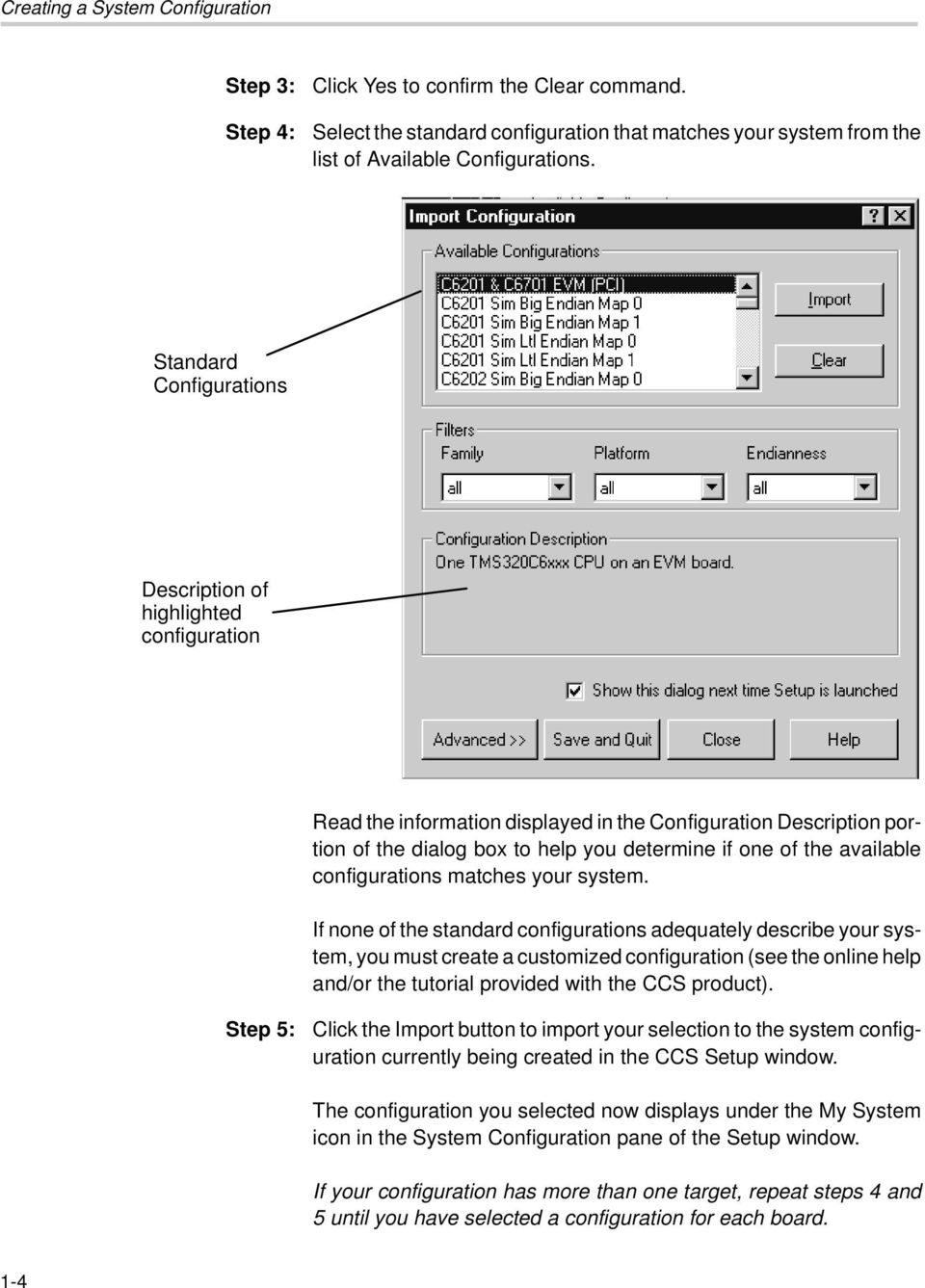
14 Creating a System Configuration Step 6: Step 7: Click the Save and Quit button to save the configuration in the System Registry. Click the Yes button to start the CCS IDE when you exit CCS Setup. The CCS Setup closes and the CCS IDE automatically opens using the configuration you just created. You can now start a project in the CCS IDE. See Chapter 2 of this book, or the online help and tutorial provided with the CCS IDE, for information on starting a project. Getting Started with Code Composer Studio IDE 1-5
15 Getting Started with CCS Tutorial 1.3 Getting Started with CCS Tutorial When you have completed the installation and setup process, run the CCS Tutorial. This tutorial familiarizes you with the CCS features, including what is new in this version. Performing this tutorial before you use the CCS IDE can help shorten your learning time and provides information on many fundamental procedures. To access the CCS Tutorial, follow these steps: 1) Start the CCS IDE by double-clicking on the CCS 2 icon located on the desktop. 2) From the CCS Help menu, select Tutorial. 1-6
16 Accessing CCS Documentation 1.4 Accessing CCS Documentation The CCS online help provides access to platform-specific documentation. To open the CCS Help, select Help Contents. The Welcome page of the CCS Help displays. The table below lists the links on the Welcome page that provide important information: For this information... New features available in CCS IDE v2 CCS IDE v2 release notes User s guides, reference guides, and application reports (in PDF format) click this link. What s New Release Notes Online Manuals Use F1 to obtain help on components within the CCS interface: To obtain the description of an instruction or register while editing your source code in a CCS document window, double-click or click-and-drag to highlight an instruction name or register name, then press F1. To obtain the description of a CCS window or dialog box, click in the window or dialog box to make it active, then press F1. To obtain the description of a menu bar or toolbar command, pause the cursor over the command, then press F1. Accessing Documentation from the Start Menu To access the customer support guides, license agreement, and the CCS online help: Step 1: Step 2: From the Start menu, choose Start Programs Texas Instruments Code Composer Studio 2 Documentation. Select the document you want to view. Getting Started with Code Composer Studio IDE 1-7
17 Update Advisor 1.5 Update Advisor The Update Advisor allows you to download updated versions of the CCS IDE and related tools. The Update Advisor accesses the Available Updates web site. This site displays a list of CCS patches, drivers, and tools available for downloading. Note: To use the Update Advisor, you must have Internet access and a browser installed on your machine. See the CCS IDE Quick Start for complete system requirements. You must register online and have a valid subscription plan in place to receive downloads through update advisor. You receive a 90 day free subscription service with the CCS product. At the end of this period, you must purchase an annual subscription service. Annual subscriptions are only available for the full CCS product. If you did not register your product during installation, you can access the online registration form from the CCS help menu: Help CCS on the Web Register. To Check for Tool Updates In the CCS IDE, select Help CCS on the Web Update Advisor. Important! The first time you use Update Advisor, your browser may display the TI&ME web page. You must be registered with TI&ME before you can access the Available Updates web site. To register, follow the directions displayed on the page. If you are already registered with TI&ME, and have accepted the cookie necessary for automatic log-in, your browser will go directly to the Available Updates web site. In order to query the Available Updates web site, the Update Advisor passes certain information from your machine: CCS product registration number CCS installation version a text description of the installed product the list of installed plug-ins The Available Updates web site will then list any updates appropriate for your CCS installation. You have the opportunity to just download the updates, or to download and install them immediately. You can also configure the Update Advisor to automatically check for updates. 1-8
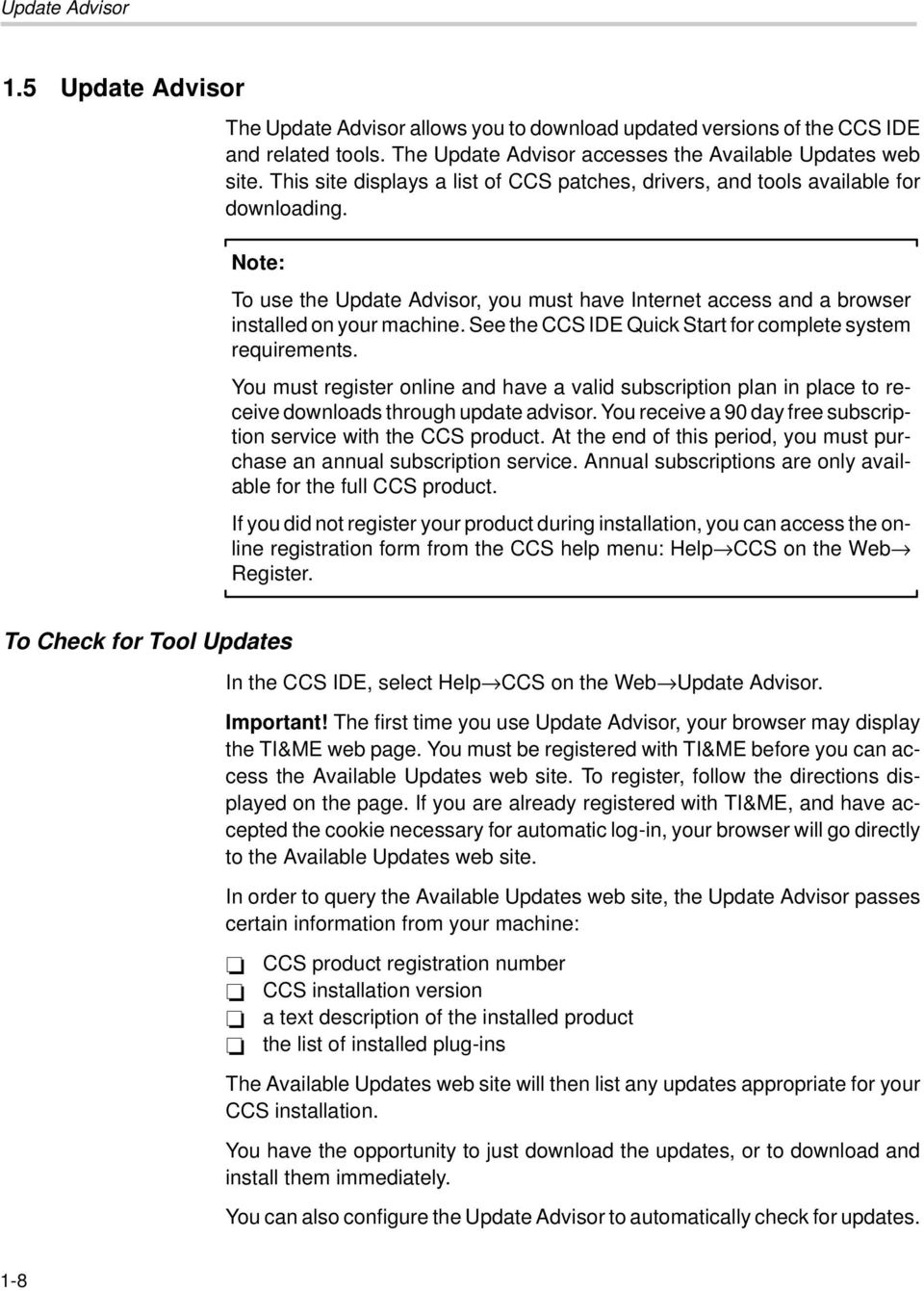
18 Update Advisor To Uninstall the Updates Any installed update can be uninstalled to restore the previous version of the CCS IDE. Note that only the previous version of a tool can be restored. If you install one update for a tool, and then install a second update for the same tool, the first update can be restored. The original version of the tool cannot be restored, even if you uninstall both the second update and the first update. To Automatically Check for Tool Updates With the Update Advisor, you may check for tool updates at any time, or you can configure the Update Advisor to automatically check for updates. Step 1: Select Help CCS on the Web Update Setting. The Web Settings dialog box appears: Step 2: Step 3: In the Check for Update field, specify how often the Update Advisor should check the Available Updates web site. To enable the automatic update feature, click the checkbox to the left of the Enable timed check for update upon startup field. When this field is enabled, the Update Advisor automatically checks for web updates according to the schedule specified in step 2. Step 4: Click OK to save your changes and close the dialog box. Getting Started with Code Composer Studio IDE 1-9
19 Component Manager 1.6 Component Manager Multiple installations of the CCS IDE can share installed tools. The Component Manager provides an interface for handling multiple versions of tools with multiple installations of the CCS IDE. The Component Manager window displays a listing of all CCS installations, build tools, Texas Instruments plug-in tools, and third-party plug-in tools. When a node is selected in the tree (the left pane of the Component Manager), its properties are displayed in the Properties pane (the right pane). With the Component Manager, you can enable or disable tools for a particular CCS installation. This functionality allows you to create a custom combination of tools contained within a CCS system. The Component Manager also allows you to access the Update Advisor to download the most recent version of the tools from the web. To use the Update Advisor, you must have Internet access and a browser installed on your machine. Note: The component manager is an advanced tool use primarily to customize or modify your installation. Use this tool only to resolve component interaction in a custom or multiple installation environment. 1-10

20 Component Manager Figure 1 2. Component Manager Tree listing of all CCS installations and tools Properties of the item highlighted in the CCS installation pane Opening Component Manager To open the Component Manager: Step 1: From the Help menu in the CCS IDE, select About. Step 2: The About CCS dialog box appears. In the About dialog box, click the Component Manager button. The Component Manager window displays. Multiple Versions of the CCS IDE The following is a list of requirements for maintaining multiple versions of the CCS IDE and related tools: If you install an additional version of the CCS IDE, or an additional version of a tool, in the same directory as its previous installation, the original installation will be overwritten. To keep more than one version of the CCS IDE or a related tool, you must install each version in a different directory. You cannot enable multiple versions of the same tool within one CCS IDE installation. Getting Started with Code Composer Studio IDE 1-11

21 Chapter 2 Code Composer Studio Project Management and Editing Tools This chapter applies to all platforms using Code Composer Studio (CCS) IDE. This chapter reviews the tools and options available to you for creating and managing your programs and projects. For more information, see the online help and online manuals provided with the CCS IDE. Topic Page 2.1 Creating a New Project Adding Files to a Project Using Source Control Building and Running the Program Selecting a Project Configuration Building Projects From the Command Line Importing an External Makefile Reviewing Your Source Code Using the Editor
22 Creating a New Project 2.1 Creating a New Project The information for a project is stored in a single project file (*.pjt). Use the following procedure to create new projects, one at a time. When multiple projects are created, each project s filename must be unique. TIP: It is possible to have multiple projects open at the same time. Step 1: From the Project menu, choose New. The Project Creation wizard window displays. Step 2: In the Project Name field, type the name you want for your project. Each project you create must have a unique name. Step 3: In the Location field, specify a directory to store the project file. You can type the full path in the Location field or click the Browse button and use the Choose Directory dialog box. It is a good idea to use a different directory for each new project. Use this directory to store project files and the object files generated by the compiler and assembler. Step 4: In the Project Type field, select a Project Type from the drop-down list. Choose either Executable (.out) or Library (lib). Executable indicates that the project generates an executable file. Library indicates that you are building an object library. 2-2
23 Creating a New Project Step 5: Step 6: In the Target field, select the Target Family that identifies your CPU. This information is necessary when tools are installed for multiple targets. Click Finish. Figure 2 1. CCS IDE Basic Window The CCS IDE creates a project file called projectname.pjt. This file stores your project settings and references the various files used by your project. The new project automatically becomes the active project. The first project configuration (in alphabetical order) is set active. The new project inherits TI supplied default compiler and linker options for debug and release configurations. For information on how to change these settings, see section 2.5, Selection a Project Configuration, found on page After creating a new project file, add the filenames of your source code, object libraries, and linker command file to the project list. DSP/BIOS Toolbar Active project Build Toolbar Project View Window Code Composer Studio Project Management and Editing Tools 2-3
24 Adding Files to a Project 2.2 Adding Files to a Project Step 1: Select Project Add Files to Project, or or right-click on the project s filename in the Project View window and select Add Files. The Add Files to Project dialog box displays. Drop-down list of file types Step 2: In the Add Files to Project dialog box, specify a file to add. If the file does not exist in the current directory, browse to the correct location. Use the Files of type drop-down list to set the type of files that appear in the File name field. Note: Do not try to manually add header/include files (*.h) to the project. These files are automatically added when the source files are scanned for dependencies as part of the build process. Step 3: Click Open to add the specified file to your project. The Project View is automatically updated when a file is added to the current project. 2-4
25 Adding Files to a Project Figure 2 2. Project View Active project Project View Window Note: The project manager organizes files into folders for source files, include files, libraries, and DSP/BIOS configuration files. Source files that are generated by DSP/BIOS are placed in the Generated files folder. If you need to remove a file from the project, right-click on the file in the Project View and choose Remove from project in the pop-up menu. When building the program, the CCS IDE finds files by searching for project files in the following path order: The folder that contains the source file. The folders listed in the Include Search Path for the compiler or assembler options (from left to right). The folders listed in the definitions of the optional DSP_C_DIR (compiler) and DSP_A_DIR (assembler) environment variables (from left to right). Code Composer Studio Project Management and Editing Tools 2-5
26 Using Source Control 2.3 Using Source Control The project manager enables you to connect your projects to a variety of source control providers. The CCS IDE automatically detects compatible providers that are installed on your computer. Step 1: Step 2: From the Project menu, choose Source Control. From the Source Control submenu, choose Select Provider... Step 3: Select the Source Control Provider that you want to use and press OK. NOTE: If no source control providers are listed, please ensure that you have correctly installed the client software for the provider on your machine. Step 4: Step 5: Open a project and select Add to Source Control from Project Source Control. Add your source files to Source Control. 2-6
27 Using Source Control Figure 2 3. Source Control Pop-Up Menu You can check files in and out of source control by selecting a file in the Project View window and right clicking on the file. Code Composer Studio Project Management and Editing Tools 2-7
28 Building and Running the Program 2.4 Building and Running the Program To build and run a program, follow these steps: TIP: You can use the supplied timake.exe utility to build a CCS project from the DOS shell. See section 2.6, Building Projects From the Command Line, found on page 2-11, for more information on timake.exe. Step 1: Choose Project Rebuild All or click the (Rebuild All) toolbar button. The CCS IDE recompiles, reassembles, and relinks all the files in your project. Messages about this process are shown in a frame at the bottom of the window. Name of the current project Step 2: By default, the.out file is built into a debug directory located under your current project folder. To change this location, select a different one from the CCS toolbar. Project Configuration Step 3: Choose File Load Program. Select the program you just rebuilt, and click Open. The CCS IDE loads the program onto the target DSP and opens a Dis-Assembly window that shows the disassembled instructions that make up the program. (Notice that the CCS IDE also automatically opens a tabbed area at the bottom of the window to show the output that the program sends to stdout.) Step 4: Choose View Mixed Source/ASM. This allows you to simultaneously view your c source and the resulting assembly code. Step 5: Click on an assembly instruction in the mixed-mode window. (Click on the actual instruction, not the address of the instruction or the fields passed to the instruction.) Press the F1 key. The CCS IDE searches for help on that instruction. This is a good way to get help on an unfamiliar assembly instruction. 2-8
29 Building and Running the Program Step 6: Choose Debug Go Main to begin execution from the main function. The execution halts at main and is identified by. Step 7: Choose Debug Run or click the (Run) toolbar button to run the program. Step 8: Choose Debug Halt to quit running the program. Code Composer Studio Project Management and Editing Tools 2-9
30 Selecting a Project Configuration 2.5 Selecting a Project Configuration A project configuration defines a set of project level build options. Options specified at this level apply to every file in the project. Project configurations enable you to define build options for the different phases of program development. For example, you can define a Debug configuration to use while debugging your program and a Release configuration for building the finished product. Each project is created with two default configurations: Debug and Release. Additional configurations can be defined. Whenever a project is created or an existing project is initially opened, the first configuration (in alphabetical order) is set active. The active configuration setting is preserved in the CCS workspace. When you build your program, the output files generated by the software tools are placed in a configuration-specific subdirectory. For example, if you have created a project in the directory MyProject, the output files for the Debug configuration are placed in MyProject\Debug. Similarly, the output files for the Release configuration are placed in MyProject\Release. Change the Active Project Configuration Click on the Select Active Configuration field in the Project toolbar and select a configuration from the drop-down list. Figure 2 4. Change Active Project Configuration Select Active Project Select Active Configuration 2-10
31 Selecting a Project Configuration / Building Projects From the Command Line Add a New Project Configuration Step 1: Step 2: Select Project Configurations, or right-click on the project s filename in the Project View window and select Configurations. In the Project Configurations dialog box, click Add. The Add Project Configuration window displays. Step 3: Step 4: Step 5: Step 6: In the Add Project Configuration dialog box, specify the name of the new configuration in the Create Configuration field, and choose to Use Default Settings (build options) or Copy Settings from an existing configuration to populate your new configuration. Click OK to accept your selections and exit the Add Project Configuration dialog. Click Close to exit the Project Configurations dialog. Modify your new configuration using the build options dialog found in the Project menu. 2.6 Building Projects From the Command Line The timake.exe utility located in the <Installdir>\cc\bin directory provides a way to build Code Composer Studio projects outside of the main application. This utility can be used to accomplish batch builds. Code Composer Studio Project Management and Editing Tools 2-11
32 Importing an External Makefile 2.7 Importing an External Makefile The CCS IDE supports the use of external makefiles (*.mak) and an associated external make utility for project management and build process customization. To enable the CCS IDE to build a program using a makefile, a CCS project must be created that wraps the makefile. After a CCS project is associated with the makefile, the project and its contents can be displayed in the Project View window and the Project Build and Project Rebuild All commands can be used to build the program. Double-clicking on the name of the makefile in the Project View window opens the file for editing. Special dialogs enable you to modify the makefile build commands and makefile options. The normal CCS Build Options dialogs are not available when working with makefiles. Multiple configurations can be created, each with its own build commands and options. Limitations and Restrictions Source files can be added to or removed from the project in the Project View. However, changes made in the Project View do not change the contents of the makefile. These source files do not affect the build process nor are they reflected in the contents of the makefile. Similarly, editing the makefile does not change the contents in the Project View. File-specific options for source files that are added in the Project View are disabled. The Project Compile File command is also disabled. However, when the project is saved, the current state of the Project View is preserved. Note: Before using CCS IDE commands to build your program using a makefile, it is necessary to set the necessary environment variables. To set environment variables, run the batch file DosRun.bat The batch file is located in the directory c:\ti. If you installed CCS IDE in a directory other than c:\ti, the batch file will be located in the directory you specified during installation. 2-12
33 Reviewing Your Source Code Using the Editor 2.8 Reviewing Your Source Code Using the Editor Figure 2 5. View Source Code Selection Margin Double-click on the filename.c file in the Project View to display the source code in the right half of the CCS window. Divider Bookmarks Mixed Mode (Assembly and C source) Program Counter Selection Margin. By default, a Selection Margin is displayed on the lefthand side of integrated editor and Disassembly windows. Colored icons in the Selection Margin indicate that a breakpoint (red) or Probe Point (blue) is set at this location. A yellow arrow identifies the location of the Program Counter (PC). TIP: The Selection Margin can be resized by dragging the divider. Keywords. The integrated editor features keyword highlighting. Keywords, comments, strings, assembler directives, and GEL commands are highlighted in different colors. TIP: In addition, new sets of keywords can be created, or the default keyword sets can be customized and saved in keyword files (*.kwd). Code Composer Studio Project Management and Editing Tools 2-13
34 Reviewing Your Source Code Using the Editor Keyboard Shortcuts. The default keyboard shortcuts can be changed and new keyboard shortcuts can be created for any editing or debugging commands that can be invoked from a document window. Keyboard shortcuts can be modified through the customize dialog box in the Options menu. Bookmarks. Use bookmarks to find an maintain key locations within your source files. A bookmark can be set on any line of any source file. CodeMaestro Settings The CodeMaestro settings included in the CCS editor can help you be more productive. Figure 2 6. CodeMaestro Settings Window 2-14
35 Reviewing Your Source Code Using the Editor Automatically Suggest Word: Helps you by suggesting a word or symbol that you have started typing. Complete Word: Allows you to select from a list of valid symbols. Automatically correct case: Corrects the case of your code. Automatically List Members: Displays a list containing all of the valid members of a structure or object. Automatically Display Parameter Information: Displays a tool-tip containing the parameter information for the function that you have started typing. Line Limit: Allows you to set a maximum number of lines per file, and if the file has more lines than the number you set, CodeMaestro is not invoked for that file. External Editor Figure 2 7. External Editor Icon The CCS IDE supports the use of an external (third-party) text editor in place of the default integrated editor. When an external editor is configured and enabled, the external editor is launched whenever a new blank document is created or an existing file is opened. You can configure an external editor by selecting Options Customize Editor Properties. An external editor can only be used to edit files. The CCS integrated editor must be used to debug your program. External Editor icon: toggle between an external editor and the CCS integrated editor Code Composer Studio Project Management and Editing Tools 2-15
36 Chapter 3 Code Composer Studio Code Generation Tools This chapter applies to all platforms using Code Composer Studio (CCS) IDE. Some of the Code Generation Tool sets discussed in this chapter may not be available for your ISA. For a complete listing of the tools available to you, see the online help and online documentation provided with the CCS IDE. The different platforms offered with the CCS IDE are supported by a set of software development tools. These tools include an optimizing C/C++ compiler, an assembler, a linker, and assorted utilities. This chapter discusses these tools and shows you how to use them. Topic Page 3.1 Code Generation Tools Code Generation Tools and Code Composer Studio Compiler Overview Assembly Language Development Tools Assembler Overview Linker Overview Visual Linker C/C++ Code Development Tools
37 Code Generation Tools 3.1 Code Generation Tools Figure 3 1. Code Development Flow C or C/C++ source files C/C++ compiler Parser Assembly optimizer: ONLY applies to C6000 Optimizer (optional) Assembly preprocessor Code generator Assembler source.asm files With the linker option ( z) Assembler Linker COFF object (.obj) files Executable COFF file.out file 3-2
38 Code Generation Tools and Code Composer Studio 3.2 Code Generation Tools and Code Composer Studio The CCS IDE provides a graphical interface for using the code generation tools. A CCS project keeps track of all information needed to build a target program or library. A project records: Filenames of source code and object libraries Compiler, assembler, and linker options Include file dependencies When you build a project with the CCS IDE, the appropriate code generation tools are invoked to compile, assemble, and/or link your program. The compiler, assembler, and linker options can be specified within CCS s Build Options dialog box. Nearly all command line options are represented within this dialog box. Options that are not represented can be specified by typing the option directly into the editable text box that appears at the top of the dialog box. Code Composer Studio Code Generation Tools 3-3
39 Code Generation Tools and Code Composer Studio Figure 3 2. Build Options Dialog Box Build Options You can set the compiler and linker options that are used when the CCS IDE builds your program. Define a set of project level options that apply to all files in your project. Then, optimize your program by defining file-specific options for individual source code files. TIP: For options that are commonly used together, you can set project level configurations, rather than have to set the same individual options repeatedly. For more information on setting project configurations, see section 2.5, Selecting a Project Configuration, on page You can also look for this information in the online help and tutorial provided with the CCS IDE. 3-4
40 Code Generation Tools and Code Composer Studio Set Project Level Options Step 1: Step 2: Step 3: Step 4: Select Project Build Options. In the Build Options Dialog Box, select the appropriate tab. Select the options to be used when building your program. Click OK to accept your selections. Set File-Specific Options Step 1: Step 2: Step 3: Right-click on the name of the source file in the Project View window and select File Specific Options from the context menu. Select the options to be used when compiling this file. Click OK to accept your selections. File-specific options are stored in the project file by recording only the differences between the project options and those set for the file. Code Composer Studio Code Generation Tools 3-5
41 Compiler Overview 3.3 Compiler Overview The C and C++ compilers (for C5000 and C6000 ) are full-featured optimizing compilers that translate standard ANSI C programs into assembly language source. The following subsections describe the key features of the compilers. Interfacing with Code Composer Studio The following features pertain to interfacing with the compiler: Compiler shell program The compiler tools include a shell program that you use to compile, assembly optimize, assemble, and link programs in a single step. For more information, see the About the Shell Program section in the Optimizing Compiler User s Guide appropriate for your device. Flexible assembly language interface The compiler has straightforward calling conventions, so you can write assembly and C functions that call each other. For more information, see Chapter 8, Run-Time Environment, in the Optimizing Compiler User s Guide appropriate for your device. 3-6
42 Assembly Language Development Tools 3.4 Assembly Language Development Tools The following is a list of the assembly language development tools: Assembler. The assembler translates assembly language source files into machine language object files. The machine language is based on common object file format (COFF). Archiver. The archiver allows you to collect a group of files into a single archive file called a library. Additionally, the archiver allows you to modify a library by deleting, replacing, extracting, or adding members. One of the most useful applications of the archiver is building a library of object modules. Linker. The linker combines object files into a single executable object module. As it creates the executable module, it performs relocation and resolves external references. The linker accepts relocatable COFF object files and object libraries as input. Absolute Lister. The absolute lister accepts linked object files as input and creates.abs files as output. You can assemble these.abs files to produce a listing that contains absolute, rather than relative, addresses. Without the absolute lister, producing such a listing would be tedious and would require many manual operations. Cross-reference Lister. The cross-reference lister uses object files to produce a cross-reference listing showing symbols, their definitions, and their references in the linked source files. Hex-conversion Utility. The hex-conversion utility converts a COFF object file into TI-Tagged, ASCII-hex, Intel, Motorola-S, or Tektronix object format. You can download the converted file to an EPROM programmer. With the TMS320C54x device, the mnemonic-to-algebraic translator utility converts assembly language source files. The utility accepts an assembly language source file containing mnemonic instructions. It converts the mnemonic instructions to algebraic instructions, producing an assembly language source file containing algebraic instructions. Code Composer Studio Code Generation Tools 3-7
43 Assembler Overview 3.5 Assembler Overview The assembler translates assembly language source files into machine language object files. These files are in common object file format (COFF). The two-pass assembler does the following: Processes the source statements in a text file to produce a relocatable object file Produces a source listing (if requested) and provides you with control over this listing Allows you to segment your code into sections and maintains a section program counter (SPC) for each section of object code Defines and references global symbols and appends a cross-reference listing to the source listing (if requested) Assembles conditional blocks Supports macros, allowing you to define macros inline or in a library 3-8
44 Linker Overview 3.6 Linker Overview The linker allows you to configure system memory by allocating output sections efficiently into the memory map. As the linker combines object files, it performs the following tasks: Allocates sections into the target system s configured memory Relocates symbols and sections to assign them to final addresses Resolves undefined external references between input files The linker command language controls memory configuration, output section definition, and address binding. The language supports expression assignment and evaluation. You configure system memory by defining and creating a memory module that you design. Two powerful directives, MEMORY and SECTIONS, allow you to: Allocate sections into specific areas of memory Combine object file sections Define or redefine global symbols at link time Code Composer Studio Code Generation Tools 3-9
45 Visual Linker 3.7 Visual Linker There are two ways to link your code in the CCS IDE. One is textually using the linker command file and the other is graphically using the visual linker. The linker command file is a text file used explicitly by the standard linker to create the links automatically. The visual linker allows you to manually create these links in a graphical setting. The Visual Linker is an interactive, extensible linker. Taking your application s object files/libraries and the target memory description as input, the Visual Linker provides a graphical means to configure system memory. You can use drag-and-drop manipulation to arrange the object files within a graphical representation of the memory layout. When you are satisfied with the memory layout, you can then generate the executable (.out) file. Some features of the Visual Linker include: Visual drag-and-drop of program components into device-specific memory maps Immediate visual feedback on memory allocation to discover areas of optimization Reduced application size with elimination of unused code and data Wizards to ease migration from existing text linker control files Getting Started with the Visual LInker Before using the Visual Linker, go through the Visual Linker tutorial. In the CCS IDE, select Help Tutorial. Choose the Visual Linker tutorial module. Step 1: Select the Visual Linker as your project s linker. Select Tools Linker Configuration. In the Linker Configuration dialog box, select Use the Visual Linker and click OK. 3-10
46 Visual Linker Step 2: Generate object files for your application before creating a recipe. Open your CCS project. Select Project Rebuild All. You will receive an error message in the CCS output window. Simply double-click on the error message to open the New Recipe wizard. Step 3: Use the New Recipe wizard to create a recipe for the Visual Linker. A recipe describes how to build an application. It is made up of: Ingredients. The ingredients include a list of input files and a hardware description. Directions. The directions come from a strategy for combining the ingredients. The strategy can be a file that was previously created, or it can be generated as you manipulate input files and other items within the Visual Linker. Step 4: Use the Visual Linker s views to arrange your program in memory. The left pane of the Visual Linker is the tree view. The pane to the right of the tree view is the list view. The ingredients of the recipe appear as graphical elements within the Visual Linker s interface. You can use drag-and-drop manipulation within these windows to arrange the components of your program in memory. After each drag Code Composer Studio Code Generation Tools 3-11
47 Visual Linker and drop manipulation, you see the effect immediately: the space used by each section, the space left over, etc. Tree view List View Graphical Elements of the Recipe Step 5: After you have arranged your program in memory, you can generate the executable file. To generate an executable file, select Project Rebuild All or click the (Rebuild All) toolbar button button on the CCS toolbar. Step 6: You can then use the recipe when you run the Visual Linker from within a makefile or from the command line. Note: Use the vlnk command to run the Visual Linker from within a makefile or from the command line. Some of the tasks that you will want to complete within the Visual Linker are: Placing input sections in memory Viewing portions of memory Specifying load and run addresses Avoiding allocation of reserved hardware addresses 3-12
48 C/C++ Code Development Tools 3.8 C/C++ Code Development Tools The following is a list of the C/C++ development tools: C/C++ Compiler. The C/C++ compiler accepts C/C++ source code and produces assembly language source code. A shell program, an optimizer, and an interlist utility are parts of the compiler. The shell program enables you to compile, assemble, and link source modules in one step. If any input file has a.sa extension, the shell program invokes the assembly optimizer. The optimizer modifies code to improve the efficiency of C programs. The interlist utility interweaves C/C++ source statements with assembly language output. Assembly Optimizer (C6000 only). The assembly optimizer allows you to write linear assembly code without being concerned with the pipeline structure or with assigning registers. It accepts assembly code that has not been register-allocated and is unscheduled. The assembly optimizer assigns registers and uses loop optimization to turn linear assembly into highly parallel assembly that takes advantage of software pipelining. Library-build Utility. You can use the library-build utility to build your own customized run-time-support library. Standard run-time-support library functions are provided as source code in rts.src and rstcpp.src. The object code for the run-time-support functions is compiled for little-endian mode versus big-endian mode and C code versus C++ code into standard libraries. The run-time-support libraries contain the ANSI standard run-time-support functions, compiler-utility functions, floating-point arithmetic functions, and C I/O functions that are supported by the compiler. C++ Name Demangling Utility. The C++ compiler implements function overloading, operator overloading, and type-safe linking by encoding a function s signature in its link-level name. The process of encoding the signature into the linkname is often referred to as name mangling. When you inspect mangled names, such as in assembly files or linker output, it can be difficult to associate a mangled name with its corresponding name in the C++ source code. The C++ name demangler is a debugging aid that translates each mangled name it detects to its original name found in the C++ source code. Code Composer Studio Code Generation Tools 3-13
49 C/C++ Code Development Tools The following is a list of available products for refining and correcting your code: TMS320C6000 devices: An instruction-accurate and clock-accurate software simulator An extended development system (XDS510 ) emulator TMS320C54x devices: An instruction-accurate software simulator An extended development system (XDS510 ) emulator An evaluation module (EVM) TMS320C55x devices: An instruction-accurate software simulator An extended development system (XDS510 ) emulator These tools are accessed within the CCS IDE. For more information, see the online help provided with the CCS IDE. 3-14
50 Chapter 4 Code Composer Studio Debug Tools This chapter applies to all platforms using Code Composer Studio (CCS) IDE. However, not all devices have access to all of the tools discussed in this chapter. For a complete listing of the tools available to you, see the online help and online documentation provided with the CCS IDE. The CCS IDE comes with a number of tools that help you debug your programs. This chapter discusses these tools and shows you how to use them. Topic Page 4.1 Overview of Applicable Debug Tools Introduction to Breakpoints Watch Window Probe Points Simulator Analysis Emulator Analysis Advanced Event Triggering Displaying Graphs Symbol Browser General Extension Language (GEL) Command Window Pin Connect Port Connect Data Converter
51 Overview of Applicable Debug Tools 4.1 Overview of Applicable Debug Tools Table 4 1. Debug Tools The following table shows the debug tools discussed in this chapter that are used by different generations of devices. However, the specific devices that fall in each generation may or may not have access to these debug tools. To see a complete list of debug tools available for your device, access the online help provided with the CCS IDE. Platform/Device Breakpoints Watch Window Probe Points Simulator Analysis Emulator Analysis Event Triggering Graphs Symbol Browser Command Window Pin connect Port Connect Data Converter TMS320C62x TMS320C64x TMS320C67x TMS320C54x TMS320C55x 4-2
52 Introduction to Breakpoints 4.2 Introduction to Breakpoints Breakpoints are an essential component of any debugging session. Breakpoints stop the execution of the program. While the program is stopped, you can examine the state of the program, examine or modify variables, examine the call stack, etc. Breakpoints can be set on a line of source code in an Editor window or a disassembled instruction in the Disassembly window. After a breakpoint is set, it can be enabled or disabled. For breakpoints set on source lines it is necessary that there be an associated line of dissassembly code. When compiler optimization is turned on, many source lines cannot have breakpoints set. To see allowable lines, use mixed mode in the editor window. Note: CCS IDE tries to relocate a breakpoint to a valid line in your source window. CCS IDE places a breakpoint icon in the selection margin beside the lineon which it locates the breakpoint. If CCS IDE cannot determine an allowable line, it reports an error in the message window. Breakpoints are saved in the project workspace. For information on analyzing breakpoints, see section 4.5, Simulator Analysis, on page 4-14, and section 4.6, Emulator Analysis, on page Note: Composer Studio briefly halts the target whenever it reaches a Breakpoint or Probe Point. Therefore, the target application may not meet real-time deadlines if you are using Probe Points. At this stage of development, you are testing the algorithm. Later, you can analyze real-time behavior using RTDX and DSP/BIOS. For real-time debugging information, see Chapter 6, Code Composer Studio Real Time Components. Code Composer Studio Debug Tools 4-3
53 Introduction to Breakpoints Software Breakpoints Breakpoints can be set in any Disassembly window or document window containing C/C++ source code. There is no limit to the number of software breakpoints that can be set, provided they are set at writable memory locations (RAM). Software breakpoints operate by modifying the target program to add a breakpoint instruction at the desired location. The fastest way to set a breakpoint is to simply double-click on the desired line of code. Step 1: Step 2: In a document window or Disassembly window, move the cursor over the line where you want to place a breakpoint. In a document window, double-click in the Selection Margin immediately preceding the line. In a Disassembly window, double click on the desired line. A breakpoint icon in the Selection Margin indicates that a breakpoint has been set at the desired location. The Toggle Breakpoint command and the Toggle Breakpoint button also enable you to quickly set and clear breakpoints. Step 1: Step 2: In a document window or Disassembly window, put the cursor in the line where you want to set the breakpoint. Right-click and select Toggle Breakpoint, or click the Toggle Breakpoint button on the Project toolbar. Toggle Breakpoint: 4-4
54 Introduction to Breakpoints Hardware Breakpoints Hardware breakpoints differ from software breakpoints in that they do not modify the target program; they use hardware resources available on the chip. Hardware breakpoints are useful for setting breakpoints in ROM memory or breaking on memory accesses instead of instruction acquisitions. A breakpoint can be set for a particular memory read, memory write, or memory read or write. Memory access breakpoints are not shown in the source or memory windows. Hardware breakpoints can also have a count, which determines the number of times a location is encountered before a breakpoint is generated. If the count is 1, a breakpoint is generated every time. Hardware breakpoints cannot be implemented on a simulated target. To set a hardware breakpoint: Step 1: Step 2: Step 3: Step 4: Step 5: Step 6: Select Debug Breakpoints. The Break/Probe Points dialog box appears with the Breakpoints tab selected. In the Breakpoint type field, choose H/W Break at location for instruction acquisition breakpoints or choose Break on <bus> <Read Write R/W> at location for a memory access breakpoint. Enter the program or memory location where you want to set the breakpoint. Use one of the following methods: For an absolute address, you can enter any valid C expression, the name of a C function, or a symbol name. Enter a breakpoint location based on your C source file. This is convenient when you do not know where the C instruction is in the executable. The format for entering in a location based on the C source file is as follows: filename line linenumber. Enter the number of times the location is hit before a breakpoint is generated, in the Count field. Set the count to 1 if you wish to break every time. Click the Add button to create a new breakpoint. This causes a new breakpoint to be created and enabled. Click OK. Code Composer Studio Debug Tools 4-5
55 Watch Window 4.3 Watch Window When debugging a program, it is often helpful to understand how the value of a variable changes during program execution. The Watch window allows you to monitor the values of local and global variables and C/C++ expressions. To open the Watch window: Figure 4 1. Watch Window Toolbar Select View Watch Window, or click the Watch Window button on the Watch toolbar. Open Quick Watch Open the Watch window The Watch window contains two tabs labeled: Watch Locals and Watch. In the Watch Locals tab, the debugger automatically displays the Name, Value, and Type of the variables that are local to the currently executing function. In the Watch tab, the debugger displays the Name, Value, and Type of the local and global variables and expressions that you specify. Figure 4 2. Watch Window For detailed information on the Watch Window, see the Watch Window topics provided in the online help: Help Contents Watch Window. 4-6
56 Watch Window When you are developing and testing programs, you often need to check the value of a variable during program execution. In this section, you use breakpoints and the Watch Window to view such values. You also use the step commands after reaching the breakpoint. Step 1: Step 2: Step 3: Choose File Load Program. Double click on the filename.c file in the Project View. Put your cursor in a line that allows breakpoints. Step 4: Click the (Toggle Breakpoint) toolbar button or press F9. The selection margin indicates that a breakpoint has been set (red icon). If you disable the selection margin (Options Customize) the line is highlighted in magenta. Step 5: Choose View Watch Window. A separate area in the lower right corner of the CCS window appears. At run time, this area shows the values of watched variables. By default, the Locals tab is selected and displays Local variables that are local to the function being executed. Step 6: If not at main, choose Debug Go Main. Step 7: Choose Debug Run, or press F5, or press the Icon. Step 8: Select the Watch tab. Step 9: Click on the expression icon in the Name column and type the name of the variable to watch. Code Composer Studio Debug Tools 4-7
57 Watch Window Step 10: Click on the white space in the watch window to save the change. The value should immediately appear, similar to this example. Step 11: Click the (Step Over) toolbar button or press F10 to step over the call to your watched variable. Other commands you can use are: Step Into (F8) Step Over (F10) Step Out (Shift F7) Run to Cursor (Ctrl F10) 4-8
58 Watch Window In addition to watching the value of a simple variable, you can watch the values of the elements of a structure. Step 1: Select the Watch tab. Step 2: Click on the expression icon in the Name column and type the name of the expression to watch. Step 3: Step 4: Click on the white space in the watch window to save the change. Click once on the + sign. The CCS IDE expands this line to list all the elements of the structure and their values. (The address shown for Link may vary.) Step 5: Step 6: Double-click on the Value of any element in the structure to edit the value for that element. Change the value of a variable. Notice that the value changes in the Watch Window. The value also changes color to red, indicating that you have changed it manually. Code Composer Studio Debug Tools 4-9
59 Probe Points 4.4 Probe Points In this section, you add a Probe Point, which reads data from a file on your PC. Probe Points are a useful tool for algorithm development. You can use probe points to: transfer input data from a file on the host PC to a buffer on the target for use by the algorithm. transfer output data from a buffer on the target to a file on the host PC for analysis. update a window, such as a graph, with data. More Information About Probe Points Probe Points are similar to breakpoints in that they both halt the target to perform their action. However, Probe Points differ from breakpoints in the following ways: Probe Points halt the target momentarily, perform a single action, and resume target execution. Breakpoints halt the CPU until execution is manually resumed and cause all open windows to be updated. Probe Points permit automatic file input or output to be performed; breakpoints do not. 4-10
60 Probe Points This section shows how to use a Probe Point to transfer the contents of a PC file to the target for use as test data. It also uses a breakpoint to update all the open windows when the Probe Point is reached. Step 1: Step 2: Step 3: Choose File Load Program. Select filename.out, and click Open. Double-click on the filename.c file in the Project View. Put your cursor in a line of the main function to which you want to add a probe point. Step 4: Click the (Toggle Probe Point) toolbar button. Step 5: From the File menu, choose File I/O. The File I/O dialog appears so that you can select input and output files. Step 6: Step 7: In the File Input tab, click Add File. Browse to your project folder, select filename.dat and click Open. A control window for the filename.dat file appears. When you run the program, you can use this window to start, stop, rewind, or fast forward within the data file. Code Composer Studio Debug Tools 4-11
61 Probe Points Step 8: In the File I/O dialog, change the Address and the Length values. Also, put a check mark in the Wrap Around box. Wrap Around Box Change Address Change Length The Address field specifies where the data from the file is to be placed. The Length field specifies how many samples from the data file are read each time the Probe Point is reached. The Wrap Around option causes the CCS IDE to start reading from the beginning of the file when it reaches the end of the file. This allows the data file to be treated as a continuous stream of data. Step 9: Click Add Probe Point. The Probe Points tab of the Break/Probe Points dialog appears. 4-12
62 Probe Points Step 10: In the Probe Point list, highlight a line. Step 11: In the Connect To field, click the down arrow and select a file from the list. Step 12: Click Replace. The Probe Point list changes to show that this Probe Point is connected to the sine.dat file. Step 13: Click OK. The File I/O dialog shows that the file is now connected to a Probe Point. Step 14: Click OK to close the File I/O dialog. Code Composer Studio Debug Tools 4-13
63 Simulator Analysis 4.5 Simulator Analysis The Simulator Analysis tool reports the occurrence of particular system events so you can accurately monitor and measure the performance of your program. User Options: Enable/disable analysis Count the occurrence of selected events Halt execution whenever a selected event occurs Delete count or break events Create a log file Reset event counter To use the Simulator Analysis tool: Step 1: Step 2: Load your program using the CCS IDE. Start the analysis tool. Select Tools Simulator Analysis for your device. Step 3: Right-click in the Simulator Analysis window and select Enable analysis. 4-14
64 Simulator Analysis Step 4: Step 5: Step 6: Specify your analysis parameters (count events or break events). Use the CCS IDE to run or step through your program. Analyze the output of the analysis tool. For detailed information on the Simulator Analysis tool, see the Simulator Analysis topics provided in the online help: Help Contents Simulator Analysis. Code Composer Studio Debug Tools 4-15
65 Emulator Analysis 4.6 Emulator Analysis Figure 4 3. Emulator Analysis Window The Emulator Analysis tool allows you to set up, monitor, and count events and hardware breakpoints. To start the Emulator Analysis tool: Step 1: Step 2: Load your program using the CCS IDE. Select Tools Emulator Analysis for your device from the CCS menu bar. The Emulator Analysis window contains the following information: This column... displays... Event Type Count Break Address Routine the event name. whether the event is a break or count event. the number of times the event occurred before the program halted. the address at which the break event occurred. the routine in which the break event occurred. Note: You cannot use the analysis features while you are using the profiling clock. For detailed information on the Emulator Analysis tool, see the Emulator Analysis topics provided in the online help: Help Contents Emulator Analysis. 4-16
66 Advanced Event Triggering 4.7 Advanced Event Triggering Advanced Event Triggering (AET) is supported by a group of tools that makes hardware analysis easier than before. Advanced Event Triggering uses Event Analysis and State Sequencer to simplify hardware analysis. Event Analysis uses a simple interface to help you configure common hardware debug tasks called jobs. Setting breakpoints, action points, and counters is easy using a right-click menu and simple drag-and-drop. You can access Event Analysis from the tools menu, or by right-clicking in a source file. Event Sequencer allows you to look for conditions that you specify in your target program and initiates specific actions when these conditions are detected. While the CPU is halted, you define the conditions and actions, then run your target program. The sequence program then looks for the condition you specified and performs the action you requested. Event Analysis The following jobs can be performed using Event Analysis: Setting Breakpoints Hardware Breakpoint Hardware Breakpoint With Count Chained Breakpoint Global Hardware Breakpoint Setting Action/Watch Points Data Actionpoint Program Actionpoint Watchpoint Watchpoint With Data Setting Counters Data Access Counter Profile Counter Watchdog Timer Generic Counter Other Benchmark to Here Emulation Pin Configuration For detailed information on the Event Analysis tool, see the Event Analysis topics provided in the online help: Help Contents Advanced Event Triggering. Code Composer Studio Debug Tools 4-17
67 Advanced Event Triggering To configure a job using the Event Analysis Tool, CCS IDE must be configured for a target processor that contains on-chip analysis features. You can use Event Analysis by selecting it from the Tools menu or by right-clicking in a source file. Once you configure a job, it is enabled and will perform analysis when you run code on your target. For information about how to enable or disable a job that is already configured, see the Advance Event Triggering online help. Step 1: Select Tools Advanced Event Triggering Event Analysis. The Event Analysis window displays. 4-18
68 Advanced Event Triggering Step 2: Right-click in the Event Analysis Window and choose Event Triggering Job Type Job. The job menu is dynamically built and dependent on the target configuration. If a job is not supported on your target, the job is grayed out. Step 3: Step 4: Type your information in the Job dialog box. Click Apply to program the job and save your changes. Code Composer Studio Debug Tools 4-19
69 Advanced Event Triggering Event Sequencer The Event Sequencer allows you to look for conditions that you specify in your target program and initiates specific actions when these conditions are detected. While the CPU is halted, you define the actions, then run your target program. The sequencer program then looks for the condition that you specified and performs the action you requested. To use the Event Sequencer, CCS IDE must be configured for a target processor that contains on-chip analysis features. You can use the Event Sequencer by selecting it from the Tools menu. Once you create an Event Sequencer program, it is enabled and performs analysis when you run code on your target. For information on creating an Event Sequencer program, see the Advanced Event Triggering online help. To enable the Event Sequencer: Step 1: Select Tools Advanced Event Triggering Event Sequencer. The Event Sequencer window displays. Add a boolean and operator Add a state Add open and close parenthesis Erase the Sequencer program Launch online help Add a Global Action Add a Global If statement Step 2: Right-click in the Event Sequencer window or use the Event Sequencer toolbar buttons to create a sequencer program. 4-20
70 Displaying Graphs 4.8 Displaying Graphs If you ran a program using only breakpoints and watch windows, you would not see much information about what the program was doing. You could set watch variables on addresses within the inp_buffer and out_buffer arrays, but you would need to watch a lot of variables and the display would be numeric rather than visual. CCS IDE provides a variety of ways to graph data processed by your program. In this example, you view a signal plotted against time. Step 1: Step 2: Choose View Graph Time/Frequency. In the Graph Property Dialog, change the Graph Title, Start Address, Acquisition Buffer Size, Display Data Size, DSP Data Type, Autoscale, and Maximum Y-value properties to the values shown here. Scroll down or resize the dialog box to see all the properties. Step 3: Step 4: Click OK. A graph window for the Input Buffer appears. Right-click on the Input window and choose Clear Display from the pop-up menu. Code Composer Studio Debug Tools 4-21
71 Displaying Graphs Step 5: Step 6: Step 7: Choose View Graph Time/Frequency again. This time, change the Graph Title to Output and the Start Address to out_buffer. All the other settings are correct. Click OK to display the graph window for the Output. Right-click on the graph window and choose Clear Display from the pop-up menu. 4-22
72 Symbol Browser 4.9 Symbol Browser The Symbol Browser displays all of the associated files, functions, global variables, types, and labels of a loaded COFF output file (*.out). The Symbol Browser contains five tabbed windows: Files Functions Globals Types Labels Figure 4 4. Symbol Browser Window Each tabbed window contains nodes representing various symbols. A plus sign (+) preceding a node indicates that the node can be further expanded. To expand the node, simply click the + sign. A minus sign ( ) precedes an expanded node. Click the sign to hide the contents of that node. To open the Symbol Browser, select Tools Symbol Browser. For detailed information on the Symbol Browser tool, see the Symbol Browser topics provided in the online help: Help Contents Symbol Browser. Code Composer Studio Debug Tools 4-23
73 General Extension Language (GEL) 4.10 General Extension Language (GEL) The General Extension Language (GEL) is an interpretive language, similar to C, that lets you create functions to extend CCS IDE s usefulness. You create your GEL functions using the GEL grammar, and then load them into CCS IDE. With GEL, you can access actual/simulated target memory locations and add options to CCS IDE s GEL menu. GEL is particularly useful for automated testing and user workspace customization. You can call GEL functions from anywhere that you can enter an expression. You can also add GEL functions to the Watch window so they execute at every breakpoint. CCS IDE comes equipped with many built-in GEL functions to help you automate common debugging tasks. 4-24
74 Command Window 4.11 Command Window Figure 4 5. Command Window The Command Window enables you to specify commands to the CCS debugger using the TI Debugger command syntax. Many of the commands accept C expressions as parameters. This allows the instruction set to be relatively small, yet powerful. Because C expressions can have side effects (that is, the evaluation of some types of expressions can affect existing values) you can use the same command to display or change a value. To open the Command Window: Select Tools Command Window from the CCS menu bar. Output window Command field Execution (or halt) button For detailed information on the Command Window, see the Command Window topics provided in the online help: Help Contents Command Window. Code Composer Studio Debug Tools 4-25
75 Pin Connect 4.12 Pin Connect The Pin Connect tool enables you to specify the interval at which selected external interrupts occur. To simulate external interrupts: Step 1: Step 2: Create a data file that specifies interrupt intervals. Start the Pin Connect tool. From the Tools menu, choose Pin Connect. Pin name File name Step 3: Step 4: Step 5: Select the Pin name and click Connect. Load your program. Run your program. For detailed information on the Pin Connect tool, see the Pin Connect topics provided in the online help: Help Contents Pin Connect. 4-26
76 Port Connect 4.13 Port Connect You can use the Port Connect tool to access a file through a memory address. Then, by connecting to the memory (port) address, you can read data in from a file, and/or write data out to a file. To connect a memory (port) address to a data file, follow these steps: Step 1: From the Tools menu, select Port Connect. This action displays the Port Connect window and starts the Port Connect tool. Step 2: Click the Connect button. This action opens the Connect dialog box. Code Composer Studio Debug Tools 4-27
77 Port Connect Step 3: In the Port Address field, enter the memory address. This parameter can be an absolute address, any C expression, the name of a C function, or an assembly language label. If you want to specify a hex address, be sure to prefix the address number with 0x; otherwise, CCS IDE treats the number as a decimal address. Step 4: In the Length field, enter the length of the memory range. The length can be any C expression. Step 5: In the Page field (C5000 only), choose type of memory (program or data) that the address occupies: To identify this page... Program memory Data memory I/O space use this value. Prog Data I/O Step 6: Step 7: In the Type field, select the Write or Read radio button, depending on whether you want to read data from a file or write data to a file. Click OK. This action displays the Open Port File window. Step 8: Select the data file to which you want to connect and click Open. The file is accessed during an assembly language read or write of the associated memory address. Any memory address can be connected to a file. A maximum of one input and one output file can be connected to a single memory address; multiple addresses can be connected to a single file. For detailed information on the Port Connect tool, see the Port Connect topics provided in the online help: Help Contents Port Connect. 4-28
78 Data Converter 4.14 Data Converter The Data Converter Plug In (DCP) from Texas Instruments allows fast and easy software development for data converters attached to a Digital Signal Processor (DSP). Open the Data Converter Support Window Select Tools Data Converter Support. Figure 4 6. Data Converter Support Window For additional information, see the Data Converter portion of the CCS online help. Code Composer Studio Debug Tools 4-29
79 Data Converter Configure Your System to Use the Data Converter Plug-in To configure your system to use the Data Converter Plug-in: Step 1: System tab. Add devices that are connected to the DSP. Step 2: DSP tab. Specify required DSP configuration data. Step 3: Device Name. Configure your ADC(s), DAC(s) and/or Codec(s). 4-30
80 Data Converter Step 4: Step 5: CCS IDE. Open a project in CCS IDE. Files tab. Generate the configuration files. Several source code files usually C language are added to your DSP project. These files contain the lowest level of interface software required for the data converter(s). In addition, a set of static configuration data is created in header files to be used by the interface software. The data may also be used by your application. The #define strings should be used in your software in order to allow for configuration independent programming. Step 6: Step 7: Step 8: CCS IDE. Use data structures and interface functions as needed. CCS IDE. Verify correct operation using CCS debug features. CCS IDE. Save a workspace before exiting CCS IDE. Note: Interface functions are hardware dependent. They only work if standard hardware interfacing is used. It is always your responsibility to verify the correct operation of hardware and software in your system. Code Composer Studio Debug Tools 4-31
81 Chapter 5 Code Composer Studio Optimization Tools This chapter applies to all platforms using Code Composer Studio (CCS) IDE. However, not all devices have access to all the tools discussed in this chapter. For a complete listing of the tools available to you, see the online help and online documentation provided with CCS IDE. Profiling helps you determine how long a processor spends in each section of a program. Using profiling can help you make your programs more efficient. This chapter discusses the CCS profiling tools and shows you how to use them. Topic Page 5.1 Profiler Profile Based Compiler (PBC)
82 Profiler 5.1 Profiler Profiling helps reduce the time it takes to identify and eliminate performance bottlenecks. The profiler analyzes program execution and shows you where your program is spending its time. For example, a profile analysis can report how many cycles a particular function takes to execute and how often it is called. Profiling helps you to direct valuable development time toward optimizing the sections of code that most dramatically affect program performance. Start a new session each time you want to perform profile analysis on an executable program. When you want to profile more than one executable program, multiple profile sessions can be launched. To start a new profile session: Step 1: Select Profiler Start New Session. Step 2: In the Profile Session Name dialog box, enter a name for this profile session. By default, the name MySession appears. 5-2
83 Profiler Step 3: Click OK. A Profile View window appears within the CCS window. Drag-and-drop any function from your code into the Profile View window. Profile by Function Profile by Range Note: The new profiler allows you to exclude code ranges from being profiled. In other words, you can use Start and End points to exclude certain parts of your code found within the profiling range from being counted as part of the profiling data. Step 4: Step 5: Select File Load Program. In the Load Program dialog box, specify the output file to be profiled and click Open. As a prerequisite to performing profile analysis, the program must be built with symbolic debugging information. For detailed information on the Profiler tool, see the Profiler topics provided in the online help: Help Contents Profiling Code Execution. Code Composer Studio Optimization Tools 5-3
84 Profile Based Compiler (PBC) 5.2 Profile Based Compiler (PBC) This tool is only available to TMS320C6000 devices. PBC is a tool that enables you to more quickly and easily optimize the trade-off between code size and cycle count for your application. Using a variety of profiling configurations, PBC will profile your application, collect data on individual functions, and determine the best combinations of compiler options. PBC will then produce a graph of these configurations, allowing you to choose the configuration that best fits your needs. To understand the behavior of your application and the effects that different compiler options have, PBC must compile and run your application under a number of different profiling configurations. By default, PBC has 5 different Profiling Configurations defined, ranging from optimize for maximum speed to optimize for minimum code size. By default, 3 Profiling Configurations are activated. If a Profiling Configuration is activated, PBC will use it when profiling your application. A deactivated Profiling Configuration is available, but will not but used until activated. You can also create your own Profiling Configurations. This allows you to define and maintain Profiling Configurations in addition to the defaults that are defined by PBC. When using PBC with your application, you may want to increase the number of activated Profiling Configurations, and even define some of your own. The more Profiling Configurations used, the longer PBC takes to build and profile your application. This gives PBC more options in finding an optimal build of your application, relevant to your speed or code size constraints. 5-4
85 Profile Based Compiler (PBC) Enabling Profile Configurations Step 1: Step 2: Select PBC Enable. Select PBC Profiling Configurations. The Profiling configurations with check boxes are activated, and should look similar to this: Step 3: Step 4: Make changes to the profiling configurations if needed. Click OK to close the dialog box. You will be asked if you want to rebuild your application with the new Configurations, choose Yes if you made any changes. Choose No if you did not make changes. If you choose cancel, you will go back to the profiling configurations dialog. Code Composer Studio Optimization Tools 5-5
86 Profile Based Compiler (PBC) Building Profile Configurations Now that you have determined which Profiling Configurations will be used, you can build and profile your application. Step 1: Step 2: From the PBC menu, chose ReProfile All. This step will take some time (as long as 30 minutes). In the CCS output window, the PBC tab shows build progress. When PBC is finished profiling your application, a window like the following one is shown: PBC will not build and profile a configuration if it has not changed since the last time it was used. You can force PBC to rebuild and profile Configurations by selecting ReProfile All from the PBC menu. Once PBC has built and profiled all active profiling configurations, it will have collected profile information on how each function performed under each configuration. PBC uses this information to determine all of the useful configurations that can be used to build your application. A configuration is useful if no other configurations results in a version of your application that is both smaller and faster. The set of all useful configurations are graphed in purple in the Configuration Space window. You can now select one (or more) of the configurations to use for your application. For detailed information on the Profiler tool, see the Profiler topics provided in the online help: Help Contents Profile Based Compiler. 5-6
87 Profile Based Compiler (PBC) Figure 5 1. Finished PBC Application Code Composer Studio Optimization Tools 5-7
88 Chapter 6 Code Composer Studio Real-time Kernel and Analysis This chapter applies to all platforms using Code Composer Studio (CCS) IDE. However, not all devices have access to all of the tools discussed in this chapter. For a complete listing of the tools available to you, see the online help and online documentation provided with CCS IDE. CCS IDE includes a real-time kernel and real-time analysis features that simplify development and debugging of complex applications. The features covered in this chapter are: DSP/BIOS kernel RTDX (Real-Time Data Exchange) technology To read more about these features, or to determine if you have access to these features, see the online help and/or tutorial provided with CCS IDE. Topic Page 6.1 DSP/BIOS Kernel RTDX Technology
89 DSP/BIOS Kernel 6.1 DSP/BIOS Kernel DSP/BIOS kernel is a scalable real-time kernel. It is designed for applications that require real-time scheduling and synchronization, host-to-target communication, along with real-time instrumentation. DSP/BIOS kernel provides preemptive multi-threading, hardware abstraction, and real-time analysis. DSP/BIOS kernel is packaged as a set of modules that can be linked into an application; applications include only those functions of the DSP/BIOS kernel that are referenced (directly or indirectly) by the application. In addition, the DSP/BIOS Configuration Tool allows you to optimize code size and speed by disabling DSP/BIOS kernel features not used in their programs. You can use DSP/BIOS kernel to instrument any application to be probed, traced, and monitored in real-time. Programs that use the DSP/BIOS Configuration Tool to take advantage of the multi threading capabilities of DSP/BIOS kernel are implicitly instrumented. DSP/BIOS kernel is integrated with CCS IDE and requires no runtime license fees. For details on on using DSP/BIOS kernel, see the Help Contents DSP/ BIOS or Help Tutorial Using DSP/BIOS. 6-2
90 DSP/BIOS Kernel DSP/BIOS kernel includes the following components: DSP/BIOS Configuration Tool. This tool allows you to create and configure the DSP/BIOS kernel objects used by your program. You can also use this tool to configure memory, thread priorities, and interrupt handlers. DSP/BIOS Real-time Analysis Tools. These windows allow you to view program activity in real-time. For example, the Execution Graph shows a diagram of thread activity. DSP/BIOS Kernel. The DSP/BIOS kernel implements run-time services that the target application invokes through DSP/BIOS APIs. Chip Support Library: The Chip Support Library provides macros and functions that simplify configuration and management of on-chip peripherals. See Chapter 7 for more information. DSP/BIOS Configuration Tool The DSP/BIOS Configuration Tool tightly integrates with CCS IDE. This tool enables developers to select and deselect kernel modules, and control a wide range of configurable parameters accessed by the DSP/BIOS kernel at run time as shown in the figures below. A file of data tables generated by the tool ultimately becomes an input to the program linker. Figure 6 1. DSP/BIOS Configuration Window Code Composer Studio Real-time Kernel and Analysis 6-3
91 DSP/BIOS Kernel The DSP/BIOS Configuration Tool (see Figure 6 1) serves as a special-purpose visual editor for creating and assigning attributes to individual run-time kernel objects (threads, streams, etc.) used by the target application program in conjunction with DSP/BIOS API calls. The Configuration Tool provides developers the ability to statically declare and configure DSP/BIOS kernel objects during program development rather than during program execution. Declaring these kernel objects through the Configuration Tool produces static objects which exist for the duration of the program. DSP/BIOS kernel also allows dynamic creation and deletion for many of the kernel objects during program execution. However, dynamically created objects require additional code to support the dynamic operations. Statically declared objects minimize memory footprint since they do not include the additional create code. Another important benefit of static configuration is the potential for static program analysis by the DSP/BIOS Configuration Tool. In addition to minimizing the target memory footprint, the DSP/BIOS Configuration Tool provides the means for early detection of semantic errors through the validation of object attributes, prior to program execution. When the configuration tool is aware of all target program objects prior to execution, it can accurately compute and report such information as the total amount of data memory and stack storage required by the program. 6-4
92 DSP/BIOS Kernel Creating DSP/BIOS Configuration Files To create DSP/BIOS configuration files: Step 1: Within Code Composer Studio, choose File New DSP/BIOS Configuration. Available DSP/BIOS configurations for your platform The New Configuration window displays. View detailed list View list as small icons View list as large icons Description of the selected configuration Step 2: Select a Configuration template. If your board is not listed, you can create and add a custom template to this list. Code Composer Studio Real-time Kernel and Analysis 6-5
93 DSP/BIOS Kernel Step 3: Click OK to create the new configuration. The Configuration window displays. Step 4: In the Configuration window, perform the following tasks as required by your application: Create objects to be used by the application. Name the objects. Set global properties for the application. Modify module manager properties. Modify object properties. Set priorities for software interrupts and tasks. See Help Contents DSP/BIOS DSP/BIOS API Modules for details on implementation of APIs. Step 5: Step 6: Save the configuration. Add the DSP/BIOS configuration file(s) to your project as described in the next procedure. 6-6
94 DSP/BIOS Kernel Adding DSP/BIOS Configuration files to your project After you save a DSP/BIOS configuration file, follow these steps to add files to your Code Composer Studio project. Step 1: Step 2: If it is not already open, use Project Open to open the project with Code Composer Studio. Choose Project Add Files to Project. In the Files of type box, select Configuration File (*.cdb). Select the.cdb file you saved and click Open. Adding the.cdb file to a project automatically adds the following file to the Project View folders: program.cdb in the DSP/BIOS Config folder programcfg.s62 in the Generated Files folder programcfg_c.c in the Generated Files folder Step 3: Step 4: Step 5: Step 6: Choose Project Add Files to Project again. In the Files of type box, select Linker Command File (*.cmd). Select the *cfg.cmd file the Configuration Tool generated when you saved the configuration file and click Open. If your project already contained a linker command file, Code Composer Studio warns you that a project can only contain one linker command file and asks if you want to replace the existing file. If your project includes the vectors.asm source file, right-click on the file and choose Remove from project in the shortcut menu. Hardware interrupt vectors are automatically defined in the configuration file. If your project includes the rtsxxxx.lib file (where xxxx is your device or device s generation), right click on the file and choose Remove from project in the shortcut menu. This file is automatically included by the linker command file created from your configuration. These steps can be used whenever you want to convert an existing program to one that can call DSP/BIOS API functions. Code Composer Studio Real-time Kernel and Analysis 6-7
95 DSP/BIOS Kernel DSP/BIOS Real-time Analysis Tools The DSP/BIOS Real-Time Analysis (RTA) features, shown in Figure 6 2, provide developers and integrators unique visibility into their application by allowing them to probe, trace, and monitor a DSP application during its course of execution. These utilities, in fact, piggyback upon the same physical JTAG connection already employed by the debugger, and utilize this connection as a low-speed (albeit real-time) communication link between the target and host. Figure 6 2. Real-Time Capture and Analysis DSP/BIOS RTA requires the presence of the DSP/BIOS kernel within the target system. In addition to providing run-time services to the application, DSP/ BIOS kernel provides support for real-time communication with the host through the physical link. By simply structuring an application around the DSP/ BIOS APIs and statically created objects that furnish basic multitasking and I/O support, developers automatically instrument the target for capturing and uploading the real-time information that drives the visual analysis tools inside CCS IDE. Supplementary APIs and objects allow explicit information capture under target program control as well. From the perspective of its hosted utilities, DSP/BIOS affords several broad capabilities for real-time program analysis: 6-8
96 DSP/BIOS Kernel Figure 6 3. DSP/BIOS Toolbar The DSP/BIOS Real-Time Analysis tools can be accessed through the DSP/ BIOS toolbar. Kernel/Object View CPU Load Graph Execution Graph RTA Control Panel Host Channel Control Statistics View Message Log Message Event Logs. Capable of displaying time-ordered sequences of events written to kernel log objects by independent real-time threads, tracing the program s overall flow of control. The target program logs events explicitly through DSP/BIOS API calls or implicitly by the underlying kernel when threads become ready, dispatched, and terminated. Statistics Accumulators. Capable of displaying summary statistics amassed in kernel accumulator objects, reflecting dynamic program elements ranging from simple counters and time-varying data values, to elapsed processing intervals of independent threads. The target program accumulates statistics explicitly through DSP/BIOS API calls or implicitly by the kernel when scheduling threads for execution or performing I/O operations. Host Data Channels. Capable of binding kernel I/O objects to host files providing the target program with standard data streams for deterministic testing of algorithms. Other real-time target data streams managed with kernel I/O objects can be tapped and captured on-the-fly to host files for subsequent analysis. Host Command Server (RTA Control Panel). Capable of controlling the real-time trace and statistics accumulation in target programs. In effect, this allows developers to control the degree of visibility into the real-time program execution. Code Composer Studio Real-time Kernel and Analysis 6-9
97 DSP/BIOS Kernel Note: When used in tandem with the CCS IDE standard debugger during software development, the DSP/BIOS real-time analysis tools provide critical visibility into target program behavior at exactly those intervals where the debugger offers little or no insight during program execution. Even after the debugger halts the program and assumes control of the target, information already captured through DSP/BIOS can provide invaluable insights into the sequence of events that led up to the current point of execution. Later in the software development cycle, regular debuggers become ineffective for attacking more subtle problems arising from time-dependent interaction of program components. The DSP/BIOS real-time analysis tools subsume an expanded role as the software counterpart of the hardware logic analyzer. This dimension of DSP/BIOS becomes even more pronounced after software development concludes. The embedded DSP/BIOS kernel and its companion host analysis tools combine to form the necessary foundation for a new generation of manufacturing test and field diagnostic tools. These tools will be capable of interacting with application programs in operative production systems through the existing JTAG infrastructure. The overhead cost of using DSP/BIOS is minimal, therefore instrumentation can be left in to enable field diagnostics, so that developers can capture and analyze the actual data that caused the failures. 6-10
98 DSP/BIOS Kernel DSP/BIOS Kernel The DSP/BIOS kernel implements run-time services that the target application program invokes through DSP/BIOS APIs. Individual DSP/BIOS modules in general will manage one or more instances of a related class of objects, sometimes referred to as kernel objects, and will rely upon global parameter values to control their overall behavior. Developers can statically declare and configure many of these objects using the DSP/BIOS Configuration Tool. Developers may also declare and configure many of these objects dynamically within their programs. C, C++, and assembly language programs can call over 150 DSP/BIOS API functions. DSP/BIOS is packaged as a set of modules that can be linked into an application; applications include only those functions of the DSP/BIOS that are referenced (directly or indirectly) by the application. In addition, the DSP/ BIOS Configuration Tool allows you to optimize code size and speed by disabling DSP/BIOS features not used in their programs. Execution Threads When applications are organized as independent paths of execution, developers can place structure and order into them (see Figure 6 4). DSP/BIOS execution threads are independent paths of execution that execute an independent stream of DSP instructions. An execution thread is a single point of control that may contain an ISR, subroutine, or a function call. For example, a hardware interrupt is a thread, and it performs the ISR when triggered. Code Composer Studio Real-time Kernel and Analysis 6-11
99 DSP/BIOS Kernel Figure 6 4. DSP/BIOS Execution Threads Multithreaded applications can run on single processor systems by allowing higher-priority threads to preempt lower priority threads. DSP/BIOS provides 30 levels of priority, divided over four distinct classes of execution threads (see Figure 6 4). DSP/BIOS also provides services to support the synchronization of, and communication between, execution threads. Multirate processing maps well onto multithreaded systems. With the exception of the background idle processing thread, each thread type supports multiple levels of priority. DSP/BIOS provides choices; it allows developers to use the optimum thread-types for their application and not bend their application to fit a certain model. DSP/BIOS developers have the flexibility to mix and match the objects in the run-time library that are best suited for the application. DSP/BIOS is completely scalable and only those modules that have been selected link with the application, minimizing resource requirements. For more information on using DSP/BIOS, see the Help Contents DSP/ BIOS or Help Tutorial Using DSP/BIOS. 6-12
100 RTDX Technology 6.2 RTDX Technology DSP/BIOS Real-Time Analysis (RTA) facilities utilize the Real-Time Data Exchange (RTDX) link to obtain and monitor target data in real-time. You can utilize the RTDX link to create your own customized interfaces to the DSP target by using CCS IDE s RTDX API Library. Real-time data exchange (RTDX) allows system developers to transfer data between a host computer and target devices without interfering with the target application. This bi-directional communication path provides for data collection by the host as well as host interaction with the running target application. The data collected from the target may be analyzed and visualized on the host. Application parameters may be adjusted using host tools, without stopping the application. RTDX also enables host systems to provide data stimulation to the target application and algorithms. RTDX consists of both target and host components. A small RTDX software library runs on the target application. The target application makes function calls to this library s API in order to pass data to or from it. This library makes use of a scan-based emulator to move data to or from the host platform via a JTAG interface. Data transfer to the host occurs in real-time while the target application is running. On the host platform, an RTDX Host Library operates in conjunction with CCS IDE. Data visualization and analysis tools communicate with RTDX through COM APIs to obtain the target data and/or to send data to the DSP application. The host library supports two modes of receiving data from a target application: Continuous and Non Continuous. In Continuous mode, the data is simply buffered by the RTDX Host Library and is not written to a log file. Continuous mode should be used when the developer wants to continuously obtain and display the data from a target application, and does not need to store the data in a log file. In Non Continuous mode, data is written to a log file on the host. This mode should be used when developers want to capture a finite amount of data and record it in a log file. For details on using RTDX, see the Help Contents RTDX or Help Tutorial RTDX Tutorial. Code Composer Studio Real-time Kernel and Analysis 6-13
101 RTDX Technology RTDX Data Flow Figure 6 5. RTDX Data Flow RTDX forms a two-way data pipe between a target application and a host client. This data pipe consists of a combination of hardware and software components as shown below. Configuring RTDX Graphically The RTDX tools within CCS IDE allow you to configure RTDX graphically, set up RTDX channels, and run diagnostics on RTDX. These tools allow you to enhance RTDX functionality when transmitting data. RTDX has three menu options: Diagnostics Control Configuration Control Channel Viewer Control 6-14
102 RTDX Technology Figure 6 6. RTDX Menu Diagnostics Control Figure 6 7. RTDX Diagnostics Window RTDX provides the RTDX Diagnostics Control to verify that RTDX is working correctly on your system. The diagnostic tests test the basic functionality of target to host transmission and host to target transmission. To open the RTDX Diagnostics Control in CCS IDE, select Tools RTDX Diagnostics Control. The Diagnostics Control window appears near the bottom of the CCS IDE interface. Code Composer Studio Real-time Kernel and Analysis 6-15
103 RTDX Technology Configuration Control RTDX provides the RTDX Configuration Control to configure and control RTDX graphically. Configuration Control is the main RTDX window. It allows you to do the following: View the current RTDX configuration settings Enable or disable RTDX Access the RTDX Configuration Control Properties page to reconfigure RTDX and select port configuration settings Figure 6 8. RTDX Config Window To open the RTDX Configuration Control in CCS IDE, select Tools RTDX Configuration Control. The Configuration Control window displays. Click this button to reconfigure properties 6-16
104 RTDX Technology Channel Viewer Control RTDX provides the RTDX Channel Viewer Control to set up RTDX channels. The RTDX Channel Viewer Control allows you to: Add or remove target declared channels to the viewable list. Enable or disable channels once they have been added to the list. To open the RTDX Channel Viewer Control in CCS IDE, select Tools RTDX Channel Viewer Control. The Channel Viewer Control window displays. Figure 6 9. RTDX Channel Viewer Window Code Composer Studio Real-time Kernel and Analysis 6-17
105 RTDX Technology Transmit a Single Integer to the Host The basic function of RTDX is to transmit a single integer to the host. The following steps provide an overview of the process of sending data from the target to the host and from the host to the target. For specific commands and details on transmitting different types of data, see the Help Contents RTDX or Help Tutorial RTDX Tutorial. To send data from your target application to the host: Step 1: Prepare your target application to capture real-time data. This involves inserting specific RTDX syntax into your application code to allow real-time data transfer from the target to the host. Although the process for preparing a target application is the same for all data types, different data types require different function calls for data transfer. Therefore, sending an integer to the host requires you to add a function call that is specific to only transmitting a single integer as compared to sending an array of integers to the host. Step 2: Prepare your host client to process the data. This involves instantiating one RTDX object for each desired channel, opening a channel for the objects specified, and calling any other desired functions. Step 3: Step 4: Step 5: Start CCS IDE. Load your target application onto the TI processor. Enable RTDX in CCS IDE: Tools RTDX Configuration Control. The Configuration Control window displays. Step 6: Step 7: Run your target application to capture real-time data and send it to the RTDX Host Library. Run your host client to process the data. For details on using RTDX, see the Help Contents RTDX or Help Tutorial RTDX Tutorial. 6-18
106 RTDX Technology Transmit Data from the Host to the Target A client application can send data to the target application by writing data to the target. Data sent from the client application to the target is first buffered in the RTDX Host Library. The data remains in the RTDX Host Library until a request for data arrives from the target. Once the RTDX Host Library has enough data to satisfy the request, it writes the data to the target without interfering with the target application. The state of the buffer is returned into the variable buffer state. A positive value indicates the number of bytes the RTDX Host Library has buffered, which the target has not yet requested. A negative value indicates the number of bytes that the target has requested, which the RTDX Host Library has not yet satisfied. To send data from a host client to your target application: Step 1: Prepare your target application to receive data. This involves writing a simple RTDX target application that reads data from the host client. Step 2: Prepare your host client to send data. This involves instantiating one RTDX object for each desired channel, opening a channel for the objects specified, and calling any other desired functions. Step 3: Step 4: Step 5: Start CCS IDE. Load your target application onto the TI processor. Enable RTDX in CCS IDE: Tools RTDX Configuration Control. The Configuration Control window displays. Step 6: Step 7: Run your target application. Run your host client. For details on using RTDX, see the Help Contents RTDX or Help Tutorial RTDX Tutorial. Code Composer Studio Real-time Kernel and Analysis 6-19
107 Chapter 7 Code Composer Studio Chip Support Library Overview This chapter applies to all platforms using Code Composer Studio (CCS) IDE. However, not all devices have access to all of the tools discussed in this chapter. For a complete listing of the tools available to you, see the online help and online documentation provided with CCS IDE. This chapter introduces the Chip Support Library, briefly describes its architecture, and provides a generic overview of the collection of functions, macros, and constants that help you program DSP peripherals. For more information on CSL, see the online help provided with CCS IDE. Topic Page 7.1 Introduction to CSL Introduction to the DSP/BIOS Configuration Tool: CSL Tree
108 Introduction to CSL 7.1 Introduction to CSL The Chip Support Library(CSL) is a fully scalable component of DSP/BIOS that provides C-program functions to configure and control on-chip peripherals. It is intended to simplify the process of running algorithms in a real system. The goal is peripheral ease of use, shortened development time, portability, hardware abstraction, and a small level of standardization and compatibility among devices. How the CSL Benefits You The CSL benefits you in the following ways: Standard Protocol to Program Peripherals CSL provides a higher-level programming interface for each on-chip peripheral. This includes data types and macros to define peripheral register configuration, and functions to implement the various operations of each peripheral. Basic Resource Management Basic resource management is provided through the use of open and close functions for many of the peripherals. This is especially helpful for peripherals that support multiple channels. Symbol Peripheral Descriptions As a side benefit to the creation of CSL, a complete symbolic description of all peripheral registers and register fields has been created. It is suggested that you use the higher level protocols described in the first two bullets, as these are less device specific, making it easier to migrate your code to newer versions of DSP s. The DSP/BIOS configuration tool provides a graphical user interface for device configuration via the CSL. The CSL tree of the configuration tool allows the pre-initialization of some peripherals by generating C files using CSL APIs. The peripherals are pre-configured with the pre-defined configuration objects. Note: If you utilize CSL without use of the DSP/BIOS Configuration tool, CSL can conflict with DSP/BIOS functionality. 7-2
109 Introduction to the DSP/BIOS Configuration Tool: CSL Tree 7.2 Introduction to the DSP/BIOS Configuration Tool: CSL Tree The DSP/BIOS Configuration Tool allows you to access the CSL graphical interface and configure some of the on-chip peripherals. Each peripheral is represented as a subdirectory of the CSL Tree as shown in Step 3. The work-flow consists of the following steps: Step 1: Creation of the DSP/BIOS configuration file (.cdb). File New DSP/BIOS Configuration. Available DSP/BIOS configurations for your platform The New configuration window displays. View detailed list View list as small icons View list as large icons Description of the selected configuration Code Composer Studio Chip Support Library Overview 7-3
110 Introduction to the DSP/BIOS Configuration Tool: CSL Tree Step 2: Select the appropriate configuration for your target and click OK. The Config window displays. 7-4
111 Introduction to the DSP/BIOS Configuration Tool: CSL Tree Step 3: Configure the on-chip peripherals through the CSL hierarchy tree. Add configuration icons and then set the values and parameters for each configuration. You can also set global properties. Under the System icon in the Configuration window, highlight Global Settings. Right-click and select Properties from the pop-up menu. The Global Settings Properties window displays. Code Composer Studio Chip Support Library Overview 7-5
112 Introduction to the DSP/BIOS Configuration Tool: CSL Tree Step 4: C-code files are automatically generated when you save the configuration file. These files display in your project window. Two C files are generated the header file and the source file. Header file: projectcfg.h Source file: projectcfg_c.c In these examples, project is the user s cdb file name. The bold characters are attached automatically. Header file The header file contains several elements. The definition of the chip #define CHIP_ The csl header files of the CSL tree #include <csl.h> #include <csl_dma.h> #include <csl_emif.h> #include <csl_mcbsp.h> #include <csl_timer.h> 0 The declaration list of the variables handle and configuration names defined in the project.cdb. They are declared external and can be used by the user extern far TIMER_Config timercfg1; extern far MCBSP_Config mcbspcfg0; extern TIMER_Handle htimer1; extern MCBSP_Handle hmcbsp0; In order to access the predefined handle and configuration objects, the header file has to be included in the user s project C file. /* User s main.c file */ The following line is mandatory and must be included in the user s C file: #include <projectcfg.h> 7-6
113 Introduction to the DSP/BIOS Configuration Tool: CSL Tree Source file The source file consists of the Include section, the Declaration section, and the Body section. Include section The source file has access to the data declared in the header file. #include <projectcfg.h> Note: If this line is added before the other csl header files (csl_emif, csl_timer,...), you are not required to specify the device number under the Project option ( dchip_6xxxx not required). Declaration section: This section describes the configuration structures and the handle objects previously defined in the configuration tool. The values of the registers reflect the options selected through the Properties pages of each device. Body section: The body is composed of a unique function, CSL_cfgInit(), which will be called from the user s C file. The function CSL_cfgInit() allows you to allocate and configure a device by calling the Peripheral_open() and Peripheral_config() APIs. These two functions are generated when the Open and Enable Pre-initialization options are checked in the Properties page of the related Resource Manager. An exception to this is when the EMIF handle does not exist. Note: A device can be allocated without being configured. Code Composer Studio Chip Support Library Overview 7-7
114 Chapter 8 TMS320 DSP Algorithm Standard This chapter applies to all platforms using Code Composer Studio (CCS) IDE. However, not all devices have access to all of the tools discussed in this chapter. For a complete listing of the tools available to you, see the online help and online documentation provided with CCS IDE. The TMS320 DSP Algorithm Standard is a key ingredient of expressdsp. Its coding conventions for algorithm writers ultimately eliminate much of the time consuming reengineering work required to integrate algorithms into a variety of applications. It achieves this by defining common programming rules, guidelines, and interfaces. The Algorithm Standard enforces known behaviors, requires documentation of features relevant to integration, and defines interfaces for algorithms to use to request resources. This facilitates the integration and deployment of algorithms in a variety of systems. This chapter discusses the TMS320 DSP Algorithm Standard and provides resources for algorithm writers to help them create algorithm interfaces. For more information on the TMS320 DSP Algorithm Standard, see Help Contents TMS320 DSP Algorithm Standard. Topic Page 8.1 TMS320 DSP Algorithm Standard Resources for Algorithm Writers
115 TMS320 DSP Algorithm Standard 8.1 TMS320 DSP Algorithm Standard Texas Instruments tests algorithms for compliance with the TMS320 DSP Algorithm Standard. Algorithms that pass may use the expressdsp-compliant logo. By using such algorithms, system integrators can avoid bugs that result from unfounded assumptions by the algorithm about resource availability and calling context. Rules and guidelines for writing portable code are provided for the following DSP platforms: TMS320C62x, C64x, C67x TMS320C54x, C55x TMS320C24x The TMS320 DSP Algorithm Standard Developer s Kit included in your CCS installation contains tools to assist both algorithm producers and consumers. The Developer s Kit includes documents, examples, and supplementary APIs. Example versions are provided to run out of the box on the following platforms: C54x simulator C62x simulator EVM6201 DSK6211 DSK
116 Resources for Algorithm Writers 8.2 Resources for Algorithm Writers By following these steps, you generate the files needed to create expressdsp-compliant algorithm interfaces. If you need help while using these steps in CCS IDE, press F1. Step 1: Select Tools Algorithm Standard Template Code Generator. The Algorithm Standard Code Generator Window displays. TMS320 DSP Algorithm Standard 8-3
117 Resources for Algorithm Writers Step 2: Enter values in the fields. The Algorithm Name, Vendor Name, and Algorithm Methods fields are required. If all required fields are filled, the Build Project button activates. TIP: When entering this information, do not use semicolons because the tool adds them automatically. Step 3: Step 4: Click Create Template to create your new DSP Algorithm template. Click Build Project. The Build Progress dialog box and the Output window display. Step 5: Step 6: The Algorithm Standard files are generated and placed in the project specified by the Project Location field. Add the following files to the project: alg-create.c and alg_malloc.c The object files containing the original vendor algorithm. rts[dsp].lib (the DSP-specific run time system library) The framework or application containing the main() function. 8-4
118 Resources for Algorithm Writers Step 7: Step 8: Change the build options (Project Options) so the Include Search Path contains the following paths order is important: <path for project directory> <path for any header files required for original algorithm> c:\ti\xdas\include Edit the i<module>.c file. This file contains the Params structure default values. Fill in each default value with a reasonable value as the tool puts in zero by default for each parameter. Step 9: Rename the <MODULE>_<VENDOR>.c file to <MODULE>_<VEN- DOR>ialg.c and edit the file. Step 10: Rename the <MODULE>_<VENDOR>_vtab.c file to <MOD- ULE>_<VENDOR>ialgvt.c. Step 11: Add the following function definitions to the bottom of the <MOD- ULE>_<VENDOR>.h file, before the final #endif statement. /* * ======== <MODULE>_<VENDOR>_init ======== * Initialize the <MODULE>_<VENDOR> module as a whole. */ Void <MODULE>_<VENDOR>_init(Void); /* * ======== <MODULE>_<VENDOR>_exit ======== * Exit the <MODULE>_<VENDOR> module as a whole. */ Void <MODULE>_<VENDOR>_exit(Void); For information about submitting a product for compliance testing, on the TI web site go to the DSP Developers Village and follow links in the expressdsp Compliance Program box. TMS320 DSP Algorithm Standard 8-5
119 Index Index A absolute lister 3-7 accessing documentation 1-7 add, new project configuration 2-11 add files to a project 2-4 add new project configuration 2-11 advanced event triggering 4-17 event analysis 4-17 event sequencer 4-17, 4-20 algorithm standard resources for writers 8-3 using 8-2 API DSP/BIOS 6-3, 6-11 execution threads 6-11 archiver, described 3-7 assembler described 3-7 overview 3-8 assembly language tools 3-7 absolute lister 3-7 archiver 3-7 assembler 3-7 cross reference lister 3-7 hex conversion utility 3-7 linker 3-7 menemonic to algebraic translator utility 3-7 assembly optimizer, described 3-13 automatic tool updates, Update Advisor 1-9 automatic web update, Update Advisor 1-9 B bookmarks, code window 2-14 breakpoints hardware 4-5 introduction 4-3 software 4-4 vs. probe points 4-10 build options 3-4 dialog box 3-4 Build Options dialog box 3-4 build program 2-8 build project 2-8 build projects, from the command line 2-11 C C/C++ code development tools 3-13 C/C++ compiler, described 3-13 CCS versions, Component Manager 1-10 change, active project configuration 2-10 change active project configuration 2-10 Channel Viewer Control, RTDX 6-17 check for tool updates, Update Advisor 1-8, 1-9 Chip Support Library 7-2 DSP/BIOS Configuration Tool 7-3 graphical interface 7-3 header file 7-6 source file 7-7 code, review using the editor 2-13 Code Composer Studio, code generation tools 3-3 Code Composer Studio Tutorial 1-6 code development tools assembly optimizer 3-13 C++ name demangling utility 3-13 C/C library build utility 3-13 run time support libraries 3-13 Index-1
120 Index code generation tools 3-2 code window bookmarks 2-14 keyboard shortcuts 2-14 keywords 2-13 selection margin 2-13 CodeMaestro settings 2-14 command line, build projects from 2-11 Command Window 4-25 compiler, overview 3-6 to 3-9 Component Manager 1-10 Configuration, create a 1-3 configuration add DSP/BIOS files to project 6-7 add new project 2-11 building PBC profile 5-6 change active 2-10 enable PBC profile 5-5 project selection 2-10 Configuration Control, RTDX 6-16 configuration files, DSP/BIOS 6-5 configuration tool, DSP/BIOS 6-3 configure RTDX graphically 6-14 system for Data Converter 4-30 create a project 2-2 Project Creation wizard 2-2 Create a System Configuration 1-3 cross-reference utility 3-7 CSL DSP/BIOS Configuration tool 7-3 graphical interface 7-3 header file 7-6 Introduction to 7-2 source file 7-7 CSL (chip support library), benefits of 7-2 CSL Benefits 7-2 D Data Converter 4-29 configure your system for 4-30 open window 4-29 data flow, RTDX 6-14 debug tools advanced event triggering 4-17 Command Window 4-25 Data Converter 4-29 emulator analysis 4-16 graphs 4-21 overview 4-2 Pin Connect 4-26 Port Connect 4-27 probe points 4-10 simulator analysis 4-14 symbol browser 4-23 Watch window 4-6 development flow 1-2 Diagnostics Control, RTDX 6-15 documentation, accessing 1-7 DSP Algorithm Standard resources for writers 8-3 using 8-2 DSP/BIOS add configuration files to project 6-7 API 6-3, 6-11 configuration tool 6-3 create configuration files 6-5 execution threads 6-11 kernel 6-3, 6-11 Real time Analysis Tools 6-8 Real time analysis tools 6-3 RTA 6-3 using 6-2 DSP/BIOS toolbar 6-9 E editor, review source code 2-13 emulator analysis 4-16 EPROM programmer 3-7 event analysis 4-17 event sequencer 4-17, 4-20 event triggering 4-17 event analysis 4-17 event sequencer 4-17, 4-20 execution threads 6-11 external editor, source code 2-15 external makefile 2-12 F files add DSP/BIOS configuraiton to project 6-7 adding to a project 2-4 create DSP/BIOS configuration 6-5 Index-2
121 Index G GEL, general extension language 4-24 graphical interface, CSL 7-3 graphs, displaying 4-21 H hardware breakpoints 4-5 header file, CSL 7-6 hex conversion utility, described 3-7 I Import Configuration dialog box 1-3, 1-4 import makefile 2-12 interlist utility, described 3-13 K kernel, DSP/BIOS 6-3, 6-11 keyboard shortcuts, code window 2-14 keywords, code window 2-13 L library-build utility, described 3-13 linker described 3-7 overview 3-9 Visual Linker 3-10 M makefile external 2-12 import 2-12 mnemonic to algebraic translator utility 3-7 multiple CCS versions, Component Manager 1-10 multiple tool versions, Component Manager 1-10 N new project create a 2-2 Project Creation wizard 2-2 O optimization tools Profile Based Compiler 5-4 Profiler 5-2 optimizer, described 3-13 overview assembler 3-8 debug tools 4-2 linker 3-9 P PBC building configuration 5-6 finished application outline 5-7 Profile Based Compiler 5-4 profile configuration 5-5 Pin Connect 4-26 Port Connect 4-27 probe points 4-10 vs. breakpoints 4-10 Profile Based Compiler building configuration 5-6 finished application outline 5-7 PBC 5-4 profile configuration 5-5 Profile session 5-2 Profiler 5-2 program build 2-8 run 2-8 project add DSP/BIOS configuration files 6-7 adding files 2-4 build 2-8 create a 2-2 Project Creation wizard 2-2 project configuration add new 2-11 change active 2-10 selecting 2-10 Index-3
122 Index Project Creation wizard 2-2 project run 2-8 projects, build from the command line 2-11 R Real time analysis tools, DSP/BIOS 6-3, 6-8 real time component, DSP/BIOS 6-2 real time components, RTDX 6-13 real time data exchange, RTDX 6-13 resources for algorithm writers 8-3 RTA, DSP/BIOS 6-3 RTDX Channel Viewer Control 6-17 Configuration Control 6-16 configure graphically 6-14 data flow 6-14 Diagnostics Control 6-15 real time data exchange 6-13 transmit data from host 6-19 transmit integer to host 6-18 using 6-13 run program 2-8 run project 2-8 runtime-support, library, described 3-13 S select configuration 2-10 project configuration 2-10 select a project configuration 2-10 selection margin, code window 2-13 session, for the Profiler 5-2 shell program, described 3-13 simulator analysis 4-14 user options 4-14 software breakpoints 4-4 source code external editor 2-15 review 2-13 Source Control 2-6 pop up menu 2-7 source file, CSL 7-7 symbol browser 4-23 System Configuration, Create a 1-3 system configuration, for Data Converter 4-30 T threads, execution 6-11 TMS320 DSP Algorithm Standard resources for writers 8-3 using 8-2 tool updates, Update Advisor 1-8, 1-9 tool versions, Component Manager 1-10 toolbar, DSP/BIOS 6-9 tools assembly language 3-7 code generation 3-2 compiler 3-6 translator utility, mnemonic to algebraic 3-7 transmit data from host, RTDX 6-19 transmit integer to host, RTDX 6-18 tutorial 1-6 U Update Advisor 1-8 check for tool updates 1-8, 1-9 use Source Control 2-6 pop up menu 2-7 using DSP/BIOS 6-2 RTDX 6-13 TMS320 DSP Algorithm Standard 8-2 V Visual Linker 3-10 getting started 3-10 W Watch window 4-6 display 4-6 toolbar 4-6 web updates, Update Advisor 1-8, 1-9 Index-4
Code Composer Studio Development Tools v3.3. Getting Started Guide
 Code Composer Studio Development Tools v3.3 Getting Started Guide Literature Number: SPRU509H October 2006 2 SPRU509H October 2006 Contents Preface... 9 1 Introduction... 11 1.1 Welcome to the World of
Managing Code Development Using CCS Project Manager
 Application Report SPRA762 - June 2001 Managing Code Development Using CCS Project Manager Chuck Farrow Andy Thé Northeast Applications ABSTRACT This application report presents the new features available
Using Example Projects, Code and Scripts to Jump-Start Customers With Code Composer Studio 2.0
 Application Report SPRA766 - June 2001 Using Example Projects, Code and Scripts to Jump-Start Customers With Code Composer Studio 2.0 Steve White, Senior Applications Code Composer Studio, Applications
SDLS068A DECEMBER 1972 REVISED OCTOBER 2001. Copyright 2001, Texas Instruments Incorporated
 SN54174, SN54175, SN54LS174, SN54LS175, SN54S174, SN54S175, SN74174, SN74175, SN74LS174, SN74LS175, SN74S174, SN74S175 PRODUCTION DATA information is current as of publication date. Products conform to
Developing applications under CODE COMPOSER STUDIO
 Developing applications under CODE COMPOSER STUDIO 1. General Overview Code Composer Studio (CCS ) is a very efficient instrument for the fast development of applications that are written for the DSP families
Using C to Access Data Stored in Program Memory on the TMS320C54x DSP
 Application Report SPRA177A August 2005 Using C to Access Data Stored in Program Memory on the TMS320C54x DSP David M. Alter DSP Applications - Semiconductor Group ABSTRACT Efficient utilization of available
Trend Micro Incorporated reserves the right to make changes to this document and to the products described herein without notice.
 Trend Micro Incorporated reserves the right to make changes to this document and to the products described herein without notice. Before installing and using the software, please review the readme files,
Using C to Access Data Stored in Program Space Memory on the TMS320C24x DSP
 Application Report SPRA380 April 2002 Using C to Access Data Stored in Program Space Memory on the TMS320C24x DSP David M. Alter DSP Applications - Semiconductor Group ABSTRACT Efficient utilization of
For Introduction to Java Programming, 5E By Y. Daniel Liang
 Supplement H: NetBeans Tutorial For Introduction to Java Programming, 5E By Y. Daniel Liang This supplement covers the following topics: Getting Started with NetBeans Creating a Project Creating, Mounting,
Creating Custom Crystal Reports Tutorial
 Creating Custom Crystal Reports Tutorial 020812 2012 Blackbaud, Inc. This publication, or any part thereof, may not be reproduced or transmitted in any form or by any means, electronic, or mechanical,
13 Managing Devices. Your computer is an assembly of many components from different manufacturers. LESSON OBJECTIVES
 LESSON 13 Managing Devices OBJECTIVES After completing this lesson, you will be able to: 1. Open System Properties. 2. Use Device Manager. 3. Understand hardware profiles. 4. Set performance options. Estimated
BIGPOND ONLINE STORAGE USER GUIDE Issue 1.1.0-18 August 2005
 BIGPOND ONLINE STORAGE USER GUIDE Issue 1.1.0-18 August 2005 PLEASE NOTE: The contents of this publication, and any associated documentation provided to you, must not be disclosed to any third party without
LANDESK Service Desk. Desktop Manager
 LANDESK Service Desk Desktop Manager LANDESK SERVICE DESK DESKTOP MANAGER GUIDE This document contains information, which is the confidential information and/or proprietary property of LANDESK Software,
Desktop, Web and Mobile Testing Tutorials
 Desktop, Web and Mobile Testing Tutorials * Windows and the Windows logo are trademarks of the Microsoft group of companies. 2 About the Tutorial With TestComplete, you can test applications of three major
Crystal Reports Installation Guide
 Crystal Reports Installation Guide Version XI Infor Global Solutions, Inc. Copyright 2006 Infor IP Holdings C.V. and/or its affiliates or licensors. All rights reserved. The Infor word and design marks
Python for Series 60 Platform
 F O R U M N O K I A Getting Started with Python for Series 60 Platform Version 1.2; September 28, 2005 Python for Series 60 Platform Copyright 2005 Nokia Corporation. All rights reserved. Nokia and Nokia
VERITAS NetBackup Microsoft Windows User s Guide
 VERITAS NetBackup Microsoft Windows User s Guide Release 3.2 Windows NT/95/98 May, 1999 P/N 100-001004 1994-1999 VERITAS Software Corporation. All rights reserved. Portions of this software are derived
NDA-30141 ISSUE 1 STOCK # 200893. CallCenterWorX-Enterprise IMX MAT Quick Reference Guide MAY, 2000. NEC America, Inc.
 NDA-30141 ISSUE 1 STOCK # 200893 CallCenterWorX-Enterprise IMX MAT Quick Reference Guide MAY, 2000 NEC America, Inc. LIABILITY DISCLAIMER NEC America, Inc. reserves the right to change the specifications,
ChromQuest 5.0 Chromatography Data System
 ChromQuest 5.0 Chromatography Data System Administrator Guide CHROM-97251 Revision A March 2008 2008 Thermo Fisher Scientific Inc. All rights reserved. Surveyor is a registered trademark of Thermo Fisher
Upgrading from Call Center Reporting to Reporting for Contact Center. BCM Contact Center
 Upgrading from Call Center Reporting to Reporting for Contact Center BCM Contact Center Document Number: NN40010-400 Document Status: Standard Document Version: 02.00 Date: June 2006 Copyright Nortel Networks
FOR WINDOWS FILE SERVERS
 Quest ChangeAuditor FOR WINDOWS FILE SERVERS 5.1 User Guide Copyright Quest Software, Inc. 2010. All rights reserved. This guide contains proprietary information protected by copyright. The software described
SMART Ink 1.5. Windows operating systems. Scan the following QR code to view the SMART Ink Help on your smart phone or other mobile device.
 SMART Ink 1.5 Windows operating systems User s guide Scan the following QR code to view the SMART Ink Help on your smart phone or other mobile device. Trademark notice SMART Ink, SMART Notebook, SMART
Getting Started with Vision 6
 Getting Started with Vision 6 Version 6.9 Notice Copyright 1981-2009 Netop Business Solutions A/S. All Rights Reserved. Portions used under license from third parties. Please send any comments to: Netop
MGC WebCommander Web Server Manager
 MGC WebCommander Web Server Manager Installation and Configuration Guide Version 8.0 Copyright 2006 Polycom, Inc. All Rights Reserved Catalog No. DOC2138B Version 8.0 Proprietary and Confidential The information
Analysis Toolkit v1.3 for Code Composer Studio User s Guide
 Analysis Toolkit v1.3 for Code Composer Studio User s Guide Literature Number: SPRU623D April 2005 IMPORTANT NOTICE Texas Instruments Incorporated and its subsidiaries (TI) reserve the right to make corrections,
Manuals for This Product
 Installation Guide Manuals for This Product Manuals for this product have the following structure. Read the manual according to your purpose for using this product. Disc Guides with this symbol are PDF
Ansur Test Executive. Users Manual
 Ansur Test Executive Users Manual April 2008 2008 Fluke Corporation, All rights reserved. All product names are trademarks of their respective companies Table of Contents 1 Introducing Ansur... 4 1.1 About
Quick Start Using DASYLab with your Measurement Computing USB device
 Quick Start Using DASYLab with your Measurement Computing USB device Thank you for purchasing a USB data acquisition device from Measurement Computing Corporation (MCC). This Quick Start document contains
CodeWarrior Development Studio for Freescale S12(X) Microcontrollers Quick Start
 CodeWarrior Development Studio for Freescale S12(X) Microcontrollers Quick Start SYSTEM REQUIREMENTS Hardware Operating System Disk Space PC with 1 GHz Intel Pentum -compatible processor 512 MB of RAM
SKP16C62P Tutorial 1 Software Development Process using HEW. Renesas Technology America Inc.
 SKP16C62P Tutorial 1 Software Development Process using HEW Renesas Technology America Inc. 1 Overview The following tutorial is a brief introduction on how to develop and debug programs using HEW (Highperformance
Sample- for evaluation purposes only! Advanced Outlook. TeachUcomp, Inc. A Presentation of TeachUcomp Incorporated. Copyright TeachUcomp, Inc.
 A Presentation of TeachUcomp Incorporated. Copyright TeachUcomp, Inc. 2012 Advanced Outlook TeachUcomp, Inc. it s all about you Copyright: TeachUcomp, Inc. Phone: (877) 925-8080 Web: http://www.teachucomp.com
AB-Clock. Manual. Copyright 1996-2004 by GRAHL software design
 Manual Contents Contents Welcome! 4 4... The AB-Clock Menu 4... AB-Clock Settings 5... Start and Exit AB-Clock 5 Start AB-Clock... 5 Exit AB-Clock... 5 Start Parameters... 6 Procedures... 6 How to... run
Server Manual. For Administrators of Cameleon Version 4
 Server Manual For Administrators of Cameleon Version 4 Cameleon Version 4 Server Manual For Administrators of Cameleon Version 4 R4-07OCT04 Copyright 2004 360 Surveillance Inc. Camera Cameleon is a trademark
Introduction to the use of the environment of Microsoft Visual Studio 2008
 Steps to work with Visual Studio 2008 1) Start Visual Studio 2008. To do this you need to: a) Activate the Start menu by clicking the Start button at the lower-left corner of your screen. b) Set the mouse
Microsoft Dynamics GP. Engineering Data Management Integration Administrator s Guide
 Microsoft Dynamics GP Engineering Data Management Integration Administrator s Guide Copyright Copyright 2007 Microsoft Corporation. All rights reserved. Complying with all applicable copyright laws is
Programming with the Dev C++ IDE
 Programming with the Dev C++ IDE 1 Introduction to the IDE Dev-C++ is a full-featured Integrated Development Environment (IDE) for the C/C++ programming language. As similar IDEs, it offers to the programmer
TIBCO Hawk SNMP Adapter Installation
 TIBCO Hawk SNMP Adapter Installation Software Release 4.9.0 November 2012 Two-Second Advantage Important Information SOME TIBCO SOFTWARE EMBEDS OR BUNDLES OTHER TIBCO SOFTWARE. USE OF SUCH EMBEDDED OR
How To Set Up Total Recall Web On A Microsoft Memorybook 2.5.2.2 (For A Microtron)
 Total Recall Web Web Module Manual and Customer Quick Reference Guides COPYRIGHT NOTICE Copyright 1994-2009 by DHS Associates, Inc. All Rights Reserved. All TOTAL RECALL, TOTAL RECALL SQL, TOTAL RECALL
DocuPrint C3290 FS Features Setup Guide
 DocuPrint C3290 FS Features Setup Guide Adobe and PostScript are trademarks of Adobe Systems Incorporated in the United States and/or other countries. Apple, Bonjour, ColorSync, EtherTalk, Macintosh, and
Upgrading to Document Manager 2.7
 Upgrading to Document Manager 2.7 22 July 2013 Trademarks Document Manager and Document Manager Administration are trademarks of Document Logistix Ltd. TokOpen, TokAdmin, TokImport and TokExRef are registered
Troubleshooting File and Printer Sharing in Microsoft Windows XP
 Operating System Troubleshooting File and Printer Sharing in Microsoft Windows XP Microsoft Corporation Published: November 2003 Updated: August 2004 Abstract File and printer sharing for Microsoft Windows
Silect Software s MP Author
 Silect MP Author for Microsoft System Center Operations Manager Silect Software s MP Author User Guide September 2, 2015 Disclaimer The information in this document is furnished for informational use only,
Quick Start Tutorial. Using the TASKING* Software Development Tools with the Intel 8x930 Family Evaluation Board
 Quick Start Tutorial Using the TASKING* Software Development Tools with the Intel 8x930 Family Evaluation Board This explains how to use the TASKING Microsoft* Windows*-based software development tools
Proteome Discoverer Version 1.4
 Xcalibur Proteome Discoverer Version 1.4 Installation Guide XCALI-97507 Revision A December 2012 2012 Thermo Fisher Scientific Inc. All rights reserved. Xcalibur is a registered trademark of Thermo Fisher
Integrated Virtual Debugger for Visual Studio Developer s Guide VMware Workstation 8.0
 Integrated Virtual Debugger for Visual Studio Developer s Guide VMware Workstation 8.0 This document supports the version of each product listed and supports all subsequent versions until the document
DEPLOYING A VISUAL BASIC.NET APPLICATION
 C6109_AppendixD_CTP.qxd 18/7/06 02:34 PM Page 1 A P P E N D I X D D DEPLOYING A VISUAL BASIC.NET APPLICATION After completing this appendix, you will be able to: Understand how Visual Studio performs deployment
A Presentation of TeachUcomp Incorporated. Copyright TeachUcomp, Inc. 2013. Mastering Outlook Made Easy for Lawyers CPE Edition v.2.
 A Presentation of TeachUcomp Incorporated. Copyright TeachUcomp, Inc. 2013 Mastering Outlook Made Easy for Lawyers CPE Edition v.2.0 TeachUcomp, Inc. it s all about you Copyright: Copyright 2013 by TeachUcomp,
Scribe Online Integration Services (IS) Tutorial
 Scribe Online Integration Services (IS) Tutorial 7/6/2015 Important Notice No part of this publication may be reproduced, stored in a retrieval system, or transmitted in any form or by any means, photocopying,
Installation Guide Installing / Licensing / Unlocking Kepware Products
 Installation Guide Installing / Licensing / Unlocking Kepware Products License Registration & Unlock online at https://my.kepware.com/mykepware Kepware Technologies is a private software development company
Table Of Contents. iii
 PASSOLO Handbook Table Of Contents General... 1 Content Overview... 1 Typographic Conventions... 2 First Steps... 3 First steps... 3 The Welcome dialog... 3 User login... 4 PASSOLO Projects... 5 Overview...
Infor ERP BaanIV / Baan 5.0 / LN 6.1. User's Guide for Worktop 2.4
 Infor ERP BaanIV / Baan 5.0 / LN 6.1 User's Guide for Worktop 2.4 Copyright 2008 Infor All rights reserved. The word and design marks set forth herein are trademarks and/or registered trademarks of Infor
Using Code Coverage and Multi-event Profiler in Code Composer Studio v2.3 for Robustness and Efficiency Analyses
 Application Report SPRA868A April 2004 Using Code Coverage and Multi-event Profiler in Code Composer Studio v2.3 for Robustness and Efficiency Analyses Amit Rangari, N.Pradeep Software Development Systems
Zanibal Plug-in For Microsoft Outlook Installation & User Guide Version 1.1
 Zanibal Plug-in For Microsoft Outlook Installation & User Guide Version 1.1 Zanibal LLC Phone: +1-408-887-0480, +234-1-813-1744 Email: [email protected] www.zanibal.com Copyright 2012, Zanibal LLC. All
Migrating to Azure SQL Database
 Migrating to Azure SQL Database Contents Azure account required for lab... 3 SQL Azure Migration Wizard Overview... 3 Provisioning an Azure SQL Database... 4 Exercise 1: Analyze and resolve... 8 Exercise
Getting Started using the SQuirreL SQL Client
 Getting Started using the SQuirreL SQL Client The SQuirreL SQL Client is a graphical program written in the Java programming language that will allow you to view the structure of a JDBC-compliant database,
Intel Unite Solution. Standalone User Guide
 Intel Unite Solution Standalone User Guide Legal Disclaimers & Copyrights All information provided here is subject to change without notice. Contact your Intel representative to obtain the latest Intel
BLUECIELO MERIDIAN ASSET MANAGEMENT MODULE 2014
 BLUECIELO MERIDIAN ASSET MANAGEMENT MODULE 2014 User's Guide Manual BlueCielo ECM Solutions bluecieloecm.com December 09 2014 LEGAL NOTICE 2014 BlueCielo ECM Solutions B. V. Polarisavenue 1 2132 JH Hoofddorp
VERITAS Backup Exec TM 10.0 for Windows Servers
 VERITAS Backup Exec TM 10.0 for Windows Servers Quick Installation Guide N134418 July 2004 Disclaimer The information contained in this publication is subject to change without notice. VERITAS Software
StrikeRisk v6.0 IEC/EN 62305-2 Risk Management Software Getting Started
 StrikeRisk v6.0 IEC/EN 62305-2 Risk Management Software Getting Started Contents StrikeRisk v6.0 Introduction 1/1 1 Installing StrikeRisk System requirements Installing StrikeRisk Installation troubleshooting
SN54165, SN54LS165A, SN74165, SN74LS165A PARALLEL-LOAD 8-BIT SHIFT REGISTERS
 The SN54165 and SN74165 devices SN54165, SN54LS165A, SN74165, SN74LS165A PRODUCTION DATA information is current as of publication date. Products conform to specifications per the terms of Texas Instruments
Hypercosm. Studio. www.hypercosm.com
 Hypercosm Studio www.hypercosm.com Hypercosm Studio Guide 3 Revision: November 2005 Copyright 2005 Hypercosm LLC All rights reserved. Hypercosm, OMAR, Hypercosm 3D Player, and Hypercosm Studio are trademarks
Virtual CD v10. Network Management Server Manual. H+H Software GmbH
 Virtual CD v10 Network Management Server Manual H+H Software GmbH Table of Contents Table of Contents Introduction 1 Legal Notices... 2 What Virtual CD NMS can do for you... 3 New Features in Virtual
TMS320C6000 Code Composer Studio Tutorial
 TMS320C6000 Code Composer Studio Tutorial Literature Number: SPRU301C February 2000 Printed on Recycled Paper IMPORTANT NOTICE Texas Instruments and its subsidiaries (TI) reserves the right to make changes
TIBCO Fulfillment Provisioning Session Layer for FTP Installation
 TIBCO Fulfillment Provisioning Session Layer for FTP Installation Software Release 3.8.1 August 2015 Important Information SOME TIBCO SOFTWARE EMBEDS OR BUNDLES OTHER TIBCO SOFTWARE. USE OF SUCH EMBEDDED
NetBackup Backup, Archive, and Restore Getting Started Guide
 NetBackup Backup, Archive, and Restore Getting Started Guide UNIX, Windows, and Linux Release 6.5 Veritas NetBackup Backup, Archive, and Restore Getting Started Guide Copyright 2007 Symantec Corporation.
USING STUFFIT DELUXE THE STUFFIT START PAGE CREATING ARCHIVES (COMPRESSED FILES)
 USING STUFFIT DELUXE StuffIt Deluxe provides many ways for you to create zipped file or archives. The benefit of using the New Archive Wizard is that it provides a way to access some of the more powerful
Using the Scripting Utility in the Code Composer Studio Integrated Development Environment
 Application Report SPRA383A - July 2002 Using the Scripting Utility in the Code Composer Studio Integrated Development Environment Nipuna Gunasekera Software Development Systems/Customer Support ABSTRACT
Asset Track Getting Started Guide. An Introduction to Asset Track
 Asset Track Getting Started Guide An Introduction to Asset Track Contents Introducing Asset Track... 3 Overview... 3 A Quick Start... 6 Quick Start Option 1... 6 Getting to Configuration... 7 Changing
WS_FTP Professional 12
 WS_FTP Professional 12 Tools Guide Contents CHAPTER 1 Introduction Ways to Automate Regular File Transfers...5 Check Transfer Status and Logs...6 Building a List of Files for Transfer...6 Transfer Files
IAR Embedded Workbench
 IAR Embedded Workbench IDE Project Management and Building Guide UIDEEW-4 COPYRIGHT NOTICE 1996 2012 IAR Systems AB. No part of this document may be reproduced without the prior written consent of IAR
VMware/Hyper-V Backup Plug-in User Guide
 VMware/Hyper-V Backup Plug-in User Guide COPYRIGHT No part of this publication may be reproduced, stored in a retrieval system, or transmitted in any form or by any means, electronic, mechanical, photocopying,
Avaya Network Configuration Manager User Guide
 Avaya Network Configuration Manager User Guide May 2004 Avaya Network Configuration Manager User Guide Copyright Avaya Inc. 2004 ALL RIGHTS RESERVED The products, specifications, and other technical information
Kaspersky Password Manager
 Kaspersky Password Manager User Guide Dear User, Thank you for choosing our product. We hope that you will find this documentation useful and that it will provide answers to most questions that may arise.
Installation & Activation Guide
 Lepide Exchange Recovery Manager Lepide Software Private Limited, All Rights Reserved This User Guide and documentation is copyright of Lepide Software Private Limited, with all rights reserved under the
Core Protection for Virtual Machines 1
 Core Protection for Virtual Machines 1 Comprehensive Threat Protection for Virtual Environments. Installation Guide e Endpoint Security Trend Micro Incorporated reserves the right to make changes to this
Lepide Event Log Manager. Users Help Manual. Lepide Event Log Manager. Lepide Software Private Limited. Page 1
 Users Help Manual Lepide Event Log Manager Lepide Software Private Limited. Page 1 Users Help Manual for Lepide Event Log Manager Lepide Software Private Limited, All Rights Reserved This User Guide and
Q N X S O F T W A R E D E V E L O P M E N T P L A T F O R M v 6. 4. 10 Steps to Developing a QNX Program Quickstart Guide
 Q N X S O F T W A R E D E V E L O P M E N T P L A T F O R M v 6. 4 10 Steps to Developing a QNX Program Quickstart Guide 2008, QNX Software Systems GmbH & Co. KG. A Harman International Company. All rights
Server Installation Guide ZENworks Patch Management 6.4 SP2
 Server Installation Guide ZENworks Patch Management 6.4 SP2 02_016N 6.4SP2 Server Installation Guide - 2 - Notices Version Information ZENworks Patch Management Server Installation Guide - ZENworks Patch
User Guide Win7Zilla
 User Guide Win7Zilla Table of contents Section 1: Installation... 3 1.1 System Requirements... 3 1.2 Software Installation... 3 1.3 Uninstalling Win7Zilla software... 3 Section 2: Navigation... 4 2.1 Main
VERITAS NetBackup 6.0
 VERITAS NetBackup 6.0 Backup, Archive, and Restore Getting Started Guide for UNIX, Windows, and Linux N15278C September 2005 Disclaimer The information contained in this publication is subject to change
Using SSH Secure Shell Client for FTP
 Using SSH Secure Shell Client for FTP The SSH Secure Shell for Workstations Windows client application features this secure file transfer protocol that s easy to use. Access the SSH Secure FTP by double-clicking
10 STEPS TO YOUR FIRST QNX PROGRAM. QUICKSTART GUIDE Second Edition
 10 STEPS TO YOUR FIRST QNX PROGRAM QUICKSTART GUIDE Second Edition QNX QUICKSTART GUIDE A guide to help you install and configure the QNX Momentics tools and the QNX Neutrino operating system, so you can
14.1. bs^ir^qfkd=obcib`qflk= Ñçê=emI=rkfuI=~åÇ=léÉåsjp=eçëíë
 14.1 bs^ir^qfkd=obcib`qflk= Ñçê=emI=rkfuI=~åÇ=léÉåsjp=eçëíë bî~äì~íáåö=oéñäéåíáçå=ñçê=emi=rkfui=~åç=lééåsjp=eçëíë This guide walks you quickly through key Reflection features. It covers: Getting Connected
www.dfcconsultants.com 800-277-5561 Microsoft Dynamics GP Audit Trails
 www.dfcconsultants.com 800-277-5561 Microsoft Dynamics GP Audit Trails Copyright Copyright 2010 Microsoft. All rights reserved. Limitation of liability This document is provided as-is. Information and
Outlook Email. User Guide IS TRAINING CENTER. 833 Chestnut St, Suite 600. Philadelphia, PA 19107 215-503-7500
 Outlook Email User Guide IS TRAINING CENTER 833 Chestnut St, Suite 600 Philadelphia, PA 19107 215-503-7500 This page intentionally left blank. TABLE OF CONTENTS Getting Started... 3 Opening Outlook...
Administrator s Guide
 Administrator s Guide Citrix Network Manager for MetaFrame XPe Version 1.0 Citrix Systems, Inc. Information in this document is subject to change without notice. Companies, names, and data used in examples
Backing up IMail Server using Altaro Backup FS
 Backing up IMail Server using Altaro Backup FS Purpose The purpose of this document is to provide guidelines and procedures for backing up IMail server system data and user data in case of a hardware or
Personal Call Manager User Guide. BCM Business Communications Manager
 Personal Call Manager User Guide BCM Business Communications Manager Document Status: Standard Document Version: 04.01 Document Number: NN40010-104 Date: August 2008 Copyright Nortel Networks 2005 2008
Viewing and Troubleshooting Perfmon Logs
 CHAPTER 7 To view perfmon logs, you can download the logs or view them locally. This chapter contains information on the following topics: Viewing Perfmon Log Files, page 7-1 Working with Troubleshooting
email-lead Grabber Business 2010 User Guide
 email-lead Grabber Business 2010 User Guide Copyright and Trademark Information in this documentation is subject to change without notice. The software described in this manual is furnished under a license
Legal Notes. Regarding Trademarks. 2012 KYOCERA Document Solutions Inc.
 Legal Notes Unauthorized reproduction of all or part of this guide is prohibited. The information in this guide is subject to change without notice. We cannot be held liable for any problems arising from
Network Administrator s Guide and Getting Started with Autodesk Ecotect Analysis
 Autodesk Ecotect Analysis 2011 Network Administrator s Guide and Getting Started with Autodesk Ecotect Analysis This document describes how to install and activate Autodesk Ecotect Analysis 2011 software
vtcommander Installing and Starting vtcommander
 vtcommander vtcommander provides a local graphical user interface (GUI) to manage Hyper-V R2 server. It supports Hyper-V technology on full and core installations of Windows Server 2008 R2 as well as on
Bitrix Site Manager ASP.NET. Installation Guide
 Bitrix Site Manager ASP.NET Installation Guide Contents Introduction... 4 Chapter 1. Checking for IIS Installation... 5 Chapter 2. Using An Archive File to Install Bitrix Site Manager ASP.NET... 7 Preliminary
Microsoft Dynamics GP. Audit Trails
 Microsoft Dynamics GP Audit Trails Copyright Copyright 2007 Microsoft Corporation. All rights reserved. Complying with all applicable copyright laws is the responsibility of the user. Without limiting
Installation and Program Essentials
 CS PROFESSIONAL SUITE ACCOUNTING PRODUCTS Installation and Program Essentials version 2015.x.x TL 28970 3/26/2015 Copyright Information Text copyright 1998 2015 by Thomson Reuters. All rights reserved.
Using the Query Analyzer
 Using the Query Analyzer Using the Query Analyzer Objectives Explore the Query Analyzer user interface. Learn how to use the menu items and toolbars to work with SQL Server data and objects. Use object
Pro-Watch Software Suite Installation Guide. 2013 Honeywell Release 4.1
 Pro-Watch Software Suite Release 4.1 Installation Guide Document 7-901073V2 Pro-Watch Software Suite Installation Guide 2013 Honeywell Release 4.1 Copyright 2013 Honeywell. All rights reserved. Pro-Watch
LepideAuditor Suite for File Server. Installation and Configuration Guide
 LepideAuditor Suite for File Server Installation and Configuration Guide Table of Contents 1. Introduction... 4 2. Requirements and Prerequisites... 4 2.1 Basic System Requirements... 4 2.2 Supported Servers