
Paul J.J. Welfens: Editorial
|
|
|
- Gwendolyn Holmes
- 10 years ago
- Views:
Transcription
1 July 2013 We contribute to the digital world economy: Paul J.J. Welfens: Editorial 2011/2012 stood for more than 15 years of high quality research in Economics at the European Institute for International Economic Relations and 2012 has been another year of outstanding research activity and policy advice as well as interaction with companies and NGOs as well as the general public. I appreciate the enormous commitment of EIIW researchers and our international network in the business community and the policy community. We emphasize critical analysis and an open analytical debate and we welcome international guest researchers who contribute to our research. Moreover, we are strongly committed to translating recent research findings into teaching where we use the latest streaming technologies. In 2012/2013 EIIW supports an EU-related education project in which we combine streaming, flash animation and slide presentations as well as standard text input our test feedback from teachers/pupils/students has been quite encouraging and it also has turned out that the confusing dynamics of the euro crisis and the Transatlantic Banking Crisis indeed call for a broadly accessible and clear analysis which avoids falling into the trap of naïve populist contentions. The Transatlantic Banking Crisis has been an economic disaster and has weakened the USA and Europe for many years and several big banks have contributed to negative valueadded in certain countries. It should not be Prof. Dr. Paul JJ Welfens Washington D.C. The White House accepted that banks are ignoring basic rules of risk diversion, launch poor product innovations or are involved in fixing the Libor; responsible leaders from big banks certainly will agree on this point. The banking crisis has raised the debt-gdp ratios in western OECD by about 20 points: With a debt-gdp ratio of about 80% the western world is facing serious challenges in terms of budget consolidation, and the historical downgrading of the US in 2011 raises concerns in all OECD countries. Lack of critical analysis in the wake of the end of the Cold War has been part of the problems of the western world. Moreover, there also is a lack of long term decision-making. Too much shorttermism in financial markets implies not only unsustainable banking, but also makes sustainable development almost impossible how could one have sustainable development if financing of long term investment and innovation in the real sphere of the economy is very difficult? Critical analysis has been often the basis of useful insights. Not too many economists did anticipate the Euro crisis correctly. Taking a look at the book Transatlantische Bankenkrise, Stuttgart: Lucius 2009 (Welfens, P.J.J., Transatlantic Banking Crisis) one finds on pp a fairly realistic scenario of the crisis of 2010/2011; namely that after the Lehman Contents Paul J.J. Welfens: Editorial Euro Crisis Projects and Publications Guest researchers and workshops Research Projects Finished / Ongoing New interns Correcting the ECB s Wealth Survey Results of Euro Countries Project Digital EU Integration and Globalisation Participants and Topics, Workshop II / June 1 and 2 (Friday and Saturday) 2012 in Frankfurt am Main Project Digital EU Integration and Globalisation Participants and Topics Workshop III, November 11 and 12 (Sunday and Monday) 2012 in Essen USA-EU: Transatlantic Trade and Investment Partnership Agreement European Institute for International Economic Relations at the University of Wuppertal President: Prof. Dr. Paul J.J. Welfens Vice-President: Prof. Dr. Wilfried Fuhrmann Treasurer: Dr. Peter Palinkas Rainer-Gruenter-Str. 21 D Wuppertal Phone: +49 (0) Fax: +49 (0) [email protected] EIIW is a non-profit organization and a non-partisan Economics research institute which acts as an interface between science, the business community, NGOs and economic policymakers. EIIW has published research in English, French, German and Russian

2 2 EIIW News European Institute for International Economic Relations EU sponsored education project on European Integration; Map of the EU (European Commission) EIIW Team and Staff of the Chair Brother shock of September 15, 2008, countries with high debt-gdp ratios or high foreign indebtedness would find it much more difficult than before that date to get smooth refinancing of government debt. The book manuscript was finished in late October 2008 and was published in early 2009 on October the manuscript was mailed to the Chancellor s Office. It would be interesting to know which conclusions experts in Berlin were drawing in the 18 months before the crisis became really visible, namely in May 2010 as Greece lost its access to the capital market. The crisis management has been poor and the euro crisis stands for policy pitfalls on the one hand and for lack of political responsibility: The Greek government notified a budgetdeficit ratio of 4% in 2009 an election year but that year witnessed a deficit ratio of 15.6%. This is a scandalous misbehavior of Greek government. Rescue lending was made available to Greece despite the fact that government assets strongly exceed the size of government debt unprofessional rescuing to say the least and until the end of 2012 Greek governments had privatized the ridiculous amount of about 1/200 of state assets. The Irish government ignored for many years EU rules on prudential supervision Irish banks invested without adequate risk diversifications and incurred enormous losses so that government had to rescue Irish banks: mainly with money from the rescue fund EFSF (and with the help of lending from the Irish central bank). The euro countries awarded rescue funds without even requiring that an independent expert group would write a report. The position of the west is further weakened by the fact that the IMF s FSAP Report published in August 2006 claimed that all Irish banks were in good shape which at this point of time was just the opposite of reality. There is a need to reform institutions at the global level and in Europe. It is disappointing that Economics in the past decade has become less analytical in substance (and much more ambitious in terms of mathematical modeling). Moreover, it is difficult to understand why the euro crisis management was so poor. Also, it is strange that institutional and economic reforms in the euro area are so slow given the fact that the life-time economic value of the euro is about per capital, more than half of the benefits reflect the advantage of the Euro as a reserve currency. The euro area is heading towards difficult times as long as the deficit rules are not changed the new rules of inconsistent and hard to implement. Only a Euro Political Union could bring long term stability. December 2012 HIS Global Insight Conference in London HIS Global Insight Conference in London

3 European Institute for International Economic Relations EIIW News 3 Euro Crisis new research with Thomas Domeratzki supporting the work of the managing editors. Among the many highlights from research and policy dialogue as well as broader social discussions mentioned in this newsletter there is one special event to be mentioned which is related to the Schumpeter School of Business and extend a warm welcome to our new PhD DAAD fellow from Indonesia, Mr. Tony Irawan whose main research focus is on foreign direct investment, trade and growth as well as on ICT; in 2012 Mr. Badia Shaukat from Pakistan also visited the EIIW and we continue our cooperation with colleagues in China this has included in 2011 a visit to Beijing where EIIW contributes to Euro Workshop in Paris 2012 The EIIW is an interface between academia and society new scientific insights are presented and we pick up policy issues for our own future research agenda which recently had a strong focus on cluster analysis, information and communication technology as well as the euro crisis. It was a privilege to give a paper on November 5 in Paris at the conference The European Sovereign Debt Crisis Lessons Learned (co-organized by the Cercle des economists and the Friedrich Ebert Foundation); I have also participated in another workshop in Paris on December 6 which brought together euro experts from the French government, German government and European academia. EIIW has hosted in the past about three dozens of conferences, welcomed international guest researchers and published on key issues of economic analysis and policy fields. We have been active as an interface between academia, policy makers, the business community and society at large. EIIW research has been ambitious and with a focus on internationally relevant issues and topics. We also have tried to contribute to the discussion about a European Social Market Economy and sustainability in the world economy. The Transatlantic Banking Crisis has been a disappointment for many people in the whole world and it is unclear whether the Western market economies can be reformed in a way that brings triple sustainability: sustainable environmental development, sustainable government financing and sustainable banking which should take a long term view often found in family-based companies and banks, but also inherent in millions of individuals in so many countries. With increasing life expectancy one should hope that more people think long term, however, this is not really clear. Certainly, innovations are much needed in this new world economic globalization with 7 billion people. Here the EIIW has much emphasized the role of information and communication technology (ICT) and we continue our established research in this field. Moreover, it is obvious that a new field of crucial economic and ecological dynamics lies in the intersection of ICT and energy which includes the topics of smart grids and green ICT. The Journal International Economics and Economic Policy is am important avenue for Prof. Robert Mundell at the Jean Monnet Confrence in Brussels (2011) Economics at the University of Wuppertal: 2011 was the first year that the Schumpeter Award of the Wuppertal Schumpeter Foundation was given to a leading researcher the first winner of this award is professor David B. Audretsch from Indiana University, Bloomington; having the opportunity to give the laudation on this internationally renowned US innovation researcher was a privilege and great honor. In every odd year thus asymmetric to the bi-annual World Congress of the International Joseph A Schumpeter Society the University of Wuppertal thus will have a major event related to research on innovation, entrepreneurship and growth analysis. Finally, we are grateful that we could welcome Mrs. Christina Wiens as the new assistant in the EIIW secretariat in which she has assumed an important role. Let me also use this occasion to a project with the Chinese Academy of Sciences on Sustainable Growth; also, a year earlier professor Shi-Wei Shi from the International University of Business and Economics (Beijing) had visited the Institute and we should be glad to enlarge our contacts to China in the coming years; there is an ongoing research venture with colleagues from the University of Bayreuth (Prof. Reinhard Meckl is the team

4 4 EIIW News European Institute for International Economic Relations Schumpeter Award 2011 l.t.r: Rektor Prof. Dr. Lambert T. Koch,,, Dr. David Audretsch receipient of the award, Prof. Dr. Paul J.J. Welfens, Joseph Beutelmann, Prof. Dr. Michael Fallgatter, Prof. Dr. Werner Bönte Coorporation with the Technical Univeristy of Kaliningrad Delegation from the University of Wuppertal in Kaliningrad at EIKM: f.l.t.r President Prof. Dr. Lambert T. Koch, Prof. Dr. Hans Joachim Lietzmann, Prof. Dr. Winfried Böttcher, Prof. Dr. Franz Johannes Knipping and Prof. Dr. Paul J.J. Welfens Chancellor Dr. Angela Merkel at the NRW ICT Summit in Essen in 2012 leader), the ZEW and the Fraunhofer Institute ISI as well as the Chinese Academy of Sciences should be mentioned here the proceedings volume from the Beijing conference will published in Several publications are now available in Chinese and a book of Professor Welfens et al. on Energy Policy and Innovations has been translated into Chinese recently. We also look forward to reinforcing our research links with many colleagues in the US and with international institutions worldwide. In the US there is growing concern about the slow motion crisis management in the euro area indeed, there is a broader international responsibility faced by the EU and the euro area, respectively. More information on my visit to Washington DC in June 2012 is found subsequently. Increasingly those interested in EIIW research and networking can use our video material where even some rather special presentations reach several thousands downloads in a single year. We provide a forum for ideas, networking and sustainability progress, so if you want to support our team you should not hesitate to contact us we appreciate donations and funding of research, networking and high-level events (the EIIW is a non-partisan non-profit organization and donations are tax-deductible). As regards the national IT summit in Essen on November 13, 2012 one may point out that a day before the event a joint paper on the Digital Perspectives 2012 was published: EIIW (coordinator), RWI, Essen, the Stifterverband für die Wissenschaft/WiStat, Essen and DICE, Düsseldorf cooperated in this venture. This study can be downloaded from the EIIW website. We gratefully acknowledge financial support for printing the study, namely by Deutsche Telekom and SAP. Prof. Shi-Wie Shi from Beijing (Wuppertal) Oliver Emons, Prof. Dr. Paul J.J. Welfens and Christian Schröder at the NRW ICT Summit in Wuppertal /Presse/2012/Positionspapier_n.pdf Conference in Beijing and visiting Sany Cooperation EIIW F.l.t.r.: Reinhard Meckl, Paul Welfens, Klaus Rennings

5 European Institute for International Economic Relations EIIW News 5 Projects and Publications Among the highlights in 2011/12 were four projects and several publications: Publication of a book from a project for the Hans Böckler Foundation, Düsseldorf: Cluster- und Innovationsdynamik in Europa: Neue Perspektiven der Automobil- und IKT-Wirtschaft, Stuttgart: Lucius; Cluster in Automotive and Information & Communication Technology, Heidelberg, Springer. Researchers also participated in the NRW ICT summit (see picture above). The book Paul JJ Welfens, Innovations in Macroeconomics, Heidelberg and New York: Springer, had a third edition in 2011; besides the printing volume almost 5000 downloads were registered and this book is going to make a global impact on new thinking in Economics. Presentation of a new paper on the Euro Crisis at AICGS/Johns Hopkins University, Washington DC, on June 16, Another presentation was made at the Congressional Research Service in Washington DC. Part of the key insights presented can be found in the paper Overcoming the Euro Crisis on the AICGS ( website where one can also find a video interview with Prof. Welfens ( an EU project on ICT and Economic Globalization: the workshops in Wuppertal, Frankfurt/M. and Essen the city in which the national IT summit 2012 took place brought excellent presentations and the programs of the workshops in Frankfurt/M. and Essen are shown subsequently. The ESDN sustainability workshop in Brussels in November 2012 which picked up some of our suggestions in terms of key topics and speakers; our cooperation with the vita Foundation, Oberursel, has been excellent in this context. The agenda of the high level meeting is shown subsequently. The ESDN workshop is part of our research in Environmental and Energy Economics to which Deniz Erdem has strongly contributed over many years. At the ESDN workshop Prof. Welfens did not only emphasize the concept of double sustainability namely with emphasis both on sustainable development in the traditional sense and long term financial investment (a prerequisite for long term environmental-friendly investment and innovation financing) but also presented the EIIW-vita Global Sustainability Indicator. This indicator which is available for each country as well as for the world economy is constructed in line with OECD indicator requirements and consists of the share of renewable energy, the size of the genuine savings rate (World Bank concept) and the international competitiveness in the field of environmentalfriendly exports. We have conducted considerable research on the EIIW vita Global Sustainability Indicator which summarizes three elements of sustainability: This indicator is in line with the OECD handbook on composite indicators and the three elements for more than 120 countries covered are: share of renewable energy genuine savings rate (concept of World Bank) which takes into account also depreciations on the natural capital stocks as well as investment in human capital formation the relative position in the export of environmental friendly products Jens Perret and Evgeniya Yushkova as well as Deniz Erdem have been active in the project Global Sustainability Indicator which is supported by the vita foundation. The EIIW vita sustainability indicator is composed of the three elements comparative advantage in environment-friendly export products (calculated by EIIW; reflecting green innovativeness ), share of renewable in energy and genuine savings rate which is the true net savings rate calculated by the World Bank). The new world maps with the positions of individual countries and the aggregate world index are published in this newsletter and the indicator could become more important in the Rio +20 process. Map 2000 showing the EIIW vita Global Sustainability Indicator (green is best) 8th ESDN Workshop in Brussels (November 2012) (

6 6 EIIW News European Institute for International Economic Relations Guest researchers and workshops Tony Irawan who had joined EIIW/ Schumpeter School of Business and Economics as a researcher under a DAAD PhD grant successfully presented a paper at the World Schumpeter Society Summit in Brisbane, Australia. The accepted paper of Prof. Welfens can be downloaded from the EIIW website. The EIIW also has supported two major EU projects and teaching activities: Learning about EU at School: EU 2020 (with workshops/activities in Wuppertal, Neuss and Magdeburg in 2011/2012): Key results of our work can be found on the website Digital EU-Integration and Globalization (with workshops in Wuppertal, Frankfurt and Essen in 2011/2012). Evgeniya Yushkova has organized several workshops in an excellent way. The programs of two workshops are attached. Workshops were held in Wuppertal, Frankfurt/Main and Essen. Dr. Michael Vogelsang at a Workshop in Frankfurt (2012) ICT Workshop Frankfurt Workshop in Wuppertal Teaching workshop ICT Workshop Essen (f.l.t.r.: Paul Welfens, Günter Knieps, Andreas Fier, Justus Haucap, Friedhelm Dommermuth) We gratefully acknowledge finacial support over past years by the following foundations, institutions and companies: Alfried Krupp von Bohlen und Halbach Foundation, Essen AOL Deutschland, Hamburg Barmenia Insurance Company, Wuppertal, Böckler Foundation, Düsseldorf BP Europe, Deutsche Bank, Potsdam Dresdner Bank, Frankfur Deutsche Telekom AG, Bonn Fortis Bank, Brussels Landesinvestitionsbank Brandenburg, Potsdam Haniel Foundation, Duisburg, RAG, Essen, SAP, Walldorf, Siemens AG, Munich Stadtsparkasse Wuppertal, Volkswagen Foundation, Wolfsburg Vorwerk Company, Wuppertal Wolfgang Ritter Foundation, Bremen WSW Wuppertaler Stadtwerke We also appreciate the support of and project financing from: the European Commission the Deutsche Bundesbank the European Parliament As regards our international partner network we particularly appreciate cooperation with AICGS/The Johns Hopkins University, Washington DC ARC-Sys, Vienna CASE research center, Warsaw Russian Academy of the Sciences, Moscow Higher School of Economics, Moscow Institute for World Economics, Budapest Center for European Studies at Chulalongkorn University Bangkok Center for European Studies at the University of Birmingham Leontief Center, St. Petersburg MERIT at the University of Maastricht

7 European Institute for International Economic Relations EIIW News 7 Presenting the book Die Zukunft des Euro in Frankfurt/Main with Prof. Dr. Dr. Bert Ru rup (2012) The EIIW also has re-launched its website with Jens Perret being strongly involved in this project. Moreover, we have supported the cooperation with the Technical University in Kaliningrad (Klaus Mehnert Institute); Martin Keim has been quite active in this field. The Journal International Economics and Economic Policy has published new important articles, including an important contribution on exchange rate economics in which Reinhard Selten has been a prominent co-author. Thomas Domeratzki has been active as the editorial assistant and he has done a great job in his crucial position. Finally, there are two projects on the Euro crisis which should be mentioned: One project is for the Hans Böckler Foundation (book publication following in spring 2013), the other project on the euro crisis is a report for the government of the state of North-Rhine Westphalia the presentation of the report will take place on January 19 and commentators will be Mr. Elmar Brok and Mr. Sven Giegold, both from the European Parliament, and Mr. Norbert Matysik, Deutsche Bundesbank; Mrs. Angelica Schwall- Düren, North-Rhine Westphalia s minister for European Affairs, Media and Federal Relations, will give an introduction to the presentation. Mrs Schwall-Düren also participated in the Berlin event ( ) for the presentation of the book Die Zukunft des Euro (The Future of the ). Presenting the book Die Zukunft des Euro in Berlin with Mrs Angelica Schwall-Du ren, Minister of Federal Affairs, Europe and the Media of Northrhine-Westfalia ( ) Picture: Reiner Zensen Research Projects Finished/Ongoing The most recent projects have focused on Information & communication technology and the automotive sector: for the Hans Böckler Foundation we have explored jointly with the Hungarian Institute for International Economic Relations the dynamics of regional cluster dynamics in seven regions of the EU; Oliver Emons, Christian Schröder and Jens Perret have been lead researchers on our side. The EU has awarded the Jean Monnet Chair of professor Welfens and his colleagues in Warsaw, Professor Kubielas (University of Warsaw), and professor Feiguine (FINEC, St. Petersburg) a project on Information & Communication Technology and Economic Globalisation. The programmes of the first two workshops organized in Wuppertal and Frankfurt and Essen can be found on the inside of this newsletter. This project is supported by EIIW and Mrs. Evgeniya Yushkova deserves praise for excellent organization. She also is active in a second Jean Monnet Project which brings together teachers from high schools and EIIW team members in order to develop new teaching content and formats with a focus on basic integration topics in general and on the Europe 2020 agenda in particular. Mrs Dr. Kerstin Westerfeld from the University of Wuppertal has greatly enhanced our approach in this field. Cooperation in a research project with the Wuppertal Institute for Climate, Environment and Energy has resulted in several workshops, including the final workshop in Brussels at the European Commission: We gratefully appreciate the hosting of the workshop by the DG Environment and Energy; as regards publications there is a special issue edited by Bleischwitz/Zhang/Welfens in 2012; two papers were published in the journal International Economics and Economic Policy and in 2010 there also was the special issue The International Economics of Resources and Resource Policy (edited by Bleischwitz/Zhang/Welfens for International Economics and Economic Policy). Another field of cooperation has been the new book by Peter Hennicke and Paul JJ Welfens on the Energy U-turn after Fukushima (Hennicke, P.; Welfens, P.J.J., Energiewende nach Fukushima. Deutscher Sonderweg oder weltweites Vorbild?, München: Oekom, 2012). The book has been awarded the title Environmental Research Book of July 2012 by the Jahrbuch der Ökologie (German Yearbook of Ecology) and has been nominated for the award of 2012 in that category; we plan to publish an English edition. The book was presented in Berlin with Peter Hennicke on June 7th 2012 at the Humboldt Vidirana School of Governance Centre. As regards other energy research one also should mention the presentation on EU energy policy of Paul Welfens at in Munich: The focus was on energy pricing and energy innovation dynamics in a post-fukushima environment. Finally, we also analyzed in a new study the regional economic benefits generated by WSW which is the leading regional energy company and actually No. 10 in Germany. We are about to finish our evaluation report on the Bergish Think Tank which is an EUfunded initiative in the creative services sector. Here we use cluster analysis and networking tools as well as interviews. Lead researchers were Oliver Emons and Christian Schröder. In June 2012 Paul Welfens gave a presentati- Peter Hennicke and Prof. Dr. Paul Welfens in Berlin for the presentation of their book Energiewende nach Fukushima, 2012 on at the Congressional Research Service (Washington DC) on the euro crisis and also presented a seminar at AICGS/Johns Hopkins University on the topic Overcoming the Euro Crisis: Transatlantic Perspectives. At AICGS there also was an interview which Paul Welfens gave to Jackson Janes, the Director of AICGS, and Alex Prevatera ( One also may download the Welfens AICGS paper on this subject (Overcoming the Euro Crisis: Professor Welfens has also published the book Die Zukunft des Euro, Berlin: Nicolai 2012 which has been presented both at an event in Frankfurt with Prof. Bert Rürup - the retired chairman of the German Council of Economic Advisors and in Berlin with the Minister of European Integration in the state of North-Rhine Westfalia, Dr. Schwall-Düren (English version book: The Future of the Euro. Europe s Debt Crisis and New Policy Options). Organizational support by Christina Wiens and Samir Kadiric is much appreciated; research also was supported by Thomas Domeratzki, Jens Perret and Evgeniya Yushkova.

8 8 EIIW News European Institute for International Economic Relations New interns New interns have joined our team and we very much appreciate the work of Mrs. Angie Tan, Mrs. Natalia Cordoba and Mrs. Inna Kammer, Mrs. Tina Patuto, Mr. Dominik Maas, Mrs. Nancy Yu as well as Mr. Marcel Tollmann. Publications 2012 The coming years most likely will have a key focus on EU integration, ICT dynamics and energy innovation, sustainability in the world economy, international economic relations as well as economic globalization and structural change. Journal publications: Deniz Erdem ERDEM, D. (2012), Foreign Direct Investments, Energy efficiency and Innovations, Brüssel. published in Vol. 24 / 3, Journal of Mineral Economics, Springer. WELFENS, P.J.J.; PERRET, J.; ERDEM, D. (2011), Towards a New Global Sustainability Indicator: an Update, EIIW Discussion Paper No WELFENS, P.J.J.; PERRET, J.; ERDEM, D. (2010), Global Economic Sustainability Indicator: Analysis and Policy Options for the Copenhagen Process, International Economics and Economic Policy, Vol. 7, ERDEM, D.; MEYER, K. (2010), Natural Gas Import Dynamics and Russia's Role in the Security of Germany's Supply Strategy, EIIW Discussion Paper No. 172 Jens Perret Welfens, P. J. J., Perret, J. K. and Erdem, D. (2010): Global Economic Sustainability Indicator: Analysis and Policy Options for the Copenhagen Process, International Economics and Economic Policy 7, Paul J.J. Welfens Die Zukunft des Euro Die europäische Staatsschuldenkrise und ihre Überwindung. Berlin: Nicolai, Peter Hennicke & Paul J.J. Welfens Energiewende nach Fukushima Deutscher Sonderweg oder weltweites Vorbild? München: Oekom, Umweltbuch des Monats Juni stiftung.de Paul J.J. Welfens (Editor) Clusters in Automotive and Information & Communication Technology Heidelberg: Springer, 2012 Christian Schröder Schröder, Christian. (2012): Regional and companyspecific factors for high growth dynamics of ICT companies in Germany with particular emphasis on knowledge spillovers Papers in Regional Science Article first published online: 23 OCT 2012 Paul JJ Welfens Welfens, P. J. J. & Lutz, C. (2012): Green ICT dynamics: key issues and findings for Germany. Journal of Mineral Economics (24), pp Visiting the European Commission International Master Students at the European Commission in June 2012 F.l.t.r.: Thomas Domeratzki, Deniz Erdem, Zornitsa Kutlina-Dimitrova und Prof. Dr. Paul J.J. Welfens at the European Commission Successful Dissertation of Christian Schröder Get together after the oral examination on Christian Schröder s PhD : F.l.t.r.: Lorenz Meyenburg, Jens Perret, Christian Schröder, Prof. Dr. Paul J. J. Welfens, Thomas Domeratzki, Samir Kadiric Several op-eds were published in 2011/2012 in Chinese (support by Mrs. Nan Yu is gratefully acknowledged): forum/1944.aspx green innovation forum/1783.aspx American economics forum/1717.aspx euro crisis aspx EU-China international trade forum/151.aspx euro crisis 1 New: EIIW Channel on YouTube (administered by Elmar Strick) Interested in clear analysis and thoughtprovoking reflections on EU integration, the euro crisis, innovation dynamics, smart grids, ICT expansion and the world economy? Take a look at:

9 European Institute for International Economic Relations EIIW News 9 July 31, 2013 Correcting the ECB s Wealth Survey Results of Euro Countries Analysis of EIIW shows overestimation in a range of 20% to 70% In April 2013 the European Central Bank has published the first survey results on wealth of households in euro countries where figures for a representative sample of households have been presented. Households had been requested to state all assets minus debt. Several results, which have referred to 2010/2009, have been remarkable: Germany is seen to have the lowest wealth per household, when one emphasizes the median wealth position (the median splits the sample into 50% with an income above this median wealth and a lower 50% which lies below the median). Looking at the average wealth position, which is based on the arithmetic mean, Germany s ranking improves in comparison to a ranking based on median per household wealth figures; this reflects the uneven distribution of wealth in Germany. Luxembourg, Cyprus, Malta and Belgium hold the top 4 positions in this average wealth per household perspective. In the public debate of early summer 2013 international differences with respect to real estate have been emphasized as an explanation for international wealth differentials. This, however, is not a crucial aspect, as we will see. Positions 5 to 10 are Spain, Italy, Austria, France, Germany and the Netherlands. One may mention that the Greek median wealth per household position was behind that of the average for Germany while Italy s position was ahead of Germany. However, a critical look at the figures reveals that figures on a per capita basis and arithmetic means - have to be revised downwards by between 20 percent and 60 percent in most cases if one takes into account the problem of government debt based on a Ricardian perspective. From a strict economic perspective in line with the Ricardo equivalence theorem government bonds placed in the market today imply a rise of future taxes which are needed to pay interest and principal so that in an aggregate perspective government bonds are not part of net wealth. In the ECB survey, however, individuals have included holdings of government bonds as part of wealth and the ECB publication has not mentioned the debate about the Ricardo perspective. Correcting for government debt gives then the attached correction table where emphasis has been placed on arithmetic averages. The overestimation of private sector per capita wealth is 71% for Cyprus, 61% for Greece, 30% for the Netherlands, 29% for France and 26% for Germany. The average overestimation is 25%, relatively low overestimation ratios are found for Luxembourg (6%), Malta (8%) and Spain (13%). Reinforcing that social security/pensions systems should be a natural element of a policy approach that wants to keep debt-gdp ratios rather low private household s savings rate is likely to reduce. The Ricardo proposition is doubtful only if government s deficits reflect just public investment; the public capital stock raises the marginal productivity of private capital and labor so that the debt-gdp ratio can be controlled. To some extent the consumer surplus and the producer surplus in domestic bonds markets could be taken to represent a proxy measure of wealth created by bond issuing of government. If, however, all bonds are held by foreign residents the consumer surplus area is irrelevant (and bonds held by foreigners typically will not be covered by the national wealth survey of the originator country; since small open economies tend to have a high share of bonds held abroad the correction factor for government bonds might be larger in large economies than in small countries).

10 10 EIIW News European Institute for International Economic Relations Prof. Dr. Paul J.J. Welfens Jean Monnet Chair for European Economic Integration Project Digital EU Integration and Globalisation Participants and Topics Workshop II, June 1 and 2 (Friday and Saturday) 2012 in Frankfurt am Main Financial support by the European Commission / Jean Monnet Programme is gratefully acknowledged. Each session is 45 minutes; 30 minutes for presentation Day 1: Friday, June Location: IHS Global Insight Bleichstraße 1, Frankfurt am Main 10:00 Welcome and opening remarks Paul J.J. Welfens, EIIW at the University of Wuppertal 10:15 ICT Investment, Clusters and Lead Markets Paul J.J. Welfens / Jens Perret, EIIW at the University of Wuppertal 11:00 Coffee Break 11:30 Internet Use, International Trade and Economic Growth Huub Meijers, MERIT, Maastricht 12:15 Next Generation Internet Users William H. Dutton, Oxford Internet Institute, University of Oxford 13:00 Lunch 13:45 ICT and Economic Growth Andre Jungmittag, University of Applied Sciences Frankfurt am Main 14:30 Interdependencies between Energy and ICT markets Michael Vogelsang, Der Bundesverband mittelständische Wirtschaft 15:15 Global ICT Market Dynamics Mike Raimondi, Vice-President Manufacturing Services, Global Insight Day 2: Saturday, June Location: InterCityHotel Frankfurt Poststrasse 8, Frankfurt am Main 09:00 EU Regulation of International Roaming Services Morten Falch, Aalborg University 09:45 ICT Modernization in Central and Eastern Europe: Dynamics and ICT Trade Integration Stanislaw Kubielas, University of Warsaw 10:30 Coffee Break 10:45 ICT Dynamics and Economic Growth in Russia Evgeniya Yushkova, EIIW at the University of Wuppertal 11:30 Significance of FDI for the Development of Russian ICT Grigori Feiguine / Julia N. Solovjova, St. Petersburg State University for Economics and Finance 12:15 Lunch 13:00 ICT Dynamics in Germany: an Industry Perspective Axel Pols, Bitkom 13:45 ICT in Asia: Comparing Malaysia, Indonesia and Thailand Tony Irawan, EIIW / University of Wuppertal 14:30 End of Workshop II We plan some TV-Podcasting in Frankfurt 15:45 Coffee Break 16:00 Real Options and Investment Incentives in the Telecoms Market Hasan Alkas, Rhine-Waal University of Applied Sciences 16:45 End of Workshop 1 19:00 Dinner

11 European Institute for International Economic Relations EIIW News 11 Prof. Dr. Paul J.J. Welfens Jean Monnet Chair for European Economic Integration Project Digital EU Integration and Globalisation Participants and Topics Workshop III, November 11 and 12 (Sunday and Monday) 2012 in Essen Financial support by the European Commission / Jean Monnet Programme is gratefully acknowledged. Each session is 45 minutes; 30 minutes for presentation Day 1: Sunday, November 11, 2012 Location: Mövenpick Hotel Essen, Gruga Room Am Hauptbahnhof Essen, Deutschland 10:00 Welcome and opening remarks Paul J.J. Welfens, EIIW at the University of Wuppertal 10:15 Digital Growth: ICT Investment, Cross Innovation and Smart Grids Paul J.J. Welfens, EIIW at the University of Wuppertal 11:00 Coffee Break 11:30 ICT Modernization in Central and Eastern Europe Stanislaw Kubielas, University of Warsaw 12:15 ICT Dynamics and Economic Growth in Russia Evgeniya Yushkova, EIIW at the University of Wuppertal 13:00 Lunch 13:45 Networks, Digital Products and Economic Development Tim Kelly, World Bank 14:30 ICT Investment and Internationalization in Russia Grigori Feiguine/Julia N. Solovjova, St. Petersburg State University for Economics and Finance 15:15 Coffee Break 15:30 ICT in Asia Tony Irawan, EIIW / University of Wuppertal 16:15 Regulatory Fallacies in Global Telecommunications Günter Knieps, Albert-Ludwigs-Universität Freiburg / Patrick Zenhäusern, Polynomics, Olten 17:00 End of Day I 18:00 Dinner Mövenpick Hotel Essen, Handelshof Room Dinner Speech Raimund Bleischwitz, Wuppertal Institute for Climate, Environment and Energy Day 2: Monday, November 12, 2012 Location: Mövenpick Hotel Essen, Gruga Room Am Hauptbahnhof Essen, Deutschland 09:30 Institutional Aspects of Smart Systems - A Common Information Platform Nele Friedrichsen, Bremer Energie Institut / Jacobs University Bremen 10:15 ICT and Energy: Smart Grids Gero Bieser, SAP 11:00 Coffee Break 11:15 Real Options and Investment Incentives in the Telecoms Market Hasan Alkas, Rhine-Waal University of Applied Sciences 12:00 Panel Discussion Digital Competition: Investment and Policy Perspectives Friedhelm Dommermuth, BNetzA Bonn; Günter Knieps, Albert-Ludwigs-Universität Freiburg; Justus Haucap, DICE, Heinrich-Heine-Universität Düsseldorf; Andreas Fier, Deutsche Telekom 13:00 Lunch 14:00 End of Workshop III Press Conference Paul J.J. Welfens, EIIW Gero Stenke, Stifterverband für die Deutsche Wissenschaft Christoph Schmidt, RWI Justus Haucap, DICE, Heinrich-Heine-Universität Düsseldorf We plan some TV-Podcasting in Essen

12 12 EIIW News European Institute for International Economic Relations USA-EU: Transatlantic Trade and Investment Partnership Agreement Perspectives at the Start of the Negotiations July 25, 2013; Paul JJ Welfens 2013 On July 8, 2013, the negotiations on the Transatlantic Trade and Investment Partnership (TTIP) began in Washington, DC. This marks the start for trade and investment liberalization that could generate considerable benefits for both the U.S. and the EU. Within the European Union, Germany, as the community s greatest exporter, has strongly supported this initiative, whose start has not been postponed by the U.S. NSA leak. The strategic field of trade and investment liberalization is too important to put off after the World Trade Organization s Doha Round failed, and the benefits that TTIP could generate are too important to lose. Estimates from a study for the European Commission suggest that reductions of tariff and even more important non-tariff barriers to trade and better investment rules could raise gross domestic product by roughly 0.5 percent in the European Union and by 0.4 percent in the U.S. (a less conservative approach implies benefits for both sides of 1-2% of GDP). France and Germany already have indicated their unwillingness to fully open up the media industry, and other sectors will prove equally difficult. Key challenges will concern rules of origin, which specify the minimum share of valueadded in the EU that would qualify as an EU product and that can be imported duty-free into the U.S. Similarly, rules of origin have to be defined for U.S. products that should qualify for customs-free imports into the EU. Reduction of non-tariff barriers will be a crucial element in the negotiations. Also of particular concern is the field of common or compatible standards of products. While mutual recognition of technical standards is the standard procedure in the EU saying that any product legally produced in any EU country can be sold in all EU countries the U.S. has no experience with mutual recognition and thus might refuse to accept this principle. This issue may be further exacerbated by the field of regulations, which in the U.S. is organized mainly by government-independent organizations, while in Europe governments often have delegated certifications. Thus, it would be useful to at least develop common procedures to serve as the basis for jointly accepted regulations or to establish some joint bodies for adopting certain special regulations. There is further need to explore the economic consequence of TTIP (along with the Trans- Pacific Partnership TTP between US, Canada, Mexico & Asian countries). Five key results can be anticipated: It will create more transatlantic trade and investment. This is good for business, jobs, and economic growth on both sides of the Atlantic a welcome impulse after the transatlantic banking crisis and the euro crisis. It will cause transitory trade diversion at the expense of outsider countries, including countries in Asia. To the extent that TPP and parallel EU-Asian trade liberalization negotiations could be concluded, the trade diversion effects would be rather small. The ability of the U.S. and EU to reduce nontariff barriers could become a model for further global liberalization in the field of trade in services. Trade in services according to most recent data published by the OECD accounts for almost 50 percent of global trade, and its role will increase in the context of ongoing global digital modernization and the internet. Successful conclusion of TTIP and TPP could help to jumpstart the stalled Doha Round for trade liberalization. There could be an increase in transatlantic and global foreign direct investment, which will increase location-based competition in Europe. It should not be overlooked that there are some thorny issues in transatlantic negotiations. Liberalization of trade in agriculture with EU countries being rather restrictive with respect to genetically modified food and the field of data protection could become difficult topics for the negotiators. Elimination of non-tariff barriers to a large extent will require that the U.S. and EU follow either the principle of mutual recognition or develop joint product standards. It should also not be overlooked that the banking industry could become an issue in the negotiations: The U.S. wants to keep the banking sector out of the negotiations while the EU countries would like to see that sector largely included. The following table gives a snapshot of the value-added export to the US relative to GDP which stands for gross exports minus imported foreign value added/gdp. Ireland s gross export-gdp ratio for exports to the US is about 4 times as big as the valued-added export-gdp ratio. As regards a US economic recovery and TTIP induced expansion Malta, the UK, Lithuania, Ireland, Estonia, Denmark, Latvia, Sweden, Belgium and Germany will be the top 10 EU winner countries.

Estonia and the European Debt Crisis Juhan Parts
 Estonia and the European Debt Crisis Juhan Parts Estonia has had a quick recovery from the recent recession and its economy is in better shape than before the crisis. It is now much leaner and significantly
How To Be Cheerful About 2012
 2012: Deeper into crisis or the long road to recovery? Bart Van Craeynest Hoofdeconoom Petercam [email protected] 1 2012: crises looking for answers Global slowdown No 2008-0909 rerun Crises
IMMIGRATION TO AND EMIGRATION FROM GERMANY IN THE LAST FEW YEARS
 IMMIGRATION TO AND EMIGRATION FROM GERMANY IN THE LAST FEW YEARS Bernd Geiss* Germany, Destination for Migrants Germany is in the middle of Europe and has common borders with nine countries. Therefore,
Re-Thinking Sovereign Debt Summit
 The Only Win-Win Solution for Europe Requires a Fresh Start on Greece State-Building and a Fresh Start on Greece Correctly Calculating Debt Relief from Prior Restructurings -- Japonica Partners Internal
U.S. Trade Overview, 2013
 U.S. Trade Overview, 213 Stephanie Han & Natalie Soroka Trade and Economic Analysis Industry and Analysis Department of Commerce International Trade Administration October 214 Trade: A Vital Part of the
How To Choose A Top Ten List Of People To Listen To
 VADEMECUM OF SPEAKERS Joint Public Hearing Committee on the Internal Market and Consumer Protection Committee on International Trade TTIP: Challenges and Opportunities for the Internal Market 24 February
Size and Development of the Shadow Economy of 31 European and 5 other OECD Countries from 2003 to 2015: Different Developments
 January 20, 2015 ShadEcEurope31_January2015.doc Size and Development of the Shadow Economy of 31 European and 5 other OECD Countries from 2003 to 2015: Different Developments by Friedrich Schneider *)
Lisa Evers (ZEW), Christoph Spengel (University of Mannheim and ZEW), Julia Braun (ZEW)
 No. 1 April 2015 ZEWpolicybrief Lisa Evers (ZEW), Christoph Spengel (University of Mannheim and ZEW), Julia Braun (ZEW) Fiscal Investment Climate and the Cost of Capital in Germany and the EU Essential
The Executive Public Policy Training Programme (EPPTP) 2009
 The Executive Public Policy Training Programme (EPPTP) 2009 Peking University, The London School of Economics and Political Science, Columbia University and Sciences Po Contents Programme objectives 1
Challenges for Capital Market Development in Asia
 Challenges for Capital Market Development in Asia Osaka, 30 October 2014 Masamichi Kono Vice Minister for International Affairs President, Asian Financial Partnership Center Financial Services Agency,
The Tax Burden of Typical Workers in the EU 27 2013 Edition
 (Cover page) The Tax Burden of Typical Workers in the EU 27 2013 Edition James Rogers & Cécile Philippe May 2013 Data provided by NEW DIRECTION Page 1 of 16 The Tax Burden of Typical Workers in the EU
11/6/2013. Chapter 16: Government Debt. The U.S. experience in recent years. The troubling long-term fiscal outlook
 Chapter 1: Government Debt Indebtedness of the world s governments Country Gov Debt (% of GDP) Country Gov Debt (% of GDP) Japan 17 U.K. 9 Italy 11 Netherlands Greece 11 Norway Belgium 9 Sweden U.S.A.
Investing in the United States
 Investing in the United States 13 May 2015 ehealth Week 2015 Global Markets: Tools for Transatlantic Trade Kim Tuminaro Senior Trade Officer U.S. Department of State SelectUSA.gov U.S. Investment and Business
41 T Korea, Rep. 52.3. 42 T Netherlands 51.4. 43 T Japan 51.1. 44 E Bulgaria 51.1. 45 T Argentina 50.8. 46 T Czech Republic 50.4. 47 T Greece 50.
 Overall Results Climate Change Performance Index 2012 Table 1 Rank Country Score** Partial Score Tendency Trend Level Policy 1* Rank Country Score** Partial Score Tendency Trend Level Policy 21 - Egypt***
Speech by the Taoiseach, Mr. Enda Kenny T.D. Ireland: Economic Recovery and the EU Presidency Stability, Jobs & Growth
 Speech by the Taoiseach, Mr. Enda Kenny T.D. Ireland: Economic Recovery and the EU Presidency Stability, Jobs & Growth at the London School of Economics Check against delivery Good afternoon, Ladies and
Global Support to Develop Domestic Bond Markets in Emerging Market Economies and Developing Countries The Italian Experience.
 Global Support to Develop Domestic Bond Markets in Emerging Market Economies and Developing Countries The Italian Experience. 22/23 September 2008 Frankfurt am Main Pierpaolo Battista Italian Ministry
EXTERNAL DEBT AND LIABILITIES OF INDUSTRIAL COUNTRIES. Mark Rider. Research Discussion Paper 9405. November 1994. Economic Research Department
 EXTERNAL DEBT AND LIABILITIES OF INDUSTRIAL COUNTRIES Mark Rider Research Discussion Paper 9405 November 1994 Economic Research Department Reserve Bank of Australia I would like to thank Sally Banguis
Attracting Foreign Direct Investment through an Ambitious Trade Agenda: New Opportunities for the U.S. Economy and Workforce
 Attracting Foreign Direct Investment through an Ambitious Trade Agenda: New Opportunities for the U.S. Economy and Workforce Matthew J. Slaughter July 2013 This report was sponsored by the Organization
The Tax Burden of Typical Workers in the EU 28 2014 Edition. James Rogers & Cécile Philippe May 2014. (Cover page) Data provided by
 (Cover page) The Tax Burden of Typical Workers in the EU 28 2014 Edition NEW DIRECTION Page 1 of 17 James Rogers & Cécile Philippe May 2014 New Direction aims to help shift the EU onto a different course
Professor of Economics, Department of Economics, Budapest University of Technology and Economics, [email protected], and Phone: (36-1) 463-1409
 CURRICULUM VITAE PERSONAL DATA Name: Iván MAJOR Date of Birth: January 2, 1949 Place of Birth: Budapest, Hungary Nationality: Hungarian Work: Professor of Economics, Department of Economics, Budapest University
VOLUNTARY HEALTH INSURANCE AS A METHOD OF HEALTH CARE FINANCING IN EUROPEAN COUNTRIES
 VOLUNTARY HEALTH INSURANCE AS A METHOD OF HEALTH CARE FINANCING IN EUROPEAN COUNTRIES Marta Borda Department of Insurance, Wroclaw University of Economics Komandorska St. No. 118/120, 53-345 Wroclaw, Poland
Capital Market Linkages: How to facilitate cross border trading?
 Capital Market Linkages: How to facilitate cross border trading? OIC Member States Stock Exchanges Forum Dr. Jochen Biedermann Istanbul, 02 October 2010 Agenda 1. About Deutsche Börse 2. Capital Market
Final Report for the Project Car Insurance Tariffs. Part I
 Final Report - Part I: Project description (Meyer, H.D.) 1 Final Report for the Project Car Insurance Tariffs Part I Project Description H a n s D i e t e r M e y e r * Insurance Advisor * Contact mailto:[email protected]
Insurance market outlook
 Munich Re Economic Research 2 May 2013 Global economic recovery provides stimulus to the insurance industry long-term perspective positive as well Once a year, MR Economic Research produces long-term forecasts
The energy industry and energy price issues in Slovakia during recent years 1
 The energy industry and energy price issues in Slovakia during recent years 1 Ing. Mikulá Cár, PhD. National Bank of Slovakia The energy industry and energy prices are becoming a subject of political decisions
CURRICULUM VITAE ANITA UŠACKA
 CURRICULUM VITAE ANITA UŠACKA Name: Prof. Anita Ušacka Date of birth: 26 April, 1952 Place of birth: Riga, Nationality: n Languages: n native English fluent Russian fluent Contact: Constitutional Court
Erasmus+ International Cooperation
 International Cooperation Work together with European higher education institutions ? The EU's programme to support education, training youth & sport Funding for programmes, projects & scholarships Fosters
The EMU and the debt crisis
 The EMU and the debt crisis MONETARY POLICY REPORT FEBRUARY 212 43 The debt crisis in Europe is not only of concern to the individual debt-ridden countries; it has also developed into a crisis for the
Errors and omissions in the balance of payments statistics a problem?
 Errors and omissions in the balance of payments statistics a problem? BY GUNNAR BLOMBERG, LARS FORSS AND INGVAR KARLSSON The authors work in the Monetary Policy Department. The balance of payments statistics
72/2015-21 April 2015
 72/2015-21 April 2015 Provision of deficit and debt data for 2014 - first notification Euro area and EU28 government deficit at 2.4% and 2.9% of GDP respectively Government debt at 91.9% and 86.8% In 2014,
Investing in the United States Tazeem Pasha
 Investing in the United States Tazeem Pasha Embassy of Spain and ICEX Seminar on Financing Opportunities forspanish Companies and Projects in the United States By Tazeem Pasha Monday, 19 March 2012 Washington,
DR. MICHAEL FRENKEL PROFESSOR OF ECONOMICS
 DR. MICHAEL FRENKEL PROFESSOR OF ECONOMICS CURRICULUM VITAE Office: Chair of Macroeconomics and International Economics WHU Otto Beisheim School of Management Burgplatz 2 56179 Vallendar, Germany Tel.:
The spillover effects of unconventional monetary policy measures in major developed countries on developing countries
 The spillover effects of unconventional monetary policy measures in major developed countries on developing countries Tatiana Fic National Institute of Economic and Social Research Objective The objective
Mutual Insurance in Figures. Executive summary from the 2007 study produced by AMICE s predecessor association, AISAM
 Mutual Insurance in Figures Executive summary from the 2007 study produced by AMICE s predecessor association, AISAM Disclaimer AISAM 2007 all rights reserved The entire content of this AISAM-statistics
Finland must take a leap towards new innovations
 Finland must take a leap towards new innovations Innovation Policy Guidelines up to 2015 Summary Finland must take a leap towards new innovations Innovation Policy Guidelines up to 2015 Summary 3 Foreword
A European Unemployment Insurance Scheme
 A European Unemployment Insurance Scheme Necessary? Desirable? Optimal? Grégory Claeys, Research Fellow, Bruegel Zsolt Darvas, Senior Fellow, Bruegel Guntram Wolff, Director, Bruegel July, 2014 Key messages
Higher education in "Erasmus for all : Hopes and fears. Dr. Siegbert Wuttig, DAAD Brussels, 27 March 2012
 Higher education in "Erasmus for all : Hopes and fears Dr. Siegbert Wuttig, DAAD Brussels, 27 March 2012 What I am going to talk about? 1. Current European policy agendas and EU programmes: main achievements
European energy price development
 Household Energy Price Index for Europe October 28th 2013 October Prices Just Released The most up-to-date picture of European household electricity and gas prices: VaasaETT and two leading European energy
Debt and (not much) deleveraging
 Debt and (not much) deleveraging Peterson Institute for International Economics Susan Lund, McKinsey Global Institute Global debt has increased by $57 trillion since the crisis began with $25 trillion
The Role of Banks in Global Mergers and Acquisitions by James R. Barth, Triphon Phumiwasana, and Keven Yost *
 The Role of Banks in Global Mergers and Acquisitions by James R. Barth, Triphon Phumiwasana, and Keven Yost * There has been substantial consolidation among firms in many industries in countries around
Ownership transfer Critical Tax Issues. Johan Fall, Anders Ydstedt March, 2010
 Ownership transfer Critical Tax Issues Johan Fall, Anders Ydstedt March, 2010 Ownership transfer Critical Tax Issues 1 Ownership transfer Critical Tax Issues INTRODUCTION In tough economic times family
Reporting practices for domestic and total debt securities
 Last updated: 4 September 2015 Reporting practices for domestic and total debt securities While the BIS debt securities statistics are in principle harmonised with the recommendations in the Handbook on
THE UPDATE OF THE EURO EFFECTIVE EXCHANGE RATE INDICES
 September 2004 THE UPDATE OF THE EURO EFFECTIVE EXCHANGE RATE INDICES Executive summary In September 2004, the European Central Bank (ECB) has updated the overall trade weights underlying the ECB nominal
Foreign Direct Investment
 Germany Reports Record High of New Investment Projects Germany is a very attractive location for foreign investors. Germany Trade & Invest (GTAI) and the economic development agencies of the German Federal
HEALTH CARE DELIVERY IN BRITAIN AND GERMANY: TOWARDS CONVERGENCE?
 HEALTH CARE DELIVERY IN BRITAIN AND GERMANY: TOWARDS CONVERGENCE? Background: Two different health care systems Generally speaking, the British and the German health care systems differ not only with respect
Executive Summary, 21 January 2015
 January 2015 Study by the Ifo Institute, Munich, and the Institute for Applied Economic Research (IAW), Tübingen commissioned by the German Federal Ministry for Economic Cooperation and Development (BMZ)
ASEAN Capital Market Integration and Lessons from the European Union
 ASEAN Capital Market Integration and Lessons from the European Union 44 th IAFEI World Congress: Global Recovery Amidst Reforms Makati Shangri-la 16 October 2014 Thiam Hee Ng, Senior Economist Asian Development
Introduction to the IFLA Government Libraries Section
 Introduction to the IFLA Government Libraries Section Manager of the Documentation Centre, Catalan Data Protection Authority. Information Coordinator, Government Libraries Section, IFLA. Parts of the text
Household Energy Price Index for Europe. February 5th 2015. January Prices Just Released
 Household Energy Price Index for Europe February 5th 2015 January Prices Just Released The most up-to-date picture of European household electricity and gas prices: VaasaETT and two leading European energy
UK exports of insurance and financial services are crucially important, but EU share is falling as growth disappoints
 UK exports of insurance and financial services are crucially important, but EU share is falling as growth disappoints Ruth Lea, Chairman of Economists for Britain, February 2015 Main points: The UK trade
The Financial Impact of Cross-border Student Mob ility on the Economy of the Host Country Commissioned by Contact persons Authors
 Executive Summary The Financial Impact of Cross-border Student Mobility on the Economy of the Host Country Commissioned by German Academic Exchange Service (Deutscher Akademischer Austauschdienst e.v.,
Immigration Reform, Economic Growth, and the Fiscal Challenge Douglas Holtz- Eakin l April 2013
 Immigration Reform, Economic Growth, and the Fiscal Challenge Douglas Holtz- Eakin l April 2013 Executive Summary Immigration reform can raise population growth, labor force growth, and thus growth in
The investment fund statistics
 The investment fund statistics Narodowy Bank Polski (NBP) publishes data reported by investment funds which have been defined in Art. 3 section 1 of the Act of 27 May 2004 on investment funds (Journal
DOMINION GLOBALIZATION WORKSHOP
 DOMINION GLOBALIZATION WORKSHOP Financial Sector Dennis Encarnation Harvard University For more information, please contact me at www.encarnation.com SERVICES Financial Services & Capital Markets Topics:
TAZEEM PASHA MANAGER, BUSINESS RETENTION AND EXPANSION SELECTUSA U.S. DEPARTMENT OF COMMERCE
 TAZEEM PASHA MANAGER, BUSINESS RETENTION AND EXPANSION SELECTUSA U.S. DEPARTMENT OF COMMERCE Tazeem Pasha serves as Manager, Business Retention and Expansion at SelectUSA. Established by Executive Order
International Monetary and Financial Committee
 International Monetary and Financial Committee Twenty-Seventh Meeting April 20, 2013 Statement by Koen Geens, Minister of Finance, Ministere des Finances, Belgium On behalf of Armenia, Belgium, Bosnia
BACKGROUND 1 FOREIGN AFFAIRS COUNCIL - TRADE ISSUES Thursday 8 May in Brussels
 Brussels, 5 May 2014 BACKGROUND 1 FOREIGN AFFAIRS COUNCIL - TRADE ISSUES Thursday 8 May in Brussels The Council will take note of progress on the remaining technical issues to be resolved on a comprehensive
CIRRICULAM VITAE. E-mail: [email protected] www.linkedin.com/in/pkiryushin www.facebook.com/pkiryushin
 CIRRICULAM VITAE Peter Kiryushin, Ph.D. Development Director & Assistant Professor at the Center for Bioeconomy and Eco-innovations of Department of Economics, Moscow State University E-mail: [email protected]
The Double Democratic Deficit Parliamentary Accountability and the Use of Force under International Auspices
 The Double Democratic Deficit Parliamentary Accountability and the Use of Force under International Auspices Hans Born, Senior Fellow, DCAF Geneva Brussels, 29 April 2004 Presentation given at the Book
Financial Transaction Tax
 Financial Transaction Tax Economic and fiscal effects of the implementation of a Financial Transaction Tax in Germany Extracts The following text is an extract of a report by the biggest German institute
The mirage of current account adjustment in the Euro-periphery
 ECONOMIC POLICY NOTE 21/5/215 The mirage of current account adjustment in the Euro-periphery AGNIESZKA GEHRINGER Ongoing international financial integration and the introduction of the euro significantly
EIOPA Stress Test 2011. Press Briefing Frankfurt am Main, 4 July 2011
 EIOPA Stress Test 2011 Press Briefing Frankfurt am Main, 4 July 2011 Topics 1. Objectives 2. Initial remarks 3. Framework 4. Participation 5. Results 6. Summary 7. Follow up 2 Objectives Overall objective
WP1 Task 1 The Drivers of Electricity Demand and Supply
 PROJECT NO 518294 SES6 CASES COST ASSESSMENT OF SUSTAINABLE ENERGY SYSTEMS Observatoire Méditerranéen de l Energie WP1 Task 1 The Drivers of Electricity Demand and Supply Version April 2007 1. Drivers
Be prepared Four in-depth scenarios for the eurozone and for Switzerland
 www.pwc.ch/swissfranc Be prepared Four in-depth scenarios for the eurozone and for Introduction The Swiss economy is cooling down and we are currently experiencing unprecedented levels of uncertainty in
Highlights and Achievements
 Forum on Tax Administration Highlights and Achievements 2013-2014 This report highlights the main developments and summarises the related activities carried out in the period May 2013 to October 2014 in
OHIO. The European Union. Why the EU Matters for the Buckeye State. Indiana University. European Union Center
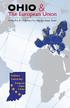 OHIO & The European Union Why the EU Matters for the Buckeye State Indiana University European Union Center Table of Contents Why does the EU Matter? 1 Ohio s Trade with the EU 2 The EU s Investments in
The Julius Fellowship at Chatham House
 Information Pack 2014 The Julius Fellowship at Chatham House Deadline for applications: 27 July 2014 www.chathamhouse.org 2 Contents Overview of the Julius Fellowship at Chatham House... 3 Chatham House...
Launch of the Economic Survey of Germany Remarks by Angel Gurría, Secretary-General OECD 13 May 2014 Berlin, Germany
 Launch of the Economic Survey of Germany Remarks by Angel Gurría, Secretary-General OECD 13 May 2014 Berlin, Germany (As prepared for delivery) Minister, Ladies and Gentlemen, It is a great pleasure to
Turkish Arab Economic Forum June 29, 2012. Mehmet Şimşek. Minister of Finance
 Turkish Arab Economic Forum June 29, 2012 Mehmet Şimşek Minister of Finance 1 Outline Turkey: Short Term Outlook Managing a Soft Landing Fallout from the Euro Crisis Turkey & MENA REBALANCING Growing ON
Commentary: What Do Budget Deficits Do?
 Commentary: What Do Budget Deficits Do? Allan H. Meltzer The title of Ball and Mankiw s paper asks: What Do Budget Deficits Do? One answer to that question is a restatement on the pure theory of debt-financed
Professional Clients Mai 2010. A. Introduction. Helaba Best Execution Policy
 Helaba Best Execution Policy Professional Clients Mai 2010 Editor: Landesbank Hessen-Thüringen MAIN TOWER Neue Mainzer Str. 52-58 60311 Frankfurt am Main Germany Contacts Elke Blass Phone: (+49) 69/91
2012 Country RepTrak Topline Report
 2012 Country RepTrak Topline Report The World s View on Countries: An Online Study of the Reputation of 50 Countries RepTrak is a registered trademark of Reputation Institute. Global Reputation Knowledge
EU economic. governance. Strong economic rules to manage the euro and economic and monetary union. istockphoto/jon Schulte.
 EU economic governance Strong economic rules to manage the euro and economic and monetary union Economic and istockphoto/jon Schulte Responding to the sovereign debt crisis important reforms of EU economic
Establishing and Operating a Quality Management System Experiences of the EUROSAI Training Committee Seminar in Budapest
 Workshop Management of an SAI Berlin (Germany), 9-11 April 2008 Establishing and Operating a Quality Management System Experiences of the EUROSAI Training Committee Seminar in Budapest (Dr. Árpád Kovács,
How to design the future EU Financial System? Resolution Framework, Crisis Prevention and Capital Markets Union
 28 October 2015, 8:15 18 h, Venue: Auditorium Maximum ESMT Berlin Conference in English, Admission is without fees, but restricted on confirmed registration Organizer: F I N A N C I A L S T A B I L I T
NERI Quarterly Economic Facts Summer 2012. 4 Distribution of Income and Wealth
 4 Distribution of Income and Wealth 53 54 Indicator 4.1 Income per capita in the EU Indicator defined National income (GDP) in per capita (per head of population) terms expressed in Euro and adjusted for
Curriculum Vitae Nicolas Brizard
 Curriculum Vitae Nicolas Brizard Name : Brizard, Nicolas Email : [email protected] Date of Birth : October, 6th, 1967 Place of Birth : France Nationality : French KEY QUALIFICATIONS Nicolas Brizard
The Changing Geography of World Trade: A Transatlantic Perspective 1. Ramin Kader & Stephan Raes. 1. Introduction
 The Changing Geography of World Trade: A Transatlantic Perspective 1 Ramin Kader & Stephan Raes 1. Introduction International trade and investment are of fundamental importance for an open and medium sized
The European Organisation For Insolvency Professionals
 The European Organisation For Insolvency Professionals Visit our website at www.insol-europe.org Insolvency Advice, Valuations and Auctions since 1930 Headoffice: Overschiestraat 59, 1062 XD Amsterdam,
 Industry Service Line 9 ABeam Consulting has developed a proprietary network utilizing the strengths of being Asia based. We provide service that fits the local conditions to clients in every region and
Global Pricing Study 2011: "Weak pricing cuts profits by 25%" Short summary
 Global Pricing Study 2011: "Weak pricing cuts profits by 25%" Short summary August 2011 Bonn Office Haydnstr. 36, 53115 Bonn, Germany Tel.: +49 228 9843-351, fax: +49 228 9843-380 e-mail: [email protected]
4 Distribution of Income, Earnings and Wealth
 4 Distribution of Income, Earnings and Wealth Indicator 4.1 Indicator 4.2a Indicator 4.2b Indicator 4.3a Indicator 4.3b Indicator 4.4 Indicator 4.5a Indicator 4.5b Indicator 4.6 Indicator 4.7 Income per
Further Developments of Hong Kong s Offshore RMB Market: Opportunities and Challenges
 Further Developments of Hong Kong s Offshore RMB Market: Opportunities and Challenges Zhang Ying, Senior Economist In recent years, as the internationalization of the RMB has been steadily carrying out,
Mahmoud Mohieldin, Ph.D. Managing Director The World Bank, Washington D.C. Knowledge sharing for global development Building up new partnerships
 Public Lecture Mahmoud Mohieldin, Ph.D. Managing Director The World Bank, Washington D.C. Knowledge sharing for global development Building up new partnerships 17 November 2011 17:00 h German Development