
Implementing an Evidence Based Hospital Discharge Process
|
|
|
- Mitchell Haynes
- 10 years ago
- Views:
Transcription
1 Implementing an Evidence Based Hospital Discharge Process Learning from the experience of Project Re-Engineered Discharge (RED) Webinar January 14, 2013 Chris Manasseh, MD Director, Boston HealthNet Inpatient Service Assistant Professor, Department of Family Medicine Boston University School of Medicine

2 Outline a) RED review b) RED implementation

3 RED Review 1. Rationale for RED Post discharge events 2. Principles of RED - Checklist 3. RED Intervention Two key components 4. Evidence for RED Results of RED Randomized Controlled Trial (RCT) 5. Role of Health Information Technology

4 RED Implementation Steps Successes Strategies

5 Rationale for RED Post discharge events Problems Consequences

6 Discharges are dangerous! Ann Intern Med 2003;138 19% of patients had a post discharge adverse event - 1/3 preventable and 1/3 ameliorable 23% of patients had a post discharge adverse event - 28% preventable and 22% ameliorable CMAJ 2004;170(3)

7 Problems 1. Communication 2. Documentation 3. Medications 4. Outstanding issues 5. Post hospital follow up 6. Patient preparation for care transition

8 Problem - 1 Communication 1. What is the standard? a. Is there a protocol? b. Is it being tracked? 2. Who knows about this? a. Medical home b. Hospitalists c. Patients 3. How is this impacting outcome? a. Patient safety b. Provider satisfaction

9 Problem - 2 Documentation 1. What is being documented? a. Is there a standard? b. Is it being monitored? 2. Who s responsible? a. Initiation b. Finalization c. Review 3. How is this transmitted? a. Method? b. Measure?

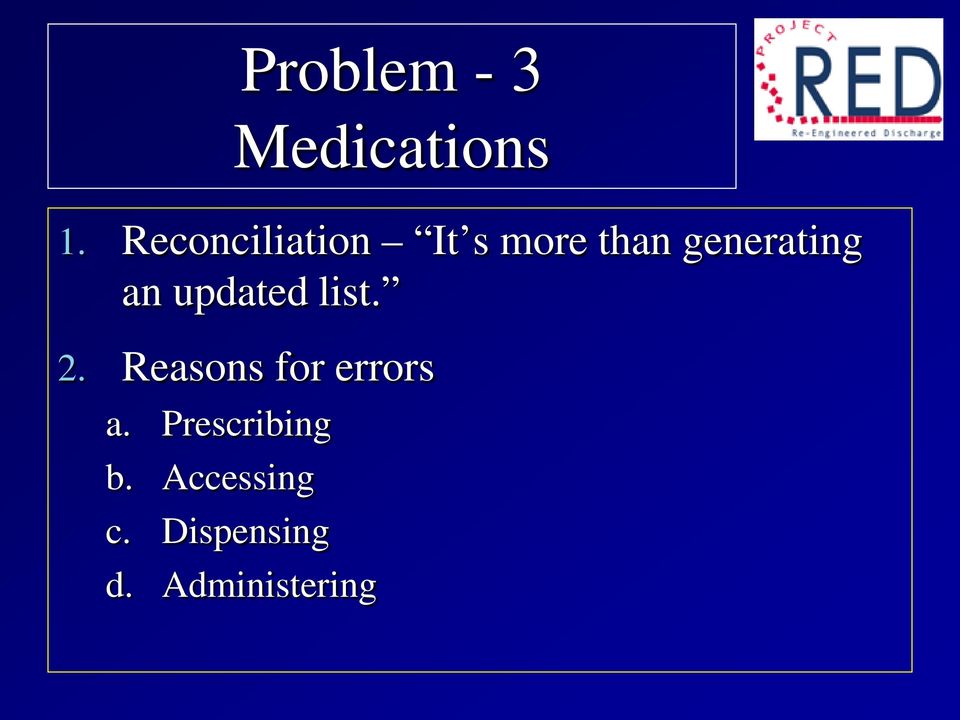
10 1. Reconciliation It s more than generating an updated list. 2. Reasons for errors a. Prescribing b. Accessing c. Dispensing Problem - 3 Medications d. Administering
11 Problem And More 1. Outstanding issues a. What are they? b. Whose responsible? 2. Post hospital follow up a. Availability, Awareness and accessibility b. Compliance 3. Patient preparation for care transition a. Awareness? b. Understanding?

12 Consequences - Increase rates of hospital utilization - Increase costs - Increase potential for post hospital adverse events - Decrease patient satisfaction

13 The Solution Can improving the discharge process reduce unplanned hospital utilization and post discharge adverse events?

14 Principles of RED Creating the checklist

15 Employing Engineering Methodologies Readmission Within 6 Months Hospital Discharge Patient Readmitted Within 3 Months Probabilistic Risk Assessment Process Mapping Failure Mode and Effects Analysis Qualitative Analysis Root Cause Analysis

16 RED Checklist Adopted by National Quality Forum as Safe Practice-15 Eleven mutually reinforcing components: 1. Patient education throughout hospital course 2. Schedule follow-up appointments physician visits & tests 3. Follow up on outstanding test results 4. Organize post-discharge services 5. Confirm medication plan reconcile discharge medications 6. Reconcile discharge plan with national guidelines 7. Review steps for what to do if problem arises 8. Transmission of discharge summary to primary care physician 9. Assess patient understanding of discharge plan 10. Give written discharge plan 11. Provide telephone reinforcement

17 RED Intervention Two key components

18 The RED Intervention Two key components In Hospital Preparation & Education of written plan Developing the After Hospital Care Plan (AHCP) Daily input from the care team Teaching the AHCP After Discharge Reinforcement of the plan Phone call within 72 hours after discharge Assess clinical status Review medications and appointments

19 After Hospital Care Plan Patient-centered discharge instruction booklet Designed to reach patients with limited health literacy Individualized to each patient and hospital

20 Cover Page

21 Medication Page (1 of 3)
22 Medication Page (2 of 3)
23 Medication Page (3 of 3)
24 Appointment Page
25 Appointment Calendar
26 Patient Activation Page
27 Primary Diagnosis Page
28 Evidence for RED Results of RCT Primary & Secondary outcomes
29 Testing the RED Intervention Randomized Controlled Trial Enrollment N=750 Randomization Enrollment Criteria English speaking Have telephone Able to independently consent Not admitted from institutionalized setting RED Intervention N=375 Usual Care N= day Outcome Data Enrollment Criteria Adult medical patients admitted to Boston Medical Center (urban academic safety-net hospital)
30 Delivering the intervention How well did we perform RED Component Intervention Group (No,%) (N=370) * Appointment scheduled with Primary Care Physician (PCP) 346 (94%) AHCP given to patient 306 (83%) AHCP/Discharge Summary faxed to PCP 336 (91%) Pharmacy telephone call completed 228 (62%) * 3 subjects excluded from outcome analysis: subject request (n=2), died before index discharge (n=1)
31 Primary Outcome: Hospital Utilization within 30 days after Discharge Hospital Utilization * Total # of visits Rate (visits/patient/month) Usual Care (n=368) Intervention (n=370) P-value Emergency Department (ED) Visits Total # of visits Rate (visits/patient/month) Readmissions Total # of visits Rate (visits/patient/month) * Hospital utilization refers to ED + Readmissions
32 Secondary Outcomes * Usual Care (n=308) Intervention (n=307) No. (%) No. (%) P-Value PCP follow-up rate 135 (44%) 190 (62%) <0.001 Identified dc diagnosis 217 (70%) 242 (79%) Identified PCP name 275 (89%) 292 (95%) * Self-reported 30 days post-discharge
33 Self-Perceived Readiness for Discharge 30 days post-discharge Usual Care RED % Prepared Understand Understand Understand Dx Questions 0 Appts Meds answered
34 AHCP Evaluation Question N (%) * In the past 4 weeks, how often did you refer to your AHCP? Daily or Frequently 29% How useful was the AHCP booklet? Extremely or Very useful 58% How helpful was the RED medication calendar? Extremely or Very helpful 72% * Patient-reported 30 days after discharge
35 Outcome Cost Analysis Cost (dollars) Usual Care (n=368) Intervention (n=370) Difference Hospital visits 412, , ,602 ED visits 21,389 11, ,104 PCP visits 8,906 12,617-3,711 Total cost/group 442, , ,995 Total cost/subject 1, We saved $412 for each patient given RED
36 The Role of Health Information Technology (IT) Virtual Discharge educator
37 Using Health IT to Overcome Challenge of Clinician Time Virtual Patient Advocates Emulate face-to-face communication Develop therapeutic alliance-empathy, gaze, posture, gesture Teach AHCP Do Teach Back Characters: Louise (L) and Elizabeth (R)
38 Automated Discharge Workflow
39 Patient interacting with Louise
40 Overall Usability Overall Satisfaction Ease of Use
41 Online Louise Post-discharge web-based system designed to emulate the post-hospital phone call Enhance adherence Medications Appointments Monitor for adverse events Posts alerts to nurse who follow-up each morning
42 RED Implementation Steps, Successes & Strategies
43 12 Steps to Implement the ReEngineered Discharge Step 1 - Make a clear and decisive statement and get buy in Step 2 - Appoint team leader Step 3 - Constitute implementation team Step 4 - Analyze current discharge process and rehospitalization rate
44
45 12 Steps to Implement the ReEngineered Discharge Step 5 - Establish goals What is the target rehospitalization rate? Step 6 - Identify the target patient population Step 7 - Decide who would assume the role of discharge advocate Step 8 - Identify the person who will conduct follow-up phone calls
46 12 Steps to Implement the ReEngineered Discharge Step 9 - Determine method to train discharge advocates & those who will conduct follow up phone call Step 10 - Decide how to generate After Hospital Care Plan Step 11 - Adapt RED for the diverse patient population Step 12 - Measure progress of RED implementation - Process outcomes - Patient outcomes
47 What to Expect Improved patient satisfaction Greater self-perceived Readiness for Discharge 30% decrease in hospital utilization within 30 days of discharge Improved PCP follow-up rate
48 RED implementation Success stories Boston HealthNet plan Preventing Avoidable Episodes project (PAVE) -> Consortium of 18 hospitals/systems in southeastern Pennsylvania
49 Success stories Boston HealthNet plan Period -> calendar year 2011 Patients given RED -> 500 Discharge educator = dedicated registered nurse (RN) Post discharge phone call = plan s care manager Results -> 30 day all cause readmission rate Cost savings -> well over $400k
50
51 Success stories PAVE project Period -> 18 months from May 2010 Mixed intervention -> all using 2 components of RED Results Partnering with patients to make follow up appointments Up from baseline of 68% to 96% Coordinating follow up testing Up from baseline of 67% to 77% Improved process of patient education during hospitalization Up from baseline of 18% to 45% Improved coordination of care among providers -> 95%
52 RED Implementation Strategies During hospitalization Formal screening tool to determine risk for readmission Process in place for patient education Discharge educator Developing and teaching after hospital care plan Pharmacist Standardized communication Primary care providers Other providers Home care Nursing Home
53 RED Implementation Strategies Prior to discharge Discharge Nurse Educator Uses checklist Assesses patient understanding of discharge plan (Teach back process used) Care Team Discusses discharge plan daily at team huddle Patient Receives written discharge plan (An AHCP is personalized for every patient leaving the hospital)
54 RED Implementation Strategies At discharge Discharge is not rushed or late in the day AHCP and discharge summary are sent to PCP office Patient reminded about post discharge phone call phone number for follow-up call confirmed
55 Practical application of RED Utilizing team members to deliver RED components MD team RN team Case Mgmt Unit Coordinator/Round ing Asst Educate patient Discuss outstanding issues Reconcile discharge plan with national guidelines Confirm medication plan Teach AHCP Assess degree of understanding employ teach back Coordinate post discharge services Review steps to take when problems arise Reinforce AHCP hours post hospital discharge with a phone call Arrange 7-10 days post discharge follow up visit Prepare and provide AHCP to be given to patient Transmit AHCP & discharge summary within 24 hours post dc
56 Summary - 1 Current hospital discharge process needs Re-engineering. Creating effective interventions require current processes to be well studied. Culture change begins with buy in from leadership and continues with dynamic multidisciplinary implementation team.
57 Summary - 2 Collaboration with IT, provides solutions in overcoming challenges of time and human resources. Customized written discharge plan to patients, optimizes self care post hospitalization Call to patients post discharge, reinforcing plan, enhances compliance.
58 Thank you! Project RED Website
RED, BOOST, and You: Improving the Discharge Transition of Care
 RED, BOOST, and You: Improving the Discharge Transition of Care Jeffrey L. Greenwald, MD, SFHM Massachusetts General Hospital - Clinician Educator Service Co-Investigator Project RED & Project BOOST The
Health Care Leader Action Guide to Reduce Avoidable Readmissions
 Health Care Leader Action Guide to Reduce Avoidable Readmissions January 2010 TRANSFORMING HEALTH CARE THROUGH RESEARCH AND EDUCATION Osei-Anto A, Joshi M, Audet AM, Berman A, Jencks S. Health Care Leader
Nancy L. Wilson Department of Medicine-Geriatrics Houston Center for Quality of Care& Utilization Studies Texas Consortium of Geriatric Education
 1 Nancy L. Wilson Department of Medicine-Geriatrics Houston Center for Quality of Care& Utilization Studies Texas Consortium of Geriatric Education Centers Care for Elders Governing Council Acknowledge
Learning Collaborative
 Care Transitions Intervention Model to Reduce 30-Day Readmissions for Chronic Cardiac Conditions Learning Collaborative Dr. Norma Jean-Francois, DNP, APN-C Dr. Mary Anne Marra, DNP, MSN, RN, NEA-BC 1 OVERVIEW
A Project to Reengineer Discharges Reduces 30-Day Hospital Readmission Rates. April 11, 2014
 A Project to Reengineer Discharges Reduces 30-Day Hospital Readmission Rates April 11, 2014 About the QIO Program Leading rapid, large-scale change in health quality: Goals are bolder. The patient is at
Care Transition Bundle Seven Essential Intervention Categories
 Seven 1. Medications Management Ensuring the safe use of medications by patients and their families and based on patients plans of care a. Assessment of patient s medications intake b. Patient and family
Care Transition Bundle Seven Essential Intervention Categories. Examples of Transition of Care Interventions
 1. Medications Management Ensuring the safe use of medications by patients and their families and based on patients plans of care a. Assessment of patient s medications intake b. Patient and family education
Post-Acute Care Transitions: An Essential Component of Accountable Care
 : An Essential Component of Accountable Care Bruce C. Smith, MD, FACP Associate Medical Director, Strategy Deployment Group Health Physicians, Seattle, WA [email protected] AMGA 2012 Institute for Quality
Relative patient benefits of a hospital-pcmh collaboration within an ACO to improve care transitions:
 Relative patient benefits of a hospital-pcmh collaboration within an ACO to improve care transitions: Lessons learned from the PCORI grant application experience Jeffrey L. Schnipper, MD, MPH, FHM Director
Tool 6: How To Monitor Re-Engineered Discharge Implementation and Outcomes
 Tool 6: How To Monitor Re-Engineered Discharge Implementation and Outcomes 6.. Purpose of This Tool Monitoring the RED lets you know whether each component of RED is being successfully implemented and
Eddy VNA Care Transitions Program
 Eddy VNA Care Transitions Program Patrick Archambeault RN, MS, CRNI Director of Clinical Specialties About Eddy VNA Large not for profit home care agency based in upstate New York CHHA, LTHHCP, Licensed
Patient Centered Medical Home (PCMH): Communication and Care Coordination
 Patient Centered Medical Home (PCMH): Communication and Care Coordination Phillip Roemer, MD Assistant Professor of Medicine General Internal Medicine Feinberg School of Medicine Northwestern University
PLAN OF CORRECTION. Provider's Plan of Correction (Each corrective action must be cross-referenced to the appropriate deficiency.)
 ID Prefix Tag (X4) R000 R200 Provider's Plan of Correction (Each corrective action must be cross-referenced to the appropriate deficiency.) Submission and implementation of this Plan of Correction does
Transitional Care Codes New Codes, New Requirements
 Transitional Care Codes New Codes, New Requirements Karen W. Foster, MSA, RN Project Facilitator New Jersey Academy of Family Physicians 2014. NJAFP This presentation and content shared during this session
Transitions of Care: The need for a more effective approach to continuing patient care
 H O T T O P I C S I N H E A L T H C A R E Transitions of Care: The need for a more effective approach to continuing patient care The need for a more effective approach to continuing patient care This paper
1. Executive Summary Problem/Opportunity: Evidence: Baseline Data: Intervention: Results:
 A Clinical Nurse Leader led multidisciplinary Heart Failure Program: Integrating best practice across the care continuum to reduce avoidable 30 day readmissions. 1. Executive Summary Problem/Opportunity:
Decreasing 30 day Readmissions on a Medical Surgical Telemetry Unit
 Decreasing 30 day Readmissions on a Medical Surgical Telemetry Unit Presented By: Dr. Micah Beachy, Rickelle Collins and Nicole Turille Context As part of healthcare reform, hospitals are being challenged
PCMH and Care Management: Where do we start?
 PCMH and Care Management: Where do we start? Patricia Bohs, RN, BSN Quality Assurance Manager Kelly McCloughan QA Data Manager Wayne Memorial Community Health Centers Honesdale, PA Wayne Memorial Community
Preventing Avoidable Re-Hospitalizations: Where Do You Fit in the Quality Care Puzzle?
 Speaker Disclosures Care Transitions Interventions: The Sussex County Transitional Care Program Dr. Wang has disclosed that he has no relevant financial relationship(s). George C. Wang, MD, PhD Medical
Avoiding Rehospitalizations in LTC Chris Osterberg, RN BSN Pathway Health Services
 Avoiding Rehospitalizations in LTC Chris Osterberg, RN BSN Pathway Health Services Objectives Understand the new consequences to hospitals for discharged clients being re-admitted within selected time
Truth or Consequences, Best Medication List Practices to Deliver Best Care. Leaning & Action Network Session
 Truth or Consequences, Best Medication List Practices to Deliver Best Care Leaning & Action Network Session Introduction David Cook (5 minutes) Housekeeping: - In event of a fire? - Restrooms? David R.
RT AS PROJECT MANAGER:
 RT AS PROJECT MANAGER: IMPROVING CARE TRANSITIONS DECREASES UNPLANNED READMISSIONS TAMMY JARNAGIN, BHS, RRT DIRECTOR CARDIOPULMONARY SERVICES, NEURODIAGNOSTICS, HOME MEDICAL EQUIPMENT Objectives Recognize
Readmissions as an Enterprise Priority. Presenters 4/17/2014
 Readmissions as an Enterprise Priority April 24, 2014 Presenters Vincent A. Maniscalco, MPA, LNHA Administrator Middletown Park Rehabilitation and Health Care Center [email protected] Eileen
hospital readmission rate reduction: building better interfaces within the community.
 hospital readmission rate reduction: building better interfaces within the community. Whitepaper By Ken Taverner, M.Sc. the issue of hospital readmission rates Leaving the hospital after being admitted
GRACE Team Care Integration of Primary Care with Geriatrics and Community-Based Social Services
 GRACE Team Care Integration of Primary Care with Geriatrics and Community-Based Social Services Aged, Blind and Disabled Stakeholder Presentation Indiana Family and Social Services Administration August
Care Transitions: Evidence-based best practices for Case Managers
 Care Transitions: Evidence-based best practices for Case Managers Mary D. Naylor, PhD, FAAN, RN Marian S. Ware Professor in Gerontology Director, NewCourtlandCenter for Transitions & Health University
Understanding and Improving Medication Reconciliation Between Hospitals and Nursing Homes
 Understanding and Improving Medication Reconciliation Between Hospitals and Nursing Homes Patient Safety Risk and Cost in Care Transitions White Paper November 2014 Stratis Health, based in Bloomington,
Joan Carroll RN, CDMS, CCM Director of Care Transitions Lee Memorial Health System
 Joan Carroll RN, CDMS, CCM Director of Care Transitions Lee Memorial Health System 1 Explain how patients experience transitions of care Identify variables that affect transitions due to lack of patient
The Quality Concern: Behavioral Health Inpatient Readmissions
 The Readmissions Quality Collaborative Kick-Off Conference June 21, 2012 The Quality Concern: Behavioral Health Inpatient Readmissions Molly Finnerty, MD Director, Bureau of Evidence Based Services and
Managing Patients with Multiple Chronic Conditions
 Best Practices Managing Patients with Multiple Chronic Conditions Advocate Medical Group Case Study Organization Profile Advocate Medical Group is part of Advocate Health Care, a large, integrated, not-for-profit
Get With The Guidelines Best Practices: A look at reducing 30-day heart failure readmission rates
 Get With The Guidelines Best Practices: A look at reducing 30-day heart failure readmission rates Thank you for joining the webinar! The presentation will begin shortly. *Please make sure your computer
Contact: Jessica Lorenzo, M.P.H., Senior Project Manager. E-mail: [email protected]
 Mount Sinai School of Medicine: Improving Access to High Quality Asthma Care in East Harlem Grant Results Report October 2008 BACKGROUND INFORMATION Mount Sinai School of Medicine Division of General Internal
Locking the Revolving Door of Readmissions
 Locking the Revolving Door of Readmissions The Pharmacist s Role in Keeping Patients Healthy, Happy and At Home Steve Riddle, BS Pharm, BCPS, FASHP VP of Clinical Affairs, Pharmacy OneSource Objectives
CCNC Care Management
 CCNC Care Management Community Care of North Carolina (CCNC) is a statewide population management and care coordination infrastructure founded on the primary care medical home model. CCNC incorporates
Medication error is the most common
 Medication Reconciliation Transfer of medication information across settings keeping it free from error. By Jane H. Barnsteiner, PhD, RN, FAAN Medication error is the most common type of error affecting
MEDSAFE Annual Conference 2012. Prescribed Strategies for Today s Challenges October 4, 2012
 MEDSAFE Annual Conference 2012 Prescribed Strategies for Today s Challenges October 4, 2012 Carroll Hospital Center Larry Siegel, Pharm.D. Director of Pharmacy 10/4/12 66% of patients surveyed did not
Cheri Basso BSN, RN-BC,CHFN Hospital Initiatives to Improve Outcomes. FINANCIAL DISCLOSURE: No relevant financial relationship exists
 Cheri Basso BSN, RN-BC, CHFN Mary Washington Healthcare Fredericksburg, VA Cheri Basso BSN, RN-BC,CHFN Hospital Initiatives to Improve Outcomes FINANCIAL DISCLOSURE: No relevant financial relationship
WHITE PAPER. How a multi-tiered strategy can reduce readmission rates and significantly enhance patient experience
 WHITE PAPER How a multi-tiered strategy can reduce readmission rates and significantly enhance patient experience Vocera Communications, Inc. June, 2014 SUMMARY Hospitals that reduce readmission rates
Conflict of Interest Disclosure
 Leveraging Clinical Decision Support for Optimal Medication Management Anne M Bobb, BS Pharm., Director Quality Informatics Children s Memorial Hospital, Chicago IL, February 20, 2012 DISCLAIMER: The views
IDENTIFYING INFORMATION MANAGEMENT CHALLENGES FACED BY HOME HEALTHCARE PROFESSIONALS MANAGING OLDER ADULTS TRANSITIONS FROM HOSPITAL TO HOME CARE
 IDENTIFYING INFORMATION MANAGEMENT CHALLENGES FACED BY HOME HEALTHCARE PROFESSIONALS MANAGING OLDER ADULTS TRANSITIONS FROM HOSPITAL TO HOME CARE Alicia Arbaje, M.D., M.P.H. Assistant Professor of Medicine,
NYSPFP Preventable Readmissions Initiative: Pilot Review and Post Hospital Care
 NYSPFP Preventable Readmissions Initiative: Pilot Review and Post Hospital Care June 17, 2014 A partnership of the Healthcare Association of New York State and the Greater New York Hospital Association
Presented by Kathleen S. Wyka, AAS, CRT, THE AFFORDABLE CA ACT AND ITS IMPACT ON THE RESPIRATORY C PROFESSION
 Presented by Kathleen S. Wyka, AAS, CRT, THE AFFORDABLE CA ACT AND ITS IMPACT ON THE RESPIRATORY C PROFESSION At the end of this session, you will be able to: Identify ways RT skills can be utilized for
Reconciling the Differences. Karen Lippett B.Sc.Phm Humber River Regional Hospital Renal Dialysis Unit
 Reconciling the Differences Karen Lippett B.Sc.Phm Humber River Regional Hospital Renal Dialysis Unit Objectives 1. Review the medication discharge counselling process in the renal dialysis program 2.
Improving Care Transitions using PDSA Methodology
 Improving Care Transitions using PDSA Methodology Catherine Payne, MD, FHM Care Transitions Physician Champion Medical Director of Clinical Informatics Erlanger Medical Center Chattanooga, Tennessee Objectives
Upon completion of this activity, the participant should be able to:
 The Utility of Root Cause Analysis and Failure Mode and Effects Analysis in the Hospital Setting Learning objectives: Upon completion of this activity, the participant should be able to: 1. Discuss the
Care Coordination and Transitions in Behavioral Health
 Care Coordination and Transitions in Behavioral Health Pam Pietruszewski Integrated Health Consultant The National Council for Behavioral Health This product is supported by the Florida Department of Children
Clinical pathway concept - a key to seamless care
 SECTION 5: PATIENT SAFETY AND QUALITY ASSURANCE 1 Clinical pathway concept - a key to seamless care Audrey Janoly-Dumenil, Hôpital Edouard Herriot, CHU Lyon Marie-Camille Chaumais, Hôpital Antoine Béclère,
Six Communication Best Practices for Transitional Care Management
 WHITE PAPER Six Communication Best Practices for Transitional Care Management In the era of chronic illness and historically long lifespans, patient care transitions to home or another facility have become
Congestive Heart Failure Management Program
 Congestive Heart Failure Management Program The Congestive Heart Failure Program is the third statewide disease management program developed by CCNC. The clinical directors reviewed prevalence and outcome
Person-Centered Nurse Care Management in Home Based Care: Impact on Well-Being and Cost Containment
 Person-Centered Nurse Care Management in Home Based Care: Impact on Well-Being and Cost Containment Donna Zazworsky, RN, MS, CCM, FAAN Vice President: Community Health and Continuum Care Carondelet Health
Transitions of Care Management Coding (TCM Code) Tutorial. 1. Introduction Meaning of moderately and high complexity 2
 Transitions of Care Management Coding (TCM Code) Tutorial Index 1. Introduction Meaning of moderately and high complexity 2 2. SETMA s Tools for using TCM Code 3 Alert that patient is eligible for TCM
Kaiser Permanente of Ohio
 Kaiser Permanente of Ohio Chronic Disease Management Program March 11, 2011 Presenters: Amy Kramer and Audrey L. Callahan 1 Objectives 1. Define the roles and responsibilities of the Care Managers in the
Reducing Hospital Readmissions With Enhanced Patient Education
 Published by FierceHealthcare Custom Publishing Reducing Hospital Readmissions With Enhanced Patient Education SPONSORED BY At least 20 percent of all patients who are admitted to a U.S. hospital make
HealthCare Partners of Nevada. Heart Failure
 HealthCare Partners of Nevada Heart Failure Disease Management Program 2010 HF DISEASE MANAGEMENT PROGRAM The HealthCare Partners of Nevada (HCPNV) offers a Disease Management program for members with
Health Care Homes Certification Assessment Tool- With Examples
 Guidelines: Health Care Homes Certification Assessment Form Structure: This is the self-assessment form that HCH applicants should use to determine if they meet the requirements for HCH certification.
Nurse Transition Coach Model: Innovative, Evidence-based, and Cost Effective Solutions to Reduce Hospital Readmissions
 Nurse Transition Coach Model: Innovative, Evidence-based, and Cost Effective Solutions to Reduce Hospital Readmissions Leslie Becker RN, BS Jennifer Smith RN, MSN, MBA Leslie Frain MSN, RN Jan Machanis
CCNC Care Management Standardized Plan
 Standardization & Reporting: Why is standardization important? Community Care Networks are responsible for the delivery of targeted care management services that will improve quality of care while containing
RIH Transitions of Care Collaboration with Coastal Medical To Improve Transitions for Patients Discharged Hospital To Home
 RIH Transitions of Care Collaboration with Coastal Medical To Improve Transitions for Patients Discharged Hospital To Home Sergio Petrillo, PharmD Clinical Pharmacist Specialist, Rhode Island Hospital
Risk Factors for Readmission
 Strategies for Identifying and Decreasing for Pamela Roberts, PhD, OTR/L, SCFES, FAOTA, CPHQ, FNAP Cedars Sinai Medical Center California Hospital Association Center for Post Acute Care Annual Conference
DRAFT. How to Conduct a Post-discharge Follow-up Phone Call. Contract HHSA290200600012i. April 15, 2011
 How to Conduct a Post-discharge Follow-up Phone Call Contract HHSA290200600012i New tool (deliverable 2.4) April 15, 2011 Prepared for Cindy Brach Agency for Healthcare Research & Quality (AHRQ) Rockville,
MEDICAL MANAGEMENT PROGRAM LAKELAND REGIONAL MEDICAL CENTER
 MEDICAL MANAGEMENT PROGRAM LAKELAND REGIONAL MEDICAL CENTER Publication Year: 2013 Summary: The Medical Management Program provides individualized care plans for frequent visitors presenting to the Emergency
Member name, address, phone number, DOB, MC400 Member ID, MA Recipient Number
 CONNECTED CARE DATA TEMPLATE Member Tier Display SMI Tier 1, 2, or 3 (plus historical activity to show changes in tier) Member Demographics Member name, address, phone number, DOB, MC400 Member ID, MA
Visiting Nurse Service of New York. New York State Department of Health Medicaid Incentive Payment System (MIPS) External Stakeholder Feedback
 New York State Department of Health Medicaid Incentive Payment System (MIPS) External Stakeholder Feedback Visiting Nurse Service of New York February 19, 2010 11:30 a.m. 12:30 p.m. New York State Department
Telemedicine in Physical Health and Behavioral Health
 Telemedicine in Physical Health and Behavioral Health Collaborative Care Summit April 16, 2015 Shabana Khan, MD Assistant Professor of Psychiatry Western Psychiatric Institute and Clinic University of
Empowering Value-Based Healthcare
 Empowering Value-Based Healthcare Episode Connect, Remedy s proprietary suite of software applications, is a powerful platform for managing value based payment programs. Delivered via the web or mobile
Overview of emar Electronic Medication Administration Record
 Overview of emar Electronic Medication Administration Record March 2006 WHAT IS emar? emar Electronic Medication Administration Record - Replaces the paper MAR MAK Medication Administration Check (Siemens)
Presented by: Char Brar, ACNP, MS(Chem.), MSN, RN Cardiology Nurse Practitioner JBVAMC, Chicago
 Presented by: Char Brar, ACNP, MS(Chem.), MSN, RN Cardiology Nurse Practitioner JBVAMC, Chicago 200 bed acute care facility 4 Community Based Out-patient Clinics (CBOCs) 58,000 Veterans IN FY 2008 : 768
Angela Coladonato, MSN, RN, NEA-BC Tina Maher, BSN, RN, NE-BC Kathy Zopf-Herling, MSN, RN-BC
 Leveraging IT to Support a Re-engineered engineered Discharge Process Angela Coladonato, MSN, RN, NEA-BC Tina Maher, BSN, RN, NE-BC Kathy Zopf-Herling, MSN, RN-BC All speakers have completed commercial
Hospital Post-Discharge Laboratory Results Management System
 Hospital Post-Discharge Laboratory Results Management System Terrence J. Adam MD, PhD*. Assistant Professor, University of Minnesota, Minneapolis, MN. Adriane I.Budavari MD. Assistant Professor, Mayo Medical
Hospital readmissions contribute to the increasing. Deployment of Lean Six Sigma in Care Coordination An Improved Discharge Process
 Professional Case Management Vol. 19, No. 2, 77-83 Copyright 2014 Wolters Kluwer Health Lippincott Williams & Wilkins Deployment of Lean Six Sigma in Care Coordination An Improved Discharge Process Susan
Meaningful Use. Goals and Principles
 Meaningful Use Goals and Principles 1 HISTORY OF MEANINGFUL USE American Recovery and Reinvestment Act, 2009 Two Programs Medicare Medicaid 3 Stages 2 ULTIMATE GOAL Enhance the quality of patient care
Using Root Cause Analysis to Determine Why Readmissions are High. Presentation Objectives. Background Information 11/30/2011
 Using Root Cause Analysis to Determine Why Readmissions are High Nancy Seck RBN, BSN, MPH, CPHQ Director, Quality Management Glendale Memorial Hospital and Health Center Presentation Objectives Identify
Transitional Care Management (TCM) Presented by Noridian Part B Medicare Provider Outreach and Education May 2016
 Transitional Care Management (TCM) Presented by Noridian Part B Medicare Provider Outreach and Education DISCLAIMER This information release is the property of Noridian Administrative Services, LLC (NAS).
Empowering Value-Based Healthcare
 Empowering Value-Based Healthcare Episode Connect, Remedy s proprietary suite of software applications, is a powerful platform for managing value-based payment programs. Delivered via the web or mobile
Implementing an RN Protocol for Uncomplicated Hypertension
 RN Hypertension Protocol Joyce Cheung, RN KP, Orange County Karen Sielbeck, RN KP, South Bay Noshin Afrookhteh, RN KP, Orange County Implementing an RN Protocol for Uncomplicated Hypertension Protocol
Newark Beth Israel Medical Center Selected: DSRIP Project #8: The Congestive Heart Failure (CHF) Transition Program
 Project Focus Newark Beth Israel Medical Center Selected: DSRIP Project #8: The Congestive Heart Failure (CHF) Transition Program Transitioning Into Transitional Care Program Modeled After Project RED,
Care Coordination at Frederick Regional Health System. Heather Kirby, MBA, LBSW, ACM Assistant Vice President of Integrated Care
 Care Coordination at Frederick Regional Health System Heather Kirby, MBA, LBSW, ACM Assistant Vice President of Integrated Care 1 About the Health System 258 Licensed acute beds Approximately 70,000 ED
Tool 5: How To Conduct a Postdischarge Followup Phone Call
 Tool 5: How To Conduct a Postdischarge Followup Phone Call 87. 1. Purpose of This Tool The Re-Engineered Discharge (RED) aims to effectively prepare patients and families for discharge from the hospital,
Preventing Readmissions
 Emerging Topics in Healthcare Reform Preventing Readmissions Janssen Pharmaceuticals, Inc. Preventing Readmissions The Patient Protection and Affordable Care Act (ACA) contains several provisions intended