
Platform Competition under Asymmetric Information
|
|
|
- Ami Miller
- 10 years ago
- Views:
Transcription
1 Platform Competition under Asymmetric Information Hanna Hałaburda Yaron Yehezkel Working Paper Copyright 2011 by Hanna Hałaburda and Yaron Yehezkel Working papers are in draft form. This working paper is distributed for purposes of comment and discussion only. It may not be reproduced without permission of the copyright holder. Copies of working papers are available from the author.

2 Platform Competition under Asymmetric Information Hanna Ha laburda Harvard Business School Yaron Yehezkel Tel Aviv University First version: January 30, 2011 This version: June 24, 2011 Abstract In the context of platform competition in a two-sided market, we study how exante uncertainty and ex-post asymmetric information concerning the value of a new technology affects the strategies of the platforms and the market outcome. We find that the incumbent dominates the market by setting the welfare-maximizing quantity when the difference in the degree of asymmetric information between buyers and sellers is significant. However, if this difference is below a certain threshold, then even the incumbent platform will distort its quantity downward. Since a monopoly incumbent would set the welfare-maximizing quantity, this result indicates that platform competition may lead to a market failure: Competition results in a lower quantity and lower welfare than a monopoly. We consider two applications of the model. First, we consider multi-homing. We find that multi-homing solves the market failure resulting from asymmetric information. However, if platforms can impose exclusive dealing, then they will do so, which result in market inefficiency. Second, the model provides a new argument for why it is usually entrants, not incumbents, that bring major technological innovations to the market. Keywords: asymmetric information, platform competition, exclusive dealing, technology adoption JEL: L15, L41 We thank Ramon Casadesus-Masanell, Kobi Glazer, Robin Lee, Gal Oestreicher-Singer, Jan Rivkin, Maher Said, Yossi Spiegel, Rani Spiegler, as well as seminar participants at Tel-Aviv University and the Israeli Antitrust Authority, conference participants at IIOC, Searle Center Conference on Internet Search and Innovation at Northwestern University, North American Meeting of Econometric Society, and the CRES Strategy Conference for helpful comments and discussions. 1

3 1 Introduction When platforms adopt new technologies, the users often do not know how much utility they will obtain from a new technology until they join the platform. However, they can privately learn this utility afterward. A new generation of operating systems for smartphones, such as Apple s ios or Google s Android, creates uncertainty among agents on both sides of the market. Application developers may not know the costs of developing an application for this new generation. Likewise, users may not know their utility from using the new software. After developers and users join the platform, they privately learn their respective costs and using habits, and thus, uncertainty is replaced with asymmetric information. Similar examples abound. Gamers and third-part videogame developers may privately lean their utility and cost from using a new technology for a videogame console such as Microsoft s Xbox, Sony s PlayStation or Nintendo s Wii but only after they adopt it. This paper considers platform competition in a two-sided market when agents on both sides of the market face the informational problem. In this context we ask several questions. First, we ask how the informational problem affects profits, prices, and market efficiency. We find that asymmetric information may lead to a downward distortion of trade under competition, while under monopoly full efficiency is achieved. Second, previous literature has shown that platforms use a divide-and-conquer strategy by subsidizing one side of the market in order to attract it. This raises the question of how the informational problem affects the decision which side to subsidize. We show that it is optimal for a monopoly platform to subsidize the side with the smaller information problem. Under competition, the decision which side to subsidize is also affected by asymmetric information, though the relation is not as straightforward. Given the results for the competition between platforms, we study two applications: multi-homing and technology change. In the first application, we allow agents to multi-home (i.e., register to both competing platforms simultaneously). We ask whether platforms benefit from multi-homing or have an incentive to restrict the agents ability to multi-home by imposing exclusive dealing. We find that the incumbent dominates the market and earns higher profit under multi-homing than under single-homing. Moreover, multi-homing solves the market failure resulting from asymmetric information in that the incumbent can always induce the efficient level of trade. However, if platforms can impose exclusive dealing, they will do so, resulting in an inefficiently low level of trade. In the second application, we ask how the informational problem affects the decision to adopt 2

4 a new technology. We show that a new technology and the resulting informational problem benefits the incumbent more than the entrant; but despite that, the entrant has a higher incentive than the incumbent to adopt a new technology. We study competition between two platforms in a two-sided market that is composed of buyers and sellers. The platforms are undifferentiated except for the beliefs they are facing. One of the platforms is an incumbent that benefits from agents favorable beliefs. Under favorable beliefs, agents expect all other agents to join the incumbent unless it is a dominant strategy for them not to join the platform. The favorable beliefs that the incumbent enjoys make it difficult for the second platform, the entrant, to gain market share. The two platforms implement a new technology, such as a new generation of video game consoles or operating systems. All players are uninformed about the buyers valuation and sellers costs from using the new technology. Buyers and sellers privately learn this information after joining a platform but before they trade. They can only trade through a platform. We assume that the two platforms compete by offering fixed access fees as well as menus of quantities and transaction fees as a function of buyers valuation parameter and sellers costs. Buyers and sellers then choose which platform to join and pay the relevant access fees. Once they join the platform, they privately observe their valuation and cost, and choose a line from the menu. Given their choices, they trade for the specified quantity. Before studying competition, we first consider a monopoly benchmark. We find that a monopolist who benefits from favorable beliefs sets a contract which motivates the sellers and buyers to trade the quantity that maximizes total social welfare (i.e., maximizes the gains from trade). A monopolist that suffers from unfavorable beliefs, however, sets a contract that distorts the quantity below the welfare-maximizing level. Moreover, the monopolist facing unfavorable beliefs charges zero access fees from the side with the lowest informational problem. Intuitively, both monopoly platforms need to pay ex-post information rents to the buyers and sellers for motivating them to reveal their private information after they joined the platform. A monopolist that benefits from favorable beliefs can ex-ante capture these expected information rents through access fees. In contrast, a monopolist that faces unfavorable beliefs needs to subsidize one side of the market in order to attract it and therefore cannot extract the expected information rents from both sides. Thus, such a monopolist has an incentive to distort the quantity downward in order to reduce the information rents. We then consider competition between the incumbent and the entrant, facing favorable and unfavorable beliefs respectively. Under competition, we find that the incumbent dom- 3

5 inates the market by setting the welfare-maximizing quantity i.e., the same as under monopoly only if the difference in the degree of asymmetric information between buyers and sellers is significant. However, if this difference is below a certain threshold, then even the incumbent platform will distort its quantity downward. Since a monopolist benefiting from favorable beliefs always sets the welfare-maximizing quantity, this result indicates that platform competition might result in a market failure: Competition results in a lower quantity and lower welfare than monopoly. In this case, competition also leads the two platforms to subsidize opposite sides in their divide-and-conquer strategies. We present two applications of the model. First, we examine how market outcome is affected by the sellers ability to multi-home (i.e., join both platforms). A developer of a smartphone s application, for example, might choose to develop an application for more than one operating system. Likewise, a videogame developer might choose to develop a videogame for more than one videogame console. We find that the incumbent dominates the market and earns a higher profit under multi-homing than under single-homing. Multi-homing solves the market failure resulting from asymmetric information in that the incumbent can motivate the two sides to trade for the welfare-maximizing quantity even if the difference in the degree of asymmetric information between the two sides is small. However, if the incumbent offers the optimal contract under multi-homing, the entrant can take the market over from the incumbent by preventing the seller from multi-homing (e.g., imposing exclusive dealing or making the technologies of the two platforms incompatible. This leads to the single-homing equilibrium and the resulting market failure, where the trade level is below the welfaremaximizing level. As another application of our model, we investigate if the entrant or the incumbent have incentive to bring major technological innovation to the market. Even though entrants often leapfrog the incumbents (e.g. in video game console industry 1 ), there is no consensus in the existing literature on the topic. The incumbent, enjoying the installed base and favorable beliefs, has higher returns from adopting a new technology than the entrant; therefore, the incumbent has more incentives to innovate. This is the argument behind the seminal paper of Gilbert and Newbery (1982). In practice, however, incumbents often lag behind, even if they are aware of the entrant threat. Reinganum (1983) shows that it may be a result of uncertainty about the success of the new technology. The incumbent has some profits from the old technology, while the entrant has not. Therefore, the gain to the incumbent from 1 E.g., see Hagiu and Halaburda (2009). 4

6 the success of the new technology is smaller than the gain to the entrant. This gives the entrant higher incentive to adopt a new technology. We add to this discussion by exploring the question of technology adoption in a two-sided market environment with an additional level of uncertainty the informational problem. We extend our basic model of platform competition under asymmetric information to the case where the two platforms can choose between two technologies: an incremental technology and a radically innovative technology that can be highly successfully but only with some probability (otherwise the radical technology fails to provide any payoff to the two sides). Since the incumbent wins the market if both platforms choose the same technology, in an equilibrium the incumbent and the entrant always adopt different technologies. However, whether the incumbent or the entrant adopts the radical technology depends on its probability of success and the level of asymmetric information. If the success probability is low, the entrant has stronger incentive to adopt the radical technology. That is, the more radical the innovation, the more likely it is that the entrant not the incumbent adopts it. Moreover, we show that the above results relay on the presence of asymmetric information: under full information, there are two equilibria in which the two platforms choose different technologies, regardless of the probability of success of the radical technology. 1.1 Related Literature The economic literature on competing platforms extends the work of Katz and Shapiro (1985) on competition with network effects, where the size of the network creates additional value to the customers (e.g. telephone network). Spiegler (2000) considers a model with positive externality among two agents and finds that a third party, such as a platform, can extract these externalities by using exclusive interaction contracts, that includes reducing the payment to one of the agent if the other agent also signs with the third party. Caillaud and Jullien (2001) analyze a market with price competition between two platforms. The platforms are undifferentiated, except for the fact that one of the platforms (the incumbent) benefits from favorable beliefs, while the other platform (the entrant) faces unfavorable beliefs. Under favorable beliefs, agents expect all other agents to join the incumbent, unless it is a dominant strategy for them not to join the platform. Caillaud and Jullien show that both platforms will use a divide-and-conquer strategy, where they charge a negative access price from one of the sides of the market and positive from the other side. Moreover, their 5

7 paper finds that if platforms cannot use transaction fees, then the incumbent makes positive profit even without product differentiation, while with transaction fees, both platforms make zero profit. Caillaud and Jullien extend their results in their (2003) paper. In the (2003) paper, platforms have an imperfect matching technology which identifies correctly and matches agents successfully with probability λ 0, 1]. In this modified environment and under single-homing, the only equilibria are dominant firm equilibria. However, because of the imperfect matching technology, there are also efficient multi-homing equilibria. Jullien (2008) considers platform competition in the context of multi-sided markets with vertically differentiated platforms and sequential game, and analyzes the resulting pricing strategies. Our model follows this line of literature by considering two competing platforms where agents beliefs are favorable toward one of the platforms and unfavorable toward the other. However, our model introduces asymmetric information which has not been considered in this context. Introduction of asymmetric information allows us to study how informational problem affects platform competition. An optimal strategy of a platform often involves subsidizing one side of the market. The question which side of the market should be subsidized which we address in our paper has been also present in the literature. Armstrong (2006) considers differentiated competing matchmakers with a positive network externality. He shows that matchmakers compete more aggressively on the side that generates larger benefits to the other side (i.e. the one that has lower value from matching). This competition results in lower prices for the agents on the lower-valuation side. Hagiu (2006) considers a model of competing platforms when agents are sellers and buyers. Moreover, the platforms first compete on one of the sides, and only then move to compete on the other side. He finds that platforms ability to commit to their second stage prices makes it less likely to have exclusive equilibria. However, the two papers (Armstrong (2006) and Hagiu (2006)) do not consider the information problem that we investigate. Several papers consider platforms that face informational problems. Ellison, Möbius and Fudenberg (2004) analyze competing uniform-price auctions, where the two sides of the market are buyers and sellers. The model in Ellison, Möbius and Fudenberg (2004) shares the same information structure as in our model in that buyers and sellers are uninformed about their valuations before joining the platform, and privately learn their valuations after joining. However, Ellison, Mobius and Fudenberg (2004) consider a very restrictive price competition between platforms (see their Section 7), where a platform can only charge an 6
![In the (2003) paper, platforms have an imperfect matching technology which identifies correctly and matches agents successfully with probability λ 0, 1].](/docs-images/45/10188689/images/page_7.jpg "In this modified environment and under single-homing, the only equilibria are dominant firm equilibria.")
8 access price that must be the same in both sides of the market. Therefore, their paper does not allow for divide-and-conquer strategies. Peitz, Rady and Trepper (2010) consider an infinite horizon model with a platform that performs experimentation along time to learn the demand of the two sides of the market. However, they do not analyze competition between platforms and a coordination problem between the two sides of the market, which is the focus of our paper. Our model is also related to antitrust issues in two-sided markets. Amelio and Jullien (2007) consider the case where platforms are forbidden to charge negative access price. In such a case, platforms will use tying in order to increase the demand on one side of the market, which in turn increases the demand on the other side. Choi (forthcoming) shows that tying induces consumers to multi-home (i.e., register with more than one matchmaker). Casadesus-Masanell and Ruiz-Aliseda (2009) consider competing platforms that can choose whether to offer compatible systems, and find that incompatibility results in an equilibrium with a dominant platform that earns higher profits than under compatibility. Hagiu and Lee (2011) consider platforms that connect between content providers and consumers. They find that if content providers can directly charge consumers for their content, then a multihoming equilibrium is possible. If platforms are the ones charging consumers for content, then content providers will tend to deal exclusively with one of the platforms. These papers, however, do not allow for asymmetric information in the context of platform competition. 2 Model and a Monopoly Platform Benchmark Consider two sides of a market: seller side (S) and buyer side (B). 2 The seller wishes to sell a good to the buyer. However, the seller and the buyer cannot trade unless they join the platform. For example, the buyer can represent a user of a new operating system while the seller can represent a developer of an application for this new system. They can connect only if they use the same operating system. The two players may also represent a game developer for a new videogame console and a gamer, and they need a game console in order to benefit from trading. The utilities of the seller and the buyer from trading are t C(q, c) and V (q, θ) t, 2 Alternatively, we can assume that there is some other number of buyers and sellers, but there is no negative externalities among agents at the same side and agents types are not correlated. We relate to this simplifying assumption in more details in Section 6. 7

9 respectively, where C(q, c) is the seller s production cost, V (q, θ) is the value of the product to the buyer, and t is the monetary transfer from the buyer to the seller. The seller s production cost depends on parameters q and c, while the buyer s value depends on the parameters q and θ. The parameter q describes the good exchanged between the buyer and the seller, where we assume that V q > 0 and C q > 0 (subscripts denote partial derivatives). Specifically, the parameter q can measure the quantity that the seller produces and transfers to the buyer. Alternatively, q may measure quality, in which case the seller sells one indivisible good to the buyer. More generally, we view q as a measure of the level of trade in the market. For q = 0, C(0, c) = V (0, θ) = 0, so that no trade occurs. The parameters θ and c affect the buyer s willingness to pay and the seller s production cost respectively, where V θ > 0, C c > 0, V qθ > 0 and C qc > 0. One should think of θ as the buyer s taste parameter that positively affects the buyer s marginal valuation of the product, and c as a technology parameter that affects the seller s marginal cost: Higher c increases the marginal cost. i.e., Let q (θ, c) denote the quantity that maximizes the gains from trade for given θ and c, Hence, q (θ, c) solves { } q (θ, c) = arg max V (q, θ) C(q, c). q V q (q (θ, c), θ) = C q (q (θ, c), c). (1) Suppose that V qq 0 and C qq 0 where at least one of these inequalities is strong and V q (0, θ) > C q (0, c), while V q (q, θ) < C q (q, c) for q. Therefore, q (θ, c) is uniquely defined by (1), and q (θ, c) is increasing with θ and decreasing with c. Let W (θ, c) denote the maximal welfare achievable for given θ and c, i.e., W (θ, c) = V (q (θ, c), θ) C(q (θ, c), c). Throughout the paper, we assume that q is observable by all players and is contractible. Amazon, for example, can easily observe the quantity sold on its website, and can charge transaction fees from buyers, sellers, or both according to this quantity. Likewise, a console manufacturer can make quality specifications for its video games and make a payment contingent on this quality. However, we realize that this assumption does not hold in some other two-sided markets. 3 Before proceeding to our main analysis of platform competition, in this section we study the benchmark case of a monopolist connecting the two sides of the market. In such a case, the buyer and the seller can either join the monopoly platform or stay out of the market. 3 The analysis for markets with unobservable q deserves a separate paper. 8

10 Before the buyer and the seller join the platform, all players are uninformed about θ and c, and share a commonly known prior that θ is distributed between θ 0, θ 1 ] according to a distribution function k(θ) and a cumulative distribution K(θ), and that c is distributed between c 0, c 1 ] according to a distribution function g(c) and a cumulative distribution G(c). We make the standard assumptions that (1 K(θ))/k(θ) is decreasing in θ and G(c)/g(c) is increasing in c. Then, after joining the platform but before trading, the buyer and the seller each observes their private information and chooses whether to trade or not. Moreover, we assume throughout that all players are risk neutral. More precisely, the timing of the game is following: First, the platform offers a contract to the buyer and the seller. We explain the features of this contract below. The buyer and the seller observe the offer and simultaneously decide whether to buy access to the platform or not. At this point, they need to pay the access fees if they decide to join. After joining, each agent observes the realization of his own private information, and decides whether to trade or not. If both sides joined and decided to trade, the trade and transfers occur. Notice that this model corresponds to a principal-agent problem under asymmetric information, where the platform is the principal and the buyer and seller are the agents. The main features of the specific problem described here are related to Myerson and Satterthwaite (1983) and Spulber (1988), with two exceptions. First, here the principal is a platform (or competing platforms) that aims to connect the agents. Second, here players are initially uninformed, and the two sides learn their types only after contracting with a platform. Asymmetric information is a typical feature of principal-agent problems. However, because the principal is a platform, it introduces a novel element: coordination problem between the two sides that allows the platform to use a divide-and-conquer strategy, where it subsidizes one side in order to attract it and charge positive access fees from the other side. Following the literature on principal-agent problems, suppose that a platform offers a contract Cont = {F S, F B, t S (θ, c), t B (θ, c), q(θ, c)}, where F S and F B are access fees that the buyer and the seller pay the platform for joining the platform before knowing their private information. These fees can be zero or even negative (as is the case under platform competition). Moreover, t S (θ, c), t B (θ, c), and q(θ, c) are all menus given (θ, c), such that after joining the platform and observing their private information, the buyer and the seller simultaneously report θ and c to the platform, and then given these reports, the seller produces q(θ, c) and delivers it to the buyer. For simplicity, we 9

11 assume that the buyer and the seller pay t S (θ, c) and t B (θ, c) directly to the platform instead of to each other. Naturally, we allow t S (θ, c) and t B (θ, c) to be negative, so it is possible to write an equivalent mechanism where one agent pays the platform and the platform pays the other agent, or where one agent pays directly to the other agent and the platform charges some royalty out of this transaction. Also, suppose that the buyer and the seller can always refuse to trade after observing their private information, in which case they do not need to pay t S (θ, c) and t B (θ, c). However, F S and F B are not refunded. Finally, we follow previous literature on two-sided markets (Caillaud and Jullien (2001), Caillaud and Jullien (2003) and Jullien (2008), in particular) by distinguishing between a platform about which the agents have favorable or optimistic beliefs, called P o, and a platform about which they have unfavorable or pessimistic beliefs, P p. Favorable beliefs mean that side i = {B, S} expects the other side j = {B, S}, j i, to join platform P o if side j gains non-negative payoffs from joining given that side i joins. In other words, given the contract, if there is an equilibrium in which both sides join P o, they will do so. In contrast, under unfavorable beliefs side i = {B, S} does not expect side j = {B, S}, j i, to join platform P p if side j gains negative payoffs from joining given that side i did not join. In other words, given the contract, if there is an equilibrium in which neither side joins P p, such equilibrium is selected, even if there also exists another equilibrium in which both sides join the platform. The distinction between favorable and unfavorable beliefs may capture a difference in agents ability to coordinate on joining an old or a new platform. If a certain platform is a well-known, established incumbent that had a significant market share in the past, then agents from one side of the market may believe that agents from the other side are most likely to continue using this platform and will decide to join the incumbent based on this belief. A new entrant, however, may find it more difficult to convince agents that agents from the opposite side will also join. 2.1 Full Information To illustrate the role that information plays in our model, consider first a full information benchmark. The objective of a platform is to maximize its profit. We assume that the platform does 10

12 not bear any marginal cost. Therefore, the platform sets the contract to maximize Π = F B + F S + t B (θ, c) + t S (θ, c). Suppose that θ and c are common knowledge from the beginning of the game, that is, before the buyer and the seller join P. Then, both P o and P p can implement the welfaremaximizing outcome, q (θ, c), and earn W (θ, c) i.e., the whole social surplus by offering a contract {F S, F B, t S (θ, c), t B (θ, c), q(θ, c)} = {0, 0, C(q (θ, c), c), V (q (θ, c), θ), q (θ, c)}. In the case of P p, both sides do not need to pay access fees, and as they can always refuse to participate in the trading stage, they cannot lose from joining P p. Thus, both sides join the platform if the platform is P p, 4 and clearly, they join the platform if it is P o. Notice that the same argument holds if there is uncertainty but not asymmetric information such that all players are uninformed about θ and c when they sign the contract, but θ and c are ex-post observable and contractible. To conclude, under full information or uncertainty (without ex-post asymmetric information) there is no difference between P o and P p. 2.2 Monopoly Platform under Ex-post Asymmetric Information Contrary to the full information benchmark, for the remainder of the paper we suppose that in the contracting stage no player knows θ and c, and that the buyer and the seller privately observe θ and c, respectively, after joining the platform but before they decide whether to trade or not. We consider a truthfully revealing mechanism in which the buyer and the seller pays F S and F B for joining the platform, and then they are induced by the offered menu to truthfully report θ and c, and trade at the level q(θ, c) with the payments t S (θ, c) and t B (θ, c) to the platform. Consider first the optimal contract for P o, a monopolistic platform facing favorable (optimistic) expectations. As the buyer and the seller have ex-post private information, P o will have to leave the buyer and the seller with ex-post utility (gross of the access fees), i.e., information rents, to motivate them to truthfully reveal their private information. Standard 4 We assume that if an agent is indifferent between joining or not, he joins the platform. If the indifference is resolved otherwise, P p needs to set one of the access fees to ε, with ε positive but arbitrarily close to 0. Then, in the limit P p and P o offer the same contract, which results in the same outcome. 11

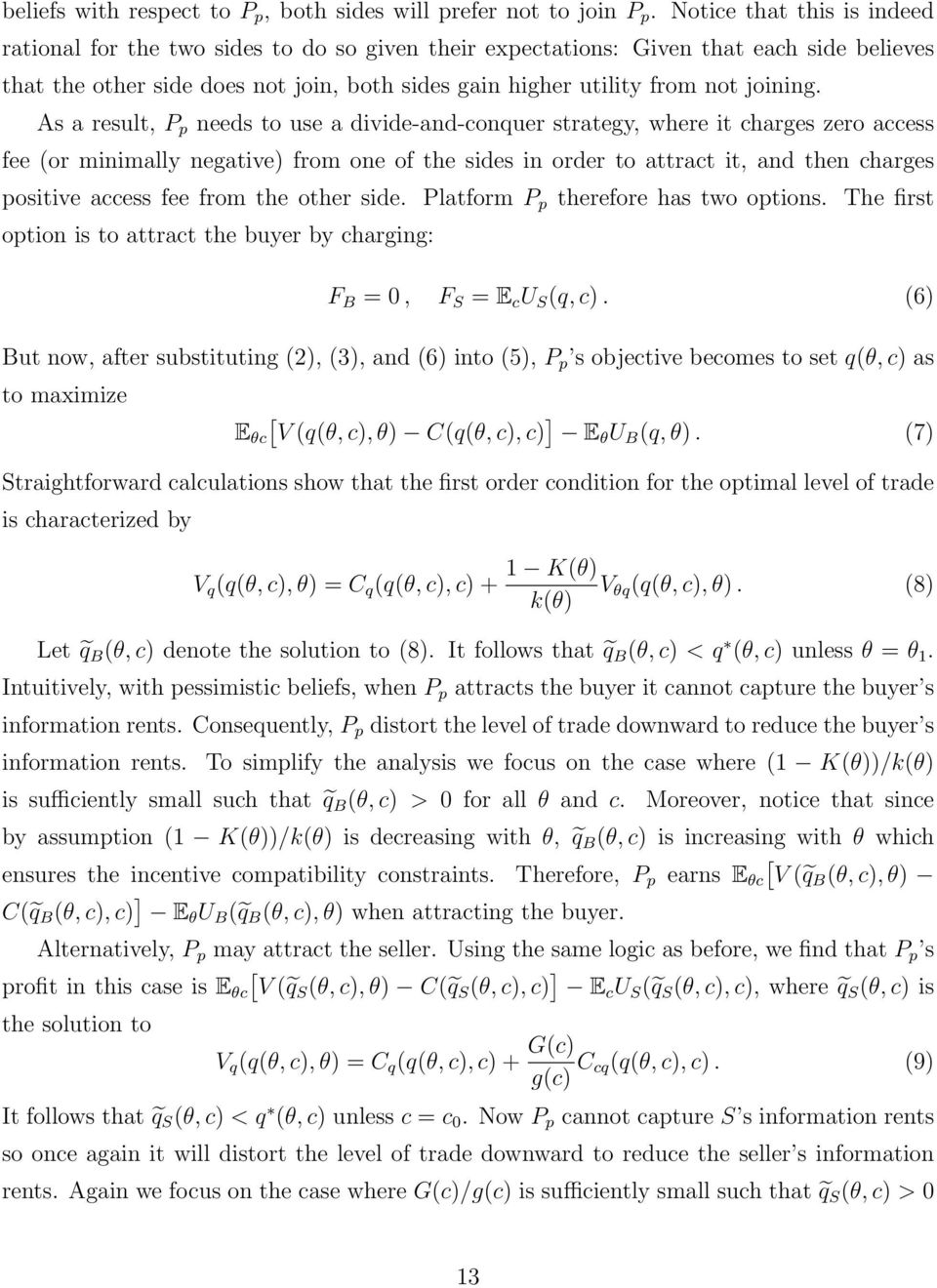
13 calculations 5 show that each side gains ex-post expected information rents of U B (q, θ) = E c θ θ 0 V θ (q( θ, c), θ)dk( θ), U S (q, c) = E θ c1 c C c (q(θ, c), c)dg( c). (2) To ensure that the buyer and the seller agree to trade after they joined the platform and learned their private information we need ] ] E c t B (θ, c) = E c V (q(θ, c), θ) UB (q, θ), E θ t S (θ, c) = E θ C(q(θ, c), c) US (q, c). (3) Conditions (2) and (3) along with the property that q(θ, c) is nondecreasing in θ and nonincreasing with c ensure that once the buyer and the seller joined P o and privately observed θ and c, they will truthfully report it to P o. To make sure that both sides agree to participate ex-ante, that is, before they learn their private information, the maximum access fees that P o can charge are F B = E θ U B (q, θ), F S = E c U S (q, c). (4) The platform has two sources of revenue: access fees and transaction fees. Therefore, P o s objective is to set q(θ, c) to maximize Π = F B + F S + E θ c tb (θ, c) + t S (θ, c) ], (5) subject to the constraints (2), (3), and (4). After substituting (2), (3), and (4) into (5) and rearranging, we see that P o s problem is to set q(θ, c) to maximize E θ c V (q(θ, c), θ) C(q(θ, c), c) ]. Hence, P o will set q (θ, c), and will be able to earn W = E θ c W (θ, c). Intuitively, P o has to leave ex-post information rents to the two sides, but P o can charge upfront access fees from the two sides that are equal to their expected ex-post information rents. Therefore, P o has no incentive to distort the level of trade in order to reduce the agents information rents. Next, consider P p, a platform facing unfavorable (pessimistic) beliefs of agents. The difference in beliefs results in different equilibrium contract, and different outcome. In order to satisfy ex-post incentive compatibility and individual rationality constraints, the constraints (2) and (3) remain the same. The main difference is in F B and F S. While a P o can charge positive F B and F S from both sides, P p cannot. Given positive F B and F S, each side loses if it pays access fees and the other side does not join. Therefore, under pessimistic 5 See Fudenberg and Tirole (1991). We use E X to denote the expectation with respect to variable X. 12

14 beliefs with respect to P p, both sides will prefer not to join P p. Notice that this is indeed rational for the two sides to do so given their expectations: Given that each side believes that the other side does not join, both sides gain higher utility from not joining. As a result, P p needs to use a divide-and-conquer strategy, where it charges zero access fee (or minimally negative) from one of the sides in order to attract it, and then charges positive access fee from the other side. Platform P p therefore has two options. The first option is to attract the buyer by charging: F B = 0, F S = E c U S (q, c). (6) But now, after substituting (2), (3), and (6) into (5), P p s objective becomes to set q(θ, c) as to maximize E θc V (q(θ, c), θ) C(q(θ, c), c) ] Eθ U B (q, θ). (7) Straightforward calculations show that the first order condition for the optimal level of trade is characterized by V q (q(θ, c), θ) = C q (q(θ, c), c) + 1 K(θ) V θq (q(θ, c), θ). (8) k(θ) Let q B (θ, c) denote the solution to (8). It follows that q B (θ, c) < q (θ, c) unless θ = θ 1. Intuitively, with pessimistic beliefs, when P p attracts the buyer it cannot capture the buyer s information rents. Consequently, P p distort the level of trade downward to reduce the buyer s information rents. To simplify the analysis we focus on the case where (1 K(θ))/k(θ) is sufficiently small such that q B (θ, c) > 0 for all θ and c. Moreover, notice that since by assumption (1 K(θ))/k(θ) is decreasing with θ, q B (θ, c) is increasing with θ which ensures the incentive compatibility constraints. Therefore, P p earns E θc V ( qb (θ, c), θ) C( q B (θ, c), c) ] E θ U B ( q B (θ, c), θ) when attracting the buyer. Alternatively, P p may attract the seller. Using the same logic as before, we find that P p s profit in this case is E θc V ( qs (θ, c), θ) C( q S (θ, c), c) ] E c U S ( q S (θ, c), c), where q S (θ, c) is the solution to V q (q(θ, c), θ) = C q (q(θ, c), c) + G(c) g(c) C cq(q(θ, c), c). (9) It follows that q S (θ, c) < q (θ, c) unless c = c 0. Now P p cannot capture S s information rents so once again it will distort the level of trade downward to reduce the seller s information rents. Again we focus on the case where G(c)/g(c) is sufficiently small such that q S (θ, c) > 0 13
15 for all θ and c. Moreover notice that since by assumption G(c)/g(c) is increasing with c, q S (θ, c) is decreasing with c which ensures the incentive compatibility constraints. Next, we turn to compare between P p s two options. Let E θc V ( q B (θ, c), θ) C( q B (θ, c), c) U B ( q B (θ, c), θ)] E θc V ( q S (θ, c), θ) C( q S (θ, c), c) U S ( q S (θ, c), c)]. The parameter measures the difference in the degree of ex-post asymmetric information between the buyer and the seller. If > 0, then the information problem is stronger on the seller side, in that E θc U S (q, θ)] > E θc U B (q, c)] for all q. Conversely, when < 0, the information problem is more prominent on the buyer s side. As it turns out, plays a crucial role in our analysis as it is convenient to characterize the equilibrium outcome of the competitive case given. 6 example. To illustrate the intuition behind, consider the following Example 1 (uniform distributions of types) Suppose that the buyer has linear demand and the seller has linear costs such that V (q, θ) = θq q2 and C(q, c) = cq. Also, suppose that 2 θ and c are distributed uniformly along the intervals µ θ σ θ, µ θ +σ θ ] and µ c σ c, µ c +σ c ]. The parameters µ θ and µ c are the mean values of θ and c. The parameters σ θ and σ c measure the degree to which P p is uninformed about θ and c. To ensure that the market is fully covered, suppose that µ θ µ c > max{3σ θ + σ c, σ θ + 3σ c }. Then σ c > σ θ = > 0, σ c < σ θ = < 0, σ c = σ θ = = 0. Given, the solution for the monopoly case becomes evident: If > 0, platform P p prefers to attract the buyer by charging him zero or minimally negative access fee. Conversely, for < 0, P p prefers to attract the seller. Lemma 1 below is a direct consequence of the discussion above. 6 Even though the sign of the difference E θc U S (q, θ)] E θc U B (q, c)] determines the sign of, for further representation it is more convenient to characterize the solution in terms of instead of E θc U S (q, θ)] E θc U B (q, c)]. 14

16 Lemma 1 Under asymmetric information, a monopolistic platform facing optimistic beliefs, P o sets the welfare-maximizing level of trade, q. A monopolistic platform that faces pessimistic beliefs, P p, distorts the level of trade downward. Specifically, (i) If > 0, then it is optimal for platform P p to subsidize the buyer (F B = 0) and to set q = q B (θ, c) < q (θ, c). (ii) If < 0, then it is optimal for platform P p to subsidize the seller (F S = 0) and to set q = q S (θ, c) < q (θ, c). (iii) It is optimal for platform P p to set q = q (θ, c) only if (1 K(θ))/k(θ) = G(c)/g(c) = 0 for all θ and c. In such a case, it earns W. As Lemma 1 reveals, divide-and-conquer strategy emerges in the context of this model as a direct consequence of asymmetric information: P p implements the trade maximizing q only if (1 K(θ))/k(θ) = G(c)/g(c) = 0 for all θ and c. Moreover, Lemma 1 predicts that P p finds it optimal to attract the side with the lowest informational problem, in the sense that this side is not expected to learn much about its value from trade after joining the platform. If > 0, asymmetric information is stronger on the seller side. Consequently, P p has to leave higher ex-post information rents for the seller. Since under divide-and-conquer P p loses the expected information rents of the side that P p subsidizes, it will choose to lose the information rents of the buyer. The opposite case holds if asymmetric information is stronger on the buyer side. In the context of Example 1, Lemma 1 indicates that if σ c > σ θ, then the spread of the potential realizations of c is wider than θ, implying that the informational problem is more significant from the seller side. Consequently, > 0, so the platform attracts the buyer and sets q B (θ, c). The opposite case holds when σ c > σ θ. Moreover, if σ c = σ θ = 0, then the informational problem vanishes and platform P p implements the welfare-maximizing level of trade. 3 Competition between Platforms In this section we consider platform competition. In contrast to the monopoly benchmark in Section 2, we find that under competition the platform benefiting from favorable be- 15

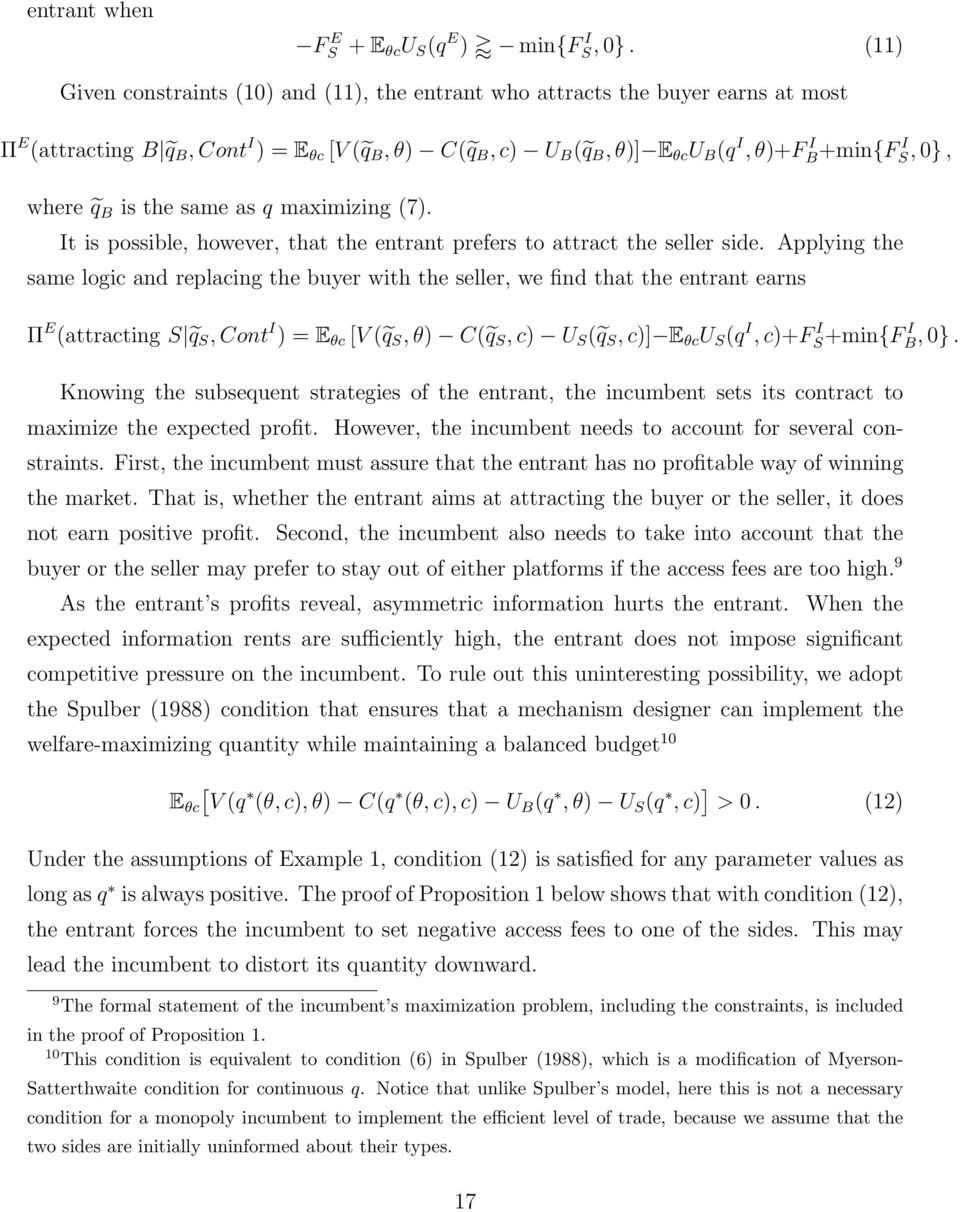
17 liefs sometimes also distorts downward the level of trade. This is the result of asymmetric information. Suppose that there are two platforms competing in the market. The platforms are undifferentiated, except for the beliefs each is facing. 7 We call one of the platforms incumbent (I), and the other entrant (E). The incumbent benefits from favorable beliefs, in the same way as P o, while the entrant faces unfavorable beliefs, in the same way as P p. Because of the favorable beliefs, both sides join the incumbent whenever it is an equilibrium, even if there also exists an equilibrium where they both join the entrant. Conversely, both sides join the entrant only when there is no other equilibrium. Each platform sets contract Cont P = {F P B, F P S, tp B (θ, c), tp S (θ, c), qp (θ, c)}, for P = I, E with the objective to maximize its profit. We focus on a sequential game where the incumbent announces its contract slightly before the entrant. 8 Users decide which platform to join after observing both contracts. We solve for the subgame perfect equilibrium. Given the incumbent s strategy, Cont I, the entrant has two options to win the market: one is to attract the buyer side, and the other to attract the seller side. For tractability, for now on we refer to any q(θ, c) as just q, whenever possible. To attract the buyer under unfavorable beliefs, the entrant needs to charge F E B E θc U B (q I ) F I B, (10) where E θc U B (q I ) is the expected information rent that the buyer obtains from the incumbent if both sides join the incumbent under Cont I, and symbol stands for slightly greater but almost equal. Condition (10) ensures that even when the buyer believes that the seller joins the incumbent, the buyer still prefers to join the entrant. Therefore, when condition (10) is satisfied, there is no equilibrium in which both sides join the incumbent. Given that the buyer joins the entrant independently of the seller, the seller finds it attractive to join the 7 Both platforms use the same technology. We onsider the case of different technologies and the adoption of new technologies in Section 5. 8 We analyze a simultaneous game between the two platforms in Appendix A. There we show that, for some parameter values there is no pure-strategy Nash equilibrium in the simultaneous game. Where a pure-strategy Nash equilibrium exists for the simultaneous game, it has similar qualitative features as subgame perfect equilibrium in the sequential game considered here. To generate clean and tractable results we therefore focus on the sequential game. 16

18 entrant when F E S + E θc U S (q E ) min{f I S, 0}. (11) Given constraints (10) and (11), the entrant who attracts the buyer earns at most Π E (attracting B q B, Cont I ) = E θc V ( q B, θ) C( q B, c) U B ( q B, θ)] E θc U B (q I, θ)+f I B+min{F I S, 0}, where q B is the same as q maximizing (7). It is possible, however, that the entrant prefers to attract the seller side. Applying the same logic and replacing the buyer with the seller, we find that the entrant earns Π E (attracting S q S, Cont I ) = E θc V ( q S, θ) C( q S, c) U S ( q S, c)] E θc U S (q I, c)+f I S+min{F I B, 0}. Knowing the subsequent strategies of the entrant, the incumbent sets its contract to maximize the expected profit. However, the incumbent needs to account for several constraints. First, the incumbent must assure that the entrant has no profitable way of winning the market. That is, whether the entrant aims at attracting the buyer or the seller, it does not earn positive profit. Second, the incumbent also needs to take into account that the buyer or the seller may prefer to stay out of either platforms if the access fees are too high. 9 As the entrant s profits reveal, asymmetric information hurts the entrant. When the expected information rents are sufficiently high, the entrant does not impose significant competitive pressure on the incumbent. To rule out this uninteresting possibility, we adopt the Spulber (1988) condition that ensures that a mechanism designer can implement the welfare-maximizing quantity while maintaining a balanced budget 10 E θc V (q (θ, c), θ) C(q (θ, c), c) U B (q, θ) U S (q, c) ] > 0. (12) Under the assumptions of Example 1, condition (12) is satisfied for any parameter values as long as q is always positive. The proof of Proposition 1 below shows that with condition (12), the entrant forces the incumbent to set negative access fees to one of the sides. This may lead the incumbent to distort its quantity downward. 9 The formal statement of the incumbent s maximization problem, including the constraints, is included in the proof of Proposition This condition is equivalent to condition (6) in Spulber (1988), which is a modification of Myerson- Satterthwaite condition for continuous q. Notice that unlike Spulber s model, here this is not a necessary condition for a monopoly incumbent to implement the efficient level of trade, because we assume that the two sides are initially uninformed about their types. 17
19 Proposition 1 Suppose that 0. In equilibrium, the incumbent always dominates the market and attracts the buyer (by charging FB I < 0), while extracting all the seller s expected information rents through F I S. Moreover, (i) If > E θc U B (q, θ)], then the entrant also attracts the buyer (FB E < 0) and sets q E = q B. The incumbent sets the welfare-maximizing quantity, q I = q, and earns Π I = E θc V (q, θ) C(q, c)] E θc V ( q B, θ) C( q B, c) U B ( q B, θ)]. (ii) If 0 < E θc U B ( q B, θ)] then the entrant attracts the seller (FS E 0) and sets q E = q S. The incumbent distorts the quantity downward to q I = q B, and earns Π I =. (iii) If E θc U B ( q B, θ)] E θc U B (q, θ)], then the entrant is indifferent between attracting the buyer or the seller. The incumbent distorts the quantity downward to q I = q, where q is an increasing function of with values q q B, q ]. Moreover, the incumbent earns Π I = E θc V ( q, θ) C( q, c) ] E θc V ( q B, θ) C( q B, c) U B ( q B, θ)]. The case where < 0 is similar, with the buyer replacing seller (see Figure 1 for a full characterization of the equilibrium). 11 Proof. See Appendix, page 40. Proposition 1 offers several interesting observations. The first observation concerns the equilibrium level of trade set by the dominant platform, the incumbent. If the difference in the degree of ex-post asymmetric information between the sides,, is large such that > E θc U B (q, θ)], then the incumbent sets the welfare-maximizing quantity as in the monopoly case. However, if the difference is small, even though the incumbent benefits from favorable beliefs, the incumbent distorts the trade downward. For E θc U B ( q B, θ)] E θc U B (q, θ)], this distortion becomes stronger the smaller is. This result is surprising as it shows that competition actually reduces social welfare in comparison with a monopoly. More precisely, 11 The proposition describes subgame perfect equilibrium in sequential game. In a simultaneous game, the unique Nash equilibrium is the same as the subgame perfect equilibrium in sequential game when > E θc U B (q, θ)]. However, for E θc U B (q, θ)], there does not exist a pure strategy Nash equilibrium in the simultaneous move game (see Proposition 5 in Appendix A). 18
![Moreover, (i) If > E θc U B (q, θ)], then the entrant also attracts the buyer (FB E < 0) and sets q E = q B.](/docs-images/45/10188689/images/page_19.jpg "The incumbent sets the welfare-maximizing quantity, q I = q, and earns Π I = E θc V (q, θ) C(q, c)] E θc V ( q B, θ) C( q B, c) U B ( q B, θ)].")
20 Both platforms attract the buyer. The incumbent sets q I = q. E θc U B ( q B, θ)] E θc U B (q, θ)] The incumbents attracts the buyer, and the entrant is indifferent between attracting the seller or the buyer. The incumbent sets q I = q < q. The incumbent attracts the buyer while the entrant attracts the seller. The incumbent sets q I = q B < q. 0 The incumbent attracts the seller while the entrant attracts the buyer. The incumbent sets q I = q S < q. E θc U S (q, θ)] E θc U S ( q S, θ)] The incumbents attracts the seller, and the entrant is indifferent between attracting the seller or the buyer. The incumbent sets q I = q < q. Both platforms attract the seller. The incumbent sets q I = q. Figure 1: Properties of the equilibrium in sequential game, depending on the value of. 19

21 the presence of competitive threat (even if not an active competitor) increases the customer surplus for some customers, while creating a dead-weight loss. The intuition for this result is the following. Suppose that, > 0, and therefore the informational problem is more significant on the seller s side. As in the monopoly benchmark, this creates an incentive to attract the buyer and extract all the seller s information rents. Now, if is sufficiently large, then this incentive is strong and both platforms compete on attracting the buyer, while extracting all the seller s information rents. If however is not too large, then this incentive still prevails but it is weaker, and therefore the incumbent attracts the buyer and extracts all the seller s rent; but, now the entrant prefers to attract the seller. When the platforms compete on different sides of the market, neither of them can extract the information rents from both sides of the market. In consequence, also the incumbent distorts the level of trade downward. To see why, note that if both platforms compete on the buyer s side, then the incumbent extract the entire seller s rent. Moreover, as the buyer expects the seller to joint the incumbent, the buyer expects to gain positive rents from joining the incumbent, implying that the incumbent internalizes the buyer s rents as well. Formally, the buyer will join the incumbent as long as FB E E θcu B (q I ) FB I, or FB I E θcu B (q I )+FB E. Consequently, the incumbent internalizes the rents of both sides, and as in the monopoly case, will set the welfare-maximizing quantity. If however the incumbent attracts the buyer while the entrant attracts the seller, then the incumbent extracts the entire seller s rent, but the entrant provides the seller with a subsidy, FS E 0. This implies that now the buyer expects the seller to join the entrant, and therefore the buyer will not expect to gain any rents from joining the incumbent. Formally, in this case the buyer joins the incumbent as long as F I B E θcu B (q E ) F E B, or F I B E θcu B (q E )+F E B. Consequently, now the incumbent can only internalize the seller s rents, and therefore distorts the level of trade in order to reduce the buyer s rents. The second observation concerns the incumbent s equilibrium profit. If the difference in the degree of ex-post asymmetric information is large such that > E θc U B (q, θ)], then the incumbent earns the difference between the P o s and the P p s profits under monopoly. Notice that this difference is higher the higher are the information rents that the entrant cannot extract from the buyer: E θc U B ( q B, θ). Hence, the incumbent s profit approaches zero at the limit as E θc U B ( q B, θ) 0. This result implies that the incumbent gains more competitive advantage the larger is the informational problem from the buyer s side. However, if is 20
22 sufficiently small (i.e., 0 < < E θc U B (q, θ)]), the incumbent gains a higher profit the higher is the difference in the ex-post asymmetric information problem of the two sides,, and the incumbent s profit approaches zero at the limit as 0. Notice that the special case of = 0 may occur even if the distributions of types, K(θ) and G(c), are not degenerate, i.e., there is uncertainty and asymmetric information. In the assumptions of Example 1, this will occur if σ c = σ θ even though σ c and σ θ might be significantly large. When this is the case, both platforms distort their quantities downward: the incumbent to q B and the entrant to q S. And since = 0, both platforms earn no profit. However, when the type distribution is degenerate on (at least) one side of the market, both platforms set the trade-maximizing q and earn zero profits. Therefore, without uncertainty on both sides, the market behaves as in Caillaud and Jullien (2001 and 2003). Corollary 1 Suppose that there is no uncertainty on the buyer side, i.e., (1 K(θ))/k(θ) = 0 for all θ. Then, for 0, q I = q E = q and both platforms earn zero profits. The same market outcome occurs for G(c)/g(c) = 0 and 0. Proof. See Appendix, page 45. The result of our Proposition 1 differs from Proposition 2 in Caillaud and Jullien (2001) and Proposition 1 in Caillaud and Jullien (2003). The propositions in Caillaud and Jullien papers show that undifferentiated platforms competing with both access fees and transaction fees make zero profit. In these papers, with no differentiation, the two platforms set the highest possible transaction fees and then compete in access fees (as in Bertrand competition), resulting in zero profits. Since Caillaud and Jullien do not assume asymmetric information in their papers, Corollary 1 is consistent with their results. The result of our Proposition 1 contributes to the above papers by showing that asymmetric information restores the incumbent s competitive advantage and enables the incumbent to earn positive payoff even without product differentiation. 4 Application: Multi-homing and Exclusive Dealing In this section, we extend the competition model from Section 3 by allowing one of the sides to multi-home by joining both platforms. This raises the question of whether a platform may want to restrict the agent s ability to join the competing platform by imposing exclusive 21
23 dealing. This question has important implications for antitrust policy toward such exclusive arrangements. As we show in this section, the equilibrium under multi-homing differs from single-homing only for some cases. For those cases, the multi-homing equilibrium yields efficient levels of trade (welfare-maximizing q ), while in the single-homing equilibrium the trade levels are distorted downward. Moreover, in those cases, the incumbent prefers the multi-homing equilibrium. However, if the incumbent plays as in the multi-homing equilibrium, the entrant s best response is to impose exclusive dealing. equilibrium. This, in effect, leads to the single-homing Suppose that it is the seller who can join more than one platform. 12 A third-party video game developer, for example, can choose to write a video game for more than one console. A smartphone application developer can choose to write an application compatible with more than one operating system. We focus on multi-homing coming from only one side of the market following the observation that in many markets usually there is only one side that can choose to join more than one platform. Smartphone users, for example, usually do not carry more than one smartphone. Likewise, videogame players usually buy only one console. 13 As before, we assume that the incumbent announces its contract to both sides slightly earlier than the entrant, and the two sides simultaneously decide to which platform to join after observing contracts offered by both platforms. If the seller indeed joins both platforms, the buyer may join either the incumbent or the entrant. If both these situations constitute an equilibrium, then the equilibrium where the buyer joins the incumbent is played, since the incumbent enjoys favorable beliefs. The entrant can succeed in attracting both sides of the market only if it ensures that the equilibrium with the buyer and the seller joining the incumbent does not exist while also ensuring that there is an equilibrium in which both sides join the entrant. 12 The situation where only buyer multi-homes is symmetric. Our analysis, where only the seller multihomes, is conducted for all values of. If the buyer multi-homes under > 0, it equivalent to seller multi-homing under < Indeed, in the above examples even users can potentially join more than one platform, but for the most part they choose not to do so for exogenous, not strategic, reasons. Smartphone users, for example, may find it cumbersome to carry more than one smartphone with them. Likewise, gamers may find it difficult to store more than one videogame console with all the relevant accessories. We take these constraints as exogenous and therefore assume that buyers cannot multi-home. 22
24 To be successful in the market, the entrant needs to attract (by subsidizing) one of the sides. It has two options: to attract the buyer, or to attract the seller. The entrant can attract the buyer by charging F E B E θc U B (q I, θ) F I B = F E B = F I B E θc U B (q I, θ). This condition is identical to the single-homing case because by assumption a buyer cannot multi-home. Given that the buyer joins the entrant, the seller will join as well if only the entrant provides him with a non-negative expected payoff. This is different from the single-homing case, where the entrant had to compete with the seller s expected payoff from joining the incumbent. Hence F E S + E θc U S (q E, c) 0 = F E S = E θc U S (q E, c). Notice that now FS E differs from the case of single-homing in that the incumbent s offer to the seller does not affect the seller s decision to join the entrant, because the seller can multi-home and therefore it joins the entrant whenever doing so provides positive payoff. The entrant s profit function when attracting the buyer is Π E (attracting B q E ) = E θc V (q E, θ) C(q E, c) U B (q E, θ) ] + F I B E θc U B (q I, θ), maximized by q E = q B. Next, suppose that the entrant chooses to attract the seller. Given unfavorable beliefs against the entrant, the entrant needs to make it worthwhile for the seller to join even if the buyer would not join. That is, the entrant needs to set FS E 0, which we approximate by FS E = 0. This is again because the seller can always join both platforms and therefore the incumbent s offer to the seller does not affect the seller s decision on whether to join the entrant. Given FS E = 0, the buyer now expects the seller to join both platforms, and therefore will agree to join the entrant only if it offers him a larger surplus. Notice that with the seller joining both platforms, the coordination problem for the buyer weakens significantly. He knows that he will trade, no matter which platform he joins, because the seller is present on both. The buyer prefers to join th entrant when E θc U B (q E, θ) F E B E θc U B (q I, θ) F I B = F E B = E θc U B (q E, θ) E θc U B (q I, θ) + F I B. This condition differs from the single-homing case. (13) To see the intuition behind this condition, notice that if E θc U B (q E ) FB E E θcu B (q I ) FB I, then there is an equilibrium in 23
25 which the seller joins both platforms while the buyer joins only the incumbent. As beliefs are unfavorable against the entrant, the two sides of the market will play this equilibrium and as FS E = 0, the entrant will not make positive profit. Condition (13) ensures that the buyer prefers to join the entrant even if he believes that the seller joined both platforms. The entrant s profit is maximized for q E = q S, and yields Π E (attracting S q S (θ, c)) = E θc V ( q S, θ) C( q S, c) U S ( q S, c)] + F I B E θc U B (q I, θ). A direct comparison of the entrant s profits under the two scenarios reveals that the entrant attracts the buyer when > 0, and attracts the seller when < 0, independently of the incumbent s strategy. 14 The incumbent s objective is to maximize its profit, under the constraints that winning the market is not profitable for the entrant, and both the buyer and the seller prefer to join the incumbent than to stay out of the market. 15 Proposition 2 Suppose that the seller can multihome by joining both platforms. Then, in the equilibrium of the sequential game: (i) If > 0, then the incumbent sets q I = q, F I B = E θc V ( q B, θ) C( q B, c) U B ( q B, θ)]+ E θc U B (q, θ), F I S = E θcu S (q, c) and earns Π I (q ) = E θc V (q, θ) C(q, c)] E θc V ( q B, θ) C( q B, c) U B ( q B, θ)]. (ii) If < 0, then the incumbent sets q I = q, F I B = E θc V ( q S, θ) C( q S, c) U S ( q S, c)]+ E θc U B (q, θ), F I S = E θcu S (q, c) and earns: Π I (q ) = E θc V (q, θ) C(q, c)] E θc V ( q S, θ) C( q S, c) U S ( q S, c)]. Proof. See Appendix, page 45. Comparing Proposition 2 with Proposition 1 reveals that with multi-homing, the incumbent always offers the welfare-maximizing quantity regardless of, thus the market is always efficient. Intuitively, if the entrant chooses to attract the seller but the seller can multi-home, then the buyer still gains the payoff E θc U B (q I, θ) F I B 14 For = 0, the entrant is indifferent between attracting the buyer or the seller. 15 This optimization problem is formally stated in the proof of Proposition 2. from staying with the 24
26 incumbent because the seller joined both platforms. As the buyer still benefits from the presence of the seller in the incumbent s platform, the entrant needs to charge the buyer a lower access price in order to convince the buyer to sign with the entrant. This in turn reduces the entrant s profit from attracting the seller to begin with, and therefore enables the incumbent to dominate the market without distorting its quantity. Given that now we have characterized the equilibrium under multi-homing, for the remainder of this section we will analyze each platform s incentives to prevent multi-homing. A platform can prevent multi-homing by imposing exclusive dealing restriction. For example, a videogame console manufacturer can impose exclusive dealing on third-party developer that prevents developers from dealing with competing manufacturers. In other cases, a platform can use indirect ways for preventing multi-homing, by making their platform incompatible with other platforms and therefore imposing additional cost on the agent s ability to multi-home. In the context of our model, the platforms profits and q in an equilibrium with multihoming are the same as under single-homing for E θc U B ( q B, θ)] or E θc U S ( q S, c)]. Therefore, we focus our analysis of exclusivity on the case where E θc U S ( q S, c)] < < E θc U B ( q B, θ)]. We first show in Lemma 2 that if exclusive dealing is possible, then there is no multihoming equilibrium. Lemma 2 Suppose that E θc U S ( q S, c)] < < E θc U B ( q B, θ)] and that platforms can impose exclusive dealing. Then, the incumbent earns higher profit in the multi-homing equilibrium than in the single-homing equilibrium. However, given that the incumbent sets the multi-homing strategies, the entrant finds it optimal to impose exclusive dealing, and by doing so is able to dominate the market with positive profit. Proof. See Appendix, page 46. Lemma 2 shows that while the incumbent benefits from multi-homing, the entrant will respond to the incumbent s multi-homing strategy by imposing exclusive dealing. This in turn means that it is not optimal for the incumbent to set the multi-homing strategies to begin with. The intuition for this result is as follows: Multi-homing provides the entrant with an advantage and a disadvantage over single-homing. In comparison with single-homing, it is easier for the entrant to attract the seller under multi-homing because the seller can join 25
27 both platforms, and therefore joins the entrant as long as the seller gains non-negative payoff. At the same time, it is more difficult for the entrant to attract the buyer under multi-homing for the same reason: If the buyer expects the seller to join both platforms, the entrant needs to leave the buyer with higher payoff to motivate the buyer to choose the entrant over the incumbent. In the multi-homing equilibrium, the incumbent eliminates the former, positive effect of multi-homing on the entrant by providing the seller with zero payoff. In such a case, the seller s incentive to join the entrant becomes the same under single- and multi-homing. Then, the incumbent can amplify the latter, negative effect of multi-homing by offering a low, possibly negative access fees to the buyer. As the incumbent turns the multi-homing effects against the entrant, the entrant would like to correct this by imposing exclusive dealing. Next, we establish that in equilibrium, the two platforms indeed play their single-homing strategies and at least one of them imposes exclusive dealing. Proposition 3 Suppose that E θc U S ( q S, c)] < < E θc U B ( q B, θ)] and that platforms can impose exclusive dealing. Then, in equilibrium, (i) If 0 < E θc U B ( q B, θ)], then the incumbent sets the single-homing strategy but does not need to impose exclusive dealing. Given the incumbent s strategy, the entrant earns zero profit if it imposes exclusive dealing, and negative profit otherwise. (ii) If E θc U S ( q S, c)] < 0, then the incumbent sets the single-homing strategy and imposes exclusive dealing. The entrant then plays its single-homing strategy and earns zero profit. Proof. See Appendix, page 48. Proposition 3 reveals that if the informational problem is more significant on the seller s side (0 < E θc U B ( q B, θ)]), then the incumbent does not directly impose exclusive dealing, though the entrant s ability to impose exclusivity forces the incumbent to set the single-homing strategies. If however the informational problem is more significant on the buyer s side E θc U S ( q S, c)] < 0), then the incumbent will also need to impose exclusive dealing. Intuitively, in the later case, under single-homing, the incumbent attracts the seller while the entrant attracts the buyer and earns zero profit. If the incumbent would not impose exclusivity in this case, then the entrant finds it optimal to also attract the seller, and win the market. To prevent this, the incumbent imposes exclusive dealing in equilibrium. 26
28 Next, consider the effect of exclusive dealing on welfare. Recall that if E θc U S ( q S, c)] < < E θc U B ( q B, θ)], then Proposition 2 reveals that the single-homing strategies involve a downward distortion in the quantity, while Proposition 3 reveals that under multi-homing the incumbent always sets the welfare-maximizing quantity. Since the platforms ability to impose exclusive dealing forces them to play the single-homing strategies, it also forces the incumbent to distort the quantity downward. Following Corollary 2 summarizes this finding. Corollary 2 Suppose that E θc U S ( q S, c)] < < E θc U B ( q B, θ)]. ability to impose exclusive dealing reduces social welfare. Then, the platform s For antitrust policy, this result supports a restrictive approach by antitrust authorities against exclusive dealing. We conclude this section by highlighting the role that asymmetric information plays in the analysis. Notice that without any asymmetric information, both platforms earn zero profits under both single- and multi-homing. Therefore, the incumbent loses all the advantages of multi-homing, while the entrant has nothing to gain by imposing exclusive dealing. Since the equilibria under multi- and single-homing are the same, no platform has incentive to impose exclusivity or seek multi-homing. 5 Application: Technology Choice under Platform Competition In this section, we explore a scenario where the two competing platforms choose between an incremental or radically innovative technology before they compete on prices. Suppose that there is a preliminary stage to the pricing game described in Section 3. In this preliminary stage the platforms simultaneously and non-cooperatively choose which of the two available new technologies to adopt. 16 The technologies differ in their expected benefits and the probability with which they succeed. The benefits of a new technology are realized by increasing the value, V, across the buyer types, and by decreasing the cost, C, across the seller types. One of the new technologies is an incremental technology: It certainly succeeds, but offers small expected benefit. One can think of it as an upgrade of an existing technology. 16 Not adopting either of the new technologies is a dominated strategy, as it leads surely to demise of the platform. 27
29 The other technology is a radically innovative technology, which may fail or succeed with a certain probability. But if successful, the radical technology provides significantly higher benefits to the buyer and the seller than the incremental technology. We show that if the radical technology is very risky (has a low probability of success), then there is a unique equilibrium where the incumbent chooses the incremental technology while the entrant chooses the radical technology. The opposite case occurs when the radical technology has a high probability of success. Moreover, the above result is a direct consequence of the presence of asymmetric information: Under full information there are two equilibria, in which the two platforms choose different technologies, regardless of the probability of success of the radical technology. Consequently, the presence of asymmetric information can explain why it is the entrants who choose the most radical and risky technologies. 5.1 Game of Technology Choice Before deciding on its pricing, each platform chooses a technology. There are two technologies for the platforms to choose from. We assume that there are no costs to implement either technology. However, the two technologies differ in the benefits and in the probability of success. One technology is incremental, denoted by E. This technology generates V E and C E with certainty. The other technology is radically innovative, which we also call radical and denote by R. The radical technology is successful with some probability ρ. When it is successful, it generates V H and C H such that for any θ and q, V H (q, θ) > V E (q, θ), and for any c and q, C H (q, c) < C E (q, c). With probability 1 ρ, the radical technology fails, and generates V L = 0 for any θ and q. That is, if the radical technology fails, no agents join the platform that has adopted it. Notice that in comparison with the incremental technology, the radical technology is more risky if ρ is sufficiently low, as it is more likely that the incremental technology will turn out to be better than the radical technology. The opposite case occurs when ρ is sufficiently close to 1, in which case the incremental technology is the more risky one as it is more likely that the radical technology will turn out to be better than the incremental technology. In our analysis we provide a solution for all possible values of ρ. The game has two stages. In the first stage, the platforms simultaneously choose a technology. If any platform chose the radical technology, at the end of the first stage it is (publicly) known if the technology was successful or not. In the second stage, knowing the 28
30 technology choices, the platforms play a simultaneous pricing game similar to the one in Section 3. To assure that all possible second-stage subgames have unique Nash equilibria in pure strategies, we assume that T 17, 18 trade-maximizing quantity under technology T = E, H. > E θc U T B (q (T ), c) for T = E, H, where q (T ) is the We begin by considering only those situations when both platforms implement the same technology. We assume that the radical technology turns out to be successful or not, independently of which platform decided to implement it. If both platforms adopt the radical technology, they either both succeed or both fail. Hence, the profits of the platforms when both implement the same technology directly follows from our analysis of competition in Section 3. When both platforms choose the radical technology, and the technology fails, neither makes any profit. When they both succeed, they earn: Π I (H, H) = E θc V H (q (H), θ) C H (q (H), c)] E θc V H ( q B (H), θ) C H ( q B (H), c) U H B ( q B (H), θ)], Π E (H, H) = 0. When both platforms choose the incremental technology E, they earn Π I (E, E) = E θc V E (q (E), θ) C E (q (E), c)] E θc V E ( q B (E), θ) C E ( q B (E), c) U E B( q B (E), θ)], Π E (E, E) = 0. We turn now to the situations where platforms chose different technologies. First, consider the case where the incumbent chooses E and the entrant chooses R. If the radical technology fails, then Π E (E, L) = 0; moreover, the incumbent becomes the monopolist platform facing optimistic expectations, i.e., P o from the Section 2, and earns Π I (E, L) = E θc V E (q (E), θ) C E (q (E), c)]. If the radical technology is successful, then the entrant can dominate the market as long as the quality of the successful innovative technology is sufficiently high. The result of 17 Similarly to the derivations in Section 3, q B (T ) is a function q(θ, c) maximizing E θc V T (q(θ, c), θ) C T (q(θ, c), c) ] E θ UB T (q, θ), where U B T (q, θ) = E θ c θ 0 Vθ T (q( θ, c), θ)dk( θ), while q (T ) maximizes E θc V T (q(θ, c), θ) C T (q(θ, c), c) ], etc. 18 The assumption of sufficiently large assures that a pure strategy Nash equilibrium exists in the simultaneous pricing game, and is the same as the subgame perfect equilibrium in the sequential game (see Proposition 1(i) and footnote 11). 29
31 Lemma 3 uses similar arguments as in the proof of Proposition 1 to find a condition for such an equilibrium. Lemma 3 Suppose that the incumbent chose the incremental technology while the entrant chose the radically innovative technology. When the innovative technology is successful and Π E (E, H) = E θc V H ( q B (H), θ) C H ( q B (H), c) UB H ( q B (H), θ)] E θc V E (q (E), θ) C E (q (E), c)] > 0, (14) then there is a unique equilibrium where the incumbent earns Π I (E, H) = 0 and the entrant earns Π E (E, H). Proof. See Appendix, page 49. Now, suppose that the incumbent chooses the radical technology R, while the entrant chooses E. If the radical technology fails, the incumbent does not make any profit, Π I (L, E) = 0, and the entrant becomes the monopolist facing pessimistic beliefs, i.e., P p in Section 2. Therefore, the entrant earns Π E (L, E) = E θc V E ( q B (E), θ) C E ( q B (E), c) UB E ( q B(E), θ)]. The outcome of the market in case the radical technology succeeds is presented in Lemma 4. This result is obtained by similar arguments as in the proofs of Proposition 1 and Lemma 3. Lemma 4 Suppose that the entrant chose the incremental technology while the incumbent chose the radically innovative technology. When the innovative technology is successful, in the unique equilibrium the entrant does not earn any profit, Π E (H, E) = 0. The incumbent earns Π I (H, E) = E θc V H (q (H), θ) C H (q (H), c)] E θc V E ( q B (E), θ) C E ( q B (E), c) UB( q E B (E), θ)]. Proof. It follows directly from the proof of Proposition 1(i). 5.2 Equilibrium in the Technology Choice Game Given the platforms profits in the pricing game under different technology adoption scenarios, we can put together the payoffs in the first stage of the game, i.e., in the stage of technology choice. Given the payoffs when the radical technology is successful and when it fails, the expected payoffs from choosing each technology are represented in Table 1. 30
32 E R E Π I (E, E), 0 (1 ρ) Π I (E, L), ρ Π E (E, H) R ρ Π I (H, E), (1 ρ) Π E (L, E) ρ Π I (H, H), 0 Table 1: Expected payoff matrix in technology adoption game. The incumbent is the row player, and the entrant is the column player. We can see from that payoff matrix that the entrant s best response is always to adopt a different technology than the incumbent. Consider now the incumbent s best response. Unlike the entrant, the incumbent does not need to avoid competition in the same technologies. Proposition 4 identifies Nash equilibria in this game, and Figure 2 illustrates the result. Proposition 4 In the two-stage technology adoption game, there are two cutoffs, ρ and ρ, where 0 ρ< ρ 1, such that: (i) If ρ 0,ρ], (the radical technology is highly risky), there is a unique Nash equilibrium where the incumbent chooses the incremental technology while the entrant chooses the radical technology. (ii) If ρ ρ, 1] (the radical technology is almost not risky), there is a unique Nash equilibrium where the incumbent chooses the radical technology while the entrant chooses the incremental technology. (iii) If ρ ρ, ρ], there are two Nash equilibria in which the two platforms choose different technologies. Proof. See Appendix, page 51. Proposition 4 reveals that if the radical technology is either extremely risky or almost not risky, (i.e., when ρ is either very low or very high), it is always the incumbent that chooses the safer technology while the entrant chooses the riskier one. Only if there is no such clear distinction (i.e., intermediate values of ρ), there are two equilibria. This result, however, relays on the presence of asymmetric information. To see why, notice that if there is no informational problem, i.e., (1 k(θ))/k(θ) = G(c)/g(c) = 0 for all θ and c, then Π I (E, E) = Π I (H, H) = 0. Corollary 3 below follows directly from the proof of Proposition 4. 31
33 Corollary 3 Suppose that there is no informational problem ((1 k(θ))/k(θ) 0 and G(c)/g(c) 0 ). Then, ρ 0, ρ 1, and there are two Nash equilibria in which the two platforms choose different technologies for all ρ 0, 1]. Corollary 3 shows that without the informational problem, either platform may choose the radical (or the incremental) technology for all values of ρ. Therefore, the presence of the informational problem is crucial for the result that it is only the incumbent that chooses the safer technology and only the entrant that chooses the risky one. Intuitively, the informational problem is responsible for creating the incumbent s advantage over the entrant when they both choose the same technology. This forces the entrant to take risks that an incumbent would not take. In fact, the proof of Proposition 4 implies that as the informational problem becomes stronger (i.e., (1 k(θ))/k(θ) and G(c)/g(c) become larger), then ρ increases, ρ decreases and therefore the set of parameters in which there is a unique equilibrium increases. The results of this section can explain why an entrant is more willing to take the chance in adopting a new and unfamiliar (i.e., very risky) technology, and how this incentive is driven by the presence of uncertainty and asymmetric information. In particular, the success ρ 1 unique equilibrium: the incumbent chooses the radical technology and the entrant chooses the incremental technology ρ ρ two symmetric equilibria: platforms choose different technologies unique equilibrium: the incumbent chooses the incremental technology and the entrant chooses the radical technology 0 Figure 2: Possible equilibria in the technology choice game, depending on the value of ρ. 32
34 probability of the innovative technology and the informational problem can be interpreted as two sources of uncertainty in this competitive environment. The former is the uncertainty affecting mainly the platform, while the latter is mainly affecting the agents. 19 The results in this section show that the incumbent prefers to put less uncertainty on itself and more on the agents (i.e., it goes for the innovative technology only if there is high enough success probability, but it does not mind large informational problem for the agents), while the entrant does the opposite. 6 Conclusion This paper considers platform competition in a two-sided market when agents do not know their valuations from joining the platform and they privately learn this information only after they join. The paper shows that this informational problem significantly affects pricing, profits, and market efficiency. In our main result we show that the dominant platform may distort the level of trade (measured by quantity or quality) downward in comparison with the level of trade that maximizes social welfare. A monopoly facing the same informational problem does not distort the level of trade, and under competition with full information, again there is no distortion. Therefore, it is the combination of the informational problem and the presence of competition that creates the market inefficiency. We use the main result in two applications: Our first application concerns multi-homing. We find that the incumbent platform earns higher profit under multi-homing, and multihoming eliminates the incumbent s need to distort the level of trade downward. However, if possible, the entrant prefers to prevent agents from multi-homing by imposing exclusive dealing or making the technologies of the two platforms incompatible. In the context of this model, exclusive dealing decreases social welfare because it forces the incumbent to distort the level of trade. The second application concerns the adoption of a new technology. We find that an entrant platform who suffers from unfavorable beliefs is more likely to adopt an innovative, but highly risky technology, while and incumbent is more likely to adopt a safer technology. This result again emerges because of the informational problem: If the two platforms adopt the same technology, the incumbent dominates the market and earns positive payoff because 19 Of course, both types of uncertainly affect agents and platforms directly or indirectly. 33
35 of asymmetric information (under full information, both platforms earn zero profits). The only way an entrant can dominate the market is by offering a new and highly innovative technology that, should it turned out to be successful, will enable the entrant to overcome the informational problem. Our paper is derived under some simplifying assumptions that are worth mentioning. First, we assume that the platform can fully regulate the trade between the two sides in that the contract specifies the quantity and prices. This assumption might be suitable in some cases. Operating systems and manufacturers of videogames for example, sometimes regulate the quality of independent developers. In other cases, however, a platform s contracting possibilities might be more limited. Assuming a platform that can fully regulate the trade enables us to generate clean results and highlight the net effect of asymmetric information on the market s outcome and efficiency. It also allows us to separate the efficiency resulting from asymmetric information from inefficiency that may result from other contract structures. In accompanying research, we investigate platform competition with limited contracting possibilities. Second, we assume that there is only one agent on each side (i.e., one buyer and one seller). The results should follow for more than one agent on each side as long as there is no negative externalities within each group and as long as the valuations of the agents in the same side are independently drown (that is, θ and c are not correlated among different buyers and sellers, respectively). Introducing negative externalities within each side (for example, because of competition between sellers), might change our results if it may make it easier for the entrant to gain market share. Likewise, allowing for correlation in agents valuations may affect the result as it may make it easier for the platform to extract private information from agents. We leave these potential extensions of our model for future research. Appendix A Competition under Simultaneous Move Game In Section 3 we have analyzed a game of competition between the incumbent and the entrant platform, where the incumbent announced its contract slightly earlier than the entrant. In this section, we consider a version of the competition game, where the incumbent and the entrant announce their contracts simultaneously. In such a game we look for pure strategy 34
36 Nash equilibria. We show that for such that E θc U S (q, c) < < E θc U B (q, θ), there does not exist a pure strategy Nash equilibrium. And otherwise there always exists a unique pure strategy Nash equilibrium. Just as in the monopoly case and in the sequential move game, the entrant needs to subsidize one side of the market to attract the agents. The entrant either subsidizes the buyer or the seller. Suppose first, that the entrant subsidizes the buyer. By similar reasoning as in Section 3, we find that the entrant s best response to the incumbent s contract involves FB E E θc U B (q I, θ) FB I FS E + E θc U S (q E, c) 0. Then the entrant s profit function becomes E θc V (q E, θ) C(q E, c) U B (q E, θ) ] + FB I E θc U B (q I, θ) + min{fs I, 0}, which is maximized by qe = q B. At the same time, the incumbent s best response to entrant s strategy of attracting the buyer involves F I B + E θc U B (q I, θ) F E B F I S + E θc U S (q I, c) 0. Then the incumbent s profit function becomes E θc V (q I, θ) C(q I, c) ] + FB E, which is maximized by q I = q. Moreover, FS I = E θcu S (q ). The incumbent sets FB I low enough to deter the entrant from the market (but not lower, because it would decrease the incumbent s profit), i.e., to set the entrant s profit to 0. The incumbent achieves this by setting F I B = E θc U B (q, θ) E θc V ( qb, θ) C( q B, c) U B ( q B, θ) ]. Then the incumbent achieves the profit of E θc V (q, θ) C(q, c) ] V ( q B, θ) C( q B, c) U B ( q B, θ) ] > 0. Now suppose that the entrant subsidizes the seller. Then its best response to the incumbent s strategy involves F E S E θc U S (q I, c) F I S FB E + E θc U B (q E, θ) min{fb, I 0}. And the entrant s profit E θc V (q E, θ) C(q E, c) U S (q E, c) ] +FS I E θcu S (q I, c)+min{fb I, 0} is maximized by q E = q S. 35
37 The incumbent s best response when the entrant subsidizes the seller involves FS I + E θc U S (q I, c) FS E FB I + E θc U B (q I, θ) 0. The incumbent s profit of E θc V (q I, θ) C(q I, c) ] + FS E is maximized by qi = q. Moreover, FB I = E θcu B (q, θ) and the incumbent sets FS I = E θcu S (q, c) E θc V ( qs, θ) C( q S, c) U S ( q S, c) ] to induce zero profit for the entrant. However, in the simultaneous move game, the incumbent does not know a priori whether the entrant will offer subsidizing for the buyer or the seller. Suppose that the incumbent believes that the entrant subsidizes the buyer, and sets q I = q, FS I = E θcu S (q, c) and FB I = E θcu B (q, θ) E θc V ( qb, θ) C( q B, c) U B ( q B, θ) ]. If the entrant responds by subsidizing the buyer, it gets zero profit. If, however, the entrant responds by subsidizing the seller, its profit is E θc V ( qs, θ) C( q S, c) U S ( q S, c) ] + min{fb, I 0}. If this profit is larger than zero, the entrant prefers to respond with subsidizing the seller. This happens when E θc V ( qs, θ) C( q S, c) U S ( q S, c) ] > E θc U B (q, θ) E θc V ( qb, θ) C( q B, c) U B ( q B, θ) ] < E θc U B (q, θ). Therefore, if < E θc U B (q, θ) then the entrant has incentive do deviate away from subsidizing the buyer. Conversely, if E θc U B (q, θ) there exists a pure strategy equilibrium where the entrant subsidizes the buyer, and the incumbent responds optimally. Suppose now that the incumbent believes that the entrant subsidizes the seller, and sets its strategy optimally under this belief. By similar reasoning we can show that if > E θc U S (q, c), then the entrant has incentive to deviate away from subsidizing the seller. And if E θc U S (q, c), then there exists a pure strategy equilibrium where the entrant subsidizes the seller, and the incumbent responds optimally. Notice that for such that E θc U S (q, c) < < E θc U B (q, θ) there does not exist a pure strategy equilibrium. If the incumbent believes that the entrant subsidizes the buyers, the entrant s best response is to subsidize the sellers and vice versa. That is, there does not 36
38 exists a pure strategy for the entrant which fulfills the incumbent s expectations. Therefore, a pure strategy Nash equilibrium does not exist. The discussion above directly leads to Proposition 5. Proposition 5 Suppose that the incumbent and the entrant compete in a simultaneous move game. Then 1. For E θc U B (q, θ) there exists a unique pure strategy Nash equilibrium, where the entrant subsidizes the buyer. 2. For E θc U S (q, c) there exists a unique pure strategy Nash equilibrium, where the entrant subsidizes the seller. 3. For E θc U S (q, c) < < E θc U B (q, θ) there does not exist a pure strategy Nash equilibrium. B Competition under Sequential-Move Game where the Entrant Plays First In Section 3 we considered the case where the incumbent sets the contract slightly before the entrant. In this section, we consider a version of the competition game, in which the entrant moves before the incumbent. We show that there are multiple equilibria. In all of them the incumbent dominates the market and sets q I = q, regardless of. Therefore, unlike the opposite case where the incumbent moves first, here the incumbent never distorts the quantity. Moreover, we provide a minimal boundary on the incumbent s profit, and show that the incumbent can earn at least as much as it earns in the competition game under simultaneous move game or the sequential move game when the incumbent moves first, for the case where is sufficiently high. To this end, suppose that the entrant offers a contract {FB E, F S E, te B (θ, c), te S (θ, c), qe (θ, c)}, and consider first the incumbent s best response to the entrant s contract. As the incumbent only needs to ensure that there is an equilibrium in which both sides join the incumbent, the incumbent will charge: FB I + E θc U B (q I, θ) min{fb E, 0}, FS I + E θc U S (q I, c) min{fs E, 0}. 37
39 Hence the incumbent earns: Π I (q I ) = E θc V (q I, θ) C(q I, c) ] + min{fs E, 0} + min{fb E, 0}. Maximizing the incumbent s profit with respect to q I yields that the incumbent sets q I = q. Consequently, regardless of the entrant s first-stage strategies, the incumbent sets the welfare-maximizing quantity. Next we turn to showing that there is no equilibrium in which the entrant dominates the market. To dominate the market, the entrant has to ensure that the incumbent earns nonpositive payoff from the above strategies. Moreover, as the entrant suffers from unfavorable beliefs, the entrant has to set negative access fees for at least one side. Suppose first that in entrant sets FB E < 0. To ensure that the incumbent earns negative profit, the entrant sets: FB E = E θc V (q, θ) C(q, c) ] min{fs E, 0}. Hence, the entrant earns: Π E (attracting B q E ) = E θc V (q E, θ) C(q E, c) U B (q E, θ) U S (q E, c) ] + FS E min{fs E, 0} E θc V (q, θ) C(q, c) ]. Notice that for FS E < 0, the entrant s profit is independent of F S E, while for F S E > 0 the entrant s profit is increasing in FS E. Therefore, the entrant sets the highest F S E possible: FS E = E θcu S (q E, c), implying that the entrant sets FB E = E θc V (q, θ) C(q, c) ] and earns: Π E (attracting B q E ) = E θc V (q E, θ) C(q E, c) U B (q E, θ) ] E θc V (q, θ) C(q, c) ]. The entrant s profit is maximized at q E = q B, and the entrant earns: Π E (attracting B q B ) = E θc V ( qb, θ) C( q B, c) U B ( q B, θ) ] E θc V (q, θ) C(q, c) ] < 0. is: Following the same argument, if the entrant sets F E S < 0, the entrant s maximal profit Π E (attracting S q S ) = E θc V ( qs, θ) C( q S, c) U S ( q S, c) ] E θc V (q, θ) C(q, c) ] < 0. Therefore, the entrant cannot earn positive profit, implying that there are multiple equilibria in which the incumbent dominates the market. Next we provide a minimum boundary on the incumbent s equilibrium profit. We focus on the more realistic case where the entrant 38
40 does not set prices that inflict negative profit for the entrant, should both sides choose to join the entrant given these prices. Without this restriction, the entrant could dissipate the entire incumbent s profit. To this end, notice that if the entrant sets FB E < 0, then the above discussion indicates that the entrant sets FS E = E θcu S ( q B, c) and earns: Π E (attractingb q B ) = E θc V ( qb, θ) C( q B, c) U B ( q B, θ) ] + FB E. Therefore the lowest FB E that the entrant can set is F B E = E θc V ( qb, θ) C( q B, c) U B ( q B, θ) ] and the incumbent earns: Π I = E θc V (q, θ) C(q, c) ] E θc V ( qb, θ) C( q B, c) U B ( q B, θ) ]. Likewise, if the entrant sets F E S < 0, the incumbent earns: Π I = E θc V (q, θ) C(q, c) ] E θc V ( qs, θ) C( q S, c) U S ( q S, c) ]. Therefore, the incumbent s minimum equilibrium profit is: Π I = E θc V (q, θ) C(q, c) ] max{e θc V ( qb, θ) C( q B, c) U B ( q B, θ) ], E θc V ( qs, θ) C( q S, c) U S ( q S, c) ] }. We summarize these results in the following proposition: Proposition 6 Suppose that the entrant moves slightly before the incumbent. Then, there are multiple equilibria. In all equilibria, the incumbent dominates the market and sets the welfare-maximizing quantity, q. Moreover, the incumbent earns at least as much as in the simultaneous move game or the opposite sequential move game for the case where is high. 39
41 C Proofs Proof of Proposition 1 (page 18) Proof. With optimal t I B and ti S given by (3), the incumbent sets F I B, F I S, and qi (θ, c) in Cont I to maximize Π I (q I ) = E θc V (q I, θ) C(q I, c) U B (q I, c) U S (q I, c) ] + FB I + FS I s.t. E θc V ( q B, θ) C( q B, c) U B ( q B, θ)] E θc U B (q I, θ) + FB I + min{fs, I 0} 0, (15) E θc V ( q S, θ) C( q S, c) U S ( q S, c)] E θc U S (q I, c) + FS I + min{fb, I 0} 0, (16) E θc U B (q I, θ) FB I 0, (17) E θc U S (q I, c) FS I 0. (18) The first two constraints assure that the entrant cannot profitable from winning the market, in that Π E (attracting B q B, Cont I ) 0 and Π E (attracting S q S, Cont I ) 0 respectively. The third and forth constraints assure that the two sides indeed agree to join the incumbent over the option of staying out of the market. The plan of the proof is the following. We first establish that at least (15) or (16) has to bind. Then, we show that there is no equilibrium with both FB I > 0 and F S I > 0. Then, we characterize the incumbent s optimal pricing given that the incumbent sets FB I 0. The solution for the case where FS I 0 is symmetric with the seller replacing the buyer. Starting with the first part of the proof, suppose that (15) and (16) are slack. Then, it is optimal for the incumbent to set FB I = E θcu B (q I, θ) > 0 and FS I = E θcu S (q I, c) > 0. But then constraints (15) and (16) lead to E θc V ( q B, θ) C( q B, c) U B ( q B, θ)] < 0 and E θc V ( q S, θ) C( q S, c) U S ( q S, c)] < 0, which is a contradiction. We therefore have that at least (15) or (16) has to bind. Next, we show that there is no equilibrium with both FB I > 0 and F S I > 0. Suppose that both FB I > 0 and F S I > 0 and suppose, without loss of generality, that E θcu B (q, θ) < E θc U S (q, c). Substituting FB I > 0 and F S I > 0 into (15) and (16) yields: FB I E θc V ( q B, θ) C( q B, c) U B ( q B, θ)] + E θc U B (q I, θ), (19) FS I E θc V ( q S, θ) C( q S, c) U S ( q S, c)] + E θc U S (q I, c). (20) 40
42 Since the RHS of (19) and (20) is lower than E θc U B (q I, θ) and E θc U S (q I, c) respectively, the incumbent will set FB I and F S I such that (19) and (20) hold with equality. The incumbent earns Π I (q I ) = E θc V (q I, θ) C(q I, c) U B (q I, c) U S (q I, c) ] + FB I + FS I = E θc V (q I, θ) C(q I, c) ] E θc V ( q B, θ) C( q B, c) U B ( q B, θ)] E θc V ( q S, θ) C( q S, c) U S ( q S, c)]. Therefore, the incumbent sets q I = q, but then: FB I = E θc V ( q B, θ) C( q B, c) U B ( q B, θ)] + E θc U B (q, θ) < E θc V (q, θ) C(q, c) U B (q, θ)] + E θc U B (q, θ) < E θc V (q, θ) C(q, c) U B (q, θ) U S (q, c)] < 0, where the first inequality follows from revealed preference, the second inequality follows because by assumption E θc U B (q, θ) < E θc U S (q, c) and the third inequality follows from condition (12). Therefore, it cannot be that the optimal solution involves both FB I > 0 and FS I > 0. Notice that if E θcu B (q, θ) > E θc U S (q, c) we can equivalently show that FS I < 0. Next, we move to solve the case where the incumbent finds it optimal to set FB I 0. Since either (15), (16) or both bind, it must be that one of the three cases occurs: Case 1: 0=Π E (attracting B q B, Cont I ) > Π E (attracting S q S, Cont I ); Case 2: 0=Π E (attracting S q S, Cont I ) > Π E (attracting B q B, Cont I ); Case 3: 0=Π E (attracting B q B, Cont I ) = Π E (attracting S q S, Cont I ). The proof proceeds by considering those three cases in turn. Case 1: 0 = Π E (attracting B q B, Cont I ) > Π E (attracting S q S, Cont I ) Suppose that Π E (attracting B q B, Cont I ) = 0. Then, the incumbent sets: F I B = E θc V ( q B, θ) C( q B, c) U B ( q B, θ)] + E θc U B (q I, θ) min{f I S, 0}. Substituting F I B into the incumbent s profit function yields: Π I (q I ) = E θc V (q I, θ) C(q I, c) U B (q I, θ) U S (q I, c) ] + E θc V ( q B, θ) C( q B, c) U B ( q B, θ)] + E θc U B (q I, θ) min{f I S, 0} + F I S. 41
43 The profit Π I (q I ) is independent of FS I for F S I 0 and ΠI (q I ) is increasing with FS I for FS I > 0. Therefore, the incumbent sets the highest possible F S I = E θcu S (q I, c). Substituting FS I = E θcu S (q I, c) back into Π I (q I ) and rearranging yields: Π I (q I ) = E θc V (q I, θ) C(q I, c) ] E θc V ( q B, θ) C( q B, c) U B ( q B, θ)]. To maximize the profit, the incumbent will set q I = q. The maximized profit then is Π I (q ) = E θc V (q, θ) C(q, c) ] E θc V ( q B, θ) C( q B, c) U B ( q B, θ)]. (21) Given the optimal values, and the condition that characterizes Case 1, we conclude that this solution is available to the incumbent when E θc V ( q S, θ) C( q S, c) U S ( q S, c)] E θc U S (q I, c) + FS I + min{fb, I 0} < < E θc V ( q B, θ) C( q B, c) U B ( q B, θ)] E θc U B (q I, θ) + FB I + min{fs, I 0} After substituting for FB I, F S I and qi and rearranging the terms, this inequality is equivalent to > E θc U B (q, θ). Case 2: Π E (attracting B q B, Cont I ) < Π E (attracting S q S, Cont I ) = 0 Suppose that Π E (attracting S q S, Cont I )=0. Then, recalling that by assumption FB I < 0, the incumbent sets: FB I = E θc V ( q S, θ) C( q S, c) U S ( q S, c)] + E θc U S (q I, c) FS. I Substituting this F I B into the incumbent s profit function yields: Π I (q I ) = E θc V (q I, θ) C(q I, c) U B (q I, θ) ] E θc V ( q S, θ) C( q S, c) U S ( q S, c)]. Notice that Π I (q I ) is independent of FS I for all F S I. To maximize its profit, the incumbent sets q I = q B. The maximized profit then is Π I ( q B ) = E θc V ( qb, θ) C( q B, c) U B ( q B, θ) ] E θc V ( q S, θ) C( q S, c) U S ( q S, c)] =. (22) Substituting F I B and qi into the inequality Π E (attracting B q B, Cont I ) < Π E (attracting S q S, Cont I ), yields E θc U B ( q B, θ) < F I S E θc U S ( q B, c) min{f I S, 0}. 42
44 Notice that the LHS of this inequality is independent of FS I for F S I < 0, and increasing with FS I for F S I > 0. Therefore, to ensure the inequality the incumbent needs to set F S I as high as possible, implying that FS I =E θcu S ( q B, c). Therefore, this solution is possible for any 0 < E θc U B ( q B, θ). Case 3: 0 = Π E (attracting B q B, Cont I ) = Π E (attracting S q S, Cont I ) Notice that if the strategy that maximizes the incumbent s profit exists when only one of the constraints (15) or (16) bind, it must yield a higher profit than the most profitable strategy with both constraints assumed to be binding. Therefore, Case 3 is relevant only for parameters for which neither Case 1 or Case 2 solutions are available. Thus, we consider this case only for such where E θc U B ( q B, θ) E θc U B (q, θ). To solve case 3, we follow the solution to case 1 in which FB I = E θc V ( q B, θ) C( q B, c) U B ( q B, θ)] + E θc U B (q I, θ) and FS I = E θcu S (q I, c), and add the Lagrangian multiplier to the additional constraint that Π E (attracting S q S, Cont I ) 0 (an equivalent way is to follow Case 2 and add the Lagrangian multiplier to the constraint that Π E (attracting B q B, Cont I ) 0). Substituting FB I = E θc V ( q B, θ) C( q B, c) U B ( q B, θ)] + E θc U B (q I, θ) and FS I = E θcu S (q I, c) into Π E (attracting S q S, Cont I ) 0 requires that E θc U B (q I, θ) 0. Given this constraint, the incumbent profit can be expressed as Π I (q I ) = E θc V (q I, θ) C(q I, c) ] E θc V ( q B, θ) C( q B, c) U B ( q B, θ)]+λ E θc U B (q I, θ)], where λ is the Lagrange multiplier. Differentiating with respect to q I and λ yields following conditions for the optimal q and λ: V q ( q, θ) C q ( q, c) λ 1 F (θ) V θc ( q, θ) = 0, (23) f(θ) E θc U B ( q, θ) = 0. We turn to establishing that the optimal solution involves 0 λ 1 and q q q B. To see why, suppose first that = E θc U B (q, θ). Then, it is easy to see that the solution to the two equations above is at q = q and λ = 0. As decreases below E θc U B (q, θ), the constraint = E θc U B ( q, θ) requires that q decreases below q. This is because by 43
45 assumption V qθ > 0, and therefore E θc U B (q, θ)] is increasing in q. At the same time, for < E θc U B (q, θ) the condition (23) requires that λ increases above 0. This is because the LHS of (23) is decreasing with λ, and therefore the q that solves (23) is decreasing with λ. For = E θc U B ( q B, θ), the constraint = E θc U B ( q, θ) requires that q = q B, while the condition (23) requires that λ = 1. This is because by definition q = q B is the solution 1 F (θ) to V q (q, θ) C q (q, c) 1 V f(θ) θc (q, θ) = 0. Therefore, it must be that 1 λ 0, q q q B, and q is decreasing with, while λ is decreasing with. Moreover, in the optimal solution (15), (16) and (18) bind only if E θc U B ( q B, θ) E θc U B (q, θ). When this is the case, the incumbent earns Π I ( q ) = E θc V ( q, θ) C( q, c) ] E θc V ( q B, θ) C( q B, c) U B ( q B, θ)]. To sum up the three possible cases, we conclude that: For > E θc U B (q, c) the optimal solution for the incumbent falls into Case 1. The incumbent sets q I = q, F I B = E θc V ( q B, θ) C( q B, c) U B ( q B, θ)] + E θc U B (q, θ) < 0, and F I S = E θcu S (q, c) > 0, and induces the entrant to set q E = q B and to attract the buyer s side. The entrant earns zero profits, while the incumbent earns Π I (q ) = E θc V (q, θ) C(q, c) ] E θc V ( q B, θ) C( q B, c) U B ( q B, θ)]. For 0 < E θc U B ( q B, c) the optimal solution for the incumbent falls into Case 2. The incumbent sets q I = q B, FB I = E θc V ( q S, θ) C( q S, c) U S ( q S, c)] < 0, and FS I = E θcu S ( q B, c) > 0, and induces the entrant to set q E = q S and to attract the seller s side. The entrant earns zero profits, while the incumbent earns Π I ( q B ) =. For E θc U B ( q B, θ) E θc U B (q, θ) the only available solution is Case 3. The incumbent sets q I = q, FB I = E θc V ( q B, θ) C( q B, c) U B ( q B, θ)]+e θc U B ( q, θ) < 0 and FS I = E θcu S ( q B, c) > 0 and the entrant is indifferent between setting q E = q B and attracting the buyer, or setting q E = q S and attracting the seller. The entrant earns zero and the incumbent earns Π I ( q ) = E θc V ( q, θ) C( q, c) ] E θc V ( q B, θ) C( q B, c) U B ( q B, θ)]. This completes the proof of Proposition 1. 44
46 Proof of Corollary 1 (page 21) Proof. Since E θ U B (q, θ) = 0, then formula (7) becomes E θc V (q B, θ) C(q B, c) U B (q B, c)] = E θc V (q B, θ) C(q B, c)], and it is maximized by q B = q. For > 0, > E θ U B (q, θ), and case (i) of Proposition 1 applies. But since q B = q and E θc V ( q B, θ) C( q B, c) U B ( q B, c)] = E θc V (qb, θ) C(q B, c)], then qi = q E = q and both platforms profits are 0. For = 0, = E θ U B (q, θ), and the special case of (iii) in Proposition 1 applies. It yields the same result. Proof of Proposition 2 (page 24) Proof. The incumbent s objective is to maximize Π I (q I ) = E θc V (q I, θ) C(q I, c) U B (q I, θ) U S (q I, c) ] + FB I + FS I s.t. E θc V ( q B, θ) C( q B, c) U B ( q B, θ)] E θc U B (q I, θ) + FB I 0, (24) E θc V ( q S, θ) C( q S, c) U S ( q S, c)] E θc U B (q I, θ) + FB I 0, (25) E θc U B (q I, θ) FB I 0, (26) E θc U S (q I, c) FS I 0. (27) As follows from the entrant s decision which side to attract, regardless of the incumbent s strategy, if > 0, then constraint (24) is binding while (25) is slack. Likewise, if < 0, then constraint (25) is binding while (24) is slack. Moreover, in both cases the incumbent uses FB I for imposing zero profit on the entrant and therefore would like to set F S I as high as possible implying that (27) also binds while (26) is slack. (i) Substituting (27) and (24) with equality for the case of > 0 into the incumbent s profit and solving leads us directly to the result in Proposition 2. (ii) For the case of < 0, (27) and (25) are substituted with equality into the incumbent s profit. 45
47 This completes the proof of Proposition 2. Proof of Lemma 2 (page 25) Proof. We first show that the incumbent earns higher profit under multi-homing than under single-homing. Suppose first that 0 < < E θc U B ( q B, θ)]. Under single-homing, the incumbent earns = E θc V ( q B, θ) C( q B, c) U B ( q B, θ)] E θc V ( q S, θ) C( q S, c) U S ( q S, c)] < E θc U B ( q B, θ)] E θc U B ( q B, θ)] + E θc V (q, θ) C(q, c)] E θc V ( q B, θ) C( q B, c)] = E θc V (q, θ) C(q, c)] E θc V ( q B, θ) C( q B, c) U B ( q B, θ)], where the first inequality follows because by assumption < E θc U B ( q B, θ)] and the second inequality follows because by definition q maximizes E θc V (q, θ) C(q, c)] and the last term is the incumbent s profit from multi-homing. Next suppose that E θc U S ( q S, c)] < < 0. Under single-homing, the incumbent earns = E θc V ( q S, θ) C( q S, c) U S ( q S, c)] E θc V ( q B, θ) C( q B, c) U B ( q B, θ)] < E θc U S ( q S, c)] E θc U S ( q S, c)] + E θc V (q, θ) C(q, c)] E θc V ( q S, θ) C( q S, c)] = E θc V (q, θ) C(q, c)] E θc V ( q S, θ) C( q S, c) U S ( q S, c)], where again the first inequality follows because by assumption < E θc U S ( q S, c)] and the second inequality follows because by definition q maximizes E θc V (q, θ) C(q, c)] and the last term is the incumbent s profit from multi-homing. Next, we show that given that the incumbent sets the multi-homing strategies, the entrant will impose exclusive dealing and dominate the market with a positive profit. Suppose first that 0 < < E θc U B ( q B, θ)]. Under multi-homing, the incumbent sets: q I = q, FB I = E θc V ( q B, θ) C( q B, c) U B ( q B, θ)] + E θc U B (q, θ) and FS I = E θcu S (q, c). If the entrant does not impose exclusivity then the entrant earns zero profit. Suppose however that the entrant imposed exclusivity on the seller. Then, the entrant can attract the seller by charging: FS E FS I + E θc U S (q, c) = 0 = FS E = 0. 46
48 Given that the seller now moves exclusively to the entrant, the entrant can charge the buyer: E θc U B (q E, θ) F E B min{ F I B, 0} = F E B = E θc U B (q E, θ) + min{f I B, 0}. The entrant earns: Π E (attracting S q E ) = E θc V ( q S, θ) C( q S, c) U S ( q S, c)] + min{fb, I 0}. If FB I = E θc V ( q B, θ) C( q B, c) U B ( q B, θ)]+e θc U B (q, θ) > 0, then the entrant earns E θc V ( q S, θ) C( q S, c) U S ( q S, c)] > 0. If FB I = E θc V ( q B, θ) C( q B, c) U B ( q B, θ)] + E θc U B (q, θ) < 0, then the entrant earns: Π E (attracting S q E ) = E θc V ( q S, θ) C( q S, c) U S ( q S, c)] + min{fb, I 0} = E θc V ( q S, θ) C( q S, c) U S ( q S, c)] E θc V ( q B, θ) C( q B, c) U B ( q B, θ)] + E θc U B (q, θ) = E θc U B (q, θ)] > E θc U B ( q B, θ)] > 0, where the first inequality follows because E θc U B (q, θ)] > E θc U B ( q B, θ)] and the second inequality follows because by assumption < E θc U B ( q B, θ)]. Next suppose that E θc U S ( q S, c)] < < 0. Under multihoming the incumbent sets: q I = q, FB I = E θc V ( q S, θ) C( q S, c) U S ( q S, c)]+e θc U B (q, θ) and FS I = E θcu S (q, c). If the entrant does not impose exclusivity then the entrant earns zero profit. Suppose however that the entrant imposed exclusivity on the seller. Then, the entrant can attract the seller by charging: FS E FS I + E θc U S (q, c) = 0 = FS E = 0. Given that the seller now moves exclusively to the entrant, the entrant can charge the buyer: E θc U B (q E, θ) F E B min{ F I B, 0} = F E B = E θc U B (q E, θ) + min{f I B, 0}. The entrant earns: Π E (attracting S q E ) = E θc V ( q B, θ) C( q B, c) U S ( q S, c)] + min{f I B, 0}. If F I B = E θc V ( q S, θ) C( q S, c) U S ( q S, c)] + E θc U B (q, θ) > 0, then the entrant earns E θc V ( q B, θ) C( q B, c) U S ( q S, c)] > 0. If F I B = E θc V ( q S, θ) C( q S, c) U S ( q S, c)] + 47
49 E θc U B (q, θ) < 0, then the entrant earns Π E (attracting S q E ) = E θc V ( q S, θ) C( q S, c) U S ( q S, c)] + min{fb, I 0} = E θc V ( q S, θ) C( q S, c) U S ( q S, c)] E θc V ( q S, θ) C( q S, c) U S ( q S, c)] + E θc U B (q, θ) = E θc U B (q, θ)] > 0. This completes the proof of Lemma 2. Proof of Proposition 3 (page 26) Proof. (i) Suppose that 0 < < E θc U B ( q B, θ)]. Given that the incumbent expects the entrant to impose exclusive dealing, the incumbent s optimal strategies is to set the singlehoming strategies: FB I = E θc V ( q S, θ) C( q S, c) U S ( q S, c)], and FS I = E θcu S ( q B, c). To show that given these strategies the entrant imposes exclusive dealing, substituting them into the entrant s multi-homing profit yields: Π E (attracting B q B ) = E θc V ( q B, θ) C( q B, c) U B ( q B, θ)] + FB I E θc U B ( q B, θ) = E θc U B ( q B, θ) < 0, where the last inequality follows from the assumption that < E θc U B ( q B, θ)]. If the entrant imposes exclusive dealing, Proposition 2 implies that the entrant earns zero profit. Between these two options, the entrant will therefore choose to impose exclusive dealing. (ii) Next, suppose that E θc U S ( q S, c)] < < 0. Given that the incumbent expects the entrant to impose exclusive dealing, the incumbent s optimal strategies is to set the singlehoming strategies: FB I = E θcu B ( q S, θ) and FS I = E θc V ( q B, θ) C( q B, c) U B ( q B, θ)]. To show that given these strategies the entrant does not impose exclusive dealing, sub- 48
50 stituting them into the entrant s multi-homing profit yields: Π E (attracting S q S ) = E θc V ( q S, θ) C( q S, c) U S ( q S, c)] + FB I E θc U B ( q S, θ) = E θc V ( q S, θ) C( q S, c) U S ( q S, c)] + E θc U B ( q S, θ) E θc U B ( q S, θ) = E θc V ( q S, θ) C( q S, c) U S ( q S, c)] > 0. Consequently, the entrant will not find it optimal to impose exclusive dealing. This implies that in addition to setting the single-homing strategies, the incumbent will have to impose exclusivity. This completes the proof of Proposition 3. Proof of Lemma 3 (page 30) Proof. Suppose that the incumbent adopted incremental technology, E, while the entrant adopted the radical technology. Moreover, the radical technology turned out to be successful, H. Consider now the simultaneous pricing game. By the same method as in the Section 3, we find that the best profit the incumbent may achieve while deterring the entrant from the market is E θc V E (q (E), θ) C E (q (E), c) ] E θc V H ( q B (H), θ) C H ( q B (H), c) U H ( q B (H), θ) ]. Our analysis is interesting only if this profit is negative, 20 hence condition (14). Since under (14) it is too costly for the incumbent to prevent the entrant from serving the market, we now solve the profit maximization problem of the entrant preventing the incumbent from serving the market. For a given strategy of the entrant under successful radical technology, Cont E (H), the incumbent s best response is FS(E) I E θc US E (q I (E), c) + min{fs E (H), 0} FB(E) I E θc UB(q E I (E), θ) + min{fb E (H), 0}. 20 If the incumbent s profit in this case is positive, the entrant s dominant strategy is to adopt the incremental technology, and the only equilibrium is where both platforms adopt E. 49
51 Those are new participation constraints. And these are the only constraints for the incumbent in this situation. Substituting for FS I(E) and F B I (E) in the incumbent s profit yields Π I (q I E, H) = E θc V E (q I (E), θ) C E (q I (E), c) U E B(q I (E), θ) U E S (q I (E), c)] + E θc U E S (q I (E), c)+ + min{f E S (H), 0} + E θc U E B(q I (E), θ) + min{f E B (H), 0} = = E θc V E (q I (E), θ) C E (q I (E), c)] + min{f E S (H), 0} + min{f E B (H), 0}. This profit is maximized for q I = q (E). The entrant attracts the buyer s side: F E B (H) E θc U E B(q (E), θ) F I B(E) = min{f E B (H), 0} F E B (H) min{f E B (H), 0}. Suppose that FB E(H) > 0, then F B E (H) 0 a contradiction. Hence, it must be that FB E (H) 0. After the entrant attracted the buyer s side, the seller s side joins the entrant when F E S (H) + E θc U S H(q E (H), c) min{f I S(E), 0}, where FS I(E) = E θcus E(q (E), c) + min{fs E(H), 0}. Increasing F S E (H) increases the entrant s profit without affecting other constraints. Therefore, it is optimal for the incumbent to increase F E S (H) as high as possible, i.e., F E S (H) + E θcu S H(q E (H), c) = 0. Therefore, the entrant s objective is to maximize Π E (q E E, H) = E θc V H(q E, θ) CH(q E, c) U B H(q E, θ) U S H(q E, c)] + F E B (H) + F E S (H) E θc V E (q (E), θ) C E (q (E), c)] + min{f E S (H), 0} + min{f E B (H), 0} 0, s.t., F E B (H) 0, F E S (H) + E θc U S H(q E, c) =0. It is straightforward to show that the first constraint also binds. F E S (H) = E θcu S H(q E (H), c), and Therefore, we obtain E θc V E (q (E), θ) C E (q (E), c)]+fb E (H) = 0 = FB E (H) = E θc V E (q (E), θ) C E (q (E), c)]. After substituting those into the profit function, Π E (q E E, H) = E θc V H(q E, θ) CH(q E, c) U B H(q E, θ) E θc V E (q (E), θ) C E (q (E), c)]. 50
52 This profit is maximized for q E = q B (H), and yields Π E ( q B (H) E, H) = E θc V H( q B (H), θ) CH( q B (H), c) U B H( q B (H), θ) E θc V E (q (E), θ) C E (q (E), c)] > 0. The profit is positive due to (14). This completes the proof of Lemma 3. ρ Proof of Proposition 4 (page 31) Proof. Consider first a condition for an equilibrium (not necessarily a unique one) in which the entrant chooses the radical technology and the incumbent chooses the incremental technology. Given that the incumbent chooses the incremental technology, Table 1 reveals that the entrant will always choose the radical technology. Moreover, given that the entrant chooses the radical technology, the incumbent chooses the incremental technology if (1 ρ)π I (E, L) > ρπ I (H, H), or ρ < ρ, where: E θc V E (q (E), θ) C E (q (E), c)] E θc V H (q (H), θ) C H (q (H), c)] (E θc V H ( q B (H), θ) C H ( q B (H), c) U H B ( q B(H), θ)] E θc V E (q (E), θ) C E (q (E), c)]). Since E θc V H (q (H), θ) C H (q (H), c)] > E θc V H ( q B (H), θ) C H ( q B (H), c) U H B ( q B(H), θ)] > E θc V E (q (E), θ) C E (q (E), c)], 0 ρ 1. Moreover, notice that if (1 k(θ))/k(θ) 0 and G(c)/g(c) 0, then E θc V H ( q B (H), θ) C H ( q B (H), c) U H B ( q B(H), θ)] E θc V H (q (H), θ) C H (q (H), c)], implying that ρ 1. Next, consider a condition for an equilibrium (not necessarily a unique one) in which the entrant chooses the incremental technology and the incumbent chooses the radical technology. Given that the incumbent chooses the radical technology, Table 1 reveals that the entrant will always choose the incremental technology. Moreover, given that the entrant chooses the incremental technology, the incumbent chooses the radical technology if: Π I (E, E) < ρ Π I (H, E), or:ρ >ρ, where: ρ E θcv E (q (E), θ) C E (q (E), c)] E θc V E ( q B (E), θ) C E ( q B (E), c) U E B ( q B(E), θ)] E θc V H (q (H), θ) C H (q (H), c)] E θc V E ( q B (E), θ) C E ( q B (E), c) U E B ( q B(E), θ)]. Since both the numerator and the denominator are positives and since E θc V H (q (H), θ) C H (q (H), c)] > E θc V E (q (E), θ) C E (q (E), c)], 0 ρ 1. Moreover, notice that if (1 k(θ))/k(θ) 0 and G(c)/g(c) 0, then E θc V E ( q B (E), θ) C E ( q B (E), c) U E B ( q B(E), θ)] E θc V E (q (E), θ) C E (q (E), c)], implying that ρ 0. 51
53 Next we turn to compare between ρ and ρ. To facilitate notations, let: X E θc V E ( q B (E), θ) C E ( q B (E), c) U E B( q B (E), θ)], Y E θc V E (q (E), θ) C E (q (E), c)], Z E θc V H (q (H), θ) C H (q (H), c)]. Notice that Z > Y > X. Therefore: Y ρ Z (E θc V H ( q B (H), θ) C H ( q B (H), c) UB H( q B(H), θ)] Y ) > Y Y (Z X) = Z Z(Z X) = Y Z Y X Z 2 ZX > Y Z ZX Z 2 ZX = Y X Z X = ρ, where the first inequality follows because E θc V H ( q B (H), θ) C H ( q B (H), c) U H B ( q B(H), θ)] > Y and the second inequality follows because Z > Y > X. Since ρ > ρ, we have that for ρ 0, ρ], there is a unique Nash equilibrium in which the incumbent chooses the incremental technology while the entrant chooses the radical technology, for ρ ρ, 1] there is a unique Nash equilibrium in which the incumbent chooses the radical technology while the entrant chooses the incremental technology, while for ρ ρ, ρ] there are two Nash equilibria in which the two platforms choose different technologies. This completes the proof of Proposition 4. References 1] Amelio, Andrea and Bruno Jullien, Tying and Freebies in Two-Sided Markets, IDEI Working Paper No. 445 (2007). 2] Armstrong, Mark, Competition in Two-Sided Markets, RAND Journal of Economics, Vol. 37 (2006), pp ] Caillaud, Bernard and Bruno Jullien, Competing Cybermediaries, European Economic Review, Vol. 45 (2001), pp
54 4] Caillaud, Bernard and Bruno Jullien, Chicken & Egg: Competition among Intermediation Service Providers, RAND Journal of Economics, Vol. 34 (2003), pp ] Casadesus-Masanel, Ramon and Francisco Ruiz-Aliseda, Platform Competition, Compatibility, and Social Efficiency, Harvard Business School Working Paper No (2009). 6] Choi, Jay Pil, Tying in Two-Sided Markets with Multi-Homing, Journal of Industrial Economics (forthcoming). 7] Ellison, Glenn, Drew Fudenberg and Markus Möbius, Competing Auctions, The Journal of the European Economics Association, Vol. 2 (2004), pp ] Fudenberg, Drew and Jean Tirole, Game Theory, MIT Press, ] Gilbert, Richard and David Newbery, Preemptive Patenting and the Persistence of Monopoly, American Economic Review, Vol. 72 (1982), pp ] Hagiu, Andrei, Pricing and Commitment by Two-Sided Platforms, RAND Journal of Economics, Vol. 37 (2006), pp ] Hagiu, Andrei and Hanna Halaburda, Responding to the Wii? Harvard Business School Case Study No and Teaching Note No (2009). 12] Hagiu, Andrei and Robin Lee, Exclusivity and Control, Journal of Economics and Management Strategy, Vol. 20 (2011), pp ] Jullien, Bruno, Price Skewness and Competition in Multi-Sided Markets, IDEI Working Paper No. 504 (2008). 14] Katz, Michael and Karl Shapiro, Network Externalities, Competition and Compatibility, American Economic Review, Vol. 75 (1985), pp ] Myerson, Roger and Mark A. Satterthwaite, Efficient Mechanisms for Bilateral Trading, Journal of Economic Theory, Vol. 29 (1983), pp ] Peitzy, Martin, Sven Radyz and Piers Trepper, Experimentation in Two-Sided Markets, work in progress (2010). 53
55 17] Reinganum, Jennifer, Uncertain Innovation and the Persistence of Monopoly, American Economic Review, Vol. 73 (1983), pp ] Speigler, Ran, Extracting Interaction-Created Surplus, Games and Economic Behavior, Vol. 30 (2000), pp ] Spulber, Daniel, Bargaining and Regulation with Asymmetric Information about Demand and Supply, Journal of Economic Theory, Vol. 44 (1988), pp
Foreclosure, Entry, and Competition in Platform Markets with Cloud
 Foreclosure, Entry, and Competition in Platform Markets with Cloud Mark J. Tremblay Department of Economics Michigan State University E-mail: [email protected] August 27, 2015 Abstract Platforms in two-sided
Market Power and Efficiency in Card Payment Systems: A Comment on Rochet and Tirole
 Market Power and Efficiency in Card Payment Systems: A Comment on Rochet and Tirole Luís M. B. Cabral New York University and CEPR November 2005 1 Introduction Beginning with their seminal 2002 paper,
Chapter 7. Sealed-bid Auctions
 Chapter 7 Sealed-bid Auctions An auction is a procedure used for selling and buying items by offering them up for bid. Auctions are often used to sell objects that have a variable price (for example oil)
Intellectual Property Right Protection in the Software Market
 Intellectual Property Right Protection in the Software Market Yasuhiro Arai Aomori Public College 153-4, Yamazaki, Goushizawa, Aomori-city, Aomori 030-0196, Japan March 01 Abstract We discuss the software
e-book Platform Competition in the Presence of Two-Sided Network Externalities
 2012 45th Hawaii International Conference on System Sciences e-book Platform Competition in the Presence of Two-Sided Network Externalities Yabing Jiang Graduate School of Business Administration Fordham
Second degree price discrimination
 Bergals School of Economics Fall 1997/8 Tel Aviv University Second degree price discrimination Yossi Spiegel 1. Introduction Second degree price discrimination refers to cases where a firm does not have
Paul Belleflamme, CORE & LSM, UCL
 International Workshop on Supply Chain Models for Shared Resource Management Managing inter- and intra-group externalities on two-sided platforms Paul Belleflamme, CORE & LSM, UCL 22/01/2010 FUSL, Brussels
Cournot s model of oligopoly
 Cournot s model of oligopoly Single good produced by n firms Cost to firm i of producing q i units: C i (q i ), where C i is nonnegative and increasing If firms total output is Q then market price is P(Q),
No 166. Homogeneous Platform Competition with Endogenous Homing. Thomas D. Jeitschko, Mark J. Tremblay
 No 166 Homogeneous Platform Competition with Endogenous Homing Thomas D. Jeitschko, Mark J. Tremblay November 2014 IMPRINT DICE DISCUSSION PAPER Published by düsseldorf university press (dup) on behalf
Unraveling versus Unraveling: A Memo on Competitive Equilibriums and Trade in Insurance Markets
 Unraveling versus Unraveling: A Memo on Competitive Equilibriums and Trade in Insurance Markets Nathaniel Hendren January, 2014 Abstract Both Akerlof (1970) and Rothschild and Stiglitz (1976) show that
2. Information Economics
 2. Information Economics In General Equilibrium Theory all agents had full information regarding any variable of interest (prices, commodities, state of nature, cost function, preferences, etc.) In many
Platform Strategy of Video Game Software: Theory and Evidence. Masayoshi Maruyama, Kobe University Kenichi Ohkita, Kyoto Gakuen University.
 Platform Strategy of Video Game Software: Theory and Evidence Masayoshi Maruyama, Kobe University Kenichi Ohkita, Kyoto Gakuen University bstract This paper analyzes a model of platform competition in
Oligopoly: Cournot/Bertrand/Stackelberg
 Outline Alternative Market Models Wirtschaftswissenschaften Humboldt Universität zu Berlin March 5, 2006 Outline 1 Introduction Introduction Alternative Market Models 2 Game, Reaction Functions, Solution
Price Discrimination: Part 2. Sotiris Georganas
 Price Discrimination: Part 2 Sotiris Georganas 1 More pricing techniques We will look at some further pricing techniques... 1. Non-linear pricing (2nd degree price discrimination) 2. Bundling 2 Non-linear
Quality differentiation and entry choice between online and offline markets
 Quality differentiation and entry choice between online and offline markets Yijuan Chen Australian National University Xiangting u Renmin University of China Sanxi Li Renmin University of China ANU Working
Frequent flyer programs and dynamic contracting with limited commitment
 Frequent flyer programs and dynamic contracting with limited commitment Emil Temnyalov March 14, 2015 Abstract I present a novel contract theoretic explanation of the profitability and management of loyalty
Why Plaintiffs Attorneys Use Contingent and Defense Attorneys Fixed Fee Contracts
 Why Plaintiffs Attorneys Use Contingent and Defense Attorneys Fixed Fee Contracts Winand Emons 1 Claude Fluet 2 1 Department of Economics University of Bern, CEPR, CIRPEE 2 Université du Québec à Montréal,
Competing Cybermediaries
 Competing Cybermediaries Bernard Caillaud 1 and Bruno Jullien 2 September 2000 1 CERAS-ENPC (URA 2036, CNRS), Paris and CEPR, London; email: [email protected]. 2 GREMAQ (UMR 5604, CNRS) and IDEI, Toulouse,
Why do merchants accept payment cards?
 Why do merchants accept payment cards? Julian Wright National University of Singapore Abstract This note explains why merchants accept expensive payment cards when merchants are Cournot competitors. The
Working Paper Does retailer power lead to exclusion?
 econstor www.econstor.eu Der Open-Access-Publikationsserver der ZBW Leibniz-Informationszentrum Wirtschaft The Open Access Publication Server of the ZBW Leibniz Information Centre for Economics Rey, Patrick;
Economic background of the Microsoft/Yahoo! case
 Economic background of the Microsoft/Yahoo! case Andrea Amelio and Dimitrios Magos ( 1 ) Introduction ( 1 ) This paper offers an economic background for the analysis conducted by the Commission during
Multi-Sided Platforms
 Multi-Sided Platforms Andrei Hagiu Julian Wright Working Paper 15-037 March 16, 015 Copyright 014, 015 by Andrei Hagiu and Julian Wright Working papers are in draft form. This working paper is distributed
How to Sell a (Bankrupt) Company
 How to Sell a (Bankrupt) Company Francesca Cornelli (London Business School and CEPR) Leonardo Felli (London School of Economics) March 2000 Abstract. The restructuring of a bankrupt company often entails
Online Appendix Feedback Effects, Asymmetric Trading, and the Limits to Arbitrage
 Online Appendix Feedback Effects, Asymmetric Trading, and the Limits to Arbitrage Alex Edmans LBS, NBER, CEPR, and ECGI Itay Goldstein Wharton Wei Jiang Columbia May 8, 05 A Proofs of Propositions and
A Simple Model of Price Dispersion *
 Federal Reserve Bank of Dallas Globalization and Monetary Policy Institute Working Paper No. 112 http://www.dallasfed.org/assets/documents/institute/wpapers/2012/0112.pdf A Simple Model of Price Dispersion
Buyer Search Costs and Endogenous Product Design
 Buyer Search Costs and Endogenous Product Design Dmitri Kuksov [email protected] University of California, Berkeley August, 2002 Abstract In many cases, buyers must incur search costs to find the
A Strategic Guide on Two-Sided Markets Applied to the ISP Market
 A Strategic Guide on Two-Sided Markets Applied to the ISP Market Thomas CORTADE LASER-CREDEN, University of Montpellier Abstract: This paper looks at a new body of literature that deals with two-sided
Oligopoly: How do firms behave when there are only a few competitors? These firms produce all or most of their industry s output.
 Topic 8 Chapter 13 Oligopoly and Monopolistic Competition Econ 203 Topic 8 page 1 Oligopoly: How do firms behave when there are only a few competitors? These firms produce all or most of their industry
ECON 312: Oligopolisitic Competition 1. Industrial Organization Oligopolistic Competition
 ECON 312: Oligopolisitic Competition 1 Industrial Organization Oligopolistic Competition Both the monopoly and the perfectly competitive market structure has in common is that neither has to concern itself
Work incentives and household insurance: Sequential contracting with altruistic individuals and moral hazard
 Work incentives and household insurance: Sequential contracting with altruistic individuals and moral hazard Cécile Aubert Abstract Two agents sequentially contracts with different principals under moral
Week 7 - Game Theory and Industrial Organisation
 Week 7 - Game Theory and Industrial Organisation The Cournot and Bertrand models are the two basic templates for models of oligopoly; industry structures with a small number of firms. There are a number
Information Exchanges Among Firms and their Impact on Competition*
 Information Exchanges Among Firms and their Impact on Competition* Kai-Uwe Kühn Xavier Vives Institut d'anàlisi Econòmica (CSIC) Barcelona June 1994 Revised December 1994 *We are grateful to Paco Caballero,
COMPETITION POLICY IN TWO-SIDED MARKETS
 COMPETITION POLICY IN TWO-SIDED MARKETS Jean-Charles Rochet (IDEI, Toulouse University) and Jean Tirole (IDEI and MIT) Prepared for the conference Advances in the Economics of Competition Law, Rome, June
Prices versus Exams as Strategic Instruments for Competing Universities
 Prices versus Exams as Strategic Instruments for Competing Universities Elena Del Rey and Laura Romero October 004 Abstract In this paper we investigate the optimal choice of prices and/or exams by universities
ECON 459 Game Theory. Lecture Notes Auctions. Luca Anderlini Spring 2015
 ECON 459 Game Theory Lecture Notes Auctions Luca Anderlini Spring 2015 These notes have been used before. If you can still spot any errors or have any suggestions for improvement, please let me know. 1
1.4 Hidden Information and Price Discrimination 1
 1.4 Hidden Information and Price Discrimination 1 To be included in: Elmar Wolfstetter. Topics in Microeconomics: Industrial Organization, Auctions, and Incentives. Cambridge University Press, new edition,
Pricing and Persuasive Advertising in a Differentiated Market
 Pricing and Persuasive Advertising in a Differentiated Market Baojun Jiang Olin Business School, Washington University in St. Louis, St. Louis, MO 63130, [email protected] Kannan Srinivasan Tepper
An Introduction to Sponsored Search Advertising
 An Introduction to Sponsored Search Advertising Susan Athey Market Design Prepared in collaboration with Jonathan Levin (Stanford) Sponsored Search Auctions Google revenue in 2008: $21,795,550,000. Hal
Economics of Insurance
 Economics of Insurance In this last lecture, we cover most topics of Economics of Information within a single application. Through this, you will see how the differential informational assumptions allow
Working Paper Series
 RGEA Universidade de Vigo http://webs.uvigo.es/rgea Working Paper Series A Market Game Approach to Differential Information Economies Guadalupe Fugarolas, Carlos Hervés-Beloso, Emma Moreno- García and
Credible Discovery, Settlement, and Negative Expected Value Suits
 Credible iscovery, Settlement, and Negative Expected Value Suits Warren F. Schwartz Abraham L. Wickelgren Abstract: This paper introduces the option to conduct discovery into a model of settlement bargaining
Advertising. Sotiris Georganas. February 2013. Sotiris Georganas () Advertising February 2013 1 / 32
 Advertising Sotiris Georganas February 2013 Sotiris Georganas () Advertising February 2013 1 / 32 Outline 1 Introduction 2 Main questions about advertising 3 How does advertising work? 4 Persuasive advertising
Optimal Auctions Continued
 Lecture 6 Optimal Auctions Continued 1 Recap Last week, we... Set up the Myerson auction environment: n risk-neutral bidders independent types t i F i with support [, b i ] residual valuation of t 0 for
CPC/CPA Hybrid Bidding in a Second Price Auction
 CPC/CPA Hybrid Bidding in a Second Price Auction Benjamin Edelman Hoan Soo Lee Working Paper 09-074 Copyright 2008 by Benjamin Edelman and Hoan Soo Lee Working papers are in draft form. This working paper
Sharing Online Advertising Revenue with Consumers
 Sharing Online Advertising Revenue with Consumers Yiling Chen 2,, Arpita Ghosh 1, Preston McAfee 1, and David Pennock 1 1 Yahoo! Research. Email: arpita, mcafee, [email protected] 2 Harvard University.
Two-sided competition of proprietary vs. open source technology platforms and the implications for the software industry 1
 Two-sided competition of proprietary vs. open source technology platforms and the implications for the software industry 1 Nicholas Economides 2 and Evangelos Katsamakas 3 Key words: networks, network
Moral Hazard. Itay Goldstein. Wharton School, University of Pennsylvania
 Moral Hazard Itay Goldstein Wharton School, University of Pennsylvania 1 Principal-Agent Problem Basic problem in corporate finance: separation of ownership and control: o The owners of the firm are typically
Part IV. Pricing strategies and market segmentation
 Part IV. Pricing strategies and market segmentation Chapter 9. Menu pricing Slides Industrial Organization: Markets and Strategies Paul Belleflamme and Martin Peitz Cambridge University Press 2010 Chapter
Equilibrium: Illustrations
 Draft chapter from An introduction to game theory by Martin J. Osborne. Version: 2002/7/23. [email protected] http://www.economics.utoronto.ca/osborne Copyright 1995 2002 by Martin J. Osborne.
Hyun-soo JI and Ichiroh DAITOH Tohoku University. May 25, 2003. Abstract
 Interconnection Agreement between Internet Service Providers and the Optimal Policy Intervention: The Case of Cournot-type Competition under Network Externalities Hyun-soo JI and Ichiroh DAITOH Tohoku
Knowledge Transfer and Partial Equity Ownership
 Knowledge Transfer and Partial Equity Ownership Arghya Ghosh and Hodaka Morita School of Economics, UNSW Business School University of New South Wales 2nd ATE Symposium, UNSW, December 2014 Introduction
Labor Economics, 14.661. Lecture 3: Education, Selection, and Signaling
 Labor Economics, 14.661. Lecture 3: Education, Selection, and Signaling Daron Acemoglu MIT November 3, 2011. Daron Acemoglu (MIT) Education, Selection, and Signaling November 3, 2011. 1 / 31 Introduction
Do not open this exam until told to do so.
 Do not open this exam until told to do so. Department of Economics College of Social and Applied Human Sciences K. Annen, Winter 004 Final (Version ): Intermediate Microeconomics (ECON30) Solutions Final
The vertical differentiation model in the insurance market: costs structure and equilibria analysis
 The vertical differentiation model in the insurance market: costs structure and equilibria analysis Denis V. Kuzyutin 1, Maria V. Nikitina, Nadezhda V. Smirnova and Ludmila N. Razgulyaeva 1 St.Petersburg
Oligopoly. Oligopoly is a market structure in which the number of sellers is small.
 Oligopoly Oligopoly is a market structure in which the number of sellers is small. Oligopoly requires strategic thinking, unlike perfect competition, monopoly, and monopolistic competition. Under perfect
CHAPTER 18 MARKETS WITH MARKET POWER Principles of Economics in Context (Goodwin et al.)
 CHAPTER 18 MARKETS WITH MARKET POWER Principles of Economics in Context (Goodwin et al.) Chapter Summary Now that you understand the model of a perfectly competitive market, this chapter complicates the
8 Modeling network traffic using game theory
 8 Modeling network traffic using game theory Network represented as a weighted graph; each edge has a designated travel time that may depend on the amount of traffic it contains (some edges sensitive to
Equilibrium strategic overbuying
 Equilibrium strategic overbuying Eric Avenel Clémence Christin December 011 Abstract We consider two firms competing both to sell their output and purchase their input from an upstream firm, to which they
Problem Set 9 Solutions
 Problem Set 9 s 1. A monopoly insurance company provides accident insurance to two types of customers: low risk customers, for whom the probability of an accident is 0.25, and high risk customers, for
Oligopoly and Strategic Pricing
 R.E.Marks 1998 Oligopoly 1 R.E.Marks 1998 Oligopoly Oligopoly and Strategic Pricing In this section we consider how firms compete when there are few sellers an oligopolistic market (from the Greek). Small
Lecture Notes. 1 What is Asymmetric Information and why it matters for Economics?
 Lecture Notes The most important development in economics in the last forty years has been the study of incentives to achieve potential mutual gain when the parties have different degrees of knowledge.
Tying in Two-Sided Markets and The Impact of the Honor All Cards Rule. Jean-Charles Rochet and Jean Tirole
 Tying in Two-Sided Markets and The Impact of the Honor All Cards Rule Jean-Charles Rochet and Jean Tirole September 19, 2003 1 Abstract Payment card associations Visa and MasterCard offer both debit and
Lecture 6: Price discrimination II (Nonlinear Pricing)
 Lecture 6: Price discrimination II (Nonlinear Pricing) EC 105. Industrial Organization. Fall 2011 Matt Shum HSS, California Institute of Technology November 14, 2012 EC 105. Industrial Organization. Fall
Price competition with homogenous products: The Bertrand duopoly model [Simultaneous move price setting duopoly]
![Price competition with homogenous products: The Bertrand duopoly model [Simultaneous move price setting duopoly]](/thumbs/24/4353364.jpg "Price competition with homogenous products: The Bertrand duopoly model [Simultaneous move price setting duopoly]") ECON9 (Spring 0) & 350 (Tutorial ) Chapter Monopolistic Competition and Oligopoly (Part ) Price competition with homogenous products: The Bertrand duopoly model [Simultaneous move price setting duopoly]
ECON9 (Spring 0) & 350 (Tutorial ) Chapter Monopolistic Competition and Oligopoly (Part ) Price competition with homogenous products: The Bertrand duopoly model [Simultaneous move price setting duopoly]
How To Price Bundle On Cable Television
 K. Bundling Brown and in Cable P. J. Alexander Television Bundling in Cable Television: A Pedagogical Note With a Policy Option Keith Brown and Peter J. Alexander Federal Communications Commission, USA
Two Papers on Internet Connectivity and Quality. Abstract
 Two Papers on Internet Connectivity and Quality ROBERTO ROSON Dipartimento di Scienze Economiche, Università Ca Foscari di Venezia, Venice, Italy. Abstract I review two papers, addressing the issue of
Optimal Auctions. Jonathan Levin 1. Winter 2009. Economics 285 Market Design. 1 These slides are based on Paul Milgrom s.
 Optimal Auctions Jonathan Levin 1 Economics 285 Market Design Winter 29 1 These slides are based on Paul Milgrom s. onathan Levin Optimal Auctions Winter 29 1 / 25 Optimal Auctions What auction rules lead
Industry profit in an oligopoly (sum of all firms profits) < monopoly profit.
 Collusion. Industry profit in an oligopoly (sum of all firms profits) < monopoly profit. Price lower and industry output higher than in a monopoly. Firms lose because of non-cooperative behavior : Each
Exercises for Industrial Organization Master de Economía Industrial 2012-2013. Matilde Pinto Machado
 Exercises for Industrial Organization Master de Economía Industrial 2012-2013 Matilde Pinto Machado September 11, 2012 1 Concentration Measures 1. Imagine two industries A and B with concentration curves
Switching Cost, Competition, and Pricing in the Property/Casualty Insurance Market for Large Commercial Accounts
 Switching Cost, Competition, and Pricing in the Property/Casualty Insurance Market for Large Commercial Accounts Lisa L. Posey * Abstract: With large commercial accounts, a small number of insurers negotiate
Why payment card fees are biased against retailers
 Why payment card fees are biased against retailers Julian Wright June 2012 Abstract I formalize the popular argument that retailers pay too much and cardholders too little to make use of payment card platforms,
A Comparison of the Wholesale Structure and the Agency Structure in Differentiated Markets
 A Comparison of the Wholesale Structure and the Agency Structure in Differentiated Markets Liang Lu * School of Economics and the Centre for Competition Policy, University of East Anglia, Norwich NR4 7TJ,
Price Dispersion. Ed Hopkins Economics University of Edinburgh Edinburgh EH8 9JY, UK. November, 2006. Abstract
 Price Dispersion Ed Hopkins Economics University of Edinburgh Edinburgh EH8 9JY, UK November, 2006 Abstract A brief survey of the economics of price dispersion, written for the New Palgrave Dictionary
Perfect Bayesian Equilibrium
 Perfect Bayesian Equilibrium When players move sequentially and have private information, some of the Bayesian Nash equilibria may involve strategies that are not sequentially rational. The problem is
A dynamic auction for multi-object procurement under a hard budget constraint
 A dynamic auction for multi-object procurement under a hard budget constraint Ludwig Ensthaler Humboldt University at Berlin DIW Berlin Thomas Giebe Humboldt University at Berlin March 3, 2010 Abstract