
An Overview Of Ontario s EHR Connectivity Strategy The Vision For 2015 And Beyond
|
|
|
- Bryan Hawkins
- 10 years ago
- Views:
Transcription
1 An Overview Of Ontario s EHR Connectivity Strategy The Vision For 2015 And Beyond
2

3 An Overview Of Ontario s EHR Connectivity Strategy The Vision For 2015 And Beyond
4

5 01 Contents Introduction 02 About The Strategy 04 Connectivity Overview 05 Summary of EHR Connectivity 08 Future State 10 Current State 12 Clinical Domains 14 Laboratories 15 Summary of Laboratory - EHR Connectivity 15 Medication 16 Summary of Medication - EHR Connectivity 17 Diagnostic Imaging 18 Summary of Diagnostic Imaging - EHR Connectivity 19 Care Settings 20 Acute and Ambulatory Care 21 Summary of Acute/Ambulatory Care - EHR Connectivity 22 Primary and Secondary Care 24 Summary of Primary and Secondary Care - EHR Connectivity 24 Community Care 26 Summary of Community Care - EHR Connectivity 27 EHR Integration Assets 28 Health Integration Access Layer (HIAL) 30 Summary of Health Integration Access Layer (HIAL) 30 Client Registry (PCR) 32 Summary of Client Registry (PCR) 33 Provider Registry (PPR) 34 Summary of Provider Registry (PPR) 36 Portals and Viewers 38 Summary of Portals and Viewers 40 ONE ID 42 Summary of ONE ID 43 Audit 44 Summary of Audit 45 Consent 46 Summary of Consent 47 ly Integrated Ehealth Services 48 Ontario Association Of Community Care Access Centres (OACCAC) 50 Summary of OACCAC - EHR Connectivity 51 Cancer Care Ontario (CCO) 52 Summary of Cancer Care Ontario - EHR Connectivity 53 Ontario Telemedicine Network (OTN) 54 Summary of OTN - EHR Connectivity 55 Conclusion 56

6 02 Introduction Introduction

7 03 Introduction Ontario s EHR Connectivity Strategy was developed under the guidance of ehealth Ontario s Board of Directors, at the direction of the Ministry of Health and Long-Term Care, with valued contributions from a number of key health system partners. The connectivity strategy was shared with the ministry s new ehealth Investment and Sustainment Board, which has the mandate to sponsor renewal of the province s ehealth strategy and ensure all investments in ehealth advance the objectives of Ontario s Patients First action plan. The connectivity strategy was acknowledged for its role in providing a roadmap for the health sector to finish in-flight projects, and as a valuable input into ehealth 2.0 as it helps to define future integration opportunities. Since its inception, ehealth Ontario has enabled clinicians to manage patient care using electronic health records for Ontario s 13.6 million residents. Our progress has been instrumental in improving the quality of and access to health care. By connecting providers and allowing the transmission of electronic health information across a wide array of EHR networks, we allow clinicians to access critical health care data in a timely, secure and centralized environment. Our work on the connectivity strategy strengthens the path to achieve further success in supporting clinicians in providing high quality care to patients.
8 04 Introduction About the Strategy The connectivity strategy describes how health care information will be connected to create a safe, cost-effective, provincially-integrated electronic health record (EHR). Based on extensive consultation and contributions from the Ministry of Health and Long-Term Care (MOHLTC) and a wide range of stakeholders including clinicians, the strategy was designed to inform investment and integration decisions. It illustrates how local and regional health information technology solutions need to integrate with provincial assets to become part of Ontario s EHR. Major themes include consistency and reuse, health care industry trends, health informatics standards, and common specifications. The strategy also describes how services provided by the Ontario Association of Community Care Access Centres, the Ontario Telemedicine Network, and Cancer Care Ontario work with the provincial EHR. The strategy is comprised of four components: 1. The connectivity strategy 2. The strategy overview (this document) 3. The EHR asset inventory 4. The EHR connectivity requirements for point of service system procurements document The EHR asset inventory is key to driving investment spending across the province in a single direction. This online database lists assets in use throughout Ontario, dividing them into two categories: Y Strategic assets which are aligned with Ontario s ehealth blueprint and represent the future-state EHR; and Y Tactical assets which are currently required to enable EHR adoption, but may not be part of the future EHR. A helpful companion document, the EHR connectivity requirements for point of service procurements document is a business tool for planners and decision makers. It contains requirements and evaluation information supporting procurements, which can be copied and pasted directly into requests for proposals. It also provides practical connectivity guidance to stakeholders. The connectivity strategy supports the recently launched EHR blueprint. The blueprint describes the components required for the future state EHR, while the connectivity strategy outlines the steps required to go from the current to the future state of the EHR. Together, these documents make up the reference architecture for Ontario s EHR.

9 05 Connectivity Overview Connectivity Overview

10 06 Connectivity Overview Today, few clinical applications and repositories are using provincial EHR integration assets, which means data cannot be linked to form a provincial EHR. Most applications use their own client registry, preventing records from disparate sources being safely and reliably linked to a health care client, and their own provider registry, which stops the uniform enforcement of consent directives and authorization. Each application and repository not using the provincial health information access layer (HIAL) must also maintain its own privacy and security controls and integration capabilities. In addition, applications that do not participate in ONE ID single sign-on/federation must have users log on separately to every portal or application. In the future, health care providers and clients will be empowered by comprehensive health care information and advanced point of service (POS) systems, and protected by solutions such as the HIAL, ONE ID (ehealth Ontario s identity and access management service), and provincial registries and repositories, which ensure their safety and privacy. EHR information will be accessed through the channel that best suits clinician workflow. Benefits of integrating with provincial EHR assets include:

11 07 Connectivity Overview Y The client registry links a health care client s identities across all the locations he/she receives care in. This is crucial to ensuring client safety, ensuring that all relevant information is attached to a health care client s EHR, and more importantly, that information from one health care client isn t erroneously attached to another s EHR. Y The provider and consent registries ensure that a health care client s need for privacy is honoured, regardless of the setting from which a provider is accessing the EHR. The provider registry also enables electronic referral and coordination of care. Y Terminology services validate data quality and normalize clinical terms, improving primary and secondary use of clinical information as well as patient safety. Y ONE ID, the agreements registry, and privacy audit services support privacy and security by allowing only appropriate EHR transactions while logging all access attempts. ONE ID also supports clinician workflow and adoption through single sign-on to the provincial EHR. Y The service registry connects POS systems to the EHR, helping integrators discover relevant EHR services and information, and providing the information required to access these services and information. Y Subscription and notification services allow clinicians to be notified when new relevant information is available, improving clinician workflow and efficiency, and accelerating the delivery of care.

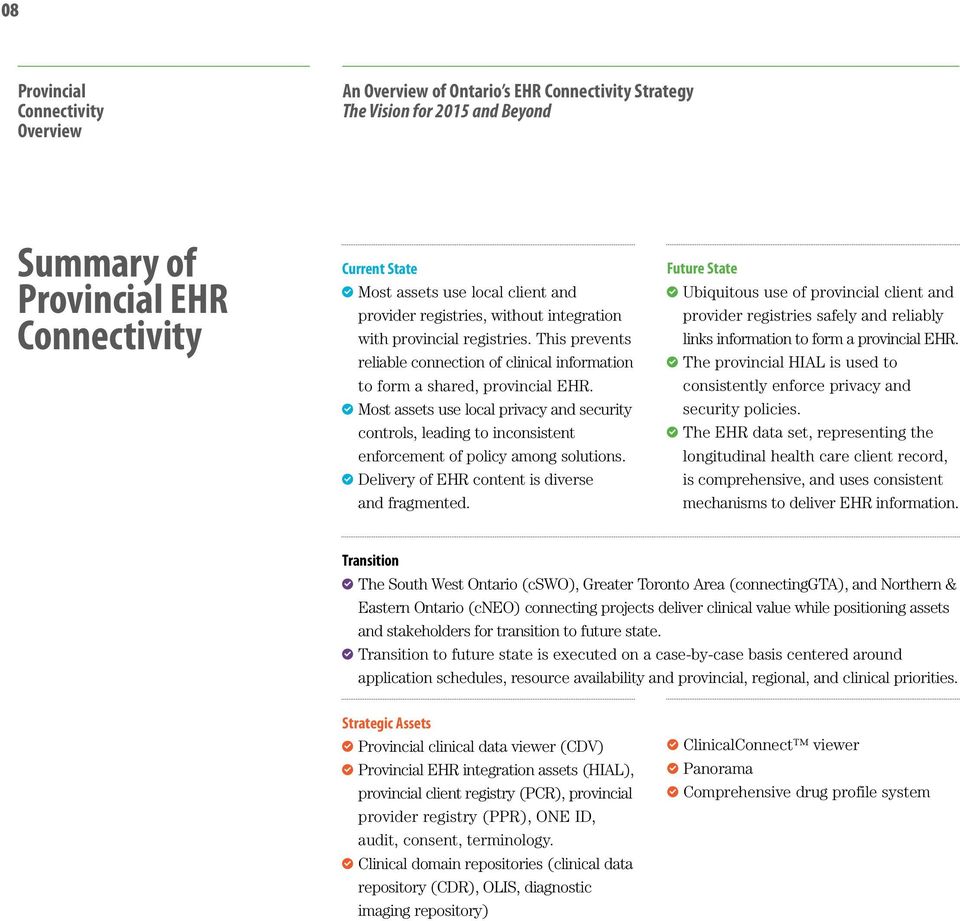
12 08 Connectivity Overview Summary of EHR Connectivity Current State Y Most assets use local client and provider registries, without integration with provincial registries. This prevents reliable connection of clinical information to form a shared, provincial EHR. Y Most assets use local privacy and security controls, leading to inconsistent enforcement of policy among solutions. Y Delivery of EHR content is diverse and fragmented. Future State Y Ubiquitous use of provincial client and provider registries safely and reliably links information to form a provincial EHR. Y The provincial HIAL is used to consistently enforce privacy and security policies. Y The EHR data set, representing the longitudinal health care client record, is comprehensive, and uses consistent mechanisms to deliver EHR information. Transition Y The South West Ontario (cswo), Greater Toronto Area (connectinggta), and Northern & Eastern Ontario (cneo) connecting projects deliver clinical value while positioning assets and stakeholders for transition to future state. Y Transition to future state is executed on a case-by-case basis centered around application schedules, resource availability and provincial, regional, and clinical priorities. Strategic Assets Y clinical data viewer (CDV) Y EHR integration assets (HIAL), provincial client registry (PCR), provincial provider registry (PPR), ONE ID, audit, consent, terminology. Y Clinical domain repositories (clinical data repository (CDR), OLIS, diagnostic imaging repository) Y ClinicalConnect viewer Y Panorama Y Comprehensive drug profile system
13 09 Connectivity Overview Key Milestones $ Integration with provincial assets including: Y CDR general availability Y HIAL subscription and notification Y ONE ID single sign on/federation Y Hospitals and community care access centres (CCACs) in all regions contribute to the CDR Y cneo shares CDV with cgta Y Integration with provincial registries Y Integration with provincial repositories and the comprehensive drug profile system (CDPS) Y cswo ClinicalConnect viewer to access CDR via HIAL Y ereferral provincial reference model (PRM) and standards package is updated and published Y Integration with the diagnostic imaging (DI) provincial image viewer Y ONE Portal hosting the Ontario drug benefit program (ODB) portlet for additional users (e.g. pharmacies) Y Transition from HNS to the CDPS $ EMR integration including: Y Access to provincial repositories Y HIAL interfaces supporting the exchange of EHR information between POS systems (e.g. EMRs) and provincial registries and repositories Y Access to provincial registries Y ONE ID single sign on/federation Y Updated EMR specifications to contribute to and access registries and repositories

14 10 Connectivity Overview EHR SYSTEMS PRIMARY CARE CONNECTING SWO Future State PROVIDER PRIMARY CARE PROVIDER cswo PROVIDER CLINICALCONNECT VIEWER POS SYSTEM EMR CLINICALCONNECT CONNECT COMPONENT PROVINCIAL HEALTH INFORMATION ACCESS LAYER EHEALTH ONTARIO HIAL SEGMENT GTA HIAL SEGMENT PROVINCIAL REPOSITORIES OLIS REPOSITORY PRIMARY CARE CLINICAL DATA REPOSITORY DI REPORTS COMPREHENSIVE DRUG PROFILE SYSTEM PRESCRIBED REGISTRY CLIENT HEALTH AND RELATED INFORMATION SYSTEM INTEGRATED ASSESSMENT RECORD IMMUNIZATION RECORD REPOSITORY ANALYTICS REPOSITORY Future state EHR assets how EHR information is viewed

15 11 Connectivity Overview CONNECTING NEO/GTA ONE PORTAL PATIENT PROVINCIAL EHR INTEGRATION ASSETS cgta PROVIDER cneo PROVIDER PROVINCIAL PROVIDER HEALTH CARE CLIENT CLIENT REGISTRY PROVIDER REGISTRY CONSENT AUDIT CLINICAL DATA VIEWER ONE PORTAL CONSUMER EHEALTH SOLUTION TERMINOLOGY DE-IDENTIFICATION SERVICE REGISTRY XDS REGISTRY AGREEMENTS REGISTRY SUBSCRIPTIONS AND NOTIFICATIONS ONE ID NEO HIAL SEGMENT SWO HIAL SEGMENT MOHLTC DATA SOURCES CORPORATE PROVIDER DATABASE REGISTERED PERSONS DATABASE CAPE/CLAIMS

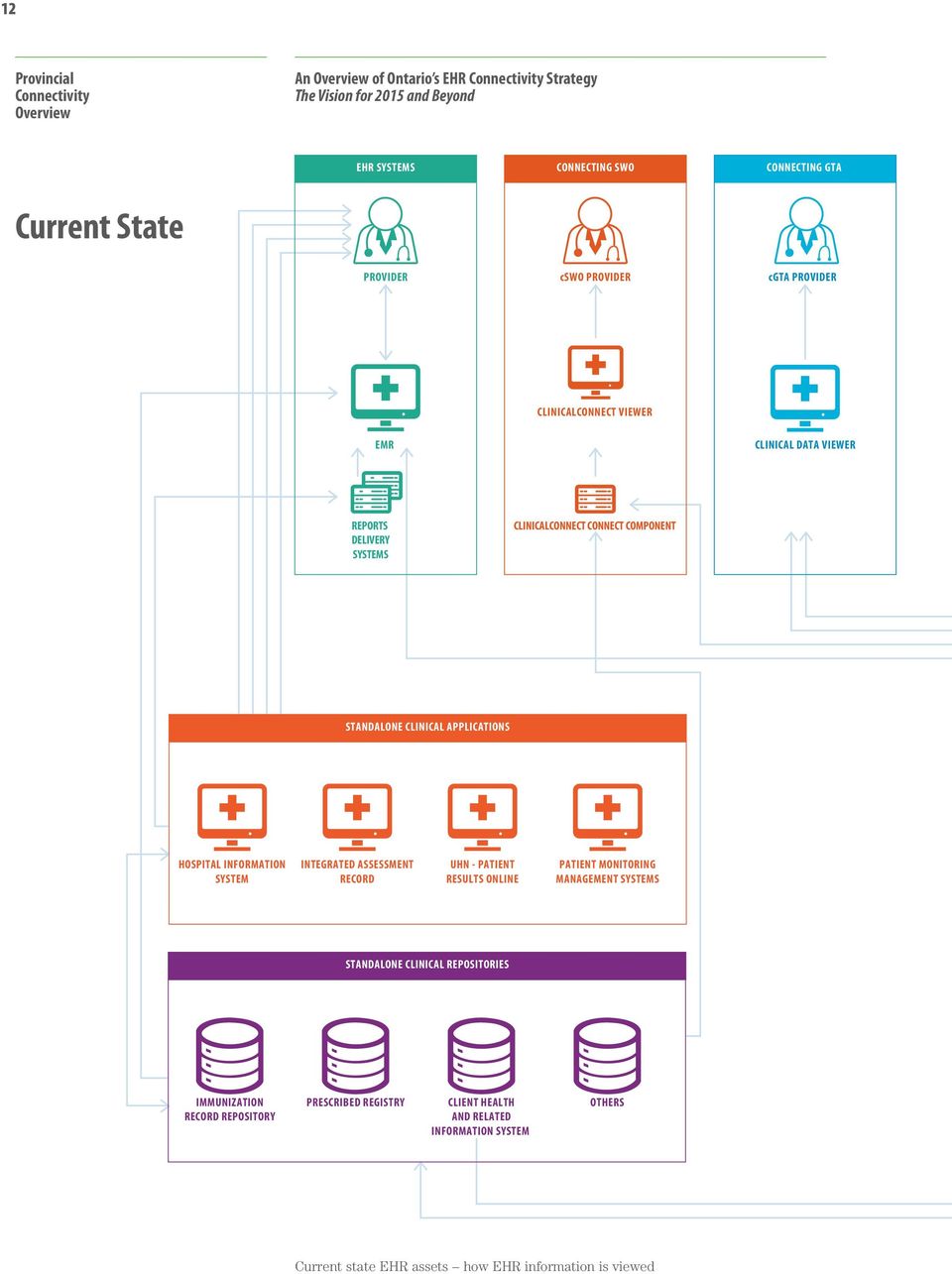
16 12 Connectivity Overview EHR SYSTEMS CONNECTING SWO CONNECTING GTA Current State PROVIDER cswo PROVIDER cgta PROVIDER CLINICALCONNECT VIEWER EMR CLINICAL DATA VIEWER REPORTS DELIVERY SYSTEMS CLINICALCONNECT CONNECT COMPONENT STANDALONE CLINICAL APPLICATIONS HOSPITAL INFORMATION SYSTEM INTEGRATED ASSESSMENT RECORD UHN - PATIENT RESULTS ONLINE PATIENT MONITORING MANAGEMENT SYSTEMS STANDALONE CLINICAL REPOSITORIES IMMUNIZATION RECORD REPOSITORY PRESCRIBED REGISTRY CLIENT HEALTH AND RELATED INFORMATION SYSTEM OTHERS Current state EHR assets how EHR information is viewed
17 13 Connectivity Overview CONNECTING NEO ONE PORTAL THE OTTAWA HOSPITAL PROVIDER PROVINCIAL PROVIDER PROVINCIAL EHR INTEGRATION ASSETS MyTOH PORTAL ONE PORTAL CLIENT REGISTRY PROVIDER REGISTRY MOHLTC DATA SOURCES CONSENT REGISTRY AUDIT PROVINCIAL HEALTH INFORMATION ACCESS LAYER CORPORATE PROVIDER DATABASE TERMINOLOGY XDS REGISTRY EHEALTH ONTARIO HIAL SEGMENT ONE ID REGISTERED PERSONS DATABASE LOCAL REGISTRIES PROVINCIAL REPOSITORIES cgta CDR SOLUTION CLIENT REGISTRY PROVIDER REGISTRY CONSENT REGISTRY TERMINOLOGY REGISTRY OLIS REPOSITORY DI REPORTS HEALTH NETWORK SYSTEM CLINICAL DATA REPOSITORY

18 14 Clinical Domains Clinical Domains

19 15 Clinical Domains Laboratories Summary of Laboratory - EHR Connectivity The Ontario Laboratory Information System (OLIS) has been deployed to all major community and public labs, and continues to be deployed to hospital labs, but is not yet integrated with provincial assets such as the registries and the HIAL. In the future, OLIS will be fully integrated with provincial integration assets, linking health care client records to health care client identities and leading to a consistent longitudinal health care client record. It will make reports from hospital, community, and public labs available to health care providers and clients. EMRs and other EHR systems will submit lab orders through OLIS, and OLIS will route lab order referrals. Current State Y OLIS has been connected to all major community and public health labs and most hospital labs and continues to grow its presence in this domain. Y Due to the timing of provincial EHR integration assets, OLIS uses its own client and provider registries and security and privacy controls. Future State Y All reports from hospital, community, and public labs are available to health care clients and providers through various channels. Y OLIS is integrated with provincial EHR integration assets, including the provincial HIAL, client and provider registries, terminology, audit and consent. Transition Y Onboarding of new labs and EMRs to OLIS notifications interfaces continues. Y All OLIS legacy and new clients migrate to using the provincial HIAL to access OLIS. Y OLIS is pursuing a phased approach to transitioning to provincial assets. The method and sequencing of transition is being determined by the OLIS and HIAL planning teams. Strategic Assets Y EHR integration assets (HIAL, provincial registries, ONE ID, audit, consent, terminology) Y OLIS Key Milestones Y Integration with the provincial client registry Y Integration with the provincial provider registry Y Integration with provincial audit solution Y Integration with provincial consent solution Y Migration of all OLIS legacy and new clients to use the provincial HIAL to access OLIS Y OLIS integration with HIAL/registries Y HIAL subscription and notification availability to send notifications to EHR systems

20 16 Clinical Domains Medication Drug dispense data provided by the MOHLTC health network system (HNS) is currently available to all hospital emergency room departments through the drug profile viewer (DPV). It is also available to the Ottawa Hospital s MyTOH portal through the Ontario drug benefit (ODB) program portlet. The HNS system currently only includes drug benefits claims-related data; it only covers a subset of health care clients (typically seniors and others qualifying for government-insured prescription benefits), and a subset of data (e.g. dosage information is not currently available), as hospital and other prescribing systems are not registering dispenses with HNS. In the future, the HNS will include all dispense data from pharmacies in the MOHLTC s CDPS. Regional and provincial clinical viewers will access this richer drug profile data to improve clinical decision-making, collaboration, and patient safety, and to reduce the incidence of adverse drug events. The electronic transfer of prescriptions (ETP) from prescriber systems to pharmacies via the HIAL will be introduced, reducing prescription errors, fraud, and drug abuse.

21 17 Clinical Domains Summary of Medication - EHR Connectivity Current State Y Medication dispense information repository is the HNS, and contains ODB claims data and narcotic dispenses. Only claims data is available for viewing. Y Medication information is currently available at 245 hospital sites (emergency departments, admitting, clinics, in-patient departments, pharmacies) and 20 community health centre (CHC) sites, through ONE Portal s DPV. Y Medication information is currently available to a subset of clinicians at The Ottawa Hospital through the ODB portlet. Future State Y Medication dispense information (all people, all drugs) is part of the provincial EHR. Y Medication dispense information repository is the CDPS, and contains all relevant pharmacy drug dispense information. Y Primary care providers send prescriptions electronically to pharmacies. Y medication dispense information is available to health care providers and clients. Transition Y HNS data is made generally available to EHR portals and viewers (cgta, cneo, cswo) through the provincial HIAL and ONE Portal. MOHLTC progressively extends the HNS dataset. Y Legislation is required to include narcotics dispenses in the EHR dataset. Y EMR electronic transfer of prescriptions (ETP) pilot leverages provincial EHR integration assets (HIAL, provincial registries, ONE ID, terminology). Y EMR ETP solution is expanded across the province. Strategic Assets Y EHR integration assets (HIAL, provincial registries, ONE ID, ONE Portal, audit, consent, terminology) Y HNS Y Pharmacy acquirer host solutions Key Milestones Y HNS integration with the CDV Y MOHLTC approval of expanding HNS data set to include all drugs, all people Y HNS expansion of data set Y Access to HNS via CDV and ClinicalConnect Y Legislation changes to include narcotics Y ONE Portal hosting of ODB Portlet for additional users (e.g. pharmacies)
22 18 Clinical Domains Diagnostic Imaging Diagnostic imaging (DI) reports are currently provided to a growing list of providers through DI common services (the system of authority for sharing DI reports and images). The cgta project collects DI reports from hospitals, storing them in the CDR and presenting them through the CDV. The ClinicalConnect viewer displays DI reports (along with the corresponding images) from the southern and western Ontario diagnostic imaging (SWODIN) diagnostic imaging repository (DI-r), as well as other relevant EHR information. Each regional DI-r (NEODIN, SWODIN, HDIRS, GTA West) provides a viewer for sharing reports and images from within its region. Referring hospitals send head scan images to the emergency neuro image transfer system (ENITS) where they can be accessed and viewed by on-call neurosurgeons. In the future, DI common services will enable province-wide access to DI reports and images through ClinicalConnect, CDV, ONE Portal, the DI viewer application, and POS systems (including EMRs). Reports will be delivered to EMR systems by HIAL-based notifications, based on physician subscriptions; however, POS systems needing to view images must integrate with the provincial DI viewer, or its underlying system interface. Foreign exam management (FEM) capabilities will enable radiologists to import prior diagnostic imaging studies acquired from any hospital across the province into their local PACS system.
23 19 Clinical Domains Summary of Diagnostic Imaging - EHR Connectivity Current State Y DI reports are published to the provincial DI document repository from all four DI-rs. Y Access to provincial DI reports is available via ONE Portal; onboarding of providers is ongoing. Y Access to regional DI reports is available through regional connecting project viewers (ClinicalConnect, CDV/CDR) and DI-r provided viewers. Y FEM capability is available for a limited subset of hospitals. Y Hospitals send head scans to ENITS where they can are accessed by on-call neurosurgeons. Future State Y DI reports and images are available to health care providers and clients through multiple access channels including ONE Portal and the regional connecting project viewers. Y DI reports are delivered to EMRs and other systems via subscription-based HIAL mechanisms. Y FEM capability is available to all hospitals. Transition Y The provincial DI viewer enables provincial viewing of images. Y The provincial DI viewer is exposed via ONE Portal. Y Connecting projects transition from using regional assets as a source of DI reports to using the provincial DI document repository as the system of authority for DI reports. Y Connecting projects provide image display capability through integration with the provincial image viewer or the viewer web services interface. Strategic Assets Y DI document repository and index (DI common services) Y EHR integration assets (HIAL, provincial registries, ONE ID, audit, consent, terminology) Y Picture archiving and communication systems (PACS) and regional DI-rs Y ONE Portal Y image viewer Key Milestones Y Publication of image manifests from the DI-rs to the provincial DI document repository Y DI common services integration with provincial audit Y Availability of provincial image viewer Y Publication of DI reports from the provincial DI document repository to EMRs Y Integration of ClinicalConnect with provincial DI common services available (for reports only) Y Transition of the cgta solution from collecting and presenting DI reports and manifests, to integrating with provincial DI common services Y Completion of FEM pilot between the GTA West and HDIRS DI-rs Y Availability of HIAL subscription and notification for delivery of DI reports to EHR systems Y DI common services integration with provincial consent
24 20 Care Settings Care Settings
25 21 Care Settings Acute and Ambulatory Care Currently there is a fragmented view of data originating in acute care settings. The three regional solutions (ClinicalConnect, cgta, cneo) are only partially deployed; connecting projects continue to onboard hospital data feeds as well as providers as consumers of information. In the future, a single CDR will be used for the exchange of data generated in an acute care setting. Transfer of care data generated by hospital information systems will be sent to the CDR where it will remain indefinitely, forming the basis of the future provincial EHR. Access to the clinical data repository will be provided by the clinical data viewer, ClinicalConnect, and POS systems via response to queries. EMRs and other POS systems will receive updates from the CDR on topics of interest based on HIAL subscription and notification services.
26 22 Care Settings Summary of Acute/ Ambulatory Care - EHR Connectivity Current State Y Varying approaches are in place for sharing clinical data and documents that originate in acute and ambulatory care settings. Y Delivery of hospital reports to EMRs is provided by various solutions (hospital report manager (HRM), southwest physician office interface to regional EMR (SPIRE), physician office integration (POI), timely discharge information summary (TDIS)). Many EMRs are not connected to any hospital report delivery solution. Y CDR content is available to small pilot group as part of the cgta project. Y CDR and ClinicalConnect utilize local client and provider registries, with no integration with provincial registries. Future State Y Transfer of care data and documents from acute and ambulatory care settings are shared via the provincial CDR. Y CDR content is available in all regions. Y All hospital reports are delivered via subscription-based HIAL mechanisms. Y Clinical data and documents are available to health care clients (consumer ehealth solution strategy TBD). Y The cgta HIAL is embedded within the provincial CDR, and is used for CDR purposes only. Y CDR and ClinicalConnect are integrated with provincial EHR integration assets, specifically provincial client and provider registries. Transition Y CDR is integrated with ONE ID. Y Report delivery mechanisms migrate from SPIRE, POI and TDIS to HRM over time. Y Hospitals in cgta contribute to the CDR. Y cgta CDR is promoted to the provincial CDR, presented via the provincial HIAL, and integrated with provincial client and provider registries, as well as audit, consent, and CDR index (XDS document registry). Y provider registry is extended to support unregulated providers and provider identity resolution. Y Hospitals in all regions integrate with PCR and PPR. Y Hospitals in all regions contribute to the CDR. Y cswo ClinicalConnect viewer used to access CDR. Y cneo uses the cgta viewer to access CDR. Y CDR-specific assets are rationalized and replaced by provincial versions over time (terminology, audit, consent). Y HRM business functionality transitions to subscription-based HIAL delivery mechanisms for delivery of hospital reports from the provincial CDR to EMRs. Y EMR specifications are updated to enable provincial CDR integration. Y All hospital reports are delivered via subscription-based HIAL mechanisms.
27 23 Care Settings Strategic Assets Y CDR Y EHR integration assets (HIAL, provincial registries, ONE ID, audit, consent, terminology) Y CDV Y ClinicalConnect viewer Key Milestones Y CDR general availability Y CDR integration with provincial EHR integration assets (PCR, PPR, audit, consent, terminology, XDS registry) Y HIAL subscription and notification availability Y Hospital integration with provincial client and provider registries Y Hospitals in all regions contribute to the CDR Y ONE ID single sign-on/federation in place Y cswo ClinicalConnect viewer accesses CDR via the HIAL Y cneo shares CDV with cgta
28 24 Care Settings Primary and Secondary Care Summary of Primary and Secondary Care - EHR Connectivity Primary care providers currently access data through their stand-alone EMRs, few of which receive hospital reports electronically. Acute care hospital reports such as discharge summaries and diagnostic imaging are delivered via report delivery systems such as OMD s HRM, and lab results pulled directly from the OLIS repository. While EMRs conforming to current provincial EMR specifications are capable of receiving reports directly from OLIS, not all of them are doing so. Some solutions, such as ICES Electronic Medical Record Administrative Data Linked Database (EMRALD), the Canadian Primary Care Sentinel Surveillance Network (CPCSSN) and the Better Outcomes Registry and Network (BORN), enable limited transfer of EMR data to external systems. In the future, EMR systems will remain at the centre of primary care but will have extensive integration with other systems. They will send documents and data to the provincial CDR, as well as prescribed registries such as BORN, the immunization registry (Panorama), and the OLIS repository. They will access the CDR and provincial clinical repositories (OLIS, DI, CDPS) via system integration/query response, and will receive data from other systems such as the acute care CDR using the subscription and notification service. EMRs and ereferral solutions conforming to the ereferral provincial reference model will enable electronic referrals between primary and secondary care providers. Current State Y Primary care data is not part of the provincial EHR. Y Pregnancy, birth, and childcare data are manually sent to BORN. Y Hospital reports are delivered to EMRs through several types of report delivery systems. Many EMRs are not connected for hospital reports delivery. Y A small number of EMRs which conform to provincial EMR specifications receive lab reports from OLIS. Y Lab reports are delivered to some physicians through the direct connectivity between EMRs and private and hospital labs. Future State Y The primary care portion of EHR data resides in the provincial CDR. Y Immunization data resides in Panorama. Y EMRs submit lab orders to OLIS. Y EMRs send electronic prescriptions to pharmacies. Y HIAL services enable the electronic delivery of primary care data from EMRs to health system use repositories and prescribed registries such as BORN, CPCSSN and EMRALD. Y All hospital and lab reports are delivered to EMRs via subscription-based HIAL mechanisms. Y ereferral between primary and secondary providers is enabled.
29 25 Care Settings Transition Y A project to pass relevant EMR data to BORN via the provincial HIAL and ONE ID establishes EMR connectivity for general EMR-EHR connectivity. HIAL connectivity will be leveraged for passing EMR data to CDR and other health systems use repositories. Y The provincial CDR is established and integrated with the CDR index (XDS document registry), provincial client and provider registries, HIAL, consent, and audit. Y EMR integration with ONE ID (single sign-on with context) and other provincial EHR integration assets (HIAL/CDR) eases transition. Y EMRs and ereferral solutions throughout the province conform to the ereferral provincial reference model. Y The CDV for cgta and cneo can access the CDR. Y The ClinicalConnect viewer can access the CDR. Y enotifications is expanded between hospitals, client health and related information system (CHRIS) and EMRs. Y Panorama integrates with provincial EHR integration assets such as the provincial client and provider registries. Y Report delivery mechanisms migrate from SPIRE, POI and TDIS to HRM. Y HRM business functionality transitions to subscription-based HIAL delivery mechanisms for delivery of hospital reports from the provincial CDR to EMRs. Y Pilot projects address EMR data quality contributing to the primary care CDR. Y EMR specifications are updated to access and contribute to the primary care CDR. Strategic Assets Y CDR (index and repositories) Y EHR integration assets (HIAL, provincial registries, ONE ID, audit, consent, terminology) Y Panorama Y EMRs Y ereferral provincial reference model Key Milestones Y General BORN/HIAL connectivity Y enotifications specifications and ereferral provincial reference model in place Y HIAL subscription and notification available Y Primary care CDR (transition) repository is integrated Y EMR specifications are updated to access and contribute to the provincial CDR Y ONE ID single sign-on/federation available Y Panorama is integrated with provincial EHR integration assets
30 26 Care Settings Community Care Episodes of community care generate information essential to an individual s health record and vital to the provincial EHR, and the provincial EHR provides information that is vital to transition of care. Today, CCACs participating as early adopters of the cgta solution are feeding CHRIS reports into the CDR, and viewing them with the cgta viewer. However, information and reports from CHRIS, the care coordination tool (CCT), the integrated assessment record (IAR), the drug and alcohol treatment information system (DATIS), telehomecare, and existing ereferral solutions are not broadly available for electronic consumption outside of the applications themselves. Processes such as assessment, referral, transfer of care, and remote health care client monitoring also result in reports that would benefit the delivery of care across all settings. In the future, the Ontario EHR will be fully populated with communitybased health information, and regional EHR viewers will be fully integrated with CHRIS, making the full client record available to community-based users. Ontario Association of Community Care Access Centres (OACCAC) assets will consolidate and share CCACrelated patient health information with the health system and the EHR via the CDR, and their scope could be expanded to share all relevant community-based patient health information, including that from CCAC-contracted service providers and suppliers, emergency medical services, community support agencies, long term care homes, and hospices. Integration with ehealth Ontario registries and services will provide data sharing consistency, integrity, and security. Clinician experience will be improved through single sign-on with context. Health Links (a MOHLTC program that brings together health care providers in a community, including family care providers, specialists, hospitals, long-term care, home care and other community supports to coordinate care for patients with complex needs) will combine provincial EHR integration assets with local assets to address unique challenges within communities.
31 27 Care Settings Summary of Community Care - EHR Connectivity Current State Y Some CCACs are submitting CHRIS reports to the CDR. Y CHRIS, CCT, IAR, and telehomecare solutions are not integrated with provincial EHR integration assets. Y There are isolated pockets of ereferral solutions. Future State (Proposed) Y CHRIS, IAR, CCT and telehomecare solutions are integrated with provincial EHR integration assets. Y Community care information is integrated with the provincial EHR via the provincial CDR. Y Health Links leverage provincial EHR integration assets. Y Strategic community care assets receive EHR notifications via subscription-based HIAL mechanisms. Y Province-wide electronic referrals and consultations are available. Transition Y The provincial CDR functionality, governance, and supported data set is extended to support data originating in the community care setting. Technical extension includes integration with CDR index (XDS document registry), provincial client and provider registries, HIAL, consent, and audit. Y CHRIS, IAR, CCT, the drug and alcohol treatment information system (DATIS) are integrated with provincial EHR integration assets such as HIAL, ONE ID, CDR, provincial client and provider registries. Y CHRIS reports are directed to the provincial CDR for sharing as part of the EHR. Y IAR, CCT, and DATIS reports contribute to the provincial CDR repository. Y The ereferral provincial reference model (PRM) and standards package is updated to reflect CDR integration, specifically referral and consultation reports that are typically part of the processing of a referral. The provincial reference model (PRM) provides implementation guidance for new and existing ereferral solutions (e.g. econsult, OTIX, BASE), focused on enabling interoperability and leveraging existing EHR provincial assets. Y CHRIS/Health Partner Gateway (HPG), IAR, CCT, and telehomecare solutions are accessible through ONE Portal, with single sign-on with health care client and provider context. Y cneo and cgta can access the community care information in the CDR. Y ClinicalConnect viewer adds the provincial CDR as a data source. Y subscription-based HIAL delivery mechanisms are developed to deliver CDR notifications to community care solutions. Strategic Assets Y CDR (index and repositories) Y EHR integration assets (HIAL, provincial registries, ONE ID, audit, consent, terminology) Y CHRIS, IAR, CCT, DATIS and telehomecare solutions Y ereferral PRM and standards package Y Resource matching and referral business transformation initiative (RM & RBTI) standard forms Key Milestones Y CDR onboarding (CHRIS, IAR, CCT, DATIS reports in CDR) Y ereferral PRM and standards package updated Y CHRIS integrated with provincial registries Y Integration of provincial assets with Health Links
32 28 EHR Integration Assets EHR Integration Assets
33 29 EHR Integration Assets EHR integration assets are foundational elements of the EHR blueprint that enable the contribution and consumption of EHR information. Systems involved in contributing or consuming EHR information must integrate with a number of these services, based on system role and clinical need.
34 30 EHR Integration Assets Health Integration Access Layer (HIAL) The provincial HIAL provides a single point of integration to EHR services, acting as the broker between external systems and the registries, repositories and services behind it. The HIAL applies security and privacy controls, message validation, transformation, enrichment, orchestration, and auditing for all transactions; it is engineered for availability and to handle the high volumes of transactions inherent to the EHR. Security controls include the authentication and authorization of all transactions via the user registry and, as needed, anti-virus services, as well as privacy controls such as audit and consent management. The current version of the provincial HIAL coordinates transactions for the provider registry, the client registry, the OLIS portlet, the ODB portlet and DPV. It also coordinates DI common services transactions, enabling province-wide viewing of diagnostic imaging reports. In future the provincial HIAL will be a centrally hosted and managed solution with HIAL segments (logical configurations residing on the provincial HIAL) that allow the regions and ehealth Ontario to utilize HIAL capabilities autonomously. The HIAL s integration capabilities will be used to meet the unique needs of each region, providing client, provider, location and terminology validation and/or translation, for all services. Projects will be able to leverage ehealth Ontario data exchange, content, and terminology specifications created using pan-canadian and international standards to support common needs. Summary of Health Integration Access Layer (HIAL) Current State HIAL 1.0 provides: Y Transaction security, mediation and orchestration Y Initial consent (CMTA) and privacy audit (MCTA) solutions Y Terminology services for DI Y Lab report notifications on behalf of OLIS Future State HIAL 2.0 provides: Y Transaction security, mediation and orchestration through a policy-driven architecture; services can be created and have their behaviour modified through polices and business rules Y Consent integration (CMTA) and an optimized privacy audit integration (MCTA) Y Full subscription and notification capabilities with content and topic-based subscriptions and a corresponding subscription matching engine Y Segmentation: the HIAL can be logically divided into ehealth Ontario and regional segments, each with its own service levels, reporting, etc.
35 31 EHR Integration Assets Future State HIAL 2.0 provides (Continued): Y The service oriented architecture service registry, a single catalog of all provincial ehealth services and their associated policies; metadata associated with the services identifies the HIAL segment they belong to, service-level agreements, their intended use Y Enhanced terminology asset management tools and runtime HIAL integration to terminology value sets and maps Y Generalized asynchronous message processing capability Y Advanced, policy-configurable logging framework with searchable metadata Y A message archive for the long term retention of message content as required Y Advanced reporting, monitoring, and alerting Transition Y HIAL 2.0 is an extension of and replaces HIAL 1.0. For a period of time, aspects of HIAL 1.0 and HIAL 2.0 will co-exist. Services will be migrated from HIAL 1.0 to HIAL 2.0 on a set schedule, with a service existing only on one of the two HIALs at any given time. New services will be built on HIAL 2.0. Y Additional HIAL segments will be allocated on the HIAL 2.0 infrastructure as required. Strategic Assets Y Service registry Y Message archive Y Terminology registry Y HIAL Key Milestones Y Enhanced monitoring and reporting available for HIAL 1.0 Y The initial HIAL 2.0 core release with a single service Y The second HIAL 2.0 release (soon after the core release) with subscription and notification, terminology components, and the migration of services to HIAL 2.0
36 32 EHR Integration Assets Client Registry (PCR) The PCR, which contains 100% of OHIP-eligible client health card and address information, is the authoritative source of provincial client identifiers for all EHR viewers. It makes the connection between health care clients health card numbers (HCNs) and other identifiers used across disparate systems, so that clients can be identified by any identifier assigned to them, such as a hospital medical record number (MRN), a pharmacy patient ID, or an EMR patient ID. Currently over 60 sources, comprising more than 170 hospital locations, contribute client data to the PCR, adding and revising client information through admit, discharge and transfer (ADT) messaging. A legacy client registry receives information from the registration claims branch s registered persons data base (RPDB) solution only. This solution is custom built, and difficult and expensive to maintain, support and enhance. It is being decommissioned in favour of the PCR, with its master data management (MDM) capabilities and significantly lower total cost of ownership. In the future, a single PCR will link people with their health information. Each POS system that contributes information to or consumes information from the provincial EHR must integrate with the PCR to ensure synchronized health care client identity information. Over time, all consumers of the EHR will need to be integrated with the PCR as the system of authority for client identity information in order to present a fulsome view of a client s personal health information. However, given that many Commercial Off The Shelf (COTS) POS systems will continue to rely upon local client registries, keeping all systems in sync with the PCR will require a combination of ADT feeds to the PCR, active integration with the PCR, and notifications from the PCR to the POS systems.
37 33 EHR Integration Assets Summary of Client Registry (PCR) Current State Y Over 60 data sources, covering over 170 hospital settings, are contributing data. Y COTS MDM software is providing matching and linking of client identifiers across sources. Y Interfaces are supporting HL7v3 Pan-Canadian queries. Y Integration with DI common services supports health care client identifier resolution. Future State Y EHR consumers and contributors are integrated with the PCR. Y Independent health facilities and CCACs, EMRs and CHRIS are contributing client information to the PCR. Y All ADT feeds are sent through the HIAL using a standardized provincial format, and are forwarded by the HIAL to all solutions requiring them (e.g. PCR, CDR, enotification). Y HL7v2 PIX-PDQ and HL7v3 PIX-PDQ are available for query via the HIAL. Y Pan-Canadian HL7 v3 add, revise, merge/unmerge, link/unlink interfaces are available. Y Subscription and notification synchronization mechanism with external systems is available. Y Systems in the province may maintain synchronization with the PCR through HIAL-based notification services. Y Integration with other provincial assets (consent management technology assets (CMTA), monitoring and control technology assets (MCTA), OLIS, CDR, etc.) is complete. Transition $ In many ways, the current PCR is already end-state. Transition requires addressing policy and regulation issues related to collection and disclosure of personal health information (PHI), as follows: Y Collection of client information from non-ministry assets (independent health facilities, physician EMRs etc.) Y General approval of PCR for clinical use Y Integration of additional contributors and consumers Strategic Assets Y client registry Y EHR integration assets (HIAL, provider registry, ONE ID/user registry, service registry, audit, consent, terminology) Key Milestones Y Availability of all defined HL7v2 & v3 interfaces and provincial ADT feed format Y Clinical use general approval (resolution of policy and regulation issues) Y Independent health facility (IHF)/CCACs/CHRIS/EMR contributions Y Integration with connecting programs Y Integration with OLIS Y Integration with all EHR consumers
38 34 EHR Integration Assets Provider Registry (PPR) The role of the PPR is to identify any individual or organization providing care in Ontario or participating in the collection, use and disclosure of PHI. It is a foundational component of the EHR, delivering provider profile information (including identity, roles, status, and location information and their relationships) from trusted professional colleges, MOHLTC, and health care provider organizations, and enabling provincial enforcement of consent directives and authorization rules. Today, the PPR supports access to PHI based on the current status of a provider s licence. Provider profile information is supplied from a growing list of regulatory colleges including the College of Nurses of Ontario (CNO), College of Midwives of Ontario (CMO), Royal College of Dental Surgeons of Ontario (RCDSO), College of Dieticians of Ontario (CDIO), College of Psychologists of Ontario (CPYO), Ontario College of Pharmacists (OCP), College of Denturists of Ontario (CDEO). The College of Physicians and Surgeons of Ontario (CPSO) profile information is currently provided from the MOHLTC s corporate provider database (CPDB) along with health care organizations (both MOHLTC-controlled and independent health facilities).
39 35 EHR Integration Assets The PPR currently receives data from these regulatory colleges and makes provider information available about over 400,000 provider individuals and organizations (both active and inactive), representing 86% of regulated providers in the province. However, the PPR does not link multiple provider identities to a single individual provider, nor does it allow providers and their organizations to directly update provider identity information. CHRIS, OLIS, cgta, ClinicalConnect, Panorama, OTN, and many other solutions maintain and use local lists of provider information (local provider registries) and are not integrated with the current PPR. In the future, a single PPR will provide the authoritative source of provincial provider identification, location, and health service information. While health care providers will continue to use a digital identity at each organization in which they practice, the PPR will link these identities to a single provider individual, a capability that is essential to enforcing provincial privacy policies. Health care providers and the organizations they work for will be able to update PPR information. Their systems will integrate with the PPR to ensure that local provider registries are in sync with the PPR. Ideally, POS systems should use the PPR rather than local provider registries; however, since many COTS POS systems will continue to rely upon local provider registries for identity information, keeping local systems in sync with the PPR will require a combination of selfmanagement of provider information and change notifications from the PPR to the POS systems.
40 36 EHR Integration Assets Summary of Provider Registry (PPR) Current State Y 10 data sources, covering 86% of regulated health care provider individuals, are contributing data. Y The PPR has: Custom built provider registry functionality Rigid interfaces and query options Limited ability to apply data quality monitoring and remediation Y The PPR is used for provider authorization and lookup. Y There is no support of unregulated health providers, and limited demographic support. Y The PPR provides batch data updates and batch data synchronization capabilities only. Future State Y The PPR is used for provider authorization, provider directory, location registry, service registry, provider ID resolution, and automated re-credentialing. Y EHR consumers and contributors use the PPR for provider resolution. Y The PPR includes provider information from all sources, including 100% of regulatory colleges, HISs, and government resources. Y The PPR provides a single resolution to provider identity in support of consent and privacy monitoring. Y Provider self-service capabilities to manage work location, service information, affiliations and /or membership are available to provider organizations, colleges, and provider individuals. Y The PPR provides a master data management (MDM) tool to support increased functionality: Real-time adds/updates Probabilistic searching/matching Many source contribution and resolution to a single ID Y The PPR includes all provider identifiers that are used throughout the province, including identifiers issued and managed by HISs, EMRs, CHRIS, etc. Y All unregulated health care providers are in the PPR. Y A data quality monitoring process is in place.
41 37 EHR Integration Assets Transition Y Work with regulatory colleges to bring on remaining regulated professionals will continue. Y Development of the PPR will take place in parallel to current provider registry consumption. Y Data quality and data management will be provided in the short term by the existing provider registry. Y Policy/regulation issues will be addressed to ensure inclusion of unregulated health care providers. Strategic Assets Y Regulatory college feeds Y PPR Y EHR integration assets (HIAL, ONE ID, audit, consent, terminology, OLIS, CDR, DI common services) Key Milestones Y Provider data quality, management and governance is defined Y provider registry technology refresh is rolled out Y The remaining colleges are contributing to the PPR Y Regulations and policy changed to support use of unregulated providers in PPR Y EMR/HIS/unregulated providers are contributing to the PPR Y A self-service tool for management of provider information, service, and location information is rolled out Y Integration with connecting programs is complete Y Integration with OLIS is complete
42 38 EHR Integration Assets Portals and Viewers Ideally health care providers would view EHR information from within their core POS system. While the EHR architecture makes provision for this, the majority of today s POS systems are not designed for such integration. For the foreseeable future it will be necessary to rely upon EHR portals and viewers to ensure that all providers have access to provincial EHR information. In Ontario, significant investments have been made into regional web portals that provide a view into the provincial EHR. These portals provide access to health care records such as acute care admit, discharge and transfer (ADT) records, lab results, diagnostic imaging reports, allergies, and drug dispenses. In the SWO region, the ClinicalConnect portal has been deployed and has significant uptake. In the GTA region, the cgta portal has recently gone live in a limited production release with the plan to roll out to the entire region within the year. The NEO region has expressed a desire to use the same technology as the GTA region for their regional portal. ehealth Ontario is also developing a standards-based web portal with embedded custom portlets that can be launched from ONE Portal. These EHR portals provide read-only views of the EHR. However, other portals and special focus web applications target specific audiences and work flows for creating or modifying health care client data. Examples include: Y IAR: an integrated assessment record application for managing community care and mental health assessments Y CCT: the care coordination tool for creating, maintaining and sharing coordinated care plans and sending secure messages between members of the care team Y CHRIS: the client health and related information system, a web-based operational tool for CCAC patient management Y HPG: the health partner gateway, an application for managing home care service referrals. This is an extension to CHRIS which allows non-ccac individuals to pick up documents related to services that they are asked to provide. Y echn: the electronic child health network, a secure electronic network that enables authorized care providers across Ontario to access health information about pediatric patients from disparate sources Y Panorama: an immunization and pandemics management system
43 39 EHR Integration Assets As these applications provide functionality that is too complex to be integrated directly as a portlet in one of the EHR viewers, they will continue to exist as standalone applications for the foreseeable future. In the future, all health care providers in Ontario will have access to web-based provincial EHR viewers that are supplementary to their core clinical information systems, offering provincial views of health care client clinical information. The three regional hubs (SWO, GTA, and NEO) will provide input and oversight for designing and maintaining regional viewers tailored to regional requirements. Each viewer may have its own look and feel but they will all be integrated with provincial assets, ensuring a consistent view of EHR information. Strategic special focus web applications will continue to be developed as required. Those with significant adoption and clinical value, such as Panorama and IAR, will be enhanced to support launching from a unified point of access, and receiving health care client and provider context from that launch point. ONE Portal will provide this unified point of access to provincial health care systems and services, increasing adoption of ehealth services and applications. Health care providers will log into ONE Portal and be presented with collaborative spaces for communicating with other providers as well as sharing documents and information. Providers will also have access to links to regional and provincial EHR viewers and special focus web applications, and will be able to launch ONE Portal from regional and provincial EHR viewers. As new systems and services come online or change, providers will immediately be made aware of them. Each EHR viewer and special focus web application will support single sign-on based on the ehealth Ontario SAML-based standard for single sign-on and context sharing. This standard permits the launching of an application from an HIS, EMR, or any other POS system, automatically logging in based on previously-provided user credentials (such as user name and password), and passing provider identifiers (such as college license number) and health care client identifiers (such as Ontario Health Number) from the original system. The user credentials are used for sign-on, while the health care client and provider information are used to establish the shared context. This allows a health care provider to find a health care client in one application, and then seamlessly transition to another application without needing to launch it separately, re-establish credentials, or search for the health care client again. This context sharing requires that both the launching application (ONE Portal) and the launched application (the regional EHR viewer or special focus web application) are aligned with the finalized ehealth Ontario specification.
44 40 EHR Integration Assets Summary of Portals and Viewers Current State Y Regional portals exist, but present only a subset of the EHR. Y There is a proliferation of special focus portals with no catalogue or unified entry point. Y Providers require different credentials for accessing different portals. Y Most portals use local registries and are not integrated with provincial registries, preventing the reliable passing of health care client context to inform a shared, provincial EHR. Future State Y Single sign-on provides seamless access from POS systems to ONE Portal. Y ONE Portal provides a seamless single-sign on launching point for regional and special focus portals. Y All portals support the passing of health care client context as well as single sign-on. Y Regional portals present a complete view of the EHR. Transition Y Technology refresh for ONE Portal is completed. Y ONE Portal enhancements will take place, to support aggregation of and linkage to regional and special focus portals. Y HIS/EMR and ONE Portal support for ehealth Ontario s SAML single sign-on standard will enable seamless launching of ONE Portal from POS applications. Y Regional portals are integrated with provincial assets (PR, CR, OLIS, CDR, DI) providing a complete EHR view. Y Regional and special focus portal support for ehealth Ontario SAML single sign-on standard will enable seamless launching from ONE Portal. Y Regional and special focus portal support for ehealth Ontario SAML health care client context standard will enable single health care client selection.
45 41 EHR Integration Assets Strategic Assets Y ONE Portal Y ONE ID Y Regional Portals CDV ClinicalConnect viewer Y Special Focus Portals CCO Panorama CHRIS/HPG OTN Provider Hub Y registries and repositories PPR PCR OLIS CDR DI Y EMR systems Y HIS Key Milestones Y Completion of ONE Portal technology refresh Y Finalization of ONE ID single sign-on/federation Y Availability of ONE Portal single sign-on from HIS using SAML specification Y Availability of ONE Portal single sign-on from EMR using SAML specification Y Completion of regional portal integration with provincial assets (PR, CR, OLIS, CDR, DI) Y Availability of regional portal single sign-on from ONE Portal via SAML Y Availability of special focus portal single sign-on from ONE Portal via SAML Y Completion of regional portal integration with provincial registries Y Availability of regional portal health care client context sharing via SAML Y Completion of special focus portal integration with provincial registries Y Availability of special focus portal health care client context sharing via SAML
46 42 EHR Integration Assets ONE ID The current implementation of ONE ID has been in production for approximately 10 years, and in its current state it delivers a significant amount of the functionality required to rollout and maintain the provincial EHR, including: single sign-on and context sharing capabilities, delegated user management functions, authentication services, federated identity provider services, and service authorization. ONE ID s future state will be a platform which delivers a comprehensive authentication, authorization, and context management solution which can be leveraged by consumers of and contributors to the provincial EHR. The ONE ID federation broker will provide a robust framework enabling participating organizations and applications to securely and reliably route authentication information between parties, and the federated authorization solution will enable authorized individuals from across the province to manage access to federation-enabled EHR viewers.
47 43 EHR Integration Assets Summary of ONE ID Current State Y ONE ID systems and processes are approved for protection and access of PHI. Y ONE ID provides inclusive security services for OTN, CCO, ONE Portal, DPV, OLIS, Panorama and others. Y A distributed network of registration agents supports the issuance of ONE ID credentials. Y ONE ID provides a security enforcement layer for the provincial HIAL segment. Y ONE ID is a federated identity provider (IDP). Y ONE ID provides identity and entitlement data provisioning and reconciliation services. Y ONE ID provides enhanced risk based authentication. Y Health care client context management between POS systems and EHR viewers occurs at EHR viewer launch only. Future State Y ONE ID is an identity federation operator and routes distributed authentication traffic for the province. Y ONE ID provides a centralized application authorization datastore, with management interfaces to assist service owners in making authorization decisions. Y ONE ID is a mobile application security provider. Y ONE ID provides a large deployment base of provincially trusted digital identity providers. Y Participating viewers and POS systems are able to set and acquire health care client context, enabling it to be continually maintained between a provider s POS system and EHR viewer. Y ONE ID provides a federated trust relationship between ONE ID and Go Secure for the purpose of enabling provider single sign-on. Transition Y An end state context management solution will be created, including architecture and standards governance. Y Finalization of federation business framework (policies, standards & agreements) will take place. Y cgta will transition to the provincial solution. Strategic Assets Y Provider registry Y ONE ID suite of services Key Milestones Y Onboarding of regional EHR viewers (cgta, cneo, cswo) Y Onboarding of ONE Portal as a federated application Y Migration of cgta pilot organizations Y Onboarding of special focus web applications
48 44 EHR Integration Assets Audit Personal health information audit trails are an essential part of EHR privacy compliance. As per O. Reg. 329/04 under PHIPA, ehealth Ontario is required to have the ability to respond to requests for information on the PHI contained in its systems, and who has accessed this information. PHI-related transactions are currently monitored by an interim audit solution (tactical privacy audit solution (TPAS)), which detects attempts by providers to access excessive quantities of personal health information and generates security alerts for immediate assessment by the privacy team. A simple threshold mechanism is utilized, but no event correlation intelligence or configurable business rule logic is currently in place. In the future, the monitoring and control technology assets (MCTA) solution will provide a centralized audit repository for privacy purposes. All transactions relating to PHI that consume EHR-related services through the ehealth Ontario HIAL segment will be written to a centralized audit repository for privacy purposes. The core functionality of the audit solution will include: Y Logging of all PHI-related transactions, for privacy auditing purposes Y Reporting and analytics tools to present information in standard format Y Monitoring and alerting: the detection of inappropriate use based on configurable business rules and system configurations, including the ability to correlate audit events and the generation of intelligent, context-based alerts, for suspicious events or behaviour Y Security mechanisms to prevent unauthorized access to, and unauthorized use of, audited information The interim TPAS solution will run in parallel with MCTA while provincial EHR services are transitioning to the new audit solution.
49 45 EHR Integration Assets Summary of Audit Current State Y TPAS is in service until a full privacy audit solution is in place. Y TPAS provides: Custom code that parses messages traversing the HIAL to detect possible privacy access breaches Identification of a surpassed threshold for provider access to client personal health information Future State (Proposed) Y A full privacy audit solution known as monitoring and control technology assets (MCTA) is in place to replace TPAS. Y PHI-related transactions are logged for privacy auditing purposes. Y Messages traversing the HIAL and from direct database connectivity are parsed. Y An intelligent security information and event management solution offers active monitoring with real-time alerting and automated (custom) reporting. Y A correlation engine compares messages and events against multiple business rules to detect different kinds of privacy access breaches. Transition Y Deployment of a limited production release is currently being finalized. The first two lines of business to be monitored will be DI common services and OLIS. Y TPAS will run in parallel with the MCTA solution for a short period of time, but will eventually be decommissioned. Strategic Assets Y DI common services Y HIAL, PPR, PCR Y MCTA Key Milestones Y Performance testing is passed in the preproduction environment Y Quality assurance testing for custom code components is complete Y MCTA monitors all transactions that traverse the HIAL and generates privacy-related reports Y Integration with DI common services and OLIS is complete
50 46 EHR Integration Assets Consent Health care clients have the right to control whether their personal and personal health information is shared with other health care providers, organizations or caregivers. The consent service contains health care client-provided directives, and is consulted during the execution of an EHR transaction to ensure that it does not disclose information against the health care client s wishes. Consent directives may be applied at any time and may affect information already in the CDR or other clinical repositories. Health care client consent is currently managed within individual lines of business (for internal ehealth Ontario systems) or regions (such as cgta). Support for consent directive granularity is currently not consistent across systems. Distribution of notifications to hospitals and health care clients is manual; a report from individual lines of business is mailed to the recipient by the privacy office. In the future, privacy officers, government entities and health care clients will manage consent directives through secure access to a single consent management portal. HIAL segments will ensure that consent directives are applied to the EHR transactions they broker, using the provincial consent solution. Where consent directives are overridden at the point of care, the override will be logged and the health care client notified as to who overrode the directive and why. The solution will support the directive granularity defined by the connecting privacy committee. This provincial consent registry solution will replace existing ad-hoc solutions and provide a simpler and lower cost solution to operating and integrating multiple consent management solutions.
51 47 EHR Integration Assets Summary of Consent Current State Y Consent directives are submitted to ehealth Ontario through a mail-in channel for DI common services, and through ServiceOntario for OLIS. Y Line of business-specific consent management solutions are used for each line of business (e.g. OLIS, DI CS, CDR). Y Support for the ehealth Ontario consent management policy varies across lines of business. Future State Y CMTA is the system of record for health care client EHR consent directives, and is used to notify health care clients of consent override events or updates to health care client consent policies. Y CMTA is used by ehealth Ontario privacy officers to manage consent directives on behalf of health care clients and hospital privacy offices. Y All lines of business use CMTA to manage and validate health care client consent. Y CMTA is used as a province-wide registry for health care client consent directives. Y Partner consent management systems are synchronized with CMTA through the subscription and notification mechanism. Y CMTA uses multiple delivery channels (phone-in, in-person, in-person through partners, mail, fax). Y CMTA provides access to consent management functionality to partners (such as ServiceOntario), health care clients and hospital privacy officers. Transition Y CMTA provides consent management and validation services to DI common services. Most of the available policy types are implemented. Y OLIS is migrated to CMTA as follows: 1. Management functionality 2. Consent validation functionality 3. Consent enforcement Y The consent management system is consolidated with cgta. Y All 12 different consent directive types are implemented. Y Additional delivery channels (ServiceOntario, phone, internet) are enabled. Strategic Assets Y CMTA components Y EHR integration assets (HIAL, provincial registries, ONE ID, audit) Y POS systems Key Milestones Y Integration with a second line of business (OLIS) Y Integration and consolidation of consent management systems with cgta Y Adoption of consent management standard for policy exchange with external systems/partners Y Full implementation of subscription and notification mechanism for policy synchronization Y Enablement of additional delivery channels (ServiceOntario, phone, internet)
52 48 ly Integrated ehealth Services ly Integrated ehealth Services
53 49 ly Integrated ehealth Services While the connectivity strategy s primary focus is the provincial EHR, it also takes into account of the ehealth services provided by the Ontario Association of Community Care Access Centres (OACCAC), Cancer Care Ontario (CCO), and the Ontario Telemedicine Network (OTN). This section describes how these services integrate with the provincial EHR, and identifies opportunities to leverage them to address broader provincial needs.
54 50 ly Integrated ehealth Services Ontario Association of Community Care Access Centres (OACCAC) Although full two-way integration with the PCR is underway, OACCAC assets currently use their own client and provider registry. The ONE ID federation of CCAC identity providers is also in progress, as well as OACCAC asset support and trust for ONE ID credentials; when complete, provincial single sign-on with client context will be supported for other federated services and identity providers. CHRIS currently contributes to the cgta CDR, while integration with cswo and cneo is in progress. OACCAC assets offer a selection of system-to-system interfaces and graphical user interfaces to provide CCAC health system partners (e.g. primary care, hospitals, contracted service providers) with access to CCAC information. In the future, OACCAC will be fully integrated with the provincial provider, client and consent registries. OACCAC assets will not only consolidate and share all CCAC-related patient health information with the health system and the EHR, but also all community-based patient health information such as that from CCAC-contracted service providers and suppliers, emergency medical services, community support agencies, long term care homes, hospices, etc. The EHR will be fully populated with community-based health information, and EHR viewers from each region will be fully integrated with CHRIS, making the full client record available to community-based users. Integration with ehealth Ontario registries and services will provide data sharing consistency, integrity, and security. OACCAC service oriented architecture services are published on the provincial service registry, where systems integrators can find the services and the information they need to establish connections to them.
55 51 ly Integrated ehealth Services Summary of OACCAC- EHR Connectivity Current State Y ly manages, consolidates, and shares all CCAC-related patient health information with the health system Y Enforces privacy and security policies Y Uses local client registry (integration with provincial client registry in progress). Y Uses local privacy and security controls (federation with ONE ID in progress) Y Contributes CCAC client health information to the three regional hubs (cgta completed, cswo and cneo in progress) Y Contributes CCAC assessment records to the integrated assessment record (IAR) Y Performs single sign-on launching, with client context, of the CDR viewer for CCAC users (cgta completed, cswo and cneo in progress) Future State Y Consolidates and shares all community-related patient health information with the health system Y Makes full use of provincial client, provider, and consent registries. Y Uses the provincial HIAL to consolidate and share community related health information via the provincial CDR Y Uses the provincial HIAL to subscribe to patient health information from outside of the community sector Y Contributes community-related patient health information to the EHR Y Is federated with ONE ID as a service provider (enabling the single sign-on launch of CHRIS and HPG), and as an identity provider (enabling the launch of provincial EHR services/portals for CCAC users) Transition Y The scope of health information consolidation and sharing will be expanded to include all community agencies (contracted service providers, community support agencies, first responders (e.g. emergency medical services), long term care homes, hospices, and others as required). Y The community health information contribution to the provincial CDR will be completed and expanded. Y Integration with the registries and the HIAL subscription and notification service will take place, as well as ONE ID federation. Strategic Assets Y CHRIS Y Health partner gateway Y Fax services Y enotification Key Milestones Y Expand the scope of health information consolidation and sharing to include all community agencies, including contract service providers, suppliers, community support agencies Y Complete and expand the contribution to the provincial CDR: Complete in-progress cswo and cneo integration Expand to include additional community health information Y Complete in-progress integration with ehealth Ontario assets: PCR ONE ID federation of CCAC identity provider and service provider (CHRIS/health partner gateway (HPG) Y Integrate with HIAL services: Subscribe to enotifcations from all health sectors Publish community-based enotifications
56 52 ly Integrated ehealth Services Cancer Care Ontario (CCO) CCO provides a comprehensive suite of provincial services in support of its role as the Ontario government s advisor on cancer and renal systems and access to care for key health services. Today, CCO maintains its own client and provider registries. CCO has integrated directly with OLIS and hospital information systems to enable various screening, research, reporting, and analytics functions. It maintains high quality data sets (e.g. primary care roster) and robust data warehouse and analytics capabilities that could be leveraged for broader provincial ehealth use. There is a significant opportunity to leverage the health care client/ provider relationship information in the integrated cancer screening (ICS) tool as a provincial ehealth service. This information is vital to notifying providers of EHR information events related to health care clients in their care. There is also an opportunity to leverage CCO s business intelligence and analytics capabilities for the primary and secondary use of provincial EHR information. Participating in ONE ID as a federated service provider will enable health care provider single sign-on access to ICS/Inscreen, eclaims, wait times information system (WTIS), the diagnostic assessment program - electronic pathway solution (DAP-EPS), and the interactive symptom assessment and collection tool (ISAAC) from providers POS systems. There is an opportunity to launch into various CCO services from ONE Portal with single sign-on and context sharing. Accessing EHR information via provincial clinical repositories will reduce the amount point-to-point integration that currently occurs between CCO and health care provider organizations. The Ontario breast screening program integrated client management system (OBSP:ICMS) will be able to retrieve DI reports from the provincial repository, avoiding manual entry of DI reports. Screening results and care pathway reports can be shared as part of the provincial EHR and delivered to EMRs via the provincial CDR and HIAL notifications. Integration with provincial client and provider registries will improve data accuracy and currency for both CCO and provincial registries. Publishing CCO services on the provincial service registry will support health care provider discovery and integration with CCO services, and exposing CCO services on the provincial HIAL will leverage the HIAL s privacy and security controls. CCO services such as integrated cancer screening (ICS)/InScreen, eclaims, and the diagnostic assessment program electronic pathway solution (DAP-EPS), would benefit significantly from a provincial consumer identity management strategy/solution, a necessary precursor to digitizing the patient screening and care pathway experience.
57 53 ly Integrated ehealth Services Summary of Cancer Care Ontario - EHR Connectivity Current State Y Uses a local client registry, except for WTIS/cardiac care network (CCN) applications which are integrated with provincial client registry Y Uses a local provider registry Y Uses local privacy and security controls Y Receives direct reports feed from labs Y Receives direct DI reports from hospitals Y Has ONE ID integration for access to the ICS-InScreen tools Y Maintains a list of primary care provider to health care client relationships (primary care roster information) Y Has mature data warehouse and business intelligence/analytics capabilities Future State Y Various CCO services integrate with provincial client, provider, and consent registries Y Federation is complete with ONE ID for WTIS web, DAP-EPS and the interactive symptom assessment and collection tool (ISAAC) Y Information in provincial DI, lab, and medication repositories is utilized Y CCO services are exposed via the provincial HIAL (leveraging HIAL privacy and security controls) and presented in the provincial service registry Y An opportunity to leverage CCO business intelligence/analytics capabilities and primary care roster information for broader ehealth/ehr use is available Transition Y Complete the integration with the provincial registries and repositories via the HIAL. Y Complete ONE ID federation. Y Expose CCO web services behind the provincial HIAL. Y Share provider and client feeds with provincial registries. Strategic Assets Y Cardiac care network (CCN) Y WTIS Y Ontario breast screening program: integrated client management system (OBSP:ICMS) Y CCO data warehouse Y EHR integration assets (HIAL, provincial registries, ONE ID, audit, consent, terminology) Y eclaims Y iport Access Y ICS/InScreen Y DAP-EPS Y ISAAC Key Milestones Y Complete integration with ehealth Ontario assets: ONE ID federation of CCO identity provider and service provider Y Integrate with HIAL services: registries (PCR, PPR) and feeds repositories (OLIS, DI, CDR) assets (consent, privacy audit, terminology) Service catalog for CCO eclaims
58 54 ly Integrated ehealth Services Ontario Telemedicine Network (OTN) OTN provides a full suite of telemedicine services as well as facilitating the exchange of patient health information as part of completing telemedicine transactions. While a number of these services are well positioned for broader provincial ehealth use, they are not currently integrated with provincial EHR integration assets. In the future, integration with provincial EHR integration assets will provide a common understanding of patient, provider, and clinical terminology, as well as privacy and security controls. Integration with the provincial provider registry (PPR) will provide the opportunity to leverage OTN s provider services directory s user interface for the selfmanagement of PPR s provider services information, and to keep OTN S provider services directory up to date with the latest information from regulatory colleges. It will also allow services to leverage OTN s scheduling and app formulary solutions for broader provincial ehealth use. Integration with ONE ID as a federated service provider will enable provider single sign-on to OTN services, using local logon and credentials. Providers will launch OTN services with patient context, without requiring secondary logon. OTN services, with descriptions, specifications, implementation guides, and sample messages, will be published through the HIAL 2.0 s service oriented architecture service catalog, where integrators and implementers can discover provincial EHR and ehealth services along with the information required to connect to them. Through integration with the provincial client registry and clinical data repository, OTN will be able to submit consult notes, discharge summaries, progress notes, and other information to the CDR for broader sharing as part of the provincial EHR, and for targeted delivery to POS systems via HIAL notification services. Conformance with the provincial ereferral reference model will make OTN s econsult service interoperable with other conformant ereferral solutions and POS systems throughout the province.
59 55 ly Integrated ehealth Services Summary of Ontario Telemedicine Network - EHR Connectivity Current State Y The provider services directory is scoped to telemedicine, and based on information provided by health care providers. Y Providers use credentials provided by ONE ID to access OTN HUB, telemedicine directory, econsult and OTN learning. Y OTN services use OTN client and provider registries and privacy controls. Y Discharge summaries, consult notes, and other EHR-relevant information are accessible via OTN services. Future State Y The provider services directory is integrated with the provincial provider registry. Y OTN integrates with ONE ID as a federated service provider. Y OTN services integrate with provincial client and provider registries, provincial consent management, and other provincial EHR integration assets, and are published through the provincial services catalog. Y EHR-relevant information is shared via the provincial CDR. Y OTN reports are delivered to primary care EMRs via HIAL notification services. Y OTN econsult service is interoperable with ereferral and POS systems throughout the province. Transition Y Integrate patient monitoring management systems (PMMS) with hospital report manager (HRM). Y Complete the integration with the provincial registries and repositories via the HIAL. Y Complete ONE ID federation. Y Complete econsult alignment with provincial ereferral PRM. Strategic Assets Y App formulary Y Telemedicine directory (includes providers, programs, sites and video systems) Y Scheduling application Y Video conferencing Y PMMS Y OTN econsult Y OTN learning Y EHR integration assets (HIAL, provincial registries, ONE ID, audit, consent, terminology) Key Milestones Y Complete PMMS alignment with provincial remote patient monitoring (PRM) Y Complete the ONE ID federation of OTN as an identity provider and service provider Y Integrate with HIAL services: registries (PCR, PPR) repositories (DI, CDR, MOH-HNS) Contribute consult notes and PMMS discharge summaries to provincial CDR enotifications assets (consent, audit, terminology) Y Complete econsult alignment with ereferral PRM
60 56 Conclusion Conclusion
61 57 Conclusion The connectivity strategy is designed to inform strategic decisions, provide a framework for discussion, and offer practical guidance and resources for EHR integration. Its focus is identifying the sources of EHR information in Ontario, making it sharable with the EHR through integration with EHR assets, and delivering it to the people who need it. The future of Ontario s EHR is a single, safe, standardized, and provincially integrated record for every health care client in the province, with comprehensive, connected information, connected systems, and streamlined access. The strategy describes the path to this future state, where all provincial EHR information will be consumable through POS systems and provincial EHR viewers. Today, islands of health care information exist in the province, in clinical domains, care settings, and ehealth service agencies, but they are isolated from each other, and accessed by disparate channels. To achieve the future state EHR, local, regional, and provincial health information technology solutions must integrate with provincial EHR assets such as the HIAL, the registries, ONE ID, and the clinical repositories. Services from provincial ehealth services agencies such as OTN, OACCAC, and CCO can also be leveraged for broader use in the province. The strategy identifies the provincial assets that stakeholders can combine with local assets to address their own health care challenges, as well as services provided by OACCAC, CCO, and OTN that could be leveraged to address broader provincial needs. It emphasizes reuse, standardization, and leveraging investments made to date, while providing a transition plan to the future state of the EHR.
62 58 Work with us Get us involved We all have a role to play in building Ontario s EHR. But building a fully interoperable EHR will take efforts from all of us in the health care sector. Work with us. We all have a role to play. Only a truly collaborative effort will result in a scalable system that can securely share the right information, with the right people, at the right time to support the myriad decisions required to improve health care for Ontario s 13 million citizens. From advisory consultations to EHR integration to standard selection and stakeholder engagement, we can help you align, adopt and implement the blueprint. Book an appointment with us today and discover how we can help you develop your ehealth solutions. ARCHITECTURE, STANDARDS AND PLANNING Tel: [email protected] design:
63
64 Contact us anytime at: P.O. Box 148, 777 Bay Street, Suite 701, Toronto, Ontario M5G 2C8 Tel: Fax Toll Free: Cette publication est disponible en français. ehealth Ontario 2015
CONNECTING ONTARIO THROUGH THE CONNECTIVITY STRATEGY. Peter Bascom, Chief Architect Mike Krasnay, Director of Integration and Solution Architecture
 CONNECTING ONTARIO THROUGH THE CONNECTIVITY STRATEGY Peter Bascom, Chief Architect Mike Krasnay, Director of Integration and Solution Architecture Advanced Preview! Published in the coming months Extensive
Portal and Web Application Connectivity
 Portal and Web Application Connectivity Architecture and Standards Version: 1.0 Document Owner: ehealth Ontario Copyright Notice Copyright 2015, ehealth Ontario All rights reserved No part of this document
ITAC HEALTH BREAKFAST ROUND TABLE
 ITAC HEALTH BREAKFAST ROUND TABLE An update on ehealth Ontario Presented by Greg Reed, President and CEO February 27, 2013 Increasing Access in the Community Today ehealth Ontario is working with community
ONTARIO S EHR CONNECTIVITY STRATEGY IMPROVING PRIMARY TO SPECIALIST REFERRAL THROUGH INTEGRATION. Peter Bascom Chief Architect, ehealth Ontario
 ONTARIO S EHR CONNECTIVITY STRATEGY IMPROVING PRIMARY TO SPECIALIST REFERRAL THROUGH INTEGRATION Peter Bascom Chief Architect, ehealth Ontario Cindy Hollister Director, Professional Practice, Canada Health
Ontario s ehealth Blueprint
 Ontario s ehealth Blueprint Narration The central themes of Ontario s ehealth Blueprint are connectivity, innovation and a commitment to improve patient care and care outcomes. Through these themes and
ELECTRONIC HEALTH INFORMATION
 ELECTRONIC HEALTH INFORMATION ehealth - An Enabler of Integration, Sustainability and Patient Accountability/Empowerment Linda Bisonette, BScN, MHS, CHE ELECTRONIC HEALTH INFORMATION ehealth is defined
Central Ontario Electronic Health System
 Central Ontario Electronic Health System Andrew Hussain Regional Chief Information Officer Central Ontario LHINs May 2012 For the purpose of this overview it is important to keep in mind the specific definition
SOA in the pan-canadian EHR
 SOA in the pan-canadian EHR Dennis Giokas Chief Technology Officer Solution Architecture Group Canada Health Infoway Inc. 1 Outline Infoway EHR Solution EHRS Blueprint Approach EHR Standards Oriented Architecture
DEMYSTIFYING ELECTRONIC HEALTH Presented to Central East LHIN Board of Directors. January 22, 2014
 DEMYSTIFYING ELECTRONIC HEALTH Presented to Central East LHIN Board of Directors January 22, 2014 What is ehealth? What is an Electronic Health System? EHR, EMR and PHR / CIS/HIS Where does the electronic
SOA in the pan-canadian EHR
 SOA in the pan-canadian EHR Dennis Giokas Chief Technology Officer Solutions Products and Group Canada Health Infoway Inc. 1 Outline Infoway EHR Solution EHRS Blueprint Overview Oriented Architecture Business
GOVERNANCE OPTIMIZATION
 GOVERNANCE OPTIMIZATION Hire Wire EHR Governance Balancing Needs of Internal and External Stakeholders Peter Bascom, Chief Architect, ehealth Ontario Julia Peters, Director, ehealth Ontario. 1 Today s
Electronic Health. North Simcoe Muskoka Overcoming the Challenge!
 Electronic Health North Simcoe Muskoka LHIN North Simcoe Muskoka Overcoming the Challenge! When the North Simcoe Muskoka Local Health Integration Network first opened its doors, it was recognized that
Diagnostic Imaging and the Electronic Health Record
 Diagnostic Imaging and the Electronic Health Record Diane Larwood General Manager Diagnostic Imaging Repository Division Mohawk Shared Services Inc. www.mohawkssi.com Speaker Bio Diane Larwood is the General
Privacy and Security within an Interoperable EHR
 1 Privacy and Security within an Interoperable EHR Stan Ratajczak Director Privacy and Security Solutions Architecture Group November 30, 2005 Electronic Health Information and Privacy Conference Ottawa
Creating a national electronic health record: The Canada Health Infoway experience
 Creating a national electronic health record: The Canada Health Infoway experience Presentation by Dennis Giokas Chief Technology Officer, Canada Health Infoway October 11, 2007 Overview The need for EHR
6.0 ehealth Readiness
 6.0 ehealth Readiness 6.1 Provincial Perspective The goals of ehealth are to use information technology to modernize the health system, and to provide better and safer patient care. The MOHLTC identifies
Provincial Forum on Adverse Health Event Management
 Provincial Forum on Adverse Health Event Management Using Information Systems for the Management of Adverse Events WORKSHOP 1 Salon B May 26, 2008 WORKSHOP 1 Salon B Using Information Systems for the Management
IBM Software. IBM Initiate: Delivering Accurate Patient and Provider Identification for Canadian Electronic Health Records
 IBM Software IBM Initiate: Delivering Accurate Patient and Provider Identification for Canadian Electronic Health Records IBM Initiate: Delivering Accurate Patient and Provider Identification for Canadian
The EHR Agenda in Canada
 The EHR Agenda in Canada IHE Workshop June 28, 2005 Dennis Giokas, Chief Technology Officer Agenda Background on Canadian Healthcare System About Canada Health Infoway Interoperable EHR Solution Definitions
Canada Health Infoway
 Canada Health Infoway EHR s in the Canadian Context June 7, 2005 Mike Sheridan, COO Canada Health Infoway Healthcare Renewal In Canada National Healthcare Priorities A 10-year Plan to Strengthen Healthcare
Table of Contents. Preface... 1. 1 CPSA Position... 2. 1.1 How EMRs and Alberta Netcare are Changing Practice... 2. 2 Evolving Standards of Care...
 March 2015 Table of Contents Preface... 1 1 CPSA Position... 2 1.1 How EMRs and Alberta Netcare are Changing Practice... 2 2 Evolving Standards of Care... 4 2.1 The Medical Record... 4 2.2 Shared Medical
Overview of ehr Development. Slide - 1
 Overview of ehr Development Slide - 1 Where are we today? Hospital Authority 8 million patient records 800 million laboratory results 340 million prescribed drugs 34 million Xray images 33 million transactions
Canada Health Infoway Update
 Canada Health Infoway Update Presentation to North East LHIN ehealth Advisory Committee May 9, 2013 Terry Moore, Executive Regional Director, Canada Health Infoway Canada Health Infoway Created in 2001
Singapore s National Electronic Health Record
 Singapore s National Electronic Health Record The Roadmap to 2010 Dr Sarah Christine Muttitt Chief Information Officer Information Systems Division 17 th July, 2009 Taking the Next Step (MSM April 2008)
Logical Architecture Introductory Document
 Ontario Provincial EHR Logical Architecture Introductory Document Version: 1.0.3a Copyright Notice Copyright 2012, ehealth Ontario All rights reserved No part of this document may be reproduced in any
Table of Contents. Page 1
 Table of Contents Executive Summary... 2 1 CPSA Interests and Roles in ehealth... 4 1.1 CPSA Endorsement of ehealth... 4 1.2 CPSA Vision for ehealth... 5 1.3 Dependencies... 5 2 ehealth Policies and Trends...
Ambulatory Electronic Mental Health Record Solution
 Ambulatory Electronic Mental Health Record Solution with connection to EHR Services, delivers patient centered care model and platform for service delivery June 2014 Partners Mackenzie Health and Southlake
CMS & ehr - An Update
 Health Informatics in Hong Kong CMS & ehr - An Update Dr NT Cheung HA Convention 2010 CMS / epr is essential in the HA Each Day... 12,000 users 90,000 patients 8M CMS transactions 700,000 epr views In
ENABLING EFFECTIVE, QUALITY POPULATION AND PATIENT-CENTRED CARE: A PROVINCIAL STRATEGY FOR HEALTH INFORMATION MANAGEMENT AND TECHNOLOGY
 ENABLING EFFECTIVE, QUALITY POPULATION AND PATIENT-CENTRED CARE: A PROVINCIAL STRATEGY FOR HEALTH INFORMATION MANAGEMENT AND TECHNOLOGY CROSS SECTOR POLICY DISCUSSION PAPER 2015 Table of Contents Executive
I n t e r S y S t e m S W h I t e P a P e r F O R H E A L T H C A R E IT E X E C U T I V E S. In accountable care
 I n t e r S y S t e m S W h I t e P a P e r F O R H E A L T H C A R E IT E X E C U T I V E S The Role of healthcare InfoRmaTIcs In accountable care I n t e r S y S t e m S W h I t e P a P e r F OR H E
ONTARIO EHR INTEROPERABILITY STANDARDS WHY STANDARDS MATTER
 www.ehealthontario.on.ca ONTARIO EHR INTEROPERABILITY STANDARDS WHY STANDARDS MATTER At ehealth Ontario we are building new health care IT systems and connecting existing ones that allow clinicians to
North East LHIN ehealth ICT Strategic Plan
 North East LHIN ehealth ICT Strategic Plan 2011/12 2015/16 www.nelhin.ca NE LHIN Region 400 000 square kilometres 550,000 people 60% Urban; 40% Rural 24% Francophone and 10% Aboriginal, First Nation, Métis
Future Directions for Digital Health in Canada
 Future Directions for Digital Health in Canada ITAC Health Presentation, Trevor Hodge, September 24, 2013 Paths to Better Health 1998 - The Canada Health Infoway report set out a vision for a pan-canadian
HIMSS Interoperability Showcase 2011
 Interoperability will bind together a wide network of real-time life critical data that not only transform but become healthcare. Health Information Interoperability Challenges Healthcare and healthcare
GE Healthcare. ehealth: Solutions to Transform Care Delivery
 GE Healthcare ehealth: Solutions to Transform Care Delivery This presentation does not constitute a representation or warranty or documentation regarding the product or service featured. All illustrations
Health Care Provider Guide
 Health Care Provider Guide Diagnostic Imaging Common Service Project, Release 1 Version: 1.4 Copyright Notice Copyright 2014, ehealth Ontario All rights reserved No part of this document may be reproduced
Benefits Realization Update 2015 Office of the CMIO. Benefits Realization Update 2015. Office of the CMIO. Updated August 2015
 Benefits Realization Update 2015 Office of the CMIO Benefits Realization Update 2015 Office of the CMIO Updated August 2015 Table of Contents Executive Summary Results from ehealth Ontario Environmental
Health System Transformation through Information Management. March 2015
 Health System Transformation through Information Management March 2015 2 Session Agenda Background: Please see HIMSS-COACH ehealth Update 2014 AOHC presentation! CHC Information Management Strategy (IMS)
Clinical Integration. Solutions. Integration Discovery Improve Outcomes and Performance
 Clinical Integration Solutions Integration Discovery Improve Outcomes and Performance Integration Discovery When Clinical Integration and Performance Improvement Come Together, the Benefits Are Profound.
HIMSS Interoperability Showcase 2011
 Interoperability will bind together a wide network of real-time life critical data that not only transform but become healthcare. Health Information Interoperability Challenges and Integrating Healthcare
SOA Standards Service Profile
 SOA Standards Service Profile 1 Contents 1 Purpose... 1 2 Scope... 1 3 Service Attributes... 2 3.1 Business Facing Properties... 3 3.1.1 Business Service... 3 3.1.2 Service Level Definition... 5 3.2 Technical
EMR Adoption Survey. Instructions. This survey contains a series of multiple-choice questions corresponding to the 5-stage EMR Adoption Model.
 EMR Adoption Survey Instructions This survey contains a series of multiple-choice questions corresponding to the -stage EMR Adoption Model. If the respondent is a physician, ask all questions. If the respondent
2009 Progress in Comprehensive Care for Rare Blood Disorders Conference
 gordon point informatics www.nformatics.com 2009 Progress in Comprehensive Care for Rare Blood Disorders Conference Health Informatics Primer Topics 1. Background 2. Health Informatics 3. EHR, EMR, PHR...
Continuing the MDM journey
 IBM Software White paper Information Management Continuing the MDM journey Extending from a virtual style to a physical style for master data management 2 Continuing the MDM journey Organizations implement
High-Level Business Case/Management Plans to Deal with Risk Template
 Ministry of Health and Long-Term Care/Local Health Integration Network Annual Service Plan Section G: High Level Business Case/Management Plans to Deal with Risk High-Level Business Case/Management Plans
ONEID IDENTITY & ACCESS SERVICES. Ron Soper & Alan Douthwaite
 ONEID IDENTITY & ACCESS SERVICES Ron Soper & Alan Douthwaite Today s session What is ONEID & Why do I care? Why is ONEID Important to the ehr? How does ONEID get the job done? 2 What is ONEID Province
How To Write An Ehr Blueprint
 A Blueprint for Digital Health Beyond the EHR Presented by: Ron Parker Group Director Emerging Technologies Canada Health Infoway Inc. ehealth 2014 June 4, 2014 The EHRS Blueprint The EHR Solutions (EHRS)
EMC DOCUMENTUM CONTENT ENABLED EMR Enhance the value of your EMR investment by accessing the complete patient record.
 EMC DOCUMENTUM CONTENT ENABLED EMR Enhance the value of your EMR investment by accessing the complete patient record. ESSENTIALS Provide access to records ingested from other systems Capture all content
ehealth Policy Paper September 2013
 ehealth Policy Paper 1 2 3 4 5 6 7 8 9 10 11 12 13 14 15 16 17 18 19 20 21 22 23 24 25 GLOSSARY DATA GOVERNANCE: The exercise of decision-making and authority on matters relating to data and information.
Health Information Exchange in Minnesota & North Dakota
 Health Information Exchange in Minnesota & North Dakota April 16, 2014 Objectives Learn basic HIE concepts Understand key success factors for HIE Gain an understanding of Minnesota and North Dakota s approach
Deploying and Integrating an Ambulatory EMR for Cancer Care in Northwestern Ontario
 Deploying and Integrating an Ambulatory EMR for Cancer Care in Northwestern Ontario Dean Jin, PhD CPHIMS ehealth Projects Lead Regional Cancer Care Northwest Thunder Bay Regional Health Sciences Centre
Health: Electronic Health Records
 Performance Audits 2 Electronic Health Records Summary Nova Scotia is working towards the development of a provincial electronic health record system known as SHARE. The province is participating in and
IBM Interoperable Healthcare Information Infrastructure (IHII) Overview. China October 2006 IBM
 Interoperable Healthcare Information Infrastructure (IHII) Overview China October 2006 Rick Stevens Senior Technical Staff Member Healthcare and Life Science Solutions IHE IT Infrastructure Technical Committee
EMR and ehr Together for patients and providers. ehealth Conference October 3-4, 2014
 EMR and ehr Together for patients and providers ehealth Conference October 3-4, 2014 DISCLOSURES: Commercial Interests NONE Susan Antosh is CEO of ehealth Saskatchewan Vision: Empowering Patients, Enabling
Title Draft Pan-Canadian Primary Health Care Electronic Medical Record Content Standard, Version 2.0 Data Extract Specifi cation Business View
 pic Title Draft Pan-Canadian Primary Health Care Electronic Medical Record Content Standard, Version 2.0 Data Extract Specifi cation Business View Primary Health Care Who We Are Established in 1994, CIHI
HIE Services & Pricing
 Services Available at No Cost Health Information Exchange Services & Pricing Package Effective: December 11, 2015 0 Interface Connection Details Services Available at No Cost HealthlinkNY Web Portal The
RFP#: 2014-018. Issue Date: October 16, 2014
 RFP#: 2014-018 Request for Proposals Electronic Medical Record Issue Date: October 16, 2014 Response Due Date: December 12, 2014 tony Copyright Notice This document is fully copyright protected by the
HIE Services & Pricing
 Services Available at No Cost Health Information Exchange Services & Pricing Package Services Available at No Cost Services Available at No Cost HealthlinkNY Web Portal The HealthlinkNY Web Portal is available
New York ehealth Collaborative. Health Information Exchange and Interoperability April 2012
 New York ehealth Collaborative Health Information Exchange and Interoperability April 2012 1 Introductions Information exchange patient, information, care team How is Health information exchanged Value
T h e M A RY L A ND HEALTH CARE COMMISSION
 T h e MARYLAND HEALTH CARE COMMISSION Discussion Topics Overview Learning Objectives Electronic Health Records Health Information Exchange Telehealth 2 Overview - Maryland Health Care Commission Advancing
Eligible Professionals please see the document: MEDITECH Prepares You for Stage 2 of Meaningful Use: Eligible Professionals.
 s Preparing for Meaningful Use in 2014 MEDITECH (Updated December 2013) Professionals please see the document: MEDITECH Prepares You for Stage 2 of Meaningful Use: Professionals. Congratulations to our
Achieving meaningful use of healthcare information technology
 IBM Software Information Management Achieving meaningful use of healthcare information technology A patient registry is key to adoption of EHR 2 Achieving meaningful use of healthcare information technology
International HL7 Interoperability Conference - IHIC 2010
 International HL7 Interoperability Conference - IHIC 2010 National ehealth Initiatives: Global Health Information Technology Standards Serving Local Needs Building Interoperability across many localities
Draft Pan-Canadian Primary Health Care Electronic Medical Record Content Standard, Version 2.0 (PHC EMR CS) Frequently Asked Questions
 December 2011 Draft Pan-Canadian Primary Health Care Electronic Medical Record Content Standard, Version 2.0 (PHC EMR CS) Frequently Asked Questions Background and History What is primary health care?
ehealth 2.0 aligns with key initiatives being advanced as part of Patients First Connect Inform
 Access Connect Inform Protect ehealth 2.0 aligns with key initiatives being advanced as part of Patients First Ensuring that patients can get care when and where they want it including through email, in
WHAT IS THE SHIN-NY?
 WHAT IS THE SHIN-NY? Table of Contents Executive Summary... 2 What is the SHIN-NY?... 3 Statewide Health Information Network of New York (SHIN-NY) at a Glance... 4 How Will the SHIN-NY Benefit Patients
SUPPORTING PRESCRIPTION DRUG MONITORING PROGRAMS
 SUPPORTING PRESCRIPTION DRUG MONITORING PROGRAMS Prepared for the Office of the National Coordinator for Health Information Technology by: Genevieve Morris, Senior Associate Scott Afzal, Principal David
Expanded Support for Medicaid Health Information Exchanges
 Expanded Support for Medicaid Health Information Exchanges Joint Public Health Forum & CDC Nationwide Webinar April 21, 2016 CDC EHR Meaningful Use Webpage-Joint Public Health Forum & CDC Nationwide Webinars
Realizing business flexibility through integrated SOA policy management.
 SOA policy management White paper April 2009 Realizing business flexibility through integrated How integrated management supports business flexibility, consistency and accountability John Falkl, distinguished
Using EHRs, HIE, & Data Analytics to Support Accountable Care. Jonathan Shoemaker June 2014
 Using EHRs, HIE, & Data Analytics to Support Accountable Care Jonathan Shoemaker June 2014 Agenda Allina Health overview ACO framework- setting the stage Health Information Technology and ACOs Role of
BC ehealth Conceptual System Architecture
 BC ehealth Conceptual System Architecture Copyright 2005, Province of British Columbia All rights reserved BC ehealth Conceptual System Architecture National Library of Canada Cataloguing in Publication
How To Improve Health Information Exchange
 Health Information Exchange Strategic and Operational Plan Profile Overview Hawai i is comprised of eight main islands, seven of which are inhabited. With a population of approximately 1.3 million, Hawai
HP SOA Systinet software
 HP SOA Systinet software Govern the Lifecycle of SOA-based Applications Complete Lifecycle Governance: Accelerate application modernization and gain IT agility through more rapid and consistent SOA adoption
Pan-Canadian Nursing Electronic Health Record (EHR)Business and Functional Elements to Support Clinical Practice
 Pan-Canadian Nursing Electronic Health Record (EHR)Business and Functional Elements to Support Clinical Practice Reference Document Canada Health Infoway 2014 Cindy Hollister CNIA July 17, 2014 Webinar
Overview of an Enterprise HIE at Virtua Health
 Overview of an Enterprise HIE at Virtua Health Julia Staas IS Director of Integration Virtua January 22, 2014 Page 1 About Virtua 4 Acute Care Hospitals 4 Major Outpatient Centers 45 Physician Office locations
Open Platform. Clinical Portal. Provider Mobile. Orion Health. Rhapsody Integration Engine. RAD LAB PAYER Rx
 Open Platform Provider Mobile Clinical Portal Engage Portal Allegro PRIVACY EMR Connect Amadeus Big Data Engine Data Processing Pipeline PAYER CLINICAL CONSUMER CUSTOM Open APIs EMPI TERMINOLOGY SERVICES
Building Regional and National Health Information Systems. Mike LaRocca
 Building Regional and National Health Information Systems Mike LaRocca Agenda What are the key use cases driving New York? What is the SHIN-NY NY and its architecture? What standards and protocols were
MemorialCare Health System: Steven Beal, VP Information Services
 MemorialCare Health System: Steven Beal, VP Information Services Serving Our Community Overview - Inpatient Six Hospitals Epic Clinical and Rev Cycle at 5 hospitals MedSeries4 at 6 th hospital Multiple
SCHIEx: The South Carolina Health Information Exchange Update
 Improving the quality, safety, and efficiency of health care in South Carolina SCHIEx: The South Carolina Health Information Exchange Update May 22, 2012 SCHA HIT Summit Dr. David Patterson Chief, Health
OntarioMD Inc. Electronic Medical Records EMR SPECIFICATION FINAL. Date: January 17, 2011 Version: 4.0. 2007-2011 OntarioMD Inc. All rights reserved
 OntarioMD Inc. Electronic Medical Records EMR SPECIFICATION FINAL Date: January 17, 2011 Version: 4.0 2007-2011 OntarioMD Inc. All rights reserved TABLE OF CONTENTS 1. ADMINISTRATIVE INFORMATION... 3 1.1
Meaningful Use Stage 2 Certification: A Guide for EHR Product Managers
 Meaningful Use Stage 2 Certification: A Guide for EHR Product Managers Terminology Management is a foundational element to satisfying the Meaningful Use Stage 2 criteria and due to its complexity, and
Electronic Health Network - Case Study Consent2Share Share with Confidence
 Electronic Health Network - Case Study Consent2Share Share with Confidence Jan 2015 About Consent2Share Complying with privacy regulations in an electronic environment is a very complex process. The Consent2Share
March 31, 2006. Dear partners and collaborators:
 March 31, 2006 Dear partners and collaborators: I am pleased to present the revised version of the Electronic Health Record Solution (EHRS) Blueprint, Canada Health s road map guiding the sustainable development
From Information Exchange to Population Health Management
 GE Healthcare From Information Exchange to Population Health Management Central Florida RHIO Joel Vengco VP & GM ehealth Solutions March 26, 2012 1 / GE / Discussion Goals Review the foundational goal