
ELEMENTARY AND SECONDARY EDUCATION ACT
|
|
|
- Rodger Jordan
- 10 years ago
- Views:
Transcription
1 ELEMENTARY AND SECONDARY EDUCATION ACT Comparison of the No Child Left Behind Act to the Every Student Succeeds Act Congress passed the Every Student Succeeds Act (ESSA) 1 to replace the No Child Left Behind Act (NCLB). 2 This chart provides a breakdown of the differences between the two laws and highlights ASCD s position on key provisions.
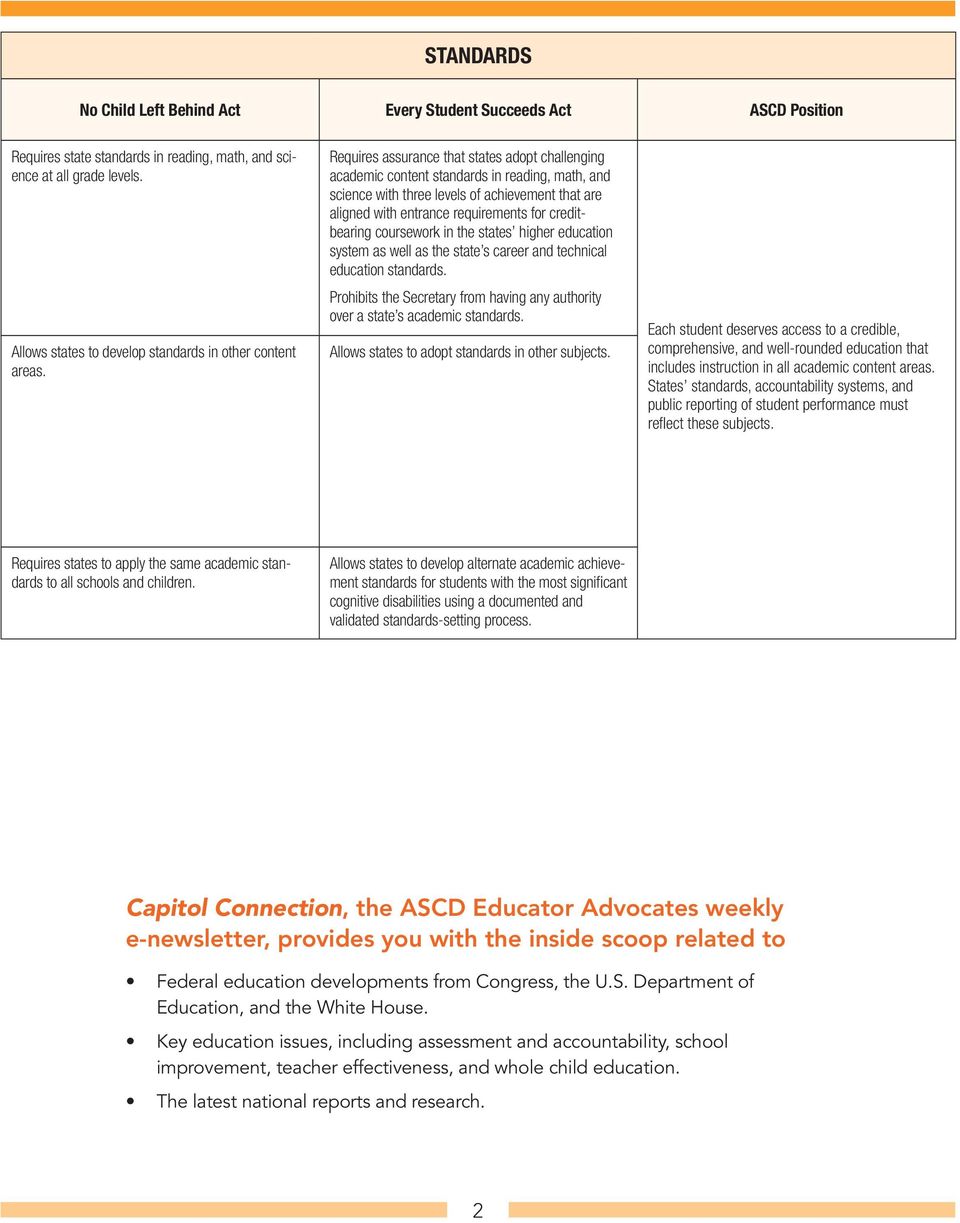
2 STANDARDS Requires state standards in reading, math, and science at all grade levels. Allows states to develop standards in other content areas. Requires assurance that states adopt challenging academic content standards in reading, math, and science with three levels of achievement that are aligned with entrance requirements for creditbearing coursework in the states higher education system as well as the state s career and technical education standards. Prohibits the Secretary from having any authority over a state s academic standards. Allows states to adopt standards in other subjects. Each student deserves access to a credible, comprehensive, and well-rounded education that includes instruction in all academic content areas. States standards, accountability systems, and public reporting of student performance must reflect these subjects. Requires states to apply the same academic standards to all schools and children. Allows states to develop alternate academic achievement standards for students with the most significant cognitive disabilities using a documented and validated standards-setting process. Capitol Connection, the ASCD Educator Advocates weekly e-newsletter, provides you with the inside scoop related to Federal education developments from Congress, the U.S. Department of Education, and the White House. Key education issues, including assessment and accountability, school improvement, teacher effectiveness, and whole child education. The latest national reports and research. 2
3 ASSESSMENTS Requires state testing in reading and math annually in grades 3 8 and once in high school. Same as NCLB but with the following changes: Allows states to use a single annual summative assessment or multiple statewide interim assessments throughout the year that result in one summative score. Requires state testing in science annually in grade spans 3 5, 6 8, and Allows states to develop assessments in other subjects. Requires states to provide reasonable adaptations and accommodations for students with disabilities. Allows states to administer alternate tests to students with disabilities; however, these alternate tests may be used by no more than 1% of the total number of students being assessed. Allows districts to use other tests for high schools with state permission. Allows states to develop and administer computer-adaptive assessments. Allows states to limit the aggregate amount of time spent on assessments for each grade. Prohibits the Secretary from specifying any aspect of assessments. Requires districts to publicly post information on all required assessments, including the amount of time students spend taking the assessments. Same as NCLB. Same as NCLB. Requires states to provide reasonable accommodations for students with disabilities. Allows states to administer alternate tests for students with the most significant cognitive disabilities; however, these alternate tests may be used by no more than 1% of the total number of students being assessed. Standardized tests help to provide a snapshot of student performance, and results should continue to be disaggregated and reported publicly. However, student test scores provide an incomplete appraisal of student achievement and by themselves often offer a misleading depiction of student performance and school quality. Standardized tests alone should never be used for high-stakes purposes, and neither students nor educators nor schools should be ranked or rated based on test scores. Requires states to administer assessments to at least 95% of students and 95% of each student subgroup. Requires districts to annually assess all students with limited English language proficiency. Requires states and districts receiving Title I-A funds to annually administer National Assessment of Educational Progress tests in grades 4 and 8 in reading and math. Maintains requirement that assessments be administered to at least 95% of all students. Allows states to establish their own laws governing opt-outs and requires parents to be notified regarding their children s participation rights in assessments. Consequences for schools that miss this threshold are determined by states and districts. Shifts accountability for English language learners into Title I; allows schools to phase in the use of English language learners test results for accountability purposes. Same as NCLB. 3

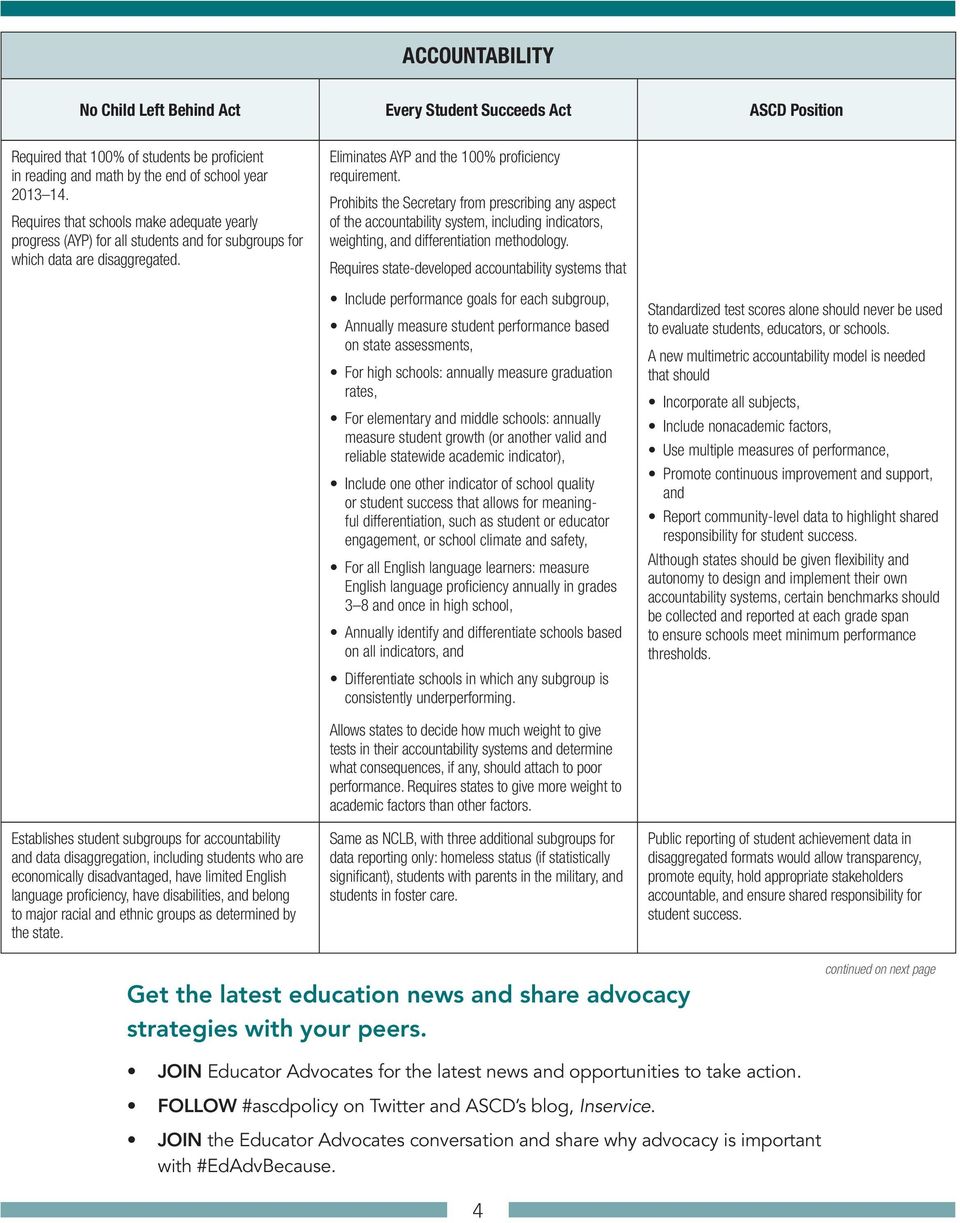
4 ACCOUNTABILITY Required that 100% of students be proficient in reading and math by the end of school year Requires that schools make adequate yearly progress (AYP) for all students and for subgroups for which data are disaggregated. Eliminates AYP and the 100% proficiency requirement. Prohibits the Secretary from prescribing any aspect of the accountability system, including indicators, weighting, and differentiation methodology. Requires state-developed accountability systems that Include performance goals for each subgroup, Annually measure student performance based on state assessments, For high schools: annually measure graduation rates, For elementary and middle schools: annually measure student growth (or another valid and reliable statewide academic indicator), Include one other indicator of school quality or student success that allows for meaningful differentiation, such as student or educator engagement, or school climate and safety, For all English language learners: measure English language proficiency annually in grades 3 8 and once in high school, Annually identify and differentiate schools based on all indicators, and Differentiate schools in which any subgroup is consistently underperforming. Standardized test scores alone should never be used to evaluate students, educators, or schools. A new multimetric accountability model is needed that should Incorporate all subjects, Include nonacademic factors, Use multiple measures of performance, Promote continuous improvement and support, and Report community-level data to highlight shared responsibility for student success. Although states should be given flexibility and autonomy to design and implement their own accountability systems, certain benchmarks should be collected and reported at each grade span to ensure schools meet minimum performance thresholds. Establishes student subgroups for accountability and data disaggregation, including students who are economically disadvantaged, have limited English language proficiency, have disabilities, and belong to major racial and ethnic groups as determined by the state. Allows states to decide how much weight to give tests in their accountability systems and determine what consequences, if any, should attach to poor performance. Requires states to give more weight to academic factors than other factors. Same as NCLB, with three additional subgroups for data reporting only: homeless status (if statistically significant), students with parents in the military, and students in foster care. Public reporting of student achievement data in disaggregated formats would allow transparency, promote equity, hold appropriate stakeholders accountable, and ensure shared responsibility for student success. Get the latest education news and share advocacy strategies with your peers. continued on next page JOIN Educator Advocates for the latest news and opportunities to take action. FOLLOW #ascdpolicy on Twitter and ASCD s blog, Inservice. JOIN the Educator Advocates conversation and share why advocacy is important with #EdAdvBecause. 4
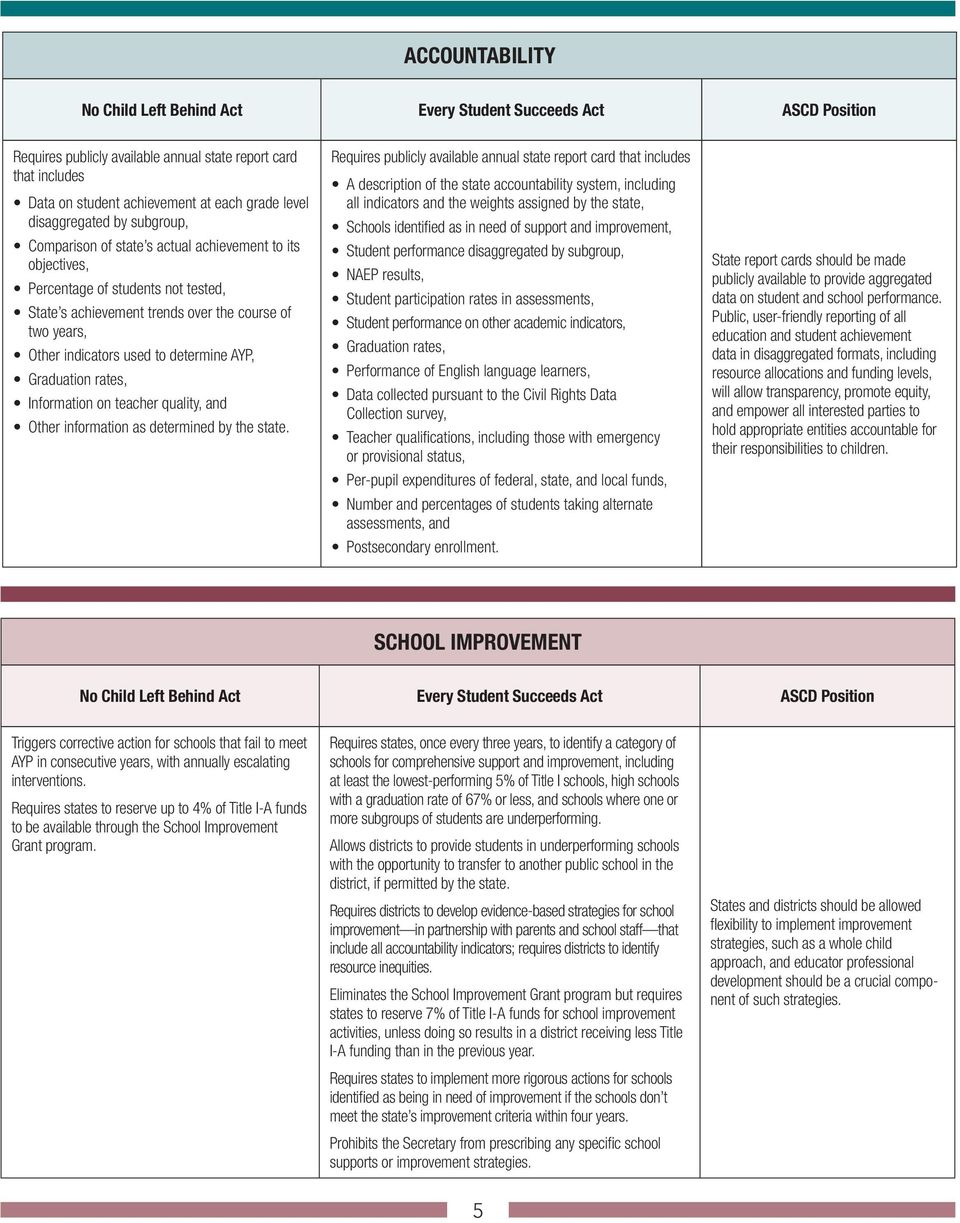
5 ACCOUNTABILITY Requires publicly available annual state report card that includes Data on student achievement at each grade level disaggregated by subgroup, Comparison of state s actual achievement to its objectives, Percentage of students not tested, State s achievement trends over the course of two years, Other indicators used to determine AYP, Graduation rates, Information on teacher quality, and Other information as determined by the state. Requires publicly available annual state report card that includes A description of the state accountability system, including all indicators and the weights assigned by the state, Schools identified as in need of support and improvement, Student performance disaggregated by subgroup, NAEP results, Student participation rates in assessments, Student performance on other academic indicators, Graduation rates, Performance of English language learners, Data collected pursuant to the Civil Rights Data Collection survey, Teacher qualifications, including those with emergency or provisional status, Per-pupil expenditures of federal, state, and local funds, Number and percentages of students taking alternate assessments, and Postsecondary enrollment. State report cards should be made publicly available to provide aggregated data on student and school performance. Public, user-friendly reporting of all education and student achievement data in disaggregated formats, including resource allocations and funding levels, will allow transparency, promote equity, and empower all interested parties to hold appropriate entities accountable for their responsibilities to children. SCHOOL IMPROVEMENT Triggers corrective action for schools that fail to meet AYP in consecutive years, with annually escalating interventions. Requires states to reserve up to 4% of Title I-A funds to be available through the School Improvement Grant program. Requires states, once every three years, to identify a category of schools for comprehensive support and improvement, including at least the lowest-performing 5% of Title I schools, high schools with a graduation rate of 67% or less, and schools where one or more subgroups of students are underperforming. Allows districts to provide students in underperforming schools with the opportunity to transfer to another public school in the district, if permitted by the state. Requires districts to develop evidence-based strategies for school improvement in partnership with parents and school staff that include all accountability indicators; requires districts to identify resource inequities. Eliminates the School Improvement Grant program but requires states to reserve 7% of Title I-A funds for school improvement activities, unless doing so results in a district receiving less Title I-A funding than in the previous year. Requires states to implement more rigorous actions for schools identified as being in need of improvement if the schools don t meet the state s improvement criteria within four years. Prohibits the Secretary from prescribing any specific school supports or improvement strategies. States and districts should be allowed flexibility to implement improvement strategies, such as a whole child approach, and educator professional development should be a crucial component of such strategies. 5
6 TEACHER AND LEADER EFFECTIVENESS Requires 100% of teachers in core academic subjects to be highly qualified, which is defined as follows: Existing teachers must have a bachelor s degree, demonstrate subject-matter knowledge in the areas they teach, and hold a certification or license in the subject they teach. New teachers must have a bachelor s degree and pass subject-matter tests. Requires state plans to provide assurance that all teachers and paraprofessionals working in programs supported by Title I-A funds meet state certification and licensure requirements. Requires schools receiving Title I-A funds to ensure that poor and minority children are not taught by inexperienced, unqualified, or out-of-field teachers at higher rates than other children. Defines professional development as activities that improve teachers knowledge in the subjects they teach, enable them to become highly qualified, are aligned with content standards, and advance understanding of instructional strategies, etc. Requires states to provide scientifically based professional development for teachers of core academic subjects. Requires schools to use Title II funds to prepare, recruit, and retain teachers and principals. Allocates Title II funds to states based on 35% of a state s school-age population and 65% of its school-age population living in poverty. Eliminates highly qualified teacher requirements. Requires state plans to provide assurance that all teachers and paraprofessionals working in programs supported by Title I-A funds meet state certification and licensure requirements. Same as NCLB. Maintains the equitable distribution requirement but replaces unqualified with ineffective. Updates the definition of professional development to ensure personalized, ongoing, job-embedded activities that are Available to all school staff, including paraprofessionals, Part of broader school improvement plans, Collaborative and data driven, Developed with educator input, and Regularly evaluated. Creates new teacher, principal, and school leader academies to help meet the need for effective educators in high-need schools. Creates new teacher residency programs to enhance clinical training opportunities for teachers. Expands access to professional development under Title II to include teachers of all subjects, not just core subjects as under NCLB, as well as school leaders, administrators, and other school staff. Replaces the requirement that professional development programs and activities be scientifically based with a requirement that they be evidence based. Changes the Title II formula to 20% based on schoolage population and 80% based on school-age population living in poverty, phased in over four years. Maintains Teacher Quality Partnership Grants and revises the Teacher Incentive Fund to include school leaders. Allows the use of Title II funds to reform certification systems; improve alternate routes to certification; and improve recruitment and retention of teachers, principals, and school leaders; among other activities. 6 Each student should have access to highly effective teachers in every subject and discipline. Effective teaching leads to ongoing student achievement and growth; is based on evidence; and incorporates knowledge and skills into planning and preparation, classroom management, instruction, and subject content. All educators should receive a stepped induction into the profession, time to reflect on and refine their practice, and personalized professional development that recognizes their strengths and allows them to grow. continued on next page
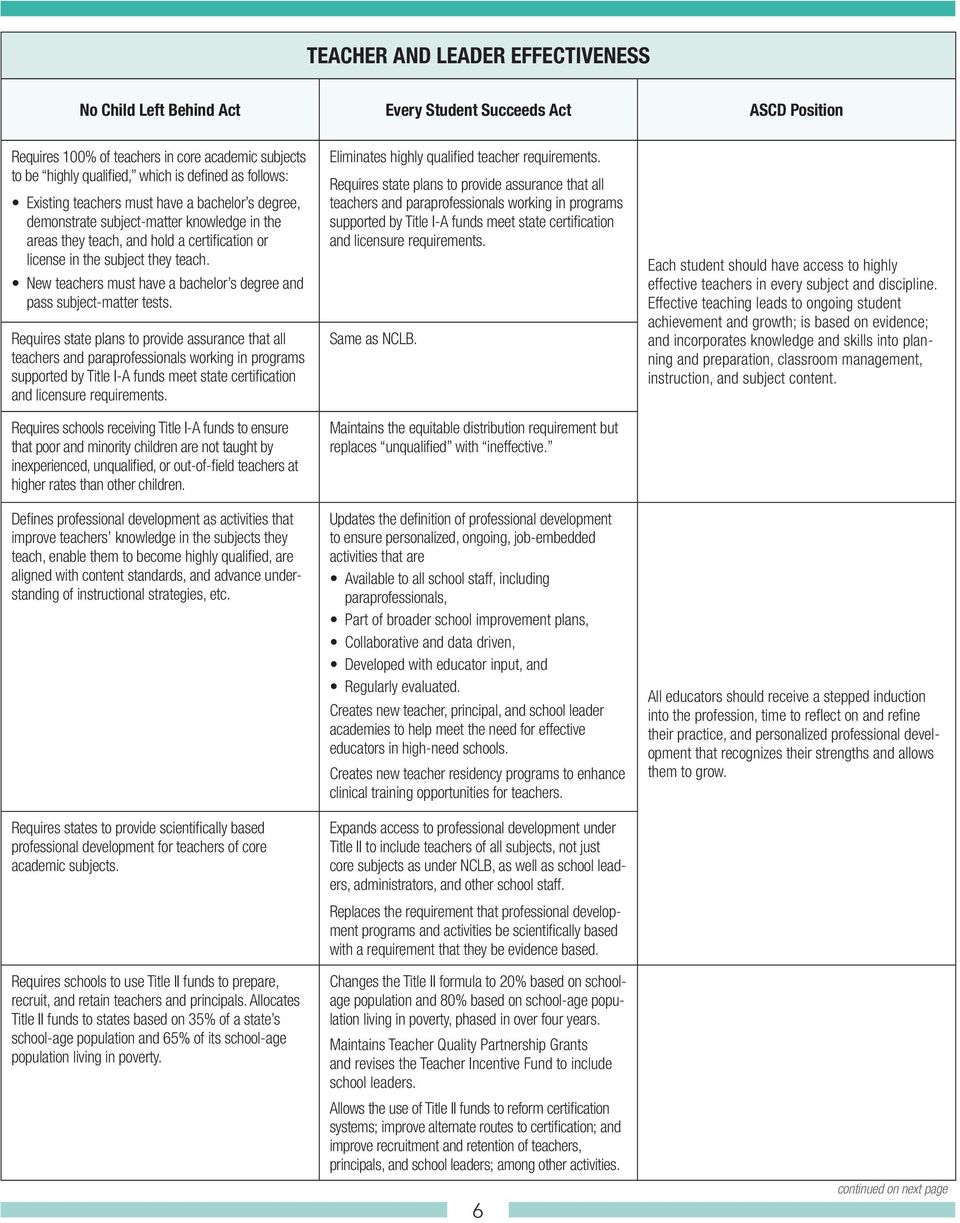
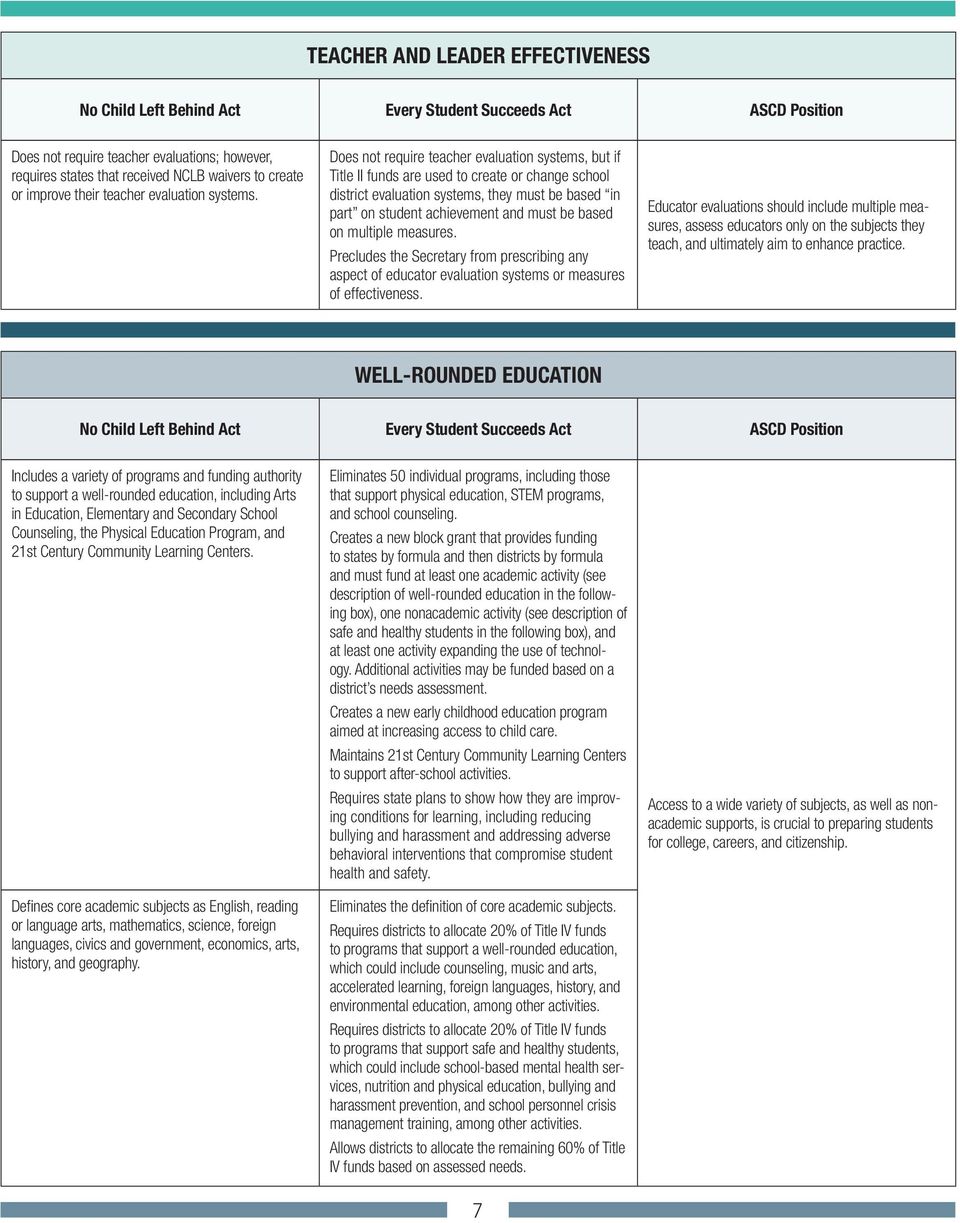
7 TEACHER AND LEADER EFFECTIVENESS Does not require teacher evaluations; however, requires states that received NCLB waivers to create or improve their teacher evaluation systems. Does not require teacher evaluation systems, but if Title II funds are used to create or change school district evaluation systems, they must be based in part on student achievement and must be based on multiple measures. Precludes the Secretary from prescribing any aspect of educator evaluation systems or measures of effectiveness. Educator evaluations should include multiple measures, assess educators only on the subjects they teach, and ultimately aim to enhance practice. WELL-ROUNDED EDUCATION Includes a variety of programs and funding authority to support a well-rounded education, including Arts in Education, Elementary and Secondary School Counseling, the Physical Education Program, and 21st Century Community Learning Centers. Defines core academic subjects as English, reading or language arts, mathematics, science, foreign languages, civics and government, economics, arts, history, and geography. Eliminates 50 individual programs, including those that support physical education, STEM programs, and school counseling. Creates a new block grant that provides funding to states by formula and then districts by formula and must fund at least one academic activity (see description of well-rounded education in the following box), one nonacademic activity (see description of safe and healthy students in the following box), and at least one activity expanding the use of technology. Additional activities may be funded based on a district s needs assessment. Creates a new early childhood education program aimed at increasing access to child care. Maintains 21st Century Community Learning Centers to support after-school activities. Requires state plans to show how they are improving conditions for learning, including reducing bullying and harassment and addressing adverse behavioral interventions that compromise student health and safety. Eliminates the definition of core academic subjects. Requires districts to allocate 20% of Title IV funds to programs that support a well-rounded education, which could include counseling, music and arts, accelerated learning, foreign languages, history, and environmental education, among other activities. Requires districts to allocate 20% of Title IV funds to programs that support safe and healthy students, which could include school-based mental health services, nutrition and physical education, bullying and harassment prevention, and school personnel crisis management training, among other activities. Allows districts to allocate the remaining 60% of Title IV funds based on assessed needs. Access to a wide variety of subjects, as well as nonacademic supports, is crucial to preparing students for college, careers, and citizenship. 7
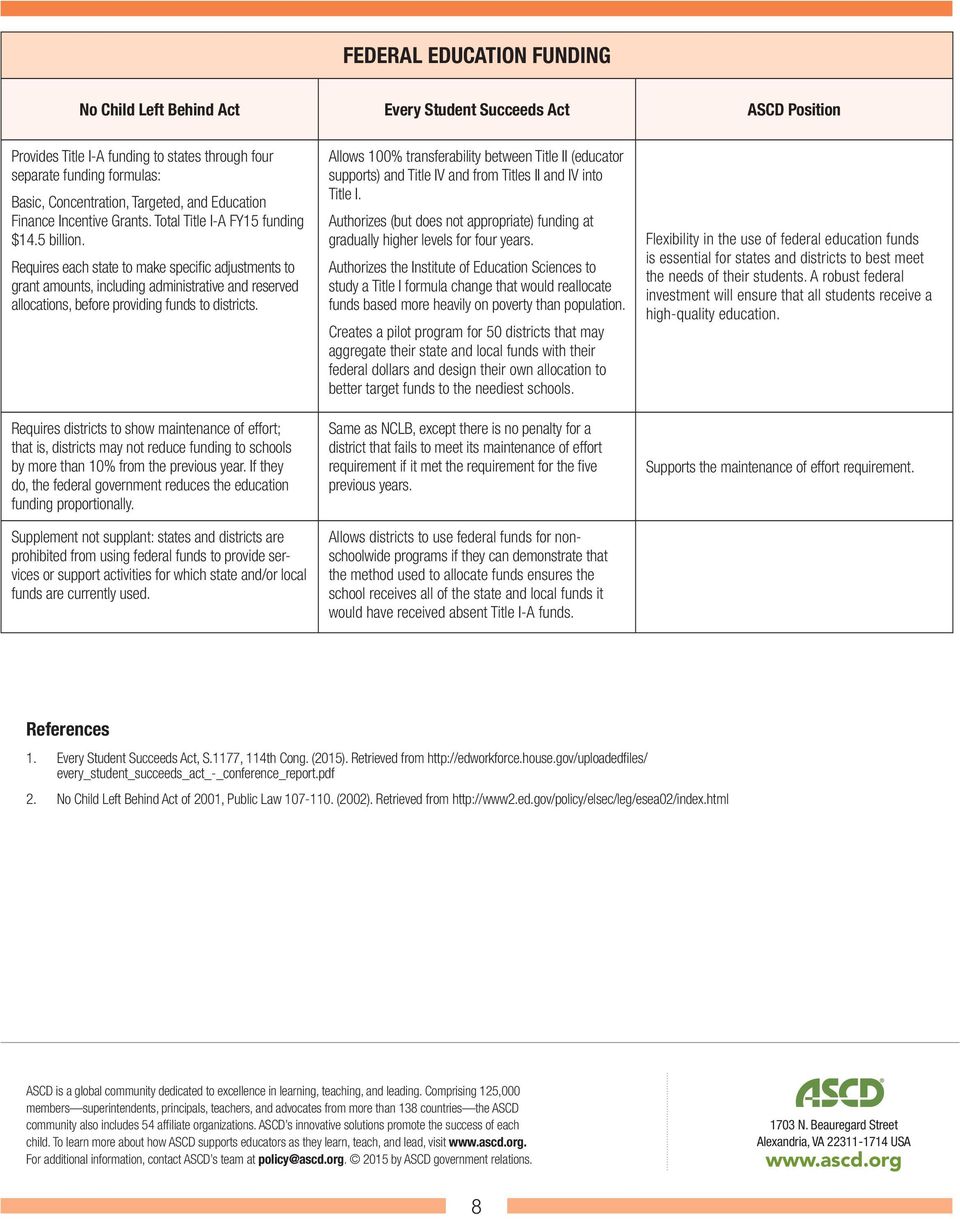
8 FEDERAL EDUCATION FUNDING Provides Title I-A funding to states through four separate funding formulas: Basic, Concentration, Targeted, and Education Finance Incentive Grants. Total Title I-A FY15 funding $14.5 billion. Requires each state to make specific adjustments to grant amounts, including administrative and reserved allocations, before providing funds to districts. Requires districts to show maintenance of effort; that is, districts may not reduce funding to schools by more than 10% from the previous year. If they do, the federal government reduces the education funding proportionally. Supplement not supplant: states and districts are prohibited from using federal funds to provide services or support activities for which state and/or local funds are currently used. Allows 100% transferability between Title II (educator supports) and Title IV and from Titles II and IV into Title I. Authorizes (but does not appropriate) funding at gradually higher levels for four years. Authorizes the Institute of Education Sciences to study a Title I formula change that would reallocate funds based more heavily on poverty than population. Creates a pilot program for 50 districts that may aggregate their state and local funds with their federal dollars and design their own allocation to better target funds to the neediest schools. Same as NCLB, except there is no penalty for a district that fails to meet its maintenance of effort requirement if it met the requirement for the five previous years. Allows districts to use federal funds for nonschoolwide programs if they can demonstrate that the method used to allocate funds ensures the school receives all of the state and local funds it would have received absent Title I-A funds. Flexibility in the use of federal education funds is essential for states and districts to best meet the needs of their students. A robust federal investment will ensure that all students receive a high-quality education. Supports the maintenance of effort requirement. References 1. Every Student Succeeds Act, S.1177, 114th Cong. (2015). Retrieved from every_student_succeeds_act_-_conference_report.pdf 2. No Child Left Behind Act of 2001, Public Law (2002). Retrieved from ASCD is a global community dedicated to excellence in learning, teaching, and leading. Comprising 125,000 members superintendents, principals, teachers, and advocates from more than 138 countries the ASCD community also includes 54 affiliate organizations. ASCD s innovative solutions promote the success of each child. To learn more about how ASCD supports educators as they learn, teach, and lead, visit For additional information, contact ASCD s team at [email protected] by ASCD government relations N. Beauregard Street Alexandria, VA USA 8
Summary of Significant Spending and Fiscal Rules in the Every Student Succeeds Act
 Summary of Significant Spending and Fiscal Rules in the Every Student Succeeds Act The Every Student Succeeds Act (ESSA), which was signed into law on December 10, 2015, makes important changes to the
Every Student Succeeds Act
 Every Student Succeeds Act A New Day in Public Education Frequently Asked Questions STANDARDS, ASSESSMENTS AND ACCOUNTABILITY Q: What does ESSA mean for a classroom teacher? A: ESSA will end the obsession
Every Student Succeeds Act (ESSA)
 Every Student Succeeds Act (ESSA) An Overview of the Every Student Succeeds Act A reauthorization of the Elementary and Secondary Education Act (ESEA) June 28 th, 2016 Diane Douglas Superintendent of Public
TEACHER QUALIFICATIONS UNDER THE NO CHILD LEFT BEHIND ACT
 Certificated Personnel BP 4112.24(a) Recognizing the importance of teacher effectiveness in improving student achievement, the Board of Trustees desires to recruit and hire teachers who possess the subject
Adopted March 2010 ESEA REAUTHORIZATION PRINCIPLES AND RECOMMENDATIONS. A Policy Statement of the Council of Chief State School Officers
 Adopted March 2010 ESEA REAUTHORIZATION PRINCIPLES AND RECOMMENDATIONS A Policy Statement of the Council of Chief State School Officers INTRODUCTION This policy statement presents a vision for a new deal
Personnel TEACHER QUALIFICATIONS UNDER THE NO CHILD LEFT BEHIND ACT
 Administrative Regulation SANGER UNIFIED SCHOOL DISTRICT AR 4112.24 (a) Personnel TEACHER QUALIFICATIONS UNDER THE NO CHILD LEFT BEHIND ACT Definitions Core academic subjects include English, reading or
MEMORANDUM. TO: CCSSO FROM: Penn Hill Group DATE: January 26, 2016 SUBJECT: State Report Card Requirements. Introduction
 MEMORANDUM TO: CCSSO FROM: Penn Hill Group DATE: January 26, 2016 SUBJECT: State Report Card Requirements Introduction On December 10. 2015, President Obama signed into law the Every Student Succeeds Act
http://www.ccusd.k12.ca.us/board_ed/policies/4000/4112-24ar.htm
 AR 4112.24 Teacher Qualifications Under The No Child Left Behind Act Definitions Core academic subjects include English, reading or language arts, mathematics, science, foreign languages, civics and government,
A NEW ERA FOR ESEA THE EVERY STUDENT SUCCEEDS ACT DR. SYLVIA E. LYLES MARCH 2016
 A NEW ERA FOR ESEA THE EVERY STUDENT SUCCEEDS ACT DR. SYLVIA E. LYLES MARCH 2016 ESSA, signed on December 15, 2015, builds on ou progress and solidifies many of the reforms the Department has championed
SUMMARY OF AND PROBLEMS WITH REPUBLICAN BILL
 SUMMARY OF AND PROBLEMS WITH REPUBLICAN BILL The Student Success Act (H.R. 5): H.R. 5 makes significant changes to Title I (Improving Academic Achievement of the Disadvantaged). It also moves current law
DEPARTMENT OF EDUCATION
 DEPARTMENT OF EDUCATION OFFICE OF ELEMENTARY AND SECONDARY EDUCATION Federal Funds Total: Outlays. Budget Authority... Outlays.,,,, 0,, ACCELERATING ACHIEVEMENT AND ENSURING EQUITY Note. A full-year 0
Louisiana s Schoolwide Reform Guidance
 Overview How educational funds are spent not just how much is spent impacts student achievement. Louisiana Believes is based on the premise that those closest to kids parents and educators know better
National Board for Professional Teaching Standards Certification Incentive Program
 Certificated Personnel BP 4112.2(a) CERTIFICATION The Superintendent or designee shall ensure that persons employed in positions requiring certification qualifications have the appropriate credential or
SUMMARY OF THE EVERY STUDENT SUCCEEDS ACT, LEGISLATION REAUTHORIZING THE ELEMENTARY AND SECONDARY EDUCATION ACT
 SUMMARY OF THE EVERY STUDENT SUCCEEDS ACT, LEGISLATION REAUTHORIZING THE ELEMENTARY AND SECONDARY EDUCATION ACT Legislative History A conference committee met on November 18 and 19 to resolve the differences
Every Student Succeeds Act (ESSA) Data Collection and Reporting
 Every Student Succeeds Act (ESSA) Data Collection and Reporting April 25, 2016 Minnesota Department of Education education.state.mn.us 1 Agenda Purpose and outcome of today s topic meeting. ESSA overview
JUST THE FACTS. Birmingham, Alabama
 JUST THE FACTS Birmingham, Alabama The Institute for a Competitive Workforce (ICW) is a nonprofit, nonpartisan, 501(c)(3) affiliate of the U.S. Chamber of Commerce. ICW promotes the rigorous educational
Crosswalk of the New Colorado Principal Standards (proposed by State Council on Educator Effectiveness) with the
 Crosswalk of the New Colorado Principal Standards (proposed by State Council on Educator Effectiveness) with the Equivalent in the Performance Based Principal Licensure Standards (current principal standards)
TEACHER QUALIFICATIONS UNDER THE NO CHILD LEFT BEHIND ACT
 Certificated Personnel Administrative Regulation 4112.24(a) TEACHER QUALIFICATIONS UNDER THE NO CHILD LEFT BEHIND ACT Definitions Core academic subjects include English, reading or language arts, mathematics,
Every Student Succeeds Act: A Progress Report on Elementary and Secondary Education
 Every Student Succeeds Act: A Progress Report on Elementary and Secondary Education Executive Office of the President December 2015 Every Student Succeeds Act: A Progress Report on Elementary and Secondary
Masters Comprehensive Exam and Rubric (Rev. July 17, 2014)
 1 Educational Leadership & Policy Studies Masters Comprehensive Exam and Rubric (Rev. July 17, 2014) The comprehensive exam is intended as a final assessment of a student s ability to integrate important
UNITED STATES DEPARTMENT OF EDUCATION
 UNITED STATES DEPARTMENT OF EDUCATION February 2, 2016 Dear Chief State School Officers, I am writing to follow up on President Obama s Testing Action Plan (Plan) released in October 2015. In that plan,
State Transition to High-Quality, College/Career-Ready Assessments: A Workbook for State Action on Key Policy, Legal, and Technical Issues
 State Transition to High-Quality, College/Career-Ready Assessments: A Workbook for State Action on Key Policy, Legal, and Technical Issues Updated as of November 14, 2013 Page 1 Table of Contents Part
Procedures and Guidelines New Hampshire s Highly Qualified Teacher Requirements No Child Left Behind Act (NCLB) 2001
 Procedures and Guidelines New Hampshire s Highly Qualified Teacher Requirements No Child Left Behind Act (NCLB) 2001 General Information about HQT According to the No Child Left Behind Act of 2001, all
Wythe County Public Schools Comprehensive Plan 2013-2019
 Wythe County Public Schools Comprehensive Plan 2013-2019 VISION Educating Students for Success in a Changing World MISSION The mission of Wythe County Public Schools, in partnership with our community,
JUST THE FACTS. Washington
 JUST THE FACTS Washington The Institute for a Competitive Workforce (ICW) is a nonprofit, nonpartisan, 501(c)(3) affiliate of the U.S. Chamber of Commerce. ICW promotes the rigorous educational standards
Frequently Asked Questions. The No Child Left Behind Act (NCLB)
 Frequently Asked Questions The No Child Left Behind Act (NCLB) Table of Contents What are the major requirements of NCLB? page 7 Does NCLB federalize education? 7 How many states are currently in compliance
A Blueprint for Reform
 U. S. D E P A R T M E N T O F E D U C A T I O N A Blueprint for Reform The Reauthorization of the Elementary and Secondary Education Act college- and career-ready students great teachers and leaders Accelerate
M D R w w w. s c h o o l d a t a. c o m 8 0 0-3 3 3-8 8 0 2
 MDR s Guide to Federally Funded Education Programs Major federal programs in the Education Budget for Fiscal Year 2011 are listed below. Twenty-three programs were eliminated from the FY2011 budget, including
The Massachusetts Tiered System of Support
 The Massachusetts Tiered System of Support Chapter 1: Massachusetts Tiered System of Support (MTSS) Overview Massachusetts has developed a blueprint outlining a single system of supports that is responsive
Chapter 10 Federal Accountability
 Chapter 10 Federal Accountability Elementary and Secondary Education Act (ESEA) and No Child Left Behind (NCLB) The Elementary and Secondary Education Act (ESEA) was first passed by Congress in 1965 as
Accountability and Virginia Public Schools
 Accountability and Virginia Public Schools 2008-2009 School Year irginia s accountability system supports teaching and learning by setting rigorous academic standards, known as the Standards of Learning
2. Explain how the school will collect and analyze student academic achievement data.
 14 Del. C. 512(4)-(7) 1. Explain how the school s Board and School Leadership Team will measure and evaluate LTA (LTA) will use multiple data sources to enhance student learning while focusing on the need
ANNUAL REPORT ON CURRICULUM, INSTRUCTION AND STUDENT ACHIEVEMENT
 The mission of the Greenbush-Middle River School is to provide a quality education which will prepare all students to meet success by developing self-directed thinkers and communicators who are responsible,
ADVOCACY TOOLKIT. Every Student Succeeds Act
 ADVOCACY TOOLKIT Every Student Succeeds Act International Literacy Association 2016 Purpose of the Toolkit This toolkit is designed to help International Literacy Association (ILA) members learn about
Career and Professional Education: Preparing Florida s Students for the Knowledge Economy Florida Master Plan for K-20 Education
 COUNCIL FOR EDUCATION POLICY, RESEARCH & IMPROVEMENT Career and Professional Education: Preparing Florida s Students for the Knowledge Economy Florida Master Plan for K-20 Education 2005 Progress Report
NO CHILD LEFT BEHIND (NCLB) HIGHLY QUALIFIED SUMMARY REPORT
 December 8, 215 215 HCISD NO CHILD LEFT BEHIND (NCLB) HIGHLY QUALIFIED SUMMARY REPORT Prepared by: Rosalinda R. Vargas, Assistant Superintendent for Human Services Email: [email protected] Harlingen
Race to the Top Program Executive Summary
 Race to the Top Program Executive Summary U.S. Department of Education Washington, D.C. 20202 November 2009 Race to the Top Executive Summary Page 1 It's time to stop just talking about education reform
Introduction: Online school report cards are not new in North Carolina. The North Carolina Department of Public Instruction (NCDPI) has been
 Introduction: Online school report cards are not new in North Carolina. The North Carolina Department of Public Instruction (NCDPI) has been reporting ABCs results since 1996-97. In 2001, the state General
ESEA Reauthorization Proposals in the 113 th Congress: Comparison of Major Features
 ESEA Reauthorization Proposals in the 113 th Congress: Comparison of Major Features Rebecca R. Skinner Specialist in Education Policy Jeffrey J. Kuenzi Specialist in Education Policy Cassandria Dortch
Parent and Family Engagement Provisions in the Every Student Succeeds Act
 The Every Student Succeeds Act (ESSA) serves as the latest reauthorization of the Elementary and Secondary Education Act of 1965 (ESEA) which was last reauthorized in 2002 as the No Child Left Behind Act
Questions and Answers Regarding the Requirements for Highly Qualified Teachers Under ESEA and IDEA
 Questions and Answers Regarding the Requirements for Highly Qualified Teachers Under ESEA and IDEA September 15, 2015 09/15/2015 1 Questions and Answers Regarding the Requirements for Highly Qualified
Agenda for Reform. Summary Briefing December 14, 2009
 Summary Briefing December 14, 2009 The Vision The Board of Regents envisions a New York where all students are prepared for college, the global economy, 21 st century citizenship, and continued learning
Guidance for the Implementation of NCLB Highly Qualified Teacher Requirements
 Guidance for the Implementation of NCLB Highly Qualified Teacher Requirements Division of Educator Leadership and Quality Texas Education Agency Updated September 5, 2014 Based on the December 2006 USDE-Approved
Building Pathways to Postsecondary 2.0 Summits
 Building Pathways to Postsecondary 2.0 Summits 2014-2015 Paula Palmer, JoAnn Simser, and Pakou Yang Minnesota Department of Education Minnesota State Colleges and Universities Leading for educational excellence
Fulda Independent School District 505
 Fulda Independent School District 505 Local World s Best Workforce Plan The World s Best Workforce Plan (state statute, section 120B.11) is a comprehensive, long-term strategic plan to support and improve
Effective after October 1, 2013
 MICHIGAN TEST FOR TEACHER CERTIFICATION (MTTC) TEST OBJECTIVES Subarea Range of Objectives Approximate Test Weighting I. Student Diversity and Assessment 001 002 29% II. Comprehensive School Counseling
Illinois Criteria for Meeting the NCLB Requirements for Highly Qualified Teachers
 Illinois Criteria for Meeting the NCLB Requirements for Highly Qualified Teachers Illinois State Board of Education ADOPTED June 17, 2003 1 Illinois Criteria for Meeting the NCLB Requirements for Highly
Under the Start Your Search Now box, you may search by author, title and key words.
 VISTAS Online VISTAS Online is an innovative publication produced for the American Counseling Association by Dr. Garry R. Walz and Dr. Jeanne C. Bleuer of Counseling Outfitters, LLC. Its purpose is to
Ten Components of a Title I, Part A Schoolwide Program
 Ten Components of a Title I, Part A Schoolwide Program Texas Education Agency NCLB Program Coordination 1701 N. Congress Avenue Austin, Texas 78701-1494 Telephone (512) 463-9374 Fax (512) 305-9447 www.tea.state.tx.us/nclb
Frequently Asked Questions Contact us: [email protected]
 Frequently Asked Questions Contact us: [email protected] 1 P a g e Contents Identification of a Priority, Focus, or Reward School... 4 Is a list of all Priority, Focus, and Reward Schools available to
Oregon Framework for Teacher and Administrator Evaluation and Support Systems
 Oregon Framework for Teacher and Administrator Evaluation and Support Systems Revised for 2014 2015 State Guidelines for ESEA Waiver & SB 290 OREGON DEPARTMENT OF EDUCATION 255 Capitol St, NE, Salem, OR
JUST THE FACTS. Memphis, Tennessee
 JUST THE FACTS Memphis, Tennessee The Institute for a Competitive Workforce (ICW) is a nonprofit, nonpartisan, 501(c)(3) affiliate of the U.S. Chamber of Commerce. ICW promotes the rigorous educational
Class of 2020: Action Plan for Education
 Class of 2020: Action Plan for Education Student Bill of Rights I. Each student has the right to feel safe in and proud of a school. II. Each student deserves an engaging educational experience that provides
West Virginia Department of Education Revised Plan for Meeting the Goal of 100% Highly Qualified Teachers 2006-2007
 West Virginia Department of Education Revised Plan for Meeting the Goal of 100% Highly Qualified Teachers 2006-2007 Introduction West Virginia supports the mandate for highly qualified teachers and understands
JUST THE FACTS. Phoenix, Arizona
 JUST THE FACTS Phoenix, Arizona The Institute for a Competitive Workforce (ICW) is a nonprofit, nonpartisan, 501(c)(3) affiliate of the U.S. Chamber of Commerce. ICW promotes the rigorous educational standards
Highly Qualified Teacher Requirements
 Overview Highly Qualified Teacher Requirements Elementary and Secondary Education Act of 2001 and Individuals with Disabilities Education Improvement Act of 2004 The Elementary and Secondary Education
ESEA Reauthorization Update 113 th Congress
 ESEA Reauthorization Update 113 th Congress Status H.R.5 Latest Title: Student Success Act Sponsor: Rep Kline, John [MN-2] (introduced 6/6/2013) Cosponsors (12) Latest Major Action: 6/19/2013. Ordered
S. Dallas Dance, Ph.D.
 EXPERIENCE UNIVERSITY 2008 Present UNIVERSITY OF RICHMOND Adjunct Assistant Professor, School of Continuing Studies, Department of Education & Teacher Licensure Teach graduate level courses in Foundations
TITLE II New Grant Programs
 TITLE II New Grant Programs PART B--ENHANCING TEACHER EDUCATION SEC. 230. AUTHORIZATION OF APPROPRIATIONS. There are authorized to be appropriated to carry out this part such sums as may be necessary for
AUTHORITY: 20 U.S.C. 1022d, unless otherwise noted. (a) This subpart establishes regulations related to the
 xx. A new part 612 is added to read as follows: PART 612 TITLE II REPORTING SYSTEM Subpart A--Scope, Purpose and Definitions Sec. 612.1 Scope and purpose. 612.2 Definitions. Subpart B--Reporting Requirements
1. Modernizing Ohio Classrooms and Curriculum
 Reforming Ohio s Education System for the Modern Economy Outline of Governor Ted Strickland s Education Reform and Funding Plan, as Included in the FY 2010-2011 Biennial Budget Components of Governor Strickland
NAEYC SUMMARY OF EARLY CHILDHOOD EDUCATOR/PROGRAM PROVISIONS IN THE HIGHER EDUCATION OPPORTUNITY ACT OF 2008 PUBLIC LAW 110-315
 NAEYC SUMMARY OF EARLY CHILDHOOD EDUCATOR/PROGRAM PROVISIONS IN THE HIGHER EDUCATION OPPORTUNITY ACT OF 2008 PUBLIC LAW 110-315 The Higher Education Act of 1965 (HEA) had not been reauthorized for many
DEPARTMENT OF EDUCATION
 DEPARTMENT OF EDUCATION Funding Highlights: Provides $68.6 billion in discretionary funding for the Department of Education to build upon investments in preschool access, ongoing K-12 reforms, and efforts
DRAFT. Denver Plan 2014. Every Child Succeeds
 Denver Plan 2014 Every Child Succeeds 100 80 Introduction Every child takes that first step into their first day of school with butterflies and talent, potential and dreams. It s the day that the door
ALTERNATE ACHIEVEMENT STANDARDS FOR STUDENTS WITH THE MOST SIGNIFICANT COGNITIVE DISABILITIES. Non-Regulatory Guidance
 ALTERNATE ACHIEVEMENT STANDARDS FOR STUDENTS WITH THE MOST SIGNIFICANT COGNITIVE DISABILITIES Non-Regulatory Guidance August 2005 Alternate Achievement Standards for Students with the Most Significant
Frequently Asked Questions on the No Child Left Behind Consolidated Application FAQ NCLB. Illinois State Board of Education
 Frequently Asked Questions on the No Child Left Behind Consolidated Application FAQ NCLB Illinois State Board of Education How do I add a new school onto targeting step 4? If information is incorrect in
Mississippi Department of Education Highly Qualified Teacher Criteria The No Child Left Behind Act of 2001
 Mississippi Department of Education Highly Qualified Teacher Criteria The No Child Left Behind Act of 2001 General Information 1. Mississippi issues teacher licenses at four levels to persons who have
CASE s ESEA REAUTHORIZATION RECOMMENDATIONS
 A Division Of The Council For Exceptional Children CASE s ESEA REAUTHORIZATION RECOMMENDATIONS Offi c e : 4 7 8.3 3 3.6 8 9 2 Osi g i a n Offi c e C e n tre 1 0 1 K a te l y n C i rc l e, S u i te E Wa
BUILDING CAPACITY FOR PARENTAL INVOLVEMENT
 BUILDING CAPACITY FOR PARENTAL INVOLVEMENT New Jersey Department of Education Division of Student Services Regional and County Education Office Version Developed by the Office of Title I Program Planning
TITLE IX, PART E UNIFORM PROVISIONS SUBPART 1 PRIVATE SCHOOLS. Non-Regulatory Guidance
 TITLE IX, PART E UNIFORM PROVISIONS SUBPART 1 PRIVATE SCHOOLS Equitable Services to Eligible Private School Students, Teachers, and Other Educational Personnel Non-Regulatory Guidance Office of Non-Public
ENROLLED SENATE BILL No. 103
 Act No. 173 Public Acts of 2015 Approved by the Governor November 5, 2015 Filed with the Secretary of State November 5, 2015 EFFECTIVE DATE: November 5, 2015 Introduced by Senator Pavlov STATE OF MICHIGAN
Curriculum and Instruction: A 21st Century Skills Implementation Guide
 Curriculum and Instruction: A 21st Century Skills Implementation Guide Produced by To succeed in college, career and life in the 21st century, students must be supported in mastering both content and skills.
To: New Jersey School Psychologists From: Terri Allen, NJASP President; Barry Barbarasch, Chair, Government and Professional Relations (GPR) Committee
 To: New Jersey School Psychologists From: Terri Allen, NJASP President; Barry Barbarasch, Chair, Government and Professional Relations (GPR) Committee Re: Passage of the Every Student Succeeds Act and
Pennsylvania s Statewide System of School Support
 Pennsylvania s Statewide System of School Support The Pennsylvania Department of Education s (PDE) mission is to lead and serve the educational community to enable each individual to grow into an inspired,
Appendix E. Role-Specific Indicators
 Appendix E. Role-Specific Indicators A frequent topic of debate with regard to educator evaluation both in Massachusetts and across the nation is the extent to which performance rubrics should be specific
DEPARTMENT OF EDUCATION
 DEPARTMENT OF EDUCATION Funding Highlights: Provides $77.4 billion. The Budget includes a significant increase for K-12 education, while making tough choices to put the Pell Grant program on a sustainable
DEPARTMENT OF EDUCATION
 DEPARTMENT OF EDUCATION Funding Highlights: Provides $77.4 billion. The Budget includes a significant increase for K-12 education, while making tough choices to put the Pell Grant program on a sustainable
Program Grant Application Guidelines
 Pennsylvania Department of Education Dual Enrollment Grant Program Program Grant Application Guidelines In accordance with Article XVI-B of the Public School Code, 24 P.S. 1601-B-1615-B, the Pennsylvania
EDUC 605 Curriculum Development and Assessment.. 3 cr
 MASTER OF ARTS IN EDUCATION The Master of Arts in Education degree program combines online learning with practical and applied learning in the classroom. The master s candidate must earn and successfully