
Privatized School Food Service and Student Performance in Michigan: A Preliminary Report
|
|
|
- Geoffrey Hawkins
- 10 years ago
- Views:
Transcription
1 Privatized School Food Service and Student Performance in Michigan: A Preliminary Report February, 2008 Roland Zullo, Assistant Research Scientist Institute of Labor and Industrial Relations University of Michigan The author thanks José Tapia, Jackie Murray, Ana Diez-Roux and David Hecker for constructive comments on this manuscript.

2 Abstract: I analyze Michigan school district data for the school year to assess the association between private school food service management and the cost of meals, the level of classroom resources, and student performance on standardized tests. Results indicate no substantive decrease in the cost of student lunches and a modest increase in the cost of breakfasts with private food management. Private food service management is associated with higher student-to-teacher and student-to-instructor ratios. Finally, private food service management is associated with an estimated 1 to 3 percent reduction in MEAP scores. This effect appears to be strongest in grades 3 to 5 and with the English, reading and writing tests. Exploration of Centers for Disease Control data suggests that the cause for the lower test scores is greater availability of high fat and high sugar foods under private food service management. 2

3 Introduction and Research Questions A robust democracy, responsive civil society, and competitive economy depend on the health, well-being, and cognitive development of children. This is why quality public education is considered an important social goal. Research on education quality has largely focused on the interaction between student and teacher, looking at factors such as pedagogy and resource inputs. For instance, the best available research indicates that smaller classes improve education outcomes especially for younger children because teachers are better able to provide individualized attention to students. 1 In this report, we consider another aspect of school administrative policy that may affect the learning environment: the use of private contractors to manage school food programs. Specifically, we first test whether private food service reduces meal cost. Then, we test for an association between school food service privatization and student performance. Our inquiry is limited to Michigan s public school districts that submitted results for the 2005 Michigan Education Assessment Program (MEAP) tests. The tests might show that the privatization of school food services has no relationship to student performance. Industry regulation and careful oversight by school boards may standardize school food offerings, thus yielding no difference between privately delivered and publicly delivered food. On the other hand, we may find that privatization is associated with lower student performance. If this is the case, we speculate that the causal mechanism is the change in dietary offerings to students, and would urge further research in this direction. On the other hand, it might be that private food services are associated with higher student performance. This could happen if by privatizing food services, a district realizes substantial economic savings, thus allowing the district to redirect resources toward more core educational priorities, such as reducing class sizes, expanding district libraries, and so forth. Indeed, the Midland-based Mackinac Center for Public Policy, which regularly posts commentary and reports that market privatization, hypothesize the latter. Their most recent survey of Michigan school districts shows modest growth (3.6 percent) for the private contracting of school food services during the fiscal year. Further, their results indicate that the majority of respondents are satisfied with private contracting and that privatization has resulted in economic savings. 2 From this, the authors conclude that by privatizing school support services, districts potentially liberate resources for 1 See: Blatchford, Peter, Viv Moriarty, Suzanne Edwards, and Clare Martin Relationships Between Class Size and Teaching: A Multimethod Analysis of English Infant Schools. American Education Research Journal, 39 (1): Finn, Jeremy D., Gina M. Pannozzo, and Charles M. Achilles The Why s of Class Size: Student Behavior in Small Classes. Review of Educational Research, 73 (3): Krueger, Alan B Experimental Estimates of Education Production Functions. The Quarterly Journal of Economics, 114 (2): For a summary of results, see: Smith, Daniel J. and Michael D. LaFaive Survey 2007: More Growth in School Support Service Privatization. Online at: 3

4 academic pursuits and enable officials to concentrate on helping teachers with the difficult but central job of academic improvement and discovery. 3 These statements inform our empirical tests. We begin by testing whether privatizing school food services yields economic savings. Even if we set aside the ideological charter of the Mackinac Center, there are reasons to suspect that their research overstates the economic value of private contracting. The most serious limitation to the Mackinac Center approach is that they never measure economic savings. Instead, they report on perceptions or official predictions of economic savings. Coupled with this limitation is their reliance on data collected through survey methods, which are notorious for social desirability bias. Social desirability bias is the tendency for a respondent to provide answers to an interviewer that casts the respondent in a favorable light. Thus, when asking decision-makers whether their program to privatize a service was a success, one should expect many yes replies, regardless of the facts. To state otherwise would be an admission by the decision-makers that the policy they championed failed, reflecting negatively on their competence. Researchers who use survey methods to probe into questions that might challenge the candor of respondents should seek multiple data sources to verify results. Moreover, our trust in the validity of the findings increases when the data comes from authorities that are independent of the respondent. In this report, we analyze public data provided by the Michigan Department of Education (MDE), the U.S. Census, and the Centers for Disease Control (CDC). In addition to testing for a financial gain, we test the theory that by privatizing school food services, districts are able to shift resources to the classroom and improve academic performance. Student academic achievement has become a national priority. With the No Child Left Behind Act of 2001 (Public Law ), standardized testing became mandatory for all public schools. In compliance, the MDE compiles MEAP scores for four tests English, mathematics, reading, and writing for grades 3 through 8. These data are used in this study to test for an association between private food service management and student performance. We find a small, negative association between private school food service management and student performance. To explore a possible cause, we examine CDC data to test for differences in food nutritional quality across privately and publicly managed food services. This national dataset does not identify the schools in their sample, which unfortunately prevents us from linking school food policy to student performance. However, it does provide rich information on food offerings and food preparation techniques, and enables us to develop hypotheses. To summarize, the questions we address in this report are as follows: 3 For a comprehensive review of the Mackinac Center position on school service privatization, see: LaFaive, Michael D A School Privatization Primer for Michigan School Officials, Media and Residents. Online at: 4

5 1. For Michigan, how does the privatization of school food services relate to the finances of school food programs? 2. For Michigan, how does the privatization of school food services relate to student performance on the MEAP tests? 3. Nationally, are there differences in food offerings and preparation between privately and publicly managed school food programs? As the subtitle to this report indicates, these analyses are preliminary. Critical limitations in the data prevent us from drawing a confident causal connection between private food services and student performance. Using readily available public data, we present a first look at the association between private food services and student performance. In the concluding section, we summarize the main findings, outline the limitations, and point the direction toward future research. Data and Methodology The MDE annually posts data on school district performance, and as such is the primary source for the data used in this report. Information on the food service is contained in a report titled Food Service Year End Report Compilation. 4 This source includes the main independent variable for this study, private food service management, as well as financial variables such as the cost per lunch and breakfast meals, and the proportionate cost for labor, contract, transport, supplies, and food expenses. Since the food service data was for fiscal year , all other data was compiled for that year, including student MEAP scores. 5 English, mathematics, reading, and writing scores for the MEAP are categorized and reported by MDE as either: exceeded standards (level 1), met standards (level 2), basic (level 3), and apprentice (level 4). With this data, we created a grade-test score for each district, and we use this score as a primary measure of student achievement. Student test scores correlate with family and community affluence. To control for district-level economic conditions, we include a measure for the percentage of students in the district enrolled in the free and reduced-cost meal program. The National School Lunch Program provides free or reduced school meals for needy families. Each family must apply, and eligibility is based on family size and income. MDE files on the free and reduced lunch program were available from the Center for Educational Performance and Information (CEPI). 6 Further, we include the proportion of adults in the district with a bachelor s degree to control for regional educational attainment. 7 4 The MDE food service data is available at: for definitions, see: 5 MEAP data is at: 6 The National School Lunch data is at: 7 Wealth, income, and education are three commonly used measures of socio-economic status. For the education variable, we relied on census compilations available through School Data Direct at: 5

6 Student performance is also correlated with classroom resources and family structure. To control for classroom resources we include the student-instructor ratio for each district. 8 Our family structure variable is the percentage of single-parent households in the district, defined as households occupied by one adult and one or more children. 9 We also include control variables for the students. The proportion of students in the district who are classified as special needs learners is included. 10 In our full analyses, we also include race and gender proportions for each grade. 11 A table of the variables is in the appendix. To standardize all comparisons, analyses include only Michigan public school districts. Thus, excluded are private schools and public school academies (charter schools). Of the 552 local education agencies (public school districts) in FY , the MDE reports information on 527 school lunch programs, or slightly more than 95 percent of districts. For the student performance analyses, full data was available for 510 to 514 districts, depending on the grade level, which represents approximately 93 percent of districts. 12 We use cross-section regression analyses to test first for an association between private food services and school meal cost. Second, we test for whether privatizing food services lowers student-to-teacher ratios. Third, we test for an association between private school food services and student performance. Here, in addition to producing estimates using cross-section methods, we test for a change in the cohort score between the 2005 and 2006 MEAP tests. 13 The student performance regressions are weighted by the number of grade-tests taken and reported by MDE. Finally, in a separate, national analysis, we evaluate CDC data to explore differences in food service offerings and operations across privately and publicly managed food service programs. 14 For these results, we relied on various statistical tests for mean differences or proportion differences, such as t-tests or chi-square tests. There were approximately 710 responses to the CDC questionnaire. 8 The ratio was developed by dividing pupil headcount by the number of teachers and instructional aids. Pupil headcount data are available from CEPI at: _30451_ ,00.html; data on staff (teachers and instructional aids) are at: 9 Available at School Data Direct, at: 10 The MDE data was compiled by CEPI and available at: _30451_ ,00.html 11 Grade-level student demographic data is available through CEPI, at: 12 One unfortunate consequence of using data from numerous sources is that not all files have complete data. As we add files, there is a tendency for an increase in missing data. For these analyses, we omitted observations with missing data. 13 The MEAP tests are given in the first half of the fall semester. By exploring the effect of private food service on the 2006 MEAP scores, controlling for the cohort performance in 2005, we test for an effect on the change over a one-year period. 14 The CDC data is at: 6

7 Food Service Privatization and Food Service Finances A standard measure of economic performance for food services is the cost per meal. The MDE provides statistics on the cost per lunch and breakfast by school district. Below are the averages for these measures across Michigan public schools: Table 1. Private versus Public Meal Costs Private (N) Public (N) Cost per lunch $2.78 (160) $2.88 (367) Cost per breakfast $2.15 (152) $1.90 (345) Number of observations in parentheses. Differences in bold are significant at p < Every public school district has a lunch program. As table 1 shows, the estimated average cost of a lunch from a privately managed service is $0.10 lower than a publicly managed service. Due to variation in the cost of lunches, statistically this cost difference does not breach standard levels of statistical significance. Still, if we assume that the difference is genuine and multiply the average number of lunches in the sample (241,617) by the estimated savings of $0.10, we arrive at an average annual savings of $24,162. Not all schools provide breakfasts. For the public school districts that do offer breakfast, the average cost per meal is $1.90 for food services managed by the districts, and $2.15 for meals provided through private management. The difference of $0.25 is statistically significant (p < 0.01) at conventional levels. When we multiply the average number of breakfast meals in the sample (71,047) by the estimated cost premium of $0.25, we arrive at a higher private cost of $17, 762. In sum, we find substantively small differences in the cost per meal. The modest $0.10 cost premium from a public lunch is canceled out by the modest $0.25 cost premium for a private breakfast. Combined, there is no evidence that private food services yield savings for districts. To illustrate why there is so little difference in the cost of meals across publicly and privately managed food services, table 2 presents five cost categories as a proportion of total revenue, as compiled by the MDE. Table 2. Cost Categories as a Percentage of Revenue Private Public Labor costs Contract costs Food costs Supplies cost Transportation costs Differences in bold are significant at p <

8 What the results suggest is that there is considerable cost shifting within a food service program when a district adopts private management. Labor costs as a proportion of total revenue declines significantly (difference of 14.8 percentage points). This reduction, however, is nearly matched by the increase in the fees paid to the contractor (difference of 10.9 percentage points). Food costs decline modestly with the use of private management (difference of 3.8 percentage points), hinting perhaps at some savings due to economies of scale. 15 This reduction in turn is offset by the rise in the relative cost of supplies (difference of 3.9 percentage points). Private firms evidently use more disposable cutlery, plates, and so forth, perhaps as a method of reducing labor costs. Finally, there is basically no difference in transportation costs. In general, we detect significant cost shifting: less spent on labor and food; more spent on contractor fees and supplies. It is important to keep in mind that these results may reflect the accounting practices of districts, rather than operational changes in a food service system. For instance, contract costs probably finance, in part, private management employees, thus representing a form of labor cost. Nonetheless, the evidence does suggest that cost shifting partially explains why there are no net savings associated with private food service management. If economic savings fail to materialize, then we would expect that districts with private food services would not gain additional classroom resources. One standard measure for classroom resources is class size. Using Michigan data, we estimate the number of students per teacher, and the number of students per instructor, 16 across districts with private and public food services. The results are in table 3. Table 3. Food Service Management and Classroom Size Service Management Private Public Students per teacher Students per instructor Differences in bold are significant at p < Results indicate that districts with private food service management have an average of 1.1 more children per teacher, and 0.72 more children per instructor. While we hesitate to conclude that private food services increases class sizes, 17 the results do not indicate that privatizing food services liberates resources for the classroom. Food Service Privatization and Student Test Scores The No Child Left Behind Act requires all states receiving federal support for K-12 education to test students annually. In Michigan, students in grades 3 through 8 take the 15 Alternatively, this might indicate that private firms supply lower quality food. 16 Number of instructors = number of teachers + number of instructional aids. 17 The causal problem is that districts under financial stress with large classrooms may turn to private food service in the belief that economic savings will occur. 8

9 MEAP tests to assess their progress and evaluate school effectiveness. The policy of standardized testing is hotly debated, and here we avoid that controversy. Suffice it to say that standard tests are a narrow and potentially problematic measure of how well students learn. Despite these reservations, standardized testing is the norm and the test scores are readily available, so we use them as a proxy for student performance. For each school district, the MDE provides data on the proportion of students that fall into four categories for each grade-test: (1) exceeded expectations, (2) met expectations, (3) basic, and (4) apprentice. We created a grade-test score by summing the products of the proportion of children in each classification with the assigned number (1 to 4) for that classification. For example, suppose a third-grade class had the following proportions on their English test: 10 percent exceeded expectations, 50 percent met expectations, 30 percent basic, and 10 percent apprentice. The grade-test score for this class would be 240 (1(10) + 2(50) + 3(30) + 4(10) = 240). A third-grade class that performed better on the English test would have a lower score; a third-grade class with lower performance would have a higher score. The average grade-test scores for Michigan s public school districts in 2005 are as follows: Table 4. Mean Grade-Test Scores for Michigan Public School Districts Grade English Math Reading Writing N Each cell in table 4 gives the average score for each grade-test combination. To test whether student performance is related to private food service management, we regress the grade-test scores on the variable for private food service management, controlling for other factors such as affluence, school and family resources, and child traits. For these first analyses we include all the controls described above except student race and gender. The results, expressed in terms of percentage deviation from the average state-wide scores, are in table 5 below: Table 5. Deviations from Mean Grade-Test Scores Associated with Private Food Service Management Grade English Math Reading Writing

10 Values are in percentages. Differences in bold are significant at p < The first cell in table 5, grade 3 English, tells us that third-grade students in school districts with private food service had MEAP scores that were, on average, 2.57 percent lower than third-grade students in districts with a public food program. Looking across the remaining cells, note that private food service management is usually associated with lower MEAP scores, especially for younger grades. Of the 24 tests, 7 are statistically significant at conventional levels. To place this in perspective, consider that at our chosen level of statistical significance (p < 0.05) chance alone dictates that we should expect 1, at most 2, of the 24 findings to be statistically different from zero. With 7 all in the same direction we are reasonably confident of a negative association between MEAP scores and private food service. We use the term association to emphasize that confirmatory tests are needed to claim a causal link between privatized food service and student performance. One inherent limitation to this research is the fact that privatizing food services is not a random policy. Nationally, food service privatization is more likely in areas where it is profitable for private firms: districts that are mid-sized, non-poor, and non-urban. In Michigan, for reasons that are not evident, food service privatization occurs more often in districts with higher proportions of children with special needs, single-parent households, and African- American students. As we control for these variables in the analyses, the measured association between MEAP grade-test scores and private food management declines. To illustrate, table 6 presents the same analysis as in table 5, with the exception that we include demographic controls for race and gender. Table 6. Deviations from Mean Grade-Test Scores Associated with Private Food Service Management, Models Including Demographics Grade English Math Reading Writing Values are in percentages. Differences in bold are significant at ρ < As expected, when we add new variables the estimated association changes slightly for each grade-test analysis. Hence, the inherent limitation to cross-section research of this type is that the research cannot resolve whether the measured association is due to causal relationships or some other exogenous factor. The estimates for any association depend critically on the inclusion or exclusion of appropriate control variables. Indeed, in 10

11 analyses with fewer controls the estimated association between private food service management and MEAP grade-test scores is significant for nearly all 24 tests. 18 An alternative approach is to examine the change in grade-test scores between 2005 and 2006 for student cohorts. 19 Table 7 reports the results for the tests for an association between private food service and 2006 MEAP scores, controlling for cohort performance on the same tests in Since the composition of any class of children changes only slightly over a one-year period, the 2005 cohort grade-test scores indirectly control for affluence, school and family resources, and child traits. Table 7. Change in Grade-Test Scores, Cohort Analysis Grade English Math Reading Writing Values are in grade-test points. Differences in bold are significant at p < Each cell represents the association between private food service management and the change in the grade-test score over Taking sixth-grade math as an example, the average change in the MEAP tests in districts with private food service was a decrease of 3.06 points below districts with public food services. As before, probability theory would allow one of these tests to be statistically significant through chance alone. Of the 20 tests, 4 deviate significantly from zero. 20 We can conclude with reasonable certainty that privatizing food services does not enhance student performance, although we cannot say with certainty that private food services are deleterious to student achievement, at least as measured by the MEAP. The evidence does suggest, however, that there is a small but negative relationship between private food services and student performance. Our best estimate is that private food service is related to a reduction of 1 to 3 percent in MEAP performance. This effect appears to be concentrated in younger grades, and in the areas of English, reading and writing. 18 In models that include measures of district affluence and class size, 19 of 24 equations indicate a negative relationship between private food service and MEAP test scores. These analyses are available from the author. 19 The MEAP tests are administered early in the fall semester, and thus are testing students on what they learned in the prior year. 20 Grade 3 could not be used because there are no grade 2 scores. 11

12 Explaining the Michigan Results: A Closer Look at Private Food Services What can explain the Michigan results? Developing hypotheses requires investigating the differences between public versus privatized school food service. Fortunately, data are available for this purpose. Out of concern for the dietary habits of children, the CDC has in recent years investigated food service operations within schools nationwide. In 2006, the CDC surveyed a random sample of schools about their food service and posted the data for public use. 21 The data include information on food management, operations, dietary offerings, and so forth. This section analyzes that data to examine differences between private and public school food services. To be consistent with the Michigan analyses, we examined only the results from public school districts. We begin with a question in the survey that asks about the use of private food service management. Question: Currently, does an outside food service management company operate the food service program at this school? Response Yes No Frequencies (percentages) 146 (20.1) 581 (79.9) Note: Responses are limited to schools in public school districts. Taking this variable, we then test for differences between privately and publicly managed food service operations. Unfortunately, the data do not include identifiers that permit us to match this variable with school test scores. Instead, we use information the survey contains on the food and food preparation. The first issue we examine is whether the food is prepared on-site versus off-site. Question: Is any food actually prepared at this school for students breakfasts or lunches? Differences in bold are significant at p < Service Management Private Public Percentage of Yes responses A private food service company is more likely to offer pre-prepared breakfast and lunch meals that are reheated on site. The efficiencies when food is mass prepared in a remote location and then trucked into cafeterias for heating and consumption may help explain why food expenses in Michigan are lower for privately managed services. 21 The data can be accessed at: 12

13 The CDC data also reveal that the variety of food offerings for children increase when the food service is privately managed. Menu choices expand along several dimensions. For instance: Question: Each day for lunch, are students at this school offered a choice between Service Management Private Public a. 2 or more different entrees or main courses? b. 2 or more different non-fried vegetables? c. 2 or more different fruits or types of 100% fruit juice? Values are probabilities of Yes responses. Differences in bold are significant at p < Children tend to have more than one entree option and more than one variety of juice to choose from when ordering lunch. They also have greater liberty to substitute a la carte items for a standard breakfast or lunch. For those schools offering breakfast or lunch: Question: Does this school Service Management Private Public Offer a la carte breakfast items to students? Offer a la carte lunch items to students? Values are probabilities of Yes responses. Differences in bold are significant at p < Thus, it appears that the privatization of school food service liberalizes menu choices for children by providing greater lunch entrée options and the ability to select a la carte. On its face, this is a positive, since it is reasonable to assume that when children have options they will choose the most appealing food and likely eat during mealtimes. This positive assumes, however, that the choices are among healthy foods. To explore whether choice equates with healthy nutrition options, we test for a difference across privately and publicly managed operations with respect to food characteristics. For lunch, most positive food characteristics (e.g., fruit, non-fried vegetable, low-fat or non-fat dairy products, whole-grain foods) show no difference in availability across the two management types. Access to low-fat foods, in particular, is statistically the same for privately and publicly managed food service. Access to high-fat foods, on the other hand, is greater in privately managed food service operations. Moreover, the statistically significant difference between privately and publicly provided food service, shown in the table below, increases when the private management company is responsible for ordering the food. The following survey item asks about deep fried food: 13

14 Question: Which of the following statements on this card best describes the sale of deep fried foods at this school? Would you say Service Management Private Public Deep fried foods are sold each day at lunch, either as part of a meal or as a la carte items Deep fried foods are sold at lunch, but fewer than five days per week Deep fried foods are not sold at lunch Values are in percentages. Differences in bold are significant at p < Moreover, there is evidence that private food services are less likely to reduce the sugar content of recipes prepared on-site, or to use low-sugar recipes. Greater access to highfat and high-sugar items in a privately managed food service applies to a la carte offerings as well: Question: I d like to ask about the different a la carte foods that students are offered, not counting items available in a vending machine. During a typical week, are students at this school offered Service Management Private Public a. 100% fruit juice or 100% vegetable juice? b. Soda pop or fruit drinks that are not 100% juice? c. Sports drinks, such as Gatorade? d. Sweetened iced tea? e. Fruit? f. Bread sticks, rolls, bagels, pita bread, or other bread products? g. Low-fat cookies, crackers, cakes, pastries, or other low-fat baked goods? h. Cookies, crackers, cakes, pastries, or other baked goods that are not low in fat? i. Low-fat or nonfat yogurt? j. Pizza, hamburgers, or sandwiches? k. Foods containing peanuts or peanut butter? l. Lettuce, vegetable, or bean salads? m. Vegetables with low-fat dip? n. Deep fried French fried potatoes? o. Oven baked French fried potatoes? p. Other vegetables? q. Chocolate candy?

15 r. Other kinds of candy? s. Salty snacks that are low in fat, such as pretzels, baked chips, or other low-fat chips? t. Salty snacks that are not low in fat, such as regular potato chips or cheese puffs? u. Low-fat or fat-free ice cream, frozen yogurt, or sherbet? v. Ice cream or frozen yogurt that is not low in fat? w. Frozen water ices or slushes that do not contain juice? Values are probabilities of Yes responses. Differences in bold are significant at p < Here it is evident that private management diversifies food options, which means that children have greater access to both healthy (e.g., vegetables) and unhealthy items (e.g., sweetened drinks). While we do not have data on the actual choices children make, it is reasonable to hypothesize that with more unhealthy options, children in a privatized food environment consume greater amounts of high-fat and high-sugar items. In the next table, we apply the same questions to examine the more narrow case where the private management company not only runs the service, but also provides the a la carte items. Of the 146 cases where a private company was managing the district food service, 114 (78 percent) of the food management companies provided the a la carte items and 32 (22 percent) did not. Question: I d like to ask about the different a la carte foods that students are offered, not counting items available in a vending machine. During a typical week, are students at this school offered Service Management Private Private Public A la carte foods from private management Yes No No a. 100% fruit juice or 100% vegetable juice? b. Soda pop or fruit drinks that are not 100% juice? c. Sports drinks, such as Gatorade? d. Sweetened iced tea? e. Fruit? f. Bread sticks, rolls, bagels, pita bread, or other bread products? g. Low-fat cookies, crackers, cakes, pastries, or other low-fat baked goods? h. Cookies, crackers, cakes, pastries, or other baked goods that are not low in fat? i. Low-fat or nonfat yogurt? j. Pizza, hamburgers, or sandwiches? k. Foods containing peanuts or peanut butter?

16 l. Lettuce, vegetable, or bean salads? m. Vegetables with low-fat dip? n. Deep fried French fried potatoes? o. Oven baked French fried potatoes? p. Other vegetables? q. Chocolate candy? r. Other kinds of candy? s. Salty snacks that are low in fat, such as pretzels, baked chips, or other low-fat chips? t. Salty snacks that are not low in fat, such as regular potato chips or cheese puffs? u. Low-fat or fat-free ice cream, frozen yogurt, or sherbet? v. Ice cream or frozen yogurt that is not low in fat? w. Frozen water ices or slushes that do not contain juice? Values are probabilities of Yes responses. Differences in bold are significant at p < 0.05, with public provision the comparison group. These results suggest that the level of control given to private management companies goes far in determining the availability of certain foods. As before, there is evidence that private management results in a wider diversity of food offerings. However, the diversity is contingent on whether the private contractor is supplying a la carte items. Absent this role, private management is more often associated with a less diverse food offering. 22 As is evident from the tabulations and statistical results, children have greater access to high-fat and high-sugar food when private management companies provide the a la carte items. Note also that several nutritional a la carte options, namely fruit and vegetables, expand with a private management model. Nonetheless, sweetened drinks (e.g., soda pop, sports drinks, ice tea) as well as high-fat snacks (e.g., deep fried potatoes, cookies, chips) become more readily available to children when private management supplies the a la carte items. Conclusion: Food Service Type, Student Performance and Nutrition In this final section, we list the main conclusions, offer hypothetical scenarios for the results, and describe ways to improve upon this research. First, the main conclusions: 1. We find no substantive economic savings when districts hire private food service management firms. 22 We caution, however, that the low occurrence of this arrangement means that our results may suffer from small sample bias. 16

17 2. We detect evidence of cost shifting: less for labor and food, more for contract fees and supplies. The absence of a net cost improvement is in part due to expense shifting: decreases in labor and food expenses were offset by increases in contract and supplies expenses. 3. We find no evidence to support the theory that by privatizing food service, districts are able to redirect resources to the classroom. Rather, we found the opposite: private food service was associated with larger class sizes. 4. Controlling for affluence, school resources, and student traits, private food service is associated with 1 to 3 percent lower MEAP test scores. These cross-section estimates were stronger for younger students, and for the English, reading, and writing tests. 5. Controlling for 2005 MEAP test scores, private food service in the school year is associated with lower 2006 MEAP scores. Results were uneven across the tests, yet nonetheless suggest that private food service retards student improvement on MEAP tests. 6. Nationally, private food service is associated with greater diversity in entrée offerings and greater access to a la carte items. Much of the diversity was in the direction of high-fat and high-sugar foods. Because the CDC data cannot be linked to test scores, we cannot test for whether food quality affects student achievement. Nonetheless, the analysis does provide prima facie evidence that dietary differences might be the underlying cause for the negative association between private food service management and lower student performance. There are many plausible explanations for the results, but we will offer two. The first is that schools under stress, financially, but also due to below-average MEAP performance, are experimenting with privatization as a method of directing resources to the classroom. The more stressful the situation, the more likely that an elected body will explore and accept privatization as a partial solution to fiscal and performance concerns. Our private food service variable is therefore a proxy for financial and performance stress, and the measured association that we find in these analyses is spurious. In this scenario, the negative association between private food management and student performance is not due to food quality, but rather, reflecting the hunt for resources among stressed districts. As districts experiment with privatized food service, however, they discover little to no real financial gain, and therefore are unable to redirect resources to classroom activities. Consequently, districts fail to improve student performance. A second explanation builds on the first, adding that districts under stress negotiate terms with private food service companies in an attempt to improve district finances, and the most viable way to achieve fiscal goals is to boost revenue through the sale of food. For instance, a district in need of cash and a private firm desiring sales might agree to a revenue sharing arrangement. With a common incentive to sell food, especially strong for contractors that supply the food, the districts liberalize food choices. Students are allowed to substitute a la carte for lunch, and private contractors gain latitude to market a wider variety of food items. For many students, especially younger children, the most 17

18 attractive food options are high in fat and sugar. This difference in dietary patterns has a small, negative effect on student performance. The critical distinction between the two explanations is the role of the nutritional content of the food. As suggested by the national CDC data, does the nutritional content of food change when Michigan school districts privatize their food service operations? Then, is the consumption of food linked to a decline (or reduced gain) in test performance? Additional data and analysis is needed to answer these questions. This preliminary report can be improved by gathering data and incorporating information into the analyses, including: 1. Data on the relationship between the private food management service and the school districts. Our indicator for private food management can be developed if we know whether the district purchases food through the private firm, if the private firm orders food, prepares meals on site, is in charge of meal planning, and so forth. In addition to the operational arrangement, it might be revealing to assess whether the financial relationship between the district and the private firm creates an incentive to sell food, and whether this in turn predicts food types and consumption patterns. 2. Data on the food served and consumed in each district. If our finding was due to the nutritional content of food, then we should see a pattern where healthier food equates with better student performance. 3. Data at the grade, class, or individual level. Our analysis was a comparison of aggregate measures across Michigan districts. We can improve the precision of the estimates if data can be collected by grade (i.e., align the student test scores with meal consumption), classroom, or individual. 4. Longitudinal data to capture changes in food service policy. With multiple years of data it is possible to investigate whether switchers; districts that change food policy, experience changes in student MEAP performance. 18

19 Variables Used in the Analyses Variable Definition Level (Source) Private food service Indicator variable for whether the district hires a private D (M) food service management company English score Rating for MEAP English proficiency, aggregated by G (M) grade level. Math score Rating for MEAP Math proficiency, aggregated by G (M) grade level. Reading score Rating for MEAP Reading proficiency, aggregated by G (M) grade level. Writing score Rating for MEAP Writing proficiency, aggregated by G (M) grade level. Cost per lunch The total cost allocated to reimbursable lunch total D (M) lunches claimed for reimbursement. Cost per breakfast The total cost allocated to reimbursable breakfast total D (M) breakfasts claimed for reimbursement. Labor costs The percentage of labor cost to total revenue D (M) (Labor Cost Total Revenue). Contract costs The percentage of contracted services cost to total D (M) revenue (Contracted Cost Total Revenue). Food costs The percentage of food cost to total revenue D (M) (Food Cost Total Revenue). Supplies cost The percentage of supplies cost to total revenue D (M) (Supplies Cost Total Revenue). Transportation costs The percentage of transportation cost to total revenue D (M) (Transportation Cost Total Revenue). Percent of special Percentage of students in the district enrolled in special D (M) needs students education program Percent free or Percentage of students enrolled in the federal National D (M) reduced meals School Lunch Program Students per teacher The ratio of students to teachers (students (teachers) D (M) Students per The ratio of students to instructors (students (teachers D (M) instructor + instructional aids)) Percent of citizens Percentage of citizens in the school district with a D (C) with a BA bachelors degree. Percent of oneparent households Percentage of one-parent households in the school district. D (C) Key: D = district; G = grade; M = Michigan Department of Education; C = Census 19

Food Service School Questionnaire
 Form Approved OMB : 0920-0445 Expiration Date: 11/30/2008 Food Service School Questionnaire Food Service School Questionnaire Public Use Version Food Service School Questionnaire Questions Food Service
Levy County Wellness Plan
 I. Philosophy and Commitment Levy County Wellness Plan The School Board of Levy County believes that good health fosters student attendance and student achievement. The Board also believes that a healthy
New Jersey School Nutrition Policy Questions and Answers
 New Jersey School Nutrition Policy Questions and Answers FOR ALL GRADE LEVELS: Items that are prohibited to be served, sold or given out as free promotion anywhere on school property at anytime before
 Form Approved OMB No: 0920-0445 Expiration Date: 11/30/2008 Food Service State Questionnaire School Health Policies and Programs Study 2006 Attn: Beth Reed, Project Manager 126 College Street Burlington,
WELLNESS POLICY Comprehensive Health Education
 WELLNESS POLICY The Academy recognizes that it cannot achieve their primary mission of educating students for lifelong learning and success if students and staff are not physically, mentally and socially
All students in grades K-12 will have opportunities, support, and encouragement to be physically active on a regular basis.
 EFA. DISTRICT WELLNESS PROGRAM Introduction Childhood obesity has become a national epidemic. Obesity rates have doubled in children and adolescents over the last two decades (NIH Word on Health, June
Department of Defense Education Activity Local Wellness Policy Heidelberg District Compliance Checklist
 Heidelberg School District Wellness Policies on Physical Activity and Nutrition Preamble Whereas, children need access to healthful foods and opportunities to be physically active in order to grow, learn,
Snack Foods and Beverages In South Carolina Schools A comparison of state policy with USDA s nutrition standards
 A data table from The Pew Charitable Trusts and the Robert Wood Johnson Foundation Jan 2015 Snack Foods and Beverages In South Carolina Schools A comparison of state policy with USDA s nutrition standards
Do children with diabetes need a special diet?
 Do children with diabetes need a special diet? No! The basic nutritional needs of a child or adolescent with diabetes is the same as their peers Healthy eating is important for all children Children with
Local Wellness Policy
 Local Wellness Policy SY 2015-2016 Background The U.S. Congress established a requirement in the Child Nutrition and Women, Infants and Children (WIC) Reauthorization Act of 2004, that all school districts
 California School Nutrition Association June 2006 Summary of Requirements for Foods & Beverages Sold in California Schools The following is a summary of requirements for food sales in California schools.
Provider Guide Many families may find it difficult to pay for or get
 introduction Hello! Provider Guide Many families may find it difficult to pay for or get access to nutritious foods. In such situations, they may find it especially hard to make healthy choices. As a provider
Smart Snacks in School March 2015
 Smart Snacks in School March 2015 Adrienne Davenport, MPH, RDN Smart Snacks & FFVP Contact School Nutrition Programs Michigan Dept. of Education E: [email protected] P: 517-241-1762 Objectives Smart
Frenship ISD Wellness Plan
 Frenship ISD Wellness Plan FRENSHIP INDEPENDENT SCHOOL DISTRICT 1 Frenship ISD Wellness Plan Frenship Independent School District is committed to the optimal development of every student. The District
Guidelines for Offering Healthy Foods at Meetings, Seminars and Catered Events
 Guidelines for Offering Healthy Foods at Meetings, Seminars and Catered Events Guidelines for Offering Healthy Foods at Meetings, Seminars and Catered Events The School of Public Health at the University
Lesson 3 Assessing My Eating Habits
 Lesson 3 Assessing My Eating Habits Overview This lesson introduces the federal guidelines for healthy eating. Students assess their eating habits against these guidelines and make suggestions for improvement.
gestational diabetes my pregnancy, my baby, and me
 gestational diabetes my pregnancy, my baby, and me What is Gestational Diabetes? Gestational diabetes occurs when your body cannot make adequate use of sugar in the blood. It is first found during pregnancy.
FOOD AND NUTRITION POLICY. for NEW BRUNSWICK SCHOOLS
 14-700-005 FOOD AND NUTRITION POLICY for NEW BRUNSWICK SCHOOLS Department of Education Fredericton, New Brunswick February 1991 INTRODUCTION School students have been identified as a key target in the
Code No. 507.9 WELLNESS POLICY
 WELLNESS POLICY Code No. 507.9 The Chariton Community School District supports a healthy environment where students learn and participate in positive dietary and lifestyle practices. The board promotes
Indiana Model School Wellness Policy on Physical Activity and Nutrition. Wellness Policy on Physical Activity and Nutrition
 Intent of this Policy Indiana Model School Wellness Policy on Physical Activity and Nutrition The intent of this model school wellness policy is to provide language for physical activity and nutrition
Prevention Status Report 2013
 The Prevention Status Reports (PSRs) highlight for all 50 states and the District of Columbia the status of public health policies and practices designed to prevent or reduce important health problems.
Try pancakes, waffles, french toast, bagels, cereal, English muffins, fruit or juice. These foods are all high in carbohydrates.
 Healthy Meals for Swimmers on the Go Notes on BREAKFAST - Start your day off right! Try pancakes, waffles, french toast, bagels, cereal, English muffins, fruit or juice. These foods are all high in carbohydrates.
Local School Wellness Policy Goals for Student Health: Nutrition promotion/food marketing
 Local School Wellness Policy Goals for Student Health: Nutrition promotion/food marketing Definition School based promotion/marketing of positive nutrition behaviors and foods using marketing techniques
Nutrition Environment Assessment Tool (NEAT)
 Nutrition Environment Assessment Tool (NEAT) Introduction & Overview: The Nutrition Environment Assessment Tool (NEAT) assessment was developed to help communities assess their environment to find out
GuIDE. At-A-Glance. to Ontario s School Food and beverage Policy
 At-A-Glance GuIDE to Ontario s School Food and beverage Policy What is the policy? What are the nutrition standards? How can I help? Where can I find more information? What is the policy? The Ministry
Hope Charter Elementary Health & Wellness Policy Hope Elementary Charter School 92Q 1116 N. Blount Street, Raleigh, NC 27604 2014-2015
 Hope Charter Elementary Health & Wellness Policy 92Q 1116 N. Blount Street, Raleigh, NC 27604 2014-2015 Health & Wellness Policy Committee Membership Position Name Signature Principal Clarissa Fleming
Carbohydrate Counting for Patients with Diabetes. Lauren Dorman, MS RD CDE Registered Dietitian & Certified Diabetes Educator
 Carbohydrate Counting for Patients with Diabetes Lauren Dorman, MS RD CDE Registered Dietitian & Certified Diabetes Educator Program Purpose To increase knowledge of carbohydrate counting skills for nurses
Carbohydrate Counting for Pediatric Patients With Type 1 Diabetes. Review Date 4/08 K-0591
 Carbohydrate Counting for Pediatric Patients With Type 1 Diabetes Review Date 4/08 K-0591 Program Purpose To increase knowledge of carbohydrate counting and insulin management skills for those caring for
My Diabetic Meal Plan during Pregnancy
 My Diabetic Meal Plan during Pregnancy When you have diabetes and are pregnant, you need to eat small meals and snacks throughout the day to help control your blood sugar. This also helps you get in enough
Healthy Menu Planning
 Healthy Menu Planning Please save paper and print the pages of this resource back-to-back! Table of Contents Considerations for Planning Menus... 4 Menu Planning Principles... 4 Menu Cycling...5 Guidelines
Duke Center for Metabolic and Weight Loss Surgery Pre-op Nutrition Questionnaire
 Duke Center for Metabolic and Weight Loss Surgery Pre-op Nutrition Questionnaire Name Date How long have you been considering weight loss surgery? Which procedure are you interested in having? Gastric
Nutrition Requirements for Foods and Beverages Sold During the Regular School Day throughout the School Campus
 Nutrition s for Foods and Beverages Sold During the Regular School Day throughout the School Campus THIS RULE PERTAINS TO ALL SCHOOLS THAT PARTICIPATE IN THE NATIONAL SCHOOL LUNCH PROGRAM (NSLP) In June
CONNECTICUT STATE BOARD OF EDUCATION Hartford
 III.A. CONNECTICUT STATE BOARD OF EDUCATION Hartford TO BE PROPOSED: April 6, 2015 RESOLVED, That the State Board of Education, pursuant to Section 10-215f of the Connecticut General Statutes, approves
Cuero ISD Wellness Policy on Physical Activity and Nutrition
 Cuero ISD Wellness Policy on Physical Activity and Nutrition Preamble Whereas, children need access to healthful foods and opportunities to be physically active in order to grow, learn, and thrive; Whereas,
Questions and Answers about Smart Snacks in School
 Questions and Answers about Smart Snacks in School Applicability Q1: Do Smart Snacks nutrition standards apply to events on the weekend, for example food sales during a sporting event? A: No. The Smart
Cornerstones of Care DIET/HEALTHY ACTIVITIES WELLNESS PLAN
 Cornerstones of Care DIET/HEALTHY ACTIVITIES WELLNESS PLAN Committee Members: 05-17-2016 Director of Health services integration Cheryl Carson MS RD LD Nutritional Health Services: Personnel Manager, Administrative
Canada s Food Guide Jeopardy
 Canada s Food Guide Jeopardy Drafted: July 2008 Revised: December 2012 Eating Well with Canada s Food Guide Veg & Fruit Grain Products Milk & Alternatives Meat & Alternatives Physical Activity Miscellaneous
Eat More, Weigh Less?
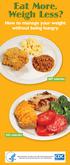 Eat More, Weigh Less? How to manage your weight without being hungry 607 calories 293 calories Department of Health and Human Services Centers for Disease Control and Prevention Can you weigh less without
Doctors Charter School Wellness Plan
 Doctors Charter School Wellness Plan To help combat childhood obesity, Congress passes a law requiring each local educational agency participating in the United States Department of Agriculture s school
Alabama s Healthy Snack Standards for Foods and Beverages at School
 Alabama s Healthy Snack Standards for Foods and Beverages at School Alabama s Healthy Snack Standards focus on decreasing fat and sugar, increasing nutrient density and moderating portion sizes for snack
GAO SCHOOL LUNCH PROGRAM. Efforts Needed to Improve Nutrition and Encourage Healthy Eating. Report to Congressional Requesters
 GAO United States General Accounting Office Report to Congressional Requesters May 2003 SCHOOL LUNCH PROGRAM Efforts Needed to Improve Nutrition and Encourage Healthy Eating GAO-03-506 May 2003 SCHOOL
Healthy Eating During Pregnancy
 Healthy Eating During Pregnancy Pregnancy is a time of great change. Your body is changing to allow your baby to grow and develop. Good nutrition will help you meet the extra demands of pregnancy while
DISTRICT WELLNESS PROGRAM
 DISTRICT WELLNESS PROGRAM Code No. 507.1 The board promotes healthy students by supporting wellness, good nutrition and regular physical activity as a part of the total learning environment. The school
Carbohydrate Counting for Patients With Diabetes. Review Date 4/08 D-0503
 Carbohydrate Counting for Patients With Diabetes Review Date 4/08 D-0503 Program Objectives At the end of the session you will know how to: Define carbohydrate counting Identify the relationship between
Snack Foods and Beverages In Utah Schools A comparison of state policy with USDA s nutrition standards
 A data table from The Pew Charitable Trusts and the Robert Wood Johnson Foundation Jan 2015 Snack Foods and Beverages In Utah Schools A comparison of state policy with USDA s nutrition standards In 2008,
Carbohydrate Counting (Quiz Number: Manatee3032009)
 Page 1 The goal of Carbohydrate Counting is to make clear to you which foods affect your blood glucose and then to spread these foods evenly throughout the day (or to match insulin peaks and durations).
Low Fat Diet after Cardiac Surgery With or Without Chyle Leak
 Low Fat Diet after Cardiac Surgery With or Without Chyle Leak What is chyle? Chyle (sounds like kyle) is a milky white fluid that contains protein, fat, cholesterol, lymphocytes, and electrolytes. It is
Frequently Asked Questions. Chicago Public Schools. School Meal Program. Created in Partnership with Chicago Public Schools + Healthy Schools Campaign
 Frequently Asked Questions Chicago Public Schools School Meal Program Created in Partnership with Chicago Public Schools + Healthy Schools Campaign Table of Contents Introduction 3 School Meal Program
Madison County Youth Center Wellness Policy on Physical Activity and Nutrition
 Madison County Youth Center Wellness Policy on Physical Activity and Nutrition The Madison County Youth Center supports the health and well-being of its youth by promoting good eating habits and physical
Let s Talk Oils and Fats!
 Lesson Overview Lesson Participants: School Nutrition Assistants/Technicians, School Nutrition Managers, Child and Adult Care Food Program Staff, Teachers Type of Lesson: Short, face-to-face training session
Wellness. Chapter 5: STUDENT PERSONNEL 5405 Section 5: HEALTH AND SAFETY REGULATIONS
 Chapter 5: STUDENT PERSONNEL 5405 Section 5: HEALTH AND SAFETY REGULATIONS Wellness The Dubuque Community School Board (hereinafter Board ) promotes wellness by supporting good nutrition and regular physical
Harmonized Sales Tax for Ontario Point-of-Sale Rebate on Prepared Food and Beverages
 GST/HST Info Sheet GI-064 February 2010 Harmonized Sales Tax for Ontario Point-of-Sale Rebate on Prepared Food and Beverages The Government of Ontario has proposed a harmonized sales tax (HST) which will
Snack Foods and Beverages In Pennsylvania Schools A comparison of state policy with USDA s nutrition standards
 A data table from The Pew Charitable Trusts and the Robert Wood Johnson Foundation Jan 2015 Snack Foods and Beverages In Pennsylvania Schools A comparison of state policy with USDA s nutrition standards
CALORIE NEEDS Minimum: Current weight (lb) x 20 = number of calories for males Current weight ( lb) x 15 = number of calories for females
 NUTRITION CONDITIONING GOALS FOR ATHLETES Leslie Bonci, M.P.H., R.D. (412)432-3674 or email: [email protected] Director- Sports Medicine Nutrition University of Pittsburgh Medical Center Health System
Governor s Nutrition and Physical Activity Scorecard
 Governor s Nutrition and Physical Activity Scorecard Purpose: To recognize and reward schools for implementing best practices that support proper nutrition and increased physical activity to promote student
Rhode Island School District Nutrition & Physical Activity MODEL POLICY LANGUAGE
 Rhode Island School District Nutrition & Physical Activity MODEL POLICY LANGUAGE Preamble In June 2005, the Rhode Island General Assembly passed legislation (RIPL Chapter 05-074/05-076, amending Section
Page 1 Sugar Creek Charter School Wellness Plan Introduction
 Sugar Creek Charter School Wellness Plan To help combat childhood obesity, Congress passed a law requiring each local educational agency participating in the United States Department of Agriculture s school
Chapter 5: Analysis of The National Education Longitudinal Study (NELS:88)
 Chapter 5: Analysis of The National Education Longitudinal Study (NELS:88) Introduction The National Educational Longitudinal Survey (NELS:88) followed students from 8 th grade in 1988 to 10 th grade in
A Province-Wide Life-Course Database on Child Development and Health
 Patterns of health and disease are largely a consequence of how we learn, live and work A Province-Wide Life-Course Database on Child Development and Health Summary of Results April 2007 Principal Investigator
NPS Vending - Survey Protocol Modified from NEMS-V/Delaware Munch Better/Nemours Healthy Vending Guide
 NPS Vending - Survey Protocol Modified from NEMS-V/Delaware Munch Better/Nemours Healthy Vending Guide These measures are designed to rate the nutrition available in vending machines that serve snacks
Food & Beverage Order Form
 BOOTH SERVICE MENU BEVERAGES Fresh Brewed Coffee, Decaf, Hot Tea... 90.00 (Per Gallon) Assorted Soft Drinks, 12oz. cans (24/cs)... 84.00 Spring Water (Electric Cooler Required)... 38.00 Electric Water
Mealtime Memo. Timesaving Tips for Mealtime
 Mealtime Memo National Food Service Management Institute The University of Mississippi for Child Care No. 6, 2009 Timesaving Tips for Mealtime Family day care home providers have a busy day. It starts
Chicago Public Schools Policy Manual
 Chicago Public Schools Policy Manual Title: HEALTHY SNACK AND BEVERAGE Section: 407.3 Board Report: 12-1114-PO1 Date Adopted: November 14, 2012 Policy: THE CHIEF EXECUTIVE OFFICER RECOMMENDS: That the
Talmudical Academy Wellness Policies on Physical Activity and Nutrition
 Talmudical Academy Wellness Policies on Physical Activity and Nutrition Preamble Whereas, children need access to healthful foods and opportunities to be physically active in order to grow, learn, and
Basic Concepts in Research and Data Analysis
 Basic Concepts in Research and Data Analysis Introduction: A Common Language for Researchers...2 Steps to Follow When Conducting Research...3 The Research Question... 3 The Hypothesis... 4 Defining the
To: ASB Accounting Manual, Fraud Prevention Guide and Desk Reference Users
 March 10, 2015 To: ASB Accounting Manual, Fraud Prevention Guide and Desk Reference Users From: FCMAT RE: Additional Updates to Specific Sections of the FCMAT ASB Manual Related to Food Regulations The
Community Eligibility Provision: Department of Education Title I Guidance
 United States Department of Agriculture Food and Nutrition Service DATE: January 31, 2014 MEMO CODE: SP 19-2014 3101 Park Center Drive Alexandria, VA 22302-1500 SUBJECT: TO: Community Eligibility Provision:
Complying with the Philadelphia Trans Fat Ban
 Complying with the Philadelphia Trans Fat Ban A Guide for Restaurants, Caterers, Mobile Food-Vending Units and Other Food Service Establishments `` The Philadelphia City Council passed legislation in February
West Virginia School Nutrition Standards West Virginia Department of Education
 INTERVENTION West Virginia School Nutrition Standards West Virginia Department of Education INTENT OF THE INTERVENTION The West Virginia Board of Education Policy 4321.1: Standards for School Nutrition
Exhibitor Booth Catering Menu
 Exhibitor Booth Catering Menu General Information Policies All food and beverage in the exhibit hall must be purchased through Aventura. This includes bottled water, mints and hard candy. All prices are
Iowa School District Profiles. Central City
 Iowa School District Profiles Overview This profile describes enrollment trends, student performance, income levels, population, and other characteristics of the Central City public school district. The
Lessons Learned from the NYC SchoolFood Plus Evaluation
 Presentation to Institute of Medicine Committee to Review National School Lunch and Breakfast Programs Lessons Learned from the NYC SchoolFood Plus July 9, 2008 Ted Spitzer, President SchoolFood Plus Collaborative,
Request for Application NEW JERSEY DEPARTMENT OF HEALTH. Funds for Chronic Disease Prevention and Control and School Health Promotion
 Request for Application NEW JERSEY DEPARTMENT OF HEALTH Funds for Chronic Disease Prevention and Control and School Health Promotion in Low-Income School Districts July 1, 2014 June 30, 2015 Background
Making Healthy Choices in Restaurants
 Making Healthy Choices in Restaurants Objectives 1. Students will understand that although restaurant food is typically unhealthy, there are healthy food options at your favorite fast food restaurants.
Business tax tip #5 How are Sales of Food Taxed in Maryland?
 Business tax tip #5 How are Sales of Food Taxed in Maryland? How is food taxed? In general, sales of food are subject to sales and use tax unless the food is sold for consumption off the premises by a
Fertile Food Can you eat your way to pregnancy? Tracy Cherry, RD, CDN University of Rochester Women s Lifestyle Center
 Fertile Food Can you eat your way to pregnancy? Tracy Cherry, RD, CDN University of Rochester Women s Lifestyle Center Fertility Food Folklore Almonds a fertility symbol throughout the ages. The aroma
Snacking and Gestational Diabetes
 Snacking and Gestational Diabetes Note to the Health Care Provider: Topics in this handout are discussed in Chapter 6 of the American Dietetic Association Guide to Gestational Diabetes Mellitus (1). When
MPS at a Glance District Enrollment as of October 3, 2012
 Transforming MPS School Lunch MPS at a Glance 62 schools with a combined enrollment of 34,277 students The District currently serves a daily average of about 12,000 breakfasts, 24,000 lunches, and 4,500