
BILLING & CODING PROTOCOLS. Specific Suggestions: for Functional Orthotics ARCH. From Documentation to Verification to Coding to Reimbursement
|
|
|
- Primrose Kelley
- 10 years ago
- Views:
Transcription
1 BILLIG & for Functional Orthotics CODIG PROTOCOLS Specific Suggestions: From Documentation to Verification to Coding to Reimbursement By Kathy Mills Chang, MCS-P, CCPC Mario Fucinari, DC, CCSP, DAAPM, MCS-P Brian Jensen, DC Marty Kotlar, DC, CPCO, CBCS K.S.J. Murkowski, DC, DCCT, DAACA ARCH ADVATAGE 1 M Billing & Coding Manual v.20.2.indd 1 6/3/ 4:53 PM

2 BILLIG & CODIG PROTOCOLS Introduction This is indeed a great time to provide Chiropractic care to our patients. People want natural healthcare. They want to be healthy and vital. The Patient Protection and Affordable Care Act (PPACA) of 2010 offers unique opportunities to the Chiropractic profession to offer primary care to our patients. The on-discrimination provisions of the PPACA, Essential Health Benefits mandates (including Chiropractic care currently adopted in 39 states) and the HITECH Act of HIPAA give ample opportunities to our patients to obtain health insurance, utilize their insurance benefits fully or opt out of their insurance restrictions. Whether your patient requires functional orthotics, custom footwear, pillows or rehabilitation, Foot Levelers will be there to aid you in providing customized care to your patients to improve their quality of life. This manual has been produced by Foot Levelers in conjunction with consultants who are experts in documentation, coding and compliance. The following will serve as a guide to provide you with the tools to deliver the natural adjunct support for your patients from the ground up! This guide is an educational guide to the rules and regulations of compliance. In the process of policies, codes and templates, Foot Levelers strives to continue to help advance the Chiropractic profession as we have for over 60 years. Use this guide whether you plan to use a 3rd party billing/insurance company or not. Index Foot Levelers wants you to know... 3 Establishing Medical ecessity...4 Coding...5 Diagnosis Codes Verification...8 Billing...9 Example Forms Unusual Billing Situations...11 Pillows Medical ecessity/coding/billing...14 Rehab Procedures Appendix A...16 Appendix B...19 Proprioception Testing Red Flags...22 Disclaimer: The views and opinions expressed in this manual are solely those of the authors. Foot Levelers does not set practice standards. Foot Levelers offers this only to educate and inform. The laws, rules and regulations regarding the establishment and operation of a healthcare facility vary greatly from state to state and are constantly changing. Foot Levelers does not engage in providing legal services. If legal services are required, the services of a healthcare attorney should be attained. The information in this manual is for educational purposes only and should not be construed as written policy for any federal/ state agency. Foot Levelers recommends all Chiropractors obtain a copy of the appropriate state laws. 2 M Billing & Coding Manual v.20.2.indd 2 6/3/ 4:53 PM

3 Foot Levelers wants you to know... Providers should be aware that even when a patient has coverage for functional orthotics in their benefits package, there s no guarantee that all orthotics will meet the criteria as a covered benefit of the plan or that of medical necessity. 3rd party payers often develop their own medical policies, which they use to determine their standards for coverage of various products and services. These policies provide the guidelines carriers use to determine whether orthotics or other services are considered medically necessary and, therefore, payable under the plan. A clear understanding of these definitions will assist providers with clearly distinguishing between services or products that will be covered by any given 3rd party payer, and those that may be clinically appropriate, but not medically necessary by definition of the specific policy and thus the patient s responsibility. Medical review policy for functional orthotics often spells out covered conditions and diagnosis codes as well as the CPT and HCPCS codes considered appropriate for payment. Providers should always endeavor to locate medical review policy for orthotics and other ancillary services. ou can usually find this information on carrier websites. Remember, even if the diagnosis for which you are ordering the orthotics isn t considered a covered condition, most patients are willing to assume financial responsibility for prescribed orthotics. otes Step 1 - Establish Medical ecessity with our Documentation Step 2 - Coding Step 3 - Verification Step 4 - Billing 3 M Billing & Coding Manual v.20.2.indd 3 6/3/ 4:54 PM

4 Getting Started Step 1 Establish Medical ecessity with our Documentation Patients who present with neuromusculoskeletal conditions of the spine and extremities often have excessive pronation of the feet. In order to demonstrate the patients need for functional orthotics, you must first establish medical necessity through your clinical documentation. History It is important when taking a patient history to explore all past and current conditions, that may affect patient care, and past incidents (i.e., traumas) that could benefit from functional orthotics. Additionally, ask the patient about previously tried treatments and/or remedies they did not respond to favorably. Examples of specific questions are: Are the symptoms affected by walking or standing or by climbing stairs? Do you avoid activity due to pain in your feet or lower extremities? Do you have to elevate your feet to get comfortable? Do you use any type of home remedies for your feet and lower extremities? Have you tried heel lifts, over the counter (OTC) analgesics, OTC insoles, rigid orthotics, padding, changing your shoes or injections? In addition to standard evaluation and management guidelines, it is assumed that a patient history will also include asking questions about the following: swelling joint pain/stiffness weakness limitation of motion difficulty walking numbness/tingling in the lower extremities These findings may help establish the medical necessity of functional orthotics and associated spinal care. Exam Regional examinations and/or diagnostic testing (i.e., X-rays) provide objective evidence for medical necessity to support the implementation of functional orthotics in a treatment program. In addition to the evaluation and management guidelines, it is recommended that your exam should include one or more of the following: 5 Red Flags of Pronation Global postural distortions Structural X-ray anomalies Functional squat test Range of motion Orthopedic/eurological tests (see appendix B) Digital foot/posture assessment Decision Making - Diagnosis It is important that appropriate diagnosis codes are documented to justify treatment. The codes listed must also be properly linked on the 00 billing form to the treatment and supplies. It s also important to verify individual carriers, policies and your state s scope of practice for coverage specifications that may require a spinal-related diagnosis, an extremity-related diagnosis or both. Examples of possible diagnosis codes are provided on pages 5-7. Both ICD-9 and ICD-10 codes are provided for your convenience. Treatment Plan In order to establish medical necessity and clinical appropriateness when ordering functional orthotics, associated spinal care and rehab, your properly written treatment plan should include the following elements: Recommended level of care to include duration and frequency of visits Methods of treatment to be utilized (i.e., adjustments, therapies, functional orthotics, rehab) Specific treatment goals, including goals for the functional orthotics Objective measures to evaluate treatment effectiveness and the effectiveness of functional orthotics Planned modalities and procedures, including those adjunctive treatments to support the necessity of functional orthotics 4 M Billing & Coding Manual v.20.2.indd 4 6/3/ 4:54 PM

5 Step 2 Coding The laws, rules and regulations regarding reimbursement and coding for orthotics and ancillary services vary greatly from state to state, and from carrier to carrier. They are also dependent upon the medical review policy of each carrier and the requirements of your contract. Always check with your state board s rules and the carriers medical policy for orthotics and prosthetics to confirm which CPT and ICD codes and services are covered. Diagnosis Codes Frequently, doctors ask if certain diagnosis codes tend to represent medical necessity for prescribing functional orthotics better than others. As noted, even though your patient may have a clinically appropriate reason for ordering functional orthotics, unless the stated diagnosis ICD-9 Code Description Tarsal tunnel syndrome Morton s metatarsalgia/morton s neuroma Causalgia of lower limb Rheumatoid arthritis, ankle/foot 7.16 Osteoarthrosis, localized, primary, lower leg and knee 7.17 Osteoarthritis, localized, primary, ankle and foot Contracture of knee joint Contracture of ankle and foot joint Joint derangement, ankle/foot Effusion of knee/lower leg Effusion of ankle and foot code is included for coverage in the medical review policy, it may not be considered medically necessary according to the carrier. For example, even though functional orthotics are prescribed for more than extremity conditions, supplying a lumbar diagnosis to a claim where the covered conditions are only extremity related would not be enough to meet the requirements for medical necessity. The following is a list of diagnosis codes that, if appropriate for your patient s condition, could establish medical necessity for functional orthotics and associated spinal care. This list is not meant to be all-inclusive and does not include spinal diagnosis codes. Both the ICD-9 and the corresponding General Equivalence Map (GEM) for ICD-10 are included for reference. ICD-10 Code Description G57.51 Tarsal tunnel syndrome, right lower limb G57.52 Tarsal tunnel syndrome, left lower limb G57.61 Lesion of the plantar nerve, right lower limb G57.62 Lesion of the plantar nerve, left lower limb G57.71 Causalgia of right lower limb G57.72 Causalgia of left lower limb M M Rheumatoid arthritis of right ankle and foot with involvement of other organs and systems Rheumatoid arthritis of left ankle and foot with involvement of other organs and systems M17.11 Unilateral primary osteoarthritis, right knee M17.12 Unilateral primary osteoarthritis, left knee M17.0 Bilateral osteoarthritis of knees M Primary osteoarthritis, right ankle and foot M Primary osteoarthritis, left ankle and foot M Contracture, right knee M Contracture, left knee M Contracture, right foot M Contracture, left foot M Contracture, right ankle M Contracture, left ankle M Other specific joint derangements of right foot, EC M Other specific joint derangements of left foot, EC M Other specific joint derangements of right ankle, EC M Other specific joint derangements of left ankle, EC M Effusion, right knee M Effusion, left knee M Effusion, right ankle M Effusion, left ankle M Effusion, right foot M Effusion, left foot 5 M Billing & Coding Manual v.20.2.indd 5 6/3/ 4:54 PM

6 Diagnosis Codes Continued 6 ICD-9 Code Description Knee pain Foot/ankle pain Stiffness of joint, knee/lower leg, EC Stiffness of joint, ankle and foot, EC ICD-10 Code Description M Pain in right knee M Pain in left knee M Pain in right ankle and joints of right foot M Pain in left ankle and joints of left foot M Stiffness of right ankle, EC M Stiffness of left ankle, EC M Stiffness of right ankle, EC M Stiffness of left ankle, EC M Stiffness of right foot, EC M Stiffness of left foot, EC Difficulty in walking R26.2 Difficulty in walking, EC Metarsalgia Enthesopathy of ankle Achilles bursitis or tendonitis Tibialis tendonitis Calcaneal spur Bunion M77.41 Metatarsalgia, right foot M77.42 Metatarsalgia, left foot M M Other specified enthesopathies of right lower limb, excluding foot Other specified enthesopathies of left lower limb, excluding foot M76.61 Achilles tendonitis, right leg M76.62 Achilles tendonitis, left leg M Posterior tibial tendinitis, right leg M Posterior tibial tendinitis, left leg M77.31 Calcaneal spur, right foot M77.32 Calcaneal spur, left foot M20.11 Bunion, Hallux valgus, acquired, right foot M20.12 Bunion, Hallux valgus, acquired, left foot Plantar fasciitis/plantar fascial fibromatosis M72.2 Plantar fascial fibromatosis Muscle weakness (generalized) M62.81 Muscle weakness (generalized) Stress fracture of metatarsals Hallux valgus, Bunion (acquired) Hallux rigidis Hammer toes (other) Claw toe (acquired) Acquired ankle-foot deformity, EC Congenital pes planus Coxa valga, Congenital M Stress fracture, right foot M Stress fracture, left foot M20.11 Hallux valgus, Bunion right foot (acquired) M20.12 Hallux valgus, Bunion left foot (acquired) M20.21 Hallux rigidis, right foot M20.22 Hallux rigidis, left foot M20.41 Hammer toes (other), right foot M20.42 Hammer toes (other), left foot M20.5X1 M20.5X2 M21.6X1 M21.6X2 Other deformities of toes (acquired), right foot Other deformities of toes (acquired), left foot Other acquired deformities of right foot Other acquired deformities of left foot Q66.51 Congenital pes planus, right foot Q66.52 Congenital pes planus, left foot Q65.89 Other congenital deformities of hip, Congenital acetabular dysplasia Q65.81 Congenital Coxa valga M Billing & Coding Manual v.20.2.indd 6 6/3/ 4:54 PM

7 ICD-9 Code Description ICD-10 Code Description Coxa vara, congenital Q65.82 Congenital coxa vara Abnormality of posture R29.3 Abnormal posture Shin splints Ankle sprain, unspecified S86.911_ S86.912_ S93.401_ S93.402_ Strain of unspecified muscles and tendons at lower leg, right leg Strain of unspecified muscles and tendons at lower leg, left leg Sprain of unspecified ligament of right ankle Sprain of unspecified ligament of left ankle Cervical subluxation M99.01 Segmental and somatic dysfunction cervical Thoracic subluxation M99.02 Segmental and somatic dysfunction thoracic Lumbar subluxation M99.03 Segmental and somatic dysfunction lumbar Sacrum or sacrococcygeal joint subluxation M Pelvic/Ilium/Sacroiliac joint subluxation M99.05 Segmental and somatic dysfunction of sacrum or sacrococcygeal joint Segmental and somatic dysfunction of ilium or sacroiliac joint Lower extremity subluxation M99.06 Segmental and somatic dysfunction of lower leg 734 Flat foot/pes planus (acquired) M21.41 Flat foot/pes planus (acquired), right foot M21.42 Flat foot/pes planus (acquired), left foot Abnormality of gait R26.81 Unsteadiness on feet CPT/HCPCS Codes These are codes that may apply in the process of billing for functional orthotics and associated spinal and extremity care. Various procedure and supply codes may be appropriate because functional orthotics may be ordered and appropriate for a variety of conditions, including extremity conditions. This list is not meant to be all inclusive; as noted, please check benefit policy manuals for required procedure and supply codes Evaluation & Management Coding (E&M), ew Patient: A new patient is one who has OT received any professional services from a physician or another physician of the same specialty who belongs to the same group practice within the past three years. Every new patient should have a history and examination. This should include a structural evaluation of the patient s lower extremities in conjunction with other appropriate examination procedures. TIP: Use the 3D BodyView scanner as a tool to evaluate your new patient just as you would measure blood pressure and range of motion. Remember, the scan is not separately billable if on the same visit as Rescans should be done regularly to note patient progress E&M Coding Established Patient: An established patient as defined is one who HAS received professional services from a physician or another physician of the same specialty who belongs to the same group practice within the past three years. It may be clinically indicated to evaluate an established patient for spinal or extremity conditions. In addition to examination procedures for determining the additional need for treatment with functional orthotics and associated spinal conditions, the evaluation must include an updated history and/or documentation of clinical decision making Series Radiologic Examination (X-ray): Some patients may require an X-ray. The following codes, procedures and their codes may be clinically indicated. This list is not all-inclusive. The laws, rules and regulations regarding X-rays of extremities vary greatly from state to state. Always check your state s laws to verify which codes apply and work best for your practice. Foot 73620, 73630, 73650, Ankle 73600, Knee 73560, 73562, 73564, Hip 73500, 73510, Pelvis 72170, Lumbar Spine 72100, Thoracic Spine Cervical Spine 72040, 72050, M Billing & Coding Manual v.20.2.indd 7 6/3/ 4:54 PM

8 L3020 Foot insert, removable, molded to patient model, longitudinal/ metatarsal support, each: This is the most appropriate supply code to describe Foot Levelers functional orthotics. However, some carriers may require the use of other codes. It is vital that questions regarding the use of these codes are asked during the verification process. L3030 Foot, insert, removable, molded to patient foot, each: This is a second possible code related to reimbursement of functional orthotics. The code is very similar to L3020 and is the preferred code in some policies/states for functional orthotics. The similarity of the codes and the differences between different policies/states mandate that the verification process described in this text be followed carefully. Verification of both codes is vital Orthotic(s) management and training (including assessment and fitting when not otherwise reported), upper extremity(s), lower extremity(s) and/or trunk, each minutes. This code can be billed the day the functional orthotics are dispensed to the patient, and may only be used for custom fabricated supports. This code includes the fitting of the functional orthotics, training in use, care and wearing time of the functional orthotics and brief instructions in exercises while the functional orthotics are in place. Direct one-on-one contact by the provider of service is required and it is a timed code, so be sure to properly document the time spent in your daily note Checkout for orthotic/prosthetic use, established patient, minutes. This code is intended for established patients who have already received their functional orthotics. It is essential for the healthcare practitioner to followup with a patient after they have been provided with a pair of functional orthotics. The checkout visit would include assessing the patient s response to wearing functional orthotics, such as possible skin irritation or breakdown, determination if the patient is donning the functional orthotics appropriately, need for padding, underwrap or socks and tolerance to any dynamic forces being applied. This code requires direct one-on-one contact by the provider and is a timed code, so be sure to properly document the time spent in your daily note. Step 3 Verification It s crucial to verify insurance coverage to determine whether functional orthotics are included in the patient s benefits. Be sure to check with each individual carrier as well as your state scope of practice that may require a spinal-related diagnosis, an extremity-related diagnosis or both. Follow the Foot Levelers Verification Sheet for Orthotics (p. 19) and get all the questions answered. This verification sheet is in addition to your standard verification of coverage. TIP: Verification can be done before your patient comes in. ou can copy the page to the right and place it on the back side of your existing verification form. TIP: Listing the diagnosis code associated with the treatment performed helps to justify the rationale for the service being provided and should allow the insurance carrier to process the claim accurately. 8 M Billing & Coding Manual v.20.2.indd 8 6/3/ 4:54 PM

9 Orthotic Billing Step 4 Billing Whether billing 3rd party payers or directly billing the patient, the process of billing for functional orthotics and associated spinal and extremity care is no different than any other clinical billing procedure. When seeking reimbursement from a 3rd party payer on behalf of your patient, these important concepts must be conveyed in the billing process. Appropriate medical necessity for the services rendered must be clearly identified. TIP: Make sure that all billing procedures are properly documented in your office s standard operating procedure manual. Specific billing procedures discussed here can be added as an addendum to other primary procedures in your compliance manual. Insurance To begin the process, there should be established medical necessity through history, exam, diagnosis and treatment plan. Verification and code selection should have also occurred. 00 Form Completion As previously discussed, proper diagnostic and procedural coding, once selected, must be properly listed on the billing form. When billing the functional orthotics supply code, L3020 or L3030, you must bill 2 line items to indicate both the right and left functional orthotics. While functional orthotics come in pairs, they are coded for each individual foot. The code represents only OE functional orthotic. The examples below demonstrate appropriate completion of the form in boxes 21 and 24 of the 00 billing form. It should be noted that there is more than one way to complete the form. Both examples are provided here. Option one is to list a line item in box 24 of the 00 form with the proper HCPCS code in box 24D, the properly linked diagnosis code in box 24E, the total charge for both functional orthotics in box 24F and a 2 in the units box, 24G. Option two is to separate the pair of functional orthotics and list them on 2 separate lines. On the first line of box 24, list the code L3020 with an RT modifier in box 24D, the properly linked diagnosis code in box 24E, 50% of the total charge for the pair of functional orthotics in box 24F, and do not use the units box, 24G. On the next line of box 24, list the code L3020 with an LT modifier in box 24D, the properly linked diagnosis code in box 24E, 50% of the total charge for the pair of functional orthotics in box 24F, and place a 1 in the units box, 24G. 9 M Billing & Coding Manual v.20.2.indd 9 6/3/ 4:54 PM

10 Example of 00 Form for a Single Pair A L3020 Rt B L3020 Lt B 1 If you are billing 2 pairs in any combination the second pair would be billed exactly the same. Even if you decide to reduce the fee for the second pair, to pass along a multiple pair discount, just reflect the correct dollar amount in box 24F, and follow the instructions above. For a total of 4 functional orthotics, you will have (as in option one) 2 line items with a 2 in each units box, 24G. In this example, the total in each line item will be 50% of the total charge for the functional orthotic pair. Or, as in option 2 above, you may have 4 separate line items indicating four functional orthotics, and 2 would have the RT modifier in box and 2 would have the LT modifier. Example of 00 Form for Multiple Pairs A L3020 Rt B L3020 Lt B 2 Diagnosis Linking It s important to properly link the diagnosis code reported on the 00 form in Box 21 to the service code performed in Box 24D. This is accomplished by listing the appropriate diagnosis indicator, A, B, C or D or multiple letters, in 00 form Box 24E. Box 21 DIAGOSIS OR ATURE OF ILLESS OR IJUR, (RELATE ITEMS 1,2,3 OR 4 TO ITEM 24E B LIE) A Cervical Segmental Dysfunction B Plantar fascial fibromatosis Boxes 21, 24D and 24E Box 21 is where you enter your ICD-9 codes. Box 24D is where you enter your CPT/HCPCS codes. Box 24E is where you enter the diagnosis reference number(s) A-L as they relate to the diagnoses code positions in Box 21. A written description of your diagnoses codes in Box 21 is not necessary. Do not enter ICD-9/10 codes in Box 24E. In the example on the previous page Box 24D indicates that a patient received a cervical region Chiropractic adjustment (98940) and foot orthotics. Box 24E indicates that CPT code links to diagnosis code cervical segmental dysfunction and HCPCS code L3020 links to diagnosis code (plantar fasciitis). 10 M Billing & Coding Manual v.20.2.indd 10 6/3/ 4:54 PM

11 Unusual Billing Situations Patients who need functional orthotics may not have full insurance coverage. Once you ve identified necessity for the prescribed orthotics using the recommended procedures in this guide, at this point, like any other care provided in the office, the patient needs to cover the fee. Some may have Insurance coverage to cover all of the costs, but others may only have partial insurance coverage or none at all. The following are the most common scenarios that patients and providers face when covering the cost of functional orthotics, along with various approaches to assist you and your patient. Situation: our patient s insurance is Medicare. Foot Levelers Wants ou to Know: Medicare has very specific coverage through their Durable Medical Equipment (DME) benefits. Functional orthotic inserts are covered by Medicare only when placed in a shoe attached to a brace. Even if the provider has a separate DME supplier number with Medicare, these functional orthotics are usually not placed in a shoe attached to a brace, and, therefore, are not covered. Functional orthotics for Medicare patients will always be an excluded service under Medicare and you may charge the patient your full fee. If your patient has a secondary insurance Medicare that will cover what Medicare denies, check with them about how they want you to get a denial when Medicare will not issue a denial through the Part B carrier. Then proceed to bill the secondary as with any other commercial carrier. Situation: The carrier s contracted allowable fee schedule is lower than the provider s cost of the functional orthotics. Foot Levelers Wants ou to Know: Despite the fact that you may be contracted with a carrier that has set a fee schedule for functional orthotics that is lower than the cost of the items, there are solutions that allow you to prescribe top-of-the-line custom functional orthotics from Foot Levelers. HCPCS billing code S1001 deluxe/upgrade item requiring patient waiver allows a participating provider to provide an upgraded product under specific circumstances to a patient at the patient s request despite a lower contracted fee schedule. Certain carriers may allow for billing of this code, thus allowing for the patient to pay the difference up to the full retail price of the functional orthotics. Patient acknowledgement must be obtained prior to providing the supply/product. A sample patient notice/acknowledgement has been provided in the appendix of this guide (p. 16). In order to use this code, consider the following steps for success: When verifying coverage, find out if the carrier allows for the upgrade/upcharge with patient acknowledgement, using code S1001. If S1001 is not allowed, consider requesting an amendment to your provider agreement. otify provider relations that you wish to provide an upgraded supply to your patient that has a higher cost than the fee allowed under the contract. Let them know that the patient is willing to bear the cost of the difference between the allowable amount and the full price, and that you would like to amend your agreement to allow for that. We ve provided a sample letter in the appendix of this guide (p. 16). Always get the patient s permission and agreement when passing costs along to them. Sample scripting and a sample acknowledgement form are provided for you in the appendix of this guide. Situation: ou determine that the need for functional orthotics is clinically appropriate for your patient, but their carrier s medical necessity definition does not cover the diagnosis for which the orthotics were prescribed. Foot Levelers Wants ou to Know: When seeking reimbursement on behalf of your patient from a 3rd party payer, providers must keep in mind that the product of service being provided must meet medical necessity criteria for reimbursement. If functional orthotics will not be covered by the carrier, or if the service is considered to be for the patient s comfort or convenience, the service would not meet the medical necessity requirement to be reimbursed by the carrier. Because of this, based on contract, the patient would be required to pay for the service out of pocket at your full fee. Be sure to check the patient s policy and/or your provider contract to ensure your ability to pass the fees on to the patient. We recommend using the patient acknowledgement form we ve supplied in the appendix of this guide. Situation: ou prescribe Sandalthotics, Shoethotics or custom flip-flops products in which the functional orthotic is built into or provided with a shoe. Foot Levelers Wants ou to Know: Very few insurance carriers cover shoes that are not attached to a brace. The Shoethotics and Sandalthotics sold by Foot Levelers will usually not meet the coverage criteria. So, what happens if a patient does have coverage for orthotics, and the best fit for the patient is to prescribe a Foot Levelers product with an embedded orthotic in the shoe, like a Sandalthotic? Or, if the patient is purchasing a shoe with a custom orthotic, even if removable, because the shoe is used daily for work? While the orthotic may be deemed medically necessary and therefore potentially coverable with their 3rd party payer, it s unlikely that the shoe would be covered. In those instances, it s appropriate to bill the carrier for the orthotic and bill the patient for the corresponding shoe. The following is an example, with fees noted for example only: 11 M Billing & Coding Manual v.20.2.indd 11 6/3/ 4:54 PM

12 Unusual Billing Situations - Continued Patient purchased a Keen sandal with a built-in orthotic, and the total charge for the sandal with orthotic is $300. If one were purchasing the orthotic only in your office, the fee would be $210. Therefore, the patient would pay $90 for the shoe out of pocket. The carrier would be billed as per our usual orthotic billing protocol: L3030-RT or L3020-RT $105 and L3030-LT or L3030-LT $105. our medical record would reflect that you dispensed the full shoe with the custom functional orthotic for the condition, diagnosis and treatment plan. our billing summary would reflect that the carrier was only billed for the orthotic and that the patient paid cash for the shoe. Situation: our patient has no 3rd party insurance coverage for orthotics. Foot Levelers Wants ou to Know: Surveys show that fewer and fewer policies provide third-party coverage for functional orthotics. The lack of third-party financial assistance does not negate the fact that functional orthotics should be prescribed if indicated. Many of your patients will pay cash for their functional orthotics. It is reasonable to expect them to be willing to do so if they understand the importance of the functional orthotics in their treatment plan. However, it s important to consider the following: Make sure your charges and fees are compliant: When you have different fees for the same service for different types of patients, it could be non-compliant. For example, your published fee schedule for L3020 is $250 per foot, but you wish to extend a time-ofservice discounted fee of $0 per foot to uninsured or underinsured patients. This is outside the boundaries of a reasonable time-of-service discount according to the Office of Inspector General of the Department of Health and Human Services. Their guidance has indicated that a 5-% discount is within normal margins. Seek reimbursement from Health Savings Accounts, Healthcare Reimbursement Accounts, and Flex Plans: Many patients are fortunate to have additional coverage options through their employers. These plans are structured so that services and products not otherwise covered by health insurance, but that are provided in a healthcare environment, are reimbursable to the patient. Don t forget to explore these options for any patient without traditional insurance coverage for functional orthotics. It s possible that reimbursement can be managed through one of these plans, and the patient will benefit from this alternative coverage. Often, the provider must bill on behalf of the patient, as with any other insurance, but the reimbursement will be sent to the patient. Always explore these options to give your patient every chance to get helpful reimbursement. Offer reasonable payment plans: For some patients, the cost of functional orthotics may be prohibitive. However, bundling orthotics in with the other portions of care for which the patient is responsible and broken into monthly payment plans helps patients no longer feel as if they have to pick and choose which care or prescribed products they can afford. It s easy to bundle the entire patient s portion into an estimated balance. Then, work out as many monthly payments as you feel comfortable carrying. Keeping the patient on an automated payment plan with a payment source on file allows you to be in control. The patient simply pays monthly until their balance is 0. Be aware of rules that may be established by your state regarding payment plans. Once you have established that it s legal for you to do so, this is a wonderful way to serve the patient and make the care they need affordable. Collect 50% before ordering: If your patient is able to purchase the functional orthotics outright, be sure you collect at least 50% of the cost in advance when placing your order. This will usually be about the cost for the doctor. That way, if there are problems later, you can be sure your costs are still covered. Join Discount Medical Plan Organizations (DMPOs) to accommodate cash-paying patients: A very simple way to avoid dual fee schedules is to join a cash discount network that allows plan members to enjoy discounted fees within the stated fee schedule. One of the most popular is ChiroHealthUSA, a DMPO that allows the provider to set their discounted fees and member patients to access those discounted fees legally and compliantly. If you wish to offer discounted fees for functional orthotics to those without third-party assistance, this is one of the safest and most effective ways to do so. many states now allow doctors to offer special concierge contracts for services/products, know your state law. 12 M Billing & Coding Manual v.20.2.indd 12 6/3/ 4:54 PM

13 Pillows - Specific Suggestions: from documentation to verification to coding to reimbursement Pillows and positioning cushions are an important modality for home use when treating cervical and lumbar conditions. Proper positioning while sleeping will support other treatments of neck and upper back conditions being rendered in the office. Support with a low back cushion is often appropriate for those with lumbar conditions who sit at a desk or drive a lot in order to ensure proper seated posture and support. Every patient with a cervical condition should be screened for proper support while sleeping and, if indicated, a suitable pillow should be prescribed. Likewise, those with lumbar conditions should be screened and considered for lumbar support cushions to support the treatment in your office. Occasionally, there may be third-party coverage available to assist your patient with their financial responsibility for the items. The following billing and coding information will be helpful as you determine whether seeking reimbursement from a 3rd party is appropriate. Step 1 - Verification Whether fitting the patient for a cervical or a back support pillow, it can be helpful to verify insurance coverage to see whether these items are a covered benefit for the patient. Usually coverage will be allowed when treating victims of a personal injury or an on-the-job injury. Personal health insurance, on the other hand, may have limitations or exclusions requiring the patient to pay out of pocket for all or part of such devices. When verifying insurance coverage, consider the following: Ask if prefabricated or custom pillows and supports are considered comfort items. If they are considered comfort items, ask if there is ever an opportunity to appeal for coverage when the pillow is custom or semi-custom. Ask about any specific billing requirements. They may require that the original invoice be included with the billing. If so, don t forget to include tax. Ask if a letter of medical necessity is required with the billing to show why such a device was ordered and what purpose it will serve in the treatment plan. A sample letter of medical necessity is located in the appendix of this document. Find out if a prescription is required, and if so, whether the Doctor of Chiropractic can prescribe. Determine whether there is medical review policy that applies to pillows billed with code E0190, and, if so, where you can find it. 13 M Billing & Coding Manual v.20.2.indd 13 6/3/ 4:54 PM

14 Step 2 - Establish Medical ecessity Remember, third-party coverage is always dependent upon the medical necessity of the device according to the carrier s review policy. Simply confirming that coverage is available is not enough. The provider must also provide clear proof that the pillow meets the carrier s criteria, if any, for payment. Where coverage is allowed, the carrier will determine payment for these pillows and supports based on your ability to show a need. It s important to assure that such items are included in your written treatment plan and properly described for medical necessity. This is especially important when fitting a custom cervical support pillow. Often, providers begin with the patient history to explore all conditions that could benefit from a standard or custom cervical pillow or from a back support pillow beyond the typical spinal-related questions. Ask questions like: Is there pain, numbness or tingling in your arms or hands? What is your normal sleeping position? What kind of pillow do you use now? Do you experience aching or cramping in your lower back or legs when sitting for long periods of time? Do you awaken during the night with neck pain? Do you awaken multiple times during the night and have to change positions to get comfortable? Do you avoid long periods of sitting or driving due to aching, cramping or pain in your back? Have you ever used a cervical support pillow or lumbar chair pillow and with what result? Step 3 - Coding It should be noted that pillows and supports are considered under the heading of Durable Medical Equipment (DME). These codes are found under the coding authority of HCPCS. HCPCS, pronounced hick-picks, is the acronym for the Healthcare Common Procedure Coding System. This system is a uniform method for healthcare providers and medical suppliers to report professional services, procedures and supplies. As of 2004, the best code to describe either a pillow or lumbar support cushion is E0190. The correct descriptor for this code is positioning cushion/pillow/wedge, any shape or size. Most carriers will honor that code, but some still require the older, more generic code for Durable Medical Equipment, which is Avoid this code whenever possible, as it s generic and could apply to anything from a cervical pillow to a mattress. Step 4 - The Billing Process The process of billing for pillows and supports and the subsequent services is no different than any other billing process. These important concepts MUST be conveyed in the billing process in order to assure reimbursement. Appropriate medical necessity for the pillow, support or, even more importantly, the custom-fitted pillow and subsequent related treatment must be clearly identified. This may include a Letter of Medical ecessity (LM) if required, or simply incorporation into the medical record. Other Payment Alternatives When surveyed, the majority of providers who prescribe cervical and lumbar pillows and cushions state that they consider them a cash-based product. Since very few insurance companies will consider pillows to be medically necessary, they become a cash-based service. our patients are already accustomed to buying pillows from retailers, and often pay top dollar to do so. Following the recommendation of their healthcare provider for a pillow only makes sense. Don t hesitate to recommend a pillow or support cushion when indicated. Make it a part of your treatment plan process to consider these for all patients. Then include it in the treatment and payment plan with other types of care, and make it affordable for your patient. Every payment alternative referenced in this guide for functional orthotics will apply to payment for pillows as well. Even if the patient must pay cash for the pillow, and the provider has made clear the necessity of using the pillow, use of the payment alternatives will make it easy for the patient to say yes and to follow your recommendations. Rehab Specific Suggestions: from documentation to verification to coding to reimbursement Therapeutic Rehab Procedures: Therapeutic rehab procedures are treatments that attempt to improve and/or restore the patient s level of function that has been lost or reduced by an injury, repetitive stress, chronic disorder or some other type of neuromusculoskeletal illness through the application of clinical skills and/or services. Use of these procedures requires that the qualified professional have direct, one-on-one patient contact (contact your state board for delegation scope of practice rules). Many DCs use the clinical history, systems review, physical examination and a variety of evaluations to determine the impairments, functional limitations and disabilities of the individual patient. Impairments, functional limitations and disabilities thus identified are then addressed by the design and implementation of a plan of care tailored to the specific needs of the individual patient. Specific interventions are selected, applied or modified based on the examination data, the evaluation, the diagnosis and prognosis and the anticipated goals and expected outcomes. Once the patient reaches maximum therapeutic benefit, a maintenance program should be implemented. A maintenance program consists of activities that preserve the patient s present level of function and prevent regression of 14 M Billing & Coding Manual v.20.2.indd 14 6/3/ 4:54 PM

15 that function. Therapy performed to maintain the same level of function is not typically insurance reimbursable. Therapeutic Exercises (97110): Therapeutic exercise incorporates rehabilitation principles related to strengthening, endurance, flexibility and range of motion to one or more areas of the body. Therapeutic exercise may be performed with a patient either actively, actively assisted or passively participating. Examples of therapeutic exercise include using a treadmill (for endurance), isokinetic exercise (for strengthening), lumbar stabilization exercises (for flexibility and/or trunk strengthening) and gymnastic ball (for stretching and strengthening). Therapeutic exercises address identified impairments such as weakness, pain, contracture, muscle imbalance and/or limitations in mobility, strength, dexterity, range of motion or endurance. Objective findings support the medical necessity of therapeutic exercise. euromuscular Reeducation (97112): euromuscular reeducation helps to improve movement, balance, coordination, kinesthetic sense, posture and/ or proprioception for sitting and/or standing activities. This procedure is reasonable and medically necessary for impairments, which affect the body s neuromuscular system (e.g., poor static or dynamic sitting/standing balance, loss of gross and fine motor coordination and hypo/hypertonicity). Examples include Proprioceptive euromuscular Facilitation (PF), the Feldenkrais Method, Bobath, wobble board such as Rock n Roller and desensitization techniques. Therapeutic Activities (97530): Therapeutic activities incorporates the use of dynamic activities to improve functional performance. This procedure involves using functional activities (e.g., bending, lifting, carrying, reaching and catching, and overhead activities) to improve functional performance in a progressive manner. The activities are usually directed at a loss or restriction of mobility, strength, balance or coordination. The dynamic activities must be part of an active treatment plan and directed at a specific outcome. ECKSS (See Figure 1) Restores muscular integrity and improves cervical posture. Isolated motion for sub-maximal limited range of motion. Provides variable resistance to match individual strength level. The ECKSS can be billed with or depending upon the intended outcome (see descriptions above). BACKSS (See Figure 2) Provides pain free isotonic motions to correct and rehabilitate thoracic/lumbar spine and pelvis. The BACKSS can be billed with 97110, or depending upon the intended outcome (see descriptions above). TRI-FLEX Combines the ECKSS, BACKSS and THERA-CISER. The TRI-FLEX can be billed with 97110, or depending upon the intended outcome (see descriptions above). TIP: HCPCS code A9300 can be used to bill for exercise equipment Extraspinal Chiropractic Manipulative Treatment may be necessary during a course of treatment when an extremity needs to be treated in addition to the spinal region(s). The 5 extraspinal regions are the head, including the TMJ, but excluding the atlanto-occipital joint, the lower extremities, upper extremities, anterior ribs, and abdomen. This code is billed only once per encounter, regardless of the number of extraspinal regions adjusted. Figure 1: ecksys Figure 2: Backsys M Billing & Coding Manual v.20.2.indd 6/3/ 4:54 PM

16 Appendix A On the following pages are a collection of letters to help your billing process. Individualize each of these letters to fit your practice. Sample Letters Sample Provider Agreement Amendment Letter Date XZ Insurance Company 123 Anywhere Drive Anytown, Re: Request to Amend Provider Agreement Dear In-etwork Provider Relations Department: As a participating provider in your network plan, I am requesting an amendment be made to my provider agreement. There are certain clinical circumstances where I may need to provide an upgraded clinical product to a patient at the patient s request despite a lower contracted rate. The upgraded recommended product that I am referring to is an orthotic (functional orthotics). I am requesting that my provider agreement be revised so that I may be allowed to have the patient pay the cost in excess of the established allowable fee schedule. I will have patients sign a consent form acknowledging that they have been informed that there are other products available at the standard out-of-pocket price that may meet medical necessity. Additionally, when I submit the claim, I will use HCPCS code S1001. HCPCS code S1001 is used when providing a deluxe/upgrade item requiring patient waiver. This code has been developed for providers to use when billing for high-end equipment or an upgrade. The amount billed will represent the cost in excess of the cost of standard equipment. I am also requesting that HCPCS code S1001 be denied as patient responsibility and not a provider write off. Please contact me with your response as soon as possible and let me know if any further information is needed. Sincerely, Sample Patient Acknowledgement Form for on-covered Products Although your health insurance plan may cover many services and products provided in this office, unfortunately, orthotics are not covered when prescribed by a DC. ou are financially responsible for all non-covered services. our acknowledgement below indicates that you have been advised of this information and that you agree to pay this office for the below listed product. Product: Orthotics Date: Amount: Patient Acknowledgement: I acknowledge that a certain portion of my care will not be covered by my health plan under the terms of my benefit plan. I acknowledge that I am signing this notice voluntarily and that it is not being signed after the product has been provided. I acknowledge that I have been told in advance by this office that the product listed above is not covered by my health insurance plan and I understand and agree to pay for this non-covered product at the time the product is provided. I have had ample opportunity to ask questions about my financial obligation and other treatment options. I understand I have the right to this product and that by signing this form I am fully responsible for all non-covered products. I acknowledge that I have reviewed my coverage options and that I have been told in advance of treatment what portion of my care I will have to pay for, including non-covered services as described above and I agree to make financial arrangements with this office. Patient Signature Date **IMPORTAT IFO FOR I-ETWORK PROVIDERS - Review your participating provider agreement/contract before implementing this form. 16 M Billing & Coding Manual v.20.2.indd 16 6/3/ 4:54 PM

17 Sample Letter of Medical ecessity for Custom Functional Orthotics Date XZ Insurance Company 123 Anywhere Drive Anytown, RE: Jane Doe ID#: I am writing to provide the clinical justification to support my decision to fit Mrs. Doe with custom functional orthotics. Mrs. Doe presented to our office on [date] for evaluation and treatment of [insert problem that warrants fitting of orthotics]. X-rays were taken on [date] indicating [give brief X-ray overview and denote any condition present]. An examination was performed on [date] and indicated [give brief examination overview listing positive findings and particularly those related to the need for orthotics]. Examination of the feet indicated [list the foot conditions that warrant the fitting of orthotics]. Outcome assessment tools were administered to Mrs. Doe on [date]. On the Revised Oswestry Low Back Disability Questionnaire [or other similar questionnaires], she indicated that standing was limited to 10 minutes before pain required her to sit for a period of time. She also indicated that pain prevented her from walking more than 1/4 mile. This limited function was noted and, in my professional opinion, this patient will benefit from custom functional orthotics. X-rays were also done to verify need based on patient s history and complaints. My functional goals are designed with the purpose of supporting her body during walking and standing, and helping to protect the spine, bones and soft tissues from damaging shock stress as she moves. Among the functional goals set for this patient is the goal to increase her tolerance to standing for up to a period of one hour at a time by [date]. The patient was casted/optically scanned on [date] and individually designed functional orthotics were ordered. A treatment plan was formulated utilizing a combination of Chiropractic treatment and passive and active therapy to bring this patient to a point of maximum improvement. A full explanation of the treatment plan can be found under separate cover. Mrs. Doe will benefit from this proactive, well-balanced approach to her rehabilitation in this matter. Thank you for considering the necessity of these custom functional orthotics. Sincerely, Sample Letter of Medical ecessity for CPT Code Date XZ Insurance Company 123 Anywhere Drive Anytown, Re: Mrs. Patient ID#: The purpose of this letter is to provide you with information that will allow you to understand the medical reasonableness for the orthotic checkout procedural service (CPT code 97762) we provided to Mrs. Patient. We hope that this will allow you to authorize payment. On [date], Mrs. Patient presented to my office with right-sided foot pain, foot swelling, foot pronation, low back pain and abnormal gait. Examination of the low back and bilateral lower extremities revealed [provide examination findings here]. Outcome assessment tools were also used with Mrs. Patient. The Revised Oswestry Low Back Disability Questionnaire indicated that standing was limited to only 10 minutes before the pain in her right foot and low back required her to sit. She also indicated that the right foot pain prevents her from walking more than a 1/4 mile. This limited function was noted and therefore the patient was fitted for and supplied with custom functional orthotics on [date]. On [date], Mrs. Patient returned to my office and stated that she feels better overall, however the foot swelling and pain on the right side is about the same. On this visit it was necessary for me to re-assess the orthotics and decide if any modifications were necessary. This assessment included the patient s response to wearing the orthotics, possible skin irritation, determining if the patient is donning the orthotics properly and the need for additional padding or socks. It was my determination that the patient should continue wearing the individually designed functional orthotics as was originally prescribed, however she will now do specific ankle/foot exercises and ice the right foot for minutes 3 times per day. The orthotics are being used to support her feet and spine during walking, standing and help protect the spine, bones and soft tissues from repetitive shock and stress. The objective is to promote proper biomechanical movement, prevent pain and possible re-injury. I was with the patient for minutes performing the orthotic checkout service (CPT code 97762). Please consider payment for this service, as it was clinically indicated and medically necessary. Sincerely, 17 M Billing & Coding Manual v.20.2.indd 17 6/3/ 4:54 PM
![X-rays were taken on [date] indicating [give brief X-ray overview and denote any condition present].](/docs-images/42/9831776/images/page_17.jpg "An examination was performed on [date] and indicated [give brief examination overview listing positive findings and particularly those related to the need for orthotics].")
18 Sample Letter of Medical ecessity for 97760, Orthotics Management and Training Date XZ Insurance Company 123 Anywhere Drive Anytown, RE: Mary Goodpatient ID#: I am writing to provide the clinical justification you require to support my decision to provide orthotics management and training to Mrs. Goodpatient, in conjunction with her individually designed functional orthotics. Mrs. Goodpatient presented to our office on [date] and on that day received her orthotics, which had been measured and ordered on [date]. On the date of the orthotics management and training, Mrs. Goodpatient had her individually designed functional orthotics dispensed to her and the following services were rendered: Her wearing schedule and instructions for care were given Proper fitting into the shoes was assured and trimming was performed Gait and station were examined [Add any other services here that were performed] Given that is a timed code, it should be noted that approximately [number of minutes] was spent face to face with the patient performing this service. I have attached my office note for the day indicating the services that were rendered and the time that was spent. Thank you for reconsidering the necessity of this code and I look forward to receiving payment as soon as possible. Sincerely, Sample Letter of Medical eccessity and Pre-Authorization for Orthotics Address City, ST Re: Mr. Patient ID#: Dear Insurance Company: The purpose of this letter is to provide you with information that will assist you in determining the medical necessity and authorization for custom-fitted orthotics provided to Mr. Patient. On [date], Mr. Patient presented to my office with right foot pain, right ankle stiffness, low back pain, lumbar disc degeneration, [add additional conditions here]. Examination of the lumbar spine and right ankle/foot revealed [list positive findings that warrant ordering orthotics]. X-rays of the lumbar spine and right ankle/foot revealed [list positive findings that warrant ordering orthotics]. Outcome measurements of the patient s conditions were obtained via use of [Oswestry, Roland-Morris, LEFS]. The results revealed the following: [e.g., standing was limited to 10 minutes because of ankle stiffness and low back pain, foot pain prevented walking more than a 1/4 mile, etc.]. I am requesting your approval for the custom orthotics. The orthotics will provide the needed support when the patient is walking, standing and will help protect his foot, ankle and lower spine from excessive wear and tear as he performs his normal activities of daily living. The patient will be provided with detailed home care instructions on how to hasten the healing process. The objective is to promote proper biomechanical movement, prevent pain, prevent re-injury and help the patient reach his improvement goals as soon as possible. Please consider payment for the orthotics and thank you for your prompt consideration. Please review this information as soon as possible and contact us if any further information is needed Sincerely, 18 M Billing & Coding Manual v.20.2.indd 18 6/3/ 4:54 PM

19 Appendix B Verification Sheet for Orthotics (This assumes that the doctor has done a thorough verification of coverage for general services, and this would be an addendum to the existing verification form when checking for coverage of functional orthotics.) Patient ame: Insured: Insurance Company: Ins. Co. Phone#: Insured s ID#: Insured s DOB: Policy#: Insured s Employer: Patient s DOB: Circle One: Are custom-molded foot inserts (orthotics) covered typically billed as code L3020? If es: 1. Do you have specific written guidelines for the use of this code? If so, can you fax/ them to me? Can I find them online? 2. Does the fee schedule have a maximum allowable (dollar limit) for L3020? Is this maximum amount per condition or per year? Is this part of a separate Durable Medical Equipment (DME) benefit? 3. Does the fee schedule have a maximum allowable (dollar limit) for L3030? If o: (TIP: Although the functional orthotics themselves may not be specifically covered, ancillary services are usually covered in most plans.) 1. Where can I find in writing that orthotics are not covered in order to explain it to my patient? 2. Do you cover Orthotics Management and Training, code 97760? What is the allowable amount? 3. Do you cover therapeutic exercises, code 97110? What is the allowable amount? 4. Do you cover Orthotics Checkout, code 97762? Is this maximum amount per condition or per year? Is this part of a separate Durable Medical Equipment (DME) benefit? 4. What is the co-pay or co-insurance? 5. Are there certain diagnosis codes necessary for reimbursement under the policy? 5. Do you cover extraspinal manipulation, such as code 98943? 6. Do you cover strapping/taping when billed as code 29540? 7. Ask the following question if you are in network plan: If orthotics are not covered, can we accept payment directly from the patient? ame of Carrier for Claims Submission: If yes, what are they or where can I find them? 6. Is a Letter of Medical ecessity/ preauthorization letter needed? Does this need to be submitted prior to or with the claim? 7. Is a prescription from a physician required? If yes, can the RX be from a Doctor of Chiropractic? 8. Do you cover Orthotics Management and Training, code 97760? What is the allowable amount? Address: Phone #: ame of Rep: Date and Time: In/out of etwork: 9. Do you cover Orthotics Checkout, code 97762? What is the allowable amount? 10. Do you cover therapeutic exercises, code 97110? What is the allowable amount? 11. Do you cover strapping/taping, such as code 29540? What is the allowable amount? 12. Do you cover extraspinal manipulation, such as code 98943? What is the allowable amount? 19 M Billing & Coding Manual v.20.2.indd 19 6/3/ 4:54 PM

20 Functional Foot Examination FUCTIOAL FOOT EXAMIATIO Patient s ame Doctor s ame Date of Examination: FOOT EXAMIATIO(S) PERFORMED Inspection Palpation Alignment Weight Bearing Range of Motion eurology Gait Analysis Digital Foot Evaluation Bilateral Foot Cast OTES/COMMETS: OBJECTIVE FIDIGS ISPECTIO: PRESET OR ABSET RIGHT OR LEFT *Abnormal Shoe Wear [P/A] [R/L] Limp [P/A] [R/L] Brace (Ace, Tape, Splint, Cast, Boot) [P/A] [R/L] Ambulatory Aid (Crutches, Cane, Walker) [P/A] [R/L] Plantar Warts [P/A] [R/L] Edema (Unilateral / Bilateral) [P/A] [R/L] Ecchymoses [P/A] [R/L] Toes Excessive Callus Formation [P/A] [R/L] PALPATIO: +/- RIGHT OR LEFT Pes Planus [Flexible +/- R/L] [Rigid +/- R/L] Pain [R/L] Pitting Edema [+/- R/L] Joint Fixation [R/L] ALIGMET WEIGHT BEARIG: PRESET OR ABSET RIGHT OR LEFT Pronation [P/A] [R/L] Supination [P/A] [R/L] Pes Planus [P/A] [R/L] Pes Cavus [P/A] [R/L] Forefoot Varus [P/A] [R/L] Forefoot Valgus [P/A] [R/L] Calcaneal Valgus [P/A] [R/L] Calcaneal Varus [P/A] [R/L] Genu Varus [P/A] [R/L] *Genu Valgum (Inward Knee Rotation) [P/A] [R/L] Leg Length Inequality [P/A] [R/L] *Foot Flare [P/A] [R/L] RAGE OF MOTIO: MEASURED I DEGREES SESOR: ORMAL, UP, DOW Ankle Dorsiflexion Ankle Plantar Flexion Ankle Inversion Ankle Eversion EUROLOG: GREATER UMBER IS BEST Heel Walking Toe Walking Ankle Inversion & Dorsiflexion Great Toe Extension Toe Flexion Sensory L4 [ ICREASED DECREASED ] Sensory L5 [ ICREASED DECREASED ] Sensory S1 [ ICREASED DECREASED ] Reflex Achilles Reflex Babinski s [P/A] *Helbing s Sign (Bowed Achilles Tendon) [P/A] [R/L] *avicular Drop (Low Medial Arch) [P/A] [R/L] mm Anterior Drawer Test [+/- R/L] Posterior Drawer Test [+/- R/L] Valgus Stress Test [+/- R/L] Varus Stress Test [+/- R/L] Thompson s Test [+/- R/L] Morton s Test [+/- R/L] Mosses Test [+/- R/L] Tinnel s Test [+/- R/L] OTES/COMMETS: * Indicates Signs of Excessive Pronation PROFESSIOAL CARE AD PATIET CARE PROFESSIOAL CARE - What has been prescribed by previous physician(s)? Brace/Splint Rx Therapeutic Exercise Cortisone Injection Surgery PATIET CARE - What has the patient tried on their own? Massage Soaking the Feet (Foot Bath) Icing Padding Accommodating Foot Wear SAIDS OTC Orthotics OTES/COMMETS: FUCTIOAL FOOT EXAMIATIO Signature of Provider Date PAGE 1/1 20 M Billing & Coding Manual v.20.2.indd 20 6/3/ 4:54 PM
![Splint, Cast, Boot) [P/A] [R/L] Ambulatory Aid (Crutches, Cane, Walker) [P/A] [R/L] Plantar Warts [P/A] [R/L] Edema (Unilateral / Bilateral) [P/A] [R/L] Ecchymoses [P/A] [R/L] Toes Excessive Callus](/docs-images/42/9831776/images/page_20.jpg "Formation [P/A] [R/L] PALPATIO: +/- RIGHT OR LEFT Pes Planus [Flexible +/- R/L] [Rigid +/- R/L] Pain [R/L] Pitting Edema [+/- R/L] Joint Fixation [R/L] ALIGMET WEIGHT BEARIG: PRESET OR ABSET RIGHT OR")
21 Proprioceptive Testing Orthotics The Patient Feels It! Phase 1: Proprioceptive Testing For maximum impact, Foot Levelers recommends the use of postural screening software. to see if your nervous system communicates to your muscles in an efficient manner. 1) Hold your arm up real strong and don t let me push it down. Resist... (tests strong). 2) Good, now step off the funtional orthotics and let s re-test. Hold the arm up real strong. Resist... (weak test). 3) Stand back on the functional orthotics and let s check that again... (tests strong). Less Resistance Stay standing on the functional orthotics for a moment, I am going to do a muscle test Without Orthotics After finishing the side-view video of the patient standing on the functional orthotics... That tells me that your brain is communicating more efficiently to your muscles when you contribute to stress in your nervous system and that weakens some of your postural muscles. We just used your arm muscle to test it. More Resistance The fact that the arches in your feet flatten out a little like we saw on the foot scan With Orthotics stand on the functional orthotics than when you aren t standing on them. Orthotics The Patient Sees It! Phase 2: Functional Squat Test Protocol For maximum impact, Foot Levelers recommends the use of postural screening software. 1. Ask the patient to stand with your 3. Have them turn to the left and repeat feet shoulder-width apart and raise the test, videotaping them from the your hands straight up in the air. side view. ote how the patient s ow I want you to squat down like arms do not cover their ear. you are sitting in a chair. Have them repeat that motion twice while recording it on video. 4. While the patient is still turned 2. Facing the doctor, have the patient stand on the Proprioceptive Test to the left, have them stand on Orthotics. With your feet shoulder- the Proprioceptive Test Orthotics width apart and hands straight up and repeat the maneuver. ote in the air, squat down like you are how the patient s arm does cover their ear. sitting in a chair. Videotape two repetitions of the maneuver. Orthotics Orthotics * Please take patient history into account before performing this test. 21 M Billing & Coding Manual v.20.2.indd 21 6/3/ 4:54 PM
22 CORRECT CORRECT CORRECT CORRECT CORRECT CORRECT Foot problems adversely affect your entire body. There are 5 Red Flags or signs of pronation. If these signs are ignored and left untreated, foot problems can adversely affect the entire body. Moving from the ground up, a person who shows signs of pronation can have imbalances throughout the body including internal knee rotation, pelvis tilt and dropped shoulder. This uneven uneven imbalance can lead to larger issues like pain. 22 M Billing & Coding Manual v.20.2.indd 22 6/3/ 4:55 PM
23 otes 23 M Billing & Coding Manual v.20.2.indd 23 6/3/ 4:55 PM
24 Supporting Every Body FootLevelers.com FLX 20 Foot Levelers, Inc. M M Billing & Coding Manual v.20.2.indd 24 6/3/ 4:55 PM
Stabilizers. Billing and Coding. Spinal Pelvic. for. Specific Suggestions byfrom. Recommended by: Kathy Mills Chang. DC D. Davila, DC.
 ver B&W.pdf 1/7/09 12:30:27 PM Billing and Coding Protocols AB-0801-06INS 3/29/07 9:43 AM Page 1 AB-0801-06INS 3/29/07 9:43 AM Page 1 for Spinal Pelvic Stabilizers Specific Suggestions from Specific Suggestions
UTILIZING STRAPPING AND TAPING CODES FOR HEALTH CARE REIMBURSEMENT:
 UTILIZING STRAPPING AND TAPING CODES FOR HEALTH CARE REIMBURSEMENT: A GUIDE TO BILLING FOR SPIDERTECH PRE-CUT APPLICATIONS AND TAPE Billing and coding taping and strapping services can be a complex issue.
RX: Custom Thermoplastic AFO Compliance Documentation
 RX: Custom Thermoplastic AFO Compliance Documentation Doctor Name: Phone: Patient Name: HICN: DOB: Indicate Quality ARIZONA THERMOPLASTIC ARTICULATED AFO, DORSI-ASSIST CROW L4631 A bivalved custom molded
Rehabilitation Documentation and Proper Coding Guidelines
 Rehabilitation Documentation and Proper Coding Guidelines Purpose: 1) Develop a guide for doctors in South Dakota to follow when performing reviews on rehabilitation cases. 2) Provide doctors in South
Chiropractic. Manual for Physicians and Providers Chiropractic
 Chiropractic www.bcbsfl.com 1 Introduction This section of the Manual for Physicians and Providers contains Chiropractic Billing and Coding Guidelines, developed with consideration of the latest coding
Predislocation syndrome
 Predislocation syndrome Sky Ridge Medical Center, Aspen Building Pre-dislocation syndrome, capsulitis, and metatarsalgia are all similar problems usually at the ball of the foot near the second and third
12. Physical Therapy (PT)
 1 2. P H Y S I C A L T H E R A P Y ( P T ) 12. Physical Therapy (PT) Clinical presentation Interventions Precautions Activity guidelines Swimming Generally, physical therapy (PT) promotes health with a
CUSTOM ORTHOTICS/SHOES FAQ AND GLOSSARY
 CUSTOM ORTHOTICS/SHOES FAQ AND GLOSSARY What is GSC s new orthotics and orthopedic shoe policy? Only certain health professionals can prescribe and provide you with custom orthotics, orthopedic shoes,
Medicare Diagnosis By Dr. Ron Short, DC, MCS-P
 Medicare Diagnosis By Dr. Ron Short, DC, MCS-P Diagnosis o The diagnosis is one of two codes that you place on the CMS 1500 form when you submit a claim. o The diagnosis communicates the patient s condition
Chapter. CPT only copyright 2010 American Medical Association. All rights reserved. 29Physical Medicine and Rehabilitation
 29Physical Medicine and Rehabilitation Chapter 29 29.1 Enrollment..................................................................... 29-2 29.2 Benefits, Limitations, and Authorization Requirements...........................
American Chiropractic Association. Commentary on Centers for Medicare and Medicaid Services (CMS)/PART. Clinical Documentation Guidelines
 American Chiropractic Association Commentary on Centers for Medicare and Medicaid Services (CMS)/PART Clinical Documentation Guidelines DISCLAIMER The American Chiropractic Association provides this commentary
GET A HANDLE ON YOUR HEEL PAIN GUIDE
 GET A HANDLE ON YOUR HEEL PAIN GUIDE American Podiatric Medical Association www.apma.org/heelpain Take a Moment to Focus in on Your Feet. Does one (or even both) of your heels hurt? If so, you aren t alone.
Chapter. CPT only copyright 2009 American Medical Association. All rights reserved. 29Physical Medicine and Rehabilitation
 Chapter 29Physical Medicine and Rehabilitation 29 29.1 Enrollment...................................................... 29-2 29.2 Benefits, Limitations, and Authorization Requirements......................
WorryFree DME SM Diabetic Shoe Order Entry Form
 WorryFree DME SM Diabetic Shoe Order Entry Form Non-Physician Supplier Medicare Compliance Documentation Guide Shoe Fitter Responsibility/Actions 1. Complete Patient Evaluation Prior to Shoe Selection.
Plantar fascia. Plantar Fasciitis (pain in the heel of the foot)
 ! Plantar fascia Plantar Fasciitis (pain in the heel of the foot) Plantar Fasciitis is the most common foot problem seen in runners and is often associated with an increase in running mileage. Typically
The information contained in these notes is for educational purposes and is not intended to be and is not legal advice.
 PART 3: ICD-10 Coding of Diseases and Conditions (2 Hours) With Mario Fucinari DC, MCS-P Certified Insurance Consultant Certified Medical Compliance Specialist (MCS-P) Presented by Foot Levelers The information
Off the shelf orthoses are commonly used to treat conditions such as foot and ankle sprains, minor shoulder injuries and to provide back support.
 Orthotic Bracing: Why and How Orthotic braces, or orthoses, are used to provide support to a weakened body part or joint. While many times they are worn for a short period of time, usually after an injury
ICD10 Chiropractic Diagnosis Codes
 ICD10 Chiropractic Diagnosis Codes Disclaimer: When the ICD-10 code requires a 7th character, the code shown assumes "initial." Disclaimer: This information is based on the General Equivalency Mapping
Chiropractic ICD-10 Common Codes List
 Chiropractic ICD-10 Common Codes List This is a preliminary list of common ICD-10 codes for chiropractic diagnoses. This is a common code list to be used as a guide for coding and is not intended to represent
Chiropractor Compliance Summary Documentation Compliance Criteria for Chiropractic Claims Submitted to the Funds
 Chiropractor Compliance Summary Documentation Compliance Criteria for Chiropractic Claims Submitted to the Funds Date: April 23, 2012 Source Information: Medicare Policy Purpose The United Mine Workers
How to Get and Keep a Healthy Back. Amy Eisenson, B.S. Exercise Physiologist
 How to Get and Keep a Healthy Back Amy Eisenson, B.S. Exercise Physiologist Lesson Objectives Statistics of Back Pain Anatomy of the Spine Causes of Back Pain Four Work Factors Core Muscles Connection
Patient Guide. Sacroiliac Joint Pain
 Patient Guide Sacroiliac Joint Pain Anatomy Where is the Sacroiliac Joint? The sacroiliac joint (SIJ) is located at the bottom end of your spine, where the "tailbone" (sacrum) joins the pelvis (ilium).
Injury Prevention for the Back and Neck
 Injury Prevention for the Back and Neck www.csmr.org We have created this brochure to provide you with information regarding: Common Causes of Back and Neck Injuries and Pain Tips for Avoiding Neck and
WALKING BOOTS WALKING BOOTS. AFO s: Provider vs Prescriber? Provider. Prescriber
 Douglas H. Richie, Jr., D.P.M. 550 Pacific Coast Highway Suite 209 Seal Beach, California 90740 562.493.2451 phone 562.596.3157 fax [email protected] WALKING BOOTS Definitions: L 4360 (defined by HCPS):
OCCUPATIONAL THERAPY
 OCCUPATIONAL THERAPY This document is subject to change. Please check our web site for updates. This provider manual outlines policy and claims submission guidelines for claims submitted to the North Dakota
Occupational Therapy
 Occupational Therapy I. Policy University Health Alliance (UHA) will reimburse for occupational therapy when it is determined to be medically necessary and when it meets the medical criteria guidelines
Review the different reasons for documentation and goals for each Discuss strategies to prove medical necessity for treatment Review documentation
 Aaron Clark MS, ATC There are no conflicts of interest and information will be presented fairly and without bias No commercial support has been given for this presentation The focus of this presentation
Physical Therapy. Physical Therapy Payment Policy Policy number M.RTH.02.120301 effective 10/01/2015. Page 1
 Physical Therapy I. Policy University Health Alliance (UHA) will reimburse for physical therapy when it is determined to be medically necessary and when it meets the medical criteria guidelines (subject
PLANTAR FASCITIS (Heel Spur Syndrome)
 PLANTAR FASCITIS (Heel Spur Syndrome) R. Amadeus Mason MD Description Plantar fascitis is characterized by stiffness and inflammation of the main fascia (fibrous connective [ligament-like] tissue) on the
he American Physical Therapy Association would like to share a secret with you. It can help you do more with less effort breathe easier feel great.
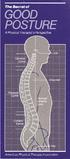 The Secret... T he American Physical Therapy Association would like to share a secret with you. It can help you do more with less effort breathe easier feel great. The secret is about good posture, which
CMS Imaging Efficiency Measures Included in Hospital Outpatient Quality Data Reporting Program (HOP QDRP) 2009
 CMS Imaging Efficiency Measures Included in Hospital Outpatient Quality Data Reporting Program (HOP QDRP) 2009 OP 8: MRI LUMBAR SPINE FOR LOW BACK PAIN Measure Description: This measure estimates the percentage
Chiropractic Coding. Michael D. Miscoe JD, CPC, CASCC, CUC, CCPC, CPCO, CHCC. Disclaimer
 Chiropractic Coding Michael D. Miscoe JD, CPC, CASCC, CUC, CCPC, CPCO, CHCC 1 Disclaimer DISCLAIMER This presentation is for general education purposes only. The information contained in these materials,
Orthopedic Shoe Dealer. Provider Manual
 Orthopedic Shoe Dealer Provider Manual Provider 1 TABLE OF CONTENTS Chapter I. General Program Policies Chapter II. Member Eligibility Chapter IV. Billing Iowa Medicaid Appendix III. Provider-Specific
OUTPATIENT PHYSICAL AND OCCUPATIONAL THERAPY PROTOCOL GUIDELINES
 OUTPATIENT PHYSICAL AND OCCUPATIONAL THERAPY PROTOCOL GUIDELINES General Therapy Guidelines 1. Therapy evaluations must be provided by licensed physical and/or occupational therapists. Therapy evaluations
Lower Back Pain An Educational Guide
 Lower Back Pain An Educational Guide A publication from the Center of Pain Medicine and Physiatric Rehabilitation 2002 Medical Parkway Ste 150 1630 Main St Ste 215 Annapolis, MD 21401 Chester, MD 21619
Heel pain and Plantar fasciitis
 A patient s guide Heel pain and Plantar fasciitis Fred Robinson BSc FRCS FRCS(orth) Consultant Trauma & Orthopaedic Surgeon Alex Wee BSc FRCS(orth) Consultant Trauma & Orthopaedic Surgeon. What causes
CHIROPRACTIC WELLNESS AWARENESS ONE FREE MASSAGE SESSION
 CHIROPRACTIC WELLNESS AWARENESS Do you want to have a healthy body? Do you like to maintain your high energy level? Do you want to be stress-less? Do you like to be pain free? Please call Conrad Nieh D.C.
Heel Pain: Heal! Amie C. Scantlin, DPM, MS, FACFAS Glencoe Regional Health Services (320) 864-3121 ext. 1933
 Heel Pain: Heal! Amie C. Scantlin, DPM, MS, FACFAS Glencoe Regional Health Services (320) 864-3121 ext. 1933 www.grhsonline.org Important Notice The information contained in this document is for informational
Chiropractic ICD 9 Code List
 Use of valid ICD 9 codes, billed with appropriate and corresponding CPT codes, benefits providers by facilitating treatment authorization and claims payment. The use of valid and appropriate codes also
Occupational Therapy
 Occupational Therapy Policy Number: Original Effective Date: MM.09.003 07/15/2003 Line(s) of Business: Current Effective Date: HMO; PPO; EUTF; HSTA; QUEST; Federal Plan 87 02/01/2012 Line(s) of Business
Coding and Documentation in Practice
 Coding and Documentation in Practice Great Exam Documentation By: Kathy Mills Chang Kathy Mills Chang is a Certified Medical Compliance Expert, Reimbursement Consultant, Medicare Specialist, and a Documentation
A compressive dressing that you apply around your ankle, and
 Ankle Injuries & Treatment The easiest way to remember this is: R.I.C.E. Each of these letters stands for: Rest. Rest your ankle. Do not place weight on it if it is very tender. Avoid walking long distances.
A Patient s Guide to Diffuse Idiopathic Skeletal Hyperostosis (DISH)
 A Patient s Guide to Diffuse Idiopathic Skeletal Hyperostosis (DISH) Introduction Diffuse Idiopathic Skeletal Hyperostosis (DISH) is a phenomenon that more commonly affects older males. It is associated
How To Get Reimbursed For A Car Accident
 PRAETORIAN INSURANCE COMPANY PERSONAL INJURY PROTECTION IMPORTANT NOTICE TO POLICYHOLDERS MEDICAL PROTOCOLS DECISION POINT REVIEW: Pursuant to N.J.A.C. 11:3-4, the New Jersey Department of Banking and
Physical and Occupational Therapy Services Program Rulebook
 Division of Medical Assistance Programs Physical and Occupational Therapy Services Program Rulebook Includes: 1) Table of Contents 2) Current Update Information (changes since last update) 3) Other Provider
Diagnostic Imaging Exams
 Guide for Chiropractors Diagnostic Imaging Exams CREATED FOR OUR CHIROPRACTIC PARTNERS This document has been prepared by the specialized, board-certified radiologists who interpret patient exams for Center
 More information >>> HERE
 Screening Examination of the Lower Extremities BUY THIS BOOK! Lower Extremity Screening Exam
 Screening Examination of the Lower Extremities Melvyn Harrington, MD Department of Orthopaedic Surgery & Rehabilitation Loyola University Medical Center BUY THIS BOOK! Essentials of Musculoskeletal Care
Elbow Injuries and Disorders
 Elbow Injuries and Disorders Introduction Your elbow joint is made up of bone, cartilage, ligaments and fluid. Muscles and tendons help the elbow joint move. There are many injuries and disorders that
Current Concepts of Low Back Pain. Terry L. Grindstaff, PhD, PT, ATC, SCS, CSCS
 Current Concepts of Low Back Pain Terry L. Grindstaff, PhD, PT, ATC, SCS, CSCS 28% population reports LBP in past 3 months (CDC 2010) 60% recurrence rate (Turner et al, 1992) Low Back Pain Low Back Pain
By Agnes Tan (PT) I-Sports Rehab Centre Island Hospital
 By Agnes Tan (PT) I-Sports Rehab Centre Island Hospital Physiotherapy Provides aids to people Deals with abrasion and dysfunction (muscles, joints, bones) To control and repair maximum movement potentials
.org. Plantar Fasciitis and Bone Spurs. Anatomy. Cause
 Plantar Fasciitis and Bone Spurs Page ( 1 ) Plantar fasciitis (fashee-eye-tiss) is the most common cause of pain on the bottom of the heel. Approximately 2 million patients are treated for this condition
Injuries from lifting, loading, pulling or pushing can happen to anyone in any industry. It is important to be aware of the risks in your workplace.
 Workplace safety: lifting One of the biggest concerns in the workplace is lifting and loading. When you lift something, the load on your spine increases and your spine can only bear so much before it is
CAUTION: FOR TRAINING PURPOSES ONLY. ABSOLUTELY NO WARRANTY IMPLIED.
 CAUTION: FOR TRAINING PURPOSES ONLY. ABSOLUTELY NO WARRANTY IMPLIED. DIAGNOSIS CODE LIST: ICD-10's only, Report page# 1 CODE DESCRIPTION -------------------------------------------------------------------
Physical Therapy MM.09.005 07/15/2003
 Physical Therapy Policy Number: Original Effective Date: MM.09.005 07/15/2003 Line(s) of Business: Current Effective Date: HMO; PPO; EUTF; HSTA; QUEST; Federal Plan 87 09/28/2012 Line(s) of Business Excluded:
Plantar Fasciitis. Plantar Fascia
 Plantar Fasciitis Introduction Plantar fasciitis is an inflammation of the thick band of tissue that connects your heel bone to your toes. This thick band of tissue is called the plantar fascia. Plantar
Physical and Occupational Therapy Services Program Rulebook
 Health Services Office of Medical Assistance Programs Physical and Occupational Therapy Services Program Rulebook Includes: 1) Table of Contents 2) Current Update Information (changes since last update)
Coding and Billing for Physical Therapy and Occupational Therapy Services
 Coding and Billing for Physical Therapy and Occupational Therapy Services -CPT Codes-97000 series -Timed Based Codes -Service Based Codes -CMS - "8" Minute Rule -ICD-9 codes -CCI edits -HCPCS(DME) MODALITIES
School Based Health Services Medicaid Policy Manual MODULE 6 OCCUPATIONAL AND PHYSICAL THERAPY SERVICES
 School Based Health Services Medicaid Policy Manual MODULE 6 OCCUPATIONAL AND PHYSICAL THERAPY SERVICES BACKGROUND Administrative Requirements SCHOOL BASED HEALTH SERVICES ARE REGULATED BY THE CENTERS
How To Treat Heel Pain
 Plantar Fasciitis, Heel Spurs, Heel Pain The Plantar Fasciitis Organization is dedicated to the understanding of Plantar Fasciitis, Heel Spurs, and all other forms of Heel Pain. Welcome to the Plantar
Neck Injuries and Disorders
 Neck Injuries and Disorders Introduction Any part of your neck can be affected by neck problems. These affect the muscles, bones, joints, tendons, ligaments or nerves in the neck. There are many common
Adult Advisor: Plantar Fasciitis. Plantar Fasciitis
 Adult Advisor: Plantar Fasciitis Page 1 of 3 Plantar Fasciitis What is plantar fasciitis? Plantar fasciitis is a painful inflammation of the bottom of the foot between the ball of the foot and the heel.
November 2011. Minor Injury Guideline. Superintendent s Guideline No. 02/11
 Financial Services Commission of Ontario Commission des services financiers de l Ontario November 2011 Minor Injury Guideline Financial Services Commission of Ontario Page 1 TABLE OF CONTENTS 1. Introduction...
Interpreting Physical Therapy Notes
 Interpreting Physical Therapy Notes Sending a patient to physical therapy does not always guarantee that they are going to receive the same treatment. In fact, the same patient with the same diagnosis
Runner's Injury Prevention
 JEN DAVIS DPT Runner's Injury Prevention Jen Davis DPT Orthopedic Physical Therapy Foot Traffic 7718 SE 13th Ave Portland, OR 97202 (503) 482-7232 [email protected] www.runfastpt.com!1 THE AMAZING RUNNER
Our feet are much more important to our health than we imagine and giving them the care they deserve will benefit you.
 Insoles Our feet are much more important to our health than we imagine and giving them the care they deserve will benefit you. Our feet may ache due to different biomechanical problems, anatomical or orthopedic
EVALUATION AND MANAGEMENT SERVICES
 Subject: Chiropractic Policy Effective Date: 04/01/16 Revision Date: DESCRIPTION OSU Health Plans limit coverage of chiropractic services to the treatment of acute and subacute subluxation/sprain conditions
Pain Management Top Diagnosis Codes (Crosswalk)
 Pain Management Top s (Crosswalk) 274.00 Gout arthropathy, M1000 Idiopathic gout, unspecified site unspecified M10011 Idiopathic gout, right shoulder M10012 Idiopathic gout, left shoulder M10019 Idiopathic
MAJOR DYSFUNCTION OF JOINTS TREATING PHYSICIAN DATA SHEET
 MAJOR DYSFUNCTION OF JOINTS TREATING PHYSICIAN DATA SHEET Long form FOR REPRESENTATIVE USE ONLY REPRESENTATIVE S NAME AND ADDRESS REPRESENTATIVE S TELEPHONE REPRESENTATIVE S EMAIL PHYSICIAN S NAME AND
Self Management Program. Ankle Sprains. Improving Care. Improving Business.
 Ankle Sprains Improving Care. Improving Business. What is an ankle sprain? Ligaments attach to the ankle bones and allow for normal movement and help prevent too much motion within the joint. Ankle sprains
This is caused by muscle strain to the Achilles tendon in the heel of the foot.
 Foot Facts Our feet were designed to move across uneven earthy surfaces. The hard, inflexible surfaces that we regularly walk on today, such as concrete, tile or wood, leave our feet wanting in terms of
CPT Current Procedural Terminology A National Standard under HIPAA Transactions Rule CPT Assistant = AMA s Coding Guidelines and Instructions
 DISCLAIMER & TERMS THIS PRESENTATION WAS CREATED IN ORDER TO HELP HEALTH CARE PROFESSIONALS, MEDICAL BILLING PERSONNEL, CODERS AND OTHER SUPPORT PERSONNEL TO BETTER UNDERSTAND THE RAPIDLY CHANGING MEDICAL/HEALTHCARE
Rotator Cuff Pathophysiology. treatment program that will effectively treat it. The tricky part about the shoulder is that it is a ball and
 Rotator Cuff Pathophysiology Shoulder injuries occur to most people at least once in their life. This highly mobile and versatile joint is one of the most common reasons people visit their health care
PERFORMANCE RUNNING. Piriformis Syndrome
 Piriformis Syndrome Have you started to experience pain in your hip or down your leg while beginning or advancing your fitness program? This pain may be stemming from the piriformis muscle in your hip.
Anterior Hip Replacement
 Disclaimer This movie is an educational resource only and should not be used to manage Orthopaedic health. All decisions about the management of hip replacement and arthritis management must be made in
Modifiers 25 and 59. Modifier 25
 Modifiers 25 and 59 This article discusses the appropriate use of modifier 25, Significant, Separately Identifiable Evaluation and Management Service by the Same Physician on the Same Day of the Procedure
Clinical Medical Policy Outpatient Rehab Therapies (PT & OT) for Members With Special Needs
 Benefit Coverage Rehabilitative services, (PT, OT,) are covered for members with neurodevelopmental disorders when recommended by a medical provider to address a specific condition, deficit, or dysfunction,
Neck Exercises for Car Accident Victims 3 Steps to a Healthier Neck
 Neck Exercises for Car Accident Victims 3 Steps to a Healthier Neck DR BARRY L. MARKS CHIROPRACTOR AUTHOR LECTURER Neck Exercises for Car Accident Victims 3 Steps to a Healthier Neck 2012 Dr. Barry L.
Rehabilitation. Rehabilitation. Walkers, Crutches, Canes
 Walkers, Crutches, Canes These devices provide support through your arms to limit the amount of weight on your operated hip. Initially, after a total hip replacement you will use a walker to get around.
Back & Neck Pain Survival Guide
 Back & Neck Pain Survival Guide www.kleinpeterpt.com Zachary - 225-658-7751 Baton Rouge - 225-768-7676 Kleinpeter Physical Therapy - Spine Care Program Finally! A Proven Assessment & Treatment Program
Podo Pediatrics Identifying Biomechanical Pathologies
 Podo Pediatrics Identifying Biomechanical Pathologies David Lee, D.P.M., D. A.B.P.S. Purpose Identification of mechanical foot and ankle conditions Base treatments Knowing when to refer to a podiatrist
Coding for OMT. Rance McClain, DO Assistant Professor Family Medicine KCUMB-COM
 Coding for OMT Rance McClain, DO Assistant Professor Family Medicine KCUMB-COM Learning Objectives n Understand CPT codes for Osteopathic Manipulative Treatment (OMT) n Apply correct coding to a thorough
Instructions & Forms for Submitting Claims to Medicare
 Instructions & Forms for Submitting Claims to Medicare The Centers for Medicare and Medicaid services have issued a national coverage policy for the WalkAide. CMS will cover patients who have a diagnosis
Medicare B Guideline Index
 Medicare B Guideline Index Medical Necessity Section 1862(a)(1)(A) of the SSA states: No Medicare payment shall be made for expenses incurred for items or services which are not reasonable and necessary
DROP FOOT AND TREATMENTS YOUNGMEE PARK
 DROP FOOT AND TREATMENTS YOUNGMEE PARK WHAT IS FOOT DROP Foot drop / Drop foot the inability to lift the front part of the foot not a disease a symptom of some other medical problems a sign of an underlying
Praxis Physical Therapy and Human Performance 935 Lakeview Parkway Suite #195 Vernon Hills, IL 60030 Phone: 847-247-7200 Fax: 847-247-4340
 Medical Registration Form (Page 1) Welcome to our Office: By completing this patient information form, you will help us to serve you more efficiently. Should you have any questions concerning our professional
(STREET) (CITY) (STATE) (ZIP) DOB: / / Soc. Sec # : - - Employer Address: (STREET) (CITY) (STATE) (ZIP)
 PATIENT INFO Name: Address: (LAST) (MI) (FIRST) (STREET) (CITY) (STATE) (ZIP) Home Phone: Work Phone: Cell Phone: Email Address: DOB: / / Soc. Sec # : - - Driver s License #: State: Marital Status: S M
Closed Automobile Insurance Third Party Liability Bodily Injury Claim Study in Ontario
 Page 1 Closed Automobile Insurance Third Party Liability Bodily Injury Claim Study in Ontario Injury Descriptions Developed from Newfoundland claim study injury definitions No injury Death Psychological
Preventing & Treating Low Back Pain
 Preventing & Treating Low Back Pain An Introduction to Low Back Pain Low back pain is the number two reason that Americans see a health care practitioner second only to colds and flu. While most people
Case Studies Updated 10.24.11
 S O L U T I O N S Case Studies Updated 10.24.11 Hill DT Solutions Cervical Decompression Case Study An 18-year-old male involved in a motor vehicle accident in which his SUV was totaled suffering from
A Guide to Heel Pain
 The Society of Chiropodists and Podiatrists A Guide to Heel Pain The Society of Chiropodists and Podiatrists Heel pain may be caused by a number of different problems; for effective treatment you need
Musculoskeletal System
 CHAPTER 3 Impact of SCI on the Musculoskeletal System Voluntary movement of the body is dependent on a number of systems. These include: The brain initiates the movement and receives feedback to assess
Knowing about your Low Back Pain
 Knowing about your Low Back Pain Knowing about low back pain Low back pain is very common with around 80-90% of adults having some sort of back pain in their lifetime. detail vertebra disc Although a specific
Foot and Ankle Conditioning Program. Purpose of Program
 Prepared for: Prepared by: OrthoInfo Purpose of Program After an injury or surgery, an exercise conditioning program will help you return to daily activities and enjoy a more active, healthy lifestyle.
Lower Back Spinal Fusion & Exercise
 & Exercise with Rick Kaselj, MS More FREE Information on Exercise & Injuries $299 Fitness Education Returning the Shoulder Back to Optimal Function Seminar Exercise Modification for the Sensitive Shoulder
Why Back Safety is Important
 Back Safety Why Back Safety is Important Back injuries are considered by OSHA (the Occupational Safety and Health Administration) as the nation's #1 workplace safety problem. Back Injuries are often: Very
Y O U R S U R G E O N S. choice of. implants F O R Y O U R S U R G E R Y
 Y O U R S U R G E O N S choice of implants F O R Y O U R S U R G E R Y Y O U R S U R G E O N S choice of implants F O R Y O U R S U R G E R Y Your Surgeon Has Chosen the C 2 a-taper Acetabular System The