
24 HOURS AND 3-MONTHS BOND STRENGTH BETWEEN DUAL-CURED RESIN CEMENTS AND SIMPLIFIED ADHESIVE SYSTEMS
|
|
|
- Marlene Edwards
- 10 years ago
- Views:
Transcription
1 24 HOURS AND 3-MONTHS BOND STRENGTH BETWEEN DUAL-CURED RESIN CEMENTS AND SIMPLIFIED ADHESIVE SYSTEMS Thaiane R. Aguiar 1, Andrea N. Cavalcanti 2, Céres M. Fontes 2, Giselle M. Marchi 1, Leonardo Muniz 3, Paula Mathias 2 1 Department of Restorative Dentistry, Piracicaba Dental School, Campinas State University. 2 Department of Restorative Dentistry, Federal University of Bahia. 3 Bahiana Foundation for Science Development. 171 ABSTRACT This study evaluated the bonding compatibility between dualcured resin cements and simplified adhesive systems (one-step self-etch and two-step etch & rinse), measured after 24 hours and 3 months. The occlusal dentin surfaces of 24 human third molars were exposed and flattened. Teeth were randomly assigned to 3 groups and treated with different combinations of adhesive system and resin cement [G1 - Single Bond/Rely X ARC (SB/RX); G2 - Excite DSC/Variolink II (EX/VR); G3 - Adper Prompt/Rely X ARC (AD/RX)]. Indirect composite restorations were cemented on flattened surfaces, and sectioned to obtain multiple bonded beams for the microtensile bond strength test. The beams from each tooth were tested under tension after 24 hours and 3 months (ANOVA/ Tukey s test, α=5%). Failure patterns were evaluated with scanning electron microscopy. After 24h, AD/RX presented the lowest bond strength mean values. AD/RX specimens did not withstand three months storage. SB/RX and EX/VR presented similar bond strengths in both periods tested. The association AD/RX resulted in low bond strength mean values, especially after storage. Cementing indirect restorations using one-step self-etch adhesive systems and dual-cured resin cements would be clinically unreliable. Key words: dentin bonding, resin cements, system adhesive, bond strength. AVALIAÇÃO DA RESISTÊNCIA DE UNIÃO DE CIMENTOS RESINOSOS DE DUPLA POLIMERIZAÇÃO ASSOCIADOS A SISTEMAS ADESIVOS SIMPLIFICADOS APÓS 24 HORAS E 3 MESES RESUMO Este estudo avaliou a compatibilidade de união entre cimentos resinosos de dupla polimerização e sistemas adesivos simplificados (adesivo autocondicionante - 1 passo- e adesivo total-each - 2 passos), após 24h e 3 meses. A superfície oclusal de 24 terceiros molares humanos foi exposta e planificada. Os dentes foram aleatoriamente divididos em 3 grupos usados de acordo a seguinte combinação entre sistema adesivo/cimento resinoso [G1 - Single Bond/Rely X ARC (SB/RX); G2 - Excite DSC/Variolink II (EX/VR); G3-Adper Prompt/Rely X ARC (AD/RX)]. Restaurações indiretas em resina composta foram cimentadas na superfície dentinária, e seccionados em múltiplos palitos para a realização do teste de resistência de união através do ensaio de microtração. Os palitos obtidos por dente foram submetidos ao teste após 24 horas e 3 meses (ANOVA/ Tukey test, α=5%). O padrão de fratura foi observado no microscópio eletrônico de varredura. Após 24 horas, AD/RX apresentou menor valor médio de resistência de união. Os corpos-de-prova do grupo AD/RX não resistiram ao armazenamento de 3 meses. SB/RX e EX/VR demonstraram similar resistência de união em ambos os períodos avaliados. A associação AD/RX resultou em menores valores médios de resistência de união, especialmente após o armazenamento. A cimentação de restaurações indiretas utilizando sistemas autocondicionantes (1 passo) e cimentos resinosos de dupla polimerização não foi considerada clinicamente confiável. Palavras chaves: dentina, cimentos resinosos, sistemas adesivos, resistência de união. INTRODUCTION The effectiveness of adhesive techniques has expanded the range of clinical applications 1. For example, the positive results obtained using adhesive cementation in indirect restorations have increased the frequency of metal-free restoration procedures, allowing sound dental tissue to be preserved with more conservative tooth preparations 2,3. However, the clinical success of adhesive cementation is highly dependent on the bonding properties of adhesive systems and resin cements 4. Adhesive systems can be classified according to their adhesion strategies, i.e. etch & rinse or self-etch techniques 5. The simplified etch & rinse technique involves two steps: acid conditioning followed by application of a mixture of primer and adhesive monomers 6. When bonding to dentin, the rinsing and drying steps make this technique more susceptible to Vol. 22 Nº 3 / 2009 / ISSN Acta Odontol. Latinoam. 2009

2 172 Thaiane R. Aguiar, et al. Table 1: Materials used in the present study, with the corresponding manufacturers, batch numbers and composition. Product (batch number) Composition* Single Bond ( 3M ESPE, 4JY) Excite (Ivoclar Vivadent, F66811) Adper Prompt (3M ESPE, L29064) Rely X ARC (3M ESPE, FL-316) Variolink II( Ivoclar Vivadent, F51866/F56391) Etchant: 35% H3PO4 Bis-GMA, HEMA, PAA, ethanol, water, initiators Etchant: 35% H3PO4 DMA, HEMA, alcohol, phosphoric acid acrylate, SiO2, initiators, stabilizers Liquid-A: Methacrylated phosphoric esters, Bis-GMA, initiators, stabilizers. Liquid-B Water, HEMA, stabilizers, polyalkenoic acid Bis-GMA, TEGDMA, Zirconia/silica filler, dimethacrylate polymer, pigments, initiators Bis-GMA, UDMA, TEGDMA, fillers, catalysts, stabilizers, pigments *Bis-GMA, bisphenol-glycidyl methacrylate; HEMA, 2-hydroxyethyl methacrylate; PAA, polyalkenoic acid copolymer; DMA, dimethacrylates; TEGDMA, triethylene glycol dimethacrylate; UDMA, urethane dimethacrylate. operator error, reducing adhesive performance 7.Onestep self-etch or all-in-one systems, as they are commonly referred to, involve only one procedure 5. These systems use acidic monomer solutions that etch, prime, and bond simultaneously 8. They eliminate critical steps, such as rinsing and drying 9 that decrease the technique s sensitivity 8. Consequently, these systems are being increasingly used 6, even for adhesive cementation in indirect restorations. Adverse interactions between simplified adhesives and chemical/dual-cured resin cements have been reported 2,6,10,11. An incompatible acid-base reaction occurs between acidic monomers present in simplified systems and the tertiary amines present in the catalyst paste of resin cements, resulting in incomplete polymerization of resin cements. The higher concentration of ionic and hydrophilic groups in adhesive systems may allow the movement of water and ions from the underlying dentin even after polymerization, compromising the hermetic sealing of the dentin interface 2. Moreover, one-step self-etch systems usually have a ph of 1.0 or lower, resulting in considerably deep demineralization effects, and thus more hydrophilic interfaces that are more prone to hydrolytic degradation 12. In vitro bond strength evaluations are usually performed 24h after specimen preparation 9,13. This period of time may not be long enough to verify the efficiency of restorative and adhesive materials, both in terms of bond stability and durability 13,14. Thus, the aim of this study was to evaluate the compatibility, after 24h and 3 months, between simplified adhesives systems (two etch & rinse systems and one one-step self-etch system) and dual-cured resin cements using a microtensile bond strength test (µtbs). Additionally, the morphological characteristics of the fractured surfaces were evaluated using scanning electron microscopy (SEM). The null hypothesis tested was that combinations of simplified adhesive systems and resin cements present similar bond strength to dentin and long-term performance. MATERIAL AND METHODS This study was approved by the Ethical Committee in Research at the Federal University of Bahia. Twenty-four non-carious human third molars were disinfected with 0.5% chloramine T solution. Their roots were mounted in self-curing acrylic resin cylinders (2.5 cm diameter). The occlusal enamel was removed using 180-grit silicon carbide paper under running water, and the smear layer was standardized with 600-grit silicon carbide papers under water cooling during 1 minute. Teeth were randomly allocated to 3 groups according to the following treatments (n=8): SB/RX (Single Bond (3M ESPE, St. Paul, MN, USA)/ Rely X ARC (3M ESPE, St. Paul, MN, USA); EX/VR (Excite DSC (Ivoclar Vivadent, Schaan, Liechtenstein)/Variolink II (Ivoclar Vivadent, Schaan, Liechtenstein); AD/RX (Adper Prompt (3M ESPE, St. Paul, MN, USA)/ RelyX ARC). The composition of the materials and manufacturers are shown in Table 1. The adhesive systems and resin cements were manipulated and applied according to manufacturers instructions. The same Acta Odontol. Latinoam ISSN Vol. 22 Nº 3 / 2009 /
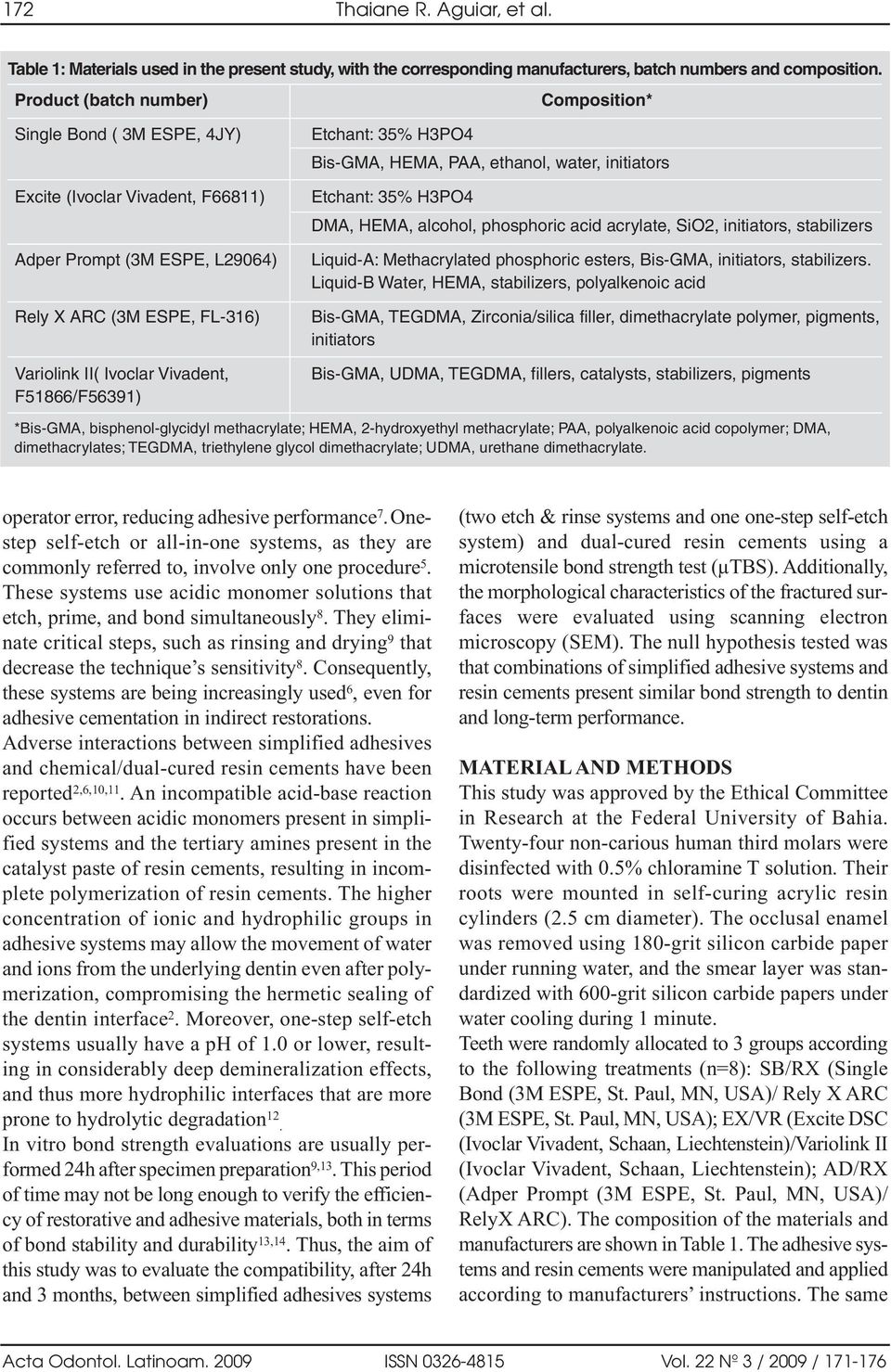
3 Dual-cured resin cements and simplified adhesive systems manufacturer was used for all groups to avoid chemical bias. Rectangular indirect restorations (4x4x6 mm) were fabricated using composite resin (Tetric Ceram, Ivoclar Vivadent, Schaan, Liechtenstein). The composite was inserted in 2.0 mm thick increments and each increment was light-activated for 20 seconds. The light output of the light curing unit (Optilight 600, Gnatus, Ribeirão Preto, SP, Brazil) was tested (500 to 600 mw/cm 2 ) with a radiometer (Curing Radiometer, model 100, Kerr Corporation, Orange, USA). The indirect composite was bonded to dentin with adhesive systems and resin cements in accordance with the manufacturer s instructions. Visible-light activation of each surface was applied for 20 s (Optilight 600). After cementation, specimens were stored in artificial saliva at 37 C for 24h. Next, they were sectioned on the mesio-distal and bucco-lingual planes using a low-speed, watercooled diamond saw (Isomet, Buehler, Lake Bluff, IL, USA). The boundaries of the restoration were discarded, six beams were obtained per tooth and the cross-sectioned area was measured with a digital caliper (727, Starrett Ind., Itu, SP, Brazil) to the nearest 0.01 mm. Beams obtained from each tooth were divided into 2 groups: half specimens were tested after 24h; the other half specimens were stored in artificial saliva (37 C) and tested after 3 months. Throughout the storage process, the artificial saliva was changed every five days. To carry out microtensile testing, specimens were attached to the flat grips of a μtbs device with cyanoacrylate glue (Super Bonder; Henckel Loctite, Itapevi, SP, Brazil) and tested under tension in a Universal Testing Machine (EMIC DL 500, São José dos Pinhais, SC, Brazil) at a cross-head speed of 0.5 mm/min, until failure. Means and standard deviations were calculated and expressed in MPa. No bond strength value was attributed for premature debonding during specimen preparation. The μtbs data were analyzed using Repeated Measures ANOVA and Tukey s test (α=5%). Table 2: Mean values (standard deviations) of µtbs (MPa). Experimental groups Single Bond + RelyX ARC Excite + Variolink II Adper Prompt + RelyX ARC 24 hours (5.20) Aa (9.68) Aa (5.58) B Storage 3 months (5.73) 7 Aa (8.30) Aa - Means followed by the same letters are not statistically different (ANOVA/Tukey s test, =0.05). Upper case letters compare adhesive systems within storage periods. Lower case letters compare storage periods within adhesive system. Fig. 1: Failure mode distribution according to the combination between adhesive system and resin cement. After testing, each specimen was gold-sputter coated (Balzers-SCD 050 Sputter Coater, Germany) and observed by SEM (JSM 2900, JEOL, Scanning Electron Microscopy Peabody, MA, USA) to assess the failure pattern. Failure modes were classified in three types: type 1 - failure between adhesive system and dentin, and partial cohesive failure in adhesive resin; type 2 - total cohesive failure in the adhesive resin; type 3 - cohesive failure in the cement resin. RESULTS Bond strength results are shown in Table 2. All specimens from the AD/RX group aged for 3 months debonded at the cement/dentin interface during specimen storage. Therefore, this combination could not be included in the statistical analysis. SB/RX and EX/VR presented similar bond strength in both periods and were not significantly affected by storage. The failure mode distribution is described in Fig. 1. In both periods tested, SB/RX presented mainly type 3 failures (Fig. 2: SEM photomicrograph illustrating a cohesive failure in the resin cement). The most frequent type of failure in EX/VR was type 1 after 24 hours Vol. 22 Nº 3 / 2009 / ISSN Acta Odontol. Latinoam. 2009
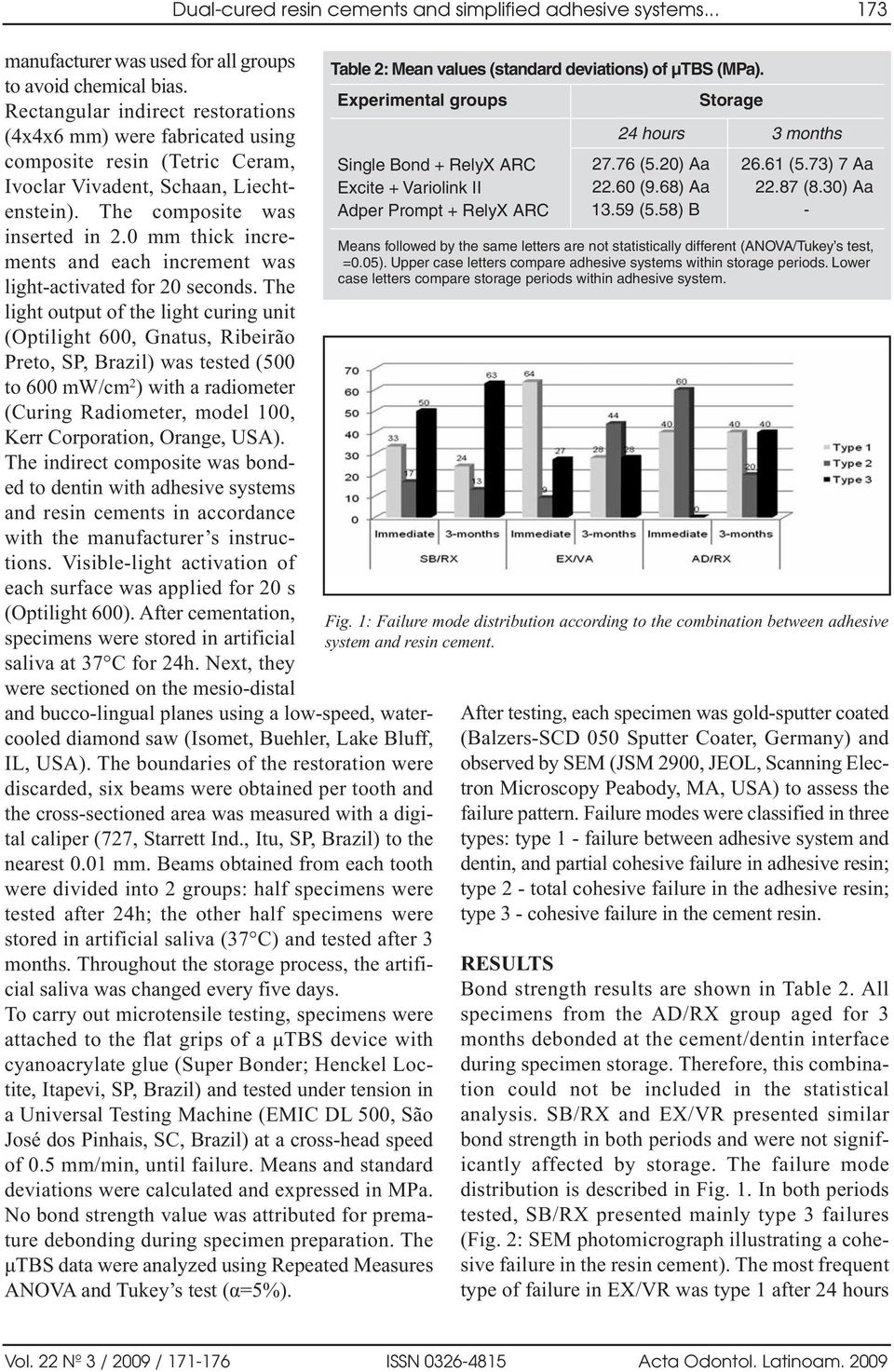
4 174 Thaiane R. Aguiar, et al. Fig. 2: SEM photomicrograph illustrating a cohesive failure in the resin cement. Fig. 3: SEM photomicrograph illustrating the dentin side of a fractured specimen presenting an adhesive failure between adhesive resin and dentin. Fig. 4: SEM photomicrograph illustrating the dentin side of a fractured specimen with a total cohesive failure in the adhesive resin. (Fig. 3: SEM photomicrograph illustrating the dentin side of a fractured specimen presenting an adhesive failure between adhesive resin and dentin); and type 2 after the 3-months period (Fig. 4: SEM photomicrograph illustrating the dentin side of a fractured specimen with a total cohesive failure in the adhesive resin). AD/RX presented mainly cohesive failures within the adhesive after 24 hours. After 3-months, both type 1 and type 3 failures were observed. DISCUSSION The present study was conducted to evaluate the μtbs of dual-cured resin cements bonded to simplified adhesive systems, after 24 hours and 3 months storage. Early bond strength measurements might provide an important reference regarding the bonding capability of adhesive materials 9. Nevertheless, it is widely accepted that long-term clinical studies provide more realistic results with respect to the efficiency of restorative materials 14, but the drawbacks of such studies are the high cost and extensive length of time 15. To overcome these limitations, in vitro methods, such as artificial aging, were developed to simulate aging conditions in an effort to provide information about bonding durability. In this study, specimens were stored in artificial saliva to simulate aging. However, other clinically-related factors, such as chewing stress, ph and temperature variations, were not simulated in this study. The storage method and the solution used are important variables in this study. Storage solutions have a significant effect on the leachability of filler particles, and artificial saliva might promote a greater degradation of resin-based materials than distilled water 16. Thus, it can better simulate the intraoral conditions. The interfacial bonding area exposed to the storage period may also play an important role in specimen degradation 14. In the present study, specimens with 1 mm 2 interfacial bonding areas were stored in artificial saliva. This method was chosen to accelerate the degradation of the interfaces between resin cements, adhesive systems and dentin. The etch & rinse systems (SB/RX and EX/VR) showed statistically similar bond strength values, irrespective of length of storage period. Therefore, the 3-months period may not be long enough to age restorative materials with improved bonding per- Acta Odontol. Latinoam ISSN Vol. 22 Nº 3 / 2009 /
5 Dual-cured resin cements and simplified adhesive systems formance, such as the two-step etch & rinse systems. On the other hand, the bond created using the one-step self-etch system was incapable of withstanding 3 months of storage, suggesting that this adhesive system does not present a reliable longterm capacity for cementing indirect restorations. The relatively high dentin permeability found in simplified self-etch systems results from the increased concentration of acidic monomers 6,17. The faster hydrolytic degradation of these systems in humid environments might justify the incidence of premature failures in the AD/RX group 12,18. Similar incidences of premature failure have previously been reported 1. Type 2 failure mode was frequently noted in the non-aged group AD/RX. It can be hypothesized that the higher permeability and incomplete light activation of the one-step self-etch system promoted a faster hydrolytic degradation, premature failure and, consequently, the loss of specimens. On the other hand, SB/RX groups demonstrated fewer failures involving the hybrid layer, since mainly cohesive failures in the cement resin were observed. In addition to hydrolytic degradation, the chemical incompatibility between chemical/dual-cured resin cements and simplified adhesive systems can negatively influence the adhesive cementation of indirect restorations 6,8,19. The result of this adverse reaction is the incomplete polymerization of resin-based materials 2. Since the degree of conversion of resin-based materials is directly related to their me chanical properties 11, an adequate polymerization of the resin cement is a fundamental prerequisite for restoration stability 20. Although simplified etch & rinse systems might also present a chemical incompatibility with dual cure cements, the results of this study indicate that this effect might be less pronounced than with one-step self-etch systems (AD/RX group). Within the limitations of this study, it could be concluded that there is no satisfactory evidence to justify the use of simplified self-etch systems and dual-cured composites for cementing indirect restorations. Findings showed that this association resulted in low bond strength mean values, especially after storage. However, bonding of indirect composite using two-step etch & rinse adhesive systems and chemical/dual-cured resin cement was not significantly affected by storage. ACKNOWLEDGMENTS This study was supported by Federal University of Bahia (PIBIC/CNPq grant # /2004-8). CORRESPONDENCE Dra. Paula Mathias. Faculdade de Odontologia da Universidade Federal da Bahia. Av. Araújo Pinho, # 62, Canela, Salvador, BA, Brazil. Tel (+5571) / Fax (+5571) [email protected] REFERENCES 1. Carracho HG, Soares CG, Heredia AR, Burnett Junior LH, Spohr AM. Compatibility between self-cured resin cement and simplified photo-cured adhesives associated to a universal catalyst. Braz Dent Scienc 2005;8: Pegoraro TA, Silva NRFA, Carvalho RM. Cements for Use in Esthetic Dentistry. Dent Clin North Am 2007;51: De Munck J, Vargas M, Van Landuyt K, Hikita K, Lambrechts P, Van Meerbeek B. Bonding of an auto-adhesive luting material to enamel and dentin. Dent Mater 2004;20: Arrais CA, Giannini M, Rueggeberg FA, Pashley DH. Microtensile bond strength of dual-polymerizing cementing systems to dentin using different polymerizing modes. J Prosthet Dent 2007;97: Van Meerbeek B, Vargas M, Inoue S, Yoshida Y, Peumans M, Lambrechts P, et al. Adhesives and cements to promote preservation dentistry. Oper Dent 2001;26 (Suppl 6): Tay FR, Frankenberger R, Krejci I, Bouillaguet S, Pashley DH, Carvalho RM, et al. Single bottle adhesives behave as permeable membranes after polymerization. I. In vivo evidence. J Dent 2004;32: Finger WJ, Balkenhol M. Rewetting strategies for bonding to dry dentin with an acetone-based adhesive. J Adhes Dent 2000;2: Tay FR, Pashley DH. Aggressiveness of contemporary selfetching systems. I: Depth of penetration beyond dentin smear layers. Dent Mater 2001;17: Duarte RM, de Goes MF, Montes MA. Effect of time on tensile bond strength of resin cement bonded to dentine and low-viscosity composite. J Dent 2006;34: Cheong C, King NM, Pashley DH, Ferrari M, Toledano M, Tay FR. Incompatibility of self-etch adhesives with chemical/dual-cured composites: two-step vs one-step systems. Oper Dent 2003;28: Latta MA, Kelsev WP 3rd, Kelsev WP 5th. Effect of polymerization mode of adhesive and cement on shear bond strength to dentin. Am J Dent 2006;19: Dong CC, McComb D, Anderson JD, Tam LE. Effect of mode of polymerization of bonding agent on shear bond Vol. 22 Nº 3 / 2009 / ISSN Acta Odontol. Latinoam. 2009

6 176 Thaiane R. Aguiar, et al. strength of autocured resin composite luting cements. J Can Dent Assoc 2003;69: Burrow MF, Satoh M, Tagami J. Dentin bond durability after three years using a dentin bonding agent with and without priming. Dent Mater 1996;12: Loguercio AD, Uceda-Gomez N, Carrilho MR, Reis A. Influence of specimen size and regional variation on long-term resin-dentin bond strength. Dent Mater 2005;21: Nikaido T, Kunzelmann KH, Chen H, Ogata M, Harada N, Yamaguchi S, et al. Evaluation of thermal cycling and mechanical loading on bond strength of a self-etching primer system to dentin. Dent Mater 2002;18: Söderholm KJ, Mukherjee R, Longmate J. Filler leachability of composites stored in distilled water or artificial saliva. J Dent Res 1996;75: Salz U, Mücke A, Zimmermann J, Tay FR, Pashley DH. pka value and buffering capacity of acidic monomers commonly used in self-etching primers. J Adhes Dent 2006;8: Güler AU, Yilmaz F, Yenisey M, Güler E, Ural Ç. Effect of acid etching time and a self-etching adhesive on the shear bond strength of composite resin to porcelain. J Adhes Dent 2006;8: Finger WJ, Osada T, Tani C, Endo T. Compatibility between self-etching adhesive and self-curing resin by addition of anion exchange resin. Dent Mater 2005;21: Hofmann N, Papsthart G, Hugo B, Klaiber B. Comparison of photo-activation versus chemical or dual-curing of resinbased luting cements regarding flexural strength, modulus and surface hardness. J Oral Rehabil 2001;28: Acta Odontol. Latinoam ISSN Vol. 22 Nº 3 / 2009 /
Effect of salivary contamination at different steps of the bonding process on the microleakage around Class V restorations
 Braz J Oral Sci. October-December 2007 - Vol. 6 - Number 23 Cristiane Becher Rosa 1 Andrea Nóbrega Cavalcanti 2 Céres Mendonça Fontes 3 Paula Mathias 4 1 DDS 2 DDS, MS, PhD student, Piracicaba Dental School,
CAN ULTRASOUND APPLICATION INFLUENCE THE BOND STRENGTH OF SELF-ADHESIVE RESIN CEMENTS TO DENTIN?
 ACTA-3-2012-FINAL:3-2011 16/04/2013 11:56 a.m. Página 299 299 CAN ULTRASOUND APPLICATION INFLUENCE THE BOND STRENGTH OF SELF-ADHESIVE RESIN CEMENTS TO DENTIN? Diego F. F. da Silva 1, Maurem L. Marcondes
Adhesive Solutions. Scotchbond Universal Adhesive. SEM pictures of Scotchbond Universal Adhesive. One bottle for all cases! Total-Etch and Self-Etch
 Adhesive Solutions Adhesive SEM pictures of. One bottle for all cases! Total-Etch and Self-Etch One adhesive for Total-Etch and Self-Etch Discover the Universal Bonding Solution. Unleash the power of the
Influence of Water Storage Time on the Bond Strength of Etch-and-Rinse and Self-Etching Adhesive Systems
 Braz Dent J (2008) 19(3): 219-223 SBS of adhesive systems after different storage times ISSN 0103-6440 219 Influence of Water Storage Time on the Bond Strength of Etch-and-Rinse and Self-Etching Adhesive
Bond strength evaluation of self-etch and total-etch adhesive systems on intact and ground human enamel
 Braz J Oral Sci. October-December 2007 - Vol. 6 - Number 23 Marina Di Francescantonio 1 Marcelo Tavares de Oliveira 2 Mirela Sanae Shinohara 3 Gláucia Maria Bovi Ambrosano 4 Marcelo Giannini 5 1 DDS, Graduate
DENT 5351 Final Examination 2007 NAME
 NAME DENT 5351 Spring Semester 2007 INTRDUCTIN T BIMATERIALS FINAL EXAMINATIN (40 questions) February 16, 2007 8:00 a.m. 9:00 a.m. This final examination consists of 7 pages and 40 questions. Mark all
Interaction between total-etch and self-etch adhesives and conventional and self-adhesive resin cements
 Braz J Oral Sci. July-September 2007 - Vol. 6 - Number 22 Interaction between total-etch and self-etch adhesives and conventional and self-adhesive resin cements Carlos Rocha Gomes Torres 2 Léia Quintanilha
A COMPARISON OF THE FILM THICKNESS OF TWO ADHESIVE LUTING AGENTS AND THE EFFECT OF THERMOCYCLING ON THEIR μtbs TO FELDSPATHIC CERAMIC
 191 A COMPARISON OF THE FILM THICKNESS OF TWO ADHESIVE LUTING AGENTS AND THE EFFECT OF THERMOCYCLING ON THEIR μtbs TO FELDSPATHIC CERAMIC Priscilla C. Pereira 1, Anderson A. Castilho 1, Rodrigo O. A. Souza
Influence of Ormocer component on the performance of dentin adhesive systems
 ORIGINAL ORIGINAL Influence of Ormocer component on the performance of dentin adhesive systems Influência do componente Ormocer no desempenho de sistemas adesivos dentinários Fabrício Mezzomo COLLARES
RSBO Revista Sul-Brasileira de Odontologia ISSN: 1806-7727 [email protected] Universidade da Região de Joinville Brasil
 RSBO Revista Sul-Brasileira de Odontologia ISSN: 1806-7727 [email protected] Universidade da Região de Joinville Brasil Nazareno Garcia, Rubens; do Nascimento, Reinaldo Francisco; Rocha Gomes, Ana Cristina;
Clinical randomized controlled study of Class II restorations of a highly filled nanohybrid resin composite (4U)
 215-3-3 Clinical randomized controlled study of Class II restorations of a highly filled nanohybrid resin composite () One year report JWV van Dijken, Professor Director Clinical Research Biomaterial Research
Effect of Cement Type and Water Storage Time on the Push-Out Bond Strength of a Glass Fiber Post
 Braz Dent J (2011) 22(5): 359-364 Cement and water storage affect post retention ISSN 0103-6440 359 Effect of Cement Type and Water Storage Time on the Push-Out Bond Strength of a Glass Fiber Post Kátia
Etching time evaluation on the shear bond strength of two adhesive systems in primary teeth
 Etching time evaluation on the shear bond strength of two adhesive systems in primary teeth Avaliação do tempo de condicionamento ácido na resistência da união de dois sistemas de união em dentes decíduos
Press Abutment Solutions
 Press Abutment Solutions Efficiency and esthetics redefined all ceramic all you need More press ceramic options... Press ceramics have been synonymous with the ideal combination of accuracy of fit, shape
Effect of water storage and hydrophobic
 ISSN: Electronic version: 1984-5685 RSBO. 2013 Jul-Sep;10(3):217-23 Original Research Article Effect of water storage and hydrophobic adhesive layer ayer application app ication on the bond strength of
Effect of storage and disinfection methods of extracted bovine teeth on bond strength to dentin
 Braz J Oral Sci. July-September 2007 - Vol. 6 - Number 22 Effect of storage and disinfection methods of extracted bovine teeth on bond strength to dentin Maria Malerba Colombi Humel 1* Marcelo Tavares
Intra-radicular dentin treatments and retention of fiber posts with selfadhesive
 Dental Materials Intra-radicular dentin treatments and retention of fiber posts with selfadhesive resin cements André Luis Faria-e-Silva (a) Murilo de Sousa Menezes (b) Fernanda Pereira Silva (b) Giselle
Shear bond strength of metallic brackets bonded with a new orthodontic composite
 Original Article Braz J Oral Sci. April/June 2009 - Volume 8, Number 2 Shear bond strength of metallic brackets bonded with a new orthodontic composite Fábio Lourenço Romano 1, Américo Bortolazzo Correr
Eliminating effect of Er, Cr: YSGG laser irradiation on the smear layer of dentin
 Eliminating effect of Er, Cr: YSGG laser irradiation on the smear layer of dentin Jingtao Yu, MD, DDS, and Lu Yan, MD, DDS College of Stomatology, China Medical University, Shenyang, P. R. China Purpose:
Objective: To assess microleakage in conservative class V cavities prepared with
 www.scielo.br/jaos Microleakage in conservative cavities varying the preparation method and surface treatment Juliana Abdallah ATOUI 1, Michelle Alexandra CHINELATTI 2, Regina Guenka PALMA-DIBB 3, Silmara
1- Fatigue-Resistance and Microleakage of CAD/CAM Ceramic and Composite Molar crowns
 1- Fatigue-Resistance and Microleakage of CAD/CAM Ceramic and Composite Molar crowns A. KASSEM1, O. ATTA1, and O. EL-MOWAFY2, 1Suez Canal University, Ismailia, Egypt, 2University of Toronto, Toronto, ON,
Push-out bond strength of CAD/CAM-ceramic luted to dentin with self-adhesive resin cements
 dental materials 26 (2010) 855 863 available at www.sciencedirect.com journal homepage: www.intl.elsevierhealth.com/journals/dema Push-out bond strength of CAD/CAM-ceramic luted to dentin with self-adhesive
In 1972, Wilson & Kent introduced
 Dental Materials Bond strength of silorane- and methacrylate-based composites to resin-modified glass ionomers Christopher S. Nuttall, DDS, MS n Kraig S. Vandewalle, DDS, MS n Jeffery A. Casey, DDS n Kent
Bonding Agent Underneath Sealant: Shear Bond Strength to Oil-Contaminated Enamel
 50 Braz Dent J (2010) 21(1): 50-54 M.C. Borsatto et al. ISSN 0103-6440 Bonding Agent Underneath Sealant: Shear Bond Strength to Oil-Contaminated Enamel Maria Cristina BORSATTO 1 Michelle Yamamoto THOMAZ
Abutment Solutions For customized implant restorations fabricated with CEREC and inlab. Digital all around.
 Abutment Solutions For customized implant restorations fabricated with CEREC and inlab Digital all around. The digital treatment workflow Digital impression taking Coordinated digital workflows in CAD/CAM
THE EFFECT OF STORAGE SOLUTIONS ON ENAMEL OF BOVINE TEETH
 THE EFFECT OF STORAGE SOLUTIONS ON ENAMEL OF BOVINE TEETH Kalena de Melo Maranhão 1 Eliza Burlamaqui Klautau 2 Pablo de Melo Maranhão Pereira 3 Ryssia Braun Guimarães 3 Viviane Garcia Pantoja 4 1 DDS,
One-hour tensile bond strength of different luting agents to a NiCr alloy
 Revista de Odontologia da Universidade Cidade de São Paulo 2008 maio-ago; 20(2): 114-121 One-hour tensile bond strength of different luting agents to a NiCr alloy Avaliação da resistência adesiva à tração
Ultimate tensile strength of tooth structures
 Dental Materials (2004) 20, 322 329 http://intl.elsevierhealth.com/journals/dema Ultimate tensile strength of tooth structures Marcelo Giannini a, *, Carlos José Soares b, Ricardo Marins de Carvalho c
priti crown Your patients deserve you
 priti crown Your patients deserve you 3 and you deserve the priti crown So close to nature priti crown is a high-tech solution for making perfect crown and bridge restorations using state-of-the-art CAD/CAM
Heraeus Kulzer plays an active part in IADR General Session 2015 in Boston
 Press Release Broad range of studies with products from Heraeus Kulzer show excellent results Heraeus Kulzer plays an active part in IADR General Session 2015 in Boston Hanau, April 2015 From March 11
Effect of photoactivation methods and base materials on the stress generated by the polymerization shrinkage of a resin composite
 Braz J Oral Sci. October/December 2004 - Vol. 3 - Number 11 Effect of photoactivation methods and base materials on the stress generated by the polymerization shrinkage of a resin composite Leonardo Gonçalves
Jacket crown. Advantage : Crown and Bridge
 Crown and Bridge Lecture 1 Dr.Nibras AL-Kuraine Jacket crown It is a type of crown that is formed by a tooth colored material. It is mainly used as a single unit in the anterior quadrant of the mouth.
Rebilda DC. Rebilda Post System. Rebilda
 Rebilda DC Rebilda Post System Rebilda Rebilda DC Systematic coronal build-up reconstruction Nowadays, modern composite and adhesive systems enable the reconstruction of severely damaged teeth, even if
In vivo evaluation of different techniques for establishment of proximal contacts in posterior resin composite restorations
 Original Article Braz J Oral Sci. January March 2011 - Volume 10, Number 1 In vivo evaluation of different techniques for establishment of proximal contacts in posterior resin composite restorations Paula
Luting Cement. in the Clicker Dispenser. Technical Product Profile. Ketac Cem Plus
 Luting Cement TM in the Clicker Dispenser Technical Product Profile Ketac Cem Plus TM 2 Table of Contents Introduction....................................................................5 History........................................................................5
Chemical stability of two dentin single-bottle adhesives as a function of solvent loss
 Original Article Yevenes et al. Chemical stability of two dentin single-bottle adhesives as a function of solvent loss Estabilidade química de dois adesivos dentinários de frasco único em função da perda
Correlation between marginal accuracy and fracture resistance of indirect composite restorations varying cavity preparation design
 Braz J Oral Sci. January-March 2007 - Vol. 6 - Number 20 Correlation between marginal accuracy and fracture resistance of indirect composite restorations varying cavity preparation design Rodrigo Borges
Class I and II Indirect Tooth-Colored Restorations
 Class I and II Indirect Tooth-Colored Restorations Most indirect restorations are made on a replica of the prepared tooth in a dental laboratory by a trained technician. Tooth-colored indirect systems
Tooth preparation for indirect bonded restorations (eg,
 Case Report Immediate Dentin Sealing: A Fundamental Procedure for Indirect Bonded Restorations PASCAL MAGNE, DMD, PHD ABSTRACT: The purpose of this article is to review evidence-based principles that could
Selected Properties of Core-Buildup Materials for Prosthetic Restorations
 Selected Properties of Core-Buildup Materials for Prosthetic Restorations Inaugural- Dissertation zur Erlangung des Grades eines Doktors der Zahnheilkunde des Fachbereichs Humanmedizin der Justus-Liebig-Universität
IPS Empress CAD for CAD/CAM technology Information for Dentists. Confidence. Reliability. Esthetics. Empress CAD. The world s leading all-ceramic
 CAD for CAD/CAM technology Information for Dentists Confidence Reliability Esthetics The world s leading all-ceramic A time-tested system with new possibilities More versatility with revolutionized the
Influence of ceramic primers on microshear bond strength between resin cements and zirconia-based ceramic
 Original Article Braz J Oral Sci. April June 2011 - Volume 10, Number 2 Influence of ceramic primers on microshear bond strength between resin cements and zirconia-based ceramic Valéria Bisinoto Gotti
Er:YAG (2940nm) laser cavity preparation and semidirect composite resin restorations. A microleakage study
 UNIVERSITE DE NICE SOPHIA-ANTIPOLIS U.F.R. ODONTOLOGIE Pôle Universitaire Saint Jean d Angely 24, Avenue des Diables Bleus 06357 NICE CEDEX 04 Mémoire de Recherches Diplòme d Université Oral Laser Applications
Comparative radiopacity of four lowviscosity
 Braz J Oral Sci. January-March 2007 - Vol. 6 - Number 20 Comparative radiopacity of four lowviscosity composites Micheli Tavares Imperiano 1 Helen Jamil Khoury 2 Maria Luiza Anjos Pontual 3 Marcos Antonio
Porcelain Veneers for Children and Teens. By Fred S. Margolis, D.D.S., F.I.C.D., F.A.C.D., F.A.D.I. Abstract
 Porcelain Veneers for Children and Teens By Fred S. Margolis, D.D.S., F.I.C.D., F.A.C.D., F.A.D.I. Abstract This article will discuss the advantages of providing our young patients and their parents an
Adhesion and Microleakage of CAD/CAM Crowns Using Self-adhesive Resin Cements
 Adhesion and Microleakage of CAD/CAM Crowns Using Self-adhesive Resin Cements by Mohamed Mahmoud Mohamed Mahmoud Kandil A thesis submitted in conformity with the requirements for the degree of Doctor of
20TDNH 214. Course Description:
 Revised: Fall 2015 20TDNH 214 20TPractical Materials for Dental Hygiene Course Description: 37TStudies the current technologic advances, expanded functions, and clinical/laboratory materials used in dental
Condition assessment and repair of antenna towers concrete foundations
 Condition assessment and repair of antenna towers concrete foundations I. Banjad Pecur, N. Stirmer & B. Milovanovic Department of materials, Faculty of Civil Engineering, University of Zagreb, Zagreb,
http://eprints.gla.ac.uk/5255/ Deposited on: 8 June 2009
 e Talal, A and Tanner, K.E. and Billington, R. and Pearson, G.J. (28) Effect of ultrasound on the setting characteristics of glass ionomer cements studied by Fourier Transform Infrared Spectroscopy. Journal
Adper Easy Bond. Self-Etch Adhesive. Your invitation to the. heavyweight showdown. November 28 30, 2010 Booth #4407.
 Adper Easy Bond Self-Etch Adhesive Join us for the Battle of the Bonds Your invitation to the heavyweight showdown November 28 30, 2010 Booth #4407 Adper Easy Bond Self-Etch Adhesive Come battle it out
Testing and appraisal of Lucobit polymer effect as an additive on asphalt mixture performance
 Abstract Testing and appraisal of polymer effect as an additive on asphalt mixture performance Hamid Sabbagh mollahosseini*,golazin Yadollahi**, Ershad Amoosoltani*** *, ***Executive of Engineering and
Abutment fracture in a bridge supported by natural teeth and implants
 Abutment fracture in a bridge supported by natural teeth and implants Authors_Dr Gregory-George Zafiropoulos, Dr Giorgio Deli & Dr Rainer Valentin, Germany/Italy _Introduction Implant treatment has evolved
Ion Beam Sputtering: Practical Applications to Electron Microscopy
 Ion Beam Sputtering: Practical Applications to Electron Microscopy Applications Laboratory Report Introduction Electron microscope specimens, both scanning (SEM) and transmission (TEM), often require a
FAQs - RelyX TM Unicem 2 Automix/Clicker
 FAQs - RelyX TM Unicem 2 Automix/Clicker Generals 1. What clinical data is available on RelyX Unicem 2 Automix/Clicker? RelyX Unicem 2 Automix/Clicker were tested for biocompatibility before release. RelyX
Single-tooth replacement in the anterior and premolar region
 Publication Influence of Retainer Design on Two-unit Cantilever Resin-bonded Glass Fiber Reinced Composite Fixed Dental Prostheses: An In Vitro and Finite Element Analysis Study Filip Keulemans a /Niek
THE INFLUENCE OF COMPRESSIVE CYCLIC LOADING ON THE RETENTION OF CAST CROWN COPINGS CEMENTED TO IMPLANT ABUTMENTS
 THE INFLUENCE OF COMPRESSIVE CYCLIC LOADING ON THE RETENTION OF CAST CROWN COPINGS CEMENTED TO IMPLANT ABUTMENTS A thesis submitted in partial fulfillment for the Degree of Doctor of Clinical Dentistry
STEP-BY-STEP INSTRUCTIONS ON THE PROSTHETIC PROCEDURES. Straumann Anatomic IPS e.max Abutment
 STEP-BY-STEP INSTRUCTIONS ON THE PROSTHETIC PROCEDURES Straumann Anatomic IPS e.max Abutment The ITI (International Team for Implantology) is academic partner of Institut Straumann in the areas of research
the new dna of high strength glass ceramics
 the new dna of high strength glass ceramics 1 the new dna of high strength glass ceramics Together with the Fraunhofer Institute and VITA, we have developed a new class of materials for high-strength glassceramics
MICROSTRUCTURAL AND MECHANICAL CHARACTERIZATION OF GRAY CAST IRON AND AlSi ALLOY AFTER LASER BEAM HARDENING
 Materials Science Forum Vols. 638-642 (2010) pp 769-774 Online available since 2010/Jan/12 at www.scientific.net (2010) Trans Tech Publications, Switzerland doi:10.4028/www.scientific.net/msf.638-642.769
High Performance PSA in Sheet Membrane in Water Protection
 High Performance PSA in Sheet Membrane in Water Protection Xia Cao, Senior R&D Chemist, W. R. Grace, Cambridge MA 02140 Jyoti Seth, Strategic Program Leader, W. R. Grace, Cambridge MA 02140 Concrete is
Effects of Tg and CTE on Semiconductor Encapsulants
 Effects of Tg and CTE on Semiconductor Encapsulants Dr. Mark M. Konarski Loctite Corporation www.loctite.com Abstract As the role of direct-chip-attachment increases in the electronics industry, the reliability
dental fillings facts About the brochure:
 dental fillings facts About the brochure: Your dentist is dedicated to protecting and improving oral health while providing safe dental treatment. This fact sheet provides information you need to discuss
TABLE OF CONTENTS CHAPTER NO. TITLE PAGE NO. ABSTRACT
 vii TABLE OF CONTENTS CHAPTER NO. TITLE PAGE NO. ABSTRACT LIST OF TABLES LIST OF FIGURES LIST OF SYMBOLS AND ABBREVIATIONS iii xvii xix xxvii 1 INTRODUCTION 1 1.1 GENERAL 1 1.2 OBJECTIVES AND SCOPE OF
Randall G. Cohen, DDS 501 Floral Vale Blvd Yardley, PA 19067 [email protected] 215.579.9985. Curriculum Vitae
 Randall G. Cohen, DDS 501 Floral Vale Blvd Yardley, PA 19067 [email protected] 215.579.9985 Curriculum Vitae Education: B.A., Biology, Lehigh University, 1978 Doctor of Dental Surgery, Temple University,
CHAPTER 10 RESTS AND PREPARATIONS. 4. Serve as a reference point for evaluating the fit of the framework to the teeth.
 CHAPTER 10 RESTS AND DEFINITIONS A REST is any rigid part of an RPD framework which contacts a properly prepared surface of a tooth. A REST PREPARATION or REST SEAT is any portion of a tooth or restoration
Clinical Evaluation of Fixed Partial Dentures with Cast Joined Pontics
 Clinical Research Interdisciplinary Clinical Evaluation of Fixed Partial Dentures with Cast Joined Pontics Dr Dipak Thapa Department of Prosthodontics, Kantipur Dental College Kathmandu, Nepal Correspondence:
Our Mission: Protecting partially. erupted teeth. With Fuji TriageTM from GC. One of many GC solutions for caring for youngsters.
 Our Mission: Protecting partially erupted teeth. With Fuji TriageTM from GC. One of many GC solutions for caring for youngsters. Did you know: first and second permanent molars take about 1.5 years to
Fire-Damage or Freeze-Thaw of Strengthening Concrete Using Ultra High Performance Concrete
 Fire-Damage or Freeze-Thaw of Strengthening Concrete Using Ultra High Performance Concrete Ming-Gin Lee 1,a, Yi-Shuo Huang 1,b 1 Department of Construction Engineering, Chaoyang University of Technology,Taichung
While the prosthetic rehabilitation of
 Restoring Mandibular Single Teeth with the Inclusive Tooth Replacement Solution Go online for in-depth content by Bradley C. Bockhorst, DMD While the prosthetic rehabilitation of full-arch cases provides
Composite artistry- speedy mock up
 Case Report: Composite artistry- speedy mock up Dr.Shikha Kanodia*, Dr.Manjit Kaur**, Dr.Girish J. Parmar*** * Asst. Professor, **Post Graduate Part 3, ***Head and Dean, Department of Conservative Dentistry
Wax-based binder for low-pressure injection molding and the robust production of ceramic parts
 Wax-based binder for low-pressure injection molding and the robust production of ceramic parts J. E. Zorzi a,* C. A. Perottoni b,a, J. A. H. da Jornada c,a a Universidade Federal do Rio Grande do Sul,
Use of Standards in Papers Published in Dental Journals
 Braz Dent J (2012) 23(5): 471-476 Using standards in published papers ISSN 0103-6440 471 Use of Standards in Papers Published in Dental Journals Álvaro DELLA BONA Yuri DAL BELLO Suelen C. SARTORETTO Graduation
EVALUATION OF THE PERFORMANCE OF THE PROTECTIVE SURFACE COATINGS FOR CONCRETE
 EVALUATION OF THE PERFORMANCE OF THE PROTECTIVE SFE COATINGS FOR CONCRETE Haimoon CHEONG * Hwangu YU *2 Taesong AHN *3 Byunghwan OH *4 ABSTRT: Chloride penetration into concrete is the main cause of the
Resin based materials in prosthetic dentistry. Mercedes Linninger DDS Department of prosthodontics
 Resin based materials in prosthetic dentistry Mercedes Linninger DDS Department of prosthodontics Resins in dentistry Denture base Crown and bridge Artificial teeth Special tray Modelling Filling materials
Buy 1, Get 1 FREE! (Refills: Contain 2 Syringes (2g each), 20 Dispensing Tips, Technique Guide, Direction for Use)
 Herculite Ultra Flow New Product Nanohybrid Flowable Composite Smart Placement Technology Outstanding Flexural Strength Over 300% Radiopacity Low Shrinkage Easy polishability, excellent gloss retention
BIOACTIVE COATINGS ON 316L STAINLESS STEEL IMPLANTS
 Trends Biomater. Artif. Organs. Vol. 17(2) pp 43-47 (2004) http//www.sbaoi.org BIOACTIVE COATINGS ON 316L STAINLESS STEEL IMPLANTS N. Ramesh Babu*,+, Sushant Manwatkar*, K. Prasada Rao* and T. S. Sampath
Location of the apical foramen and its relationship with foraminal file size
 original article Location of the apical foramen and its relationship with foraminal file size Ronaldo Araújo Souza, DDS, MSc, PhD 1 José Antônio Poli de Figueiredo, DDS, MSc, PhD 2 Suely Colombo, DDS 1
Basic Properties and Application of Auto Enamels
 Basic Properties and Application of Auto Enamels Composition of Ceramic Automotive Glass Enamels Ceramic automotive glass colours are glass enamels that fire on to the glass during the bending process
How To Test A Base Axe
 Scotch-Weld DP760 Product Data Sheet Updated : February 2009 Supersedes: June 2001 Product Description DP760 epoxy adhesive is a non-sag, two-part room temperature curing adhesive designed for use when
TA3 Dosimetry and Instrumentation. Evaluation of the Field Size in Dental Diagnostic Radiology System ANDRADE PS 1, POTIENS MP 1
 TA3 Dosimetry and Instrumentation Evaluation of the Field Size in Dental Diagnostic Radiology System ANDRADE PS 1, POTIENS MP 1 1 Instituto de Pesquisas Energéticas e Nucleares, São Paulo, Brazil. ABSTRACT
Enamel bonding has been widely and successfully used
 Literature Review Dentin/enamel adhesives: review of the literature Edward J. Swift, Jr, DMD, MS Dr. Swift is professor and chair, Department of Operative Dentistry, University of North Carolina, Chapel
Hardened Concrete. Lecture No. 14
 Hardened Concrete Lecture No. 14 Strength of Concrete Strength of concrete is commonly considered its most valuable property, although in many practical cases, other characteristics, such as durability
Ivocap The successful technique
 The successful technique Heat curing injection system The technique makes the difference AN INGENIOUS SYSTEM The success of the Ivocap Injection System is based on its well thought-out technique. With
ROHACELL Triple F. Complex shaped PMI Foam Cores for highly efficient FRP Composite
 Complex shaped PMI Foam Cores for highly efficient FRP Composite ROHACELL Triple F Sandwich Fabrication for low to - A Novel Particle Foam high volume applications SAMPE tesdr. Kay Brazil Conference 2015