
Enterprise Resource Planning Systems Schedule Delays and Reengineering Weaknesses Increase Risks to DoD's Auditability Goals
|
|
|
- Sara Foster
- 10 years ago
- Views:
Transcription
1 Report No. DODIG July 13, 2012 Enterprise Resource Planning Systems Schedule Delays and Reengineering Weaknesses Increase Risks to DoD's Auditability Goals

2 Additional Copies To obtain additional copies of this report, visit the Web site of the Department of Defense Inspector General at or contact the Secondary Reports Distribution Unit at (703) (DSN ) or fax (571) Suggestions for Audits To suggest or request audits, contact the Office of the Deputy Inspector General for Auditing by phone (703) (DSN ), by fax (571) , or by mail: Department of Defense Office of Inspector General Office of the Deputy Inspector General for Auditing ATTN: Audit Suggestions/13F Mark Center Drive Alexandria, VA Acronyms and Abbreviations BPR CMO DAI DCMO DEAMS DLA EBS EC ERP FIAR GAO GFEBS LMP OIG PMO SFIS USD(C)/CFO, DoD USSGL Business Process Reengineering Chief Management Officer Defense Agencies Initiative Deputy Chief Management Officer Defense Enterprise Accounting and Management System Defense Logistics Agency Enterprise Business System Energy Convergence Enterprise Resource Planning Financial Improvement and Audit Readiness Government Accountability Office General Fund Enterprise Business System Logistics Modernization Program Office of Inspector General Program Management Office Standard Financial Information Structure Under Secretary of Defense (Comptroller)/Chief Financial Officer, DoD U.S. Standard General Ledger

3 INSPECTOR GENERAL DEPARTMENT OF DEFENSE 4800 MARK CENTER DRIVE ALEXANDRIA, VIRGINIA MEMORANDUM FOR UNDER SECRETARY OF DEFENSE (COMPTROLLER)/CHIEF FINANCIAL OFFICER, DOD DOD DEPUTY CHIEF MANAGEMENT OFFICER ASSISTANT SECRETARY OF THE AIR FORCE (FINANCIAL MANAGEMENT AND COMPTROLLER) NAVAL INSPECTOR GENERAL AUDITOR GENERAL, DEPARTMENT OF THE ARMY July 13, 2012 SUBJECT: Enterprise Resource Planning Systems Schedule Delays and Reengineering Weaknesses Increase Risks to DoD s Auditability Goals (Report No. DODIG ) We are providing this report for your review and comment. We conducted this audit in response to a congressional request. DoD plans to spend more than $15 billion to develop and implement Enterprise Resource Planning systems. Schedule delays and cost increases for the systems have resulted in DoD continuing to use outdated legacy systems and diminish the estimated savings associated with transforming business operation through business system modernization. In addition, the impact of schedule delays increases the risk that DoD will not achieve an auditable Statement of Budgetary Resources by FY 2014 or accomplish its goal of full financial statement audit readiness by FY We considered management comments on a draft of this report in preparing the final report. DoD Directive requires that recommendations be resolved promptly. The comments from the Under Secretary of Defense (Comptroller)/Chief Financial Officer, DoD, were responsive and we do not require additional comments. The DoD Deputy Chief Management Officer did not respond to the draft report. Therefore, we request the DoD Deputy Chief Management Officer provide comments on Recommendations B.1.a and B.1.b by August 13, The Chief Management Officers of the Army, Navy, and Air Force provided comments. The comments from the Chief Management Officer of the Navy were responsive, and we do not require additional comments. The comments from the Chief Management Officers of the Army and the Air Force were partially responsive. Therefore, we request the Chief Management Officers of the Army and Air Force provide additional comments on Recommendations B.1.a and B.1.b by August 13, Please provide comments that conform to the requirements of DoD Directive If possible, send a portable document format (.pdf) file containing your comments to [email protected]. Comments provided to the final report must be marked and portion-marked, as appropriate, in accordance with DoD Manual Copies of management comments must contain the actual signature of the authorizing official. We are unable to accept the /Signed/ symbol in place of the actual signature. If you arrange to send classified comments electronically, you must send them over the SECRET Internet Protocol Router Network (SIPRNET). We appreciate the courtesies extended to the staff. Please direct questions to me at (703) Amy J. Frontz, CPA Principal Assistant Inspector General for Auditing
4 Report No. DODIG (Project No. D2012-D000DE ) July 13, 2012 Results in Brief: Enterprise Resource Planning Systems Schedule Delays and Reengineering Weaknesses Increase Risks to DoD s Auditability Goals What We Did We conducted this audit in response to a congressional request. Our overall objective was to evaluate six Enterprise Resource Planning (ERP) systems that we identified as necessary for DoD to produce auditable financial statements. What We Found The six ERP systems experienced cost increases of $8.0 billion and schedule delays ranging from 1.5 to 12.5 years during system development and implementation. As a result of the schedule delays, DoD will continue using outdated legacy systems and diminish the estimated savings associated with transforming business operations through business system modernization. In addition, the impact of schedule delays increases the risk that DoD will not achieve an auditable Statement of Budgetary Resources by FY 2014 or accomplish its goal of full financial statement audit readiness by FY The DoD Deputy Chief Management Officer (DCMO) and the Chief Management Officers (CMO) of the Military Departments (DoD officials) did not verify that business processes were streamlined and efficient as required by Public Law , National Defense Authorization Act For Fiscal Year 2010, Section 1072, Business Process Reengineering, October 28, This occurred because DoD officials relied on the Program Management Offices self compliance assertions when they certified and approved funding of $302.7 million, instead of reviewing the business processes and verifying the i accuracy, completeness, and reliability of the Program Management Office submissions. As a result, there is an increased risk the ERP systems will incur additional delays and cost increases to ensure the systems are as streamlined and efficient as possible. What We Recommend We recommend that the DoD DCMO and CMOs of the Army, Navy, and Air Force, develop procedures to review business processes and limit funding to programs that are not demonstrating adequate business process reengineering. In addition, we recommend that the Under Secretary of Defense (Comptroller)/Chief Financial Officer (USD(C)/CFO), DoD, update the Financial Improvement and Audit Readiness Plan to link material weaknesses resolutions to DoD ERP systems and track the effect of DoD ERP systems on DoD s goals of obtaining auditable financial statements. Management Comments and Our Response The DoD DCMO did not respond to the draft report. The USD(C)/CFO, DoD, and the CMOs of the Army, Navy, and Air Force agreed with our recommendations; however, the Army and Air Force CMOs did not address corrective actions. Therefore, we request the DoD DCMO, provide comments and the CMOs of the Army and Air Force provide additional comments. Please see the recommendations table on the back of this page. In addition, the Navy ERP Program Management Office provided comments on the finding discussion.

5 Report No. DODIG (Project No. D2012-D000DE ) July 13, 2012 Recommendations Table Management Under Secretary of Defense (Comptroller)/Chief Financial Officer, DoD DoD Deputy Chief Management Officer Chief Management Officer of the Army Chief Management Officer of the Navy Chief Management Officer of the Air Force Recommendations Requiring Comment B.1.a, B.1.b B.1.a, B.1.b B.1.a, B.1.b No Additional Comments Required B.2.a, B.2.b B.1.a, B.1.b Please provide comments by August 13, ii

6 Table of Contents Introduction 1 Objectives 1 DoD Deputy Chief Management Officer and Chief Management Officers of the Military Departments Responsibilities for Business System Modernization 1 Financial Improvement and Audit Readiness Plan Dependence on Enterprise Resource Planning Systems 2 Background on Enterprise Resource Planning Systems 2 Review of Internal Controls 4 Finding A. DoD Cost Increases and Schedule Delays Incurred in Enterprise Resource Planning Development and Implementation 5 Government Accountability Office Work Related to DoD Enterprise Resource Planning Costs and Schedules 7 Management Comments on the Finding and Our Response 8 Finding B. Deputy Chief Management Officer and Chief Management Officers Need to Verify Program Management Office Self Compliance Assertions 10 Section 1072 of the FY 2010 National Defense Authorization Act Guidance for the Implementation of Section Business Process Reengineering Business Process Reengineering Assessment Packages Need Review Business Process Reengineering Has a Direct Impact on Financial Statement Readiness Goals Management Comments on the Finding and Our Response Recommendations, Management Comments, and Our Response Appendices A. Scope and Methodology 18 Cost 18 Schedule 18 Compliance With Section Oversight 19 Use of Computer-Processed Data 19 Prior Coverage 19

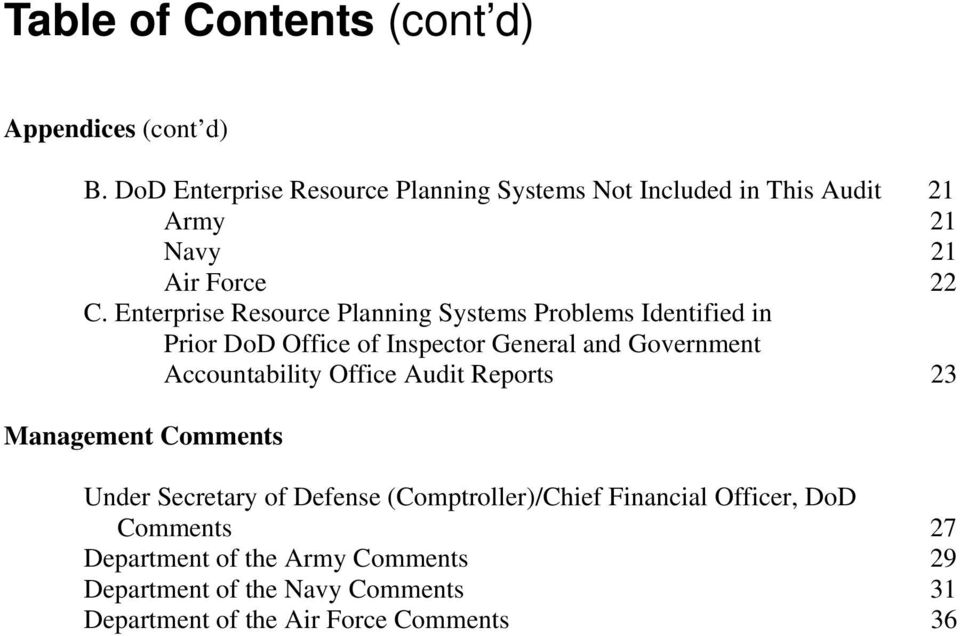
7 Table of Contents (cont d) Appendices (cont d) B. DoD Enterprise Resource Planning Systems Not Included in This Audit 21 Army 21 Navy 21 Air Force 22 C. Enterprise Resource Planning Systems Problems Identified in Prior DoD Office of Inspector General and Government Accountability Office Audit Reports 23 Management Comments Under Secretary of Defense (Comptroller)/Chief Financial Officer, DoD Comments 27 Department of the Army Comments 29 Department of the Navy Comments 31 Department of the Air Force Comments 36
8

9 Introduction Objectives This audit was in response to a September 13, 2011, congressional request related to the increasing costs and delayed schedules of some of the DoD Enterprise Resource Planning (ERP) systems. The Government Accountability Office (GAO) previously reported DoD did not follow best practices for estimating ERP schedules and cost, resulting in unreliable estimates. The requestors wanted to determine whether the investment in ERP systems would result in reliable information and auditable financial statements and records. Our overall objective was to evaluate the ERP systems identified as necessary for DoD to produce auditable financial statements. Specifically, we determined: changes in cost of the ERP systems during development and implementation; the impact of schedule changes on DoD s goal to become auditable by 2017; compliance with Public Law , National Defense Authorization Act For Fiscal Year 2010, Section 1072, Business Process Reengineering, October 28, 2009, (Section 1072); and whether the Deputy Chief Management Officer (DCMO) of the DoD, and Chief Management Officers (CMOs) of the Military Departments (DoD officials) provided sufficient oversight during development and implementation of the ERP systems. In February 2012, we met with the congressional requestors to discuss the status of the ERP systems audit work and agreed to obtain information from DoD on the reasons for the cost increases and schedule delays. See Appendix A for a discussion of the scope and methodology and prior audit coverage. DoD DCMO and CMOs of the Military Departments Responsibilities for Business System Modernization The DCMO is the Principal Staff Assistant and advisor to the Secretary of Defense and Deputy Secretary of Defense for matters relating to the management and improvement of integrated DoD business operations. DoD formally established the DCMO through DoD Directive , October 17, As part of this Directive, the Department assigned the responsibility for better synchronizing, integrating, and coordinating the business operations of the DoD to the DCMO to ensure optimal alignment in support of the warfighting mission. The Directive also gave specific duties in the areas of strategic planning, performance management, process improvement, and defense business systems oversight to the DCMO. Since that time, the DCMO s responsibilities have continued to grow. In addition to its normal duties, the DCMO collaborates with the CMOs of the Military Departments in identifying common issues relating to the management and 1

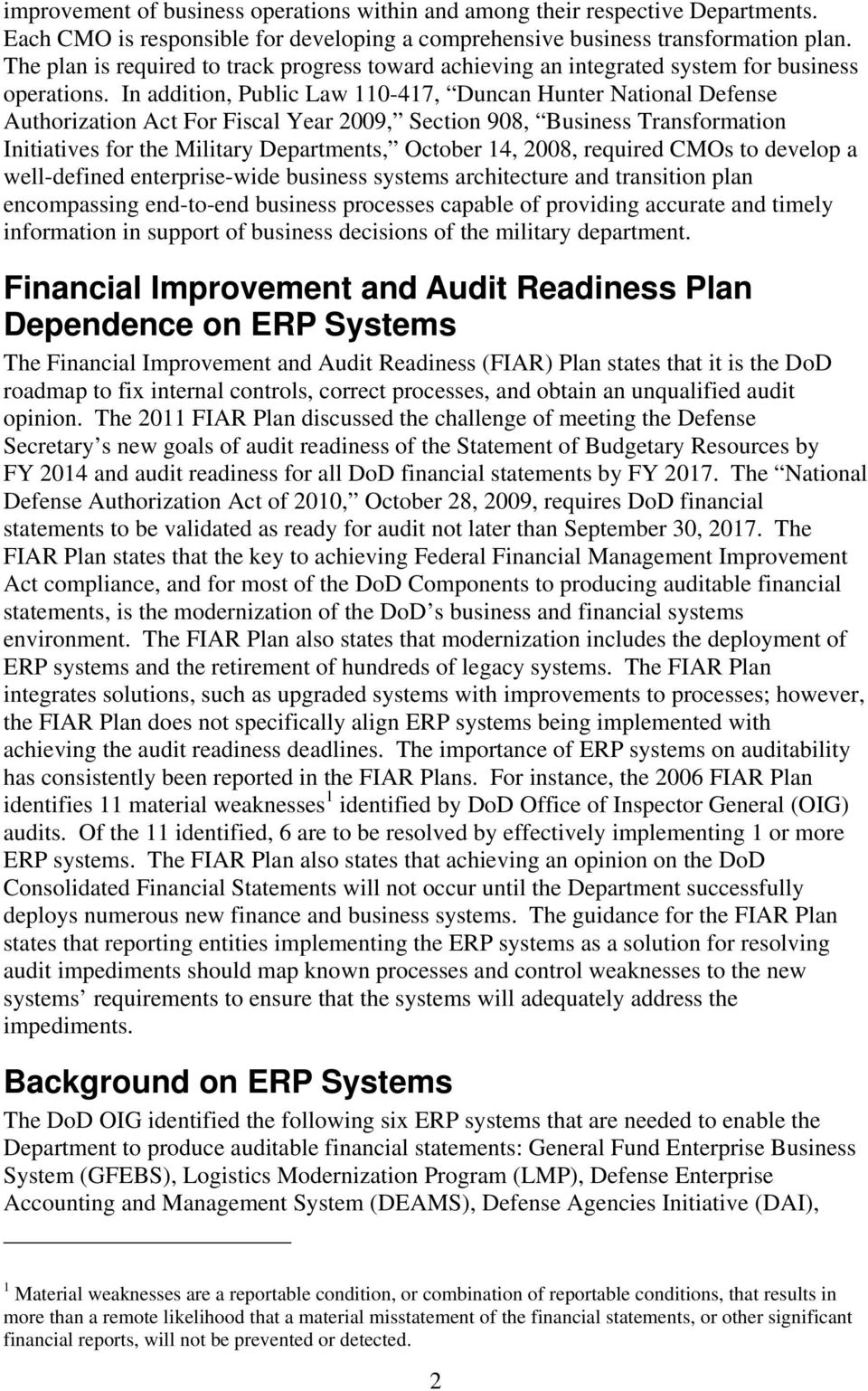
10 improvement of business operations within and among their respective Departments. Each CMO is responsible for developing a comprehensive business transformation plan. The plan is required to track progress toward achieving an integrated system for business operations. In addition, Public Law , Duncan Hunter National Defense Authorization Act For Fiscal Year 2009, Section 908, Business Transformation Initiatives for the Military Departments, October 14, 2008, required CMOs to develop a well-defined enterprise-wide business systems architecture and transition plan encompassing end-to-end business processes capable of providing accurate and timely information in support of business decisions of the military department. Financial Improvement and Audit Readiness Plan Dependence on ERP Systems The Financial Improvement and Audit Readiness (FIAR) Plan states that it is the DoD roadmap to fix internal controls, correct processes, and obtain an unqualified audit opinion. The 2011 FIAR Plan discussed the challenge of meeting the Defense Secretary s new goals of audit readiness of the Statement of Budgetary Resources by FY 2014 and audit readiness for all DoD financial statements by FY The National Defense Authorization Act of 2010, October 28, 2009, requires DoD financial statements to be validated as ready for audit not later than September 30, The FIAR Plan states that the key to achieving Federal Financial Management Improvement Act compliance, and for most of the DoD Components to producing auditable financial statements, is the modernization of the DoD s business and financial systems environment. The FIAR Plan also states that modernization includes the deployment of ERP systems and the retirement of hundreds of legacy systems. The FIAR Plan integrates solutions, such as upgraded systems with improvements to processes; however, the FIAR Plan does not specifically align ERP systems being implemented with achieving the audit readiness deadlines. The importance of ERP systems on auditability has consistently been reported in the FIAR Plans. For instance, the 2006 FIAR Plan identifies 11 material weaknesses 1 identified by DoD Office of Inspector General (OIG) audits. Of the 11 identified, 6 are to be resolved by effectively implementing 1 or more ERP systems. The FIAR Plan also states that achieving an opinion on the DoD Consolidated Financial Statements will not occur until the Department successfully deploys numerous new finance and business systems. The guidance for the FIAR Plan states that reporting entities implementing the ERP systems as a solution for resolving audit impediments should map known processes and control weaknesses to the new systems requirements to ensure that the systems will adequately address the impediments. Background on ERP Systems The DoD OIG identified the following six ERP systems that are needed to enable the Department to produce auditable financial statements: General Fund Enterprise Business System (GFEBS), Logistics Modernization Program (LMP), Defense Enterprise Accounting and Management System (DEAMS), Defense Agencies Initiative (DAI), 1 Material weaknesses are a reportable condition, or combination of reportable conditions, that results in more than a remote likelihood that a material misstatement of the financial statements, or other significant financial reports, will not be prevented or detected. 2
11 Navy ERP, Enterprise Business System (EBS)-Energy Convergence (EC), and EBS- EProcurement 2. DoD implemented other ERP systems; however, during this audit, we did not review the ERP systems identified in Appendix B. Background information for the six systems reviewed is discussed below. GFEBS was an Army financial management system developed to improve the timeliness and reliability of financial information and to obtain an audit opinion. LMP was the Army s core initiative to achieve the Single Army Logistics Enterprise vision. LMP s objective was to provide integrated logistics management capability by managing the supply, demand, asset availability, distribution, data retention, financial control, and reporting. DEAMS was approved as a joint U.S. Transportation Command, Defense Finance and Accounting Service, and Air Force project to replace legacy systems. DEAMS is the Air Force s target accounting system designed to provide accurate, reliable, and timely financial information. DAI was an initiative to transform the budget, finance, and accounting operations of the Defense agencies to achieve accurate and reliable financial information. During this audit, DAI was used across eight agencies in DoD. Navy ERP was an integrated business management system implemented to update and standardize Navy business operations, provide financial transparency across the enterprise, and increase effectiveness and efficiency. EBS was originally called the Business Systems Modernization, a SAP 3 supply chain and logistics capability module utilized by the Defense Logistics Agency (DLA). DLA implemented its current ERP system through functionality based enhancements as separate acquisition programs. DLA combined the first three enhancements; Business Systems Modernization, Customer Relationship Management, and Product Data Management Initiative into what is now referred to as the EBS-Core, which reached full deployment decision in DLA began to add enhancements to the EBS-Core and each enhancement was considered a separate program with separate funds. When the enhancement reached sustainment, ongoing costs for the sustainment were incorporated into the EBS-Core; however, original development, implementation, and phase-out costs were not incorporated into the core. EProcurement and EC were the two enhancements not fully deployed and included business process reengineering (BPR) efforts that have costs of more than $100 million. o EBS-EC was an enhancement program extending the EBS-Core supply chain capabilities. o EBS-EProcurement was an enhancement program extending EBS to provide a single tool for contract writing and administration for consumables and service. 2 EBS-EC and EBS-EProcurement are two acquisition programs to develop enhancements to EBS; however, we consider EBS one system for purposes of this audit. 3 SAP stands for Systems, Applications, and Products in Data Processing. The SAP Corporation is the market leader in enterprise application software. 3

12 Table 1 provides more details on the status of the ERP systems. Table 1. System Background System Name Initial Deployment Date Current Number of System Users Planned Number of System Users Planned Number of Legacy Systems to Be Replaced Army GFEBS ,000 53, LMP ,000 21,000 2 Navy Navy ERP ,000 66, Air-Force DEAMS ,200 30,000 8 DoD DAI ,000 94, EBS-EC 2011 * Unknown EBS-EProcurement ,500 4,000 3 * Cannot identify the number of EC users because they are not individually identified in SAP. Review of Internal Controls DoD Instruction , Managers Internal Control Program (MICP) Procedures, July 29, 2010, requires DoD organizations to implement a comprehensive system of internal controls that provides reasonable assurance that programs are operating as intended and to evaluate the effectiveness of the controls. We identified an internal control weakness. DoD officials relied on self compliance assertions when they certified and approved funding for ERP systems, instead of reviewing the business processes and verifying the accuracy, completeness, and reliability of the submissions. We will provide a copy of the final report to the senior officials responsible for internal controls in the Offices of the DoD Deputy Chief Management Officer, and Chief Management Officers of the Army, Navy, and Air Force. 4

13 Finding A. DoD Cost Increases and Schedule Delays Incurred in ERP Development and Implementation For the six ERP systems, DoD experienced life-cycle cost increases of $8.0 billion and schedule delays ranging from 1.5 to 12.5 years during system development and implementation. The Program Management Offices (PMOs) provided explanations for the cost increases and schedule delays as detailed below. GFEBS - GFEBS PMO personnel stated that costs increased as a result of different inflation factors applied to each estimate. In addition, current estimates include additional costs for GEFBS that were not budgeted for in the Milestone A Economic Analysis; schedule delays occurred because the initial schedule was overly aggressive, subject matter expert participation was inconsistent, and the Business Transformation Agency 4 added new requirements. LMP - LMP PMO personnel stated that cost increases and schedule delays occurred as a result of unanticipated complexities associated with implementing a commercial-off-the-shelf software solution of this magnitude. LMP was originally developed under a service contract, fully deployed as of October 2010, and in sustainment as of November The Acting Under Secretary of Defense for Acquisition, Technology, and Logistics, signed an acquisition decision milestone on December 27, 2011, that moved LMP into Increment 2 with the intent of improving logistics capabilities while also improving reliability of financial information and related auditable financial statements. Navy ERP - Navy ERP PMO personnel stated that cost increases and schedule delays resulted from 2005 base realignment and closure decisions, new requirements, a need for increased onsite support, increased sustainment costs necessary to maintain acceptable service levels, and Office of the Secretary of Defense staffing issues. DEAMS - DEAMS PMO personnel stated that cost increases resulted from schedule changes, unknown and refined requirements; schedule delays occurred as a result of the complexity of re-engineering business processes; designing, developing, and testing modifications to the commercial-off-the-shelf replacement system; and addressing more than 3,400 problem reports documented during testing. DAI - DAI PMO personnel stated cost increases and schedule delays resulted from adapting unique mission requirements to the commercial-off-the-shelf replacement system. In addition, the PMO assumed the role of systems 4 The Secretary of Defense disestablished the Business Transformation Agency on October 1, However, its core functions were incorporated into the Office of the DCMO and its direct program management responsibilities for specific enterprise defense business systems in the DLA. 5

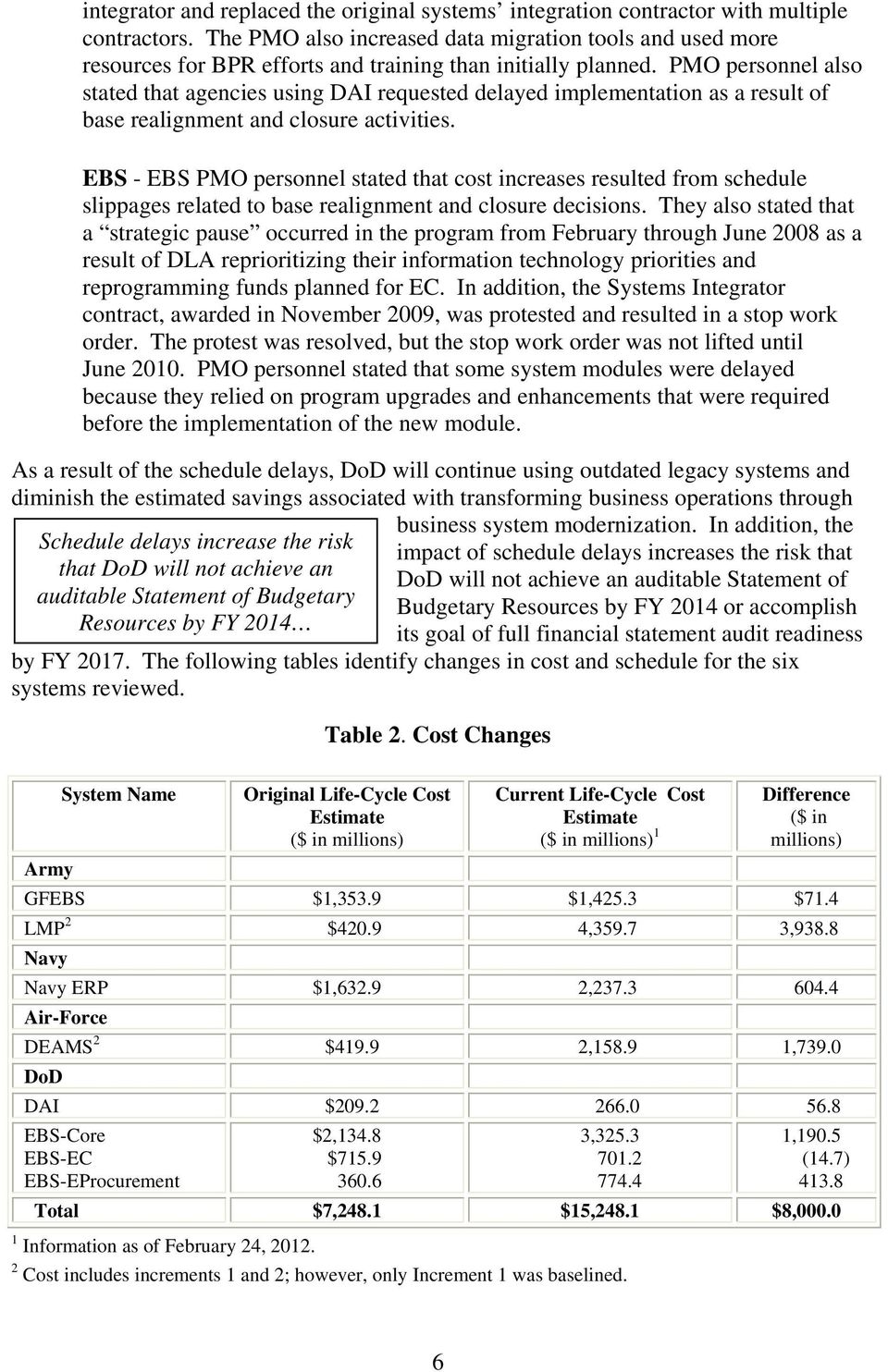
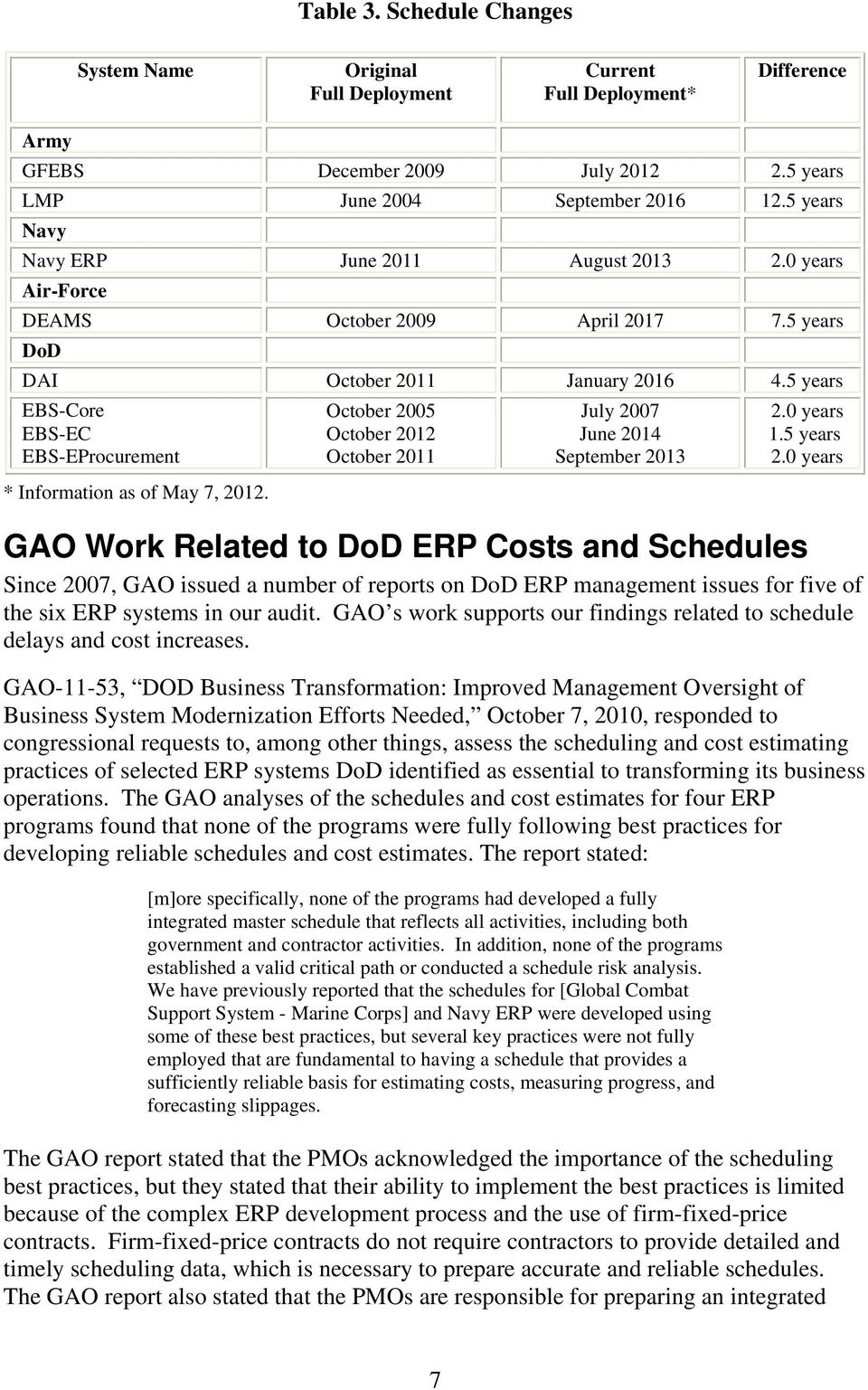
14 integrator and replaced the original systems integration contractor with multiple contractors. The PMO also increased data migration tools and used more resources for BPR efforts and training than initially planned. PMO personnel also stated that agencies using DAI requested delayed implementation as a result of base realignment and closure activities. EBS - EBS PMO personnel stated that cost increases resulted from schedule slippages related to base realignment and closure decisions. They also stated that a strategic pause occurred in the program from February through June 2008 as a result of DLA reprioritizing their information technology priorities and reprogramming funds planned for EC. In addition, the Systems Integrator contract, awarded in November 2009, was protested and resulted in a stop work order. The protest was resolved, but the stop work order was not lifted until June PMO personnel stated that some system modules were delayed because they relied on program upgrades and enhancements that were required before the implementation of the new module. As a result of the schedule delays, DoD will continue using outdated legacy systems and diminish the estimated savings associated with transforming business operations through Schedule delays increase the risk that DoD will not achieve an auditable Statement of Budgetary Resources by FY 2014 business system modernization. In addition, the impact of schedule delays increases the risk that DoD will not achieve an auditable Statement of Budgetary Resources by FY 2014 or accomplish its goal of full financial statement audit readiness by FY The following tables identify changes in cost and schedule for the six systems reviewed. Table 2. Cost Changes System Name Original Life-Cycle Cost Estimate ($ in millions) Current Life-Cycle Cost Estimate ($ in millions) 1 Difference ($ in millions) Army GFEBS $1,353.9 $1,425.3 $71.4 LMP 2 $ , ,938.8 Navy Navy ERP $1, , Air-Force DEAMS 2 $ , ,739.0 DoD DAI $ EBS-Core $2, , ,190.5 EBS-EC $ (14.7) EBS-EProcurement Total $7,248.1 $15,248.1 $8, Information as of February 24, Cost includes increments 1 and 2; however, only Increment 1 was baselined. 6
15 Table 3. Schedule Changes System Name Original Full Deployment Current Full Deployment* Difference Army GFEBS December 2009 July years LMP June 2004 September years Navy Navy ERP June 2011 August years Air-Force DEAMS October 2009 April years DoD DAI October 2011 January years EBS-Core October 2005 July years EBS-EC October 2012 June years EBS-EProcurement October 2011 September years * Information as of May 7, GAO Work Related to DoD ERP Costs and Schedules Since 2007, GAO issued a number of reports on DoD ERP management issues for five of the six ERP systems in our audit. GAO s work supports our findings related to schedule delays and cost increases. GAO-11-53, DOD Business Transformation: Improved Management Oversight of Business System Modernization Efforts Needed, October 7, 2010, responded to congressional requests to, among other things, assess the scheduling and cost estimating practices of selected ERP systems DoD identified as essential to transforming its business operations. The GAO analyses of the schedules and cost estimates for four ERP programs found that none of the programs were fully following best practices for developing reliable schedules and cost estimates. The report stated: [m]ore specifically, none of the programs had developed a fully integrated master schedule that reflects all activities, including both government and contractor activities. In addition, none of the programs established a valid critical path or conducted a schedule risk analysis. We have previously reported that the schedules for [Global Combat Support System - Marine Corps] and Navy ERP were developed using some of these best practices, but several key practices were not fully employed that are fundamental to having a schedule that provides a sufficiently reliable basis for estimating costs, measuring progress, and forecasting slippages. The GAO report stated that the PMOs acknowledged the importance of the scheduling best practices, but they stated that their ability to implement the best practices is limited because of the complex ERP development process and the use of firm-fixed-price contracts. Firm-fixed-price contracts do not require contractors to provide detailed and timely scheduling data, which is necessary to prepare accurate and reliable schedules. The GAO report also stated that the PMOs are responsible for preparing an integrated 7
16 master schedule in accordance with best practices to adequately monitor and oversee their investment in the modernization of DoD s business systems. The GAO report stated that although the ERP programs were generally following cost estimating best practices, the cost estimates for three of the four systems were not fully credible because two of the systems did not include a sensitivity analysis and one of the systems did not include a sensitivity analysis or a cost risk and uncertainly analysis. Cost estimates should discuss any limitations of the analysis because of uncertainty surrounding data and assumptions. Further, because none of the four met best practices for schedule estimating, none of the cost estimates could be considered credible because they did not assess the cost effects of schedule slippage. In a March 30, 2012, letter (GAO R) to congressional requestors, GAO provided updated information on DoD s reported status for each of the nine ERP systems as of December 31, For the systems included in our audit, GAO reported that two systems had additional schedule increases and two systems incurred additional cost increases since the October 2010 report. In addition, they reported that DAI still had not developed a current life cycle cost estimate. In 2007, 2008, and 2009, GAO made 19 recommendations to improve the management of DoD ERP efforts; DoD agreed with the recommendations. The 2010 report made eight additional recommendations aimed at improving cost and schedule practices and the development of performance measures to determine whether the ERP systems intended goals are accomplished. The GAO indicated that eight recommendations made from 2007 through 2009 and the eight recommendations made in the 2010 report remain open. Our objective was to gather and provide current data and reasons for cost increases and schedule delays; consequently, we are not making recommendations. However, the 2010 GAO report made recommendations that address deficiencies for ERP systems. If DoD implements these recommendations, improvements to cost and schedule practices can be achieved. Management Comments on the Finding and Our Response Department of Army Comments on DoD Cost Increases and Schedule Delays Incurred in Enterprise Resource Planning Development and Implementation Although not required to comment, the Army DCMO provided comments on the finding discussion. The Army DCMO stated that the programs are reviewed at the Army and DoD level and although costs and time continue to grow, the Army is adding additional functionality, and on-track to support the DoD FY 2017 auditability target dates. The Army DCMO stated that Tables 2 and 3 overstate the schedule and cost positions attributed to the LMP. LMP Increment I achieved Full Deployment in December 2011 and Increment II of LMP should be listed separately for both cost and schedule. 8

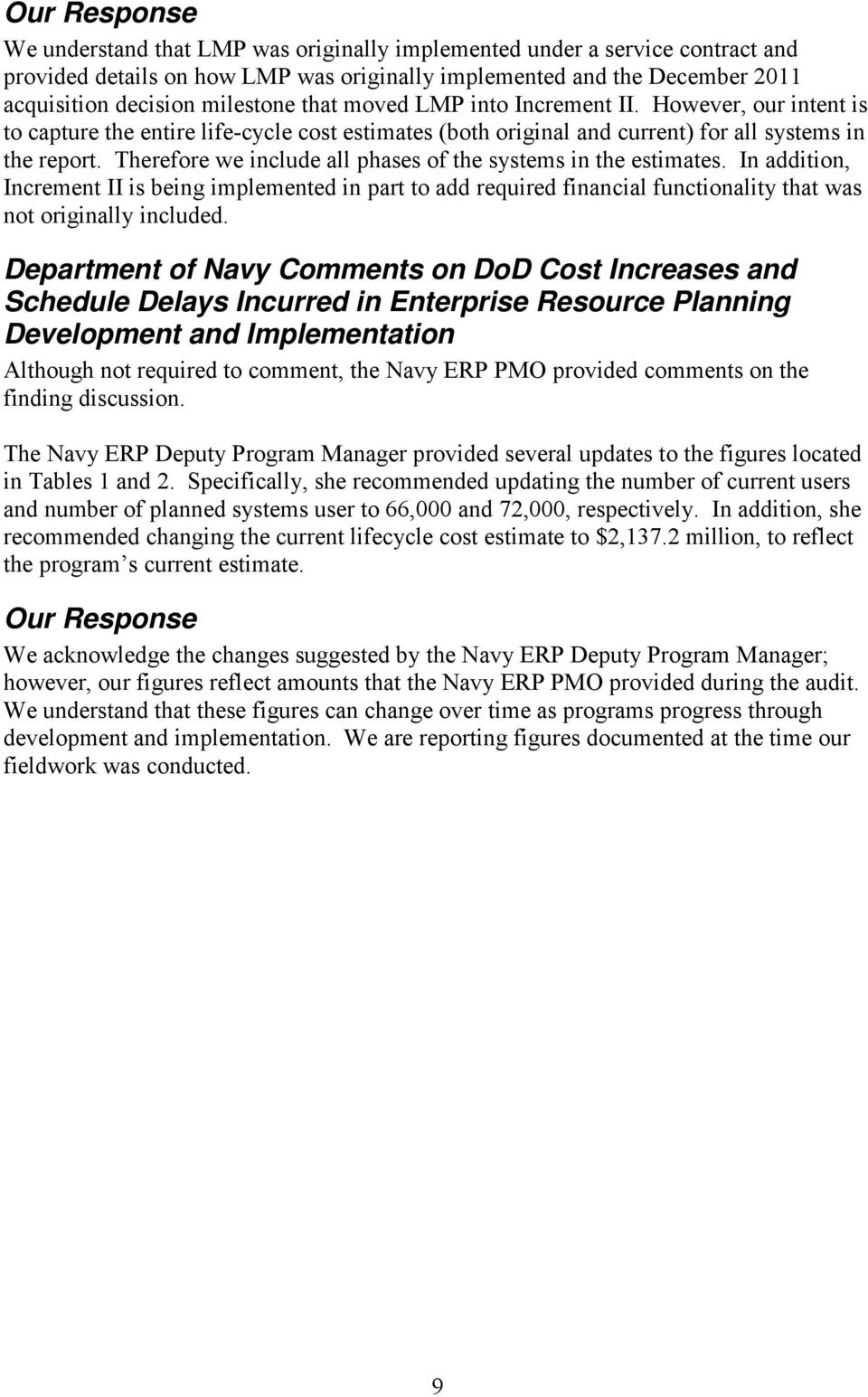
17 Our Response We understand that LMP was originally implemented under a service contract and provided details on how LMP was originally implemented and the December 2011 acquisition decision milestone that moved LMP into Increment II. However, our intent is to capture the entire life-cycle cost estimates (both original and current) for all systems in the report. Therefore we include all phases of the systems in the estimates. In addition, Increment II is being implemented in part to add required financial functionality that was not originally included. Department of Navy Comments on DoD Cost Increases and Schedule Delays Incurred in Enterprise Resource Planning Development and Implementation Although not required to comment, the Navy ERP PMO provided comments on the finding discussion. The Navy ERP Deputy Program Manager provided several updates to the figures located in Tables 1 and 2. Specifically, she recommended updating the number of current users and number of planned systems user to 66,000 and 72,000, respectively. In addition, she recommended changing the current lifecycle cost estimate to $2,137.2 million, to reflect the program s current estimate. Our Response We acknowledge the changes suggested by the Navy ERP Deputy Program Manager; however, our figures reflect amounts that the Navy ERP PMO provided during the audit. We understand that these figures can change over time as programs progress through development and implementation. We are reporting figures documented at the time our fieldwork was conducted. 9
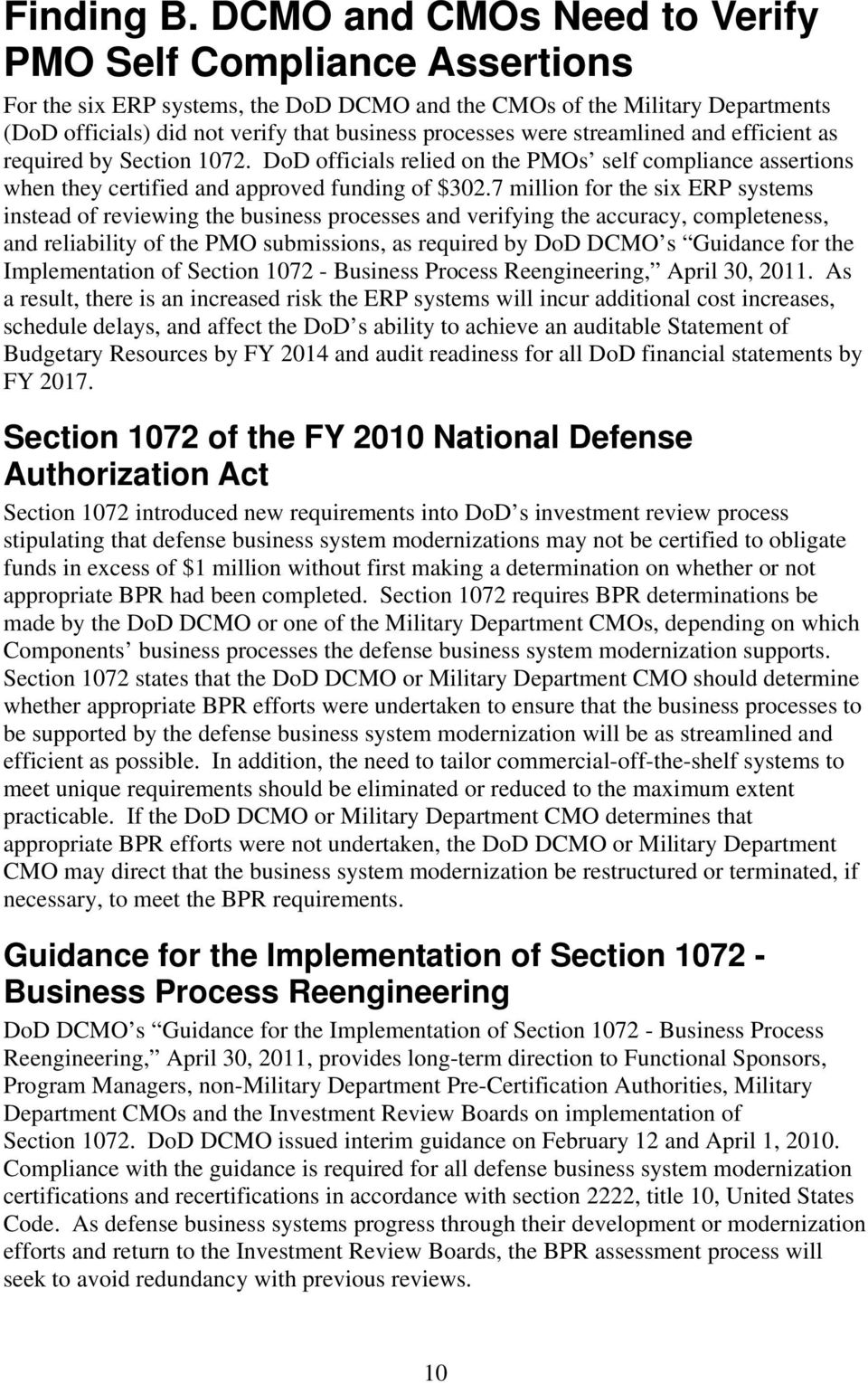
18 Finding B. DCMO and CMOs Need to Verify PMO Self Compliance Assertions For the six ERP systems, the DoD DCMO and the CMOs of the Military Departments (DoD officials) did not verify that business processes were streamlined and efficient as required by Section DoD officials relied on the PMOs self compliance assertions when they certified and approved funding of $302.7 million for the six ERP systems instead of reviewing the business processes and verifying the accuracy, completeness, and reliability of the PMO submissions, as required by DoD DCMO s Guidance for the Implementation of Section Business Process Reengineering, April 30, As a result, there is an increased risk the ERP systems will incur additional cost increases, schedule delays, and affect the DoD s ability to achieve an auditable Statement of Budgetary Resources by FY 2014 and audit readiness for all DoD financial statements by FY Section 1072 of the FY 2010 National Defense Authorization Act Section 1072 introduced new requirements into DoD s investment review process stipulating that defense business system modernizations may not be certified to obligate funds in excess of $1 million without first making a determination on whether or not appropriate BPR had been completed. Section 1072 requires BPR determinations be made by the DoD DCMO or one of the Military Department CMOs, depending on which Components business processes the defense business system modernization supports. Section 1072 states that the DoD DCMO or Military Department CMO should determine whether appropriate BPR efforts were undertaken to ensure that the business processes to be supported by the defense business system modernization will be as streamlined and efficient as possible. In addition, the need to tailor commercial-off-the-shelf systems to meet unique requirements should be eliminated or reduced to the maximum extent practicable. If the DoD DCMO or Military Department CMO determines that appropriate BPR efforts were not undertaken, the DoD DCMO or Military Department CMO may direct that the business system modernization be restructured or terminated, if necessary, to meet the BPR requirements. Guidance for the Implementation of Section Business Process Reengineering DoD DCMO s Guidance for the Implementation of Section Business Process Reengineering, April 30, 2011, provides long-term direction to Functional Sponsors, Program Managers, non-military Department Pre-Certification Authorities, Military Department CMOs and the Investment Review Boards on implementation of Section DoD DCMO issued interim guidance on February 12 and April 1, Compliance with the guidance is required for all defense business system modernization certifications and recertifications in accordance with section 2222, title 10, United States Code. As defense business systems progress through their development or modernization efforts and return to the Investment Review Boards, the BPR assessment process will seek to avoid redundancy with previous reviews. 10
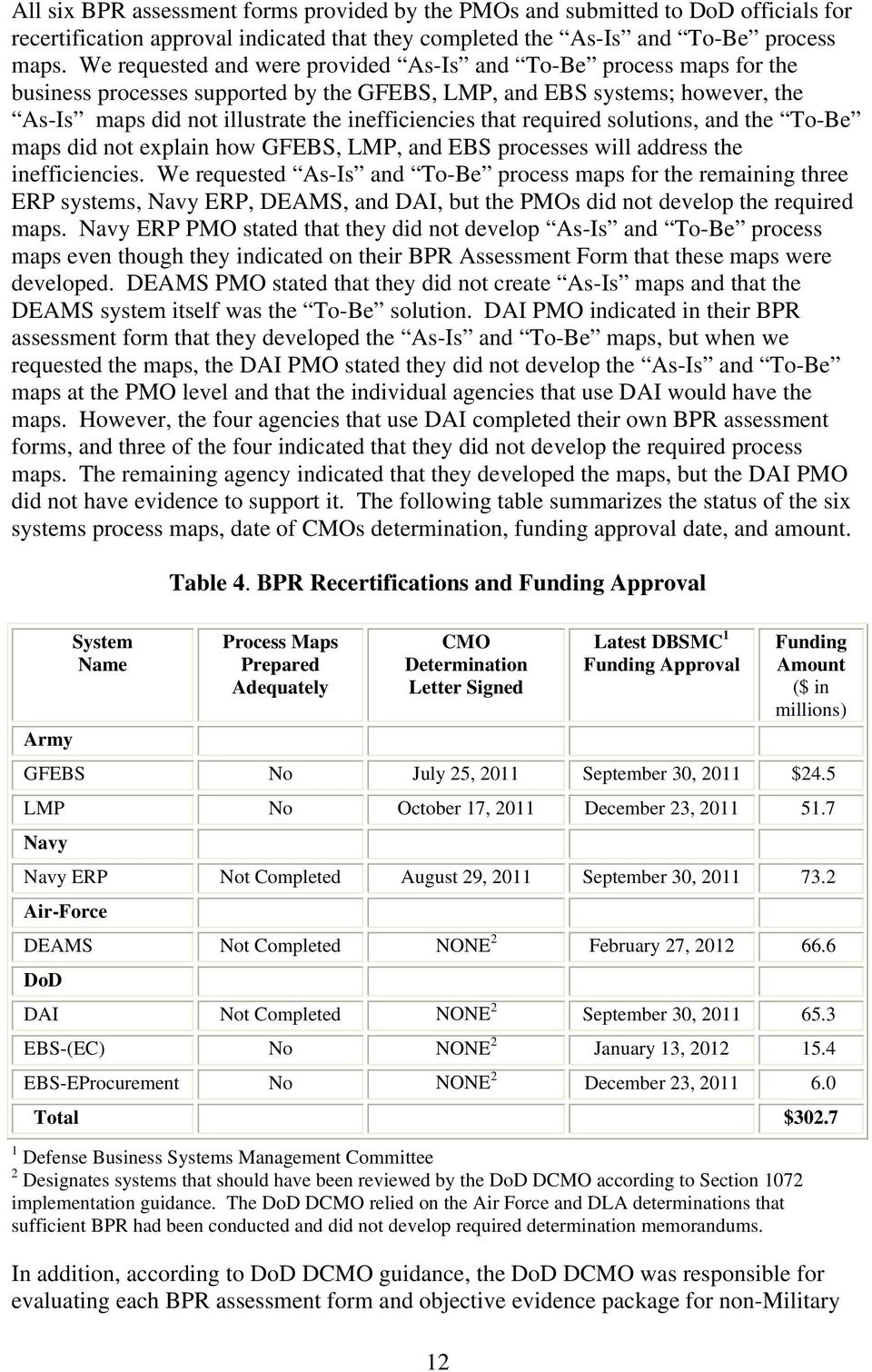
19 BPR Process for DoD DCMO The DoD DCMO guidance states that the DoD DCMO is responsible for evaluating each BPR Assessment Form and objective evidence 5 package for non-military Department programs and programs supporting business processes of more than one Military Department or Defense Agency. The Non-Military Department Component Pre-Certification Authority is responsible for recommending approval of BPR certification to the DoD DCMO. Cross-functional BPR Assessment Review Teams were formed to support this review process. Upon receipt of the BPR Assessment Review Team recommendation, the DoD DCMO will determine the sufficiency of the program s BPR effort. The DCMO s determination will be communicated to the Investment Review Boards through memorandum. BPR Process for Military Department CMOs The DoD DCMO guidance also states that the Military Department CMOs are responsible for evaluating each BPR Assessment Form and objective evidence package for their Military Department programs. Upon receipt of the BPR Assessment Form and objective evidence package, the CMO will determine the sufficiency of the program s BPR effort. The CMOs determination will be communicated to the Investment Review Board through the CMO Determination Memorandum. BPR Assessment Packages Need Review DoD officials did not verify that the PMOs properly referenced the BPR assessment form to objective evidence and obtain and review the objective evidence to verify the answers in the BPR assessment form. This occurred because DoD officials relied on the PMOs self compliance assertions when they certified and approved funding of $302.7 million DoD officials relied on the PMOs self compliance assertions when they certified and approved funding of $302.7 million for the six ERP systems instead of reviewing the business processes and verifying the accuracy, completeness, and reliability of the PMO submissions for the six ERP systems, instead of reviewing the business processes and verifying the accuracy, completeness, and reliability of the PMO submissions, as required by DoD DCMO s guidance. For example, as shown in Table 4 (page 12), DoD officials approved funding for six systems without ensuring that adequate process maps were developed. Process maps were key documents that demonstrate how the business processes in the new ERP system will be more streamlined and efficient. The BPR assessment form contained questions on whether the PMO developed As-Is and To-Be process maps for the business processes. According to the DoD DCMO guidance, the As-Is process map should identify the inefficiencies with the old business process, and the To-Be process map should identify how the new process will address the inefficiencies. 5 Examples of objective evidence may include, but are not limited to, DoD or Component strategic plans, business case analyses, implementation and training plans, requirements lists, baseline performance information. 11

20 All six BPR assessment forms provided by the PMOs and submitted to DoD officials for recertification approval indicated that they completed the As-Is and To-Be process maps. We requested and were provided As-Is and To-Be process maps for the business processes supported by the GFEBS, LMP, and EBS systems; however, the As-Is maps did not illustrate the inefficiencies that required solutions, and the To-Be maps did not explain how GFEBS, LMP, and EBS processes will address the inefficiencies. We requested As-Is and To-Be process maps for the remaining three ERP systems, Navy ERP, DEAMS, and DAI, but the PMOs did not develop the required maps. Navy ERP PMO stated that they did not develop As-Is and To-Be process maps even though they indicated on their BPR Assessment Form that these maps were developed. DEAMS PMO stated that they did not create As-Is maps and that the DEAMS system itself was the To-Be solution. DAI PMO indicated in their BPR assessment form that they developed the As-Is and To-Be maps, but when we requested the maps, the DAI PMO stated they did not develop the As-Is and To-Be maps at the PMO level and that the individual agencies that use DAI would have the maps. However, the four agencies that use DAI completed their own BPR assessment forms, and three of the four indicated that they did not develop the required process maps. The remaining agency indicated that they developed the maps, but the DAI PMO did not have evidence to support it. The following table summarizes the status of the six systems process maps, date of CMOs determination, funding approval date, and amount. System Name Table 4. BPR Recertifications and Funding Approval Process Maps Prepared Adequately CMO Determination Letter Signed DEAMS DoD Not Completed NONE 2 February 27, DAI Not Completed NONE 2 September 30, EBS-(EC) No NONE 2 January 13, EBS-EProcurement No NONE 2 December 23, Total $ Latest DBSMC 1 Funding Approval Funding Amount ($ in millions) Army GFEBS No July 25, 2011 September 30, 2011 $24.5 LMP No October 17, 2011 December 23, Navy Navy ERP Not Completed August 29, 2011 September 30, Air-Force 1 Defense Business Systems Management Committee 2 Designates systems that should have been reviewed by the DoD DCMO according to Section 1072 implementation guidance. The DoD DCMO relied on the Air Force and DLA determinations that sufficient BPR had been conducted and did not develop required determination memorandums. In addition, according to DoD DCMO guidance, the DoD DCMO was responsible for evaluating each BPR assessment form and objective evidence package for non-military
21 Department programs and programs supporting business processes of more than one Military Department or Defense agency. The DoD DCMO was responsible for evaluating the DEAMS, DAI, and EBS systems BPR packages and should have issued a DoD DCMO Determination Memorandum stating whether appropriate BPR was conducted. We requested the DoD DCMO Determination Memorandums from the DoD DCMO, but the DoD DCMO indicated that they did not create determination memos for DEAMS, DAI, and EBS; and they relied on the PMOs assertions that appropriate BPR was conducted. For example, the DEAMS PMO did not update their BPR assessment form to comply with July 1, 2011, DoD DCMO Section 1072 Implementation Guidance. Instead, the DEAMS PMO prepared an outdated form 6 that did not include all requirements, such as the As-Is and To-Be maps. The DoD DCMO continued to recertify the DEAMS system based upon the PMOs self assertion that appropriate BPR had been conducted. DoD officials approved recertification requests for $302.7 million without verifying BPR efforts were streamlined and efficient as required by Section This occurred because DoD officials did not provide sufficient oversight of the BPR efforts and relied on PMO self assertions without verifying that the information provided by the PMO in the BPR packages was accurate, complete, and reliable. Previously issued DoD OIG and GAO audit reports identified inefficiencies that still exist within ERP systems (see Appendix C for a summary of Prior Audit Issues). As a result, there is an increased risk that the ERP systems will incur additional delays and cost increases to ensure the systems are as streamlined and efficient as possible. DoD officials should establish procedures to verify that the PMO BPR submissions are well-developed and reliable to ensure business process reengineering efforts are successful and conducted and completed in accordance with Section 1072 before approving additional funding. BPR Has a Direct Impact on Financial Statement Readiness Goals Strong oversight of BPR practices are needed to help the DoD achieve its auditability goals. As indicated in the FIAR Plan, DoD is relying on implementation of ERP systems for achieving their goal of an auditable Statement of Budgetary Resources by FY 2014 and audit readiness for all DoD financial statements by FY The FIAR Plan states that the dates for the deployment of systems drive the Department s ability to achieve auditability. However, the FIAR Plan does not specifically align ERP systems schedules and tie the schedule to audit readiness deadlines. DoD OIG and GAO prior audit work determined that the BPR efforts for implementing ERP systems have not demonstrated that the ERP systems are as streamlined and efficient as possible. As a result, there is increased risk to DoD s ability to meet the goal of an auditable Statement of Budgetary Resources by FY 2014 and audit readiness for all DoD financial statements by FY DoD struggled for years to come up with a system strategy plan that would provide success in financial reporting and auditability 6 DEAMS used the DoD DCMO s interim guidance to complete their BPR Assessment. The interim guidance was effective from February 2010 to June 2011 when the DoD DCMO s final guidance was implemented effective July 1,
22 and without the appropriate level of oversight will likely not succeed through ERP implementation. DoD officials need to be more proactive and provide more oversight during development and implementation of DoD ERP systems. DoD officials should verify systems are in compliance with DoD Financial and BPR requirements and guidance before approving the ERP systems for development, implementation, and the corresponding funding. In addition, the Under Secretary of Defense (Comptroller)/Chief Financial Officer, DoD [USD(C)/CFO, DoD], should align the FIAR Plan auditability goals with the ERP systems implementation schedules to demonstrate the effect of any schedule delays impact on these goals. Management Comments on the Finding and Our Response Department of Army Management Comments on Deputy Chief Management Officer and Chief Management Officers Need to Verify Program Management Office Self Compliance Assertions The Army DCMO provided comments on the finding discussion. The Army DCMO stated that the Army does not dispute the facts contained within the report; however, the Army believes the conclusions were based on a limited review and these ERP systems represent only minor risk to Army financial auditability goals. The Army DCMO stated that both GFEBS and LMP systems were already developed and substantially deployed at the time the BPR reengineering law was enacted. The Army DCMO further stated that the report based its conclusion on a single set of documents that were submitted to the Office of the Secretary of Defense Investment Review Board in 2011, a point in time when LMP Increment 1 had been fully deployed for a year and GFEBS was more than 50 percent deployed. Our Response We acknowledge and agree with the statement that the LMP and GFEBS program were considerably mature before the enactment of Section However, the intent of the Section 1072, and the subsequent guidance issued by the DoD DCMO, was to ensure that the implementation of defense business systems was undertaken to improve upon existing business processes and practices. Our findings focused on the BPR packages submitted after the enactment of Section The FIAR plan and the FY 2012 Army Audit Readiness Strategy both emphasize dependence on successful ERP systems for reaching auditability goals. However, previously issued DoD OIG and GAO reports related to both LMP and GFEBS indicate improvements are required for these systems to reach financial compliance. Department of Navy Management Comments on Deputy Chief Management Officer and Chief Management Officers Need to Verify Program Management Office Self Compliance Assertions Although not required to comment, the Navy ERP PMO provided comments on the As- Is and To-Be finding discussion. The Navy ERP Deputy Program Manager stated that the As-Is documentation is not in the form of process maps. Rather the As-Is documentation is completed through SAP-standard templates that are then used for gap analysis as compared to the commercial-off-the-shelf To-Be process. The Navy ERP 14
23 solution is the target To-Be business processes for all System Commands as they implement Navy ERP. The Navy ERP Deputy Program Manager further explained that the Navy ERP fully defined and mapped the To-Be business processes. Specifically, Navy ERP mapped all of the business processes from Level 1 down to Level 6 (the actual transactional step) and recorded all of them in the System Architect process modeling tool. Our Response The objective of obtaining the As-Is and To-Be process maps was to determine if the DoD ERPs documented business process maps that detailed what problems existed with the old business process and the subsequent corrections to those problems with the new process. During the course of our fieldwork, we requested the As-Is and To-Be process maps that would identify those problems and corrections and received a response that these items did not exist. We acknowledge that there may be other documentation that could be provided and examined that may show some support for business process reengineering. However, documenting the gap analysis of the As-Is process to the commercial-off-the-shelf To-Be process does not identify the existing problems and how the To-Be process will correct those problems. Future audits will examine end-to-end business processes in greater detail to ensure that those processes have been reengineered in accordance with the National Defense Authorization Act requirements. Recommendations, Management Comments, and Our Response B.1. We recommend that the DoD Deputy Chief Management Officer and Chief Management Officers of the Army, Navy, and the Air Force: a. Develop procedures to independently review the business processes and verify that the information contained in business process reengineering assessment forms is accurate, complete, reliable, and supported in accordance with Office of the Deputy Chief Management Officer, Guidance for the Implementation of Section Business Process Reengineering, April 30, b. Develop procedures to limit funding to programs that are not demonstrating adequate business process reengineering. Management Comments Required The DoD DCMO did not comment on the recommendations. We request that the DoD DCMO provide comments in response to the final report by August 13, Department of the Army and Air Force Comments The Army DCMO and the Air Force Director of Business Transformation and Deputy Chief Management Officer agreed with our recommendations. Our Response Comments from the Army DCMO and the Air Force Director of Business Transformation and Deputy Chief Management Officer were partially responsive. The Army DCMO and the Air Force Director of Business Transformation and Deputy Chief 15
24 Management Officer agreed with the recommendations; however, they did not identify corrective actions the Army and Air Force would take to resolve Recommendations B.1.a and B.1.b. We request the Army DCMO and the Air Force Director of Business Transformation and Deputy Chief Management Officer provide additional comments by August 13, 2012, detailing the planned corrective actions and corresponding dates of completion for Recommendations B.1.a and B.1.b. Department of the Navy Comments The Deputy Under Secretary of the Navy/Deputy Chief Management Officer agreed with the recommendations and stated that the Department of Navy incorporated the BPR requirement into its Business Capability Lifecycle process and the Navy continues to identify improvements through all the sustainment/modernization phases. In FY 2012, the Navy Investment Review Board process was changed to allow more time for the Navy s DCMO to review the BPR Assessment form and ensure that the As-Is and To-Be processes are documented. A memo was distributed on March 2, 2012, with the goal to reestablish the Investment Review Board package submission at least 65 calendar days before the Investment Review Board meeting. The memo also included the condition that any late submissions will be subject to additional management internal controls. In addition, he stated that the Business Capability Lifecycle process used for Defense Business Systems requires that BPR must be completed before new projects are authorized. By not allowing a project to start if appropriate BPR was not completed, this process is already limiting funding. Our Response The Deputy Under Secretary of the Navy/Deputy Chief Management Officer s comments were responsive. If the Deputy Under Secretary of the Navy/Deputy Chief Management Officer incorporates the process changes described in their response and ensures that BPR packages are complete, accurate, and supported before approving programs for funding, they will address the intent of recommendation B.1.a and B.1.b. We require no additional comments. B.2. We recommend that the Under Secretary of Defense (Comptroller)/Chief Financial Officer, DoD, update the Financial Improvement and Audit Readiness Plan to: a. Link material weaknesses resolutions to Enterprise Resource Planning systems being implemented and identify how and when they will correct the deficiencies. b. Track the effect of Enterprise Resource Planning systems implementation schedule delays on DoD s goals of obtaining auditable Statement of Budgetary Resources by FY 2014 and audit readiness for all DoD financial statements by FY
25 Under Secretary of Defense (Comptroller)/Chief Financial Officer, DoD Comments The Deputy Chief Financial Officer agreed with the recommendations, and stated the May 2012 FIAR Plan Status Report included expanded information related to ERP systems. Specifically, the May 2012 report included: system overview and relationship to audit readiness; impact on legacy systems; program cost for releases, waves, and/or increments needed to support full auditability by FY 2017; projected dates for testing and related corrective actions for information technology general controls; and implementation and deployment milestones. In addition, future FIAR Plan Status Reports will expand reporting to include information on information technology application controls. Our Response The Deputy Chief Financial Officer comments were responsive, and the actions met the intent of the recommendations. We require no additional comments. 17
26 Appendix A. Scope and Methodology We conducted this performance audit from November 2011 through May 2012 in accordance with generally accepted government auditing standards. Those standards require that we plan and perform the audit to obtain sufficient, appropriate evidence to provide a reasonable basis for our findings and conclusions based on our audit objective. We believe that the evidence obtained provides a reasonable basis for our findings and conclusions based on our audit objective. Our audit focused on changes in cost of the ERP systems, GFEBS, LMP, DEAMS, DAI, Navy ERP, EBS-EC, and EBS-EProcurement, during development and implementation; impact of ERP system schedule changes in DoD s goal to become auditable by 2017; ERP systems compliance with the business process reengineering requirements of Section 1072; and whether the DoD DCMO and CMOs of the Military Departments provided sufficient oversight during development and implementation of the ERP systems. Cost We obtained original life-cycle cost estimates and the most current life-cycle cost estimates from the following documentation provided by the PMOs: service cost positions, business cases, acquisition program baselines, defense acquisition management, major automated information system quarterly report, analysis of alternatives, economic analysis, s and meetings. The PMOs developed the estimates using a mixture of current year and base year values (to adjust for inflation). We did not validate these numbers to source documents or adjust them for inflation. We compared the original life-cycle cost estimates to the current life-cycle cost estimates and identified the difference for each system to calculate changes in cost using the values provided by the PMOs. In addition, we obtained an explanation for the differences identified from the PMOs. Schedule We obtained the original full deployment estimate and the most current full deployment estimate from PMOs through integrated master schedules, project schedules, waterfall charts, acquisition strategy chronologies, economic analyses, test and evaluation plans, draft notional schedules, and s. We did not validate the accuracy of the dates provided. We calculated changes in schedule by comparing the original full deployment estimate to the current full deployment estimate using the dates provided by the PMOs and identified the difference. In addition, we obtained an explanation for the differences from the PMOs. We reviewed FIAR Plans for FY 2005 through FY 2011 from the USD(C)/CFO, DoD s Web site to identify ERP implementation schedules in alignment with audit readiness dates. 18
27 Compliance With Section 1072 We interviewed personnel from the PMOs, DoD DCMO, and CMOs of the Military Departments and obtained BPR assessment packages. We compared documents in the BPR assessment packages to Section 1072 and its implementation requirements to determine whether organizations complied. Oversight We interviewed personnel from the offices of the USD(C)/CFO, DoD; DoD DCMO; and CMOs of the Military Departments regarding their involvement and oversight in the development and implementation of the ERP systems and requested supporting documentation. To accomplish these steps, we contacted and interviewed DoD officials from the following locations: Program Executive Office Enterprise Information Systems; Navy DCMO; Air Force DCMO; Business Integration Office; USD(C)/CFO, DoD; Army DCMO; Army Office of Business Transformation; Assistant Secretary of the Army; Financial Management and Comptroller; and Assistant Secretary of the Air Force, Financial Management and Comptroller, Arlington, Virginia; Logistics Modernization PMO, Marlton, New Jersey; DEAMS PMO, Dayton, Ohio; DEAMS Functional Management Office, Fairview Heights, Illinois; Navy ERP PMO, Annapolis, Maryland; EBS PMO and DLA, Fort Belvoir, Virginia; and Office of the DCMO, GFEBS PMO, DAI PMO, and DLA, Alexandria, Virginia. Use of Computer-Processed Data We did not rely on computer-processed data. Prior Coverage During the last 5 years, the GAO issued three reports and the DoD OIG issued six reports discussing the ERP systems. Unrestricted GAO reports can be accessed over the Internet at Unrestricted DoD OIG reports can be accessed at GAO GAO Report No R, DoD Financial Management: Reported Status of Department of Defense s Enterprise Resource Planning Systems, March 30,
28 GAO Report No , DoD Financial Management: Implementation Weaknesses in Army and Air Force Business Systems Could Jeopardize DoD s Auditability Goals, February 28, 2012 GAO Report No , DoD Business Transformation: Improved Management Oversight of Business System Modernization Efforts Needed, October 7, 2010 DoD OIG DoD OIG Report No , Logistics Modernization Program System Procure-to- Pay Process Did Not Correct Material Weaknesses, May 29, 2012 DoD OIG Report No , General Fund Enterprise Business Did Not Provide Required Financial Information, March 26, 2012 DoD OIG Report No , Navy Enterprise Resource Planning System Does Not Comply With the Standard Financial Information Structure and U.S. Government Standard General Ledger, February 13, 2012 DoD OIG Report No , Previously Indentified Deficiencies Not Corrected in the General Fund Enterprise Business System Program, June 15, 2011 DoD OIG Report No , Insufficient Governance Over Logistics Modernization Program System Development, November 2, 2010 DoD OIG Report No , Management of the General Fund Enterprise Business System, January 14,
29 Appendix B. DoD ERP Systems Not Included in This Audit Our audit focused on six ERP systems that were identified in our response to a congressional request as the six main financial ERP systems needed to enable the DoD to produce auditable financial statements. The FIAR Plan further identified the following seven systems as important to improving audit readiness. We did not review these systems during this audit. Army Global Combat Support System The Global Combat Support System-Army will integrate the Army supply chain, obtain accurate equipment readiness, support split base operations, and get up-to-date status on maintenance actions and supplies in support of the warfighter. Integrated Personnel and Pay System The Integrated Personnel and Pay System-Army will be the Army s integrated pay system, replacing the legacy systems and serving as a critical piece of the Army s future state systems environment. The military departments integrated personnel and pay systems are intended to provide joint, integrated, and standardized personnel and pay for all military personnel and replace the Defense Integrated Military Human Resources System that was initiated in February 1998 and discontinued in Navy Global Combat Support System-Marine Corps Global Combat Support System-Marine Corps was initiated in September 2003 and was intended to provide the deployed warfighter with enhanced capabilities in the areas of warehousing, distribution, logistical planning, depot maintenance, and improved asset visibility. Integrated Pay and Personnel System Integrated Pay and Personnel System-Navy is the Navy s integrated personnel and pay system. The military departments integrated personnel and pay systems are intended to provide joint, integrated, and standardized personnel and pay for all military personnel and replace the Defense Integrated Military Human Resources System that was initiated in February 1998 and discontinued in
30 Air Force Expeditionary Combat Support System The Expeditionary Combat Support System is the Air Force s future logistics system that includes related financial management, engineering, and contracting functions. The Expeditionary Combat Support System enables the transformation of Air Force Logistics by replacing the majority of legacy logistics systems with a single solution set of business processes, software applications, and data. The Expeditionary Combat Support System solution will provide timely, consistent, and accurate information to enhance operations resulting in standardized business processes and tools across the entire enterprise, regardless of program or site. Integrated Personnel and Pay System The Air Force-Integrated Personnel and Pay System is the Air Force s future integrated personnel and pay system that will consolidate Guard, Reserve, and active duty Military into a single system for personnel and pay related services. The military departments integrated personnel and pay systems are intended to provide joint, integrated, and standardized personnel and pay for all military personnel and replace the Defense Integrated Military Human Resources System that was initiated in February 1998 and discontinued in NexGenIT The NexGenIT will leverage industry best practices, optimize core business processes, and replace existing information technology capabilities with a commercial off-the-shelf software solution to perform real estate portfolio and lease management, space management, and maintenance management for real property throughout the Air Force. 22
31 Appendix C. ERP Systems Problems Identified in Prior DoD OIG and GAO Audit Reports Previously issued DoD OIG and GAO audit reports identified problems within ERP systems. DoD OIG Report No , Logistics Modernization Program System Procureto-Pay Process Did Not Correct Material Weaknesses, May 29, Army financial and system managers did not reengineer LMP to perform Procure-to-Pay functions correctly or correct known material weaknesses. This occurred because LMP developers did not identify the system requirements needed to correct the root causes of material weaknesses, and Army managers did not review control activities to assess internal control effectiveness. As a result, Army managers did not discontinue the use of costly business processes, and LMP failed to provide reliable financial data. As of August 31, 2011, LMP activities reported more than $10.6 billion in abnormal balances within the Procure-to-Pay general ledger accounts. The DCMO should review legacy registration processes to determine whether DoD can incorporate registry databases into the System for Award Management. The Army should also create and manage vendor master data based on the System for Award Management and establish a vendor master data manager. Further, the Army should improve LMP system access controls and assess the LMP Procure-to-Pay business process. The DCMO; Assistant Secretary of the Army (Financial Management and Comptroller); and Director, Army Office of Business Transformation, agreed with our recommendations and provided comments that were generally responsive. However, the Assistant Secretary of the Army (Financial Management and Comptroller) and Director, Army Office of Business Transformation, comments did not fully address what actions will be taken to correct the reported deficiencies. DoD OIG Report No , General Fund Enterprise Business System Did Not Provide Required Financial Information, March 26, GFEBS did not contain accurate and complete FY 2010 United States Standard General Ledger (USSGL) and Standard Financial Information Structure (SFIS) information as required by the Federal Financial Management Improvement Act of 1996 and USD(C)/CFO, DoD, guidance. Specifically, the GFEBS Chart of Accounts did not contain 7 of the 153 USSGL accounts and 28 of the 233 DoD reporting accounts included in the FY 2010 Army General Fund Trial Balance; the Army did not maintain detailed program documentation to determine whether the Army properly used the 847 posting accounts in GFEBS; GFEBS did not consistently enter accurate and complete values at the transaction level for 11 of the 20 required USSGL and SFIS attributes reviewed in Special Ledger 95 or for 8 of the 20 required attributes in the Z1 ledger; and 23
32 GFEBS did not provide sufficient trading partner information in the FY 2010 GFEBS Trial Balance. This occurred because USD(C)/CFO, DoD personnel did not provide timely updates to the DoD Standard Chart of Accounts, and the Assistant Secretary of the Army (Financial Management and Comptroller) did not provide adequate oversight for maintaining the GFEBS Chart of Accounts or ensuring that GFEBS consistently entered values for all the attributes required by USSGL and SFIS. As a result, GFEBS did not provide DoD management with required financial information. In addition, GFEBS may not resolve the Army General Fund s long-standing Financial Management Systems and Intragovernmental Eliminations material weaknesses, despite costing the Army $630.4 million, as of October The USD(C)/CFO, DoD should implement procedures to streamline DoD Chart of Accounts updates. The USD(C)/CFO, DoD partially agreed and stated that several updates were incorporated into the DoD Chart of Accounts update process over the past year. He indicated that while the USD(C)/CFO, DoD s mission was to provide updates on a timely basis, ensuring the accuracy and consistency of the guidance was imperative. The Assistant Secretary of the Army (Financial Management and Comptroller) should not deploy GFEBS to additional users until it can ensure through reviews and validation that GFEBS consistently enters required attributes. The Assistant Secretary of the Army (Financial Management and Comptroller), did not agree and stated that the audit was based on GFEBS data, as of September 30, She indicated that at that time, GFEBS was not fully deployed or developed, was transacting less than two percent of the Army s obligation activity, and was not configured to meet Treasury reporting requirements. She stated that, as a result, the missing ledger accounts and other data elements in the report had little impact on the reliability of the data reported by GFEBS. In addition, Assistant Secretary of the Army (Financial Management and Comptroller) should update the GFEBS Chart of Accounts with the capability to post to the 28 DoD reporting accounts identified in this report. The Assistant Secretary of the Army (Financial Management and Comptroller) did not agree or disagree, and stated that the 28 general ledger accounts were added to the GFEBS Chart of Accounts in February DoD OIG Report No , Navy Enterprise Resource Planning System Does Not Comply With the Standard Financial Information Structure and U.S. Government Standard General Ledger, February 13, The Navy developed and approved deployment of Navy ERP to 54 percent of its obligation authority, valued at $85 billion for FY 2011, without ensuring that the Navy ERP complied with SFIS and USSGL. This occurred because the Navy did not have an adequate plan to incorporate SFIS requirements into the development and implementation of the Navy ERP, did not develop an adequate validation process to assess compliance with SFIS requirements, implemented the Navy ERP to accommodate existing Navy Chart of Accounts and noncompliant procedures, and failed to implement processes necessary to support requirements. As a result, the Navy spent $870 million to develop and implement a system that might not produce accurate and reliable financial information. The Under Secretary of Defense for Acquisition, Technology, and Logistics, should review the Navy ERP System s Business Enterprise Architecture compliance status to ensure adequate progress is being made toward the planned FY 2015 SFIS compliance date before 24
33 approving deployment to additional commands. The Under Secretary of Defense for Acquisition, Technology, and Logistics partially agreed. The Under Secretary of Defense for Acquisition, Technology, and Logistics will work with the Under Secretary of the Navy to assure adequate progress is being made toward the planned FY 2015 SFIS compliance date. The Defense Business Systems Management Committee Chairman should track the configuration and implementation of business enterprise architecture requirements to ensure adequate progress is being made toward the planned SFIS compliancy date and require the Investment Review Board to update guidance for assessing SFIS compliance to include an independent validation before making a system certification recommendation. DCMO partially agreed and stated that DCMO believed deployment and configuration could be accomplished concurrently. Therefore, DCMO recommended changing the wording of the recommendation to have the Investment Review Board track the configuration and implementation progress of business enterprise architecture requirements for each funding certification until the Navy demonstrates that the Navy ERP complies with the business enterprise architecture requirements, such as SFIS. The Assistant Secretaries of the Navy (Research, Development, and Acquisition and Financial Management and Comptroller) should implement SFIS requirements for the Navy ERP and use the independent SFIS validation to improve the validation process. The Navy agreed. The Navy Financial Management Office will support Navy ERP PMO with SFIS submission preparation guidance and review the system s SFIS checklist and the proposed implementation plan. The Assistant Secretaries of the Navy (Research, Development, and Acquisition and Financial Management and Comptroller) should update the Navy ERP Chart of Accounts to include all USSGL/DoD accounts used to prepare Navy financial statements. The Navy partially agreed. The Navy Financial Management Office is in the process of evaluating the 110 general ledger accounts mentioned in the audit. The Navy s plan is to implement appropriate accounts in the Navy ERP system. DoD OIG Report No , Insufficient Governance Over Logistics Modernization Program System Development, November 2, The Army developed and deployed LMP to Army Working Capital Fund activities without ensuring that the system was USSGL compliant. This occurred because Army and DoD financial communities did not establish the appropriate senior-level governance needed to develop, test, and implement the LMP financial management requirements and processes needed to record Army Working Capital Fund financial data at the transaction level. As a result, LMP was not substantially compliant with the Federal Financial Management Improvement Act of The system also did not resolve any of the Army Working Capital Fund s internal control weaknesses. Therefore, the Army will need to spend additional funds to comply with USSGL requirements and achieve an unqualified audit opinion on its Army Working Capital Fund financial statements. The USD(C)/CFO, DoD and DCMO should advise the Deputy Secretary of Defense and Deputy Director for Management at the Office of Management and Budget to select LMP as a high-risk system for review. The USD(C)/CFO, DoD and DCMO agreed and stated that LMP was designated to participate in the Financial Systems Review in accordance with Office of Management and Budget Memorandum M We also recommend that they delay further LMP deployment until, at the minimum, the Army demonstrates that funding is 25
34 available and it has an approved plan in place to comply with the SFIS requirements. The USD(C)/CFO, DoD and DCMO partially agreed and stated that they did not believe they should delay LMP implementation until the cost benefit analysis or DoD Efficiencies Task Force review are completed. However, the USD(C)/CFO, DoD and DCMO agreed that the Army should demonstrate the availability of funding and ensure that a plan is in place to establish the SFIS requirements and DoD Standard Chart of Accounts at the transaction level. They should also update guidance for specific general ledger accounts and transaction codes and validate compliance with these requirements. The USD(C)/CFO, DoD and DCMO agreed and stated that DoD issued an updated DoD Standard Chart of Accounts and SFIS posting guidance for FY 2010 and FY The Assistant Secretary of the Army (Financial Management and Comptroller) should assume operational control over developing, approving, and implementing LMP financial requirements. The Assistant Secretary of the Army (Financial Management and Comptroller) agreed and stated that she would continue to provide oversight of LMP developmental activities through use of the Army s Business System Information Technology Executive Steering Group. In addition, she stated that her office would monitor changes to the USSGL and DoD Standard Chart of Accounts to ensure that the LMP Chart of Accounts remains up-to-date. GAO Report No , DoD Financial Management: Implementation Weaknesses in Army and Air Force Business Systems Could Jeopardize DoD s Auditability Goals, February 28, Assessments by independent agencies of the Army s GFEBS and the Air Force s DEAMS identified operational problems, such as deficiencies in data accuracy, inability to generate auditable financial reports, and the need for manual workarounds. Further, according to Defense Finance and Accounting Service users, GFEBS and DEAMS did not provide all expected capabilities in accounting and decision support. For example, approximately two-thirds of invoice and receipt data must be manually entered into GFEBS from the invoicing and receiving system due to interface problems. Army officials explained that the primary cause of the problem is that the interface specification that GFEBS is required by DoD to use does not provide the same level of functionality as the interface specification used by the legacy systems. Army officials stated that they are working with DoD to resolve the problem, but no time frame for resolution had been established. In addition, DEAMS cannot produce the monthly accounts receivable aging report as intended. The DEAMS Financial Management Office was aware of the problems and was in the process of resolving them. However, the DEAMS Financial Management Office did not establish a time frame for the problems resolution. DoD oversight authority has limited the deployment of GFEBS and DEAMS based upon the results of the independent assessments. GAO made five recommendations to the Secretary of Defense to ensure the correction of system problems before to further system deployment, including user training. DoD agreed with four and partially agreed with one of the recommendations and described its efforts to address them. 26
35 Under Secretary of Defense (Comptroller)/Chief Financial Officer, DoD Comments Click to add JPEG file 27
36 Click to add JPEG file 28
37 Department of the Army Comments Click to add JPEG file 29
38 Click to add JPEG file 30
39 Department of the Navy Comments Click to add JPEG file 31
40 Click to add JPEG file 32
41 Click to add JPEG file 33
42 Click to add JPEG file 34
43 Click to add JPEG file 35
44 Department of the Air Force Comments Click to add JPEG file 36
45
46
Status of Enterprise Resource Planning Systems Cost, Schedule, and Management Actions Taken to Address Prior Recommendations
 Report No. DODIG-2013-111 I nspec tor Ge ne ral Department of Defense AUGUST 1, 2013 Status of Enterprise Resource Planning Systems Cost, Schedule, and Management Actions Taken to Address Prior s I N T
DODIG-2013-105 July 18, 2013. Navy Did Not Develop Processes in the Navy Enterprise Resource Planning System to Account for Military Equipment Assets
 DODIG-2013-105 July 18, 2013 Navy Did Not Develop Processes in the Navy Enterprise Resource Planning System to Account for Military Equipment Assets Additional Copies To obtain additional copies of this
Navy Enterprise Resource Planning System Does Not Comply With the Standard Financial Information Structure and U.S. Government Standard General Ledger
 DODIG-2012-051 February 13, 2012 Navy Enterprise Resource Planning System Does Not Comply With the Standard Financial Information Structure and U.S. Government Standard General Ledger Additional Copies
Army Business Systems Information Technology Strategy Needs Improvement
 Report No. DoDIG-2013-045 February 7, 2013 Army Business Systems Information Technology Strategy Needs Improvement Additional Copies To obtain additional copies of this report, visit the Web site of the
Report No. DODIG-2015-010. U.S. Department of Defense OCTOBER 28, 2014
 Inspector General U.S. Department of Defense Report No. DODIG-2015-010 OCTOBER 28, 2014 Defense Logistics Agency Did Not Fully Implement the Business Enterprise Architecture Procure to Pay Business Process
Navy s Contract/Vendor Pay Process Was Not Auditable
 Inspector General U.S. Department of Defense Report No. DODIG-2015-142 JULY 1, 2015 Navy s Contract/Vendor Pay Process Was Not Auditable INTEGRITY EFFICIENCY ACCOUNTABILITY EXCELLENCE INTEGRITY EFFICIENCY
Improvements Needed for Triannual Review Process at Norfolk Ship Support Activity
 Report No. DODIG-2014-070 I nspec tor Ge ne ral U.S. Department of Defense M AY 6, 2 0 1 4 Improvements Needed for Triannual Review Process at Norfolk Ship Support Activity I N T E G R I T Y E F F I C
DoD Needs to Improve the Billing System for Health Care Provided to Contractors at Medical Treatment Facilities in Southwest Asia
 Report No. DODIG-2012-106 June 27, 2012 DoD Needs to Improve the Billing System for Health Care Provided to Contractors at Medical Treatment Facilities in Southwest Asia Additional Copies To obtain additional
DoD Needs an Effective Process to Identify Cloud Computing Service Contracts
 Inspector General U.S. Department of Defense Report No. DODIG-2016-038 DECEMBER 28, 2015 DoD Needs an Effective Process to Identify Cloud Computing Service Contracts INTEGRITY EFFICIENCY ACCOUNTABILITY
An Unreliable Chart of Accounts Affected Auditability of Defense Enterprise Accounting and Management System Financial Data
 Report No. DODIG-2012-140 September 28, 2012 An Unreliable Chart of Accounts Affected Auditability of Defense Enterprise Accounting and Management System Financial Data Additional Copies To obtain additional
Summary of DoD Office of the Inspector General Audits of DoD Financial Management Challenges
 Inspector General U.S. Department of Defense Report No. DODIG-2015-144 JULY 7, 2015 Summary of DoD Office of the Inspector General Audits of DoD Financial Management Challenges INTEGRITY EFFICIENCY ACCOUNTABILITY
Program Management Office Provided Adequate Oversight of Two Contracts Supporting the Defense Enterprise Accounting and Management System
 Report No. DODIG-2014-006 I nspec tor Ge ne ral U.S. Department of Defense OCTOBER 25, 2013 Program Management Office Provided Adequate Oversight of Two Contracts Supporting the Defense Enterprise Accounting
Evaluation of Defense Contract Management Agency Actions on Reported DoD Contractor Business System Deficiencies
 Inspector General U.S. Department of Defense Report No. DODIG-2016-001 OCTOBER 1, 2015 Evaluation of Defense Contract Management Agency Actions on Reported DoD Contractor Business System Deficiencies INTEGRITY
DoD Cloud Computing Strategy Needs Implementation Plan and Detailed Waiver Process
 Inspector General U.S. Department of Defense Report No. DODIG-2015-045 DECEMBER 4, 2014 DoD Cloud Computing Strategy Needs Implementation Plan and Detailed Waiver Process INTEGRITY EFFICIENCY ACCOUNTABILITY
Acquisition Decision Memorandum for the Defense Integrated Military Human Resources System
 Report No. D-2010-041 February 5, 2010 Acquisition Decision Memorandum for the Defense Integrated Military Human Resources System SPECIAL WARNING This report contains DoD Planning, Programming, and Budget
Navy and Marine Corps Have Weak Procurement Processes for Cost reimbursement Contract Issuance and Management
 Inspector General U.S. Department of Defense Report No. DODIG-2014-092 JULY 11, 2014 Navy and Marine Corps Have Weak Procurement Processes for Cost reimbursement Contract Issuance and Management INTEGRITY
GAO MAJOR AUTOMATED INFORMATION SYSTEMS. Selected Defense Programs Need to Implement Key Acquisition Practices
 GAO United States Government Accountability Office Report to Congressional Addressees March 2013 MAJOR AUTOMATED INFORMATION SYSTEMS Selected Defense Programs Need to Implement Key Acquisition Practices
DOD BUSINESS SYSTEMS MODERNIZATION. Additional Action Needed to Achieve Intended Outcomes
 United States Government Accountability Office Report to Congressional Committees July 2015 DOD BUSINESS SYSTEMS MODERNIZATION Additional Action Needed to Achieve Intended Outcomes GAO-15-627 July 2015
U.S. Army Contracting Command Rock Island Needs to Improve Contracting Officer s Representative Training and Appointment for Contingency Contracts
 Inspector General U.S. Department of Defense Report No. DODIG-2015-147 JULY 10, 2015 U.S. Army Contracting Command Rock Island Needs to Improve Contracting Officer s Representative Training and Appointment
Report No. D2008-041 January 14, 2008. Management of the General Fund Enterprise Business System
 Report No. D2008-041 January 14, 2008 Management of the General Fund Enterprise Business System Additional Copies To obtain additional copies of this report, visit the Web site of the Department of Defense
Improvements Needed in the General Fund Enterprise Business System Budget-to-Report Business Process
 Inspector General U.S. Department of Defense Report No. DODIG-2014-090 JULY 2, 2014 Improvements Needed in the General Fund Enterprise Business System Budget-to-Report Business Process INTEGRITY EFFICIENCY
ort Office of the Inspector General Department of Defense YEAR 2000 COMPLIANCE OF THE STANDARD ARMY MAINTENANCE SYSTEM-REHOST Report Number 99-165
 it ort YEAR 2000 COMPLIANCE OF THE STANDARD ARMY MAINTENANCE SYSTEM-REHOST Report Number 99-165 May 24, 1999 Office of the Inspector General Department of Defense Additional Copies To obtain additional
DEFENSE BUSINESS SYSTEMS. Further Refinements Needed to Guide the Investment Management Process
 United States Government Accountability Office Report to Congressional Committees May 2014 DEFENSE BUSINESS SYSTEMS Further Refinements Needed to Guide the Investment Management Process GAO-14-486 May
U.S. Army Corps of Engineers, New York District Monitoring of a Hurricane Sandy Contract Needs Improvement
 Inspector General U.S. Department of Defense Report No. DODIG-2016-028 DECEMBER 3, 2015 U.S. Army Corps of Engineers, New York District Monitoring of a Hurricane Sandy Contract Needs Improvement INTEGRITY
DoD Methodologies to Identify Improper Payments in the Military Health Benefits and Commercial Pay Programs Need Improvement
 Report No. DODIG-2015-068 I nspec tor Ge ne ral U.S. Department of Defense JA N UA RY 1 4, 2 0 1 5 DoD Methodologies to Identify Improper Payments in the Military Health Benefits and Commercial Pay Programs
DoD Business Process Reengineering Assessment Guidance
 DoD Business Process Reengineering Assessment Guidance September 28, 2012 Version History Version Publication Date Author Description of Change 1 September 28, 2012 EBI Final Department of Defense Page
Defense Business Systems Investment Management Process Guidance. June 2012
 Defense Business Systems Investment Management Process Guidance June 2012 Executive Summary Section 901 of the Fiscal Year 2012 National Defense Authorization Act (FY2012 NDAA), now codified at Title 10
DoD s Efforts to Consolidate Data Centers Need Improvement
 Inspector General U.S. Department of Defense Report No. DODIG-2016-068 MARCH 29, 2016 DoD s Efforts to Consolidate Data Centers Need Improvement INTEGRITY EFFICIENCY ACCOUNTABILITY EXCELLENCE INTEGRITY
Defense Logistics Agency Effectively Managed Continental U.S. Mission-Critical Batteries
 Report No. DoDIG-2014-032 I nspec tor Ge ne ral U.S. Department of Defense JA N UA RY 2 7, 2 0 1 4 Defense Logistics Agency Effectively Managed Continental U.S. Mission-Critical Batteries I N T E G R I
Air Force Officials Did Not Consistently Comply With Requirements for Assessing Contractor Performance
 Inspector General U.S. Department of Defense Report No. DODIG-2016-043 JANUARY 29, 2016 Air Force Officials Did Not Consistently Comply With Requirements for Assessing Contractor Performance INTEGRITY
Implementation of the DoD Management Control Program for Navy Acquisition Category II and III Programs (D-2004-109)
 August 17, 2004 Acquisition Implementation of the DoD Management Control Program for Navy Acquisition Category II and III Programs (D-2004-109) Department of Defense Office of the Inspector General Quality
Report No. D-2009-097 July 30, 2009. Data Migration Strategy and Information Assurance for the Business Enterprise Information Services
 Report No. D-2009-097 July 30, 2009 Data Migration Strategy and Information Assurance for the Business Enterprise Information Services Additional Information and Copies To obtain additional copies of this
Hotline Complaint Regarding the Defense Contract Audit Agency Examination of a Contractor s Subcontract Costs
 Inspector General U.S. Department of Defense Report No. DODIG-2015-061 DECEMBER 23, 2014 Hotline Complaint Regarding the Defense Contract Audit Agency Examination of a Contractor s Subcontract Costs INTEGRITY
Information Technology
 May 7, 2002 Information Technology Defense Hotline Allegations on the Procurement of a Facilities Maintenance Management System (D-2002-086) Department of Defense Office of the Inspector General Quality
DEPARTMENT-LEVEL ACCOUNTING ENTRIES FOR FY1999. Report No. D-2000-179 August 18, 2000. Office of the Inspector General Department of Defense
 DEPARTMENT-LEVEL ACCOUNTING ENTRIES FOR FY1999 Report No. D-2000-179 August 18, 2000 Office of the Inspector General Department of Defense Additional Copies To obtain additional copies of this audit report,
Financial Management
 January 6, 2006 Financial Management Report on Army Management of the Army Game Project Funding (D-2006-043) Department of Defense Office of Inspector General Constitution of the United States A Regular
Statement. Mr. Paul A. Brinkley Deputy Under Secretary of Defense for Business Transformation. Before
 Statement of Mr. Paul A. Brinkley Deputy Under Secretary of Defense for Business Transformation Before THE UNITED STATES SENATE ARMED SERVICES COMMITTEE (SUBCOMMITTEE ON READINESS AND MANAGEMENT SUPPORT)
Small Business Contracting at Marine Corps Systems Command Needs Improvement
 Inspector General U.S. Department of Defense Report No. DODIG-2016-019 NOVEMBER 10, 2015 Small Business Contracting at Marine Corps Systems Command Needs Improvement INTEGRITY EFFICIENCY ACCOUNTABILITY
Guidance for Review and Certification of Defense Business Systems
 Guidance for Review and Certification of Defense Business Systems Version 3.4 February 2015 Table of Contents 1. Introduction... 3 2. Investment Management Process... 7 3. Governance... 22 4. Investment
Followup Audit: Enterprise Blood Management System Not Ready for Full Deployment
 Inspector General U.S. Department of Defense Report No. DODIG 2015 008 OCTOBER 23, 2014 Followup Audit: Enterprise Blood Management System Not Ready for Full Deployment INTEGRITY EFFICIENCY ACCOUNTABILITY
U.S. Army Corps of Engineers Transatlantic District-North Needs To Improve Oversight of Construction Contractors in Afghanistan
 Report No. DODIG-2014-010 I nspec tor Ge ne ral U.S. Department of Defense NOVEMBER 22, 2013 U.S. Army Corps of Engineers Transatlantic District-North Needs To Improve Oversight of Construction Contractors
Logistics Modernization Program System Procure-to-Pay Process Did Not Correct Material Weaknesses
 Report No. DODIG-2012-087 May 29, 2012 Logistics Modernization Program System Procure-to-Pay Process Did Not Correct Material Weaknesses Additional Copies To obtain additional copies of this report, visit
Department of Defense INSTRUCTION
 Department of Defense INSTRUCTION NUMBER 5010.40 May 30, 2013 USD(C)/CFO SUBJECT: Managers Internal Control Program Procedures References: See Enclosure 1 1. PURPOSE. This instruction: a. Reissues DoD
Report No. D-2010-058 May 14, 2010. Selected Controls for Information Assurance at the Defense Threat Reduction Agency
 Report No. D-2010-058 May 14, 2010 Selected Controls for Information Assurance at the Defense Threat Reduction Agency Additional Copies To obtain additional copies of this report, visit the Web site of
Audit of the Transfer of DoD Service Treatment Records to the Department of Veterans Affairs
 Inspector General U.S. Department of Defense Report No. DODIG-2014-097 JULY 31, 2014 Audit of the Transfer of DoD Service Treatment Records to the Department of Veterans Affairs INTEGRITY EFFICIENCY ACCOUNTABILITY
Office of the Inspector General Department of Defense
 INDEPENDENT REVIEW OF THE DEFENSE FINANCE AND ACCOUNTING SERVICE COST COMPARISON STUDY OF CIVILIAN PAY FUNCTION Report No. D-2001-173 August 14, 2001 Office of the Inspector General Department of Defense
Report No. D-2009-116 September 29, 2009. Financial Management of International Military Education and Training Funds
 Report No. D-2009-116 September 29, 2009 Financial Management of International Military Education and Training Funds Additional Information and Copies To obtain additional copies of this report, visit
Department of Defense
 OFFICE OF THE INSPECTOR GENERAL REPORTING OF ACCOUNTS PAYABLE FOR THE NATIONAL GUARD AND RESERVE EQUIPMENT APPROPRIATION ON THE "OTHER DEFENSE ORGANIZATIONS" PORTION OF THE FY 1996 FINANCIAL STATE1\1ENTS
Report No. DoDIG-2012-081 April 27, 2012. Navy Organic Airborne and Surface Influence Sweep Program Needs Defense Contract Management Agency Support
 Report No. DoDIG-2012-081 April 27, 2012 Navy Organic Airborne and Surface Influence Sweep Program Needs Defense Contract Management Agency Support Additional Copies To obtain additional copies of this
Improvements Needed for Awarding Service Contracts at Naval Special Warfare Command
 Inspector General U.S. Department of Defense Report No. DODIG-2015-124 MAY 15, 2015 Improvements Needed for Awarding Service Contracts at Naval Special Warfare Command INTEGRITY EFFICIENCY ACCOUNTABILITY
Delinquent Medical Service Accounts at Landstuhl Regional Medical Center Need Additional Management Oversight
 Inspector General U.S. Department of Defense Report No. DODIG-2016-079 APRIL 28, 2016 Delinquent Medical Service Accounts at Landstuhl Regional Medical Center Need Additional Management Oversight INTEGRITY
Funding Invoices to Expedite the Closure of Contracts Before Transitioning to a New DoD Payment System (D-2002-076)
 March 29, 2002 Financial Management Funding Invoices to Expedite the Closure of Contracts Before Transitioning to a New DoD Payment System (D-2002-076) Department of Defense Office of the Inspector General
STATEMENT OF CHARLES EDWARDS DEPUTY INSPECTOR GENERAL U.S. DEPARTMENT OF HOMELAND SECURITY BEFORE THE
 STATEMENT OF CHARLES EDWARDS DEPUTY INSPECTOR GENERAL U.S. DEPARTMENT OF HOMELAND SECURITY BEFORE THE COMMITTEE ON HOMELAND SECURITY SUBCOMMITTEE ON OVERSIGHT AND MANAGEMENT EFFICIENCY U.S. HOUSE OF REPRESENTATIVES
Enhanced Army Global Logistics Enterprise Basic Ordering Agreements and Task Orders Were Properly Executed and Awarded
 Report No. DODIG-2014-095 I nspec tor Ge ne ral U.S. Department of Defense J U LY 2 5, 2 0 1 4 Enhanced Army Global Logistics Enterprise Basic Ordering Agreements and Task Orders Were Properly Executed
ODIG-AUD (ATTN: Audit Suggestions) Department of Defense Inspector General 400 Army Navy Drive (Room 801) Arlington, VA 22202-4704
 Additional Copies To obtain additional copies of this report, visit the Web site of the Department of Defense Inspector General at http://www.dodig.mil/audit/reports or contact the Secondary Reports Distribution
VA Office of Inspector General
 VA Office of Inspector General OFFICE OF AUDITS AND EVALUATIONS Department of Veterans Affairs Audit of Office of Information Technology s Strategic Human Capital Management October 29, 2012 11-00324-20
April 19, 2006. Human Capital. DoD Security Clearance Process at Requesting Activities (D-2006-077) Department of Defense Office of Inspector General
 April 19, 2006 Human Capital DoD Security Clearance Process at Requesting Activities (D-2006-077) Department of Defense Office of Inspector General Quality Integrity Accountability Additional Copies To
Report No. D-2009-089 June 18, 2009. Internal Controls Over Government Property in the Possession of Contractors at Two Army Locations
 Report No. D-2009-089 June 18, 2009 Internal Controls Over Government Property in the Possession of Contractors at Two Army Locations Additional Information and Copies To obtain additional copies of this
HOUSE ARMED SERVICES COMMITTEE PANEL ON DEFENSE FINANCIAL MANAGEMENT AND AUDITABILITY REFORM FINDINGS AND RECOMMENDATIONS.
 HOUSE ARMED SERVICES COMMITTEE PANEL ON DEFENSE FINANCIAL MANAGEMENT AND AUDITABILITY REFORM FINDINGS AND RECOMMENDATIONS January 24, 2012 Mr. K. Michael Conaway, Chairman Mr. Scott Rigell Mr. Steven Palazzo
Enhanced Oversight Needed for Nontactical Vehicle Fleets in the National Capital Region
 Report No. DODIG-2013-117 August 15, 2013 Enhanced Oversight Needed for Nontactical Vehicle Fleets in the National Capital Region Additional Copies To obtain additional copies of this report, visit the
Information Technology
 September 11, 2002 Information Technology The Defense Advanced Research Projects Agency s Transition of Advanced Information Technology Programs (D-2002-146) Department of Defense Office of the Inspector
ODIG-AUD (ATTN: Audit Suggestions) Department of Defense Inspector General 400 Army Navy Drive (Room 801) Arlington, VA 22202-4704
 Additional Copies To obtain additional copies of this report, visit the Web site of the Department of Defense Inspector General at http://www.dodig.mil/audit/reports or contact the Secondary Reports Distribution
Army Commercial Vendor Services Offices in Iraq Noncompliant with Internal Revenue Service Reporting Requirements
 Report No. D-2011-059 April 8, 2011 Army Commercial Vendor Services Offices in Iraq Noncompliant with Internal Revenue Service Reporting Requirements Additional Information and Copies To obtain additional
Distribution of Funds and Mentoring of Finance Officers for the Afghanistan National Army Payroll Need Improvement
 Report No. DODIG-2012-058 February 29, 2012 Distribution of Funds and Mentoring of Finance Officers for the Afghanistan National Army Payroll Need Improvement Additional Copies To obtain additional copies
Report No. DODIG-2012-026 November 23, 2011. Air Force Can Improve Controls Over Base Retail Inventory
 Report No. DODIG-2012-026 November 23, 2011 Air Force Can Improve Controls Over Base Retail Inventory Additional Copies To obtain additional copies of this report, visit the Web site of the Department
VOLUME 1, CHAPTER 3: FEDERAL FINANCIAL MANAGEMENT IMPROVEMENT ACT OF 1996 COMPLIANCE, EVALUATION, AND REPORTING SUMMARY OF MAJOR CHANGES
 VOLUME 1, CHAPTER 3: FEDERAL FINANCIAL MANAGEMENT IMPROVEMENT ACT OF 1996 COMPLIANCE, EVALUATION, AND REPORTING SUMMARY OF MAJOR CHANGES All changes are denoted by blue font. Substantive revisions are
DEFENSE LOGISTICS. Army Should Track Financial Benefits Realized from its Logistics Modernization Program. Report to Congressional Requesters
 United States Government Accountability Office Report to Congressional Requesters November 2013 DEFENSE LOGISTICS Army Should Track Financial Benefits Realized from its Logistics Modernization Program
April 17, 2006. Human Capital. Report on the DoD Acquisition Workforce Count (D-2006-073) Department of Defense Office of Inspector General
 April 17, 2006 Human Capital Report on the DoD Acquisition Workforce Count (D-2006-073) Department of Defense Office of Inspector General Quality Integrity Accountability Additional Copies To obtain additional
The Army s Information Technology Contracts Awarded Without Competition Were Generally Justified
 Inspector General U.S. Department of Defense Report No. DODIG 2015 096 MARCH 25, 2015 The Army s Information Technology Contracts Awarded Without Competition Were Generally Justified INTEGRITY EFFICIENCY
Allegations of the Defense Contract Management Agency s Performance in Administrating Selected Weapon Systems Contracts (D-2004-054)
 February 23, 2004 Acquisition Allegations of the Defense Contract Management Agency s Performance in Administrating Selected Weapon Systems Contracts (D-2004-054) This special version of the report has
DoD Business Process Reengineering CONSTRUCTION IN PROGRESS REQUIREMENTS DOCUMENT
 DoD Business Process Reengineering CONSTRUCTION IN PROGRESS REQUIREMENTS DOCUMENT Office of the Deputy Undersecretary of Defense (Installations & Environment) Business Enterprise Integration Directorate
Improvements Needed With Host-Based Intrusion Detection Systems
 Report No. DODIG-2012-050 February 3, 2012 Improvements Needed With Host-Based Intrusion Detection Systems Warning This report is a product of the Inspector General of the Department of Defense. Its contents
3.B METHODOLOGY SERVICE PROVIDER
 3.B METHODOLOGY SERVICE PROVIDER Approximately four years ago, the American Institute of Certified Public Accountants (AICPA) issued Statement on Standards for Attestation Engagements (SSAE) No. 16, Reporting
Audit of Veterans Health Administration Blood Bank Modernization Project
 Department of Veterans Affairs Office of Inspector General Audit of Veterans Health Administration Blood Bank Modernization Project Report No. 06-03424-70 February 8, 2008 VA Office of Inspector General
Improvement Needed for Inventory Management Practices on the T700 Technical, Engineering, and Logistical Services and Supplies Contract
 Inspector General U.S. Department of Defense Report No. DODIG-2015-050 DECEMBER 10, 2014 Improvement Needed for Inventory Management Practices on the T700 Technical, Engineering, and Logistical Services
Department of Homeland Security Office of Inspector General. Review of U.S. Coast Guard Enterprise Architecture Implementation Process
 Department of Homeland Security Office of Inspector General Review of U.S. Coast Guard Enterprise Architecture Implementation Process OIG-09-93 July 2009 Contents/Abbreviations Executive Summary...1 Background...2
DEFENSE ACQUISITION WORKFORCE
 United States Government Accountability Office Report to Congressional Committees December 2015 DEFENSE ACQUISITION WORKFORCE Actions Needed to Guide Planning Efforts and Improve Workforce Capability GAO-16-80
Department of Defense. Federal Managers Financial Integrity Act. Statement of Assurance. Fiscal Year 2014 Guidance
 Department of Defense Federal Managers Financial Integrity Act Statement of Assurance Fiscal Year 2014 Guidance Updated July 2014 Table of Contents Requirements for Annual Statement of Assurance... 3 Appendix
VA Office of Inspector General
 . VA Office of Inspector General OFFICE OF AUDITS & EVALUATIONS Department of Veterans Affairs Review of Alleged Improper Program Management within the FLITE Strategic Asset Management Pilot Project September
Department of Defense INSTRUCTION
 Department of Defense INSTRUCTION NUMBER 8440.01 December 24, 2015 DoD CIO SUBJECT: DoD Information Technology (IT) Service Management (ITSM) References: See Enclosure 1 1. PURPOSE. Pursuant to the authority
Review of Audits Issued by the Defense Contract Audit Agency in FY 2012 and FY 2013
 Report No. DODIG-2014-109 Inspector General U.S. Department of Defense SEPTEMBER 8, 2014 Review of Audits Issued by the Defense Contract Audit Agency in FY 2012 and FY 2013 INTEGRITY EFFICIENCY ACCOUNTABILITY
DEPARTMENT OF THE ARMY
 DEPARTMENT OF THE ARMY 2014 Annual Report on Business Transformation Providing Readiness at Best Value 13 JANUARY 2014 The estimated cost of report for the Department of Defense is approximately $4,060
Defense Financial Improvement and Audit Readiness Plan
 Defense Financial Improvement and Audit Readiness Plan SUPPORTING THE WARFIGHTER THROUGH TRUST AND CONFIDENCE IN FINANCIAL DATA PRODUCED BY: OFFICE OF UNDER SECRETARY OF DEFENSE COMPTROLLER IN COLLABORATION
Human Resources Management. Portfolio Management Concept of Operations
 Human Resources Management Portfolio Management Concept of Operations September 30, 2012 Table of Contents 1.0 Overview... 2 1.1 Background... 2 1.2 Purpose... 2 1.3 Organization of This Document... 2
Audit Report. Management of Naval Reactors' Cyber Security Program
 U.S. Department of Energy Office of Inspector General Office of Audits and Inspections Audit Report Management of Naval Reactors' Cyber Security Program DOE/IG-0884 April 2013 Department of Energy Washington,
IDEA PAPER 95-A %JANJO 5`1995' B TITLE. AUTHOR. :.a EFANIE B. DUNCAN PROFESSIONAL MILITARY COMPTROLLER SCHOOL DEFINING RESPONSIBILITY IN MAINTAINING
 PROFESSIONAL MILITARY COMPTROLLER SCHOOL IDEA PAPER TITLE DEFINING RESPONSIBILITY IN MAINTAINING FINANCIAL ACCOUNTING SYSTEMS AUTHOR. :.a EFANIE B. DUNCAN r Class T7 95-A %JANJO 5`1995' B COLLEGE FOR PROFESSIONAL
MICHIGAN AUDIT REPORT OFFICE OF THE AUDITOR GENERAL. Doug A. Ringler, C.P.A., C.I.A. AUDITOR GENERAL ENTERPRISE DATA WAREHOUSE
 MICHIGAN OFFICE OF THE AUDITOR GENERAL AUDIT REPORT PERFORMANCE AUDIT OF THE ENTERPRISE DATA WAREHOUSE DEPARTMENT OF TECHNOLOGY, MANAGEMENT, AND BUDGET August 2014 Doug A. Ringler, C.P.A., C.I.A. AUDITOR
Department of Defense End-to-End Business Process Integration Framework
 Department of Defense End-to-End Business Process Integration Framework May 17, 2013 Table of Contents 1 Overview... 3 2 End-to-End Business Processes... 6 3 Applying the End-to-End Framework to the DoD