
Health Insurance Coverage in Nebraska Kelly Shaw-Sutherland and Jim P. Stimpson
|
|
|
- Martin Harvey
- 10 years ago
- Views:
Transcription
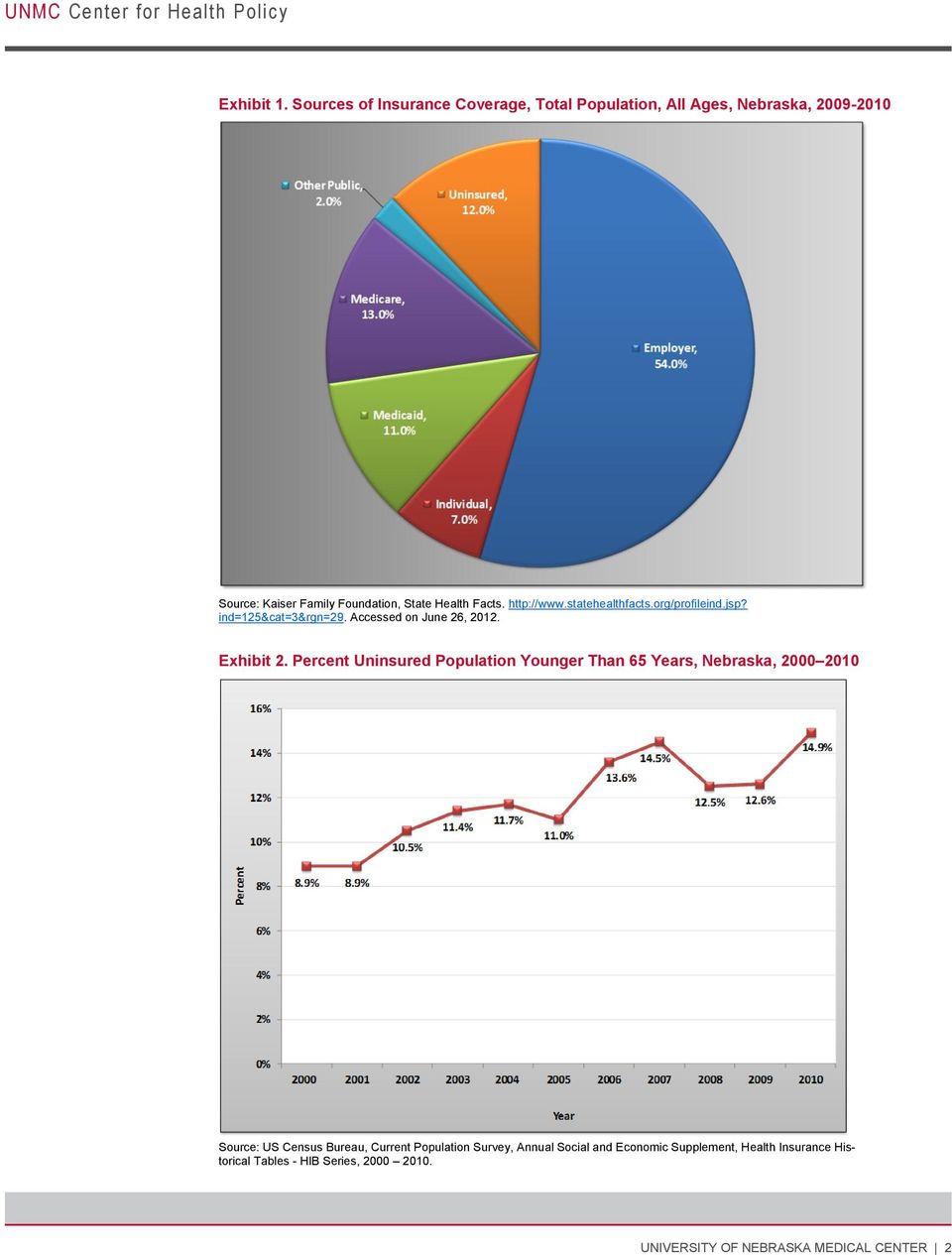
1 Health Insurance Coverage in Nebraska Kelly Shaw-Sutherland and Jim P. Stimpson S U M M A R Y 217,100 Nebraskans lack health insurance. Nebraska s uninsured rate for the population younger than 65 years was 14.9%, a 67.4% increase since 2000, when it was less than 9%. 16 Nebraska counties had a high uninsurance rate (21% 31%). More than 490,000 (27.5%) of Nebraskans were covered by public health insurance (Medicare, Medicaid, military). In Nebraska, the number of individuals with employer-based insurance decreased by approximately 9.3% between 2000 and 2010, and the number of individuals who purchase insurance directly increased by approximately 16.0%. 3 insurance carriers make up 91% of the private insurance market. Center for Health Policy Mission: Improving the public s health in Nebraska by generating and disseminating interdisciplinary research and objective analysis of health policies. UNMC Center for Health Policy Maurer Center for Public Health Nebraska Medical Center Omaha, Nebraska Ph: Fx: [email protected] unmc.edu/publichealth/chp.htm I n t r o d u c t i o n Access to affordable, high quality health insurance coverage is an ongoing health policy issue that has received significant attention at the state and federal levels. Nebraska faces this issue from the perspective of a largely rural state with a total population of 1.8 million spread over 76,800 square miles. 1 To describe the trends, characteristics, and distribution of insurance coverage across Nebraska s population, we analyzed secondary data from the US Census Bureau Current Population Survey (CPS) and the Annual Social and Economic Supplement (ASEC). We compare data for Nebraska with the Midwest region, including Illinois, Indiana, Iowa, Kansas, Michigan, Minnesota, Missouri, North Dakota, Ohio, South Dakota, and Wisconsin. Exhibit 1 provides as overview of insurance coverage of Nebraska s total population in Among Nebraska s total population in 2010, approximately 217,100 people (12.0%) lacked health insurance. More than 490,000 (26.0%) were publicly insured (i.e., Medicare, Medicaid, other), and most Nebraskans (62.0%) were privately insured (i.e., employer-based or direct purchase by an individual). N e b r a s k a s U n i n s u r e d P o p u l a t i o n Historically, rising health care costs and volatile economies have been shown to drive up uninsurance rates due to individuals lack of access to health care. 2 Because most of the elderly population is covered by or is eligible for Medicare benefits, the population younger than 65 years is commonly the focus of the uninsured debate. As shown in Exhibit 2, Nebraska s uninsured rate for the population younger than 65 years was approximately 14.9% in 2010, an increase of about 67.4% since 2000 (8.9% of the total population younger than 65 years). Similar to Nebraska, the Midwest region experienced a 41.0% increase in the uninsured rate for the population younger than 65 years between 2000 (10.5%) and 2010 (14.8%). 3 UNIVERSITY OF NEBRASKA MEDICAL CENTER 1


2 UNMC Center for Health Policy Exhibit 1. Sources of Insurance Coverage, Total Population, All Ages, Nebraska, Source: Kaiser Family Foundation, State Health Facts. ind=125&cat=3&rgn=29. Accessed on June 26, Exhibit 2. Percent Uninsured Population Younger Than 65 Years, Nebraska, Source: US Census Bureau, Current Population Survey, Annual Social and Economic Supplement, Health Insurance Historical Tables - HIB Series, UNIVERSITY OF NEBRASKA MEDICAL CENTER 2
3 Exhibit 3 provides selected characteristics of the uninsured population and a comparison with the total population in Nebraska. Of Nebraska s total population in 2010, 12.2% were older than 65 years, 90.0% were non-hispanic White, 5.8% were not US citizens, less than 38.0% worked full-time year-round, and close to 30.0% were below 200% of the federal poverty level (FPL). Among those younger than 18 years in Nebraska, approximately 20.1% were uninsured in 2010, much higher than in the Midwest (13.1%, total population between 0 and 17 years of age). 4 Similarly, Nebraska had a higher rate of American Indian and Alaska Natives who were uninsured (7.3%) than in the Midwest (1.6%); presumably, these uninsured American Indians were not eligible or covered by the Indian Health Service. 4 Nebraska also had a higher rate of uninsurance among non-citizens (17.1%) than in the Midwest (10.6%). 4 Among Nebraska s unemployed population in 2010, fewer were uninsured (17.9%) than in the Midwest (29.9%). 4 Among the population for whom poverty status was determined and who were either very poor or poor in 2010, approximately 50.4% of the population younger than 65 years was uninsured in Nebraska, which was lower than in the Midwest (58.9%). 4 Exhibit 3. Selected Characteristics of the Uninsured Population Younger Than 65 Years, Nebraska, 2010 Uninsured < 65 years Total Population Characteristic No. (1,000s) % No. (1,000s) % Age years % % years % 1, % years % Ethnicity Non-Hispanic % 1, % Hispanic % % Race White alone % 1, % Black or African American alone % % American Indian and Alaska Native alone % % Asian alone, Native Hawaiian and Other Pacific Islander (NHOPI) alone, or Asian/NHOPI % % Two or more races 1 0.4% % Citizenship Status Native % 1, % Naturalized Citizen % % Not a Citizen % % Employment Status Worked full-time year-round % % Worked less than full-time year-round % % Did not work % % Under 15 years (not working age) % % Poverty Status (% below poverty level) Below 100% % % 100% to below 200% % % 200% to below 300% % % 300% to below 400% % % 400% and above % % Source: US Census Bureau, Current Population Survey, Annual Social and Economic Supplement, UNIVERSITY OF NEBRASKA MEDICAL CENTER 3


4 UNMC Center for Health Policy The distribution of the uninsured population across Nebraska is depicted in Exhibit 4. In 2009, 16 Nebraska counties had a high uninsurance rate and 33 counties had a low uninsurance rate. Of Nebraska s 9 urban counties (Cass, Dakota, Dixon, Douglas, Lancaster, Sarpy, Saunders, Seward, and Washington) 5 in 2009, only 2 had medium uninsurance rates, while the rest had low insurance rates. In 2009, 38 of the 39 Nebraska counties defined as frontier (<7 people per square mile), 6 had high uninsurance rates. Exhibit 4. Distribution of Uninsured Population Younger Than 65 Years, Nebraska, 2009 Source of data: 2009 Health Insurance Coverage Status, Uninsured Only, in Nebraska, for those younger than 65 years, all income levels, and both sexes; US Census Bureau Small Area Health Insurance Estimates. Accessed March 1, Exhibit 4 produced by Department of Health Services Research and Administration, Center for Health Policy, Cartography by Nicole Vanosdel, Medical Geographer, UNMC College of Public Health, Department of Health Services Research and Administration, P u b l i c I n s u r a n c e The overall number of both Medicare and Medicaid beneficiaries fluctuated significantly between 2000 and Those fluctuations can be attributable to economic recessions and periods of high unemployment rates, a growing elderly population, and several periods of federal program expansion (i.e., the Medicare Modernization Act of 2003, Medicare Part D, the transition of Medicaid drug benefits of dual eligibles to Medicare, etc.). 7 From 2000 to 2010, the Medicare population older than 65 years increased by approximately 17,000 beneficiaries. Similarly, the Medicaid population younger than 65 years also increased, but much more significantly, with an approximate increase of 63,000 beneficiaries. While the total number of Medicaid beneficiaries among the Nebraska population younger than 65 years increased over time (from 8.0% in 2000 to 11.7% in 2010, a 46.3% increase), the number of Medicare and military beneficiaries remained relatively stable (Exhibit 5). This rate is much lower than in the Midwest region, with approximately a 98.8% increase since UNIVERSITY OF NEBRASKA MEDICAL CENTER 4

5 Exhibit 5. Percent Publicly Insured by Coverage Type, Population Younger Than 65 Years, Nebraska, Source: US Census Bureau, Current Population Survey, Annual Social and Economic Supplement, Health Insurance Historical Tables - HIB Series, Note: The Medicare population is representative of people aged 65 years and older, persons below the age of 65 with disabilities, and people with end stage renal disease (permanent kidney failure requiring dialysis or transplant). Selected characteristics of Nebraska Medicare beneficiaries are presented in Exhibit 6. In , 43.0% of Nebraska s Medicare beneficiaries were either poor or very poor. Average annual Medicare spending per enrollee grew 7.4% between 1991 and 2009, to about $9,138 per enrollee. 8 There were 41,643 dual eligibles in 2008, representing about 17.0% of Medicaid beneficiaries. As of February 2010, most Medicare beneficiaries (152,223 beneficiaries or 55.0%) had prescription drug coverage through standalone prescription drug plans. As of 2011, the Medicare Advantage plan penetration rate was about 11.5%. UNIVERSITY OF NEBRASKA MEDICAL CENTER 5
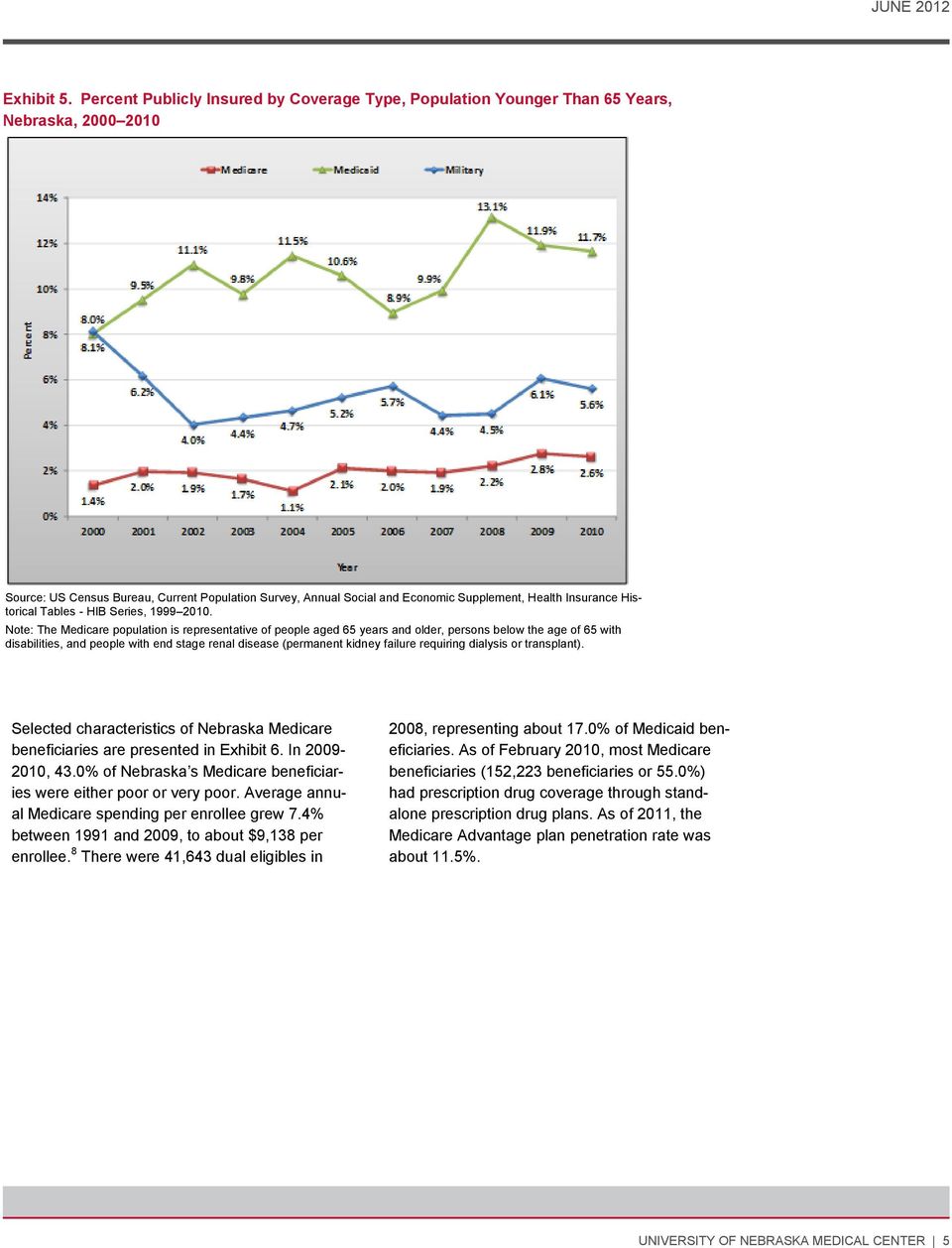
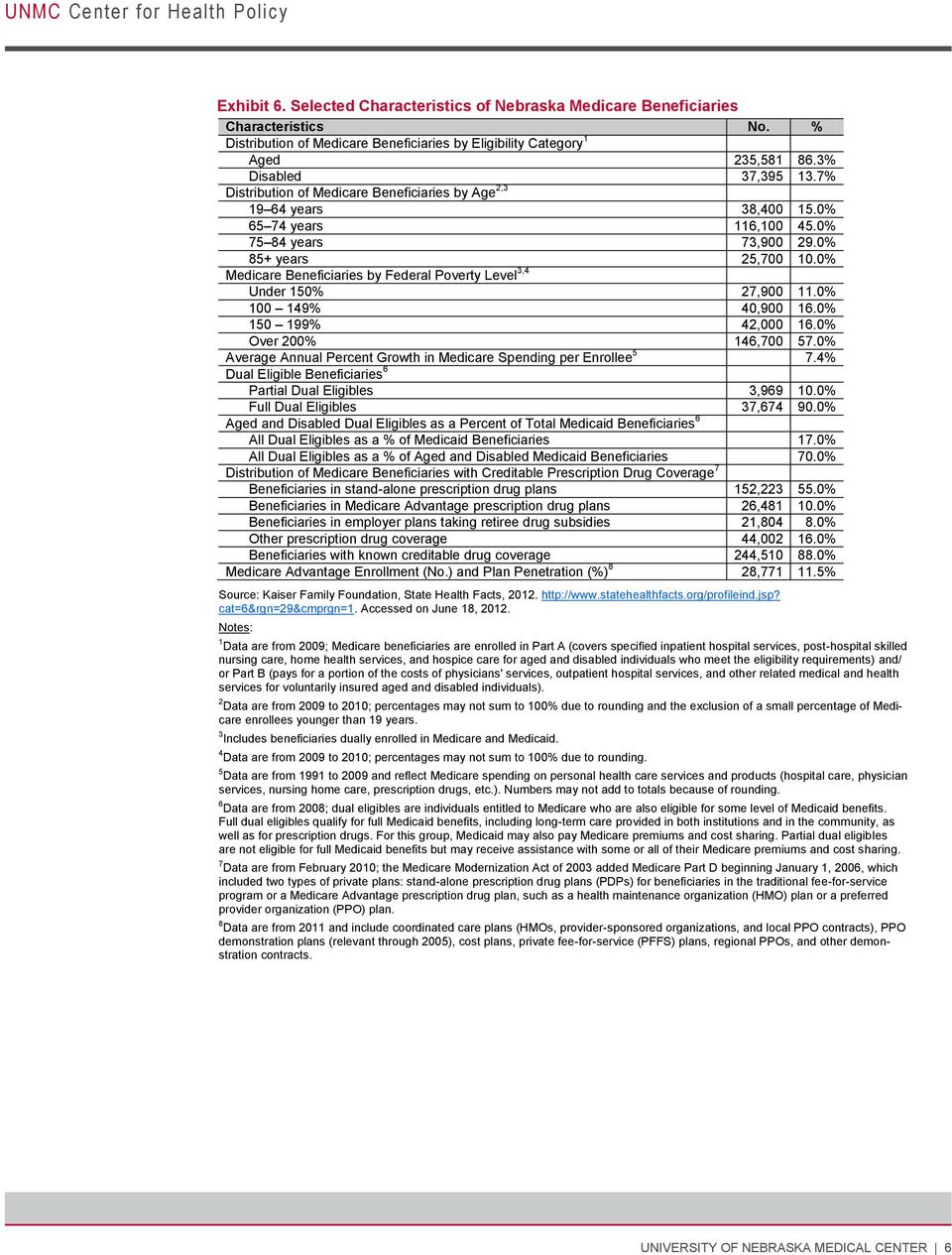
6 UNMC Center for Health Policy Exhibit 6. Selected Characteristics of Nebraska Medicare Beneficiaries Characteristics No. % Distribution of Medicare Beneficiaries by Eligibility Category 1 Aged 235, % Disabled 37, % Distribution of Medicare Beneficiaries by Age 2, years 38, % years 116, % years 73, % 85+ years 25, % Medicare Beneficiaries by Federal Poverty Level 3,4 Under 150% 27, % % 40, % % 42, % Over 200% 146, % Average Annual Percent Growth in Medicare Spending per Enrollee 5 7.4% Dual Eligible Beneficiaries 6 Partial Dual Eligibles 3, % Full Dual Eligibles 37, % Aged and Disabled Dual Eligibles as a Percent of Total Medicaid Beneficiaries 6 All Dual Eligibles as a % of Medicaid Beneficiaries 17.0% All Dual Eligibles as a % of Aged and Disabled Medicaid Beneficiaries 70.0% Distribution of Medicare Beneficiaries with Creditable Prescription Drug Coverage 7 Beneficiaries in stand-alone prescription drug plans 152, % Beneficiaries in Medicare Advantage prescription drug plans 26, % Beneficiaries in employer plans taking retiree drug subsidies 21, % Other prescription drug coverage 44, % Beneficiaries with known creditable drug coverage 244, % Medicare Advantage Enrollment (No.) and Plan Penetration (%) 8 28, % Source: Kaiser Family Foundation, State Health Facts, cat=6&rgn=29&cmprgn=1. Accessed on June 18, Notes: 1 Data are from 2009; Medicare beneficiaries are enrolled in Part A (covers specified inpatient hospital services, post-hospital skilled nursing care, home health services, and hospice care for aged and disabled individuals who meet the eligibility requirements) and/ or Part B (pays for a portion of the costs of physicians' services, outpatient hospital services, and other related medical and health services for voluntarily insured aged and disabled individuals). 2 Data are from 2009 to 2010; percentages may not sum to 100% due to rounding and the exclusion of a small percentage of Medicare enrollees younger than 19 years. 3 Includes beneficiaries dually enrolled in Medicare and Medicaid. 4 Data are from 2009 to 2010; percentages may not sum to 100% due to rounding. 5 Data are from 1991 to 2009 and reflect Medicare spending on personal health care services and products (hospital care, physician services, nursing home care, prescription drugs, etc.). Numbers may not add to totals because of rounding. 6 Data are from 2008; dual eligibles are individuals entitled to Medicare who are also eligible for some level of Medicaid benefits. Full dual eligibles qualify for full Medicaid benefits, including long-term care provided in both institutions and in the community, as well as for prescription drugs. For this group, Medicaid may also pay Medicare premiums and cost sharing. Partial dual eligibles are not eligible for full Medicaid benefits but may receive assistance with some or all of their Medicare premiums and cost sharing. 7 Data are from February 2010; the Medicare Modernization Act of 2003 added Medicare Part D beginning January 1, 2006, which included two types of private plans: stand-alone prescription drug plans (PDPs) for beneficiaries in the traditional fee-for-service program or a Medicare Advantage prescription drug plan, such as a health maintenance organization (HMO) plan or a preferred provider organization (PPO) plan. 8 Data are from 2011 and include coordinated care plans (HMOs, provider-sponsored organizations, and local PPO contracts), PPO demonstration plans (relevant through 2005), cost plans, private fee-for-service (PFFS) plans, regional PPOs, and other demonstration contracts. UNIVERSITY OF NEBRASKA MEDICAL CENTER 6
7 Characteristics of publicly insured persons in Nebraska younger than 65 years are provided in Exhibit 7. A lower percentage of unemployed people were publicly insured in Nebraska (25.2%) than in the Midwest (33.7%). 4 Similarly, among Nebraska s population younger than 65 years for whom poverty status was determined and who were either very poor or poor, more than half (53.4%) were publicly insured, a lower percentage than in the Midwest (67.2%). 4 Exhibit 7. Characteristics of the Publicly Insured Population Younger Than 65 Years, Nebraska, 2010 Characteristic No. (1,000s) % Age years % years % Hispanic/Latino Origin Non-Hispanic % Hispanic % Race White alone % Black or African American alone % American Indian and Alaska Native alone % Asian alone, Native Hawaiian and Other Pacific Islander (NHOPI) alone, % or Asian/NHOPI Two or more races % Nativity Native % Naturalized citizen % Not a citizen % Work Experience in Last 12 Months Worked full-time year-round % Worked less than full-time year-round % Did not work % Under 15 years (not working age) % Income-to-Poverty Ratio Below 100% % 100% to below 200% % 200% to below 300% % 300% to below 400% % 400% and above % Source: US Census Source: US Census Bureau, Current Population Survey, Annual Social and Economic Supplement, UNIVERSITY OF NEBRASKA MEDICAL CENTER 7

8 UNMC Center for Health Policy P r i v a t e I n s u r a n c e Between 2000 and 2010, the percentage of Nebraska s total population younger than 65 years with employer-based health insurance decreased, while the percentage of individuals who purchased a health insurance policy directly slightly increased. Specifically, the number of individuals with employer-based insurance decreased by approximately 9.3% between 2000 and 2010, and the number of individuals who purchased insurance directly increased by approximately 16.0%. In comparison, the number of individuals with employer-based insurance in the Midwest region decreased by approximately 14.1%, and the number of individuals who purchased insurance directly increased by approximately 2.1%. 3 Exhibit 8. Percent Privately Insured by Coverage Type, Population Younger Than 65 Years, Nebraska, Source: US Census Bureau, Current Population Survey, Annual Social and Economic Supplement, Health Insurance Historical Tables - HIB Series, Characteristics of privately insured persons younger than 65 years are provided in Exhibit 9. A lower percentage of unemployed people were privately insured in Nebraska (10.0%) than in the Midwest (15.0%). 4 Similarly, among Nebraska s population younger than 65 years for whom poverty status was determined and who were either very poor or poor, approximately 15.7% were privately insured, a lower percentage than in the Midwest (about 16.1%). 4 Exhibit 10 provides a snapshot of the private insurance market in Nebraska in Three insurance carriers owned approximately 91.3% of Nebraska s private insurance market; Blue Cross Blue Shield of Nebraska had the highest share, with 74.8%. UNIVERSITY OF NEBRASKA MEDICAL CENTER 8

9 Exhibit 9. Characteristics of the Privately Insured Population Younger Than 65 Years, Nebraska, 2010 Characteristic No. (1,000s) % Age years % years % Hispanic/Latino Origin Non-Hispanic 1, % Hispanic % Race White alone 1, % Black or African American alone % American Indian and Alaska Native alone % Asian alone, Native Hawaiian and Other Pacific Islander (NHOPI) alone, % or Asian/NHOPI Two or more races % Nativity Native 1, % Naturalized citizen % Not a citizen % Work Experience in Last 12 Months Worked full-time year-round % Worked less than full-time year-round % Did not work % Under 15 years (not working age) % Income-to-Poverty Ratio Below 100% % 100% to below 200% % 200% to below 300% % 300% to below 400% % 400% and above % Source: US Census Bureau, Current Population Survey, Annual Social and Economic Supplement, Exhibit 10. Private Insurance Market Share by Insurer, Nebraska, 2011 Source: Nebraska Department of Insurance, Health Insurance Exchange Planning Overview and Recommendations, Note: Market share is defined as total earned premiums by each individual insurer. UNIVERSITY OF NEBRASKA MEDICAL CENTER 9

10 UNMC Center for Health Policy C o n c l u s i o n More than 217,000 Nebraskans are without health insurance. A majority of the uninsured population is above the poverty threshold (FPL <100%), a third work less than full-time yearround, and 40,000 are not US citizens. Uninsurance rates are high in Nebraska s rural-frontier counties, where a disproportionate share of the population is living in poverty, un/underemployed, and less healthy. 9 However, Nebraska is doing better than its peers in the Midwest on most measures of health insurance, possibly due in part to low unemployment levels and to state efforts to expand insurance coverage. The state involvement in health insurance revolves largely around the Medicaid program and care provided at community health centers, clinics, and critical access hospitals. Nebraska meets minimum federal Medicaid standards for coverage, including <200% FPL eligibility requirement for children and <100% FPL eligibility requirement for adults. 10 Nebraska has also taken additional measures to increase coverage for targeted vulnerable populations by increasing eligibility for pregnant women (<185% FPL) and women with cancer (<225% FPL). 10 Another example of Nebraska s efforts to increase insurance coverage is the Nebraska Comprehensive Health Insurance Pool (NECHIP), a high-risk pool insurance program designed to increase access to health insurance coverage to people who were rejected by insurance carriers for preexisting conditions. 10 Nebraska s 6 community health centers served 63,033 patients through 27 delivery sites in 2010; 57% of the patients served by the community health centers were uninsured, and 50% were from rural areas. 11 In addition, Nebraska has about 65 critical access hospitals and 132 certified rural health clinics currently operating throughout the state. 12 There is a need for additional policies that would assist persons to participate in the health insurance market. The Affordable Care Act of 2010 (ACA) has provisions that would increase participation in the insurance market, including guaranteed issue, allowing children to stay on their parent s health insurance through age 26, and the establishment of health insurance exchanges. A health insurance exchange could create a larger, more robust risk pool from which insurance may be purchased, and potentially drive down costs while increasing access. The ACA also has a provision to expand Medicaid eligibility for individuals younger than 65 years from the current eligibility level (100% FPL) to 133% FPL (or 138% after applying a standard 5% income disregard ) The recent Supreme Court decision indicated that state participation in the expanded Medicaid program was optional rather than mandatory. Nebraska will need to weigh the costs and benefits of adding thousands of new Medicaid beneficiaries. UNIVERSITY OF NEBRASKA MEDICAL CENTER 10

11 R e f e r e n c e s 1 US Census Bureau: State and County QuickFacts. Data derived from Population Estimates, American Community Survey, Census of Population and Housing, State and County Housing Unit Estimates, County Business Patterns, Nonemployer Statistics, Economic Census, Survey of Business Owners, Building Permits, Consolidated Federal Funds Report. qfd/states/31000.html. Accessed June 15, Collins SR, Robertson R, Garber T, Doty MM. The Income Divide in Health Care: How the Affordable Care Act Will Help Restore Fairness to the US Health System. The Common Wealth Fund; February Files/Publications/Issue%20Brief/2012/ Feb/1579_collins_income_divide_tracking_brief.pdf. Accessed March 1, US Census Bureau, Current Population Survey, Annual Social and Economic Supplement, Health Insurance Historical Tables - HIB Series, US Census Bureau, Current Population Survey, Annual Social and Economic Supplement, Federal Office of Management and Budget designation of Metropolitan, US Census Bureau, frontier definition, 2009 population estimates. 7 Holahan J, McMorrow S. Medicare, Medicaid and the Deficit Debate: Timely Analysis of Immediate Health Policy Issues. Urban Institute; April Medicare-Medicaid-and-the-Deficit-Debate.pdf. Accessed June 22, Kaiser Family Foundation, State Health Facts, Accessed June 18, Lenardson JD, Ziller EC, Coburn AF, Anderson NJ. Profile of Rural Health Insurance Coverage. Maine Rural Health Research Center, Muskie School of Public Service, University of Southern Maine; June National Conference of State Legislators. State Health Programs to Cover the Uninsured, research/health/state-health-programs-to-cover-the-uninsured aspx#ne. Accessed June 14, National Association of Community Health Centers. Nebraska Health Center Fact Sheet. documents/research/ne11.pdf. Accessed June 18, National Conference of State Legislators. Primary Care: State Profiles. Accessed June 14, Georgetown University Health Policy Institute. Summary of Medicaid, CHIP, and Low-Income Provisions in Health Care Reform; April file=ccf%20publications/health%20reform/health%20reform% 20summary.pdf. Accessed June 18, New eligibility requirements can be found in ACA ( ) provisions 2001 and 10201, and HCERA ( ) provisions 1004 and A u t h o r I n f o r m a t i o n Kelly Shaw-Sutherland, MPA, is a health data analyst at the UNMC College of Public Health in the Department of Health Services Research and Administration. Jim P. Stimpson, PhD, is an associate professor at the UNMC College of Public Health in the Department of Health Services Research and Administration and director of the UNMC Center for Health Policy. A c k n o w l e d g e m e n t s We thank Mark Bowen for providing valuable feedback on this report and Sue Nardie for editing this report. F u n d i n g I n f o r m a t i o n This policy brief was developed with support from the UNMC College of Public Health. S u g g e s t e d C i t a t i o n Shaw-Sutherland K, Stimpson JP. Health Insurance Coverage in Nebraska. Omaha, NE: UNMC Center for Health Policy; C o n f l i c t o f I n t e r e s t None. D i s c l a i m e r The views expressed herein are those of the authors and do not necessarily reflect the views of collaborating organizations or funders, or of the Regents of the University of Nebraska. C o n t a c t I n f o r m a t i o n Jim P. Stimpson, PhD Director UNMC Center for Health Policy Maurer Center for Public Health Nebraska Medical Center Omaha, NE Ph: Fx: [email protected] unmc.edu/publichealth/chp.htm UNIVERSITY OF NEBRASKA MEDICAL CENTER 11

STATE DATA CENTER. District of Columbia MONTHLY BRIEF
 District of Columbia STATE DATA CENTER MONTHLY BRIEF N o v e m b e r 2 0 1 2 District Residents Health Insurance Coverage 2000-2010 By Minwuyelet Azimeraw Joy Phillips, Ph.D. This report is based on data
Health Insurance Coverage in Texas
 Health Insurance Coverage in Texas U.S. Census Current Population Survey 2012 Data March 2014 Fast Facts: Texans & Health Insurance (2012) 6.4 million uninsured Texans, 24.6% of all ages Highest rate in
Section 5: Public Health Insurance Programs
 1 Section 5: Public Health Insurance Programs Medicare Medical Assistance (Medicaid) MinnesotaCare General Assistance Medical Care (GAMC) Minnesota Comprehensive Health Association (MCHA) A summary of
HEALTH INSURANCE COVERAGE STATUS. 2009-2013 American Community Survey 5-Year Estimates
 S2701 HEALTH INSURANCE COVERAGE STATUS 2009-2013 American Community Survey 5-Year Estimates Supporting documentation on code lists, subject definitions, data accuracy, and statistical testing can be found
Health Coverage for the Hispanic Population Today and Under the Affordable Care Act
 on on medicaid and and the the uninsured Health Coverage for the Population Today and Under the Affordable Care Act April 2013 Over 50 million s currently live in the United States, comprising 17 percent
Profile of Rural Health Insurance Coverage
 Profile of Rural Health Insurance Coverage A Chartbook R H R C Rural Health Research & Policy Centers Funded by the Federal Office of Rural Health Policy www.ruralhealthresearch.org UNIVERSITY OF SOUTHERN
Medicaid Topics Impact of Medicare Dual Eligibles Stephen Wilhide, Consultant
 Medicaid Topics Impact of Medicare Dual Eligibles Stephen Wilhide, Consultant Issue Summary The term dual eligible refers to the almost 7.5 milion low-income older individuals or younger persons with disabilities
Medicare Supplemental Coverage in Minnesota
 Medicare Supplemental Coverage in Minnesota December 2002 h ealth e conomics p rogram Health Policy and Systems Compliance Division Minnesota Department of Health Medicare Supplemental Coverage in Minnesota
Changes in Health Insurance Coverage in the Great Recession, 2007-2010 John Holahan and Vicki Chen The Urban Institute Executive Summary
 I S S U E P A P E R kaiser commission on medicaid and the uninsured Changes in Health Insurance Coverage in the Great Recession, 2007-2010 John Holahan and Vicki Chen The Urban Institute Executive Summary
Lynn A. Blewett, Ph.D. Professor, University of Minnesota
 Lynn A. Blewett, Ph.D. Professor, University of Minnesota Westlake Forum III Healthcare Reform in China and the US: Similarities, Differences and Challenges Emory University, Atlanta, GA April 10-12, 2011
Health Coverage by Race and Ethnicity: The Potential Impact of the Affordable Care Act
 on on medicaid and and the the uninsured Health Coverage by Race and Ethnicity: The Potential Impact of the Affordable Care Act Executive Summary March 2013 One of the key goals of the Affordable Care
Immigrants and Coverage Affordable Care Act
 Immigrants and Coverage Affordable Care Act Lynn A. Blewett, PhD Professor and Director State Health Access Data Assistance Center (SHADAC) University of Minnesota Safe Table Forum: Health Care Access
Health Pricing Boot Camp August 10-11, 2009 Session 1b: Medicare Coverage for the Aged and Disabled
 Health Pricing Boot Camp August 10-11, 2009 Session 1b: Medicare Coverage for the Aged and Disabled Charles P. Miller, FSA, MAAA Introductions Daniel W. Bailey, FSA, MAAA Ingenix Consulting Russell D.
Changes in Self-Employment: 2010 to 2011
 Changes in Self-Employment: 2010 to 2011 American Community Survey Briefs By China Layne Issued January 2013 ACSBR/11-21 INTRODUCTION From December 2007 to June 2009, the United States experienced an economic
THE MEDICAID PROGRAM AT A GLANCE. Health Insurance Coverage
 on on medicaid and and the the uninsured March 2013 THE MEDICAID PROGRAM AT A GLANCE Medicaid, the nation s main public health insurance program for low-income people, covers over 62 million Americans,
25ASIAN & PACIFIC ISLANDER
 APIA 25ASIAN & PACIFIC ISLANDER 1986-2011 AMERICAN HEALTH FORUM advocates guide to health care reform implementation in utah april 2011 Advocates for health justice The Asian & Pacific Islander American
GAO HEALTH INSURANCE. Report to the Committee on Health, Education, Labor, and Pensions, U.S. Senate. United States Government Accountability Office
 GAO United States Government Accountability Office Report to the Committee on Health, Education, Labor, and Pensions, U.S. Senate March 2008 HEALTH INSURANCE Most College Students Are Covered through Employer-Sponsored
State of Alaska Health and Social Services Medicaid Study
 State of Alaska Health and Social Services Medicaid Study Prepared by Mike Humphrey Gregg Davis, PhD Bernard Khomenko The Wilson Agency, LLC 3000 A Street, Suite 400 Anchorage, AK 99503 Phone: (907) 277-1616
Racial and ethnic health disparities continue
 From Families USA Minority Health Initiatives May 2010 Moving toward Health Equity: Health Reform Creates a Foundation for Eliminating Disparities Racial and ethnic health disparities continue to persist
Fast Facts: Latinos and Health Care. Facts and figures about the Hispanic community s access to the health care system
 Fast Facts: Latinos and Health Care Facts and figures about the Hispanic community s access to the health care system January 2012 U.S. Uninsured Population by Race/Ethnicity, 2010 White 46.3% Nearly one
Introducing OneExchange.
 RETIREE BENEFITS Introducing OneExchange. OneExchange provides you with plan advice and enrollment assistance to choose Medicare supplemental healthcare and prescription drug coverage that s right for
Employment-Based Health Insurance: 2010
 Employment-Based Health Insurance: 2010 Household Economic Studies Hubert Janicki Issued February 2013 P70-134 INTRODUCTION More than half of the U.S. population (55.1 percent) had employment-based health
Educational Attainment in the United States: 2003
 Educational Attainment in the United States: 2003 Population Characteristics Issued June 2004 P20-550 The population in the United States is becoming more educated, but significant differences in educational
Health Insurance Coverage. America. 2003 Data Update. Medicaid and the Uninsured
 Health Insurance Coverage in America 2003 Data Update November 2004 T H E K A I S E R C O M M I S S I O N O N Medicaid and the Uninsured kaiser commission on medicaid and the uninsured Beginning with our
National Training Program
 National Training Program Module 12 Medicaid and the Children s Health Insurance Program Session Objectives This session will help you Describe eligibility, benefits, and administration of Medicaid Define
THE CHARACTERISTICS OF PERSONS REPORTING STATE CHILDREN S HEALTH INSURANCE PROGRAM COVERAGE IN THE MARCH 2001 CURRENT POPULATION SURVEY 1
 THE CHARACTERISTICS OF PERSONS REPORTING STATE CHILDREN S HEALTH INSURANCE PROGRAM COVERAGE IN THE MARCH 2001 CURRENT POPULATION SURVEY 1 Charles Nelson and Robert Mills HHES Division, U.S. Bureau of the
C A LIFORNIA HEALTHCARE FOUNDATION. s n a p s h o t California s Individual and Small Group Markets on the Eve of Reform
 C A LIFORNIA HEALTHCARE FOUNDATION s n a p s h o t California s Individual and Small Group Markets on the Eve of Reform 2011 Introduction California s individual and small group health insurance markets
What s Medicare? What are the different parts of Medicare?
 Revised June 2014 What s Medicare? Medicare is health insurance for: People 65 or older People under 65 with certain disabilities People of any age with End-Stage Renal Disease (ESRD) (permanent kidney
Demographic and Labor Market Profile of the city of Detroit - Michigan
 Demographic and Labor Market Profile of the city of Detroit - Michigan Leonidas Murembya, PhD Regional Coordinator [email protected] www.michigan.gov/lmi 517-241-6574 State of Michigan Department
Demographic Profile of Wichita Unemployment Insurance Beneficiaries Q2 2014
 Demographic Profile of Wichita Unemployment Insurance Beneficiaries Q2 2014 The Bureau of Labor Statistics defines an unemployed person as one 16 years and older having no employment and having made specific
Health insurance options for people with disabilities
 Health insurance options for people with disabilities Brought to you by: Washington State Office of the Insurance Commissioner Table of Contents Introduction Consumers with disabilities who are NOT eligible
Medicare- Medicaid Enrollee State Profile
 Medicare- Medicaid Enrollee State Profile The National Summary Centers for Medicare & Medicaid Services Introduction... 1 Data Source and General Notes... 2 Types and Ages of Medicare-Medicaid Enrollees...
Demographic Profile of Wichita Unemployment Insurance Beneficiaries Q3 2015
 Demographic Profile of Wichita Unemployment Insurance Beneficiaries Q3 2015 The Bureau of Labor Statistics defines an unemployed person as one 16 years and older having no employment and having made specific
Medicare Buy-In Options for Uninsured Adults
 MEDICARE BUY-IN OPTIONS: ESTIMATING COVERAGE AND COSTS John Sheils and Ying-Jun Chen The Lewin Group, Inc. February 2001 Support for this research was provided by The Commonwealth Fund. The views presented
Making the most of Medicare
 Making the most of Medicare S5743_102714_K04_RE Internal Approval 10/27/2014 Today s Topics What is Medicare Who s eligible Medicare coverage Options to fill coverage gaps When you can enroll Finding the
Office of Medical Assistance Programs Mission and Goals. Historical Perspective
 Mission Department of Human Services Office of Medical Assistance Programs Mission and Goals To plan and implement medical programs assuring access to basic care for eligible clients Goals Increase access
STATISTICAL BRIEF #137
 Medical Expenditure Panel Survey STATISTICAL BRIEF #137 Agency for Healthcare Research and Quality August 26 Treatment of Sore Throats: Antibiotic Prescriptions and Throat Cultures for Children under 18
REACHING THE REMAINING UNINSURED IN MASSACHUSETTS: CHALLENGES AND OPPORTUNITIES
 REACHING THE REMAINING IN MASSACHUSETTS: CHALLENGES AND OPPORTUNITIES MARCH 2013 Sharon K. Long Dana Goin Victoria Lynch Urban Institute EXECUTIVE SUMMARY While Massachusetts has the lowest uninsurance
What s Medicare? What are the different parts of Medicare?
 Revised June 2015 What s Medicare? Medicare is health insurance for: People 65 or older People under 65 with certain disabilities People of any age with End-Stage Renal Disease (ESRD) (permanent kidney
Health Insurance Coverage: Early Release of Estimates From the National Health Interview Survey, 2013
 Health Insurance Coverage: Early Release of Estimates From the National Health Interview Survey, 2013 by Robin A. Cohen, Ph.D., and Michael E. Martinez, M.P.H., M.H.S.A. Division of Health Interview Statistics,
The Future of Rural Health: The MMA As a Change Agent
 The Future of Rural Health: The MMA As a Change Agent Keith J. Mueller, Ph.D. Professor and Director RUPRI University of Nebraska Medical Center Prepared for Presentation at the All Programs Meeting of
Health Economics Program
 Health Economics Program Issue Brief 2006-05 August 2006 Medicare Supplemental Coverage and Prescription Drug Use, 2004 Medicare is a federal health insurance program that provides coverage for the elderly
Medicare has four components, Part A, Part B Part C and Part D:
 Medicare What is Medicare? Medicare is a National Health Insurance Program for people 65 years of age and older Certain persons with disabilities under the age of 65 People with end stage renal disease
Medicare and Other Health Benefits: Your Guide to Who Pays First
 Medicare and Other Health Benefits: Your Guide to Who Pays First This booklet explains: How Medicare works with other types of insurance Who should pay your bills first Where to get more help Subject Section
FACT SHEET Medicare Advantage (Part C): An Overview (C-001) p. 1 of 5
 FACT SHEET Medicare Advantage (Part C): An Overview (C-001) p. 1 of 5 Medicare Advantage (Part C): An Overview Medicare Advantage is also known as Medicare Part C. A Medicare Advantage (MA) plan is an
Preferred Provider Organization (PPO) Plans
 CENTERS FOR MEDICARE & MEDICAID SERVICES Your Guide to Medicare s Preferred Provider Organization (PPO) Plans This official government booklet has important information about the following: Understanding
Census Data on Uninsured Women and Children September 2009
 March of Dimes Foundation Office of Government Affairs 1146 19 th Street, NW, 6 th Floor Washington, DC 20036 Telephone (202) 659-1800 Fax (202) 296-2964 marchofdimes.com nacersano.org Census Data on Uninsured
APPENDIX A. Tables. Appendix A Tables 119
 118 The Condition of Education 2012 APPENDIX A Tables Appendix A Tables 119 Indicator 1 Enrollment Trends by Age Table A-1-1. Percentage of the population ages 3 34 enrolled in school, by age group: October
Financial assistance for low-income Medicare beneficiaries
 Financial assistance for low-income Medicare beneficiaries C h a p t e r4 C H A P T E R 4 Financial assistance for low-income Medicare beneficiaries Chapter summary In this chapter Medicare Savings Programs
The Federal Employees Health Benefits Program and Medicare
 The Federal Employees Health Benefits Program and Medicare This booklet answers questions about how the Federal Employees Health Benefits (FEHB) Program and Medicare work together to provide health benefits
Eligibility for Medi-Cal and the Health Insurance Exchange in California under the Affordable Care Act
 UNIVERSITY OF CALIFORNIA, BERKELEY CENTER FOR LABOR RESEARCH AND EDUCATION ISSUE BRIEF Eligibility for Medi-Cal and the Health Insurance Exchange in California under the Affordable Care Act by Ken Jacobs,
Medicare- Medicaid Enrollee State Profile
 Medicare- Medicaid Enrollee State Profile Montana Centers for Medicare & Medicaid Services Introduction... 1 At a Glance... 1 Eligibility... 2 Demographics... 3 Chronic Conditions... 4 Utilization... 6
How to be a smart shopper for Medigap Insurance
 info sheet Medicare is the basic federal health insurance for older persons and for younger people with disabilities. Because Medicare has gaps in coverage, many people also buy a Medigap policy to supplement
Medicare (History and Financing)
 Medicare (History and Financing) Note: Please pay attention to dates on slides and data; CMS has discontinued the publication of some valuable figures and these are occasionally referenced for prior years.
Affordable Care Act (ACA) Health Insurance Exchanges and Medicaid Expansion
 Affordable Care Act (ACA) Health Insurance Exchanges and Medicaid Expansion Table of Contents Expanded Coverage... 2 Health Insurance Exchanges... 3 Medicaid Expansion... 8 Novartis Pharmaceuticals Corporation
U.S. Railroad Retirement Board www.rrb.gov MEDICARE. For Railroad Workers and Their Families
 U.S. Railroad Retirement Board www.rrb.gov MEDICARE For Railroad Workers and Their Families U.S. Railroad Retirement Board Mission Statement The Railroad Retirement Board s mission is to administer retirement/survivor
kaiser medicaid and the uninsured commission on The Medicaid Medically Needy Program: Spending and Enrollment Update
 I S S U E kaiser commission on medicaid and the uninsured December 2012 P A P E R The Medicaid Medically Needy Program: Spending and Enrollment Update The medically needy program provides states the option
Highlights and Trends: ASHA Counts for Year End 2009
 Highlights and Trends: ASHA Counts for Year End 2009 Constituents -- How many are there? How have the numbers changed? v ASHA currently represents 140,039 speech-language pathologists, audiologists, and
Health Insurance Coverage of Children Under Age 19: 2008 and 2009
 Health Insurance Coverage of Children Under Age 19: 2008 and 2009 American Community Survey Briefs Issued September 2010 ACSBR/09-11 IntroductIon Health insurance, whether private or public, improves children
TRACKING TRENDS IN HEALTH SYSTEM PERFORMANCE
 TRACKING TRENDS IN HEALTH SYSTEM PERFORMANCE SEPTEMBER 2013 IN STATES HANDS How the Decision to Expand Medicaid Will Affect the Most Financially Vulnerable Americans Findings from the Commonwealth Fund
Summary of Federal SCHIP Reauthorization, Economic Stimulus, and Health Care Reform Bills and Proposals
 Summary of Federal SCHIP Reauthorization, Economic Stimulus, and Health Care Reform Bills and Proposals I. Children s Health Insurance Program (CHIP) Reauthorization Act of 2009 A. Funding for CHIP. The
Medicare Basics and Medicare Advantage
 Medicare Basics and Medicare Advantage Medicare The federal health insurance program for people age 65 and over, some disabled people under 65 years of age, and people with End-Stage Renal Disease (permanent
GAO HEALTH INSURANCE. Characteristics and Trends in the Uninsured Population. Testimony. Before the Committee on Finance, U.S.
 GAO United States General Accounting Office Testimony Before the Committee on Finance, U.S. Senate For Release on Delivery Expected at 2:30 p.m. Tuesday, March 13, 2001 HEALTH INSURANCE Characteristics
california Health Care Almanac California s Uninsured
 california Health Care Almanac december 2011 Introduction Over the past two decades, California has seen an increase in the percentage of people who are uninsured. California now has the largest number
california Health Care Almanac Health Care Costs 101: California Addendum
 california Health Care Almanac : California Addendum May 2012 Introduction Health spending represents a significant share of California s economy, but the amounts spent on health care rank among the lowest
Contact Social Security
 Medicare Contact Social Security Visit our website Our website, www.socialsecurity.gov, is a valuable resource for information about all of Social Security s programs. At our website you also can: Apply
Randall Chun, Legislative Analyst Updated: January 2016. MinnesotaCare
 INFORMATION BRIEF Research Department Minnesota House of Representatives 600 State Office Building St. Paul, MN 55155 Randall Chun, Legislative Analyst is administered by the Minnesota Department of Human
ASSESSING THE RESULTS
 HEALTH REFORM IN MASSACHUSETTS EXPANDING TO HEALTH INSURANCE ASSESSING THE RESULTS March 2014 Health Reform in Massachusetts, Expanding Access to Health Insurance Coverage: Assessing the Results pulls
Sources of Health Insurance Coverage in Georgia 2007-2008
 Sources of Health Insurance Coverage in Georgia 2007-2008 Tabulations of the March 2008 Annual Social and Economic Supplement to the Current Population Survey and The 2008 Georgia Population Survey William
Kaiser Permanente Guide to Medicare Basics
 Kaiser Permanente Guide to Medicare Basics The National Medicare program, which was created in 1965, has given people peace of mind and the security of knowing they ll have access to health coverage. Medicare