
Medicare Buy-In Options for Uninsured Adults
|
|
|
- Lesley Kelley
- 5 years ago
- Views:
Transcription
1 MEDICARE BUY-IN OPTIONS: ESTIMATING COVERAGE AND COSTS John Sheils and Ying-Jun Chen The Lewin Group, Inc. February 2001 Support for this research was provided by The Commonwealth Fund. The views presented here are those of the authors and should not be attributed to The Commonwealth Fund or its directors, officers, or staff, or to members of the Task Force. Copies of this report are available from The Commonwealth Fund by calling our toll-free publications line at and ordering publication number 441. The report can also be found on the Fund s website at

2 CONTENTS List of Figures and Tables... v Executive Summary...vii I. Introduction... 1 II. General Buy-In, Ages 62 to A. Sources of Coverage... 5 B. Characteristics of the Uninsured... 6 C. Ability to Pay Buy-In Premium III. Displaced Worker Buy-In for Adults 55 to A. Sources of Coverage for Persons Ages 55 to B. Access to Employer-Based Coverage C. Displaced Workers D. Ability to Pay Buy-In Premium IV. Eliminated Benefit COBRA Buy-In for Those 55 to A. Persons Covered by Early Retiree Health Plans B. Retiree Coverage and Early Retirement Behavior C. Trends in Employer Coverage V. Buy-In Enrollment and Costs A. Methodology B. Displaced Worker Buy-In Enrollment and Costs C. General Buy-In Enrollment and Costs D. Sensitivity to Assumptions E. Combined Federal Cost of Buy-In F. Impact of Tax Credit G. Income-Tested Premium Subsidies H. Employer Response VI. Conclusions iii
3 LIST OF FIGURES AND TABLES Figure ES-1 Health Status of Adults Ages 62 to 64, by Primary Insurance Source...viii Figure 1 Persons Ages 62 to 64 by Primary Source of Insurance... 6 Figure 2 Percent of Population Ages 62 to 64 Without Insurance, by Citizenship Status... 9 Figure 3 Percent of Population Ages 62 to 64 Without Insurance, by Living Arrangement Figure 4 Persons Ages 55 to 61 by Primary Source of Insurance Figure 5 Uninsured Ages 55 to 61 by Work Status Figure 6 Distribution of the Uninsured Who Are Associated with Employment, by Firm Size and Hours Worked Figure 7 Average Monthly Unemployment Rate for the Total Civilian Labor Force and the 55-to-64 Population, Figure 8 Sources of Insurance for Displaced Workers, Ages 55 to Figure 9 Individuals Purchasing Coverage from a Former Employer Under COBRA, Ages 55 to Figure 10 Percent of Retirees Ages 55 to 64 with Retiree Health Coverage, by Income Figure 11 Percent of Retirees Ages 55 to 64 with Retiree Health Coverage Figure 12 Percent of Males in the Labor Force at Selected Ages for 1970, 1985, and Figure 13 Percent of Firms Covering Under-65 Retirees, Figure 14 Percent of Employers Covering Under-65 Retirees by Firm Size, 1993 and Figure 15 Employee Groups to Which Retiree Medical Changes Pertain Figure 16 Percentage Increase in Coverage Resulting from a 1 Percent Reduction in Premiums, by Income Level Table ES-1 Uninsured Individuals Potentially Eligible for Buy-In, by Income as a Percentage of the Federal Poverty Level (FPL)...ix Table ES-2 Total Buy-In Enrollment with a 25 Percent Tax Credit and with Alternative Means-Tested Premium Subsidy Models... x Table 1 Distribution of People Ages 62 to 64 by Self-Reported Health Status and Primary Source of Coverage... 7 Table 2 Distribution of People Ages 62 to 64 by Income... 7 Table 3 Distribution of Uninsured Persons Ages 62 to 64 by Income, as a Percentage of the Federal Poverty Level (FPL) and Self-Reported Health Status... 8 Table 4 Percent of Population Ages 62 to 64 Without Health Insurance, by Sex, Race, and Ethnicity... 9 v
4 Table 5 Premium Payments as a Percentage of Income for the Uninsured Ages 62 to Table 6 Percent of Individuals Ages 62 to 64 Without Employer or Public Coverage Who Purchase Nongroup Insurance, by Family Income Table 7 Distribution of Persons Ages 55 to 61 by Income as a Percentage of the Federal Poverty Level (FPL) and Self-Reported Health Status Table 8 Adults Ages 55 to 61 by Main Reason Stopped Working on Prior Job Table 9 Displaced Workers Ages 55 to 61 Who Are Uninsured, by Income, as a Percentage of the Federal Poverty Level (FPL) and Health Status Table 10 Premium Payments as a Percentage of Income for Uninsured Displaced Workers and Uninsured Spouses Ages 55 to Table 11 Displaced Workers Without Subsidized Coverage from an Employer or Government Plan Who Purchase Nongroup Insurance, Ages 55 to Table 12 Population Ages 55 to 64 by Retirement Status and Coverage from Retiree Health Plans in Table 13 Population Ages 55 to 64 by Retirement Status and Coverage from a Retiree Health Plan in 1996, and by Self-Reported Health Status Table 14 Types of Changes in Retiree Medical Benefits for Firms That Have Made or Are Considering Making Changes in Plan, Table 15 Predicted Individual Coverage Premiums and Costs for Persons with Individual Coverage by Self-Reported Health Status, Table 16 Enrollment and Costs Under the Displaced Worker Buy-In in Table 17 Enrollment and Costs Under the General Buy-In for Persons Ages 62 to 64 in Table 18 The Net Present Value of Program Costs Less Expected Premium Payments in 2000 Under the General Buy-In for Persons Ages 62 to Table 19 Enrollment and Costs Under the General Buy-In for Those Ages 62 to 64, with and Without the Supplemental Premium Requirement, in Table 20 Total Enrollment and Costs Under the Displaced Worker and General Buy-In Programs in Table 21 Total Enrollment and Costs Under the Displaced Worker and General Buy-In Programs in 2000, with and Without the Proposed Tax Credit Table 22 Total Buy-In Enrollment with a 25 Percent Tax Credit and Under Alternative Means-Tested Premium Subsidy Models Table 23 Distribution of Employers by Average Total Monthly Medical Premium for Persons Under Age 65 with Retiree Health Benefits vi
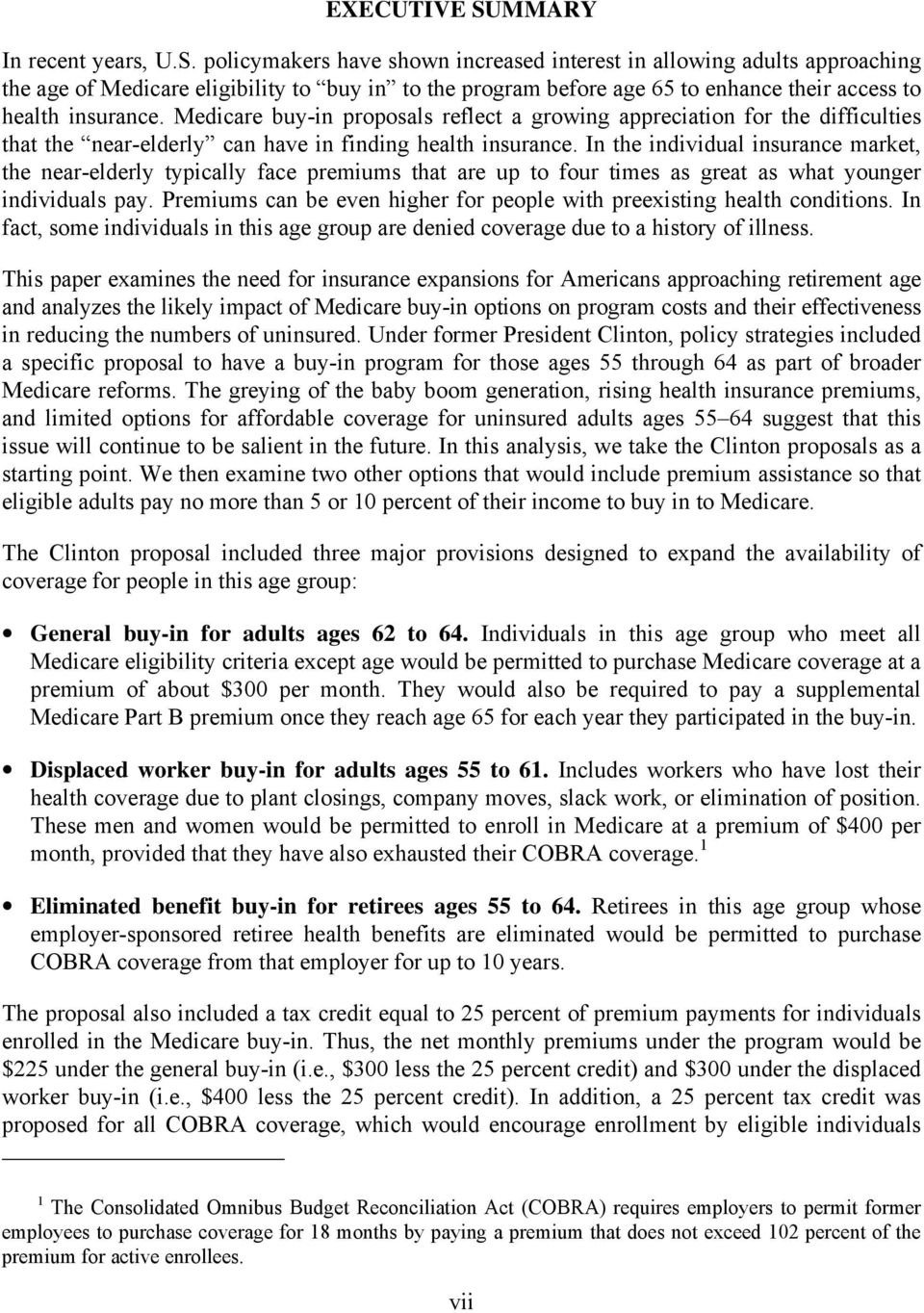
5 EXECUTIVE SUMMARY In recent years, U.S. policymakers have shown increased interest in allowing adults approaching the age of Medicare eligibility to buy in to the program before age 65 to enhance their access to health insurance. Medicare buy-in proposals reflect a growing appreciation for the difficulties that the near-elderly can have in finding health insurance. In the individual insurance market, the near-elderly typically face premiums that are up to four times as great as what younger individuals pay. Premiums can be even higher for people with preexisting health conditions. In fact, some individuals in this age group are denied coverage due to a history of illness. This paper examines the need for insurance expansions for Americans approaching retirement age and analyzes the likely impact of Medicare buy-in options on program costs and their effectiveness in reducing the numbers of uninsured. Under former President Clinton, policy strategies included a specific proposal to have a buy-in program for those ages 55 through 64 as part of broader Medicare reforms. The greying of the baby boom generation, rising health insurance premiums, and limited options for affordable coverage for uninsured adults ages suggest that this issue will continue to be salient in the future. In this analysis, we take the Clinton proposals as a starting point. We then examine two other options that would include premium assistance so that eligible adults pay no more than 5 or 10 percent of their income to buy in to Medicare. The Clinton proposal included three major provisions designed to expand the availability of coverage for people in this age group: General buy-in for adults ages 62 to 64. Individuals in this age group who meet all Medicare eligibility criteria except age would be permitted to purchase Medicare coverage at a premium of about $300 per month. They would also be required to pay a supplemental Medicare Part B premium once they reach age 65 for each year they participated in the buy-in. Displaced worker buy-in for adults ages 55 to 61. Includes workers who have lost their health coverage due to plant closings, company moves, slack work, or elimination of position. These men and women would be permitted to enroll in Medicare at a premium of $400 per month, provided that they have also exhausted their COBRA coverage. 1 Eliminated benefit buy-in for retirees ages 55 to 64. Retirees in this age group whose employer-sponsored retiree health benefits are eliminated would be permitted to purchase COBRA coverage from that employer for up to 10 years. The proposal also included a tax credit equal to 25 percent of premium payments for individuals enrolled in the Medicare buy-in. Thus, the net monthly premiums under the program would be $225 under the general buy-in (i.e., $300 less the 25 percent credit) and $300 under the displaced worker buy-in (i.e., $400 less the 25 percent credit). In addition, a 25 percent tax credit was proposed for all COBRA coverage, which would encourage enrollment by eligible individuals 1 The Consolidated Omnibus Budget Reconciliation Act (COBRA) requires employers to permit former employees to purchase coverage for 18 months by paying a premium that does not exceed 102 percent of the premium for active enrollees. vii
6 under the eliminated benefit buy-in created under this program. In the analysis, we examine the buy-in option with and without these tax credits. Need for Expanded Insurance Options for Adults Approaching the Age of Medicare This analysis indicates that there is a great need for expanded access to insurance coverage among the near-elderly. Currently there are 864,400 uninsured individuals ages 62 to 64, of whom 52 percent have incomes below 150 percent of the federal poverty level (FPL). Within the near-elderly group, the uninsured are in disproportionately poor health. About 32 percent of the uninsured ages 62 to 64 reported their health as fair or poor, as opposed to only 26 percent of all people this age (Figure ES-1). Because of their health status, these uninsured men and women typically face higher premiums in the individual insurance market premiums that make health insurance unaffordable on such low incomes. Figure ES-1 Health Status of Adults Ages 62 to 64, by Primary Insurance Source Percent who reported their health to be fair or poor 80% 71% 60% 58% 40% 20% 26% 15% 19% 32% 0% All adults Medicare Medicaid Employer Non-group insurance Uninsured Source: Lewin Group analysis of March Current Population Survey for 1996 and Lack of insurance is also a major problem for those ages 55 to 61. Although there are some 2 million in this age group who are uninsured, only 347,500 meet the definition of displaced worker under the displaced worker buy-in program. These uninsured displaced workers also tend to be in lower-income groups and in poorer health than the general population. Unfortunately, few of these individuals are likely to enroll in the buy-in programs as currently structured. Most of the uninsured in these age groups live on lower incomes and are therefore unlikely to be able to pay the premiums even with a 25 percent tax credit. For example, the net premium under the general buy-in ($225 per month) would be, on average, equal to about 38 percent of income for the uninsured ages 62 to 64. The net premium under the displaced worker buy-in ($300 per month) would be equal to approximately 71 percent of income for eligible workers ages 55 to 61 (Table ES-1). Participants in the general buy-in, furthermore, would be viii
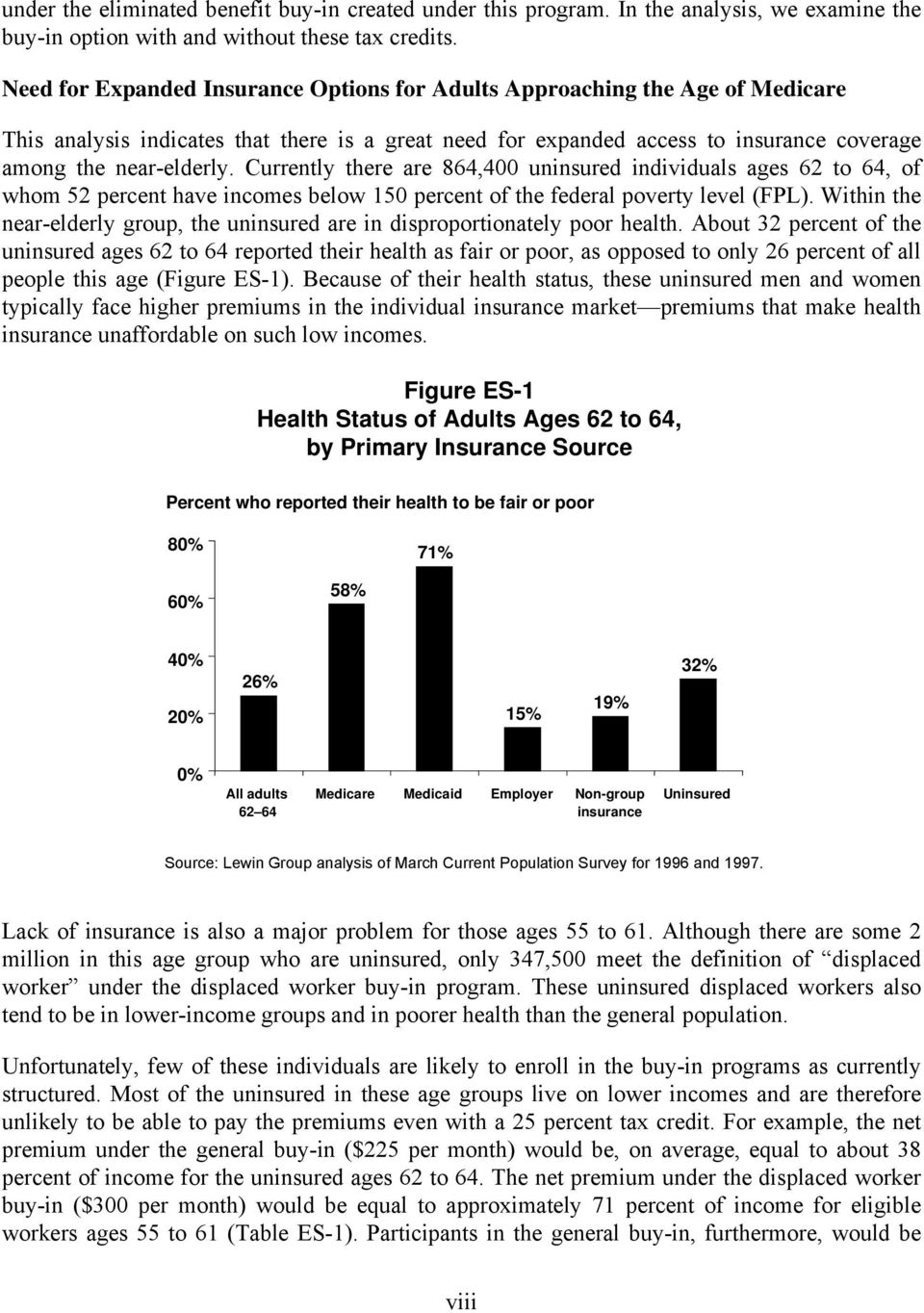
7 required to pay a monthly supplemental premium of $10 per month once they reach age 65 for each year of participation in the buy-in an additional barrier to enrollment. Consequently, enrollment is likely to be low under these buy-in proposals. Table ES-1 Uninsured Individuals Potentially Eligible for Buy-In, by Income as a Percentage of the Federal Poverty Level (FPL) Uninsured Displaced Workers Ages 55 to 61 Uninsured Individuals Ages 61 to 64 Below FPL 36.1% 34.1% 100% 150% of FPL 20.3% 18.1% 150% 200% of FPL 14.3% 12.1% 200% 300% of FPL 12.8% 13.9% 300% of FPL or More 16.5% 21.8% Total Percentage 100.0% 100.0% Total Uninsured (in thousands) Buy-In Premium as Percentage of Income Source: Lewin Group estimates. 70.6% 37.5% Buy-In Options: Potential Coverage and Costs The impact that the buy-in will have on coverage will depend on the cost of coverage relative to the price of the insurance currently available. People may be induced to take coverage if the buy-in premiums are less than what they would pay for comparable coverage in the individual market. In this study, we estimated how many would enroll in the program based on a prior study of how changes in the price of insurance affect the likelihood that an individual would take coverage. This earlier study indicates that, for lower-income adults, a 1 percent reduction in price is, on average, associated with an increase in the percentage of those with coverage of 0.2 to 0.34 percent. Based on these data, if the buy-in were implemented without the 25 percent tax credit, about 176,600 individuals would enroll (Table ES-2). Most of these people, however, would already be insured they would enroll because the buy-in premium is less than what they now pay for coverage. Only 11,600 (6.6%) of buy-in enrollees would be uninsured. These estimates reflect the fact that most of the uninsured who would be eligible for the program have low incomes, and so would be very unlikely to take coverage without substantial subsidies. We estimate that the total number enrolling in the buy-in would increase to 552,800 if it were implemented together with the 25 percent tax credit as proposed by the Clinton Administration. However, only about 47,300 (8.5%) would be uninsured individuals who are induced to take ix
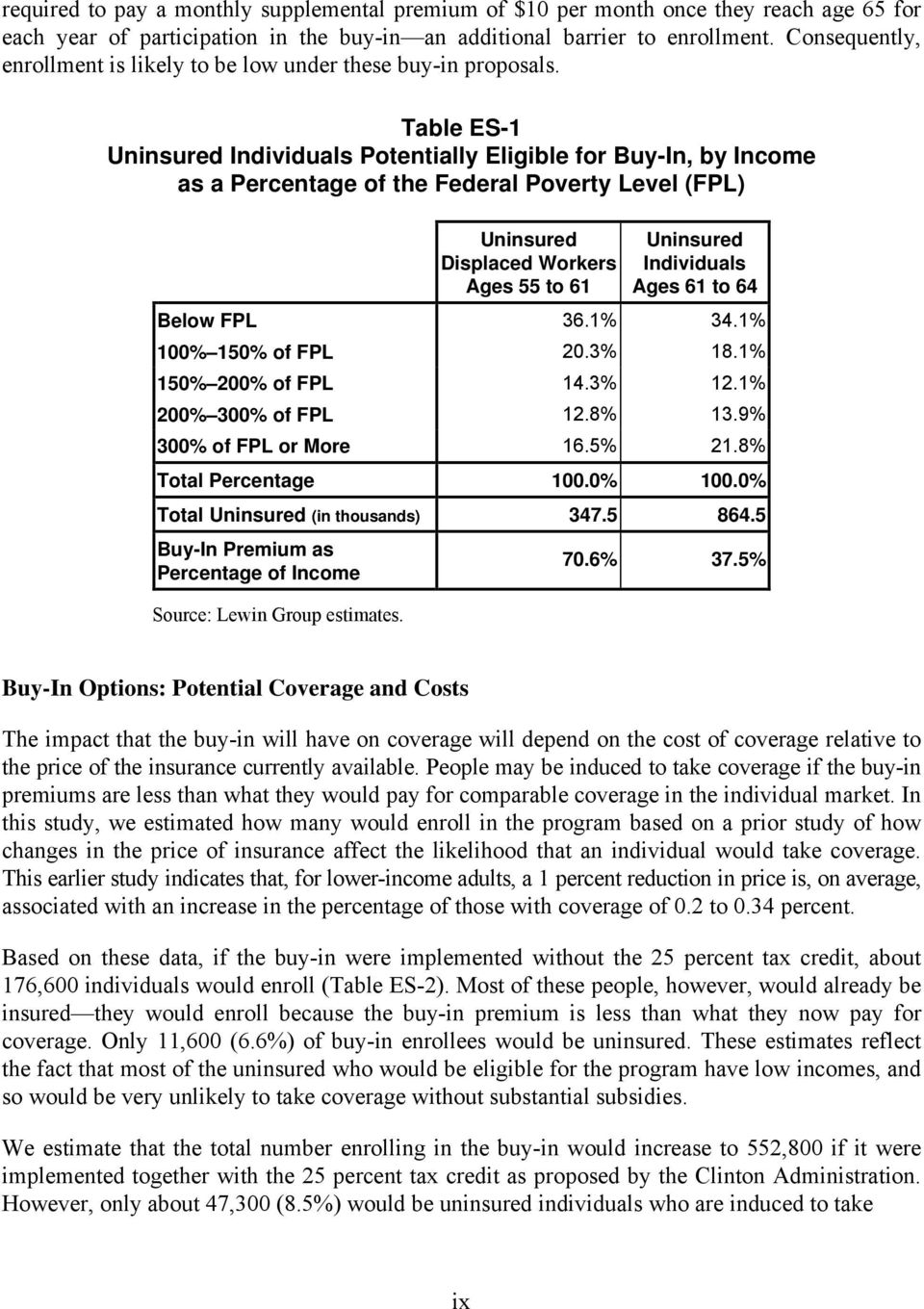
8 Table ES-2 Total Buy-in Enrollment with a 25 Percent Tax Credit and with Alternative Means-Tested Premium Subsidy Models Buy-In Without Tax Credit a Buy-In with Buy-In with Premium Refundable Caps as a Percentage of 25 Percent Income c Tax Credit b 10 Percent 5 Percent Reduction in Uninsured (in thousands) Number of Buy-In Enrollees (in thousands) Program Costs (in millions) $58.2 $2,101.0 $3,363.7 $3,770.6 Premiums Before Subsidies (in millions) $43.9 $2,098.8 $3,334.2 $3,845.7 Net Program Cost (in millions) $14.3 $2.2 $29.5 ($75.1) Premium Subsidies (in millions) --- $524.5 $1,720.3 $2,650.2 TOTAL Net Program Cost (in millions) $14.3 $526.7 $1,749.8 $2,575.1 a Includes displaced worker buy-in and general buy-in enrollment. b Assumes that: 1) all individuals enrolling in the buy-in receive a tax credit equal to 25 percent of premium payments; 2) the credit is refundable, meaning that the amount of the credit can exceed amount of taxes owed; and 3) the credit is available only for individuals enrolling in the buy-in. c Assumes that premium subsidies are provided so that premium payments for do not exceed a given percentage of income (e.g., 5% or 10%). Source: Lewin Group estimates. coverage. The low level of enrollment among the uninsured stems from the fact that even with the tax credit, premiums under the buy-in would still represent a large percentage of family income, and few of the uninsured would be able to afford them. Total net costs under this proposal would be about $527 million in 2000, a figure that includes the cost of benefits provided under the program in excess of premium payments, plus the cost of the 25 percent tax credit. Enrollment in the buy-in could be expanded by raising the amount of subsidies provided to lower-income individuals who are eligible for the buy-in. One approach would be to limit the amount of the premium so that it does not exceed 5 percent of income. Enrollment would then increase to about 1 million, of whom 330,700 (33.1%) would otherwise have been uninsured. Total costs under the program would be about $2.6 billion in Our analysis reveals that because the uninsured who would be eligible for the buy-in typically have low incomes, these individuals would find it very difficult to afford even the subsidized premiums proposed in the Clinton plan. In fact, most of the people who would enroll would be those who currently have nongroup coverage. These individuals would opt for the buy-in because the premium would be less than what they now pay for private coverage. Subsidies, therefore, would need to be increased substantially for the program to achieve a sizable reduction in the number of uninsured. x

9 MEDICARE BUY-IN OPTIONS: ESTIMATING COVERAGE AND COSTS I. INTRODUCTION In 2000, the Clinton Administration launched the debate over a Medicare buy-in program. Under its proposal, Americans approaching the age of Medicare eligibility a group that faces a combination of rising health insurance costs and declining health status would be able to purchase Medicare benefits prior to age 65. Funding would come primarily from actuarially based premiums and surcharges on Medicare Part B premiums after reaching age 65 for those who elect the early buy-in. An amended proposal would provide for a 25 percent tax credit for premium payments to encourage the near-elderly to enroll. Congress also required the Bipartisan Commission on the Future of Medicare to examine the buy-in option during its deliberations. Given the growth in the number of adults ages as the baby boom generation ages, rising health insurance premiums, and limited options for affordable coverage for uninsured older adults, the policy options to improve coverage for older adults should continue to attract attention. The Medicare buy-in proposal reflects a growing appreciation for the difficulties that the nearelderly often experience in finding health insurance. A recent Alpha Center study found that HMO premiums for a healthy 60-year-old are typically four times as great as the premium for a healthy 25-year-old. 2 Retirees who have employer-sponsored early retiree health benefits are also facing growing cost-sharing obligations. 3 Moreover, the increased incidence of disease among the near-elderly means that many in this age group face disproportionately high premiums or are denied coverage altogether in the individual insurance market. The Clinton proposal has three main provisions: General buy-in for individuals ages 62 to 64. Participants would pay a monthly premium set at the actuarial value of the Medicare coverage (estimated to be $300 per month) until they reach 65, the age of Medicare eligibility. This premium is likely to be less than the actual cost of caring for these individuals because the program is expected to attract people with disproportionately high health costs. When the beneficiaries reach Medicare eligibility age, they will have to pay an additional premium of approximately $10 per month for every year of participation in the buy-in to pay the remainder of the premium cost over time. Displaced worker buy-in for workers ages 55 to 61. This provision would be available to individuals ages 55 to 61 who have lost or left [their] job because of a plant closing/company moves, slack work, or the position has been abolished or shifted, and who have exhausted their access to COBRA coverage from that job. The estimated cost of this program is $400 per month, which would be paid by the beneficiary. There is no additional premium surcharge once enrollees become eligible for Medicare. 2 Understanding Individual Health Insurance Markets: Structure, Practices, and Products in Ten States. Prepared by the Alpha Center for the Kaiser Family Foundation. March What Fills the Gap as Employers Drop Health Care Coverage for Pre-Medicare Retirees? Medicine and Health. Perspectives on the Marketplace, August 4,
10 Eliminated benefit buy-in for all retirees ages 55 to 64. This would be available to retirees 55 to 64 whose retirement health benefits were reduced or eliminated by their former employer after they retired. These workers would be eligible to purchase insurance through COBRA for up to 10 years by paying a premium equal to 125 percent of the active employees premium cost. The employer would pay for any additional cost of coverage. 4 The buy-in also includes a 25 percent tax credit to help enrollees pay the premium. The tax credit would be available only to those enrolling in the Medicare buy-in program, including displaced workers ages 55 to 61 and general buy-in enrollees ages 62 to 64. In addition, the proposal includes a 25 percent tax credit for purchases of COBRA coverage by adults of all ages, including those purchasing coverage from a former employer through the eliminated benefit buyin created under the program. We assume that the tax credit would be refundable, which means that the amount of the credit is permitted to exceed the amount of income taxes owed by the individual. This feature is intended to extend the benefits of the tax credit to all buy-in enrollees, including lower-income adults who pay little or no income taxes. The buy-in proposal would provide a source of health coverage for those who have not been able to get insurance due to a history of illness or who face stiff preexisting condition limitations in the individual insurance market. The proposal, however, has been criticized because of its likely small impact on the uninsured near-elderly population. 5 For over half of the uninsured ages 62 to 64, the buy-in premium with the tax credit would, on average, equal 38 percent of income. Consequently, few of the near-elderly uninsured would be likely to enroll. Given the high cost of insurance for people in this age group, subsidies would be required to help this population secure health coverage. One by-product of the buy-in proposal is that some of the insured would drop their existing coverage to buy into Medicare. Many of the near-elderly would find that buying into Medicare is a less costly alternative to private insurance, particularly for those with a history of illness. Medicare would thus tend to attract people with disproportionately high health care costs who currently own nongroup coverage. (This tendency to accumulate a disproportionate share of highcost individuals is known as adverse selection. ) In fact, there might be a substantial net increase in Medicare costs even after accounting for the premium surcharges that would be imposed once enrollees reach age 65. The 25 percent tax credit would reduce adverse selection among buy-in enrollees. The credit would lower the premium enough so that that the program attracts healthy individuals as well as sick ones, lowering average costs under the program. The added cost of providing premium subsidies, then, is partly offset by a reduction in costs attributed to adverse selection. 4 Even under current law, retirees would be able to purchase COBRA coverage for 18 months following termination, which could also mitigate some of the savings to employers from eliminating early retiree coverage. 5 J. Sheils, D. Stapleton, J. Graus, and A. Fishman, Rethinking the Medicare Eligibility Age, report to the National Coalition on Health Care, The Lewin Group, Inc.,
11 The buy-in would also create opportunities for employers to dump, in effect, their retiree health plan beneficiaries into the buy-in program at a substantial cost to Medicare. For example, employers with average retiree health care costs that are greater than the Medicare buy-in premium could eliminate their early retiree benefit and increase retiree pension payments by the amount of the buy-in premium so that retirees can buy the coverage themselves. Doing this would save money for the employer without necessarily having a detrimental impact on retirees. It would, however, add to Medicare beneficiaries who cost more than what is paid in premiums. Moreover, the existence of the buy-in could provide a rationale for eliminating the retiree benefit altogether regardless of the impact on the retiree since retirees would have the option of buying coverage through Medicare at a group rate. Some of the industry s most costly early retirees could thus be shifted into Medicare. The purpose of this study is to analyze the likely impacts of adopting a Medicare buy-in model such as that proposed by the Clinton Administration. We present data on the characteristics of the population groups that are potentially eligible under the buy-in and estimate the number who would enroll. We also estimate whether the premiums charged under the buy-in would be sufficient to cover the cost of the program. Our analysis is presented in the following sections: General Buy-In, Ages 62 to 64 Displaced Worker Buy-In, Ages 55 to 61 Discontinued Benefit Buy-In, Ages 55 to 64 Buy-In Enrollment and Costs 3
12 II. GENERAL BUY-IN, AGES 62 TO 64 The general buy-in is designed to provide an additional health coverage option for those nearelderly who do not have access to employer coverage and do not qualify for Medicare as disabled. Adults ages 62 to 64 would be eligible to participate as long as they met the same eligibility criteria that would apply at age 65 (e.g., sufficient quarters of coverage). Buy-in participants would be required to pay a premium based on the average cost of covering persons ages 62 to 64 with the Medicare benefits package, which is estimated to be about $300 per month. The premium, however, is not likely to be sufficient to cover program costs because buyin enrollees are expected to be in disproportionately poor health, with high health care costs. In an attempt to recover costs in excess of premium payments, when buy-in enrollees reach Medicare retirement age, they would be required to pay a surcharge on the Part B premium (about $10 per month for each year of participation in the buy-in). There would be no Part B premium surcharge on those who never participated in the buy-in. The buy-in provides an alternative to purchasing nongroup health insurance in the individual insurance market. In most states, insurers in the individual market are not required to guarantee issue of coverage without preexisting condition limitations. 6 Consequently, individuals with a history of illness may be either denied coverage or issued coverage with substantial preexisting condition exclusions. Insurers can also impose high premiums on people with health conditions. Many states have high-risk pools that provide a source of coverage for high-cost individuals who cannot get insurance. However, the premium for people in these pools can be two times or more of the average premium for comparable age groups. For people with a history of illness, the buyin will often be an attractive alternative to the coverage that is available in the individual market. Nevertheless, the buy-in would benefit only those who can afford to pay the premium. Lowerincome individuals are not likely to be able to pay the $300 monthly premium, even with the help of the 25 percent tax credit. The buy-in, therefore, is likely to benefit primarily higher-income individuals who have a history of illness. In this section, we examine the income and health status characteristics of 62-to-64-year-olds, based on March Current Population Survey (CPS) data for 1996 and Data from these two years have been pooled to form a single database with sufficient sample size for detailed analyses of this three-year age group. Although the CPS is believed to underreport health insurance coverage for Medicaid in particular, it is the largest and most recent data source that provides information on sources of coverage. 6 Under the Health Insurance Portability and Accountability Act (HIPPA), workers who have maintained coverage for 12 months or more are permitted to shift to coverage in the individual market without preexisting condition limitations. 7 For households that were interviewed in both 1997 and in 1996, we used only the responses provided in

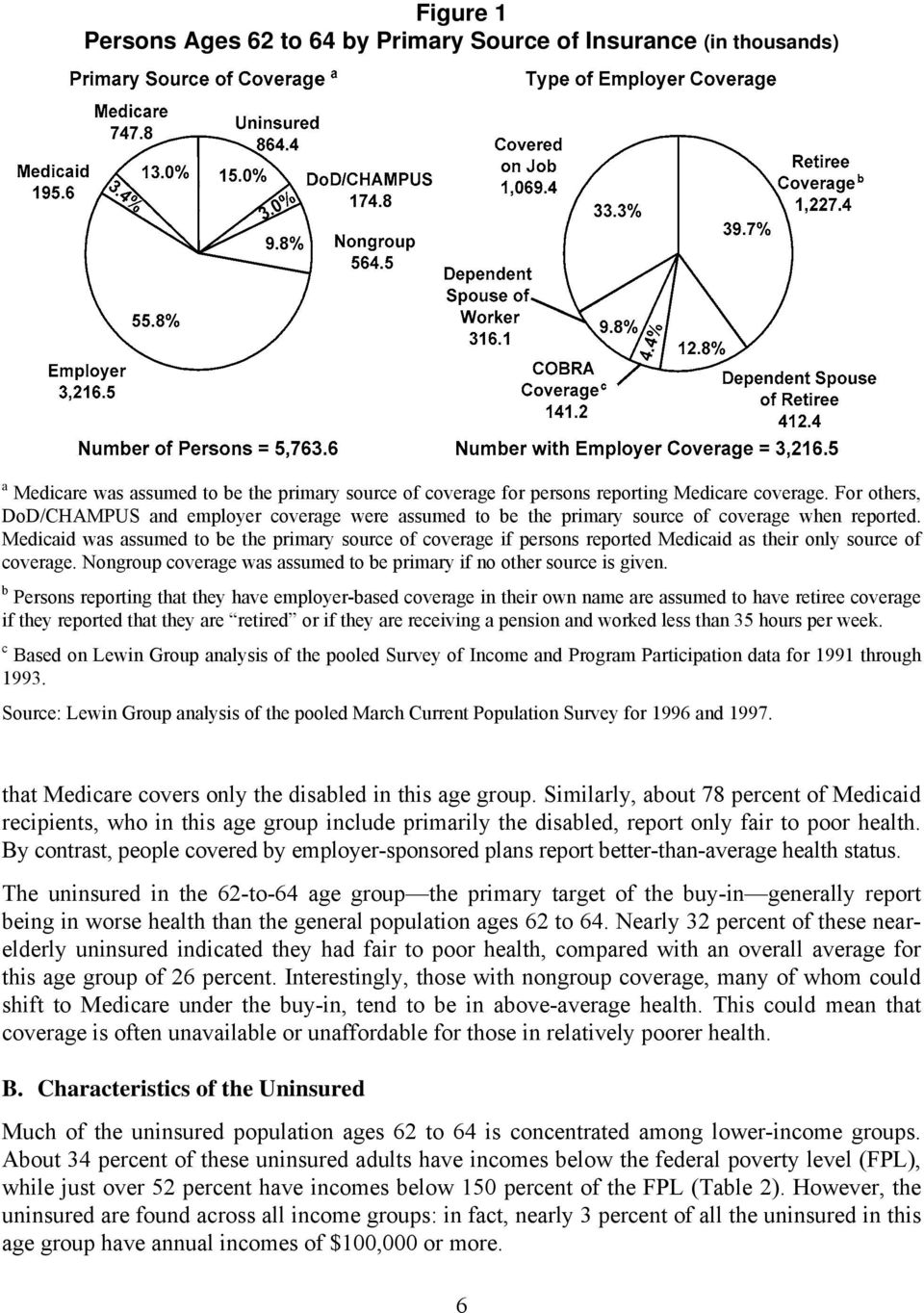
13 A. Sources of Coverage A buy-in option, as proposed by the Clinton Administration, effectively offers an alternative source of health coverage to Americans ages 62 to 64 who are uninsured or are purchasing coverage in the individual market. About 5.8 million people fall within this age range, of whom 864,400 (15%) are uninsured. In addition, approximately 564,500 adults in this age group have individually purchased, nongroup insurance, including policies purchased in the individual market and participants in high-risk pools around the country. This brings the number of potentially eligible individuals to about 1.4 million. Employer-based health insurance is the largest source of coverage for men and women 62 to 64. Figure 1 presents the distribution of individuals in this age group according to their primary source of coverage. 8 About 56 percent are covered under an employer-sponsored plan. Another 3 percent are covered under the Department of Defense CHAMPUS program, which covers dependents of active-duty military personnel and retirees. About 13 percent are covered under Medicare because they are disabled, while a little more than 2 percent have Medicaid as their primary coverage, which in this age group includes primarily low-income disabled persons. About 15 percent are uninsured. Employer coverage encompasses five general eligibility groups. Of the approximately 3.2 million persons ages 62 to 64 who have employer-sponsored coverage, just over 33 percent obtained coverage as a worker. A little less than 10 percent are covered as dependents of spouses who have coverage through their job. About 40 percent are covered as retirees, and approximately 13 percent are covered as dependents of retirees. 9 Although the CPS does not identify individuals purchasing coverage from a prior job under COBRA, we estimate that about 4 percent are covered on a former employer s plan through COBRA. (COBRA coverage is discussed in greater detail below.) 10 The health status of this age group varies by source of coverage, as would be expected. Table 1 shows the distribution of those with various sources of coverage by self-reported health status. 11 Overall, about 26 percent of people ages 62 to 64 reported they are in fair to poor health. About 58 percent of Medicare recipients, meanwhile, rate their health as fair to poor, reflecting the fact 8 Medicare was assumed to be the primary source of coverage for those reporting Medicare coverage. For non-medicare individuals, DoD/CHAMPUS and employer coverage were assumed to be the primary source of coverage if such coverage was reported. Nongroup coverage was assumed to be the primary source if no other source was given. Medicaid was the primary source of coverage if Medicaid was reported and no other source was indicated. 9 The CPS does not explicitly identify retiree coverage. A person who reported being retired or receiving a pension and working less than 35 hours per week was assumed to be retired. Individuals who reported coverage from an employer in their own name were assumed to have retiree coverage. These estimates are similar to those in the Medical Expenditure Panel Survey (MEPS) data. 10 Based on Lewin Group analysis of the 1996 Medical Expenditure Panel Survey (MEPS) data and the pooled Survey of Income and Program Participation (SIPP) data for 1991 through Starting in March 1996, the March Current Population Survey asks individuals to give an assessment of their health status. 5
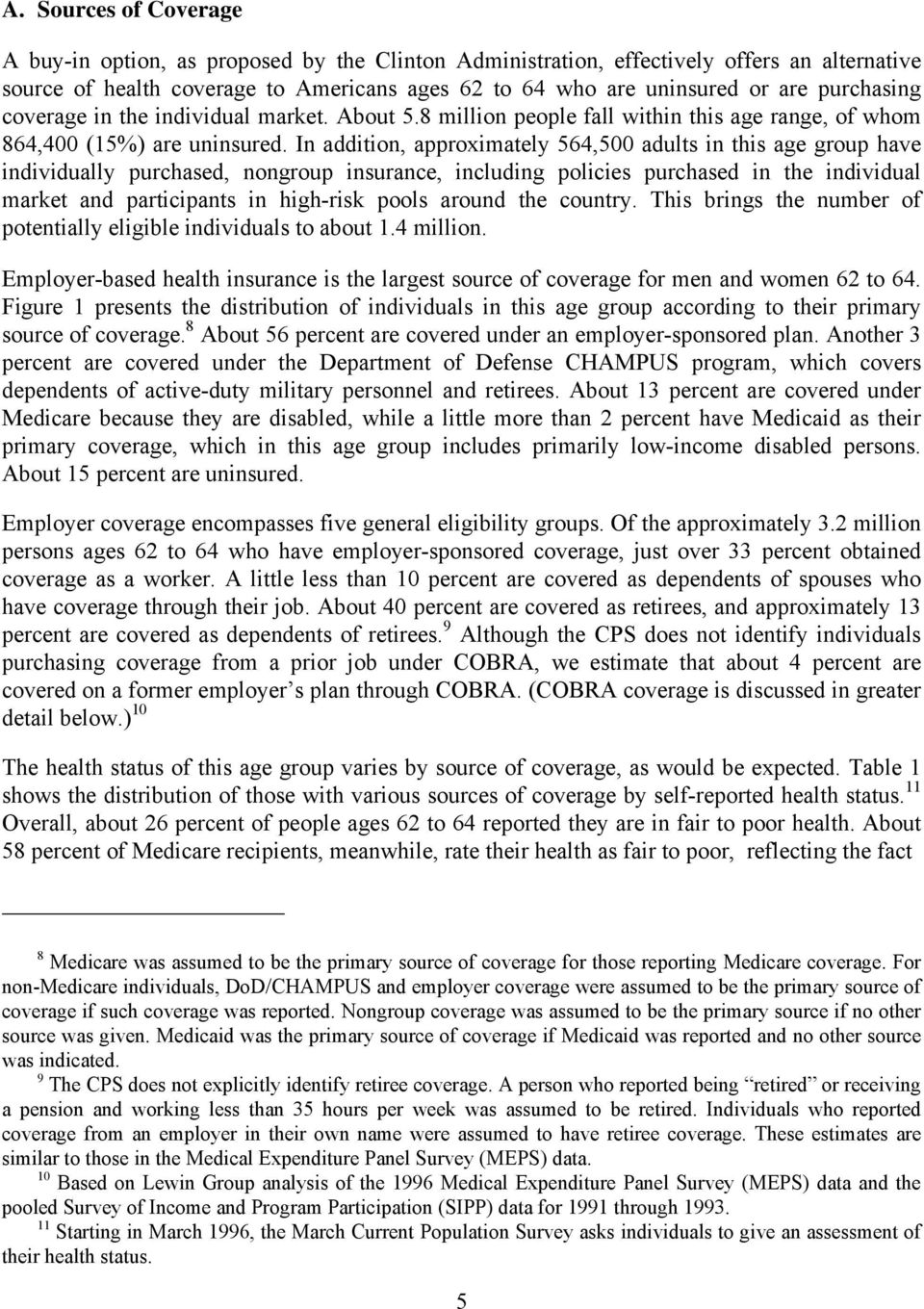
14 Figure 1 Persons Ages 62 to 64 by Primary Source of Insurance (in thousands) a Medicare was assumed to be the primary source of coverage for persons reporting Medicare coverage. For others, DoD/CHAMPUS and employer coverage were assumed to be the primary source of coverage when reported. Medicaid was assumed to be the primary source of coverage if persons reported Medicaid as their only source of coverage. Nongroup coverage was assumed to be primary if no other source is given. b Persons reporting that they have employer-based coverage in their own name are assumed to have retiree coverage if they reported that they are retired or if they are receiving a pension and worked less than 35 hours per week. c Based on Lewin Group analysis of the pooled Survey of Income and Program Participation data for 1991 through Source: Lewin Group analysis of the pooled March Current Population Survey for 1996 and that Medicare covers only the disabled in this age group. Similarly, about 78 percent of Medicaid recipients, who in this age group include primarily the disabled, report only fair to poor health. By contrast, people covered by employer-sponsored plans report better-than-average health status. The uninsured in the 62-to-64 age group the primary target of the buy-in generally report being in worse health than the general population ages 62 to 64. Nearly 32 percent of these nearelderly uninsured indicated they had fair to poor health, compared with an overall average for this age group of 26 percent. Interestingly, those with nongroup coverage, many of whom could shift to Medicare under the buy-in, tend to be in above-average health. This could mean that coverage is often unavailable or unaffordable for those in relatively poorer health. B. Characteristics of the Uninsured Much of the uninsured population ages 62 to 64 is concentrated among lower-income groups. About 34 percent of these uninsured adults have incomes below the federal poverty level (FPL), while just over 52 percent have incomes below 150 percent of the FPL (Table 2). However, the uninsured are found across all income groups: in fact, nearly 3 percent of all the uninsured in this age group have annual incomes of $100,000 or more. 6
15 Self-Reported Health Status Table 1 Distribution of People Ages 62 to 64 by Self-Reported Health Status and Primary Source of Coverage All Persons Medicare Medicaid Employer Coverage CHAMPUS Nongroup Insurance Uninsured Excellent 16.4% 5.6% 4.3% 19.5% 18.8% 19.7% 14.4% Very Good 25.1% 9.7% 7.2% 31.1% 23.0% 24.5% 21.0% Good 32.5% 27.2% 17.1% 34.2% 26.8% 36.5% 32.8% Fair 16.6% 26.2% 34.9% 12.0% 21.0% 14.4% 21.3% Poor 9.4% 31.3% 36.5% 3.2% 10.4% 4.9% 10.5% TOTAL 100.0% 100.0% 100.0% 100.0% 100.0% 100.0% 100.0% Number of Persons (in thousands) 5, , Source: Lewin Group analysis of the pooled March Current Population Survey for 1996 and Table 2 Distribution of People Ages 62 to 64 by Income All Ages Total Family Income Uninsured Ages Less than $10, % 35.8% $10,000 $19, % 28.8% $20,000 $29, % 13.1% $30,000 $39, % 8.5% $40,000 $49, % 4.6% $50,000 $74, % 4.5% $75,000 $99, % 2.0% $100,000 or More 7.2% 2.7% Total 100.0% 100.0% Income as a Percentage of the Federal Poverty Level (FPL) Below FPL 14.7% 34.1% 100% 150% of FPL 9.7% 18.1% 150% 200% of FPL 9.4% 12.1% 200% 300% of FPL 17.8% 13.9% 300% of FPL or More 48.4% 21.8% Total 100.0% 100.0% Source: Lewin Group analysis of the pooled March Current Population Survey for 1996 and

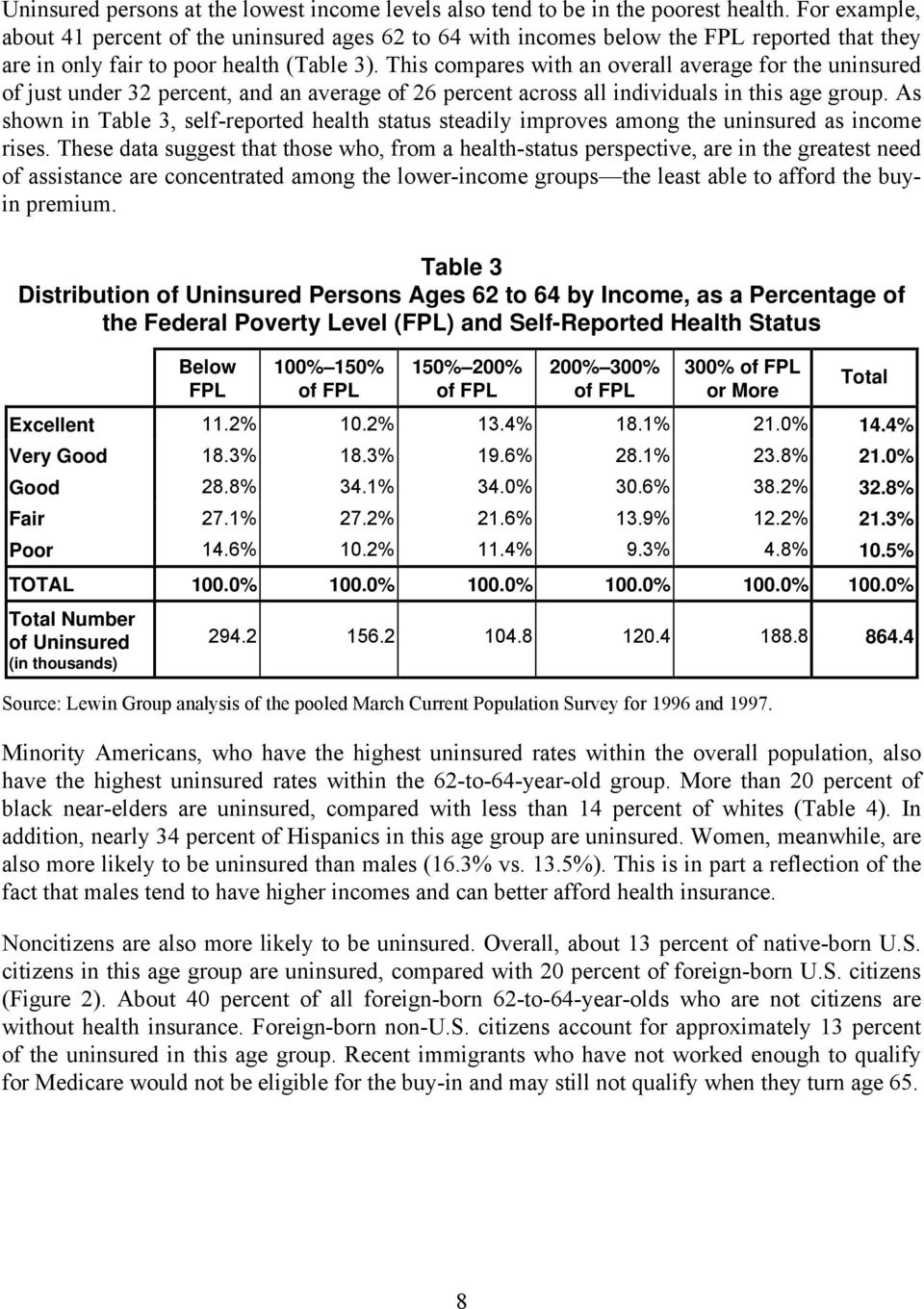
16 Uninsured persons at the lowest income levels also tend to be in the poorest health. For example, about 41 percent of the uninsured ages 62 to 64 with incomes below the FPL reported that they are in only fair to poor health (Table 3). This compares with an overall average for the uninsured of just under 32 percent, and an average of 26 percent across all individuals in this age group. As shown in Table 3, self-reported health status steadily improves among the uninsured as income rises. These data suggest that those who, from a health-status perspective, are in the greatest need of assistance are concentrated among the lower-income groups the least able to afford the buyin premium. Table 3 Distribution of Uninsured Persons Ages 62 to 64 by Income, as a Percentage of the Federal Poverty Level (FPL) and Self-Reported Health Status Below FPL 100% 150% of FPL 150% 200% of FPL 200% 300% of FPL 300% of FPL or More Total Excellent 11.2% 10.2% 13.4% 18.1% 21.0% 14.4% Very Good 18.3% 18.3% 19.6% 28.1% 23.8% 21.0% Good 28.8% 34.1% 34.0% 30.6% 38.2% 32.8% Fair 27.1% 27.2% 21.6% 13.9% 12.2% 21.3% Poor 14.6% 10.2% 11.4% 9.3% 4.8% 10.5% TOTAL 100.0% 100.0% 100.0% 100.0% 100.0% 100.0% Total Number of Uninsured (in thousands) Source: Lewin Group analysis of the pooled March Current Population Survey for 1996 and Minority Americans, who have the highest uninsured rates within the overall population, also have the highest uninsured rates within the 62-to-64-year-old group. More than 20 percent of black near-elders are uninsured, compared with less than 14 percent of whites (Table 4). In addition, nearly 34 percent of Hispanics in this age group are uninsured. Women, meanwhile, are also more likely to be uninsured than males (16.3% vs. 13.5%). This is in part a reflection of the fact that males tend to have higher incomes and can better afford health insurance. Noncitizens are also more likely to be uninsured. Overall, about 13 percent of native-born U.S. citizens in this age group are uninsured, compared with 20 percent of foreign-born U.S. citizens (Figure 2). About 40 percent of all foreign-born 62-to-64-year-olds who are not citizens are without health insurance. Foreign-born non-u.s. citizens account for approximately 13 percent of the uninsured in this age group. Recent immigrants who have not worked enough to qualify for Medicare would not be eligible for the buy-in and may still not qualify when they turn age 65. 8
17 Table 4 Percent of Population Ages 62 to 64 Without Health Insurance, by Sex, Race, and Ethnicity Percent Uninsured White 13.7% Black 20.1% Native American 12.5% Asian/Pacific 33.9% Hispanic 33.9% Non-Hispanic 13.6% Sex Male 13.5% Female 16.3% All Persons 15.0% Source: Lewin Group analysis of the pooled March Current Population Survey for 1996 and Figure 2 Percent of Population Ages 62 to 64 Without Insurance, by Citizenship Status 40.0% Percent Uninsured 40.2% Uninsured by Citizenship Status (in thousands) Foreign-Born Non-US Citizen % 20.0% 13.3% 20.3% 15.0% Foreign-Born US Citizen % 13.1% 10.0% 0.0% Native-Born US Citizen Foreign-Born US Citizen Foreign-Born Non-US Citizen All % Native-Born US Citizen Citizenship Status Total Uninsured = Source: Lewin Group analysis of the pooled March Current Population Survey for 1996 and The percent uninsured within the 62-to-64 age group also varies according to the type of living arrangement. In general, the more independent an individual s or married couple s living arrangement, the less likely they are to be uninsured. For example, while less than 10 percent of married individuals living on their own are uninsured, more than 14 percent of those living with a child are without insurance (Figure 3). Married individuals with children generally have lower incomes and can less afford health insurance. 9
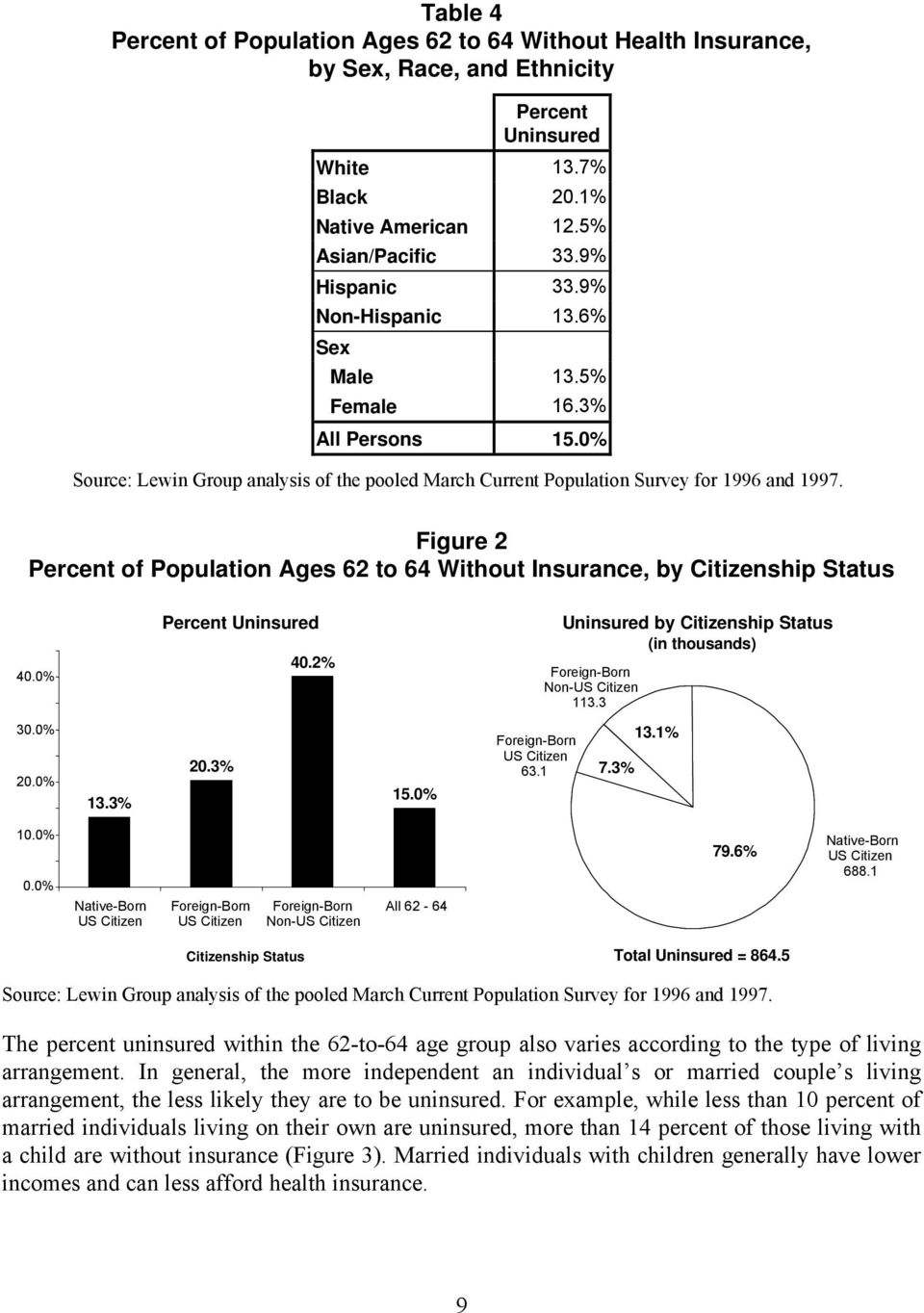
18 Figure 3 Percent of Population Ages 62 to 64 Without Insurance, by Living Arrangement 30.0% 20.0% Percentage Uninsured 29.1% 20.6% 14.1% 15.3% Uninsured by Living Arrangement (in thousands) Unmarried Living Alone % Married Couples Living with Child(ren) % 10.0% 9.5% Unmarried in Group Quarters % 0.0% Live with Spouse Only Live with Spouse & Child(ren) Live with Child(ren) Only Group Quarters Live Alone Unmarried Living with Child(ren) % 38.2% Married Couples Living Alone Married Couples Living Arrangement Single Individuals Total Uninsured = Source: Lewin Group analysis of the pooled March Current Population Survey for 1996 and Similarly, while about 15 percent of men and women ages 62 to 64 who are single and living alone are uninsured, nearly 21 percent of single adults in this age group who are living with a child are without insurance. In addition, about 29 percent of single adults living with unrelated persons in group quarters are uninsured (which may also reflect the fact that lower-income adults must sometimes share housing to make ends meet). About 57 percent of the uninsured near-elderly ages 62 to 64 are married. Just over 38 percent of all uninsured persons in this age group are married and living independently (Figure 3). Another 18 percent of the uninsured are married and living with a child. Overall, single individuals account for approximately 43 percent of the uninsured ages 62 to 64. C. Ability to Pay Buy-In Premium The number of people enrolling in the buy-in will in part depend on the affordability of the premium. The general buy-in monthly premium is projected to be about $300 per person, or $3,600 per year. With the 25 percent tax credit, the net premium (i.e., less the tax credit amount) would be $225, or $2,700 per year. Married couples would pay twice that amount ($5,400). For most uninsured persons ages 62 to 64 this will represent a prohibitively large percentage of their income. In fact, using the income data reported for the uninsured, we estimate that the buy-in premium payment will average about 51 percent of their income Income is defined to include total personal income for single individuals and the combined total income of individuals and their spouse if married (spouse present). The premium is equal to $3,600 for single individuals who are uninsured and $7,200 for married couples where both partners are uninsured and from 62 to 64 years old. 10
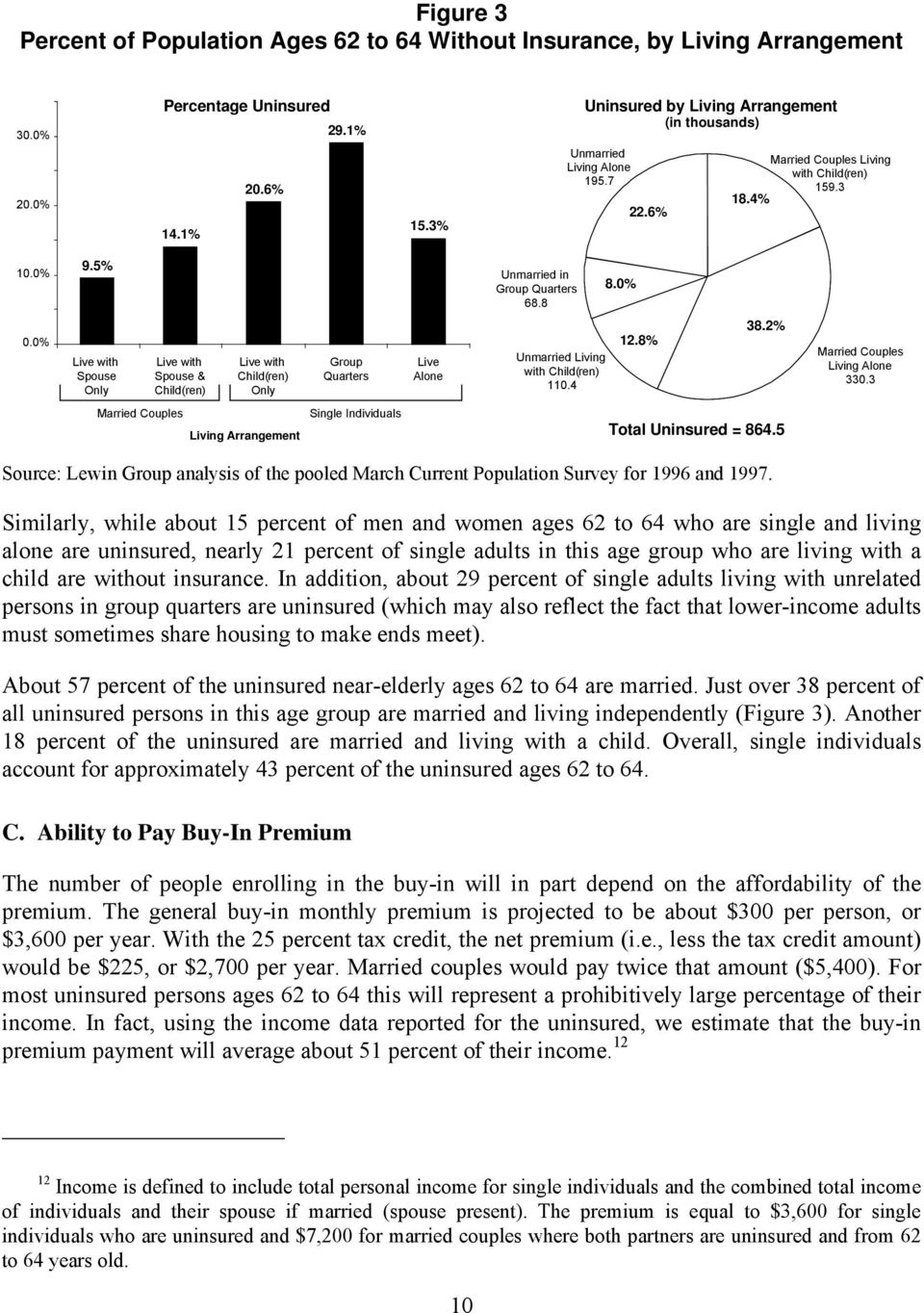
19 Table 5 shows the average buy-in premium amount as a percentage of income for people in various income groups and both with and without the 25 percent tax credit. For adults with total incomes of less than $5,000 per year, premiums would equal about 200 percent of income. Among those with incomes of $5,000 to $9,999, the net premium would equal just under 39 percent of income. While premiums as a percentage of income decline as income rises, it is not until incomes rises to about $40,000 that premiums for the uninsured would drop below 10 percent of income. On average, net premiums would be less than 5 percent of income only for those with $75,000 or more per year in income. The uninsured in this income group, however, account for less than 5 percent of the uninsured ages 62 to 64. These data suggest that very few of the uninsured would be able to afford this coverage. Table 5 Premium Payments as a Percentage of Income for the Uninsured Ages 62 to 64 Number (in thousands) Percentage of Uninsured Premium as a Percentage of Income Without Tax Credit Premium as a Percentage of Income with Tax Credit Annual Income a Less than $5, % 267.0% 200.2% $5,000 $9, % 51.9% 38.9% $10,000 $14, % 32.1% 24.1% $15,000 $19, % 23.0% 17.2% $20,000 $29, % 17.0% 12.7% $30,000 $39, % 13.5% 10.1% $40,000 $49, % 9.3% 7.0% $50,000 $74, % 6.9% 5.2% $75,000 $99, % 4.9% 3.7% $100,000 or More % 3.0% 2.2% Living Arrangement Live with Spouse % 36.4% 27.3% Unmarried Living with Child(ren) % 77.1% 57.8% Unmarried Living in Group Quarters % 68.1% 51.1% Unmarried Living Alone % 68.4% 51.8% All Ages % 50.5% 37.9% a Income includes total income for husband and wife in married-couple families and the income of the individual if not married. The Medicare premium is assumed to be $300 for each uninsured person in the family ages 62 to 64. Source: Lewin Group analysis of the March Current Population Survey data for 1996 and Nevertheless, it is possible that a substantial portion of the uninsured in this age group would find other means to purchase the coverage. Some, for example, might pay for the coverage with savings or on proceeds from the sale of other assets. This would be advantageous for uninsured people with high health care costs who are currently spending down their assets to cover medical costs. Similarly, adult children and other family members might pay the premium for a sick 11
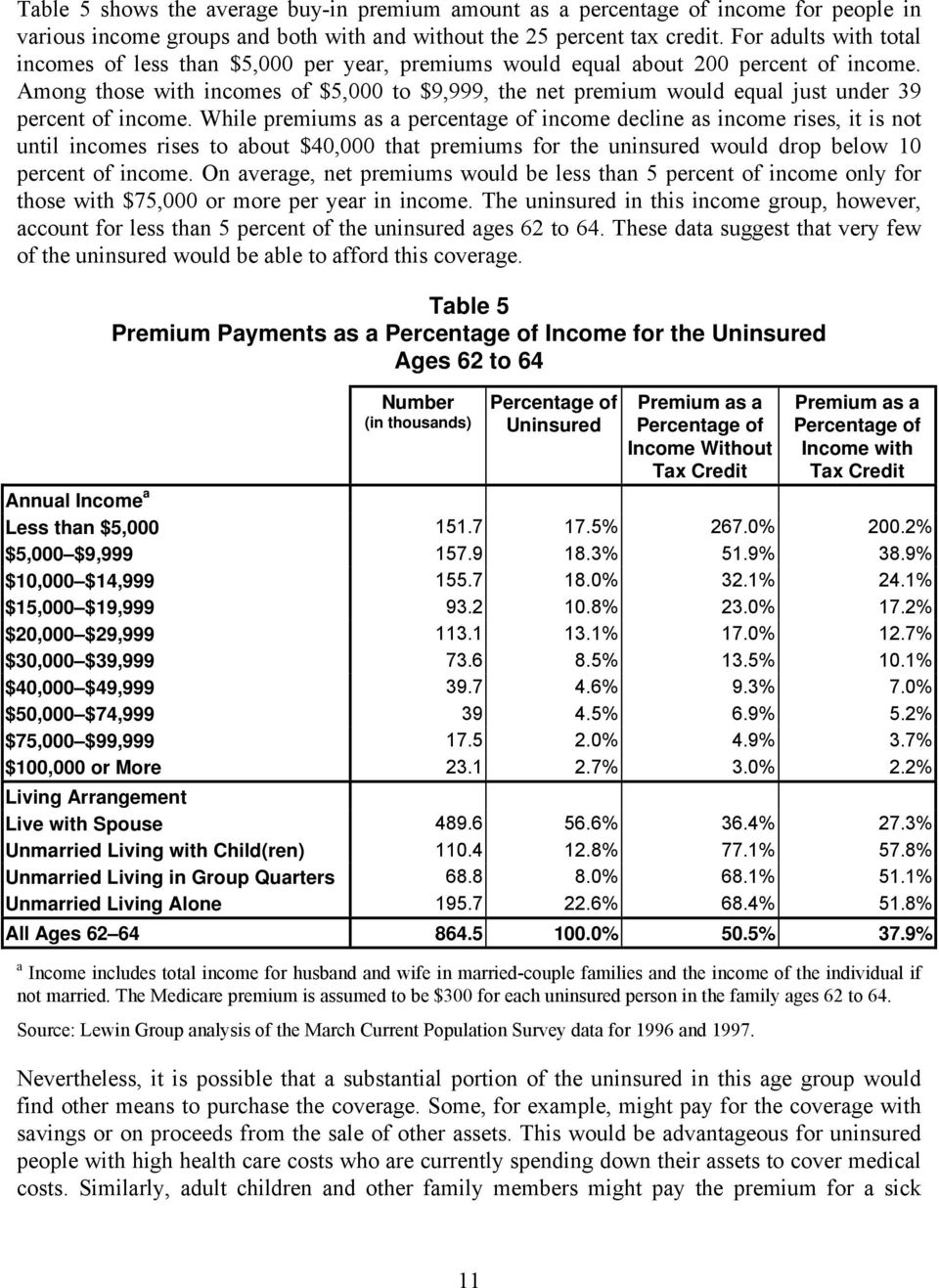
20 parent, particularly in cases where they are paying some of the parent s health care costs out-ofpocket. Some evidence exists that a portion of those who do not have subsidized insurance from an employer or a public program are either dissaving or relying upon another family member to purchase coverage. Currently, about 1.4 million 62-to-64-year-olds do not have subsidized coverage from an employer or public program (Table 6). Of this group, 564,500 have nongroup insurance purchased in the individual market (39.5%), while 864,500 remained uninsured. Interestingly, some of those who purchased nongroup coverage did so despite the fact that the premium comprised what many would consider to be a prohibitively large portion of their income. About 21 percent of those with incomes below $10,000 who do not have subsidized coverage purchased a nongroup policy. In higher-income groups, the percentage of those without subsidized coverage who bought coverage in the individual market is about 60 percent. Table 6 Percent of Individuals Ages 62 to 64 Without Employer or Public Coverage Who Purchase Nongroup Insurance, by Family Income (in thousands) Family Income Persons Without Employer or Public Coverage Total Persons Purchase Nongroup Remain Uninsured Percent Purchasing Nongroup Less than $10, % $10,000 $19, % $20,000 $29, % $30,000 $39, % $40,000 $49, % $50,000 $74, % $75,000 $99, % $100,000 or More % Total 1, % Source: Lewin Group analysis of the pooled March Current Population Survey for 1996 and The likelihood that people would use these means to pay the buy-in premium depends on an individual s health expenses and the buy-in premium amount relative to the cost of insurance in the individual market. Many, for example, have the option of purchasing coverage in the individual market but do not do so often because they have a chronic health condition that causes the insurer to charge a higher premium. In these cases, the buy-in may represent a lower-cost alternative to nongroup insurance, and therefore may result in an increase in health coverage. Moreover, people who have been denied coverage, or who face substantial preexisting condition limitations owing to their health status, would now be able to purchase the Medicare buy-in premium without preexisting condition limitations at what is essentially a group rate. This, too, may entice some of the uninsured to draw down their assets to enroll. Our analysis of enrollment in the program is presented later in this report. 12

21 III. DISPLACED WORKER BUY-IN FOR ADULTS 55 TO 61 The second leg of the Clinton Administration s proposal is a Medicare buy-in for displaced workers ages 55 to 61. Like the general buy-in for 62-to-64-year-olds, this one would be open only to individuals who would be eligible for benefits under Medicare Part A or Part B at age 65, including dependent spouses ages 55 to 61 and workers who have accumulated the minimum number of quarters of covered employment to qualify. However, the buy-in for this age group is limited to workers and dependent spouses who have lost their employer-sponsored coverage due to layoffs or plant closings. Furthermore, these displaced workers must have exhausted their eligibility for continuing coverage through their former employer s plan under COBRA in order to be eligible. 13 Eligibility rules for displaced workers are quite restrictive: Eligibility is limited only to those who have lost employer-based health coverage due to involuntary termination of employment attributed to slack work, layoffs, plant closings, company moves, or the abolishment or shifting of a position. The worker must meet the eligibility requirements for unemployment compensation based on separation from employment on or after January 1, However, the worker does not actually have to be receiving unemployment compensation to qualify. The individual must have lost employer coverage as a result of job separation. As of the date on which the individual loses coverage, the individual must have been covered continuously for a 12-month period; The individual must not be eligible to participate under the federal health insurance program or other group health plans. The individual must have exhausted eligibility for continuing coverage under the former employer s health plan. Participants in this Medicare buy-in would pay a premium based on the average cost of covering individuals who enroll in the program. The premium is estimated at $400 per month about $100 more than the general buy-in premium for 62-to-64-year-olds ($300). However, the 25 percent tax credit brings the net premium cost down to $300. Unlike the general buy-in premium for persons ages 62 to 64, the premium is set at a level that reflects the expectation that those who are most likely to enroll in the program would be in disproportionately poor health and have high health care costs. We estimate that the $400 premium is about 26 percent higher than the cost of comparable coverage (i.e., the Medicare benefits package) for an average individual in this age group. Consequently, the Medicare buy-in 13 The Consolidated Omnibus Reconciliation Act of 1988 (COBRA) permits workers who are separated from employment to purchase coverage from their former employer for a period of 18 months by paying a premium equal to 105 percent of the average total actuarial cost of the employer s health plan (i.e., both employer and employee shares). 13
22 would be attractive primarily to people who must pay an even higher premium in the individual market or in high-risk pools across the country. The displaced worker buy-in program could thus become a national high-risk pool for displaced workers and their dependents in this age group. Interestingly, the availability of the tax credit could actually serve to offset much of this adverse selection. The reason is that the credit lowers the cost of buy-in coverage for all individuals including those in relatively good health, many of whom are already paying a lower-than-average premium in the nongroup market. The premium subsidy, which is available for buy-in coverage only, can therefore serve to reduce the degree of adverse selection by attracting individuals of varying health status. A. Sources of Coverage for Persons Ages 55 to 61 There are 15.5 million people ages 55 to 61 in the United States, of whom about 2 million (13.1%) are uninsured (Figure 4). Nearly 67 percent of the men and women in this age group are covered under an employer-sponsored plan. Another 2 percent are covered under the Department of Defense s CHAMPUS program, which covers active-duty military dependents and retirees. Somewhat more than 6 percent of individuals in this age group (993,200) have Medicare as their primary source of coverage due to disability. Another 3 percent have Medicaid as their primary coverage, which is generally limited to people with low incomes or disabilities. 14 About 3.2 million adults 55 to 61 are not covered by a subsidized plan from an employer or by a government program; of these individuals, 1.2 million purchased nongroup insurance in the individual insurance market, while 2 million are uninsured. Approximately 10.3 million people in this age group have employer-sponsored coverage as workers, early retirees, dependents of workers or retirees, or former employees purchasing COBRA coverage from a former employer. Of those 55-to-61-year-olds with employer coverage, a little more than 60 percent are workers with coverage on their own job and 17 percent are spouses covered as dependents under a working spouse s employer health plan. Meanwhile, about 13 percent are covered as a retiree and roughly 6 percent are covered as a dependent spouse of someone with employer-sponsored retiree coverage. Using data from the 1996 Medical Expenditure Panel Survey (MEPS) data, we estimate that 314,400 (3%) of those with employer coverage are purchasing coverage from a former employer under COBRA. 14 The Medicaid program typically covers: low-income children; parents, who are usually under age 55; persons who meet the program definition of disability; and the aged. 14
23 Figure 4 Persons Ages 55 to 61 by Primary Source of Insurance (in thousands) a Medicare was assumed to be the primary source of coverage for persons reporting Medicare coverage. For others, DoD/CHAMPUS and employer coverage were assumed to be the primary source of coverage when reported. Medicaid was assumed to be the primary source of coverage if persons reported Medicaid as their only source of coverage. Nongroup coverage was assumed to be primary if no other sources of insurance were given. b Persons reporting that they have employer-based coverage in their own name are assumed to have retiree coverage if they reported that they are retired or if they are receiving a pension and work less than 35 hours per week. c Based on Lewin Group analysis of the 1996 Medical Expenditure Panel Survey and the pooled Survey of Income and Program Participation data for 1991 through Source: Lewin Group analysis of the pooled March Current Population Survey for 1996 and The uninsured ages 55 to 61 are disproportionately poor and tend to be in relatively poorer health. About 46 percent of the uninsured in this age group have annual incomes below 150 percent of the FPL (Table 7), compared with less than 20 percent of the overall population in this age range. Also, about 29 percent of the uninsured 55 to 61 report being in only fair to poor health, compared with less than 22 percent of all persons this age. B. Access to Employer-Based Coverage Of the uninsured ages 55 to 61 approximately 2 million people about 52 percent reported that they are working (Figure 5). These typically include persons who work for an employer that does not offer health insurance, and part-time or temporary workers, who often do not qualify for coverage under employer plans. This group also includes those who have refused the health coverage offered by their employer, either because they felt that they could not afford the premium contribution required or because they are healthy and do not see the benefit of participating. 15
24 Table 7 Distribution of Persons Ages 55 to 61 by Income as a Percentage of the Federal Poverty Level (FPL) and Self-Reported Health Status All Ages Uninsured Income as Percentage of the Federal Poverty Level (FPL) Below FPL 13.3% 33.4% 100% 150% of FPL 6.5% 12.8% 150% 200% of FPL 6.3% 11.0% 200% 300% of FPL 10.6% 11.3% 300% of FPL or More 63.3% 31.5% Total 100.0% 100.0% Self-Reported Health Status Excellent 20.3% 14.0% Very Good 28.5% 23.1% Good 29.6% 33.9% Fair 13.3% 18.9% Poor 8.3% 10.1% TOTAL 100.0% 100.0% Number (in thousands) 15, ,029.6 Source: Lewin Group analysis of the pooled March Current Population Survey for 1996 and Figure 5 Uninsured Ages 55 to 61 by Work Status (in thousands) Source: Lewin Group analysis of the pooled March Current Population Survey for 1996 and
25 Nearly half of the 2 million uninsured in the 55-to-61 age group (975,700) are not working. Just over 17 percent reported they were not working due to retirement, and little more than 9 percent reported that they were not working due to disability. Less than 5 percent are unemployed and looking for work. The CPS data also indicate that 73 percent of the uninsured who are not working have been unemployed for a year or more. 15 Many of the uninsured who are not working are connected to employment as a dependent spouse of a worker. About 39 percent of uninsured nonworkers in this age group are a spouse of a worker. Overall, about 1.4 million of uninsured persons ages 55 to 61 are connected to employment either as a worker or as a dependent spouse. Historically, the large percentage of uninsured persons who are connected to employment has led policymakers to consider reducing the number of the uninsured through expansions in employer-sponsored coverage. Most uninsured workers in this age group, however, work in small firms, relatively few of which offer insurance. About 46 percent of uninsured workers are employed by a firm with fewer than 10 employees (Figure 6) and about 68 percent are in firms with fewer than 100 workers. In fact, only 22 percent of these individuals are in firms with 500 or more workers, where insurance coverage tends to be highest. Also, roughly 25 percent of uninsured workers work fewer than 35 hours per week; these individuals are often not eligible for employer coverage where available Figure 6 Distribution of the Uninsured Who Are Associated with Employment, by Firm Size and Hours Worked (in thousands) a a Includes persons who are either employed or are married to an employed individual. Source: Lewin Group analysis of the pooled March Current Population Survey for 1996 and Lewin Group estimates using March Current Population Survey data for 1996 and
26 because of their part-time status. Programs that provide coverage through means other than employment such as a Medicare buy-in may thus be one of the more effective means of addressing the needs of the near-elderly population. C. Displaced Workers The Clinton buy-in proposal for adults ages 55 to 61 targets only those who meet the relatively narrow definition of displaced worker. To estimate the size of this population, we used Survey of Income and Program Participation (SIPP) data, which provide information on the reasons why individuals stopped working on their prior job. SIPP is an ongoing panel survey in which individuals are questioned several times over a period of years. It provides detailed information on the use of public programs, employment, and job changes over time. Although the information included in the survey can be uniquely valuable, the most recent available data is from Thus, the data reflect the higher levels of unemployment that existed in the early 1990s. To provide a sample size large enough for this study, we pooled the data for different respondents over the period. To approximate the definition of displaced workers used in the Clinton plan, we defined displaced workers in the SIPP data to include workers on layoff, terminated due to plant closings, or discharged, as well as those on a temporary job that ended. Of the 14.4 million persons ages 55 to 61 during the survey period, 1.6 million (11.3%) met these displaced worker criteria (Table 8). About 3 million (20.8%) cited personal changes such as retirement and health problems as the reason for leaving their prior jobs. Another 2.4 million (16.7%) had voluntarily terminated employment, for example, because they wanted a better job or they were dissatisfied with their earnings. About 51 percent had not worked in the last 10 years. While only 11 percent of men and women ages 55 to 61 are displaced workers, we estimate that another nearly 7 percent of this population (949,500 persons) will qualify as the spouse of a displaced worker. These include spouses of displaced workers 55 to 61 who are not covered by an employer plan or other public program. This brings the number of those potentially affected by the displaced worker program to 2.6 million. This estimate, however, may overstate the number of persons who would meet this definition today. The current economy is generally better than in the early 1990s, which should be associated with a decline in the numbers of those who meet the displaced worker definition. For example, the unemployment rate for 55-to-64-year-old adults declined from a high for the decade of 4.8 percent in 1992 to 2.7 percent by 1998 (Figure 7). While the unemployment rate may not be the best predictor of the number of displaced workers, it does indicate that there are likely to be fewer potentially eligible persons than indicated in the SIPP data. Moreover, these data suggest that enrollment in the buy-in for this age group will shift as changes in the economy occur. 18
27 Table 8 Adults Ages 55 to 61 by Main Reason Stopped Working on Prior Job Number Percent of (in thousands) Total Displaced Workers 1, % Layoff, Plant Closing 1, % Discharged % Job was Temporary and Ended % Personal/Family Changes 2, % Retirement/Old Age a 1, % Health Reasons 1, % Other Family or Personal Reasons % Voluntary Terminations 2, % Found a Better Job % Did Not Like Working Conditions % Dissatisfied with Earnings % Did Not Like Location % Going to School % Other Reasons 1, % Persons Not Working in Last 10 Years 7, % TOTAL Ages , % a Some of those who were displaced may have reported that they were retired if they took available retirement benefits at termination. These data do not permit us to identify these cases. Source: Lewin Group analysis of the pooled Survey of Income and Program Participation data for Most of the workers who are displaced from employment obtained coverage after termination. About 32 percent of the 1.6 million displaced workers obtained employer coverage on a new job (Figure 8). Approximately 23 percent became covered as a dependent on a spouse s employer plan. Nearly 11 percent (173,600) purchased continuing coverage from their former employer under COBRA. 16 Only 4 percent enrolled in Medicare or Medicaid and a little more than 8 percent purchased nongroup coverage in the individual market. Just over 21 percent of displaced workers (347,500) became uninsured. The displaced workers who became uninsured (347,500) had substantially lower incomes than displaced workers in general. About 56 percent of uninsured displaced workers had incomes below 150 percent of the FPL, while less than 25 percent of all displaced workers had incomes below that level (Table 9). Approximately 41 percent of displaced workers with incomes below the FPL became uninsured. This reflects the fact that persons with low incomes are substantially less able to afford the premiums for COBRA benefits or nongroup coverage in the individual insurance market. 16 Individuals were counted as purchasing COBRA coverage if they were receiving coverage from a former employer and did not indicate that they had left their prior job due to retirement. 19
28 Figure 7 Average Monthly Unemployment Rate for the Total Civilian Labor Force and the 55-to-64 Population, a 8.0% Total Civilian Labor Force 7.0% 7.5% 6.0% 5.0% 4.0% 3.0% 5.3% 3.1% 5.6% 3.3% 6.8% 3.9% 6.9% 6.1% 4.8% 4.3% 4.4% Persons Age 55 to % 3.7% 5.4% 3.4% 4.9% 3.0% 4.5% 2.7% 2.0% 1.0% 0.0% a Separate unemployment rates are not available for persons ages 55 to 61. Source: Bureau of Labor Statistics, Current Population Survey available at [email protected]. Figure 8 Sources of Insurance for Displaced Workers, Ages 55 to 61 (in thousands) Medicare/Medicaid % Current Employer % 21.4% Uninsured % Non-Group Former Employer (COBRA) % 23.4% Dependent of Spouse s Employer Plan Workers Displaced on Prior Job = 1,622.7 Source: Lewin Group analysis of pooled Survey of Income and Program Participation data for
29 Table 9 Displaced Workers Ages 55 to 61 Who Are Uninsured a, by Income, as a Percentage of the Federal Poverty Level (FPL) and Health Status Displaced Workers Uninsured Displaced Workers a Percentage of Displaced Workers Who Are Uninsured Income as a Percentage of the Federal Poverty Level (FPL) b Below FPL 15.2% 36.1% 51.0% 100% 150% of FPL 9.5% 20.3% 45.8% 150% 200% of FPL 10.0% 14.3% 30.6% 200% 300% of FPL 17.7% 12.8% 15.5% 300% of FPL or More 47.6% 16.5% 7.4% TOTAL 100.0% 100.0% 21.4% Self-Reported Health Status Excellent 19.3% 15.8% 16.9% Very Good 28.8% 13.9% 10.0% Good 29.8% 39.5% 27.5% Fair 15.3% 18.2% 24.7% Poor 6.8% 12.6% 38.3% TOTAL 100.0% 100.0% 21.4% Number of Persons (in thousands) 1, N/A a Based on insured status at the time of the interview. b Based on family income in the month of the interview. Source: Lewin Group estimates using the Survey of Income and Program Participation data for Uninsured displaced workers tend to be in poorer health than displaced workers in general. About 31 percent of uninsured displaced workers reported being in only fair to poor health, compared with an average of 22 percent for all displaced workers. Moreover, the likelihood of a displaced worker being without coverage actually increases as health status declines. Less than 17 percent of displaced workers who indicated they were in excellent health were uninsured, while about 38 percent of displaced workers who reported their health status as poor are uninsured. It is important to understand that only a portion of those whom we have counted as displaced workers would qualify. Uninsured displaced workers would qualify for the buy-in only if they had coverage on a prior job and only if they had exercised and exhausted their COBRA coverage option from that employer. Unfortunately, the data did not permit us to identify those who met these important requirements. We expect, however, that few would have met these eligibility criteria, since it is unlikely that predominantly low-income uninsured displaced workers would be able to pay the COBRA premium for 18 months as required to qualify for the buy-in. 21
30 D. Ability to Pay Buy-In Premium As stated previously, the premium for qualifying displaced workers is projected to be about $400 per month ($4,800 per year). The payment is reduced to $300 per month by the 25 percent tax credit. Participating married couples would pay $600 per month net of tax credits, which comes to $7,200 annually. These premiums are very high for people in the 55-to-61 age group. In fact, we estimate that they are about 64 percent greater than the average cost of the Medicare benefits package for persons in this age group. 17 As discussed above, the premiums are set at these relatively high levels to reflect the fact that the displaced worker buy-in would tend to attract those in below-average health. However, one of the consequences of setting the premium at this higher level is that few of these uninsured displaced workers are likely to be able to afford the premium. We estimate that, on average, net family premium payments for uninsured displaced workers and their spouses would amount to almost 71 percent of their income (Table 10). Premiums would equal nearly 413 percent of income for those living on less than $5,000 and 58 percent for those with incomes from $5,000 to $9,999. All but those uninsured displaced workers with incomes of $40,000 or more would find that the premium exceeds 10 percent of income. In fact, only the few uninsured displaced workers with annual incomes in excess of $100,000 would find the premium to be less than 5 percent of income. As discussed above, the fact that buy-in premiums would virtually exhaust the incomes of eligible persons does not necessarily mean that these individuals would not enroll. Some lowincome individuals who are drawing down their assets to pay high health care costs may find it advantageous to enroll, despite the premium. This would tend to occur among chronically ill patients with expected medical expenses that exceed the Medicare buy-in premium amount. Also, children and other family members may pay for the coverage, especially in cases where these relatives are covering medical expenses for a potentially eligible individual. There are indications that some displaced workers are already taking this route. For example, of the 1.6 million displaced workers ages 55 to 61, about 481,000 did not obtain subsidized health coverage through an employer plan or a public program (Table 11). Of these, just under 28 percent (133,600) obtained nongroup coverage in the individual market, leaving 347,500 uninsured. In fact, nearly 18 percent of those with incomes below the FPL obtained nongroup coverage. Those who obtained coverage likely drew upon their assets or relied on other family members to pay for it. Clearly, then, some uninsured displaced workers are able to purchase the coverage despite their low incomes. This most likely occurs, however, only in cases where the buy-in premium is less than what they would have paid for nongroup coverage in the individual market or through a state high-risk pool. 17 Lewin Group estimates using the Lewin Group Health Benefits Simulation Model. 22
31 Table 10 Premium Payments as a Percentage of Income for Uninsured Displaced Workers and Uninsured Spouses Ages 55 to 61 a, b Annual Income Number of Uninsured Displaced Workers and Spouses (in thousands) Percentage of Uninsured Workers and Spouses Premium as a Percentage of Income With Tax Credit Without Tax Credit Less than $5, % 412.5% 550.0% $5,000 $9, % 58.1% 77.5% $10,000 $14, % 35.0% 46.7% $15,000 $19, % 25.6% 34.1% $20,000 $29, % 17.8% 23.7% $30,000 $39, % 13.0% 17.4% $40,000 $49, % 9.4% 12.6% $50,000 $74, % 7.3% 9.8% $75,000 $99, % 5.2% 6.9% $100,000 or More % 2.8% 3.7% All Ages % 70.6% 94.2% a Income includes total income for husband and wife in married-couple families and the income of the individual if not married. The Medicare premium is assumed to be $300 for each uninsured person in the family ages 62 to 64. b Includes uninsured displaced workers and uninsured spouses of displaced workers. Source: Lewin Group analysis of the March Current Population Survey data for 1996 and Table 11 Displaced Workers Without Subsidized Coverage from an Employer or Government Plan Who Purchase Nongroup Insurance, Ages 55 to 61 (excludes spouses of displaced workers) Income as a Percentage of the Federal Poverty Level (FPL) Displaced Workers Ages 55 to 61 Without Employer Group or Government Subsidized Coverage Total (in thousands) Purchase Nongroup Coverage (in thousands) Remain Uninsured (in thousands) Percentage Purchasing Nongroup Coverage Below FPL % 100% 150% of FPL % 150% 200% of FPL % 200% 300% of FPL % 300% of FPL or More % TOTAL % Source: Lewin Group analysis of the pooled Survey of Income and Program Participation data for
32 IV. ELIMINATED BENEFIT COBRA BUY-IN FOR THOSE 55 TO 64 The third component of the Clinton Administration s buy-in proposal is designed to provide protection for early retirees whose health benefits have been cut by their former employers. The eliminated benefit COBRA buy-in permits retirees age 55 or older whose retiree health benefits have been substantially reduced or eliminated to purchase COBRA coverage from that employer until they become eligible for Medicare. The 25 percent tax credit for COBRA coverage proposed by the Administration would also apply to purchases of COBRA under the eliminated benefit buy-in coverage. To be eligible for the buy-in, the retiree must have been participating in the retiree plan at the time that the plan was changed. A retiree is eligible if his or her benefits were terminated or the actuarial value of the benefits was reduced by 50 percent or more from the later of January 1999 or the date that the benefits commenced. Under the law, changes in the actuarial value of the retiree coverage can include increases in deductibles, copayments, and out-of-pocket limits, or increases in premium contribution requirements. The buy-in would apply only to retirees and dependent spouses of retirees ages 55 to 64. Early retiree COBRA participants would be required to pay to the employer a premium equal to 125 percent of the average actuarial cost for active workers. Since average costs for this age group are typically much higher than 125 percent of costs for active workers, employers would effectively be subsidizing the costs for these retirees. Moreover, the subsidy amount is increased by the fact that a disproportionate share of the early retirees who would be willing to pay this premium would be in relatively poorer health and have high health care costs. This provision is largely inspired by the reduction in employer-sponsored retiree coverage that has been occurring in recent years. The COBRA buy-in would offer some security to early retirees who are dependent on retiree coverage. Also, the potential cost of the COBRA buy-in would serve as a disincentive to eliminating or substantially reducing retiree coverage. However, the provision would not protect active workers nearing retirement whose employer reduces or eliminates the retiree health benefit, even though many of these individuals may have planned on having this coverage upon early retirement. A. Persons Covered by Early Retiree Health Plans Employer-sponsored retiree health coverage is an important source of insurance for the nearelderly. According to the 1996 Medical Expenditure Panel Survey (MEPS), there are about 20.5 million men and women ages 55 to 64, of whom 6.4 million (31.2%) identify themselves as retired (Table 12). 18 The MEPS data indicate that 4.1 million adults in this age group have coverage as a retiree 2.9 million retired workers and 1.2 million dependents of retired workers. Thus, about 20 percent of all people ages 55 to 64 rely on employer coverage as early retirees. 18 The 1996 MEPS classified a person as a retiree if he or she reported being retired or being covered by a retiree health plan. 24
33 Table 12 Population Ages 55 to 64 by Retirement Status and Coverage from Retiree Health Plans in 1996 Number of Persons (in thousands) Total Ages 55 to 64 20,543.0 Retired Individuals Ages 55 to 64 6,404.0 Those with Retiree Health Coverage 2,945.0 Dependent Spouses of Persons with Retiree Health Coverage 1,184.0 Total Covered by Retiree Health Plans 4,129.0 Percentage of Those Who Are Retired 31.2% Percentage of Those with Retiree Health Coverage 20.1% Source: Lewin Group analysis of the Medical Expenditure Panel Survey data. Some of the near-elderly also purchase coverage from a former employer under COBRA. The MEPS data report that there are about 455,600 individuals ages 55 to 64 who purchase coverage from a former employer that is not a retiree health plan. These people are assumed to be purchasing coverage from a prior employer under COBRA. This estimate is similar to that reported in the Survey of Income and Program Participation (SIPP). 19 Our analysis of these data indicates that about 59 percent of persons in this age group who purchase COBRA coverage are ages 55 to 61 and 31 percent are ages 62 to 64 (Figure 9). Retirees tended to report themselves to be in relatively better health than the general population in this age group. Less than 19 percent of retirees reported themselves to be in fair to poor health, while nearly 22 percent of the general population reported fair to poor health (Table 13). Interestingly, under 16 percent of those with retiree health coverage reported fair to poor health status less than retirees in general. The likelihood that 55-to-61-year-olds have retiree coverage generally increases with income. As shown in Figure 10, the percentage of adults with retiree health benefits increases from about 25 percent among those with less than $10,000 annual income to about 76 percent for those with incomes from $30,000 to $39,999. The proportion that has retiree coverage fluctuates between 70 and 80 percent for individuals with incomes above $40, In our analysis of the SIPP data, an individual was assumed to be purchasing COBRA coverage if they indicated they have coverage from a former employer and that they paid the full amount of the premium. 25
34 Figure 9 Individuals Purchasing Coverage from a Former Employer Under COBRA, Ages 55 to 64 a (in thousands) Ages % 69.0% Ages Number of Workers with COBRA Coverage = a Due to sample size concerns, we assumed that the distribution of workers with COBRA by age is the same as reported in the Survey of Income and Program Participation data for Source: Lewin Group analysis of the Medical Expenditure Panel Survey data for Table 13 Population Ages 55 to 64 by Retirement Status and Coverage from a Retiree Health Plan in 1996, and by Self-Reported Health Status Self-Reported Health Status Total Persons Retirees Retirees and Dependents with Retiree Health Coverage Excellent 25.0% 25.7% 25.2% Very Good 27.7% 28.0% 32.5% Good 25.7% 27.7% 26.4% Fair 13.5% 10.7% 10.4% Poor 8.1% 7.9% 5.5% TOTAL 100.0% 100.0% 100.0% Total Persons (in thousands) 20,543 6,404 4,129 Source: Lewin Group analysis of the Medical Expenditure Panel Survey data. 26
35 Figure 10 Percent of Retirees Ages 55 to 64 with Retiree Health Coverage, by Income 90.0% 80.0% 70.0% 66.2% 76.2% 71.2% 74.2% 78.6% 76.6% 60.0% 50.0% 40.0% 39.2% 50.0% 30.0% 25.3% 20.0% 10.0% 0.0% Less than $10,000 $10,000 - $15,000 $15,000 - $19,999 $20,000 - $29,999 $30,000 - $39,999 $40,000 - $49,999 $50,000 - $74,999 $75,000 - $99,999 $100,000 or More Source: Lewin Group analysis of pooled March Current Population Survey data for The availability of retiree health coverage can be an important determinant of whether an individual chooses to retire. The CPS data indicate that about 58 percent of all retirees 55 to 64 had retiree coverage (Figure 11). Among adults ages 55 to 61, however, the proportion of retirees with retiree health coverage is actually higher than it is among those ages 62 to 64 (63.8% vs. 52.7%). This suggests that 55-to-61-year-olds are less likely to retire in the absence of retiree health benefits than 62-to-64-year-olds, most of whom will be eligible for Medicare within the next one to three years. The annual CPS data also permit us to show trends in retiree health coverage in recent years. The percentage of retirees in the 55-to-64 group with retiree health coverage declined from 74 percent in 1991 to about 58 percent by Among retirees 55 to 61, the percentage with coverage dropped from almost 82 percent in 1991 to less than 64 percent in For retirees ages 62 to 64, the percentage with retiree coverage fell from approximately 67 percent to less than 53 percent over the same period. 27
36 Figure 11 Percent of Retirees a Ages 55 to 64 with Retiree Health Coverage b 90.0% 85.0% 80.0% 81.6% 85.4% Ages 55 to % 80.6% 75.0% 70.0% 65.0% 60.0% 55.0% 50.0% All Ages 55 to % 74.0% 74.8% 66.4% 70.1% 70.2% 67.1% 65.2% Ages 62 to % 63.9% 61.9% 60.6% 61.1% 58.1% 56.0% 55.8% 52.7% a Retirees include all those who indicated that they were out of the labor force due to retirement and individuals who receive a pension and are employed part-time. b Those with retiree health coverage include adults classified as retirees who reported having coverage from an employer, as well as spouses ages 55 to 64 who are covered as a dependent under their spouse s plan. Source: Lewin Group analysis of the March Current Population Survey data for B. Retiree Coverage and Early Retirement Behavior The decline in the number of retirees with health benefits is well documented. The Department of Labor, for example, has reported that the number of retirees who continued to receive employerbased health benefits into retirement dropped by 8 percentage points from 1988 to The number of those age 65 and older receiving retiree coverage also declined by 10 percentage points over this same period. 20 These reductions in retiree coverage are likely to have contributed to changes in retirement behavior among older workers. A RAND study of the effect of access to post-retirement health insurance found that the offer of continued coverage had a positive effect on the likelihood of retirement for men ages 55 to This suggests that the reduction in retiree coverage should have been associated with a reduction in the percentage of people who retire early. Indeed, labor force participation data for the near-elderly indicate that the long-term trend toward reduced labor 20 General Accounting Office, Retiree Health Insurance: Erosion in Employer-Based Health Benefits for Early Retirees, (GAO/HEHS ), L. Laroly and J. Rugowki, The Effect of Access to Post-Retirement Health Insurance on the Decision to Retire Early, RAND reprints: 94-13E (Santa Monica, CA: 1995). 28
37 force participation in these age groups was halted at about the time the availability of retiree coverage began to diminish. 22 For example, the percentage of men age 62 who are in the labor force declined from about 74 percent in 1970 to less than 51 percent by 1985 (Figure 12). However, since 1985, the percentage of men this age who are in the labor force has increased slightly, from 50.9 percent in 1985 to 52.6 percent by Among men age 55, the labor force participation rate fell from nearly 97 percent to under 84 percent from 1970 to 1985, after which the rate remained more or less constant at about 83 percent. Figure 12 Percent of Males in the Labor Force at Selected Ages for 1970, 1985, and % 90.0% 91.8% 84.9% 83.7% 83.4% 83.9% 80.0% 70.0% 74.0% 71.0% 68.3% 73.8% 60.0% 50.0% 56.8% 50.9% 52.6% 40.0% 30.0% 20.0% 10.0% 0.0% Age 55 Age 60 Age 62 Source: Richard V. Burkhauser and Joseph F. Quinn, Implementing Pro-Work Policies for Older Americans in the Twenty-First Century, in Preparing for the Baby-Boomers: The Role of Employment (U.S. Senate, Special Committee on Aging, Serial No , July 1997), Table 1, updated by the author. While labor force participation among men 55 to 64 has remained flat over the past 15 years, participation among near-elderly women has increased. Labor force participation among women ages 60 to 64, for example, increased from 32 percent in 1985 to 39 percent in Among women ages 55 to 59, participation increased from approximately 47 percent in 1985 to about 60 percent in These higher labor force participation rates reflect the fact that the percentage of women choosing to have a career has been increasing for the past few decades. Thus, over time, the percentage of near-elderly women who have employer-sponsored coverage as a worker or a retiree is likely to increase as each successive age cohort reaches ages 55 to 64. In fact, this growth in women s employment may have cushioned the impact of the decline in retiree 22 J. Quinn, Retirement Patterns and Bridge Jobs in the 1990 s, Employee Benefits Research Institute (EBRI) Issue Brief, No. 206, U.S. Department of Labor, Bureau of Labor Statistics. 29
38 coverage for men by enabling some of these individuals to obtain coverage as a dependent through their spouse s employer-sponsored plan. The change in the long-term trend towards reduced labor force participation among the nearelderly in recent years may also be explained by an increase in the use of bridge jobs in this population. Bridge jobs are jobs that early retirees take to help support themselves until they qualify for Medicare and Social Security. As discussed above, these jobs are typically in small firms and are often part-time or temporary. However, they can help pay for COBRA coverage that early retirees purchase from a former employer until they qualify for Medicare. Moreover, the use of COBRA coverage, which is available for 18 months to former employees, is a way for early retirees to remain covered during the period between early retirement and Medicare eligibility at age The Health Insurance Portability and Accountability Act (HIPAA) may also have been helpful in enabling people to retire early in cases where early retiree coverage is not available. Under HIPAA, insurers are required to cover all applicants (i.e., guarantee issue) who have maintained continuous employment for 12 months or more on an employer plan without preexisting condition limitations. Thus, workers who have been covered by employer insurance can leave that plan upon termination of employment or COBRA coverage and be assured that they can purchase coverage in the individual market without limits on preexisting conditions. Earnings from a post-retirement job may be sufficient to pay for bridging their health coverage until age 65. However, while HIPAA ensures access to this coverage, it does not ensure the affordability of coverage. For example, there is nothing in HIPAA to prevent an insurer from setting very high premiums for an individual with a health condition, thereby pricing him or her out of the market. Additional limitations on insurer rating practices could help near-elderly persons in poorer health bridge their health coverage until Medicare coverage begins. C. Trends in Employer Coverage The eliminated benefit buy-in is designed to alleviate the potential hardships for retirees resulting from the reductions in employer-sponsored early retiree benefits. The Mercer/Foster Higgins National Survey of Employer-Sponsored Health Plans indicates that the percentage of firms covering under-65 retirees declined from 46 percent in 1993 to 36 percent in 1998 (Figure 13). In addition, about 4 percent of firms that have retiree benefits have eliminated the program for current retirees and are continuing retiree coverage for only those who have already retired. If these firms are removed from the count, only about 32 percent of firms sponsor retiree coverage for both current and future retirees. 24 P. Fronstin, Health Insurance Portability: COBRA Expansions and Job Mobility, Employee Benefits Research Institute (EBRI) Issue Brief,
39 Figure 13 Percent of Firms Covering Under-65 Retirees: a 50% 40% 46% 43% 41% 40% 38% 36% 30% 20% 10% 0% a Includes only firms with 500 or more workers. Source: Mercer/Foster Higgins National Survey of Employer-Sponsored Health Plans, This decline in employer-sponsored retiree health coverage has been in part attributed to rules adopted by the Financial Accounting Standards Board (FASB), which require employers to report as a liability on their balance sheet the unfunded portion of the costs for retiree benefits. This can affect a firm s bond rating and the employer s ability to raise capital. The ruling, known as FAS 106, caused some employers to discontinue retiree coverage in the early 1990s. However, the continued decline in retiree coverage has been fueled by the rising cost of health care. Much of the decline in retiree coverage has occurred among smaller employers. For example, the Mercer/Foster Higgins data indicate that the percentage of firms with between 10 and 500 workers that are offering retiree coverage fell from 8 percent in 1993 to 4 percent in 1998 a 50 percent decline for firms this size (Figure 14). Among firms with 500 to 999 workers, the percentage offering retiree coverage for the under-65 fell from 45 percent in 1993 to 28 percent by Although the number of larger companies offering retiree coverage has declined as well, most firms with 10,000 or more workers continue to offer such coverage. Among firms with 20,000 or more employees, about 70 percent offer coverage to under-65 retirees. 31
40 Figure 14 Percent of Employers Covering Under-65 Retirees by Firm Size, 1993 and % 90% 80% 70% 60% 50% 40% 30% % 28% 39% 40% 72% 71% 48% 61% 86% 70% 20% 10% 8% 4% 0% 10 to 500 Workers Workers 1,000-4,999 Workers 5,000-9,999 Workers 10,000-19,999 Workers 20,000 or more Workers Number of Employees Source: Mercer/Foster Higgins National Survey of Employer-Sponsored Health Plans, Although the percentage of firms offering coverage has declined, this does not appear to be attributed entirely to a wholesale discontinuation of retiree coverage. For example, a Hay/Huggins survey of large employers found that about 55 percent of plans have changed their retiree benefits plan since FAS 106 became effective. Only 4 percent of these firms, though, indicated that they actually discontinued benefits. In fact, much of the decline in retiree coverage may be attributed to the relative growth in firms in sectors that historically have not provided retiree benefits, such as the services industry. 25 However, actual terminations of plans may have been greater among smaller firms that are not represented in the Hay/Huggins data. The Hay/Huggins survey indicates that most of those large employers who changed their retiree benefit plans either reduced benefits or increased retiree contributions. Nine percent reported that they reduced benefits (Table 14). About 29 percent reported that they raised retiree contributions, 16 percent that they increased dependent contributions, and 10 percent that they increased contributions for younger retirees and/or retirees with fewer years of service. In addition, 15 percent of firms reported they increased the minimum age and service requirements for eligibility under the plan, which reduce the number of those who are eligible for the benefit. 25 D. Shactman, S. Altman, and C. Thomas, Health Insurance for the Near Elderly, report to the Council of the Economic Impact of Health System Change, May
41 Table 14 Types of Changes in Retiree Medical Benefits for Firms That Have Made or Are Considering Making Changes in Plan, 1997 a Changed Considering Discontinue retiree medical benefits 3% 3% Discontinue employer-paid benefits for early retirees 1% 5% Reduce the benefits provided 9% 7% Freeze current schedule of payments 1% 2% Increase minimum age or service for eligibility 15% 4% Increase retiree contributions 29% 5% Increase retiree contributions for those with insufficient age and/or service 10% 2% Increase dependent contributions 16% 3% Discontinue dependent coverage 3% Switch to a defined dollar approach to benefits 3% 5% Switch to a defined contribution approach 2% 3% Other 5% 2% a Based on 153 respondents. Source: Hays Group, 1997 Hay Benefits Report, Vol. I, Prevalence of Benefits Practices and Executive Summary. Among those employers who did make changes in their retiree plans, only about 44 percent made changes that apply to both current and future retirees (Figure 15). The remaining 56 percent of firms that did make changes either limit the changes to future retirees or grandfather benefits for a broader group of individuals. It is difficult to predict the impact that the discontinued benefit buy-in will have on coverage. For example, much of the reduction in retiree coverage appears to be due to a shift in employment toward firms that have never offered retiree benefits, which are not affected by the eliminated benefit buy-in. Also, many of the firms that have made changes in their retiree health plans limit these changes to future retirees and leave current retirees relatively unaffected. The existence of the discontinued benefit buy-in could be effective in discouraging firms from cutting benefits for current retirees. However, this deterrent effect may be reduced by the fact that a large portion of the population who do meet the discontinued benefits definition will be able to afford the buy-in premium. 33
42 Figure 15 Employee Groups to Which Retiree Medical Changes Pertain A Broader Group Will Be Grandfathered 3% Employees Who Have Not Yet Satisfied the Current Eligibility 6% Other 1% All Future Retirees 46% All Current and Future Retirees 44% a Based on 153 respondents. Source: Hay Group, 1997 Hay Benefits Report, Vol. I, Prevalence of Benefits Practices and Executive Summary. 34
43 V. BUY-IN ENROLLMENT AND COSTS The federal cost of the buy-in would depend on the number of people who enroll and the amount of health care services used by enrollees. The Medicare buy-in would be an alternative to nongroup coverage in the individual market for displaced workers ages 55 to 61 and for people ages 62 to 64. Buy-in enrollment, therefore, would be driven largely by the buy-in premium relative to the premium for other sources of coverage. Furthermore, both enrollment and costs under the program would be sensitive to the amount of any premium subsidies provided to enrollees, such as the 25 percent tax credit for enrollees proposed by the Clinton Administration. The buy-in is likely to attract a disproportionate share of high-cost individuals because it would not use the underwriting practices common in much of the individual insurance market. For example, the buy-in guarantees coverage without preexisting condition limits to all individuals who meet the buy-in eligibility criteria. The buy-in also would not vary the premium with health status, as often occurs in the individual insurance market. Thus, the buy-in would attract eligible individuals who have been denied coverage due to health status and relatively high-cost individuals who are paying large premiums for coverage in the individual market. Premium subsidies can result in higher enrollment among eligible persons and higher federal program costs. But premium subsidies can also serve to reduce the level of adverse selection. This is because the subsidies provided under the program lower the net cost of buy-in coverage, which would tend to attract a wide range of eligible persons across all health status groups. However, as discussed below, premium subsidies would need to be increased substantially over the 25 percent tax credit proposed by the Clinton Administration to reduce significantly the number of uninsured persons ages 55 to 64. In this analysis, we constructed a model of Medicare buy-in participation that simulates the process of enrollment given the financial incentives created under the program that we used to estimate buy-in enrollment and costs. We also used the model to illustrate how enrollment and coverage would be affected by premium subsidies. A. Methodology To estimate the coverage and cost impacts of the buy-in proposal, we developed a model of the individual insurance market that enables us to simulate enrollment based on the price of coverage in the individual market relative to the premium for coverage under the buy-in. The model is based on the 1996/1997 CPS data for men and women ages 55 to 61 who meet the definition of displaced worker and all adults ages 62 to 64. We included in the analysis only individuals who are uninsured and those who are currently covered under individual policies. We assumed that people receiving subsidized coverage through employer plans or public programs (e.g., Medicaid, Medicare, CHAMPUS/DoD) would not shift to the buy-in, which does not provide premium subsidies. We estimated what the premium would be for each of these men and women in the individual market using a methodology that reflects individual health status. These data were then used to estimate the number of persons who would find the buy-in premium less costly than the coverage 35
44 options available to them in the individual market. From these data, we estimated buy-in enrollment. The first step was to estimate what premiums would be for the Medicare benefits package, if purchased in the individual market, for each of the individuals selected from the 1996/1997 CPS data for this analysis (i.e., uninsured persons and persons with individual coverage). A recent study of individual market rating and underwriting practices in 10 states indicates that premiums in the individual market vary substantially with the health status. 26 Thus, while some states prohibit or substantially limit health status rating, the premium charged to persons in poor health is expected to be roughly similar to average health care costs for someone in poor health, plus an allowance for administrative costs (20 to 40 percent). However, the data on individual insurance premiums reported in the 1987 National Medical Expenditures Survey (NMES) show that while premiums paid vary significantly with health status, they do not reflect the full variation in costs across health status groups. 27 To illustrate, we developed two regression analyses from the 1987 NMES data for the individually insured. The first equation predicts the premium payments for persons with individual insurance by age, self-reported health status, and other characteristics. 28 The second regression predicts actual health spending which we define to include Medicare-covered services based on the utilization and spending data reported in NMES. In this analysis, we used the NMES data, which was updated to reflect health expenditures and demographic composition of the population in We then solved these equations for each individual in the 1996/1997 CPS to estimate premiums and spending by health status. We calculated average premiums and average spending by self-reported health status based on these imputed amounts as shown in Table 15. These data show that while individuals in relatively poorer health tend to pay higher premiums, the premiums they are paying on average are typically lower than their average level of health spending. Conversely, persons in good to excellent health typically paid premiums that are greater than their expected average costs. The explanation is that while medical underwriting is used to set premiums for new applicants, premiums for persons who have been covered for one or more years generally are adjusted based on the overall growth in costs for the insurer s pool of nongroup enrollees. 26 D. Chollet and J. Burman, The Individual Insurance Market: Who Is Covered, What Products Are They Purchasing? 27 We used the 1987 NMES data because the premium data for the 1996 Medical Expenditures Panel Survey (MEPS) data are not yet publicly available. 28 Variables included in the regression include age, sex, coverage type (e.g., single, family), self-reported health status, and whether the plan covers prescription drugs, vision care, or dental services. The data did not permit us to control for cost-sharing requirements. 36
45 Table 15 Predicted Individual Coverage Premiums and Costs (assuming the Medicare benefits package) for Persons with Individual Coverage by Self-Reported Health Status, 2000 a, b Monthly Premiums c Ages Ages Expected Expenditures d Monthly Premiums c Expected Expenditures d Excellent/Very Good $292 $142 $339 $160 Good $319 $250 $369 $282 Fair $340 $350 $393 $395 Poor $410 $983 $483 $1,107 All in Age Group $317 $240 $370 $285 a Based on a regression analysis of premiums and costs for persons with individual coverage. b Estimated expenditures are not strictly comparable with the premium estimates because the premium estimates reflect the range of coverage alternatives selected by consumers in the individual market, while expenditures refer to the amount of costs that would be incurred under the Medicare benefits package. c Premiums are standardized to reflect differences in premiums attributed to coverage of dental care, drug, and vision coverage. d Includes expenditures that would be covered by Medicare only. Source: Lewin Group estimates using the 1987 NMES data updated to reflect projected spending in As discussed above, we used the insurance premium regression estimated using the NMES data to impute an insurance premium amount for each person with individual coverage in the 1996/1997 CPS. We also used this equation to impute a premium to each uninsured person as well. 29 For uninsured persons, these premiums represent an estimate of the premiums that each individual would face in the individual market for the Medicare benefits package if they decided to seek coverage. These premiums were then used as the basis for estimating the number of persons who would enroll in the buy-in. Enrollment was modeled in two steps. First, we assumed that among persons purchasing coverage in the individual market, those who are paying more than the Medicare buy-in premium for the services covered under Medicare would shift to Medicare. Individuals paying less would remain with their individual policy. In the second step, we estimated the number of the uninsured who would elect the buy-in. We began by calculating the percentage difference between the buyin premium and our imputed estimate of the cost of nongroup coverage that these individuals face in the individual market. We then estimated the number of uninsured persons who would be induced to purchase coverage through the buy-in based on a Lewin Group study of the relationship between premium levels 29 Imputed premium amounts were randomly varied according to a normal distribution based on the standard error of estimate for the regression in an attempt to reflect the wide variation in rating practices and premiums in the individual market. 37
46 and the percentage of persons purchasing coverage. This study showed that on average, each 1 percent reduction in premiums was associated with a corresponding increase in the number of persons with coverage of 0.2 percent. 30 However, the model shows that sensitivity of coverage to premium levels varies with income. In general, people at lower income levels are more sensitive to a change in price than are those at higher income levels. Among people with incomes of $10,000, for example, the model shows that a 1 percent reduction in premium is associated with an increase in the number of affected persons with insurance of 0.34 percent (Figure 16). By contrast, a 1 percent reduction in premiums for persons with $100,000 in income is associated with only a 0.04 percent increase in the percentage of covered individuals at that income level. Figure 16 Percentage Increase in Coverage Resulting from a 1 Percent Reduction in Premiums, by Income Level 0.34% 0.29% 0.25% 0.20% 0.16% 0.13% 0.10% 0.08% 0.06% 0.04% $0 $10,000 $20,000 $30,000 $40,000 $50,000 $60,000 $70,000 $80,000 $90,000 $100,000 Source: Lewin Group estimates. Income The cost of the buy-in program was estimated by using the health expenditure regression explained earlier. This equation was used to impute covered health spending under the buy-in for each individual who became covered under the buy-in, which varied with individual characteristics such as age and self-reported health status. The net cost of the program is equal to the sum of the imputed expenditures for new enrollees minus the amount of premiums paid by new enrollees. Separate Medicare buy-in premiums were used for those ages 55 to 61 ($400 per month) and 62 to 64 ($300 per month). 30 J. Sheils, P. Hogan, and N. Manolov, Exploring the Determinants of Employer Health Insurance Coverage, report to the AFL-CIO, The Lewin Group, Inc., January 20,
47 B. Displaced Worker Buy-In Enrollment and Costs As discussed above, we estimate that there are about 1.6 million workers ages 55 to 61 who would qualify as a displaced worker. Of these, about 66 percent obtained coverage from an employer plan as an employee on their next job or as a dependent on a spouse s plan. Another 4 percent became covered under Medicare or Medicaid as disabled, while about 8 percent purchased nongroup coverage in the individual market. Therefore, of the 1.6 million persons who would qualify as a displaced worker, some 347,500 were uninsured and 133,600 were covered by individually purchased nongroup insurance. We assume that none of the displaced workers who were able to obtain subsidized coverage from an employer or a public program would enroll under the buy-in, because of the $400 per month premium required under the displaced worker buy-in program. 31 Enrollment would generally come from uninsured adults who find that the buy-in premium is less than the cost of comparable coverage in the individual market. Enrollment would also come from those who have purchased nongroup coverage in the individual market at a premium greater than that required under the buy-in ($400 per month). Of the 347,500 uninsured persons who qualify as displaced workers, we estimate that only about 1,400 persons would enroll (Table 16). These include primarily high-cost individuals who would find that the buy-in premium is less than the underwritten premium they would face in the individual market. 32 Moreover, many of the uninsured in this age group would not feel that they could afford the buy-in premium even if it is lower than premiums charged in the individual market. Consequently, using the methods described above, we estimate that only about 0.4 percent (i.e., 1,400) of these uninsured would enroll. We also estimate that about 10,600 of the 133,600 displaced workers who purchase nongroup coverage would drop this coverage to enroll in the buy-in. These include individuals with high health care costs who would find that the buy-in premium is less than the underwritten premium they face in the individual market. Enrollment in the displaced worker buy-in would be small because most of those in this age group who are buying nongroup coverage in the individual market are paying premiums (i.e., premiums associated with benefits comparable to Medicare) that are substantially less than the $400 per month buy-in premium. The displaced worker buy-in would therefore tend to attract only the sickest individuals with higher health care costs. As a result, the cost of benefits under the program would be expected to exceed premium revenues. Total costs for the 12,000 people who would enroll in the displaced worker buy-in would be about $58 million in However, premium payments would be less than $44 million, resulting in a net cost to the federal government of slightly more than $14 31 We count COBRA coverage as employer-subsidized coverage because individuals who purchase COBRA typically have substantially higher costs than the allowable COBRA premium, which cannot exceed 102 percent of average costs for active workers in the firm. 32 In many markets, insurers vary the premiums charged to enrollees based on their health status characteristics and often deny coverage to persons expected to have high health care costs. These practices are collectively known as medical underwriting. 39
48 million. So while enrollment in the program would be low, premiums would be insufficient to cover costs at the proposed initial premium of $400 per month. Table 16 Enrollment and Costs Under the Displaced Worker Buy-In in 2000 a Eligible Persons (in thousands) Persons Who Enroll (in thousands) Percent Enrolling Premium Payments (in millions) Displaced Workers and Dependents (55 to 61) Program Costs (in millions) Net Federal Cost (Savings) (in millions) Currently Uninsured b % $6.7 $10.9 $4.2 With Nongroup Coverage c % $37.2 $47.3 $10.1 TOTAL % $43.9 $58.2 $14.3 a Uninsured persons eligible to participate in the displaced worker buy-in include persons whose coverage was terminated due to layoff, plant closings, and other nonvoluntary reasons for termination. b We estimated the number of uninsured displaced workers who would enroll in two steps. First, we identified individuals for whom the premium under the buy-in would be less than what they would pay in the individual insurance market. Second, we selected uninsured persons to enroll in the program based on recent research indicating that each 1 percent reduction in premiums increases insurance coverage by 0.2 percent. c Eligible persons with nongroup coverage are assumed to shift to the buy-in program if the buy-in premium is less than the premium they are now paying for nongroup coverage. Source: Lewin Group estimates. C. General Buy-In Enrollment and Costs The general buy-in is available to all 62-to-64-year-olds regardless of whether they are displaced workers. The premium for the general buy-in is estimated to be $300 per month, compared with the $400 per month displaced worker buy-in premium, suggesting that enrollment in the general buy-in is likely to be substantially greater than under the displaced worker buy-in. However, unlike the displaced worker program, those who enroll in the general buy-in are required to pay a supplemental Part B premium of $10 per month until death once they reach age 65 and qualify for traditional Medicare. 33 The cost of enrolling in the buy-in includes the $300 premium plus the cost of the $10 per month surcharge starting at age 65. Therefore, we cannot model enrollment in the general buy-in based on a simple comparison of monthly buy-in premiums with the cost of insurance in the individual market. To account for the cost impacts of the supplemental premium, we modified our methodology to simulate enrollment in the general buy-in based on the net present value of premium payments for the buy-in and the premium charged in the individual market. The net present value of the general buy-in is equal to the monthly buy-in premium of $300 per month plus the expected monthly pay-out of premium supplements after reaching age 65, based on life expectancy at ages 33 For example, a person who enrolls in the general buy-in for one year will pay a Part B premium supplement of $10 per month starting at age 65. Those enrolled for two years would pay a premium supplement of $20 per month, and those enrolled for three years would pay a $30 premium supplement. 40
49 62 to 64. The value of the future stream of supplemental premium payments was discounted by 6 percent per year to reflect the time value of money at the average expected life span at ages 62 to 64. We estimated enrollment in the buy-in by comparing the discounted present value of premiums under the buy-in with the premiums that enrollees would pay for coverage at ages 62 to 64 in the individual market. There are about 864,500 uninsured 62-to-64-year-olds who could potentially enroll under the buy-in. Of these, we estimate that only about 10,200 persons would enroll (Table 17). This figure reflects our assumption that enrollment would be limited only to those who find the discounted present value of premiums under the buy-in is less than the premiums they would pay in the individual market. It also reflects the fact that many of the uninsured in this age group have low incomes and may not feel that they can afford the buy-in premium, even if it is less than premiums in the individual market. Table 17 Enrollment and Costs Under the General Buy-In for Persons Ages 62 to 64 in 2000 a Eligible Persons (in thousands) Persons Who Enroll (in thousands) 41 Percent Enrolling Persons Ages 62 to 64 Premium Payments (in millions) Program Costs (in millions) Net Federal Cost (Savings) (in millions) Currently Uninsured b % $36.8 $78.8 $42.0 With Nongroup Coverage c % $555.9 $784.5 $228.6 TOTAL 1, % $592.7 $863.3 $270.6 a Under the general buy-in, persons 62 to 64 who meet the Medicare eligibility rules (except for age) can enroll in the buy-in. b We estimated the number of uninsured ages 62 to 64 who would enroll in two steps. First we identified individuals for whom the premium under the buy-in would be less than what they would pay for coverage in the individual market. Second, we selected uninsured individuals to enroll in the program based on recent research indicating that each 1 percent reduction in premium increases insurance coverage by 0.2 percent. c Eligible individuals with nongroup coverage are assumed to shift to the buy-in program if the discounted present value of the buy-in premium (including the Part B premium surcharge after reaching age 65) is less than the discounted present value of the premiums they would pay if they continue with their nongroup coverage. Source: Lewin Group estimates. There are also about 564,500 people ages 62 to 64 who are purchasing nongroup coverage in the individual market. We estimate that about 154,400 of this group would drop their private coverage and enroll in the buy-in. This estimate includes all eligible persons in this age group with nongroup coverage who would find that the discounted present value of the premium payments under the buy-in are less than the premiums these individuals are now paying for their nongroup coverage. Thus, the total number who would enroll under the buy-in would be 164,600 in 2000 (i.e., 10,200 uninsured plus 154,400 persons who switch from nongroup coverage). Total benefits costs for persons who enroll in the general buy-in would be approximately $863 million. This would be partially offset by premium collections of nearly $593 million. Thus, the
50 net cost of the general buy-in to the federal government would be about $271 million in This reflects the fact that the buy-in would tend to attract individuals with high health care costs who find that the buy-in premium is less than the underwritten premium that they face in the individual market. Only about 16 percent of these expenditures would be attributed to newly insured persons. Most of these costs would be attributed to people who are already insured under nongroup policies who find it less costly to enroll in the buy-in. These cost figures do not reflect the stream of supplemental premium surcharge payments that general buy-in participants would pay after they reach age 65. A more appropriate cost measure would be total costs in 2000 less the present value of premium payments, including supplemental Part B premium payments in future years. When the present value of this stream of premium supplements is considered, the net cost of the general buy-in for 2000 drops from about $271 million to $71 million (Table 18). Thus, the general buy-in premiums will be insufficient to cover costs even when the Part B premium supplements are included. Table 18 The Net Present Value of Program Costs Less Expected Premium Payments in 2000 Under the General Buy-In for Persons Ages 62 to 64 Cost and Premiums Program Costs in 2000 a $863.3 Premium Collections in 2000 a $592.7 Discounted Present Value of Part B Supplemental $199.7 Premium Payments After Reaching Age 65 b Net Present Value of Cost to Government $70.9 a See Table 17 above. b Includes the present value of supplemental premium payment after reaching age 65 based upon the average life expectancy of persons who have attained ages 62, 63, and 64. To reflect the time value of money, these premium supplement amounts are discounted based upon a 6.0 percent interest rate. Source: Lewin Group estimates. D. Sensitivity to Assumptions Our estimates of enrollment and costs are very sensitive to the methods used to estimate the present value of the stream of supplemental Part B premium payments. The present value calculation is used in an attempt to measure how the individual s decision to enroll is affected by the premium supplement requirement. Our present value calculations assume that buy-in enrollees have the same average life expectancy as the general population ages 62 to 64 (about 17 years for males and 21 years for females). We also discounted the stream of premium supplements through retirement by 6 percent per year to reflect the fact that the value to an individual of a given amount in a future year is less than the value of that amount today. 42
51 However, it is unclear whether this present value approach reflects the way in which individuals will actually evaluate their coverage options. For example, the supplemental premium payment that would be paid after reaching age 65 may not be a factor in the decision to enroll. This would depend on people s perception of their own life expectancy, their current income, their expected income in retirement, and the quality of the coverage available to them in today s individual market. Moreover, the buy-in may be a more attractive option than individual coverage, regardless of the premium supplement requirement, in instances where individuals face substantial preexisting condition exclusions under private policies. To illustrate the sensitivity of our estimates to the supplemental premium, we performed a simulation where there is no supplemental premium requirement. Individuals are assumed to base their decision to enroll on the monthly buy-in premium amount ($300) relative to the premiums they face in the individual market. We estimate that under this scenario, the number of persons who would enroll under the general buy-in would increase from 164,600 with the premium supplement requirements to 543,700 persons without the supplements (Table 19). However, program costs would still be greater than premium revenues. For example, program costs in 2000 for buy-in enrollees would be $1.8 billion, with premium payments of only about $1.7 billion. Even without the premium supplement requirement, the program would continue to attract disproportionately high-cost individuals where the buy-in premium is less than the underwritten premium charged in the individual market. Table 19 Enrollment and Costs Under the General Buy-In for Those Ages 62 to 64, with and Without the Supplemental Premium Requirement, in 2000 With Supplemental Premium Requirement a Without Supplemental Premium Requirement Eligible Persons (in thousands) 1, ,429.0 Persons Who Enroll (in thousands) Percent Enrolling 11.5% 38.0% Reduction in Uninsured (in thousands) Premium Payments (in millions) $592.7 $1,667.1 Program Costs (in millions) $863.3 $1,771.3 Net Federal Cost (Savings) (in millions) $270.6 $104.3 a Assumes that persons who participate in the buy-in are required to pay a monthly Part B premium surcharge of $10 once they reach 65 for each year they participated in the general buy-in. The impact of the buy-in was based on the estimated discounted present value of the payment stream, including the monthly surcharges after reaching age 65 and the discounted present value of premiums charged in the individual market. Source: Lewin Group estimates. Net federal costs under the program would decline from about $271 million with the premium surcharges to $104 million without the premium surcharges. Net program costs are lower without the supplemental premium requirement because the $300 per month premium is lower than what 43
52 most individuals would pay in the nongroup market regardless of their health status. As a result, the buy-in would attract a more representative mix of people ages 62 to 64 with costs that are close to the amount collected in premiums. The net cost of the buy-in proposal could actually be reduced by eliminating the supplemental premium requirement due to more favorable selection overall. E. Combined Federal Cost of Buy-In We estimate that total costs under the Clinton Administration s buy-in proposal net of premium payments would be nearly $285 million in This includes more than $14 million in net costs under the displaced worker buy-in for persons ages 55 to 61 and nearly $271 million in net costs under the general buy-in for persons ages 62 to 64 (Table 20). Thus, benefit payments for buy-in enrollees would exceed premium revenues because, under both scenarios, the program would tend to attract individuals with disproportionately high health care costs. Table 20 Total Enrollment and Costs Under the Displaced Worker and General Buy-In Programs in 2000 Displaced Worker Buy-In Ages 55 to 61 a General Buy-In Ages 62 to 64 b Total Buy- In Program Enrollment (in thousands) Reduction in Number of Uninsured (in thousands) Premium Payments (in millions) $43.9 $592.7 $636.6 Program Costs (in millions) $58.2 $863.3 $921.5 Net Federal Cost (Savings) (in millions) a See Table 16. b See Table 17. Source: Lewin Group estimates. $14.3 $270.6 $284.9 Together, these programs would provide coverage to about 176,600 people. However, the reduction in the number of uninsured would be about 11,600. Remaining participants would be those who would drop their nongroup coverage to enroll in Medicare at a lower premium. Only about 4 percent of net federal costs (i.e., benefits payments less premium revenues) under the program would be attributed to uninsured persons induced to take coverage under the buy-in. The reason: most of the uninsured in these age groups have low incomes and are unlikely to feel they can afford the coverage. For the uninsured ages 62 to 64, the general buy-in premium would, on average, equal nearly 38 percent of income. Consequently, the average cost per newly insured person would be $26,600 in Our enrollment estimates are similar to those developed by the Congressional Budget Office (CBO) and the Clinton Administration. The Clinton Administration estimates that total enrollment 44
53 would be between 300,000 and 400,000, compared with our estimate of about 176,600. The CBO also estimates enrollment of about 400,000. However, our estimate of net program costs is $285 million in 2000, versus a Clinton Administration estimate of about $280 million per year. F. Impact of Tax Credit The Clinton Administration modified its buy-in proposal to include a 25 percent tax credit for premiums paid by buy-in enrollees. This tax credit would be available to all eligible displaced workers and people ages 62 to 64 who enroll under the general buy-in. The credit would be available only for purchases of coverage under Medicare and would not apply to purchases of nongroup coverage. We also assume that the tax credit would be refundable. This means that the amount of the credit can be larger than the amount of tax owed, thus making the credit available to persons who pay little or no income taxes. The tax credit would have the effect of lowering the cost of coverage under the buy-in to eligible persons. Thus, the premium for displaced workers is effectively reduced from $400 per month to $300 per month with the tax credit. Similarly, the tax credit effectively reduces the cost of coverage under the general buy-in from $300 per month to $225 per month. We estimated the impact that this would have on enrollment and costs using our model of the relationship between coverage and premium levels discussed above. We estimate that the number of persons enrolling in the buy-in would increase from 176,600 persons (i.e., displaced worker and general buy-in enrollment) without the credit to 552,800 persons with the credit (Table 21). However, most of this increase in enrollment would be attributed to persons who shift from their current nongroup coverage to the buy-in so that they can receive the credit. (This reflects the fact that the tax credit would be available only to persons enrolling in buy-in.) In fact the number of uninsured persons who are induced to obtain coverage would increase from 11,600 without the tax credit to only about 47,300 with the credit. One of the interesting findings from our simulations is that the degree of adverse selection into the buy-in is substantially reduced by the tax credit. The reason for this is that the availability of the credit, which is available to buy-in enrollees only, lowers the premium for all eligible persons including those in better health. Thus, the program would attract a broad range of persons at all health status levels resulting in less overall adverse selection into the buy-in program. Thus, for example, total net federal costs under the buy-in would increase from $285 million, all of which is attributed to selection, to a total cost (i.e., selection costs and tax credit payments) of less than $527 million with the 25 percent tax credit The reduction in adverse selection is aided by the fact that the buy-in premium less the allowable tax credit is less than the average premium charged for similar coverage in the nongroup market, even for persons at the most positive best health status levels. This is largely due to the fact that administrative costs in nongroup policies, which range from 20 to 40 percent of benefits payments, are substantially higher than under Medicare (i.e., about 2 percent of benefit payments). 45
54 Table 21 Total Enrollment and Costs Under the Displaced Worker and General Buy-In Programs in 2000, with and Without the Proposed Tax Credit a Buy-In Without Tax Credit Buy-In with Refundable Tax Credit b Buy-In with Non-Refundable Tax Credit c Number of Buy-In Enrollees (in thousands) Reduction in Uninsured (in thousands) Program Costs (in millions) $921.5 $2,101.0 $1,666.9 Premium Collections Before Subsidies (in millions) $636.6 $2,098.8 $1,648.7 Net Program Cost (in millions) $284.9 $2.2 $18.2 Premium Subsidies (in millions) - - $524.5 $372.5 TOTAL Net Program Cost (in millions) $284.9 $526.7 $390.7 a Includes displaced worker buy-in and general buy-in enrollment. b Assumes that all persons enrolling in the buy-in receive a tax credit equal to 25 percent of premium payments. The credit is assumed to be refundable, which means that the amount of the credit can exceed the amount of taxes owed. Assumes that the credit is available only for persons who enroll in the buy-in. c Assumes that all persons enrolling in the buy-in receive a tax credit equal to 25 percent of premium payments. The credit is assumed to be non-refundable, which means that the amount of the tax credit can not exceed the amount of taxes owed. Assumes that the credit is available only for persons who enroll in the buy-in. Source: Lewin Group estimates. Due to the low incomes of uninsured persons in the 55-to-64 age group, the refundable nature of the tax credit is very important. Without it, the credit amount could be no greater than the amount of income taxes owed by these individuals. This would mean that persons in the very lowest income groups, most of whom pay little or no income tax, would not be eligible for a substantial tax credit. For example, we estimate that if the tax credit is established as non-refundable, the number of uninsured who obtain coverage would be reduced from 47,300 with the refundable credit to 24,900 without a refundable credit (Table 21). G. Income-Tested Premium Subsidies An alternative approach to subsidizing coverage for the 55-to-64 population would be to establish an income-tested tax credit or direct premium subsidy, which sets buy-in premiums based upon the individual s ability to pay. For example, the premiums that individuals pay under the buy-in could be limited not to exceed five or ten percent of income. This would substantially reduce or even eliminate the premium for the lowest income groups participating in the buy-in. Also, as compared with the 25 percent tax credit proposal, it would substantially reduce or eliminate subsidies for buy-in eligible persons with higher incomes, many of whom are already purchasing nongroup coverage. To illustrate the potential impact of such a program we estimated the impact of an income-tested program for buy-in eligible persons (i.e., displaced workers and persons ages 62 to 64), in which 46
55 premium payments are limited not to exceed 5 percent of the enrollee s income. Under this scenario, we estimate that the number of uninsured who would become covered under the buy-in would increase from 47,300 with the 25 percent tax credit to 330,700 (Table 22). This equals about 27 percent of the 1.2 million uninsured who we estimate would qualify for the buy-in (i.e., 347,500 uninsured displaced workers and 864,500 uninsured persons ages 62 to 64). Table 22 Total Buy-in Enrollment with a 25 Percent Tax Credit and Under Alternative Income-Tested Premium Subsidy Models a 47 Buy-In with Refundable 25 Premium Caps as a Percentage of Income c Percent Tax Credit b 10 Percent 5 Percent Number of Buy-In Enrollees (in thousands) Reduction in Uninsured (in thousands) Program Costs (in millions) $2,101.0 $3,363.7 $3,770.6 Premium Collections Before Subsidies (in millions) $2,098.8 $3,334.2 $3,845.7 Net Program Cost (in millions) $2.2 $29.5 ($75.1) Premium Subsidies (in millions) $524.5 $1,720.3 $2,650.2 TOTAL Net Program Cost (in millions) $526.7 $1,749.8 $2,575.1 a Includes displaced worker buy-in and general buy-in enrollment. b Assumes that all persons enrolling in the buy-in receive a tax credit equal to 25 percent of premium payments. The credit is assumed to be refundable, which means that the amount of the credit can exceed the amount of taxes owed. Assumes that the credit is available only for persons who enroll in the buy-in. c Assumes that premium subsidies are provided so that premium payment for an individual do not exceed a given percentage of income (e.g., 5 or 10 percent). Source: Lewin Group estimates. H. Employer Response Employers might also respond to the buy-in by reducing insurance coverage for older workers due to the availability of the Medicare general buy-in coverage. For example, some employers might eliminate their early retiree benefits knowing that these retirees could obtain coverage under the Medicare buy-in if they were unable to obtain coverage elsewhere (e.g., as dependents on a spouse s plan, nongroup coverage, etc.). This would be particularly true among employers that are already considering reducing or eliminating their retiree health plans due to cost pressures. However, it is unclear that the existence of the buy-in would be enough to induce employers to drop their retiree health benefits plan. Many employers currently have the option of terminating their retiree plans but do not do so even though many retirees could obtain coverage in the individual market if the retiree plans were terminated. Retiree benefits plans exist for a wide range of reasons including attracting and retaining labor and negotiated labor contracts. Therefore, it is unclear whether the mere existence of the buy-in would do anything to substantially accelerate the current trend towards termination of retiree benefits plans. Moreover, the available data on employer plans that have modified or dropped retiree coverage indicate that
56 many employers that have cut retiree benefits have done so for future retirees while grandfathering benefits for current retirees. To a degree, the incentive to discontinue coverage is reduced by the eliminated benefits buy-in that accompanies the Clinton Administration s buy-in proposal. This is because many of the retirees who lose coverage could simply re-enroll themselves in the employer s plan under COBRA. Employees would choose COBRA coverage because the Eliminated Benefit premium, which would be equal to 125 percent of the cost for active workers, generally would be substantially less than the Medicare buy-in premium amount. Consequently, the employer cost of the Eliminated Benefit COBRA provision would substantially offset the savings resulting from the termination of retiree health benefits. 35 However, the Eliminated Benefit COBRA buy-in would apply only to persons who were actually retired at the time that the retiree benefits were eliminated. Thus, the employer might still find it economically advantageous to adopt such an approach for future retirees as a means of reducing future obligations without actually appearing to be eliminating the retirement package that active workers are earning. The General Buy-In program might also create some opportunities for employers to lower their cost of retiree coverage without necessarily increasing the burden on retirees. For example, employers could eliminate their early retiree health benefits program and provide an increased pension payment to these retirees that would be sufficient for them to buy into Medicare on their own. This would be advantageous to employers only in instances where costs under their own retiree benefits program for Medicare-covered services are greater than the Medicare buy-in premium. This would occur among firms with relatively unhealthy retirees and in industries with relatively high health care costs. It would provide early retirees with coverage at no net additional cost to the retiree except for the fact that the additional cash payments to retirees would be taxable to the recipient. This practice of dumping early retiree coverage into Medicare could result in substantial adverse selection into Medicare by shifting private industry s highest-cost early retirees to Medicare. However, this practice is unlikely to be widespread for several reasons. First, cash payments to retirees would be taxable to the individual, which would effectively increase the after-tax cost of insurance to the retiree. Second, most retiree plans cover prescription drugs and have stop-loss protection (i.e., maximum out-of-pocket limit), while Medicare does not, thus, making Medicare coverage less attractive. 36 Third, most employer-sponsored retiree plans have premiums that are less than the $300 per month premium that would be charged under the buy-in. For example, Table 23 shows the distribution of employers who provide pre-65 retiree benefits by average cost per enrollee. These data show that only about 14 percent of employers would find that the Medicare premium (i.e., $300 per month) is less than what they now pay per pre-65 retiree. Fourth, the buy-in would tend to be an option only for those ages 62 to 64 since most early retirees ages 55 to 61 would generally not qualify as displaced workers. 35 Even existing COBRA provisions, which permit workers to purchase coverage for 18 months following termination, create some offsets to elimination of retiree benefits. 36 An employer could deal with this problem by covering only those services that are not covered under the Medicare package. 48
57 Table 23 Distribution of Employers by Average Total Monthly Medical Premium for Persons Under Age 65 with Retiree Health Benefits Percent of Firms with Under Age 65 Retiree Medical Benefits Less than $100 3% $100 $119 3% $120 $139 8% $140 $159 18% $160 $179 13% $180 $199 12% $200 $219 8% $220 $239 8% $240 $259 6% $260 $279 2% $280 $299 5% $300 or Greater 14% TOTAL 100% Source: The Hay Group, 1997 Hay Benefits Report: Prevalence of Benefits Practices. Thus, most employers would not find it economically beneficial to dump retiree coverage in this way. For example, a study by McArdle and Yamamoto found that it was often not in large companies best financial interest to switch current retiree benefit packages over to the Medicare buy-in option, as current arrangements often provided better coverage at lower cost. 37 Also, the Medicare coverage will often be viewed as a poor substitute for retiree coverage because the Medicare benefits package is often less comprehensive than the employer plan. Consequently, few employers are likely to dump early retiree coverage on Medicare in this way. 37 Medicare Buy-In: Modest Proposal Kicks Up Big Stir, in Faulkner and Gray s Medicine and Health: Perspectives, January 19,
58 VI. CONCLUSIONS Our analysis indicates that there is a great need for expanded access to insurance coverage among those ages 55 to 64. For example, there are 864,400 uninsured ages 62 to 64, of whom just over 52 percent have incomes below 150 percent of the federal poverty level. There are also about 347,500 uninsured ages 55 to 61 who would qualify as displaced workers under the Clinton Administration s proposal. Thus, there would be about 1.2 million uninsured persons (i.e., 864,400 plus 347,500) who would qualify for the buy-in. These uninsured persons are in disproportionately poor health when compared to others in this age group. For example, about 32 percent of uninsured persons ages 62 to 64 report themselves to be in fair to poor health, while only 26 percent of all persons ages 62 to 64 report fair to poor health status. These uninsured persons typically face comparatively higher premiums in the individual insurance market due to their health status and have such low incomes that they generally can not afford the premium. Unfortunately, few of these individuals are likely to enroll in the buy-in programs. The primary reason for this is that the uninsured are in predominantly lower income groups that are unlikely to be able to pay the premiums required under the program, even with the 25 percent tax credit. For example, the $225 net monthly premium (i.e., $300 less the 25 percent credit) under the general buy-in would on average be equal to about 37.5 percent of income for uninsured persons ages 62 to 64. The $300 net monthly premium for uninsured displaced workers ages 55 to 61 would be equal to nearly 71 percent of income. In addition, participants in the general buy-in would also be required to pay a monthly supplemental buy-in premium of $10 per month once they reach age 65 for each year that they participated in the buy-in, which would further discourage enrollment. Thus, enrollment is expected to be low under the buy-in proposal. We estimate that about 552,800 persons would enroll in the buy-in assuming that it is implemented together with the 25 percent tax credit proposed by the Clinton Administration. However, only about 47,300 (8.5%) of these would be uninsured persons who are induced to take coverage. The remainder (505,500 persons) would be persons who are currently purchasing nongroup coverage who would find that the buy-in premium is less than what they currently pay for private insurance. Thus, only about 4 percent of the 1.2 million uninsured persons who are eligible for the buy-in would actually obtain coverage. Total net program costs would be approximately $527 million under this proposal in 2000, which includes the cost of the 25 percent tax credit. The low level of enrollment among the uninsured reflects the fact that even with the tax credit, premiums under the buy-in would still represent such a large percentage of family income that few would be able to afford the coverage. Consequently, the buy-in would have little impact on coverage unless it is accompanied with subsidies that are substantially greater than the 25 percent tax credits proposed by the Administration. One approach would be to determine premiums on the basis of ability to pay. For example, the premium for the program could be limited so that no one pays a premium greater than an amount equal to 5 percent of income. Under this model, buy-in enrollment would increase to about 1 50
59 million persons, of whom 330,700 (33.1%) would be persons who otherwise would have been uninsured. The rest would be persons currently purchasing nongroup coverage who change to the buy-in. Total costs under the program would be about $2.6 billion in Our analysis reveals that the uninsured persons who would be eligible for the buy-in typically have low incomes and would find it very difficult to afford even the subsidized premiums proposed in the Clinton plan. In fact, most of the people who would enroll would be persons who currently purchase nongroup coverage who would move to the buy-in because premiums would be less than what they now pay for private coverage. Substantial increases in subsidies would be needed to achieve a sizable reduction in the number of uninsured through the buy-in. 51
60 RELATED PUBLICATIONS In the list below, items that begin with a publication number are available from The Commonwealth Fund by calling our toll-free publications line at and ordering by number. These items can also be found on the Fund s website at Other items are available from the authors and/or publishers. Betwixt and Between: Targeting Coverage Reforms to Those Approaching Medicare (January/February 2001). Dennis G. Shea, Pamela Farley Short, and M. Paige Powell. Health Affairs, vol. 20, no. 1. Copies are available from Health Affairs, 7500 Old Georgetown Road, Suite 600, Bethesda, MD , Tel: ext. 200, Fax: , #420 A Workable Solution for the Pre-Medicare Population (December 2000). Pamela Farley Short, Dennis G. Shea, and M. Paige Powell, Pennsylvania State University. Adults nearing but not yet eligible for Medicare are at high risk of being uninsured, especially if they are in poor health. This paper, part of the series Strategies to Expand Health Insurance for Working Americans, proposes new options to enable those 62 and older early buy-in to Medicare (or to subsidize other coverage) through premium assistance for those with low lifetime incomes and new health IRA or tax-deduction accounts for those with higher incomes. Available online only at #406 Counting on Medicare: Perspectives and Concerns of Americans Ages 50 to 70 (July 2000). Cathy Schoen, Elisabeth Simantov, Lisa Duchon, and Karen Davis. This full report of findings from The Commonwealth Fund 1999 Health Care Survey of Adults Ages 50 to 70 reveals that those nearing the age of Medicare eligibility and those who recently enrolled in the program place high value on Medicare. At the same time, many people in this age group are struggling to pay for prescription drugs, which Medicare doesn t cover. #405 Counting on Medicare: Perspectives and Concerns of Americans Ages 50 to 70 (July 2000). Cathy Schoen, Elisabeth Simantov, Lisa Duchon, and Karen Davis. This summary report, based on The Commonwealth Fund 1999 Health Care Survey of Adults Ages 50 to 70, reveals that those nearing the age of Medicare eligibility and those who recently enrolled in the program place high value on Medicare. At the same time, many people in this age group are struggling to pay for prescription drugs, which Medicare doesn t cover. #364 Risks for Midlife Americans: Getting Sick, Becoming Disabled, or Losing a Job and Health Coverage (January 2000). John Budetti, Cathy Schoen, Elisabeth Simantov, and Janet Shikles. This short report derived from The Commonwealth Fund 1999 National Survey of Workers Health Insurance highlights the vulnerability of millions of midlife Americans to losing their job-based coverage in the face of heightened risk for chronic disease, disability, or loss of employment. #207 Uninsured Older Adults: Implications for Changing Medicare Eligibility (April 1998). Pamela Loprest and Cori Uccello, The Urban Institute. The authors examine the growing number of uninsured Americans between ages 58 and 63 who are not yet eligible for Medicare and may not have access to group or private health insurance. They also assess proposals that could increase this age group s accessibility to health care. 53
Changes in Health Insurance Coverage in the Great Recession, 2007-2010 John Holahan and Vicki Chen The Urban Institute Executive Summary
 I S S U E P A P E R kaiser commission on medicaid and the uninsured Changes in Health Insurance Coverage in the Great Recession, 2007-2010 John Holahan and Vicki Chen The Urban Institute Executive Summary
President Bush s Health Care Tax Deduction Proposal: Coverage, Cost and Distributional Impacts. John Sheils and Randy Haught
 www.lewin.com President Bush s Health Care Tax Deduction Proposal: Coverage, Cost and Distributional Impacts John Sheils and Randy Haught President Bush proposes to replace the existing tax exemption for
Health Insurance Coverage in Texas
 Health Insurance Coverage in Texas U.S. Census Current Population Survey 2012 Data March 2014 Fast Facts: Texans & Health Insurance (2012) 6.4 million uninsured Texans, 24.6% of all ages Highest rate in
GAO HEALTH INSURANCE. Report to the Committee on Health, Education, Labor, and Pensions, U.S. Senate. United States Government Accountability Office
 GAO United States Government Accountability Office Report to the Committee on Health, Education, Labor, and Pensions, U.S. Senate March 2008 HEALTH INSURANCE Most College Students Are Covered through Employer-Sponsored
Health Policy Online Timely Analyses of Current Trends and Policy Options URBAN INSTITUTE No. 14
 Health Policy Online Timely Analyses of Current Trends and Policy Options URBAN INSTITUTE No. 14 Why Do People Lack Health Insurance? John A. Graves and Sharon K. Long The Urban Institute This brief was
The Uninsured Population in Texas:
 REPORT The Uninsured Population in Texas: July 2014 Understanding Coverage Needs and the Potential Impact of the Affordable Care Act Prepared by: Katherine Young and Rachel Garfield Kaiser Family Foundation
FINDINGS FROM THE 2014 MASSACHUSETTS HEALTH INSURANCE SURVEY
 CENTER FOR HEALTH INFORMATION AND ANALYSIS FINDINGS FROM THE MASSACHUSETTS HEALTH INSURANCE SURVEY MAY 2015 Prepared by: Laura Skopec and Sharon K. Long, Urban Institute Susan Sherr, David Dutwin, and
medicaid and the uninsured June 2011 Health Coverage for the Unemployed By Karyn Schwartz and Sonya Streeter
 I S S U E kaiser commission on medicaid and the uninsured June 2011 P A P E R Health Coverage for the Unemployed By Karyn Schwartz and Sonya Streeter In May 2011, 13.9 million people in the U.S. were unemployed,
Health Coverage among 50- to 64-Year-Olds
 Health Coverage among 50- to 64-Year-Olds In 2005, more than 51 million Americans were age 50 64. This number is projected to rise to 58 million in 2010, when the first baby boomers turn 64. The aging
Health Care Reform Frequently Asked Questions
 Health Care Reform Frequently Asked Questions On March 23, 2010, President Obama signed federal health care reform into law, also known as the Patient Protection and Affordability Act. A second, or reconciliation
U.S. TREASURY DEPARTMENT OFFICE OF ECONOMIC POLICY COBRA INSURANCE COVERAGE SINCE THE RECOVERY ACT: RESULTS FROM NEW SURVEY DATA
 U.S. TREASURY DEPARTMENT OFFICE OF ECONOMIC POLICY COBRA INSURANCE COVERAGE SINCE THE RECOVERY ACT: RESULTS FROM NEW SURVEY DATA COBRA INSURANCE COVERAGE SINCE THE RECOVERY ACT: RESULTS FROM NEW SURVEY
The Effect of the Affordable Care Act on the Labor Supply, Savings, and Social Security of Older Americans
 The Effect of the Affordable Care Act on the Labor Supply, Savings, and Social Security of Older Americans Eric French University College London Hans-Martin von Gaudecker University of Bonn John Bailey
Analysis of the Costs and Impact of Universal Health Care Coverage Under a Single Payer Model for the State of Vermont
 Analysis of the Costs and Impact of Universal Health Care Coverage Under a Single Payer Model for the State of Vermont Prepared for: The Vermont HRSA State Planning Grant, Office of Vermont Health Access
Age Rating Under Comprehensive Health Care Reform: Implications for Coverage, Costs, and Household Financial Burdens
 Age Rating Under Comprehensive Health Care Reform: Implications for Coverage, Costs, and Household Financial Burdens Timely Analysis of Immediate Health Policy Issues October 2009 Linda J. Blumberg, Matthew
Complex Case Scenarios Preventing Gaps in Health Care Coverage Mini-Series: Transitioning from Employer-Sponsored Coverage to Other Health Coverage
 Complex Case Scenarios Preventing Gaps in Health Care Coverage Mini-Series: Transitioning from Employer-Sponsored Coverage to Other Health Coverage Center for Consumer Information and Insurance Oversight
Under current tax law, health insurance premiums are largely taxexempt
 The Cost Of Tax-Exempt Health Benefits In 2004 Tax policies for health insurance will cost the federal government $188.5 billion in lost revenue in 2004, and most of the benefit goes to those with the
How the Affordable Care Act Affects Medical Support Orders in Oklahoma Frequently Asked Questions Spring, 2014 1
 How the Affordable Care Act Affects Medical Support Orders in Oklahoma Frequently Asked Questions Spring, 2014 1 General 1. Did Oklahoma expand Medicaid? No, Oklahoma did not expand Medicaid. 2. Who is
How To Determine The Impact Of The Health Care Law On Insurance In Indiana
 ACA Impact on Premium Rates in the Individual and Small Group Markets Paul R. Houchens, FSA, MAAA BACKGROUND The Patient Protection and Affordable Care Act (ACA) introduces significant changes in covered
Sources of Health Insurance and Characteristics of the Uninsured: Analysis of the March 2013 Current Population Survey
 September 2013 No. 390 Sources of Health Insurance and Characteristics of the Uninsured: Analysis of the March 2013 Current Population Survey By Paul Fronstin, Ph.D., Employee Benefit Research Institute
Full-Time Poor and Low Income Workers: Demographic Characteristics and Trends in Health Insurance Coverage, 1996 97 to 2005 06
 MEPS Chartbook No. 18 Medical Expenditure Panel Survey Full-Time Poor and Low Income Workers: Demographic Characteristics and Trends in Health Insurance Coverage, 1996 97 to 2005 06 Agency for Healthcare
INSIGHT on the Issues
 INSIGHT on the Issues AARP Public Policy Institute Medicare Beneficiaries Out-of-Pocket for Health Care Claire Noel-Miller, PhD AARP Public Policy Institute Medicare beneficiaries spent a median of $3,138
Profile of Rural Health Insurance Coverage
 Profile of Rural Health Insurance Coverage A Chartbook R H R C Rural Health Research & Policy Centers Funded by the Federal Office of Rural Health Policy www.ruralhealthresearch.org UNIVERSITY OF SOUTHERN
Non-Group Health Insurance: Many Insured Americans with High Out-of-Pocket Costs Forgo Needed Health Care
 Affordable Care Act Non-Group Health Insurance: Many Insured Americans with High Out-of-Pocket Costs Forgo Needed Health Care SPECIAL REPORT / MAY 2015 WWW.FAMILIESUSA.ORG Executive Summary Since its passage
STATE CONSIDERATIONS ON ADOPTING HEALTH REFORM S BASIC HEALTH OPTION Federal Guidance Needed for States to Fully Assess Option by January Angeles
 820 First Street NE, Suite 510 Washington, DC 20002 Tel: 202-408-1080 Fax: 202-408-1056 [email protected] www.cbpp.org March 13, 2012 STATE CONSIDERATIONS ON ADOPTING HEALTH REFORM S BASIC HEALTH OPTION
How Non-Group Health Coverage Varies with Income
 How Non-Group Health Coverage Varies with Income February 2008 Policy makers at the state and federal levels are considering proposals to subsidize the direct purchase of health insurance as a way to reduce
Deciding Whether to Elect COBRA Health Care Continuation Coverage After Enactment of HIPAA INTRODUCTION
 Deciding Whether to Elect COBRA Health Care Continuation Coverage After Enactment of HIPAA Notice 98-12 INTRODUCTION A key decision that millions of Americans face each year is whether to elect COBRA 1
Health Insurance Continuation Coverage Under COBRA
 Health Insurance Continuation Coverage Under COBRA Janet Kinzer Information Research Specialist July 11, 2013 CRS Report for Congress Prepared for Members and Committees of Congress Congressional Research
The Affordable Care Act: Health Coverage Options & Considerations in 2014
 The Affordable Care Act: Health Coverage Options & Considerations in 2014 J A C K S O N V I L L E A R E A C H A M B E R O F C O M M E R C E A U G U S T 2 7, 2 0 1 3 L A U R A M I N Z E R E X E C U T I
ACA Premium Impact Variability of Individual Market Premium Rate Changes Robert M. Damler, FSA, MAAA Paul R. Houchens, FSA, MAAA
 ACA Premium Impact Variability of Individual Market Premium Rate Changes Robert M. Damler, FSA, MAAA Paul R. Houchens, FSA, MAAA BACKGROUND The Patient Protection and Affordable Care Act (ACA) introduces
Supplementing Medicare: Your Rights to Purchase a Medigap Policy
 FACT SHEET Supplementing Medicare: Your Rights to Purchase a Medigap Policy (B-005) p. 1 of 6 Supplementing Medicare: Your Rights to Purchase a Medigap Policy This fact sheet describes your rights to purchase
Medicare Beneficiaries Out-of-Pocket Spending for Health Care
 Insight on the Issues OCTOBER 2015 Beneficiaries Out-of-Pocket Spending for Health Care Claire Noel-Miller, MPA, PhD AARP Public Policy Institute Half of all beneficiaries in the fee-for-service program
Affordable Care Act 101: What The Health Care Law Means for Small Businesses
 Affordable Care Act 101: What The Health Care Law Means for Small Businesses July 2013 These materials are provided for informational purposes only and are not intended as legal or tax advice. Readers
Premium Tax Credits: Answers to Frequently Asked Questions
 Updated July 2013 Premium Tax Credits: Answers to Frequently Asked Questions Beginning in 2014, millions of Americans will become eligible for a new premium tax credit that will help them pay for health
Currently, for the very low-income, Medicaid is available for children, parents, and individuals who are disabled, elderly, or pregnant.
 0 Currently, for the very low-income, Medicaid is available for children, parents, and individuals who are disabled, elderly, or pregnant. Parents are typically covered at very low income levels, and most
Coinsurance A percentage of a health care provider's charge for which the patient is financially responsible under the terms of the policy.
 Glossary of Health Insurance Terms On March 23, 2010, President Obama signed the Patient Protection and Affordable Care Act (PPACA) into law. When making decisions about health coverage, consumers should
Summary of Federal SCHIP Reauthorization, Economic Stimulus, and Health Care Reform Bills and Proposals
 Summary of Federal SCHIP Reauthorization, Economic Stimulus, and Health Care Reform Bills and Proposals I. Children s Health Insurance Program (CHIP) Reauthorization Act of 2009 A. Funding for CHIP. The
ARRA COBRA PREMIUM REDUCTION PROVISION SUMMARY AND FREQUENTLY ASKED QUESTIONS
 **UPDATE** On December 19, 2009, Congress amended the ARRA by extending the COBRA premium reduction eligibility period from December 31, 2009, until February 28, 2010, and increased the maximum period
In preparing the February 2014 baseline budget
 APPENDIX B Updated Estimates of the Insurance Coverage Provisions of the Affordable Care Act In preparing the February 2014 baseline budget projections, the Congressional Budget Office () and the staff
How To Calculate The Cost Of A Health Insurance Tax Credit In Oregona
 Oregon Health Fund Board INITIAL ECONOMETRIC MODELING FOR THE OREGON HEALTH FUND BOARD Final Report February 2009 SUMMARY The Oregon Health Fund Board worked with consultants from the Massachusetts Institute
kaiser medicaid and the uninsured Oral Health and Low-Income Nonelderly Adults: A Review of Coverage and Access commission on June 2012
 P O L I C Y B R I E F kaiser commission on medicaid and the uninsured Oral Health and Low-Income Nonelderly Adults: A Review of Coverage and Access 1330 G S T R E E T NW, W A S H I N G T O N, DC 20005
Health Insurance Marketplace Frequently Asked Questions
 Health Insurance Marketplace Frequently Asked Questions Q & A SPECIFIC TO THE HEALTH INSURANCE MARKETPLACE & ASSISTANCE Q1: Why is health insurance important? A: No one plans to get sick or hurt, but at
Supplementing Medicare: Your Rights to Purchase a Medigap Policy
 FACT SHEET Supplementing Medicare: Your Rights to Purchase a Medigap Policy (B-005) p. 1 of 5 Supplementing Medicare: Your Rights to Purchase a Medigap Policy This fact sheet describes your rights to purchase
Affordable Care Act 101: What The Health Care Law Means for Small Businesses February 2013
 Affordable Care Act 101: What The Health Care Law Means for Small Businesses February 2013 These materials are provided for informational purposes only and are not intended as legal or tax advice. Readers
Public notice. No changes are proposed for the FAMIS Select program. Background -- FAMIS MOMS
 Public notice Virginia s Title XXI Child Health Insurance Plan (CHIP) covers children with family income from 143% to 200% federal poverty level (FPL) under a separate child health plan known as the Family
Lower Taxes, Lower Premiums
 Lower Taxes, Lower Premiums The New Health Insurance Tax Credit Families USA : The New Health Insurance Tax Credit September 2010 by Families USA Foundation Families USA 1201 New York Avenue NW, Suite
Employment-Based Health Insurance: 2010
 Employment-Based Health Insurance: 2010 Household Economic Studies Hubert Janicki Issued February 2013 P70-134 INTRODUCTION More than half of the U.S. population (55.1 percent) had employment-based health
Overview of Policy Options to Sustain Medicare for the Future
 Overview of Policy Options to Sustain Medicare for the Future Juliette Cubanski, Ph.D. Associate Director, Program on Medicare Policy Kaiser Family Foundation [email protected] Medicare NewsGroup Journalism
OVERVIEW OF PRIVATE INSURANCE MARKET REFORMS IN THE PATIENT PROTECTION AND AFFORDABLE CARE ACT AND RESOURCES FOR FREQUENTLY ASKED QUESTIONS
 OVERVIEW OF PRIVATE INSURANCE MARKET REFORMS IN THE PATIENT PROTECTION AND AFFORDABLE CARE ACT AND RESOURCES FOR FREQUENTLY ASKED QUESTIONS Brief Prepared by MATTHEW COKE Senior Research Attorney LEGISLATIVE
March 19, 2009. 820 First Street NE, Suite 510 Washington, DC 20002. Tel: 202-408-1080 Fax: 202-408-1056. [email protected] www.cbpp.
 820 First Street NE, Suite 510 Washington, DC 20002 Tel: 202-408-1080 Fax: 202-408-1056 [email protected] www.cbpp.org March 19, 2009 HEALTH REFORM PACKAGE REPRESENTS HISTORIC CHANCE TO EXPAND COVERAGE,
November 30, 2009. Sincerely,
 CONGRESSIONAL BUDGET OFFICE U.S. Congress Washington, DC 20515 Douglas W. Elmendorf, Director November 30, 2009 Honorable Evan Bayh United States Senate Washington, DC 20510 Dear Senator: The attachment
Securing Health Insurance for the Retirement Journey MANAGING RETIREMENT DECISIONS SERIES
 Securing Health Insurance for the Retirement Journey MANAGING RETIREMENT DECISIONS SERIES PEOPLE ARE LIVING LONGER in retirement than ever. Maintaining good health will help make those years vibrant. So
ASSESSING THE RESULTS
 HEALTH REFORM IN MASSACHUSETTS EXPANDING TO HEALTH INSURANCE ASSESSING THE RESULTS March 2014 Health Reform in Massachusetts, Expanding Access to Health Insurance Coverage: Assessing the Results pulls
REACHING THE REMAINING UNINSURED IN MASSACHUSETTS: CHALLENGES AND OPPORTUNITIES
 REACHING THE REMAINING IN MASSACHUSETTS: CHALLENGES AND OPPORTUNITIES MARCH 2013 Sharon K. Long Dana Goin Victoria Lynch Urban Institute EXECUTIVE SUMMARY While Massachusetts has the lowest uninsurance
Jessica S. Banthin and Thomas M. Selden. Agency for Healthcare Research and Quality Working Paper No. 06005. July 2006
 Income Measurement in the Medical Expenditure Panel Survey Jessica S. Banthin and Thomas M. Selden Agency for Healthcare Research and Quality Working Paper No. 06005 July 2006 Suggested citation: Banthin
WORK CHANGES REQUIRE HEALTH CHOICES PROTECT YOUR RIGHTS EMPLOYEE BENEFITS SECURITY ADMINISTRATION UNITED STATES DEPARTMENT OF LABOR
 WORK CHANGES REQUIRE HEALTH CHOICES PROTECT YOUR RIGHTS EMPLOYEE BENEFITS SECURITY ADMINISTRATION UNITED STATES DEPARTMENT OF LABOR Work Changes Require Health Choices... Protect Your Rights Opportunities
Baucus Framework Senate HELP Bill House Tri-Committee Bill President Obama
 SJR 35: HEALTH CARE Comparison of Selected Elements of the Major Federal Health Care Reform Proposals Prepared for the Children, Families, Health, and Human Services Interim Committee Sept. 11, 2009 Baucus
Medicare Supplemental Coverage in Minnesota
 Medicare Supplemental Coverage in Minnesota December 2002 h ealth e conomics p rogram Health Policy and Systems Compliance Division Minnesota Department of Health Medicare Supplemental Coverage in Minnesota
820 First Street NE, Suite 510 Washington, DC 20002. Tel: 202-408-1080 Fax: 202-408-1056. [email protected] www.cbpp.org.
 820 First Street NE, Suite 510 Washington, DC 20002 Tel: 202-408-1080 Fax: 202-408-1056 [email protected] www.cbpp.org July 1, 2009 SENATE FINANCE COMMITTEE FACES DIFFICULT CHOICES IN LOWERING COST OF HEALTH
2015 OEP: Insight into consumer behavior
 2015 OEP: Insight into consumer behavior Center for U.S. Health System Reform March 11, 2015 OVERVIEW As the Affordable Care Act s (ACA s) second individual market open enrollment period (OEP) came to
Basic Health Plan Offers a Chance to Provide Comprehensive Health Care Coverage for Low-Income Minnesotans
 Basic Health Plan Offers a Chance to Provide Comprehensive Health Care Coverage for Low-Income Minnesotans The number of uninsured in Minnesota has been on the rise over the last decade, with one out of
Chart: Key employer health care reform elements
 Chart: Key employer health care reform elements Health care reform with major implications for employers has now become law, with a package of revisions heading for Senate action. The approved measure
The Affordable Care Act: What Public Employers Need to be Doing Now
 The Affordable Care Act: What Public Employers Need to be Doing Now April 30, 2014 J. Richard Johnson IPMA-HR Webinar Copyright 2014 by The Segal Group, Inc. All rights reserved. 1 ACA Update Discussion