
Preparing Yeast Breads
|
|
|
- Jocelin Cox
- 10 years ago
- Views:
Transcription


1 Preparing Yeast Breads National Food Service Management Institute The University of Mississippi 2nd Edition ET

2 This project has been funded at least in part with Federal funds from the U.S. Department of Agriculture, Food and Nutrition Service through an agreement with the National Food Service Management Institute at The University of Mississippi. The contents of this publication do not necessarily reflect the views or policies of the U.S. Department of Agriculture, nor does mention of trade names, commercial products, or organizations imply endorsement by the U.S. government. The University of Mississippi is an EEO/TitleVI/Title IX/Section 504/ADA/ADEA Employer. 2009, National Food Service Management Institute, The University of Mississippi Except as provided below, you may freely use the text and information contained in this document for non-profit, educational use providing the following credit is included. Suggested Reference Citation: National Food Service Management Institute. (2009). Culinary techniques for healthy school meals (2nd ed.). University, MS: Author. The photographs and images in this document may be owned by third parties and used by the University of Mississippi under a licensing agreement. The University cannot, therefore, grant permission to use these images. For more information, please contact [email protected]. Preparing Yeast Breads i

3 National Food Service Management Institute The University of Mississippi Preparing Yeast Breads Building the Future Through Child Nutrition The National Food Service Management Institute was authorized by Congress in 1989 and established in 1990 at The University of Mississippi in Oxford. The Institute operates under a grant agreement with the U.S. Department of Agriculture, Food and Nutrition Service. PURPOSE The purpose of the National Food Service Management Institute is to improve the operation of child nutrition programs through research, education and training, and information dissemination. The Administrative Offices and Divisions of Information Services and Education and Training are located in Oxford. The Division of Applied Research is located at The University of Southern Mississippi in Hattiesburg. MISSION The mission of the National Food Service Management Institute is to provide information and services that promote the continuous improvement of child nutrition programs. VISION The vision of the National Food Service Management Institute is to be the leader in providing education, research, and resources to promote excellence in child nutrition programs. CONTACT INFORMATION Headquarters The University of Mississippi Phone: Fax: Education and Training Division Applied Research Division Information Services Division The University of Southern Mississippi The University of Mississippi 118 College Drive # Jeanette Phillips Drive Hattiesburg, MS P.O. Drawer 188 Phone: University, MS Fax: Preparing Yeast Breads ii

4 Acknowledgments SECOND EDITION WRITTEN BY Catharine Powers, MS, RD, LD Culinary Nutrition Associates, LLC VIDEO PRODUCTION BY The Culinary Institute of America Hyde Park, NY GRAPHIC DESIGN BY Tami Petitto Medina, OH ACKNOWLEDGEMENTS Sincere appreciation is expressed to all individuals who contributed their time and expertise to the development of the first edition of Culinary Techniques for Healthy School Meals. The first edition was developed and funded by a USDA Team Nutrition Grant awarded to the states of Mississippi, Florida, and Kentucky. Additional funding and expertise was provided by the states of Alabama, Georgia, Louisiana, North Carolina, South Carolina, and Tennessee. A special thanks to Doris Schneider of Mississippi, Patricia Craig Jenkins, and Dr. Josephine Martin of the National Food Service Management Institute, and Lumina Training Associates for their original work. PROJECT COORDINATOR Catharine Powers, MS, RD, LD Culinary Nutrition Associates, LLC EXECUTIVE DIRECTOR Charlotte B. Oakley, PhD, RD, FADA Preparing Yeast Breads iii

5 Table of Contents Page Preparing Yeast Breads Important Terms Mise en Place Yeast Breads and Healthy School Meals Culinary Principles What Happened to the Yeast Bread? Culinary Technique: The Straight-Dough Method for Yeast Breads Quality Standards Quality Score Card for Yeast Breads Culinary Application and Practice Activity Culinary Practice Score Card for Yeast Breads References Preparing Yeast Breads 1

6 Preparing Yeast Breads Objectives Improve the quality of whole-grain yeast breads served to students. Improve the variety of whole-grain yeast breads served to students. Improve the appeal of whole-grain yeast breads served to students. Main Ideas in This Lesson Yeast breads play an important role in a healthy diet. Each ingredient in a yeast bread recipe has a special job to do. Follow the recipe exactly. The culinary technique, straight-dough method for yeast breads, is a step-by-step way to prepare breads that meet quality standards. All yeast breads should be evaluated using the Quality Score Card before placement on the serving line. Preparation for Learning Review the list of recipes with each Culinary Technique. The recipes are available at: U.S. Department of Agriculture, Food and Nutrition Service, & National Food Service Management Institute. (2005). USDA recipes for child care. University, MS: Author. Available online at U.S. Department of Agriculture, Food and Nutrition Service, & National Food Service Management Institute. (2006). USDA recipes for schools. University, MS: Author. Available online at Practice or Application Prepare one or more of the recipes listed with one of the Culinary Techniques. Additional Suggestions Use the training kit, On the Road to Professional Food Preparation, to demonstrate correct measuring and weighing of ingredients. Preparing Yeast Breads 2

7 Important Terms Wheat Flour Terms Enriched Flour supplemented with iron and four B-vitamins (thiamine, niacin, riboflavin, and folate) and may be with calcium, to replace some of the nutrients lost during processing. Fortified Implies that something is added to a product that makes its nutritional status higher than the product made from unprocessed raw materials. Pre-sifted flour Sifted at the mill, making it unnecessary to sift before measuring. Bromated flour Largely discontinued in the United States. Ascorbic acid is now being added to strengthen the flour for bread doughs. Bleached Refers to flour that has been bleached chemically to whiten or improve the baking qualities. No change occurs in the nutritional value of the flour and no harmful chemical residues remain. Bleaching speeds up the natural lightening and maturing of flour. Unbleached flour Aged and bleached naturally by oxygen in the air. It is more golden in color and may not have the consistency in baking qualities that bleached flour does. Unbleached is preferred for yeast breads because bleaching affects gluten strength. Patent flour, bleached or unbleached The highest grade of flour. It is lower in ash and protein with good color. Market-wise, it is considered the highest in value and mostly used by bakers. Culinary Relating to the kitchen or cooking. An example of use is to describe food preparation skills as culinary skills. Culinary Technique A step-by-step food preparation method. The culinary technique discussed in this lesson is the straightdough method for yeast breads. Gluten The protein in flour. Gluten strands are formed as the result of kneading the flour and water and they give the structure to a bread product. Just-In-Time Preparation This term is used throughout the lessons to mean preparing a menu item in small enough amounts so that it will be at its peak of quality when placed on the serving line. This preparation schedule avoids holding any food for a long time. Other terms that mean the same thing are batch cooking and cooking to the line. Mise en Place (meez-un-plahss) A French term used by chefs and other food professionals to describe all the different things that have to be done to get ready up to the point of cooking. Translated, it means put in place. It includes all the get ready steps in food preparation such as using the recipe to assemble the equipment needed and getting ingredients ready to combine. Proofing The final rising period before baking for yeast doughs that have been shaped. Scaling A baking term that means measuring and weighing ingredients. Dry ingredients should be weighed. If scales are not available, measure dry ingredients with dry measuring utensils. Liquid ingredients should be measured using liquid measuring utensils. Slashing Using a sharp knife to make several cuts diagonally across the bread loaf before it is baked. This is usually done for breads that have a hard crust, such as French bread. Also called docking. Preparing Yeast Breads 3

8 Mise en Place Types of Flours All-purpose flour White flour milled from hard wheats or a blend of hard and soft wheats. It gives the best results for many kinds of products, including some yeast breads, quick breads, cakes, cookies, pastries, and noodles. It is usually enriched and may be bleached or unbleached. Protein varies from 8 11%. Bread flour White flour that is a blend of hard, high-protein wheats and has greater gluten strength and protein content than all-purpose flour. It is unbleached and in some cases conditioned with ascorbic acid. Protein varies from 12 14%. Cake flour A fine-textured, silky flour milled from soft wheats with low protein content. It is used to make cakes, cookies, crackers, quick breads, and some types of pastry. Cake flour has a greater percentage of starch and less protein, which keeps cakes and pastries tender and delicate. Protein varies from 7 9%. Self-rising flour Also referred to as phosphated flour, it is a convenience product made by adding salt and leavening to all-purpose flour. It is commonly used in biscuits and other quick breads, but is not recommended for yeast breads. One cup of self-rising flour contains 1 1/2 teaspoons baking powder and 1/2 teaspoon salt. Self-rising can be substituted for all-purpose flour by reducing salt and baking powder according to these proportions. Pastry flour Has properties intermediate between those of all-purpose and cake flours. It is usually milled from soft wheat for pastry-making, but can be used for cookies, cakes, crackers, and similar products. It differs from hard wheat flour in that it has a finer texture and lighter consistency. Protein varies from 8 9%. Semolina The coarsely ground endosperm of durum, a hard spring wheat with a high-gluten content and golden color. It is hard, granular, and resembles sugar. Semolina is usually enriched and is used to make couscous and pasta products such as spaghetti, vermicelli, macaroni, and lasagna noodles. Except for some specialty products, breads are seldom made with semolina. Whole wheat flour and graham flour Used interchangeably; nutrient values differ minimally. Either grinding the whole wheat kernel or recombining the white flour, germ, and bran that have been separated during milling produces them. Their only differences may be in coarseness and protein content. Insoluble fiber content is higher than in white flours. Gluten flour Usually milled from spring wheat and has a high protein (40 45%), low-starch content. It is mixed with other non-wheat or lowprotein wheat flours to produce a stronger dough structure. Gluten flour improves baking quality and produces high-protein gluten bread. Grains are divided into 2 subgroups, whole grains and refined grains. Whole grains contain the entire grain kernel - the bran, germ, and endosperm. Examples: whole wheat flour bulgur (cracked wheat) oatmeal whole cornmeal brown rice Refined grains have been milled, a process that removes the bran and germ. This is done to give grains a finer texture and improve their shelf life, but it also removes dietary fiber, iron, and many B vitamins. Some examples of refined grain products: white flour degermed cornmeal white bread white rice Most refined grains are enriched. This means certain B vitamins (thiamin, riboflavin, niacin, folic acid) and iron are added back after processing. Fiber is not added back to enriched grains. Check the ingredient list on refined grain products to make sure that the word enriched is included in the grain name. Some food products are made from mixtures of whole grains and refined grains. Preparing Yeast Breads 4

9 Yeast Breads and Healthy School Meals Dietary guidelines recommend that half of our grains should be whole grains. Schoolbaked yeast rolls are an excellent way to increase whole grains in students diets. Grains provide important vitamins and minerals without providing large quantities of fat. Most breads and cereals are naturally low in fat. Only when butter, margarine, mayonnaise, or heavy sauces are added does this group become high in fat. Whole-grain breads and cereals are especially important because they provide a good source of dietary fiber. Menu-Planning Practices for Healthy School Meals Plan a variety of breads and bread alternates such as whole wheat breads, multigrain breads, and brown rice. Offer school-baked bread, replacing most of the white flour with whole wheat flour. Begin slowly by replacing 1/3 of the white flour with whole wheat flour and gradually increasing until the whole wheat part is greater than 50%. More leavening ingredients and liquids may be required as the percentage of whole-grain flour increases. Purchasing Practices for Healthy School Meals When purchasing oils and fats to use in preparing yeast breads, purchase polyunsaturated and/or monounsaturated oils, such as canola, corn, cottonseed, olive, peanut, safflower, soybeans, or sunflower oils. Do not purchase or use lard. Avoid hydrogenated oils/fats, which may contain trans fats. Children should eat 4 7 ounce equivalents of grains each day with at least half of those grains whole grains. According to MyPyramid: consuming foods rich in fiber, such as whole grains, as part of a healthy diet, reduces the risk of coronary heart disease. consuming foods rich in fiber, such as whole grains, as part of a healthy diet, may reduce constipation. eating at least 3 ounce equivalents a day of whole grains may help with weight management. Preparing Yeast Breads 5

10 Yeast Breads and Healthy School Meals, continued Nutrients in Grains Grains are important sources of many nutrients, including dietary fiber, several B vitamins (thiamin, riboflavin, niacin, and folate), and minerals (iron, magnesium, and selenium). Dietary fiber from whole grains, as part of an overall healthy diet, helps reduce blood cholesterol levels and may lower risk of heart disease. Fiber is important for proper bowel function. It helps reduce constipation and diverticulosis. Fiber-containing foods such as whole grains help provide a feeling of fullness with fewer calories. Whole grains are good sources of dietary fiber; most refined (processed) grains contain little fiber. The B vitamins (thiamin, riboflavin, niacin, and folate) play a key role in metabolism they help the body release energy from protein, fat, and carbohydrates. The B vitamins are also essential for a healthy nervous system. Many refined grains are enriched with these B vitamins. Folate, another B vitamin, helps the body form red blood cells. Iron is used to carry oxygen in the blood. Many teenage girls and women in their childbearing years have iron-deficiency anemia. They should eat foods high in heme-iron (meats) or eat other iron containing foods along with foods rich in vitamin C, which can improve absorption of non-heme iron. Whole and enriched refined grain products are major sources of non-heme iron in American diets. Whole grains are sources of magnesium and selenium. Magnesium is a mineral used in building bones and releasing energy from muscles. Selenium protects cells from oxidation. It is also important for a healthy immune system. Menus for school meals should provide students with a selection of whole-grain bread, pastas, rice, and cereals. This lesson is about preparing yeast breads, one of the most popular foods served in any school cafeteria. The smell of school-baked yeast breads gives an important message to students. The message is that school meals are made with pride by professionals who can prepare real foods from scratch. There are many excellent recipes that include interesting ways to present yeast breads. Some examples of yeast breads include pizza crusts, flatbreads, and breadsticks, a student favorite. Preparing Yeast Breads 6

11 Culinary Principles Basic Principles of Preparing Yeast Breads The straight dough method is a culinary technique used by professional bakers the world over. Using it the right way with a good recipe insures quality yeast bread that can be served with pride. Yeast bread recipes, like all other recipes, are based on principles of food production. Principles are rules that apply in many different situations. So even though there are thousands of recipes for different kinds of yeast breads, they are all based on the same basic principles of combining ingredients. Understanding these basic principles of preparing yeast breads is important because it explains the importance of each ingredient and why certain steps of a recipe must be completed. Scaling is a baking term that means measuring and weighing ingredients. Dry ingredients should be weighed. Liquid ingredients can be measured by volume. Good quality yeast bread begins scaling the ingredients exactly for the amounts shown in the recipe. Weighing and measuring ingredients the right way is the difference between success and failure in many recipes. To review the right way to weigh or measure ingredients, refer to On The Road To Professional Food Preparation, available at Ingredients Each ingredient in a yeast bread recipe has a special job to do. Following is an explanation of the function of the typical ingredients in a yeast bread recipe. Ingredient 1: Flour Purpose in the recipe Flour is the main ingredient in yeast bread recipes. Gluten is a protein complex that develops from proteins found in flour, especially wheat flour. It develops into long strands when mixed with liquid. These strands form a structure that traps air as bread rises and helps give the bread structure when baked. Different kinds of flour have different amounts of proteins that form gluten. Hard-wheat flour has more gluten-forming proteins than soft-wheat flour. Bread flour is made from hard-wheat flour. The greater amount of gluten-forming proteins helps form a stronger structure appropriate for bread. Cake or pastry flour is made from softwheat flour. Less gluten-forming proteins give a more delicate structure that is desirable for a cake or pastry. All-purpose flour, the kind usually used in schools, is a mixture of both hard-wheat and soft-wheat flour. Types of flour Types of flour include bread flour, all-purpose flour, self-rising flour, cake flour, whole wheat flour, whole wheat blends, and rye flour (20% rye flour). Whole wheat and rye flours by themselves do not contain enough protein to produce adequate gluten for yeast breads. Most whole wheat and rye breads contain some allpurpose or bread flour to give enough gluten. How can the flour affect the quality of the bread? Using the same roll or bread recipe, the following things can happen because of the flour: Poor Volume The bread does not rise as much as it should. The gluten in the flour was not developed enough (bread was not kneaded adequately) or the amount of gluten was not enough to give structure. An example is when whole wheat flour is substituted for too much of the all-purpose or bread flour in a recipe. Coarse Texture The bread has a course crumb. This can happen because the recipe was not followed and too little flour was added. Since the gluten in the flour gives the structure, too little gluten means that not enough elastic strands of gluten would be developed for a fine crumb. A course texture can also be caused from under kneading. Preparing Yeast Breads 7

12 Culinary Principles, continued Ingredient 2: Yeast Purpose in the recipe Yeast is a living organism that produces carbondioxide gas that enables bread to rise. In order for the yeast to work, it must be alive. Packages of yeast show a use by date that means the yeast should be alive up to that date. Remember to use yeast by the date on the package and don t risk ruining an excellent recipe by using old yeast. Types of yeast: 1. Active dry yeast Free-flowing in foil bags or vacuum sealed. This yeast must be rehydrated in water at F. 2. Instant dry yeast Vacuum sealed foil packages. This yeast is mixed with dry ingredients or added directly to dough. 3. Compressed yeast Block form or bulk. Yeast bread recipes give specific instructions for use. In school kitchens, instant dry yeast is often used. Instant dry yeast can be combined with all the other dry ingredients before the warm liquid is added. Because the instant dry yeast is protected by the flour in the mixture, the temperature of the liquid can be as high as 120 F when it is added to the dry ingredients. Follow the recipe exactly when combining the yeast with warm liquid because liquid that is too hot will kill the yeast cells and liquid that is too cold will mean the yeast cells cannot grow. In either case, the yeast will not make the bread rise. Reminder Two items to check before combining ingredients: To yield a quality product, the yeast should be checked to be sure it is not old and out of date. The temperature of the water should be checked before adding to the dry ingredients. How can the yeast affect the quality of the bread? Heavy texture of the bread: Lack of proper mixing to distribute the yeast cells Lack of time for the yeast to grow Old or dead yeast Too little yeast (poor volume) Bread with too great a volume results when too much yeast is used. A yeasty taste is caused by allowing bread to rise too long so that too much yeast grows. Ingredient 3: Liquid Purpose of liquid in the recipe The liquid in a yeast bread recipe is needed to mix all the ingredients together and to moisten the protein so it can be developed into strands of gluten by kneading. Types of Liquids: 1. Water 2. Milk How can the liquid affect the quality of the bread? The liquid must be carefully measured and should be at the right temperature for the kind of yeast to be used. A liquid that is above 138 F will kill the yeast; at temperatures below 34 F the yeast will not grow. The ideal temperature for the liquid in yeast bread is affected by the kind of yeast that will be used. Follow the recipe exactly for the temperature of the liquid. Use a stem-type thermometer to check the actual temperature of the liquid before it is added to the yeast or dry ingredient mixture. Water has an effect on yeast bread dough. Soft water produces sticky doughs while hard water slows the fermentation of the dough. Warm water helps the dough reach the right temperature quicker than using cold. Preparing Yeast Breads 8

13 Culinary Culinary Principles, Principles continued Ingredient 4: Sugar Purpose in the Recipe Sugar in a yeast bread recipe provides food for the yeast. In proper amounts, it speeds the action of the yeast, helps the bread to brown, and contributes to tenderness. Recipes describe the right kind of sugar to use. Honey, molasses, and sorghum provide more sweetening power than white sugar, give a different flavor, make the bread darker, and improve the keeping qualities. How can the sugar affect the quality of the bread? A yeast bread gets some sugar from the action of the yeast on the flour and some is included in the recipe. In a sweet bread recipe, such as cinnamon rolls, the additional sugar causes the yeast to grow slower so the proofing time must be longer. Ingredient 5: Salt Purpose in the recipe Even though yeast bread recipes do not contain much salt, the small amount used has several important roles to play. Salt adds flavor. Salt controls the yeast development and increases the time required for bread to rise. Salt has a firming effect on gluten structure. Salt in yeast bread recipes should not be omitted or the amount changed from the recipe. How can the salt affect the quality of the bread? When there is too little salt, yeast grows too fast and the gluten structure will not support the bread. Too little salt causes the bread to fall and makes the texture too dense or heavy. When salt is added to the mixture is important. It should be added with the flour and other dry ingredients, never to the yeast and water mixture since it can retard the growth of the yeast. A flat flavor occurs when salt is omitted. Ingredient 6: Fat Purpose in the recipe The small amount of fat called for in yeast bread recipes should never be reduced. Fat provides flavor and tenderness in yeast breads. It helps the crust to brown and it gives the bread keeping quality. Yeast bread recipes may call for oil, margarine, or butter. Use the kind of fat specified in the recipe. Butter and margarine both have 20% moisture so oil cannot be substituted in the same amount without adjusting the liquid, also... Butter or margarine should not be added to the top of rolls before they are served. Adding this extra fat is not necessary for a good taste, and it adds too much fat to the bread. How can the fat affect the quality of the bread? Too little fat can cause the bread to be tough and lack flavor. Since fat affects the keeping quality, a recipe with too little fat means the bread will become stale quickly. Preparing Yeast Breads 9

14 What Happened to the Yeast Bread? Yeast Bread Problem What Could Have Happened to Cause it? Too much volume Too much yeast Too little salt Oven temperature too low Overproofed Wrong kind of flour for Too much dough for the the bread recipe baking pan Too little volume Too little yeast or old yeast Too much salt Dough chilled Wrong kind of flour for Over- or underproofed the bread recipe Not enough dough in Kneaded too much or the baking pan not enough Pale color Not enough sugar Oven temperature too low Overfermented dough Dried crust formed before baking Dark color Too much sugar Too much milk Dough temperature too low Oven temperature too high Baked too long Cracked crust Overmixed Dough too stiff Improperly shaped Cooled too fast Top of hard-crust bread not Dried crust formed during slashed properly before baking proofing Blisters on crust Too much liquid Improperly shaped Coarse texture Not enough flour Slack dough Underkneaded Proofed too long or at too Temperature of dough out high a temperature of mixer too high Large holes in bread Too much yeast Overkneaded Inadequate punch down Heavy texture Underkneaded Too cool proofing temperature Not enough yeast Poor distribution of ingredients Too short proofing time Yeast partially killed Too much dough in the by hot liquid baking pan Crumbly, dry Too stiff dough Underkneaded Dough proofed too long Oven temperature too low Poor flavor Flat flavor - too little salt Yeasty flavor - too long Sour flavor - too long proofing period or proofing proofing or poor temperature too warm quality ingredients Preparing Yeast Breads 10

15 The Straight-Dough Method for Yeast Breads 1. Scale ingredients. Dry ingredients should be weighed and liquid ingredients should be measured. 2. Mix. Combine all ingredients and mix with an upright mixer or a vertical mixer. 3. Knead. Using the dough hook, increase the speed and knead until smooth. 4. Ferment. Shape the dough into a round ball and leave in the mixing bowl in a warm place to rise. 5. Punch down the dough. Pull the dough up on all sides, fold over the center, pressing down and turning over in the bowl. 6. Bench and rest. Leave the dough for a short time to give it time to recover from punching down. 7. Portion dough. Divide dough into portions as described in the recipe. 8. Round and shape. Round and shape the dough as described in the recipe. 9. Bench proof. Allow the shaped dough to rise until it is doubled in size and springs back slowly when punched with a finger 10. Bake. Bake according to the time and temperature given in the recipe. Loaf bread will sound hollow when tapped lightly on the bottom. 11. Cool and store. Cool yeast bread at room temperature after it is removed from the pan. Do not refrigerate. Try these USDA Recipes that include this Culinary Technique Cinnamon Rolls B-8 Italian Bread B-11 Pizza Crust B-14 Rolls (Yeast) B-16 White Bread B-19 Stromboli F-6 Preparing Yeast Breads 11

16 Quality Standards Before any food is placed on the serving line, it should be evaluated using the Quality Score Card. The quality standards shown on the score card can only be reached when a yeast bread recipe is followed exactly. The school nutrition manager and assistant who prepared the food should make the determination whether the food product meets the standards on the Quality Score Card. If the decision is made that the food does not meet the quality standards, do the following things: 1. Substitute another bread product on the serving line. Follow the school district procedure for menu substitutions. 2. Use the bread another way, if possible, to avoid wasting the food. Some examples of ways yeast bread can be used include making salad croutons, bread crumbs, breading, and bread pudding. 3. Determine what happened during preparation that caused the poor quality and make plans to correct the preparation next time. Preparing Yeast Breads 12

17 Quality Score Card for Yeast Breads Date: Name of Menu Item: Proudly Prepared by Quality Scored by Directions: When the food is ready to serve, use this Quality Score Card to evaluate the quality. Mark YES when the food meets the standard and NO when it does not. Mark NA (Not Applicable) when a specific quality standard does not apply to the food being evaluated. Use the COMMENTS section to explain why a food does not meet a standard. Remember, if a food does not meet the quality standards, it should not be placed on the serving line. Quality Standard Yes No NA Comments Appearance Color of crust is golden brown. m m m Color is smooth, free from air bubbles. m m m Slices of bread are uniform in size. m m m Rolls are uniform in size. m m m Color of the interior is creamy white (or light brown, depending on the type of flour used). m m m Texture or Consistency Crust is tender (French bread or other hard crust breads should have a crisp crust). m m m Grain is moist. m m m Grain is fine and even (free from holes). m m m Bread is fresh, not dried out or stale. m m m Crumb is elastic. m m m Flavor and Seasoning Bread is fresh-tasting with a nut-like flavor. m m m Bread is free from foreign flavors such as rancid fat or sour taste. m m m Service Temperature No lower than 60 F m m m Preparing Yeast Breads 13

18 Culinary Application and Practice Activity Description of the Activity Culinary practice is an activity designed to give foodservice assistants an opportunity to practice preparing yeast breads using the Culinary Technique The Straight-Dough Method for Yeast Breads. This practice should be completed within 10 days after the lesson. Use the Culinary Practice Score Card for the activity. 1. Foodservice assistants may work as partners or individually, depending on the directions from the manager. One partner should be someone who cooks and the other, someone who has other responsibilities. Both foodservice assistants should work together to complete the Culinary Practice. 2. The manager and foodservice assistants should discuss the culinary practice for preparing yeast breads. Make a note of the date the Culinary Practice should be completed and discussed with the manager. 3. The manager will approve the recipe to be used for the practice. The recipe should use the straight-dough method. Review the steps of this culinary technique: Culinary Technique: The Straight-Dough Method for Yeast Breads 4. The manager and foodservice assistants who prepared the product will evaluate the product before it is placed on the serving line. Use the Quality Score Card for Yeast Breads. Preparing Yeast Breads 14

19 Culinary Practice Score Score Card Card for Yeast Breads Name(s): (This practice activity may be completed individually or with a partner. The manager will make this assignment at the end of the lesson.) Purpose: The purpose of the activity is to practice Preparing Yeast Breads. Culinary Technique: (Identify the culinary technique that you will use. Refer to the previous pages for a description of each technique.) Name of the Recipe: Date for Production: Directions: The manager and foodservice assistant(s) will select a recipe for yeast bread that includes one of the culinary techniques described in this lesson. Check YES or NO when each step is completed. Yes No Plan food production for just-in-time service. Did you plan food production for just-in-time service? m m Review the Quality Score Card and the recipe. Did you review the recipe so you are familiar with the ingredients, equipment, and directions? m m Did you review the Quality Score Card so you will know how the finished product should look and taste? m m Organize equipment and ingredients. Did you assemble all the equipment needed? m m Did you assemble all of the ingredients needed? m m Use the right culinary technique. Did you use the culinary technique correctly? m m Deliver a quality product. Did you use the Quality Score Card to evaluate the product? m m Did you review the product with the manager? m m Discuss the following questions with the manager before serving. How can the appearance of the food be improved? How can the flavor or taste of the food be improved? How can the texture and tenderness of the food be improved? How can the service temperature of the food be improved? The manager s signature indicates this practice has been completed satisfactorily. The manager should keep this on file or submit it to the central office to document the completion of the lesson. Name of Manager: Date Signed: Preparing Yeast Breads 15

20 References Culinary Institute of America. (2002). The professional chef (pp ). New York: John Wiley & Sons, Inc. Molt, M. (2006). Food for fifty (pp , ). New Jersey: Pearson Education, Inc. National Food Service Management Institute. (2005). Healthy cuisine for kids. University, MS: Author. U.S. Department of Agriculture, Food and Nutrition Service. (n.d.). Inside the pyramid. Washington, DC: Author. U.S. Department of Agriculture, Food and Nutrition Service. (n.d.). Quality food for quality meals. Washington, DC: Author. U.S. Department of Agriculture, Food and Nutrition Service. (2004). Fruits and vegetables galore: Helping kids eat more. Washington, DC: Author. U.S. Department of Agriculture, Food and Nutrition Service. (2007). HealthierUS school challenge: Recognizing nutrition excellence in schools. Washington, DC: Author. U.S. Department of Agriculture, Food and Nutrition Service. (2007, January). The road to SMI success: A guide for school food service directors. Washington, DC: Author. U.S. Department of Agriculture, Food and Nutrition Service, & National Food Service Management Institute. (1996). Choice plus: A food and ingredient reference guide. Washington, DC: Author. U.S. Department of Agriculture, Food and Nutrition Service, & National Food Service Management Institute. (2005). USDA recipes for child care. University, MS: Author. U.S. Department of Agriculture, Food and Nutrition Service, & National Food Service Management Institute. (2006). USDA recipes for schools. University, MS: Author. U.S. Department of Health and Human Services, & U.S. Department of Agriculture. (2005). Dietary guidelines for Americans 2005 (6th ed.). Washington, DC: Author. Wheat Foods Council. (2005). Grains of truth about wheat flour. Colorado: Author. Preparing Yeast Breads 16

21 National Food Service Management Institute The University of Mississippi P.O. Drawer 188 University, MS National Food Service Management Institute The University of Mississippi
Introduction to Preparing Healthy School Meals
 Introduction to Preparing Healthy School Meals National Food Service Management Institute The University of Mississippi 2nd Edition ET80-09 2009 This project has been funded at least in part with Federal
Preparing Sandwiches
 Preparing Sandwiches National Food Service Management Institute The University of Mississippi 2nd Edition ET80-09 2009 This project has been funded at least in part with Federal funds from the U.S. Department
WHOLE GRAINS FOR GOOD HEALTH
 WHOLE GRAINS FOR GOOD HEALTH Section 1: What are Whole Grains? Whole grains are nutritious, delicious, and are included in the WIC program! Whole grains contain the entire grain kernel. That means whole
4 - H S U P P L E M E N T A L M AT E R I A L EM4748 JUDGING BAKED PRODUCTS
 4 - H S U P P L E M E N T A L M AT E R I A L EM4748 JUDGING BAKED PRODUCTS COOPERATIVE EXTENSION Judging Baked Products Sandra Garl Brown Quality baked products must look and taste good. Recognizing excellence
2009, National Food Service Management Institute, The University of Mississippi
 Preparing Eggs National Food Service Management Institute The University of Mississippi 2nd Edition ET80-09 2009 This project has been funded at least in part with Federal funds from the U.S. Department
Preparing Cakes, Cookies, and Pastry
 Preparing Cakes, Cookies, and Pastry National Food Service Management Institute The University of Mississippi 2nd Edition ET80-09 2009 This project has been funded at least in part with Federal funds from
Maintaining Nutrition as We Age
 SS-207-06 For more information, visit the Ohio Department of Aging web site at: http://www.goldenbuckeye.com and Ohio State University Extension s Aging in Ohio web site at: http://www.hec.ohio-state.edu/famlife/aging
Yeast Rolls UNIT 5 4JH-05PA
 4JH-05PA Yeast Rolls UNIT 5 By Sue Burrier, former Extension Specialist in Foods and Nutrition, and Anna Lucas, former Extension Program Specialist for 4-H Revised by Sandra Bastin, Ph.D., R.D., Specialist
Nutritional Glossary. Index of Contents
 Nutritional Glossary This glossary provides nutrition information about the nutrients commonly found in fruits, vegetables, and other plant foods Each glossary definition has a long and a short version.
February 2006. 23 Best Foods for Athletes
 23 Best Foods for Athletes February 2006 1. Beans Legumes a. Excellent source of fiber (important for keeping blood sugar and cholesterol levels under control). b. High in protein and a good source of
Yeast bread outline. Yeast. Functions of other yeast bread ingredients Yeast bread cookery Spoilage of baked goods. Compressed Dry active
 Yeast breads Food Guide Pyramid Yeast bread outline Yeast Compressed Dry active Functions of other yeast bread ingredients Yeast bread cookery Spoilage of baked goods Microbial Staling Prevention and unstaling
Save Time and Money at the Grocery Store
 Save Time and Money at the Grocery Store Plan a Grocery List Making a list helps you recall items you need and also saves you time. Organize your list according to the layout of the grocery store. For
Phase Out Artificial Trans Fat In King County Food Service Establishments
 The Regulation to Phase Out Artificial Trans Fat In King County Food Service Establishments (Chapter 5.10 of the Code of the King County Board of Health) How to Comply: What Restaurants, Delis, Bakeries,
Let s Talk Oils and Fats!
 Lesson Overview Lesson Participants: School Nutrition Assistants/Technicians, School Nutrition Managers, Child and Adult Care Food Program Staff, Teachers Type of Lesson: Short, face-to-face training session
Few foods can claim to play such a prominent part of the staple diet in so
 Whole Grain Vs Whole Wheat Vs Whole Meal Vs Granary Refined Bread? Which is best? What to choose? By Ike Muoma Bsc (Hon) Few foods can claim to play such a prominent part of the staple diet in so many
The Effect of Whole Wheat Flour on Banana Bread
 The Effect of Whole Wheat Flour on Banana Bread Kathryn Slaboski F&N November 9, Abstract: Eating a diet rich in whole grains has proven to reduce the risks of heart disease, diabetes, and obesity, among
Nutritional Guidelines for Roux-en-Y, Sleeve Gastrectomy and Duodenal Switch. Gastric Restrictive Procedures. Phase III Regular Consistency
 Nutritional Guidelines for Roux-en-Y, Sleeve Gastrectomy and Duodenal Switch Gastric Restrictive Procedures Phase III Regular Consistency The University of Chicago Hospitals Center for the Surgical Treatment
Nutrition Information from My Plate Guidelines
 Nutrition Information from My Plate Guidelines Note: This information was compiled from the website: http://www.choosemyplate.gov/ for participants in the 4-H Food Prep Contest 1/12/16. The information
Preparing Pasta, Rice, and Grains
 Preparing Pasta, Rice, and Grains National Food Service Management Institute The University of Mississippi 2nd Edition ET80-09 2009 This project has been funded at least in part with Federal funds from
HIGH FIBER DIET. (Article - Web Site) August 20, 2003
 HIGH FIBER DIET (Article - Web Site) August 20, 2003 Dietary fiber, found mainly in fruits, vegetables, whole grains and legumes, is probably best known for its ability to prevent or relieve constipation.
SOLID FATS AND ADDED SUGARS (SoFAS) Know the Limits
 COOPERATIVE EXTENSION SERVICE UNIVERSITY OF KENTUCKY COLLEGE OF AGRICULTURE, LEXINGTON, KY, 40546 NEP-207B SOLID FATS AND ADDED SUGARS (SoFAS) Know the Limits The U.S. Department of Agriculture s Dietary
Yeast Bread UNIT 6 4JH-06PB
 4JH-06PB Yeast Bread UNIT 6 Originally prepared by Sue Burrier, former Extension Specialist in Foods and Nutrition, and Anna Lucas, former Extension Program Specialist for 4-H Revised by Paula May, M.S.,
Mulino Marino Flour & Getting The Most From Them
 Mulino Marino Flour & Getting The Most From Them Instructions We ve been stocking Mulino Marino flour for quite some time and have found that they perform cpictureonsistently, producing great loaves of
MEAL PLANNING FOR MECHANICAL SOFT DIET
 MEAL PLANNING FOR MECHANICAL SOFT DIET Definition of Terms Calories Protein Blenderized Pureed Units of energy. A nutrient used by your body for growth and repair. The best sources are milk, meats, fish,
Steps For The Best Bread by Marilyn Moll The Urban Homemaker
 Steps For The Best Bread by Marilyn Moll The Urban Homemaker www.urbanhomemaker.com Steps For The Best Bread by Marilyn Moll The Urban Homemaker (excerpted from A Beginner's Guide to Baking Bread ebook)
Easter Brunch Menu Ideas with Chef Eric Crowley
 Easter Brunch Menu Ideas with Chef Eric Crowley March 7th, 2014 Chef Eric Jacques Crowley is a seasoned, professional chef and the founder, owner and chef instructor at his dynamic cooking school, Chef
Math- In- CTE Curriculum Map Family and Consumer Sciences Foods and Nutrition I
 Math- In- CTE Curriculum Map Family and Consumer Sciences Foods and Nutrition I Days Unit Standard(s) Essential Questions 8 ONE Measuremen ts/ Abbreviations / Equipment/ Equivalents/ Cooking Terms 1.1:
Preparing Meats, Poultry, and Fish
 Preparing Meats, Poultry, and Fish National Food Service Management Institute The University of Mississippi 2nd Edition ET80-09 2009 This project has been funded at least in part with Federal funds from
MINTO PREVENTION & REHABILITATION CENTRE CENTRE DE PREVENTION ET DE READAPTATION MINTO. Counting Fat Grams. About This Kit
 MINTO PREVENTION & REHABILITATION CENTRE CENTRE DE PREVENTION ET DE READAPTATION MINTO Counting Fat Grams About This Kit In previous kits you have learned Foods to Choose and Foods to Decrease/Avoid for
The Basics of Nutrition: Understanding Nutrition Facts, Servings Sizes, & Adequate Portions
 The Basics of Nutrition: Understanding Nutrition Facts, Servings Sizes, & Adequate Portions K AT I E L. H O W E H E A LT H E D U C AT O R D I V I S I O N O F S T U D E N T A F FA I R S U S C U P S TAT
Gaining Weight for Athletes
 Gaining Weight for Athletes Prepared by Jenn Van Ness, ATC June 2008 Gain Weight the Healthy Way To gain one pound, you need to eat approximately 500 more calories a day. Approximately one pound of fat
Food Groups To Encourage. chapter OVERVIEW
 23 chapter 5 Food Groups To Encourage OVERVIEW Increased intakes of fruits, vegetables, whole grains, and fat free or low fat milk and milk products are likely to have important health benefits for most
Mealtime Memo. Timesaving Tips for Mealtime
 Mealtime Memo National Food Service Management Institute The University of Mississippi for Child Care No. 6, 2009 Timesaving Tips for Mealtime Family day care home providers have a busy day. It starts
Heart healthy diet: 8 steps to prevent heart disease
 Heart healthy diet: 8 steps to prevent heart disease Changing your eating habits can be tough. Start with these eight strategies to kick start your way toward a heart healthy diet. By Mayo Clinic Staff
Types of Cooking Fats and Oils - Smoking Points of Fats and Oils
 Types of Cooking Fats and s - Smoking Points of Fats and s Not all fats are the same. Following are some basics on the various types of fats to help you make sense of what is best for your own body. Saturated
What impacts blood glucose levels?
 What you eat and how much you eat has an impact on your blood glucose levels. Your blood glucose level reflects how well your diabetes is controlled. There are many aspects to eating for target BG (Blood
FIBER IN YOUR DIET WHAT IS FIBER?
 FIBER IN YOUR DIET WHAT IS FIBER? Fiber is the portion of plant foods that our bodies cannot absorb or digest. Fiber is found primarily in fruits, vegetables, legumes, and whole grains. There is no fiber
DIABETES & HEALTHY EATING
 DIABETES & HEALTHY EATING Food gives you the energy you need for healthy living. Your body changes most of the food you eat into a sugar called glucose. (glucose) Insulin helps your cells get the sugar
BEFOR.E YOU START INGREDIENTS 11/2 LB LOAF TEMPERATIJRE ALTITUDE FLOUR GLUTEN
 Congratulations on your purchase of a new Deluxe Electronic Breadmaker from Magic Chef. Our many years of experience have enabled us to continually develop new and innovative technology in our products.
Here's how to include more fiber in your diet.
 July 1, 2012 Welcome to our first newsletter which will address the issue of fiber in your diet. If you are not regular or are having difficulty going to the bathroom then you should consider eating more
Using the Nutrition Facts Label
 Using the Nutrition Facts Label A How-To Guide for Older Adults Inside Why Nutrition Matters For You...1 At-A-Glance: The Nutrition Facts Label...2 3 Key Areas of Importance...4 Your Guide To a Healthy
Mediterranean Bean Salad. You ll Need - Take Out - 1/3 cup SPLENDA Granular measuring cups
 Mediterranean Bean Salad 10 Servings You ll Need - Take Out - 1/3 cup SPLENDA Granular measuring cups ½ cup white wine vinegar measuring spoons 2 tablespoons extra virgin olive oil whisk 1 (15 oz.) can
It is important to know that some types of fats, like saturated and trans fat, can raise blood cholesterol levels.
 Healthy Eating You are what you eat! So before you even shop for food, it is important to become a well informed, smart food consumer and have a basic understanding of what a heart healthy diet looks like.
Meal Planning for a Mushy Soft Diet After Nissen Fundoplication
 Meal Planning for a Mushy Soft Diet After Nissen Fundoplication Name: Date: Dietitian: Telephone: Questions? CALL YOUR DIETITIAN! Patient Food and Nutrition Services University of Michigan Hospital 1500
Healthy Eating for Diabetes
 Healthy Eating for Diabetes What is diabetes and why is it important to manage it? Diabetes occurs when there is too much glucose in the blood. Learning how to manage your diabetes will help you feel better
Heart Healthy Diet: Tips for Lowering Cholesterol and Fat in Your Diet
 Heart Healthy Diet: Tips for Lowering Cholesterol and Fat in Your Diet Cholesterol Saturated Fats Polyunsaturated and Mono-unsaturated Fats This fat-like substance is needed for good health. However, high
⓲ FOOD DETECTIVES. THE WHOLE STORY
 ⓲ FOOD DETECTIVES. THE WHOLE STORY HANDOUT 2 Instructions: Let s compare a snack product s packaging to its nutrition information. Circle the buzzwords product marketers have used to convince shoppers
RECIPE STANDARDIZATION PROCESS
 MEASURING SUCCESS WITH STANDARDIZED RECIPES 3 RECIPE STANDARDIZATION PROCESS Definition The United States Department of Agriculture (USDA) defines a standardized recipe as one that has been tried, adapted,
Mealtime Memo. How to Use Mealtime Memos for Training
 Mealtime Memo National Food Service Management Institute The University of Mississippi for Child Care No. 5, 2009 How to Use Mealtime Memos for Training Ongoing staff training and professional development
Patty Case, M.S., R.D. Oregon State University Extension Service Klamath County November 4, 2008
 The Whole Story: Using Ancient Grains Patty Case, M.S., R.D. Oregon State University Extension Service Klamath County November 4, 2008 Recognize the health benefits of whole grains Learn how to identify
Meal Planning for a Mushy Soft Diet After Laparoscopic Myotomy
 Meal Planning for a Mushy Soft Diet After Laparoscopic Myotomy Name: Date: Dietitian: Telephone: Why is it necessary to follow this diet? This diet is necessary for individuals who have had some types
A GUIDE TO HELP PLAN, PURCHASE & PREPARE YOUR OWN HEALTHY FOOD. FOOD SENSE HEALTHY MEALS ON A BUDGET
 A GUIDE TO HELP PLAN, PURCHASE & PREPARE YOUR OWN HEALTHY FOOD. FOOD SENSE HEALTHY MEALS ON A BUDGET You ll be surprised at how affordable, delicious & convenient your own meals can be! the Great Plate:
Banana-Cinnamon French Toast (#70)
 Banana-Cinnamon French Toast (#70) 25 slices whole wheat bread 8 eggs 5 bananas 2 ½ cups milk, low fat, 1% 1 ½ tsp vanilla extract ¼ cup vegetable oil 3 Tbsp brown sugar 1 ½ tsp cinnamon Serving size:
LOW PRO BREAD, PIZZA, SHELLS, ROLLS, BAGELS, PITA BREAD, PRETZEL Recipes from Taste Connection.com
 LOW PRO BREAD, PIZZA, SHELLS, ROLLS, BAGELS, PITA BREAD, PRETZEL Recipes from Taste Connection.com Bread Mix: TC - LOW-PROTEIN BREAD MIX - A low-protein bread mix that can be used to make bread, pizza
Canada s Food Guide Jeopardy
 Canada s Food Guide Jeopardy Drafted: July 2008 Revised: December 2012 Eating Well with Canada s Food Guide Veg & Fruit Grain Products Milk & Alternatives Meat & Alternatives Physical Activity Miscellaneous
Making Healthy Food Choices. Section 2: Module 5
 Making Healthy Food Choices Section 2: Module 5 1 Nutrition For Health What is healthy Tips on planning meals Making a shopping list/ Bulk orders Using WIC foods Cook and freeze What foods to choose How
Ready, Set, Start Counting!
 Ready, Set, Start Counting! Carbohydrate Counting a Tool to Help Manage Your Blood Glucose When you have diabetes, keeping your blood glucose in a healthy range will help you feel your best today and in
Eat More, Weigh Less?
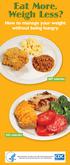 Eat More, Weigh Less? How to manage your weight without being hungry 607 calories 293 calories Department of Health and Human Services Centers for Disease Control and Prevention Can you weigh less without
BREAD MACHINE BASICS & BEYOND
 with Robyn Sargent BASICS OF DOUGH CONSISTENCY Becoming familiar with a healthy ball of dough is the first step toward perfect bread machine bread. Because air humidity fluctuates, the amount of liquid
Syllabus M.Tech. Food Technology DSC- FT- 1 A: FUNDAMENTALS OF FOOD SCIENCE AND TECHNOLOGY PART I
 Syllabus M.Tech. Food Technology DSC- FT- 1 A: FUNDAMENTALS OF FOOD SCIENCE AND TECHNOLOGY PART I Unit 1 Introduction to Food Science and Technology Definition, scope and current trends in food science
4 servings - Bring 8 cups of water to boil. Slowly whisk in entire package of soup mix. Lower heat simmer 10-15 minutes, stirring occasionally.
 Cheddar Broccoli INGREDIENTS: Non-dairy Creamer (Maltodextrin, Palm Oil, Sodium Caseinate, Di-potassium Phosphate, Mono and Diglycerides, Natural Flavor, Annatto Color), Food Starch-Modified, Sweet Whey,
Healthy Eating During Pregnancy
 Healthy Eating During Pregnancy Pregnancy is a time of great change. Your body is changing to allow your baby to grow and develop. Good nutrition will help you meet the extra demands of pregnancy while
Bariatric Surgery: Step III Diet
 Bariatric Surgery: Step III Diet This diet is blended foods with one new solid food added daily. The portions are very small to help prevent vomiting. Warning: This diet does not have enough calories,
Basic Bread. Equipment: Ingredients:
 Equipment: kitchen scales measuring spoons 2 large mixing bowls scissors 1 medium mixing jug, big enough for 500 ml at least wooden spoon pastry brush large board or flat, clean surface for kneading dough
Nutrition and Chronic Kidney Disease
 Nutrition and Chronic Kidney Disease I have been told I have early kidney failure. What does this mean? What can I expect? This means that your kidneys are not doing as good a job as they should to help
Method 4 (carbon dioxide)
 Method 4 (carbon dioxide) Aim Making a batch of scones, and investigating the most effective raising agent in terms of external and internal appearance, texture, degree of rise and flavour. Equipment You
Reading Food Labels. Nutritional values The ingredients of the item The percentage of the Recommended Daily Intake (RDI) of particular nutrients
 Eating well involves choosing a variety of foods that are low in saturated and trans fats, low in salt and high in dietary fibre. Food labels carry useful information to help you make choices about the
Cooking A World of New Tastes
 Cooking A World of New Tastes S E G M E N T 2 Cooking With Moist Heat Steaming Boiling Glazing Segment 2 Cooking With Moist Heat 19 S E G M E N T 2 Cooking With Moist Heat Learning Objectives Apply steaming
Dry Milk. Using Dry Milk Making Liquid Milk Dry Milk Water Liquid Milk 1/3 cup 1 cup 1 cup 1 1/3 cups 4 cups 1 quart
 NEP, JRW - 10 Dry Milk Nutrient Value of Dry Milk Milk is a basic food that everyone in the family needs, every day, to supply calcium for strong bones and teeth. It also provides high-quality protein,
Fat Facts That Can Help Your Heart. Most Common Risk Factors for Heart Disease
 Fat Facts That Can Help Your Heart Sally Barclay, MS RD LD Nutrition Clinic for Employee Wellness Most Common Risk Factors for Heart Disease High LDL (bad) cholesterol Smoking Low HDL (good) cholesterol
MONSTER COOKIES. (From recipes by Pat)
 MONSTER COOKIES (From recipes by Pat) 1 lb brown sugar (2 1/3 cups) ½ teaspoons baking soda 2 cups white sugar 1 ½ cup peanut butter 2 sticks margarine 9 cups oatmeal 6 eggs ½ pound M&M s ½ tablespoon
Tips from Chef Monique Hooker
 Welcome to Cooks for Kids. Children should have access to healthy food and be able to make healthy food choices wherever they are at home, in school, and in the community. Improving the health of the nation
How To Eat Without Getting Sick
 Level 2 Dysphagia Mechanically Altered* This diet consists of foods that are moist, soft-textured and easily formed into a bolus. All foods on Level 1 are. Meats and other select foods may be ground or
National Schools Bakery Arts Curriculum
 National Schools Bakery Arts Curriculum Course 101 A: Food Service Industry, Sanitation and Safety Course starts end: Contact Hours: 30 Hours Instructor: Office hours: Email: Text: Serve safe Course Handbook,
Selection and Preparation of Foods Management of the Food Budget*
 Selection and Preparation of Foods Management of the Food Budget* Healthy meals on a limited budget! How can you serve healthy meals on a limited budget? It takes some time and planning, but you and your
Dietary Fiber. Soluble fiber is fiber that partially dissolves in water. Insoluble fiber does not dissolve in water.
 Dietary Fiber Introduction Fiber is a substance in plants. Dietary fiber is the kind of fiber you get from the foods you eat. Fiber is an important part of a healthy diet. Fiber helps get rid of excess
Sugar Cookies. Ice Box Cookies. Hannah Christiane Hansen Cox. Hannah Christiane Hansen Cox. Ingredients: Ingredients:
 Sugar Cookies 1 heaping cup lard 1 1/3 cups sugar 2 eggs - well beaten 1 cup canned milk (evaporated) or ½ and ½ 5 cups flour 4 teaspoons baking powder ¼ teaspoon salt 2 teaspoons vanilla Mix flour, baking
Pastry Croissant Moons
 Pastry Croissant Moons Sandra Mulvany and Brilliant Publications Healthy Cooking for Secondary Schools (Book 5) This page may be photocopied by the purchasing institution only. www.brilliantpublications.co.uk
My Diabetic Meal Plan during Pregnancy
 My Diabetic Meal Plan during Pregnancy When you have diabetes and are pregnant, you need to eat small meals and snacks throughout the day to help control your blood sugar. This also helps you get in enough
Gluten-Free Baking: Tips & Recipes
 Gluten-Free Baking: Tips & Recipes From the National Foundation for Celiac Awareness Webinar: Holiday Special: Gluten-Free Baking Featuring Chef Richard Coppedge, Jr., CMB, Professor, Baking and Pastry
Fibe. Fiber and water work together in bowel regulation. Be sure to drink eight to ten (8 ounce) glasses of
 r Fibe An important part of a healthy diet is eating a variety of fiber-rich foods, including whole-grain breads and cereals, fruits and vegetables, beans and nuts. Fiber is an important part of your diet.
1. According to the Food Guide Pyramid, how many daily servings do we need of fruits?
 NAME HOUR VIDEO WORKSHEET 1. According to the Food Guide Pyramid, how many daily servings do we need of fruits? 2. How many daily servings do we need of vegetables according to the Food Guide Pyramid?
The Five Food Groups and Nutrition Facts
 session 4 The Five Food Groups and Nutrition Facts (Note to the presenter: Comments in parentheses are instructions to follow while giving the presentation. Do not read the comments to participants. This
Textbook: Chapter 3 Teacher made information packet Video: Digestion Assessments/Resources
 Department: Industrial and Fine Arts Nutrition and Culinary Arts (730Z) Unit 1, September Unit 2, October Introduction to Nutrition and Culinary Arts: What materials will each student need to have for
C-2- Peo )te with FOOD ALLERGIES " ^ ^-s> HOME AND GARDEN BULLETIN NO. 147 U.S. DEPARTMENT OF AGRICULTURE
 C-2- Peo )te with FOOD ALLERGIES " ^ ^-s> HOME AND GARDEN BULLETIN NO. 147 U.S. DEPARTMENT OF AGRICULTURE BAKING FOR PEOPLE WITH FOOD ALLERGIES Baking breads, cakes, and pastry for family members allergic
Muffins, Muffins! Recipe Book
 Muffins, Muffins, Muffins! Recipe Book Muffins, Muffins, Muffins! Recipe Book TABLE OF CONTENTS BANANA CRUMB 7 LEMON POPPY SEED 8 CHOCOLATE CHOCOLATE-CHIP 9 CHOCOLATE CHEESECAKE 0 PUMPKIN COFFEE CAKE
TRACKS Lesson Plan. Fiber Fill Up On Fiber! Grade: 9-12
 TRACKS Lesson Plan Fiber Fill Up On Fiber! Grade: 9-12 I. Nutrition Education Objective: Goal 1: Students will comprehend concepts consistent with USDA guidance related to eating and physical activity
Common Baking Ingredients
 Common Baking Ingredients With the following seven categories of ingredients you can make almost every type of baked good. 1. Flour a. Examples: Wheat (white or whole), rice, corn b. Purpose in baking:
Fiber. What is fiber? Fiber is a part of plant food. There are two types of fiber:
 Fiber An important part of a healthy diet is eating fiber-rich foods. This handout will explain what fiber is, where it s found, and how to increase the amount of fiber in your diet. What is fiber? Fiber
Fat-burning recipes, low-calories desserts and healthy snacks. Frittata Number of servings: 8
 Fat-burning recipes, low-calories desserts and healthy snacks Frittata 1 c Egg substitute 1 Omega-3 egg 2 Tbs Fat free half and half 1/4 tsp Ground black pepper 2 tsp Extra virgin olive oil 1 Tbs Trans
Super Snacks. Jr. Chef Club. Lesson 6
 Jr. Chef Club Super Snacks Lesson 6 Objectives After completing the lesson, students will be able to: 1. List 5 healthy, anytime snacks. 2. Understand the basic leavening action of yeast. 3. Explain importance
Skills Canada Baking Competition. Tuesday March 8, 2016
 T.C.D.S.B Skills Canada Baking Competition Tuesday March 8, 2016 St. Patrick C.S.S 49 Felstead Avenue-Room 214 Toronto M4J 1G3 416-393-5546 Technical Chair: Denise McMullan [email protected] If
Healthy Foods for my School
 yum, yum, yum, yum, yum, yum, yum, yum, yum, yum, yum, yum, yum, yum, yum, yum, yum, yum, yum, yum, yum, Healthy Foods for my School Nutrition Standards for Saskatchewan Schools Schools are an ideal place
Appendix A Food Sources of Vitamins and Minerals
 Appendix A Food Sources of Vitamins and Minerals Appendix A 229 Appendix A Food Sources of Vitamins and Minerals Vitamin A (Retinol) Food Amount IU* Liver 3 oz 45,400 Crab 2 cup,680 Egg medium 590 Fats
CARBS, FATS, FIBER & FADS FAD DIETS
 CARBS, FATS, FIBER & FADS FAD DIETS Carbohydrates The national recommendation for carbohydrate intake is 40% to 65% of our daily intake. Our requirements change depending on how active we are, our current
Sweets nutritional information
 Sweets nutritional information Brownies INGREDIENTS: Chocolate Chips (sugar, chocolate liquor, cocoa butter and soy lecithin), Butter (cream and butter), Brown Sugar, Enriched Unbleached White Flour (Wheat