
Special Needs Profiling Instrument. Guide for Schools, Parents and Carers
|
|
|
- Merry Eaton
- 10 years ago
- Views:
Transcription
1 Special Needs Profiling Instrument Guide for Schools, Parents and Carers Updated January 2010

2 INTRODUCTION The needs-based model of resource allocation for students with disability is recommended by the Organisation for Economic Cooperation and Development (OECD). The Northern Territory Student Needs Profiling Instrument, (SNPI) is based on ACT and NSW needs-based resource allocation with adaptation for the unique context and requirements of the Northern Territory. In this model, students with disability are allocated resources based on the level of support required to enable the student to participate effectively in the school program. Ministerial Council on Education, Employment, Training and Youth Affairs (MCEETYA). The definition of disabilities used will be that recommended by MCEETYA (2006) Students with disabilities are those students who, without extra support or to the environment, would be restricted in their ability to participate in the academic program of the school due to an underlying condition that has lasted, or is expected to last, for more than six months The definition is to be interpreted in conjunction with the following elaborations: Extra support or to the environment Changes to the school environment or to the student s learning environment that facilitate the student s ability to participate in education, and that are in addition to personnel, material or financial resources provided for the students who do not have a disability An underlying condition a chronic illness or impairment in intellectual, physical, sensory, communication or psychological function that has lasted, or is expected to last, for more than six months. Documents: Students with Disabilities in NT Schools Policy (2008) Disability Discrimination Act (1992) Disability Standards for Education (2005) Teaching and Learning Framework (TaLF) Northern Territory Curriculum Framework (NTCF) Accountability and Performance Improvement Framework (2007) SNPI Guidelines for Students with Disabilities January 2010 Page 2

3 PROCESS: The level of additional resources for students with disabilities is informed by the Special Needs Profiling Instrument (SNPI). The key indicators within this instrument include observable abilities / competencies of the student. The SNPI scoring must be supported through evidence. WHAT DOES THE SPECIAL NEEDS PROFILING INSTRUMENT DO? The Special Needs Profiling Instrument (SNPI) evaluates the specific needs of a student. Profiling provides an explicit statement of individual need in the four educational domains, across eleven focus areas and the level of support required for the student to access school programs and participate effectively in the curriculum. The SNPI can also be used to inform Educational Adjustment Plans. Not all students who are profiled are eligible for special needs resourcing which is specifically allocated to students with a disability requiring moderate to major s to their educational program. WHO TO PROFILE? The SNPI can be used to evaluate the needs of all students within your school who need s to their educational program in any of the domain and focus areas. These students may be in the early stages of intervention, Stages 1 through to Stage 3 of the Pre-Referral Process. The Special Education Needs Spreadsheet (Excel) is designed to assist schools in auditing and planning for students with additional needs. The school may choose to use data from this early identification to inform educational s at class and school level. Students who move into the Pre-Referral Process Stage 5 are likely to have a disability / disorder, or have already been verified as having a disability / disorder. These students profiles are moderated by Student Services Advisors and the Special Education Teacher. The moderated profiles are then entered into the Special Education Needs (SEN) module of the School Administration Management System (SAMS). Moderation can occur at the Consultancy Meeting. WHO COMPLETES THE PROFILES? It is recommended that profiling students be a consultative process usually at a specific meeting, to include Parents, Carers, School Staff (Principal, Assistant Principal, Classroom teacher, Special Education Teacher) and other professionals or persons with knowledge of the child / student as appropriate Education Advisors from Student Services Division may be invited to attend to guide school staff and parents through the process of profiling students needs and making s to school programs. Education Advisors Special Education can provide support and assist with training needs and administration processes. SNPI Guidelines for Students with Disabilities January 2010 Page 3
4 HOW TO PREPARE FOR THE PROFILING AND PLANNING MEETING Student needs profiling and planning meetings are an important opportunity for parents and carers to contribute to the educational program of their child. Teachers and Special Education Teachers are also well placed to identify student needs and therefore participate in the profiling meeting. In preparation for the meeting: Read this booklet carefully. Consider your child/student s needs in each of the eleven areas. Choose relevant focus areas of need. From focus area, choose a descriptor that best describes your child/student s support needs. Choose the best match to your child s needs, keeping in mind that when identifying the appropriate descriptor, the whole descriptor must be considered, not selected phrases. Circle or highlight the Level or make comments in margin. NB: not every descriptor in each level is required to achieve the level of need. THE PROFILE AND PLANNING MEETING School Principal or a delegate chairs meeting. Education Advisors or Student Services staff may be invited to attend. Parents and Carers are encouraged to attend or to bring an advocate or friend. The Teacher, Special Education Teacher, and other staff who work with the child at school should also attend the meeting. Meetings should be arranged so the classroom teacher is released to attend. At the end of the meeting participants sign and receive a copy of the meeting record. This may be in the form of the Education Adjustment Plan. A review date must be set. PURPOSE OF MODERATION To provide information and support the level of need to ensure equitable allocation of Student Needs Resourcing. To ensure that the descriptors in the SNPI are applied consistently across all the schools in the Northern Territory. The moderator will provide guidance as necessary to ensure common interpretations of the levels of need described in each Level are used across all Northern Territory schools. Moderation of profiles is essential for all students with disability in regular classes who may be eligible for special needs resourcing this can be done during the consultancy meeting when students are moving from Stage 4 to Stage 5 of Pre-referral process. SNPI Guidelines for Students with Disabilities January 2010 Page 4
5 WHO IS ELIGIBLE FOR SUPPORT PLUS RESOURCES? Special Needs Resourcing is only allocated for students with diagnosed disabilities / disorders who require moderate to major s to their educational program as per the SNPI. Students who are eligible for Special Needs Resourcing will require Verification of diagnosis Moderated profile entered into the SEN module Education Adjustment Plan. Documentation for completing the application for Special Needs Resourcing is available on the DET Staff Site Special Education & Wellbeing: VERIFICATION Student Services Advisors verify the student s disability according to the criteria for disability according to the DSM 1V or ICD-10. A verification report will notify the school that: 1. Disability is verified reports from specialists and assessments that confirm disability. 2. Special Needs Profile is moderated. 3. The student is considered / not considered eligible Special Needs Resourcing. 4. If the student is considered eligible for Special Needs Resourcing, complete application. SUPPORTING DOCUMENTS To assist in verification of a student s disability / disorder and moderation of the level of needs and to ensure consistent application of the descriptors across all schools and special education programs, the following documentation is essential: Evidence of the Pre- Referral process or documentation from previous schools (for students from interstate or changing schools). Report or letter from specialist confirming diagnosis, IQ scores, any standardised test scores. Students with a sensori-neural hearing loss or vision impairment documents may be from a range of sources these will need to be verified and approved by Student Services Advisors / Co-ordinators in the specific discipline area. Students with intellectual impairment, emotional / behavioural disorders (as meets the DSM-1V criteria) will need to have the diagnosis verified and approved by a Student Services School Psychologist. Students with specific disabilities e.g. physical, ASD, specific learning disorder will need to have diagnosis verified and approved by a Student Services Education Advisor. Copy of the current Education Adjustment Plan with s relating to all domain and focus areas in which the student profile has a recorded need. Can be school action plan as per pre-referral process. SPECIAL NEEDS RESOURCING MODEL: The Special Needs Resourcing (SNR) model incorporates all additional resources available, including Special Education Teacher, Special Education Support Officer (SESO), Special Education Support Assistant (SESA) and input from Education Advisors within Student Services Division. SNPI Guidelines for Students with Disabilities January 2010 Page 5
6 Special Needs Profiling Instrument (SNPI) Updated January 2010 SNPI Guidelines for Students with Disabilities January 2010 Page 6

7 The Special Needs Profiling Instrument is divided into four parts, reflecting four major domains of educational need. Participation Communication Personal Care Movement Each domain has been further divided to reflect areas of educational needs. It is these eleven areas that are the focus for detailed discussion at the profiling meeting. Each is described below. PARTICIPATION: Broad needs the child / student may have in order to participate in the school program. Divided into four focus areas: Curriculum Behaviour Social Competence Safety COMMUNICATION: Describes the child /student needs and the educational support required in the communication domain. The communication domain is divided into two focus areas Expressive and Receptive Communication (access) Communication Skills Development (participation) PERSONAL CARE: Examines the student s needs with regards to looking after themselves. Divided into three focus areas Hygiene Dietary Needs Health Care MOVEMENT: Refers to specific needs in relation to being able to move around the school and use hand-motor skills to participate in school activities. Divided into two focus areas Mobility Hand Motor SNPI Guidelines for Students with Disabilities January 2010 Page 7
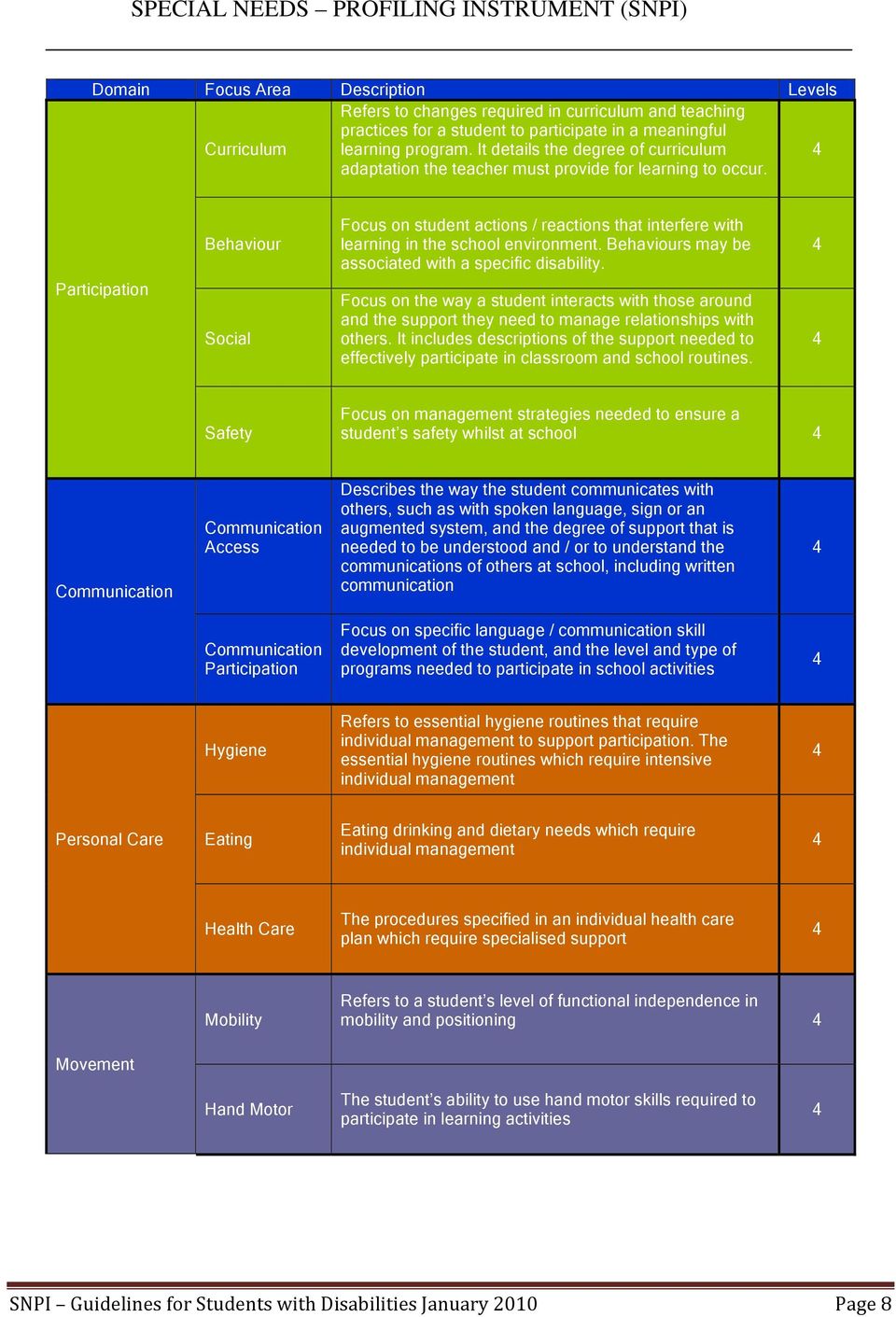
8 Domain Focus Area Description Levels Refers to changes required in curriculum and teaching practices for a student to participate in a meaningful Curriculum learning program. It details the degree of curriculum 4 adaptation the teacher must provide for learning to occur. Behaviour Focus on student actions / reactions that interfere with learning in the school environment. Behaviours may be associated with a specific disability. 4 Participation Social Focus on the way a student interacts with those around and the support they need to manage relationships with others. It includes descriptions of the support needed to effectively participate in classroom and school routines. 4 Safety Focus on management strategies needed to ensure a student s safety whilst at school 4 Communication Communication Access Describes the way the student communicates with others, such as with spoken language, sign or an augmented system, and the degree of support that is needed to be understood and / or to understand the communications of others at school, including written communication 4 Communication Participation Focus on specific language / communication skill development of the student, and the level and type of programs needed to participate in school activities 4 Hygiene Refers to essential hygiene routines that require individual management to support participation. The essential hygiene routines which require intensive individual management 4 Personal Care Eating Eating drinking and dietary needs which require individual management 4 Health Care The procedures specified in an individual health care plan which require specialised support 4 Mobility Refers to a student s level of functional independence in mobility and positioning 4 Movement Hand Motor The student s ability to use hand motor skills required to participate in learning activities 4 SNPI Guidelines for Students with Disabilities January 2010 Page 8
9 Examples of Levels of or support needed to access and participate in school programs: Level Degree of support or to environment 1 Minimal 2 Moderate 3 Major 4 Major Descriptors may require mild occasional infrequent additional regular often some medium severe significant frequent constant monitoring intensive extreme Examples of Adjustment The student is capable of operating safely in most school environments but may require minor additional supervision in certain activities. May require additional s to the school curriculum in a particular area. Requires on-call medical attention for an infrequent medical condition at school. eg. seizure that requires medical intervention. Supervision in the use of assistive technologies. Use of school funded assistive technologies. Regular reminders. Structured program intervention by specialist. Regular supervision in a range of activities. Some modification to the school or classroom environment. The student needs specialised or frequent support for ongoing medical procedures at school. eg catheterisation, daily injections, respirators. The student requires significant s / modifications or support to enable access and participation in school activities. The student is unable to function in almost all school activities without constant supervision to prevent injury to self or others. Requires constant monitoring of medical condition every school day. Requires an individually tailored, fully supported program at all times. Uses complex assistive technologies that are provided by the school. SNPI Guidelines for Students with Disabilities January 2010 Page 9

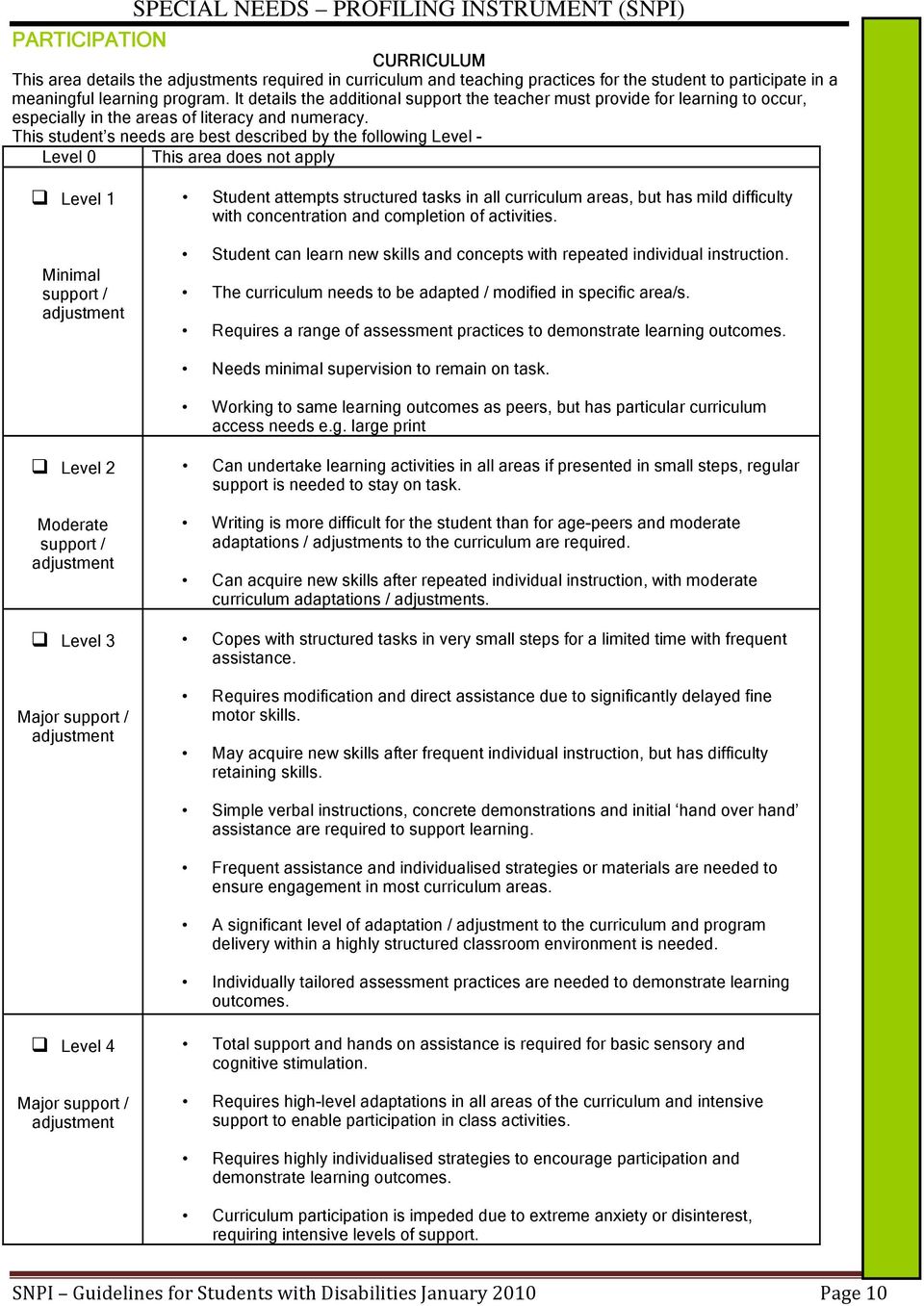
10 PARTICIPATION CURRICULUM This area details the s required in curriculum and teaching practices for the student to participate in a meaningful learning program. It details the additional support the teacher must provide for learning to occur, especially in the areas of literacy and numeracy. This student s needs are best described by the following Level - Level 0 This area does not apply Level 1 Minimal Student attempts structured tasks in all curriculum areas, but has mild difficulty with concentration and completion of activities. Student can learn new skills and concepts with repeated individual instruction. The curriculum needs to be adapted / modified in specific area/s. Requires a range of assessment practices to demonstrate learning outcomes. Needs minimal supervision to remain on task. Working to same learning outcomes as peers, but has particular curriculum access needs e.g. large print Level 2 Moderate Level 3 Major Can undertake learning activities in all areas if presented in small steps, regular support is needed to stay on task. Writing is more difficult for the student than for age-peers and moderate adaptations / s to the curriculum are required. Can acquire new skills after repeated individual instruction, with moderate curriculum adaptations / s. Copes with structured tasks in very small steps for a limited time with frequent assistance. Requires modification and direct assistance due to significantly delayed fine motor skills. May acquire new skills after frequent individual instruction, but has difficulty retaining skills. Simple verbal instructions, concrete demonstrations and initial hand over hand assistance are required to support learning. Frequent assistance and individualised strategies or materials are needed to ensure engagement in most curriculum areas. A significant level of adaptation / to the curriculum and program delivery within a highly structured classroom environment is needed. Individually tailored assessment practices are needed to demonstrate learning outcomes. Level 4 Major Total support and hands on assistance is required for basic sensory and cognitive stimulation. Requires high-level adaptations in all areas of the curriculum and intensive support to enable participation in class activities. Requires highly individualised strategies to encourage participation and demonstrate learning outcomes. Curriculum participation is impeded due to extreme anxiety or disinterest, requiring intensive levels of support. SNPI Guidelines for Students with Disabilities January 2010 Page 10
11 PARTICIPATION BEHAVIOUR This area focuses on the behaviours students may engage in that result in a need for additional support. It refers to overt behaviours associated with specific disorders, except where specifically mentioning withdrawn behaviour. This student s needs are best described by the following Level - This area is not applicable Level 0 Level 1 Minimal Requires occasional supervision and support for specific behaviour needs. eg. implementation of generalised classroom strategies, occasional verbal prompting to follow routines and instructions or to stay on task. Requires occasional correction for specific inappropriate or immature social behaviours. Requires occasional assistance to deal with conflict appropriately. Requires occasional assistance to move between classes or school activities due to anxiety or limited understanding of school routines or poor attention. Level 2 Moderate Requires regular intervention and / or correction due to behaviour needs. eg. implementation of individualised classroom strategies, separation from other students, regular and consistent prompting to follow routines or instructions or to stay on task. Requires a behaviour management program developed by a specialist teacher or other professional to address regular episodes of anti-social behaviour such as selfstimulation, non-compliance, aggression or poor attention. Requires regular intervention, supervision and support for specific behaviour associated with a disability / disorder. eg. obsessions; withdrawal behaviour. Requires a structured class environment to assist the student to display appropriate behaviour. Level 3 Major Requires a highly structured behaviour management program developed by a team of school personnel and other professionals, delivered within a highly structured school environment to develop and maintain appropriate behaviour. Highly individualised strategies are required to manage repetitive or unpredictable behaviours, or atypical interests in objects, that impede learning or participation in activities at school. Requires significant support to limit behaviours that are extremely disruptive to the student s own learning environment and that of other students. Frequently engages in anti-social behaviour or disruptive behaviour eg, selfstimulation, non-compliance, aggression, poor attention or withdrawn / disengaged behaviour. Level 4 Major Requires constant intervention due to extreme levels of aggressive / anxious behaviour or withdrawn / disengaged behaviour. Displays extreme behaviours that are socially unacceptable or distressing to others requiring constant monitoring / support and modifications to class routines. Requires ongoing / constant support from external agencies such as juvenile justice, disability support agencies, psychiatrist or medical support. Intensive and constant supervision and support from an adult in a highly structured educational environment is needed to allow participation in the school program. SNPI Guidelines for Students with Disabilities January 2010 Page 11

12 PARTICIPATION SOCIAL DEVELOPMENT This area focuses on the way students interact with those around them and the support they need to manage relationships with others. It includes descriptions of the support needed to participate in classroom and school routines effectively. This student s needs are best described by the following Level This area is not applicable Level 0 Level 1 Minimal Classroom social skills programs are required due to the student having some difficulty with the dynamics of relationships and not responding appropriately in social situations. Requires strategies to ensure appropriate reactions when dealing with other students or teachers. Needs prompting to cope with daily routines. eg. times for various school activities, transportation requirements. Level 2 Has difficulty in forming and maintaining relationships, developing friendships and / or being included in playground activities, requiring a focus on this issue in class programs and the Educational Adjustment Plan / Individual Behaviour Plan. Has difficulties organising daily routines, tasks and materials without regular support. Moderate Has some awareness of the demands, expectations and restrictions of the school and wider community but requires regular support. Individualised instruction needed to assist student to develop and maintain appropriate friendships and relationships. Requires regular support in unfamiliar situations. Regular preparation is needed to enable the student to understand new situations. Requires a personal development program designed with input from school personnel, parents / carers and other key people. Level 3 Major Requires a specific program developed by the school, the student s parents / carers and other key people due to the extremely poor attention or withdrawal. Requires frequent monitoring / assistance from an adult in less structured situations to encourage participation and to facilitate appropriate interactions. Requires frequent and explicit instruction in order to develop appropriate responses to social situations and interactions in most situations. Level 4 Major Requires intensive and constant supervision in all activities to enable participation and successful interaction with others. Requires delivery of an intensive and individualised teaching program, with high levels of support in order to manage social interactions. Intensive supervision is required at all times of the day due to unpredictable or socially provocative tendencies. Is dependent on an adult to interpret demands, expectations and restrictions of the school environment and the wider community. SNPI Guidelines for Students with Disabilities January 2010 Page 12

13 PARTICIPATION SAFETY This area focuses on safety supports needed for students whilst at school. Safety is an issue due to difficulties associated with the identified disability / disorder, including cognitive / intellectual; behaviour; health or medical conditions. Refer to the management strategies required to ensure a student s safety.. This student s needs are best described by the following Level - Level 0 This area does not apply Is at occasional risk of injuring self or others from hazards in the environment because Level 1 of difficulties associated with the identified disability / disorder, poor mobility function, or health condition. Minimal Does not understand boundaries or have safety awareness and may wander into other parts of the school, requiring particular playground monitoring programs. Occasionally has difficulty responding / complying with verbal warnings and may require additional assistance to maintain safety. Cannot hear or understand verbal warnings and requires some additional supervision to maintain safety. Level 2 Moderate Is at moderate risk of injuring self or others from hazards within the environment because of difficulties associated with an identified disability / disorder, poor mobility function, or moderate health issue. Absconds regularly and requires extra supervision by staff during recess and lunch times. Level 3 Major Is at significant risk of injuring self or others from hazards in the environment because of difficulties associated with an identified disability / disorder, poor mobility function, or significant health condition. The student is independent within the classroom, but requires frequent support when moving around the school environment due to severe anxiety or limited understanding of school routines and processes. Frequently absconds and requires significant supervision by staff throughout the school day. Requires specially designed or targeted programs in order to develop appropriate play or social interactions and to better understand the possible consequences of inappropriate social contact. Requires significant supervision, as the student is at risk of injuring self or others. Level 4 Major Is at extreme risk of injuring self or others from hazards in the environment because of difficulties associated with an identified disability / disorder, poor mobility function or significant health issue. Requires intensive and constant supervision to prevent injury to self or others. SNPI Guidelines for Students with Disabilities January 2010 Page 13

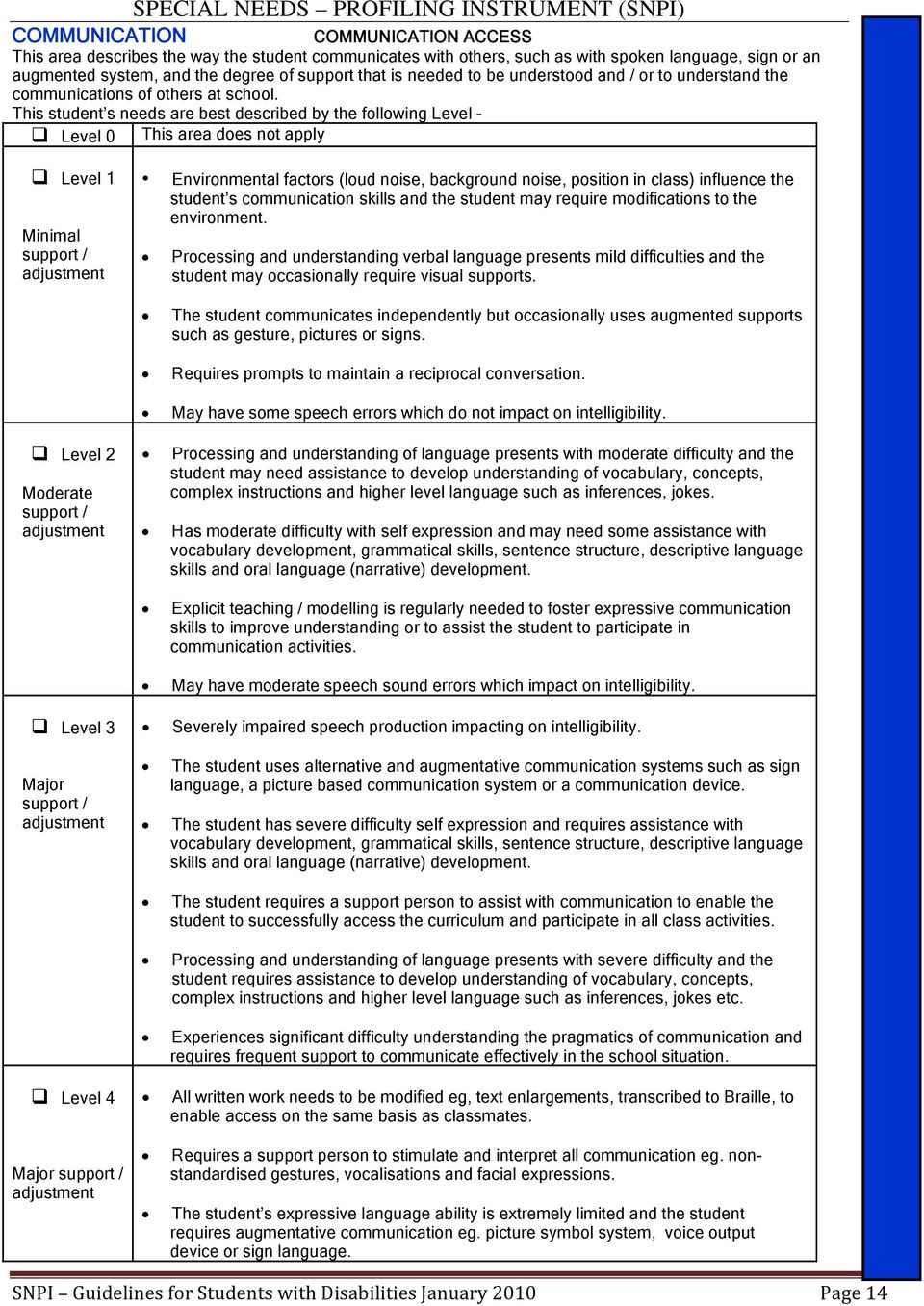
14 COMMUNICATION COMMUNICATION ACCESS This area describes the way the student communicates with others, such as with spoken language, sign or an augmented system, and the degree of support that is needed to be understood and / or to understand the communications of others at school. This student s needs are best described by the following Level - Level 0 This area does not apply Level 1 Minimal Environmental factors (loud noise, background noise, position in class) influence the student s communication skills and the student may require modifications to the environment. Processing and understanding verbal language presents mild difficulties and the student may occasionally require visual supports. The student communicates independently but occasionally uses augmented supports such as gesture, pictures or signs. Requires prompts to maintain a reciprocal conversation. May have some speech errors which do not impact on intelligibility. Level 2 Moderate Processing and understanding of language presents with moderate difficulty and the student may need assistance to develop understanding of vocabulary, concepts, complex instructions and higher level language such as inferences, jokes. Has moderate difficulty with self expression and may need some assistance with vocabulary development, grammatical skills, sentence structure, descriptive language skills and oral language (narrative) development. Explicit teaching / modelling is regularly needed to foster expressive communication skills to improve understanding or to assist the student to participate in communication activities. May have moderate speech sound errors which impact on intelligibility. Level 3 Major Severely impaired speech production impacting on intelligibility. The student uses alternative and augmentative communication systems such as sign language, a picture based communication system or a communication device. The student has severe difficulty self expression and requires assistance with vocabulary development, grammatical skills, sentence structure, descriptive language skills and oral language (narrative) development. The student requires a support person to assist with communication to enable the student to successfully access the curriculum and participate in all class activities. Processing and understanding of language presents with severe difficulty and the student requires assistance to develop understanding of vocabulary, concepts, complex instructions and higher level language such as inferences, jokes etc. Experiences significant difficulty understanding the pragmatics of communication and requires frequent support to communicate effectively in the school situation. Level 4 Major All written work needs to be modified eg, text enlargements, transcribed to Braille, to enable access on the same basis as classmates. Requires a support person to stimulate and interpret all communication eg. nonstandardised gestures, vocalisations and facial expressions. The student s expressive language ability is extremely limited and the student requires augmentative communication eg. picture symbol system, voice output device or sign language. SNPI Guidelines for Students with Disabilities January 2010 Page 14
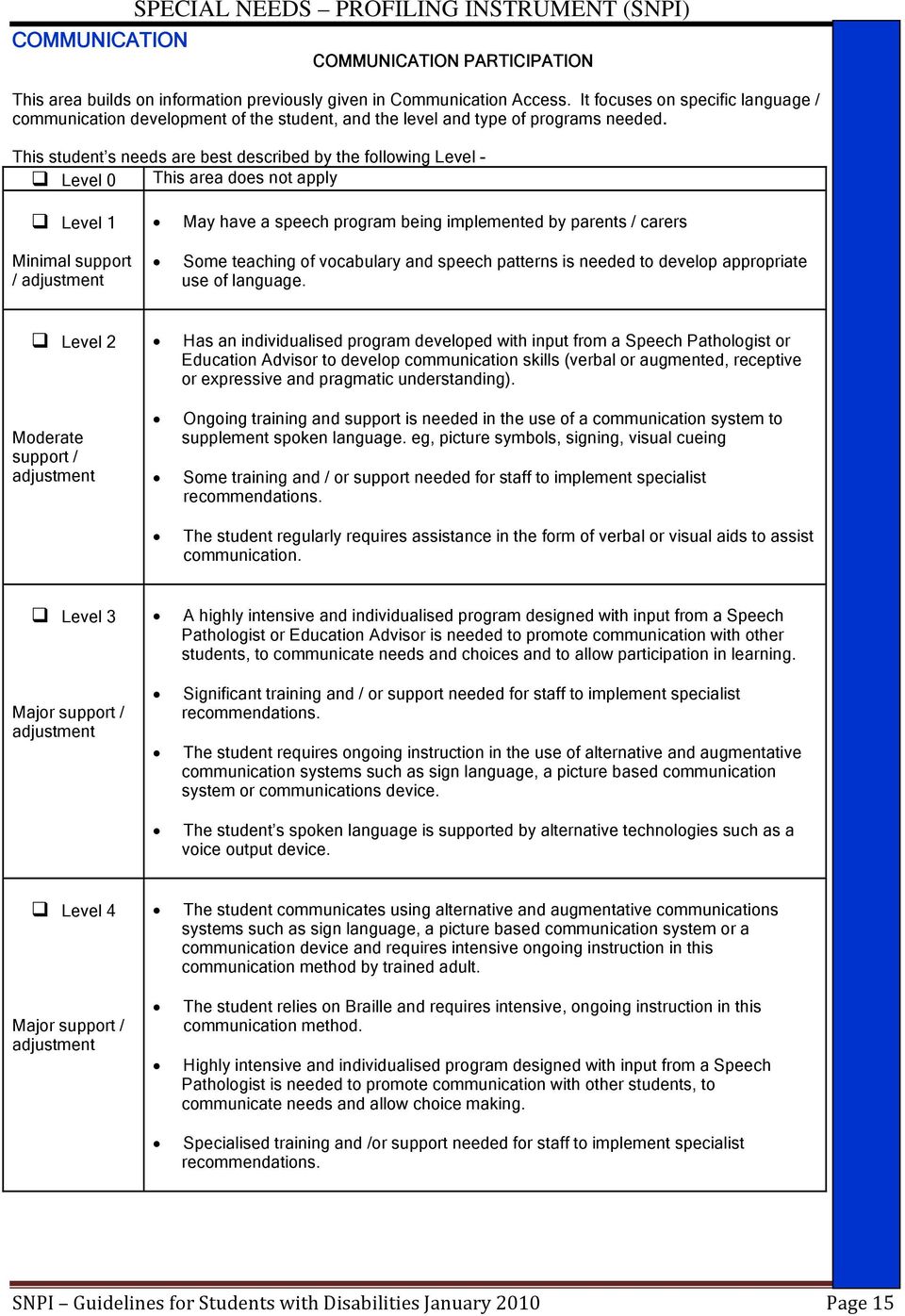
15 COMMUNICATION SPECIAL NEEDS PROFILING INSTRUMENT (SNPI) COMMUNICATION PARTICIPATION This area builds on information previously given in Communication Access. It focuses on specific language / communication development of the student, and the level and type of programs needed. This student s needs are best described by the following Level - Level 0 This area does not apply Level 1 Minimal support / May have a speech program being implemented by parents / carers Some teaching of vocabulary and speech patterns is needed to develop appropriate use of language. Level 2 Moderate Has an individualised program developed with input from a Speech Pathologist or Education Advisor to develop communication skills (verbal or augmented, receptive or expressive and pragmatic understanding). Ongoing training and support is needed in the use of a communication system to supplement spoken language. eg, picture symbols, signing, visual cueing Some training and / or support needed for staff to implement specialist recommendations. The student regularly requires assistance in the form of verbal or visual aids to assist communication. Level 3 Major A highly intensive and individualised program designed with input from a Speech Pathologist or Education Advisor is needed to promote communication with other students, to communicate needs and choices and to allow participation in learning. Significant training and / or support needed for staff to implement specialist recommendations. The student requires ongoing instruction in the use of alternative and augmentative communication systems such as sign language, a picture based communication system or communications device. The student s spoken language is supported by alternative technologies such as a voice output device. Level 4 Major The student communicates using alternative and augmentative communications systems such as sign language, a picture based communication system or a communication device and requires intensive ongoing instruction in this communication method by trained adult. The student relies on Braille and requires intensive, ongoing instruction in this communication method. Highly intensive and individualised program designed with input from a Speech Pathologist is needed to promote communication with other students, to communicate needs and allow choice making. Specialised training and /or support needed for staff to implement specialist recommendations. SNPI Guidelines for Students with Disabilities January 2010 Page 15
16 PERSONAL CARE HYGIENE This area focuses on the support students need to manage personal care requirements whilst at school. It includes toileting and hygiene needs. This student s needs are best described by the following Level - Level 0 This area does not apply Level 1 Minimal The child / student is relatively independent but requires some modifications to the school environment or class activities to allow access with dignity. eg being near appropriately equipped toilets, supervision to reach or use changing facilities. Level 2 Moderate Level 3 Major Requires some assistance, supervision and / or prompting to learn and master independence with toileting, showering or bathing. Supervision and assistance from one to two adults is required for toileting, showering and bathing procedures although the child is still able to participate in self care routines. Training and / or support needed for staff to implement specialist recommendations. Level 4 Major Intensive support is required for complex toileting and personal care requirements, including the use of medical appliances eg. catheters associated with personal hygiene. Is completely dependent / unable to participate in self care routines and requires total assistance. eg hoisting or full assistance of two adults to transfer, may wear pull-ups that require changing or be unable to inform staff of need to go to toilet. Complex training and / or support is needed for staff to implement specialist recommendations / routines. Note: A Health Care Plan or a Manual Handling plan will need to be sighted by the moderator for all students who are described by Level 3 and level 4. SNPI Guidelines for Students with Disabilities January 2010 Page 16

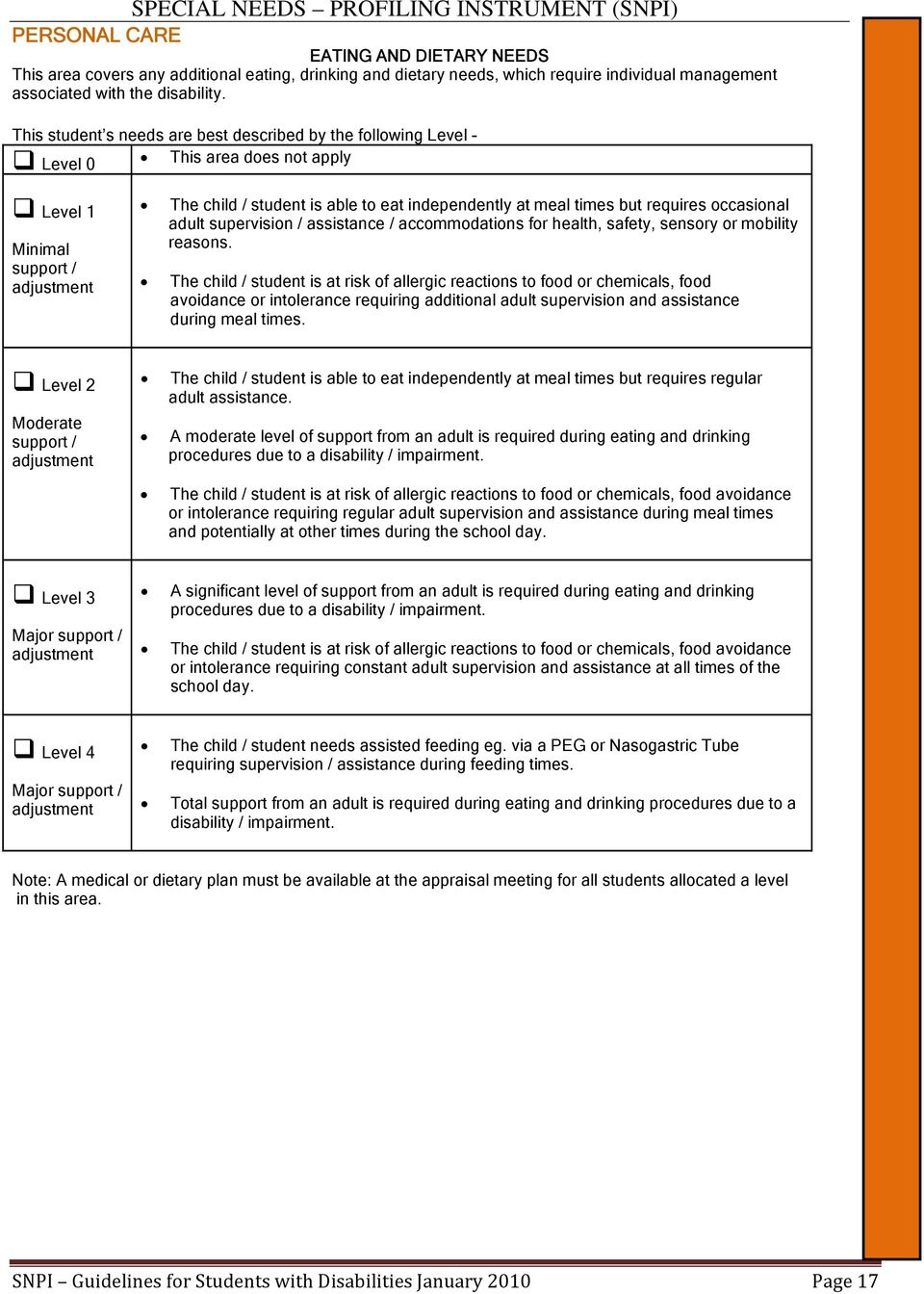
17 PERSONAL CARE EATING AND DIETARY NEEDS This area covers any additional eating, drinking and dietary needs, which require individual management associated with the disability. This student s needs are best described by the following Level - Level 0 This area does not apply Level 1 Minimal The child / student is able to eat independently at meal times but requires occasional adult supervision / assistance / accommodations for health, safety, sensory or mobility reasons. The child / student is at risk of allergic reactions to food or chemicals, food avoidance or intolerance requiring additional adult supervision and assistance during meal times. Level 2 Moderate The child / student is able to eat independently at meal times but requires regular adult assistance. A moderate level of support from an adult is required during eating and drinking procedures due to a disability / impairment. The child / student is at risk of allergic reactions to food or chemicals, food avoidance or intolerance requiring regular adult supervision and assistance during meal times and potentially at other times during the school day. Level 3 Major A significant level of support from an adult is required during eating and drinking procedures due to a disability / impairment. The child / student is at risk of allergic reactions to food or chemicals, food avoidance or intolerance requiring constant adult supervision and assistance at all times of the school day. Level 4 Major The child / student needs assisted feeding eg. via a PEG or Nasogastric Tube requiring supervision / assistance during feeding times. Total support from an adult is required during eating and drinking procedures due to a disability / impairment. Note: A medical or dietary plan must be available at the appraisal meeting for all students allocated a level in this area. SNPI Guidelines for Students with Disabilities January 2010 Page 17
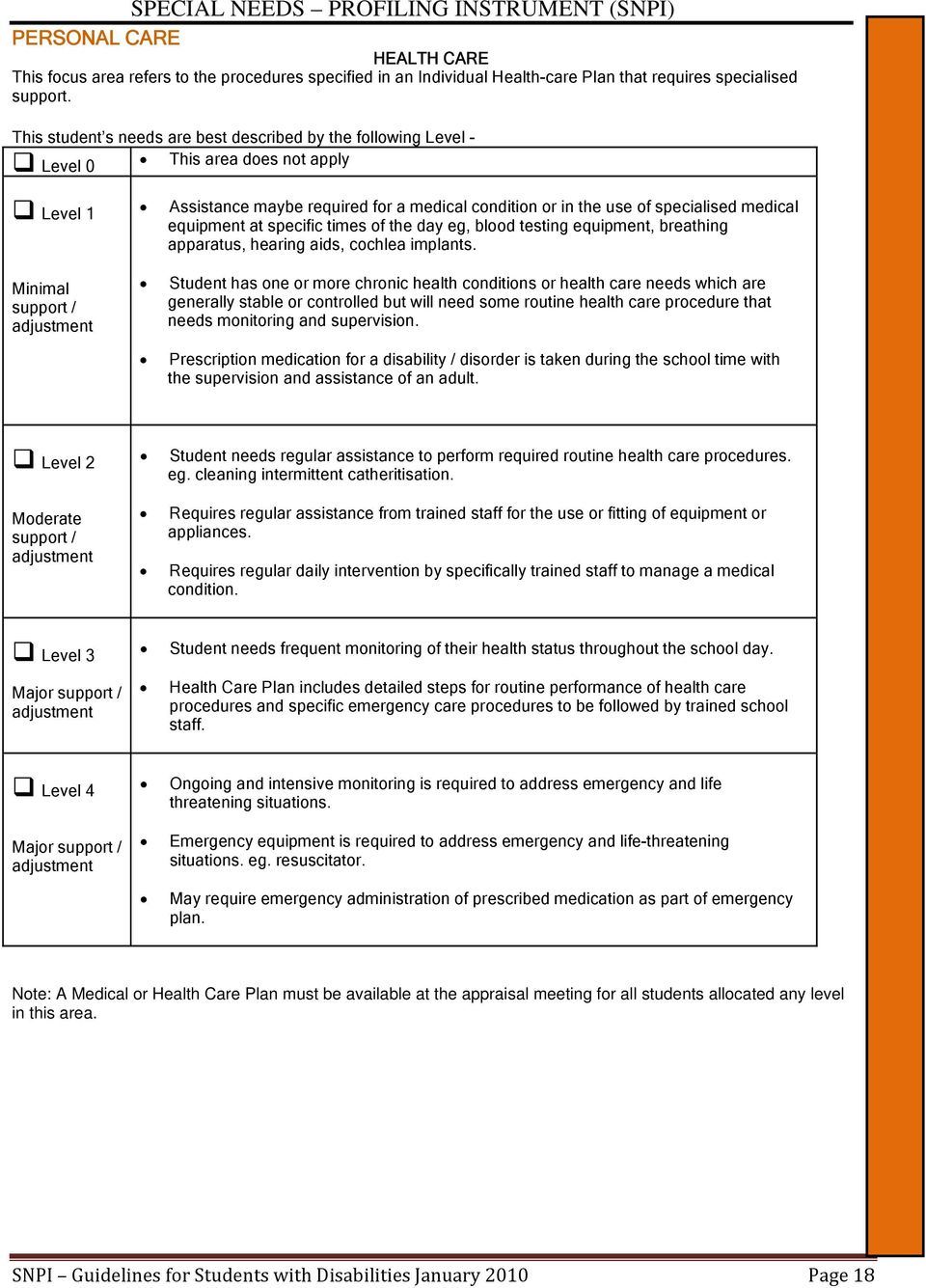
18 PERSONAL CARE HEALTH CARE This focus area refers to the procedures specified in an Individual Health-care Plan that requires specialised support. This student s needs are best described by the following Level - Level 0 This area does not apply Level 1 Minimal Assistance maybe required for a medical condition or in the use of specialised medical equipment at specific times of the day eg, blood testing equipment, breathing apparatus, hearing aids, cochlea implants. Student has one or more chronic health conditions or health care needs which are generally stable or controlled but will need some routine health care procedure that needs monitoring and supervision. Prescription medication for a disability / disorder is taken during the school time with the supervision and assistance of an adult. Level 2 Moderate Student needs regular assistance to perform required routine health care procedures. eg. cleaning intermittent catheritisation. Requires regular assistance from trained staff for the use or fitting of equipment or appliances. Requires regular daily intervention by specifically trained staff to manage a medical condition. Level 3 Major Student needs frequent monitoring of their health status throughout the school day. Health Care Plan includes detailed steps for routine performance of health care procedures and specific emergency care procedures to be followed by trained school staff. Level 4 Major Ongoing and intensive monitoring is required to address emergency and life threatening situations. Emergency equipment is required to address emergency and life-threatening situations. eg. resuscitator. May require emergency administration of prescribed medication as part of emergency plan. Note: A Medical or Health Care Plan must be available at the appraisal meeting for all students allocated any level in this area. SNPI Guidelines for Students with Disabilities January 2010 Page 18
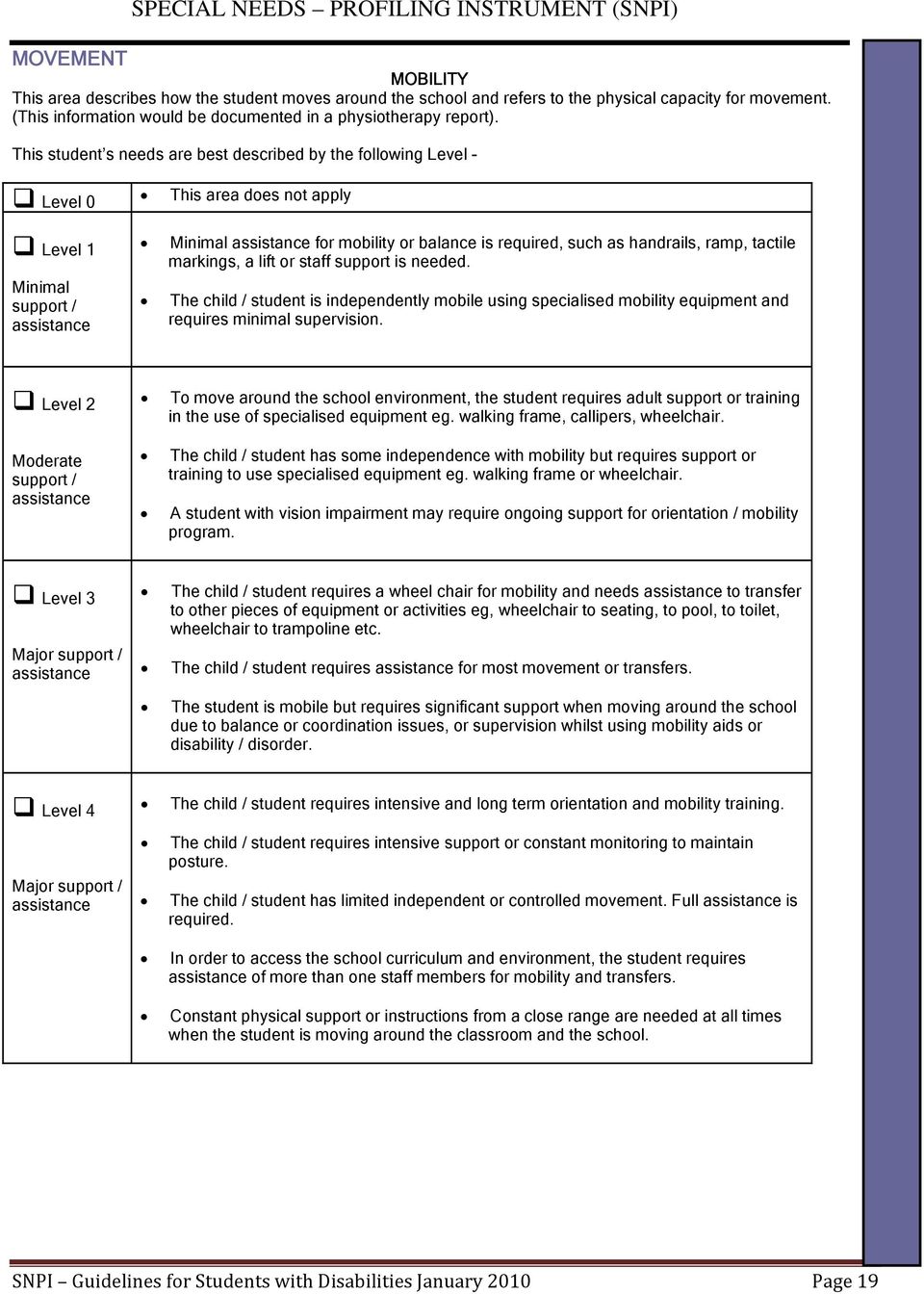
19 MOVEMENT MOBILITY This area describes how the student moves around the school and refers to the physical capacity for movement. (This information would be documented in a physiotherapy report). This student s needs are best described by the following Level - Level 0 Level 1 Minimal assistance This area does not apply Minimal assistance for mobility or balance is required, such as handrails, ramp, tactile markings, a lift or staff support is needed. The child / student is independently mobile using specialised mobility equipment and requires minimal supervision. Level 2 Moderate assistance To move around the school environment, the student requires adult support or training in the use of specialised equipment eg. walking frame, callipers, wheelchair. The child / student has some independence with mobility but requires support or training to use specialised equipment eg. walking frame or wheelchair. A student with vision impairment may require ongoing support for orientation / mobility program. Level 3 Major assistance The child / student requires a wheel chair for mobility and needs assistance to transfer to other pieces of equipment or activities eg, wheelchair to seating, to pool, to toilet, wheelchair to trampoline etc. The child / student requires assistance for most movement or transfers. The student is mobile but requires significant support when moving around the school due to balance or coordination issues, or supervision whilst using mobility aids or disability / disorder. Level 4 Major assistance The child / student requires intensive and long term orientation and mobility training. The child / student requires intensive support or constant monitoring to maintain posture. The child / student has limited independent or controlled movement. Full assistance is required. In order to access the school curriculum and environment, the student requires assistance of more than one staff members for mobility and transfers. Constant physical support or instructions from a close range are needed at all times when the student is moving around the classroom and the school. SNPI Guidelines for Students with Disabilities January 2010 Page 19
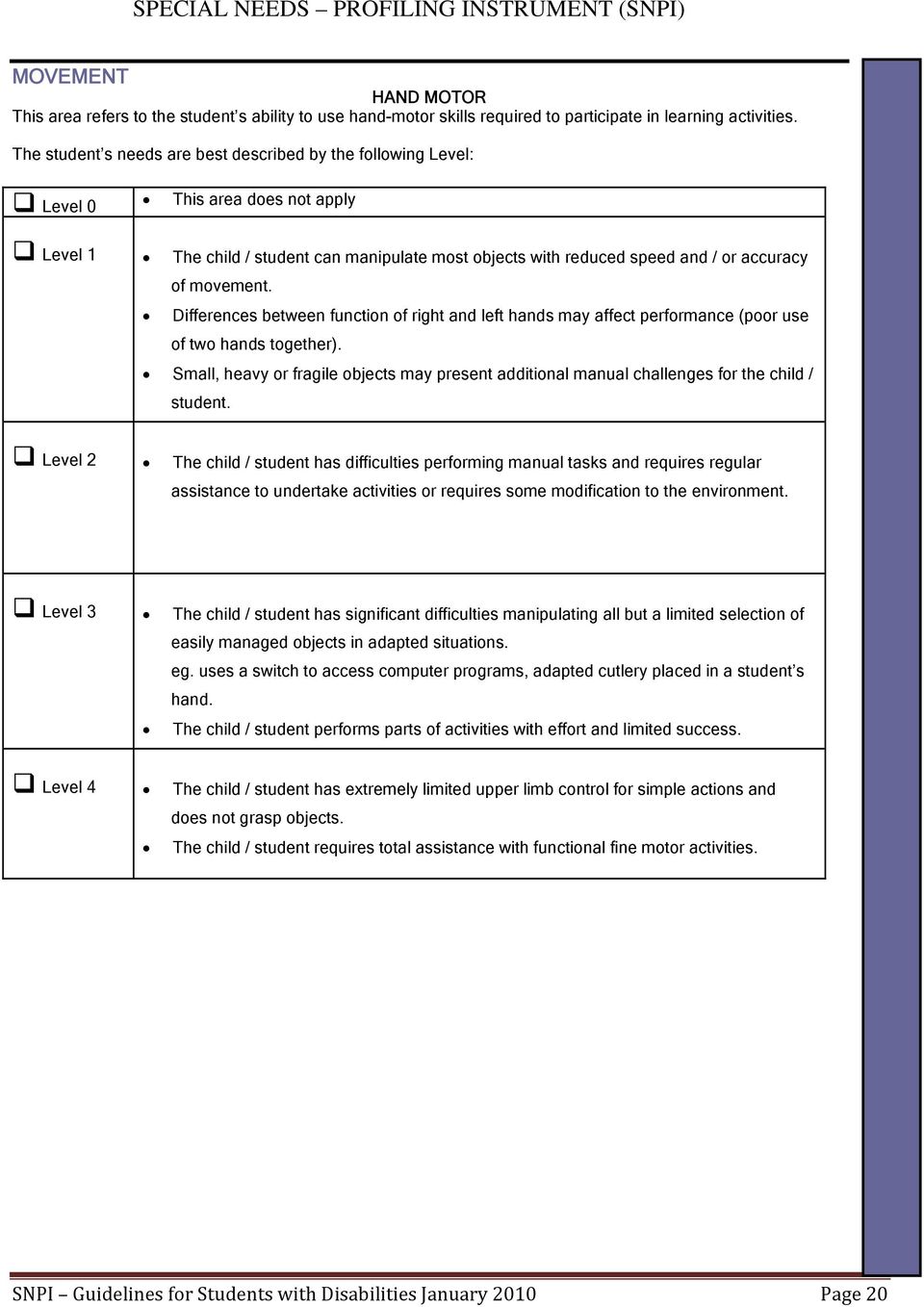
20 MOVEMENT HAND MOTOR This area refers to the student s ability to use hand-motor skills required to participate in learning activities. The student s needs are best described by the following Level: Level 0 This area does not apply Level 1 The child / student can manipulate most objects with reduced speed and / or accuracy of movement. Differences between function of right and left hands may affect performance (poor use of two hands together). Small, heavy or fragile objects may present additional manual challenges for the child / student. Level 2 The child / student has difficulties performing manual tasks and requires regular assistance to undertake activities or requires some modification to the environment. Level 3 The child / student has significant difficulties manipulating all but a limited selection of easily managed objects in adapted situations. eg. uses a switch to access computer programs, adapted cutlery placed in a student s hand. The child / student performs parts of activities with effort and limited success. Level 4 The child / student has extremely limited upper limb control for simple actions and does not grasp objects. The child / student requires total assistance with functional fine motor activities. SNPI Guidelines for Students with Disabilities January 2010 Page 20
Student Centred Appraisal of Need
 Student Centred Appraisal of Need Booklet for parents, carers and staff January 2010 INTRODUCTION The Student Centred Appraisal of Need provides a consistent approach in determining educational needs of
Register of Students with Severe Disabilities
 Department of Education Learners first, connected and inspired Register of Students with Severe Disabilities Department of Education Register of Students with Severe Disabilities 1. Eligibility Criteria
The Department for Communities and Social Inclusion also has advice regarding services at mysupportadvisor, http://www.mysupportadvisor.sa.gov.
 School Services School services and programs are available for students with disability and special needs. This document has information that you might find useful. The South Australian Government website
CDDH FACT SHEET. Working with people with intellectual disabilities in healthcare settings
 CDDH FACT SHEET Working with people with intellectual disabilities in healthcare settings People with intellectual disabilities have the same right as other community members to access community based
GUIDELINES FOR EARLY CHILDHOOD TRANSITION TO SCHOOL FOR CHILDREN WITH SPECIAL NEEDS
 GUIDELINES FOR EARLY CHILDHOOD TRANSITION TO SCHOOL FOR CHILDREN WITH SPECIAL NEEDS Revised September 2002 A partnership of: Manitoba Healthy Living Manitoba Aboriginal and Northern Affairs Manitoba Culture,
Students are required to undertake placement activities in mixed gender environments which reflect the Australian health care context.
 Introduction to inherent requirements for undergraduate Nursing course These inherent requirements apply to the following course: Bachelor of Nursing The School of Nursing at Avondale College of Higher
2015/2016 Special Education Program WORKPLAN INSTRUCTION BOOK
 2015/2016 Special Education Program WORKPLAN INSTRUCTION BOOK Important Due Dates Workplan: October 9, 2015 Interim Report: February 5, 2016 Final Report: June 3, 2016 Special Education Program First Nations
Preschool Disability Support Program. Grant Program Guidelines
 Preschool Disability Support Program Grant Program Guidelines W W W.DEC.NSW.GOV.AU Contents 1 Aims and objectives 3 2 Preschool Disability Support Program 3 3 Eligible services 4 4 Background 4 5 Roles
PRESCHOOL PLACEMENT CATEGORIES
 PRESCHOOL PLACEMENT CATEGORIES CASEMIS 20 EARLY CHILDHOOD SPECIAL EDUCATION SETTING Early Childhood Special Education Setting: This is a placement setting where children receive all of their special education
Categories of Exceptionality and Definitions
 7. CATEGORIES and DEFINITIONS of EXCEPTIONALITIES Purpose of the standard To provide the ministry with details of the categories and definitions of exceptionalities available to the public, including parents
Helping children with autism: Evidence-based assessment and treatment a guide for health professionals
 Helping children with autism: Evidence-based assessment and treatment a guide for health professionals Contents What is autism spectrum disorder (ASD)? 2 Features of ASD 4 An interdisciplinary approach
GMS Special Educational Needs (Information) Regulation Annual Report
 GMS Special Educational Needs (Information) Regulation Annual Report All mainstream schools and maintained nursery schools are required by law to produce a Special Educational Needs Report on an annual
St Nicholas Catholic Primary School
 SEND Information report St Nicholas Catholic Primary School 1. Provision for children with special educational needs St Nicholas Catholic Primary School is a fully inclusive mainstream setting. It currently
Helping your child with Non-verbal Learning Disability
 Helping your child with Non-verbal Learning Disability What is non-verbal learning disability? Non-verbal learning disability (NVLD) is a term used to describe a pattern of strengths and weaknesses in
Release: 1. CHCICS301A Provide support to meet personal care needs
 Release: 1 CHCICS301A Provide support to meet personal care needs CHCICS301A Provide support to meet personal care needs Modification History Not Applicable Unit Descriptor Descriptor This unit describes
Education Adjustment Program (EAP) Handbook
 Education Adjustment Program (EAP) Handbook Current as at September 2015 The State of Queensland (2015) This document is licensed under CC-BY 4.0, with the exception of the government coat of arms, logos
OCR Levels 2 and 3 in Supporting Teaching and Learning in Schools. Unit 39 Support pupils with communication and interaction needs
 OCR Levels 2 and 3 in Supporting Teaching and Learning in Schools Unit 39 Support pupils with communication and interaction needs UNIT SUMMARY Who is this unit for? This unit is for those who provide support
NHS Continuing Healthcare
 NHS Continuing Healthcare Questionnaire In association with Questionnaire 1. Full name of patient 2. Home address (prior to transfer into care home if applicable) 3. Patient s Date of Birth 4. Patient
Working together to improve outcomes for children and families. Needs, thresholds and pathways Guidance for Camden s children s workforce
 Working together to improve outcomes for children and families Needs, thresholds and pathways Guidance for Camden s children s workforce Universal, and Specialist Services: responding to the needs of Camden
St George Catholic College. SEN Information Report 2015-2016
 St George Catholic College SEN Information Report 2015-2016 The SEN Information Report complies with section 69(2) of the Children and Family Act 2014, regulations 51 and schedule 1 of the Special Needs
GUIDELINE: DEVELOPING INDIVIDUAL EDUCATIONAL ACCESS PLANS
 GUIDELINE: DEVELOPING INDIVIDUAL EDUCATIONAL ACCESS PLANS The University has chosen to adopt and adapt the principles of the International Classification of Functioning, Disability and Health (ICF; WHO,
Minsthorpe Community College Local Offer
 Minsthorpe Community College Local Offer Vision / mission statement Minsthorpe Community College is an inclusive school with a strong belief that all students needs should be met as fully as possible irrespective
Belmont Public Schools Special Education Programs
 Belmont Public Schools Special Education Programs Preschool Program School: Belmont system wide Population Served: Special Education Students Aged 3 5 Grade: Pre K Program Description: This program is
PROGRAMME SPECIFICATION MSc Speech, Language and Communication Needs in Schools: Advanced Practice
 PROGRAMME SPECIFICATION MSc Speech, Language and Communication Needs in Schools: Advanced Practice Awarding body: Institute of Education, University of London / City University London Teaching Institutions:
4.4 Early Detection Guidelines
 4.4.2.2 Assessment for Identified Concerns 4.4.2.2.6 How Children Develop 9-10 Year Olds The following section outlines the major developmental milestones for nine to ten year old children. Six areas of
Standards for Certification in Early Childhood Education [26.110-26.270]
![Standards for Certification in Early Childhood Education [26.110-26.270]](/thumbs/24/3436110.jpg "Standards for Certification in Early Childhood Education [26.110-26.270]") I.B. SPECIFIC TEACHING FIELDS Standards for Certification in Early Childhood Education [26.110-26.270] STANDARD 1 Curriculum The competent early childhood teacher understands and demonstrates the central
I.B. SPECIFIC TEACHING FIELDS Standards for Certification in Early Childhood Education [26.110-26.270] STANDARD 1 Curriculum The competent early childhood teacher understands and demonstrates the central
SCAN Program (Supporting Children with Additional Needs)
 NOVEMBER 2013 SCAN Program (Supporting Children with Additional Needs) Grant program guidelines The aim of the SCAN Program (Supporting Children with Additional Needs) is to improve access to funded preschools
ARLINGTON PUBLIC SCHOOLS SPECIAL EDUCATION PROGRAMS AND SERVICES
 ARLINGTON PUBLIC SCHOOLS SPECIAL EDUCATION PROGRAMS AND SERVICES Introduction The Arlington Public Schools provides a comprehensive array of programs and services from pre-school through grades 12 designed
Scope of Practice in Speech Pathology
 Level 2 / 11-19 Bank Place T 61 3 9642 4899 [email protected] Melbourne Victoria 3000 F 61 3 9642 4922 www.speechpathologyaustralia.org.au Scope of Practice in Speech Pathology Revised
Interwork Limited presents Practical Training for Carers. Provide Support to Meet Personal Care Needs
 Interwork Limited presents Practical Training for Carers Provide Support to Meet Personal Care Needs CONTENT Understanding the client s personal support requirements Providing support to increase maximum
Raising Children Network. Phone 1300 881 971. For a language interpreter call 13 14 50 Developed by
 Helping Children with Autism Package (HCWA) Autism Advisor Program (AAP) Early Days Workshops PlayConnect Playgroups Raising Children Network Medicare Items Positive Partnerships Workshops $ You can apply
Ashleigh C OF E (VC) Primary School Maintained
 TITLE: S.E.N.D. POLICY DATE ADOPTED: 21 st March 2016 REVIEW SCHEDULE: ANNUAL DATE OF NEXT REVIEW: MARCH 2017 Ashleigh C OF E (VC) Primary School Maintained Special Educational Needs & Disabilities (SEND)
1. Basic information about the school s special educational provision
 KNOTTINGLEY HIGH SCHOOL & SPORTS COLLEGE SPECIAL EDUCATION NEEDS POLICY Reviewed and Revised: September 2009 1. Basic information about the school s special educational provision a) Objectives To enable
Special Education Coding Criteria 2014/2015. ECS to Grade 12 Mild/Moderate Gifted and Talented Severe
 Special Education Coding Criteria 2014/2015 Mild/Moderate Gifted and Talented Severe Special Education Coding Criteria 2014/2015 ISBN 978-1-4601-1902-0 (Print) ISBN 978-1-4601-1903-7 (PDF) ISSN 1911-4311
Assistive Technology and Augmentative and Alternative Communication Policies and Procedures for the Moriarty Edgewood School District
 Assistive Technology and Augmentative and Alternative Communication Policies and Procedures for the Moriarty Edgewood School District 1 Purpose The purpose of this manual is to assist teachers, case managers,
TExES Special Education Supplemental (163) Test at a Glance
 TExES Special Education Supplemental (163) Test at a Glance See the test preparation manual for complete information about the test along with sample questions, study tips and preparation resources. Test
Special Education Program Descriptions School-Based Program Delivery Model
 Special Education Program Descriptions School-Based Program Delivery Model Resource Room Services Resource Room Services, available in all MCPS schools, provide students with disabilities with the support
SENCo (Special Education Needs Coordinator):
 Special Educational Needs and Disabilities (SEND) Offer At St Columba's Head Teacher: SENCo (Special Education Needs Coordinator): Mr N Fisher Mrs K Kallend The following is a summary of the changes to
Functional Assessment Measures
 Functional Assessment Measures FUNCTIONAL RATING SCALES This section highlights the assessment of functional limitations. Assessment of functional limitations is essential to help determine eligibility
Leeds Local Offer: The specialist education offer (2-16) What is the specialist education offer and where has it come from?
 Leeds Local Offer: The specialist education offer (2-16) What is the specialist education offer and where has it come from? The Children and Families Act became law in March 2014. The Act aims to improve
Related Services: How Do Special Needs Education Relate to Your Child?
 Related Services: How Do Special Needs Education Relate to Your Child? Family Driven Non-Profit 501(c)3 What makes FND unique is that the majority of our Board of Directors, all of our Management Staff
SPECIFIC LEARNING DISABILITY
 I. DEFINITION "Specific learning disability" means a disorder in one or more of the basic psychological processes involved in understanding or in using language, spoken or written, that may manifest itself
Our Local Offer for Special Educational Needs and Disability (SEND)
 Our Local Offer for Special Educational Needs and Disability (SEND) Rosewood Free School is a maintained special school in Southampton for children with PMLD complex physical, medical and learning difficulties.
Substitute Instructional Assistant Special Education, Mild/Moderate
 William S. Hart Union High School District Personnel Commission - Classified Employment OPEN CONTINUOUS EXAM ANNOUNCEMENT Substitute Instructional Assistant Special Education, Mild/Moderate Released: September
Confirmation of Diagnosis of Disability (To determine eligibility under section 18(2)(b) of the Income Tax Act, 1962 (as amended))
 Confirmation of Diagnosis of Disability (To determine eligibility under section 18(2)(b) of the Income Tax Act, 1962 (as amended)) ITR-DD This certificate must not be submitted with your tax return but
Trinity School: SEN offer: January 2015
 SCHOOL NAME: Trinity School, Heathway, Dagenham, Essex, RM10 7SJ Tel: 020 8270 1601 Fax: 020 8270 4969 Email: [email protected] Headteacher: Peter McPartland Schools must set out the information
School-based Support Personnel
 L. SUPPORT SERVICES School-based Support Personnel Yukon Education provides both professional and paraprofessional support to schools to address the diverse learning of students. Learning Assistance Program
Special Education Advocacy for Children in Oregon. Brian V. Baker, Juvenile Rights Project, Inc. & Joel Greenberg, Oregon Advocacy Center, Inc.
 Special Education Advocacy for Children in Oregon Brian V. Baker, Juvenile Rights Project, Inc. & Joel Greenberg, Oregon Advocacy Center, Inc. Goals Understand eligibility for special education and Section
Questions to Consider in UDL Observations of Early Childhood Environments
 Questions to Consider in UDL Observations of Early Childhood Environments Universally Designed Learning (UDL) environments provide considerations for the widest diversity of learners possible so that all
Early Childhood Education- Distance Prior Learning Assessment Recognition (PLAR) - Comprehensive. Course Descriptions 2012 Program
 School of Academics, Applied Arts and Tourism Early Childhood Education- Distance Prior Learning Assessment Recognition (PLAR) - Comprehensive Course Descriptions 2012 Program EE1290 Positive Behaviour
CALIFORNIA SPECIAL EDUCATION MANAGEMENT INFORMATION SYSTEM (CASEMIS) SERVICE DESCRIPTIONS. San Diego Unified SELPA
 210 Family training, counseling, and home visits(ages 0-2 only): This service includes: services provided by social workers, psychologists, or other qualified personnel to assist the family in understanding
Yr Adran Plant, Addysg, Dysgu Gydol Oes a Sgiliau Department for Children, Education, Lifelong Learning and Skills
 Yr Adran Plant, Addysg, Dysgu Gydol Oes a Sgiliau Department for Children, Education, Lifelong Learning and Skills Guidance to support the recording of Pupils Special Educational Needs on School Management
AUGMENTATIVE COMMUNICATION EVALUATION
 AUGMENTATIVE COMMUNICATION EVALUATION Date: Name: Age: Date of Birth: Address: Telephone: Referral Source: Diagnosis: Participants: Social History and Current Services: lives with his in a private home
ELIGIBILITY GUIDELINES SPEECH PATHOLOGY
 ELIGIBILITY GUIDELINES SPEECH PATHOLOGY These guidelines are consistent with the Texas Speech- Language-Hearing Association s (TSHA) eligibility templates. It is recommended that you contact the TSHA Vice
In LIFE SKILLS it is intended to promote learning through the following aims :
 Subject Policy for: LIFE SKILLS In LIFE SKILLS it is intended to promote learning through the following aims : PROVIDING OPPORTUNITES FOR PUPILS WHICH ARE TAILORED TO THEIR NEEDS PROVIDING PUPILS WITH
The State of Queensland (Department of Education and Training) 2009 First published 1996 as Guidelines for Speech language Therapy Services Revised
 The State of Queensland (Department of Education and Training) 2009 First published 1996 as Guidelines for Speech language Therapy Services Revised edition 1998 as SM10 - Speech language Therapy Services
 LOCAL OFFER As part of the Children and Families Bill (2014), schools are required to publish and keep under review, information about services they expect to be available in their setting for children
Quick guide to autism
 Quick guide to autism What it looks like and how you can help What is autism spectrum disorder (ASD)? ASD is a lifelong neurodevelopmental disorder We don t know what causes ASD but we do know genetics
HOLY FAMILY PRIMARY SCHOOL MAGHERAFELT
 HOLY FAMILY PRIMARY SCHOOL MAGHERAFELT SPECIAL NEEDS & INCLUSION POLICY STATEMENT Rationale Holy Family Primary School is committed to the provision of a broad and balanced curriculum, which offers equal
LC Paper No. CB(4)391/13-14(01)
 LC Paper No. CB(4)391/13-14(01) For information on 18 February 2014 Legislative Council Panel on Education Subcommittee on Integrated Education Issues Related to the Articulation of Students with Special
DEPARTMENT OF COMMUNITY SERVICES Disability Support Program. Level of Support Policy
 DEPARTMENT OF COMMUNITY SERVICES Disability Support Program Effective: May 2014 TABLE OF CONTENTS 1.0 POLICY STATEMENT 2.0 POLICY OBJECTIVE 3.0 DEFINITIONS 4.0 LEVEL OF SUPPORT OVERVIEW 5.0 FUNCTIONAL
Redmond School District Secondary Teacher JOB SUMMARY
 Redmond School District Secondary Teacher Job Title: School Nurse Reports To: Principal and Executive Director of Student Services FLSA Status: Exempt JOB SUMMARY The practice of professional nursing occurs
Question Specifications for the Cognitive Test Protocol
 Question Specifications for the Cognitive Test Protocol Core Questions These are the 6 disability questions to be tested in the interview. All of the other questions in the cognitive test protocol are
Special Educational Needs and Disability Policy 2014 Notre Dame Catholic College. Contact details Mrs L Martin (NASENCO award) Special Education Needs
 Special Educational Needs and Disability Policy Notre Dame Catholic College Contact details Mrs L Martin (NASENCO award) Special Education Needs Co-ordinator (SENCO) Senior Leadership Team advocate: Mr
Assistive Technology: A System of Support for Including Students with Disabilities within General Education Programs
 Assistive Technology: A System of Support for Including Students with Disabilities within General Education Programs A General Overview Presented by: Melanie O Dea Special Education Consultant Learning
Purpose of Presentation
 Understanding Stalking Behavior by Individuals with ASD Linda Haymes, Keith Storey, Michal Post, & Tamara Loughrey Purpose of Presentation To provide an overview of stalking behavior in school and employment
3030. Eligibility Criteria.
 3030. Eligibility Criteria. 5 CA ADC 3030BARCLAYS OFFICIAL CALIFORNIA CODE OF REGULATIONS Barclays Official California Code of Regulations Currentness Title 5. Education Division 1. California Department
EMOTIONAL DISTURBANCE
 I. DEFINITION "Emotional disturbance" means a condition exhibiting one or more of the following characteristics over a long period of time and to a marked degree that adversely affects a child's educational
Vernon Park Primary School. Teaching and Learning Policy
 Vernon Park Primary School Teaching and Learning Policy The school s approach to teaching and learning is based upon the school vision: At Vernon Park Primary School we aim to provide all children, parents,
Disability and Discrimination Statement
 Disability and Discrimination Statement 1. Introduction The Longsight Community Primary welcomes people with disabilities and will comply with the requirements of the Disabilities Discrimination Act 1995
January 2015 Special Educational Needs Report/ Local Offer
 January 2015 Special Educational Needs Report/ Local Offer How will school / college staff support my child? Peacehaven Community School (PCS) is an inclusive school with a strong commitment to meeting
Ministry of Education. The Individual Education Plan (IEP) A RESOURCE GUIDE IEP
 Ministry of Education The Individual Education Plan (IEP) A RESOURCE GUIDE 2004 IEP CONTENTS Introduction.......................................... 4 What Is an IEP?.........................................
3. A variety of materials are available so that children of all skill levels have something to play with.
 The Incredible Years BEST PRACTICES INVENTORY-R* DATE / / CLASSROOM ARRANGEMENT 1. The classroom has clearly defined and well-equipped learning centers. The number of children allowed in a center is limited
Student Mental Health and Wellbeing
 Student Mental Health and Wellbeing 2 Student Mental Health and Wellbeing DECS Commitment to Student Mental Health and Wellbeing The Department of Education and Children s Services (DECS) recognises that
Adaptive Physical Education
 Adaptive Physical Education Adapted Physical Education - APE Adapted physical education is a diverse program of developmental activities, exercises, games, rhythms, and sports designed to meet the unique
GUIDELINES ISSUED UNDER PART 5A OF THE EDUCATION ACT 1990 FOR THE MANAGEMENT OF HEALTH AND SAFETY RISKS POSED TO SCHOOLS BY A STUDENT S VIOLENT
 GUIDELINES ISSUED UNDER PART 5A OF THE EDUCATION ACT 1990 FOR THE MANAGEMENT OF HEALTH AND SAFETY RISKS POSED TO SCHOOLS BY A STUDENT S VIOLENT BEHAVIOUR CONTENTS PAGE PART A INTRODUCTION AND STATEMENT
62 Hearing Impaired MI-SG-FLD062-02
 62 Hearing Impaired MI-SG-FLD062-02 TABLE OF CONTENTS PART 1: General Information About the MTTC Program and Test Preparation OVERVIEW OF THE TESTING PROGRAM... 1-1 Contact Information Test Development
CIRCULAR TO BOARDS OF MANAGEMENT AND PRINCIPAL TEACHERS OF NATIONAL SCHOOLS
 Circular SP.ED 08/02 CIRCULAR TO BOARDS OF MANAGEMENT AND PRINCIPAL TEACHERS OF NATIONAL SCHOOLS Applications for full-time or part-time resource teacher support to address the special education needs
NATIONAL PROFILES FOR COMMUNITY NURSING CONTENTS
 NATIONAL PROFILES FOR COMMUNITY NURSING CONTENTS Profile Title AfC banding Page Clinical Support Worker Nursing (Community) 2 2 Clinical Support Worker Higher Level Nursing (Community) 3 5 Nurse Associate
Health Professionals who Support People Living with Dementia
 Clinical Access and Redesign Unit Health Professionals who Support People Living with Dementia (in alphabetical order) Health Professional Description Role in care of people with dementia Dieticians and
Portage Guide Birth to Six Preschool Indicator 7 Child Outcomes Crosswalk. Outcome 2 Acquisition & Use of Knowledge & Skills
 Portage Guide Birth to Six Preschool Indicator 7 Child Outcomes Crosswalk NPG Domains Outcome 1 Positive Social Emotional Skills Outcome 2 Acquisition & Use of Knowledge & Skills Outcome 3 Appropriate
Dulwich College Seoul Learning Support & Special Educational Needs (SEN) in the Primary School
 Dulwich College Seoul Learning Support & Special Educational Needs (SEN) in the Primary School Ethos and Policy points Dulwich College Seoul (DCSL) believes that every student attending DCSL has the right
The Role and Scope of Occupational Therapy and Physiotherapy Services in State Schools Revised edition
 The Role and Scope of Occupational Therapy and Physiotherapy Services in State Schools Revised edition 2 Contents Purpose 3 1. Definitions 3 Occupational Therapy 3 Physiotherapy 3 Relationship between
Choosing a School. A Guide For Parents and Guardians of Children and Young People with Special Educational Needs
 Choosing a School A Guide For Parents and Guardians of Children and Young People with Special Educational Needs Choosing a School A Guide For Parents and Guardians of Children and Young People with Special
Individual Education Plan (IEP)
 Individual Education Plan (IEP) THIS IEP CONTAINS AC MOD ALT REASON FOR DEVELOPING THE IEP Student identified as exceptional by IPRC Student not formally identified but requires special education program/services,
CROOK LOG PRIMARY SCHOOL SEN POLICY
 CROOK LOG PRIMARY SCHOOL SEN POLICY 1 CROOK LOG PRIMARY SCHOOL SPECIAL EDUCATIONAL NEEDS POLICY 1. Basic information about the schools' special educational provision Crook Log School aims to help all children