
Ministry of Education. The Individual Education Plan (IEP) A RESOURCE GUIDE IEP
|
|
|
- Charles Wheeler
- 10 years ago
- Views:
Transcription
1 Ministry of Education The Individual Education Plan (IEP) A RESOURCE GUIDE 2004 IEP
2

3 CONTENTS Introduction What Is an IEP? Why Does a Student Have an IEP? The IEP Process Phase 1: Gather Information Gather Information From Various Sources for Program Planning Consult With Parents, the Student, School Staff, and Other Professionals Consultation with parents Consultation with the student Consultation with previous teachers Consultation with other professionals Gather Information Through Observation of the Student Conduct Further Assessments, If Necessary Consolidate and Record Information Phase 2: Set the Direction Establish a Collaborative Approach The IEP Team Establish Roles and Responsibilities The role of the educators and other professionals on the team The principal The classroom teacher The special education teacher The teacher s assistant Other professionals The role of the student and parents on the team The student Parents Ways of supporting parental and student involvement Begin Work on the IEP Relevant assessment data Indicate the Student s Areas of Strength and Areas of Need on the IEP 23 Health support services in the school setting Une publication équivalente est disponible en français sous le titre suivant : Plan d enseignement individualisé (PEI) : Guide. This publication is available on the Ministry of Education s website at Phase 3: Develop the IEP as It Relates to the Student s Special Education Program and Services Classify Subjects or Courses and Alternative Program Areas Accommodated only Modified Alternative Classifying programs for gifted students Subjects or courses with modified expectations Alternative programs Recording classified subjects and courses in the IEP
4 Record Decisions About Program Exemptions, Course Substitutions, and Eligibility for a Diploma or a Certificate Determine Accommodations Record Subjects or Courses With Accommodations Only in the IEP.. 30 Plan and Document Subjects or Courses With Modified Expectations. 30 Elementary School Subjects Current level of achievement Annual program goal(s) Learning expectations Secondary School Courses Current level of achievement Annual program goal(s) Learning expectations Plan and Document Alternative Programs or Courses Determine Teaching Strategies and Assessment Methods Teaching Strategies Assessment Methods Plan For and Document Required Human Resources Record Information About Evaluation and Reporting Record Information About Provincial Assessments Develop a Transition Plan, If Required Record Information About the IEP Development Phase IEP development team Sources consulted in development Parent/student consultation Completion date of the IEP development phase Principal s approval Parent/student response Phase 4: Implement the IEP Share the Completed IEP with the Student, Parents, School Staff, and Other Professionals Put the IEP Into Practice Classroom teachers Support personnel Continuously Assess the Student s Progress Adjust the IEP as Necessary Evaluate the Student s Learning and Report to Parents Subjects or courses with accommodations only Subjects or courses with modified expectations Alternative programs and courses Phase 5: Review and Update the IEP Update the Learning Expectations at the Beginning of Each Reporting Period Record Ongoing Revisions to the IEP Store the IEP in the Documentation File of the Ontario Student Record The Individual Education Plan (IEP): A Resource Guide

5 Plan for the Student s Transition from Elementary to Secondary School, or for a Transfer to Another School The sending teacher The receiving teacher Appendices Appendix A: Template for a Suggested IEP Form Appendix B: Samples of Completed IEP Forms Contents 3

6 INTRODUCTION This revised resource guide replaces Part E, The Individual Education Plan (IEP), of the ministry document Special Education: A Guide for Educators, 2001 (pages dated October 21), as well as the 1998 publication Individual Education Plan (IEP): Resource Guide. The present guide is intended to assist school boards in complying with the requirements for IEPs that are set out in Regulation 181/98 and implementing the policies set out in Individual Education Plans: Standards for Development, Program Planning, and Implementation, This guide is intended to help teachers and others working with students with special needs to develop, implement, and monitor high-quality IEPs. A five-step process is recommended. Suggestions and examples are provided, but IEPs, by their very nature, will be individualized on the basis of the particular requirements of the student. Section 1 of the Education Act defines a special education program as an educational program that is based on and modified by the results of continuous assessment and evaluation and that includes a plan containing specific objectives and an outline of educational services that meets the needs of the exceptional pupil. The term special education services is defined as facilities and resources, including support personnel and equipment, necessary for developing and implementing a special education program. Under Regulation 181/98, Identification and Placement of Exceptional Pupils, principals are required to ensure that an Individual Education Plan (IEP) is developed for each student who has been identified as exceptional by an Identification, Placement and Review Committee (IPRC), within 30 school days of the student s placement in a special education program (see excerpts from the regulation on page 5). School boards also have the discretion to prepare an IEP for a student who is receiving a special education program and/or related services but who has not been formally identified as exceptional. The Human Rights Code provides for the right to equal treatment with respect to services, without discrimination on the basis of a number of grounds, including disability. Education is considered to be a service under the code, and service providers have an obligation to accommodate a person s needs, unless doing so causes "undue hardship for the provider, considering cost, outside sources of funding, if any, and health and safety requirements, if any (Ontario Human Rights Code, s. 17(2)). Persons with disabilities should be considered, assessed, and accommodated on an individual basis. In September 2000, the Ministry of Education released the policy document Individual Education Plans: Standards for Development, Program Planning, and Implementation (referred to hereafter as the IEP Standards document). The purpose of the standards is to improve the consistency and quality of program 4 The Individual Education Plan (IEP): A Resource Guide

7 Regulation 181/98, Sections 6 (2) (8) and 8 6. (2) The board shall promptly notify the principal of the school at which the special education program is to be provided of the need to develop an individual education plan for the pupil in consultation with the parent and, where the pupil is 16 years of age or older, the pupil. (3) The individual education plan must include, (a) specific educational expectations for the pupil; (b) an outline of the special education program and services to be received by the pupil; and (c) a statement of the methods by which the pupil s progress will be reviewed. (4) Where the pupil is 14 years of age or older, the individual education plan must also include a plan for transition to appropriate postsecondary school activities, such as work, further education, and community living. (5) Subsection (4) does not apply in respect of a pupil identified as exceptional solely on the basis of giftedness. (6) In developing the individual education plan, the principal shall, (a) consult with the parent and, where the pupil is 16 years of age or older, the pupil; and (b) take into consideration any recommendations made by the committee [IPRC] or the Special Education Tribunal, as the case may be, regarding special education programs or special education services. (7) In developing a transition plan under subsection (4), the principal shall consult with such community agencies and post-secondary educational institutions as he or she considers appropriate. (8) Within 30 school days* after placement of the pupil in the program, the principal shall ensure that the plan is completed and a copy of it sent to a parent of the pupil and, where the pupil is 16 years of age or older, the pupil. 8. The principal shall ensure that the individual education plan for a pupil is included in the record kept in respect of the pupil under clause 265(d) of the Act, unless a parent of the pupil has objected in writing. *As amended by Ontario Regulation 137/01. planning for students who are receiving special education programs and services. The standards are also intended to help improve communication with parents 1 about how their child will progress through the Ontario curriculum (taking into account the child s individual learning strengths and needs) and about how that progress will be monitored. In September 2002, to support implementation of the standards, the ministry provided school boards with an IEP template and accompanying explanatory notes. Although use of the template is not mandatory, boards were encouraged to revise their existing IEP forms to capture all the information represented in the template. A slightly revised version of the original template is provided in Appendix A. (Samples of completed IEPs can be found in Appendix B.) The present resource document elaborates on the explanatory notes, providing guidelines for planning a student s special education program 1. Parents is used throughout this document to refer to parent(s) and guardian(s). Introduction 5

8 and for developing an IEP that meets the requirements of the IEP Standards document. The text is structured according to the five phases of the IEP process, as shown in Figure 2, on page 10. This revised resource guide is based on information gathered between 2001 and 2003, when the Ministry of Education conducted reviews of IEPs prepared by school boards across Ontario. It takes into account information gleaned from numerous consultations with educators and parents. The reader may notice some minor differences between the IEP Standards document and this guide. These slight differences came about as terms and procedures were clarified for the purpose of developing a practical guide to meeting the requirements outlined in the IEP Standards document, and they in no way contradict the intent of the standards. For the convenience of users of this guide, several key sections of Regulation 181/98 are reprinted on page 5 and quoted at relevant points throughout the text. However, principals and others who work with exceptional students are advised to refer to both the IEP Standards document and the regulation for a full description of responsibilities related to IEPs. What Is an IEP? An IEP is... a written plan describing the special education program and/or services required by a particular student, based on a thorough assessment of the student s strengths and needs that is, the strengths and needs that affect the student s ability to learn and to demonstrate learning; a record of the particular accommodations 2 needed to help the student achieve his or her learning expectations, given the student s identified learning strengths and needs; a working document that identifies learning expectations that are modified from the expectations for the age-appropriate grade level in a particular subject or course, as outlined in the Ministry of Education s curriculum policy documents; a working document that identifies alternative expectations, if required, in program areas not represented in the Ontario curriculum; a record of the specific knowledge and skills to be assessed and evaluated for the purpose of reporting student achievement of modified and/or alternative expectations; an accountability tool for the student, the student s parents, and everyone who has responsibilities under the plan for helping the student meet the stated goals and learning expectations as the student progresses through the Ontario curriculum. 2. Accommodations are supports or services that are not provided to the general student population but that are required by individual students with special needs to help them achieve learning expectations and demonstrate learning. 6 The Individual Education Plan (IEP): A Resource Guide

9 An IEP is not... a description of everything that will be taught to the student; a list of all the teaching strategies used in regular classroom instruction; a document that records all learning expectations, including those that are not modified from the regular grade level curriculum expectations; a daily lesson plan. Why Does a Student Have an IEP? Regulation 181/98 requires that an IEP be developed for every student identified as exceptional by an Identification, Placement and Review Committee (IPRC). In addition, an IEP may be developed for a student who has not been formally identified as exceptional but who requires a special education program and/or services. In these cases, an IEP is required when: the school principal determines that a student s achievement will be assessed on the basis of modified expectations; and/or the student regularly requires accommodations for instructional or assessment purposes. Figure 1, on the following page, is a sample checklist, listing the information that should be included in an IEP. Introduction 7

10 Figure 1: Sample Checklist Important Information to Be Included in an IEP The strengths and needs that relate to the student s learning. If the student has been formally identified as exceptional, the IEP should include the strengths and needs identified in the statement of decision received from the IPRC. Relevant assessment data that support the identification of an exceptionality or the reasons that give rise to the need for special education programs and services Any specialized health support services needed to enable the student to attend school A list of all subjects/courses in which the student requires modified expectations and/or accommodations, and all alternative programs A list of the accommodations the student requires to help him or her learn and demonstrate learning The student s current level of achievement in each modified subject or course and/or alternative program area Annual program goals and learning expectations for each reporting period in each subject or course in which modified expectations are required and/or in each alternative program area The assessment methods that will be used to assess the student s achievement of the modified or alternative expectations A clear indication of the way in which student progress will be reported to parents (i.e., on the Provincial Report Card and/or in an alternative report) and the dates on which reports will be issued Documentation of consultations with parents and the student (if the student is 16 or older) during the development of the IEP and any subsequent reviews, and a record of the review and updating of learning expectations by school staff A transition plan (if required, according to Regulation 181/98) 8 The Individual Education Plan (IEP): A Resource Guide

11 THE IEP PROCESS Regulation 181/98, subsection 6(8), as amended by Ontario Regulation 137/01, requires the principal, within 30 school days after placement of the pupil in the program, to ensure that the plan is completed and a copy of it sent to a parent of the pupil and, where the pupil is 16 years of age or older, the pupil. Under Regulation 181/98, the principal is responsible for ensuring that an IEP is developed for exceptional pupils. Once a student has been identified as exceptional and placed in a special education program, successful practice suggests that the principal should assign to one teacher the responsibility for coordinating the development, implementation, and monitoring of the student s IEP, employing a collaborative process. Planning a student s educational program is best accomplished through the combined efforts of, and close communication among, the student, the student s parents, the school, the community, and other professionals involved with the student. The IEP provides an opportunity for all those involved with the student to work together to provide a program that will foster achievement and success. Regardless who is coordinating the IEP process, decisions related to program planning (represented in the IEP template by the sections covering Current Level of Achievement, Annual Program Goals, Learning Expectations, Teaching Strategies, and Assessment Methods) should be made by the individual who teaches the student and prepares the report card usually the classroom teacher. The classroom teacher is responsible for instructing the student and assessing the student s knowledge and skills in relation to his or her learning expectations, including any modified or alternative expectations. This guide recommends that a team approach should underlie the IEP process, and that the process should be curriculum-oriented; that is, it should focus on how the student is expected to progress through the Ontario curriculum, with or without modification of expectations, and on the provision of alternative programs not described in the Ontario curriculum. The IEP process involves the following five phases: 1. Gather information 2. Set the direction 3. Develop the IEP as it relates to the student s special education program and services 4. Implement the IEP 5. Review and update the IEP 9

12 Figure 2 presents an overview of the five phases. Members of the student s IEP team may focus on the particular subject or course in which they are responsible for direct instruction. The various tasks that need to be undertaken in phases 1 to 3 may be delegated to different team members in order to facilitate completion of the IEP within 30 school days of the student s placement in a special education program. Figure 2: Overview of the IEP Process 5. Review and Update the IEP Update the learning expectations at the beginning of each reporting period Review the IEP regularly and record revisions Store the IEP in the documentation file of the Ontario Student Record Plan for the transition from elementary to secondary school, or for a transfer to another school 4. Implement the IEP Share the completed IEP with the student, parents, school staff, and other professionals (providing a copy to parents and to the student, if 16 or older) Put the IEP into practice (classroom teachers and support personnel) Continuously assess the student s progress Adjust the IEP as necessary (recording any changes in goals, expectations, accommodations, teaching strategies, and so on) Evaluate the student s learning and report to parents 1. Gather Information Review the student s records (including the IPRC s statement of decision and/or previous IEPs) Consult with parents, the student, school staff, and other professionals Gather information through observation of the student Conduct further assessments, if necessary Consolidate and record information 2. Set the Direction Establish a collaborative approach The IEP team Establish roles and responsibilities Begin work on the IEP (e.g., record the reason for the IEP, record personal information, list relevant assessment data) Indicate the student s areas of strength and areas of need on the IEP (as identified in the IPRC s statement of decision, where applicable) 3. Develop the IEP as It Relates to the Student s Special Education Program and Services Classify subjects or courses and alternative program areas Record decisions about program exemptions, course substitutions, and eligibility for a diploma or a certificate Determine accommodations; record subjects or courses with accommodations only Plan and document subjects or courses with modified expectations Plan and document alternative programs or courses Determine teaching strategies and assessment methods (for modified and alternative expectations) Plan for and document required human resources Record information about evaluation and reporting Record information about provincial assessments Develop a transition plan, if required Record information about the IEP development phase (including details of parent/student consultations); secure principal s approval 10 The Individual Education Plan (IEP): A Resource Guide
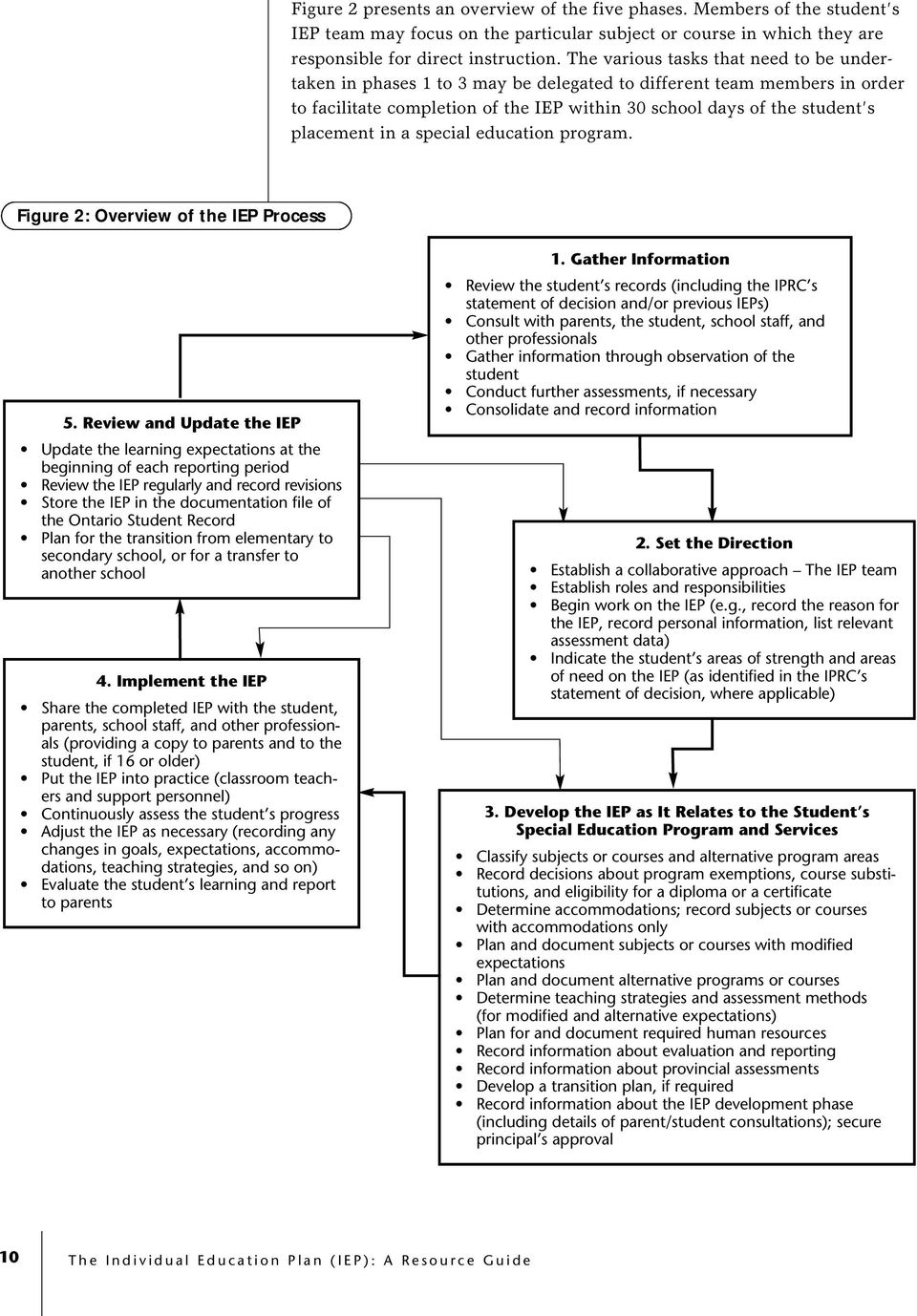
13 Most IEPs follow the timetable of a school year or semester. They are developed in the early fall and cover the time up to the June reporting period or the end of the semester. The circular patterns shown in Figure 2 indicate that the IEP process involves ongoing review, evaluation, and adjustment on a term-by-term basis. The arrows extending from the review and update box indicate that the review phase can involve references back to earlier phases. Each phase in the process is discussed in detail in the following pages. The IEP Process 11

14 PHASE 1: GATHER INFORMATION Gather Information From Various Sources for Program Planning Information of various kinds is needed for an IEP. The teacher assigned to coordinate the development of the plan may therefore find it efficient to assign different members of the IEP development team to gather information related to the different parts of the process. Information should be obtained from a variety of sources and shared among team members so that the planning team can develop a comprehensive view of the student s learning profile and programming needs. The basic information needed for the IEP includes the following: personal information, as listed in the IEP Standards document and on page 21 of this guide where applicable, information relating to the IPRC process and the IPRC s statement of decision, including the date of the most recent IPRC, the student s exceptionality, and the IPRC s placement decision in the case of a student who has not been identified as exceptional by an IPRC, information about the characteristics of the student that make a special education program and/or services necessary Regulation 181/98, clause 6(6)(b), requires the principal, in developing the individual education plan, to take into consideration any recommendations made by the committee (IPRC) or the Special Education Tribunal, as the case may be, regarding special education programs or services. Various other kinds of information are needed for the IEP, which will also assist the IEP team in planning the student s educational program. They include the following: relevant assessment data, including the date, source, and results or recommendations of assessment reports (see page 22) any medical or health support services required to enable the student to attend school clear and specific information about the student s learning strengths and needs, based on relevant assessment data and, in the case of students identified as exceptional, on the IPRC s statement of decision any recommendations made by the IPRC for special education programs and services information about accommodations required by the student, including individualized equipment requirements individualized teaching strategies that have been or are likely to be helpful to the student the student s current levels of achievement 12 The Individual Education Plan (IEP): A Resource Guide

15 Other information that could be helpful for planning and implementing the student s education program might include: the language spoken by the student at home the student s enrolment history, last school attended, attendance patterns, school behaviour, and social skills The Education Act and the Municipal Freedom of Information and Protection of Privacy Act in the case of school boards (the Freedom of Information and Protection of Privacy Act in the case of Provincial Schools) contain requirements related to the collection, use, and release of personal information. Principals and teachers should consult with their board s freedom-of-information coordinators about the steps required to obtain access to personal information about the student that is not contained in the student s OSR (for example, from other professionals who work with the student), and about providing information contained in the student s OSR to other professionals. IEP team members will consult a number of written sources to obtain information needed for the IEP, including the following: the IPRC s statement of decision, which specifies the student s placement, identifies the student s exceptionality, and describes the student s strengths and needs and may include recommendations for the student s special education program and services the student s Ontario Student Record (OSR), including report cards and previous IEPs relevant assessment reports results of provincial assessments the student s current work the student s annual education plan (for students in Grades 7 12) Note: When obtaining, releasing, or sharing personal information about a student, the principal must ensure that the requirements of the Education Act and the Municipal Freedom of Information and Protection of Privacy Act, as well as the requirements regarding access to student information outlined in The Ontario Student Record (OSR): Guideline, 2000, have been met. In addition to using written sources, IEP team members will rely on consultations, direct observation of the student, and further assessments, if needed, as described in the following sections, to obtain the information they need. Consult With Parents, the Student, School Staff, and Other Professionals Consultation with the student s parents and the student, school staff, support personnel, and representatives of outside agencies or services is a valuable source of information, and should be a continuous process throughout the development and implementation of a student s IEP. Regulation 181/98, clause 6(6)(a), requires the principal, in developing the individual education plan, to consult with the parent and, where the pupil is age 16 or older, the pupil. Consultation with parents Parents can provide an invaluable perspective on their child s personality, development, and learning. Open communication and cooperation between home and school will also ensure that the two have similar expectations with respect to the student s special education program and services. Principals are legally required to ensure that parents are consulted in the development of the IEP. Phase 1: Gather Information 13

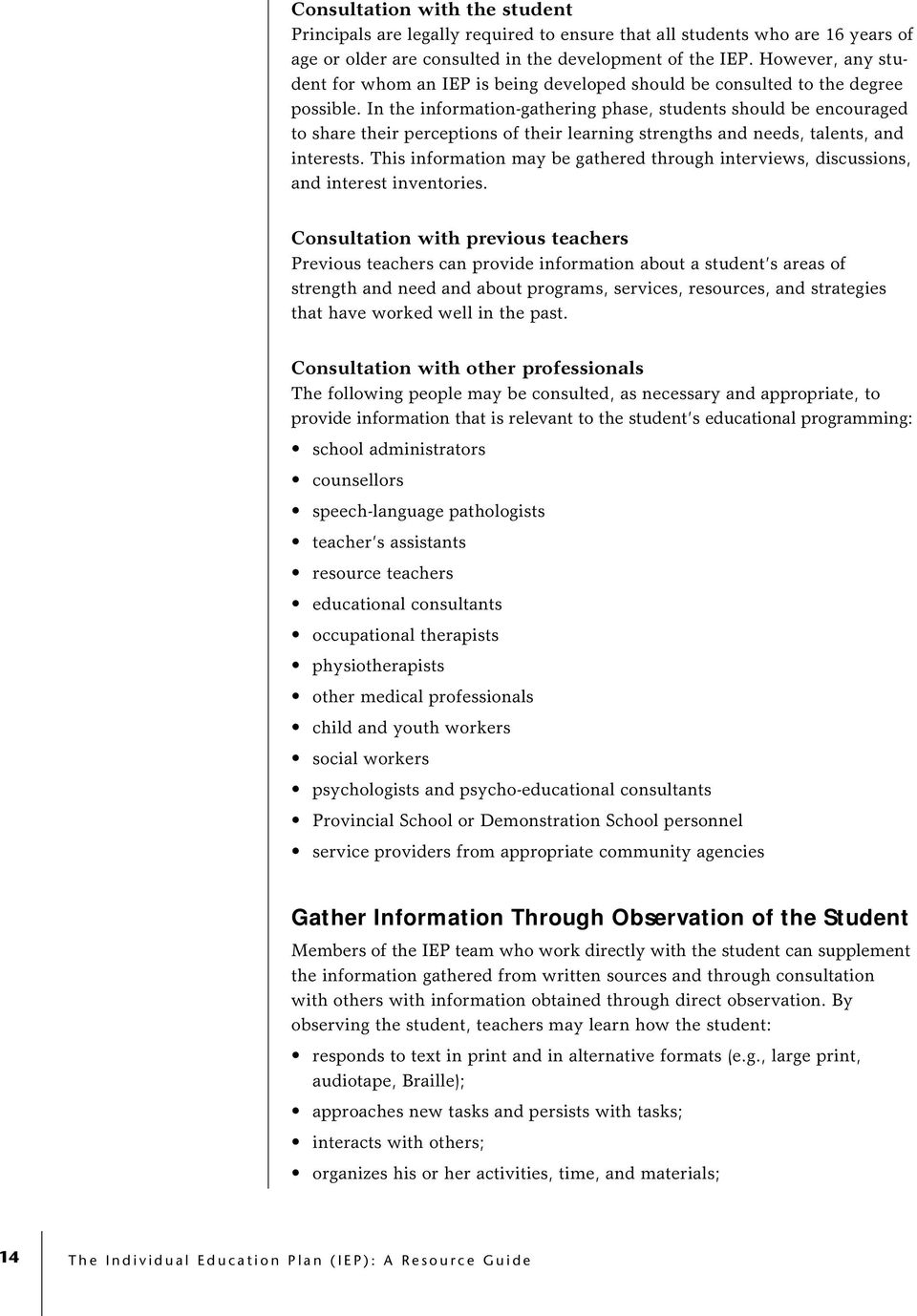
16 Consultation with the student Principals are legally required to ensure that all students who are 16 years of age or older are consulted in the development of the IEP. However, any student for whom an IEP is being developed should be consulted to the degree possible. In the information-gathering phase, students should be encouraged to share their perceptions of their learning strengths and needs, talents, and interests. This information may be gathered through interviews, discussions, and interest inventories. Consultation with previous teachers Previous teachers can provide information about a student s areas of strength and need and about programs, services, resources, and strategies that have worked well in the past. Consultation with other professionals The following people may be consulted, as necessary and appropriate, to provide information that is relevant to the student s educational programming: school administrators counsellors speech-language pathologists teacher s assistants resource teachers educational consultants occupational therapists physiotherapists other medical professionals child and youth workers social workers psychologists and psycho-educational consultants Provincial School or Demonstration School personnel service providers from appropriate community agencies Gather Information Through Observation of the Student Members of the IEP team who work directly with the student can supplement the information gathered from written sources and through consultation with others with information obtained through direct observation. By observing the student, teachers may learn how the student: responds to text in print and in alternative formats (e.g., large print, audiotape, Braille); approaches new tasks and persists with tasks; interacts with others; organizes his or her activities, time, and materials; 14 The Individual Education Plan (IEP): A Resource Guide
17 uses language; performs individually and in group activities; responds to cues (including auditory, visual, and direct and indirect verbal cues). Teachers can also observe: how the student s learning is affected by environmental variables such as lighting, sound, temperature, colours, the physical arrangement of the classroom, the time of day, and routines and schedules; how the student responds to the number of people in the immediate area and to the behaviour of teachers and support staff, and how he or she responds to authority. Conduct Further Assessments, If Necessary Once information has been gathered from the sources described above, it is reviewed to determine if it is sufficient to enable the team to plan and implement educational programming. If it is sufficient, no further assessments may be necessary. If the information is insufficient, individual assessments will need to be conducted to supplement existing data. (Because educational assessments, especially grade-equivalent achievement scores, must be very current to be useful in the development of an IEP, it may be necessary to conduct new educational assessments.) Additional assessments may include the following: additional observations and additional samples of the student s work; diagnostic tests; teachercreated tests; developmental assessments; medical assessments; psychological assessments; communication assessments; educational assessments; living/ vocational skills assessments; behavioural/psychiatric assessments; and observation of the student in the context of performing daily routines. Most educational assessments are routine and are conducted on an ongoing basis by teachers. Written parental consent is required for some assessments, such as speech and language assessments, psychological assessments, and medical assessments. It is important to help parents understand what each assessment entails that is, the process their child will go through as well as the benefits of conducting the assessment and its possible outcomes. This will ensure that parents can make an informed decision about whether to consent to an assessment. (See also the note on page 13 about privacy requirements.) Consolidate and Record Information The information gathered needs to be consolidated and analysed to provide a detailed picture of the student s areas of strength and need, and to identify any consistent patterns of successful learning. Assessment data may be checked against information gathered from other sources to determine whether the other information supports the patterns revealed by the assessments. Discrepancies in information from different sources should be investigated. The IEP Process 15

18 PHASE 2: SET THE DIRECTION Establish a Collaborative Approach The IEP Team The IEP needs to be developed collaboratively, both by those who know the student best and by those who will be working directly with the student. Part C: Program Planning of Special Education: A Guide for Educators, 2001 contains information on in-school teams. The model described there would be ideal for an IEP team, and its use is recommended wherever possible. The membership of an IEP team can and should vary according to the needs of the individual student. Members may include, for example, the student, the student s parents, the student s teachers, the guidance counsellor, the principal, appropriate special education staff and support personnel, and staff from community agencies, as appropriate. As noted earlier, regardless of who is coordinating the IEP process, decisions related to the program planning sections of an Individual Education Plan need to be made by the individual who teaches the student and prepares the student s report card usually the classroom teacher. A team approach enables all those who are responsible for and interested in meeting the student s needs to: share information and observations about the student s behaviour and learning in a variety of settings; develop a common understanding of the student s strengths and needs as they affect his or her ability to learn and demonstrate learning, and his or her educational goals; discuss accommodations that can help the student learn and demonstrate learning; select and make recommendations about the purchase of individualized equipment, if applicable; discuss the type and level of support required from support services personnel; plan and outline how the student s learning will be assessed so that the connection between the IEP and the Provincial Report Card will be readily apparent to both the student and the parents. 16 The Individual Education Plan (IEP): A Resource Guide

19 Establish Roles and Responsibilities All team members have important roles and responsibilities in the IEP process. The roles and responsibilities of various team members in the development, implementation, and monitoring of an IEP are outlined below. The list attempts to cover all aspects of an IEP; however, responsibilities and tasks will vary depending on the circumstances of the individual student and may not all be required in each situation. All participants are expected to cooperate in the IEP process. Responsibilities that are mandated by Regulation 181/98 are marked with an asterisk (*). The role of the educators and other professionals on the team The principal: assigns to one teacher the responsibility for coordinating (not developing) the student s IEP; facilitates collaborative planning, evaluation, and updating; ensures that IEPs are completed within 30 school days of a student s placement in a special education program;* signs IEPs within 30 school days of a student s placement in the program; ensures that IEPs are implemented and that, as part of implementation, the student s learning expectations are evaluated and updated at least once every reporting period; ensures that the recommendations of the IPRC (with respect to special education programs and services such as support personnel, resources, and equipment) are taken into account in the development of the IEP;* ensures that parents and the student, if the student is 16 years of age or older, are consulted in the development of the IEP;* ensures that consultation with community agencies and postsecondary institutions that he or she considers appropriate is conducted as part of the preparation of a transition plan for students who are 14 years of age or older and who are not identified solely as gifted ;* ensures that a copy of the IEP is provided to the parents and to the student, if the student is 16 years of age or older;* ensures that the current IEP is stored in the OSR, unless a parent of the student objects in writing.* The classroom teacher: contributes first-hand knowledge of the student s strengths, needs, and interests; fulfils the role of the key curriculum expert on how the IEP can be developed to help the student progress through the Ontario curriculum; develops any modified or alternative learning expectations required to meet the student s needs, plans instruction to address those expectations, and assesses the student s achievement of the expectations. (Note that, in Phase 2: Set the Direction 17

20 some cases, the special education teacher will take direct responsibility for certain aspects of the student s special education program, and will be responsible for developing, teaching, and assessing the expectations related to those areas.); develops and later implements teaching, and assessing, individualized teaching strategies that will help the student achieve his or her learning expectations; reviews and updates learning expectations at the beginning of each reporting period; maintains ongoing communication with the student s parents, other teachers, and other professionals and support staff involved with the student. The special education teacher: provides diagnostic assessments, as appropriate and if required, to determine the student s learning strengths and needs; provides support to the student s classroom teachers by generating ideas and suggestions for developing modified expectations, alternative programs, or accommodations (e.g., individualized teaching or assessment strategies, human support, individualized equipment); provides advice about materials and resources; develops any modified or alternative learning expectations that fall within areas for which the special education teacher has direct responsibility; plans instruction to address those expectations and assesses the student s achievement of the expectations; works with the classroom teacher(s) to maintain ongoing communication with the student s parents and other teachers. The teacher s assistant: helps the student with learning activities under the direction and supervision of the teacher; assists with providing appropriate accommodations as described in the IEP; monitors and records the student s achievements and progress relative to the expectations described in the IEP, under the direction and supervision of the teacher; maintains ongoing communication with the student s teachers. Other professionals: participate in the IEP process and serve on the IEP team, if requested; help to determine the student s learning strengths and needs; develop strategies for use in the school environment to assist the student in acquiring the knowledge and skills described in the learning expectations, and to demonstrate that learning; train staff to implement the strategies; 18 The Individual Education Plan (IEP): A Resource Guide

21 provide advice about materials and resources; provide technical assistance; act as a resource for and support to the student s family; maintain ongoing communication with the student s teacher and the IEP team; conduct assessments, as necessary, with informed parental consent. Regulation 181/98, clause 6(6)(a), requires the principal, in developing the Individual Education Plan, to consult with the parent and the pupil, if age 16 or older. Subsection 6(8), as amended by Ontario Regulation 137/01, requires the principal, within 30 school days after placement of the pupil in the program, to ensure that the plan is completed and a copy of it sent to a parent of the pupil and the pupil, if age 16 or older. The role of the student and parents on the team The student: helps the team identify his or her preferred learning styles and modalities; understands what accommodations are to be provided (e.g., individualized teaching and assessment strategies, human support, individualized equipment); assists in setting annual program goals and learning expectations; demonstrates an understanding of the IEP and works actively to achieve goals and expectations; monitors progress towards goals and maintains awareness of how grades and/or marks will be generated for the Provincial Report Card; considers the information in the IEP when developing and reviewing his or her annual education plan (in Grades 7 12). The nature and extent of a student s involvement in the IEP process will vary. However, members of the IEP team should ensure that students understand the purpose of their IEP and how the goals and expectations in the plan are individually tailored, evaluated, reviewed, and updated. They need to be aware that their achievement of the learning expectations will be reflected in their Provincial Report Card. Students must understand that they can participate in the IEP process and that it is important for them to take an active role in their learning. As part of the self-assessment process, students should, where possible, fill in page 3 of the Provincial Report Card. Parents: provide up-to-date information about their child as it relates to the child s learning (e.g., recent assessment reports); provide important information that will assist in the development and implementation of their child s educational program (e.g., the talents and skills their child demonstrates in the home and community; their child s likes, dislikes, learning styles, interests, and reactions to various situations); reinforce and extend the educational efforts of the teacher by providing opportunities for their child to practise and maintain skills in the home; provide feedback on the child s transfer of skills from school to the home and community settings; maintain open communication with the school. Phase 2: Set the Direction 19
22 Ways of supporting parental and student involvement Members of the IEP team should involve parents in the collaborative process as early as possible. The educational priorities identified by family members are important to the student s overall learning experience. In addition to the responsibilities outlined above, parents play an important role in the IEP process by communicating to the IEP team a picture of their child s life thus far, suggesting ways to avoid potential problems, and helping the team achieve continuity of programming for the student. Principals and teachers can support parental and student involvement by: communicating openly and regularly with parents and students in clear, plain language (i.e., language that is free of jargon); giving parents and students the opportunity to specify how, and to what degree, they wish to become involved in consultation during the development of the IEP; contacting parents by telephone as well as in writing to notify them about meetings of the IEP team; informing parents and students about the topics that will be discussed at the IEP meeting and about who will attend; ensuring that parents and students are given the opportunity to provide meaningful input to the development of the IEP; ensuring that a copy of the IEP is sent to parents and to the student, if the student is 16 years of age or older, as required by Regulation 181/ 98; checking regularly with parents and students to share effective strategies and gather feedback; checking regularly for possible parental or student concern or confusion (by asking questions, if necessary); clarifying information as necessary to ensure that parents and the student understand the IEP, its connection to the Provincial Report Card, and the IEP process. Begin Work on the IEP An Individual Education Plan for a student begins with information that provides a profile of the student. The reason for developing the IEP must be recorded. Either of the following reasons may given: The student has been identified as exceptional by an IPRC. The student has not been formally identified as exceptional but requires an ongoing special education program and/or services, including modified or alternative learning expectations and/or accommodations. 20 The Individual Education Plan (IEP): A Resource Guide
23 The personal information sections of the IEP form include the student s full name, gender, date of birth, and Ontario Education Number (OEN) and/or Ministry Identification Number (MIN); the name of the school, the principal s name, the student s current grade or special class, and the school year. In the case of students identified as exceptional by an IPRC, the date of the most recent IPRC must be noted in the IEP. If the most recent IPRC took place prior to the last school year, the date on which the parents exercised their option to have the annual review waived must also be noted on the IEP. Although it is not a requirement, some school boards also like to include the date of the initial IPRC. For students who have been identified as exceptional, the IEP must indicate the student s exceptionality, as stated in the IPRC s statement of decision (and as given in the ministry-approved list of categories and definitions of exceptionalities). The approved list of exceptionalities is as follows: Behaviour Autism Deaf and hard-of-hearing Language impairment Speech impairment Learning disability Giftedness Mild intellectual disability Developmental disability Physical disability Blind and low vision Multiple exceptionalities For a student who has not been identified as exceptional by an IPRC, a brief statement describing the characteristics of the student that make a special education program and/or services necessary must be provided. For students who have been identified as exceptional, the IEP must also indicate the student s placement. The IPRC s statement of decision outlines the committee s placement decision for the student. School boards are encouraged to record on the IEP the option below that most closely resembles the placement specified in the IPRC s statement of decision: A regular class with indirect support The student is placed in a regular class for the entire day, and the teacher receives specialized consultative services. A regular class with resource assistance The student is placed in a regular class for most or all of the day and receives specialized instruction, individually or in a small group, within the regular classroom from a qualified special education teacher. Phase 2: Set the Direction 21
24 A regular class with withdrawal assistance The student is placed in a regular class and receives instruction outside the classroom, for less than 50 per cent of the school day, from a qualified special education teacher. A special education class with partial integration The student is placed by the IPRC in a special education class in which the student-teacher ratio conforms to Regulation 298, section 31, for at least 50 per cent of the school day, but is integrated with a regular class for at least one instructional period daily. A special education class full-time The student is placed by the IPRC in a special education class, where the student-teacher ratio conforms to Regulation 298, section 31, for the entire school day. Relevant assessment data Information provided in this section of the IEP should be directly related to the reasons that give rise to the need for a special education program and services for the student. Possible sources of assessment data include educational assessments, medical/health assessments (vision, hearing, physical, neurological), speech/language assessments, occupational/physical therapy assessments, behavioural/psychiatric assessments, and psychological assessments. The date, source, and results or recommendations of each relevant assessment report must be recorded in the IEP. What to include: reports that support the identification of the student s exceptionality a brief summary statement of each report s findings medical diagnoses that support the identification of the student s exceptionality if desired, current achievement and grade-equivalent scores What not to include: every report in the student s files numerical scores or percentiles, such as IQ scores medical diagnoses that do not relate to the identification of the student s exceptionality personal/family information achievement or grade-equivalent scores that are not current 22 The Individual Education Plan (IEP): A Resource Guide
25 For the summary statement of each report s findings, a comment such as See the OSR is not adequate. The IEP itself should reflect the connection between the relevant assessment data and the student s learning strengths and needs. Examples of appropriate summary statements include the following: Report provides a diagnosis of learning disabilities. Report affirms average cognitive functioning. Information indicates a mild to moderate hearing loss. Report finds significant area of need in expressive language skills. Report provides a diagnosis of oppositional defiant disorder. Indicate the Student s Areas of Strength and Areas of Need on the IEP For students who have been identified as exceptional by an IPRC, the areas of strength and areas of need recorded in the IEP must be consistent with the description of strengths and needs contained in the IPRC statement of decision. Assessment data also provide information about the student s learning strengths and needs. When describing the student s areas of strength, it is appropriate to include information such as the following: the student s preferred learning styles/modalities (e.g., visual/auditory/ kinesthetic learner) previously acquired learning skills (e.g., organizational skills; timemanagement skills) strengths in areas such as cognitive processing and communication (e.g., expressive language speaking) In some cases, it may be appropriate to include information relating to the student s personal characteristics, hobbies or interests, and non-academic accomplishments, but such information is insufficient on its own. The description of the student s areas of need should make evident the reasons that the student requires a special education program and/or services. When indicating the student s areas of need, it is appropriate to include information such as the following: broad cognitive and/or processing challenges (e.g., in the area of visual memory) skill deficits that relate to the student s exceptionality and/or interfere with his or her ability to learn (e.g., in areas such as social skills, attention, emotional control, expressive language writing) Phase 2: Set the Direction 23
26 It is not appropriate to include information about what the student needs or what the student needs to do, such as the following: the need for a type or level of human support (e.g., the student needs a teacher s assistant or the student needs one-to-one assistance ) the need for a specific program or service (e.g., the student needs speech therapy ) the need for improvement in a particular subject (e.g., the student needs to improve his or her math skills ) For most exceptionalities, the areas of need do not change significantly over time. Health support services in the school setting Health support services are services related to health needs that must be addressed on a scheduled basis in order to enable a student to attend school. These services are provided by individuals who are specifically assigned to administer the required procedures. Health Support Services What to include: services required for health needs that must be addressed on a scheduled basis in order for a student to attend school (e.g., suctioning, injections, tube feeding, personal care lifting, toiletting, feeding) What not to include: emergency plans (such as those for anaphylactic reactions)* a description of the medical condition that makes specialized health support services necessary* information on the distribution of oral medication * Note: The IEP Standards document indicates that any medical conditions affecting the student s ability to attend school or to learn must be listed in the IEP. The current position is that the name of the medical condition is not relevant to programming and should not be listed. It is imperative, of course, that information about medical conditions requiring emergency response procedures be shared in communication and preparedness processes implemented by the school principal in connection with students who have health concerns. 24 The Individual Education Plan (IEP): A Resource Guide
27 PHASE 3: DEVELOP THE IEP AS IT RELATES TO THE STUDENT S SPECIAL EDUCATION PROGRAM AND SERVICES Regulation 181/98, clause 6(6)(b), requires the principal, in developing the individual education plan, to take into consideration any recommendations made by the committee (IPRC) or the Special Education Tribunal, as the case may be, regarding special education programs or services. Classify Subjects or Courses and Alternative Program Areas In planning a student s special education program, the IEP team must consider a range of options to determine the ones that will best meet the student s needs, from the provision of accommodations alone to the development of alternative programs. In the following pages, the various options are described and the information to be recorded in the student s IEP in each case is outlined. It is helpful, for purposes of planning and IEP development, to classify the subjects or courses and alternative programs in which the student will receive instruction according to the following categories, as appropriate to the student s individual requirements: No accommodations or modifications Accommodated only Modified Alternative It is essential that the teacher(s) responsible for direct instruction to the student be the primary decision-maker(s) in the process of determining the student s programming needs and classifying the relevant subjects, courses, and programs accordingly. Accommodated only The term accommodations is used to refer to the special teaching and assessment strategies, human supports, and/or individualized equipment required to enable a student to learn and to demonstrate learning. Accommodations do not alter the provincial curriculum expectations for the grade. Accommodated only (AC) is the term used on the IEP form to identify subjects or courses from the Ontario curriculum in which the student requires accommodations alone in order to work towards achieving the regular grade expectations. Modified Modifications are changes made in the age-appropriate grade-level expectations for a subject or course in order to meet a student s learning needs. These changes may involve developing expectations that reflect knowledge 25
28 and skills required in the curriculum for a different grade level and/or increasing or decreasing the number and/or complexity of the regular gradelevel curriculum expectations. Modified (MOD) is the term used on the IEP form to identify subjects or courses from the Ontario curriculum in which the student requires modified expectations expectations that differ in some way from the regular grade expectations. Generally, in language and mathematics, modifications involve writing expectations based on the knowledge and skills outlined in curriculum expectations for a different grade level. In other subjects, including science and technology, social studies, history, geography, and health and physical education, and in most secondary school courses, modifications typically involve changing the number and/or complexity of the regular grade-level expectations. The student may also require certain accommodations to help him or her achieve the learning expectations in subjects or courses with modified expectations. Alternative Alternative expectations are developed to help students acquire knowledge and skills that are not represented in the Ontario curriculum. Because they are not part of a subject or course outlined in the provincial curriculum documents, alternative expectations are considered to constitute alternative programs or alternative courses (secondary school courses). Examples of alternative programs include: speech remediation, social skills, orientation/mobility training, and personal care programs. For the vast majority of students, these programs would be given in addition to modified or regular grade-level expectations from the Ontario curriculum. Alternative programs are provided in both the elementary and the secondary school panels. Alternative courses, at the secondary school level, are non-credit courses. The course expectations in an alternative course are individualized for the student and generally focus on preparing the student for daily living. School boards must use the K course codes and titles found in the ministry s Common Course Code listings (at commoncc/ccc.html) to identify alternative courses. Examples of alternative courses include Transit Training and Community Exploration (KCC), Culinary Skills (KHI), and Money Management and Personal Banking (KBB). Alternative (ALT) is the term used to identify alternative programs and alternative courses on the IEP form. 26 The Individual Education Plan (IEP): A Resource Guide
29 Classifying programs for gifted students Classification of the programming provided for students identified as gifted can be more complicated for school boards. Generally the programs can be described in one of the following two ways. 1. Subjects or courses with modified expectations In some cases, the gifted student may be working on learning expectations from a different grade level. This may occur in language and mathematics. In other subjects, such as social studies, history, geography, and science and technology, and in most secondary school courses, the number and/or the complexity of the learning expectations may be increased. With this type of programming, the affected subjects or courses would be identified in the IEP as subjects or courses with modified expectations. 2. Alternative programs Another way to organize gifted programming is to group specific skills together in an alternative program (or programs). Programs may be planned in such areas as critical thinking, problem solving, inquiry/research, and inter- and intrapersonal skills. It is important to note that if a student is identified solely as gifted, accommodations are not generally required. If the student has difficulty participating in the curriculum because of another exceptionality or a need in an area unrelated to giftedness, then the required accommodations must be noted in the student s IEP. Recording classified subjects and courses in the IEP All subjects or courses in which the student requires accommodations and/or modified expectations and all alternative programs must be listed in the IEP. Each should be identified as Accommodated only (AC), Modified (MOD), or Alternative (ALT). A subject or course in which the student requires neither accommodations nor modified expectations is not included in the IEP. Record Decisions About Program Exemptions, Course Substitutions, and Eligibility for a Diploma or a Certificate Decisions relating to program exemptions (elementary) and course substitutions (secondary) are to be recorded in the IEP. The educational rationale for such decisions must be stated. In IEPs for secondary students, an indication of whether the student is working towards a secondary school diploma, a secondary school certificate, or a certificate of accomplishment is required. Phase 3: Develop the IEP as It Relates to the Student s Special Education Program and Services 27
30 Determine Accommodations Accommodations include special teaching and assessment strategies, human supports, and/or individualized equipment that help the student learn and demonstrate learning. Accommodations described in the IEP should include only those strategies and supports that differ from what is normally provided during classroom instruction. All accommodations documented in the IEP must be made readily available to the student. Students who require accommodations may have subjects or courses classified as Accommodated only, Modified, and/or Alternative. It is quite possible that the student will require the same accommodations in many or all of his or her subjects or courses. For the sake of clarity, the accommodations that the student requires in connection with instruction, assessment, and functioning in the physical environment should be identified and listed separately, as follows: Instructional accommodations adjustments in teaching strategies required to enable the student to learn and to progress through the curriculum Environmental accommodations changes or supports in the physical environment of the classroom and/or the school Assessment accommodations adjustments in assessment activities and methods required to enable the student to demonstrate learning It is important to make the above distinctions, and to record all necessary accommodations accurately in the IEP, to ensure that students will be eligible to receive the permitted accommodations during provincial assessments. (Assessment accommodations should be consistent with the accommodations permitted by the Education Quality and Accountability Office [EQAO].) Examples of accommodations are listed in Figure 3. (Note that the same accommodation may appear in more than one list.) A variety of teaching strategies and assessment accommodations are also listed in the IEP Standards document and in the Special Education Companion of the Ministry of Education s Ontario Curriculum Unit Planner (CD-ROM, 2002; also available at In addition to established accommodations, new strategies and assistive devices are constantly emerging as teaching practice is enhanced through new research and technological innovations. Any individualized equipment required by the student must be identified in the IEP. Individualized equipment includes any type or item of equipment or any electronic product or system, whether commercially produced, adapted, or custom-made, that the student needs. Individualized equipment is intended to maintain, increase, or improve the student s ability to learn and demonstrate learning. (The equipment identified in the IEP should not be limited to the equipment for which boards received additional funding through the Intensive Support Amount [ISA] Level 1.) 28 The Individual Education Plan (IEP): A Resource Guide
31 Figure 3: Examples of Accommodations Instructional Accommodations Buddy/peer tutoring Note-taking assistance Duplicated notes Contracts Reinforcement incentives High structure Partnering Ability grouping Augmentative and alternative communications systems Assistive technology, such as text-to-speech software Graphic organizers Non-verbal signals Organization coaching Time-management aids Mind maps More frequent breaks Concrete/hands-on materials Manipulatives Tactile tracing strategies Gesture cues Dramatizing information Visual cueing Large-size font Tracking sheets Colour cues Reduced/uncluttered format Computer options Spatially cued formats Repetition of information Rewording rephrasing of information Extra time for processing Word-retrieval prompts Taped texts Environmental Accommodations Alternative work space Strategic seating Proximity to instructor Reduction of audio/visual stimuli Study carrel Minimizing of background noise Quiet setting Use of headphones Special lighting Assistive devices or adaptive equipment Assessment Accommodations Extended time limits Verbatim scribing Oral responses, including audiotapes Alternative settings More frequent breaks Assistive devices or adaptive equipment Prompts to return student s attention to task Augmentative and alternative communications systems Assistive technology, such as speech-to-text software Large-size font Colour cues Reduced/uncluttered format Computer options Extra time for processing Reduction in the number of tasks used to assess a concept or skill Note: A typical IEP would not include all of the accommodations listed above. Only the accommodations that are specifically required by the individual student should be listed in his or her IEP. Phase 3: Develop the IEP as It Relates to the Student s Special Education Program and Services 29
32 Record Subjects or Courses With Accommodations Only in the IEP In a subject or course classified as Accommodated only, the accommodations enable the student to acquire the knowledge and skills outlined in the regular grade-level or course expectations and to demonstrate his or her learning independently. The provision of accommodations in no way alters the curriculum expectations for the grade level or course. The accommodations, which are likely to apply to all of the student s subjects or courses, should be described in the designated section of the IEP form. (Because the student is working on regular grade-level or course curriculum expectations, without modifications, there is no need to include information on current level of achievement, annual program goals, or learning expectations, as is necessary in connection with subjects or courses with modified expectations or alternative programs.) Plan and Document Subjects or Courses With Modified Expectations For each subject or course in which the student requires modified expectations, the following information must be included in the IEP: current level of achievement annual program goal(s) learning expectations It is also recommended that, for each learning expectation, the IEP indicate: the corresponding teaching strategy, if individualized for the student and particular to that expectation (see p. 38); the corresponding assessment method. ELEMENTARY SCHOOL SUBJECTS Current level of achievement For the student s current level of achievement in an elementary school subject, the mark or letter grade for that subject from the most recent Provincial Report Card (typically from the previous school year) must be recorded, and the grade level of the modified expectations on which the evaluation was based must be identified. If the modified expectations were based on the regular grade curriculum, with changes to the number and/or complexity of the expectations, the notation MOD, for modified expectations, is added after the grade. The following example shows how current levels of achievement would be recorded for a Grade 4 student who requires modified expectations in three subjects English, core French, and science and technology. The information is taken from the student s most recent Provincial Report Card, the Grade 3 report card issued the previous June. (Note: For a subject that the 30 The Individual Education Plan (IEP): A Resource Guide
33 student is studying for the first time, such as French as a second language core French in Grade 4, not applicable [N/A] should be entered in the IEP for current level of achievement.) Subject: English Current Level of Achievement: Letter grade/ Mark: C+ Curriculum grade level: 2 Subject: Core French Current Level of Achievement: N/A Subject: Science and Technology Current Level of Achievement: Letter grade/mark: B Curriculum grade level: 3 (MOD) The current level of achievement is recorded on the IEP as the starting point of the IEP development phase and remains unchanged for the duration of the IEP that is, to the end of the school year. Annual program goal(s) An annual program goal is a statement that describes what a student can reasonably be expected to accomplish by the end of the school year in a particular subject, taking into account the student s strengths, needs, and current level of achievement. It represents a reasonable target, not a rigid requirement. Annual program goals may need to be revised as the teacher develops a better understanding of the student s learning processes and/or as the student s rate of acquisition of knowledge and skills changes. Annual program goals for mathematics and language should be expressed as observable, measurable outcomes. For example: In mathematics, [the student] will complete half of the Grade 3 expectations in each of the five strands. In reading, [the student] will improve decoding and comprehension skills to the Grade 4 level, as measured by an informal reading inventory. Annual program goals for other subjects can be expressed in terms of observable achievement in the development of thinking skills such as memory, inquiry, analysis, integration, application, and so on. For example: In science, [the student] will demonstrate improvement in her ability to recall and communicate basic concepts, her inquiry skills, and her ability to relate science to the world outside the school. In social studies, [the student] will demonstrate improvement in his ability to recall and communicate basic concepts, his research skills, his skills in using maps and globes, and his ability to make connections between social studies and the world outside the classroom. Phase 3: Develop the IEP as It Relates to the Student s Special Education Program and Services 31
34 Learning expectations Modified learning expectations will be developed to indicate, by reporting period, the specific knowledge and/or skills the student is expected to demonstrate independently, given the provision of appropriate assessment accommodations. All learning expectations must be stated as measurable outcomes for the purposes of evaluation. They should be expressed in such a way that the student and parents can understand exactly what the student is expected to know or to be able to do, on the basis of which his or her performance will be evaluated and a grade or mark recorded on the Provincial Report Card. In developing modified expectations for a student, the teacher should take care to provide an appropriate challenge for the student. The expectations should be designed to develop the student s literacy, numeracy, and cognitive skills, and should be achievable by the student, with reasonable effort, during the reporting period. The grade level of the learning expectations must be identified in the IEP. The following are examples of acceptably worded modified expectations representing knowledge and skills from a different grade level: [The student] will demonstrate the ability to recall addition and subtraction facts to 18. (Grade 3 expectation) [The student] will determine a line of symmetry of a two-dimensional shape by using paper folding and reflections. (Grade 2 expectation) [The student] will decode 50 new sight words at the mid-grade 1 level. (Grade 1 expectation) In some cases, the student s program in a particular subject may comprise only a small subset of the regular grade expectations, revised to reduce the level of complexity. For example, a teacher might list the following social studies expectations, modified from the Grade 4 curriculum on Medieval Times, as appropriate for evaluating the achievement of a particular student. [The student] will: name four types of people who lived in medieval times; construct a medieval castle and demonstrate, through an oral presentation, two methods that were used to defend a castle; compare a medieval community to [the student s] own community with respect to housing and dress. (Social Studies, Grade 4 Modified expectations) When a student is expected to achieve most of the subject expectations at the regular grade level without modifications, this should be stated and the expectations that are modified should be listed. The modified expectations 32 The Individual Education Plan (IEP): A Resource Guide
35 should contain an indication of how they differ from the expectations as they appear in the ministry s curriculum policy documents. For example: [The student] will demonstrate achievement of all of the expectations for Grade 8 history as given in the curriculum document, except for the following, which have been modified: identify the colonies that joined Confederation [dates of entry not required]; describe orally, using a series of maps, the changes in Canada s boundaries from 1867 to 1949 [rather than analyse, synthesize, and evaluate historical information ]. (History, Grade 8 Modified expectations) By the end of the IEP development phase (i.e., the first 30 school days following the date of placement), the student s learning expectations for the first reporting period, at a minimum, must be recorded in the IEP. Subsequent learning expectations to be assessed and evaluated must be added at the beginning of each reporting period. SECONDARY SCHOOL COURSES For most secondary school courses, modified expectations will be based on the regular curriculum expectations for the course but will reflect changes to the number and/or complexity of the expectations. Current level of achievement For each course with modified expectations, the student s current level of achievement is indicated in the IEP by his or her mark in the prerequisite course. For clarity, the name of the prerequisite course and the course type should be provided along with the student s grade. If the modifications in that course involved changes to the number and/or complexity of the regular course curriculum expectations, the notation MOD, for modified expectations, should be added after the course information. The following example shows how current levels of achievement would be recorded for a student enrolled in Grade 11 courses in which modified expectations are required. (Note: For a student s first course in a subject area, such as Introduction to Business, Grade 9, or for a course that has no prerequisite, not applicable [N/A] should be entered in the IEP for current level of achievement.) Course: Mathematics of Personal Finance, Grade 11, College Preparation Current Level of Achievement: Prerequisite Course: Foundations of Mathematics, Grade 10, Applied (MOD) Mark: 64% Phase 3: Develop the IEP as It Relates to the Student s Special Education Program and Services 33
36 Course: Biology, Grade 11, College Preparation Current Level of Achievement: Prerequisite Course: Science, Grade 10, Applied (MOD) Mark: 71% Course: Parenting, Grade 11, Open Current Level of Achievement: Prerequisite Course: None Mark: N/A The student s current level of achievement is recorded on the IEP as the starting point of the IEP development phase and remains unchanged for the duration of the IEP that is, to the end of the school year, or the end of the semester in semestered secondary schools. Annual program goal(s) An annual program goal is a statement that describes what a student can reasonably be expected to accomplish by the end of a particular course. When the student is taking a secondary school course drawn from an Ontario curriculum policy document but with some modified expectations, the annual program goal(s) can be developed from the overall expectations or from the broad aims of the course outlined in the course description. For example: In science, [the student] will demonstrate improved understanding of basic concepts in biology, chemistry, earth and space science, and physics; improved skills in scientific investigation; and an ability to apply his knowledge of science to everyday situations. (Science, Grade 9, Applied) In geography, [the student] will demonstrate understanding of the unique characteristics of selected world regions from a geographic perspective, as well as understanding and appreciation of the ways in which the natural environments, economies, cultures, and other aspects of world regions interact. (Regional Geography: Travel and Tourism, Grade 11, Open) For courses in which the student requires significantly modified expectations, the annual program goal should describe what the student can reasonably be expected to accomplish by the end of the course. It represents a reasonable target, not a rigid requirement. An annual program goal may need to be revised as the teacher develops a better understanding of the student s learning processes and/or as the student s rate of acquisition of knowledge and skills changes. 34 The Individual Education Plan (IEP): A Resource Guide
37 Annual program goals for mathematics and English courses should be expressed as observable, measurable outcomes. For example: In mathematics, [the student] will add and subtract one- and two-digit whole numbers and explain basic operations of whole numbers by modelling and discussing problem situations. (Numeracy and Numbers, KMM) In reading, [the student] will improve decoding and comprehension skills to the Grade 4 level as measured by an informal reading inventory. (Language and Communication Development, KEN) Annual program goals for other courses can be expressed in terms of observable achievement in the development of thinking skills such as memory, inquiry, analysis, integration, application, and so on. For example: In science, [the student] will demonstrate improvement in her ability to recall and communicate basic concepts, her inquiry skills, and her ability to relate science to the world outside the school. (Science, Grade 10, Applied Modified) In art, [the student] will demonstrate improvement in his understanding of concepts and further develop his analytical, performance, creative, and communication skills. (Creative Arts for Enjoyment and Expression, KAL) Learning expectations For secondary school courses, it is important to monitor, and to reflect clearly in the IEP, the extent to which expectations have been modified. As noted in Section 7.12 of the ministry s policy document Ontario Secondary Schools, Grades 9 to 12: Program and Diploma Requirements, 1999, the principal will determine whether achievement of the modified expectations constitutes successful completion of the course, and will decide whether the student is eligible to receive a credit for the course. This decision must be communicated to the parents and the student. When a student is expected to achieve most of the curriculum expectations for the course, the modified expectations should identify how they differ from the course expectations. For example: [The student] will demonstrate achievement of all of the Science expectations relating to the topics Chemical Reactions and Weather Systems as given in the curriculum document, with the following changes: classify substances as acids, bases, or salts based on names and formulae [characteristic properties not required]; outline experimental procedures to answer questions about acid-base neutralization reactions [formulation of questions not required]; [omit expectation describe and explain the effects of heat transfer within the hydrosphere and atmosphere on the development, severity, and movement of weather systems; ] list a variety of economic activities in Canada that are affected by weather [rather than assess the impact of weather on a variety of... ]. (Science, Grade 10, Applied Modified expectations) Phase 3: Develop the IEP as It Relates to the Student s Special Education Program and Services 35
38 [The student] will complete all of the curriculum expectations in Canadian History in the Twentieth Century as given in the curriculum document, with the following changes: describe [rather than compare ] Canada s military contributions in World War I and World War II; explain how and why the federal government has tried to promote a common Canadian identity through various agencies [ assessing the effectiveness of these efforts is not required]; assess the impact of social changes [rather than demographic and social changes ] on Aboriginal communities; demonstrate an understanding of [rather than evaluate ] the role of the labour movement in Canadian society. (Canadian History in the Twentieth Century, Grade 10, Applied Modified expectations) Because changes as limited as those listed above do not have a significant impact on the overall expectations for the course, the principal would likely maintain the credit-bearing status of the course, provided the student successfully acquired the knowledge and skills identified in the other specific expectations listed in the curriculum, as well as in those identified as modified. When modifications are so extensive that achievement of the learning expectations is not likely to result in a credit, the expectations should specify the precise requirements or tasks on which the student s performance will be evaluated and which will be used to generate the course mark recorded on the Provincial Report Card. For example: In science, [the student] will: describe three different chemical reactions, identifying the reactants and products; demonstrate the use of the ph scale (ph paper) to determine the acidity or basicity of five common household substances; name the four regions of the atmosphere; prepare and deliver a presentation, with visual aids, on the water cycle; collect data on precipitation and temperature and communicate results in graphic format. (Science, Grade 10, Applied Modified expectations) In Canadian History in the Twentieth Century, [the student] will: identify a Canadian flag, an Ontario flag, and a Mountie; identify three major groups that have immigrated to Canada from 1900 to the present; describe orally, and use a visual display to illustrate, technological developments that have changed lifestyles during the twentieth century; create a booklet on the contributions of one twentieth-century Canadian prime minister. (Canadian History in the Twentieth Century, Grade 10, Applied Modified expectations) 36 The Individual Education Plan (IEP): A Resource Guide
39 The above list of expectations represents all of the learning expectations for the course for one reporting period. As the list does not encompass the overall expectations and represents only a small subsection of the regular expectations for the courses, it is not expected that the principal would grant a credit for this course. Plan and Document Alternative Programs or Courses For each alternative program and alternative course, the following information is required: current level of achievement annual program goal learning expectations It is also recommended that, for each learning expectation, the IEP indicate: the corresponding teaching strategy, if individualized for the student and particular to that expectation (see p. 38); the corresponding assessment method. A student s current level of achievement in an alternative program or course should be indicated in a description taken from the latest alternative report card. (A grade level or mark is not necessary or advisable.) For example: In social skills, [the student] is able to employ Stop, Think, Do, or a similar technique, at a rate of 2 out of 10 possible situations. In personal care, [the student] is able to locate his lunch in the classroom cupboard. The annual program goal is a statement that describes what a student can reasonably be expected to accomplish by the end of the school year in a particular alternative program or course. Annual program goals need to be expressed as observable, measurable outcomes. For example: In social skills, [the student] will employ Stop, Think, Do, or a similar technique at a rate of 7 out of 10 possible situations. In personal care, [the student] will be able to retrieve and arrange food, eat lunch, and clean up the lunch area. The learning expectations for an alternative program or course indicate, by reporting period, the knowledge and/or skills the student is expected to demonstrate and have assessed. They should describe specific skills that the student can demonstrate independently, given the provision of appropriate assessment accommodations. For example: In social skills, [the student] will demonstrate, through role-playing, the Stop, Think, Do technique and employ it or a similar technique at a rate of 4 out of 10 possible situations. Phase 3: Develop the IEP as It Relates to the Student s Special Education Program and Services 37
40 In personal care, [the student] will retrieve and open his lunch bag and arrange his food independently, with a maximum of 3 verbal prompts. In orientation and mobility training, [the student] will move independently from the classroom to the school office during high traffic times. Determine Teaching Strategies and Assessment Methods Teaching strategies Teaching strategies support the student in achieving his or her learning expectations. A list of all the individualized teaching strategies used with the student would be recorded in the Instructional Accommodations section of the IEP form (see Appendix A). If there is a teaching strategy that relates to a particular expectation, and it differs from the strategies used with other students, it should be recorded alongside the learning expectation in the IEP. It is possible that some learning expectations do not require different teaching strategies from those regularly used in the classroom. Where that is the case, a strategy need not be identified. Examples of individualized teaching strategies include the following: provide a mnemonic device to support the student s recall of information confer with the student to assist with the organization of a project provide organizers of reading content in advance Assessment methods Student achievement of expectations in a subject, course, or alternative program should be monitored and assessed continuously, using a range of methods and techniques and incorporating the assessment accommodations already identified in the IEP. The assessment method that will be used to assess the student learning outlined in each learning expectation is recorded in the IEP. For example: For the learning expectation Describe the basic structure and function of the major organs in one of the organ systems, the assessment method could be: Short oral presentation with visual aid. Plan For and Document Required Human Resources The IEP should contain a record of direct instruction and/or consultation to be provided by special education teachers, as well as support services to be provided by teacher s assistants or services to be provided in the areas of speech pathology, audiology, physical and occupational therapy, recreation, counselling, social work, and medical support. The information recorded must include the type of service to be provided, the date on which provision of the service is to start, the planned frequency or intensity of the service, and the location in which the service is to be provided. Although consultative support provided to classroom teachers by board staff is more difficult 38 The Individual Education Plan (IEP): A Resource Guide
41 to quantify, the type of service and its minimum frequency must be identified. It is not necessary to list the regular classroom teacher in the human resources section of an IEP. Types of support services provided by non-board staff should be noted on the IEP, but the recording of specific information, such as frequency and intensity, is not necessary. Examples of how information about human resource services should be recorded in an IEP include the following: Youth Counsellor, 30 minutes, one day a week, conference room Special Education Teacher, 40 minutes, 4 to 5 days a week, resource room Teacher s Assistant, 30 minutes, daily, playground Teacher s Assistant, 300 minutes daily of support shared with other students, classroom Teacher s Assistant, approximately 1 hour per day for personal care, in a variety of settings, as required Special Education Teacher, consultation with classroom teacher(s), minimum once per term When the human resource section of the IEP is being developed, the IPRC s statement of decision should be reviewed to ensure that any recommendations the committee made about special education services are taken into consideration by the school principal. Record Information About Evaluation and Reporting Student progress must be evaluated at least once in every reporting period (see p. 46). Three reports are required in elementary and non-semestered secondary schools, and the reporting dates must be recorded in the IEP. As IEPs are generally developed in each semester in a semestered secondary school, two reports are required and the corresponding dates must be recorded. In addition to the reporting dates, the IEP must indicate the format(s) that is, the Provincial Report Card and, in some cases, an alternative report as well that will be used to communicate student learning to parents. In a very few cases, where none of the student s expectations are based on subjects or courses from the Ontario curriculum, an alternative report may be the only report format used. Record Information About Provincial Assessments It is most helpful to parents if the IEP indicates whether the student is scheduled to participate in a provincial assessment during the current school year. Assessment accommodations for provincial assessments are identified in the IEP. They must be consistent with the accommodations that are necessary for regular classroom assessment practices, as indicated in the IEP, Phase 3: Develop the IEP as It Relates to the Student s Special Education Program and Services 39
42 and must be permitted by the Education Quality and Accountability Office (EQAO). Possible accommodations include adjustments in scheduling, changes in setting, the use of assistive devices, and adjustments to the presentation and response formats used in the tests. Information on permitted accommodations can be found in the following EQAO documents: Guide for Accommodations, Special Provisions, Deferrals, and Exemptions (OSSLT); Steps and Teacher s Scripts (Grade 9 Assessment of Mathematics); and Administration Guide for Teachers and Principals (Grade 3 and 6 Assessments of Reading, Writing, and Mathematics). The wording used in the IEP to describe accommodations for provincial assessments should be consistent with the wording used in the EQAO documents. In rare cases, a student may require an exemption from a provincial assessment. An exemption may be considered by the principal if, even given the full range of permitted accommodations, the student would not be able to provide evidence of learning under the circumstances of the assessment. The IEP must indicate that an exemption is planned for part or all of a particular provincial assessment, and must include an explanatory statement that outlines the reasons for the decision, quoting exemption criteria from the EQAO documents. Regulation 181/98, subsection 6(4), requires that, where the pupil is 14 years of age or older, the individual education plan must also include a plan for transition to appropriate postsecondary school activities, such as work, further education, and community living. Subsection 6(5) states that subsection 6(4) does not apply in respect of a pupil identified as exceptional solely on the basis of giftedness. Regulation 181/98, subsection 6(7), requires the principal, in developing a transition plan, to consult with such community agencies and postsecondary educational institutions as he or she considers appropriate. Develop a Transition Plan, If Required Some exceptional students may experience difficulty in making the transition from secondary school to postsecondary education, work, and/or community living. A detailed and coordinated transition plan, with implementation beginning well before the anticipated move, will help prepare these students and assist them in making a smoother transition. Regulation 181/98 requires that a transition plan be developed as part of the IEP for exceptional students who are 14 years of age or older, unless they are identified solely as gifted. Although schools are encouraged to prepare transition plans to assist students with a variety of possible transitions (from one grade level or course to another, from one school or school board to another), the transition plan required by the regulation relates to the student s transition to postsecondary activities such as work, further education, and community living. A transition plan must address goals, actions required to meet the goals, names of individuals responsible for the required actions, and timelines. The principal is responsible for ensuring coordination and development of the transition plan, but not for all the assigned tasks listed within it. Linkages to postsecondary institutions, outside agencies, and community partners are required to help students gain access to postsecondary options. A transition plan is expected to be a long-range plan that will be reviewed annually, when a new IEP is developed. Special consideration should be given to planning for the student s skill development in areas that will prepare him or her for entry into, and participation in, planned postsecondary endeavours. 40 The Individual Education Plan (IEP): A Resource Guide
43 Transition planning can involve school board officials, principals, teachers, students and their families, health care workers, community workers, and others who support the student before and after he or she leaves school. For the student and the student s family and personal support network, the transition plan: identifies goals for work, further education, and community living that: reflect actual opportunities and resources that are likely to be available after the student leaves school; are achievable by the student, given appropriate supports; defines the actions that are necessary year by year to help the student achieve his or her goals; clarifies the roles and responsibilities of the student, family, and others in carrying out these actions. The student s goals should be consistent with his or her areas of strength and need and should be coordinated with the student s annual education plan (AEP). Transition plans must identify the steps needed to attain the student s goals from the present until the anticipated time of leaving school. Timely application to wait-listed programs and services is a key action for some students. Other possible actions might include planning for access to support services and equipment, exploring work placements, investigating future financial support, and/or developing specific skills, such as skills in the independent use of assistive technology, self-advocacy skills, or employability skills. Detailed information on transition planning can be found in the Ministry of Education s document Transition Planning: A Resource Guide, This document outlines the roles and responsibilities of school boards, principals, and transition-planning team members, describes the planning process, and provides a number of sample transition plans. This resource is available on the ministry s website at Record Information About the IEP Development Phase The following information about the development process should be included in the IEP: IEP development team Each member of the school and school board staff involved in the development of the IEP must be identified in the IEP. Each person s name and position should be listed. Sources consulted in development A list of information sources used in developing and updating the student s IEP must be provided. Information sources are more fully discussed in the section Phase 1: Gather Information of this document. Phase 3: Develop the IEP as It Relates to the Student s Special Education Program and Services 41
44 Parent/student consultation A form documenting all consultations with parents and the student, if the student is 16 years of age or older, that occur during the IEP development phase must be prepared and attached to the student s IEP. (A section of the IEP form itself may also be used for this purpose.) The date and the outcome of each consultation must be recorded. (See also p. 43.) Completion date of the IEP development phase Regulation 181/98 requires that the IEP be completed within 30 school days of the student s placement in a special education program. Placement will be taken to mean one of the following: the first day of a student s attendance in the new special education program specified in the IPRC s statement of decision the first day of the new school year or semester in which the student is continuing in a placement subsequent to its confirmation by the annual IPRC review the first day of the student s enrolment in a special education program that he or she begins in mid-year or mid-semester as the result of a change of placement The thirty-day requirement for completion of an IEP applies to the IEPs of all students, including those who have not been formally identified as exceptional but who receive a special education program and/or services. Both the date on which the student begins his or her placement in a special education program and the completion date of the IEP development phase must be recorded on the IEP. In a semestered secondary school, a new IEP should be developed at the beginning of the second semester if the student is continuing in the placement. In such cases, the IEP must be completed within 30 school days of the first day of the second semester. Principal s approval The school principal is legally responsible to ensure that, within 30 school days after placement of the student in a program, an appropriate IEP is completed and a copy sent to the parent and the student, if the student is 16 years of age or older. The principal must sign the IEP to indicate that the plan: has been developed according to ministry standards; is based on the student s learning strengths and needs; takes into account any recommendations about special education programs and services made by the IPRC; lists accommodations that will be available to the student; 42 The Individual Education Plan (IEP): A Resource Guide
45 provides for learning expectations to be assessed and student progress to be reported to parents every term; provides for learning expectations to be reviewed by the appropriate educator at least once in every reporting period. Parent/student response The parent and the student, if the student is 16 years of age or older, must be asked to sign the IEP and the Parent/Student Consultation form (or section) and to indicate whether: they were consulted in the development of the IEP; they declined the opportunity to be consulted; they have received a copy of the IEP; any comments they provided during the development of the IEP are noted in the Parent/Student Consultation form or section of the IEP. Phase 3: Develop the IEP as It Relates to the Student s Special Education Program and Services 43
46 PHASE 4: IMPLEMENT THE IEP Regulation 181/98, subsection 6(8), as amended by Ontario Regulation 137/01, requires the principal, within 30 school days after placement of the pupil in the program, to ensure that the plan is completed and a copy of it sent to a parent of the pupil and, where the pupil is age 16 or older, the pupil. Share the Completed IEP With the Student, Parents, School Staff, and Other Professionals Once the IEP is developed, the IEP team should ensure that everyone involved with the student is aware of its contents. The team should: review various individuals responsibilities for implementing and monitoring the plan; ensure that all staff members directly responsible for instruction, as well as parents and the student, have a copy of the IEP. Put the IEP Into Practice The classroom teacher and support personnel are directly responsible for implementing the program and services outlined in a student s IEP. Their responsibilities are outlined below. Classroom Teachers Classroom teachers need to be aware of the instructional, environmental, and assessment accommodations that are recorded in the student s IEP. The teacher should not feel restricted to using only the instructional and environmental accommodations listed. As the teacher-student relationship develops, the teacher should explore a variety of strategies that could enhance the student s ability to learn, and make note of successful strategies in the student s IEP. Care must be taken, however, to use only the assessment accommodations listed in the IEP. Teachers should consult the lists of permitted accommodations for provincial assessments when considering assessment accommodations. Detailed information on the assessment accommodations that are permitted by the EQAO is available at Accommodations do not change the content of the learning expectations, but they should take into account the student s preferred learning modality and areas of strength and need, and should provide students with appropriate opportunities to demonstrate their learning. Some accommodations, such as providing a quiet work space or having a scribe record the student s verbatim responses, require advance planning. As with all students, the classroom teacher must monitor the learningassessment process of students with IEPs carefully, so that ineffective instructional strategies and accommodations can be discontinued and replaced with new ones. When a classroom teacher is responsible for teaching a subject or course in which a student with an IEP is working towards achieving modified expectations, some additional planning is required. The teacher should 44 The Individual Education Plan (IEP): A Resource Guide
47 consider incorporating a number of strategies, such as group instruction, peer coaching, and buddy systems, that can help the student participate in many classroom activities. When other students are working on individual tasks that are not part of the student s IEP, the classroom teacher needs to capitalize on that opportunity to provide the student with direct instruction and/or individualized tasks or assignments designed to help him or her master the knowledge and skills outlined in the IEP. Classroom teachers are encouraged to promote independence in students by structuring the location and procedures relating to the individualized tasks and assignments in such a way that students can practise skills and prepare performance tasks with a minimum of teacher assistance. Planning for direct instruction is essential and should focus on helping the student acquire the knowledge and skills recorded in the IEP before he or she attempts to move on to additional learning. Support personnel Many alternative programs for example, in social skills, anger management, personal care, and orientation/mobility training require the involvement of support personnel. Support personnel may include teacher s assistants, who provide support to classroom teachers by assisting students with learning activities and providing appropriate accommodations as described in the IEP. Planning and providing individual timetables and location scheduling for teacher s assistants and other support staff is a necessary part of the implementation process. Continuously Assess the Student s Progress As with all students, assessment for students with an IEP should be ongoing and continuous. Assessment provides information that allows teachers to adjust daily instruction to maintain optimal learning conditions for the student. As noted above, it is essential to monitor the effectiveness of instructional strategies and accommodations. The use of multiple assessment strategies, including direct observation, portfolios, journals, rubrics, tests, projects, and self- and peer assessment, will provide the best understanding of the student s learning. Students should be encouraged to become responsible partners in their own learning. To the extent possible, they should be aware of the annual program goals, learning expectations, and accommodations recorded in their IEP in order to assist the teacher in the assessment process. Students can help identify their own readiness for assessment tasks and can assist with the scheduling of assessments that do not fit easily into regular class time. Phase 4: Implement the IEP 45
48 Adjust the IEP as Necessary Ongoing assessment may indicate that the IEP needs to be adjusted. This may be done by: developing new expectations or revising annual program goals, if learning is proceeding at a faster rate than has been anticipated in the plan; breaking expectations into smaller steps or adjusting annual program goals, if learning is proceeding at a slower rate than has been anticipated in the plan; and/or altering the teaching strategies, individualized equipment, or level of human support. It should be noted that any changes to the learning expectations for a current reporting period should be timed so as to allow the student ample time to prepare for the assessment tasks. Evaluate the Student s Learning and Report to Parents Subjects or courses with accommodations only As noted earlier in a subject or course identified as Accommodated only, the provincial curriculum expectations are not altered. Accommodations simply enable the student to participate in the regular grade-level curriculum and demonstrate learning. It is important that the appropriate assessment accommodations be readily available to the student. Grades or marks should be based on the student s achievement of the grade-appropriate curriculum expectations and the descriptions of achievement levels provided in the curriculum policy documents. Comments must be relevant to the student s achievement based on the unmodified grade-level or course expectations. Information on the student s progress in subjects or courses identified as accommodated only must be recorded on the Provincial Report Card. It is not necessary, nor is it advisable, for the IEP box to be checked or for the statement regarding modified learning expectations to be included (see the Guide to the Provincial Report Card, Grades 1 8, 1999 or the Guide to the Provincial Report Card, Grades 9 12, 1999). The purpose of the report card is to report on the student s progress in achieving the regular grade-level curriculum expectations, not on the student s use of accommodations. Subjects or courses with modified expectations Teachers are required to assess student learning using a variety of assessment methods. Planning for assessment of a student s learning should be incorporated in the development of each modified learning expectation. It is important that the student demonstrate learning independently, with the provision of appropriate assessment accommodations only. Grades or marks for the achievement of modified expectations should be determined on the basis of the achievement levels described in the appropriate curriculum policy documents. 46 The Individual Education Plan (IEP): A Resource Guide
49 Information on student progress in each subject or course that has modified expectations must be recorded on the Provincial Report Card. For an elementary student, the IEP box must be checked and the appropriate statement from the Guide to the Provincial Report Card, Grades 1 8, 1999 must be inserted. The grade or mark should reflect the level of the student s achievement of the modified learning expectations. For a secondary student, if some of the student s learning expectations for a course are modified but the student is working towards a credit for the course, it is sufficient simply to check the IEP box. If, however, the student s learning expectations are modified to such an extent that the principal deems that a credit will not be granted for the course, the IEP box must be checked and the appropriate statement from the Provincial Report Card guide must be inserted. For both elementary and secondary students, it is very important that the teacher s comments include relevant information about the student s demonstrated learning of the modified expectations, as well as about next steps for the student with respect to the particular subject or course. Alternative programs and courses The student s achievement of alternative expectations should also be assessed using a variety of assessment methods, and the student should demonstrate learning independently, with the provision of appropriate assessment accommodations. It is not required, nor is it advisable, for grades or marks to be assigned for the achievement of alternative expectations. Student progress should be reported to parents by means of anecdotal comments on an alternative report. This alternative report should accompany the Provincial Report Card at the regular reporting times. (Some school boards include a section for reporting on the achievement of alternative expectations in the IEP itself.) The Provincial Report Card must be used to report on the student s progress in subjects or courses with modified expectations and/or accommodations, at each of the regular reporting periods. A very small number of students who are unable to demonstrate even the most basic literacy or numeracy skills may receive only an alternative report. Phase 4: Implement the IEP 47
50 PHASE 5: REVIEW AND UPDATE THE IEP Update the Learning Expectations at the Beginning of Each Reporting Period Modified and alternative learning expectations described in an IEP must be reviewed, and updated as necessary, at least once in every reporting period. If only the learning expectations for the first reporting period were included when the IEP was developed, the teacher responsible for teaching each subject or course that has modified expectations and for delivering each alternative program must record in the IEP the learning expectations that are to be assessed during the second reporting period. These new expectations must be communicated to the student and parents at the start of the second reporting period. The same process is repeated for the third reporting period in elementary and non-semestered secondary schools. Record Ongoing Revisions to the IEP As noted earlier, the IEP should be viewed as a working document. Adjustments to any annual program goals, learning expectations, teaching strategies, individualized equipment, and levels of human support should be noted as they occur and shared with both the parent and the student. If certain strategies cease to be effective, it is imperative that the staff working with the student seek out and implement new teaching methods and accommodations. For revisions resulting in significant changes to the student s learning expectations and/or types or level of accommodations, there must be consultation with the parents and student before the changes are implemented. It is most important for parents to understand the significance of modifying learning expectations, particularly how modified learning expectations will affect the credit-bearing status of secondary school courses. The date and outcome of parent/student consultations must be recorded in the Parent/Student Consultation section of the IEP. It is recommended that use of this section be reserved for recording parent-school interactions about matters relating to the student s Individual Education Plan. It is not necessary to record other types of parent-school interactions in the IEP. Regulation 181/98, section 8, requires the principal to ensure that the Individual Education Plan for a pupil is included in the pupil s Ontario Student Record, unless a parent of the pupil has objected in writing. Store the IEP in the Documentation File of the Ontario Student Record A student s IEP must be included in his or her Ontario Student Record (OSR). The requirement to store a copy of the student s IEP in his or her OSR ensures that the student s relevant assessment data and information about his or her learning strengths and needs, annual program goals, and learning expectations, as well as the accommodations used to help the student learn, are immediately available to teachers new to working with the student. 48 The Individual Education Plan (IEP): A Resource Guide
51 To ensure that the IEP stored in the OSR is up to date, the working copy of the IEP should replace the filed copy at the end of each school year or semester, or when the student transfers to another school. This will help to keep all partners informed about the most recent adjustments to the IEP and to ensure continuity in programming for the student. Plan for the Student s Transition from Elementary to Secondary School, or for a Transfer to Another School Communication between the student s current teacher and the receiving teacher is important in order to provide continuity in programming during student transitions from the elementary to the secondary panel or from one school to another. Guidance and special education staff should also be included in the discussions. The following procedures are recommended for the sending and the receiving teachers: The sending teacher The sending teacher(s) should: ensure that all current and relevant information is in the student s OSR (updated IEP, most recent report card, and relevant assessment reports); share with the receiving teacher information about successful instructional resources and strategies, required accommodations, strategies used for managing behaviour, the amount of individual help the student received, and so on. (Note: When sharing information about a student, teachers should be mindful of and comply with the privacy requirements mentioned on page 13 of this guide.); learn as much as possible about the new program (i.e., at the receiving school) to help prepare the student for the move; encourage the student and his or her parents to visit the new setting in advance and, in the case of transition to a secondary school, to meet with the special education department head and guidance staff at the secondary school. The receiving teacher The receiving teacher(s) should: review the documents in the student s OSR, particularly the IEP, the most recent report card, and the IPRC s statement of decision (if applicable); communicate with the student s previous teachers and support personnel, gathering information that will help in understanding the student s areas of strength and need and the program requirements. (Note: When gathering information about a student, teachers should be mindful of and comply with the privacy requirements mentioned on page 13 of this guide.); review with the student his or her annual education plan (Grades 7 to 12); invite the student to visit the new setting in advance. Phase 5: Review and Update the IEP 49
52 Sending and receiving teachers should arrange for the student to tour the new site and to spend some time in the classroom or with special education or guidance staff. At the secondary school level, special education and/or guidance staff can facilitate this process. A new IEP must be developed when a student begins a new placement. The new placement starts on the student s first day of attendance in a new special education program; in most cases, this would be the first day of school in September or the first day of a new semester, but it might also occur in mid-year or mid-semester if there has been a change in placement. When a new IEP is to be developed, the cycle returns to Phase 1 and proceeds through the stages of development, implementation, and monitoring outlined in this guide. 50 The Individual Education Plan (IEP): A Resource Guide
53 APPENDIX A: TEMPLATE FOR A SUGGESTED IEP FORM 51
54 Individual Education Plan IEP REASON FOR DEVELOPING THE IEP Student identified as Student not formally identified but requires special education program/services, exceptional by IPRC including modified/alternative learning expectations and/or accommodations STUDENT PROFILE Name: Gender: Date of Birth: School: Student OEN/ MIN: Principal: Current Grade/Special Class: Most Recent IPRC Date: School Year: Date Annual Review Waived by Parent/Guardian: Exceptionality: IPRC Placement Decision (check one) Regular class with indirect support Regular class with resource assistance Regular class with withdrawal assistance Special education class with partial integration Special education class full-time ASSESSMENT DATA List relevant educational, medical/health (hearing, vision, physical, neurological), psychological, speech/language, occupational, physiotherapy, and behavioural assessments. Information Source Date Summary of Results STUDENT S STRENGTHS AND NEEDS Areas of Strength Areas of Need Health Support Services/Personal Support Required Yes (list below) No 1 52 The Individual Education Plan (IEP): A Resource Guide
55 SUBJECTS, COURSES, OR ALTERNATIVE PROGRAMS TO WHICH THE IEP APPLIES Identify each as Modified (MOD), Accommodated only (AC), or Alternative (ALT) 1. MOD AC ALT 6. MOD AC ALT 2. MOD AC ALT 7. MOD AC ALT 3. MOD AC ALT 8. MOD AC ALT 4. MOD AC ALT 9. MOD AC ALT 5. MOD AC ALT 10. MOD AC ALT Elementary Program Exemptions or Secondary School Compulsory Course Substitutions Yes (provide educational rationale) No Complete for secondary students only: Student is currently working towards attainment of the: Ontario Secondary School Diploma Ontario Secondary School Certificate Certificate of Accomplishment ACCOMMODATIONS (Accommodations are assumed to be the same for all subjects, unless otherwise indicated) Instructional Accommodations Environmental Accommodations Assessment Accommodations Individualized Equipment Yes (list below) No PROVINCIAL ASSESSMENTS (accommodations and exemptions) Provincial assessments applicable to the student in the current school year: Accommodations: Yes (list below) No Exemptions: Yes (provide explanatory statement from relevant EQAO document) No 2 Appendix A: Template for a Suggested IEP Form 53
56 Special Education Program To be completed for each subject/course with modified expectations and/or each alternative program with alternative expectations Student OEN/ MIN: Subject/Course/Alternative Program: Current Level of Achievement: Prerequisite course (if applicable) Current Level of Achievement for Alternative Program: Letter grade/mark Curriculum grade level Annual Program Goal(s): A goal statement describing what the student can reasonably be expected to accomplish by the end of the school year in a particular subject, course, or alternative program. Learning Expectations (List modified/alternative expectations outlining knowledge and/or skills to be assessed, by reporting period. Identify grade level, where appropriate.) Teaching Strategies (List only those that are particular to the student and specific to the learning expectations) Assessment Methods (Identify the assessment method to be used for each learning expectation) 3 54 The Individual Education Plan (IEP): A Resource Guide
57 HUMAN RESOURCES (teaching/non-teaching) Include type of service, initiation date, frequency or intensity, and location EVALUATION Reporting Dates: Reporting Format Provincial Report Card (required unless student s program comprises alternative expectations only) Alternative Report TRANSITION PLAN If the student is 14 years of age or older and is not identified solely as gifted, a transition plan is required (see page 6). IEP Developed by: Staff Member Position Staff Member Position Sources Consulted in the Development of the IEP IPRC Statement Provincial Previous IEP Parents/Guardians Student of Decision (if applicable) Report Card Other sources (list below) Date of Placement in Special Education Program (select the appropriate option) 1) First day of attendance in new special education program 2) First day of the new school year or semester in which the student is continuing in a placement 3) First day of the student s enrolment in a special education program that he/she begins in mid-year or mid-semester as the result of a change of placement Date of Placement: Completion Date of IEP Development Phase (within 30 school days following the Date of Placement): 4 Appendix A: Template for a Suggested IEP Form 55
58 LOG OF PARENT/STUDENT CONSULTATION AND STAFF REVIEW/UPDATING Activity (Indicate parent/student Date consultation or staff review) Outcome The principal is legally required to ensure that the IEP is properly implemented and monitored. This IEP has been developed according to the ministry s standards and appropriately addresses the student s strengths and needs. The learning expectations will be reviewed and the student s achievement evaluated at least once every reporting period. Principal s Signature Date Involvement of Parent/Guardian and Student (if student is 16 or older) I was consulted in the development of this IEP Parent/Guardian Student I declined the opportunity to be consulted in the development of this IEP Parent/Guardian Student I have received a copy of this IEP Parent/Guardian Student Parent/ Guardian and Student Comments: Parent/Guardian Signature Date Student Signature (if 16 or older) Date 5 56 The Individual Education Plan (IEP): A Resource Guide
59 Transition Plan Student s name OEN/MIN Specific Goal(s) for Transition to Postsecondary Activities Person(s) Actions Required Responsible for Actions Timelines 6 Appendix A: Template for a Suggested IEP Form 57
60 APPENDIX B: SAMPLES OF COMPLETED IEP FORMS 58
61 Sample 1 Individual Education Plan IEP REASON FOR DEVELOPING THE IEP x Student identified as Student not formally identified but requires special education program/services, exceptional by IPRC including modified/alternative learning expectations and/or accommodations STUDENT PROFILE Name: Student A Gender: Male Date of Birth: 06/23/1991 School: Ontario School Student OEN/ MIN: Principal: B. Principal Current Grade/Special Class: 8 School Year: Most Recent IPRC Date: 06/02/2002 Date Annual Review Waived by Parent/Guardian: 25/05/2004 Exceptionality: Learning Disability IPRC Placement Decision (check one) Regular class with indirect support Regular class with resource assistance x Regular class with withdrawal assistance Special education class with partial integration Special education class full-time ASSESSMENT DATA List relevant educational, medical/health (hearing, vision, physical, neurological), psychological, speech/language, occupational, physiotherapy, and behavioural assessments. Information Source Date Summary of Results Psychological report 03/05/1998 Report provides a diagnosis of learning disabilities Audiologist report 11/03/1997 Report indicates area of need in central auditory processing STUDENT S STRENGTHS AND NEEDS Areas of Strength Expressive language skills (speaking) Visual memory skills Visual figure ground skills Problem-solving skills Computer keyboarding skills Areas of Need Receptive language skills (reading and listening) Expressive language skills (writing) Auditory memory skills Auditory discrimination skills Organizational skills Health Support Services/Personal Support Required Yes (list below) x No 1 Appendix B: Samples of Completed IEP Forms 59
62 SUBJECTS, COURSES, OR ALTERNATIVE PROGRAMS TO WHICH THE IEP APPLIES Identify each as Modified (MOD), Accommodated only (AC), or Alternative (ALT) 1. English MOD x AC ALT 6. Science & Technology MOD x AC ALT 2. Core French x MOD AC ALT 7. The Arts MOD x AC ALT 3. Mathematics MOD x AC ALT 8. Reading Print MOD AC x ALT 4. History/Geography x MOD AC ALT 9. MOD AC ALT 5. Health/Phys.Ed. MOD x AC ALT 10. MOD AC ALT Elementary Program Exemptions or Secondary School Compulsory Course Substitutions Yes (provide educational rationale) x No Complete for secondary students only: Student is currently working towards attainment of the: Ontario Secondary School Diploma Ontario Secondary School Certificate Certificate of Accomplishment ACCOMMODATIONS (Accommodations are assumed to be the same for all subjects, unless otherwise indicated) Instructional Accommodations Environmental Accommodations Assessment Accommodations Duplicated notes Assistive technology text-to-speech and speech-to-text software Graphic organizers Time-management aids Taped texts Audiotapes of instruction Extra time for processing Main facts highlighted in text Daily schedules/timetables Non-verbal signals Use of headphones Alternative (quiet) setting Preferential seating Extended time limits Verbatim scribing Oral responses, including audiotapes Alternative (quiet) setting Assistive technology text-to-speech and speech-to-text software Reduction in the number of tasks used to assess a concept or skill Individualized Equipment x Yes (list below) No Individual computer for assistive technology (hardware and software) Tape recorder for recording oral instructions PROVINCIAL ASSESSMENTS (accommodations and exemptions) Provincial assessments applicable to the student in the current school year: None Accommodations: Yes (list below) No Exemptions: Yes (provide explanatory statement from relevant EQAO document) No 2 60 The Individual Education Plan (IEP): A Resource Guide
63 Special Education Program To be completed for each subject/course with modified expectations and/or each alternative program with alternative expectations Student OEN/ MIN: Current Level of Achievement: Prerequisite course (if applicable) Subject/Course/Alternative Program: CORE FRENCH Current Level of Achievement for Alternative Program: Letter grade/mark C Curriculum grade level 5 Annual Program Goal(s): A goal statement describing what the student can reasonably be expected to accomplish by the end of the school year in a particular subject, course, or alternative program. Student A will demonstrate that he has acquired approximately half of the knowledge and skills described in the Grade 6 curriculum expectations. Learning Expectations (List modified/alternative expectations outlining knowledge and/or skills to be assessed, by reporting period. Identify grade level, where appropriate.) Grade 6 expectations Term 1 Student A will: 1. learn 30 sight words; 2. conjugate aller; 3. read 3 simple passages or stories (about 50 words long) and write simple responses to demonstrate understanding; 4. prepare and deliver an oral presentation of 10 sentences in length. Term 2 Student A will: 1. learn 30 sight words; 2. conjugate faire; 3. read 3 simple passages or stories (about 75 words long) and write simple responses to demonstrate understanding; 4. create an illustrated menu and present the information orally, using simple sentences. Teaching Strategies (List only those that are particular to the student and specific to the learning expectations) 1. Provide matching picture/ word flashcards. 1. Provide matching picture/ word flashcards. Assessment Methods (Identify the assessment method to be used for each learning expectation) 1. Oral and written activity 2. Oral and written activity 3. Oral and written activity 4. Written activity and presentation 1. Oral and written activity 2. Oral and written activity 3. Oral and written activity 4. Written activity and presentation 3(a) Appendix B: Samples of Completed IEP Forms 61
64 Special Education Program To be completed for each subject/course with modified expectations and/or each alternative program with alternative expectations Student OEN/ MIN: Current Level of Achievement: Prerequisite course (if applicable) Subject/Course/Alternative Program: HISTORY/GEOGRAPHY Current Level of Achievement for Alternative Program: Letter grade/mark B Curriculum grade level 7 (MOD) Annual Program Goal(s): A goal statement describing what the student can reasonably be expected to accomplish by the end of the school year in a particular subject, course, or alternative program. Student A will demonstrate an understanding of events in Canada from the 1850s to 1914 and patterns in human geography, economic systems, and migration. Learning Expectations (List modified/alternative expectations outlining knowledge and/or skills to be assessed, by reporting period. Identify grade level, where appropriate.) Teaching Strategies (List only those that are particular to the student and specific to the learning expectations) Assessment Methods (Identify the assessment method to be used for each learning expectation) Grade 8 expectations Student A will demonstrate achievement of all of the expectations for Grade 8 history and geography as given in the curriculum document, except for the following, which have been modified: Term 1 Student A will: 1. identify the colonies that joined Confederation (dates of entry not required); 2. describe orally, using a series of maps, the changes in Canada s boundaries from 1867 to 1949 (rather than analyse, synthesize, and evaluate historical information ). Term 2 Student A will: 1. [compare the challenges facing farmers and workers...] (delete expectation); 2. research current job trends (prediction of skills needed not required). 1. Written assignment 2. Visual and oral presentation 2. Written assignment 3(b) 62 The Individual Education Plan (IEP): A Resource Guide
65 Special Education Program To be completed for each subject/course with modified expectations and/or each alternative program with alternative expectations Student OEN/ MIN: Subject/Course/Alternative Program: READING PRINT Current Level of Achievement: Prerequisite course (if applicable) Letter grade/mark Curriculum grade level Current Level of Achievement for Alternative Program: Student A s decoding skills are at the early Grade 3 level and his comprehension skills are at the mid-grade 3 level. Annual Program Goal(s): A goal statement describing what the student can reasonably be expected to accomplish by the end of the school year in a particular subject, course, or alternative program. Student A will demonstrate improvement in decoding skills to the late Grade 3 level and in comprehension skills to the mid-grade 4 level. Learning Expectations (List modified/alternative expectations outlining knowledge and/or skills to be assessed, by reporting period. Identify grade level, where appropriate.) Grade Level Grades 3 4 Term 1 Student A will: 1. learn 75 new sight words; 2. complete reading passages at Level F of the [specify title] series; 3. read and answer comprehension questions on three passages from the mid-grade 3 level; 4. maintain a reading log of texts read independently and select one of those texts for retelling. Term 2 Student A will: 1. learn 75 new sight words; 2. complete reading passages at Level H of the [specify title] series; 3. read and answer comprehension questions on three passages from the late Grade 3 level; 4. maintain a reading log of texts read independently and recommend three selections for Grade 3 4 students. Teaching Strategies (List only those that are particular to the student and specific to the learning expectations) 1. Select words from the [specify title] reading series and curriculum subject areas. 1. Select words from the [specify title] reading series and curriculum subject areas. Assessment Methods (Identify the assessment method to be used for each learning expectation) 1. Oral activity 2. Checklist 3. Oral and written activity 4. Oral and written activity 1. Oral activity 2. Checklist 3. Oral and written activity 4. Oral and written activity 3(c) Appendix B: Samples of Completed IEP Forms 63
66 HUMAN RESOURCES (teaching/non-teaching) Include type of service, initiation date, frequency or intensity, and location Consultation/Teacher Support Special Education Teacher 07/09/2004 Minimum once per month Reading Instruction Special Education Teacher 20/09/ min. 3 X week, resource room Technical Support IT Support Staff 08/09/ minutes every other week, classroom EVALUATION Reporting Dates: 01/12/ /03/ /06/2005 Reporting Format x x Provincial Report Card (required unless student s program comprises alternative expectations only) Alternative Report TRANSITION PLAN If the student is 14 years of age or older and is not identified solely as gifted, a transition plan is required (see page 6). IEP Developed by: Staff Member Position Staff Member Position Ms. Teacher Mr. Special Teacher Ms. T. Support Classroom Teacher Special Ed. Teacher IT Support Staff Sources Consulted in the Development of the IEP x IPRC Statement x Provincial x Previous IEP x Parents/Guardians x Student of Decision (if applicable) Report Card Other sources (list below) Date of Placement in Special Education Program (select the appropriate option) 1) First day of attendance in new special education program x 2) First day of the new school year or semester in which the student is continuing in a placement 3) First day of the student s enrolment in a special education program that he/she begins in mid-year or mid-semester as the result of a change of placement Date of Placement: Completion Date of IEP Development Phase (within 30 school days following the Date of Placement): 07/09/ /10/ The Individual Education Plan (IEP): A Resource Guide
67 LOG OF PARENT/STUDENT CONSULTATION AND STAFF REVIEW/UPDATING Activity (Indicate parent/student Date consultation or staff review) Outcome Sept. 14/04 Meet the Teacher Night Parent would like to be faxed a copy of the draft IEP prior to phone consultation. Sept. 27/04 Faxed parent draft copy of the IEP Parent phoned September 29/04. No changes required. Oct. 4/04 IEP sent home for signature School copy returned. Nov. 26/04 Staff review/update of expectations Added expectations for Term 2. Dec. 3/04 Report Card interview with parent Parent expressed satisfaction with Student A s progress for Term 1. Copy of Term 2 expectations provided to parent. The principal is legally required to ensure that the IEP is properly implemented and monitored. This IEP has been developed according to the ministry s standards and appropriately addresses the student s strengths and needs. The learning expectations will be reviewed and the student s achievement evaluated at least once every reporting period. Ms Principal October 4, 2004 Principal s Signature Involvement of Parent/Guardian and Student (if student is 16 or older) I was consulted in the development of this IEP Parent/Guardian Student I declined the opportunity to be consulted in the development of this IEP Parent/Guardian Student I have received a copy of this IEP Parent/Guardian Student Parent/ Guardian and Student Comments: Date Parent/Guardian Signature Date Student Signature (if 16 or older) Date 5 Appendix B: Samples of Completed IEP Forms 65
68 Transition Plan Student s name OEN/MIN Specific Goal(s) for Transition to Postsecondary Activities Person(s) Actions Required Responsible for Actions Timelines 6 66 The Individual Education Plan (IEP): A Resource Guide
69 Sample 2 Individual Education Plan IEP REASON FOR DEVELOPING THE IEP x Student identified as Student not formally identified but requires special education program/services, exceptional by IPRC including modified/alternative learning expectations and/or accommodations STUDENT PROFILE Name: Student B Gender: Female Date of Birth: 03/03/1990 School: Ontario School Student OEN/ MIN: Principal: B. Principal Current Grade/Special Class: 9 School Year: Sem 1 Most Recent IPRC Date: 28/05/2004 Date Annual Review Waived by Parent/Guardian: Exceptionality: Developmental Disability IPRC Placement Decision (check one) Regular class with indirect support Regular class with resource assistance x Regular class with withdrawal assistance Special education class with partial integration Special education class full-time ASSESSMENT DATA List relevant educational, medical/health (hearing, vision, physical, neurological), psychological, speech/language, occupational, physiotherapy, and behavioural assessments. Information Source Date Summary of Results Psychological report 09/04/1995 Report indicates moderate developmental delays. Behaviour assessment 25/01/2000 Report indicates moderate adaptive functioning delays. Speech report 13/11/2001 Report indicates mild articulation difficulty. STUDENT S STRENGTHS AND NEEDS Areas of Strength Visual acuity skills Kinesthetic learning style Gross motor abilities Self-regulatory skills Areas of Need Receptive language (comprehension and decoding) Expressive language (written) Cognitive understanding and memory skills Social skills Self-help skills Fine motor skills Health Support Services/Personal Support Required x Yes (list below) No Personal care support 1 Appendix B: Samples of Completed IEP Forms 67
70 SUBJECTS, COURSES, OR ALTERNATIVE PROGRAMS TO WHICH THE IEP APPLIES Identify each as Modified (MOD), Accommodated only (AC), or Alternative (ALT) 1. Numeracy KMM10 MOD AC x ALT 6. MOD AC ALT 2. Geography CGC1P x MOD AC ALT 7. MOD AC ALT 3. Healthy Living PPL10 x MOD AC ALT 8. MOD AC ALT 4. Music AMU10 x MOD AC ALT 9. MOD AC ALT 5. Personal Care MOD AC x ALT 10. MOD AC ALT Elementary Program Exemptions or Secondary School Compulsory Course Substitutions Yes (provide educational rationale) x No Complete for secondary students only: Student is currently working towards attainment of the: Ontario Secondary School Diploma Ontario Secondary School Certificate x Certificate of Accomplishment ACCOMMODATIONS (Accommodations are assumed to be the same for all subjects, unless otherwise indicated) Instructional Accommodations Environmental Accommodations Assessment Accommodations Colour-coded organizers Concrete materials/manipulatives Picture cues to reinforce understanding High structure Cueing systems for self-monitoring Dramatizing information Visual cues Extra time for processing Reduced audio/visual stimuli Use of headphones Alternative supervised setting Alternative supervised setting Periodic supervised breaks Pictures/charts/diagrams for expressing ideas Verbatim scribing of responses Extra time for processing Individualized Equipment Yes (list below) x No PROVINCIAL ASSESSMENTS (accommodations and exemptions) Provincial assessments applicable to the student in the current school year: Grade 9 Mathematics Accommodations: Yes (list below) No Exemptions: x Yes (provide explanatory statement from relevant EQAO document) No Student not able to provide evidence of learning under the conditions of the assessment The Individual Education Plan (IEP): A Resource Guide
71 Special Education Program To be completed for each subject/course with modified expectations and/or each alternative program with alternative expectations Student OEN/ MIN: Subject/Course/Alternative Program: NUMERACY AND NUMBERS KMM10 Current Level of Achievement: Prerequisite course (if applicable) Letter grade/mark Curriculum grade level Current Level of Achievement for Alternative Program: Student B adds and subtracts one-digit whole numbers using counters, counts to 50, and names and states the value of a penny and a loonie. Annual Program Goal(s): A goal statement describing what the student can reasonably be expected to accomplish by the end of the school year in a particular subject, course, or alternative program. Student B will demonstrate the ability to recall addition and subtraction facts to 10, add and subtract two-digit whole numbers without regrouping (using counters), count to 100, demonstrate halves, and name and state the value of a quarter, a dime, and a toonie. Learning Expectations (List modified/alternative expectations outlining knowledge and/or skills to be assessed, by reporting period. Identify grade level, where appropriate.) Term 1 Student B will: 1. count by 1 s to 70; read and print numerals from 10 to 30; 2. recall addition and subtraction facts to 5; 3. add two-digit numbers without regrouping (using counters); 4. demonstrate halves, using concrete materials and drawings; 5. name and state the value of a penny, a quarter, and a loonie. Teaching Strategies (List only those that are particular to the student and specific to the learning expectations) Assessment Methods (Identify the assessment method to be used for each learning expectation) 1. Oral and written activity 2. Oral and written activity 3. Written demonstration 4. Written demonstration 5. Oral activity 3(a) Appendix B: Samples of Completed IEP Forms 69
72 Special Education Program To be completed for each subject/course with modified expectations and/or each alternative program with alternative expectations Student OEN/ MIN: Current Level of Achievement: Prerequisite course (if applicable) Subject/Course/Alternative Program: GEOGRAPHY OF CANADA CGC1P (MOD) (NON-CREDIT) Current Level of Achievement for Alternative Program: Letter grade/mark 72% Curriculum grade level 8 (MOD) Annual Program Goal(s): A goal statement describing what the student can reasonably be expected to accomplish by the end of the school year in a particular subject, course, or alternative program. Student B will demonstrate improvement in her recall and communication of basic concepts relating to community, province, and country, in her ability to use a map, and in her ability to make connections with the world outside the classroom. Learning Expectations (List modified/alternative expectations outlining knowledge and/or skills to be assessed, by reporting period. Identify grade level, where appropriate.) Term 1 Student B will: 1. create a visual presentation of familiar buildings/ areas in the community and identify orally the purpose for each; 2. match province names to their locations on a map of Canada; 3. locate Canada and Ontario on a globe; 4. choose two countries (e.g., in near-polar and near-equatorial regions) and compare the weather, homes, food, and clothing typical in those countries. Teaching Strategies (List only those that are particular to the student and specific to the learning expectations) 1. Arrange for staff member to accompany Student B on a walking tour, taking along a digital camera. 4. Provide project framework. Assessment Methods (Identify the assessment method to be used for each learning expectation) 1. Visual and oral presentation to selected audience 2. Map activity written 3. Globe activity demonstration 4. Written project 3(b) 70 The Individual Education Plan (IEP): A Resource Guide
73 Special Education Program To be completed for each subject/course with modified expectations and/or each alternative program with alternative expectations Student OEN/ MIN: Current Level of Achievement: Prerequisite course (if applicable) Subject/Course/Alternative Program: HEALTHY ACTIVE LIVING EDUCATION PPL10 (MOD) (NON-CREDIT) Current Level of Achievement for Alternative Program: Letter grade/mark 68% Curriculum grade level 8 (MOD) Annual Program Goal(s): A goal statement describing what the student can reasonably be expected to accomplish by the end of the school year in a particular subject, course, or alternative program. Student B will demonstrate improvement in her movement skills, through regular participation in physical activities, and in her understanding of safety and injury prevention, including substance use and abuse. Learning Expectations (List modified/alternative expectations outlining knowledge and/or skills to be assessed, by reporting period. Identify grade level, where appropriate.) Term 1 Student B will: 1. demonstrate understanding of rules for participation in a basic group activity; 2. improve fitness level by increasing powerwalking time to 15 minutes; 3. throw an object overhand or side-arm, to a target or a partner at a distance of 10 m; 4. identify harmful substances and their negative effects on health; 5. participate in a skit demonstrating how to use decision-making and assertion skills when confronted with media and peer pressure related to alcohol, tobacco, and other drugs. Teaching Strategies (List only those that are particular to the student and specific to the learning expectations) 4. Provide simple visual aids and text on harmful substances. Assessment Methods (Identify the assessment method to be used for each learning expectation) 1. Checklist and oral assessment 2. Journal/data collection 3. Demonstration/data collection 4. Written project 5. Oral assessment/performance 3(c) Appendix B: Samples of Completed IEP Forms 71
74 Special Education Program To be completed for each subject/course with modified expectations and/or each alternative program with alternative expectations Student OEN/ MIN: Current Level of Achievement: Prerequisite course (if applicable) Subject/Course/Alternative Program: MUSIC AMU10 (MOD) (NON-CREDIT) Current Level of Achievement for Alternative Program: Letter grade/mark 74% Curriculum grade level 8 (MOD) Annual Program Goal(s): A goal statement describing what the student can reasonably be expected to accomplish by the end of the school year in a particular subject, course, or alternative program. Student B will demonstrate improved understanding of the basic elements of music, improved performance skills, and a greater ability to listen attentively. Learning Expectations (List modified/alternative expectations outlining knowledge and/or skills to be assessed, by reporting period. Identify grade level, where appropriate.) Term 1 Student B will: 1. distinguish between a treble clef and a bass clef and label the notes on the treble clef staff; 2. perform note values for whole, half, and quarter notes; 3. keep a steady beat on the snare drum, while following a conductor; 4. name 4 music genres and select 4 pieces of music, each reflecting one type (e.g., rap, pop, country, classical), for inclusion on an audiotape. Teaching Strategies (List only those that are particular to the student and specific to the learning expectations) 4. Provide tape-recording equipment. Assessment Methods (Identify the assessment method to be used for each learning expectation) 1. Written activity 2. Performance 3. Performance 4. Oral presentation/audiotape 3(d) 72 The Individual Education Plan (IEP): A Resource Guide
75 Special Education Program To be completed for each subject/course with modified expectations and/or each alternative program with alternative expectations Student OEN/ MIN: Subject/Course/Alternative Program: PERSONAL CARE Current Level of Achievement: Prerequisite course (if applicable) Letter grade/mark Curriculum grade level Current Level of Achievement for Alternative Program: With respect to washroom visits, Student B indicates need to visit washroom, undresses, and uses facilities appropriately. Student washes hands and re-enters classroom quietly, without prompts, 2 out of a possible 10 times. Annual Program Goal(s): A goal statement describing what the student can reasonably be expected to accomplish by the end of the school year in a particular subject, course, or alternative program. Student B will demonstrate greater independence in performing the sequence of skills required for a washroom visit, including readjusting clothing, hand-washing, and returning quietly to the classroom. Learning Expectations (List modified/alternative expectations outlining knowledge and/or skills to be assessed, by reporting period. Identify grade level, where appropriate.) Term 1 Student B will: 1. readjust clothing and check appearance in mirror with one verbal prompt; 2. recall hand-washing step without prompt 5 out of a possible 10 times; 3. return to the classroom without vocalization 5 out of a possible 10 times. Teaching Strategies (List only those that are particular to the student and specific to the learning expectations) Assessment Methods (Identify the assessment method to be used for each learning expectation) 1. Checklist and data collection 2. Checklist and data collection 3. Checklist and data collection 3(e) Appendix B: Samples of Completed IEP Forms 73
76 HUMAN RESOURCES (teaching/non-teaching) Include type of service, initiation date, frequency or intensity, and location Consultation/Teacher Support Special Education Teacher 07/09/2004 Minimum once per month Resource Support Special Education Teacher 20/09/2004 Min. 2 X month per modified course, resource room Personal Care Support Teacher s Assistant 07/09/ min. per day, as required EVALUATION Reporting Dates: 08/11/ /02/2005 Reporting Format x x Provincial Report Card (required unless student s program comprises alternative expectations only) Alternative Report TRANSITION PLAN If the student is 14 years of age or older and is not identified solely as gifted, a transition plan is required (see page 6). IEP Developed by: Staff Member Position Staff Member Position Ms. Numeracy Teacher Classroom Teacher Mr. Music Teacher Classroom Teacher Ms. Geography Teacher Classroom Teacher Mr. Special Teacher Spec. Ed. Teacher Ms. Health Teacher Classroom Teacher Ms. T. Assistant Teacher s Assistant Sources Consulted in the Development of the IEP x IPRC Statement x Provincial x Previous IEP x Parents/Guardians x Student of Decision (if applicable) Report Card Other sources (list below) Date of Placement in Special Education Program (select the appropriate option) 1) First day of attendance in new special education program x 2) First day of the new school year or semester in which the student is continuing in a placement 3) First day of the student s enrolment in a special education program that he/she begins in mid-year or mid-semester as the result of a change of placement Date of Placement: Completion Date of IEP Development Phase (within 30 school days following the Date of Placement): 07/09/ /10/ The Individual Education Plan (IEP): A Resource Guide
77 LOG OF PARENT/STUDENT CONSULTATION AND STAFF REVIEW/UPDATING Activity (Indicate parent/student Date consultation or staff review) Outcome Sept. 16/04 Phone call to parent Parent requested phone conversations with the numeracy and geography teachers Sept. 20/04 Phone call to parent by numeracy teacher Parent requested that concept of halves be included in IEP expectations. Sept. 23/04 Phone call to parent by geography teacher Discussed first-term expectations and ways parent can support learning Oct. 1/04 IEP sent to parent Returned with signature Oct. 4/04 The principal is legally required to ensure that the IEP is properly implemented and monitored. This IEP has been developed according to the ministry s standards and appropriately addresses the student s strengths and needs. The learning expectations will be reviewed and the student s achievement evaluated at least once every reporting period. Mr. Principal October 4, 2004 Principal s Signature Involvement of Parent/Guardian and Student (if student is 16 or older) I was consulted in the development of this IEP Parent/Guardian Student I declined the opportunity to be consulted in the development of this IEP Parent/Guardian Student I have received a copy of this IEP Parent/Guardian Student Parent/ Guardian and Student Comments: Date Parent/Guardian Signature Date Student Signature (if 16 or older) Date 5 Appendix B: Samples of Completed IEP Forms 75
78 Transition Plan Student s name Student B OEN/MIN Specific Goal(s) for Transition to Postsecondary Activities Student B is planning for independent living in the community with supported employment. Person(s) Actions Required Responsible for Actions Timelines 1. Meet with local Community Living Association and register for any wait-listed programs/services 2. Attend Post-21 Community Options presentation 3. Visit Community Living supported employment locations 4. Plan for work placement through cooperative education programs 5. Investigate summer work placement programs student, parents, Community Living representative (Special ed. teacher to coordinate) student, parents student, parents, Community Living representative student, parents to meet with co-op teacher student, parents, Community Living representative Oct and annually in fall of each year Before June 2006 Before June 2006 Every February beginning in 2006 Every Spring beginning in The Individual Education Plan (IEP): A Resource Guide
79 Sample 3 Individual Education Plan IEP REASON FOR DEVELOPING THE IEP x Student identified as Student not formally identified but requires special education program/services, exceptional by IPRC including modified/alternative learning expectations and/or accommodations STUDENT PROFILE Name: Student C Gender: Male Date of Birth: 04/19/1994 School: Ontario School Student OEN/ MIN: Principal: B. Principal Current Grade/Special Class: 5 School Year: Most Recent IPRC Date: 21/05/2004 Date Annual Review Waived by Parent/Guardian: Exceptionality: Behaviour IPRC Placement Decision (check one) Regular class with indirect support Regular class with resource assistance Regular class with withdrawal assistance x Special education class with partial integration Special education class full-time ASSESSMENT DATA List relevant educational, medical/health (hearing, vision, physical, neurological), psychological, speech/language, occupational, physiotherapy, and behavioural assessments. Information Source Date Summary of Results Psychological report 21/11/2002 Report provides diagnosis of oppositional defiant disorder Educational assessment 15/06/2004 Literacy and numeracy skills grade-appropriate Medical assessment 09/04/2000 Report provides diagnosis of ADHD STUDENT S STRENGTHS AND NEEDS Areas of Strength Kinesthetic learning style Gross and fine motor skills Receptive language (reading) Expressive language (speaking/writing) Memory skills Areas of Need Attention skills Social skills Anger-management skills Health Support Services/Personal Support Required Yes (list below) x No 1 Appendix B: Samples of Completed IEP Forms 77
80 SUBJECTS, COURSES, OR ALTERNATIVE PROGRAMS TO WHICH THE IEP APPLIES Identify each as Modified (MOD), Accommodated only (AC), or Alternative (ALT) 1. English MOD x AC ALT 6. Health & Phys. Ed. MOD x AC ALT 2. Mathematics MOD x AC ALT 7. The Arts MOD x AC ALT 3. Core French MOD x AC ALT 8. Behaviour MOD AC x ALT 4. Science & Technology MOD x AC ALT 9. MOD AC ALT 5. Social Studies MOD x AC ALT 10. MOD AC ALT Elementary Program Exemptions or Secondary School Compulsory Course Substitutions Yes (provide educational rationale) x No Complete for secondary students only: Student is currently working towards attainment of the: Ontario Secondary School Diploma Ontario Secondary School Certificate Certificate of Accomplishment ACCOMMODATIONS (Accommodations are assumed to be the same for all subjects, unless otherwise indicated) Instructional Accommodations Environmental Accommodations Assessment Accommodations High structure Contracts Reinforcement incentives Non-verbal signals More frequent breaks Concrete/hands-on material Simplified, uncluttered formats Alternative (quiet) setting Strategic seating Reduced audio/visual stimuli Study carrel Alternative (quiet) setting More frequent breaks Prompts to return student s attention to task Simplified, uncluttered formats Reduced number of tasks used to assess a concept or skill Individualized Equipment Yes (list below) x No PROVINCIAL ASSESSMENTS (accommodations and exemptions) Provincial assessments applicable to the student in the current school year: None Accommodations: Yes (list below) No Exemptions: Yes (provide explanatory statement from relevant EQAO document) No 2 78 The Individual Education Plan (IEP): A Resource Guide
81 Special Education Program To be completed for each subject/course with modified expectations and/or each alternative program with alternative expectations Student OEN/ MIN: Subject/Course/Alternative Program: BEHAVIOUR Current Level of Achievement: Prerequisite course (if applicable) Letter grade/mark Curriculum grade level Current Level of Achievement for Alternative Program: Student C expresses anger/frustration appropriately in 1 out of 10 possible situations. He follows basic instructions from staff in 3 out of 10 possible situations. Annual Program Goal(s): A goal statement describing what the student can reasonably be expected to accomplish by the end of the school year in a particular subject, course, or alternative program. Student C will express anger/frustration without physical contact 8 out of 10 times and without abusive language 5 out of 10 times. He will follow basic instructions from staff in 7 out of 10 possible situations. Learning Expectations (List modified/alternative expectations outlining knowledge and/or skills to be assessed, by reporting period. Identify grade level, where appropriate.) Term 1 Student C will: 1. create and present orally a poster illustrating the physical changes that signal anger/frustration; 2. participate through role-playing in a video depicting 3 strategies for dealing appropriately with anger/frustration; 3. express anger/frustration without physical contact in 5 out of 10 possible situations; 4. follow basic instructions from staff in 5 out of 10 possible situations; Term 2 1. write and illustrate a short book on a cartoon character who learns from past experiences; 2. prepare and present, with a classmate, a skit about anticipating consequences; 3. express anger/frustration without physical contact in 7 out of 10 possible situations and without abusive language 4 out of 10 times; 4. follow basic instructions from staff in 6 out of 10 possible situations; Term 3 1. plan and deliver a mini-lesson to share with a younger student on how to respond to teasing; 2. identify 3 tension-reducing activities; 3. express anger/frustration without physical contact in 8 out of 10 possible situations and without abusive language 5 out of 10 times; 4. follow basic instructions from staff in 7 out of 10 possible situations. Teaching Strategies (List only those that are particular to the student and specific to the learning expectations) 3&4. Establish system of positive reinforcements. 3. Establish private area for regaining self-control. 4. Provide student with specific choices when requesting compliance. As for Term 1 2. Assist student in selection of classmate As for Term 1 Assessment Methods (Identify the assessment method to be used for each learning expectation) 1. Poster and oral presentation (presented to teacher in private) 2. Video presentation and self and peer assessment 3. Checklist/data collection 4. Checklist/data collection 1. Written activity 2. Written and oral presentation 3. Checklist/data collection 4. Checklist/data collection 1. Oral and written presentation 2. Oral activity 3. Checklist/data collection 4. Checklist/data collection 3 Appendix B: Samples of Completed IEP Forms 79
82 HUMAN RESOURCES (teaching/non-teaching) Include type of service, initiation date, frequency or intensity, and location Direct instruction Special Education Teacher 07/09/ % to 80% of school day, classroom Behaviour support Teacher s Assistant 07/09/ min./day shared with 2 students, classroom Direct instruction Social Worker 20/09/ min. 3 X week, seminar room EVALUATION Reporting Dates: 03/12/ /03/ /06/2005 Reporting Format x x Provincial Report Card (required unless student s program comprises alternative expectations only) Alternative Report TRANSITION PLAN If the student is 14 years of age or older and is not identified solely as gifted, a transition plan is required (see page 6). IEP Developed by: Staff Member Position Staff Member Position Ms. Special Teacher Spec. Ed. Teacher Ms. Assistant Teacher s Assistant Mr. Teacher Classroom Teacher Ms. Worker Social Worker Sources Consulted in the Development of the IEP x IPRC Statement x Provincial Previous IEP x Parents/Guardians x Student of Decision (if applicable) Report Card Other sources (list below) Date of Placement in Special Education Program (select the appropriate option) x 1) First day of attendance in new special education program 2) First day of the new school year or semester in which the student is continuing in a placement 3) First day of the student s enrolment in a special education program that he/she begins in mid-year or mid-semester as the result of a change of placement Date of Placement: Completion Date of IEP Development Phase (within 30 school days following the Date of Placement): 07/09/ /10/ The Individual Education Plan (IEP): A Resource Guide
83 LOG OF PARENT/STUDENT CONSULTATION AND STAFF REVIEW/UPDATING Activity (Indicate parent/student Date consultation or staff review) Outcome Sept. 15/04 Meet the Teacher Night Parent requests meeting with teacher. Date set. Sept. 21/04 Meeting with parent Discussed reinforcement incentives and sequence of consequences. Reviewed accommodations for IEP. Oct. 1/04 Sent home completed IEP Returned with signature Oct. 4/04 Nov. 24/04 Staff review/update of expectations Added expectations for Term 2 Dec. 3/04 Report card interview with parents Parents inquired about effectiveness of various reinforcement incentives. Copy of Term 2 expectations provided to parents. Mar. 21/05 Staff review/update of expectations Added expectations for Term 3 Mar. 29/05 Report card interview with parents Parents pleased with reduction in violent incidents. Copy of Term 3 expectations provided to parents. Jun. 27/05 Final interview with parents Shared checklist results and discussed summer activities. The principal is legally required to ensure that the IEP is properly implemented and monitored. This IEP has been developed according to the ministry s standards and appropriately addresses the student s strengths and needs. The learning expectations will be reviewed and the student s achievement evaluated at least once every reporting period. Mrs. Principal October 4, 2004 Principal s Signature Involvement of Parent/Guardian and Student (if student is 16 or older) I was consulted in the development of this IEP Parent/Guardian Student I declined the opportunity to be consulted in the development of this IEP Parent/Guardian Student I have received a copy of this IEP Parent/Guardian Student Parent/ Guardian and Student Comments: Date Parent/Guardian Signature Date Student Signature (if 16 or older) Date 5 Appendix B: Samples of Completed IEP Forms 81
84 Transition Plan Student s name OEN/MIN Specific Goal(s) for Transition to Postsecondary Activities Person(s) Actions Required Responsible for Actions Timelines 6 82 The Individual Education Plan (IEP): A Resource Guide
85 IEP Printed on recycled paper ISBN Queen s Printer for Ontario, 2004
Ministry of Education. Standards for School Boards Special Education Plans
 Ministry of Education Standards for School Boards Special Education Plans 2000 CONTENTS Introduction................................................ 3 The Board s Consultation Process................................
Parents Guide to SPECIAL EDUCATION
 Parents Guide to SPECIAL EDUCATION DISTRICT SCHOOL BOARD OF NIAGARA Education Centre 905-641-1550 Fax: 905-685-8511 SCHOOL SUPPORT SERVICES SPECIAL EDUCATION SERVICES DEPARTMENT Don Reilly Resource Centre
SPECIAL EDUCATION. you actively participate in the decisions made about your child s education; and
 SPECIAL EDUCATION Meeting the needs of students with disabilities and behaviour problems is one of the most difficult challenges facing the public education system in Ontario. The laws governing public
Categories of Exceptionality and Definitions
 7. CATEGORIES and DEFINITIONS of EXCEPTIONALITIES Purpose of the standard To provide the ministry with details of the categories and definitions of exceptionalities available to the public, including parents
Parent s Guide to SPECIAL EDUCATION
 Parent s Guide to SPECIAL EDUCATION Dufferin-Peel Catholic District School Board Special Education 1 MESSAGE TO PARENTS The Mission of the Dufferin-Peel Catholic District School Board, in partnership with
Ministry of Education. Special Education. A Guide for Educators
 Ministry of Education Special Education A Guide for Educators 2001 CONTENTS Preface and Acknowledgements........................... Introduction........................................... v vi PART A.
Legislation and Policy Framework
 PUT Special TITLE HERE Education Module # 1 Legislation and Policy Framework Special Education Policy and Programs Branch (SEPPB) 2010 1 Roots of Ontario Special Education Legislation and Policy Bill 82
SECTION 9: SPECIAL EDUCATION PROGRAMS AND SERVICES SPECIAL EDUCATION PLACEMENTS PROVIDED BY THE BOARD
 SECTION 9: SPECIAL EDUCATION PROGRAMS AND SERVICES SPECIAL EDUCATION PLACEMENTS PROVIDED BY THE BOARD The RCDSB continuously reviews its Special Education programs and services. Input is received from
Policy/Program Memorandum No. 8
 Ministry of Education Policy/Program Date of Issue: August 26, 2014 Effective: Until revoked or modified Subject: Application: Reference: IDENTIFICATION OF AND PROGRAM PLANNING FOR STUDENTS WITH LEARNING
PROGRAM AND DIPLOMA REQUIREMENTS
 PROGRAM AND DIPLOMA REQUIREMENTS 1999 Ministry of Education and Training Contents 1 Preface 5 2 Introduction 6 3 Diploma Requirements and Related Procedures 8 3.1 The Requirements for the Ontario Secondary
Understanding Special Education in the OCDSB
 Understanding Special Education in the OCDSB Individual Education Plan Parent Guide Learning Support Services Understanding Special Education in the OCDSB Individual Education Plan Parent Guide Table
SPECIAL EDUCATION PLAN 2015
 SPECIAL EDUCATION PLAN 2015 Also available at www.wcdsb.ca Page 1 Table of Contents Introduction... 3 Section 1: The Board s Consultation Process... 4 Section 2: The Board s General Model for Special Education...
SERT/Principal. Special Education Quick Guide 2008/2009
 SERT/Principal Special Education Quick Guide 2008/2009 TO EMPOWER ALL STUDENTS TO DREAM OF THE POSSIBILITIES, TO BELIEVE IN THEMSELVES AND TO ACHIEVE. Quick Guide Contents CONTENTS PAGE Special Education
Individual Education Plan (IEP)
 Individual Education Plan (IEP) THIS IEP CONTAINS AC MOD ALT REASON FOR DEVELOPING THE IEP Student identified as exceptional by IPRC Student not formally identified but requires special education program/services,
7. SPECIAL EDUCATION PLACEMENTS, EXCEPTIONALITIES: CATEGORIES AND DEFINITIONS
 7. SPECIAL EDUCATION PLACEMENTS, EXCEPTIONALITIES: CATEGORIES AND DEFINITIONS SPECIAL EDUCATION PLACEMENTS PROVIDED BY THE BOARD The plan encourages the inclusion of exceptional students in regular classrooms
8. THE INDIVIDUAL EDUCATION PLAN (IEP)
 8. THE INDIVIDUAL EDUCATION PLAN (IEP) Individual Education Plan An Individual Education Plan (IEP) is a written plan. It is a working document that describes the strengths and needs of an individual exceptional
Special Educaton Staff
 Special Educaton Staff The following consultant/support personnel provide service in addition to regular and special subject consultants, coordinators and guidance counselors. Please refer to Appendix
Section 2.8: Special Education Placements Provided by the Board
 Section 2.8: Special Education Placements Provided by the Board Table of Contents Section 2.8: Special Education Placements Provided by the Board... 1 Special Education Philosophy... 2 Ways in Which SEAC
Belmont Public Schools Special Education Programs
 Belmont Public Schools Special Education Programs Preschool Program School: Belmont system wide Population Served: Special Education Students Aged 3 5 Grade: Pre K Program Description: This program is
HAMILTON-WENTWORTH CATHOLIC DISTRICT SCHOOL BOARD SPECIAL EDUCATION PROGRAMS AND SERVICES 2015-2016
 HAMILTON-WENTWORTH CATHOLIC DISTRICT SCHOOL BOARD SPECIAL EDUCATION PROGRAMS AND SERVICES 2015-2016 MAY 2015 TABLE OF CONTENTS MISSION AND VISION... iii 1.0 INTRODUCTION...1 2.0 CONSULTATION PROCESS.....2
GRAND ERIE DISTRICT SCHOOL BOARD
 GRAND ERIE DISTRICT SCHOOL BOARD ANNUAL REVIEW OF SPECIAL EDUCATION PLAN July 31, 2015 Reflecting the 2014-2015 School Year TABLE OF CONTENTS Section 1. The Board s Consultation Process... 1 Section 2.
School-based Support Personnel
 L. SUPPORT SERVICES School-based Support Personnel Yukon Education provides both professional and paraprofessional support to schools to address the diverse learning of students. Learning Assistance Program
Policy/Program Memorandum No. 142
 Date of Issue: December 5, 2012 Effective: Until revoked or modified Subject: Application: SCHOOL BOARD PROGRAMS FOR EXPELLED STUDENTS Directors of Education Supervisory Officers and Secretary-Treasurers
Helping Students Grow. Special Education Procedures. A Guide for Parents, Guardians and Students
 ducat E l a i c io e p n S Our schools work in partnership with students, family and community, programming for individual educational strengths and needs to facilitate growth. Helping Students Grow d
Individual Education Plan (IEP)
 Individual Education Plan (IEP) THIS IEP CONTAINS AC MOD ALT REASON FOR DEVELOPING THE IEP Student identified as exceptional by IPRC Student not formally identified but requires special education program/services,
Additional Qualification Course Guideline. Primary Education Specialist
 Additional Qualification Course Guideline Primary Education Specialist Schedule D Regulation 184/97 Teachers Qualifications Standards of Practice and Education April 2003 Ce document est disponible en
ARLINGTON PUBLIC SCHOOLS SPECIAL EDUCATION PROGRAMS AND SERVICES
 ARLINGTON PUBLIC SCHOOLS SPECIAL EDUCATION PROGRAMS AND SERVICES Introduction The Arlington Public Schools provides a comprehensive array of programs and services from pre-school through grades 12 designed
SPECIAL EDUCATION Parent s Guide
 SPECIAL EDUCATION Parent s Guide DURHAM DISTRICT SCHOOL BOARD 400 Taunton Road East Whitby, Ontario, L1R 2K6 1-800-265-3968 or (905) 666-5500 TTY: (905) 666-6943 Parent s Guide What is Durham s Approach
Comprehensive Special Education Plan. Programs and Services for Students with Disabilities
 Comprehensive Special Education Plan Programs and Services for Students with Disabilities The Pupil Personnel Services of the Corning-Painted Post Area School District is dedicated to work collaboratively
Guidelines For Educational Programs for Students In Government Approved Care and/or Treatment, Custody and Correctional (CTCC) Facilities 2014 15
 Guidelines For Educational Programs for Students In Government Approved Care and/or Treatment, Custody and Correctional (CTCC) Facilities 2014 15 Une publication équivalente est disponible en français
Special Education Programs, Services, and Personnel
 NIAGARA CATHOLIC DISTRICT SCHOOL BOARD Special Education Programs, Services, and Personnel Inclusion is the students' feeling of belonging in a community of learning that honours equality, student diversity
SPECIAL EDUCATION PLAN
 SPECIAL EDUCATION STAFF People in several roles support the delivery of Services in TLDSB. These roles are filled by employees of the board, and by persons contracted to provide service in some areas.
Individual Education Program (IEP) Form Guidance
 The purpose of the IEP document is to provide a written record of the decisions made at an IEP meeting where parent(s) and school personnel jointly make decisions about the educational program for a student
Service Delivery Models
 Service Delivery Models Anne Arundel County Public Schools (AACPS) is committed to educational excellence by "Elevating all Students, Eliminating all Gaps." To that end, AACPS offers a full continuum of
Special Incidence Portion (SIP)
 Education Funding Special Education Funding Guidelines Special Incidence Portion (SIP) 2012-13 Spring 2012 Ministry of Education This publication supersedes the Special Education Funding Guidelines: Special
CDUAL CREDIT PROGRAMS. Policy and Program Requirements
 CDUAL CREDIT PROGRAMS Policy and Program Requirements 2013 Contents Preface 3 1 Policy Overview 5 1.1 The Focus of Dual Credit Programs 5 1.2 Guiding Principles for Dual Credit Programs 6 1.3 Two Broad
SPECIAL EDUCATION SERVICES. A Manual of Policies, Procedures and Guidelines
 SPECIAL EDUCATION SERVICES A Manual of Policies, Procedures and Guidelines September 2013 BRITISH COLUMBIA MINISTRY OF EDUCATION Special Education Services: A Manual of Policies, Procedures and Guidelines
SPECIAL EDUCATION PLAN 2014-2015
 SPECIAL EDUCATION PLAN 2014-2015 Dr. Martha Rogers Director of Education Upper Grand District School Board Special Education Plan 2014-2015 Page 1 Upper Grand District School Board Vision Statement Students
Models for an Adapted and for a Modified Program
 Models for an Adapted and for a Modified Program Students are assessed to the prescribed learning outcomes Students receive letter grades Adapted Program Instructional practices: Options for: Giving instructions
THE RIGHT TO SPECIAL EDUCATION IN PENNSYLVANIA: A GUIDE FOR PARENTS
 THE RIGHT TO SPECIAL EDUCATION IN PENNSYLVANIA: A GUIDE FOR PARENTS EDUCATION LAW CENTER 1315 Walnut Street, 4th Floor, Philadelphia, PA 19107 Phone: 215-238-6970 Fax: 215-772-3125 TTY: 215-789-2498 1901
Baden Academy Charter School Special Education Policy. with disabilities appropriate to their needs, abilities and interests and that complies with
 Baden Academy Charter School Special Education Policy Baden Academy Charter School is committed to providing a quality education to children with disabilities appropriate to their needs, abilities and
Perkins Cancellation
 FEDERAL STUDENT AID HANDBOOK Volume 6 Managing Campus-Based Programs, 2011 2012 http://ifap.ed.gov/fsahandbook/attachments/1112fsahbkvol6ch5.pdf THIS IS AN EXCERPT FROM VOLUME 6, CHAPTER 5 CHAPTER 5 Perkins
Chapter 4: Planning Support for Students with Autism Spectrum Disorders
 Chapter 4: Planning Support for Students with Autism Spectrum Disorders Developing Individualized Program Plans (IPPs) There is considerable variability in how learning and behavioural characteristics
Individual Education Plan (IEP)
 Individual Education Plan (IEP) THIS IEP CONTAINS AC MOD ALT REASON FOR DEVELOPING THE IEP Student identified as exceptional by IPRC Student not formally identified but requires special education program/services,
SPECIAL EDUCATION PLAN
 SPECIAL EDUCATION PLAN ACHIEVING SUCCESS TOGETHER 2014-2015 TABLE OF CONTENTS SPECIAL EDUCATION PROGRAMS AND SERVICES Section 1 Model for Special Education 1 Section 2 Identification, Placement, and Review
PRESCHOOL PLACEMENT CATEGORIES
 PRESCHOOL PLACEMENT CATEGORIES CASEMIS 20 EARLY CHILDHOOD SPECIAL EDUCATION SETTING Early Childhood Special Education Setting: This is a placement setting where children receive all of their special education
Annual Public Notice of Special Education Services and Programs for Students with Disabilities
 1 Annual Public Notice of Special Education Services and Programs for Students with Disabilities Mastery Charter School publishes the following Annual Notice in the school s Parent-Student Handbook and
Special Education Program Descriptions School-Based Program Delivery Model
 Special Education Program Descriptions School-Based Program Delivery Model Resource Room Services Resource Room Services, available in all MCPS schools, provide students with disabilities with the support
Special Education Programs & Services
 Special Education Programs & Services Parent Guide Mark D. Mullan Chairperson Julian Hanlon Director of Education Statement of Philosophy The Ottawa Catholic School Board s approach to the provision of
Global engagement. An International Baccalaureate education for all
 Learning stories Language and learning Inclusive education Global engagement Multiple programme schools Learning stories from the IB continuum share examples of good practice from IB World Schools in order
CHILD FIND POLICY and ANNUAL PUBLIC NOTICE OF SPECIAL EDUCATION STUDENTS AND PROGRAMS FOR STUDENTS WITH DISABILITIES
 CHILD FIND POLICY and ANNUAL PUBLIC NOTICE OF SPECIAL EDUCATION STUDENTS AND PROGRAMS FOR STUDENTS WITH DISABILITIES It is the policy of YouthBuild Philadelphia Charter School that all students with disabilities,
This definition of special education comes from the Individuals with Disabilities Education Act (IDEA), Public Law 105-17.
 Questions Often Asked About Special Education Services By the National Dissemination Center for Children with Disabilities (NICHCY), 1999. Public Domain. I think my child may need special help in school.
CHAPTER 4 THE INDIVIDUALIZED EDUCATION PROGRAM (IEP) INTRODUCTION A. IEP TEAM
 C H A P T E R 4 : T H E I N D I V I D U A L I Z E D E D U C A T I O N P R O G R A M ( I E P ) INTRODUCTION The Individualized Education Program is defined as a written statement for each student with an
Newton Public Schools. Guide to Special Education Programs and Related Services
 Newton Public Schools Guide to Special Education Programs and Related Services January 2013 1 of 49 pages The Newton Public Schools Guide to Special Education Programs and Related Services provides an
APPENDIX A SCHOOL-BASED RESOURCES
 APPENDIX A SCHOOL-BASED RESOURCES Classroom Teacher - The classroom teacher is responsible for providing a quality education to all students. Duties include: classroom organization and management, assessment,
2013-2014 Special Education Report & Next Steps for 2014-2015
 2013-2014 Special Education Report & Next Steps for 2014-2015 P.O. Box 2558, Hamilton, Ontario L8N 3L1 Tel: 905-527-5092 Fax: 905-521-2544 www.hwdsb.on.ca All Students Achieving Their Full Potential! 1
Special Education Program Descriptions 2014-2015
 Special Education Program Descriptions 2014-2015 Stillwater Central School District 1068 Hudson Avenue Stillwater, New York 12180 Introduction This document provides descriptions of the special education
ARTICLE 15. SCHOOL SETTINGS AND LICENSE CONTENT AREAS
 ARTICLE 15. SCHOOL SETTINGS AND LICENSE CONTENT AREAS Rule 1. Elementary 511 IAC 15-1-1 Elementary school setting -4; IC 20-28-5-3 Sec. 1. (a) An applicant is eligible for the elementary school setting
R e p o r t i n g S t u d e n t L e a r n i n g. Guidelines for Effective Teacher-Parent-Student Communication
 R e p o r t i n g S t u d e n t L e a r n i n g Guidelines for Effective Teacher-Parent-Student Communication 2 0 1 0 Contents ParT 1: The Importance of Effective Teacher-Parent-Student 2 Communication
Standards for the Provision of Early Childhood Special Education
 Standards for the Provision of Early Childhood Special Education September 2006 ACCESS APPROPRIATENESS ACCOUNTABILITY APPEALS ALBERTA EDUCATION CATALOGUING IN PUBLICATION DATA Alberta. Alberta Education.
Requirements for Special Education in Accredited-Funded Private Schools
 Requirements for Special Education in Accredited-Funded Private Schools April, 2006 ALBERTA EDUCATION CATALOGUING IN PUBLICATION DATA Alberta. Alberta Education. Requirements for special education in accredited-funded
2011-2012 Special Education Report
 2011-2012 Special Education Report P.O. Box 2558, Hamilton, Ontario L8N 3L1 Tel: 905-527-5092 Fax: 905-521-2544 www.hwdsb.on.ca All Students Achieving Their Full Potential! Table of Contents Special Education
Policy P.096.SES: Special Education Programs and Services
 SEAC Committee (Info) 24 April 2013 Committee of the Whole (Action) 21 May 2013 Report No. 13-051 Policy P.096.SES: Special Education Programs and Services Key Contact: Jill Bennett, Superintendent, Learning
Reevaluation Procedures for Students with Disabilities
 Reevaluation Procedures for Students with Disabilities BACKGROUND This is one of a series of technical assistance materials related to the final regulations implementing the 1997 Amendments to Part B and
Guidelines for Documentation of a A. Learning Disability
 Guidelines for Documentation of a Learning Disability A. Learning Disability B. Attention Deficit Disorder C. Psychiatric Disabilities D. Chronic Health Disabilities A. Learning Disability Students who
http://www.bls.gov/oco/ocos070.htm Teachers Special Education
 http://www.bls.gov/oco/ocos070.htm Teachers Special Education * Nature of the Work * Training, Other Qualifications, and Advancement * Employment * Job Outlook * Projections Data * Earnings * OES Data
Courses in College of Education SPECIAL EDUCATION COURSES (480, 489)
 Courses in College of Education SPECIAL EDUCATION COURSES (480, 489) The expectations for graduate level Special Education enrollment is consistent with UW-Whitewater s guidelines and requires additional
Recommendations on organization of the integrated (inclusive) education for children with limited opportunities in development
 Ministry of Education and Science of the Republic of Kazakhstan No. 4-02-4/450 dated March 16, 2009 To heads of regional education departments, Astana and Almaty education departments The Ministry of Education
Register of Students with Severe Disabilities
 Department of Education Learners first, connected and inspired Register of Students with Severe Disabilities Department of Education Register of Students with Severe Disabilities 1. Eligibility Criteria
To provide the public with information on roles and responsibilities in the area of special education
 2. ROLES and RESPONSIBILITIES in SPECIAL EDUCATION Purpose of the Standard To provide the public with information on roles and responsibilities in the area of special education The Ministry of Education
Recommended Practices For Assessment, Diagnosis and Documentation of Learning Disabilities
 LEARNING DISABILITIES ASSOCIATION OF ONTARIO Recommended Practices For Assessment, Diagnosis and Documentation of Learning Disabilities Diagnosis of Learning Disabilities Accurate diagnosis of learning
Accommodating Students with LDs in Postsecondary Studies
 Accommodating Students with LDs in Postsecondary Studies June 2012 Students with learning disabilities (LDs) form the majority of students seeking services from offices for students with disabilities at
PATHWAYS TO APPRENTICESHIP
 PATHWAYS TO APPRENTICESHIP OPTIONS FOR SECONDARY SCHOOL STUDENTS Ministry of Education Ministry of Training, Colleges and Universities 2014 The Ontario Public Service endeavours to demonstrate leadership
FAIRFAX COUNTY PUBLIC SCHOOLS PROCEDURES REQUIRED FOR IMPLEMENTATION OF SPECIAL EDUCATION REGULATIONS IN VIRGINIA S PUBLIC SCHOOLS
 FAIRFAX COUNTY PUBLIC SCHOOLS PROCEDURES REQUIRED FOR IMPLEMENTATION OF SPECIAL EDUCATION REGULATIONS IN VIRGINIA S PUBLIC SCHOOLS Table of Contents Child Find... 2 Screening... 3 General Screening Procedures...
ATTLEBORO PUBLIC SCHOOLS. Office of Special Education 2015-2016
 ATTLEBORO PUBLIC SCHOOLS Office of Special Education 2015-2016 PROGRAM DESCRIPTIONS Page 1 Attleboro Public Schools Preschool Special Education Programs Special education regulations 603 C.M.R 28.04 govern
IAC Ch 27, p.1. conducting classroom sessions with middle and secondary school students. The practicum consisting
 IAC Ch 27, p.1 282 27.3 (272) Specific requirements for professional service license endorsements. 27.3(1) Elementary professional school counselor. a. Authorization. The holder of this endorsement has
Short-Term Programs. A Vital Component for Students who are Blind or Visually Impaired ATLANTIC PROVINCES SPECIAL EDUCATION AUTHORITY
 Short-Term Programs A Vital Component for Students who are Blind or Visually Impaired ATLANTIC PROVINCES SPECIAL EDUCATION AUTHORITY Atlantic Provinces Special Education Authority Commission de l enseignement
PRACTICES FOR STUDENTS WITH AUTISM SPECTRUM DISORDERS
 2 0 0 7 EFFECTIVE EDUCATIONAL PRACTICES FOR STUDENTS WITH AUTISM SPECTRUM DISORDERS A R E S O U R C E G U I D E CONTENTS ABOUT THIS GUIDE 1. FOUNDATIONS 9 Understanding Autism Spectrum Disorders..................
SPECIAL EDUCATION PLAN
 THE BOARD S GENERAL MODEL OF SPECIAL EDUCATION TLDSB believes that all children can learn and that fairness is not sameness. The Board accepts and supports the belief that every child is an individual
IDENTIFICATION AND ASSESSMENT OF ENGLISH LANGUAGE LEARNERS
 IDENTIFICATION AND ASSESSMENT OF ENGLISH LANGUAGE LEARNERS CHAPTER 3 INDEX 3.1 PURPOSE AND SCOPE... 3 1 3.2 IDENTIFICATION AND REFERRAL OF ENGLISH LEARNERS SUSPECTED OF HAING A DISABILITY... 3 1 3.3 SPECIAL
Frequently Asked Questions about Making Specific Learning Disability (SLD) Eligibility Decisions
 Frequently Asked Questions about Making Specific Learning Disability (SLD) Eligibility Decisions This document is part of the department s guidance on implementing Wisconsin SLD criteria. It provides answers
Special Education Plan 2014-2015 Summary of Amendments - May, 2015
 Special Education Plan 2014-2015 Summary of Amendments - May, 2015 The following amendments are reflected in the Special Education Plan 2014-2015. The Special Education Plan is in alignment with the AiM
SALT LAKE CITY SCHOOL DISTRICT SPECIAL EDUCATION PROCEDURES
 SALT LAKE CITY SCHOOL DISTRICT SPECIAL EDUCATION PROCEDURES This Procedures Manual ensures the implementation of special education services in Salt Lake City School District. It is to be used in coordination
Section D: Support Staff and Service
 Section D: Support Staff and Service Student Services Organization and Interdisciplinary Teams D. 1 Autism Services D. 3 Care and Treatment Program Coordinator D. 5 Children s Treatment Network/YRDSB D.
STAFF DEVELOPMENT in SPECIAL EDUCATION
 STAFF DEVELOPMENT in SPECIAL EDUCATION Roles and Responsibilities of the Special Education Teacher AASEP s Staff Development Course Roles and Responsibilities of the Special Education Teacher Copyright
BUTTE COLLEGE DISABLED STUDENT PROGRAMS AND SERVICES (DSPS) Main campus: SAS-238
 BUTTE COLLEGE DISABLED STUDENT PROGRAMS AND SERVICES (DSPS) Main campus: SAS-238 Appointments available Monday-Thursday, 8:00 to 3:00 p.m. 895.2455 [voice] 895.2308 [TTY] 895.2235 FAX Email: [email protected]
Special Education Annual Plan 2014
 Special Education Annual Plan 2014 Prepared by: Tina Corness, Coordinator of Special Education Thunder Bay Catholic District School Board Educating for Christian Values and Academic Excellence CONTENTS
Ch. 59 SPECIAL EDUCATION SCHOOLS 22 CHAPTER 59. SPECIAL EDUCATION SCHOOLS GENERAL
 Ch. 59 SPECIAL EDUCATION SCHOOLS 22 CHAPTER 59. SPECIAL EDUCATION SCHOOLS GENERAL Sec. 59.1. Student exceptionalities; programs. 59.2. [Reserved]. 59.3. Evaluations. 59.4. Admissions. 59.5. Individualized
Checklist for the Professional Service License Application (out-of-state)
 Checklist for the Professional Service License Application (out-of-state) Before you mail this application, be certain that you have completed the following: I have enclosed official transcripts showing
Special Education Program Descriptions 2016-17
 Special Education Student Services Special Education Program Descriptions 2016-17 Bethlehem Central School District 700 Delaware Avenue, Delmar, New York 12054 Introduction This document provides descriptions
AUSTIN INDEPENDENT SCHOOL DISTRICT INTERNAL AUDIT DEPARTMENT SPECIAL EDUCATION AUDIT PROGRAM
 SPECIAL EDUCATION GENERAL: Texas Administrative Code 89.1001 Special Education Services shall be provided to eligible students in accordance with all applicable federal law and regulations, state statutes,
Guide to Locally Developed Courses, Grades 9 to 12
 Ministry of Education Guide to Locally Developed Courses, Grades 9 to 12 DEVELOPMENT AND APPROVAL PROCEDURES 2004 Contents Introduction 2 Considerations Before Developing a Credit Course Locally 3 Requirements
College of Education and Human Services Exceptional Student & Deaf Education Course Descriptions
 CATALOG 2010-2011 Graduate Information College of Education and Human Services Exceptional Student & Deaf Education Course Descriptions ASL6215: Advanced American Sign Language Conversational Skills Prerequisites:
Policy/Program Memorandum No. 140
 Ministry of Education Policy/Program Date of Issue: May 17, 2007 Effective: Until revoked or modified Subject: Application: INCORPORATING METHODS OF APPLIED BEHAVIOUR ANALYSIS (ABA) INTO PROGRAMS FOR STUDENTS
Special Education Programs and Services Benchmarking Review
 Appendix 1 Upper Canada District School Board Special Education Programs and Services Benchmarking Review with 2 Demographically Similar School Boards Provincial, National and International Trends Final
WORKING TOGETHER. A Handbook for Parents of Children with Special Needs in School. 2004 Manitoba Education, Citizenship and Youth
 WORKING TOGETHER A Handbook for Parents of Children with Special Needs in School 2004 Manitoba Education, Citizenship and Youth Manitoba Education, Citizenship and Youth Cataloguing in Publication Data