
IHE IT Infrastructure Technical Framework Supplement. On-Demand Documents. Trial Implementation
|
|
|
- Mervin Tate
- 10 years ago
- Views:
Transcription
1 Integrating the Healthcare Enterprise 5 IHE IT Infrastructure Technical Framework Supplement 10 On-Demand Documents 15 Trial Implementation 20 Date: October 25, 2013 Author: ITI Technical Committee [email protected]

2 Foreword This is a supplement to the IHE IT Infrastructure Technical Framework Each supplement undergoes a process of public comment and trial implementation before being incorporated into the volumes of the Technical Frameworks. This supplement is published on October 25, 2013 for Trial Implementation and may be available for testing at subsequent IHE Connectathons. The supplement may be amended based on the results of testing. Following successful testing it will be incorporated into the IT Infrastructure Technical Framework. Comments are invited and may be submitted at This supplement describes changes to the existing technical framework documents. Boxed instructions like the sample below indicate to the Volume Editor how to integrate the relevant section(s) into the relevant Technical Framework volume. Amend section X.X by the following: Where the amendment adds text, make the added text bold underline. Where the amendment removes text, make the removed text bold strikethrough. When entire new sections are added, introduce with editor s instructions to add new text or similar, which for readability are not bolded or underlined General information about IHE can be found at: Information about the IHE IT Infrastructure domain can be found at: Information about the organization of IHE Technical Frameworks and Supplements and the process used to create them can be found at: and The current version of the IHE IT Infrastructure Technical Framework can be found at: 2
3 CONTENTS Introduction... 4 Compatibility with existing XDS/XCA Actors... 5 Open Issues and Questions... 6 Closed Issues... 6 Volume 1 Integration Profiles History of Annual Changes Dependencies among Integration Profiles XDS Integration Profile Actors/ Transactions XDS Integration Profile Options On-Demand Documents Option Persistence of Retrieved Documents Option XDS Process Flow General Principles XDS Document Entry Types XCA Integration Profile XCA Integration Profile Options On-Demand Documents Persistence of Retrieved Documents XCA Process Flow Detailed Interactions Appendix A Actor Summary Definitions Appendix B Transaction Summary Definitions Volume 2 Transactions Registry Stored Query Cross Gateway Query Cross Gateway Retrieve Retrieve Document Set Scope Protocol Requirements Register On-Demand Document Entry Scope Use Case Roles Referenced Standard Interaction Diagram Protocol Requirements Security Considerations Cross-Transaction Specifications

4 Introduction This supplement updates the XDS and XCA profiles to support the sharing of dynamically created document content by adding an option for On-Demand Documents. On-Demand Documents are not specific to any type of content profile; it is expected that all document content profiles used by XDS and XCA may be shared using On-Demand Documents in the same way they are shared in the base XDS and XCA profiles. Note: This Supplement makes use of content from the Metadata Update Supplement released for Trial Implementation at the same time. Some Vol. 3 sections referenced herein are new sections created by the Metadata Update Supplement. The use of On-Demand Documents supports registration of the availability of content dynamically assembled in a document; content that is expected to change over time, and in response to a retrieve request returns the most current content available to the responder. The use of On-Demand Documents is intended for an application architecture where the supplier of data wishes to provide, through a single request mechanism, the most current content available at the time of the request. The dynamic nature of the shared data means this environment is more complicated to support but allows easy access to, for instance, summary data for a specific patient. However, it does not provide for robust source attestation of the overall document content because the content is selected through automation rather than overseen and attested in whole by a clinician. The addition of On-Demand Document support, as specified in this supplement, is available in two document sharing environments. One served by a Document Registry Actor coordinating sharing within an XDS Affinity Domain with transactions specified by the IHE XDS profile. The second one served by the peer-to-peer access between communities (some of them possibly but not necessarily XDS based) that use the IHE XCA profile transactions to query and retrieve documents. Each environment will be discussed in this introduction. The following describes a high level XDS workflow for On-Demand Documents where the content for the data to be shared is in a clinical database. A new actor, called the On-Demand Document Source, registers an On-Demand Document Entry for a patient for which it maintains healthcare data in the XDS Document Registry. The On-Demand Document Entry describes what type of content will be returned and what format the content will be delivered in (for example patient summary). This On-Demand Document Entry is registered with the XDS Document Registry. A Document Consumer which supports access to On-Demand Document Entries issues queries to the Document Registry requesting that On-Demand Document Entries (possibly as well as other types of entries) be returned. The Document Registry returns the entry created by the On-Demand Document Source, if it satisfies the query specified filter The Document Consumer uses the metadata from the On-Demand Document Entry to request the most recent content from the On-Demand Document Source. The On-Demand 4

5 Document Source searches its clinical database for content of the type defined by the On- Demand Document Entry, formulates this into a document, and returns the just created document. If the Document Consumer requests the data defined by the On-Demand Document Entry a second time, the content returned on the second request may be different than the first due to updates to the underlying clinical database. The On-Demand Document Source may choose to register the document created as a consequence of the Document Consumer s retrieve request, in which case it will group with a Document Source to register the newly created document. A new association is used to link the newly created document to the On-Demand Document Entry. For XCA Initiating Gateways, support of On-Demand Documents works the same way as it does within XDS, except that the query and retrieve are mediated through a Responding Gateway. For a Responding Gateway which groups with a Document Consumer to interact with an XDS Document Registry and On-Demand Document Source, the use of On-Demand is fully handled by the XDS actors and the Responding Gateway requires no additional processing. The following describes a high level XCA workflow for On-Demand Documents where content managed by the Responding Gateway is in a clinical database and is not accessed through interaction with XDS Actors. An Initiating Gateway which supports access to On-Demand Document Entries queries a Responding Gateway requesting that On-Demand Document Entries (possibly as well as other types of entries) be returned. The Responding Gateway returns On-Demand Document Entries for the patient identified in the query for which it maintains healthcare data. Each On-Demand Document Entry describes what type of content will be returned and what format the content will be delivered in (for example patient summary), but the particular content is expected to change over time. The Initiating Gateway uses the metadata from the On-Demand Document Entry to request the most recent content from the appropriate Responding Gateway, defined by the homecommunityid in the On-Demand Document Entry. The Responding Gateway searches its clinical database for content of the type defined by the On-Demand Document Entry, formulates this into a document, and returns the document. If the Initiating Gateway requests the data defined by the On-Demand document entry a second time, the content returned on the second request may be different than the first due to updates to the underlying clinical database. The Responding Gateway may choose to save the document created as a consequence of the Initiating Gateway s retrieve request, in which case it will include in response to future query requests a normal XDS Document Entry reflecting this saved document. Compatibility with existing XDS/XCA Actors In designing this optional enhancement to XDS and XCA, care was taken to support compatibility between actors supporting the new option and actors not supporting the new option. For each updated transaction, a section describes how the actors on the ends of the transaction can interact seamlessly, independent of whether they have agreed on support of the 5
6 new option. Because of this approach, a deployment does not need to be concerned about a mismatch of option support unless the features of the new option are required in the deployment Open Issues and Questions ODD017: What are the semantics of a query involving R2 or Optional attributes when those attributes are not specified. This is of particular concern in this supplement for the dates creationtime and servicestarttime and service StopTime since these are either always not specified (creationtime) or often unspecified. Tentative Resolution: Specified resolution for creationtime but left concern of other attributes for resolution through larger CP 529 which addresses the problem within XDS since the problem exists there and is only exacerbated by this supplement. ODD018: Should Initiating and Responding Gateways declare an option for support of On-Demand Documents? Tentative Resolution: If CP 531 passes it covers the situation for Initiating and Responding Gateways which implement only a gateway to an XDS Affinity Domain since it requires Gateways to pass through all parameters and response entries. But for Initiating and Responding Gateways which are supporting communities not using XDS Affinity Domains the ability to advertise the ability to support On- Demand Documents may be useful so the option is retained although it has no or little implementation requirements for many Gateways. Closed Issues Note: since the new concepts defined in this supplement have been re-named numerous times during its development, the older the closed issue is the farther from the current terminology it is expressed in. For this reason all Closed Issues from the Public Comment version of this supplement have been moved to Demand_Documents#Closed_Issues_from_Public_Comment. ODD012: Should the new DocumentEntryType parameter be added to the GetAll, GetSubmissionSetAndContents and GetFolderAndContents, GetRelatedDocuments? Resolution: Yes, new attribute is added to above stored queries. ODD016: How do the changes described in this supplement effect DSUB? Resolution: makes no sense to have DSUB manage on-demand documents

7 Volume 1 Integration Profiles 1.7 History of Annual Changes Add the following bullet to the end of the bullet list in section Update the XCA and XDS Profiles to add support for sharing of document content which is assembled at time of retrieval through use of On-Demand Documents. 2.1 Dependencies among Integration Profiles Note: No new dependencies are introduced with this supplement Update section 10 as follows: (Here start the updates to the XDS Vol. 1 material) 10 XDS Integration Profile Make the following update to the introduction and first element of the numbered list at approximately line The XDS Integration Profile is not intended to address all cross-enterprise EHR communication needs. Some scenarios may require the use of specific XDS options, other IHE Integration profiles, such as Patient Identifier Cross-Referencing, Audit Trail and Node Authentication, Cross-Enterprise User Authentication, and Retrieve Information for Display. Other scenarios may be only partially supported, while still others may require future IHE Integration profiles, which will be defined by IHE as soon as the necessary base standards are available. Specifically: 1. The sharing and access tomanagement of dynamic information such as allergy lists, medication lists, problem lists, etc. is not addressed in part by XDS through the aggregation of information across structured documents and in part by the XDS On-Demand Documents option that provides support for requesting most recent computer assembled content.complementary approach to managing updates and structured application access to such dynamic clinical information may be expected as a separate Integration Profile in the future. However the. In addition, other IHE profiles such as Query for Existing Documents (QED) and Retrieve Information for Display (RID) Profile does provide complementary means some transaction (e.g., LIST-ALLERGIES, LIST-MEDS) that may be used to provide an elementary support of such capabilities. A complementary approach to managing updates and structured application access to such dynamic clinical information may be expected as a separate Integration Profile in the future to query a-priori known systems that may provide targeted dynamic information for a patient. 7
8 240 Update section 10.1 as follows 10.1 Actors/ Transactions 245 Update the following diagram to add the On-Demand Document Source and transactions from the Document Registry and Document Consumer. Patient Identity Feed [ITI-8] Patient Identity Feed HL7v3 [ITI-44] Patient Identity Source Retrieve Document Set [ITI-43] On-Demand Document Source Register On-Demand Document Entry [ITI-61] Document Registry Registry Stored Query [ITI-18] Document Consumer Register Document Set b [ITI-42] Document Source Provide&Register Document Set b [ITI-41] Document Repository Retrieve Document Set [ITI-43] Integrated Document Source/Repository Figure b: Cross-Enterprise Document Sharing b (XDS.b) Diagram 250 Update the following table to add the new actor and transaction. Table b: XDS.b - Actors and Transactions Actors Transactions Optionality Section Document Consumer Registry Stored Query [ITI-18] R ITI TF-2a: 3.18 Retrieve Document Set [ITI-43] R ITI TF-2b: 3.43 Document Source Provide and Register Document Set-b [ITI-41] R ITI TF-2b:
![Registry Registry Stored Query [ITI-18] Document Consumer Register Document Set b [ITI-42] Document Source Provide&Register Document Set b [ITI-41] Document Repository Retrieve Document Set [ITI-43]](/docs-images/41/9301583/images/page_8.jpg "Integrated Document Source/Repository Figure 10.1-1b: Cross-Enterprise Document Sharing b (XDS.b) Diagram 250 Update the following table to add the new actor and transaction. Table 10.1-1b: XDS.")
9 Actors Transactions Optionality Section Document Repository Provide and Register Document Set-b R ITI TF-2b: 3.41 [ITI-41] Register Document Set-b [ITI-42] R ITI TF-2b: 3.42 Retrieve Document Set [ITI-43] R ITI TF-2b: 3.43 Document Registry Register Document Set-b [ITI-42] R ITI TF-2b: 3.42 Registry Stored Query [ITI-18] R ITI TF-2a: 3.18 Patient Identity Feed [ITI-8] O (Note 2) ITI TF-2a: 3.8 Patient Identity Feed HL7v3 [ITI-44] O (Note 2) ITI TF-2b: 3.44 Register On-Demand Document O ITI TF-2b: 3.61 Entry [ITI-61] Integrated Document Register Document Set-b [ITI-42] R ITI TF-2b: 3.42 Source/Repository Retrieve Document Set [ITI-43] R ITI TF-2b: 3.43 Patient Identity Source Patient Identity Feed [ITI-8] O (Note 1,2) ITI TF-2a: 3.8 Patient Identity Feed HL7v3 [ITI-44] O (Note 1,2) ITI TF-2b :3.44 On-Demand Document Register On-Demand Document R ITI TF-2b: 3.61 Source Entry [ITI-61] Retrieve Document Set [ITI-43] R ITI TF-2b: Note 1: Note 2: Add section If Assigning Authority of Patient ID presents in the Patient Identity Feed or Patient Identity Feed HL7v3 transaction, the Patient Identity Source is required to use an OID to identify the Assigning Authority. For technical details of the assigning authority information, see ITI TF-2a: 3.8. Document Registry and Patient Identify Source shall implement at least one of Patient Identity Feed or Patient Identity Feed HL7v On-Demand Document Source The On-Demand Document Source supports On-Demand Document Entries by registering this type of entry with the Document Registry and by responding to Retrieve Document Set transactions for those entries with a document reflecting current information for the entry requested. Update section as follows: Retrieve Document Set A Document Consumer Actor initiates the Retrieve Document Set transaction. The Document Repository or On-Demand Document Source shall return the document set that was specified by the Document Consumer. Add section
![18 Patient Identity Feed [ITI-8] O (Note 2) ITI TF-2a: 3.8 Patient Identity Feed HL7v3 [ITI-44] O (Note 2) ITI TF-2b: 3.44 Register On-Demand Document O ITI TF-2b: 3.](/docs-images/41/9301583/images/page_9.jpg "61 Entry [ITI-61] Integrated Document Register Document Set-b [ITI-42] R ITI TF-2b: 3.42 Source/Repository Retrieve Document Set [ITI-43] R ITI TF-2b: 3.")
10 Register On-Demand Document Entry The Register On-Demand Document Entry transaction is used by the On-Demand Document Source to register one or more On-Demand Document Entries in the Document Registry XDS Integration Profile Options Update table b as follows: Table b: XDS.b - Actors and Options Actor Options Vol. & Section Document Source Document Replacement ITI TF-1: Document Repository Document Addendum ITI TF-1: Document Transformation ITI TF-1: Folder Management ITI TF-1: Basic Patient Privacy Enforcement ITI TF-2b: No options defined Document Registry (Note 2) Patient Identity Feed (Note 1) ITI TF-2a: 3.8 Integrated Document Source / Repository Patient Identity Feed HL7v3 (Note 1) ITI TF-2b: 3.44 On-Demand Documents ITI TF-1: Document Replacement ITI TF-1: Document Addendum ITI TF-1: Document Transformation ITI TF-1: Folder Management ITI TF-1: Basic Patient Privacy Enforcement ITI TF-2b: Document Consumer Basic Patient Privacy Enforcement ITI TF-2a: ITI TF-2b: Basic Patient Privacy Proof ITI TF-2a: On-Demand Documents ITI TF-1: Patient Identity Source Patient Identity Feed (Note 1) ITI TF-2a: 3.8 Patient Identity Feed HL7v3 (Note 1) ITI TF-2b: 3.44 On-Demand Document Source Persistence of Retrieved Documents ITI TF-1: Basic Patient Privacy Enforcement ITI TF-2b: Add section and section

11 On-Demand Documents Option The XDS Integration Profile offers a basic service where any document consumer may discover and retrieve any of the documents for a specific patient that document sources have chosen to make available. Time of release and attestation of content are under the full control/responsibility of the document source. The On-Demand Documents option offers a complementary service for document consumers to discover one or more document sources that have the capability to produce, for a specific patient, an on-demand document with content assembled at the time of processing the document consumer retrieve request. A Document Consumer declares the On-Demand Documents option when it is able to specify in a query a request for On-Demand Document Entries and is capable of retrieving such entries. A Document Registry declares the On-Demand Documents option when it: supports registration of On-Demand Document Entries via a Register On-Demand Document Entry Transaction is also able to respond to Registry Stored Query requests which request On-Demand Document Entries stores IsSnapShotOf associations received on a Register Document Set-b transaction Persistence of Retrieved Documents Option An On-Demand Document Source which supports the Persistence of Retrieved Documents Option shall be grouped with either a Document Source Actor or an Integrated Document Source/Repository Actor in order to register in the Document Registry a new Stable Document Entry which represents each document created as a result of receipt of a Retrieve Document Set which specified the uniqueid of an On-Demand Document Entry. This grouped Document Source or Integrated Source/Repository shall include in the registration an association indicating that the Document Entry begin registered is a snapshot of the On-Demand Document Entry XDS Process Flow 10.4 General Principles Update section as follows XDS Document Registry Data Model The following entities are used in the XDS Document Registry Data Model: XDS Stable Document Entry: Information entity managed by a Document Registry Actor that contains a set of metadata describing the major characteristics of an XDS Document along with a link to the Document Repository Actor where the actual XDS Document may be retrieved. XDS On-Demand Document Entry: Information entity managed by a Document Registry Actor that contains a set of metadata describing the characteristics of a set of on-demand content which can be instantiated through retrieval from the On-Demand Document 11

12 320 Source. On-demand content is document content that is generated at the time of the retrieve request and contains the most recent information available related to the metadata which describes it. XDS Document Entry: Refers generically to both XDS Stable Document Entry and XDS On-Demand Document Entry. See section for more details about the use of both kinds of XDS Document Entries. XDS Document: A stream of bytes stored in a Document Repository Actor and pointed to by an XDS Document Entry Update section as follows: Document Relationships ( ) A replacement document is a new version of an existing document. The replacement document has a new document Id; its parent Id attribute contains the document Id of the Document Entry associated with the previous version of the XDS Document, and parent relationship contains the code RPLC. The Document Entry for the previous version shall have its Availability Status changed to deprecated. Replacement of On-Demand Document Entries works exactly the same as replacing Stable Document Entries in that the new entry is marked Approved and the replaced entry is marked Deprecated. But an On-Demand Document Entry which has been replaced cannot be expected to provide content that is current, so the On-Demand Document Source may return an error if a Retrieve Document Set request is received with a uniqueid for a deprecated entry Add the new section XDS Document Entry Types Of all the XDS Entity types (see for a list of all XDS Entities) there are two that support retrieval of content and are generically referred to as XDS Document Entries. XDS Stable Document Entry: A Stable Document Entry contains metadata about an already created document available for retrieval. This document is stable because the contents have been effectively combined in the exact representation that will be returned in a Retrieve Document Set. Support for this entry type is required of Document Source, Document Consumer, Document Repository, Document Registry, and Integrated Document Repository/Source. Only a Document Repository or Integrated Document Repository/Source will register a Stable Document Entry with a Document Registry, and so only those actors support retrieval of Stable Document Entries. 12
13 XDS On-Demand Document Entry: An On-Demand Document Entry contains metadata describing the characteristics of a set of on-demand content and a unique identifier which can be used to create a document which collects the latest, most recent available information at the time of retrieval. On-Demand Document Entries get registered in a Register On-Demand Document Entry transaction by the On-Demand Document Source Use Cases Summary Each type of XDS Document Entry is designed for a different environment of document sharing. To determine which type of XDS Document Entry should be used, an analysis of the environment is needed. Stable Document Entries and On-Demand Document Entries may coexist in an XDS Affinity Domain. In particular, queries can be formulated to return both document entry types for a specific patient. Case 1: Sharing of Stable, Source Attested Document In this model, health data is published by a well-identified and responsible source (clinician, care delivery organization, individual consumer, etc.). The source determines when a meaningful collection of data should be published based on clinical events or other activities understood by the source and potential remote entities. The source publishes stable collections of data in the form of one or more documents, for potential use by other entities. Other entities access the documents by querying for a list of documents that have been published, and retrieving those that are of interest. Documents are source attested; consistency and wholeness is the responsibility of the source, which provides explicit context for each document (legal record keeping requirements). Complete documents are stored in repositories. If errors need to be corrected or updates are needed, they are the responsibility of the source. Entities accessing these records are offered trust guaranties equivalent or superior to paper records shared today. Case 2: Sharing of On-Demand Document As part of an extract from a health record, some documents, containing specific types of content, may be automatically generated with non-stable or dynamic content. These documents are dynamic in that each retrieval of the document may result in different content. Documents whose content is assembled at the time of retrieval have no inherent stable properties like persistence or stewardship. The wholeness of a dynamically created document will not be based on any clinician attestation and may require careful clinical interpretation depending on the content and the span of aggregation performed by the document authoring system. If the document authoring system originates from a single care delivery organization, context and wholeness may be quite good. If the aggregation was performed across multiple health delivery organizations, the aggregator may have difficulties assuming legal and clinical responsibility for the aggregated content. An example of a dynamically created document is a summary that collects information related to multiple healthcare events or on-going healthcare events. On-Demand Documents Process Flow 13

14 The use of On-Demand Documents supports registration of the availability of dynamically assembled content, content that is expected to change over time, and in response to a retrieve request always returns the most current content available to the responder. The use of On- Demand Documents is intended for an application architecture where the supplier of data wishes to provide, through a single request mechanism, the most current knowledge available at the time of the request. Dynamically created content are services that present data in the form of documents using XDS and XCA transactions and infrastructure. The dynamic nature of the data means this environment is more complicated to support but allows easy access to, for instance, summary data for a specific patient. However, it does not provide for robust source attestation of the overall document content because the content is selected through automation rather than overseen and attested in whole by a clinician. The following describes a high level XDS workflow for On-Demand Documents where the content for the data to be shared is in a clinical database. The On-Demand Document Source registers an On-Demand Document Entry for a patient for which it maintains healthcare data. The On-Demand Document Entry describes what type of content will be returned and what format the content will be delivered in (e.g., XDS-MS patient summary). This On-Demand Document Entry is registered with the XDS Document Registry. A Document Consumer which supports access to On-Demand Document Entries queries the Document Registry requesting that On-Demand Document Entries (possibly as well as other types of entries) be returned. The Document Registry returns the entries created by the On-Demand Document Source that match the query parameters. The Document Consumer uses the metadata from the On-Demand Document Entry to request the most recent content from the On-Demand Document Source. The On-Demand Document Source searches its clinical database for content of the type defined by the On- Demand Document Entry, formulates this into a document, and returns the document. If the Document Consumer repeats the request for data defined by the On-Demand Document Entry, the content returned on the second request may be different than the first due to updates to the underlying clinical database. The On-Demand Document Source may choose to register the document created as a consequence of the Document Consumer s retrieve request, in which case it will group with a Document Source to register the newly created document. A special association is used to link the newly created document to the On-Demand Document Entry. 425 Update section 18 as follows: (Here start the updates to the XCA Vol. 1 material currently in a supplement) 18 XCA Integration Profile Update section 18.2 as follows 14

15 XCA Integration Profile Options Options that may be selected for this Integration Profile are listed in the table along with the Actors to which they apply. Dependencies between options when applicable are specified in notes. Table : XCA Integration Profile - Actors and Options Actor Options Vol. & Section Initiating Gateway XDS Affinity Domain Option ITI TF-1: Asynchronous Web Services Exchange ITI TF-1: On-Demand Documents ITI TF-1: Responding Gateway No options defined On-Demand Documents - - ITI TF-1: Persistence of Retrieved Documents ITI TF-1: On-Demand Documents Initiating and Responding Gateways may declare support for On-Demand Document Entries. Refer to section ITI TF-1: for details about On-Demand Document Entries. Requirements for an Initiating Gateway supporting this option differ depending on whether or not the Initiating Gateway also supports the XDS Affinity Domain option: An Initiating Gateway that supports the XDS Affinity Domain option relies on an XDS Document Consumer actor in its local community to generate query and retrieve requests which support On-Demand Document Entries. The Initiating Gateway does not modify content related to On-Demand Entries, but passes it in the Cross-Gateway Query and Retrieve messages to the Responding Gateway and returns full results to the Document Consumer. For this reason this option imposes no additional requirements on Initiating Gateways which support the XDS Affinity Domain option. An Initiating Gateway that supports the On-Demand Documents option, but not the XDS Affinity Domain option, shall: be able to specify, in a Cross Gateway Query, a request for On-Demand Document Entries be able to retrieve On-Demand Document Entries from one or more Responding Gateways Requirements for a Responding Gateway supporting this option differ depending on whether or not the Responding Gateway is grouped with an XDS Document Consumer: A Responding Gateway which groups with an XDS Document Consumer to interact with XDS Document Registry and Repository actors is dependent on that grouped actor to support the semantics needed for On-Demand Documents. The Responding Gateway 15

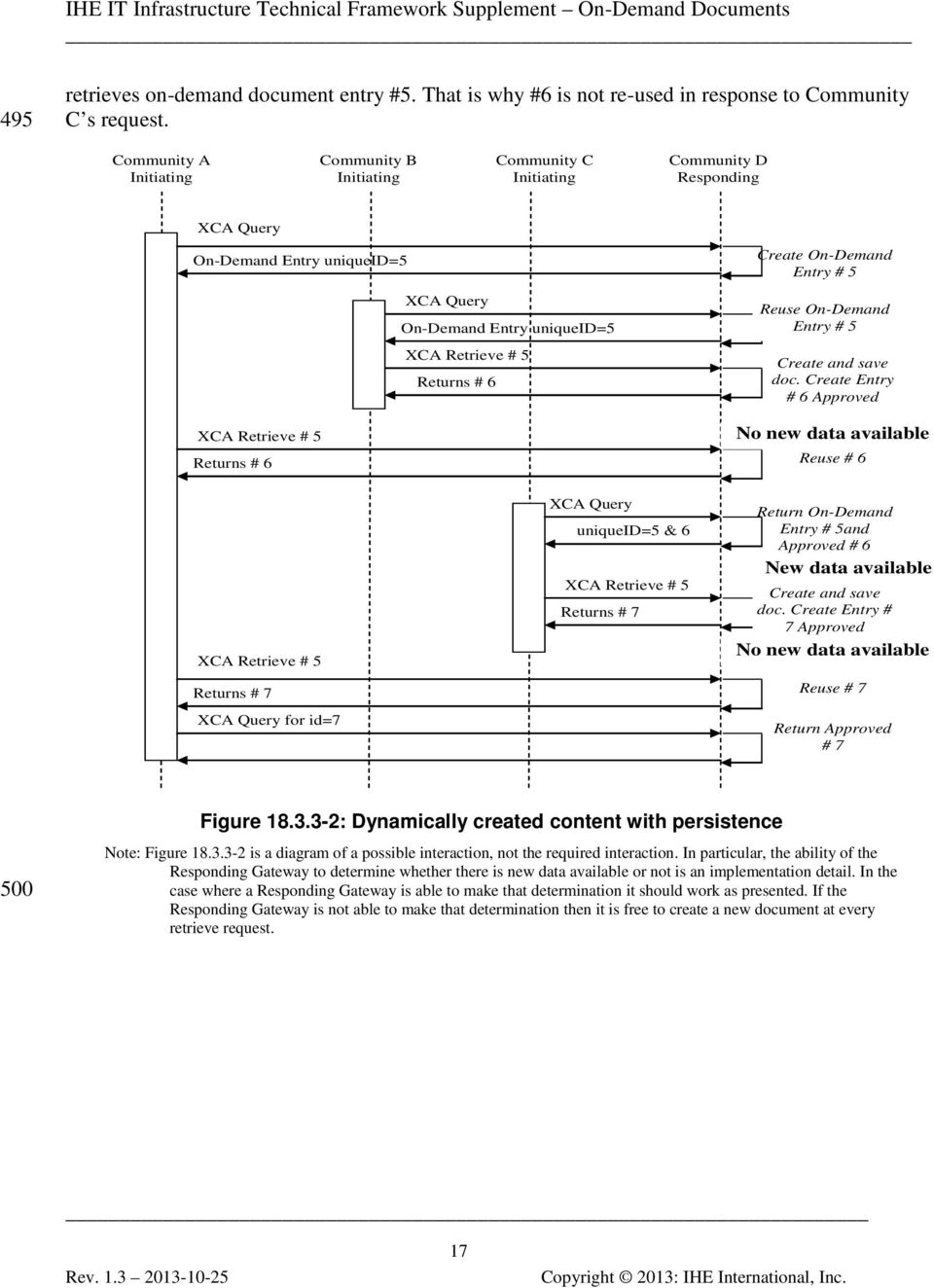
16 does not modify On-Demand Document Entries obtained from the XDS Document Consumer and passes them within the Cross-Gateway Query and Retrieve response messages returned to the Initiating Gateway. For this reason this option imposes no additional requirements on Initiating Gateways which group with an XDS Document Consumer. A Responding Gateways that is not grouped with an XDS Document Consumer shall: be able to respond with On-Demand Document Entries to a Cross Gateway Query requesting On-Demand Document Entries. Without this option, a Responding Gateway shall ignore the request for On-Demand Document Entries (i.e., return an empty list if no other type of entry matches the query parameters). be able to respond to a Cross Gateway Retrieve requesting On-Demand Document Entries Persistence of Retrieved Documents Responding Gateways which support the Persistence of Retrieved Documents option shall: also support the On-Demand Documents option make available, as a Stable Document Entry in response to a Cross Gateway Query, every document created as a result of receipt of a Cross Gateway Retrieve which specified the uniqueid of an On-Demand Document Entry See section for an overview of this XCA Process Flow Detailed Interactions Add the following to the end of section Sharing using On-Demand Documents Figure shows the use of an On-Demand Document Entry to allow access to the most recently available set of data from a responding community. This example does not show the Gateways interacting with XDS Actors and does not assume that XDS is used in any of the communities. This workflow includes persisting each document returned as a result of a retrieve and forming a stable document entry describing the new document which will be returned to future Cross Gateway Query requests. The semantics of the response to a retrieve of an On- Demand Document Entry are different than the semantics of the response to retrieval of stable documents. The response to a retrieve of an On-Demand Document Entry contains a new uniqueid, different than the uniqueid specified in the request, which is the same as the value within the ClinicalDocument id of the document returned. Use of an appropriate query against that new uniqueid will allow the requestor access to updated metadata about the document, including size, hash, etc. This workflow assumes that some change to the underlying data occurs between the time Community A retrieves on-demand document entry #5, and Community C 16

17 495 retrieves on-demand document entry #5. That is why #6 is not re-used in response to Community C s request. Community A Initiating Community B Initiating Community C Initiating Community D Responding XCA Query On-Demand Entry uniqueid=5 XCA Query On-Demand Entry uniqueid=5 XCA Retrieve # 5 Returns # 6 XCA Retrieve # 5 Returns # 6 Create On-Demand Entry # 5 Reuse On-Demand Entry # 5 Create and save doc. Create Entry # 6 Approved No new data available Reuse # 6 XCA Retrieve # 5 XCA Query uniqueid=5 & 6 XCA Retrieve # 5 Returns # 7 Return On-Demand Entry # 5and Approved # 6 New data available Create and save doc. Create Entry # 7 Approved No new data available Returns # 7 Reuse # 7 XCA Query for id=7 Return Approved # Figure : Dynamically created content with persistence Note: Figure is a diagram of a possible interaction, not the required interaction. In particular, the ability of the Responding Gateway to determine whether there is new data available or not is an implementation detail. In the case where a Responding Gateway is able to make that determination it should work as presented. If the Responding Gateway is not able to make that determination then it is free to create a new document at every retrieve request. 17
18 505 Appendix A Actor Summary Definitions On-Demand Document Source - The On-Demand Document Source is the producer and publisher of On-Demand Documents. This actor registers On-Demand Document Entries with the Document Registry and responds to Retrieve Document Set transactions with a document reflecting current information for the entry requested. 18
19 510 Appendix B Transaction Summary Definitions Register On-Demand Document Entry The Register On-Demand Document Entry transaction is used by the On-Demand Document Source to register one or more On-Demand Document Entries in the Document Registry. 19

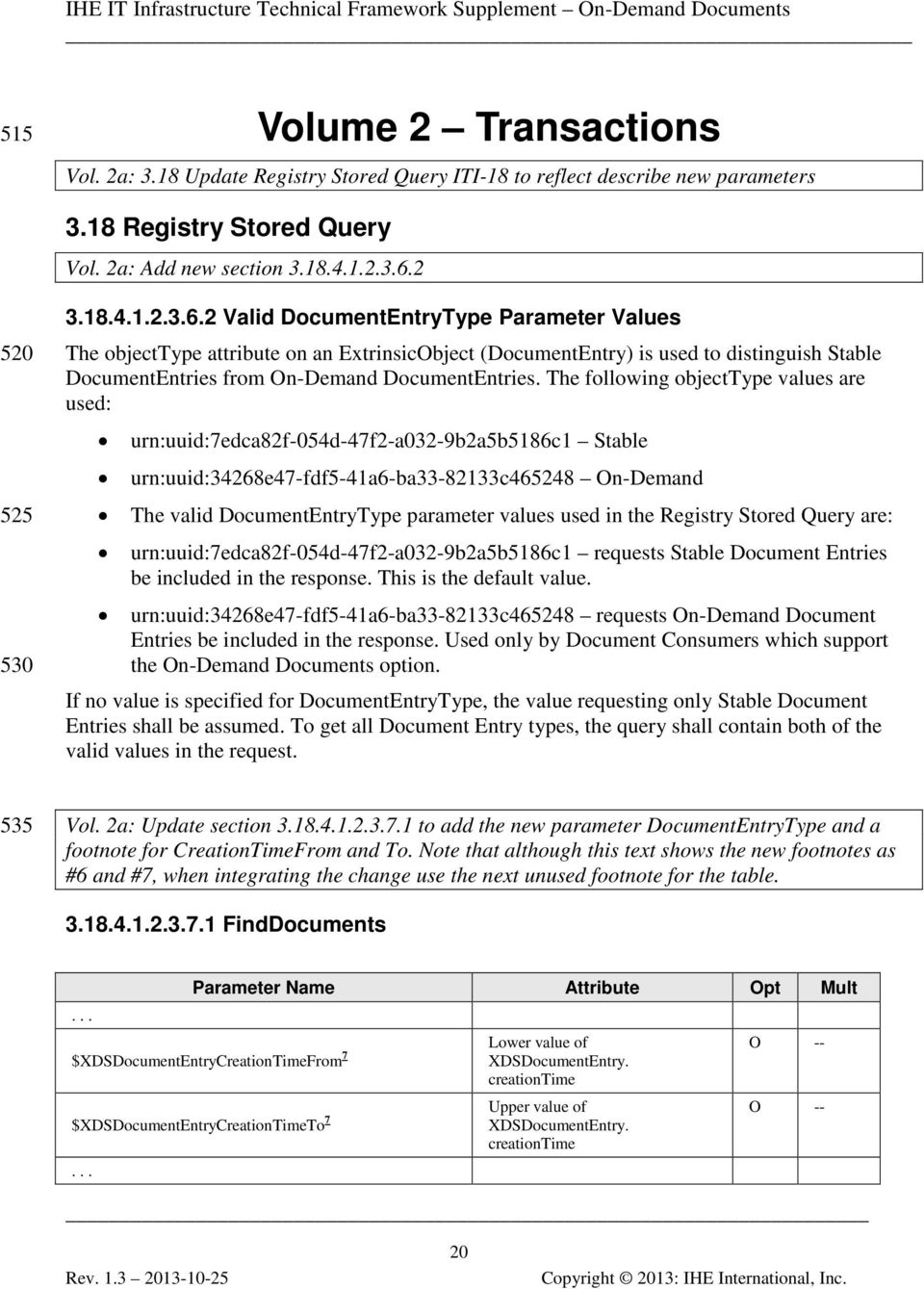
20 515 Volume 2 Transactions Vol. 2a: 3.18 Update Registry Stored Query ITI-18 to reflect describe new parameters 3.18 Registry Stored Query Vol. 2a: Add new section Valid DocumentEntryType Parameter Values The objecttype attribute on an ExtrinsicObject (DocumentEntry) is used to distinguish Stable DocumentEntries from On-Demand DocumentEntries. The following objecttype values are used: urn:uuid:7edca82f-054d-47f2-a032-9b2a5b5186c1 Stable urn:uuid:34268e47-fdf5-41a6-ba c On-Demand The valid DocumentEntryType parameter values used in the Registry Stored Query are: urn:uuid:7edca82f-054d-47f2-a032-9b2a5b5186c1 requests Stable Document Entries be included in the response. This is the default value. urn:uuid:34268e47-fdf5-41a6-ba c requests On-Demand Document Entries be included in the response. Used only by Document Consumers which support the On-Demand Documents option. If no value is specified for DocumentEntryType, the value requesting only Stable Document Entries shall be assumed. To get all Document Entry types, the query shall contain both of the valid values in the request. 535 Vol. 2a: Update section to add the new parameter DocumentEntryType and a footnote for CreationTimeFrom and To. Note that although this text shows the new footnotes as #6 and #7, when integrating the change use the next unused footnote for the table FindDocuments... Parameter Name Attribute Opt Mult $XDSDocumentEntryCreationTimeFrom 7 $XDSDocumentEntryCreationTimeTo 7... Lower value of XDSDocumentEntry. creationtime Upper value of XDSDocumentEntry. creationtime O -- O -- 20
21 540 Parameter Name Attribute Opt Mult $XDSDocumentEntryStatus XDSDocumentEntry. status R M $XDSDocumentEntryType 6 XDSDocumentEntry.objectType O M (footnotes deleted) 6 See ITI TF-2a: CreationTimeFrom and CreationTimeTo are ignored when evaluating an On-Demand Document Entry s selection for inclusion in the query response. 545 Vol. 2a: Update section to add the new parameter DocumentEntryType. Note that although this text shows the footnote as #6, when integrating the change, use the next unused footnote for the table GetAll 550 Parameter Name Attribute Opt Mult XDSFolder. patientid, R -- $patientid XDSSubmissionSet. patientid, XDSDocumentEntry. patientid $XDSDocumentEntryStatus XDSDocumentEntry. status R M $XDSSubmissionSetStatus XDSSubmissionSet. status R M $XDSFolderStatus XDSFolder. status R M $XDSDocumentEntryFormatCode 2 XDSDocumentEntry. formatcode O M $XDSDocumentEntryConfidentialityCode 1, 2 XDSDocumentEntry. O M confidentialitycode 1 $XDSDocumentEntryType 6 XDSDocumentEntry.objectType O M See ITI TF-2a: Vol. 2a: Update section to add the new parameter DocumentEntryType. Note that although this text shows the footnote as #6, when integrating the change, use the next unused footnote for the table GetSubmissionSetAndContents Parameter Name Attribute Opt Mult $XDSSubmissionSetEntryUUID 5 XDSSubmissionSet. entryuuid O 1 -- $XDSSubmissionSetUniqueId 5 XDSSubmissionSet. uniqueid O 1 -- $XDSDocumentEntryFormatCode 4 XDSDocumentEntry. formatcode O M 21
22 Parameter Name Attribute Opt Mult $XDSDocumentEntryConfidentialityCode 4 XDSDocumentEntry. O M confidentialitycode 2 $homecommunityid None O 3 -- $XDSDocumentEntryType 6 XDSDocumentEntry.objectType O M See ITI TF-2a: Vol. 2a: Update section to add the new parameter DocumentEntryType. Note that although this text shows the footnote as #6, when integrating the change use, the next unused footnote for the table GetFolderAndContents Parameter Name Attribute Opt Mult $XDSFolderEntryUUID 5 XDSFolder. entryuuid O 1 -- $XDSFolderUniqueId 5 XDSFolder. uniqueid O 1 -- $XDSDocumentEntryFormatCode 4 XDSDocumentEntry. formatcode O M $XDSDocumentEntryConfidentialityCode 4 XDSDocumentEntry. O M confidentialitycode 2 $homecommunityid None O 3 -- $XDSDocumentEntryType 6 XDSDocumentEntry.objectType O M See ITI TF-2a: Vol. 2a: Update section to add the new parameter DocumentEntryType. Note that although this text shows the footnote as #6, when integrating the change use the next unused footnote for the table GetRelatedDocuments Parameter Name Attribute Opt Mult $XDSDocumentEntryEntryUUID XDSDocumentEntry. entryuuid O 1 -- $XDSDocumentEntryUniqueId XDSDocumentEntry. uniqueid O 1 -- $AssociationTypes Not a named attribute R M $homecommunityid None O 2 -- $XDSDocumentEntryType 6 XDSDocumentEntry.objectType O M
23 575 6 See ITI TF-2a: Vol. 2a: Replace the currently empty section with the following text: Compatibility of Options The presence or absence of the optional $XDSDocumentEntryType parameter triggers different behaviors on the Document Registry. If this parameter is specified, and the Document Registry does not support it, the Document Registry shall ignore. If it is specified, and the Document Registry does support it, the proper information is returned. If the Document Consumer does not support the On-Demand Documents Option, it will send a Registry Stored Query request which does not contain the $XDSDocumentEntryType parameter. The Document Registry will therefore not supply any On-Demand Document Entries in the query response. If the Document Consumer does support the On-Demand Documents Option then it will be able to specify the $XDSDocumentEntryType parameter containing the uuid for On- Demand Document Entries in a Registry Stored Query. A Document Registry with the On-Demand Documents Option will recognize the $XDSDocumentEntryType parameter and process accordingly. A Document Registry which does not support the On-Demand Documents Option, will ignore the $XDSDocumentEntryType parameter. Since there cannot be any On-Demand Document Entries held by a Document Registry which does not support On-Demand Documents, this is a consistent response to the request. ITI TF-2b: Update Cross Gateway Query to adopt changes to ITI-18 when option is declared Update section Cross Gateway Query Message Semantics The message semantics are based on the Registry Stored Query. See ITI TF-2a: Initiating Gateways which support the On-Demand Documents option shall be capable of querying for an On-Demand Document Entry either through internal mechanisms or, when the XDS Affinity Domain option is also declared, through interaction with an XDS Document Consumer which supports the On-Demand Documents option. Responding Gateways which support the On-Demand Documents option shall be able to respond to a query of an On-Demand Document Entry, either through internal 23
24 610 mechanisms or, when grouped with a Document Consumer, through interaction with appropriate XDS Actors which support On-Demand Documents. Of special note are the use of homecommunityid, specifying the patient identifier and special handling of some stored queries. These are explained below. ITI TF-2b: insert new section Compatibility of Options The presence or absence of the optional $XDSDocumentEntryType parameter triggers the behaviors on the Responding Gateway. If this value is specified, and the Responding Gateway (or XDS community supported by the Responding Gateway) does not support it, it shall be ignored. If it is specified, and the Responding Gateway (or underlying XDS community) does support it, the proper information is returned. See ITI TF-2a: for more details regarding compatibility of the Registry Stored Query transaction. 625 ITI TF-2b: Update Cross Gateway Retrieve to adopt changes to Retrieve Doc Set when option is declared Update section and as follows: 3.39 Cross Gateway Retrieve Message Semantics The message semantics for Cross Gateway Retrieve are the same as Retrieve Document Set. See ITI TF-2b: The Initiating Gateway shall specify the homecommunityid parameter within the Retrieve Document Set. The homecommunityid shall contain the value that identifies the community associated with the Responding Gateway. Initiating Gateways which support the On-Demand Documents Option shall be capable of retrieving an On-Demand Document Entry either through internal mechanisms or, when the XDS Affinity Domain option is also declared, through interaction with an XDS Document Consumer which supports the On-Demand Documents option. Responding Gateways which support the On-Demand Documents Option shall be able to respond to retrieval of an On-Demand Document Entry either through internal mechanisms or, when grouped with a Document Consumer, through interaction with appropriate XDS Actors which support On-Demand Documents. Responding Gateways which support the Persistence of Retrieved Documents Option shall specify the NewRepositoryUniqueId element indicating the document is available for later retrieval and be able to return exactly the same document in all future retrieve requests for the document identified by NewDocumentUniqueId. 24
25 ITI TF-2b: insert new section Compatibility of Options If the Initiating Gateway does not support the On-Demand Document Option, it will never send a Cross Gateway Retrieve request for an On-Demand Document. In this case, none of the attributes specific to On-Demand Documents will be included in the response. If the Initiating Gateway does support the On-Demand Document Option, it will only direct Cross Gateway Retrieve requests for On-Demand Documents to responders which have returned an On-Demand Document Entry in a Cross Gateway Query response. Thus there are no compatibility concerns with this transaction. 655 Vol. 2b: Update Retrieve Document Set Transaction in Volume 2b 3.43 Retrieve Document Set Scope This transaction is used by the Document Consumer to retrieve a set of documents from the Document Repository or On-Demand Document Source. The Document Consumer has already obtained the XDSDocumentEntry uniqueid and the Document Repository repositoryuniqueid from the Document Registry by means of the Registry Stored Query transaction. Add On-Demand Document Source to figure as a third actor on this transaction. Document Consumer Document Repository Or Integrated Document Source/Repository Or On-Demand Document Source Retrieve Document Set Figure : Use Case Roles XDS Actors: Actor: Document Consumer Role: Obtains document Actor: Document Repository or Integrated Document Source/Repository Role: Provides documents 25
26 Actor: On-Demand Document Source Role: Creates documents in response to a request for retrieval of an on-demand document entry. 675 Note: Within this transaction, the Document Repository and Integrated Document Source/Repository actors can be used interchangeably. Update figure to add On-Demand Document Source as a responder to a Retrieve Document Set Request Document Consumer Document Repository/ Initiating Gateway/On-Demand Document Source Retrieve Document Set Request Retrieve Document Set Response Figure : Interaction Diagram Update section to add text after the bullet list Message Semantics The Retrieve Document Set Response Message shall carry the following information: (... ) If the documentuniqueid is associated with an On-Demand Document Entry, the Retrieve Document Set Response Message shall contain a NewDocumentUniqueId element that identifies the document that is returned in the Retrieve Document Set Response. This identifier shall be different than the DocumentUniqueId element which identifies the On- Demand Document Entry. The Retrieve Document Set Response Message may also include a NewRepositoryUniqueId element that identifies the Document Repository which holds the document returned in the Retrieve Document Set Response. If this element is not included, the document returned in the response has not been persisted for later retrieval. If the On-Demand Document Source implements the Persistence of Retrieved Documents Option, this element shall be specified. If a future Retrieve Document Set Message for the same DocumentUniqueId returns the same NewDocumentUniqueId, the content of the document shall be identical to the prior returned content. On-Demand Document Source Actors are encouraged to re-use Document uniqueid s whenever content has not changed in order to facilitate identification of new content by Document Consumers. 26
27 Update section as shown. Editor s Note: The content referenced by ITI TF-3: below exists within the XDS Metadata Update Trial Implementation Supplement. When that content is incorporated into ITI TF-3:4 for Final Text, it will get a new section number due to the redocumentation of ITI TF-3:4 in the ITI Technical Framework, Revision 10, published in At that time, the section reference here will be updated Expected Actions A Document Repository or On-Demand Document Source shall returnrieve the document(s) indicated in the request. The Document Repository shall return the document or an error code in case the document could not be returnrieved. The conditions of failure and possible error messages are given in the ebrs standard and detailed in ITI TF-3: Error Reporting. An On-Demand Document Source which supports the Persistence of Retrieved Documents Option shall save the document content returned in the retrieve response and register a Stable Document Entry which describes the saved document. If a prior document has been saved this new document may, depending on the type of data generated by the Document Source, replace the prior document. The registration of the new Stable Document Entry shall include A Submission Set A DocumentEntry representing the stable DocumentEntry A HasMember association linking DocumentEntry to SubmissionSet An IsSnapshotOf Association which identifies the sourceobject as the new Stable Document Entry and the targetobject as the On-Demand Document Entry which contains the uniqueid used in the Retrieve Document Set request. See ITI TF- 3: for information about the IsSnapshotOf Association. If this is not the first request for this on-demand document and a prior document was replaced, a Replace Association which identifies the prior document, Add new section to explain compatibility of declared options Compatibility of Options If the Document Consumer does not support the On-Demand Documents Option it will never send a Retrieve Document Set request for an On-Demand Document entry. In this case, none of the new attributes will be included in the response. If the Document Consumer does support the On-Demand Documents Option, it will only direct requests for On-Demand Document Entries to responders which have specified their unique repositoryuniqueid in the On-Demand Document Entry from the registry. Thus, unless there is an error in the metadata, there are no compatibility concerns with this transaction. 27
28 Update section as shown Protocol Requirements The <ihe:retrievedocumentresponse/> element is defined as: A required /ihe:retrievedocumentsetresponse/rs:registryresponse element An optional sequence of <ihe:documentresponse/> elements containing A <ihe:homecommunityid/> element. The value of this element shall be the same as the value of the /RetrieveDocumentSetRequest/DocumentRequest/HomeCommunityId element in the Retrieve Document Set Request Message. If the <ihe:homecommunityid/> element is not present in the Retrieve Document Set Request Message, this value shall not be present. A required <ihe:repositoryuniqueid/> that identifies the repository from which the document is to be retrieved. The value of this element shall be the same as the value of the /RetrieveDocumentSetRequest/DocumentRequest/RepositoryUniqueId element in the original Retrieve Document Set Request Message. This value corresponds to XDSDocumentEntry.repositoryUniqueId. A required <ihe:documentuniqueid/> that identifies the document within the repository. The value of this element shall be the same as the value of the /RetrieveDocumentSetRequest/DocumentRequest/DocumentUniqueId element in the original Retrieve Document Set Request Message. This value corresponds to XDSDocumentEntry.uniqueId. A required <ihe:document/> element that contains the retrieved document in base64binary encoded format. A required <ihe:mimetype/> element that indicates the MIME type of the retrieved document. An optional <ihe:newdocumentuniqueid/> element that identifies the document returned in the request when retrieval is of an On-Demand Document. This is required when retrieval is of an On-Demand Document. An optional <ihe:newrepositoryuniqueid/> element that identifies the Document Repository that will support retrieval of the document created as a result of retrieval of the On-Demand Document. This is required when the On- Demand Document Source supports the Persistence of Retrieved Documents Option. Add new section to show a sample retrieve response from dynamic 28
29 Sample Retrieve Document Set Response from On-Demand Document Entry The following example shows the response to retrieval of a dynamic document entry where the responder supports later retrieval of the document created. <s:envelope xmlns:s=" xmlns:a=" <s:header> <a:action s:mustunderstand="1">urn:ihe:iti:2007:retrievedocumentsetresponse</a:action> <a:relatesto>urn:uuid:0fbfdced-6c01-4d09-a afedaa02</a:relatesto> </s:header> <s:body> <RetrieveDocumentSetResponse xmlns="urn:ihe:iti:xds-b:2007" xmlns:lcm="urn:oasis:names:tc:ebxml-regrep:xsd:lcm:3.0" xmlns:query="urn:oasis:names:tc:ebxml-regrep:xsd:query:3.0" xmlns:rim="urn:oasis:names:tc:ebxml-regrep:xsd:rim:3.0" xmlns:rs="urn:oasis:names:tc:ebxml-regrep:xsd:rs:3.0"> <rs:registryresponse status="urn:oasis:names:tc:ebxmlregrep:responsestatustype:success"/> <DocumentResponse> <RepositoryUniqueId> </RepositoryUniqueId> <DocumentUniqueId> </DocumentUniqueId> <NewDocumentUniqueId> </NewDocumentUniqueId> <NewRepositoryUniqueId> </NewRepositoryUniqueId> <mimetype>text/xml</mimetype> <Document>UjBsR09EbGhjZ0dTQUxNQUFBUUNBRU1tQ1p0dU1GUXhEUzhi</Document> </DocumentResponse> <DocumentResponse> <RepositoryUniqueId> </RepositoryUniqueId> <DocumentUniqueId> </DocumentUniqueId> <mimetype>text/xml</mimetype> <Document>UjBsR09EbGhjZ0dTQUxNQUFBUUNBRU1tQ1p0dU1GUXhEUzhi</Document> </DocumentResponse> </RetrieveDocumentSetResponse> </s:body> </s:envelope> Audit Record Considerations The Retrieve Document Set Transaction is PHI-Export event, as defined in ITI TF-2a: Table with the following exceptions. The Document Repository Actor shall generate an Export event. This may be an event for each Retrieve Document Transaction, or multiple transactions for the same patient may be heuristically combined. The heuristics for this combination are not specified by IHE. It is intended to reduce the volume of audit records. Combination is permitted when the active participants and patient are the same, and the time difference is considered insignificant. 29
30 820 The On-Demand Document Source Actor shall generate audit events exactly the same way as is done for the Document Repository Actor. The Document Consumer Actor shall generate an Import event. This may be one event per transaction, or multiple transactions may be reported as a single event using a heuristic for combining transactions. Combination is permitted when the active participants and patient are the same, and the time difference is considered insignificant. Vol. 2b: Add section Register On-Demand Document Entry This section corresponds to Transaction 61 of the IHE ITI Technical Framework. Transaction 61 is used by the On-Demand Document Source and Document Registry actors Scope The Register On-Demand Document Entry transaction passes a Submission Request from an On- Demand Document Source actor to a Document Registry actor. The Submission Request contains metadata describing one or more On-Demand Document Entries Use Case Roles On-Demand Document Source Document Registry Register On-Demand Document Entry Actor: On-Demand Document Source Role: A Provider of On-Demand Documents that registers a patient specific on-demand document to the Document Registry. Actor: Document Registry Role: A document indexing system that receives and stores metadata about available ondemand documents Referenced Standard Implementors of this transaction shall comply with all requirements described in ITI TF-2x: Appendix V: Web Services for IHE Transactions. 30
31 ebrim OASIS/ebXML Registry Information Model v3.0 ebrs OASIS/ebXML Registry Services Specifications v3.0 HL7V2 HL7 Version 2.5 Appendix V ITI TF-2x:Appendix V Web Services for IHE Transactions Contains references to all Web Services standards and requirements of use ITI TF-3:4 Metadata used in Document Sharing profiles Interaction Diagram On-Demand Document Source Document Registry Register On-Demand Document Entry Request Register On-Demand Document Entry Response Register On-Demand Document Entry Request The On-Demand Document Source sends metadata about one or more patient specific n-demand documents to the Document Registry Trigger Events The Register On-Demand Document Entry Request message is triggered when the On-Demand Document Source chooses to make available an on-demand document for a particular patient Message Semantics The sections in ITI TF-3: 4.2 specify the mapping of XDS concepts to ebrs and ebrim semantics and document metadata. In its use of metadata the On-Demand Document Entry follows the same conventions and requirements as a Document Entry except for the following. creationtime Not Applicable, shall not be specified in a Register On-Demand Document Entry request. Hash Not Applicable, shall not be specified in a Register On-Demand Document Entry Request. 31
32 legalauthenticator Recommend this not be specified as having no clear meaning in the context of an On-Demand Document Entry. repositoryuniqueid The globally unique identifier of the On-Demand Document Source which providers the on-demand document. This unique identifier for the On-Demand Document Source may be used to identify and connect to the specific On-Demand Document Source where a current instance of the on-demand document may be retrieved. The repositoryuniqueid represents an immutable id for the On-Demand Document Source. Size Not Applicable, shall not be specified in a Register On-Demand Document Entry Request. uniqueid The globally unique identifier assigned by the On-Demand Document Source to this On-Demand Document Entry. It is used in the Retrieve Document Set transaction to identify the correct on-demand document to access. The Registry actor shall store, and later include in metadata returned in a query response, the XDSDocumentEntry.repositoryUniqueId attribute along with other metadata attributes received in the Register On-Demand Document Entry [ITI-61] transaction. The SubmitObjectsRequest may include any of the XDS concepts described in ITI TF-3: 4 except Stable Document Entries. Specifically, the message may include: XDS Submission Set exactly one shall be present. XDS Folder zero or more may be present. Document Relationships zero or more may be present. See ITI TF-3: Table for a complete list of associations. On-Demand Document Entry one or more shall be present. There are no restrictions on the use of Document Relationship Associations within this transaction or as part of other transactions which may add or modify Document Relationship Associations with an On-Demand Document Entry. In particular, workflows which replace an On-Demand Document Entry with a Stable Document Entry, add an On-Demand Document Entry to a Folder, deprecate an On-Demand Document Entry or replace an On-Demand Document Entry with a new On-Demand Document Entry are all valid Expected Actions Upon receipt of a Register On-Demand Document Entry Request message, the Document Registry with the aid of the Registry Adaptor shall: Accept all valid SubmitObjectsRequests Perform metadata validations Update the registry with the contained metadata Return a RegistryResponse message given the status of the operation 32
33 If the registry rejects the metadata, then the Document Registry shall: Return an error and indicate in the details of the response the type of error, see ITI TF-3: Roll back the request to register the document Basic Patient Privacy Enforcement Option If the Basic Patient Privacy Enforcement Option is implemented: The On-Demand Document Source actor shall populate the confidentialitycode in the document metadata with the list of OID values that identify the Patient Privacy Consent Policies that apply to the associated on-demand document. The confidentiality codes for different On-Demand Document Entries in the same submission may be different. The On-Demand Document Source actor shall be able to be configured with the Patient Privacy Consent Policies, Patient Privacy Consent Policy Identifiers (OIDs) and associated information necessary to understand and enforce the XDS Affinity Domain Policy. The details of this are product specific and not specified by IHE. The On-Demand Document Source actor may have a user interface or business rule capabilities to determine the appropriate confidentiality codes for each On-Demand Document Entry. The details of this are product specific and not specified by IHE. However, the information about how confidentiality codes are assigned must be part of the published policy for the XDS Affinity Domain Protocol Requirements The Register On-Demand Document Entry transaction shall use SOAP12. Furthermore: The Document Registry actor shall accept the Register On-Demand Document Entry Request formatted as a SIMPLE SOAP message and respond with the Register On- Demand Document Entry Response formatted as a SIMPLE SOAP message. The On-Demand Document Source actor shall generate the Register On-Demand Document Entry Request formatted as a SIMPLE SOAP message and accept the Register On-Demand Document Entry formatted as a SIMPLE SOAP message. See ITI TF-2x: Appendix V for details Register On-Demand Document Entry Response The Document Registry sends the result of processing the On-Demand Document Entry metadata to the On-Demand Document Source Trigger Events The Document Registry finishes processing a Register On-Demand Document Entry Message and shall return a Register On-Demand Document Entry Response. 33
34 Message Semantics The Register On-Demand Document Entry Response message shall carry the status of the requested operation and an error message if the requested operation failed. The conditions of failure and possible error messages are given in the ebrs standard and detailed in ITI TF-3: Error Reporting Expected Actions The On-Demand Document Source now knows that the transaction succeeded/failed and can continue. The metadata added to the registry as a result of this transaction is now available for discovery Protocol Requirements Implementors of this transaction shall comply with all requirements described in ITI TF-2x: Appendix V: Web Services for IHE Transactions ihe rs lcm query WSDL Namespace Definitions urn:ihe:iti:xds-b:2007 urn:oasis:names:tc:ebxml-regrep:xsd:rs:3.0 urn:oasis:names:tc:ebxml-regrep:xsd:lcm:3.0 urn:oasis:names:tc:ebxml-regrep:xsd:query:3.0 These are the requirements for the Register On-Demand Document Entry transaction presented in the order in which they would appear in the WSDL definition: The following types shall be imported (xsd:import) in the /definitions/types section: namespace="urn:oasis:names:tc:ebxml-regrep:xsd:rs:3.0", schema=" rs.xsd" namespace="urn:oasis:names:tc:ebxml-regrep:xsd:lcm:3.0", schema=" lcm.xsd" The /definitions/message/part/@element attribute of the Register On-Demand Document Entry Request message shall be defined as lcm:submitobjectsrequest The /definitions/message/part/@element attribute of the Register Document Set-b Response message shall be defined as rs:registryresponse The /definitions/porttype/operation/input/@wsaw:action attribute for the Register On- Demand Document Entry Request message shall be defined as urn:ihe:iti:2010:registerondemanddocumententry The /definitions/porttype/operation/output/@wsaw:action attribute for the Register On- Demand Document Entry Response message shall be defined as urn:ihe:iti:2010:registerondemanddocumentresponse The /definitions/binding/operation/soap12:operation/@soapaction attribute shall be defined as urn:ihe:iti:2010:registerondemanddocumententry 34
35 These are the requirements that affect the wire format of the SOAP message. The other WSDL properties are only used within the WSDL definition and do not affect interoperability. For informative WSDL for the Document Registry actor see ITI TF-2x: Appendix W Security Considerations Relevant XDS Affinity Domain Security background is discussed in the XDS Security Considerations Section (see ITI TF-1: 10.7) Audit Record Considerations 970 The Register On-Demand Document Entry Transaction is PHI-Export event, as defined in ITI TF-2a: Table with the following exceptions On-Demand Document Source audit message: Field Name Opt Value Constraints Event EventID M EV(110106, DCM, Export ) AuditMessage/ EventIdentification EventActionCode M R (Read) EventDateTime M not specialized EventOutcomeIndicator M not specialized EventTypeCode M EV( ITI-61, IHE Transactions, Register On-Demand Document Entry ) Source (On-Demand Document Source) (1) Human Requestor (0..n) Destination (Document Registry) (1) Audit Source (On-Demand Document Source) (1) Patient (1) SubmissionSet (1) Where: Source UserID U <ReplyTo/> AuditMessage/ ActiveParticipant AlternativeUserID M the process ID as used within the local operating system in the local system logs. UserName U not specialized UserIsRequestor M true RoleIDCode M EV(110153, DCM, Source ) NetworkAccessPointTypeCode M 1 for machine (DNS) name, 2 for IP address NetworkAccessPointID M The machine name or IP address, as specified in RFC Human Requestor (if known) AuditMessage/ ActiveParticipant UserID M Identity of the human that initiated the transaction. AlternativeUserID U not specialized UserName U not specialized UserIsRequestor M true RoleIDCode U Access Control role(s) the user holds that allows this transaction. NetworkAccessPointTypeCode NA NetworkAccessPointID NA 35
36 Destination AuditMessage/ ActiveParticipant UserID M SOAP endpoint URI. AlternativeUserID U not specialized UserName U not specialized UserIsRequestor M false RoleIDCode M EV(110152, DCM, Destination ) NetworkAccessPointTypeCode M 1 for machine (DNS) name, 2 for IP address NetworkAccessPointID M The machine name or IP address, as specified in RFC Audit Source AuditMessage/ AuditSourceIdentificati on Patient (AuditMessage/ ParticipantObjectIde ntification) Submission Set (AuditMessage/ ParticipantObjectIde ntification) AuditSourceID U Not specialized. AuditEnterpriseSiteID U not specialized AuditSourceTypeCode U not specialized ParticipantObjectTypeCode M 1 (person) ParticipantObjectTypeCodeRole M 1 (patient) ParticipantObjectDataLifeCycle U not specialized ParticipantObjectIDTypeCode M EV(2, RFC-3881, Patient Number ) ParticipantObjectSensitivity U not specialized ParticipantObjectID M the patient ID in HL7 CX format.. ParticipantObjectName U not specialized ParticipantObjectQuery U not specialized ParticipantObjectDetail U not specialized ParticipantObjectTypeCode M 2 (System) ParticipantObjectTypeCodeRole M 20 (job) ParticipantObjectDataLifeCycle U not specialized ParticipantObjectIDTypeCode ParticipantObjectSensitivity U not specialized M ParticipantObjectID M The submissionset unique ID ParticipantObjectName U not specialized ParticipantObjectQuery U not specialized ParticipantObjectDetail U not specialized EV( urn:uuid:a54d6aa5-d40d-43f9-88c5-b4633d873bdd, IHE XDS Metadata, submission set classificationnode ) Document Registry audit message: Event AuditMessage/ EventIdentification Field Name Opt Value Constraints EventID M EV(110107, DCM, Import ) EventActionCode M C (Create) EventDateTime M not specialized EventOutcomeIndicator M not specialized EventTypeCode Source (On-Demand Document Source) (1) Destination (Document Registry ) (1) M EV( ITI-61, IHE Transactions, Register On-Demand Document Entry ) 36
37 Audit Source (Document Registry) (1) Patient (1) SubmissionSet (1) Where: Source AuditMessage/ ActiveParticipant UserID U <ReplyTo/> AlternativeUserID U not specialized UserName U not specialized UserIsRequestor M true RoleIDCode M EV(110153, DCM, Source ) NetworkAccessPointTypeCode M 1 for machine (DNS) name, 2 for IP address NetworkAccessPointID M The machine name or IP address, as specified in RFC Destination AuditMessage/ ActiveParticipant UserID M SOAP endpoint URI AlternativeUserID M the process ID as used within the local operating system in the local system logs. UserName U not specialized UserIsRequestor M false RoleIDCode M EV(110152, DCM, Destination ) NetworkAccessPointTypeCode M 1 for machine (DNS) name, 2 for IP address NetworkAccessPointID M The machine name or IP address, as specified in RFC Audit Source AuditMessage/ AuditSourceIdentificati on AuditSourceID U Not specialized. AuditEnterpriseSiteID U not specialized AuditSourceTypeCode U not specialized
38 Patient (AuditMessage/ ParticipantObjectIde ntification) Submission Set (AuditMessage/ ParticipantObjectIde ntification) ParticipantObjectTypeCode M 1 (person) ParticipantObjectTypeCodeRole M 1 (patient) ParticipantObjectDataLifeCycle U not specialized ParticipantObjectIDTypeCode M EV(2, RFC-3881, Patient Number ) ParticipantObjectSensitivity U not specialized ParticipantObjectID M the patient ID in HL7 CX format.. ParticipantObjectName U not specialized ParticipantObjectQuery U not specialized ParticipantObjectDetail U not specialized ParticipantObjectTypeCode M 2 (System) ParticipantObjectTypeCodeRole M 20 (job) ParticipantObjectDataLifeCycle U not specialized ParticipantObjectIDTypeCode M EV( urn:uuid:a54d6aa5-d40d-43f9-88c5-b4633d873bdd, IHE XDS Metadata, submission set classificationnode ) ParticipantObjectSensitivity U not specialized ParticipantObjectID M The submissionset unique ID ParticipantObjectName U not specialized ParticipantObjectQuery U not specialized ParticipantObjectDetail U not specialized 38
39 Cross-Transaction Specifications Vol. 3: Add new section Editor s Note: due to the redocumentation of ITI TF-3:4 in the ITI Technical Framework, Revision 10 published in 2013, the content in section below will get a new section number which is still to be determined. The content below is normative, though it will be in a different location within ITI TF-3:4 when this supplement going to Final Text XDSDocumentEntry Types There are two XDSDocumentEntry Types: Stable Document Entry and On-Demand Document Entry. The following sections describe these types in detail and refer to identifiers of various types. How these identifiers are used and relate to each other is central to understanding the mechanisms used to describe and retrieve content. Stable DocumentEntry uniqueid is the identifier found in the uniqueid metadata field of a Stable DocumentEntry. It is a unique identifier for the entry and also uniquely defines the document associated with the entry. It is used in a retrieve request to identify which specific document should be retrieved. CDA Header id Every HL7 CDA R2 document header includes a value for the ClinicalDocument/id field which uniquely identifiers the document. This value is always the same as the DocumentEntry uniqueid for the Stable Document Entry which contains metadata about this document. Although we address CDA specifically in the explanation, the concepts also apply to any type of document content where a unique identifier exists in a code field within the document. Some document content does not include a unique identifier so these explanations do not apply to that situation. On-Demand DocumentEntry uniqueid is the identifier found in the uniqueid metadata field of an On-Demand Document Entry. It is a unique identifier for the entry but does not identify any document Stable DocumentEntry A Stable Document Entry contains metadata about an already created document available for retrieval. This document is stable because the contents have been effectively combined in the exact representation that will be returned in a Retrieve Document Set. A Stable Document Entry is an XDSDocument Entry with objecttype equal to the UUID for Stable (see for the UUID) and availabilitystatus = Approved or Deprecated. All metadata fields contain valid values. If the document returned on a retrieve request is CDA, it will have in the ClinicalDocument/id in the HL7 CDA R2 header the same value of the DocumentEntry uniqueid. 39
40 On-Demand Document Entry An On-Demand Document Entry provides a unique identifier which can be used to create an ondemand document which collects the latest, most recent available information at the time of retrieval. On-Demand Document Entries never reflect actual document content, but rather the potential for a document with the characteristics described in the metadata of the entry. An On- Demand Document Entry may be replaced and deprecated. If an On-Demand Document Entry is deprecated, the retrieval through Retrieve Document Set [ITI-43] of that uniqueid may not have most recent information and should return an error. The uniqueid associated with an On-Demand Document Entry will never represent an actual document. A retrieve request specifying an On-Demand Document Entry uniqueid will return content identified by a uniqueid different than the specified uniqueid. Every On-Demand Document Entry with the same uniqueid will refer to the same potential content. Actual content depends on the time of retrieval. The On-Demand Document Entry uniqueid is valid for as long as the entry has availabilitystatus=approved. The holder of the uniqueid may re-use it in a retrieve request to get the latest information, without the need for an additional query. When a retrieve request is received specifying an On-Demand Document Entry uniqueid, the responder may choose to persist the document generated as a result and allow the requestor future access to the metadata and document. This capability is declared through the Persistence of Retrieved Documents option on the On-Demand Document Source and Responding Gateway Actors. The persistence refers not only to the saving of the content for re-use, but more specifically, to the ability of the requester to use retrieve to access that exact, possibly now historic, content and use a query to get metadata about the content Vol. 3: Update the following sentence in section as follows: 1045 An XDS Registry Submission Request is the collection of metadata transferred between a Document Repository and a Document Registry. This request is part of the Register Document Set-b [ITI-42] and Register On-Demand Document Entry [ITI-61] transactions. Vol. 3: Update selected rows in table as follows: creationtime Represents the time the author created the document in the Document Source. Shall have a single value. If this attribute is received in a Register On-Demand Document Entry [ITI-61] transaction the Document Registry shall return anxdsregistrymetadataerror. R/R DTM 40
41 <rim:slot name="creationtime"> <rim:valuelist> <rim:value> </rim:value> </rim:valuelist> </rim:slot> Hash key of the XDS Document itself. This value is computed by the Document Repository and used by the Document Registry for detecting the improper resubmission of XDS Documents. If present, shall have a single value. If this attribute is received in a Provide & Register Document Set-b [ITI-41] transaction, it shall be verified by the repository with the actual hash value of the submitted document; an XDSRepositoryMetadataError shall be returned on mismatch If this attribute is received in a Register On-Demand Document Entry [ITI-61] transaction the Document Registry shall return an XDSRegistryMetadataError. hash Cp/P SHA1 hash ITI TF-2.b: <rim:slot name="hash"> <rim:valuelist> <rim:value> da39a3ee5e6b4b0d3255bfef afd80709 </rim:value> </rim:valuelist> </rim:slot> The globally unique identifier of the repository where the document referenced by the Document Entry can be accessedis stored, assigned by the Document Repository or On-Demand Document Source. This unique identifier for the Document Rrepository may be used to identify and connect to the specific Document Rrepository where the document is retrieved fromstored once its metadata has been retrieved from a Document Registry. This repositoryuniqueid is intended to respond to the following types of usage: The means to reference the Document Repository or On-Demand Document Source where this XDS document is retrieved fromstored. The repositoryuniqueid represents an immutable id for the Document Repository or On-Demand Document Source. The means to ensure that a XDS Document is retrieved from the appropriate Document Repository or On-Demand Document Source. Shall have a single value. repositoryuniqueid Cp/P ITI TF-2b: <rim:slot name="repositoryuniqueid"> <rim:valuelist> <rim:value> </rim:value> </rim:valuelist> </rim:slot> Represents the start time the service being documented took place (clinically significant, but not necessarily when the document was produced or approved). This may be the same as the encounter time in case the service was delivered during an encounter. Encounter time is not coded in XDS metadata but may be coded in documents managed by XDS. This time is expressed as (date/time/utc). If present, shall have a single value. Note: Other times, such as document creation or approval are to be recorded, if needed, within the document. servicestarttime R2/R HL7 V2 DTM 41
42 Note: For On-Demand Document Entries this attribute represents the earliest time health service was rendered for which data is available ondemand. For some On-Demand Document Sources this attribute is not applicable and so would not be present <rim:slot name="servicestarttime"> <rim:valuelist> <rim:value> </rim:value> </rim:valuelist> </rim:slot> Represents the stop time the service being documented took place (clinically significant, but not necessarily when the document was produced or approved). This may be the same as the encounter time in case the service was delivered during an encounter. Encounter time is not coded in XDS metadata but may be coded in documents managed by XDS. This time is expressed as (date/time/utc). If the Service happens at a point in time, this attribute shall contain the same value as the servicestarttime. If present, shall have a single value. Note: For On-Demand Document Entries this attribute represents the most recent time health service was rendered for which data is available on-demand. For most On-Demand Document Sources this attribute is not applicable and so would not be present. <rim:slot name="servicestoptime"> <rim:valuelist> <rim:value> </rim:value> </rim:valuelist> </rim:slot> Size in bytes of the byte stream that was provided in the Register and Provide Transaction and stored by the XDS Document Repository. This value is computed by the Document Repository and included in the Register Documents Set Transaction. If present, shall have a single value. If this attribute is received in a Provide and Register Document Set-b [ITI-41] transaction it shall be ignored. If this attribute is received in a Register On-Demand Document Entry [ITI-61] transaction the Document Registry shall return an XDSRegistryMetadataError. servicestoptime R2/R HL7 V2 DTM size Cp/P Integer ITI TF-2b: <rim:slot name="size"> <rim:valuelist> <rim:value>3654</rim:value> </rim:valuelist> </rim:slot> uniqueid The globally unique identifier assigned by the document creator to this document. This unique identifier may be used in the body of other XDS Documents to reference this document. The length of Unique Identifier shall not exceed 128 bytes. The structure and format of this Id shall be consistent with the specification corresponding to the format attribute. (e.g., for a DICOM standard document a 64 character numeric UID, for an HL7 CDA format a serialization of the CDA Document id extension and root in the form oid^extension, where OID is a 64 digits max, and the ID is a 16 UTF-8 char max). If the oid is coded without the extension then the '^' character shall not be included. This uniqueid is intended to respond to the following types of usage: R/R See ITI TF-3:
43 The means to reference this XDS document from within the content of another document. Neither the XDS Registry nor the Repository is aware of such references, but the Document Sources and Consumers are. The use of uniqueid in On-Demand Document Entries is different as this value will never represent an actual document. See ITI TF-3: for more details regarding use of uniqueid by On-Demand Document Entries. Shall have a single value. <rim:externalidentifier identificationscheme= "urn:uuid:2e82c1f6-a085-4c72-9da3-8640a32e42ab" value=" ^11379" id= ID_054" objecttype="urn:oasis:names:tc:ebxmlregrep:objecttype:registryobject:externalidentifier" > <rim:name> <rim:localizedstring value="xdsdocumententry.uniqueid"/> </rim:name> </rim:externalidentifier> 1050 Vol. 3: Add the new UUID for On-Demand Document Entries to section Document Entry Object UUID urn:uuid:7edca82f-054d-47f2-a032-9b2a5b5186c1 urn:uuid:34268e47-fdf5-41a6-ba c Use/meaning XDSDocumentEntry ClassificationNode objecttype for Stable Document Entries XDSDocumentEntry objecttype for On- Demand Document Entries 43
IHE IT Infrastructure Technical Framework Supplement. Delayed Document Assembly. Trial Implementation
 Integrating the Healthcare Enterprise 5 IHE IT Infrastructure Technical Framework Supplement Delayed Document Assembly 10 Trial Implementation 15 Date: August 20, 2010 Author: Karen Witting Email: [email protected]
IHE IT Infrastructure Technical Framework Supplement. Cross-Community Fetch (XCF) Trial Implementation
 Integrating the Healthcare Enterprise 5 IHE IT Infrastructure Technical Framework Supplement 10 Cross-Community Fetch (XCF) 15 Trial Implementation 20 Date: August 31, 2015 Author: Email: ITI Technical
IHE IT Infrastructure Technical Framework Supplement. XAD-PID Change Management (XPID) Trial Implementation
 Integrating the Healthcare Enterprise 5 IHE IT Infrastructure Technical Framework Supplement 10 XAD-PID Change Management 15 Trial Implementation 20 Date: August 19, 2011 Author: ITI Technical Committee
IHE IT Infrastructure Technical Framework Supplement. Secure Retrieve (SeR) Trial Implementation
 Integrating the Healthcare Enterprise 5 IHE IT Infrastructure Technical Framework Supplement 10 Secure Retrieve (SeR) 15 Trial Implementation 20 Date: August 31, 2015 Author: IHE ITI Technical Committee
IHE IT Infrastructure Technical Framework Supplement. Document Digital Signature (DSG) Trial Implementation
 Integrating the Healthcare Enterprise 5 IHE IT Infrastructure Technical Framework Supplement 10 Document Digital Signature (DSG) 15 Trial Implementation 20 Date: March 12, 2015 Author: IHE ITI Technical
Structured Data Capture (SDC) Trial Implementation
 Integrating the Healthcare Enterprise 5 IHE Quality, Research, and Public Health Technical Framework Supplement 10 Structured Data Capture (SDC) 15 Trial Implementation 20 Date: October 27, 2015 Author:
IHE IT Infrastructure Technical Framework Supplement 2007-2008. Cross-Enterprise Document Sharing-b (XDS.b)
 ACC, HIMSS and RSNA Integrating the Healthcare Enterprise 5 IHE IT Infrastructure Technical Framework 2007-2008 10 Cross-Enterprise Document Sharing-b (XDS.b) 15 Draft for Trial Implementation 20 25 30
IHE IT Infrastructure Technical Framework Supplement 2007-2008
 ACC, HIMSS and RSNA Integrating the Healthcare Enterprise 5 10 IHE IT Infrastructure Technical Framework Supplement 2007-2008 Template for XDS Affinity Domain Deployment Planning 15 20 Draft for Trial
South Carolina Health Information Exchange (SCHIEx)
 South Carolina Health Information Exchange (SCHIEx) Interoperability Services Guide Draft September, 2011- v1.5 Himabindu Bolisetty Interoperability Services Lead (CareEvolution) Ian Cassel Interoperability
IHE Patient Care Coordination (PCC) Technical Framework Supplement. Referral/Order Linking (ROL) Trial Implementation
 Integrating the Healthcare Enterprise 5 IHE Patient Care Coordination (PCC) Technical Framework Supplement 10 Referral/Order Linking 15 Trial Implementation 20 Date: November 4, 2014 Author: IHE PCC Technical
IHE Pharmacy Technical Framework Supplement. Pharmacy Medication List (PML) Trial Implementation
 Integrating the Healthcare Enterprise 5 IHE Pharmacy Technical Framework Supplement 10 Pharmacy Medication List (PML) 15 Trial Implementation 20 Date: September 29, 2014 Author: IHE Pharmacy Technical
IHE Patient Care Device Technical Framework Supplement. Medical Equipment Management Device Management Communication (MEMDMC) Trial Implementation
 Integrating the Healthcare Enterprise 5 IHE Patient Care Device Technical Framework Supplement 10 Medical Equipment Management Device Management Communication (MEMDMC) 15 Trial Implementation 20 Date:
EHR Interoperability Framework Overview
 Hospital Health Information System EU HIS Contract No. IPA/2012/283-805 Final version July 2015 Visibility: Public Target Audience: EHR Developers EHR Administrators EPR Systems Developers This document
IHE Eye Care Technical Framework Supplement. Unified Eye Care Workflow Refractive Measurements (U-EYECARE Refractive) Draft for Public Comment
 Integrating the Healthcare Enterprise 5 IHE Eye Care Technical Framework Supplement 10 Unified Eye Care Workflow Refractive Measurements (U-EYECARE Refractive) 15 Draft for Public Comment 20 Date: April
SINTERO SERVER. Simplifying interoperability for distributed collaborative health care
 SINTERO SERVER Simplifying interoperability for distributed collaborative health care Tim Benson, Ed Conley, Andrew Harrison, Ian Taylor COMSCI, Cardiff University What is Sintero? Sintero Server is a
IHE Radiology Technical Framework Supplement. Imaging Object Change Management (IOCM) Trial Implementation
 Integrating the Healthcare Enterprise 5 10 IHE Radiology Technical Framework Supplement Imaging Object Change Management 15 Trial Implementation 20 Date: May 17, 2011 Author: Kinson Ho, David Heaney Email:
Structured Data Capture (SDC) Draft for Public Comment
 Integrating the Healthcare Enterprise 5 IHE Quality, Research, and Public Health Technical Framework Supplement 10 Structured Data Capture (SDC) 15 Draft for Public Comment 20 Date: June 6, 2014 Author:
IHE IT Infrastructure Technical Framework Supplement. Document Encryption (DEN) Trial Implementation
 Integrating the Healthcare Enterprise 5 IHE IT Infrastructure Technical Framework Supplement 10 Document Encryption (DEN) 15 Trial Implementation 20 Date: August 19, 2011 Author: ITI Technical Committee
IHE IT Infrastructure Technical Framework Supplement. Healthcare Provider Directory (HPD) Trial Implementation
 Integrating the Healthcare Enterprise 5 IHE IT Infrastructure Technical Framework Supplement 10 Healthcare Directory (HPD) 15 Trial Implementation 20 Date: August 31, 2015 Author: IHE ITI Technical Committee
HIMSS Interoperability Showcase 2011
 Interoperability will bind together a wide network of real-time life critical data that not only transform but become healthcare. Health Information Interoperability Challenges Healthcare and healthcare
Clinical Mapping (CMAP) Draft for Public Comment
 Integrating the Healthcare Enterprise 5 IHE Patient Care Coordination Technical Framework Supplement 10 Clinical Mapping (CMAP) 15 Draft for Public Comment 20 Date: June 1, 2015 Author: PCC Technical Committee
Cahier des charges technique General Requirements Document Heiko Zimmermann. Cahier des charges technique
 Cahier des charges technique Version 1.0 20.12.2011 Name Organisation Email For validation For comment For info Cahier des charges technique CR SANTEC Project CARA/LABO Work Package CARA : WP13 Cahier
IHE Radiology Technical Framework Supplement. Web-based Image Capture (WIC) Draft for Public Comment
 Integrating the Healthcare Enterprise 5 IHE Radiology Technical Framework Supplement 10 Web-based Image Capture (WIC) 15 Draft for Public Comment 20 Date: February 19, 2015 Author: IHE Radiology Technical
HIMSS Interoperability Showcase 2011
 Interoperability will bind together a wide network of real-time life critical data that not only transform but become healthcare. Health Information Interoperability Challenges and Integrating Healthcare
IHE IT Infrastructure White Paper. Health Information Exchange: Enabling Document Sharing Using IHE Profiles
 Integrating the Healthcare Enterprise IHE IT Infrastructure White Paper Health Information Exchange: Enabling Document Sharing Using IHE Profiles Date: January 24, 2012 Author: Email: Karen Witting, John
EMC XDS Repository Connector for Documentum
 EMC XDS Repository Connector for Documentum Version 1.7 Installation Guide EMC Corporation Corporate Headquarters Hopkinton, MA 01748-9103 1-508-435-1000 www.emc.com Legal Notice Copyright 2010-2015 EMC
develop privacy policies, and implement them with role-based or other access control mechanisms supported by EHR systems.
 Basic Patient Privacy Consents (BPPC) provides a mechanism to record the patient privacy consent(s), a method to mark documents published to XDS with the patient privacy consent that was used to authorize
Clinical Document Exchange Integration Guide - Outbound
 Clinical Document Exchange Integration Guide - Outbound Integrate your healthcare IT system with Practice Fusion s Electronic Health Record (EHR) System Table of Contents 1 Introduction... 2 2 Integration
XDS-I - CROSS-ENTERPRISE DOCUMENT SHARING FOR IMAGING
 Technical White Paper XDS-I - CROSS-ENTERPRISE DOCUMENT SHARING FOR IMAGING Physicians, nurses, administrators and other healthcare professionals foresee a day when vital information can flow seamlessly
IHE ITI Technical Framework Supplement. Internet User Authorization (IUA) Trial Implementation
 Integrating the Healthcare Enterprise 5 IHE ITI Technical Framework Supplement 10 Internet User Authorization (IUA) 15 Trial Implementation 20 Date: August 31, 2015 Author: ITI Technical Committee Email:
IHE IT Infrastructure. XDS Patient Identity Management White Paper
 Integrating the Healthcare Enterprise 5 IHE IT Infrastructure XDS Patient Identity Management White Paper 10 15 20 Date: March 4, 2011 Author: Email: José Mussi (IHE Canada) Nathan Domeij (IHE Canada)
Electronic Health Records and XDS the IHE approach
 Electronic Health Records and XDS the IHE approach Bill Majurski National Institute of Standards and Technology (NIST) Berthold B. Wein IHE-D User Co-Chair, Aachen, Germany Overview Expectations as user
IHE Radiology Technical Framework Supplement. Trial Implementation
 Integrating the Healthcare Enterprise 5 IHE Radiology Technical Framework Supplement 10 Management of Radiology Report Templates (MRRT) 15 Trial Implementation 20 Date: April 21, 2015 Authors: IHE Radiology
IHE IT Infrastructure Technical Committee White Paper. Template for XDS Affinity Domain Deployment Planning
 Integrating the Healthcare Enterprise 5 IHE IT Infrastructure Technical Committee White Paper 10 Template for XDS Affinity Domain Deployment Planning 15 20 Version 15.0 December 2, 2008 Copyright 2008
Building Regional and National Health Information Systems. Mike LaRocca
 Building Regional and National Health Information Systems Mike LaRocca Agenda What are the key use cases driving New York? What is the SHIN-NY NY and its architecture? What standards and protocols were
ConnectVirginia EXCHANGE Onboarding and Certification Guide. Version 1.4
 ConnectVirginia EXCHANGE Onboarding and Certification Guide Version 1.4 July 18, 2012 CONTENTS 1 Overview... 5 2 Intended Audience... 5 3 ConnectVirginia Background... 5 3.1 Federated... 5 3.2 Secure...
MFI 4 Extended Registry SC32/WG2
 ISO/IEC 19763 44 MFI 4 Extended Registry Masaharu Obayashi SC32/WG2 2010.05.20 The relationship between Part 4 and the other parts (1) Specialization approach The metamodels of MFI 3,5,6,7,8,9,,,, are
A Framework for Testing Distributed Healthcare Applications
 A Framework for Testing Distributed Healthcare Applications R. Snelick 1, L. Gebase 1, and G. O Brien 1 1 National Institute of Standards and Technology (NIST), Gaithersburg, MD, State, USA Abstract -
EMC XDS Repository Connector for ViPR
 EMC XDS Repository Connector for ViPR Version 1.8 Installation Guide EMC Corporation Corporate Headquarters Hopkinton, MA 01748-9103 1-508-435-1000 www.emc.com Legal Notice Copyright 2014-2015 EMC Corporation.
IHE IT Infrastructure Technical Framework Supplement. Add RESTful Query to ATNA. Draft for Public Comment
 Integrating the Healthcare Enterprise 5 IHE IT Infrastructure Technical Framework Supplement 10 Add RESTful Query to ATNA 15 Draft for Public Comment 20 Date: June 8, 2015 Author: IHE ITI Technical Committee
EHR Standards Landscape
 EHR Standards Landscape Dr Dipak Kalra Centre for Health Informatics and Multiprofessional Education (CHIME) University College London [email protected] A trans-national ehealth Infostructure Wellness
Healthcare Provider Directories. Eric Heflin, CTO/CIO Healtheway & CTO HIETexas
 Healthcare Directories Eric Heflin, CTO/CIO Healtheway & CTO HIETexas 1 HPD Introduction Business Context Problem statement Definition Selected Use Cases Scope Value Technical Implementation Actors Options
Electronic Health Network - Case Study Consent2Share Share with Confidence
 Electronic Health Network - Case Study Consent2Share Share with Confidence Jan 2015 About Consent2Share Complying with privacy regulations in an electronic environment is a very complex process. The Consent2Share
Streamlining the Flow of Clinical Trial Data: EHR to EDC to Sponsor
 Streamlining the Flow of Clinical Trial : EHR to EDC to Sponsor Landen Bain Liaison to Healthcare CDISC Interchange Standards Consortium) Jane Griffin, RPh Director, Pharmaceutical Research Cerner Corporation
IHE IT Infrastructure Cross Enterprise Document Sharing XDS Integration Profile
 ,QWHJUDWLQJWKH+HDOWKFDUH(QWHUSULVH IHE IT Infrastructure Cross Enterprise Sharing XDS Integration Profile Charles Parisot,, GE Healthcare IHE IT Infrastructure co-chair chair G. Claeys,, Agfa Healthcare
Practical Guidance to Implement Meaningful Use Stage 2. Secure Health Transport for Certification and Meaningful Use
 Practical Guidance to Implement Meaningful Use Stage 2 1. Introduction Association Standards and Interoperability Workgroup Meaningful Use (MU) Stage 2 introduces three transport standards for use in healthcare
IHE Radiology Technical Framework Supplement. Invoke Image Display (IID) Trial Implementation
 Integrating the Healthcare Enterprise 5 IHE Radiology Technical Framework Supplement 10 Invoke Image Display (IID) 15 Trial Implementation 20 Date: April 21, 2015 Author: IHE Radiology Technical Committee
EMC DOCUMENTUM CONTENT ENABLED EMR Enhance the value of your EMR investment by accessing the complete patient record.
 EMC DOCUMENTUM CONTENT ENABLED EMR Enhance the value of your EMR investment by accessing the complete patient record. ESSENTIALS Provide access to records ingested from other systems Capture all content
Developers Integration Lab (DIL) System Architecture, Version 1.0
 Developers Integration Lab (DIL) System Architecture, Version 1.0 11/13/2012 Document Change History Version Date Items Changed Since Previous Version Changed By 0.1 10/01/2011 Outline Laura Edens 0.2
IHE IT Infrastructure White Paper. A Service-Oriented Architecture (SOA) View of IHE Profiles. Public Comment
 Integrating the Healthcare Enterprise 5 IHE IT Infrastructure White Paper 10 A Service-Oriented Architecture (SOA) View of IHE Profiles Public Comment 15 20 Date: September 28, 2009 Author: Joshua Painter
Advanced Matching and IHE Profiles
 Oracle Healthcare Master Person Index INTEGRATING THE HEALTHCARE ENTERPRISE Oracle Healthcare Master Person Index provides a single point of reference to information about a patient, clinician, payer,
IHE IT Infrastructure Technical Framework Supplement. Patient Demographics Query for Mobile (PDQm) Trial Implementation
 Integrating the Healthcare Enterprise 5 IHE IT Infrastructure Technical Framework Supplement 10 Patient Demographics Query for Mobile (PDQm) 15 Trial Implementation 20 Date: August 31, 2015 Author: IHE
SCHIEx: The South Carolina Health Information Exchange Update
 Improving the quality, safety, and efficiency of health care in South Carolina SCHIEx: The South Carolina Health Information Exchange Update May 22, 2012 SCHA HIT Summit Dr. David Patterson Chief, Health
Oracle Siebel Marketing and Oracle B2B Cross- Channel Marketing Integration Guide ORACLE WHITE PAPER AUGUST 2014
 Oracle Siebel Marketing and Oracle B2B Cross- Channel Marketing Integration Guide ORACLE WHITE PAPER AUGUST 2014 Disclaimer The following is intended to outline our general product direction. It is intended
IHE Patient Care Device (PCD) Technical Framework White Paper
 Integrating the Healthcare Enterprise 5 IHE Patient Care Device (PCD) Technical Framework White Paper 10 Overview and Profile Roadmap Version 1.0 15 20 September 1, 2009 Copyright 2009: IHE International
ConCert by HIMSS Certification: An Overview
 ConCert by HIMSS Certification: An Overview This paper provides an introduction to the ConCert by HIMSS certification program. An overview of the 2015 Certification Pilot program is also provided along
IHE cross-enterprise document sharing for imaging: interoperability testing software
 SOFTWARE REVIEW Open Access IHE cross-enterprise document sharing for imaging: interoperability testing software Rita Noumeir *, Bérubé Renaud Abstract Background: With the deployments of Electronic Health
Sharing images and documents between Enterprise VNAs Using IEP and XDS standards. Dave Harvey MRCP FRCR Medical Connections Ltd
 Sharing images and documents between Enterprise VNAs Using IEP and XDS standards Dave Harvey MRCP FRCR Medical Connections Ltd Declaration of Interest Medical Connections Ltd supplies software which is
IBM Interoperable Healthcare Information Infrastructure (IHII) Overview. China October 2006 IBM
 Interoperable Healthcare Information Infrastructure (IHII) Overview China October 2006 Rick Stevens Senior Technical Staff Member Healthcare and Life Science Solutions IHE IT Infrastructure Technical Committee
Social Security Administration (SSA) Experience with Provider Directory HIT Security and Privacy WG
 Social Security Administration (SSA) Experience with Provider Directory HIT Security and Privacy WG Presenters: Shanks Kande, Nitin Jain Date: 04/06/2011 1 Social Security Administration Use of Provider
Postgres Plus xdb Replication Server with Multi-Master User s Guide
 Postgres Plus xdb Replication Server with Multi-Master User s Guide Postgres Plus xdb Replication Server with Multi-Master build 57 August 22, 2012 , Version 5.0 by EnterpriseDB Corporation Copyright 2012
Il lavoro di armonizzazione. e HL7
 Il lavoro di armonizzazione tra CEN 13606, openehr e HL7 Dr Dipak Kalra Centre for Health Informatics and Multiprofessional Education (CHIME) University College London [email protected] Drivers for
The Direct Project Overview
 The Direct Project Overview October 11, 2010 Abstract: The Direct Project specifies a simple, secure, scalable, standards-based way for participants to send authenticated, encrypted health information
Healthcare Link User's Guide
 Healthcare Link User's Guide Clinical Research Data Capture Introduction Healthcare Link is a CDISC initiative with the overarching goals to make it easier for physicians/healthcare sites to participate
INTEGRATING THE ESANTÉ DSP INTO GECAMED
 INTEGRATING THE ESANTÉ DSP INTO GECAMED A smooth integration of the Luxemburgish «dossier de soins partagé» (DSP) in the open source medical record system, GECAMed 1 THE GECAMED - ESANTÉ PROJECT Since
TRANSFoRm: Vision of a learning healthcare system
 TRANSFoRm: Vision of a learning healthcare system Vasa Curcin, Imperial College London Theo Arvanitis, University of Birmingham Derek Corrigan, Royal College of Surgeons Ireland TRANSFoRm is partially
The Enterprise Service Bus: Making Service-Oriented Architecture Real
 The Enterprise Service Bus: Making Service-Oriented Architecture Real M.T. Schmidt et al. Presented by: Mikael Fernandus Simalango SOA in Early Days Introduction Service Requester bind find Service Registry
Health IT Interoperability: HITSP Overview, Update and Discussion
 Health IT Interoperability: HITSP Overview, Update and Discussion July, 2008 Jamie Ferguson KP Health IT Strategy & Policy Health IT Strategy & Policy Agenda Overview Introductory Overview of HITSP HITSP
Consent2Share Software Architecture
 Consent2Share Software Architecture 17 December 2013 10 December 2013 Consent2Share Software Architecture Document Page i Revision History Name Description Date Joel Amoussou Architecture overview of the
An Object Model for Business Applications
 An Object Model for Business Applications By Fred A. Cummins Electronic Data Systems Troy, Michigan [email protected] ## ## This presentation will focus on defining a model for objects--a generalized
Comparing Microsoft SQL Server 2005 Replication and DataXtend Remote Edition for Mobile and Distributed Applications
 Comparing Microsoft SQL Server 2005 Replication and DataXtend Remote Edition for Mobile and Distributed Applications White Paper Table of Contents Overview...3 Replication Types Supported...3 Set-up &
Open Platform. Clinical Portal. Provider Mobile. Orion Health. Rhapsody Integration Engine. RAD LAB PAYER Rx
 Open Platform Provider Mobile Clinical Portal Engage Portal Allegro PRIVACY EMR Connect Amadeus Big Data Engine Data Processing Pipeline PAYER CLINICAL CONSUMER CUSTOM Open APIs EMPI TERMINOLOGY SERVICES
HL7 V2 Implementation Guide Authoring Tool Proposal
 HL7 V2 Authoring Tool Proposal Robert Snelick, NIST National Institute of Standards and Technology May 14 th 2012 Contact: [email protected] NIST and Veterans Administration Joint Project NIST will provide
ISO 18308 INTERNATIONAL STANDARD. Health informatics Requirements for an electronic health record architecture
 INTERNATIONAL STANDARD ISO 18308 First edition 2011-04-15 Health informatics Requirements for an electronic health record architecture Informatique de santé Exigences relatives à une architecture de l'enregistrement
U.S. Department of Health and Human Services (HHS) The Office of the National Coordinator for Health Information Technology (ONC)
 U.S. Department of Health and Human Services (HHS) The Office of the National Coordinator for Health Information Technology (ONC) econsent Trial Project Architectural Analysis & Technical Standards Produced
The Data Grid: Towards an Architecture for Distributed Management and Analysis of Large Scientific Datasets
 The Data Grid: Towards an Architecture for Distributed Management and Analysis of Large Scientific Datasets!! Large data collections appear in many scientific domains like climate studies.!! Users and
How To Write An Electronic Health Record
 EHR Requirements David LLOYD and Dipak KALRA CHIME Centre for Health Informatics and Multiprofessional Education, University College London N19 5LW, by email: [email protected]. Abstract. Published
IHE Radiology Technical Framework Supplement. Clinical Decision Support Order Appropriateness Tracking (CDS-OAT) Trial Implementation
 Integrating the Healthcare Enterprise 5 IHE Radiology Technical Framework Supplement 10 Clinical Decision Support Order Appropriateness Tracking (CDS-OAT) 15 Trial Implementation 20 Date: June 12, 2015