
Practical Guidance to Implement Meaningful Use Stage 2. Secure Health Transport for Certification and Meaningful Use
|
|
|
- Brice Stevenson
- 9 years ago
- Views:
Transcription
1 Practical Guidance to Implement Meaningful Use Stage 2 1. Introduction Association Standards and Interoperability Workgroup Meaningful Use (MU) Stage 2 introduces three transport standards for use in healthcare information transport. The purpose of this paper is to: Summarize the transport standards and their purpose Provide practical guidance to apply one or more of these standards in a MU Stage 2 implementation from a software developer perspective seeking to meet certification Highlight the flexibility allowed by MU Stage 2 in the ways providers may qualify in deploying health information exchange with a certified 2. Summary of Certification Requirements Section of the final rules for Stage 2 certification identifies three transport standards adopted for healthcare messaging. They are: 1. ONC Applicability Statement for Secure Health Transport (incorporated by reference in ) This specification discusses the Direct protocol for provider-to- provider messaging. The core component in the technology stack is standard, secure (SMTP/SMIME). 2. ONC XDR and XDM for Direct Messaging Specification (incorporated by reference in ) This specification discusses the application of XDR and XDM to the direct messaging environment and the interaction between the primary Direct Project environment, which uses SMTP and RFC 5322 to transport and encode healthcare content, and the XDR (Web Services push) and XDM ( with metadata) specifications. ONC Transport and Security Specification (incorporated by reference in ). 3. Standard. ONC Transport and Security Specification (incorporated by reference in ) 1 Practical Guidance to Implement Meaningful Use Stage 2 February 5, 2013

2 This document defines the primary set of Web Services-based () security and transport protocols needed to establish a messaging, security, and privacy foundation for health information exchange. The above three standards are related and may be combined in three ways, as defined in 45CFR (b) (1) (i) A, B, C and (b) (2) (ii) A, B, C. These three combinations are labeled: (a), (a + b), and (b + c). The following diagrams describe the main steps to produce, transmit, and receive a document for each of these combinations. 2.1 Send Supporting Direct-only SMTP (a) Locate Destination and Associated Certificate Sign and Encrypt S-MIME attachment Type of receiving system may be : service HIE or HISP or other Send (SMTP) SMTP Supporting Direct with XDM (a+b) CCDA (s) XDM wrapper (ZIP with metadata and 1-n docs) Locate Destination and Associated Certificate Sign and Encrypt S-MIME attachment Type of receiver may be: : service HIEor orhisp HISP or orother other Send (SMTP) SMTP 2 Practical Guidance to Implement Meaningful Use Stage 2 February 5, 2013

3 Supporting with XDR (b+c) (s) XDR Encoding (Metadata and 1-n s) services+saml) Type of receiver may be: HIE or HISP or other Node Certificate + TLS encryption Web Services on TLS 2.2 Receive Supporting Direct-only SMTP (a) Type of sending system may be: service HIE or HISP or other Validate signature and sender identity Decrypt S-MIME attachment Receive (SMTP or POP or IMAP) 3 Practical Guidance to Implement Meaningful Use Stage 2 February 5, 2013
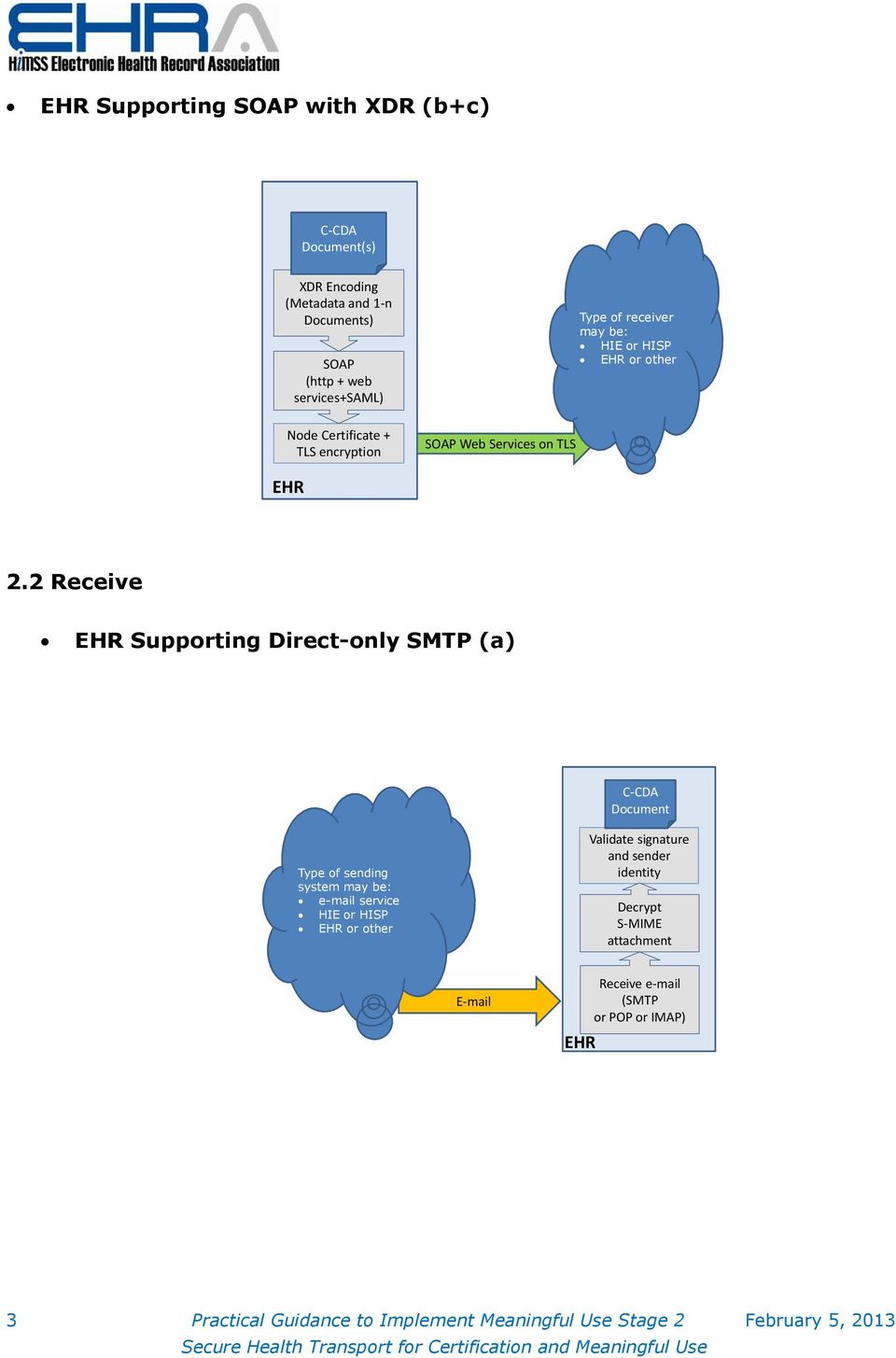
4 Supporting Direct with XDM (a+b) Type of sending system may be: service HIE or HISP or other XDM wrapper (ZIP with metadata and 1-n docs) Validate signature and sender identity Decrypt S-MIME attachment Receive (SMTP or POP or IMAP) Supporting with XDR (b+c) (s) Type of sender may be: HIE or HISP or other XDR Encoding (Metadata and 1-n s services+saml) Web Services on TLS Node Certificate + TLS encryption 4 Practical Guidance to Implement Meaningful Use Stage 2 February 5, 2013

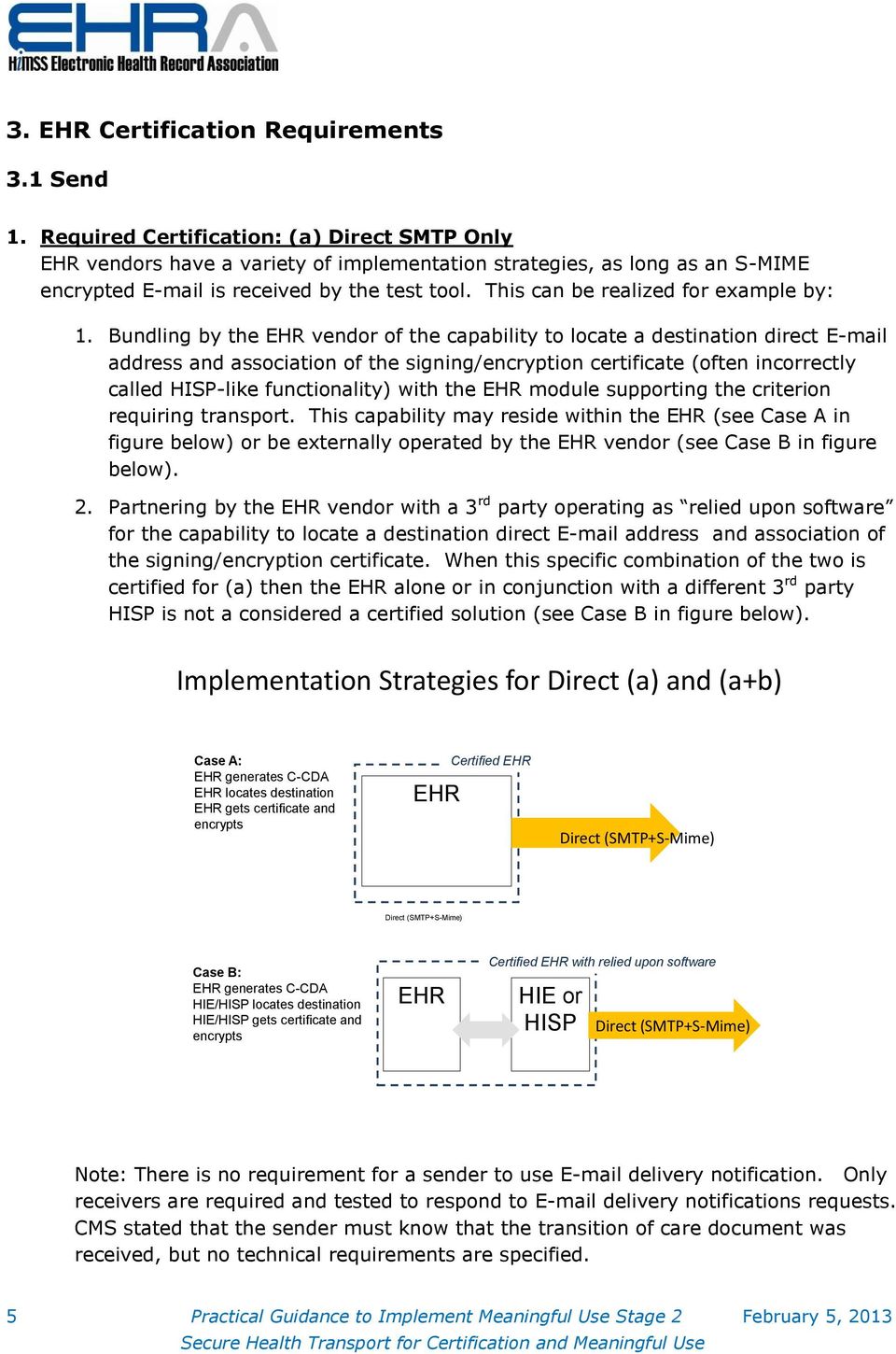
5 3. Certification Requirements 3.1 Send 1. Required Certification: (a) Direct SMTP Only vendors have a variety of implementation strategies, as long as an S-MIME encrypted is received by the test tool. This can be realized for example by: 1. Bundling by the vendor of the capability to locate a destination direct address and association of the signing/encryption certificate (often incorrectly called HISP-like functionality) with the module supporting the criterion requiring transport. This capability may reside within the (see Case A in figure below) or be externally operated by the vendor (see Case B in figure below). 2. Partnering by the vendor with a 3 rd party operating as relied upon software for the capability to locate a destination direct address and association of the signing/encryption certificate. When this specific combination of the two is certified for (a) then the alone or in conjunction with a different 3 rd party HISP is not a considered a certified solution (see Case B in figure below). Implementation Strategies for Direct (a) and (a+b) Case A: generates locates destination gets certificate and encrypts Certified Direct (SMTP+S-Mime) Direct (SMTP+S-Mime) Case B: generates HIE/HISP locates destination HIE/HISP gets certificate and encrypts Certified with relied upon software HIE or HISP Direct (SMTP+S-Mime) Note: There is no requirement for a sender to use delivery notification. Only receivers are required and tested to respond to delivery notifications requests. CMS stated that the sender must know that the transition of care document was received, but no technical requirements are specified. 5 Practical Guidance to Implement Meaningful Use Stage 2 February 5, 2013
6 2. Optional Certification: (a+b) Direct with XDM This certification is optional in addition to (a), not instead of (a), as (a) is minimally required. This certification is identical to (a) and only involves the addition of the ability wrap the document(s) with associated metadata and place it in the S-MIME attachment. The same variants in implementation (Cases A & B in figure) may be used as described under (a). The benefits of this approach over the (a) result from the inclusion of metadata (for either non-cda and CDA documents, as well as multiple documents) that the receiver can use to: 1. Better manage/route the document without having to open it 2. Improved privacy and security management without having to open the document Note: In order to enhance interoperability between (a) sources and (a+b) receivers, we suggest that any implementation of (a) may be designed to receive (a+b) by ignoring the XDM wrapper and the metadata, if not used. This provides compatibility between (a) and (a+b) considering that the certification of (a+b) without also being certified for (a) is not permissible. 3. Optional Certification: (b+c) XDR (with ) This certification is optional in addition to (a), not instead of (a), as (a) is minimally required. In this scenario, XDR relies on (web services) and not as transport. However, it offers the same ability to wrap the document(s) with associated metadata and place it in the message. Note that this is not an S-MIME attachment but the attachment method supported by all stacks. The benefits of this approach over the (a) are: Gives independence from HIE/HISP/Receivers (if they are capable of XDR receive) in that an need not be certified with the relied upon HIE/HISP chosen by the provider Provides metadata for receiver(especially with non-cda documents and multiple documents) to improve their ability to manage/route the document(s) Provides compatibility with an IHE XDS Provide and Register transaction (share documents in an HIE) 6 Practical Guidance to Implement Meaningful Use Stage 2 February 5, 2013

7 3.2 Receive 1. Required Certification: (a) Direct SMTP Only vendors have a variety of implementation strategies, as long as an S-MIME encrypted is received. This can be realized for example by: Bundling by the vendor of the capability to receive an SMTP (as server or STA) and to decipher the S-MIME attachment (often incorrectly called a HISP-like functionality) and enabling a POP or IMAP service to pull from a specific service mailbox and to check the signature and decipher the S- MIME attachment. These receive capabilities may be offered within the or operated independently by the vendor. Have the vendor partner with a 3 rd party operating as relied upon software the capability to receive an SMTP and decipher the S-MIME attachment. The specific combination of the two is certified for (a). The alone or in conjunction with a different 3 rd party HISP is not a certified solution. Note that when acquiring the alone, using it in conjunction with a different service than the one it has been certified with is not considered a certified solution. 2. Optional Certification: (a+b) Direct with XDM This certification is optional in addition to (a), not instead of (a), as (a) is minimally required. This certification for receive is identical to (a) and only involves the addition of the ability to unwrap the document (one or more) and associated metadata and extract it in the S-MIME attachment. The same variants in implementation may be used as for (a). The benefits of this approach over the (a) result from the inclusion of metadata (for either non-cda and CDA documents, as well as multiple documents) that the receiver can use to: Better manage/route the document without having to open it Improved privacy & security management without having to open the document Note: In order to enhance interoperability between (a) sources and (a+b) receivers, we suggest that any implementation of (a) may be designed to receive (a+b) by ignoring the XDM wrapper and the metadata, if not used. This provides compatibility between (a) and (a+b) considering that the certification of (a+b) without also being certified for (a) is not permissible. 7 Practical Guidance to Implement Meaningful Use Stage 2 February 5, 2013

8 3. Optional Certification: (b+c) XDR (with ) This certification is optional in addition to (a), not instead of (a), as (a) is minimally required. XDR relies on Web services and not on as transport. However, it offers the same ability to extract from the message. This is not an S-MIME attachment but the attachment method of. The wrapped content that includes documents (one or more) and associated metadata to facilitate the routing of the documents without any need to parse their content. The benefits of this approach over the (a) are: Gives independence from HIE/HISP/Receivers (if they are capable of XDR receive) in that an need not be certified with the relied upon HIE/HISP chosen by the provider Provides metadata for receiver(especially with non-cda documents and multiple documents) Provides compatibility with an IHE XDS Provide and Register transaction (share documents in an HIE) 4. Provider Requirements for Deploying an to Qualify for MU Stage 2 The Incentive Program for MU Stage 2 Final Rule describes in 495.6(j)(14) for eligible providers (EP) and 495.6(l)(11) for eligible hospitals (including critical access hospitals, EHs and CAHs) the measurements: (A) Subject to paragraph (c) [of/in] this section, the [EP/EH or CAH] that transitions or refers their patient to another setting of care or provider of care provides a summary of care record for more than 50 percent of transitions of care and referrals, (B) Subject to paragraph (c) in this section, the [EP/EH or CAH] that transitions their patient to another setting of care or provider of care provides a summary of care record for more than 10 percent of such transitions and referrals either: (1) Electronically transmitted using Certified Technology to a recipient; or (2) Where the recipient receives the summary of care record via exchange facilitated by an organization that is a NwHIN Exchange participant or in a manner that is consistent with the governance mechanism ONC establishes for the nationwide health information network; (C) Subject to paragraph (c) of this section an [EP/EH or CAH] must satisfy one of the following: (1) Conducts one or more successful electronic exchanges of a summary of care record meeting the measure specified in paragraph [(l)(11)(ii)(b)/(j)(14)(ii)(b)] of this section with a recipient using technology to receive the summary of care record that was designed by a different developer than the sender's technology certified at 45 CFR (b)(2); or 8 Practical Guidance to Implement Meaningful Use Stage 2 February 5, 2013

9 (2) Conducts one or more successful tests with the CMS designated test during the reporting period. This allows for transport mechanisms described in this document, based on ONC's 2014 Edition Final Rule, to meet the target measurements, as well as those used by intermediaries who are approved by NwHIN / ehealth Exchange, e.g., XCA/XDS queries, as referenced from the NwHIN / ehealth Exchange WIKI pages ( and the Message Platform page in particular ( Therefore, the provider must interface its with other providers with which it is performing transfer of care. Two cases are worth considering: 1. If the provider uses a service offered by the vendor (as relied upon software), no further analysis is needed. This relied upon software/service, along with the, must have been certified to (a), and optionally to (a+b) or (b+c). No other choices are acceptable. 2. If the provider wishes to use another HIE/HISP service than the one chosen by the vendor when it certified to (a) Direct, either: a. the provider needs to certify with the selected HIE/HISP on their own, or with assistance from the vendor. b. The provider needs to connect its using (b+c) to the HIE/HISP (no need for self-certification, but this implies that the was certified to (b+c) and that the HIE/HISP supports (b+c) which is likely. No other choices are acceptable. ONC in its communication has been recommending that s implement the optional (b+c) to provide more flexibility to providers. See ONC Dec 19, 2012 Presentation to NeHC at: equirements%20for%20meaningful%20use%20stage%202.pdf For receipt, the requirements for the providers in the CMS regulations are quite flexible. Only the ability to consume s (as well as CCD and CCR for backward compatibility) is required. A provider is explicitly qualified to receive with other solutions than (a), (a+b) or (b+c) on its, such as using the ehealth (previously called NwHIN) Exchange which relies on a query for documents on (IHE XCA Query Retrieve which is the same as XDS Query Retrieve, plus SAML). No measure is defined on receipt of transfer of care. If an is certified with (a), the must be delivered with this (a) capability as used for certification even though the provider may be only using (b+c). 9 Practical Guidance to Implement Meaningful Use Stage 2 February 5, 2013

10 5. Analysis of Some Infrastructure Deployment Models in the Context of MU Stage 2 It is not the purpose of this document to fully analyze the large variety of health information exchange infrastructures that may be deployed to support qualified physicians and hospitals. A few typical cases are highlighted in this section. 5.1 Typical IHE XDS or XCA based communication infrastructure (per -HIE Interoperability WG and ehealth-nwhin Exchange) Typical IHE XDS or XCA based communication infrastructure (per -HIE Interoperability WG and ehealth-nwhin Exchange) (s) (s) XDR Encoding (Metadata and 1-n s) services + SAML) NwHIN Exchange (IHE XCA Query/retrieve + SAML) or -HIE Interop WG (IHE XDS Registry/Repository) XCA Query/Retrieve (Same as XDS Query/Retrieve) (1-n s) services + SAML) Node Certificate + TLS encryption with XDR with XCA/XDS Node Certificate + TLS encryption certified for (a) and (b+c) Provider qualifies by using (b+c) Certification not required certified for (a) Provider qualifies by using NwHIN Exchange Query 10 Practical Guidance to Implement Meaningful Use Stage 2 February 5, 2013

11 5.2 XDR Gateway to (a+b) DIRECT with XDM (b+c) (s) XDR Encoding (Metadata and 1-n s) services + SAML) Node Certificate + TLS encryption with XDR XDR Encoding (Metadata and 1-n documents) services + SAML) Node Certificate + TLS encryption XDM wrapper (ZIP with metadata and 1-n docs) Locate Destination and Associated Certificate Sign and Encrypt S-MIME attachment Send (SMTP) SMTP with XDM Type of receiver may be : service HIE or HISP or other certified for (a) and (b+c) Provider qualifies by using (b+c) Certification not required 5.3 Vendor Provided Communication Infrastructure in an MU Stage 2 Context (s) Vendor Specific Vendor Specific Vendor Specific XDM wrapper (ZIP with metadata and 1-n docs) Locate Destination and Associated Certificate Sign and Encrypt S-MIME attachment Send (SMTP) vendor provided communication infrastructure SMTP SMTP with XDM Type of receiver may be: service HIE or HISP or other and supporting communication infrastructure certified together for (a) and (a+b) Provider qualifies for using either (a+b) or (a) 11 Practical Guidance to Implement Meaningful Use Stage 2 February 5, 2013

TABLE OF CONTENTS INTRODUCTION USE CASES FOR CONVERSION BETWEEN DIRECT AND XDR DATAMOTION XDR IMPLEMENTATION GLOSSARY OF TERMS
 TABLE OF CONTENTS INTRODUCTION USE CASES FOR CONVERSION BETWEEN DIRECT AND XDR Conversion from Direct SMTP+S/MIME Messages to XDR Conversion from XDR to SMTP+S/MIME Data Transmission between two EHRS that
Stage 2 Eligible Professional Meaningful Use Core Measures Measure 15 of 17 Last Updated: August, 2015
 Summary of Care Objective Measures Exclusion Table of Contents Definition of Terms Attestation Requirements Additional Information Certification and Standards Criteria Stage 2 Eligible Professional Meaningful
The Direct Project Overview
 The Direct Project Overview October 11, 2010 Abstract: The Direct Project specifies a simple, secure, scalable, standards-based way for participants to send authenticated, encrypted health information
EHR Vendor Support for Meaningful Use Stage 2 Certification and Implementation Direct Basics & Transitions of Care. February 19, 2013 2:00 PM EST
 EHR Vendor Support for Meaningful Use Stage 2 Certification and Implementation Direct Basics & Transitions of Care February 19, 2013 2:00 PM EST Initial Curriculum Topics Today s Session is focused on:
Navigating the Trends in Health Care Today. MEDITECH Solutions for Meaningful Use and Interoperability
 Navigating the Trends in Health Care Today MEDITECH Solutions for Meaningful Use and Interoperability Certification Update EHRs Meeting ONC 2014 Standards "There is no such thing as being 'Stage 1 Certified'
The Direct Project Reference Implementation Architecture
 The Direct Project Reference Implementation Architecture 1 NwHIN Direct Approach Develop specifications for a secure, scalable, standardsbased way to establish universal health addressing and transport
How To Use Direct Messaging
 Demystifying Direct Messaging Orion Health Whitepaper Author: Paul de Bazin, Integration Portfolio Manager Table of Contents 1! Introduction... 3! 2! Background... 3! 2.1! Standard Use Cases... 3! 3! Direct
ConnectVirginia EXCHANGE Onboarding and Certification Guide. Version 1.4
 ConnectVirginia EXCHANGE Onboarding and Certification Guide Version 1.4 July 18, 2012 CONTENTS 1 Overview... 5 2 Intended Audience... 5 3 ConnectVirginia Background... 5 3.1 Federated... 5 3.2 Secure...
TEST INSTRUCTIONS FOR CROSS VENDOR EXCHANGE TABLE OF CONTENTS
 TEST INSTRUCTIONS FOR CROSS VENDOR EXCHANGE TABLE OF CONTENTS Introduction...2 Meaningful Use Objectives and Measures... 3 Eligible Professionals 495.6(j)(14)... 3 Eligible Hospitals and Critical Access
Expanded Support for Medicaid Health Information Exchanges
 Expanded Support for Medicaid Health Information Exchanges Joint Public Health Forum & CDC Nationwide Webinar April 21, 2016 CDC EHR Meaningful Use Webpage-Joint Public Health Forum & CDC Nationwide Webinars
ConCert by HIMSS Certification: An Overview
 ConCert by HIMSS Certification: An Overview This paper provides an introduction to the ConCert by HIMSS certification program. An overview of the 2015 Certification Pilot program is also provided along
Data Provenance. Functional Requirements Document: Developed in Response to the Data Provenance Task Force Recommendations. Version 1.
 Data Provenance Functional Requirements Document: Developed in Response to the Data Provenance Task Force Recommendations Version 1.0 May 2015 Version History Version Revision Author Description of Change
Prepared by Noam H. Arzt, PhD HLN Consulting, LLC
 Architectures and Transport Mechanisms for Health Information Interchange of Clinical EHR Data for Syndromic Surveillance A Report from the International Society for Disease Surveillance Prepared by Noam
New York ehealth Collaborative. Health Information Exchange and Interoperability April 2012
 New York ehealth Collaborative Health Information Exchange and Interoperability April 2012 1 Introductions Information exchange patient, information, care team How is Health information exchanged Value
Eligible Professionals please see the document: MEDITECH Prepares You for Stage 2 of Meaningful Use: Eligible Professionals.
 s Preparing for Meaningful Use in 2014 MEDITECH (Updated December 2013) Professionals please see the document: MEDITECH Prepares You for Stage 2 of Meaningful Use: Professionals. Congratulations to our
uently Asked NextGen Questions Share Frequently Asked uently Asked Questions Frequently Asked FAQ Pre-General Release (April-June 2014)
 uestions Frequently Asked Questions Fre uestions Frequently Asked Questions Fre uestions FAQ Frequently Asked Questions Fre uestions Frequently Asked Questions Fre uestions Frequently Asked Questions Fre
IHE IT Infrastructure Technical Framework Supplement. Document Encryption (DEN) Trial Implementation
 Integrating the Healthcare Enterprise 5 IHE IT Infrastructure Technical Framework Supplement 10 Document Encryption (DEN) 15 Trial Implementation 20 Date: August 19, 2011 Author: ITI Technical Committee
Transitions of Care & Mass HIway
 Commonwealth of Massachusetts Executive Office of Health and Human Services Transitions of Care & Mass HIway June 11, 2015 Today s Presenter Mark Belanger Mass HIway Account Management Team Massachusetts
Request for Proposal (RFP) Supporting Efficient Care Coordination for New Yorkers: Bulk Purchase of EHR Interfaces for Health Information
 Request for Proposal (RFP) Supporting Efficient Care Coordination for New Yorkers: Bulk Purchase of EHR Interfaces for Health Information ISSUE DATE: April 10, 2013 RESPONSE DUE DATE: May 3, 2013 Region:
How To Communicate In Healthcare With Direct Secure Messaging
 Direct Secure Messaging Communicating in the Healthcare World Andy Nieto, Health IT Strategist, DataMotion Agenda Email and Direct in healthcare, a little history So what is Direct, really Certificates
Arizona Health Information Exchange Marketplace. Requirements and Specifications Health Information Service Provider (HISP)
 Arizona Health Information Exchange Marketplace Requirements and Specifications Health Information Service Provider (HISP) Table of Contents Table of Contents... 1 Introduction... 2 Purpose... 3 Scope...
Health Information Exchange (HIE) in Minnesota
 Health Information Exchange (HIE) in Minnesota Where have we been and where are we going Jennifer Fritz, MPH Anne Schloegel, MPH Minnesota Department of Health 1 Session Goals Learn about Minnesota s approach
Exchanging Medical Records Online with Direct
 Exchanging Medical Records Online with Direct Scott Rea, VP GOV/EDU Relations & Sr. PKI Architect, DigiCert, Inc. [email protected] www.digicert.com +1 (801) 877-2100 Exchanging Medical Records Online
Direct Secure Messaging: Improving the Secure and Interoperable Exchange of Health Information
 Direct Secure Messaging: Improving the Secure and Interoperable Exchange of Health Information Within the healthcare industry, the exchange of protected health information (PHI) is governed by regulations
Developers Integration Lab (DIL) System Architecture, Version 1.0
 Developers Integration Lab (DIL) System Architecture, Version 1.0 11/13/2012 Document Change History Version Date Items Changed Since Previous Version Changed By 0.1 10/01/2011 Outline Laura Edens 0.2
PrivaSphere Gateway Certificate Authority (GW CA)
 PrivaSphere Gateway Certificate Authority (GW CA) Send and receive secure emails with your email program through restricting firewalls using SMIME gateway functionalities. PrivaSphere Secure Messaging
develop privacy policies, and implement them with role-based or other access control mechanisms supported by EHR systems.
 Basic Patient Privacy Consents (BPPC) provides a mechanism to record the patient privacy consent(s), a method to mark documents published to XDS with the patient privacy consent that was used to authorize
Building Regional and National Health Information Systems. Mike LaRocca
 Building Regional and National Health Information Systems Mike LaRocca Agenda What are the key use cases driving New York? What is the SHIN-NY NY and its architecture? What standards and protocols were
Commonwealth of Massachusetts Executive Office of Health and Human Services. The Golden Spike Integration Options 8/20/2012
 Commonwealth of Massachusetts Executive Office of Health and Human Services The Golden Spike Integration Options 8/20/2012 Agenda Introduction HIE Integration Options HIE Integration Specifications Golden
Enabling Patients Decision Making Power: A Meaningful Use Outcome. Lindsey Mongold, MHA HIT Practice Advisor Oklahoma Foundation for Medical Quality
 Enabling Patients Decision Making Power: A Meaningful Use Outcome Lindsey Mongold, MHA HIT Practice Advisor Oklahoma Foundation for Medical Quality Today 1. Meaningful Use (MU) 2. 2/3rds of MU relates
Participating in a Health Information Exchange (HIE) Many Faces of Community Health 2011. 10/27/11 Greg Linden
 Participating in a Health Information Exchange (HIE) Many Faces of Community Health 2011 10/27/11 Greg Linden CIO, Stratis Health HIE Subject Matter Expert, REACH Objective This session will outline options
EHR Incentive Program Stage 3 Objectives & Measures Crosswalk of Stage 3 Proposed Objectives, Measures & Corresponding Stage 2 Measures
 EHR Incentive Program Stage 3 Objectives & Measures Crosswalk of Stage 3 Proposed Objectives, Measures & Corresponding Stage 2 Measures Objective 1: Protect Patient Health Information Measures: 1 (Complete
A. Provisions of the Proposed Rule affecting Standards, Implementation Specifications, Certification Criteria, and Definitions
 May 26, 2015 Submitted Electronically Office of the National Coordinator for Health Information Technology U.S. Department of Health and Human Services 200 Independence Avenue S.W. Suite 729-D Washington,
RPMS DIRECT Secure Messaging
 RPMS DIRECT Secure Messaging Meet the Measure November 13, 2014 Glenn Janzen, Chief Enterprise Architect-IHS Meghna Patel, Business Analyst- DNC Duane Rozsnyai, Project Manager- DNC Agenda Meaningful Use
Meaningful Use and Release of Information
 Meaningful Use and Release of Information Understanding IOD s Role IOD Incorporated 1030 Ontario Road Green Bay, WI 54311 800.236.3355 iodincorporated.com INTRODUCTION According to HIMSS, Meaningful Use
Frequently Asked Questions
 Frequently Asked Questions About PreManage The Oregon Health Leadership Council has formed a unique coalition of major stakeholders, including hospitals, health plans, Emergency Department (ED) physicians
Meaningful Use Stage 2 Transport Option User Stories. Transitions of Care & View, Download, and Transmit. Version 2.2
 Meaningful Use Stage 2 Transport Option User Stories Transitions of Care & View, Download, and Transmit Version 2.2 Table of Contents 1. Transitions of Care (ToC)/Referral Introduction... 3 1.1 Beacon
SCHIEx: The South Carolina Health Information Exchange Update
 Improving the quality, safety, and efficiency of health care in South Carolina SCHIEx: The South Carolina Health Information Exchange Update May 22, 2012 SCHA HIT Summit Dr. David Patterson Chief, Health
HIE Services & Pricing
 Services Available at No Cost Health Information Exchange Services & Pricing Package Effective: December 11, 2015 0 Interface Connection Details Services Available at No Cost HealthlinkNY Web Portal The
HIMSS Interoperability Showcase 2011
 Interoperability will bind together a wide network of real-time life critical data that not only transform but become healthcare. Health Information Interoperability Challenges Healthcare and healthcare
Quality Manual ISO/IEC 17065 Mandatory Disclosure Attestation
 This document explains the mandatory disclosure attestation required for product certification in the ONC Health IT Certification Program. The health IT developer must provide the disclosure language they
STATEMENT OF KAREN UTTERBACK, MSN, RN VICE PRESIDENT, MARKETING AND PRODUCT STRATEGY MCKESSON TECHNOLOGY SOLUTIONS
 STATEMENT OF KAREN UTTERBACK, MSN, RN VICE PRESIDENT, MARKETING AND PRODUCT STRATEGY MCKESSON TECHNOLOGY SOLUTIONS BEFORE THE OFFICE OF THE NATIONAL COORDINATOR FOR HEALTH INFORMATION TECHNOLOGY POLICY
HIE Services & Pricing
 Services Available at No Cost Health Information Exchange Services & Pricing Package Services Available at No Cost Services Available at No Cost HealthlinkNY Web Portal The HealthlinkNY Web Portal is available
LIS Vendor Landscape and Options for Meeting ELR Meaningful Use
 White Paper LIS Vendor Landscape and Options for Meeting ELR Meaningful Use January, 2012 Developed by the Council of State and Territorial Epidemiologists (CSTE) and the Centers for Disease Control and
Streamlining Medical Image Access and Sharing: Integrating Image Workflow and Patient Referrals
 Streamlining Medical Image Access and Sharing: Integrating Image Workflow and Patient Referrals By Ken H. Rosenfeld, President, ; January 2014 WHITE PAPER Introduction Managing transitions of care continues
Burning Issues Health Information Exchange Webinar Series Session 2: HIE for Meaningful Use Stage 2 Summary of Care Record for Transitions of Care
 Burning Issues Health Information Exchange Webinar Series Session 2: HIE for Meaningful Use Stage 2 Summary of Care Record for Transitions of Care Joe Kalaidis, Health IT Consultant Regional Extension
Core services and the path to the future of the ILHIE
 Core services and the path to the future of the ILHIE Hosts of this Webinar Cory Verblen, Communications Manager, Illinois Office of Health Information Technology Laura Zaremba, Director, Illinois Office
(DS4P) Update. Joy Pritts Chief Privacy Officer. NCVHS Committee Meeting June 11, 2014
 Data Segmentation for Privacy (DS4P) Update Joy Pritts Chief Privacy Officer NCVHS Committee Meeting June 11, 2014 Types of Privacy Metadata used by DS4P Confidentiality Codes: Used by systems to help
The basic groups of components are described below. Fig X- 1 shows the relationship between components on a network.
 Elements of Email Email Components There are a number of software components used to produce, send and transfer email. These components can be broken down as clients or servers, although some components
Alabama s One Health Record
 Alabama s One Health Record AQAF Health Information Technology Forum Leveraging Electronic Exchange to Benefit Alabama Outcomes Gary D. Parker, Presenting August 13, 2013 Today s Roadmap Agenda Alabama
IHE IT Infrastructure White Paper. Health Information Exchange: Enabling Document Sharing Using IHE Profiles
 Integrating the Healthcare Enterprise IHE IT Infrastructure White Paper Health Information Exchange: Enabling Document Sharing Using IHE Profiles Date: January 24, 2012 Author: Email: Karen Witting, John
Meaningful Use Stage 1 and Public Health: Lesson Learned
 Meaningful Use Stage 1 and Public Health: Lesson Learned NAACR Presentation August 16, 2012 James Daniel, MPH Public Health Coordinator Office of the National Coordinator for Health IT Agenda Overview
Meaningful Use Updates Stage 2 and 3. Julia Moore, Business Analyst SMC Partners, LLC July 8, 2015
 Meaningful Use Updates Stage 2 and 3 Julia Moore, Business Analyst SMC Partners, LLC July 8, 2015 Stage 2 Requirements 2015 EPs beyond 1st year of MU must report on a full year of data EPs in 1 st year
Illinois Health Information Exchange Client Readiness Technical Assessment Checklist
 Illinois Health Information Exchange Client Readiness Technical Assessment Checklist Date: 10/29/2013 File: ILHIE Client Readiness Document v1.6 Final 3-3-14.doc Page 1 Table of Contents Client Information...
2. When will CPS 12 with reporting for Meaningful Use (MU) be generally available (GA)?
 Centricity Practice Solution 12 and Centricity EMR 9.8 FAQ 1. When will we certify Centricity Practice Solution (CPS) 12, Centricity EMR (CEMR) 9.8 and reporting? Testing is complete. Both solutions were
Guide to Meaningful Use Stage 2
 Guide to Meaningful Use Stage 2 September, 2013 Introduction This document describes the following Core Measure requirements that are needed in order to be compatible with Meaningful Use Stage 2. Meaningful
Munson Medical Center Exchange Clinical Information Objective General Instructions
 Munson Medical Center Exchange Clinical Information Objective General Instructions It is Munson Medical Center s interpretation that to complete Core Measure Performing at least one test of certified EHR
EHR Standards Landscape
 EHR Standards Landscape Dr Dipak Kalra Centre for Health Informatics and Multiprofessional Education (CHIME) University College London [email protected] A trans-national ehealth Infostructure Wellness
Charting the Future of Healthcare Interoperability. Presenters. Michael Stearns, MD, CPC, CFCP
 e-mds Charting the Future of Healthcare Interoperability Presenters Michael Stearns, MD, CPC, CFCP President and CEO Board certified neurologist Over 10 years in health care informatics Integral in development
HL7 and Meaningful Use
 HL7 and Meaningful Use HIMSS Las Vegas February 23, 2012 Grant M. Wood Intermountain Healthcare Clinical Genetics Institute Meaningful Use What Does It Mean? HITECH rewards the Meaningful Use of health
Meaningful Use. Medicare and Medicaid EHR Incentive Programs
 Meaningful Use Medicare and Medicaid Table of Contents What is Meaningful Use?... 1 Table 1: Patient Benefits... 2 What is an EP?... 4 How are Registration and Attestation Being Handled?... 5 What are
The Massachusetts ehealth Institute
 The Massachusetts ehealth Institute MeHI Overview MeHI is designated state agency for: MeHI is a division of the Massachusetts Technology Collaborative, a public economic development agency Coordinating
IMAGE SHARING. Review and Update - A Fond Farewell to CDs 2012
 IMAGE SHARING Review and Update - A Fond Farewell to CDs 2012 David S. Mendelson, M.D. Professor of Radiology Chief of Clinical Informatics The Mount Sinai Medical Center Co-chair IHE International Board
CS 356 Lecture 27 Internet Security Protocols. Spring 2013
 CS 356 Lecture 27 Internet Security Protocols Spring 2013 Review Chapter 1: Basic Concepts and Terminology Chapter 2: Basic Cryptographic Tools Chapter 3 User Authentication Chapter 4 Access Control Lists
PHS-Connect Users Group Forum. November 7, 2013
 PHS-Connect Users Group Forum November 7, 2013 Agenda Introductions and Opening Remarks PHS-Connect Update Direction of PHS-Connect What can PHS-Connect Do for Me and My EMR Secure Messaging for MU2 and