
Supervisors. Quick Reference Guide
|
|
|
- Kathleen Williamson
- 10 years ago
- Views:
Transcription
1 Avaya Aura Contact Center 6 Supervisors Quick Reference Guide AACC
2 Avaya Aura Contact Center 6 Supervisors Quick Reference Guide Overview The Avaya Aura Contact Center 6 Administration tool (CCMA) enables contact center supervisors to manage and configure the contact center and its users, and view real-time and historical reports through a web browser on their desktop. Avaya Aura Contact Center 6 contains several components, including the following: Contact Center Management Real-Time Reporting Historical Reporting Configuration Scripting Contact Center Management You will use Contact Center Management to manage contact center agents, agent to skillset assignments, and agent to supervisor assignment. Real-Time Reporting Supervisors and Managers will use the displays in the Real-Time Reporting component to monitor the current performance of the contact center. The displays provide up-to-the-minute information including the following examples: Number of calls waiting Average and maximum wait times Number of calls abandoned Number of agents logged on to a skillset, on calls, in Not Ready, or waiting for calls If a problem occurs (for example, if wait times or number of calls waiting increase suddenly), you can detect it immediately by viewing real-time displays. You can then take appropriate action to resolve the problem (such as assigning additional agents to the overloaded skillsets). Historical Reporting Supervisors and Managers will use the Historical Reporting component to help track trends and seasonal behavior, and to forecast future activity. For example, you can report on the number of calls to a skillset: During different times of the day During different months of the same year For the same month in different years By comparing statistics for different times of the day, you can identify peak periods. By comparing statistics for different months, you can identify seasonal behavior. By comparing the same month across different years, you can identify trends. Configuration The Configuration element is primarily used for adding, configuring, and deleting resources in the Contact Center Server. Depending on your Access Class level, you may or may not have access to various sections under Configuration. Scripting The Scripting element is primarily used by administrators to develop Contact Center scripts / flows. Depending on your Access Class level, you may or may not have access to Script Variables sections under Scripting.
3 Table of Contents Avaya Aura Contact Center 6 Terms and Definitions... iii Chapter 1 Accessing the System...I Logging In to the System... 1 Changing Your Password... 3 Contact Center and Popup Blocker... 4 Using on line help... 5 Contact Center Status... 6 Chapter 2 Contact Center Management... II Viewing / Changing Contact Center Agents... 1 Updating Agent to Skillset Assignments... 7 Agent Profile Explained Chapter 3 Real-Time Reporting...III Real-Time Display Types... i Data collection modes... i Viewing a Real time Display... 1 Common Real time Display Features... 3 Standard Agent Display Standard Skillset Display Standard Application Display Creating a Private Real-time Display Deleting a Private Real-time Display Creating a New Public Display Creating Filters for Real-time Displays Modifying an Existing Filter Displays Real-time Graphical Displays Sample Graphical Displays...41 Creating a Billboard...46 Creating a Chart...48 Creating a Timeline...52 Creating a Standard Collection...56 Creating a Billboard Collection...58 Creating a Dashboard Collection...60

4 Chapter 4 Historical Reporting...IV Contact Center Report Information... i Collection Period... i Report Folders... ii Report Storage... ii Report Customization... ii Accessing Historical Reporting... 3 Duplicating a Standard Report... 5 Selection Criteria...9 Data Range...11 Scheduling a Report for Automatic Printing (Optional)...18 Report Output (Optional)...26 Activating a Report Schedule (Optional) De-activating a Scheduled Report Deleting a Private or Shared Report Running a Report Printing a Hardcopy of a Report Exporting a Report to a File Sample Data Range Selections Data Range: Interval - Single Interval...40 Data Range: Interval Range of Intervals...41 Data Range: Daily One Day...42 Data Range: Daily Range of Days...43 Data Range: Weekly One Week...44 Data Range: Weekly Last 4 Weeks...45 Data Range: Monthly Last Month...46 Data Range: Monthly Last Year...47 Chapter 5 Interpreting Reports... V Statistics Hierarchy... i Agent Report Information... 1 Agent Performance Report...3 Agent Performance by Supervisor Report...5 Agent DN Performance Report...8 Agent by Skillset Performance Report...10

5 Skillset by Agent Performance Report...12 Agent by Application Performance Report...14 Login / Logout Report...16 CDN / Route Points Report Information CDN (Route Point) Statistics Report...18 Application Report Information Application Performance Report...22 Application Delay Before Abandon Report...24 Application Delay Before Answer Report...27 Skillset Report Information Skillset Performance Report...29 Chapter 6 Configuration...VI Call Presentation Classes... 1 Configuring Call Presentation Classes...3 Threshold Classes... 6 Configuring Threshold Classes Agent, Skillset, & Application...8 Agent Threshold Class Worksheet...11 Skillset Threshold Class Worksheet...13 Application Threshold Class Worksheet...15 Activity Codes Configuring Activity Codes...19 Modify an Existing Activity Code...21 Creating a New Activity Code...23 Deleting an Activity Code...25 Updating Script Variables Sample Boolean Variable...31 Sample Time Range Variable...33 Sample Single Value Time Variable...34

6 Avaya Aura Contact Center 6 Terms and Definitions Control Directory Number (CDN) Script Application Skillset Agent A Control Directory Number, or CDN, is an extension number used to direct calls to the Contact Center Contact Center Server. Usually one CDN is assigned per incoming call type. A script is a written set of instructions applied to callers when they enter the Contact Center. Typically a CDN directs call to a script. An Application is created in the Contact Center when a CDN is instructed to "execute" a script. Applications are important because such Contact Center statistics as Calls Offered, Calls Answered, Calls Abandoned, and Wait Times are tracked in the Applications. It is possible that more than one CDN points calls to the SAME script. In this case, only ONE application is created. If every CDN points to a different script, multiple Applications are created. A skillset is a set of abilities required to answer specific calls. Expertise, Language, Product Types, etc. are considered when Skillsets are configured for a system. Contact Center Agents are assigned to Skillsets. Scripts "queue" calls to Skillsets. Contact Center Agents answer incoming calls and /or process multimedia contacts.

7 Avaya Aura Contact Center 6 Hierarchy My CDNS: Incoming Calls point to CDN NUMBERS My Application(s): CDN's point to APPLICATIONS My Skillset(s): Applications direct calls to SKILLSETS AGENTS are assigned to Skillsets

8 ---- Notes ----

9 Chapter 1 Accessing the System Logging In to the System... 1 Changing Your Password... 3 Contact Center and Popup Blocker... 4 Using on line help... 5 Contact Center Status... 6

10 ---- Notes ----

11 Logging In to the System 1. Launch Internet Explorer or other supported Browser. 2. Enter the URL (Server Name) of the Contact Center Manager Administration server in the address line. If you do not know this address, contact your system administrator. The Avaya Aura Contact Center 6 main logon window is displayed. 3. Enter your Contact Center Manager Administrator (CCMA) User ID and Password. 4. Click Login. 5. If the Access Warning Page is presented, click OK. Chapter 1 Page 1

12 The Launchpad (Main Menu) is displayed. 6. To access any of the components shown, click the component name. 7. To exit the system, click Logout. Chapter 1 Page 2

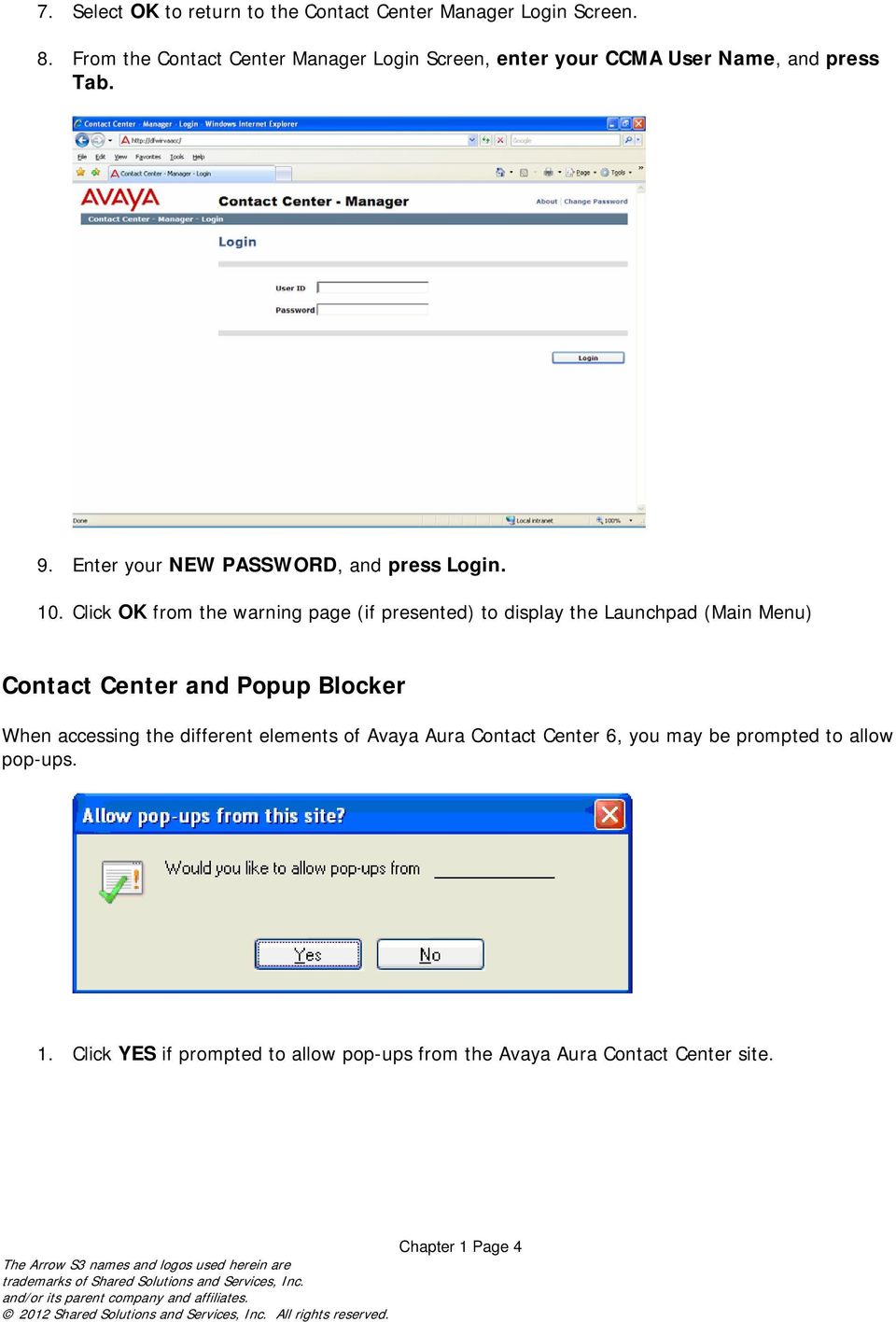
13 Changing Your Password 1. From Contact Center Manager Login Screen, select Change Password. 2. Enter your CCMA User Name, and press Tab. 3. Enter your Old (Current) Password, and press Tab. 4. Enter your NEW Password and press Tab. Your new password should be between 6 and 30 characters (alphanumeric). 5. Enter your NEW Password a second time to confirm. 6. Click Submit. Chapter 1 Page 3

14 7. Select OK to return to the Contact Center Manager Login Screen. 8. From the Contact Center Manager Login Screen, enter your CCMA User Name, and press Tab. 9. Enter your NEW PASSWORD, and press Login. 10. Click OK from the warning page (if presented) to display the Launchpad (Main Menu) Contact Center and Popup Blocker When accessing the different elements of Avaya Aura Contact Center 6, you may be prompted to allow pop-ups. 1. Click YES if prompted to allow pop-ups from the Avaya Aura Contact Center site. Chapter 1 Page 4
15 Using on line help Once you select an option from the Main Menu, you may ask the system to provide you assistance. 1. Click Help to display a list of help options. 2. Highlight the option you d like to display. Hint: Select On this Window for help specific to the area you are currently managing. Note: It s possible that not all documents will be published on your server. For assistance, contact your administrator Chapter 1 Page 5

16 Sample Help Screen (On this Window) Contact Center Status The Status button can be used to verify that the Contact Center Administration Tool is able to connect to and manager the Contact Center Server. 1. From the Status dropdown, select Connection Status. If your server does not indicate Server Online contact your System Administrator. Chapter 1 Page 6

17 Chapter 2 Contact Center Management Viewing / Changing Contact Center Agents... 1 Updating Agent to Skillset Assignments... 7 Agent Profile Explained

18 As a supervisor or manager, you are responsible for managing the Contact Center agents. You are given access to the agents based on Partitions, or logical grouping (by department, for example). Typically, agents are assigned to one Partition. Supervisors or Managers are assigned to ONE OR MORE Partitions. For the agent assigned to partitions that you can access, you will be able to update agent properties, such as the call presentation class and skillset priorities..

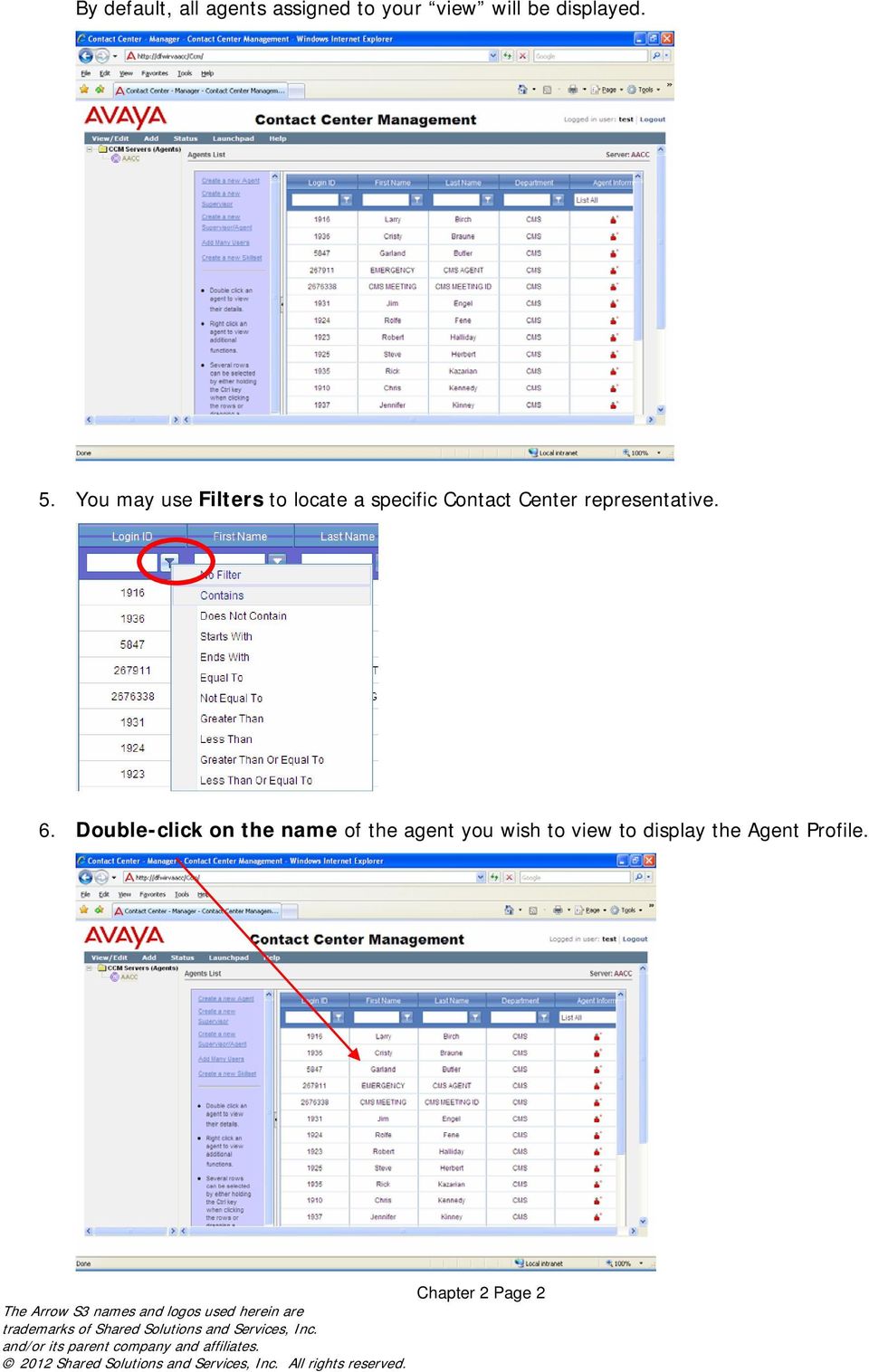
19 Viewing / Changing Contact Center Agents 1. Log In to Contact Center. 2. From the Launchpad, select Contact Center Management. Note: When you launch Contact Center Management, by default it opens in Supervisor View. This view enables you to quickly see the list of agents assigned to each supervisor. 3. From the View/Edit dropdown, select Agents. 4. In the left window pane, click the NAME of the Contact Center Server you wish to manage. Note: It is possible that MORE than one server is shown in the list. Make sure to select the server name associated with the site you wish to access. Chapter 2 Page 1

20 By default, all agents assigned to your view will be displayed. 5. You may use Filters to locate a specific Contact Center representative. 6. Double-click on the name of the agent you wish to view to display the Agent Profile. Chapter 2 Page 2
21 Agent Profile 7. Make changes to the User Details and/or Agent Information sections as needed. 8. Click Contact Types to display the list of Contact Types currently assigned to the agent. 9. Make changes to Contact Type as required. Notes: The agent must be LOGGED OUT in order to update Contact Types If your system is equipped with Communications Control Toolkit (CCT) and Contact Center Multimedia Manager (CCMM) you may see additional configuration items in the Agent s Profile specific to these features. If you assign Multimedia Contact Types, you will receive a warning message. Chapter 2 Page 3
22 10. Click Skillsets to see the list of skillsets currently assigned to the agent, and the assigned priority. 11. To change the Priority to Skillsets currently assigned, use the arrow to display the list of available priorities (Standby, or 1-48), and highlight the appropriate priority level. 12. To remove a Skillset that is currently assigned, use the arrow to display the list of available priorities and select Unassigned. 13. To add new Skillsets to the agent's profile, click Assign Skillsets. 14. Use the Search Engine or click List All and locate the skillset you wish to assign. Chapter 2 Page 4
23 15. Locate the new skillset and assign the appropriate priority. Repeat as necessary to add more skillsets. 16. To update the partitions to which this agent is assigned, click Partitions and add or remove checks as required. Note that you may only have access to VIEW partition assignment. 17. To save your changes, click Submit. 18. Click on the server name to return to the previous Agent Search / List. Chapter 2 Page 5
24 ---- Notes ---- Chapter 2 Page 6
25 Updating Agent to Skillset Assignments 1. Log In to Contact Center. 2. From the Launchpad, select Contact Center Management. Note: When you launch Contact Center Management, by default it opens in Supervisor View. This view enables you to quickly see the list of agents assigned to each supervisor. 3. From the View/Edit dropdown, select Skillsets. 4. In the left window pane, click the NAME of the Server you wish to manage. Note: It is possible that MORE than one server is shown in the list. Make sure to select the server name associated with the site you wish to access. Chapter 2 Page 7
26 5. Click on a Skillset Name to display the list of agents currently assigned to the skillset. Notes: To limit the number of agents displayed, use the Filters at the top of each column. Click the Header Name to sort records. 6. To Update the Priority configured for an agent, select the new Priority (1-48) from the drop-down list. 7. To Remove a skillset assigned to an agent, select Unassigned from the drop-down list. 8. To Activate Standby for a skillset assigned to an agent, select Standby from the dropdown list. Chapter 2 Page 8
27 9. To Assign New Agents to a skillset, scroll down to the bottom half of the screen to see the list of agents not currently assigned. Remember that you will only see the agents to which you have access. Notes: To limit the number of agents displayed, use the Filters at the top of each column. Click the Header Name to sort records. 10. Click the name of the agent you wish to assign to the skillset. Note the row will be highlighted. 11. From the agents Priority Column, change the assigned Priority from Unassigned to the appropriate Priority Level (1-48), or to Standby. Chapter 2 Page 9
28 12. Repeat as necessary for other agents. 13. To save your changes, click Submit. Hints: Click the arrow in the MIDDLE of the screen to hide / show the left (purple) pane. Use the Page Size to INCREASE or DECREASE the number of agents displayed in the page view. Chapter 2 Page 10
29 Use the Set all agents to priority XXXX drop-down and the Apply button to update the priority assigned to ALL AGENTS in the list to the same value. Chapter 2 Page 11
30 ---- Notes ---- Chapter 2 Page 12
31 Agent Profile Explained User Details First Name Last Name Title Department Language User Type Login ID Enter the First Name of the Contact Center Agent. Enter the Last Name of the Contact Center Agent Enter the Title (Typically, Agent, Supervisor, Manager, etc.) Enter the Department Name. From the dropdown list, select the Language to be displayed when the agent Logs In to the phone. From the dropdown list, select Agent, Agent/Supervisor, or Supervisor. HINT: Agent works best for ALL configurations. Enter the agent's numeric ID used to Log In to the telephone. + Voice URI Enter the extension number assigned to this agent for answering Skillset Calls. Note: The formatting of this field is critical. Hint: Refer to another agent as an example. * Personal DN Enter the extension used to reach this agent ONLY if agents do not have assigned seating and their personal extension moves with them from desk to desk. Also know as hoteling or Hotdesking. * ACD Queue Use this field to assign a Default ACD Queue to this agent. This number will be used for processing when the Contact Center Server is out of service and when the QUEUE TO NACD script command is used (uncommon). This field is typically configured by the Contact Center Administrator. * ACD Queue Error Comment + Enable CTI for this agent º Account Type Create CCT CCT Agent Login Details º Associate User Account Informational Only Field. Will contain data only if the ACD Queue number specified above is not a valid number. Enter information if required, or leave blank. Select this option to enable Multimedia for agents in a SIP Integrated Contact Center. This feature will be configured by your Contact Center Administrator. Information only, typically specific to the agent s Windows User ID and customer domain. This feature will be configured by your Contact Center Administrator. Legend: * Applicable in an AML Integrated Contact Center only. + Applicable in a SIP Integrated Contact Center only. º Applicable in a SIP Integrated Contact Center and in an AML integrated Contact Center where Multimedia is enabled. Chapter 2 Page 13
32 Agent Information Primary From the dropdown list, select the Supervisor this agent is affiliated with, from Supervisor a Contact Center Reports perspective. In some cases, this name may be a PLACEHOLDER (i.e. Customer Service Supervisor) rather than a person s name. * Agent Key If supervisor s telephone set is configured with agent keys, enter the appropriate key assignment. (Not common) Login Status Call Presentation»Multiplicity Presentation Class Threshold Informational Field to show status of current agent. From the dropdown list, select the Call Presentation Class that best suits the agent. Note: You must have Administrative privileges to view, create, delete, or modify Call Presentation Classes. From the dropdown list, select the Multiplicity Presentation Class that best suits the agent. Note: You must have Administrative privileges to view, create, delete, or modify Multiplicity Presentation Classes. From the dropdown list, select the Threshold Class that best suits the agent. Note: You must have Administrative privileges to view, create, delete, or modify Threshold Classes. * Tn Name Informational Field to show the ID of the telephone to which the agent is currently logged in. When blank, the agent is logged out. Supervisor Information This information is only shown for users configured as a Supervisor or Agent/Supervisor. * Telephony Port The unique Position ID number assigned to the supervisor s telephone. Contact Types Contact types are the media types by which (inbound) contacts arrive into a contact center and by which a contact center sends (outbound) contacts.» Contact Type Select the Contact Types this agent will process. Note: DO NOT assign a Contact Type unless your system is licensed to use it! Legend: * Applicable in an AML Integrated Contact Center only.» Applicable in both SIP and AML Integrated Contact Centers where Multimedia is enabled. Chapter 2 Page 14
33 Skillsets When an agent is assigned to a Skillset, the PRIORITY LEVEL selected determines the level of expertise the agent has for the given skillset. Agent Priority per skillset has a range of 1 to 48, with 1 having the greatest priority. This priority is used when queuing calls to idle agents, allowing agents with greater priority in a skillset to be presented calls before agents of lesser priority. There is no delay when the system searches through the various levels of priority. When an agent's skillset is set to standby, it means that the agent has the ability to service the skillset but is not answering calls for that skillset at the time. Typically, supervisors use Standby when an agent is working on a special project and is not actively answering calls. The agent can remain Logged In but will not receive skillset calls when set to Standby. When Service Level Routing is enabled for a given skillset, additional priorities can be assigned that allow agents to be available to assist with calls only after a predetermined expected wait time has been met. These Priorities are listed as Standby (1) thru Standby (48). Once the expected wait time value falls below the predetermined value, these skillset calls will no longer be presented to agents assigned as Standby (1) thru Standby (48). Note: Service Level Routing must be enabled for a skillset by your Administrator. Priority Using the drop-down list, update Priority for Assigned Skillsets, or select Unassign to remove the agent from a skillset. Assign Skillsets Use the Search feature to find specific skillset or select List All to Add skillsets and use the drop-down list to set Priority. Note: If you are unable to assign a specific skillset that appears on the list, the appropriate Contact Type has not been assigned to the agent. Chapter 2 Page 15
34 Partitions A Partition is a logical grouping of Contact Center Data (Agents, Skillset, Applications, etc). Typically, each department that utilizes the Contact Center has their own Partition. In most systems, agents are assigned to only (1) Partition. Supervisors and Managers that Log In to Avaya Aura Contact Center 6 to manage Contact Center Agents are configured to see agents in one or more partition. Partition Name Check the Appropriate Partitions to which this agent should be assigned Notes ---- Chapter 2 Page 16
35 Chapter 3 Real-Time Reporting Real-Time Display Types... i Data collection modes... i Viewing a Real time Display... 1 Common Real time Display Features... 3 Standard Agent Display Standard Skillset Display Standard Application Display Creating a Private Real-time Display Deleting a Private Real-time Display Creating a New Public Display Creating Filters for Real-time Displays Modifying an Existing Filter Displays Real-time Graphical Displays Sample Graphical Displays Creating a Billboard Creating a Chart Creating a Timeline Creating a Standard Collection Creating a Billboard Collection Creating a Dashboard Collection... 60
36 Real-Time Display Types Real-time displays provide up-to-date statistics for your contact center and its resources. You can use these statistics to monitor your contact center and determine its effectiveness. There are three main types of displays in the Avaya Aura Contact Center: Public Displays These displays include both the standard displays that ship with the Contact Center, and customized private displays that you have shared with your coworkers by saving them in the Public displays folder. To modify either of these types of displays in any way, you must make a copy of the display and save it as a private (user-defined) display. Private Displays These are copies of public grid displays that you customize and save in your Private displays folder. Only the creator of the private display can access or modify it. To grant other users access to your private display, you must save a copy of it as a Public display. You can save public copies of private displays on the current server, or across all servers to which you have access. Graphical Displays These are private graphical displays that you create and save in your private graphical displays folder. Only the creator of the private display can access or modify it. To grant other users access to your graphical display, you must save a copy of it as a Public display. You can save public copies of private displays on the current server, or across all servers to which you have access. Additionally, Collection-type graphical displays may be tagged as Private or Public when you create them. Note: You may not have the authority to share (make public) Real-time displays. Data collection modes All Standard Real-time displays are shown in the Moving Window Mode, however Custom Real-time displays can be created using the Interval to Date Mode. Moving window mode In moving window mode, statistics shown represent the last 10 minutes of system activity. The Moving Window Mode uses a rolling 10 minute window to show statistics. Interval-to-date mode In interval-to-date mode, statistics are collected only for the current interval. When the interval is over, data fields initialize to 0 (zero), and collection begins for the next interval. The Interval is set to: And will reset to Zero at: Hours am / pm Note: By default, the interval is set to 15 minutes, and therefore will RESET to Zero s every 15 minutes throughout the day. It is recommended that the interval be set to 24 hours, and that the reset time is set to the time the 1 st contact center on the site opens (or 30 minutes before).
37 Viewing a Real time Display Real-time reporting allows you to view the current status of your Contact Center, include agent states, calls waiting, wait times, etc. 1. Log In to the Contact Center. 2. From the Main Screen, select Real-time Reporting, to display the following screen: 3. Click Public displays, Private displays or Graphical displays to view the list of available displays. Public displays can be launched, or used as templates to create Private displays. Public displays cannot be modified or deleted. Private displays are your personal views, and can only be accessed when you are logged in with your ID.. Chapter 3 Page 1
38 Sample Real-time Display Window - Expanded 4. To launch any of the displays shown in either folder, double-click the display name. Wait while your PC retrieves information from the Contact Center Server. The display will be shown on your PC screen.. Chapter 3 Page 2
39 Common Real time Display Features After you launch a display, you may: Minimize it and launch other displays if required, or use the Launchpad to navigate to another area of the Contact Center. Multiple Displays can be launched simultaneously however the Contact Center may be configured to limit the total number of displays. Hint: Create a STANDARD COLLECTION or BILLBOARD COLLECTION to automatically launch Multiple Displays in a quick and easy manner. Hide the header. Use the features shown on Display Toolbar. Sort the display. Click on the COLUMN NAME once to sort alphabetically / numerically. Click on the COLUMN NAME a 2 nd time to sort in reverse order. Real-time Display Header If you do not wish to see the Title and Toolbar buttons, you can HIDE the header. Click on Header on the upper left to hide the Display Title and Toolbar. Click on Header again to show the Display Title and Toolbar Note: This setting must be configured each time you launch a display.. Chapter 3 Page 3
40 Display Toolbar Buttons Click <<Server>> Summary to display a graphical representation of the Real-time display. Available for Application and Skillset Displays. Click Non-Staffed Skillsets to display the list of skillsets that currently don t have at least one agent Logged In. Available for Skillset Displays only. Click Export to save a snapshot of the display. Available for all Display types. Click Print to send a snapshot of the display to one of your printers. Available for all Display types. Click Filters to apply filters to the open display. Available for all Display types. Click Close to remove the open display. Available for all Display types. Click Help to launch a new IE window and display On-Line specific to this display. Available for all Display types. Click +/- to show detailed agent activity (Multiple lines per agents) Available for Agent Displays only when Multimedia is equipped and Multiplicity is enabled.. Chapter 3 Page 4
41 <<Server Display Name >> Summary Click Pattern to change the view to Black and White. Click Color to change the view to Color. Click Export BMP or (Export JPG) to save a snapshot of the summery. Make note of the file name and then select OK. Click Print to send a snapshot (hardcopy) of the summary to a printer. Click Close to shut down the Summary display. Click Help to display the on-line help specific to Summary Charts.. Chapter 3 Page 5
42 Non-Staffed Skillsets Click Refresh to update the list of Non-Staffed skillsets. Click Print to send a snapshot (hardcopy) of the list to a printer. Click Close to shut down the list of Non-Staffed skillsets. Click Help to display the on-line help specific to the Non-Staffed skillsets window.. Chapter 3 Page 6
43 Export Exporting allows a copy of the display to be saved to a file. When you click Export, the system will provide the name of the exported file. Click View to open the exported display file immediately. Click Close to remove the window from your screen. Remember to make note of the name of the file so you may locate it at a later time. Sample Exported Skillset Display. Chapter 3 Page 7
44 Print Printing allows you to send a snapshot of the display to a printer configured on your PC. Select the appropriate printer from the list display, and click Print.. Chapter 3 Page 8
45 Filters By selecting one or more Filters, you can exclude specific elements (Agents, Skillsets, and/ or Applications) from the display. On Agent Displays, you can include agents assigned to a Filter, or based on the Supervisor to which the agents are assigned. Click Select All when you wish to assign all defined Filters / Supervisors. Click Clear All to uncheck selected Filters / Supervisors. Click Apply to save the select and return to the Display. Click Cancel to retain previous Filter Configuration. Note: Additional information specific to Real-time Display Filters and instructions for creating them can be found later in this chapter.. Chapter 3 Page 9
46 Help The Contact Center on-line help button can provide detailed information about the type of display you are viewing. The information is displayed in a NEW Explorer Window. Click to close on-line Help.. Chapter 3 Page 10
47 + / - For Multimedia Agents Only, Multiplicity (if equipped and enabled) allows agents to handle more than one contact simultaneously. The Agent Real-time Display allows you to display a SINGLE LINE of information for all agents, including those that are configured to handle multiple contacts OR a SEAPRATE LINE for information for agents assigned Multiplicity. In this case, EACH LINE represents the number of contacts the agent can handle, and the real-time activity for EACH Contact. Single Line per Agent Display Multiple Line per Agent (Configured for Multiplicity) Display. Chapter 3 Page 11
48 ---- Notes Chapter 3 Page 12
49 Standard Agent Display Standard Agent Display Information A separate line of information will be provided for each agent assigned to your view. Note: When Multiplicity is enabled in your Contact Center, additional lines per agent may be available. If more agents are assigned to your ID than fit on one page, controls to move ahead to other pages will be displayed. Default Refresh Rate: Every Second Default View Mode: Moving Window The moving window is a block of time representing the last 10 minutes of system activity. Agent ID Hyperlink: Click the Agent ID field (if shown in blue) to launch an Agent Skillset assignment Window, where you can make updates as required. Refer to Chapter 2 for specifics related to Agent to Skillset assignments.. Chapter 3 Page 13
50 . Chapter 3 Page 14
51 Agent Statistics Standard Agent Real-time Display Agt ID Agt First Name Agt Last Name Pos ID A unique number to identify an agent. The first name of the agent. The last name of the agent. Position ID. A unique identifier of the agent s telephone in the PBX. Dial this number to activate Agent Observe. Supr First Name Supr Last Name Ans SklSet In Contacts Status The first name of the assigned supervisor. The last name of the assigned supervisor. The name of the skillset for which this agent is currently working. Indicates the current state of the agent. Note that this state can be one single state or a combination of two or more states. The following is a list of possible states: Active: On Skillset Contact ACD Active: On ACD Call (Not typical) ACD Hold: ACD Call On Hold (Not typical) Break: On After Call Break as defined in the associated Call Presentation Class Busy: DN In/Out Call Active or On Hold Call Present: Skillset contact presenting to InCalls Button Idle: Waiting for Contact / Phone not in use. Not Ready: Not Ready key activated On Hold: Skillset Contact On Hold Undefined: The state of the agent is unknown (Not typical) The following is a list of possible Combination States, when the Agent has more than (1) feature / line in use: Skillset Active and DN In/Out call on hold ACD call active and DN In/Out call on hold Skillset contact on hold and DN In/Out call active Skillset contact on hold and DN In/Out call on hold Skillset contact on hold and DN In/Out call active and on hold. ACD call on hold and DN In/Out call active ACD call on hold and DN In/Out call on hold ACD call on hold and DN In/Out call active and on hold Not Ready and DN In/Out call active Not Ready and DN In/Out call on hold Walkaway DN In DN Out Time In State The agent pressed Hold and unplugs the headset while in Not Ready state, or while handling a contact. Active on an Incoming call placed to an Extension (non Contact Center) Line on the phone. Active on an Outgoing call made from an Extension (non Contact Center) Line on the phone. The length of time the agent has been in the current state. Chapter 3 Page 15
52 Chapter 3 Page 16
53 Other Fields Available for Custom Agent Displays: Answered Skillset ID DN In Contact Answered DN In Contact Tag DN Out Contact Made DN Out Contact Tag DN Out Dialed Number Not Ready Reason Skillset Contact Answered The Numeric ID of the skillset for which this agent is currently working. The total number of DN calls answered by this agent for the specified period. An asterisk (*) in this column indicates that the agent is handling multiple incoming DN calls. The total number of outbound DN calls made this agent for the specified period An asterisk (*) in this column indicates that the agent is handling multiple outgoing DN calls. Telephone number dialed by Agent from an Extension (non Contact Center) Line on the phone. This information is not available on all systems. A description of the Not Ready Reason code entered. The total number of Skillset contacts answered by this agent for the specified period. This value resets to 0 each time the agent logs out. Chapter 3 Page 17
54 ---- Notes ---- Chapter 3 Page 18
55 Standard Skillset Display Standard Skillset Display Information A separate line of information will be provided for each Skillset assigned to your view. If more skillsets are assigned than fit on one page, controls to move to other pages will be provided. Default Refresh Rate: 2 Seconds Default View Mode: Moving Window The moving window is a block of time representing the last 10 minutes of system activity. Skillset Hyperlink: Click the Skillset field (if shown in blue) to launch an Agent Skillset assignment Window, where you can make updates as required. Refer to Chapter 2 for specifics related to Agent to Skillset assignments. Chapter 3 Page 19
56 Skillset Statistics - Standard Skillset Real-time Display Skillset Avg Ans Dly Srv Lvl % Ans Wait Agt Staff Agt Active Agt Not Ready Agt Idle The name of the skillset. The amount of time, on average that contacts waited before being answered. The percentage of contacts answered or abandoned within the Service Level Threshold. The number of contacts answered by an agent for this skillset. The number of contacts currently waiting in queue for this skillset. The number of agents assigned to this skillset that are currently logged in. The number of agents assigned to this skillset that are currently logged in and active on a contact for this Skillset. The number of agents assigned to this skillset that are currently logged in and in a not ready state. The number of agents assigned to this skillset that are currently logged in and waiting for new contacts. Other Fields Available for Custom Skillset Displays: Agent On ACD-DN Contact Agent On DN Contact Agent On NACD-DN Contact Agent On Network Skillset Contact Agent On Other Skillset Contact The number of agents logged in for a skillset that are currently handling a call directed to an ACD-DN. This may indicate a call to a wrong number, or a problem with the Contact Center Call Scripting. The number of agents assigned to this skillset that are currently logged in and on a DN (Extension) call. The number of agents assigned to this skillset that are currently logged in and on a call directed to a Network ACD-DN. The number of agents assigned to this skillset that are currently logged in and on a call directed to a Network Skillset. The number of agents assigned to this skillset that are currently logged in and on a call directed to another Skillset. Chapter 3 Page 20
57 Agents Unavailable Contacts Answered After Threshold Contacts Answered Delay Contacts Offered Expected Wait Time Longest Wait Since Last Call Longest Wait Since Login Max Wait Time Network Contacts Answered Network Contacts Offered Network Contacts Waiting Skillset Abandoned Skillset Abandoned After Threshold Skillset Abandoned Delay Skillset ID Skillset State Total Wait Time % Service Level for Ans Calls The number of agents in a skillset who are currently unavailable to take contacts. This calculation is based on the following data fields: Agents In Service Agents On In Call Agents On DN Call Agents Available Agents Not Ready The number of contacts answered after experiencing a delay greater than or equal to the service level threshold for a skillset. The service level threshold is defined during system configuration. The delay experienced by all contacts answered at this skillset from the time the contacts were queued against the skillset until they were answered. Total contact offered to the Skillset. The total time that a new contact is expected to wait before being answered by an agent with this skillset. The longest waiting time of all idle agents who are currently waiting to answer contacts for this skillset. The time is calculated since the agent s last call. The longest waiting time of all idle agents who are currently waiting to answer contacts for a skillset. This waiting time begins after login to a skillset. The maximum waiting time spent by any contact currently waiting for an agent with the required skillset. The total number of Network Skillset contacts answered. The total number of Network Skillset contacts offered. The total number of Network Skillset contacts currently waiting. The total number of Skillset contacts that hung up before being answered. The total number of Skillset contacts that hung up after the Service Level Threshold expired. The total time contacts that abandoned waited before hanging up. A unique number to identify a skillset. The state of a skillset. A skillset state is either In Service or Out of Service. The total waiting time spent by all calls currently waiting at this skillset. The percentage of calls answered within the Service Level Threshold. Chapter 3 Page 21
58 ---- Notes ---- Chapter 3 Page 22
59 Standard Application Display Standard Application Display Information A separate line of information will be provided for each Application assigned to your view. If more applications are assigned than fit on one page, controls to move to other pages will be provided. Default Refresh Rate: 2 Seconds Default View Mode: Moving Window Chapter 3 Page 23
60 Application Statistics - Standard Application Real-time Display Application Avg Ans Dly Srv Lvl % Offer Ans Abnd Term Contacts Wait Max Wait Time The name of the application. The amount of time, on average that contacts waited before being answered. The percentage of contacts answered or abandoned within the Service Level Threshold. The number of contacts offered for this application The number of calls answered for this application. The number of calls abandoned for this application. The number of calls terminated with one of the following treatments: given force busy, force overflow, force disconnect, route to, or default treatment. reached a non-isdn trunk while being routed to a remote site transferred in an IVR session (Caller Left a Voice Message) networked out through an NACD queue The number of contacts currently in a waiting state for this application. The amount of time that the oldest contact has been waiting to be answered for this application. Other Fields Available for Custom Application Displays: Application ID A unique number to identify the application. Average Abandon Delay The amount of time, on average that contacts waited before abandoning. *Avg Network Contacts Out Answered Delay Contacts Abandoned After Threshold The amount of time, on average that contacts waited before being answered by an agent at a network location. The number of contacts that abandoned for the application after experiencing a delay greater than or equal to the service level threshold for the application. The application service level threshold is defined during system configuration. Contacts Abandoned Delay The total delay experienced by all contacts abandoned for the application. Chapter 3 Page 24
61 Contacts Answered After Threshold The number of contacts that were answered after experiencing a delay greater than or equal to the service level threshold for the application. The application service level threshold is defined during system configuration. Contacts Answered Delay Contacts Answered Delay At Skillset *Network Out Contacts *Network Out Contacts Abandoned *Network Out Contacts Abandoned Delay *Network Out Contacts Answered *Network Out Contacts Answered Delay *Network Out Contacts Requested *Network Out Contacts Waiting Time Before Interflow Total Wait Time % Abandoned After Threshold %Contacts Abandoned The total delay time experienced by all contacts answered for the application. The total delay time experienced by all contacts from the time the contact is first queued against the first skillset until it is answered. The total number of contacts presented to agents at remote site(s) by this application. The total number of contacts queued to the Network Skillset(s) that hung up before being answered. The total time spent waiting by all contacts that were queued by this application to remote locations before they abandoned. The total number of contacts queued to Network Skillset(s) by this application that were answered. The total time spent waiting by all contacts that were queued to remote locations by this application before they were answered. The total number of contacts that were queued to a skillset at a remote site by this application. The total number of contacts currently queued to the Network Skillset(s) for this application. The total amount of time that contacts spent in the Master_Script application before the contact is passed to a primary application. The total time for all contacts for an application that are currently waiting. The percent of total contacts for this application that abandoned after the Service Level Threshold. The percent of total contacts for this application that abandoned. * Available for Systems where Network Skills Based Routing (NSBR) is enabled. Chapter 3 Page 25
62 Chapter 3 Page 26
63 ---- Notes ---- Chapter 3 Page 27
64 Creating a Private Real-time Display You can use the Standard Public Displays as templates to create your own Real-time Display. Changes, such as Column Header names, can be updated, and columns can be easily added or removed. Log in to the Contact Center and Access Real-time Reporting from the Launchpad. 1. Highlight the Public Display you'd like to copy. 2. Type the Name of your Private Display. 3. Click Make Private Copy. Chapter 3 Page 28
65 Properties Tab Data Collection 4. Update the Refresh Rate, if required. 5. Select the Data Collection Mode. Moving Window Interval-to-Date Collects statistics data in a moving window mode for use in a real-time display. The moving window is a block of time representing the last 10 minutes of system activity. Collects statistics data in an interval-to-date mode for use in a real-time display. Interval-to-date gathers data only for the current interval. Once that interval is completed, all data fields initialize to zero and collection begins for the next interval. The Interval is Set to: Hours And will initialize to zero at: 6. If you are creating a Skillset or Application Display, update the Chart Format, Site Summary Fill, and Network Summary Fill, if required. This information is used when you select to view the Summary once the display is launched. Export options 7. Enter the Summary chart export path, where exported display formats will be saved, if required. 8. Enter the Grid export prefix, for exported displays, if required. Chapter 3 Page 29
66 Display format 9. Update the Color Setting, if required. 10. Enter the title that will be shown when the display is launched in Display Title. 11. Update the Column Font Size, if required. 12. Restrict access to this server only, if required. This option applies only to customers with access to multiple Contact Center Servers. 13. Select the Columns Tab. Columns Tab 14. Click on one of the columns. 15. Update the Column Name, if required. 16. Update the Column Width, if required. 17. Delete a Column from the Display, if required. 18. Move a Column to the Right or Left, if required. 19. Update the Threshold Colors, if required. 20. To add another field, highlight a field from the Available Fields drop-down list, and select Add Field. 21. Select the Filters Tab. Chapter 3 Page 30
67 Filters Tab 22. Select the Filter you wish to Apply to this display when it's launched. (You may use the Select All button to include all filters, or select one or more filters individually. 23. Select the Supervisor s whose assigned Agents should be included in the Agent- type Displays. (You may use the Select All button to include all supervisor's agents.) Note: If you have not previously created Filters, refer to the section of this reference guide called Creating Filters for assistance. Saving your Change 24. Select Submit to save changes you ve made to the display, or select Cancel to RESTORE previously saved display format. Verifying the Changes 25. Select Launch Display to view the display AS IT WAS LAST SAVED! Chapter 3 Page 31
68 Deleting a Private Real-time Display If you know longer wish to use one of the Real-time Displays saved in your Private Folder, you may delete it. Log in to the Contact Center and Access Real-time Reporting from the Launchpad. 1. Highlight the Public Display you'd like to copy. 2. Select Remove Private Display. 3. Select OK to permanently delete the Private Display, or cancel to save it. Chapter 3 Page 32
69 Creating a New Public Display If given access, you will be able to publish one of your Private Tabular Displays in the Public Tabular Displays so it can be shared with all other Contact Centers on the system. Log in to the Contact Center and Access Real-time Reporting from the Launchpad. 1. Locate the Display Name in your Private Folder, or create a new Private Display. 2. Update in the name of your public display, if required. 3. Click the Make Public Copy button to share the display with ALL OTHER CALL CENTER'S on your system. The report will be saved in the Public Tabular Displays Folder. Note: Once you SAVE a display into the Public Displays folder, you cannot modify or delete the display! Only the HIGHEST Level Administrator Log In can delete displays saved in the Public Display folder. Chapter 3 Page 33
70 Creating Filters for Real-time Displays By default, all elements (Agents, Applications, and /or Skillsets) in your partition are shown when you launch a Real-time Display. Filters allow you to customize real-time displays to show only selected elements (Agents, Applications, and /or Skillsets). Log in to the Contact Center and Access Real-time Reporting from the Launchpad. 1. Click Filter and select Manage Filters. 2. Expand Filters and click the Create New button. Chapter 3 Page 34
71 3. Type a Filter Name in the space provided. 4. Click Submit. 5. Click the Server Name below the new Filter to reveal the Properties Tabs. Chapter 3 Page 35
72 Skillsets Tab 6. To add Skillsets to the Filter, select the Skillset tab. 7. Click Assign Skillsets, then click List All (or use the Search tool) to display skillsets in your partitions. 8. Select the Skillsets you want to view when you assign this Filter to Skillset Displays. Hint: You may use the Select All button to include all Skillsets that are listed, or Clear All to remove all skillsets from your selection. Chapter 3 Page 36
73 Applications Tab 9. To add Applications to the Filter, select the Applications tab. 10. Select the Applications you want to view when you assign this Filter to Application Displays. Hint: You may use the Select All button to include all Applications that are listed, or Clear All to remove all applications from your selection. Chapter 3 Page 37
74 Agents Tab 11. To add Agents to the Filter, select the Agents tab. 12. Click Assign Agents, then click List All (or use the Search tool) to display agents in your partitions. 13. Select the Agents you want to view when you assign this Filter to Agent Displays. Hints: You may use the Select All button to include all Agents that are listed, or All to remove all agents from your selection. Clear To include All Agents in your partitions, do not select any agents! Instead, select the agents to include by selecting the appropriate supervisor on the Filters Tab of the Agent or Skillset Display. Saving the Filter 14. Click Submit to Save the Filter. 15. To add another Filter, from the Filters Dropdown, select Add Filter. 16. To return to Displays, from Displays Dropdown, select View Displays. Chapter 3 Page 38
75 Modifying an Existing Filter Displays Log in to the Contact Center and Access Real-time Reporting from the Launchpad. 1. Click Filter and select Manage Filters. 2. Click the name of the Filter you wish to modify. 3. Click the Server Name below the new Filter to reveal the Properties Tabs. 4. Update the Application, Skillset, and / or Agent tab as required. 5. Click Submit to Save the changes, or click on the Server Name to cancel. Chapter 3 Page 39
76 Real-time Graphical Displays The following types of Graphical Displays are available in the Contact Center: Agent Maps Billboards Charts Timelines Collections Agent Maps are displays that use blocks to represent agents in the contact center. Each block contains detailed information about the agent, such as: Name Log In ID Current State (On Skillset Call, in Not Ready, etc.) Time in State Billboards are displays that allow you to monitor one statistic, such as Calls Waiting, or Service Level, and easily see this information in a large block on your PC screen. Charts can be created to show specific information about applications and skillsets. You can specify: The statistic (or statistics) you wish to monitor. Whether you want the chart to be displayed in color or black and white The Data Collection Mode (Moving Window or Interval to Date) Timelines displays present a time line of data to a supervisor. The displays show a trend line for the real-time data monitored during the interval, with a maximum interval of 15 minutes. Collections are a series of displays shown on one screen. Up to (6) displays both Graphical and Tabular - can be viewed simultaneously. Billboard Collections are a series of Billboard Displays shown on one screen. You may include up to (25) Billboard - type displays in a Billboard Collection. Chapter 3 Page 40
77 Sample Graphical Displays Agent Map Billboard Hint: You can double-click the Billboard to launch the corresponding Tabular Display. Chapter 3 Page 41
78 Chart Chose Statistics per Application Chart Chose Applications per Statistic Chapter 3 Page 42
79 Sample Timeline Choose Applications per Statistic Sample Timeline Multiple Statistics / Single Application Chapter 3 Page 43
80 Standard Collection Billboard Collection Hint: You can double-click on any of the Billboards in either collection to launch the corresponding Tabular Display. Chapter 3 Page 44
81 Dashboard Collection Chapter 3 Page 45
82 Creating a Billboard Log in to the Contact Center and Access Real-time Reporting from the Launchpad. 1. From the Display's dropdown menu, select Add Graphical Display. 2. Type the Name of the Display. 3. Select the Server Name to obtain Statistics, if applicable. 4. Select the Element Type. 5. Under Presentation, select Billboard. Chapter 3 Page 46
83 6. Click Edit Properties. 7. Type the Title you'd like shown when the display is launched. 8. Select the Data Collection Mode Moving Window Interval-to-Date Collects statistics data in a moving window mode for use in a real-time display. The moving window is a block of time representing the last 10 minutes of system activity. Collects statistics data in an interval-to-date mode for use in a real-time display. Interval-to-date gathers data only for the current interval. Once that interval is completed, all data fields initialize to zero and collection begins for the next interval. 9. Select the Application (or Skillsets) for which the data will be displayed, or select Summary to show the summary of ALL APPLICATIONS (or Skillsets) in your partition. 10. Select the Statistic that will be displayed. 11. Select the Font Color. 12. Select the Background Color (Threshold Settings) when the Threshold's (Level 1 and Level 2) have been exceeded. 13. Uncheck Pop to front if you DO NOT wish the Billboard to be maximized when the Thresholds have been exceeded. 14. Click Submit to Save the Billboard, or cancel. Chapter 3 Page 47
84 Creating a Chart Log in to the Contact Center and Access Real-time Reporting from the Launchpad. 1. From the Display's dropdown menu, select Add Graphical Display. 2. Type the Name of the Display. 3. Select the Server Name to obtain Statistics, if applicable. 4. Select the Element Type. Chapter 3 Page 48
85 5. Select the Chart Presentation Statistics by Application (or Skillset) allows you to select (1) application or skillset and Multiple Statistics. (Calls Waiting, Calls Abandoned, etc.) Application (or Skillset) by Statistic allows you to select (1) Statistic you wish to measure and Multiple Applications (or Skillsets) 6. Click Edit Properties Sample Statistic per Skillset Sample Skillset per Statistic 7. Type the Title you'd like shown when the display is launched. 8. Select the Chart Type. (Horizontal Bar, Vertical Bar, or Pie). 9. Select the Chart Fill. (Color or Pattern) 10. Select the Statistic that will be displayed for Application (or Skillset) by Statistics Presentation. OR Select the Skillset (or Application) that will be displayed for Statistics by Application (or Skillset) Presentation. Chapter 3 Page 49
86 11. Select the Data Collection Mode. Moving Window Interval-to-Date Collects statistics data in a moving window mode for use in a real-time display. The moving window is a block of time representing the last 10 minutes of system activity. Collects statistics data in an interval-to-date mode for use in a real-time display. Interval-to-date gathers data only for the current interval. Once that interval is completed, all data fields initialize to zero and collection begins for the next interval. 12. Update the Checkboxes as required Select the Applications (or Skillsets) for which the data will be displayed for Application (or Skillset) by Statistics Presentation. Select the Statistics that will be displayed for Statistics by Application (or Skillset) Presentation. 13. Click Submit to Save the Chart, or cancel. Chapter 3 Page 50
87 ---- Notes ---- Chapter 3 Page 51
88 Creating a Timeline Log in to the Contact Center and Access Real-time Reporting from the Launchpad. 1. From the Display's dropdown menu, select Add Graphical Display. 2. Type the Name of the Display. 3. Select the Server Name to obtain Statistics, if applicable. 4. Select the Element Type. Chapter 3 Page 52
89 5. Select the Timeline Presentation Statistics by Application (or Skillset) allows you to select (1) application or skillset and Multiple Statistics. (Calls Waiting, Calls Abandoned, etc.) Application (or Skillset) by Statistic allows you to select (1) Statistic and Multiple Applications (or Skillsets). 6. Click Edit Properties Sample Statistics per Skillset Sample Applications per Statistic 7. Type the Title you'd like shown when the display is launched. 8. Select the Time Line Fill. (Color or Pattern) 9. Select the Statistic that will be displayed for Application (or Skillset) by Statistics Presentation. OR Select the Skillset (or Application) that will be displayed for Statistics by Application (or Skillset) Presentation. Chapter 3 Page 53
90 10. Select the Data Collection Mode. Moving Window Interval-to-Date Collects statistics data in a moving window mode for use in a real-time display. The moving window is a block of time representing the last 10 minutes of system activity. Collects statistics data in an interval-to-date mode for use in a real-time display. Interval-to-date gathers data only for the current interval. Once that interval is completed, all data fields initialize to zero and collection begins for the next interval. 11. Select the Display s Refresh Rate from the drop-down list. 12. Select the Display History from the drop-down list. This represents the number of minutes that will be displayed on the Time Line Graph. 13. Enter the Export Path, if applicable. If blank, exported displays will be saved to your desktop. 14. Update the Checkboxes as required Select the Applications (or Skillsets) for which the data will be displayed for Application (or Skillset) by Statistics Presentation. Select the Statistics that will be displayed for Statistics by Application (or Skillset) Presentation. 15. Click Submit to Save the Time Line, or cancel. Chapter 3 Page 54
91 ---- Notes ---- Chapter 3 Page 55
92 Creating a Standard Collection Log in to the Contact Center and Access Real-time Reporting from the Launchpad. 1. From the Display's dropdown menu, select Add Graphical Display. 2. Type the Name of the Display. 3. Select the Server Name to obtain Statistics, if applicable. 4. Select "All" as the Element Type. 5. Under Presentation, select Private (or Public) Collection. Chapter 3 Page 56
93 6. Click Edit Properties. 7. Select the Displays to include in your collection. 8. Click Submit to Save your collection, or cancel. Hints: You can include as many as (6) Displays in a Standard Collection. The displays you include can be selected from Public OR Private Folders. The displays can be Tabular or Graphical, however Agent Maps cannot be included in a Collection. When an * is shown after one of the Display Titles when the collection is launched, the display is saved as Private. Click on any Billboard included in a collection to launch the corresponding Tabular Display. You may not have Access rights to create a Public Collection. Chapter 3 Page 57
94 Creating a Billboard Collection Log in to the Contact Center and Access Real-time Reporting from the Launchpad. 1. From the Display's dropdown menu, select Add Graphical Display. 2. Type the Name of the Display. 3. Select the Server Name to obtain Statistics, if applicable. 4. Select "All" as the Element Type. 5. Under Presentation, select Private Billboard Collection. 6. Click Edit Properties. Chapter 3 Page 58
95 7. Select the Billboard Displays to include in your collection. Use > to add Billboard displays individually to the collection Use >> to add ALL AVAILABLE Billboard Displays to the collection 8. Select the Billboard Displays to remove from your collection. Use < to remove Billboard displays individually from the collection Use << to remove ALL SELECTED Billboard Displays from the collection 9. Click Submit to Save your collection, or cancel. Hints: You may include up to (25) Billboard - type displays in a Billboard Collection. The billboards you include can be selected from Public OR Private Folders. When an * is shown after the Billboard Title when the collection is launched, the billboard is saved as Private. Click on any Billboard included in a collection to launch the corresponding Tabular Display. Chapter 3 Page 59
96 Creating a Dashboard Collection Log in to the Contact Center and Access Real-time Reporting from the Launchpad. 1. From the Display's dropdown menu, select Add Graphical Display. 2. Type the Name of the Display. 3. Select the Server Name to obtain Statistics, if applicable. 4. Select "All" as the Element Type. 5. Under Presentation, select Dashboard. 6. Click Edit Properties. Chapter 3 Page 60
97 The following Pre-requisites are required in order to launch Dashboard displays: Windows Installer 3.1.NET Framework 3.5 SP1 If these components are already installed, submit and launch your display using the button bar below. Otherwise, click the Install button below to install Pre-requisites. Follow the instructions provided during the installation. 7. Click Submit to save the Dashboard, or Cancel. 8. Click Launch. Chapter 3 Page 61
98 9. If a Security Warning is provided, click Run. Be Patient! After the update is installed, this window will be closed and the Dashboard will be automatically launched. If you are creating a NEW Dashboard, a palette will be displayed. If you are opening a previously configured Dashboard, the last saved configuration will be displayed. Chapter 3 Page 62
99 Configuring a Dashboard 1. From the Displays menu, highlight the Chart Type and click on the Presentation for the 1 st Display. Statistics by Element (Application or Skillset) allows you to select (1) application or skillset and Multiple Statistics. (Calls Waiting, Calls Abandoned, etc.) Element (Application or Skillset) by Statistic allows you to select (1) Statistic and Multiple Applications (or Skillsets). Note: If you receive a Windows Security Alert, select Unblock to allow the 1st Chart to be added to the Dashboard. Chapter 3 Page 63
100 2. Click the Properties tab. Chapter 3 Page 64
101 3. Update the Display Name. 4. Update the Chart Elements. 5. Update the Chart Statistics. 6. Uncheck 3D Chart if required. 7. Update Collection Mode. Moving Window Interval-to-Date Collects statistics data in a moving window mode for use in a real-time display. The moving window is a block of time representing the last 10 minutes of system activity. Collects statistics data in an interval-to-date mode for use in a real-time display. Interval-to-date gathers data only for the current interval. Once that interval is completed, all data fields initialize to zero and collection begins for the next interval. 8. Click the Display Tab to review the results. 9. Toggle between the Properties Tab and Display Tab to configure / view the Chart. 10. To add another Display to the Dashboard, repeat steps Chapter 3 Page 65
102 Customizing the Dashboard You can update the color palette assigned to the Charts, arrange the Chart layout, and resize the charts included in the Dashboard. 1. From the Displays menu, click Options. 2. From the Color Palette dropdown, select your Palette choice. 3. Click OK to save the Palette, or cancel to retain previous settings. Chapter 3 Page 66
103 4. From the Window dropdown, select one of the following options as required: Cascade Tile Vertical Tile Horizontal Arrange Icons Minimize All Restore Example Tile Horizontal Chapter 3 Page 67
104 Saving the Dashboard 1. From the File menu, select Save to retain changes to the Dashboard. 2. Click OK. Hint: To make a copy of the dashboard, select Save As and enter a new name. Click OK to save the new Dashboard, or Cancel. Chapter 3 Page 68
105 Chapter 4 Historical Reporting Contact Center Report Information... i Collection Period...i Report Folders...ii Report Storage...ii Report Customization...ii Accessing Historical Reporting... 3 Duplicating a Standard Report... 5 Selection Criteria... 9 Data Range Scheduling a Report for Automatic Printing (Optional) Report Output (Optional) Activating a Report Schedule (Optional) De-activating a Scheduled Report Deleting a Private or Shared Report Running a Report Printing a Hardcopy of a Report Exporting a Report to a File Sample Data Range Selections Data Range: Interval - Single Interval Data Range: Interval Range of Intervals Data Range: Daily One Day Data Range: Daily Range of Days Data Range: Weekly One Week Data Range: Weekly Last 4 Weeks Data Range: Monthly Last Month Data Range: Monthly Last Year... 47
106 ---- Notes ----
107 Contact Center Report Information Reports help you monitor your system performance by providing information on contact center activity. You can use reports to Analyze productivity and efficiency Assess staffing requirements Identify trends Identify seasonal behavior Forecast future activity You can use one of the standard public report templates to create a user-defined report. When you create a user-defined report, you specify: General report information - including the report name Selection criteria - the elements to be included in the report Report schedule the data and time the report is to be generated Data range the data collection period for the report, and the range of dates Output options the printer or file to which the report is output Collection Period Interval Daily Weekly Monthly Login/ Logout Data A 15 Minute Period of Time. To print a report for TODAY, you must select Interval for Collection Frequency. Note: Set the Collection Frequency to Interval is you wand to specify the START and END TIME of the report. 24 hour / Daily Totals A Report with a Collection Frequency set to Daily can only be generated WHEN THE DAY is done. (Print Daily Reports for YESTERDAY) Weekly Totals Set the Collection Frequency to Weekly to obtain a single line of data (summary) for all 7 days in a previous week. Monthly Totals Set the Collection Frequency to Monthly to obtain a single line of data (summary) for all days in a previous month. Agent Event Data This data is specific to the Agent Login Logout Report. Capacity Days Days Weeks Months Days
108 Report Folders Public Reports Public Reports are standard reports that are delivered with each Contact Center System. When you run a Public Report, all elements (agents, skillset, applications, etc.) included in your partition(s) will be included in the report. Private Reports Public Reports can be copied so that you can select only certain elements (your agents, the department s skillsets, etc) in the reports and so that you can change the Timeframe for which statistics are pulled. Reports saved in your Private Folder cannot be accessed by anyone other than the person who created them. Group Reports Each department may have a Group Reports folder. Any report stored in the Group Folder can be accessed by any other person that has access to that folder, however, only the person that CREATED the report can modify it. Report Storage All reports are stored on the Contact Center Server. You can create a report on one PC and log in to the Contact Center (using YOUR Contact Center User ID) from another PC to access your reports. Report Customization The Public Report Formats provided in the Contact Center CANNOT be modified. You can specify the criteria to be included in your reports (see Duplicating a Standard Report) or you can Export the data to another format and customize the details there. If additional customization is required, any ODBC compliant Report Writing tool (such as Crystal Reports) can be used. Additionally, your system may be equipped with the Report Creation Wizard.
109 Accessing Historical Reporting 1. Log In to Contact Center. 2. From the Main Screen, select Historical Reporting. 3. Click the Server Name to display the following screen: 4. You may expand the Public, Group, and Private folders shown on the left to display the list of reports configured in each folder or subfolders, if applicable. Public Report Folder Agent Performance Folder Expanded Chapter 4 Page 3
110 ---- Notes ---- Chapter 4 Page 4
111 Duplicating a Standard Report Once you ve expanded the reports, you can use any of the Report Names shown as templates to create a User Defined Report. Log in to the Contact Center, Access Historical Reporting from the Launchpad, and expand a reports folder. 1. Highlight the Report you d like to copy on the list on the left side of the screen. The Report Configuration Screen will be displayed. 2. Follow the directions on the following pages to complete the configuration steps and save your report. Chapter 4 Page 5
112 ---- Notes ---- Chapter 4 Page 6
113 Report Details 1. Click on the Arrow to the LEFT of Report Details to expand the section. 2. Enter a New Report Title, or accept the Default Title as shown. This is the name that will appear on the header of the report. 3. Enter a Comment, if required. This data is for reference only and will not be displayed on the report. 4. (Optional) From the Drop Down list, select the proper Time Zone. By default, the system selects the Time Zone in which the selected Contact Center is located. 5. Enter the Name of the Report that will be displayed in the Reports List (system tree) in the Save As box. Each report must have a UNIQUE name. 6. Select the file location to save the report. If you wish to SHARE this report with other members of your team, select the Group (Department) folder. If you do not wish to share the report, select the Private Report Template folder. Chapter 4 Page 7
114 ---- Notes ---- Chapter 4 Page 8
115 Selection Criteria You can select the elements you wish to include in this report by using Filters. In a Skillset Report, for example, you can select the skillsets you d like to include. 1. Click on the Arrow to the LEFT of Selection Criteria to expand the section. 2. To ADD specific elements to the report, click the arrow to the LEFT of Available. Chapter 4 Page 9
116 3. If prompted, use the Search Engine to locate an element, or click List All. 4. Add a Check into each element individually, or check Select All. 5. Click the Update Selection Criteria Button. Note: If you wish to include ALL Contact Center Elements assigned to your User ID, DO NOT SELECT ANY elements. By default, when you DO NOT specify the elements to be included, all elements (specific to your ID) will be included in the report. Chapter 4 Page 10
117 Data Range When you define the Data Range, you specify the collection period you d like to use for this report. 1. Click on the Arrow to the LEFT of Selection Criteria to expand the section. 2. From the Data Range drop-down box, select the appropriate Collection Period. Based on the Collection Period you chose, you can enter information specific to the collection. Remember: You must select Interval for the Current Day's Activity. Chapter 4 Page 11
118 Interval Data Range When you select Interval, you can: Specify the part of the day that you want to include in your report. For example, you can select data from 2 hours ago to the present (0 hours ago.) Specify a Start and End Time (or include all intervals) for data collection over a period of days. Hint: To make it easier to visualize a range a days, you can select dates from the pop-up calendars that appear when you click the arrows beside the drop-down lists. The system automatically translates the dates you choose into the corresponding range of days. The calendars are only for your convenience; the range of days that the system shows in the boxes overrides the dates when you run the report. Print the data for the previous 15-minute period of time within a range. This option is only available for today s data. Notes: The data collection period ends ONE SECOND PRIOR to the Specified end time. Therefore, to collect data from 8am to 4:59:59pm, enter 8am as the Start Time and 5pm as the End Time. Chapter 4 Page 12
119 To see data for TODAY, remember you to select Interval as your Collection Period! Chapter 4 Page 13
120 Daily Data Range When you select Daily, you can: Select report data for Yesterday. Select report data for the Last 7 days. Select report data for all days in the Last Month. Specify the Number of Days to include in your report. Hint: To make it easier to visualize a range a days, you can select dates from the pop-up calendars that appear when you click the arrows beside the drop-down lists. The system automatically translates the dates you choose into the corresponding range of days. The calendars are only for your convenience; the range of days that the system shows in the boxes overrides the dates when you run the report. Notes: The Daily data collection period ends at Midnight each day. Therefore, you cannot obtain Totals for the current day using Daily as the collection period. To see data for TODAY, remember you to select Interval as your Collection Period! Chapter 4 Page 14
121 Weekly Data Range When you select Weekly, you can: Select report data for Last Week. Select report data for the Last 4 Weeks. Select report data for the Last 52 Weeks. Specify the number of Weeks ago. Specify the Number of Weeks to include in your report. Hint: To make it easier to visualize a range a weeks, you can select dates from the pop-up calendars that appear when you click the arrows beside the drop-down lists. The system automatically translates the dates you choose into the corresponding range of days. The calendars are only for your convenience; the range of days that the system shows in the boxes overrides the dates when you run the report. Chapter 4 Page 15
122 Monthly Data Range When you select Monthly, you can: Select report data for Last Month. Select report data for all months in the Last Year. Specify the number of Months ago. Specify the Number of Months to include in your report. Hint: To make it easier to visualize a range a months, you can select dates from the pop-up calendars that appear when you click the arrows beside the drop-down lists. The system automatically translates the dates you choose into the corresponding range of days. The calendars are only for your convenience; the range of days that the system shows in the boxes overrides the dates when you run the report. Chapter 4 Page 16
123 ---- Notes ---- Chapter 4 Page 17
124 Scheduling a Report for Automatic Printing (Optional) The Contact Center has the ability to schedule reports for automatic printing. For security reasons, your Network Administrator may not allow reports to be scheduled for automatic printing. 1. Click on the Arrow to the LEFT of Schedule to expand the section. Based on the Collection Period you selected above, different options will be presented to you. 2. Select the appropriate Schedule box. Chapter 4 Page 18
125 Schedule Boxes for Interval Data Range Not Scheduled During the Period from X to X on Date/Date Select this option to schedule a report to be generated at regular intervals within a defined time range every day. Select the Start and End Times, and at what interval the report should print. On X at X weekly Select this option to generate an interval report on a particular day, at a particular time, each week. Select this option, for example, to print a report every Monday at 9am. At X every day / specific days of the week / specific dates Select this option to generate an interval report at a specific time every day, or on specific days of the week, or on specific dates. If Select Dates is selected, select which dates using the box provided: Chapter 4 Page 19
126 On X (date) every 15 minutes. Chapter 4 Page 20
127 Schedule Boxes for Daily Data Range Not Scheduled At X today/every day/days of the week/specific dates Specify the time when you want to generate a daily report. If Days of the Week is selected, select which days using the box provided: If Select Dates is selected, select which dates using the box provided: Chapter 4 Page 21
128 Schedule Boxes for Weekly Data Range Not Scheduled At X this day - this / every week. Select the Time, Day of the Week, and Frequency (this week or every week) the report should print. If Days of the Week is selected, select which days using the box provided: At X on specific dates. Select the Time and Dates when you want to generate a weekly report. If Select Dates is selected, select which dates using the box provided: Chapter 4 Page 22
129 Chapter 4 Page 23
130 Schedule Boxes for Monthly Data Range Not Scheduled On the X in X at X Select this option to run the report on a specific day and month, at a specific time. On day X at X Select this option to run the report on a specific date, at a specific time, or select to run this report on a specific date of Every Month at the specified time. On Select Dates at X Select this option to schedule a monthly report to run on specific dates during specific months, at a specific time. Chapter 4 Page 24
131 ---- Notes ---- Chapter 4 Page 25
132 Report Output (Optional) If you schedule your report for Automatic Printing, you must define the format at which the system prints the report. You can specify that the report should print to a printer, to a file, or both. 1. Click on the Arrow to the LEFT of Schedule to expand the section. By default, the output device will be set to Printer. 3. Update the Output Option (Printer, File, or Both). Note: If your printer is not shown on the drop-down list, contact your system administrator to ADD your printer to the Contact Center Server. 4. If Printer was selected in Step 3, select the printer and paper size from the Dropdown lists. If File was selected in Step 3, continue with Step 5. Otherwise, proceed to Step Click Browse to locate the Shared Folder where the report will be output. The path should have the format \\[computer name]\shared folder name]\file name] and NO EXTENSION! Note: Your system administrator may need to provide access from the Contact Center Server to your Shared Folder Name. Chapter 4 Page 26
133 6. Check Save the file under a Different Name Each Time if you want the system to append the PRINT DATE AND TIME to the end of the report name each time it is generated. If you do not check this box, the system will overwrite the previously generated report. 7. Select the File Format from the Drop-down list. 8. Select the Notification checkbox to receive an that the report generates successfully, and enter a valid address. If the report does not generate, the notification may outline the possible reasons for failures so that you can rectify the problem and run the report again. 9. Select Save Report to retain the report Chapter 4 Page 27
134 Activating a Report Schedule (Optional) After you save a Private or Shared Report, you can activate the printing schedule. 1. To activate the Automatic Printing Options you defined in your report, select Activate. Hint: If your scheduled report fails to print, verify that you ACTIVATED the schedule. Chapter 4 Page 28
135 ---- Notes ---- Chapter 4 Page 29
136 De-activating a Scheduled Report If you wish to temporarily stop a report from being printed automatically (during vacations or holiday s, for example) you can De-activate the schedule. When you deactivate a report schedule, the report definition and schedule remain, but the report is not generated (automatically printed) until you activate the schedule again. 1. From the Reports List, highlight the report you wish to De-activate. 2. Select De-Activate. Note that the De-activate button is now grayed out, and the Activate Button is now available. 3. Repeat for other reports as necessary. Note: You must DE-ACTIVATE a report schedule before you can Modify or Delete it! Chapter 4 Page 30
137 ---- Notes ---- Chapter 4 Page 31
138 Deleting a Private or Shared Report If you no longer need a report saved in your Private or Group folder, you may Delete it. Follow the procedure on the previous page to Deactivate the Report Schedule before you attempt to delete it! 1. Highlight the report you wish to permanently remove. 2. From the Reports Menu, select Delete. The following window will be presented: 3. Select Yes to REMOVE the report. Select No to RETAIN the report. Note: Only the person that created the report saved in the Group Folder can modify or delete that report. Chapter 4 Page 32
139 ---- Notes ---- Chapter 4 Page 33
140 Running a Report You can run any report saved on the system on an as needed (Ad Hoc) basis. Log in to the Contact Center and Access Real-time Reporting from the Launchpad. 1. Click the Server Name to display the following screen: Note: Although the Administration Server and possibly other servers are listed, you may not have access to ALL servers shown in the tree. 2. Expand the Public, Group, or Private folders that contains the report you wish to run. 3. Expand the appropriate Report Categories Folders shown in the Public Reports if applicable. Chapter 4 Page 34
141 4. Highlight the report name you wish to run. 7. Verify the information is correct (Date Range, Selection Criteria, etc.) Hint: You can change the characteristics of a report for this run only. 8. Click Run Now to display the report on the screen. Hint: DO NOT select SAVE REPORT unless you want to permanently change the characteristics. Chapter 4 Page 35
142 Sample Report Reporting Controls Export Printer Selection Hide or Display the Group Tree Click on the + to expand the tree. Click on element to navigate within the report. Navigate (page by page, to the last page, or to the 1 st page.) Change the size of the report as it s displayed on the screen. Search within the report displayed on the screen. Close the report displayed on the screen. Chapter 4 Page 36
143 Printing a Hardcopy of a Report 1. To send a copy of the report to a printer configured on your system, click the Printer Selection Icon. 2. Select the appropriate printer from the drop-down list. 3. Update Print Setup options if required. 4. Click Print. The report will be sent to your printer. Chapter 4 Page 37
144 Exporting a Report to a File 1. To send a copy of the report to a printer configured on your system, click the Export Icon. 2. Select the File Format from the dropdown list. 3. Update the Page Range if required. Note: This option is NOT available for all format types. 4. Click Export. 5. Click Open to launch the appropriate application and open the report. Click Save and specify the report name and navigate to the location where the report will be stored. Click Save again. Click Cancel to return to the report displayed on your screen. Chapter 4 Page 38
145 6. Click Open to launch the appropriate application and open the report. Click Open Folder to display the contents of the folder. Click Close if you intend to review the exported file another time and return to the report displayed on your screen. Chapter 4 Page 39
146 Sample Data Range Selections Data Range: Interval - Single Interval Chapter 4 Page 40
147 Data Range: Interval Range of Intervals Chapter 4 Page 41
148 Data Range: Daily One Day Chapter 4 Page 42
149 Data Range: Daily Range of Days Chapter 4 Page 43
150 Data Range: Weekly One Week Chapter 4 Page 44
151 Data Range: Weekly Last 4 Weeks Chapter 4 Page 45
152 Data Range: Monthly Last Month Chapter 4 Page 46
153 Data Range: Monthly Last Year Chapter 4 Page 47
154 Chapter 5 Interpreting Reports Statistics Hierarchy... i Agent Report Information... 1 Agent Performance Report... 3 Agent Performance by Supervisor Report... 5 Agent DN Performance Report... 8 Agent by Skillset Performance Report Skillset by Agent Performance Report Agent by Application Performance Report Login / Logout Report CDN / Route Points Report Information CDN (Route Point) Statistics Report Application Report Information Application Performance Report Application Delay Before Abandon Report Application Delay Before Answer Report Skillset Report Information Skillset Performance Report... 29
155 ---- Notes ---- Incoming Calls point to CDN NUMBERS CDN's point to APPLICATIONS Applications direct calls to SKILLSETS AGENTS ar e assigned t o Skillsets
156 Statistics Hierarchy Use CDN Statistics for a High Level Overview of call Activity Use Application Statistics to determine HOW MANY calls are Offered, Answered, and Abandoned and to determine the AVERAGE WAIT time for Answered and Abandoned Calls. Use Skillset Statistics to determine Agent Availability by Skillset. Use Agent Statistics to evaluate Individual Agent performance.
157 ---- Notes ----
158 Agent Report Information All Agent Reports show summarized performance information for a specific agent or a group of agents. Each of the Agent Reports represents data in a different format or can be "filtered" differently. For example, a report you DUPLICATE using the Agent Performance Report template requires you to specify EACH AGENT you wish included in the report individually, while a report you duplicate using the Agent Performance by Supervisor template asks you to select which Supervisor's agents should be included. The Agent DN Performance Template shows the amount of time that agents spend on their personal Extension Numbers (DNs). The Agent by Skillset Performance Template allows you to obtain agent information specific to a Skillset. The Agent by Application Performance Template allows you to obtain agent information specific to an Application. Notes: Where agents with multiple Extensions (primary line and 2 nd line, another line appearance, etc.) handle two DN calls simultaneously, both are pegged in the same interval. This means that DN talk time can exceed 900 seconds in an interval. Chapter 5 Page 1
159 ---- Notes ---- Chapter 5 Page 2
160 Agent Performance Report Column Logged in Time Skillset Talk Time Avg ACD/NACD Talk Time DN Talk Time Not Ready Time Break Time Ring Time Waiting Time Walkaway Time N/W Time Definition The total time an agent spent in the Logged In State for the reporting period. The total time spent by the agent Skillset contacts (including hold time) for the reporting period. The average time spent by the agent on each ACD / Network ACD call (including hold time) during the reporting period. The total time spent by the agent on contacts made from or answered on the extension (Non Skillset) lines during the reporting period. The total time spent by the agent in the Not Ready State during the reporting period. The total time spent by the agent in the Break State during the reporting period. When the break time feature is enabled for an agent s assigned call presentation class, the agent is put in the Break state for a predefined time after every contact made and received. Once the time has expired, the agent will be presented with a contact, if there are contacts in queue. The total time an agent allows skillset contacts to ring before answering them during the reporting period. The total time spent by the agent waiting for a contact during the reporting period. This time is shown as IDLE on the Agent Real-time Displays. The total time spent by the agent in the Walkaway State for the reporting period. Walkaway is activated when the agent presses the HOLD button and unplugs his or her headset. The total time spent by the agent on Network Skillset contacts (including hold time) during the reporting period. Network Skills Based Routing (NSBR) only. Resrv d Time Calls Present d Skillset Ans d The total time for the reporting period that the agent was in the reserved state. Network Skills Based Routing (NSBR) only. The total number of Skillset contacts presented to the agent's IN CALLS button for the reporting period. The total number of Skillset contacts answered by the agent during the reporting period. Chapter 5 Page 3
161 Column N/W Ans d Definition The total number of incoming Network Skillset contacts answered by the agent during the reporting period. Network Skills Based Routing (NSBR) only. Resrv d for Call ACD/NACD Ans d Short Calls Ans d DN Calls Conf Out Trans Out Return Calls - To Queue Return Calls From Timeout The total number of times the agent was reserved for a Network Skillset Contact. Network Skills Based Routing (NSBR) only. The total number of ACD/NACD contacts answered by the agent during the reporting period. The total number of Skillset, ACD, and NACD contacts answered in the reporting period whose duration lasted LESS THAN the number of seconds specified in the Short Call threshold for the application for which the call was answered. Typically the Short Call Threshold is set to 10 seconds. The total number of calls made from or answered on the extension (Non Skillset) lines during the reporting period. This number includes for Internal (in-house) and external (outside) calls. The total number of ACD, NACD, Skillset, and DN calls conferenced by the agent during the reporting period. The total number of ACD, NACD, Skillset, and DN calls transferred by the agent during the reporting period. The total number of Skillset contacts manually returned to the associated skillset queue during the reporting period. An agent can manually return a contact by depressing a feature button while a contact is being presented to the IN CALLS key. The total number of Skillset contacts returned to the associated skillset queue automatically, after a wait greater than or equal to the timer specified in the Call Presentation class assigned to the agent during the reporting period. Agent Summary Areas Avg Skillset Talk Time The average time spent by the agent on each Skillset contact (including hold time) during the reporting period. % Worked The percent of Logged In Time spent talking on a Skillset, ACD, or NACD contact, or in the Not Ready state Formula: Skillset Talk Time + ACD/NACD Talk Time + Not Ready Time Total Logged In Time * 100 Chapter 5 Page 4
162 Agent Performance by Supervisor Report Column Answered ACD/NACD Answd N/W Answd Definition The total number of Skillset contacts answered by the agent in the reporting period. The total number of ACD/Network ACD contacts answered by the agent in the reporting period. The total number of Network Skillset contacts answered by the agent in the reporting period. Network Skills Based Routing (NSBR) only. Skillset Confd Confd Out Short Calls Answered Skillset Transfd Transfd Out Resrvd For Call The total number of Skillset contacts conferenced by the agent during the reporting period. The total number of contacts conferenced by the agent during the reporting period. This includes ACD, NACD, Skillset, and DN calls. The total number of Skillset, ACD, and NACD contacts answered in the reporting period whose duration lasted LESS THAN the number of seconds specified in the Short Call threshold for the application for which the call was answered. Typically the Short Call Threshold is set to 10 seconds. The total number of Skillset contacts transferred by the agent during the reporting period. The total number of contacts transferred by the agent during the reporting period. This includes ACD, NACD, Skillset, and DN contacts. The total number of times the agent was reserved for a Network Contact during the reporting period. Network Skills Based Routing (NSBR) only. Rtn To Queue Rtn To Queue Due Timeout Logged In Time The total number of Skillset contacts manually returned to the associated skillset queue during the reporting period. An agent can manually return a contact by depressing a feature button while a contact is being presented to the IN CALLS key. The total number of Skillset contacts returned to the associated skillset queue automatically, after a wait greater than or equal to the timer specified in the Call Presentation class assigned to the agent during the reporting period. The total time an agent spent in the Logged In State for the reporting period. Chapter 5 Page 5
163 Column Not Ready Time Break Time Resrvd Time Definition The total time spent by the agent in the Not Ready State during the reporting period. The total time spent by the agent in the Break State during the reporting period. When the break time feature is enabled for an agent s call presentation class, the agent is put in the Break state for a predefined time after each contact. Once the time has expired, the agent is presented with the next contact. The total time the agent was reserved for Network Skillset Contact during the reporting period. Network Skills Based Routing (NSBR) only. Ring Time Walkaway Time The total time an agent allows skillset contacts to ring before answering them during the reporting period. The total time spent by the agent in the Walkaway State during the reporting period. Walkaway is activated when the agent presses the HOLD button and unplugs his or her headset. ACD / NACD Talk Time Skillset Talk Time N/W Time The total time spent by the agent on ACD/Network ACD calls (including hold time) during the reporting period. The total time spent by the agent on Skillset contacts (including hold time) during the reporting period. The total time spent by the agent on Network Skillset contacts (including hold time) during the reporting period. Network Skills Based Routing (NSBR) only. Waiting Time The total time spent by the agent waiting for a contact. This time is shown as IDLE on the Agent Real-time Displays. Agent Summary Time Averages Not Ready Time The average time spent by the agent in the Not Ready State after Skillset, ACD, and NACD contacts answered during the reporting period. ACD / NACD Talk Time Skillset Talk Time The average time spent by the agent on each ACD / Network ACD call (including hold time) during the reporting period. The average time spent by the agent on each Skillset contact (including hold time) during the reporting period. Chapter 5 Page 6
164 Chapter 5 Page 7
165 Agent DN Performance Report Column DN Calls Conferenced DN Calls Transferred Incoming DN Calls Total Internal Avg Int Talk Time External Avg Ext Talk Time Outgoing DN Calls Total Internal Avg Int Talk Time External Avg Ext Talk Time Definition The number of DN (Extension) calls conferenced by the agent during the reporting period. The number of DN (Extension) calls transferred by the agent during the reporting period. The total number of incoming calls (internal + external calls) to one of the agent s DN keys during the reporting period. The number of calls to one of the agent s DN keys from an internal (in-house) extension during the reporting period. This statistic includes parked internal calls returned to the agent. The average time spent on each incoming DN internal call, including hold time, during the reporting period. The number of calls to one of the agent s DN keys from an outside the telephone system. This statistic includes parked external calls returned to the agent. The average time spent on each incoming DN external call, including hold time, during the reporting period. The total number of outgoing calls (internal + external calls) placed from an agent's DN key. The total number of DN calls originated by the agent from his or her DN key to an in-house extension. This statistic includes internal parked calls retrieved by an agent. The average time spent on each outgoing DN internal call, including hold time. The total number of DN calls originated by the agent from any one of his or her DN keys to a telephone number outside the system during the reporting period. This statistic includes external parked calls retrieved by an agent. The average time spent on each outgoing DN external call, including hold time, during the reporting period. Chapter 5 Page 8
166 ---- Notes ---- Chapter 5 Page 9
167 Agent by Skillset Performance Report Column Answered Short Calls Answered Post Call Processing Time Talk Time Average Talk Time Skillset Work Time Definition The total number of Skillset contacts answered by the agent during the reporting period. The total number of Skillset contacts answered during the reporting period whose duration lasted LESS THAN the number of seconds specified in the Short Call threshold for this Skillset. Typically the Short Call Threshold is set to 10 seconds. The total time an agent spent in the Not Ready State immediately following this type of Skillset Contact during the reporting period. The total time an agent spent on contacts specific to this Skillset, including hold time, during the reporting period. The average Talk Time (including hold time) per Skillset Contact during the reporting period. The total time spent servicing contacts specific to this Skillset. Formula: Total Skillset Talk Time + Total Not Ready Time Chapter 5 Page 10
168 ---- Notes ---- Chapter 5 Page 11
169 Skillset by Agent Performance Report Column Calls Answered Short Calls Answered Post Call Processing Time Talk Time Total Staffed Time Definition The total number of Skillset contacts answered by the agent during the reporting period. The total number of Skillset contacts answered during the reporting period whose duration lasted LESS THAN the number of seconds specified in the Short Call threshold for this Skillset. Typically the Short Call Threshold is set to 10 seconds. The total time an agent spent in the Not Ready State immediately following this type of Skillset Contact during the reporting period. The total time an agent spent on contacts specific to this Skillset, including hold time, during the reporting period. The total amount of login time for ALL agents belonging to this Skillset during the reporting period. The login time is accumulated from the time that an agent logs into the Skillset or is reassigned (while logged in) to the Skillset until the time the agent logs out or is reassigned out of the skillset. Chapter 5 Page 12
170 ---- Notes ---- Chapter 5 Page 13
171 Agent by Application Performance Report Column Answered Talk Time Average Talk Time Post Call Processing Time Definition The total number of Skillset contacts specific to this application answered by the agent during the reporting period. The total time (including hold time) the agent spent on Skillset contacts specific to this application during the reporting period. The average Talk Time (including hold time) per Skillset Contact specific to this application during the reporting period. The total time an agent spent in the Not Ready State immediately following a Skillset contact specific to this application during the reporting period. Chapter 5 Page 14
172 ---- Notes ---- Chapter 5 Page 15
173 Login / Logout Report The Agent Login/Logout report shows login, logout, not ready, Walkaway, and return from Walkaway occurrences for each agent. The report also shows the time these events occurred. Column Event Type Definition The actual agent event. Events that are tracked are as follows: Login Logout Walkaway Not Ready Position ID Walkaway Duration The unique ID associated with the telephone to which the agent was logged in. The amount of time spent in the Walkaway State. Formula: Time at Walkaway Time at End of Walkaway Login Duration The amount of time spent Logged In. Formula: Agent Summary Area Shift Duration Time at Logout Time at Login The amount of time spent at the office during the reporting period. Formula: Time at FIRST Login Time at LAST Logout. Total Walkaway The Sum of all Walkaway Times. Duration % Walkaway The percentage of Login Time spent in the Walkaway State. Formula: Total Walkaway Duration / Shift Duration Total Login Duration The Sum of all Login Times. % Login The percent of time spent Logged In. Formula: Total Login Duration / Shift Duration Chapter 5 Page 16
174 ---- Notes ---- Chapter 5 Page 17
175 CDN / Route Points Report Information CDN (Route Point) Statistics Report A Controlled Directory Number, or CDN, is an extension number configured as the entry point for calls into the Contact Center Contact Center Server. You can configure multiple CDNs and associate them with the master script of the Contact Center Contact Center Server. In a Multimedia Contact Center, Route Points are used as entry points for Multimedia ( , Outbound Campaign, Web, Scanned Documents, Voice Messages, etc) contacts. Based on Contact Center reporting requirements, one or more CDN's can be assigned to direct calls to the same Application or Skillset. Column Offered Answered Terminated Definition The total number of contacts presented to this Controlled Directory Number (CDN) or Route Point during the reporting period. The total number of contacts to this CDN / Route Point that were answered by an agent during the reporting period. The total number of CDN / Route Point contacts terminated. A contact is terminated if one of the following occurs: The contact was given a Force Busy, Force Overflow, Force Disconnect, Route To, or default treatment. The call was transferred to an IVR (Voice Mail) queue. The call was networked out through an NACD queue. Percent Terminated Hint: Calls transferred to a Voice Mail Box are pegged as Terminated. The percent of CDN/ Route Point contacts offered during the reporting period that were terminated. Formula: Total Contacts Terminated Total Contacts Offered * 100 Abandoned Percent Abandoned The total number of CDN/ Route Point contacts that abandoned (hung up) during the reporting period before they were answered by an agent. The percent of CDN/ Route Point contacts Offered that were Abandoned. Formula: Total Contacts Abandoned Total Contacts Offered * 100 Chapter 5 Page 18
176 ---- Notes ---- Chapter 5 Page 19
177 Application Report Information An Application is created in the Contact Center when a CDN is instructed to "execute" a script or flow. Applications are important because such contact center statistics as Calls Offered, Calls Answered, Call Abandoned, and Wait Times are tracked in the Applications. It is possible that more than one CDN points calls to the SAME script. Therefore, only ONE application is created. If every CDN points to a different script, multiple Applications are created. Chapter 5 Page 20
178 ---- Notes ---- Chapter 5 Page 21
179 Application Performance Report Column Offered Answered Answer Delay Average Answer Delay Maximum Answer Delay Answered After Threshold Abandoned Maximum Abandoned Delay Abandoned After Threshold Answer Delay at Skillset Percent Service Level Definition The total number of contacts presented to this Application during the reporting period. The total number of contacts to this Application that were answered by an agent during the reporting period. The total time ALL contacts spent waiting before being answered by an agent during the reporting period. The average time contacts spent waiting before being answered by an agent during the reporting period. The longest amount of time any caller spent waiting before being answered by an agent during the reporting period. The total number of contacts offered to this Application and answered by an agent during the reporting period whose wait time was GREATER THAN or equal to the Service Level Threshold defined for the Application. The total number of contacts offered to this Application during the reporting period that abandoned (hung up) before they were answered. The longest amount of time any caller spent waiting in the reporting period before abandoning. The total number of contacts offered to this Application during the reporting period that were abandoned (hung up) after a wait GREATER THAN or equal to the Service Level Threshold defined for the Application. The total wait experienced by all contacts that were offered to this application and answered by an agent during the reporting period. The delay begins when the call is queued to the first skillset and ends when the call is answered. The percentage of contacts Answered or Abandoned within the Service Level Threshold defined for the Application. Formula: [(CallsAnswered + CallsAbandoned) (CallsAnsweredAftThreshold +CallsAbandonedAftThreshold)] (CallsAnswered + CallsAbandoned) * 100 Chapter 5 Page 22
180 ---- Notes ---- Chapter 5 Page 23
181 Application Delay Before Abandon Report The spectrum shown in the Application Delay before Abandon illustrates how long callers typically wait before abandoning. This report allows contact center managers to measure customer tolerance levels so that adjustments to call flow can be made. Column Offered Answered Abandoned Definition The total number of contacts presented to this Application during the reporting period. The total number of contacts to this Application that were answered by an agent during the reporting period. The total number of contacts offered to this Application during the reporting period that abandoned (hung up) before they were answered. % Abandoned The percentage of contacts offered during the reporting period to this Application that abandoned (hung up) before they were answered. Formula: Contacts Abandoned Contacts Offered * 100 Abandoned After Threshold Abandon Delay Maximum Abandoned Delay Average Abandoned Delay The total number of contacts offered to this Application during the reporting period that were abandoned (hung up) after a wait GREATER THAN or equal to the Service Level Threshold defined for the Application. The total time ALL contacts offered to this application spent waiting before abandoning. The longest amount of time any caller spent waiting during the reporting period before abandoning. The average time contacts offered to this application during the reporting period spent waiting before abandoning. Chapter 5 Page 24
182 ---- Notes ---- Chapter 5 Page 25
183
184 Application Delay Before Answer Report The Application Delay Before Answer report focuses on application performance from the customer s point of view, indicating how long callers wait before connecting to an agent. Column Offered Answered Answer Delay Answered After Threshold Maximum Answer Delay Maximum Delay at Skillset Average Answer Delay Definition The total number of contacts presented to this Application during the reporting period. The total number of contacts to this Application that were answered by an agent during the reporting period. The total time ALL contacts spent waiting before being answered by an agent during the reporting period. The total number of contacts offered to this Application and answered by an agent during the reporting period whose wait time was GREATER THAN or equal to the Service Level Threshold defined for the Application. The longest amount of time any caller spent waiting before being answered by an agent during the reporting period. The longest amount of time a call offered to this application during the reporting period waited before being answered by an agent. The delay begins when the call is queued to the first skillset and ends when the call is answered. The average time contacts spent waiting before being answered by an agent during the reporting period. Chapter 5 Page 27
185 ---- Notes ---- Chapter 5 Page 28
186 Skillset Report Information Skillset Performance Report The Skillset Performance report provides summarized call handling performance information for each skillset defined on your system. One very important statistic available is the total time all agents were busy servicing calls to the skillset. This report indicates whether the skillset has the number of agents required to service callers. If a particular skillset is not performing well, consult the agent reports. Column Application Skillset Answered Definition The name of the application that queued the contact to the skillset. The total number of contacts offered to the skillset that were answered by an agent assigned to the skillset. Skillset Answered After Thresh The total number of contacts offered to the skillset that were answered by an agent after a wait greater than or equal to the Service Level Threshold defined for the Skillset. % Ansd After Thresh The percentage of contacts offered to the skillset that were answered by an agent after a wait greater than or equal to the Service Level Threshold defined for the Skillset. Answer Delay Average Answer Delay Maximum Answer Delay All Agent Busy Time All Agent Staffed Time Skillset Active Time The total time ALL contacts offered to this Skillset spent waiting before being answered by an agent. The average time contacts offered to this Skillset spent waiting before being answered by an agent. The longest amount of time a contact offered to this Skillset waited before being answered by an agent. The total time that ALL agents assigned to this skillset were busy with contacts or the amount of time no agents were logged in to the Skillset. The total amount of login time for ALL agents belonging to this Skillset. The login time is accumulated from the time that an agent logs into the Skillset or is reassigned (while logged in) to the Skillset until the time the agent logs out or is reassigned out of the skillset. The amount of time a skillset is IN SERVICE. A skillset is considered IN SERVICE when it is not in the Out of Service mode and at least one agent is logged in. Chapter 5 Page 29
187 Column Avg No. of Agents Definition The average number of agents available to answer contacts for this Skillset during the reporting period. Formula: Total Staffed Time Active Time Chapter 5 Page 30
188 ---- Notes ---- Chapter 5 Page 31
189 Chapter 6 Configuration Call Presentation Classes... 1 Configuring Call Presentation Classes... 3 Threshold Classes... 6 Configuring Threshold Classes Agent, Skillset, & Application... 8 Agent Threshold Class Worksheet Skillset Threshold Class Worksheet Application Threshold Class Worksheet Activity Codes Configuring Activity Codes Modify an Existing Activity Code Creating a New Activity Code Deleting an Activity Code Updating Script Variables Sample Boolean Variable Sample Time Range Variable Sample Single Value Time Variable Supervisors and Managers may have access to configure various Contact Center Elements such as: Call Presentation Classes Threshold Classes Activity Codes Script Variables Please note that most elements managed under Configuration are system resources, and can affect more than one group or department. Use access to Configuration with caution!
190 ---- Notes ----
191 Call Presentation Classes Call Presentation Classes are assigned in the Agent Profile. They are used to specific how Skillset calls will be presented to an agent s telephone, and how unanswered skillset calls will be handled. There are three methods in which calls are presented to agents in the Contact Center Contact Center Server. Each of these methods is MUTUALLY EXCLUSIVE. Call Force When configured, Call Force will present and answer a call automatically to the IN CALLS key at the agent s phoneset. A Call Force Delay Timer is optional. If the timer is set to 0, the timer is disabled and a call will be presented to an agent immediately. If the delay timer is configured, there is a delay between the time the agent is selected for the call and the call is presented at the agent s phoneset. The Delay Timer is configurable between 1 and 300 seconds. Return to Queue When configured, Return to Queue provides a means to re-route unanswered calls presented to the IN CALLS button. If a call is not answered within the timeframe specified in the "Return to Queue After" field, the call is returned to the FRONT of the queue and the agent s phoneset is either LOGGED OUT or put in the NOT READY state, depending on the configuration specified in the assigned Call Presentation Class. Let Call Ring at Phoneset This method allows calls to ring at the agent s phoneset indefinitely, until the call is answered or the caller abandons. Other features are also activated for agents in the Call Presentation Class include: Breaktime The BREAKTIME feature allows an automatic break between calls. The timer starts when an agent disconnects from ANY call and continues through the defined Break period. BREAKTIME can be cancelled by depressing NOT READY twice. Answer Call by Placing DN on Hold You can also allow agent s to put a DN (Extension) Call ON HOLD to answer a Contact Center Call. Display Agent Reserved for Network Call (if equipped) This allows the word Reserved to be displayed on the agent s phoneset when the system has reserved the agent for a Network Call. Chapter 6 Page 1
192 ---- Notes ---- Chapter 6 Page 2
193 Configuring Call Presentation Classes Make changes to ACTIVE Call Presentation Classes BEFORE OR AFTER HOURS to avoid disruption in service! When logged in, agent s telephone sets will be put in the Not Ready state automatically when changes to their assigned Call Presentation Class are made! 1. Log In to Contact Center. 2. From the Main Screen, select Configuration. 3. Click the Server Name to display the following screen: Chapter 6 Page 3
194 4. Click on Call Presentation Classes. 5. Highlight the Call Presentation Class to be modified. 6. Update the Name, if required. 7. Update the characteristics as required. Hint: Use TAB to move between fields. 8. Continue to press TAB until the cursor is on the NEXT Call Presentation Class. Updates will not be made until you tab through ALL Fields of the Call Presentation Class. If need be, move the cursor to the previous Call Presentation Class. Hint: Look for an updated successfully message to ensure the change was saved. 9. Update another Call Presentation Class, select another Configuration Element, or select Launchpad for other options. Chapter 6 Page 4
195 Chapter 6 Page 5
196 Threshold Classes Threshold Classes are used to Provide Real Time Display Warnings to Supervisors when certain conditions are met Calculate the Service Level Percentage on Historical Reports Report Short Call Activity on Historical Reports Types of Threshold Classes There are various types of Threshold classes. The fields that are available for the threshold class change depending on the threshold class type. Agent threshold classes An agent threshold class lists the thresholds that have been configured and are available to be applied to an agent. There are no pegging thresholds for agent threshold classes. Skillset threshold classes A skillset threshold class lists the thresholds that have been configured and are available to be applied to a skillset. It also contains the service level threshold and minimum short call delay that are used in the pegging of skillset statistics. Application threshold classes An application threshold class lists the thresholds that could be applied to an application. It also includes the service-level threshold that is used in the pegging of application statistics. If the networking option is purchased, the service-level threshold is used at all sites for pegging network call statistics. Each Threshold Definition consists of the following: Name Shows the name of the field to which the thresholds are applied. Type Display (Used for Real Time Display Warnings) Pegging (Used for Historical Report Calculations) Level 1 When this level, set in seconds, is met or exceeded the REAL TIME DISPLAY will activate the Level One Color (Standard Display: Yellow). The value set for Level 1 is also used for Pegging Thresholds. For example, the SERVICE LEVEL THRESHOLD is set to 60. Calls answered or abandoned in GREATER than 60 seconds would be reported as ANSWERED or ABANDONED AFTER THRESHOLD. Level 2 When this level, set in seconds, is met or exceeded the REAL TIME DISPLAY will activate the Level TWO Color (Standard Display: Red). Chapter 6 Page 6
197 ---- Notes ---- Chapter 6 Page 7
198 Configuring Threshold Classes Agent, Skillset, & Application 1. Log In to Contact Center. 2. From the Main Screen, select Configuration. 3. Click the Server Name to display the following screen: 4. Click on Threshold Classes. Chapter 6 Page 8
199 5. Click on the Threshold Name. Note: Pay close attention to the Type of Threshold as different types of Threshold Classes can have the same name. 6. Enable (or disable) items as required by checking / unchecking the associated Box. 7. Update the assigned values of the Threshold as required. 8. Make sure to move the cursor OFF of the last item you updated in order to SAVE the change. Hint: If you see a Pencil at the beginning of the row, the change has not been saved. 8. Update another Threshold Class, or select Launchpad for other options. Note: If you created a NEW Threshold Class, you must remember to assign it to the correct element. To assign: An Agent Threshold Classes: A Skillset Threshold Classes: An Application Threshold Classes: Contact Center Management, Agent Profile Configuration, Skillsets Scripting, Application Thresholds You may need to contact the System Administrator to make the assignment if you do not have access. Chapter 6 Page 9
200 Chapter 6 Page 10
201 Agent Threshold Class Worksheet Agent thresholds provide instantaneous information regarding each Contact Center Agent. These thresholds provide a supervisor with a means to monitor an agent's current status in Real-time Displays. Agent Threshold Elements Active (time, in seconds, on skillset call) Level 1 Level 2 Break (time, in seconds, on automatic after call break. Set only if you set a break in the call presentation class) Busy (time, in seconds, while agent is not idle or not available, such as when agent is on a DN call) Call Present (time, in seconds, that a Skillset call is ringing to phoneset) Consultation (time, in seconds, spent while an agent transfers or conferences a call) Emergency (time, in seconds, that the emergency key on phone set is activated) Idle (time, in seconds, that an agent is waiting for call) Logout (time, in seconds, the Make Set Busy key is activated) Not Ready (Number of seconds Not Ready key activated) On Hold (Number of seconds call on hold) Walkaway (agent answered the call, put it on hold and disconnected head set, in seconds) All items are available for HIGHLIGHTING on Real Time Displays. Recommended items are underlined. Chapter 6 Page 11
202 ---- Notes ---- Chapter 6 Page 12
203 Skillset Threshold Class Worksheet Skillset thresholds provide instantaneous and cumulative performance measurement information on a per skillset basis. These thresholds provide a supervisor with a means to monitor performance of a Skillset in Real-time Displays. Skillset Threshold Elements Service Level Threshold (the time in seconds within which all calls should be answered or abandoned) Short Call (a call that lasts less than the threshold time, in seconds) %Service Level for Answered Calls (the % of all calls answered before Service Level Threshold) %Service Level s (the % of all calls answered or Abandoned before Service Level Threshold) Agent Available (number of agents currently waiting for calls) Agents in Service (number of agents logged on for this skillset) Agents Not Ready (number of agents logged in for this skillset currently in Not Ready mode) Agents on ACD call (number of agents logged in for this skillset currently handling a call placed to an ACDN) Agents on DN call (number of agents logged in for this skillset currently handling a DN call) Agents on NACD call (number of agents logged in for this skillset currently handling a call placed to a Network ACDN) Agents on Other Skillset Call (number of agents logged in for this skillset that are currently handling another type of Skillset call) Agents on This Skillset Call (number of agents logged in for this skillset that are currently handling this type of Skillset call) Agents Unavailable (number of agents in service less number of agents available) Average Answer Delay (total answered delay / calls answered, in seconds) Calls Abandoned Delay After Threshold (# of calls abandoned after experiencing a delay >= the service level threshold for the skillset.) Calls Abandoned (# of calls abandoned) Level 1 Level 2 X X Calls Abandoned Delay (total abandoned delay, in seconds) Calls Offered (# of calls offered) All items are available for HIGHLIGHTING on Real Time Displays. Recommended items are underlined. Chapter 6 Page 13
204 Skillset Threshold Elements Calls Answered After Threshold (the number of calls that were answered after experiencing a delay greater than or equal to the service level threshold for this skillset Calls Answered (the number of calls answered by an agent with this skillset) Calls Waiting (the number of calls currently waiting for an agent with this skillset) Expected Wait Time (the time, in seconds, that a new call is expected to wait before being answered by an agent with this skillset) Longest Wait Since Last Call (the longest waiting time, in seconds, of all idle agents who are currently waiting to answer calls for this skillset. The time is since last call.) Longest Wait Since Login (the longest waiting time, in seconds, of all idle agents who are currently waiting to answer calls for this skillset. The time is since login.) Max Wait Time (the maximum waiting time, in seconds, spent by all the calls that are currently waiting for an agent with this skillset.) Total Answered Delay (the delay, in seconds, experienced by all calls that were answered by an agent with this skillset from the time the calls were queued against the skillset until they were answered.) Total Wait Time (the total waiting time, in seconds, spent by all calls that are currently waiting for an agent with this skillset) Threshold Name: Level 1 Level 2 All items are available for HIGHLIGHTING on Real Time Displays. Recommended items are underlined. Chapter 6 Page 14
205 Application Threshold Class Worksheet Application thresholds provide instantaneous and cumulative performance measurement information on a per application basis. These thresholds provide a supervisor with a means to monitor performance of an application in Real-time Displays. Application Threshold Elements Threshold Name: Service Level Threshold (the time in seconds within which all calls should be answered or abandoned) Short Call (a call that lasts less than the threshold time, in seconds) %Service Level (% of calls answered or abandoned within service level threshold) Average Answer Delay (Total delay, in seconds, experienced by all calls answered divided by total calls answered) % Calls Abandoned (the % of calls offered for an application that are abandoned) Average Abandon Delay (average delay, in seconds, experienced by all calls that were abandoned) % Abandoned Aft Threshold (% of calls abandoned for an application after experiencing a delay >= service level threshold. Calls Abandoned (# of calls abandoned) Calls Abandoned After Threshold (# of calls abandoned after experiencing a delay >= the service level threshold for the application.) Calls Abandoned Delay (total delay, in seconds, experienced by all calls that were abandoned) Calls Answered (# of calls answered by this application) Level 1 Level 2 X X Calls Answered After Threshold (# calls answered after experiencing a delay >= the service level threshold for the application. Calls Answered Delay (the total delay, in seconds, experienced by all the calls that were answered) Calls Answered Delay at Skillset (the delay, in seconds, experienced by all the calls from the time they are queued against the first skillset until they are answered.) Calls Given Terminate (# of calls that were terminated with one of the following treatments: Given Force Busy, Given Force Overflow, Force Disconnect, Route to, transferred to IVR session) All items are available for HIGHLIGHTING on Real Time Displays. Recommended items are underlined. Chapter 6 Page 15
206 Threshold Name: Application Threshold Elements Calls Offered (# of calls offered) Level 1 Level 2 Calls Waiting (# calls currently waiting) Max Waiting Time (the amount of time, in seconds, that the oldest unanswered call has been in the system) Waiting Time (the total time, in seconds, waiting in the system of all calls that are currently waiting) Delay Before Interflow (the total delay, in seconds, before call interflows) All items are available for HIGHLIGHTING on Real Time Displays. Recommended items are underlined. Chapter 6 Page 16
207 Activity Codes Activity Codes can be used to track specific Agent Activities while: On an Active Call In the Not Ready State Both Activity Codes (on active call) and Not Ready Reason Codes are configured in the Activity Code database and can be used in both or either state. If you do not have access to this component, or your ID is restricted, contact your System Administrator for assistance. Chapter 6 Page 17
208 ---- Notes ---- Chapter 6 Page 18
209 Configuring Activity Codes 1. Log In to Contact Center. 2. From the Main Screen, select Configuration. 3. Click the Server Name. 4. Click on Activity Codes. The list of Activity Codes (and Not Ready Reason Codes) will be displayed. Chapter 6 Page 19
210 ---- Notes ---- Chapter 6 Page 20
211 Modify an Existing Activity Code You can modify the name of an Activity (Not Ready Reason) Code, and the Display Name associated with the Not Ready Reason Code, but you cannot modify the assigned code. 1. Move cursor to the Activity Code to be modified. 2. Update the Name, if required. 3. Press TAB to move cursor to Display Name. 4. Update the Name Displayed on Real-time Displays (for Not Ready Reason Codes). 5. Press TAB to move cursor to the next Activity Code. NOTE: If you DO NOT TAB through the Display Name field, the change will NOT be saved! If you are on the LAST LINE of the list, move cursor to the previous Activity Code on the list to save the changes. 6. Update another Activity Code if required, select another Configuration Element, or select Launchpad for other options. Chapter 6 Page 21
212 ---- Notes ---- Chapter 6 Page 22
213 Creating a New Activity Code 1. Move the cursor to the LAST Line of the Activity Code List. 2. Enter the Name of the new Activity Code. 3. Press TAB. 4. Enter the Activity Code Number. 5. Press TAB. 6. Enter the Display Name (applicable to Not Ready Reason Codes only). 7. Press TAB to move the cursor to the next line and SAVE the new Activity Code. NOTE: If you DO NOT TAB through the Display Name field, the change will NOT be saved! If you are on the LAST LINE of the list, move cursor to the previous Activity Code on the list to save the changes. 8. Add another Activity Code if required, select another Configuration Element, or select Launchpad for other options. Chapter 6 Page 23
214 ---- Notes ---- Chapter 6 Page 24
215 Deleting an Activity Code 1. Move cursor to the Activity Code to be deleted. 2. Click on the Arrow in the box on the FAR LEFT side of the Activity Code to highlight the entire line as shown in the snapshot above. 3. Press the Delete key on your keyboard. The following message will be displayed: 4. Select YES to permanently remove the Activity Code, or NO to Retain it. 5. Delete another Activity Code if required, select another Configuration Element, or select Launchpad for other options. Chapter 6 Page 25
216 ---- Notes ---- Chapter 6 Page 26
217 Updating Script Variables Script Variables are placeholders that may be used in a Script / Application that can affect the Call Flow. Examples of Script Variables include Open Hours, Holiday Dates, and Emergency Controls. 1. Log In to Contact Center. 2. From the Main Screen, select Scripting. 3. From the Launchpad, select Scripting. 4. Click on the Server Name. Chapter 6 Page 27
218 5. Click on Script Variables to display the types of variables available on your system. Note: Some of the variable types may be highlighted in gray. You DO NOT have access to any variables of this type. You can only access variables in folders that are NOT highlighted in gray, such as the BOOLEAN folder shown in this example: 6. Click the appropriate Folder to display the list of associated Variables. Chapter 6 Page 28
219 7. Highlight the name of the Variable you wish to modify. Hint: You may need to use the scrollbar to display the Variables Properties. 8. Select the Attributes Tab. 9. Update the value of the variable. 10. Click Submit to SAVE your change. Notes: A variable must have at least (1) value before you can save it. To CANCEL, click on another Variable from the list on the left. Chapter 6 Page 29
220 11. Confirm the value has been successfully updated. 12. Select another variable from the list on the left, or select another action from the Launchpad dropdown. Chapter 6 Page 30
221 Sample Boolean Variable Boolean Variables are typically used to Activate / Cancel Emergency Call Flow and Outage (or Special) messages Use the Drop-down list to set the value to either TRUE or FALSE. Click Submit to SAVE your change. Chapter 6 Page 31
222 Sample Date Variable Date Variables are typically used to activate special Call Flow on special dates, such as Holidays. To add a date, enter a NEW Date in the Value box, and click Add. To remove a date, highlight the date in the List of Values box and click Remove. Note: You cannot enter a year as part of the date. Click Submit to SAVE your change. Chapter 6 Page 32
223 Sample Time Range Variable Time Range Variables are typically used to specify Hours of Operation. All time values in the Contact Center must be entered in Military Time. 00:00 Midnight 08:30 8:30am 13:00 1pm 22:15 10:15pm 23:59 11:59pm To add a time range, enter the Start Time and End Time, separated by.. in the Value box, and click Add. (Example: 08:00..13:59) To remove time range, highlight the time range in the List of Values box and click Remove. Click Submit to SAVE your change. Chapter 6 Page 33
224 Sample Single Value Time Variable Single Value Time Variables are typically used to specify a Closed Early time. All time values in the Contact Center must be entered in Military Time. 00:00 Midnight 08:30 8:30am 13:00 1pm 22:15 10:15pm 23:59 11:59pm To add a time value, enter the Time, and click Add. (Example: 14:00) To remove time value, highlight the time value in the List of Values box and click Remove. Click Submit to SAVE your change. Chapter 6 Page 34
NN44400-710. Avaya Aura Contact Center Performance Management
 Avaya Aura Contact Center Performance Management NN44400-710 Document status: Standard Document issue: 02.03 Document date: 12 November 2010 Product release: Release 6.0/6.1 Job function: Administration
User Guide for TASKE Desktop
 User Guide for TASKE Desktop For Avaya Aura Communication Manager with Aura Application Enablement Services Version: 8.9 Date: 2013-03 This document is provided to you for informational purposes only.
ShoreTel Enterprise Contact Center 8 Supervisor Guide
 ShoreTel Enterprise Contact Center 8 Supervisor Guide November 2012 Legal Notices Document and Software Copyrights Copyright 1998-2012 by ShoreTel Inc., Sunnyvale, California, USA. All rights reserved.
ShoreTel Contact Center Using ShoreWare Agent Toolbar
 ShoreTel Contact Center Using ShoreWare Agent Toolbar USER GUIDES RELEASE 6 Document and Software Copyrights Copyright 1998 2010 ShoreTel, Inc. All rights reserved. Printed in the United States of America.
ShoreTel Enterprise Contact Center Using Agent Toolbar
 ShoreTel Enterprise Contact Center Using Agent Toolbar USER GUIDES RELEASE 7 Document and Software Copyrights Copyright 1998 2011 ShoreTel, Inc. All rights reserved. Printed in the United States of America.
ShoreTel Enterprise Contact Center Supervisor Guide
 ShoreTel Enterprise Contact Center Supervisor Guide USER GUIDES RELEASE 7 Document and Software Copyrights Copyright 1998 2011 ShoreTel, Inc. All rights reserved. Printed in the United States of America.
End User Configuration
 CHAPTER114 The window in Cisco Unified Communications Manager Administration allows the administrator to add, search, display, and maintain information about Cisco Unified Communications Manager end users.
ShoreTel Enterprise Contact Center 8 Using Agent Toolbar
 ShoreTel Enterprise Contact Center 8 Using Agent Toolbar November 2012 Legal Notices Document and Software Copyrights Copyright 1998-2012 by ShoreTel Inc., Sunnyvale, California, USA. All rights reserved.
Administration Client Administration
 Administration Client Administration NN44400-611 Document status: Standard Document revision: 01.08 Document release date: 24 August 2010 Product release: Release 7.0 Job function: Administration Type:
GNAV Pro User Guide TABLE OF CONTENTS
 GNAV PRO USER S GUIDE For support or suggestions for this guide: University IT 585-275-2000 [email protected] Revised September 2015 TABLE OF CONTENTS About this Guide... 1 Support... 1 Logging
N-Focus Basic User Guide. March 2011 Version 4.1.2
 N-Focus Basic User Guide March 2011 Version 4.1.2 Table of Contents N-Focus Overview...4 Configuration...5 Overview...5 PBX Information...5 Connections...7 Connecting through a C-LAN card...7 Connecting
Configuration Manager
 After you have installed Unified Intelligent Contact Management (Unified ICM) and have it running, use the to view and update the configuration information in the Unified ICM database. The configuration
ShoreTel Enterprise Contact Center 9 Supervisor Guide
 ShoreTel Enterprise Contact Center 9 Supervisor Guide November 2013 Legal Notices Document and Software Copyrights Copyright 1998-2013 by ShoreTel Inc., Sunnyvale, California, USA. All rights reserved.
BlackBerry Mobile Voice System. Version: 5.3. Administration Guide
 BlackBerry Mobile Voice System Version: 5.3 Administration Guide Published: 2013-06-27 SWD-20130627112233808 Contents 1 Overview...7 2 Preparing to manage BlackBerry MVS user accounts... 8 3 Managing user
Hosted VoIP Phone System. Admin Portal User Guide for. Call Center Administration
 Hosted VoIP Phone System Admin Portal User Guide for Call Center Administration Contents 1 About this Guide... 4 2 Accessing the Hosted VoIP Phone System Administration Portal... 5 3 Hosted VoIP Phone
UCLA Communications Technology Services. Agent User Guide. for Electronic Business Sets. CTS Application Support Services
 UCLA Communications Technology Services Au to m at i c Call Distribution Agent User Guide for Electronic Business Sets Introduction Automatic Call Distribution (ACD) is an advanced call-processing product,
Automatic Call Distribution
 Automatic Call Distribution Agent User Guide UCLA INFORMATION TECHNOLOGY SERVICES Introduction Automatic Call Distribution (ACD) is an advanced callprocessing product, offering dynamic call distribution.
Nortel Networks Symposium Call Center Web Client Supervisor s Reference Guide
 297-2183-918 Nortel Networks Symposium Call Center Web Client Supervisor s Reference Guide Product release 4.5/SU02 Standard 2.0 December 2003 Nortel Networks Symposium Call Center Web Client Supervisor
Nortel Contact Center Agent Desktop User Guide NN44400-114
 NN44400-114 Document status: Standard Document issue: 01.08 Document date: 23 August 2010 Product release: Release 7.0 Job function: Fundamentals Type: Technical Document Language type: EN Copyright 2009-2010
User Manual. Call Center - Agent Assistant Application
 User Manual Call Center Agent Assistant Application Release 9.1 April 2013 Legal notice: Alcatel, Lucent, AlcatelLucent and the AlcatelLucent logo are trademarks of AlcatelLucent. All other trademarks
Logging In. Supervisor Set Up. Contents. No table of contents entries found.
 Contents No table of contents entries found. Logging In Launch the Mysphere Call Center icon located on your desktop by double clicking it. Your log in screen will appear. (To create an icon on your desktop,
Charter Business Phone. Online Control Panel Getting Started Guide. Document Version 1.0
 Charter Business Phone Online Control Panel Getting Started Guide Document Version 1.0 Table of Contents 1 About This Guide...4 2 Overview...5 2.1 Online Control Panel and Call Manager... 5 3 Manual and
User Manual in English. Call Center 1.0-1.0 RC Elastix. For more information visit www.elastix.org
 User Manual in English Call Center 1.0-1.0 RC Elastix For more information visit www.elastix.org 1. Call Center This modules objective is to generate calls automatically to numbers that have been previously
VistaPoint Companion is a client program used within the VistaPoint Enterprise system. VistaPoint Companion is available in two versions:
 VistaPoint Companion Users Guide file:///c:/users/tdavis/appdata/local/temp/~hh2a10.htm Page 1 of 3 10/22/2012 VistaPoint Companion Users Guide For VistaPoint Console Companion and VistaPoint Desktop Companion
Corporate Telephony Toolbar User Guide
 Corporate Telephony Toolbar User Guide 1 Table of Contents 1 Introduction...6 1.1 About Corporate Telephony Toolbar... 6 1.2 About This Guide... 6 1.3 Accessing The Toolbar... 6 1.4 First Time Login...
Automatic Call Distribution
 Automatic Call Distribution Supervisor User Guide UCLA INFORMATION TECHNOLOGY SERVICES Introduction Automatic Call Distribution (ACD) is an advanced callprocessing product, offering dynamic call distribution.
End User Training Guide
 End User Training Guide Everything You Need to Get Started on Vonage Business Solutions End User Portal This guide will give you a comprehensive look at the Vonage Business Solutions online user interface
User Manual for Web. Help Desk Authority 9.0
 User Manual for Web Help Desk Authority 9.0 2011ScriptLogic Corporation ALL RIGHTS RESERVED. ScriptLogic, the ScriptLogic logo and Point,Click,Done! are trademarks and registered trademarks of ScriptLogic
Contact Center Anywhere: Supervision Manager (SM) Overview
 Contact Center Anywhere: Supervision Manager (SM) Overview Supervision Manager Overview The majority of all Call Center expenses revolve around people. The ability to more effectively manage the people
CALL CENTER AGENT CCA APPLICATION GUIDE
 CALL CENTER AGENT CCA APPLICATION GUIDE TABLE OF CONTENTS BUTTONS DISPLAY... 3 1. OPEN THE CALL CENTER AGENT... 4 2. SWITCH YOUR AGENT STATUS TO AVAILABLE... 5 3. ACCEPT A CALL... 6 4. WRAPPING UP... 7
AT&T Voice DNA User Guide
 AT&T Voice DNA User Guide Page 1 Table of Contents GET STARTED... 4 Log In... 5 About the User Dashboard... 9 Manage Personal Profile... 15 Manage Messages... 17 View and Use Call Logs... 22 Search the
MySphere Assistant User Guide
 MySphere Assistant User Guide Release 070420 Document Version 1 TeleSphere 9237 E. Via de Ventura Blvd. 2 nd Floor Scottsdale, AZ 85258 888-MYSPHERE 480.385.7007 WWW.TELESPHERE.COM Page 1 of 44 Table of
Hosted VoIP Phone System. Admin Portal User Guide for. Call Center Administration
 Hosted VoIP Phone System Admin Portal User Guide for Call Center Administration Contents Table of Figures... 4 1 About this Guide... 6 2 Accessing the Hosted VoIP Phone System Administration Portal...
Personal Call Manager User Guide. BCM Business Communications Manager
 Personal Call Manager User Guide BCM Business Communications Manager Document Status: Standard Document Version: 04.01 Document Number: NN40010-104 Date: August 2008 Copyright Nortel Networks 2005 2008
Table of Contents INTRODUCTION... 5 ADMINISTRATION... 6 MANAGING ACD GROUPS... 8
 WorldSmart ACD Help Table of Contents INTRODUCTION... 5 OVERVIEW... 5 WHO CAN CREATE AND MANAGE ACD... 5 ADMINISTRATION... 6 CREATING A NEW GROUP... 6 ASSIGN PHONE NUMBER... 7 MANAGING ACD GROUPS... 8
TriCore Secure Web Email Gateway User Guide 1
 TriCore Secure Web Email Gateway User Guide This document provides information about TriCore Secure Web Email Gateway. This document is for users who are authorized to send and receive encrypted email
BIG LOTS VENDOR COMPLIANCE WEB PORTAL USER GUIDE - VENDOR 300 PHILLIPI RD. COLUMBUS, OH 43228
 BIG LOTS VENDOR COMPLIANCE WEB PORTAL USER GUIDE - VENDOR 300 PHILLIPI RD. COLUMBUS, OH 43228 Contents Getting Started...4 Tips for Using Actionable Intelligence... 4 Logging into Actionable Intelligence...
BroadWorks Call Center Guide
 BroadWorks Call Center Guide Table of Contents Log into Call Center Configuration Settings Page 3 Change Your Password... Page 3 Dashboard... Page 4 Agent View and Status... Page 5 Change Agent ACD State...
Baylor Secure Messaging. For Non-Baylor Users
 Baylor Secure Messaging For Non-Baylor Users TABLE OF CONTENTS SECTION ONE: GETTING STARTED...4 Receiving a Secure Message for the First Time...4 Password Configuration...5 Logging into Baylor Secure Messaging...7
Enterprise Toolbar User s Guide. Revised March 2015
 Revised March 2015 Copyright Notice Trademarks Copyright 2007 DSCI, LLC All rights reserved. Any technical documentation that is made available by DSCI, LLC is proprietary and confidential and is considered
MegaPath Call Center Agent/Supervisor
 MegaPath Call Center Agent/Supervisor User Guide Table of Contents 1 Introduction to Call Center...9 1.1 Call Center Agent... 9 1.2 Call Center Supervisor... 10 2 Getting Started... 12 2.1 Launch Call
Exam Name: Contact Center RIS.6.0 Application Developer Exam Type: Nortel Exam Code: 920-167 Doc Type: Q & A with Explanations Total Questions: 60
 Question: 1 Company.com has Contact Center Manager Server Rls. 6.0. As standard practice when structuring the Master Script for Transfer, which action should be applied? A. Do NOT use separate section
Agent Tasks. Dial from Directory 1. In the Content panel, select the target directory. 2. Click the phone number you want to call.
 Agent Tasks Call Center Interface The following elements are available from the Call Center interface: Menu bar Located at the top, it allows you to set up your preferences for using the Call Center. Global
PRIMUS CALL CENTRE: AGENTS & SUPERVISOR GUIDE
 PRIMUS CALL CENTRE: AGENTS & SUPERVISOR GUIDE PRIMUS BUSINESS SERVICES CALL CENTRE AGENT & SUPERVISOR USER GUIDE PRIMUSBUSINESS.CA 1 v1.2 20140512 TABLE OF CONTENTS 1 About This Document 6 1.1 Audience
Business Solutions. Page 1
 2012 C Page 1 Contents Getting Started emerge Dashboard Login... 3 Main Profile Screen... 5 Group Services... 5 Auto Attendant Overview... 7 Modifying Auto Attendant Settings... 7 Auto Attendant Modify
for Sage 100 ERP Business Insights Overview Document
 for Sage 100 ERP Business Insights Document 2012 Sage Software, Inc. All rights reserved. Sage Software, Sage Software logos, and the Sage Software product and service names mentioned herein are registered
Hosted PBX. TelePacific Communicator User Guide. Desktop Edition
 Hosted PBX TelePacific Communicator User Guide Desktop Edition 11/19/2014 CONTENTS Login... 2 Home Window... 3 Status Flag... 4 My Room... 6 Contacts Screen... 6 History... 8 Directory... 9 Dialpad...
Decision Support AITS University Administration. Web Intelligence Rich Client 4.1 User Guide
 Decision Support AITS University Administration Web Intelligence Rich Client 4.1 User Guide 2 P age Web Intelligence 4.1 User Guide Web Intelligence 4.1 User Guide Contents Getting Started in Web Intelligence
Welcome to MaxMobile. Introduction. System Requirements. MaxMobile 10.5 for Windows Mobile Pocket PC
 MaxMobile 10.5 for Windows Mobile Pocket PC Welcome to MaxMobile Introduction MaxMobile 10.5 for Windows Mobile Pocket PC provides you with a way to take your customer information on the road. You can
Reports. Quick Reference Card. Option Group. Date Settings. Time Options. Agent and Queue Selection. Call Types
 s Quick Reference Card Introduction to s The s module empowers Zeacom Communications Center users to run customized reports about their contact center agents, call handling, and Zeacom CTI Server system
Call Center - Supervisor Application User Manual
 Forum 700 Call Center Supervisor Application User Manual Legal notice: Belgacom and the Belgacom logo are trademarks of Belgacom. All other trademarks are the property of their respective owners. The information
Assistant Enterprise. User Guide. www.lumosnetworks.com 3-27-08
 Assistant Enterprise User Guide www.lumosnetworks.com 3-27-08 Assistant Enterprise (Toolbar) Guide Copyright Notice Trademarks Copyright 2007 BroadSoft, Inc. All rights reserved. Any technical documentation
VoIP Quick Start Guide
 VoIP Quick Start Guide VoIP is made up of three elements: The Phone The Software (optional) The Web Version of the software (optional) Your new voice mail can be accessed by calling (971-722) 8988. Or,
Strategic Asset Tracking System User Guide
 Strategic Asset Tracking System User Guide Contents 1 Overview 2 Web Application 2.1 Logging In 2.2 Navigation 2.3 Assets 2.3.1 Favorites 2.3.3 Purchasing 2.3.4 User Fields 2.3.5 History 2.3.6 Import Data
Call Center - Agent Application User Manual
 Forum 700 Call Center Agent Application User Manual Legal notice: Belgacom and the Belgacom logo are trademarks of Belgacom. All other trademarks are the property of their respective owners. The information
Using Avaya Aura Messaging
 Using Avaya Aura Messaging Release 6.3.2 Issue 1 December 2014 Contents Chapter 1: Getting Started... 4 Messaging overview... 4 Prerequisites... 4 Accessing your mailbox from any phone... 4 Accessing the
NETWORK PRINT MONITOR User Guide
 NETWORK PRINT MONITOR User Guide Legal Notes Unauthorized reproduction of all or part of this guide is prohibited. The information in this guide is subject to change without notice. We cannot be held liable
ADMINISTRATOR GUIDE Call Queuing Administrator Guide V 2.0. 8x8 Call Queuing. Administrator Guide. Version 2.0 February 2011
 8x8 Call Queuing Administrator Guide Version 2.0 February 2011 Table of Contents Introduction...3 How an 8x8 Call Queue Works...4 Example: Primary and Secondary Queue Extension Group...4 Getting Started...5
Five9 Virtual Contact Center
 Cloud Contact Center Software Five9 Virtual Contact Center Campaign Administrator s Guide November 2014 This guide describes how to create, configure, and manage outbound, inbound, and autodial campaigns.
ACD Manual. Version 3.1 for SV8100 R8
 ACD Manual Version 3.1 for SV8100 R8 September 2012 Contents What is ACD?... 4 Setting up ACD for the First Time... 5 Using PC Pro Wizards... 5 Determining When Calls can be delivered to ACD Groups...
Contact Center. Admin and Subscriber User Guide
 Contact Center Admin and Subscriber User Guide 11/12/2014 Table of Contents Configure Contact Center... 1 Queue Profile Setup... 1 Group Policies...1 Configure Basic Contact Center Settings... 6 Configure
Quick Reference Guide. Hosted Thin Call Center R20 Supervisor Agent Tasks
 Quick Reference Guide Hosted Thin Call Center R20 Supervisor Agent Tasks Call Center Interface The following elements are available from the Call Center main interface: Global Message Area This is located
5 Setting up a Contact Center
 contact_center.fm 5 This example describes the setup and configuration of an OpenScape Office Contact Center based on a fictional customer scenario. It is intended to assist you in setting up a customized
Abstract. Avaya Solution & Interoperability Test Lab
 Avaya Solution & Interoperability Test Lab Application Notes for Configuring Avaya Aura Contact Center R6.2 with Avaya Communication Server 1000E R7.5 via the Application Module Link interface - Issue
Legal Notes. Regarding Trademarks. 2012 KYOCERA Document Solutions Inc.
 Legal Notes Unauthorized reproduction of all or part of this guide is prohibited. The information in this guide is subject to change without notice. We cannot be held liable for any problems arising from
Application Notes: MaxCS Connector For Salesforce.com
 Application Notes: MaxCS Connector For Salesforce.com September 2014 Contents Introduction... 3 Requirements... 3 Architecture... 4 Configuring the MaxCS Salesforce Connector... 5 Step 1: Import the Call
Telephony Toolbar Corporate. User Guide
 Telephony Toolbar Corporate User Guide Release 7.1 March 2011 Table of Contents 1 About This Guide...7 1.1 Open Telephony Toolbar - Corporate... 7 1.2 First Time Login... 8 1.3 Subsequent Use... 11 2 Using
Call Center Configuration Quick Reference Guide
 Call Center Configuration Quick Reference Guide Table of Contents About MegaPath Call Center... 2 How to Configure Your Call Center... 2 Voice Administration - Dashboard... 3 Name... 3 Settings... 4 Group
ewebextra OfficeMate Integration User s Guide
 ewebextra OfficeMate Integration User s Guide September 2013 2013 Eyefinity, Inc. All rights reserved. Eyefinity, OfficeMate, ewebextra, and ExamWRITER are registered trademarks of Eyefinity, Inc. All
ORACLE USER PRODUCTIVITY KIT USAGE TRACKING ADMINISTRATION & REPORTING RELEASE 3.6 PART NO. E17087-01
 ORACLE USER PRODUCTIVITY KIT USAGE TRACKING ADMINISTRATION & REPORTING RELEASE 3.6 PART NO. E17087-01 FEBRUARY 2010 COPYRIGHT Copyright 1998, 2009, Oracle and/or its affiliates. All rights reserved. Part
Enswitch Administrator Guide
 Enswitch Administrator Guide July 2012 Enswitch Administrator Guide 1 Contents 1 Introduction... 5 1.1 The Purpose of this Document...5 1.2 Features...5 1.3 Workflows...5 2 User Enrollment... 6 3 User
managedip Hosted TDS Table of Contents Call Center Administrator Guide
 Table of Contents Setting up a Call Center Enterprise Settings... 1 Call Center Settings... 6 Agent Settings... 9 Assigning Users... 10 Call Center Features... 11 Directory Number Hunting... 12 Announcements
CALL CENTER. Web-based USER GUIDE
 CALL CENTER Web-based USER GUIDE Agent Tasks Call Center Interface The following elements are available from the Call Center main interface: Global Message Area This is located to the right of the Call
Cisco Unified Workforce Optimization
 Cisco Unified Workforce Optimization Workforce Management Application User Guide Version 9.0(1) First Published: June 15, 2012 Last Modified: March 7, 2013 Americas Headquarters Cisco Systems, Inc. 170
Using Avaya Flare Experience for Windows
 Using Avaya Flare Experience for Windows Release 9.0 Issue 02.01 September 2013 Contents Chapter 1: About Flare Experience... 5 About Flare Experience... 5 Main window... 6 Button descriptions... 10 Chapter
Hosted VoIP Phone System. Admin Portal User Guide for. Enterprise Administrators
 Hosted VoIP Phone System Admin Portal User Guide for Enterprise Administrators Contents Table of Figures... 3 1 About this Guide... 4 2 Accessing the Hosted VoIP Phone System Administration Portal... 5
BPMonline CRM + Service Desk Agent Desktop User Guide
 BPMonline CRM + Service Desk Agent Desktop 1 Contents About This Guide... 2 1. Agent Desktop Setup... 3 2. Agent Desktop... 7 2.1. The CTI Panel of Agent Desktop... 10 2.1.1. The Incoming/Outgoing Call
Wave ISM 1.5 SP2. Wave ViewPoint User Guide
 Wave ISM 1.5 SP2 Wave ViewPoint User Guide Release 1.5 SP2 2009 by Vertical Communications, Inc. All rights reserved. Vertical Communications and the Vertical Communications logo and combinations thereof
Virtual Contact Center
 Virtual Contact Center NetSuite Integration Configuration Guide Version 8.0 Revision 1.0 Copyright 2014, 8x8, Inc. All rights reserved. This document is provided for information purposes only and the contents
EMC Smarts Network Configuration Manager
 EMC Smarts Network Configuration Manager Version 9.4.1 Advisors User Guide P/N 302-002-279 REV 01 Copyright 2013-2015 EMC Corporation. All rights reserved. Published in the USA. Published October, 2015
Evaluator s Guide. PC-Duo Enterprise HelpDesk v5.0. Copyright 2006 Vector Networks Ltd and MetaQuest Software Inc. All rights reserved.
 Evaluator s Guide PC-Duo Enterprise HelpDesk v5.0 Copyright 2006 Vector Networks Ltd and MetaQuest Software Inc. All rights reserved. All third-party trademarks are the property of their respective owners.
USER MANUAL APPLICATION MONITOR. Version 1.5 - March 2015
 USER MANUAL APPLICATION MONITOR Version 1.5 - March 2015 USER MANUAL IP2Archive 1.5 Application Monitor Disclaimer This manual and the information contained herein are the sole property of EVS Broadcast
HDAccess Administrators User Manual. Help Desk Authority 9.0
 HDAccess Administrators User Manual Help Desk Authority 9.0 2011ScriptLogic Corporation ALL RIGHTS RESERVED. ScriptLogic, the ScriptLogic logo and Point,Click,Done! are trademarks and registered trademarks
ewebextra OfficeMate Integration User s Guide
 ewebextra OfficeMate Integration User s Guide April 2014 2014 Eyefinity, Inc. All rights reserved. Eyefinity, OfficeMate, ewebextra, and ExamWRITER are registered trademarks of Eyefinity, Inc. All other
Smart Web. User Guide. Amcom Software, Inc.
 Smart Web User Guide Amcom Software, Inc. Copyright Version 4.0 Copyright 2003-2005 Amcom Software, Inc. All Rights Reserved. Information in this document is subject to change without notice. The software
IP Office Phone Manager Users Guide
 IP Office Phone Manager Users Guide 40DHB0002USAR Issue 6 (03/04/2002) Contents Getting Started... 3 Introduction... 3 Getting Started... 4 Phone Manager... 5 Main Window... 5 Call Status... 6 Call History...
Infoview XIR3. User Guide. 1 of 20
 Infoview XIR3 User Guide 1 of 20 1. WHAT IS INFOVIEW?...3 2. LOGGING IN TO INFOVIEW...4 3. NAVIGATING THE INFOVIEW ENVIRONMENT...5 3.1. Home Page... 5 3.2. The Header Panel... 5 3.3. Workspace Panel...
MiVoice Integration for Salesforce
 MiVoice Integration for Salesforce USER GUIDE MiVoice Integration for Salesforce User Guide, Version 1, April 2014. Part number 58014124 Mitel is a registered trademark of Mitel Networks Corporation. Salesforce
Administration. Avaya Business Communications Manager Find Me/Follow Me. Introduction. Find Me/Follow Me Fundamentals
 Avaya Business Communications Manager Find Me/Follow Me Administration Introduction Find Me/Follow Me allows simultaneous ringing on up to five different external destinations. Users and administrators
BullsEye Call Manager Quick Reference Guide
 This guide will help you get started using your BullsEye digital voice services, and in particular, the Call Manager. What is the Call Manager? This tool allows you to control an IP-based phone directly
Features & User Guide
 & User Guide Welcome to RCN Hosted Voice Thank you for choosing RCN Hosted Voice as your new telephone system. By partnering with RCN Business Services, you now have access to incredible state-of-the-art
Table of Contents GETTING STARTED... 3. Enter Password Dialog...3 Using Online Help...3 System Configuration Menu...4
 Table of Contents DV2000 Configuration - Service Release 3.0 GETTING STARTED... 3 Enter Password Dialog...3 Using Online Help...3 System Configuration Menu...4 SYSTEM CONFIGURATION OVERVIEW... 5 Using
Hosted Thin Call Center
 Hosted Thin Call Center AGENT TASKS Available You are available to receive calls. Unavailable You are not available to receive calls. Wrap-Up You are wrapping up a call and you are temporarily unavailable
Allworx Queuing and Automated Call Distribution Guide (Release 7.2.3.x)
 Allworx Queuing and Automated Call Distribution Guide (Release 7.2.3.x) No part of this publication may be reproduced, stored in a retrieval system, or transmitted, in any form or by any means, electronic,
Hamline University Administrative Computing Page 1
 User Guide Banner Handout: BUSINESS OBJECTS ENTERPRISE (InfoView) Document: boxi31sp3-infoview.docx Created: 5/11/2011 1:24 PM by Chris Berry; Last Modified: 8/31/2011 1:53 PM Purpose:... 2 Introduction:...
Allworx Queuing and Automated Call Distribution Guide (Release 7.1.0.x)
 Allworx Queuing and Automated Call Distribution Guide (Release 7.1.0.x) No part of this publication may be reproduced, stored in a retrieval system, or transmitted, in any form or by any means, electronic,
<Insert Picture Here> Contact Center Anywhere: Interaction Manager (IM) Overview
 Contact Center Anywhere: Interaction Manager (IM) Overview What is Interaction Manager? Interaction Manager is the software that each call center agent uses to take and place customer
ShoreTel Enterprise Contact Center 8 Report Data Fields
 ShoreTel Enterprise Contact Center 8 Report Data ields May, 2013 Legal Notices Document and Software Copyrights Copyright 1998-2013 by ShoreTel Inc., Sunnyvale, California, USA. All rights reserved. Printed
Institution/Department Administrator Manual
 ETS Major Field Tests Institution/Department Administrator Manual Updated: December 2010 Table of Contents 1.0 WELCOME... 1 1.1 INTRODUCTION... 1 1.2 COMPUTER HARDWARE AND SOFTWARE REQUIREMENTS... 1 2.0