
Medicare Health & Drug Plan Quality and Performance Ratings 2013 Part C & Part D Technical Notes. First Plan Preview DRAFT
|
|
|
- Jodie Williams
- 10 years ago
- Views:
Transcription
1 Medicare Health & Drug Plan Quality and Performance Ratings 2013 Part C & Part D Technical Notes First Plan Preview Updated 08/09/2012

2 Document Change Log Previous Version Description of Change Revision Date - Initial release of the Draft 2013 Part C & D Plan Ratings Technical Notes First Plan Preview edition 08/09/2012 (Last Updated 08/09/2012) Page i

3 Table of Contents DOCUMENT CHANGE LOG... I INTRODUCTION... 1 Table 1: Contract Year 2013 Organization Types Reported in the 2013 Plan Ratings... 1 DIFFERENCES BETWEEN THE 2012 PLAN RATINGS AND 2013 PLAN RATINGS... 1 CONTRACT ENROLLMENT DATA... 2 HANDLING OF BIASED, ERRONEOUS AND/OR NOT REPORTABLE (NR) DATA... 2 HOW THE DATA ARE REPORTED... 3 METHODOLOGY FOR ASSIGNING PART C AND D MEASURE STAR RATINGS... 3 PREDETERMINED THRESHOLDS... 4 METHODOLOGY FOR CALCULATING STARS FOR INDIVIDUAL MEASURES... 4 A. Relative Distribution and Clustering:... 4 B. Relative Distribution and Significance Testing:... 5 C. CMS Standard, Relative Distribution, and Clustering:... 5 METHODOLOGY FOR CALCULATING STARS AT THE DOMAIN LEVEL... 5 Table 2: Domain Rating Requirements... 5 WEIGHTING OF MEASURES... 6 METHODOLOGY FOR CALCULATING PART C AND PART D RATING... 6 Table 3: Part C and Part D Rating Requirements... 6 METHODOLOGY FOR CALCULATING THE OVERALL MA-PD RATING... 7 Table 4: Overall Rating Requirements... 7 APPLYING THE IMPROVEMENT MEASURE(S)... 7 APPLYING THE INTEGRATION FACTOR... 8 Table 5: Performance Summary Thresholds... 9 Table 6: Variance Thresholds... 9 ROUNDING RULES FOR MEASURE SCORES:... 9 ROUNDING RULES FOR SUMMARY AND OVERALL SCORES:... 9 Table 7: Rounding Rules for Summary and Overall Scores... 9 METHODOLOGY FOR CALCULATING THE HIGH PERFORMING ICON METHODOLOGY FOR CALCULATING THE LOW PERFORMING ICON ADJUSTMENTS FOR CONTRACTS UNDER SANCTIONS SPECIAL NEEDS PLAN (SNP) DATA CAHPS METHODOLOGY CONTACT INFORMATION PART C DOMAIN AND MEASURE DETAILS Domain: 1 - Staying Healthy: Screenings, Tests and Vaccines Measure: C01 - Breast Cancer Screening Measure: C02 - Colorectal Cancer Screening Measure: C03 - Cardiovascular Care Cholesterol Screening (Last Updated 08/09/2012) Page ii
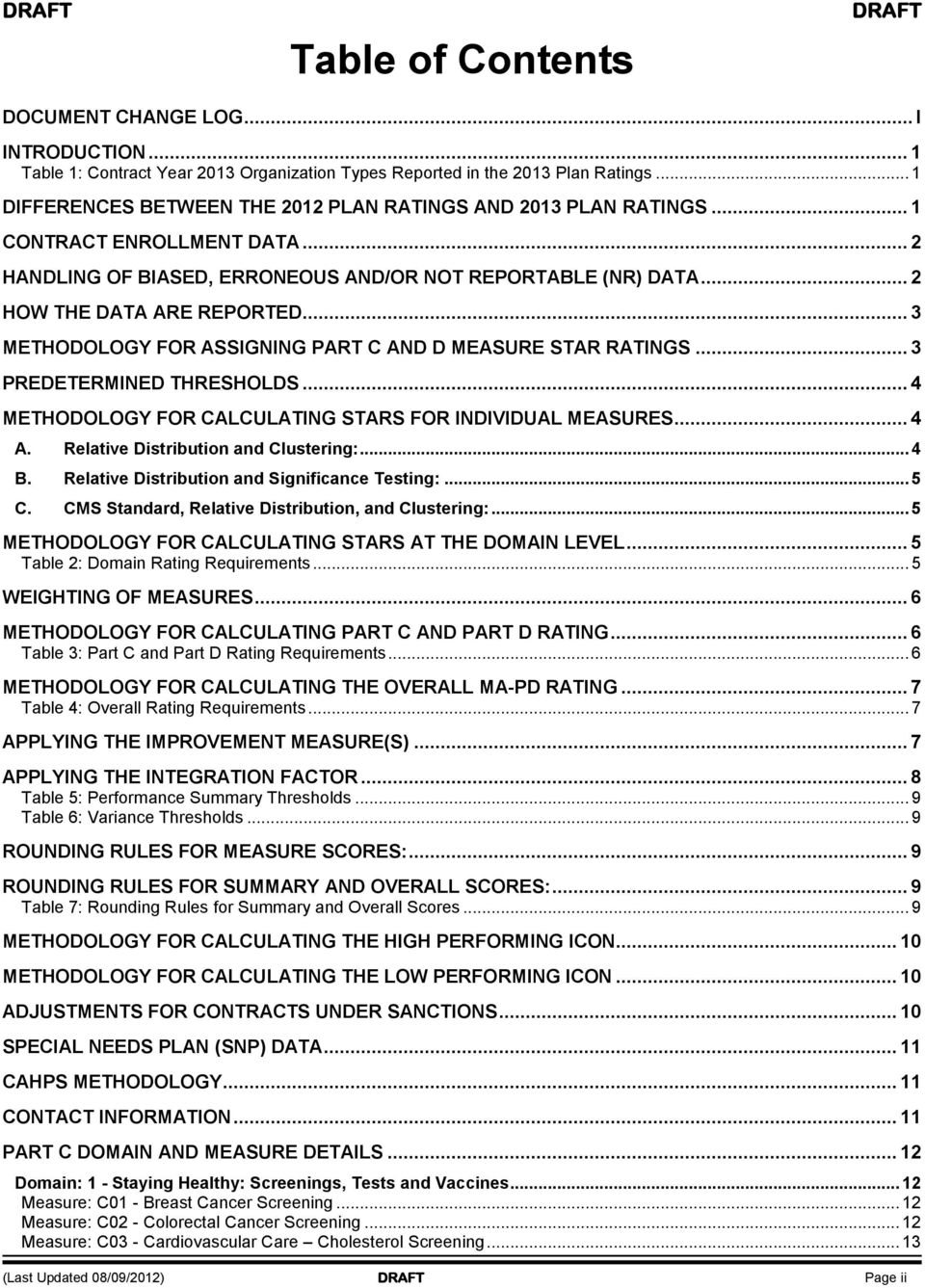
4 Measure: C04 - Diabetes Care Cholesterol Screening Measure: C05 - Glaucoma Testing Measure: C06 - Annual Flu Vaccine Measure: C07 - Improving or Maintaining Physical Health Measure: C08 - Improving or Maintaining Mental Health Measure: C09 - Monitoring Physical Activity Measure: C10 - Adult BMI Assessment Domain: 2 - Managing Chronic (Long Term) Conditions Measure: C11 - Care for Older Adults Medication Review Measure: C12 - Care for Older Adults Functional Status Assessment Measure: C13 - Care for Older Adults Pain Screening Measure: C14 - Osteoporosis Management in Women who had a Fracture Measure: C15 - Diabetes Care Eye Exam Measure: C16 - Diabetes Care Kidney Disease Monitoring Measure: C17 - Diabetes Care Blood Sugar Controlled Measure: C18 - Diabetes Care Cholesterol Controlled Measure: C19 - Controlling Blood Pressure Measure: C20 - Rheumatoid Arthritis Management Measure: C21 - Improving Bladder Control Measure: C22 - Reducing the Risk of Falling Measure: C23 - Plan All-Cause Readmissions Domain: 3 - Member Experience with Health Plan Measure: C24 - Getting Needed Care Measure: C25 - Getting Appointments and Care Quickly Measure: C26 - Customer Service Measure: C27 - Overall Rating of Health Care Quality Measure: C28 - Overall Rating of Plan Measure: C29 - Care Coordination Domain: 4 - Member Complaints, Problems Getting Services, and Improvement in the Health Plan's Performance Measure: C30 - Complaints about the Health Plan Measure: C31 - Beneficiary Access and Performance Problems Measure: C32 - Members Choosing to Leave the Plan Measure: C33 - Improvement Domain: 5 - Health Plan Customer Service Measure: C34 - Plan Makes Timely Decisions about Appeals Measure: C35 - Reviewing Appeals Decisions Measure: C36 - Call Center Foreign Language Interpreter and TTY/TDD Availability Measure: C37 - Enrollment Timeliness PART D DOMAIN AND MEASURE DETAILS Domain: 1 - Drug Plan Customer Service Measure: D01 - Call Center Pharmacy Hold Time Measure: D02 - Call Center Foreign Language Interpreter and TTY/TDD Availability Measure: D03 - Appeals Auto Forward Measure: D04 - Appeals Upheld Measure: D05 - Enrollment Timeliness Domain: 2 - Member Complaints, Problems Getting Services, and Improvement in the Drug Plan s Performance Measure: D06 - Complaints about the Drug Plan Measure: D07 - Beneficiary Access and Performance Problems Measure: D08 - Members Choosing to Leave the Plan Measure: D09 - Improvement Domain: 3 - Member Experience with the Drug Plan Measure: D10 - Getting Information From Drug Plan Measure: D11 - Rating of Drug Plan Measure: D12 - Getting Needed Prescription Drugs Domain: 4 - Patient Safety and Accuracy of Drug Pricing (Last Updated 08/09/2012) Page iii

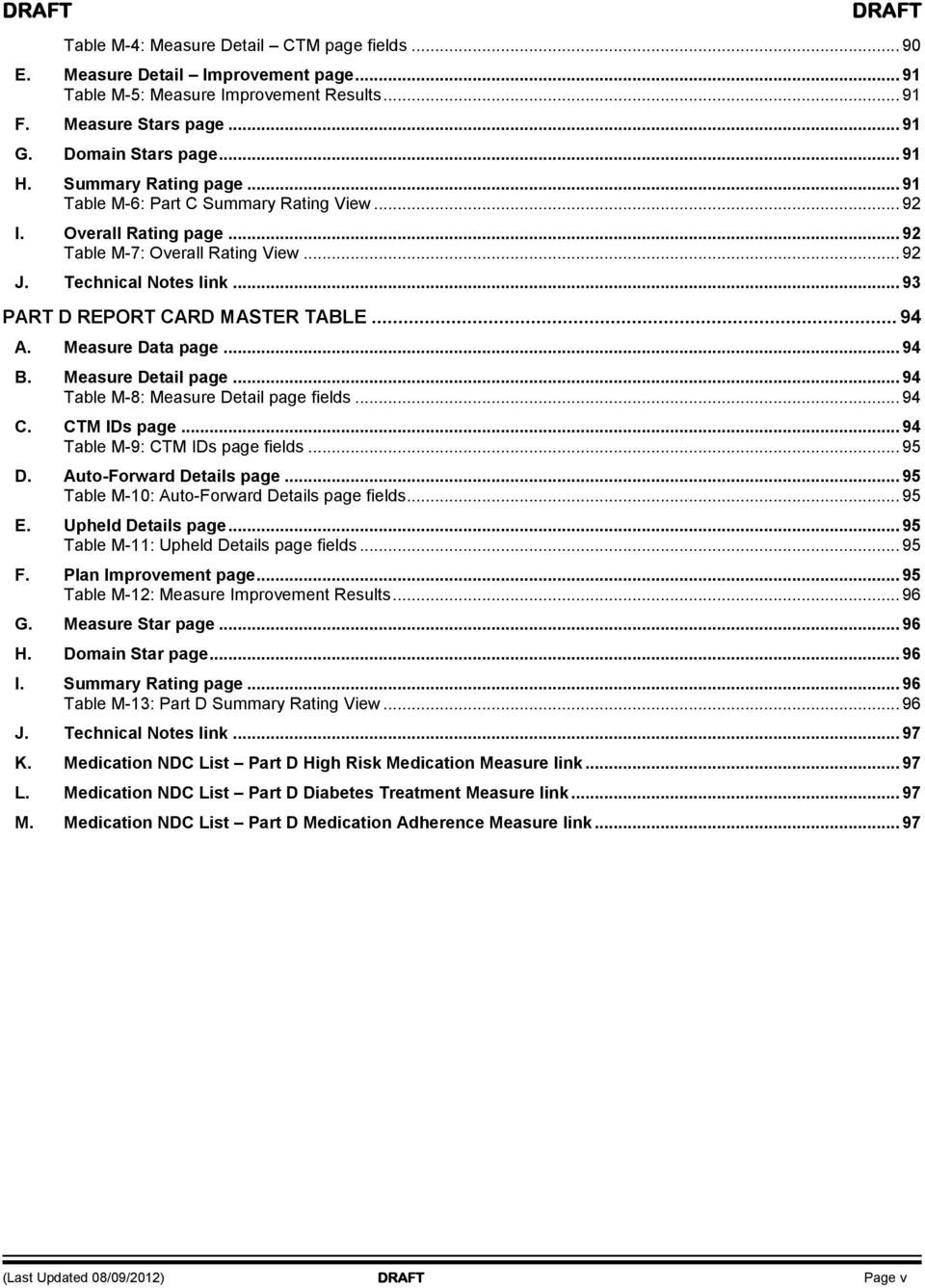
5 Measure: D13 - MPF Price Accuracy Measure: D14 - High Risk Medication Measure: D15 - Diabetes Treatment Measure: D16 - Part D Medication Adherence for Oral Diabetes Medications Measure: D17 - Part D Medication Adherence for Hypertension (RAS antagonists) Measure: D18 - Part D Medication Adherence for Cholesterol (Statins) ATTACHMENT A: CAHPS CASE-MIX ADJUSTMENT ATTACHMENT B: COMPLAINTS TRACKING MODULE EXCLUSION LIST Table B-1: Exclusions effective September 25, Table B-2: Exclusions prior to September 25, Table B-3: Exclusions effective December 16, ATTACHMENT C: NATIONAL AVERAGES FOR PART C AND D MEASURES Table C-1: National Averages for Part C Measures Table C-2: National Averages for Part D Measures ATTACHMENT D: PART C AND D DATA TIME FRAMES Table D-1: Part C Measure Data Time Frames Table D-2: Part D Measure Data Time Frames ATTACHMENT E: NCQA MEASURE COMBINING METHODOLOGY Definitions Setup Calculations Pooled Analysis ATTACHMENT F: CALCULATING MEASURE C23: PLAN ALL-CAUSE READMISSIONS ATTACHMENT G: WEIGHTS ASSIGNED TO INDIVIDUAL PERFORMANCE MEASURES Table G-1: Part C Measure Weights Table G-2: Part D Measure Weights ATTACHMENT H: CALCULATION OF WEIGHTED STAR RATING AND VARIANCE ESTIMATES ATTACHMENT I: CALCULATING THE IMPROVEMENT MEASURE AND THE MEASURES USED Calculating the Improvement Measure Table I-1: Part C Measures used in the Improvement Measure Table I-2: Part D Measures used in the Improvement Measure ATTACHMENT J: PLAN RATINGS MEASURE HISTORY Table J-1: Part C Measure History Table J-2: Part D Measure History ATTACHMENT K: INDIVIDUAL MEASURE STAR ASSIGNMENT PROCESS Produce the Star Thresholds by the Adjusted Percentile Method Produce the Star Thresholds by the Two-stage Cluster Analysis Produce the Final Star Thresholds by the Hybrid Approach Special Case: Produce Hybrid Thresholds When 3- or 4-star Thresholds are Predetermined ATTACHMENT L: GLOSSARY OF TERMS ATTACHMENT M: HEALTH PLAN MANAGEMENT SYSTEM MODULE REFERENCE PART C REPORT CARD MASTER TABLE A. Measure Data page B. Measure Detail page Table M-1: Measure Detail page fields C. Measure Detail SNP page Table M-2: Measure Detail SNP page fields Table M-3: HEDIS 2012 Audit Designations and 2013 Plan Ratings D. Measure Detail CTM page (Last Updated 08/09/2012) Page iv

6 Table M-4: Measure Detail CTM page fields E. Measure Detail Improvement page Table M-5: Measure Improvement Results F. Measure Stars page G. Domain Stars page H. Summary Rating page Table M-6: Part C Summary Rating View I. Overall Rating page Table M-7: Overall Rating View J. Technical Notes link PART D REPORT CARD MASTER TABLE A. Measure Data page B. Measure Detail page Table M-8: Measure Detail page fields C. CTM IDs page Table M-9: CTM IDs page fields D. Auto-Forward Details page Table M-10: Auto-Forward Details page fields E. Upheld Details page Table M-11: Upheld Details page fields F. Plan Improvement page Table M-12: Measure Improvement Results G. Measure Star page H. Domain Star page I. Summary Rating page Table M-13: Part D Summary Rating View J. Technical Notes link K. Medication NDC List Part D High Risk Medication Measure link L. Medication NDC List Part D Diabetes Treatment Measure link M. Medication NDC List Part D Medication Adherence Measure link (Last Updated 08/09/2012) Page v
7 Introduction This document describes the methodology for creating the Part C and D Plan Ratings displayed in the Medicare Plan Finder (MPF) tool on These ratings are also displayed in the Health Plan Management System (HPMS) for contracts and sponsors. In the HPMS Quality and Performance section, the Part C data can be found in the Part C Performance Metrics module in the Part C Report Card Master Table section. The Part D data are located in the Part D Performance Metrics and Report module in the Part D Report Card Master Table section. All of the health/drug plan quality and performance measure data described in this document are reported at the contract level. Table 1 lists the contract year 2013 organization types and whether they are included in the Part C and/or Part D Plan Ratings. Table 1: Contract Year 2013 Organization Types Reported in the 2013 Plan Ratings Employer/Union Only Direct Contract Organization Type 1876 Chronic Care Demo Local CCP* PDP PFFS* HCPP Local National CCP* MSA* PACE PDP PFFS* Part C Ratings Yes No No Yes No Yes No Yes Yes No No Yes Yes Part D Ratings Yes (If drugs are offered) No No Yes Yes Yes No Yes No No Yes Yes Yes * Note: These organization types are Medicare Advantage Organizations The Plan Ratings strategy is consistent with CMS Three-Part Aim (better care, healthier people/healthier communities, and lower costs through improvements) with measures spanning the following five broad categories: Regional CCP* 1. Outcomes: Outcome measures focus on improvements to a beneficiary s health as a result of the care that is provided. 2. Intermediate outcomes: Intermediate outcome measures help move closer to true outcome measures. Controlling Blood Pressure is an example of an intermediate outcome measure where the related outcome of interest would be better health status for beneficiaries with hypertension. 3. Patient experience: Patient experience measures represent beneficiaries perspectives about the care they have received. 4. Access: Access measures reflect issues that may create barriers to receiving needed care. Plan Makes Timely Decisions about Appeals is an example of an access measure. 5. Process: Process measures capture the method by which health care is provided. Differences between the 2012 Plan Ratings and 2013 Plan Ratings There have been several changes between the 2012 Plan Ratings and the 2013 Plan Ratings. This section provides a synopsis of the significant differences; the reader should examine the entire document for full details about the 2013 Plan Ratings. 1. Changes a. Part C measure: C34 - Plan Makes Timely Decisions about Appeals, now includes the timeliness of dismissed appeals. b. Part D measure: D13 - MPF Price Accuracy, was MPF Composite in 2012, removed price stability portion of the measure. c. Part C & D measures: C31 & D07 - Beneficiary Access and Performance Problems, replaced the contract effectiveness score with the percent of elements passed out of all elements audited. (Last Updated 08/09/2012) Page 1

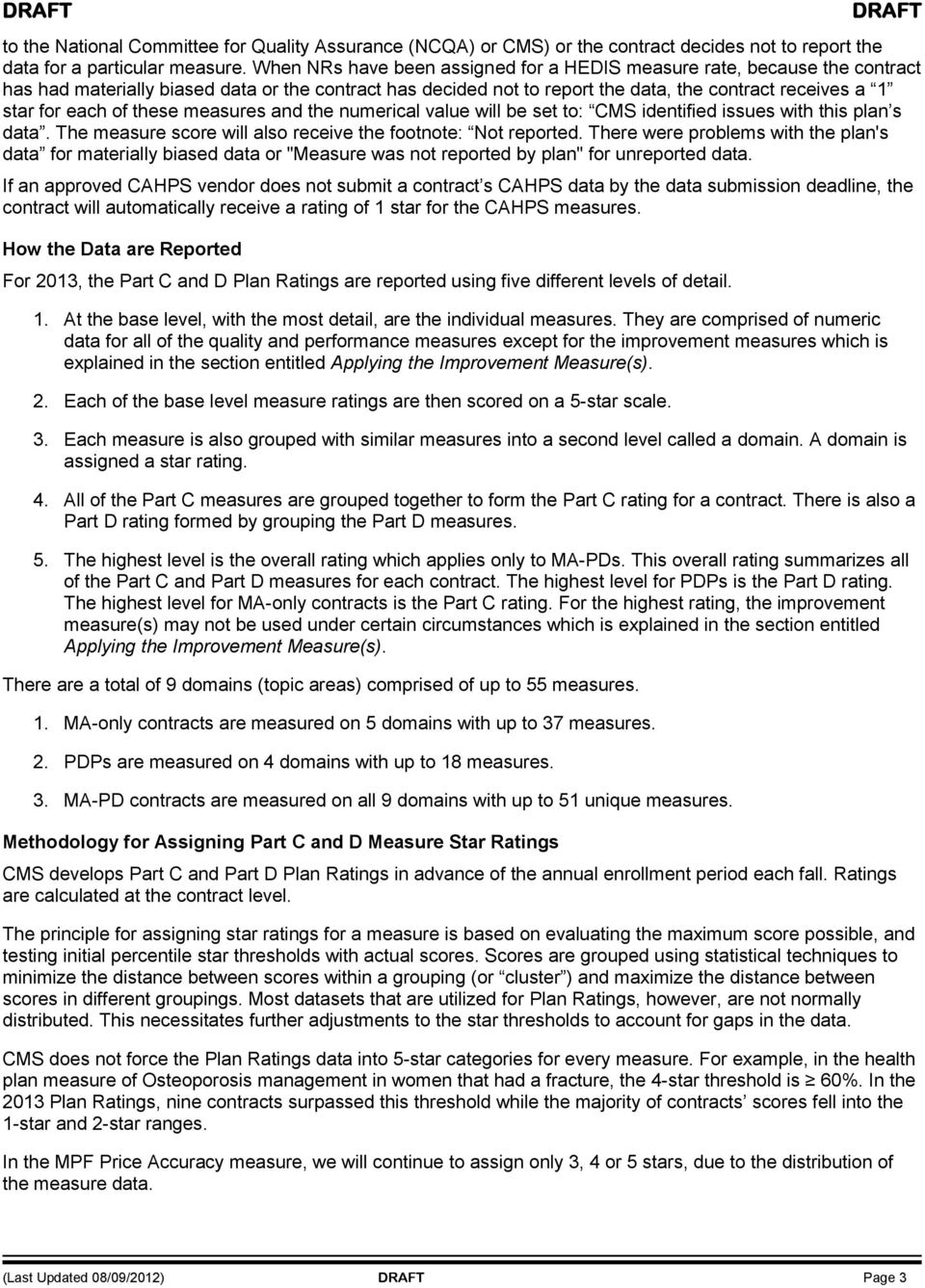
8 d. Part C & D measures: C36 & D02 - Call Center Foreign Language Interpreter and TTY/TDD Availability, includes data from Special Needs Plans and changes to collection methodology. e. Part D measure: D14 - High Risk Medication - CMS will increase the number of HRM fills from one to two fills. Due to this specification change, the previously established 4-star threshold will not be applied for the 2013 Plan Ratings. f. Part C Domain Ratings of Plan Responsiveness and Care renamed to Member Experience with Health Plan. g. Part C Domain Member Complaints, Problems Getting Services, and Choosing to Leave the Plan renamed to Member Complaints, Problems Getting Services, and Improvement in the Health Plan's Performance. h. Part D Domain Member Complaints, Problems Getting Services, and Choosing to Leave the Plan renamed to Member Complaints, Problems Getting Services, and Improvement in the Drug Plan's Performance. 2. Additions a. Part C measure: C29 - Care Coordination b. Part C measure: C33 - Health Plan Quality Improvement c. Part C measure: C37 - Enrollment Timeliness d. Part D measure: D09 - Drug Plan Quality Improvement 3. Transitioned (Moved to the display measures which can be found on the CMS website at this address: a. Part C measure: Pneumonia Vaccine b. Part C measure: Access to Primary Care Doctor Visits c. Part D MPF Stability (removed from last year s MPF composite measure) The complete history of measures used in the Plan Ratings can be found in Attachment J. Contract Enrollment Data The enrollment data used in the Part C and D "Complaints about the Health/Drug Plan" measures were pulled from the HPMS. These enrollment files represent the number of beneficiaries the contract was paid for in a specific month. For this measure, six months of enrollment files were pulled (January 2012 through June 2012) and the average enrollment from those months was used in the calculations. The enrollment data used in the Part D "Appeals Auto Forward" measure were pulled from the HPMS. These enrollment files represent the number of beneficiaries the contract was paid for in a specific month. For this measure, twelve months of enrollment files were pulled (January 2011 through December 2011) and the average enrollment from those months was used in the calculations. Enrollment data are also used to combine plan level data into contract level data in the three Part C Care for Older Adults HEDIS measures. This only occurs when the eligible population was not included in the submitted SNP HEDIS data and the submitted rate was NR (see following section). For these measures, twelve months of plan level enrollment files were pulled (January 2011 through December 2011) and the average enrollment in the plan for those months was used in calculating the combined rate. Handling of Biased, Erroneous and/or Not Reportable (NR) Data CMS has identified issues with some contracts attempting to manipulate data or erroneously reporting data in an attempt to receive higher ratings. In these cases, the contract will receive a 1 star rating for each of the measures and the numerical data value will be set to: CMS identified issues with this plan s data. For the Healthcare Effectiveness Data and Information Set (HEDIS) data, NRs are assigned when the individual measure score is materially biased (e.g., the auditor informs the contract the data cannot be reported (Last Updated 08/09/2012) Page 2

9 to the National Committee for Quality Assurance (NCQA) or CMS) or the contract decides not to report the data for a particular measure. When NRs have been assigned for a HEDIS measure rate, because the contract has had materially biased data or the contract has decided not to report the data, the contract receives a 1 star for each of these measures and the numerical value will be set to: CMS identified issues with this plan s data. The measure score will also receive the footnote: Not reported. There were problems with the plan's data for materially biased data or "Measure was not reported by plan" for unreported data. If an approved CAHPS vendor does not submit a contract s CAHPS data by the data submission deadline, the contract will automatically receive a rating of 1 star for the CAHPS measures. How the Data are Reported For 2013, the Part C and D Plan Ratings are reported using five different levels of detail. 1. At the base level, with the most detail, are the individual measures. They are comprised of numeric data for all of the quality and performance measures except for the improvement measures which is explained in the section entitled Applying the Improvement Measure(s). 2. Each of the base level measure ratings are then scored on a 5-star scale. 3. Each measure is also grouped with similar measures into a second level called a domain. A domain is assigned a star rating. 4. All of the Part C measures are grouped together to form the Part C rating for a contract. There is also a Part D rating formed by grouping the Part D measures. 5. The highest level is the overall rating which applies only to MA-PDs. This overall rating summarizes all of the Part C and Part D measures for each contract. The highest level for PDPs is the Part D rating. The highest level for MA-only contracts is the Part C rating. For the highest rating, the improvement measure(s) may not be used under certain circumstances which is explained in the section entitled Applying the Improvement Measure(s). There are a total of 9 domains (topic areas) comprised of up to 55 measures. 1. MA-only contracts are measured on 5 domains with up to 37 measures. 2. PDPs are measured on 4 domains with up to 18 measures. 3. MA-PD contracts are measured on all 9 domains with up to 51 unique measures. Methodology for Assigning Part C and D Measure Star Ratings CMS develops Part C and Part D Plan Ratings in advance of the annual enrollment period each fall. Ratings are calculated at the contract level. The principle for assigning star ratings for a measure is based on evaluating the maximum score possible, and testing initial percentile star thresholds with actual scores. Scores are grouped using statistical techniques to minimize the distance between scores within a grouping (or cluster ) and maximize the distance between scores in different groupings. Most datasets that are utilized for Plan Ratings, however, are not normally distributed. This necessitates further adjustments to the star thresholds to account for gaps in the data. CMS does not force the Plan Ratings data into 5-star categories for every measure. For example, in the health plan measure of Osteoporosis management in women that had a fracture, the 4-star threshold is 60%. In the 2013 Plan Ratings, nine contracts surpassed this threshold while the majority of contracts scores fell into the 1-star and 2-star ranges. In the MPF Price Accuracy measure, we will continue to assign only 3, 4 or 5 stars, due to the distribution of the measure data. (Last Updated 08/09/2012) Page 3
10 Predetermined Thresholds CMS has set fixed 4-star thresholds for most measures and 3-star thresholds for measures when an absolute regulatory standard has been established (such as answering a pharmacy call within 2 minutes). Additionally, CMS set these thresholds in order to define expectations about what it takes to be a high quality contract and to drive quality improvement. These target 4-star thresholds are based on contract performance in prior years; therefore they have not been set for revised measures or for measures with less than 2 years of measurement experience. The distribution of data is evaluated to assign the other star values. For example, in the call center hold time measure, a contract that has a hold time of 2 minutes or less will receive at least 3 stars. A contract that has a hold time of only 15 seconds will receive 5 stars as they met the CMS standard and were well above other contracts. When CMS has not set a fixed 3 or 4-star threshold for a measure, the maximum score possible is considered as a first step in setting the initial thresholds. Again, these thresholds may require adjustments to accommodate the actual distribution of data. Methodology for Calculating Stars for Individual Measures CMS assigns stars for each measure by applying one of three different methods: relative distribution and clustering; relative distribution and significance testing; and CMS standard, relative distribution, and clustering. Each method is described in detail below. Attachment K explains this process in more detail. A. Relative Distribution and Clustering: This method is applied to the majority of CMS Plan Ratings for star assignments, ranging from operational and process-based measures, to HEDIS and other clinical care measures. The following sequential statistical steps are taken to derive thresholds based on the relative distribution of the data. The first step is to assign initial thresholds using an adjusted percentile approach and a two-stage clustering analysis method. These methods jointly produce initial thresholds to account for gaps in the data and the relative number of contracts with an observed star value. Detailed description: 1. By using the Euclidean metric (defined in Attachment L), scale the raw measures to comparable metrics, and group them into clusters. Clusters are defined as contracts with similar Euclidean distances between their data values and the center data value. Six different clustering scenarios are tested, where the smallest number of clusters is 10, and the largest number of clusters is 35. The results from each of these clustering scenarios are evaluated for potential star thresholds. The formula for scaling a contract s raw measure value (X) for a measure (M) is the following, where Scale min = and Scale max Scaled measure value Scale max - Scale min X - M min M max - M min + Scale min 2. Determine up to five star groupings and their corresponding thresholds from the means of each cluster derived in Step 1. In applying these two steps, goodness of fit analysis using an empirical distribution function test in an iterative process is performed as needed to test the properties of the raw measure data distribution in contrast to various types of continuous distributions. Additional sub-tests are also applied and include: Kolmogorov- Smirnov statistic, Cramér-von-Mises statistic, and Anderson-Darling statistic. See Attachment L for definitions of these tests. Following these steps, the estimates of thresholds for star assignments derived from the adjusted percentile and clustering analyses are combined to produce final individual measure star ratings. (Last Updated 08/09/2012) Page 4

11 B. Relative Distribution and Significance Testing: This method is applied to determine valid star thresholds for CAHPS measures. In order to account for the reliability of scores produced from the CAHPS survey, the method combines evaluating the relative percentile distribution with significance testing. For example, to obtain 5 stars a contract s CAHPS measure score needs to be ranked above the 80 th percentile and be statistically significantly higher than the national average CAHPS measure score. A contract is assigned 4 stars if it does not meet the 5-star criteria, but the contract s average CAHPS measure score exceeds a cutoff defined by the 60th percentile of contract means in CAHPS reports for the same measure. To obtain 1 star, a contract s CAHPS measure score needs to be ranked below the 15th percentile and the contract s CAHPS measure score must be statistically significantly lower than the national average CAHPS measure score. C. CMS Standard, Relative Distribution, and Clustering: For measures with a CMS published standard, the CMS standard has been incorporated into star thresholds. Currently, the instance in which this method applies is the call center hold time measure. Contracts meeting or exceeding the CMS standard are assigned at least 3 stars. To determine the thresholds of the other star ratings (e.g., 1, 2, 4, and 5 stars), the steps outlined above for relative distribution and clustering are applied. Methodology for Calculating Stars at the Domain Level The domain rating is an average of the star ratings assigned to each individual measure a contract type is required to report within the domain. To receive a domain rating, the contract must meet or exceed the minimum number of individual rated measures within the domain. The minimum number of measures required is determined as follows: If the total number of measures required for the organization type in the domain is odd, divide the number by two and round it to a whole number. o Example: there are 3 required measures in the domain for the organization, 3 / 2 = 1.5, when rounded the result is 2. The contract needs to have at least 2 measures with a rating out of 3 measures for the domain to be rated. If the total number of measures required for the organization type in the domain is even, divide the number by two and then add one to the result. o Example: there are 6 required measures in the domain for the organization, 6 / 2 = 3, add one to that result, = 4. The contract needs at least 4 measures with star ratings out of the 6 measures for the domain to be rated. Table 2 shows each domain and the number of measures needed for each contract type. Table 2: Domain Rating Requirements Domain Part ID Name 1876 Local, E-Local & Regional CCP w/o SNP Contract Type Local, E-Local & Regional CCP with SNP MSA C 1 Staying Healthy: Screenings, Tests and Vaccines 6 of 10 6 of 10 6 of 10 6 of 10 N/A 6 of 10 C 2 Managing Chronic (Long Term) Conditions 5 of 9 6 of 10 7 of 13 6 of 10 N/A 6 of 10 C 3 Member Experience with Health Plan 4 of 6 4 of 6 4 of 6 4 of 6 N/A 4 of 6 C 4 Member Complaints, Problems Getting Services, and Improvement in the Health Plan's Performance 3 of 4 3 of 4 3 of 4 3 of 4 N/A 3 of 4 C 5 Health Plan Customer Service 2 of 3 3 of 4 3 of 4 2 of 3 N/A 3 of 4 D 1 Drug Plan Customer Service 2 of 3* 3 of 5 3 of 5 N/A 3 of 5 3 of 5 D 2 Member Complaints, Problems Getting Services, and Improvement in the Drug Plan s Performance 3 of 4* 3 of 4 3 of 4 N/A 3 of 4 3 of 4 D 3 Member Experience with the Drug Plan 2 of 3* 2 of 3 2 of 3 N/A 2 of 3 2 of 3 D 4 Patient Safety and Accuracy of Drug Pricing 4 of 6* 4 of 6 4 of 6 N/A 4 of 6 4 of 6 (Last Updated 08/09/2012) Page 5

12 * Note: Does not apply to MA-only 1876 contracts which do not offer drug benefits. Note: 1876 contracts which do not submit data for the MPF measure must have a rating in 3 out of 5 Drug Pricing and Patient Safety measures to receive a rating in that domain. Weighting of Measures For the 2013 Plan Ratings, CMS assigned the highest weight to outcomes and intermediate outcomes, followed by patient experience/complaints, and access then process measures. Process measures were weighted the least. The Part C, Part D, and overall MA-PD ratings are thus calculated as weighted averages of the ratings of individual measures. Attachment G: Weights Assigned to Individual Performance Measures shows the weights assigned to each measure for summary and overall star ratings. A measure given a weight of 3 counts three times as much as a measure given a weight of 1. For both the summary and overall ratings, the rating for a single contract is calculated as a weighted average of the measures available for that contact. The first step in this calculation would be to multiply each individual measure s weight by the measure s star rating and then sum all results for all the measures available for a given contract. The second step would be to divide this result by the sum of the weights for the measures available for the contract. Methodology for Calculating Part C and Part D Rating The Part C and Part D ratings are calculated by taking a weighted average of the measure level ratings for Part C and D, respectively. To receive a Part C and/or D Rating, a contract must meet or exceed the minimum number of individual measures with a star rating. The Part C and D improvement measures are not included in the count for the minimum number of measures needed. The minimum number of measures required is determined as follows: If the total number of measures required for the organization type in the domain is odd, divide the number by two and round it to a whole number. o Example: there are 17 required Part D measures for the organization, 17 / 2 = 8.5, when rounded the result is 9. The contract needs to have at least 9 measures with a rating out of the 17 total measures to receive a Part D rating. If the total number of measures required for the organization type in the domain is even, divide the number of measures by two. o Example: there are 32 required Part C measures for the organization, 32 / 2 = 16. The contract needs at least 16 measures with ratings out of the 32 total measures to receive a Part C rating. Table 3 shows the minimum number of measures having a rating needed by each contract type to receive a rating. Table 3: Part C and Part D Rating Requirements Rating 1876 Regional CPP w/o SNP Regional CPP with SNP MSA & PDP & PFFS Part C Rating 16 of of of of 32 N/A 17 of 33 Part D Rating 8 of 15 9 of 17 9 of 17 N/A 9 of 17 9 of 17 Note: 1876 contracts which do not submit data for the MPF measure must have ratings in 7 out of 14 measures to receive a Part D rating. For this rating, half stars are also assigned to allow for more variation across contracts. Additionally, to incorporate performance stability into the rating process, CMS has used an approach that utilizes both the mean and the variance of individual performance ratings to differentiate contracts for the summary score. That is, a measure of individual performance score dispersion, specifically an integration factor (i-factor), has been added to the mean score for rewarding contracts if they have both high and stable relative performance. Details about the i-factor can be found in the section titled Applying the Integration Factor. (Last Updated 08/09/2012) Page 6

13 Methodology for Calculating the Overall MA-PD Rating For MA-PDs to receive an overall rating, the contract must have stars assigned to both the Part C rating and the Part D rating. If a contract has only one of the two required summary ratings, it will receive a note saying, Not enough data to calculate overall rating. The overall Plan Rating for MA-PD contracts is calculated by taking a weighted average of the Part C and D measure level stars. There are a total of 55 measures (37 in Part C, 18 in Part D). The following four measures are contained in both the Part C and D measure lists: 1. Complaints about the Health/Drug Plan (CTM) 2. Beneficiary Access and Performance Problems (BAPP) 3. Members Choosing to Leave the Plan (MCLP) 4. Enrollment Timeliness (ET) These measures share the same data source, so CMS has only included the measure once in calculating the overall Plan Rating. The Part C and D improvement measures are also not included in the count for the minimum number of measures. This results in a total of 49 measures (the Part D CTM, BAPP, MCLP and ET measures are duplicates of the Part C measures). The minimum number of measures required for an overall MA-PD is determined using the same methodology as for the Part C and D ratings. Table 4 shows the minimum number of measures having a rating needed by each contract type to receive an overall rating. Table 4: Overall Rating Requirements Rating 1876 Regional CPP w/o SNP Regional CPP with SNP MSA & PDP & PFFS Overall Rating 21 of 42* 23 of of 49 N/A N/A 23 of 46 * Note: Does not apply to MA-only 1876 contracts which do not offer drug benefits. Note: 1876 contracts which do not submit data for the MPF measure must have ratings in 21 out of 42 measures to receive an overall rating. For the overall rating, half stars are also assigned to allow more variation across contracts. Additionally, CMS is using the same i-factor approach in calculating the summary level. Details about the i- Factor can be found in the section titled Applying the Integration Factor. Applying the Improvement Measure(s) The improvement measures (Part C measure C33 and Part D measure D09) compare the underlying numeric data from the 2012 Plan Ratings with the data from the 2013 Plan Ratings. The Part C measure uses only data from Part C and the Part D measure uses only data from Part D. To qualify for use in the improvement calculation, a measure must exist in both years and not have had a significant change in its specification. The formulas used along with a list of the included measures can be found in Attachment I. The result of these calculations is a measure star rating; there is no numeric data for the measure for public reporting purposes. To receive a rating in the improvement measure, a contract must have data in at least half of the measures used. The improvement measures are not included in the minimum number of measures needed for calculating the Part C, Part D or overall ratings. Since high performing contracts have less room for improvement and consequently may have lower ratings on these measure(s), CMS has developed the following rules to not penalize contracts receiving 4 or more stars for their highest rating. (Last Updated 08/09/2012) Page 7
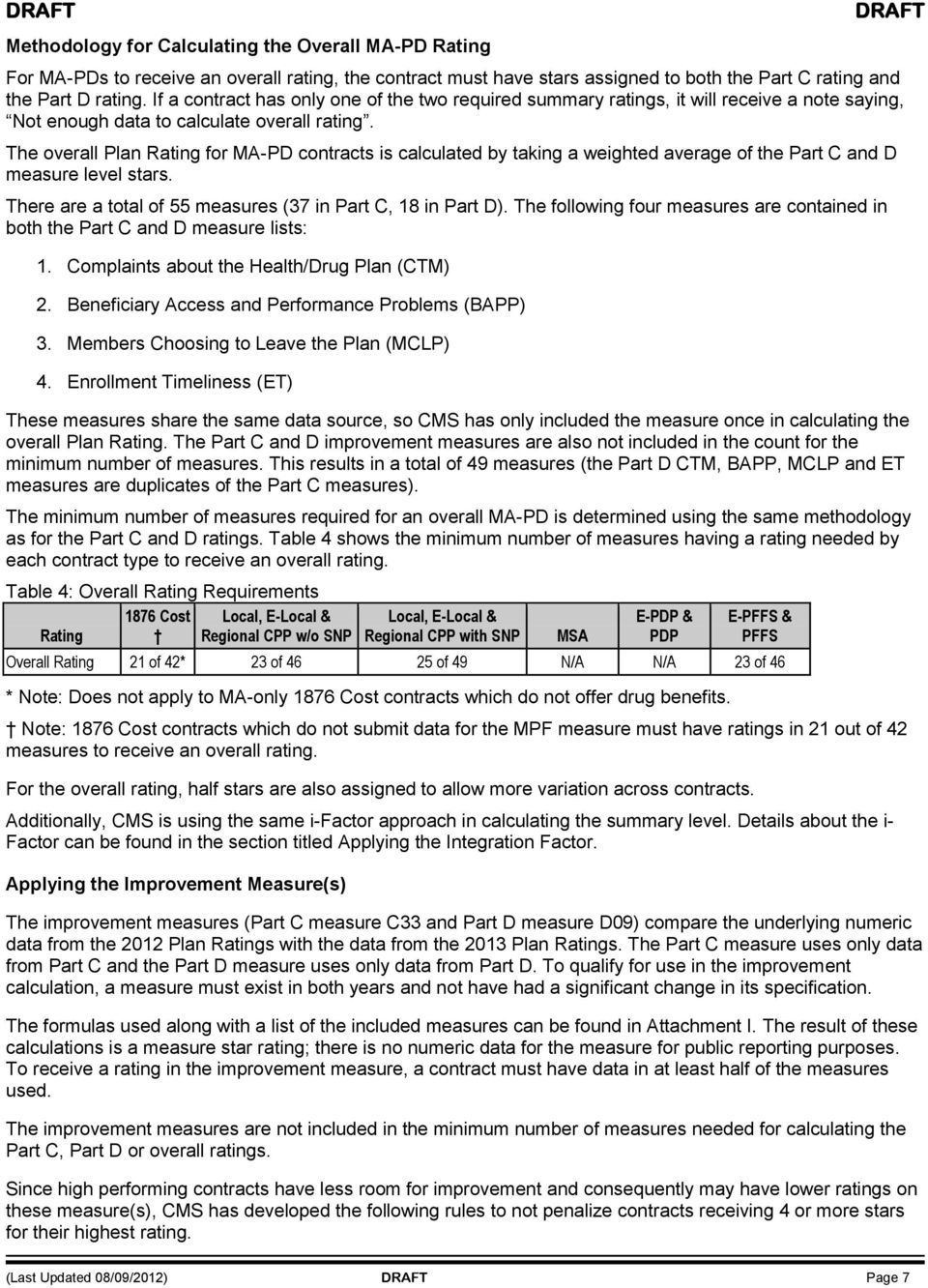
14 MA-PD Contracts 1. There are separate Part C and Part D improvement measures (C33 & D09) for MA-PD contracts. C33 will always be used in calculating the Part C summary rating, and D09 will always be used in calculating the Part D summary rating for an MA-PD contract. Both measures will be used when calculating the overall rating in step Calculate the overall rating for MA-PD contracts without including the improvement measures. 3. Calculate the overall rating for MA-PD contracts using both improvement measures. 4. For MA-PD contracts in step 2 with 4 or more stars, compare the two overall ratings calculated in steps 2 & 3. If the rating in step 3 is less than the value in step 2, use the overall rating from step 2. For all other contracts, use the overall rating from step 3. MA-Only Contracts 1. Only the Part C improvement measure (C33) will be used for MA-only contracts. 2. Calculate the Part C summary rating for MA-only contracts without including the improvement measure. 3. Calculate the Part C summary rating for MA-only contracts using the Part C improvement measure. 4. For MA-Only contracts in step 2 with 4 or more stars, compare the two Part C summary ratings. If the rating in step 3 is less than the value in step 2, use the Part C summary rating from step 2. For all other contracts, use the Part C summary rating from step 3. PDP Contracts 1. Only the Part D improvement measure (D09) will be used for PDP contracts. 2. Calculate the Part D summary rating for PDP contracts without including the improvement measure. 3. Calculate the Part D summary rating for PDP contracts using the Part D improvement measure. 4. For PDP contracts in step 2 with 4 or more stars, compare the two Part D summary ratings. If the rating in step 3 is less than the value in step 2, use the Part D summary rating from step 2. For all other contracts, use the Part D summary rating from step 3. Applying the Integration Factor The following represents the steps taken to calculate and include the i-factor in the Plan Ratings summary and overall ratings: Calculate the mean and the variance of all of the individual performance measure stars at the contract level. o o The mean is the summary or overall rating before the i-factor is applied, which is calculated as described in the section titled Weighting of Measures. Using weights in the variance calculation accounts for the relative importance of measures in the i-factor calculation. To incorporate the weights shown in Attachment G into the variance calculation of the available individual performance measures for a given contract, the steps are as follows: Subtract the summary or overall star from each performance measure s star; square the results; and multiply each squared result by the corresponding individual performance measure weight. Sum these results; call this SUMWX. Set n equal to the number of individual performance measures available for the given contract. Set W equal to the sum of the weights assigned to the n individual performance measures available for the given contract. (Last Updated 08/09/2012) Page 8

15 The weighted variance for the given contract is calculated as: n*sumwx/(w*(n-1)) (for the complete formula, please see Attachment H: Calculation of Weighted Star Rating and Variance Estimates). Categorize the variance into three categories: o o o low (0 to < 30th percentile), medium ( 30th to < 70th percentile) and high ( 70th percentile) Develop the i-factor as follows: o o o o o i-factor = 0.4 (for contract w/ low variability & high mean (mean 85th percentile) i-factor = 0.3 (for contract w/ medium variability & high mean (mean 85th percentile) i-factor = 0.2 (for contract w/ low variability & relatively high mean (mean 65th & < 85th percentile) i-factor = 0.1 (for contract w/ medium variability & relatively high mean (mean 65th & < 85th percentile) i-factor = 0.0 (for other types of contracts) Develop final summary score or overall scores using 0.5 as the star scale (create 10 possible overall scores as: 0.5, 1.0, 1.5, 2.0, 2.5, 3.0, 3.5, 4.0, 4.5, and 5.0). Apply rounding to final summary or overall scores such that stars that are within the distance of 0.25 above or below any half star scale will be rounded to that half star scale. Tables 5 and 6 show the final threshold values used in i-factor calculations for the 2013 Plan Ratings: Table 5: Performance Summary Thresholds Percentile Part C Rating Part D Rating Overall Rating 65th 85th Table 6: Variance Thresholds Percentile Part C Rating Part D Rating Overall Rating 30th 70th Rounding Rules for Measure Scores: Measure scores are rounded to the nearest whole number. Using standard rounding rules, raw measure scores that end in 0.49 or less are rounded down and raw measure scores that end in 0.50 or more are rounded up. So, for example, a measure score of rounds down to 83 while a measure score of rounds up to 84. Rounding Rules for Summary and Overall Scores: Summary and overall scores are rounded to the nearest half star (i.e., 0.5, 1.0, 1.5, 2.0, 2.5, 3.0, 3.5, 4.0, 4.5, 5.0). Table 7 shows how scores are rounded. Table 7: Rounding Rules for Summary and Overall Scores Raw Summary / Overall Score Final Summary / Overall Score 0 and < and < and < and < and < and < and < (Last Updated 08/09/2012) Page 9


16 Raw Summary / Overall Score Final Summary / Overall Score 3.25 and < and < and < For example, a summary or overall score of 3.74 rounds down to 3.5 and a measure score of 3.75 rounds up to 4. Methodology for Calculating the High Performing Icon A contract may receive a high performing icon as a result of its performance on the Part C and D measures. The high performing icon is assigned to an MA-only contract for achieving a 5-star Part C summary rating, a PDP contract for a 5-star Part D summary ratings and an MA-PD contract for a 5-star overall rating. Figure 1 shows the high performing icon to be used in the MPF: Figure 1: The High Performing Icon Methodology for Calculating the Low Performing Icon A contract can receive a low performing icon as a result of its performance on the Part C or D measures. The low performing icon is calculated by evaluating the Part C rating for the current year and the past two years (i.e., the 2011, 2012 and 2013 Plan Ratings). If the contract had a Part C rating of 2.5 or lower for all three years of data, it is marked with a low performing icon. A contract must have a Part C rating for all three years to be considered for this icon. A contract can also receive a separate low performing icon in the Part D Plan Ratings. Using the same data years as Part C, if a contract has had a Part D rating of 2.5 or lower for all three years of data, it is marked with a low performing icon. A contract must have a Part D rating for all three years to be considered for this icon. Figure 2 shows the low performing contract icon used in the MPF: Figure 2: The Low Performing Icon Adjustments for Contracts Under Sanctions Contracts under an enrollment sanction are automatically assigned 2.5 stars. If a contract under sanction already has 2.5 stars or below, it will receive a 1-star reduction. Contracts under sanction will be evaluated and adjusted at two periods each year. August 31st: Contracts under sanction as of August 31st will have their Plan Ratings reduced in that fall's rating on Medicare Plan Finder (MPF). March 31st: Plan Ratings for contracts either coming off sanction or going under sanction will be updated for the MPF and Quality Bonus Payment purposes. A contract whose sanction has ended after August 31st will have its original Plan Rating restored. A contract that received a sanction after August 31st will have its Plan Rating reduced. Contracts will be informed of the changes in time to synchronize their submission of plan bids for the following year. Updates will also be displayed on MPF. (Last Updated 08/09/2012) Page 10
17 Special Needs Plan (SNP) Data CMS has included three SNP-specific measures in the 2013 Plan Ratings. All three measures are based on data from the HEDIS Care for Older Adults measure. Since these data are reported at the plan benefit package (PBP) level and the Plan Ratings are reported by contract, CMS has combined the reported rates for all PBPs within a contract using the NCQA-developed methodology described in Attachment E. CAHPS Methodology The CAHPS measures are case-mix adjusted to take into account differences in the characteristics of enrollees across contracts that may potentially impact survey responses. See Attachment A for the case-mix adjusters. The CAHPS star calculations also take into account statistical significance and reliability of the measure. The base stars are the number of stars assigned prior to taking into account statistical significance and reliability. These are the rules applied to the base star values to arrive at the final CAHPS measure star value: 5 base stars: If significance is NOT above average OR reliability is low, the Final Star value equals 4. 4 base stars: Always stays 4 Final Stars. 3 base stars: If significance is below average, the Final Star value equals 2. 2 base stars: If significance is NOT below average AND reliability is low, the Final Star value equals 3. 1 base star: If significance is NOT below average AND reliability is low, the Final Star value equals 3 or if significance is below average and reliability is low, the Final Star value equals 2 or if significance is not below average and reliability is not low, the Final Star value equals 2. Contact Information The two contacts below can assist you with various aspects of the Plan Ratings. Part C Plan Ratings: [email protected] Part D Plan Ratings: [email protected] If you have questions or require information about the specific subject areas associated with the Plan Ratings please write to those contacts directly. CAHPS (MA & Part D): [email protected] Call Center Monitoring: [email protected] HEDIS: [email protected] HOS: [email protected] Marketing: [email protected] QBP Ratings and Appeals: [email protected] (Last Updated 08/09/2012) Page 11

18 Part C Domain and Measure Details See Attachment C for the national averages of individual Part C measures. Domain: 1 - Staying Healthy: Screenings, Tests and Vaccines Measure: C01 - Breast Cancer Screening Label for Stars: Breast Cancer Screening HEDIS Label: Breast Cancer Screening Breast Cancer Screening (BCS) Measure Reference: NCQA HEDIS 2012 Technical Specifications Volume 2, page 79 Exclusions: Percent of female plan members aged who had a mammogram during the past 2 years. The percentage of female MA enrollees ages 40 to 69 (denominator) who had one or more mammograms during the measurement year or the year prior to the measurement year (numerator). (optional) Women who had a bilateral mastectomy. Look for evidence of a bilateral mastectomy as far back as possible in the member s history through December 31 of the measurement year. Exclude members for whom there is evidence of two unilateral mastectomies. Refer to NCQA HEDIS 2012 Technical Specifications Volume 2, page 80, Table BCS-B for codes to identify exclusions. HEDIS NQF #: 0031 Clinical care Data Time Frame: 01/01/ /31/2011 Weighting Value: 1 Higher is better Relative Distribution with Clustering Included 4-Star Threshold: 74% Process Measure Percentage with no decimal point Yes Yes Yes Yes No Yes Cut Points: Measure: C02 - Colorectal Cancer Screening Label for Stars: Colorectal Cancer Screening HEDIS Label: Colorectal Cancer Screening Colorectal Cancer Screening (COL) Measure Reference: NCQA HEDIS 2012 Technical Specifications Volume 2, page 84 Percent of plan members aged who had appropriate screening for colon cancer The percentage of MA enrollees aged 50 to 75 (denominator) who had one or more appropriate screenings for colorectal cancer (numerator). (Last Updated 08/09/2012) Page 12

19 Exclusions: (optional) Members with a diagnosis of colorectal cancer or total colectomy. Look for evidence of colorectal cancer or total colectomy as far back as possible in the member s history. Refer to NCQA HEDIS 2012 Technical Specifications Volume 2, page 85, Table COL-B for codes to identify exclusions. HEDIS NQF #: 0034 Clinical care Data Time Frame: 01/01/ /31/2011 Weighting Value: 1 Higher is better Relative Distribution with Clustering Included 4-Star Threshold: 58% Process Measure Percentage with no decimal point Yes Yes Yes Yes No Yes Cut Points: Measure: C03 - Cardiovascular Care Cholesterol Screening Label for Stars: Cholesterol Screening for Patients with Heart Disease HEDIS Label: Cholesterol Screening for Patients with Heart Disease Cholesterol Management for Patients With Cardiovascular Conditions (CMC) Measure Reference: NCQA HEDIS 2012 Technical Specifications Volume 2, page 132 Exclusions: Percent of plan members with heart disease who have had a test for bad (LDL) cholesterol within the past year. The percentage of members years of age who were discharged alive for Acute Myocardial Infarction (AMI), coronary artery bypass graft (CABG) or percutaneous coronary interventions (PCI) from January 1 November 1 of the year prior to the measurement year, or who had a diagnosis of ischemic vascular disease (IVD) during the measurement year and the year prior to the measurement year (denominator), who had an LDL-C screening test performed during the measurement year (numerator). None listed. HEDIS NQF #: 0075 Clinical care Data Time Frame: 01/01/ /31/2011 Weighting Value: 1 Higher is better Relative Distribution with Clustering Included Process Measure (Last Updated 08/09/2012) Page 13

20 Percentage with no decimal point 4-Star Threshold: 85% Yes Yes Yes Yes No Yes Cut Points: Measure: C04 - Diabetes Care Cholesterol Screening Label for Stars: Cholesterol Screening for Patients with Diabetes HEDIS Label: Cholesterol Screening for Patients with Diabetes Comprehensive Diabetes Care (CDC) LDL-C Screening Measure Reference: NCQA HEDIS 2012 Technical Specifications Volume 2, page 146 Percent of plan members with diabetes who have had a test for bad (LDL) cholesterol within the past year. The percentage of diabetic MA enrollees with diabetes (type 1 and type 2) (denominator) who had an LDL-C screening test performed during the measurement year (numerator). Exclusions: (optional) Members with a diagnosis of polycystic ovaries (Refer to NCQA HEDIS 2012 Technical Specifications Volume 2, page 156, Table CDC-O) who did not have a face-to-face encounter, in any setting, with a diagnosis of diabetes (Refer to NCQA HEDIS 2012 Technical Specifications Volume 2, page 148, Table CDC-B) during the measurement year or the year before the measurement year. Diagnosis may occur at any time in the member s history, but must have occurred by December 31 of the measurement year. Members with gestational or steroid-induced diabetes (CDC-O) who did not have a face-to-face encounter, in any setting, with a diagnosis of diabetes (CDC-B) during the measurement year or the year before the measurement year. Diagnosis may occur during the measurement year or the year before the measurement year, but must have occurred by December 31 of the measurement year. HEDIS NQF #: 1780 Clinical care Data Time Frame: 01/01/ /31/2011 Weighting Value: 1 Higher is better Relative Distribution with Clustering Included 4-Star Threshold: 85% Process Measure Percentage with no decimal point Yes Yes Yes Yes No Yes Cut Points: (Last Updated 08/09/2012) Page 14

21 Measure: C05 - Glaucoma Testing Label for Stars: Glaucoma Testing HEDIS Label: Glaucoma Testing Glaucoma Screening in Older Adults (GSO) Measure Reference: NCQA HEDIS 2012 Technical Specifications Volume 2, page 92 Exclusions: NQF #: Percent of senior plan members who got a glaucoma eye exam for early detection. The percentage of Medicare members 65 years and older, without a prior diagnosis of glaucoma or glaucoma suspect (denominator), who received a glaucoma eye exam by an eye care professional for early identification of glaucomatous conditions (numerator). (optional) Members who had a prior diagnosis of glaucoma or glaucoma suspect. Look for evidence of glaucoma as far back as possible in the member s history through December 31 of the measurement year. Refer to NCQA HEDIS 2012 Technical Specifications Volume 2, page 93, Table GSO-B for codes to identify exclusions. HEDIS Clinical care None Data Time Frame: 01/01/ /31/2011 Weighting Value: 1 Higher is better Relative Distribution with Clustering Included 4-Star Threshold: 70% Process Measure Percentage with no decimal point Yes Yes Yes Yes No Yes Cut Points: Measure: C06 - Annual Flu Vaccine Label for Stars: Annual Flu Vaccine General Notes: Data Source Annual Flu Vaccine Percent of plan members who got a vaccine (flu shot) prior to flu season. The percentage of sampled Medicare enrollees (denominator) who received an influenza vaccination during the measurement year (numerator). This measure is not case mix adjusted. CAHPS Survey results were sent to each contract's Medicare Compliance Officer in early August These reports provide further explanation of the CAHPS scoring methodology and provide detailed information on why a specific rating was assigned. CAHPS CAHPS Survey Question (question number varies depending on survey type): Have you had a flu shot since September 1, 2011? (Last Updated 08/09/2012) Page 15
22 NQF #: 0040 Clinical care Data Time Frame: 02/01/ /30/2012 Weighting Value: 1 Higher is better Relative Distribution and Significance Testing Included 4-Star Threshold: 71% Process Measure Percentage with no decimal point Yes Yes Yes Yes No Yes Cut Points: Measure: C07 - Improving or Maintaining Physical Health Label for Stars: Improving or Maintaining Physical Health Exclusions: Data Source NQF #: Improving or Maintaining Physical Health Percent of all plan members whose physical health was the same or better than expected after two years. The percentage of sampled Medicare enrollees (denominator) whose physical health status was the same, or better than expected (numerator). Contracts with less than 30 responses are suppressed. HOS Cohort 12 Performance Measurement Results (2009 Baseline data collection, 2011 Follow-up data collection) 2-year PCS change Questions: 1, 2a-b, 3a-b & 5 Person- and caregiver- centered experience and outcomes None Data Time Frame: Apr Aug 2011 Weighting Value: 3 Higher is better Relative Distribution with Clustering Not Included 4-Star Threshold: 60% Outcome Measure Percentage with no decimal point Yes Yes Yes Yes No Yes Cut Points: (Last Updated 08/09/2012) Page 16
23 Measure: C08 - Improving or Maintaining Mental Health Label for Stars: Improving or Maintaining Mental Health Exclusions: Data Source NQF #: Improving or Maintaining Mental Health Percent of all plan members whose mental health was the same or better than expected after two years. The percentage of sampled Medicare enrollees (denominator) whose mental health status was the same or better than expected (numerator). Contracts with less than 30 responses are suppressed. HOS Cohort 11 Performance Measurement Results (2009 Baseline data collection, 2011 Follow-up data collection) 2-year MCS change Questions: 4a-b, 6a-c & 7 Person- and caregiver- centered experience and outcomes None Data Time Frame: Apr Aug 2011 Weighting Value: 3 Higher is better Relative Distribution with Clustering Not Included 4-Star Threshold: 85% Outcome Measure Percentage with no decimal point Yes Yes Yes Yes No Yes Cut Points: Measure: C09 - Monitoring Physical Activity Label for Stars: Monitoring Physical Activity HEDIS Label: Measure Reference: Exclusions: Data Source Monitoring Physical Activity Physical Activity in Older Adults (PAO) NCQA HEDIS 2012 Specifications for The Medicare Health Outcomes Survey Volume 6, page 33 Percent of senior plan members who discussed exercise with their doctor and were advised to start, increase or maintain their physical activity during the year. The percentage of sampled Medicare members 65 years of age or older (denominator) who had a doctor s visit in the past 12 months and who received advice to start, increase or maintain their level exercise or physical activity (numerator). Members who responded "I had no visits in the past 12 months" to Question 46 are excluded from results calculations for Question 47. HEDIS / HOS Cohort 12 Follow-up Data collection (2011) and Cohort 14 Baseline data collection (2011). (Last Updated 08/09/2012) Page 17
24 NQF #: 0029 HOS Survey Question 46: In the past 12 months, did you talk with a doctor or other health provider about your level of exercise of physical activity? For example, a doctor or other health provider may ask if you exercise regularly or take part in physical exercise. HOS Survey Question 47: In the past 12 months, did a doctor or other health care provider advise you to start, increase or maintain your level of exercise or physical activity? For example, in order to improve your health, your doctor or other health provider may advise you to start taking the stairs, increase walking from 10 to 20 minutes every day or to maintain your current exercise program. Person- and caregiver- centered experience and outcomes Data Time Frame: Apr Aug 2011 Weighting Value: 1 Higher is better Relative Distribution with Clustering Included 4-Star Threshold: 60% Process Measure Percentage with no decimal point Yes Yes Yes Yes No Yes Cut Points: Measure: C10 - Adult BMI Assessment Label for Stars: Checking to See if Members are at a Healthy Weight HEDIS Label: Checking to See if Members Are at a Healthy Weight Adult BMI Assessment (ABA) Measure Reference: NCQA HEDIS 2012 Technical Specifications Volume 2, page 56 Percent of plan members with an outpatient visit who had their Body Mass Index (BMI) calculated from their height and weight and recorded in their medical records. The percentage of members years of age (denominator) who had an outpatient visit and who had their body mass index (BMI) documented during the measurement year or the year prior the measurement year (numerator). Exclusions: (optional) Members who have a diagnosis of pregnancy (Refer to NCQA HEDIS 2012 Technical Specifications Volume 2, page 57, Table ABA-C) during the measurement year or the year prior to the measurement year. HEDIS NQF #: 1690 Clinical care Data Time Frame: 01/01/ /31/2011 Higher is better Relative Distribution with Clustering Included (Last Updated 08/09/2012) Page 18
25 Weighting Value: 1 4-Star Threshold: Process Measure Percentage with no decimal point Yes Yes Yes Yes No Yes Not predetermined Cut Points: (Last Updated 08/09/2012) Page 19
26 Domain: 2 - Managing Chronic (Long Term) Conditions Measure: C11 - Care for Older Adults Medication Review Label for Stars: Yearly Review of All Medications and Supplements Being Taken (Special Needs Plans only) HEDIS Label: Yearly Review of All Medications and Supplements Being Taken (Special Needs Plans only) Care for Older Adults (COA) Medication Review Measure Reference: NCQA HEDIS 2012 Technical Specifications Volume 2, page 94 Exclusions: Percent of plan members whose doctor or clinical pharmacist has reviewed a list of everything they take (prescription and non-prescription drugs, vitamins, herbal remedies, other supplements) at least once a year. (This information about a yearly review of medications is collected for Medicare Special Needs Plans only. These plans are a type of Medicare Advantage Plan designed for certain types of people with Medicare. Some Special Needs Plans are for people with certain chronic diseases and conditions, some are for people who have both Medicare and Medicaid, and some are for people who live in an institution such as a nursing home.) The percentage of Medicare Advantage Special Needs Plan enrollees 66 years and older (denominator) who received at least one medication review (Table COA-B) conducted by a prescribing practitioner or clinical pharmacist during the measurement year and the presence of a medication list in the medical record (numerator). None listed. HEDIS NQF #: 0553 Clinical care Data Time Frame: 01/01/ /31/2011 Weighting Value: 1 Higher is better Relative Distribution with Clustering Included 4-Star Threshold: Process Measure Percentage with no decimal point No No Yes No No No Not predetermined Cut Points: Measure: C12 - Care for Older Adults Functional Status Assessment Label for Stars: Yearly Assessment of How Well Plan Members Are Able to Do Activities of Daily Living (Special Needs Plans only) HEDIS Label: Yearly Assessment of How Well Plan Members Are Able to Do Activities of Daily Living (Special Needs Plans only) Care for Older Adults (COA) Functional Status Assessment Measure Reference: NCQA HEDIS 2012 Technical Specifications Volume 2, page 94 (Last Updated 08/09/2012) Page 20
27 Exclusions: NQF #: Percent of plan members whose doctor has done a functional status assessment to see how well they are able to do activities of daily living (such as dressing, eating, and bathing). (This information about the yearly assessment is collected for Medicare Special Needs Plans only. These plans are a type of Medicare Advantage Plan designed for certain types of people with Medicare. Some Special Needs Plans are for people with certain chronic diseases and conditions, some are for people who have both Medicare and Medicaid, and some are for people who live in an institution such as a nursing home.) The percentage of Medicare Advantage Special Needs Plan enrollees 66 years and older (denominator) who received at least one functional status assessment during the measurement year (numerator). None listed. HEDIS Clinical care None Data Time Frame: 01/01/ /31/2011 Weighting Value: 1 Higher is better Relative Distribution with Clustering Included 4-Star Threshold: Process Measure Percentage with no decimal point No No Yes No No No Not predetermined Cut Points: Measure: C13 - Care for Older Adults Pain Screening Label for Stars: Yearly Pain Screening or Pain Management Plan (Special Needs Plans only) HEDIS Label: Yearly Pain Screening or Pain Management Plan (Special Needs Plans only) Care for Older Adults (COA) Pain Screening Measure Reference: NCQA HEDIS 2012 Technical Specifications Volume 2, page 94 Exclusions: Percent of plan members who had a pain screening or pain management plan at least once during the year. (This information about pain screening or pain management is collected for Medicare Special Needs Plans only. These plans are a type of Medicare Advantage Plan designed for certain types of people with Medicare. Some Special Needs Plans are for people with certain chronic diseases and conditions, some are for people who have both Medicare and Medicaid, and some are for people who live in an institution such as a nursing home.) The percentage of Medicare Advantage Special Needs Plan enrollees 66 years and older (denominator) who received at least one pain screening or pain management plan during the measurement year (numerator). None listed. HEDIS Clinical care (Last Updated 08/09/2012) Page 21
28 NQF #: None Data Time Frame: 01/01/ /31/2011 Weighting Value: 1 Higher is better Relative Distribution with Clustering Included 4-Star Threshold: Process Measure Percentage with no decimal point No No Yes No No No Not predetermined Cut Points: Measure: C14 - Osteoporosis Management in Women who had a Fracture Label for Stars: Osteoporosis Management HEDIS Label: Osteoporosis Management Osteoporosis Management in Women Who Had a Fracture (OMW) Measure Reference: NCQA HEDIS 2012 Technical Specifications Volume 2, page 168 Exclusions: Percent of female plan members who broke a bone and got screening or treatment for osteoporosis within 6 months. The percentage of female MA enrollees 67 and older who suffered a fracture during the measurement year (denominator), and who subsequently had either a bone mineral density test or were prescribed a drug to treat or prevent osteoporosis in the six months after the fracture (numerator). None listed. HEDIS NQF #: 0053 Clinical care Data Time Frame: 01/01/ /31/2011 Weighting Value: 1 Higher is better Relative Distribution with Clustering Included 4-Star Threshold: 60% Process Measure Percentage with no decimal point Yes Yes Yes Yes No Yes Cut Points: (Last Updated 08/09/2012) Page 22
29 Measure: C15 - Diabetes Care Eye Exam Label for Stars: Eye Exam to Check for Damage from Diabetes HEDIS Label: Eye Exam to Check for Damage from Diabetes Comprehensive Diabetes Care (CDC) Eye Exam (Retinal) Performed Measure Reference: NCQA HEDIS 2012 Technical Specifications Volume 2, page 146 Percent of plan members with diabetes who had an eye exam to check for damage from diabetes during the year. The percentage of diabetic MA enrollees with diabetes (type 1 and type 2) (denominator) who had an eye exam (retinal) performed during the measurement year (numerator). Exclusions: None listed. HEDIS NQF #: 0055 Clinical care Data Time Frame: 01/01/ /31/2011 Weighting Value: 1 Higher is better Relative Distribution with Clustering Included 4-Star Threshold: 64% Process Measure Percentage with no decimal point Yes Yes Yes Yes No Yes Cut Points: Measure: C16 - Diabetes Care Kidney Disease Monitoring Label for Stars: Kidney Function Testing for Members with Diabetes HEDIS Label: Kidney Function Testing for Members with Diabetes Comprehensive Diabetes Care (CDC) Medical Attention for Nephropathy Measure Reference: NCQA HEDIS 2012 Technical Specifications Volume 2, page 146 Percent of plan members with diabetes who had a kidney function test during the year. The percentage of diabetic MA enrollees with diabetes (type 1 and type 2) (denominator) who had medical attention for nephropathy during the measurement year (numerator). Exclusions: None listed. HEDIS NQF #: 0062 Clinical care Data Time Frame: 01/01/ /31/2011 Higher is better (Last Updated 08/09/2012) Page 23
30 Weighting Value: 1 Relative Distribution with Clustering Included 4-Star Threshold: 85% Process Measure Percentage with no decimal point Yes Yes Yes Yes No Yes Cut Points: Measure: C17 - Diabetes Care Blood Sugar Controlled Label for Stars: Plan Members with Diabetes whose Blood Sugar is Under Control Plan Members with Diabetes whose Blood Sugar is Under Control HEDIS Label: Comprehensive Diabetes Care (CDC) HbA1c poor control (>9.0%) Measure Reference: NCQA HEDIS 2012 Technical Specifications Volume 2, page 146 Exclusions: Percent of plan members with diabetes who had an A-1-C lab test during the year that showed their average blood sugar is under control. The percentage of diabetic MA enrollees (denominator) whose most recent HbA1c level is greater than 9%, or who were not tested during the measurement year (numerator). (This measure for public reporting is reverse scored so higher scores are better.) To calculate this measure, subtract the submitted rate from 100. None listed. HEDIS NQF #: 0059 Clinical care Data Time Frame: 01/01/ /31/2011 Weighting Value: 3 Higher is better Relative Distribution with Clustering Included 4-Star Threshold: 80% Intermediate Outcome Measures Percentage with no decimal point Yes Yes Yes Yes No Yes Cut Points: (Last Updated 08/09/2012) Page 24
31 Measure: C18 - Diabetes Care Cholesterol Controlled Label for Stars: Plan Members with Diabetes whose Cholesterol Is Under Control HEDIS Label: Plan Members with Diabetes whose Cholesterol Is Under Control Comprehensive Diabetes Care (CDC) LDL-C control (<100 mg/dl) Measure Reference: NCQA HEDIS 2012 Technical Specifications Volume 2, page 146 Exclusions: Percent of plan members with diabetes who had a cholesterol test during the year that showed an acceptable level of bad (LDL) cholesterol. The percentage of diabetic MA enrollees (denominator) whose most recent LDL-C level during the measurement year was 100 or less (numerator). None listed. HEDIS NQF #: 0064 Clinical care Data Time Frame: 01/01/ /31/2011 Weighting Value: 3 Higher is better Relative Distribution with Clustering Included 4-Star Threshold: 53% Intermediate Outcome Measures Percentage with no decimal point Yes Yes Yes Yes No Yes Cut Points: Measure: C19 - Controlling Blood Pressure Label for Stars: Controlling Blood Pressure HEDIS Label: Controlling Blood Pressure Controlling High Blood Pressure (CBP) Measure Reference: NCQA HEDIS 2012 Technical Specifications Volume 2, page 136 Exclusions: Percent of plan members with high blood pressure who got treatment and were able to maintain a healthy pressure. The percentage of MA members years of age who had a diagnosis of hypertension (HTN) (denominator) and whose BP was adequately controlled (<140/90) during the measurement year (numerator). (optional) Exclude from the eligible population all members with evidence of end-stage renal disease (ESRD) (refer to NCQA HEDIS 2012 Technical Specifications Volume 2, page 139, Table CBP-C) on or prior to December 31 of the measurement year. Documentation in the medical record must include a dated note indicating evidence of ESRD. Documentation of dialysis or renal transplant also meets the criteria for evidence of ESRD. Exclude from the eligible population all members with a diagnosis of pregnancy (Table CBP-C) during the measurement year. (Last Updated 08/09/2012) Page 25
32 Exclude from the eligible population all members who had an admission to a nonacute inpatient setting during the measurement year. Refer to NCQA HEDIS 2012 Technical Specifications Volume 2, page 187 Table FUH-B for codes to identify nonacute care. HEDIS NQF #: 0018 Clinical care Data Time Frame: 01/01/ /31/2011 Weighting Value: 3 Higher is better Relative Distribution with Clustering Included 4-Star Threshold: 63% Intermediate Outcome Measures Percentage with no decimal point Yes Yes Yes Yes No Yes Cut Points: Measure: C20 - Rheumatoid Arthritis Management Label for Stars: Rheumatoid Arthritis Management HEDIS Label: Rheumatoid Arthritis Management Disease-Modifying Anti-Rheumatic Drug Therapy for Rheumatoid Arthritis (ART) Measure Reference: NCQA HEDIS 2012 Technical Specifications Volume 2, page 166 Exclusions: Percent of plan members with Rheumatoid Arthritis who got one or more prescription(s) for an anti-rheumatic drug. The percentage of MA members who were diagnosed with rheumatoid arthritis during the measurement year (denominator), and who were dispensed at least one ambulatory prescription for a disease modifying anti-rheumatic drug (DMARD) (numerator). (optional) Members diagnosed with HIV (refer to NCQA HEDIS 2012 Technical Specifications Volume 2, page 167, Table ART-D). Look for evidence of HIV diagnosis as far back as possible in the member s history through December 31 of the measurement year. Members who have a diagnosis of pregnancy (Table ART-D) during the measurement year. HEDIS NQF #: 0054 Clinical care Data Time Frame: 01/01/ /31/2011 Higher is better Relative Distribution with Clustering Included (Last Updated 08/09/2012) Page 26
33 Weighting Value: 1 4-Star Threshold: 78% Process Measure Percentage with no decimal point Yes Yes Yes Yes No Yes Cut Points: Measure: C21 - Improving Bladder Control Label for Stars: Improving Bladder Control HEDIS Label: Measure Reference: Exclusions: Data Source NQF #: 0030 Improving Bladder Control Management of Urinary Incontinence in Older Adults (MUI) NCQA HEDIS 2012 Specifications for The Medicare Health Outcomes Survey Volume 6, page 31 Percent of plan members with a urine leakage problem who discussed the problem with their doctor and got treatment for it within 6 months. The percentage of Medicare members 65 years of age or older who reported having a urine leakage problem in the past six months (denominator) and who received treatment for their current urine leakage problem (numerator). None listed. HEDIS / HOS Cohort 12 Follow-up Data collection (2011) and Cohort 14 Baseline data collection (2011). HOS Survey Question 42: Many people experience problems with urinary incontinence, the leakage of urine. In the past 6 months, have you accidentally leaked urine? HOS Survey Question 43: How much of a problem, if any, was the urine leakage for you? HOS Survey Question 45: There are many ways to treat urinary incontinence including bladder training, exercises, medication and surgery. Have you received these or any other treatments for your current urine leakage problem? Clinical care Data Time Frame: Apr Aug 2011 Weighting Value: 1 Higher is better Relative Distribution with Clustering Included 4-Star Threshold: 60% Process Measure Percentage with no decimal point Yes Yes Yes Yes No Yes (Last Updated 08/09/2012) Page 27
34 Cut Points: Measure: C22 - Reducing the Risk of Falling Label for Stars: Reducing the Risk of Falling HEDIS Label: Measure Reference: Exclusions: Data Source NQF #: 0035 Reducing the Risk of Falling Fall Risk Management (FRM) NCQA HEDIS 2012 Specifications for The Medicare Health Outcomes Survey Volume 6, page 35 Percent of plan members with a problem falling, walking or balancing who discussed it with their doctor and got treatment for it during the year. The percentage of Medicare members 65 years of age or older who had a fall or had problems with balance or walking in the past 12 months (denominator), who were seen by a practitioner in the past 12 months and who received fall risk intervention from their current practitioner (numerator). None listed. HEDIS / HOS Cohort 12 Follow-up Data collection (2011) and Cohort 14 Baseline data collection (2011). HOS Survey Question 48: A fall is when your body goes to the ground without being pushed. In the past 12 months, did your doctor or other health provider talk with you about falling or problems with balance or walking? HOS Survey Question 49: Did you fall in the past 12 months? HOS Survey Question 51: Has your doctor or other health provider done anything to help prevent falls or treat problems with balance or walking? Some things they might do include: Suggest that you use a cane or walker Check your blood pressure lying or standing Suggest that you do an exercise or physical therapy program Suggest a vision or hearing testing Clinical care Data Time Frame: Apr Aug 2011 Weighting Value: 1 Higher is better Relative Distribution with Clustering Included 4-Star Threshold: 59% Process Measure Percentage with no decimal point Yes Yes Yes Yes No Yes Cut Points: (Last Updated 08/09/2012) Page 28
35 Measure: C23 - Plan All-Cause Readmissions Label for Stars: Readmission to a Hospital within 30 Days of Being Discharged (more stars are better because it means fewer members are being readmitted) HEDIS Label: Readmission to a Hospital within 30 Days of Being Discharged (lower percentages are better because it means fewer members are being readmitted) Plan All-Cause Readmissions (PCR) Measure Reference: NCQA HEDIS 2012 Technical Specifications Volume 2, page 317 Exclusions: General Notes: Percent of senior plan members discharged from a hospital stay who were readmitted to a hospital within 30 days, either for the same condition as their recent hospital stay or for a different reason. (Patients may have been readmitted back to the same hospital or to a different one. Rates of readmission take into account how sick patients were when they went into the hospital the first time. This risk-adjustment helps make the comparisons between plans fair and meaningful.) The percentage of acute inpatient stays during the measurement year that were followed by an acute readmission for any diagnosis within 30 days, for members 65 years of age and older using the following formula to control for differences in the case mix of patients across different contracts. For contract A, their case-mix adjusted readmission rate relative to the national average is the observed readmission rate for contract A divided by the expected readmission rate for contract A. This ratio is then multiplied by the national average observed rate. To calculate the observed rate and expected rate for contract A for members 65 years and older, the following formulas were used: 1. The observed readmission rate for contract A equals the sum of the count of 30- day readmissions across the three age bands (65-74, and 85+) divided by the sum of the count of index stays across the three age bands (65-74, and 85+). 2. The expected readmission rate for contract A equals the sum of the average adjusted probabilities across the three age bands (65-74, and 85+), weighted by the percentage of index stays in each age band. See Attachment F: Calculating Measure C23: Plan All-Cause Readmissions for the complete formula, example calculation and National Average Observation value used to complete this measure. None listed in the HEDIS Technical Specifications. CMS has excluded contracts whose denominator was 10 or less. In HEDIS 2012, five 1876 contracts voluntarily reported data in this measure even though they were not required to do so. CMS has rated these five contracts based on their submitted data. We did not use the cost contracts data when calculating the NatAvgObs or when determining the cut points for this measure. This measure is not used in the final Part C summary or overall ratings for 1876 contracts. HEDIS NQF #: 1768 Care coordination Data Time Frame: 01/01/ /31/2011 Weighting Value: 3 Lower is better Relative Distribution with Clustering Included Outcome Measure Percentage with no decimal point (Last Updated 08/09/2012) Page 29
36 4-Star Threshold: No Yes Yes Yes No Yes Not predetermined Cut Points: (Last Updated 08/09/2012) Page 30
37 Domain: 3 - Member Experience with Health Plan Measure: C24 - Getting Needed Care Label for Stars: Ease of Getting Needed Care and Seeing Specialists General Notes: Data Source Ease of Getting Needed Care and Seeing Specialists Percent of the best possible score the plan earned on how easy it is for members to get needed care, including care from specialists. This case-mix adjusted composite measure is used to assess how easy it was for a member to get needed care and see specialists. The Consumer Assessment of Healthcare Providers and Systems (CAHPS) score uses the mean of the distribution of responses converted to a scale from 0 to 100. The score shown is the percentage of the best possible score each contract earned. CAHPS Survey results were sent to each contract's Medicare Compliance Officer in early August These reports provide further explanation of the CAHPS scoring methodology and provide detailed information on why a specific rating was assigned. CAHPS NQF #: 0006 CAHPS Survey Questions (question numbers vary depending on survey type): In the last 6 months, how often was it easy to get appointments with specialists? In the last 6 months, how often was it easy to get the care, tests, or treatment you needed through your health plan? Person- and caregiver- centered experience and outcomes Data Time Frame: 02/01/ /30/2012 Weighting Value: 1.5 Higher is better Relative Distribution and Significance Testing Included 4-Star Threshold: 85% Patients Experience and Complaints Measure Percentage with no decimal point Yes Yes Yes Yes No Yes Cut Points: Measure: C25 - Getting Appointments and Care Quickly Label for Stars: Getting Appointments and Care Quickly Getting Appointments and Care Quickly Percent of the best possible score the plan earned on how quickly members get appointments and care. This case-mix adjusted composite measure is used to assess how quickly the member was able to get appointments and care. The Consumer Assessment of Healthcare Providers and Systems (CAHPS) score uses the mean of the distribution of responses converted to a scale from 0 to 100. The score shown is the percentage of the best possible score each contract earned. (Last Updated 08/09/2012) Page 31
38 General Notes: Data Source CAHPS Survey results were sent to each contract's Medicare Compliance Officer in early August These reports provide further explanation of the CAHPS scoring methodology and provide detailed information on why a specific rating was assigned. CAHPS NQF #: 0006 CAHPS Survey Questions (question numbers vary depending on survey type): In the last 6 months, when you needed care right away, how often did you get care as soon as you thought you needed? In the last 6 months, not counting the times when you needed care right away, how often did you get an appointment for your health care at a doctor's office or clinic as soon as you thought you needed? Person- and caregiver- centered experience and outcomes Data Time Frame: 02/01/ /30/2012 Weighting Value: 1.5 Higher is better Relative Distribution and Significance Testing Included 4-Star Threshold: 75% Patients Experience and Complaints Measure Percentage with no decimal point Yes Yes Yes Yes No Yes Cut Points: Measure: C26 - Customer Service Label for Stars: Health Plan Provides Information or Help When Members Need It General Notes: Data Source Health Plan Provides Information or Help When Members Need It Percent of the best possible score the plan earned on how easy it is for members to get information and help from the plan when needed. This case-mix adjusted composite measure is used to assess how easy it was for the member to get information and help when needed. The Consumer Assessment of Healthcare Providers and Systems (CAHPS) score uses the mean of the distribution of responses converted to a scale from 0 to 100. The score shown is the percentage of the best possible score each contract earned. CAHPS Survey results were sent to each contract's Medicare Compliance Officer in early August These reports provide further explanation of the CAHPS scoring methodology and provide detailed information on why a specific rating was assigned. CAHPS CAHPS Survey Questions (question numbers vary depending on survey type): In the last 6 months, how often did your health plan s customer service give you the information or help you needed? In the last 6 months, how often did your health plan s customer service treat you with courtesy and respect? In the last 6 months, how often were the forms for your health plan easy to fill out? Person- and caregiver- centered experience and outcomes (Last Updated 08/09/2012) Page 32
39 NQF #: 0006 Data Time Frame: 02/01/ /30/2012 Weighting Value: 1.5 Higher is better Relative Distribution and Significance Testing Included 4-Star Threshold: 88% Patients Experience and Complaints Measure Percentage with no decimal point Yes Yes Yes Yes No Yes Cut Points: Measure: C27 - Overall Rating of Health Care Quality Label for Stars: Overall Rating of Health Care Quality General Notes: Data Source Overall Rating of Health Care Quality Percent of the best possible score the plan earned from members who rated the overall quality of the health care they received. This case-mix adjusted measure is used to assess the members' view of the quality of care received from the health plan. The Consumer Assessment of Healthcare Providers and Systems (CAHPS) score uses the mean of the distribution of responses converted to a scale from 0 to 100. The score shown is the percentage of the best possible score each contract earned. CAHPS Survey results were sent to each contract's Medicare Compliance Officer in early August These reports provide further explanation of the CAHPS scoring methodology and provide detailed information on why a specific rating was assigned. CAHPS NQF #: 0006 CAHPS Survey Question (question numbers vary depending on survey type): Using any number from 0 to 10, where 0 is the worst health care possible and 10 is the best health care possible, what number would you use to rate all your health care in the last 6 months? Person- and caregiver- centered experience and outcomes Data Time Frame: 02/01/ /30/2012 Weighting Value: 1.5 Higher is better Relative Distribution and Significance Testing Included Patients Experience and Complaints Measure Percentage with no decimal point Yes Yes Yes Yes No Yes (Last Updated 08/09/2012) Page 33
40 4-Star Threshold: 85% Cut Points: Measure: C28 - Overall Rating of Plan Label for Stars: Members Overall Rating of Health Plan General Notes: Data Source Members Overall Rating of Health Plan Percent of the best possible score the plan earned from members who rated the health plan overall. This case-mix adjusted measure is used to assess the overall view the members have about their health plan. The Consumer Assessment of Healthcare Providers and Systems (CAHPS) score uses the mean of the distribution of responses converted to a scale from 0 to 100. The score shown is the percentage of the best possible score each contract earned. CAHPS Survey results were sent to each contract's Medicare Compliance Officer in early August These reports provide further explanation of the CAHPS scoring methodology and provide detailed information on why a specific rating was assigned. CAHPS NQF #: 0006 CAHPS Survey Question (question numbers vary depending on survey type): Using any number from 0 to 10, where 0 is the worst health plan possible and 10 is the best health plan possible, what number would you use to rate your health plan? Person- and caregiver- centered experience and outcomes Data Time Frame: 02/01/ /30/2012 Weighting Value: 1.5 Higher is better Relative Distribution and Significance Testing Included 4-Star Threshold: 85% Patients Experience and Complaints Measure Percentage with no decimal point Yes Yes Yes Yes No Yes Cut Points: Measure: C29 - Care Coordination Label for Stars: Coordination of Members' Health Care Services Coordination of Members' Health Care Services Percent of the best possible score the plan earned on how well the plan coordinates members care. (This includes whether doctors had the records and information they need about members care and how quickly members got their test results.) Survey measures of care coordination from the Consumer Assessment of Healthcare Providers and Systems (CAHPS). Some of the questions for the Medicare Advantage CAHPS survey are new and all of the questions were drawn from existing CAHPS surveys. Once the data are available after survey administration a care coordination composite using factor analysis will be conducted to determine its reliability prior to (Last Updated 08/09/2012) Page 34
41 General Notes: Data Source making a final decision about inclusion. CAHPS Survey results were sent to each contract's Medicare Compliance Officer in early August These reports provide further explanation of the CAHPS scoring methodology and provide detailed information on why a specific rating was assigned. CAHPS CAHPS Survey Questions (question numbers vary depending on survey type): Whether doctor had medical records and other information about the enrollee s care, Whether there was follow up with the patient to provide test results, How quickly the enrollee got the test results, Whether the doctor spoke to the enrollee about prescription medicines, Whether the enrollee received help managing care, and Whether the personal doctor is informed and up-to-date about specialist care. NQF #: Care coordination None Data Time Frame: 02/01/ /30/2012 Weighting Value: 1 4-Star Threshold: Higher is better Relative Distribution and Significance Testing Not Included Patients Experience and Complaints Measure Percentage with no decimal point Yes Yes Yes Yes No Yes Not predetermined Cut Points: (Last Updated 08/09/2012) Page 35
42 Domain: 4 - Member Complaints, Problems Getting Services, and Improvement in the Health Plan's Performance Measure: C30 - Complaints about the Health Plan Label for Stars: Complaints about the Health Plan (more stars are better because it means fewer complaints) Exclusions: NQF #: Complaints about the Health Plan (number of complaints for every 1,000 members) (lower numbers are better because it means fewer complaints) How many complaints Medicare received about the health plan. Rate of complaints about the health plan per 1,000 members. For each contract, this rate is calculated as: ((Total number of all complaints logged into the CTM / (Average Contract enrollment) * 1,000 * 30) / (Number of Days in Period). Enrollment numbers used to calculate the complaint rate were based on the average enrollment for the time period measured for each contract. A contract s failure to follow CMS CTM Standard Operating Procedures will not result in CMS adjustment of the data used for these measures. Some complaints that cannot be clearly attributed to the plan are excluded, please see Attachment B: Complaints Tracking Module Exclusion List. Complaint rates are not calculated for plans with enrollment less than 800 beneficiaries. CTM Person- and caregiver- centered experience and outcomes None Data Time Frame: 01/01/ /30/2012 Weighting Value: 1.5 Lower is better Relative Distribution with Clustering Included 4-Star Threshold: Patients Experience and Complaints Measure Rate with 2 decimal points Yes Yes Yes Yes No Yes Not predetermined Cut Points: Measure: C31 - Beneficiary Access and Performance Problems Label for Stars: Problems Medicare Found in Members Access to Services and in the Plan s Performance (more stars are better because it means fewer serious problems) Problems Medicare Found in Members Access to Services and in the Plan s Performance (on a scale from 0 to 100, higher numbers are better because it means fewer serious problems) To check on whether members are having problems getting access to services and to be sure that plans are following all of Medicare s rules, Medicare conducts audits and other types of reviews. Medicare gives the plan a lower score (from 0 to 100) when it finds problems. The score combines how severe the problems were, how many (Last Updated 08/09/2012) Page 36
43 there were, and how much they affect plan members directly. A higher score is better, as it means Medicare found fewer problems. This measure is based on CMS performance audits of health and drug plans (contracts), sanctions, civil monetary penalties (CMP) as well as Compliance Activity Module (CAM) data (this includes: notices of non compliance, warning letters {with or without business plan}, and ad-hoc corrective action plans (CAP) and the CAP severity). While CMS utilized a risk-based strategy to identify contracts for performance audits in 2011, compliance or other actions may be taken against contracts as a result of other issues or concerns being identified. Contracts scores are based on a scale of points. The starting score for each contract works as follows: Contracts with an effective date of 1/1/2012 are marked as Plan too new to be measured. All contracts with an effective date prior to 1/1/2012 begin with a score 100. Contracts that received a full performance audit have their score reduced to the percentage of elements passed out of all elements audited. Contracts under sanction during the measurement period are reduced to a score of 0*. The following deductions are taken from contracts whose score is above 0: Contracts that received a CMP with beneficiary impact related to access: 40 points. Contracts that received a CMP with beneficiary impact not related to access: 20 points. Contracts that have a CAM score (CAM score calculation is discussed below) are reduced as follows: 0 2 CAM Score 0 points 3 9 CAM Score 20 points CAM Score 40 points CAM Score 60 points 30 CAM Score 80 points Calculation of the CAM Score combines the notices of non compliance, warning letters (with or without business plan) and ad-hoc CAPs and their severity. The formula used is as follows: CAM Score = (NC * 1) + (wobp * 3) + (wbp * 4) + (NAHC * (6 * CAP Severity)) Where: NC = Number of Notices of Non Compliance wobp = Number of Warning Letters without Business Plan wbp = Number of Warning Letters with Business Plan NAHC = Number of Ad-Hoc CAPs CAP Severity = Sum of the severity of each CAP given to a contract during the measurement period. Each CAP is rated as one of the following: 3 ad-hoc CAP with beneficiary access impact 2 ad-hoc CAP with beneficiary non-access impact 1 ad-hoc CAP no beneficiary impact CMS Administrative Data Data Source Findings of CMS audits, ad hoc and compliance actions that occurred during the 12 month past performance review period between January 1, 2011 and December 31, For compliance actions, the date the action was issued is used when pulling the data from HPMS. NQF #: Population / community health None Data Time Frame: 01/01/ /31/2011 Higher is better (Last Updated 08/09/2012) Page 37
44 Weighting Value: Star Threshold: Relative Distribution with Clustering Not Included Measures Capturing Access Rate with no decimal point Yes Yes Yes Yes No Yes Not predetermined Cut Points: Measure: C32 - Members Choosing to Leave the Plan Label for Stars: Members Choosing to Leave the Plan (more stars are better because it means fewer members are choosing to leave the plan) Exclusions: General Notes: NQF #: Members Choosing to Leave the Plan (lower percentages are better because it means fewer members choose to leave the plan) The percent of plan members who chose to leave the plan in (This does not include members who did not choose to leave the plan, such as members who moved out of the service area.) The percent of members who chose to leave the plan come from disenrollment reason codes in Medicare s enrollment system. The percent is calculated as the number of members who chose to leave the plan between January 1, 2011 December 31, 2011 divided by all members enrolled in the plan at any time during Members who left their plan due to circumstances beyond their control (such as members who moved out of the service area, members affected by a service area reduction, PBP termination, LIS reassignments, employer group members and members who disenrolled due to the requirement that SNP disenroll disproportionate share member who do not meet the SNP criteria) are excluded from the numerator. Also members in PBPs that were granted special enrollment exceptions have been removed. The data for contracts with less than 1,000 enrollees are not reported in this measure. This measure includes members who disenrolled from the contract with the following disenrollment reason codes: 11 - Voluntary Disenrollment through plan, 13 - Disenrollment because of enrollment in another Plan, 14 - Retroactive or 99 - Other (not supplied by beneficiary). Medicare Beneficiary Database Suite of Systems Person- and caregiver- centered experience and outcomes None Data Time Frame: 01/01/ /31/2011 Weighting Value: 1.5 Lower is better Relative Distribution with Clustering Included Patients Experience and Complaints Measure Percentage with no decimal point (Last Updated 08/09/2012) Page 38
45 4-Star Threshold: Yes Yes Yes Yes No Yes Not predetermined Cut Points: Measure: C33 - Improvement Label for Stars: Improvement (if any) in the Health Plan s Performance Improvement (if any) in the Health Plan s Performance This shows how much the drug plan s performance has improved or declined from one year to the next year. To calculate the plan s improvement rating, Medicare compares the plan s previous scores to its current scores for all of the topics shown on this Web site. Then Medicare averages the results to give the plan its improvement rating. If a plan receives 1 or 2 stars, it means, on average, the plan s scores have declined (gotten worse). If a plan receives 3 stars, it means, on average, the plan s scores have stayed about the same. Exclusions: General Notes: Data Source NQF #: If a plan receives 4 or 5 stars, it means, on average, the plan s scores have improved. Keep in mind that a plan that is already doing well in most areas may not show much improvement. It is also possible that a plan can start with low ratings, show a lot of improvement, and still not be performing very well. The numerator is the net improvement which is a sum of the number of significantly improved measures minus the number of significantly declined measures. The denominator is the number of measures eligible for the improvement measure (i.e, the measures that were included in the 2012 and 2013 Plan Ratings for this contract and had no specification changes). Contracts must have data in at least half of the measures used to calculate improvement to be rated in this measure. Attachment I contains the formulas used to calculate the improvement measure and lists indicating which measues were used. Plan Ratings 2012 and 2013 Plan Ratings Population / community health None Data Time Frame: 01/01/ /31/2011 Weighting Value: 1 Higher is better Relative Distribution with Clustering Not Included Outcome Measure Not Applicable (Last Updated 08/09/2012) Page 39
46 4-Star Threshold: Yes Yes Yes Yes No Yes Not predetermined Cut Points: (Last Updated 08/09/2012) Page 40
47 Domain: 5 - Health Plan Customer Service Measure: C34 - Plan Makes Timely Decisions about Appeals Label for Stars: Health Plan Makes Timely Decisions about Appeals Exclusions: General Notes: Data Source NQF #: Health Plan Makes Timely Decisions about Appeals Percent of plan members who got a timely response when they made an appeal request to the health plan about a decision to refuse payment or coverage. Percent of appeals timely processed by the plan (numerator) out of all the plan s appeals decided by the IRE (includes upheld, overturned, partially overturned and dismissed appeals) (denominator). This is calculated as: ([Number of Timely Appeals] / ([Appeals Upheld] + [Appeals Overturned] + [Appeals Partially Overturned] + [Appeals Dismissed]) * 100. If the denominator is 10, the result is Not enough data available to calculate the measure. Withdrawn appeals are excluded from this measure. This measure includes all Standard Coverage, Standard Claim, and Expedited appeals (including Dismissals) received by the IRE, regardless of the appellant. This includes appeals requested by a beneficiary, appeals requested by a party on behalf of a beneficiary, and appeals requested by non-contract providers. IRE Data were obtained from the IRE contracted by CMS for Part C appeals. The appeals used in this measure are based on the date appeals (including dismissals) were received by the IRE, not the date a decision was reached by the IRE. This includes appeals requested by a beneficiary, appeals requested by a party on behalf of a beneficiary, and appeals requested by non-contract providers. Dismissed appeals are included in this data. Population / community health None Data Time Frame: 01/01/ /31/2011 Weighting Value: 1.5 Higher is better Relative Distribution with Clustering Not Included 4-Star Threshold: 85% Measures Capturing Access Percentage with no decimal point Yes Yes Yes Yes No Yes Cut Points: (Last Updated 08/09/2012) Page 41
48 Measure: C35 - Reviewing Appeals Decisions Label for Stars: Fairness of Health Plan s Denials to Member Appeals, Based on an Independent Reviewer Exclusions: General Notes: Data Source NQF #: Fairness of Health Plan s Denials to Member Appeals, Based on an Independent Reviewer How often an independent reviewer agrees with the plan's decision to deny or say no to a member s appeal. Percent of appeals where a plan s decision was upheld by the IRE (numerator) out of all the plan s appeals (upheld, overturned, and partially overturned appeals only) that the IRE reviewed (denominator). This is calculated as: ([Appeals Upheld] / ([Appeals Upheld] + [Appeals Overturned] + [Appeals Partially Overturned]))* 100. If the minimum number of appeals (upheld + overturned + partially overturned) is 10, the result is Not enough data available to calculate the measure. Dismissed and Withdrawn appeals are excluded from this measure. This measure includes all Standard Coverage, Standard Claim, and Expedited appeals received by the IRE, regardless of the appellant. This includes appeals requested by a beneficiary, appeals requested by a party on behalf of a beneficiary, and appeals requested by non-contract providers. IRE Data were obtained from the IRE contracted by CMS for Part C appeals. The appeals used in this measure are based on the date in the calendar year they were received by the IRE not the date a decision was reached. If a Reopening occurs and is decided prior to April 1, 2012, the Reopened decision is used in place of the Reconsideration decision. Reopenings decided on or after April 1, 2012 will not be reflected in this data. Appeals that occur beyond Level 2 (i.e., Administrative Law Judge or Medicare Appeals Council appeals) are not included in the data. Population / community health None Data Time Frame: 01/01/ /31/2011 Weighting Value: 1.5 Higher is better Relative Distribution with Clustering Included 4-Star Threshold: 87% Measures Capturing Access Percentage with no decimal point Yes Yes Yes Yes No Yes Cut Points: (Last Updated 08/09/2012) Page 42
49 Measure: C36 - Call Center Foreign Language Interpreter and TTY/TDD Availability Label for Stars: Availability of TTY/TDD Services and Foreign Language Interpretation When Members Call the Health Plan Data Source NQF #: Data Time Frame: Availability of TTY/TDD Services and Foreign Language Interpretation When Members Call the Health Plan Percent of the time that the TTY/TDD services and foreign language interpretation were available when needed by members who called the health plan s customer service phone number. The calculation of this measure is the number of successful contacts with the interpreter or TTY/TDD divided by the number of attempted contacts. Successful contact with an interpreter is defined as establishing contact with a translator and either starting or completing survey questions. Interpreters must be able to communicate responses to the call surveyor in the call center s non-english language about the plan sponsor s Medicare benefits. Successful contact with a TTY/TDD service is defined as establishing contact with a TTY/TDD operator who can answer questions about the plan s Medicare Part C or D benefit. Call Center Call center monitoring data collected by CMS. The Customer Service Contact for Prospective Members phone number associated with each contract was monitored. Population / community health None Weighting Value: Star Threshold: 01/30/ /18/2012 (Monday - Friday) Higher is better Relative Distribution with Clustering Not Included Measures Capturing Access Percentage with no decimal point No Yes Yes Yes No Yes Not predetermined Cut Points: Measure: C37 - Enrollment Timeliness Label for Stars: Plan Handles New Enrollment Requests within 7 Days Plan Handles New Enrollment Requests within 7 Days The percentage of plan generated enrollment requests submitted to the Medicare Program within 7 calendar days of the application date. Numerator = The number of plan generated enrollment transactions submitted to CMS within 7 calendar days of the application date Denominator = The total number of plan generated enrollment transactions submitted to CMS Calculation = [(The number of plan generated enrollment transactions submitted to CMS within 7 calendar days of the application date) / (The total number of plan generated enrollment transactions submitted to CMS)] * 100 (Last Updated 08/09/2012) Page 43
50 Exclusions: Data Source NQF #: 1. Contracts with 25 or fewer enrollment submissions during the measurement month period. 2. The beneficiaries of seamless conversion in the Initial Coverage Election Period (ICEP). 3. Employer/Union enrollments. 4. Transaction Reason Codes 1 (TRC1) equal to any of the below: TRC s: ('001', '002', '003', '004', '006', '007', '008', '009', '019', '020', '032', '033', '034', '035', '036', '037', '038', '039', '042', '044', '045', '048', '056', '060', '062', '102', '103', '104', '105', '106', '107', '108', '109', '110', '114', '116', '122', '123', '124', '126', '127', '128', '129', '130', '133', '139', '156', '157', '162', '166', '169', '176', '184', '196', '200', '201', '202', '203', '211', '220', '257', '258', '263', '600', '601', '602', '603', '605', '611') TRCs are defined in the Plan Communication Users Guide Appendix Table I-2. Medicare Advantage and Prescription Drug System (MARx) The data timeframe is the monthly enrollment files for January - June, 2012, which represents submission dates of 01/01/ /30/2012. Population / community health None Data Time Frame: 01/01/ /30/2012 Weighting Value: 1 4-Star Threshold: Higher is better Relative Distribution and Clustering Not Included Process Measure Percentage with no decimal point Yes Yes Yes No No Yes Not predetermined Cut Points: (Last Updated 08/09/2012) Page 44
51 Part D Domain and Measure Details See Attachment C for the national averages of individual Part D measures. Domain: 1 - Drug Plan Customer Service Measure: D01 - Call Center Pharmacy Hold Time Label for Stars: Time on Hold When Pharmacist Calls Plan Exclusions: Standard: Data Source NQF #: Data Time Frame: Time on Hold When Pharmacist Calls Plan (minutes:seconds) How long pharmacists wait on hold when they call the plan s pharmacy help desk. This measure is defined as the average time spent on hold by the call surveyor following navigation of the Interactive Voice Response (IVR) system, touch tone response system, or recorded greeting and before reaching a live person for the Pharmacy Technical Help Desk phone number. Data were not collected from MA-PDs and PDPs under sanction or from organizations that did not have a phone number accessible to survey callers. The CMS standard for this measure is an average hold time of 2 minutes or less. Call Center Call center data collected by CMS. The Pharmacy Technical Help Desk phone number associated with each contract was monitored. Population / community health None Weighting Value: /06/ /18/2012 (Monday - Friday) Lower is better CMS Standard, Relative Distribution, and Clustering. Included Measures Capturing Access Time 3-Star Threshold: No Yes Yes No Yes Yes MA-PD: 2:15 ( 135 Seconds), PDP: 2:15 ( 135 Seconds) Cut Points: Measure: D02 - Call Center Foreign Language Interpreter and TTY/TDD Availability Label for Stars: Availability of TTY/TDD Services and Foreign Language Interpretation When Members Call the Drug Plan Availability of TTY/TDD Services and Foreign Language Interpretation When Members Call the Drug Plan Percent of the time that the TTY/TDD services and foreign language interpretation were available when needed by members who called the health plan s customer service phone number. The calculation of this measure is the number of successful contacts with the interpreter or TTY/TDD divided by the number of attempted contacts. Successful contact with an interpreter is defined as establishing contact with a translator and (Last Updated 08/09/2012) Page 45
52 Exclusions: Data Source NQF #: Data Time Frame: either starting or completing survey questions. Interpreters must be able to communicate responses to the call surveyor in the call center s non-english language about the plan sponsor s Medicare benefits. Successful contact with a TTY/TDD service is defined as establishing contact with a TTY/TDD operator who can answer questions about the plan s Medicare Part C or D benefit. Data were not collected from MA-PDs and PDPs under sanction or from organizations that did not have a phone number accessible to survey callers. Call Center Call center monitoring data collected by CMS. The Customer Service Contact for Prospective Members phone number associated with each contract was monitored. Population / community health None Weighting Value: Star Threshold: 01/30/ /18/2012 (Monday - Friday) Higher is better Relative Distribution and Clustering Not Included Measures Capturing Access Percentage with no decimal point No Yes Yes No Yes Yes MA-PD: Not predetermined, PDP: Not predetermined Cut Points: Measure: D03 - Appeals Auto Forward Label for Stars: Drug Plan Makes Timely Decisions about Appeals Exclusions: Data Source NQF #: Drug Plan Makes Timely Decisions about Appeals (for every 10,000 members) How often the drug plan did not meet Medicare s deadlines for timely appeals decisions. Click here for more information on Medicare appeals: This measure is defined as the rate of cases auto-forwarded to the Independent Review Entity (IRE) because decision timeframes for coverage determinations or redeterminations were exceeded by the plan. This is calculated as: [(Total number of cases auto-forwarded to the IRE) / (Average Medicare Part D enrollment)] * 10,000. There is no minimum number of cases required to receive a rating. This rate is not calculated for contracts with less than 800 enrollees. IRE Data were obtained from the IRE contracted by CMS. Population / community health None Data Time Frame: 01/01/ /31/2011 Lower is better Relative Distribution and Clustering (Last Updated 08/09/2012) Page 46
53 Weighting Value: 1.5 Included Measures Capturing Access Rate with 1 decimal point Yes Yes Yes No Yes Yes 4-Star Threshold: MA-PD: 1.3, PDP: 1.0 Cut Points: Measure: D04 - Appeals Upheld Label for Stars: Fairness of Drug Plan s Denials to Member Appeals, Based on an Independent Reviewer Exclusions: Data Source NQF #: Fairness of Drug Plan s Denials to Member Appeals, Based on an Independent Reviewer How often an independent reviewer agrees with the drug plan's decision to deny or say no to a member s appeal. This measure is defined as the percent of IRE confirmations of upholding the plans decisions. This is calculated as: [(Number of cases upheld) / (Total number of cases reviewed)] * 100. Total number of cases reviewed is defined all cases received by the IRE during the timeframe and receiving a decision within 20 days after the last day of the timeframe. The denominator is equal to the number of cases upheld, fully reversed, and partially reversed. Dismissed, remanded and withdrawn cases are not included in the denominator. Auto-forward cases are included, as these are considered to be adverse decisions per Subpart M rules. Contracts with no IRE cases reviewed will not receive a score in this measure. A percent is not calculated for contracts with fewer than 5 total cases reviewed by the IRE. IRE Data were obtained from the IRE contracted by CMS for Part D reconsiderations. The appeals used in this measure are based on the date they were received by the IRE. Population / community health None Data Time Frame: 01/01/2012-6/30/2012 Weighting Value: 1.5 Higher is better Relative Distribution and Clustering Included Measures Capturing Access Percentage with no decimal point Yes Yes Yes No Yes Yes 4-Star Threshold: MA-PD: 72%, PDP: 68.0% Cut Points: (Last Updated 08/09/2012) Page 47
54 Measure: D05 - Enrollment Timeliness Label for Stars: Plan Handles New Enrollment Requests within 7 Days Exclusions: Data Source NQF #: Plan Handles New Enrollment Requests within 7 Days The percentage of enrollment requests that the plan sent to the Medicare Program within 7 days Numerator = The number of plan generated enrollment transactions submitted to CMS within 7 calendar days of the application date Denominator = The total number of plan generated enrollment transactions submitted to CMS Calculation = [(The number of plan generated enrollment transactions submitted to CMS within 7 calendar days of the application date) / (The total number of plan generated enrollment transactions submitted to CMS)] * Contracts with 25 or fewer enrollment submissions during the measurement month period. 2. The beneficiaries of seamless conversion in the Initial Coverage Election Period (ICEP). 3. Employer/Union enrollments. 4. Transaction Reason Codes 1 (TRC1) equal to any of the below: TRC s: ('001', '002', '003', '004', '006', '007', '008', '009', '019', '020', '032', '033', '034', '035', '036', '037', '038', '039', '042', '044', '045', '048', '056', '060', '062', '102', '103', '104', '105', '106', '107', '108', '109', '110', '114', '116', '122', '123', '124', '126', '127', '128', '129', '130', '133', '139', '156', '157', '162', '166', '169', '176', '184', '196', '200', '201', '202', '203', '211', '220', '257', '258', '263', '600', '601', '602', '603', '605', '611') TRCs are defined in the Plan Communication Users Guide Appendix Table I-2. Medicare Advantage and Prescription Drug System (MARx) The data timeframe is the monthly enrollment files for January - June, 2012, which represents submission dates of 01/01/ /30/2012. Population / community health None Data Time Frame: 01/01/ /30/2012 Weighting Value: 1 4-Star Threshold: Higher is better Relative Distribution and Clustering Not Included Process Measure Percentage with no decimal point Yes Yes Yes No Yes Yes MA-PD: Not predetermined, PDP: Not predetermined Cut Points: (Last Updated 08/09/2012) Page 48
55 Domain: 2 - Member Complaints, Problems Getting Services, and Improvement in the Drug Plan s Performance Measure: D06 - Complaints about the Drug Plan Label for Stars: Complaints about the Drug Plan (more stars are better because it means fewer complaints) Exclusions: Data Source NQF #: Complaints about the Drug Plan (for every 1,000 members) (lower numbers are better because it means fewer complaints) How many complaints Medicare received about the drug plan. Rate of complaints about the health plan per 1,000 members. For each contract, this rate is calculated as: ((Total number of all complaints logged into the CTM / (Average Contract enrollment) * 1,000 * 30) / (Number of Days in Period). Enrollment numbers used to calculate the complaint rate were based on the average enrollment for the time period measured for each contract. A contract s failure to follow CMS CTM Standard Operating Procedures will not result in CMS adjustment of the data used for these measures. Some complaints that cannot be clearly attributed to the plan are excluded, please see Attachment B: Complaints Tracking Module Exclusion List. Complaint rates are not calculated for plans with enrollment less than 800 beneficiaries. CTM Data were obtained from the CTM based on the contract entry date (the date that complaints are assigned or re-assigned to contracts; also known as the contract assignment/reassignment date) for the reporting period specified. Complaint rates per 1,000 enrollees are adjusted to a 30-day basis. Person- and caregiver- centered experience and outcomes None Data Time Frame: 01/01/ /30/2012 Weighting Value: 1.5 Lower is better Relative Distribution and Clustering Included 4-Star Threshold: Patients Experience and Complaints Measure Rate with 2 decimal points Yes Yes Yes No Yes Yes MA-PD: Not predetermined, PDP: Not predetermined Cut Points: Measure: D07 - Beneficiary Access and Performance Problems Label for Stars: Problems Medicare Found in Members Access to Services and in the Plan s Performance (more stars are better because it means fewer serious problems) Problems Medicare Found in Members Access to Services and in the Plan s Performance (on a scale from 0 to 100, higher numbers are better because it means fewer problems) (Last Updated 08/09/2012) Page 49
56 To check on whether members are having problems getting access to services and to be sure that plans are following all of Medicare s rules, Medicare conducts audits and other types of reviews. Medicare gives the plan a lower score (from 0 to 100) when it finds problems. The score combines how severe the problems were, how many there were, and how much they affect plan members directly. A higher score is better, as it means Medicare found fewer problems. This measure is based on CMS performance audits of health and drug plans (contracts), sanctions, civil monetary penalties (CMP) as well as Compliance Activity Module (CAM) data (this includes: notices of non compliance, warning letters {with or without business plan}, and ad-hoc corrective action plans (CAP) and the CAP severity). While CMS utilized a risk-based strategy to identify contracts for performance audits in 2011, compliance or other actions may be taken against contracts as a result of other issues or concerns being identified. Contracts scores are based on a scale of points. The starting score for each contract works as follows: Contracts with an effective date of 1/1/2012 are marked as Plan too new to be measured. All contracts with an effective date prior to 1/1/2012 begin with a score 100. Contracts that received a full performance audit have their score reduced to the percentage of elements passed out of all elements audited. Contracts under sanction during the measurement period are reduced to a score of 0*. The following deductions are taken from contracts whose score is above 0: Contracts that received a CMP with beneficiary impact related to access: 40 points. Contracts that received a CMP with beneficiary impact not related to access: 20 points. Contracts that have a CAM score (CAM score calculation is discussed below) are reduced as follows: 0 2 CAM Score 0 points 3 9 CAM Score 20 points CAM Score 40 points CAM Score 60 points 30 CAM Score 80 points Calculation of the CAM Score combines the notices of non compliance, warning letters (with or without business plan) and ad-hoc CAPs and their severity. The formula used is as follows: CAM Score = (NC * 1) + (wobp * 3) + (wbp * 4) + (NAHC * (6 * CAP Severity)) Where: NC = Number of Notices of Non Compliance wobp = Number of Warning Letters without Business Plan wbp = Number of Warning Letters with Business Plan NAHC = Number of Ad-Hoc CAPs CAP Severity = Sum of the severity of each CAP given to a contract during the measurement period. Each CAP is rated as one of the following: 3 ad-hoc CAP with beneficiary access impact 2 ad-hoc CAP with beneficiary non-access impact 1 ad-hoc CAP no beneficiary impact CMS Administrative Data Data Source Findings of CMS audits, ad hoc and compliance actions that occurred during the 12 month past performance review period between January 1, 2011 and December 31, For compliance actions, the date the action was issued is used when pulling the data from HPMS. NQF #: Population / community health None (Last Updated 08/09/2012) Page 50
57 Data Time Frame: 01/01/ /31/2011 Weighting Value: Star Threshold: Higher is better Relative Distribution and Clustering Not Included Measures Capturing Access Rate with no decimal point Yes Yes Yes No Yes Yes MA-PD: Not predetermined, PDP: Not predetermined Cut Points: Measure: D08 - Members Choosing to Leave the Plan Label for Stars: Members Choosing to Leave the Plan (more stars are better because it means fewer members are choosing to leave the plan) Exclusions: General Notes: NQF #: Members Choosing to Leave the Plan (lower percentages are better because it means fewer members choose to leave the plan) The percent of plan members who chose to leave the plan in (This does not include members who did not choose to leave the plan, such as members who moved out of the service area.) The percent of members who chose to leave the plan come from disenrollment reason codes in Medicare s enrollment system. The percent is calculated as the number of members who chose to leave the plan between January 1, 2011 December 31, 2011 divided by all members enrolled in the plan at any time during Members who left their plan due to circumstances beyond their control (such as members who moved out of the service area, members affected by a service area reduction, PBP termination, LIS reassignments, employer group members and members who disenrolled due to the requirement that SNP disenroll disproportionate share member who do not meet the SNP criteria) are excluded from the numerator. Also members in PBPs that were granted special enrollment exceptions have been removed. The data for contracts with less than 1,000 enrollees are not reported in this measure. This measure includes members who disenrolled from the contract with the following disenrollment reason codes: 11 - Voluntary Disenrollment through plan, 13 - Disenrollment because of enrollment in another Plan, 14 - Retroactive or 99 - Other (not supplied by beneficiary). Medicare Beneficiary Database Suite of Systems Person- and caregiver- centered experience and outcomes None Data Time Frame: 01/01/ /31/2011 Lower is better Relative Distribution and Clustering Included Patients Experience and Complaints Measure (Last Updated 08/09/2012) Page 51
58 Weighting Value: Star Threshold: Percentage with no decimal point Yes Yes Yes No Yes Yes MA-PD: Not predetermined, PDP: Not predetermined Cut Points: Measure: D09 - Improvement Label for Stars: Improvement (if any) in the Drug Plan s Performance Improvement (If any) in the Drug Plan s Performance This shows how much the drug plan s performance has improved or declined from one year to the next year. To calculate the plan s improvement rating, Medicare compares the plan s previous scores to its current scores for all of the topics shown on this Web site. Then Medicare averages the results to give the plan its improvement rating. If a plan receives 1 or 2 stars, it means, on average, the plan s scores have declined (gotten worse). If a plan receives 3 stars, it means, on average, the plan s scores have stayed about the same. Exclusions: General Notes: Data Source NQF #: If a plan receives 4 or 5 stars, it means, on average, the plan s scores have improved. Keep in mind that a plan that is already doing well in most areas may not show much improvement. It is also possible that a plan can start with low ratings, show a lot of improvement, and still not be performing very well. The numerator is the net improvement which is a sum of the number of significantly improved measures minus the number of significantly declined measures. The denominator is the number of measures eligible for the improvement measure (i.e, the measures that were included in the 2012 and 2013 Plan Ratings for this contract and had no specification changes). Contracts must have data in at least half of the measures used to calculate improvement to be rated in this measure. Attachment I contains the formulas used to calculate the improvement measure and lists indicating which measues were used. Plan Ratings 2012 and 2013 Plan Ratings Population / community health None Data Time Frame: 01/01/ /31/2011 Higher is better Relative Distribution with Clustering Not Included Outcome Measure (Last Updated 08/09/2012) Page 52
59 Weighting Value: 1 4-Star Threshold: Not Applicable Yes Yes Yes No Yes Yes MA-PD: Not predetermined, PDP: Not predetermined Cut Points: (Last Updated 08/09/2012) Page 53
60 Domain: 3 - Member Experience with the Drug Plan Measure: D10 - Getting Information From Drug Plan Label for Stars: Drug Plan Provides Information or Help When Members Need It General Notes: Data Source NQF #: Drug Plan Provides Information or Help When Members Need It The percent of the best possible score the plan earned on how easy it is for members to get information from the plan about prescription drug coverage and cost. This case-mix adjusted measure is used to assess member satisfaction related to getting help from the drug plan. The Consumer Assessment of Healthcare Providers and Systems (CAHPS) score uses the mean of the distribution of responses. The mean is converted into the percentage of maximum points possible. The score shown is the percentage of the best possible score each contract earned. CAHPS Survey results were sent to each contract's Medicare Compliance Officer in early August These reports provide further explanation of the CAHPS scoring methodology and provide detailed information on why a specific rating was assigned. CAHPS CAHPS Survey Questions (question numbers vary depending on survey type): In the last 6 months, how often did your health plan s customer service give you the information or help you needed about prescription drugs? In the last 6 months, how often did your plan's customer service staff treat you with courtesy and respect when you tried to get information or help about prescription drugs? In the last 6 months, how often did your health plan give you all the information you needed about which prescription medicines were covered? In the last 6 months, how often did your health plan give you all the information you needed about how much you would have to pay for your prescription medicine? Person- and caregiver- centered experience and outcomes None Data Time Frame: 02/15/ /15/2012 Weighting Value: 1.5 Higher is better Relative Distribution and Significance Testing Included Patients Experience and Complaints Measure Percentage with no decimal point Yes Yes Yes No Yes Yes 4-Star Threshold: MA-PD: 82%, PDP: 80% Cut Points: (Last Updated 08/09/2012) Page 54
61 Measure: D11 - Rating of Drug Plan Label for Stars: Members Overall Rating of Drug Coverage General Notes: Data Source NQF #: Members Overall Rating of Drug Coverage The percent of the best possible score the plan earned from members who rated the plan s coverage of prescription drugs. This case-mix adjusted measure is used to assess member satisfaction related to the beneficiary s overall rating of the plan. The CAHPS score uses the mean of the distribution of responses. The mean is converted into the percentage of maximum points possible. The score shown is the percentage of the best possible score each contract earned. CAHPS Survey results were sent to each contract's Medicare Compliance Officer in early August These reports provide further explanation of the CAHPS scoring methodology and provide detailed information on why a specific rating was assigned. CAHPS CAHPS Survey Questions (question numbers vary depending on survey type): Using any number from 0 to 10, where 0 is the worst prescription drug plan possible and 10 is the best prescription drug plan possible, what number would you use to rate your health plan for coverage of prescription drugs? Person- and caregiver- centered experience and outcomes None Data Time Frame: 02/15/ /15/2012 Weighting Value: 1.5 Higher is better Relative Distribution and Significance Testing Included Patients Experience and Complaints Measure Percentage with no decimal point Yes Yes Yes No Yes Yes 4-Star Threshold: MA-PD: 84%, PDP: 81% Cut Points: Measure: D12 - Getting Needed Prescription Drugs Label for Stars: Ease of Getting Prescriptions Filled When Using the Plan General Notes: Ease of Getting Prescriptions Filled When Using the Plan Percent of the best possible score the plan earned on how easy it is for members to get the prescription drugs they need using the plan. This case-mix adjusted measure is used to assess member satisfaction related to the ease with which a beneficiary gets the medicines his/her doctor prescribed. The CAHPS score uses the mean of the distribution of responses. The mean is converted into the percentage of maximum points possible. The score shown is the percentage of the best possible score each contract earned. CAHPS Survey results were sent to each contract's Medicare Compliance Officer in early August These reports provide further explanation of the CAHPS scoring methodology and provide detailed information on why a specific rating was assigned. (Last Updated 08/09/2012) Page 55
62 Data Source NQF #: CAHPS CAHPS Survey Questions (question numbers vary depending on survey type): In the last 6 months, how often was it easy to use your health plan to get the medicines your doctor prescribed? In the last 6 months, how often was it easy to use your health plan to fill a prescription at a local pharmacy? In the last 6 months, how often was it easy to use your health plan to fill prescriptions by mail? Person- and caregiver- centered experience and outcomes None Data Time Frame: 02/15/ /15/2012 Weighting Value: 1.5 Higher is better Relative Distribution and Significance Testing Included Patients Experience and Complaints Measure Percentage with no decimal point Yes Yes Yes No Yes Yes 4-Star Threshold: MA-PD: 91%, PDP: 89% Cut Points: (Last Updated 08/09/2012) Page 56
63 Domain: 4 - Patient Safety and Accuracy of Drug Pricing Measure: D13 - MPF Price Accuracy Label for Stars: Plan Provides Accurate Drug Pricing Information for This Website Exclusions: General Notes: Data Source NQF #: Plan Provides Accurate Drug Pricing Information for This Website A score comparing the prices members actually pay for their drugs to the drug prices the plan provided for this Web site (Medicare s Plan Finder Website). (Higher scores are better because they mean the plan provided more accurate prices.) This measure evaluates the accuracy of drug prices posted on the MPF tool. A contract s score is based on the accuracy index. The accuracy price index compares point-of-sale PDE prices to plan-reported MPF prices and determines the magnitude of differences found. Using each PDE s date of service, the price displayed on MPF is compared to the PDE price. The accuracy index considers both ingredient cost and dispensing fee and measures the amount that the PDE price is higher than the MPF price. Therefore, prices that are overstated on MPF that is, the reported price is higher than the actual price will not count against a plan s accuracy score. The index is computed as: (Total amount that PDE is higher than PF + Total PDE cost)/(total PDE cost). The best possible accuracy index is 1. An index of 1 indicates that a plan did not have PDE prices greater than MPF prices. A contract s score is computed using its accuracy index as: 100 ((accuracy index - 1) x 100). A contract must have at least 30 claims over the year for the price accuracy index. PDEs must also meet the following criteria: Pharmacy number on PDE must appear in MPF pharmacy cost file Drug must appear in formulary file and in MPF pricing file PDE must be for retail and/or specialty pharmacy PDE must be a 30 day supply Date of service must occur at a time that data are not suppressed for the plan on MPF PDE must not be a compound claim PDE must not be a non-covered drug Contracts receive only 3, 4 or 5 stars in this measure, due to the distribution of the data. PDE data, MPF Pricing Files, HPMS approved formulary extracts, and data from First DataBank and Medispan Data were obtained from a number of sources: PDE data, MPF Pricing Files, HPMS approved formulary extracts. Post-reconciliation PDE adjustments are not reflected in this measure. Efficiency and cost reduction None Data Time Frame: 01/01/ /30/2011 Weighting Value: 1 Higher is better Relative Distribution and Clustering Not Included Process Measure Rate with no decimal point (Last Updated 08/09/2012) Page 57
64 4-Star Threshold: Yes Yes Yes No Yes Yes MA-PD: Not predetermined, PDP: Not predetermined Cut Points: Measure: D14 - High Risk Medication Label for Stars: Plan Members 65 and Older Who Received Prescriptions for Certain Drugs with a High Risk of Side Effects, When There May Be Safer Drug Choices Exclusions: General Notes: Data Source Plan Members 65 and Older Who Received Prescriptions for Certain Drugs with a High Risk of Side Effects, When There May Be Safer Drug Choices The percent of plan members who got prescriptions for certain drugs with a high risk of serious side effects, when there may be safer drug choices. This measure calculates the percentage of Medicare Part D beneficiaries 65 years or older who received two or more prescription fills for a drug with a high risk of serious side effects in the elderly. This percentage is calculated as: [(Number of member-years of enrolled beneficiaries 65 years or older who received two or more prescription fills for an HRM during the period measured)/ (Number of member-years of enrolled beneficiaries 65 years and older during the period measured)]. This measure, also named the High Risk Medication measure (HRM), was first developed by the National Committee for Quality Assurance (NCQA), through its Healthcare Effectiveness Data and Information Set (HEDIS), and then adapted and endorsed by the Pharmacy Quality Alliance (PQA). This measure is also endorsed by the National Quality Forum (NQF). See the medication list for this measure. The HRM rate is calculated using the NDC lists maintained by the PQA. The complete National Drug Code (NDC) lists are posted along with these technical notes. The updated PQA HRM measure drug list based upon the new American Geriatrics Society (AGS) recommendations will not used to calculate the 2013 Plan Rating. A percentage is not calculated for contracts with 30 or fewer enrolled beneficiary member years (in the denominator) Part D drugs do not include drugs or classes of drugs, or their medical uses, which may be excluded from coverage or otherwise restricted under section 1927(d)(2) of the Act, except for smoking cessation agents. As such, these drugs, which may be included in the medication or NDC lists, are excluded from CMS analyses. Also, member-years of enrollment is the adjustment made by CMS to account for enrollment for only part of the benefit year. For instance, if a beneficiary is enrolled for six out of twelve months of the year, s/he will count as only 0.5 member-years in the rate calculation. Prescription Drug Event (PDE) data The data for this measure come from PDE data files submitted by drug plans to Medicare for January 1, 2011-December 31, 2011 by June 30, Only final action PDE claims are used to calculate the patient safety measures. PDE claims are limited to members over 65 years of age, and for those Part D covered drugs identified to have high risk of serious side effects in patients 65 years of age or older. PDE adjustments made post-reconciliation were not reflected in this measure. Safety NQF #: 0022 Data Time Frame: 01/01/ /31/2011 (Last Updated 08/09/2012) Page 58
65 Weighting Value: 3 4-Star Threshold: Lower is better Relative Distribution and Clustering Not Included Intermediate Outcome Measures Percentage with 1 decimal point Yes Yes Yes No Yes Yes MA-PD: Not predetermined, PDP: Not predetermined Cut Points: Measure: D15 - Diabetes Treatment Label for Stars: Using the Kind of Blood Pressure Medication That Is Recommended for People with Diabetes Exclusions: General Notes: Using the Kind of Blood Pressure Medication That Is Recommended for People with Diabetes When people with diabetes also have high blood pressure, there are certain types of blood pressure medication recommended. This tells what percent got one of the recommended types of blood pressure medicine. This is defined as the percentage of Medicare Part D beneficiaries who were dispensed a medication for diabetes and a medication for hypertension whose treatment included a renin angiotensin system (RAS) antagonist (an angiotensin converting enzyme inhibitor (ACEI), angiotensin receptor blocker (ARB), or direct renin inhibitor) medication which are recommended for people with diabetes. This percentage is calculated as: [(Number of member-years of enrolled beneficiaries from eligible population who received a RAS antagonist medication during period measured)/ (Number of memberyears of enrolled beneficiaries in period measured who were dispensed at least one prescription for an oral hypoglycemic agent or insulin and at least one prescription for an antihypertensive agent during the measurement period)]. The Diabetes Treatment measure is adapted from the Diabetes: Appropriate Treatment for Hypertension measure endorsed by the Pharmacy Quality Alliance (PQA). Initially, this PQA measure was the Diabetes Suboptimal Treatment measure. The measure was submitted to the National Quality Forum for review by their Medication Management Steering Committee. The NQF Consensus Standards Committee endorsed this measure in July See the medication list for this measure. The Diabetes Treatment rate is calculated using the National Drug Code (NDC) lists maintained by the PQA. The complete NDC lists will be posted along with these technical notes. A percentage is not calculated for contracts with 30 or fewer beneficiary member years (in the denominator). Part D drugs do not include drugs or classes of drugs, or their medical uses, which may be excluded from coverage or otherwise restricted under section 1927(d)(2) of the Act, except for smoking cessation agents. As such, these drugs, which may be included in the medication or NDC lists, are excluded from CMS analyses. Also, member-years of enrollment is the adjustment made by CMS to account for enrollment for only part of the benefit year. For instance, if a beneficiary is enrolled for six out of twelve months of the year, s/he will count as only 0.5 member-years in the rate calculation. (Last Updated 08/09/2012) Page 59
66 Data Source NQF #: 0546 Prescription Drug Event (PDE) data The data for this measure come from PDE data files submitted by drug plans to Medicare for January 1, 2011-December 31, 2011 by June 30, Only final action PDE claims are used to calculate the patient safety measures. PDE claims were limited to members who received at least one prescription for an oral diabetes drug or insulin and at least one prescription for a high blood pressure drug. Members who received a RAS antagonist medication were identified. PDE adjustments made postreconciliation were not reflected in this measure. Clinical care Data Time Frame: 01/01/ /31/2011 Weighting Value: 3 Higher is better Relative Distribution and Clustering Included Intermediate Outcome Measures Percentage with 1 decimal point Yes Yes Yes No Yes Yes 4-Star Threshold: MA-PD: 86%, PDP: 83% Cut Points: Measure: D16 - Part D Medication Adherence for Oral Diabetes Medications Label for Stars: Taking Oral Diabetes Medication as Directed Taking Oral Diabetes Medication as Directed One of the most important ways you can manage your health is by taking your medication as directed. The plan, the doctor, and the member can work together to find ways to help the member take their medication as directed. Percent of plan members with a prescription for oral diabetes medication who fill their prescription often enough to cover 80% or more of the time they are supposed to be taking the medication. ( Oral diabetes medication means a biguanide drug, a sulfonylurea drug, a thiazolidinedione drug, or a DPP-IV inhibitor. Plan members who take insulin are not included.) This measure is defined as the percent of Medicare Part D beneficiaries 18 years or older who adhere to their prescribed drug therapy across four classes of oral diabetes medications: biguanides, sulfonylureas, thiazolidinediones, and DiPeptidyl Peptidase (DPP)-IV Inhibitors. This percentage is calculated as: [(Number of member-years of enrolled beneficiaries 18 years or older with a proportion of days covered (PDC) at 80 percent or over across the classes of oral diabetes medications during the measurement period.)/ (Number of member-years of enrolled beneficiaries 18 years or older with at least two fills of medication(s) across any of the drug classes during the measurement period.)] The PDC is the percent of days in the measurement period covered by prescription claims for the same medication or medications in its therapeutic category. Beneficiaries with one of more fills for insulin in the measurement period are excluded. Patients are only included in the measure calculation if the first fill of their medication occurs at least 91 days before the end of the enrollment period. (Last Updated 08/09/2012) Page 60
67 Exclusions: General Notes: Data Source NQF #: 0541 The Part D Medication Adherence measure is adapted from the Medication Adherence-Proportion of Days Covered measure which was developed and endorsed by the Pharmacy Quality Alliance (PQA). The measure was submitted to the National Quality Forum for review by their Medication Management Steering Committee. The NQF Consensus Standards Committee endorsed this measure in July 2009 as a time-limited endorsed measure. In September 2011, the NQF Consensus Standards Committee removed the time-limited endorsed label and fully endorsed the PDC Adherence measures. See the medication list for this measure. The Part D Medication Adherence rate is calculated using the National Drug Code (NDC) lists maintained by the PQA. The complete NDC lists will be posted along with these technical notes. A percentage is not calculated for contracts with 30 or fewer beneficiary member years (in the denominator). Part D drugs do not include drugs or classes of drugs, or their medical uses, which may be excluded from coverage or otherwise restricted under section 1927(d)(2) of the Act, except for smoking cessation agents. As such, these drugs, which may be included in the medication or NDC lists, are excluded from CMS analyses. Also, member-years of enrollment is the adjustment made by CMS to account for enrollment for only part of the benefit year. For instance, if a beneficiary is enrolled for six out of twelve months of the year, s/he will count as only 0.5 member-years in the rate calculation. The calculation accounts for Part D beneficiaries stays in inpatient (IP) settings. Prescription Drug Event (PDE) data; Inpatient (IP) Data File The data for this measure come from PDE data files submitted by drug plans to Medicare for January 1, 2011-December 31, 2011 by June 30, Only final action PDE claims are used to calculate the patient safety measures. PDE claims are limited to members who received at least two prescriptions for oral diabetes medication(s). PDE adjustments made post-reconciliation were not reflected in this measure. Clinical care Data Time Frame: 01/01/ /31/2011 Weighting Value: 3 Higher is better Relative Distribution and Clustering Included 4-Star Threshold: Intermediate Outcome Measures Percentage with 1 decimal point Yes Yes Yes No Yes Yes MA-PD: Not predetermined, PDP: Not predetermined Cut Points: Measure: D17 - Part D Medication Adherence for Hypertension (RAS antagonists) Label for Stars: Taking Blood Pressure Medication as Directed Taking Blood Pressure Medication as Directed One of the most important ways you can manage your health is by taking your medication as directed. The plan, the doctor, and the member can work together to (Last Updated 08/09/2012) Page 61
68 Exclusions: General Notes: Data Source NQF #: 0541 find ways to help the member take their medication as directed. Percent of plan members with a prescription for a blood pressure medication who fill their prescription often enough to cover 80% or more of the time they are supposed to be taking the medication. ( Blood pressure medication means an ACE (angiotensin converting enzyme) inhibitor, an ARB (angiotensin receptor blocker), or a direct renin inhibitor drug.) This measure is defined as the percent of Medicare Part D beneficiaries 18 years or older who adhere to their prescribed drug therapy for renin angiotensin system (RAS) antagonists (angiotensin converting enzyme inhibitor (ACEI), angiotensin receptor blocker (ARB), or direct renin inhibitor medications). This percentage is calculated as: [(Number of member-years of enrolled beneficiaries 18 years and older with a proportion of days covered (PDC) at 80 percent or over for RAS antagonist medications during the measurement period) / (Number of member-years of enrolled beneficiaries 18 years or older with at least two fills of either the same medication or medications in the drug class during the measurement period.)] The PDC is the percent of days in the measurement period covered by prescription claims for the same medication or another in its therapeutic category. Patients are only included in the measure calculation if the first fill of their medication occurs at least 91 days before the end of the enrollment period. The Part D Medication Adherence measure is adapted from the Medication Adherence-Proportion of Days Covered measure which was developed and endorsed by the Pharmacy Quality Alliance (PQA). The measure was submitted to the National Quality Forum for review by their Medication Management Steering Committee. The NQF Consensus Standards Committee endorsed this measure in July 2009 as a time-limited endorsed measure. In September 2011, the NQF Consensus Standards Committee removed the time-limited endorsed label and fully endorsed the PDC Adherence measures. See the medication list for this measure. The Part D Medication Adherence rate is calculated using the National Drug Code (NDC) lists maintained by the PQA. The complete NDC lists will be posted along with these technical notes. A percentage is not calculated for contracts with 30 or fewer beneficiary member years (in the denominator). Part D drugs do not include drugs or classes of drugs, or their medical uses, which may be excluded from coverage or otherwise restricted under section 1927(d)(2) of the Act, except for smoking cessation agents. As such, these drugs, which may be included in the medication or NDC lists, are excluded from CMS analyses. Also, member-years of enrollment is the adjustment made by CMS to account for enrollment for only part of the benefit year. For instance, if a beneficiary is enrolled for six out of twelve months of the year, s/he will count as only 0.5 member-years in the rate calculation. The calculation accounts for Part D beneficiaries stays in inpatient (IP) settings. Prescription Drug Event (PDE) data; Inpatient (IP) Data File The data for this measure come from PDE data files submitted by drug plans to Medicare for January 1, 2011-December 31, 2011 by June 30, Only final action PDE claims are used to calculate the patient safety measures. PDE claims are limited to members who received at least two prescriptions for RAS antagonist medication(s). PDE adjustments made post-reconciliation were not reflected in this measure. Clinical care Data Time Frame: 01/01/ /31/2011 Higher is better Relative Distribution and Clustering (Last Updated 08/09/2012) Page 62
69 Weighting Value: 3 Included 4-Star Threshold: Intermediate Outcome Measures Percentage with 1 decimal point Yes Yes Yes No Yes Yes MA-PD: Not predetermined, PDP: Not predetermined Cut Points: Measure: D18 - Part D Medication Adherence for Cholesterol (Statins) Label for Stars: Taking Cholesterol Medication as Directed Exclusions: General Notes: Taking Cholesterol Medication as Directed One of the most important ways you can manage your health is by taking your medication as directed. The plan, the doctor, and the member can work together to find ways to help the member take their medication as directed. Percent of plan members with a prescription for a cholesterol medication (a statin drug) who fill their prescription often enough to cover 80% or more of the time they are supposed to be taking the medication. This measure is defined as the percent of Medicare Part D beneficiaries 18 years or older who adhere to their prescribed drug therapy for statin cholesterol medications. This percentage is calculated as: [(Number of member-years of enrolled beneficiaries 18 years of older with a proportion of days covered (PDC) at 80 percent or over for statin cholesterol medication(s) during the measurement period.)/ (Number of member-years of enrolled beneficiaries 18 years or older with at least two fills of either the same medication or medication in the drug class during the measurement period.)] The PDC is the percent of days in the measurement period covered by prescription claims for the same medication or another in the therapeutic category. Patients are only included in the measure calculation if the first fill of their medication occurs at least 91 days before the end of the enrollment period. Only final action PDE claims are used to calculate the patient safety measures. The Part D Medication Adherence measure is adapted from the Medication Adherence- Proportion of Days Covered measure which was developed and endorsed by the Pharmacy Quality Alliance (PQA). The measure was submitted to the National Quality Forum for review by their Medication Management Steering Committee. The NQF Consensus Standards Committee endorsed this measure in July 2009 as a timelimited endorsed measure. In September 2011, the NQF Consensus Standards Committee removed the time-limited endorsed label and fully endorsed the PDC Adherence measures. See the medication list for this measure. The Part D Medication Adherence rate is calculated using the National Drug Code (NDC) lists maintained by the PQA. The complete NDC lists will be posted along with these technical notes. A percentage is not calculated for contracts with 30 or fewer beneficiary member years (in the denominator). Part D drugs do not include drugs or classes of drugs, or their medical uses, which may be excluded from coverage or otherwise restricted under section 1927(d)(2) of the Act, except for smoking cessation agents. As such, these drugs, which may be included in the medication or NDC lists, are excluded from CMS analyses. Also, member-years of enrollment is the adjustment made by CMS to account for (Last Updated 08/09/2012) Page 63
70 Data Source NQF #: 0541 enrollment for only part of the benefit year. For instance, if a beneficiary is enrolled for six out of twelve months of the year, s/he will count as only 0.5 member-years in the rate calculation. The calculation accounts for Part D beneficiaries stays in inpatient (IP) settings. Prescription Drug Event (PDE) data; Inpatient (IP) Data File The data for this measure come from PDE data files submitted by drug plans to Medicare for January 1, 2011-December 31, 2011 by June 30, PDE claims are limited to members who received at least two prescriptions for a statin drug(s). PDE adjustments made post-reconciliation were not reflected in this measure. Clinical care Data Time Frame: 01/01/ /31/2011 Weighting Value: 3 Higher is better Relative Distribution and Clustering Included 4-Star Threshold: Intermediate Outcome Measures Percentage with 1 decimal point Yes Yes Yes No Yes Yes MA-PD: Not predetermined, PDP: Not predetermined Cut Points: (Last Updated 08/09/2012) Page 64
71 Attachment A: CAHPS Case-Mix Adjustment This attachment will be available in the 2 nd plan preview. (Last Updated 08/09/2012) Page 65
72 Attachment B: Complaints Tracking Module Exclusion List Table B-1 contains the current exclusions applied to the CTM based on the revised categories and subcategories that became effective September 25, Table B-1: Exclusions effective September 25, 2010 Category ID Category Description Subcategory ID Subcategory Description 11 Enrollment/Disenrollment 16 Facilitated/Auto Enrollment issues 18 Enrollment Exceptions (EE) 13 Pricing/Co-Insurance 06 Beneficiary has lost LIS Status/Eligibility or was denied LIS 16 Part D IRMAA 30 Beneficiary Needs Assistance with 01 Beneficiary Needs Assistance with Acquiring Medicaid Eligibility Information Acquiring Medicaid Eligibility Information 90 Other Beneficiary Needs Assistance with Acquiring Medicaid Eligibility Information Issue 38 Contractor/Partner Performance 90 Other Contractor/Partner Performance Note: Program Integrity complaints, which are in the CTM but not viewable by plans, are excluded as well. Table B-2 contains the categories and subcategories that are excluded if they were entered into the CTM prior to current exclusion criteria. Table B-2: Exclusions prior to September 25, 2010 Category ID Category Description Subcategory ID Subcategory Description 03 Enrollment/Disenrollment 06 Enrollment Exceptions (EE) 07 Retroactive Disenrollment (RD) 09 Enrollment Reconciliation - Dissatisfied with Decision 10 Retroactive Enrollment (RE) 12 Missing Medicaid/ Medicare Eligibility in MBD 05 Program Integrity Issues/Potential Fraud, 01 Program Integrity Issues/Potential Fraud, Waste and Abuse Waste and Abuse 10 Customer Service 12 Plan Website 11 Enrollment/ Disenrollment 16 Facilitated/Auto Enrollment Issues 17 Missing Medicaid/ Medicare Eligibility in MBD 18 Enrollment Exceptions (EE) 13 Pricing/Co-Insurance 06 Beneficiary has lost LIS Status/Eligibility or was denied LIS 08 Overcharged Premium Fees 14 Program Integrity Issues/Potential Fraud, 01 Program Integrity Issues/Potential Fraud, Waste and Abuse Waste and Abuse 24 Program Integrity Issues/Potential Fraud, 01 Program Integrity Issues/Potential Fraud, Waste and Abuse Waste and Abuse 32 Program Integrity Issues/Potential Fraud, 01 Program Integrity Issues/Potential Fraud, Waste and Abuse Waste and Abuse 34 Plan Administration 02 Plan Terminating Contract 38 Contractor/ Partner Performance 01 Quality Improvement Organization (QIO) 02 State Health Insurance Plans (SHIPs) 03 Social Security Administration (SSA) Medicare 90 Other Contractor/ Partner Performance 41 Pricing/Co-Insurance 01 Premium Reconciliation - Refund or Billing Issue 03 Beneficiary Double Billed (both premium withhold and direct pay) 04 Premium Withhold Amount not going to Plan 05 Part B Premium Reduction Issue 90 Other Premium Withhold Issue Note: Program Integrity Complaints, which are in the CTM but not viewable by plans, are excluded as well. (Last Updated 08/09/2012) Page 66
73 Table B-3 contains the current exclusions applied to the CTM based on the revised categories and subcategories that became effective December 16, Table B-3: Exclusions effective December 16, 2011 Category ID Category Description Subcategory ID Subcategory Description 26 Contractor/Partner Performance 90 Other Contractor/Partner Performance 44 Equitable Relief/Good Cause Requests 01 Good Cause - Disenrollment for Failure to Pay Premiums 90 Other Equitable Relief/Good Cause Request 45 Equitable Relief/Good Cause Requests 01 Good Cause - Disenrollment for Failure to Pay Premiums 02 Refund/Non-Receipt Part D IRMAA 03 Good Cause Part D IRMAA 04 Equitable Relief Part D IRMAA 90 Other Equitable Relief/Good Cause Request 49 Contractor/Partner Performance 90 Other Contractor/Partner Performance 50 Contractor/Partner Performance 90 Other Contractor/Partner Performance (Last Updated 08/09/2012) Page 67
74 Attachment C: National Averages for Part C and D Measures The tables below contain the average of the numeric and star values for each measure reported in the 2013 Plan Ratings. Table C-1: National Averages for Part C Measures Measure ID Measure Name Numeric Average Star Average C01 Breast Cancer Screening C02 Colorectal Cancer Screening C03 Cardiovascular Care Cholesterol Screening C04 Diabetes Care Cholesterol Screening C05 Glaucoma Testing C06 Annual Flu Vaccine C07 Improving or Maintaining Physical Health C08 Improving or Maintaining Mental Health C09 Monitoring Physical Activity C10 Adult BMI Assessment C11 Care for Older Adults Medication Review C12 Care for Older Adults Functional Status Assessment C13 Care for Older Adults Pain Screening C14 Osteoporosis Management in Women who had a Fracture C15 Diabetes Care Eye Exam C16 Diabetes Care Kidney Disease Monitoring C17 Diabetes Care Blood Sugar Controlled C18 Diabetes Care Cholesterol Controlled C19 Controlling Blood Pressure C20 Rheumatoid Arthritis Management C21 Improving Bladder Control C22 Reducing the Risk of Falling C23 Plan All-Cause Readmissions C24 Getting Needed Care C25 Getting Appointments and Care Quickly C26 Customer Service C27 Overall Rating of Health Care Quality C28 Overall Rating of Plan C29 Care Coordination C30 Complaints about the Health Plan C31 Beneficiary Access and Performance Problems C32 Members Choosing to Leave the Plan C33 Improvement C34 Plan Makes Timely Decisions about Appeals C35 Reviewing Appeals Decisions C36 Call Center Foreign Language Interpreter and TTY/TDD Availability C37 Enrollment Timeliness (Last Updated 08/09/2012) Page 68
75 Table C-2: National Averages for Part D Measures Measure ID Measure Name MA-PD Numeric Average D01 Call Center Pharmacy Hold Time D02 Call Center Foreign Language Interpreter and TTY/TDD Availability D03 Appeals Auto Forward D04 Appeals Upheld D05 Enrollment Timeliness D06 Complaints about the Drug Plan D07 Beneficiary Access and Performance Problems D08 Members Choosing to Leave the Plan D09 Improvement D10 Getting Information From Drug Plan D11 Rating of Drug Plan D12 Getting Needed Prescription Drugs D13 MPF Price Accuracy D14 High Risk Medication D15 Diabetes Treatment D16 D17 Part D Medication Adherence for Oral Diabetes Medications Part D Medication Adherence for Hypertension (RAS antagonists) D18 Part D Medication Adherence for Cholesterol (Statins) MA-PD Star Average PDP Numeric Average PDP Star Average (Last Updated 08/09/2012) Page 69
76 Attachment D: Part C and D Data Time Frames Table D-1: Part C Measure Data Time Frames Measure ID Measure Name Data Time Frame C01 Breast Cancer Screening 01/01/ /31/2011 C02 Colorectal Cancer Screening 01/01/ /31/2011 C03 Cardiovascular Care Cholesterol Screening 01/01/ /31/2011 C04 Diabetes Care Cholesterol Screening 01/01/ /31/2011 C05 Glaucoma Testing 01/01/ /31/2011 C06 Annual Flu Vaccine 02/01/ /30/2012 C07 Improving or Maintaining Physical Health Apr Aug 2011 C08 Improving or Maintaining Mental Health Apr Aug 2011 C09 Monitoring Physical Activity Apr Aug 2011 C10 Adult BMI Assessment 01/01/ /31/2011 C11 Care for Older Adults Medication Review 01/01/ /31/2011 C12 Care for Older Adults Functional Status Assessment 01/01/ /31/2011 C13 Care for Older Adults Pain Screening 01/01/ /31/2011 C14 Osteoporosis Management in Women who had a Fracture 01/01/ /31/2011 C15 Diabetes Care Eye Exam 01/01/ /31/2011 C16 Diabetes Care Kidney Disease Monitoring 01/01/ /31/2011 C17 Diabetes Care Blood Sugar Controlled 01/01/ /31/2011 C18 Diabetes Care Cholesterol Controlled 01/01/ /31/2011 C19 Controlling Blood Pressure 01/01/ /31/2011 C20 Rheumatoid Arthritis Management 01/01/ /31/2011 C21 Improving Bladder Control Apr Aug 2011 C22 Reducing the Risk of Falling Apr Aug 2011 C23 Plan All-Cause Readmissions 01/01/ /31/2011 C24 Getting Needed Care 02/01/ /30/2012 C25 Getting Appointments and Care Quickly 02/01/ /30/2012 C26 Customer Service 02/01/ /30/2012 C27 Overall Rating of Health Care Quality 02/01/ /30/2012 C28 Overall Rating of Plan 02/01/ /30/2012 C29 Care Coordination 02/01/ /30/2012 C30 Complaints about the Health Plan 01/01/ /30/2012 C31 Beneficiary Access and Performance Problems 01/01/ /31/2011 C32 Members Choosing to Leave the Plan 01/01/ /31/2011 C33 Improvement 01/01/ /31/2011 C34 Plan Makes Timely Decisions about Appeals 01/01/ /31/2011 C35 Reviewing Appeals Decisions 01/01/ /31/2011 C36 Call Center Foreign Language Interpreter and TTY/TDD Availability 01/30/ /18/2012 (Monday - Friday) C37 Enrollment Timeliness 01/01/ /30/2012 (Last Updated 08/09/2012) Page 70
77 Table D-2: Part D Measure Data Time Frames Measure ID Measure Name Data Time Frame D01 Call Center Pharmacy Hold Time 02/06/ /18/2012 (Monday - Friday) D02 Call Center Foreign Language Interpreter and TTY/TDD Availability 01/30/ /18/2012 (Monday - Friday) D03 Appeals Auto Forward 01/01/ /31/2011 D04 Appeals Upheld 01/01/2012-6/30/2012 D05 Enrollment Timeliness 01/01/ /30/2012 D06 Complaints about the Drug Plan 01/01/ /30/2012 D07 Beneficiary Access and Performance Problems 01/01/ /31/2011 D08 Members Choosing to Leave the Plan 01/01/ /31/2011 D09 Improvement 01/01/ /31/2011 D10 Getting Information From Drug Plan 02/15/ /15/2012 D11 Rating of Drug Plan 02/15/ /15/2012 D12 Getting Needed Prescription Drugs 02/15/ /15/2012 D13 MPF Price Accuracy 01/01/ /30/2011 D14 High Risk Medication 01/01/ /31/2011 D15 Diabetes Treatment 01/01/ /31/2011 D16 Part D Medication Adherence for Oral Diabetes Medications 01/01/ /31/2011 D17 Part D Medication Adherence for Hypertension (RAS antagonists) 01/01/ /31/2011 D18 Part D Medication Adherence for Cholesterol (Statins) 01/01/ /31/2011 (Last Updated 08/09/2012) Page 71
78 Attachment E: NCQA Measure Combining Methodology The specifications below are written for two PBP submissions, which we distinguish as 1 and 2, but the methodology easily extends to any number of submissions Definitions Let N 1 = The Total Number of Members Eligible for the HEDIS measure in the first PBP ("fixed" and auditable) Let N 2 = The Total Number of Members Eligible for the HEDIS measure in the second PBP ("fixed" and auditable) Let P 1 = The estimated rate (mean) for the HEDIS measure in the first PBP (auditable) Let P 2 = The estimated rate (mean) for the same HEDIS measure in the second PBP (auditable) Setup Calculations Based on the above definitions, there are two additional calculations: Let W 1 = The weight assigned to the first PBP results (estimated, auditable). This is estimated from the formula W 1 = N 1 /( N 1 +N 2 ) Let W 2 = The weight assigned to the second PBP results (estimated, auditable). This is estimated from the formula W 2 = N 2 /( N 1 +N 2 ) Pooled Analysis The pooled result from the two rates (means) is calculated as: P pooled = W 1 *P 1 + W 2 *P 2 NOTES: Weights are based on the eligible member population. While it may be more accurate to remove all excluded members before weighting, NCQA and CMS have chosen not do this (to simplify the method) for two reasons: 1) the number of exclusions relative to the size of the population should be small, and 2) exclusion rates (as a percentage of the eligible population) should be similar for each PBP and negligibly affect the weights. If one or more of the submissions has an audit designation of NA, those submissions are dropped and not included in the weighted rate (mean) calculations. If one or more of the submissions has a designation of NR, which has been determined to be biased or is not reported by choice of the contract, the rate is set to zero as detailed in the section titled Handling of Biased, Erroneous and/or Not reportable (NR) Data. Numeric Example Using an Effectiveness of Care Rate # of Total Members Eligible for the HEDIS measure in PBP 1, N1 = 1500 # of Total Members Eligible for the HEDIS measure in PBP 2, N2 = 2500 HEDIS Result for PBP 1, Enter as a Proportion between 0 and 1, P1 = 0.75 HEDIS Result for PBP 2, Enter as a Proportion between 0 and 1, P2 = 0.5 Setup Calculations - Initialize Some Intermediate Results The weight for PBP 1 product estimated by W1 = N1/( N1+N2) The weight for PBP 2 product estimated by W2 = N2/( N1+N2) Pooled Results Ppooled = W1*P1 + W2*P (Last Updated 08/09/2012) Page 72
79 Attachment F: Calculating Measure C23: Plan All-Cause Readmissions All data come from the HEDIS 2012 M12_PCRB data file. Formula Value PCR Field Field Description A ist6574 Count of Index Stays (Denominator) Total Num D rt6574 Count of 30-Day readmissions (Numerator) Total Num G apt6574 Average Adjusted Probability Total Num B ist7584 Count of Index Stays (Denominator) Total Num E rt7584 Count of 30-Day readmissions (Numerator) Total Num H apt7584 Average Adjusted Probability Total Num C ist85 Count of Index Stays (Denominator) Total 85+ Num F rt85 Count of 30-Day readmissions (Numerator) Total 85+ Num I apt85 Average Adjusted Probability Total 85+ Num NatAvgObs = Average D 1 +E 1 +F 1 A 1 +B 1 +C D n+e n +F n A n +B n +C n Where 1 through n are all contracts with numeric data. Observed = D+E+F A+B+C Expected = A A+B+C G + B A+B+C H + C A+B+C I Final Rate = Observed Expected NatAvgObs 100 Example: Calculating the final rate for Contract 1 Formula Value PCR Field Contract 1 Contract 2 Contract 3 Contract 4 A ist6574 2,217 1,196 4, D rt G apt B ist7584 1,229 2,483 3, E rt H apt C ist85 1,346 1,082 1, F rt I apt NatAvgObs = Average NatAvgObs = Average NatAvgObs = Observed Contract 1 = Expected Contract 1 = = Expected Contract 1 = ( ) = Final Rate Contract 1 = Final Rate reported in the Plan Ratings for Contract 1 = 13% The actual calculated NatAvgObs value used in the 2013 Plan Ratings was (Last Updated 08/09/2012) Page 73
80 Attachment G: Weights Assigned to Individual Performance Measures Table G-1: Part C Measure Weights Measure ID Measure Name Weighting Category Part C Summary C01 Breast Cancer Screening Process Measure 1 1 C02 Colorectal Cancer Screening Process Measure 1 1 C03 Cardiovascular Care Cholesterol Screening Process Measure 1 1 C04 Diabetes Care Cholesterol Screening Process Measure 1 1 C05 Glaucoma Testing Process Measure 1 1 C06 Annual Flu Vaccine Process Measure 1 1 C07 Improving or Maintaining Physical Health Outcome Measure 3 3 C08 Improving or Maintaining Mental Health Outcome Measure 3 3 C09 Monitoring Physical Activity Process Measure 1 1 C10 Adult BMI Assessment Process Measure 1 1 C11 Care for Older Adults Medication Review Process Measure 1 1 C12 Care for Older Adults Functional Status Assessment Process Measure 1 1 C13 Care for Older Adults Pain Screening Process Measure 1 1 C14 Osteoporosis Management in Women who had a Fracture Process Measure 1 1 C15 Diabetes Care Eye Exam Process Measure 1 1 C16 Diabetes Care Kidney Disease Monitoring Process Measure 1 1 C17 Diabetes Care Blood Sugar Controlled Intermediate Outcome Measures 3 3 C18 Diabetes Care Cholesterol Controlled Intermediate Outcome Measures 3 3 C19 Controlling Blood Pressure Intermediate Outcome Measures 3 3 C20 Rheumatoid Arthritis Management Process Measure 1 1 C21 Improving Bladder Control Process Measure 1 1 C22 Reducing the Risk of Falling Process Measure 1 1 C23 Plan All-Cause Readmissions Outcome Measure 3 3 C24 Getting Needed Care Patients Experience and Complaints Measure C25 Getting Appointments and Care Quickly Patients Experience and Complaints Measure C26 Customer Service Patients Experience and Complaints Measure C27 Overall Rating of Health Care Quality Patients Experience and Complaints Measure C28 Overall Rating of Plan Patients Experience and Complaints Measure C29 Care Coordination Patients Experience and Complaints Measure 1 1 C30 Complaints about the Health Plan Patients Experience and Complaints Measure C31 Beneficiary Access and Performance Problems Measures Capturing Access C32 Members Choosing to Leave the Plan Patients Experience and Complaints Measure C33 Improvement Outcome Measure 1 1 C34 Plan Makes Timely Decisions about Appeals Measures Capturing Access C35 Reviewing Appeals Decisions Measures Capturing Access C36 Call Center Foreign Language Interpreter and TTY/TDD Availability Measures Capturing Access C37 Enrollment Timeliness Process Measure 1 1 MA-PD Overall (Last Updated 08/09/2012) Page 74
81 Table G-2: Part D Measure Weights Measure ID Measure Name Weighting Category Part D Summary D01 Call Center Pharmacy Hold Time Measures Capturing Access D02 Call Center Foreign Language Interpreter and TTY/TDD Availability Measures Capturing Access D03 Appeals Auto Forward Measures Capturing Access D04 Appeals Upheld Measures Capturing Access D05 Enrollment Timeliness Process Measure 1 1 D06 Complaints about the Drug Plan Patients Experience and Complaints Measure D07 Beneficiary Access and Performance Problems Measures Capturing Access D08 Members Choosing to Leave the Plan Patients Experience and Complaints Measure D09 Improvement Outcome Measure 1 1 D10 Getting Information From Drug Plan Patients Experience and Complaints Measure D11 Rating of Drug Plan Patients Experience and Complaints Measure D12 Getting Needed Prescription Drugs Patients Experience and Complaints Measure D13 MPF Price Accuracy Process Measure 1 1 D14 High Risk Medication Intermediate Outcome Measures 3 3 D15 Diabetes Treatment Intermediate Outcome Measures 3 3 D16 Part D Medication Adherence for Oral Diabetes Medications Intermediate Outcome Measures 3 3 D17 Part D Medication Adherence for Hypertension (RAS antagonists) Intermediate Outcome Measures 3 3 D18 Part D Medication Adherence for Cholesterol (Statins) Intermediate Outcome Measures 3 3 MA-PD Overall (Last Updated 08/09/2012) Page 75
82 Attachment H: Calculation of Weighted Star Rating and Variance Estimates The weighted summary (or overall) star rating for contract j is estimated as: where n j is the number of performance measures for which contract j is eligible; w ij is the weight assigned to performance measure i for contract j; and x ij is the measure star for performance measure i for contract j. The variance of the star ratings for each contract j, s, must also be computed in order to estimate the integration factor (i-factor): 2 j Thus, the s are the new summary (or overall) star ratings for the contracts. The variance estimate,, simply replaces the non-weighted variance estimate that was previously used for the i-factor calculation. For all contracts j, w ij = w i (i.e., the performance measure weights are the same for all contracts when estimating a given star rating (Part C or Part D summary or MA-PD overall ratings). (Last Updated 08/09/2012) Page 76
83 Attachment I: Calculating the Improvement Measure and the Measures Used Calculating the Improvement Measure 1. The improvement change score was determined for each measure for which a contract was eligible by calculating the difference in measure scores between plan rating years 2012 and 2013: Improvement Change Score Score in 2013-Score in An eligible measure was defined as a measure for which a contract was scored in both the 2012 plan ratings and 2012 plan ratings and there were no significant specification changes. 2. For each measure, significant improvement or decline between plan ratings years 2012 and 2013 was determined by a t-test at the 95% significance level: Improvement Change Score If 1.96, then YES significant improvement Standard Error of Improvement Change Score If Improvement Change Score -1.96, then YES significant decline Standard Error of Improvement Change Score 3. Net improvement was calculated for each weighting category (outcome or intermediate outcome, access or patient experience, and process) for Parts C and D separately by subtracting the total number of significantly declined measures from the total number of significantly improved measures. Net Improvement of significantly improved measures- of significantly declined measures 4. The improvement measure score was calculated for Parts C and D separately by taking a weighted sum of net improvement divided by the weighted sum of the number of eligible measures. Measures were weighted as follows: a. Outcome or intermediary outcome measure: Weight of 3 b. Access or patient experience measure: Weight of 1.5 c. Process measure: Weight of 1 Improvement Measure Score Net Imp Process+1.5*Net Imp PtExp+3*Net Imp Outcome Elig Process+1.5*Elig PtExp+3*Elig Outcome Net_Imp_Process = Net improvement for process measures Net_Imp_PtExp = Net improvement for patient experience and access measures Net_Imp_Outcome = Net improvement for outcome and intermediary outcome measures Elig_Process = Number of eligible process measures Elig_PtExp = Number of eligible patient experience and access measures Elig_Outcome = Number of eligible outcome and intermediary outcome measures 5. Improvement measure score is converted into a star rating using the relative distribution method. 6. Hold Harmless Provision: Contracts with 4 or more stars for their highest rating that would have had their overall rating decreased with the addition of the improvement measures were held harmless. That is, the highest star rating could not be decreased from 4 or more stars when the improvement measures were added to the overall star rating calculation. (Last Updated 08/09/2012) Page 77
84 Table I-1: Part C Measures used in the Improvement Measure Measure ID Measure Name Measure Usage C01 Breast Cancer Screening Included C02 Colorectal Cancer Screening Included C03 Cardiovascular Care Cholesterol Screening Included C04 Diabetes Care Cholesterol Screening Included C05 Glaucoma Testing Included C06 Annual Flu Vaccine Included C07 Improving or Maintaining Physical Health Not Included C08 Improving or Maintaining Mental Health Not Included C09 Monitoring Physical Activity Included C10 Adult BMI Assessment Included C11 Care for Older Adults Medication Review Included C12 Care for Older Adults Functional Status Assessment Included C13 Care for Older Adults Pain Screening Included C14 Osteoporosis Management in Women who had a Fracture Included C15 Diabetes Care Eye Exam Included C16 Diabetes Care Kidney Disease Monitoring Included C17 Diabetes Care Blood Sugar Controlled Included C18 Diabetes Care Cholesterol Controlled Included C19 Controlling Blood Pressure Included C20 Rheumatoid Arthritis Management Included C21 Improving Bladder Control Included C22 Reducing the Risk of Falling Included C23 Plan All-Cause Readmissions Included C24 Getting Needed Care Included C25 Getting Appointments and Care Quickly Included C26 Customer Service Included C27 Overall Rating of Health Care Quality Included C28 Overall Rating of Plan Included C29 Care Coordination Not Included C30 Complaints about the Health Plan Included C31 Beneficiary Access and Performance Problems Not Included C32 Members Choosing to Leave the Plan Included C33 Improvement Not Included C34 Plan Makes Timely Decisions about Appeals Not Included C35 Reviewing Appeals Decisions Included C36 Call Center Foreign Language Interpreter and TTY/TDD Availability Not Included C37 Enrollment Timeliness Not Included (Last Updated 08/09/2012) Page 78
85 Table I-2: Part D Measures used in the Improvement Measure Measure ID Measure Name Measure Usage D01 Call Center Pharmacy Hold Time Included D02 Call Center Foreign Language Interpreter and TTY/TDD Availability Not Included D03 Appeals Auto Forward Included D04 Appeals Upheld Included D05 Enrollment Timeliness Not Included D06 Complaints about the Drug Plan Included D07 Beneficiary Access and Performance Problems Not Included D08 Members Choosing to Leave the Plan Included D09 Improvement Not Included D10 Getting Information From Drug Plan Included D11 Rating of Drug Plan Included D12 Getting Needed Prescription Drugs Included D13 MPF Price Accuracy Not Included D14 High Risk Medication Not Included D15 Diabetes Treatment Included D16 Part D Medication Adherence for Oral Diabetes Medications Included D17 Part D Medication Adherence for Hypertension (RAS antagonists) Included D18 Part D Medication Adherence for Cholesterol (Statins) Included (Last Updated 08/09/2012) Page 79
86 Attachment J: Plan Ratings Measure History The tables below cross reference the measures code in each of the Plan Ratings releases over the past six years. Measure codes that begin with DM are display measures which are posted on CMS.gov on this page: Coverage/PrescriptionDrugCovGenIn/PerformanceData.html. Table J-1: Part C Measure History Part Common Measure Name Data_Source Notes C Access to Primary Care Doctor Visits HEDIS DMC12 C11 C13 C12 C13 C09 C Adult BMI Assessment HEDIS C10 C12 DMC05 C Annual Flu Vaccine CAHPS C06 C06 C07 C06 C07 C07 C Antidepressant Medication Management (6 months) HEDIS DMC03 DMC03 DMC03 DMC04 C28 C23 C Appeals Decisions IRE / Maximus C35 C35 C32 C28 C36 C29 C Appeals Timeliness IRE / Maximus C34 C34 C31 C27 C35 C28 C Appropriate Monitoring of Patients Taking Long-term Medications HEDIS DMC05 DMC05 C06 C05 C06 C06 C Audit Administrative Data C31 C32 C33 C30 C Breast Cancer Screening HEDIS C01 C01 C01 C01 C01 C01 C Call Answer Timeliness HEDIS DMC02 DMC02 DMC02 DMC01 C20 C16 C Cardiovascular Care Cholesterol Screening HEDIS C03 C03 C03 C03 C03 Part of composite measure Cholesterol Screening in 2010 C Care Coordination CAHPS C29 C Cholesterol Screening HEDIS C03 Composite Measure - combined Cardiovascular Care Cholesterol Screening and Diabetes Care Cholesterol Screening measures C COA - Functional Status Assessment HEDIS C12 C14 C COA - Medication Review HEDIS C11 C13 C COA - Pain Screening HEDIS C13 C15 C Colorectal Cancer Screening HEDIS C02 C02 C02 C02 C02 C02 C Complaints CTM C30 C31 C30 C26 C Continuous Beta-Blocker Treatment HEDIS DMC04 DMC04 DMC04 DMC05 C32 C27 C Controlling Blood Pressure HEDIS C19 C21 C19 C15 C29 C24 C CSR Understandability Call Center DMC02 C Customer Service CAHPS C26 C28 C27 C23 C22 C Diabetes Care HEDIS C14 Composite Measure - combined Diabetes Care Blood Sugar Controlled, Diabetes Care Cholesterol Controlled, Diabetes Care Eye Exam and Diabetes Care Kidney Disease Monitoring measures C Diabetes Care Blood Sugar Controlled HEDIS C17 C19 C17 C26 C21 Part of composite measure Diabetes Care in 2010 (Last Updated 08/09/2012) Page 80
87 Part Common Measure Name Data_Source Notes C Diabetes Care Cholesterol Controlled HEDIS C18 C20 C18 C27 C22 Part of composite measure Diabetes Care in 2010 C Diabetes Care Cholesterol Screening HEDIS C04 C04 C04 C04 C04 Part of composite measure Cholesterol Screening in 2010 C Diabetes Care Eye Exam HEDIS C15 C17 C15 C24 C19 Part of composite measure Diabetes Care in 2010 C Diabetes Care Kidney Disease Monitoring HEDIS C16 C18 C16 C25 C20 Part of composite measure Diabetes Care in 2010 C Doctor Follow up for Depression HEDIS C15 C11 C Doctors who Communicate Well CAHPS DMC08 DMC08 C25 C21 C21 C17 C Enrollment Timeliness MARx C37 C Follow-up visit after Hospital Stay for Mental Illness (within 30 days of Discharge) HEDIS DMC01 DMC01 DMC01 DMC03 C14 C10 C Getting Appointments and Care Quickly CAHPS C25 C27 C26 C22 C17 C13 C Getting Needed Care CAHPS C24 C26 C24 C20 C16 C12 C Glaucoma Testing HEDIS C05 C05 C05 C04 C05 C05 C Hold Time - Bene Call Center DMC09 DMC09 C34 C31 C Improvement Plan Ratings C33 C Improving Bladder Control HEDIS / HOS C21 C23 C22 C18 C33 C Improving or Maintaining Mental Health HOS C08 C09 C10 C09 C10 C Improving or Maintaining Physical Health HOS C07 C08 C09 C08 C09 C Information Accuracy - Bene Call Center DMC10 DMC10 C35 C32 C Monitoring Physical Activity HEDIS / HOS C09 C10 C12 C11 C12 C Osteoporosis Management HEDIS C14 C16 C14 C13 C23 C18 C Osteoporosis Testing HEDIS / HOS DMC06 DMC06 C11 C10 C11 C Overall Rating of Health Care Quality CAHPS C27 C29 C28 C24 C18 C14 C Overall Rating of Health Plan CAHPS C28 C30 C29 C25 C19 C15 C Plan All-Cause Readmissions HEDIS C23 C25 C Pneumonia Vaccine CAHPS DMC11 C07 C08 C07 C08 C08 C Reducing the Risk of Falling HEDIS / HOS C22 C24 C23 C19 C34 C Rheumatoid Arthritis Management HEDIS C20 C22 C20 C16 C30 C25 C Testing to Confirm Chronic Obstructive Pulmonary Disease HEDIS DMC07 DMC07 C21 C17 C31 C26 C TTY/TDD & Language - Bene Call Center C36 C36 C36 C33 C Voluntary Disenrollment MBDSS C32 C33 DMC06 C29 (Last Updated 08/09/2012) Page 81
88 Table J-2: Part D Measure History Part Msr_Name Data_Source Notes D 4Rx Timeliness Acumen/OIS (4Rx) DMD03 DMD03 D07 D07 D09 D Adherence - Cholesterol Prescription Drug Event (PDE) D18 D17 D Adherence - Diabetes Prescription Drug Event (PDE) D16 D15 D Adherence - Hypertension Prescription Drug Event (PDE) D17 D16 D Adherence - Proportion of Days Covered Prescription Drug Event (PDE) DMD07 D Appeals - Auto Forwarded IRE / Maximus D03 D03 D05 D05 D05 D13 D Appeals - Timely Effectuation IRE / Maximus DMD02 DMD02 DMD02 DMD02 D Appeals - Timely Receipt IRE / Maximus DMD01 DMD01 DMD01 DMD01 D Appeals - Upheld IRE / Maximus D04 D04 D06 D06 D06 D14 D Audit Administrative Data D07 D07 D10 D11 D CAHPS - Drug Access CAHPS D12 D11 D13 D14 D14 D08 D CAHPS - Help CAHPS D10 D09 D11 D12 D12 D06 D CAHPS - Rating CAHPS D11 D10 D12 D13 D13 D07 D Calls Disconnected - Bene Call Center DMD04 DMD04 DMD04 DMD04 D02 D02 D Calls Disconnected - Pharmacist Call Center DMD05 D04 D04 D Complaint Resolution CTM DMD07 D Complaints - Benefits CTM D07 D11 D Complaints - Enrollment CTM D08 D08 D08 D12 D Complaints - Other CTM D09 D09 D10 D Complaints - Pricing CTM D09 D17 D Complaints - Total CTM D06 D06 D05 D CSR Understandability Call Center DMD06 D Diabetes Medication Dosing Prescription Drug Event (PDE) DMD08 DMD08 DMD06 DMD09 D Drug-Drug Interactions Prescription Drug Event (PDE) DMD07 DMD07 DMD05 DMD08 D Enrollment Timeliness MARx D05 D05 DMD03 DMD03 D Hold Time - Bene Call Center DMD05 DMD05 D01 D01 D01 D01 D Hold Time - Pharmacist Call Center D01 D01 D02 D02 D03 D03 D Improvement Plan Ratings D09 D Information Accuracy - Bene Call Center DMD06 DMD06 D03 D03 D LIS Match Rates Acumen/OIS (LIS Match Rates) DMD09 DMD09 D14 D15 D15 D10 D Member Retention MBDSS D11 (Last Updated 08/09/2012) Page 82
89 Part Msr_Name Data_Source Notes D MPF - Accuracy Plan Finder Data D13 D17 D18 Part of composite measure MPF - Composite in D MPF - Composite Plan Finder Data D12 D15 Composite measure - combined MPF - Accuracy and MPF Stability D MPF - Stability Plan Finder Data DMD11 D16 D17 D16 Part of composite measure MPF - Composite in D MPF - Updates Plan Finder Data DMD10 DMD10 DMD08 DMD10 D16 D15 D Safety - DAE Prescription Drug Event (PDE) D14 D13 D16 D18 D19 D Saftety - DST Prescription Drug Event (PDE) D15 D14 D17 D19 D TTY/TDD & Language - Bene Call Center D02 D02 D04 D04 D Voluntary Disenrollment MBDSS D08 D08 DMD09 D10 (Last Updated 08/09/2012) Page 83
90 Attachment K: Individual Measure Star Assignment Process This attachment illustrates detailed steps of the Relative Distribution and Clustering method to develop individual measure stars. These steps include the implementation of the following set of methodologies: 1. Adjusted percentile approach (referred to as AP ) 2. Two-stage cluster analysis (referred to as CA ) 3. Hybrid approach to combine the results from the AP and CA methods, and produce the final thresholds (cut-off points) for individual measure stars. 1. Produce the Star Thresholds by the Adjusted Percentile Method The AP method evaluates contracts relative to each other by assigning initial thresholds based on a particular percentile distribution. CMS has no pre-specified star distribution, so the initial thresholds are set under two parameterized choices of percentile values, i.e., at the 20 th, 35 th, 65 th, and 80 th percentiles, and at the 20 th, 40 th, 60 th, and 80 th percentiles, respectively. This produces two sets of initial thresholds (zero-gap adjusted). The use of two sets of percentile values will result in a rating process which is less sensitive to the initial distribution of contracts. These initial percentile thresholds are then adjusted by evaluating the observed gaps between adjacent measure values around the initial thresholds in the data after the data are sorted. Two sets of gap adjustments to each initial threshold are performed, using a 3-gap and 7-gap adjustment which is described below. This adjustment intends to avoid a situation in which two contracts with very close measure values have different star ratings. In the case of a 3-gap adjustment, a total of seven measure values with respect to an initial threshold (e.g., a 4-star threshold when the 20 th, 35 th, 65 th, and 80 th percentile is used) are identified. These seven values include the initial threshold values, the three most adjacent measure values above the initial threshold, and three most adjacent measure values below. From there, six gaps among these seven measure values (i.e., differences between two adjacent measure values) are calculated and compared. The adjusted threshold is set as the midpoint of the largest gap amongst the six. This exercise above is repeated for each of the four initial thresholds. After the implementation of the AP method, a total of 24 candidate thresholds, or six sets for each star level, are produced. This includes two zero-gap adjusted, two 3-gap adjusted, and two 7-gap adjusted thresholds. These candidate thresholds will be processed under the hybrid approach to determine the final thresholds. 2. Produce the Star Thresholds by the Two-stage Cluster Analysis A two-stage clustering analysis is implemented separately from the AP method. The clustering approach keeps contracts with similar measure values together, assuring that these contracts receive the same star rating. In the first stage, the number of clusters is parameterized as 10, 15, 20, 25, 30, and 35, respectively, to account for the variation of individual measure distributions. The second stage then clusters the centers of these first stage clusters into five (star) groups to assign thresholds and star ratings. This step results in a total of 24 candidate shields (i.e., a set of four thresholds for each the six choices of the number of first-stage clusters). Jointly, the AP and CA analyses produce a total of 48 candidate thresholds to be used under the hybrid approach. 3. Produce the Final Star Thresholds by the Hybrid Approach The hybrid approach serves as a post-processing step to use the candidate thresholds from both the AP and CA methods to obtain the final star thresholds. There are five steps to determine the final hybrid thresholds: Step 1: Sort the raw measure values to produce the cumulative frequency of each distinctive measure value. (Last Updated 08/09/2012) Page 84
91 Step 2: Compare each of the 48 candidate thresholds to all the distinct raw measure values to flag raw measures that are closest to the candidate threshold. Step 3: For each distinct raw measure values, count the total number of flags (in Step 2) from 24 AP candidate thresholds and 24 CA candidate thresholds, respectively. Step 4: Calculate the hybrid count as a weighted sum of total flags (hybrid counts) from the AP and CA methods. A higher weight is assigned to the AP match count than to the CA match count. Step 5: Based on the hybrid count, determine the final cutoff points (hybrid thresholds) to be the distinctive measure values among those with the highest hybrid count, considering the number of stars and minimum number of contracts in each star level. 4. Special Case: Produce Hybrid Thresholds When 3- or 4-star Thresholds are Predetermined CMS pre-determines thresholds at certain star values for some measures. In this case, the 48 candidate thresholds from the AP and CA methods are again produced first. Then step 1 through step 4 is implemented. However, prior to implementing step 5 under Section 3 above, the data are divided into two subsets by the predetermined threshold, and then step 5 is performed to identify the final thresholds. For example, in the event that a 4-star threshold is pre-determined, one threshold between 4 and 5 stars is to be identified in the upper section of the data. In the bottom section of the dataset, two cut-off points (between 1 and 2, and between 2 and 3 stars) are identified. The approach to treat the special case corresponds to the CMS standard, relative distribution, and clustering method. (Last Updated 08/09/2012) Page 85
92 Attachment L: Glossary of Terms Anderson-Darling test AEP CAHPS CCP Plan Cramér-von-Mises criterion Euclidean metric HEDIS HOS ICEP This test compares the similarity of an observed cumulative distribution function to an expected cumulative distribution function. The annual period from November 15 until December 31 when a Medicare beneficiary can enroll into a Medicare Part D plan or re-enroll into their existing Medicare Part D Plan or change into another Medicare Part D plan is known as the Annual Election Period (AEP). Beneficiaries can also switch to a Medicare Advantage Plan that has a Prescription Drug Plan (MA-PD). The chosen Medicare Part D plan coverage begins on January 1 st. The term CAHPS refers to a comprehensive and evolving family of surveys that ask consumers and patients to evaluate the interpersonal aspects of health care. CAHPS surveys probe those aspects of care for which consumers and patients are the best and/or only source of information, as well as those that consumers and patients have identified as being important. CAHPS initially stood for the Consumer Assessment of Health Plans Study, but as the products have evolved beyond health plans, the acronym now stands for Consumer Assessment of Healthcare Providers and Systems. A Coordinated Care Plan (CCP) is a health plan that includes a network of providers that are under contract or arrangement with the organization to deliver the benefit package approved by CMS. The CCP network is approved by CMS to ensure that all applicable requirements are met, including access and availability, service area, and quality requirements. CCPs may use mechanisms to control utilization, such as referrals from a gatekeeper for an enrollee to receive services within the plan, and financial arrangements that offer incentives to providers to furnish high quality and cost-effective care. CCPs include HMOs, PSOs, local and regional PPOs, and senior housing facility plans. SNPs can be offered under any type of CCP that meets CMS requirements. A plan operated by a Health Maintenance Organization (HMO) or Competitive Medical Plan (CMP) in accordance with a cost reimbursement contract under 1876(h) of the Act. This is used to judge the goodness of fit of a probability distribution, compared to a given empirical distribution function or to compare two empirical distributions. This test is the ordinary distance between two points that one would measure with a ruler. The Healthcare Effectiveness Data and Information Set (HEDIS) is a widely used set of performance measures in the managed care industry, developed and maintained by the National Committee for Quality Assurance (NCQA). The Medicare Health Outcomes Survey (HOS) is the first patient reported outcomes measure used in Medicare managed care. The goal of the Medicare HOS program is to gather valid, reliable, and clinically meaningful health status data in the Medicare Advantage (MA) program for use in quality improvement activities, pay for performance, program oversight, public reporting, and improving health. All managed care organizations with MA contracts must participate. The 3 months immediately before beneficiaries are entitled to Medicare Part A and enrolled in Part B are known as the Initial Coverage Election Period (ICEP). Beneficiaries may choose a Medicare health plan during their ICEP and the plan (Last Updated 08/09/2012) Page 86
93 IRE IVR Kolmogorov-Smirnov test LIS MA MA-only MA-PD MSA must accept them unless it has reached its limit in the number of members. This limit is approved by CMS. The Independent Review Entity (IRE) is an independent entity contracted by CMS to review Medicare health plans adverse reconsiderations of organization determinations. Interactive voice response (IVR) is a technology that allows a computer to interact with humans through the use of voice and dual-tone multi-frequency keypad inputs. The Kolmogorov-Smirnov (K S) test uses a non-parametric technique to determine if two datasets are significantly different. It compares a sample with a reference probability distribution (one-sample K S test), or compares two samples (two-sample K S test). The Low Income Subsidy (LIS) from Medicare provides financial assistance for beneficiaries who have limited income and resources. Those who are eligible for the LIS will get help paying for their monthly premium, yearly deductible, prescription coinsurance and copayments and they will have no gap in coverage. A Medicare Advantage (MA) organization is a public or private entity organized and licensed by a State as a risk-bearing entity (with the exception of providersponsored organizations receiving waivers) that is certified by CMS as meeting the MA contract requirements. An MA organization that does not offer Medicare prescription drug coverage. An MA organization that offers Medicare prescription drug coverage and Part A and Part B benefits in one plan. Medicare Medical Savings Account (MSA) plans combine a high deductible MA plan and a medical savings account (which is an account established for the purpose of paying the qualified medical expenses of the account holder). Percentage A part of a whole expressed in hundredths. For example, a score of 45 out of 100 possible points is the same as 45%. Percentile PDP PFFS The value below which a certain percent of observations fall. For example, a score equal to or greater than 97 percent of other scores attained on the same measure is said to be in the 97th percentile. A Prescription Drug Plan (PDP) is a stand-alone drug plan, offered by insurers and other private companies to beneficiaries that receive their Medicare Part A and/or B benefits through the Original Medicare Plan; Medicare Private Fee-for- Service Plans that do not offer prescription drug coverage; and Medicare Plans offering Medicare prescription drug coverage. Private Fee-for-Service (PFFS) is defined as an MA plan that pays providers of services at a rate determined by the plan on a fee-for-service basis without placing the provider at financial risk; does not vary the rates for a provider based on the utilization of that provider's services; and does not restrict enrollees' choices among providers that are lawfully authorized to provide services and agree to accept the plan's terms and conditions of payment. The Medicare Improvements for Patients and Providers Act (MIPPA) added that although payment rates cannot vary based solely on utilization of services by a provider, a PFFS plan is permitted to vary the payment rates for a provider based on the specialty of the provider, the location of the provider, or other factors related to (Last Updated 08/09/2012) Page 87
94 Reliability SNP Sponsor Statistical Significance TTY/TDD Very Low Reliability the provider that are not related to utilization. Furthermore, MIPPA also allows PFFS plans to increase payment rates to a provider based on increased utilization of specified preventive or screening services. See section 30.4 of the Medicare Managed Care Manual Chapter 1 for further details on PFFS plans. A measure of the fraction of the variation among the observed measure values that is due to real differences in quality ( signal ) rather than random variation ( noise ). On a scale from 0 (all differences among plans are due to randomness of sampling) to 1 (every plan's quality is measured with perfect accuracy). A Special Needs Plan (SNP) is an MA coordinated care plan that limits enrollment to special needs individuals, i.e., those who are dual-eligible, institutionalized, or have one or more severe or disabling chronic conditions. An entity that sponsors a health or drug plan. Statistical significance assesses how unlikely differences as big as those observed are to appear due to chance when plans are actually the same. CMS uses statistical tests (e.g., t-test) to determine if a contract s measure value is statistically significantly greater or less than the national average for that measure, or whether conversely the observed differences from the national average could have arisen by chance. A Teletypewriter (TTY) or telecommunications device for the deaf (TDD) s an electronic device for text communication via a telephone line, used when one or more of the parties has hearing or speech difficulties. For CAHPS, an indication that reliability is less than 0.6, indicating that 40% or more of observed variation is due to random noise. (Last Updated 08/09/2012) Page 88
95 Attachment M: Health Plan Management System Module Reference This attachment is designed to assist reviewers of the data displayed in HPMS to understand the various pages and fields shown in the Part C Report Card Master Table and the Part D Report Card Master Table modules. These modules employ standard HPMS user access rights so that users can only see contracts associated with their user id. Part C Report Card Master Table The Part C Report Card Master Table contains the Part C data and stars which will be displayed in MPF along with much of the detailed data that went into various calculations. To access the Part C Report Card Master Table, on the HPMS home page, select Quality and Performance. From the Quality and Performance Fly-out menu choose Part C Performance Metrics. The Part C Performance Metrics home page will be displayed. On the Part C Performance Metrics home page, select Part C Report Card Master Table from the left hand menu. You will be presented with a screen that allows you to select a report period. The information below describes the year A. Measure Data page The Measure Data page displays the numeric data for each Part C measure. This page becomes available during the first plan preview. The first three columns contain contract identifying information. The remaining columns contain the measure data which will display in MPF. There is one column for each of the Part C measures. The measure columns are identified by measure id and measure name. The row immediately above this measure information contains the domain name. The row immediately below the measure information contains the data time frame. All subsequent rows contain the data associated with an individual contract. B. Measure Detail page The Measure Detail page contains the underlying data used for the Part C Complaints (C30) and Appeals measures (C34 & C35). This page becomes available during the first plan preview. Table M-1 below explains each of the columns displayed on this page. Table M-1: Measure Detail page fields HPMS Field Label Contract Number Organization Marketing Name Contract Name Total Number of Complaints Complaint Average Enrollment The contract number associated with the data The name the contract markets to members The name the contract is known by in HPMS Field Description The total number of non-excluded complaints for the contract The average enrollment used in the final calculation Complaints Less than 800 Enrolled Yes / No, Yes = average enrollment < 800, No = average enrollment 800 Total Appeals Cases Number of Appeals Upheld Number of Appeals Overturned Number of Appeals Partly Overturned Number of Appeals Dismissed Number of Appeals Withdrawn Percent of Timely Appeals Total number of Part C appeals cases processed by the IRE (Maximus) The number of Part C appeals which were upheld The number of Part C appeals which were overturned The number of Part C appeals which were partially overturned The number of Part C appeals which were dismissed The number of Part C appeals which were withdrawn The percent of Part C appeals which were processed in a timely manner (Last Updated 08/09/2012) Page 89
96 C. Measure Detail SNP page The Measure Detail SNP page contains the underlying data used to calculate the three Part C SNP measures (C11, C12 & C13). The formulas used to calculate the SNP measures are detailed in Attachment E. This page becomes available during the first plan preview. Table M-2 below explains each of the columns displayed on this page. Table M-2: Measure Detail SNP page fields HPMS Field Label Contract Number Organization Marketing Name Contract Name PBP ID Eligible Population Average Plan Enrollment COA - MR Rate COA FSA Rate COA PS Rate COA - MR Audit Designation The contract number associated with the data The name the contract markets to members The name the contract is known by in HPMS Field Description The Plan Benefit Package number associated with the data The eligible population, as entered into the NCQA data submission tool (field eligpop) The average enrollment in the PBP during 2011 (see section Contract Enrollment Data) The contract entered COA Medication Review Rate as entered into the NCQA data submission tool (Field: ratemr) for the associated contract/pbp The contract entered COA Functional Status Assessment Rate as entered into the NCQA data submission tool (Field: ratefsa) for the associated contract/pbp The contract entered COA Pain Screening Rate as entered into the NCQA data submission tool (Field: rateps) for the associated contract/pbp The audit designation for the COA Medication Review Rate for the associated contract/pbp (the codes are defined in Table M-3: HEDIS 2012 Audit Designations and 2013 Plan Ratings below) COA FSA Audit Designation The audit designation for the COA Functional Status Assessment Rate for the associated contract/ PBP the codes are defined in Table M-3: HEDIS 2012 Audit Designations and 2013 Plan Ratings below) COA PS Audit Designation The audit designation for the COA Pain Screening Rate for the associated contract/ PBP the codes are defined in Table M-3: HEDIS 2012 Audit Designations and 2013 Plan Ratings below) Table M-3: HEDIS 2012 Audit Designations and 2013 Plan Ratings Audit Designation Description Resultant Rating R Reportable 1 to 5 stars depending on reported value NB Required benefit not offered Benefit not offered by plan NA Denominator fewer than 30 Not enough data available to calculate measure BR Calculated rate was materially biased 1 star, numeric data set to CMS identified issues with this plan s data NR Plan chose not to report 1 star, numeric data set to CMS identified issues with this plan s data Error Plan not required to report Plan not required to report measure Error Measure Unselected Plan not required to report measure D. Measure Detail CTM page The Measure Detail CTM page contains the case level data of the non-excluded cases used in producing the Part C Complaints measure (C30). This page becomes available during the first plan preview. Table M-4 below explains each of the columns displayed on this page. Table M-4: Measure Detail CTM page fields HPMS Field Label Field Description Contract Number The contract number associated with the data Organization Marketing Name The name the contract markets to members Contract Name Complaint ID Complaint Category ID Category Description The name the contract is known by in HPMS The case number associated with the complaint in the HPMS CTM module The complaint category identifier associated with this case The complaint category description associated with this case (Last Updated 08/09/2012) Page 90
97 HPMS Field Label Complaint Subcategory ID Subcategory Description Field Description The complaint subcategory identifier associated with this case The complaint subcategory description associated with this case E. Measure Detail Improvement page The Measure Detail Improvement page is constructed in the same manner as the Measure Data page. This page becomes available during the second plan preview. The first three columns contain contract identifying information. The remaining columns contain the results of the improvement calculation for the specific Part C measure. There is one column for each of the Part C measures. The measure columns are identified by measure id and measure name. There is one additional column all the way to the right which contains the final improvement score. This is the numeric result from step 4 as described in Attachment I section Calculating the Improvement Measure. The row immediately above this measure information contains the domain id and domain name. The row immediately below the measure information contains a flag (Included or Not Included) to show if the measure was used to calculate final improvement measure. All subsequent rows contain the data associated with an individual contract. The possible results for measure calculations are shown in Table M-5 below. Table M-5: Measure Improvement Results Improvement Measure Result No significant change Significant improvement Significant decline Not included in calculation Not Applicable Not Eligible F. Measure Stars page Description There was no significant change in the values between the two years There was a significant improvement from last year to this year There was a significant decline from last year to this year There was only one year of data available so the calculation could not be completed The measure is not an improvement measure The contract did not have data in more than half of the improvement measures or was too new The Measure Stars page displays the star rating for each Part C measure. This page becomes available during the second plan preview. The first three columns contain contract identifying information. The remaining columns contain the measure stars which will display in MPF. There is one column for each of the Part C measures. The measure columns are identified by measure id and measure name. The row immediately above this measure information contains the domain id and domain name. The row immediately below the measure information contains the data time frame. All subsequent rows contain the stars associated with an individual contract. G. Domain Stars page The Domain Stars page displays the star rating for each Part C domain. This page becomes available during the second plan preview. The first three columns contain contract identifying information. The remaining columns contain the domain stars which will display in MPF. There is one column for each of the Part C domains. The domain columns are identified by the domain id and domain name. All subsequent rows contain the stars associated with an individual contract. H. Summary Rating page The Summary Rating page displays the Part C rating and data associated with calculating the final summary rating. This page becomes available during the second plan preview. Table M-6 below explains each of the columns contained on this page. (Last Updated 08/09/2012) Page 91
98 Table M-6: Part C Summary Rating View HPMS Field Label Contract Number Organization Marketing Name Contract Name Contract Type SNP Plans The contract number associated with the data The name the contract markets to members The name the contract is known by in HPMS The contract plan type used to compute the ratings Does the contract offer a SNP (Yes/No) Field Description Number Measures Required The minimum number of measures required to calculate a final rating out of the total number of measures required for this contract type. Number Missing Measures Number Rated Measures Calculated Summary Mean Calculated Variance Variance Category Integration Factor Integration Summary Improvement Measure Usage 2013 Part C Summary Rating Low Performing Icon High Performing Icon Sanction Deduction Calculated Score Percentile Rank Variance Percentile Rank I. Overall Rating page The number of measures that were missing stars The number of measures that were assigned stars Contains the mean of the stars for rated measures The variance of the calculated summary mean The integration factor variance category for the contract The integration factor for the contract Contains the sum of the Calculated Summary Mean and the Integration Factor Was the improvement measure (C33) used in the final Part C Summary Rating? (Yes/No) The final rounded 2013 Part C Summary Rating Will the contract receive a Low Performing Icon (Yes/No) Will the contract receive a High Performing Icon (Yes/No) Did this contract receive an adjustment for contracts under sanction (Yes/No) Percentile ranking of Calculated Summary Mean Percentile ranking of Calculated Variance The Overall Rating page displays the overall rating for MA-PD contracts and data associated with calculating the final overall rating. This page becomes available during the second plan preview. Table M-7 below explains each of the columns contained on this page. Table M-7: Overall Rating View HPMS Field Label Contract Number Organization Marketing Name Contract Name Contract Type SNP Plans Number Measures Required Number Missing Measures Number Rated Measures Calculated Summary Mean Calculated Variance Variance Category Integration Factor Integration Summary The contract number associated with the data The name the contract markets to members The name the contract is known by in HPMS The contract plan type used to compute the ratings Does the contract offer a SNP (Yes/No) Field Description The minimum number of measures required to calculate a final rating out of the total number of measures required for this contract type. The number of measures that were missing stars The number of measures that were assigned stars Contains the mean of the stars for rated measures The variance of the calculated summary mean The integration factor variance category for the contract The integration factor for the contract Contains the sum of the Calculated Summary Mean and the Integration Factor (Last Updated 08/09/2012) Page 92
99 HPMS Field Label 2013 Part C Summary Rating The 2013 Part C Summary Rating 2013 Part D Summary Rating The 2013 Part D Summary Rating Improvement Measure Usage 2013 Overall Rating The final 2013 Overall Rating Low Performing Icon High Performing Icon Sanction Deduction Field Description Were the improvement measures (C33 & D09) used to produce the final Overall Rating? (Yes/No) Will the contract receive a Low Performing Icon (Yes/No) Will the contract receive a High Performing Icon (Yes/No) Did this contract receive an adjustment for contracts under sanction (Yes/No) Calculated Score Percentile Rank Percentile ranking of Calculated Summary Mean Variance Percentile Rank J. Technical Notes link Percentile ranking of Calculated Variance The Technical Notes link provides the user with a copy of the 2013 Plan Ratings Technical Notes. A draft version of these technical notes becomes available during the first plan preview. There are two scheduled times when this document is updated, the first is for the second plan preview. The other scheduled update is when the document has been finalized (no longer a draft) which occurs when the ratings data have been posted to MPF. There are also non-scheduled updates, which occur whenever there have been significant changes made to the document to correct errors found by any of the readers or by CMS. Left clicking on the Technical Notes link will open a new browser window which will display a PDF (portable document format) copy of the 2013 Plan Ratings technical notes. Right clicking on the Technical Notes link will pop up a context menu which contains Save Target As, clicking on this will allow the user to download and save a copy of the PDF document. (Last Updated 08/09/2012) Page 93
100 Part D Report Card Master Table The Part D Report Card Master Table contains the Part D data and stars which will be displayed in MPF along with much of the detailed data that went into various calculations. To access the Part D Report Card Master Table, on the HPMS home page, select Quality and Performance. From the Quality and Performance Fly-out menu choose Part D Performance Metrics and Reports. The Part D Performance Metrics and Reports home page will be displayed. On the Part D Performance Metrics and Reports home page, select Part D Report Card Master Table from the left hand menu. You will be presented with a screen that allows you to select a report period. The information below describes the year A. Measure Data page The Measure Data page displays the numeric data for each Part D measure. This page becomes available during the first plan preview. The first five columns contain contract identifying information. The remaining columns contain the measure data which will display in MPF. There is one column for each of the Part D measures. The measure columns are identified by measure id and measure name. The two rows immediately above this measure information contain the domain id and domain name and the data time frame. All subsequent rows contain the data associated with an individual contract. B. Measure Detail page The Measure Detail page contains the underlying data used for the Part D Appeals (D03 & D04) and Complaints measures (D06). This page becomes available during the first plan preview. Table M-8 below explains each of the columns displayed on this page. Table M-8: Measure Detail page fields HPMS Field Label Contract Number Organization Type Contract Name Organization Marketing Name Parent Organization Appeals Total Auto-Forward Cases The contract number associated with the data The contract s organization type The name the contract is known by in HPMS The name the contract markets to members The parent organization of the contract 2011 part D enrollment The average 2011 monthly enrollment Appeals Upheld Total Cases Upheld Cases Upheld: Fully Reversed Upheld: Partially Reversed Total CTM Complaints Complaint Average Enrollment C. CTM IDs page Field Description The total number of Part D appeals that were not processed in a timely manner, and subsequently autoforwarded to the IRE (Maximus) Total number of Part D appeals cases which were upheld The number of Part D appeals cases which were upheld The number of Part D appeals cases which were reversed The number of Part D appeals cases which were partially reversed The total number of non-excluded complaints for the contract The average enrollment used in the final calculation The CTM IDs page contains the case-level data of the non-excluded cases used in producing the Part D Complaints measure (D06). This page becomes available during the first plan preview. Table M-9 below explains each of the columns displayed on this page. (Last Updated 08/09/2012) Page 94
101 Table M-9: CTM IDs page fields HPMS Field Label Contract Number Field Description The contract number associated with the data Organization Marketing Name The name the contract markets to members Contract Name Complaint ID Complaint Category ID Category Description Complaint Subcategory ID Subcategory Description D. Auto-Forward Details page The name the contract is known by in HPMS The case number associated with the complaint in the HPMS CTM module The complaint category identifier associated with this case The complaint category description associated with this case The complaint subcategory identifier associated with this case The complaint subcategory description associated with this case The Auto-Forward Details page contains the case-level data of the non-excluded cases used in producing the Part D Appeals Auto-Forward measure (D03). This page becomes available during the first plan preview. Table M-10 below explains each of the columns displayed on this page. Table M-10: Auto-Forward Details page fields HPMS Field Label Field Description Contract Number The contract number associated with the data Organization Marketing Name The name the contract markets to members Contract Name Appeal Number Request Received Date Request Type Appeal Priority Appeal Disposition Appeal End Date E. Upheld Details page The name the contract is known by in HPMS The case ID assigned to the appeal request The date the appeal was received by the IRE The type of appeal (auto-forward) The priority of the appeal (standard or expedited) The disposition of the IRE (Maximus) The end date of the appeal The Upheld Details page contains the case-level data of the non-excluded cases used in producing the Part D Appeals Upheld measure (D04). This page becomes available during the first plan preview. Table M-11 below explains each of the columns displayed on this page. Table M-11: Upheld Details page fields HPMS Field Label Field Description Contract Number The contract number associated with the data Organization Marketing Name The name the contract markets to members Contract Name Appeal Number Request Received Date Deadline Appeal Priority Appeal Disposition Appeal End Date Status F. Plan Improvement page The name the contract is known by in HPMS The case ID assigned to the appeal request The date the appeal was received by the IRE The deadline for the decision The priority of the appeal (standard or expedited) The disposition of the IRE (Maximus) The end date of the appeal The status of the appeal The Plan Improvement page is constructed in the same manner as the Measure Data page. This page becomes available during the second plan preview. (Last Updated 08/09/2012) Page 95
102 The first five columns contain contract identifying information. The remaining columns contain the results of the improvement calculation for the specific Part D measure. There is one column for each of the Part D measures. The measure columns are identified by measure id and measure name. There is one additional column all the way to the right which contains the final improvement score. This is the numeric result from step 4 as described in Attachment I section Calculating the Improvement Measure. The two rows immediately above this measure information contain the domain id and domain name and the data time frame of the measure. The row below the measure information contains a flag (Included or Not Included) to show if the measure was used to calculate final improvement measure. All subsequent rows contain the data associated with an individual contract. The possible results for measure calculations are shown in Table M-12 below. Table M-12: Measure Improvement Results Improvement Measure Result No significant change Significant improvement Significant decline Not included in calculation Not Applicable Not Eligible G. Measure Star page Description There was no significant change in the values between the two years There was a significant improvement from last year to this year There was a significant decline from last year to this year There was only one year of data available so the calculation could not be completed The measure is not an improvement measure The contract did not have data in more than half of the improvement measures or was too new The Measure Star page displays the numeric data for each Part D measure. This page becomes available during the second plan preview. The first five columns contain contract identifying information. The remaining columns contain the measure data which will display in MPF. There is one column for each of the Part D measures. The measure columns are identified by measure id and measure name. The two rows immediately above this measure information contain the domain id and domain name and the data time frame. All subsequent rows contain the stars associated with an individual contract. H. Domain Star page The Domain Star page displays the star rating for each Part D domain. This page becomes available during the second plan preview. The first five columns contain contract identifying information. The remaining columns contain the domain stars which will display in MPF. There is one column for each of the Part D domains. The domain columns are identified by the domain name. All subsequent rows contain the stars associated with an individual contract. I. Summary Rating page The Summary Rating page displays the Part D rating and data associated with calculating the final summary rating. This page becomes available during the second plan preview. Table M-13 below explains each of the columns contained on this page. Table M-13: Part D Summary Rating View HPMS Field Label Contract Number Organization Marketing Name Contract Name Number Missing Number Non-Missing Calculated Summary The contract number associated with the data The name the contract markets to members The name the contract is known by in HPMS Number of missing measure stars Number of available measure stars Weighted mean Field Description (Last Updated 08/09/2012) Page 96
103 HPMS Field Label Calculated Variance Variance Category ifactor Sumnsumifact Summary Score Weighted variance Weighted variance category Weighted i-factor Weighted mean plus weighted i-factor Field Description Final summary score (i.e., rounded Sumnsumifact) Calculated Score Percentile Rank Percentile ranking of Sumnsumifact Variance Percentile Rank PartDO SNP Contract Type Low Performing Icon High Performing Icon Improvement Measure Usage Sanction Deduction J. Technical Notes link Percentile ranking of weighted variance Part D offered flag Special Needs Plan flag The contract plan type used to compute the ratings Will the contract receive a Low Performing Icon (Yes/No) Will the contract receive a High Performing Icon (Yes/No) Was the improvement measure (D09) used in the final Part D Summary Rating? (Yes/No) Did this contract receive an adjustment for contracts under sanction (Yes/No) The Technical Notes link provides the user with a copy of the 2013 Plan Ratings Technical Notes. A draft version of these technical notes becomes available during the first plan preview. There are two scheduled times when this document is updated, the first is for the second plan preview. The other scheduled update is when the document has been finalized (no longer a draft) which occurs when the ratings data have been posted to MPF. There are also non-scheduled updates, which occur whenever there have been significant changes made to the document to correct errors found by any of the readers or by CMS. Left clicking on the Technical Notes link will open a new browser window which will display a PDF of the 2013 Plan Ratings technical notes. Right clicking on the technical notes link will pop up a context menu which contains Save Target As, clicking on this will allow the user to download and save a copy of the PDF document. K. Medication NDC List Part D High Risk Medication Measure link The Medication NDC List Part D High Risk Medication Measure link provides the user a means to down-load a copy of the medication list used for the Part D High Risk Medication measure (D14). This downloadable file is in Excel format. L. Medication NDC List Part D Diabetes Treatment Measure link The Medication NDC List Part D Diabetes Treatment Measure link provides the user a means to down-load a copy of the medication list used for the Part D Diabetes Treatment measure (D15). This downloadable file is in Excel format. M. Medication NDC List Part D Medication Adherence Measure link The Medication NDC List Part D Medication Adherence Measure link provides the user a means to download a copy of the medication list used for the Part D Medication Adherence measures (D16, D17 & D18). This downloadable file is in Excel format. (Last Updated 08/09/2012) Page 97
Medicare 2014 Part C & D Star Rating Technical Notes
 Medicare 2014 Part C & D Star Rating Technical Notes Updated 09/27/2013 Document Change Log Previous Version Description of Change Revision Date - Initial release of the Final 2014 Part C & D Star Ratings
Medicare 2015 Part C & D Star Rating Technical Notes DRAFT
 Medicare 2015 Part C & D Star Rating Technical Notes Updated 09/03/2014 Document Change Log Previous Version Description of Change Revision Date - Initial release of the preliminary 2015 Part C & D Star
Medicare 2016 Part C & D Star Rating Technical Notes. First Plan Preview DRAFT
 Medicare 2016 Part C & D Star Rating Technical Notes First Plan Preview Updated 08/05/2015 Document Change Log Previous Version Description of Change Revision Date - Initial release of the 2016 Part C
Medicare 2016 Part C & D Star Rating Technical Notes
 Medicare 2016 Part C & D Star Rating Technical Notes Updated 09/30/2015 Document Change Log Previous Version of Change Revision Date - Release of the final 2016 Part C & D Star Ratings Technical Notes
Medicare Part C & D Star Ratings: Update for 2016. August 5, 2015 Part C & D User Group Call
 Medicare Part C & D Star Ratings: Update for 2016 August 5, 2015 Part C & D User Group Call Session Overview 2016 Star Ratings Changes announced in Call Letter. HPMS Plan Previews. 2016 Display Measures.
Fact Sheet - 2016 Star Ratings
 Fact Sheet - 2016 Star Ratings One of the Centers for Medicare & Medicaid Services (CMS) most important strategic goals is to improve the quality of care and general health status for Medicare beneficiaries.
An Update on Medicare Parts C & D Performance Measures
 An Update on Medicare Parts C & D Performance Measures CMS Spring Conference April 12 & 13, 2011 Liz Goldstein, Ph.D. Director, Division of Consumer Assessment & Plan Performance Vikki Oates, M.A.S Director,
Trends in Part C & D Star Rating Measure Cut Points
 Trends in Part C & D Star Rating Measure Cut Points Updated 11/18/2014 Document Change Log Previous Version Description of Change Revision Date - Initial release of the 2015 Trends in Part C & D Star Rating
Key Points about Star Ratings from the CMS 2016 Final Call Letter
 News from April 2015 Key Points about Star Ratings from the CMS 2016 Final Call Letter On April 6, 2015 CMS released the Announcement of Methodological Changes for Calendar Year 2016 for Medicare Advantage
8/14/2012 California Dual Demonstration DRAFT Quality Metrics
 Stakeholder feedback is requested on the following: 1) metrics 69 through 94; and 2) withhold measures for years 1, 2, and 3. Steward/ 1 Antidepressant medication management Percentage of members 18 years
Fact Sheet - 2014 Star Ratings
 Fact Sheet - 2014 Star Ratings Star Ratings are driving improvements in Medicare quality. This year there have been significant increases in the number of Medicare beneficiaries in high-performing Medicare
Star Quality Ratings: Legal, Operational and Strategic Questions for MA Organizations and Part D Plan Sponsors
 Where Do We Go From Here? Star Quality Ratings: Legal, Operational and Strategic Questions for MA Organizations and Part D Plan Sponsors American Health Lawyers Association 2011 Payors, Plans and Managed
The Star Treatment: Estimating the Impact of Star Ratings on Medicare. Advantage Enrollments. Appendices
 The Star Treatment: Estimating the Impact of Star Ratings on Medicare Advantage Enrollments. Appendices Michael Darden Department of Economics Tulane University Ian M. McCarthy Department of Economics
HEDIS, STAR Performance Metrics. Sheila Linehan, RN,MPH, CPHQ Director of QM, Horizon BCBSNJ July 16, 2014
 HEDIS, STAR Performance Metrics Sheila Linehan, RN,MPH, CPHQ Director of QM, Horizon BCBSNJ July 16, 2014 Goals Discuss what HEDIS and Star Metrics are Discuss their impact on Health Plans Discuss their
The Centers for Medicare & Medicaid Services (CMS) strives to make information available to all. Nevertheless, portions of our files including
 The Centers for Medicare & Medicaid Services (CMS) strives to make information available to all. Nevertheless, portions of our files including charts, tables, and graphics may be difficult to read using
Medicare Advantage Stars: Are the Grades Fair?
 Douglas Holtz-Eakin Conor Ryan July 16, 2015 Medicare Advantage Stars: Are the Grades Fair? Executive Summary Medicare Advantage (MA) offers seniors a one-stop option for hospital care, outpatient physician
All Medicare Advantage Organizations, Prescription Drug Plan Sponsors, and Other Interested Parties
 DEPARTMENT OF HEALTH & HUMAN SERVICES Centers for Medicare & Medicaid Services 7500 Security Boulevard Baltimore, Maryland 21244-1850 CENTER FOR MEDICARE DATE: November 21, 2014 TO: FROM: SUBJECT: All
Shoot For The Stars. Medicare Advantage Plans. Quality Scores Drive Participation 1
 Shoot For The Stars Medicare Advantage Plans Quality Scores Drive Participation 1 Stars Rating System CMS rates Medicare Advantage Plans (HMO, PPO, and PFFS) on a 1 to 5 Star scale. Star ratings can be
PBM s: Helping to Improve MA-PD Star Scores. James Brehany PharmD, PA-C, JD Associate Vice President, Pharmacy Services PerformRx
 PBM s: Helping to Improve MA-PD Star Scores James Brehany PharmD, PA-C, JD Associate Vice President, Pharmacy Services PerformRx CMS Star Rating System Instituted in 2008 Applicable to MA plans, MA-PD
7/31/2014. Medicare Advantage: Time to Re-examine Your Engagement Strategy. Avalere Health. Eric Hammelman, CFA. Overview
 Medicare Advantage: Time to Re-examine Your Engagement Strategy July 2014 avalerehealth.net Avalere Health Avalere Health delivers research, analysis, insight & strategy to leaders in healthcare policy
2015 PROVIDER TOOLKIT Understanding the Centers for Medicare and Medicaid (CMS) Stars Rating System
 Understanding the Centers for Medicare and Medicaid (CMS) Stars Rating System 7990 IH 10 West, Suite 300 San Antonio, TX 78230 What is CMS Quality Star Ratings program? CMS evaluates health insurance plans
See page 331 of HEDIS 2013 Tech Specs Vol 2. HEDIS specs apply to plans. RARE applies to hospitals. Plan All-Cause Readmissions (PCR) *++
 Hospitalizations Inpatient Utilization General Hospital/Acute Care (IPU) * This measure summarizes utilization of acute inpatient care and services in the following categories: Total inpatient. Medicine.
Care Gap Care Reminder Description Reference 900-2035-1210. Cardiovascular Persistence of Beta- Blocker Treatment After a Heart Attack (PBH)
 Below is a list of the current Care Reminders shown in the Patient Care Summary Clinical Messaging section of the Availity web portal. These Florida Blue clinical alerts are based on claim data and are
CMS MA Star Ratings Work Group Discussion Forum
 CMS MA Star Ratings Work Group Discussion Forum 2016 First Plan Preview Period August 11, 2015 2016 CMS Star Ratings Updates 2 Methodology Changes to the Overall Star Rating For a few years CMS has expressed
Report on comparing quality among Medicare Advantage plans and between Medicare Advantage and fee-for-service Medicare
 O N L I N E A P P E N D I X E S 6 Report on comparing quality among Medicare Advantage plans and between Medicare Advantage and fee-for-service Medicare 6-A O N L I N E A P P E N D I X Current quality
DRAFT. To Whom It May Concern:
 DRAFT Centers for Medicare & Medicaid Services, Department of Health and Human Services, Attention: CMS-1345-P, P.O. Box 8013, Baltimore, MD 21244-8013 To Whom It May Concern: As a nonprofit, nonpartisan
STARs Tutorial Medicare Advantage Plan Star Ratings and Bonus Payments in 2012 A Tutorial for Utilizing SETMA s Deployment of the STARS MA Program
 STARs Tutorial Medicare Advantage Plan Star Ratings and Bonus Payments in 2012 A Tutorial for Utilizing SETMA s Deployment of the STARS MA Program Increasingly, health plans and particularly Federal programs
HEDIS/CAHPS 101. August 13, 2012 Minnesota Measurement and Reporting Workgroup
 HEDIS/CAHPS 101 Minnesota Measurement and Reporting Workgroup Objectives Provide introduction to NCQA Identify HEDIS/CAHPS basics Discuss various components related to HEDIS/CAHPS usage, including State
All Medicare Advantage Organizations, Prescription Drug Plan Sponsors, and Other Interested Parties
 DEPARTMENT OF HEALTH & HUMAN SERVICES Centers for Medicare & Medicaid Services 7500 Security Boulevard Baltimore, Maryland 21244-1850 CENTER FOR MEDICARE DATE: November 12, 2015 TO: FROM: SUBJECT: All
Medicare Advantage Star Ratings The Compliance View
 Medicare Advantage Star Ratings The Compliance View February 26, 2013 About Us Carmen Alexander Mohit Jain Manager Deloitte Consulting LLP Manager Deloitte Consulting LLP Carmen Alexander has over 15 years
Quality Measures Overview
 Quality Measures Overview Health care quality, Stars and Member Engagement Initiatives Approved for External Use Section 1 Introduction Introduction Stars Quality Measures Overview UnitedHealthcare is
Health Care Reform Update January 2012 MG76120 0212 LILLY USA, LLC. ALL RIGHTS RESERVED
 Health Care Reform Update January 2012 Disclaimer This presentation is for educational purposes only. It is not a complete analysis of the material contained herein. Before taking any action on the issues
SUMMARY TABLE OF MEASURES, PRODUCT LINES AND CHANGES
 Summary Table of Measures, Product Lines and Changes 1 SUMMARY TABLE OF MEASURES, PRODUCT LINES AND CHANGES General Guidelines for Data Collection and Reporting Guidelines for Calculations and Sampling
Explanation of CMS Proposed Performance Measurement Framework for ACOs and Comparison with IHA P4P Measure Set April 2011
 Explanation of CMS Proposed Performance ment Framework for ACOs and Comparison with IHA P4P Set April 2011 This briefing outlines Section II E ( and Other Reporting Requirements) of the Shared Savings
2013 ACO Quality Measures
 ACO 1-7 Patient Satisfaction Survey Consumer Assessment of HealthCare Providers Survey (CAHPS) 1. Getting Timely Care, Appointments, Information 2. How well Your Providers Communicate 3. Patient Rating
Coventry Health Care of Florida, Inc. Coventry Health Plan of Florida, Inc. Summit Health Plan of Florida
 Coventry Health Care of Florida, Inc. Coventry Health Plan of Florida, Inc. Summit Health Plan of Florida Medicare Quality Management Program Overview Quality Improvement (QI) Overview At Coventry, we
Chapter Three Accountable Care Organizations
 Chapter Three Accountable Care Organizations One of the most talked-about changes in health care delivery in recent decades is Accountable Care Organizations, or ACOs. Having gained the attention of both
STAR RATINGS FOR MEDICARE ADVANTAGE PLANS
 11 STAR RATINGS FOR MEDICARE ADVANTAGE PLANS A Medicare Advantage (MA) Plan is offered by private health insurance companies that are approved by Medicare which is a social insurance program administered
It s in the Stars: What are Medicare Star Ratings?
 It s in the Stars: CMS Star Ratings and How Pharmacies are Affected What are Medicare Star Ratings? CMS Star Ratings Tracks patient outcomes Ratings range from 1 to 5 stars Overall score as a whole Individual
Clinical Quality Measure Crosswalk: HEDIS, Meaningful Use, PQRS, PCMH, Beacon, 10 SOW
 Clinical Crosswalk: HEDIS, Meaningful Use, PQRS, PCMH, Beacon, 10 SOW NQF 0105 PQRS 9 NQF 0002 PQRS 66 Antidepressant Medication Management Appropriate Testing for Children with Pharyngitis (2-18 years)
Contra Cost Health Plan Quality Program Summary November, 2013
 Contra Cost Health Plan Quality Program Summary November, 2013 Mission Statement: Contra Costa Health Plan, along with our community and county health care providers, is committed to ensure our diverse
NCQA Health Insurance Plan Ratings Methodology March 2015
 NCQA Health Insurance Plan Ratings Methodology March 205 REVISION CHART Date Published March 205 Description Final version (next update will be based on the 50% measure exclusion rule) TABLE OF CONTENTS
A Detailed Data Set From the Year 2011
 2012 HEDIS 2012 A Detailed Data Set From the Year 2011 Commercial Product We are pleased to present the AvMed HEDIS 2012 Report, a detailed data set designed to give employers and consumers an objective
TO: FROM: DATE: RE: Mid-Year Updates Note: NCQA Benchmarks & Thresholds 2014
 TO: Interested Organizations FROM: Patrick Dahill, Assistant Vice President, Policy DATE: July 25, 2014 RE: 2014 Accreditation Benchmarks and Thresholds Mid-Year Update This document reports national benchmarks
HEdis Code Quick Reference Guide Disease Management Services
 HEdis Code Quick Reference Guide Disease Management Services Respiratory Conditions Appropriate Testing for Children With Pharyngitis (ages 2-18) [Commercial, Medicaid] Appropriate Treatment (no antibiotic)
Medicare Shared Savings Program Quality Measure Benchmarks for the 2015 Reporting Year
 Medicare Shared Savings Program Quality Measure Benchmarks for the 2015 Reporting Year Release Notes/Summary of Changes (February 2015): Issued correction of 2015 benchmarks for ACO-9 and ACO-10 quality
SUMMARY TABLE OF MEASURES, PRODUCT LINES AND CHANGES
 Summary Table of Measures, Product Lines and Changes 1 SUMMARY TABLE OF MEASURES, PRODUCT LINES AND CHANGES General Guidelines for Data Collection and Reporting Guidelines for Calculations and Sampling
HCCs and Star-Ratings: An IPA s Successful Approach to Revenue Integrity. Nancy Hirschl, CCS Victoria McKemy, MHA James Taylor, MD, CPC
 HCCs and Star-Ratings: An IPA s Successful Approach to Revenue Integrity Nancy Hirschl, CCS Victoria McKemy, MHA James Taylor, MD, CPC 1 Introduction Agenda HCCs (Hierarchical Condition Categories) Diagnosis
Achieving Quality and Value in Chronic Care Management
 The Burden of Chronic Disease One of the greatest burdens on the US healthcare system is the rapidly growing rate of chronic disease. These statistics illustrate the scope of the problem: Nearly half of
Factors affecting variation in Medicare Advantage plan star ratings. Carlos Zarabozo September 10, 2015
 Factors affecting variation in Medicare Advantage plan star ratings Carlos Zarabozo September 10, 2015 Presentation outline Review of Medicare Advantage star rating system and bonus provisions The issues
Coventry Health Care of Florida, Inc. Coventry Health Plan of Florida, Inc. Coventry Health and Life Insurance Company Commercial Lines of Business
 Coventry Health Care of Florida, Inc. Coventry Health Plan of Florida, Inc. Coventry Health and Life Insurance Company Commercial Lines of Business Quality Management Program 2012 Overview Quality Improvement
Medicare. Orientation Guide
 Medicare Orientation Guide Your Medicare Orientation Guide At MCS Classicare (HMO), we take care of you so you feel better every day. That s why we want to get you familiar and provide you with the tools
Performance Measurement for the Medicare and Medicaid Eligible (MME) Population in Connecticut Survey Analysis
 Performance Measurement for the Medicare and Medicaid Eligible (MME) Population in Connecticut Survey Analysis Methodology: 8 respondents The measures are incorporated into one of four sections: Highly
The 2012 Part C and Part D Program Audit Annual Report
 The Part C and Part D Program Audit Annual Report (For Industry Distribution) May 2, 2013 Issued By: The Medicare Parts C & D Oversight and Enforcement Group TABLE OF CONTENTS INTRODUCTION... 1 BACKGROUND...
Improving Quality of Care for Medicare Patients: Accountable Care Organizations
 DEPARTMENT OF HEALTH AND HUMAN SERVICES Centers for Medicare & Medicaid Services Improving Quality of Care for Medicare Patients: FACT SHEET Overview http://www.cms.gov/sharedsavingsprogram On October
SUMMARY TABLE OF MEASURES, PRODUCT LINES AND CHANGES
 Summary Table of Measures, Product Lines and Changes 1 SUMMARY TABLE OF MEASURES, PRODUCT LINES AND CHANGES General Guidelines for Data Collection and Reporting Guidelines for Calculations and Sampling
Medicaid Managed Care EQRO and MLTSS Quality. April 3, 2014 IPRO State of Nebraska EQRO
 Medicaid Managed Care EQRO and MLTSS Quality April 3, 2014 IPRO State of Nebraska EQRO IPRO provides a full spectrum of healthcare assessment and improvement services that foster the efficient use of resources
Quality Measures for Pharmacies
 PL Detail-Document #320101 This PL Detail-Document gives subscribers additional insight related to the Recommendations published in PHARMACIST S LETTER / PRESCRIBER S LETTER January 2016 Quality for Pharmacies
ACO Program: Quality Reporting Requirements. Jennifer Faerberg Mary Wheatley April 28, 2011
 ACO Program: Quality Reporting Requirements Jennifer Faerberg Mary Wheatley April 28, 2011 Agenda for Today s Call Overview Quality Reporting Requirements Benchmarks/Thresholds Scoring Model Scoring Methodology
How to get the most from your UnitedHealthcare health care plan.
 How to get the most from your UnitedHealthcare health care plan. Your UnitedHealthcare health care plan includes many features and benefits that help you get the care you need and enjoy better overall
Did you know? There are 19 HEDIS/pharmacy measures currently used to gather data for provider reports.
 STARS 101! Topics Did you know? Improve your Practice s Star Rating Focus Measures Targeting Care Opportunities Key Reminders Reporting Member Engagement Forms Resources Contact Information 2 Did you know?
Medicare Managed Care Manual Chapter 5 - Quality Assessment
 Medicare Managed Care Manual Chapter 5 - Quality Assessment Transmittals Issued for this Chapter Table of Contents (Rev. 117, 08-08-14) 10 Introduction 20 Medicare Quality Improvement Program 20.1 Chronic
Meaningful Use: Registration, Attestation, Workflow Tips and Tricks
 Meaningful Use: Registration, Attestation, Workflow Tips and Tricks Allison L. Weathers, MD Medical Director, Information Services Rush University Medical Center Gregory J. Esper, MD, MBA Vice Chair, Neurology
2015 Medicare CAHPS At-A-Glance Report
 2015 Medicare CAHPS At-A-Glance Report Advantage by Bridgeway Health Solutions CMS MA PD Contract: H5590 Project Number(s): 30103743 Current data as of: 07/01/2015 1965 Evergreen Boulevard Suite 100, Duluth,
11/2/2015 Domain: Care Coordination / Patient Safety
 11/2/2015 Domain: Care Coordination / Patient Safety 2014 CT Commercial Medicaid Compared to 2012 all LOB Medicaid Quality Compass Benchmarks 2 3 4 5 6 7 8 9 10 Documentation of Current Medications in
1. How are you using health IT enabled clinical quality measures for internal quality improvement efforts and patients care?
 1. How are you using health IT enabled clinical quality measures for internal quality improvement efforts and patients care? Sharp Rees-Stealy medical group (SRSMG), a 400-physician multispecialty group
2010 QARR QUICK REFERENCE GUIDE Adults
 2010 QARR QUICK REFERENCE GUIDE Adults ADULT MEASURES (19 through 64 years) GUIDELINE HEDIS COMPLIANT CPT/ICD9 CODES DOCUMENTATION TIPS Well Care Access to Ambulatory Care Ensure a preventive or other
Anthem Blue Cross and Blue Shield 2014 Quality-In-Sights Cardiology and Obstetrics/Gynecology Quality Incentive Program
 Anthem Blue Cross and Blue Shield 2014 Quality-In-Sights Cardiology and Obstetrics/Gynecology Quality Incentive Program Part of the Anthem Quality-In-Sights suite of innovative, quality recognition and
SYNOPSIS OF HEALTH CARE QUALITY MANAGEMENT SYSTEMS
 SYNOPSIS OF HEALTH CARE QUALITY MANAGEMENT SYSTEMS Administration for Community Living CBO Learning Collaborative Webinar Presenter: Sharon R. Williams, Health Care Consultant April 2, 2014 2 QUALITY ASSURANCE:
Outsourcing Star Improvement. Krista Sultan RN, BSN, MS. Program Development Manager
 Outsourcing Star Improvement Krista Sultan RN, BSN, MS Program Development Manager The Evolution of Pay for Performance The Affordable Care Act Ties Quality to Reimbursement Medicare Advantage Plans are
Vermont ACO Shared Savings Program Quality Measures: Recommendations for Year 2 Measures from the VHCIP Quality and Performance Measures Work Group
 Vermont ACO Shared Savings Program Quality Measures: Recommendations for Year 2 Measures from the VHCIP Quality and Performance Measures Work Group Presentation to VHCIP Steering Committee August 6, 2014
MEASURING CARE QUALITY
 MEASURING CARE QUALITY Region November 2015 For Clinical Effectiveness of Care Measures of Performance From: Healthcare Effectiveness Data and Information Set (HEDIS ) HEDIS is a set of standardized performance
Radiology Business Management Association Technology Task Force. Sample Request for Proposal
 Technology Task Force Sample Request for Proposal This document has been created by the RBMA s Technology Task Force as a guideline for use by RBMA members working with potential suppliers of Electronic