
Atlantic States Marine Fisheries Commission
|
|
|
- Arlene Turner
- 10 years ago
- Views:
Transcription
1 Atlantic States Marine Fisheries Commission American Lobster Benchmark Stock Assessment and Peer Review Report Accepted for Management Use August 2015 Vision: Sustainably Managing Atlantic Coastal Fisheries

2 Overview The 2015 American Lobster Benchmark Stock Assessment occurred through an Atlantic States Marine Fisheries Commission (ASMFC) external peer review process. ASMFC organized and held a Data Workshop on November 19-21, 2013 and three subsequent Assessment Workshops on September 22-25, 2014, February 10-12, 2015, and April 29-May 1, Participants of the Data and Assessment Workshops included the ASMFC American Lobster Stock Assessment Subcommittee and Technical Committee. ASMFC coordinated a Peer Review Workshop for the American Lobster Assessment on June 8-11, Participants included members of the American Lobster Assessment Subcommittee and a Review Panel consisting of three reviewers appointed by ASMFC. American Lobster Stock Assessment Peer Review Report (PDF Pages 3-30) The Peer Review Report provides a detailed evaluation of how each Term of Reference was addressed by the Stock Assessment Subcommittee, including the Panel s findings on stock status and future research recommendations. American Lobster Stock Assessment Report for Peer Review (PDF Pages ) This report describes the background information on data used, and analysis for the assessment submitted by the Stock Assessment Subcommittee to the Review Panel.

3 Atlantic States Marine Fisheries Commission American Lobster Stock Assessment Peer Review Report August 2015 Vision: Sustainably Managing Atlantic Coastal Fisheries

4 Atlantic States Marine Fisheries Commission American Lobster Stock Assessment Peer Review Report Conducted on June 8-11, 2015 Woods Hole, MA Prepared by the ASMFC American Lobster Stock Assessment Review Panel Dr. John Hoenig, Panel Chair, Virginia Institute of Marine Science Dr. Robert Muller, Florida Wildlife Research Institute Dr. John Tremblay, Fisheries Consultant and Bedford Institute of Oceanography, Fisheries and Oceans Canada A publication of the Atlantic States Marine Fisheries Commission pursuant to National Oceanic and Atmospheric Administration Award No. NA10NMF American Lobster Benchmark Stock Assessment Peer Review Report ii

5 Table of Contents Table of Contents... iii Preface... ii Acknowledgements... iii Executive Summary... iv Introduction... 1 Terms of Reference for the Lobster Stock Assessment Peer Review Evaluate thoroughness of data collection and presentation and treatment of fisherydependent and fishery-independent data in the assessment Evaluate the methods and models used to estimate population parameters and reference points for each stock unit Evaluate the estimates of stock abundance and exploitation from the assessment for use in management. If necessary, specify alternative estimation methods Evaluate the methods used to characterize uncertainty in estimated parameters. Were the implications of uncertainty in technical conclusions clearly stated? Evaluate the diagnostic analyses performed Evaluate the preparation and interpretation of indicator-based analyses for stocks and sub-stock areas Evaluate the current and recommended reference points and the methods used to calculate/estimate them. Evaluate stock status determination from the assessment or specify alternative methods Review the research, data collection, and assessment methodology recommendations provided by the Technical Committee and make any additional recommendations warranted. Clearly prioritize the activities needed to inform and maintain the current assessment, and provide recommendations to improve the reliability of future assessments Review the recommended timing of the next benchmark assessment relative to the life history and current management of the species Advisory Report A. Status of stocks: Current and projected, where applicable B. Stock Identification and Distribution American Lobster Benchmark Stock Assessment Peer Review Report iii
6 C. Management Unit D. Landings E. Data and Assessment F. Biological Reference Points G. Fishing Mortality H. Recruitment I. Spawning Stock Biomass J. Bycatch K. Other Comments None L. Sources of Information (Literature Cited) American Lobster Benchmark Stock Assessment Peer Review Report iv

7 Preface Summary of the ASMFC Stock Assessment Review Process The Stock Assessment Peer Review Process, adopted in October 1998 and revised in 2005 by the Atlantic States Marine Fisheries Commission (ASMFC or Commission), was developed to standardize the process of stock assessment reviews and validate the Commission s stock assessments. The purpose of the peer review process is to: (1) ensure stock assessments for all species managed by the Commission periodically undergo a formal independent review; (2) maintain the quality of Commission stock assessments; (3) ensure the credibility of the scientific basis for management; and (4) provide the public with a clear understanding of the stock assessment process and results. The Commission stock assessment review process includes an evaluation of input data, model development, model assumptions, scientific advice, and a review of broad scientific issues, where appropriate. The Commission s Benchmark Stock Assessment Framework outlines options for conducting an independent review of stock assessments. These options are: 1. The stock assessment review process conducted by the Atlantic States Marine Fisheries Commission. 2. The Stock Assessment Workshop/Stock Assessment Review Committee (SAW/SARC) conducted by the National Marine Fisheries Service (NMFS), Northeast Fisheries Science Center (NEFSC). 3. The Southeast Data and Assessment Review (SEDAR) conducted by the National Marine Fisheries Service, Southeast Fisheries Science Center (SEFSC). Twice annually, the Commission s Interstate Fisheries Management Program (ISFMP) Policy Board prioritizes stock assessments for all Commission managed species based on species management board advice and other prioritization criteria. The species with highest priority are assigned to a review process to be conducted in a timely manner. In June 2015, the Commission convened a Stock Assessment Review Panel comprised of scientists with expertise in stock assessment methods, length-based modeling, commercial fisheries sampling and fishery-independent surveys, and lobster life history and ecology. The review of the American lobster stock assessment was conducted at the Northeast Fisheries Science Center in Woods Hole from June 8-11, Prior to the Review Workshop meeting, the Commission provided Review Panel members with the draft 2015 Lobster Stock Assessment Report. The review process consisted of presentations by topic data inputs, life history analyses, model results, reference points, and stock status of the completed 2015 stock assessment. Each presentation was followed by general questions from the Review Panel. The Panel then held a closed-door session during which the documents and presentations were discussed and a review report prepared. The report is structured to closely follow the terms of reference provided to the Panel. American Lobster Benchmark Stock Assessment Peer Review Report ii

8 Acknowledgements The Review Panel thanks the members of the American Lobster Stock Assessment Subcommittee and Technical Committee, as well as staff of the Atlantic States Marine Fisheries Commission, particularly Patrick Campfield and Megan Ware, for support during the review process. American Lobster Benchmark Stock Assessment Peer Review Report iii

9 Executive Summary The Review Panel met in Woods Hole, MA, from June 8-11, Prior to the review workshop, Panel members read the stock assessment report and other relevant documents provided by the American Lobster (Homarus americanus) Stock Assessment Subcommittee (SASC). This report reviews the components of the stock assessment. Data collection, standardization of indices, trend analyses, and stock assessment models were undertaken by the SASC, and uncertainties quantified. The Panel commends the SASC on the comprehensive approach taken and points out places for improvement in the sections that follow. The Review Panel concurs with the SASC conclusions, that the Southern New England (SNE) stock is severely depleted and in need of protection, while the Gulf of Maine (GOM) and Georges Bank (GB) stocks show record abundance. The Panel also agrees that there is evidence for significant migration between the Gulf of Maine and Georges Bank and these two biological stocks should be combined in model runs. The Panel agrees with the SASC that the University of Maine statistical catch-at-length model and the suite of data-driven stock indicators are appropriate tools for accurately characterizing the status of lobster stocks and fisheries. Model results of the UMM model show that the combined Gulf of Maine-George s Bank (GOM/GBK) stock is neither overfished nor undergoing overfishing. The recommended model runs of the UMM model result in increasing reference abundance levels in the GOM/GBK and decreasing effective exploitation until the mid-1990s then stabilizing with higher exploitation on males. Reference abundance in the SNE stock increased from the early 1980s, peaked during the late 1990s, then declined steeply through the early 2000s to a record low level in Closer scrutiny reveals the inshore portion of the SNE stock has clearly collapsed. The SNE stock is clearly overfished according to both the model and the stock indicators. Fishing mortality does not appear to be extremely high and this supports the conclusion that biological factors have contributed to bringing the stock to this point. It is believed the offshore area of SNE depends on nearshore settlement as the source of recruits. Therefore, the offshore is also in jeopardy and the Technical Committee and Review Panel believe the stock has little chance of recovering unless fishing effort is curtailed. To be specific, according to the reference point defined by the time series of model outputs, the exploitation rate for the entire SNE stock does not lie in the overfishing zone; however, the definition was created without considering the possibility that the stock could be at the lowest abundance level ever and the production of recruits in the inshore area (on which the offshore area depends) could be brought to an extremely low level. It is noted that pre-recruits are not measured in the offshore surveys, so the effects of recruitment failure in the inshore would not be seen in the offshore until years later when the lobsters become available to the fishery and surveys. Hence, by any reasonable standard, it is necessary to protect the offshore component of the stock until increased recruitment can be observed. American Lobster Benchmark Stock Assessment Peer Review Report iv

10 Thus, although the UMM model indicates the Southern New England (SNE) stock is not undergoing overfishing, the SASC and Review Panel believe this is an extremely misleading result. Current methods for defining the overfishing level of fishing mortality are not designed for this kind of situation. For SNE, the Panel recommends close monitoring of the stock to try to save it. Stock indicators should be updated annually and reported to the Management Board for appropriate action. For GOM/GBK, given the good condition of the stock, a five-year interval may be appropriate for a benchmark assessment. However, the stock indicators should be updated more frequently to detect signs of changing recruitment or other conditions. American Lobster Benchmark Stock Assessment Peer Review Report v

11 Introduction American lobster (Homarus americanus) is a bottom-dwelling crustacean found along the continental shelf of north eastern North America. In U.S. waters, the species is most abundant in inshore waters from Maine through New Jersey and in offshore waters from Maine to North Carolina. The species also has significant abundance in the Canadian Maritimes. Abundance declines from north to south. American lobsters periodically shed their shell to grow in a process known as molting. Females must balance growth with reproduction as they do not molt while brooding eggs. Males deposit sperm in females who store the contribution internally until extrusion. Once extruded, eggs are fertilized and attached to the underside of the lobster. After being carried for 9 to 11 months, the eggs hatch and the new lobsters enter a larval stage. Once lobsters reach their fifth stage, the juveniles sink to the ocean floor where they remain. Habitat has considerable impacts on the life history of lobsters. Temperature is the primary driving force as it influences a lobster s metabolism, spawning, development, and growth. The ideal temperature range for lobsters is o C and the hatching of eggs typically occurs when surface water temperatures are above 12 o C. Since the American lobster is highly influenced by temperature, climate change is expected to significantly impact the life history and distribution of the species. In the lobster s southern range, the number of days above 20 o C is increasing, threatening successful reproduction. Contrastingly, in the Gulf of Maine, the number of days in the ideal range of o C is increasing, providing a potential benefit to the species. Climate changes are important to monitor and provide a strong justification for the timing of this benchmark stock assessment. A review of the recent history of the lobster fishery shows a significant expansion in effort since the late 1940s when landings were around 25 million pounds. Over the past two decades landings rose to 150 million pounds in 2012 and While most of the landings are from the Gulf of Maine, the Southern New England stock, in contrast, has seen a sharp decline in its population since the late 1990s (ASMFC American Lobster Stock Assessment 2009). There are indications that the decline in SNE is due to climate change and diseases resulting in poor recruitment. Because of the importance of climate and climate-related ecological effects, the Stock Assessment Subcommittee (SASC) devoted considerable effort to exploring the implications of climate change on stock status. This report reviews components of the stock assessment of American lobster conducted by the SASC. Data collection, standardization of indices, trend analyses, and stock assessment models were undertaken by the SASC, and uncertainties quantified. A notable feature of the assessment is the examination of stock structure with the resultant recommendation that the GOM and GBK units be combined for assessment purposes. The Panel commends the SASC on the comprehensive approach and points out places for improvement in the sections that follow. The Review Panel concurs with the SASC conclusions that the Southern New England stock is severely depleted while the Gulf of Maine and Georges Bank stocks show record abundance. The Review Panel also agrees there is evidence for significant migration between the Gulf of Maine and Georges Bank and these two biological stocks should be combined in model runs. American Lobster Benchmark Stock Assessment Peer Review Report 1

12 Terms of Reference for the Lobster Stock Assessment Peer Review 1. Evaluate thoroughness of data collection and presentation and treatment of fisherydependent and fishery-independent data in the assessment. The Panel notes that the SASC appears to have accessed all available data sources and tried to incorporate them either directly into the U of Maine model or into the stock indicator tables. Most data were used, and the Panel supports the SASC in their decisions. The Panel notes some shortcomings in both fishery-dependent and -independent data, but given the strong trends in the different stocks, these shortcomings do not weaken the conclusions of the assessment. a. Consideration of data strengths and weaknesses Fisheries dependent data - The SASC noted its overall confidence in the current landings data by weight but noted the quality of landings data has not been consistent spatially or over time. They noted the potential for underreporting for some periods of the time series and suggested future work should examine this possibility, particularly the period prior to the 100/500 rule for non-pot gear implemented in The multiple data streams for landings present challenges for aggregating the data by the three stocks (GOM, GBK, SNE). Lobster landings (weight) from dealers is compiled in a NMFS database by port and month. While these data lack necessary spatial information, harvester reports provide spatial information. Landings data available by state varies; for example, there is 100% trip-level reporting in MA, NH, RI, CT, NY, & VTR vessels, but only 10% trip-level reporting in ME (where most landings occur). Spatial information for ME was based on port landed as reported to SAFIS (Standard Atlantic Fisheries Information System). Landings data from NJ and south are from Federal VTRs. The NMFS area reported is used to generate proportions of landings spatially. Biological data on the composition of the lobster catch (size, sex, reproductive status and other biological measures) were available from a mixture of sources. Collectively these biosample data were used to convert landings data (weight) into lobster number and to assign sex ratio and size structure to landings data. These are critical inputs to the assessment model. Sources for biosamples were port samples (commercially retained catch only) and at-sea samples (retained plus discarded catch). Industry collected at-sea sample data have become available in recent years to supplement government sampling efforts. Tables 1.1 and 1.2 illustrate the variability in sampling efforts over time and by state. American Lobster Benchmark Stock Assessment Peer Review Report 2

13 Tables : At-sea and port sampling efforts by the states and federal government. Even with the above limitations, the biosample database is extensive, and heavily fished inshore statistical areas are well sampled over time. However, the UMaine model requires data by statistical area, quarter, and year. Over the period covered by the model (1982 to present), there are substantial gaps, particularly in the first half of the time series and in less heavily fished statistical areas. Although the data limitations were substantial, the Panel noted that the SASC took a thorough (and resource intensive) approach to fill the gaps (see below). American Lobster Benchmark Stock Assessment Peer Review Report 3

14 To better apportion existing sampling effort by various agencies, the SASC conducted a power analysis to determine levels of sampling needed to detect a difference in mean size of 20%. This analysis should be used to reallocate effort from well-sampled to poorly-sampled areas. The SASC noted some uncertainty existed in length-weight relationships and these relationships were updated for many areas based on new data collected since the last assessment. The Panel notes that information on fishing effort is limited. If the effect of effort reduction on stock status is to be understood, better information on total fishing effort is vital. Total traps fished by area are available but this is an insensitive measure of total fishing effort. What is needed is the number of trap hauls by area and time period. Some data on trap hauls are available from at-sea samples and from port-sampling programs where interviews were conducted with fishermen. Opportunities to improve the collection of effort data should be taken. Fisheries-independent data The SASC presented a multitude of fisheries-independent data sources available from various federal and state agencies: seven bottom trawl surveys, a ventless trap survey, settlement surveys for young-of-year, and larval surveys. Such a variety of sources has both strengths and weaknesses. Using data from separate trawl surveys with moderately different protocols means they are not directly comparable. The SASC noted these surveys were used primarily for trend analyses and as abundance indices to the UMaine model, and the Panel agrees with this approach. The SASC noted that trawl surveys are limited to trawlable bottom, which is generally not considered prime lobster habitat (cobbles to boulders). While lobster abundance on trawlable bottom may not be directly correlated with abundance on untrawlable bottom, the Panel notes the ventless trap survey may bridge the gap between different habitats and is encouraged that data from the ventless trap survey were included in the assessment for the first time. The Panel encourages exploration of the effect of different bottom habitat on trap survey catch rates to help interpret abundance trends on trawlable bottom. Data from settlement and larval surveys (very spatially limited) were not incorporated into the population model because the minimum size in the model is 53 mm Carapace Length (CL). Trends in settlement and larval surveys were summarized in indicator tables. These provide some indication of future lobster abundance although analyses linking indicators and future landings are limited and complicated by uncertainties in lobster growth and variability in the number of years it takes for a settler to reach minimum legal size. No single bottom trawl survey covers all portions of a stock area. The NEFSC samples deeper waters and generally does not cover state waters and state surveys are specific to their jurisdictional waters. All survey data used in the assessment were from surveys that were random-stratified by depth and region, with spring and fall time periods. Data collected in each survey are the sex and carapace length of each lobster to develop size-specific mean number per tow. For one analysis (SNE model sensitivity run), number per unit of swept area was also used. American Lobster Benchmark Stock Assessment Peer Review Report 4

15 b. Justification for inclusion or elimination of available data sources, The Panel notes that elimination of data sources was minimal and most data were incorporated into stock indicator tables or the population model. For the SNE area, the number of available surveys exceeded the maximum number that could be incorporated in the model (16). As a result, 1-2 surveys were eliminated based on judgment as to which were giving meaningful trends. In addition, select surveys were input as combined males and females after inspection revealed male and female trends and lengths were similar. c. Calculation of catch-at-length matrix Major effort was expended to develop the catch-at-length matrix and the process was surprisingly complex. The Panel notes this complexity was due both to the model constraints (requirements for data by area, quarter, and year) and the paucity of biosamples in select areas. The SASC developed an approach to fill gaps that should make future updates easier, but more model flexibility is needed. Gap filling was needed most for the first half of time series; they combined across years instead of quarters which is unusual but necessary in this case and the approach is justified, due to seasonal variability in catch size composition. The approach for gap filling was well described but the Panel notes the basis for some decisions (minimum number of individuals measured per sample, number of samples per area/quarter/year) was not well justified. The Panel recommends modifying the model to reduce the analytical time needed to develop the catch-at-length matrix. In addition, the Panel recommends exploring the combination of winter/spring periods into one, again to save data gathering and computation time. d. Calculation and/or standardization of abundance indices Abundance indices were not standardized with generalized linear models nor with general additive models but rather they were standardized within surveys to number per standard tow (bottom trawl surveys), number per trap haul (ventless trap survey), number per unit area (settlement surveys) or number per cubic meter (larval survey). For SNE, a sensitivity run was also conducted on the trawl data standardized by swept area. 2. Evaluate the methods and models used to estimate population parameters and reference points for each stock unit a. Use of available life history information to parameterize the model(s) The Panel believes the SASC was thorough in its review and use of life history information and environmental data to parameterize the models. In particular, the SASC is to be commended for its use of temperature data to explore changes in natural mortality in SNE, and its use of a wide variety of data types to examine movements between the GOM and GBK areas. The SASC was also creative in using environmental data in sensitivity runs to inform the expected recruitment in the model. A recurrent theme in the stock assessment report and in the review of the assessment was the need for updated information on growth and maturity. The lack of current information may be American Lobster Benchmark Stock Assessment Peer Review Report 5

16 causing the model to fail to reproduce the observed abundance of large lobsters (>100 mm). This lack of current information does not preclude use of the model to see trends in abundance and exploitation over time, but likely affects the magnitude of these estimates. The Panel did not see an alternative way to deal with this problem. b. Model parameterization and specification (e.g. choice of CVs, effective sample sizes, likelihood weighting schemes, etc.). Among the data types, a variety of approaches were used for estimating or setting initial CVs, effective sample sizes, and variances. These are somewhat arbitrary but not without precedent (following Methot 2000) and the Panel found the approaches reasonable. The likelihood formulations for continuous variables after log transformation were either normal or a robust formulation following Chen et al. (2000) or Fournier et al. (1990). A number of size bins were pooled to achieve a minimum number of observations for length frequencies and this varied by year; this approach differed from the previous assessment and was justified as following the dynamic binning in Methot s Stock Synthesis model. The components of the likelihood representing different data types were given equal initial weights in the base run of the model. The SASC then conducted sensitivity runs to justify the weighting scheme. Although it is possible in certain cases to estimate effective sample sizes to use as weights for the length compositions, in general it is difficult to determine objectively appropriate weights because issues of non-sampling errors predominate. For example, good quality data inserted into a mis-specified model may lead to misleading model outputs; therefore, insisting a data type receive weight proportional to the quality of the data may lead to misleading model outputs because the data are essentially misinterpreted by the model. Similarly, bad quality data, even if extensive, can cause problems when inserted into a likelihood. The Panel felt that starting with equal weights and then exploring the sensitivity of the model outputs to changed weights was a reasonable approach and provided informative results about conflicts among the data types (landings vs. length compositions). c. The choice and justification of the preferred model. Was the most appropriate model used given available data and life history of the species? Substantial work went into the development of the University of Maine model specifically for application to American lobster. The UMaine model was used in the previous assessment (ASMFC 2009) and the SASC was specifically directed to use this model; no other model type was put forward. The model used almost all available data. For SNE, a few survey indices of abundance had to be eliminated or combined due to software limitations. However, this was justified on the basis of visual examination of the indices. A variety of configurations of the University of Maine model were tried (differing in the years of data analyzed, the structure of the abundance indices formulation (linear vs. nonlinear), weightings, combining GOM and GBK, etc.). The Panel is satisfied that the final model run (base run) was the appropriately configured run. American Lobster Benchmark Stock Assessment Peer Review Report 6
17 3. Evaluate the estimates of stock abundance and exploitation from the assessment for use in management. If necessary, specify alternative estimation methods. The Panel agrees with the SASC that there are strong reasons to believe the assessment model effectively captures the trends in abundance and effective exploitation rate over time; the Panel further concurs that the absolute values of abundance and exploitation rate are less reliably determined. Reasons for concluding the trends are reliable are: - The model outputs are consistent with what is observed in the stock indicators - The assessment model is consistent with results from the previous assessment and appears stable with respect to sensitivity model runs; the sensitivity runs generally affect the scaling of the model results rather than trends in the model results - The potential problem arising from the need to fill in holes in the input data (length frequencies), which is particularly notable in the early years, does not appear to be important judging from runs in which the early data were discarded (Figure 5.1.3). - The model does not suffer from retrospective inconsistencies and model diagnostics are generally good. On the other hand, analysis of residuals suggests the model is not replicating the occurrence of large animals (>100 mm) seen in the catch (model underestimates large animals), possibly because of misspecification of the growth transition matrices. This can affect the magnitude of stock abundance estimates. Additionally, for Southern New England, a reasonable adjustment to the natural mortality rate was made; however, the magnitude of the adjustment affects the scaling of the model results thus generating some uncertainty. The Panel does not feel that alternative estimation methods are needed for providing estimates of stock abundance and exploitation. The Panel agrees with the SASC that the trends in abundance and exploitation are well determined and the estimates of absolute levels are less certain. It is felt that both the stock indicators and the model outputs are valid for making stock status determinations. 4. Evaluate the methods used to characterize uncertainty in estimated parameters. Were the implications of uncertainty in technical conclusions clearly stated? The SASC investigated uncertainty in their analyses through evaluating the precision of the estimates, retrospective analyses, and sensitivity runs. The UMaine model estimates the uncertainty in the model parameters with asymptotic confidence limits and credible intervals from Markov Chain Monte Carlo simulations. Both of these intervals were deemed by the SASC to have grossly understated the true uncertainty in the basecase results (Table 4.1). The SASC investigated the nature of the narrow intervals through likelihood profiles; those runs are discussed in TOR #5. The Review Panel supports their conclusion and their recommendation to examine uncertainty through sensitivity runs. American Lobster Benchmark Stock Assessment Peer Review Report 7

18 Table 4.1: Asymptotic confidence and MCMC credibility intervals with 95% coverage for mean reference abundance and effective exploitation during Evaluate the diagnostic analyses performed, including but not limited to: a. Sensitivity analyses to determine model stability and potential consequences of major model assumptions Sensitivity analysis included a standard set of runs that were carried out with the base-case model for each stock area. The standard set consisted of runs with: M +/- 0.05, recruit covariates turned off, the growth matrix from the last assessment which gives faster growth, gear selectivity shifted forward (to the right) and backward (to the left) by one size group (5 mm CL), linear catchability for all surveys, and conservation selectivity from the last assessment. The assessment team also generated likelihood profiles that varied average recruitment over a range from 0.8 to 1.2 times the base-case level. As mentioned above, the team took this analysis a step further by overlaying the likelihood profiles for landings and for length composition on recruitment and demonstrated that the narrow confidence intervals were the result of a mismatch in the locations of minima the minimum for landings occurred at a recruitment level less than that of the base case while the minimum for length composition occurred at a recruitment level greater than the basecase (see Figures and 5.1.2). American Lobster Benchmark Stock Assessment Peer Review Report 8

19 Figure 5.1.1: Likelihood profile results for GOM/GBK. Figure 5.1.2: Likelihood profile results for SNE. Of the standard set of sensitivity runs, the run shifting the gear selectivity to the right had the strongest effect on the models which was quite apparent in the effective exploitation plots. In SNE, another sensitivity run used temperature (days > 20 C) as a recruit covariate and another American Lobster Benchmark Stock Assessment Peer Review Report 9

20 run used a single survey based on swept area. There was consistency among the sensitivity runs with the relative abundance showing less variability than the effective exploitation. The Panel was concerned that the stability depended on the gap-filling in the early years and the use of a single growth transition matrix per stratum. While alternative growth matrices were not feasible, gap-filling was evaluated by a run that started in The truncated model produced results similar to those in the basecase for the entire period for the GOM/GBK stock (Figure ). The Panel agrees that the suite of sensitivity runs produced more reasonable precisions than did either the asymptotic or MCMC based confidence limits. Figure 5.1.3: Reference abundance estimates for GOM/GBK during from the basecase model and for from a sensitivity run. b. Retrospective analysis The retrospective analyses, using seven peels, indicated mild retrospective patterns and that the estimated trends and scales for recent years are stable (GOM/GBK Fig and SNE, Fig ). The Panel was quite impressed by the lack of retrospective patterns. American Lobster Benchmark Stock Assessment Peer Review Report 10
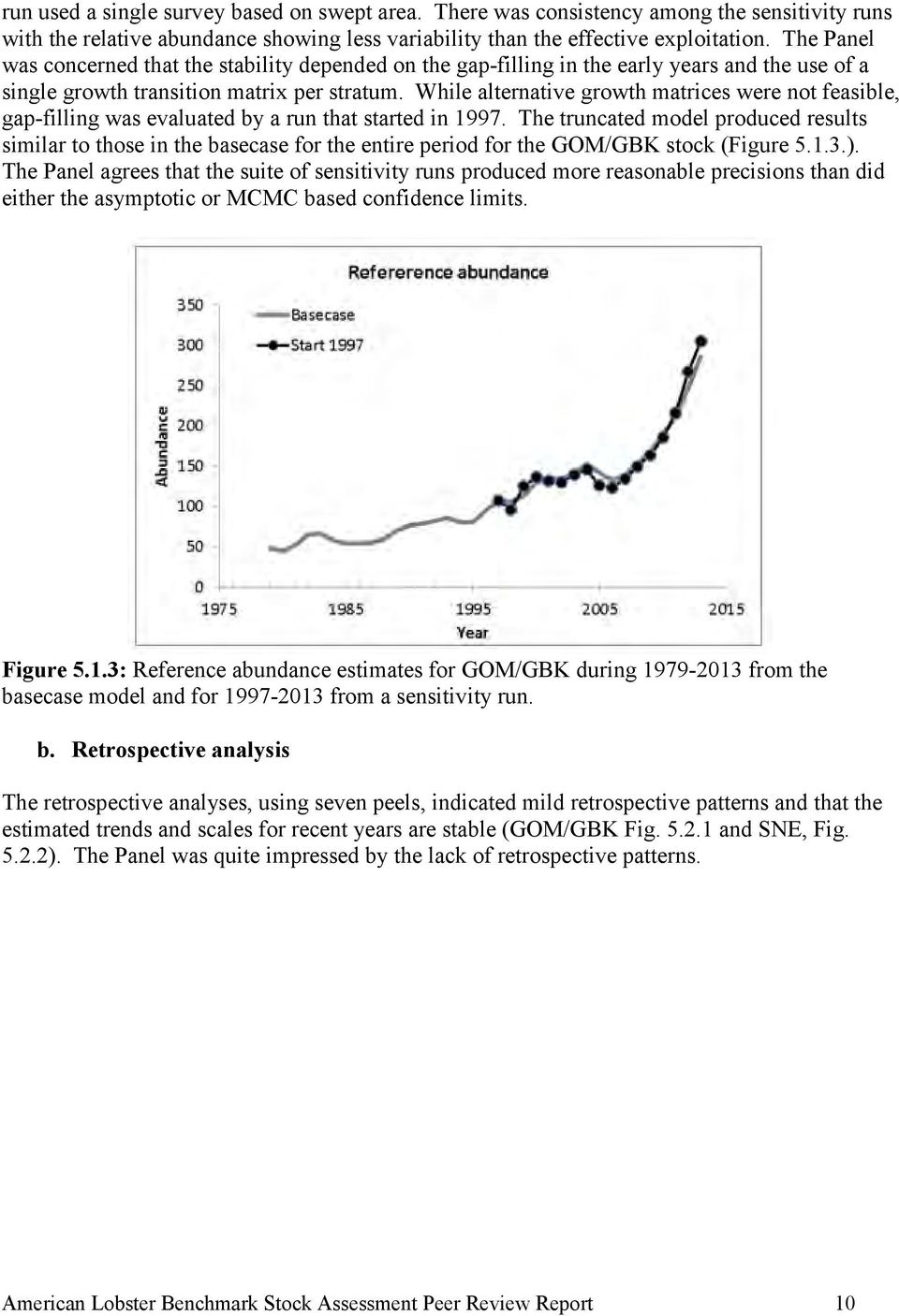
21 Figure a-b. Retrospective analysis for GOM/GBK lobster reference abundance estimates (left) and effective exploitation estimates (right) from the basecase model. Figure a-b. Retrospective analysis for SNE lobster reference abundance estimates (left) and effective exploitation estimates (right) from the basecase model. American Lobster Benchmark Stock Assessment Peer Review Report 11
22 6. Evaluate the preparation and interpretation of indicator-based analyses for stocks and sub-stock areas. The Panel supports the inclusion of indicator tables ( model-free indicators ) summarizing indicators of mortality, abundance and fishing performance for each of the stocks. The indicators provide information which is used to assess the robustness of abundance and exploitation estimates from the UMaine model. The approach of categorizing each indicator into lowest quartile (<25%), middle 2 quartiles (25-75%) and upper quartile (>75%) is simple, objective and identifies years that are associated with good or poor stock status. An example of the display for one of the abundance indicators (spawning stock abundance) for the GOM/GBK stock unit follows (Table 6.1): Table 6.1 GOM/GBK Abundance and Exploitation Indicators from Assessment Report, Table A and Darkest shading is the worst condition. American Lobster Benchmark Stock Assessment Peer Review Report 12
23 The Panel recommended a few changes to the indicators to make the annual values more comparable. For example, (i) the quartile calculations used the entire available time series, rather than the reference years used in the determination of stock status ( for GOM/GBK; for SNE) and the recommendation is to fix the reference period and calculate the quartiles in relation to the appropriate fixed period; and (ii) the calculations for Full Recruit Abundance (Survey) and Recruit Abundance (Survey) were developed with variable sizes because of changes in the minimum legal size and the recommendation is to adopt a consistent definition for the lengths pertaining to recruits and full-recruits. Given the importance of temperature to lobster life history and links made in the assessment to increased temperature in SNE and decreased lobster recruitment and abundance in SNE, the Panel recommends that an environmental indicator table be developed to illustrate changes in the temperature environment over time. The table should be based on existing (and as yet potentially unaccessed) bottom and surface temperature time series from different locations in each stock area. 7. Evaluate the current and recommended reference points and the methods used to calculate/estimate them. Evaluate stock status determination from the assessment or specify alternative methods. The Panel agrees with the SASC that traditional reference points, based on yield and spawning biomass per recruit and based on MSY considerations, are not appropriate given the life history and recruitment trends of lobster, and the current configuration of the per-recruit model. Instead, the Panel agrees with the choice of selected trend-based abundance and exploitation reference points determined from the model for an appropriate time period. (The panel noted that the definitions of stock indicators could be improved to make them consistent with the definitions used for determining stock status; the SASC agreed and has revised them.) The Panel agrees that the GOM/GBK combined stock is not overfished and overfishing is not occurring. This is clearly shown by both the model results and the stock indicators. (Separate determinations for GOM and GBK were not deemed appropriate by the SASC and the Panel.) The SNE stock is clearly overfished according to both the model and the stock indicators and, in fact, the abundance level is the lowest on record. Closer scrutiny reveals the inshore areas have extremely low abundance. Fishing mortality does not appear to be extremely high, supporting the conclusion that biological factors have contributed to bringing the stock to this point. It is believed the offshore area of SNE depends on nearshore settlement as the source of recruits. Therefore, the offshore is also in jeopardy. The SASC and Panel believe the SNE stock has little chance of recovering unless fishing effort is curtailed. To be specific, according to the reference point defined by the time series of model outputs, the exploitation rate for the entire SNE stock does not lie in the overfishing zone; however, the definition was created without considering the possibility that the stock could be at the lowest abundance level ever and the production of recruits in the inshore area (on which the offshore area depends) could be brought to an extremely low level. Hence, by any reasonable standard, it is necessary to protect the offshore component of the stock until increased recruitment can be observed. American Lobster Benchmark Stock Assessment Peer Review Report 13
24 8. Review the research, data collection, and assessment methodology recommendations provided by the Technical Committee and make any additional recommendations warranted. Clearly prioritize the activities needed to inform and maintain the current assessment, and provide recommendations to improve the reliability of future assessments. The Panel agrees with the SASC that updating growth is imperative. The growth transition matrices are critical to the model. Currently, growth is the based on tagging work from decades ago and growth probably has changed in recent years but there are no current data. Along with growth, maturity is important, especially female maturity, because female growth is directly linked to reproduction because a female does not molt if she is carrying eggs. If females mature at smaller sizes, their growth slows down earlier than what the existing transition matrices predict. The second priority task is to investigate stock connectivity. In the current assessment, the Georges Bank model was unsatisfactory and the fit of the Gulf of Maine model improved when the two stocks were combined. The SASC noted that the movement of larger lobsters between the two regions produced unrealistic results because the model could not account for the changes in population number especially the larger lobsters on Georges Bank. Therefore, a study is needed to validate combining the two stocks into a single stock. The SASC suggested tagging lobsters on Georges Bank in the fall and winter and then tracking them through the spring and summer. The Panel supports the need for this research. The third priority task is to increase the sea sampling for biological samples to complement the landings in offshore waters. The model requires information on the lengths, sexes, reproductive state, and weights of the lobsters caught in the different strata and, lacking these samples, the necessary associated gap-filling presented a major challenge to the SASC for those strata with landings but lacking length samples. Another priority that was obvious to the Review Panel throughout the SASC presentations and discussions, was the rigidity of the UM model and difficulty in its reconfiguration. Using ADModel Builder (Fournier et al. 2012) is a good platform but the code should be rewritten to be more flexible and efficient. 9. Review the recommended timing of the next benchmark assessment relative to the life history and current management of the species. For SNE, the Panel recommends close monitoring of the stock to try to save it. Stock indicators should be updated annually and reported to the Management Board for appropriate action. For GOM/GBK, given the good condition of the stock, a five-year interval may be appropriate for a benchmark assessment. However, the stock indicators should be updated frequently to detect signs of changing recruitment or other conditions. American Lobster Benchmark Stock Assessment Peer Review Report 14
25 Advisory Report A. Status of stocks: Current and projected, where applicable The combined GOM/GBK stock is neither overfished nor undergoing overfishing. The landings have been increasing since the late 1980s and have accelerated since 2008; and the recruitment trend based on the NEFSC trawl survey has been in the upper 25 percentile for the past five years (Assessment Report Table C) which lessens any concern of whether it can last. The effective exploitation index is rated neutral (25-75 percentile) and, between the fall and spring surveys, has been neutral half the time in the past ten years (Assessment Report Table ). The story is quite different for the SNE stock. The stock is overfished with four out of the six inshore surveys indicating abundances less than the 25th percentile (Assessment Report Table A) and recruitment also having three out of the six inshore surveys indicating that recruitment was also below the 25th percentile. The SNE region has shown the greatest increase in water temperature as measured by the number of days with temperatures above 20 ºC. As fishers have left the inshore fishery, effort has decreased and fishers have shifted to more offshore locations. However, the inshore and offshore areas are linked and offshore exploitation jeopardizes stock maintenance and recovery. B. Stock Identification and Distribution In the 2009 Assessment (ASMFC 2009), American lobster were assessed as three distinct stocks; the Gulf of Maine (GOM), Georges Bank (GBK), and Southern New England (SNE). Lacking genetic differentiation, American lobster stocks were separated on the basis of multiple factors including: regional rates of maturity and growth, size distribution, distribution and abundance trends of adults and juveniles, patterns of migration, location of spawners, the dispersal and transport of larvae, and considerations for large scale patterns in physical oceanographic processes (temperature regime and currents). In the current assessment, three stocks were again assumed but the data and models indicated that GBK was inseparable from GOM. The conclusion was based on differences in abundance and size composition between spring and fall surveys indicating that lobsters are very likely moving between the two areas. In addition, the model fit for GBK alone was poor but markedly improved when the model was run for GOM+GBK combined. The Review Panel supports the decision to view GOM and GBK as strongly linked and assessed as one stock, and encourages future research that will quantify the level of connectivity between the two areas. C. Management Unit The management unit for American lobster is the entire Northwest Atlantic Ocean in U.S. waters and its adjacent inshore waters where lobsters are found from Maine through Virginia. The Atlantic States Marine Fisheries Commission (ASMFC) manages the lobster fishery under the authority of the Atlantic Coastal Fisheries Cooperative Management Act. The ASMFC manages state waters (0-3 miles from shore) and the National Marine Fisheries Service (NMFS) manages the lobster fishery in federal waters (3-200 miles from shore). The fishery management plan American Lobster Benchmark Stock Assessment Peer Review Report 15
26 (FMP) provides for the management of lobster throughout their range. For management purposes, the management unit is subdivided into seven lobster conservation management areas (LCMAs) that cut across stock boundaries in many cases. Management units do not correspond to stock units defined in this assessment (see B. Stock Identification and Distribution). D. Landings The lobster fishery has a long history and landings data are available from the 1800s. The historical landings data provide a general characterization of lobster population trends over the past two centuries but must be viewed with caution since all fishery-dependent data are confounded in terms of size, location, and other market driven forces. Periods of high and low landings have been recognized for many years. Terms such as commercial extinction were in use in Low productivity, as measured by landings, extended for long periods; coast wide landings declined over a 25-year period from 1889 to 1915 and remained low for another 30 years. Gulf of Maine - Lobster landings in the Gulf of Maine were stable between 1981 and 1989 averaging 14,600 metric tons (mt), and then increased steadily from approximately 20,000 mt in early 1990s to approximately 35,000 mt in the mid-2000s. From 2007 to 2013 landings nearly doubled, reaching the time series high of 64,087 mt in Annual GOM landings have been in the upper quartile of the time series ( ) since More than 98% of the total GOM catch has come from inshore NMFS statistical areas. The increase in landings in GOM was dominated by catch from Maine, particularly from the midcoast portion of the state which has accounted for >50% of the entire GOM catch since Landings from New Hampshire varied without trend around a mean of 630 mt between 1981 and 2007; then from 2008 to 2013 they increased by 92%, reaching a time series high of 1,554 mt in Massachusetts landings increased from 1981 to 1990 and remained high between 1991 and 2000 (averaging 4,979 mt). Starting in 2001, Massachusetts landings declined reaching a time series low in 2005 (3,227 mt), with six out of the seven lowest landings values in the time series occurring between 2001 and Since 2008, landings in Massachusetts have increased steadily and have remained above the time series median in 2011 through Georges Bank - Lobster landings in the GBK stock unit varied around the time series mean of 1,371 metric tons (mt) between 1981 and From 2003 to 2013 landings increased substantially, reaching a time series high of 2,394 mt in 2005, and have remained well above the time series mean through Landings in the GBK stock have remained in the upper quartile for the time series ( ) for 8 of the last 9 years. Catch from the state of Massachusetts comprised the majority of the GBK landings, averaging 71% of the total since the early 1990s. The proportion of the Georges Bank fishery attributable to Massachusetts has increased over time, while the proportion attributable to Rhode Island has decreased. The trend is related to where the respective fisheries in Massachusetts and Rhode Island operate on Georges Bank. The majority of the Massachusetts landings from the Georges Bank stock are harvested on the northern and eastern side of the bank, which have experienced lobster landings increases over the course of the time series. Conversely, the majority of the Rhode Island fishery on Georges Bank occurs on the southern edge of the bank, in which American Lobster Benchmark Stock Assessment Peer Review Report 16
27 landings have been highly variable but generally lower in the latter half of the time series. Prior to 1993, New Hampshire did not have consistent landings in GBK. From 1993 to 2003, NH landings were stable, averaging 124 mt. Since 2004, NH landings have increased and have remained more than double the time series mean, reaching a time series high of 516 mt in Landings from all other states comprised less than 5% of the GBK landings throughout the time series. Southern New England - Lobster landings in SNE increased sharply from the early 1980s to the late 1990s, reaching a time series high of 9,935 mt in Landings remained near time series highs until 1999, then declined dramatically back to levels observed in the early 1980s. In sharp contrast to GOM, SNE landings from 2003 through 2012 varied at low levels around a mean of 2,500 mt. In 2013, catch dropped to a time series low of 1,509 mt. Commercial landings in SNE are below the lower quartile for the times series ( ). The majority of the catch from 2008 to 2013 in SNE was landed by Rhode Island (1981 to 2007 mean = 37%), followed in descending order by New Jersey and South (33%), Massachusetts (14%), New York (10%) and Connecticut (6%). This represents a marked change from previous periods when New York and Connecticut were the 2nd and 3rd largest producers respectively, and reflects the dramatic declines in catch in Long Island Sound. In general, catch in the inshore statistical areas in SNE have had the largest declines and are all now below previous lows observed in the early 1980s. Catch in the offshore/nearshore statistical areas have less variability in trend, but it should be noted that 9 out the 10 lowest catches landed in the time series have occurred since E. Data and Assessment Data Fisheries dependent data - The SASC expressed overall confidence in the current landings data by weight but noted the quality of landings data has not been consistent spatially or over time. They noted the potential for underreporting during some periods of the time series. Given the recent strong trends in landings and measures of abundance, the Review Panel s view is that potential underreporting in an earlier period would not affect the conclusions of the assessment. For data on the composition of the lobster catch (size, sex, reproductive status and other biological measures) samples were available from a mixture of sources. Collectively the biosample data were used to convert landings data (weight) into lobster number and to assign sex ratio and size structure to landings data. These are critical inputs to the assessment model which requires data by area, quarter and year. Although the data limitations were substantial the Panel finds that the SASC took a thorough (and resource intensive) approach to fill the gaps. The Panel notes that information on fishing effort is limited and opportunities to improve the collection of effort data should be taken. Fisheries-independent data The SASC presented a multitude of fisheries independent data sources available from various federal and state agencies: seven bottom trawl surveys, a ventless trap survey, settlement surveys for young-of-year, and larval surveys. Trawl survey data and ventless survey data were used for trend analyses and for input as abundance indices to the UM American Lobster Benchmark Stock Assessment Peer Review Report 17
28 model, while settlement and larval surveys were used as stock indicators only. Within stock areas the trends in the trawl surveys were in general agreement (an exception was the Massachusetts trawl survey which has not shown an upward trend in the GOM). The SASC noted that all trawl surveys are limited to trawlable bottom, which is generally considered outside of prime lobster habitat (cobbles to boulders). The panel encourages exploration of the effect of different bottom habitat on trap survey catch rates to help interpret abundance trends on trawlable bottom. Overall the Review Panel believes the SASC made best use of the available data. Assessment The SASC used both model-free stock indicators based on quartiles of annual values and a length-based model developed at the University of Maine that was used in the 2009 assessment. The stock indicators include effective exploitation (landings /survey), spawning stock abundance (mean weight of mature females by survey), full recruit abundance (number of legal sized lobsters by survey), recruit abundance (number of lobsters 10 mm below minimum size), survey lobster encounter rate (proportion of positive tows). Taken together, the stock indicators provide a comprehensive description of the lobster stocks. The UM model provides a quantitative summary by integrating landings, length and sex measurements, and surveys, on a spatial scale. When coupled with the growth matrices, the UM model provides rates of mortality, stock changes, etc. to provide managers with a thorough understanding of the condition and dynamics of the American lobster stocks. F. Biological Reference Points The SASC calculated the biological reference points (F5%, F10%, F15%, F20%, FMAX, and F0.1 using the UM model, Table III.1). By these metrics, overfishing is occurring in both the GOM and GOM/GBK stock. This seems implausible given the record abundance and recruitment observed in the stock over the last 20 years. It was not possible to calculate reasonable percent spawning biomass per recruit reference points (F5%, F10%, F15% or F20%) for the SNE stock because the relatively high assumed natural mortality, early sexual maturation (100% mature prior to recruiting to the fishery), and recent shifts in fishery selectivity towards larger lobsters (via increased minimum size regulations) make it impossible, based on the calculations, to fish hard enough to reduce mean lifetime egg production per recruit to even 20% the virgin level, let alone lower levels. American Lobster Benchmark Stock Assessment Peer Review Report 18
29 Table III.1. Per-recruit mortality-based reference points by stock. Red shading indicates the reference period estimate exceeds the threshold reference points. Green shading indicates the reference period estimate, i.e., , does not exceed the threshold reference points. From Assessment Report, Table The Review Panel believes these reference points are not meaningful and may be misleading. G. Fishing Mortality While fishing mortality is calculated by the model, the SASC prefers to use effective exploitation as the primary descriptors of annual fishing pressure when presenting assessment model results. Effective exploitation is the estimated annual catch in number from the model divided by the number of lobster 78+ mm CL on January 1 plus the number that will molt and recruit to 78+ mm CL during the year. Effective exploitation and full recruit fishing mortality (F) have similar trends but full F is higher and more variable. The relationship between the exploitation and fishing mortality measures in stock assessment results is not one-to-one because of variability in size selectivity due to changes in regulations, size structure and recruitment. In contrast, the relationship between effective exploitation and full F is one-to-one in per recruit modeling which assumes constant size selectivity and recruitment. The effective exploitation index for the GOM/GBK stock has been rated neutral (25-75 percentile) and, between the fall and spring surveys, has been neutral half the time in the past ten years (Assessment Report Table ). However, both relative abundance and recruitment have been in the upper quartile in recent years, indicating the stock can sustain this pressure under the current environmental conditions. While the effective exploitation in the SNE is rated as neutral, the inshore abundance and recruitment has frequently been in the lower quartile in recent years and is currently at the lowest level. H. Recruitment Recruitment in the two stocks has been quite different with recruitment in the upper quartile in the GOM/GBK stock and neutral or in the lower quartile in the SNE stock. In the inshore portion of the SNE stock, recruitment has been extremely low in recent years. American Lobster Benchmark Stock Assessment Peer Review Report 19
30 I. Spawning Stock Biomass Spawning stock biomass is difficult to measure with the wide range of ages of lobsters recruiting to the fishery. Lipofuscin work suggested that as many as five to eight year classes of lobsters constitute the lobsters entering the fishery in a given year. The SASC recommended using the relative abundance (the number of lobsters 78+ mm CL on January 1 plus the number that will molt and recruit to 78+ mm CL during the year) as a measure of stock abundance. The relative abundance of lobsters in the GOM/GBK based on the NEFSC trawl survey has been in the upper quartile in recent years (Assessment Report Table A). The relative abundance in the SNE has been neutral or below the lower quartile especially with the inshore surveys (Assessment Report Table A). J. Bycatch Little data are currently available on commercial discards of lobster in the lobster fishery. Sea sample data indicate substantial regulatory and market driven discard of sublegal, oversized, v- notched females, and ovigerous females. The regulatory discards are accommodated in the modeling as a component of gear selectivity and as conservation discards. Studies describing discard mortality in the trap fishery and/or bycatch mortality in the trawl fishery are limited but consistent in their findings that most mortality factors are relatively low. K. Other Comments None. L. Sources of Information (Literature Cited) Atlantic States Marine Fisheries Commission (ASMFC) American Lobster Stock Assessment for Peer Review. Fournier, D.A., H.J. Skaug, J. Ancheta, J. Ianelli, A. Magnusson, M.N. Maunder, A. Nielsen, and J. Sibert AD Model Builder: using automatic differentiation for statistical inference of highly parameterized complex nonlinear models. Optim. Methods Softw. 27: American Lobster Benchmark Stock Assessment Peer Review Report 20
31 Atlantic States Marine Fisheries Commission American Lobster Stock Assessment for Peer Review Report August 2015 Vision: Sustainably Managing Atlantic Coastal Fisheries
32 Atlantic States Marine Fisheries Commission 2015 American Lobster Stock Assessment Report for Peer Review Conducted on June 8-11, 2015 Woods Hole, Massachusetts Prepared by the ASMFC American Lobster Stock Assessment Subcommittee Mr. Robert Glenn (Chair), Massachusetts Division of Marine Fisheries Mr. Joshua Carloni, New Hampshire Fish and Game Ms. Penny Howell, Connecticut Department of Environmental Protection Dr. Larry Jacobson, National Marine Fisheries Service Ms. Kim McKown, New York State Department of Environmental Conservation, Bureau of Marine Resources Mr. Jason McNamee, Rhode Island Department of Environmental Management Dr. Genevieve Nesslage, Atlantic States Marine Fisheries Commission Dr. Tracy Pugh, Massachusetts Division of Marine Fisheries Dr. Burton Shank, National Marine Fisheries Service Mr. Carl Wilson, Maine Department of Marine Resources A publication of the Atlantic States Marine Fisheries Commission pursuant to National Oceanic and Atmospheric Administration Award No. NA10NMF
33 Terms of Reference for Stock Assessment 2015 American Lobster Stock Assessment 1. Estimate catch and catch-at-length from all available fishery dependent data sources including current and historical commercial, recreational, and discard data. a. Provide descriptions of each data source (e.g. geographic location, sampling methodology, variability, outliers). Discuss data strengths and weaknesses (e.g. temporal and spatial scale, gear selectivities, sample size) and their potential effects on the assessment. b. Justify inclusion or elimination of each data source. c. Explore improved methods for calculating catch-at-length matrix. 2. Present the abundance data being considered and/or used in the assessment (e.g. regional indices of abundance, recruitment, state-federal and other surveys, length data, etc.). a. Characterize uncertainty in these sources of data. b. Justify inclusion or elimination of each data source. c. Evaluate the utility of using industry catch rates as indices of abundance. d. Describe calculation or standardization of abundance indices. 3. Evaluate new information on life history such as growth rates, size at maturation, natural mortality rate, and migrations. 4. Use University of Maine Model (UMM) to estimate population parameters (e.g., effective exploitation rate, abundance) for each stock unit and analyze model performance. a. Modify UMM as necessary to incorporate new data sources, explore estimation of growth parameters, and estimate uncertainty. b. Evaluate stability of model. Perform and present model diagnostics. c. Perform sensitivity analyses to examine implications of important model assumptions, including but not limited to growth and natural mortality. d. Explain model strengths and limitations. e. Justify choice of CVs, effective sample sizes, or likelihood weighting schemes. f. State assumptions made and explain the likely effects of assumption violations on synthesis of input data and model outputs. g. Conduct projections assuming uncertainty in current and future conditions for all stocks. Compare projections retrospectively with updated data. 5. Develop simple, empirical, indicator-based trend analyses of reference abundance and effective exploitation for stocks and sub-stock areas. 6. Update the current fishing mortality and abundance biological reference points. If possible, develop alternative MSY-based reference points or proxies that may account for changing productivity regimes. 7. Characterize uncertainty of model estimates, reference points, and stock status. American Lobster Stock Assessment Report ii
34 8. Perform retrospective analyses, assess magnitude and direction of retrospective patterns detected, and discuss implications of any observed retrospective pattern for uncertainty in population parameters and reference points. 9. Report stock status as related to current overfishing and overfished reference points (both current and any alternative recommended reference points). Include simple description of the historical and current condition of the stock in layman s terms. 10. Address and incorporate to the extent possible recommendations from the 2009 Benchmark Peer Review and 2010 CIE review. 11. Develop detailed short and long-term prioritized lists of recommendations for future research, data collection, and assessment methodology. Highlight improvements to be made by next benchmark review. 12. Recommend timing of next benchmark assessment and intermediate updates, if necessary relative to biology and current management of the species. American Lobster Stock Assessment Report iii
35 Acknowledgments The Atlantic States Marine Fisheries Commission (ASMFC or Commission) thanks all of the individuals who contributed to the development of the American lobster stock assessment and the terms of reference. The Commission thanks Dr. Yong Chen, Dr. Michael Errigo, Yuying Zhang, and Han Chang from the University of Maine for their work on the assessment model. The Commission also thanks the ASMFC American Lobster Technical Committee (TC) and Stock Assessment Committee (SASC) members who developed the consensus stock assessment report, especially Bob Glenn (Massachusetts Division of Marine Fisheries, MADMF) for his exceptional work as the chair of the SASC and TC. Members of the American Lobster Stock Assessment Committee include Bob Glenn (Chair), Joshua Carloni (New Hampshire Fish and Game), Penny Howell (Connecticut Department of Energy and Environmental Protection), Dr. Larry Jacobson (National Marine Fisheries Service), Dr. Tracy Pugh (MADMF), Kim McKown (New York State Department Environmental Conservation, Bureau of Marine Resources), Jason McNamee (Rhode Island Department of Environmental Management, RIDEM), Dr. Genny Nesslage (ASMFC), Dr. Burton Shank (NMFS), and Carl Wilson (Maine Department of Marine Resources, MEDMR). Members of the American Lobster Technical Committee include Bob Glenn (Chair), Josh Carloni, Peter Clark (New Jersey Department of Environmental Protection, Bureau of Marine Fisheries), Penny Howell, Kim McKown, Jeff Mercer (RIDEM), Dr. Burton Shank, Craig Weedon (Maryland Division of Natural Resources), and Carl Wilson. The Commission also thanks the additional staff from each of our member states who provided assistance with the assessment, especially Kathleen Reardon (MEDMR). The Commission appreciates the efforts of Commission staff Toni Kerns, Dr. Genny Nesslage, Tina Berger, Megan Ware, and Kate Taylor in development and review of the American lobster stock assessment. The Commission also recognizes Dr. Genny Nesslage (ASMFC) and Atlantic Coastal Cooperative Statistics Program staff, especially Julie Defilippi for maintenance of the American Lobster Database. The Commission also thanks the Atlantic Offshore Lobstermen s Association for sharing their volunteer lobster sea-sampling data. American Lobster Stock Assessment Report iv
36 Executive Summary American lobster (Homarus americanus) supports one of the most valuable commercial fisheries in the Northeast U.S. with an annual estimated revenue in excess of $461 million in 2013 (NMFS, 2015). The United States management unit for American lobster is the Northwest Atlantic Ocean and its adjacent inshore waters where lobster are found from Maine through North Carolina. The Atlantic States Marine Fisheries Commission (ASMFC) manages the lobster fishery in state waters (0-3 miles from shore) and the National Marine Fisheries Service (NMFS) manages the lobster fishery in federal waters (3-200 miles from shore), both under the authority of the Atlantic Coastal Fisheries Cooperative Management Act. For management purposes, the management unit is subdivided into seven lobster conservation management areas that cut across the three biological stock unit boundaries. Currently, American lobster is managed under Amendment 3 to the Interstate Fishery Management Plan and its subsequent Addenda, I-XXIV. The plan is designed to minimize the chance of population collapse due to recruitment failure. The goal of Amendment 3 is to have a healthy American lobster resource and management regime, which provides for sustained harvest, maintains appropriate opportunities for participation, and provides for cooperative development of conservation measures by all stakeholders. Total landings in the fishery have steadily increased in the past thirty-five years. Up until the late 1970 s, landings were relatively constant at about 14,000 mt. However, by 2000, landings almost tripled to roughly 39,000 mt and by 2006 grew to 42,000 mt. Landings in 2013 were roughly 68,000 mt. US lobster landings are primarily comprised of catch from inshore waters (0 to 12 nautical miles). Historically, the stock has been divided into three biological units based on regional differences in life history parameters. They are the Gulf of Maine (GOM), Georges Bank (GBK), and Southern New England (SNE). Each stock is comprised of both an inshore and offshore component with the GOM and SNE areas being predominantly inshore fisheries and the GBK area being predominantly an offshore fishery. GOM supports the largest fishery, constituting approximately 76% of the U.S. landings between 1981 and 2007 and accounting for approximately 87% of landings since Landings in the GOM were stable between 1981 and 1989, averaging 14,600 mt, and then increased dramatically from 1990 (19,200 mt) to 2013 (64,000 mt). Landings averaged 51,000 mt from GBK constitutes a smaller portion of the U.S. fishery, with landings averaging 2,235 mt between 2008 and Like the GOM, landings were stable in the 1980 s and then quickly doubled in the early 2000 s to a high of 2,400 mt in Before 2011, SNE was the second largest fishery, accounting for 19% of the U.S. landings between 1981 and 2007; however, a sharp decline in the population has significantly reduced catch. Landings peaked in the 1990 s, reaching a time series high of 9,935 mt in Since this time, landings have precipitously dropped to a time series low of 1,500 mt in American Lobster Stock Assessment Report v
37 In this assessment, the University of Maine statistical catch-at-length model was used to estimate abundance and mortality of male and female lobsters by size for each stock unit. This was the primary model used in the 2009 assessment and it was updated to calculate sex-specific size distributions of new recruits, accommodate nonlinear surveys, and estimate growth transition matrices internally from tag data. In addition, trends in a suite of non model-based stock status indicators of mortality, abundance, and fishery performance were examined using a traffic light approach. Current abundance of the GOM stock overall is at a record high. Abundance estimates show an increasing trend starting in 1988 and then an increasing slope after Recent recruitment levels are also at or near record highs. Results of the model for GBK were not accepted because they did not fit survey trends, landings, or survey length data. This provided strong evidence that the GBK is not a closed population. Furthermore, seasonal patterns in the NEFSC survey showing a migration of large females (>100 CL) from the GOM in the spring to the GBK in the fall corroborated this population dynamic. As a result, the GOM and GBK biological stocks were combined into a single stock (GOM/GBK) and model run. This combined stock was able to effectively model recruitment size compositions and seasonal variations in the location of large females. Trends from the GOM/GBK model showed that abundance increased after 1979 and at an accelerated pace after Recruitment and spawning stock abundance have remained high between 2008 and Exploitation estimates declined after 1979 until the mid-1990 s and then remained stable with higher exploitation on males than females. Current exploitation rates remain on par with the average. Contrastingly, abundance estimates for the SNE stock show a sharp decline through the early 2000 s to a record low level in Basecase estimates for recent recruitment are near zero and the lowest on record. In particular, the inshore portion of the stock shows a dramatic decline in spawning stock abundance and the proportion of positive tows in surveys. Effective exploitation trended downwards in the early 2000 s and remained at relatively low average levels during Reference abundance and effective exploitation are used as reference points in this model. Reference abundance is the number of lobster 78+ mm CL on January 1 plus the number that will molt and recruit into the 78+ mm CL group during the year. Effective exploitation is the annual catch (in number) divided by the reference abundance. Based on these reference points, a stock is considered overfished if model abundance is less than the 25 th percentile relative to the (GOM, GBK, GOM/GBK) or (SNE) reference period. Overfishing would occur if exploitation is greater than the 75 th percentile relative to the 1982/ reference period. In either of these cases, corrective management action should be implemented. The GOM stock shows a dramatic increase in abundance since the late 1980 s. Furthermore, the exploitation rate is below the reference threshold. Therefore, the GOM lobster stock is not depleted and overfishing is not occurring. American Lobster Stock Assessment Report vi
38 While the GBK model results were not accepted, an empirical approach based on survey and landings data was used instead. Based upon this approach, the GBK stock is not depleted and overfishing is not occurring. The GOM/GBK stock is in favorable condition based on the recommended reference points. The stock is well above the reference abundance threshold and slightly below the effective exploitation threshold. Therefore the GOM/GBK lobster stock is not depleted and overfishing is not occurring. The SNE stock is in poor condition based on the recommended reference points. The stock is well below the reference abundance threshold and below the effective exploitation threshold. Therefore the SNE lobster stock is depleted but overfishing is not occurring. Table 1. Revised threshold reference points with stock status variables for lobsters in each stock area (annual effective exploitation rate and reference abundance in number of lobsters). The assessment recommends that the GOM and GBK biological stocks be combined into a single stock. Furthermore, the assessment shows the SNE stock is not rebuilding and is experiencing recruitment failure. A longer and more geographically widespread harvest moratorium in SNE would be necessary to increase spawning stock abundance enough to boost recruitment and allow the stock to rebuild. American Lobster Stock Assessment Report vii
39 TABLE OF CONTENTS Acknowledgments... iv Executive Summary..... v 1.0 INTRODUCTION MANAGEMENT UNIT REGULATORY HISTORY ASSESSMENT HISTORY LIFE HISTORY CRITICAL COMPONENTS OF LOBSTER HABITAT TEMPERATURE EFFECTS AND CHANGING CLIMATE CONDITIONS Relationship between temperature and recruitment NATURAL MORTALITY Fish Predation on Lobster SHELL DISEASE AGE GROWTH Growth Matrices Molt Probability Molt Increments Growth Transition Matrices REPRODUCTION Maturity GENETIC INFORMATION STOCK DEFINITIONS FISHERY DESCRIPTION BRIEF HISTORY OF THE LOBSTER FISHERY CURRENT STATUS Gulf of Maine Georges Bank Southern New England DATA SOURCES FISHERY DEPENDENT DATA SOURCES American Lobster Stock Assessment Report viii
40 4.1.1 Commercial Catch Data Collection Methods Commercial Discards/Bycatch Recreational Catch Biological Samples Data Collection Methods: Port and Sea Biological Samples Size structure of commercial catch Sampling Intensity Development of Estimates from Biological Data Changes to legal size limits Updated L-W parameters FISHERY INDEPENDENT DATA SURVEYS Trawl Surveys Trawl Survey Methods Survey Trends Trawl Survey Abundance Indices Size Structure of Survey Catches Spatial Components GOM Spatial Distribution (trawl surveys) George s Bank Spatial Distribution (trawl surveys) SNE Spatial Catch Distributions (trawl surveys) Coastwide Ventless Trap Survey Survey Methods Development of Abundance Indices Survey Indices, Spatial Patterns and Length Compositions Settlement and Larval Surveys Additional Survey Information Considered STOCK INDICATORS STOCK INDICATOR METHODS Mortality Indicator Abundance Indicators Fisheries Performance Indicators STOCK INDICATOR RESULTS GOM American Lobster Stock Assessment Report ix
41 5.2.2 GBK SNE Combined GOM / GBK Indicators UNIVERSITY OF MAINE MODEL UNIVERSITY OF MAINE MODEL METHODS UNIVERSITY OF MAINE MODEL CONFIGURATIONS UNIVERSITY OF MAINE MODEL RESULTS, SENSITIVITY ANALYSIS AND DISCUSSION GOM Basecase Results, Sensitivity Analysis & Discussion GBK Basecase Results, Sensitivity Analysis & Discussion GOM/GBK Basecase Results, Sensitivity Analysis & Discussion SNE Basecase Results, Sensitivity Analysis & Discussion UNCERTAINTY Asymptotic and MCMC intervals Retrospective Pattern Analyses REFERENCE POINTS CURRENT REFERENCE POINT DEFINITIONS Abundance Reference Point Exploitation Reference Point BACKGROUND RESULTS Gulf of Maine Georges Bank Gulf of Maine/Georges Bank Southern New England BIOLOGICAL REFERENCE POINTS PROJECTIONS RESEARCH RECOMMENDATIONS FISHERY DEPENDENT INFORMATION FISHERY INDEPENDENT INFORMATION MATURITY AND GROWTH AGE American Lobster Stock Assessment Report x
42 8.5 ENVIRONMENTAL INFLUENCE ON LOBSTER LIFE HISTORY PROCESSES POPULATION DYNAMICS AND MATING SUCCESS STOCK CONNECTIVITY LITERATURE CITED TABLES FIGURES APPENDIX 1: ASSESSMENT MODEL FOR FISHERY DEPENDENT DATA APPENDIX 2: SASC RESPONSES TO 2009 PEER REVIEW AND 2010 CIE REVIEW External Appendices, which address GOM model outputs (Appendix 3), GBK model outputs (Appendix 4), Combined GOM/GBK model outputs (Appendix 5), SNE model outputs (Appendix 6), and Comparison of catch for key species between old and new door configurations for the RI Trawl Survey (Appendix 7), are available from the Commission upon request at American Lobster Stock Assessment Report xi
43 LIST OF TABLES Table 1.2: A summary of management measures by LCMA Table 2.1.1: A summary of key biological threshold values for H. americanus Table SNE UMM difference in total unweighted negative log likelihood from the base run Table 2.3.2: Annual days with average temperature above 20 C recorded at Millstone Power Station Table Total numbers of lobsters observed in stomach samples collected during NEFSC winter, spring and fall bottom trawl surveys Table Mean percent stomach contents by weight for lobster in the top five predators based on NEAMAP stomach samples Table Annual shell disease prevalence in lobsters observed during commercial trap sampling by state and NMFS statistical area Table Parameters for logistic molt probability curves for American lobster Table Assumed double molting probabilities for lobsters used in calculating growth matrices for the University of Maine stock assessment model Table Sample size, pre-molt size range and mean molt increment model parameters used to estimate lobster growth for the GOM, GBK and combined GOM & GBK stock areas Table Sample size, pre-molt size range and mean molt increment model parameters used to estimate lobster growth for the SNE stock assessment Table Minimum and maximum molt increment and growth rate criteria Table Assignment of surveys to stock regions used in modeling Table Assignment of statistical areas for landings to stock regions used in modeling Table 3.2. Number of commercial lobster licenses issued by jurisdiction, 1981 to Table Gulf of Maine landings in metric tons by state from 1981 to Table Number of traps reported fished by state in the Gulf of Maine stock unit. 131 Table Georges Bank landings in metric tons by state from 1981 to Table Number of traps reported fished by state in the Georges Bank stock unit. 133 Table Southern New England landings in metric tons by state from 1981 to American Lobster Stock Assessment Report xii
44 Table Number of traps reported fished by state in the Southern New England stock unit Table Results of a sampling intensity analysis, GOM Table Results of a sampling intensity analysis, GBK Table Results of a sampling intensity analysis, SNE Table Minimum and maximum legal sizes by stock, used for legal selectivity Table Parameter estimates for the length-weight analysis on log transformed data Table Back transformed parameter estimates for the length-weight equation Table Sampling seasons, strata, and survey coverage (total survey area and actual area swept) for fishery-independent trawl surveys incorporated into assessment models. 142 Table Size-based calibration coefficients (r) and CVs for lobster in NEFSC bottom trawl surveys Table Coefficients of variation (CV) for the Maine-New Hampshire, Massachusetts, and NMFS NEFSC bottom trawl surveys by season and sex Table Coefficients of variation (CV) for NMFS NEFSC bottom trawl survey by season and sex Table Coefficients of variation (CV) for the Massachusetts, Rhode Island, Connecticut, New Jersey, NEAMAP, and NMFS NEFSC bottom trawl surveys by season and sex Table GOM Mortality Indicators categorized based on quartile rankings Table GOM Abundance Indicators A through E Table GOM Fishery Performance Indicators Table GBK Mortality Indicators Table GBK Abundance Indicators A through D Table GBK Fishery Performance Indicators Table SNE Mortality Indicators Table SNE Abundance Indicators A through E Table SNE Fishery Performance Indicators Table GOM / GBK Combined Mortality Indicators Table GOM / GBK Combined Abundance Indicators A through E Table GOM / GBK Combined Fishery Performance Indicators American Lobster Stock Assessment Report xiii
45 Table Configuration of basecase models for lobster in this assessment by stock area Table Survey data, selectivity and catchability configuration in the basecase model for GOM Table Survey data, selectivity and catchability configuration in the basecase model for GBK Table Survey data, selectivity and catchability configuration in the basecase model for GOM/GBK Table Survey data, selectivity and catchability configuration in the basecase model for SNE Table Annual recruitment, reference abundance, effective exploitation and spawning biomass estimates for American lobster from Table Likelihood profile over the mean log recruitment parameter in a preliminary GOM basecase assessment model run Table Mean ( ) effective exploitation and reference abundance estimates for GOM lobster (sexes combined) Table Annual reference abundance and effective exploitation estimates for from the empirical basecase model for GBK Table Likelihood profile over the mean log recruitment parameter in the GBK University of Maine assessment model Table Mean ( ) effective exploitation and reference abundance estimates for GBK lobster (sexes combined) Table Annual recruitment, reference abundance, effective exploitation and spawning biomass estimates for American lobster from from the basecase model for GOM/GBK Table Likelihood profile over the mean log recruitment parameter in the GOM/GBK basecase assessment model run Table Mean annual effective exploitation and reference abundance estimates for GOM/GBK lobster (sexes combined) from from basecase and sensitivity run Table Annual recruitment, reference abundance, effective exploitation and spawning biomass estimates for American lobster from from the basecase model for SNE Table Likelihood profile over the mean log recruitment parameter in the SNE basecase assessment model run American Lobster Stock Assessment Report xiv
46 Table Mean ( ) effective exploitation and reference abundance estimates for SNE lobster (sexes combined) from the basecase and sensitivity analysis runs Table Area covered and area swept (based on wing spread) for selected bottom trawl survey programs in SNE Table Asymptotic confidence and MCMC credibility intervals with 95% coverage for mean reference abundance and effective exploitation during Table Historical retrospective results for comparison of basecase reference abundance estimates for in ASMFC (2009) and this assessment Table Mohn s rho retrospective scores for basecase lobster models in this assessment Table Reference period ( ) threshold and target abundance and effective exploitation for the GOM, GBK, GOM/GBK, and SNE stocks Table Per-recruit mortality based reference points by stock American Lobster Stock Assessment Report xv
47 LIST OF FIGURES Figure 1.1 Statistical areas used to define the U.S. American lobster, Homarus americanus, stocks Figure Annual anomalies from the time series mean SST at Boothbay Harbor, ME and Woods Hole, MA Figure Number of days SST was within the optimal temperature range of 12 to 18º C at Boothbay Harbor, ME 1960 to 2012 (dashed line) Figure Anomalies from the time series mean number of days between 12 to 18 ºC at Manomet Point (depth = 18m) Cape Cod Bay, Massachusetts Figure Sea Surface Temperature Anomalies from the # of Days > 20 C from 1945 to 2014 at Woods Hole, MA Figure Bottom water temperature anomalies from the mean number of days >20 C at Cleveland Ledge, Buzzards Bay, MA Figure Bottom water (11 m) temperature anomalies from the mean number of days >20 C at Dominion Nuclear Power Station, eastern Long Island Sound, CT Figure Number of days annually with mean surface temperature between 12 and 18 C in Boothbay Harbor, Figure Observed recruit-size abundance indices generated from the ME Trawl Survey catches compared to predicted indices Figure Annual relative abundance of recruit-size lobster versus the annual number of days with average temperature above 20 C Figure Difference in fit of alternative UMM model runs from 2009 Assessment (ASMFC 2009) assuming different Ms during Figure Rate of decline in predicted and observed recruitment based on water temperature pattern, Figure Annual shell disease prevalence in lobster captured by the Millstone Power Plant ventless trap survey (see DNC 2013) and the number of days that bottom water temperatures exceeded 20 C Figure Apparent growth of male and female lobsters in three stocks based on updated growth transition matrices Figure Stock definitions from NEFSC finfish survey strata for SNE (light gray), GOM (medium gray) and GBK (dark gray) Figure Mean catch per tow at length (mm) by season for GBK females in the NEFSC trawl survey American Lobster Stock Assessment Report xvi
48 Figure NEFSC trawl survey swept area abundance time series for GBK females >100mm CL Figure NEFSC trawl survey swept area abundance time series for GOM females >100mm CL Figure NEFSC trawl survey swept area abundance time series for combined GOM/GBK females >100mm CL Figure Mean catch per tow at length (mm) by season for GOM females in the NEFSC trawl survey Figure Mean catch per tow at length (mm) by season for combined GOM/GBK females in the NEFSC trawl survey Figure Model estimated size composition of new female recruits by stock Figure Comparison of cumulative length distribution of egg-bearing female lobsters from Buzzards Bay, MA (2007)/Cox Ledge, MA (1894) Figure Annual CPUE (total # landed / total # traps) of lobsters >92 mm, , and in Massachusetts coastal waters Figure Comparison of cumulative length distribution of egg-bearing female lobsters from the Hudson Canyon from the 1960s, 1990s, and 2000s Figure Commercial landings in the Southern New England stock unit Figure Size structure of the GOM female commercial catch Figure Size structure of the GOM male commercial catch Figure Size structure of the GBK female commercial catch Figure Size structure of the GBK male commercial catch Figure Size structure of the SNE female commercial catch Figure Size structure of the SNE male commercial catch Figure Examples of the length frequency distributions of the carapace length for example statistical areas in Figure A-C. Model fits to the length-weight data for combined sexes, females, and males for GOM, GBK, and SNE Figure Gulf of Maine spring trawl survey indices for the NEFSC, MADMF, and ME-NH surveys, sexes combined Figure Gulf of Maine fall trawl survey indices for the NEFSC, MADMF, and ME-NH surveys, sexes combined American Lobster Stock Assessment Report xvii
49 Figure Georges Bank spring and fall trawl survey indices for the NEFSC survey, sexes combined Figure Southern New England spring trawl survey indices for the Connecticut, Rhode Island, NEMAP, and NEFSC surveys, sexes combined Figure Southern New England fall trawl survey indices for the Connecticut, Rhode Island, NEMAP, and NEFSC surveys, sexes combined Figure Southern New England spring trawl survey indices for the Massachusetts and New Jersey surveys, sexes combined Figure Gulf of Maine NEFSC fall survey annual female length frequencies Figure Gulf of Maine NEFSC fall survey annual male length frequencies Figure Gulf of Maine NEFSC spring survey annual female length frequencies Figure Gulf of Maine NEFSC spring survey annual male length frequencies Figure Gulf of Maine ME/NH fall survey annual female length frequencies. 214 Figure Gulf of Maine ME/NH fall survey annual male length frequencies Figure Gulf of Maine ME/NH spring survey annual female length frequencies Figure Gulf of Maine ME/NH spring survey annual male length frequencies Figure Gulf of Maine MA fall survey annual female length frequencies Figure Gulf of Maine MA fall survey annual male length frequencies Figure Gulf of Maine MA spring survey annual female length frequencies. 217 Figure Gulf of Maine MA spring survey annual male length frequencies Figure Georges Bank NEFSC fall survey annual female length frequencies. 218 Figure Georges Bank NEFSC fall survey annual male length frequencies Figure Georges Bank NEFSC spring survey annual female length frequencies Figure Georges Bank NEFSC spring survey annual male length frequencies Figure Southern New England NEFSC fall survey annual female length frequencies Figure Southern New England NEFSC fall survey annual male length frequencies American Lobster Stock Assessment Report xviii
50 Figure Southern New England NEFSC spring survey annual female length frequencies Figure Southern New England NEFSC spring survey annual male length frequencies Figure Southern New England MA spring survey annual female length frequencies Figure Southern New England MA spring survey annual male length frequencies Figure Southern New England RI fall survey annual female length frequencies Figure Southern New England RI fall survey annual male length frequencies Figure Southern New England RI spring survey annual female length frequencies Figure Southern New England RI spring survey annual male length frequencies Figure Southern New England CT fall survey annual female length frequencies Figure Southern New England CT fall survey annual male length frequencies Figure Southern New England CT spring survey annual female length frequencies Figure Southern New England CT spring survey annual male length frequencies Figure Southern New England NJ spring survey annual female length frequencies Figure Southern New England NJ spring survey annual male length frequencies Figure Southern New England NEAMAP fall survey annual female length frequencies Figure Southern New England NEAMAP fall survey annual male length frequencies Figure Southern New England NEAMAP spring survey annual female length frequencies American Lobster Stock Assessment Report xix
51 Figure Southern New England NEAMAP spring survey annual male length frequencies Figure A H. Mean catch per tow of lobster (all sizes) at each fall sampling location from all GOM bottom trawl surveys (ME/NH, MA, and NMFS), shown in 5 year time periods Figure A H. Mean catch per tow of lobster (all sizes) at each spring sampling location from all GOM bottom trawl surveys (ME/NH, MA, and NMFS), shown in 5 year time periods Figure A E. Mean catch per tow of ovigerous females (all sizes) at each fall sampling location from all GOM bottom trawl surveys (ME/NH, MA, and NMFS), shown in 5 year time periods Figure A D. Mean catch per tow of ovigerous females (all sizes) at each spring sampling location from all GOM bottom trawl surveys (ME/NH, MA, and NMFS), shown in 5 year time periods Figure A H. Mean catch per tow of large lobster ( 127 mm CL) at each fall sampling location from all GOM bottom trawl surveys (ME/NH, MA, and NMFS), shown in 5 year time periods Figure A H. Mean catch per tow of large lobster ( 127 mm CL) at each spring sampling location from all GOM bottom trawl surveys (ME/NH, MA, and NMFS), shown in 5 year time periods Figure A H. Mean catch per tow of lobster (all sizes) at each fall sampling location from all GBK bottom trawl surveys (NMFS and MA), shown in 5 year time periods Figure A H. Mean catch per tow of lobster (all sizes) at each spring sampling location from all GBK bottom trawl surveys (NMFS and MA), shown in 5 year time periods Figure A E. Mean catch per tow of ovigerous females (all sizes) at each fall sampling location from all GBK bottom trawl surveys (NMFS and MA), shown in 5 year time periods Figure A D. Mean catch per tow of ovigerous females (all sizes) at each spring sampling location from all GBK bottom trawl surveys (NMFS and MA), shown in 5 year time periods Figure A H. Mean catch per tow of large lobster ( 127 mm CL) at each fall sampling location from all GBK bottom trawl surveys (NMFS and MA), shown in 5 year time periods American Lobster Stock Assessment Report xx
52 Figure A H. Mean catch per tow of large lobster ( 127 mm CL) at each spring sampling location from all GBK bottom trawl surveys (NMFS and MA), shown in 5 year time periods Figure A H. Mean catch per tow of lobster (all sizes) at each fall sampling location from all SNE bottom trawl surveys (MA, RI, CT, NJ, NMFS, NEAMAP), shown in 5 year time periods Figure A H. Mean catch per tow of lobster (all sizes) at each spring sampling location from all SNE bottom trawl surveys (MA, RI, CT, NJ, NMFS, NEAMAP), shown in 5 year time periods Figure A G. Mean catch per tow of ovigerous females (all sizes) at each fall sampling location from all SNE bottom trawl surveys (MA, RI, CT, NJ, NMFS, NEAMAP), shown in 5 year time periods Figure A G. Mean catch per tow of ovigerous females (all sizes) at each spring sampling location from all SNE bottom trawl surveys (MA, RI, CT, NJ, NMFS, NEAMAP), shown in 5 year time periods Figure A H. Mean catch per tow of large lobster ( 127 mm CL) at each fall sampling location from all SNE bottom trawl surveys (MA, RI, CT, NJ, NMFS, NEAMAP), shown in 5 year time periods Figure A H. Mean catch per tow of large lobster ( 127 mm CL) at each spring sampling location from all SNE bottom trawl surveys (MA, RI, CT, NJ, NMFS, NEAMAP), shown in 5 year time periods Figure GOM Ventless Trap Survey indices (A) by sex and (B) by state Figure GOM Ventless Trap survey indices by depth strata and statistical area. 359 Figure A - G. Annual mean catch per trap haul of all lobsters in the GOM Coastwide Ventless Trap Survey Figure Size frequency distribution observed in GOM Coastwide Ventless Trap Survey catches ( ) Figures SNE Ventless Trap Survey indices (A) by sex and (B) by state Figures SNE Ventless Trap Survey indices by depth strata and statistical areas Figure A - H. Annual mean catch per trap haul of all lobsters in the SNE Coastwide Ventless Trap Survey Figure Size frequency distribution observed in SNE Coastwide Ventless Trap Survey catches ( ) Figure URI_GSO trawl survey index (Narragansett Bay, ) and Millstone Power Station trawl survey index (Long Island Sound, ) American Lobster Stock Assessment Report xxi
53 Figure Avearge CPUE from the Millstone Power Station ventless trap survey Figure Average larval density from the Millstone Power Station larval lobster entrainment survey Figure CPUE of lobsters from the Seabrook Power Station (SA 513) ventless trap survey Figure Larval lobster density from the Seabrook Power Station (SA 513) neuston net survey Figure Annual recruitment, reference abundance, effective exploitation and spawning biomass estimates for American lobster from from the basecase model for GOM and for from ASMFC (2009) Figure Annual reference abundance estimates for GOM lobster from from the basecase and sensitivity model runs Figure Annual effective exploitation estimates for GOM lobster from from the basecase and sensitivity model runs Figure Trends in empirical basecase reference abundance and effective exploitation trends for GBK lobster (sexes combined) from Figure Trends in empirical reference abundance and effective exploitation estimates for GBK lobster by sex from Figure Annual recruitment, reference abundance, effective exploitation and spawning biomass estimates for from the University of Maine model for GBK and for from ASMFC (2009) Figure Reference abundance estimates for GBK lobster during from the University of Maine model and sensitivity model runs Figure Effective exploitation estimates for GOM lobster during from the University of Maine Model and sensitivity model runs Figure Observed (black circles) and predicted catches (grey line) in a sensitivity run where the likelihood weights for the NEFSC fall female and male surveys and the spring female survey were increased to Figure Annual recruitment, reference abundance, effective exploitation and spawning biomass estimates for from the basecase model for GOM/GBK and for from ASMFC (2009) Figure Annual reference abundance estimates for GOM/GBK lobster from from the basecase and sensitivity model runs Figure Annual effective exploitation estimates for GOM/GBK lobster from from the basecase and sensitivity model runs American Lobster Stock Assessment Report xxii
54 Figure Annual recruitment, reference abundance, effective exploitation and spawning biomass estimates for American lobster from from the basecase model for SNE and for from ASMFC (2009) Figure Annual reference abundance estimates for SNE lobster from from the basecase and sensitivity model runs Figure Annual effective exploitation estimates for SNE lobster from from the basecase and sensitivity model runs Figure Spring (top) and fall (bottom) swept-area survey abundance data used in sensitivity analyses for SNE Figure GOM summed likelihood profile results for a range of values for the mean log recruitment parameter and for mean reference N from Figure GOM/GBK summed likelihood profile results for a range of values for the mean log recruitment parameter and for mean reference N from Figure SNE summed likelihood profile results for a range of values for the mean log recruitment parameter and for mean reference N from Figure Retrospective analysis for GOM lobster reference abundance estimates from the preliminary basecase model Figure Retrospective analysis for GOM lobster effective exploitation estimates from the preliminary basecase model Figure Retrospective analysis for GBK lobster reference abundance estimates from the basecase model Figure Retrospective analysis for GBK lobster effective exploitation estimates from the University of Maine model Figure Retrospective analysis for GOM/GBK lobster reference abundance estimates from the basecase model Figure Retrospective analysis for GOM/GBK lobster effective exploitation estimates from the basecase model Figure Retrospective analysis for SNE lobster reference abundance estimates from the preliminary basecase model Figure Retrospective analysis for SNE lobster effective exploitation estimates from the preliminary basecase model Figure Diagram of the abundance reference point threshold, target, and management responses for the Gulf of Maine and Georges Bank stocks Figure Diagram of the abundance reference point threshold, target, and management responses for the Southern New England stocks American Lobster Stock Assessment Report xxiii
55 Figure Diagram of the mortality based reference point threshold, target, and management responses for the GOM, GBK, and SNE stocks Figure Reference abundance and effective exploitation estimates for from the basecase University of Maine assessment model for GOM lobster Figure Reference abundance and effective exploitation estimates for from an empirical trend based assessment based on survey and landings data for GBK lobster Figure Reference abundance and effective exploitation estimates for from the basecase University of Maine assessment model for GOM/GBK lobster Figure Reference abundance and effective exploitation estimates for from the basecase University of Maine assessment model for SNE lobster Figure Basecase assessment model projection estimates for GOM lobster Figure Basecase assessment model projection estimates for GOM/GBK lobster Figure Basecase assessment model projection estimates for SNE lobster American Lobster Stock Assessment Report xxiv
56 1.0 INTRODUCTION American lobster (Homarus americanus) supports one of the most valuable commercial fisheries in the Northeast U.S. with an annual estimated revenue in excess of $461 million in 2013 (NMFS, 2015). The U.S. lobster resource occurs in continental shelf waters from Maine to North Carolina. Historically, three stocks have been identified based primarily on regional differences in life history parameters. They are the Gulf of Maine (GOM), Georges Bank (GBK), and Southern New England (SNE) (Figure 1.1). Each stock supports both an inshore (0-3 miles) and offshore (3-200 miles) component; however total U.S. lobster landings are primarily comprised of catch from nearshore waters (0 to 12 nautical miles). 1.1 MANAGEMENT UNIT The management unit for American lobster is the entire Northwest Atlantic Ocean and its adjacent inshore waters where lobster is found from Maine through Virginia. The Atlantic States Marine Fisheries Commission (ASMFC) manages the lobster fishery in state waters (0-3 miles from shore) and the National Marine Fisheries Service (NMFS) manages the lobster fishery in federal waters (3-200 miles from shore), both under the authority of the Atlantic Coastal Fisheries Cooperative Management Act. The fishery management plan (FMP) is written to provide for the management of lobsters throughout their range. The FMP is designed to specify a uniform program regardless of lines that separate political jurisdictions, to the extent possible. The different management authorities are expected to take necessary actions to apply the provisions of this FMP in waters under their respective jurisdictions. For management purposes, the management unit is subdivided into seven Lobster Conservation Management Areas (LCMAs) that cut across stock boundaries in many cases (Figure 1.1). Management units do not correspond to stock units defined in this assessment (see section 3.2). 1.2 REGULATORY HISTORY The ASMFC American Lobster Board approved Amendment 3 to the FMP in December of The plan is designed to minimize the chance of population collapse due to recruitment failure. The goal of the amendment is to have a healthy American Lobster resource and management regime, which provides for sustained harvest, maintains appropriate opportunities for participation, and provides for cooperative development of conservation measures by all stakeholders. To achieve this goal, the plan adopts the following objectives: 1. Protect, increase or maintain, as appropriate, the brood stock abundance at levels which would minimize risk of stock depletion and recruitment failure; 2. Develop flexible regional programs to control fishing effort and regulate fishing mortality rates; 3. Implement uniform collection, analysis, and dissemination of biological and economic information; improve understanding of the economics of harvest; 4. Maintain existing social and cultural features of the industry wherever possible; 5. Promote economic efficiency in harvesting and use of the resource; 6. Minimize lobster injury and discard mortality associated with fishing; 7. Increase understanding of biology of American lobster, improve data, improve stock assessment models; improve cooperation between fishermen and scientists; American Lobster Stock Assessment Report 1
57 8. Evaluate contributions of current management measures in achieving objectives of the lobster FMP; 9. Ensure that changes in geographic exploitation patterns do not undermine success of ASMFC management program; 10. Optimize yield from the fishery while maintaining harvest at a sustainable level; 11. Maintain stewardship relationship between fishermen and the resource. Amendment 3 defines overfishing for the American lobster resource to occur when it [any stock] is harvested at a rate that results in egg production from the resource, on an egg-perrecruit basis, that is less than 10% of the level produced by an unfished population (ASMFC, 1997). The primary management measures used to prevent overfishing include a minimum size, protection of ovigerous females, and trap limits. Amendment 3 established a framework for area management, which includes industry participation through seven Lobster Conservation Management Teams (LCMT). LCMTs were encouraged to develop recommendations for a management program, which suits the needs of the area while meeting targets established in the plan. The Board adopted a three-phase approach to incorporate the LCMT recommendations, which involved three addenda to Amendment 3. Addendum I incorporated measures from the LCMT proposals directed at effort control. After consideration of the stock assessment and peer review results in ASMFC (2000), the Board initiated the development of Addendum II in August 2000 to continue implementation of the 1998 LCMT proposals. Addendum III incorporates the alternative management measures presented to the Board for the purposes of meeting F10% by calendar year Addendum IV address four different issues of lobster management: a proposal from the Area 3 LCMT; concern about stock conditions in Area 2; new information about vent selectivity; and a desire to change the interpretation of the most restrictive rule. American lobster Addendum IV outlines a transferable trap program for Area 3. This program allows Area 3 lobster fishermen to transfer trap tags to other lobster fishermen. Along with other measures, the addendum Area 3 transferability program establishes an overall trap cap and conservation taxes for transferring traps. Addendum IV includes an interim benchmark goal based on survey information and a Total Allowable Landings to be used as a performance measure. This Addendum includes an effort control program and gauge increases for Area 2. Addendum IV changes the circular vent size requirement from 2 1/2 inches to 2 5/8 inches. In addition, vent sizes of 2 1/16" rectangular and 2 11/16" circular are required for those LCMA s (LCMA 3, 2, OCC) that have scheduled increases to a 3 1/2" minimum legal carapace length. Addendum IV applies the most restrictive rule on an area trap cap basis without regard to the individual s allocation. Fishermen who designate multiple management areas on their permits are bound by the most restrictive management measures of those areas trap caps. They are allowed to fish the number of traps they are allocated in that most restrictive area. American Lobster Stock Assessment Report 2
58 Addendum V amends the overall trap cap set by Addendum IV based on comments gathered at public hearings expressing concern that the overall trap cap of 2600 may be too high. Addendum V includes an overall trap cap of 2200 with the higher tax imposed when the purchaser owns 1800 to 2200 traps. Addendum VI replaces two of the effort control measures of Addendum IV, permits and eligibility period. No new Area 2 permits will be distributed after December 31, 2003 and to qualify for an Area 2 permit endorsement, a permit holder must document landings between January 1, 1999 and December 31, Addendum VII established a multi-state effort control program for Lobster Conservation Management Area 2 that governs traps fished in state and federal waters to cap effort (traps fished) at 2003 levels and allows adjustments in traps based on future stock conditions. The plan limits participation to permit holders who have been active in the fishery in recent years, creates permit-holder specific trap limits that are unique and based on reported traps fished and landings, and establishes a transfer program that allows the transfer of trap allocations with a conservation tax. Addendum VIII established reporting and monitoring requirements, which were replaced by addendum X. Addendum X requires at least 10% harvester reporting and 100% mandatory dealer reporting. It also established fishery independent monitoring requirements. Addendum VIII also established new reference points recommended by the 2005 assessment and peer review report. Addendum IX set a 10% conservation tax for LCMA 2 trap allocation transfers. Addendum XI incorporates rebuilding measures in response to the 2005 assessment finding that the SNE stock is depleted and overfished. It also implements delayed implementation measures which create a species-specific mechanism of ensuring that a state meets its obligations under the plan in a way that minimizes the probability that a state's delay in complying does not adversely affect other states' fisheries or conservation of the resource. Table 1.2 summaries the current regulations used to manage the seven LCMAs. Addendum X established a coastwide reporting and data collection program that includes 100% dealer and at least 10% harvester reporting, at-sea sampling, port sampling, and fisheryindependent data collection replacing the requirements in Addendum VIII. Addendum XI established measures to rebuild SNE stock, including a 15-year rebuilding timeline (ending in 2022) with a provision to end overfishing immediately. The Addendum also establishes measures to discourage delayed implementation of required management measures. Addendum XII established measures for a trap transfer program. In order to ensure that the various LCMA-specific effort control plans remain cohesive and viable this addendum does three things. First, it clarifies certain foundational principles present in the Commission s overall history-based trap allocation effort control plan. Second, it redefines the most restrictive rule. Third, it establishes management measures to ensure that history-based trap allocation effort control plans in the various LCMAs are implemented without undermining resource conservation efforts of neighboring jurisdictions or LCMAs. Addendum XIII solidified the American Lobster Stock Assessment Report 3
59 transfer program for OCC and stops the current trap reductions. Addendum XIV alters two aspects of the LCMA 3 trap transfer program. It lowered the maximum trap cap to 2000 for an individual that transfers traps. It changes the conservation tax on full business sales to 10% and for partial trap transfers to 20%. Finally, Addendum XV established a limited entry program and criteria for Federal waters of LCMA 1. Addendum XVI established new biological reference points to determine the stock status of the American lobster resource (fishing mortality and abundance targets and thresholds for the three stock assessment areas). The addendum also modifies the procedures for adopting reference points to allow the Board to take action on advice following a peer reviewed assessment. Addendum XVII established a 10% reduction in exploitation for LCMAs within Southern New England (2, 3, 4, 5, and 6). Regulations are LCMA specific but include v-notch programs, closed seasons, and size limit changes. Addendum XVIII reduced traps allocated by 50% for LCMA 2 and 25% for LCMA 3. Addendum XIX modifies the conservation tax for LCMA 3 to a single transfer tax of 10% for full or partial business sales. Through Addendum XX, the American lobster offshore pot fleet fishing in Closed Area II developed an agreement with the groundfish sector to prevent gear conflicts and protect concentrations of ovigerous female lobster. The two industries drafted an agreement that would give equal access to the area. The Board directed the Plan Development Team (PDT) to scale the size of the SNE fishery to the size of the resource in the SNE stock. The PDT drafted an addendum that addressed this issue with trap reductions and changes to the transferability programs. The Board split the addendum, with the trap reductions addressed through Addendum XVIII (approved 2012) and this Addendum (XXI) addressing changes in the transferability program for Areas 2 and 3. Previously, the most recent transferability rules were established in Addenda XII and XIV. This Addendum modifies some of the rules contained in Addenda XII and XIV, as well as establishes additional guidelines. Further modifications to the single and aggregate ownership caps for Area 3 will be considered under Draft Addendum XXII. Addendum XXII is the third in a series of addenda that respond to the depleted condition of the Southern New England (SNE) lobster resource by scaling the capacity of the SNE fishery to the size the SNE resource. It implements Single Ownership and Aggregate Ownership Caps in Lobster Conservation Management Area 3 (LCMA 3, federal waters). These measures are intended to enhance the ability of lobster business owners to plan for their future fishing operations as trap reductions are initiated. Addendum XXIII permitted LCMA 3 lobster fishermen or companies to have their trap allocations reduced by 5% per year for five years. The Single Ownership Cap allows LCMA 3 permit holders to purchase lobster traps above the trap cap of 2,000 traps. Any traps purchased above the trap cap may not be fished until approved by the permit holder s regulating agency once the trap reductions commence. This will allow permit holders to maintain a profitable business over the course of the trap reductions while reducing latent effort (i.e. unfished traps) in the fishery. The Aggregate Ownership Cap limits permitted American Lobster Stock Assessment Report 4
60 LCMA 3 lobster fishermen or companies from owning more traps than five times the Single Ownership Cap, unless the permit holder had the ability to purchase a higher amount prior to NOAA Fisheries publishing a present day control date. Similar management caps were approved for LCMA 2 in August Addendum XXIII updates Amendment 3 s habitat section to include information on the habitat requirements and tolerances of American lobster by life stage. Addendum XXIV aligns state and federal measures regarding trap transfer measures. Specifically it removes the 10% conservation tax when whole fishing businesses are transferred, sets a minimum 10 trap allocation transfer increment, and allows transfers between states among permit holders who are authorized to fish both state and federal waters within a single lobster management area. Table 1.2 summaries the current regulations used to manage the seven LCMAs. 1.3 ASSESSMENT HISTORY The models used to assess American lobster stocks since 1992 (NEFSC 1992; NEFSC 1993; NEFSC 1996; ASMFC 2000) are length cohort analysis, the Collie-Sissenwine (a.k.a. modified DeLury) model, and the life history (a.k.a. egg production per recruit or EPR) model. The Collie- Sissenwine model (CSM) was used to estimate abundance and fishing mortality rates in the stock using landings and bottom trawl survey data. The life history model was used to estimate egg production per recruit reference points such as F10%, the fishing mortality rate that allows female lobster recruits opportunity, on average, to spawn 10% of the number of eggs that would be spawned in the absence of a fishery. The F10% reference point was used in lobster stock assessments to determine if overfishing was occurring until ASMFC Previous stock assessments generally concluded that fishing mortality rates were high for lobster and above the F10% reference point in particular, especially in near shore regions that are heavily fished. Early in 1996, a Lobster Review Panel was convened by ASMFC and NMFS to provide advice on stock structure, stock assessment, abundance changes, management, and benthic ecology (ASMFC 1996). The Panel concurred with NEFSC s (1996) conclusion that the lobster resource was overfished (F> F10%) in all areas. The Panel endorsed the stock assessment methods and stock definitions used by NEFSC (1996) and made a number of recommendations for future research and development. Conclusions and recommendations from the 2000 assessment (ASMFC 2000) were similar to conclusions and results from previous assessments. Overfishing was occurring in all three stock areas (i.e. recent fishing mortality rates > F10%) according to the overfishing definition in the Fishery Management Plan for American lobster (ASMFC 1997). Stock assessment committee members agreed that all three stocks were subject to growth overfishing, the fishing mortality rate that maximizes yield in weight per recruit. At that time, the abundance and recruitment levels were high and the majority agreed that recruitment overfishing was not occurring. At that time, a number of new assessment approaches were investigated for American lobster. A panel of reviewers (ASMFC 2000b) generally supported results and conclusions from the 2000 assessment (ASMFC 2000), but noted serious shortcomings in biological and fishery data used to assess the stock, and recommended further work on new modeling approaches. American Lobster Stock Assessment Report 5
61 In preparation for the 2006 assessment, the American Lobster Stock Assessment Model Technical Review panel (ASMFC 2004) evaluated the CSM model and three new potential modeling approaches for lobster based on simulation analyses. Problems were identified in all three new approaches and shortcomings in biological and fishery data were noted. The 2004 Model Review Panel recommended that the University of Maine model, a forward-projecting size-based approach that tracks numbers of lobster in a range of size groups by sex, season, and year in addition to estimating yield and spawning biomass per recruit reference points (Chen et al. 2005a), be implemented for the entire lobster stock once the necessary data became available and when analysts could demonstrate sufficient information content in the size data. The 2006 Peer Review Panel also recommended using the University of Maine model because it provides a better foundation for incorporating size composition data from multiple sources simultaneously, capturing the seasonality of the fishery and the lobster life history, and providing a comparable estimate of fishing mortality and reference points. Based on these recommendations the technical committee moved forward in the current assessment using a modified University of Maine model (ASMFC, 2006). The 2006 peer-reviewed stock assessment report, which included data through 2003, indicated the American lobster resource presents a mixed picture, with stable stock abundance throughout most of the GOM and GBK, low abundance and recruitment in SNE, and decreased recruitment and abundance in Massachusetts Bay and Stellwagen Bank, (statistical area 514). Of particular concern was SNE, where depleted stock abundance, low recruitment, and high fishing mortality rates had led the Peer Review Panel to call for additional harvest restrictions. One of the short comings of the biological reference points was that the status of each stock is solely based on comparison with a relatively recent 20 to 22-year trend. Trends for a suite of indicators were also examined for the same time period (1982 to present). Abundance of the GOM stock overall was relatively high compared to the 22-year time series. Fishing mortality was low compared to the past. Recruitment and post recruitment abundance for the southern GOM (statistical area 514) declined to historical lows. The GBK stock appeared to be stable; current abundance and fishing mortality were similar to their medians for the 22-year time series. The SNE stock abundance was relatively low compared to the 20-year time series and fishing mortality was relatively high. For the 2009 peer-reviewed stock assessment, the University of Maine statistical catch-at-length model was used to estimate abundance and mortality of male and female lobster by size for each stock unit. The Collie-Sissenwine model (CSM) used in the 2006 assessment was updated as well for continuity purposes. In addition, trends in a suite of non model-based stock status indicators of mortality, abundance, and fishery performance were examined using a traffic light approach. The 2009 report indicated the American lobster resource presents a mixed picture, with record high stock abundance and recruitment throughout most of the Gulf of Maine (GOM) and Georges Bank (GBK), continued low abundance and poor recruitment in Southern New England (SNE), and further declines in recruitment and abundance in NMFS Statistical Area 514 (Massachusetts Bay and Stellwagen Bank) since the last assessment. Abundance of the GOM stock overall was at a record high compared to the 26-year time series. Recent exploitation rates had been comparable to the past whereas recruitment has steadily American Lobster Stock Assessment Report 6
62 increased since Abundance of the GBK stock was at a record high compared to the 26-year time series and recent exploitation rates are at a record low. Recruitment had remained high in GBK since Sex ratio of the population in recent years was largely skewed toward females (~80% from 2005 to 2007). The Technical Committee noted the stock could experience recruitment problems if the numbers of males in the population are low. The Peer Review Panel noted particular concern regarding the status of the stock throughout the SNE assessment area and within Area 514 and recommended that further restrictions are warranted for both areas. The assessment showed current abundance of the SNE stock is the lowest observed since the 1980s and exploitation rates have declined since Recruitment has remained low in SNE since The assessment recommended revisions to the set of reference points used in the previous assessment (ASMFC 2006) for management of American lobster stocks but these recommendations were not approved by the management board. 2.0 LIFE HISTORY 2.1 CRITICAL COMPONENTS OF LOBSTER HABITAT [Portions excerpted from Addendum XXIII to the ASMFC Lobster Fisheries Management Plan: Habitat Considerations, written by Jason Goldstein, 2013] Habitat components which play a vital role in reproduction and growth, and therefore the longterm sustainability of lobster fisheries, include temperature, salinity, dissolved oxygen, ph, light and photoperiod, substrate, and diet. The first four habitat components play the largest role in stock sustainability (see summary in Table 2.1.1). The potential effects of all habitat components on stock status are discussed below. Temperature Temperature is the primary driving force influencing lobster metabolism, activity levels, spawning, development, growth, and possibly life span (Hawkins 1996, ASMFC 1997). Lobster of all life-stages are reported to live in areas that range broadly in water temperature from -1 C to over 25 C (Aiken and Waddy 1986, ASMFC 1997). It is the broad range in temperature regimes observed across their range that causes the significant variability in population vital rates such as growth, maturation, and recruitment. Temperature is the key factor that determines the length of time females carry eggs and when eggs will hatch (Templeman 1940, Perkins 1972, Aiken and Waddy 1980, Tlusty et al. 2008, Goldstein 2012). Egg hatching typically occurs when surface water temperatures are generally above 12 C (MacKenzie 1988), varying between June-September depending on the region. After hatching, larval lobsters pass through four stages, a process that is usually completed in days (Herrick 1896, see Table 1 in Templeman 1940). However, their pelagic duration is highly temperature dependent (MacKenzie, 1988), and it has recently been suggested that it can be markedly shorter than previously thought (Annis et al. 2007). If larvae hatch at 10 C they can develop successfully through Stages I and II; however, beyond that, warmer water is needed to complete their development to Stage IV and the early benthic phase, Stage V (MacKenzie, 1988). Water temperature had a direct effect on the total cumulative survivorship to Stage IV, American Lobster Stock Assessment Report 7
63 whereby 4%, 56%, 64%, 68%, and 47% survivorship was observed at 10 C, 12 C, 15 C, 18 C, and 22 C respectively (MacKenzie 1988). The temperature range observed with the highest survival rates also corresponds with the temperature range at which larval duration is shortest (MacKenzie 1988, Templemen 1940). Similarly, Sastry and Vargo (1977) reported significantly lower survivorship to Stage V at 10 C. Differences in temperature also can influence growth patterns such as onset of molting in juveniles or the start or spawning in adults (Little and Watson 2005). Variations among thermal regimes have been documented to influence size at maturity and overall somatic growth (Estrella and McKiernan 1989, Little and Watson 2005, Wahle and Fogarty 2006, Bergeron 2011). There is a strong influence of water temperature on all aspects of reproduction, including maturation, spawning, molt cycle, oogenesis and hatching (see Waddy and Aiken 1995 for review). While elevated temperatures accelerate the onset of reproductive maturity, low temperatures tend to delay ovarian maturation (Templeman 1936, Waddy and Aiken 1995). Adult lobsters respond to even small changes in temperature (Crossin et al. 1998, Jury and Watson 2000) both behaviorally (e.g., movement) and physiologically (e.g., changes in cardiac cycle) (McLeese and Wilder 1958, Worden et al. 2006). Crossin et al. (1998) showed that lobsters tend to avoid water temperatures below 5 C and above 18 C and exhibit a thermal preference of 15.9 C. A similar value of 16.5 C was also found by Reynolds and Casterlin (1979). Recent laboratory work on lobsters in Long Island Sound (LIS) has shown that as water temperature increased beyond a threshold of ~ 20.5 C, the respiration rate of lobsters increased significantly leading to stress as indicated by marked hemolymph acidosis (Powers et al. 2004, Dove et al. 2005). Lobsters held at 21 C and 23 C had significantly higher respiration rates than those held at 18º C and 19.5 C (Powers et al. 2004). A key point is that lobsters exposed to seawater temperatures below 20 C are not generally stressed as long as oxygen concentrations remain > 2 mg O2L -1 and, recent work with lobsters in LIS confirmed that water temperatures > ~ 20.5 C induced respiratory stress (Powers et al. 2004, Dove et al. 2005) and depression of immunocompetence (Dove et al., 2005; Steenbergen et al., 1978). Thus, 20.5 C appears to be a key physiological threshold value for lobster. Temperature has direct effects on physiological processes such as gas exchange, acid-base regulation, cardiac performance, and protein synthesis among others that can negatively affect these animals under stressful thermal conditions (Whiteley et al. 1997). Prolonged exposure to water temperature above 20 C has also been linked to increased incidence of disease including epizootic shell disease (Glenn and Pugh, 2006) and a newly described disease, excretory calcinosis (Dove et al., 2004). Salinity Lobsters can be found inhabiting shallow coastal areas, bays, estuaries and subtidal areas where they are frequently subjected to conditions of dramatic fluctuations in salinity (e.g., spring runoff and large storm events). In general, the capacity to osmoregulate when exposed to low salinity varies with developmental stage, and the ability to osmoregulate is heavily influenced by temperature (Charmantier et al. 2001). Energetic demands on juvenile and adult lobsters engaged in osmoregulation influence their distributions and movements, particularly in estuarine habitats (Watson et al. 1999) and as a result, adult lobsters adopt behavioral strategies to avoid low salinity (Jury et al. 1994a,b). American Lobster Stock Assessment Report 8
64 Dissolved Oxygen Lobsters require more oxygen as water temperature increases and hypoxic waters become more stressful as waters warm. For larvae, dissolved oxygen (DO) concentrations < 1.0 mg O2/L and ph levels < 5.0 and > 9.0 are lethal (Ennis 1995). The lower lethal oxygen level for juveniles and adults ranges from 0.2 mg O2/L at 5 C to 1.2 mg O2/L at 25 C in 30 ppt (Harding et al. 1992). A study conducted in western Long Island Sound (WLIS) showed that in general, lobsters demonstrated a behavioral avoidance of DO levels < 2 mg/l, a lower critical threshold than other finfish and squid (Howell and Simpson 1994). During a severe hypoxic event in 1999 in WLIS, large congregations of lobsters were documented near the edges of hypoxic zones where DO was > 2 mg/l, having moved away from areas with lower DO (see review in Pearce and Balcom 2005). Prior to molting, juveniles and adults become more susceptible and sensitive to low DO as oxygen consumption peaks at molting (Penkoff and Thurberg 1982) and molting lobsters have been found to be less resistant to high temperature, low DO and salinity than lobsters during intermolt periods (Waddy et al. 1995). Because H. americanus exhibits prolonged maternal care of its brood (e.g., ventilation and fanning of eggs), it is probable but not documented that ovigerous females require different conditions to successfully carry egg clutches through to hatch and may select habitats that contain sediments providing a high rate of oxygen exchange (e.g., Dungeness crabs, Stone and O Clair 2002). Ocean Acidification Ocean acidification resulting from the global increase in atmospheric CO2 concentration may become an emerging threat to American lobster through detrimental impact on larval development. Development of newly hatched H. americanus larvae (Hall and Bowden 2012) as well as larvae of the congener H. gammarus (Arnold et al. 2009) cultured in acidic seawater exhibited compromised exoskeletons (disruption of the calcification process) and decreased carapace masses. Light and Photoperiod Daily rhythms in lobsters are influenced by endogenous circadian clocks, synchronized to natural light:dark cycles (Lawton and Lavalli 1995). For pre-ovigerous adult females, reproduction seems to be regulated by photoperiod when temperatures rise above a minimum threshold; photoperiod becomes the overriding factor when winter water temperatures remain elevated (Hedgecock 1983, Aiken and Waddy 1980). In a field study of Long Island Sound lobsters, Weiss (1970) found that light intensity strongly affected burrow occupancy and foraging behavior. Juvenile lobsters usually stayed in their burrows whenever ambient light intensity exceeded 0.04 μwcm -2. Substrate Post-larvae utilize a variety of habitat types (e.g., nearshore rocky areas, offshore canyons, enclosed embayments, estuaries) that differ in their abiotic and biotic features over spatial and temporal scales (Wahle 1993, Wilson 1999, Wahle et al. 2013). Although subtidal cobble beds are largely considered preferred settlement areas (Wahle and Steneck 1991), the plasticity in substrate settlement choice remains broad (Caddy 1986) and selection of substrate types is a complex process (Boudreau et al. 1990, Cobb and Wahle 1994, Wahle and Incze 1997). Howard and Bennett (1979) and Pottle and Elner (1982) found that lobsters tend to choose gravel rather than silt/clay substrates. Cobb et al. (1983) and Able et al. (1988) found postlarvae settle rapidly American Lobster Stock Assessment Report 9
65 into rock/gravel, macroalgal-covered rock, salt-marsh peat, eelgrass, and seaweed substrates. Wahle et al. (2013) observed recently settled lobsters as deep as 80 m, although most were abundant above the thermocline (typically < 20m, Boudreau et al. 1992) in summer-stratified regions (e.g., W. Gulf of ME and S. New England); likewise, depth-related differences were diminished in thermally mixed waters. In the absence of shelter juvenile lobsters require substrate that they can manipulate to form a shelter, especially YOY lobsters (Lawton and Lavalli 1995). The need for specific shelter size may be resolved by the lobster's ability to manipulate its environment, resulting in the construction of suitable shelter from otherwise uninhabitable substrate. Based on tag returns (Geraldi et al. 2009), lobsters that were initially caught and released on barren sediment moved farther and faster than those initially caught in traps on rocky substrate. Complex hard-bottom areas between soft-sediment patches (e.g., eelgrass beds) can serve as corridors and passageways (see Micheli and Peterson 1999) for decapod crustaceans engaged in short- or long-term movements (Selgrath et al. 2007). Diet Lobsters forage among a wide spectrum of plants and animals that include crustaceans, mollusks, echinoderms, polycheates, macroalgae, and plankton. The natural diet of larval and postlarval lobsters includes the wide variety of phytoplankton and zooplankton available to them (Ennis 1995). Zooplankton has been shown to provide an adequate diet for the growth and survival of shelter-restricted juveniles and supplements the diet of emergent phase juveniles (Barshaw 1989, Lavalli 1991). Lobsters are known to temporally shift their diet depending on season or habitat (Elner and Campbell 1987, Conklin 1995) and are considered keystone predators, capable of driving the trophic dynamics in many benthic communities (Mann and Breen 1972). There is typically peak feeding activity for adults between June and July; feeding activity then remains high in September even as temperatures begin to fall, and females maintain a higher level of feeding activity than males, at least until mid-february (Lawton and Lavalli 1995). Given the widespread use of baited traps, it is very likely that the nutritional value of this food source plays a significant role in habitat selection in some areas. Since many lobsters enter and vacate traps repeatedly (Jury et al. 2001), it is likely that most lobsters feed from traps before they are finally captured. In areas of intense fishing pressure, trap bait may provide a significant energy subsidy, supplementing the natural food resources available on lobster grounds (Lawton and Lavalli 1995, Grabowski et al. 2010). 2.2 TEMPERATURE EFFECTS AND CHANGING CLIMATE CONDITIONS Temperature has a pervasive and direct influence on all aspects of lobster life history (see section 2.1. for complete details) The broad range in temperature regimes observed across their geographic range causes significant spatial variability in population vital rates such as growth, maturation, and recruitment. Similarly, changes in temperature regimes over time are likely to introduce substantial variability in these key vital rates and will likely challenge equilibrium assumptions underlying most population models and biological reference points. The North Atlantic Ocean has undergone significant and widespread warming over the last century (Trenberth et al. 2007, Friedland and Hare 2007, Belkin 2009). In the Gulf of Maine a 1 C increase in the annual mean sea surface temperature has been observed since 1880 (Sherman and Lentz 2010). Nixon et al. (2004) reported that summer sea surface temperatures American Lobster Stock Assessment Report 10
66 (SST) in the 1990 s at Woods Hole, MA were 1 C warmer then SSTs recorded during the time span of On the Northeast Shelf the rate of warming has increased over last 35 years with net increases ranging from 0.23 C to 0.31 C (Belkin 2009, Nye 2010, Sherman et al. 2013). This warming trend has been particularly pronounced within the coastal waters of New England since the late 1990 s. In the Gulf of Maine annual deviations from the time series mean (1960 to 2012 mean = 9.1 C) in SST at Boothbay Harbor, Maine have exhibited a strong positive trend recently, with deviations of more than 1 C above the mean in eight of the last eleven years (Figure 2.2.1a). Similar, albeit less pronounced anomalies in SST mean temperature (1960 to 2014 mean = 11.4 C) are seen in Southern New England at Woods Hole, MA (Figure 2.2.1b). Although changes in annual mean temperatures are instructive for describing overall regional trends, they do not provide sufficient context relative to changes in thermal habitat for American lobster. A better indicator of thermal habitat for cold-blooded marine animals is the amount of time the temperature remains within the species preferred temperature range (Taylor et al. 1956, Nye 2010.) Warming of the Northeast shelf has dramatically altered thermal habitat and has led to changes in abundance, poleward shifts, and increases in depth distribution for many species including; cod, red hake, yellowtail flounder (Nye et al. 2009), black sea bass, and scup, (Bell et al. 2014). Depending on the thermal preferences of the species and the latitude of the region in question, warming can have both positive and negative effects on thermal habitat. Changes in thermal habitat for American lobster were first noted by Taylor et al. (1956) who documented declines in catch in Southern New England and increases in catch in the Gulf of Maine from 1900 to 1950 in association with warming trends in both regions. More recently Fogarty et al. (2007) suggested habitat contraction and population declines in SNE in relation to an increase in the number of days water temperature exceeded 20 C, concurrently with habitat expansion and population increases in the GOM in relation to an increase in the number of days water temperature exceeded 12 C. Increasing water temperatures in the NW Atlantic have likely led to major changes in lobster life history, including smaller size at maturity as evidenced by roughly a 5 mm shift in the observed minimum size of egg-bearing females observed in the commercial catch (MEDMR, NHF&G, MADMF unpublished data, Pugh et al. 2013), changes in distribution of adults (ASMFC 2010 and see Section , Figures and ), and changes in mean growth increment (DNC 2013). These changes can be both positive and negative and likely have had significant influence on recruitment and natural mortality. We propose that the optimum temperature range for lobster recruitment is from 12 to 18 C. The lower bound 12 C is the minimum temperature required for larvae to develop beyond Stage I (MacKenzie 1988), as well the minimum temperature necessary for planktonic lobster larvae to recruit to the benthos (Annis 2005, Annis et. al. 2013). Additionally, MacKenzie (1988) found substantial increases in total cumulative survivorship to Stage IV for larvae held at fixed temperatures between 12 to 18 C, as compared to larvae held at temperatures above or below this range. The upper bound, 18 C, also represents the temperature threshold that, once exceeded, adult and juvenile lobsters actively avoid (Crossin et al. 1998). American Lobster Stock Assessment Report 11
67 In the GOM the number of days that SST has been within the optimal range for lobster life history processes has increased substantially since the late 1990 s (Figure 2.2.2). While trends in SST may be reflective of overall changes in ocean temperatures, one may reasonably question their applicability to a benthic organism like American lobster. Although continuous bottom water time series are shorter in length and do not provide the same degree of historical context, they do provide a good indicator of benthic habitat suitability in recent history. For example, the bottom water temperature at Manomet Point, MA (southern GOM; SA 514) at 18 m depth has exhibited strong positive anomalies from the time series mean since 2008 (Figure 2.2.3), indicating an increase in the duration of optimal" temperature time periods for lobster life history processes since this time. Southern New England (SNE) represents the southern extent of the geographic range of American lobster in coastal waters. As such the primary habitat constraint within this region is water temperature. Prolonged exposure to temperatures in excess of 20 C has been shown to increase physiological stress, decrease immune competence, increase rates of disease, and decrease rates of larval survivorship (see Section 2.1). Thus we propose 20 C as a temperature threshold and a possible mechanism behind increases in natural mortality in SNE. There has been a dramatic and widespread increase in the spatial range and duration of water temperatures above 20 C in the coastal waters of SNE, which have experienced a pronounced warming period since the late 1990 s (Nixon et al. 2004, ASMFC 2010). Specifically, there has been a substantial increase in the duration of time (number of days) in the late summer when the mean bottom water temperature remains above 20 C. These trends were observed in sea-surface temperatures recorded in Woods Hole, MA (NOAA unpublished data) (Figure ), as well as bottom water temperatures from upper Buzzards Bay (Cleveland Ledge 11m depth; MADMF unpublished data) (Figure 2.2.5) and eastern Long Island Sound (Dominion Nuclear Power Station, 11 m depth; DNC 2013) (Figure 2.2.6) Relationship between temperature and recruitment Continuous sea surface temperature readings recorded in Boothbay Harbor, ME from were examined to determine the long term trend in daily average water temperature in reference to optimal and stressful thresholds for lobster (see Figure 2.2.2). Annual data were converted to the number of days each year with a daily mean between 12 and 18 C. This optimal temperature time series showed a strong positive relationship with the summed indices of youngof-year (YOY) lobsters surveyed on the southern coast of ME (statistical areas 512 and 513 east; see Model-free Indicators Table D), accounting for 23% of the variance in YOY relative abundance (F = 6.078, df = 18, p = 0.025, Figure ). When both the temperature and YOY time series were regressed separately against year to de-trend each time series, their resulting residual patterns were not strongly correlated (r = 0.344, df = 18, p = 0.162). A much stronger relationship was evident between sea surface temperature trend (i.e. number of days annually with average temperature C, smoothed with a 2-year average) and annual recruit-size (lobster 10 mm below minimum legal size) indices generated from the ME Trawl Survey catches (Figure ). The annual number of days with optimal temperature, as described above, regressed with a 5-year lag (the approximate time it takes for a YOY lobster to reach recruit size), explained 70% of the variance in recruitment (F = 31.61, df = 14, p = ). American Lobster Stock Assessment Report 12
68 These two data sets were de-trended, as described above for YOY abundance and temperature, and then tested to determine if their pattern of change correlated independent of trend. The resulting significant correlation of their residual pattern (r = 0.657, df = 12, p = 0.015) strongly supports the argument that the duration of optimal temperature experienced during the first few years of a lobster s life is linked, if not directly causal, to ultimate recruit abundance. The positive relationship between recruit abundance and number of optimal temperature days can be used to quantify the effect of temperature on resulting recruitment. The predicted recruitment pattern, resulting from the regression described above, has a significant positive slope of 1.83 (R 2 = 0.38, df = 13, p = 0.015), equivalent to 6% of the mean recruit index (mean = 31.04). This predicted slope indicates that recruitment from increased on average 6% each year due to, or in synchrony with, the increase in the number of days with optimal temperature. To examine coast-wide temperature trends, 46 years of daily averages in Boothbay from 1963 to 2011 were compared to similar data recorded at Woods Hole, MA. The correlation between the annual number of days within the optimal temperature range (12 to 18 C) at these two locations is significant and negative (r = -0.49, df = 44, p = ). It appears that as the number of days each year within the optimal temperature range declined in southern Massachusetts, the number of days in this temperature range increased in mid-coast Maine. The rate of increase in Boothbay surface water temperatures accelerated after NATURAL MORTALITY All assessment models are sensitive to the values chosen for natural mortality (M) and to the interaction between M and other parameters (Bannister and Addison 1986, Vetter 1988). Uncertainty in the nature of M for American lobster is compounded by the fact that aging techniques have not yet been fully developed and employed to determine a reliable maximum age for inshore and offshore stocks (see section 2.5). For this reason, previous assessments have adopted the convention of holding M constant over time and among all size and age groups (Quinn and Deriso 1999) based on life history criteria such as longevity, growth rate, and age at maturity (Pauly 1980, Hoenig 1983). American lobster's many traits fostering a relatively long life span and slow reproduction have led to the species' classification as "k-selected" with low natural mortality after the larval stage. A low and stable natural mortality rate seems reasonable for American lobster inhabiting stable environments in offshore canyons where they can attain very large size (>190 mm CL, Thomas 1973). A value of M = 0.15, based on an assumed maximum age of 20, was applied to all recruit and legal size lobsters in all early assessments (Fogarty and Idoine 1988, NEFSC 1993, 1996, 1999), as well as the most recent assessments (ASMFC 2006, 2009), except for the SNE stock where there was direct evidence of increased natural mortality after Research conducted by several institutions following a widespread die-off of lobsters in Long Island Sound in the fall of 1999 concluded that increasingly high water temperatures, in concert with hypoxia and possibly other environmental factors, were the cause of the die-off (Balcolm and Howell 2006). Laboratory and field studies with American lobster have shown a preferred temperature range of C, and a physiological stress response at temperatures exceeding 20 C (see section American Lobster Stock Assessment Report 13
69 2.1). There is a significant negative correlation between the annual relative abundance of recruitsize (10 mm CL below min size) lobsters, as measured in four fall surveys (NMFS_SNE, MA, RI, CT) from and the annual number of days with average temperature above 20 C (r = ) as recorded at the submerged intakes of Millstone Power Station (Figure 2.3.1). Regression of the residuals of recruit abundance over years versus residuals of duration of stressful temperature over years resulted in a significant positive trend (df = 25, F = 10.67, p = 0.003), giving further evidence of synchronization if not causation between the duration of stressful water temperature and resulting recruitment. In light of this widespread change in habitat suitability for the SNE stock, as well as the documented mortalities in Long Island Sound, alternate runs of the University of Maine Model (UMM) were generated in the 2009 Assessment (ASMFC 2009) for the SNE stock using a 50% (M = 0.225) and 100% (M = 0.30) increase in the value of natural mortality for recent years Following the 2009 assessment, alternative runs of the UMM were carried out for SNE to further address uncertainties about the assumed value of natural mortality (M) by determining which higher value of M during would best fit the observed abundanceat-length and landings data, assuming M = 0.15 in and a higher value thereafter. For each alternative run, the base M (0.15) was multiplied by values ranging from 1.1 to 3.0 in increments of 0.1 resulting in 20 alternative runs. Additional alternative runs were conducted assuming M in later years was 4, 5, and 6 times the base value of The alternative model where M in later years was 1.9 times the base (M = 0.285) was the best fit, exhibiting the lowest total unweighted negative log likelihood, of all the model runs. These results showed that doubling the value of M in allowed the model to better fit the observed data (Figure and Table 2.3.1). The negative relationship between recruit abundance and stressful-days ( , R 2 = 0.40, df = 25, p = ) can be used to quantify the effect of temperature on resulting recruitment. Regression of the predicted recruitment pattern based on the temperature pattern gives a significant (R 2 = 0.47, df = 25, p > ) negative slope of , equivalent to 3.8% of the mean recruit index (mean = 10.39, Figure 2.3.3). This predicted slope indicates that recruitment from declined on average 3.8% each year due to, or in synchrony with, the increase in the number of days with stressful temperature. The negative relationship between annual recruitment, as measured in the four SNE surveys, and the duration of stressful temperature (i.e. days with average temperature above 20 C as measured at Millstone Power Station) was used to develop a SNE-specific recruitment covariate as a sensitivity run for the model. An annual weighting factor based on the number of days with a mean bottom temperature > 20 C each year was developed (Table and SNE basecase model). The model run using the temperature covariate fit the data better than the run with no covariate (see Table and Figures and ), although it didn t fit as well as runs with cubic or quadratic covariates. This is due to the fact that the temperature weighting factor stabilized in recent years while recruitment has continued to trend downward. Further research is needed on this relationship. American Lobster Stock Assessment Report 14
70 2.3.1 Fish predation on lobster Two information sources were available for the examination of predation on lobster by finfish: the NEFSC trawl survey data, and the more recent NEAMAP trawl survey data. The results summarized below were not incorporated into any modeling exercises, but are presented here as additional information on sources of natural mortality for lobster. Stomach samples were taken from a wide range of potential lobster predators during NEFSC winter, spring and fall bottom trawl surveys between Cape Hatteras and Georges Bank. Only 264 lobster were observed in the stomachs sampled. The top five lobster predators by frequency of occurrence were Atlantic cod, spiny dogfish, smooth dogfish, little skate and longhorn sculpin (Table ). Approximately 79,000 stomach samples were collected during spring and fall NEAMAP surveys from in the Southern New England stock area between Cape Hatteras and Rhode Island. NEAMAP stations were located in state waters at depths usually less than 18 m (60 feet) but as deep as 37 m (120 feet) in some cases. The top five predators for lobster were winter skate, smooth dogfish, black sea bass, tautog and spiny dogfish (Table ). Percentage of lobster by weight in the top five predators ranged from < 0.01% to 0.1%. Lobster ranked between 45 and 111 as prey for each predator (rank 1 is for the most common prey by weight in a predator s diet). These extensive food habits datasets from NEFSC and NEAMAP bottom trawl surveys show little evidence of predation on lobster. However, NEFSC surveys were in federal waters deeper than typical habitat for small lobsters. NEAMAP surveys were carried out in relatively shallow state waters but not in juvenile habitats which were too shallow for bottom trawls. Also, NEAMAP surveys occurred when lobster abundance was relatively low in Southern New England. Thus, available finfish diet data may understate consumption, particularly for small juvenile lobsters. 2.4 SHELL DISEASE Shell disease is characterized by lesions in the shell produced by external bacteria that digest the minerals in a lobster's shell. The disease is not contagious among individual lobster with intact shells (Chistoserdov et al. 2005, Quinn et al. 2012) and the suite of water-borne bacterial species associated with shell disease in the wild is similar from Maine to New York (Chistoserdov et al. 2005). Lab studies have shown that lobsters with shell disease can successfully molt out of the diseased shell and replace it with a new healthy one. Data gathered during a 3-year tagging study of commercially caught wild lobsters in Long Island Sound showed that approximately a third (38%) of lobsters tagged with shell disease were free of the disease when recaptured (N= 2,647 tag returns, CTDEP 2008). However, if the lesions penetrate completely through the shell, their immune system may become further compromised (Prince and Bayer 2005) and these lobsters may have difficultly extracting themselves from the old shell (Shields et al. 2012, Stevens 2009) and may die (Stevens 2009). Diseased lobsters, particularly females, have reduced growth increments relative to non-diseased lobsters (DNC 2013). Ecdysone, a hormone that controls the molting process in lobsters, has been found at levels well above normal in shell American Lobster Stock Assessment Report 15
71 diseased lobsters, indicating that severe cases of the disease may interfere with normal molt schedules and also potentially impact reproduction in females (Laufer et al. 2005). Calculating a specific mortality risk associated with shell disease alone is difficult. Since the disease is most prevalent and most severe in egg-bearing females, premature molting may cause undetected declines in reproductive success and egg survival. The ultimate cause of the disease is unknown, but it appears to be associated with environmental stressors affecting individuals that may be compromised in some way (Gomez-Chiarri and Cobb 2012, Shields et al. 2012). Several other health issues have been identified in Southern New England lobsters (Shields et al. 2012, Dove et al. 2004, Maniscalco and Shields 2006), which in conjunction with shell disease may point towards lethal and sublethal effects of stressful environmental conditions (Shields et al. 2012). Work by Wahle et al. (2009) shows that the addition of a variable associated with shell disease improves the relationship between YOY settlement and pre-recruit indices after 1997, which coincides with the timing of increased disease prevalence (as well as the occurrence of other observed health issues). Shell disease prevalence has been monitored with increasing intensity over the past 30 years. The longest monitoring program began in 1984 by biologists studying the lobster population in the area surrounding Millstone Power Plant in eastern Long Island Sound (Figure 2.4.1, DNC 2013). The first record of the disease in that area was in However prevalence did not exceed 2% of the research trap catch until 1999 when the number of days with average bottom water temperature above 20 C exceeded 70 for the first time since records began in Every year after 1999 both disease prevalence and the number of days averaging >20 C have remained high. Disease prevalence has increased in all Southern New England waters from Massachusetts to New York since the late 1990's, affecting up to 30% of observed animals in some years (Table 2.4.1). There is a strong correlation between annual prevalence in southern MA (SA ) waters and in NY/CT Long Island Sound (df = 10, r = 0.889, p < 0.001). New Jersey has no monitoring program, however fishermen have reported very little incidence of disease in that state, and western Long Island Sound prevalence has never exceeded 1% of the observed commercial catch. Monitoring programs began in Gulf of Maine states in the early 2000s. There is a south to north gradient of decreasing disease prevalence, with SNE lobster having the highest disease rates ( average: 10.7% %), followed by locations in the southern GOM (2.8%), with the lowest prevalence in New Hampshire and Maine waters (less than 1%, see Table 2.4.1). Shell disease was noted for the first time in Maine in April 2003 during Maine DMR field observations. During the 2003 and 2004 sampling season, 93 lobsters were recorded as having shell disease, which represented less than 0.05% of lobsters examined by Maine DMR staff. The largest number of shell-diseased lobsters were observed during a sea sampling trip in June 2004 when 22 of 426 lobsters sampled (5%) were scored as having shell disease. Shell-diseased lobsters were % of the catch annually observed by Maine DMR staff in for the three southern statistical areas, and <0.05% in SA 467. American Lobster Stock Assessment Report 16
72 2.5 AGE The American lobster is a long-lived species known to reach more than 18 kg (40 pounds) in body weight (Wolff 1978). The maximum age of American lobster is unknown because all hard parts are shed and replaced at molting, leaving no accreting material for traditional age determination. All previous assessments have estimated lobster age from per-molt growth increments and molt frequencies. Based on further assumptions regarding lobster molt probabilities, Cooper and Uzmann (1980) estimated that American lobster may live to be 100 years old. Studies conducted in the United Kingdom (UK) have aged European lobsters using lipofuscin measurements from neural tissue (Sheehy and Bannister 2002). These researchers have concluded that changes in lobster carapace length (mm CL) explained less than 5% of the variation in true age for 41 European lobsters examined over 12 years. Moreover, Sheehy reported that molting was so erratic and protracted that European lobsters between mm CL required at least five years to fully recruit to legal size (81mm CL) in the trap fishery off the UK (Sheehy et al. 1996). Sheehy s findings suggest that as many as five to eight year-classes, rather than two based on length frequencies, recruit to the European lobster trap fishery each year. American lobster brain tissue has been isolated and analyzed (Wahle et al. 1996) using a methodology similar to that of Sheehy (1996) for known-age animals up to two years old. Giannini (2007) continued this work and the results are consistent with other findings for lipofuscin concentrations in wild populations of crustaceans (Sheehy et al. 1995, 1998, Medina et al. 2000, Ju et al. 2003, Kodama et al. 2005, 2006). The addition of more known-age animals, especially of older ages, will greatly improve the predictive capabilities of this relationship. Variability in lipofuscin in animals of the same carapace length can be due to differences in age as well as environmental factors such as temperature (O Donovan and Tully 1996, Tully et al. 2000). The effect of temperature on lipofuscin concentration rate was not included in the Giannini (2007) study and would be expected to have an effect on the predicted age structure, especially in inshore versus offshore populations. For example, the brain of a wild lobster caught in an otter trawl south of Nantucket, Massachusetts, weighing 23 lbs and measuring 213 mm CL, was analyzed and resulted in a predicted age of 25 years (Giannini 2007). All of the wild-caught animals examined by Giannini were captured from Long Island Sound, minimizing confounding variability due to differing temperature regimes. Even within this fairly homogeneous group, animals one molt-group below the minimum legal size (72-83 mm) represented as many as eight year-classes. This large range in age over a small range of size for lobsters just below harvestable size is very similar to the range in age Sheehey et al. (1996) found in recruit-size European lobsters, and again highlights the probability that recruitment to the fishery for most lobster populations is far more protracted than the size frequency alone would indicate. Most recently, Kilada et al have asserted that growth bands are detectable in the endocuticle of the gastric mill of American lobster, and that routine measurements of growth may be possible. In 2013, the Maine Department of Marine Resources contracted with the University of Maine to conduct age and growth experiments over a five year period using the methodologies described by Kilada et al. (2012). The proposed study will look at newly settled, American Lobster Stock Assessment Report 17
73 juvenile and adult populations over the course of the study, providing what is hoped to be a comprehensive evaluation of this methodology and update for ageing. 2.6 GROWTH American lobsters, like all crustaceans, grow incrementally in distinct molting events called ecdysis. Although growth appears to take place entirely during the molt, lobsters actually spend much of their lives preparing for, or recovering from, molting (Waddy et al. 1995). Growth rates are affected by two separate components, the size increase per molt, or molt increment, and the frequency of molting. Molt increments are reported as a percent change in carapace length or as the actual change in carapace length per molt. Increments are usually measured from tagged and recaptured lobsters or from lobsters that molted and grew while held in captivity (including those in lobster traps). The frequency of molting is often reported as the probability of lobster at a given size molting in a given year, but is sometimes reported as intermolt duration (the time spent between molts). Various factors are known to influence the frequency of molting and size of molt increments, such as nutrient availability (Castell and Budson 1974, Capuzzo and Lancaster 1979, Aiken 1980, Bordner and Conklin 1981), density of lobsters (Stewart and Squires 1968, Aiken and Waddy 1978, Van Olst et al. 1980, Ennis 1991), presence of larger more dominant lobsters (Cobb and Tamm 1974, 1975), or variations in temperature (Hughes et al. 1972, Aiken 1977). In general, the frequency of molting increases with temperature (Aiken 1977). However this increased frequency can be countered by a reduction in molt increment. For example, blue crabs raised in warmer water were shown to have smaller molt increments (Leffler 1972). Comparison between molt increments of lobsters estimated from tagging studies in US offshore waters (Uzmann et al. 1977, Fogarty and Idoine 1988) and those measured in warmer areas (DNC 2008) indicates this also is true of adult lobsters. In addition, summer seawater temperature appears to have confounding effects on growth by decreasing the size at which lobsters become sexually mature (Templeman 1936, Estrella and McKiernan 1989, DNC 2008, see section 2.7.1). Mature females sacrifice somatic growth for ovarian development, and tend to molt on a slower (at least two-year) cycle, extruding eggs and molting in alternate years (Herrick 1911, Aiken and Waddy 1976). Some studies suggest that a proportion of mature females, particularly first time spawners, molt and extrude eggs during the same season (Aiken and Waddy 1976, 1980, Ennis 1980, Robinson 1980, Ennis 1984, Briggs 1985). The overall consequences of these competing temperature-related factors affecting the frequency of molting and the size of molt increments in females is that somatic growth is generally slower in warmer regions. Recent work by Tang et al. (2015) would suggest that habitat type impacts lobster growth. They report that age three and four lobsters are larger in mud habitats than in cobble habitats. Direct age determination followed Kilada et al. (2012) methodologies. These results are intriguing as cobble bottom is generally considered a preferred habitat (Wahle and Steneck 1992) for lobster. If the lobster population expands into previously underutilized habitats, differential growth will again confound estimates. If the demographic bottleneck (Wahle and Steneck 1991) is released for lobsters, allowing occupation by vulnerable life stages in previously marginalized soft bottom American Lobster Stock Assessment Report 18
74 habitats, and these habitats are advantageous for growth, current estimates for growth will again need to be evaluated Growth matrices Growth transition matrices used in assessment modeling were updated for SNE and data for GOM and GBK were combined to estimate a single growth transition matrix for GOM, GBK and GOM&GBK. Growth calculations were separated by stock, quarter and sex. All growth calculations were carried out for pre-molt sizes in increments of 1 mm and then aggregated to 5 mm size groups for growth transition matrices used in the University of Maine Assessment Model (UMM). Growth transition matrices are calculated in terms of molt increments (size increase per molt) and the probability of molting. Increments are usually measured from tagged and recaptured lobster or individuals that molted and grew while held in captivity or caught in traps. Mature females are thought to molt less frequently than males because eggs extrusion and molting cannot occur during the same year. In calculating growth transition matrices, lobsters were assumed to molt at the beginning of summer (July 1) with relatively small immature individuals molting again at the beginning of fall (September 1). See ASMFC (2009) for more information Molt Probability Annual probabilities for lobsters in the main summer molt were calculated from logistic functions using parameters for female lobsters in GOM and SNE from ASMFC (2009) and for female and male lobsters in GBK from Fogarty and Idoine (1988) (Table ). Molt probability was based on the same information in the last assessment but the calculations used in ASMFC (2009) were more complex in order to support a Life History Model (aka EPR model) which is no longer used. Molt probability curves for males and females in SNE and GOM were assumed to be the same for lack of better information. The molt probability curves for the combined GOM&GBK area were calculated by averaging curves for GOM and GBK using the mean number at-length per tow in NEFSC spring and fall bottom trawl surveys as weights. Assessment model calculations include double molting by small immature lobsters in the fall, after the summer molt (Table ). Annual probabilities for double molting in SNE were predicted values from a quadratic linear regression fit to figures on p. 73 in ASMFC (2000). Annual probabilities for GOM and GBK were calculated by fitting a quadratic linear regression to figures also on p. 73 in ASMFC (2000). Molting probabilities in the summer and fall differ but molt increment distributions were assumed to be the same Molt Increments Molt increment models in this assessment are similar to those from the previous assessment (ASMFC 2009) but were fit to substantially more increment data for the SNE and GOM stock areas (Table and Table ). The additional data helped estimate the models directly with fewer assumptions. No new data were available for GBK but GOM and GBK data American Lobster Stock Assessment Report 19
75 were combined for use in the GOM, GBK and GOM&GBK areas. Only data for pre-molt sizes 50 mm were used because 50 mm is the lower bound of the first size group in the UM model (although ASMFC (2009) used data for smaller lobsters). The first step in using molt increment data was to identify and remove information from lobsters that did not molt, molted more than once, or were obviously errors. This was done by visually identifying minimum and maximum bounds for single molt increments and growth rates (increment/pre-molt size) in plots of both variables against pre-molt size and, where available, days at liberty (days between marking and recapture for tagged lobsters) (Table ). Like ASMFC (2009), we used broken stick models for GOM and GOM&GBK with mean molt increment increasing linearly with pre-molt size until lobsters reach a threshold. After reaching the threshold, mean molt increment is constant. The mean molt increment model had three parameters for each sex and region. For a lobster starting at pre-molt size L: aa + bbbb ffffff LL < ff II LL = aa + bbbb = kk ffffff LL ff where II LL is the predicted mean increment, a is an intercept parameter, b is a slope, f is an inflection point and a + bf = k is the maximum increment. The parameters a, b and f were estimated by fitting the model pre-molt size and increment data available for each sex and area. The new model for GOM predicts mean molt increments similar to those used in the last assessment and the new model for GOM&GBK predicts mean molt increments intermediate between GOM and GBK in the last assessment (see Table ). Residual variances from the new models for each area were similar to variances in the previous assessment. There was no evidence in the SNE molt data for an initial increase in mean increments or an inflection point so median molt increments (8 mm for females and 11 mm for males) were used for all pre-molt sizes (Table ). The slope and inflection parameters could not be directly estimated in the last assessment but were approximated after making some assumptions. The new mean increment estimate was similar to the maximum increment in the last assessment (ASMFC 2009) (Table ). The distribution of molt increments around their mean is important in modeling growth. We used beta distributions BB(αα LL, ββ LL ) and results from the mean molt increment model to describe this variability. The first step was to transform the predicted mean molt increment and variance of residuals from the model to proportions of the range between the minimum and maximum increments assumed in calculations (Table ). The parameters αl and βl were calculated from the transformed mean and variance by the method-of-moments. Next, 10,000 random numbers representing transformed increments were drawn from BB(αα LL, ββ LL ) for each 1 mm premolt size and converted back to the original scale. Finally, the starting size and final size (premolt size + increment) were assigned to size bins used in modeling to determine the distribution of post-molt sizes for each initial size group. American Lobster Stock Assessment Report 20
76 2.6.3 Growth Transition Matrices Growth transition matrices used in the UMM reflect both molt probability and molt increment distributions for each pre-molt size group. Pre- and post-molt size groups in the model were 5 mm wide (i.e , ,, mm CL), where 5 mm is smaller than the assumed minimum molt increment in nature, so that all molting lobsters must exit their pre-molt size group. In quarters where no growth occurs, the transition matrices are all one along the diagonal because lobsters all stay in the same size group. In quarters where growth occurs, there are probabilities along the diagonal that reflect the probability that a lobster in a pre-molt size group did not molt or grow. The remaining probability for each size group is spread among the size groups reached by lobsters that molted. The probability for the post-molt size group adjacent to the pre-molt group will be zero if the minimum molt increment exceeds 10 mm. The distribution of molt increments is usually bimodal with a mode at the pre-molt size group for lobsters that did not molt and a mode at a larger size group for lobsters that molted. Apparent growth is the mean and distribution of body size for a cohort at the beginning of the winter quarter in the years after recruitment with no fishing mortality. Apparent growth is automatically calculated by the assessment model and can be used to illustrate changes in growth assumptions and effects of mortality. For comparisons, we calculated apparent growth in preliminary UMM model runs for each stock using the new growth transition matrices. In a second run, we fixed the distribution of new recruits at their estimated values and recalculated apparent growth using growth transition matrices from the last assessment (ASMFC 2009). Results indicate that lobsters of both sexes in all areas are assumed to grow more slowly than previously and that the difference in assumptions is pronounced for SNE (Figure ). The reduction in growth occurred because molt probabilities curves were assumed to apply to the entire population in this assessment. In the previous assessment, growth curves were calculated by increasing the molt probability for individuals that did not molt in the previous year, so that molt probability rates were effectively higher. 2.7 REPRODUCTION American lobster, like many decapods, has a polygynous mating system, where a single male mates with multiple females, and a male s relative social dominance appears to be correlated to his mating success (Atema 1986, Cobb 1995). In this type of mating system, the female gametes (eggs) are generally considered to be the limiting resource, which suggests females should be protected from harvest. This has typically been the case in management of crustacean fisheries, with the purpose of protecting the spawning stock. However, when there is competition for mates and mate choice that affects fitness, intensive fishing may have a strong negative impact on reproductive success (Rowe and Hutchings 2003). Recent research in several crustacean fisheries has suggested that the assumption of plentiful sperm may not be safe in certain circumstances (see, e.g. MacDiarmid and Butler 1999, Hines et al. 2003, Sato et al. 2005). Sperm limitation occurs when the amount or quality of sperm received by females is insufficient to fertilize the entire compliment of potential eggs. This could happen when there are an insufficient number of mature males, or when the males that are available cannot (or do not) provide enough sperm to their female partners. Thus if the sex ratio American Lobster Stock Assessment Report 21
77 is too female-skewed, and/or the mature males present are all relatively small, the potential for sperm limitation exists. With regards to American lobster, Gosselin et al. (2003) reported that male size was related to female seminal receptacle load. More recent work suggests that sperm limitation may result from large discrepancies between the sizes of males and females or from highly skewed sex ratios coupled with a synchronous female molting period (Pugh 2014). There is now sufficient evidence in multiple commercially exploited crustacean species to suggest a need for heightened awareness of population size structure and sex ratio with regards to impacts on reproductive success (see MacDiarmid and Butler 1999, Hines et al. 2003, Sato et al. 2005, MacDiarmid and Sainte-Marie 2006, Sainte-Marie et al. 2008). Reproduction in this species affects both annual egg production and growth, as female lobsters must trade-off between brooding eggs and molting. Generally, once a female has reached sexual maturity, it is assumed that she molts in one year, then broods and hatches a clutch in the next year, resulting in a biennial cycle of growth and reproduction (see Waddy et al for review). As the female gets larger, the interval between molts increases, and females > 120 mm may skip molts to produce two clutches of eggs (Waddy and Aiken 1986). Changes in intermolt duration after sexual maturity affect the growth matrix that underlies the assessment model. Fecundity is currently not implicitly utilized in the assessment process; instead it is assumed that because fecundity increases with female size (Herrick 1896, Estrella and Cadrin 1995), spawning stock biomass (SSB) is an appropriate substitute for estimating the reproductive potential of a stock. As such, SSB is included as a model-free indicator of stock health (see section 5.1.2) Maturity Determination of female size at maturity is critical not only to generating accurate estimations of SSB, but also to correctly estimating growth. Female size at maturity has been negatively correlated to warm summer water temperatures, such that higher summer temperatures lead to maturation at smaller sizes (see Waddy et al for review, Little and Watson 2003; Watson et al. 2013). Fogarty (1995) and more recently Watson et al. (2013) reviewed maturity studies that defined geographic differences in size at maturity. Maturation at small size occurs in relatively warm water locations of the Gulf of St. Lawrence and inshore SNE (Aiken and Waddy 1980, 1986, Van Engel 1980, Estrella and McKiernan 1989, Landers et al. 2001, Comeau and Savoie 2002), while larger sizes at maturity have been documented along the Maine coast and into deeper, offshore Gulf of Maine waters as well as the Bay of Fundy (Krouse 1973, Campbell and Robinson 1983, Fogarty and Idoine 1988). Maturity is most accurately determined by dissecting the female and determining the ovary stage, a technique that incorporates the color and weight of the ovaries, the size of oocytes within the ovary, and the female s body size (Aiken and Waddy 1980, Waddy and Aiken 2005). The ovarian staging methodology represents a highly accurate means of evaluating female maturity, but requires the sacrifice of the animal and the developing eggs. Cement gland staging was developed as an alternative technique which could be performed in the field without sacrificing the female (Aiken and Waddy 1982). Using this technique, the maturity stage is assessed based on the degree of engorgement of cement glands on the female pleopods. However, this method is only accurate when employed one to two months prior to spawning and produces spurious American Lobster Stock Assessment Report 22
78 results outside this time frame (Waddy and Aiken 2005). There were also subsequent problems with stage interpretation and regional variability in results, which may have been due to geographic variation in the proportion of females that molt prior to spawning in a given year, as well as variation in the timing of molting and spawning within a season. These issues with cement gland staging prompted the ASMFC Technical Committee to declare that the more definitive ovarian staging procedure is the preferred standard. Estimates of the proportion of females that were mature at given sizes have been derived from logistic regressions fit to proportion mature at-length data. A major shortcoming of this approach stems from management measures that tend to protect mature females from fishing once they reach legal size. Because of such protection the proportions of mature legal-sized females are artificially inflated as fishing differentially removes immature females. This results in a biased profile of the proportion mature-at-size above the minimum legal size. Maturity ogives for each stock were derived primarily from data on ovarian and cement gland staging of lobsters collected from several locations in state waters of Maine (ME), Massachusetts (MA), Rhode Island (RI), and New York (NY). ME and NY studies used ovarian staging while the MA study (Estrella and McKiernan 1989) used cement gland development data which were verified with ovarian staging. The RI study combined ova stage 4 females (Aiken and Waddy 1982; determined based on ovary color as seen by external examination, ala candling ) with ovigerous females as a maturity index. All ogives were defined by the logistic function: (α+ β*cl) PmatCL = 1/1+e Where PmatCL is the proportion mature at length (CL). The specific method used to calculate the maturity ogive for each stock is described below. Parameter estimates for the final, average maturity ogives are: Gulf of Maine Female Lobster Maturity In an attempt to account for geographic differences in female lobster sexual maturity within the Gulf of Maine (GOM) stock unit, maturity ogives from different portions within GOM were weighted by landings and combined to produce an average maturity ogive. Maturity ogives for three regions in the GOM were utilized. Two were based on ova diameter data collected by the state of Maine (Boothbay Harbor and Sorrento, ME). The third was based on several maturity indicators (D. Pezzack, Department of Fisheries and Oceans, Canada, personal communication) and represents the offshore section of the GOM (Brown s Bank, Canada). American Lobster Stock Assessment Report 23
79 Weighting factors were derived as proportions of the 2008 to 2012 mean GOM landings based on combined landings from statistical areas that are representative of where each maturity curve originated. The maturity curve from lobsters sampled around Boothbay Harbor, ME was used to represent the inshore southwest portion of the Gulf of Maine, and was weighted with the proportion of landings from statistical areas 513 and 514 combined. The maturity curve from lobsters sampled from Sorrento, ME was used to represent the inshore northwest portion of the Gulf of Maine, and was weighted with the proportion of combined landings from statistical areas 511 and 512. The maturity curve from lobsters sampled from Browns Bank, Canada is representative of the offshore Gulf of Maine, and was weighted with the proportion of combined landings from statistical areas 464, 465, and 515. The three weighted curves were then combined to create a maturity ogive representative of the entire GOM. A logistic function was used to fit the combined curve and to obtain the parameters (α = , β = ). The resulting combined maturity ogive is considered representative of the whole GOM stock unit, and estimates the size at 50% maturity to be 91 mm CL. Georges Bank Female Lobster Maturity The maturity ogive for the Georges Bank stock was based on ovigerous condition (adjusted for the interaction between growth and extrusion) of lobsters collected from northern Georges Bank (Cooper and Uzmann 1977, Fogarty and Idoine 1988). No weighting was applied, as this was the only maturity data source available. The estimated size at which 50% of females are mature is 100 mm CL. Southern New England Female Lobster Maturity In an attempt to account for geographic differences in female lobster sexual maturity within the Southern New England (SNE) stock unit, maturity ogives from different regions within SNE were weighted by landings and combined. Maturity ogives were available from five regions within the SNE assessment area. They are as follows; Long Island Sound based on a re-analysis ova diameter data from Briggs and Mushacke (1979), Buzzards Bay based on ova diameter adjusted cement gland data collected by the state of MA (Estrella and McKiernan 1989), the south shore of Long Island based on ova diameter data collected by the state of NY (Briggs and Mushacke 1980), Block and Hudson Canyons based on ova color determined by external observation ( candling, see above) from lobsters collected by the state of RI, and Coastal Rhode Island Canyons (Statistical Area 539) based on ova color determined by external observation ( candling, see above) from lobsters collected by the state of RI. Weighting factors were derived as proportions of 2008 to 2012 average SNE landings based on combined landings from statistical areas that are representative of where each maturity curve originated. The maturity curve from lobsters sampled in the southern New England canyons was weighted with the proportion of landings from statistical areas 616 and 537 combined. The maturity curve from lobsters sampled in Buzzards Bay, MA was weighted with the proportion of landings from statistical area 538. The maturity curve from lobsters sampled in inshore RI waters was weighted with the proportion of landings from statistical area 539. The maturity curve from lobsters sampled in Long Island Sound (CT data) was weighted with the proportion of landings from statistical area 611. The maturity curve from lobsters sampled from the ocean side of Long Island, New York was weighted with the proportion of landings from statistical areas 612 and 613 combined. The five weighted curves were then combined to create a maturity American Lobster Stock Assessment Report 24
80 ogive representative of the entire SNE. A logistic model was fit to the combined curve to obtain the parameters (α = , β = ). The resulting combined maturity ogive is considered representative of the whole SNE stock unit, and estimates the size at 50% maturity to be 76 mm CL. Evidence for shifts in size at maturity In most locations, it has been several decades since maturity data were last collected. Over this time period, climate change has resulted in warming ocean temperatures (see section 2.2) that likely impact lobster physiology. The size of ovigerous females has been decreasing near the Millstone Power Plant in eastern Long Island Sound since the 1980 s, and the annual mean ABD:CL ratios have been increasing over the same time period, suggesting that females are maturing at smaller sizes (Landers et al. 2001, DNC 2013). In Massachusetts Bay, MADMF commercial trap sampling data showed an increase in the percentages of smaller females bearing eggs since the late 1980 s, particularly evident in the mm size class which has never been subject to fishing pressure (Pugh et al. 2013). Finally, Canadian researchers have documented decreases in the size at maturity for lobsters in some areas when recent data were compared to data from the late 1970 s (J. Gaudette, DFO St. Andrews Biological Station, New Brunswick, Canada, personal communication). Due to the documented relationship between warmer waters and smaller sizes at maturity (see Waddy et al for review, Little and Watson 2003; Watson et al. 2013), it is likely that warming trends have caused decreases in size at maturity throughout the lobsters range, and updates to maturity data are strongly recommended (see Section 8.3). 2.8 GENETIC INFORMATION Currently there is no strong evidence for genetically distinct or isolated subpopulations of American lobster, although some recent studies have reported slight differentiations at various geographic scales. At the relatively large scale, Kenchington et al. (2009) have reported that lobsters in northern regions (Nova Scotia northwards) have lower overall genetic diversity than lobsters found in the Gulf of Maine and southwards. These authors suggest colonization of the northern regions during post-glacial periods by a founder population as a likely explanation for this latitudinal difference in genetic diversity. In the northern part of the lobster s range, Harding et al. (1997) reported slight but non-significant differences in the genetic makeup of lobsters from the Gulf of Saint Lawrence compared to Gulf of Maine lobsters. Similar slight distinctions between Gulf of Saint Lawrence and Gulf of Maine lobsters were previously reported by Kornfeld and Moran (1989). On a slightly smaller geographic scale in the southern portion of the range, Crivello et al. (2005b) documented differences between ovigerous females from Western Long Island Sound when compared to those from Eastern LIS, Central LIS, and Hudson Canyon (females from these three locations could not be genetically distinguished). The authors suggested that the differentiation of the Western Long Island Sound lobsters may be a recent event, resulting from the 1999 die-off, as the differentiation was much greater than would be expected based on any geographic separation among these groups. An interesting additional note of support to the premise that WLIS lobsters may be relatively isolated from the rest of LIS is the high immunocompetence of WLIS lobsters compared to ELIS lobsters (Homerding et al. 2012). These American Lobster Stock Assessment Report 25
81 separate studies seem to support the idea that the genetic structure of WLIS lobsters is a result of selective forces producing a lobster adapted to the stressful environment of WLIS. Crivello et al. (2005a) reported that WLIS does receive larval input from maternal sources from more eastern LIS locations, as well as offshore areas, so persistence of the observed genetic differentiation over time will further support the contention that WLIS lobsters are uniquely adapted to survive in this environment at the southern extent of their inshore distribution. Bordering ELIS, Rhode Island Sound lobsters represent a more distinct group based on preliminary data presented by Atema (J. Atema, Boston University, personal communication). This study suggests that lobsters from Maine, New Hampshire, and offshore areas are relatively well-mixed, while southern groups are more fragmented. However, none of these studies provide sufficient evidence to support incorporating genetic data into the definition of lobster stocks or sub-stocks for the purposes of fisheries management and stock status assessment. Genetics is still an emerging field for this species, and should be monitored closely in the future to assist with the understanding of stock structure and linkages. Reductions in the abundance of the Southern New England stock may have affected the genetic composition of the remaining lobsters, and the production of even more isolated groups of lobsters is probable as optimal habitat contracts due to climate change. 2.9 STOCK DEFINITIONS In the 2009 Assessment (ASMFC 2009) American lobster were assessed as three distinct stocks; the Gulf of Maine (GOM), Georges Bank (GBK), and Southern New England (SNE). Stocks for American lobster were differentiated on the basis of multiple factors including; regional rates of maturity and growth, size distribution, distribution and abundance trends of adults and juveniles, patterns of migration, location of spawners, the dispersal and transport of larvae, and considerations for large scale patterns in physical oceanographic processes (temperature regime and currents). The stock boundary lines fall along NMFS statistical reporting area lines, because this is the highest level of spatial resolution in which commercial catch data can be aggregated. Current stock definitions are described in terms of bottom trawl survey strata in Table and in terms of statistical areas used to report landings in Table 2.9.2, and are mapped in Figure (NEFSC survey strata). A primary consideration for stock differentiation in the last stock assessment was evidence of the relative importance of inshore / offshore connectivity and individual movement rates along the coastline and continental shelf. However, due to population increases and shifts in size compositions in the GOM over the intervening years, it has become evident from both survey data and model performance that migrations of large female lobsters between the GOM and GBK stock areas are sufficiently common to complicate the assessment of either of these stock areas in isolation from the other. Movement patterns from past tagging studies Although tagging studies on American lobster conducted to-date have not been sufficient to precisely characterize stock exchange, they have successfully documented a number of general patterns relative to lobster movement. In general small, immature lobster in inshore areas have limited movement (< 30 km, Harriman 1952, Cooper 1970, Lund et al. 1973, Spurr 1974, American Lobster Stock Assessment Report 26
82 Estrella and Morrissey 1997, Fair 1977, Krouse 1977, Ennis 1984, Campbell and Stasko 1985 and 1986). Larger, mature lobsters typically move over larger ranges but have only occasionally been recorded to travel across stock boundaries (Bumpus 1899, Morrissey 1964, Dow 1974, Krouse 1977, Groom 1978, Fogarty et al. 1980, Briggs 1985, Campbell and Stasko 1986, Estrella and Morrissey 1997, MADMF unpublished). Studies along the outer continental shelf found a seasonal onshore-offshore migration and lateral movement between offshore canyons (Cooper and Uzmann 1971, Holland and Keefe 1977, Uzmann et al. 1977). However, days-at-large for many of these studies are on the order of weeks and spatiotemporal patterns of fishing effort by the industry can create biased patterns in tag-return rates. In a study conducted by MADMF, virtually all of the lobsters recorded to have traveled >40km before recapture were larger females, though higher percentages of females than males were initially tagged. Many of these studies suggest that movement or migration behaviors may be sex-dependent and may be spurred by ontogenetic shifts in behavioral patterns or habitat requirements. As a result, the functional connectivity among stock areas due to movement or migration may be dependent on the stock size and sex composition. Indicators of seasonal migrations between stock areas from surveys and assessment models. Throughout the NEFSC trawl survey time series, there is a general pattern of higher catches observed in the fall compared to the spring surveys (see Figures through ), probably due to both recruitment of individuals to the survey gear through molting and differences in seasonal availability to the surveys. However, on Georges Bank, the seasonal difference is most extreme and sex ratios have become increasingly skewed towards females in recent years, such that the fall survey has become dominated by large females that are not evident in the spring (Figure 2.9.2). We investigated this further by comparing survey indices for GBK and GOM specifically for females >100 mm CL, hereafter large females. Though the survey indices are noisier for a subset of the population, the NEFSC survey catches far more large females on GBK in the fall than in the spring (Figure 2.9.3). Conversely, the GOM survey catches fewer large females in the fall than the spring (Figure 2.9.4). However, a survey index for the combined GOM/ GBK area shows no clear seasonal trends with similar abundances in the spring and fall (Figure 2.9.5). We get a similar seasonal pattern for the mean length composition for the survey time series. Abundances are higher for all females in the fall than the spring for GBK, though particularly for large females, accounting for both growth-recruitment and migration (Figure 2.9.2). For GOM, however, the seasonal shifts are size-dependent, with higher densities in the fall than the spring for smaller females but lower densities in the fall than the spring for large lobsters (Figure 2.9.6). Length compositions for GOM and GBK combined show higher densities in the fall than spring for smaller females but very similar densities for large females (Figure 2.9.7). Due to this apparent movement of large females between the two stock areas, the assessment models for the GOM and GBK estimate very different recruitment size compositions. The GOM model estimates that most recruits coming into the model are 53 mm CL, the smallest size bin that the model tracks, with approximately 90% of recruits 67 mm CL and no recruitment above 73 mm CL (Figure 2.9.8). This suggests that new lobsters coming into the GOM stock are growing in from smaller sizes. Conversely, the GBK assessment model estimates a very broad size composition of female recruits with a modal size around 93 mm CL and 90% of the recruits American Lobster Stock Assessment Report 27
83 distributed between 63 and 132 mm CL. Thus, most of the females observed in the fall GBK survey that were not observed in the spring survey are too big to have grown in from smaller lobsters during the summer molt. This effect disappears in combined GOM / GBK models with a recruit length composition much more similar to the GOM recruit length composition. GOM/GBK Dynamics Historically, female lobsters have enjoyed differential protection over male lobsters. Long standing regulations like a prohibition on egg-bearing females have been in place coastwide since the turn of the 20 th century and v-notching (the practice notching the tail of egg-bearing females to mark them as known and protected breeders) has been common practice in Maine since the 1940 s. In 1999 several regulations designed to protect spawning stock biomass in the GOM (LMA1) were put into place by the ASMFC. These include; a 5 (127 mm CL) maximum size, mandatory v-notching of all egg-bearing females, and a 100 lobsters per day/500 lobsters per trip catch limit on the mobile gear fishery (a fishery that has historically targeted large lobsters seasonally). The implementation of these regulations has coincided with unprecedented increases in recruitment in the GOM. The combination of these regulations and large scale increases in recruitment has effectively created a mechanism for a large number of female lobsters to mature and grow to large sizes. As noted above, large egg-bearing females are the demographic within the lobster population most likely to make large scale seasonal migrations. These movements appear to be related to behavioral thermoregulation designed to enhance the annual heat budget of developing eggs (Cowan et al. 2007). Additional evidence of this migration can be seen by looking at tagging studies conducted off the outer coast of Cape Cod, MA, located on the border of the GOM and GBK stocks. Lobsters tagged in the spring in coastal waters east of Cape Cod have a net westerly movement crossing into Massachusetts Bay and Cape Cod Bay (see Morrisey 1964 and Estrella and Morrissey 1997), whereas lobsters tagged in the fall in Massachusetts Bay and Cape Cod Bay have a net easterly movement crossing into the waters east of Cape Cod (Fair 1977, MADMF unpublished data). Finally, commercial fishermen fishing on Georges Bank regularly note the presence of v-notched females there, yet v-notching is not mandated nor commonly practiced in this management area (LMA 3). The accumulation of large female lobsters from the GOM is most apparent when viewed as the combination of GOM and GBK. It appears that the GOM is effectively a source of large females, and GBK is a seasonal sink for them. This has likely always been the case, however it has now become more evident with the large-scale increase in this demographic within the lobster population. These empirical data and model results provide compelling evidence that there is a significant seasonal migration of large female lobsters between the GOM and GBK and that this dynamic justifies these stocks be combined into one stock. For this assessment we will provide assessment results for GOM, GBK, SNE and for GOM/GBK combined. 3.0 FISHERY DESCRIPTION 3.1 BRIEF HISTORY OF THE LOBSTER FISHERY American lobster is often mentioned in documents about New England colonies as an abundant species and a dependable source of bait and food. Wood (1635) commented on lobster abundance that their plenty makes them little esteemed and seldom eaten. Numerous citations American Lobster Stock Assessment Report 28
84 indicate that lobsters were easily captured in Canada and New England and were used for food, bait, and fertilizers. Early fisheries were conducted by hand, dip net, and gaffs in shallow waters along the shoreline (Nicosia and Lavalli 1999). Lobsters were also taken in a labor intensive fishery using hoop nets along the shoreline. Wooden lath traps became the dominant gear by Early vessels were row boats or powered by sail. The use of gasoline powered engines started around Rathbun (1884) described the lobster fishery as beginning around 1800 along the coast of Massachusetts, in particular on Cape Cod and near Boston. The initial fishery supplied large lobsters (> 3 lb) for the fresh market located in New York and Boston. The fishery was conducted in shallow, near-shore areas. Smack boats cruised the coast catching and/or buying lobsters from local fishermen and would carry the catch to Boston and New York markets. When declining catch rates of marketable lobsters were unable to supply the markets, the fishery expanded to New Hampshire and Maine waters in the 1840s. A second market for small lobsters (between 2-3 lb) for canning developed in Maine. Canning began in 1843 and 23 canneries were operating in Maine by In 1855, market lobsters were 3 lb or greater, culls for the cannery market were between 2 and 3 lb, and lobsters less than 2 lbs were discarded. Rathbun reported the following average sizes, in total length, at the four principle markets for lobster in the early 1880s: Portland, Maine 10.5 TL (92 mm CL) Boston, Massachusetts TL ( mm CL) New Haven, Connecticut 10.5 TL (92 mm CL) New York, New York TL ( mm CL) From 1870 to 1880, the lobster fishery experienced declines in catch per trap and average size of lobsters. The fishery responded by expanding the area fished, increasing the number of pots set, extending the fishing season, and fishing single pots instead of trawls in order to cover more area. As average size of the catch declined, markets adjusted by lowering the size of acceptable lobsters. Similar trends occurred throughout the range of the lobster fishery. In Buzzard Bay (SNE stock), lobsters averaged 3 lb (approx. 120 mm carapace length) in 1840 and 2.5 lb in Today, an average lobster landed from Buzzards Bay weighs 1.18 lb. A comparison of length frequency also confirms that size structure in the inshore waters was wider in the 19 th century than today. The length frequency of ovigerous females captured in 2007 from Buzzards Bay and in 1894 from Cox Ledge (Buzzards Bay) are shown in Figure Despite concerns about declining size of the catch in the 19 th century, it is obvious that the size structure in the 1890s was much broader in Buzzards Bay than is found today. The decline in lobster landings coast-wide led states to implement minimum sizes and closed seasons. The decline of the fishery seen in Massachusetts waters spread coast-wide. The New Jersey fishery was carried out extensively in the 1860s, but was nearly wholly abandoned as unprofitable by 1870, despite proximity to the largest lobster market in New York. Even with indication of a revival in 1872, the lobster fishery in New Jersey has remained small to present day. The fishery in New York and Hell s Gate was also extensively carried out before becoming abandoned due to unprofitable fishery conditions. The Provincetown fishery was abandoned American Lobster Stock Assessment Report 29
85 except for men that were too old to participate in alternative fisheries. Large decreases in landings, catch rate, and average sizes were noted in Connecticut, Rhode Island, Massachusetts, New Hampshire, and Maine. The decline caused the implementation of a series of management regulations in Maine (78.9 mm carapace length April 1 to August 1, remainder of year 92.3 mm, closed season August 15 to October 1), New Hampshire (92.3 mm), Massachusetts (92.3 mm, closed season June 20 to Sept 20), Rhode Island (87.8 mm), Connecticut (87.8 mm), and New York (92.3 mm). Maine also instituted protection for egg-bearing females. Landings, average size, and catch per trap continued to decline over the next twenty years in all states and Canada. In Massachusetts, the number of lobsters > 92 mm per trap declined from 80 per trap in the early 1880s to approximately 30 per trap in 1907 (Figure 3.1.2). In comparison, the catch per trap of lobster > 92 mm in Massachusetts fishery in ranged from 5 to 7 per trap (Figure 3.1.2). Concerns about the growing crisis in the fishery led to a Convention in 1903 to develop recommendations for uniform legislation in states to protect lobsters. Representatives from Maine, New Hampshire, Massachusetts, Rhode Island, Connecticut, New York, New Jersey, and Canada attended. Lobster stocks were considered to be in a critical state with declines in average size of the catch and catch per trap haul. Management measures under consideration were increases in minimum size, slot limits, gear modifications to change selectivity, closed seasons, trap limits, v-notching protection for females, limited access to permitted fishermen only, and hatchery stock enhancement through hatchery propagation. The slot limit was advocated to increase egg production by protecting the larger, more fecund lobsters. Protection of berried females and prohibition of landing shelled lobster meat were enacted. The Convention of 1903 failed to establish uniform regulations because of a concern to tailor regulations to meet local conditions. Enforcement of existing regulations was considered to be problematic everywhere. Scientists also noted the inadequacy of landing statistics. In general, scientists believed that stock declines were fishing-related and landings were inflated through increased effort, technological improvements, and spatial and temporal expansion of the fishery. The comparative impacts of fishing mortality and natural mortality rates through predation and disease on abundance were debated. States responded to the crisis in various ways. Rhode Island and Massachusetts dropped the minimum size to 78.9 mm carapace length, Connecticut raised the minimum size from 78.9 mm to 79.3 mm. In 1907, Maine increased the size limit to 4.75 total back shell. From 1907 onward, states implemented many small changes in the minimum size, protection for egg-bearing females, and prohibition on landing lobster meat. Maine instituted a maximum carapace length. Voluntary v-notching programs were enacted in Maine and Massachusetts. Landings remained low, averaging approximately 5,000 metric tons (mt) from the 1920s through the 1940s. Total landings increased slowly from 1940 through 1970, averaging near 14,000 mt through the late 1970s. Landings have since doubled and are near 37,000 mt in recent years. With the advent of more efficient vessels, the offshore trap fishery intensified after the mid- 1960s with 2,500 mt landed from the offshore canyons in The deepwater trap fishery has American Lobster Stock Assessment Report 30
86 dominated the offshore landings since 1972, while prior to that it was primarily bycatch in the otter trawl groundfish fishery. The size distribution of lobsters in the offshore fishery was much wider than the inshore fishery. Skud (1969) concluded that canyons that were more heavily fished had lower catch per trap and a smaller mean size. He also reported that the modal size of lobsters from Veatch and Lydonia Canyons was smaller in than in 1956 and the decrease in size was greatest in Veatch Canyon. The length frequency of lobsters in Hudson Canyon was similar to Veatch Canyon in A comparison of length structure in Veatch Canyon in with length frequency in Hudson Canyon in 1991 and 2003 indicates continued truncation of the length frequency (Figure 3.1.3), although some of the changes can be attributed to differential gear selectivity. In 2003, 80% of lobsters from Hudson Canyon were within 1 molt group of the minimum legal size. Several conclusions can be drawn from reviewing lobster history. Large lobsters were found in inshore shallow water throughout the species range. Declines in size structure and catch per trap that occurred in the 1880s were attributed to increased fishing effort throughout the range of the fishery. These declines were initially local (Boston to Provincetown) and then spread coast-wide. Terms such as commercial extinction were in use in Low productivity, as measured by landings, extended for long periods; coast-wide landings declined over a 25-year period from 1889 to 1915 and remained low for another 30 years. These historical landings data provide a general characterization of lobster population trends over the past two centuries but must be viewed with caution since all fishery-dependent data are confounded in terms of size, location, and other market-driven forces. Discarded sizes were never recorded and only economically productive areas were fished. Most of the current management measures under consideration today (minimum sizes, v- notching, closed season, maximum size, slot limits, trap limits, protection of egg bearing females) were either discussed or implemented over 100 years ago. In many cases, regulations such as minimum sizes and closed season are less restrictive today than 100 years ago. Arguments about the merits of uniform measures were countered by the need to tailor management measures to meet local needs. With the exception of private property rights, resource managers from the late 19 th to early 20 th century would be familiar with scientific, social-economic, and political arguments present in decision-making process for managing lobster today. 3.2 CURRENT STATUS The U.S. lobster fishery is conducted in each of the three stock units: Gulf of Maine, Georges Bank, and Southern New England. Each area has an inshore and offshore component to the fishery. In the Gulf of Maine, the inshore fishery dominates the total stock harvest. The offshore fishery dominates in the Georges Bank stock unit; however in recent years the catch from the inshore portion of Georges Bank (SA 521) has increased substantially. While historically the inshore fishery dominated in Southern New England, since the late 1990s the offshore fishery has accounted for the largest portion of the total catch. This change is the direct result of dramatic declines in the catch from the inshore portion of SNE, as the waters have become increasingly warm and often exceed the thermal stress threshold of 20 C for lobster. The Gulf of Maine supports the largest fishery, constituting an average of 79% of the U.S landings between American Lobster Stock Assessment Report 31
87 1981 and It has accounted for at least 90% of the total U.S. landings since 2009 and reached a time series high of 95% in Southern New England has historically accounted for the second largest fishery, with an average of 22% of the U.S. landings between 1981 and However, this fishery has experienced dramatic declines in landings, accounting for 9% or less of the U.S. landings since 2002, and reaching a time series low of 2% in Georges Bank constitutes the smallest portion of the U.S. fishery, averaging 5% of the landings from 1981 to During this time period the relative contribution of the Georges Bank fishery to the total U.S. fishery has remained fairly stable. The total number of commercial fishing permits issued in the U.S. lobster fishery varied without trend between 1981 and 1995 (Table 3.2). Starting in 1996, the total number of permits steadily declined, reaching the time series low of 7,940 in This pattern is not homogeneous among states. The states of Connecticut, Maine, and Massachusetts have exhibited declines in the number of licenses issued from highs observed in the early to mid-1980s. The number of permits issued in Rhode Island varied in a saw-tooth fashion from 1990 to 2001, has experienced steady declines since that time, and reached a time series low of 874 permits issued in In New Hampshire, the number of permits issued has varied without trend around a time series mean of 323 permits over the entire time series. The state of New York had a sharp increase in the number of permits issued from the early 1980s to the mid-1990s, reaching the high of 1,265 permits in Subsequently, the number of NY permits issued dropped dramatically from 1995 to 2013, where it reached a time series low of 326 permits. Traps are the predominant gear type employed in the U.S. lobster fishery. Between 1981 and 2013 traps accounted for an average of 96% of the total landings. All other gear types (otter trawl, gill net, dredge, SCUBA) accounted for the remaining 2% of the total landings. The standard unit of fishing effort is difficult to define in the American lobster fishery; there is no linear relationship between the number of traps fished and fishing effort. Many factors affect the catch rates of lobster traps including location, bait, trap design, soak time, temperature, and the presence of other animals (Cobb, 1995). This complicates the relationships between catches or CPUE and abundance and/or densities, as well as between effort and mortality (Miller 1989, 1990; Karnofsky and Price 1989; Addison and Bell 1997; Addison and Bannister 1998). A comprehensive description of the factors affecting lobster catchability and trap efficiency is provided in a previous assessment (ASMFC 2000). The number of trap hauls would be a better metric of fishing effort, but unfortunately these data are either not currently collected, or not historically available from most jurisdictions within the U.S. lobster fishery. To characterize fishing effort, we present the total number of traps reported fished by state within each stock. Although it is not the best characterization of fishing effort in a trap fishery, it is the only metric that is broadly available. The operational characteristics of the U.S. lobster fishery have changed significantly over the time series of data presented in this assessment. There have been substantial increases in the average trap size and average boat size. The predominant type of trap used in the fishery has changed from the traditional wood lath traps to wire mesh traps. Advances in radar, sonar, and navigational electronics have increased the efficiency of fishing vessels. Each of these factors affects catch rates and overall yield, and has substantially increased the fishing power of the U.S. lobster fleet since the 1980s. American Lobster Stock Assessment Report 32
88 3.2.1 Gulf of Maine The Gulf of Maine fishery is primarily carried out by fisherman from the states of Maine, Massachusetts, and New Hampshire. This fleet is comprised mainly of small vessels (22 to 42 ft) that make day trips in nearshore waters (< 12 miles). The Gulf of Maine also has a smaller scale offshore fishery comprised of larger boats that make multi-day trips. Commercial lobster landings in the Gulf of Maine were stable between 1981 and 1989 averaging 14,600 metric tons (mt), and then increased steadily from approximately 20,000 mt in early 1990s to approximately 35,000 mt in the mid-2000s. From 2007 to 2013 landings nearly doubled, reaching the time series high of 64,087 mt in Ten of the 11 highest lobster landings recorded in the GOM stock have occurred since 2003 (Table ). Greater than 98% of the total GOM catch has come from the inshore NMFS statistical areas (SA) of 511, 512, 513, and 514, with only small contributions from the offshore SAs of 464, 465, and 515. This increase in landings in GOM was dominated by catch from Maine, particularly from the midcoast portion of the state (SA 512) which has accounted for >50% of the entire GOM catch since In Maine there was a five-fold increase in landings from 1981 to Landings from New Hampshire varied without trend around a mean of 630 mt between 1981 and From 2008 to 2013 they increased by 92%, reaching a time series high of 1,554 mt in Massachusetts landings increased from 1981 to 1990 and remained high between 1991 and 2000 (averaging 4,979 mt). Starting in 2001, Massachusetts landings declined reaching a time series low in 2005 (3,227 mt), with six out of the seven lowest landings values in the time series occurring between 2001 and Since 2008 landings in Massachusetts have increased steadily and have remained above the time series median in 2011 through The number of traps fished in the Gulf of Maine was fairly stable between 1982 and 1993 averaging approximately 2.3 million traps (Table ). From 1993 (2.2 million) to 1994 (3.2 million) the number of traps fished in the GOM increased dramatically. After 1994 the number of traps reported gradually increased reaching the time series high of 3,571,261 traps in 2005 (Table ). The number of traps fished has remained above the time series median (3.1 million) since The state of Maine accounts for the greatest proportion of the total fishing effort within the GOM stock. Maine accounted for an average of 87% of the total number of traps fished in the GOM between 1982 and In the Maine fishery, traps varied without trend around an average of 2 million between 1982 and 1993, and then increased substantially reaching a time series high of 3.16 million in Since that time, there has been a slight decrease in the number traps reported in Maine. The trend in the Massachusetts portion of the fishery is markedly different. Traps increased substantially from a time series low in 1982 (247,415 traps) to a time series high in 1991 (399,010 traps), remained fairly stable between 1992 and 2002, averaging 382,555 traps, declined gradually from 2003 to 2007, and then increased to roughly median levels in the most recent years. Effort data for the New Hampshire fishery is only available from 2004 to present, during which time traps fished varied without trend around a median of 71,328 traps Georges Bank The Georges Bank fishery is primarily carried out by fisherman from the states of Massachusetts and Rhode Island, with a smaller number of participants from Connecticut and New Hampshire. This fleet is comprised of larger vessels (55 to 75 ft) which make multi-day trips in offshore American Lobster Stock Assessment Report 33
89 waters (> 12 miles). Georges Bank also has a smaller-scale inshore fishery comprised of smaller boats that make day trips along the outer arm of Cape Cod, MA. Commercial lobster landings in the GBK stock unit varied around the time series mean of 1,371 metric tons (mt) between 1981 and 2002 (Table ). From 2003 to 2013 landings increased substantially, reaching a time series high of 2,394 mt in 2005, and have remained well above the time series mean through Catch from the state of Massachusetts comprised the majority of the GBK landings, averaging 71% of the total GBK landings since the early 1990s. The proportion of the Georges Bank fishery attributable to Massachusetts has increased over time, whereas the proportion attributable to Rhode Island has decreased. This trend is related to where the respective fisheries in Massachusetts and Rhode Island occur on Georges Bank. The majority of the Massachusetts landings from the Georges Bank stock are harvested on the northern and eastern side of the bank (NMFS SAs 521, 522, 561, and 562), which have experienced lobster landings increases over the course of the time series. Conversely, the majority of the Rhode Island fishery on Georges Bank occurs on the southern edge of the bank (NMFS SAs 525 and 526), in which landings have been highly variable but generally lower in the latter half of the time series. Prior to 1993, New Hampshire did not have consistent landings in GBK. From 1993 to 2003, NH landings were stable, averaging 124 mt. Since 2004, NH landings have increased and have remained more than double the time series mean, reaching a time series high of 516 mt in Landings from all other states comprised less than 5% of the GBK landings throughout the time series. The number of traps fished on Georges Bank is not well characterized, due to a lack of mandatory reporting, and/or a lack of the appropriate resolution in the reporting system. Massachusetts is the only state that has a time series of effort data for this stock (Table ). As such, Massachusetts data are discussed here as an index of relative effort for the Georges Bank stock. The number of traps fished on Georges Bank increased by roughly 30% from 1982 to 1992 (Table ). From 1993 to 2009 the number of traps varied without trend around a mean of 43,000 traps. Since 2010, the number of traps increased and has remained above 50,000 traps Southern New England The Southern New England fishery is carried out by fisherman from the states of Connecticut, Massachusetts, New York, and Rhode Island, with smaller contributions from the states of New Jersey, Delaware, and Maryland. This fleet is comprised mainly of small vessels (22 to 42 ft) that make day trips in nearshore waters (< 12 miles). Southern New England also has a considerable offshore fishery comprised of larger boats (55 to 75 ft) that make multi-day trips to the canyons along the continental shelf. Commercial landings in the Southern New England stock increased sharply from the early 1980s to the late 1990s, reaching a time series high of 9,935 mt in 1997 (Table ). Landings remained near time series highs until 1999, then declined dramatically back to levels observed in the early 1980s. From 2003 through 2012 catch varied at low levels around a mean of 2,500 mt. In 2013, catch dropped to a time series low of 1,509 mt. The majority of the catch from 2008 to 2013 in SNE was landed by Rhode Island (mean = 36% of total), followed in descending order by New Jersey and South (34%), Massachusetts (14%), New York (10%) and Connecticut (6%). American Lobster Stock Assessment Report 34
90 This represents a marked change from previous periods when New York and Connecticut were the 2 nd and 3 rd largest producers respectively, and reflects the dramatic declines in catch from Long Island Sound (SA 611). In general, catch in the inshore statistical areas (538, 539, and 611) in SNE has had the largest decline and landings in all three SAs are all now below previous lows observed in the early 1980s (Figure ). Landings in the offshore/nearshore statistical areas (537, 612, 613, 614, 615, and 616) have less variability throughout the time series, but it should be noted that nine out of the ten lowest landings in the time series have occurred since The estimated total number of traps reported fished for the Southern New England stock unit only includes data from Connecticut, Massachusetts, and New York (Table ). Rhode Island data are not included in the totals because these data were not consistently collected throughout the time series. As such, the magnitude of the traps fished provided for SNE is likely to be substantially underestimated because RI has historically had the largest fishery in this stock. Despite this limitation, we expect that the total number of traps fished for SNE based only on data from Connecticut, Massachusetts and New York accurately depicts the trends in fishing effort in this stock unit. This expectation is based on the very close agreement in trends in traps fished among Connecticut, Massachusetts, and New York, as well as the close agreement in landings trends among all jurisdictions within the SNE stock unit. Between 1981 and 1998 the number of traps fished in SNE increased six-fold and reached a series high of 588,422 traps in Between 1999 and 2013 the number of traps fished declined by 74%, reaching the time series low (151,970) in 2013 (Table ). This large decline in fishing effort is most likely the result of a combination of declining stock size and substantial increases in operating cost in the fishery associated with fuel and bait. 4.0 DATA SOURCES 4.1 FISHERY-DEPENDENT DATA SOURCES Commercial Catch Data Collection Methods Maine Lobster landings information from dealers is compiled in the National Marine Fisheries Service (NMFS) weighout and canvass database by port and month. Landings reporting was voluntary by dealers prior to 2004, after which time monthly landings reports became mandatory and a requirement for license renewal. In 2008, the mandatory dealer reporting increased its resolution of data to the daily trip level. A lookup table was supplied by the Maine Department of Marine Resources (DMR) to the ASMFC, linking port landed (designated by NMFS port codes) with likely statistical area from which lobsters were harvested. For all years it was assumed that port codes sufficiently characterized the spatial distribution of landings in Maine. During the 1990s, the Maine lobster fishery was in a period of rapid growth. New dealers were buying significant quantities of lobsters in locations where previously minor fisheries existed, seasonal dealers began buying lobsters out of trucks/vans and lobster smacks, and Canadian American Lobster Stock Assessment Report 35
91 processing plants began buying excess lobsters from Maine. Given the magnitude of the changes in the fishery, it is very likely that significant landings were missed through the voluntary landings reporting program during the period of 1997 through New Hampshire New Hampshire lobster harvesters have been reporting annual lobster landings from state waters since 1969 to the New Hampshire Fish and Game Department (NHFG). Between 1969 and 1985 lobster harvesters were required to report landings on an annual basis and those reports were compiled to produce total annual landings. No effort data were reported during this time period. Between 1986 and 2005, a random selection (RSL) of a percentage of licensed lobster harvesters and all new entrants into the lobster fishery were required to report harvest and effort data. The reported data were expanded to reflect the total estimated inshore landings of lobsters. The RSL reports were submitted monthly and collected the following trip-level information: month and day fished, number of gear fished (both monthly and daily totals), area fished, average set over days/pot, weight of harvest, gear size, did fish or did not fish, and incidental catch. The reports submitted by new entrants were submitted annually and represented monthly-summarized catch and effort information from New Hampshire state waters. Beginning in 2006, all licensed lobster harvesters were required to report harvest and effort data. Harvesters are required to report monthly, trip-level data including all the Atlantic Coastal Cooperative Statistics Program (ACCSP) standard data elements if they land 1,000 pounds or more the previous year, or annual, monthly-summarized data if they land less than 1,000 pounds the previous year. In cooperation with NMFS, NH instituted mandatory lobster dealer reporting in 2005 and began collecting all data required under ACCSP standardized data submission standards. NH lobster dealers report transaction-level data on a monthly basis through use of paper logbooks and flat files to NHFG for entry into the EDR (Electronic Dealer Reporting program), or directly to EDR. Historically, the quantity of lobsters landed in New Hampshire harvested from federal waters was derived from a combination of NMFS weighout and canvas database and federal vessel trip reports (VTRs). NMFS has mandatory reporting of harvest data from the majority of federally permitted vessels that land in NH through VTR data. For the current assessment ( ), total monthly landings from dealer reports (EDR), catch data from federal VTRs, and catch data from state logbooks were used to calculate landings values. In order to assign areas to the dealer report records and calculate effort estimates, VTRs and state logbooks were used to identify statistical areas and effort values. This was necessary as dealer reports do not contain area and effort data. Massachusetts Prior to 2008, all commercial lobster permit holders (coastal, offshore, and seasonal or student) received a detailed annual catch report form with their license renewal application. This report requested the following information on a monthly basis: method of fishing; number and type of gear used; effort data (set-over days, number of trips per month, etc.); pounds of lobsters caught; areas fished; principal ports of landing; and information relative to the vessels and traps used in the fishery. American Lobster Stock Assessment Report 36
92 In 2008, the Massachusetts Division of Marine Fisheries (MADMF) began the transition to a trip-level reporting system, which included all the previous information reported but on a finer time scale. For 2008, 10% of harvesters were randomly selected to provide trip-level reports, with the remainder reporting using the old method. In 2009, 20% of harvesters provided triplevel reports, and starting in 2010, 100% of harvesters were required to provide trip-level reports. Those vessels with Federal reporting requirements reported lobster landings to NMFS via the VTR system and not to MADMF after Total landings for the time period for this assessment were the combined data from MADMF state-permitted harvester trip-level reports and VTR data from federally permitted MA vessels. Landings data prior to 2010 are from annual and trip-level reports provided to MADMF from all MA permit holders (including those who also had Federal permits). Rhode Island Commercial lobster fishery landings data prior to April 1994 were collated directly from the NMFS weighout and canvass database. In 1999, Rhode Island initiated a mandatory commercial lobster catch/effort logbook reporting program as part of the ACCSP. These data are used in conjunction with the NMFS Vessel Trip Report (VTR) landings data system to calculate total Rhode Island lobster landings by statistical area. Beginning in 2003, RI logbook data and NMFS VTR data were used in place of NMFS dealer reports for the assessment. Based on an analysis of logbook versus NMFS dealer data (M. Gibson, RIDFW, pers. comm.), landings in some earlier years ( and ) were adjusted upward to compensate for likely underreporting of landings in those years. For the years , the sum of NMFS weighout and canvass numbers were divided by the sum of NMFS weighout numbers and that ratio (~1.041) was then multiplied by canvas numbers to obtain final adjusted landings for each year. For the years , the sum of NMFS weighout and canvas numbers were divided by the sum of NMFS weighout numbers and that ratio (~1.118) was multiplied by canvas numbers to obtain final adjusted landings for each year. For the years 2004 to the present, total commercial lobster landings are compiled from combined RI logbook and NMFS VTR data. Connecticut Landings are recorded in the NMFS weighout and general canvas database as landings at state ports. Connecticut also records landings by licensed commercial fishermen in any port (inside or outside CT) by means of a mandatory logbook system that provides catch and effort information from 1979 to the present. This mandatory monthly logbook system provides detailed daily catch data by species, area, and gear as well as port landed, traps hauled, set over days, and hours trawled (for draggers). The logbook provides a means to look at fundamental changes in the operating characteristics of the lobster fishery within Long Island Sound. Since 1995, the program has required fishermen to report information on the sale and disposition of the catch, including the state or federal permit number of the dealer to whom they sold their catch. Seafood dealers are also required to report all of their individual purchases from commercial fishermen using either the NOAA form Purchases from Fishing Vessels, a Connecticut Seafood Dealer Report, Abbreviated Form for Lobster Transactions Only, or through the ACCSP's Standard Atlantic Fisheries Information System (SAFIS). A quality assurance program has been established to verify the accuracy of reported statistics through law enforcement coverage and American Lobster Stock Assessment Report 37
93 electronic crosschecking of fisherman catch reports, law enforcement boarding reports, and seafood dealer reports. New York New York commercial lobster landings from 1981 through 2003 were obtained from the NMFS weighout and canvass database. The NMFS weighout and canvass data from 1998 through 2006 were compared to NY Recall Survey data for the same years. The difference in reported landings ranged from -4% (NY recall higher than NMFS) to 33% (NMFS data higher than NY recall). The three highest percentage differences occurred in 2004 through Preliminary comparison of Federal dealer data and NY recall survey information from this time period indicated there was some double counting of landings. Since the differences between NMFS and NY landings were not large before 2004, lobster landings data provided by NMFS for the period from 1981 through 2003 were utilized. Due to the potential magnitude of double counting from 2004 through 2007, NY conducted an analysis to reconcile the lobster landings data. NY and NMFS staff collaborated on the development of the reconciliation process, and NY staff conducted the analysis. This reconciliation process is described in the 2009 ASMFC Lobster Assessment (ASMFC 2009). In 2008, NY required lobster permit holders to fill out State Vessel Trip reports (SVTR), which collected similar information as the Federal VTR. Due to concerns about compliance with the new requirement, the NY recall survey was also continued through Starting in 2012, the NY recall survey was discontinued. Staff at the ACCSP took over the reconciliation process described in the last Assessment (ASMFC 2009) to determine the best annual estimate of commercial landings for NY. The number of pots fished was collected through the NY recall survey from 1998 through Starting in 2008, NY has collected daily trap haul data through the SVTR. New Jersey South New Jersey, Delaware, Maryland, Virginia, and North Carolina collect no landings data for American lobster. Total monthly landings from the NMFS weighout and canvass database were used to calculate landings data for this recent stock assessment Commercial Discards/Bycatch Little data are currently available on commercial discards of lobsters in the lobster fishery. Sea sample data indicate substantial regulatory and market driven discards of sublegal, oversized, v- notched females, and ovigerous females. The regulatory discards are accommodated in modeling as a component of gear selectivity and as conservation discards. Studies describing discard mortality in the trap fishery and/or bycatch mortality in the trawl fishery are limited but consistent in their findings that most mortality factors are relatively low. A two-year study of both trap and trawl catches in Long Island Sound showed that hardshell (intermolt) lobsters suffered little damage by commercial trawling, with the incidence of immediate mortality by month never exceeding 0.5% in the trap fishery or 2.2% in the trawl fishery (Smith and Howell 1987). Additionally, this study examined delayed mortality (up to 14 days) in the laboratory and found it occurred almost exclusively in hard-shelled lobsters that sustained major damage to the American Lobster Stock Assessment Report 38
94 carapace or tail, or in new-shelled (recently molted) lobsters. Ganz (1980) also found low immediate mortality to trawl-caught American lobsters in Narragansett Bay, RI, and low damage rates during intermolt periods. Both of these studies found that damage rates were higher immediately following molting, but that newly molted animals made up a very small percentage of the catch because of their reclusive behavior. Two other studies of the scallop (Jamieson and Campbell 1985) and rake (Scarratt 1972) fisheries found that although the gear could damage American lobster, the lobsters emigrated from the area during the harvest season and so the gear had no significant impact on the lobster population present on the grounds at other times of the year. The model used in this assessment assumes a 0% discard mortality rate Recreational Catch Maine In 1997, a five-trap recreational lobster license was established. The number of licenses issued has ranged from 485 in 1997 to 1,778 in 2013 with a peak of 2,178 in Since 2001, all license applicants must complete a 50 question exam on Maine lobster laws and lobster biology. A maximum of two recreational licenses may be assigned to each vessel. In 2008, a mandatory harvester logbook program was initiated, where 10% of each Maine Lobster Management Zone licenses were selected for trip level reporting. New Hampshire Recreational lobster fishing in New Hampshire represents those harvesters that fish with 5 traps or less with no sale of harvested lobsters allowed. Recreational catch and effort data have been collected in the same manner as the commercial lobster harvest for state landings. Between 1969 and 1985 mandatory annual reports from all lobster harvesters in state waters were compiled to produce annual lobster harvest totals. Between 1986 and 2005, a random selection (RSL) of a percentage of recreational licensed lobster harvesters and all new recreational entrants into the state lobster fishery were required to report catch and effort data. The reported data were expanded to reflect the total estimated inshore landings of lobster. The RSL reports were submitted monthly and collected the following trip-level information: month and day fished, number of gear fished (both monthly and daily totals), area fished, average set over days/pot, weight of harvest, gear size, did fish or did not fish, and incidental catch. The reports submitted by new entrants were submitted yearly and represented monthly-summarized catch and effort information. Beginning in 2006, all recreational lobster harvesters are required to report monthly-summarized harvest and effort data on an annual basis. Any recreational harvester may elect to use the Electronic Harvester Reporting Program (EHTR) to report trip-level data on a monthly basis. Recreational catch in New Hampshire state waters from averaged 0.5% (range of 0.2%-0.8%) of the total New Hampshire inshore lobster landings, with licenses making up 32% (range of 26%-37%) of the total New Hampshire state lobster licenses. Massachusetts The Massachusetts recreational lobster license allows harvest of lobsters using a maximum of 10 traps, SCUBA gear, or a combination of both. Recreational harvesters may take no more than 15 lobsters per day. Basic recreational lobster catch and effort data (i.e. number of lobsters American Lobster Stock Assessment Report 39
95 harvested, number of traps fished) have been collected via the permit-renewal process since The report form was modified in 2007 to include an 'area-fished' component. Consequently, recreational catch and effort data are now available by stock area. In 2010, the recreational lobster permit and reporting systems were incorporated into the new MA Saltwater Fishing licensing system. The average number of permits issued during the period from was 9,330 and on average 54% of those permits were reported as fished, while an average of 29% of permit holders did not report. From an average of 239,894 pounds were landed by the MA recreational lobster fishery. Rhode Island Prior to the implementation of the Rhode Island/ACCSP catch/effort logbook data collection program in 1999, no catch/effort data were collected regarding the Rhode Island recreational lobster trap and lobster diver fisheries. Since 1999, recreational lobster trap and lobster diver license holders have been asked to provide their monthly lobster catch and effort data in a report that is submitted annually. The submission of recreational lobster catch/effort data is voluntary. During the period , RI recreational lobster landings have averaged 0.224% of the total RI lobster landings. Reporting has decreased significantly since this period and further analysis of the recreational landings of lobster in RI is deemed unreliable. Connecticut From 1983 to 1999, the recreational lobster fishery in Connecticut landed between 38,000 and 105,000 lobsters annually, equivalent to a maximum of 6% of commercial landings during those years. Since the mortality event that occurred in Long Island Sound in 1999, the recreational lobster fishery in Connecticut waters has landed 15,000 30,000 lobsters, equivalent to about 2% of commercial landings. Total pots fished recreationally ranged from 4,000-9,500 in then declined to less than 2,000 in 2001 following the 1999 die off. The number of license holders has also declined, ranging from 1,200 2,800 issued between 1983 and 1999, and dropping to issued between 2000 and On average, 73% of recreational lobster license holders reported using their licenses between 1983 and Following the die-off, not only were fewer licenses issued, fewer license holders reported fishing, with an average of only 50% actively fishing between 2000 and However, with the lowest number of recreational licenses in 2011 due in part to decreased availability and also to an increase in the license fee in 2011, most license holders (76%) reported fishing their license in Approximately one in five license holders captured lobsters recreationally while diving in Connecticut waters between 1983 and From 2000 to 2006, that number dropped by almost half, with approximately one in ten capturing lobsters while recreationally diving. The number of people recreational harvesting by scuba diving dropped to less than 4% in From 1983 to 1999, three in four active license holders set traps to capture lobsters. Since 2000, the majority (average of 87% of active license holders) of recreational lobstermen in Connecticut fished for lobsters with traps. New York Recreational lobster permit holders are required to complete an annual Recall Landings Survey for the previous year when they apply for their current year s license. These data have been collected since New York recreational lobster landings from averaged 0.5% (range of 0.1%-1.5%) of the total New York landings. NY has required non-commercial lobster American Lobster Stock Assessment Report 40
96 permits to harvest lobster recreationally since The number of licenses ranged from 2,549 in 1991 to 750 in On average, 64% of the harvest was from traps and 32% from diving. New Jersey New Jersey collects no recreational landings data for American lobster. However, a recreational lobster pot permit is available which allows the permittee to fish up to 10 lobster traps in state waters. Hand-harvest by divers is also allowed and requires no permit; spearfishing for lobster is prohibited. Recreational harvesters may take no more than six lobsters per day Biological Samples Data Collection Methods: Port and Sea Biological Samples Maine Fully implemented in 1967, DMR conducted port sampling during ten randomly selected days each month from April through December through 2011 when the program was discontinued. Port samplers surveyed lobster dealers along the entire coast who bought from at least five commercial lobstermen. This survey was designed to produce unbiased expanded estimates of catch, effort, sex, and size distribution of the landed catch for the entire fishery on a monthly and annual basis (see Appendix 1). Recorded data included number of traps hauled during each trip, number of days traps were immersed, total weight of catch, number of lobsters caught, and hydrographic information. Ten lobsters from each boat were randomly selected to provide individual length and weight data, as well as sex, claw, and shell condition. A sea sampling program was started in 1985 during the months of May through November aboard commercial lobster vessels using observers to record data. Prior to 1998, sea sampling was limited to only three locations with repeated trips made aboard the same vessels. This program was expanded in 1998 to sample each of Maine's seven lobster management zones three times a month during the months of May through November. A limited winter sampling program has been developed in recent years that averages one sampling trip per month per statistical area from December through April. Biological data collected include carapace length (mm), cull status, sex, egg development stage, second abdominal width (discontinued in 1998), v- notch/mutilation condition, presence and condition of eggs, molt condition and finfish bycatch (species and length). In 2003, the incidence of shell disease and dead lobsters in traps were incorporated into the sampling protocol. New Hampshire NHFG conducts a monthly sea sampling program from May through November aboard commercial fishing vessels in three general areas off the coast of New Hampshire, all located within Statistical Area 513. Data collected since 1991 include catch per unit effort (CPUE), bait type, carapace length, sex, molt stage, cull status, v-notch condition, and presence of eggs. A port sampling program was initiated in 2005 to collect both CPUE and biological data on harvest landed in New Hampshire. A total of six samples are taken each month from May- November; four from state waters and two from vessels fishing in federal waters. During each visit, 100 lobsters are sampled and an interview with the captain is conducted. Biological data American Lobster Stock Assessment Report 41
97 collected include carapace length (mm), sex, molt stage and cull status. The captain s interview consists of a variety of questions including: number of trawls hauled, traps per trawl, number of set days, percent of traps that were single parlor, location of area fished and average trap depth. Massachusetts The MADMF has conducted a commercial lobster trap sea sampling program since 1981 to collect both biological and CPUE data. Seven fixed regions (the Provincetown region was added in 2008) are distributed throughout state waters to represent all three stock areas, and are sampled at least once per month from May-November by observers aboard commercial lobster boats. Recorded data include carapace length (mm), sex, shell hardness, culls and/or other shell damage, external gross pathology, mortality, presence of extruded ova on females, as well as trap locations (latitude and longitude) and water depth (from chart plots). The MADMF conducted a port-sampling program from This program was specifically structured to obtain data from offshore lobster fisheries conducted in the Gulf of Maine and on Georges Bank, and targeted NMFS Statistical Areas (SA) which comprised the majority of offshore landings within each stock unit. NMFS SA 515 was sampled for the offshore Gulf of Maine, and SA 562 was sampled for Georges Bank. One trip per month was conducted in each area. A target number of 600 lobsters were sampled during each trip. Biological characteristics including, carapace length (mm), sex, shell hardness, cull status and/or other shell damage, and external gross pathology were recorded. Rhode Island The RI Department of Environmental Management has conducted an inshore and offshore trap sea sampling program since Sampling areas include Narragansett Bay, Rhode Island Sound, mid-continental shelf areas (30-60 fathoms; discontinued after March 2003), and canyon areas ( fathoms). Collected data include catch (weight and number), effort (number of trap-hauls, set-over days), trap type, bait type, bottom type, depth, trap location (LORAN), surface and bottom water temperature, carapace length, sex, presence and developmental stage of extruded eggs, relative fullness of egg mass, shell hardness (molt status), cull status, shell damage/disease, v-notch status, and mortality. Inshore sea sampling was conducted each month (2 sea sampling trips per month) and offshore sea sampling was conducted quarterly (February, May, August, and November). In 2008, offshore sea sampling (Lobster Conservation Management Area (LCMA) 3) was discontinued for safety reasons; however, additional sea sampling was initiated in the "offshore" portions of LCMA 2 as compensation. In 2012, all sea sampling was discontinued beginning May 1 due to discontinuation of federal funding; however, sea sampling did continue during June-December 2012 with support of RI state funds. Partial federal funding (50% of original funding amount) was reinstated in June 2013 and a reduced sea sampling regimen for LCMA 2 only was adopted. An offshore port sampling program was initiated in January The primary objective of the Offshore Port Sampling Program is to collect lobster length frequency and other biological data (i.e. sexual maturity, shell disease frequency and severity,) from offshore NMFS statistical areas (LCMA 3) where lobster landings are emanating, but do not have any sampling data to properly characterize the length frequency distribution of the landings from those areas. Accurate areaspecific length frequency data are vital for lobster stock assessment purposes in order to provide American Lobster Stock Assessment Report 42
98 significantly better quality data used for stock status determinations. This program was also discontinued in 2012 as noted above for the sea sampling. With the partial funding reestablished, 2 port samples are collected monthly and efforts are made to sample from NMFS SA 525, 526, 537 and 616 at least once every two months. Connecticut The Connecticut Department of Environmental Protection Marine Fisheries Division has conducted sea sampling trips since 1982 with commercial trap fishermen within Long Island Sound. From , an average of 15 sea sampling trips were taken each year (range 6-28 trips per year). Following the die-off in 1999, expanded sampling effort increased the annual average to 41 trips for (range trips per year). With reduced landings and effort, sea sampling trips were scaled back from 2008 to 2012 with an average of 19 trips taken (range 9 to 29). Two trips were taken in 2013 as trips were scaled back due to the loss of funding which supported lobster monitoring. Biological information was recorded for all lobster of all sizes in as many trap hauls as possible. These data include: carapace length (to the nearest mm; 0.1mm for the mm interval encompassing the legal minimum), sex, shell hardness, relative fullness of egg mass, developmental stage of eggs, cull status, and any signs of shell damage or disease. From , pleopods were taken from a large number of females for cement gland staging to determine length at maturity. New York NY State Department of Environmental Conservation sea sampling data are collected on cooperating commercial vessels in Long Island Sound (SA 611) and the Atlantic Ocean side of Long Island (NMFS SA 612 and 613). Data collected include catch, size, sex, egg status, shell disease, soak time, and water quality. Additional analysis of the fishery has been conducted using information supplied on lobster permit applications, such as catch, pots fished, area fished, and number of participants. Fishing effort (number of traps used) can be calculated from this information. Sampling in SA 612 and 613 has always been sporadic and sampling in SA 611 was very poor during , 2003, and A port sampling program began in The main objective of the program is to enhance the collection of biological data from lobsters harvested from LCMAs 3, 4 and 5. A communication network was developed with cooperating dealers and fishermen who fish these areas. This network is contacted to identify days and times of vessel landings to provide sampling opportunities. Utilizing this network of contacts allows for the sampling of a high percentage of lobster fishing trips landed in NY from the appropriate LCMAs. A random sample of at least 100 lobsters is collected from the catch before it is culled. Sampling protocol adheres to the standards and procedures established in NMFS Fishery Statistics Office Biological Sampling Manual. This program was expanded to collect data from LCMA 6 starting in In past assessments, sea sampling data were used to estimate size distribution of landings by area; in this assessment, port and sea sampling lengths have been combined by statistical area and month in years for which port samples were available (see Appendix 1). New Jersey The New Jersey Division of Fish and Wildlife has conducted at-sea observer sampling aboard commercial lobster trap vessels in LCMAs 4 and 5 since 2008 and has completed a total of 78 American Lobster Stock Assessment Report 43
99 trips through Sampling is conducted randomly twice a month from May-October and once a month during the rest of the year except during closed periods when sampling does not take place (February and March since 2013). Biological data collected include carapace length (mm), cull status, sex, egg development stage, v-notch/mutilation condition, presence and condition of eggs, and molt condition. National Marine Fisheries Service (NMFS) The Northeast Fisheries Observer Program (NEFOP) has collected data from vessels engaged in the lobster fishery as funding allows since NEFOP is assigned sea days by the NOAA NMFS Northeast Fisheries Science Center (NEFSC) on a yearly basis as part of the Standardized Bycatch Reporting Methodology. NEFOP has collected lobster fishery data each year from A total of 84 sea days were observed in the lobster fishery in the fishing year and 124 days in the fishing year. Inshore and offshore vessels based in ports from Maine to New Jersey are covered by the program. Data collected by NEFOP observers include carapace length (mm), molt stage, shell disease, sex, presence of eggs, v-notch condition, number of claws, kept and discarded catch weights, bycatch data (including finfish lengths and weights), gear and bait characteristics, haul locations, water depth, trip costs, and incidental takes. The port sampling program for the NMFS Greater Atlantic Regional Fisheries Office has conducted port-sampling for lobster throughout the region since 1983, collecting between ~ samples per year in the past decade. Annual sample requests are stratified by region, stock area, gear type, and calendar quarter. In recent years, there has been some effort to allocate NMFS sampling resources to be complimentary to spatial coverage of port sampling by state agencies. Port samplers select vessels for sampling based on current and historical landings data, real-time vessel tracking, and local knowledge of the fisheries. A standard lobster sample consists of 100 length measurements with gender. Atlantic Offshore Lobstermen s Association (AOLA) Since 2001, a subset of the fishing industry members of the AOLA has collected at-sea, fishery dependent data in portions of LCMA 3. From , each participant sampled 10 randomly selected traps from within a pre-designated trawl of approximately 40 traps total. Traps were sampled once per trip, approximately weekly. For each participating vessel, the designated trawl and traps were held constant during the entire sampling period; however, in many cases, the gear were moved to accommodate normal fishing operations. Data collected included: location, average bottom depth, carapace length, sex, egg presence, egg stage, and in some cases v-notch condition. From 2009-present, most participants sampled 200 lobsters once per calendar quarter. Data collected remained as described for the period, with the addition of number of traps sampled. Over the entire time series 63,749 lobsters were sampled by 20 vessels across 11 NMFS statistical areas. The number and location of vessels participating varied annually. During the period of , some AOLA participants transitioned to the data sampling program administered by the Commercial Fisheries Research Foundation (CFRF). Commercial Fisheries Research Foundation (CFRF) The CFRF has conducted a fishery-dependent lobster data collection project since June 2013, and provided data for this assessment. The CFRF project involved 12 vessels and American Lobster Stock Assessment Report 44
100 offered coverage of inshore and offshore SNE, GBK, and offshore GOM. Typically, three samples were collected per month from the fisherman s regular catch, and catch data from a small string of ventless traps was also collected as those traps were fished. Only data from the regular catch samples were included in the biosamples data. For sampling the regular catch, the fisherman decided the day(s) that samples would be collected, but the trawl(s) sampled on those days were selected at random. Data from all traps in a sampled trawl were collected, starting with the first trap hauled until either the entire trawl or 100 lobsters had been sampled (including any remaining lobsters in the trap). Collected data included date, time, and location, sex, size, eggbearing and v-notch status, shell hardness and other observations on lobster biology and condition. Data were collected on tablet personal computers and periodically uploaded to a database at CFRF where they were QA/QC d and provided to ACCSP Size structure of commercial catch The size structure of the commercial catch is shown for each stock based on the commercial sea and port sampling data. For the GOM stock, both male and female commercial size structures have been relatively stable over much of the time series (Figures and ). After increasing slightly since the early part of the time series, female median length has varied by only 3 mm over the last decade (89-91 mm). Similarly the 75 th percentile for length has been consistent at mm over the last decade, with the exception of 2006 when it rose to 96 mm. Male median lengths have varied from only mm over the last decade, and the 75 th percentile was similar to females ranging only from mm since the late 1990s. In both sexes (more dramatically in females than males), there was a four-year period in the early 1990s when median length temporarily increased to the largest in the time series before returning to normal. The median size of both sexes in the GBK commercial catch has increased over time, more so for the females than males (Figures and ). Median size also varies more in this stock than in the other two stocks, ranging from mm in females and from mm in males over the last decade. Males are generally smaller than females, with female median size close to or larger than the 75 th percentile in male lengths throughout much of the last decade. The median length of both sexes in SNE has increased over time, likely resulting from multiple increases in the minimum legal size (indicated by the lower whiskers) throughout much of the inshore range (Figures and ). Over the past decade, males in the commercial catch have been larger than females, with median sizes ranging from mm since 2003, while female median sizes have ranged from mm over that time frame. Since the early 1990s the 75 th percentiles of male lengths have been larger than female 75 th percentiles Sampling Intensity The lobster stock assessment is a data intensive analytical assessment. It requires representative biological data from each stock area to inform the model about the dynamics occurring in those areas through time. This data feed is reliant on samples collected across the various stock ranges by state and federal fisheries biologists. These sampling events occur both at port as well as out at sea. The amount of sampling effort has been variable over time, and the following is an analysis to look back over recent time periods to analyze how well each area in each quarter is American Lobster Stock Assessment Report 45
101 being sampled from the various statistical areas. It is hoped that this analysis can help redirect sampling effort in a more efficient manner, as well as highlight the areas in need of greater sampling effort. To perform this analysis, existing data from the port and sea sampling datasets were gathered from all sources from 2008 through The datasets were split into their stock units based on the statistical areas sampled. The data were then split out by year and by quarter. These subset datasets were then analyzed using a power analysis in R statistical software (R Core Team 2014) for length (carapace length) frequency by trip, one of the critical data metrics needed for the analytical assessment. The carapace length data were determined to be normally distributed for the most part (Figure ); therefore the R function power.t.test was used for the analysis. The power.t.test function calculates the power of a sample using the sample size, the standard deviation of the mean of the sample, and an effect size, which is used to determine the noncentrality parameter. The analysis assumed a t distribution and tests the power of the samples ability to detect differences within this assumed distribution. The effect size was calculated using the following equation: dd = μμ 1 (μμ 1 0.2) σσ This calculation was used to determine whether a difference in means of approximately 20% was detectable in our samples with a pooled standard deviation. The rest of the data were populated with the sample information directly from the data. The R function allows the user to leave either the sample size or the power argument empty, and the function calculates and returns information for the missing element, so if the sample size is empty, it uses the provided power level to calculate the needed sample size, and if the power argument is empty, it returns the power of the sample based on the sample size and other arguments included. For the analysis to get the needed sample size in this exercise, a theoretical power of 0.9 was used, with a significance level of 0.1. In general the analysis showed that some areas were sampled very well while others were either not sampled or not sampled well. There was also annual variability in the sampling amongst the stock areas. In addition, it was apparent that offshore sampling was generally poorer than sampling from inshore areas. In the Gulf of Maine, NMFS Statistical Areas (SA) 512 and 513 were well sampled, but more sampling effort is needed in the offshore areas, and in general could be increased in most other areas (Table ). Georges Bank was generally poorly sampled (Table ). For Southern New England, SA 539 and in some years SA 611 were well sampled, but increased sampling effort is needed in the more offshore areas and more consistent sampling effort is needed overall (Table ). If use of the current length based assessment model is continued, these sampling intensity data should be used to help bolster the biological sampling in areas that are currently not sampled well. These data elements are critical for the assessment process and getting good biological data is important to inform the assessment, so that the analytical information can be used by managers with confidence. The guidelines on sampling below are meant to inform the sampling intensity that currently exists. The needed samples information shown in Tables was generalized into broad categories of whether more than 50% additional samples (++) are American Lobster Stock Assessment Report 46
102 needed, more samples are needed but not more than 50% (+), fewer samples are needed by 50% (--), or fewer samples are needed but not more than 50% fewer (-). These are meant to be guidance as to which areas tend to have higher sampling variability and therefore need a higher sampling frequency than currently occurs. In addition, the power metric used for this analysis was fairly high, so some of the needed samples information are high. The best approach would be to examine the well-sampled areas for extraneous sampling occurring those areas, and redirect those resources to some of the more poorly sampled areas. This analysis could be improved, as it focused on only one metric, carapace length, in determining sampling intensity. Incorporating additional variables such as egg status, other sexspecific information, and the level of importance that a particular statistical area has in the fishery (i.e. a statistical area that has very high landings is more important to characterize well than an area with very low landings) would enhance complexity to produce an even more comprehensive sampling strategy Development of Estimates from Biological Data Biosampling data from port- and sea-sampling are used for multiple model inputs including proportions of landed catch, legal proportions, conservation discard rates, and the landed sexratio which is used for apportioning the landings by sex. Proportions of landed catch by sex and statistical area are used to calculate the sex ratio of landings by statistical area and the resulting landings are used to weight the landings size composition across statistical areas. The composition of the catch from sea-sampling data is used to calculate the legal proportions and conservation discard rates by size and statistical area, which are also then weighted by landings across statistical area. The process of calculating these inputs is described in Appendix Changes to legal size limits A complete table showing the least restrictive minimum and maximum size limits for each stock unit is listed in Table Updated L-W parameters The relationship between the length of a lobster s carapace and the weight of that individual was updated for this benchmark assessment. This relationship is an important biological characteristic to define for the species, and these data are used in different aspects of the assessment, such as to determine the overall weight of lobsters from trawl survey catch (number and length information). The data were collected from the National Marine Fisheries Service (NMFS) NEFSC trawl survey data set going back to 2001, and samples were available up through Lobsters were sampled for size, weight, and sex. Other biological attributes were also collected but were not needed for this analysis. In addition to the biological attributes of each individual lobster, station location was collected, so the stock area that each lobster came from was determined and analyzed separately. American Lobster Stock Assessment Report 47
103 All data from the NMFS trawl survey as described above were used for the length-weight analysis. The individual carapace length in mm and weight in kg were analyzed using a linear regression on the log transformed data. The data were both combined and split out by sex, and were analyzed separately for each stock area. So for each stock area there were three analyses done, one for males, one for females, and one for the sexes combined: LLLL WW ssssssssss,ssssss ~LLLL CCCC ssssssssss,ssssss ; where W=weight in kg, CL=carapace length in mm One final note is that the datasets were truncated to carapace lengths greater than 49 mm. This was done because there were few data points for lobsters smaller than this size in the trawl survey dataset, and there appeared to be non-linearity in the information for sizes this small, which was not seen in the larger size classes. The data for this size range was not deemed relevant for the stock assessment analyses, therefore these smaller animals were dropped from the analysis. Once the linear parameters were determined from each analysis on the log transformed data, the information was back-transformed for use in the length-weight equation: WW = αα CCCC ββ ; where α =back-transformed intercept term, β =slope term The parameter estimates for all of the regression information are presented in Tables and , and model fits to the data are presented in Figures A-C. 4.2 FISHERY-INDEPENDENT DATA SOURCES Trawl Surveys Data used in this assessment were obtained from bottom trawl surveys conducted by the NMFS Northeast Fisheries Science Center (NEFSC) on the continental shelf as well as from inshore bottom trawl surveys conducted by the North East Monitoring and Assessment Program (NEAMAP), and the states of Connecticut, Maine, New Hampshire, Massachusetts, New Jersey, and Rhode Island. Information from long term surveys conducted by the Millstone Power Station and the University of Rhode Island were also included but not used in the models (see Section 4.2.4). NEFSC, NEAMAP, CT, MA, ME, NH and RI conduct trawl surveys during the spring and fall. More detailed information on survey area and timing, years surveyed, sampling design, gear, and methods for each survey is presented in the text below, as well as in Table Trawl Survey Methods Maine/New Hampshire Trawl survey data have historically been limited in Maine and New Hampshire nearshore waters. In the fall of 2000, the Maine/New Hampshire trawl survey was initiated as a comprehensive inshore survey. The inshore trawl survey is conducted during the spring and fall of each year, same as that of the NMFS offshore surveys. It is a stratified random design modeled after the NMFS and Massachusetts Division of Marine Fisheries (MADMF) surveys. The design includes American Lobster Stock Assessment Report 48
104 four depth strata: 5 20 fathoms (~9 37 m), fathoms (~38 64 m), fathoms (~ m), greater than 56 fathoms (~102 m) (its outer boundary roughly delineated by the 12-mile limit), and 5 regions based on oceanographic, geologic, and biological features. The fourth stratum was added in the spring of 2003; it expands the coverage area to equal that area covered by the NEFSC survey and allows some overlap between this survey and the NMFS Gulf of Maine offshore survey area (Chen et al. 2006). The addition of the fourth stratum slightly reduces the sampling pressure in the shallower strata, which has been of concern to fixed gear fishermen in the past. To randomize the survey area (~4,000 square nautical miles (nm 2 )), each depth stratum was divided into 1 nm 2 sampling grids. A target of 100 stations was selected for sampling in each survey resulting in a sampling density of about 1 station per 40 nm 2. This density compares to NEFSC of 1 station per 260 nm 2 and Massachusetts 1 station per 19 nm 2. The number of stations per stratum was allocated in proportion to each stratum s area. When a station is encountered that cannot be towed, an alternate tow is selected nearby over similar depth. For a full description of the gear please see Chen et al. (2005b). A standard trawl tow, 20 minutes duration, was made at each station. Shorter tow times were accepted under certain circumstances. Tow speed was maintained at 2.1 to 2.3 knots and tow direction was oriented toward the tidal current whenever possible. All sampling was conducted during the day. After each tow, the net was brought aboard and emptied onto a sorting table. All individuals were identified and sorted by species. All lobster were immediately separated and processed while the rest of the catch was sorted. Total weights (by sex), carapace length (mm), shell condition, presence and stage of eggs, V-notch condition, and trawl damage were recorded for all individuals. Massachusetts Since 1978, annual spring and autumn bottom trawl surveys of Massachusetts territorial waters have been conducted by the Resource Assessment Project of the MADMF. The objective of this survey is to obtain fishery-independent data on the distribution, relative abundance and size composition of finfish and select invertebrates. The study utilizes a stratified random sampling design. The survey area is stratified based on five bio-geographic regions and six depth zones. Trawl sites are allocated in proportion to stratum area and randomly chosen in advance within each sampling stratum. Randomly chosen stations in locations known to be untowable due to hard bottom are reassigned. Sampling intensity is approximately 1 station per 19 nm 2. A minimum of two stations are assigned to each stratum. A standard tow of 20-minute duration at 2.5 knots is attempted at each station during daylight hours with a 3/4 size North Atlantic type two seam otter trawl (11.9 m headrope/15.5 m footrope) rigged with a 7.6 cm rubber disc sweep; 19.2 m, 9.5 mm chain bottom legs; 18.3 m, 9.5 mm wire top legs; and 1.8 x 1.0 m, 147 kg wooden trawl doors. The codend contains a 6.4 mm knotless liner to retain small fish. Abbreviated tows no shorter than 13 minute duration are accepted as valid and expanded to the 20 minute standard. The F/V Frances Elizabeth conducted all surveys through fall The NOAA ship R/V Gloria Michelle has been the survey platform for every survey since spring Standard bottom trawl survey techniques are used when processing the catch. The total weight American Lobster Stock Assessment Report 49
105 and length-frequency of each species are recorded directly into Fisheries Scientific Computer System (FSCS) data tables. Collections of age and growth material, and biological observations are undertaken during the measuring operation. For lobster, specific data collected include sex, carapace length (mm), and starting in 1995 the egg-bearing status and v-notch status of females. Rhode Island The year 2013 marked the 35 th year of RIDFW's seasonal trawl survey. The survey was initiated in 1979 to monitor recreationally important finfish stocks in Narragansett Bay, Rhode Island Sound, and Block Island Sound. The survey employs a stratified random design and records aggregate weight by species, frequency, individual length measurements, and various physical data. For lobster, collected data include carapace length, sex, shell hardness, and presence of extruded ova. In 1990, a monthly component was added to the survey, which includes 13 fixed stations in Narragansett Bay. Together, both components of the survey aim to monitor trends in abundance and distribution, to determine population size/age composition, and to evaluate the biology and ecology of estuarine and marine finfish and invertebrate species occurring in RI waters. Over the years this survey has become an important component of fisheries resource assessment and management at the state and regional levels. In 2005, the RIDFW replaced the research vessel and survey gear that has been utilized by the survey since its inception. The R/V Thomas J. Wright was replaced with a 50 research vessel, the R/V John H. Chafee. During the spring and summer of 2005, a series of paired tow trials were conducted using modern acoustic equipment and new nets designed to match the trawl net used by the NMFS. The results of this experiment were used to calibrate the old and new vessels in order to maintain the continuity of the survey time series. Unfortunately, the new net design was too large for the new research vessel and could not be successfully towed in many of the areas required by the trawl survey. Because of this a new net was designed in the same dimensions as the net previously used for the survey, which is now used for the trawl survey. By using a similar net design to the previous survey net, the continuity of the survey is able to be maintained, though analysis to confirm this is still pending. In 2012 new doors were installed on the R/V John H. Chafee. A rigorous calibration experiment was done to calibrate the new trawl configuration with the new doors to the old trawl configuration with the old doors. The analysis has been conducted, but is unpublished at this point. A draft of the analysis can be found in Appendix 7. The findings of the analysis were that there were not significant differences in the catch of lobster between the old and new door datasets. A standard tow of 20-minute duration at 2.5 knots is attempted at each station during daylight hours. The net is a two seam otter trawl (12.2 m headrope/16.8 m footrope) rigged with a 7.9 mm chain link sweep hung 30.5 cm spacing with 13 links per space. The fishing circle of the net is cm x 11.4 cm; with 11.4 cm mesh (#42 thread) wings all the way back to the codend. The codend is 5.1 cm mesh (Euro Web 3 mm thread) and contains a 6.4 mm mesh liner to retain small fish. The trawl has Thyboron Type 4 44 doors which are 99 cm in length, 86 cm high (.86 m 2 surface area) and weigh 115 kg a piece. The doors have 36 kg of ballast weight that can be added to each of them. They also are fitted with "Notus Trawlmaster" door spread sensors which provide door spread measurements during the entire tow. American Lobster Stock Assessment Report 50
106 Connecticut The CT Department of Environmental Protection Marine Fisheries Division has conducted a spring trawl survey in Long Island Sound since 1985 and a fall survey since Sampling was not conducted during the fall of 2010 due to vessel breakdown. The sampling gear employed is a 14 m otter trawl (9.1 m headrope, 14 m footrope) with 102 mm mesh in the wings and belly, 76 mm mesh in the tail piece, and 51 mm mesh codend towed at 3.5 knots for 30 minutes from a 12.8 m research vessel ( ) or the 15.2 m research vessel (1990-present). Forty stations are scheduled to be sampled monthly during a spring survey (April, May, June) and a fall survey (September and October) for a total of 200 samples annually. The trawl survey employs a stratified random sampling design with four depth strata (0-9 m, m, m, m) and three bottom substrate types (sand, mud, and transitional). The sampling area is divided into 1.85 x 3.7 km (1 x 2 nautical mile) sites and includes all trawlable CT and NY waters west of New London and east of Greenwich, CT. Sampling intensity is one station per 68 km 2 (20 nm 2 ) or less. Biological data recorded for each tow include total weight (1992- present), carapace length (mm), sex, shell hardness, relative fullness of egg mass, developmental stage of eggs, cull status, and any signs of shell damage (new or old) or disease. From , pleopods were taken from a large number of females for cement gland staging to determine length at maturity. New Jersey The New Jersey Division of Fish and Wildlife has conducted a groundfish survey along the New Jersey coast since August The survey area is about 1,800 square miles of coastal waters between Sandy Hook, NJ and Cape Henlopen, DE and from a depth of 18 to 90 ft (5 27 m). The area is divided into 15 strata that are bounded by the 30, 60, and 90 ft (9, 18, and 27 m) isobaths. The survey design is stratified random. Since 1990, cruises have been conducted five times a year; in January, April, June, August, and October. For this assessment, data from April and June were combined to represent Spring, and October represented Fall. Two 20-minute tows are made in each stratum, plus one more in each of the nine larger strata, for a total of 39 tows per cruise in all months except January, when the additional tows are omitted. The trawl gear is a two seam three-in-one trawl (so named because all the tapers are three to one) with 12 cm mesh in the wings and belly and 7.6 cm in the codend with a 6.4 mm liner. The headrope measures 25 m and the footrope 30.5 m. Rubber cookies measuring 2 3/8 inch (60.3 mm) in diameter are used on the trawl bridles, ground wires, and footrope. Five different vessels have been used to conduct the surveys to date. NMFS, NEFSC The NMFS Northeast Fisheries Science Center (NEFSC) bottom trawl survey began collecting lobster data in 1967 (fall) and 1968 (spring). The spring survey is generally conducted from March to May. The fall survey is generally conducted in September and October. Lobster data used in this assessment are from both the spring and fall survey beginning with 1982, as lobster survey data prior to 1982 have not been fully audited. The NEFSC bottom trawl survey utilizes a stratified random sampling design that provides estimates of sampling error or variance. The study area, which now extends from the Scotian Shelf to Cape Hatteras including the Gulf of Maine and Georges Bank is stratified by depth. The American Lobster Stock Assessment Report 51
107 stratum depth limits are < 9 m, 9-18 m, >18-27 m, >27-55 m, > m, > m, and > m. Stations are randomly selected within strata with the number of stations in the stratum being proportional to stratum area. The total survey area is 2,232,392 km 2. Approximately 320 hauls are made per survey, equivalent to one station roughly every 885 km 2. Most survey cruises between 1967 and 2008 were conducted using the NOAA ship R/V Albatross IV, a 57 m long stern trawler. However some cruises were made on the 47 m stern trawler NOAA ship R/V Delaware II. On most spring and autumn survey cruises, a standard, roller rigged #36 Yankee otter trawl was used. The standardized #36 Yankee trawls are rigged for hard-bottom with wire foot rope and 0.5 m roller gear. All trawls were lined with a 1.25 cm stretched mesh liner. BMV oval doors were used on all surveys until 1985 when a change to polyvalent doors was made (catch rates are adjusted for this change). Trawl hauls are made for 30 minutes at a vessel speed of 3.5 knots measured relative to the bottom (as opposed to measured through the water). Beginning in 2009, the spring and fall trawl survey were conducted from the NOAA ship R/V Henry B. Bigelow; a new, 63 m long research vessel. The standard Bigelow survey bottom trawl is a 3-bridle, 4-seam trawl rigged with a rockhopper sweep. This trawl utilizes 37 m long bridles and 2.2 m², 550 kg Poly-Ice Oval trawl doors. The cod-end is lined with a 2.54 cm stretched mesh liner. The rockhopper discs are cm diameter in the center section and cm in each wing section. Standard trawl hauls are made for 20 minutes on-bottom duration at a vessel speed over ground of 3.0 kts. The R/V Henry B. Bigelow with a new bottom trawl and protocols replaced the R/V Albatross IV in 2009 for NEFSC spring and fall bottom trawl surveys. Paired tow calibration studies were carried out during 2008 and the data used to estimate length-based calibration factors which convert lobster catches by the Albatross into equivalent catches by the Bigelow, or vice-versa (Jacobson and Miller 2012). From the calibration, the Bigelow appears to be more efficient than the Albatross at catching lobster, particularly for recruits and pre-recruits. Calibration factors ρρ LL = CC BBBBBBBBBBBBBB,LL ranged from about 6.18 (CV 19%) at 50 mm CL to 1.54 (CV 62%) for lobster CC AAAAAAAAAAAAAAAAAA,LL 210 mm CL (Table ). Survey catch and catch at length data collected by the Bigelow during were adjusted to Albatross units CC AAAAAAAAAAAAAAAAAA,LL = CC BBBBBBBBBBBBBB,LL so that consistent data ρρ LL were available for Northeast Area Monitoring and Assessment Program (NEAMAP) The ASMFC developed NEAMAP in the late 1990s as a cooperative state-federal program modeled after their Southeast Area Monitoring and Assessment Program (SEAMAP). The first survey to be developed under NEAMAP was the NEAMAP Mid-Atlantic/Southern New England (M-A/SNE) Nearshore Trawl Survey, which has been conducted by the Virginia Institute of Marine Science since its inception. Specifically, field sampling for this trawl survey began with a fall pilot cruise in The first full-scale survey cruise was conducted in the fall of 2007, and spring and fall cruises have occurred each year since NEAMAP M-A/SNE samples the inshore waters from Cape Cod, MA south to Cape Hatteras, NC, where samples from the NMFS NEFSC survey are limited due to depth constraints of the NEFSC survey vessel. At each station the net is trawled along the bottom for 20 minutes, at an average speed of 3 American Lobster Stock Assessment Report 52
108 knots. The NEAMAP M-A/SNE Survey uses the 400 cm x 12 cm, three-bridle four-seam bottom trawl designed by the Mid-Atlantic / New England Fishery Management Council Trawl Survey Advisory Panel for all sampling operations. This net is paired with a set of Thyboron, Type IV 66 doors. Wingspread, doorspread, headrope height, and sweep bottom contact are monitored using a digital Netmind Trawl Monitoring System. The 27.4 m F/V Darana R was used for all surveys. The NEAMAP M-A/SNE Survey employs a stratified random sampling design stratified by region and depth (6.1 m m and 12.2 m m from Montauk to Cape Hatteras, and 18.3 m m and 27.4 m m in BIS and RIS). NMFS inshore strata definitions were adopted for use by the NEAMAP Survey with minor modifications to align regional boundaries more closely with state borders. Each region / depth stratum combination was subdivided into a grid pattern, with each grid cell (measuring 1.5 minutes Latitude x 1.5 minutes Longitude; 1.8 nm 2 ) representing a potential sampling site. The target sampling intensity is approximately 1 station per 30 nm 2, which results in sampling 150 sites per cruise. The number of sites sampled in each stratum is determined by proportional allocation, based on the surface area of each stratum. A minimum of two sites are assigned to the smallest of the strata (i.e., those receiving less than two based on proportional allocation). When American lobsters are captured, 25 individuals are subsampled for full processing. This includes the collection of individual carapace length (eye notch to back of carapace), individual weight, sex, presence/absence of shell disease, and egg presence and stage (females only) for each of these specimens. If more than 25 lobsters are captured in a single tow, aggregate weight, count, and individual carapace length are measured for the remainder Survey Trends All of the bottom trawl survey data in this assessment are random stratified mean numbers per tow with CVs computed using standard formulas instead of the delta mean numbers per tow that were used in previous assessments (see Tables ). Stratified mean numbers were used because they are easier to compute and very similar to delta mean indices used previously, based on comparison of the two techniques. University of Maine model Agencies provided bottom trawl survey data for each sex and survey as mean numbers per tow in two formats for direct use in the assessment model. In particular, survey abundance index data were for lobster 53+ mm and survey size composition data were aggregated into five mm size groups ( , , , mm CL). For more specific details on modeling procedures see Section Trawl survey abundance indices GOM The Maine-New Hampshire Gulf of Maine (GOM) trawl survey indices show a dramatic increasing trend over the 14-year spring time series which is mirrored in the 15-year fall time series except for a modest decline in (Figures and ). Maximum catch was recorded in spring The Massachusetts GOM trawl survey indices vary without trend across the time series in both seasons with consistently higher abundance in fall catches compared to spring. Maximum catch was recorded in fall 1990; however the second highest American Lobster Stock Assessment Report 53
109 catch was recorded in fall The NEFSC GOM trawl survey indices show low catches in the early years of the time series for both spring and fall, with an increasing trend after 1999 in spring and after 2008 in fall. Fall catches are consistently higher than spring. Maximum catch was recorded in fall GBK The NEFSC Georges Bank (GBK) trawl survey shows a slight upward trend across the time series in both seasons with consistently higher catches in fall compared to spring (Figure ). Maximum catch was recorded in fall SNE The Rhode Island trawl survey indices of relative abundance for both spring and fall were low in the 1980s, increased to highs in the mid-1990s, and have declined to time series lows in the most recent years (Figures and ). Higher catches predominately were observed in the fall compared to spring survey. The Connecticut-New York survey shows similar but sharper trends in both fall and spring to the RI survey (Figures and ). Indices increased from low levels in the early 1980s, peaked in 1999, and dramatically declined thereafter. Time series lows for both indices occurred between 2010 and NEFSC SNE fall survey indices varied without trend at moderate levels until 1996, and then decline thereafter (Figures and ). Spring indices varied wildly with peaks observed in the mid-1980 s, early 2000 s, and The Northeast Area Monitoring Assessment Program (NEAMAP) SNE survey s short time series ( ) tracks the RI and CT/NY surveys, with declining trends in both seasons. Maximum catch was recorded for both seasons in The Massachusetts SNE trawl survey only had adequate lobster catches in the spring for generating indices. Relative abundance was low in the early 1980s, increased markedly in the late 1990s and declined precipitously after 2002 (Figure ). The New Jersey SNE survey had adequate lobster catches in spring only, with catches generally at low levels after Maximum catch was recorded in Size structure of survey catches GOM NMFS NEFSC trawl survey represents the offshore portion of the GOM, and size structure of lobsters was generally larger than observed in the inshore surveys. The median size of females caught in fall NEFSC surveys varied around 80 mm, and the size range of females was slightly larger in the most recent decade (Figure ). Males in the fall NEFSC survey tended to be slightly smaller than females, varying between mm (Figure ). In spring NEFSC surveys, there was more inter-annual variation in the median size of females than in the fall survey, and median sizes ranged between mm most years (Figure ). Again, males were slightly smaller than females in spring NEFSC surveys and did not vary as much as females, ranging between mm most years (Figure ). For the two inshore GOM surveys (ME/NH and MA), sizes tended to be smaller than the NEFSC survey both for seasons. The median sizes of both males and females in the ME/NH survey varied from mm in the fall (Figures and ), and was similar in the American Lobster Stock Assessment Report 54
110 spring (Figures and ). In the MA fall survey, more variation in median size was apparent for females and males earlier in the time series, and tended to stabilize in the more recent decade, varying around mm (Figures and ). Both males and females caught in the spring MA surveys tend to be slightly larger than those from fall surveys, varying around 70 mm for most of the time series (Figures and ). GBK Lobster observed in the GBK portion of the NEFSC trawl survey were generally larger than in the other two stocks, and the median size for females was generally larger than for males (Figures , , , and ). There was a notable increase in the median size (and the size range) of both sexes in the spring survey starting in the early 2000s (Figures and ). The increase in male sizes from the spring survey was not observed in the fall survey ( ), where male median size ranged between over the last 5 years (compared to spring males over the last 5 years). SNE In the SNE stock, both sexes observed in the NEFSC fall survey ranged in median size from mm in most years (Figures and ). In the fall survey, there appeared to be a slight increase in median size of females from the late 1990s through about 2008, while the last five years of the survey saw female median sizes range from only mm (Figure ). Both sexes in the spring survey had median sizes ranging from roughly mm (Figures and ), and particularly in the males there was a large amount of inter-annual variation over the last decade (Figure ). The median sizes of lobsters from inshore surveys were only slightly smaller than from the offshore survey. The MA spring survey showed female median sizes ranging from mm (Figure ) and male median sizes ranging from mm (Figure ). In RI, both sexes in the fall survey had median sizes that varied from annually (Figures and ). This was similar for males in the spring RI survey (Figure ), and for females for the first half of the time series (Figure ). Females observed during the latter half of the spring RI time series (since ~2000) were slightly larger, varying between mm (Figure ). The CT spring and fall surveys observed both males and females with median lengths ranging from mm in most years (Figures , , , and ). In the last three years of both fall and spring CT surveys, female median lengths were smaller than at any other time in the series (< 60 mm) (Figures and ). The NJ spring survey showed large inter-annual variations in the median lengths of males and females throughout the time series, with no apparent pattern over time (Figures and ). In the short time series of the NEAMAP survey, for both fall and spring females appeared to have slightly larger median sizes than males, at roughly mm for females vs around mm for males (Figures , , , and ) Spatial Components Trawl survey catch data were examined for any spatial patterns or trends. Data from each survey were binned into 5 year time periods, starting with 1976 ( ). As various surveys came American Lobster Stock Assessment Report 55
111 on-line, their data were incorporated into the appropriate time bin. Data used included trawl coordinates (Latitude and Longitude for the start of the tow) and catch per tow for all sizes of lobsters, for ovigerous females only, and for large lobsters (>127 mm CL) only. Not all data were available every year for each survey (see table below). Spatial data are presented in maps produced using ArcGIS for each stock, in 5 year time bins (Figures A through H) GOM spatial distribution (trawl surveys) GOM Fall Surveys - all lobsters For most of the time series ( ), inshore (<100 m) GOM is not well represented except within MA state waters (SA 514) (Figures A H). The available data show higher densities in waters along the 100 meter isobath compared to densities in the deeper offshore portions of the Gulf of Maine. In the time block there was a slight increase in the percentage of positive tows in the NMFS survey (Figure E), and another larger increase in positive tows after 2005 (Figures G and H). In eastern-most GOM, portions of SA 464 and SA 465 had relatively consistent catch rates with a higher percentage of positive tows than other deep water areas from (Figures A - F). The percentage of positive tows then increased in these areas during the time period (Figure G). Deep water portions of the GOM that historically had many negative tows also showed an increase in the percentage of positive tows during the time block, particularly in the offshore portions of SAs 511 and 512 (Figure G). In the southern-most portion of the GOM (SA 514), there was generally an increasing trend in density through 2000 (Figures A - E), a decrease during the time period (Figure F) followed by increases from 2006-onwards (Figures G and H). The southern portion of SA 514 (Cape Cod Bay) remained at lower densities during the time frame, with most of the negative tows occurring in this area (Figure G). However, there was a re-appearance of slightly higher catch tows in the most recent time period (Figure H). Concentrations of higher densities appeared generally from the Salem Sound region to the Plymouth area. With the onset of the ME/NH inshore survey in 2000, a complete GOM spatial picture became available. The inshore population dramatically increased during the time period, American Lobster Stock Assessment Report 56
112 particularly in northern SA 513 and throughout SA 512 (Figure G). This pattern appeared to continue during , when the percentage of negative tows was lowest for all three surveys (Figure H). GOM Spring Surveys - all lobster Catch from the NMFS spring survey was sporadic in the early years of the time series, but since 2000 has been relatively evenly distributed throughout the offshore GOM (Figure A - H). This was contrary to the distribution of catch in the fall season, which was generally limited to the vicinity of the 100 meter isobath prior to the population expansion from 2006 onwards. In general there were more positive tows in the deeper water portions of the GOM during the spring than fall. Starting with (Figure E), abundance generally began to increase throughout the GOM, with a slight increase in the percentage of positive deep-water tows in (Figure E), and a more dramatic increase from 2001 onwards (Figures F - H). Again, portions of SAs 464 and 465 consistently showed positive tows throughout the time series with relatively consistent catch rates from (Figures A - E) followed by an increase in positive tows during the time period (Figure G). In the southern GOM (SA 514), there was an increase in the percentage of positive tows after Low densities were relatively evenly distributed throughout SA 514 from 1996 onwards (Figures E - H), unlike fall catch rates which tended to indicate concentrations of abundance in certain locations. Similar to the fall increase in abundance, spring survey tows encountered higher densities of lobsters along coastal Maine (northern SA 513, 512, and 511) from 2006 onwards (Figures G and H). Survey data showed that the population expanded, particularly in mid-coast and eastern Maine. These increases were not observed in inshore SA 514, which continued to have consistently low and evenly distributed densities. GOM Fall and Spring Surveys - ovigerous females The deeper-water portions of the GOM in the fall generally had lower densities of ovigerous females than inshore areas (Figure A - E). The percentage of positive tows increased over the time series. This increase was slightly more evident in the offshore survey area (NMFS survey), which increased from 8% positive tows in (Figure B) to 29% positive tows in (Figure E). Similar to the fall surveys, spring surveys indicate that offshore areas generally have lower densities of ovigerous females than inshore areas (Figures A - E). Spring surveys also showed an increase in the percentage of positive tows, more so than fall surveys. This increase was more noticeable in offshore areas where the NMFS survey increased from 11% positive tows in (Figure A) to 35% positive tows in (Figure D). Tows that caught more than five ovigerous females were very rare in both seasons. GOM Fall and Spring Surveys - large lobsters ( 127mm) American Lobster Stock Assessment Report 57
113 From 1976 through 1995 catch rates of large lobsters ( 127mm) during fall surveys were relatively low and generally limited to SA 512 (Figure A D). Starting in the early 1990s, the percentage of positive tows in the NMFS survey began to increase, with increases in the percentage of positive tows in the MA survey starting after These increases continued through the end of the time series primarily in inshore areas, but to a lesser extent in the deeper offshore areas as well (Figure D H). Between 1976 and 1995 spring catch rates of large lobsters (>127 mm CL) in the GOM were low and generally limited to SA 512 and, to a lesser extent, SAs 511 and 465 (Figure A D). Catch rates began to increase in similar to the trend seen in the fall survey (Figure E). In contrast to the fall survey, catches of large lobsters were not limited to the inshore areas in the GOM but were more evenly distributed throughout all of the GOM. Increases were particularly evident from 2001 onwards (Figure F - H). Tows that caught more than 5 large lobsters were more common in the fall than spring season, and generally occurred in the m depth range. Large lobsters appeared to be more dispersed in the spring season than in the fall George s Bank Spatial Distribution (trawl surveys) GBK Fall and Spring Surveys - all lobsters The percentage of positive tows was higher in fall surveys than spring surveys, and lobsters were generally dispersed across the George s Bank region in the fall. (Figures A - H). Slightly higher densities (concentrations of positive tows) occurred in the northern and eastern regions (SAs 561, 562, 551, and 552), particularly in recent years (Figures F through H), when densities generally increased. There was a corridor of consistent positive tows along the western portion of the Great South Channel into the eastern bank of Outer Cape Cod, indicating a linkage between the inshore and offshore portions of the stock. The general distribution of all lobsters on Georges Bank in the spring has the highest densities in the deep waters off the bank to the north and east (Figures A - H). Lobsters became more abundant in recent years, and the distribution expanded from the eastern-most portion in a southwesterly direction along the edge of the shelf (from SAs 551 to 552 and 562) (Figures F and G). GBK Fall and Spring Surveys - ovigerous females Ovigerous females were more common in the fall than the spring surveys (Figures A - E and Figures A - D respectively). The different seasonal distributions were very distinct, with ovigerous females located on the north or southeastern periphery of the bank (deeper waters) in the spring and in shallower waters in the fall. The marked difference in distribution of ovigerous females on and off of Georges Bank between the spring and fall surveys is striking. There is a clear shift from deep water habitats along the margins of the bank in the spring (particularly the northern margins) to shallower habitats up on the bank in the fall. Further, it appears that larger lobsters, especially ovigerous females, may be driving this pattern. This suggests exchange of older individuals between the GOM and GB stock with much of the GB spawning stock moving off the bank for the winter and spring. American Lobster Stock Assessment Report 58
114 GBK Fall and Spring Surveys- Large lobsters ( 127 mm CL) Large lobsters ( 127 mm CL) were more dispersed in the fall than spring (Figures A - H and Figures A - H), and densities started to increase in the mid 2000s, particularly in the eastern portions of the stock (Figures G and H). Densities of large lobsters along the corridor between the Bank and the inshore portion of SA 521 are not particularly high or concentrated, suggesting that this linkage may be primarily driven by slightly smaller individuals. Large lobsters ( 127 mm CL) in the spring were primarily distributed around the periphery of the Bank, at depths of 100 m or greater (Figures A - H). Densities of large lobsters increased after 2005, concentrated mainly around the northeastern tip of the Bank (SAs 551 and 552) (Figures G and H, Figures G and H) SNE spatial catch distributions (trawl surveys) SNE Fall and Spring Surveys - all lobsters Northern inshore portions of SNE (SA 538, 539, 611) show a coherent pattern of evenly distributed moderate to low catch densities in the fall and spring until 1990 (Figures A - C and Figures A - C). Higher density concentration areas became evident from in the western and central basins of Long Island Sound, Narragansett Bay, and RI Sound in fall and spring surveys, as well as Buzzards Bay and off the Elizabeth Islands in spring surveys (Figures C - E and Figures C - E). Catch densities in these hot spots diminished by , with all inshore catches declining to low densities by 2012 (Figures F - H and Figures F - H). A small area of moderate catches remained until the mid-2000s in Rhode Island Sound, but declined to low catch rates by 2011 and Generally spring and fall distributional patterns were similar, although mid-shelf catch densities were lower in spring with many zero catches in southern areas after 1985 (Figures A H and Figures A - H). Low catch rates were consistently distributed throughout SA 537 during the entire time series. In SA and further south, catch locations were more scattered and all with low catch rates. Some low densities were concentrated coastally just south of the Hudson outflow, offshore along the Hudson River Drainage and distributed along the shelf break, while other locations were much patchier with 0-catch tows distributed throughout. The percentage of 0-catch tows in NJ Survey increased to 90% after the late 1990s. SNE Fall and Spring Surveys - ovigerous females Documentation of ovigerous females was sparse in both spring and fall (Figures A - G and Figures A - G). Where data were available, catches almost exclusively occurred inshore (SAs 538, 539, 611). Higher density concentration areas were particularly evident in the western and central basins of Long Island Sound, and to a lesser extent in RI Island Sound. Catch densities in these hot spots diminished by (Figures E and E), with all inshore catches declining to low or zero densities by 2012 (Figures G and G). Low catches of ovigerous females were observed only sporadically in mid-shelf waters and southern waters (SA 537, 612, 613, , ) throughout the time series. Spring and fall distributional patterns were generally similar with slightly lower densities recorded in fall survey seasons. American Lobster Stock Assessment Report 59
115 SNE Fall and Spring Surveys - Large lobsters ( 127 mm CL) There were very few observations of large ( 127 mm CL) lobsters in the SNE stock area during the entire time series in both spring or fall surveys, with never more than 1-5 in a tow (Figures A - H and Figures A H). These larger lobsters seemed to occur slightly more often in fall than spring seasons, and there were more occurrences in the first few years of the time series ( ) than any other time (Figures A and A) Coast-wide Ventless Trap Survey (VTS) The coast-wide ventless trap survey (VTS) was initiated in 2006 with the intention of answering the need for a standardized fishery-independent survey designed specifically to monitor lobster relative abundance and distribution. This need was specifically identified in the 2004 Lobster Stock Assessment (ASMFC 2006). Of all the possible methods for surveying lobster populations, traps have the fewest associated limitations in relation to habitat factors because they can be used on complex substrate (Smith and Tremblay 2003). A number of factors influence their catchability, which can be difficult to interpret. In pilot surveys conducted by MADMF using a stratification scheme that incorporated depth and substrate type, depth was found to be the driving environmental factor in patterns of catch and size distribution (MADMF unpublished data) Survey Methods The coast-wide VTS employed a random stratified survey design, using NMFS Statistical Area (SA) and depth as the primary strata classifications. The SAs included in the survey were 511, 512, 513, and 514 in the Gulf of Maine stock, and 538, 539, and 611 in the Southern New England stock unit. The survey was a cooperative effort between state fisheries agencies and commercial lobstermen, who were contracted to fish the survey gear. The areal extent of the survey encompassed the state waters portion of Maine, New Hampshire, Massachusetts, Rhode Island, Connecticut, and New York. For sampling logistics the following areas were excluded from the study area: a) In Maine (SA 511, 512, 513), the estuaries associated with the Kennebec and Penobscot Rivers, b) in New Hampshire (SA 513) Great Bay, the Piscataqua River and Hampton Harbor, c) in Massachusetts SA 514, the southwest corner of Cape Cod Bay which contains expansive shallow sandy flats, and in SA 538 the Vineyard Sound and Nantucket Sound areas due to unsuitable lobster habitat and conflicts with mobile gear fleets, d) in Rhode Island, the western portion of Block Island Sound, and e) in New York and Connecticut, only the Long Island Sound portion of SA 611 was sampled, excluding Fishers Island Sound. USGS bathymetry maps were used to identify depth strata. The survey design used three depth strata that span the range of depths in which lobster are typically fished in inshore waters: 1-20 m, m, and m. A bathymetry map of the study area was overlaid with a one-minute latitude/longitude grid, and each grid cell was assigned a strata based on its bathymetric attributes. A fixed number of sampling stations (grid cells) were randomly selected within each strata in each SA, and new stations were selected each survey year. American Lobster Stock Assessment Report 60
116 In every state except Maine, each station was sampled with one six-pot trawl, in which vented and ventless lobster traps were alternated (3 of each per trawl). Maine deployed the gear either as two three-pot trawls or as one six-pot trawl. Stations were sampled twice per month with a three night soak time between baited hauls on the following schedule: The different timing from state to state was partly intended to encompass the major molting period in each area and was somewhat impacted by funding availability and timing. Trap deployment, maintenance, and hauling were contracted to commercial fishermen. Fishermen were required to haul survey gear on as close to a three-day soak time as possible in an attempt to standardize trap catchability among sampling trips. All trawls were reset in the same assigned location each time. All traps used in the survey were of a standard design with dimensions 40 x 21 x 16 a single parlor, and 5 entrance heads. The size of the escape vent in vented traps varied by region based on regulations. The lack of standardization of vent sizes among sub-areas could potentially bias CPUE estimates of both sublegal and legal lobsters in vented traps by region; however, indices for the current assessment are all calculated using only ventless traps. At-sea samplers (agency staff members) recorded catch in number of lobsters, number of trap hauls, set-over-days, bait type, trap type, and for each lobster; carapace length (to the nearest mm), sex, shell hardness, culls and other shell damage, external gross pathology, mortality, the presence of extruded ova on females, and shell disease symptoms. Trap locations were confirmed with assigned station coordinates after each haul via GPS Development of Abundance Indices For calculating survey indices for the VTS, we used only the ventless traps and discarded the data from the co-located vented traps. For the GOM stock, the Massachusetts and Maine surveys were initiated in 2006 but the New Hampshire survey did not start until We retained the NH survey in the regional indices because it showed a common dynamic and similar density with the MA and ME surveys. Indices with and without NH were similar and the NH survey is a continuing data stream. For SNE, both the MA and Rhode Island surveys started in 2006 but the New York survey started in 2007 and ended in Due to the shortness of the NY survey, the fact that including the NY survey had a large impact on the combined index, and that the survey is not continuing, we chose to calculate the SNE index using only the MA and RI surveys. Because MA did not run a VTS survey in the GOM or SNE in 2013 and the MA data were strongly influencing the combined indices, no combined VTS indices were calculated for 2013 for GOM or SNE. Additionally, the survey index was constrained to the months of June, July and August when all agencies were conducting their surveys. American Lobster Stock Assessment Report 61
117 The targeted soak time for the VTS is three days but this is not always consistent. To address varying soak times, we investigated calculating VTS indices assuming linear or nonlinear relationships between soak time and catch rates as well as disregarding soak time effects. Though soak time is known to affect catch rates, particularly on relatively short soaks, results of the comparisons were robust to the different calculation methods. Thus, we assumed a linear increase in catch and standardized all trap catches to three days by dividing catch by soak time to get catch per day and multiplying by three. Because survey sites were not moved within a survey season, each survey site was treated as an effective replicate and samples within the season as repeated measures. To get the season average for a survey site, we first averaged the catch in the traps across traps in a trawl, then across trawls within a month, then across months in a season. Calculating the survey indices from the survey site averages then used standard stratified-random equations with the depth and region strata used in the survey design from each state agency: ss CCCCCCCCh ss,ssssss,yy ssssss NN ssssss,yy CCCCCCCCh yy = ssssss AA ssssss AA ssssss where CCCCCCCCh yy,ss,ssssss is the mean catch at site s in stratum str and year y, NN yy,ssssss is the number of sites in stratum str and year y and AA ssssss is the area of a given stratum. Length compositions for the VTS are calculated in a similar way but by calculating the stratified mean catch for each size bin and then standardizing across bins within a year to sum to one. Spatial GIS Analysis Spatial trends in catch rates for ventless traps were analyzed using GIS software. Plots were constructed by site and year with associated histograms of catch bins by statistical area. Catch rates for this analysis were calculated as mean catch per trap haul by sampling station by year ( ) for the months of July-August. It is important to note that sampling intensity during this time series was not consistent due to survey funding. Most notably, for the GOM, the NH survey in the southern portion of SA 513 didn t begin until 2009 and SA 514 wasn t sampled in In SNE, SA 611 was only sampled from and SA 538 wasn t sampled in University of Maine Model The coast-wide VTS was used in the University of Maine model in the current assessment. For an in-depth description of modeling procedures see Section Survey indices, spatial patterns and length compositions GOM Ventless VTS indices for the GOM at the stock scale were generally stable from , then increased sharply nearly doubling by 2012 (Figure A and B). Females were more abundant than males through the time series (Figure A). On a per-state basis, densities were highest in ME and lowest in MA with intermediate densities in NH (Figure B). Examining survey indices by statistical area and depth strata, there were minimal differences and American Lobster Stock Assessment Report 62
118 a common trend in catch rates across depths for the northern statistical areas (Figure A and B). However, catch rates were higher and more stable in the shallow strata than the deeper strata in the southern statistical areas (Figure C and D). SA 511 and 512 had the highest densities at the beginning of the time series and catches doubled in SA 512 to a regional high of around 25 lobsters per trap. However, the greatest proportional growth in catch rates was in the deep strata in SA 514 which increased from less than 2 to nearly 8 lobsters per trap by High catch rates were observed near Penobscot Bay and Casco Bay in SA 512 and 513 with an additional hot spot in the northern half of SA 514 (Figure A - H). In 2011, SAs 512 and 513 had a higher percentage of stations in the and catch bins than in the 6-10 and catch bins respectively (Figure F). In 2012 and 2013 all SAs saw an overall increase (except SA 514 in 2013, where there was no data) (Figure G and H). One station in SA 512 averaged more than 60 lobster per trap haul in 2011 (Figure F). From , SA 514 as a whole consistently had lower mean CPUEs than the other GOM SAs, with more than 50% of stations annually falling in the catch bin (Figure A - E). Additionally, SA 514 was the only SA during the time series with a mean annual catch rate of zero lobster for a station (in 2010; Figure E). The southern portion of SA 514 (Cape Cod Bay) consistently had more stations in the lowest catch bin of.01-5 lobster than other SAs. In 2011 and 2012 SA 514 saw an increase in the percent of stations in the higher catch bins, a dynamic that is consistent with the northern SAs (Figures F and G). Overall, catch rates in the GOM showed an upward trend over the time series and midcoast Maine consistently showed the highest catch rates. Catch length composition was consistent across years with a sharp mode in the largest sublegal size and very few individuals larger than 88 mm CL (Figures A). Length composition differed by sex with a tendency for females to accumulate around 80 mm CL, though composition was similar between sexes for individuals >88 mm CL (Figures B). SNE ventless VTS indices for SNE declined ~30% over the time series with higher catch rates for females than males (Figure A). Catch rates were highest in RI and lowest in MA with LIS being similar to MA in the years the LIS survey was conducted (Figures B). Abundance patterns with depth were reversed in SNE from GOM, with higher catch rates in the deeper strata (Figures A - C). Catch rates were similar in the deeper strata for RI and MA which were higher than LIS. For the shallow strata, catch rates were highest in RI and lowest in LIS. From 2007 through 2009 a high proportion of the catch was in the bin, and sites with higher catch rates generally appear to be in deeper portion of SA 611 (Figures B - D). During this time period low catch rates were also observed in the upper reaches of Buzzards Bay in SA 538, whereas relatively high catch rates were observed further south near the mouth of Buzzard Bays and Narragansett Bay. From , from 8% to 25% of stations in SA 539 averaged lobsters per trap haul, and from 4% to 12% of stations in SA 538 were in this catch range (Figures A - D). After 2009, there were never more than 10% of stations in SA 538 (0% to 5% of stations) or 539 (0% to 8% of stations) that averaged lobsters per American Lobster Stock Assessment Report 63
119 trap haul (Figures E through G). The highest percentage of 0-catch stations in SA 539 occurred in 2013 (2013 SNE map not available). Catch length composition was consistent across years with a mode in the largest sublegal size and very few individuals larger than 88 mm CL (Figure A). However, the mode was less well defined than GOM, being spread across three size classes. Like GOM, length composition differed by sex with a tendency for females to accumulate around mm CL, and composition was similar between sexes for larger size classes (Figure B) Settlement and Larval Surveys The youngest life stages for which quantitative data exist is for late-stage larval and newly settled lobster (Stages IV and V respectively). Ovigerous females hatch eggs in the summer and the larvae follow with a 6-8 week planktonic life phase (Ennis 1995). In SNE the planktonic phase is sampled by surface plankton nets towed at fixed stations in western Long Island Sound (Giannini 2008) and gantry-mounted in power station outfall (DNC 2008). After settlement to the bottom, the newly metamorphosed lobsters can be sampled by divers using air lift suction samplers (Wahle and Incze 1997). Settlement was measured in natural cobble substrate (Wahle and Steneck 1991), and settlement strength was defined as the abundance of newly settled lobster (0+ year class: 10 mm CL in ME, 12 mm CL in MA SA 514, 13 mm CL in MA SNE, 13 mm CL in RI) in cobble nurseries after the end of the settlement season. A standardized survey of this type has been conducted at stations in mid-coast Maine since 1989, Rhode Island since 1990, and Massachusetts since Density estimates of newly settled lobster were investigated for evidence of variability in regional settlement strength and for temporal trends that could be used at some point to predict landings in the fishery. This approach has been used successfully for the western Australian rock lobster(panulirus cygnus) fishery (Phillips and Booth 1994). The Australian fishery predicts nearly 75% of their landings based on the long-term relationship between the settlement of the puerulus (the pelagic, postlarval stage) on artificial collectors and the size of the commercial catch four years later. Observations of settlement patterns in Maine indicate coherent trends among sites in the same region across years (Palma et al. 1999). The similarity in trends in Maine suggests that factors affecting settlement success vary on a regional basis, a finding which enhances the possibility that annual sampling could provide sufficient data for documenting temporal changes in regional year class size when first established and, possibly as they reach fishable size. Earlier studies have demonstrated that annual differences in the abundance of newly settled young-of-year lobsters reliably foretell the number of 1-year-olds in the nurseries a year later (Wahle and Incze 1997, Wahle et al. 2003). The extent to which trends in settlement will eventually affect landings in any given year depends on the survival of juvenile lobsters after settlement, variability in their growth, and the number of year classes that contribute to the size group that recruits into the fishery. The probable mixing of year classes in recruit size classes dampens year-to-year fluctuations in recruitment that would otherwise be caused by annual variation in settlement densities. American Lobster Stock Assessment Report 64
120 For this assessment larval data were supplied by Connecticut and Millstone Power Station (DNC 2008) and settlement data were provided by Maine, New Hampshire, Massachusetts, and Rhode Island, and for midcoast Maine ( ) by Richard Wahle, University of Maine, Darling Marine Center, Walpole, ME. Within the GOM, updated Young of Year (YOY) survey data indicate that the more northern surveys (SAs 511 and 512) were positive, but the more southern areas (513E, 513W, and 514) were neutral to negative. In 2013, three of the five YOY indicators were below the 25 th percentile (see Table D). Settlement in all regions in GOM is trending down. This indicates a potential for declines in recruitment in future years and is a pattern to pay particular attention to in coming years. In SNE, all YOY surveys are at or below the median, and half are below the 25 th percentile for the period of (Table D). The RI and ELIS (CT) surveys have consistently been below the 25 th percentile since The declining pattern of larval production and settlement in Southern New England would predict low levels of recruitment to the fishery in coming years Additional Survey Information considered Since 2002, landings and fishery-independent abundance indices for the GOM and GBK stocks have increased to historic high levels while landings and abundance indices for the SNE stock have fallen ten-fold. Other than landings data, long-term data sets characterizing lobster populations are scarce, making it very difficult to determine if this dichotomy among lobster stocks has occurred in past decades on a stock-wide basis. In addition to large-scale state and federal trawl survey data used in this assessment, there are two small-scale but long-term trawl surveys located in the SNE region. These sources include a research trawl program administered by the University of Rhode Island, Graduate School of Oceanography (URI_GSO, J. Collie pers. comm.) at two fixed sites in Narragansett Bay, RI, begun in 1959, and a standardized trawl survey administered by Dominion Nuclear Connecticut (DNC 2013), at six fixed stations in the vicinity of the Millstone Power Station in northeastern Long Island Sound, begun in The longest of these two time series was generated by the URI_GSO program. This survey recorded a period of extremely low abundance at the beginning of the time series in the early 1960s (Figure ). Reasons for this period of low abundance are unknown. The Millstone survey time series begins a decade and a half after the URI_GSO survey, but both the URI_GSO Survey and the Millstone Trawl Survey show highest abundance throughout the 1990s, with relatively lower abundance in the 1980s as well as since 2001 (Figure ). For the 36 years when their relative abundance indices overlap, these two time series correlate well (r = 0.66, df = 35, p < 0.001). Indices for in both time series are below their respective 25 th percentiles, as they were for brief periods (only one to two years) in the late 1970s and early 1980s. In addition to these two long-term SNE region focused surveys, long-term trap monitoring and larval sampling programs are also available for two areas adjacent to nuclear power plants in Connecticut (SNE stock area) and New Hampshire (GOM stock area). Although both datasets are spatially limited, the longevity of these monitoring studies provides corroboration of trawl American Lobster Stock Assessment Report 65
121 survey trends as well as useful insight into lobster densities within their respective study areas under similar scientific methodologies that are directly comparable. In CT, Millstone Power Station (DNC 2013) conducts these studies, and in New Hampshire data are compiled for NextEra Energy Seabrook Environmental Monitoring Program by Normandeau Associates Inc. (NAI 2012). Both power stations conduct ventless lobster trap sampling and lobster larval sampling as part of their annual monitoring programs. Trends in sublegal lobster abundance can be traced in these two long-term studies as an indicator of recruitment rate to each stock. Differences in recruitment appear to be at least a partial explanation for their divergent trajectories. In the Millstone study, abundance indices of lobster generated by the ventless research trap data (set May-October) have declined since 2002 to below the 25 th percentile for the time series (Figure ). Additionally, larval entrainment densities at the Millstone station declined from a median annual value of 0.76 (delta mean density/1000 m 3 of water entrained) for to 0.37 for , or a 51% decline (Figure ). These data indicate that the population s production rate of young recruits is falling along with the falling abundance of the surviving spawning stock in the area of the Millstone monitoring program. These data corroborate trends seen in other SNE regional datasets. In contrast to the downward trends seen in the Millstone Power Plant data, a similar long-term study conducted off the coast of New Hampshire shows a general upward trend in the catch rate of sublegal-sized animals over a 38 year time series (Figure ). Catch rates were relatively low at the beginning of the time series ( ), with CPUE (number/15 traps standardized to 2 day set time) values ranging from lobsters per 15-trap trawl, whereas in recent years ( ) catch rates almost doubled, ranging from lobsters per trawl. A similar pattern is evident in larval densities collected by neuston net at fixed stations near the power station intakes and in the vicinity of the power plant off the coast of NH (Figure ). Annual densities (number/1000 m 3 of water sampled) at both stations showed a significant positive slope (p < 0.011, df = 35 and 31, respectively) over the time series. The average density in was 30-31% higher than the average in at each station. These trends corroborate trends from other regional datasets. The contrasting trends between the two long-term data sets, which were collected using fisheryindependent scientific methodologies, corroborate the conclusion that the SNE stock has declined in part due to a prolonged period of poor recruitment not experienced by the GOM stock. Importantly, the apparent continued decline in reproductive success by SNE adults suggests that protections given to the current low level of adult abundance have not translated into any increase in recruitment of young lobsters or resulted in stock rebuilding. In the past, a small spawning stock has rebounded quickly when protective measures were implemented and the physical environment was favorable. However, without favorable environmental conditions conducive to robust recruitment events (see Section 2.2), it appears that the poor condition of the SNE stock will continue. These data sources were not adopted directly into the analytical assessments for the respective stock units primarily due to the limited spatial extent of these surveys, especially because more spatially robust data sets in the same stock areas are readily available. However, all of these data American Lobster Stock Assessment Report 66
122 sets are most valuable as supporting evidence for the trends seen in the data that were used in the assessment directly. In addition, the long duration of these surveys gives a greater historic perspective to the changes in the lobster population abundance by stock area, and so provide good context for how the population trends cycle. 5.0 STOCK INDICATORS In addition to standard model-based fishing mortality and abundance estimates, a number of empirical stock indicators were examined to judge stock status. These indicators provide information about the overall health of each stock independent of the assessment model. Three categories of indicators were generated: mortality, abundance, and fishery performance. The annual status of each indicator time series was characterized as positive, neutral, or negative based on its quartile ranking (details below). Fishery performance indicators were classified in the same manner as abundance indicators, with the exception of the number of traps fished and set over days, which were classified like a mortality indicator. For all indicators, the terminal sixyear average ( ) will be used to assess the status relative to the reference time period( for GOM and GBK, for SNE). 5.1 STOCK INDICATOR METHODS Mortality Indicator Exploitation rate is used as an indicator of mortality, and is characterized as shown below. < 25 th percentile Between 25 th and > 75 th percentile 75 th percentile Exploitation rate Positive Neutral Negative Exploitation rate is the landings (in weight) divided by the reference population (all lobsters > 77 mm, converted to weight (see Section ) from each trawl survey. A separate value was calculated for each survey by assigning the appropriate landings based on statistical area(s) covered by the survey (Tables and 2.9.2) Abundance Indicators Four indicators were generated to assess relative abundance, total spawning potential, and year class strength of each stock. These include: spawning stock biomass index, recruit abundance, full-recruit abundance, and an index of larval production or young-of-year (YOY) settlement. Annual abundance indicators were characterized as shown below. < 25 th percentile Between 25 th and 75 th percentile > 75 th percentile Spawning stock abundance Negative Neutral Positive Full recruit abundance Negative Neutral Positive Recruit abundance Negative Neutral Positive Recruitment indices (larval or YOY) Negative Neutral Positive American Lobster Stock Assessment Report 67
123 The spawning stock abundance index reflects the reproductive potential of the stock in a given year relative to each survey. It represents the annual total weight of mature females (based on maturity ogives, see Section 2.7.1) for each survey, calculated as: SSSSSS = (# ffffffffffffff ) (pppppppppppppppppppp mmmmmmmmmmmm) (wwwwwwwwhtt) CCCC=1 The full recruit abundance is the mean number per tow of lobsters (sexes combined) that have been legal to harvest throughout the entire time series (size ranges vary by stock. GOM ME/NH and MA surveys: 83 mm CL, NEFSC survey: 90 mm CL. GBK NEFSC survey: 90 mm CL. SNE MA, RI, and CT surveys: 86 mm CL, NEFSC survey: 90 mm CL). The recruit abundance is the mean number per tow of lobsters (sexes combined) that have been below harvestable size throughout the entire time series (71 80 mm CL for all surveys).. The recruit abundance is intended to represent an approximation of the number of lobster that might be expected to molt into the fishery within one year of the survey. Young of the Year indices represent potential recruitment to the population. These indices include an annual estimate of the mean density (delta mean per 1000 m 3 water) of all larvae (ELIS) or Stage IV larvae (CLIS) or of mean density (mean # per m 2 ) of newly settled young-ofyear (YOY) lobsters (all other locations). Sustained high levels of larval or YOY density would indicate favorable production. Along with surveys conducted by state agencies, additional data for these indices were provided by R.Wahle (GOM) and by the Dominion Nuclear Power Station (ELIS). There are no available recruitment indicators for GBK Fisheries Performance Indicators Eight indicators were used to describe the performance of the fishery in each stock area: effort, total landings, partial landings (from those sources for which effort data were available), gross CPUE (partial landings/traps), price per pound, gross stock revenue (adjusted and un-adjusted) and revenue per trap (adjusted and un-adjusted). Fishery performance indicators were classified in the same manner as abundance indicators, with the exception that the number of traps fished and set over days were classified like a mortality indicator. For indicators where the price per pound was used, an adjusted value was computed to account for inflation based on the unprocessed fish consumer price index (CPI) with 2013 as the base year ( < 25 th Between 25 th and > 75 th percentile percentile 75 th percentile Effort (# of traps) Positive Neutral Negative Total stock landings (lbs, all sources) Negative Neutral Positive Partial landings (lbs, sources with corresponding effort data) Negative Neutral Positive Gross CPUE (partial landings/traps) Negative Neutral Positive Set-over-days Positive Neutral Negative Price per pound Negative Neutral Positive Revenue (based on total stock landings) Negative Neutral Positive Revenue per trap (based on gross CPUE) Negative Neutral Positive American Lobster Stock Assessment Report 68
124 The number of traps was used as an indicator of effort, and is based on the number of trap tags issued by each jurisdiction (ME) or the number of traps reported fished (MA, CT, NY). Data included here are only for those jurisdictions with complete time series. In the GOM, trap numbers were available from ME and MA dating back to For the SNE stock, data from MA and NY start in 1981, while data from CT were available starting in 1984, so data from these jurisdictions from 1984 onwards were used. Effort data from NH start in 2004, and from RI start in 2001, thus were not used due to the short time series available. These data are only a proxy for effort as they do not account for how many traps were actually deployed in the fishery, the average set-over days, or changes in gear efficiency/design. Total landings for the stock are landings from all sources (jurisdictions) and represent a common indicator of fishery performance. Partial landings are landings from only those jurisdictions for which effort data (traps) were available. These landings were used in calculations of gross CPUE (partial landings / traps), and revenue per trap (see below). When available, the annual average soak time of traps was used as an additional indicator of fishery performance by stock area. Regulations limiting trap numbers or changing economic conditions would be expected to change the observed soak time. Reviews by Krouse (1989) and Miller (1990) indicated that soak time is related to trap efficiency and ultimately total removals. However; this relationship is poorly understood as additional factors likely contribute (gear, bait, bottom type, water temperatures, trap saturation etc.). Soak time information was available from Maine and Massachusetts. On Georges Bank, information was available from Massachusetts only. In Southern New England, information was available from Massachusetts and Connecticut. The average ex-vessel price was queried to provide an estimate of value to the fishermen for each pound of lobster landed (personal communication from the National Marine Fisheries Service, Fisheries Statistics Division, Silver Spring, MD). In areas where the total catch has changed significantly over the assessment period, average price per pound was an indicator of price elasticity. To assess how ex-vessel price has changed relative to inflation, price per pound was adjusted to 2013 US dollars using the unprocessed fish consumer price index ( Gross revenue to the fishery was estimated as the product of average price per pound and total stock landings (raw and adjusted). Finally, the average revenue per trap was estimated using the gross CPUE, which includes only landings from those jurisdictions with effort data. 5.2 STOCK INDICATOR RESULTS In general the stock indicators should be interpreted cautiously, and often in relation to other indicators (for example, set-over-days as a performance indicator). While there are more than 30 years of data for most indicators, this time period may not be reflective of the entire productive range of the stock. The strengths of this approach are that the use of quartiles is objective and the focus on trends is straight-forward and free of modeling assumptions. American Lobster Stock Assessment Report 69
125 5.2.1 GOM Mortality indicators expressed as mean exploitation rate for the years of are all neutral or positive for the spring trawl surveys and positive for the fall surveys (Table ). Annual exploitation rates from are mostly positive with the exceptions of the MA spring survey which was neutral to negative. Also, the last two years of the ME/NH fall survey were negative and neutral. Abundance indicators for recent years are mostly positive or neutral (Tables A through E). Mean spawning stock abundance indicators for the years are positive in all six surveys (Tables A). Mean full recruit and recruit abundance ( ) are positive for the all the NEFSC and ME/NH surveys. The MA full recruit abundance mean is neutral both seasons, and the recruit indicator is positive for the fall survey and neutral for spring. (Tables B and C). Young-of-year indices generated from the American Lobster Settlement Index (ALSI) appear to be trending down (Table D), particularly in SAs 513 and 514. The mean for the years is mixed; positive in 511 and 512, neutral in eastern 513 and 514, and negative in western 513. In 2013 three of the five regions in the GOM were negative (< 25 th quartile). Relatively low levels were observed early and late in the time series, whereas YOY catch rates in the early to mid-2000s were generally neutral or positive. This recent pattern of low settlement indicates a potential for declines in recruitment in future years. Survey lobster encounter rates, expressed as proportion of positive tows, were positive to neutral when looking at the mean for (Table E). On an annual basis it s clear that the encounter rate has increased for all surveys in recent years, but this is particularly apparent with regards to the NEFSC survey. Since 2008, all of the NEFSC annual values describing the encounter rate for the fall and spring survey were positive (> 75 th quartile). Several of the GOM fishery performance indicators have been positive for recent years (Table ); average landings, CPUE, revenue and revenue per trap were all positive based on the mean for Effort, as number of traps reported, has been high and negative since 2001, although recent values are lower than earlier in the 2000s. The mean time lobster pots sit in the water between hauls, expressed as set-over-days, has increased in recent years and mean values for are negative. Additionally, the price paid to fishermen per pound adjusted to unprocessed fish CPI is negative GBK The effective exploitation mortality indicators for the reference period ( ) are positive (Table ). Relative exploitation rate derived from the NEFSC Surveys have remained below the 25 th percentile in five out of the last six years in fall and for all six years in spring surveys. Abundance indicators for the reference period ( ) were positive for three of the four indicators (Tables A through D). The spawning stock abundance index and full recruit American Lobster Stock Assessment Report 70
126 abundance index were well above the 75 th percentile for both the fall and spring NEFSC Surveys (Tables A and B). The recruit survey abundance for the reference period was negative for both the spring and fall survey (Tables C), and since 2008, seven of the 12 annual values were negative. The distribution of lobster in GBK as measured by the proportion of positive tows is positive, with all of the most recent years being above the 75 th percentile (Tables D). GBK stock fishery performance indicators for recent years are mixed but generally positive (Table ). The effort indicator as measured by the number of traps reported fished from Massachusetts vessels within the reference period was negative. Traps reported fished was above the 75 th percentile for the last four years. Landings in the GBK stock are positive; they have remained above the 75 th percentile since The gross CPUE performance indicator was positive (above the 75 th percentile) for eight of the last ten years. The set-over-days fishery performance indicator for GBK is positive. It has remained below the 25 th percentile since The unadjusted price per pound was neutral for the reference period. However, the price per pound adjusted for inflation was negative, and has been below the 25 th percentile since The unadjusted revenue and unadjusted revenue per trap were positive; however the CPI-adjusted revenue and revenue per trap were neutral SNE The mortality indicators based on exploitation rates are mixed across the SNE surveys. Exploitation has been at or above the time series 25 th percentile for the majority of the period from 2008 to 2013 (Table ) in this area. In the most recent years exploitation has been high, above the 75 th percentile, for some of the inshore surveys (RI and CT specifically), with the highest exploitation value in the time series for RI fall occurring in 2013 and for CT fall in The 2008 through 2013 average exploitation is above the 75 th percentile for the time series in the RI and CT fall surveys, and is above the 25 th percentile for all other areas in SNE except for the fall NEFSC and spring RI surveys. Overall, exploitation appears to remain relatively high for both inshore and offshore areas in the most recent time period, with an indication that exploitation is very high in some inshore areas. All abundance indicators for SNE are close to or below the medians for the time series (Tables A through E). Average spawning stock abundance from 2008 to 2013 was below the 25 th percentile in six of the eight surveys (well-below in CT surveys), and below the median in the other two surveys (Table A). The 2008 to 2013 average full recruit abundance is below the median in six of the eight surveys, and below the 25 th percentile for both CT surveys. Recruit abundance is worse, with the 2008 to 2013 average for all eight surveys at or below the 25 th percentile. All four YOY abundance indices are below the median, and the RI and eastern LIS indicators are negative The YOY indicator warrants close monitoring as these signals indicate poor abundance of newly recruited lobster. The proportion of positive tows has declined dramatically in two of the inshore surveys (RI and CT), and the average is below the 25 th percentile (negative) in all six of the inshore surveys, and below the median in the NEFSC surveys (Table E). Overall in the most recent time period, there are poor abundance signals coming from the inshore areas of SNE during the period from 2008 to American Lobster Stock Assessment Report 71
127 The fishery performance indicators are generally poor, with nine of the 12 available indicators considered negative for the 2008 to 2013 average (Table ). Commercial landings, pounds per trap (CPUE), adjusted price-per-pound and all revenue indicators below the time series 25 th percentile. Also, the average soak time was higher than the 75 th percentile for the CT information, a negative indicator of performance. Landings in 2013 were the lowest in the time series. These all indicate poor fishery performance in the SNE stock area and should be considered by managers of the lobster resource in the SNE area. The exception was the average soak time in MA, which was lower than average soak times, potentially an indicator of better fishery performance; however the average for 2008 through 2013 was between the 25 th and 75 th percentiles. Additionally, effort (number of traps), was below the 25 th percentile, and was the lowest on record in 2012 and 2013, likely related to significant attrition in the industry for the SNE area Combined GOM / GBK Indicators Exploitation indicators for the GOM/GBK stock for the reference period ( ) are mixed, being negative in the fall but positive in the spring indices (Table ). The reference average spawning stock biomass, full recruit, and recruit indicators for the GOM/GBK stock are positive, and have been at or above the 75 th percentile for both fall and spring indicators since at least 2009 (Tables A through C). YOY indicators for the GOM/GBK stock for the reference period are neutral to negative (see Table D). Three of the five YOY indicators in GOM/GBK for 2013 were below the 25 th percentile. Lobster settlement in all regions in GOM/GBK is trending down, and managers should take note of this trend, which indicates the potential for declines in recruitment in future years. Lobster distribution as described by survey encounter rate was positive over the last decade (Table E). In particular, the federal survey has demonstrated a dramatically increasing trend in percent positive occurrence over the time series, indicating that lobster in GOM/GBK were generally more available in offshore areas compared to the early part of the time series. The fishery performance indicators for the GOM/GBK stock were generally positive for the 2008 to 2103 reference period (Table ). The fishing effort performance indicator for the GOM/GBK stock was negative for the reference period. The total landings performance indicator for GOM/GBK stock for the reference period was positive. Landings have been above the 75 th percentile throughout the 2000s. Similarly, the gross CPUE in the GOM/GBK stock was positive for the reference period and has remained above the 75 th percentile for the last decade. The average soak times in GOM/GBK stock have mixed results by region. They are negative in GOM portion and positive in the GBK portion. Unadjusted price per pound for the GOM/GBK stock was neutral for the reference period. However the price per pound adjusted for inflation is negative, and has been below the 25 th percentile since the late 1990s. Both the unadjusted and adjusted gross revenues and revenue per trap were positive, with last five years above the 75 th percentile for all indicators. American Lobster Stock Assessment Report 72
128 6.0 UNIVERSITY OF MAINE MODEL 6.1 UNIVERSITY OF MAINE MODEL METHODS University of Maine model technical description The University of Maine Stock Assessment Model (UMM) for American lobster (Chen et al. 2005) was the primary model used by ASMFC (2009) and the only analytical model used in this assessment. It was modified by the Lobster Stock Assessment Subcommittee with help from Dr. Chen s laboratory to estimate sex-specific size distributions for new recruits, separate recruitment parameters for females and males in each year, accommodate nonlinear surveys (exponential or saturating relationships), calculate per recruit models more accurately, estimate growth transition matrices internally from tag data, calculate variances for recruitments and survey trends internally so that data are self-weighted, and model expected recruitments using recruit covariates. Each of these features were used in the current assessment although the internally estimated growth transition matrix approach was dropped after testing because the method was not able to match the observed bimodal distributions of molt increments for lobsters that did and did not molt. The program code is C++ using AD-Model Builder libraries. Descriptors of abundance and fishing pressure In this assessment, we use reference abundance and effective exploitation as the primary descriptors of annual abundance and annual fishing pressure when presenting assessment model results including per-recruit reference points. Reference abundance is the number of lobsters 78+ mm CL on January 1 plus the number that will molt and recruit to 78+ mm CL during the year. The 78 mm CL size is the lower end of the mm size group which contains the lowest historical minimum legal size (81 mm) for lobsters in all three stocks. Effective exploitation is the estimated annual catch in number from the model divided by reference abundance. In other contexts (e.g. stock indicators), reference abundance and effective exploitation are based entirely on survey and landings data. Effective exploitation and full recruit fishing mortality (full F) have similar trends but full F is higher and more variable. The relationship between the exploitation and fishing mortality measures in stock assessment results is not constant because of variability in size selectivity due to changes in regulations, size structure and recruitment. In contrast, the relationship between effective exploitation and full F is one-to-one in per recruit modeling which assumes constant size selectivity and recruitment. Population dynamics Female and male lobsters have separate population dynamics (including recruitment, mortality and growth) in all models presented. Five mm size groups are used so that all lobsters leave their original size bin when they molt (tagging data indicate that the smallest molt increment for lobsters 53+ mm CL is about 5 mm). The model is length-based and there are 35 size bins ( , , 223+ mm CL). The last bin was a plus group. Size bins are identified by their lower bound so that, for example, the 53 mm size bin contains lobster mm CL. American Lobster Stock Assessment Report 73
129 The total number of recruits for each sex, year and quarter (Rs,t,q) was: s, t s, t R = φ e s, t, q q ρ + r where ρρ ss,tt is the logarithm of expected recruitment for sex s in year t, rs,t is an estimated annual dev parameter constrained to average zero, and φφ qq is the proportion of total recruitment in quarter q. In this assessment, lobsters were assumed to recruit to the model only at the beginning of summer when the major summer molt occurs (φφ 3 =0.6615) and at the beginning of fall when the secondary minor molt occurs (φφ 4 =0.3385). Proportions for winter and spring were zero (φφ 1 = φφ 2 =0). Expected recruitment can change over time because: ρρ ss,tt = αα ss + ββ ss,jj KK jj,tt where αs and βs,j are estimated parameters and Kj,t is an observation from recruit covariate j. The recruit covariates are data supplied by the user.. A single covariate was used in basecase model runs. The size range for new recruits was specified by the user and usually set to the first five size groups. For Georges Bank, the range was much wider to allow for immigration of large lobsters that were migrants not previously part of the stock. The number of recruits in a single size group: RR ss,tt,qq,kk = RR ss,tt,qq BB ss,kk ππ qq where Bs,k is the proportion recruiting in each size group based on sex-specific beta distributions spread over the first N size groups (e.g. N=5) specified by the user. The model estimates shape and scale parameters that define the beta distribution for each sex. The number of lobsters in each size group at the beginning of winter (first quarter) during the first year in the model was: N s, t= 1, q= 1, k = Ns, t= 1, q= 1ps, k where Ns,t,q,k is abundance for sex s, year t, quarter q, size group k and ps,k is the corresponding proportion at the beginning of the first year. The proportions ps, k are supplied by the user and usually taken from equilibrium calculations in a preliminary model run with mortality equal to the average level during the first five years of the modeled period. After the initial quarterly time step in the model and using vector/matrix notation, abundance at size was calculated: NN ss,tt,qq = PP ss,tt,qq 1 GG ss,qq 1 + RR ss,tt,qq jj American Lobster Stock Assessment Report 74
130 where Ps,t,q-1 is a vector of survivors at the end of the previous quarterly time step, Gs,q is the sexand season-specific growth transition matrix, and Rs,t,q is a vector of recruits. Growth transition matrices Gs,q were calculated by simulation outside the assessment model (see Section 2.6, Growth) and were updated in this assessment for both sexes and all stock areas. Growth occurs instantaneously at the end of quarterly time steps so that the growth transition matrix Gs,q-1 for quarter q-1 determines the size composition at the beginning of the subsequent quarter q. In this assessment, growth matrices applied at the end of the spring quarter accounted for growth during summer and growth matrices applied at the end of the summer quarter were used to account for growth during fall. The identity matrix was used for growth at the end of the fall and winter quarters because no growth occurs during winter and spring. Survivors in each quarterly time step were calculated: Z s, t, q, k Ps, t, q, k = Ns, t, q, ke where Zs,t,q,k is an instantaneous quarterly mortality rate that includes mortality due to fishing and natural causes. As described below, total, fishing and natural mortality rates in the model may vary among years, quarters, sexes, and size groups. In particular: ZZ ss,tt,qq,kk = FF ss,tt,qq,kk + MM ss,tt,qq,kk where Fs,t,q,k and Ms,t,q,k are instantaneous rates for fishing and natural mortality. Natural mortality is: MM ss,tt,qq,kk = MM ss,qq μμ tt σσ kk where Ms,q is a parameter (estimable but usually fixed at a user specified value), μμ tt is a year specific multiplier and σk is size specific multiplier supplied by the user. Fishing mortality is: FF ss,tt,qq,kk = FF ss,tt,qq uu ss,tt,qq,kk where FF ss,tt,qq is a fishing mortality parameter estimated in the model and uu ss,tt,qq,kk is size selectivity in the fishery. Commercial size selectivity in the assessment model relates size composition of the stock to length data from landings in the fishery. Fishery selectivity was modeled based on four contributing factors: 1) legal sizes (minimum and maximum legal size), 2) gear characteristics (changes in size of escape vents due to regulations), 3) conservation activities (discard of v- notched and ovigerous females), and 4) other effects such as fishermen behavior, lobster behavior, market preferences, etc. Selectivity due to legal sizes regulations, gear characteristics and conservation activities are estimated externally based on regulations and sea sampling data. Effects due to other effects (factor 4) can be estimated in the model as a normal or lognormal distribution with estimable mean and variance but this component of selectivity was ignored in base case models. Commercial selectivity in the model changes whenever one of the underlying American Lobster Stock Assessment Report 75
131 factors changes (e.g. changes in legal size limits). In general, there were differences in commercial selectivity over time, between sexes, and among stock areas. Based on the considerations above, commercial selectivity at size for each sex, year and quarter us,t,q,k was computed: u u s, t, q, k s, t, q, k = l = s, t, k g u s, t, k c s, t, q, k max ( u ) s, t, q, k s, t, q, k o k Where the components for legal sizes (ls,t,k) and gear (gs,t,k) were the same for each quarter in a year but varied between the sexes and among years. The component for conservation discards (cs,t,q,k) varied among quarters and years to model seasonal and annual differences in discard of ovigerous and v-notched females due to the annual reproductive cycle and changes in regulations. The component for other factors was not used for basecase runs in this assessment (ok=1). The product of each factor was divided by the maximum value of the products so that the final fishery curve had a maximum value of one. Survey trend predicted values and GOF The model accommodates sixteen surveys that are defined in terms of size-selectivity patterns. Data for a particular survey may be for either or both sexes and might be collected during one or multiple quarters. Separate survey catchability parameters are used for each sex and quarter in the same survey. However, predicted values and goodness of fit for a survey are always calculated assuming the same size selectivity pattern. Predicted survey values were calculated: ˆ = I j, s, q, t Q j, s, q Aj, s, t, q Where II jj,ss,tt.qq is the predicted value for survey j and sex s during year t and quarter q, and Qj,s,q is a catchability parameter. Aj,s,t,q is abundance available to the survey with possible adjustments to accommodate nonlinear effects: and AA jj,ss,tt,qq = ss jj,kk NN ss,tt,qq,kk American Lobster Stock Assessment Report 76 kk AA jj,ss,tt,qq = ττ jj,ss,qq + AA jj,ss,tt,qq γγ jj,ss,qq where sj,k is size-selectivity and the parameters τj,s,q and γj,s,q account for survey indices that do not vary in proportion to abundance. In particular, the intercept parameter τ<0 is for surveys that
132 reach expected values of zero before abundance declines to zero. The exponent parameter γ > 1 accounts for surveys that change faster than abundance (hyperdepletion) and 0< γ < 1 accounts for surveys that change more slowly than abundance (saturation). The intercept parameter was not used in this assessment but exponent parameters were used extensively. The catchability parameters were calculated using a closed form maximum likelihood estimator that assumes lognormal survey errors: 1 ln( Iˆ j, s, t I j, s, t ) n j, s, q t Q j, s, q = e where nj,s,q is the number of survey observations. Size specific survey selectivity relates size composition in the stock to length data from surveys. In this context, size selectivity includes effects due to gear design, overlap between the survey and stock, and size specific differences in capture efficiency. It was calculated: 1 1 s j, k = a j ( Lk b j ) c j ( Lk d j ) 1+ e 1+ e s j, k s j, k = max s ( ) j, k where aj, bj, cj and dj are survey specific selectivity parameters and Lk is the size in mm at the middle of the length group k. Depending on the assumed or estimated values of the parameters, the selectivity curve will be either an ascending, descending or double logistic function. The calculated values s j,k were divided by the maximum value so that the final survey selectivity curve had a maximum value of one. Goodness of fit for survey data was calculated assuming that the log transformed data were from either a normal or robust (insensitive to outliers) Cauchy distribution (Chen et al. 2000). Log likelihoods were calculated: = nn jj,ss log σσ jj,ss 2ππ 0.5 log II jj,ss,tt 2 II jj,ss,tt for the normal distribution and: Δ = ln ππλλ jj,ss 1 + log II jj,ss,tt tt tt λλ jj,ss II jj,ss,tt σσ jj,ss 1 for the Cauchy distribution. In either case, σj,s is the standard deviation calculated either internally from the residuals log II jj,ss,tt II jj,ss,tt or specified by the user as an arithmetic CV so that American Lobster Stock Assessment Report 77
133 σσ jj,ss = log CCCC 2 jj,ss + 1. Assumed CVs were tuned manually to match the observed variability in residuals from a preliminary run so that the assumed and observed variances were similar. The internal method was used in most cases during this assessment. Size composition predicted values and GOF Predicted values for survey size composition data were calculated: pˆ j, s, t, k = s j, k N s N i j, i s, t, q, k s, t, q, i Predicted fishery size composition data were calculated in the same manner but using fishery selectivity curves us,t,q,k in place of survey selectivity curves sj,i. A robust negative log likelihood from Fournier et al. (1990) was used to calculate goodness of fit for survey and fishery size composition data. For a single set of size composition data (i.e. for one sex, one fishery or survey and during one quarter of one year): Λ + last i= k last i= k = 0.5 k k first first k last i= k N ln ln 2 first ln ( τ ) ( 2π ( ξ + 0.1/ N )) e 2 k ( ξ + 0.1/ N ), i r i τ where N=klast-kfirst+1 is the number of size bins in the calculation, rk = pˆ k pk is the raw residual for size group k, ξ = pˆ k ( 1 pˆ k ) is a variance for pp kk, and τ is an inverse sample size parameter that scales the variance. In this model, τ=1/s where S was an assumed sample size specified by the user. The sample sizes were tuned in preliminary runs as described below. The choice of the first and last size groups (kfirst and klast) used in calculating negative log likelihoods for size composition data may affect results because the model includes many size bins that have very low predicted proportions. Two approaches have been used to choose kfirst and klast. Both approaches treated kfirst and klast as plus groups so that first p * = p k j first k j= 1 35 * and p =. k p last j j= k The dynamic binning approach used in this assessment for all basecase models chooses kfirst and * * klast for each set of length composition data such that the observed proportions pk first and pk last are 0.01, an approach borrowed from the Stock Synthesis Model (R. Methot). With dynamic binning, kfirst and klast may vary from year to year for the same survey, sex and quarter. last American Lobster Stock Assessment Report 78
134 The static binning approach used kfirst and klast values that were specified by the user for the fishery and for each survey. With static binning, one set of kfirst and klast values were used for all length data from the commercial fishery, another set for all length data from survey 1, etc. Static binning was used for the GOM and SNE stocks in the last assessment but was not used in basecase models reported here. The plausibility of user-specified sample sizes for catch-at-length data was evaluated using effective sample size (Methot 2000). Effective sample size (neff) is an estimate of the sample size that corresponds to the goodness of fit observed in preliminary models: n eff = Var klast ( r) N [ pˆ j ( 1 pˆ j )] Sample sizes (S) assumed in initial model runs were the number of positive tows in a survey during each year or the number of trip-days sampled for commercial data. In final runs, assumed sample sizes were tuned so the trends and scale of assumed sample sizes matched the trend and scale of the effective sample sizes based on model fit. Tuning involved fitting a GAM model nn eeeeee ~ss(tt) to preliminary effective sample size values where s is a scatterplot smoother. Predicted values from the GAM model were then used as sample sizes in likelihood calculations. Effective sample sizes were reduced to a maximum of 400 before fitting the GAM or use in the assessment model. Landings predicted values and GOF Numbers of lobsters landed were calculated: L s, t, q, k F = Z s, t, q, k s, t, q, k N j= k first s, t, q, k Z t q k ( e s,,, 1 ) Landings in weight were WW ss.tt,qq,kk = LL ss.tt,qq,kk ωω ss,kk and ωω ss,kk is a sex- and length specific mean weight supplied by the user. Likelihood calculations compared observed landed weight for each quarter and sex with predicted values WW ss,tt,qq = kk WW ss.tt,qq,kk assuming the data had normally distributed measurement errors with a fixed CV. Thus, the variance used in likelihood calculations was κκww ss,tt,qq where κ is the CV. The CV is potentially estimable but was fixed at 10% in this assessment. American Lobster Stock Assessment Report 79
135 Recruitment GOF The log likelihood for log scale recruit deviation parameters rs,t was calculated assuming that they were normally distributed with mean zero and constant variance: = nlog rs, t ( ) σ s 2π 0.5 ψ t t σ s where σ s is the variance of the r s, deviation parameters calculated in the model and t ψt is an annual weight always set to one unless otherwise specified. Parameter estimation Parameters were estimated by minimizing the negative log likelihood: Ξ = ω Λ j j where Λj is the negative log likelihood for j th data type or model component and ωj is a weight equal 1 unless otherwise noted. Per-recruit model and reference point calculations Yield (both sexes) and female spawning biomass per recruit are calculated in the assessment model after it converges with key assumptions based on conditions during the final five years of the modeled period. In particular, commercial selectivity and natural mortality at size, the sex ratio at recruitment, seasonal distribution of recruitment, and ratio of female to male full recruit fishing mortality used in per recruit calculations are five year average values (for in this assessment). Effective exploitation for the entire stock (females and males) is used on the x- axis in plots showing yield per-recruit for both sexes and female spawning biomass per recruit. 6.2 UNIVERSITY OF MAINE MODEL CONFIGURATIONS Configuration of basecase assessment models Table summarizes basecase model configuration for each stock area with some explanations given below. Tables summarize survey data used in each model. Model years pre-1982 and 2014 Model runs were for but only estimates for were used in status determination. Data for 2014 were included to stabilize estimates for recent yearsbut were not used to determine status because commercial landings, sea sampling and survey data for 2014 were not available or were incomplete. Plots with survey estimates, data or residuals include Recruitment covariates Recruitments showed strong temporal trends that were difficult to model assuming constant expected recruitment so step, linear and polynomial functions were used to model trends in log expected recruitment over time based on recruit covariates (Table 6.2.1). In particular, quadratic functions (with covariates year and year 2 ) were used for SNE and GBK while linear functions (with the covariate year) were used for GOM and GOM/GBK. 2 American Lobster Stock Assessment Report 80
136 Landings and commercial size data Landings data for SNE and GOM were reported weights of lobster landed by year, quarter and sex while ASMFC (2009) used estimated numbers landed. Catch data for may be less accurate because the figures were calculated from annual totals in old reports using average proportions by season and sex. Landings in 2014 were assumed to be the same as in Commercial size data were used only for years with adequate sampling (see Appendix 1). Survey trend and length data All available bottom trawl and ventless trap survey data were used for GBK and GOM. The data for each sex, season and survey program were modeled as separate survey indices with their own size selectivity and catchability parameters (See Tables for more information). As much survey data as possible were used for SNE but NJ summer, fall, and winter survey data were excluded because there was no room in the model and because the data were highly variable (Table 6.2.5). In order to use as much SNE survey data as possible, female and male data from the same season and survey program were modeled using the same survey slot where possible. These indices share a size selectivity pattern but have different catchability parameters. All bottom trawl survey data were mean numbers per sampling unit. Survey selectivity Based on preliminary models and familiarity with the survey programs, basecase models for all three stock areas usually assumed that offshore NEFSC surveys had domed or ascending logistic size selectivity curves while inshore surveys had domed or descending logistic size selectivity curves (Tables ). Increasing logistic selectivity is plausible for offshore surveys because large lobsters tend to be found further offshore in areas covered by the NEFSC surveys. Declining logistic selectivity curves are plausible for inshore surveys because large lobsters are found offshore in areas not covered by inshore programs. Inshore surveys may be domed with an increasing trend for small sizes because capture efficiency for small lobsters increases as they grow large enough to be retained by the gear and move into areas covered by the surveys. Survey catchability Surveys with limited geographic coverage may not measure trends in relative abundance in a linear manner for the entire stock because size distributions and trends in abundance are not the same in all areas. For example, inshore surveys might saturate and increase slowly as lobsters increase in abundance and accumulate offshore, outside the area covered by the survey. Similarly, offshore surveys might increase slowly while abundance is low and lobsters are concentrated inshore, and then increase more quickly as abundance increases, the stock occupies offshore habitat areas and large individuals that favor offshore habitats become more common. Abundance might decline more rapidly in nearshore areas than offshore or for the stock as a whole if water temperatures warm and nearshore habitat becomes unsuitable. Where necessary, the relationship between abundance and the survey was assumed to be nonlinear so that I=QN β where I is the predicted survey index, Q is a catchability parameter and β is a parameter estimated in the model (Tables ). The choice of a saturating (0 < β < 1) or exponential (β > 1) relationship was based on the location of the survey relative to the stock, survey trends and preliminary model fits. American Lobster Stock Assessment Report 81
137 Commercial selectivity components There are three components to commercial selectivity in this assessment: gear selectivity, legal selectivity and conservation selectivity (see Section 4.1.1, Commercial catch and Appendix 1). Legal selectivity is the proportion of a size group that is legal-size based on analysis of sea sample data (Appendix 1). Gear selectivity is based on the minimum size of escape vents required in traps, and is represented as the proportion that enter and are retained based on experimental data (ASMFC 2006). Conservation selectivity is the size-specific proportion of female lobsters caught that are discarded at sea due to eggs or v-notches based on analysis of sea sample data (Appendix 1). The best estimates available for each component were used in basecase model runs. 6.3 UNIVERSITY OF MAINE MODEL RESULTS, SENSITIVITY ANALYSIS AND DISCUSSION Basecase model results Sensitivity analyses are particularly important in this assessment because they are the primary measure of uncertainty. As in the previous assessment (ASMFC 2009), asymptotic and MCMC variances were implausibly small as uncertainty measures, (see Section 6.4.1). In lieu of conventional uncertainty calculations, the range of estimates from sensitivity analysis was used to characterize uncertainty in reference abundance and effective exploitation. Thus the range of recent ( ) mean reference abundance and effective exploitation indices in sensitivity analysis tables is the best available information regarding uncertainty. Sensitivity analysis included a standard set of runs that were carried out with the basecase model for each stock area. The standard set consisted of runs with: M +/- 0.05, recruit covariates turned off, the growth matrix from the last assessment (which gives faster growth), gear selectivity shifted forward (to the right) and backward (to the left) by one size group (5 mm CL), linear catchability for all surveys, and conservation selectivity from the last assessment Natural mortality is important because lobsters are difficult to age, environmental conditions may have increased natural morality in SNE, and because it may have a large effect on assessment results. Recruit covariates are a new approach for lobster in this assessment. Gear selectivity for this species is difficult to estimate, but has a large effect on assumed commercial selectivity curves. Numerous surveys were assumed to have strongly nonlinear catchability relationships (saturating or exponential) in basecase models for all stock areas. Nonlinear catchability relationships are used in interpreting survey trends, tend to increase uncertainty, and may have affected basecase model estimates. Sensitivity analyses designed to address stockspecific issues are also presented and used to describe uncertainty where appropriate. This assessment includes a likelihood profile analysis for each area to examine the effects of variation in average recruitment over a range from 0.8 to 1.2 times the basecase level. For example, the less 20% run fixed mean log recruitment at log(exp(rs)*0.8), where rs is the estimated mean log recruitment from the basecase model. The purpose of this analysis is to determine which data sets in the model support abundance estimates for recent years that are higher or lower than basecase estimates and to understand how each data set affects model results. Profile runs were not included in the set of standard and stock specific sensitivity runs used to characterize uncertainty. American Lobster Stock Assessment Report 82
138 6.3.1 GOM Basecase Results, Sensitivity Analysis & Discussion GOM basecase model Basecase reference abundance estimates increased starting in about 1988 and increased more rapidly after 2007 to record high levels in 2013 (Table and Figure ). Effective exploitation rates trended down after about 1990 and were relatively low from (Table and Figure ). Recent recruitment levels are at or near record highs. Basecase estimates from this assessment are remarkably similar to estimates from the previous assessment (ASMFC 2009, Figure ). See Appendix 3 for a complete set of plots showing input data, biological assumptions and estimates, model diagnostics and population estimates. The basecase model converged with the maximum absolute gradient < and an invertible Hessian. Deviance residuals for survey trends showed noticeable patterns that ranged from weak to strong (Appendix 3 Figures ) although nonlinear survey catchability assumptions were used to reduce such patterns (Appendix 3 Figure 55). Uncertainty and sensitivity analyses The basecase model was updated after sensitivity and retrospective analyses were completed by switching from quadratic to linear recruit covariates because the quadratic parameter was not statistically significant. Model properties and results were almost unaffected with abundance and exploitation estimates changing by < 1%. All profile and sensitivity runs described below are for the preliminary model but results are applicable to the final basecase. Likelihood profile analyses for GOM with average log recruitment fixed at +/- 20% of the estimated level indicate that catch and survey trends generally fit best with abundance less than preliminary basecase estimates, while length data generally fit better with abundance estimates greater than preliminary basecase estimates (Table ). Sensitivity analyses for GOM included six stock-specific cases (Table and Figures ). Average reference abundance estimates during from sensitivity runs ranged from -13% smaller to 5% larger than preliminary basecase estimates while average effective exploitation estimates during the same period ranged from -24% smaller to 7% larger. The runs down-weighting length data and shifting commercial gear selectivity to the right resulted in the largest differences from basecase results. Estimates generated by other runs were similar to preliminary basecase estimates. It is possible that length data were given too much weight in fitting the basecase model, which could result in mis-estimation of stock size (Francis 2011). A run with a weight of 0.1 on all sources of length data was used to evaluate this potential problem. As expected based on profile analysis, abundance estimates were lower ( 13%) and exploitation estimates were higher (5%) when length data were down-weighted; however the estimated trends were similar (Table and Figures ). There were large differences between observed and predicted values for the NEFSC spring female survey index in 2014 and the NEFSC fall male survey index during recent years that may American Lobster Stock Assessment Report 83
139 have practical implications (Appendix 3 Figures 58, 61, 86 and 89). The preliminary basecase model was rerun with a likelihood weight of 30 on the NEFSC fall survey trend for males and then again with a weight of 30 on the NEFSC spring survey trend for females to fit the data closely. Results show that male landings data prevented the preliminary basecase model from fitting the NEFSC fall male survey trend more closely because the negative log likelihood for male landings increased by about 560 units and estimated summer and fall landings were badly distorted in the sensitivity run prior to Results for the spring survey suggest that landings data and size data for females (commercial, NEFSC spring and fall, MA spring and ME spring surveys) prevented the basecase model from fitting the NEFSC spring survey trend for females. Average reference abundance estimates during were 12% (30x fall run) and 11% (30x spring run) lower than preliminary basecase estimates while average effective exploitation estimates were 0% and 6% larger (Table ). Thus, NEFSC spring and fall survey data suggest a somewhat smaller stock size than that resulting from the preliminary basecase run, but similar effective exploitation levels (Table and Figures ). The model had trouble fitting MA surveys which have flatter trends than other surveys and model estimates (Appendix 3 Figures 62-65). The spring MA surveys, in particular, have flat trends and strongly saturating catchability relationships with exponents of 0.2 (females) and 0.08 (males) and may provide little or no information about changes in lobster abundance while artificially reducing stock size estimates (Appendix 3 Figure 55). We reran the model after removing the MA surveys to determine their effect on abundance and exploitation estimates. Abundance and exploitation estimates from the sensitivity analysis were nearly identical to the preliminary basecase estimates (Table and Figures ). A robust log Cauchy distribution was used for all basecase runs because it seemed to reduce residual patterns and effects of outliers in preliminary runs; ASMFC (2009) used a robust log normal distribution. The effect of this change was evaluated by rerunning the model using the robust log normal log likelihood. There was almost no effect on assessment results for GOM (Table and Figures ). The model consistently under-predicted proportions of large lobsters (>100 mm CL) in NEFSC spring and fall surveys (Appendix 3 Figures ). One of the standard sensitivity runs used the growth transition matrix from ASMFC (2009) that leads to faster growth, but this did not resolve the issue (Table and Figures ). We hypothesize that one or more issues relative to these large lobsters may be occurring. Growth may still be mischaracterized for large 100+ mm CL lobsters, which are poorly represented in growth increment data, or natural mortality rates may be overestimated, preventing sufficient lobsters from reaching these larger sizes in the model. Additionally, movements of large lobsters between the areas covered by inshore surveys, the area covered by the offshore survey, and specifically Georges Bank (immigration and emigration), may contribute to the problem with model fit. The annual number of days with optimal sea surface temperatures (12-18 C at Boothbay Harbor, Maine) was used as a recruit covariate in one sensitivity run. Results were similar to the basecase results, although the overall log likelihood indicated a slightly better fit for the basecase than the sensitivity run(76 units lower for the basecase run) (Table and Figures ). American Lobster Stock Assessment Report 84
140 Uncertainty in reference abundance and effective exploitation estimates for the GOM lobster stock is presented in Table and Figures as the differences in the various runs when compared to the basecase run. There appears to be less uncertainty in estimated trends than in estimated scale GBK Basecase Results, Sensitivity Analysis & Discussion GBK basecase model The University of Maine assessment model for GBK did not fit survey trends (Appendix 4 Figures 40-55), landings (Appendix 4 Figures 60-63) or survey length data (Appendix 4 Figures 72-75). Fishing mortality rate estimates were sometimes very high (F=10), implying that abundance estimates were too low (Appendix 4 Figure 119). Additionally, there is compelling evidence that GBK is not a closed population (see Section 2.9). As a result, the model was not accepted by the American Lobster Technical Committee as a basis for management advice for the GBK stock. An alternative empirical basecase approach was used instead, which is very similar to stock indicators presented elsewhere in this assessment. Empirical basecase results Trends in reference abundance and effective exploitation, along with associated reference points, were calculated based on survey and landings data. Reference abundance was measured as the average of spring and fall NEFSC survey catch rates (mean number per tow) for female and male lobster 78+ mm in each year. Fishing pressure (effective exploitation) was measured as the ratio of landings in weight and reference abundance in each year. Current reference point definitions are compatible with these measures because percentiles of the estimates during the reference period ( ) can be calculated. Spring and fall survey data were averaged to dampen variability in the reference abundance measure and because it was not clear which seasonal survey better measures abundance of true GBK lobster. Results indicate that total stock abundance is high but effective exploitation is near the threshold level (Table and Figure ). There are noteworthy differences between estimated abundance trends for females and males during recent years, with males at lower abundance and higher exploitation levels (Table and Figure ). University of Maine Model results (not accepted) Although the model was not accepted, University of Maine Model results for GBK may be of interest for diagnostic purposes. Abundance trends for the GBK basecase model generally show females increasing throughout the time series with rapid increases after 2004 and variable but stable male abundances (Figure ). Effective exploitation rates trend downward throughout the time series for both sexes, with female exploitation rates higher than males early in the time series but lower than males at the end of the time series (Figure ). The abundance estimates from the University of Maine model are higher than the estimates from the previous assessment before 1993 but similar from (Figure ). See Appendix 4 for a complete set of plots showing input data, biological assumptions and estimates, model diagnostics and population estimates. The model converged with a maximum gradient < 10-6 and an invertible Hessian. There are strong residual patterns for survey trends, particularly for the spring and fall females and fall American Lobster Stock Assessment Report 85
141 males, indicating poor model fit (Appendix 4 Figures 40-55). The model and the NMFS surveys both indicate a rapid rise in the female population around 2002 but the model predicts a proportionally larger population increase (Appendix 4 Figures 40 and 42). Conversely, model dynamics for males are generally stable across the time series while the fall survey exhibits a decline to relatively low levels after 2004 (Appendix 4 Figure 43). The estimated size composition of new recruits, estimated as a beta distribution for each sex, has a mode for females > 80 mm CL and substantial male recruitment above 80 mm CL (Appendix 4 Figure 16). Such sizes at recruitment are too large to represent growth by molting from sizes less than 50 mm CL and indicate migration of large individuals from an outside source, probably GOM. Similarly, spring and fall survey selectivity curves for each sex are very different for spring and fall surveys (Appendix 4 Figure 38). These differences suggest a seasonal shift in the availability of the modeled population or a need to manufacture lobsters present in the landings that are not observed in the survey and cannot be accounted for by recruitment. Model fit to the landings is generally fair for quarters 1 and 2 but the model estimates higher landings than were observed for portions of quarter 3 and 4 for both sexes (Appendix 4 Figures 60-63). Additionally, estimated fishing mortalities often hit bounds (F=10) and were unreasonably high, indicating implausibly low abundance estimates (Appendix 4 Figure 119). Uncertainty and sensitivity analyses Likelihood profile analysis from GBK with runs that had fixed average log recruitments at +/- 20% indicate that abundances below the original estimates are supported by commercial catch and length data and by female survey trends. Abundances above the original estimates are supported by male survey trends and most survey length data (Table ). Sensitivity analysis for GBK included the standard set (without the run assuming all linear surveys because only linear surveys were used) and one additional stock-specific run. Average reference abundance for ranged from -19% lower to 50% higher than the original estimates, though most sensitivity runs had similar estimates (Table and Figures ). Similarly, reference exploitation ranged from 34% lower to 23% higher than in the original run. The sensitivity runs most different from the basecase involved shifting the gear selectivity to the right and removing recruit covariates. Because the model had difficulty fitting the survey trends, an additional sensitivity run was conducted where the likelihood weights on the spring and fall female and fall male survey trends were set to 20 so that the model fit the data better but without tracking apparent noise (Table ). Forced to fit the survey trend, the model estimated much higher landings earlier in the time series for both sexes (Figure ). American Lobster Stock Assessment Report 86
142 6.3.3 GOM/GBK Basecase Results, Sensitivity Analysis & Discussion GOM/GBK basecase model Trends from the GOM/GBK basecase model were similar to trends from the GOM basecase model, as would be expected given that survey data show most of the abundance is in GOM. Reference abundance estimates increased after 1979 and at an accelerated pace after 2007 (Table , Figure ). Effective exploitation estimates declined after 1979 until the mid-1990 s and then remained stable with higher exploitation on males than females. Basecase estimates for GOM/GBK were slightly higher than the sum of GOM and GBK estimates from the previous assessment (ASMFC 2009, Figure ). See Appendix 5 for a complete set of plots showing input data, biological assumptions and estimates, model diagnostics and population estimates. The basecase model converged with a maximum absolute gradient of and an invertible Hessian. Deviance residuals for survey trends showed noticeable patterns that ranged from weak to strong (Appendix 5 Figures ). As with GOM, the model had trouble fitting length data from NEFSC offshore surveys for lobster 100+ mm CL (Appendix 5 Figures ). The fit to landings data was reasonably good (Appendix 5 Figures ). As for GOM, the basecase GOM/GBK model had trouble fitting the trend in the MA surveys which do not show the sharp increases in recent years evident in the other surveys. Like the GOM model, the GOM/GBK model accounts for this by estimating a flat saturation relationship between the population and survey index (Appendix 5 Figures 55, 62-65, 76-79). Uncertainty and sensitivity analyses Likelihood profile analysis for GOM/GBK with runs that had average log recruitments fixed at +/- 20% of basecase estimates indicates some disagreement between the commercial catch/length and survey length data. The commercial data support abundance estimates lower than basecase estimates while survey length data support higher levels of abundance (Table ). Sensitivity analyses for GOM/GBK included the standard set and two stock-specific cases (Table and Figures ). The standard set of sensitivity analyses for GOM/GBK did not include a run with conservation selectivity assumptions from the last assessment because ASMFC (2009) did not fit models for GOM/GBK. The first additional run assumed linear catchability relationships for all surveys and did not use recruitment covariates. The second assumed that all size selectivity curves for NEFSC offshore surveys were increasing logistic curves (females had a strongly domed pattern in the basecase run, Appendix 5 Figure 52). Average reference abundance estimates for from sensitivity analyses ranged from - 4% smaller to 19% larger than the basecase estimates while average exploitation estimates ranged from -25% lower to 10% higher (Table and Figures ). The sensitivity run with the strongest effect on model estimates shifted gear selectivity towards larger lobsters ( Gear selectivity shift right scenario) so that traps were assumed to be less efficient at retaining small lobsters near the minimum legal limit. Uncertainty in reference abundance and effective exploitation estimates for the GOM/GBK lobster stock is presented in Table and Figures as the differences in the American Lobster Stock Assessment Report 87
143 various runs when compared to the basecase run. There appears to be less uncertainty in estimated trends then in estimated scale SNE Basecase Results, Sensitivity Analysis & Discussion SNE basecase model Basecase model reference abundance estimates for SNE lobster increased from the early 1980 s, peaked during the late 1990 s, then declined steeply through the early 2000 s to a record low level in 2013 (Table and Figure ). Basecase estimates for recent recruitments are near zero and the lowest on record. Effective exploitation trended down in the early 2000 s and remained at relatively low average levels during (Table and Figure ). Trends in basecase estimates from this assessment are similar to trends from the previous assessment, but abundance is higher due in part to assuming higher natural mortality in the model (M was increased from 0.15 to 0.29 starting in 1998, Figure ). M=0.29 in the basecase model during is a crude estimate and an attempt to capture effects of recent warm water conditions in the inshore portions of SNE. Sensitivity analysis in the last assessment showed that the model fit better with M=0.225 during (ASMFC 2009), and likelihood profile analysis between this and the last assessment indicated that the model fit best with M=0.285 after 1998 (see Section 2.3, Natural Mortality). Sensitivity analyses indicate that reference abundance estimates with different assumptions about M were -9% to -1% smaller than basecase estimates and effective exploitation estimates were 4%-12% larger (Table ). Natural mortality in SNE lobster is an important area for additional research. See Appendix 6 for a complete set of plots showing input data, biological assumptions and estimates, model diagnostics and population estimates. Uncertainty and sensitivity analyses The basecase model was updated after sensitivity and retrospective analyses were completed by switching from a cubic to quadratic recruit covariate relationship, adding the 2014 spring and fall NEAMAP surveys, using nonlinear catchability relationships for all four CT surveys and increasing M during from M=0.225 to Mean abundance and exploitation estimates from the preliminary and final basecase run varied by -2% and 4% (Table and Figures ). All profile and sensitivity runs described below are based on the preliminary model but results are applicable to the final basecase. The basecase model converged with the maximum absolute gradient < and an invertible Hessian. Deviance residuals for survey trends showed noticeable patterns that ranged from weak to moderate (Appendix 6 Figures ). The model estimated exponential catchability relationships for Connecticut surveys and saturating relationships for ventless trap surveys (Appendix 6 Figures 58-59). Model fit was acceptable for landings data (Appendix 6 Figures ) and commercial lengths (Appendix 6 Figures ). As in other stock areas, the basecase model under-predicted length composition data for large lobsters ( mm CL) in offshore NEFSC surveys and for females in the NJ spring survey but fit other survey length data reasonably well (Appendix 6 Figures ). One of the standard American Lobster Stock Assessment Report 88
144 sensitivity runs used the growth transition matrix from ASMFC (2009), which leads to faster growth, but the issue with the fit to size data for larger lobsters was not resolved. Likelihood profile analysis for SNE with runs that had average log recruitment fixed at +/- 20% of the basecase estimate did not indicate pathological patterns (Table ). Sensitivity analyses for SNE included the standard set plus two runs with different assumptions about recent natural mortality, a run using sub-surface temperature data (see section 2.3) as a recruitment covariate, and a run in which the model was fit to spring and fall swept-area abundance data as surveys (Table ). Average reference abundance estimates during from sensitivity runs ranged from -11% smaller to 15% larger than basecase estimates, while average effective exploitation estimates during the same period ranged from -7% smaller to 12% larger (Table and Figures ). The largest percent changes from basecase were in runs assuming constant natural mortality M=0.15, using temperature as a recruit covariate, and runs with the swept-area abundance surveys. Overall, the sensitivity analyses indicate that estimates and trends from the basecase model for SNE are reasonably robust. The first natural mortality sensitivity analysis assumed M=0.15 in all years. The second used a ramp function rather than an abrupt step function to increase natural mortality gradually from 0.15 to 0.25 during Based on negative log likelihood, the preliminary basecase model fit better than both sensitivity runs (see table below) but differences were hard to detect in diagnostic plots (Table and Figures ). The temperature recruit covariate run was meant to investigate whether the recent decline in recruitment might be attributed to recent increases in water temperature along coastal SNE. To examine this, the number of days with sub-surface temperature above 20 C at the Millstone Power Station in southeast Connecticut on Long Island Sound was used as a recruitment covariate. The following equation was used to create the covariate: KK tt = 1 + DD tt DD DD where Kt is the covariate in year t, Dt is the annual number of days above 20 C and DD is the mean number of days. Based on negative log likelihoods, the basecase model fit the data better than the alternatives (see table below). However, log likelihood is an imperfect basis for comparing these sensitivity runs because differences in the number of recruitment covariate parameters are not considered. An AIC-type approach would provide a more reliable basis for comparison. Recruitment covariates in the American Lobster Stock Assessment Report 89
145 model are used to calculate expected recruitment, which may be the ideal approach when expected recruitment is a smooth function of time. However, temperature would probably be better used as a recruitment survey tracking interannual variability in recruit deviations. This is a topic for future research. The basecase model for SNE is complicated by differences in trend and length composition data among surveys which are conducted in different areas of SNE and by possible migration effects. A sensitivity run was conducted using a single spring and fall survey swept-area abundance index for each sex to potentially minimize effects of the multiple conflicting survey trends and other issues in SNE (i.e. using spring and fall swept-area abundance estimates from CT, RI, MA and NEFSC surveys as the only abundance indices). This approach adjusts swept-area abundance for differences in area surveyed and area swept, but assumes all survey bottom trawls have the same selectivity and capture efficiency for lobsters in the path of the net. The most important advantage is swept-area abundance and abundance-at-length observations from each survey are weighted automatically in proportion to the apparent abundance of lobster in the area covered by the survey. Swept-Area abundance and size composition during were calculated for each sex and season based on CT, MA, NEFSC, and RI survey program data (Table ): AA pp NN pp,ss,yy = II pp,ss,yy aa pp where Np,s,y is swept-area abundance for survey program p (e.g. CT spring) and sex s in year y, Ip,s,y is a survey mean number per tow for sizes 50+ mm CL, Ap is the area covered by the survey and ap is the area swept by the net during a tow. Swept-area abundance for each program was multiplied by the proportions-at-length in the same survey to determine the swept-area abundance-at-length. Total swept-area abundance and abundance-at-length in each year were calculated by summing the estimates for each survey program. For simplicity, recruitment covariates were turned off, the fall and spring swept-area abundance estimates were assumed to have linear catchability functions, and the swept-area survey was assumed to have the same selectivity for all lobsters 50+ mm CL. Missing survey data for the CT survey in the fall of 2010 were ignored. Reference abundance estimates from the swept-area survey sensitivity run were 15% larger, and effective exploitation estimates were -7% smaller (Table and Figures ). Estimated trends during were similar but swept-area survey estimates were substantially higher for , probably because the offshore areas where stock conditions are better were emphasized in the swept-area abundance survey in recent years run due to declines inshore (Figure ). Uncertainty in reference abundance and effective exploitation estimates for the SNE lobster stock is presented in Table and Figures as the differences in the various runs when compared to the basecase run. There appears to be less uncertainty in estimated trends then in estimated scale. American Lobster Stock Assessment Report 90
146 6.4 UNCERTAINTY Asymptotic and MCMC intervals Confidence intervals and MCMC credibility intervals from basecase models were narrow in absolute terms and much narrower than the range of estimates from sensitivity analysis (Table ). These results indicate that both types of interval grossly understate true uncertainty in basecase results. Fishery selectivity, natural mortality and growth parameters were not estimated in the model and this probably contributes to underestimation of uncertainty in model results. However, an analysis of likelihood profile results presented during the assessment peer review (June 8-11, 2015, Woods Hole, MA) strongly suggests that conflict between landings and length composition data stemming from problems with growth estimates are important. Profile results for the mean log recruitment parameter presented at the review for the GOM, GOM/GBK and SNE stocks were reanalyzed by comparing the summed likelihoods for all survey trends, the summed likelihoods for all length data and the summed likelihoods for all landings data (Tables , , 6 and ). Results showed that landings data are informative for each stock and fit best in models with relatively low abundance and high exploitation estimates (Figure ). In contrast, length composition data fit best in models with relatively high abundance and low exploitation estimates because low exploitation indices allow more large lobsters to survive and grow to large size so that the fit to size data for large lobsters improves. The lowest total log likelihoods in basecase models occur at intermediate abundance levels where the right hand side of the likelihood for landings and the left hand side of the likelihood for length data are steep and combine to form an artificially narrow V shaped valley (see Figures ). Basecase model results appear precise because the valley is steep and sharp but the geometry of the valley is due to conflict between landings and length that arises due to difficulties predicting the proportions of large lobsters in size data. Inaccurate growth assumptions are the most likely cause of the problems in fitting size composition data for large lobsters. Thus, the apparent certainty in model results appears to be a geometric side effect of errors in growth assumptions. These results suggest that growth is the most important uncertainty in using the University of Maine assessment model for lobsters Retrospective Pattern Analyses Retrospective analysis for basecase models Basecase reference abundance and effective exploitation estimates in this assessment and estimates from ASMFC (2009) were compared to evaluate the historical stability of assessment estimates over time. Stability in scale (the level of estimated abundance and exploitation) and trend (changes over time) were evaluated, although only trends are used for status determination. To quantify historical changes in scale, we computed the mean ratio Nnew/Nold where Nnew is a basecase estimate from this assessment and Nold is from ASMFC (2009). We used the correlation between Nnew and Nold to quantify similarity in historical estimated trends (Table ). American Lobster Stock Assessment Report 91
147 Analytical retrospective analysis We reran basecase models sequentially omitting one year of data to evaluate the stability of basecase models. The basecase estimates through 2013 were based on data through We omitted data for 2014 and ran the model through 2013 to estimate stock size in 2012, and so on. In the last retrospective run, we omitted data through 2008 to estimate stock size in 2007 (7 peels ). Mohn s (2009) rho statistic and standard plots were used to quantify retrospective patterns in reference abundance and effective exploitation estimates from basecase models: 7 ρρ = xx 2013 rr 1,rr RR 2013 rr 1 7 rr=1 RR 2013 rr 1 where xy-r-1,r is the estimate for the year Y-r-1 in retrospective run r with terminal year Y-r, and RY-r is the same estimate from the basecase model. Mohn s rho measures the average relative difference between basecase estimates and terminal estimates for the same year from a retrospective run. Plots and retrospective scores indicate mild retrospective patterns in all basecase models, suggesting that the estimated trends and scale for recent years are stable (Table and Figures ). 7.0 REFERENCE POINTS 7.1 CURRENT REFERENCE POINT DEFINITIONS Reference abundance and effective exploitation are the primary descriptors of annual abundance and annual fishing pressure (N and F reference points). Reference abundance is the number of lobsters 78+ mm carapace length (CL) on January 1 plus the number that will molt and recruit to the 78+ CL group during the year. The 78 mm CL size was chosen because it is the lower end of the model size group that contains the lowest minimum legal size (81 mm or 3 ¼ inches) in all three stocks. Effective exploitation is the annual catch in number divided by the reference abundance Abundance Reference Point GOM and GBK Stocks: A stock is considered below the limit reference point (threshold), and overfished, if model abundance is less than the 25 th percentile relative to the reference period (Figure ). Immediate action would be required if stock abundance were to fall below the 25 th percentile. If the stock abundance is at or above the 75 th percentile (green), a stock is considered in favorable condition. SNE Stock: The SNE stock is considered below the limit reference point (threshold), and overfished, if model abundance is less than the 25 th percentile relative to the reference period (Figure ). Immediate action would be required if stock abundance were to fall below the American Lobster Stock Assessment Report 92
148 25 th percentile. If the stock abundance is at or above the 50 th percentile (green), a stock is considered in favorable condition Exploitation Reference Point The exploitation reference point is designed to be a conditional target as exploitation has remained relatively stable in all areas over a wide range of abundance during the reference periods. The exploitation reference point is the same for all three stocks (or two if GOM and GBK are combined). A stock is considered above the limit reference point (threshold), and overfishing is occurring, if exploitation is greater than the 75 th percentile relative to the reference period (GOM and GBK: ; SNE: ) (Figure ). Immediate action would be required if exploitation were to exceed the 75 th percentile. If the stock exploitation is at or below the 25 th percentile (green), a stock is considered in favorable condition. 7.2 BACKGROUND In the last assessment (ASMFC 2009) revised reference points were developed which intended to more clearly depict the current and historical status of the three lobster stocks. A goal of the 2009 assessment was to alleviate problems created by the use of annual instantaneous fishing mortality rates applied to a model-estimated fishable abundance. Changes in the minimum legal size, gear regulations and v-notching have changed the selectivity patterns of the various fisheries at differing times and have undermined the reliability of the model estimates of fishable abundance for each stock. The main disadvantage of effective exploitation rates is that they depend on both recruitment and fishing pressure. In particular, effective exploitation rates will increase or decrease with recruitment and the abundance of lobsters between 78 mm CL and the minimum legal size. An increase in effective exploitation accurately reflects deteriorating conditions for the stock but may be due to low recruitment instead of increased fishing pressure, and vice-versa. Although variability in recruitment may make effective exploitation rates highly variable, status determinations are based on percentile distributions which are much less variable than estimates for individual years. In addition, the relationship between the effective exploitation rate and instantaneous fishing mortality rate will differ between the sexes because management measures differentially affect fishery selectivity and fishable abundance by sex (i.e. discard of v-notched or ovigerous females). The relationship will change over time as new management measures affecting fishery selectivity are introduced or as natural mortality varies. Exploitation rates for combined sexes may exclude important information about stock status for lobster, specifically very high exploitation rates on males. In all cases, however, the effective exploitation rate measures the practical effects of fishing pressure in a consistent manner using a summary statistic that ranges from zero to one. Point estimates of effective exploitation and reference abundance from the University of Maine (UM) assessment model are more reliable as trend indicators than as estimates in absolute terms. For example, a change in effective exploitation from 0.2 to 0.4 would indicate that the variable in question doubled but would not necessarily indicate that either 0.2 or 0.4 was a reasonable estimate of the underlying true values. Uncertainties in estimates and/or reference points stem American Lobster Stock Assessment Report 93
149 from several sources including growth parameters, natural mortality and recruitment dynamics at low or high stock sizes. This assessment explored several analyses to better characterize the inherent variance in growth and natural mortality rates which affect abundance and mortality estimates. In view of these issues, the UM model was used to evaluate stock status relative to trends during a reference period for each stock, but not relative to absolute abundance or exploitation-based reference points (e.g. Bmsy or F10%). The trend based reference points for lobster have proven robust over a wide range of assumptions about natural mortality and do not depend on the estimated scale of model estimates. However, the disadvantage of using trend based reference points is that there is no guarantee that percentile conditions in the early 1980s through 2003 are equally optimal threshold and target values for all three lobster stocks. The reference period used in this assessment ( for GOM and GBK; for SNE) is a relatively short time series and may not reflect an optimal and sustainable production range for each stock. 7.3 RESULTS Gulf of Maine The Gulf of Maine stock is not depleted. The reference 2011 to 2013 abundance for the GOM was 247 million lobsters which is well above the threshold abundance of 52 million lobsters (Table and Figure 7.3.1). In fact the reference abundance was above the target abundance (75 th percentile) of 103 million lobsters. Overfishing is not occurring in the GOM stock. The reference effective exploitation ( ) was 0.48, which is below the threshold of 0.54 (Table and Figure ). In general, both University of Maine model estimates and model-free stock indicators suggest that abundance and spawning stock biomass are high in GOM and the stock appears to be healthy at present. However, assessment results suggest careful consideration of key issues: 1. The model results indicate a dramatic overall stock abundance increase since the late 1980s, and abundance has been above the reference period median since The rate of increase has accelerated since These combined results overshadow more localized abundance trends that vary. For example, Statistical Area 514 has no clear trend in abundance, while Areas such as 511 and 512 have recorded stepped increases. 2. The lobster distribution as described by survey encounter rate was positive over the last 5 years. In particular the federal survey has demonstrated a dramatically increasing trend in percent positive occurrence over the time series, indicating that lobster in GOM were generally more available in offshore areas compared to the early part of the time series. 3. Exploitation rate is below the reference point threshold. Exploitation levels have varied, largely without trend since the early 1990s. Model free exploitation indicators for the combined GOM stock are neutral. One of the more remarkable patterns presented in this assessment is the stability of exploitation rates while stock abundance has increased since the late 1980s with even more dramatic increase since American Lobster Stock Assessment Report 94
150 4. Model free indicators point to the average spawning stock, full recruit and recruit abundance above the 75 th percentile in most surveys since the last assessment. 5. Record high landings have been supported by a long period of excellent recruitment in the GOM. However, settlement indices have shown a downward trend since the last assessment, with relatively low levels of settlement throughout the GOM during this time period ( ). Furthermore, four of the five regions in the GOM reported settlement that was below the median for the time series in the terminal year of 2013, and three of those were below the 25 th percentile. This recent pattern of low settlement indicates a potential for declines in recruitment to the fishery in future years Georges Bank The UM Assessment Model for GBK was not accepted by the ASMFC Lobster Technical Committee for management and an empirical approach based on survey and landings data was used instead. The empirical approach estimated trends in reference abundance by averaging mean numbers of lobster per tow (73+ mm CL) in the NEFSC spring and fall surveys during each year and estimated trends in effective exploitation using annual catch weight divided by reference abundance (then multiplied by for convenience in plotting). Based on this method, the Georges Bank stock is not depleted. The reference 2011 to 2013 abundance for GBK was 1.57 million, which is well above threshold abundance of 0.8 million (Table and Figure 7.3.2). Overfishing is not occurring in the GBK stock. The reference relative exploitation ( ) was 1.54 which, is below the threshold of 1.83 (Table and Figure ). In general, model-free stock indicators suggest that abundance and spawning stock biomass are high in GBK and the stock appears to be healthy at present. However, assessment results suggest careful consideration of key issues: 1. Recruit abundance for both the spring and fall survey NEFSC indices was neutral for the reference period, with 4 out of the last 6 years below the 25 th percentile in the fall. It is not known to what degree this stock relies on local production as compared to subsidies from GOM. This trend in recruitment should be carefully monitored. 2. The increase in abundance of large female lobsters on GB appears to be the result of management measures put into place in the GOM (LCMA1) in the late 1990 s. Steps should be taken to ensure that these large females continue to be protected. These females are highly fecund, have highly viable eggs and likely represent a very important component of the spawning stock for the Gulf of Maine and Georges Bank Gulf of Maine/Georges Bank The newly suggested GOM/GBK stock is not depleted. The reference 2011 to 2013 abundance for the GOM was 248 million lobsters which is well above the threshold abundance of 66 million lobsters (Table and Figure 7.3.3). In fact the reference abundance was above the target (75 th percentile) abundance of 107 million lobsters. Overfishing is not occurring in the GOM/GBK American Lobster Stock Assessment Report 95
151 stock. The reference effective exploitation ( ) was 0.48, which is below the threshold of 0.50 (Table and Figure ). In general, both University of Maine model estimates and model-free stock indicators suggest that abundance and spawning stock biomass are high in GOM/GBK and the stock appears to be healthy at present. However, assessment results suggest careful consideration of key issues: 1. The model results indicate a dramatic overall stock abundance increase since the late 1980s, and abundance has been above the reference period median since The rate of increase has accelerated since These combined results overshadow localized abundance trends that vary. For example, Statistical Area 514 has no clear trend in abundance, while Areas such as 511 and 512 have recorded stepped increases. 2. The lobster distribution as described by survey encounter rate was positive over the last 5 years. In particular the federal survey has demonstrated a dramatic increasing trend in percent positive occurrence over the time series, indicating that lobster in GOM/GB were generally more available in offshore areas compared to the early part of the time series. 3. Exploitation rate is below the reference point threshold. Exploitation levels have varied, largely without trend since the early 1990s. Model free exploitation indicators for the combined GOM/GBK stock are mixed, with fall being negative while spring is positive. One of the more remarkable patterns presented in this assessment is the stability of exploitation rates while stock abundance has increased since the late 1980s with even more dramatic increase since Model free indicators point to the average spawning stock, full recruit and recruit abundance above the 75 th percentile since the last assessment. In contrast, the Young of Year (YOY) indicator is neutral or negative. Four of the five regions in the GOM reported settlement that was below the median for the time series in the terminal year of 2013, and three of those were below the 25 th percentile. YOY estimates for all regions are trending down in recent years. This indicates a potential for declines in recruitment and is a pattern to pay particular attention to in coming years Southern New England The SNE stock is depleted. The reference 2011 to 2013 abundance for the SNE was 10 million lobsters which is well below the threshold abundance of 24 million lobsters (Table and Figure ). Overfishing is not occurring in the SNE stock. The reference effective exploitation ( ) was 0.27, which is below the threshold of 0.41 (Table and Figure ). In general, University of Maine model estimates and non-model based stock indicators suggest that abundance, spawning stock biomass, and recruitment are at historic low levels in SNE. Four of the six inshore spawning stock abundance indicators and both offshore indicators are negative. The stock has not rebuilt since the last assessment and is in very poor condition. Assessment results suggest careful consideration of key issues: American Lobster Stock Assessment Report 96
152 1. All recruitment indices indicate that the stock is not rebuilding and is in recruitment failure. Since 2008, nine of the twelve indicators for Rhode Island and Massachusetts young-of-year have been below their 25 th percentile. Since 2011 all of the available LIS larval indices have been below their 25 th percentile. 2. The lobster distribution as described by survey encounter rate was negative in all six inshore indices over the period. The offshore indicators are neutral but at or below the median. This highlights the contraction of the inshore component of the SNE resource in comparison to the more stable trend in the offshore component. 3. The estimated upturn in abundance and spawning stock biomass in was shortlived and could probably be attributed to the RI v-notch program. A longer and more geographically widespread harvest moratorium would be necessary to increase spawning stock abundance enough to boost recruitment and allow the stock to rebuild. 4. The total SNE landings have remained below the 25 th percentile for the past twelve years, with the lowest value on record in The lower level of landings observed over the last six years was produced by moderatesized year classes (Table D) that settled between 2003 and The extremely poor year classes that have settled since 2008 have yet to recruit to the fishery. These poor year classes will recruit to the fishery starting in It is possible, if not likely, that landings in the immediate future will continue to decline BIOLOGICAL REFERENCE POINTS The Technical Committee considered a suite of standard and often-used biological reference points for lobster. These included F5%, F10%, F15%, F20%, FMAX, and F0.1 which were calculated using the UM model (see Table 7.4.1). These per-recruit reference points assume equilibrium conditions such as a constant rate of growth and a constant rate of natural mortality. The current rate of exploitation in the Gulf of Maine stock and the Gulf of Maine/Georges Bank combined stock are above threshold levels for the entire suite of per-recruit reference points estimated (Table 7.4.1). By these metrics, overfishing is occurring in both the GOM and GOM/GBK stock. This seems implausible given the record abundance and recruitment observed in this stock over the last 20 years. Per-recruit reference points were not calculated for GBK because the model used to calculate them was not accepted for management use. It was not possible to calculate percent spawning biomass per-recruit reference points (F5%, F10%, F15% or F20%) for the SNE stock. Relatively high assumed natural mortality, early sexual maturation (100% mature prior to recruiting to the fishery), and recent shifts in fishery selectivity towards larger lobsters (via increased minimum size regulations) make it impossible, based on the calculations, to fish hard enough to reduce mean lifetime egg production per-recruit to even 20% of the virgin level, let alone more liberal levels. Similarly, FMAX was not calculated for SNE because the yield curve did not have a maximum at effective exploitation levels 0.4, which corresponds to annual full recruit fishing mortality levels of approximately F=8. Effective exploitation is small relative to full F for SNE because a large proportion of the stock in perrecruit calculations was smaller than the current minimum legal size and not harvestable. Thus, American Lobster Stock Assessment Report 97
153 these unusual results for SNE are due to recent environmental changes which have reduced longevity and management actions which protect the remaining stock. Uncertainty about the scale of fishing mortality estimates makes the use of absolute overfishing reference points problematic. This assessment has demonstrated a strong relationship between annual recruitment and temperature thresholds defining optimal and stressful environmental conditions. These temperature regimes have undergone substantial systematic changes which directly affect natural mortality, rate of maturation, and rate of growth. Climate projections for the Northeast shelf predict that a continuation of environmental variability is a reasonable expectation. Therefore reference points that are based on hypothetical equilibrium conditions become unrealistic and unreliable management tools. An estimate of 100%MSP based on past data has little relevance to current or future conditions. As such the TC does not recommend the use of any of the biological based reference points. 7.5 PROJECTIONS Projection runs using the basecase model runs for GOM, GOM/GBK and SNE and one hypothetical scenario are used to demonstrate analyses that can be carried out using the University of Maine assessment model, although projection results are not used elsewhere in this assessment. Projections are not shown for GBK because the assessment model for GBK was not accepted by the Lobster Technical Committee. The demonstration runs address the question of what lobster stocks might look like in the future if fishing mortality, fishery selectivity, natural mortality, recruitment, etc. remained constant at current levels with no variability due to environmental conditions. The projections should not be viewed as estimates of future stock size in any particular year and are meant only to give readers a feeling for average potential stock productivity in a hypothetical world where factors affecting lobster dynamics are near current average levels with no variability. Commercial selectivity and natural mortality were the same as in the terminal year (2014) because this assumption is hardwired in the model and difficult to change. Recruitment and fishing mortality used in projections were fixed at average levels. The year 2014 was ignored in calculating recruitment and fishing mortality because estimates for 2014 were unreliable and not suitable as a basis for projection. Therefore, short-term projected increases or decreases in stock size during 2014 to about 2020 should be ignored. Only the equilibrium levels calculated for years after 2020 are of interest. Projection runs were for years (25 y). Legal abundance (sexes combined) on July 1 (immediately after the major molt), female spawning biomass on July 1, and landings in weight were calculated for each projected year. Results suggest that stock abundance and productivity would decline but remain relatively high after 2013 under the assumed conditions for GOM and GOM/GBK (Figures ). Projections for GOM and GOM/GBK through 2017 are affected by the unusually high recruitment estimates for Projections for SNE indicate that productivity would increase slightly but remain low overall under the conditions assumed (Figure 7.5.3). American Lobster Stock Assessment Report 98
154 8.0 RESEARCH RECOMMENDATIONS Research Recommendations Responses to the 2009 Peer Review Research Recommendations and the 2010 CIE Review of the TC Report on SNE Recruitment Failure are presented in Appendix 2. Model Recommendations Examine the use of a hierarchical modeling technique (Conn, 2010) to aggregate survey information for the different stock areas as an alternative to internally weighting indices in the model or using area-swept information. Program Research New research and expansion of existing monitoring programs in the following areas would provide information needed to improve future stock assessments. 8.1 FISHERY-DEPENDENT INFORMATION a. Accurate and comparable landings are the principal data needed to assess the impact of fishing on lobster populations. The quality of landings data has not been consistent spatially or temporally. Limited funding, and in some cases, elimination of sea sampling and port sampling programs will negatively affect our ability to characterize catch and conservation discards, limiting the ability of the model to accurately describe landings and stock conditions. It is imperative that funding for critical monitoring programs continues, and increased monitoring efforts for offshore areas, particularly those from which a large portion of landings originate, are necessary. These types of programs are essential for accurate lobster assessments and must have dedicated funding. b. There are some indications that lobster harvest may be under-reported and this under-reporting may be significant during some periods in the time series examined for this assessment. It is recommended that future research examine this potential under-reporting, and this examination should include simulation testing of these potential periods of under-reporting. One particular area that can be examined is the period prior to the implementation of the 100/500 possession rule for non-pot gear, as landings by non-pot gear may have been a significant source of underreporting. c. A thorough investigation of methods for determining optimal biological sampling intensity based on variability in catch and spatial/temporal landings information should be undertaken. This investigation should explore other metrics that may be more variable than length composition (i.e. conservation discards, sex ratio, legal proportions), as well as an examination of the importance of the different Statistical Areas to the assessment and how this may interplay with the needed level of sampling from those areas. American Lobster Stock Assessment Report 99
155 8.2 FISHERY-INDEPENDENT INFORMATION Ventless Trap Survey a. (High priority) Calibration work to determine how catch in the ventless trap surveys relates to catch in the bottom trawl surveys would be a useful topic of research. It is likely that at low densities, when trawl survey indices have dropped to near zero, ventless trap surveys will still catch lobsters due to the attractive nature of the gear and the ability to fish the gear over all habitat types. Conversely, it is possible that trawl surveys may be able to detect very high levels of lobster abundance, if trap saturation limits the capacity of the ventless traps. Ventless traps may be limited in their ability to differentiate between moderately high and extremely high abundance, and calibration with bottom trawl surveys may help to clarify how q might change with changes in lobster density. b. Now that funding for long-term ventless trap surveys appears to be more secure, there are some outstanding questions regarding this survey method that would benefit from further research. Namely, understanding trap saturation, in terms of high lobster densities and the capacity of the traps, along with the ensuing behavioral interactions that affect trapping of particular individuals, is a prime topic of interest to understand how density might impact the segment of the population represented in the survey catch. Also, the efficiency of the standardize survey gear could be explored in relation to effective fishing circles. 8.3 MATURITY AND GROWTH (High priority) Increases in water temperatures over the past several decades (see Section 2.2) have likely resulted in changes to size at maturity and growth patterns, since temperature has such a strong influence on these vital processes (see Section 2.1). Maturity data used in this assessment are more than 20 years old, making it likely that changes have since occurred. Evidence to suggest that decreases in the size at which females reach maturity exists in both the GOM stock (see Pugh et al. 2013) and the SNE stock (see DNC 2013, Landers et al. 2001). Changes in sizes at maturity will subsequently affect growth, since female molting frequency decrease after reaching sexual maturity. Additionally, growth is directly influenced by water temperatures, and evidence exists in SNE for increased molt frequency and decreased molt increments (DNC 2013). It is critical to collect updated information on maturity and growth in order to appropriately assign molt probabilities to lobsters in the U. Maine length-based model. 8.4 AGE a. If a definitive age-length relationship can be developed, a research recommendation will be to confirm the transition matrices used in the University of Maine model and improve the current assessment. b. In 2013 the Maine Department of Marine Resources contracted with the University of Maine for a five year $250,000 project designed to apply Kilada et al. s (2012) approach to ageing for lobster. This work will focus on lobsters ranging in size from newly settled lobsters to fully recruited sizes. Regional temperature regimes will be tested as well as differences between American Lobster Stock Assessment Report 100
156 laboratory and field scenarios. Anticipated deliverables should be directly applicable to future assessment and will include size-at-age estimates, molt increments and molt frequency. 8.5 ENVIRONMENTAL INFLUENCE ON LOBSTER LIFE HISTORY PROCESSES a. Examine methods for determining age- or length-varying natural mortality, as well as looking at more rigorous ways of determining time-varying natural mortality for lobster, which may be driven by climactic shifts and changing predator fields. Additionally, interplay between natural mortality and the potential for underreported harvest should be examined to determine how these factors may impact assessment outcomes. b. Continue exploring relationships between environmental drivers (temperature) and recruitment. Develop techniques to enhance predictive capabilities of YOY indices used together with temperature time series. Improve methods to incorporate environmental data into population modeling. c. Examine post-larval settlement dynamics in relation to movement/re-distribution of spawning stock. Develop habitat suitability models for spawning stock and settling postlarvae. Integrate climate projections into habitat suitability models for lobster. d. The Maine Department of Marine Resources conducted a three year study ( ) where settlement was measured in randomly selected sites, based on depth and substrate, and compared to standardized sentinel locations in Mid-Coast Maine. Mid-Coast Maine is the region with the longest time series for settlement, dating back to For this reason, it was important to investigate the patterns of settlement from fixed and randomly selected sites. Initial results indicate fixed and random stations have similar magnitude and trend with respect to settlement density for this region. In other regions in Maine, there may be evidence that thermal conditions may have changed, providing additional habitat for settlement. Annis et al. (2013) suggest that small differences in water temperature may shape settlement patterns through either behavioral avoidance of colder settlement sites or elevated post-settlement mortality of postlarvae settling at colder sites. Wahle et al. (2013) observed young-of-year lobsters as deep as 80 m. If available substrate has increased in eastern/northern Maine, simply as a result of increasing water temperatures, then fixed sentinel sites in shallow water may miss a broader pattern of settlement in the region. As such, deep water settlement should be investigated, using an appropriate number of passive settlement collectors (see Wahle et al. 2009) to detect anticipated settlement in conditions where the lack of thermal stratification would tend to distribute postlarvae evenly with depth. e. With the high prevalence of shell disease in the SNE stock, particularly in ovigerous females, some exploration of the potential sub-lethal effects of disease should be examined. These effects could include negative impacts to larval quality, fecundity issues in females who need to re-direct physiological resources to dealing with the disease, and male sperm quality (see American Lobster Stock Assessment Report 101
157 Comeau and Benhalima 2009). Any sub-lethal effects of shell disease could further impede the potential for the SNE stock to rebuild. 8.6 POPULATION DYNAMICS AND MATING SUCCESS With the SNE stock in such poor condition, questions arise regarding how the population functions at some basic levels. In particular, because of the nature of the American lobster mating system (wherein males establish mating shelters and females seek out and choose to mate with dominant males; see Atema 1986, Atema and Vogt 1995 for reviews), low population abundance may be causing a mate-finding Allee effect (Stephens et al. 1999, Gascoigne et al.2009). There is some evidence indicating that larger, presumably reproductively mature females have not mated in some inshore regions (Pugh et al. 2103, Pugh 2014). In order to understand the potential the SNE stock has to rebuild, it is important to know whether current stock conditions have disrupted the mating system. Additional work to examine female mating activity and success should be initiated. Due to the continuation of female-skewed sex ratios observed in the GBK stock (on-going since the previous assessment), questions regarding the reproductive capacity of these large females should be considered. Recent laboratory work showed that females who mated with smaller males, or who mated under female-skewed sex ratios, did not have completely filled seminal receptacles, and may have been sperm-limited (Pugh 2014). As such, information regarding the location and timing of the female molt (thus mating) would be required to determine whether the skewed sex ratios and larger female size structure might impact female reproductive output. Additionally, sampling of the large females to determine whether they have mated would also be informative with regards to reproductive activity, as preliminary data indicated some large females had not mated (Goldstein et al. 2014). 8.7 STOCK CONNECTIVITY (High priority) There is need for a comprehensive large scale tagging study to examine stock connectivity between the Gulf of Maine and Georges Bank. Historical tagging studies demonstrate movement from the inshore Gulf of Maine to locations east of Cape Cod in the inshore portions of Georges Bank, from the Scotian Shelf to Georges Bank, and from inshore areas east of Cape Cod to inshore Gulf of Maine (see Section 2.9). What is lacking is a tagging study of lobsters in the fall/winter on Georges Bank proper, prior to seasonal migrations which occur in the spring. This information would be extremely valuable to help complement other data used to justify the combination of the Gulf of Maine and Georges Bank stock and to confirm the connectivity of the Gulf of Maine and Georges Bank. American Lobster Stock Assessment Report 102
158 9.0 LITERATURE CITED Able, K., K.L. Heck, M.P. Fahay, and C.T. Roman Use of salt-marsh peat reefs by small juvenile lobster on Cape Cod, Massachusetts. Estuaries, 11: Addison, J.T. and M.C. Bell Simulation modelling of capture processes in trap fisheries for clawed lobster. Mar. Freshwater Res. 48: Addison, J.T. and R.C.A Bannister Quantifying potential impacts of behavioral factors on crustacean stock monitoring and assessment: modeling and experimental approaches. In: Proceedings of the North Pacific Symposium on Invertebrate Stock Assessment and Management. G.S. Jamieson and A. Campbell (eds). Can. Spec. Publ. Fish. Aquat. Sci. 125: Aiken, D. E Molting and growth in decapod crustaceans with particular reference to the lobster (Homarus americanus). Div. Fish. Oceanogr. Circ. (Aust., CSIRO) No.7, pp Aiken, D.E. and S.L. Waddy Reproductive Biology. In: The Biology and Management of Lobster. J.S. Cobb and B.F. Phillips (eds). Vol. 1. Academic Press, New York pp. Aiken, D.E., and S.L. Waddy, Environmental influence on recruitment of American lobster (Homarus americanus): a perspective. Can. J. Fisheries and Aquat. Sci. 43: Aiken, D.E., and S.L. Waddy Controlling growth and reproduction in the American lobster. Proc. Annu. Meet. World Maric. Soc. 7, Aiken, D.E., and S.L. Waddy Space, density and growth of lobster (Homarus americanus). Proc. Annu. Meet. World Maric. Soc. 9, Aiken, D.E., and S.L. Waddy Cement gland development, ovary maturation and reproductive cycles in the American lobster, (Homarus americanus). J. Crust. Biol. 2, Annis, E.R Temperature effects on vertical distribution of lobster postlarvae (Homarus americanus). Limnol. Oceanogr. 50(6): Annis, E.R., L.S. Incze, N. Wolff, and R.S. Steneck Estimates of in-situ larval development time for the lobster, Homarus americanus. J. Crustacean Biology. 27: Annis. E., C. Wilson, R. Russell, and P. Yund Evidence for thermally mediated settlement in lobster larvae (Homarus americanus). Can. J. Fish. Aquat. Sci. 70: Arnold, K.E., H.S. Findlay, J.I. Spicer, C.L. Daniels and D. Boothroyd Effects of CO2- related acidification on aspects of the larval development of the European lobster, Homarus gammarus (L.). Biogeosciences Discuss. 6: Atema, J Review of sexual selection and chemical communication in the lobster, Homarus americanus. Can. J. Fish. Aquat. Sci., 43: American Lobster Stock Assessment Report 103
159 Atlantic States Marine Fisheries Commission (ASMFC) American lobster stock assessment report for peer review. Stock Asses. Rep. No (Supplement). Atlantic States Marine Fisheries Commission, Washington, DC. 315 pp. Atlantic States Marine Fisheries Commission (ASMFC) 2000b. Terms of Reference & Advisory Report for the American Lobster Stock Assessment Peer Review. Stock Assessment Peer Review Report No of the Atlantic States marine Fisheries Commission. Atlantic States Marine Fisheries Commission (ASMFC) American lobster stock assessment report for peer review. Stock Assessment Report No (Supplement). Atlantic States Marine Fisheries Commission, Washington, DC. 366pp Atlantic States Marine Fisheries Commission (ASMFC) Amendment 3 to the Interstate Fishery Management Plan for American lobster. Atlantic States Marine Fisheries Commission Fishery Management Report No. 29. Atlantic States Marine Fisheries Commission (ASMFC) American lobster stock assessment model technical review. Special Rep. No. 82. Atlantic States Marine Fisheries Commission, Washington, DC. 34 pp. Atlantic States Marine Fisheries Commission (ASMFC) American Lobster Stock Assessment for Peer Review. Atlantic States Marine Fisheries Commission (ASMFC) Recruitment Failure in the Southern New England Lobster Stock. Balcom, N. and Howell, P Responding to a resource disaster: American lobster in Long Island Sound, CT Sea Grant CTSG-06-02, 22p. Bannister, R.C.A. and Addison, J.T Effects of assumptions about the stock-recruitment relationship on a lobster (H. gammarus) stock assessment. Can. J. Fish Aquat. Sci. 43: Barshaw, D.E Growth and survival of post-larval lobster, Homarus americanus, on a diet of plankton. Fish. Bull. 87: Belkin, I Rapid warming of large marine ecosystems. Progress in Oceanography. 81: Bell, R., D. Richardson, J. Hare, P. Lynch, and P. Frantantoni Disentangling the effects of climate, abundance, and size distribution of marine fish: an example based on four stocks from the Northeast US shelf. I.C.E.S. J. of Mar. Sci. doi: /icesjms/fsu217. Bergeron, C.E Research on lobster age-size relationships: Developing regionally specified growth models from meta-analysis of existing data. M.S. Thesis. University of Maine. Bordner, C.E. and D.E. Conklin Food consumption and growth of juvenile lobster. Aquaculture 24: American Lobster Stock Assessment Report 104
160 Boudreau, B., E. Bourget and Y. Simard Benthic invertebrate larval response to substrate characteristics at settlement: Shelter preferences of the American lobster Homarus americanus. Marine Biology. 106: Boudreau, B., Y. Simard and E. Bourget Influence of a thermocline on vertical distribution and settlement of post-larvae of the American lobster Homarus americanus Milne-Edwards. J. Experimental Marine Biology and Ecology. 162: Briggs, P.T Movements of American lobster tagged off the south shore of Long Island Sound, New York. New York Fish and Game Journal. 30: Briggs, P.T. and F.M. Mushacke The America Lobster in Western Long Island sound. N.Y. Fish. And Game Jour. 26(1): Briggs, P.T. and F.M. Mushacke The American Lobster and the Pot Fishery in the Inshore Waters Off the South Shore of Long Island, New York. NY Fish & Game Journ. 27(2): Bumpus, H.C On the movements of certain lobster liberated at Woods Hole, during the summer of Bulletin of the U.S. Fish Commission. 19: Caddy, J.F Modelling stock-recruitment processes in Crustacea: some practical and theoretical perspectives. Can. J. Fish. Aquat. Sci. 43: Campbell A. and A.B. Stasko Movements of tagged American lobster, Homarus americanus, off Southwestern Nova Scotia. Canadian Journal of Fisheries and Aquatic Sciences. 42: Campbell A. and A.B. Stasko Movements of lobster (Homarus americanus) tagged in the Bay of Fundy, Canada. Marine Biology. 92: Campbell, A. and D.G. Robinson Reproductive potential of three American lobster, Homarus americanus, stocks in the Canadian Maritimes. Can. J. Fish. Aquat. Sci., 40: Capuzzo, J.M. and B.A. Lancaster The effects of diet on the growth energetics of postlarval lobster Homarus americanus. Woods Hole Oceanogr. Inst. Tech. Rep. WHOI Castell, J.D. and. S.D. Budson Lobster nutrition: The effect on Homarus americanus of dietary protein levels. J. Fish. Res. Board Can. 31: Charmantier. G., C. Haond, J.H. Lignot and M. Charmantier-Daures Ecophysiological adaptation to salinity throughout a life cycle: A review in Homarid lobster. J. Exp. Biol. 204: Chen, Y., M. Kanaiwa, and C. Wilson Developing and evaluating a size-structured stock assessment model for the American lobster, Homarus americanus fishery. New Zeal. J. Mar. Freshwater Res. 39: Chen, Y., S. Sherman, C. Wilson, J. Sowles, and M. Kanaiwa, 2005b. A comparison of two fishery-independent survey programs used to define the population structure of American lobster, Homarus americanus, in the Gulf of Maine. Fishery Bulletin. 104(2): American Lobster Stock Assessment Report 105
161 Chen, Y., P. Breen, and N. Andrew Impacts of outliers and mis-specification of priors on Bayesian fisheries stock assessment. Can. J. Fish. Aquat. Sci. 57: Chen, Y., S. Sherman, C. Wilson, J. Sowles, and M. Kanaiwa A comparison of two fishery-independent survey programs used to define the population structure of American lobster (Homarus americanus) in the Gulf of Maine. Fishery Bulletin, 104(2): Chistoserdov, A., S. Laxmi Gubbala, R. Smolowitz, and A. Hsu, A microbiological assessment of epizootic shell disease in the American lobster indicates it s strictly dermal etiology. In: Tlusty, M, H. Halvvorson, R. Smolowitz, and U. Sharma, eds. Lobster Shell Disease Workshop, Aquatic Forum Series Final report New England Aquarium, Boston MA.542 pages. Cobb, J.S Interface of ecology, behavior, and fisheries. In: Biology of the Lobster (Homarus americanus). J. R. Factor (ed). Academic Press, San Diego pp. Cobb, J.S., and R.Wahle, Early life history and recruitment processes of clawed lobster. Crustaceana. 67: Cobb, J.S., T. Gulbransen, B.F. Phillips, D. Wang and M. Syslo Behavior and distribution of larval and early juvenile Homarus americanus. Can. J. Fish. Aquat. Sci. 40: Comeau, M. and F. Savoie Growth increment and molt frequency of the American lobster, Homarus americanus, in the southwestern Gulf of St. Lawrence. J. Crust. Biol. 21(4): Conn, P Hierarchical analysis of multiple noisy abundance indices. Can. J. Fish. Aquat. Sci. 67: Conklin, D.E Digestive physiology and nutrition. In: Biology of the lobster Homarus americanus J.R. Factor (ed). Academic Press, San Diego pp. Cooper R.A Retention of marks and their effects on growth, behavior, and migrations of the American lobster, Homarus americanus. Transactions of the American Fisheries Society. 99: Cooper, R.A. and J.R. Uzmann Migrations and growth of deep-sea lobster, Homarus americanus. Science, 171: Cooper, R.A. and J.R. Uzmann Ecology of juvenile and adult clawed lobster, Homarus americanus, Homarus gammarus, and Nephrops norvegicus. Div. Fish Oceanogr. Circ. (Aust. CSIRO) 7: Cooper, R.A. and J.R. Uzmann Ecology of juvenile and adult Homarus. In The biology and management of lobster. Vol. 2. Edited by Cobb, J. S. and Phillips, R. Academic Press, New York. pps Cowan, D. F., W. Watson, A. Solow, and A. Mountcastle. (2007). Thermal histories of brooding lobster, Homarus americanus, in the Gulf of Maine. Mar. Biol. 150: Crivello, J.F., D.F. Landers Jr., and M. Keser. 2005a. The contribution of egg-bearing female American lobster (Homarus americanus) populations to lobster larvae collected in Long American Lobster Stock Assessment Report 106
162 Island Sound by comparison of microsatellite allele frequencies. J. Shell. Res., 24: Crivello, J.F., D.F. Landers Jr., and M. Keser. 2005b. The genetic stock structure of the American lobster (Homarus americanus) in Long Island Sound and the Hudson Canyon. J. Shell. Res., 24: Crossin, G.T., S.A. Al Ayoub, S.H. Jury, W.H. Howell, and W.H. Watson Behavioral thermoregulation in the American lobster Homarus americanus. J. Exp. Bio. 201: CT Dept Environmental Protection (CTDEP), A study of recreational fisheries in Connecticut, Job 2: Long Island Sound Trawl Survey, Federal Aid in Sport Fish Restoration Annual Performance Report. Dominion Nuclear Connecticut, Inc. (DNC). 2003, Lobster studies. In: Monitoring the marine environment of Long Island Sound at Millstone Power Station, Waterford, CT, Annual Reports 2003, 2005, Dominion Nuclear Connecticut, Inc. (DNC) Lobster studies. In: Monitoring the Marine Environment of Long Island Sound at Millstone Power Station, Waterford, CT. Annual Report pp. Dove, A.D., M.B. Allam, J.J. Powers and M.S. Sokolowski A prolonged thermal stress experiment on the American lobster Homarus americanus. J. Shell. Res. 24: Dove, A.D.M., C. LoBue, P. Bowser and M. Powell Excretory calcinosis: a new fatal disease of wild American lobster Homarus americanus. Dis. Aquat. Organ. 58: Dow, R.L American lobster tagged by Maine commercial fishermen, Fishery Bulletin. 72: Elner, R.W. and A. Campbell Natural diets of lobster Homarus americanus from barren ground and macroalgal habitats off southwestern Nova Scotia, Canada. Marine Ecology Progress Series. 37: Ennis, G. P Size- maturity relationships and related observations in Newfoundland populations of the lobster, Homarus americanus. Can. J. Fish. Aquat. Sci. 37: Ennis, G.P Small-scale seasonal movements of the American lobster, Homarus americanus. Transactions of the American Fisheries Society. 113: Ennis, G.P Annual variation in egg production in a Newfoundland population of the American lobster, Homarus americanus. In: Crustacean Issues, F.R. Schram (ed), Vol. 7, Crustacean Egg Production, A. Wenner and A. Kuris (eds), pp Balkema, Rotterdam, The Netherlands. Ennis, G.P Larval and postlarval ecology. In: Biology of the Lobster Homarus americanus. Factor, J.R. (ed). Academic Press, San Diego, 23-46pp. Estrella, B.T. and D.J. McKiernan Catch-per-unit effort and biological parameters from the Massachusetts coastal lobster, Homarus americanus resource: Description and Trends. NOAA Technical Report. NMFS 81, 21pp. Estrella, B.T. and S.X. Cadrin Fecundity of the American lobster, Homarus americanus in Massachusetts coastal waters. ICES Mar. Sci. Symp., 199: American Lobster Stock Assessment Report 107
163 Estrella, B.T. and T.D. Morrissey Seasonal movement of offshore American lobster, Homarus americanus, tagged along the eastern shore of Cape Cod, Massachusetts. Fishery Bulletin. 95: Fair, J Lobster investigations in Management Area I: Southern Gulf of Maine. NOAA, NMFS State-Federal Relationships Division, Massachusetts Lobster Report No. 8. April 21, 1975 April 20, Fogarty, M., L.R. Incze, D. Wahle, A. Mountain, A. Robinson, K. Pershing, A. Hayhoe, A. Richards, and J. Manning Potential climate change impacts on marine resources of the Northeastern United States. Union of Concerned Scientist Technical Report Series/Northeast Climate Impact Assessment. Fogarty, M.J Populations, fisheries and management In Biology of the lobster Homarus americanus. J.F. Factor (ed). Pgs: Academic Press Fogarty, M.J. and Idoine, J.S Application of a yield and egg production model based on size to an offshore American lobster population. Trans. Am. Fish. Soc. 117: Fogarty, M.J., D.V.D. Borden, and H.J. Russell Movements of tagged American lobster, Homarus americanus, off Rhode Island. Fisheries Bulletin. 78: Fournier, D., Sibert, J.R., Majkowski, J., and Hampton, J MULTIFAN a likelihoodbased method for estimating growth parameters and age compostion from multiple length frequency data sets illustrated using data for southern bluefin tuna. Can. J. Fish. Aquat. Sci. 47: Friedland, K., and J. Hare Long-term trends and regime shifts in sea surface temperature on the continental shelf of the northeast United States. Continental Shelf Research, 27: Geraldi, N.R., R.A. Wahle and M. Dunnington Habitat effects on American lobster (Homarus americanus) movement and density: insights from georeferenced trap arrays, seabed mapping, and tagging. Canadian J. Fisheries and Aquatic Sciences. 66: Giannini, C Connecticut Lobster (Homarus americanus) Population Studies NOAA NMFS Semi-annual Performance Report for Project no. 3-IJ-168 (grant no. NA05NMF ), 41p. Giannini, C., Aging the American lobster (Homarus americanus): Lipofuscin concentrations in the olfactory lobe cell mass in the brain. Master s Thesis, Southern Connecticut State University, 40p. Glenn, R., T. Pugh, J. Barber and D. Chosid Massachusetts Lobster Monitoring and Stock Status Report Massachusetts Division of Marine Fisheries (MADMF). Technical Report TR p. Goldstein, J.S The impact of seasonal movements by ovigerous American lobster (Homarus americanus) on egg development and larval release. Ph.D. Dissertation. University of New Hampshire. 332pp. Gomez-Chiarri, M. and J. S. Cobb Shell disease in the American lobster, Homarus americanus: a synthesis of research from the New England Lobster Research Initiative: lobster shell disease. J. Shellfish Res. 31: American Lobster Stock Assessment Report 108
164 Gosselin, T., B. Sainte-Marie, and L. Bernatchez Patterns of sexual cohabitation and female ejaculate storage in the American lobster (Homarus americanus). Behav. Ecol. Sociobiol., 55: Grabowski, J.H., E.J. Clesceri, J. Gaudette, A. Baukus, M. Weber and P.O. Yund, Use of herring bait to farm lobster in the Gulf of Maine. PLos One. 5: e Groom, W Interim investigation of lobster stock, size, and migration system of lobster population in the Grand Manan region. New Bruswick Department of Fisheries Report, 69p. Hall, J.J. and T.J. Bowden Impact on larval development of chronic exposure to a reduced ph environment in the American lobster (Homarus americanus). Abstract presentation at The U.S. Canada Science Symposium: The American Lobster in a Changing Ecosystem November. Portland, Maine. Harding, G.C American lobster, Homarus americanus: A discussion paper on their environmental requirements and the known anthropogenic effects on their populations. Can. Tech. Rep. Fish Aquat. Sci. 1887pp. Harding, G.C., E.L. Kenchington, C.J. Byrd, D.S. Pezzack, and D.C. Landry Genetic relationships among subpopulations of the American lobster (Homarus americanus) as revealed by random amplified polymorphic DNA. Can. J. Fish. Aquat. Sci., 54: Hare, J., M. Alexander, M. Fogarty, E. Williams, and J. Scott Forecasting the dynamics of a coastal fishery species using a coupled climate-population model. Ecological Applications, 20: Harriman, D.M Progress report on lobster tagging Monhegan, Maine Department Sea Shore Fisheries, No. 5, Augusta (unpublished report). Hawkins, A.J.S Temperature adaptation and genetic polymorphism in aquatic animals. In: Animals and temperature: Phenotypic and evolutionary adaptation. I.A. Johnston and A.F. Bennett (eds). Cambridge University Press, Cambridge pp. Hedgecock, D Maturation and spawning of the American lobster Homarus americanus. In: CRC Handbook of Mariculture. J.P. McVey (ed). CRC Press. Boca Raton, Florida pp. Herrick, F.H The American lobster: a study of its habits and development. Bulletin U.S. Fish. Comm., 15: Herrick, F.H History and importance of the lobster fisheries in brief. Bulletin of the Bureau of Fisheries. Hines, A.H., P.R. Jivoff, P.J. Bushmann, J. van Montfrans, S.A. Reed, D.L. Wolcott, and T.G. Wolcott Evidence for sperm limitation in the blue crab, Callinectes sapidus. Bull. Mar. Sci., 72: Hoenig, J Empirical use of longevity data to estimate mortality rates. Fisheries Bulletin US 82: American Lobster Stock Assessment Report 109
165 Holland, B.F. and S.G. Keefe A summary of American lobster (Homarus americanus) investigations offshore North Carolina and Virginia from North Carolina Department of Natural and Economic Resources, Division of Marine Fisheries Report, 45p. Homerding, M., A. McElroy, G. Taylor, A. Dove, and B. Allam Investigation of epizootic shell disease in American lobster (Homarus americanus) from Long Island Sound: II. Immune parameters in lobster and relationships to the disease. J. Shell. Res., 31: Howard, A.E. and D.B. Bennett The substrate preference and burrowing behavior of juvenile lobster (Homarus gammarus (L)). J. Nat. Hist. 12: Howell, P. and D. Simpson Abundance of marine resources in relation to dissolved oxygen in Long Island Sound. Estuaries 17(2): Jacobson L.D., and Miller T.J Albatross-Bigelow survey data calibration for American lobster. US Dept. Commerce, Northeast Fish. Sci. Cent. Ref. Doc Ju, S., D.H. Secor, H.R. and Harvey Demographic assessment of the blue crab (Calinectes sapidus) in Chesapeake Bay using extractable lipofuscin as age markers. Fisheries Bulletin 101: Jury, S.H. and W.H. Watson III Thermosensitivity of the lobster, Homarus americanus, as determined by cardiac assay. Biological Bulletin. 199: Jury, S.H., M.T. Kinnison, W.H. Howell and W.H. Watson III. 1994a. The behavior of lobster in response to reduced salinity. J. Experimental Marine Biology and Ecology. 180: Jury, S.H., M.T. Kinnison, W.H. Howell and W.H. Watson, III. 1994b. The effects of reduced salinity on lobster (Homarus americanus Milne-Edwards) metabolism: implications for estuarine populations. J. Experimental Marine Biology and Ecology. 176: Jury, S.H., W.H. Howell, D.F. O Grady and W.H. Watson III Lobster trap video: in situ video surveillance of the behavior of Homarus americanus in and around traps. NZ J. Marine and Freshwater Research. 52: Karnofsky, E.B. and H. J. Price Behavioral response of the lobster Homarus americanus to traps. Can. J. Fish. Aquat. Sci. 46: Kenchington, E.L., G.C. Harding, M.W. Jones, and P.A. Prodöhl Pleistocene glaciation events shape genetic structure across the range of the American lobster, Homarus americanus. Molecular Ecology, 18: Keppel, E., R. Scrosati and S. Courtenay Effect of ocean acidification on American lobster. Abstract presentation at the U.S. Canada Science Symposium: The American Lobster in a Changing Ecosystem November. Portland, Maine. Kilada, R.W., B. Sainte-Maire, R. Rochette, N. Davis, C. Vanier, and S. Campana Direct determination of age in shrimps, crabs, and lobsters. Can. J. Fish. Aquat. Sci., 69: Kilada, R.W., S.E. Campana, and D. Roddick Growth and sexual maturity of the northern propellerclam (Cyrtodaria siliqua) in eastern Canada, with bomb radiocarbon age validation. Mar. Biol. (Berl.), 156(5): doi: /s American Lobster Stock Assessment Report 110
166 Kodama, K., H. Shiraishi, and M. Morita Verification of lipofuscin-based crustacean ageing: seasonality of lipofuscin accumulation in the stomatopod Oratosquilla oratoria in relation to water temperature. Marine Biology 150: Kodama, K., T. Yamakawa, T. Shimizu and I. Aoki Age estimation of the wild population of Japanese mantis shrimp Oratasquilla oratoria (Crustacea: Stomatopoda) in Tokyo Bay, Japan, using lipofuscin as an age marker. Fisheries Science 71: Kornfeld, I. and P. Moran Genetics of population differentiation in lobster. In: Life history of the American lobster. Proceedings of a workshop, Nov. 1989, Lobster Institute, University of Maine, Orono, ME. Edited by I. Kornfeld pp. Krouse, J Maturity, sex ratio, and size composition of the natural population of American lobster Homarus americanus, along the Maine coast. Fisheries Bulletin, 71: Krouse, J.S Completion report, lobster tagging project # R, Oct through Sept NOAA, NMFS, Commercial Fisheries Research and Development Act, 28 p., 8 tables, 22 fig., 3 appendix tables. Krouse, J Performance and selectivity of trap fisheries for crustaceans. Marine Invertebrate Fisheries: Their Assessment and Management: pp Landers, D.F., Jr., M. Keser, S.B. Saila Changes in female lobster (Homarus americanus) size at maturity and implications for the lobster resource in Long Island Sound, Connecticut. Mar. Fresh. Res., 52: Laufer, H Shell disease in the American lobster and its possible relations to alkyphenols. In: Tlusty, M, H. Halvvorson, R. Smolowitz, and U. Sharma, (eds). Lobster Shell Disease Workshop, Aquatic Forum Series Final report New England Aquarium, Boston MA. Lavalli, K.L Survival and growth of early-juvenile American lobster Homarus americanus through their first season while fed diets of mesoplankton, microplankton, and frozen brine shrimp. Fish. Bull. 89: Lawton, P. and Lavalli, K.L Postlarval, juvenile, adolescent and adult ecology In: Biology of the lobster, Homarus americanus, Factor, J. R (ed). Academic Press, Inc pp. Leffler, C.W Some effects of temperature on the growth and metabolic rate of juvenile blue crabs, Callinectes sapidus, in the laboratory. Marne Biology 14: Little, S. and W. Watson III Size at maturity of female lobster from an estuarine and coastal population. Journal of Shellfish Research, 22(3): Little, S.A. and W.H. Watson III Differences in the size at maturity of female American lobster, Homarus americanus, captured throughout the range of the offshore fishery. J. Crustacean Biology. 25: Lund, W.A., L.L. Stewart, and C.J. Rathbun Investigation on the lobster. July 15, June 30, NOAA, NMFS, Commercial Fisheries Research and Development Act. American Lobster Stock Assessment Report 111
167 MacDiarmid, A.B. and B. Sainte-Marie Reproduction. In: Lobster: Biology, Management, Aquaculture and Fisheries. B. F. Phillips, (ed). Blackwell Publishing, Oxford pp. MacDiarmid, A.B. and M.J. Butler, Jr Sperm economy and limitation in spiny lobster. Behav. Ecol. Sociobiol., 46: MacKenzie, B.R Assessment of temperature effects on interrelationships between stage durations, mortality, and growth in laboratory-reared Homarus americanus Milne Edwards. J. Exp. Mar. Biol. Ecol. 116: Maniscalco, A.M. and J.D. Shields Histopathology of idiopathic lesions in the eyes of Homarus americanus from Long Island Sound. J. Invertebr. Pathol. 91: Mann, K.H. and P.A Breen The relation between lobster abundance, sea urchins and kelp beds. J. Fish. Res. Bd. Canada. 29: McLeese, D.W Effects of temperature, salinity and oxygen on the survival of the American lobster. J. Fish. Res. Bd. Canada, 13(2): McLeese, D.W. and D.G. Wilder The activity and catchability of the lobster Homarus americanus) in relation to temperature. J. Fish. Res. Bd. Canada. 15: Medina, A., Y. Vila, C. Megina, I. Sobino, and F. Ramos A histological study of the age-pigment, lipofuscin, in dendrobranchiate shrimp brains. Journal of Crustacean Biology 20: Methot, R. D Technical description of the stock synthesis assessment program. NOAA Tech. Memo. NMFS-NWFSC-43: Micheli, F. and C.H. Peterson Estuarine vegetated habitats as corridors for predator movements. Conservation Biology. 13: Miller T.J A comparison of hierarchical models for relative catch efficiency based on paired-gear data for US Northwest Atlantic fish stocks. Can. J. Fish. Aquat. Sci. 70: Miller T.J., Das C., Politis P.J., Miller A.S., Lucey S.M., Legault C.M., Brown R.W., Rago P.J Estimation of Albatross IV to Henry B. Bigelow calibration factors. US Dept. Commerce, Northeast Fish. Sci. Cent. Ref. Doc Miller, R.J Catchability of American lobster, (Homarus americanus) and rock crabs (Cancer irroratus) by traps. Can. J. Fish. Aquat. Sci. 46: Miller, R.J Effectiveness of crab and lobster traps. Can. J. Fish. Aquat. Sci. 47: Mohn, R The retrospective problem in sequential population analysis: An investigation using cod fishery and simulated data. ICES J. Mar. Sci. 56: Morrissey, T.D Movements of tagged American lobster, Homarus americanus, liberated off Cape Cod, Massachusetts. Transactions of the American Fisheries Society. 100: American Lobster Stock Assessment Report 112
168 NEFSC (Northeast Fisheries Science Center) American lobster. In: Report of the 14 th Northeast Regional Stock Assessment Workshop (14th SAW). Northeast Fisheries Science Center Reference Document NEFSC (Northeast Fisheries Science Center) Report of the 16th Northeast Regional Stock Assessment Workshop (16th SAW): Stock Assessment Review Committee (SARC consensus summary of assessments. Northeast Fish. Sci. Cent. Ref. Doc ; 107 p. 108 NEFSC (Northeast Fisheries Science Center) Report of the 22nd Northeast Regional Stock Assessment Workshop (22nd SAW): Stock Assessment Review Committee (SARC) consensus summary of assessments. Northeast Fish. Sci. Cent. Ref. Doc ; 242 p. Nicosia, F and K. Lavalli Homarid Lobster Hatcheries: Their history and role in research, management and aquaculture. Marine Fisheries Review 61(2). Nixon, S., S. Granger, B.A. Buckley, M. Lamont, and B. Rowell A one hundred and seventeen year coastal water temperature record from Woods Hole, Massachusetts. Estuaries, 27: Normandeau Associated Incorporated (NAI) Seabrook 2009 Environmental Monitoring in the Hampton Seabrook Area: A Characterization of Environmental Conditions. Nye, J Climate change and its effects on ecosystems, habitats, and biota: State of the Gulf of Maine Report. Gulf of Maine Council on the Marine Environment. 18 p. Nye, J., J. Link, J. Hare, and W. Overholtz Changing spatial distribution of fish stocks in relation to climate and population size on the Northeast United States continental. O Donovan, V and O. Tully Lipofuscin (age pigment) as an Index of Crustacean Age: Correlation With Age, Temperature and Body Size in Cultured Juvenile Homarus gammarus L. Journal of Experimental Marine Biology and Ecology 207: Palma, A.T., R.S. Steneck, C. and Wilson Settlement-driven, multiscale demographic patterns of large benthic decapods in the Gulf of Maine. J. Exp. Mar. Biol. Ecol. 241: Pauly, D On the relationship between natural mortality, growth parameters and mean environmental temperature in 175 fish stocks. J. Cons. Int. Explor. Mer. 39: Pearce, J. and N. Balcom The 1999 Long Island Sound lobster mortality event: Findings of the comprehensive research initiative. J. Shellfish Research. 24(3): Penkoff, S.J. and F.P. Thurberg, Changes in oxygen consumption of the American lobster, Homarus americanus, during the molt cycle. Comp. Biochem. Physiol. 72(4): Perkins, H.C Developmental rates at various temperatures of embryos of the northern lobster (Homarus americanus Milne Edwards). Fish. Bull. 70: Phillips, B.F. and J.D. Booth Design, use, and effectiveness of collectors for catching the puerulus stage of spiny lobster. Reviews in Fisheries Science. 2(3): Pottle, R.A. and R.W. Elner Substrate preference behavior of juvenile American lobster, Homarus americanus, in gravel and silt-clay sediments. Can. J. Fish. Aquat. Sci. 39: American Lobster Stock Assessment Report 113
169 Powers, J., G.Lopez, R.Cerrato, and A. Dove Effects of thermal stress on Long Island Sound lobster, H. americanus. Proceedings of the LIS Lobster Research Initiative working Meeting. 3-4 May, 2004, University of CT Avery Point, Groton, CT. Prince, D.L., and R.C. Bayer Are all lobster created equal? Understanding the role of host susceptibility in the development of shell disease in Homarus americanus. In: Tlusty, M.F., et al. (Ed.), Lobster Shell Disease Workshop. Aquatic Forum Series New England Aquarium, Boston, Massachusetts. pp Pugh, T.L The potential for sperm limitation in American lobster (Homarus americanus) as indicated by female mating activity and male reproductive capacity. Ph.D. Dissertation. University of New Hampshire. 195pp. Pugh, T.L., J.S. Goldstein, K.L. Lavalli, M. Clancy, and W.H. Watson III At-sea determination of female American lobster (Homarus americanus) mating activity: patterns vs. expectations. Fisheries Research, 147: Quinn, T.J. and Deriso, R.B Quantitative Fish Dynamics. Oxford University Press, New York, Oxford, 542 pg. Quinn, T.J. and R.B. Deriso Quantitative Fish Dynamics. Oxford University Press, New York, Oxford, R Core Team (2014). R: A language and environment for statistical computing. R Foundation for Statistical Computing, Vienna, Austria. URL Rathbun, R Notes on the decrease of lobster. Transactions of The American Fish Cultural Association, Thirteenth Annual Meeting, New York. Reynolds, W.W. and M.E. Casterlin Behavioral thermoregulation and activity in Homarus americanus. Comparative Biochemistry and Physiology. 64A: Robinson, D.G History of the lobster fishery on the eastern shore of Nova Scotia. Can. Tech. Rep. Fish. Aquat. Sci. 94: Rowe, S. and J.A. Hutchings Mating systems and the conservation of commercially exploited marine fish. Trends Ecol. Evol., 18: Sainte-Marie, B., T. Gosselin, J.M. Sevigny, and N. Urbani The snow crab mating system: opportunity for natural and unnatural selection in a changing environment. Bull. Mar. Sci., 83: Sastry, A.N., S.L. Vargo Variations in the physiological responses of crustacean larvae to temperature. In: F.J. Vernberg (Ed.), et al., Physiological responses of marine biota to pollutants, Academic Press, New York (1977), pp New York. Sato, T., M. Ashidate, S. Wada, and S. Goshima Effects of male mating frequency and male size on ejaculate size and reproductive success of female spiny king crab Paralithodes brevipes. Mar. Ecol. Prog. Ser., 296: Selgrath, J.C., K.A. Hovel, and R.A. Wahle, Effects of habitat edges on American lobster abundance and survival. J. Exper. Marine Bio. and Eco. 353(2): Shearman, R., and S. Lentz. 2010: Long-Term Sea Surface Temperature Variability along the U.S. East Coast. J. Phys. Oceanogr. 40: American Lobster Stock Assessment Report 114
170 Sheehy, M.R.J. and R.C.A. Bannister Year-class detection reveals climatic modulation of settlement strength in the European lobster, Homarus gammarus. Can. J. Fish. Aquat. Sci. 59: Sheehy, M.R.J., E. Cameron, G. Marsden, and J. McGrath Age structure of female giant tiger prawns Penaeus monodon as indicated by neuronal lipofuscin concentrations. Marine Ecology Progress Series 117: Sheehy, M.R.J., N. Caputi, C. Chubb, and M. Belchier Use of lipofuscin for resolving cohorts of western rock lobster (Panulirus cygnus). Canadian Journal of Fisheries and Aquatic Sciences 55: Sheehy, M.R.J., Shelton, P.M.J., Wickins, J.F., Belchier, M., and E. Gaten Ageing the European lobster, Homarus gammarus by the lipofuscin in its eyestalk ganglia. Mar. Ecol Prog. Ser. 143: Sherman, K., I. Belkin, K. Friedland, and J. O Reilly Changing states of North Atlantic large marine ecosystems. Environmental Development, 7: Shields, J.D., K.N. Wheeler, J. Moss, B. Somers and K. Castro The 100 Lobster Project: a cooperative demonstration project for health assessments of lobster from Rhode Island. J. Shellfish Res. 31: Skud, B.E., and H.C. Perkins Size composition, sex ratio, and size at maturity of offshore northern lobster. U.S. Fish and Wildlife Service Special Scientific Report. 598: Smith, S. J. and M. J. Tremblay Fishery-independent trap surveys of lobster (Homarus americanus): design considerations. Fish. Res., 62: Spurr, E Investigation of American lobster (Homarus Americanus) in New Hampshire coastal waters. U.S. Dept. of Commerce, NOAA, NMFS. Commercial Fisheries Research and Development Act. Project completion report, Project No R. Steenbergen, J.F., S.M. Steenbergen, H.C. Schapiro Effects of temperature on phagocytosis in Homarus americanus. Aquaculture, 14: Stevens, B.G Effects of epizootic shell disease in American lobster Homarus americanus determined using a quantitative disease index. Dis Aquat Org 88: Stewart, J.E. and H.J. Squires Adverse conditions as inhibitors of ecdysis in the lobster, Homarus americanus. J. Fish Res. Board Can. 25: Stone, R.P. and C.E. O Clair Behavior of female Dungeness crabs, Cancer magister, in a glacial southeast Alaska estuary: Homing, brooding-site fidelity, seasonal movements, and habitat use. J. Crustacean Biology. 22: Tang, F, T. Minch, K. Dinning, C.J. Matyniuk, R. Kilada, and R. Rochette Size-at-age and body condition of juvenile American lobster (Homarus americanus) living on cobble and mud in a mixed-bottom embayment in the Bay of Fundy. Mar. Biol., 162: Taylor, C., H. Bigelow, and W. Graham Climatic trends and the distribution of marine animals in New England. Fish Bull. 57: American Lobster Stock Assessment Report 115
171 Templeman, W Further contributions to mating in the American lobster. J. Biol. Board Can. 2: Templeman, W Lobster tagging on the west coast of Newfoundland, 1938, Dept. Nat. Res. Fish. Bull. No p. Thomas, J. C An analysis of the commercial lobster (Homarus americanus) fishery along the coast of Maine, August 1966 through December NOAA Technical Report NMFS SSRF-667. Tlusty, M., A. Metzler, E. Malkin, J. Goldstein and M. Koneval Microecological impacts of global warming on crustaceans - temperature induced shifts in the release of larvae from American lobster, Homarus americanus, females. J. Shellfish Research. 27(2): Trenberth K.E. P.D. Jones, P. Ambenje, R. Bojariu, D. Easterling, A.K. Tank, D. Parker, F. Rahimzadeh, J.A. Renwick, M. Rusticucci, B. Soden and P. Zhai Observations: surface and atmospheric climate change. In: Solomon S, D. Qin, M. Manning, Z. Chen, M. Marquis, K.B. Averyt, M. Tignor, H.L. Miller (eds). Climate Change 2007: The Physical Science Basis. Contribution of Working Group I to the Fourth Assessment Report of the Intergovernmental Panel on Climate Change. Cambridge University Press, Cambridge, UK, p Tully, O., V. O Dovovan, and D. Fletcher Metabolic rate and lipofuscin accumulation in juvenile European lobster (Homarus gammarus) in relation to simulated seasonal changes in temperature. Marine Biology 137: Uzmann, J.R., R.A. Cooper, and K.J. Pecci Migration and dispersion of tagged American lobster, Homarus americanus, on the southern New England continental shelf. NOAA Technical Report, National Marine Fisheries Service, SSRF 705. Van Engel, W.A. and R.E. Harris, Jr Biology and management of the American lobster. Lobster Final Report, VA Lobster Report Van Olst, J.C., J.M. Carlberg, and J.T. Hughes Aquaculture. In The Biology and Management of Lobster Edited by J.S. Cobb and B.F. Phillips, Vol. 2, pp Academic Press, New York. Vetter, E.F Estimation of natural mortality in fish stocks: A review. Fishery Bulletin 86(l): Waddy, S. L. and D. E. Aiken Impact of invalid biological assumptions and misapplication of maturity criteria on size-at-maturity estimates for American lobster. Transactions of the American Fisheries Society, 134: Waddy, S.L. and D.E. Aiken Multiple fertilization and consecutive spawning in large American lobster, Homarus americanus. Canadian Journal of Fish and Aquatic Sciences. 43: Waddy, S.L. and D.E. Aiken Temperature regulation of reproduction in female American lobster, Homarus americanus. ICES Marine Science Symposium. 199: American Lobster Stock Assessment Report 116
172 Waddy, S.L., D.E. Aiken, and D.P.V. DeKleun Control of Growth and Reproduction. In: Biology of the Lobster Homarus americanus. J. P. Factor (ed). Boston Academic Press pp. Wahle, R.A Recruitment to American lobster populations along an estuarine gradient. Estuaries. 16: Wahle, R.A American Lobster Settlement Index: Looking back/looking ahead. Workshop Proceedings, June. Burnt Island, Boothbay Harbor, Maine USA. 24p. Wahle, R.A. and L. Incze, Pre- and post-settlement processes in recruitment of the American lobster. J. Exp. Mar. Biol. and Ecol. 217: Wahle, R.A. and M.J. Fogarty Growth and development: Understanding and modeling growth variability in lobster. In: Lobster: Biology, Management, Aquaculture and Fisheries. B.F. Phillips (ed). Blackwell Publishing Ltd. Oxford, UK. 1-44pp. Wahle, R.A. and R.S. Steneck, Recruitment habitats and nursery grounds of the American lobster, Homarus americanus: A demographic bottleneck? Mar. Ecol. Prog Ser. 69: Wahle, R.A. and R.S. Steneck Habitat restrictions in early benthic life: experiments on habitat selection and in situ predation with the American lobster. J. Exp. Mar. Biol. Ecol. 157: Wahle, R.A. Bergeron, M.J. Tremblay, C. Wilson, V. Burdett-Coutts, M. Comeau, R. Rochette, P. Lawton, R. Glenn, and M. Gibson The geography and bathymetry of American lobster benthic recruitment as measured by diver-based suction sampling and passive collectors. Marine Biology Research. 9: Wahle, R.A., L.S. Incze, and M.J. Fogarty First projections of American lobster fishery recruitment using a settlement index and variable growth. Bull. Mar. Sci. 74: Wahle, R.A., O. Tully, and V. O' Donovan Lipofuscin as an indicator of age in crustaceans: analysis of the pigment in the American lobster, H. americanus. Mar. Ecol. Prog. Ser. 138: Watson, F.L., R. J. Miller, and S.A. Stewart Spatial and temporal variation in size at maturity for female American lobster in Nova Scotia. Can. J. Fish. Aquat. Sci., 70: Watson, W.H. III., A. Vetrovs and W.H. Howell Lobster movements in an estuary. Marine Biology. 134: Weiss, H.M The diet and feeding behavior of the lobster, Homarus americanus, in Long Island Sound. Storrs, Connecticut. Ph.D Dissertation. University of Connecticut. 80p Whiteley, N.M., E.W. Taylor and A.J. El Haj Seasonal and latitudinal adaptation to temperature in crustaceans. J. Thermal Biology. 22: Wilson, C.J Bathymetric and spatial patterns of settlement in American lobster, H. americanus, in the Gulf of Maine: Insights into processes controlling abundance. M.S.Thesis. University of Maine. 37p. American Lobster Stock Assessment Report 117
173 Wolff, T Maximum size of lobster (Homarus) (Decapoda, Nephropidae). Crustaceana. 34: Wood, W "New England's Prospect." The Cotes, London. Edited by A.T. Vaughan and reprinted by University of Massachusetts Press, Amherst, Massachusetts, 1. Worden, M., C. Clark, M. Conaway and S. Qadri Temperature dependence of cardiac performance in the lobster Homarus americanus. Journal of Experimental Biology, 209: American Lobster Stock Assessment Report 118
174 10.0 TABLES Table 1.2: A summary of management measures by LCMA. American Lobster Stock Assessment Report 119
175 Table 2.1.1: A summary of key biological threshold values for H. americanus. References: (1) Waddy and Aiken 1995; (2) MacKenzie 1988; (3) Reynolds and Casterlin 1979; (4) Crossin et al. 1998; (5) Dove et al. 2005; (6) Powers et al. 2004; (7) Charmantier et al. 2001; (8) Jury et al. 1994; (9) Ennis 1995; (10) Howell and Simpson 1994; (11) Keppel et al American Lobster Stock Assessment Report 120
176 Table SNE UMM difference in total unweighted negative log likelihood from the base run Table continued American Lobster Stock Assessment Report 121
177 Table 2.3.2: Annual days with average temperature above 20 C recorded at Millstone Power Station (DNC 2013 and personal communication). Daily averages are computed from continuous 15-minute readings taken at the intakes 1-2 m off bottom ( m depth). American Lobster Stock Assessment Report 122
178 Table Total numbers of lobster observed in stomach samples collected during NEFSC winter, spring and fall bottom trawl surveys between Cape Hatteras and Canada from , by predator.. Table Mean percent stomach contents by weight for lobster in the top five predators based on NEAMAP stomach samples. Mean stomach weight is calculated over tows weighted by predator catch to accommodate cluster sampling. The rank for lobster as prey for each predator is calculated by assigning rank=1 to the most common prey species by weight. Thus, rank=92 for black sea bass samples means that 91 prey items were more common than lobster by weight. American Lobster Stock Assessment Report 123
179 Table Annual shell disease prevalence in lobsters observed during commercial trap sampling by state and NMFS statistical area. American Lobster Stock Assessment Report 124
180 Table Parameters for logistic molt probability curves for American lobster. GBK parameters are from Fogarty and Idoine (1988). Parameters for GOM and SNE are from ASMFC (2009). Parameters for the GOM&GBK area are from fitting logistic curves to average curves for GOM and GBK using average numbers caught per tow during NMFS spring and fall bottom trawl surveys in the two areas as weights for each length group. Table Assumed double molting probabilities for lobsters used in calculating growth matrices for the University of Maine stock assessment model. American Lobster Stock Assessment Report 125
181 Table Sample size, pre-molt size range and mean molt increment model parameters used to estimate lobster growth for the GOM, GBK, and combined GOM/GBK stock areas in this assessment and in ASMFC (2006; 2009). Table Sample size, pre-molt size range and mean molt increment model parameters used to estimate lobster growth for the SNE stock assessment in this assessment and in ASMFC (2006; 2009). American Lobster Stock Assessment Report 126
182 Table Minimum and maximum molt increment and growth rate criteria used to exclude lobsters from growth calculations that did not molt or had molted more than once. American Lobster Stock Assessment Report 127
183 Table Assignment of surveys to stock regions used in modeling Table Assignment of statistical areas for landings data to stock regions used in modeling. American Lobster Stock Assessment Report 128
184 Table 3.2. Number of commercial lobster licenses issued by jurisdiction, 1981 to American Lobster Stock Assessment Report 129
185 Table Gulf of Maine landings in metric tons by state from 1981 to American Lobster Stock Assessment Report 130
186 Table Number of traps reported fished by state in the Gulf of Maine stock unit. American Lobster Stock Assessment Report 131
187 Table Georges Bank landings in metric tons by state from 1981 to American Lobster Stock Assessment Report 132
188 Table Number of traps reported fished by state in the Georges Bank stock unit. American Lobster Stock Assessment Report 133
189 Table Southern New England landings in metric tons by state from 1981 to American Lobster Stock Assessment Report 134
190 Table Number of traps reported fished by state in the Southern New England stock unit. American Lobster Stock Assessment Report 135
191 Table Gulf of Maine. Results of a sampling intensity analysis, showing NMFS Statistical Areas (Area) sampled by year and quarter, existing power of the sample, existing number of samples, and samples needed to reach a power of 0.9 and a significance level of 0.1. NaN = not enough data for the power analysis; NS = not sampled at all in the year. Needed samples categories: ++ (need more than 50% additional samples); + (more samples are needed but not more than 50%); -- (fewer samples are needed by more than 50%); - (fewer samples are needed but not more than 50% fewer). American Lobster Stock Assessment Report 136
192 Table Georges Bank. Results of a sampling intensity analysis, showing NMFS Statistical Area (Area) sampled by year and quarter, existing power of the sample, existing number of samples, and samples needed to reach a power of 0.9 and a significance level of 0.1. NaN = not enough data for the power analysis; NS = not sampled at all in the year. Needed samples categories: ++ (need more than 50% additional samples); + (more samples are needed but not more than 50%); -- (fewer samples are needed by more than 50%); - (fewer samples are needed but not more than 50% fewer). American Lobster Stock Assessment Report 137
193 Table Southern New England. Results of a sampling intensity analysis, showing NMFS Statistical Area (Area) sampled by year and quarter, existing power of the sample, existing number of samples, and samples needed to reach a power of 0.9 and a significance level of 0.1. NaN = not enough data for the power analysis; NS = not sampled at all in the year. Needed samples categories: ++ (need more than 50% additional samples); + (more samples are needed but not more than 50%); -- (fewer samples are needed by more than 50%); - (fewer samples are needed but not more than 50% fewer). American Lobster Stock Assessment Report 138
194 Table continued. American Lobster Stock Assessment Report 139
195 Table Minimum and maximum legal size (CL, mm) weighted by landings, used for legal selectivity. American Lobster Stock Assessment Report 140
196 Table Parameter estimates for the length-weight analysis on log transformed data. Note, all parameter estimates were significantly different from 0. SNE = Southern New England; GBK = Georges Bank; GOM = Gulf of Maine. Table Back transformed parameter estimates for the length-weight equation. Note, all parameter estimates were significantly different from 0. SNE = Southern New England; GBK = Georges Bank; GOM = Gulf of Maine. American Lobster Stock Assessment Report 141
197 Table Sampling seasons, strata, and survey coverage (total survey area and actual area swept) for fishery-independent trawl surveys incorporated into assessment models. American Lobster Stock Assessment Report 142
198 Table Size-based calibration coefficients (r) and CVs for lobsters in NEFSC bottom trawl surveys (Jacobson and Miller (2012).. American Lobster Stock Assessment Report 143
199 Table Gulf of Maine. Coefficients of variation (CV) for the Maine-New Hampshire, Massachusetts, and NMFS NEFSC bottom trawl surveys by season and lobster sex. American Lobster Stock Assessment Report 144
200 Table Georges Bank. Coefficients of variation (CV) for NMFS NEFSC bottom trawl survey by season and lobster sex. American Lobster Stock Assessment Report 145
201 Table Southern New England. Coefficients of variation (CV) for the Massachusetts, Rhode Island, Connecticut, New Jersey, Northeast Area Monitoring Assessment Program (NEAMAP), and NMFS NEFSC bottom trawl surveys by season and lobster sex. *The NJ Ocean Trawl Survey incorporates a random stratified design. CV is therefore calculated as SE/arithmetic mean since all the survey strata have a standard error. American Lobster Stock Assessment Report 146
202 Table GOM Mortality Indicators categorized based on quartile rankings (see Section 5.1) as positive (white), neutral (grey), or negative (black). American Lobster Stock Assessment Report 147
203 Table GOM Abundance Indicators A through E. Table A. Table B. American Lobster Stock Assessment Report 148
204 Table C. Table D. American Lobster Stock Assessment Report 149
205 Table E. American Lobster Stock Assessment Report 150
206 Table GOM Fishery Performance Indicators American Lobster Stock Assessment Report 151
207 Table GBK Mortality Indicators American Lobster Stock Assessment Report 152
208 Table GBK Abundance Indicators A through D. Table A Table B Table C Table D American Lobster Stock Assessment Report 153
209 Table GBK Fishery Performance Indicators American Lobster Stock Assessment Report 154
210 Table SNE Mortality Indicators American Lobster Stock Assessment Report 155
211 Table SNE Abundance Indicators A through E. Table A. Table B. American Lobster Stock Assessment Report 156
212 Table C. Table D. American Lobster Stock Assessment Report 157
213 Table E. American Lobster Stock Assessment Report 158
214 Table SNE Fishery Performance Indicators American Lobster Stock Assessment Report 159
215 Table GOM / GBK Combined Mortality Indicators American Lobster Stock Assessment Report 160
216 Table GOM / GBK Combined Abundance Indicators A through E. Table A Table B American Lobster Stock Assessment Report 161
217 Table C Table D American Lobster Stock Assessment Report 162
218 Table E American Lobster Stock Assessment Report 163
219 Table GOM / GBK Combined Fishery Performance Indicators American Lobster Stock Assessment Report 164
220 Table Configuration of basecase models for lobster in this assessment by stock area. American Lobster Stock Assessment Report 165
221 Table Survey data, selectivity and catchability configuration in the basecase model for GOM. American Lobster Stock Assessment Report 166
222 Table Survey data, selectivity and catchability configuration in the basecase model for GBK. This model was not accepted by the American Lobster Technical Committee, should not be used for management purposes, and the figures are provided for diagnostic purposes only American Lobster Stock Assessment Report 167
223 Table Survey data, selectivity and catchability configuration in the basecase model for GOM/GBK. American Lobster Stock Assessment Report 168
224 Table Survey data, selectivity and catchability configuration in the basecase model for SNE. American Lobster Stock Assessment Report 169
225 Table Annual recruitment, reference abundance, effective exploitation and spawning biomass estimates generated by the GOM basecase model ( ). American Lobster Stock Assessment Report 170
226 Table Likelihood profile over the mean log recruitment parameter in a preliminary GOM basecase assessment model run. Less 20%, for example, is for the run with mean log recruitment fixed at log(exp(rs)*0.8), where rs is the estimate from the basecase model. Values shown are differences between the likelihood indicated and the smallest likelihood in the row. The lowest likelihoods with values of zero are highlighted. American Lobster Stock Assessment Report 171
227 Table Mean (years ) effective exploitation and reference abundance estimates for GOM lobster (sexes combined). From preliminary basecase and sensitivity runs. The basecase run is in the top row. Relative to mean is the ratio of the estimate shown to the mean in all years from the same model run and is meant to describe trends. Compare to basecase is the percent change from the basecase estimate on the first line (e.g. the comparison to basecase for exploitation in the M0.1 run is 0.50/0.48-1=5%). American Lobster Stock Assessment Report 172
228 Table Annual reference abundance and effective exploitation estimates generated by the empirical basecase model for GBK ( ). American Lobster Stock Assessment Report 173
229 Table Likelihood profile over the mean log recruitment parameter in the GBK University of Maine assessment model. Less 20%, for example, is for the run with mean log recruitment fixed at log(exp(rs)*0.8), where rs is the estimate from the best fit model with the lowest unconstrained negative log likelihood. Values shown are differences between the likelihood indicated and the smallest likelihood in the row. The lowest likelihoods with values of zero are highlighted. The best fit model was not accepted by the American Lobster Technical Committee, should not be used for management purposes, and the tables are provided for diagnostic purposes only. American Lobster Stock Assessment Report 174
230 Table Mean (years ) effective exploitation and reference abundance estimates for GBK lobster (sexes combined). From University of Maine Model sensitivity analysis runs. The best fit run (with the default model configuration) is in the top row. Relative to mean is the ratio of the estimate shown to the mean in all years from the same model run. The best fit model was not accepted by the American Lobster Technical Committee, should not be used for management purposes and the figures are provided for diagnostic purposes only. American Lobster Stock Assessment Report 175
231 Table Annual recruitment, reference abundance, effective exploitation and spawning biomass estimates generated by the basecase GOM/GBK model ( ). American Lobster Stock Assessment Report 176
232 Table Likelihood profile over the mean log recruitment parameter in the GOM/GBK basecase assessment model run. Less 20%, for example, is for the run with mean log recruitment fixed at log(exp(rs)*0.8), where rs is the estimate from the basecase model. Values shown are differences between the likelihood indicated and the smallest likelihood in the row. The lowest likelihoods with values of zero are highlighted. American Lobster Stock Assessment Report 177
233 Table Mean annual effective exploitation and reference abundance estimates for GOM/GBK lobster (sexes combined) during from basecase and sensitivity runs. Relative estimates are the reference estimates divided by the mean in all years. Columns labeled Relative to mean are the average effective exploitation or abundance during divided by the average for all years in the same model run. Columns labeled Relative to basecase are relative to the basecase model value in the same table. The basecase run is in the top row. The Old conservation selectivity run (with conservation selectivity data from the last assessment) is not applicable because the combined GOM/GBK area was not included in ASMFC (2009). American Lobster Stock Assessment Report 178
234 Table Annual recruitment, reference abundance, effective exploitation and spawning biomass estimates generated by the SNE basecase model ( ). American Lobster Stock Assessment Report 179
235 Table Likelihood profile over the mean log recruitment parameter in the SNE basecase assessment model run. Less 20%, for example, is for the run with mean log recruitment fixed at log(exp(rs)*0.8), where rs is the estimate from the basecase model. Values shown are differences between the likelihood indicated and the smallest likelihood in the row. The lowest likelihoods with values of zero are highlighted. American Lobster Stock Assessment Report 180
236 Table Mean (years ) effective exploitation and reference abundance estimates for SNE lobster (sexes combined) from the basecase and sensitivity analysis runs. The basecase run is in the top row. Relative to mean is the ratio of the estimate shown to the mean in all years from the same model run. Compare to basecase is the percent change from the basecase estimate on the first line (e.g. the comparison to basecase for exploitation in the M = 0.1 run is 0.30/0.27-1=12%). Table Area swept (a; based on wing spread) and total area covered (A) for selected bottom trawl survey programs in SNE. Used to compute swept-area abundance survey data for sensitivity analyses. American Lobster Stock Assessment Report 181
237 Table Asymptotic confidence and MCMC credibility intervals with 95% coverage for mean reference abundance and effective exploitation during From basecase University of Maine assessment models in this assessment. Confidence intevals are the estimate ± 1.96 σ using standard errors σ from lobster6f3.std output files for each stock area. The credibility intervals were computed from 1000 MCMC samples (1 million draws, saving 1 out of every 1000) using the emp.hpd() function from the TeachingDemos library in R. American Lobster Stock Assessment Report 182
238 Table Historical retrospective results for comparison of basecase reference abundance estimates for in ASMFC (2009) and this assessment. The mean ratio Nnew/Nold is the average ratio of the new and old estimates in each year. GOM/GBK estimates from ASMFC (2009) were calculated from their estimates for the GOM and GBK stock areas. Table Mohn s rho (ρ) retrospective scores for basecase models in this assessment. American Lobster Stock Assessment Report 183
239 Table Current ( ) reference estimates for each stock, and threshold and target abundance (millions) and effective exploitation for the GOM, GBK, GOM/GBK, and SNE stocks. Red shading indicates that the estimate exceeds the threshold reference point. Green shading indicates that the estimate exceeds the target reference point. Table Per-recruit mortality based reference points by stock. Red shading indicates that the reference estimate exceeds the threshold reference point. Green shading indicates that the reference estimate does not exceed the threshold reference point. American Lobster Stock Assessment Report 184
240 11.0 FIGURES Figure 1.1. Statistical areas used to define the U.S. American lobster, Homarus americanus, stocks. American Lobster Stock Assessment Report 185
241 Figure Annual anomalies from the time series mean SST from (A) 1960 to 2012 at Boothbay Harbor, ME and from (B) 1960 to 2014 at Woods Hole, MA. American Lobster Stock Assessment Report 186
242 Figure Number of days SST was within the optimal temperature range of 12 to 18 C at Boothbay Harbor, ME 1906 to Solid line represents the time series mean. Figure Anomalies from the time series mean number of days between 12 to 18 C at Manomet Point (depth = 18m) Cape Cod Bay, Massachusetts, American Lobster Stock Assessment Report 187
243 Figure Sea surface temperature anomalies from the mean # of days > 20 C at Woods Hole, MA, 1945 to Figure Bottom water (11 m) temperature anomalies from the mean number of days >20 C at Cleveland Ledge, Buzzards Bay, MA, American Lobster Stock Assessment Report 188
244 Figure Bottom water (11 m) temperature anomalies from the mean number of days >20 C at Dominion Nuclear Power Station, eastern Long Island Sound, CT, American Lobster Stock Assessment Report 189
245 Figure Observed summed indices of young-of-year (YOY) lobster surveyed on the southern coast of ME (statistical areas 512 and 513 east) compared to predicted YOY production based on total days each year with sea surface temperature C in Boothbay Harbor, Figure Observed recruit-size abundance indices generated from the ME Trawl Survey catches compared to predicted indices based on total days each year with sea surface temperature C in Boothbay Harbor, American Lobster Stock Assessment Report 190
246 Figure Annual relative abundance of recruit-size lobster versus the annual number of days with average temperature above 20 C. Recruit lobster abundance is the averaged catch index in four fall research surveys. Daily water temperature is the mean of continuous temperature recorded at the submerged intakes of Millstone Power Station. Figure Difference in fit of alternative UMM model runs from ASMFC (2009) assuming different Ms during American Lobster Stock Assessment Report 191
247 Figure Rate of decline in predicted and observed recruitment based on water temperature pattern, Recruit lobster abundance is the averaged catch index in four fall research surveys (MA, RI, CT, NMFS SNE surveys). Daily water temperature is the mean of continuous temperature recorded at the submerged intakes of Millstone Power Station. American Lobster Stock Assessment Report 192
248 Figure Annual shell disease prevalence in lobsters captured by the Millstone Power Plant ventless trap survey (see DNC 2013) and the number of days that bottom water temperatures exceeded 20 C. Catch and temperature data were recorded in research (ventless) lobster traps set in the vicinity of Millstone Power Station, Waterford CT, on 3-4 day sets May- November. Data provided by Donald Landers, Dominion Nuclear Connecticut. American Lobster Stock Assessment Report 193
249 Figure Apparent growth of female and male lobsters in the three stock areas from preliminary UM assessment model runs using new updated growth transition matrices and matrices used in the last assessment (ASMFC 2009). In the last assessment, GBK females and males used the same growth transition matrices because sexes were combined. In this assessment, GOM and GBK use growth transition matrices for the combined GOM&GBK stock area with different matrices for females and males. American Lobster Stock Assessment Report 194
250 Figure Stock definitions from NEFSC finfish survey strata for SNE (light gray), GOM (medium gray) and GBK (dark gray). American Lobster Stock Assessment Report 195
251 Figure Mean catch per tow at length (mm) by season for GBK females in the NEFSC trawl survey Figure NEFSC trawl survey swept area abundance time series for GBK females >100mm CL. American Lobster Stock Assessment Report 196
252 Figure NEFSC trawl survey swept area abundance time series for GOM females >100mm CL. Figure NEFSC trawl survey swept area abundance time series for combined GOM / GBK females >100mm CL. American Lobster Stock Assessment Report 197
253 Figure Mean catch per tow at length (mm) by season for GOM females in the NEFSC trawl survey Figure Mean catch per tow at length (mm) by season for the combined GOM / GBK females in the NEFSC trawl survey American Lobster Stock Assessment Report 198
254 Figure Model-estimated size composition of new female recruits by stock area from the basecase UMaine Model. American Lobster Stock Assessment Report 199
255 Figure Comparison of cumulative length distribution of egg-bearing female lobsters from Buzzards Bay, MA (2007)/Cox Ledge, MA (1894). Figure Annual CPUE (total # landed / total # traps) of lobsters >92 mm, , and in Massachusetts coastal waters. Vertical dashed line indicates break in x- axis time line. American Lobster Stock Assessment Report 200
256 Figure Comparison of cumulative length distribution of egg-bearing female lobsters from the Hudson Canyon from the 1960s, 1990s, and 2000s. Figure Commercial lobster landings in the Southern New England stock unit 1982 to 2012 from inshore (SA 538, 539, 611; dashed) and offshore/nearshore (SA 537, 612, 613, 615, 616; solid) regions. American Lobster Stock Assessment Report 201
257 Figure Size structure of the GOM female commercial catch. Box plots show the median and quartiles, while whiskers represent the minimum and 99 th percentiles. Figure Size structure of the GOM male commercial catch. Box plots show the median and quartiles, while whiskers represent the minimum and 99 th percentiles. American Lobster Stock Assessment Report 202
258 Figure Size structure of the GBK female commercial catch. Box plots show the median and quartiles, while whiskers represent the minimum and 99 th percentiles. Figure Size structure of the GBK male commercial catch. Box plots show the median and quartiles, while whiskers represent the minimum and 99 th percentiles. American Lobster Stock Assessment Report 203
259 Figure Size structure of the SNE female commercial catch. Box plots show the median and quartiles, while whiskers represent the minimum and 99 th percentiles. Figure Size structure of the SNE male commercial catch. Box plots show the median and quartiles, while whiskers represent the minimum and 99 th percentiles. American Lobster Stock Assessment Report 204
260 Figure Examples of the length frequency distributions of the carapace length for example statistical areas in The plots indicate a generally normal distribution when the sample size is adequate. American Lobster Stock Assessment Report 205
261 Figure A. Model fits to the combined sex, female, and male data for Gulf of Maine. Left hand panel shows the linear regression fit to the log transformed observed data. Right hand panel shows the back transformed parameter fit to the untransformed data. American Lobster Stock Assessment Report 206
262 Figure B. Model fits to the combined sex, female, and male data for Georges Bank. Left hand panel shows the linear regression fit to the log transformed observed data. Right hand panel shows the back transformed parameter fit to the untransformed data. American Lobster Stock Assessment Report 207
263 Figure C. Model fits to the combined sex, female, and male data for Southern New England. Left hand panel shows the linear regression fit to the log transformed observed data. Right hand panel shows the back transformed parameter fit to the untransformed data. American Lobster Stock Assessment Report 208
264 Figure Gulf of Maine spring trawl survey indices for the NEFSC, MADMF, and ME-NH surveys, sexes combined. Figure Gulf of Maine fall trawl survey indices for the NEFSC, MADMF, and ME-NH surveys, sexes combined. American Lobster Stock Assessment Report 209
265 Figure Georges Bank spring and fall trawl survey indices for the NEFSC survey, sexes combined. Figure Southern New England spring trawl survey indices for the Connecticut, Rhode Island, NEMAP, and NEFSC surveys, sexes combined. American Lobster Stock Assessment Report 210
266 Figure Southern New England fall trawl survey indices for the Connecticut, Rhode Island, NEMAP, and NEFSC surveys, sexes combined. Figure Southern New England spring trawl survey indices for the Massachusetts and New Jersey surveys, sexes combined. American Lobster Stock Assessment Report 211
267 Figure Gulf of Maine NMFS NEFSC fall survey annual female length frequencies. Box shows the median and quartiles, whiskers represent the data points at or within 1.5x the interquartile range (IQR). Outliers are not shown. Figure Gulf of Maine NMFS NEFSC fall survey annual male length frequencies. Box shows the median and quartiles, whiskers represent the data points at or within 1.5x the interquartile range (IQR). Outliers are not shown. American Lobster Stock Assessment Report 212
268 Figure Gulf of Maine NMFS NEFSC spring survey annual female length frequencies. Box shows the median and quartiles, whiskers represent the data points at or within 1.5x the interquartile range (IQR). Outliers are not shown. Figure Gulf of Maine NMFS NEFSC spring survey annual male length frequencies. Box shows the median and quartiles, whiskers represent the data points at or within 1.5x the interquartile range (IQR). Outliers are not shown. American Lobster Stock Assessment Report 213
269 Figure Gulf of Maine ME/NH fall survey annual female length frequencies. Box shows the median and quartiles, whiskers represent the data points at or within 1.5x the interquartile range (IQR). Outliers are not shown. Figure Gulf of Maine ME/NH fall survey annual male length frequencies. Box shows the median and quartiles, whiskers represent the data points at or within 1.5x the interquartile range (IQR). Outliers are not shown. American Lobster Stock Assessment Report 214
270 Figure Gulf of Maine ME/NH spring survey annual female length frequencies. Box shows the median and quartiles, whiskers represent the data points at or within 1.5x the interquartile range (IQR). Outliers are not shown. Figure Gulf of Maine ME/NH spring survey annual male length frequencies. Box shows the median and quartiles, whiskers represent the data points at or within 1.5x the interquartile range (IQR). Outliers are not shown. American Lobster Stock Assessment Report 215
271 Figure Gulf of Maine MA fall survey annual female length frequencies. Box shows the median and quartiles, whiskers represent the data points at or within 1.5x the interquartile range (IQR). Outliers are not shown. Figure Gulf of Maine MA fall survey annual male length frequencies. Box shows the median and quartiles, whiskers represent the data points at or within 1.5x the interquartile range (IQR). Outliers are not shown. American Lobster Stock Assessment Report 216
272 Figure Gulf of Maine MA spring survey annual female length frequencies. Box shows the median and quartiles, whiskers represent the data points at or within 1.5x the interquartile range (IQR). Outliers are not shown. Figure Gulf of Maine MA spring survey annual male length frequencies. Box shows the median and quartiles, whiskers represent the data points at or within 1.5x the interquartile range (IQR). Outliers are not shown. American Lobster Stock Assessment Report 217
273 Figure Georges Bank NMFS NEFSC fall survey annual female length frequencies. Box shows the median and quartiles, whiskers represent the data points at or within 1.5x the interquartile range (IQR). Outliers are not shown. Figure Georges Bank NMFS NEFSC fall survey annual male length frequencies. Box shows the median and quartiles, whiskers represent the data points at or within 1.5x the interquartile range (IQR). Outliers are not shown. American Lobster Stock Assessment Report 218
274 Figure Georges Bank NMFS NEFSC spring survey annual female length frequencies. Box shows the median and quartiles, whiskers represent the data points at or within 1.5x the interquartile range (IQR). Outliers are not shown. Figure Georges Bank NMFS NEFSC spring survey annual male length frequencies. Box shows the median and quartiles, whiskers represent the data points at or within 1.5x the interquartile range (IQR). Outliers are not shown. American Lobster Stock Assessment Report 219
275 Figure Southern New England NMFS NEFSC fall survey annual female length frequencies. Box shows the median and quartiles, whiskers represent the data points at or within 1.5x the interquartile range (IQR). Outliers are not shown. Figure Southern New England NMFS NEFSC fall survey annual male length frequencies. Box shows the median and quartiles, whiskers represent the data points at or within 1.5x the interquartile range (IQR). Outliers are not shown. American Lobster Stock Assessment Report 220
276 Figure Southern New England NMFS NEFSC spring survey annual female length frequencies. Box shows the median and quartiles, whiskers represent the data points at or within 1.5x the interquartile range (IQR). Outliers are not shown. Figure Southern New England NMFS NEFSC spring survey annual male length frequencies. Box shows the median and quartiles, whiskers represent the data points at or within 1.5x the interquartile range (IQR). Outliers are not shown. American Lobster Stock Assessment Report 221
277 Figure Southern New England MA spring survey annual female length frequencies. Box shows the median and quartiles, whiskers represent the data points at or within 1.5x the interquartile range (IQR). Outliers are not shown. Figure Southern New England MA spring survey annual male length frequencies. Box shows the median and quartiles, whiskers represent the data points at or within 1.5x the interquartile range (IQR). Outliers are not shown. American Lobster Stock Assessment Report 222
278 Figure Southern New England RI fall survey annual female length frequencies. Box shows the median and quartiles, whiskers represent the data points at or within 1.5x the interquartile range (IQR). Outliers are not shown. Figure Southern New England RI fall survey annual male length frequencies. Box shows the median and quartiles, whiskers represent the data points at or within 1.5x the interquartile range (IQR). Outliers are not shown. American Lobster Stock Assessment Report 223
279 Figure Southern New England RI spring survey annual female length frequencies. Box shows the median and quartiles, whiskers represent the data points at or within 1.5x the interquartile range (IQR). Outliers are not shown. Figure Southern New England RI spring survey annual male length frequencies. Box shows the median and quartiles, whiskers represent the data points at or within 1.5x the interquartile range (IQR). Outliers are not shown. American Lobster Stock Assessment Report 224
280 Figure Southern New England CT fall survey annual female length frequencies. Box shows the median and quartiles, whiskers represent the data points at or within 1.5x the interquartile range (IQR). Outliers are not shown. There was no survey in Figure Southern New England CT fall survey annual male length frequencies. Box shows the median and quartiles, whiskers represent the data points at or within 1.5x the interquartile range (IQR). Outliers are not shown. There was no survey in American Lobster Stock Assessment Report 225
281 Figure Southern New England CT spring survey annual female length frequencies. Box shows the median and quartiles, whiskers represent the data points at or within 1.5x the interquartile range (IQR). Outliers are not shown. Figure Southern New England CT spring survey annual male length frequencies. Box shows the median and quartiles, whiskers represent the data points at or within 1.5x the interquartile range (IQR). Outliers are not shown. American Lobster Stock Assessment Report 226
282 Figure Southern New England NJ spring survey annual female length frequencies. Box shows the median and quartiles, whiskers represent the data points at or within 1.5x the interquartile range (IQR). Outliers are not shown. Figure Southern New England NJ spring survey annual male length frequencies. Box shows the median and quartiles, whiskers represent the data points at or within 1.5x the interquartile range (IQR). Outliers are not shown. American Lobster Stock Assessment Report 227
283 Figure Southern New England NEAMAP fall survey annual female length frequencies. Box shows the median and quartiles, whiskers represent the data points at or within 1.5x the interquartile range (IQR). Outliers are not shown. Figure Southern New England NEAMAP fall survey annual male length frequencies. Box shows the median and quartiles, whiskers represent the data points at or within 1.5x the interquartile range (IQR). Outliers are not shown. American Lobster Stock Assessment Report 228
284 Figure Southern New England NEAMAP spring survey annual female length frequencies. Box shows the median and quartiles, whiskers represent the data points at or within 1.5x the interquartile range (IQR). Outliers are not shown. Figure Southern New England NEAMAP spring survey annual male length frequencies. Box shows the median and quartiles, whiskers represent the data points at or within 1.5x the interquartile range (IQR). Outliers are not shown. American Lobster Stock Assessment Report 229
285 Figure A Figure A H. Mean catch per tow of lobster (all sizes) at each fall sampling location from all GOM bottom trawl surveys (ME/NH, MA, and NMFS), shown in 5 year time periods. Histograms show the percent of stations that fell within each catch bin by survey agency for each 5 year time period. American Lobster Stock Assessment Report 230
286 American Lobster Stock Assessment Report 231 Figure B
287 American Lobster Stock Assessment Report 232 Figure C
288 American Lobster Stock Assessment Report 233 Figure D
289 American Lobster Stock Assessment Report 234 Figure E
290 American Lobster Stock Assessment Report 235 Figure F
291 American Lobster Stock Assessment Report 236 Figure G
292 American Lobster Stock Assessment Report 237 Figure H
293 Figure A Figure A H. Mean catch per tow of lobster (all sizes) at each spring sampling location from all GOM bottom trawl surveys (ME/NH, MA, and NMFS), shown in 5 year time periods. Histograms show the percent of stations that fell within each catch bin by survey agency for each 5 year time period American Lobster Stock Assessment Report 238
294 American Lobster Stock Assessment Report 239 Figure B
295 American Lobster Stock Assessment Report 240 Figure C
296 American Lobster Stock Assessment Report 241 Figure D
297 American Lobster Stock Assessment Report 242 Figure E
298 American Lobster Stock Assessment Report 243 Figure F
299 American Lobster Stock Assessment Report 244 Figure G
300 American Lobster Stock Assessment Report 245 Figure H
301 Figure A Figure A E. Mean catch per tow of ovigerous females (all sizes) at each fall sampling location from all GOM bottom trawl surveys (ME/NH, MA, and NMFS), shown in 5 year time periods. Histograms show the percent of stations that fell within each catch bin by survey agency for each 5 year time period. American Lobster Stock Assessment Report 246
302 American Lobster Stock Assessment Report 247 Figure B
303 American Lobster Stock Assessment Report 248 Figure C
304 American Lobster Stock Assessment Report 249 Figure D
305 American Lobster Stock Assessment Report 250 Figure E
306 Figure A Figure A D. Mean catch per tow of ovigerous females (all sizes) at each spring sampling location from all GOM bottom trawl surveys (ME/NH, MA, and NMFS), shown in 5 year time periods. Histograms show the percent of stations that fell within each catch bin by survey agency for each 5 year time period. American Lobster Stock Assessment Report 251
307 American Lobster Stock Assessment Report 252 Figure B
308 American Lobster Stock Assessment Report 253 Figure C
309 American Lobster Stock Assessment Report 254 Figure D
310 Figure A Figure A H. Mean catch per tow of large lobster ( 127 mm CL) at each fall sampling location from all GOM bottom trawl surveys (ME/NH, MA, and NMFS), shown in 5 year time periods. Histograms show the percent of stations that fell within each catch bin by survey agency for each 5 year time period. American Lobster Stock Assessment Report 255
311 American Lobster Stock Assessment Report 256 Figure B
312 American Lobster Stock Assessment Report 257 Figure C
313 American Lobster Stock Assessment Report 258 Figure D
314 American Lobster Stock Assessment Report 259 Figure E
315 American Lobster Stock Assessment Report 260 Figure F
316 American Lobster Stock Assessment Report 261 Figure G
317 American Lobster Stock Assessment Report 262 Figure H
318 Figure A Figure A H. Mean catch per tow of large lobster ( 127 mm CL) at each spring sampling location from all GOM bottom trawl surveys (ME/NH, MA, and NMFS), shown in 5 year time periods. Histograms show the percent of stations that fell within each catch bin by survey agency for each 5 year time period. American Lobster Stock Assessment Report 263
319 American Lobster Stock Assessment Report 264 Figure B
320 American Lobster Stock Assessment Report 265 Figure C
321 American Lobster Stock Assessment Report 266 Figure D
322 American Lobster Stock Assessment Report 267 Figure E
323 American Lobster Stock Assessment Report 268 Figure F
324 American Lobster Stock Assessment Report 269 Figure G
325 American Lobster Stock Assessment Report 270 Figure H
326 Figure A Figure A H. Mean catch per tow of lobster (all sizes) at each fall sampling location from all GBK bottom trawl surveys (NMFS and MA), shown in 5 year time periods. Histograms show the percent of stations that fell within each catch bin by survey agency for each 5 year time period. American Lobster Stock Assessment Report 271
327 American Lobster Stock Assessment Report 272 Figure B
328 American Lobster Stock Assessment Report 273 Figure C
329 American Lobster Stock Assessment Report 274 Figure D
330 American Lobster Stock Assessment Report 275 Figure E
331 American Lobster Stock Assessment Report 276 Figure F
332 American Lobster Stock Assessment Report 277 Figure G
333 American Lobster Stock Assessment Report 278 Figure H
334 Figure A Figure A H. Mean catch per tow of lobster (all sizes) at each spring sampling location from all GBK bottom trawl surveys (NMFS and MA), shown in 5 year time periods. Histograms show the percent of stations that fell within each catch bin by survey agency for each 5 year time period. American Lobster Stock Assessment Report 279
335 American Lobster Stock Assessment Report 280 Figure B
336 American Lobster Stock Assessment Report 281 Figure C
337 American Lobster Stock Assessment Report 282 Figure D
338 American Lobster Stock Assessment Report 283 Figure E
339 American Lobster Stock Assessment Report 284 Figure F
340 American Lobster Stock Assessment Report 285 Figure G
341 American Lobster Stock Assessment Report 286 Figure H
342 Figure A Figure A E. Mean catch per tow of ovigerous females (all sizes) at each fall sampling location from all GBK bottom trawl surveys (NMFS and MA), shown in 5 year time periods. Histograms show the percent of stations that fell within each catch bin by survey agency for each 5 year time period. American Lobster Stock Assessment Report 287
343 American Lobster Stock Assessment Report 288 Figure B
344 American Lobster Stock Assessment Report 289 Figure C
345 American Lobster Stock Assessment Report 290 Figure D
346 American Lobster Stock Assessment Report 291 Figure E
347 Figure A Figure A D. Mean catch per tow of ovigerous females (all sizes) at each spring sampling location from all GBK bottom trawl surveys (NMFS and MA), shown in 5 year time periods. Histograms show the percent of stations that fell within each catch bin by survey agency for each 5 year time period. American Lobster Stock Assessment Report 292
348 American Lobster Stock Assessment Report 293 Figure B
349 American Lobster Stock Assessment Report 294 Figure C
350 American Lobster Stock Assessment Report 295 Figure D
351 Figure A Figure A H. Mean catch per tow of large lobster ( 127 mm CL) at each fall sampling location from all GBK bottom trawl surveys (NMFS and MA), shown in 5 year time periods. Histograms show the percent of stations that fell within each catch bin by survey agency for each 5 year time period. American Lobster Stock Assessment Report 296
352 American Lobster Stock Assessment Report 297 Figure B
353 American Lobster Stock Assessment Report 298 Figure C
354 American Lobster Stock Assessment Report 299 Figure D
355 American Lobster Stock Assessment Report 300 Figure E
356 American Lobster Stock Assessment Report 301 Figure F
357 American Lobster Stock Assessment Report 302 Figure G
358 American Lobster Stock Assessment Report 303 Figure H
359 Figure A Figure A H. Mean catch per tow of large lobster ( 127 mm CL) at each spring sampling location from all GBK bottom trawl surveys (NMFS and MA), shown in 5 year time periods. Histograms show the percent of stations that fell within each catch bin by survey agency for each 5 year time period. American Lobster Stock Assessment Report 304
360 American Lobster Stock Assessment Report 305 Figure B
361 American Lobster Stock Assessment Report 306 Figure C
362 American Lobster Stock Assessment Report 307 Figure D
363 American Lobster Stock Assessment Report 308 Figure E
364 American Lobster Stock Assessment Report 309 Figure F
365 American Lobster Stock Assessment Report 310 Figure G
366 American Lobster Stock Assessment Report 311 Figure H
367 Figure A Figure A H. Mean catch per tow of lobster (all sizes) at each fall sampling location from all SNE bottom trawl surveys (MA, RI, CT, NJ, NMFS, NEAMAP), shown in 5 year time periods. Histograms show the percent of stations that fell within each catch bin by survey agency for each 5 year time period. American Lobster Stock Assessment Report 312
368 American Lobster Stock Assessment Report 313 Figure B
369 American Lobster Stock Assessment Report 314 Figure C
370 American Lobster Stock Assessment Report 315 Figure D
371 American Lobster Stock Assessment Report 316 Figure E
372 American Lobster Stock Assessment Report 317 Figure F
373 American Lobster Stock Assessment Report 318 Figure G
374 American Lobster Stock Assessment Report 319 Figure H
375 Figure A Figure A H. Mean catch per tow of lobster (all sizes) at each spring sampling location from all SNE bottom trawl surveys (MA, RI, CT, NJ, NMFS, NEAMAP), shown in 5 year time periods. Histograms show the percent of stations that fell within each catch bin by survey agency for each 5 year time period. American Lobster Stock Assessment Report 320
376 American Lobster Stock Assessment Report 321 Figure B
377 American Lobster Stock Assessment Report 322 Figure C
378 American Lobster Stock Assessment Report 323 Figure D
379 American Lobster Stock Assessment Report 324 Figure E
380 American Lobster Stock Assessment Report 325 Figure F
381 American Lobster Stock Assessment Report 326 Figure G
382 American Lobster Stock Assessment Report 327 Figure H
383 Figure A Figure A G. Mean catch per tow of ovigerous females (all sizes) at each fall sampling location from all SNE bottom trawl surveys (MA, RI, CT, NJ, NMFS, NEAMAP), shown in 5 year time periods. Histograms show the percent of stations that fell within each catch bin by survey agency for each 5 year time period. American Lobster Stock Assessment Report 328
384 American Lobster Stock Assessment Report 329 Figure B
385 American Lobster Stock Assessment Report 330 Figure C
386 American Lobster Stock Assessment Report 331 Figure D
387 American Lobster Stock Assessment Report 332 Figure E
388 American Lobster Stock Assessment Report 333 Figure F
389 American Lobster Stock Assessment Report 334 Figure G
390 Figure A Figure A G. Mean catch per tow of ovigerous females (all sizes) at each spring sampling location from all SNE bottom trawl surveys (MA, RI, CT, NJ, NMFS, NEAMAP), shown in 5 year time periods. Histograms show the percent of stations that fell within each catch bin by survey agency for each 5 year time period. American Lobster Stock Assessment Report 335
391 American Lobster Stock Assessment Report 336 Figure B
392 American Lobster Stock Assessment Report 337 Figure C
393 American Lobster Stock Assessment Report 338 Figure D
394 American Lobster Stock Assessment Report 339 Figure E
395 American Lobster Stock Assessment Report 340 Figure F
396 American Lobster Stock Assessment Report 341 Figure G
397 Figure A Figure A H. Mean catch per tow of large lobster ( 127 mm CL) at each fall sampling location from all SNE bottom trawl surveys (MA, RI, CT, NJ, NMFS, NEAMAP), shown in 5 year time periods. Histograms show the percent of stations that fell within each catch bin by survey agency for each 5 year time period. American Lobster Stock Assessment Report 342
398 American Lobster Stock Assessment Report 343 Figure B
399 American Lobster Stock Assessment Report 344 Figure C
400 American Lobster Stock Assessment Report 345 Figure D
401 American Lobster Stock Assessment Report 346 Figure E
402 American Lobster Stock Assessment Report 347 Figure F
403 American Lobster Stock Assessment Report 348 Figure G
404 American Lobster Stock Assessment Report 349 Figure H
405 Figure A Figure A H. Mean catch per tow of large lobster ( 127 mm CL) at each spring sampling location from all SNE bottom trawl surveys (MA, RI, CT, NJ, NMFS, NEAMAP), shown in 5 year time periods. Histograms show the percent of stations that fell within each catch bin by survey agency for each 5 year time period. American Lobster Stock Assessment Report 350
406 American Lobster Stock Assessment Report 351 Figure B
407 American Lobster Stock Assessment Report 352 Figure C
408 American Lobster Stock Assessment Report 353 Figure D
409 American Lobster Stock Assessment Report 354 Figure E
410 American Lobster Stock Assessment Report 355 Figure F
411 American Lobster Stock Assessment Report 356 Figure G
412 American Lobster Stock Assessment Report 357 Figure H
413 A B Figure Gulf of Maine Ventless Trap Survey indices (A) by sex and (B) by state. American Lobster Stock Assessment Report 358
414 A B C D Figure Gulf of Maine Ventless Trap Survey indices by depth strata for statistical areas (A) 511, (B) 512, (C) 513 and (D) 514. American Lobster Stock Assessment Report 359
415 Figure A Figure A - G. Annual mean catch per trap haul of all lobsters in the GOM Coastwide Ventless Trap Survey ( ). American Lobster Stock Assessment Report 360
416 Figure B American Lobster Stock Assessment Report 361
417 Figure C American Lobster Stock Assessment Report 362
418 Figure D American Lobster Stock Assessment Report 363
419 Figure E American Lobster Stock Assessment Report 364
420 Figure F American Lobster Stock Assessment Report 365
421 Figure G American Lobster Stock Assessment Report 366
422 Figure H American Lobster Stock Assessment Report 367
423 A B Figure Percent size frequency distribution by (A) year (sexes combined) and (B) sex (years combined) for lobsters from the Coastwide Ventless trap survey, GOM, American Lobster Stock Assessment Report 368
424 A B Figures SNE Ventless Trap Survey indices (A) by sex and (B) by state. American Lobster Stock Assessment Report 369
425 A B C Figures SNE Ventless Trap Survey indices by depth strata for statistical areas (A) 611, (B) 539, and (C) 538. American Lobster Stock Assessment Report 370
426 Figure A Figure A - G. Annual mean catch per trap haul of all lobsters in the SNE Coastwide Ventless Trap Survey ( ). American Lobster Stock Assessment Report 371
427 American Lobster Stock Assessment Report 372 Figure B
428 American Lobster Stock Assessment Report 373 Figure C
429 American Lobster Stock Assessment Report 374 Figure D
430 American Lobster Stock Assessment Report 375 Figure E
431 American Lobster Stock Assessment Report 376 Figure F
432 American Lobster Stock Assessment Report 377 Figure G
433 A B Figure Percent size frequency distribution by (A) year (sexes combined) and (B) sex (years combined) for lobsters from the SNE Coastwide Ventless trap survey, American Lobster Stock Assessment Report 378
434 Figure URI_GSO trawl survey index (Narragansett Bay, ) and Millstone Power Station trawl survey index (Long Island Sound, ). Figure Average CPUE from the Millstone Power Station (Long Island Sound) ventless trap survey, 1978 to Time series median, and 25 th percentile are also shown. American Lobster Stock Assessment Report 379
435 Figure Average larval density (delta mean # larvae / 1000 m 3 ) from the Millstone Power Station (Long Island Sound) larval lobster entrainment index, 1984 to Figure CPUE of lobsters from the Seabrook Power Station (SA 513) ventless trap survey, American Lobster Stock Assessment Report 380
436 Figure Larval lobster density (ln mean # / 1000 m 3 ) from the Seabrook Power Station (SA 513) neuston net survey, 1978 to American Lobster Stock Assessment Report 381
437 Figure Annual reference abundance, effective exploitation, spawning biomass, and recruitment estimates for American lobster from from the basecase model for GOM and from from ASMFC (2009). Horizontal lines show threshold reference points at the 25 th percentile (reference time period ) for abundance and the 75 th percentile for effective exploitation. American Lobster Stock Assessment Report 382
438 Figure Annual reference abundance estimates for GOM lobster from from the basecase and sensitivity model runs. American Lobster Stock Assessment Report 383
439 Figure Annual effective exploitation estimates for GOM lobster from from the basecase and sensitivity model runs. American Lobster Stock Assessment Report 384
440 Figure Trends in empirical basecase reference abundance and effective exploitation for GBK lobster (sexes combined) from Horizontal lines show threshold reference points at the 25 th percentile (reference time period ) for abundance and the 75 th percentile for effective exploitation. American Lobster Stock Assessment Report 385
441 Figure Trends in empirical reference abundance and effective exploitation estimates for GBK lobster by sex from American Lobster Stock Assessment Report 386
442 Figure Annual reference abundance, effective exploitation, spawning biomass, and recruitment estimates for American lobster from from the basecase model for GBK and from from ASMFC (2009). Horizontal lines show threshold reference points at the 25 th percentile (reference time period ) for abundance and the 75 th percentile for effective exploitation.. This model was not accepted by the American Lobster Technical Committee, should not be used for management purposes, and the figures are provided for diagnostic purposes only. American Lobster Stock Assessment Report 387
443 Figure Reference abundance estimates for GBK lobster from from the University of Maine model and sensitivity model runs. This model was not accepted by the American Lobster Technical Committee, should not be used for management purposes and the figures are provided for diagnostic purposes only. American Lobster Stock Assessment Report 388
444 Figure Effective exploitation estimates for GOM lobster from from the University of Maine Model and sensitivity model runs. This model was not accepted by the American Lobster Technical Committee, should not be used for management purposes and the figures are provided for diagnostic purposes only. American Lobster Stock Assessment Report 389
445 Figure Observed (black circles) and predicted catches (grey line) in a sensitivity run where the likelihood weights for the NEFSC fall female and male surveys and the spring female survey were increased to 20. This model was not accepted by the American Lobster Technical Committee, should not be used for management purposes and the figures are provided for diagnostic purposes only. American Lobster Stock Assessment Report 390
446 Figure Annual reference abundance, effective exploitation, spawning biomass, and recruitment estimates for from the basecase model for GOM/GBK and for from ASMFC (2009). Horizontal lines show threshold reference points (reference period ) at the 25 th percentile for reference abundance and the 75 th percentile for effective exploitation. American Lobster Stock Assessment Report 391
447 Figure Annual reference abundance estimates for GOM/GBK lobster from from the basecase and sensitivity model runs. American Lobster Stock Assessment Report 392
448 Figure Annual effective exploitation estimates for GOM/GBK lobster from from the basecase and sensitivity model runs. American Lobster Stock Assessment Report 393
449 Figure Annual reference abundance, effective exploitation, spawning biomass, and recruitment estimates for American lobster during from the basecase model for SNE and for from ASMFC (2009). Horizontal lines show threshold reference points (reference period ) at the 25 th percentile for reference abundance and the 75 th percentile for effective exploitation. American Lobster Stock Assessment Report 394
450 Figure Annual reference abundance estimates for SNE lobster from from the basecase and sensitivity model runs. American Lobster Stock Assessment Report 395
451 Figure Annual effective exploitation estimates for SNE lobster from from the basecase and sensitivity model runs. American Lobster Stock Assessment Report 396
452 Figure Spring (top) and fall (bottom) swept-area survey abundance data used in sensitivity analyses for SNE. The fall MA survey index was very low, noisy and not included. American Lobster Stock Assessment Report 397
453 Figure Summed likelihood profile results over a range of values for the mean log recruitment parameter (R0) for female and male lobsters in the GOM stock area (top). An R0 adjustment of 10%, for example, means that mean recruitment was fixed at a level about 10% higher than in the basecase model run. Mean reference N along the x-axis of the lower panel is the average reference abundance during estimated from the corresponding run at the same position in the upper panel (bottom). American Lobster Stock Assessment Report 398
454 Figure Summed likelihood profile results over a range of values for the mean log recruitment parameter (R0) for female and male lobsters in the GOM/GBK stock area (top). An R0 adjustment of 10%, for example, means that mean recruitment was fixed at a level about 10% higher than in the basecase model run. Mean reference N along the x-axis of the lower panel is the average reference abundance during estimated from the corresponding run at the same position in the upper panel. American Lobster Stock Assessment Report 399
455 Figure Summed likelihood profile results over a range of values for the mean log recruitment parameter (R0) for female and male lobsters in the SNE stock area. An R0 adjustment of 10%, for example, means that mean recruitment was fixed at a level about 10% higher than in the basecase model run. Mean reference N along the x-axis of the lower panel is the average reference abundance during estimated from the corresponding run at the same position in the upper panel. American Lobster Stock Assessment Report 400
456 Figure Retrospective analysis for GOM lobster reference abundance estimates from the preliminary basecase model. American Lobster Stock Assessment Report 401
457 Figure Retrospective analysis for GOM lobster effective exploitation estimates from the preliminary basecase model. American Lobster Stock Assessment Report 402
458 Figure Retrospective analysis for GBK lobster reference abundance estimates from the basecase model. The American Lobster Technical Committee did not accept the basecase model for management use. American Lobster Stock Assessment Report 403
459 Figure Retrospective analysis for GBK lobster effective exploitation estimates from the University of Maine model. This model was not accepted by the American Lobster Technical Committee, should not be used for management purposes and the figures are provided for diagnostic purposes only. American Lobster Stock Assessment Report 404
460 Figure Retrospective analysis for GOM/GBK lobster reference abundance estimates from the basecase model. American Lobster Stock Assessment Report 405
461 Figure Retrospective analysis for GOM/GBK lobster effective exploitation estimates from the basecase model. American Lobster Stock Assessment Report 406
462 Figure Retrospective analysis for SNE lobster reference abundance estimates from the preliminary basecase model. American Lobster Stock Assessment Report 407
463 Figure Retrospective analysis for SNE lobster effective exploitation estimates from the preliminary basecase model. American Lobster Stock Assessment Report 408
464 Figure Diagram of the abundance reference point threshold, target, and management responses for the Gulf of Maine and Georges Bank stocks. Figure Diagram of the abundance reference point threshold, target, and management responses for the Southern New England stocks. American Lobster Stock Assessment Report 409
465 Figure Diagram of the mortality based reference point threshold, target, and management responses for the GOM, GBK, and SNE stocks. American Lobster Stock Assessment Report 410
466 Figure Reference abundance and effective exploitation estimates for from the basecase University of Maine assessment model for GOM lobster. The dashed lines show the current reference points calculated as the 25 th percentile of reference abundance and the 75 th percentile of effective exploitation based on the reference period. The circle shows mean reference abundance and effective exploitation during American Lobster Stock Assessment Report 411
467 Figure Reference abundance and effective exploitation estimates for from an empirical trend based assessment based on survey and landings data for GBK lobster. The dashed lines show the current reference points calculated as the 25 th percentile of reference abundance and the 75 th percentile of effective exploitation based on the reference period. The circle shows mean reference abundance and effective exploitation during American Lobster Stock Assessment Report 412
468 Figure Reference abundance and effective exploitation estimates for from the basecase University of Maine assessment model for GOM/GBK lobster. The dashed lines show the current reference points calculated as the 25 th percentile of reference abundance and the 75 th percentile of effective exploitation based on the reference period. The circle shows mean reference abundance and effective exploitation during American Lobster Stock Assessment Report 413
469 Figure Reference abundance and effective exploitation estimates for from the basecase University of Maine assessment model for SNE lobster. The dashed lines show the current reference points calculated as the 25 th percentile of reference abundance and the 75 th percentile of effective exploitation based on the reference period. The circle shows mean reference abundance and effective exploitation during American Lobster Stock Assessment Report 414
470 American Lobster Stock Assessment Report 415 Figure Basecase assessment model estimates for with projected recruitment, legal abundance, spawning biomass and landings for GOM lobster from This scenario is designed to provide a rough idea of equilibrium average productivity levels that might exist if current recruitment and fishing mortality levels continue into the future. The projections assume that natural mortality and fishery selectivity during are the same as in 2014 and that fishing mortality and recruitment are the same as averages during Basecase estimates for 2014 are not reliable so projected dynamics from 2014 through about 2020 should be ignored (only equilibrium levels after 2020 are of interest). Vertical lines separate basecase estimate and projections. These results are for demonstration purposes only and should not be used for management.
471 American Lobster Stock Assessment Report 416 Figure Basecase assessment model estimates for with projected recruitment, legal abundance, spawning biomass and landings for GOMGBK lobster from This scenario is designed to provide a rough idea of equilibrium average productivity levels that might exist if current recruitment and fishing mortality levels continue into the future. The projections assume that natural mortality and fishery selectivity during are the same as in 2014 and that fishing mortality and recruitment are the same as averages during Basecase estimates for 2014 are not reliable so projected dynamics from 2014 through about 2020 should be ignored (only equilibrium levels after 2020 are of interest). Vertical lines separate basecase estimate and projections. These results are for demonstration purposes only and should not be used for management.
472 American Lobster Stock Assessment Report 417 Figure Basecase assessment model estimates for with projected recruitment, legal abundance, spawning biomass and landings for SNE lobster from This scenario is designed to provide a rough idea of equilibrium average productivity levels that might exist if current recruitment and fishing mortality levels continue into the future. The projections assume that natural mortality and fishery selectivity during are the same as in 2014 and that fishing mortality and recruitment are the same as averages during Basecase estimates for 2014 are not reliable so projected dynamics from 2014 through about 2020 should be ignored (only equilibrium levels after 2020 are of interest). Vertical lines separate basecase estimate and projections. These results are for demonstration purposes only and should not be used for management.
473 APPENDIX 1: DERIVATION OF ASSESSMENT MODEL INPUTS FROM FISHERY- DEPENDENT BIOSAMPLES AND RAW LANDINGS DATA Fishery-dependent data, typically collected by state or federal port- and sea-sampling programs, are used for multiple inputs to the University of Maine stock assessment model including: 1. the catch length composition by sex, quarter, and year 2. landings by sex, quarter, and year 3. percent of the catch that is legal by size, sex and year 4. conservation discards (probability of discarding for egg-bearing and v-notched females) by size, quarter, and year (only applicable to females) While all of these are important inputs to the assessment model, it is worth noting that the catch length composition and landings by sex are treated as estimates with error that the model attempts to fit given the other inputs. However, the legal percentage and conservation discards are specified constraints that the model has to accept and work around, similar to the gear selectivity. Calculations of these inputs are necessarily complex due to spatial variations in the length composition and sex ratios of lobster and different minimum and maximum size limits associated with each LMA. Additionally, these size compositions change seasonally due to molting and seasonal migrations. Statistical areas (SAs) are the finest spatial scale to which the landings data can be attributed, setting the finest scale at which other inputs can be estimated. Thus, it is most appropriate to estimate the above inputs by year, quarter, and SA, and then aggregate them across SAs and quarters as is appropriate. This often results in requiring data at finer resolution than has been historically collected, necessitating the estimation of data for year / quarter / SA combinations where data are otherwise lacking, commonly called gap-filling. Because this process can be subjective but the resulting inputs are important to the outcome of the assessment model, we decided it was appropriate to produce a single, reproducible and rulebased, computational routine to calculate these inputs from the raw data. This process is performed within an R computer script ( script Lobster_CALF_Landings_ConservDisc_1.6.R ) and detailed below. Biosampling data require some pre-processing, standardization, and thinning before being used for estimating model inputs. For each agency, ovigerous status and v-notch data are standardized and data from gear other than lobster traps are excluded. Given the variety of conditions that biosampling data are collected under, it is difficult to define replicate samples (i.e. all lobster from one trawl of traps, one vessel s catch for a day, multiple vessel s catch for a day portsampled at a single dock, or a vessel s catch from a multi-day trip, etc.). Further, not all data can be assigned to a specific vessel and sampling session. For lack of a better identifier of sampling units, data are treated as replicates based on trip identifiers composed of available data on Stock, Sample Type (port vs sea), Agency (state, federal,etc.), Date, Port, SA, Supplier Trip Id and Observer Trip Id, though not all fields are available for all data from all agencies. These replicate sampling bouts, considered Trips generally represent samples from one vessel trip American Lobster Stock Assessment Report 418
474 but also include a day s port-sampling across multiple vessels at a port or one day s seasampling from a multi-day cruise and further study and refinement of the definition of replicates is probably justified. Trips are further assessed for having sampled a minimum of 20 lobsters and having sexed a minimum of 90% of the individuals, and data from trips not meeting these requirements are discarded. Investigation on the spatial and temporal variability of catch lengths and sex ratios indicate that catch composition is generally more stable across years within a season and SA, than across seasons within a SA and year or across SAs within a year and season. Thus, gap-filling of model inputs were generally performed by finding comparable data across years within a season and SA. The exceptions to this are offshore SAs that are infrequently sampled but have comparable SAs where data may be shared and SAs that have very little sampling, are outdated, or have very little reported landings, which were lumped with an appropriate neighboring SA (Appendix Table 1.1). To apply appropriate length regulations to data from SAs, individual SAs were assigned the regulations from their most appropriate LMA based on spatial overlap and knowledge of the spatial distribution of landings within the LMA. Such assignments were reasonably intuitive with the exceptions of Areas 521 and 537. Stat Area 521 was finally assigned to the Outer Cape Cod LMA based on primarily inshore landings. Stat Area 537 has significant landings from both inshore and offshore LMA s with some overlap of the LMAs and historically more landings from the inshore area. We found SNE model results to be robust in a sensitivity run with Area 537 assigned to either the inshore or offshore LMA, so 537 was left assigned to the inshore LMA2. To characterize a length composition for a year, quarter and SA, a minimum of 10 Trips were generally required. Further, offshore SAs were required to have data from at least two different years to avoid having length compositions characterized by a small number of multi-day seasampling trips. Length composition data were first extracted for a SA and any comparable SAs and assessed if the minimum number of trips and years were represented. If not, the data set was iteratively expanded across years, including comparable SAs, until the minimum requirements were achieved. Two different sets of length compositions were extracted; one for characterizing commercial landing compositions and one characterizing commercial catch compositions, the latter used to provide relative weighting factors for legal proportions and conservation discards calculations. The iterative process of searching across years for minimum adequate data sets is different for the two data sets. Commercial landings length compositions and sex-specific landings Commercial landings length compositions were characterized using both port- and sea-sampling data (without v-notched or ovigerous lobsters) for legal-sized individuals only. Minimum and maximum length regulations often changed across years which affected the catch proportions. American Lobster Stock Assessment Report 419
475 To account for this, years were assigned to management regimes where the length regulations were consistent across years and management regimes were ordered according to how restrictive their regulations were. Where data from two or more years were necessary to characterize a length composition, the process first searched across adjacent years symmetrically (future and past years) within its appropriate management regime. If the entire management regime was included without reaching the minimum sampling requirement, the process next searched temporally through less-restrictive management regimes (usually backwards in time). Only if all less-restrictive management regimes had been searched without reaching the minimum sampling requirement did the process search forward into more-restrictive management regimes for data. If all management regimes from the time series were included without reaching the sampling requirement the process was stopped and the length composition estimated based on the available data. Once a minimum sample of trips had been determined, the raw data from the appropriate trips were further constrained to the legal length requirements for the target year before calculating compositions. Because the final landings length composition was weighted across SAs by landings, the landings length composition for each year, quarter and SA is calculated by tracking the proportion of the catch represented by each size bin and later transformed back into a relative abundance estimate. Mass for each lobster is calculated for each of the appropriate trips using the length/mass relationships derived for this assessment for males and non-ovigerous females. The proportion of the mass represented by each bin within a trip is then calculated as: pppppppp bb,tt,ss = bb,ss MM bb,tt,ss (Eq. 1) MM tt Where pppppppp bb,tt,ss is the proportion of the landings by mass for bin b, trip t and sex s, MM bb,tt,ss is the mass of all lobster for a bin from a trip and MM tt is the mass of all lobster from a trip. From the appropriate trips, we then calculate the proportion of mass by bin for a given year (y), quarter (q), sex (s) and SA (a) by averaging pppppppp across trips within bins, sexes and years, then averaging across years within bins and sexes pppppppp bb,yy,qq,ss,ssss = tt pppppppp bb,tt,ss yy NN tt yy NN yy (Eq. 2) where NN ttyy is the number of trips in a year and NN yy is the number of years in the set of trips. The proportion of mass by sex is calculated as the sum across bins within a sex divided by the total sum across bins: pppppppp yy,qq,ss,ssss = bb pppppppp bb,yy,qq,ss,ssss (Eq. 3) bb,ss pppppppp yy,qq,ssss The landings by year, quarter and sex are then calculated from the raw landings and the proportion by sex as: American Lobster Stock Assessment Report 420
476 LLLLLLLLLLLLLLLL yy,qq,ss = ssss LLLLLLLLLLLLLLLL yy,qq,ssss pppppppp yy,qq,ss,ssss (Eq. 4) The proportional mass for each bin, year, quarter and sex are then calculated across statistical areas as: pppppppp bb,yy,qq,ss = ssss pppppppp bb,yy,qq,ss,ssss LLLLLLLLLLLLLLLL yy,qq,ssss LLLLLLLLLLLLLLLL yy,qq,ss (Eq. 5) These mass proportions are then converted to proportions of landings by number as: pppppppp bb,yy,qq,ss = pppppppp bb,yy,qq,ss MM bb pppppppp bb,yy,qq,ss bb MM bb (Eq. 6) Where MM bb is the estimated mean mass for a lobster of length b. Finally, we calculate the effective sample size for each year and quarter based on the number of trips that actually occurred in a year and quarter across SAs. While this is an imperfect proxy for sample size, as not all SAs have equal biosampling coverage, it provides an initial representation of how sampling effort occurred in a given year. Legal proportions and conservation discards Both the calculation of legal proportions and conservation discards require an estimate of the proportion of the raw catch. Commercial catch compositions represent the raw length composition of the catch and were calculated using only sea-sampling data since port sampling data represent the catch after minimum and maximum size requirements and other regulations have been applied to them. The search process for a minimally acceptable data set involves iteratively including adjacent years (future and past) until the minimum sample requirements or the limits of the time series are reached. Once the data set has been discovered, the calculation of proportions proceed similar to Eq.1 except that proportions within a sex sum to one rather than across sexes as in the landings proportions. pppppppp bb,tt,ss = bb,ss CCCCCC bb,tt,ss MM tt,ss (Eq. 7) Where CbM is Catch by Mass and MM tt,ss is the mass of all lobster from a trip for a sex. Proportions are then similarly aggregated up to trip and year resolution and averaged across years as: American Lobster Stock Assessment Report 421
477 pppppppp bb,yy,qq,ss,ssss = tt pppppppp bb,tt,ss yy NN tt yy NN yy (Eq. 8) For both legal proportions and conservation discards it is important to get estimates of catch rates of larger lobsters where observations are relatively sparse, resulting in volatile estimates. To address this, we estimate a single smoothed catch proportion across years for each sex, quarter, and SA using a General Additive Model (GAM) with the form: pppppppp bb,yy,qq,ss,ssss ~ss BBBBBB, bbbb = cc(ssssss, QQmmaaffCCffff, SSSS), ffffffffffff = BBBBBBBBBBBBBBBB) (Eq. 9) For legal proportions we estimate the mass of lobster caught for each year, quarter, sex, SA. The smoothed proportion caught by mass (pppppppp bb,qq,ss,ssss from Eq.9) is predicted at 1 mm increments over the range of the size bins, and the minimum and maximum legal sizes are applied for each sex, quarter, SA and year before being aggregated back to 5mm to determine the percentage of the catch that is legal for each bin (ppbbffwwaaffccbbmm bb,qq,ss,ssss ). The reciprocal of the proportion of all catch that was of legal size for each SA, sex, quarter and year is used as an expansion factor that is applied to the landings to get the estimated total catch: CCCCCCCCh yy,qq,ss,ssss = LLLLLLLLLLLLLLLL yy,qq,ss,ssss ppllssllaaaaccaamm bb,qq,ss,ssss bb (Eq. 10) The legal proportions by bin are then calculated across SAs from the proportions of the catch by bin, proportion legal for the bin, and the expanded catch for the SA. pppppppppppp bb,yy,ss = bb,qq,ssss (pppppppp bb,qq,ss,ssss pppppppppppppppppp bb,yy,qq,ss,ssss CCCCCCCCh yy,qq,ss,ssss ) CCCCCCCCh yy,qq,ss,ssss qq,ssss (Eq. 11) Appendix Figure 1.1 shows a example output for the percent legal for the GOM/GBK combined stock area. The lines from the 1980 s stand out on the right from the period before minimum sizes were increased. The drop at 128 mm is due to the maximum size restriction inshore and the differences among years in the larger size classes reflect the proportions of the landings from the inshore and offshore where larger lobsters are legal. Legal proportions for very large lobsters drop to zero for the recent years when the maximum size went into effect for the offshore LMA. The conservation discards are the probability that a captured female lobster is ovigerous and / or v-notched and therefore released. The data are constrained to females from sea sampling so data for many size classes, particularly larger individuals, are again very sparse. As a result, we also modeled the probability of discarding with a GAM, using only data for 43 mm 153 mm CL individuals, with the 153+ mm treated as a plus-group. The model was built in a forward stepwise manner, based on AIC s and model diagnostics. The best model for all stocks had the final form: American Lobster Stock Assessment Report 422
478 pppppppppp bb,yy,qq,ssss ~ss(bbbbbb, bbbb = ffffffffffff(qqmmaaffccffff), kk = KK) + ss(yyyyyyyy, bbbb = ffffffffffff(qqmmaaffccffff), kk = 2) + ffffffffffff(ssss) + ffffffffffff(qqmmaaffccffff), ffffffffffff = BBBBBBBBBBBBBBBB) (Eq. 12) Where pppppppppp bb,yy,qq,ssss is the probability of discard by bin, year, quarter, and SA and K is the number of knots allowed in the Bin spline (K=2 for SNE, K=4 for other stock areas). The number of knots on the smoothers was constrained as splines with sparse data can yield unrealistic results. Interestingly, there is strong evidence for the temporal shift in discard rates and inclusion of the year term, based on model AIC scores. The terminal value at 153 mm was used to fill in all larger size classes. Appendix Figure 1.2 shows the model-based discard probabilities for GOM. The model finds insufficient data to produce a smoother for the first quarter so returns a fixed line. For the second quarter, the discard rate increases with length throughout the range while the model for the third and fourth quarter finds a maximum around 120 mm. For the second through fourth quarter, the model finds an increase in the probability of discard across years. The final stock-level retention rates by bin, year and quarter are calculated from the product of the retention rate (1- discard rate), and the catch proportion, weighted by the catch. pppppppppppppppppppp bb,yy,qq = bb,qq,ssss ((1 pppppppppp bb,yy,qq,ssss) pppppppp bb,qq,ssss CCCCCCCCh yy,qq,ssss ) CCCCCCCCh yy,qq,ssss ssss (Eq. 13) American Lobster Stock Assessment Report 423
479 Appendix Table 1.1. Data-poor and comparable statistical areas. Length data and landings from statistical areas with Method=1 were reassigned to their comparable area while statistical areas with Method=2 borrowed length data from comparable areas for characterizing length compositions. Statistical Area Method Comparable Area , , , American Lobster Stock Assessment Report 424
480 Appendix Figure 1.1 Estimated percent of catch that is legal by size bin, sex, and year for the GOM/GBK combined stock. American Lobster Stock Assessment Report 425
481 Appendix Figure 1.2. Model-based discard rate of ovigerous or v-notched females for GOM by size, quarter, SA, and year. American Lobster Stock Assessment Report 426
482 APPENDIX 2: Responses to the 2009 Lobster Stock Assessment Peer Review Research Recommendations and the 2010 CIE Review Recommendations of the TC Report on SNE Recruitment Failure 2009 LOBSTER STOCK ASSESSMENT PEER REVIEW RECOMMENDATIONS: research recommendations to improve future assessments. (SAC responses follow research recommendations and are presented in italics). The investment in lobster fishery research is out of balance with the lobster fishery s value (>$400 M). Thus, we strongly urge substantially increased investment in acquiring stock assessment and biological research to ensure sustainability of this valuable fishery. We put forth the following research recommendations with respect to data, model, and management reference points, respectively. Recommendations regarding data Good performance of assessment models depends heavily on the quality of all input data, including biological parameters (growth, mortality, and reproduction), fishery-dependent catch, effort, size distributions, and fishery-independent abundance indices and size samples. HIGH PRIORITY: The growth process is the heart of the length-based model at the core of the assessment. The 2009 Panel recommends continued effort and funding to support growth research, including 1) recasting the growth matrix in a probabilistic context and resampling the growth matrix in the MCMC runs; 2) using the extensive Canadian tag database for obtaining better estimates of growth and molt frequency; and 3) applying biochemical assessment of lipofuscin content to help estimate growth. Natural mortality influences greatly the dynamics of lobster stocks, yet understanding of M is poor because this parameter is difficult to estimate. Much like growth, both intra- and inter-annual variation in natural mortality may occur. We identified three research areas that can potentially help refine our understanding of M and improve the stock assessment: 1) using the Canadian tag database for estimating M; 2) exploring environmental factors (e.g., temperature) which may be incorporated as independent variables in the stock assessment to explain abundance and recruitment variation; and 3) incorporating M with a prior distribution in the length-based model rather than as a fixed value. All available tag data were included in the updated growth matrix, including the Canadian data. MCMC simulations were done for the assessment and provided similar results to uncertainty estimates from other approaches. Alternative aging methods are being developed and tested in Maine. A five year, $250,000, contract was initiated with the University of Maine in 2013 using the ageing techniques developed by Kilada et al. (2012). This study is ongoing and results will be American Lobster Stock Assessment Report 427
483 made available to future assessments. Long-term continuous temperature data were added as a covariate to natural mortality and recruit estimates in the SNE and GOM model runs. HIGH PRIORITY: While improvements such as mandatory dealer reporting have been made, the 2009 Panel feels commercial landings and fishing efforts continue to be recorded piecemeal over the stock range. We recommend that they be standardized. The Panel recommends a statistically-designed survey (rather than current ad hoc approach) be implemented for collection of biological characteristics of the catch. The Panel commends the improvement in the spatial coverage of sea and port biological sampling from commercial landings since the last stock assessment, but stresses the need to continue this sampling so as to achieve representative coverage of all segments of the fishing fleet. These data were especially helpful in evaluating Georges Bank stock status in the 2009 stock assessment. In particular, the Panel recommends annual reporting by state agencies of the data needed for the assessment model be implemented so that data are readily available for annual updates of stock indicators to be presented to the Lobster Management Board and for assessment model updates every five years. A federal sea sampling program has been initiated and federal port sampling has increased. There are continued funding issues to support both sea and port sampling. State and federal agencies have increased coordination to make sampling more efficient. Finally the committee did an analysis of the existing sampling program to determine where more sampling was needed. The Committee revised the approach of estimating catch by length and sex to address the issue of inadequate sampling, but uncertainty still remains in offshore areas. This would require states to make sea sampling mandatory which is a management decision and logistically unrealistic at this time due to the scale and complexity of the fishery. Additional funds are needed to address the staffing needed to complete annual data reporting due to the scale and complexity of the fishery. A first cut of sampling power was attempted in this assessment, and has identified statistical areas in need of sampling and others that are adequately sampled. HIGH PRIORITY: While fishery-independent data are important for monitoring stock status, the Panel urges exploring the reliability of the fishery-independent trawl surveys even in areas where lobster are less common. One recommendation is to map catch rates to determine if consistent spatial patterns exist and that would also suggest, to some extent, survey reliability. The Panel strongly recommends ventless trap surveys be continued to obtain good abundance indices of the inshore areas where the fishery primarily occurs. Additionally, the Panel believes it will be helpful to include information on the stock status of the adjoining Canadian stock in future analyses and presentations. The ventless trap survey has been continued from Maine to Rhode Island. We used data from Canada for growth. American Lobster Stock Assessment Report 428
484 The committee examined a series of bubble plots in 5-year intervals that demonstrate the distributional changes of lobster in SNE for the assessment. Maps were generated separately for demographic groups (i.e. eggers, large sizes) to examine specific distributional trends. The states of Maine and Massachusetts have secured near permanent funding for ventless trap surveys through dedicated surcharges on licenses or other dedicated funding mechanisms. MEDIUM PRIORITY: While growth and mortality are key factors influencing population dynamics, recruitment often is the driver behind population resilience. The lobster stock assessment models define recruitment as entry into the fishery and thus bypass the early life stages. Nevertheless, we think research into larval mortality and distributions should be carried out. In particular, the biophysical coupled modeling approach (Xue et al. 2008) that simulates the patterns of egg production, temperature-dependent larval growth, stage-explicit vertical distributions of larvae, and mortality in a realistically simulated physical environment should be extended to other areas to understand recruitment sources for the U.S. lobster stocks. It will likely provide insight for the assessment team with regard to stock connectivity and shed some light on the conundrum of unusual stock resilience. In particular, the Panel recommends use of the model to understand whether larval sources are the same for below average and strong year classes. Identifying sources of recruits may provide managers with options to help ensure the continued resilience of this stock.- A long-term stock-wide larval study would be necessary to complete this, which requires funding and research. Sensitivity runs were completed on recruitment. A recent paper by Annis et al. (2013) suggests that small differences in water temperature may shape settlement patterns through either behavioral avoidance of colder settlement sites or elevated postsettlement mortality of postlarvae settling at colder sites. Recommendations on models The 2009 Panel concluded the length-based model provided a reliable, scientifically-sound foundation for assessment work. On the other hand, the CSM has a simple structure and few assumptions, with potential as a resilient and reliable assessment model. The Panel concluded the CSM continues to provide a useful, aggregate summary of patterns in lobster stocks and thus recommends continued use of the CSM. The Panel agrees the length-based model has reached a sufficient level of development to provide management advice. A next step is to estimate a stock-recruitment relationship within the model so that population projections can be carried out. The Panel recommends continued American Lobster Stock Assessment Report 429
485 funding to support model refinement and performance evaluation. For future modeling, the Panel identified the following crucial research areas. The UM model used in this assessment is the best approach at this time. It uses all the available information, is biologically realistic, and stable. HIGH PRIORITY: Include an option to estimate a stock-recruitment relationship within the length-based model. This research recommendation was not completed because attention was focused on implementing recruit covariates to deal with environmental effects on recruitment, which appear more important in all stock areas during recent years. Interested users can use preliminary spawning biomass estimates as recruit covariates until these modifications are made to achieve nearly the same effect. HIGH PRIORITY: Explore sensitivity to assumptions of model structure and parameter values (such as catchability, selectivity). A standard set of sensitivity analyses were carried out for each stock area that evaluated sensitivity of the model to assumptions about natural mortality, environmental effects on recruitment, growth and commercial gear selectivity. Stock-specific sensitivity analyses were carried out as well. HIGH PRIORITY: Implement MCMC and in particular resample the growth matrix in the MCMC runs in order to fully evaluate parameter uncertainties, which now are unrealistically narrow. R software and MCMC features in the model for MCMC analysis have been enhanced but additional CODA capabilities for estimating thinning rates should be added in R. ADMB libraries allow likelihood profile estimation for any parameter in the existing program. The R and ADMB software for manual profile analysis have been enhanced. These enhancements were used in the current assessment and results for recent reference abundance and effective exploitation are presented. HIGH PRIORITY: Examine the implications of varying the weightings on components of the overall likelihood on model fits. Such exploration is considered good practice in assessment modeling. With respect to model output presentation, the Panel also would have liked to have seen the actual likelihood values from the base case and alternative model runs, rather than just relative differences. The assessment team used relative differences which are presented in the report and neglected to provide absolute values as requested. American Lobster Stock Assessment Report 430
486 LOW PRIORITY: Use un-filled data rather than gap-filled data in all stock area models. Approaches to dealing with inadequate sampling of the commercial fishery, particularly offshore, was a major area of work in this assessment. Gap-filling (borrowing sample data from other areas or time periods to fill holes in the sample data for areas and quarters where landings occurred) is the traditional approach for lobster but may be problematic because sampling rates are very low in some cases and a great deal of borrowing is required. Preliminary model runs with partially unfilled data through 2007 showed small to modest changes in results. However, it was necessary to fill gaps in sample data and to calculate gap-filled commercial catch at length in order to update input data used to model gear, legal size and conservation selectivity which must be available for every year, quarter, sex and stock. These input data are assumed known without error and it was decided that some sort of gap-filling was required to make them as accurate as possible. Assumptions and procedures for gap-filling were refined after discussion and experimentation. In particular, the process was automated and borrowing was from the same areas and quarters in different years, rather than from different areas because sizecomposition data in the same area and quarter tend to be similar. Sample data were smoothed with GAM models where appropriate and gear/legal size/conservation selectivity data for large lobster used in modeling were smoothed where necessary. Landings data use in modeling were in weight, rather than numbers, to reduce reliance on gap-filled sample data although separation of landings into female and male components involved gap-filled data. LOW PRIORITY: Allow more surveys as input. The structure of the current code prevents reprogramming to allow an arbitrary number of surveys. It would be easier to reprogram the model than to make this type of change to the existing code. For this assessment, the model was modified to accommodate up to sixteen surveys which can be broken down by sex and season for efficient use of the available slots. The updated model sufficed for this assessment but the model should be reprogrammed for the next assessment. Recommendations on management reference points and MSE The 2009 Panel strongly recommends the development of reference points that are not based on trend analysis but rather have a sound biological basis. HIGH PRIORITY: The success of MSE relies heavily on the assumed stock-recruitment relationship. The Panel recommends completing a meta-analysis of stock-recruitment relationships for long-lived crustaceans so that some reasonable parameter estimates for the stock-recruitment relationship may be identified for the lobster stock, and then be implemented in the MSE. Funding and research is needed to complete a MSE. American Lobster Stock Assessment Report 431
487 2010 CIE REVIEW OF THE TC REPORT ON SNE RECRUITMENT FAILURE Recommendations from Bell: (B1) The TC should be given the opportunity to conduct a comprehensive analysis of distributional patterns in the survey data in order to make more robust inferences about any changes in spawning distribution. Suggestions for these analyses are given on p.7 and should include: survey indices stratified by depth and distance offshore; extraction of dominant survey trends using dynamic factor analysis or similar; fuller presentation of results from the Massachusetts Sea Sampling program; and tables or graphs of Ventless Trap Survey catch rates stratified by depth and region. The assessment examined a series of bubble plots in 5-year intervals that demonstrate the distributional changes of lobster in SNE. Maps were generated separately for demographic groups (i.e. eggers, large sizes) to examine specific distributional trends. Trends in percent positive tows in all state and federal trawl surveys were added as a model-free indicator of distributional changes (B2) Any new analyses of lobster trends distribution should attempt to make an explicit linkage of lobster habitat with environmental conditions by incorporating sea temperature (and/or other environmental or climatic variables such as the North Atlantic Oscillation Index) as model covariates. Long-term continuous temperature data were added to the assessment as a covariate to natural mortality and recruit estimates in the SNE and GOM model runs. A recent paper by Annis et al. (2013) suggests that small differences in water temperature may shape settlement patterns through either behavioral avoidance of colder settlement sites or elevated postsettlement mortality of postlarvae settling at colder sites. (B3) If there exist sea temperature data that have not been considered in the TC s report, these should be collated and analyzed in a similar way. Attempts should be made to collate a comprehensive spatio- temporal overview of bottom temperatures (possibly including physical modeling results) that could be used to map the thermal boundaries of lobster habitat within SNE. All available temperature data sets were reviewed and analyzed. (B4) A modeling study of lobster larval transport in SNE should be undertaken in an attempt to improve the understanding of the spatial scales over which recruitment occurs and the relationship between the abundance and location of the parental lobster stock and subsequent recruitment. Such a study is likely to have a strong modeling component, e.g. particle tracking within hydrographic models, but should also be supported by satellite tracking of drifter deployments as appropriate. A drifter study was completed which demonstrated a majority of female lobster in southern MA waters were dispersing eggs in deeper offshore waters than had been previously documented where their survivorship is compromised. A new project was American Lobster Stock Assessment Report 432
488 recently funded to model the relationship between the location of spawning females and the fate of settling larvae. Results of this work should be available by (B5) Lobster recruitment surveys should be continued into the future, and if possible their sampling intensity should be increased to enhance their power to detect changes in larval or young of year abundance. New surveys are also recommended to give a spatially comprehensive picture of spawning patterns across SNE. Deployment of passive postlarval collectors is a promising methodology for such surveys. These surveys should be used (a) to improve understanding of recruitment processes, (b) to provide early feedback on the success of management measures aimed at protecting spawning potential, and (c) to allow forecasts of recruitment and landings for both inshore and offshore area. MA has added 4 new YOY sampling stations; RI has done additional sampling at 2 existing YOY stations. Additional sampling requires more funding, current state fiscal resources are limiting. (B6): The scope for instituting a sentinel fishery monitoring program should be investigated in the event that a harvest moratorium is imposed. The focus should be on plugging any gaps that will be left by the absence of fishery dependent information during any moratorium A moratorium was not imposed (B7) Feasible management alternatives to a harvest moratorium should continue to be investigated, particularly as new information comes in on the spatial dynamics of the SNE lobster stock. This should include consideration of v-notching, spatio-temporal input controls and technical measures. Discard mortality should be adequately characterized when technical measures are considered this may involve the collection of new data. These are management considerations. (B8) The projection methodology should be improved along the lines suggested on p.18. This includes incorporation of spatial structure, improved information about natural mortality, improved information on stock recruitment relationships, incorporation of environment recruitment linkages and stochastic projections based on MCMC. Long-term continuous temperature data were added as a covariate to natural mortality and recruit estimates in the SNE and GOM model runs. (B9) Qualitative and model based information should be collated in evidence of a change in patterns of natural mortality. As suggested on p.19, this might include an account of mortality factors for lobster in SNE, consideration of trade offs between M and other factors (such as growth uncertainty and spatial heterogeneity) in the fit of the length based model, examination of weighting factors for model likelihood components and consideration of sexspecific M. American Lobster Stock Assessment Report 433
489 Information on temperature, recruitment, predation and disease trends in SNE and how they may relate to increased natural mortality and/or decreased recruitment is discussed in Sections Temperature anomaly data from SNE indicate that the number of days with water temperatures above 20 C has increased since the late 1990 s. The timing is also co-incident with a lobster die off in Long Island Sound (Howell et al., 2005) and increases in shell disease (Figure 2.4.1). This assessment utilized information from the last assessment, and subsequent analyses (see Section 6.3.4) that indicated the SNE model fit the data better with a higher M starting in the late 1990 s. This assessment included a number of sensitivity runs to examine effects of M and recruitment covariates (See Section 6.3.4). (B10) Finally, it is strongly recommended that the TC be given the opportunity to undertake a longer review of lobster stock and recruitment patterns in SNE, including consideration of evidence for alternative scenarios (e.g. return to lower productivity levels) in addition to strengthening the evidence for the environmentally-- driven recruitment failure scenario New initiatives using Ecosystem-based Modeling have begun at NEFSC and may be helpful for such a larger-scale review. Recommendations from Frusher (F1): It is recommended that increased temperature stations be established and that temperature measurements be routinely collected as part of fishery dependent and independent surveys. Consideration should be given to ways of encouraging fishers to also link bottom temperature with catch (e.g. volunteer logbook). Temperature data are currently being recorded in several long-term data sets. Additional data would not be usable without an associated historical context. (F2): It is recommended that a more formal analysis of catch rates at depth be undertaken and that future surveys be depth stratified. Consideration should be given to ways of encouraging fishers to record depth with catch (e.g. volunteer logbook). Although there are concerns over the use of trap lifts as effort, catch rate (catch per unit of effort [CPUE]) data is an important metric for standardizing and interpreting catch data. Sea sampling data are gathered opportunistically and cannot be statistically stratified by depth. Therefore we are unable to examine catch trends by depth strata or distance from shore in any meaningful way. (F3): It is recommended that CPUE data be used as an additional metric in assessing the fishery; (F9): It is recommended that the regional CPUE data used in this review is updated to CPUE in the lobster fishery, as well as other passive gear fisheries, has repeatedly been demonstrated as hyperstable and not reflective of changes in abundance; therefore it is not a useful measure of abundance trends. American Lobster Stock Assessment Report 434
490 (F4): It is recommended that the UMM model and the model used in the report be investigated to determine which estimates of female abundance are most likely. This recommendation was not directly addressed but female abundance estimates and trends for SNE were similar in the basecase and a range of sensitivity analyses. (F5): It is recommended that YOY be prioritized as the preferred recruitment index for the fishery. Further effort should be directed to expanding this index to other regions and that the MA YOY survey sites are altered to a region where improved numbers of YOY are encountered. MA has added 4 new YOY sampling stations; RI has done additional sampling at 2 existing YOY stations. There is not sufficient funding for new surveys. (F6): It is recommended that a study be undertaken to determine why there is a weaker correlation between recruits of a year and the legal sized lobster of the subsequent year. The most recent assessment has demonstrated that environmental drivers affect recruitment possibly to a greater degree than spawning stock size, therefore only a weak relationship exists. (F7): It is recommended that the MA survey be relocated to a region where it is a better prediction of abundance and CPUE in the MA region. (F8): It is recommended that more reliable effort data is routinely collected from the fishery and that CPUE replace landings in assessing the fishery. Since the previous assessment most states have moved to 100% harvester reporting but the largest landing state still only collects 10% harvester reporting with 100% dealer reporting. This is an issue for the management to address. See response F3 and F9 regarding CPUE. (F10): It is recommended that effort be reduced in the fishery to a level equivalent to the 1980s and that a socio-economic study be implemented to determine the economic viability of effort reductions. This is an issue for the management board. (F11): It is recommended that a study be undertaken to investigate the longer term future of the fishery. This could be achieved by using the downscaled IPCC climate models. Additional funds are necessary to apply IPCC modeling to the lobster fishery. American Lobster Stock Assessment Report 435
491 (F12): It is recommended that a decision rule process be considered that involves both government and industry and that incorporates both fishery independent (e.g. YOY) and fishery dependent (e.g. regional CPUEs) indices. This is an issue for the management board. (F13): It is recommended that several low recruitment scenarios be determined and included in the projections. Each scenario needs to define what the recruitment value is compared to a base case (e.g. the BH-R). (F14): Targets and thresholds should be determined for the low (normal) recruitment scenarios. All low ( normal values or below) recruitment projections result in further deterioration of the SNE stock with no rebuilding. Therefore threshold reference points would not be sustainable and target reference points would most likely never be reached. (F15): Further studies are undertaken to attempt to separate F from M. See (F 14) and additional funds are necessary to meet this objective. Recommendations from Hall (H1): It is recommended that these other sources of water temperature data are examined to determine whether they strengthen the evidence of increased temperatures throughout the region occupied by the SNE lobster stock. All available temperature data sets were reviewed and analyzed. (H2): It is recommended that the survey, sea sampling and landings data are subjected to appropriate statistical analysis to determine whether the spatial distribution(s) of the stock and/or the fishery have changed in recent years from the spatial distributions that were present in earlier years. The committee examined a series of bubble plots in 5-year intervals that demonstrate the distributional changes of lobster in SNE for the assessment. Maps were generated separately for demographic groups (i.e. eggers, large sizes) to examine specific distributional trends. American Lobster Stock Assessment Report 436
492 (H3): It is recommended that the University of Maine s length-based model is extended to allow input and use of the other additional time series of indices of abundance or length composition that are available for the SNE lobster stock. The UM model was modified to accommodate up to 16 surveys simultaneously. (H4): It is recommended that the University of Maine s length based-model is re-run, using the updated time series of data that are now available, to provide an updated assessment of the state of the SNE lobster stock. This was completed by the assessment. (H5): It is recommended that the ASFMC adopts a definition of recruitment failure that is consistent with the criteria used to determine the threshold reference point that is used to assess whether the lobster stock is overfished. This is an issue for the management board. (H6): It is recommended that, by fitting appropriately-modified versions of the University of Maine s length-based model, the TC explores alternative hypotheses relating to natural mortality and changing selectivity functions to assess whether these hypotheses provide equally viable alternatives to that which was investigated by the TC and assumes an increase in natural mortality. The basecase and sensitivity analysis runs for the SNE stock include three runs in which different assumptions about natural mortality were considered. These analyses were not extensive but support the basecase model with higher natural mortality rates beginning in 1998 than assumed in the last assessment. Fortunately, different assumptions about natural mortality had modest effects on recent abundance and exploitation estimates or, more importantly, on estimated trends which are used for status determination. (H7): It is recommended that the TC determines new reference points for abundance and exploitation that are consistent with the changes in biological processes that are likely to have accompanied the increased temperatures now experienced by the SNE lobster stock. The SNE target was lowered to its long term median value to reflect lowered expectations for any future stock rebuilding. (H8): It is recommended that, if and when exploitation of the SNE lobster stock is permitted, male lobster are preferentially exploited and female lobster are protected to the extent that is possible, e.g., through use of a V-notch program or male-only fishery. It is also recommended that, if male American Lobster Stock Assessment Report 437
493 lobster are preferentially exploited, monitoring programs are established to detect whether such exploitation produces a significant reduction in the number of females that are mated, or a significant reduction in the fecundity of females of different lengths. This is an issue for the management board. (H9): It is recommended that managers impose a five-year moratorium on exploitation of the SNE lobster stock. This is an issue for the management board. (H10): It is recommended that fishery-independent research studies and surveys of the SNE lobster stock and fishery should be expanded and/or enhanced, and that the University of Maine s length-based model be extended to use the additional data in future assessments. The UM model was modified to accommodate up to 16 surveys simultaneously. Citation Annis ER, Wilson CJ, Russell R, Yund PO (2013) Evidence for thermally mediated settlement in lobster larvae (Homarus americanus). Can J Fish Aquat Sci 70: Howell, Penelope, Jacqueline Benway, Colleen Giannini, Kim Mckown, Robyn Burgess and Jed Hayden Long-term population trends in American lobster (Homarus americanus) and their relation to temperature in Long Island Sound. Journ. Shellfish Research. Vol. 24 No American Lobster Stock Assessment Report 438
A. GULF OF MAINE HADDOCK ASSESSMENT SUMMARY FOR 2014
 A. GULF OF MAINE HADDOCK ASSESSMENT SUMMARY FOR 2014 State of Stock: The Gulf of Maine haddock (Melanogrammus aeglefinus) stock is not overfished and overfishing is not occurring in 2013 (Figure A1). Spawning
5 Year Strategic Plan
 Mid Atlantic Fishery Management Council 5 Year Strategic Plan 2014 2018 DRAFT 5/31/2013 Table of Contents Table of Contents... 1 Introduction... 2 The Mid Atlantic Fishery Management Council... 2 Rationale
RIR for Hagfish Collection of Information
 RIR for Hagfish Collection of Information A description of the management objectives This collection of information for the hagfish fishery is being proposed under the provisions of section 402(a) of the
Report on the SARC 45 on Gulf of Maine Northern Shrimp and Atlantic Sea Scallops, Woods Hole, Massachusetts, June 4-6, 2007
 J.-J. Maguire CIE Review SARC 45 Page 1 Report on the SARC 45 on Gulf of Maine Northern Shrimp and Atlantic Sea Scallops, Woods Hole, Massachusetts, June 4-6, 2007 Jean-Jacques Maguire CIE Reviewer Prepared
8.3.18 Advice May 2014
 8.3.18 Advice May 2014 ECOREGION STOCK Baltic Sea Sprat in Subdivisions 22 32 (Baltic Sea) Advice for 2015 ICES advises on the basis of the MSY approach that catches in 2015 should be no more than 222
Yellowtail Flounder (Limanda ferruginea): Status of the Stocks, February 1979. M. M. McBride and M. P. Sissenwine
 Yellowtail Flounder (Limanda ferruginea): Status of the Stocks, February 1979 by M. M. McBride and M. P. Sissenwine National Marine Fisheries Service Northeast Fisheries Center \oods Hole Laboratory Woods
Removal fishing to estimate catch probability: preliminary data analysis
 Removal fishing to estimate catch probability: preliminary data analysis Raymond A. Webster Abstract This project examined whether or not removal sampling was a useful technique for estimating catch probability
Marine Fisheries Stock Assessment Improvement Plan
 Marine Fisheries Stock Assessment Improvement Plan Report of the National Marine Fisheries Service National Task Force for Improving Fish Stock Assessments Pamela M. Mace (Chair), Norman W. Bartoo, Anne
SUMMARY OF ANALYSES CONDUCTED TO DETERMINE AT-SEA MONITORING REQUIREMENTS FOR MULTISPECIES SECTORS FY2015
 SUMMARY OF ANALYSES CONDUCTED TO DETERMINE AT-SEA MONITORING REQUIREMENTS FOR MULTISPECIES SECTORS FY2015 INTRODUCTION This document explains and justifies the appropriate level of at-sea monitoring coverage
CANADIAN ASSESSMENT OF PACIFIC HAKE IN U.S. AND CANADIAN WATERS IN 2009
 Canadian Science Advisory Secretariat Science Response 2009/002 CANADIAN ASSESSMENT OF PACIFIC HAKE IN U.S. AND CANADIAN WATERS IN 2009 Context The Pacific hake, also referred to as Pacific whiting (Merluccius
POPULATION DYNAMICS. Zoo 511 Ecology of Fishes
 POPULATION DYNAMICS Zoo 511 Ecology of Fishes Today s goals Understand why and how population dynamics are important in fisheries ecology Gain experience in a variety of mark-recapture methods What are
Hake Benchmark Assessment Meeting Schedule
 Hake Benchmark Assessment Meeting Schedule Meeting Date Location Data I Aug. 23 Aquarium Conference Room Ecosystem Consumption (1) 9:00 AM 166 Water St. Data II Sep. 7 10 am 5:30 pm Sep. 8-10 9 am 5:30
RECOVERY POTENTIAL ASSESSMENT FOR THE LAURENTIAN SOUTH DESIGNATABLE UNIT OF ATLANTIC COD (GADUS MORHUA)
 Canadian Science Advisory Secretariat Science Advisory Report 211/28 RECOVERY POTENTIAL ASSESSMENT FOR THE LAURENTIAN SOUTH DESIGNATABLE UNIT OF ATLANTIC COD (GADUS MORHUA) 68 66 64 62 6 58 5 5 49 49 48
Atlantic States Marine Fisheries Commission
 Atlantic States Marine Fisheries Commission ADDENDUM VII TO THE INTERSTATE FISHERY MANAGEMENT PLAN FOR HORSESHOE CRABS FOR PUBLIC COMMENT ADAPTIVE RESOURCE MANAGEMENT FRAMEWORK ASMFC Vision Statement:
John Holmes Chair, ISC-Albacore Working Group Fisheries and Oceans Canada Nanaimo, BC, Canada
 John Holmes Chair, ISC-Albacore Working Group Fisheries and Oceans Canada Nanaimo, BC, Canada (MOW4) Harvest Strategy Workshop 30 November 1 December 2015 Kuta, Bali, Indonesia ** Much of this material
RECREATIONAL FISHERIES MANAGEMENT. The National Marine Fisheries Service Should Develop a Comprehensive Strategy to Guide Its Data Collection Efforts
 United States Government Accountability Office Report to Congressional Requesters December 2015 RECREATIONAL FISHERIES MANAGEMENT The National Marine Fisheries Service Should Develop a Comprehensive Strategy
Northern Territory Fisheries Resource Sharing Framework
 Northern Territory Fisheries Resource Sharing Framework Page 1 of 11 Introduction Fishing is important in the Northern Territory (Territory). Coastal Aboriginal people recognise sea country out to the
COMMERCIAL LANDINGS STATISTICS RED SNAPPER IN THE GULF OF MEXICO. John Poffenberger 1
 SEDAR 7-DW-23 COMMERCIAL LANDINGS STATISTICS RED SNAPPER IN THE GULF OF MEXICO John Poffenberger 1 I. Introduction Data on the quantity and value of seafood products have been collected in varying forms
AP ENVIRONMENTAL SCIENCE 2006 SCORING GUIDELINES. Question 4
 AP ENVIRONMENTAL SCIENCE 2006 SCORING GUIDELINES Question 4 (a) Identify the five-year period during which the greatest rate of decline in the fish harvest took place. For that five-year period, calculate
3.13.5.b Gear selectivity in the directed cod fishery (BACOMA project)
 3.13.5.b Gear selectivity in the directed cod fishery (BACOMA project) IBSFC has asked ICES to: i) evaluate the potential improvement in the gear selectivity in the directed cod fisheries as concluded
Update of a projection software to represent a stock-recruitment relationship using flexible assumptions
 Update of a projection software to represent a stock-recruitment relationship using flexible assumptions Tetsuya Akita, Isana Tsuruoka, and Hiromu Fukuda National Research Institute of Far Seas Fisheries
GREAT BARRIER REEF. Climate Change Action Plan
 GREAT BARRIER REEF Climate Change Action Plan 2007 2011 Climate change is now recognised as the greatest long-term threat to the Great Barrier Reef. The Great Barrier Reef is internationally renowned as
Vulnerability Assessment of New England Streams: Developing a Monitoring Network to Detect Climate Change Effects
 Vulnerability Assessment of New England Streams: Developing a Monitoring Network to Detect Climate Change Effects National Water Quality Monitoring Council 2012 Meeting Britta Bierwagen, National Center
Port Biological Sampling Program
 Port Biological Sampling Program NERO / NEFSC A joint program of: NERO / NEFSC Greg Power - [email protected] Fisheries Data Services Northeast Regional Office Gloucester, MA August 6, 2013 Susan Wigley
Decision-support tools for economic optimization of Western Rock Lobster fishery
 Fisheries Research Report No. 257, 2014 Decision-support tools for economic optimization of Western Rock Lobster fishery Nick Caputi, Simon de Lestang, Chris Reid, Alex Hesp, Jason How and Peter Stephenson
Columbia River Project Water Use Plan. Monitoring Program Terms of Reference LOWER COLUMBIA RIVER FISH MANAGEMENT PLAN
 Columbia River Project Water Use Plan LOWER COLUMBIA RIVER FISH MANAGEMENT PLAN CLBMON-45 Lower Columbia River Fish Indexing Surveys 31 August 2007 1.0 OVERVIEW LOWER COLUMBIA RIVER FISH MANAGEMENT PLAN
3.3.3 Capelin (Mallotus villosus) in Subareas I and II (Northeast Arctic), excluding Division IIa west of 5 W (Barents Sea capelin)
 ICES Advice on fishing opportunities, catch, and effort Barents Sea and Norwegian Sea Ecoregions Published 8 October 2015 3.3.3 Capelin (Mallotus villosus) in Subareas I and II (Northeast Arctic), excluding
Marine Stewardship Council
 Marine Stewardship Council MSC Fishery Standard Principles and Criteria for Sustainable Fishing Version 1.1 1 st May 2010 Committees responsible for this Standard This standard is intended to be used on
9.3.7 Advice December 2014
 9.3.7 Advice December 2014 ECOREGION STOCK Widely distributed and migratory stocks European eel Advice for 2015 The status of eel remains critical and ICES advises that all anthropogenic mortality (e.g.
REGIONAL ELECTRONIC TECHNOLOGIES IMPLEMENTATION PLAN FOR WEST COAST MARINE FISHERIES DRAFT JANUARY 27, 2015
 REGIONAL ELECTRONIC TECHNOLOGIES IMPLEMENTATION PLAN FOR WEST COAST MARINE FISHERIES DRAFT JANUARY 27, 2015 Introduction In recent years, the National Marine Fisheries Service (NMFS) and the Pacific Fishery
2016 Outlook and Management -Pre-season outlook / expectations and early indications - General overview of in-season management approach
 Salmon Briefing 2016 Outlook and Management -Pre-season outlook / expectations and early indications - General overview of in-season management approach Pacific Salmon Species Size and age at return varies
Forecaster comments to the ORTECH Report
 Forecaster comments to the ORTECH Report The Alberta Forecasting Pilot Project was truly a pioneering and landmark effort in the assessment of wind power production forecast performance in North America.
The Gulf of Maine Ocean Observing System
 The Gulf of Maine Ocean Observing System Overview of remarks 1. Purpose of GoMOOS 2. Governance : User-Driven Nonprofit 3. User Community & Applications Purpose #1. Facilitate safe and efficient marine
DUNGENESS CRAB REPORT
 DUNGENESS CRAB REPORT Dungeness crabs range from the eastern Aleutian Islands, Alaska, to perhaps Santa Barbara; however, the species is considered rare south of Point Conception. Temperature apparently
Carey R. McGilliard November 2014. Executive Summary
 8. Assessment of the Flathead Sole Stock in the Gulf of Alaska Carey R. McGilliard November 2014 Executive Summary Flathead sole (Hippoglossoides elassodon) are assessed on a biennial stock assessment
Getting Involved: Cooperative Program and Grant Opportunities for Fishermen in the South Atlantic Region An Overview
 Getting Involved: Cooperative Program and Grant Opportunities for Fishermen in the South Atlantic Region An Overview Fisheries managers often receive questions from fishermen regarding opportunities to
MPA NETWORKS MODULE 2 2.1 INTRODUCTION TO MPA NETWORKS. Advantages of Networks 2.2 TYPES OF MPA NETWORKS. Social Networks. Ecological Networks
 2.1 INTRODUCTION TO MPA NETWORKS Advantages of Networks 2.2 TYPES OF MPA NETWORKS Social Networks Ecological Networks Management-based Networks Case Study: A Regional Approach to MPA Development in West
Appendix A. The Marine Life Protection Act (MLPA)
 Appendix A. The Marine Life Protection Act (MLPA) THE PEOPLE OF THE STATE OF CALIFORNIA DO ENACT AS FOLLOWS: SECTION 1. Chapter 10.5 (commencing with Section 2850) is added to Division 3 of the Fish and
Establishing large-scale trans-boundaries MPA networks: the OSPAR example in North-East Atlantic
 Establishing large-scale trans-boundaries MPA networks: the OSPAR example in North-East Atlantic Introduction A pledge to establish a representative network of marine and coastal protected areas by 2012
Pennsylvania Fish & Boat Commission Biologist Report. Delaware Estuary. Delaware and Philadelphia Counties. 2012 Striped Bass Survey
 Delaware Estuary Delaware and Philadelphia Counties 2012 Striped Bass Survey The Pennsylvania Fish and Boat Commission (PFBC) assessed the striped bass spawning stock in the Delaware Estuary between May
Research Advice on the Proposed Shark Mitigation Strategy using drum lines for January to April 2014. Research Division - January 2014
 Research Advice on the Proposed Shark Mitigation Strategy using drum lines for January to April 2014 File No 2475/13 Background Research Division - January 2014 In direct response to the unprecedented
U.S./Canada Management and Special Access Programs for Sector Vessels
 U.S./Canada Management and Special Access Programs for Sector Vessels Sustainable Fisheries This summary provides a broad overview of restrictions and requirements; the regulations summarized here may
How can Fisheries Management Solve the Problem of Biological Sustainability?
 How can Fisheries Management Solve the Problem of Biological Sustainability? Workshop in Akureyri Iceland 11.-12. October 2007 Niels Vestergaard Department of Environmental and Business Economics Centre
COUNTRY NOTE ON NATIONAL FISHERIES MANAGEMENT SYSTEMS -- GERMANY
 COUNTRY NOTE ON NATIONAL FISHERIES MANAGEMENT SYSTEMS -- GERMANY Historical overview 1. There has been an ongoing structural change in the German fleet since the end of World War II. In the 1950s, nearly
5.5 QUALITY ASSURANCE AND QUALITY CONTROL
 0 0 0. QUALITY ASSURANCE AND QUALITY CONTROL.. Introduction The IPCC Good Practice Guidance and Uncertainty Management (GPG000, IPCC, 000), Chapter, Quality Assurance and Quality Control, defines quality
Commercial Electronic Logbook Pilot Project
 Commercial Electronic Logbook Pilot Project SEFSC Brett Pierce and Dave Gloeckner Fishery Monitoring Branch Southeast Fisheries Science Center September 16, 2014 Goals and Objectives Goal: Create on-board
SOUTH ATLANTIC FISHERY MANAGEMENT COUNCIL MACKEREL AMENDMENT 18 PUBLIC HEARING MEETING. Shell Island Resort Wrightsville Beach, North Carolina
 SOUTH ATLANTIC FISHERY MANAGEMENT COUNCIL MACKEREL AMENDMENT 18 PUBLIC HEARING MEETING Shell Island Resort Wrightsville Beach, North Carolina Summary Minutes Ms. Merritt: Good evening, gentlemen. I am
SUBSIDIARY LEGISLATION WILDLIFE & PROTECTED AREAS. Marine Protected Areas Order 2012. S. R. & O. No: 1 of 2012
 SUBSIDIARY LEGISLATION WILDLIFE & PROTECTED AREAS Marine Protected Areas Order 2012 S. R. & O. No: 1 of 2012 Made: 23 February 2012 Published: 29 February 2012 Coming into force: on publication IN EXERCISE
2012 Project Summary NORTHEAST RECREATIONAL BOATER SURVEY
 2012 Project Summary NORTHEAST RECREATIONAL BOATER SURVEY image courtesy of Urban Harbors Institute of UMass Boston A partnership among industry, government, and nongovernmental organizations conducted
22. Assessment of the Octopus Stock Complex in the Bering Sea and Aleutian Islands
 22. Assessment of the Octopus Stock Complex in the Bering Sea and Aleutian Islands M. Elizabeth Conners, Christina Conrath, and Kerim Aydin Alaska Fisheries Science Center November 2015 Executive Summary
Skjal 2. The Faroe Plateau Ecosystem. ICES 2016
 Skjal 2. The Faroe Plateau Ecosystem. ICES 2016 ICES Advice on fishing opportunities, catch, and effort Faroes Ecoregion Published 10 June 2016 4.3.1 Cod (Gadus morhua) in Subdivision 5.b.1 (Faroe Plateau)
CHAPTER 8. FEDERALLY-LISTED ENDANGERED OR THREATENED SPECIES
 1. INTRODUCTION AND DEFINITIONS. CHAPTER 8. FEDERALLY-LISTED ENDANGERED OR THREATENED SPECIES a. General. The Biotic Resources chapter in Appendix A of Order 1050.1E combines information on Federally-listed
Logistic Paradigm. Logistic Paradigm. Paradigms. How should we consider them?
 Harvesting Paradigms Sustained Yield Harvesting Paradigms Net-Annual Increment Paradigm The Myth of MSY How should we consider them? The logistic paradigm obviously arises from logistic model. Says that
Strategic Plan: Marine Living Resources Fund 2014-2019
 Strategic Plan: Marine Living Resources Fund 2014-2019 All our natural living marine resources and our marine environment belong to all the people of South Africa. Marine Living Resources Act, 1998 2 3
A Method of Population Estimation: Mark & Recapture
 Biology 103 A Method of Population Estimation: Mark & Recapture Objectives: 1. Learn one method used by wildlife biologists to estimate population size of wild animals. 2. Learn how sampling size effects
Climate Change and Coral Bleaching in Puerto Rico: Efforts and Challenges
 Climate Change and Coral Bleaching in Puerto Rico: Efforts and Challenges June 18-20, 2003 Oahu, Hawaii 1 2 Aileen T. Velazco-Domínguez, MS Puerto Rico Department of Natural and Environmental Resources
How To Measure Performance
 How to Write Great Performance Measures Part of a Continuing Series on: Performance Monitoring and Program Evaluation Sponsored by NOAA s SEE Evaluation Committee John Bortniak Member, SEE Evaluation Committee
FDOU Project 26B Task 4 Our Florida Reefs Community Working Group Scenario Planning Results
 FDOU Project 26B Task 4 Our Florida Reefs Community Working Group Scenario Planning Results Florida Department of Environmental Protection Coral Reef Conservation Program Project 26B FDOU Project 26B Task
Environmental Compliance Questionnaire for National Oceanic and Atmospheric Administration Federal Financial Assistance Applicants
 OMB Approval No.: 0648-0538 Environmental Compliance Questionnaire for National Oceanic and Atmospheric Administration Federal Financial Assistance Applicants Instructions The National Environmental Policy
Lesson 3: Fish Life Cycle
 Lesson 3: Fish Life Cycle Activity: Diagram fish life cycle. Grade level: 4-8 Subjects: Science, social studies Setting: Classroom Duration: 50 minutes Key Terms: Fry, life cycle, life history, spawn,
Regulating Offshore Renewable Energy Leasing and Development
 Regulating Offshore Renewable Energy Leasing and Development Robert P. LaBelle Acting Associate Director Offshore Energy and Minerals Management Bureau of Ocean Energy Management, Regulation and Enforcement
Organizing Your Approach to a Data Analysis
 Biost/Stat 578 B: Data Analysis Emerson, September 29, 2003 Handout #1 Organizing Your Approach to a Data Analysis The general theme should be to maximize thinking about the data analysis and to minimize
Fisheries Management: Arctic principles
 Fisheries Management: Arctic principles Spatial issues in the Arctic Marine Resource Management Stockholm 4-6 September 2014 Niels Vestergaard Department of Environmental and Business Economics Centre
Street Smart: Demographics and Trends in Motor Vehicle Accident Mortality In British Columbia, 1988 to 2000
 Street Smart: Demographics and Trends in Motor Vehicle Accident Mortality In British Columbia, 1988 to 2000 by David Baxter 3-Year Moving Average Age Specific Motor Vehicle Accident Death Rates British
Possible management measures and potential fisheries displacement analysis Upper Loch Fyne and Loch Goil
 Purpose v1.0 Page 1 Possible Marine Protected Areas (pmpas) Analysis of possible fisheries management measures The purpose of this paper is to set out possible management measures of the pmpa and provide
U.S. Virgin Islands Commercial Landings and Biostatistical Data Recovery Project. Steven Saul
 U.S. Virgin Islands Commercial Landings and Biostatistical Data Recovery Project Steven Saul University of Miami RSMAS 4600 Rickenbacker Causeway Miami, FL 33149 USA March 2005 Caribbean Southeast Data
Study suggests the Mediterranean Sea may be losing large predatory sharks.
 research series april 2008 Study suggests the Mediterranean may be losing large predatory sharks. SHARK DECLINES IN THE MEDITERRANEAN SEA A Summary of New Scientific Analysis: Ferretti, F., Myers, R.A.,
Chapter 5: Analysis of The National Education Longitudinal Study (NELS:88)
 Chapter 5: Analysis of The National Education Longitudinal Study (NELS:88) Introduction The National Educational Longitudinal Survey (NELS:88) followed students from 8 th grade in 1988 to 10 th grade in
STATUS REPORT FOR THE SUBMERGED REEF BALL TM ARTIFICIAL REEF SUBMERGED BREAKWATER BEACH STABILIZATION PROJECT FOR THE GRAND CAYMAN MARRIOTT HOTEL
 STATUS REPORT FOR THE SUBMERGED REEF BALL TM ARTIFICIAL REEF SUBMERGED BREAKWATER BEACH STABILIZATION PROJECT FOR THE GRAND CAYMAN MARRIOTT HOTEL performed by Lee E. Harris, Ph.D., P.E. Consulting Coastal
National Marine Fisheries Service Electronic Monitoring Cooperative Research and Implementation Program
 National Marine Fisheries Service Electronic Monitoring Cooperative Research and Implementation Program Introduction This cooperative research program has been developed to be responsive both to the implementation
STREAMFLOW RESTORATION PRIORITY AREAS
 STREAMFLOW RESTORATION PRIORITY AREAS Synopsis The Water Resources Department and the Department of Fish and Wildlife jointly identified priority areas for streamflow restoration in basins throughout the