
TRANSITIONING FROM ICD-9-CM TO ICD-10-CM Resource Guide & Coding Crosswalk
|
|
|
- Shauna Barker
- 10 years ago
- Views:
Transcription
1 TRANSITIONING FROM ICD-9-CM TO ICD-10-CM Resource Guide & Coding Crosswalk Revised: August 2015 Provided as a service by Dominion Diagnostics

2 Disclaimer The information provided within is taken from the official version of ICD-9-CM as published by the U.S. Government Printing Office. It is being provided by Dominion Diagnostics solely as a reference tool for its clients. The responsibility to select the appropriate diagnosis codes for purposes of reimbursement lies with the provider of the services. Dominion Diagnostics makes no representations of warranties that the information provided is error-free or that the codes listed will be accepted by third-party payers, and shall bear no responsibility or liability arising out of the use of this information. 2 ICD-9 / ICD-10 Transi on Resource Guide

3 Table of Contents Information on the ICD-10 Transition...4 FAQs: ICD-10 Transition Mapping Basics...5 Pain Management: Top 25 Mappings...9 Addiction Medicine: Top 25 Mappings...15 ICD-9-CM Resources for Pain Management...24 Fifth-Digit Subclassifications for Pain Conditions...30 ICD-9-CM Resources for Addiction Medicine and Behavioral Health...32 Fifth-Digit Subclassifications for Addiction Medicine and Behavioral Health...33 Contact Information: Dominion Diagnostics Billing Department...40 ICD-9 / ICD-10 Transi on Resource Guide 3

4 The ICD-10 Transition: An Introduction On October 1, 2015, the ICD-9 code sets used to report medical diagnoses and inpatient procedures will be replaced by ICD-10 code sets. To accommodate the ICD-10 code structure, the transaction standards used for electronic health care claims, Version 4010/4010A, must be upgraded to Version About ICD-10 ICD-10-CM/PCS (International Classification of Diseases, 10th Edition, Clinical Modification/Procedure Coding System) consists of two parts: 1. ICD-10-CM for diagnosis coding 2. ICD-10-PCS for inpatient procedure coding ICD-10-CM is for use in all U.S. health care settings. Diagnosis coding under ICD- 10-CM uses 3 to 7 digits instead of the 3 to 5 digits used with ICD-9-CM, but the format of the code sets is similar. ICD-10-PCS is for use in U.S. inpatient hospital settings only. ICD-10-PCS uses 7 alphanumeric digits instead of the 3 or 4 numeric digits used under ICD-9-CM procedure coding. Coding under ICD-10-PCS is much more specific and substantially different from ICD-9-CM procedure coding. The transition to ICD-10 is occurring because ICD-9 produces limited data about patients medical conditions and hospital inpatient procedures. ICD-9 is over 30 years old, has outdated terms, and is inconsistent with current medical practice. Also, the structure of ICD-9 limits the number of new codes that can be created, and many ICD-9 categories are full. IMPORTANT NOTE: Your facility will have to provide the new ICD-10 codes to Dominion Diagnostics with each sample beginning in October Due to the high specificity of ICD-10, Dominion Diagnostics will be unable to translate former ICD-9 codes to ICD-10 codes. 4 ICD-9 / ICD-10 Transi on Resource Guide

5 FAQs: ICD-10 Transition Basics Official CMS Industry Resources for the ICD-10 Transition Resource: 1. What is the ICD-10 compliance date? October 1, Will the transition to ICD-10 be postponed? The October 1, 2015 compliance date is firm and there are no current plans to extend the deadline. 3. What does ICD-10 compliance mean? ICD-10 compliance means that all Health Insurance Portability and Accountability Act (HIPAA) covered entities are able to successfully conduct health care transactions on or after October 1, 2015 using the ICD-10 diagnosis and procedure codes. ICD-9 diagnosis and procedure codes can no longer be used for health care services provided on or after this date. 4. Will ICD-10 replace Current Procedural Terminology (CPT) procedure coding? No. This change does not affect CPT coding for outpatient procedures. ICD-10 procedure codes are for hospital inpatient procedures only. 5. Who is affected by the transition to ICD-10? If I don t deal with Medicare claims, will I have to transition? Everyone covered by the HIPAA must transition to ICD-10 on October 1, 2015, including providers and payers who do not deal with Medicare claims. 6. Do state Medicaid programs need to transition to ICD-10? Yes. Like all other HIPAA covered entities, state Medicaid programs must comply with ICD-10 by October 1, CMS is continuing to work with Medicaid programs to help ensure they meet the deadline. 7. What happens if I don t switch to ICD-10? Claims for all services and hospital inpatient procedures provided on or after October 1, 2015, must use ICD-10 diagnosis and inpatient procedure codes. (This does not apply to CPT coding for outpatient procedures.) Claims that do not use ICD-10 diagnosis and inpatient procedure codes cannot be processed. It is important to note, however, that claims for services and inpatient procedures provided before October 1, 2015, must use ICD-9 codes even if they are submitted after the compliance date. ICD-9 / ICD-10 Transi on Resource Guide 5

6 8. If I transition early to ICD-10, will CMS be able to process my claims? No. CMS and other payers will not be able to process claims using ICD-10 until the October 1, 2015, compliance date. 9. Codes change every year, so why is the transition to ICD-10 any different from the annual code changes? ICD-10 codes are different from ICD-9 codes. ICD-10 has a completely different structure from ICD-9. Currently, ICD-9 codes are mostly numeric and have 3 to 5 digits. ICD-10 codes will be alphanumeric and contain 3 to 7 characters. ICD-10 is more robust and descriptive with one to many matches in some instances. Like ICD-9 codes, ICD-10 codes will be updated every year. 10. Why is the transition to ICD-10 happening? The transition is occurring because ICD-9 codes have limited data about patients medical conditions and hospital inpatient procedures. ICD-9 is 30 years old, has outdated and obsolete terms, and is inconsistent with current medical practice. Also, the structure of ICD-9 limits the number of new codes that can be created, and many ICD-9 categories are full. A successful transition to ICD-10 will be vital to transforming our nation s health care system. 11. What should providers be doing to prepare for the transition? Providers can begin to prepare by taking the following steps NOW: Talk with your billing service, clearinghouse, or practice management software vendor NOW Identify ICD-9 (and presumably ICD-10) touch points in your systems and business processes Identify needs and resources, such as training, printing, etc. An ICD-10 transition plan should take into account specific practice or organization needs, vendor readiness, and staff knowledge and training. Providers should check with their billing service, clearinghouse, or practice management software vendor about their readiness plans. Providers who handle billing and software development internally, should plan for medical records/coding, clinical, IT, and finance staff to coordinate on ICD-10 transition efforts. A successful transition to ICD-10 will be vital to transforming our nation s health care system and essential to maintaining business operations. CMS has resources to help providers prepare for a smooth transition to Version 5010 and ICD-10. Visit to find out more. CMS will continue to add new information to the site through the course of the transition. 6 ICD-9 / ICD-10 Transi on Resource Guide

7 12. What should payers be doing to prepare for the transition? The transition to ICD-10 will involve new coding rules, so it will be important for payers to review payment policies. Payers should ask software vendors about their readiness plans and timelines for product development, testing, availability, and training. Payers should have an ICD-10 implementation plan and a transition budget in place. CMS has resources to help payers prepare for a smooth transition to Version 5010 and ICD-10. Visit to find out more. CMS will continue to add new tools and information to the site through the course of the transition. 13. What should software vendors, clearinghouses, and third-party billing services be doing to prepare for the transition to ICD-10? Software vendors, clearinghouses, and third-party billing services should talk to their customers NOW to get them ready so their claims will continue to be paid. Take a proactive role in assisting in the transition. Ask customers about their needs and establish a comprehensive approach that will deliver compatible products well ahead of the key transition deadlines. Develop testing guidelines and schedules. Products and services will be obsolete if steps are not taken now to get ready. CMS has resources to help you and your customers prepare for a smooth transition to Version 5010 and ICD-10. Visit to find out more. CMS will continue to add new tools and information to the site through the course of the transition. 14. Where can I find the ICD-10 code sets? The ICD-10-CM and ICD-10-PCS code sets are available free of charge and can be found on the CMS Web site. For the ICD-10-CM (diagnosis) code sets and official guidlines for coding and reporting, visit Why should I start preparing now for the ICD-10 transition when it doesn t happen until October 2015? The transition to ICD-10 is a major undertaking for providers, payers, and vendors. It will drive business and systems changes throughout the health care industry, from large national health plans to small provider offices, laboratories, medical testing centers, hospitals, and more. Plans need to devote staff time and financial resources to transition activities. The transition will go much more smoothly for organizations that have planned and prepared for it. A successful transition to ICD-10 will be vital to transforming our nation s health care system and ensuring uninterrupted operations. ICD-9 / ICD-10 Transi on Resource Guide 7

8 16. What type of training will providers and staff need for the ICD-10 transition? Training should be well underway in 2015 for most staff. Training needs will vary for different organizations. For example, physician practice coders will need to learn ICD-10 diagnosis coding only, while hospital coders will need to learn both ICD-10 diagnosis and ICD-10 inpatient procedure coding. Look for specialty-specific ICD-10 training offered by societies and other professional organizations. Take into account that ICD-10 coding training will be integrated into the CEUs that certified coders must take to maintain their credentials. ICD-10 resources and training materials will be available through CMS, professional associations and societies, and software/system vendors. Visit regularly throughout the course of the transition to access the latest information on training opportunities. Disclaimer: The ICD-10 FAQs were originally prepared by CMS for a fact sheet as a service to the health care industry and are not intended to grant rights or impose obligations. The information provided is only intended to be a general summary. It is not intended to take the place of either the written law or regulations. We encourage readers to review the specific statutes, regulations, and other interpretive materials for a full and accurate statement of their contents. 8 ICD-9 / ICD-10 Transi on Resource Guide

9 Pain Management Top 25 Mappings ICD-9-CM Condition(s) ICD-10-CM Description Anxiety State, Unspecified F41.9 Anxiety Disorder Unspecified Opioid Type Dependence Unspecified Abuse Opioid Type Dependence Continuous Abuse Unspecified Drug Dependence Unspecified Abuse Unspecified Drug Dependence Continuous Abuse F11.20 Opioid Dependence Uncomplicated F Opioid Dependence w/intoxication Uncomplicated F Opioid Dependence w/ Intoxication Delirium F Opioid Depend w/ Intoxication w/ Perceptual Dist F Opioid Dependence w/ Intoxication Unspecified F11.23 Opioid Dependence w/ Withdrawal F11.24 Opioid Depend w/ Opioid- Induced Mood Disorder F Opioid Dpnd w/ Inducd Psychot D/O w/ Delusions F Opioid Dpnd w/ Inducd Psychot D/O w/ Hallucination F Opioid Depend w/ Opioid- Inducd Psychot D/O Uns F Opioid Depend w/ Opioid- Induced Sexual Dysfuction F Opioid Depend w/ Opioid- Induced Sleep Disorder F Opioid Dependence w/ Other Opioid-Induced Disorder F11.29 Opioid Dependence w/unspecified Opioid-Induced Disorder F11.20 Opioid Dependence Uncomplicated F19.20 Other Psychoactive Substance Depend Uncomplicated F19.20 Other Psychoactive Substance Dependence Uncomplicated Other Chronic Pain G89.28 Other Chronic Post Procedural Pain Chronic Pain Syndrome G89.4 Chronic Pain Syndrome ICD-9 / ICD-10 Transi on Resource Guide 9

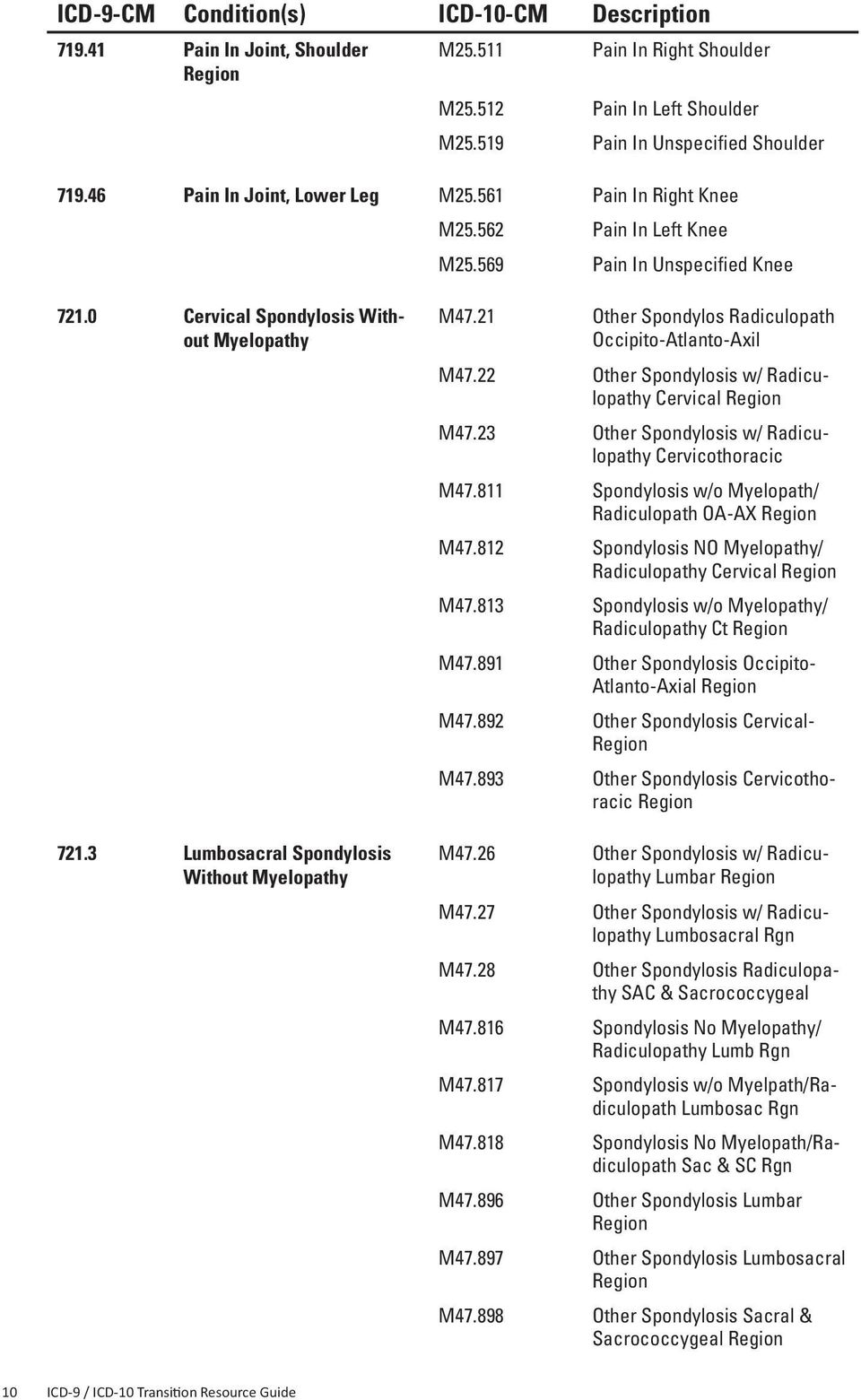
10 ICD-9-CM Condition(s) ICD-10-CM Description Pain In Joint, Shoulder Region M Pain In Right Shoulder M Pain In Left Shoulder M Pain In Unspecified Shoulder Pain In Joint, Lower Leg M Pain In Right Knee M Pain In Left Knee M Pain In Unspecified Knee Cervical Spondylosis Without Myelopathy Lumbosacral Spondylosis Without Myelopathy M47.21 Other Spondylos Radiculopath Occipito-Atlanto-Axil M47.22 Other Spondylosis w/ Radiculopathy Cervical Region M47.23 Other Spondylosis w/ Radiculopathy Cervicothoracic M Spondylosis w/o Myelopath/ Radiculopath OA-AX Region M Spondylosis NO Myelopathy/ Radiculopathy Cervical Region M Spondylosis w/o Myelopathy/ Radiculopathy Ct Region M Other Spondylosis Occipito- Atlanto-Axial Region M Other Spondylosis Cervical- Region M Other Spondylosis Cervicothoracic Region M47.26 Other Spondylosis w/ Radiculopathy Lumbar Region M47.27 Other Spondylosis w/ Radiculopathy Lumbosacral Rgn M47.28 Other Spondylosis Radiculopathy SAC & Sacrococcygeal M Spondylosis No Myelopathy/ Radiculopathy Lumb Rgn M Spondylosis w/o Myelpath/Radiculopath Lumbosac Rgn M Spondylosis No Myelopath/Radiculopath Sac & SC Rgn M Other Spondylosis Lumbar Region M Other Spondylosis Lumbosacral Region M Other Spondylosis Sacral & Sacrococcygeal Region 10 ICD-9 / ICD-10 Transi on Resource Guide
11 ICD-9-CM Condition(s) ICD-10-CM Description Diplcmt Lumbar Intervert Disc w/o Melopathy M51.26 Other Intervertebral Disc Displacement Lumbar Region M51.27 Other Intervertebral Disc Displacement Lumbosacral Region Degeneration of Cervical Intervertebral Disc Degen Lumbar/Lumbosacral Intervertebral Disc Postlaminectomy Syndrome Lumbar Region M50.30 Other Cervical Disc Degeneration Uns Cervical Region M50.31 Other Cervical Disc Degeneration Occipito-Atlanto-Axial Region M50.32 Other Cervical Disc Degeneration Mid-Cervical Region M50.33 Other Cervical Disc Degeneration Cervicothoracic Region M51.36 Other Intervertebral Disc Degen Lumbar Region M51.37 Other Intervertebral Disc Degen Lumbosacral Region M96.1 Postlaminectomy Syndrome NEC Cervicalgia M54.2 Cervicalgia Brachial Neuritis Or Radiculitis Nos M50.10 Cervical Disc D/O w/ Radiculopathy Uns Cervical Region M50.11 Cervical Disc D/O w/ Radiculopathy O-A-AX Region M50.12 Cervical Disc D/O w/ Radiculopathy Mid-Cervical Region M50.13 Cervical Disc D/O Radiculopathy Cervicothoracic Region M54.11 Radiculopathy Occipito-Atlanto-Axial Region M54.12 Radiculopathy Cervical Region M54.13 Radiculopathy Cervicothoracic Region Lumbago M54.5 Low Back Pain Thoracic/Lumbosacral Neuritis/Radicultis Unspec M51.14 Intervertebral Disc D/O w/ Radiculopathy Thoracic M51.15 IV Disc D/O w/ Radiculopathy Thoracolumbar Region M51.16 Intervertebral Disc D/O w/ Radiculopathy Lumb Rgn ICD-9 / ICD-10 Transi on Resource Guide 11

12 ICD-9-CM Condition(s) ICD-10-CM Description Thoracic/Lumbosacral Neuritis/Radicultis Unspec (continued) M51.17 IV Disc D/O w/ Radiculopathy Lumbosacral Region M54.14 Radiculopathy Thoracic Region M54.15 Radiculopathy Thoracolumbar Region M54.16 Radiculopathy Lumbar Region M54.17 Radiculopathy Lumbosacral Region Unspecified Backache M54.89 Other Dorsalgia M54.9 Dorsalgia Unspecified Unspecified Myalgia and Myositis M60.80 Other Myositis Unspecified Site M Other Myositis Right Shoulder M Other Myositis Left Shoulder M Other Myositis Unspecified Shoulder M Other Myositis Right Upper Arm M Other Myositis Left Upper Arm M Other Myositis Unspecified Upper Arm M Other Myositis Right Forearm M Other Myositis Left Forearm M Other Myositis Unspecified Forearm M Other Myositis Right Hand M Other Myositis Left Hand M Other Myositis Unspecified Hand M Other Myositis Right Thigh M Other Myositis Left Thigh M Other Myositis Unspecified Thigh M Other Myositis Right Lower Leg M Other Myositis Left Lower Leg M Other Myositis Unspecified Lower Leg M Other Myositis Right Ankle and Foot M Other Myositis Left Ankle and Foot 12 ICD-9 / ICD-10 Transi on Resource Guide

13 ICD-9-CM Condition(s) ICD-10-CM Description Unspecified Myalgia and Myositis (continued) M Other Myositis Unspecified Ankle and Foot M60.88 Other Myositis Other Site M60.89 Other Myositis Multiple Sites M60.9 Other Myositis Unspecified M79.1 Myalgia M79.7 Fibromyalgia Pain In Soft Tissues Of Limb M Pain In Right Arm M Pain In Left Arm M Pain In Arm Unspecified M Pain In Right Leg M Pain In Left Leg M Pain In Left Unspecified M Pain In Unspecified Limb M Pain In Right Upper Arm M Pain In Left Upper Arm M Pain In Unspecified Upper Arm M Pain In Right Forearm M Pain In Left Forearm M Pain In Unspecified Forearm M Pain In Right Hand M Pain In Left Hand M Pain In Unspecified Hand M Pain In Right Fingers M Pain In Left Fingers M Pain in Unspecified Finger(s) M Pain In Right Thigh M Pain In Left Thigh M Pain In Unspecified Thigh M Pain In Right Lower Leg M Pain in Left Lower Leg M Pain In Unspecified Lower Leg M Pain In Right Foot M Pain In Left Foot M Pain In Unspecified Foot M Pain In Right Toes M Pain In Left Toes M Pain In Unspecified Toes ICD-9 / ICD-10 Transi on Resource Guide 13

14 ICD-9-CM Condition(s) ICD-10-CM Description Headache G44.10 Vascular Headache NEC Not Intractable G44.11 Vascular Headache NEC Intractable R51 Headache Lumbar Sprain and Stain S33.5xxA Sprain Ligaments Lumbar Spine Initial Encounter V58.69 Encounter For Long-Term Use Of Other Medications V58.83 Encounter For Therapeutic Drug Monitoring Z79.3 Long Term Current Use Of Hormonal Contraceptives Z Long Term Current Use Of Opiate Analgesic Z Other Long Term Current Drug Therapy Z51.81 Encounter For Therapeutic Drug Level Monitoring 14 ICD-9 / ICD-10 Transi on Resource Guide

15 Addiction Medicine Top 25 Mappings ICD-9-CM Condition(s) ICD-10-CM Description Unspecified Drug-Induced Mental Disorder F10.19 Alcohol Abuse W/ Uns Alcohol- Induced Disorder F10.29 Alcohol Dependence W/ Uns Alcohol-Induced D/O F11.19 Opioid Abuse W/ Uns Opioid- Induced Disorder F11.29 Opioid Dependence w/ Uns Opioid-Induced Disorder F11.90 Opioid Use Unspecified Uncomplicated F11.99 Opioid Use Uns w/ Uns Opioid- Induced Disorder F12.19 Cannabis Abuse w/ Uns Cannabis-Induced Disorder F12.29 Cannabis Depend w/ Uns Cannabis-Induced Disorder F12.99 Cannabis Use Uns w/ Uns Cannabis-Induced Disorder F13.19 Sedat Hypnot/Anxiolytic Abuse w/ Uns Inducd D/O F13.29 Sedat Hypnot/Anxiolytic Dependence w/ Uns Induced D/O F13.90 Sedative Hypnotic/Anxiolytic Use Uns Uncomp F13.99 Sedative Hypnot/Anxiolytic Use Uns w/ Uns Induced D/O F14.19 Cocaine Abuse w/ Uns Cocaine- Induced Disorder F14.29 Cocaine Dependence w/ Uns Cocaine-Induced Disorder F14.90 Cocaine Use Unspecified Uncomplicated F14.99 Cocaine Use Uns w/ Uns Cocaine-Induced Disorder F15.19 Other Stimulant Abuse w/ Uns Inducd Disorder F15.29 Other Stimulant Depend w/ Uns Inducd Disorder F15.90 Other Stimulant Use Unspecified Uncomplicated F15.99 Other Stimulant Use w/ Uns Inducd Disorder F16.19 Hallucinogen Abuse w/ Uns Inducd Disorder ICD-9 / ICD-10 Transi on Resource Guide 15

16 ICD-9-CM Condition(s) ICD-10-CM Description Unspecified Drug-Induced Mental Disorder (continued) F16.29 Hallucinogen Depend w/ Uns Inducd Disorder F16.90 Hallucinogen Use Unspecified Uncomplicated F16.99 Hallucinogen Use Uns w/ Uns Inducd Disorder F Nicotine Depend Uns w/ Uns Nicotine-Induced D/O F Nicotine Depend Cig w/ Uns Nicotine-Induced D/O F Nicotine Depend Chew Tobacco W/ Uns Nic-Inducd D/O F Nicotine Depend Oth Tobacco Prod W/ Uns Inducd D/O F18.19 Inhalant Abuse w/ Uns Inhalant- Induced Disorder F18.29 Inhalant Depend w/ Uns Inhalant-Induced Disorder F18.99 Inhalant Use Uns w/ Uns Inhalant-Induced Disorder F19.19 Oth Psychoactive Sbstnc Abuse w/ Uns Inducd D/O F19.29 Oth Psychoactive Sbstnc Depnd w/ Uns Inducd D/O F19.90 Oth Psychoactive Substance Use Uns Uncomplicated F19.99 Oth Psychoactive Sbstnc Use Uns w/ Uns Inducd D/O Paranoid Schizophrenia Unspecified Condition Schizoaffective Disorder Unspecified Major Depressive Affective Disorder Recurrent Episode Moderate Degree Maj Dprsv D/o Recur Epis Sev w/o Psychot Bhv F20.0 Paranoid schizophrenia F25.0 Schizoaffective Disorder, Bipolar Type F25.1 Schizoaffective Disorder, Depressive Type F25.8 Other Schizoaffective Disorders F25.9 Schizoaffective Disorder, Unspecified F33.1 Major depressive disorder, recurrent, moderate F33.2 Major Depressive Disorder Recurrent Severe w/o Pyschot 16 ICD-9 / ICD-10 Transi on Resource Guide

17 ICD-9-CM Condition(s) ICD-10-CM Description Bipolar Disorder Unspecified F31.9 Bipolar disorder, unspecified Unspecified Episodic Mood Disorder F39 Unspecified Mood Affective Disorder Generalized Anxiety Disorder Acute Alcoholic Intoxication in Alcoholism Unspecified Drinking Behavior Other & Unspecified Alcohol Dependence Unspecified Drunkeness Other & Unspec Alcohol Dependence Cont Drunkenness Other & Unspecified Alcohol Dependence Remission Opioid Type Dependence Unspecified Abuse F41.1 Generalized anxiety disorder F Alcohol dependence with intoxication, uncomplicated F Alcohol dependence with intoxication, unspecified F10.20 Alcohol Dependence Uncomplicated F10.20 Alcohol Dependence Uncomplicated F10.21 Alcohol Dependence In Remission F11.20 Opioid Dependence Uncomplicated F Opioid Dependence w/ Intoxication Delirium F Opioid Depend w/ Intoxication w/ Perceptual Dist F Opioid Dependence With Intoxication Unspecified F11.23 Opioid Dependence With Withdrawal F11.24 Opioid Depend w/ Opioid- Induced Mood Disorder F Opioid Dpnd w/ Induced Psychot D/O w/delusions F Opioid Dpnd w/ Induced Psychot D/O w/hallucination F Opioid Depend w/ Opioid- Induced Psychot D/O UNS F Opioid Depend w/ Opioid- Induced Sexual Dysf F Opioid Depend w/ Opioid- Induced Sleep Disorder F Opioid Dependence w/ Oth Opioid-Induced Disorder ICD-9 / ICD-10 Transi on Resource Guide 17

18 ICD-9-CM Condition(s) ICD-10-CM Description Opioid Type Dependence Unspecified Abuse (continued) F11.29 Opioid Dependence w/ Uns Opioid-Induced Disorder Opioid Type Dependence Continuous Abuse Opioid Type Dependence Episodic Abuse Opioid Type Dependence in Remission Sedative Hypnotic/Anxiolytic Dependence Unspec F11.20 Opioid Dependence Uncomplicated F11.20 Opioid Dependence Uncomplicated F11.21 Opioid Dependence In Remission F13.20 Sedative Hypnotic/Anxiolytic Depend Uncomp F Sedat Hypnot/Anxiolytic Depend w/ Intox Uncomp F Sedat Hypnot/Anxiolytic Depend w/ Intox Delirium F Sedat Hypnot/Anxiolytic Dpnd w/ Intoxication Uns F Sedat Hypnot/Anxiolytic Dpnd w/ Withdrawal Uncomp F Sedat Hypnot/Anxiolytic Dpnd w/ Withdrawal Delirium F Sedat Hypnot/Anxiolytic Dpnd w/ D w/perceptual Dist F Sedat Hypnot/Anxiolytic Depend w/ Withdrawal Uns F13.24 Sedat Hypnot/Anxiolytic Depend w/ Inducd Mood D/O F Sedat Hypnot/Anxiolytic Dpnd Ind Psychot D/O Del F Sed Hypnot/Anxiolyt Dpnd Ind Psychot D/O Halluc F Sedat Hypnot/Anxiolytic Dpnd Ind Psychot D/O Uns F13.26 Sedat Hypnot/Anxiolytic Dpnd Ind Persist Amnes D/O F13.27 Sedat Hypnot/Anxiolytic Dpnd Inducd Persist Dement F Sedat Hypnot/Anxiolytic Depnd Inducd Anxiety D/O F Sedat Hypnot/Anxiolytic Depnd w/ Inducd Sexl Dysf F Sedat Hypnot/Anxiolytic Depnd w/ Inducd Sleep D/O 18 ICD-9 / ICD-10 Transi on Resource Guide

19 ICD-9-CM Condition(s) ICD-10-CM Description Sedative Hypnotic/Anxiolytic Dependence Unspec (continued) F Sedat Hypnot/Anxiolytic Depend w/ Oth Induced D/O F13.29 Sedat Hypnot/Anxiolytic Depend w/ Uns Induced D/O Cocaine Dependence Unspecified Abuse Cannabis Dependence Unspecified Abuse F14.20 Cocaine Dependence Uncomplicated F Cocaine Dependence W/ Intoxication Uncomplicated F Cocaine Dependence With Intoxication Delirium F Cocaine Depend W/ Intoxication W/ Perceptual Dist F Cocaine Dependence With Intoxication Unspecified F14.23 Cocaine Dependence With Withdrawal F14.24 Cocaine Depend W/Cocaine- Induced Mood Disorder F Cocaine Depend W/ Induced Psychot D/O W/ Delusions F Cocaine Depend W/ Induced Psychot D/O W/ Hallucinations F Cocaine Depend W/ Cocaine- Induced Psychot D/O UNS F Cocaine Depend W/ Cocaine- Induced Anxiety Disorder F Cocaine Depend W/ Cocaine- Induced Sexual Dysf F Cocaine Depend W/ Cocaine- Induced Sleep Disorder F Cocaine Depend W/ Oth Cocaine-Induced Disorder F14.29 Cocaine Depend W/ Uns Cocaine-Induced Disorder F12.20 Cannabis Dependence Uncomplicated F Cannabis Depend w/ Intoxication Uncomplicated F Cannabis Dependence w/ Intoxication Delirium F Cannabis Depend w/ Intoxication w/ Perceptual Distance F Cannabis Depend w/ Intoxication Unspecified ICD-9 / ICD-10 Transi on Resource Guide 19

20 ICD-9-CM Condition(s) ICD-10-CM Description Cannabis Dependence Unspecified Abuse (continued) F Cannabis Depend w/ Psychotic Disorder w/ Delusions F Cannabis Depend W/ Psychotic D/O W/ Hallucinations F Cannabis Depend W/ Psychotic Disorder Uns F Cannabis Depend W/Cannabis- Induced Anxiety D/O F Cannabis Depend W/ Oth Cannabis-Induced Disorder F12.29 Cannabis Depend W/ Uns Cannabis-Induced Disorder Cannabis Dependence Continuous Abuse Amphet & Other Psycho stimulant Dependence Unspec Abs F12.20 Cannabis Dependence Uncomplicated F15.20 Other Stimulant Dependence Uncomplicated F Other Stimulant Depend W/ Intoxication Uncomplicated F Oth Stimulant Dependence W/ Intoxication Delirium F Oth Stimulant Dependence Intoxication W/ Perceptual Dist F Other Stimulant Dependence W/ Intoxication UNS F15.23 Other Stimulant Dependence With Withdrawal F15.24 Oth Stimulant Depend W/ Induced Mood Disorder F Oth Stimulant Depend W/ Induced Psychot D/O W/Del F Oth Stimulant Depend Induced Psychot D/O W/ Halluc F Oth Stimulant Depend W/ Induced Psychot D/O Uns F Oth Stimulant Depend W/ Induced Anxiety Disorder F Oth Stimulant Depend W/ Induced Sexl Dysfunction F Oth Stimulant Depend W/ Induced Sleep Disorder F Oth Stimulant Depend W/ Other Induced Disorder F15.29 Oth Stimulant Depend W/ Uns Induced Disorder 20 ICD-9 / ICD-10 Transi on Resource Guide

21 ICD-9-CM Condition(s) ICD-10-CM Description Hallucinogen Dependence Unspecified Abuse F16.20 Hallucinogen Dependence Uncomplicated F Hallucinogen Dependence with Intoxication, Uncomplicated F Hallucinogen Dependence with Intoxication with Delirium F Hallucinogen Dependence with Intoxication, Unspecified F16.24 Hallucinogen Dependence with Hallucinogen-Induced Mood Disorder F Hallucinogen Dependence w Psychotic Disorder w Delusions F Hallucinogen Dependence w Psychotic Disorder w Hallucin F Hallucinogen Dependence w Psychotic Disorder Unspecified F Hallucinogen Dependence w Anxiety Disorder F Hallucinogen Dependence w Hallucinogen Persisting Perception Disorder F Hallucinogen Dependence w Oth Hallucinogen-Induced Disorder F16.29 Hallucinogen Dependence w Unspecified Hallucinogen- Induced Disorder Other Specified Drug Dependence in Remission Combinations of Opioid Type Drug with Any Other Drug Dependence Unspecified Use Comb Drug Dependence Excld Opioid Drug Unspec Abs Unspecified Drug Dependence Unspecified Abuse Nondependent Alcohol Abuse Unspec Drunkenness F19.21 Other psychoactive substance dependence, in remission F18.21 Inhalant dependence, in remission F19.20 Other psychoactive substance dependence, uncomplicated F19.20 Oth Psychoactive Substance Depend Uncomplicated F19.20 Oth Psychoactive Substance Depend Uncomplicated F10.10 Alcohol Abuse Uncomplicated F Alcohol Abuse With Intoxication Uncomplicated ICD-9 / ICD-10 Transi on Resource Guide 21
22 ICD-9-CM Condition(s) ICD-10-CM Description Nondependent Tobacco Use Disorder F Nicotine dependence, unspecified, uncomplicated F Nicotine dependence, unspecified, in remission F Nicotine dependence, cigarettes, uncomplicated F Nicotine dependence, cigarettes, in remission F Nicotine dependence, chewing tobacco, uncomplicated F Nicotine dependence, chewing tobacco, in remission F Nicotine dependence, other tobacco product, uncomplicated F Nicotine dependence, other tobacco product, in remission Nondependent Cannabis Abuse Unspecified Nondep Sedative Hypno/ Anxlytic Abs Unsp Pat Use Nondependent Opioid Abuse Unspecified Nondependent Cocaine Abuse Unspecified Nondependent Amphetamine/Related Act Sympath Abs Uns Pat Use 22 ICD-9 / ICD-10 Transi on Resource Guide F12.10 Cannabis Abuse Uncomplicated F12.90 Cannabis Use Unspecified Uncomplicated F13.10 Sedative, Hypnotic or Anxiolytic Abuse, Uncomplicated F Sedatv/Hyp/Anxiolytic Abuse w Intoxication, Uncomplicated F13.90 Sedative, Hypnotic or Anxiolytic Abuse, Unspecified, Uncomplicated F11.10 Opioid Abuse Uncomplicated F Opioid Abuse With Intoxication Uncomplicated F Opioid Abuse With Intoxication Unspecified F14.10 Cocaine Abuse Uncomplicated F Cocaine Abuse With Intoxication Uncomplicated F15.10 Other stimulant abuse, uncomplicated F Other stimulant abuse with intoxication, uncomplicated F15.90 Other stimulant use, unspecified, uncomplicated
23 ICD-9-CM Condition(s) ICD-10-CM Description Oth Mixed/Unspec Nondependent Drug Abuse Unspec F18.10 Inhalant Abuse Uncomplicated F Inhalant Abuse With Intoxication Uncomplicated F18.90 Inhalant Use Unspecified Uncomplicated F55.0 Abuse Of Antacids F55.1 Abuse Of Herbal Or Folk Remedies F55.2 Abuse Of Laxatives F55.3 Abuse Of Steroids Or Hormones F55.4 Abuse Of Vitamins F55.8 Abuse Of Other Non-Psychoactive Substances Posttraumatic Stress Disorder 311 Depressive Disorder Not Elsewhere Classified Attention Deficit Disorder of Childhood without Hyperactivity Attention Deficit Disorder of Childhood with Hyperactivity V71.09 Observation Of Other Suspected Mental Condition V71.9 Observation for Unspecified Suspected Condition F43.10 Post-Traumatic Stress Disorder Unspecified F43.11 Post-Traumatic Stress Disorder Acute F43.12 Post-Traumatic Stress Disorder Chronic F32.9 Major Depressive Disorder Single Episode Uns F90.0 Attention-deficit hyperactivity disorder, predom inattentive type F90.9 Attention-deficit hyperactivity disorder, unspecified type F90.0 Attention-deficit hyperactivity disorder, predominantly inattentive type F90.1 Attention-deficit hyperactivity disorder, predominantly hyperactive type F90.2 Attention-deficit hyperactivity disorder, combined type F90.8 Attention-deficit hyperactivity disorder, other type Z03.89 Enc Observation Oth SPCT DZ & Cond Ruled Out Z04.9 Encounter for examination and observation for unspecified reason ICD-9 / ICD-10 Transi on Resource Guide 23
24 Pain(s) 789.0* Abdominal Adnexa (uteri) Alimentary, due to vascular insufficiency Anginoid (see also Pain, precordial) Anus Arch Arm Axillary Back (postural) Low Psychogenic Bile duct Bladder Bone Breast Psychogenic Broad ligament Car lage NEC 789.0* Cecum (see p. 11) Cervidobrachial Chest (central) Atypical Midsternal Musculoskeletal Noncardiac Substernal Wall (anterior) Chronic Associated with significant psychosocial dysfunc on Due to trauma Postopera ve Post-thoracotomy Syndrome Coccyx 789.0* Colon Common duct Coronary see Angina Costochondral Diaphragm Due to (presence of) any device, implant, or gra classifiable to see Complica- ons, due to (presence of) any device, implant, or gra classified to NEC Ear (see also Otalgia) Epigastric, epigastrium Extremity (lower) (upper) Eye Face, facial Atypical Nerve Female genital organ NEC Psychogenic Fibromyalgia Finger 789.0* Flank Foot Gallbladder Gas (intes nal) Gastric Generalized Genital organ Female Male Psychogenic 789.0* Groin Growing Hand Head (see also Headache, Migraine) Headache 346.2* Allergic 346.2* Cluster Due to Loss, spinal fluid Lumbar puncture Saddle block Emo onal 346.2* Histamine Lumbar puncture Menopausal 346.9* Migraine (see also Migraine) Nonorganic origin Postspinal Psychogenic Psychophysiologic 346.1* Sick Spinal 668.8* Complica ng labor and delivery 668.8* Postpartum Spinal fluid loss Tension Vascular 346.9* Migraine type 346.9* Vasomotor Infraorbital (see also Neuralgia, trigeminal) Intermenstrual Jaw Joint Ankle Elbow Foot Hand Hip Knee Mul ple sites Pelvic region *Requires 5th Digit Subclassifica ons - See Pages ICD-9 / ICD-10 Transi on Resource Guide
25 Psychogenic Shoulder (region) Specified site NEC Wrist Kidney Laryngeal Leg Limb Low back Lumbar region Mandible, Mandibular Mastoid (see also Otalgia) Maxilla Menstrual Metacarpophalangeal (joint) Metatarsophalangeal (joint) 346.9* Migraine (idiopathic) 346.0* With aura 346.2* Abdominal (syndrome) 346.2* Allergic (histamine) 346.1* Atypical 346.2* Basilar 346.0* Classical 346.1* Common 346.8* Hemiplegic 346.2* Lower-half Premenstrual 346.8* Ophthalmic 346.8* Ophthalmoplegic 346.2* Re nal 346.2* Variant Mouth Muscle Intercostals Nasal Nasopharynx Neck NEC Psychogenic Nerve NEC NEURALGIA Neuralgia, neuralgic (acute) see also Neuri s Accessory (nerve) Acous c (nerve) Ankle Anterior crural Anus Arm Auditory (nerve) Axilla Bladder Brachial Brain see Disorder, nerve, cranial Broad ligament Cerebral see Disorder, nerve, cranial Ciliary Cranial nerve (see also Disorder, nerve, cranial) Fi h or Trigeminal (see also Neuralgia, trigeminal) 250.6* Diabe c Due to 249.6* Secondary diabetes Beriberi Displacement, prolapsed, protrusion, or rupture of intervertebral disc Cervical Lumbar, lumbosacral Thoracic, thoracolumbar Hernia on, nucleus Cervical Lumbar, lumosacral Ear Middle Facial Finger Flank Foot Forearm Thoracic, thoracolumbar Fothergill s (see also Neuralgia, trigeminal) Postherpe c Glossopharyngeal (nerve) Groin Hand Heel Horton s Hunt s Hypoglossal (nerve) Iliac region Infraorbital (see also Neuralgia, trigeminal) Inguinal Intercostal (nerve) Postherpe c Jaw Kidney Knee Loin *Requires 5th Digit Subclassifica ons - See Pages ICD-9 / ICD-10 Transi on Resource Guide 25
26 084.6 Malarial (see also Malaria) Mastoid Maxilla Median thenar Metatarsal Middle ear Migrainous Morton s Nerve, cranial see Disorder, nerve, cranial Nose Occipital Olfactory (nerve) Opthalmic postherpe c Op c (nerve) Penis Perineum Pleura Postherpe c NEC Geniculate/Ganglion Ophthalmic Trifacial Trigeminal Pubic region Radial (nerve) Rectum Sacroiliac joint Scia c (nerve) Scrotum Seminal vesicle Shoulder Sluder s Specified nerve NEC see Disorder, nerve Sperma c cord Sphenopala ne (ganglion) Subscapular (nerve) Suprascapular (nerve) Tes s Thenar (median) Thigh Tongue Trifacial (nerve) (see also Neuralgia, trigeminal) Trigeminal (nerve) postherpe c Tympanic plexus Ulnar (nerve) Vagus (nerve) Wrist Writers Organic NEUROPATHY Neuropathy, neuropathic see also Disorder, nerve Acute motor Alcoholic With psychosis Arm NEC Ataxia and re ni s pigmentosa (NARP syndrome) Autonomic (peripheral) see Neuropathy, peripheral, autonomic Axillary nerve Brachial plexus Cervical plexus Chronic Progressive segmentally demyelina ng Relapsing demyelina ng Congenital sensory Dejerine-So as Diabe c (see 357.2) Autonomic (peripheral) (see 337.1) Due to secondary diabetes (see 357.2) Autonomic (peripheral) (see 337.1) Entrapment Iliohypogastric nerve Ilioinguinal nerve Lateral cutaneous nerve of thigh Median nerve Obturator nerve Peroneal nerve Posterior bial nerve Saphenous nerve Ulnar nerve Facial nerve Hereditary Peripheral Sensory (radicular) Hypertrophic Charcot-Marie-Tooth Dejerine-So as Inters al Refsum Intercostal nerve Ischemic see Disorder, nerve Jamaican (ginger) Leg NEC Lower extremity NEC *Requires 5th Digit Subclassifica ons - See Pages ICD-9 / ICD-10 Transi on Resource Guide
27 353.1 Lumbar plexus Median nerve Motor Acute Mul ple (acute) (chronic) (see also Polyneuropathy) Op c Ischemic Nutri onal Toxic Peripheral (nerve) (see also Polyneuropathy) Arm NEC Autonomic Amyloid (see 337.1) Idiopathic In * 249.6* Amyloidosis (see 337.1) Diabetes (mellitus) (see 337.1) Due to secondary diabetes (see 337.1) Diseases classified elsewhere Gout (see 337.1) 242.9* Hyperthyroidism (see 337.1) Due to An tetanus serum Arsenic Drugs Lead Organophosphate compounds Toxic agent NEC Hereditary Idiopathic Progressive Specified type NEC In diseases classified elsewhere see Polyneurotherapy, in Leg NEC Lower extremity NEC Upper extremity NEC Plantar nerves Progressive Hypertrophic inters al Inflammatory Radicular NEC Brachial Cervical NEC Hereditary sensory Lumbar Lumbosacral Thoracic NEC Sacral plexus Scia c Spinal nerve NEC Root (see also Radiculi s) Toxic Trigeminal sensory Ulnar nerve Upper extremity NEC Uremic (see 357.4) Vitamin B 12 (see 357.4) With anemia (pernicious) (see 357.4) Due to dietary deficiency (see 357.4) Neuromuscular Nose Ocular Orbital region Osteocopic Ovary Psychogenic Ovula on Pelvic (female) 789.0* Male NEC Psychogenic Psychogenic Penis Psychogenic Periarthri s (joint) Duplay s Gonococcal Humeroscapularis Scapulohumeral Shoulder Wrist Pharynx Pleura, pleural, pleuri c Preauricular Precordial (region) Psychogenic Psychogenic Cardiovascular system Gastrointes nal system Genitourinary system Heart Musculoskeletal system Skin RADICULITIS Radicular (spinal) (see also Radiculi s) Radiculi s (pressure) (vertebrogenic) Accessory nerve Anterior crural Arm Brachial *Requires 5th Digit Subclassifica ons - See Pages ICD-9 / ICD-10 Transi on Resource Guide 27
28 723.4 Cervical NEC Due to displacement of intervertebral disc see Neuri s, due to, displacement of intervertebral disc Leg Lumbar NEC Lumboscral Rheuma c Syphili c Thoracic (with visceral pain) Rectum Respira on Retrostrenal Rheuma c NEC Muscular RHEUMATISM Rheuma sm, rheuma c (acute NEC) 393 Adherent pericardium Arthri s Acute or subacute see Fever, rheuma c Chronic Spine 716.9* Ar cular (chronic) NEC (see also Arthri s) Acute or subacute see Fever, rheuma c Back Blennorrhagic Cardi s see Disease, heart, rheuma c Chorea (acute) see Chorea, Rheuma c Chronic NEC Coronary arteri s Chronic Degenera on, myocardium (see also Degenera on, myocardium, with rheuma c fever) Desert Gonococcal Gout Heart Intercostal Disease (see also Disease, heart, rheuma c) Failure (chronic) (conges ve) (inac ve) Meaning Tietze s disease 716.9* Joint (chronic) NEC (see also Arthri s) Acute see Fever, rheuma c Medias nopericardi- s see Rheuma c, pericardi s Muscular Myocardial degenera on (see also Degenera- on, myocardium, with rheuma c fever) Myocardi s (chronic) (inac ve) (with chorea) Ac ve or acute With chorea (acute) (rheuma c) (Sydenham s) Myosi s Neck Neuralgic Neuri s (acute) (chronic) Neuromuscular Nodose see Arthri s, nodosa Nonar cular Palindromic Ankle Elbow Foot Hand Hip Knee Mul ple sites Pelvic region Shoulder (region) Specified site NEC Wrist Pancardi s, acute With chorea (acute) (rheuma c) (Syndenham s) Chronic or inac ve With chorea (acute) (rheuma c) (Syndenham s) 393 Chronic or inac ve Polyarthri s - chronic 716.9* Polyar cular NEC (see also Arthri s) Psychogenic Radiculi s Scia c Spine Subacute NEC Tor collis Typhoid fever *Requires 5th Digit Subclassifica ons - See Pages ICD-9 / ICD-10 Transi on Resource Guide
29 Rib Root (spinal) (see also Radiculi s) Round ligament (stretch) Sacroiliac Scia c Scrotum Psychogenic Sinus Skin Spinal root (see also Radiculi s) Stomach Psychogenic Substernal Temporomandibular (joint) Temporomaxillary joint Tes s Psychogenic Thoracic spine With radicular and visceral pain Throat Tibia Toe Tongue Tooth Total Hip Replacement Total Knee Replacement Trigeminal (see also Neuralgia, trigeminal) Umbilicus Ureter Urinary (organ) (system) Uterus Psychogenic Vagina Vesical Vulva Xiphoid Vertebrogenic (syndrome) V58.69^ Long-term (current) use of other medica ons (high risk medica ons) ^ Secondary Use Code Only When Applicable V58.83^ Encounter for therapeu c drug monitoring DEF: Drug Monitoring: Measurement of the level of a specific drug in the body or measurement of a specific func on to access effec veness of a drug. ^ Secondary Use Code Only When Applicable *Requires 5th Digit Subclassifica ons - See Pages ICD-9 / ICD-10 Transi on Resource Guide 29
30 Fi h-digit Subclassifica ons for Pain Condi ons 789 Other symptoms involving abdomen and pelvis: EXCLUDES symptoms referable to genital organs: female ( ), male ( ), psychogenic ( ) The following fi h-digit subclassifica on is to be used for codes 789.0, 789.3, 789.4, 789.6: 346 Migraine 0 unspecified site 1 right upper quadrant 2 le upper quadrant 3 right lower quadrant 4 le lower quadrant 5 periumbrilic 6 epigastric 7 generalized 9 other specified site The following fi h digit subclassifica on is for use with category 346: 0 without men on of intractable migraine 1 with intractable migraine, so stated Complica ons of the administra on of anesthe c or other seda on in labor 668 and delivery The following fi h digit subclassifica on is for use with categories to denote the current episode of care: 0 unspecified as to episode of care or not applicable 1 delivered, with or without men on of antepartum condi on 2 delivered, with men on of postpardum complica on 3 antepardum condi on or complica on 4 postpardum condi on or complica on 250 Diabetes mellitus The following fi h-digit subclassifica on is for use with category 250: 0 type II or unspecified type, not stated as uncontrolled 1 type I (juvenile type), not stated as uncontrolled 2 type II or unspecified type, uncontrolled 3 type I (juvenile type), uncontrolled 249 Secondary diabetes mellitus The following fi h-digit subclassifica on is for use with category 249: 0 not stated as uncontrolled, or unspecified 1 uncontrolled 30 ICD-9 / ICD-10 Transi on Resource Guide ICD-9-CM Resource Guide 30
31 242 Thyrotoxicosis with or without goiter The following fi h-digit subclassifica on is for use with category 242: 0 without men on of thyrotoxic crisis or storm 1 with men on of thyrotoxic crisis or storm 716 Other and unspecified arthropathies The following fi h-digit subclassifica on is for use with category 716: 0 site unspecified 1 shoulder region 2 upper arm 3 forearm 4 hand 5 pelvic region and thigh 6 lower leg 7 ankle and foot 8 other specified sites 9 mul ple sites ICD-9 / ICD-10 Transi on Resource Guide 31
32 Addiction Medicine and Behavioral Health Condition(s) 303.0* Acute Alcohol Intoxica on 303.0* Alcohol Dependence Syndrome Alcohol induced mental disorders: Alcohol withdrawal delirium Alcohol induced persis ng amnes c disorder Alcohol induced persis ng demen a Alcohol induced psycho c disorder with hallucina ons Idiosyncra c alcohol intoxica on Alcohol induced psycho c disorder with delusions Other specified 291.8* alcohol induced mental disorders: Alcohol withdrawal Alcohol induced sleep disorders Other Unspecified alcohol induced mental disorders 303.9* Alcohol, Other and unspecified 304* Drug Dependence Amphetamine and 304.4* other psychos mulant 304.3* Cannabis 304.2* Cocaine 304.7* any other 304.8* Combina ons of opioid type drug with Combina ons excluding opioid type drug 304.5* Hallucinogen 304.0* Opioid type 304.1* Seda ve, hypno c, or anxioly c 304.9* Unspecified drug dependence 304.6* Other specified drug dependence 292 Drug Induced Mental Disorders Drug withdrawal Drug induced psycho c disorders: With delusions With hallucina ons Other, specified: Drug induced delirium Drug induced persis ng demen a Drug induced persis ng amnes c disorders Drug induced mood disorders Drug induced sleep disorders Other Pathological drug intoxica on Unspecified drug induced mental disorders 305* Nondependent abuse of drugs 305.0* Alcohol abuse 305.7* Amphetamine or related ac ng sympathomime c abuse 305.8* An depressant type 305.2* Cannabis 305.6* Cocaine 305.3* Hallucinogen 305.5* Opioid 305.9* Other, mixed, or unspecified 305.4* Seda ve, hypno c, or anxioly c 305.1* Tobacco *Requires 5th Digit Subclassifica ons - See Pages ICD-9 / ICD-10 Transi on Resource Guide
33 Fi h-digit Subclassifica ons for Addic on, Behavioral Health and Mental Health Condi ons 303 Alcohol Dependence Syndrome 304 Drug Dependence 305 Nondependent abuse of drugs The following fi h-digit subclassifica on is to be used with categories 303, 304, and 305: 0 unspecified 1 con nuous 2 episodic 3 in remission 4 th 295 Schizophrenic disorders Includes schizophrenia of the types described in occurring in children Excludes childhood type schizophrenia (299.9) infan le au sm (299.0) The following fi h-digit subclassifica on is for use with category 295: 0 unspecified 1 subchronic 2 chronic 3 subchronic with acute exacerba on 4 chronic with acute exacerba on 5 in remission DEF: Group of disorders with disturbances in thought (delusions, hallucina ons), mood (blunted, fla ened, inappropriate affect), sense of self, rela onship to world; also bizarre, purposeless behavior, repe ous ac vity, or inac vity. 5 th Simple type Schizophrenia simplex Excludes latent schizophrenia (295.5) 5 th Disorganized type Hebephrenia Hebephrenic type schizophrenia DEF: Inappropriate behavior; results in extreme incoherence and disorganized of me, place and sense of social appropriateness; withdrawal from rou ne social interac on may occur. 5 th Catatonic type Catatonic (schizophrenia): agita on excita on excited type stupor withdrawn type ICD-9 / ICD-10 Transi on Resource Guide 33
34 Schizophrenic: catalepsy catatonia flexibilitas cerea DEF: Extreme changes in motor ac vity; one extreme is decreased response or reac on to the environment and the other is spontaneous ac vity. 4 th 296 Episodic mood disorders Includes episodic affec ve disorders Excludes neuro c depression (300.3) reac ve depression psychosis (298.0) reac ve excita on (298.1) The following fi h-digit subclassifica on is for use with categories : 0 unspecified 1 mild 2 moderate 3 severe, without men on of psycho c behavior 4 severe, specified as with psycho c behavior 5 in par al or unspecified remission 6 in full remission AHA: M-A, 85, 14 5 th Bipolar I disorder, single manic episode Hypomania (mild) NOS Hypomanic psychosis Mania (monopolar) NOS Manic-depressive psychosis or reac on: hypomanic manic Excludes circular type, if there was a previous a ack of depression (296.4) DEF: Mood disorder iden fied by hyperac vity; may show extreme agita on or exaggerated excitability; speech and thought processes may be accelerated. 5 th Manic disorder, recurrent episode Any condi on classifiable to stated to be recurrent Excludes circular type, it there was a previous a ack of depression (296.4) 5 th Major depressive disorder, single episode Depressive psychosis Endogenous depression Involu onal melancholia Manic-depressive psychosis or reac on, depressed type Monopolar depression Psycho c depression Excludes circular type, if previous a ack was of manic type (296.5) depression NOS (311) reac ve depression (neuro c) (300.4) psycho c (298.0) DEF: Mood disorder that produces depression; may exhibit as sadness, low self-esteem, or guilt feelings; other manifesta ons may be withdrawal from friends and family; interrupted normal sleep. 5 th Major depressive disorder, recurrent episode Any condi on classifiable to 296.2, stated to be recurrent 34 ICD-9 / ICD-10 Transi on Resource Guide
35 Excludes circular type, if previous a ack was a manic type (296.5) depression NOS (311) reac ve depression (neuro c) (300.4) psycho c (298.0) 5 th Bipolar I disorder most recent episode (or current) manic Bipolar disorder, now manic Manic-depressive psychosis, circular type but currently depressed Excludes brief compensatory or rebound mood swings (296.99) 5 th Bipolar I disorder, most recent episode (or current) depressed Bipolar disorder, now depressed Manic-depressive psychosis, circular type but currently depressed Excludes brief compensatory or rebound mood swings (296.99) 5 th Bipolar I disorder, most recent episode (or current) mixed Manic-depressive psychosis, circular type, mixed Bipolar I disorder, most recent episode (or current) unspecified Atypical bipolar affec ve disorder NOS Manic-depressive psychosis, circular type, current condi on not specified as either manic or depressive DEF: Manic-depressive disorder referred to as bipolar: because of the mood range from manic to depressive. 5 th Other and unspecified bipolar disorders Bipolar disorder, unspecified Bipolar disorder NOS Manic-depressive: reac on NOS syndrome NOS Atypical manic disorder Atypical depressive disorder Other Bipolar II disorder Manic-depressive psychosis, mixed type 5 th Other and unspecified episode mood disorder Excludes psychogenic affec ve psychoses ( ) Unspecified episode mood disorder Affec ve psychosis NOS Melancholia NOS Mood disorder NOS AHA: M-A, 85, Other specified episode mood disorder Mood swings Brief compensatory Rebound ICD-9 / ICD-10 Transi on Resource Guide 35
36 4 th 300 Anxiety, dissocia ve and somatoform disorders 5 th Anxiety states Excludes anxiety in: acute stress reac on (308.0) transient adjustment reac on (309.24) neurasthenia (300.5) psychophysiological disorders ( ) separa on anxiety (309.21) DEF: Mental disorders characterized by anxiety and avoidance behavior not par cularly related to any specific situa on or s mulus; symptoms include emo onal instability, apprehension, fa gue Anxiety state, unspecified Anxiety: Anxiety: neurosis state (neuro c) reac on Atypical anxiety disorder AHA: 10, 02, Panic disorder without agoraphobia Panic: Panic: A ack state Excludes panic disorder with agoraphobia (300.21) DEF: Neuro c disorder characterized by recurrent panic of anxiety, apprehension, fear or terror; symptoms include shortness of breath, palpita ons, dizziness, faintness or shakiness; fear of dying may persist of fear of other morbid consequences Generalized anxiety disorder Other 5 th Pain disorders related to psychological factors Psychogenic Pain, site unspecified Tension headache Excludes headache; NOS (784.0) Migraine ( ) AHA: N-D, 85, Other Code first to type or site of pain Excludes pain disorder exclusively a ributed to psychological factors (307.80) Psychogenic pain (307.80) 4 th 309 Adjustment reac on Includes adjustment disorders Reac on (adjustment) to chronic stress Excludes acute reac on to major stress ( ) neuro c disorders ( ) Adjustment disorder with depressed mood Grief Ac on Excludes affec ve psychoses ( ) neuro c depression (300.4) prolonged depressive reac on (309.1) psychogenic depressive psychosis (298.0) 36 ICD-9 / ICD-10 Transi on Resource Guide
37 309.1 Prolonged depressive reac on Excludes affec ve psychoses ( ) brief depressive reac on (309.0) neuro c depression (300.4) psychogenic depressive psychosis (298.0) 5 th With predominant disturbance of other emo ons Separa on anxiety disorder DEF: Abnormal apprehension by a child when physically separated from support environment; byproduct of abnormal symbio c child-parent rela onship Emancipa on disorder of adolescence and early adult life DEF: Adjustment reac on of late adolescence; conflict over independence from parental supervision; symptoms include difficulty in making decisions, increased reliance on parental advice, deliberate adop on of values in opposi on of parents Specific academic or work inhibi on Adjustment disorder with anxiety Adjustment disorder with mixed anxiety and depressed mood Adjustment reac on with anxiety and depression Other Culture shock Adjustment disorder with disturbance of conduct Conduct disturbance Destruc veness as adjustment reac on Excludes destruc veness in child (312.9) disturbance of conduct NOS (312.9) dissocial behavior without manifest psychiatric disorder (V71.01-V71.02) personality disorder with predominantly sociopathic or asocial manifesta ons (301.7) Adjustment disorder with mixed disturbance of emo ons and conduct 5 th Other specified adjustment reac ons Pos rauma c stress disorder Chronic pos rauma c stress disorder Concentra on camp syndrome Pos rauma c stress disorder NOS Post-trauma c stress disorder (PTSD) Excludes acute stress disorder (308.3) pos rauma c brain syndrome: nonpsycho c (310.2) psycho c ( ) DEF: Preoccupa on with trauma c events beyond normal experience; events such as rape, personal assault, combat, natural disasters, accidents, torture precipitate disorder; also recurring flashbacks of trauma; symptoms include difficulty remembering, sleeping, or concentra ng, and guilt feelings for surviving Adjustment reac on with physical symptoms Adjustment reac on with withdrawal Elec ve mu sm as adjustment reac on Hospitalism (in children) NOS Other ICD-9 / ICD-10 Transi on Resource Guide 37
38 309.9 Unspecified adjustment reac on Adapta on reac on NOS Adjustment reac on NOS 5 th 311 Depressive disorder, not elsewhere classified Depressive disorder NOS Depressive state NOS Depression NOS Excludes acute reac on to major stress with depressive symptoms (308.0) affec ve personality disorder ( ) Affec ve psychoses ( ) brief depressive reac on (309.0) depressive states associated with stressful events ( ) disturbance of emo ons specific to childhood and adolescence, with misery and unhappiness (313.1) mixed adjustment reac on with depressive symptoms (309.4) neuro c depression (300.4) prolonged depressive adjustment reac on (309.1) psychogenic depressive psychosis (298.0) AHA: 4Q, 03, 75 5 th A en on deficit disorder Adult Child Without men on of hyperac vity Predominantly ina en ve type AHA: 10, 97, With hyperac vity Combined type Overac vity NOS Predominantly hyperac ve/impulsive type Simple disturbance of a en on with overac vity AHA: 10, 97, Hyperkinesis with development delay Development disorder of hyperkinesis Use addi onal code to iden fy any associated neurological disorder Hyperkinesis with development delay Developmental disorder of hyperkinesis Use addi onal code to iden fy any associated neurological disorder Hyperkine c conduct disorder Hyperkine c conduct disorder without development delay Excludes hyperkinesis with significant delays in specific skills (314.1) Other specified manifesta ons of hyperkine c syndrome Unspecified hyperkine c syndrome Hyperkine c reac on of childhood or adolescence NOS Hyperkine c syndrome NOS 38 ICD-9 / ICD-10 Transi on Resource Guide
39 Notes ICD-9 / ICD-10 Transi on Resource Guide 39
40 Contact Information Dominion Diagnostics Billing Department Contact Dominion s Billing Department: Toll Free: (800) , Press 4 Secure HIPAA Fax: (401) Hours: Monday - Friday, 9 a.m. to 5 p.m. (Eastern Time) 40 ICD-9 / ICD-10 Transi on Resource Guide
41 ICD-9 / ICD-10 Transi on Resource Guide 41
42 211 Circuit Drive North Kingstown, RI Toll Free: (877) DominionDiagnostics.com
ICD-9-CM to ICD-10-CM Resource Guide
 Prescription Drug Monitoring and Toxicology ICD-9-CM to ICD-10-CM Resource Guide Provided as a service of Quest Diagnostics ICD-9-CM to ICD-10-CM Resource Guide 1 Disclaimer This list is intended to assist
Medical Drug Monitoring ICD-10-CM Sign and Symptom Codes
 Medical Drug Monitoring ICD-10-CM Sign and Symptom s The ICD-10-CM codes listed below are commonly associated with LabCorp and MedTox Laboratories for medical drug monitoring and were selected based on
ICD 9 to ICD 10 Code Conversions Based on 2014 GEMs Alcohol and Drug Abuse Programs Approved ICD 10 Codes 3/21/2014
 291 Alcohol induced mental disorders 291.0 Alcohol withdrawal delirium F10.231 Alcohol dependence with withdrawal delirium F10.121 Alcohol abuse with intoxication delirium F10.221 Alcohol dependence with
DSM-5 Do Not Use ICD -10 Codes
 DSM-5 Do Not Use ICD -10 Codes There are ICD-10 codes that DSM 5 is not compatible with. This spreadsheet details the ICD-10 codes that are NOT compatible with DSM 5. ICD10_DX_CD ICD10_DX_DESC F03.90 Unspecified
Pain Management Top Diagnosis Codes (Crosswalk)
 Pain Management Top s (Crosswalk) 274.00 Gout arthropathy, M1000 Idiopathic gout, unspecified site unspecified M10011 Idiopathic gout, right shoulder M10012 Idiopathic gout, left shoulder M10019 Idiopathic
Column1 Substance Abuse Diagnosis Exclusion Codes ICD-9: Description 291.0 Alcohol withdrawal delirium 291.1 Alcohol-induced persisting amnestic
 Column1 Substance Abuse Diagnosis Exclusion Codes ICD-9: Code Description 291.0 Alcohol withdrawal delirium 291.1 Alcohol-induced persisting amnestic disorder 291.2 Alcohol-induced persisting dementia
Substance Abuse Diagnosis DUG 8.0
 Substance Abuse Diagnosis DUG 8.0 ICD-10 Code ICD-10 Description F10. Alcohol Related Disorders F10.1 Alcohol Abuse F10.10 Alcohol Abuse, Uncomplicated F10.12 Alcohol Abuse With Intoxication F10.120 Alcohol
ICD10 Chiropractic Diagnosis Codes
 ICD10 Chiropractic Diagnosis Codes Disclaimer: When the ICD-10 code requires a 7th character, the code shown assumes "initial." Disclaimer: This information is based on the General Equivalency Mapping
Chiropractic ICD-10 Common Codes List
 Chiropractic ICD-10 Common Codes List This is a preliminary list of common ICD-10 codes for chiropractic diagnoses. This is a common code list to be used as a guide for coding and is not intended to represent
Anesthesia ICD-10-CM Coding Tip Sheet Overview of Key Chapter Updates for Anesthesia and Top 25 Codes
 Anesthesia ICD-10-CM Coding Tip Sheet Overview of Key Chapter Updates for Anesthesia and Top 25 Codes Chapter 2 Neoplasms (C00-D49) Classification improvements Code expansions Significant expansions or
ICD-10 Cheat Sheet Frequently Used ICD-10 Codes for Musculoskeletal Conditions *
 ICD-10 Cheat Sheet Frequently Used ICD-10 Codes for Musculoskeletal Conditions * Finding the ICD-10 equivalent for an ICD-9 code can be a challenge. This resource of frequently used codes can help when
hepatolenticular degeneration (E83.0) human immunodeficiency virus [HIV] disease (B20) hypercalcemia (E83.52) hypothyroidism, acquired (E00-E03.
![hepatolenticular degeneration (E83.0) human immunodeficiency virus [HIV] disease (B20) hypercalcemia (E83.52) hypothyroidism, acquired (E00-E03.](/thumbs/30/13936427.jpg "hepatolenticular degeneration (E83.0) human immunodeficiency virus [HIV] disease (B20) hypercalcemia (E83.52) hypothyroidism, acquired (E00-E03.") ICD-10-CM Codes for Mental, Behavioral and Neurodevelopmental Disorders Chapter 5 Mental, Behavioral and Neurodevelopmental disorders (F01-F99) Includes: disorders of psychological development Excludes2:
ICD-10-CM Codes for Mental, Behavioral and Neurodevelopmental Disorders Chapter 5 Mental, Behavioral and Neurodevelopmental disorders (F01-F99) Includes: disorders of psychological development Excludes2:
Colossus Important Diagnoses. Instructions for How to List Diagnoses
 1 Colossus Important Diagnoses Instructions for How to List Diagnoses 1. Only list diagnoses on HCFA-1500 or CMS-1500 billing forms 2. Use as many billing forms/pages as necessary (4 diagnoses per billing
ICD- 9 Source Description ICD- 10 Source Description
 291.0 Alcohol withdrawal delirium F10.121 Alcohol abuse with intoxication delirium 291.0 Alcohol withdrawal delirium F10.221 Alcohol dependence with intoxication delirium 291.0 Alcohol withdrawal delirium
Chiropractic ICD 9 Code List
 Use of valid ICD 9 codes, billed with appropriate and corresponding CPT codes, benefits providers by facilitating treatment authorization and claims payment. The use of valid and appropriate codes also
Attachment A. Code Beginning Review
 Attachment A ICD-10-CM Mental Disorders Diagnosis Codes and s Subject to Certification of Admission/Concurrent/Continued Stay Review Based on the Admitting Diagnosis Code This list contains principal diagnosis
309.28 F43.22 Adjustment disorder with mixed anxiety and depressed mood Adjustment disorder with disturbance of conduct
 Description ICD-9-CM Code ICD-10-CM Code Adjustment reaction with adjustment disorder with depressed mood 309.0 F43.21 Adjustment disorder with depressed mood Adjustment disorder with anxiety 309.24 F43.22
EXHIBIT D, COVERED BEHAVIORAL HEALTH DIAGNOSES
 EXHIBIT D, COVERED BEHAVIORAL HEALTH DIAGNOSES Part I- Mental Health Covered Diagnoses 295-298.9 295 Schizophrenic s (the following fifth-digit sub-classification is for use with category 295) 0 unspecified
-- No equivalent DSM-IV code disorders 303 Alcohol dependence syndrome -- No equivalent DSM-IV code 303.9 [0-3]*
![-- No equivalent DSM-IV code disorders 303 Alcohol dependence syndrome -- No equivalent DSM-IV code 303.9 [0-3]*](/thumbs/26/8764864.jpg "-- No equivalent DSM-IV code disorders 303 Alcohol dependence syndrome -- No equivalent DSM-IV code 303.9 [0-3]*") Substance Use Disorder Covered Diagnoses ICD-9 DSM-IV Alcohol Use Disorders 291 Alcohol-induced mental -- No equivalent DSM-IV code s 303 Alcohol syndrome -- No equivalent DSM-IV code 303.9 [0-3]* Other
Substance Use Disorder Covered Diagnoses ICD-9 DSM-IV Alcohol Use Disorders 291 Alcohol-induced mental -- No equivalent DSM-IV code s 303 Alcohol syndrome -- No equivalent DSM-IV code 303.9 [0-3]* Other
How To Write An Icd10
 Crosswalk of Common Spine ICD-9-CM Codes to ICD-10 Codes As of October 1, 2015, all health care entities covered by the Health Insurance Portability and Accountability Act (HIPAA) will be required to use
ICD-10-CM An overview of changes relevant to behavioral health
 www. TheNationalCouncil. org ICD-10-CM An overview of changes relevant to behavioral health Presented by: Donna Pickett - CDC/OPHS/NCHS Joe Nichols - MD Date: January 24, 2014 Agenda www. TheNationalCouncil.
PHENOTYPE PROCESSING METHODS.
 PHENOTYPE PROCESSING METHODS. We first applied exclusionary criteria, recoding diagnosed individuals as phenotype unknown in the presence of: all dementias, amnestic and cognitive disorders; unknown/unspecified
Phenotype Processing Algorithm
 Phenotype Processing Algorithm 1. Each individual has three associated variables which will be used for diagnostic classification. The variables are SZ, SA, and BS, which correspond to affection status
TRANSITIONING FROM ICD-9 to ICD-10 CODES. Presented by: Michael Langer, Office Chief, Behavioral Health and Prevention
 TRANSITIONING FROM ICD-9 to ICD-10 CODES Presented by: Michael Langer, Office Chief, Behavioral Health and Prevention September 25, 2015 2 TOPICS Coding and System Changes Understanding the ICD-10 Format
RHEUMATOLOGY ICD-10 CROSSWALK
 RHEUMATOLOGY ICD-10 CROSSWALK ICD is revised periodically and is currently in its tenth edition and will be implemented in the United States on October 1, 2015. There is an annual minor update and three-yearly
ICD-10 Update* Mental and Behavioral Health ICD-10-CM Codes Blue Cross Blue Shield of Michigan 2014
 ICD-10 Update* Mental and Behavioral Health ICD-10-CM Codes Blue Cross Blue Shield of Michigan 2014 *NOTE: The information in this document is not intended to impart legal advice. This overview is intended
Behavioral Health Screening Coding Requirements
 Behavioral Health Screening Coding Requirements The codes to be used to document the receipt of a Behavioral Health (Mental Health and Substance Abuse) Screening are as follows: Option 1: Evaluation and
Basic ICD-10-CM Documentation and Coding. Effective date: October 1, 2015. Presented by: Jenna Glenn, CPC May 6, 2015 1
 Basic ICD-10-CM Documentation and Coding Effective date: October 1, 2015 Presented by: Jenna Glenn, CPC May 6, 2015 1 Objectives Overview on what is ICD-10-CM Changes from ICD-9-CM to ICD-10-CM Importance
EPIDURAL STEROID AND FACET INJECTIONS FOR SPINAL PAIN
 MEDICAL POLICY EPIDURAL STEROID AND FACET INJECTIONS FOR SPINAL PAIN Policy Number: 2015T0004W Effective Date: December 1, 2015 Table of Contents BENEFIT CONSIDERATIONS COVERAGE RATIONALE APPLICABLE CODES..
Neck and Back Pain in VA Incidence and Prevalence in VA Users
 Neck and Back Pain in VA Incidence and Prevalence in VA Users Spotlight on Pain Management: Patsi Sinnott, PT, PhD, MPH Sharon Dally, MS, Tigran Avoundjian, MPH, Jody Trafton, PhD, Todd Wagner, PhD Dec.
Dementia in other diseases classified elsewhere with behavioral disturbance
 MDC19 Mental Diseases & Disorders Assignment of Diagnosis Codes F0150 F0151 F0280 F0281 F0390 F0391 F04 F05 F060 F061 F062 F0630 F0631 F0632 F0633 F0634 F064 F068 F070 F079 F09 F200 F201 F202 F203 F205
CCW Task Order 16: Round 3 Clinical Condition Algorithms. Page 1 of 5 ICD-9 CODE DESCRIPTION ICD-9 CODE
 DESCRIPTION 292 Drug-induced mental disorders 2920 Drug withdrawal 29211 Drug-induced psychotic disorder with delusions 29212 Drug-induced psychotic disorder with hallucinations 2922 Pathological drug
ICD-10 Mental Health Billable Diagnosis Codes in Alphabetical Order by Description
 Mental Health Billable s in Alphabetical Order by Note: SSIS stores code descriptions up to 100 characters. Actual code description can be longer than 100 characters. F40.241 Acrophobia F43.0 Acute stress
Appendix A Partial Pick List of Injury and Sequelae Codes (ICD-10-CA)
 What are ICD-10 and ICD-10-CA? The International Statistical Classification of Diseases and Related Health Problems - Tenth Revision (ICD-10) is an international standard for reporting diseases, injuries,
Pathology ICD-10-CM Coding Tip Sheet Overview of Key Chapter Updates for Pathology and Top 25 codes
 Pathology ICD-10-CM Coding Tip Sheet Overview of Key Chapter Updates for Pathology and Top 25 codes Chapter 2 Neoplasms (C00-D49) Classification improvements Code expansions Significant expansions or revisions
TABLE 6E--REVISED DIAGNOSIS CODE TITLES Page 1 of 9 October 1, 2004
 TABLE 6E--REVISED DIAGNOSIS CODE TITLES Page 1 of 9 041.82 Bacteroides fragilis 070.41 Acute hepatitis C with hepatic coma 070.51 Acute hepatitis C without mention of hepatic coma 250.00 Diabetes mellitus
EPIDURAL STEROID AND FACET INJECTIONS FOR SPINAL PAIN
 CLINICAL POLICY EPIDURAL STEROID AND FACET INJECTIONS FOR SPINAL PAIN Policy Number: PAIN 019.16 T2 Effective Date: December 1, 2015 Table of Contents CONDITIONS OF COVERAGE... BENEFIT CONSIDERATIONS..
BEHAVIORAL HEALTH SERVICES
 BEHAVIORAL HEALTH SERVICES ADMINISTRATIVE POLICY Policy Number: BEHAVIORAL 021.11 T0 Effective Date: May 1, 2015 Table of Contents BENEFIT CONSIDERATIONS APPLICABLE LINES OF BUSINESS/PRODUCTS. PURPOSE..
Links in PDF documents are not guaranteed to work. To follow a web link, please use the MCD Website.
 Local Coverage Determination (LCD): NERVE Blockade for Treatment of Chronic Pain and Neuropathy (L35457) Links in PDF documents are not guaranteed to work. To follow a web link, please use the MCD Website.
Behavioral Health Best Practice Documentation
 Behavioral Health Best Practice Documentation Click on the desired Diagnoses link or press Enter to view all information. Diagnoses: DSM-5 and ICD-10 Codes Major Depressive Disorder Bipolar Disorder Eating
ICD 10 CM IMPLEMENTATION DATE OCT 1, 2015
 Presented by: Teri Romano, RN, MBA, CPC, CMDP ICD 10 CM IMPLEMENTATION DATE OCT 1, 2015 Source: http://journal.ahima.org/2015/02/04/us house committee to hold hearing on icd 10 implementation/ 2 2015 Web_Non
CMS Imaging Efficiency Measures Included in Hospital Outpatient Quality Data Reporting Program (HOP QDRP) 2009
 CMS Imaging Efficiency Measures Included in Hospital Outpatient Quality Data Reporting Program (HOP QDRP) 2009 OP 8: MRI LUMBAR SPINE FOR LOW BACK PAIN Measure Description: This measure estimates the percentage
M05.9 Rheumatoid arthritis with rheumatoid factor, unspecified M06.00 Rheumatoid arthritis without rheumatoid factor, unspecified site M06.
 Rheumatology ICD-9 ICD-10 V58.69 Z79.3 Long term (current) use of hormonal contraceptives Z79.891 Long term (current) use of opiate analgesic Z79.899 Other long term (current) drug therapy 714.0 M05.40
Closed Automobile Insurance Third Party Liability Bodily Injury Claim Study in Ontario
 Page 1 Closed Automobile Insurance Third Party Liability Bodily Injury Claim Study in Ontario Injury Descriptions Developed from Newfoundland claim study injury definitions No injury Death Psychological
Transitioning to ICD-10 Behavioral Health
 Transitioning to ICD-10 Behavioral Health Jeri Leong, R.N., CPC, CPC-H, CPMA Healthcare Coding Consultants of Hawaii LLC 1 Course Objectives Review of new requirements to ICD-10-CM Identify the areas of
Diagnosis Codes Requiring PASRR Level II_011.22.11.xls
 291.0 DELIRIUM TREMENS ALCOHOL WITHDRAWAL DELIRIUM Mental Illness 291.1 ALCOHOL AMNESTIC DISORDEALCOHOL INDUCED PERSISTING AMNESTIC DISORDER Mental Illness 291.2 ALCOHOLIC DEMENTIA NEC ALCOHOL INDUCED
LOW BACK PAIN; MECHANICAL
 1 ORTHO 16 LOW BACK PAIN; MECHANICAL Background This case definition was developed by the Armed Forces Health Surveillance Center (AFHSC) for the purpose of epidemiological surveillance of a condition
Certified Registered Nurse Anesthetist ICD-10-CM Coding Tip Sheet Overview of Key Chapter Updates for CRNA s and Top 25 Codes
 Certified Registered Nurse Anesthetist ICD-10-CM Coding Tip Sheet Overview of Key Chapter Updates for CRNA s and Top 25 Codes Chapter 2 Neoplasms (C00-D49) Classification improvements Code expansions Significant
Alameda Alliance for Heath ICD-9 to ICD-10 TRANSLATION CODES E10.10
 DIABETES ICD-9 CM ICD-9 CM Volume 1 - Diagnosis Description ICD-10 CM - Diagnosis Code ICD-10 CM - Diagnosis Description 250.00 Diabetes mellitus without mention of complication, type II or unspecified
CHAPTER 5 MENTAL, BEHAVIOR AND NEURODEVELOPMENT DISORDERS (F01-F99) March 2014. 2014 MVP Health Care, Inc.
 CHAPTER 5 MENTAL, BEHAVIOR AND NEURODEVELOPMENT DISORDERS (F01-F99) March 2014 2014 MVP Health Care, Inc. CHAPTER 5 CHAPTER SPECIFIC CATEGORY CODE BLOCKS F01-F09 Mental disorders due to known physiological
CAUTION: FOR TRAINING PURPOSES ONLY. ABSOLUTELY NO WARRANTY IMPLIED.
 CAUTION: FOR TRAINING PURPOSES ONLY. ABSOLUTELY NO WARRANTY IMPLIED. DIAGNOSIS CODE LIST: ICD-10's only, Report page# 1 CODE DESCRIPTION -------------------------------------------------------------------
ICD-10: Supporting you Over the Hurdles
 ICD-10: Supporting you Over the Hurdles Presented by Evan M. Gwilliam DC MBA BS CPC CCPC NCICS CCCPC CPC-I MCS-P CPMA Vice President, ChiroCode 1 Overview ICD-10 fundamentals and navigation Diagnosis coding
Top 50 ICD-10-Codes Description ICD-9-CM Code ICD-10-CM Code 724.5 727.3
 Description ICD-9-CM Code ICD-10-CM Code Backache unspecified 724.5 M54.89 Other dorsalgia Excludes1: o dorsalgia in thoracic region (M54.6) o low back pain (M54.5) M54.9 Dorsalgia, unspecified Other bursitis
MENTAL DISORDERS ORGANIC PSYCHOTIC CONDITIONS (290 294.9)
 MENTAL DISORDERS ORGANIC PSYCHOTIC CONDITIONS (290 294.9) 290 SENILE AND PRESENILE ORGANIC PSYCHOTIC CONDITIONS 290.0 SENILE DEMENTIA, SIMPLE TYPE 290.1 PRESENILE DEMENTIA 290.2 SENILE DEMENTIA, DEPRESSED
Guidelines for the table of injuries. For injuries on or after 2 November 2005
 For injuries on or after 2 November 2005 Background Changes to the Table of injuries (TOI) were made in 2005 and are now adopted by the Medical Assessment Tribunal at Q-COMP. The major differences between
Fast Forward. ICD-9-CM Code ICD-10-CM Code(s) ICD-9-CM Code ICD-10-CM Code(s) Codes. (cont.) 719.41 Pain in joint, shoulder region.
 Top 50 Orthopaedics IC-9-CM Code Code(s) IC-9-CM Code Code(s) 724.2 Lumbago M54.5 Low back pain (Lumbago, NO) M54.40 Lumbago with sciatica, unspecified site M54.41 Lumbago with sciatica, right side M54.42
RESIDENTIAL TREATMENT FOR MENTAL HEALTH AND SUBSTANCE ABUSE DISORDERS
 CLINICAL POLICY RESIDENTIAL TREATMENT FOR MENTAL HEALTH AND SUBSTANCE ABUSE DISORDERS Policy Number: BEHAVIORAL 020.9 T2 Effective Date: March 1, 2013 Table of Contents CONDITIONS OF COVERAGE... COVERAGE
Preparing for ICD-10-CM: Reporting Pain Practical Tips for Radiologists and Radiology Departments
 Preparing for ICD-10-CM: Reporting Pain Practical Tips for Radiologists and Radiology Departments Webinar starts 11:00 a.m. central time This presentation will begin at 11:00 a.m. central time (no sound
Thinking About an Aging Workforce Potential Impact on Workers Compensation
 NCCI RESEARCH BRIEF Volume 1 May 2005 By Harry Shuford, NCCI Chief Economist, and Tanya Restrepo, Associate Economist Thinking About an Aging Workforce Potential Impact on Workers Compensation The dramatic
ICD-9 to ICD-10 Conversion Commonly Used Neurologic Diagnosis
 ICD-9 to ICD-10 Conversion Commonly Used Neurologic Diagnosis 327.20 Organic sleep apnea, unspecified... 1 331.0 Alzheimer s disease...3 333.1 Essential and other specified forms of tremor...4 340 Multiple
DIAGNOSTIC RELATED GROUP (DRG) DESCRIPTIONS
 Attachment B DIAGNOSTIC RELATED GROUP (DRG) DESCRIPTIONS 424 O.R. Procedure with of Mental Illness Any Operating Room Procedure 425 Acute Adjustment Reaction & Psychosocial Dysfunction 293.0 Acute delirium
Laboratory 1 Anatomical Planes and Regions
 Laboratory 1 Anatomical Planes and Regions Goals: Define the anatomical position, including the application of the terms right and left. List and correctly use the major directional terms used in anatomy.
ICD-9 to ICD-10 Conversion Chart for Massage Therapists code description ICD9 / 10 250 Diabetes 9 E08 Diabetes Mellitus 10 307.81 Headaches, tension
 ICD-9 to ICD-10 Conversion Chart for Massage Therapists code description ICD9 / 10 250 Diabetes 9 E08 Diabetes Mellitus 10 307.81 Headaches, tension 9 G44.209 Tension-type headache, unspecified, not intractable
Behavioral Health ICD 10 Documentation Tips
 Behavioral Health ICD 10 Documentation Tips 2015 Presenters Ghazala Q. Sharieff MD, MBA Corporate Director, Physician Outreach and Medical Management, Scripps Health Allison Hager-Faster ICD-10 Project
ICD-10 The Nuts and Bolts
 ICD-10 The Nuts and Bolts On Behalf Of: Association of New Jersey Chiropractors Presented by: David Klein CPC, CHC, DISCLAIMER & TERMS THIS PRESENTATION WAS CREATED IN ORDER TO HELP HEALTH CARE PROFESSIONALS,
Coding and Payment Guide for Behavioral Health Services
 Coding and Payment Guide for Behavioral Health Services An essential coding, billing and reimbursement resource for psychiatrists, psychologists and clinical social workers 2015 Contents Introduction...1
Nerve Conduction Velocity (NCV) & Electromyography (EMG) Studies
 Nerve Conduction Velocity (NCV) & Electromyography (EMG) Studies [Preauthorization Required] Medical Policy: MP-ME-09-09 Original Effective Date: November 5, 2010 Reviewed: November 5, 2010 Reviewed: November
Speaking ICD-10-CM. The New Coding Language. COPD documented with a more specific respiratory condition falls under one code category: J44.0-J44.
 Speaking : Chronic Obstructive Pulmonary Disease (COPD) COPD documented with a more specific respiratory condition falls under multiple code categories: 491.20-491.22 Obstructive chronic bronchitis 493.20-493.22
Implementation of International Classification. Survival Strategies for Tsunami of ICD-10-CM for Interventionalists: Pursue or Perish!
 Pain Physician 2015; 18:E685-E712 ISSN 2150-1149 Health Policy Review Survival Strategies for Tsunami of ICD-10-CM for Interventionalists: Pursue or Perish! Laxmaiah Manchikanti, MD 1, Marvel J. Hammer,
Local Coverage Determination (LCD): Spinal Cord Stimulation (Dorsal Column Stimulation) (L34705)
 Local Coverage Determination (LCD): Spinal Cord Stimulation (Dorsal Column Stimulation) (L34705) Contractor Information Contractor Name Novitas Solutions, Inc. LCD Information Document Information LCD
DEPRESSION CODING FACT SHEET FOR PRIMARY CARE CLINICIANS
 DEPRESSION CODING FACT SHEET FOR PRIMARY CARE CLINICIANS Current Procedural Terminology (CPT ) (Procedure) Codes Initial assessment usually involves a lot of time determining the differential diagnosis,
Behavioral Health ICD-9
 Behavioral Health ICD-9 Commonly used billable codes: ICD-9 Code ICD-9 Descriptor 293.83 Mood disorder in conditions classified elsewhere 293.84 Anxiety disorder in conditions classified elsewhere 293.89
Approvable Antipsychotic ICD-9 Diagnoses
 Page 6 Atypical Antipsychotics Approvable Antipsychotic ICD-9 Diagnoses Approvable ICD-9 Approvable Diagnosis Description Schizophrenic disorders 295.00 Simple Type Schizophrenia, Unspecified State 295.01
Contact your Doctor or Nurse for more information.
 A spinal cord injury is damage to your spinal cord that affects your movement, feeling, or the way your organs work. The injury can happen by cutting, stretching, or swelling of the spinal cord. Injury
Billing and Coding Guidance Co-morbidities associated with morbid obesity
 Billing and Coding Guidance Co-morbidities associated with morbid obesity AMA CPT / ADA CDT / AHA NUBC Copyright Statement CPT only copyright 2002-2014 American Medical Association. All Rights Reserved.
Local Coverage Determination (LCD) for Epidural (L29165)
 Local Coverage Determination (LCD) for Epidural (L29165) Contractor Information Contractor Name First Coast Service Options, Inc. Back to Top Contractor Number 09102 Contractor Type MAC - Part B LCD Information
ICD -10 TRANSITION AS IT RELATES TO VISION. Presented by: MARCH Vision Care, 2013
 ICD -10 TRANSITION AS IT RELATES TO VISION Presented by: MARCH Vision Care, 2013 INTRODUCTION During the summer of 2008, the Department of Health and Human Services (HHS) initiated the implementation process
Coding and Payment Guide for Anesthesia Services. An essential coding, billing, and reimbursement resource for anesthesiology and pain management
 Coding and Payment Guide for Anesthesia Services An essential coding, billing, and reimbursement resource for anesthesiology and pain management 2011 Contents Introduction...1 Coding Systems... 1 Claim
Assessment and Diagnosis of DSM-5 Substance-Related Disorders
 Assessment and Diagnosis of DSM-5 Substance-Related Disorders Jason H. King, PhD (listed on p. 914 of DSM-5 as a Collaborative Investigator) [email protected] or 801-404-8733 www.lecutah.com D I S C L
SPORTS INSURANCE PROPOSAL FORM (All questions must be answered in ink)
 SPORTS INSURANCE PROPOSAL FORM (All questions must be answered in ink) Hanleigh Management Inc. Hanleigh Management, Inc., Hanleigh General Agency, Inc. 50 Tice Blvd., Suite 122, Woodcliff Lake, New Jersey
Addiction Billing. Kimber Debelak, CMC, CMOM, CMIS Director, Recovery Pathways
 Addiction Billing Kimber Debelak, CMC, CMOM, CMIS Director, Recovery Pathways Objectives Provide overview of addiction billing contrasting E&M vs. behavioral health codes Present system changes in ICD-9
PART 2 Countdown to ICD-10... Tips for a Smooth & Effective Transition
 PART 2 Countdown to ICD-10... Tips for a Smooth & Effective Transition Cindy Cain, BSHA, CPC, CPC-H, CCS-P, CHC Senior Manager, Consulting June 23,2015 Objectives Identifying complex ICD-10 transitional
ALCOHOL RELATED DISORDERS Includes Alcohol Abuse and Alcohol Dependence; Does Not Include Alcohol Use Disorders
 1 MH 12 ALCOHOL RELATED DISORDERS Includes Alcohol Abuse and Alcohol Dependence; Does Not Include Alcohol Use Disorders Background This case definition was developed by the Armed Forces Health Surveillance
DEPRESSION CODING FACT SHEET FOR PRIMARY CARE CLINICIANS
 DEPRESSION CODING FACT SHEET FOR PRIMARY CARE CLINICIANS Current Procedural Terminology (CPT ) (Procedure) Codes Initial assessment usually involves a lot of time determining the differential diagnosis,
Complete List of DSM-IV Codes
 Complete List of DSM-IV Codes The following 2 tables give basic codes for all DSM-IV diagnoses. Note that the numbers are the least important part of the diagnoses: Additional verbiage, often not stated
Differential Diagnosis of Craniofacial Pain
 1. Differential Diagnosis of Craniofacial Pain 2. Headache Page - 1 3. International Headache Society International Classification... 4. The Primary Headaches (1-4) Page - 2 5. The Secondary Headaches
Application for a Medical Impairment Rating (MIR)
 STATE OF TENNESSEE DEPARTMENT OF LABOR AND WORKFORCE DEVELOPMENT Workers Compensation Division Medical Impairment Rating Program 220 French Landing Drive Nashville, TN 37243-1002 Phone (615) 253-1613 Fax
2/28/2013 ICD-10 AS MANDATED BY ACCME SPEAKERS ARE ASKED TO DISCLOSE ANY REAL OR APPARENT CONFLICT RELATED TO THE CONTENT OF THEIR PRESENTATION
 ICD-10 An Overview of the Code Sets with Emphasis on Documentation Requirements & Practice Readiness UMMC Family Medicine Update March 5-8, 2013 Flowood, Mississippi Patty Harper, RHIA AHIMA Approved ICD-CM/PCS
Billing for other services for members in psychiatric residential treatment facilities
 Billing for other services for members in psychiatric residential treatment facilities Summary: Psychiatric residential treatment facilities (PRTF) are an all-inclusive treatment program for children and
ALCOHOL RELATED DISORDERS Includes Alcohol Abuse and Alcohol Dependence; Does Not Include Alcohol Use Disorders
 1 MH 12 ALCOHOL RELATED DISORDERS Includes Alcohol Abuse and Alcohol Dependence; Does Not Include Alcohol Use Disorders Background This case definition was developed by the Armed Forces Health Surveillance
o Understand the anatomy of the covered areas. This includes bony, muscular and ligamentous anatomy.
 COURSE TITLE Kin 505 Activities, Injuries Disease in the Larger Society On-Line offering Instructor Dr. John Miller [email protected] Course Description. Sports and exercise are a part of American society
Physician Coding and Payment Guide 2015
 Targeted Drug Delivery Physician Coding and Payment Guide 2015 Flowonix Medical has compiled this coding information for your convenience. This information is gathered from third party sources and is subject
A Patient s Guide to Diffuse Idiopathic Skeletal Hyperostosis (DISH)
 A Patient s Guide to Diffuse Idiopathic Skeletal Hyperostosis (DISH) Introduction Diffuse Idiopathic Skeletal Hyperostosis (DISH) is a phenomenon that more commonly affects older males. It is associated
Range of Injury Scale Values
 Range of Injury Scale Values Civil Liability Regulations 2014 SCHEDULE 4 Range of Injury Scale Values (summary) Item Injury ISV Range Part 1-Central Nervous System and Head Injuries 1 Quadriplegia 75 100
DISEASES OF THE MUSKULOSKELETAL SYSTEM AND CONNECTIVE TISSUE
 DISEASES OF THE MUSKULOSKELETAL SYSTEM AND CONNECTIVE TISSUE ARTHROPATHIES AND RELATED DISORDERS (710 719.9) 710 DIFFUSE DISEASES OF CONNECTIVE TISSUE 710.0 SYSTEMIC LUPUS ERYTHEMATOSUS 710.1 SYSTEMIC
How To Fill Out A Health Declaration
 The English translation has no legal force and is provided to the customer for convenience only. The Dutch health declaration should be filled in. Health declaration for occupational disability insurance
ICD-10 Provider Preparation
 ICD-10 Provider Preparation After browsing this slide deck, the viewer will become more familiar with the following information: What are the origins of ICD-10? Why transition to ICD-10? Why ICD-10 matters.
DSM IV TR Diagnostic Codes. (In Numeric Order) DSM IV Codes: Through revisions on 10.01.1996 and 10.01.2005. Code Description Code Description
 290.0 Dementia of the Alzheimer's type, with late onset, uncomplicated NO DSM IV TR 290 code / See codes [294.10 294.1x] 290.10A Dementia due to Creutzfeldt Jakob disease NO DSM IV TR 290.10 code / See