
EPIDURAL STEROID AND FACET INJECTIONS FOR SPINAL PAIN
|
|
|
- Dina Maxwell
- 9 years ago
- Views:
Transcription
1 MEDICAL POLICY EPIDURAL STEROID AND FACET INJECTIONS FOR SPINAL PAIN Policy Number: 2015T0004W Effective Date: December 1, 2015 Table of Contents BENEFIT CONSIDERATIONS COVERAGE RATIONALE APPLICABLE CODES.. DESCRIPTION OF SERVICES... CLINICAL EVIDENCE.. U.S. FOOD AND DRUG ADMINISTRATION CENTERS FOR MEDICARE AND MEDICAID SERVICES (CMS). REFERENCES.. POLICY HISTORY/REVISION INFORMATION.. evision Information INSTRUCTIONS FOR USE This Medical Policy provides assistance in interpreting UnitedHealthcare benefit plans. When deciding coverage, the enrollee specific document must be referenced. The terms of an enrollee's document (e.g., Certificate of Coverage (COC) or Summary Plan (SPD) and Medicaid State Contracts) may differ greatly from the standard benefit plans upon which this Medical Policy is based. In the event of a conflict, the enrollee's specific benefit document supersedes this Medical Policy. All reviewers must first identify enrollee eligibility, any federal or state regulatory requirements and the enrollee specific plan benefit coverage prior to use of this Medical Policy. Other Policies and Coverage Determination Guidelines may apply. UnitedHealthcare reserves the right, in its sole discretion, to modify its Policies and Guidelines as necessary. This Medical Policy is provided for informational purposes. It does not constitute medical advice. UnitedHealthcare may also use tools developed by third parties, such as the MCG Care Guidelines, to assist us in administering health benefits. The MCG Care Guidelines are intended to be used in connection with the independent professional medical judgment of a qualified health care provider and do not constitute the practice of medicine or medical advice. BENEFIT CONSIDERATIONS Page Related Policies: Ablative Treatment for Spinal Pain Anesthesia Policy Occipital Neuralgia and Headache Essential Health Benefits for Individual and Small Group: For plan years beginning on or after January 1, 2014, the Affordable Care Act of 2010 (ACA) requires fully insured non-grandfathered individual and small group plans (inside and outside of Exchanges) to provide coverage for ten categories of Essential Health Benefits ( EHBs ). Large group plans (both self-funded and fully insured), and small group ASO plans, are not subject to the requirement to offer coverage for EHBs. However, if such plans choose to provide coverage for benefits which are deemed EHBs (such as maternity benefits), the ACA requires all dollar limits on those benefits to be removed on all Grandfathered and Non-Grandfathered plans. The determination of which benefits constitute EHBs is made on a state by state basis. As such, when using this guideline, it is important to refer to the enrollee specific benefit document to determine benefit coverage
2 COVERAGE RATIONALE Epidural steroid injections in this policy apply to the lumbar spine only. This section does not address cervical injections. The facet joint injections section of this policy addresses multiple sites, and is not limited to the lumbar spine. The use of ultrasound guidance for epidural steroid injection(s) and facet joint injection(s) is unproven and not medically necessary. There is insufficient clinical evidence regarding its safety and/or efficacy in published peer-reviewed medical literature. The available published evidence for ultrasound guidance for epidural and facet injections is limited to a small feasibility study and a cadaver study. Epidural Steroid Injections Epidural steroid injection is proven and medically necessary for the treatment of acute and sub-acute sciatica or radicular pain of the low back caused by spinal stenosis, disc herniation or degenerative changes in the vertebrae. Epidural steroid injections have a clinically established role in the short-term management of low back pain when the following two criteria are met: The pain is associated with symptoms of nerve root irritation and/or low back pain due to disc extrusions and/or contained herniations; and The pain is unresponsive to conservative treatment, including but not limited to pharmacotherapy, exercise or physical therapy Epidural steroid injection is unproven and not medically necessary for all other indications of the lumbar spine. There is a lack of evidence from randomized controlled trials indicating that epidural steroid injections effectively treat patients with lumbar pain not associated with sciatica or radicular pain. Note: This policy does not apply to obstetrical epidural anesthesia utilized during labor and delivery. Facet Joint Injections Diagnostic facet joint injection and/or facet nerve block (e.g., medial branch block) is proven and medically necessary to localize the source of pain to the facet joint in persons with spinal pain. Therapeutic facet joint injection is unproven and not medically necessary for the treatment of chronic spinal pain. Clinical evidence about the very existence of facet joint syndrome is conflicting, and evidence from studies is inadequate regarding the superiority of periodic facet joint injections compared to placebo in relieving chronic spinal pain. (pain lasting more than 3 months). Additional Information Facet joint injection, as a diagnostic procedure prior to radiofrequency ablation, is not recommended in patients with: neurologic abnormalities more than one pain syndrome definitive clinical and/or imaging findings pointing to a specific diagnosis other than facet joint syndrome previous spinal surgery at the clinically suspected levels 2

3 APPLICABLE CODES The Current Procedural Terminology (CPT ) codes and Healthcare Common Procedure Coding System (HCPCS) codes listed in this policy are for reference purposes only. Listing of a service code in this policy does not imply that the service described by this code is a covered or noncovered health service. Coverage is determined by the enrollee specific benefit document and applicable laws that may require coverage for a specific service. The inclusion of a code does not imply any right to reimbursement or guarantee claims payment. Other policies and coverage determination guidelines may apply. This list of codes may not be all inclusive. CPT Code (Unproven) 0213T 0214T 0215T 0216T 0217T 0218T 0230T 0231T CPT Code (Facet) Injection(s), diagnostic or therapeutic agent, paravertebral facet (zygapophyseal) joint (or nerves innervating that joint) with ultrasound guidance, cervical or thoracic; single level Injection(s), diagnostic or therapeutic agent, paravertebral facet (zygapophyseal) joint (or nerves innervating that joint) with ultrasound guidance, cervical or thoracic; second level (List separately in addition to code for primary procedure) Injection(s), diagnostic or therapeutic agent, paravertebral facet (zygapophyseal) joint (or nerves innervating that joint) with ultrasound guidance, cervical or thoracic; third and any additional level(s) (List separately in addition to code for primary procedure) Injection(s), diagnostic or therapeutic agent, paravertebral facet (zygapophyseal) joint (or nerves innervating that joint) with ultrasound guidance, lumbar or sacral; single level Injection(s), diagnostic or therapeutic agent, paravertebral facet (zygapophyseal) joint (or nerves innervating that joint) with ultrasound guidance, lumbar or sacral; second level (List separately in addition to code for primary procedure) Injection(s), diagnostic or therapeutic agent, paravertebral facet (zygapophyseal) joint (or nerves innervating that joint) with ultrasound guidance, lumbar or sacral; third and any additional level(s) (List separately in addition to code for primary procedure) Injection(s), anesthetic agent and/or steroid, transforaminal epidural, with ultrasound guidance, lumbar or sacral; single level Injection(s), anesthetic agent and/or steroid, transforaminal epidural, with ultrasound guidance, lumbar or sacral; each additional level (List separately in addition to code for primary procedure) CPT is a registered trademark of the American Medical Association. Injection(s), diagnostic or therapeutic agent, paravertebral facet (zygapophyseal) joint (or nerves innervating that joint) with image guidance (fluoroscopy or CT), cervical or thoracic; single level Injection(s), diagnostic or therapeutic agent, paravertebral facet (zygapophyseal) joint (or nerves innervating that joint) with image guidance (fluoroscopy or CT), cervical or thoracic; second level (List separately in addition to code for primary procedure) Injection(s), diagnostic or therapeutic agent, paravertebral facet (zygapophyseal) joint (or nerves innervating that joint) with image guidance (fluoroscopy or CT), cervical or thoracic; third and any additional level(s) (List separately in addition to code for primary procedure) 3

4 CPT Code (Facet) CPT Code (Epidural) Injection(s), diagnostic or therapeutic agent, paravertebral facet (zygapophyseal) joint (or nerves innervating that joint) with image guidance (fluoroscopy or CT), lumbar or sacral; single level Injection(s), diagnostic or therapeutic agent, paravertebral facet (zygapophyseal) joint (or nerves innervating that joint) with image guidance (fluoroscopy or CT), lumbar or sacral; second level (List separately in addition to code for primary procedure) Injection(s), diagnostic or therapeutic agent, paravertebral facet (zygapophyseal) joint (or nerves innervating that joint) with image guidance (fluoroscopy or CT), lumbar or sacral; third and any additional level(s) (List separately in addition to code for primary procedure) CPT is a registered trademark of the American Medical Association Injection, single (not via indwelling catheter), not including neurolytic substances, with or without contrast (for either localization or epidurography), of diagnostic or therapeutic substance(s) (including anesthetic, antispasmodic, opioid, steroid, other solution), epidural or subarachnoid; lumbar, sacral (caudal) Injection(s), anesthetic agent and/or steroid, transforaminal epidural, with imaging guidance (fluoroscopy or CT); lumbar or sacral, single level Injection(s), anesthetic agent and/or steroid, transforaminal epidural, with imaging guidance (fluoroscopy or CT); lumbar or sacral, each additional level (List separately in addition to code for primary procedure) CPT is a registered trademark of the American Medical Association ICD-9 Codes (Discontinued 10/01/15) The following list of codes is provided for reference purposes only. Effective October 1, 2015, the Centers for Medicare & Medicaid Services (CMS) implemented ICD-10-CM (diagnoses) and ICD- 10-PCS (inpatient procedures), replacing the ICD-9-CM diagnosis and procedure code sets. ICD-9 codes will not be accepted for services provided on or after October 1, Proven ICD-9 Code (Facet) Discontinued 10/01/ Unspecified inflammatory spondylopathy Cervical spondylosis without myelopathy Cervical spondylosis with myelopathy Thoracic spondylosis without myelopathy Lumbosacral spondylosis without myelopathy Spondylosis with myelopathy, thoracic region Spondylosis with myelopathy, lumbar region Spondylosis of unspecified site without mention of myelopathy Displacement of lumbar intervertebral disc without myelopathy Postlaminectomy syndrome, cervical region Postlaminectomy syndrome, thoracic region Postlaminectomy syndrome, lumbar region Pathologic of vertebrae Scoliosis (and kyphoscoliosis), idiopathic 4

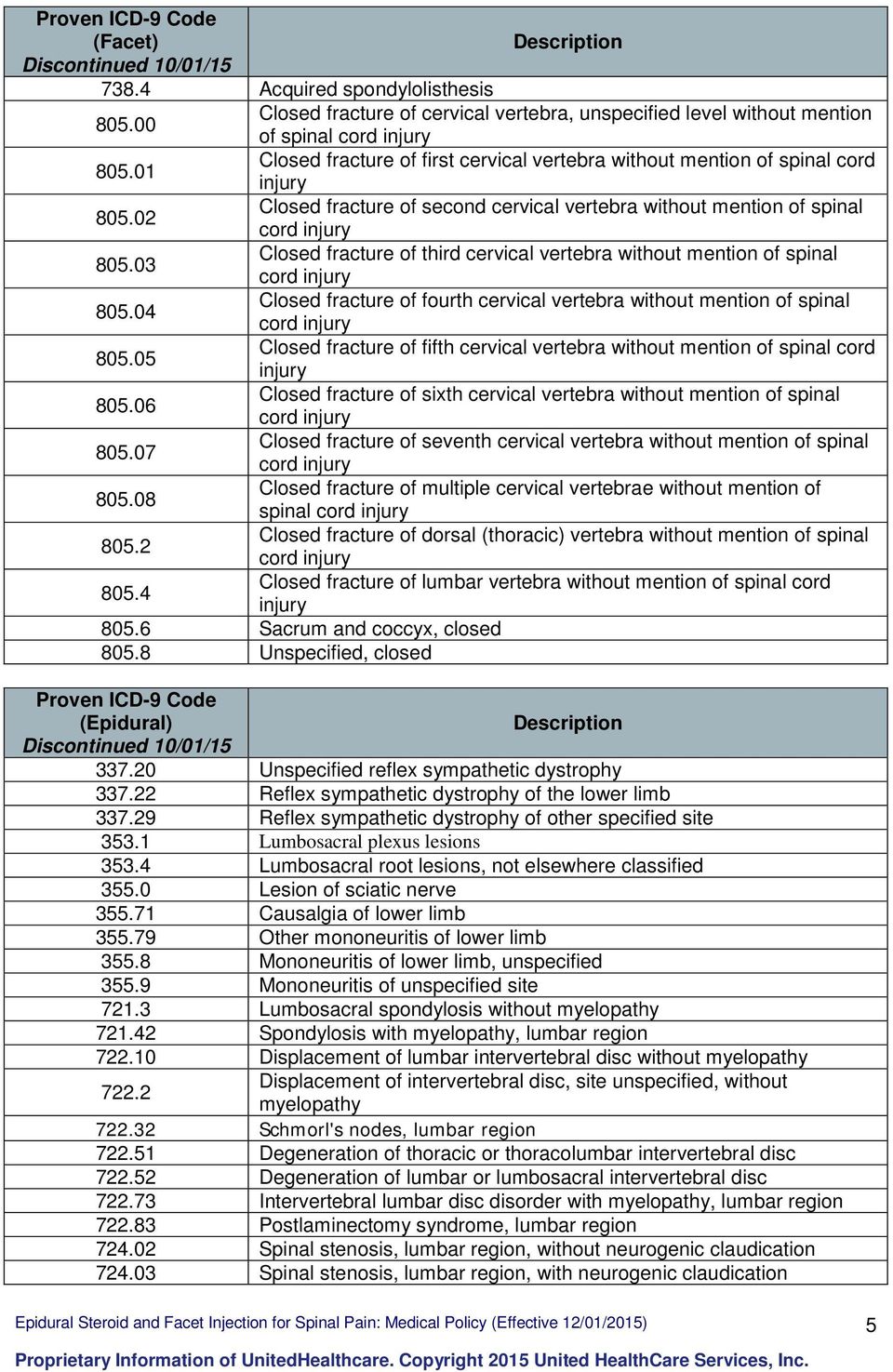
5 Proven ICD-9 Code (Facet) Discontinued 10/01/ Acquired spondylolisthesis Closed of cervical vertebra, unspecified level without mention of spinal cord injury Closed of first cervical vertebra without mention of spinal cord injury Closed of second cervical vertebra without mention of spinal cord injury Closed of third cervical vertebra without mention of spinal cord injury Closed of fourth cervical vertebra without mention of spinal cord injury Closed of fifth cervical vertebra without mention of spinal cord injury Closed of sixth cervical vertebra without mention of spinal cord injury Closed of seventh cervical vertebra without mention of spinal cord injury Closed of multiple cervical vertebrae without mention of spinal cord injury Closed of dorsal (thoracic) vertebra without mention of spinal cord injury Closed of lumbar vertebra without mention of spinal cord injury Sacrum and coccyx, closed Unspecified, closed Proven ICD-9 Code (Epidural) Discontinued 10/01/ Unspecified reflex sympathetic dystrophy Reflex sympathetic dystrophy of the lower limb Reflex sympathetic dystrophy of other specified site Lumbosacral plexus lesions Lumbosacral root lesions, not elsewhere classified Lesion of sciatic nerve Causalgia of lower limb Other mononeuritis of lower limb Mononeuritis of lower limb, unspecified Mononeuritis of unspecified site Lumbosacral spondylosis without myelopathy Spondylosis with myelopathy, lumbar region Displacement of lumbar intervertebral disc without myelopathy Displacement of intervertebral disc, site unspecified, without myelopathy Schmorl's nodes, lumbar region Degeneration of thoracic or thoracolumbar intervertebral disc Degeneration of lumbar or lumbosacral intervertebral disc Intervertebral lumbar disc disorder with myelopathy, lumbar region Postlaminectomy syndrome, lumbar region Spinal stenosis, lumbar region, without neurogenic claudication Spinal stenosis, lumbar region, with neurogenic claudication 5
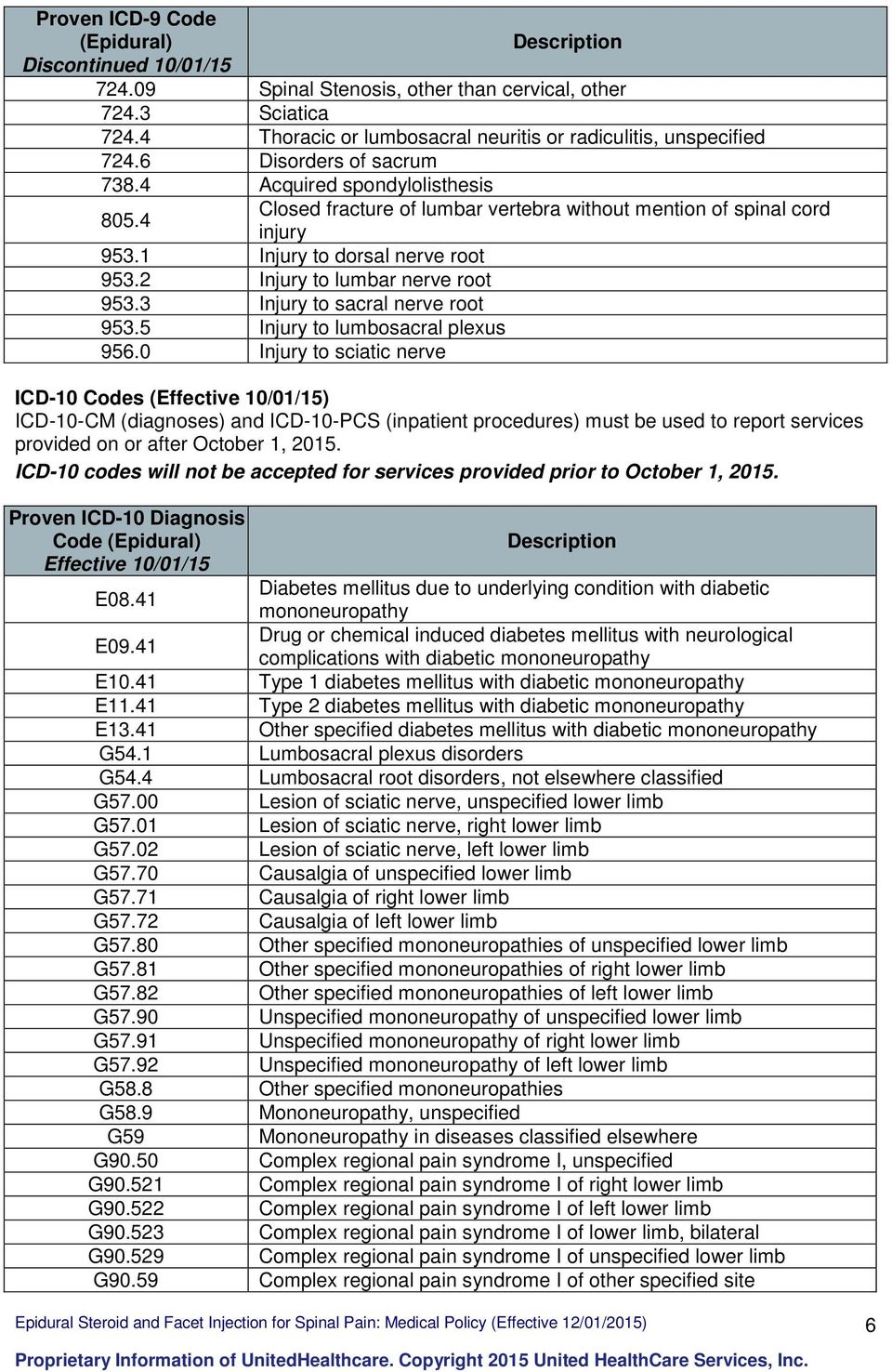
6 Proven ICD-9 Code (Epidural) Discontinued 10/01/ Spinal Stenosis, other than cervical, other Sciatica Thoracic or lumbosacral neuritis or radiculitis, unspecified Disorders of sacrum Acquired spondylolisthesis Closed of lumbar vertebra without mention of spinal cord injury Injury to dorsal nerve root Injury to lumbar nerve root Injury to sacral nerve root Injury to lumbosacral plexus Injury to sciatic nerve ICD-10 Codes (Effective 10/01/15) ICD-10-CM (diagnoses) and ICD-10-PCS (inpatient procedures) must be used to report services provided on or after October 1, ICD-10 codes will not be accepted for services provided prior to October 1, Proven ICD-10 Diagnosis Code (Epidural) Effective 10/01/15 E08.41 E09.41 Diabetes mellitus due to underlying condition with diabetic mononeuropathy Drug or chemical induced diabetes mellitus with neurological complications with diabetic mononeuropathy E10.41 Type 1 diabetes mellitus with diabetic mononeuropathy E11.41 Type 2 diabetes mellitus with diabetic mononeuropathy E13.41 Other specified diabetes mellitus with diabetic mononeuropathy G54.1 Lumbosacral plexus disorders G54.4 Lumbosacral root disorders, not elsewhere classified G57.00 Lesion of sciatic nerve, unspecified lower limb G57.01 Lesion of sciatic nerve, right lower limb G57.02 Lesion of sciatic nerve, left lower limb G57.70 Causalgia of unspecified lower limb G57.71 Causalgia of right lower limb G57.72 Causalgia of left lower limb G57.80 Other specified mononeuropathies of unspecified lower limb G57.81 Other specified mononeuropathies of right lower limb G57.82 Other specified mononeuropathies of left lower limb G57.90 Unspecified mononeuropathy of unspecified lower limb G57.91 Unspecified mononeuropathy of right lower limb G57.92 Unspecified mononeuropathy of left lower limb G58.8 Other specified mononeuropathies G58.9 Mononeuropathy, unspecified G59 Mononeuropathy in diseases classified elsewhere G90.50 Complex regional pain syndrome I, unspecified G Complex regional pain syndrome I of right lower limb G Complex regional pain syndrome I of left lower limb G Complex regional pain syndrome I of lower limb, bilateral G Complex regional pain syndrome I of unspecified lower limb G90.59 Complex regional pain syndrome I of other specified site 6
7 Proven ICD-10 Diagnosis Code (Epidural) Effective 10/01/15 M43.00 Spondylolysis, site unspecified M43.01 Spondylolysis, occipito-atlanto-axial region M43.02 Spondylolysis, cervical region M43.03 Spondylolysis, cervicothoracic region M43.04 Spondylolysis, thoracic region M43.05 Spondylolysis, thoracolumbar region M43.06 Spondylolysis, lumbar region M43.07 Spondylolysis, lumbosacral region M43.08 Spondylolysis, sacral and sacrococcygeal region M43.09 Spondylolysis, multiple sites in spine M43.10 Spondylolisthesis, site unspecified M43.11 Spondylolisthesis, occipito-atlanto-axial region M43.12 Spondylolisthesis, cervical region M43.13 Spondylolisthesis, cervicothoracic region M43.14 Spondylolisthesis, thoracic region M43.15 Spondylolisthesis, thoracolumbar region M43.16 Spondylolisthesis, lumbar region M43.17 Spondylolisthesis, lumbosacral region M43.18 Spondylolisthesis, sacral and sacrococcygeal region M43.19 Spondylolisthesis, multiple sites in spine M43.27 Fusion of spine, lumbosacral region M43.28 Fusion of spine, sacral and sacrococcygeal region M47.16 Other spondylosis with myelopathy, lumbar region M47.26 Other spondylosis with radiculopathy, lumbar region M47.27 Other spondylosis with radiculopathy, lumbosacral region M47.28 Other spondylosis with radiculopathy, sacral and sacrococcygeal region M Spondylosis without myelopathy or radiculopathy, lumbar region M Spondylosis without myelopathy or radiculopathy, lumbosacral M region Spondylosis without myelopathy or radiculopathy, sacral and sacrococcygeal region M Other spondylosis, lumbar region M Other spondylosis, lumbosacral region M Other spondylosis, sacral and sacrococcygeal region M48.00 Spinal Stenosis, site unspecified M48.06 Spinal stenosis, lumbar region M48.07 Spinal stenosis, lumbosacral region M48.08 Spinal stenosis, sacral and sacrococcygeal region M51.06 Intervertebral disc disorders with myelopathy, lumbar region M51.14 Intervertebral disc disorders with radiculopathy, thoracic region M51.15 Intervertebral disc disorders with radiculopathy, thoracolumbar region M51.16 Intervertebral disc disorders with radiculopathy, lumbar region M51.17 Intervertebral disc disorders with radiculopathy, lumbosacral region M51.26 Other intervertebral disc displacement, lumbar region M51.27 Other intervertebral disc displacement, lumbosacral region M51.34 Other intervertebral disc degeneration, thoracic region M51.35 Other intervertebral disc degeneration, thoracolumbar region M51.36 Other intervertebral disc degeneration, lumbar region M51.37 Other intervertebral disc degeneration, lumbosacral region 7

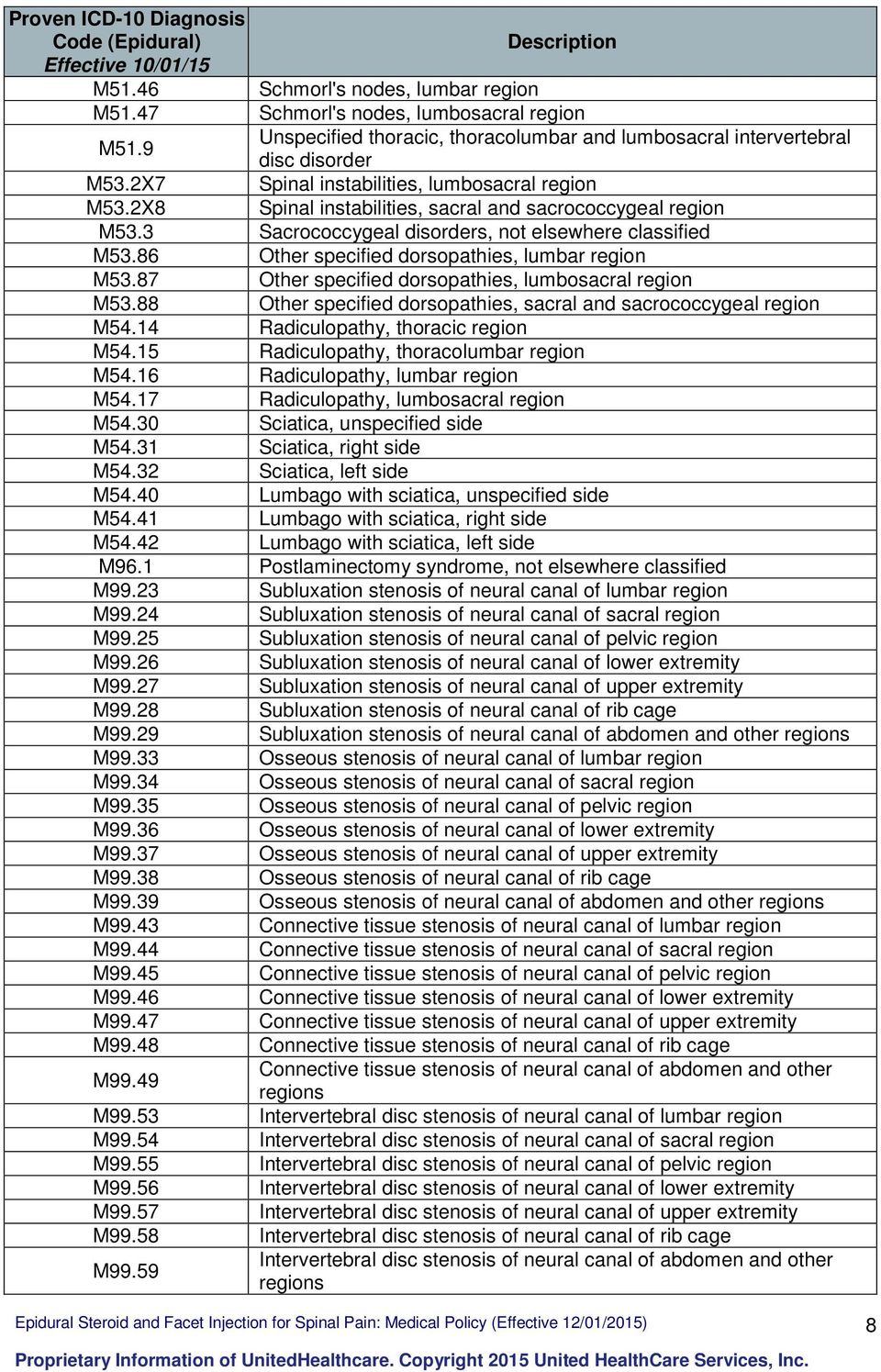
8 Proven ICD-10 Diagnosis Code (Epidural) Effective 10/01/15 M51.46 Schmorl's nodes, lumbar region M51.47 Schmorl's nodes, lumbosacral region M51.9 Unspecified thoracic, thoracolumbar and lumbosacral intervertebral disc disorder M53.2X7 Spinal instabilities, lumbosacral region M53.2X8 Spinal instabilities, sacral and sacrococcygeal region M53.3 Sacrococcygeal disorders, not elsewhere classified M53.86 Other specified dorsopathies, lumbar region M53.87 Other specified dorsopathies, lumbosacral region M53.88 Other specified dorsopathies, sacral and sacrococcygeal region M54.14 Radiculopathy, thoracic region M54.15 Radiculopathy, thoracolumbar region M54.16 Radiculopathy, lumbar region M54.17 Radiculopathy, lumbosacral region M54.30 Sciatica, unspecified side M54.31 Sciatica, right side M54.32 Sciatica, left side M54.40 Lumbago with sciatica, unspecified side M54.41 Lumbago with sciatica, right side M54.42 Lumbago with sciatica, left side M96.1 Postlaminectomy syndrome, not elsewhere classified M99.23 Subluxation stenosis of neural canal of lumbar region M99.24 Subluxation stenosis of neural canal of sacral region M99.25 Subluxation stenosis of neural canal of pelvic region M99.26 Subluxation stenosis of neural canal of lower extremity M99.27 Subluxation stenosis of neural canal of upper extremity M99.28 Subluxation stenosis of neural canal of rib cage M99.29 Subluxation stenosis of neural canal of abdomen and other regions M99.33 Osseous stenosis of neural canal of lumbar region M99.34 Osseous stenosis of neural canal of sacral region M99.35 Osseous stenosis of neural canal of pelvic region M99.36 Osseous stenosis of neural canal of lower extremity M99.37 Osseous stenosis of neural canal of upper extremity M99.38 Osseous stenosis of neural canal of rib cage M99.39 Osseous stenosis of neural canal of abdomen and other regions M99.43 Connective tissue stenosis of neural canal of lumbar region M99.44 Connective tissue stenosis of neural canal of sacral region M99.45 Connective tissue stenosis of neural canal of pelvic region M99.46 Connective tissue stenosis of neural canal of lower extremity M99.47 Connective tissue stenosis of neural canal of upper extremity M99.48 Connective tissue stenosis of neural canal of rib cage M99.49 Connective tissue stenosis of neural canal of abdomen and other regions M99.53 Intervertebral disc stenosis of neural canal of lumbar region M99.54 Intervertebral disc stenosis of neural canal of sacral region M99.55 Intervertebral disc stenosis of neural canal of pelvic region M99.56 Intervertebral disc stenosis of neural canal of lower extremity M99.57 Intervertebral disc stenosis of neural canal of upper extremity M99.58 Intervertebral disc stenosis of neural canal of rib cage M99.59 Intervertebral disc stenosis of neural canal of abdomen and other regions 8
9 Proven ICD-10 Diagnosis Code (Epidural) Effective 10/01/15 M99.63 M99.64 M99.65 M99.66 M99.67 M99.68 M99.69 M99.73 M99.74 M99.75 M99.76 M99.77 M99.78 M99.79 S24.2XXA S32.000A S32.001A S32.002A S32.008A S32.009A S32.010A S32.011A S32.012A S32.018A S32.019A S32.020A Osseous and subluxation stenosis of intervertebral foramina of lumbar region Osseous and subluxation stenosis of intervertebral foramina of sacral region Osseous and subluxation stenosis of intervertebral foramina of pelvic region Osseous and subluxation stenosis of intervertebral foramina of lower extremity Osseous and subluxation stenosis of intervertebral foramina of upper extremity Osseous and subluxation stenosis of intervertebral foramina of rib cage Osseous and subluxation stenosis of intervertebral foramina of abdomen and other regions Connective tissue and disc stenosis of intervertebral foramina of lumbar region Connective tissue and disc stenosis of intervertebral foramina of sacral region Connective tissue and disc stenosis of intervertebral foramina of pelvic region Connective tissue and disc stenosis of intervertebral foramina of lower extremity Connective tissue and disc stenosis of intervertebral foramina of upper extremity Connective tissue and disc stenosis of intervertebral foramina of rib cage Connective tissue and disc stenosis of intervertebral foramina of abdomen and other regions Injury of nerve root of thoracic spine, initial encounter Wedge compression of unspecified lumbar vertebra, initial encounter for Stable burst of unspecified lumbar vertebra, initial encounter for Unstable burst of unspecified lumbar vertebra, initial encounter for Other of unspecified lumbar vertebra, initial encounter for Unspecified of unspecified lumbar vertebra, initial encounter for Wedge compression of first lumbar vertebra, initial encounter for Stable burst of first lumbar vertebra, initial encounter for Unstable burst of first lumbar vertebra, initial encounter for Other of first lumbar vertebra, initial encounter for closed Unspecified of first lumbar vertebra, initial encounter for Wedge compression of second lumbar vertebra, initial encounter for 9

10 Proven ICD-10 Diagnosis Code (Epidural) Effective 10/01/15 S32.021A S32.022A S32.028A S32.029A S32.030A S32.031A S32.032A S32.038A S32.039A S32.040A S32.041A S32.042A S32.048A S32.049A S32.050A S32.051A S32.052A S32.058A S32.059A S34.21XA S34.22XA S34.4XXA S74.00XA S74.01XA S74.02XA Stable burst of second lumbar vertebra, initial encounter for Unstable burst of second lumbar vertebra, initial encounter for Other of second lumbar vertebra, initial encounter for closed Unspecified of second lumbar vertebra, initial encounter for Wedge compression of third lumbar vertebra, initial encounter for Stable burst of third lumbar vertebra, initial encounter for Unstable burst of third lumbar vertebra, initial encounter for Other of third lumbar vertebra, initial encounter for closed Unspecified of third lumbar vertebra, initial encounter for Wedge compression of fourth lumbar vertebra, initial encounter for Stable burst of fourth lumbar vertebra, initial encounter for Unstable burst of fourth lumbar vertebra, initial encounter for Other of fourth lumbar vertebra, initial encounter for closed Unspecified of fourth lumbar vertebra, initial encounter for Wedge compression of fifth lumbar vertebra, initial encounter for Stable burst of fifth lumbar vertebra, initial encounter for Unstable burst of fifth lumbar vertebra, initial encounter for Other of fifth lumbar vertebra, initial encounter for closed Unspecified of fifth lumbar vertebra, initial encounter for Injury of nerve root of lumbar spine, initial encounter Injury of nerve root of sacral spine, initial encounter Injury of lumbosacral plexus, initial encounter Injury of sciatic nerve at hip and thigh level, unspecified leg, initial encounter Injury of sciatic nerve at hip and thigh level, right leg, initial encounter Injury of sciatic nerve at hip and thigh level, left leg, initial encounter Proven ICD-10 Diagnosis Code (Facet) Effective 10/01/15 M Juvenile idiopathic scoliosis, cervical region M Juvenile idiopathic scoliosis, cervicothoracic region 10

11 Proven ICD-10 Diagnosis Code (Facet) Effective 10/01/15 M Juvenile idiopathic scoliosis, thoracic region M Juvenile idiopathic scoliosis, thoracolumbar region M Juvenile idiopathic scoliosis, lumbar region M Juvenile idiopathic scoliosis, lumbosacral region M Juvenile idiopathic scoliosis, site unspecified M Adolescent idiopathic scoliosis, cervical region M Adolescent idiopathic scoliosis, cervicothoracic region M Adolescent idiopathic scoliosis, thoracic region M Adolescent idiopathic scoliosis, thoracolumbar region M Adolescent idiopathic scoliosis, lumbar region M Adolescent idiopathic scoliosis, lumbosacral region M Adolescent idiopathic scoliosis, site unspecified M41.20 Other idiopathic scoliosis, site unspecified M41.22 Other idiopathic scoliosis, cervical region M41.23 Other idiopathic scoliosis, cervicothoracic region M41.24 Other idiopathic scoliosis, thoracic region M41.25 Other idiopathic scoliosis, thoracolumbar region M41.26 Other idiopathic scoliosis, lumbar region M41.27 Other idiopathic scoliosis, lumbosacral region M43.00 Spondylolysis, site unspecified M43.01 Spondylolysis, occipito-atlanto-axial region M43.02 Spondylolysis, cervical region M43.03 Spondylolysis, cervicothoracic region M43.04 Spondylolysis, thoracic region M43.05 Spondylolysis, thoracolumbar region M43.06 Spondylolysis, lumbar region M43.07 Spondylolysis, lumbosacral region M43.08 Spondylolysis, sacral and sacrococcygeal region M43.09 Spondylolysis, multiple sites in spine M43.10 Spondylolisthesis, site unspecified M43.11 Spondylolisthesis, occipito-atlanto-axial region M43.12 Spondylolisthesis, cervical region M43.13 Spondylolisthesis, cervicothoracic region M43.14 Spondylolisthesis, thoracic region M43.15 Spondylolisthesis, thoracolumbar region M43.16 Spondylolisthesis, lumbar region M43.17 Spondylolisthesis, lumbosacral region M43.18 Spondylolisthesis, sacral and sacrococcygeal region M43.19 Spondylolisthesis, multiple sites in spine M46.90 Unspecified inflammatory spondylopathy, site unspecified M46.91 Unspecified inflammatory spondylopathy, occipito-atlanto-axial region M46.92 Unspecified inflammatory spondylopathy, cervical region M46.93 Unspecified inflammatory spondylopathy, cervicothoracic region M46.94 Unspecified inflammatory spondylopathy, thoracic region M46.95 Unspecified inflammatory spondylopathy, thoracolumbar region M46.96 Unspecified inflammatory spondylopathy, lumbar region M46.97 Unspecified inflammatory spondylopathy, lumbosacral region M46.98 Unspecified inflammatory spondylopathy, sacral and sacrococcygeal region M46.99 Unspecified inflammatory spondylopathy, multiple sites in spine 11

12 Proven ICD-10 Diagnosis Code (Facet) Effective 10/01/15 M Anterior spinal artery compression syndromes, occipito-atlanto-axial region M Anterior spinal artery compression syndromes, cervical region M Anterior spinal artery compression syndromes, cervicothoracic region M Anterior spinal artery compression syndromes, thoracic region M Anterior spinal artery compression syndromes, thoracolumbar region M Anterior spinal artery compression syndromes, lumbar region M Anterior spinal artery compression syndromes, site unspecified M Vertebral artery compression syndromes, occipito-atlanto-axial region M Vertebral artery compression syndromes, cervical region M Vertebral artery compression syndromes, site unspecified M47.11 Other spondylosis with myelopathy, occipito-atlanto-axial region M47.12 Other spondylosis with myelopathy, cervical region M47.13 Other spondylosis with myelopathy, cervicothoracic region M47.14 Other spondylosis with myelopathy, thoracic region M47.15 Other spondylosis with myelopathy, thoracolumbar region M47.16 Other spondylosis with myelopathy, lumbar region M47.20 Other spondylosis with radiculopathy, site unspecified M47.21 Other spondylosis with radiculopathy, occipito-atlanto-axial region M47.22 Other spondylosis with radiculopathy, cervical region M47.23 Other spondylosis with radiculopathy, cervicothoracic region M47.24 Other spondylosis with radiculopathy, thoracic region M47.25 Other spondylosis with radiculopathy, thoracolumbar region M47.26 Other spondylosis with radiculopathy, lumbar region M47.27 Other spondylosis with radiculopathy, lumbosacral region M47.28 Other spondylosis with radiculopathy, sacral and sacrococcygeal region M Spondylosis without myelopathy or radiculopathy, occipito-atlantoaxial region M Spondylosis without myelopathy or radiculopathy, cervical region M Spondylosis without myelopathy or radiculopathy, cervicothoracic region M Spondylosis without myelopathy or radiculopathy, thoracic region M Spondylosis without myelopathy or radiculopathy, thoracolumbar region M Spondylosis without myelopathy or radiculopathy, lumbar region M M Spondylosis without myelopathy or radiculopathy, lumbosacral region Spondylosis without myelopathy or radiculopathy, sacral and sacrococcygeal region M Spondylosis without myelopathy or radiculopathy, site unspecified M Other spondylosis, occipito-atlanto-axial region M Other spondylosis, cervical region M Other spondylosis, cervicothoracic region M Other spondylosis, thoracic region M Other spondylosis, thoracolumbar region M Other spondylosis, lumbar region M Other spondylosis, lumbosacral region M Other spondylosis, sacral and sacrococcygeal region 12

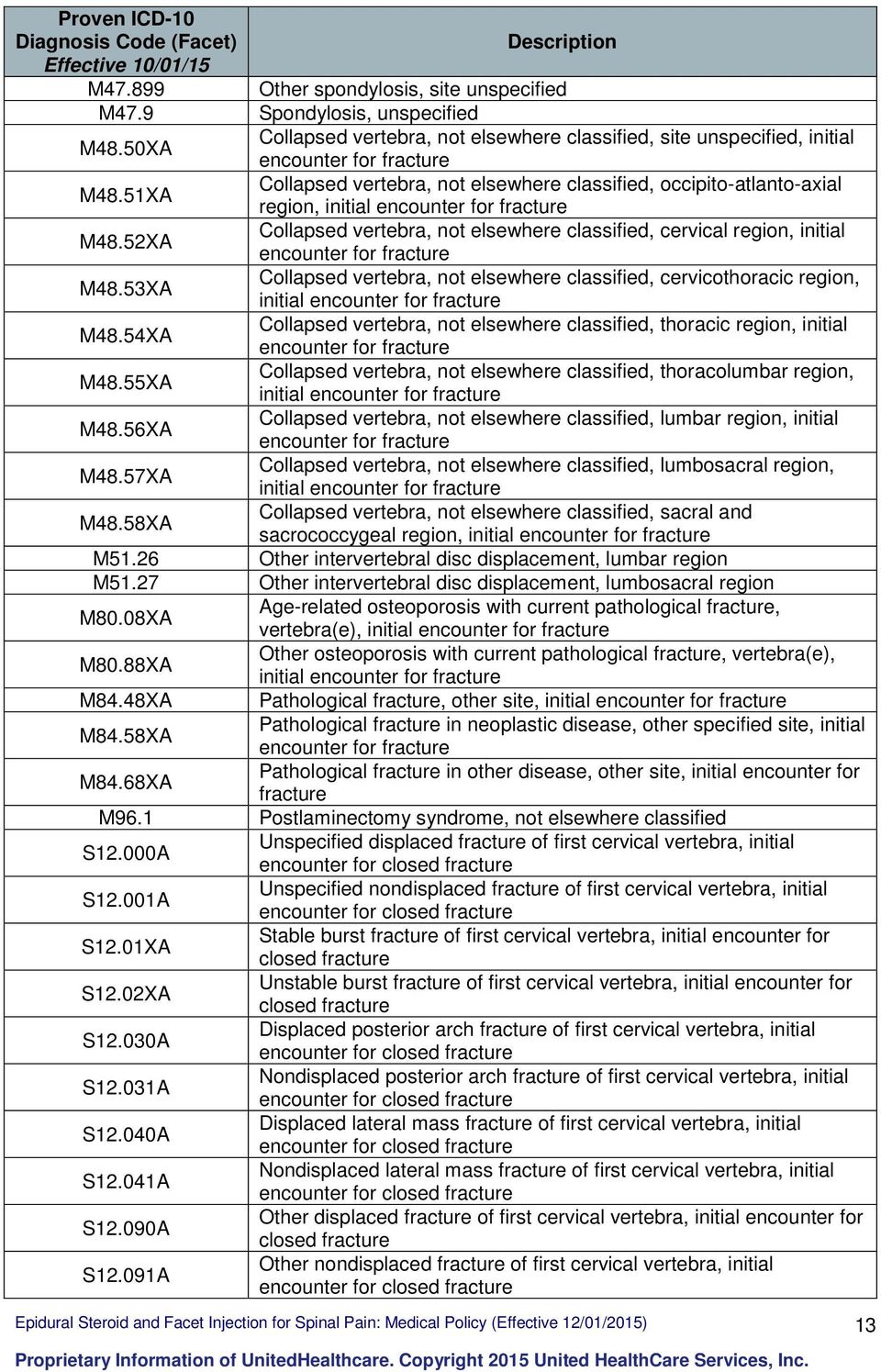
13 Proven ICD-10 Diagnosis Code (Facet) Effective 10/01/15 M Other spondylosis, site unspecified M47.9 Spondylosis, unspecified M48.50XA Collapsed vertebra, not elsewhere classified, site unspecified, initial encounter for M48.51XA Collapsed vertebra, not elsewhere classified, occipito-atlanto-axial region, initial encounter for M48.52XA Collapsed vertebra, not elsewhere classified, cervical region, initial encounter for M48.53XA Collapsed vertebra, not elsewhere classified, cervicothoracic region, initial encounter for M48.54XA Collapsed vertebra, not elsewhere classified, thoracic region, initial encounter for M48.55XA Collapsed vertebra, not elsewhere classified, thoracolumbar region, initial encounter for M48.56XA Collapsed vertebra, not elsewhere classified, lumbar region, initial encounter for M48.57XA Collapsed vertebra, not elsewhere classified, lumbosacral region, initial encounter for M48.58XA Collapsed vertebra, not elsewhere classified, sacral and sacrococcygeal region, initial encounter for M51.26 Other intervertebral disc displacement, lumbar region M51.27 Other intervertebral disc displacement, lumbosacral region M80.08XA Age-related osteoporosis with current pathological, vertebra(e), initial encounter for M80.88XA Other osteoporosis with current pathological, vertebra(e), initial encounter for M84.48XA Pathological, other site, initial encounter for M84.58XA Pathological in neoplastic disease, other specified site, initial encounter for M84.68XA Pathological in other disease, other site, initial encounter for M96.1 Postlaminectomy syndrome, not elsewhere classified S12.000A Unspecified displaced of first cervical vertebra, initial encounter for S12.001A Unspecified nondisplaced of first cervical vertebra, initial encounter for S12.01XA Stable burst of first cervical vertebra, initial encounter for S12.02XA Unstable burst of first cervical vertebra, initial encounter for S12.030A Displaced posterior arch of first cervical vertebra, initial encounter for S12.031A Nondisplaced posterior arch of first cervical vertebra, initial encounter for S12.040A Displaced lateral mass of first cervical vertebra, initial encounter for S12.041A Nondisplaced lateral mass of first cervical vertebra, initial encounter for S12.090A Other displaced of first cervical vertebra, initial encounter for S12.091A Other nondisplaced of first cervical vertebra, initial encounter for 13
14 Proven ICD-10 Diagnosis Code (Facet) Effective 10/01/15 S12.100A S12.101A S12.110A S12.111A S12.112A S12.120A S12.121A S12.130A S12.131A S12.14XA S12.150A S12.151A S12.190A S12.191A S12.200A S12.201A S12.230A S12.231A S12.24XA S12.250A S12.251A S12.290A S12.291A S12.300A S12.301A S12.330A Unspecified displaced of second cervical vertebra, initial encounter for Unspecified nondisplaced of second cervical vertebra, initial encounter for Anterior displaced Type II dens, initial encounter for closed Posterior displaced Type II dens, initial encounter for closed Nondisplaced Type II dens, initial encounter for closed Other displaced dens, initial encounter for Other nondisplaced dens, initial encounter for closed Unspecified traumatic displaced spondylolisthesis of second cervical vertebra, initial encounter for Unspecified traumatic nondisplaced spondylolisthesis of second cervical vertebra, initial encounter for Type III traumatic spondylolisthesis of second cervical vertebra, initial encounter for Other traumatic displaced spondylolisthesis of second cervical vertebra, initial encounter for Other traumatic nondisplaced spondylolisthesis of second cervical vertebra, initial encounter for Other displaced of second cervical vertebra, initial encounter for Other nondisplaced of second cervical vertebra, initial encounter for Unspecified displaced of third cervical vertebra, initial encounter for Unspecified nondisplaced of third cervical vertebra, initial encounter for Unspecified traumatic displaced spondylolisthesis of third cervical vertebra, initial encounter for Unspecified traumatic nondisplaced spondylolisthesis of third cervical vertebra, initial encounter for Type III traumatic spondylolisthesis of third cervical vertebra, initial encounter for Other traumatic displaced spondylolisthesis of third cervical vertebra, initial encounter for Other traumatic nondisplaced spondylolisthesis of third cervical vertebra, initial encounter for Other displaced of third cervical vertebra, initial encounter for Other nondisplaced of third cervical vertebra, initial encounter for Unspecified displaced of fourth cervical vertebra, initial encounter for Unspecified nondisplaced of fourth cervical vertebra, initial encounter for Unspecified traumatic displaced spondylolisthesis of fourth cervical vertebra, initial encounter for 14

15 Proven ICD-10 Diagnosis Code (Facet) Effective 10/01/15 S12.331A S12.34XA S12.350A S12.351A S12.390A S12.391A S12.400A S12.401A S12.430A S12.431A S12.44XA S12.450A S12.451A S12.490A S12.491A S12.500A S12.501A S12.530A S12.531A S12.54XA S12.550A S12.551A S12.590A S12.591A S12.600A S12.601A Unspecified traumatic nondisplaced spondylolisthesis of fourth cervical vertebra, initial encounter for Type III traumatic spondylolisthesis of fourth cervical vertebra, initial encounter for Other traumatic displaced spondylolisthesis of fourth cervical vertebra, initial encounter for Other traumatic nondisplaced spondylolisthesis of fourth cervical vertebra, initial encounter for Other displaced of fourth cervical vertebra, initial encounter for Other nondisplaced of fourth cervical vertebra, initial encounter for Unspecified displaced of fifth cervical vertebra, initial encounter for Unspecified nondisplaced of fifth cervical vertebra, initial encounter for Unspecified traumatic displaced spondylolisthesis of fifth cervical vertebra, initial encounter for Unspecified traumatic nondisplaced spondylolisthesis of fifth cervical vertebra, initial encounter for Type III traumatic spondylolisthesis of fifth cervical vertebra, initial encounter for Other traumatic displaced spondylolisthesis of fifth cervical vertebra, initial encounter for Other traumatic nondisplaced spondylolisthesis of fifth cervical vertebra, initial encounter for Other displaced of fifth cervical vertebra, initial encounter for Other nondisplaced of fifth cervical vertebra, initial encounter for Unspecified displaced of sixth cervical vertebra, initial encounter for Unspecified nondisplaced of sixth cervical vertebra, initial encounter for Unspecified traumatic displaced spondylolisthesis of sixth cervical vertebra, initial encounter for Unspecified traumatic nondisplaced spondylolisthesis of sixth cervical vertebra, initial encounter for Type III traumatic spondylolisthesis of sixth cervical vertebra, initial encounter for Other traumatic displaced spondylolisthesis of sixth cervical vertebra, initial encounter for Other traumatic nondisplaced spondylolisthesis of sixth cervical vertebra, initial encounter for Other displaced of sixth cervical vertebra, initial encounter for Other nondisplaced of sixth cervical vertebra, initial encounter for Unspecified displaced of seventh cervical vertebra, initial encounter for Unspecified nondisplaced of seventh cervical vertebra, initial encounter for 15

16 Proven ICD-10 Diagnosis Code (Facet) Effective 10/01/15 S12.630A S12.631A S12.64XA S12.650A S12.651A S12.690A S12.691A S12.9XXA S22.000A S22.001A S22.002A S22.008A S22.009A S22.010A S22.011A S22.012A S22.018A S22.019A S22.020A S22.021A S22.022A S22.028A S22.029A S22.030A S22.031A S22.032A Unspecified traumatic displaced spondylolisthesis of seventh cervical vertebra, initial encounter for Unspecified traumatic nondisplaced spondylolisthesis of seventh cervical vertebra, initial encounter for Type III traumatic spondylolisthesis of seventh cervical vertebra, initial encounter for Other traumatic displaced spondylolisthesis of seventh cervical vertebra, initial encounter for Other traumatic nondisplaced spondylolisthesis of seventh cervical vertebra, initial encounter for Other displaced of seventh cervical vertebra, initial encounter for Other nondisplaced of seventh cervical vertebra, initial encounter for Fracture of neck, unspecified, initial encounter Wedge compression of unspecified thoracic vertebra, initial encounter for Stable burst of unspecified thoracic vertebra, initial encounter for Unstable burst of unspecified thoracic vertebra, initial encounter for Other of unspecified thoracic vertebra, initial encounter for Unspecified of unspecified thoracic vertebra, initial encounter for Wedge compression of first thoracic vertebra, initial encounter for Stable burst of first thoracic vertebra, initial encounter for Unstable burst of first thoracic vertebra, initial encounter for Other of first thoracic vertebra, initial encounter for closed Unspecified of first thoracic vertebra, initial encounter for Wedge compression of second thoracic vertebra, initial encounter for Stable burst of second thoracic vertebra, initial encounter for Unstable burst of second thoracic vertebra, initial encounter for Other of second thoracic vertebra, initial encounter for Unspecified of second thoracic vertebra, initial encounter for Wedge compression of third thoracic vertebra, initial encounter for Stable burst of third thoracic vertebra, initial encounter for Unstable burst of third thoracic vertebra, initial encounter for 16

17 Proven ICD-10 Diagnosis Code (Facet) Effective 10/01/15 S22.038A S22.039A S22.040A S22.041A S22.042A S22.048A S22.049A S22.050A S22.051A S22.052A S22.058A S22.059A S22.060A S22.061A S22.062A S22.068A S22.069A S22.070A S22.071A S22.072A S22.078A S22.079A S22.080A S22.081A S22.082A S22.088A Other of third thoracic vertebra, initial encounter for closed Unspecified of third thoracic vertebra, initial encounter for Wedge compression of fourth thoracic vertebra, initial encounter for Stable burst of fourth thoracic vertebra, initial encounter for Unstable burst of fourth thoracic vertebra, initial encounter for Other of fourth thoracic vertebra, initial encounter for closed Unspecified of fourth thoracic vertebra, initial encounter for Wedge compression of T5-T6 vertebra, initial encounter for Stable burst of T5-T6 vertebra, initial encounter for closed Unstable burst of T5-T6 vertebra, initial encounter for closed Other of T5-T6 vertebra, initial encounter for Unspecified of T5-T6 vertebra, initial encounter for closed Wedge compression of T7-T8 vertebra, initial encounter for Stable burst of T7-T8 vertebra, initial encounter for closed Unstable burst of T7-T8 vertebra, initial encounter for closed Other of T7-T8 thoracic vertebra, initial encounter for closed Unspecified of T7-T8 vertebra, initial encounter for closed Wedge compression of T9-T10 vertebra, initial encounter for Stable burst of T9-T10 vertebra, initial encounter for closed Unstable burst of T9-T10 vertebra, initial encounter for Other of T9-T10 vertebra, initial encounter for closed Unspecified of T9-T10 vertebra, initial encounter for closed Wedge compression of T11-T12 vertebra, initial encounter for Stable burst of T11-T12 vertebra, initial encounter for closed Unstable burst of T11-T12 vertebra, initial encounter for Other of T11-T12 vertebra, initial encounter for closed 17

18 Proven ICD-10 Diagnosis Code (Facet) Effective 10/01/15 S22.089A S32.000A S32.001A S32.002A S32.008A S32.009A S32.010A S32.011A S32.012A S32.018A S32.019A S32.020A S32.021A S32.022A S32.028A S32.029A S32.030A S32.031A S32.032A S32.038A S32.039A S32.040A S32.041A S32.042A S32.048A S32.049A Unspecified of T11-T12 vertebra, initial encounter for closed Wedge compression of unspecified lumbar vertebra, initial encounter for Stable burst of unspecified lumbar vertebra, initial encounter for Unstable burst of unspecified lumbar vertebra, initial encounter for Other of unspecified lumbar vertebra, initial encounter for Unspecified of unspecified lumbar vertebra, initial encounter for Wedge compression of first lumbar vertebra, initial encounter for Stable burst of first lumbar vertebra, initial encounter for Unstable burst of first lumbar vertebra, initial encounter for Other of first lumbar vertebra, initial encounter for closed Unspecified of first lumbar vertebra, initial encounter for Wedge compression of second lumbar vertebra, initial encounter for Stable burst of second lumbar vertebra, initial encounter for Unstable burst of second lumbar vertebra, initial encounter for Other of second lumbar vertebra, initial encounter for closed Unspecified of second lumbar vertebra, initial encounter for Wedge compression of third lumbar vertebra, initial encounter for Stable burst of third lumbar vertebra, initial encounter for Unstable burst of third lumbar vertebra, initial encounter for Other of third lumbar vertebra, initial encounter for closed Unspecified of third lumbar vertebra, initial encounter for Wedge compression of fourth lumbar vertebra, initial encounter for Stable burst of fourth lumbar vertebra, initial encounter for Unstable burst of fourth lumbar vertebra, initial encounter for Other of fourth lumbar vertebra, initial encounter for closed Unspecified of fourth lumbar vertebra, initial encounter for 18

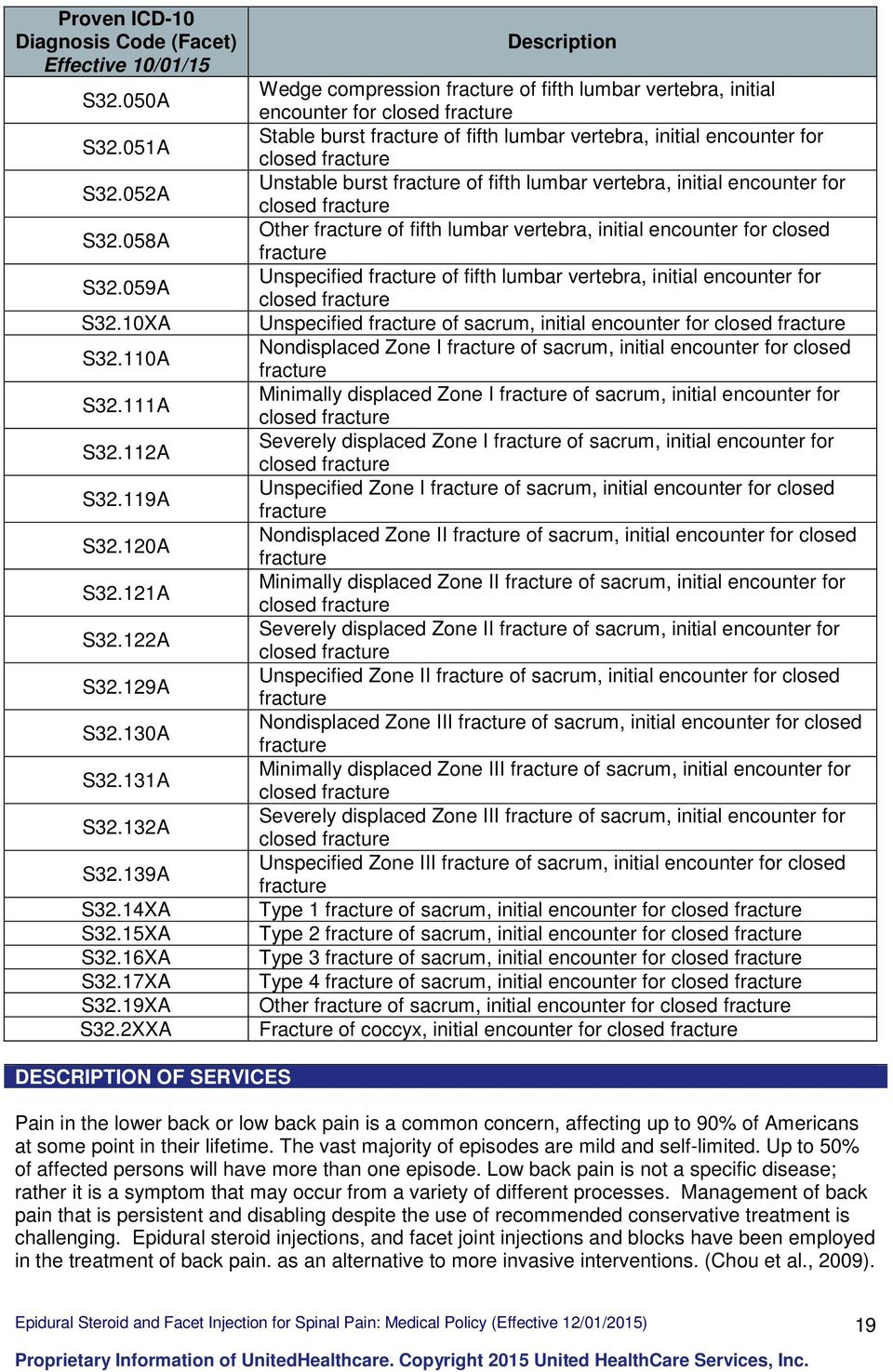
19 Proven ICD-10 Diagnosis Code (Facet) Effective 10/01/15 S32.050A S32.051A S32.052A S32.058A S32.059A S32.10XA S32.110A S32.111A S32.112A S32.119A S32.120A S32.121A S32.122A S32.129A S32.130A S32.131A S32.132A S32.139A S32.14XA S32.15XA S32.16XA S32.17XA S32.19XA S32.2XXA Wedge compression of fifth lumbar vertebra, initial encounter for Stable burst of fifth lumbar vertebra, initial encounter for Unstable burst of fifth lumbar vertebra, initial encounter for Other of fifth lumbar vertebra, initial encounter for closed Unspecified of fifth lumbar vertebra, initial encounter for Unspecified of sacrum, initial encounter for Nondisplaced Zone I of sacrum, initial encounter for closed Minimally displaced Zone I of sacrum, initial encounter for Severely displaced Zone I of sacrum, initial encounter for Unspecified Zone I of sacrum, initial encounter for closed Nondisplaced Zone II of sacrum, initial encounter for closed Minimally displaced Zone II of sacrum, initial encounter for Severely displaced Zone II of sacrum, initial encounter for Unspecified Zone II of sacrum, initial encounter for closed Nondisplaced Zone III of sacrum, initial encounter for closed Minimally displaced Zone III of sacrum, initial encounter for Severely displaced Zone III of sacrum, initial encounter for Unspecified Zone III of sacrum, initial encounter for closed Type 1 of sacrum, initial encounter for Type 2 of sacrum, initial encounter for Type 3 of sacrum, initial encounter for Type 4 of sacrum, initial encounter for Other of sacrum, initial encounter for Fracture of coccyx, initial encounter for DESCRIPTION OF SERVICES Pain in the lower back or low back pain is a common concern, affecting up to 90% of Americans at some point in their lifetime. The vast majority of episodes are mild and self-limited. Up to 50% of affected persons will have more than one episode. Low back pain is not a specific disease; rather it is a symptom that may occur from a variety of different processes. Management of back pain that is persistent and disabling despite the use of recommended conservative treatment is challenging. Epidural steroid injections, and facet joint injections and blocks have been employed in the treatment of back pain. as an alternative to more invasive interventions. (Chou et al., 2009). 19
20 Spinal stenosis is described by the National Institute of Arthritis and Musculoskeletal and Skin Diseases (NIAMS) as follows: Spinal stenosis is a narrowing of spaces in the spine (backbone) that results in pressure on the spinal cord and/or nerve roots. This disorder usually involves the narrowing of one or more of three areas of the spine: (1) the canal in the center of the column of bones (vertebral or spinal column) through which the spinal cord and nerve roots run, (2) the canals at the base or roots of nerves branching out from the spinal cord, or (3) the openings between vertebrae (bones of the spine) through which nerves leave the spine and go to other parts of the body. The narrowing may involve a small or large area of the spine. Pressure on the lower part of the spinal cord or on nerve roots branching out from that area may give rise to pain or numbness in the legs. Pressure on the upper part of the spinal cord (that is, the neck area) may produce similar symptoms in the shoulders, or even the legs There are 3 types of spinal stenosis: lateral stenosis, central stenosis, and foraminal stenosis. Lateral stenosis is the most common and is characterized by compression of the nerves and nerve roots as they exit the spinal cord on the way to the extremities. It can be caused by a bulging or herniated disc or bony protrusion that extends beyond the opening in the canal through which the nerve is traveling. Central stenosis occurs when the central canal in the spinal column is narrowed or choked by enlarged bone spurs from arthritis or trauma or degenerative disc disease. Central stenosis of the lumbar spine may lead to pressure on the cauda equina nerve roots (the bundle of roots that branch off at the bottom of the spinal cord), leading to lower extremity pain, numbness or weakness or loss of bowel and/or bladder control. Foraminal stenosis is a condition caused by excessive pressure on, or trapping, of a nerve root by a bone spur in the foramen, or the opening where the nerve root leaves the spinal canal. (Hayes 2015). Facet blocks can be considered a diagnostic or therapeutic procedure. Facet blocks using shortacting local anesthetics can be used to diagnose facet (zygapophyseal) joint syndrome as the cause of chronic back pain. Facet blocks utilizing long acting local anesthetics, anti-inflammatory agents such as corticosteroids, or nerve ablating techniques such as radiofrequency lesioning have been investigated for treatment of chronic back pain attributed to facet joint syndrome. (Hayes, 2007) Epidural steroid injection (ESI) is a nonsurgical treatment for managing low back pain and sciatica caused by disc herniation or degenerative changes in the vertebrae. An epidural steroid injection is an injection of long lasting steroid in the epidural space; that is the area which surrounds the spinal cord and the nerves coming out of it. The goal of ESI is to relieve pain, improve function, and reduce the need for surgical intervention. (Hayes, 2007, Updated 2014) Chronic nonmalignant back pain is defined as pain lasting 3-6 months or more that is not due to cancer. CLINICAL EVIDENCE Ultrasound Guidance Galiano et al. (2007) compared ultrasound guided facet joint injections with CT-controlled interventions in a prospective randomized clinical trial. Forty adult patients with chronic low back pain were evenly assigned either to an ultrasound or CT- group. The primary outcomes were accuracy and time to final needle placement. Of the patients randomized to ultrasound, 18 were judged to be feasible for an ultrasound approach. In 16 of these patients, the facet joints were clearly visible. In the 2 patients not judged to be feasible for the ultrasound approach, CT placement was performed due to inability to visualize the facet joint. For the ultrasound group, the space to be injected was identified within 5mm of the joint space. All of the needle placements were confirmed by CT. The duration of procedure and radiation dose was /- 6.6 minutes and / mgy.cm in the ultrasound group, and /- 6.3 minutes and / mgy.cm in the CT group. Both groups showed an effect from facet joint injections, demonstrating accurate needle placement. No difference between groups was detected. The authors concluded that the ultrasound approach to the facet joints is feasible and has minimal risk in the large 20

21 majority of patients and results in a significant time and radiation dose reduction. The study is limited by small sample size. In addition, if the depth of the facet joint is greater the 8cm, visualization is not feasible with ultrasound. CT guidance is reliable and straightforward in 100% of patients regardless of their physical constitution. The fact that CT requires multiple imaging slices accounts for the increase in radiation exposure. Another study by Galiano et al. (2005) was limited to cadaver studies. The clinical evidence was reviewed on January 27, 2015 with no additional information identified that would change the unproven and not medically necessary conclusions. Facet Injections A facet block is an injection of local anesthetic and/or steroids into or near the facet joint of the spine. Use of diagnostic blocks with injection of local anesthesia into the facet joints or around the medial branch nerves to identify the possible sources of spinal pain appears to be an established diagnostic procedure. However, there is no gold standard for the diagnosis of facet syndrome against which the accuracy of diagnostic facet blocks can be assessed. Single blocks have been compared to what are regarded as diagnostically more valid double blocks using local anesthetic agents with different pharmacologic properties and durations of action. With double blocks, a short- and a long-acting anesthetic are used, preferably administered in a double-blind, random order on separate occasions. In a positive response, pain relief occurs with both but lasts longer with the long-acting anesthetic. Compared to a single-blind, double block, Schwarzer et al. (1994) found that a single lumbar facet joint diagnostic block had a 38% false-positive rate. A systematic review by Boswell et al. (2007) evaluated the effectiveness of 3 types of facet joint interventions (intra-articular injections, medial branch nerve blocks, and neurotomy) in managing chronic spinal pain. The primary outcome measure was pain relief. For intra-articular facet joint injections and medial branch blocks, short-term pain relief was defined as relief lasting less than 6 weeks and long-term relief as 6 weeks or longer. For medial branch blocks, repeated injections at defined intervals provided long-term pain relief. For medial branch radiofrequency neurotomy, short-term pain relief was defined as relief lasting less than 3 months and long-term relief as lasting 3 months or longer. Other outcome measures included functional improvement, improvement of psychological status, and return to work. The authors concluded that for intraarticular facet joint injections, the evidence for short- and long-term pain relief is limited for cervical pain and moderate for lumbar pain. For medial branch blocks, the evidence is moderate for short- and long-term pain relief. For medial branch neurotomy, the evidence is moderate for short- and long-term pain relief. The evidence for thoracic medial branch neurotomy is indeterminate. Injections with local anesthetics and/or corticosteroids into or around facet joints of the spine have not been validated as a treatment for facet joint syndrome pain. Although some uncontrolled studies have reported a wide range of pain relief from facet joint injections, controlled studies evaluating this treatment modality found that injection of local anesthetic and/or corticosteroids had little value in relieving pain in patients with chronic back pain. Lilius et al. (1989), in a randomized controlled trial that included patients with low back pain for over 3 months, compared bupivacaine and methylprednisolone acetate injected into 2 facet joints (n=28), the same mixture injected around 2 facet joints (n=39), and saline injected into 2 facet joints (n=42). No differences were found between the groups in return to work, pain relief, or on clinical examination. This was a reasonably well-designed trial except that the sample sizes were relatively small and the method of randomization was not described. Manchicanti et al. (2010a) conducted a double-blind randomized controlled trial of facet joint nerve blocks to manage chronic low back pain. One hundred twenty patients were equally randomized to receive either a local anesthetic only (group I) or a local anesthetic mixed with a steroid (group II). Outcomes were measured at baseline, 3, 6, 12, 18 and 24 months posttreatment with the Numeric Rating Scale (NRS), the Oswestry Disability Index 2.0 (ODI), work 21
22 status, and opioid intake. Significant pain relief ( 50%) and functional improvement of 40% were observed in 85% in Group 1, and 90% in Group II, at 2-year follow-up. The authors found that both groups had equal relief with or without the addition of steroids to the treatment. Carette et al. (1991) conducted a well-designed, randomized controlled trial that included patients with low back pain of at least 6 months duration. Patients were assigned to receive either facet joint injection with methylprednisolone acetate (n=49) or saline (n=48). At 1 and 3 months after the injections, the 2 groups did not differ on measures of pain relief, functional status, or back flexion. At 6 months, those who received corticosteroid injections reported more improvement, less pain, and less physical disability, but this might have been explained in part by more use of other concurrent interventions. Jackson (1992) randomized patients with pain for a mean of 3.5 months (range, 1 to 12 months) to lumbar facet joint injection with either lidocaine (n=12) or saline (n=13) and found no differential effect on pain scores. The major weakness of this trial was that its sample size was too small. Revel et al. (1998) conducted a randomized study of 80 patients with low back pain to receive facet injections of lidocaine or saline. The investigators indicated that lidocaine gave greater pain relief than saline. Very few relevant new studies on facet joint injection were identified that were published after Most of the articles published since those times have been review articles or uncontrolled case series. Nelemans et al. (2001) systematically reviewed the Medline and Embase databases for randomized controlled trials evaluating the effectiveness of injection therapy in patients with low back pain. Their search criteria captured articles published prior to 1998 and included 21 randomized trials. They concluded that evidence and long-term outcome data is lacking to support the efficacy of injections therapy for chronic low back pain. Mayer et al. (2004) conducted a randomized controlled trial to investigate the use of facet injections as an adjunct to lumbar exercises in 70 patients with lumbar segmental rigidity. Patients were assigned to facet injections and exercise (n=36) or exercise alone (n=34). A higher proportion of injection patients (87-95%) displayed range of motion improvement compared to the exercise only patients (64-79%). No significant differences in self-reported pain or disability were found between the 2 groups. A study by Shih et al. (2005) was conducted to investigate the diagnostic and clinical value of lumbar facet joint injections in 277 patients with low back pain. Good response was demonstrated in 72.1% of patients after 3 weeks, 40.7% of patients after 6 weeks, and 31.4% of patients after 12 weeks. In a study conducted by Manchikanti et al. (2004), 100 consecutive patients with facet joint neck pain received cervical facet joint nerve blocks. Ninety-two percent of patients had pain relief at 3 months, 82% had pain relief at 6 months, and 56% had pain relief at 12 months compared to baseline measurements. Manchikanti (2006) also investigated 55 consecutive patients with thoracic facet joint pain treated with medial branch blocks. Significant pain relief was achieved in 71% of patients at 3 and 6 months, 71% at 24 months, and 69% at 36 months. The investigators concluded that thoracic medial branch blocks were an effective treatment for managing thoracic facet joint pain. In a prospective, randomized, double-blind trial by Manchikanti et al. (2007), data from a total of 60 patients were included, with 15 patients in each of 4 groups. Thirty patients were in a nonsteroid group consisting of Groups I (control, with lumbar facet joint nerve blocks using bupivacaine ) and II (with lumbar facet joint nerve blocks using bupivacaine and Sarapin); another 30 patients were in a steroid group consisting of Groups III (with lumbar facet joint nerve blocks using bupivacaine and steroids) and IV (with lumbar facet joint nerve blocks using bupivacaine, 22
23 Sarapin, and steroids). Significant improvement in pain and functional status were observed at 3 months, 6 months, and 12 months, compared to baseline measurements. The average number of treatments for 1 year was 3.7 with no significant differences among the groups. Duration of average pain relief with each procedure was /- 7.9 weeks in the non-steroid group and /- 3.3 weeks in the steroid group, with no significant differences among the groups. Therapeutic lumbar facet joint nerve blocks with local anesthetic, with or without Sarapin or steroids, may be effective in the treatment of chronic low back pain of facet joint origin. In addition to transient local pain at the injection sites, risks involved with facet joint injections include potential infection, hemorrhage, neurologic damage, and chemical meningitis as well as x-ray exposure from fluoroscopy. Facet joint injections incur the general risks of bleeding, infection, local tissue damage, allergic reaction, or adverse drug effects. If needles are improperly placed, there is the possibility of intravascular injection, subarachnoid spread, and spinal anesthesia. Improper placement with percutaneous radiofrequency facet denervation risks dysesthetic pain, radicular pain, or neurologic damage. (Dreyer et al., 1997) Professional Societies American College of Radiology (ACR): Current recommendations from the ACR regarding diagnosis of causes of chronic back pain state that facet injection is useful for patients with multilevel disease diagnosed by any imaging modality to identify the specific level(s) producing symptoms. (Daffner, 2005) American Society of Interventional Pain Physicians (ASIPP): Evidence-Based Practice Guidelines in the Management of Chronic Spinal Pain state that during the diagnostic phase, a patient may receive 2 injections at intervals of no sooner than one week or preferably 2 weeks. In the therapeutic phase (after the diagnostic phase is completed), the suggested frequency would be 2-3 months or longer between injections, provided that 50% relief is obtained for 8 weeks. For medial branch neurotomy, the suggested frequency would be 6 months or longer (maximum of 2 times per year) between each procedure, provided that 50% or greater relief is obtained for 10 to 12 weeks. (Manchikanti et al., 2009) The clinical evidence was reviewed on January 14 27, 2015 with no additional information identified that would change the conclusions noted within the coverage rationale. Epidural Steroid Injections Manchikanti et al (2014) sought to assess the effectiveness of transforaminal epidural injections of local anesthetic with or without steroids in managing chronic low back and lower extremity pain in patients with disc herniation and radiculitis. One hundred twenty patients were randomly assigned to 2 groups: Group I received 1.5 ml of 1% preservative-free lidocaine, followed by 0.5 ml of sodium chloride solution. Group II received 1% lidocaine, followed by 3 mg, or 0.5 ml of betamethasone. The sodium chloride solution and betamethasone were either clear liquids or were provided in opaque-covered syringes. The primary outcome measure was significant improvement (at least 50%) measured by the average Numeric Rating Scale (NRS) and the Oswestry Disability Index 2.0 (ODI). Secondary outcome measures were employment status and opioid intake. At 2 years there was significant improvement in all participants in 65% who received local anesthetic alone and 57% who received local anesthetic and steroid. When separated into non-responsive and responsive categories based on initial relief of at least 3 weeks with 2 procedures, significant improvement (at least 50% improvement in pain and function) was seen in 80% in the local anesthetic group and 73% in the local anesthetic with steroid group. Presumed limitations of this evaluation include the lack of a placebo group. The authors concluded transforaminal epidural injections of local anesthetic with or without steroids might be an effective therapy for patients with disc herniation or radiculitis. The present evidence illustrates the lack of superiority of steroids compared with local anesthetic at 2-year follow-up. 23
24 Friedly et al (2014) reported that rigorous data are lacking regarding the effectiveness and safety of epidural glucocorticoid injections for the treatment of lumbar spinal stenosis. In a double-blind, multisite trial, the authors randomly assigned 400 patients who had lumbar central spinal stenosis and moderate-to-severe leg pain and disability to receive epidural injections of glucocorticoids plus lidocaine or lidocaine alone. The patients received one or two injections before the primary outcome evaluation, performed 6 weeks after randomization and the first injection. The primary outcomes were the score on the Roland-Morris Disability Questionnaire (RMDQ, in which scores range from 0 to 24, with higher scores indicating greater physical disability) and the rating of the intensity of leg pain (on a scale from 0 to 10, with 0 indicating no pain and 10 indicating "pain as bad as you can imagine"). At 6 weeks, there were no significant between-group differences in the RMDQ score (adjusted difference in the average treatment effect between the glucocorticoidlidocaine group and the lidocaine-alone group, -1.0 points; 95% confidence interval [CI], -2.1 to 0.1; P=0.07) or the intensity of leg pain (adjusted difference in the average treatment effect, -0.2 points; 95% CI, -0.8 to 0.4; P=0.48). A prespecified secondary subgroup analysis with stratification according to type of injection (interlaminar vs. transforaminal) likewise showed no significant differences at 6 weeks. The authors concluded in the treatment of lumbar spinal stenosis, epidural injection of glucocorticoids plus lidocaine offered minimal or no short-term benefit as compared with epidural injection of lidocaine alone. Novak and Nemeth (2008) conducted a literature review to evaluate the effect of repeat epidural injections and/or the timing of injections to treat low back pain. Of the 91 articles identified, 15 were included in the review. The authors found little evidence to suggest that repeat epidural steroid injections are beneficial. The authors also found little evidence to suggest guidelines for frequency and timing of epidural steroid injections. The authors suggest that further studies with at least a 1 year follow-up are necessary to evaluate the timing and number of repeat injections. Abdi et al. (2007) conducted a systemic review of published trials and abstracts of scientific meetings, published between January 1966 and October 2006, to determine the efficacy and safety of ESIs. The primary outcome measure was pain relief. Other outcome measures were functional improvement, improvement of psychological status, and return to work. They identified 11 randomized trials of lumbar interlaminar ESI. Of these studies, 8 had favorable results for short-term (< 6 weeks) relief and 1 was positive for long-term (6 weeks) relief. The level of evidence for interlaminar ESIs was considered strong for short-term pain relief and limited for long-term pain relief. There were 7 randomized trials of lumbar transforaminal ESI (TFESI), 5 of which had favorable results for both short- and long-term pain relief. The level of evidence for TFESI was considered strong for short-term pain relief and moderate for long-term pain relief. Of the 8 randomized trials of caudal ESIs, 5 had favorable results for short-term pain relief and 4 had favorable results for long-term pain relief. The level of evidence for caudal epidural injections was considered strong for short-term relief and moderate for long-term relief. Manchicanti et al. (2010b) conducted a double-blind randomized controlled trial of interlaminar epidural steroid injections, with and without steroids, in managing chronic pain of lumbar disc herniation or radiculitis. Seventy patients were equally randomized to receive either a local anesthetic only (group I) or a local anesthetic mixed with a steroid (group II). Outcomes were measured at baseline, 3, 6, and 12 months post-treatment with the Numeric Rating Scale (NRS), the Oswestry Disability Index 2.0 (ODI), employment status, and opioid intake. Significant pain relief ( 50%) was seen at 12 months in 74% of patients in group I and 86% in group II, and 69% and 83% in ODI scores respectively. Patients in group II also had more improvement in functional status at 12 months (83% vs. 69%) and required less opioid intake. Karppinen et al. (2001) conducted a double-blind, randomized controlled trial of methylprednisolone plus bupivacaine for the treatment of sciatica. Patients received an epidural injection of either saline (n=80) or steroid (n=80). At 2 weeks postinjection, the steroid group had significantly greater improvement in leg pain, straight leg raising, lumbar flexion and more patient satisfaction than the saline group. The saline group had significantly reduced back pain at the 3- month and 6-month follow-ups and significantly reduced leg pain at 6 months. One year 24
25 postinjection, there were no differences between groups. Valat et al. (2003) conducted a multicenter, double-blind, randomized controlled study of prednisolone for hospitalized patients with sciatica. The 85 patients in the study were treated with 3 epidural injections at 2-day intervals of either prednisolone (n=43) or saline (n=42). The patients were evaluated at 5 days, 20 days, and 35 days postinjection, and there were no significant differences between groups for any outcome measures. The results suggested that epidural prednisolone had no effect on sciatica. However, because only hospitalized patients were included in the study, patients selected for this study may have had more serious disease than those in the general population with sciatica. A total of 206 patients with a diagnosis of "postlaminectomy syndrome" were enrolled in Aldrete's (2003) randomized, blinded, comparative study of indomethacin or methylprednisolone. The results of the study suggested that epidural injection of indomethacin and methylprednisolone were equally effective at reducing back pain. Buttermann (2004) conducted a randomized comparative study of epidural betamethasone injections or discectomy for the treatment of herniated nucleus pulposus. Initially the patients were treated with either epidural injections of betamethasone (n=50) or discectomy (n=50). Patients who failed to obtain relief with steroid injections were entered into a crossover group (n=27) and treated with discectomy. The discectomy group had earlier motor recovery than the steroid group; however, there were no other significant differences between groups. The results suggested that epidural betamethasone injections were not as effective as discectomy. However, steroid injections were effective for up to 3 years in nearly half of the patients who had not responded to conservative treatment. Khot et al. (2004) performed a single-blind, randomized, placebo-controlled study of epidural steroid injection for patients with low back pain of discogenic origin. In this study, 60 patients were randomly assigned to receive epidural methylprednisolone, while 60 patients received a placebo epidural injection. After 1 year, there was no difference in outcome between the treatment and placebo groups. Wilson-MacDonald et al. (2005) conducted a double-blind, randomized controlled study of methylprednisolone plus local anesthetic for the treatment of nerve root compression. Patients received either an epidural (n=44) or intramuscular (n=48) injection of methylprednisolone plus bupivacaine. To maintain patient blinding, the initial injection technique was the same for both groups. After the needle made contact with the lamina of the vertebra, it was withdrawn and redirected for the intramuscular injection or advanced into the epidural space. Thirty-five days after the injection, the epidural group had significantly less pain than the control group. The proportion of patients who eventually had surgery was the same in each group. The results suggested that the effects of epidural steroid injections were only short lived. In one of the largest recent double-blind, randomized studies, Price et al. (2005) evaluated the effect of epidural steroid injection on 228 patients with either acute or chronic sciatica. Patients received either epidural steroid or placebo injection, up to 3 injections, and were then evaluated periodically for a 12-month period. At 3 weeks after injection, more patients in the steroid group reported reduction in pain and showed improvement in the Oswestry Disability Index score than did patients in the placebo group; however, at all other follow-up times, there were no significant differences in any outcomes between the treatment and control group. This suggested that any effect of epidural steroid was transient. Cyteval et al. (2006) prospectively followed 229 patients with lumbar radiculopathy (herniated disc and degenerative lesions) at 2 weeks and 1 year after percutaneous periradicular (transforaminal) steroid infiltration. The aim of the study was to find predictive factors of efficacy of the steroid injection procedure. ESIs were performed under fluoroscopic guidance, and periradicular flow was confirmed with contrast medium. Short- and long-term pain relief was demonstrated. The 25
26 only predictive factor of pain relief was symptom duration before the procedure. The authors concluded that periradicular (transforaminal) infiltration was a simple, safe, and effective (shortand long-term relief) nonsurgical procedure with an improved benefit when performed early in the course of the illness. The primary limitation of the study was the lack of a control group. Complications associated with epidural injections include steroid side effects, dural puncture, transient increased pain, transient paresthesias, aseptic and/or bacterial meningitis, neurological dysfunction or damage, epidural abscess, intracranial air, allergic reaction, epidural hematoma, persistent dural leak, nausea, headache, paraplegia, tetraplegia, seizure, stroke, and death. (Derby, 2004; Everett, 2004) Epidural steroid injections should not be performed at the site of congenital anatomic anomalies or in persons who have had previous surgery in which the epidural space is absent, altered, or eliminated. The treatment is contraindicated in patients with systemic infections or bleeding tendencies; infection at the injection site; patients undergoing active anticoagulation therapy; patients at risk for medical decompensation from fluid retention, such as those with severe congestive heart failure or poorly controlled hypertension; and patients with other unstable medical conditions. Steroid injections may lower resistance to infection and should be used with caution in patients with poorly controlled diabetes, since the corticosteroid injection may transiently increase the blood glucose levels. In addition, fluoroscopy should not be used to guide epidural injections for pregnant women to avoid radiation exposure of the fetus. (McLain, 2005) Clinical Trials Several ongoing studies examining Epidural Steroid Injections were also located in the ClinicalTrials.gov database (ClinicalTrials.gov, 2012): Epidural Steroid Injection Versus Epidural Steroid Injection and Manual Physical Therapy and Exercise in the Management of Lumbar Spinal Stenosis; a Randomized Clinical Trial (NCT ) (Franklin Pierce University and University of Colorado, Denver, 2012). Caudal Epidural Steroid Injections for Low Back Pain/Sciatic Lumbar Pain (FIA1) (NCT ) (University of Ioannina, 2012). Lumbar Epidural Steroid Injections for Spinal Stenosis Multicenter Randomized, Controlled Trial (LESS Trial) (NCT ) (University of Washington, 2012). Steroids Versus Gabapentin (NCT ) (Johns Hopkins University, 2012). Professional Societies American Society of Anesthesiologists (ASA): As of 2010, the ASA has not issued a statement specifically on the use of epidural steroids for the management of low back pain and/or sciatica. However, the ASA Task Force on Pain Management issued more general practice guidelines for chronic pain management. The 2010 ASA guidelines recommended that: Epidural steroid injections with or without local anesthetics may be used as part of a multimodal treatment regimen to provide pain relief in selected patients with radicular pain or radiculopathy. Transforaminal epidural injections should be performed with appropriate image guidance to confirm correct needle position and spread of contrast before injecting a therapeutic substance. American Academy of Neurology (AAN): In 2007 (Armon, 2007), the Therapeutics and Technology Assessment Subcommittee of the AAN released an assessment addressing the use of epidural steroid injections (ESIs) to treat radicular lumbosacral pain. Epidural steroid injections may result in some improvement in radicular lumbosacral pain when determined between 2 and 6 weeks following the injection, compared to control treatment (Level C, Class I to III evidence). The average magnitude of effect is small, and the generalizability of the observation is limited by the small number of studies, limited to highly selected patient populations, the few techniques and doses studied, and variable comparison treatments. In general, epidural steroid injections for radicular lumbosacral pain have shown no impact on average impairment of function, on need for surgery, or on long-term pain relief 26
27 beyond 3 months. Their routine use for these indications is not recommended (Level B, Class I to III evidence). Data on use of epidural steroid injections to treat cervical radicular pain are inadequate to make any recommendation (Level U). American Society of Interventional Pain Physicians (ASIPP): Guidelines on chronic spinal pain from the American Society of Interventional Pain Physicians reported by Manchikanti et al (2013) state that the evidence for caudal epidural, interlaminar epidural, and transforaminal epidural injections is good in managing disc herniation or radiculitis; fair for axial or discogenic pain without disc herniation, radiculitis or facet joint pain with caudal and lumbar interlaminar epidural injections, and limited with transforaminal epidural injections; fair for spinal stenosis with caudal, interlaminar, and transforaminal epidural injections; and fair for post surgery syndrome with caudal epidural injections and limited with transforaminal epidural injections. The guideline noted further, the recommendation for epidural injections for disc herniation is that one of the 3 approaches may be used; for spinal stenosis any of the 3 approaches are recommended; whereas for axial or discogenic pain, either lumbar interlaminar or caudal epidural injections are recommended. However for transforaminal the evidence is limited for axial or discogenic pain and post surgery syndrome. Regarding cervical interlaminar epidural injections, the guideline noted the evidence is good for cervical disc herniation or radiculitis; whereas it is fair for axial or discogenic pain, pain of spinal stenosis, and pain of post cervical surgery syndrome. Cervical interlaminar epidural injections are recommended for patients with chronic neck and upper extremity pain secondary to disc herniation, spinal stenosis, and post cervical surgery syndrome. Evidence-Based Practice Guidelines in the Management of Chronic Spinal Pain state that there is no consensus among interventional pain management specialists regarding the type, dosage, frequency, total number of injections, or other interventions. The frequency and total number of injections have been considered important issues, although controversial and poorly addressed. The authors recommend that administration be based solely on patient response, safety profile of the drug, experience of the patient, and pharmacological and chemical properties, such as duration of action and suppression of adrenals. (Manchicanti, et al., 2009) ASIPP also recommends that the suggested frequency of epidural injections should be 2 months or longer between each injection provided that at least 50% relief is obtained for 6 to 8 weeks. Injections should be limited to a maximum of 4 to 6 times per year. (Manchicanti, et al., 2009) American Association of Neurological Surgeons and the Congress of Neurological Surgeon: A guideline from the American Association of Neurological Surgeons and the Congress of Neurological Surgeons states that there is no evidence in the clinical literature supporting the long-term benefit of epidural injections or facet joint injections. (Resnick, 2005) North American Spine Society (NASS): The NASS has developed clinical guidelines that address the diagnosis and treatment of degenerative lumbar spinal stenosis (NASS, (Updated 2011.) The guidelines state that while there is evidence that nonfluoroscopically guided interlaminar and single radiographically guided transforaminal ESIs can result in short-term symptom relief in patients with neurogenic claudication or radiculopathy, there is conflicting evidence concerning long-term efficacy. The guidelines also note that there is some evidence that a multiple injection regimen of radiographically guided transforaminal ESIs or caudal injections can produce long-term relief of pain in patients with radiculopathy or neurogenic intermittent claudication from lumbar spinal stenosis. However, the evidence is of relatively poor quality, and therefore no strong recommendation in support of this therapy was made. 27
28 U.S. FOOD AND DRUG ADMINISTRATION (FDA) Epidural Steroid Injection is a procedure and, therefore, not subject to FDA regulation. However, any medical devices, drugs, biologics, or tests used as a part of this procedure may be subject to FDA regulation. The two most common local anesthetics used for facet joint pain treatment, lidocaine and bupivacaine, are not specifically indicated for facet joint blockade. Instead, the indications for these drugs are more general. The indications for local anesthetics include production of local and regional anesthesia or analgesia for diagnostic and therapeutic procedures. There are a number of injectable steroid formulations approved by the FDA, but none are specifically approved for epidural injection. In April 2014, the U.S. Food and Drug Administration (FDA) warned, that injection of corticosteroids into the epidural space of the spine may result in rare but serious adverse events, including loss of vision, stroke, paralysis, and death. They noted the effectiveness and safety of epidural administration of corticosteroids have not been established, and the FDA has not approved corticosteroids for this use. FDA is requiring the addition of a warning to the drug labels of injectable corticosteroids to describe these risks. The FDA recommends that individuals should discuss the benefits and risks of epidural corticosteroid injections with their health care professionals, along with the benefits and risks associated with other possible treatments. Available at: Additional information may be obtained from the U.S. Food and Drug Administration [Website] - Center for Drug Evaluation and Research (CDER) at: (Accessed January 14, 2015) CENTERS FOR MEDICARE AND MEDICAID SERVICES (CMS) Medicare does not have a National Coverage Determination (NCD) for steroid or facet injections used for the treatment of spinal pain. Local Coverage Determinations (LCDs) do exist. Refer to the LCDs for: Epidural and Transforaminal Injections, Epidural, Facet Joint Injections, Category III CPT Codes, Non Covered Services, Pain Management, Paravertebral Facet Joint Block and Facet Joint Denervation, Paravertebral Facet Joint Block, Non-Covered Category III CPT Codes, Services that are not reasonable and necessary, Surgery: Injections of the spinal canal, Surgery: Lumbar Facet Blockade, Transforaminal Epidural Paravertebral Facet and Sacroiliac Joint Injections,Facet Joint Injections, Medial Branch Blocks, and Facet Joint Radiofrequency Neurotomy, Paravertebral Facet Joint Blocks, Monitored Anesthesia Care (MAC) for Certain Interventional Pain Management Services, Lumbar Epidural Injections, Lumbar Epidural Steroid Injections, Lumbar Epidural Steroid Injections (ESI) and Surgery: Injections of the Spinal Canal. (Accessed January 28, 2015) REFERENCES Abdi S, Datta S, Lucas LF. Role of epidural steroids in the management of chronic spinal pain: a systematic review of effectiveness and complications. Pain Physician. 2005;8(1): Abdi S, Datta S, Trescot AM, et al. Epidural steroids in the management of chronic spinal pain: a systematic review. Pain Physician. 2007;10(1): Aldrete JA. Epidural injections of indomethacin for postlaminectomy syndrome: a preliminary report. Anesth Analg. 2003;96(2):
29 American Academy of Neurology (AAN). AAN Summary of Evidence-based Guideline for Clinicians: Use Of Epidural Steroid Injections To Treat Radicular Lumbosacral Pain. AAN, American Academy of Neurology (AAN) [Web site]. Review of the literature on spinal ultrasound for the evaluation of back pain and radicular disorders. Report of the Therapeutics and Technology Assessment Subcommittee of the American Academy of Neurology Reaffirmed American Institute of Ultrasound in Medicine (AIUM). Official Statements: Nonoperative Spinal/Paraspinal Ultrasound in Adults. April 6, American Society of Anesthesiologists (ASA). Practice Guidelines for Chronic Pain Management: An Updated Report by the American Society of Anesthesiologists Task Force on Chronic Pain Management and the American Society of Regional Anesthesia and Pain Medicine. Anesthesiology 2010; 112: Armon C, Argoff CE, Samuels J, Backonja MM. Assessment: Use of epidural steroid injections to treat radicular lumbosacral pain. Report of the Therapeutics and Technology Assessment Subcommittee of the American Academy of Neurology. Neurology. 2007;68(10): Boswell MV, Trescot AM, Datta S, Schultz DM, Hansen HC, Abdi S, et al. Interventional techniques: evidence-based practice guidelines in the management of chronic spinal pain. Pain Physician Jan;10(1): Boswell MV, Colson JD, Sehgal N, et al. A Systematic Review of Therapeutic Facet Joint Interventions in Chronic Spinal Pain. Pain Physician 2007; 10: Buttermann GR. Treatment of lumbar disc herniation: epidural steroid injection compared with discectomy. A prospective, randomized study. J Bone Joint Surg Am. 2004;86-A(4): Carette, S., Marcoux, S., and Truchon, R., et al. A controlled trial of corticosteroid injections into facet joints for chronic low back pain. N Engl J Med. 1991;325: Chou R, Loeser JD, Owens DK, Rosenquist RW, Atlas SJ, Baisden J, et al. for the American Pain Society Low Back Pain Guideline Panel. Interventional therapies, surgery, and interdisciplinary rehabilitation for low back pain. Spine (10): Cyteval C, Fescquet N, Thomas E, et al. Predictive factors of efficacy of periradicular corticosteroid injections for lumbar radiculopathy. AJNR Am J Neuroradiol. 2006;27(5): Derby R, Lee S-H, Kim B-J, et al. Complications following cervical epidural steroid injections by expert interventionalists in Pain Physician. 2004;7(4): Dreyer SJ, Dreyfuss P, Cole AJ, Windsor RE. Injection procedures. In: Cole AJ, Herring SA, eds. The Low Back Pain Handbook: A Practical Guide for the Primary Care Clinician. Philadelphia, PA: Hanley & Belfus Inc.; 1997: ECRI Institute. Hotline Service. Epidural Steroid Injections for Treating Lumbar Radiculopathy. August Everett CR, Baskin MN, Novoseletsky D, et al. Flushing as a side effect following lumbar transforaminal epidural steroid injection. Pain Physician. 2004;7(4): Friedly JL, Comstock BA, Turner JA, et al. A randomized trial of epidural glucocorticoid injections for spinal stenosis. N Engl J Med Jul 3;371(1):
30 Galiano K, Obwegeser AA, Bodner G, et al. Ultrasound guidance for facet joint injections in the lumbar spine: a computed tomography-controlled feasibility study. Anesth Analg Aug;101(2): Galiano K, Obwegeser AA, Walch C, et al. Ultrasound-guided versus computed tomographycontrolled facet joint injections in the lumbar spine: a prospective randomized clinical trial. Reg Anesth Pain Med Jul-Aug;32(4): Hayes, Inc. Medical Technology Directory. Facet Blocks for Chronic Back Pain. Lansdale, PA: Hayes, Inc.; October Last update October Hayes, Inc. Medical Technology Directory. Epidural Steroid Injections for Low Back Pain and Sciatica. Lansdale, PA: Hayes, Inc.; October Last updated October January Hayes, Inc. Medical Technology Directory. Epidural Steroid for Treatment of Central Spinal Stenosis. Lansdale, PA: Hayes, Inc.; January Jackson RP. The facet syndrome: myth or reality? Clin Orthop Rel Res. 1992;279: Karppinen J, Malmivaara A, Kurunlahti M, et al. Periradicular infiltration for sciatica: a randomized controlled trial. Spine. 2001;26(9): Khot A, Bowditch M, Powell J, Sharp D. The use of intradiscal steroid therapy for lumbar spinal discogenic pain: a randomized controlled trial. Spine. 2004;29(8): Kwon JW, Lee JW, Kim SH, Choi JY, Yeom JS, Kim HJ et al. Cervical interlaminar epidural steroid injection for neck pain and cervical radiculopathy: effect and prognostic factors. March 6, Lilius, G., Laasonen, E., and Myullynen, P., et al. Lumbar facet joint syndrome: a randomized clinical trial. J Bone Joint Surg Br. 1989;71-B: Manchikanti L, Abdi S, Atluri S, et al. An update of comprehensive evidence-based guidelines for interventional techniques in chronic spinal pain. Part II: guidance and recommendations. Pain Physician Apr;16(2 Suppl):S49-S283. Manchikanti L, Boswell MV, Singh V, Benyamin RM, Fellows B, Abdi S, Buenaventura RM, et al. Comprehensive evidence-based guidelines for interventional techniques in the management of chronic spinal pain. Pain Physician. 2009; Jul-Aug;12(4): Manchikanti L, Candido KD, Kaye AD, et al. Randomized trial of epidural injections for spinal stenosis published in the New England Journal of Medicine: further confusion without clarification. Pain Physician Jul-Aug;17(4):E Manchikanti L, Cash KA, Pampati V, Falco FJ. Transforaminal epidural injections in chronic lumbar disc herniation: a randomized, double-blind, active-control trial. Pain Physician Jul- Aug;17(4):E Manchikanti L, Manchikanti KN, Damron KS, Pampati V. Effectiveness of cervical medial branch blocks in chronic neck pain: A prospective outcome study. Pain Physician 2004; 7: Manchikanti L, Manchikanti KN, Manchukonda R, Pampati V, Cash KA. Evaluation of therapeutic thoracic medial branch block effectiveness in chronic thoracic pain: a prospective outcome study with minimum 1-year follow up. Pain Physician Apr;9(2): Manchikanti L, Manchikanti KN, Manchukonda R, Cash KA, Damron KS, Pampati V, McManus CD. Evaluation of lumbar facet joint nerve blocks in the management of chronic low back pain: 30
31 preliminary report of a randomized, double-blind controlled trial: clinical trial NCT Pain Physician May;10(3): Manchikanti L, Singh V, Falco FJ, et al. Evaluation of lumbar facet joint nerve blocks in managing chronic low back pain: a randomized, double-blind, controlled trial with a 2-year follow-up. Int J Med Sci. 2010a May 28;7(3): Manchikanti L, Singh V, Cash KA, et al. A randomized, double-blind, active-control trial of the effectiveness of lumbar interlaminar epidural injections in disc herniation. Pain Physician Jan-Feb;17(1):E Manchikanti L, Singh V, Falco FJ, et al. Evaluation of the effectiveness of lumbar interlaminar epidural injections in managing chronic pain of lumbar disc herniation or radiculitis: a randomized, double-blind, controlled trial. Pain Physician. 2010b Jul;13(4): Mayer, T. G., Gatchel, R. J., Keeley, J., McGeary, D., Dersh, J., and Anagnostis, C. A randomized clinical trial of treatment for lumbar segmental rigidity. Spine. 2004;29(20): McLain RF, Kapural L, Mekhail NA. Epidural steroid therapy for back and leg pain: mechanisms of action and efficacy. Spine J. 2005;5(2): Nelemans PJ, debie RA, devet HC, Sturmans F. Injection therapy for subacute and chronic low back pain. Spine. 2001;26(5): North American Spine Society (NASS). Evidence-Based Clinical Guidelines for Multidisciplinary Spine Care. Diagnosis and Treatment of Degenerative Lumbar Spinal Stenosis.(Updated 2011.) Available at: Accessed January 28, Novak S, Nemeth W. The Basis for Recommending Repeating Epidural Steroid Injections for Radicular Low Back Pain: A Literature Review. Arch Phys Med Rehabil Mar;89(3): Price C, Arden N, Coglan L, Rogers P. Cost-effectiveness and safety of epidural steroids in the management of sciatica. Health Technol Assess. 2005;9(33):1-58. Resnick, D. K., Choudhri, T. F., Dailey, A. T., Groff, M. W., Khoo, L., Matz, P. G., Mummaneni, P., Watters, W. C. 3rd, Wang, J., Walters, B. C., and Hadley, M. N. Guidelines for the performance of fusion procedures for degenerative disease of the lumbar spine. Part 13: injection therapies, lowback pain, and lumbar fusion. J Neurosurg Spine. 2005;2(6): Revel, M., Poiraudeau, S., Auleley, G. R., Payan, C., Denke, A., Nguyen, M., Chevrot, A., and Fermanian, J. Capacity of the clinical picture to characterize low back pain relieved by facet joint anesthesia. Proposed criteria to identify patients with painful facet joints [see comments]. Spine. 1998;23(18): Schwarzer, A., Aprill, C., and Derby, R., et al. Clinical features of patients with pain stemming from the lumbar zygapophysial joints. Is the lumbar facet syndrome a clinical entity? Spine. 1994;19: Shih, C., Lin, G. Y., Yueh, K. C., and Lin, J. J. Lumbar zygapophyseal joint injections in patients with chronic lower back pain. J Chin Med Assoc. 2005;68(2): Valat JP, Giraudeau B, Rozenberg S, et al. Epidural corticosteroid injections for sciatica: a randomised, double blind, controlled clinical trial. Ann Rheum Dis. 2003;62(7):
32 Wilson-MacDonald J, Burt G, Griffin D, Glynn C. Epidural steroid injection for nerve root compression. A randomised, controlled trial. J Bone Joint Surg Br. 2005;87(3): POLICY HISTORY/REVISION INFORMATION Date 12/01/2015 Action/ Modified format of list of applicable ICD-10 codes; updated table header to clarify listed codes are proven Archived previous policy version 2015T0004V 32
EPIDURAL STEROID AND FACET INJECTIONS FOR SPINAL PAIN
 CLINICAL POLICY EPIDURAL STEROID AND FACET INJECTIONS FOR SPINAL PAIN Policy Number: PAIN 019.16 T2 Effective Date: December 1, 2015 Table of Contents CONDITIONS OF COVERAGE... BENEFIT CONSIDERATIONS..
How To Write An Icd10
 Crosswalk of Common Spine ICD-9-CM Codes to ICD-10 Codes As of October 1, 2015, all health care entities covered by the Health Insurance Portability and Accountability Act (HIPAA) will be required to use
Pain Management Top Diagnosis Codes (Crosswalk)
 Pain Management Top s (Crosswalk) 274.00 Gout arthropathy, M1000 Idiopathic gout, unspecified site unspecified M10011 Idiopathic gout, right shoulder M10012 Idiopathic gout, left shoulder M10019 Idiopathic
ICD 10 CM IMPLEMENTATION DATE OCT 1, 2015
 Presented by: Teri Romano, RN, MBA, CPC, CMDP ICD 10 CM IMPLEMENTATION DATE OCT 1, 2015 Source: http://journal.ahima.org/2015/02/04/us house committee to hold hearing on icd 10 implementation/ 2 2015 Web_Non
LOW BACK PAIN; MECHANICAL
 1 ORTHO 16 LOW BACK PAIN; MECHANICAL Background This case definition was developed by the Armed Forces Health Surveillance Center (AFHSC) for the purpose of epidemiological surveillance of a condition
Chiropractic ICD-10 Common Codes List
 Chiropractic ICD-10 Common Codes List This is a preliminary list of common ICD-10 codes for chiropractic diagnoses. This is a common code list to be used as a guide for coding and is not intended to represent
Coding and Payment Guide for Anesthesia Services. An essential coding, billing, and reimbursement resource for anesthesiology and pain management
 Coding and Payment Guide for Anesthesia Services An essential coding, billing, and reimbursement resource for anesthesiology and pain management 2011 Contents Introduction...1 Coding Systems... 1 Claim
Anesthesia ICD-10-CM Coding Tip Sheet Overview of Key Chapter Updates for Anesthesia and Top 25 Codes
 Anesthesia ICD-10-CM Coding Tip Sheet Overview of Key Chapter Updates for Anesthesia and Top 25 Codes Chapter 2 Neoplasms (C00-D49) Classification improvements Code expansions Significant expansions or
Implementation of International Classification. Survival Strategies for Tsunami of ICD-10-CM for Interventionalists: Pursue or Perish!
 Pain Physician 2015; 18:E685-E712 ISSN 2150-1149 Health Policy Review Survival Strategies for Tsunami of ICD-10-CM for Interventionalists: Pursue or Perish! Laxmaiah Manchikanti, MD 1, Marvel J. Hammer,
Cooled RF Systems. Cooled RF Systems. Reimbursement Guide
 Kimberly-Clark* Reimbursement Guide Kimberly-Clark * Pain Management Cooled RF Systems Reimbursement Guide Table of Contents Introduction... 3 Disc Biacuplasty (TransDiscal* System)... 5 SInergy* System...
ICD10 Chiropractic Diagnosis Codes
 ICD10 Chiropractic Diagnosis Codes Disclaimer: When the ICD-10 code requires a 7th character, the code shown assumes "initial." Disclaimer: This information is based on the General Equivalency Mapping
ICD-10 Cheat Sheet Frequently Used ICD-10 Codes for Musculoskeletal Conditions *
 ICD-10 Cheat Sheet Frequently Used ICD-10 Codes for Musculoskeletal Conditions * Finding the ICD-10 equivalent for an ICD-9 code can be a challenge. This resource of frequently used codes can help when
Fast Forward. ICD-9-CM Code ICD-10-CM Code(s) ICD-9-CM Code ICD-10-CM Code(s) Codes. (cont.) 719.41 Pain in joint, shoulder region.
 Top 50 Orthopaedics IC-9-CM Code Code(s) IC-9-CM Code Code(s) 724.2 Lumbago M54.5 Low back pain (Lumbago, NO) M54.40 Lumbago with sciatica, unspecified site M54.41 Lumbago with sciatica, right side M54.42
Neck and Back Pain in VA Incidence and Prevalence in VA Users
 Neck and Back Pain in VA Incidence and Prevalence in VA Users Spotlight on Pain Management: Patsi Sinnott, PT, PhD, MPH Sharon Dally, MS, Tigran Avoundjian, MPH, Jody Trafton, PhD, Todd Wagner, PhD Dec.
Medical Drug Monitoring ICD-10-CM Sign and Symptom Codes
 Medical Drug Monitoring ICD-10-CM Sign and Symptom s The ICD-10-CM codes listed below are commonly associated with LabCorp and MedTox Laboratories for medical drug monitoring and were selected based on
Chiropractic ICD 9 Code List
 Use of valid ICD 9 codes, billed with appropriate and corresponding CPT codes, benefits providers by facilitating treatment authorization and claims payment. The use of valid and appropriate codes also
Physician Coding and Payment Guide 2015
 Targeted Drug Delivery Physician Coding and Payment Guide 2015 Flowonix Medical has compiled this coding information for your convenience. This information is gathered from third party sources and is subject
SPINE ANATOMY AND PROCEDURES. Tulsa Spine & Specialty Hospital 6901 S. Olympia Avenue Tulsa, Oklahoma 74132
 SPINE ANATOMY AND PROCEDURES Tulsa Spine & Specialty Hospital 6901 S. Olympia Avenue Tulsa, Oklahoma 74132 SPINE ANATOMY The spine consists of 33 bones called vertebrae. The top 7 are cervical, or neck
Spinal Surgery Functional Status and Quality of Life Outcome Specifications 2015 (01/01/2013 to 12/31/2013 Dates of Procedure) September 2014
 Description Methodology For patients ages 18 years and older who undergo a lumbar discectomy/laminotomy or lumbar spinal fusion procedure during the measurement year, the following measures will be calculated:
Links in PDF documents are not guaranteed to work. To follow a web link, please use the MCD Website.
 Local Coverage Determination (LCD): NERVE Blockade for Treatment of Chronic Pain and Neuropathy (L35457) Links in PDF documents are not guaranteed to work. To follow a web link, please use the MCD Website.
CMS Imaging Efficiency Measures Included in Hospital Outpatient Quality Data Reporting Program (HOP QDRP) 2009
 CMS Imaging Efficiency Measures Included in Hospital Outpatient Quality Data Reporting Program (HOP QDRP) 2009 OP 8: MRI LUMBAR SPINE FOR LOW BACK PAIN Measure Description: This measure estimates the percentage
COOLIEF* Cooled Radiofrequency Systems COOLIEF* COOLED RADIOFREQUENCY REIMBURSEMENT GUIDE
 COOLIEF* COOLED RADIOFREQUENCY REIMBURSEMENT GUIDE HALYARD* Pain Management Cooled RF Systems Reimbursement Guide Table of Contents Introduction... 3 COOLIEF* TRANSDICAL* Disc Biacuplasty Cooled Radiofrequency...
https://www.laserspineinstitute.com/back_problems/foraminal_stenosis/e...
 Questions? Call toll free 1-866-249-1627 Contact us today. We're here for you seven days a week. MRI Review Consultation Live help Call 1-866-249-1627 Chat Live Home Laser Spine Institute Laser Spine Institute's
Ambulatory Surgery Center Coding and Payment Guide 2015
 Targeted Drug Delivery Ambulatory Surgery Center Coding and Payment Guide 2015 Flowonix Medical has compiled this coding information for your convenience. This information is gathered from third party
There are four main regions of the back; the cervical (C), thoracic (T), lumbar (L), and sacral (S) regions
 Low Back Pain Overview Low back pain is one of the most common disorders in the United States. About 80 percent of people have at least one episode of low back pain during their lifetime. Factors that
.org. Cervical Spondylosis (Arthritis of the Neck) Anatomy. Cause
 Cervical Spondylosis (Arthritis of the Neck) Page ( 1 ) Neck pain can be caused by many things but is most often related to getting older. Like the rest of the body, the disks and joints in the neck (cervical
Local Coverage Determination (LCD) for Epidural (L29165)
 Local Coverage Determination (LCD) for Epidural (L29165) Contractor Information Contractor Name First Coast Service Options, Inc. Back to Top Contractor Number 09102 Contractor Type MAC - Part B LCD Information
MEDICAL POLICY No. 91591-R2 LUMBAR LAMINECTOMY Including Discectomy or Microdiscectomy, Foraminotomy, Laminotomy
 LUMBAR LAMINECTOMY Effective Date: June 4, 2015 Review Dates: 4/11, 4/12, 4/13, 5/14, 5/15 Date Of Origin: April 13, 2011 Status: Current Note: The prior authorization requirement was removed effective
Temple Physical Therapy
 Temple Physical Therapy A General Overview of Common Neck Injuries For current information on Temple Physical Therapy related news and for a healthy and safe return to work, sport and recreation Like Us
If you or a loved one have suffered because of a negligent error during spinal surgery, you will be going through a difficult time.
 If you or a loved one have suffered because of a negligent error during spinal surgery, you will be going through a difficult time. You may be worried about your future, both in respect of finances and
CPT 76977, 77078, 77079, 77080, 77081, 77083, or HCPCS G0130:
 Bone Mass Measurements Coverage Information Noridian Administrative Services (NAS), LLC, is providing coverage information regarding Bone Mass Measurements (BMM) in response to multiple provider inquiries.
Sciatica Yuliya Mutsa PTA 236
 Sciatica Yuliya Mutsa PTA 236 Sciatica is a common type of pain affecting the sciatic nerve, which extends from the lower back all the way through the back of the thigh and down through the leg. Depending
Patients with pain in the neck, arm, low back, or leg (sciatica) may benefit from ESI. Specifically, those with the following conditions:
 Overview An epidural steroid injection (ESI) is a minimally invasive procedure that can help relieve neck, arm, back, and leg pain caused by inflamed spinal nerves. ESI may be performed to relieve pain
Neck Pain Overview Causes, Diagnosis and Treatment Options
 Neck Pain Overview Causes, Diagnosis and Treatment Options Neck pain is one of the most common forms of pain for which people seek treatment. Most individuals experience neck pain at some point during
Practice Guidelines For Low Back Pain
 Consumers Guide Practice Guidelines For Low Back Pain Copyright 2008 American Chronic Pain Association Page 1 Written by: Penney Cowan Founder Executive Director American Chronic Pain Association Editors:
MEDICAL POLICY No. 91531-R2 SPINE CENTERS OF EXCELLENCE
 SPINE CENTERS OF EXCELLENCE Effective Date: October 1, 2015 Review Dates: 6/07, 6/08, 6/09, 6/10, 6/11, 6/12, 6/13, 8/14, 8/15 Date Of Origin: June 13, 2007 Status: Current Summary of Changes Clarifications:
Sample Treatment Protocol
 Sample Treatment Protocol 1 Adults with acute episode of LBP Definition: Acute episode Back pain lasting
Spinal Surgery 2. Teaching Aims. Common Spinal Pathologies. Disc Degeneration. Disc Degeneration. Causes of LBP 8/2/13. Common Spinal Conditions
 Teaching Aims Spinal Surgery 2 Mr Mushtaque A. Ishaque BSc(Hons) BChir(Cantab) DM FRCS FRCS(Ed) FRCS(Orth) Hunterian Professor at The Royal College of Surgeons of England Consultant Orthopaedic Spinal
Spine Trauma: When to Transfer. Alexander Ching, MD Director, Orthopaedic Spine Trauma OHSU
 Spine Trauma: When to Transfer Alexander Ching, MD Director, Orthopaedic Spine Trauma OHSU Disclosures Depuy Spine Consultant (teaching and courses) Department education and research funds Atlas Spine
Intrathecal Baclofen for CNS Spasticity
 Intrathecal Baclofen for CNS Spasticity Last Review Date: November 13, 2015 Number: MG.MM.ME.31bC5 Medical Guideline Disclaimer Property of EmblemHealth. All rights reserved. The treating physician or
Colossus Important Diagnoses. Instructions for How to List Diagnoses
 1 Colossus Important Diagnoses Instructions for How to List Diagnoses 1. Only list diagnoses on HCFA-1500 or CMS-1500 billing forms 2. Use as many billing forms/pages as necessary (4 diagnoses per billing
ICD-9-CM to ICD-10-CM Resource Guide
 Prescription Drug Monitoring and Toxicology ICD-9-CM to ICD-10-CM Resource Guide Provided as a service of Quest Diagnostics ICD-9-CM to ICD-10-CM Resource Guide 1 Disclaimer This list is intended to assist
CERVICAL PROCEDURES PHYSICIAN CODING
 CERVICAL PROCEDURES PHYSICIAN CODING Anterior Cervical Discectomy with Interbody Fusion (ACDF) Anterior interbody fusion, with discectomy and decompression; cervical below C2 22551 first interspace 22552
Overview Anatomy of the spinal canal What is spinal stenosis? > 1
 Spinal Stenosis Overview Spinal stenosis is the narrowing of your spinal canal and nerve root canal along with the enlargement of your facet joints. Most commonly it is caused by osteoarthritis and your
ICD-9-CM coding for patients with Spinal Cord Injury*
 ICD-9-CM coding for patients with Spinal Cord Injury* indicates intervening codes have been left out of this list. OTHER DISORDERS OF THE CENTRAL NERVOUS SYSTEM (340-349) 344 Other paralytic syndromes
Treating Bulging Discs & Sciatica. Alexander Ching, MD
 Treating Bulging Discs & Sciatica Alexander Ching, MD Disclosures Depuy Spine Teaching and courses K2 Spine Complex Spine Study Group Disclosures Take 2 I am a spine surgeon I like spine surgery I believe
Low Back Injury in the Industrial Athlete: An Anatomic Approach
 Low Back Injury in the Industrial Athlete: An Anatomic Approach Earl J. Craig, M.D. Assistant Professor Indiana University School of Medicine Department of Physical Medicine and Rehabilitation Epidemiology
Cervical Spondylosis (Arthritis of the Neck)
 Copyright 2009 American Academy of Orthopaedic Surgeons Cervical Spondylosis (Arthritis of the Neck) Neck pain is extremely common. It can be caused by many things, and is most often related to getting
ENTITLEMENT ELIGIBILITY GUIDELINES SPONDYLOLISTHESIS AND SPONDYLOLYSIS
 ENTITLEMENT ELIGIBILITY GUIDELINES SPONDYLOLISTHESIS AND SPONDYLOLYSIS MPC 01414 ICD-9 756.12; 738.41; 756.11 DEFINITION Spondylolisthesis is generally defined as an anterior or posterior slipping or displacement
Certified Registered Nurse Anesthetist ICD-10-CM Coding Tip Sheet Overview of Key Chapter Updates for CRNA s and Top 25 Codes
 Certified Registered Nurse Anesthetist ICD-10-CM Coding Tip Sheet Overview of Key Chapter Updates for CRNA s and Top 25 Codes Chapter 2 Neoplasms (C00-D49) Classification improvements Code expansions Significant
Information for the Patient About Surgical
 Information for the Patient About Surgical Decompression and Stabilization of the Spine Aging and the Spine Daily wear and tear, along with disc degeneration due to aging and injury, are common causes
1 REVISOR 5223.0070. (4) Pain associated with rigidity (loss of motion or postural abnormality) or
 1 REVISOR 5223.0070 5223.0070 MUSCULOSKELETAL SCHEDULE; BACK. Subpart 1. Lumbar spine. The spine rating is inclusive of leg symptoms except for gross motor weakness, bladder or bowel dysfunction, or sexual
Utilization and Cost of Surgery for Lumbar Spinal Stenosis in a Commercially Insured Population
 Utilization and Cost of Surgery for Lumbar Spinal Stenosis in a Commercially Insured Population Prepared by Milliman, Inc. Kathryn Fitch, RN, MEd Principal and Healthcare Management Consultant Helen Blumen,
X Stop Spinal Stenosis Decompression
 X Stop Spinal Stenosis Decompression Am I a candidate for X Stop spinal surgery? You may be a candidate for the X Stop spinal surgery if you have primarily leg pain rather than mostly back pain and your
Diagnosis and Treatment of Lumbar Spinal Canal Stenosis
 Low Back Pains Diagnosis and Treatment of Lumbar Spinal Canal Stenosis JMAJ 46(10): 439 444, 2003 Katsuro TOMITA Department of Orthopedic Surgery, Kanazawa University Abstract: Lumbar spinal canal stenosis
White Paper: Reducing Utilization Concerns Regarding Spinal Fusion and Artificial Disc Implants
 White Paper: Reducing Utilization Concerns Regarding Spinal Fusion and Artificial Disc Implants For Health Plans, Medical Management Organizations and TPAs Executive Summary Back pain is one of the most
Standard of Care: Cervical Radiculopathy
 Department of Rehabilitation Services Physical Therapy Diagnosis: Cervical radiculopathy, injury to one or more nerve roots, has multiple presentations. Symptoms may include pain in the cervical spine
Local Coverage Determination (LCD): Spinal Cord Stimulation (Dorsal Column Stimulation) (L34705)
 Local Coverage Determination (LCD): Spinal Cord Stimulation (Dorsal Column Stimulation) (L34705) Contractor Information Contractor Name Novitas Solutions, Inc. LCD Information Document Information LCD
Neck Injuries and Disorders
 Neck Injuries and Disorders Introduction Any part of your neck can be affected by neck problems. These affect the muscles, bones, joints, tendons, ligaments or nerves in the neck. There are many common
The Spine and Aging LOW BACK PAIN
 The Spine and Aging Disorders of the spine are extremely common as we age. Problems with the aging spine include spinal stenosis, disc herniation, spinal instability, fractures as a result of osteoporosis,
Report therapeutic hip injection under fluoro with 20610 and 77002
 Report therapeutic hip injection under fluoro with 20610 and 77002 Use the following Q & A to determine how to bill imaging when you provide a hip injection. Question: How do you report an injection of
How To Understand The Anatomy Of A Lumbar Spine
 Sciatica: Low back and Leg Pain Diagnosis and Treatment Options Presented by Devesh Ramnath, MD Orthopaedic Associates Of Dallas Baylor Spine Center Sciatica Compression of the spinal nerves in the back
.org. Cervical Radiculopathy (Pinched Nerve) Anatomy. Cause
 Cervical Radiculopathy (Pinched Nerve) Page ( 1 ) Cervical radiculopathy, commonly called a pinched nerve occurs when a nerve in the neck is compressed or irritated where it branches away from the spinal
CMS Limitations Guide Mammograms and Bone Density Radiology Services
 CMS Limitations Guide Mammograms and Bone Density Radiology Services Starting July 1, 2008, CMS has placed numerous medical necessity limits on tests and procedures. This reference guide provides you with
Advanced Practice Provider Academy
 (+)Dean T. Harrison, MPAS,PA C,DFAAPA Director of Mid Level Practitioners; Assistant Medical Director Clinical Evaluation Unit, Division of Emergency Medicine, Department of Surgery, Duke University Medical
Nonoperative Management of Herniated Cervical Intervertebral Disc With Radiculopathy. Spine Volume 21(16) August 15, 1996, pp 1877-1883
 Nonoperative Management of Herniated Cervical Intervertebral Disc With Radiculopathy 1 Spine Volume 21(16) August 15, 1996, pp 1877-1883 Saal, Joel S. MD; Saal, Jeffrey A. MD; Yurth, Elizabeth F. MD FROM
MEDICAL POLICY Chiropractic Services & Spinal Manipulation
 POLICY........ PG-0150 EFFECTIVE......01/13/15 LAST REVIEW... 06/14/16 MEDICAL POLICY Chiropractic Services & Spinal Manipulation GUIDELINES This policy does not certify benefits or authorization of benefits,
Options for Cervical Disc Degeneration A Guide to the Fusion Arm of the M6 -C Artificial Disc Study
 Options for Cervical Disc Degeneration A Guide to the Fusion Arm of the M6 -C Artificial Disc Study Each year, hundreds of thousands of adults are diagnosed with Cervical Disc Degeneration, an upper spine
CLINICAL PRACTICE GUIDELINES FOR MANAGEMENT OF LOW BACK PAIN
 CLINICAL PRACTICE GUIDELINES FOR MANAGEMENT OF LOW BACK PAIN Low back pain is very common, up to 90+% of people are affected by back pain at some time in their lives. Most often back pain is benign and
LCD for Chiropractic Services (L29099)
 LCD for Chiropractic Services (L29099) Contractor Information Contractor Name First Coast Service Options, Inc. Contractor Number 09102 Contractor Type MAC - Part B LCD ID Number L29099 LCD Information
ELBOW REPLACEMENT SURGERY (ARTHROPLASTY)
 Protocol: ORT014 Effective Date: August 1, 2015 ELBOW REPLACEMENT SURGERY (ARTHROPLASTY) Table of Contents Page COMMERCIAL, MEDICARE & MEDICAID COVERAGE RATIONALE... 1 U.S. FOOD AND DRUG ADMINISTRATION
Hitting a Nerve: The Triggers of Sciatica. Bruce Tranmer MD FRCS FACS
 Hitting a Nerve: The Triggers of Sciatica Bruce Tranmer MD FRCS FACS Disclosures I have no financial disclosures Objectives - Sciatica Historical Perspective What is Sciatica What can cause Sciatica Clinical
6/3/2011. High Prevalence and Incidence. Low back pain is 5 th most common reason for all physician office visits in the U.S.
 High Prevalence and Incidence Prevalence 85% of Americans will experience low back pain at some time in their life. Incidence 5% annual Timothy C. Shen, M.D. Physical Medicine and Rehabilitation Sub-specialty
Cervical Spine Surgery. Orthopaedic Nursing Seminar. Dr Michelle Atkinson. Friday October 21 st 2011. Cervical Disc Herniation
 Cervical Spine Surgery Dr Michelle Atkinson The Sydney and Dalcross Adventist Hospitals Orthopaedic Nursing Seminar Friday October 21 st 2011 Cervical disc herniation The most frequently treated surgical
Corporate Medical Policy
 Corporate Medical Policy File Name: Origination: Last CAP Review: Next CAP Review: Last Review: lumbar_spine_fusion_surgery 9/2010 5/2015 5/2016 5/2015 Description of Procedure or Service Low back pain
Does the pain radiating down your legs, buttocks or lower back prevent you from walking long distances?
 Does the pain radiating down your legs, buttocks or lower back prevent you from walking long distances? Do you experience weakness, tingling, numbness, stiffness, or cramping in your legs, buttocks or
SPINE AND NECK SURGERY: MAKING A DECISION THAT S RIGHT FOR YOU
 1. GET THE FACTS: Back and neck pain affects 8 out of 10 people at some point in their life. Acute back and neck pain comes on suddenly and usually lasts from a few days to a few weeks. Chronic back and
The Petrylaw Lawsuits Settlements and Injury Settlement Report
 The Petrylaw Lawsuits Settlements and Injury Settlement Report BACK INJURIES How Minnesota Juries Decide the Value of Pain and Suffering in Back Injury Cases The Petrylaw Lawsuits Settlements and Injury
A Patient s Guide to Artificial Cervical Disc Replacement
 A Patient s Guide to Artificial Cervical Disc Replacement Each year, hundreds of thousands of adults are diagnosed with Cervical Disc Degeneration, an upper spine condition that can cause pain and numbness
Procedure. 2 29827 $ 3,560 $ 1,476 Arthroscopy, shoulder, surgical; with rotator cuff repair 5.5% 241.1%
 Exhibit 1 Top 50% of Payments for Surgical s (Physician costs) On average, Workers' payments for Surgical s in are 256% the average allowed claim costs for Healthcare in. $6,000 $5,000 $4,000 Allowed Claim
Advances In Spine Care. James D. Bruffey M.D. Scripps Clinic Division of Orthopaedic Surgery Section of Spinal Surgery
 Advances In Spine Care James D. Bruffey M.D. Scripps Clinic Division of Orthopaedic Surgery Section of Spinal Surgery Introduction The Spine - A common source of problems Back pain is the #2 presenting
The information contained in these notes is for educational purposes and is not intended to be and is not legal advice.
 PART 3: ICD-10 Coding of Diseases and Conditions (2 Hours) With Mario Fucinari DC, MCS-P Certified Insurance Consultant Certified Medical Compliance Specialist (MCS-P) Presented by Foot Levelers The information
THE LUMBAR SPINE (BACK)
 THE LUMBAR SPINE (BACK) At a glance Chronic back pain, especially in the area of the lumbar spine (lower back), is a widespread condition. It can be assumed that 75 % of all people have it sometimes or
A Patient s Guide to Diffuse Idiopathic Skeletal Hyperostosis (DISH)
 A Patient s Guide to Diffuse Idiopathic Skeletal Hyperostosis (DISH) Introduction Diffuse Idiopathic Skeletal Hyperostosis (DISH) is a phenomenon that more commonly affects older males. It is associated
Lumbar Spinal Stenosis
 Copyright 2009 American Academy of Orthopaedic Surgeons Lumbar Spinal Stenosis Almost everyone will experience low back pain at some point in their lives. A common cause of low back pain is lumbar spinal
Anatomy of the Spine. Figure 1. (left) The spine has three natural curves that form an S-shape; strong muscles keep our spine in alignment.
 1 2 Anatomy of the Spine Overview The spine is made of 33 individual bony vertebrae stacked one on top of the other. This spinal column provides the main support for your body, allowing you to stand upright,
Spinal Injections. North American Spine Society Public Education Series
 Spinal Injections North American Spine Society Public Education Series What Is a Spinal Injection? Your doctor has suggested that you have a spinal injection to help reduce pain and improve function. This
III./8.4.2: Spinal trauma. III./8.4.2.1 Injury of the spinal cord
 III./8.4.2: Spinal trauma Introduction Causes: motor vehicle accidents, falls, sport injuries, industrial accidents The prevalence of spinal column trauma is 64/100,000, associated with neurological dysfunction
Each year, hundreds of thousands of adults are diagnosed with Cervical Disc Degeneration, The Cervical Spine. What is the Cervical Spine?
 Each year, hundreds of thousands of adults are diagnosed with Cervical Disc Degeneration, an upper spine condition that can cause pain and numbness in the neck, shoulders, arms, and even hands. This patient
PART 2 Countdown to ICD-10... Tips for a Smooth & Effective Transition
 PART 2 Countdown to ICD-10... Tips for a Smooth & Effective Transition Cindy Cain, BSHA, CPC, CPC-H, CCS-P, CHC Senior Manager, Consulting June 23,2015 Objectives Identifying complex ICD-10 transitional
Herniated Cervical Disc
 Herniated Cervical Disc North American Spine Society Public Education Series What Is a Herniated Disc? The backbone, or spine, is composed of a series of connected bones called vertebrae. The vertebrae
Introduction: Anatomy of the spine and lower back:
 Castleknock GAA club member and Chartered Physiotherapist, James Sherry MISCP, has prepared an informative article on the common causes of back pain and how best it can be treated. To book a physiotherapy
Get Back to the Life You Love! The MedStar Spine Center in Chevy Chase
 Get Back to the Life You Love! The MedStar Spine Center in Chevy Chase The MedStar Spine Center in Chevy Chase Relief from Pain, Restoration of Function Non-surgical, Minimally Invasive and Complex Surgical
Herniated Disk. This reference summary explains herniated disks. It discusses symptoms and causes of the condition, as well as treatment options.
 Herniated Disk Introduction Your backbone, or spine, has 24 moveable vertebrae made of bone. Between the bones are soft disks filled with a jelly-like substance. These disks cushion the vertebrae and keep
Minimally Invasive Spine Surgery For Your Patients
 Minimally Invasive Spine Surgery For Your Patients Lukas P. Zebala, M.D. Assistant Professor Orthopaedic and Neurological Spine Surgery Department of Orthopaedic Surgery Washington University School of
.org. Herniated Disk in the Lower Back. Anatomy. Description
 Herniated Disk in the Lower Back Page ( 1 ) Sometimes called a slipped or ruptured disk, a herniated disk most often occurs in your lower back. It is one of the most common causes of low back pain, as
Management of spinal cord compression
 Management of spinal cord compression (SUMMARY) Main points a) On diagnosis, all patients should receive dexamethasone 10mg IV one dose, then 4mg every 6h. then switched to oral dose and tapered as tolerated
Aetna Injection Policy For Back Pain
 Aetna Injection Policy For Back Pain Number: 0016 Policy Aetna considers any of the following injections or procedures medically necessary for the treatment of back pain; provided, however, that only 1
CAUTION: FOR TRAINING PURPOSES ONLY. ABSOLUTELY NO WARRANTY IMPLIED.
 CAUTION: FOR TRAINING PURPOSES ONLY. ABSOLUTELY NO WARRANTY IMPLIED. DIAGNOSIS CODE LIST: ICD-10's only, Report page# 1 CODE DESCRIPTION -------------------------------------------------------------------
Measure Title X RAY PRIOR TO MRI OR CAT SCAN IN THE EVAULATION OF LOWER BACK PAIN Disease State Back pain Indicator Classification Utilization
 Client HMSA: PQSR 2009 Measure Title X RAY PRIOR TO MRI OR CAT SCAN IN THE EVAULATION OF LOWER BACK PAIN Disease State Back pain Indicator Classification Utilization Strength of Recommendation Organizations