
How To Determine What Organizations Should Be Included In The Government-Wide Gpafr
|
|
|
- Della Watkins
- 5 years ago
- Views:
Transcription
1 Statement of Federal Financial Accounting Standards 47: Reporting Entity Status Issued December 23, 2014 Effective Date For periods beginning after September 30, Earlier implementation is not permitted. Interpretations and Technical Releases None. Affects SFFAC 2, par. 2-7, 10, 18, 29, 38-53, and 78. Affected by None. Summary This Statement establishes principles to include organizations for which elected officials are accountable in general purpose federal financial reports (GPFFRs). The principles guide financial reporting to recognize the complex diverse organizations possessing varying legal designations (for example, government agencies, not-for-profit organizations, corporations) that are used to address public policy challenges. The principles herein are not intended to establish whether an organization is or should be considered a federal agency for legal or political purposes. Rather, the principles guide preparers of financial statements at the government-wide and component reporting entity levels in determining what organizations should be included in the reporting entity s GPFFR for financial accountability purposes. The government-wide GPFFR should include all organizations (1) budgeted for by elected officials of the federal government, (2) owned by the federal government, or (3) controlled by the federal government with risk of loss or expectation of benefits. In addition, this Statement establishes that an organization be included in the government-wide GPFFR if it would be misleading to exclude it even though it does not meet one of the three inclusion principles. When any of these conditions exists, information regarding the organization is necessary to provide accountability. This Statement provides for determining the most appropriate means consolidated financial statements or disclosures to include information about these organizations in GPFFRs. Determining the most appropriate means requires an assessment of the degree to which the following characteristics are met: the organization is financed by taxes or other non-exchange revenue, is governed by the Congress and/or the President, imposes or may impose risks and rewards on the federal government, and/or provides goods and services on a non-market basis. Note, however, not all characteristics are required to be met to the same degree; classification is based on the assessment as a whole. SFFAS 47 - Page 1 FASAB Handbook, Version 14 (06/15)

2 Generally, consolidated financial statements presenting the financial position and results of operations are appropriate for those organizations that are to a large degree financed by taxes and other non-exchange revenue, governed by elected officials, imposing risks and rewards on the federal government, and providing goods and services on a non-market basis. Consolidated financial statements present the financial information as if the organizations were a single economic entity. Such a presentation is needed to show- in the aggregate the net cost financed by taxes and other non-exchange revenue, the assets available for use, and the liabilities to be settled in the future. Organizations to be consolidated in the consolidated financial statements within the GPFFR are referred to as consolidation entities. Consolidation entities should apply Statement of Federal Financial Accounting Standards 34, The Hierarchy of Generally Accepted Accounting Principles, Including the Application of Standards Issued by the Financial Accounting Standards Board. Some organizations that meet the principles for inclusion are to a large degree insulated from political influence and not intended to be funded primarily by taxes and other non-exchange revenue. Presenting information about these discrete organizations in consolidated financial statements would obscure the operating results and financial position of the reporting entity. Instead, information about these types of discrete organizations should be disclosed in notes to the consolidated financial statements of reporting entities applying federal financial accounting standards. The disclosures should reveal the nature of the relationship to the reporting entity, relevant activity during the reporting period, and the reporting entity s future exposures to risks and rewards resulting from the relationship. Organizations to be disclosed in the GPFFR are referred to as disclosure entities. While the hierarchy of generally accepted accounting principles (GAAP) established for federal reporting entities may not necessarily apply to disclosure entities; information about such organizations is still needed for accountability purposes and to meet federal financial reporting objectives. This Statement establishes that each component reporting entity s GPFFR include all organizations for which it is accountable. This includes all consolidation entities and disclosure entities administratively assigned to it. The GPFFR for the government-wide reporting entity would be the consolidation of component reporting entity GPFFRs including information regarding disclosure entities. In addition to the relationships that lead to organizations being included in the GPFFR based on the principles described above, the federal government may have significant relationships with other parties. This Statement requires disclosures if one party to an established relationship has the ability to exercise significant influence over the other party in making policy decisions, and the relationship is of such significance that it would be misleading to exclude information about it. The parties engaged in these relationships are related parties. With respect to related parties, the disclosures would provide information about the nature of the government s relationship with the related party and other information to aid in understanding the relationship, including exposures to risk of loss or potential gain as a result of the relationship. SFFAS 47 - Page 2 FASAB Handbook, Version 14 (06/15)
3 This Statement is effective for periods beginning after September 30, Earlier implementation is not permitted. SFFAS 47 - Page 3 FASAB Handbook, Version 14 (06/15)

4 Table Of Contents Page Summary 1 Introduction 5 Purpose 5 Materiality 6 Standards 6 Scope and Applicability 6 Definitions 7 Organizational Approach to Defining Boundaries 8 Principles for Inclusion in the Government-wide GPFFR 10 Reporting on Organizations Consolidation Entities or Disclosure Entities 15 Identifying Organizations for which Component Reporting Entities Are Accountable For 20 GPFFR Consolidation and Disclosure 25 Minimum Disclosures Regarding the Central Banking System 30 Related Parties 31 Effect on Existing Concepts Proposed Amendments to SFFAC 2, Entity and Display 34 Effective Date 37 Appendix A: Basis for Conclusions 38 Appendix B: Flowchart 67 Appendix C: Illustrations 68 Appendix D: Abbreviations Appendix E: Task Force Members SFFAS 47 - Page 4 FASAB Handbook, Version 14 (06/15)

5 Introduction Purpose 1. The federal government and its relationships with organizations have become increasingly complex. Notwithstanding these complexities, general purpose federal financial reports 1 (GPFFR) for the government-wide reporting entity should be broad enough to reflect the Congress and/or the President s accountability for those organizations. In addition, component reporting entity GPFFRs should allow the Congress and /or the President to hold management accountable. Although Statement of Federal Financial Accounting Concepts 2, Entity and Display, addresses identifying reporting entities and criteria for including components in a reporting entity, questions have continued in this area indicating the need for standards. 2 Standards that can be used to identify organizations to include in the GPFFR of the government-wide reporting entity and each component reporting entity are important to meet federal financial reporting objectives. 2. This Statement guides preparers of GPFFRs in determining what organizations to report upon, whether such organizations are considered consolidation entities or disclosure entities 3 and what information should be presented. This guidance, together with existing guidance, will ensure that users of GPFFRs are provided with comprehensive financial information about federal reporting entities and their relationships so that federal financial reporting objectives 4 are met. This statement requires reporting entities to disclose certain information about disclosure entities administratively assigned to them. It does not require new disclosures regarding consolidation entities administratively assigned to reporting entities. Any existing required disclosures for the consolidated financial statements of the reporting entity, which include the consolidation entities, would continue to apply. While not 1 Terms defined in the Glossary are shown in bold-face the first time they appear. 2 Statement of Federal Financial Accounting Concepts 2 is considered Other Accounting Literature. See Statement of Federal Financial Accounting Standards 34, The Hierarchy of Generally Accepted Accounting Principles (GAAP), Including the Application of Standards Issued by the Financial Accounting Standards Board, for more information regarding the hierarchy. 3 Consolidation entities and disclosure entities are terms used to distinguish between entities based on the degrees to which the entity is (1) financed by taxes or other non-exchange revenue, (2) governed by the Congress and/ or the President, (3) imposing or may impose risks and rewards to the federal government and (4) providing goods and services on a market or non-market basis. See paragraphs for more information. 4 Statement of Federal Financial Accounting Concepts 1, Objectives of Federal Financial Reporting. SFFAS 47 - Page 5 FASAB Handbook, Version 14 (06/15)
6 specifying the inclusion of classification of the components of the central baking system, this Statement does establish certain minimum disclosures regarding the central banking system. 3. This Statement also guides preparers of GPFFRs in identifying related parties and in determining what information to provide about related party relationships of such significance that it would be misleading to exclude information. There are disclosures required regarding the nature of the relationship and financial-related exposures to risk of loss or potential gain resulting from relationships with such related parties. 4. The guidance recognizes that an organization s legal form may not reflect the substance of the relationship between the federal government and the organization. As such, the legal form or designation of an organization does not always determine whether it should be included in the government-wide GPFFR. Even in cases where legislation indicates an organization is not an agency or instrumentality of the federal government, the organization should be assessed against the guidance contained in this Statement to determine whether it should be included in the reporting entity s GPFFR. Inclusion results from a need for accountability given the nature of the relationship between the federal government and the organization but inclusion does not change the legal form of the organization. Materiality 5. The provisions of this Statement need not be applied to immaterial items. The determination of whether an item is material depends on the degree to which omitting or misstating information about the item makes it probable that the judgment of a reasonable person relying on the information would have been changed or influenced by the omission or the misstatement. Standards Scope and Applicability 6. This Statement applies to federal reporting entities that prepare general purpose federal financial reports (GPFFRs) in conformance with generally accepted accounting principles (GAAP) as defined by paragraphs 5 through 8 of Statement of Federal Financial Accounting Standards (SFFAS) 34, The Hierarchy of Generally Accepted Accounting Principles, Including the Application of Standards Issued by the Financial Accounting Standards SFFAS 47 - Page 6 FASAB Handbook, Version 14 (06/15)

7 Board (FASB). Paragraph 66 of this Statement also applies to federal reporting entities that prepare GPFFRs in conformance with GAAP as provided by paragraphs 9 through 12 of SFFAS This Statement does not require any entity to prepare and issue GPFFRs. The purpose of this Statement is to enable federal reporting entities preparing and issuing GPFFRs to determine: a. whether SFFAS 34 is applicable to an organization, b. what organizations should be included in the GPFFR of federal reporting entities applying SFFAS 34, c. the manner in which information should be presented for organizations included in the GPFFR, and d. what disclosures, if any, are needed regarding related parties. Definitions 8. Reporting Entity Reporting entities are organizations that issue a GPFFR because either there is a statutory or administrative requirement to prepare a GPFFR or they choose to prepare one. The term reporting entity may refer to either the government-wide reporting entity or a component reporting entity (see definitions below). Statement of Federal Financial Accounting Concepts (SFFAC) 2 provides criteria for an entity to be a reporting entity. 6 The criteria focus on whether: a. An entity s management is responsible for controlling and deploying resources, producing outputs and outcomes, and executing the budget or a portion thereof (assuming that the entity is included in the budget), and is held accountable for the entity s performance. 5 SFFAS 34, footnote 4, indicates Federal Accounting Standards Advisory Board (FASAB) GAAP would be the appropriate accounting standards for federal reporting entities within the executive, legislative, and judicial branches to adopt. 6 SFFAC 2, paragraphs 29-38, provides a discussion titled Identifying the Reporting Entities for General Purpose Financial Reporting. SFFAS 47 - Page 7 FASAB Handbook, Version 14 (06/15)

8 b. An entity s financial statements would provide a meaningful representation of operations and financial condition. c. An entity s financial information could be used by interested parties to help them make resource allocation and other decisions and hold the entity accountable. 9. Government-wide Reporting Entity The government-wide reporting entity s GPFFR includes all organizations for which the Congress and/or the President are accountable based on principles established in this Statement. 10. Component Reporting Entity Component reporting entity is used broadly to refer to a reporting entity within a larger reporting entity. 7 Examples of component reporting entities include organizations such as executive departments, independent agencies, government corporations, legislative agencies, and federal courts. Component reporting entities would also include sub-components (those components included in the GPFFR of a larger component reporting entity) that may themselves prepare GPFFRs. One example is a bureau that is within a larger department that prepares its own standalone GPFFR. 11. Control with risk of loss or expectation of benefit Control with risk of loss or expectation of benefit is the power to impose will on and/or govern the financial and/or operating policies of another organization with the potential to be obligated to provide financial support or assume financial obligations or to obtain financial resources or nonfinancial benefits. 8 See paragraphs for further discussion of control. 12. Related Parties Organizations are considered to be related parties in the GPFFR if the existing relationship 9 or one party to the existing relationship has the ability to exercise significant influence over the other party s policy decisions. Organizational Approach to Defining Boundaries 13. The federal government is unique because its constitutionally established powers, motivations, and functions are different from those of all other organizations. It is an extremely complex organization responsible for the common defense and general welfare of 7 The larger reporting entity could be the government-wide reporting entity or another component reporting entity. 8 For example, a non-financial benefit would be one in which the federal government benefits from a service being provided to it or on its behalf. 9 Relationship, as used in this context, refers to material transactions or events involving both parties. SFFAS 47 - Page 8 FASAB Handbook, Version 14 (06/15)

9 the nation. Although there are various perspectives 10 for viewing the federal government, an organizational approach was established in SFFAC 2 11 as the most appropriate perspective for understanding the composition of the federal government. SFFAC 2 established that GPFFRs should include the aggregation of organizations for which the federal government is financially accountable as well as other organizations for which the nature and significance of their relationship with the government are such that their exclusion would cause the federal government s financial statements to be misleading or incomplete. 14. Accountability demands comprehensive reporting. To provide comprehensive reporting, the federal government must report on organizations that serve varied purposes and have complex governance structures and finances. In some cases, disclosing financial and other information in the notes about an organization rather than consolidating financial and other information about all organizations may better meet federal financial reporting objectives. 15. This Statement first establishes the principles for identifying organizations to include in the government-wide GPFFR (see Principles for Inclusion in the Government-wide GPFFR beginning with paragraph 20) and then distinguishes between consolidation entities and disclosure entities (see Reporting on Organizations-Consolidation Entities or Disclosure Entities beginning with paragraph 38). In applying these principles and meeting the reporting requirements, "organization" refers to the organization in its entirety including all funding sources (for example, appropriations or donations). The term "organization" is used broadly and may include, among others, departments, agencies, bureaus, divisions, commissions, corporations, and components. 16. This Statement also establishes that component reporting entities GPFFRs must include all consolidation entities and disclosure entities for which they are accountable so that both the component reporting entity and government-wide GPFFRs are complete (see Identifying Organizations for which Component Reporting Entities Are Accountable beginning with paragraph 56). 17. This Statement provides guidance for how to report on consolidation entities and disclosure entities (see GPFFR Consolidation and Disclosure beginning with paragraph 66). 18. This Statement establishes minimum disclosure requirements regarding the central banking system (see paragraph 79). 10 SFFAC 2, paragraphs 13-28, discusses the organizational, budget and program perspectives of the federal government, as well as the intertwining of the perspectives. 11 SFFAC 2, paragraphs SFFAS 47 - Page 9 FASAB Handbook, Version 14 (06/15)

10 19. Lastly, this Statement provides for disclosure of related party relationships of such significance that it would be misleading to exclude information about them (see Related Parties beginning with paragraph 80). Principles for Inclusion in the Government-wide GPFFR 20. This Statement provides three principles for determining which organizations should be included 12 in the government-wide GPFFR (see paragraph 21-35). This Statement also provides an additional principle requiring inclusion of organizations if excluding them would be misleading (see paragraph 36-37). The three principles are to be applied without considering whether the relationship is temporary or permanent. However, whether the relationship is temporary or permanent would influence the likelihood that the entity exhibits the characteristics of a consolidation entity or of a disclosure entity. 21. An organization meeting any one of the three principles below is included in the governmentwide GPFFR: In the Budget a. In the Budget b. Majority Ownership Interest c. Control with Risk of Loss or Expectation of Benefit 22. An organization with an account or accounts listed in the Budget of the United States Government: Analytical Perspectives Supplemental Materials schedule that provides budget account level information 13 should be included in the government-wide GPFFR unless it is a 12 Included means the information is either consolidated or disclosed. 13 The Budget presents information in various forms for different purposes. Only the Budget of the United States Government: Analytical Perspectives Supplemental Materials schedule that provides budget account level information should be used for determining whether information about an entity should be included in the government-wide GPFFR. In the fiscal year 2015 Budget of the United States Government (the Budget), the schedule was entitled Federal Budget by Agency and Account. SFFAS 47 - Page 10 FASAB Handbook, Version 14 (06/15)

11 non-federal organization receiving federal financial assistance. 14 An organization listed in the budget is a non-federal organization receiving federal financial assistance if it is: a. a state, local or territorial government, or component thereof, or b. a not-for-profit organization. 23. Notwithstanding the above provision regarding non-federal organizations listed in the budget, any entity meeting either of the next two principles (Majority Ownership Interest and Control with Risk of Loss or Expectation of Benefit) should be included in the governmentwide GPFFR. Majority Ownership Interest 24. The federal government (directly or through its components) may have an ownership interest 15 in an organization. An ownership interest is a legal claim on the net residual assets of an organization such as holding shares or other formal equity instruments. The holding of an ownership interest usually but not always entitles the holder to an interest in voting rights. 25. Majority ownership interest exists with over 50 percent of the voting rights or net residual assets 16 of an organization. When the federal government (directly or through its components) holds a majority ownership interest in an organization, it should be included as either a consolidation entity or a disclosure entity in the government-wide GPFFR This Statement adopts the definition of federal financial assistance established in the Single Audit Act Amendments of However, an organization need not be subject to the requirements of the Single Audit Act in order to qualify as a non-federal organization receiving federal financial assistance. As defined by the Single Audit Act Amendments of 1996, federal financial assistance is assistance that non-federal organizations receive or administer in the form of grants, loans, loan guarantees, property, cooperative agreements, interest subsidies, insurance, food commodities, direct appropriations, or other assistance. For the purposes of these standards, federally-authorized support fees and other charges would be considered other assistance even if legislation granting authority to collect them indicates that the fees or other charges are not considered public monies of the United States. 15 Ownership interest is the possession of substantially all of the benefits and risks incident to ownership. FASAB Handbook as of June 30, Glossary. 16 For example, the federal government may hold more equity in preferred stock than all other stockholders but the preferred stock may be non-voting. 17 Ownership interests 50% or less should be accounted for in accordance with the appropriate accounting standards per the GAAP hierarchy. However, the organization should still be assessed against the control inclusion principle and the misleading to exclude principle. SFFAS 47 - Page 11 FASAB Handbook, Version 14 (06/15)
12 Control with Risk of Loss or Expectation of Benefit 26. An organization that is controlled by the federal government with risk of loss or expectation of benefit should be included as either a consolidation entity or disclosure entity in the government-wide GPFFR. For these purposes, control with risk of loss or expectation of benefit is defined as follows: Control with risk of loss or expectation of benefit is the power to impose will on and/or govern the financial and/or operating policies of another organization with the potential to be obligated to provide financial support or assume financial obligations or obtain financial resources or non-financial benefits. 18 Both the power and either the risk of loss or expectation of benefits aspects of the definition should be met to justify inclusion of an organization. Hereafter, control with risk of loss or expectation of benefit is referred to as control. 27. Control refers to the ability to control, whether or not that ability is actively exercised, and should be assessed at the reporting date regardless of the federal government s ability to change it in the future. In determining whether control exists, it is necessary to determine the substance of the relationship between the federal government and the organization as it may not be completely reflected by the legal form of the relationship. 28. Control does not necessarily mean the federal government has responsibility for the management of the day-to-day operations of an organization. Rather, it is the federal government s authority to determine or influence the policies governing those activities that indicates control. 29. Determining whether control exists requires the application of professional judgment. The federal government achieves its objectives through a wide range of organizations which individually will fall on a continuum. At one end of the continuum, it is clear that an organization does not have the power to act independently and is controlled by the federal government such as an executive department. At the other end, the organization has the power to act independently and, while the federal government may have a level of influence, it is clear that the federal government does not have control such as a state or foreign government. Indicators of Control 30. As discussed in the following paragraphs, there are indicators that should be considered in determining whether the federal government controls an organization. As noted above, 18 For example, a non-financial benefit would arise when the federal government receives a service or a service is provided to others on its behalf. SFFAS 47 - Page 12 FASAB Handbook, Version 14 (06/15)

13 consideration needs to be given to the nature of the relationship between the federal government and the organization and judgment applied to determine whether control exists. 31. Certain individual indicators provide persuasive evidence that control exists. Because each indicator provides strong evidence of control, meeting any one indicator would generally mean control is present. These indicators are when the federal government has the unilateral authority to: a. establish or amend the fundamental purpose and mission of the organization, 19 which may include authorizing the organization to exercise sovereign powers of the federal government and requiring the organization to carry out federal missions and objectives; b. appoint or remove a majority of the governing board members; c. direct the governing body regarding the establishment and subsequent revision of financial and operating policies of the organization; or d. dissolve the organization thereby having access to the assets and responsibility for the obligations. 32. Other indicators provide evidence that control may exist, but must be considered in the aggregate and often require the application of professional judgment in assessing. These indicators are when the federal government has the ability to or is obligated to: a. provide significant input into the appointment of members of the governing body of the organization or being involved in the appointment or removal of a significant number of members; b. direct the ongoing use of the organization s assets; c. direct investment decisions including the liquidation of investments; d. appoint or remove key executives or personnel; e. approve the budgets or business plans for the organization; 19 Congressionally chartered not-for-profit organizations identified under United States Code (U.S.C.) Title 36, Subtitle II and III, should not be considered controlled solely because amendments to their federal charter must be enacted through legislation. Instead, consideration of control over such organizations should be based on paragraphs 31 and 32. SFFAS 47 - Page 13 FASAB Handbook, Version 14 (06/15)
14 f. require audits; g. veto, overrule, or modify governing board decisions or otherwise significantly influence normal operations; h. finance the deficits of, provide financial support to, or settle liabilities of the organization; i. direct the organization to work with the government to provide services to taxpayers which may include determining the outcome or disposition of matters affecting the recipients of services; j. establish, rescind, or amend the organization s governance framework; k. establish limits or restrictions on borrowing and investments of the organization; or l. restrict the capacity to generate revenue of the organization, especially the sources of revenue. Situations Where Control Does Not Exist 33. Because of the federal government s broad powers and economic influence, control should not be inferred from either: a. authority to exercise regulatory powers over an organization; or b. economic dependency of the organization on the federal government. 34. The federal government has the power to regulate many organizations by use of its sovereign and legislative powers. For example, the federal government has the power to regulate the behavior of organizations by imposing conditions or sanctions on their operations. However, the governing bodies of the regulated organizations make decisions within the regulatory framework. Regulatory powers do not constitute control for purposes of this Statement because the federal government s interest in these organizations extends only to the regulatory aspects of the operations. 35. Certain organizations may be economically dependent on the federal government but ultimately retain discretion as to whether to accept funding or do business with the federal government. For example, many not-for-profit organizations rely on federal government funding but that does not mean they are controlled by the federal government. Although the federal government may be able to influence organizations dependent on federal funding or SFFAS 47 - Page 14 FASAB Handbook, Version 14 (06/15)
15 business through purchasing power, the federal government typically does not govern their financial and operating policies. Misleading to Exclude 36. There may be instances when an organization does not meet any one of the three inclusion principles in paragraphs 22 through 35 yet the government-wide GPFFR would be misleading or incomplete if the organization were excluded Organizations should be included in the government-wide GPFFR if it would be misleading to exclude them. Reporting on Organizations Consolidation Entities or Disclosure Entities 38. The principles above should be used to assess what organizations to include in the GPFFR. Next, a distinction should be made between consolidation entities and disclosure entities as that distinction determines how the organizations will be reported. This distinction, which should be consistent at the government-wide and component reporting entity levels, is based on an assessment of the degree to which the following characteristics are met: the organization is financed by taxes and other non-exchange revenue, is governed by the Congress and/or the President, imposes or may impose risks and rewards to the federal government, and/or provides goods and services on a non-market basis. 21 Note, however, not all characteristics are required to be met or to be met to the same degree; classification is based on the assessment as a whole. Consolidation Entities 39. The organizations that should be consolidated in the financial statements in the GPFFR are referred to as consolidation entities. Generally, an organization is considered a consolidation entity if, based on an assessment 22 of the following characteristics as a whole, the organization: 20 Although such situations would be rare, this Statement provides for situations that may arise. 21 Goods and services are provided on a non-market basis when they are provided free of charge or at charges that bear little relationship to the cost of providing such goods or services. 22 As discussed in paragraph 38, not all characteristics are required to be met or to be met to the same degree; classification is based on the assessment as a whole. SFFAS 47 - Page 15 FASAB Handbook, Version 14 (06/15)

16 a. is financed through taxes and other non-exchange revenues. b. is governed by the Congress and/or the President. c. imposes or may impose risks and rewards to the federal government. d. provides goods and services on a non-market basis. 40. While greater judgment will be needed to classify other organizations, organizations listed in the budget, except for non-federal organizations receiving federal assistance (see paragraph 22), generally would qualify as consolidation entities. 41. For consolidation entities, the governance structure is vertically integrated, such that the chain of command and manner of decision-making leads directly to elected officials. Vertical integration may include the establishment of organizational authorities, development and/or approval of budgets, and the appointment of organizational leaders by elected officials. 42. Entities for which the relationship with the federal government is not expected to be permanent, such as receiverships, conservatorships, and other intervention actions, would be less likely to meet these characteristics as a whole. Such entities generally would not be classified as consolidation entities. Disclosure entities 43. The federal government has relationships with organizations afforded a greater degree of autonomy than consolidation entities. Some organizations may exercise powers that are reserved to the federal government as sovereign. Other organizations may not themselves carry out missions of the federal government but, instead, are owned or controlled by the federal government as a result of (a) regulatory actions (such as organizations in receivership or conservatorship) or (b) other federal government intervention actions. Under such regulatory or other intervention actions, the relationship with the federal government is not expected to be permanent and such entities generally would be classified as disclosure entities when considering the characteristics taken as a whole. To avoid obscuring information about these more autonomous organizations while still providing accountability, such organizations are to be disclosed rather than consolidated in GPFFRs. Hereafter; these organizations are referred to as disclosure entities. 44. Disclosure entities may maintain a separate legal identity, have a governance structure that vests most decision-making authorities in a governing body to insulate the organization from political influence, and/or have relative financial independence. SFFAS 47 - Page 16 FASAB Handbook, Version 14 (06/15)
17 45. Disclosure entities may receive limited or no funding from general tax revenues. The Congress and/or the President have less direct involvement in decision-making (governance) than in consolidation entities. Limited risks and rewards fall to the federal government. Disclosure entities may provide the same or similar goods and services that consolidation entities do, but are more likely to provide them on a market basis Disclosure entities may include but are not limited to: quasi-governmental and/or financially independent entities, organizations in receiverships and conservatorships, and organizations owned or controlled through federal government intervention actions. As noted above, in some cases, the relationship with the federal government is not expected to be permanent. The following disclosure entity types, while not inclusive of all the types, are presented to assist in identifying organizations that are disclosure entities. The accompanying Appendix C Illustrations offers non-authoritative hypothetical examples that may be useful in understanding the application of the standards. Quasi-Governmental and/or Financially Independent Entities 47. Quasi-governmental and/or financially independent entities have relationships with the federal government that are not temporary. Such relationships may be considered long-term, or even permanent in some cases, when compared to other types of disclosure entities. Quasi-governmental and financially independent entities have different governance and financial arrangements. Their classification takes into consideration such factors as: a. whether the governance of the entity is through officials appointed for terms aligning with the appointing official versus longer-term appointments or other governance structures intended to insulate the entity from political influence; b. whether the entity is financed primarily through taxes and other non-exchange revenues versus limited or no such financing; and c. whether the entity provides goods and services on a non-market basis versus provides goods and services on a market basis. 48. Governance differences typically lead to greater independence. Characteristics may include the following: 23 Goods and services are provided on a market basis when prices are based on the prices charged in a competitive marketplace between willing buyers and sellers. SFFAS 47 - Page 17 FASAB Handbook, Version 14 (06/15)
18 a. Longer appointments of key executives or governing boards to allow these appointees a degree of independence from the Congress and/or the President b. Delegated operational authority to provide a service or execute a program in a manner similar to private business enterprises c. Private sector legal characteristics, such as not-for-profit status under the Internal Revenue Code d. Exemption by statute from laws or regulations dealing with the federal budget, funds, personnel, ethics, acquisition, property, or works e. Voluntary association with the federal government and shared purposes to implement government policies 49. Financial differences typically lead to greater fiscal autonomy. Characteristics may include the following: a. Primarily funded from a source other than appropriations b. Delegated financial authority to provide a service or execute a program in a manner similar to private business enterprises c. Principally engaged in selling goods and/or services to organizations outside of the federal government d. Intended, in the normal course of its operations, to maintain its operations and meet its liabilities from revenues received from sources outside of the federal government 50. Not all entities of a given type will meet the factors above. These factors are provided to assist in identifying entities that are quasi-governmental and/or financially independent. Examples of the types of entities that could be considered quasi-governmental and/or financially independent entities are Federally Funded Research and Development Centers, museums, performing arts organizations, universities, and venture capital funds. Each entity should be assessed objectively since there are likely to be differences among the entities within these example types such that some should be classified as consolidation entities and others as disclosure entities. SFFAS 47 - Page 18 FASAB Handbook, Version 14 (06/15)
19 Receiverships and Conservatorships 51. The federal government may take control or ownership of failed financial institutions, such as banks, with no goal to maintain control or ownership. Receiverships or conservatorships are established to liquidate failing financial institutions or to guide such institutions back to safe and sound conditions. 24 Entities controlled or owned through receiverships or conservatorships are generally disclosure entities. Federal Government Intervention Actions Resulting in Control or Ownership 52. In exceptional circumstances such as economic instability or a national security crisis, the federal government may intervene in organizations not previously meeting the inclusion principles. Interventions arise because of the federal government s broad responsibility for the well-being of the country. Some, but not all, interventions establish ownership or control such that the organization then meets the inclusion principles. Although intervention actions are not expected to be permanent, they may not be subject to a defined time limit. 53. Typically federal government intervention actions are not routine activities. Strategic planning documents are unlikely to include objectives to routinely initiate such interventions or to permanently operate organizations acquired through interventions. 54. Examples of intervention actions resulting in control or ownership include: a. The federal government provides financial support and, in doing so, obtains control of an established organization but expects to relinquish or cede control. b. The federal government acquires an ownership interest in an organization but expects to end its interest as soon as practicable. 55. These relationships with the federal government are not expected to be permanent and such entities generally would be classified as disclosure entities when considering the characteristics taken as a whole. Nonetheless, entities controlled or owned as a result of intervention actions at the fiscal year-end must be assessed to confirm the classification. 24 For example, the Federal Deposit Insurance Corporation (FDIC) is an independent agency created by the Congress with the mission to maintain stability and public confidence in the nation s financial system by: insuring deposits; examining and supervising financial institutions for safety and soundness and consumer protection; and, managing receiverships. SFFAS 47 - Page 19 FASAB Handbook, Version 14 (06/15)

20 Identifying Organizations for Which Component Reporting Entities are Accountable 56. The government-wide reporting entity is the only federal reporting entity that is an independent economic entity 25 and the inclusion principles are expressed from the perspective of the federal government. However, GPFFRs for the government-wide reporting entity represent a consolidation of component reporting entity GPFFRs. Therefore, component reporting entities must identify and include in their GPFFRs all consolidation entities and disclosure entities for which they are accountable so that both the component reporting entity GPFFRs and government-wide GPFFR are complete. 57. A component reporting entity s GPFFR should include all organizations that would allow the users to hold the component reporting entity s management (such as appointed officials or other agency heads) accountable for implementation of public policy decisions. Inclusion would also reveal the risks inherent in component reporting entity operations, and thereby enhance accountability to the public. Each component reporting entity is accountable for all consolidation entities 26 and disclosure entities administratively assigned to it. 58. Administrative assignments to component reporting entities are typically made in laws and policy documents such as statutes, budget documents, regulations, or strategic plans. Administrative assignments can be identified by evaluating: 27 a. Scope of the Budget Process b. Accountability Established Within a Component Reporting Entity c. Misleading to Exclude and/or Misleading to Include 25 SFFAC 2, paragraph A consolidation entity comprises all consolidation entities administratively assigned to it and should present information about disclosure entities assigned to it. 27 Component reporting entities should develop processes to ensure they identify and assess any organizations (1) within the scope of their budget process, (2) for which accountability is established within their component reporting entity, or (3) which are misleading to exclude. It is anticipated that central agencies will determine if there is a need for coordinated guidance to ensure government-wide consistency. SFFAS 47 - Page 20 FASAB Handbook, Version 14 (06/15)
21 Scope of the Budget Process 59. Consolidation entities and disclosure entities subject to the budget approval and oversight process of the component reporting entity head should be included in the component reporting entity GPFFR. Each component reporting entity should include: a. all consolidation entities listed within its section of the Budget of the United States Government: Analytical Perspectives--Supplemental Materials schedule that provides budget account level information, 28 and b. all disclosure entities included within its congressional budget justification. 29 Accountability Established Within a Component Reporting Entity 60. Consolidation entities and disclosure entities for which a component reporting entity has been assigned accountability responsibilities should be included in the GPFFR of that entity. Determining whether accountability was established or assigned to a component reporting entity requires the consideration of certain indicators and the application of professional judgment. Indicators 30 that accountability has been established in the component reporting entity include: a. Statutes or regulations establishing an organization state that it is assigned to or part of a larger federal organization. b. An organization is included in the component reporting entity s published organization chart. 28 The Budget presents information in various forms for different purposes. Only the Budget of the United States Government: Analytical Perspectives Supplemental Materials schedule that provides budget account level information should be used for determining whether information about an entity should be included in the governmentwide GPFFR. In the fiscal year 2015 Budget of the United States Government (the Budget), the schedule was entitled Federal Budget by Agency and Account. 29 A congressional budget justification is a document submitted annually to Congress to justify an organization s budget request. 30 These indicators provide evidence that accountability was established or assigned to a component reporting entity. Meeting any one would typically mean accountability was established. SFFAS 47 - Page 21 FASAB Handbook, Version 14 (06/15)
22 c. The component reporting entity acquires and/or monitors 31 ownership interests in organizations where there are ongoing responsibilities 32 such as: i. coordinating and/or conveying input on strategic plans, ii. iii. iv. providing appropriated funds to the organization and receiving requests for funding in the current and/or future years, administering any federal grants or contracts awarded to the organization, monitoring activities and/or reporting on outcomes, or v. monitoring the value of the ownership interest. d. A controlled organization 33 was established by statute or by action of the component reporting entity to support the mission of the component reporting entity, and a continuing relationship exists. Examples of continuing relationships include those in which the component reporting entity: i. approves bylaws including any amendments; ii. iii. iv. is represented on the governing board (for example, as an ex-officio member); appoints members of the governing board; coordinates and/or conveys input on strategic plans; v. monitors organizational performance; vi. vii. viii. approves budgets, operating plans, or contracts with others; establishes and executes cooperative agreements with the organization; administers federal grants to or contracts with the organization; 31 Such responsibilities may be assigned to a program office. 32 These responsibilities are examples of actions or activities performed by the component reporting entity that are indicative of monitoring an ownership interest in an organization, which is an indicator of accountability. 33 Where control exists at the government-wide level based on paragraphs SFFAS 47 - Page 22 FASAB Handbook, Version 14 (06/15)
23 ix. testifies before Congress regarding organization performance and objectives; or x. has significant financial transactions or balances that indicate ongoing managerial involvement. 61. If more than one component reporting entity is assigned responsibilities as described above, the following guidance applies: a. Disclosure entities should be included in the GPFFR of each component reporting entity assigned such responsibilities. b. Consolidation entities should be administratively assigned to only one component reporting entity. 34 The component reporting entity assigned the largest share 35 of responsibilities described in paragraph 60 generally should include the consolidation entity. 62. If a disclosure entity has not been administratively assigned to a consolidation entity, the disclosure entity should be reported by a component reporting entity (a) assigned responsibility for transferring funds to or receiving funds from the disclosure entity or (b) with which its mission most closely aligns. Misleading to Exclude and / or Misleading to Include 63. There may be instances where an organization is not administratively assigned to the component reporting entity based on the principles in paragraphs yet the component reporting entity GPFFR would be misleading or incomplete if the organization were excluded. If so, such organizations should be included in the component reporting entity s GPFFR There may be instances where the principles in paragraphs are met in form but not substance so that consolidation at the component reporting entity level would result in misleading presentation for the component reporting entity. While such conditions are expected to be rare, if it would be misleading to consolidate the organization in the 34 Note that the component reporting entity to which a consolidation entity is administratively assigned may also be administratively assigned to a higher-level component reporting entity. 35 Largest share as used here is based on the most significant administrative role. 36 Although such situations would be rare, this Statement provides for situations that may arise. SFFAS 47 - Page 23 FASAB Handbook, Version 14 (06/15)
24 component reporting entity GPFFR, the organization may be excluded so long as it is consolidated in another component reporting entity or directly in the government-wide reporting entity. 65. Determining whether it would be misleading to include a consolidation entity administratively assigned to a component reporting entity requires the application of professional judgment. Examples 37 of indicators that it may be misleading to include an organization are: a. The budget submission is combined prior to submission but is not jointly developed or executed, as indicated by: i. the budget request not being directly approved by component reporting entity management, or ii. the absence of significant involvement by component reporting entity management regarding budget execution, investments, or strategic planning. b. The component reporting entity provides little or no direct oversight of the organization. c. The organization s funding is separate from the component reporting entity s funding. d. The consolidated cost information would be misleading. e. The organization operates itself as a stand-alone organization (either since its inception or for a long history), has routinely prepared annual audited financial statements, and has submitted financial data directly to the Department of the Treasury for the government-wide GPFFR. 37 The indicators listed in paragraph 65 a. e. are examples and there may be other indicators not included on this list. Further, no specific number of indicators need be present to determine an organization would be misleading to include. This determination is based on the assessment as a whole after considering all facts and often requires professional judgment in making such decisions. SFFAS 47 - Page 24 FASAB Handbook, Version 14 (06/15)
25 GPFFR Consolidation and Disclosure Consolidation entities 66. Consolidation entities financial statements should be consolidated for the government as a whole to facilitate an assessment of the financial position 38 of the federal government and the cost of operations financed by taxes and other non-exchange revenue. Component reporting entities should consolidate the financial information for all consolidation entities administratively assigned to them. Consolidation 39 aggregates the individual financial amounts of organizations that constitute a reporting entity and results in presentation of information for a single economic entity representing taxpayer-supported activities, resources, and obligations. 67. Consolidation entities as defined herein are considered federal reporting entities and should apply GAAP as defined in SFFAS 34, The Hierarchy of Generally Accepted Accounting Principles, Including the Application of Standards Issued by the Financial Accounting Standards Board. This Statement does not establish new disclosure requirements regarding consolidation entities but acknowledges existing standards require disclosures. 68. SFFAS 34 recognizes that some federal reporting entities prepare and publish financial reports pursuant to the accounting and reporting standards issued by the FASB. SFFAS 34 provides that GPFFRs prepared in conformity with accounting standards issued by the FASB also may be regarded as in conformity with GAAP. Consolidation entities (that is, the consolidated government-wide reporting entity or a consolidated component reporting entity) may consolidate component or sub-component reporting entity financial statements prepared in accordance with SFFAS 34 without conversion for any differences in accounting policies among the organizations. Reporting on Disclosure entities 69. Maintaining a distinction between the finances of consolidation entities and disclosure entities will more effectively meet federal financial reporting objectives. Such a distinction 38 The consolidated financial statements should include amounts and balances, consistent with applicable accounting standards, even if the amounts and balances arise from or are supported by different funding sources (for example, appropriations or donations). 39 Consolidation is a method of accounting that combines the accounts of those entities line by line on a uniform basis of accounting and eliminates balances and transactions among the entities. For selected financial statements such as the statement of budgetary resources, a combined financial statement which does not eliminate balances and transactions among the entities is acceptable. SFFAS 47 - Page 25 FASAB Handbook, Version 14 (06/15)
26 allows for separate presentation of financial information for organizations where there is a difference in purpose, governance structure, and financial relationships. Disclosing financial and other information in the notes about disclosure entities rather than consolidating financial and other information about all organizations included in a GPFFR may better meet federal financial reporting objectives. While the hierarchy of GAAP established for federal reporting entities may not necessarily apply to disclosure entities, information about such organizations is still needed for accountability purposes and to meet federal financial reporting objectives. 70. For those organizations classified as disclosure entities, the preparer should exercise judgment in determining the appropriate disclosures based on the factors and principles provided herein. Information regarding disclosure entities should be disclosed in accordance with Disclosure Requirements as detailed in paragraphs 72 to 75 below after considering the factors listed in paragraph 71. Factors in Determining Disclosures 71. Materiality is an overarching consideration in financial reporting. Preparers should consider both qualitative and quantitative materiality in determining the information that should be presented regarding disclosure entities. Beyond materiality, the following factors 40 should be considered in making judgments about the extent of appropriate disclosures: a. Relevance to reporting objectives Significance of the disclosure entity s information to meeting the reporting objectives established in SFFAC 1, Objectives of Federal Financial Reporting, with regard to the reporting entity. In particular, this would include the significance of the information regarding results of operations and financial position to meeting the operating performance and stewardship reporting objectives. b. Nature and magnitude of the potential risks/exposures or benefits associated with the relationship Information is needed to provide an understanding of the potential operational or financial impact, including financial-related exposures to risk of loss and potential gain, to the consolidation entity resulting from the disclosure entity s operations. c. Complexity of the relationship More complex relationships would involve additional detailed disclosures to ensure the relationship is understood by the readers. 40 The factors are presented in a list for consideration in the aggregate; no individual weights should be assigned or interpreted. SFFAS 47 - Page 26 FASAB Handbook, Version 14 (06/15)
27 d. Extent to which the information interests, or may be expected to interest, a wide audience There may be a wide interest in the information due to the sensitivity of the relationship, materiality of the transactions, media attention, or other reasons. Interested parties may expect more extensive information regarding the disclosure entity or its relationship with the federal government. e. Extent to which there are no alternative sources of reliable information An objective of GPFFRs is to meet the needs of users who may have limited access to information or statements and lack the ability to demand the desired information. Disclosure Requirements 72. In addition to the factors presented in paragraph 71 regarding the extent of disclosures, other qualitative and quantitative factors should be considered in determining whether information regarding a disclosure entity should be presented separately due to its significance or aggregated with the information regarding other disclosure entities. If information is aggregated, aggregation may be based on disclosure entity type, class, investment type, or a particular event deemed significant to the reporting entity. 73. Disclosures should be integrated so that concise, meaningful, and transparent information is provided. Integration is accomplished by providing a single comprehensive note regarding the disclosure entity or entities and related balances, or by incorporating references to relevant notes elsewhere in the GPFFR but relating to the disclosure entity or entities. For example, a reference may be made to a note regarding investments in the disclosure entity. 74. For each significant disclosure entity and aggregation of disclosure entities, information should be disclosed to meet the following objectives: 41 a. Relationship and Organization: The nature of the federal government s relationship with the disclosure entity or entities. b. Relevant Activity: Nature and magnitude of relevant activity during the period and balances at the end of the period. c. Future exposures: A description of financial and non-financial risks, potential benefits and, if possible, the amount of the federal government s exposure to gains and losses from the past or future operations of the disclosure entity or entities. 41 The objectives are not listed in any order of preference. SFFAS 47 - Page 27 FASAB Handbook, Version 14 (06/15)
28 75. Examples of information that may meet the above objectives and provide the necessary understanding of the disclosure entity s relationship and organization, relevant activities, and future exposures specific to the federal government are provided below. The examples are provided to assist in determining the types of information that would meet the objectives in paragraph 74. No individual example is itself a required disclosure and the examples are not required in the aggregate. The examples are listed individually and should not be considered alternatives or substitutes for one another. The list of examples below is not exhaustive and additional items of information necessary to meet the objectives should be disclosed even if not specifically identified in the list below. Disclosures that meet the objectives in paragraph 74 should be provided. In determining what information is needed to meet the objectives in paragraph 74, the factors in paragraph 71, including the complexity, nature, and magnitude of the relationship, should be considered. a. The name and description of the disclosure entity, 42 including information about how its mission relates to federal policy objectives, actions taken on behalf of the federal government, its organization, and any significant involvements with outside parties. b. The nature of the relationship between the federal government and the disclosure entity including relevant information regarding: i. How any control or influence over the disclosure entity is exercised; ii. iii. Key terms of contractual agreements, statutes, or other legal authorities; and The percentage of ownership interest and/or voting rights. c. For intervention actions, the primary reasons for the intervention and a brief description of the federal government s plan relative to monitoring, operating and/or disposing of the disclosure entity and/or a statement that the intervention is not expected to be permanent. d. A description and summary of assets, liabilities, revenues, expenses, gains, and losses recognized in the financial statements of the reporting entity as a consequence of transactions with or interests in the disclosure entity and the basis for determining the amounts reported (or a reference to other disclosures where such information is provided). 42 For simplicity, information is described in relation to a single disclosure entity. Nonetheless, the information may be presented for an aggregation of disclosure entities. SFFAS 47 - Page 28 FASAB Handbook, Version 14 (06/15)
29 e. A discussion of the disclosure entity s key financial indicators and changes in key financial indicators. f. Information regarding the availability of the disclosure entity s annual financial report and how it can be obtained. g. In the event that contractual agreements, statues, or other legal authorities obligate the reporting entity to provide financial support to the disclosure entity in the future, information regarding potential financial impacts (including those terms of the arrangements to provide financial support and liquidity, including events or circumstances that could expose the federal government to a loss). h. The nature of, and changes in, the risks and benefits associated with the control of, or other involvement with, the organization during the period. i. The amount that best represents the federal government s maximum exposure to gain or loss from its involvement with the disclosure entity, including how the maximum exposure to gain or loss is determined. (If this cannot be quantified, a narrative discussion could be offered.) j. Other information that would provide an understanding of the potential financial impact, including financial-related exposures to risk of loss or potential gain to the reporting entity, resulting from the disclosure entity s operations including important existing, currently-known demands, risks, uncertainties, events, conditions, and trends both favorable and unfavorable. 76. Any disclosure entity s financial information presented in the reporting entity s GPFFR should be based on accrual-basis standards provided in GAAP or an other comprehensive basis of accounting developed for its specific type of entity. 43 This includes GAAP for the relevant domain (FASAB, Governmental Accounting Standards Board, or FASB). 77. When information is derived from the disclosure entity s financial report, it is preferable but not mandatory that the report be for the same reporting period as the government-wide reporting entity. If a disclosure entity s reporting period differs from the government-wide reporting entity s and it is not cost-beneficial to align the reporting periods, any financial 43 Consolidation entities should apply the GAAP hierarchy established in SFFAS 34, The Hierarchy of Generally Accepted Accounting Principles, Including the Application of Standards Issued by the Financial Accounting Standards Board. SFFAS 47 - Page 29 FASAB Handbook, Version 14 (06/15)
30 information disclosed from the disclosure entity s financial report should be for a reporting period ending within the government-wide reporting entity s reporting period. 78. Significant changes in information occurring from the end of the disclosure entity s reporting period should be reported consistent with the requirements of SFFAS 39, Subsequent Events: Codification of Accounting and Financial Reporting Standards Contained in the American Institute of CPAs Statements on Auditing Standards. Minimum Disclosures Regarding the Central Banking System The following information regarding the central banking system should be disclosed 45 in the government-wide GPFFR: a. Description of the central banking system, including information about how its mission relates to federal policy objectives, actions taken on behalf of the federal government, its organization, and any significant involvements with outside parties. b. The nature of the relationship between the federal government and the central banking system including relevant information regarding governance structure with particular emphasis on matters affecting its independence and insulation from political influence. c. A discussion of the significance and magnitude of financial actions reported during the year by the central banking system to achieve monetary and fiscal policy objectives. d. A description and summary of assets, liabilities, revenues, expenses, gains, and losses recognized in the financial statements of the reporting entity as a consequence of transactions with or interests in the central banking system and the basis for determining the amounts reported (or a reference to other disclosures where such information is provided). 44 Central banking system functions are currently carried out by the Federal Reserve System (FRS). The FRS comprises the Board of Governors, the Federal Open Market Committee, the regional Federal Reserve Banks, and the Bureau of Consumer Financial Protection. The Bureau was established in 2010 as an independent bureau within the FRS pursuant to the Dodd-Frank Wall Street Reform and Consumer Protection Act. The law provides that the Bureau s financial statements should not be consolidated with the financial statements of either the Board of Governors or the Federal Reserve System. 45 Depending on the circumstances, some of the listed information may be disclosed due to other requirements. The resulting disclosures should be integrated so that concise, meaningful and transparent information is provided and information is not repetitive. SFFAS 47 - Page 30 FASAB Handbook, Version 14 (06/15)
31 e. The amount that best represents the federal government s maximum exposure to gain or loss from its involvement with the central banking system, including how the maximum exposure to gain or loss is determined (If this cannot be quantified, a narrative discussion could be offered.). f. Information regarding the availability of the central banking system annual financial reports and how they can be obtained. Related Parties 80. In addition to organizations for which the Congress and/or the President are accountable, 46 the federal government may have relationships with other parties. Only relationships of such significance that it would be misleading to exclude information about such relationships warrant disclosure. 47 Guidance is provided below but judgment will also be required to identify relationships that warrant disclosure as related parties. 81. Related parties: Organizations are considered to be related parties in the GPFFR if the existing relationship 48 or one party to the existing relationship has the ability to exercise significant influence over the other party s policy decisions. 82. Significant influence (for the purpose of this Statement) is the power to participate in the policy decisions of an entity, but not control those policies. Significant influence may be exercised in several ways, sometimes by representation on the board of directors or equivalent governing body but also by, for example, participation in the policy-making process, interchange of managerial personnel, or dependence on technical information. Significant influence may be gained by a minority ownership interest, statute, or agreement. 83. Significant influence does not arise from regulatory actions or economic dependency alone. However, regulation or economic dependency, together with other factors, may give rise to significant influence and therefore a related party relationship. Judgment is required in assessing the impact of regulation and economic dependence on a relationship. 46 Entities for which the Congress and/or the President are accountable are in the budget, majority owned, or controlled and would meet the inclusion principles and be reported as either a consolidation entity or disclosure entity and not be subject to related party reporting. 47 Significance is assessed at the reporting entity and may differ among component reporting entities and the government-wide reporting entity. 48 Relationship, as used in this context, refers to material transactions or events involving both parties. SFFAS 47 - Page 31 FASAB Handbook, Version 14 (06/15)
32 84. Although component reporting entities of the federal government may significantly influence each other, component reporting entities are subject to the overall control of the federal government and operate together to achieve the policies of the federal government and are not considered related parties. Therefore, component reporting entities need not be disclosed as related parties by other component reporting entities. 85. Related parties generally would include (see paragraph 86 for organizations generally not included) but are not limited to: a. Government sponsored enterprises not meeting the inclusion principles b. Organizations governed by representatives from each of the governments that created the organization, including the United States, wherein the federal government has agreed to ongoing or contingent financial support to accomplish shared objectives (for example, certain multi-lateral development banks) 86. In the context of this Statement, the following generally would not be considered related parties: 49 a. Organizations meeting the inclusion principles b. Organizations with which the federal government transacts a significant volume of business resulting in economic dependence such as government contractors, state and local governments, and not-for-profit organizations 50 c. Organizations owned or managed by full-time employees of the federal government or members of their immediate families d. Full-time employees of the federal government e. Foreign governments f. Organizations created through treaties or trade agreements that define common goals and means for joint action where the U.S. role in governing and financing the organizations is not significant 49 As described in paragraph 87 below, paragraphs 86a. 86g. identify potential exclusions but judgment will be required to determine whether some pose risks that warrant disclosures. 50 However, economic dependency, together with other factors, may give rise to significant influence and, therefore, a related party relationship. SFFAS 47 - Page 32 FASAB Handbook, Version 14 (06/15)
33 g. Special interest groups Although paragraph 86 discusses the potential exclusion of certain organizations as related parties, other factors may create a need for related party disclosures for such organizations. The use of judgment will be necessary in identifying those factors consistent with the information needs described in paragraph Certain information regarding significant related party relationships may enable users to better understand the financial statements of the reporting entity because: a. related party relationships might expose the federal government to risks or provide opportunities that would not have existed in the absence of the relationship; b. related party relationships can influence the way in which the federal government operates with other entities in achieving its individual objectives; and c. related parties may enter into transactions that unrelated parties would not enter into, or may agree to transactions on different terms and conditions than those that would normally be available to unrelated parties. 89. For related party relationships of such significance to the reporting entity that it would be misleading to exclude information about such relationships, the following should be disclosed: a. Nature of the federal government s relationship with the party, including the name of the party or if aggregated, a description of the related parties. Such information also would include, as appropriate, the percentage of ownership interest. b. Other information that would provide an understanding of the relationship and potential financial reporting impact, including financial-related exposures to risk of loss or potential gain to the reporting entity resulting from the relationship. 51 Special interest groups refers broadly to organizations whose members share common concerns and try to influence government policies. Examples include but are not limited to labor unions, trade associations, religious organizations, membership organizations, and lobbying organizations. SFFAS 47 - Page 33 FASAB Handbook, Version 14 (06/15)
34 Effect on Existing Concepts Amendments to SFFAC 2, Entity and Display 90. This section establishes conforming amendments to the Statement of Federal Financial Accounting Concepts (SFFAC) 2, Entity and Display, as described in the following paragraphs. 91. Paragraph 2 is replaced with the following paragraph which describes the amended purpose and contents of SFFAC 2. The purpose of this statement is to establish concepts regarding what would be encompassed by a Federal Government entity s financial report. The statement specifies the types of entities for which there should be financial reports (hereinafter called reporting entities ), establishes an organizational perspective for considering the makeup of each type of reporting entity, identifies types of financial reports for communicating the information for each type of reporting entity, suggests the types of information each type of report would convey, and identifies the process and factors the Board may consider in determining whether information should be basic information, required supplementary information (RSI), or other accompanying information (OAI). 92. Paragraphs 3-5 are rescinded because the preamble applicable to all concepts statements, which was adopted at the time SFFAC 5, Definitions of Elements and Basic Recognition Criteria for Accrual-Basis Financial Statements was issued, addresses the topics covered. 93. Paragraph 6a below is inserted following paragraph 6 to recognize the importance of accountability in determining organizations to be included in the reporting entity GPFFR: 6a. SFFAC 1 also discusses accountability and users information needs as the foundation for the objectives of federal financial reporting. Specifically, paragraphs state It may be said that accountability and its corollary, decision usefulness, comprise the two fundamental values of governmental accounting and financial reporting. They provide the foundation for the objectives of federal financial reporting. The assertion of accountability therefore leads to identifying, first, those to whom government is accountable and, second, the information needed to maintain and demonstrate that accountability. Based on the concepts established in SFFAC 1, it is clear that accountability is a fundamental goal of financial reporting to be considered in establishing the boundaries of general purpose federal financial reports. 94. Paragraph 7 is rescinded because the preamble applicable to all concepts statements addresses the topics covered. 95. Paragraph 10, first bulleted item is amended by replacing it with the following bulleted item addressing an understanding of what the reporting entity entails: SFFAS 47 - Page 34 FASAB Handbook, Version 14 (06/15)
35 ensure each reporting entity includes information to support accountability by including all relevant organizations those that are in the budget, owned by the Federal Government, or controlled by the Federal Government with risk of loss or expectation of benefit; 96. Paragraph 18, the last sentence is amended by changing earmarked collections to dedicated collections. 97. Paragraph 29 is amended by adding the following footnote after the first sentence: The Office of Management and Budget specifies the form and content of agency financial statements, pursuant to its authority under the Chief Financial Officers Act of 1990, as amended (title 31, U.S. Code, section 3515(d)) through issuance of Bulletins and Circulars. OMB intends to base form and content on the concepts contained in this Statement. Any uncertainty as to what to consider as a reporting entity would be resolved by OMB in consultation with the appropriate Congressional committees. 98. Paragraph 38 is amended to exclude references to other paragraphs amended by this Statement. Paragraph 38 is replaced with the following: The ultimate aggregation of organizations is into the Federal Government which, in reality, is the only independent economic entity. The Federal Government encompasses all of the resources and responsibilities existing within the component reporting entities. The aggregation includes organizations for which the Federal Government is accountable as well as other organizations for which the nature and significance of their relationship with the Federal Government are such that their exclusion would cause the Federal Government's financial statements to be misleading or incomplete. 99. Paragraphs are rescinded because the standards herein provide guidance on the same matters. It is not necessary or appropriate to retain the guidance in SFFAC The sub-heading before paragraph 51 - Other Aspects Concerning Completeness of the Entity - is revised to read Other Aspects Concerning Completeness of the Component Reporting Entity Paragraph 51 is replaced with the following: Identifying the organizations to include in the reporting entity is one aspect of ensuring that the users of a reporting entity s financial reports are provided with all the information relevant to the reporting entity. However, because the only independent economic entity is the entire Federal Government, financial resources or free services are often provided from one component in the government to another component without a quid pro quo. For SFFAS 47 - Page 35 FASAB Handbook, Version 14 (06/15)
36 example, a portion of the retirement costs of Federal employees is reported by the Office of Personnel Management rather than the organizational entities employing the persons. Thus, within parameters more appropriately established in accounting standards, it is important to ensure that the reporting entity s financial reports include amounts that are attributable to the reporting entity s activities, even though they are recorded elsewhere. This is particularly important for costs associated with the use of human resources; personnel services are such a major part of most government activities. It is also important for the costs of services provided by other reporting entities, such as computer services provided by another unit Paragraphs are rescinded because these paragraphs relate to issues covered in standards and are not necessary for understanding the notion of the reporting entity A new sub-heading Need to Distinguish between Consolidation Entities and Disclosure Entities is inserted at paragraph 53A Insert Paragraphs 53A 53 E under the sub-heading: Need to Distinguish between Consolidation Entities and Disclosure Entities - The language provides a high level explanation of consolidation entities and disclosure entities. These are new terms introduced in this Statement critical to understanding the reporting entity concept in the federal government. More importantly, the language describes the need to distinguish them and the reason for this distinction in terms of financial statement presentation. 53A. The Federal Government is a large and complex organization. In order to fulfill public policy objectives, the Federal Government may use both consolidation entities (such as departments and agencies) and organizations that are distinct from consolidation entities to fulfill public policy objectives (such as financially independent organizations). These distinct organizations are referred to collectively as disclosure entities. 53B. Disclosure entities may maintain a separate legal identity, have a governance structure designed to insulate the organization from political influence, and/or be granted relative financial independence. Despite disclosure entities relative operational and financial independence, accountability for all organizations owned or controlled by the Federal Government rests with the Congress and/or the President. So, both consolidation entities and disclosure entities should be included in financial reports to provide accountability. 53C. It may be difficult to provide accountability, by meeting financial reporting objectives, through consolidated financial statements because they blur the distinction between consolidation entities and disclosure entities. Consolidated financial statements may obscure the fact that resources and resource allocation decisions for disclosure entities are more independent than similar decisions for consolidation entities. While consolidation entities are financed by taxes and other non-exchange revenue and governed by elected officials, disclosure entities often do not rely on taxes and other non-exchange revenue for financing or SFFAS 47 - Page 36 FASAB Handbook, Version 14 (06/15)
37 elected officials for spending authority. For example, a single-column presentation of information for all organizations likely would create a risk of incorrect inferences. Such inferences may include the amount of assets and revenues available for consolidation entities to use in general government activities, and the extent to which taxpayers stand ready to liquidate liabilities and meet expenses of disclosure entities. 53D. Maintaining a distinction between consolidation entities and disclosure entities may more effectively meet federal financial reporting objectives. Such a distinction may be maintained through discrete presentation of information regarding disclosure entities. Nonetheless, disclosures are not a substitute for consolidation entities recognizing the financial effects of transactions with disclosure entities. 53E. Consolidated financial statements for only consolidation entities will facilitate an assessment of the financial position of the federal government and the cost of operations financed by taxes and other non-exchange revenue. Consolidation aggregates the individual financial statements of organizations that constitute a reporting entity and results in presentation of information for a single economic entity representing consolidated activities supported by taxes and other non-exchange revenue, resources, and obligations. Consolidation entities are considered federal entities and should apply GAAP as defined in SFFAS 34, The Hierarchy of Generally Accepted Accounting Principles, Including the Application of Standards Issued by the Financial Accounting Standards Board. The following sections discuss display of information in consolidation entity financial reports Paragraph 78 is rescinded because it is not conceptual guidance. It identifies an expectation that material differences between the recognition and measurement requirements under the FASB and the FASAB standards will be adjusted before consolidation. Effective Date 106. This Statement is effective for period periods beginning after September 30, Earlier implementation is not permitted. The provision of this Statement need not be applied to immaterial items. SFFAS 47 - Page 37 FASAB Handbook, Version 14 (06/15)
38 Appendix A: Basis for Conclusions This appendix discusses some factors considered significant by Board members in reaching the conclusions in this Statement. It includes the reasons for accepting certain approaches and rejecting others. Individual members gave greater weight to some factors than to others. The standards enunciated in this Statement -not the material in this appendix -should govern the accounting for specific transactions, events, or conditions. Introduction A1. The federal government and its relationships with other organizations have become increasingly complex. These complex relationships make it difficult to identify federal entities for financial accountability purposes. In addition, some organizations may be viewed as "nonfederal" and yet be owned or controlled by the federal government. Identifying the organizations to be included in the government-wide and component reporting entity general purpose federal financial reports (GPFFRs) is necessary to ensure the completeness of GPFFRs. A2. GPFFRs should include the varied organizations for which the Congress and/or the President are accountable regardless of their form. Therefore, the primary reason for developing standards for the government-wide and component reporting entity GPFFRs is to ensure that users will be provided with complete financial information about the federal government. While SFFAC 2, Entity and Display, provides criteria for determining if an organization should be included, questions have continued in this area that resulted in the need for standards. Project History /Task Force A3. In 2008, the Board formed a task force to support the project. The objective of the task force was to assist in developing the proposed standards on the boundaries of the reporting entity and specific criteria for determining whether an organization should be included. A4. The task force met several times over the course of the project and also exchanged numerous ideas and recommendations electronically. The task force views and recommendations were presented to the Board for its consideration during the development of these standards. The task force s assistance was essential and its views carefully considered by members during deliberations. The task force played an important role in the research and survey work that SFFAS 47 - Page 38 FASAB Handbook, Version 14 (06/15)
39 led to the release of the Reporting Entity Exposure Draft. (See Appendix E for a list of task force members.) Summary of Outreach Efforts A5. The Exposure Draft (ED), Reporting Entity, was issued on April 3, 2013 with comments requested by July 3, A6. Upon release of the ED, notices and press releases were provided to the FASAB listserv, the Federal Register, the Journal of Accountancy, AGA Today, the CPA Journal, Government Executive, the CFO Council, the Council of the Inspectors General on Integrity and Efficiency, and the Financial Statement Audit Network, and committees of professional associations generally commenting on exposure drafts in the past (for example, Greater Washington Society of CPAs, AGA Financial Management Standards Board). A7. This broad announcement was followed by direct mailings of the exposure draft to the following relevant congressional committees: a. Senate Committee on Homeland Security and Governmental Affairs b. Senate Committee on Banking, Housing, and Urban Affairs c. Senate Committee on Rules and Administration d. House Committee on Science, Space, and Technology e. House Committee on Oversight and Government Reform f. House Committee on Financial Services A8. Additional types of relevant organizations were contacted with direct mailings such as museums and performing art organizations, organizations that apply FASB GAAP, and intelligence agency organizations. A9. Thirty-nine responses were received from preparers, auditors, professional associations, and citizens. In addition, over ten participants provided testimony on the issues surrounding the project to the Board at a public hearing. A10. The Board did not rely on the number in favor of or opposed to a given position. Information about the respondents majority view is provided only as a means of summarizing the comments. The Board considered the arguments in each response, as well SFFAS 47 - Page 39 FASAB Handbook, Version 14 (06/15)
40 as the testimony provided at the public hearing, and weighed the merits of the points raised. Due to the complexity of the standard and the issues raised, it was deemed most efficient and appropriate to include the summary of the issues raised by respondents and disposition in the narrative relating to the Board s deliberation of the issue. Organizational Approach to Defining Boundaries Underlying Concepts A11. The federal government is complex and therefore defining the boundary of GPFFRs may be difficult. Its constitutionally established powers and often its motivations and functions are different from other organizations. Despite these complexities, difficulties, and differences, accountability is a fundamental goal of financial reporting. As noted in SFFAC 1: The federal government derives its just powers from the consent of the governed. It therefore has a special responsibility to report on its actions and the results of those actions. These reports must accurately reflect the distinctive nature of the federal government and must provide information useful to the citizens, their elected representatives, federal executives, and program managers. Providing this information to the public, the news media, and elected officials is an essential part of accountability in government. 52 A12. SFFAC 1 discusses accountability and users information needs as the foundation of governmental financial reporting. Specifically, paragraphs 71 and 72 state It may be said that accountability and its corollary, decision usefulness, comprise the two fundamental values of governmental accounting and financial reporting. They provide the foundation for the objectives of federal financial reporting. The assertion of accountability therefore leads to identifying, first, those to whom government is accountable and, second, the information needed to maintain and demonstrate that accountability. A13. SFFAC 1 explains that the federal government has a special responsibility to report on its actions and the results of those actions. SFFAC 1 discusses the information needs of both internal and external users including the citizens, their elected representatives, federal executives, and program managers because meeting user information needs is an essential part of accountability in government. 52 SFFAC 1, paragraph 8. SFFAS 47 - Page 40 FASAB Handbook, Version 14 (06/15)
41 A14. An organizationally based approach to defining boundaries supports accountability to all users but particularly to external users who may be unaware of the nature of organizational relationships. Focusing on organizations helps to identify who is accountable and for what. In addition, an organizational approach provides meaningful financial statements by aligning boundaries with defined organizations for which there would likely be users of GPFFRs. 53 Identifying and Classifying Organizations A15. The Board considered several alternative approaches to identifying organizations for which elected officials the Congress and/or the President- are accountable. This Statement provides that reporting entities should first identify what organizations 54 are to be included 55 in the reports. The three principles for including organizations in the government-wide GPFFR are: In the Budget, Majority Ownership Interest, and Control with Risk of Loss or Expectation of Benefit. This Statement also includes a provision requiring inclusion of an organization if it would be misleading to exclude it. A16. Next, for those organizations to be included, a distinction is made between consolidation entities and disclosure entities. This distinction determines how financial information is to be presented in the GPFFR. Consolidation entity financial information is to be presented in consolidated financial statements and related notes. Disclosure entity financial information is to be disclosed in notes to the financial statements. A17. Professional judgment is required in the application of the standards in this Statement. This Statement presents a principles-based approach to determining which organizations should be included 56 in the government-wide GPFFR because of the wide and varying relationships of the federal government. General purpose federal financial reports for the governmentwide reporting entity should be broad enough to report the Congress and the President s accountability for organizations. This ensures that the financial reports contain all the information essential for fair presentation of the government s financial position and results of operations. 53 See SFFAC 2, paragraphs 29-38, for a discussion of the organizational approach. 54 Organization refers to the organization in its entirety including all funding sources (for example, appropriations or donations) for which the entity is accountable. It is used broadly and may include among others departments, agencies, bureaus, divisions, commissions, corporations, and components. 55 Included means an organization s information is either consolidated or disclosed. 56 Note that this Statement does not specify which organizations must prepare and issue financial statements. SFFAS 47 - Page 41 FASAB Handbook, Version 14 (06/15)
42 A18. One controversial matter addressed in this Statement was the inclusion of organizations where the ownership or control is intended to be temporary; such as receiverships, conservatorships, and entities owned or controlled due to intervention actions. The Board considered many options in developing the exposure draft and concluded that preparers and auditors would find it difficult to apply the notion of temporary absent clear guidance in the standards. In some circumstances, temporary relationships evolve into permanent relationships. Also, some federal government components are subject to sunset provisions and are also temporary. Because it was unlikely the Board could anticipate the full range of circumstances preparers and auditors may face, the Board proposed in the exposure draft that the same principles be applied to all organizations. A19. A few respondents asked the Board to provide that relationships intended to be temporary be excluded but most agreed with the proposal. Some respondents also asked that the Board explain how the temporary status of the relationship should be considered in applying the principles. The Board revised the proposal to explicitly state that whether relationships are temporary or permanent should not be considered in determining whether an organization is included in the GPFFR. Instead, the revised standards explain that whether a relationship is temporary or permanent is likely to influence whether the entity exhibits the characteristics established for a consolidation entity or for a disclosure entity. The standards also acknowledge that receiverships, conservatorships, and intervention entities would generally be disclosure entities but also state that entities controlled or owned as a result of intervention actions at the fiscal year-end must be assessed to confirm the classification. A20. Members discussed the potential that inclusion of such entities in GPFFRs might lead users to conclude that entities receiving temporary federal government financial assistance have become part of the federal government. The summary alerts readers that the principles herein are not intended to establish whether an organization is or should be considered a federal agency for legal or political purposes. The Board recognizes that its responsibility is to ensure GPFFRs meet federal financial reporting objectives and that is the focus of this Statement. By avoiding subjective provisions such as temporary and instead establishing principles that can be applied to all relationships, this Statement supports meeting federal financial reporting objectives. Principles for Inclusion in the Government-wide GPFFR In the Budget A21. Identification of an organization in the President s Budget is the clearest evidence that an organization should be included in the government-wide report. Absent budgetary actions originating with the President s Budget and leading to appropriations federal organizations SFFAS 47 - Page 42 FASAB Handbook, Version 14 (06/15)
43 would be unable to conduct operations. Financial reporting objectives budgetary integrity, operating performance, stewardship, and systems and controls could not be met if organizations identified in the budget were not included in the financial reports. Therefore, the most efficient means to identify organizations for inclusion in the GPFFR is by their participation in the budget process as evidenced by being listed in the schedule of the Budget of the United States Government: Analytical Perspectives Supplemental Materials that provides budget account level information. Application to Legislative and Judicial Branches A22. Although the legislative and judicial branches (and most organizations within those branches) may not be required to prepare financial statements, based on the In the Budget principle, those organizations would be reported upon in the government-wide report. FASAB GAAP would be the appropriate accounting standards for those entities within the judicial and legislative branches that prepare GAAP-based financial statements. While this Statement does not require any entity to prepare and issue a GPPFR, it does enable federal reporting entities preparing and issuing GPPFRs in conformance with GAAP as defined by SFFAS 34, The Hierarchy of Generally Accepted Accounting Principles, Including the Application of Standards Issued by the Financial Accounting Standards Board, to determine what organizations should be included in GPFFRs. Organizations Receiving Federal Financial Assistance A23. The schedule of the Budget of the United States Government: Analytical Perspectives Supplemental Materials that provides budget account level information also sometimes identifies specific recipients of federal financial assistance. SFFAC 2 (prior to the amendments set forth in this Statement) acknowledged that the schedule sometimes names an organization to receive a subsidy and stated This does not mean, however, that an appropriation that finances a subsidy to a non-federal entity would, by itself, require the recipient to be included in the financial statements of the organization or program that expends the appropriation. Thus, subsidy is the term used in SFFAC 2 (before amendments set forth in this Statement) to distinguish such non-federal organizations from the organizations intended to be included in the GPFFR. A24. While the provision in SFFAC 2 was correct, this Statement establishes standards and terms used in standards should be defined. The Board considered ways to define subsidy but concluded it was more appropriate to rely on the existing definition of federal financial assistance. SFFAS 47 - Page 43 FASAB Handbook, Version 14 (06/15)
44 A25. As exposed, the proposed language attempted to ensure organizations that receive federal financial assistance 57 as defined by the Single Audit Act Amendments of 1996 but listed under an appropriation in the schedule of the Budget of the United States Government: Analytical Perspectives Supplemental Materials that provides budget account level information are not automatically included in the GPFFR. Most grants are provided through programs and the recipient organizations are not necessarily listed in the budget. However, in some cases an organization is listed. The Board believes a means to confirm whether specifically identified recipient organizations are non-federal organizations receiving federal financial assistance is needed. When such organizations are listed in the budget, they should be assessed against the majority ownership interest and control with risk of loss or expectation of benefit principles before being excluded from the government-wide GPFFR. A26. Although few organizations are listed in the budget as receiving subsidies, respondents questioned (1) whether such organizations had to be subject to the requirements of the Single Audit Act to be considered, (2) whether federally authorized support fees would meet the definition of assistance, and (3) whether listing within the budget should be an inclusion principle given this practice. Because of these questions, the wording was clarifed to provide that such non-federal organizations would be state, local, or territorial governments (or components thereof) or not-for profit organizations. In addition, the footnotes clarify that the exclusion is not limited to organizations subject to the Single Audit Act or to specific forms of financial assistance. Lastly, if an organization listed in the budget is to be excluded it is because it is neither owned nor controlled as defined in these standards. Organizations Partially in the Budget A27. The Board deliberated the issue of certain organizations being partially in the budget (for example, some of their operations or accounts are not in the President s Budget), such as a museum receiving substantial donor support. The Board determined organizations should be included in the government-wide GPFFR based on the in the budget principle. The Board further decided that such organizations should be presented in the same manner as other consolidation entities or disclosure entities, as discussed later in this Statement. Therefore, the language in the principle ( in the budget ) does not provide separate and distinct guidance for organizations partially funded by non-budgetary sources. This means the organization is 57 This Statement adopts the definition of federal financial assistance established in the Single Audit Act Amendments of However, an organization need not be subject to the requirements of the Single Audit Act in order to qualify as a nonfederal organization receiving federal financial assistance. As defined by the Single Audit Act Amendments of 1996, federal financial assistance is assistance that non-federal entities receive or administer in the form of grants, loans, loan guarantees, property, cooperative agreements, interest subsidies, insurance, food commodities, direct appropriations, or other assistance. For the purposes of these standards, federally-authorized support fees and other charges would be considered other assistance even if legislation granting authority to collect them indicates that the fees or other charges are not considered public monies of the United States. SFFAS 47 - Page 44 FASAB Handbook, Version 14 (06/15)
45 either a consolidation entity or a disclosure entity and should be reported as one or the other, in its entirety. A28. Certain respondents expressed concern because donated funds are for specific purposes and are not available for general government use. They believed full consolidation may be misleading. However, entities receiving donations administer and are accountable for both appropriations and donated funds. Presently, the financial statements for museums receiving donations display consolidated totals along with separate columns for federal and donor funds. This presentation provides accountability for all funds under the entity s management while alerting the reader to restrictions. Similar presentation at the government-wide level may be accomplished by presenting donated funds as dedicated collections to the extent they meet this definition. For example, such reporting would reveal that donor funds are unavailable for general use by the government. Need for Additional Principles A29. While the principle in the budget is the most efficient means to identify organizations for inclusion, there are additional principles to be considered to identify other organizations that should be included in the government-wide GPFFR. The budget principle represents a starting point in analysis but accountability goals could not be met solely through that principle. Because the budget s purposes differ from financial reporting objectives in many respects (such as the focus on the allocation of budgetary resource flows versus costs of operations), it is possible that organizations or activities might be excluded from the budget for reasons that do not justify exclusion from financial reports. For example, some organizations may be established to operate in a manner similar to businesses and are excluded from the budgetary process. Therefore, additional inclusion principles are necessary to ensure completeness in the context of the federal financial reporting objectives. Majority Ownership Interest A30. Ownership interests typically provide owners access to resources and exposure to risks while supporting their desired goals. Federal financial reporting objectives require that information about service efforts, costs, and accomplishments be made available. To ensure such information is included, when the federal government holds a majority ownership in an organization, the organization should be included in the GPFFR. As described in this Statement, majority ownership interest exists with over 50 percent of the voting rights or the net residual assets of an organization. A31. The Board noted that some may question how to account for minority ownership interests (less than 50 percent). The Board agreed addressing minority interests through the project is likely to be less effective than allowing the GAAP hierarchy to fill any void. To address the SFFAS 47 - Page 45 FASAB Handbook, Version 14 (06/15)
46 potential question, the Board included within this Statement a footnote stating ownership interests 50 percent or less should be accounted for in accordance with the appropriate accounting standards per the GAAP hierarchy. Control with Risk of Loss or Expectation of Benefit A32. When the federal government controls an organization with risk of loss or expectation of benefit, the organization should be included in the government-wide GPFFR to provide accountability. As detailed in this Statement, control involves the power to impose will on and/or govern the financial and/or operating policies of another organization with the potential to obtain financial resources or non-financial benefits or be obligated to provide financial support or assume financial obligations as a result of those actions. Both the power and the risk of loss or expectation of benefit aspects of the control definition should be present to justify inclusion of the organization in the GPFFR. A33. For example, this Statement provides for situations where the risk of loss or expectation of benefit does not exist in the instance of the federal government exercising regulatory powers over an organization. In these cases, the federal government is unable to exercise that power for its own benefit and rarely explicitly assumes risk of loss. Therefore, including such an organization in the GPFFR would misrepresent the financial position and results of operation of the government. This would not support achievement of the objectives of financial reporting. A34. For financial reporting purposes, assessment of control is made at the reporting date and based on current legislation, rather than legislation that may or may not be enacted in the future. A35. Determining control requires judgment, and this Statement provides indicators to assist in making determinations. The first set of indicators is persuasive as the federal government has the authority to control and any one of the listed items would generally mean control is present. The second set of indicators requires more judgment because the set of indicators is considered in the aggregate to assess whether the federal government has the ability to control the organization. A36. Because the federal government does not usually seek only financial benefits, the expected benefit associated with control does not have to be a financial benefit. Instead, it may be nonfinancial. For example, it may be in the form of a service provided on the federal government s behalf or the ability to direct the work of the other organization to deliver goods and services. SFFAS 47 - Page 46 FASAB Handbook, Version 14 (06/15)
47 Misleading to Exclude A37. This Statement includes a general provision requiring inclusion of an organization if it would be misleading to exclude it. In developing the proposal, some Board members and respondents to the proposal believed this may be problematic because no criteria are offered. However, the Board ultimately agreed the general provision could accommodate unique situations that may arise in the future. This is consistent with provisions of SFFAC 2 and the Governmental Accounting Standards Board Statement 14, The Financial Reporting Entity. A38. Requiring inclusion of an organization that would be misleading to exclude allows for judgment in unique situations not anticipated when the standards were developed. If it were feasible to anticipate such situations and develop criteria, then there would be no need for the misleading to exclude provision. While there are concerns regarding possible unanticipated consequences, the Board believes the provision will be of benefit during the implementation period. If adjustments are needed, agencies may seek amendments to the standards or additional guidance as appropriate. Further, the Board also may consider whether the provision is necessary after implementation. Reporting on Organizations Consolidation or Disclosure A39. Differences in purposes and governance structures by organizations may require different presentation of related financial information. This Statement provides that the reporting entity should first determine which organizations are to be included in its GPFFRs. Next the reporting entity should classify each included organization as a consolidation entity or a disclosure entity. Different means of presenting relevant information are provided for consolidation entities and disclosure entities. Consolidation entities 58 should apply the hierarchy of GAAP established for federal reporting entities in Statement of Federal Financial Accounting Standards (SFFAS) 34. While the hierarchy of GAAP established for federal reporting entities may not necessarily apply to disclosure entities; information about such organizations is still needed for accountability purposes and to meet federal financial reporting objectives. A40. The distinction between consolidation entities and disclosure entities is based on the degree to which the following characteristics are met: the organization is financed by taxes and other non-exchange revenue, is governed by the Congress and/or the President, 58 Consolidated financial statements provided for consolidation entities will include all disclosures and required supplementary information required by existing standards. Existing standards will ensure that adequate information is provided regarding the nature and organizational structure of consolidation entities as well as the activities and future exposures. SFFAS 47 - Page 47 FASAB Handbook, Version 14 (06/15)
48 imposes or may impose risks and rewards to the federal government, and/or provides goods and services on a non-market basis. Maintaining a distinction between consolidation entities where financial and operational decisions are more directly governed by the Congress and/or the President, and disclosure entities that are more financially (or operationally) independent will provide information to users that is more understandable and relevant. In some cases, disclosure of information regarding an individual organization is more useful than consolidation of the individual organization s financial statements in the government-wide financial statements. In other instances, consolidation of individual organizations financial statements is needed to provide fair presentation of activities financed by taxes and other non-exchange revenue, and/or relying on the taxpayers to settle liabilities. A41. While principle-based standards do not explicitly classify specific organizations as consolidation entities or disclosure entities, the Board considered the need to illustrate how the inclusion principles and the criteria for classification as a consolidation entity or disclosure entity might be applied to certain significant individual organizations or classes of organizations. For many classes of organizations, illustrations are provided in Appendix C. With respect to certain significant organizations with particularly unique characteristics, such as the central banking system (Federal Reserve System (FRS)), 59 a majority of the Board did not believe illustrations would be appropriate because the illustrations might become de facto requirements regarding that entity s classification. A42. The role of preparers and auditors is to assess each organization against the principles in paragraphs and reach their own conclusions. In contrast, the role of standards-setters is to set accounting standards and consider the potential implications. In doing so, the Board acknowledges some members believe the Board should explicitly address inclusion and classification (as a consolidation entity or disclosure entity) of the FRS in GPFFRs because of the magnitude of its operations. While different individuals could reach different conclusions due to the unique and changing role of the central banking system, most members believe explicitly classifying the FRS, or any entity, at a point in time would be inappropriate and result in this Statement becoming outdated as circumstances change. A43. Despite the decision not to explicitly classify the FRS, the Board considered each possible classification of the FRS. This consideration did not take into account all the facts and circumstances that would be considered by the preparer and auditor. Instead, like the illustrations in Appendix C, high-level facts were considered in sufficient detail to provide 59 The FRS comprises the Board of Governors, the Federal Open Market Committee, the regional Federal Reserve Banks, and the Bureau of Consumer Financial Protection. The Bureau was established in 2010 as an independent bureau within the FRS pursuant to the Dodd-Frank Wall Street Reform and Consumer Protection Act. The law provides that the Bureau s financial statements should not be consolidated with the financial statements of either the Board of Governors or the Federal Reserve System. (The Bureau has been consolidated directly in the government-wide report to date.) For simplicity, the basis for conclusions discusses the system as a whole rather than its individual components. SFFAS 47 - Page 48 FASAB Handbook, Version 14 (06/15)
49 reasonable assurance to the Board that preparers and auditors would consider the appropriate matters in making decisions. The majority of the Board believes the principles are sufficient to aid preparers and auditors in assessing any organization, including the FRS, and in making decisions regarding inclusion and classification as a consolidation entity or disclosure entity. A44. If the assessment of the FRS resulted in its classification as a consolidation entity, the government-wide consolidated financial statements and related notes would present information as if the FRS and other consolidation entities operate together as a single economic entity. Any balances and transactions among the consolidation entities would be eliminated. For example, all Treasury securities held as investments by the FRS and reported as liabilities by the Department of the Treasury would be eliminated. Significant additions to the government-wide balance sheet as a result of consolidating the FRS would be liabilities for deposits of depository institutions and Federal Reserve notes outstanding as well as assets for investments in non-federal organizations. Consolidation would also affect the reported operating results of the government; interest expense would be reduced by the amount paid by the U.S. Treasury to the FRS and revenue would be reduced by the amount paid by the FRS to the U.S. Treasury. A45. If the assessment of the FRS resulted in its classification as a disclosure entity, disclosures regarding the FRS would aid users in understanding the FRS, its relationship with the federal government, any significant activities, and any risks posed to the federal government. Such disclosures would allow the reader to consider monetary policy and fiscal policy as distinct activities. The government-wide consolidated financial statements would present the results of fiscal policy. Consolidation of fiscal and monetary policy financial information, as described above, would result in elimination of some Treasury securities. Thus, the use of Treasury securities to conduct monetary policy and their elimination upon consolidation could obscure the Treasury securities (debt) that result from the fiscal policies of the federal government. Further, liabilities for Federal Reserve notes outstanding and deposits by depository institutions differ in character from liabilities arising from fiscal policy. In contrast, disclosures may provide an understanding of the relationship between monetary and fiscal policy and support consideration of these distinct activities. A46. The Board recognizes the FRS performs a unique federal function central banking and there is only one organization of this type. The FRS is unique not only in its mission, but also in its governance, structure, activities, and the need to maintain independence. Its responsibilities are broad reaching and of great interest because of the impact of monetary policy on the country. The magnitude of its role and transactions led the Board to require certain minimum disclosures about the FRS. The minimum disclosures recognize that there is special interest in the activity of the central banking system. The minimum disclosures for the government-wide report are in addition to any other reporting requirements at the SFFAS 47 - Page 49 FASAB Handbook, Version 14 (06/15)
50 government-wide or component reporting entity levels. The minimum disclosures focus on governance, significant roles and responsibilities, the significance and magnitude of financial actions reported by the FRS to achieve monetary and fiscal policy objectives, transactions with the reporting entity, risks to the federal government, and future exposures to gains and losses. The disclosures should be integrated and, depending on the circumstances, also may be required by other provisions in this Statement or other GAAP requirements. Consolidation entities A47. Consolidation entities generally provide goods and services on a non-market basis. That is, prices are not established solely through market transactions where supply and demand determine price. Goods and services provided on a non-market basis may be free of charge or provided at prices that are either not economically significant or bear little relationship to the cost of the goods or services. A48. Consolidation entities generally are financed through taxes and other non-exchange revenue as evidenced by inclusion in the budget. Significant risks and rewards fall to the federal government for consolidation entities. Inclusion in the budget is the clearest evidence an organization is relying on taxes and other non-exchange revenue and that elected officials are key decision makers. A49. The budget is a political document serving many purposes. The 1967 Report of the President s Commission on Budget Concepts indicates that the budget must serve simultaneously as an aid in decisions about both the efficient allocation of resources among competing claims and economic stabilization and growth. On the topic of coverage of the budget, the Commission recommended that the budget should, as a general rule, be comprehensive of the full range of Federal activities. Because the budget includes federal activities, entities listed in the budget, except those receiving federal financial assistance, generally qualify as consolidation entities. A50. The assessment of whether an organization meets the attributes for a consolidation entity is based on the assessment of all the attributes and the degree to which each is met. As such, not all attributes are required to be met; classification is based on the assessment as a whole. Disclosure entities A51. Disclosure entities receive limited or no funding from general tax revenues. Disclosure entities, in contrast to consolidation entities, are often structured so there is a clear barrier or limit on taxpayer financing of the entity. Disclosure entities have relative financial independence and often provide goods and services on a market basis. This may be an effort to shield the federal government from risk. SFFAS 47 - Page 50 FASAB Handbook, Version 14 (06/15)
51 A52. Another contrast with consolidation entities is that with disclosure entities, the Congress and/or the President have much less direct involvement in decision-making. Decisionmaking may rest with a governing board insulated from political influence and there may be situations where disclosure entities have a separate legal identity. In some cases, the relationship with the federal government is not expected to be permanent. A53. It is important to recognize the continuum that exists among disclosure entities. For example, despite a greater degree of autonomy, some disclosure entities may still exercise powers that are reserved to the federal government as sovereign. Other disclosure entities may not themselves carry out missions of the federal government but, instead, are owned or controlled by the federal government as a result of regulatory or intervention actions. A54. This Statement provides categories of disclosure entities primarily as a way to help identify disclosure entities. However, this Statement does not require presentation by any specific class or category and allows flexibility in presenting information about disclosure entities. The categories of potential disclosure entities include quasi-governmental and/or financially independent entities, receiverships and conservatorships, and federal government intervention actions. Quasi-Governmental and/or Financially Independent Entities A55. This Statement describes quasi-governmental and/or financially independent entities as those entities where governance and/or financial differences lead to greater independence. This Statement identifies both governance and financial characteristics that would be found in this type of entity. A56. Quasi-governmental and/or financially independent entities may include certain Federally Funded Research and Development Centers (FFRDCs), museums, performing arts organizations and universities, and venture capital funds. Because details may differ among organizations in each example type, an objective assessment may classify some individual organizations as consolidation entities rather than disclosure entities. Appendix C- Illustrations offers examples that may be useful in application. Receiverships and Conservatorships A57. This Statement describes receiverships and conservatorships as those failed financial institutions and banks the federal government takes control or ownership of with no goal to maintain the relationship. Absent a decision to make control permanent, such controlled or owned organizations generally would be disclosure entities. SFFAS 47 - Page 51 FASAB Handbook, Version 14 (06/15)
52 Federal Government Intervention Actions A58. This Statement describes federal government intervention actions as resulting from exceptional circumstances where the involvements are not expected to be permanent. SFFAC 1 acknowledges the unique nature of federal government activity and its broad responsibilities. Paragraph 50 explains The federal government is unique, when compared with any other entity in the country, because it is the vehicle through which the citizens of the United States exercise their sovereign power. The federal government has the power through law, regulation, and taxation to exercise ultimate control over many facets of the national economy and society SFFAC 1 describes the federal government s responsibility for the general welfare of the nation in paragraph as a broad responsibility that involves multiple goals. A59. With these broad responsibilities, the federal government may decide to take certain actions or intervene in certain situations. Examples may include actions to provide stability to the financial markets, key industries, states, cities, or counties. These types of federal government interventions are considered rare. 60 Historically the federal government has been involved in few commercial enterprises on an equity basis or shared ownership basis. 61 Although the federal government may not act to maximize profits, the federal government may intervene and act in capacities to protect citizens. This may ultimately lead to taking control of organizations or acquiring some form of ownership. A60. The federal government may also intervene by providing assistance through extending loans or debt guarantees that do not meet the inclusion principles established in this Statement. Such transactions should be accounted for in accordance with the appropriate accounting standards per the GAAP hierarchy. This Statement does not require additional disclosures for intervention actions that do not meet the inclusion principles. A61. The initial SFFAC 2 provided an exception for situations where the criteria leading to consolidation are met temporarily. Specifically, paragraph 45 of SFFAC 2 stated The entity or any of the above criteria are likely to remain in existence for a time, i.e., the interest in the entity and its governmental characteristics are more than fleeting. Fleeting may imply periods of one year or less to some and the Board considered how to clarify the term fleeting. Ultimately, the Board decided terms such as fleeting and temporary imply a time limit. 60 The financial crisis that began in 2007 is considered to be the most severe since the Great Depression. (White Paper on Changes to Financial Regulations) 61 Congressional Research Service (CRS) Report for Congress RL30533, The Quasi Government: Hybrid Organizations with Both Government and Private Sector Legal Characteristics. SFFAS 47 - Page 52 FASAB Handbook, Version 14 (06/15)
53 A62. However, there may be instances where an intervention is longer than one year due to the extreme factors of the national crisis. In most instances, it is difficult to establish and meet a timeline for ending an intervention. In these instances, the focus continues to be on governance and protection, rather than maximizing profits or establishing new federal government lines of business. Although the actions may be longer than one year, the interventions are not expected to be permanent. The Board notes that this nonpermanent expectation would generally lead to the entities exhibiting more of the characteristics of a disclosure entity than of a consolidation entity. This is preferable to relying on temporary or fleeting which implies that a time limit could be established. A63. A further implication the Board wishes to avoid is that organizations owned or controlled as a result of interventions are considered federal government entities when applying the Code of Professional Conduct established by the American Institute of CPAs. 62 This Statement recognizes that such interventions create a need for accountability but they do not make the disclosure entities arising from intervention actions federal government entities or federal reporting entities. While the hierarchy of GAAP established for federal reporting entities may not necessarily apply to disclosure entities, information about such organizations is still needed for accountability purposes and to meet federal financial reporting objectives. Component Reporting Entities A64. The Board believes there should be consistency in treatment of organizations at the government-wide and the component reporting entity levels. The reasons for including organizations at the component reporting entity level should be consistent with the reasons in the government-wide entity GPFFR. Further, classification as consolidation entities or disclosure entities should be consistent in government-wide and component reporting entity GPFFRs. The Board believes a single set of principles for inclusion and classification presented from the government-wide perspective provides for the desired consistency. This is appropriate and necessary because the government-wide reporting entity is the only federal reporting entity that is an independent economic entity. A65. Nonetheless, implementation of these principles involves the component reporting entities because the government-wide report is, for the most part, a consolidation of the reports provided by component reporting entities. Therefore, component reporting entities must identify and include in their GPFFRs all consolidation entities and disclosure entities for 62 The American Institute of CPAs establishes ethics rules for its members through its Code of Professional Conduct. Rule 203, Accounting Principles, designates three bodies to establish accounting principles for three different domains nongovernmental entities, state and local governmental entities, and federal government entities. (ET Section 203, paragraph.01) SFFAS 47 - Page 53 FASAB Handbook, Version 14 (06/15)
54 which they are accountable so that both the component reporting entity GPFFRs and government-wide GPFFR are complete. A66. The Board believes that component reporting entities should identify consolidation entities and disclosure entities administratively assigned to the component reporting entity. Standards that are based on organization and accountability provide a more realistic view of how component reporting entities become accountable for organizations and how component entity boundaries are likely to be determined. The result will be component reporting entity GPFFRs that include all organizations for which the component reporting entity management (for example, appointed officials) are expected to be accountable. A67. Administrative assignments to component entities are typically made in policy documents such as laws, budget documents, regulations, or strategic plans. Ultimately, component reporting entities would identify and include in their GPFFRs all consolidation entities and disclosure entities for which they are accountable so that both the component reporting entity and government-wide GPFFRs are complete. A68. Administrative assignments can be identified by evaluating the following three areas: a. Scope of the Budget Process b. Accountability Established Within a Component Entity c. Misleading to Exclude and/or Misleading to Include A69. Component reporting entities should develop processes to ensure they identify and include those consolidation entities and disclosure entities that are: (1) within the scope of their budget process, (2) for which accountability is established within their component reporting entity, or (3) which are misleading to exclude. In rare cases, a component reporting entity may find that it would be misleading to include a consolidation entity that appears to be within the scope of their budget process or to have accountability established within the component reporting entity. While most respondents agreed with the proposal, several indicated a need for implementation guidance, especially regarding the misleading to include provision. In addition, there was some confusion about how the inclusion principles applied from the government-wide perspective relate to the administrative assignments at the component reporting entity level. A70. The Board does not intend to provide detailed administrative assignment implementation guidance at this time. Central agencies are anticipated to determine if there is a need for coordinated guidance to be developed to ensure government-wide consistency. A coordinated effort from the central agencies could promote a process to ensure the component reporting entities are performing the necessary procedures to capture the material organizations from SFFAS 47 - Page 54 FASAB Handbook, Version 14 (06/15)
55 their perspectives and also for consideration at the government-wide level. The effective date considered this and allowed sufficient time for a coordination of efforts as well as development of any needed implementation guidance. A71. Regarding the misleading to include provisions, the Board made editorial changes to clarify that they expect this to occur only in rare cases where the substance of relationships between consolidation entities differs from their form. For example, the Pension Benefit Guarantee Corporation (PBGC) is legally established within the Department of Labor. Nonetheless, PBGC has always operated as a separate legal entity with a mandate to fund its operations from premiums and has provided separate audited financial statements since its inception. Some believe that it would be misleading to consolidate PBGC and Department of Labor financial statements. In contrast, the misleading to include provision would not be an appropriate justification for excluding an office such as the Office of the Inspector General from the consolidated financial statements of its associated Department. A72. Also, some respondents questioned whether the misleading to include provision would be applicable to disclosure entities. The Board does not believe disclosure entities can be misleading to include because disclosures explain the relationship. Such explanations would prevent misleading presentations about disclosure entities. A73. During due process, some respondents questioned the difference between the inclusion principles and administrative assignments. The inclusion principles are to be applied from a government-wide perspective; whereas administrative assignments are determined from the component reporting entity perspective. Prior to implementation of this Statement, based on initial provisions of SFFAC 2, component reporting entities apply the conclusive and indicative criteria from their perspective as individual government agencies. In some cases, no individual government agency has direct involvement in the operations of entities that nonetheless are controlled through legislation established by and/or officials appointed by elected officials. Also, some ownership documents identify the federal government as owner rather than a particular government agency. To ensure that all owned or controlled entities are included, the inclusion principles must consider the relationship of an organization and the federal government as a whole. A74. Another key difference is that administrative assignments are assessed from the component reporting entity perspective. Therefore, component reporting entities will need to adapt to a multi-step process involving varying perspectives (inclusion principles applied from a government-wide perspective and administrative assignments from the departmental perspective). Accordingly, coordination with the central agencies during the implementation process will be important. SFFAS 47 - Page 55 FASAB Handbook, Version 14 (06/15)
56 GPFFR Consolidation and Disclosure A75. As noted above, decisions about the government-wide GPFFR require determining what organizations are to be included in the reports and identifying appropriate means to present relevant information about organizations. The final determination of the presentation of financial information through consolidation or disclosure is based upon the results of two assessments first, if the organization is included and second, if those included organizations are classified as consolidation entities or disclosure entities. A76. The Flowchart at Appendix B is a useful tool in applying the principles established. It is helpful in the assessment and applying the standards in order. It includes paragraph references to underlying principles and major decision points. Consolidation Entities A77. This Statement provides that consolidation entities should apply SFFAS 34, The Hierarchy of Generally Accepted Accounting Principles, Including the Application of Standards Issued by the Financial Accounting Standards Board. In addition, it provides for the consolidation of the financial statements of consolidation entities so citizens may assess the financial position and the cost of operations of the federal government. Consolidation of financial information regarding the activities financed by taxes and other non-exchange revenue, resources, and obligations where governance rests with the Congress and/or the President ensures that the reporting objectives of SFFAC 1 are met. A78. Existing guidance may also require additional information either through disclosures or required supplementary information regarding consolidation entities. While the term disclosure entities is used to refer to organizations included in GPFFRs through disclosures, readers should not infer that disclosures would not also be provided regarding consolidation entities and related activities and transactions consistent with existing standards. Consolidation of FASB-based and FASAB-based Information A79. While FASAB is the appropriate source of GAAP for federal entities, the Board has considered the potential ramifications when some federal entities follow GAAP for nongovernmental entities promulgated by the Financial Accounting Standards Board (hereafter FASB GAAP ) and their information is consolidated with information based on FASAB standards. For example, federal government corporations, the U.S. Postal Service, certain component reporting entities of the U.S. Department of the Treasury and the Department of Housing and Urban Development, and some other organizations in the executive and legislative branches have historically applied FASB GAAP and continue to do so. SFFAS 34 recognizes that general purpose financial reports prepared in conformity with accounting standards issued by the FASB also may be regarded as in conformity with GAAP for those entities that have in SFFAS 47 - Page 56 FASAB Handbook, Version 14 (06/15)
57 the past issued such reports. SFFAS 34 also provides that a federal reporting entity preparing audited financial statements for the first time may adopt FASB standards in the rare case that the needs of its primary users would be best met through the application of FASB standards. The acceptance of these practices raises the question of whether the information prepared under FASB standards may be consolidated with information prepared under FASAB standards in consolidated reports prepared by component reporting entities and in the consolidated government-wide reporting entity. A80. The Board has considered such issues on several occasions and provided concepts as follows: The reporting entities of which the components [preparing reports under FASB or regulatory accounting standards] are a part can issue consolidated, consolidating, or combining statements that include the components financial information prepared in accordance with the other accounting standards. They need to be sensitive, however, to differences resulting from applying different accounting standards that could be material to the users of the reporting entity s financial statements. If these differences are material, the standards recommended by FASAB and issued by OMB and GAO should be applied. The components would need to provide any additional disclosures recommended by FASAB and included in the OMB issued standards that would not be required by the other standards. 63 (SFFAC 2, Entity and Display, paragraph 78 (excerpt from section on Financial Reporting For An Organizational Entity )) A81. The Board determined in SFFAS 34 that FASB-based statements are acceptable in certain circumstances. While there may be significant differences between FASB and FASAB standards, both standards result in accrual-basis information and disclosures that aid users in understanding the information. Converting FASB-based information to FASAB-based information for consolidated financial reports of larger organizations may not be justifiable since conversion may not aid users. A82. Users may be confused by the presentation of different amounts for a component in its own financial report and in the consolidated financial reports of larger organizations; particularly when both amounts would be in accordance with GAAP for federal entities per SFFAS 34. In addition, conversion imposes a cost and it is not clear that the cost is justifiable based on benefits to the user. Therefore, this Statement establishes that amounts derived for component reporting entities in compliance with SFFAS 34 may be consolidated without adjustment and the aforementioned concepts from SFFAC 2 paragraph 78 are rescinded. 63 In October 1999, FASAB was recognized as the Rule 203 standards-setting body for the federal government. As such, FASAB now issues the standards, rather than issuing recommendations to OMB and GAO for issuance of the standards. SFFAS 47 - Page 57 FASAB Handbook, Version 14 (06/15)
58 A83. However, if this leads to consolidation in a single line item of amounts measured differently due to differences between FASB and FASAB principles, then one would anticipate disclosures of the different accounting policies and the related amounts to aid the reader in understanding the information provided. The Board considered adopting requirements for such disclosures but believes that existing requirements and long-standing professional practices are sufficient. A84. The Board initially proposed that activities measured in accordance with FASAB standards and amounts related to intragovernmental were required to be disclosed in the notes of component reporting entities to facilitate eliminations at the government-wide reporting level. However, after further consideration of the comments, the board determined this information may not be relevant for the component reporting entity GPFFRs and was more appropriately obtained in the Treasury closing package. Likewise, the budgetary reporting issues highlighted by respondents appeared to be a reconciliation and system issue that should be addressed in the Treasury Financial Manual instead of an accounting standard. Also during due process it was determined that certain component reporting entities reporting on a FASB basis convert their information to a FASAB basis upon consolidation. The preparers, auditors, and users believe the information is meaningful for their purposes. As this may be the case in certain instances, but not all, the Board did not want this Statement to prevent those wishing to convert from doing so if it aids the users by providing this meaningful information. Hence, while conversion may be appropriate in certain situations, it is not for all. Disclosure Entities A85. The Board believes consolidation of disclosure entities would not result in information meeting the basic qualitative characteristics of information in financial reports because it would not provide the most relevant, understandable, or consistent information. The Board believes consolidation of disclosure entities may obscure the boundaries of the risks and rewards intended to be assumed or gained. Further, assets that are not available for purposes other than the specific business operation of the non-consolidated organization might be commingled with federal assets, and liabilities not fully guaranteed by the federal government might be added to federal liabilities. Instead, financial balances and amounts for organizations having the characteristics of disclosure entities should be kept separate from balances and amounts for those organizations having the characteristics of consolidation entities to prevent distortions to the consolidated financial statements. A86. The Board believes SFFAC 1 recognizes the challenges that may arise in applying traditional approaches to financial reporting. SFFAC 1 paragraph 49 states Federal accounting and financial reporting are shaped by, and need to respond to, the unique characteristics and environment of the federal government. SFFAC 1 paragraph 105 further explains reports must accurately reflect the distinctive nature of the federal government and must provide information useful to the people, their elected representatives, and federal executives SFFAS 47 - Page 58 FASAB Handbook, Version 14 (06/15)
59 SFFAC 1 also provides the qualitative characteristics of information in financial reports, by identifying these basic characteristics: understandability, reliability, relevance, timeliness, consistency, and comparability. 64 A87. This Statement provides flexibility in identifying needed information regarding disclosure entities because the range of disclosure entities is broad and different information may need to be disclosed to meet the reporting objectives. Providing this flexibility allows the preparer to present information judged most necessary to meet reporting objectives while also providing an understanding of the potential effect of the relationship on the consolidation entity s financial statements. Factors in Determining Disclosures A88. Because of the flexibility needed regarding disclosures, preparers are provided a list of factors to assist in determining what disclosures to include. Materiality is an overarching consideration in financial reporting. Preparers should consider both qualitative and quantitative materiality in determining disclosure entity presentation and disclosure. Beyond materiality, the factors provided in this Statement assist in determining the nature and extent of information regarding a disclosure entity to be provided. A89. The factors are to be considered in the aggregate; no individual weight should be assigned or interpreted The assessment of the appropriate disclosures should be made after considering all the factors. During due process, several respondents disagreed with the factor Disclosure entity views/perspective that provided for consideration and judgment of about how the disclosure entity views its relationship with the federal government. Most respondents did not believe this should influence the level of disclosures and noted that often the reporting entity would not be aware of the disclosure entity views. The Board recognized that there may be situations where the disclosure entity s view regarding its relationship with the federal government should influence the type and extent of information that is disclosed. However, it may be difficult to state operationally how this would affect disclosures in given situations. Therefore, while the Board agrees this factor may be relevant, the Board nonetheless removed it from this Statement. Disclosure Requirements A90. The Board recognizes that although this Statement provides flexibility in meeting the disclosure objectives, a wide variety of information is listed as examples to meet the intended objectives and there are not requirements for how information must be aggregated. Qualitative and quantitative factors are considered in determining whether 64 SFFAC 1, paragraph 156. SFFAS 47 - Page 59 FASAB Handbook, Version 14 (06/15)
60 information regarding a disclosure entity is presented separately due to its significance or aggregated with the information regarding other disclosure entities. If information is aggregated, aggregation may be based on disclosure entity type, class, investment type, or a particular event deemed significant to the reporting entity. For example, one reporting entity may determine it appropriate to aggregate by investment types, such as equity or loan; another by disclosure entity type, such as receiverships; and yet another by class, such as museum. A91. Further, disclosures should be integrated so that concise, meaningful and transparent information is provided. Integration is accomplished by providing a single comprehensive note regarding the disclosure. Care should be taken to ensure the objectives are met, without producing unintended consequences. Preparers should keep in mind there are associated costs and potential audit implications with any information included in a GPFFR. Incorporating by reference or including other entities summary financial statements or summary financial information generally would result in an auditor being required to gain audit assurance on that information and thereby may result in additional audit costs. A92. The Board believes any financial information about disclosure entities in the reporting entity s GPFFR should be based on accrual basis standards specific to the type of organization while minimizing additional costs on the disclosure entity. There will be instances where information about disclosure entities is produced for reporting periods that differ from the reporting entity s reporting period. To minimize additional costs, the Board agreed that if disclosure entities have a different reporting period than the reporting entity s GPFFR, disclosure of information from a reporting period ending within the reporting entity s reporting period is acceptable. The Board performed outreach on this issue to the audit community and to the federal entity task force. Generally, the feedback supported this approach. A93. However, due to the fact there could be a large time lag, there should be a provision for disclosing significant changes in the information as a result of events occurring after the issuance of the disclosure entities audited financial statements and before the issuance of the reporting entity s audited financial statements for a later fiscal year-end. The Board notes this would only be necessary if the disclosure entities summarized financial statements or summarized financial information were presented. Otherwise normal transactions would be captured throughout the year so this would be a somewhat narrowed focus. Related Parties A94. The Board determined it should define related parties and address them within this Statement for several reasons. Related party reporting is such a fundamental notion within GAAP and the auditing standards that addressing how related party concepts apply in the federal domain is important. Absent clear related party standards in the federal domain, the SFFAS 47 - Page 60 FASAB Handbook, Version 14 (06/15)
61 Board believes the private sector concepts would be applied by default and that application would be inappropriate. A95. Because of the extent of the federal government s relationships whether already established or implied related parties concepts may result in numerous relationships requiring disclosure. Therefore, the Board requires disclosure of related party relationships of such significance to the reporting entity that it would be misleading to exclude information about them. For clarity of intent, the standards rely heavily on listing parties to be included and excluded. A96. In addition, this Statement provides room for judgment because one cannot anticipate all types of relationships the federal government may have or might have in the future that should be reported. While the standards identify potential exclusions that generally would not be related parties (and those that may) one should consider the many complex relationships where significant influence is exerted. Judgment will be required to determine which significant influences may pose risks that warrant disclosures and these standards do not preclude the reporting of a related party if factors deem it appropriate. The related parties category is needed to provide for disclosure of those organizations that are not included under the inclusion principles but where there is an existing relationship of such significance that it would be misleading to exclude. A97. Component reporting entities of a single controlling entity are generally subject to related party reporting requirements in other standard-setting domains but will not be considered related parties under federal standards. 65 In reaching this conclusion, the Board discussed how jointly controlled component reporting entities present information about their relationships. Presently, component reporting entities are required by OMB guidance to state in the management s discussion and analysis section that: The statements should be read with the realization that they are for a component of the U.S. Government, a sovereign entity. In addition, existing standards require recognition of inter-entity costs to ensure that cost information is not misstated as a result of relationships between component reporting entities. While members noted that readers may need additional contextual information to understand what these complex relationships imply about component reporting entity information, the decision to exclude these entities from related party reporting placed such information requirements outside the scope of this Statement. A98. During its due process, the Board considered a request that related parties language be modified to clarify that members appointed to boards as individuals and the entities they are affiliated with are not in related party relationships with the departments or agencies. The Board did not believe additional language was necessary as the broad classes of 65 Therefore, intragovernmental transactions would not be considered related party transactions. SFFAS 47 - Page 61 FASAB Handbook, Version 14 (06/15)
62 exclusions provided were sufficient. Board members noted concern with broad exclusions of board members and organizations with which they are affiliated because there may be situations where disclosures would be appropriate. Further, current practices have provided meaningful and transparent information and the Board believes this information should continue to be provided absent a change in circumstances. A99. The Board further understood the respondent s concern that the term related party, as commonly used in financial reports, may imply less than arms-length transactions. The Board believes once federal standards are issued, the term related parties in the federal environment will develop its own unique meaning that is, relationships of such significance to the reporting entity that it would be misleading to exclude information if one party to the existing relationship has the ability to exercise significant influence over the other party s policy decisions. There is a focus on exposures to risk of loss or potential gain as a result of the relationship. Additionally, the standards do not prevent an entity from referring to related parties as affiliated institutions or any other appropriately descriptive term. When doing so, it may be informative to explain the relationships by including information such as conflict of interest rules and other frameworks under which they operate. A100. During due process, certain respondents asked for clarification regarding the difference between a disclosure entity and a related party. More specifically, the respondents had difficulty finding a distinction between the characteristics of a related party and those of a disclosure entity meeting the "misleading to exclude" inclusion principle. When considering whether the principles required clarification, the Board noted the key difference between related parties and included organizations is that related parties are not controlled or owned but are significantly influenced by or influencing the federal government. In considering whether an organization rises to misleading to exclude the Board believes this distinction between included organizations and related parties will be helpful. The Board did not believe there was a need to revise the standards. A101. The Board recognizes the difficulty in applying new standards to complex relationships. However, the Board believes the standards are clear. While there is a key change in the application of principles from the government-wide perspective, central agency coordination and guidance during the implementation process will aid users in adopting this perspective. Proposed Amendments to SFFAC 2, Entity and Display A102. This Statement provides amendments to SFFAC 2, Entity and Display. This Statement provides a description of the change to SFFAC 2 and an explanation as to why the change is being made. Most of the conforming changes are rescissions that result from movement of criteria for determining what organizations are required to be included in the federal reporting entity s GPFFR from a concepts statement to a standards statement. SFFAS 47 - Page 62 FASAB Handbook, Version 14 (06/15)
63 A103. Paragraphs and of SFFAC 2 address concepts outside the scope of this Statement and are not amended. A104. In addition, no changes are made to paragraphs of SFFAC 2 because the Board believes these paragraphs provide the conceptual underpinning for understanding the structure of the federal government and how this relates to reporting entities for general purpose federal financial reporting. Although there may be some small differences in terminology in those paragraphs, the Board did not believe they were significant enough to warrant amendments. A105. Paragraphs of SFFAC 2 identify certain organizations or types of organizations (the Federal Reserve System, Government Sponsored Enterprises, and Bailout Entities) that could be included in the government-wide reporting entity based on the SFFAC 2 concepts but that should not be included. This Statement establishes principles to provide users of GPFFRs with comprehensive financial information while recognizing the complexity of the federal government and its relationships with varied organizations. The principles can be applied to the organizations previously excluded and conclusions reached to include the organizations either as consolidation entities or disclosure entities or to continue to exclude the organizations. SFFAC 2 is being amended to ensure that concepts provide a framework for standards-setting but do not themselves establish standards by listing specific exclusions. Other Unique Situations A106. As part of the exposure draft process, the Board also asked respondents if there were other unique situations that should be addressed within this Statement. The Board received input from respondents on several example organizations that they believe should be clarified in this Statement. The Board considered the suggestions against the goal to develop principles-based standards that could be applied to all organizations. The Board believes the standards are sufficiently clear. Therefore, the Board did not revise the proposed requirements in response to these unique circumstances. Board Approval and Dissent A107. This Statement was approved for issuance by 8 members of the Board. One member dissented. The written ballots are available for public inspection at the FASAB's offices. The dissent of the member who opposed the issuance of this Statement is presented in paragraphs A108 through A115. A108. Although Mr. Steinberg believes this Statement achieves the objective of providing authoritative guidance for defining the federal government reporting entity, he dissents because he believes the Statement implies, and therefore could lead readers to conclude, SFFAS 47 - Page 63 FASAB Handbook, Version 14 (06/15)
64 that the federal government considers receiverships, conservatorships, and intervention entities to be part of the federal government. He concurs that the federal government s general purpose financial report should disclose the relationships of these organizations to the reporting entity, the nature and magnitude of their relevant activities during the period and balances at the end of the period, and the reporting entity s future exposures to financial and non-financial risks and rewards resulting from these relationships, and has pointed to the numerous accounting standards already requiring those disclosures. However, he believes there are three compelling reasons for this Statement to not imply that receiverships, conservatorships, and intervention entities are part of the federal government reporting entity, as is done in paragraphs 51 through 55. A109. Accounting literature has traditionally followed the postulate that, for an organization to be deemed part of a larger organization, the relationship has to be other than temporary a condition that does not exist with the receiverships, conservatorships, and intervention entities. The desire to remain consistent with this postulate was pointed out by more than one respondent to the Exposure Draft. The Board, nonetheless, maintained that organizations for which the relationships are temporary, such as receiverships, conservatorships, or intervention entities, are part of the federal government reporting entity, but modified the standards to state that they would be classified generally as disclosure entities rather than consolidation entities. Mr. Steinberg believes the purpose of the postulate is to define the relationship that should exist in order that there be reporting, and not the form of the reporting itself. A110. The policy of the federal government is to not engage in activities that are typically conducted by the private sector. Banking is an activity that since the nation s founding, has mostly been conducted by the private sector. Although failed and failing banks are taken into receivership, it is not because the government intends to provide banking services, but only to oversee an orderly liquidation or transfer of those banks assets, and thereby protect the depositors. Likewise, the organizations for which the government has, from time to time, decided to provide temporary financial support, that is, intervention entities, are in sectors of the economy that the federal government recognizes are not its function: automobile manufacturing and financing, manufacture of weapons systems, commercial insurance, banking, state and local government. Listing the receiverships, conservatorships, and intervention entities as part of the federal government reporting entity, as this Statement does, can be inferred as an expansion of the federal government into areas traditionally reserved for the private sector. A111. Some of the most strident political arguments in recent years are about the expanding reach of the federal government into the private sector. Issuance of an accounting standard that could be read as including in the federal government reporting entity, entities normally viewed as outside the federal government (for example, automobile manufacturers, automobile financing companies, defense manufacturers, insurance companies, privately-owned banks, SFFAS 47 - Page 64 FASAB Handbook, Version 14 (06/15)
65 state and local governments) supports the position of those who claim the federal government is slowly expanding its reach and becoming increasingly socialist. Accounting standards should neither support a political position, nor give the appearance of such. A112. Indeed, the inappropriateness of implying that receiverships, conservatorships, and intervention entities are part of the federal government reporting entity is revealed by a disavowal and apparent self-contradiction in the Statement itself. Paragraphs identify receiverships, conservatorships, and intervention entities as one of the parts of the reporting entity that are deemed disclosure entities. Paragraph A63, on the other hand, states that the Board wishes to avoid [the implication] that organizations owned or controlled as a result of interventions are considered federal government entities when applying the Code of Professional Conduct established by the American Institute of CPAs, but then states that this does not make the disclosure entities arising from intervention actions federal government entities. (underlining added) A113. Mr. Steinberg agrees the accountability for receiverships, conservatorships, and intervention entities should be disclosed, but these types of organizations should not be listed in this Statement in such a way that they may be inferred by readers to be part of the federal government reporting entity. His beliefs are based on long-standing accounting postulates, the existing policy of the federal government, and the potential appearance that the accounting standards support a particular political agenda. A114. Mr. Steinberg is also concerned with the manner in which this Statement provides for the reporting of museums, performing arts companies, and other entities partially funded by appropriations and partially by donations in the federal government s general purpose financial report. Specifically, these entities have often viewed the activities funded by donations as conducted by organizations that are separate from the organization performing activities funded by appropriations. They therefore provided the Department of the Treasury with information for only the activities funded by appropriations. Hence, the government-wide financial report often presented the financial position and results for only a portion of the museums, performing arts companies, and other entities funded partly by appropriations and partly by donations. The Board recognized the inappropriateness of financial statements presenting only a part of an entity and therefore agreed that the entirety of these entities should be included in the federal government reporting entity, whether through consolidation or as disclosure entities. This requirement was stated initially in two footnotes and in the Basis for Conclusions, but not in the body of the Standard. One of the footnotes was subsequently moved to the body of the Standard. A115. Mr. Steinberg believes that while the movement of the footnote to the body of the Standard avoids the dangerous precedent of defining accounting standards in only footnotes and the Basis for Conclusions, the requirement, as stated, will enable entities to still claim that the activities funded by donations are in separate organizations that do not meet the inclusion SFFAS 47 - Page 65 FASAB Handbook, Version 14 (06/15)
66 principles of in the budget, majority ownership interest, or control. Therefore these portions of the entities might be inappropriately excluded from the federal government reporting entity s general purpose financial statements. SFFAS 47 - Page 66 FASAB Handbook, Version 14 (06/15)
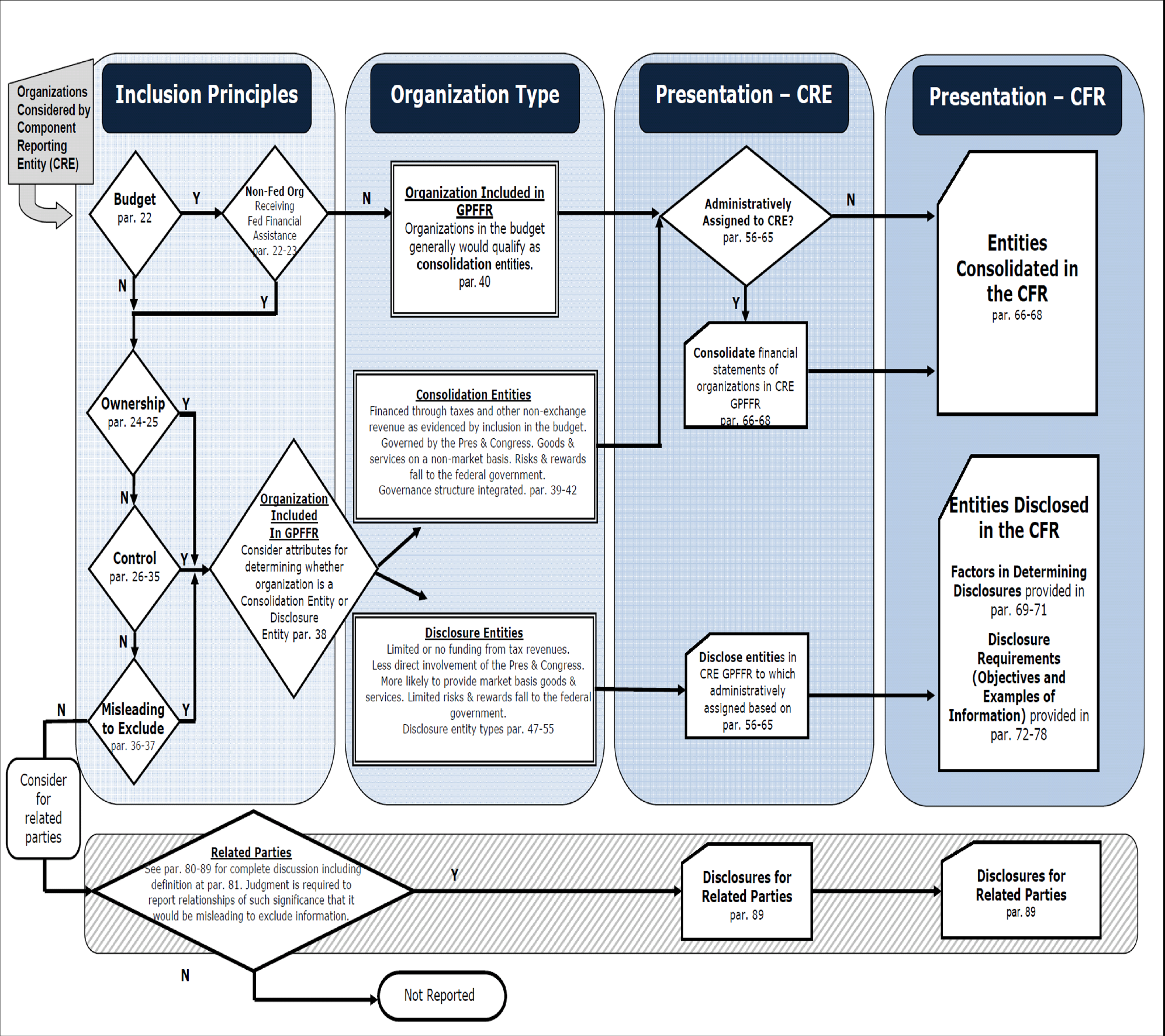
67 SFFAS 47 Appendix B: Flowchart SFFAS 47 - Page 67 FASAB Handbook, Version 14 (06/15)
68 Appendix C: Illustrations Preamble These illustrations demonstrate how the provisions of this Statement could be applied to organizations given simplified hypothetical circumstances. They are for illustrative purposes only and are nonauthoritative. They do not: 1. represent actual organizations, 2. provide a thorough analysis of all the facts and circumstances that are needed to reach a conclusion in practice, 3. indicate a preferred method of analyzing facts and circumstances, and 4. substitute for the application of professional judgment to actual facts and circumstances. These illustrations follow the sequence presented in the decision flowchart in Appendix B. All tentative conclusions are based primarily on the hypothetical circumstances presented. In most illustrations, the tentative conclusions refer to consideration of other factors by management and the auditor. This reference is included to emphasize that, in practice, consideration of all relevant facts and circumstances would be needed to reach conclusions. The reader should assume that the general reference to other factors means that such factors, in aggregate, supported the conclusions implied by the necessarily limited assumed facts and circumstances presented in each illustration. Application of the standards to actual organizations requires consideration of the circumstances specific to each organization and the exercise of professional judgment. Although the limited assumed facts and circumstances presented in the illustrations may be similar to situations at a particular reporting entity, they should not be used in practice as a substitute for a complete and thorough consideration of all of the relevant facts and circumstances, which may lead to a conclusion different from the tentative conclusions in these illustrations. For example, the illustrations make certain assumptions that, in practice, require judgment of the specific facts and circumstances to make appropriate determinations. All of the illustrations discuss administrative assignments to component reporting entities where there is only one component reporting entity relationship described. In reality, more than one component reporting entity may have a relationship with the illustrative organization. In such cases, additional information would need to be considered to determine whether other administrative assignments exist. SFFAS 47 - Page 68 FASAB Handbook, Version 14 (06/15)
69 ABC Department (In the Budget Consolidation Entity) Assumed Facts and Circumstances Congress established ABC Department (ABC), a federal organization, to promote entrepreneurship and innovation as a means to address national economic and environmental challenges. Provisions that govern ABC are generally prescribed in legislation and ABC accomplishes its mission through the activities of various bureaus, grants to research institutions, and contracts with universities and not-for-profit organizations. The executive leadership of ABC consists of a secretary, deputy secretary, and three assistant secretaries. The President nominates and the Senate confirms each of these officials. These officials serve at the pleasure of the President. ABC is subject to all laws and regulations applicable to executive branch agencies. ABC relies on appropriated public funds to conduct its mission and is listed in the schedule in the Budget of the United States Government: Analytical Perspectives Supplemental Materials that provides budget account level information. The President and the Congress consider ABC s requests for resources and determine the amount that should be budgeted to provide services. Furthermore, ABC is not considered to be a non-federal organization receiving federal financial assistance. Tentative Conclusions Based on the assumed facts and circumstances, management determined and the auditor concurred that ABC should be included in the government-wide GPFFR because it (1) meets the first of the three inclusion principles (being listed in the budget) and (2) is not a non-federal organization receiving federal financial assistance. Classification as a Consolidation Entity or Disclosure Entity Further, because it is listed in the budget, ABC generally would qualify as a consolidation entity assuming no information to the contrary. In this example, management determined and the auditor concurred that there were no facts contradicting the assumption that ABC is a consolidation entity. As a consolidation entity, ABC s financial statements should be consolidated in the government-wide GPFFR. SFFAS 47 - Page 69 FASAB Handbook, Version 14 (06/15)
70 Administrative Assignments The assumed facts and circumstances do not indicate ABC should be consolidated with another component reporting entity. Further consideration of ABC s relationships with other consolidation entities would be needed to determine if ABC has been administratively assigned to another component reporting entity. Further consideration would also be needed to identify any consolidation entities or disclosure entities administratively assigned to ABC. Epsilon Corporation (In the Budget Consolidation Entity) Assumed Facts and Circumstances The Congress and the President established Epsilon Corporation as an independent government corporation to insure consumer funds placed in trust with certain types of institutions. Federal legislation established provisions that govern Epsilon s activities. Epsilon is governed by a seven member board of directors and each board member is appointed by the President and confirmed by the Senate. The Congress monitors Epsilon s activities by conducting hearings on Epsilon s programs and requesting Government Accountability Office (GAO) and Office of Inspector General (OIG) audits. Epsilon is listed in the schedule in the Budget of the United States Government: Analytical Perspectives Supplemental Materials schedule that provides budget account level information. Epsilon receives its funding based on legislation permitting it to receive and spend premiums from the institutions it insures. Legislation limits how Epsilon can invest proceeds from premiums and, to help ensure that Epsilon remains financially viable, legislation requires Epsilon to have a reserve fund. The board of directors determines the level of the reserve fund. If Epsilon encounters a shortfall, the organization may borrow a limited amount from the U.S. Department of the Treasury (Treasury), but any additional funding requirements must be obtained from premium assessments. Epsilon is required to periodically report to the Congress and the President on matters such as: Program performance results Financial position, results of operations, and cash flows Adequacy of internal controls and systems Furthermore, Epsilon is not considered to be a non-federal organization receiving federal financial assistance. SFFAS 47 - Page 70 FASAB Handbook, Version 14 (06/15)
71 Tentative Conclusions Based on the assumed facts and circumstances, management determined and the auditor concurred that Epsilon Corporation should be included in the government-wide GPFFR because it meets the first inclusion principle (in the budget) and is not a non-federal organization receiving federal financial assistance. Classification as a Consolidation Entity or Disclosure Entity Further, because it is listed in the budget, Epsilon generally would qualify as a consolidation entity assuming no information to the contrary. In this example, management determined and the auditor concurred that there were no facts rebutting or contradicting the assumption that Epsilon is a consolidation entity. As a consolidation entity, Epsilon s financial statements should be consolidated in the government-wide GPFFR. Administrative Assignments There is no information included in the assumed facts and circumstances indicating that Epsilon should be consolidated with another component reporting entity. Further consideration of Epsilon s relationships with other consolidation entities would be needed to determine if Epsilon has been administratively assigned to another component reporting entity or has had consolidation entities administratively assigned to it. Also, further consideration would be needed to identify any disclosure entities administratively assigned to Epsilon for which disclosures are needed. Sigma Association (Control based on Persuasive Indicator Disclosure Entity (Financially Independent)) Assumed Facts and Circumstances The Congress and the President established Sigma Association (Sigma) as a not-for-profit, nontaxpayer funded organization to market innovative U.S. agricultural technology worldwide and to respond to any claims of damage arising from new technology. The fundamental purpose of the corporation is specified in legislation and its mission statement is to open new markets for U.S. agricultural technology through a cooperative marketing strategy and risk-sharing approach for market participants. Sigma is governed by a ten-member board of directors. Five members are appointed by the President and confirmed by the Senate. Four members are elected by industry members. The SFFAS 47 - Page 71 FASAB Handbook, Version 14 (06/15)
72 Secretary of Agriculture (or his/her designee) serves as a voting ex-officio member of the board. No more than three of the appointed members may be from the same political party. Board members serve seven-year terms and can only be removed for cause (meaning they may not be removed for policy decisions). Also, Congress monitors Sigma s activities by conducting hearings on Sigma s programs and requesting GAO audits. Sigma is financed by fees imposed on industry members. Sigma s board of directors must establish an annual budget and legislation limits how Sigma can invest proceeds from fees. To help ensure that Sigma remains financially viable, legislation requires Sigma to have a reserve fund. The board of directors determines the level of the reserve fund after considering input from industry members. If Sigma encounters a shortfall, it may borrow a limited amount from the Treasury, but any additional funding requirements must be obtained from future fee assessments on industry members. Tentative Conclusions Based on the assumed facts and circumstances, and other considerations, management determined and the auditor concurred that Sigma should be included in the government-wide GPFFR because Sigma meets the third inclusion principle (control with expected benefits or risk of loss). Indicators that the federal government can control Sigma are that the Congress and/or the President (1) established its fundamental purpose and mission through legislation, and (2) appoint a majority of the members of its board of directors (its governing body). Each of these facts individually would be sufficient to indicate control such that Sigma would be included. Classification as a Consolidation Entity or Disclosure Entity For this illustration, management determined and the auditor concurred that, based on the assumed facts and circumstances as well as other considerations not described in the illustrations, Sigma should be reported as a disclosure entity because it is a financially independent organization. Management and the auditor considered the assumed facts and circumstances presented below in the aggregate, weighed them against other considerations, and used professional judgment. Evidence suggesting that it is a disclosure entity includes: 1. Tax revenue is not appropriated for ongoing operations. 2. The corporation is relatively financially independent because it is primarily funded from a source other than appropriations. Its budget and fees are not subject to Congressional or Presidential approval. 3. Having seven-year terms for directors who are not subject to removal for policy decisions indicate a higher degree of autonomy than executive branch appointees. This governance structure vests greater decision-making authority with the board while insulating it from SFFAS 47 - Page 72 FASAB Handbook, Version 14 (06/15)
73 political influence. As a result, Congressional and Presidential oversight is less direct since they are not involved in decisions such as the level of reserves needed. 4. While Sigma is permitted to borrow from the Treasury, such borrowing is limited. This means risks to the federal government are limited. Instead, Sigma is expected to maintain its operations and meet its liabilities with revenues received from sources outside of the federal government. Evidence suggesting that Sigma may be a consolidation entity includes: 1. The President and the Senate, who appoint and confirm, respectively, members of the board of directors as well as establish organizational authorities in legislation, have a governance role. 2. Sigma provides a service that is not available from market participants. Its fees are adjusted to recover losses rather than to respond to market influences. Hence, its fees are not marketbased. Administrative Assignment Because each disclosure entity must be reported by at least one consolidation entity, management considered whether Sigma has been administratively assigned to the Department of Agriculture. Evidence suggesting administrative assignment to the Department of Agriculture includes that the secretary serves as an ex-officio member of the board. As a result, management determined and the auditor concurred that the Department of Agriculture should disclose information regarding Sigma in its GPFFR. If Sigma is also administratively assigned to other component reporting entities, then those component reporting entities should also consider the need to disclose information in their GPFFRs. Scholars University (Not Included) Assumed Facts and Circumstances The Congress and the President chartered Scholars University as a small, private, independent, not-for-profit educational institution and legislation describes the mission of the university. The legislation also indicates that the university is not an instrumentality of the federal government and that the federal government does not assume any liabilities of the university. SFFAS 47 - Page 73 FASAB Handbook, Version 14 (06/15)
74 Scholars University is governed by a 29-member board of trustees. The Secretary of Education is an ex-officio member of the board and the remaining members are elected by the board for three-year terms. The board controls and directs the university s affairs such as determining the university s tuition and fee structure, adding or removing colleges within the university, and establishing new research institutions. To support its mission, Scholars University receives most of its revenue from tuition, fees, and private contributions. The university receives appropriations to support some of its academic programs. The university is listed in the schedule in the Budget of the United States Government: Analytical Perspectives Supplemental Materials that provides budget account level information under a Department of Education program because an amount is appropriated for Scholars University each year. Although the appropriations discuss limitations on how the funds may be used, the university generally has discretion over how it chooses to allocate funds for its academic programs and construction activities. Tentative Conclusions Based on the assumed facts and circumstances and other information, management determined and the auditor concurred that Scholars University should not be included in the government-wide GPFFR. Although it meets the first inclusion principle (in the budget), management asserts that Scholars University is a non-federal organization receiving federal financial assistance in the form of a grant. Any non-federal organization listed in the budget should be assessed against the other two principles. So, management must determine if the other inclusion principles are met or if it would be misleading to exclude the university. The initial analysis is summarized below: Ownership The Congress and the President chartered Scholars University as a private, independent organization. There is no evidence that the federal government has an ownership interest in the university. Control -Based on the assumptions presented, the persuasive indicators of control have not been met. While the federal government chartered Scholars University, the standards provide that further indicators of control must be present to conclude that the organization is controlled. The remaining persuasive indicators appointing or removing a majority of the governing board members, establishing financial and operating policies, and dissolving the university and having access to its assets are not met. The available facts and circumstances suggest that Scholars is not controlled. [Note, however, for brevity this illustration does not present an analysis of indicators of control that in the aggregate may reveal that Scholars is controlled. Such an analysis may be needed in practice.] SFFAS 47 - Page 74 FASAB Handbook, Version 14 (06/15)
75 Misleading to exclude -Scholars University is a small not-for-profit that is listed in the Budget solely as a program within the Department of Education. Management determined and the auditors concurred that it is both quantitatively and qualitatively immaterial. Also, there were no other facts and circumstances that would suggest that Scholars University should be included in the GPFFR. As a result, it would not be misleading to exclude. Based on the assumed facts and circumstances and other considerations, management determined and the auditor concurred that Scholars University should not be included in the government-wide GPFFR. Education Research Institute (ERI) (Control based on Persuasive Indicator -Consolidation Entity) Assumed Facts and Circumstances The purpose of the Education Research Institute (ERI) is to assist state and local officials in making informed decisions regarding effective education methods. ERI was established by the Congress and the President through a public law specifying the organization s: status as a tax exempt not-for-profit, purpose and duties, governance structure, sources of financing, and reporting requirements. The public law establishing ERI requires reauthorization of its operations every five years. If the Congress and the President do not authorize continued operation, ERI must cease operations and distribute its net assets to a successor organization designated by the federal government. If ERI is unable to satisfy its liabilities prior to dissolution, the federal government will assume its liabilities. ERI is governed by a seven-member board of directors; five of whom are voting. Two members are specific federal officials within the Department of Education who serve part-time and do not have voting rights. The remaining five serve full-time, are appointed by the Association of Local School Boards, and serve six-year terms. One of these five members is elected by the board to serve as chairperson. The legislation creating ERI designates funding of $1 per elementary school student per year to be made available from the general fund of the U.S. Treasury to the ERI trust fund. An annual transfer SFFAS 47 - Page 75 FASAB Handbook, Version 14 (06/15)
76 to ERI is not listed in the schedule in the Budget of the United States Government: Analytical Perspectives Supplemental Materials that provides budget account level information but is included in the Department of Education s Congressional Budget Justification. The board of directors is authorized to establish an annual budget not to exceed the amounts available in the trust fund. ERI may fund up to 25% of its annual budget through donations but may not use federal funds to solicit donations. The Department of Education approves the ERI annual budget. The department also reports information related to ERI activities in its annual performance report and Congressional Budget Justification. ERI must provide annually an audited financial report to the Department of Education and relevant Congressional committees. Tentative Conclusions Based on the assumed facts and circumstances and other considerations, management determined and the auditor concurred that ERI should be included in the government-wide GPFFR because the third inclusion principle (control with risk of loss or expectation of benefit) is met. A persuasive indicator of control exists because the federal government can unilaterally dissolve the organization and have access to its assets and responsibility for its liabilities. Classification as a Consolidation Entity or Disclosure Entity For this illustration, management determined and the auditor concurred that, based on the assumed facts and circumstances as well as other considerations not described in the illustrations, ERI should be reported as a consolidation entity. In arriving at this conclusion, management and the auditor considered the assumed facts and circumstances presented below in the aggregate and, finding no other facts that in the aggregate contradict these, used professional judgment to determine that ERI is a consolidation entity. Evidence suggesting that ERI is a consolidation entity includes: 1. It is primarily financed by taxes. 2. Federal government has assumed the risks associated with ERI s liabilities. 3. The purpose of ERI is to assist state and local officials by providing consultation services on a non-market basis. 4. ERI s annual budget is approved by the Department of Education and the Department also provides information related to ERI activities in its annual performance report and SFFAS 47 - Page 76 FASAB Handbook, Version 14 (06/15)
77 Congressional Budget Justification. These activities show that elected officials, acting with and through politically appointed officials, make decisions regarding ERI s budget. Evidence suggesting that ERI is a disclosure entity includes: 1. A majority of the members of the board of directors is appointed by non-federal officials. 2. ERI is able to access donations to sustain some of its operations. Administrative Assignment The Department of Education should consider whether or not ERI is administratively assigned to it. Evidence that indicates ERI is administratively assigned includes Education s participation in ERI s budgetary process and inclusion of information regarding ERI in its own Congressional Budget Justification. Having considered the above information and other available evidence, the Department of Education determined and its auditor concurred that it should consolidate ERI s financial statements in its GPFFR. Mediation Corporation (Control based on Indicators in the Aggregate Disclosure Entity) Assumed Facts and Circumstances Mediation Corporation (Mediation) was established as a 501(c)(3) non-member not-for-profit organization through a public law specifying the organization s: status and operating location, purpose and duties, governance structure, sources of financing, and reporting requirements. The purpose of Mediation is to ensure that low-income individuals have access to mediation services to resolve non-criminal legal disputes. An assigned duty is to develop and maintain a network of state and local government organizations to deliver services financed by grants. Network members may raise funds to finance delivery of services through taxes, donations, and other grants without limitation. SFFAS 47 - Page 77 FASAB Handbook, Version 14 (06/15)
78 The governing board comprises 13 members including Mediation s executive secretary. The President nominates candidates to fill the board member positions. A panel of local government officials participating in the network selects new members of the governing board from among the nominees. No more than seven members may be affiliated with the same political party. The members elect their chairperson from among the members. The President appoints the executive secretary and the Senate confirms the appointment. The executive secretary s term is fifteen years during which the President may only remove the appointee for cause. Mediation is financed by an annual appropriation, interest earnings, and grants from any public or private grant-making organization. Grants must not finance more than 20 percent of its annual budget. The U.S. Attorney General approves the annual budget. Any liabilities incurred by Mediation must be settled from its assets and are not backed by the full faith and credit of the U.S. Government. An annual appropriation is provided in the Budget of the United States Government: Analytical Perspectives Supplemental Materials that provides budget account level for Grants to the Mediation Corporation. The appropriation is made to the Department of Justice which transfers budget authority to Mediation. Mediation manages its cash balances similar to other not-for-profits and may retain any interest earned on unspent funds. In addition, it may apply for and receive grants from any grant making organization public or private subject to the 20 percent limitation. The public law creating Mediation requires it to make annual audited financial reports publicly available. Mediation also files annual tax returns with the Internal Revenue Service. Furthermore, Mediation is considered to be a non-federal organization receiving federal financial assistance. Tentative Conclusions Although Mediation meets the first inclusion principle (in the budget), it is a non-federal organization receiving federal financial assistance. To determine if Mediation should be included in the government-wide GPFFR, management considered the remaining inclusion principles majority ownership interest and control with risk of loss or expectation of benefit. It is unclear, based on the assumed facts and circumstances, whether Mediation is owned by the federal government and, therefore, meets the second inclusion principle. Therefore, management must consider the control indicators to determine if the third inclusion principle (control) is met. None of the persuasive indicators of control are present based on the assumed facts and circumstances so considerable professional judgment is required to determine whether in the aggregate the indicators provide evidence of control. The indicators suggesting federal government control over Mediation include: SFFAS 47 - Page 78 FASAB Handbook, Version 14 (06/15)
79 1. The federal government provides significant input regarding selection of the organization s governing board members since a selection can only be made from among candidates identified by the President. 2. The President appoints a key executive the executive secretary and may remove him or her for cause. 3. Federal law restricts Mediation s capacity to generate revenues since only appropriations, interest earned, and grants may be used. In addition, only 20 percent of its annual needs may be met through grants. 4. The U.S. Attorney General approves the annual budget. 5. Federal law requires annual audited financial reports. 6. Federal law directs Mediation to work through a network of government agencies to provide services. Based on the assumed facts and circumstances and other considerations, and using professional judgment, management determined and the auditor concurred that Mediation should be included in the government-wide GPFFR. Classification as a Consolidation Entity or Disclosure Entity For this illustration, management determined and the auditor concurred that, based on the assumed facts and circumstances as well as other considerations not described in the illustrations, Mediation should be reported as a disclosure entity. In arriving at this conclusion, management and the auditor considered the assumed facts and circumstances presented below in the aggregate and, finding no other facts that in the aggregate contradict these, used professional judgment to determine that Mediation is a disclosure entity. Evidence suggesting that Mediation is a consolidation entity includes: 1. It is primarily funded by taxes. 2. Elected officials determine Mediation s budget, because at least 80 percent of its funding is appropriated to Justice. In addition, an appointed federal official, the U.S. Attorney General, approves Mediation s annual budget. SFFAS 47 - Page 79 FASAB Handbook, Version 14 (06/15)
80 Evidence suggesting that Mediation is a disclosure entity includes: 1. Members of its governing body are selected by non-federal officials, serve longer terms than political appointees, must include members from different political parties, and may only be removed for cause. These conditions insulate the governing body from political influence. 2. Mediation has some access to non-federal funding through grants and its network of service providers is free to access non-federal funding for service delivery (subject to the 20 percent limitation). 3. Federal government has not assumed risks related to Mediation s liabilities. Administrative Assignments The Department of Justice should consider whether or not Mediation is administratively assigned to it. Evidence that indicates it is administratively assigned includes the Department of Justice s participation in Mediation s budgetary process. After considering the above and other factors, and using professional judgment, management at the Department of Justice determined and the auditor concurred that disclosures regarding Mediation should be presented in its GPFFR. Bicycle America, Inc. (Scenario A) (Not Included) Assumed Facts and Circumstances Individual bicycle shop owners determined that a nation-wide network of shops and trails was needed to encourage greater reliance on bicycles for transportation and invested in a new corporation, Bicycle America (BA). BA s mission was to create a coast-to-coast network and ensure wide access to bicycling. Shares in the venture are held by local bicycle shops in all major cities. BA is governed by a board of directors. The board controls and directs the organization s affairs and interests. Board members are elected by the shareholders to serve three-year terms. Until recently, BA was able to finance its operations from user fees. A recent lawsuit led to serious financial challenges and cash was unavailable to meet pressing needs. Absent a cash inflow, BA was considering closing the trails. Due to exceptional citizen reliance on the trails for transportation and recreation, the federal government intervened and enacted legislation to provide funding. SFFAS 47 - Page 80 FASAB Handbook, Version 14 (06/15)
81 The federal government provided a short-term loan to BA. The federal financial intervention to preserve BA was not separately identified in the Budget, but was part of a larger federal program within the Department of Transportation. The funding legislation also established a temporary advisory committee to monitor BA s financial condition and inform Congress of potential issues that may warrant additional actions. In addition, the advisory committee will develop a plan to aid BA in returning to financial solvency and refinancing the short-term loan. Tentative Conclusions Based on the assumed facts and circumstances and other considerations, management determined and the auditor concurred that BA should not be included in the government-wide GPFFR. Specifically, BA is not listed in the Budget. Further, based on the available information and other considerations, management determined and the auditor concurred BA does not meet either the remaining ownership or control inclusion principle because BA continues to be owned by common shareholders and governed by the existing board of directors. The advisory committee offers advice to the Congress and does not have authority to direct BA to act. Management determined and the auditor concurred that, based on the assumed facts and circumstances as well as other considerations not described in the illustration, it would not be misleading to exclude BA. Bicycle America, Inc. (Scenario B) (Ownership -Disclosure Entity (Intervention)) Assumed Facts and Circumstances Same as above except that in addition to the actions in Scenario A above, the federal government received shares that carry 51 percent of the voting rights of BA common stock and the advisory committee will develop a plan to sell the shares. Tentative Conclusions Based on the changed assumptions and no information to the contrary, and using professional judgment, management determined and the auditor concurred that BA should be included in the government-wide GPFFR. When the federal government holds a majority ownership interest, albeit temporary, the owned organization should be included in the government-wide GPFFR. SFFAS 47 - Page 81 FASAB Handbook, Version 14 (06/15)
82 Classification as a Consolidation Entity or Disclosure Entity The available facts and circumstances indicate that the federal government s involvement with BA is an intervention. Based on the assumed facts and circumstances and other considerations, management determined and the auditor concurred that BA should be reported as a disclosure entity because (1) separate legal identity is maintained, and (2) limited funding from general tax revenues is provided. The initial determination would need to be evaluated periodically to determine if the classification remains appropriate. Administrative Assignments Department of Transportation was assigned responsibility for transferring funds to BA which indicates an administrative assignment. As a result, management determined and their auditor concurred that the department should disclose information regarding BA in its GPFFR. If BA is also administratively assigned to other component reporting entities, then those component reporting entities should also disclose information in their GPFFRs. Chatham Laboratory (Control based on Persuasive Indicator -Consolidation Entity (FFRDC)) Assumed Facts and Circumstances Federal Department of ABC (ABC) organized Chatham Laboratory as a federally funded research and development center (FFRDC) to conduct specialized engineering research that supports ABC s mission related to infrastructure and leads to improved services. As specified in the agreement, ABC provides the physical capital and ongoing funding for the FFRDC and sets research goals for Chatham. ABC selects a contractor to operate Chatham and conduct research consistent with the established goals. ABC is not involved in the day-to-day operations of Chatham. ABC routinely evaluates Chatham s performance and maintains a research office to review strategic plans, consider progress, and serve as a liaison to other federal institutions. ABC reports on Chatham s efforts in its own performance reports. Chatham operations are funded entirely through appropriations provided to ABC. ABC identifies Chatham in its Congressional Budget Justification but Chatham is not specifically identified in the Budget of the United States Government: Analytical Perspectives Supplemental Materials schedule that provides budget account level information. Instead, amounts for Chatham are included in a larger research program which makes payments to the contractor consistent with the SFFAS 47 - Page 82 FASAB Handbook, Version 14 (06/15)
83 terms of the contract. Chatham s contract operator must submit financial and performance reports to ABC periodically. All Chatham assets belong to the federal government and the results of Chatham research are the property of the federal government. In addition, ABC would be responsible for liabilities arising from use of the facilities to conduct research such as environmental cleanup liabilities. ABC is also responsible for employee benefits in the event Chatham operations are terminated. Tentative Conclusions Based on the assumptions and other considerations, management determined and the auditor concurred that Chatham should be included in the government-wide GPFFR. While contracting for the operation of Chatham, officials at ABC also act as the governing body by establishing the purpose and mission of Chatham. Further, ABC continues in this role through its involvement in Chatham s strategic planning and monitoring of performance. Establishing the purpose and mission of an organization is a persuasive indicator that control exists. Classification as a Consolidation Entity or Disclosure Entity For this illustration, management determined and the auditor concurred that, based on the assumed facts and circumstances as well as other considerations not described in the illustrations, Chatham should be reported as a consolidation entity. In arriving at this conclusion, management and the auditor considered the assumed facts and circumstances presented below in the aggregate and, finding no other facts that in the aggregate contradict these, used professional judgment to determine that Chatham is a consolidation entity. Evidence suggesting that Chatham is a consolidation entity includes: 1. It is primarily financed by taxes. 2. The federal government has assumed the risks associated with Chatham s liabilities. 3. Chatham s annual budget is developed by ABC officials and information related to Chatham activities is provided in ABC s performance report and Congressional Budget Justification. This indicates that decision-making regarding the budget is exercised by elected officials through politically appointed officials and the budget process. Evidence suggesting that Chatham is a disclosure entity includes: 1. Day-to-day operating decisions are made by a contractor. After considering the above analysis and other factors, management determined and the auditor concurred that Chatham is a consolidation entity. SFFAS 47 - Page 83 FASAB Handbook, Version 14 (06/15)
84 Administrative Assignment ABC should consider whether or not Chatham is administratively assigned to it. In the example, evidence suggesting Chatham is administratively assigned includes ABC s role in Chatham s strategic planning, budgeting, and administration. Having considered the assumed facts and circumstances and other available evidence, the Department of ABC determined and its auditor concurred that it should consolidate Chatham s financial statements in its GPFFR. Gotham Laboratory (Not included -Economic Dependency Insufficient to Show Control) Assumed Facts and Circumstances The Department of XYZ (XYZ), a department within the executive branch of the federal government, contracted with Gotham Laboratory (Gotham) to conduct specialized engineering research that fulfills a federal mission related to infrastructure and leads to improved services of XYZ. As specified in the agreement, XYZ provides funding to Gotham and Gotham s management team plans, manages, and executes the assigned research program. XYZ serves on a panel providing input on the appointment of the board of directors for Gotham. However, the board of directors elects new members and the board manages Gotham s research. Gotham also may engage in any outside research activities approved by its board of directors. Gotham performs services for various federal and non-federal organizations but receives 90 percent of its funding from XYZ. XYZ receives appropriated funds to support the Gotham research program. The remaining 10 percent of Gotham funding is derived from contracts with other federal agencies and private industry as well as donations. Gotham s budget is not reviewed or approved by any federal officials. Gotham is subject to the usual federal contract oversight and reporting requirements. Tentative Conclusions Based on the assumptions and other considerations, management determined and the auditor concurred that Gotham should not be included in the government-wide GPFFR. Gotham is not listed in the Budget of the United States Government: Analytical Perspectives Supplemental Materials schedule that provides budget account level information. Further, based on the assumed facts and circumstances and other considerations, Gotham does not meet the inclusion principles of either majority ownership or control with risk of loss or expectation of benefit. Although Gotham appears to be economically dependent on the federal government, it ultimately retains discretion as to SFFAS 47 - Page 84 FASAB Handbook, Version 14 (06/15)
85 whether to accept funding or do business with the federal government. Despite the influence resulting from this dependency, the federal government does not govern Gotham s financial and operating policies. Further, management determined and the auditor concurred that, based on the assumed facts and circumstances as well as other considerations not described in the illustration, it would not be misleading to exclude Gotham. Andromeda Prime Power Systems (Related Party GSE) Assumed Facts and Circumstances The federal government created Andromeda Prime Power Systems (APPS) as a government sponsored enterprise (GSE) to facilitate commercial space travel. APPS controls interplanetary travel among a network of commercial space stations and is subject to federal regulations regarding safety and technology transfers to other nations. APPS is governed by a nine-member board of directors elected by common stock shareholders. Board members serve three-year terms. APPS issued common stock and received a federal government grant to finance its initial capital and startup costs. The APPS is under no obligation to return the grant funds but is expected to promote U.S. competitive interests in the emerging space travel industry. During the reporting period, APPS board approved a strategic plan to expand its systems to accommodate increased commercial demands and APPS issued bonds to finance the initiative. The interest rate required by lenders indicates that the market assumes the federal government has implicitly guaranteed the payment of principal and interest. In its regulatory capacity, the federal government required APPS to establish a capital reserve and created a five-member APPS Advisory Board to monitor and advise Congress on APPS fiscal operations. APPS derives its revenues from fees charged to commercial organizations and receives no ongoing federal support through the Budget. Tentative Conclusions Based on the assumptions and other considerations, management determined and the auditor concurred that APPS should not be reported in the government-wide GPFFR as a consolidation entity or disclosure entity. APPS is not listed in the schedule in the Budget of the United States Government: Analytical Perspectives Supplemental Materials that provides budget account SFFAS 47 - Page 85 FASAB Handbook, Version 14 (06/15)
86 level information and the federal government does not have a majority ownership interest in the company. Further, management conducted a thorough assessment of control indicators and determined the federal government does not exercise control of APPS. Regulation of APPS does not, by itself, establish control. However, based on the assumptions and other considerations, management determined and the auditor concurred that APPS should be disclosed as a related party. Related parties generally include GSEs not meeting the inclusion principles, especially those organizations for which the relationship is of such significance that it would be misleading to exclude information about it. U.S. Museum (Scenario A) (In the Budget Consolidation Entity) Assumed Facts and Circumstances The U.S. Museum (the Museum) was organized to bring history and lessons about the United States to individuals through educational outreach, teacher training, traveling exhibitions, and scholarship. The Museum is an independent establishment of the federal government and is governed by a board of trustees, known as the Museum Council. The Council has 13 voting members and 2 nonvoting members. Of the voting members, 11 are appointed by the President and serve 10-year terms (appointments are staggered) and the other 2 are appointed from among members of Congress to serve during their term. The non-voting members are selected by the Council. The Museum receives an annual appropriation as well as private donations. Annual appropriations account for approximately 90 percent of operations and activities, with the remaining 10 percent coming from donor activities and museum sales. The museum is listed in the Budget of the United States Government: Analytical Perspectives Supplemental Materials schedule that provides budget account level information. All donations are considered to be available for use unless specifically restricted by the donor or by time. Furthermore, the Museum is not considered to be a non-federal organization receiving federal financial assistance. Tentative Conclusions Based on the assumptions and other considerations, management determined and the auditor concurred that the Museum should be included in the government-wide GPFFR because the Museum meets the first inclusion principle (in the budget). Further, the President and the Congress SFFAS 47 - Page 86 FASAB Handbook, Version 14 (06/15)
87 appoint the Museum Council which indicates the federal government controls the Museum which meets the third inclusion principle (control with risk of loss or expectation of benefit). Classification as a Consolidation Entity or Disclosure Entity Because it is listed in the budget, the Museum generally would qualify as a consolidation entity assuming no information to the contrary. In this example, management determined and the auditor concurred that there were no facts rebutting or contradicting the assumption that the Museum is a consolidation entity. As a consolidation entity, its financial statements should be consolidated in the government-wide GPFFR. The financial statements included should be for the entire organization and thus include the sources and uses for both the appropriations and the donated funds. Administrative Assignment Based on a review by management, no other component reporting entity has been assigned administrative responsibilities for the Museum. Therefore, the Museum is consolidated only directly into the government-wide GPFFR. U.S. Museum (Scenario B) (Control based on Persuasive Indicator Disclosure Entity (Financially Independent)) Assumed Facts and Circumstances The U.S. Museum (the Museum) was originally organized by volunteers to bring history and lessons about the United States to individuals through educational outreach, teacher training, traveling exhibitions, and scholarship. The Museum is intended to be a self supporting operation. Shortly after its founding, it entered into a cooperative relationship with the Department of Federal Museums, a department within the executive branch. The Museum is incorporated as a not-for-profit organization governed by the Museum Council. The Council has 15 voting members referred to as trustees. The presidentially-appointed head of the Department of Federal Museums serves as the Council chairperson. Of the remaining voting trustees, nine are appointed by the President and five are selected and approved by the Council. Except for the chairperson, all trustees serve ten-year terms which are staggered. The Council selects a Board of Directors for the Museum and appoints the Chief Executive Officer. The Museum is a public-private partnership which receives an annual appropriation as well as private donations, rental income, and sales revenue. No fees are charged for educational events or museum tours. Rental income from the Museum facilities is derived from rates competitive with SFFAS 47 - Page 87 FASAB Handbook, Version 14 (06/15)
88 other venues for similar events. Rental of the facilities is intended to support museum activities such that the museum can eventually be self supporting. Presently, annual appropriations account for approximately 15 percent of operations and activities, with the remaining 85 percent coming from donor activities, rental income, and museum sales. The museum is listed in the Budget of the United States Government: Analytical Perspectives Supplemental Materials schedule that provides budget account level information. The funding received from donations is restricted to use by the Museum and the trustees approve the annual budget including rental income and fundraising goals. The Museum s employees are not federal employees. The Museum is required to fully fund any deferred compensation programs and to advise its employees that the federal government has not guaranteed their deferred compensation. Tentative Conclusions Based on the assumed facts and circumstances and other considerations, management determined and the auditor concurred the Museum should be included in the government-wide GPFFR because it meets the third inclusion principle (control with risk of loss or expectation of benefit). Although the Museum also meets the first inclusion principle (in the budget), it is a non-federal organization receiving federal financial assistance. An assessment of the remaining inclusion principles shows that the Museum meets the third inclusion principle (control with risk of loss or expectation of benefit) because it is controlled by the federal government since a majority of the trustees are appointed by the President; a persuasive indicator of control. Classification as a Consolidation Entity or Disclosure Entity For this illustration, management determined and the auditor concurred that, based on the assumed facts and circumstances as well as other considerations not described in the illustrations, the Museum should be reported as a disclosure entity. In arriving at this conclusion, management and the auditor considered the assumed facts and circumstances presented below in the aggregate and, finding no other facts that in the aggregate contradict these, used professional judgment to determine that the Museum is a disclosure entity. Evidence suggesting that U. S. Museum is a consolidation entity includes: 1. Appointments to the Council are made by elected officials. 2. Museum services, educational events and tours, are provided on a non-market basis to the general public. SFFAS 47 - Page 88 FASAB Handbook, Version 14 (06/15)
89 Evidence suggesting that U.S. Museum is a disclosure entity includes: 1. The Museum is a separate legal organization a not-for-profit and terms for a majority of Council members are ten-years. This insulates the organization from political influence. Further, day-to-day operations are governed by a board of directors whose members are not directly appointed by elected officials. 2. The Museum is intended to receive limited financing from taxes and market rates are charged for facility rentals. 3. The Museum is required to make explicit that any liability for deferred compensation of its employees is not guaranteed by the federal government. This indicates that limited risks are imposed on the federal government. Disclosure entities should be presented by the component reporting entity to which they are administratively assigned and, if material, by the government-wide entity. Administrative Assignment Management determined and the auditor concurred the Department of Federal Museums should present the Museum as a disclosure entity in its GPFFR because the department is assigned administrative responsibility for the Museum based on appointment of its head to serve as chairperson of the Council. Firefighters Housing Limited Partnership (Owned and Controlled Consolidation Entity) Assumed Facts and Circumstances Agency 123 has been authorized to establish pre-positioned housing and equipment storage facilities on federal land to ensure immediate and efficient deployment of firefighting resources in response to wildfires in remote areas. The enabling legislation allows Agency 123 to enter into a wide range of financial agreements with private-sector participants to provide housing and equipment storage for the firefighters. The agency and a private developer formed a limited partnership Firefighters Housing Limited Partnership (FHLP) to develop, operate, maintain, and own all housing and storage units and facilities within a designated area for 25 years. Agency 123 leased land to FHLP under a 25-year ground lease. At the end of the 25-year ground lease, the agency has the option to renew the partnership for another 25 years. If it does not renew, all structures and land revert back to SFFAS 47 - Page 89 FASAB Handbook, Version 14 (06/15)
90 Agency 123 in accordance with the agency s residual ownership interest. During the 25-year ground lease, Agency 123 will provide an annual payment to FHLP from its appropriated funds for management services, use of the housing by Agency 123 employees during the fire season, and equipment storage year-round. The private sector partner is guaranteed a minimum payment from FHLP and has no ownership interest in FHLP properties. The private sector partner also is entitled to a share of profits from nonfire season vacation rentals of the housing so long as the facilities meet established condition requirements. Profits not distributed to the private sector partner are retained by FHLP and can be used for capital improvements including development of new housing in adjacent parks under similar terms. As part of the partnership agreement, Agency 123 has significant authority to determine the policies governing FHLP s activities and to affect day-to-day decisions such as design and construction. Any debt incurred by FHLP must be authorized by the agency. Furthermore, capital and operating budgets require agency approval and financial transactions are monitored on a monthly basis by the agency s contract administration office. The partnership is required to produce audited financial statements annually. Tentative Conclusions Based on the assumed facts and circumstances and other considerations, management determined and the auditor concurred that FHLP should be included in the government-wide GPFFR. A substantial ownership interest is present via the agency s continuing ownership interest. In addition, several control indicators are met as summarized in the following analysis of available information: 1. Agency 123 may be able to direct the partnership regarding the establishment and subsequent revision of financial and operating policies through its review and approval of operating budgets, designs, and condition of the facilities. If so, this would be a persuasive indicator of control. Management should weigh the impact of its role in directing the FHLP s financial and operating policies and consider how much discretion falls to the private sector partner. 2. Other indicators in the aggregate may indicate control. Agency 123 has significant authority to: a. direct the ongoing use of assets, b. approve the budgets and business plans for FHLP, c. require audits, and d. limit borrowing and investment by FHLP. SFFAS 47 - Page 90 FASAB Handbook, Version 14 (06/15)
91 Classification as a Consolidation Entity or Disclosure Entity For this illustration, management determined and the auditor concurred that, based on the assumed facts and circumstances as well as other considerations not described in the illustrations, FHLP should be reported as a consolidation entity. In arriving at this conclusion, management and the auditor considered the assumed facts and circumstances presented below in the aggregate and, finding no other facts that in the aggregate contradict these, used professional judgment to determine that FHLP is a consolidation entity. Evidence suggesting that FHLP is a consolidation entity includes the following: 1. FHLP provides housing to firefighters as its primary function on a non-market basis. 2. It is financed by tax revenues supplemented by any retained profits from non-fire season rentals. 3. Decisions are made by organizational leaders at Agency 123 who are appointed by the President and confirmed by the Senate. 4. Funds transferred to FHLP will be approved through the usual budgetary process so that FHLP funding will be included in the budget approved by the Congress and the President. Evidence suggesting that FHLP is a disclosure entity includes the following: 1. FHLP has a legal identity separate from Agency FHLP is authorized to provide vacation housing services to customers on a market basis and use the proceeds to first compensate the private sector partner and then reduce the cost of firefighter housing borne by the taxpayer. As a consolidation entity, FHLP s financial statements should be consolidated by the component reporting entity to which it is administratively assigned. Administrative Assignment Management determined and the auditor concurred that Agency 123 should consolidate FHLP s financial statements because it is assigned administrative responsibility for FHLP based on its inclusion of FHLP funding in its budget request and its coordination and monitoring of FHLP s plans and performance. SFFAS 47 - Page 91 FASAB Handbook, Version 14 (06/15)
92 The Blue Mountain Observatory (Control based on Indicators in the Aggregate Disclosure Entity (FFRDC)) Assumed Facts and Circumstances Agency XYZ created an FFRDC, the Blue Mountain Observatory (BMO), to provide facilities and leadership needed to conduct scientific research in a wide range of fields, including the study of black holes. Agency XYZ is BMO's primary sponsor. University Cooperative (UC) is a not-for-profit membership corporation created by 50 universities conducting research that would benefit from use of BMO facilities. UC was created to seek the role of managing, operating, and maintaining BMO under a cooperative agreement with Agency XYZ. UC subsequently entered into a cooperative agreement with Agency XYZ. UC is governed by a board of trustees appointed to represent each of the 50 member universities. UC trustees appoint an individual to serve as president of BMO. The trustees also oversee BMO operations including providing input on strategic plans, approving the annual program plan before its submission to Agency XYZ for approval, responding to Agency XYZ input, and monitoring financial activities including establishing investment policies. UC employs staff to perform all BMO activities and these individuals are referred to as BMO employees. Member universities fund any non-bmo activities of UC. The cooperative agreement between UC and Agency XYZ ensures close coordination between Agency XYZ and BMO employees. The agreement contains requirements necessary for Agency XYZ s oversight of both BMO s programs and UC s management activities, including the following provisions: 1. Provide input to a strategic plan developed by BMO employees in collaboration with UC trustees. The strategic plan sets the overall direction and priorities for BMO. 2. Agency XYZ must approve the annual program plan and budget for use of resources. 3. UC must provide to Agency XYZ an annual scientific report and audited financial statements. 4. Agency XYZ participates in developing a five-year strategic plan. 5. BMO and Agency XYZ must meet annually to review progress and ensure that scientific and facility priorities remain consistent with those of Agency XYZ. UC works cooperatively with Agency XYZ to ensure the effective implementation of the strategic mission of BMO to the benefit of the research community. Mid-way through the current cooperative SFFAS 47 - Page 92 FASAB Handbook, Version 14 (06/15)
93 agreement, Agency XYZ will conduct comprehensive reviews of science, facilities, and management to inform future decisions regarding recompetition of the cooperative agreement for the facility. UC is under no obligation to continue in its role in managing, operating, and maintaining BMO. In the most recent fiscal year, BMO received $100 million in funding from Agency XYZ through its cooperative agreement with UC. Agency XYZ proposed the $100 million in funding in its Congressional Budget Justification and described how the funds would be used to support the research programs at BMO. In administering the funds provided by Agency XYZ for BMO programs, UC may: 1. expend funds to meet ongoing operational needs, 2. make annual cash contributions to employee benefits programs (accrued leave and pension plans), 3. make annual payments due under long-term leases, and 4. construct or purchase new assets so long as all resulting property is titled to BMO. In the event the cooperative agreement with UC is terminated, Agency XYZ would assume management responsibility for the facility. Further, Agency XYZ would seek appropriations for termination expenses such as post-retirement benefit liabilities for BMO employees. However, Agency XYZ would be obligated to pay termination benefits only if funds were appropriated for that purpose. Tentative Conclusions Based on the assumed facts and circumstances and other considerations, management determined and the auditor concurred that BMO should be included in the government-wide GPFFR. BMO is not listed in the Budget of the United States Government: Analytical Perspectives Supplemental Materials schedule that provides budget account level information so other inclusion principles must be considered. BMO facilities are owned by the federal government and new assets are titled to the federal government. With respect to the control inclusion principle, Agency XYZ establishes the fundamental purpose and mission of BMO through its participation in strategic planning and the overall effort to ensure BMO goals are consistent with Agency XYZ research goals. This effort includes annual actions to approve BMO s annual program plan and operating budget. These actions are persuasive indicators of control. SFFAS 47 - Page 93 FASAB Handbook, Version 14 (06/15)
94 Classification as a Consolidation Entity or Disclosure Entity For this illustration, management determined and the auditor concurred that, based on the assumed facts and circumstances as well as other considerations not described in the illustrations, BMO should be reported as a disclosure entity. In arriving at this conclusion, management and the auditor considered the assumed facts and circumstances presented below in the aggregate and, finding no other facts that in the aggregate contradict these, used professional judgment to determine that BMO is a disclosure entity. Evidence suggesting that BMO is a consolidation entity includes the following: 1. BMO provides, as its primary function, research facilities and leadership to university members of UC on a non-market basis. It is financed by taxpayer funds supplemented by non-government donors. 2. Key operational decisions are made by organizational leaders at Agency XYZ who are appointed by the President and confirmed by the Senate. 3. Funds transferred to BMO will be approved through the usual budgetary process so that use of tax revenues to support BMO is ultimately decided by the Congress and the President. Evidence suggesting that BMO is a disclosure entity includes the following: 1. BMO has a legal identity separate from Agency XYZ. 2. The governance structure ensures that universities have substantial input regarding BMO s strategic plans and annual program plan. The significant involvement of non-governmental organizations lessens political influence. 3. BMO s liabilities are not obligations of the U.S. government. 4. BMO is authorized to accept donations from non-government organizations. As a disclosure entity, BMO should be presented by the component reporting entity to which it is administratively assigned. Administrative Assignment Management determined and the auditor concurred that Agency XYZ should disclose information about BMO because it is assigned administrative responsibility for BMO based on its inclusion of SFFAS 47 - Page 94 FASAB Handbook, Version 14 (06/15)
95 BMO funding in its budget request and its coordination and monitoring of BMO s plans and performance. SFFAS 47 - Page 95 FASAB Handbook, Version 14 (06/15)
96 Table 1: Summary Application of Standard NAME ABC Department Epsilon Corporation Sigma Association Scholars University Education Research Institute Mediation Corporation IS THE ORGANIZATION INCLUDED IN THE GOVERNMENT-WIDE GPFFR? IS THE ORGANIZATION INCLUDED? IN THE BUDGET OWNED CONTROL MISLEADING TO EXCLUDE Yes Yes Organizations listed in the budget generally would qualify as consolidation entities. Yes Yes Organizations listed in the budget generally would qualify as consolidation entities. No No Yes. A majority of the governing board members is appointed by the President and confirmed by the Senate and they established its fundamental purpose and mission through legislation. Yes but as a No non-federal organization receiving federal financial assistance. No. Scholars board of trustees elects its respective board members. Scholars board of trustees primarily directs the university s affairs and the university seeks sources of revenue to operate virtually in a self-sustaining manner. No No Yes, the federal government can unilaterally dissolve ERI and have access to its assets and responsibility for its liabilities. Yes but as a No non-federal organization receiving federal financial assistance. Therefore, must assess against other principles. Yes. Considering the control indicators in the aggregate, the federal government controls Mediation. It provides significant input on the selection of governing board members, appoints a key executive, limits Mediation s capacity to generate revenue, approves the annual budget, requires audited financial statements, and directs Mediation to work with other governments. Yes Management and No auditor agreement based on facts and circumstances it was not misleading to exclude.. Yes The ERI Trust Fund is primarily funded through taxes, elected officials establish ERI s budget, services are provided on a nonmarket basis, and federal government assume risk. Yes CONSOLIDATION ENTITY OR DISCLOSURE ENTITY A CONSOLIDATION ENTITY A DISCLOSURE ENTITY (CONSOLIDATED) (DISCLOSED) Financially independent organization Mediation s governing body is insulated from political influence and risks are not assumed by the federal government. SFFAS 47 - Page 96 FASAB Handbook, Version 14 (06/15)
97 IS THE ORGANIZATION INCLUDED IN THE GOVERNMENT-WIDE GPFFR? IN THE NAME BUDGET OWNED CONTROL Bicycle No No BA is owned No, governing board America, Inc. (Scenario A) by shareholders. members are elected by shareholders rather than subject to political appointment MISLEADING TO EXCLUDE No, Management and auditor agreement based on facts and circumstances it was not misleading to exclude. IS THE ORGANIZATION INCLUDED? No. Advisory committee offers advice but does not have the authority to direct BA to act. CONSOLIDATION ENTITY OR DISCLOSURE ENTITY A CONSOLIDATION ENTITY A DISCLOSURE ENTITY (CONSOLIDATED) (DISCLOSED) Bicycle No America, Inc. (Scenario B) Chatham Laboratory (FFRDC) Gotham Laboratory Andromeda Prime-Power System (GSE) U.S. Museum (Scenario A) No Yes, the federal government acquired 51% of the voting rights in BA. The assets and research results are owned. Yes, The federal government establishes the purpose and mission of Chatham. No No No No, Management and auditor agreement based on facts and circumstances it was not material to exclude. No No No, APPS governing body is elected by common shareholders. The APPS Advisory Board advises Congress and does not direct APPS operations. Yes Yes No. Although it may be economically dependent Gotham has discretion as to whether to accept funding from the government. No, Management determined and the auditor concurred APPS should be disclosured as a related party. Yes, Chatham is primarily funded by taxes, and governance rests with the President and Congress. Yes Yes Yes. The Museum is in the budget and primarily funded by taxes and governance rests with the President and Congress. Intervention activity separate legal entity with limited financing from general taxes SFFAS 47 - Page 97 FASAB Handbook, Version 14 (06/15)
98 NAME U.S. Museum (Scenario B) Firefighters Housing Limited Partnership IS THE ORGANIZATION INCLUDED IN THE GOVERNMENT-WIDE GPFFR? IN THE BUDGET OWNED CONTROL Yes but as a No non-federal organization receiving federal financial assistance. No Blue No Mountain Observatiory (FFRDC) Ownership of property is retained. Property is owned by the federal government. Yes. The President appoints a majority of the governing body s members. Yes. Agency 123 has significant authority to direct the limited partnership s activities and to affect day-today activities such as in design and construction and the partnership s purpose is to carry out federal missions and objectives. Yes. The federal government establishes the purpose and mission of BMO. MISLEADING TO EXCLUDE IS THE ORGANIZATION INCLUDED? Yes Yes CONSOLIDATION ENTITY OR DISCLOSURE ENTITY A CONSOLIDATION ENTITY (CONSOLIDATED) Yes. Taxes fund the housing and risks have been assumed. A DISCLOSURE ENTITY (DISCLOSED) The museum is a financially independent organization. Yes BMO is a separate legal entity and UC plays a significant role in its governance without political influence. SFFAS 47 - Page 98 FASAB Handbook, Version 14 (06/15)
99 Appendix D: Abbreviations AICPA C.F.R. CFR CRE CRS ED FAR FASAB FASB FDIC FFRDC FRS GAAP GAO GPFFR OAI OIG OMB RSI SFFAC SFFAS U.S. U.S.C. American Institute of Certified Public Accountants Code of Federal Regulations Consolidated Financial Report of the U.S. Government Component Reporting Entity Congressional Research Service Exposure Draft Federal Acquisition Regulation Federal Accounting Standards Advisory Board Financial Accounting Standards Board Federal Deposit Insurance Corporation Federally Funded Research and Development Center Federal Reserve System Generally Accepted Accounting Principles Government Accountability Office General Purpose Federal Financial Report Other Accompanying Information Office of Inspector General Office of Management and Budget Required Supplementary Information Statement of Federal Financial Accounting Concepts Statement of Federal Financial Accounting Standards United States United States Code SFFAS 47 - Page 99 FASAB Handbook, Version 14 (06/15)
100 Appendix E: Task Force Members Owen Barwell, Department of Energy Lieutenant Colonel Richard Brady, United States Marine Corp, Department of Defense Terry Bowie, (formerly of) National Aeronautics and Space Administration James L. Chan, University of Illinois at Chicago Naresh Chopra, Department of Labor Wendy Calvin, Department of Transportation Tom Daxon, Former Oklahoma State Auditor Ann Davis, U.S. Department of Treasury Lynda Downing, Government Accountability Office Abe Dymond, (formerly of) Government Accountability Office Joel Grover, (formerly of) U.S. Department of Treasury, Office of the Inspector General Mark Hadley, Congressional Budget Office Regina Kearney, Office of Management and Budget Karen Kelbly, National Credit Union Administration Dan Kovlak, (formerly of) KPMG Andrew Lewis, KPMG Rick Loyd, Department of Energy Ned Maguire, (formerly of) Office of the Dir. of National Intelligence, OIG Sam Papenfuss, Congressional Budget Office Reginald Royster, Department of Housing and Urban Development Fred Selby, (formerly of) U.S. Department of Treasury, Office of Financial Stability Gary Solamon, (formerly of) Department of Commerce, Bureau of Economic Analysis Sandy Van Booven, National Reconnaissance Office Denise Williams, U.S. Department of Treasury, Fiscal Service Adrienne E. Young, (formerly of) National Science Foundation SFFAS 47 - Page 100 FASAB Handbook, Version 14 (06/15)
Questions. About the Government Reporting Entity
 Public Sector Accounting Board 20 Questions About the Government Reporting Entity THE CANADIAN INSTITUTE OF CHARTERED ACCOUNTANTS Public Sector Accounting Board 20 Questions About The Government Reporting
SSAP 32 STATEMENT OF STANDARD ACCOUNTING PRACTICE 32 CONSOLIDATED FINANCIAL STATEMENTS AND ACCOUNTING FOR INVESTMENTS IN SUBSIDIARIES
 SSAP 32 STATEMENT OF STANDARD ACCOUNTING PRACTICE 32 CONSOLIDATED FINANCIAL STATEMENTS AND ACCOUNTING FOR INVESTMENTS IN SUBSIDIARIES (Issued January 2001) The standards, which have been set in bold italic
Department of Veterans Affairs July 2013 0201 OVERVIEW... 2 0202 POLICIES... 3 0203 AUTHORITY AND REFERENCES... 3 0204 ROLES AND RESPONSIBILITIES...
 VA Financial Policies and Procedures CHAPTER 2F 0201 OVERVIEW... 2 0202 POLICIES... 3 0203 AUTHORITY AND REFERENCES... 3 0204 ROLES AND RESPONSIBILITIES... 4 0205 PROCEDURES... 5 0206 DEFINITIONS... 6
Statement #4/Managerial Cost Accounting Concepts and Standards for the Federal Government
 Statement #4/Managerial Cost Accounting Concepts and Standards for the Federal Government Executive Office of the President Office of Management and Budget "Managerial Cost Accounting Concepts and Standards
GAO ACCOUNTING PRINCIPLES, STANDARDS, AND REQUIREMENTS. Title 2 Standards Not Superceded by FASAB Issuances. United States General Accounting Office
 GAO United States General Accounting Office November 2001 ACCOUNTING PRINCIPLES, STANDARDS, AND REQUIREMENTS Title 2 Standards Not Superceded by FASAB Issuances GAO-02-248G PREFACE November 2001 Before
HKAS 27 Consolidated and Separate Financial Statements 1
 HKAS 27 Consolidated and Separate Financial Statements 1 Nelson Lam 1. Scope of HKAS 27 Hong Kong Accounting Standard (HKAS) 27 Consolidated and Separate Financial Statements shall be applied in the preparation
----------------------------------------------------------------- ACCOUNTING FOR REVENUE AND OTHER FINANCING SOURCES AND
 FASAB ----------------------------------------------------------------- ACCOUNTING FOR REVENUE AND OTHER FINANCING SOURCES AND CONCEPTS FOR RECONCILING BUDGETARY AND FINANCIAL ACCOUNTING Statement of Recommended
AUDIT REPORT OF THE NEBRASKA COMMISSION ON MEXICAN-AMERICANS JULY 1, 1999 THROUGH JUNE 30, 2000
 AUDIT REPORT OF THE NEBRASKA COMMISSION ON MEXICAN-AMERICANS JULY 1, 1999 THROUGH JUNE 30, 2000 TABLE OF CONTENTS Page Background Information Section Background 1 Mission Statement 1 Organizational Chart
The Bank Holding Company Act is amended by adding the following new sections:
 1 1 1 1 1 1 1 1 0 1 0 1 0 The Bank Holding Company Act is amended by adding the following new sections: SEC. 1. PROHIBITIONS ON PROPRIETARY TRADING AND CERTAIN RELATIONSHIPS WITH HEDGE FUNDS AND PRIVATE
Auditing Derivative Instruments, Hedging Activities, and Investments in Securities 1
 Auditing Derivative Instruments 1915 AU Section 332 Auditing Derivative Instruments, Hedging Activities, and Investments in Securities 1 (Supersedes SAS No. 81.) Source: SAS No. 92. See section 9332 for
CYBER SUPPLY INC. (Exact name of registrant as specified in its charter)
 UNITED STATES SECURITIES AND EXCHANGE COMMISSION Washington, D.C. 20549 FORM 10-K/A-1 [X] ANNUAL REPORT UNDER TO SECTION 13 OR 15(d) OF THE SECURITIES EXCHANGE ACT OF 1934 For the fiscal year ended February
Structure of the Standard
 INTERNATIONAL PUBLIC SECTOR ACCOUNTING STANDARD: FINANCIAL REPORTING UNDER THE CASH BASIS OF ACCOUNTING Structure of the Standard This Standard comprises two parts: Part 1 is mandatory. It sets out the
IPSAS 7 INVESTMENTS IN ASSOCIATES
 IPSAS 7 INVESTMENTS IN ASSOCIATES Acknowledgment This International Public Sector Accounting Standard (IPSAS) is drawn primarily from International Accounting Standard (IAS) 28 (Revised 2003), Investments
Consolidated Financial Statements
 IFAC Board Exposure Draft October 2013 Comments due: February 28, 2014 Proposed International Public Sector Accounting Standard Consolidated Financial Statements This Exposure Draft 49, Consolidated Financial
Financial Accounting Series
 Financial Accounting Series NO. 310 JUNE 2009 Statement of Financial Accounting Standards No. 166 Accounting for Transfers of Financial Assets an amendment of FASB Statement No. 140 Financial Accounting
Consolidated and Separate Financial Statements
 Compiled Accounting Standard AASB 127 Consolidated and Separate Financial Statements This compiled Standard applies to annual reporting periods beginning on or after 1 July 2007. Early application is permitted.
UNITED STATES SECURITIES AND EXCHANGE COMMISSION Washington, D.C. 20549 FORM 10-K
 UNITED STATES SECURITIES AND EXCHANGE COMMISSION Washington, D.C. 20549 FORM 10-K OMB APPROVAL OMB Number: 3235-0063 Expires: December 31, 2014 Estimated average burden hours per response.... 1,998.65
IPSAS 7 ACCOUNTING FOR INVESTMENTS IN ASSOCIATES
 IPSAS 7 ACCOUNTING FOR INVESTMENTS IN ASSOCIATES Acknowledgment This International Public Sector Accounting Standard is drawn primarily from International Accounting Standard (IAS) 28, Accounting for Investments
Accounting for Impairment of General Property, Plant, and Equipment Remaining in Use. Statement of Federal Financial Accounting Standards 44
 Federal Accounting Standards Advisory Board Accounting for Impairment of General Property, Plant, and Equipment Remaining in Use Statement of Federal Financial Accounting Standards 44 January 3, 2013 THE
Investments in Associates and Joint Ventures
 IFAC Board Exposure Draft 50 October 2013 Comments due: February 28, 2014 Proposed International Public Sector Accounting Standard Investments in Associates and Joint Ventures This Exposure Draft 50, Investments
IPSAS 7 INVESTMENTS IN ASSOCIATES
 IPSAS 7 INVESTMENTS IN ASSOCIATES Acknowledgment This International Public Sector Accounting Standard (IPSAS) is drawn primarily from International Accounting Standard (IAS) 28 (Revised 2003), Investments
UNITED STATES SECURITIES AND EXCHANGE COMMISSION Washington, D.C. 20549 FORM 10-K
 UNITED STATES SECURITIES AND EXCHANGE COMMISSION Washington, D.C. 20549 FORM 10-K OMB APPROVAL OMB Number: 3235-0063 Expires: March 31, 2018 Estimated average burden hours per response.... 1,998.78 A.
New Standards on Subsidiaries and Joint Arrangements
 New Standards on Subsidiaries and Joint Arrangements May 2015 Flash In September 2014, the Canadian Accounting Standards Board (AcSB) issued into Part II of the CPA Canada Handbook Accounting, Accounting
Filings With the U.S. Securities and Exchange Commission Under the Securities Act of 1933
 Filings With the U.S. Securities and Exchange Commission 1073 AU-C Section 925 Filings With the U.S. Securities and Exchange Commission Under the Securities Act of 1933 Source: SAS No. 122. Effective for
Consolidated Financial Statements
 STATUTORY BOARD FINANCIAL REPORTING STANDARD SB-FRS 110 Consolidated Financial Statements This standard applies for annual periods beginning on or after 1 January 2013. Earlier application is permitted
Investments in Associates and Joint Ventures
 STATUTORY BOARD FINANCIAL REPORTING STANDARD SB-FRS 28 Investments in Associates and Joint Ventures This standard applies for annual periods beginning on or after 1 January 2013. Earlier application is
BYLAWS OF THE PINEYWOODS COMMUNITY ACADEMY. Article I Name. The name of the organization shall be Pineywoods Community Academy (The Academy).
 BYLAWS OF THE PINEYWOODS COMMUNITY ACADEMY Article I Name The name of the organization shall be Pineywoods Community Academy (The Academy). Article II Purposes The purposes of the Academy are to advance
WHITE CLOUD AREA FIRE DEPARTMENT JOINT BUILDING AUTHORITY NEWAYGO COUNTY, MICHIGAN ANNUAL FINANCIAL REPORT YEAR ENDED DECEMBER 31, 2013
 WHITE CLOUD AREA FIRE DEPARTMENT JOINT BUILDING AUTHORITY NEWAYGO COUNTY, MICHIGAN ANNUAL FINANCIAL REPORT YEAR ENDED DECEMBER 31, 2013 TABLE OF CONTENTS INDEPENDENT AUDITOR'S REPORT 1 MANAGEMENT S DISCUSSION
Disclosure of Interests in Other Entities
 IFAC Board Exposure Draft 52 October 2013 Comments due: February 28, 2014 Proposed International Public Sector Accounting Standard Disclosure of Interests in Other Entities This Exposure Draft 52, Disclosure
Defining Issues. FASB Issues New Consolidation Guidance. February 2015, No. 15-6. Key Facts
 Defining Issues February 2015, No. 15-6 FASB Issues New Consolidation Guidance On February 18, 2015, the FASB issued a new consolidation standard to improve targeted areas of the consolidation guidance
OMB Bulletin No. 01-09. Form and Content of. Agency Financial Statements
 Attachment OMB Bulletin No. 01-09 Form and Content of Agency Financial Statements Form and Content of Agency Financial Statements Table of Contents TABLE OF CONTENTS Title Sec./Ex. Page No. Section 1 --
Consolidated Financial Statements
 AASB Standard AASB 10 August 2011 Consolidated Financial Statements Obtaining a Copy of this Accounting Standard This Standard is available on the AASB website: www.aasb.gov.au. Alternatively, printed
ED 10 Consolidated Financial Statements
 December 2008 ED 10 EXPOSURE DRAFT ED 10 Consolidated Financial Statements Comments to be received by 20 March 2009 Exposure Draft ED 10 CONSOLIDATED FINANCIAL STATEMENTS Comments to be received by 20
IPSAS 23 REVENUE FROM NON-EXCHANGE TRANSACTIONS (TAXES AND TRANSFERS) CONTENTS
 IPSAS 23 REVENUE FROM NON-EXCHANGE TRANSACTIONS CONTENTS December 2006 Paragraph Introduction... IN1 IN5 Objective... 1 Scope... 2 6 Government Business Enterprises... 6 Definitions... 7 28 Non-Exchange
102d Congress, H.R. 6125, October 28, 1992. Public Law 103 376, 108 Stat. 3497 103d Congress, H.R. 4379, October 19, 1994
 Public Law 92 181, 85 Stat. 583 92d Congress, S. 1483, December 10, 1971 amended by Public Law 94 184, 89 Stat. 1060 94th Congress, H.R. 7862, December 31, 1975 Public Law 95 443, 92 Stat. 1066 95th Congress,
Statement of Financial Accounting Standards No. 7. Consolidated Financial Statements
 Statement of Financial Accounting Standards No. 7 Statement of Financial Accounting Standards No. 7 Consolidated Financial Statements 30 November 2004 Translated by Wei-heng Lin, Associate Professor (Chung
INTERNATIONAL STANDARD ON AUDITING 705 MODIFICATIONS TO THE OPINION IN THE INDEPENDENT AUDITOR S REPORT CONTENTS
 INTERNATIONAL STANDARD ON AUDITING 705 MODIFICATIONS TO THE OPINION IN THE INDEPENDENT AUDITOR S REPORT (Effective for audits of financial statements for periods beginning on or after December 15, 2009)
Application of Principles of Accounting and Financial Reporting To Public Telecommunications Entities
 Application of Principles of Accounting and Financial Reporting To Public Telecommunications Entities May 2005 Edition 1 INTRODUCTION...2 1.1 Background...2 1.2 Overview...2 2 GENERALLY ACCEPTED ACCOUNTING
U.S. Department of Labor
 U.S. Department of Labor Employee Benefits Security Administration Washington, D.C. 20210 2006-05A Alice League, Esq. ERISA SEC. General Counsel & Chief Compliance Officer 3(32) Federal Reserve Employee
Consolidation (Topic 810)
 No. 2015-02 February 2015 Consolidation (Topic 810) Amendments to the Consolidation Analysis An Amendment of the FASB Accounting Standards Codification The FASB Accounting Standards Codification is the
How To Account For Money In The European System Of Accounting
 80.20.10 80.20 Generally Accepted Accounting Principles 80.20.10 July 1, 2001 This state adopts Generally Accepted Accounting Principles (GAAP) Generally accepted accounting principles (GAAP) are uniform
2 This Standard shall be applied by all entities that are investors with joint control of, or significant influence over, an investee.
 International Accounting Standard 28 Investments in Associates and Joint Ventures Objective 1 The objective of this Standard is to prescribe the accounting for investments in associates and to set out
AMENDED AND RESTATED CERTIFICATE OF INCORPORATION OF THE CHILDREN S ADVOCACY CENTER OF DELAWARE
 AMENDED AND RESTATED CERTIFICATE OF INCORPORATION OF THE CHILDREN S ADVOCACY CENTER OF DELAWARE January 16, 2013 AMENDED AND RESTATED CERTIFICATE OF INCORPORATION OF THE CHILDREN S ADVOCACY CENTER OF DELAWARE,
BYLAWS OF NEW MEXICO HEALTH INFORMATION MANAGEMENT ASSOCIATION
 BYLAWS OF NEW MEXICO HEALTH INFORMATION MANAGEMENT ASSOCIATION 1 P age TABLE OF CONTENTS ARTICLE I NAME... 1.1 New Mexico Health Information Management Association... ARTICLE II OFFICES AND REGISTERED
Approved: 26FEB13. Computing Research Association Bylaws. Section I: Purpose of CRA
 Approved: 26FEB13 Computing Research Association Bylaws Section I: Purpose of CRA The purpose of the Computing Research Association, hereafter the Association, is to strengthen research and advanced education
APPALACHIAN REGIONAL COMMISSION FINANCIAL STATEMENTS
 APPALACHIAN REGIONAL COMMISSION FINANCIAL STATEMENTS As of And For The Years Ended APPALACHIAN REGIONAL COMMISSION TABLE OF CONTENTS Page(s) Independent Auditor s Report... 1-3 Financial Statements Balance
Status. Summary. Accounting for Selected Assets and Liabilities
 l i l sdr adna t S gn i t nuocca a cnan i F a r edef f o s t n me e t a t Statement of Federal Financial Accounting Standards 1: Accounting for Selected Assets and Liabilities Status Issued March 30, 1993
How To Set Up A Committee To Check On Cit
 CIT Group Inc. Charter of the Audit Committee of the Board of Directors Adopted: October 22, 2003 Last Amended: April 20, 2015 I. PURPOSE The purpose of the Committee is to assist the Board in fulfilling
0101 OVERVIEW... 2 0102 POLICIES... 3 0103 AUTHORITY AND REFERENCES... 4 0104 ROLES AND RESPONSIBILITIES... 4 0105 PROCEDURES... 5
 VA Financial Policies and Procedures Recognition and Accounting for Assets CHAPTER 1 0101 OVERVIEW... 2 0102 POLICIES... 3 0103 AUTHORITY AND REFERENCES... 4 0104 ROLES AND RESPONSIBILITIES... 4 0105 PROCEDURES...
CHARTER OF THE AUDIT COMMITTEE OF THE BOARD OF DIRECTORS OF EVERBANK FINANCIAL CORP
 CHARTER OF THE AUDIT COMMITTEE OF THE BOARD OF DIRECTORS OF EVERBANK FINANCIAL CORP 1 EverBank Financial Corp Charter of the Audit Committee I. PURPOSE OF THE COMMITTEE The purpose of the Audit Committee
Department of Defense DIRECTIVE
 Department of Defense DIRECTIVE NUMBER 5400.11 October 29, 2014 DCMO SUBJECT: DoD Privacy Program References: See Enclosure 1 1. PURPOSE. This directive: a. Reissues DoD Directive (DoDD) 5400.11 (Reference
FIVE STAR QUALITY CARE, INC. GOVERNANCE GUIDELINES
 FIVE STAR QUALITY CARE, INC. GOVERNANCE GUIDELINES Adopted March 1, 2016 The following Governance Guidelines (the Guidelines ) have been adopted by the Board of Directors (the Board ) of Five Star Quality
Cynk Technology Corp. (A Development Stage Company) (formerly Introbuzz) Balance Sheets
 Cynk Technology Corp. (A Development Stage Company) (formerly Introbuzz) Balance Sheets ASSETS March 31, December 2014 31, 2013 ------- --------- Current Assets Cash and cash equivalents $ 39 $ 39 --------
Act on Investment Firms 26.7.1996/579
 Please note: This is an unofficial translation. Amendments up to 135/2007 included, May 2007. Act on Investment Firms 26.7.1996/579 CHAPTER 1 General provisions Section 1 Scope of application This Act
Investments in Associates and Joint Ventures
 International Accounting Standard 28 Investments in Associates and Joint Ventures In April 2001 the International Accounting Standards Board (IASB) adopted IAS 28 Accounting for Investments in Associates,
Consolidated Financial Statements
 HKFRS 10 Revised October 2014January 2015 Effective for annual periods beginning on or after 1 January 2013 Hong Kong Financial Reporting Standard 10 Consolidated Financial Statements COPYRIGHT Copyright
IPSAS 23 REVENUE FROM NON-EXCHANGE TRANSACTIONS (TAXES AND TRANSFERS)
 IPSAS 23 REVENUE FROM NON-EXCHANGE TRANSACTIONS CONTENTS December 2006 Paragraph Introduction... IN1 IN5 Objective... 1 Scope... 2 6 Definitions... 7 28 Non-Exchange Transactions... 8 11 Revenue... 12
AMENDED AND RESTATED CERTIFICATE OF INCORPORATION OF GEOMET, INC.
 AMENDED AND RESTATED CERTIFICATE OF INCORPORATION OF GEOMET, INC. GeoMet, Inc., a corporation organized and existing under and by virtue of the General Corporation Law of the State of Delaware, hereby
Statement of Financial Accounting Standards No. 117
 Statement of Financial Accounting Standards No. 117 FAS117 Status Page FAS117 Summary Financial Statements of Not-for-Profit Organizations June 1993 Financial Accounting Standards Board of the Financial
RESTATED CERTICIFATE OF INCORPORATION THE WALT DISNEY COMPANY ARTICLE I NAME. The name of the Corporation is The Walt Disney Company.
 RESTATED CERTICIFATE OF INCORPORATION OF THE WALT DISNEY COMPANY ARTICLE I NAME The name of the Corporation is The Walt Disney Company. ARTICLE II ADDRESS OF REGISTERED OFFICE; NAME OF REGISTERED AGENT
Statement of Principles
 Statement of Principles Improvements to Not-for-Profit Standards (Applicable to Private and Public Sector Not-for-Profit Organizations that Use the Not-for-Profit Standards as their Primary Source of GAAP)
Prepared By: The Professional Staff of the Committee on Banking and Insurance REVISED:
 BILL: SB 80 The Florida Senate BILL ANALYSIS AND FISCAL IMPACT STATEMENT (This document is based on the provisions contained in the legislation as of the latest date listed below.) Prepared By: The Professional
NEED TO KNOW. IFRS 10 Consolidated Financial Statements
 NEED TO KNOW IFRS 10 Consolidated Financial Statements 2 IFRS 10 Consolidated Financial Statements SUMMARY In May 2011 the International Accounting Standards Board (IASB) published a package of five new
PART I ARTICLE. apply to all insurers domiciled in this State unless exempt. (b) The purposes of this article shall be to:
 THE SENATE TWENTY-EIGHTH LEGISLATURE, 0 STATE OF HAWAII A BILL FOR AN ACT RELATING TO INSURANCE BE IT ENACTED BY THE LEGISLATURE OF THE STATE OF HAWAII: PART I SECTION. Chapter, Hawaii Revised Statutes,
Letters for Underwriters and Certain Other Requesting Parties
 Letters for Underwriters 2341 AU Section 634 Letters for Underwriters and Certain Other Requesting Parties (Supersedes SAS No. 49.) Source: SAS No. 72; SAS No. 76; SAS No. 86. See section 9634 for interpretations
How To Manage A Company
 PURPOSE TABLEAU SOFTWARE, INC. CHARTER OF THE AUDIT COMMITTEE OF THE BOARD OF DIRECTORS The primary purpose of the Audit Committee (the Committee ) of the Board of Directors (the Board ) of Tableau Software,
Not-for-profit entity requirements in Australian Accounting Standards (Updated December 2008)
 Not-for-profit entity requirements in Australian Accounting Standards This document identifies requirements in Australian Accounting Standards that relate specifically to not-for-profit (NFP) entities.
RALLY SOFTWARE DEVELOPMENT CORP.
 RALLY SOFTWARE DEVELOPMENT CORP. CHARTER OF THE AUDIT COMMITTEE OF THE BOARD OF DIRECTORS Approved by the Board of Directors on March 19 2013 PURPOSE The primary purpose of the Audit Committee (the Committee
How To Audit A Company
 INTERNATIONAL STANDARD ON AUDITING 315 IDENTIFYING AND ASSESSING THE RISKS OF MATERIAL MISSTATEMENT THROUGH UNDERSTANDING THE ENTITY AND ITS ENVIRONMENT (Effective for audits of financial statements for
Proposed Statement of Financial Accounting Standards
 FEBRUARY 14, 2001 Financial Accounting Series EXPOSURE DRAFT (Revised) Proposed Statement of Financial Accounting Standards Business Combinations and Intangible Assets Accounting for Goodwill Limited Revision
previous version of the Handbook). The Handbook applies to pension plan financial statements for fiscal years beginning on or after January 1, 2011.
 Financial Services Commission of Ontario Commission des services financiers de l Ontario SECTION: INDEX NO.: TITLE: APPROVED BY: Financial Statements Guidance Note FSGN-100 Disclosure Expectations for
Audits of Financial Statements that Contain Amounts that Have Been Determined Using Actuarial Calculations
 Audits of Financial Statements that Contain Amounts that Have Been Determined Using Actuarial Calculations January 2011 Canadian Institute of Chartered Accountants Canadian Institute of Actuaries Audits
Half - Year Financial Report January June 2015
 Deutsche Bank Capital Finance Trust I (a statutory trust formed under the Delaware Statutory Trust Act with its principle place of business in New York/New York/U.S.A.) Half - Year Financial Report January
Background Information and Basis for Conclusions Section 1591 CPA Canada Handbook Accounting, Part II
 Subsidiaries Background Information and Basis for Conclusions Section 1591 CPA Canada Handbook Accounting, Part II Foreword In September 2014, the Accounting Standards Board (AcSB) released SUBSIDIARIES,
Option Table - Directive on Statutory Audits of Annual and Consolidated Accounts
 Option Table - Directive on Statutory Audits of Annual and Consolidated Accounts The purpose of this document is to highlight the changes in the options available to Member States and Competent Authorities
10 Audit of Consolidated Financial Statements
 101 Introduction 10 Audit of Consolidated Financial Statements The Council of the Institute of Chartered Accountants of India has issued Accounting Standard (AS) 21 Consolidated Financial Statements which
Disclosure of Interests in Other Entities
 HKFRS 12 Revised November 2014January 2015 Effective for annual periods beginning on or after 1 January 2013 Hong Kong Financial Reporting Standard 12 Disclosure of Interests in Other Entities COPYRIGHT
Understanding the Entity and Its Environment and Assessing the Risks of Material Misstatement
 Understanding the Entity and Its Environment 1667 AU Section 314 Understanding the Entity and Its Environment and Assessing the Risks of Material Misstatement (Supersedes SAS No. 55.) Source: SAS No. 109.
The Mortgage Brokerages and Mortgage Administrators Act
 MORTGAGE BROKERAGES AND 1 The Mortgage Brokerages and Mortgage Administrators Act being Chapter M-20.1* of The Statutes of Saskatchewan, 2007 (effective October 1, 2010), as amended by the Statutes of
A Guide to for Financial Instruments in the Public Sector
 November 2011 www.bdo.ca Assurance and accounting A Guide to Accounting for Financial Instruments in the Public Sector In June 2011, the Public Sector Accounting Standards Board released Section PS3450,
ACCOUNTING FOR THE EFFECTS OF CHANGES IN FOREIGN CURRENCY EXCHANGE RATES
 Institute of Chartered Accountants of New Zealand FINANCIAL REPORTING NO. 21 1997 FRS-21 Issued 12/97 Amended 04/98 ACCOUNTING FOR THE EFFECTS OF CHANGES IN FOREIGN CURRENCY EXCHANGE RATES Issued by the
TITLE I GENERAL PROVISIONS
 Public Law 101-576 November 15, 1990 Chief Financial Officers Act of 1990 One Hundred First Congress of the United States of America AT THE SECOND SESSION Begun and held at the City of Washington on Tuesday,
TITLE VIII PAYMENT, CLEARING AND SETTLEMENT SUPERVISION
 1 0 1 TITLE VIII PAYMENT, CLEARING AND SETTLEMENT SUPERVISION SEC. 01. SHORT TITLE. This title may be cited as the Payment, Clearing, and Settlement Supervision Act of 00. SEC. 0. FINDINGS AND PURPOSES.
CORPORATE GOVERNANCE GUIDELINES OF THE BOARD OF DIRECTORS OF ARTVENTIVE MEDICAL GROUP, INC.
 CORPORATE GOVERNANCE GUIDELINES OF THE BOARD OF DIRECTORS OF ARTVENTIVE MEDICAL GROUP, INC. Adopted by the Board of Directors as of May 5, 2013 Introduction; Role of the Board The Board of Directors (the
Accounting for Certain Loans or Debt Securities 21,131 NOTE
 Accounting for Certain Loans or Debt Securities 21,131 Section 10,880 Statement of Position 03-3 Accounting for Certain Loans or Debt Securities Acquired in a Transfer December 12, 2003 NOTE Statements
Delaware 20-3708500 -------- ----------
 U.S. SECURITIES AND EXCHANGE COMMISSION Washington, D.C. 20549 FORM 10-QSB [X] QUARTERLY REPORT PURSUANT TO SECTION 13 OR 15(d) OF THE SECURITIES EXCHANGE ACT OF 1934 For the quarterly period ended November