
Bullying and School Crisis Intervention
|
|
|
- Katrina Malone
- 10 years ago
- Views:
Transcription
1 Bullying and School Crisis Intervention Casey Brown Associate Professor Texas A&M University-Commerce P.O. Box 3011, Commerce, TX USA Steven T. Patterson Doctoral Student Texas A&M University-Commerce P.O. Box 3011, Commerce, TX USA, Abstract School leaders seek to ensure secure, prepared campuses. Students who bully can attempt to undermine such efforts. School administrators can implement crisis management phases, including crisis prevention and response techniques, to ensure that schools remain some of the safest places that students can be. The techniques can assist in preventing and mitigating violent incidents. Keywords: bullying, crisis leadership Introduction Educators and students face a seemingly limitless threat of possible school violence scenarios. From taunting on the playground, to threats in the hallway, to angry ex-spouses of faculty showing up on campus, it seems as if almost anything could go wrong. However, schools have been shown to be among the safest places that children can be. According to the Centers for Disease Control and Prevention (CDC), less than 1% of all homicides amid school-aged students occur on school campuses or traveling to or from school (School Violence and the News, 2011). The author of School Violence and the News (2011) wrote that as terrible and frightening as incidents of school violence are, they are rare. Although it may not seem that way, the rate of crime involving physical harm has been declining at U.S. schools since the early 1990s (para. 1). However, the presence of any school violence is intolerable. Parents, teachers, and administrators expect schools to be safe havens of learning. Acts of violence can disrupt the learning process and have a negative effect on students, the school itself, and the broader community (Centers for Disease Control and Prevention, 2011, para. 1). PK-12 school leaders spend a substantial amount of time discussing, facilitating, and contemplating school safety and security issues. As the forum for educating future generations of our nation, schools must also serve as an example of high expectations for safety and security. Recent Texas legislation has placed on school faculty a greater burden to protect students from campus bullying. Schools are compelled to attempt to decrease the likelihood that an incident or crisis will occur (U.S. Department of Education, Office of Safe and Drug-Free Schools, 2010). School bullying is reported as a growing problem in schools; therefore, addressing bullying issues is a way to help prevent violent episodes. 1. Background Bullying is the most common form of school violence today (Espelage & Swearer, 2003; Leff, Power, Costigan, & Manz, 2003; Nansel, Overpeck, Pilla, Ruan, Simons-Morton, & Scheidt, 2001; Newsome & Kelly, 2006; Orpinas, Horne, & Staniszewski, 2003). The campus bully has been observed in classrooms, lunchrooms, playgrounds, bathrooms, locker rooms, hallways, bus stops, and on the school bus (Craig, Pepler, & Atlas, 2000; Newsome & Kelly, 2006; Seale, 2004). A recent study by Buckman (2011) confirmed that cafeterias and hallways are locations where bullying occurs the most which underscores the need for teachers and other adults to be more involved in the active supervision and intervention in hotspot areas outside of the classroom (Buckman, para. 24). 1

2 Centre for Promoting Ideas, USA In American schools, an estimated 30% of students self-reported that they had either been bullied, been victims of bullying, or both (Nansel et al.). Robers, Zhang, and Truman (2010) reported that in 2007, approximately 32% of students aged said they have been bullied during the school year while at school. Further, approximately 5% of students aged said that they were afraid of attack or harm at school, compared to [3%] of students who report that they were afraid of attack or harm away from school (Robers et al., p. 66). The researchers found that during the school year , [25%] of public schools reported that bullying occurred among students on a daily or weekly basis while [11%] reported that student acts of disrespect for teachers other than verbal abuse took place on a daily or weekly basis, and [6%] reported that student verbal abuse of teachers occurred on a daily or weekly basis (Robers et al., p. 30). Langdon and Preble (2008) found a positive correlation linking the lack of respect between teachers and students and the number of reported incidents of bullying. Demaray and Malecki (2003) and Morrison (2006) cited poor school climate as a potential variable to increased reports of bullying and victimization. No longer is bullying viewed as a problem related to growing up (Newsome & Kelly, 2006). On the contrary, research indicates that students who are repeatedly victimized by bullies display a reluctance to attend school; perform poorly at school; suffer from nightmares; experience fear, anxiety, depression; or some combination of these (Espelage & Swearer, 2003; Newsome & Kelly; Olweus, 1995; Powell & Ladd, 2010). Bullies, on the other hand, typically have average self-esteem; like to dominate others; are impulsive, stronger, and more popular than their victims (males); but have problems with close, long-term relationships. The bullies may frequently abuse drugs or alcohol, and may be involved with gangs (Newsome & Kelly; Powell & Ladd). Bullying is considered a gateway into crime, especially when a child s bullying behavior is reinforced, and the aggressor receives what he or she wants or needs (Powell & Ladd). The link between violent behavior and bullying has been confirmed in studies of former school shooters when their subsequent attacks were motivated by revenge (Meyer-Adams & Conner, 2008; Seale, 2004; Vossekuil, Fein, Reddy, Borum, & Modzeleski, 2002). Horrific acts of violence were possible, in large measure, due to the ease with which perpetrators acquired weapons. In fact, Miniño (2010) reported that [homicide] is the leading cause of death for non-hispanic black male teenagers, with more than two of every five deaths due to homicide (p. 5). According to Reich, Culross, and Behrman (2002), [gun] violence is a significant cause of death and injury among young people, and imposes serious psychological, economic, and social consequences on children, families, and communities (p. 5). Thankfully, reported instances of students in grades 9-12 who carried a weapon at least once during the last 30 days has "declined from [22% to 17%], and the percentage carrying a weapon on school property declined from [12% to 6%] (Robers et al., 2010, p. 54). The American Psychological Association (n.d.) confirmed that witnessing violence at home, in the community or in the media, and easy access to weapons are factors that can lead to violent behavior (p. 2). Schools are no place for weapons or other violent activities. Teacher intervention serves an important function in maintaining a positive climate and a safe school environment (James, 1994), however, many teachers feel inadequately prepared to address bullying behavior. Perhaps this is due to their lack of understanding of the definition of bullying (Newsome & Kelly, 2006). Boulton (1997) concluded that 25% of participating teachers did not view social exclusion or rumor spreading as a form of bullying. Craig and Pepler (1997) noted that staff members redressed only 4% of observed bully behaviors on the playground. Eighty-five percent of teachers in Pepler, Craig, Ziegler, and Charach s (1994) study reported that they always or often intervened to stop bullying but only 35% of their students agreed with them. Charach, Pepler, and Ziegler (1995) found that 71% of teachers surveyed but only 25% of students surveyed indicated that teachers almost always intervened to stop bullying. Craig, Pepler, and Atlas (2000) observed classroom intervention in only 15% to 18% of bullying episodes while the teachers in the study perceived themselves as intervening often. Such contrasting views suggest that there is a need for a single, universally accepted definition of what constitutes bullying behavior. Teachers may be reticent to intervene in bullying situation out of fear that they themselves will become victims of bullies. The Constitutional Rights Foundation (n.d.) found that [8%] of teachers say they are threatened with violence on school grounds at least once a month. Two percent reported being physically attacked each year (para. 4). Johnston, O Malley, and Bachman s (1993) research revealed that 28% of teachers in their study had been verbally abused, 15% were threatened with physical harm, and 3% were attacked. In all cases, the responsible parties involved were students. 2
![Further, approximately 5% of students aged 12 18 said that they were afraid of attack or harm at school, compared to [3%] of students who report that they were afraid of attack or harm away from](/docs-images/55/8798295/images/page_2.jpg "school (Robers et al., p. 66).")
3 Studies such as these call attention to the fact that teachers are not just looking the other way; there are other variables involving their motivation to intervene (or not) in bullying behavior at school that may need to be explored. Some school leaders adopt strict policies in order to deter major codes of conduct violations such as bullying. Skiba and Edl (2004) suggested that nearly half of the administrators surveyed (41%) were advocates of a zero tolerance approach to campus-wide discipline issues, including bullying. Fenning et al. (2008) reached similar conclusions when they noted that administrators used suspension or expulsion for offenses ranging from excessive tardies to fighting. In-school suspension (ISS) is an approach commonly used by school personnel where a student is assigned because of disruptive behavior for a specific amount of time (Sheets, 1996, p. 87). The primary goal of ISS is to exclude the wrongdoer from the mainstream campus life as a consequence for misbehavior, while still providing the student an opportunity to receive an education (Short & Noblit, 1985). Prevention programs are often used to ameliorate bullying. However, such prevention programs must address bullying within its social context (Newsome & Kelly, 2006). Smith, Schneider, Smith, and Ananiadou (2004) advanced similar arguments and advocate the whole-school approach when redressing bullying behavior. The major advantage of the whole school approach is that it avoids the potentially problematic stigmatization of either bullies or victims (Smith et al., p. 548). 2. Crisis Management Phases In the event violent episodes occur despite preventive measures, mitigation is necessary to help control crisis situations. Mitigation is defined as action taken to eliminate or reduce the loss of life and property damage related to an event or crisis, particularly those that cannot be prevented (U.S. Department of Education, Office of Safe and Drug-Free Schools, 2010). The authors of Practical Information on Crisis Planning: A Guide for Schools and Communities posited that despite the amount of time and effort spent planning for a crisis, there will always be an element of surprise and accompanying confusion when a school is confronted with a crisis (U.S. Department of Education, Office of Safe and Drug-Free Schools, 2007, p. 4-2). When a violent episode occurs, school leaders must react. Leaders should assess what type of action is needed and respond within seconds. The ability to carry out a timely response requires a plan with clearly delineated responsibilities and functions, as well as preparation and practice (U.S. Department of Education, Office of Safe and Drug-Free Schools). The U.S. Department of Education, Office of Safe and Drug-Free Schools advised four management phases that should be employed in times of crisis: mitigation/prevention, preparedness, response, and recovery. 2.1 Mitigation/Prevention and Preparedness People may go on autopilot when a crisis transpires (U.S. Department of Education, Office of Safe and Drug-Free Schools, 2007); therefore school faculty and staff members need to know how to respond. Chances of responding appropriately in a crisis will be much greater if all players have practiced the basic steps they will need to take. Training and drills are crucial (U.S. Department of Education, Office of Safe and Drug-Free Schools, p. 6-35). Some schools are checking student lockers and backpacks, limiting entry and exit points at the school, and keeping the entryways under teacher supervision. Other schools use metal detectors (School Violence and the News, 2011, para. 8). The U.S. Department of Education, Office of Safe and Drug-Free Schools (2007), advised that the school principal lead by implementing the following steps: 1. Identify stakeholders who need to be involved in crisis planning, such as community groups, emergency responders, families, and staff. Cultivate relationships with these groups. 2. Establish a crisis planning team. Secure commitment to crisis planning within the school and the larger community. 3. Create an incident management structure. The structure should provide a comprehensive organizational structure designed for all types of emergencies. It is based on the premise that every crisis has certain major elements requiring clear lines of command and control. 4. Know available resources. This activity includes identifying and becoming familiar with resources in the school such as staff members certified in cardio-pulmonary resuscitation (CPR); in the community, including everyone from emergency responders to counselors; and, in organizations such as the parent-teacher association. 3

4 Centre for Promoting Ideas, USA Set up time to train and practice with staff, students, and emergency responders. Training is multifaceted and can include drills, in-service events, tabletop exercises, and written materials. Also include time to review and evaluate the plan. In times of crisis, the principal serves as the manager and a leader. This does not always equate with being the person in charge of the entire crisis response. (pp ) 2.2 Crisis Response School leaders at every level must exhibit appropriate safety responses and prevention techniques to ensure that their campuses are secure and prepared for the unimaginable. The U.S. Department of Education, Office of Safe and Drug-Free Schools (2007), recommended the following crisis response steps for the school principal to take during an actual crisis: 1. Respond within seconds and lead with a serious, calm, confident style. 2. Implement the crisis plan. 3. Yield authority, when appropriate, to others in the plan s designated command structure. 4. Facilitate collaboration among school staff and emergency responders. 5. Remain open to suggestions and information that may be critical in adjusting the response. (p. 6-6) 3. Summary Schools in the United States enroll approximately 50 million students in grades PK-12 (Centers for Disease Control and Prevention, 2011). Schools, overall, are safe places, where violent deaths...are rare but tragic events with far-reaching effects on the school population and surrounding community (Robers et al., 2010, p. 6). Awareness is a huge step in helping to prevent and mitigate bullying and crisis scenarios. Educators are charged with making schools even safer, and continuing their anti-violence pursuits to help ensure that violent situations are prevented, bullying is deterred, and as many tragedies as possible are prevented. In the event that a crisis does occur, we must utilize our resources to react, respond, and recover. References American Psychological Association. (n.d.). Warning signs of school violence. Retrieved from Boulton, M. J. (1997). Teachers views on bullying definitions, attitudes and ability to cope. British Journal of Educational Psychology, 67(2), Buckman, M. (2011). A comparison of secondary student and teacher perceptions of school bullying and prevention practices. School Psychologist, July. Retrieved from 16/publications/newsletters/school-psychologist/2011/07/ Centers for Disease Control and Prevention. (2011). About school violence. Retrieved from Charach, A., Pepler, D. J., & Ziegler, S. (1995). Bullying at school: A Canadian perspective. Education Canada, 35(1), Constitutional Rights Foundation. (n.d). Causes of school violence. Retrieved from Craig, W., & Pepler, D. J. (1997). Observations of bullying and victimization on the schoolyard. Canadian Journal of School Psychology, 13(1), Craig, W. M., Pepler, D., & Atlas, R. (2000). Observations of bullying in the playground and in the classroom [Special Issue: Bullies and victims]. School Psychology International, 21, Demaray, M. K., & Malecki, C. K. (2003). Perceptions of the frequency and importance of social support by students classified as bully, bully/victim in an urban middle school. School Psychology Review, 32(3), Espelage, D., & Swearer, S. (2003). Research on school bullying and victimization: What have we learned and where do we go from here? School Psychology Review, 32(3), Fenning, P., Golomb, S., Gordon, V., Kelly, M., Scheinfield, R., Morello, T., Kosinski, A., & Banull, C. (2008). Written discipline policies used by administrators: Do we have sufficient tools of the trade? Journal of School Violence, 7(2), James, B. (1994). School violence and the law: The search for suitable tools. School Psychology Review, 23(2),

5 Johnston, L. D., O Malley, P. M., & Bachman (1993). Monitoring the future study for the national education goals: A special report to the national education goals panel. Ann Arbor, University of Michigan s Institute for Scientific Research Langdon, S. W., & Preble, W. (2008). The relationship between levels of perceived respect and bullying in 5th through 12th graders. Adolescence, 43(171), Leff, S. S., Power, T. J., Costigan, T. E., & Manz, P.H. (2003). Assessing the climate of the playground and lunchroom: Implications for bullying prevention programming. School Psychology Review, 32(3), Meyer-Adams, N., & Conner, B. (2008). School violence: Bullying behaviors and the psychosocial school environment in middle schools. Children & Schools, 30(4), Miniño, A. M. (2010, May). Mortality among teenagers aged years: United States, NCHS Data Brief, 37. Retrieved from Morrison, B. (2006). School bullying and restorative justice: Toward a theoretical understanding of the role of respect, pride, and shame. Journal of Social Issues, 62(2), Nansel, T. R., Overpeck, M., Pilla, R. S., Ruan, W. J., Simons-Morton, B., & Scheidt, P. (2001). Bullying behaviour among U.S youth: Prevalence and association with psychosocial adjustment. Journal of American Medical Association, 285(16), Newsome, W. S., & Kelly, M. (2006). Bullying behavior and school violence. In R.J. Waller (ed.). Fostering child & adolescent mental health in the classroom. Thousand Oaks, CA.: Sage Publications. Olweus, D. (1995). Bullying or peer abuse at school: Facts and intervention. Current Directions in Psychological Science, 4(6), Orpinas, P., Horne, A. M., & Staniszewski, D. (2003). School bullying: Changing the problem by changing the school. School Psychology Review, 32(3), Pepler, D. J., Craig, W. M., Ziegler, S., & Charach, A. (1994). An evaluation of an anti-bullying intervention in Toronto schools. Canadian Journal of Community Mental Health 13(2), Powell, M., & Ladd, D. (2010). Bullying: A review of the literature and implications for family therapists. The American Journal of Family Therapy, 38(3), Reich, K., Culross, P. L., & Behrman, R. E. (2002). Children, youth, and gun violence: Analysis and recommendations. The Future of Children, 12(2), Retrieved from Robers, S., Zhang, J., & Truman, T. (2010). Indicators of school crime and safety: Retrieved from School violence and the news. (2011). Retrieved from Seale, A. (2004). The 411: Bullying. Washington, D.C.: The Hamilton Fish Institute. Sheets, J. (1996). Designing an effective in-school suspension program to change student behavior. NASSP Bulletin, 80(579), Short, P. M., & Noblit, G. W. (1985). Missing the mark in in-school suspension: An explanation and proposal. NASSP Bulletin, 69(484), Skiba, R., & Edl, H. (2004). The disciplinary practices survey: How do Indiana's principals feel about discipline? Children Left Behind Policy Briefs. Center for Evaluation and Education Policy, Indiana University. (ERIC Document Reproduction Service No. ED488898) Smith, J. D., Schneider, B. H., Smith, P.K., & Ananiadou, K. (2004). The effectiveness of whole-school antibullying programs: A synthesis of evaluation research. School Psychology Review, 33(4), U.S. Department of Education, Office of Safe and Drug-Free Schools. (2007). Practical information on crisis planning: A guide for schools and communities. Washington, D.C.: Author. Vossekuil, B., Fein, R.A., Reddy, M., Borum, R., & Modzeleski, W. (2002). The final report and findings of the safe school initiative: Implications for the prevention of school attacks in the United States. Washington, DC: U.S. Secret Service and the United States Department of Education. Retrieved from 5

When Students Make Threats
 When Students Make Threats Schools must lay the groundwork to handle threats at school before students make them. By Linda M. Kanan Linda M. Kanan is a former secondary school psychologist and is the director
Facts for Teens: Youth Violence
 P.O. Box 6003 Rockville, MD 20849-6003 [email protected] www.safeyouth.org Facts for Teens: Youth Violence Introduction Many teenagers are concerned about youth violence, and with good reason. Each
This report provides the executive summary for Indicators of School Crime and Safety: 2014.
 1 Liability Report Number: LB-10-66 Release Date: August 6, 2015 Section Title: General Information Abstract School violence not only has a direct impact on students, but also on educators, parents, and
LEVEL I SCREENING Step 1: Make Sure All Students / Staff Are Safe
 STUDENT THREAT ASSESSMENT AND MANAGEMENT SYSTEM Level I Screening Protocol This protocol is to be used by staff who have been trained through Level I Screening In-service. The results of this survey do
QUICK REFERENCE GUIDE. Workplace Violence. What You Need to Know to Protect Yourself and Your Employees
 QUICK REFERENCE GUIDE Workplace Violence What You Need to Know to Protect Yourself and Your Employees Types of Workplace Violence: 2 Workplace Violence While the motivation and circumstances of each incident
PROFESSIONAL BACKGROUND
 Statement of Benjamin S. Fernandez, MSEd, Lead School Psychologist Loudon County Public Schools, Virginia NASP Briefing: Effective Discipline Policies and Practices Thursday, April 18, 2013 My name is
Indicators of School Crime and Safety: 2013
 Indicators of School Crime and Safety: 2013 NCES 2014-042 NCJ 243299 U.S. DEPARTMENT OF EDUCATION U.S. DEPARTMENT OF JUSTICE OFFICE OF JUSTICE PROGRAMS Indicators of School Crime and Safety: 2013 JUNE
Indicators of School Crime and Safety: 2010
 Indicators of School Crime and Safety: 2010 NCES 2011-002 NCJ 230812 U.S. DEPARTMENT OF EDUCATION U.S. DEPARTMENT OF JUSTICE OFFICE OF JUSTICE PROGRAMS Indicators of School Crime and Safety: 2010 NOVEMBER
Twelve Ounces of Prevention: A Look at Alcohol Use by Erie County Youth
 ][ Strengthening our community through increased awareness and accountability ][ Vol.5 Issue 1 Spring 2013 Inside the Report Frequency of Use Age of First Use Attitudes About Alcohol Use Drinking Under
Walking a Tightrope. Alcohol and other drug use and violence: A guide for families. Alcohol- and Other Drug-related Violence
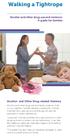 Walking a Tightrope Alcohol and other drug use and violence: A guide for families Alcohol- and Other Drug-related Violence Alcohol and other drug use and family violence often occur together. Families
Bullying. Take Action Against. stealing money. switching seats in the classroom. spreading rumors. pushing & tripping
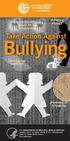 switching seats in the classroom stealing money Take Action Against Bullying spreading rumors pushing & tripping U.S. DEPARTMENT OF HEALTH & HUMAN SERVICES Substance Abuse and Mental Health Services Administration
Safe & Caring Schools Policy Revised 2013
 Safe & Caring Schools Policy Revised 2013 1. Background and Purpose Increased public awareness and concern regarding the societal issues of bullying and violent behaviour among youth prompted the Department
Indicators of School Crime and Safety: 2014
 Indicators of School Crime and Safety: 2014 NCES 2015-072 NCJ 248036 U.S. DEPARTMENT OF EDUCATION U.S. DEPARTMENT OF JUSTICE OFFICE OF JUSTICE PROGRAMS Indicators of School Crime and Safety: 2014 JULY
Wisconsin Anti-Bullying Center
 Patrick Evans, M.S. CESA 7 - Project Management Consultant Green Bay, Wisconsin Certified Trainer Wisconsin Emergency Management Multi-Hazard Emergency Planning for Schools Writer, Editor, Contributor,
Running head: LITERATURE REVIEW 1
 Running head: LITERATURE REVIEW 1 Literature Review: Bullying Group E Walden University/SOCI-4080-12 Dr. Moseley November 10, 2011 Running head: LITERATURE REVIEW 2 Introduction In the past few years,
Keeping Our Schools Safe
 SAFE AND CARING SCHOOLS Toronto District School Board Bill Byrd Safe Schools Administrator TOPIC Keeping Our Schools Safe Who we are What we do How we do it Restorative Practices (Ruth Bell) THANK YOU...
SCHOOL COUNSELORS AND SCHOOL VIOLENCE: PREVENTION, INTERVENTION, AND CRISIS RESPONSE
 1 SCHOOL COUNSELORS AND SCHOOL VIOLENCE: PREVENTION, INTERVENTION, AND CRISIS RESPONSE Two days after the end of the school year, days that normally would be spent catching up on activities and rest foregone
SWITZERLAND COUNTY School Corporation Policy Anti-Bullying Policy
 SWITZERLAND COUNTY School Corporation Policy Anti-Bullying Policy SCSC POLICY 6.72 The following policy has been established by the school board of Switzerland County School Corporation regarding anti-bullying.
Facts for Teens: Bullying
 P.O. Box 6003 Rockville, MD 20849-6003 [email protected] www.safeyouth.org Facts for Teens: Bullying Introduction In the United States, bullying among children and teenagers has often been dismissed
Infusion of School Bullying Prevention Into Guidance Curriculum. Significance of Bullying Prevention Program
 Infusion of School Bullying Prevention Into Guidance Curriculum October, 29, 2007 Charleston, SC Insoo Oh, Ph.D. Assistant Professor University of South Carolina Significance of Bullying Prevention Program
1. Preamble This policy is created with due regard to Law Number 61 of July 17, 1998 about primary and secondary education.
 1. Preamble This policy is created with due regard to Law Number 61 of July 17, 1998 about primary and secondary education. This policy addresses expected student behavior, the consequences of rule violations
Responsibilities of school counselors include, but are not limited to:
 1 Guidance/Counseling Services The Governing Board recognizes that a structured, coherent and comprehensive counseling program promotes academic achievement and serves the diverse needs of all district
Mentoring Resource Center
 U.S. Department of Education Offi ce of Safe and Drug-Free Schools Mentoring Resource Center Case Studies in Youth Mentoring Bullying Prevention and Intervention TeamMates Mentoring Program Lincoln Public
Threat Assessments to Manage Threatening Situations and Create Safer Schools
 Threat Assessments to Manage Threatening Situations and Create Safer Schools Catherine Toohey M. Ed. Senior Emergency Management and School Security Consultant Texas Association of School Boards, Loss
LINDA M. KANAN, Ph.D. 2604 Cherry Creek Drive South Work/Cell Tel: 303-910-3628 Denver, CO 80209 Home: 303-741-1489 lmkanan@comcast.
 Curriculum Vitae November, 2014 LINDA M. KANAN, Ph.D. 2604 Cherry Creek Drive South Work/Cell Tel: 303-910-3628 Denver, CO 80209 Home: 303-741-1489 [email protected] EDUCATION Doctor of Philosophy Major:
Prevention and Intervention for Bullying, Victimization, and Related Issues Prevention
 1 Prevention and Intervention for Bullying, Victimization, and Related Issues Prevention Barton, E. A. (2006). Bully prevention: Tips and strategies for school leaders and classroom teachers (2 nd ed.).
Updated Guidance for Schools and Districts on Addressing Teen Dating Violence (2013)
 Updated Guidance for Schools and Districts on Addressing Teen Dating Violence (2013) G.L. c. 71, as amended by sections 60 and 61 of Chapter 256 of the Acts of 2010, requires public schools to include
THE EFFECTS OF FAMILY VIOLENCE ON CHILDREN. Where Does It Hurt?
 THE EFFECTS OF FAMILY VIOLENCE ON CHILDREN Where Does It Hurt? Child Abuse Hurts Us All Every child has the right to be nurtured and to be safe. According to: Family Violence in Canada: A Statistical Profile
Ed Tucker, JD, PhD, LCSW Assistant Professor School of Social Work Barry University Miami Shores, Florida
 Ed Tucker, JD, PhD, LCSW Assistant Professor School of Social Work Barry University Miami Shores, Florida Zero Tolerance Predetermined consequences for noncompliance with mandatory behavior. Removes discretionary
Physical Symptoms Mood Symptoms Behavioral Symptoms
 Prescription drugs are the 3 rd most commonly abused drugs amongst teens in Nebraska, and the same statistic holds true on a national level. The rise in prescription drug abuse is becoming increasingly
Alcohol Abuse Among our Nation s Youth What to do as educators
 Alcohol Abuse Among our Nation s Youth What to do as educators The devastating rate of drug and alcohol abuse by American youth is cause for alarm and its prevention and treatment remains one of our nation
THE WHITE HOUSE Office of the Press Secretary EMBARGOED UNTIL THE START OF THE PRESIDENT S REMARKS January 16, 2013
 THE WHITE HOUSE Office of the Press Secretary EMBARGOED UNTIL THE START OF THE PRESIDENT S REMARKS January 16, 2013 Now Is the Time: The President s Plan to Protect our Children and our Communities by
Bullying Prevention: Steps to Address Bullying in Schools. Getting Started
 Bullying Prevention: Steps to Address Bullying in Schools Getting Started Bullying can threaten students physical and emotional safety at school and can negatively impact their ability to learn. The best
Essential Trauma Informed Practices in Schools. Shannon Cronn, N.C.S.P. Barb Iversen, M.C.
 Essential Trauma Informed Practices in Schools Shannon Cronn, N.C.S.P. Barb Iversen, M.C. Objectives: Participants attending this session will be able to: Define trauma Explain how trauma may impact child/teen
How To Prevent Suicide In High School
 The Role of High School Teachers in Preventing Suicide Understand Why Suicide Prevention Fits with Your Role as a High School Teacher Ms. Gomez, a high school social studies teacher, was concerned about
HAZING AND BULLYING (Harassment, Intimidation and Dating Violence)
 HAZING AND BULLYING (Harassment, Intimidation and Dating Violence) The prohibition against hazing, dating violence, harassment, intimidation or bullying is publicized in student handbooks and in the publications
HARTFORD PUBLIC SCHOOLS DISTRICT SAFE SCHOOL CLIMATE PLAN
 HARTFORD PUBLIC SCHOOLS DISTRICT SAFE SCHOOL CLIMATE PLAN The Hartford Public Schools Board of Education is committed to creating and maintaining a physically, emotionally, and intellectually safe educational
SAFE AND SECURE SCHOOLS PLAN
 SAFE AND SECURE SCHOOLS PLAN This safe schools plan is a comprehensive set of coordinated efforts both at the school and district level, all aimed at three components: prevention, intervention and, when
When students do not meet your behavioral expectations but are not exactly breaking the rules and may not deserve an official consequence.
 E-4 Diversify responses to various degrees of misbehavior When you re in the middle of instruction, you may encounter an assortment of misbehavior that varies in degrees of severity and warrants different
Lethal Violence in Schools A National Study Final Report
 To order a copy email: [email protected] Lethal Violence in Schools A National Study Final Report Edward Gaughan, Ph.D. Professor of Psychology Principal Investigator Jay D. Cerio, Ph.D. Professor of School
Running head: CONFORMITY: DRUG AND ALCOHOL ABUSE 1. Conformity: Drug and Alcohol Abuse. within Adolescent Communities. Amber R.
 Running head: CONFORMITY: DRUG AND ALCOHOL ABUSE 1 Conformity: Drug and Alcohol Abuse within Adolescent Communities Amber R. Tolley Lincoln Memorial University CONFORMITY: DRUG AND ALCOHOL ABUSE 2 Conformity:
GREENWOOD INTERNATIONAL SCHOOL
 GREENWOOD INTERNATIONAL SCHOOL EMERGENCY CRISIS MANAGEMENT PLAN REVISED ON DECEMBER 2011 Website: www.greenwood.sch.ae E-mail: [email protected] Promulgation Statement Greenwood International School
Learners with Emotional or Behavioral Disorders
 Learners with Emotional or Behavioral Disorders S H A N A M. H A T Z O P O U L O S G E O R G E W A S H I N G T O N U N I V E R S I T Y S P E D 2 0 1 S U M M E R 2 0 1 0 Overview of Emotional and Behavioral
Hip Habits Manners for Kids Wheel and Manners for Kids Teacher Guide
 Hip Habits Manners for Kids Wheel and Manners for Kids Teacher Guide Good manners are an important key to each child s social success. Parents and teachers often desire to go beyond the basics of Please
How to Protect Students from Sexual Harassment: A Primer for Schools
 How to Protect Students from Sexual Harassment: A Primer for Schools This fact sheet is part of a series of tools designed by the National Women s Law Center to help schools address the dropout crisis.
Toronto District School Board
 Toronto District School Board Title: GENDER-BASED VIOLENCE Policy P071 Adopted: April 14, 2010 Revised: Review: 1.0 OBJECTIVE To establish the Board s commitment to eliminating gender-based violence in
Proactive Strategies for Promoting a Safe and Respectful Workplace
 Proactive Strategies for Promoting a Safe and Respectful Workplace Index Risks at Work... 1 2 Solutions at Work...3 CPI at Work...4 Tips at Work: Attention to Safety... 5 11 Tip #1: Promote a Workplace
Underage Drinking. Underage Drinking Statistics
 Underage Drinking Underage drinking is a serious public health problem in the United States. Alcohol is the most widely used substance of abuse among America s youth, and drinking by young people poses
Psychology Works Fact Sheet: Bullying among Children and Youth
 Psychology Works Fact Sheet: Bullying among Children and Youth What is bullying? Bullying among children and youth is defined as repeated, unwanted aggressive behaviour(s) by a youth or group of youths.
Workforce Development Online Workshop Descriptions
 Workforce Development Online Workshop Descriptions Behavioral Health Service Delivery Workshops: The Effects of Violence Exposure on Children (1.5 hours) Regretfully, violence against children and youth
INTIMATE PARTNER VIOLENCE
 INTIMATE PARTNER VIOLENCE 28 Injury Prevention Plan of Alabama INTIMATE PARTNER VIOLENCE THE PROBLEM: In a national survey, 25% of female participants reported being raped or physically assaulted by an
Position Statement. Corporal Punishment. NASP Position Statement: Corporal Punishment 1
 Position Statement Corporal Punishment The National Association of School Psychologists (NASP) opposes the use of corporal punishment in schools and supports ending its use in all schools. Further, NASP
Bullying: A Systemic Approach to Bullying Prevention and Intervention
 Bullying: A Systemic Approach to Bullying Prevention and Intervention Session 3 Educators and Teachers icare.ebrschools.org An Alcohol, An Alcohol, Drug Abuse Drug Abuse and Violence and Violence Prevention
HIGH SCHOOL FOR RECORDING ARTS
 Adopted Revised High School for Recording Arts Bullying Prohibition Policy 1. Purpose Students have the right to be safe and free from threatening situations on school property and at school activities
Bullying and the. School Counselor's Role in Interventions. Kendra R. Pagel
 1 Bullying and the School Counselor's Role in Interventions by Kendra R. Pagel A Research Paper Submitted in Partial Fulfillment of the Requirements for the Master of Science egree III School Counseling
Annex 1: Assesing risk: threats, vulnerabilities and capacities
 Annex 1: Assesing risk: threats, vulnerabilities and capacities There is no widely accepted definition of risk, but we can say that risk refers to possible events, however uncertain, that result in harm.
The Crisis Management Plan: Promoting School Safety
 VOLUME 27, NUMBER 4, 2010 The Crisis Management Plan: Promoting School Safety Fred C. Lunenburg Sam Houston State University ABSTRACT A serious problem facing school administrators today is the increasing
BULLYING/ANTI-HARASSMENT
 BULLYING/ANTI-HARASSMENT The state of Mississippi has established legislation requiring Bullying Prevention to be taught in schools. Executive Summary The purpose of this policy is to assist the Mississippi
Treatment Planning. The Key to Effective Client Documentation. Adapted from OFMQ s 2002 provider training.
 Treatment Planning The Key to Effective Client Documentation Adapted from OFMQ s 2002 provider training. 1 Models Medical Model Diagnosis Psych Eval Problems Symptoms Psycho/Social/Behavioral Model Diagnosis
NEW PERSPECTIVES ON BULLYING PREVENTION: WHY ARE CURRENT PROGRAMS NOT WORKING?
 NEW PERSPECTIVES ON BULLYING PREVENTION: WHY ARE CURRENT PROGRAMS NOT WORKING? Dorothy L. Espelage, Ph.D. Professor, Child Development Division; Educational Psychology [email protected] This research
MASTER PLAN. Broward District Schools. Police Department. School Emergency Preparedness. Program
 MASTER PLAN Broward District Schools Police Department School Emergency Preparedness Program SLT MEMBER: Jeff Moquin OWNER OF PLAN: Anthony Williams DEPARTMENT(S): Broward District Schools Police Department
How To Help Your Child With A Learning Disability
 What Is a School Psychologist? Who Are School Psychologists? School psychologists have specialized training in both psychology and education. They use their training and skills to team with educators,
2014-15 School Safety & Discipline Data Reporting
 2014-15 School Safety & Discipline Data Reporting Brooks Rumenik Office of Safe Schools Florida Department of Education Justin Donald Education Information & Accountability Services Florida Department
1. Youth Drug Use More than 40% of Maryland high school seniors used an illicit drug in the past year.
 1. Youth Drug Use More than 4% of Maryland high school seniors used an illicit drug in the past year. Any Illicit Drug Alcohol Marijuana Ecstasy Cocaine Percentage of Maryland and U.S. high school seniors
State and National School Safety Resources Here you will find a summary of all of the resources listed throughout this guide.
 State and National School Safety Resources Here you will find a summary of all of the resources listed throughout this guide. This guide was adapted from the three national resources below: The Centers
Chicago Public Schools Policy Manual
 Chicago Public Schools Policy Manual Title: ANTI-BULLYING POLICY Section: 705.5A Board Report: 14-0625-PO1 Date Adopted: June 25, 2014 Policy: ANTI-BULLYING POLICY Purpose The Illinois General Assembly
CALIFORNIA EDUCATION CODE: Suspension and Expulsion
 CALIFORNIA EDUCATION CODE: Suspension and Expulsion EC 48900 - Grounds for suspension or expulsion; jurisdiction; legislative intent (Amended by Assembly Bill 86 effective January 1, 2009) A pupil shall
Bullying Prevention and Intervention:
 Bullying Prevention and Intervention: A Guide for the Individualized Education Program (IEP) Team Dr. Carol R. Johnson Superintendent Boston Public Schools 26 Court St. Boston, MA 02108-2528 www.bostonpublicschools.org
SUICIDAL BEHAVIOR IN CHILDREN AND ADOLESCENTS NADINE J KASLOW, PHD, ABPP [email protected] 2014 APA PRESIDENT
 SUICIDAL BEHAVIOR IN CHILDREN AND ADOLESCENTS NADINE J KASLOW, PHD, ABPP [email protected] 2014 APA PRESIDENT Setting the Stage What are the common myths about suicide in children and adolescents? If I
What is DOMESTIC VIOLENCE?
 What is DOMESTIC VIOLENCE? Domestic violence is a pattern of control used by one person to exert power over another. Verbal abuse, threats, physical, and sexual abuse are the methods used to maintain power
POLICY 5111 ANTI-BULLYING/HARASSMENT/HATE
 POLICY 5111 Purpose/Introduction: The Kenosha Unified School District strives to provide a safe, secure and respectful learning environment for all students in school buildings, on school grounds, in school
Indicators of School Crime and Safety: 2007
 Indicators School Crime and Safety: 2007 NCES 2008-021 NCJ 219553 U.S. DEPARTMENT OF EDUCATION U.S. DEPARTMENT OF JUSTICE OFFICE OF JUSTICE PROGRAMS THIS PAGE INTENTIONALLY LEFT BLANK Indicators School
Patient will be promoted to the next grade level by end of school year. Academic Issues
 Treatment Planning for Children and Adolescents Long and Treatment Goals Prepared by Nancy Lever, Ph.D. and Jennifer Pitchford, LCPC SMHP Program, May 2008 Problem Academic Issues Treatment Goals Patient
YORK REGION DISTRICT SCHOOL BOARD
 YORK REGION DISTRICT SCHOOL BOARD Policy and Procedure #668.0, Caring and Safe Schools Procedure #668.1, Student Suspensions Procedure #668.2, Student Expulsions Procedure #668.3, Inappropriate Behaviour
Management Assistance Program
 Management Assistance Program COMMUNICATING WITH EMPLOYEES DURING A CRISIS: How to prepare and help employees cope with a workplace related crisis GOALS: The goal of this module is to provide organizations,
Case 4:74-cv-00090-DCB Document 1688 Filed 10/01/14 Page 57 of 136. Life Skills Alternative to Suspension Program (LSASP)
 Case 4:74-cv-00090-DCB Document 1688 Filed 10/01/14 Page 57 of 136 Life Skills Alternative to Suspension Program (LSASP) General Description The Life Skills Alternative to Suspension Program (LSASP) provides
School Safety & Emergency Preparedness. Presented by Dr. Joe Melita Professional Standards & Special Investigative Unit
 School Safety & Emergency Preparedness Presented by Dr. Joe Melita Professional Standards & Special Investigative Unit Today s Agenda Today s session is designed to provide participants with an overview
Why Do Some Children Bully Others? Bullies and Their Victims
 Family Development Fact Sheet Call your county Extension office for more information Why Do Some Children Bully Others? Bullies and Their Victims Is bullying serious? Bullying is often considered to be
CAMPUS SECURITY INFORMATION ANNUAL CAMPUS SECURITY REPORT-TULSA
 CAMPUS SECURITY INFORMATION ANNUAL CAMPUS SECURITY REPORT-TULSA The following statistics are provided as part of the requirement under the Student Right- To Know and Campus Security Act, Public Law 101-542,
Suicide and Bullying. Issue Brief. Definitions. Extent of the Problem
 Issue Brief This issue brief examines the relationship between suicide and bullying among children and adolescents, with special attention to lesbian, gay, bisexual, and transgender (LGBT) youth. It also
Eating Disorders. Symptoms and Warning Signs. Anorexia nervosa:
 Eating Disorders Eating disorders are serious conditions that can have life threatening effects on youth. A person with an eating disorder tends to have extreme emotions toward food and behaviors surrounding
ENDS (Required by Minnesota Statute) Policy Title Policy Level Date Approved/Revised Chemical Use & Abuse EM-020.8 5/20/08 Revised: 7/23/13
 ENDS (Required by Minnesota Statute) Policy Title Policy Level Date Approved/Revised Chemical Use & Abuse 5/20/08 Revised: 7/23/13 1) General Statement of Policy 2) Definitions 3) Students a) Use of controlled